
Specimen A to B Standard Operations Manual (Helicopters)
|
|
|
- Gloria Griffin
- 9 years ago
- Views:
Transcription
1 Safety Regulation Group CAP 649 Specimen A to B Standard Operations Manual (Helicopters)
2

3 Safety Regulation Group CAP 649 Specimen A to B Standard Operations Manual (Helicopters)
4 CAP 649 Specimen A to B Standard Operations Manual (Helicopters) Civil Aviation Authority 2005 All rights reserved. Copies of this publication may be reproduced for personal use, or for use within a company or organisation, but may not otherwise be reproduced for publication. To use or reference CAA publications for any other purpose, for example within training material for students, please contact the CAA at the address below for formal agreement. ISBN First published June 1995 Reprinted March 1996 Reprinted August 1998 Reprinted June 1999 Second edition Enquiries regarding the content of this publication should be addressed to: Flight Operations Department, Safety Regulation Group, Civil Aviation Authority, Aviation House, Gatwick Airport South, West Sussex, RH6 0YR. The latest version of this document and all applicable amendments are available in electronic format at where you may also register for notification of amendments.

5 Preface SPECIMEN A TO B STANDARD OPERATIONS MANUAL, (HELICOPTERS) SECOND EDITION Due to the volume of revision it has not been practical to indicate specific areas of amendment relative to the first edition. Users of this specimen Standard Operations Manual must note the following: 1 It is the responsibility of the operator to satisfy himself as to the appropriateness of each provision of the Standard Operations Manual to his particular operation and to make any necessary amendments, additions and/or deletions. Note: The requirements contained in CAP 649 do not apply to: helicopters when used in military, customs or police services: nor parachute dropping and firefighting flights, and to associated positioning and return flights in which the only persons carried are those who would normally be carried on parachute dropping or firefighting flights; nor flights immediately before, during or immediately after an aerial work activity provided these flights are connected with that aerial work activity and in which, excluding crew members, no more than six persons indispensable to the aerial work activity are carried. 2 The Manual is written as if by an operator to reflect the requirements and guidance material contained in JAR OPS 3. This being so, the use of a compulsive verb, i.e. must/shall, does not necessarily indicate a legislative requirement but can indicate a suggested operator generated requirement. 3 The operator remains responsible for the adequacy of content, accuracy and currency of his own Company Manual irrespective of the source of that Manual. (Note JAR OPS ) 4 Where an appendix to this Manual is listed in the contents but not included in the body of the Manual, this indicates that the operator should compose the necessary appendix to meet the company s individual requirements. 5 Specimen text is provided. Where the text is an instruction in italics the author of the Company Manual is required to generate and insert text. 6 Annotations are made throughout the CAP 649 indicating the source requirement or relevant guidance material, these source indications are not necessarily exhaustive. For the sake of brevity the words JAR-OPS are omitted prior to the JAR number. It must be noted that as JAR-OPS and its associated Appendix governs the whole of the Operations Manual, it is usually only quoted when the sole or primary source requirement. 7 Part B Helicopter Operating Matters Type Related and Part C Route and Aerodrome Instructions and Information are to be compiled by the operator. In the aeroplane version of this Manual an Addendum 1 is included which lists the items to be included in a separate Cabin Safety Training and Procedures Document which would normally form annexes as appropriate to Parts A, B and D. This Addendum is not considered to be applicable to most helicopter operations and is therefore not included in this Manual. A copy of the aeroplane version will be made available to interested operators on request to Flight Operations Policy Section. Addendum 1 pages therefore appear as Not Used. iii
6 8 Following Addendum 1 referred to in 7 above is a list of subjects Addendum 2 which does not appear in this Specimen Part A. The operator must assess the need for inclusion of all or any of these subjects in the company s manuals. Should it be decided that coverage of all or any of these subjects be included then a location that is relevant for the subject matter will have to be determined. The options for appropriate location would be either an expansion of the text contained in Part A, or incorporation in Parts B or C (or the suggested Cabin Safety Training and Procedures Document). 9 Where reference is made in this document to JAR codes, other than JAR OPS 3, which have not been implemented the equivalent existing national regulations will apply until such time as the referenced code has been implemented. 10 For brevity the pronoun he is used throughout. Where appropriate, the pronoun she should be inferred or assumed. 11 Part D provides a complete menu of the Training Requirements contained in JAR OPS 3. Where a particular element does not apply to an individual operator s operation the relevant text may be deleted and the words Not applicable inserted against the particular paragraph reference in the index. To retain a standardised format, users of this document should retain the original paragraph numbering. iv

7 Amendment Record Amendment Number Amendment Date Date Entered Incorporated by Initials v

8 Amendment Number Amendment Date Date Entered Incorporated by Initials vi

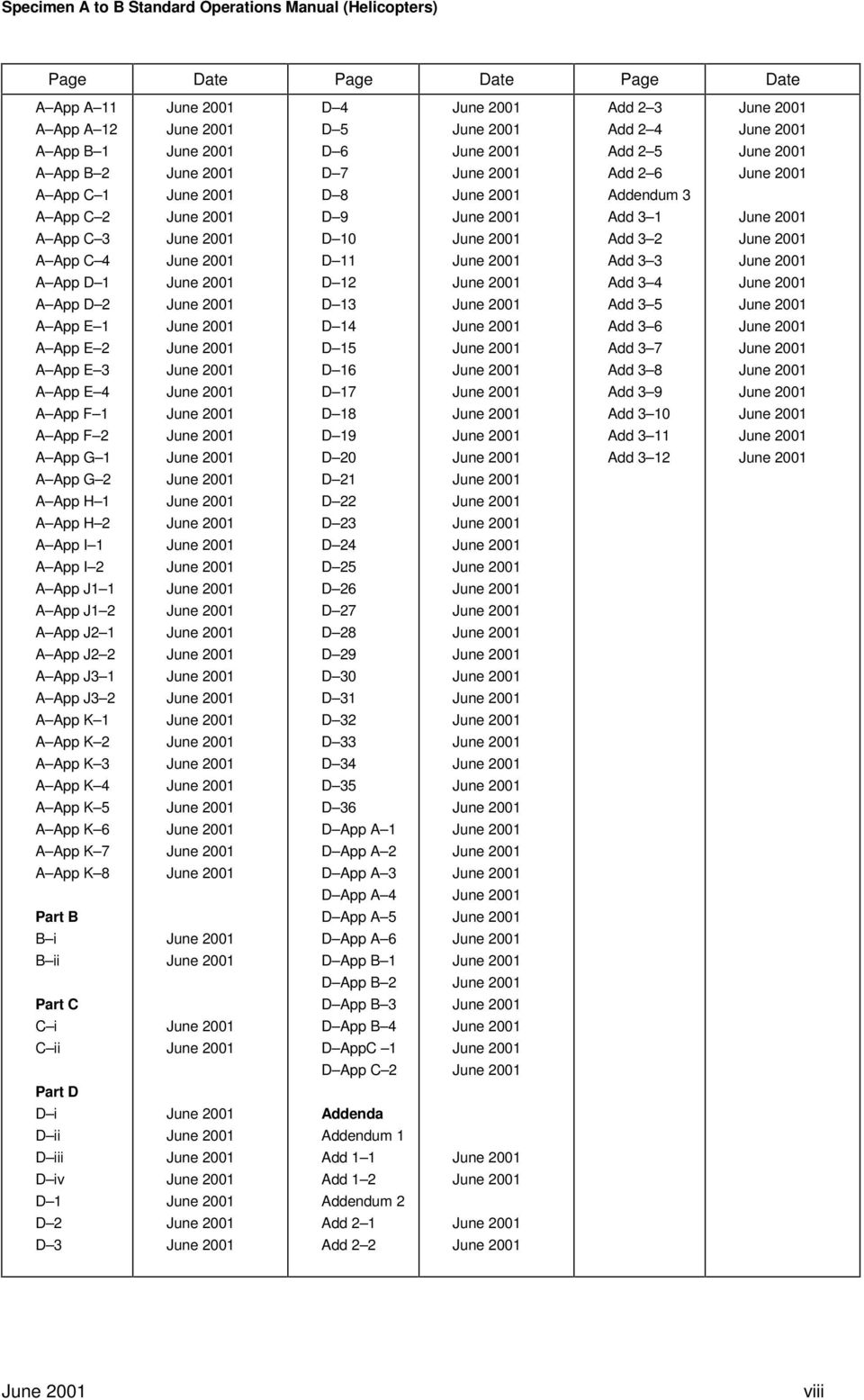
9 List of Effective Pages Page Date Page Date Page Date iii iv v vi vii viii ix x Part A A i A ii A iii A iv A 0 1 A 0 2 A 0 3 A 0 4 A 1 1 A 1 2 A 1 3 A 1 4 A 1 5 A 1 6 A 1 7 A 1 8 A 2 1 A 2 2 A 3 1 A 3 2 A 4 1 A 4 2 A 4 3 A 4 4 A 5 1 A 5 2 A 5 3 A 5 4 A 6 1 A 6 2 A 7 1 A 7 2 A 8 1 A 8 2 A 8 3 A 8 4 A 8 5 A 8 6 A 8 7 A 8 8 A 8 9 A 8 10 A 8 11 A 8 12 A 8 13 A 8 14 A 8 15 A 8 16 A 8 17 A 8 18 A 8 19 A 8 20 A 8 21 A 8 22 A 8 23 A 8 24 A 8 25 A 8 26 A 8 27 A 8 28 A 8 29 A 8 30 A 8 31 A 8 32 A 8 33 A 8 34 A 8 35 A 8 36 A 8 37 A 8 38 A 8 39 A 8 40 A 8 41 A 8 42 A 8 43 A 8 44 A 8 45 A 8 46 A 8 47 A 8 48 A 8 49 A 8 50 A 8 51 A 8 52 A 8 53 A 8 54 A 8 55 A 8 56 A 8 57 A 8 58 A 8 59 A 8 60 A 8 61 A 8 62 A 8 63 A 8 64 A 8 65 A 8 66 A 8 67 A 8 68 A 8 69 A 8 70 A 8 71 A 8 72 A 9 1 A 9 2 A 9 3 A 9 4 A 9 5 A 9 6 A 9 7 A 9 8 A 9 9 A 9 10 A 10 1 A 10 2 A 11 1 A 11 2 A 11 3 A 11 4 A 11 5 A 11 6 A 11 7 A 11 8 A 11 9 A A A A A A 12 1 A 12 2 A App A 1 A App A 2 A App A 3 A App A 4 A App A 5 A App A 6 A App A 7 A App A 8 A App A 9 A App A 10 vii
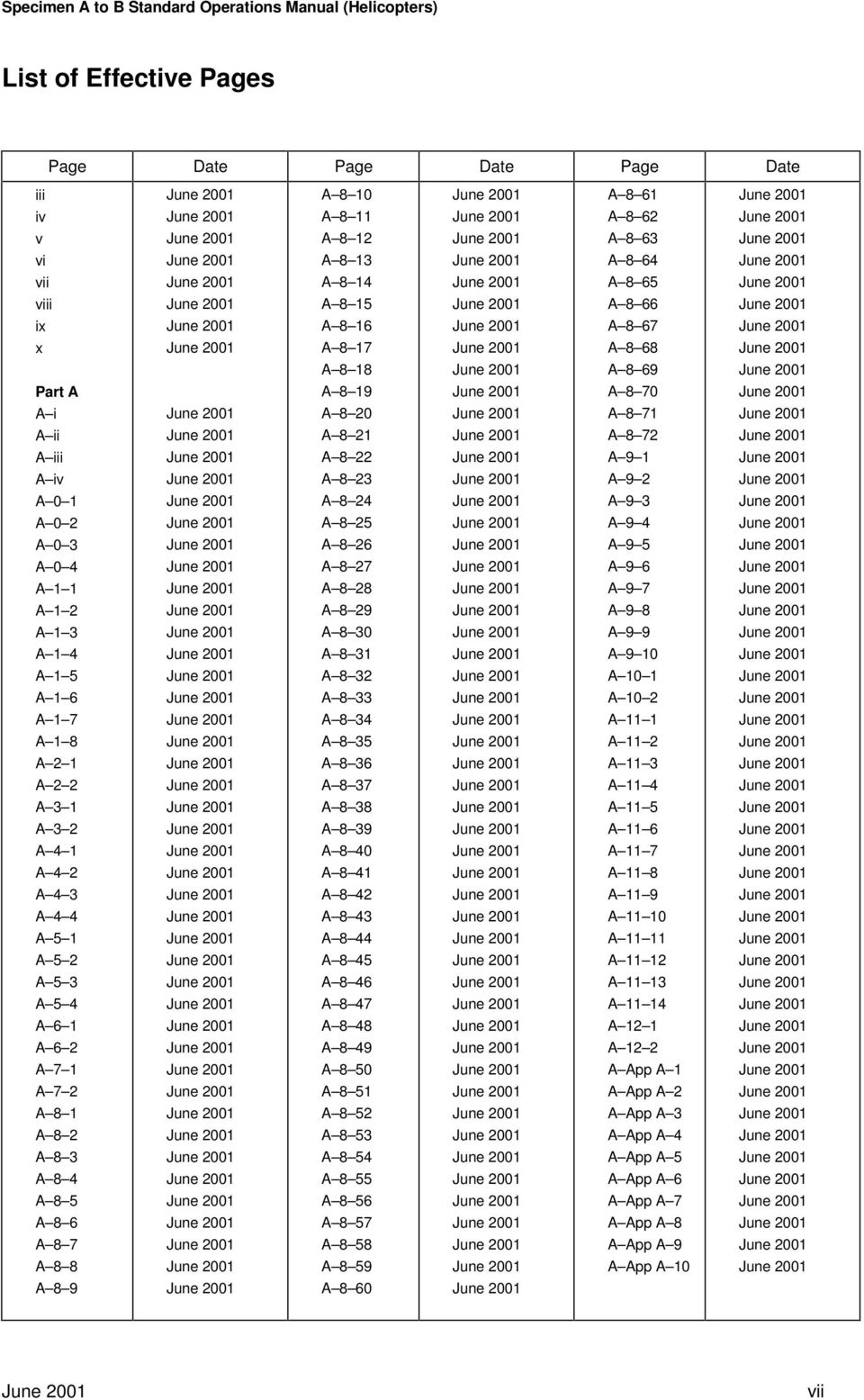
10 Page Date Page Date Page Date A App A 11 A App A 12 A App B 1 A App B 2 A App C 1 A App C 2 A App C 3 A App C 4 A App D 1 A App D 2 A App E 1 A App E 2 A App E 3 A App E 4 A App F 1 A App F 2 A App G 1 A App G 2 A App H 1 A App H 2 A App I 1 A App I 2 A App J1 1 A App J1 2 A App J2 1 A App J2 2 A App J3 1 A App J3 2 A App K 1 A App K 2 A App K 3 A App K 4 A App K 5 A App K 6 A App K 7 A App K 8 Part B B i B ii Part C C i C ii Part D D i D ii D iii D iv D 1 D 2 D 3 D 4 D 5 D 6 D 7 D 8 D 9 D 10 D 11 D 12 D 13 D 14 D 15 D 16 D 17 D 18 D 19 D 20 D 21 D 22 D 23 D 24 D 25 D 26 D 27 D 28 D 29 D 30 D 31 D 32 D 33 D 34 D 35 D 36 D App A 1 D App A 2 D App A 3 D App A 4 D App A 5 D App A 6 D App B 1 D App B 2 D App B 3 D App B 4 D AppC 1 D App C 2 Addenda Addendum 1 Add 1 1 Add 1 2 Addendum 2 Add 2 1 Add 2 2 Add 2 3 Add 2 4 Add 2 5 Add 2 6 Addendum 3 Add 3 1 Add 3 2 Add 3 3 Add 3 4 Add 3 5 Add 3 6 Add 3 7 Add 3 8 Add 3 9 Add 3 10 Add 3 11 Add 3 12 viii
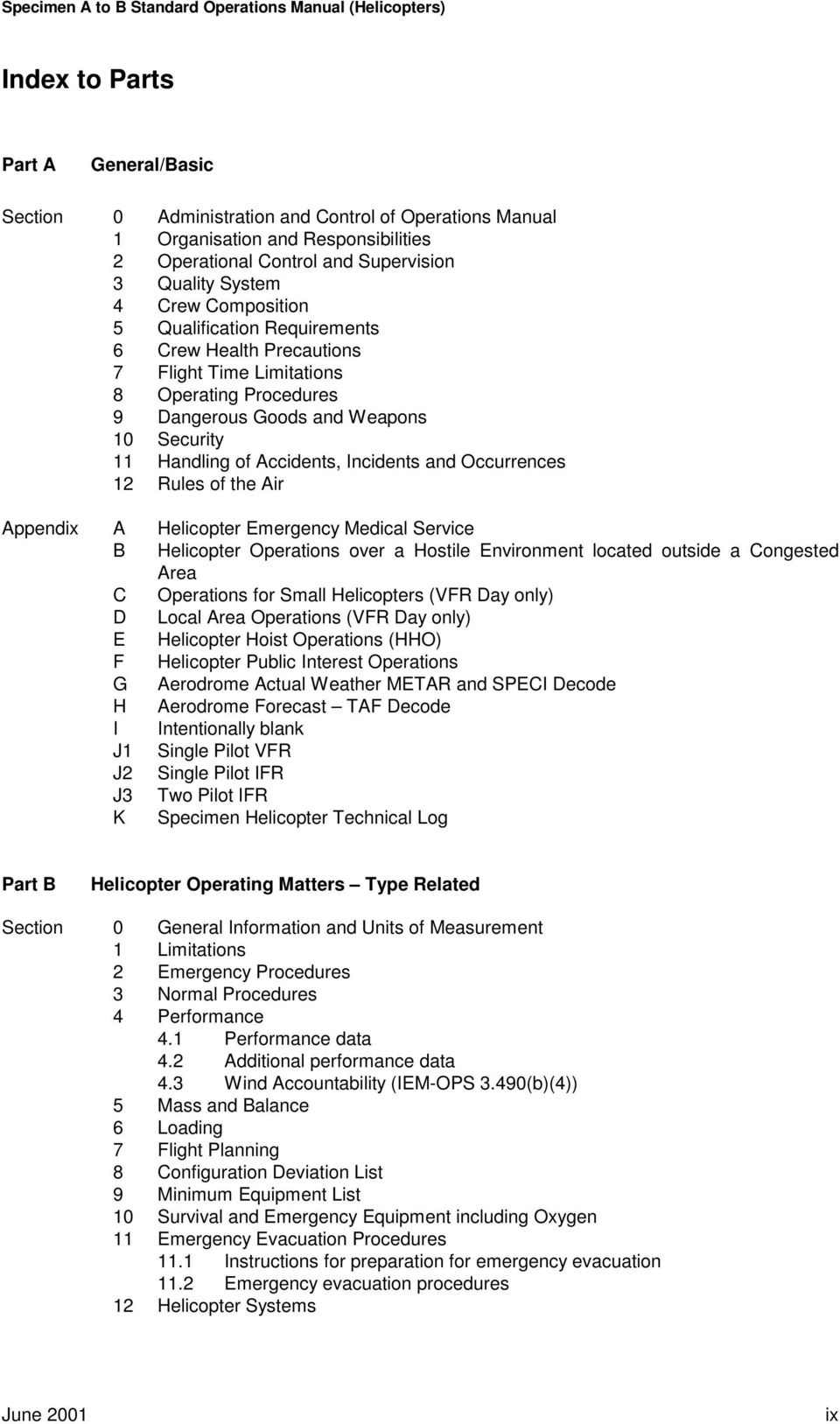
11 Index to Parts Part A General/Basic Section 0 Administration and Control of Operations Manual 1 Organisation and Responsibilities 2 Operational Control and Supervision 3 Quality System 4 Crew Composition 5 Qualification Requirements 6 Crew Health Precautions 7 Flight Time Limitations 8 Operating Procedures 9 Dangerous Goods and Weapons 10 Security 11 Handling of Accidents, Incidents and Occurrences 12 Rules of the Air Appendix A Helicopter Emergency Medical Service B Helicopter Operations over a Hostile Environment located outside a Congested Area C Operations for Small Helicopters (VFR Day only) D Local Area Operations (VFR Day only) E Helicopter Hoist Operations (HHO) F Helicopter Public Interest Operations G Aerodrome Actual Weather METAR and SPECI Decode H Aerodrome Forecast TAF Decode I Intentionally blank J1 Single Pilot VFR J2 Single Pilot IFR J3 Two Pilot IFR K Specimen Helicopter Technical Log Part B Helicopter Operating Matters Type Related Section 0 General Information and Units of Measurement 1 Limitations 2 Emergency Procedures 3 Normal Procedures 4 Performance 4.1 Performance data 4.2 Additional performance data 4.3 Wind Accountability (IEM-OPS 3.490(4)) 5 Mass and Balance 6 Loading 7 Flight Planning 8 Configuration Deviation List 9 Minimum Equipment List 10 Survival and Emergency Equipment including Oxygen 11 Emergency Evacuation Procedures 11.1 Instructions for preparation for emergency evacuation 11.2 Emergency evacuation procedures 12 Helicopter Systems ix
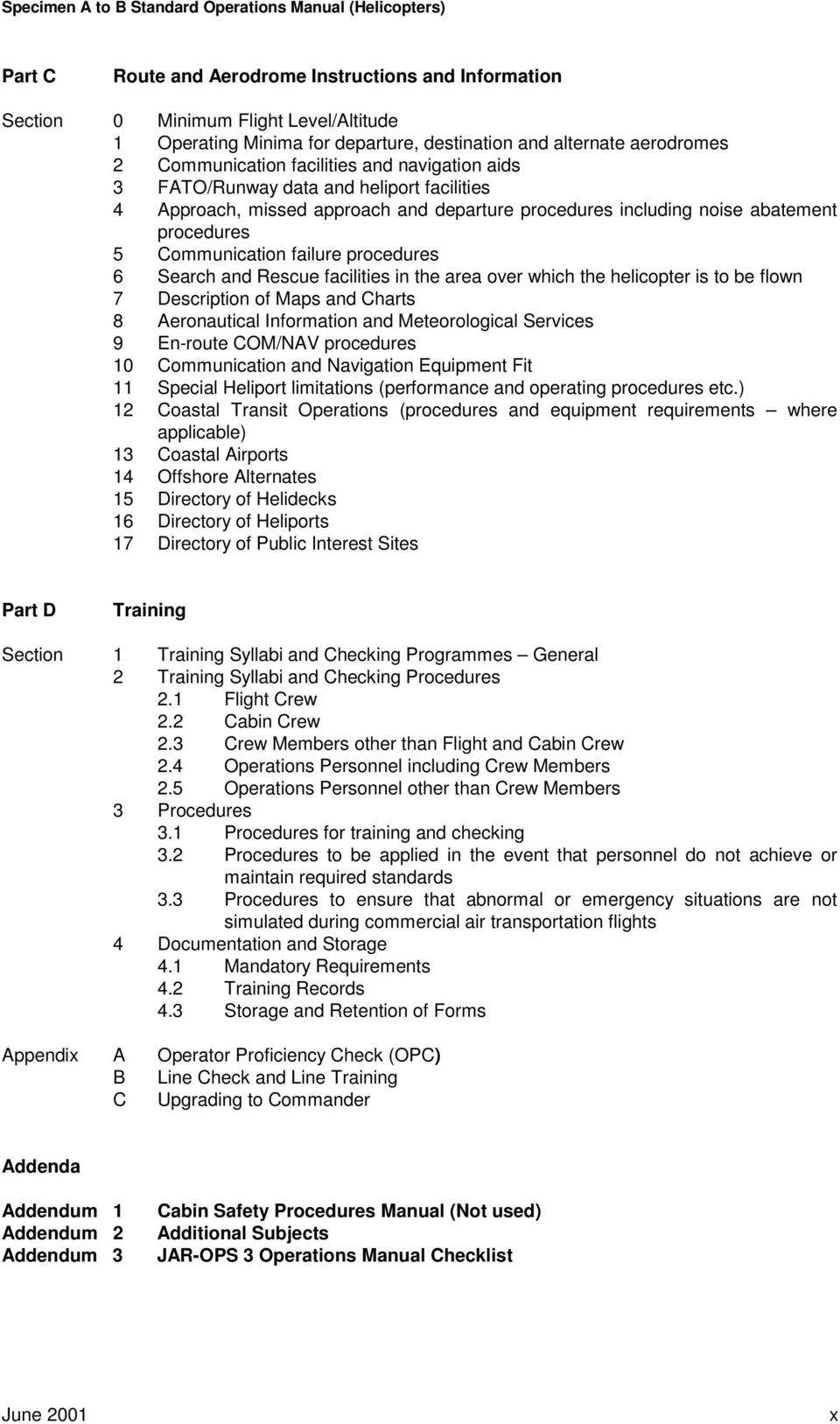
12 Part C Route and Aerodrome Instructions and Information Section 0 Minimum Flight Level/Altitude 1 Operating Minima for departure, destination and alternate aerodromes 2 Communication facilities and navigation aids 3 FATO/Runway data and heliport facilities 4 Approach, missed approach and departure procedures including noise abatement procedures 5 Communication failure procedures 6 Search and Rescue facilities in the area over which the helicopter is to be flown 7 Description of Maps and Charts 8 Aeronautical Information and Meteorological Services 9 En-route COM/NAV procedures 10 Communication and Navigation Equipment Fit 11 Special Heliport limitations (performance and operating procedures etc.) 12 Coastal Transit Operations (procedures and equipment requirements where applicable) 13 Coastal Airports 14 Offshore Alternates 15 Directory of Helidecks 16 Directory of Heliports 17 Directory of Public Interest Sites Part D Training Section 1 Training Syllabi and Checking Programmes General 2 Training Syllabi and Checking Procedures 2.1 Flight Crew 2.2 Cabin Crew 2.3 Crew Members other than Flight and Cabin Crew 2.4 Operations Personnel including Crew Members 2.5 Operations Personnel other than Crew Members 3 Procedures 3.1 Procedures for training and checking 3.2 Procedures to be applied in the event that personnel do not achieve or maintain required standards 3.3 Procedures to ensure that abnormal or emergency situations are not simulated during commercial air transportation flights 4 Documentation and Storage 4.1 Mandatory Requirements 4.2 Training Records 4.3 Storage and Retention of Forms Appendix A Operator Proficiency Check (OPC) B Line Check and Line Training C Upgrading to Commander Addenda Addendum 1 Cabin Safety Procedures Manual (Not used) Addendum 2 Additional Subjects Addendum 3 JAR-OPS 3 Operations Manual Checklist x
13 Part A General/Basic CONTENTS Page No. Section 0 Administration and Control of Operations Manual A Introduction A Amendment and revision A 0 1 Section 1 Organisation and Responsibilities A Organisational structure A Appointments, names of nominated post holders A Responsibilities and duties of operations management personnel A Authority, duties and responsibilities of the helicopter commander A Duties and responsibilities of crew members other than the commander A 1 5 Section 2 Operational Control and Supervision A Supervision of the operation by the company A System of promulgation of additional operational instructions and information A Accident prevention and flight safety programme A Operational control A Powers of the Authority A 2 2 Section 3 Quality System A Quality control A Supervisors A Discrepancies A Records A 3 1 Section 4 Crew Composition A General A Intentionally blank A Flight crew incapacitation A Operation on more than one type or variant A Division of duties A First Officer handling the helicopter A 4 4 Section 5 Qualification Requirements A Description of licence, qualification/competency, training, checking etc A Flight crew A Crew members other than flight crew A Training, checking and supervisory personnel A Other operations personnel A 5 4 Section 6 Crew Health Precautions A Alcohol A Narcotics and/or drugs A Medication A Immunisation A Blood donation A 6 1 A i

14 6.6 Deep water diving A Meals A Sleep and rest A Fitness A Surgical procedures A Anaesthetics A 6 2 Section 7 Flight Time Limitations A Flight and Duty Time Limitations and Rest Requirements Scheme A Exceedences of Flight and Duty Time Limitations and Reduction of Rest A 7 1 Section 8 Operating Procedures A Flight preparation instructions A Ground handling Instructions A Flight procedures A All Weather Operations A Intentionally blank A Use of the minimum equipment lists and configuration deviation lists (JAR-MMEL/MEL.050) A Non-revenue flights A Oxygen requirements A 8 71 Section 9 Dangerous Goods and Weapons A Terminology A Policy on the Transport of Dangerous Goods A Guidance on the requirements for acceptance, handling and stowage A Procedures for responding to emergency situations A Duties of all personnel involved A Instructions on the carriage of employees when dangerous goods are carried A Conditions under which weapons, munitions of war and sporting weapons may be carried A 9 8 Section 10 Security A General A Training A Search Procedures A Flight Crew Security A Reporting A 10 2 Section 11 Handling of Accidents, Incidents and Occurrences A Accidents A Incidents A Local assessment A Supporting information A Accident and incident report distribution A Mandatory Occurrence Reporting Scheme A Airprox, Birdstrike and Lightning Strike Reports A Wake turbulence A Confidential Human Factors Incident Reports (CHIRPS) A Investigation/rectification away from base A Special notification requirements in the event of an accident or occurrence when dangerous goods are being carried A Confidentiality A Section 12 Rules of the Air A 12 1 A ii

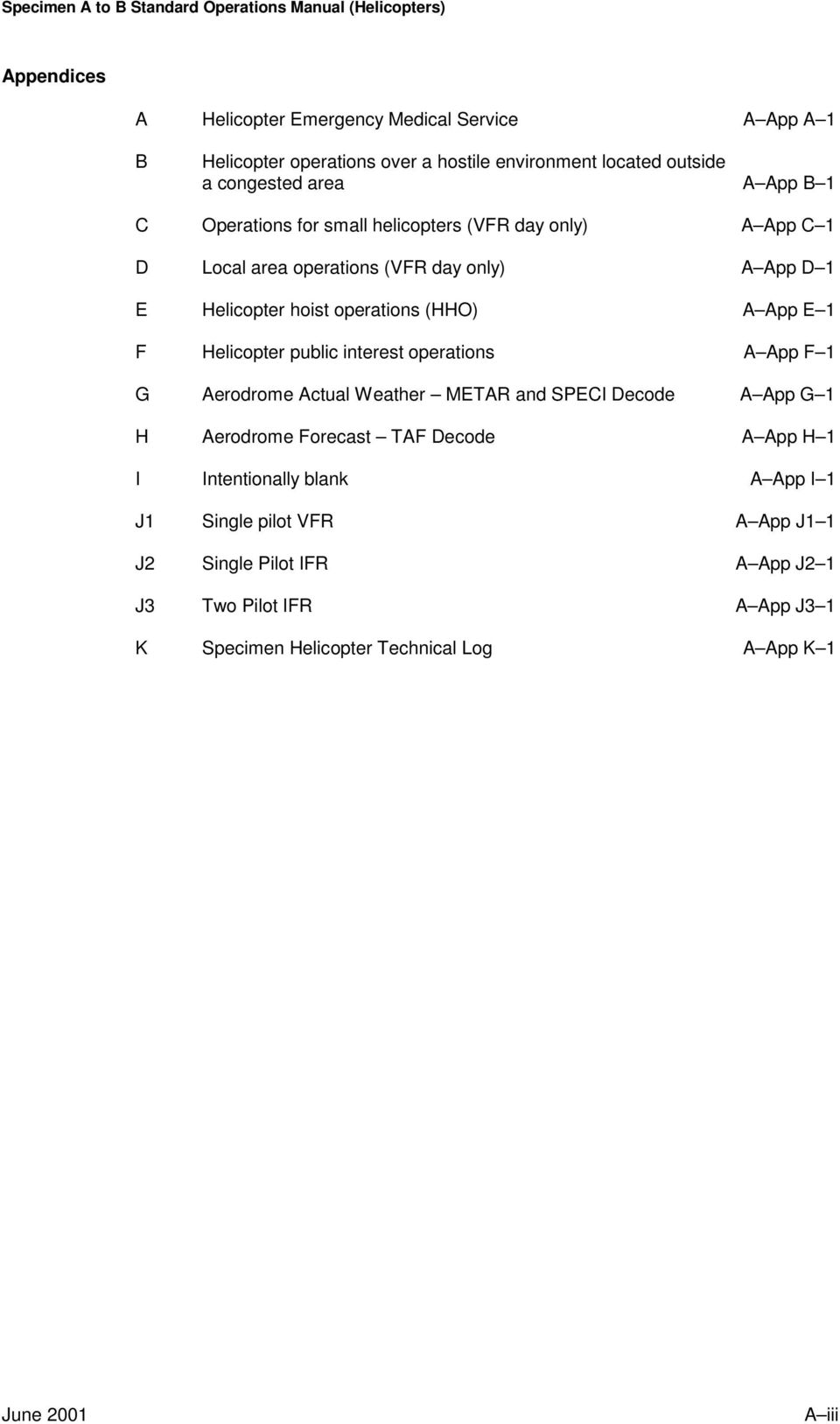
15 Appendices A Helicopter Emergency Medical Service A App A 1 B Helicopter operations over a hostile environment located outside a congested area A App B 1 C Operations for small helicopters (VFR day only) A App C 1 D Local area operations (VFR day only) A App D 1 E Helicopter hoist operations (HHO) A App E 1 F Helicopter public interest operations A App F 1 G Aerodrome Actual Weather METAR and SPECI Decode A App G 1 H Aerodrome Forecast TAF Decode A App H 1 I Intentionally blank A App I 1 J1 Single pilot VFR A App J1 1 J2 Single Pilot IFR A App J2 1 J3 Two Pilot IFR A App J3 1 K Specimen Helicopter Technical Log A App K 1 A iii
16 INTENTIONALLY BLANK A iv

17 Part A General/Basic Section 0 ADMINISTRATION AND CONTROL OF OPERATIONS MANUAL 0.1 INTRODUCTION The company Operations Manual is issued in accordance with the Joint Aviation Requirements. It complies with JAR OPS 3 and with the terms and conditions of the company s Air Operator s Certificate The manual is for the use and guidance of all company operating staff, who are to ensure that all commercial air transportation flights are planned and executed in accordance with company policies and requirements The manual is broadly sub-divided into the following Parts which may be supplemented by such other publications as the helicopter flight manual or pilot s operating handbook, and commercially-produced route and airways manuals: Part A Part B Part C Part D General/Basic Information, Requirements and Operations Helicopter Type Operating Procedures and Requirements. (This Part may refer to, but not necessarily duplicate, information in the helicopter flight manual or pilot s operating handbook.) Flight Guide (This Part will normally be a commercially-produced route guide/airways manual. e.g Aerad) Training Manual Where necessary, specific terms are defined at the beginning of the sections to which they are appropriate For brevity, the pronoun he is used throughout. Where appropriate, the pronoun she should be inferred or assumed A Commercial Air Transport Operation is an aircraft operation involving the transport of passengers or cargo for remuneration or hire. NOTE: The term Commercial Air Transportation is not intended to cover Aerial Work or Corporate Aviation. 0.2 AMENDMENT AND REVISION The Operations Manual is issued on the authority of the company, and the Chief Pilot will authorise all amendments to it, as required by the company or by the Civil Aviation Authority. Any proposed amendment should be forwarded, through the Chief Pilot, on an Amendment Proposal Form (see overleaf) to the Publications Officer. All amendments will be in the form of printed, replacement pages; manuscript amendments are not permitted. Revision pages will be annotated to show the date of issue (and date of effect if different); the amendment list number, and the portion of the text which has been revised, as indicated by vertical marginal lines adjacent to the changes. Each amendment will be accompanied by a revised list of effective pages, with their dates of issue, and by a certificate of receipt/incorporation. An amendment list record will be maintained at the front of each manual. A 0 1

18 0.2.2 It is a requirement that a copy of the manual is available for carriage in each of the company commercial air transportation helicopters. Sufficient additional copies will be provided to ensure that all operating staff have ready access to them when required, and to enable one copy to be lodged with the Civil Aviation Authority. The company will maintain an up-to-date list of manuals, together with their copy numbers and their locations, or the name/appointment of the copy holder, as appropriate. Amendments will be issued to copy holders or nominated individuals who will be required to amend particular numbered copies. Amendments should be entered on receipt, and the amendment record completed. Certificates of incorporation should be returned to the company as soon as possible after the amendments have been completed Details of revisions which may be urgently required in the interests of flight safety, or which are supplementary to the Operations Manual, will be promulgated by means such as Flying Staff Instructions. Those of a temporary nature will be cancelled as soon as they are no longer relevant. Those of long-term application will be incorporated into the manual when it is next amended, or within six months of their effective date, whichever is the sooner All intended amendments and revisions must be supplied to the Authority in advance of the effective date. When the amendment/revision concerns any part of the Operations Manual which must be approved by means of the Operations Approval document, this approval must be obtained before the amendment or revision becomes effective. When immediate amendment or revisions are required in the interest of safety, they may be published and applied immediately, provided that application for approval has been made Operations personnel must have easy access to a copy of each part of the Operations Manual which is relevant to their duties. In addition, each crew member must be supplied with a personal copy of, or sections from, Parts A and B of the Operations Manual as are relevant for personal study. A 0 2

19 Amendment Proposal Form AMENDMENT PROPOSAL FORM The following amendment/addition/deletion* is proposed to Part A/B/D* Para.... of the Operations Manual: *Delete where applicable PROPOSED AMENDMENT: (continue on separate sheet if necessary) REASON FOR AMENDMENT: Signature of Proposer: Position: Chief Pilot: Signature: Staff No: Authorised by: Position: See over for guidelines on the completion of this form. A 0 3

20 Amendment Proposal Form (continued) GUIDELINES ON THE COMPLETION OF THIS FORM 1 Proposed amendments to the Operations Manual will only be considered if submitted on this form. 2 This form should be completed, signed and handed to the Chief Pilot for comment/approval. It should then be forwarded as follows: Part A Part B Part D Chief Pilot Fleet Manager Flight Training Manager This proposal should then be sent to the Publications Officer for action. 3 The final decision on amendments to the Operations Manual rests with the Senior Manager responsible for the Operations Manual. 4 The Company reserves the right to amend any proposal. A 0 4
21 Section 1 ORGANISATION AND RESPONSIBILITIES (3.175, and Appendix 2 to 3.175) (should be prefaced with a map and co-ordinates of the AOC Region) 1.1 ORGANISATIONAL STRUCTURE General Manager (Accountable Manager) Flight Operations Ground Support Quality Manager Crew Training Maintenance *NOTE: A company organisation should cover, as a minimum, the above six areas of responsibility. In particular the subordination and reporting lines of all departments and/or appointments which pertain to the safety of flight operations must be shown. Paras 1.1, 1.2 & 1.3 are examples only and could be varied to suit individual company requirements. If not generated by the above organigram, responsibilites and duties for the following appointments must be detailed in the relevant paragraph(s): All Directors with operational responsibility Operations Manager Flight Safety Officer 1.2 APPOINTMENTS, NAMES OF NOMINATED POST HOLDERS The names and contact telephone numbers of each nominated post holder responsible for flight operations, the maintenance system, crew training and ground operations should be listed here. 1.3 RESPONSIBILITIES AND DUTIES OF OPERATIONS MANAGEMENT PERSONNEL The responsibilities and duties of personnel covered by paras 1.1 and 1.2, above should be listed in this paragraph. NOTE: The Responsibilities and Duties must give clear direction as to delegation procedure and should also take account of at least the following subjects where relevant: Discipline Monitoring operations for compliance with legislation Delegation of responsibility Accepting/signing for training/testing on behalf of the company Training of staff other than flight and cabin crew members Content and amendment of Operations Manual Issue of Flying Staff Instructions Preparation and monitoring the validity of: Heliport Operating Minima (HOM) Performance data Loading instructions and Dry Operating Mass (DOM) data A 1 1
22 Commander s flight briefs Operational flight plans Allowable deficiencies/mel Checklists Training Standards: Overall responsibility for training Flight Time Limitations (FTL) Scheme: Overall responsibility for efficient operation of FTL Scheme Interpretation Checking returned documentation to ensure compliance Processing Commander s Discretion Reports Flight Safety Officer s Responsibilities shall include at least: Flight Safety co-ordination; Accident and Incident procedures; MOR procedures; Action on receipt of reports; Feedback of action/circulation of results; Processing pilot reports; Dissemination of information to crews and staff on: AICs; FODCOMs; ADs (operational aspects); NOTAMs 1.4 AUTHORITY, DUTIES AND RESPONSIBILITIES OF THE HELICOPTER COMMANDER (3.085, 3.090, 3.150, 3.215, 3.355, 3.400) The company will nominate one of the pilots to be the helicopter commander for each flight or series of flights General Responsibilities The commander shall: maintain familiarity with relevant United Kingdom and International air legislation and agreed aviation practices and procedures; maintain familiarity with such provisions of the Company Operations Manual as are necessary to fulfil his function Specific Responsibilities The commander shall: be responsible for the safe operation of the helicopter and safety of its occupants and cargo when the rotors are turning; have authority to give all commands he deems necessary for the purpose of securing the safety of the helicopter and of persons or property carried therein, and all persons carried in the helicopter shall obey such commands; A 1 2
23 (d) (e) (f) (g) have authority to disembark any person, or any part of the cargo, which in his opinion, may represent a potential hazard to the safety of the helicopter or its occupants; not allow a person to be carried in the helicopter who appears to be under the influence of alcohol or drugs to the extent that the safety of the helicopter or its occupants is likely to be endangered; have the right to refuse transportation of inadmissible passengers, deportees or persons in custody if their carriage poses any risk to the safety of the helicopter or its occupants; ensure that all passengers are fully briefed on the location of emergency exits and the location and use of relevant safety and emergency equipment; ensure that all operational procedures and checklists are complied with, in accordance with the Operations Manual; (h) not permit any crew member to perform any activity during a critical phase of flight except those duties required for the safe operation of the helicopter; (i) (j) decide whether or not to accept a helicopter with unserviceabilities allowed by the CDL or MEL; not permit: (i) a flight data recorder to be disabled, switched off or erased during flight nor permit recorded data to be erased after flight in the event of an accident or an incident subject to mandatory reporting; (ii) a cockpit voice recorder to be disabled or switched off during flight unless he believes that the recorded data, which otherwise would be erased automatically, should be preserved for incident or accident investigation nor permit recorded data to be manually erased during or after flight in the event of an accident or an incident subject to mandatory reporting; (k) ensure that the pre-flight inspection has been carried out; (l) (m) (n) (o) in an emergency situation that requires immediate decision and action, take any action he considers necessary under the circumstances. In such cases he may deviate from rules, operational procedures and methods in the interest of safety. This requirement shall be the responsibility of the commander or the pilot to whom the conduct of the flight has been delegated; ensure that the weather forecast and reports for the proposed operating area and flight duration indicate that the flight may be conducted without infringing company operation minima; before commencing take-off be satisfied that, according to the information available to him, the weather at the heliport and the condition of the FATO intended to be used should not prevent a safe take-off and departure, and before commencing an approach to land be satisfied that, according to the information available to him, the weather at the heliport and the condition of the FATO intended to be used should not prevent a safe approach, landing or missed approach, having regard to the performance information contained in this Operations Manual; in the absence of a qualified company engineer, ensure that helicopter refuelling is supervised with particular attention being paid to: A 1 3
24 (i) the correct grade and amount of fuel; (ii) fuel water checks; (iii) fire safety precautions; (iv) checking filler caps for security and correct replacement after refuelling; (p) (q) (r) (s) take all reasonable steps to ensure that the helicopter mass and balance is within the calculated limits for the operating conditions; confirm that the helicopter s performance will enable it to complete safely the proposed flight; not permit any crew member to perform any activity during take-off, initial climb, final approach and landing except those duties required for the safe operation of the helicopter; take all responsible steps to ensure that before take-off and before landing the flight and cabin crew are properly secured in their allocated seats; NOTE: Required Cabin Crew should be properly secured in their allocated seats during taxy except for the performance of essential safety related duties. (t) (u) (v) (w) (x) (y) (z) take all reasonable steps to ensure that whenever the helicopter is taxying, taking off or landing, or whenever he considers it advisable (e.g. in turbulent conditions), all passengers are properly secured in their seats, and all cabin baggage is stowed in the approved stowages; maintain a high personal standard of discipline, conduct and appearance as a representative of the company; ensure that, in the event of third party maintenance being required while away from base, the procedures referred to in para (e) below are followed; ensure that a continuous listening watch is maintained on the appropriate radio communication frequencies at all times whenever the flight crew is manning the aircraft for the purposes of commencing and/or conducting a flight and taxying; ensure that Air Traffic Services are used for all flights whenever available; ensure that the documents and manuals referred to in para are carried and remain valid throughout the flight or series of flights and be produced, when requested, to a person authorised by the Authority; ensure that abnormal or emergency situations, system malfunctions and IMC conditions are not simulated for any purpose on public transport flights; (aa) ensure that the amount of useable fuel remaining in flight is not less than the fuel required to proceed to a heliport where a safe landing can be made, with final reserve fuel remaining; (bb) declare an emergency when the actual usable fuel on board is less than final reserve fuel. A 1 4
25 1.5 DUTIES AND RESPONSIBILITIES OF CREW MEMBERS OTHER THAN THE COMMANDER (3.085) A crew member shall be responsible for the proper execution of his duties that are: related to the safety of the helicopter and its occupants; and specified in the instructions and procedures laid down in the Operations Manual A crew member shall; report to the commander any incident that has endangered, or may have endangered, safety; or make use of the incident reporting scheme in accordance with para In all such cases, a copy of the report(s) shall be communicated to the commander concerned A crew member shall not perform duties on a helicopter: while under the influence of any drug that may affect his faculties in a manner contrary to safety; (d) until a reasonable time period has elapsed after deep water diving; following blood donation except when a reasonable time period has elapsed; if he is in any doubt of being able to accomplish his assigned duties; or (e) if he knows or suspects that he is suffering from fatigue, or feels unfit to the extent that the flight may be endangered A crew member shall not: consume alcohol less than 8 hours prior to the specified reporting time for flight duty or the commencement of standby; commence a flight duty period with a blood alcohol level in excess of 0.2 promille; consume alcohol during the flight duty period or whilst on standby The First Officer/Co-pilot The First Officer/Co-pilot is responsible to the commander to assist in the safe and efficient conduct of the flight. In the event of the incapacitation of the commander, the First Officer will assume command General Responsibilities The First Officer/Co-pilot must take all reasonable steps to: maintain familiarity with relevant United Kingdom and International air legislation and agreed aviation practices and procedures; maintain familiarity with such provisions of the Company Operations Manual as are necessary to fulfil his function; A 1 5
26 (d) assist the commander as requested, concerning administrative duties in relation to the flight; and support the commander in the maintenance of a proper standard of crew discipline, conduct and personal appearance Specific Responsibilities It is the specific responsibility of the First Officer/Co-pilot to: (d) (e) (f) (g) carry out such duties concerning the flight, in accordance with company Standard Operating Procedures, including procedures, limitations and performance relating to the specific helicopter type, as are allocated to him by the commander; confirm the safe navigation of the helicopter, maintaining a continuous and independent check upon both the geographical position of the helicopter and its safe terrain clearance; volunteer such advice, information and assistance to the commander, as may contribute favourably towards the safe and efficient conduct of the flight; seek and receive such information and/or explanation from the commander, as may be necessary to enable the First Officer to fulfil his function; maintain a high personal standard of discipline, conduct and appearance as a representative of the company; and thereby support the commander, by active example, in the development and maintenance of a high standard of professional expertise and morale amongst the crew, when carried; on a flight where a cabin crew member is not carried, to include those responsibilities appropriate to the task as detailed in para of this section Duties and Responsibilities of Cabin Crew Members (where applicable) Function Cabin crew members are responsible to the helicopter commander and shall carry out his instructions and assist him in the safe operation of the helicopter. A cabin crew member s department head, to whom he is responsible when not reporting directly to the commander, is his Chief Pilot General Responsibilities Cabin crew members must take all reasonable steps to: maintain familiarity with relevant United Kingdom and/or International air legislation, aviation practices and procedures; maintain familiarity with such provisions of the Company Operations Manual as are necessary to fulfil his function; assist the commander as requested, concerning administrative duties in relation to the flight; A 1 6
27 (d) support the commander in the maintenance of a proper standard of crew discipline, conduct and personal appearance Specific Responsibilities of a Cabin Crew Member (Operator to specify.) Duties and Responsibilities of the Helicopter Crew Member other than Flight Crew Member or Cabin Crew Member (3.085) Function Helicopter crew members are responsible to the helicopter commander and shall carry out his instructions and assist him in the safe operation of the helicopter; A helicopter crew member s department head, to whom he is responsible when not reporting directly to the commander, is his Chief Pilot General Responsibilities Helicopter crew members must take all reasonable steps to: maintain familiarity with relevant United Kingdom and/or International air legislation, aviation practices and procedures. maintain familiarity with such provisions of the Company Operations Manual as are necessary to fulfil his function; assist the commander as requested, concerning administrative duties in relation to the flight; (d) support the commander in the maintenance of a proper standard of crew discipline, conduct and personal appearance Specific Responsibilities of a Helicopter Crew Member (Operator to specify.) A 1 7
28 INTENTIONALLY BLANK A 1 8
29 Section 2 OPERATIONAL CONTROL AND SUPERVISION (Appendix 2 and IEM 3.175) 2.1 SUPERVISION OF THE OPERATION BY THE COMPANY The company shall appoint a manager or number of managers dependent upon the structure of the operation and the number of staff and helicopters involved. The duties and responsibilities of these managers are defined in para 1.3. The supervision of all crew members shall ensure the attainment of the standards specified in the operations manual. The manager(s) must always be in a position to confirm that: (d) crew licences and qualifications are valid for the periods throughout which crew members are scheduled to fly; crew members proficiency has been checked and found satisfactory at the specified intervals; the requisite flight, personnel and maintenance records are being retained, analysed and stored for the statutory periods in order that the company s established quality control procedures may be effectively implemented; operations personnel are competent to perform their duties and that levels of competence are monitored. 2.2 SYSTEM OF PROMULGATION OF ADDITIONAL OPERATIONAL INSTRUCTIONS AND INFORMATION As stated in para 0.2, additional operational instructions and information will be made the subject of Flying Staff Instructions. These will be incorporated in the operations manual and brought to the attention of all crew members, and copies will be distributed to all departments on a need to know basis. Where internal publicity is required on matters which are not of an operational nature, Administrative Notices will be circulated as required. 2.3 ACCIDENT PREVENTION AND FLIGHT SAFETY PROGRAMME A flight safety awareness programme will be fostered by the circulation of the latest accident reports, incident bulletins, General Aviation Safety Information Leaflets (GASILs) and flight safety literature. Incidents and accidents involving helicopter types or equipment operated by the company will be highlighted, and the Flight Safety Officer will bring to the attention of the appropriate manager(s) any occurrences which indicate that the company s procedures may need revision in the interests of flight safety. Copies of Mandatory Occurrence Report (MOR) and Airprox Report pro-formas should be made readily available to all staff. The Flight Safety Officer shall disseminate information to crews and staff on: AICs; FODCOMs; ADs (operational aspects); NOTAMs A 2 1
30 2.4 OPERATIONAL CONTROL (3.020, 3.055, and ) This paragraph should contain a description of the procedures and responsibilities necessary to exercise operational control with respect to flight safety. All employees must be made aware that, where more restrictive, they must comply with the laws, regulations and procedures of those states in which operations are conducted and which are pertinent to the execution of their duties. In addition, details of the document storage periods should be included in this section. 2.5 POWERS OF THE AUTHORITY Powers of the Civil Aviation Authority s Inspecting Staff In pursuance of the powers conferred upon it by the Civil Aviation Act 1949 and the Orders in Council in force thereunder, the Civil Authority authorises its inspecting staff to exercise any of the following functions in pursuance of these Orders as an authorised person to: (d) require the production of documents and records; direct the operator or commander of an aircraft not to permit the aircraft to make a flight and to take such steps as necessary to detain the aircraft; enter upon and inspect aircraft for the purposes of paragraph hereof; and have the right of access to aerodromes and any other place where an aircraft has landed Guidance to staff on how to facilitate inspections by Civil Aviation Authority personnel shall be inserted here. A 2 2
31 Section 3 QUALITY SYSTEM 3.1 QUALITY CONTROL (AMC OPS 3.035) The company designated Quality Manager is (enter name). The system of quality control is contained in the Operations Quality Exposition which is divided into the following volumes: Volume 1 Operations Quality System Company to enter List of Sections here. Volume 2 Operations Quality Procedures Company to enter List of Sections here. Volume 3 Operations Quality Assurance and Audit Manual Company to enter List of Sections here. Volume 4 Quality Manual Company to enter List of Sections here. 3.2 SUPERVISORS Supervisors shall be nominated to carry out regular checks of pre-flight planning, returned flight documentation, flight and duty time records and technical documentation. Appropriate flying personnel (e.g. chief pilot, nominated training captains) should accompany a selection of routine flights to confirm that normal operating and flight deck procedures are being followed. 3.3 DISCREPANCIES Any discrepancy noted in the course of this monitoring is to be reported to the appropriate manager with recommendations concerning corrective action which may be required. 3.4 RECORDS All Quality System records shall be kept for 5 years. A 3 1
32 INTENTIONALLY BLANK A 3 2
33 Section 4 CREW COMPOSITION (3.040, 3.940, 3.990) 4.1 GENERAL The composition of the flight crew and the number of flight crew members at designated crew stations shall both be in compliance with, and no less than the minimum specified in the Helicopter Flight Manual. The flight crew shall include additional flight crew members when required by the type of operation, and is not to be reduced below the number specified in the Operations Manual. All flight crew members shall hold an applicable and valid licence and be suitably qualified and competent to conduct the duties assigned to them. (See Section 5.) A helicopter shall not be operated when carrying more than 19 passengers unless at least one cabin crew member is carried for the purposes of performing duties, specified in the Operations Manual, in the interests of the safety of passengers, assigned by the operator or the commander. Cabin crew members are to be properly trained and possess valid proficiency certificates in the knowledge and completion of their duties. Additional crew members who are not required flight or cabin crew members shall be trained in, and be proficient to perform, their assigned duties. (Should helicopters with a passenger seating capacity of more than 50 be introduced, JAR-OPS should be consulted to determine the number of cabin crew to be carried.) IFR Operations The commander and co-pilot shall hold a valid instrument rating, except that for a helicopter that is certificated for single pilot IFR operations the second pilot (if carried) need not comply with this requirement For operations with helicopters with a maximum approved passenger seating configuration of more than nine passengers: the minimum flight crew shall be two qualified pilots; and the commander shall hold a valid ATPL(H) Single-pilot Crew A single-pilot crew may be employed on IFR operations only in helicopters with a maximum approved seating configuration of nine passengers or less, provided that: the pilot has been specifically trained in the single-crew role, with particular reference to cockpit management; all current proficiency checks have been conducted in the single-crew role on the subject helicopter type; the pilot must have the following minimum qualifications and experience prior to employment on an existing operation, or on an operation planned to take place in an environment similar to where item (v) experience has been accrued; A 4 1
34 (i) (ii) a valid CPL(H); at least 700 hours flight time on helicopters; (iii) at least 300 hours flight time as pilot-in-command. This 300 hours as pilot-incommand may be substituted by co-pilot hours on a 2 for 1 basis provided those hours were gained within an established two pilot crew concept system described in this Operations Manual; (iv) at least 100 hours flight experience on helicopters flying by sole reference to instruments; (v) 25 hours total IFR flight experience in the relevant operating environment; (vi) 25 hours flight experience on the specific type of helicopter, approved for single pilot IFR, of which 10 hours is as commander or commander under supervision, including 5 sectors of IFR line flying under supervision using single pilot procedures; and (vii) at least 5 IFR flights, including 3 instrument approaches, carried out in the preceding 90 days on the helicopter type in the single-pilot role. This requirement may be replaced by an IFR instrument approach check on the helicopter type; (d) helicopter equipment includes a serviceable, certificated autopilot with at least altitude hold and heading mode; a headset and boom microphone with controlcolumn transmit button, and a conveniently-placed illuminated chart holder New Types of Operation or Differing Environments Minimum qualification and experience requirements must be agreed with the Authority VFR Operations For operations with helicopters with a maximum approved passenger seating configuration of more than 19 passengers: the minimum flight crew shall be two qualified pilots; and the commander shall hold a valid ATPL(H) Designation of Helicopter Commander One pilot amongst the flight crew is to be designated as the commander who may delegate the conduct of the flight to another suitably qualified pilot Designation of Senior Cabin Crew Member (3.1000) Where more than one cabin crew member is carried, one cabin crew member is to be designated as the Senior Cabin Crew Member for the duration of the flight. The senior cabin crew member shall have responsibility to the commander for the conduct and co-ordination of normal and emergency procedure(s) specified in this Operations Manual. Where more than one cabin crew member is required to be carried, the person appointed to the post of senior cabin crew member shall have at least one year s A 4 2
35 experience as an operating cabin crew member and have completed an appropriate course. (See Part D ) Intentionally Blank Inexperienced Flight Crew (The company s procedures that have been established to prevent the crewing together of inexperienced flight crew should be entered here.) When two flight crew members are required to operate a helicopter, the flight crew member, following completion of a Type Rating or command course and the associated line flying under supervision, is considered to be inexperienced until either: he has achieved 50 flight hours on the type and/or in the role within a period of 60 days; or he has achieved 100 flight hours on the type and/or in the role. (No time limit.) A lesser number of flight hours, on the type and/or in the role, may be acceptable to the Authority when: (d) a new operator is commencing operations; or an operator introduces a new helicopter type; or flight crew members have previously completed a type conversion course with the same operator (re-conversion); and subject to any other conditions which the Authority may impose. 4.2 INTENTIONALLY BLANK 4.3 FLIGHT CREW INCAPACITATION When two pilots are carried, the recovery from a detected incapacitation of the handling pilot shall follow the sequence below. The fit pilot must assume control and return the helicopter to a safe flight path. The fit pilot must take whatever steps are possible to ensure that the incapacitated pilot cannot interfere with the handling of the helicopter. These steps may include involving cabin crew and passengers to restrain the incapacitated pilot. The fit pilot must land the helicopter as soon as practicable to ensure safety of the occupants The Two Communication rule of thumb should be invoked to assist in detecting incapacitation. This states that a flight crew member should suspect the onset of incapacitation any time when a pilot does not respond appropriately to a second verbal communication associated with a significant deviation from a standard operating procedure or flight profile For further information see para A 4 3
36 4.4 OPERATION ON MORE THAN ONE TYPE OR VARIANT The company should enter here their requirements for operations on more than one type or variant. This should include; (d) the flight crew members minimum experience level; the process whereby flight crew qualified on one type or variant will be trained on another; any additional recency requirements that may be required; and appropriate procedures, approved by the Authority, for this type of operation. 4.5 DIVISION OF DUTIES The duties of Pilot Flying (PF) and Pilot Non-flying (PNF) are to be divided as follows: the pilot flying a particular sector is to assume the responsibilities and duties of the PF. These will include making decisions affecting the routine operation of the helicopter and its systems. When the PF is not the commander, he is to receive the commander s approval of these decisions before actioning them. In an emergency he should complete the Immediate Actions and call for the Subsequent Actions from the PNF. The commander retains overall responsibility for the helicopter whilst acting as PNF and may revert to PF at any time by taking control from the co-pilot in the normal way. 4.6 FIRST OFFICER HANDLING THE HELICOPTER Whenever possible, and without prejudice to passenger comfort and safety, commanders are to ensure that First Officers are given the opportunity to gain experience in handling the helicopter. The commander is to carry out the duties of the First Officer, but retain full command responsibility. In the event of an emergency, the First Officer is to take any immediate action necessary and then hand over control should the commander require it. On commercial air transport flights, First Officers will normally occupy the left hand seat. Pilots under training cleared for P1 U/S may occupy the right hand seat provided that the commander has undergone an Operator Proficiency check in the left hand seat and is nominated by the Chief Pilot First Officers may handle the controls during take-off and landing; however, the commander should retain control if he considers that conditions are approaching normal limitations, bearing in mind any turbulence, wind shear etc First Officers are to be encouraged to give normal briefings when they are handling the helicopter, but the commander is to brief the First Officer that the decision to abort a take-off or landing remains that of the commander. A 4 4
37 Section 5 QUALIFICATION REQUIREMENTS 5.1 DESCRIPTION OF LICENCE, QUALIFICATION/COMPETENCY, TRAINING, CHECKING ETC Pilots shall ensure that their licences are valid and that they comply with any licence restrictions. They shall make the necessary arrangements for medical examinations and shall ensure that their passports, work permits and residence visas are valid. It is also the responsibility of each pilot to maintain accurate records of his flying and duty periods to ensure that limitations are not exceeded. 5.2 FLIGHT CREW Commanders (3.960, IEM OPS 3.960) The minimum qualification requirements for pilots to act as commander of a commercial air transportation flight are: successful completion of an appropriate command course if upgrading; (See Part D ) attainment of an operator specified minimum experience level for those pilots upgrading to commander from within the company or for those joining as direct entry commanders; an Airline Transport Pilot s Licence (Helicopters), or, (d) a Commercial Pilot s Licence (Helicopters). When operating under IFR as commander, the CPL(H) pilot must have: (i) (ii) 700 hours total flight time on helicopters; 300 hours flight time as pilot-in-command on helicopters, of which 100 hours must have been under IFR. The 300 hours as pilot-in-command may be substituted by co-pilot hours on a 2 for 1 basis provided these hours were gained within an established two pilot crew concept system described in this manual; (e) (f) valid Instrument Rating when operating under IFR, except that the holder of a pilot licence may fly in VMC at night, provided he is appropriately qualified for the circumstances, airspace and flight conditions in which the flight is conducted; valid recurrent checks Co-Pilots NOTE: The minimum qualification requirements for a pilot relieving the commander is the same as for the commander. The minimum qualification requirements for a pilot to act as co-pilot of a commercial air transportation flight are: a Commercial Pilot s Licence (Helicopter); A 5 1
38 a valid Instrument Rating when operating under IFR except that the holder of a pilot licence may fly in VMC at night, provided he is appropriately qualified for the circumstances, airspace and flight conditions in which the flight is conducted; valid recurrent checks Recency A pilot shall not operate a helicopter unless he has carried out at least three takeoffs, three circuits and three landings as pilot flying in a helicopter of the same type, or a flight simulator of the helicopter type to be used, in the preceding 90 days. For night VMC operations: (i) (ii) a pilot without a valid instrument rating shall have carried out at least three take-offs, three circuits and three landings at night within the preceding 90 days. This recency may be obtained in an STD. a pilot with a valid instrument rating satisfies the night recent experience requirement if he has carried out at least three instrument approaches in the preceding 90 days. This recency may be obtained in an STD. This 90 day period may be extended up to a maximum of 120 days by line flying under the supervision of a nominated commander Pilots under supervision The minimum experience requirements for a commander to be authorised by the company to act as a supervisory commander are: (d) (e) CPL(H) with relevant PIC rating; 1000 hours PIC on helicopters; 50 hours PIC on type; six months experience on relevant air operations, or three months and 75 hours on relevant air operations; and currency in respect of the operating roles over which he is exercising supervision Operation on more than one type or variant (AMC OPS 3.980) Qualification, experience and recency requirements. (Operators of more than one helicopter variant or type should provide here: flight crew members minimum experience level; the process whereby flight crew qualified on one type or variant will be trained and qualified on another type or variant; and any additional recency requirements that may be required. (d) the procedure for the monitoring of freelance pilots.) A 5 2
39 Flight crew member operating more than one type or variant. When a flight crew member operates more than one type or variant the following provisions shall be satisfied: the recency requirements specified in para should be met and confirmed prior to commercial air transport operations on any type, and the minimum number of flights on each type within a three month period as specified in (enter Ops Manual reference); all Part D requirements with regard to recurrent training; all Part D requirements with regard to proficiency checks may be satisfied by a 6 monthly check on any one type or variant operated. However, a proficiency check on each type or variant operated should be completed every 12 months; (d) for helicopters with a maximum certificated take-off mass exceeding 5700 kg, or with a maximum approved passenger seating configuration of more than 19: (i) the flight crew member should not fly more than two helicopter types; (ii) a minimum of 3 months and 150 hours experience on the type or variant should be achieved before the flight crew member should commence the conversion course onto the new type or variant; (iii) 28 days and/or 50 hours flying should then be achieved exclusively on the type or variant; and (iv) a flight crew member should not be rostered to fly more than one type or significantly different variant of a type during a single duty period. (e) In the case of all other helicopters, a flight crew member should not operate more than three helicopter types or significantly different variant. (f) For a combination of helicopter and aeroplane: (i) a flight crew member may fly one helicopter type or variant and one aeroplane type irrespective of their maximum certificated take-off mass or the maximum certificated number of passengers that may be carried; (ii) if the helicopter type is covered by paragraph (d) then paragraphs (d)(i), (d)(ii) and (d)(iv) should also apply in this case Differences Training and Familiarisation Training The operator shall specify here the occasions when differences and/or familiarisation training is required. 5.3 CREW MEMBERS OTHER THAN FLIGHT CREW (3.995, ) All crew members, other than flight crew members, must meet the following requirements: minimum age 18 years; have passed an initial medical examination or assessment and be found medically fit to discharge the duties specified in this operations manual; A 5 3
40 (d) remain medically fit to discharge the specified crew duties; and crew members that are allocated to a flight shall be properly trained and possess valid proficiency certificates in the knowledge and completion of their duties A crew member shall not operate on more than three helicopter types except that, with the approval of the CAA, the crew member may operate on four helicopter types, provided that safety equipment and emergency procedures for at least two of the types are similar For the purposes of para above, variants of a helicopter type are considered to be different types if they are not similar in all the following aspects: emergency exit operation; location and type of safety equipment; and emergency procedures. 5.4 TRAINING, CHECKING AND SUPERVISORY PERSONNEL Flight Crew The following personnel have a training, checking and supervisory function with respect to operational staff. Their duties are detailed in the Quality Exposition for flight and cabin crew and Part D (Training Manual) for other operations personnel: Flight crew: Flight Operations Director; Chief Pilot; Flight Training Manager; Training Captains; Line Training Captains; and Training First Officers. Cabin crew: Flight Operations Director; Chief Pilot; Flight Training Manager; and Crew Training Officers. 5.5 OTHER OPERATIONS PERSONNEL The following personnel have a training, checking and supervisory function with respect to other operational staff. Their duties are detailed in the Part D (Training Manual): First Aid Training Instructors; Crew Resource Management tutors; and Crew Resource Management facilitators. A 5 4
41 Section 6 CREW HEALTH PRECAUTIONS 6.1 ALCOHOL (3.085(d)) Although alcohol consumption may be socially acceptable, it has a detrimental effect on human skills and efficiency which is particularly noted in relation to flying duties. The effects of alcohol are primarily related to levels in the blood which vary individually according to the quantity and rate of consumption and may be significant long after the last alcoholic intake Crew members shall not consume alcohol less than 8 hours prior to the specified reporting time for flight duty or the commencement of standby Crew members shall not consume alcohol while on standby or during the flight duty period Crew members shall not commence a flight duty period with a blood alcohol level in excess of 0.2. promille. This level is one quarter of the United Kingdom legal driving limit. 6.2 NARCOTICS AND/OR DRUGS (3.085(3)) A crew member shall not perform duties on a helicopter while under the influence of any drug that may affect his faculties in a manner contrary to safety. 6.3 MEDICATION Many medications may have adverse effects on the nervous system, which may be more marked in flight than on the ground. As a general rule, if a crew member finds it necessary to take, or has been prescribed some form of medication, his fitness to fly must be suspect, and he shall seek aero-medical advice before commencing or continuing with flying duties. 6.4 IMMUNISATION Medical advice is to be sought concerning the period to be observed before returning to flying duties following immunisation. 6.5 BLOOD DONATION (3.085(3)) Crew members should not normally act as blood donors. If, for any reason, they have done so, they are to advise the company immediately following each donation, and shall not undertake flying duties for at least 24 hours after they have given blood. 6.6 DEEP WATER DIVING (3.085(2)) Crew members whose sporting activities include deep water diving to a depth exceeding 10 metres shall not fly within 48 hours of completing such diving activity. 6.7 MEALS Sensible precautions should be taken to avoid the risk of food poisoning to reduce the possibility that both pilots could become incapacitated. A 6 1
42 6.8 SLEEP AND REST (3.085(5)) Although the controls on flight and duty periods are intended to ensure that adequate opportunities are provided for crew members to obtain rest and sleep, individuals should ensure that proper advantage is taken of such opportunities. A crew member shall not perform duties in flight if he knows or suspects that he is suffering from fatigue, or feels unfit to the extent that the flight may be endangered. 6.9 FITNESS No individual shall act as a member of the crew of a company helicopter if, for any reason, his physical or mental condition is such that it could endanger the safety of the helicopter or its occupants SURGICAL PROCEDURES Aero-medical advice should be sought prior to returning to flying duties following any surgical procedure ANAESTHETICS A crew member shall not perform duties in flight for 24 hours following a local anaesthetic and for 72 hours following a general anaesthetic. A 6 2
43 Section 7 FLIGHT TIME LIMITATIONS NOTE: This Section will be based on Joint Aviation Requirements Operations, Part 3, Subpart Q when adopted. Until this time a copy of the company s approved Flight Time Limitation Scheme should be inserted here. 7.1 FLIGHT AND DUTY TIME LIMITATIONS AND REST REQUIREMENTS SCHEME 7.2 EXCEEDENCES OF FLIGHT AND DUTY TIME LIMITATIONS AND REDUCTION OF REST A 7 1
44 INTENTIONALLY BLANK A 7 2
45 Section 8 OPERATING PROCEDURES 8.1 FLIGHT PREPARATION INSTRUCTIONS (3.290) A Navigation Log (Operational Flight Plan) must be completed for each intended flight except as shown in para The commander shall not commence a flight unless he is satisfied that: (i) (ii) (iii) (iv) (v) (vi) (vii) the helicopter is airworthy; the instruments and equipment required for the flight to be conducted, in accordance with JAR-OPS 3 Subparts K and L, are available; the instruments and equipment are in operable condition except as provided in the MEL; those parts of the Operations Manual which are required for the conduct of the flight are available; the documents, additional information and forms required to be available by para are on board; current maps, charts and associated documents or equivalent data are available to cover the intended operation of the helicopter including any diversion which may reasonably be expected; ground facilities and services required for the planned flight are available and adequate; (viii) the provisions specified in the Operations Manual in respect of fuel, oil and oxygen requirements, minimum safe altitudes, heliport operating minima and availability of alternate heliports, where required, can be complied with for the planned flight; (ix) (x) (xi) the load is properly distributed and safely secured; the mass of the helicopter, at take-off, will be such that the flight can be conducted in compliance with para , para and Part B Sections 4, 6 and 7; and any operational limitation in addition to those covered by sub-paragraphs (viii) and (x) above can be complied with Minimum Flight Altitudes General (3.250, 3.365) When a helicopter is operated for the purpose of commercial air transport, the minimum altitude/flight level at which it is permitted to fly may be governed by national regulations, air traffic control requirements, or by the need to maintain a safe height margin above any significant terrain or obstacle en route. Whichever of these requirements produces the highest altitude/flight level for a particular route will determine the minimum flight altitude for that route. (Refer to Flight Procedures in the Air Traffic Control section of the Aerad or Jeppesen Airways Manual). The pilot shall not fly below specified minimum altitudes except where necessary for take-off or landing, or when descending in accordance with procedures approved by the Authority. A 8 1
46 In addition to meeting the minimum flight altitude requirements already listed, helicopters must be capable of meeting the relevant performance requirements. Here shall be specified the actual method employed by the operator, or the commercially produced route guide/airways manual for the calculation and notification to flight crew. The method employed shall take into account the following factors: (i) (ii) (iii) (iv) (v) (vi) (vii) the accuracy with which the position of the aeroplane can be determined; the probable inaccuracies in the indication of the altimeters used; the characteristics of the terrain (e.g. sudden changes in the elevation) along the route or in the areas where operations are to be conducted; the probability of encountering unfavourable meteorological conditions (e.g. severe turbulence and descending air currents); possible inaccuracies in aeronautical charts; corrections for temperature and pressure variations from standard values; ATC requirements and (viii) any foreseeable contingencies along the planned route and/or in the proposed area of operation Criteria for Determining the Usability of Heliports (3.220 and AMC 3.220, and AMC 3.295(d)) Within the UK, hostile environment operations are considered to be those over open sea areas. Unless specifically approved by the UK CAA, all flights to/from heliports located in a hostile environment shall be operated to Performance Class 1 requirements. Helicopters taking off and landing from unlicensed sites located within a congested area are always required (by conditions contained within Permissions issued under Rule 5(1) of the Rules of the Air Regulations) to be able to land safely in the event of an engine failure occurring, such operations are therefore considered to be non-hostile Requirements for Heliports It is a requirement that all heliports which are selected as destinations or alternates are adequate and suitable in all respects for the types of helicopters which are intended to use them. In this context, adequate infers that the FATO dimensions and significant obstacles in the local area are such that the performance requirements for the nominated helicopter type will invariably be met at the weights at which the helicopter is planned to land and take off, and in the conditions which may be expected to exist at the time of operation Ancillary services, including ATS, appropriate heliport lighting, communications, navaids, weather reporting and emergency services as appropriate to the maximum total weight authorised and/or maximum passenger seating configuration of the particular helicopter type are to be available For operations under Instrument Flight Rules, an approved approach procedure must be available for each destination and alternate heliport, with up-to-date copies of the approach plates available to each pilot. Specific heliport operating minima are similarly to be made available to the flight deck crew. These may be contained in the company s A 8 2
47 standard en-route guide, or be the subject of an entry in the navigation log for one off heliports which the guide does not mention When arrival at/departure from a particular destination is intended to be carried out under Visual Flight Rules, and where VFR is included in the navigation log, this will imply compliance with the VFR minima stated in this Operations Manual. Any particular hazards such as gliding activities at an aerodrome, or free lane entries to a heliport surrounded by controlled airspace, are to be noted in the navigation log The landing minima for company helicopters are defined in terms of Decision Height (DH), Minimum Descent Height (MDH) and Runway Visual Range (RVR). Commanders are authorised to exercise discretion and apply minima greater than prescribed, provided it is necessary to do so in order to secure the safety of the aircraft A flight to a helideck or elevated heliport shall not operate when the mean wind speed is given as 60 knots or more. NOTE: An Elevated Heliport is defined as A heliport which is at least 3 m above the surrounding surface Authorising of Sites for use as Heliports Pre-surveyed sites which are specifically authorised for use as Heliports are listed in Part C Section 16) of this Operations Manual or in the separate heliport manual (insert reference). They contain diagrams or/and ground and aerial photographs, and depiction (pictorial) and description of: (d) (e) (f) (g) (h) (i) the overall dimensions of the site; location and height of relevant obstacles to approach and take-off profiles, and in the manoeuvring area; approach and take-off flight paths; surface condition (blowing dust/snow/sand); helicopter types authorised with reference to performance requirements; provision of third parties on the ground (if applicable); procedure for activating site with land owner or controlling authority; other useful information, for example appropriate ATS agency and frequency; lighting (if applicable) If required, for sites which are not pre-surveyed, a procedure which enables the pilot to make, from the air, a judgement on the suitability of a site is to be inserted here Operations to non pre-surveyed sites by night (except on authorised HEMS operations) are not permitted Planning minima for IFR Flights Planning minima for take-off alternates. A heliport shall not be selected as a take-off alternate heliport unless the appropriate weather reports or forecasts and aerodrome or landing forecasts, or any combination thereof indicate that, during a period commencing 1 hour before and ending 1 hour after the estimated time of arrival at the take-off A 8 3
48 alternate heliport, the weather conditions will be at or above the applicable landing minima specified in this Operations Manual. The ceiling must be taken into account when the only approaches available are non-precision approaches. Any limitation related to one-engine-inoperative operations must be taken into account Planning minima for destination and destination alternate heliports. The destination heliport and/or destination alternate heliport(s) shall only be selected when the appropriate weather reports or forecasts and aerodrome or landing forecasts, or any combination thereof, indicate that, during a period commencing 1 hour before and ending 1 hour after the estimated time of arrival at the heliport, the weather conditions will be at or above the applicable planning minima as follows: Except as provided in para planning minima for a destination heliport will be: (i) (ii) RVR/visibility specified in accordance with Part C; and for a non-precision approach, the ceiling at or above MDH. Planning minima for destination alternate heliport(s): Table 1A Planning minima destination alternates Type of Approach Planning Minima Cat II and III Cat I (Note 1) Cat I Plus 200 ft/400 m visibility Non-Precision Non-Precision (Note 2) plus 200 ft/400 m visibility NOTE 1 NOTE 2 RVR. The ceiling must be at or above the MDH Alternates.(3.295, AMC 3.295(1), IEM 3.295(1) and (e)) General The commander shall select a take-off alternate within one hour flight time at normal cruise speed for a flight under instrument meteorological conditions if it would not be possible to return to the heliport of departure due to meteorological reasons. For a flight to be conducted in accordance with the Instrument Flight Rules or when flying VFR and navigating by means other than by reference to visual landmarks, the commander shall specify at least one suitable alternate in the operational flight plan unless: (i) the destination is a coastal heliport (see ); (ii) for a flight to any other land destination, the duration of the flight and the meteorological conditions prevailing are such that, at the estimated time of arrival at the heliport of intended landing, an approach and landing may be made under visual meteorological conditions as prescribed by the Authority; or (iii) the heliport of intended landing is isolated and no suitable alternate is available. A point of no return (PNR) shall be determined. NOTE: A PNR should not be more than 30 minutes from the destination. A 8 4
49 Two destination alternates must be selected when: (i) (ii) the appropriate weather reports or forecasts for the destination, or any combination thereof, indicate that during a period commencing 1 hour before and ending 1 hour after the estimated time of arrival the weather conditions will be below the applicable planning minima; or no meteorological information for the destination is available. (d) Suitable Off-shore Alternates may be specified subject to the following: (i) (ii) an Off-shore Alternate shall be used only after a point of no return (PNR) (NOTE: A PNR should not be more that 30 minutes from the destination.) Prior to PNR, on-shore alternates shall be used; one-engine-inoperative landing capability shall be attainable at the alternate; (iii) deck availability shall be guaranteed. The dimensions, configuration and obstacle clearance of individual helidecks or other sites shall be assessed in order to establish operational suitability for use as an alternate by each helicopter type proposed to be used; (iv) weather minima shall be established taking accuracy and reliability of meteorological information into account; (v) the Minimum Equipment List shall reflect essential requirements for this type of operation; (vi) an Off-shore Alternate shall not be selected unless the selection procedure is contained in this operations manual. (e) All required alternate(s) shall be specified in the operational flight plan Offshore Alternate Alternate deck landing environment The landing environment of an Offshore Alternate has been pre-surveyed and, as well as the physical characteristics, the effect of wind direction, strength and turbulence have been established. This information is to be found in this Operations Manual Part C. The commander shall use this information to assess the suitability of the helideck for use as an Offshore Alternate in the current and forecast conditions. The Alternate helideck should meet the criteria for size and obstacle clearance specified for the type of helicopter. Performance considerations The use of an Offshore Alternate is restricted to helicopters which can achieve One Engine Inoperative (OEI) In Ground Effect (IGE) hover at an appropriate power rating at the Alternate. Where the surface of the Alternate helideck, or prevailing conditions, might preclude an OEI IGE hover, OEI Out Of Ground Effect (OGE) hover performance at an appropriate power rating should be used to compute the landing mass. The landing mass shall be calculated from the graphs provided in Part B of the Operations Manual. (When arriving at this landing mass, due account should be taken of helicopter configuration, environmental conditions and the operation of systems which have an adverse effect on performance.) The planned landing mass of the helicopter including crew, passengers, baggage, cargo plus A 8 5
50 30 minutes Final Reserve fuel, should not exceed the OEI landing mass at the time of approach to the Alternate. Weather considerations (i) Meteorological Observations When the use of an Offshore Alternate is planned, the meteorological observations at the destination and alternate should be taken by an Observer acceptable to the Authority. To be acceptable, an Observer should have completed training to at least the standard required by the Air Traffic Services Observers Course. (Automatic meteorological observations stations may be used when acceptable to the Authority.) (ii) Weather Minima A helideck should not be selected as a destination or alternate unless the aerodrome forecast indicates that, during a period commencing one hour before and ending one hour after the expected time of arrival at the destination and alternate, the weather conditions will be at or above the planning minima shown in Table 1B below. Table 1B Day Night Cloud Base 600 ft 800 ft Visibility 4 km 5 km (iii) Conditions of Fog Where fog is forecast, or has been observed within the last two hours within 60 nm of the destination or alternate, offshore alternates should not be used. (d) Offshore Alternate Requirements (i) (ii) (iii) (iv) (v) (vi) The alternate helideck must meet the deck criteria for size and obstacle clearance requirements. The 210 o obstacle free sector (OFS) may be infringed provided that a straight-in approach and go-around can be made in the forecast wind conditions. When the alternate is not a fixed platform, the weather forecast is to indicate that the helideck will remain stable within the expected flying period within 1 o pitch and roll and 2 m heave. Fuel must be available for uplift at the offshore alternate. The alternate helideck should be equipped to enable a helicopter to be tied down in strong wind conditions. The nomination of specific installations as intended offshore alternates will require careful co-ordination to prevent simultaneous nomination by commanders of other helicopters. In the planning stage, the intended alternate must be contacted to confirm that it is available and that it will remain clear of traffic from ETA (at the alternate) until 30 minutes after the planned ETA. A 8 6
51 (vii) When operating offshore, any spare payload capacity should be used to carry additional fuel if it would facilitate the use of an onshore alternate. This must be commensurate with the overall safety of the operation in respect of performance etc. (e) Actions at Point of No Return Before passing the Point of No Return which should not be more that 30 minutes from the destination commanders shall ensure that the following actions have been completed: (i) (ii) (iii) (iv) (v) confirmation that navigation to the destination and alternate can be assured; direct contact with the destination and alternate (or controlling station) has been established; the landing forecast at the destination and alternate have been obtained and confirmed to be at or above the required minima; the requirements for one-engine-inoperative landing have been checked (in light of the latest reported weather conditions) to ensure that they can be met; the availability of the alternate has been guaranteed by the duty holder (the operator in the case of fixed installations and the owner in the case of mobiles) until the landing at the destination, or the Alternate, has been achieved (or until offshore shuttling has been completed). (f) Offshore shuttling Provided that the actions in para (e) above have been completed, offshore shuttling, using an offshore alternate, may be carried out Methods for the Determination of Heliport Operating Minima for VFR and IFR Flights, Onshore and Overwater VFR (3.465 (plus Appendices 1 & 2 to 3.465) and 3.340) (d) (e) VFR flights shall be conducted in accordance with the Visual Flight Rules and in accordance with Table 2 below. Subject to sub-para below, in Class G airspace, helicopters are to be operated in a flight visibility of not less than 1500 m during daylight and not less than 5 km by night. Flight visibility may be reduced to 800 m for short periods during daylight, when in sight of land, if the helicopter is manoeuvred at a speed that will give adequate opportunity to observe other traffic and any obstacles in time to avoid a collision. Low level overwater flights out of sight of land are only to be conducted under VFR when the cloud ceiling is greater than 600 ft by day and 1200 ft by night. In Class G airspace, when flying between helidecks where the overwater sector is less than 10 nm, VFR flights are to be conducted in accordance with Table 3 below. Special VFR flights are to comply with any State or Zone minima in force. A flight to a helideck or elevated heliport shall not operate when the mean wind speed at the helideck or elevated heliport is reported as 60 kts or more. A 8 7
52 (f) (g) A commander shall not commence take-off unless current meteorological reports or a combination of current reports and forecasts indicate that the meteorological conditions along the route or that part of the route to be flown under VFR will, at the appropriate time, be such as to render compliance with these rules possible. When flight with a visibility of less than 5 km is permitted, the forward visibility should not be less than the distance travelled by the helicopter in 30 seconds so as to allow adequate opportunity to see and avoid obstacles. (See Table 4.) TABLE 2 Minimum Visibilities for VFR Operations Airspace class ABCDE F G Above 900 m (3000 ft) AMSL or above 300 m (1000 ft) above terrain, whichever is the higher At and below 900 m (3000 ft) AMSL or 300 m (1000 ft) above terrain, whichever is the higher Distance from cloud 1500 m horizontally 300 m (1000 ft) vertically Clear of cloud and in sight of surface Airspace class ABCDE F G Flight visibility 8 km at and above 3050 m (10,000 ft) AMSL (Note 1) 5 km below 3050 m (10,000 ft) AMSL (Note 2) 5km (Note 2) NOTE 1: When the height of the transition altitude is lower than 3050 m (10,000 ft) AMSL, FL 100 should be used in lieu of 10,000 ft. NOTE 2: Helicopters may be operated in flight visibility down to 1500 m by day, provided the appropriate ATS authority permits use of a flight visibility less than 5 km, and the circumstances are such, that the probability of encounters with other traffic is low, and the IAS is 140 kts or less. When so prescribed by the appropriate ATS Authority, helicopters may be permitted to further operate down to a flight visibility of 800 m by day. TABLE 3 Minima for flying between helidecks located in Class G airspace DAY NIGHT Height (Note 1) Visibility Height (Note 1) Visibility Single Pilot 300 ft 3 km 500 ft 5 km Two Pilots 300 ft 2 km (Note 2) 500 ft 5 km (Note 3) NOTE 1: The cloud base shall be such as to allow flight at the specified height below and clear of cloud. NOTE 2: Helicopters may be operated in flight visibility down to 800 m provided the destination or an intermediate structure are continuously visible. NOTE 3: Helicopters may be operated in flight visibility down to 1500 m provided the destination or an intermediate structure are continuously visible. TABLE 4 Minimum Visibility for VFR Operations Visibility (m) Advisory Speed (knots) A 8 8
53 IFR (3.295)(3.430)(Appendix 1 to 3.430) On an IFR flight a commander shall not: (i) (ii) commence take-off; nor continue beyond the point from which a revised flight plan applies in the event of in-flight replanning, unless information is available indicating that the expected weather conditions at the destination will be at or above the applicable landing minima and, if an alternate heliport is required in accordance with sub-para below, the cloud ceiling and runway visual range at the alternate are 200 ft and 400 m respectively above the minima specified. A commander shall not continue towards the planned destination heliport unless the latest information available indicates that, at the expected time of arrival, the weather conditions at the destination, or at least one destination alternate heliport, if required, are at or above the applicable heliport operating minima prescribed in sub-para above Company helicopters will be restricted to Category I operations as outlined in the following paragraphs. Specific minima for particular combinations of approach aid, runway or FATO and lighting will normally be as contained in the company route guide for the airfield or heliport concerned or, if required, as stated in the navigation log The commander must select a take-off alternate within one hour s flight time at normal cruise speed for a flight under instrument meteorological conditions if it would not be possible to return to the heliport of departure due to meteorological reasons For Performance Class1 operations, an RVR and visibility respectively (RVR/VIS) must be established as take-off minima in accordance with the following table: Table 5 RVR/Visibility for Take-Off Onshore heliports with IFR departure procedures (Note 2) No lighting and no markings (Day) No markings (Night) Runway edge/fato lighting and centreline marking Runway edge/fato lighting, centreline lighting and RVR information RVR/Visibility 250 m or the rejected take-off distance whichever is the greater 800 m 200 m 150 m Offshore Helideck (Note 2) Two pilot operations 250 m (Note 1) Single pilot operations 500 m (Note 1) NOTE 1: The commander must establish that the take-off flight path is free of obstacles. NOTE 2: The cloud base and visibility must be such as to allow the helicopter to be clear of cloud at Take-Off Decision Point (TDP), and for the pilot flying to remain in sight of the surface until reaching the minimum speed for flight in IMC given in the HFM. A 8 9
54 For helicopters operating in Performance Class 2 onshore (see para ) the take-off minima shall be not less than 800 m RVR/VIS and helicopters shall remain clear of cloud during the take-off manoeuvre or until reaching Performance Class 1 capabilities For helicopters operating in Performance Class 2 offshore (see para ), the helicopters shall remain clear of cloud during the take-off manoeuvre or until reaching Performance Class 1 capabilities. (See Note 1 above.) For helicopters operating in Performance Class 3 (see para ) the take-off minima shall be not less than 600 ft cloud ceiling and 800 m RVR/VIS Onshore Non-Precision Approaches. Non-precision approach procedures are based on the use of ILS without glideslope (LLZ only), VOR, NDB, SRA or VDF. The minimum descent height on a non-precision approach shall not be less than the highest of: the obstacle clearance height (OCH) or obstacle clearance limit (OCL) for the category of helicopter; the system minimum, as contained in Table 6, below, or any State minima, if applicable. Table 6 System Minima for Non-Precision Approach Aids Approach Aid System Minimum (ft) ILS (No Glide Path LLZ) 250 SRA (terminating at ½ nm.) 250 SRA (terminating at 1 nm.) 300 SRA (terminating at 2 nm.) 350 VOR 300 VOR/DME 250 NDB 300 VDF (QDM and QGH) Visual Reference. No pilot may continue an approach below MDA/MDH unless at least one of the following visual references for the intended FATO/runway is distinctly visible to, and identifiable by the pilot: (d) (e) (f) elements of the approach light system; the threshold, or its markings, lights or identification lights; the visual approach slope indicator(s); the touchdown zone, zone markings or zone lights; FATO/runway edge lights; or other visual references accepted by the Authority Required Runway Visual Range (RVR Metres). For non-precision approaches by performance Class 1 and 2 helicopters, the minima given in Table 7 shall apply: A 8 10
55 Table 7 Onshore Non-Precision Approach Minima Onshore Non-Precision Approach Minima (Notes 5, 6 and 7) Facilities (RVR metres) MDH (ft) Full Intermediate Basic Nil (Note 1) (Note 2) (Note 3) (Note 4) m 800 m 1000 m 1000 m m 1000 m 1000 m 1000 m 450 and above 1000 m 1000 m 1000 m 1000 m NOTES: 1 Full facilities comprise FATO/runway markings, 720 m or more HI/MI approach lights, FATO/runway edge lights, threshold lights and FATO/runway end lights. Lights must be on. 2 Intermediate facilities comprise m HI/MI approach lights, FATO/runway edge lights, threshold lights, FATO/runway end lights and FATO/runway markings. Lights must be on. 3 Basic facilities comprise, < 420 m of HI/MI approach lights, any length of LI approach lights, FATO/runway edge lights, threshold lights, FATO/runway end lights and FATO/runway markings. Lights must be on. 4 Nil approach light facilities comprise FATO/runway markings, FATO/runway edge lights, threshold lights, FATO/runway end lights or no lights at all. 5 The tables are only applicable to conventional approaches with a nominal descent gradient of not greater than 4. Greater descent gradient will usually require that visual glideslope guidance, i.e. PAPI, is also visible at Minimum Descent Height. 6 The MDH mentioned in Table 3 refers to the initial calculation of MDH. When selecting the associated RVR, there is no need to take account of a rounding up to the nearest ten feet, which may be done for operational purposes, e.g. conversion to MDA. 7 The above figures are either reported RVR or met visibility converted to RVR using Table 4 below. (i) (ii) (iii) Where the missed approach point is within ½ nm of the landing threshold, the approach minima given for full facilities may be used regardless of the length of approach lighting available. However, FATO/runway edge lights, threshold lights, end lights and FATO/runway markings are still required. For night operations ground lighting must be available to illuminate the FATO/runway and any obstacles unless otherwise agreed by the Authority. For single pilot operations the minimum RVR is 800 m or the Table 3 minima whichever is the higher. A 8 11
56 Table 8 Converting Reported Met Visibility to RVR Lighting Elements in Operation RVR = Met Visibility X Day Night HI Approach and Runway Lighting Any Type of Lighting Installation Other than Above No Lighting 1.0 N/A Notes: 1 Table 8 may not be used for calculating take-off minima or Cat II/III minima. 2 Table 8 may not be used when a reported RVR is available Precision Approaches. For precision approach purposes, a Category I operation is one using ILS, MLS or PAR with a decision height (DH) not lower than 200 feet, and a runway range (RVR) not less than 500 metres. The DH shall be not less than the highest of: (d) the OCH/OCL for the category of helicopter; the minimum DH in the helicopter flight manual, if stated; the minimum height to which the precision approach aid can be used without the required visual reference; or 200 feet Visual Reference. No pilot may continue a precision approach below the Category 1 DH determined as in para , above, unless at least one of the following visual references for the intended runway is distinctly visible to, and identifiable by the pilot: (d) (e) elements of the approach lighting system; the threshold, or its markings, lights or identification lights; the visual approach slope indicator(s); the touchdown zone, zone markings or zone lights; FATO/runway edge lights Required Visual Range (Metres). For Category 1 operations by Performance Class 1 and 2 helicopters the following minima shall apply: A 8 12
57 Table 9 Onshore Precision Approach Minima Category 1 Onshore Precision Approach Minima Category 1 (Notes 5, 6 and 7) Facilities (RVR metres) DH (ft) Full Intermediate Basic Nil (Note 1) (Note 2) (Note 3) (Note 4) 200 ft 500 m 600 m 700 m 1000 m ft 550 m 650 m 750 m 1000 m ft 600 m 700 m 800 m 1000 m 301 ft and above 750 m 800 m 900 m 1000 m Notes: 1 Full facilities comprise 720 m or more HI/MI approach lights, FATO/runway edge lights, threshold lights, FATO/runway end lights and FATO/runway markings. Lights must be on. 2 Intermediate facilities comprise m of HI/MI approach lights, FATO/runway edge lights, threshold lights, FATO/runway end lights and FATO/runway markings. Lights must be on. 3 Basic facilities comprise, < 420 m of HI/MI approach lights, any length of LI approach lights, FATO/runway edge lights, threshold lights, FATO/runway end lights and FATO/runway markings. Lights must be on. 4 Nil approach light facilities comprise FATO/runway markings, FATO/runway edge lights, threshold lights, FATO/runway end lights or no lights at all. 5 The above figures are either reported RVR or met visibility converted to RVR using Table 4. 6 The above figures are only applicable to conventional approaches with a glideslope angle up to and including 4 degrees. 7 The DH mentioned in Table 4 refers to the initial calculation of DH. When selecting the associated RVR, there is no need to take account of a rounding up to the nearest ten feet, which may be done for operational purposes, e.g. conversion to DA. (i) (ii) For night operations ground lighting must be available to illuminate the FATO/runway and any obstacles unless agreed by the Authority. For single pilot operations the minimum RVR for all approaches are to be calculated in accordance with JAR OPS 3 but shall not be less than 800 m, except when using a suitable autopilot coupled to an ILS, when Table 5 minima shall apply. The Decision Height applied must not be less than 1.25 x the minimum use height for the autopilot. A 8 13
58 Effect on Landing Minima of temporarily failed or downgraded Ground Equipment General. These instructions are intended for use both pre-flight and in-flight. It is not expected however that the commander would consult such instructions after passing the outer marker or equivalent position. If failures of ground aids are announced at such a late stage, the approach may be continued at the commander s discretion. If, however, failures are announced before such a late stage in the approach, their effect on the approach should be considered as described in Tables 10A and 10B below, and the approach may have to be abandoned to allow this to happen. Operations with no Decision Height. For helicopters authorised to conduct no DH operations with the lowest RVR limitations, the following applies in addition to the content of Tables 10A and 10B, below: (i) (ii) RVR. At least one RVR value must be available at the aerodrome; FATO/runway lights: I. No FATO/runway edge lights, or no centre lights Day only min RVR 200 m. II. No TDZ lights No restrictions. III. No standby power to FATO/runway lights Day only min RVR 200 m. Conditions applicable to Tables 10A and 10B (i) (ii) Multiple failures of FATO/runway lights other than indicated in Table 10B are not acceptable. Deficiencies of approach and FATO/runway lights are treated separately. (iii) Category II or III operations. A combination of deficiencies in FATO/runway lights and RVR assessment equipment is not allowed. (iv) Failures other than ILS affect RVR only and not DH. A 8 14
59 Table 10A Failed or downgraded Ground Equipment Effect on Landing Minima FAILED OR DOWNGRADED EQUIPMENT EFFECT ON LANDING MINIMA ILS standby transmitter CAT III B (Note 1) Not allowed CAT III A CAT II CAT I NON- PRECISION No effect Outer Marker No effect if replaced by published equivalent position Not applicable Middle Marker No effect No effect unless used as MAPT Touch Down Zone RVR assessment system Midpoint or Stopend RVR Anemometer for R/W in use Ceilometer May be temporarily replaced with midpoint RVR if approved by the State of the aerodrome. RVR may be reported by human observation No effect No effect if other ground source available No effect No effect NOTE 1: For CAT IIIB operations with no DH see para A 8 15
60 Table 10B Failed or downgraded Ground Equipment Effect on Landing Minima FAILED OR DOWNGRADED EQUIPMENT EFFECT ON LANDING MINIMA CAT III B (Note 1) CAT III A CAT II CAT I NON PRECISION Approach Lights Not allowed for operations with DH>50 ft Not allowed Minima as for nil facilities Approach Lights except the last 210 m No effect Not allowed Minima as for nil facilities Approach Lights except the last 210 m No effect Minima as for intermediate facilities Standby power for approach lights No effect RVR as for CAT I basic facilities No effect Whole FATO light system Edge lights Not allowed Day only Minima as for basic facilities Day only Centreline lights RVR 300 m Day only RVR 300 m day 550 m night No effect Centreline lights spacing increased to 30 m RVR 150 m No effect Touch Down Zone lights RVR 200 m day 300 m night RVR 300m day 550m night No effect Standby power for FATO lights Not allowed No effect Taxiway light system No effect except delays due to reduced movement rate NOTE 1: For CAT IIIB operations with no DH see para Commencement and Continuation of an Approach (3.405). An instrument approach may be commenced regardless of the reported RVR/Visibility, but the approach shall not be continued beyond the outer marker or equivalent position unless the reported RVR/Visibility is equal to or greater than the applicable minima. A 8 16
61 Where RVR is not available, RVR values may be derived by converting visibility in accordance with Table 8 in para If, after passing the outer marker or equivalent position, the reported RVR/Visibility falls below the applicable minimum, the approach may continue to DA/H or MDA/H. NOTE: Where no outer marker or equivalent position exists, the commander or the pilot to whom conduct of the flight has been delegated shall make the decision to continue or abandon the approach before descending below 1000 ft above the heliport on the final approach segment. The approach may be continued below DA/H or MDA/H and the landing may be completed provided that the required visual reference is established at the DA/H or MDA/H and is maintained Intentionally Blank Visual Approach. The minimum RVR for a visual approach shall not be less than 800 metres Airborne Radar Approach (ARA) for Overwater Operations (IEM to Appendix 1 to JAR- OPS 3.430(i)) General (i) (ii) (iii) (iv) ARA procedures shall not be conducted unless authorised by the Authority. Airborne Radar Approaches are only permitted to rigs or vessels underway when a multi-crew concept of operation is used. A commander shall not undertake an Airborne Radar Approach unless the radar can provide course guidance to ensure obstacle clearance. Before commencing the final approach the commander shall ensure that a clear path exists on the radar screen for the final and missed approach segments. If lateral clearance from any obstacle will be less than 1.0 nm, the commander shall: I. approach to a nearby target structure and thereafter proceed visually to the destination structure; or II. make the approach from another direction leading to a circling manoeuvre. (v) The commander shall ensure that the cloud ceiling is sufficiently clear above the helideck to permit a safe landing. Minimum Descent Height (MDH) The MDH is determined from a radio altimeter. The MDH for an airborne radar approach shall not be lower than: (i) (ii) 200 ft by day; 300 ft by night. A 8 17
62 (d) (e) (f) Minimum descent altitude (MDA). An MDA may only be used if the radio altimeter is unserviceable. The MDA shall be a minimum of MDH ft and shall be based on a calibrated barometer at the destination or on the lowest forecast QNH for the region. Decision range (DR). The DR shall not be less than 0.75 nm unless an operator has demonstrated to the Authority that a lesser DR can be used at an acceptable level of safety. Visual reference. No pilot may continue an approach beyond DR or below MDH/MDA unless he is visual with the destination. Single pilot operations. The MDH/MDA for a single pilot ARA shall be 100 ft higher than that calculated using para and above. The DR shall not be less than 1.0 nm En-route Operating Minima for VFR Flights or VFR Portions of a Flight (3.340, 3.540, 3.465) General Descent below the minimum safe altitude to establish or resume visual contact flight should only be made in accordance with a notified instrument approach procedure at an airfield, a non-precision approach procedure at an offshore installation or the en-route descent procedure. An en-route descent offshore through cloud for the purpose of regaining visual contact with the surface should not be attempted unless the latest information available is that the conditions of cloud base and visibility likely to be encountered on completion of the descent are not less than; Table 11 En-route Operating Minima for Descent Day Night Cloud Base 600 ft 1200 ft Visibility 4 km 5 km (d) (e) VFR flights are to be conducted in accordance with the Visual Flight Rules and in accordance with Table 2 para Subject to sub-para (e) below, in Class G airspace, helicopters are to be operated in a flight visibility of not less than 1500 m during daylight and not less than 5 km by night. Flight visibility may be reduced to 800 m for short periods during daylight, when in sight of land, if the helicopter is manoeuvred at a speed that will give adequate opportunity to observe other traffic and any obstacles in time to avoid a collision. Low level overwater flights out of sight of land are only to be conducted under VFR when the cloud ceiling is greater than 600 ft by day and 1200 ft by night; In Class G airspace, when flying between helidecks where the overwater sector is less than 10 nm, VFR flights are conducted in accordance with Table 3 para ; and Special VFR flights are not commenced when the visibility is less than 3 km and not otherwise conducted when the visibility is less than 1.5 km. A 8 18
63 Single-Engined Helicopters operated in Performance Class 3 (d) Operations are only to be conducted over such routes, areas and diversions therefrom, that permit a safe forced landing to be executed in the event of power unit failure. Operations are not to be conducted when the ceiling is less than 600 ft above the local surface or the visibility is less than 800 m and are always conducted in sight of the surface. Flight VFR on top for other than brief periods is not an acceptable procedure. Procedures for helicopters operating in Performance Class 3 and conducting Coastal Transit operations are included in Part C Section 12 of this manual. NOTE: Operations are not to be conducted at night Presentation and Application of Heliport and En-route Operating Minima Presentation Application Specific minima for a given heliport will normally be as shown in the en-route guide. If the guide does not contain such information for a particular heliport, the details will be included in the navigation log or commander s flight brief. For precision approaches, minima are listed in terms of Decision Height (or Decision Altitude when QNH is used as the landing altimeter setting) and RVR. For non-precision approaches, minima are listed in terms of Minimum Descent Height (or Altitude for QNH settings) and RVR. A commander is not permitted to operate to minima which are lower than those published in the en-route guide, or notified by the state which controls the heliport in question. A commander may nevertheless elect to operate to higher minima than those established by any of these means if he considers that under the circumstances of the flight to do otherwise might compromise the safety of his helicopter or its passengers. Once the flight has started, the commander must be prepared to amend the intended minima for any heliport he is scheduled to use, in order to take account of any change in status of the relevant approach aids which occurs during the flight Interpretation of Meteorological Information All flight crew members are required to develop and maintain a sound working knowledge of the system used for reporting aerodrome and heliport actual and forecast weather conditions and of the codes associated with it Routine actual weather reports (METARs) are compiled half-hourly or hourly at fixed times while the aeronautical meteorological station is open. They may include the following terms to clarify the codes used in reporting the various elements: Air Temperature and Dewpoint. The air temperature and dewpoint are shown in degrees Celsius, separated by an oblique stroke. A negative value is indicated by an M in front of the appropriate digits, e.g. 10/03 or 01/MOI. CAVOK and SKC. CAVOK will replace the visibility, RVR, weather and cloud groups when the visibility is 10 km or more; there is no cloud below 5000 ft or below the highest MSA, whichever is the greater, and no cumulo-nimbus; and there is no precipitation, thunderstorm, shallow fog or low, drifting snow. If any of these A 8 19
64 conditions are not met, but there is no cloud to report, then the cloud group is replaced by SKC (sky clear). Cloud. Up to four cloud groups may be included, in ascending order of their bases. Each group consists of three letters to indicate the amount (FEW = 1 to 2 oktas, SCT, or scattered = 3 to 4 oktas; BKN, or broken, = 5 to 7 oktas, and OVC, or overcast = 8 oktas) and three figures indicating the height of the base of the cloud layer in hundreds of feet above aerodrome level. Apart from significant convective clouds (CB = cumulo-nimbus; TCU = towering cumulus) cloud types are not indicated. Cloud layers or masses are reported such that the first group represents the lowest individual layer of any amount; the second group is the next individual layer of more than 2 oktas; the third group is the next higher layer of more than 4 oktas, and the additional group, if any, represents significant convective cloud, if not already reported, e.g. SCT010 SCT015 SCT018CB BKN025. NOTE: Cloud base is defined as the height of the lowest observed, or forecast, cloud element in the vicinity of an aerodrome, or heliport, or within a specified area of operations. The height of the cloud base is normally measured above aerodrome elevation, but in the case of offshore operations cloud base is measured above mean sea level. (d) (e) (f) (g) (h) (i) DENEB. The code word DENEB may be added to a METAR to indicate that fog dispersal operations are in progress. Information which is missing from the METAR may be indicated by the use of oblique strokes to replace the missing code figures/letters. Horizontal Visibility. When there is no marked variation in the visibility by direction, the minimum is given in metres. When there is a marked directional variation, however, the reported minimum will be followed by one of the eight points of the compass to indicate its direction, e.g. 4000NE. If the minimum visibility is less than 1500 metres, and the visibility in another direction is more than 5000 metres, both the minimum and maximum values, and their directions will be given, e.g. 1400SW 6000N. A code figure of 9999 indicates a visibility of 10 km or more, while 0000 indicates that the visibility is less than 50 metres. Pressure Setting. The QNH is rounded down to the next whole millibar and reported as a four-figure group preceded by the letter Q. If the QNH value is less than 1,000 Mbs, the first digit will be O, e.g. Q0993. Recent Weather. Operationally significant weather which has been observed since the previous observation, but which was not current at the time of the present observation, will be reported using the standard present weather code preceded by the indicator RE, e.g. RETS. Runway Visual Range (RVR). An RVR group has the prefix R followed by the runway designator, then an oblique stroke followed by the touch-down zone RVR in metres. If the RVR is assessed simultaneously on two or more runways, the RVR group will be repeated; parallel runways will be distinguished by the addition of L, C or R after the runway designator to indicate the left, central or right parallel runway respectively, e.g. R24L/1100 R24R/1150. When the RVR is greater than the maximum value which can be assessed, or more than 1500 metres, the group will be preceded by the letter P, followed by the lesser of these two values, e.g. R24/P1500. When the RVR is less than the minimum value which can be assessed, the RVR will be reported as M followed by the minimum value that can be assessed, e.g. R24/M0050. Trend. A trend group is added when significant changes in conditions are forecast to occur during the two hours following the time of observation. The codes BECMG (becoming) or TEMPO (temporarily) are used, and may be followed by a A 8 20
65 time group (in hours and minutes UTC) preceded by one of the indicators FM (from), TL (until) or AT (at). These are followed by the expected change using the standard codes, e.g. BECMG FM /35G50KT or TEMPO FM 0630 TL SHRA. Where no such significant changes are expected, the trend group will be replaced by the word NOSIG. (j) Windshear. A windshear group may be included if windshear is reported along the take-off or approach paths in the lowest 1600 ft with reference to the runway in use. WS is used to begin the group as in the examples: WS TKOF RWY20, WS LDG RWY Aerodrome and Heliport Weather Forecasts (TAFs) Aerodrome and heliport weather forecasts (TAFs) are usually issued to describe the forecast conditions at an aerodrome covering a period of 9 to 24 hours. The validity periods of many of the longer forecasts may not start for up to 8 hours after the time of origin and the forecast details only cover the last 18 hours. The 9-hour TAFs are updated and re-issued every 3 hours, and those valid for 12 and 24 hours, every 6 hours. Amendments are issued as and when necessary. A TAF may be sub-divided into two or more self-contained parts by the use of the abbreviation FM (from) followed by the time UTC to the nearest hour, expressed as two figures. Many of the groups used for METARs are also used in the TAFs but differences are noted below: (d) (e) (f) (g) Amendments. When a TAF requires amendment, the amended forecast will have AMD inserted between TAF and the aerodrome identifier, and will cover the remainder of the validity period of the original forecast. Cloud. When clear sky is forecast, the cloud group will be replaced by SKC (sky clear). When no cumulo-nimbus, or clouds below 5000 ft or below the highest minimum sector altitude, whichever is the greater, are forecast, but CAVOK or SKC are not appropriate, the abbreviation NSC (no significant cloud) will be used. Horizontal Visibility. The minimum visibility only is forecast; RVR is not included. Probability. The probability of a significant change occurring will be given as a percentage, but only 30% and 40% will be used. The abbreviation PROB will precede the percentage, which will be followed by a time group, or a change and time group, e.g. PROB FG BKN004, or PROB40 TEMPO 1416 TSRA BKN010CB. Significant Changes. In addition to FM and the time (see above) significant changes may be indicated by the abbreviation BECMG (becoming) or TEMPO (temporarily). BECMG is followed by a four-figure group indicating the beginning and ending of the period in which the change is expected to occur. The change in the forecast conditions is expected to be permanent, and to occur at an unspecified time within this period. TEMPO will similarly be followed by a four-figure time group; it indicates a period of temporary fluctuations in the forecast conditions which may occur at any time during the stated period. The TEMPO conditions are expected to last less than one hour in each instance, and in aggregate, less than half the period indicated. Weather. If no significant weather is expected, the group is omitted. After a change group, however, if the weather ceases to be significant, the abbreviation NSW (no significant weather) will be inserted. Validity Period. Whereas a METAR is a report of conditions at a specific time, the TAF contains the date and time of origin, followed by the start and finish times of A 8 21
66 the validity period in whole hours UTC, e.g. TAF EGLL Z (date and time of issue) 0716 (period of validity 0700 to 1600 hrs UTC). NOTE: Meteorological Information Concerning Offshore Operations At present, because of non-availability of sufficiently reliable and accurate weather information from, typically, oil-rigs, TAFs are not broadcast for this type of destination on an official basis. While weather broadcasts contain offshore METARs, this data obtained informally is included for convenience only Determination of the Quantities of Fuel, Oil and Water Methanol Carried (3.255 and AMC 3.255, 3.350) Fuel Planning The company shall insert here the fuel policy that has been established for the purpose of flight planning and in-flight replanning to ensure that every flight carries sufficient fuel for the planned operation and reserves to cover deviations from the planned operation When planning a flight the commander is to take into account the operating conditions under which the flight is to be conducted including: (d) realistic helicopter fuel consumption data; anticipated masses; expected meteorological conditions; and Air Traffic Services procedures and restrictions Based on the appropriate consumption figures for the stage of flight as contained in Part B of the manual for the specific helicopter type, the usable fuel on board at the start of each flight must be sufficient to cover the following elements: Taxy fuel, which should not be less than the amount expected to be used prior to take-off. Local conditions at the departure heliport and APU consumption should be taken into account. Trip fuel, which should include: (i) (ii) (iii) (iv) fuel for take-off and climb from heliport elevation to initial cruising level/altitude, taking into account the expected departure routeing; fuel from top of climb to top of descent, including any step climb/descent; fuel from top of descent to the point where the approach procedure is initiated, taking into account the expected arrival procedure; and fuel for approach and landing at the destination heliport. Contingency fuel, which should be: (i) (ii) for IFR flights, or for VFR flights in a hostile environment, 10% of the planned trip fuel; or for VFR flights in a non-hostile environment, 5% of the planned trip fuel. A 8 22
67 (d) Alternate fuel, which should be: (i) (ii) (iii) (iv) (v) (vi) fuel for a missed approach from the applicable MDA/DH at the destination heliport to missed approach altitude, taking into account the complete missed approach procedure; fuel for a climb from missed approach altitude to cruising level/altitude; fuel for the cruise from top of climb to top of descent; fuel for the descent from top of descent to the point where the approach is initiated, taking into account the expected arrival procedure; fuel for executing an approach and landing at the destination alternate heliport selected in accordance with para ; and 10% of the planned fuel calculated in accordance with (i) to (v) above. (e) Final reserve fuel, which should be: (i) for VFR flights navigating by day with reference to visual landmarks, 20 minutes fuel at best range speed; or (ii) for IFR flights or when flying VFR and navigating by means other than by reference to visual landmarks or at night, fuel to fly for 30 minutes at holding speed at 1500 ft (450 m) above the destination heliport in standard conditions calculated with the estimated mass on arrival above the alternate, or the destination, when no alternate is required. (f) Sufficient fuel must be carried at all times to ensure that, following the failure of a power unit that occurs at the most critical point along the route, the helicopter is able to: (i) (ii) (iii) descend as necessary and proceed to an adequate heliport; and hold at this heliport for 15 minutes at 1500 ft (450 m) above the heliport elevation in standard conditions; and make an approach and landing. (g) Extra fuel, which should be at the discretion of the commander. NOTE: Part B for each helicopter type specifies what the Final Reserve Fuel is to be and what action is to be taken by the commander when: (i) (ii) it appears likely that the final reserve fuel will be reached; and the final reserve fuel is reached Flights to Coastal Land Aerodromes (AMC 3.295(1)) Any alleviation from the requirement to select an alternate heliport for a flight to a coastal heliport under IFR is applicable only to helicopters routeing from offshore, and should be based on an individual safety case assessment The following shall be taken into account: suitability of the weather based on the landing forecast for the destination; A 8 23
68 the fuel required to meet the IFR requirements of para less alternate fuel; where the destination coastal heliport is not directly on the coast it should be: (i) (ii) within a distance that, with the fuel specified in (ii) above, the helicopter can, at any time after crossing the coastline, return to the coast, descend safely and carry out a visual approach and landing with VFR fuel reserves intact, and geographically sited so that the helicopter can, within the Rules of the Air, and within the landing forecast: (I) (II) proceed inbound from the coast at 500 ft AGL and carry out a visual approach and landing; or proceed inbound from the coast on an agreed route and carry out a visual approach and landing. (d) Procedures for coastal heliports shall be based on a landing forecast no worse than: (i) (ii) By Day. A cloud base of DH/MDH ft, and a visibility of 4 km, or, if descent over the sea is intended, a cloud base of 600 ft and a visibility of 4 km. By Night. A cloud base of 1000 ft and a visibility of 5 km. (e) (f) (g) (h) The descent to establish visual contact with the surface shall take place over the sea or as part of the instrument approach. Routeings and procedures for coastal heliports nominated as such can be found in the Operations Manual Part C Route and Heliport Instructions and Information. The MEL shall reflect the requirement for Airborne Radar and Radio Altimeter for this type of operation. Operational limitations for each coastal heliport should be acceptable to the Authority. NOTE: The Landing forecast consists of a concise statement of the mean or average meteorological conditions expected at an aerodrome or heliport during the two-hour period immediately following the time of issue. It contains surface wind, visibility, significant weather and cloud elements, and may contain other significant information, such as barometric pressure and temperature, as agreed between the meteorological authority and the operator The following land aerodromes are approved coastal land aerodromes. Insert list Isolated heliport IFR procedure When planning to an isolated heliport and flying IFR, or when flying VFR and navigating by means other than by reference to visual landmarks, for which a destination alternate does not exist, the amount of fuel at departure should include: (i) (ii) Taxy Fuel; Trip Fuel; A 8 24
69 (iii) (iv) (v) Contingency Fuel calculated in accordance with para above; Additional Fuel to fly for two hours at holding speed including final reserve fuel; and Extra Fuel at the discretion of the commander Oil While the engine oil contents must obviously be sufficient to cover the same elements as those for the fuel, it will be sufficient for the commander to ensure before flight that the engine oil contents have been topped up in accordance with the manufacturer s recommendations, and between flights that no excess oil consumption has taken place Water Methanol Requirements for carriage and planning for water methanol usage are detailed when relevant in Part B Maintenance of Fuel and Oil Carriage and Consumption Record Fuel usage records will be passed to the maintenance department, and in addition retained with the flight paperwork and technical log sheets. Oil usage will be recorded in the technical log Mass and Centre of Gravity (3.605, 3.615, 3.620, 3.625) Definitions (d) Dry Operating Mass. The total mass of the helicopter ready for a specific type of operation excluding all usable fuel and traffic load. Maximum Take-Off Mass. The maximum permissible total helicopter mass at takeoff. Traffic Load. The total mass of passengers, baggage and cargo, including any non-revenue load. Passenger classification. (i) (ii) (iii) Adults, male and female, are defined as persons of an age of 12 years and above. Children are defined as persons of an age of two years and above but who are less than 12 years of age. Infants are defined as persons who are less than two years of age General The commander shall ensure that during any phase of operation, the loading, mass and centre of gravity of the helicopter complies with the limitations specified in the approved Helicopter Flight Manual, or the Operations Manual if more restrictive. The mass and the centre of gravity of any helicopter must be established by actual weighing prior to initial entry into service and thereafter at intervals of 4 years. The A 8 25
70 accumulated effects of modifications and repairs on the mass and balance must be accounted for and properly documented. Furthermore, helicopters must be reweighed if the effect of modifications on the mass and balance is not accurately known. (d) (e) The mass of all operating items and crew members included in the helicopter dry operating mass must be determined by weighing or by using standard masses. The influence of their position on the helicopter centre of gravity must be determined. The mass of the traffic load, including any ballast, must be established by actual weighing or determined in accordance with standard passenger and baggage masses as specified in para The mass of the fuel load must be determined by using the actual density or, if not known, the density calculated in accordance with the method specified in paragraph of the Operations Manual Loading, mass and balance A Company mass and balance sheet is to be raised in duplicate for each flight carried out for the purpose of commercial air transportation. One copy is to be carried on the helicopter, whilst another, as accepted by the commander, must be retained on the ground for at least 3 months. Part B contains detailed loading instructions, and a sample mass and balance sheet, for the particular helicopter type. Where the use of a standard load plan has been authorised by the Competent Authority, details are included, together with additional limitations on the permissible range of C of G travel on which the standard plan is based. Irrespective of whether a drop-line mass and balance document, a standard plan, a load calculator, or a computer programme is used in establishing the helicopter s mass and C of G position, the final mass and balance document must contain details of the disposition of all loaded items, including fuel, and must indicate whether standard or actual mass values have been used. The person supervising the loading must confirm by signature that the load and its distribution are as stated on the mass and balance document, which must also contain the name of the person who prepared it. The mass and balance document must be acceptable to, and countersigned by the aircraft commander. Details of any late alterations in the load must be passed to the commander, and entered in the last minute changes spaces on the mass and balance document. Where mass and balance documentation is generated by a computerised mass and balance system, verification of the integrity of the output data will take place. Verification of the output data will be checked at intervals not exceeding 6 months to ensure that amendments of the input data are incorporated properly in the system, and that the system is operating correctly on a continuous basis Mass values for crew (3.615) The following mass values shall be used to determine the dry operating mass: Table 12 Mass Values for Crew Crew Position Flight Crew Cabin Crew Standard Mass Including Hand Baggage 85 kg 75 kg NOTE 1: Actual masses may of course be used. NOTE 2: Hand baggage and survival suit as Table 13. A 8 26
71 The dry operating mass must be corrected to account for any additional baggage. The position of this additional baggage must be accounted for when establishing the centre of gravity of the helicopter Mass values for passengers and baggage.(3.620) (d) The mass of passengers and checked baggage shall be computed by using either the actual weighed mass of each person and the actual weighed mass of baggage or the standard mass values specified in Tables 13 to 15 below. Where the number of passenger seats available is less than 6, the passenger mass may be established by use of a verbal statement by, or on behalf of, each passenger and adding to it a pre-determined constant of not less than 6 kg to account for hand baggage if carried, and not less than 4 kg to account for clothing. If determining the actual mass by weighing, it must be ensured that passengers' personal belongings and hand baggage are included. Such weighing must be conducted immediately prior to boarding and at an adjacent location. If determining the mass of passengers using standard mass values, the standard mass values in Tables 13, 14 and 15 below must be used. The standard masses include hand baggage and the mass of any infant below 2 years of age carried by an adult on one passenger seat. Infants occupying separate passenger seats must be considered as children for the purpose of this sub-para. Where the total number of passenger seats available on a helicopter is 20 or more, the standard masses of males and females in Table 13 are applicable. As an alternative, in cases where the total number of passenger seats available is 30 or more, the 'All Adult' mass values in Table 13 may be used. Table 13 Passenger Seats 20 and more 30 and more Male Female All Adults All flights 82 kg 64 kg 78 kg Children (between 2 and 12 yrs) 35 kg 35 kg 35 kg Hand Baggage (if applicable) Survival Suit (if applicable) 6 kg 3 kg (e) Where the total number of passenger seats available on a helicopter is inclusive, the standard masses in Table 14 are applicable. Table 14 Passenger Seats 10 to 19 Male Female Child (2 to 12 yrs) All flights 86 kg 68 kg 35 kg NOTE: Hand baggage and survival suit as Table 13. (f) Where the total number of passenger seats available on a helicopter is 1-5 inclusive or 6-9 inclusive, the standard masses in Table 15 are applicable. A 8 27
72 Table 15 Passenger Seats 1 to 5 6 to 9 Male Female Child Male Female Child All flights 98 kg 80 kg 35 kg 90 kg 72 kg 35 kg NOTES: (1) Hand baggage and survival suit as Table 13. (2) Where the number of passenger seats available is less than 6, the passenger mass may be established by a verbal statement by or on behalf of each passenger. (g) Where the total number of passenger seats available on the helicopter is 20 or more the standard mass value for each piece of checked baggage in Table 16 is applicable. For helicopters with 19 passenger seats or less the actual mass of checked baggage, determined by weighing, must be used. Table 16 Passenger Seats All flights 20 or more Checked Baggage 13 kg (h) (i) On any flight identified as carrying a significant number of passengers whose masses, including hand baggage, are expected to exceed the standard passenger mass, the actual mass of such passengers must be determined by weighing or by adding an adequate mass increment. If standard mass values for checked baggage are used and a significant number of passengers check in baggage that is expected to exceed the standard baggage mass, the actual mass of such baggage must be determined by weighing or by adding an adequate mass increment Fuel density If the actual fuel density is not known, the standard fuel density values specified below may be used for determining the mass of the fuel load. Such standard values should be based on current fuel density measurements for the airports or areas concerned. Typical fuel density values are: (i) Gasoline (piston engine fuel) 0.71 (ii) Jet fuel JP (iii) Jet fuel JP (iv) Oil Passenger Seating The commander is responsible for ensuring that the passengers occupy the seats as shown on the load plan. A 8 28
73 Multi-Sector Load Sheets The description and method of use of multi-sector load sheets is to be entered here as appropriate Use of Radio calls in lieu of Multi-Sector Load Sheets The description and method of use of radio calls in lieu of multi-sector load sheets is to be entered here as appropriate ATS Flight Plan (3.300) A flight shall not be commenced unless an ATS flight plan has been submitted, or adequate information has been deposited, or transmitted as soon as possible after takeoff, in order to permit alerting services to be activated if required The commander is responsible for ensuring that a plan has been filed, and that he is fully aware of the details Flights without ATS flight plan (AMC OPS 3.300) The company should enter here their procedures, instructions and a list of authorised persons to be responsible for alerting search and rescue services. To ensure that each flight is located at all times, these instructions will: (i) (ii) (iii) provide the authorised person with at least the information required to be included in a VFR Flight plan, and the location, date and estimated time for reestablishing communications; if an aircraft is overdue or missing, provide for notification to the appropriate ATS or Search and Rescue facility; and provide that the information will be retained at a designated place until the completion of the flight. Details of flights such as local area training flights or those involving air tests of helicopters or their systems are to be passed to the ATS unit ( booking out ) and a nominated person on the ground shall be responsible for monitoring the flight progress, and for alerting the emergency services if the helicopter has not returned within an hour of its estimated time of return In the event of it being necessary to deviate from the flight plan, the commander shall immediately inform the controlling authority of the area in which the aircraft is flying. He should also inform the original destination aerodrome within 30 minutes of his ETA to avoid unnecessary alerting of the rescue services Operational Flight Plan (3.1060) An Operational Flight Plan (navigation log, or Plog) is to be prepared and used for all flights other than those intended to take-off and land at the same aerodrome or heliport for such purposes as air tests, training and local area pleasure flights under VFR, or on flights operated by small helicopters under Appendix C. Whereas the company will normally issue a prepared plan for each flight, the flight crew may be required to produce their own plans, using the standard company proforma, for one-off flights. The following information is to be recorded: (i) helicopter registration; A 8 29
74 (ii) (iii) (iv) (v) (vi) (vii) helicopter type and variant; date of flight; flight identification; names of flight crew members; duty assignment of flight crew members; place of departure; (viii) time of departure; (ix) (x) (xi) (xii) place of arrival (planned and actual); time of arrival; type of operation (VFR, HEMS, etc.); route and route segments with checkpoints/waypoints, distances, time and tracks; (xiii) planned cruising speed and flying times between checkpoints/waypoints. Estimated and actual times overhead; (xiv) safe altitudes and minimum levels; (xv) planned altitudes and flight levels; (xvi) fuel calculations (records of in-flight fuel checks); (xvii) fuel on board when starting engines; (xviii) alternate(s) for destination and, where applicable, take-off and en-route, including information required in sub-paras (xii), (xiii), (xiv), and (xv) above; (xix) initial ATS Flight Plan clearance and subsequent re-clearance; (xx) in-flight re-planning calculations; and (xxi) relevant meteorological information. Items which are readily available in other documentation or from an acceptable source or are irrelevant to the type of operation may be omitted from the operational flight plan. All entries on the operational flight plan are to be made concurrently and be permanent in nature Helicopter Technical Log (3.915, AMC OPS 3.915) The helicopter technical log is a system for recording defects and malfunctions discovered during the operation and for recording details of all maintenance carried out on the particular helicopter to which the helicopter technical log applies whilst that helicopter is operating between scheduled visits to the base maintenance facility. In addition, it is used for recording operating information relevant to flight safety and must contain maintenance data that the operating crew need to know. A 8 30
75 The helicopter technical log system may range from a simple single document to a complex system containing many sections but in all cases it should include the information specified for the example used here which is a five section document. The helicopter technical log system is in five sections. Section 1. Contains details of the registered name and address of the company, the helicopter type and the complete international registration marks of the helicopter. Section 2. Contains details of when the next scheduled maintenance is due, including, if relevant, any out of phase component changes due before the next maintenance check. In addition this Section contains the current Certificate of Release to Service, for the complete helicopter, issued normally at the end of the last maintenance check. Section 3. Contains details of all information considered necessary to ensure continued flight safety. Such information includes: (i) (ii) (iii) (iv) (v) (vi) (vii) the helicopter type and registration mark; the date and place of take-off and landing; the times at which the helicopter took-off and landed; the running total of flying hours, such that the hours to the next scheduled maintenance can be determined; details of any defect to the helicopter affecting airworthiness or safe operation of the helicopter including emergency systems known to the commander. Provision is made for the commander to date and sign such entries, including, where appropriate, the nil state for continuity of the record. Provision is made for a Certificate of Release to Service following rectification of a defect or any deferred defect or maintenance check carried out. Such a certificate readily identifies the defect(s) to which it relates or the particular maintenance check as appropriate; the quantity of fuel and oil uplifted and the quantity of fuel available in each tank, or combination of tanks, at the beginning and end of each flight; provision is made to show, in the same units of quantity, both the amount of fuel planned to be uplifted and the amount of fuel actually uplifted; provision for the time when ground de-icing and/or anti-icing was started and the type of fluid applied, including mixture ratio fluid/water; the pre-flight inspection and pilot s post-flight signatures; (viii) the time spent in particular engine power ranges where use of such engine power affects the life of the engine or engine module; (ix) (x) the number of landings where landings affect the life of a helicopter or helicopter component; and flight cycles or engine cycles where such cycles affect the life of a helicopter or engine. A 8 31
76 Section 3 is designed such that one copy of each page may remain on the helicopter and one other copy may be retained on the ground until completion of the flight to which it relates. Section 3 lay-out is divided to show clearly what is required to be completed after flight and what is required to be completed in preparation for the next flight. (d) Section 4. Contains details of all deferred defects that affect or may affect the safe operation of the helicopter and should therefore be known to the helicopter commander. Each page of this section is pre-printed with the company s name and page serial number and provision is made for recording the following: (i) (ii) (iii) (iv) a cross reference for each deferred defect such that the original defect can be identified in the particular Section 3 Sector Record Page; the original date of occurrence of defect deferred; brief details of the defect; and details of the eventual rectification carried out and its Certificate of Release to Service. (e) Section 5. Contains the necessary maintenance support information that the helicopter commander needs to know. This information includes data on how to contact maintenance engineering if problems arise whilst operating away from base. NOTE: Examples of Sections 1, 3 and 4 are contained in Appendix F. (The helicopter Technical Log System can be either a paper or computer system or any combination of both methods.) Power Assurance and Trend Monitoring A Power Assurance record form is contained in the Technical Log. The commander shall ensure that the required check is carried out in accordance with the procedures contained in the Flight Manual List of Documents, Forms and Additional Information to be Carried (3.050, 3.125, 3.130, 3.135) The following documents or copies thereof belonging to the respective helicopter are to be carried on each individual flight: (i) (ii) (iii) (iv) (v) (vi) Certification of Registration; Certificate of Airworthiness; Noise Certificate (if applicable); Air Operator Certificate; Aircraft Radio Licence; Third Party Liability Insurance Certificate(s). In the case of loss or theft of these documents, the operation may continue until the flight reaches the base or a place where a replacement document can be provided. A 8 32
77 Where practicable, each flight crew member shall, on each flight, carry a valid flight crew licence with the appropriate rating(s) for the purpose of that flight. NOTE: It is accepted that it may not be practicable for flight crew members engaged in overwater operations to carry a licence. The following manuals are to be carried on each flight; (i) the current parts of the Operations Manual relevant to the duties of the crew; NOTE: Those parts of the Operations Manual which are required for the conduct of a flight must be easily accessible to the crew on board the helicopter. (ii) the current Helicopter Flight Manual unless it has been accepted by the Authority that Part B of this Operations Manual contains relevant data for the helicopter type. (d) In addition to the above the following information and forms, relevant to the type and area of operation, are to be carried on each flight: (i) (ii) (iii) (iv) (v) operational flight plan containing at least the information required in para ; helicopter technical log containing at least the information required in para ; details of the filed ATS flight plan; appropriate NOTAM/AIS briefing documentation; appropriate meteorological information; (vi) mass and balance documentation as specified in para ; (vii) notification of special categories of passenger such as security personnel, if not considered as crew, handicapped persons, inadmissible passengers, deportees and persons in custody; (viii) notification of special loads including dangerous goods including written information to the commander as prescribed in Section 9; (ix) (x) (xi) current maps and charts and associated documents as prescribed in para 8.1.b.(vi); essential information pertinent to the intended flight concerning search and rescue services, which shall be easily accessible in the cockpit; any other documentation which may be required by the States concerned with the flight, such as cargo manifest, passenger manifest etc; and (xii) forms to comply with the reporting requirements of the Authority and the operator Prior to each flight the commander shall ensure that information relevant to the flight is preserved on the ground, or if this is impracticable that the same information is carried in a fireproof container in the helicopter. The information should include; a copy of the operational flight plan where appropriate; A 8 33
78 (d) (e) copies of the relevant part(s) of the helicopter technical log; route specific NOTAM documentation if specifically edited by the company; mass and balance documentation if required; and special loads notification Performance General Part B of the Operations Manual covers, for the appropriate helicopter performance class or classes, the following: applicability of performance classifications; terminology with full coverage of these terms likely to be relevant to individual operations; and restrictions to operations imposed by performance classification(s); such restrictions may include route, weather minima, allowable distance offshore, proposed destination exclusion (e.g. elevated heliport or helideck) and prohibition of night operations Applicability Helicopters which have a maximum approved passenger seating configuration of more than 19, or helicopters operating to/from heliports located in a congested hostile environment, are to be operated in accordance with Performance Class 1. Unless otherwise prescribed by sub-para above, helicopters which have a maximum approved passenger seating configuration of 19 or less but more than 9 are to be operated in accordance with Performance Class 1 or 2. Unless otherwise prescribed by sub-para above, helicopters which have a maximum approved passenger seating configuration of 9 or less, are to be operated in accordance with Performance Class 1, 2 or Helicopter Performance Classes For performance purposes, helicopters are grouped into the following classes: Class 1. A helicopter with performance such that, in case of critical power-unit failure, it is able to land on the rejected take-off area or safely continue the flight to an appropriate landing area, depending on when the failure occurs. NOTE: This classification conforms in general with BCAR Performance Group A. Class 2. A helicopter with performance such that, in the case of critical power-unit failure, it is able to safely continue the flight, except when the failure occurs prior to a defined point after take-off or after a defined point before landing, in which case a forced landing may be required. NOTE: This classification conforms in general with BCAR Performance Group A (Restricted). Class 3. A helicopter with performance such that, in case of power-unit failure at any point in the flight profile, a forced landing must be performed. NOTE: This classification conforms in general with BCAR Performance Group B. A 8 34
79 Performance Classes 1 and 2 Helicopters In addition to meeting the minimum flight altitude requirements already listed, helicopters operated in performance Classes 1 and 2 must be capable of meeting the following performance requirements En-route Critical Power Unit Inoperative. The critical power unit inoperative en-route flight path, appropriate to the meteorological conditions expected for the flight shall comply with either sub-para or below, at all points along the route: when it is intended that the flight will be conducted at any time out of sight of the surface, the mass of the helicopter shall permit a gross rate of climb of at least 50 ft/min at an altitude of at least 300 m (1000 ft) [600 m (2000 ft) in areas of mountainous terrain] above all obstacles along the route within 18.5 km (10 nm) on either side of the intended track. When it is intended that the flight will be conducted VMC and in sight of the surface, the same requirement applies except that only obstacles within 900 m (½ nm) on either side of the route need be considered; the flight path permits the helicopter to continue flight from the cruising altitude to a height of 300 m (1000 ft) above the heliport where a landing can be made in accordance with landing performance requirements. The flight path shall clear all obstacles along the route within 18.5 km (10 nm) on either side of track by a vertical margin of at least 300 m (1000 ft) [600 m (2000 ft) in areas of mountainous terrain]. The critical power unit is assumed to fail at the most critical point along the route. When it is intended that the flight will be conducted day, VMC and in sight of the surface, the same requirement applies except that only obstacles within 900 m (½ nm) on either side of the route need be considered. Drift-down techniques may be used. The following additional considerations apply: (d) (e) (f) account shall be taken of the effects of winds on the flight path; fuel jettisoning shall be planned to take place only to an extent consistent with reaching the heliport with the required fuel reserves and using a safe procedure (see para (f)); fuel jettisoning below 1000 ft above terrain shall not be planned; when showing compliance with and the width margins may be reduced to 9.25 km (5 nm) if the required navigational accuracy can be achieved, for example, by the use of the Area Navaid. NOTE: Mountainous terrain is that over 5000 ft Performance Class 3 Helicopters With all power units operating, the helicopter shall have the performance to continue along its intended route or to a planned diversion without flying at any point below the appropriate minimum flight altitude. The following additional considerations apply: flights shall not be conducted when the ceiling is less than 600 ft above the local surface or the visibility is less than 800 m and shall always be conducted in sight of the surface; A 8 35
80 (d) operations shall not be conducted to/from elevated heliports except for heliports in a non-hostile environment where operations by turbine powered helicopters may be permitted by the Authority under certain conditions; operations shall not be conducted to/from helidecks; operations shall not be conducted at night. Procedures for helicopters operating in Performance Class 3 and conducting Coastal Transit operations are included in Part C Section 12 of this manual. NOTE: The following definitions apply to above: Hostile Environment. An environment in which: a safe forced landing cannot be accomplished because the surface is inadequate; or the helicopter occupants cannot be adequately protected from the elements; or search and rescue response/capability is not provided consistent with anticipated exposure; or (d) there is an unacceptable risk of endangering persons or property on the ground. In any case, the following areas shall be considered hostile: (1) for overwater operations, the open sea areas North of 45N and South of 45S designated by the Authority of the State concerned; and (2) those parts of a congested area without adequate safe forced landing areas. Non-hostile Environment. An environment in which: a safe forced landing can be accomplished; and the helicopter occupants can be protected from the elements; and search and rescue response/capability is provided consistent with the anticipated exposure. In any case, those parts of a congested area with adequate safe forced landing areas shall be considered non-hostile Helicopters on Flights Overwater (3.843) A helicopter in Performance Class 1 or 2 shall not operate on a flight overwater in a hostile environment at a distance from land corresponding to more than 10 minutes at normal cruising speed unless that helicopter is so designed for landing on water or is certificated in accordance with ditching provisions A helicopter in Performance Class 1 or 2 shall not operate on a flight overwater in a nonhostile environment at a distance from land corresponding to more than 10 minutes flying time at normal cruise speed unless that helicopter is so designed for landing on water or is certificated in accordance with ditching provisions or is fitted with emergency flotation equipment A helicopter in Performance Class 2 shall not operate, when taking-off or landing overwater, unless that helicopter; is so designed for landing on water; or is certificated in accordance with ditching provisions; or (in a non-hostile environment) is fitted with emergency flotation equipment. Except where, for the purpose of minimising exposure, the landing or take-off at a HEMS operating site located in a congested hostile environment is conducted overwater, unless required by the Authority A helicopter in Performance Class 3 shall not operate on a flight overwater beyond safe forced landing distance from land unless that helicopter is so designed for landing on water or is certificated in accordance with ditching provisions or is fitted with emergency flotation equipment. A 8 36
81 Operations to Helidecks (IEM OPS Factors to be considered when taking-off from or landing on a helideck In order to take account of the considerable number of variables associated with the helideck environment, each take-off and landing may require a slightly different profile. Factors such as helicopter mass and centre of gravity, wind velocity, turbulence, deck size, deck elevation and orientation, obstructions, power margins, platform gas turbine exhaust plumes etc., will influence both the take-off and landing. In particular, for the landing, additional considerations such as the need for a clear go-around flight path, visibility and cloud base etc., will affect the commander s decision on the choice of landing profile. Profiles may be modified, taking account of the relevant factors noted above and the characteristics of individual helicopter types Performance To perform the following take-off and landing profiles, adequate all engines operating (AEO) hover performance at the helideck is required. In order to provide a minimum level of performance, data (derived from the Flight Manual AEO out of ground effect (OGE), with wind accountability) should be used to provide the maximum take-off or landing mass. Where a helideck is affected by downdrafts or turbulence or hot gases, or where the take-off or landing profile is obstructed, or the approach or take-off cannot be made into wind, it may be necessary to decrease this take-off or landing mass by entering the graph/table at a pressure altitude higher than the actual pressure altitude. The helicopter mass should not exceed that required by Part B Section 4. NOTE: For helicopter types no longer supported by the manufacturer, data may be established by the operator, provided they are acceptable to the Authority Take-Off Profile The take-off should be performed in a dynamic manner ensuring that the helicopter continuously moves vertically from the hover to the Rotation Point (RP) and thence into forward flight. If the manoeuvre is too dynamic then there is an increased risk of losing spatial awareness (through loss of visual cues) in the event of a rejected take-off, particularly at night. If the transition to forward flight is too slow, the helicopter is exposed to an increased risk of contacting the deck edge in the event of an engine failure at or just after the point of cyclic input (RP). It has been found that the climb to RP is best made between 110% and 120% of the power required in the hover. This power offers a rate of climb which assists with deckedge clearance following power unit failure at RP, whilst minimising ballooning following a failure before RP. Individual types will require selection of different values within this range. A 8 37
82 Selection of a Lateral Visual Cue In order to obtain the maximum performance in the event of an engine failure being recognised at or just after RP, the RP must be at its optimum value, consistent with maintaining the necessary visual cues. If an engine failure is recognised just before RP, the helicopter, if operating at a low mass, may balloon a significant height before the reject action has any effect. It is, therefore, important that the Pilot Flying selects a lateral visual marker and maintains it until the RP is achieved, particularly on decks with few visual cues. In the event of a rejected take-off, the lateral marker will be a vital visual cue in assisting the pilot to carry out a successful landing Selection of the Rotation Point The optimum RP should be selected to ensure that the take-off path will continue upwards and away from the deck with All Engines Operating (AEO), but minimising the possibility of hitting the deck edge due to the height loss in the event of an engine failure at or just after RP. The optimum RP may vary from type to type. Lowering the RP will result in a reduced deck edge clearance in the event of an engine failure being recognised at or just after RP. Raising the RP will result in possible loss of visual cues, or a hard landing in the event of an engine failure just prior to RP Pilot Reaction Times Pilot reaction time is an important factor affecting deck edge clearance in the event of an engine failure prior to or at RP. Simulation has shown that a delay of one second can result in a loss of up to 15 ft in deck edge clearance Variation of Wind Speed Relative wind is an important parameter in the achieved take-off path following an engine failure; wherever practicable, take-off should be made into wind. Simulation has shown that a 10 knot wind can give an extra 5 ft deck edge clearance compared to a zero wind condition Position of the Helicopter Relative to the Deck Edge It is important to position the helicopter as close to the deck edge (including safety nets) as possible whilst maintaining sufficient visual cues, particularly a lateral marker. The ideal position is normally achieved when the rotor tips are positioned at the forward deck edge. This position minimises the risk of striking the deck edge following recognition of an engine failure at or just after RP. Any take-off heading which causes the helicopter to fly over obstructions below and beyond the deck edge should be avoided if possible. Therefore, the final take-off heading and position will be a compromise between the take-off path for least obstructions, relative wind, turbulence and lateral marker cue considerations Actions in the event of an Engine Failure at or just after RP Once committed to the continued take-off, it is important, in the event of an engine failure, to rotate the aircraft to the optimum attitude in order to give the best chance of missing the deck edge. The optimum pitch rates and absolute pitch attitudes, should be detailed in the profile for the specific type. A 8 38
83 Take-off from Helidecks which have significant movement This technique should be used when the helideck movement and any other factors, eg insufficient visual cues, makes a successful rejected take-off unlikely. Weight should be reduced to permit an improved one-engine-inoperative capability, as necessary. The optimum take-off moment is when the helideck is level and at its highest point, eg horizontal on top of the swell. Collective pitch should be applied positively and sufficiently to make an immediate transition to climbing forward flight. Because of the lack of a hover, the take-off profile should be planned and briefed prior to lift off from the deck Standard Landing Profile The approach should be commenced into wind to a point outboard of the helideck. Rotor tip clearance from the helideck edge should be maintained until the aircraft approaches this position at the requisite height (type dependent) with approximately 10 kts of groundspeed and a minimal rate of descent. The aircraft is then flown on a flight path to pass over the deck edge and into a hover over the safe landing area Offset Landing Profile If the normal landing profile is impracticable due to obstructions and the prevailing wind velocity, the offset procedure may be used. This should involve flying to a hover position, approximately 90 offset from the landing point, at the appropriate height and maintaining rotor tip clearance from the deck edge. The helicopter should then be flown slowly but positively sideways and down to position in a low hover over the landing point. Normally, CP will be the point at which the helicopter begins to transition over the helideck edge These techniques will be covered in the training required by Part D Personal Safety Equipment (3.825, 3.827, 3.830) Crew members are responsible for making themselves familiar with the method of use and contents of all safety equipment in the helicopter they operate. A 8 39
84 Life-jackets Helicopter operations on water or helicopter flights overwater shall not take place: when operating in Performance Class 3 beyond autorotational distance from land; or when operating in Performance Class 1 or 2 at a distance from land corresponding to more than 10 minutes flying time at normal cruise speed; or when operating in Performance Class 2 or 3 when taking-off or landing at a heliport where the take-off or approach path is overwater, unless the helicopter is equipped with life-jackets equipped with a survivor locator light, for each person on board, stowed in an easily accessible position, with safety belt or harness fastened, from the seat or berth of the person for whose use it is provided and an individual infant flotation device, equipped with a survivor locator light, for use by each infant on board. When operating to or from a helideck located in a hostile sea area then life-jackets are to be worn at all times unless the passenger or crew member is wearing an integrated survival suit that meets the combined requirement of the survival suit and the life-jacket, and which is acceptable to the Authority Survival Suits Performance Class 1 or 2 helicopters shall not operate on a flight overwater at a distance from land corresponding to more than 10 minutes flying time at normal cruising speed from land on a flight in support of or in connection with the offshore exploitation of mineral resources (including gas) when the weather report or forecasts available to the commander indicate that the sea temperature will be less than plus 10 C during the flight or when the estimated rescue time exceeds the calculated survival time, or if the flight is planned to be conducted at night, unless all persons on board are wearing a survival suit. Performance Class 3 helicopters shall not operate on a flight overwater beyond autorotational or safe forced landing distance from land when the weather reports available to the commander indicate that the sea temperature will be less than plus 10 0 C during the flight unless each member of the crew is wearing a survival suit Life-rafts and survival ELTs for extended overwater flights Helicopters shall not operate on a flight overwater at a distance from land corresponding to more than 10 minutes flying time at normal cruising speed when operating in Performance Class 1 or 2, or 3 minutes flying time at normal cruising speed when operating in Performance Class 3 unless it carries: (i) (ii) in the case of a helicopter carrying less than twelve persons, a minimum of one life-raft with a rated capacity of not less than the maximum number of persons on board; in the case of a helicopter carrying more than eleven persons, a minimum of two life-rafts sufficient together to accommodate all persons capable of being carried on board. Should one life-raft of the largest rated capacity be lost, the overload capacity of the remaining life-raft(s) shall be sufficient to accommodate all persons on the helicopter; A 8 40
85 (iii) (iv) (v) at least one survival Emergency Locator Transmitter (ELT(s)) for each life-raft carried (but not more than a total of 2), capable of transmitting on the distress frequencies prescribed in ICAO Annex 10; emergency exit illumination; and life saving equipment including means of sustaining life as appropriate to the flight to be undertaken. 8.2 GROUND HANDLING INSTRUCTIONS Fuelling Procedures (3.305, 3.307, Appendix to 3.305, IEM OPS 3.307) Under normal circumstances, it should not be necessary for refuelling to take place with passengers on board the helicopter. Circumstances may arise, however, when the commander considers it preferable for the passengers to remain on board while refuelling takes place, e.g. when the technical stop is solely for the purpose of refuelling; rotors running changes on oil rigs; the helicopter is parked remote from the terminal building; the weather is inclement and surface transport is not readily available for the passengers There is a potential hazard in refuelling and the commander shall ensure that the precautions detailed below are taken: (d) (e) (f) (g) no refuelling shall take place without a fire extinguisher being positioned so as to be immediately available in the event of a fire; aircraft shall be bonded to prevent the building up of static electricity; smoking, naked lights and the operation of switches on lighting systems other than approved patterns shall not take place; no personnel engaged in fuelling activities shall carry any means of ignition or wear footwear which has any exposed metal such as studs or metal toe caps; all aircraft, whenever possible, shall have their exit doors on the opposite side to the refuelling connection fully open during refuelling; fuel dispensers and hoses are to be kept tidy with nozzles capped and under cover when not in use; and passengers are not to be embarked/disembarked whilst refuelling/defuelling is in progress At Base When operating from its main base, the commander is to confirm with operations that the fuel quantity ordered is sufficient to meet his calculated requirements for the flight, and during the pre-flight inspection is to ensure that he, or a flight crew member nominated by him, confirms that: the correct type, grade and quantity of fuel has been loaded; when required, the fuel drains are operated to check for water content, and left properly closed; A 8 41
86 (d) (e) (f) (g) where practical, a visual check of tank contents, or if specified in the checklists for smaller helicopters, a dipstick check reveals the correct amount of fuel on board to be within reasonable tolerances; all fuel tank and pressure refuelling connector caps are properly secured; the helicopter fuel gauges indicate that the tanks have been filled to the required levels; details of the fuel uplift have been correctly entered in the technical log, and a gross error check is carried out; and if an auxiliary power unit located within the fuelling zone or which has an exhaust efflux discharging into the zone is stopped for any reason during a fuelling operation it should not be restarted until the flow of fuel has ceased and there is no risk of igniting fuel vapours En Route When operating away from base, a flight crew member is to be nominated by the commander to be present during the refuelling, and in addition to confirming that the requirements of para , above, are met, he is to ensure that: (d) (e) particular care is taken in advising the refuelling agency of the type, grade and fuel quantity required, with special reference to the units of measurement quoted (litres, U.S. gallons, pounds etc.); the bowser or other fuel installation is earthed to the helicopter structure before the hose is extended, and remains so earthed until refuelling is complete; smoking is not permitted within 15 metres of the helicopter while refuelling is in progress; the correct quantity of anti-freeze additive is dispensed into the fuel where specified by the helicopter manufacturer, and/or bacteriological control additive; the fuel bowser/installation readings at the start and finish of refuelling reflect accurately the fuel uplift as indicated on the helicopter gauges, and a gross error check is carried out. NOTE: When refuelling with Avgas or wide cut fuels the helicopter electrical supply should be switched off before refuelling starts, and remain off until refuelling ceases and the hoses have been removed Passengers on Board No helicopter is to be re/defuelled with Avgas or wide cut type fuel (e.g. Jet-B or equivalent) or when a mixture of these types of fuel might occur, when passengers are embarking, on board or disembarking. In all other cases necessary precautions as listed below must be taken and the helicopter must be properly manned by qualified personnel ready to initiate and direct an evacuation of the helicopter by the most practical and expeditious means available. Air traffic control, the airport fire services and if applicable the rig helicopter landing officer/oim, are to be advised that refuelling will be taking place with passengers on board. A 8 42
87 (d) (e) (f) (g) Passengers are to be briefed to remain seated, but with seat belts/harnesses unfastened, until the refuelling has been completed. Door(s) on the refuelling side of the helicopter shall remain closed. Door(s) on the non-refuelling side of the helicopter shall remain open, weather permitting. A nominated person is to be stationed at the main exit door to assist in the evacuation if an emergency should occur. The position of the fuel bowser/installation relative to the helicopter is to be such that it will not impede the rapid exit of passengers if an emergency evacuation becomes necessary. If the presence of fuel vapour is detected inside the helicopter, or any other hazard arises, refuelling/defuelling must be stopped immediately Helicopter Passenger and Cargo Handling Procedures Related to Safety All personnel who are to be made responsible for ground handling of the company s helicopters, including the loading and offloading of both passengers and freight, are to be given detailed guidance in the completion of their duties in respect of each helicopter type for which they may be responsible. Such personnel include flight crews, cabin crews, and the company s own ground personnel. In the event of usage of non-company ground personnel it is the responsibility of the commander to ensure that those personnel are adequately briefed Passengers (3.280) Regard must be paid to seat allocation affecting emergency evacuation of the helicopter. To this end passengers are to be categorised into three groups and seats allocated accordingly. (i) (ii) Passengers likely to assist evacuation. Only those persons who appear reasonably fit and strong should be seated adjacent to self-help (type III and type IV) exits. Passengers likely to impede evacuation. Passengers who should be seated where they will not obstruct emergency equipment or exits, or otherwise impede the crew in carrying out their duties include: A B C D E passengers who are physically or mentally handicapped to the extent that they would have difficulty in moving quickly if asked to do so; passengers whose sight or hearing is impaired to the extent that they might not readily become aware of instructions given to begin evacuating the aeroplane; children and infants, whether or not they are accompanied by an adult; passengers in custody and those who are being deported; and passengers whose physical size would prevent them from being able to move quickly. (iii) Passengers who are unlikely to affect evacuation performance. Passengers with no seating restrictions except for (i) above. NOTE: Multiple occupancy of seats is only permitted when one occupant is an infant under 2 years old and the other is a responsible adult aged 16 years or more. A 8 43
88 (d) (e) There may be a wide variation in the circumstances in which passengers are accepted and conveyed to a helicopter, depending on the place of departure, the type of helicopter and its crew composition, the use of a check-in desk or rendezvous point, the availability of a courtesy vehicle and the proximity of the parked helicopter to the exit from the terminal building. Irrespective of the circumstances however, passengers are to be either taken to the helicopter in approved transport, or escorted by a crew member, nominated company employee or representative of the appointed handling agent, as appropriate, from the terminal building to the helicopter. Similarly, prior to arrival at destination, passengers are to be advised whether they are to leave the helicopter with rotors turning or with the rotors and engines stopped. If the former, it is essential that competent persons escort passengers by a safe route until outside the rotor disc. Every care is to be taken to ensure that they remain in a unified group, refrain from smoking, and are kept well clear of main and tail rotors, and jet engine intake and exhaust danger areas while on the helicopter movement area. Once the passengers are seated, a flight or cabin crew member is to close the helicopter door(s) and/or confirm by inspection that it has been properly closed and secured. If the company is required to carry such normally inadmissible passengers as deportees or persons charged with criminal offences, special procedures, including the provision of escorts will be made and full details will be included in the commander s flight brief. (f) In addition to having their attention drawn to the safety cards, passengers are to be carefully briefed on their contents, as detailed in para Particularly in helicopters which are not carrying cabin crew, emphasis should be placed on the operation of the normal/emergency exits, the use of safety belts/harnesses, the position of seat backs during take-off and landing, and the general requirements for cabin safety security at all times. NOTE: Additional briefings are required for Oil/Gas industry passengers Persons with Reduced Mobility (PRMs) (3.260 and IEM OPS 3.260) When PRMs are carried they shall not be allocated, nor occupy, seats where their presence could: impede the crew in their duties; obstruct access to emergency equipment; or impede the emergency evacuation of the helicopter. PRMs fall into the category of passengers in (ii). The commander must be notified when PRMs are to be carried on board. NOTE 1: A person with reduced mobility (PRM) is understood to mean a person whose mobility is reduced due to physical incapacity (sensory or locomotory), an intellectual deficiency, age, illness or any other cause of disability when using transport and when the situation needs special attention and the adaptation to a person s need of the service made available to all passengers. NOTE 2: In normal circumstances PRMs should not be seated adjacent to an emergency exit. (This guidance should be followed to the maximum extent possible.) A 8 44
89 NOTE 3: In circumstances in which the number of PRMs forms a significant proportion of the total number of passengers carried on board, the number of PRMs should not exceed the number of able-bodied persons capable of assisting with an emergency evacuation Baggage and Freight (Appendix 1 to 3.270) The commander is responsible for ensuring that hand baggage and cargo carried in a cabin is adequately and securely stowed taking into account the following: (i) (ii) each item carried in a cabin must be stowed only in a location that is capable of restraining it; mass limitations placarded on or adjacent to stowages must not be exceeded; (iii) underseat stowages must not be used unless the seat is equipped with a restraint bar and the baggage is of such size that it may adequately be restrained by this equipment; (iv) items must not be stowed in toilets or against bulkheads that are incapable of restraining articles against movement forwards, sideways or upwards and unless the bulkheads carry a placard specifying the greatest mass that may be placed there; (v) baggage and cargo placed in lockers must not be of such size that they prevent latched doors from being closed securely; (vi) baggage and cargo must not be placed where it can impede access to emergency equipment; and (vii) checks must be made before take-off, before landing, and whenever the fasten seat belts signs are illuminated or it is otherwise so ordered to ensure that baggage is stowed where it cannot impede evacuation from the aircraft or cause injury by falling (or other movement) as may be appropriate to the phase of flight. Hold baggage is to be stowed and secured only in those areas and compartments which are designated for its carriage, and subject to the floor loading limitations of the particular area. It may be necessary to restrict the type of luggage carried in particular areas or to restrict the weight carried for balance purposes rather than structural considerations. The commander is to ensure that all personnel who may be responsible for loading the helicopter are made aware of such additional restrictions. Freight is not to be carried unless the particular helicopter has been cleared for operations in the freight role, and the appropriate spreader boards, freight lashings, nets and anchor points are available and approved. Details of the freight configuration(s) and loading restrictions can be found in Part B for the helicopter type Ground Operations (3.210) Whenever a helicopter is to be positioned on the ramp, whether under tow or under its own power, the assistance of marshallers should be obtained if there is any doubt about the clearances available for manoeuvring. Once on the hardstanding, positioning of the helicopter should represent the best available compromise between the requirements of the heliport and/or air traffic control authorities, the prevailing wind direction, and the proximity to buildings and other aircraft. A 8 45
90 (d) (e) Once the helicopter has been parked, ground support vehicles should be stationed clear of the rotor disc and parallel to the fuselage so that in the event of brake failure they will not collide with the helicopter itself. Ground equipment should also be positioned so that inadvertent movement will not endanger the helicopter structure. In all cases, free access to the helicopter s main exit must be preserved. When departing from the ramp, local procedures for start-up and taxy clearance are to be followed. Engine start and rotor engagement is normally not to be initiated until all passengers or freight have been loaded, the helicopter doors and hatches have been closed, and all ground equipment, except for a ground power unit when used, has been removed from the vicinity of the helicopter. As for the arrival, the assistance of marshallers should be arranged when manoeuvring in relatively confined or crowded areas of the apron, if applicable. Ground staff must have been briefed on all aspects of ramp safety with particular reference to fire prevention, the dangers from main and tail rotors particularly during rotor engagements, downwash effects and the need to be constantly alert to secure loose objects and other debris. It is not permitted for a helicopter rotor to be turned under power without a qualified pilot at the controls Procedures for the Refusal of Embarkation (3.090, 3.115) The commander has the statutory authority to refuse entry to his helicopter of anyone whose presence in flight could represent a hazard to the safety of the helicopter or its passengers. Such persons could include those suspected of being under the influence of alcohol or drugs to the extent that the safety of the helicopter or its occupants is likely to be endangered, or of suffering from any form of mental or physical illness which could put the remaining passengers at risk. In the case of those suffering from known or declared illnesses, arrangements may be made for such persons to be carried if prior medical approval has been given, and qualified nursing personnel accompany the patient(s) In order to assist the commander in the proper exercise of this authority, all company personnel engaged in passenger handling and loading, including other crew members, handling agents and check-in personnel, should alert the commander if at any time they consider that the condition of particular passengers could jeopardise the safety of a proposed flight If difficulty is encountered in dealing with such passengers, particularly those who may require physical restraint, the assistance of the airport or local police should be requested De-icing and Anti-Icing on the Ground (3.345) Certification for Flight in Icing Conditions A small number of helicopter types are certificated for flight in limited icing conditions where meteorological characteristics are known to provide a layer of air at a temperature above freezing. Details are contained in the Flight Manual and its supplements. The fact that a helicopter is fitted with anti- or de-icing equipment does not mean that it has been certificated for flight in icing conditions. Particularly in the case of smaller twin-engined helicopters it may mean simply that flight tests have shown that, when installed, the equipment has had no adverse effects on the helicopter s normal flight characteristics. Whether or not a helicopter type has been certificated for flight in icing conditions, it is not certificated for take-off or flight when carrying ice, snow or frost deposits A 8 46
91 accumulated on the ground. Helicopter commanders are therefore to ensure that antiand de-icing operations appropriate to the conditions are carried out on the ground before departure, and that pre-flight inspection indicates that all significant deposits of hoar frost, ice and snow have been removed before any attempt is made to take-off Ground De-icing Whenever possible a helicopter that requires de-icing should be moved into a warm ventilated hangar so that the de-icing occurs due to heating. Depending on the facilities available at the heliport, and on the helicopter type, removal may be achieved by brushing, the application of fluids, or a combination of these methods. Flight crews should familiarise themselves with the methods locally available, and with those areas of their helicopter from which the removal of deposits is vital, or which may be adversely affected by the incomplete or careless removal of snow or slush (e.g. rotor heads, pitch change linkages, engine intakes or pitot static ports) Technical Log The commander is to confirm that whenever de-icing has taken place, an appropriate entry has been made and signed in the technical log. Companies that have operations where the use of de-icing fluids are permitted are to enter here the procedures for use and information on the fluids including holdover times. 8.3 FLIGHT PROCEDURES Flight Plan Annotation of VFR/IFR (3.300) The ATC flight plan is always to indicate clearly whether the flight is to be conducted under IFR or VFR. In cases where the rules governing the flight are expected to be changed en route, the change from IFR to VFR, or vice versa, is to be annotated on the flight plan, as is the position at which the change is planned to take place. If circumstances such as an unforecast deterioration in weather conditions indicate the need for a revised clearance, this is to be requested immediately from the appropriate ATC unit. Flight in visual meteorological conditions is to be maintained until the IFR clearance is received Navigation Procedures (3.415) Company helicopters may be fitted with a variety of navigation equipment. Irrespective of the particular fit, however, the general principal for all operations should be that all such equipment is checked for serviceabilty and normal operation before each flight. Once in flight, equipment which is not directly required for navigation along the selected route should be tuned to ground stations within range whose indications will enable the accuracy of the primary aids to be verified, or from which the bearing and distance indications will enable ground-speed checks or ETA adjustments to be made. The routine use of all fitted equipment will ensure that errors in performance or faulty operation may be detected, and rectification arranged at an early stage Reliance should not be placed on information derived from ground beacons until the appropriate coded signal has been identified and, in the case of two-pilot crews, confirmed by both pilots. When equipment other than VOR, ADF and DME, with cockpit computer and keyboard installations are in use, particular care is to be taken in ensuring that the correct numerical sequences are programmed when entering data from the navigation log (Plog) into the installation. In two-pilot crews, one pilot should read aloud the co-ordinates, tracks or distances while the other pilot operates the keyboard and A 8 47
92 reads back the figures he has programmed as a cross-check of their accuracy. For single-pilot operations, a conscientious system of self-monitoring should be adopted to minimise the risk of errors. In flight, other available navigation equipment should be selected and used to confirm the accuracy of the primary aid, and to be readily available for use if the primary equipment gives indications of inaccuracy or malfunction. Above all, flight crew members must remain alert to the possibility of errors in programming or performance, and be prepared to revert to the use of raw data provided by such standard VOR, ADF and DME equipments as are available Navigation logs should be comprehensively completed en route, except when operating in busy terminal areas at lower altitudes, and ETAs should be kept amended to take account of significant changes. Note should be made of any diversion from the planned route, whether initiated by the commander or requested by air traffic control, with a brief description of the circumstances, the time the alteration was made, and any fuel replanning calculations which were necessary. If difficulties are encountered in following a particular route, the more information which is recorded to assist a possible post-flight investigation, the greater will be the chances of overcoming the problems on future flights over the same route. NOTE 1: Completion of Navigation Logs may be accomplished with two pilot crews or by a single pilot in a helicopter with a serviceable autopilot when the pilot can take his hands off the controls. NOTE 2: For single pilot VFR operations in simple unstabilised helicopters where it is impracticable to maintain a written Navigation Log, the pilot should check fuel, frequencies etc., on a continuous basis If conducting operations under MNPS or Polar navigation, or navigation in other designated areas, then insert the navigation procedures to be followed here If conducting operations with RNAV, then insert the relevant RNAV proceedures specified in Part C here Altimeter Setting Procedures Serviceability Checks Altimeters are to be checked during the pre-flight phase as follows: both altimeters are to be set to the airfield QFE when available; they should indicate within ± 50 feet of zero, and the readings should be within 50 feet of each other; with No.1 altimeter on QFE and No.2 on aerodrome QNH, the difference between the readings should be equivalent to the aerodrome altitude above mean sea level, to within 50 ft; set both altimeters to aerodrome QNH and check that they indicate within ± 50 ft of the aerodrome elevation, and within 50 ft of each other; (d) ensure during checks to above that rotation of the setting knob on each altimeter through ± 10 mb produces a corresponding movement of the height indication through approx. ± 300 ft in the appropriate direction. NOTE: The altimeters are numbered such that No.1 is the handling pilot s primary instrument and the No.2 is the secondary, and not necessarily within the pilot s normal instrument scan. A 8 48
93 Setting Procedures Altimeters are to be set, and cross-checked whenever a new setting is applied, in accordance with Table 19. Table 19 Altimeter Setting Procedure Flight Stage No.1 No.2 Remarks Before Take-off QNH QNH or QFE Aerodrome setting. Climb above 500 ft QNH QNH If remaining below Transition Altitude. See Note 1. En route below Transition Altitude En route above Transition Altitude QNH QNH See Note QNH Descent QNH When cleared to intermediate Flight Levels. Descent QNH QNH When cleared to an altitude Initial Approach Aerodrome QNH Aerodrome QNH or QFE See Note 2. A cross-check between Nos. 1 & 2 altimeters should be made to ensure correct aerodrome elevation set. Final Approach Aerodrome QNH or QFE Aerodrome QNH or QFE See Note 2. Missed Approach Aerodrome QNH Aerodrome QNH NOTES: 1 When en route, the QNH used should be the appropriate Regional value, unless operating below a Terminal Area (TMA) when the Zone QNH, or Aerodrome QNH of an associated airfield should be set. 2 As an alternative procedure, the airfield QFE may be used on the final approach, in which case it should be set on the No.1 altimeter for single-pilot operations, and on both altimeters in the two-crew case. 3 For single crew operations, the No.2 altimeter may remain on the relevant QNH. 4 When a third altimeter is fitted this must be set to the relevant QNH when at or below MOCA or MORA Temperature Error Pressure altimeters are calibrated to indicate true altitude under International Standard Atmosphere (ISA) conditions. Any deviation from ISA will therefore result in an erroneous reading on the altimeter. The altimeter error may be significant under conditions of extremely cold temperature and appropriate corrections should be applied. A 8 49
94 Table 20 Temperature Error Corrections Aerodrome Altitude Above Altimeter Source Elevation (ft) (normally destination elevation) Temp C Values to be added to Published Altitudes (ft) Audio Voice Alerting Device (AVAD) (3.660) Helicopters operating on a flight over water: (d) when operating out of sight of the land; or when the visibility is less than 1500 m; or at night; or at a distance from land corresponding to more than 3 minutes at normal cruising speed, are required to carry a radio altimeter with an audio voice warning (or other acceptable device) operating below a pre-set height and a visual warning capable of operating at a height selectable by the pilot If, having followed the AVAD bug setting procedure, an AVAD warning occurs then the commander shall ensure that corrective action is initiated immediately to establish safe flight conditions Radio Altimeter Bug Setting Procedure Table 21 Radio Altimeter Bug Setting Procedure Check Phase Comment Pilot non-flying Setting Take off Recommended Day 200 ft Night 300 ft En-route or Shuttle Day 200 ft Night 300 ft Climb/Descent or VMC Ops 1000 ft and below Offshore: Cruise level -100 ft. Onshore 500 ft Approach Ops above 1000 ft 1000 ft IFR Precision Approach DH -50 ft Finals Non-precision Approach MDH 100 ft VFR Short finals, when visual Suspend A 8 50
95 NOTES: 1 Settings may be lower for take-off, if relevant to aircraft type or departure area, in order to avoid spurious warnings. 2 To ensure that there is no interference with the mandatory 100 ft warning, avoid setting the bug between ft. 3 The pilot flying should set, at his discretion, any figure not below the above figures except for an Offshore Radar Approach (2 crew) where he should set 200 ft Day and 300 ft Night for final approach, and the Pilot Non-Flying is to set 180 ft Day and 280 ft Night. 4 Single pilot operations will observe increments of height as applicable, and will ensure that any secondary Rad Alt bug is isolated. 5 The commander shall determine the minimum safe setting, depending on the weather conditions. If a Check Height warning is given by the AVAD, then the commander will call out his observed height and intentions When undue proximity to the ground is detected by any flight crew member or by a ground proximity warning system, the commander or the pilot to whom the conduct of the flight has been delegated shall ensure that corrective action is initiated immediately to establish safe flight conditions Intentionally Blank Policy and Procedures for the Inflight Fuel Management ( Appendix 1 to 3.375) (VFR/IFR as applicable) In-flight fuel checks The commander must ensure that fuel checks are carried out in flight at regular intervals. The remaining fuel must be recorded and evaluated to: (i) (ii) (iii) compare actual consumption with planned consumption; confirm that the fuel remaining will be sufficient to complete the flight; and determine the expected fuel remaining on arrival at the destination. NOTE: Recording of fuel usage is not required in single pilot VFR unstabilised helicopters. Continuous monitoring of consumption is required as for (i), (ii) and (iii). The relevant fuel data must be recorded In-flight fuel management If, as a result of an in-flight fuel check, the expected fuel remaining on arrival at the destination is less than the required alternate fuel plus final reserve fuel, the commander must: (i) (ii) divert; or replan the flight in accordance with (d)(i) unless he considers it safer to continue to the destination provided that, A 8 51
96 at an on-shore destination, when two suitable, separate touchdown and lift-off areas are available and the weather conditions at the destination comply with those specified for planning in para (ii), the commander may permit alternate fuel to be used before landing at the destination If, as a result of an in-flight fuel check on a flight to an isolated destination heliport, planned in accordance with para , the expected fuel remaining at the point of last possible diversion is less than the sum of: fuel to divert to a heliport selected in accordance with para ; and contingency fuel; and final reserve fuel, then a commander must: (d) (e) divert; or proceed to the destination provided that at on-shore destinations, two suitable, separate touchdown and lift-off areas are available at the destination and the expected weather conditions at the destination comply with those specified for planning namely, at ETA, a cloud ceiling and RVR that are 200 ft and 400 m respectively above the specified operating minima. NOTE: Final reserve fuel is detailed in paragraph (e) Adverse and Potentially Hazardous Atmospheric Conditions Thunderstorms Because of the heights at which they operate, helicopters may be exposed to the effects of thunderstorms including the possibility of encountering lightning strikes, heavy rain, hail and turbulence. Weather radar should be used to help plan routeing to avoid areas of potentially severe weather build up. This will involve intermittently monitoring long ranges on radar to avoid getting into situations where no alternative remains but the penetration of hazardous areas. If the helicopter is not equipped with radar or it is inoperative, any storm that by visual inspection is tall, growing rapidly or has an anvil top should be avoided Recommended Practices for Operations Near Areas of Thunderstorm Activity Air Traffic Control Considerations A pilot intending to detour round observed weather when in receipt of an Air Traffic Service which involved ATC responsibility for separation, should obtain clearance from or notify ATC so that separation from other aircraft can be maintained. If for any reason the pilot is unable to contact ATC to inform the controller of his intended action, any manoeuvre should be limited to the extent necessary to avoid immediate danger and ATC must be informed as soon as possible. Take-off and Landing The take-off, initial climb, final approach and landing phases of flight in the vicinity of thunderstorms may present the pilot with additional problems therefore: A 8 52
97 (i) (ii) do not take-off if a thunderstorm is overhead or in the take-off flight path; at destination hold clear if a thunderstorm is overhead or in the approach/missed approach flight path. Divert if necessary. Ground Precautions Helicopters shall be adequately secured on the ground when severe thunderstorm activity is forecast or present if it is inevitable to leave aircraft in the open Use of Weather Radar for Thunderstorm Detection Guidance to Pilots Table 22 Use of Weather Radar Flight Echo Characteristics Altitude (1000s of ft) Shape Intensity Gradient of Intensity* Rate of Change 0 20 Avoid by 10 miles echoes with hooks fingers, scalloped edges or other protrusions Avoid by 5 miles echoes with sharp edges or strong intensities Avoid by 5 miles echoes with strong gradients of intensity Avoid by 10 miles echoes showing rapid change of shape, height or intensity *Applicable to sets with Iso-Echo or a colour display. Iso-Echo produces a hole in a strong echo when the returned signal is above a pre-set value. Where the return around a hole is narrow, there is a strong gradient of intensity. NOTES: 1 If the helicopter is not equipped with radar or it is inoperative, avoid by 10 miles any storm that by visual inspection is tall, growing rapidly or has an anvil top. 2 Intermittently monitor long ranges on radar to avoid getting into situations where no alternative remains but the penetration of hazardous areas. 3 Avoid flying under a cumulo-nimbus overhang. If such flight cannot be avoided, tilt antenna full up occasionally to determine, if possible, whether precipitation (which may be hail) exists in or is falling from the overhang Icing Conditions Turbulence Pitot head, static vent and fuel vent heaters should be selected ON for all flights through icing conditions, and other equipment used for anti- or de-icing according to the prevailing conditions and as recommended in the flight manual. (See para ) If the weather conditions, cloud structure and route forecast indicate that turbulence is likely, the cabin crew should be pre-warned, and the passengers advised to return to, and/or remain in their seats, and to ensure that their seat belts/harnesses are securely fastened. Loose equipment should be stowed and secured until it is evident that the risk of further turbulence has passed. Helicopters would normally experience geographical or thermal turbulence at typical operating altitudes. A 8 53
98 Windshear Pilots must remain alert to the possibility of windshear, and be prepared to make relatively harsh control movements and power changes to offset its effects. Immediately after take-off, the pilot s choices of action may be limited, since he will normally have high power applied. If the presence of shear is indicated by rapidly fluctuating airspeed and/or rate of climb/descent, ensure that full power is applied and best rate of climb speed is selected thereby achieving maximum distance from the ground. Similarly, if the shear is encountered during the approach, positive application of the power and flying controls should be used to keep the speed and rate of descent within the normal limits; if there is any doubt, the approach should be abandoned and action taken as in the after take-off case above. Whenever windshear is encountered, its existence should be reported to Air Traffic Control as soon as possible Rain, Snow and Other Precipitation Sandstorms On the ground, manoeuvring may require the use of slower taxying speeds to allow for the reduction in braking performance in snow, slush or standing water. At the same time, higher power settings may be required to overcome the drag caused by such contaminants, and great care should be taken to avoid rotor downwash from blowing unsecured ground equipment or contaminants into nearby aircraft. When taxying, account may need to be taken of banks of cleared snow and their proximity to tip path planes and tail rotor discs. Greater distances should be observed between successive taxying helicopters to avoid damage from downwash. Avoid flying in active sandstorms whenever possible. When on the ground, helicopters should ideally be kept under cover if dust storms are forecast or in progress. Alternatively, all engine blanks and cockpit covers should be fitted, as well as the covers for main and tail rotor heads, pitot covers, static vents, etc. These should be carefully removed before flight to ensure that accumulations of dust are not deposited in the orifices which the covers are designed to protect Wake Turbulence/Rotor Downwash The physical characteristics of aircraft are such that their passage leaves an area of disturbed air in their wake. This wake turbulence tends to increase with the size and power of the aircraft, and can reach dangerous proportions in relation to smaller, following aircraft. The dangers are obviously greatest during the critical stages of flight on take-off or landing, and all commanders are reminded of the need to allow adequate interval between their own and preceding heavier aircraft for any such turbulence to dissipate Aeroplanes generate their vortices at the wing tips as a consequence of producing lift and the heavier the aircraft and the slower it is flying, the stronger the vortex. Vortices are especially persistent in calm conditions Hazardous wake vortices begin to be generated by aeroplanes when the nosewheel lifts off the runway on take-off and continues until the nosewheel touches down on landing Although Air Traffic Controllers will normally warn departing or arriving aircraft of the need to observe particular intervals when following aircraft of a higher wake turbulence category, all commanders are reminded of the need to allow an adequate interval between their own and preceding heavier aircraft for turbulence to dissipate Rotor downwash is the form of wake turbulence produced by helicopters. While the effects of downwash are generally well appreciated by helicopter pilots, care should be A 8 54
99 taken not to generate downwash close to parked aircraft of any type or to persons on the ground while air taxying or manoeuvring. Hovering close to runway thresholds is potentially hazardous to airborne light aeroplanes in light/nil wind conditions. Downwash also creates dust storms and can lift even quite heavy objects into the air instantly presenting foreign object damage (FOD) hazards to engines, main and tail rotor blades. Plastic bags or packaging sheets are a form of FOD hazard common in offshore support operations. The commander is to confirm that whenever de-icing has taken place, an appropriate entry has been made and signed in the technical log. Generally speaking, the larger the helicopter the greater the potential downwash danger. Still air conditions permit the resulting vortices to persist and travel considerable distances Crew Members at their Stations (3.310) Flight crew members During taxy, take-off and landing each flight crew member required to be on duty in the cockpit shall be at his station. During all other phases of flight each flight crew member required to be on duty shall remain at his station unless his absence is necessary for the performance of his duties in connection with the operation, or for physiological needs provided at least one suitably qualified pilot remains at the controls of the helicopter at all times Cabin crew members Required cabin crew members shall be seated at their assigned stations during taxy, take-off and landing, and whenever deemed necessary by the commander in the interest of safety Use of Crew/Passenger Safety Belts/Harnesses (3.320) Crew During take-off and landing, and whenever the commander considers it necessary in the interests of safety, crew members shall be at their assigned crew stations, properly secured by the safety belts and harnesses provided. During other phases of the flight, each flight crew member in the cockpit shall keep his harness fastened while at his station Passengers The commander shall ensure that each person on board is briefed before take-off on how to fasten and unfasten his safety belt/harness. Before take-off and landing, and during taxying, and whenever deemed necessary in the interest of safety, the commander shall ensure that each passenger on board occupies a seat or berth with his safety belt, or harness where provided, properly secured. Multiple occupancy of helicopter seats is only allowed on specified seats and must not occur other than by one adult and one infant who is properly secured by a supplementary belt or other restraint device. A 8 55
100 Admission to Cockpit (3.100) No person, other than a flight crew member assigned to a flight, is to be admitted to, or carried in, the cockpit unless that person is: an operating crew member; a representative of the Authority responsible for certification, licensing or inspection if this is required for the performance of his official duties; or permitted by, and carried in accordance with instructions contained in the Operations Manual The commander shall ensure that: in the interests of safety, admission to the cockpit does not cause distraction and/or interfere with the flight's operation; and all persons carried on the cockpit are made familiar with the relevant safety procedures. NOTE: The final decision regarding the admission to the cockpit shall be the responsibility of the commander Use of Vacant Flight Crew Seats In a helicopter requiring two pilots, the use of a flight crew seat by other than a fullyqualified pilot as specified in Part D is not permissible For single-pilot operations in helicopters fitted with two pilot seats and dual controls, the second pilot s seat may be occupied by a person who is not a member of the operating crew provided that: (d) (e) under no circumstances should the passenger be embarked or disembarked in the co-pilot s position with rotor and/or engines running; the commander is satisfied that the person is briefed prior to embarkation on the use of the full harness, the requirement to keep it fastened, and safety procedures and equipment, and on the necessity for avoiding contact with any of the controls and switches; the passenger remains strapped in with the safety harness locked at all times when the rotor is turning. This is to avoid any fouling of the controls should the passenger be incapacitated for any reason; the person s stature is such that he is able to remain clear of all the flying controls while seated in a normal position; and when appropriate, the passenger wears a life-jacket at all times during flight. NOTE: The commander has nevertheless an absolute right to refuse provision of a second pilot s seat for passenger use if a set or part of a set of dual controls is installed Use of Jump Seat Passengers are not to be carried on the jump seat unless especially authorised by the relevant Company Manager. When passengers are carried on the jump seat they are to A 8 56
101 be briefed on their duties and actions in the event of an emergency. The final decision as to whether passengers may occupy the jump seat rests with the commander Incapacitation of Flight Crew Members Incapacitation can be gradual or sudden, subtle or overt, partial or complete and may not be preceded by any warning Partial or Gradual Incapacitation The following procedures are to be used if a pilot suffers any medical symptoms in flight which might impair his ability to handle the helicopter such that, if he were in a two pilot crew, he would hand over control. These symptoms include severe pain (especially sudden severe headache or chest pain), dizziness, blurring or partial loss of vision, disorientation, vomiting or diarrhoea. The procedures must be followed even if the pilot has apparently recovered, as temporary symptoms are often a warning of more severe illness to follow, and self diagnosis is notoriously unreliable. Two pilot crew If the affected pilot is handling the helicopter, he is immediately to inform the other pilot and hand over control to him. The destination, base or appropriate agency, is to be informed of the problem and a diversion made to the nearest suitable landing place, bearing in mind the nature and severity of the symptoms and the availability of medical facilities. The affected pilot is not to take control again for the remainder of the flight and is to lock his shoulder harness to prevent him falling on to the controls if the illness becomes more severe. The affected pilot is not to fly again as a crew member until he has been medically examined or, in the case of diarrhoea or vomiting, has had no symptoms for 24 hours. Single pilot crew It is very important that a single pilot should react early to any illness in flight before it becomes severe enough to affect his handling of the helicopter and an immediate radio call is essential. The first consideration must be for the safety of the helicopter and passengers, therefore, the availability of medical assistance must carry less weight when choosing the nearest suitable diversion Sudden or Complete Incapacitation Complete incapacitation may be subtle or overt, and may not be preceded by any warning. While incapacitation may occur at any stage of flight, fatal collapse among flight crew has most commonly occurred in the critical stages of approach and landing when ground proximity presents a direct hazard. Where the pilot handling the helicopter is incapacitated an accident is inevitable, unless the other pilot detects the collapse and is able to assume control in sufficient time. Detection of the incapacitation in the subtle case may be indirect, i.e. only as a result of the pilot not taking some expected action. If, for example, the pilot conducting the approach to land collapses without any overt sign and the body position is maintained, the other pilot will not be aware of his colleague s collapse until the expected order of events becomes interrupted. A 8 57
102 Two pilot crew Summary In the context of pilot incapacitation it is essential that crew members closely monitor the helicopter s flight path in the critical stages of take-off, initial climb, final approach and landing, and immediately question any deviation from the norm. Normal crew duties require that during all stages of the flight, pilots and other crew members call the handling pilot s attention to any deviation from the normal flight path or ATC clearance. Adherence to this procedure should assist early detection of the incapacitation of the handling pilot. Where the pilot handling the helicopter has collapsed, the other pilot will assume control. Taking control presupposes that the collapsed pilot s body does not interfere with the essential primary flying controls and for this reason the requirement to wear full harness whilst occupying a pilot seat is a safeguard. Once incapacitation has been detected, the first requirement is to ensure that the affected pilot does not interfere with any controls. It is therefore essential that his harness should be locked and, if possible, the seat slid back. Consideration should be given, if practical, to the briefing and use of cabin crew or passengers for this task, but caution must be observed due to the risk of the seat moving forward when it becomes unlocked. The next priority is to re-plan the flight, including consideration of diverting to the nearest suitable destination. Medical advice indicates that immediate first aid is not essential or necessary in cases of sudden incapacitation. Therefore, any attempts at first aid should be delayed until after the immediate operational problems have been dealt with. In the event of a second person in the helicopter being a licensed engineer, he shall be clearly briefed as to what verbal orders the pilot shall use when he requires the helicopter to be placed into and out of manual. In addition, the engineer shall be fully briefed on what visual signals the pilot shall use in the event of intercom failure. Assuming that two pilots are carried, the recovery from a detected incapacitation of the handling pilot shall follow the sequence below. The fit pilot must assume control and return the helicopter to a safe flight path. The fit pilot must take whatever steps are possible to ensure that the incapacitated pilot cannot interfere with the handling of the helicopter. These steps may include involving cabin crew and passengers to restrain the incapacitated pilot. The fit pilot must land the helicopter as soon as practicable to ensure safety of the occupants The Two Communication rule The Two communication rule of thumb should be invoked to assist in detecting incapacitation. This states that a flight crew member should suspect the onset of incapacitation any time when a pilot does not respond appropriately to a second verbal communication associated with a significant deviation from a standard operating procedure or flight profile. A 8 58
103 Effect of Flickering Light Bright flickering light can cause epileptic-type fits in susceptible individuals. This can be induced by sunlight shining through rotor blades. Helicopter passengers sitting on the sunny side of the cabin have been known to suffer from this cause. Premonitory symptoms of mental unease or discomfort may exist for some minutes before an actual fit occurs but this is not always the case. One corrective measure is to wear sunglasses, but if the symptoms persist in the case of a pilot, the helicopter should be turned out of the sun if possible and diverted to the nearest suitable landing place. Epileptic fits are not harmful, but the patient should be restrained and a soft gag, such as a rolled-up handkerchief placed between the teeth to prevent the tongue being bitten Cabin Safety Requirements (3.325, 3.330) Depending on the helicopter type and crew composition, the commander will nominate a member of the flight or cabin crew to be responsible for cabin safety from the time the aircraft is accepted for flight, until all the passengers have been offloaded at the end of the flight. The commander shall ensure that before taxying, take-off and landing all exits and escape paths are unobstructed Pre-flight (Overland Flights) The crew member responsible for cabin safety is to confirm that the passenger compartment contains the requisite emergency equipment in the appropriate stowage(s); seat backs where installed are in the upright position and lap straps and/or harnesses are neatly arranged ready for use. Loose items and catering should be secured in their approved area or compartment. Unless the weight and balance for the flight will be such that the random occupation of seats is permissible, passengers should be shown, or conducted to their seats, and should be advised to remain in their seats, with lap straps fastened, throughout the flight. Passenger briefing should be carried out when all passengers are seated, and their attention can readily be gained. The briefing should be given in a calm and authoritative manner, and be as interesting and informative as possible. Whereas some passengers may be experienced air travellers, others may not previously have flown, or may not be accustomed to helicopters. The main aim of the briefing is to highlight the contents of the passenger safety cards in an attempt to ensure that all passengers will retain sufficient of the information to react sensibly in the event of an emergency which, it should be emphasised, is unlikely to occur Pre-flight (Offshore Flights) In Flight While the principles of para prevail, briefings are generally conducted in the departure area of airports, heliports or oil-rigs by video. The content of the briefing covers use of immersion suits, life-jackets, life-rafts, radio beacons, use of emergency exits and windows, and jettisoning of entrance doors. Other safety points relevant to the particular helicopter types in use are included where necessary: this might for example, include details of the flotation equipment installed. In the single pilot case, the use of any available cabin warning signs should be supplemented by drawing the nearest passenger s attention to any requirement to tighten lap straps and secure any catering in case of turbulence, or to the need to extinguish cigarettes and prepare seats, and secure harnesses for landing. Provided that he can be spared from the cockpit, a second pilot when carried may visit the cabin at appropriate times to check such details, while established cabin crew should automatically complete such duties when so warned by the commander. A 8 59
104 Post-Flight Refuelling Passengers should be instructed to remain seated with their seat belts fastened until the helicopter has come to rest. Normally a crew member is to open the aircraft door(s) and remain in attendance with the passengers until an approved escort is available. Depending on circumstances, passengers may be required to disembark with rotors running or stopped. If the former, an escort will invariably be required. The commander is to ensure that local aerodrome or heliport procedures do not prohibit pedestrian passengers from traversing the movement area. If circumstances require that refuelling or defuelling operations take place while passengers are embarking, are on board, or are disembarking, the procedures detailed in para are to be followed Smoking on Board (3.335) The commander shall ensure that no person on board is allowed to smoke; (i) (ii) (iii) (iv) (v) whenever deemed necessary in the interest of safety; while the helicopter is on the ground unless specifically permitted in accordance with procedures defined in the Operations Manual; outside designated smoking areas, in the aisle(s) and in the toilet(s); in cargo compartments and/or other areas where cargo is carried which is not stored in flame resistant containers or covered by flame resistant canvas; and in those areas of the cabin where oxygen is being supplied Passenger Briefing Procedures (3.285) The commander is responsible for ensuring that all the passengers are given the appropriate briefing, or equipment demonstration, for the various stages of flight, as outlined in the following paragraphs Pre-Board Briefing Concerning Dangerous Goods Except as otherwise provided for in Section 9 paras 9.1 and 9.6, dangerous goods must not be carried in or as passenger or crew checked or carry-on baggage. Security type attache cases with built in dangerous goods, e.g. lithium batteries or pyrotechnic material, are totally forbidden The commander shall ensure that: General. (i) (ii) passengers are verbally briefed about safety matters, parts or all of which may be given by an audio-visual presentation; passengers are provided with a safety briefing card on which picture type instructions indicate the operation of emergency equipment and exits likely to be used by passengers. A 8 60
105 Before take-off Passengers are briefed on the following items if applicable: (i) (ii) (iii) (iv) (v) (vi) (vii) smoking regulations; back of the seat to be in the upright position and tray table stowed; location and use of emergency exits; location and use of floor proximity escape path markings; stowage of hand baggage; restrictions on the use of portable electronic devices; and the location and the contents of the safety briefing card. Passengers receive a demonstration of the following: (i) (ii) (iii) the use of safety belts and/or safety harnesses, including how to fasten and unfasten the safety belts and/or safety harnesses; the location and use of oxygen equipment if required. Passengers must also be briefed to extinguish all smoking materials when oxygen is being used; and the location and use of life-jackets, life-rafts and survival suits if required. After take-off Passengers are reminded of the following if applicable: (i) (ii) smoking regulations; and use of safety belts and/or safety harnesses. (d) Before landing Passengers are reminded of the following if applicable: (i) (ii) (iii) (iv) (v) smoking regulations; use of safety belts and/or safety harnesses; back of the seat to be in the upright position and tray table stowed; re-stowage of hand baggage; and restrictions on the use of portable electronic devices. (e) After landing Passengers are reminded of the following: (i) (ii) smoking regulations; and use of safety belts and/or safety harnesses. A 8 61
106 (f) In an emergency during flight, passengers are instructed in such emergency action as may be appropriate to the circumstances Crew Activities (3.210) A crew member shall not perform any activities during critical phases of the flight other than those required for the safe operation of the helicopter. 8.4 ALL WEATHER OPERATIONS (Subpart E, 3.405) Non-precision and Category I Operations Definitions Approach Ban (commencement and continuation of approach) (i) (ii) (iii) (iv) (v) A pilot-in-command may commence an instrument approach regardless of the reported RVR/Visibility but the approach shall not be continued beyond the outer marker, or equivalent position (see Note below), if the reported RVR/Visibility is less than the applicable minima. Where RVR is not available, the pilot-in-command may derive an RVR value by converting the reported visibility in accordance with para Table 8 for non-precision and Category I approaches only. If, after passing the outer marker or equivalent position in accordance with (i) above, the reported RVR/Visibility falls below the applicable minimum, the pilot-in-command may continue the approach to DA/H or MDA/H. Where no outer marker or equivalent position exists, the pilot-in-command shall make the decision to continue or abandon the approach before descending below 1000 ft above the aerodrome or heliport on the final approach segment. A pilot may continue the approach below DA/H or MDA/H and the landing may be completed provided that the required visual reference is established at the DA/H or MDA/H and is maintained. NOTE: The equivalent position referred to in above can be established by means of a DME distance, a suitably located NDB or VOR, SRA or PAR fix or other suitable fix that independently establishes the position of the helicopter. (d) (e) Category I (Cat I) Operation. A precision instrument approach and landing using ILS, MLS or PAR with a decision height of not lower than 200 ft and with an RVR not less than 500 m (helicopters). Intentionally blank. Cloud Base. The lowest reported cloud level (reported as FEW). Cloud Ceiling. The vertical distance from the elevation of the aerodrome to the lowest part of any cloud visible from the aerodrome which is sufficient to obscure more than one half of the sky above the elevation of the aerodrome (reported as BKN). A 8 62
107 (f) Decision Altitude/Height (DA/H). A specified altitude/height (A/H) in the precision approach at which a missed approach must be initiated if the required visual reference to continue the approach has not been established. NOTE: Decision altitude (DA) is referenced to mean sea level (MSL) and decision height (DH) is referenced to the threshold elevation. (g) Final Approach. That part of an instrument approach procedure which commences at the specified final approach fix or point, or where such a fix or point is not specified, (i) (ii) at the end of the last procedure turn, base turn or inbound turn of a racetrack procedure, if specified; or at the point of interception of the last track specified in the approach procedure; and ends at a point in the vicinity of an aerodrome or heliport from which: I. a landing can be made; or II. a missed approach procedure is initiated. (h) (i) (j) (k) (l) (m) (n) (o) (p) Minimum Descent Altitude/Height (MDA/H). A specified altitude/height in a nonprecision approach or circling approach below which descent may not be made without visual reference. Missed Approach Point (MAP). That point in an instrument approach procedure at or before which the prescribed missed approach procedure must be initiated in order to ensure that the minimum obstacle clearance is not infringed. Non-precision Approach and Landing Operations. An instrument approach and landing which does not utilise electronic glide path guidance. Obstacle Clearance Altitude/Height (OCA/H). The lowest altitude (OCA), or alternatively the lowest height (OCH) above the elevation of the relevant runway or FATO threshold or above the aerodrome or heliport elevation as applicable, used in establishing compliance with appropriate obstacle clearance criteria. Obstacle Clearance Limit (OCL). The height above aerodrome or heliport elevation below which the minimum prescribed vertical clearance cannot be maintained either on approach or in the event of a missed approach. Precision Approach and Landing Operations. An instrument approach and landing using precision azimuth and glide path guidance with minima as determined by the category of operation. Reported RVR. The RVR communicated to the commander of a helicopter, by or on behalf of the person in charge of the aerodrome or heliport. Runway Visual Range (RVR). The range over which the pilot of a helicopter on the centreline of a runway or FATO can see the runway or FATO surface markings or the lights delineating the runway or FATO for identifying its centreline. Visual Approach. An approach by an IFR flight when either part or all of an instrument approach procedure is not completed and the approach is executed in visual reference to terrain. NOTE: An Operator shall not use an RVR of less than 800 metres for a visual approach. A 8 63
108 (q) Visual Reference, Non-precision Approach. A pilot may not continue an approach below MDA/H unless at least one of the following visual references for the intended runway or FATO is distinctly visible and identifiable to the pilot: (i) (ii) (iii) (iv) (v) (vi) (vii) elements of the approach light system; the threshold; the threshold markings; the threshold lights; the threshold identification lights; the visual glideslope indicator; the touchdown zone or touchdown zone markings; (viii) the touchdown zone lights; (ix) (x) runway edge lights; or other visual references accepted by the Authority. (r) Visual Reference, Category I Approach. A pilot may not continue an approach below the Category I DA/H unless at least one of the visual references described in (q), (i) to (x) inclusive for the intended runway or FATO is distinctly visible and identifiable to the pilot. NOTE 1: The Required Visual Reference means that section of the visual aids or of the approach area which should have been in view for sufficient time for the pilot to have made an assessment of the helicopter position and rate of change of position, in relation to the desired flight path. NOTE 2: The equivalent position referred to in (n) above can be established by means of a DME distance, a suitably located NDB or VOR, SRE or PAR fix or any other suitable fix that independently establishes the position of the helicopter Operating Procedures Take-off Briefing. Before every take-off, a briefing will be given to cover all the relevant aspects of that take-off and subsequent departure. Full details of this briefing are to be found in Part B Helicopter Operating Matters, Type Related Monitoring of Radio Aids Cross monitor possible. i.e. the ability to use one radio aid to cross-check the information from another when multiple aids are available such as ILS with NDB/VOR etc. All radio aids are to be identified by at least one pilot and the primary aid is to be identified by all operating flight deck crew members. No cross monitor possible. When one radio aid alone is used then it must be identified by all operating flight deck crew members and the call sign must be monitored or re-identified as follows: (i) ILS The call sign must be re-identified: A when the helicopter is established on the localizer; A 8 64
109 B C whenever warning flags have appeared and cleared; whenever indications are in doubt. NOTE: Presence of an ILS call sign does not confirm the integrity of the glideslope signal. (ii) VOR The call sign must be re-identified: A B C when established on the inbound radial or when on final approach; whenever warning flags have appeared and cleared including passing an indicated overhead; whenever indications are in doubt. (iii) NDB The call-sign is to be monitored by one operating flight deck crew member throughout the approach, and missed approach when relevant Even if a stopwatch timing facility is not obligatory for the type of approach being conducted it must be remembered that timing provides useful navigational information and can be used as a gross error check Missed Approach. An instrument approach must be discontinued if visual reference has not been attained or cannot be maintained and: (d) (e) warning flags indicate a failure; the call-sign of the primary aid ceases; indications are in doubt; the helicopter is displaced vertically and/or laterally beyond pre-determined limits; on an SRA or PAR approach if communications cease Warning Flags. It is possible during certain ground station malfunctions for warning flags not to appear when the main signal is invalid. This emphasises the need for crossmonitoring when possible and being alert at all times to helicopter anomalous behaviour, e.g. abnormal headings and rates of descent for the type of approach flown and current wind velocities Descent for Approach. A helicopter must not descend below the appropriate safety altitude except: by using an approved Instrument Approach procedure; or when under positive radar control and the helicopter commander is satisfied with the flight profile; or when in continuing visual contact with the ground and able to ensure adequate clearance from all obstacles affecting the intended flight path. NOTE: Descent when using ILS glideslope information as the sole means of vertical guidance must not be made below the relevant safety altitude until the helicopter is established on the ILS localiser and is within 10 nm of touchdown. A 8 65
110 The position of the helicopter must be positively established prior to commencing descent and re-confirmed prior to descending below the relevant safety altitude Except in an emergency, or when there has been a significant change in reported weather conditions, no more than two successive approaches to an aerodrome or heliport may be carried out where both approaches have resulted in go-around Approach and Landing Briefing. This must be given by the pilot flying or helicopter commander before the helicopter commences its initial descent for approach and should cover at least the following items: (d) (e) (f) (g) (h) (i) (j) initial descent point navigational fix; any aerodrome or heliport special briefing; safety altitudes, MOCA, MORA and Sector Safety Altitude (SSA) and Minimum Safe Altitude (MSA) from approach plate; the STAR or arrival route including transition level, holding facility, minimum holding altitude and speed restrictions, where appropriate to helicopter operations; the Instrument Approach Plate (Chart) covering procedures, radio aids, and approach minima; the aerodrome chart covering touchdown elevation, QNH/QFE millibar/hectapascal difference if relevant, expected visual cues on contact, runway/fato conditions and expected runway exit; helicopter operation covering anti-icing, approach speed and wind additives, continuous ignition, wipers, landing lights, and wheel brake/tail wheel, requirements; planned alternate aerodrome or heliport and fuel requirement; any additional items; and questions All pre-landing checks should be completed before the helicopter descends below 1000 ft above the runway/fato threshold excepting only type specific and/or late phase items such as landing lights, windscreen wipers etc. This is in order that the final stages of the approach can be adequately monitored During all approaches the helicopter s descent path must be carefully monitored. This is of particular relevance when conducting non-precision approaches where altitude/height versus range/fix checks are to be strictly observed The commander will normally assume the role of Pilot Non-Flying for an IFR approach in marginal conditions For operations to heliports where there are neither navigational aids nor published procedures, specific instructions are detailed in Part C (Route Guide). A 8 66
111 8.4.2 IFR Approaches Offshore Radar Approach Company to insert its procedures here En-route Let Down Company to insert its procedures here Low Visibility Operations (Subpart E including Appendices) Terminology NOTE: This Section is included for completeness and information. Helicopter operators may use their discretion to incorporate or otherwise into their Operations Manual. The operating procedures containing the duties of flight crew members during taxying, take-off, approach, flare, the hover, landing, roll out and missed approach are to be found in Part B Helicopter Operating Matters, Type Related. Category II A Category II operation is a precision instrument approach and landing using ILS or MLS with: (i) a decision height (DH) below 200 ft but not lower than 100 ft, and (ii) a minimum RVR of 300 m. Category III Category III operations are sub-divided as follows: A Category IIIA operation is a precision instrument approach and landing using ILS or MLS with: (i) a decision height lower than 100 ft; and (ii) a runway visual range not less than 200 m. A Category IIIB operation is a precision approach and landing using ILS or MLS with: (i) a decision height lower than 50 ft, or no decision height; and (ii) a runway visual range lower than 200 m but not less than 75 m. (d) Final approach and Take-Off area (FATO). A defined area over which the final phase of the approach manoeuvre to hover or landing is completed and from which the take-off manoeuvre is commenced and, where the FATO is to be used by helicopters operated in Performance Class I, includes the rejected take-off area available. Low Visibility Procedures (LVP). Procedures applied at a heliport for the purpose of ensuring safe operations during Category II and III approaches and Low Visibility Take-Offs. A 8 67
112 (e) Low Visibility Take-off (LVTO). A take-off when the Runway Visual Range (RVR) is less than 400 m General operating rules Category II or III operations shall not be conducted unless: (i) (ii) (iii) (iv) (v) each helicopter concerned is certificated for operations with decision heights below 200 ft, or no decision height, and equipped in accordance with JAR AWO or an equivalent accepted by the Authority; a suitable system for recording approach and/or automatic landing success and failure is established and maintained to monitor the overall safety of the operation; the operations are approved by the Authority; the flight crew consists of at least 2 pilots; and decision height is determined by means of a radio altimeter. Low visibility take-offs in less than 150 m RVR shall not be conducted unless approved by the Authority Heliport considerations An operator shall not use a heliport for Category II or III operations unless the heliport is approved for such operations by the State in which the heliport is located. An operator shall verify that Low Visibility Procedures (LVP) have been established, and will be enforced, at those heliports where low visibility operations are to be conducted Onshore precision approach Category II operations (Appendix 1 to 3.430) General. A Category II operation is a precision instrument approach and landing using ILS or MLS with: (i) a decision height below 200 ft but not lower than 100 ft; and (ii) a runway visual range of not less than 300 m. Decision Height. An operator must ensure that the decision height for a Category II operation is not lower than: (i) (ii) (iii) (iv) (v) the minimum decision height specified in the HFM; the minimum height to which the precision approach aid can be used without the required visual reference; the OCH/OCL for the category of helicopter; the decision height to which the flight crew is authorised to operate; or 100 ft. A 8 68
113 (d) Visual reference. A pilot may not continue an approach below the Category II decision height determined in accordance with sub-para above unless visual reference containing a segment of at least 3 consecutive lights being the centreline of the approach lights, or touchdown zone lights, or runway centreline lights, or runway edge lights, or a combination of these is attained and can be maintained. This visual reference must include a lateral element of the ground pattern, i.e. an approach lighting crossbar or the landing threshold or a barette of the touchdown zone lighting. Required RVR. For Category II approaches by performance class 1 helicopters the following minima shall apply: Table 23 RVR for Category II approach vs. DH Onshore Precision Approach Minima Category II Decision Height Auto coupled to below DH (Note 1) ft 300 m ft 400 m 141 ft and above 450 m NOTE 1: The reference to ' auto-coupled to below DH' in this table means continued use of the automatic flight control system down to a height which is not greater than 80% of the applicable DH. Thus airworthiness requirements may, through minimum engagement height for the automatic flight control system, affect the DH to be applied Conversion of Reported Meteorological Visibility to RVR A meteorological visibility to RVR conversion is not used for calculating take-off minima, Category II or III minima or when a reported RVR is available. When converting meteorological visibility to RVR in all other circumstances than those in sub-para above, the following Table 24 must be used: Table 24 Conversion of visibility to RVR Lighting elements in operation RVR = met. Visibility multiplied by: Day Night Hi approach and runway lighting Any type of lighting No lighting 1.0 Not applicable Commander s Responsibility The commander shall be satisfied that; the status of the visual and non-visual facilities is sufficient prior to commencing a Low Visibility Take-Off or a Category II or III approach; appropriate LVPs are in force according to information received from Air Traffic Services, before commencing a Low Visibility Take-Off or a Category II or III approach; and the flight crew members are properly qualified prior to commencing a Low Visibility Take-off in an RVR of less than 150 m or a Category II or III approach. A 8 69
114 Training and Qualifications (3.450) Prior to conducting Low Visibility Take-Off, Category II and III operations each flight crew member shall: (i) complete the training and checking requirements prescribed in Part D including flight simulator training in operating to the limiting values of RVR and Decision Height appropriate to the company Category II/III approval; and (ii) be qualified, and comply with the recency requirements, in accordance with Part D The flight crew qualification is specific to the operation and helicopter type. 8.5 INTENTIONALLY BLANK 8.6 USE OF THE MINIMUM EQUIPMENT LISTS AND CONFIGURATION DEVIATION LISTS (JAR-MMEL/MEL.050) Unserviceabilities MEL Occasions arise when certain items of installed helicopter equipment may be unserviceable without adversely affecting the helicopter s fitness for a particular flight, or the required level of safety. The company holds an acceptance from the Competent Authority which allows its helicopter(s) to operate with such items unserviceable, subject to the requirements of its Minimum Equipment List (MEL). The MEL is based on, but may not be less restrictive than the Master MEL which has been produced for the type by the helicopter manufacturer, and approved by the Authority. The MEL is a list (including a preamble) which provides for the operation of aircraft, under specified conditions, with particular instruments, items of equipment or functions inoperative at the commencement of flight. The preparation of this list takes into account the aircraft definition and the relevant operational and maintenance conditions in accordance with a procedure approved by the Authority. All items related to the airworthiness of the aircraft and not included in the list are automatically required to be operative. Non-safety related items such as galley equipment or passenger convenience items need not be listed. The MEL provides the commander with the authority to operate the helicopter(s) with specified items of equipment unserviceable, but it must be emphasised that, irrespective of the provisions of the MEL, he is not obliged to operate with a particular defect or defects if in his opinion these unserviceabilities could adversely affect the safety of a proposed flight Specific MEL MELs for those types of company helicopters for which acceptances are held are contained in Part B, Section 9 for the specific type. A 8 70
115 8.7 NON-REVENUE FLIGHTS Passenger Carrying Flights Flights on which passengers are carried but which are not classed as commercial air transportation flights (e.g. those carrying company personnel only) should be conducted in accordance with all the requirements of the operations manual Non-Passenger Flights When no passengers are carried, as for example during flight crew training, helicopter air tests, delivery and demonstration flights or empty positioning flights, the normal requirements of the operations manual should be met, with the following exceptions: mass and balance documentation need not be raised, nor any copy left on the ground, provided that the commander will remain responsible for ensuring that the helicopter is, and will remain, within the appropriate mass and balance limits throughout the projected flight; within the United Kingdom, the heliports of operation need not be licensed, except for flights for the purpose of instruction in flying provided that the specified performance requirements and aerodrome operating minima continue to be met Procedures and Limitations These should be detailed below for the following types of flight, as appropriate: (d) (e) (f) training flights, both for the purpose of periodic tests/renewal of ratings, and for instruction in flying; test flights; delivery flights; ferry flights; demonstration flights; positioning flights. NOTE: This should include details of the kind of persons who may be carried on such flights. 8.8 OXYGEN REQUIREMENTS (3.775) Non-pressurised Helicopters General A non-pressurised helicopter shall not be operated at altitudes above 10,000 ft unless supplemental oxygen equipment, capable of storing and dispensing the oxygen supplies required, is provided. The amount of supplemental oxygen for sustenance required for a particular operation shall be determined on the basis of flight altitudes and flight duration, consistent with the operating procedures established for each operation in the Operations Manual and with the routes to be flown, and with the emergency procedures specified in the Operations Manual. A 8 71
116 A helicopter intended to be operated above ft shall be provided with equipment capable of storing and dispensing the oxygen supplies required Oxygen supply requirements Flight crew members. Each member of the flight crew on duty in the cockpit shall be supplied with supplemental oxygen in accordance with the table below. If all occupants of cockpit seats are supplied from the flight crew source of oxygen supply then they shall be considered as flight crew members on cockpit duty for the purpose of oxygen supply. Cabin crew members, additional crew members and passengers. Cabin crew members and passengers shall be supplied with oxygen in accordance with the table below. Cabin crew members carried in addition to the minimum number of cabin crew members required, and additional crew members, shall be considered as passengers for the purpose of oxygen supply. Table 25 Supplemental Oxygen for non-pressurised Helicopters SUPPLY FOR 1. All occupants of flight deck seats on flight deck duty 2. All required cabin crew members % of passengers (see note) 4. 10% of passengers (see note) DURATION AND PRESSURE ALTITUDE Entire flight time at pressure altitudes above ft Entire flight time at pressure altitudes above ft and for any period exceeding 30 minutes at pressure altitudes above ft but not exceeding ft Entire flight time at pressure altitudes above ft Entire flight time after 30 minutes at pressure altitudes greater than ft but not exceeding ft NOTE: For the purpose of this table passengers means passengers actually carried and includes infants under the age of two. A 8 72
117 Section 9 DANGEROUS GOODS AND WEAPONS (3.1150, , IEM OPS ) 9.0 TERMINOLOGY Terms used in this Section have the following meanings: Acceptance Check List. A document used to assist in carrying out a check on the external appearance of packages of dangerous goods and their associated documents to determine that all appropriate requirements have been met. Cargo Aircraft. Any aircraft which is carrying goods or property but not passengers. In this context the following are not considered to be passengers: (i) (ii) (iii) (iv) a crew member; an operator's employee permitted by, and carried in accordance with, the instructions contained in the Operations Manual; an authorised representative of an Authority; or a person with duties in respect of a particular shipment on board. (d) (e) (f) (g) (h) (i) Dangerous Goods Accident. An occurrence associated with and related to the transport of dangerous goods which results in fatal or serious injury to a person or major property damage. Dangerous Goods Incident. An occurrence, other than a dangerous goods accident, associated with and related to the transport of dangerous goods, not necessarily occurring on board an aircraft, which results in injury to a person, property damage, fire, breakage, spillage, leakage of fluid or radiation or other evidence that the integrity of the packaging has not been maintained. Any occurrence relating to the transport of dangerous goods which seriously jeopardises the aircraft or its occupants is also deemed to constitute a dangerous goods incident. Dangerous Goods Transport Document. A document which is specified by the Technical Instructions. It is completed by the person who offers dangerous goods for air transport and contains information about those dangerous goods. The document bears a signed declaration indicating that the dangerous goods are fully and accurately described by their proper shipping names and UN numbers (if assigned) and that they are correctly classified, packed, marked, labelled and in a proper condition for transport. Freight Container. A freight container is an article of transport equipment for radioactive materials, designed to facilitate the transport of such materials, either packaged or unpackaged, by one or more modes of transport. Handling Agent. An agency which performs on behalf of the operator some or all of the latter's functions including receiving, loading, unloading, transferring or other processing of passengers or cargo. Overpack. An enclosure used by a single shipper to contain one or more packages and to form one handling unit for convenience of handling and stowage. Package. The complete product of the packing operation consisting of the packaging and its contents prepared for transport. A 9 1
118 (j) (k) (l) Packaging. Receptacles and any other components or materials necessary for the receptacle to perform its containment function and to ensure compliance with the packing requirements. Proper Shipping Name. The name to be used to describe a particular article or substance in all shipping documents and notifications and, where appropriate, on packagings. Serious Injury. An injury which is sustained by a person in an accident and which: (i) (ii) (iii) (iv) (v) (vi) requires hospitalisation for more than 48 hours, commencing within seven days from the date the injury was received; or results in a fracture of any bone (except simple fractures of fingers, toes or nose); or involves lacerations which cause severe haemorrhage, nerve, muscle or tendon damage; or involves injury to any internal organ; or involves second or third degree burns, or any burns affecting more than 5% of the body surface; or involves verified exposure to infectious substances or injurious radiation. (m) (n) (o) State of Origin. The Authority in whose territory the dangerous goods were first loaded on an aircraft. Technical Instructions. The latest effective edition of the Technical Instructions for the Safe Transport of Dangerous Goods by Air (Doc 9284AN/905), including the Supplement and any Addendum, approved and published by decision of the Council of the International Civil Aviation Organization. UN Number. The four-digit number assigned by the United Nations Committee of Experts on the Transport of Dangerous Goods to identify a substance or a particular group of substances. 9.1 POLICY ON THE TRANSPORT OF DANGEROUS GOODS Dangerous goods can only be carried according to the International Civil Aviation Organization s Technical Instructions for the Safe Transport of Dangerous Goods by Air (Technical Instructions), irrespective of whether the flight is wholly or partly within or wholly outside the territory of a State. An approval must be granted by the Authority before dangerous goods can be carried on a helicopter, except as identified in through below. An additional approval or an exemption may be required to permit the transport of some dangerous goods see and below An approval is not required for dangerous goods which are required to be aboard the helicopter as: items for airworthiness or operating reasons or for the health of passengers or crew, such as batteries, fire extinguishers, first-aid kits, insecticides, air fresheners, life saving appliances and portable oxygen supplies; and catering or cabin service supplies. NOTE: Dangerous goods intended as replacements for those in para above may not be carried without the approval referred to in para (see also para below). A 9 2
119 9.1.3 An approval is not required for dangerous goods which are carried for use in flight as a veterinary aid or as a humane killer for an animal An approval is not required for dangerous goods which are carried in flight for medical aid for a patient, such as gas cylinders, drugs, medicines, other medical material (e.g. sterilising wipes) and wet cell or lithium batteries, providing: (d) the gas cylinders have been manufactured specifically for the purpose of containing and transporting that particular gas; the drugs and medicines and other medical matter are under the control of trained personnel during the time when they are in use; the equipment containing wet cell batteries is kept and, when necessary secured, in an upright position to prevent spillage of the electrolyte; and proper provision is made to stow and secure all the equipment during take-off and landing and at all other times when deemed necessary by the commander in the interests of safety. These dangerous goods may also be carried on a flight made by the same helicopter to collect a patient or after that patient has been delivered when it is impracticable to load or unload the goods at the time of the flight on which the patient is carried. NOTE: The dangerous goods carried may differ from those identified above due to the needs of the patient. They are not those which are a part of the normal equipment of the helicopter An approval is not required for those dangerous goods which, according to the Technical Instructions, can be carried by passengers or crew members; these are: (d) (e) (f) (g) alcoholic beverages not exceeding 70% alcohol by volume, when packed in receptacles of less than 5 litres; non-radioactive medicinal or toilet articles (including aerosols, hair sprays, perfumes, medicines containing alcohol); and, in checked baggage only, aerosols which are non-flammable, non-toxic and without subsidiary risk, when for sporting or home use. The net quantity of each single article must not exceed 0.5 litre or 0.5 kg and the total net quantity of all articles must not exceed 2 litres or 2 kg; safety matches or a lighter for the person s own use and when carried on him. Strike anywhere matches, lighters containing unabsorbed liquid fuel (other than liquefied gas), lighter fuel and lighter refills are not permitted; a hydrocarbon gas powered hair curler, providing the safety cover is securely fitted over the heating element; gas refills are not permitted; small carbon dioxide gas cylinders worn for the operation of mechanical limbs and spare cylinders of similar size if required to ensure an adequate supply for the duration of the journey; radioisotopic cardiac pacemakers or other devices (including those powered by lithium batteries) implanted in a person, or radio-pharmaceuticals contained within the body of a person as a result of medical treatment; a small medical or clinical thermometer containing mercury, for the person s own use, when in its protective case; A 9 3
120 (h) (i) (j) (k) (l) (m) dry ice, when used to preserve perishable items, providing the quantity of dry ice does not exceed 2 kg and the package permits the release of the gas. Carriage may be in carry-on (cabin) or checked baggage, but when in checked baggage the operator s agreement is required; small gaseous oxygen or air cylinders for medical use; a small carbon dioxide cylinder fitted into a self-inflating life-jacket and a spare cylinder; wheelchairs or other battery-powered mobility aids with non-spillable batteries, providing the equipment is carried as checked baggage. The battery must be securely attached to the equipment, be disconnected and the terminals insulated to prevent accidental short circuits; wheelchairs or other battery-powered mobility aids with spillable batteries, providing the equipment is carried as checked baggage. When the equipment can be loaded, stowed, secured and unloaded always in an upright position, the battery must be securely attached to the equipment, be disconnected and the terminals insulated to prevent accidental short circuits. When the equipment cannot be kept upright, the battery must be removed and carried in a strong, rigid packaging, which must be leak-tight and impervious to battery fluid. The battery in the packaging must be protected against accidental short circuits, be held upright and be surrounded by absorbent material in sufficient quantity to absorb the total liquid contents. The package containing the battery must have on it Battery wet, with wheelchair or Battery wet, with mobility aid, bear a Corrosives label and be marked to indicate its correct orientation. The package must be protected from upset by securement in the cargo compartment of the helicopter. The commander must be informed of the location of a wheelchair or mobility aid with an installed battery or of a packed battery; cartridges for sporting weapons, providing they are in Division 1.4S (see Note), they are for that person s own use, they are securely boxed and in quantities not exceeding 5 kg gross mass and they are in checked baggage. Cartridges with explosive or incendiary projectiles are not permitted; NOTE: Division 1.4S is a classification assigned to an explosive. It refers to cartridges which are packed or designed so that any dangerous effects from the accidental functioning of one or more cartridges in a package are confined within the package unless it has been degraded by fire, when the dangerous effects are limited to the extent that they do not hinder fire fighting or other emergency response efforts in the immediate vicinity of the package. Cartridges for sporting use are likely to be within Division 1.4S. (n) (o) a mercurial barometer in carry-on (cabin) baggage when in the possession of a representative of a government weather bureau or similar official agency. The barometer must be packed in a strong packaging having inside a sealed inner liner or bag of strong leak-proof and puncture resistant material impervious to mercury closed in such a way as to prevent the escape of mercury from the package irrespective of its position. The commander must be informed when such a barometer is to be carried; and heat producing articles (ie battery operated equipment, such as underwater torches and soldering equipment, which if accidentally activated will generate extreme heat which can cause a fire), providing the articles are in carry-on (cabin) baggage. The heat producing component or energy source must be removed to prevent accidental functioning. A 9 4
121 9.1.6 Articles and substances intended as replacements for those in para must be carried in accordance with the Technical Instructions. In addition, oxygen generators containing one or more chemicals which, when activated produce heat to generate oxygen by chemical reaction, are not permitted on passenger aircraft Exemptions The Technical Instructions provide that in certain circumstances dangerous goods, which are normally forbidden on a helicopter, may be carried. These circumstances include cases of extreme urgency or when other forms of transport are inappropriate or when full compliance with the prescribed requirements is contrary to the public interest. In these circumstances all the States concerned may grant exemptions from the provisions of the Technical Instructions provided that every effort is made to achieve an overall level of safety which is equivalent to that provided by the Technical Instructions. The States concerned are those of origin, transit, overflight and destination of the consignment and that of the operator. For some types of radioactive material, an exemption may not need to be sought from the State of overflight. Where the Technical Instructions indicate that dangerous goods which are normally forbidden may be carried with an approval, the exemption procedure does not apply. (d) In circumstances where it is unreasonable or impractical to comply with all the requirements of the Technical Instructions in relation to the packing of dangerous goods and the method of loading on a helicopter, an approval may be granted by the Authority to allow different requirements to be used. All reasonable measures shall be taken to ensure that packages, overpacks and freight containers are marked as specified in the Technical Instructions or as specified by the Authority. Dangerous goods carried in accordance with an exemption or approval issued under or must comply with the conditions on the exemption or approval, as well as those on the permanent approval unless these have been varied by the exemption or further approval. The Technical Instructions identify some dangerous goods as being forbidden for transport under any circumstances and all reasonable measures must be taken to ensure these are not carried Labels Packages containing dangerous goods can be identified by labels; when these labels or similar ones are seen on items not identified as containing dangerous goods it is often an indication that they do contain such goods. The labels indicate the hazard of the goods by their class or division; these are: Class 1 Explosives generally not permitted on a helicopter (with bomb symbol) Class 1 Explosives usually permitted on a helicopter (without bomb symbol) Division 2.1 Flammable gases Division 2.2 Non-flammable, non-toxic gases Division 2.3 Toxic gases A 9 5
122 Class 3 Flammable liquids Division 4.1 Flammable solids Division 4.2 Spontaneously combustible substances Division 4.3 Water reactive substances Division 5.1 Oxidising substances Division 5.2 Organic peroxides Division 6.1 Toxic substances Division 6.2 Infectious substances Class 7 Radioactive materials Class 8 Corrosive substances Class 9 Miscellaneous dangerous goods 9.2 GUIDANCE ON THE REQUIREMENTS FOR ACCEPTANCE, HANDLING AND STOWAGE Acceptance In practice a ground handling agent may carry out some or all of the procedures for processing dangerous goods for air transport and nothing herein is intended to prevent this. A ground handling agent must be provided with sufficient information to enable these procedures to be actioned Before dangerous goods are accepted for air transport an acceptance check must be carried out using a dedicated checklist, to ensure as far as is possible that packages, overpacks and freight containers are not damaged or leaking, they are correctly marked and labelled and dangerous goods transport documents have been completed correctly, according to the Technical Instructions. For further information refer to the IATA Dangerous Goods Manual Handling (3.1205) Before dangerous goods are loaded on a helicopter and after unloading from a helicopter, packages, overpacks and freight containers must be inspected for evidence of damage or leakage, as required by the Technical Instructions. Leaking or damaged packages, overpacks or freight containers must not be loaded onto a helicopter. If there is evidence of damage or leakage or contamination, the procedures set down in the Technical Instructions must be followed Any contamination found as a result of the leakage or damage of dangerous goods is to be removed without delay A helicopter which has been contaminated by radioactive materials shall be immediately taken out of service and not returned until the radiation level at any accessible surface and the non-fixed contamination are not more than the values specified in the Technical Instructions. A 9 6
123 9.2.3 Stowage Dangerous goods must not be carried in the cabin of a helicopter occupied by passengers or on the flight deck, except as provided for in the Technical Instructions or as specified in an approval granted by the Authority Dangerous goods identified as suitable for transport only on a cargo aircraft must not be carried on a helicopter on which passengers are being carried. In this context passenger excludes a crew member, an operator s employee (see para below), an authorised representative of an Authority and a person with duties in respect of a particular shipment of dangerous goods or other cargo on board Dangerous goods must be loaded, stowed and secured on a helicopter as required by the Technical Instructions. This includes segregating packages from each other when they contain incompatible dangerous goods, securing packages to ensure their orientation or position does not change to the extent that they may be damaged or affect passengers and, on a cargo aircraft, loading certain packages so they are accessible in flight Details of Dangerous Goods carried The commander of the helicopter on which dangerous goods are to be carried must be informed before the flight of those dangerous goods, as provided for in the Technical instructions. This information must be on a dedicated form and include: (d) (e) (f) the proper shipping name and UN number (when assigned); the class or division, any identified subsidiary risks and, for explosives, the Compatibility Group; the packing group (when assigned); the number of packages, net quantity or gross mass per package; loading location; and confirmation there is no evidence of damaged or leaking packages. 9.3 PROCEDURES FOR RESPONDING TO EMERGENCY SITUATIONS If an in-flight emergency occurs and the situation permits the commander must inform the appropriate Air Traffic Services Unit of any dangerous goods on board the helicopter. This information should include the proper shipping name, the class/division and identified subsidiary risks, the compatibility group for explosives, the quantity and the location on board, (see also para ) For those dangerous goods for which a dangerous goods transport document is required, the commander of a helicopter carrying such goods must be provided with information which can be used on board to assist in planning the response to an emergency arising in-flight involving the dangerous goods. This information can be provided by the Emergency Response Guidance for Aircraft Incidents Involving Dangerous Goods (Doc 9481), which is published by the International Civil Aviation Organization or by another document giving similar information. A 9 7
124 9.4 DUTIES OF ALL PERSONNEL INVOLVED The duties of all personnel involved are to ensure that: (d) (e) (f) (g) (h) (i) (j) (k) dangerous goods are correctly identified; the provisions concerning passengers and dangerous goods are complied with; all necessary approvals are held; acceptance procedures for dangerous goods are carried out as required by the Technical Instructions; inspection procedures during the processing of dangerous goods for transport are carried out as required by the Technical Instructions; action is taken if packages of dangerous goods are found damaged or leaking during processing for transport; dangerous goods are loaded, segregated, stowed and secured on a helicopter in accordance with the Technical Instructions or any approval granted by the Authority; written information is provided to the commander of a helicopter about dangerous goods loaded on board; if an in-flight emergency occurs and the situation permits, information is passed to the appropriate Air Traffic Services Unit; if there is an aircraft incident or accident, information is passed to the State where the incident or accident occurred, as required by the Technical Instructions (see para ); and if there is a dangerous goods incident or accident a report is made to the appropriate Authority (see para ). 9.5 INSTRUCTIONS ON THE CARRIAGE OF EMPLOYEES WHEN DANGEROUS GOODS ARE CARRIED There is no restriction of the carriage of employees on a helicopter carrying dangerous goods which are permitted on a passenger helicopter, providing the requirements of the Technical Instructions or the approval referred in para are complied with. When a helicopter is carrying dangerous goods which can only be carried on a cargo helicopter, employees of the operator can also be carried (see para 9.2.3) provided they are in an official capacity. It is intended this be interpreted as meaning they have duties concerned with the preparation or undertaking of a flight or on the ground once the helicopter has landed, although not necessarily in connection with a helicopter. 9.6 CONDITIONS UNDER WHICH WEAPONS, MUNITIONS OF WAR AND SPORTING WEAPONS MAY BE CARRIED Weapons and Munitions of War Weapons of war and munitions of war can only be carried provided an approval to do so has been granted by all the States concerned before a flight. They must be carried in the A 9 8
125 helicopter in a place which is inaccessible to passengers during flight and, in the case of firearms, unloaded, except as specified below In exceptional circumstances weapons of war and munitions of war may be carried other than in an inaccessible place on the helicopter and may be loaded, provided an approval to do so has been granted by all the States concerned before a flight. These exceptional circumstances are intended primarily to permit the carriage of law enforcement officers, protection officers, etc The commander must be notified before a flight if weapons of war or munitions of war are to be carried on the helicopter Sporting Weapons and Ammunition Sporting weapons and ammunition for such weapons may be carried without an approval from an Authority provided they are stowed in a place on the helicopter which is inaccessible to passengers during flight and, in the case of firearms, unloaded. All reasonable measures must be taken to ensure the operator is made aware of the intended carriage of sporting weapons and ammunition With the agreement of the Authority sporting weapons and ammunition may be carried other than in an inaccessible location on an helicopter if it has been accepted that it is impracticable so to do, subject to any conditions stipulated by the Authority Ammunition for sporting weapons may be carried in passengers' checked baggage, subject to certain limitations, in accordance with the Technical Instructions A 9 9
126 INTENTIONALLY BLANK A 9 10
127 Section 10 SECURITY 10.1 GENERAL All company personnel must ensure that they are familiar, and comply with, the relevant requirements of the National security programme. Advice and guidance on security and relevant training can be obtained from: Transport Security Division DETR Great Minster House 76 Marsham Street London SW1P 4DR Telephone /2 Fax NOTE: Where the necessary instructional expertise is not available in-house, arrangements may be made for visits to operators where suitable lecture programmes are part of the training syllabus The Security Officer has overall responsibility for matters affecting security. He will report directly to the Operations Director. In addition he will be responsible for the establishment and maintenance of security procedures within the company. The Security Officer will keep the operations department informed of all relevant security matters The Senior Operations Officer on duty is responsible for informing the Security Officer of any security related matter. In addition the Senior Operations Officer on duty is also responsible for ensuring that all helicopter commanders are kept fully informed, at all times, of any security matter related to that helicopter commander s current operation and/or duties TRAINING (3.1240) Approved training programmes have been established which will be maintained and conducted to enable company personnel to take appropriate action to prevent acts of unlawful interference such as sabotage or unlawful seizure of helicopters and to minimise the consequences of such events should they occur SEARCH PROCEDURES (3.1250) All helicopters shall carry a checklist of the procedures to be followed for that type in searching for concealed weapons, explosives, or other dangerous devices FLIGHT CREW SECURITY (3.1255) If installed, the flight crew compartment door on all helicopters operated for the purpose of carrying passengers shall be capable of being locked from within the compartment in order to prevent unauthorised access. A 10 1
128 10.5 REPORTING (3.1245) Following an act of unlawful interference on board a helicopter the commander or, in his absence the company, shall submit, without delay, a report of such an act to the designated local authority, the company Security Officer and the Competent Authority in the UK. The Competent Authority in the UK is: Director and Co-ordinator of Transport Security Transport Security Division DETR Great Minster House 76 Marsham Street London SW1P 4DR Telephone /2872 ( hrs Mon-Fri). Facsimile Telephone ( hrs, plus weekends and bank holidays). Facsimile A 10 2
129 Section 11 HANDLING OF ACCIDENTS, INCIDENTS AND OCCURRENCES (3.420 and 3.425) 11.1 ACCIDENTS Definitions Accident The following is the ICAO definition of an Accident and also the definition of a UK Reportable Accident. An occurrence associated with the operation of an aircraft which takes place between the time when any person boards the aircraft with the intention of flight and such time as all persons have disembarked therefrom, in which: any person suffers death or serious injury while in or upon the aircraft or by direct contact with any part of the aircraft (including any part which has become detached from the aircraft) or by direct exposure to jet blast, except when the death or serious injury is from natural causes, is self-inflicted or is inflicted by other persons or when the death or serious injury is suffered by a stowaway hiding outside the areas normally available in flight to the passengers and members of the crew of the aircraft, or the aircraft incurs damage or structural failure which: (i) (ii) adversely affects the structural strength, performance or flight characteristics of the aircraft; and would normally require major repair or replacement of the affected component, except for engine failure or damage, when the damage is limited to the engine, its cowlings or accessories; or for damage limited to propellers, wing tips, antennae, tyres, brakes, fairings, small dents or punctured holes in the aircraft skin; or (d) the aircraft is missing or is completely inaccessible or significant damage is caused to the property of the company or any third party. NOTE: Significant damage in this respect may be taken to mean any damage caused which may be subject to an insurance claim. However, expressly excluded from this accident definition shall be the loss of an underslung or externally carried load which does not result in any significant damage or injury other than damage to the load or loss of the load itself Serious Injury Serious injury means an injury which is sustained by a person in a reportable accident and which: requires his stay in hospital for more than 48 hours commencing within seven days from the date on which the injury was received; results in a fracture of any bone (except simple fractures of fingers, toes or nose); A 11 1
130 (d) (e) (f) involves lacerations which cause nerve, muscle or tendon damage or severe haemorrhage; involves injury to any internal organ; involves second or third degree burns or any burns affecting more than five per cent of the body surface; involves verified exposure to infectious substances or injurious radiation Pilot Post Accident Procedures Immediately after an accident on land, or a ditching, and following the evacuation of the passengers to either a sheltered location upwind of the aircraft, or into the liferaft, the pilot should carry out, or delegate the following duties to either a crew member or a selected passenger: subject to safety and the prevailing situation the aircraft should be left in a safe condition with fuel off and aircraft batteries disconnected and equipment such as first aid kits, survival packs and fire extinguishers removed; a headcount should be made to account for all persons on board at the time of the accident. In the event of a person, or persons being unaccounted for, action should be taken to recover them or locate their whereabouts; the needs of any injured person should be administered to as far as is possible - such persons should be made as comfortable as is practicable; (d) (e) (f) (g) (h) the bodies of any victims should be decently set apart and covered; activate the distress beacon and establish feasibility of using aircraft radio equipment. Prepare pyrotechnics for immediate use. Select, mark and prepare a rescue helicopter landing site. If a site is not available, lay out appropriate search and rescue signals; if people, dwellings, or communications facilities are very close to the scene of the accident, consider sending for assistance, having regard to the local situation, distress messages, transmitted and received, and the local SAR facilities; if rescue is likely to be delayed for reasons of distance, or failing daylight, prepare suitable shelters, distribute necessary rations of food and water. If necessary, ascertain the availability of fresh water in the immediate vicinity of the accident; subsequent to rescue and subject to the location of the accident, the police should be informed and assistance sought in the placing of guards on the aircraft. Alternatively, consideration should be given to hiring local watchmen Base Post Accident Procedures The Chief Pilot or most senior person on site is to ensure that the data recorder on the CVR or CVFDR is preserved. The aircraft electrical system will require to be isolated and, if possible, the CVR/CVFDR circuit breakers should be pulled and isolated to prevent the recording equipment from being powered and the data erased. At an appropriate time the CVR/CVFDR equipment should be removed from the aircraft and quarantined. Dependent upon the injuries received during an accident the crew will receive immediate medical attention. In the event that there are no apparent injuries the crew should be A 11 2
131 medically examined immediately following an accident and should be tested for alcohol and drug use. All accident aircraft documentation and all crew documentation including training records, duty and flying hour records, licence and log books should be quarantined Aircraft Accident Reporting Following an accident or incident involving company aircraft the Captain shall complete the Company Accident Report, in addition to complying with the laws and regulations of the country of registration and the country in which the accident or incident occurred. Aircraft accidents and incidents are classified by the company, for reporting purposes, in accordance with the definitions as detailed in this Section. If there is any doubt as to the classification, the occurrence should be reported as an Accident. The Operations Director will reclassify accidents and incidents where necessary Accident Reporting Procedures Whenever an accident occurs, the following sequence of reporting actions must be followed: fax or telex the company immediately using the prefix ACCIDENT, in accordance with the format prescribed below; if appropriate, telephone the company in accordance with the requirements detailed below; where necessary notify the competent authority of the country in which the accident occurs and/or in which the aircraft is registered. The accident message should indicate whether such notification has been made or is intended. Instructions regarding the required notification will be found in the appropriate local Regulations, for example in the United Kingdom: The Civil Aviation (Investigation of Accidents) Regulations 1989 and the Air Navigation (Investigation of Air Accidents involving Civil and Military Aircraft or Installations) Regulations The relevant parts of the Regulations and Requirements (including fax and telex addresses and telephone numbers) are reproduced in the Operation s Base Instructions. (d) (e) Complete and despatch the Company Accident Report form as soon as possible but in any case within 72 hours of the accident. Where items of the report cannot be completed due to lack of information, they should be marked to be completed and the missing information forwarded when obtained, rather than delaying the report. Where appropriate, a second copy of the Accident Report should be submitted to the Area Manager or the Managing Pilot, who should in any case be notified simultaneously with and above Responsibility for Accident Reporting After any accident, it is the responsibility of the pilot involved and of the Unit Chief Pilot, or the senior staff member on site, to ensure that the appropriate reporting procedures are followed without delay. Accidents must be notified to the company via the quickest means, which may or may not involve routeing through the Area Manager s office. A 11 3
132 The Area Manager (or Chief Pilot) will issue to each unit standing instructions regarding any requirement to notify the appropriate and local authorities. A copy of these instructions is incorporated in the Base Instructions. In the United Kingdom and for British registered aircraft, and for aircraft of British manufacture, the AAIB will be notified by the company Reporting by Fax/Telex When reporting accidents to the company by fax or telex, the following numbers should be used: Fax: Telex: (Insert fax number) (Insert telex number The message should be in the standardised form as follows: AA BB CC DD EE FF GG HH II JJ KK LL MM NN Reference ACCIDENT Date Aircraft Registration Pilot s Name Other Crew Members Number of Passengers Location of Accident Time of Accident (local) Brief Description of Pilot s injuries Brief Description of crew/passenger injuries Brief Description of accident, inc. flight phase and task Brief Description of extent of damage Post accident procedures carried out Action taken on site to notify authorities Immediate action requested on the company s part Other relevant information may be added which may influence the course of subsequent action on the company s part or which may provide a clearer picture of the accident. An example of such a message would read as follows: XBC 125 ACCIDENT AA 13:2:94 BB G-XYAB CC PETAL DD NIL EE SIX FF FIVE MILES NE ABERDEEN GG 1120 HH MINOR CUTS AND ABRASIONS II TWO PAX MINOR CUTS JJ HEAVY LANDING FOLLOWING ENGINE FAILURE ON APPROACH AT 100 FEET KK UNDERCARRIAGE, TAIL BOOM, TAIL ROTOR ALL IRREPARABLE WILL REVERT WITH FULL DETAILS REPLACEMENT PARTS REQUIRED LL PILOT AND PASSENGERS RECOVERED BY LANDROVER GUARD PLACED ON AIRCRAFT MM LOCAL DCA AND CLIENT ADVISED NN NO COMPANY ACTION REQUIRED AT THIS TIME A 11 4
133 In areas where communications are difficult or liable to delays and provided no fatalities or serious injuries have been suffered, the despatch of the accident message may be held back up to six hours in order to provide more comprehensive information which might become available during that time Follow-up Information In view of postal uncertainties and possible delay in the arrival of the Accident Report, the person responsible shall provide the Operations Director with follow-up information either by telephone, fax or telex. This should include: (d) additional information which may come to light or updating earlier information already sent; any apparent mechanical failure discovered; the form of investigation which may be taking place and aspects which are receiving special consideration; recommendation regarding the pilot s return to duty as prescribed in Flying after an Accident below. It is emphasised that this follow-up procedure is an essential requirement to enable the Operations Director to decide on what further action is appropriate. Follow-up messages addressed to the company on matters concerning accidents/ incidents shall be prefixed Re Accident... or Re Incident... followed by the aircraft registration to which the information refers Reporting by Telephone In the event of an accident in which fatalities or serious injuries are sustained or persons are missing or where grave political or international embarrassment or serious adverse publicity may result, the local Area Manager and the company must be informed, day or night, without delay. Telephone number... during the following hours: MONDAY to FRIDAY. Outside these hours an ANSAFONE service provides additional information Completing the Accident Report Form All sections of the report shall be completed. Appendices I, II and III should be completed if appropriate. Statements need not be restricted simply to the questions which are suggested therein Accident Report Distribution (see also para 11.5) All Accident Reports shall be addressed to the Operations Department (Flight Safety) with a copy held on file on the Unit. Where appropriate, a copy shall be supplied by the Unit to the Area Manager or Managing Pilot Flying After an Accident After being involved in an accident as defined at the beginning of this paragraph, the crew shall not carry out further flying duties. A 11 5
134 Crew members shall remain on site, unless to undergo medical treatment or examination, and may not be scheduled for flying duties until authorised by the Operations Department after the preliminary findings of the investigation are known or apparent. In order to expedite a crew member s return to normal flying duties, the Chief Pilot or similarly authorised person may, as a result of the preliminary investigation, recommend to the Operations Director that, in his own carefully considered judgement, the actions of the crew member were in no way a contributory cause of the accident, nor, commensurate with the average ability of an alert, well-trained crew member, contributed to any subsequent damage INCIDENTS Definition Incident An occurrence, not covered by the definition of Aircraft Accident in para 11.1 which: has jeopardised the safety of passengers, crew or aircraft but which has terminated without serious injury or substantial damage and/or under slightly varied circumstances, may have jeopardised the safety of the passengers, crew or aircraft, or may have resulted in an aircraft accident and/or was caused by damage to, or failure of, any major component, not resulting in substantial damage, or serious injury, but which required the repair or replacement of that component. Examples: (d) (e) (f) (g) (h) (i) a precautionary or forced landing without subsequent substantial damage to the aircraft or third parties, nor serious injury to the crew, passengers or other persons; an engine failure or stoppage which does not consequently result in substantial damage nor serious injuries; a tail rotor control failure in flight which does not consequently result in substantial damage nor serious injury; an external part of the aircraft becoming detached in flight, not causing substantial damage nor serious injury to a third party; instances of contaminated fuel, absence of fuel quality control; a forced, unscheduled, change of flight plan caused by the failure of aircraft instruments, navigation aids or other technical failure; obstruction on rig landing platform or other landing site; loss of external load, with no third party claim; bird strikes, Airprox, in-flight icing. It must be realised that an Incident Report is not required to apportion blame but to prevent a similar incident recurring when the consequences might be more serious. The A 11 6
135 company takes a very serious view of any failure to report any incident which subsequently comes to light Serious Incidents A serious incident is defined as an incident which: has jeopardised the safety of passengers, crew or aircraft and narrowly avoids being an accident (by good handling, good luck, etc); has serious potential technical or operational implications, or may result in formal disciplinary action against aircrew or engineers. The decision to classify an Incident as Serious will normally be made by the senior person on the operation. This decision must be made as soon as possible after the event and before the crew or aircraft fly again. The Chief Pilot or Area Manager is to relieve the crew from flying duties until they have been interviewed and assessed fit for duty. Any such action would be principally to preserve the crew s recollection of the incident or to ensure their fitness for duty rather than for disciplinary reasons. If, following a serious incident, the aircraft lands away from base a replacement CVR or CVFDR, if appropriate, is to be installed before the aircraft flies again and the records installed at the time of the incident returned to base for action. If the crew or engineers attending the incident know or suspect that an incident may be classified as serious they should ensure that any CVR or CVFDR, if fitted, is disabled after shutdown to prevent any relevant data being overwritten when power is re-applied to the aircraft Incident Investigation The purpose of Incident reporting is to improve the safety and reliability of aircraft and their operation and thereby to avoid accidents and serious incidents. It is not the purpose of the incident reporting scheme to apportion blame, but it must be appreciated that where there is clear evidence of serious negligence or incompetence, the company has a duty to take any action that may be necessary to ensure the future safety of its aircraft and their occupants. All incidents must be investigated if the purpose of the incident reporting scheme is to be served; the depth of the investigation required depending upon the seriousness of the incident. It is important that all incident reports should include sufficient information for the incident to be fully assessed by the company s Flight Safety staff. The Chief Pilot is to ensure that both Aircrew and Engineering sections give a full account of the incident, its causes and its consequences both actual and potential. The investigation of all incidents is a joint Operations/Engineering task and is to be carried out as a co-ordinated exercise by the Chief Pilot and Chief Engineer or delegated to a suitably qualified Captain and Licensed Engineer. In the case of Serious Incidents, as defined above, the investigation is to be conducted formally and both the Operations and Engineering investigators are to be senior members of the operation (e.g. Training Captain, Deputy Chief Engineer). Both investigators should be present at all interviews, component inspections etc and their report should be jointly produced. A 11 7
136 Incident Reporting Procedures The commander involved is to complete the Incident Report Form within three days of the occurrence. The Chief Pilot and Chief Engineer should add the report of their local investigation together with their comments and recommendations stating any immediate preventative action which may have been taken. Chief Pilots should anticipate that certain incidents may be subject to an insurance or warranty claim and will therefore need to complete page 7 of the Accident Report Details Required for Insurance Purposes in addition to the Incident Report. Instances of this would be for any major component change, or the loss of an external load. In the latter case, it would be necessary to report whether the lost load had subsequently been recovered and whether repairable or not. The completed Incident Report should be despatched to the Operations Department (Flight Safety) within five days of this occurrence LOCAL ASSESSMENT In order that Accident and Incident Reports can be more readily assessed, it is extremely important that Chief Pilots should give careful consideration to the circumstances of the event before the report is forwarded to the company. Their comments and recommendations are a very necessary part of the report and should include opinion as well as any relevant background information which may not be otherwise apparent from the text of the Pilot s or Chief Engineer s report. Failure on the part of the Chief Pilot to do this may result in an erroneous or incomplete assessment of the incident which in turn can give rise to protracted correspondence before the file on the event can finally be closed SUPPORTING INFORMATION Where they may be relevant, the following documents and information should accompany Accident or Incident Reports: Photographs of the aircraft and area Position of cockpit controls and switches Sketch map of the area Passenger/eye witness report Post accident medical reports in respect of crew and passengers Copy of the Standard or Multiple Sector Load Sheet Any relevant extracts from local legislation and/or Base instructions Weather Report Passenger seat plan in the aircraft Extract from radio log Engine power checking data for the 30 days preceding the accident or incident Post accident procedures carried out 11.5 ACCIDENT AND INCIDENT REPORT DISTRIBUTION All Accident and Incident Reports shall be addressed to the Operations Department (Flight Safety) with a copy held on file on the Unit. Where appropriate, a copy shall be supplied by the Unit to the Area Manager or Managing Pilot. A 11 8
137 The Sections comprising the Accident Report must be kept intact and not separately posted to the respective department heads. Likewise supporting information should be attached to the Accident or Incident Report and sent under the same cover, if possible. A receipt will be returned to the Unit by the Flight Safety Department giving a reference number to the Accident or Incident which should be used in any further correspondence An accident file can only be closed by the Operations Director and any disciplinary measure which may arise from such events can only originate from or be authorised by him MANDATORY OCCURRENCE REPORTING SCHEME The Civil Aviation Authority Mandatory Occurrence Reporting Scheme (MORS) relates to all British registered public transport aircraft having a maximum certificated weight of more than 2300 kgs. The company policy is that reports will be submitted for appropriate occurrences to all British registered company aircraft operating for public transport, regardless of maximum certificated weight. These occurrences should be reported to the Flight Safety Officer who will forward the MOR to: The Safety Investigation Data Department Civil Aviation Authority Aviation House South Area Gatwick Airport West Sussex RH6 0YR Tel: Fax: Occurrences to non-british registered company aircraft will be reported by overseas operations if they relate to an aircraft type operated by the company on the British register, or of British manufacture Objectives of the Scheme The objectives of the scheme are: to ensure that the CAA is advised of hazardous or potentially hazardous incidents and defects, referred to as Occurrences ; to ensure that knowledge of these occurrences is disseminated so that other persons and organisations may learn from them; to enable an assessment to be made by those concerned, of the safety implications of each occurrence, both in itself and in relation to previous similar occurrences, so that they may take or initiate any necessary action. The overall objective of the MORS is to use the reported information to improve the level of flight safety and not to attribute blame Definition of a Reportable Occurrence A reportable occurrence is: any incident (not being a notifiable Accident under Section 5 of the Civil Aviation (Investigation of Accidents) Regulations 1989); A 11 9
138 (d) any defect in or malfunctioning of the aircraft or any part of the aircraft or of its equipment, being an incident, malfunctioning or defect endangering, or which if not corrected would have endangered, the aircraft, its occupants, or any other person; failure or inadequacy of facilities or services on the ground, used, or intended to be used for, or in connection with, the operation of aircraft; any incident arising from the loading or the carriage of passengers, cargo or fuel. The overriding criterion to determine whether an occurrence is reportable is if it endangered, or if not corrected, would have endangered, the aircraft, occupants, or other persons Informing Base of Occurrences The following is intended as guidance to aircraft commanders experiencing a technical malfunction or other occurrence away from base. (d) (e) (f) In all cases where the nature or extent of a problem is such that the flight cannot be continued normally, advice shall be sought from Managerial and Engineering staff at the operating base. Whenever possible, the first point of contact should be with the duty Operations Co-ordinator who will then alert the appropriate personnel for consultation. Whilst it is difficult to formulate a hard and fast rule to cover every possible situation, the general principle shall apply that unless the aircraft is judged serviceable to public transport standards it shall not be ferried back to base until the problem has been fully researched. It follows that a return to base without passengers will not normally be undertaken and then only when specifically authorised by Managerial staff at Base and with the concurrence of the aircraft captain who will retain at all times the ultimate NO-GO decision. Because of the attendant risk of misunderstanding due to poor communications, crews stranded away from base should arrange to discuss their problem by a radio/telephone link call if possible. In the case of crews experiencing in-flight unserviceability which in the opinion of the Captain can be rectified on return to base, the symptons must still be reported on VHF or HF. This will also enable the Engineering Department to prepare themselves to rectify the defects when the aircraft lands. It is mandatory that crews inform their operating base of occurrences such as birdstrikes, minor illnesses etc. as well as technical defects before continuing the flight, and if it is impractical, as soon as possible after take-off AIRPROX, BIRDSTRIKE AND LIGHTNING STRIKE REPORTS Because of the specialist and detailed nature of the information required for Airprox, Birdstrike and Lightning strike occurrences, they are to be reported on the Specialised Report Forms CA 1094 and CA 1282 or the Lightning Strike Report Form. Copies of these forms are to be held on each operation and may be obtained from the Company Operations Department The address to which the completed forms should be sent is printed on each form. In the case of birdstrikes, damage photographs should be submitted if possible. A duplicate A 11 10
139 copy is to be sent to the Operations Department (Flight Safety) attached to a Company Incident Report The submission of Airprox or Birdstrike and Lightning Strike reports constitutes compliance with the Mandatory Occurrence Reporting Scheme. The CAA will, by internal arrangements, ensure that the information, where appropriate, is incorporated into the Mandatory Occurrence System It should be noted that certain items of information following an Airprox should immediately be reported by radio to the ATS unit being worked. If this is not possible, this initial report should be made immediately after landing by telephone to any UK ATCC. Additionally, a telephone report to the LATCC, West Drayton will enable radar tracing action to be initiated. Tel: Fax: The initial report should be confirmed within seven days by submitting the completed Form CA The CAA is obliged to issue a press statement following any Airprox involving a public transport aircraft. This press statement is initiated by the initial report to the ATS unit and not by submission of Form CA It is therefore important that, if on reflection or in the light of further knowledge, it is decided not to proceed with an Airprox report, the ATS unit to which the initial call was made must be informed of this as soon as possible WAKE TURBULENCE Reports of wake turbulence encounters at any stage of flight should be sent to the Wake Vortex Incident Scientific Group at the Air Traffic Control Evaluation Unit at Bournemouth International Airport. Tel: Fax: CONFIDENTIAL HUMAN FACTORS INCIDENT REPORTS (CHIRPS) Reports of incidents or occurrences involving human factors and/or errors which the reporter wishes to remain confidential should be sent to the Defence Evaluation Research Agency (DERA) Centre for Human Studies at Farnborough. Tel: or INVESTIGATION/RECTIFICATION AWAY FROM BASE There are occasions following a warning or minor malfunction offshore or away from base where a pilot may carry out an investigation or minor rectification under the instructions of base engineers, eg examination and cleaning of a magnetic plug following a chip warning. In such cases the Air Navigation Order 2000, Article 12(3) requires details to be given to the CAA within 10 days to comprise the following: Date and time of occurrence Type and registration of helicopter Name of aircraft commander Location at which inspection/rectification was carried out Brief details of defect and action carried out Brief details of engineering action following flight to maintenance base. A 11 11
140 11.11 SPECIAL NOTIFICATION REQUIREMENTS IN THE EVENT OF AN ACCIDENT OR OCCURRENCE WHEN DANGEROUS GOODS ARE BEING CARRIED If a helicopter which is carrying dangerous goods is involved in an accident, information about the dangerous goods on board must be sent to the State where the accident occurred as soon as possible. If a helicopter which is carrying dangerous goods is involved in an incident, information about the dangerous goods on board must be given to the State where the incident occurred when they request it. The information must be sufficient to enable any hazards created by the dangerous goods to be minimised and include the proper shipping name, UN number (if assigned), class/division, any identified subsidiary risks, the compatibility group for explosives, the quantity and the location on board the helicopter Report In the event of a dangerous goods accident or dangerous goods incident occurring, a report must be sent to the Authority within 72 hours, unless exceptional circumstances prevent this. Any type of accident or incident must be reported irrespective of whether the dangerous goods are in cargo, mail, passengers baggage or crew baggage. The initial report may be made by any means but a written report must be made as soon as possible. It must contain all the information known at the time it is compiled, including: (d) (e) (f) (g) (h) (i) (j) the date, location, flight number and flight date (when these are applicable); the reference number of the air waybill, pouch, baggage tag, ticket, etc; a description of the goods, including the proper shipping name and UN number (when applicable), class/division and any subsidiary risk; the type of packaging and the packaging specification marking (when these are applicable) and quantity involved; the name and address of the shipper, passenger, etc; the suspected cause of the accident or incident; the action taken, if any; any other reporting action taken; any other relevant details; and the name, title, address and contact number of the person making the report. Copies of the relevant documents and any photographs taken must be attached to the report In-flight Emergency If an in-flight emergency occurs and the situation permits, the commander must inform the appropriate Air Traffic Services Unit of any dangerous goods on board. This information should include the proper shipping name, class/division, identified subsidiary risk(s), compatibility group for explosives, quantity and location on board. (See also para 9.3.) A 11 12
141 11.12 CONFIDENTIALITY Staff are not to discuss the circumstances concerning any accident/occurrence with anyone outside the company other than authorised investigators. A copy of the the forms used for reporting Accidents and Occurrences shall be inserted here. If the company has developed additional safety related procedures for its own internal use, a description of the applicability and related forms to be used shall be inserted here. A 11 13
142 INTENTIONALLY BLANK A 11 14
143 SECTION 12 THE RULES OF THE AIR REGULATIONS Refer to Rules of the Air Regulations, 1996, S I No 1996/1396 in toto. Amend to current Rules. A 12 1
144 INTENTIONALLY BLANK A 12 2
145 Appendix A A HELICOPTER EMERGENCY MEDICAL SERVICE (Appendix 1 to 3.005(D)) (NOTE: The CAA is empowered to decide which operation is a HEMS operation in the sense of this Appendix.) A.1 HEMS PHILOSOPHY Introduction This section outlines the JAA HEMS philosophy. Starting with a description of acceptable risk and introducing a taxonomy used in other industries, it describes how risk has been addressed in the HEMS appendix to provide a system of safety to the appropriate standard. It discusses the difference between HEMS, Air Ambulance and SAR in regulatory terms. It also discusses the application of Operations to Public Interest Sites in the HEMS context. Acceptable Risk The broad aim of any aviation legislation is to permit the widest spectrum of operations with the minimum risk. In fact it may be worth considering who/what is at risk and who/what is being protected. In the view of the JAA Helicopter Sub- Committee (HSC) three groups are being protected: Third parties (including property) highest protection. Passengers (including patients). Crew members (including task specialists) lowest. It is for the CAA to facilitate a method for the assessment of risk or as it is more commonly known, safety management. Risk Management Safety management textbooks describe four different approaches to the management of risk. All but the first have been used in the production of the HEMS appendix and, if we consider that the engine failure accountability of Class I performance equates to zero risk, then all four are used (this of course is not strictly true as there are a number of helicopter parts such as the tail rotor which, due to a lack of redundancy, cannot satisfy the criteria): Applying the taxonomy to HEMS gives: Zero Risk; no risk of accident with a harmful consequence Class 1 performance (within the qualification stated above) the HEMS Operating Base. De Minimis; minimised to an acceptable safety target for example the exposure time concept where the target is less than 5 x 10⁻⁸ (in the case of elevated landing sites at hospitals in a congested hostile environment the risk is contained to the deck edge strike case and so in effect minimised to an exposure of seconds). Comparative Risk; comparison to other exposure the carriage of a patient with a spinal injury in an ambulance that is subject to ground effect compared to the risk of a HEMS flight (consequential and comparative risk). A App A 1
146 As Low as Reasonably Practical; where additional controls are not economically or reasonably practical operations at the HEMS Operating site (the accident site). It is stated in JAR-OPS 3.005(d) that...hems operations shall be conducted in accordance with the requirement contained in JAR-OPS 3 except for the variations contained in Appendix 1 to JAR-OPS 3.005(d) for which a special approval is required. In simple terms there are three areas in HEMS operations where risk, beyond that allowed in the main body of JAR-OPS 3, is defined and accepted: in the en-route phase; where alleviation is given from height and visibility rules; at the accident site; where alleviation is given from the performance and size requirement; and at an elevated hospital site in a congested hostile environment; where alleviation is given from the deck edge strike providing elements of the Appendix 1 to JAR-OPS are satisfied. In mitigation against these additional and considered risks, experience levels are set, specialist training is required (such as instrument training to compensate for the increased risk of inadvertent entry into cloud); and operation with two crew (two pilots, or one pilot and a HEMS crew member) is mandated. (HEMS crews including medical passengers are also expected to operate in accordance with good CRM principles.) (d) Air Ambulance In regulatory terms, air ambulance is considered to be a normal transport task where the risk is no higher than for operations to the full JAR-OPS 3 compliance. This is not intended to contradict/complement medical terminology but is simply a statement of policy; none of the risk elements of HEMS should be extant and therefore none of the additional requirements of HEMS need be applied. If we can provide a road ambulance analogy: If called to an emergency; an ambulance would proceed at great speed, sounding its siren and proceeding against traffic lights thus matching the risk of operation to the risk of a potential death (= HEMS operations). For a transfer of a patient (or equipment) where life and death (or consequential injury of ground transport) is not an issue; the journey would be conducted without sirens and within normal rules of motoring once again matching the risk to the task (= air ambulance operations). The underlying principle is; the aviation risk should be proportional to the task. It is for the medical professional to decide between HEMS or air ambulance not the pilot! For that reason, medical staff who undertake to task medical sorties should be fully aware of the additional risks that are (potentially) present under HEMS operations (and the pre-requisite for the operator to hold a HEMS approval). (For example in some countries, hospitals have principle and alternative sites. The patient may be landed at the safer alternative site (usually in the grounds of the hospital) thus eliminating risk against the small inconvenience of a short ambulance transfer from the site to the hospital.) A App A 2
147 Once the decision between HEMS or air ambulance has been taken by the medical professional, the commander makes an operational judgement over the conduct of the flight. Simplistically, the above type of air ambulance operations could be conducted by any operator holding an AOC (HEMS operators hold an AOC) and usually are when the carriage of medical supplies (equipment, blood, organs, drugs etc.) is undertaken and when urgency is not an issue. (e) Search and Rescue (SAR) SAR operations, because they are conducted with substantial alleviations from operational and performance standards; are strictly controlled; the crews are trained to the appropriate standard; and they are held at a high state of readiness. Control and tasking is usually exercised by the Police (or the Military or Coastguard in a maritime State) and mandated under State Regulations. It was not intended when JAR-OPS 3 was introduced, that HEMS operations would be conducted by operators not holding an AOC or operating to other than HEMS standards. It was also not expected that the SAR label would be used to circumvent the intent of JAR-OPS 3 or permit HEMS operations to a lesser standard. (f) Operating under a HEMS Approval The HEMS appendix originally contained the definitions for Air Ambulance and SAR introduced to clarify the differences between the three activities. In consideration that, in some States, confusion has been the result, all references to activities other than HEMS have now been removed from the appendix. There are only two possibilities; transportation as passengers or cargo under the full auspices of JAR-OPS 3 (this does not permit any of the alleviations of the HEMS appendix landing and take-off performance must be in compliance with the performance subparts of JAR-OPS 3); or operations under a HEMS approval. (g) HEMS Operating Sites The HEMS philosophy attributes the appropriate levels of risk for each operating site; this is derived from practical considerations and in consideration of the probability of use. The risk is expected to be inversely proportional to the amount of use of the site. The types of site are: HEMS operating base; from which all operations will start and finish. There is a high probability of a large number of take-offs and landings at this heliport and for that reason no alleviation from operating procedures or performance rules are contained in the HEMS appendix. HEMS operating site; because this is the primary pick up site related to an incident or accident, its use can never be pre-planned and therefore attracts alleviations from operating procedures and performance rules when appropriate. The hospital site; is usually at ground level in hospital grounds or, if elevated, on a hospital building. It may have been established during a period when performance criteria was not a consideration. The amount of use of such sites depends on their location and their facilities; normally, it will be greater than that of the HEMS operating site but less than for a HEMS operating base. Such sites attract some alleviations under the HEMS rules. A App A 3
148 (h) Problems with Hospital Sites During implementation of JAR-OPS 3, it was established that a number of States had encountered problems with the impact of performance rules where helicopters were operated for HEMS. Although States accept that progress should be made towards operations where risks associated with a critical power unit failure are eliminated, or limited by the exposure time concept, a number of landing sites exist which do not (or never can) allow operations to Performance Class 1 or 2 requirements. These sites are generally found in a congested hostile environment: in the grounds of hospitals; or on hospital buildings. The problem of hospital sites is mainly historical and, whilst the Authority could insist that such sites not be used or used at such a low weight that critical power unit failure performance is assured, it would seriously curtail a number of existing operations. Even though the rule for the use of such sites in hospital grounds for HEMS operations (Appendix 1 to JAR-OPS 3.005(d) sub-paragraph (2)(i)(A)) attracts alleviation until 2005, it is only partial and will still impact upon present operations. Because such operations are performed in the public interest, it was felt that the Authority should be able to exercise its discretion so as to allow continued use of such sites provided that it is satisfied that an adequate level of safety can be maintained notwithstanding that the site does not allow operations to Performance Class 1 or 2 standards. However, it is in the interest of continuing improvements in safety that the alleviation of such operations be constrained to existing sites, and for a limited period. It is felt that the use of public interest sites should be controlled. This will require that a State directory of sites be kept and approval given only when the operator has an entry in the Route Manual Section of the Operations Manual. The directory (and the entry in the Operations Manual) should contain for each approved site; the dimensions; any non-conformance with Annex 14; the main risks; and, the contingency plan should an incident occur. Each entry should also contain a diagram (or annotated photograph) showing the main aspects of the site. (i) Summary In summary, the following points are considered to be germane to the JAA philosophy and HEMS regulations: Absolute levels of safety are conditioned by society. Potential risk must only be to a level appropriate to the task. Protection is afforded at levels appropriate to the occupants. The HEMS appendix addresses a number of risk areas and mitigation is built in. Only HEMS operations are dealt with by the appendix. A App A 4
149 There are three main categories of HEMS sites and each is addressed appropriately. State alleviation from the requirement at a hospital site is available but such alleviations should be strictly controlled by a system of registration. SAR is a State controlled activity and the label should not be used by operators to circumvent HEMS regulations. (j) References Managing the Risks of Organisational Accidents Professor James Reason. A.2 TERMINOLOGY (d) D. The largest dimension of the helicopter when the rotors are turning. Ground emergency service personnel. Any ground emergency service personnel (such as policemen, firemen, etc.) involved with HEMS and whose tasks are to any extent pertinent to helicopter operations. HEMS crew member. A person who is assigned to a HEMS flight for the purpose of attending to any person in need of medical assistance carried in the helicopter and assisting the pilot during the mission. This person is subject to specific training as detailed in sub-paragraph A.6 below. Helicopter Emergency Medical Service (HEMS) flight. A flight by a helicopter operating under a HEMS approval, the purpose of which is to facilitate emergency medical assistance, where immediate and rapid transportation is essential, by carrying: (i) (ii) (iii) Medical personnel; or Medical supplies (equipment, blood, organs, drugs); or Ill or injured persons and other persons directly involved. (e) (f) (g) HEMS operating base. A heliport at which the HEMS crew members and the HEMS helicopter may be on stand-by for HEMS operations. HEMS operating site. A site selected by the commander during a HEMS flight for HHO, landing and take-off. Medical passenger. A medical person carried in a helicopter during a HEMS flight, including but not limited to doctors, nurses and paramedics. This passenger shall receive a briefing as detailed in sub-paragraph A.6 below. A.3 OPERATIONS MANUAL Relevant extracts from this Operations Manual have been made available to the organisation for which the HEMS is being provided. These contain instructions for the conduct of flights, and include: Operating minima; A App A 5
150 (d) (e) Recommended routes for regular flights to surveyed sites (with the minimum flight altitude); Guidance for the selection of the HEMS operating site in case of a flight to an unsurveyed site; The safety altitude for the area overflown; and Procedures to be followed in case of inadvertent entry into cloud. A.4 OPERATING REQUIREMENTS Performance Class 3 operations shall not be conducted over a hostile environment. Performance requirements. (i) Take-off and landing helicopters with a MTOM of 5700 kg or less A. Helicopters conducting operations to/from a heliport at a hospital which is located in a hostile environment, shall be operated in accordance with Subpart G (Performance Class 1) except that helicopters first issued with an individual C of A before 1 January 2000 are exempt from: I. The requirements of JAR-OPS 3.490(3)(i); II. III. IV. The requirement of clearing the elevated heliport prescribed in JAR-OPS 3.490(3)(ii); The requirement of clearing the elevated heliport prescribed in JAR-OPS 3.510(3)(i); and The requirements of JAR-OPS 3.510(3)(ii) until 31 December 2004, provided the operator has been granted a relevant approval by the Authority. (See Appendix 1 to JAR-OPS 3.517, sub-paragraphs (2)(ii) and (v), (2) and (5).) B. Helicopters conducting operations to/from a HEMS operating site located in a hostile environment shall as far as possible be operated in accordance with Part B Section 4 (Performance Class 1). The commander shall make every reasonable effort to minimise the period during which there would be danger to helicopter occupants and persons on the surface in the event of failure of a power unit. The alleviation from engine failure accountability at a HEMS operating site extends to HEMS/HHO where: a HEMS crew member; or a medical passenger; or ill or injured persons and other persons directly involved in the HEMS flight are required to be hoisted as part of the HEMS flight. C. The HEMS operating site must be big enough to provide adequate clearance from all obstructions. For night operations, the site must be illuminated (from the ground or from the helicopter) to enable the site and any obstructions to be identified. When selecting a HEMS operating site it should have a minimum dimension of at least 2D. For night operations, unsurveyed HEMS operating sites should have dimensions of at least 4D in length and 2D in width. A App A 6
151 D. Operators are to insert guidance on take-off and landing procedures at previously unsurveyed HEMS operating sites here. (ii) Take-off and landing helicopters with a MTOM exceeding 5700 kg. Helicopters conducting HEMS shall be operated in accordance with Performance Class 1. The Crew. Notwithstanding the requirements prescribed in Part D, the following apply to HEMS operations: (i) (ii) Selection. Flight crew members are to be specifically selected for the HEMS task, taking previous experience into account. When considering the previous experience of the flight crew, account will be taken of the geographical characteristics of the operation (sea, mountain, big cities with heavy traffic, etc.) Experience. The minimum experience level for commanders conducting HEMS flights shall not be less than: A. Either; I hours pilot in command of aircraft of which 500 hours is as pilot-in-command on helicopters; or II hours as co-pilot in HEMS operations of which 500 hours is as pilot-in-command under supervision; and, 100 hours pilot-incommand of helicopters. B. 500 hours operating experience in helicopters gained in an operational environment similar to the intended operation (see (i) above); and C. For pilots engaged in night operations, 20 hours VMC at night as pilotin-command; and D. Successful completion of training in accordance with sub-paragraph A.5 of this Appendix. (iii) Recency. All pilots conducting HEMS operations must have completed a minimum of 30 minutes flight by sole reference to instruments in a helicopter or on a synthetic training device (STD) within the last 6 months. For the purposes of this requirement, recency may be obtained in a VFR helicopter using vision limiting devices such as goggles or screens. (iv) Crew composition. A. Day flight. The minimum crew by day shall be one pilot and one HEMS crew member occupying the front seat (co-pilot s seat). This can be reduced to one pilot only in exceptional circumstances. (See Appendix A (A.4)(v)(C) and (D).) B. Night flight. The minimum crew by night shall be two pilots. However, one pilot and one HEMS crew member may be employed in specific geographical areas defined in this Operations Manual. When deciding on these specific geographical areas account shall be taken of the following: I. Adequate ground reference; A App A 7
152 II. III. IV. A flight following system that provides contact with the helicopter throughout the duration of the HEMS mission; Reliability of weather reporting facilities; HEMS minimum equipment list; V. Continuity of a crew concept; VI. VII. Minimum crew qualification, initial and recurrent training; Operating procedures, including crew co-ordination; VIII. Weather minima; IX. Additional considerations due to specific local conditions. (v) HEMS crew member A. When the crew is composed of one pilot and one HEMS crew member, the latter should be seated in the front seat (co-pilot seat) during the flight, so as to be able to accomplish the tasks that the commander may delegate, as necessary. These tasks can include: I. Assistance in navigation; II. Assistance in radio communication/radio navigation means selection; III. IV. Reading of checklists; Monitoring of parameters; V. Collision avoidance; VI. VII. Assistance in the selection of the landing site; and Assistance in the detection of obstacles during approach and takeoff phases. B. The commander may also delegate to the HEMS crew member the following assistance tasks on the ground: I. Assistance in preparing the helicopter and dedicated medical specialist equipment for subsequent HEMS departure; and II. Assistance in the application of safety measures during ground operations with rotors turning (including: crowd control, embarking and disembarking of passengers, refuelling). C. When a HEMS crew member is carried it is his primary task to assist the commander. However, there are occasions when this may not be possible: I. At a HEMS operating site a commander may be required to fetch additional medical supplies and the HEMS crew member may be left to give assistance to ill or injured persons whilst the commander undertakes this flight (This is to be regarded as A App A 8
153 exceptional and is only to be conducted at the discretion of the commander, taking into account the dimensions and environment of the HEMS operating site); II. III. After arriving at the HEMS operating site, the installation of the stretcher may preclude the HEMS crew member from occupying the front seat; or If the medical passenger requires the assistance of the HEMS crew member in flight. D. If the alleviations of C.I, C.II or C.III above are used the reduction of operating minima contained in paragraph (d) below should not be used. E. With the exception of C(I) above, a commander should not land at a HEMS operating site without the HEMS crew member assisting from the front seat (co-pilots seat). F. When two pilots are carried, there is no requirement for a HEMS crew member provided that the pilot non-flying (PNF) performs the aviation tasks of a HEMS crew member. (d) HEMS operating minima. (i) Performance Class 1 and 2 operations. The weather minima for the despatch and en-route phase of a HEMS flight are shown in the following Table. In the event that during the en-route phase the weather conditions fall below the cloud base or visibility minima shown, VMC only capable helicopters must abandon the flight or return to base. Helicopters equipped and certificated for IMC Operations may abandon the flight, return to base or convert in all respects to a flight conducted under IFR, provided the flight crew are suitably qualified. Table 1 HEMS operating minima 2 Pilots 1 Pilot DAY Ceiling Visibility Ceiling Visibility 500 ft and above See JAR-OPS ft and above See JAR-OPS ft 1000 m (Note 1) ft 2000 m ft 2000 m ft 3000 m NIGHT Cloud Base Visibility Cloud Base Visibility 1200 ft (Note 2) 2500 m 1200 ft (Note 2) 3000 m NOTE 1: Visibility may be reduced to 800 m for short periods when in sight of land if the helicopter is manoeuvred at a speed that will give adequate opportunity to observe any obstacles in time to avoid a collision. The advisory speed for this reduction is 50 kts. NOTE 2: Cloud base may be reduced to 1000 ft for short periods. (ii) Performance Class 3 operations. The weather minima for the despatch and en-route phase of a HEMS flight shall be a cloud ceiling of 600 ft and a visibility of 1500 m. Visibility may be reduced to 800 m for short periods when in sight of land if the helicopter is manoeuvred at a speed that will give adequate opportunity to observe any obstacle and avoid a collision. A App A 9
154 (iii) When a HEMS crew member is carried it is his primary task to assist the commander. However, there are occasions when this may not be possible (see Appendix A A.4.(v)(C) above). In these cases the reduction of operating minima allowed by this paragraph should not be used. A.5 ADDITIONAL REQUIREMENTS Helicopter medical equipment (i) (ii) The installation of all helicopter dedicated medical equipment and, where appropriate, its operation including any subsequent modifications shall be approved. The operator shall ensure that procedures are established for the use of portable equipment on board, and the details inserted here. Helicopter communication and navigation equipment. In addition to the communication and navigation equipment required to be carried to comply with legislation, helicopters conducting HEMS flights shall be provided with additional communications capable of conducting two-way communication with the organisation for which the HEMS is being provided and, where possible, to communicate with ground emergency service personnel. Any such additional equipment will require airworthiness approval. HEMS operating base facilities. (i) (ii) If crew members are required to be on standby with a reaction time of less than 45 minutes, dedicated suitable accommodation shall be provided close to each operating base. At each operating base the pilots shall be provided with facilities for obtaining current and forecast weather information and shall be provided with satisfactory communications with the appropriate ATS unit. Satisfactory facilities shall be available for the planning of all tasks. (d) Refuelling with passengers on board. When the commander considers refuelling with passengers on board to be necessary, it can be undertaken either rotors stopped or rotors turning provided the following requirements are met: (i) (ii) (iii) (iv) Door(s) on the refuelling side of the helicopter shall remain closed; Door(s) on the non-refuelling side of the helicopter shall remain open, weather permitting; Fire fighting facilities of the appropriate scale shall be positioned so as to be immediately available in the event of a fire; and Sufficient personnel shall be immediately available to move patients clear of the helicopter in the event of a fire. A.6 TRAINING AND CHECKING Flight crew members (i) The Flight crew members shall be trained in accordance with the requirements of Part D 2.1 with the following additional items: A App A 10
155 A. Meteorological training concentrating on the understanding and interpretation of available weather information; B. Preparing the helicopter and specialist medical equipment for subsequent HEMS departure; C. Practice of HEMS departures; D. The assessment from the air of the suitability of HEMS operating sites; and E. The medical effects air transport may have on the patient. (ii) The Flight crew members shall be checked in accordance with the requirements of Part D 2.1 with the following additional items: A. VMC proficiency day and/or night checks as appropriate including flying landing and take-off profiles likely to be used at HEMS operating sites. B. Line checks with special emphasis on the following: I. Local area meteorology; II. III. IV. HEMS flight planning; HEMS departures; The selection from the air of HEMS operating sites; V. Low level flight in poor weather; and VI. Familiarity with established HEMS operating sites in operators local area register. Where due to the size, the configuration, or the performance of the helicopter, the line check cannot be conducted on an operational flight, it may be conducted on a specially arranged representative flight. This flight may be immediately adjacent to, but not simultaneous with, one of the biannual proficiency checks. HEMS crew member. The HEMS crew member shall be trained in accordance with the requirements of Part D 2.3 with the following additional items: (i) (ii) (iii) (iv) (v) (vi) Duties in the HEMS role; Navigation (map reading, navigation aid principles and use); Operation of radio equipment; Use of onboard medical equipment; Preparing the helicopter and dedicated medical equipment for subsequent HEMS departure; Instrument reading, warnings, use of normal and emergency checklists in assistance of the pilot as required; A App A 11
156 (vii) Basic understanding of the helicopter type in terms of location and design of normal and emergency systems and equipments; (viii) Crew co-ordination; (ix) (x) (xi) (xii) Practice of response to HEMS call out; Conducting refuelling and rotors running refuelling; HEMS operating site selection and use; Techniques for handling patients, the medical consequences of air transport and some knowledge of hospital casualty reception; (xiii) Marshalling signals; (xiv) Underslung load operations as appropriate; (xv) Winch operations as appropriate; (xvi) The dangers to self and others of rotor running helicopters including loading of patients; (xvii) The use of the helicopter inter-communications system. Medical passengers. Prior to any HEMS flight, or series of flights, medical passengers shall be briefed on the following: (i) (ii) (iii) (iv) (v) (vi) (vii) Familiarisation with the helicopter type(s) operated; Entry and exit under normal and emergency conditions both for self and patients; Use of the relevant onboard specialist medical equipment; The need for the commander's approval prior to use of specialised equipment; Method of supervision of other medical staff; The use of helicopter inter-communication systems; and Location and use of onboard fire extinguishers. (d) Ground emergency service personnel. All reasonable measures shall be taken to ensure that ground emergency service personnel are familiar with the following: (i) (ii) (iii) (iv) (v) Two way radio communication procedures with helicopters; The selection of suitable HEMS operating sites for HEMS flights; The physical danger areas of helicopters; Crowd control in respect of helicopter operations; and The evacuation of helicopter occupants following an on-site helicopter accident. A App A 12
157 Appendix B B HELICOPTER OPERATIONS OVER A HOSTILE ENVIRONMENT LOCATED OUTSIDE A CONGESTED AREA (Appendix 1 to 3.005(e)) B.1 GENERAL This Appendix has been produced to allow a number of existing operations to continue. It is expected that the alleviation will be used only in the following circumstances: Mountain Operations; where present generation multi-engined aircraft cannot meet the requirement of Performance Class 1 or 2 at altitude. Operations in Remote Areas; where existing operations are being conducted safely; and where alternative surface transportation will not provide the same level of safety as single-engined helicopters; and where, because of the low density of population, economic circumstances do not justify the replacement of singleengined by multi-engined helicopters (as in the case of remote Arctic settlements). B.1.1 B.1.2 If both approvals have been given by a single State, it should not withhold, without justification, approval for aircraft of another State. Such approvals should only be given after both States have considered the technical and economic justification for the operation. B.1.3 This Appendix does not apply to operations conducted in accordance with Appendix A. B.2 APPROVAL Operations conducted in accordance with this Appendix must have the prior approval of the Authority issuing the AOC and the Authority of the State in which it is intended to conduct such operations. Such an approval will specify: the type of helicopter; and the type of operation. B.3 APPLICABILITY This Appendix shall only be applicable to turbine-powered helicopters operating over a hostile environment located outside a congested area where it has been substantiated that helicopter limitations, or other justifiable considerations, preclude the use of the appropriate performance criteria. B.4 PERFORMANCE CLASS 2 ALLEVIATION Helicopters operating in Performance Class 2 over a hostile environment located outside a congested area and with a maximum approved passenger seating configuration of 9 or less passengers are exempt from the following requirements of JAR-OPS Part 3, Subpart H: A App B 1
158 ability to carry out a safe forced landing on the heliport or the surface during take off (JAR-OPS 3.520(2)(i)(A)); ability to carry out a safe forced landing on the heliport or the surface during landing (JAR-OPS 3.535(2)(i)(B)). B.5 PERFORMANCE CLASS 3 ALLEVIATION Helicopters operating in Performance Class 3 over a hostile environment located outside a congested area and with a maximum approved passenger seating configuration of 6 or less are exempt from the requirement to have the ability to carry out a safe forced landing on the heliport or the surface during take-off (JAR-OPS 3.240(5)) provided that the company has an Approval to conduct operations with an exposure time during take-off or landing (Appendix 1 to JAR-OPS 3.517, sub-paragraphs (2)(ii) & (v)). B.6 OPERATION Specific procedures to be followed in the event of a power unit failure during take-off and landing must be established in the Operations Manual. B.7 SUPPLEMENTAL OXYGEN FOR NON-PRESSURISED HELICOPTERS Operations may be conducted with non-pressurised helicopters at pressure altitudes above 10,000 ft without the provision of supplemental oxygen equipment capable of storing and dispensing the oxygen supplies required, provided the cabin altitude does not exceed 10,000 ft for a period in excess of 30 minutes and never exceeds 13,000 ft pressure altitude. A App B 2
159 Appendix C C OPERATIONS FOR SMALL HELICOPTERS (VFR DAY ONLY) (Appendix 1 to 3.005(f)) C.1 APPLICABILITY Operations with helicopters with a maximum certificated take-off mass of 3175 kg or less; with a maximum approved seating configuration of 9 or less; by day; and over routes navigated by reference to visual landmarks; shall be conducted in accordance with the requirements contained in this Operations Manual except for the variations contained in this Appendix for which a specific approval is required. C.2 TERMINOLOGY Local Operations Flights conducted within a local and defined geographical area acceptable to the Authority, which start and end at the same location on the same day. C.3 APPROVAL An operator wishing to conduct operations in accordance with this Appendix must have the prior approval of the Authority issuing the AOC. Such an approval will specify: the type of helicopter; type of operation; the geographical limitations of local operations in the context of this Appendix. C.3.1 Prohibition The following activities are prohibited: carriage of weapons of war and munitions of war (3.065); carriage of inadmissible passengers, deportees or persons in custody (3.265); refuelling/defuelling with passengers embarking, on board or disembarking (3.305); (d) smoking on board (3.335). C.3.2 Alleviation The following rules are alleviated: Quality System. The post of Quality Manager may be held by a nominated post holder in the case of a very small operator if external auditors are used. This applies also where the accountable manager is holding one or several of the nominated posts. (3.035) Admission to cockpit. (3.100) (i) An operator must establish rules for the carriage of passengers in a pilot seat, if applicable. A App C 1
160 (ii) The commander must ensure that: I. carriage of passengers in the pilot seat does not cause distraction and/or interference with the flight s operation; and II. the passenger occupying a pilot seat is made familiar with the relevant restrictions and safety procedures. Additional information and forms to be carried. (3.135) (i) For local operations the following documents need not be carried: I. Operational Flight Plan II. III. IV. Technical Log (except where required for land-away) Notam/AIS documentation Meteorological information V. Notification of special passengers, etc. VI. VII. Notification of special loads, etc. Current Maps and Charts. (ii) For non-local operations: I. Operational Flight Plan. The flight plan may be in a simplified form, relevant to the kind of operations conducted and acceptable to the Authority. II. Notification of special passengers. Is not required. (d) Information retained on the ground. Information need not be retained on the ground when other methods of recording are employed. (3.140) (e) Leasing. Applicable only where formal leasing agreement exists. (3.165) NOTE: The case where the contract to carry the passengers are transferred to another operator to whom the passengers will pay for the transport, is not considered as leasing. (f) (g) (h) Use of Air Traffic Services. Not applicable unless mandated by airspace requirements and providing search and rescue service arrangements are acceptable to the Authority. (3.215) Authorisation of Heliports by the operator. An operator shall establish a procedure to qualify the commanders for the selection of heliports or landing sites, suitable for the type of helicopter and the type of operation. (3.220) Fuel Policy. Paras and are not applicable when the fuel policy prescribed in para ensures that, on completion of the flight, or series of flights, the fuel remaining is not less than an amount of fuel sufficient for 30 minutes flying time at normal cruising (this may be reduced to 20 minutes when operating within an area providing continuous and suitable precautionary landing sites). (3.255) A App C 2
161 (i) Passenger seating. Procedures are not required to be established. (3.280) NOTE: The intent of this paragraph is achieved by the pilot using normal judgement. Para is applicable and is considered to address the need for procedures for the carriage of persons with reduced mobility. (j) Passenger briefing. (3.285) (i) Unless to do so would be unsafe, passengers are to be verbally briefed about safety matters, parts or all of which may be given by an audio-visual presentation. Prior approval must be given for the use of portable electronic devices. (k) Flight preparation (3.290) (i) For local operations: I. An operational flight plan is not required. (ii) For non-local operations: I. An operational flight plan may be prepared in a simplified form relevant to the kind of operation. (l) (m) (n) (o) (p) (q) (r) (s) (t) (u) In-flight fuel management. (3.375) Para need not be applied. Use of supplemental oxygen. (3.385) With prior approval of the Authority excursions between 10,000 ft and 16,000 ft for a short duration may be undertaken without the use of supplemental oxygen in accordance with procedures contained in the Operations Manual. In such circumstances the commander shall ensure that the passengers are informed before departure that supplemental oxygen will not be provided. Stowage of baggage and cargo. (Appendix 1 to 3.270) As appropriate to the type of operation and helicopter. General Introduction. Instruments and Equipment. (3.630) Alternative equipment that does not meet current JTSO standards but does meet the safety standard of the original equipment may be acceptable to the Authority. Supplemental Oxygen Non pressurised helicopters. (3.775) With prior approval of the Authority, excursions of a short duration between 10,000 ft and 16,000 ft may be undertaken without supplemental oxygen, in accordance with procedures contained in the Operations Manual. Supplemental oxygen for non-pressurised helicopters. (Appendix 1 to 3.775) Not applicable in accordance with (n) & (q) above. Upgrading to Commander. (3.955) The Authority may accept an abbreviated command course relevant to the type of operation to be undertaken. Recurrent Training and Checking. (Appendix 1 to 3.965) A syllabus applicable to the type of operation may be accepted by the Authority. Operational flight plan. ( See C.3.2.(i)I & C.3.2.(ii)I above.) Operator s Maintenance Management Exposition. (3.1070) The MME can be simplified relevant to the operation to be conducted. A App C 3
162 (v) (w) (x) Security requirements. (3.1235) Applicable only when operating in States where the national security program applies to the operations covered in this Appendix. Training programs. (3.1240) Training programs shall be adapted to the kind of operations performed. A suitable self-study training program may be acceptable to the Authority. Helicopter search procedure checklist. (3.1250) No checklist is required. A App C 4
163 Appendix D D LOCAL AREA OPERATIONS (VFR DAY ONLY) (Appendix 1 to 3.005(g)) D.1 APPLICABILITY Operations with helicopters with a Maximum Approved Passenger Seating Configuration (MAPSC) of 9 or less; by day; over routes navigated by reference to visual landmarks; and conducted within a local and defined geographical area acceptable to the Authority, which start and end at the same location or at another location acceptable to the Authority within the local area, on the same day, may be conducted in accordance with the variations contained in this Appendix when approved by the Authority. D.2 APPROVAL The Approval for operations being conducted in accordance with this Appendix will specify: the type of helicopter; type of operation; and the geographical limitations of operations in the context of this Appendix. D.3 PROHIBITION The following activities are prohibited: carriage of weapons of war and munitions of war; (3.065) carriage of inadmissible passengers, deportees or persons in custody; (3.625) refuelling/defuelling with passengers embarking, on board or disembarking; (3.305) (d) smoking on board. (3.335) D.4 ALLEVIATION The following rules are alleviated: Additional information and forms to be carried. (3.135) (i) (ii) (iii) (iv) (v) Operational Flight Plan. The flight plan may be in a simplified form, relevant to the kind of operations conducted and acceptable to the Authority. Notam/AIS documentation. Are not required. Meteorological information. Is not required. Notification of special passengers, etc. Is not required. Notification of special loads, etc. Is not required. A App D 1
164 Leasing. Applicable only where a formal leasing agreement exists. (3.165) NOTE: The case where the contract to carry the passengers are transferred to another operator to whom the passengers will pay for the transport, is not considered as leasing. (d) (e) (f) Information retained on the ground. Information need not be retained on the ground when other methods of recording are employed. (3.140) Use of Air Traffic Services. Not applicable unless mandated by airspace requirements and providing search and rescue service arrangements are acceptable to the Authority. (3.215) Authorisation of Heliports by the operator. An operator shall establish a procedure to qualify the commanders for the selection of heliports or landing sites, suitable for the type of helicopter and the type of operation.(3.220) Fuel policy. Paras and are not applicable when the fuel policy prescribed in para ensures that, on completion of the flight, or series of flights, the fuel remaining is not less than an amount of fuel sufficient for 30 minutes flying time at normal cruising (this may be reduced to 20 minutes when operating within an area providing continuous and suitable precautionary landing sites). (3.255) (g) Flight preparation. An operational flight plan is not required. (3.290) (h) (i) (j) (k) (l) In-flight fuel management. (3.375) Para need not be applied. Use of supplemental oxygen. With prior approval of the Authority excursions between 10,000 ft and 16,000 ft for a short duration may be undertaken without the use of supplemental oxygen in accordance with procedures contained in the Operations Manual. In such circumstances the commander shall ensure that the passengers are informed before departure that supplemental oxygen will not be provided. (3.385) Appendix 1 to JAR-OPS In-flight fuel management. Not applicable. Instruments and Equipment. Alternative equipment that does not meet current TSO standards but does meet the safety standard of the original equipment may be acceptable to the Authority. (3.630) Supplemental Oxygen Non pressurised helicopters. With prior approval of the Authority, excursions of a short duration between 10,000 ft and 16,000 ft may be undertaken without supplemental oxygen, in accordance with procedures contained in the Operations Manual. (3.775) (m) Supplemental oxygen for non-pressurised helicopters. Not applicable in accordance with (i) & (l) above. (Appendix 1 to JAR-OPS 3.775) (n) Operational flight plan. See para (D)(4)(i) above. (3.1060) (o) Security requirements. Applicable only in States where the national security program applies to the operations covered in this Appendix. (3.1235) A App D 2
165 Appendix E E HELICOPTER HOIST OPERATIONS (HHO) (Appendix 1 to 3.005(h)) NOTE: The Authority is empowered to decide which operation is a HHO operation in the sense of this Appendix and which operation is Helicopter Search and Rescue. E.1 TERMINOLOGY (d) (e) (f) Helicopter Hoist Operations (HHO) Flight. A flight by a helicopter operating under an HHO approval, the purpose of which is to facilitate the transfer of persons and/or cargo by means of a helicopter hoist. HHO Crew Member. A crew member who performs assigned duties relating to the operation of a hoist. HHO Offshore. A flight by a helicopter operating under a HHO approval, the purpose of which is to facilitate the transfer of persons and/or cargo by means of a helicopter hoist from or to a vessel or structure in a sea area. Hoist Cycle. For the purpose of setting the crew qualifications of this Appendix, is one down-and-up cycle of the hoist hook. HHO Site. A specified area at which a helicopter performs a hoist transfer. HHO Passenger. A person who is to be transferred by means of a helicopter hoist. E.2 CONDITIONS AND LIMITATIONS FOR HHO The operator must insert here material specific to HHO. In particular it will address: (d) (e) (f) performance criteria; if required, the conditions under which offshore HHO transfer may be conducted including the relevant limitations on vessel movement and wind speed; the weather limitations for HHO; the criteria for determining the minimum size of the HHO site appropriate to the task; the procedures for determining the minimum crew; the method by which crew members record hoist cycles. When required, relevant extracts from the Operations Manual supplement shall be made available to the organisation for which the HHO is being provided. E.3 MAINTENANCE OF HHO EQUIPMENT Maintenance instructions for HHO systems have been established by the company, in liaison with the manufacturer, and included in the company s helicopter maintenance programme. A App E 1
166 E.4 OPERATING REQUIREMENTS The Helicopter. During HHO, the helicopter must be capable of sustaining a critical power unit failure with the remaining engine(s) at the appropriate power setting, without hazard to the suspended person(s)/cargo, third parties, or property, except for HEMS HHO at a HEMS operating site where the requirement need not be applied. The Crew. Notwithstanding the requirements prescribed in Part D, the following apply to HHO operations: (i) (ii) Selection. The company shall insert here the criteria used for the selection of flight crew members for the HHO task. This criteria shall take previous experience into account. Experience. The minimum experience level for commanders conducting HHO flights shall not be less than: A. Offshore: I hours pilot-in-command of helicopters or 1000 hours as co-pilot in HHO operations of which 200 hours is as pilot-in-command under supervision; and II. 50 hoist cycles conducted offshore, of which 20 cycles shall be at night if night operations are being conducted. B. Onshore: I. 500 hours pilot-in-command of helicopters or 500 hours as co-pilot in HHO operations of which 100 hours is as pilot-in-command under supervision; II. III. 200 hours operating experience in helicopters gained in an operational environment similar to the intended operation; and 50 hoist cycles, of which 20 cycles shall be at night if night operations are being conducted. C. Successful completion of training in accordance with the procedures contained in Part D and para E.6 below, and relevant experience in the role and environment under which HHO operations are to be conducted. (iii) Recency. All pilots and HHO crew members conducting HHO shall, in addition to the requirements of para , have completed in the last 90 days: A. When operating by day: Any combination of 3 day or night hoist cycles, each of which shall include a transition to and from the hover. B. When operating by night: 3 night hoist cycles, each of which shall include a transition to and from the hover. (iv) Crew Composition. The minimum crew for day or night operations shall be as required by para E.2 above and will be dependent on the type of helicopter, the weather conditions, the type of task, and, in addition for offshore operations, the HHO site environment, the sea state and the movement of the vessel but, in no case will be less than one pilot and one HHO crew member. A App E 2
167 E.5 ADDITIONAL REQUIREMENTS HHO Equipment. The installation of all helicopter hoist equipment including any subsequent modifications and where appropriate, its operation, shall have an airworthiness approval appropriate to the intended function. Ancillary equipment must be designed and tested to the appropriate standard and be acceptable to the Authority. Helicopter Communication Equipment. Radio equipment, in addition to that required by National Regulations, will require airworthiness approval. Two-way communication with the organisation for which the HHO is being provided and, where possible, communication with ground personnel is required for: (i) (ii) day and night offshore operations; or night onshore operations. E.6 TRAINING AND CHECKING Flight Crew Members. The Flight crew member shall be trained in the following subjects: (i) The Part D training with the following additional items: A. fitting and use of the hoist; B. preparing the helicopter and hoist equipment for HHO; C. normal and emergency hoist procedures by day and, when required, by night; D. crew co-ordination concept specific to HHO; E. practice of HHO procedures; and F. the dangers of static electricity discharge. (ii) The Part D checking with the following additional items: A. proficiency checks, as appropriate to day operations which must also be conducted by night if such operations are conducted by the operator. The checks should include: I. procedures likely to be used at HHO sites; II. III. IV. local area meteorology; HHO flight planning; HHO departures; V. a transition to and from the hover at the HHO site; VI. VII. normal and simulated emergency HHO procedures; and crew co-ordination. A App E 3
168 HHO Crew Member. The HHO crew member shall be trained in accordance with the requirements of Part D with the following additional items: (i) (ii) (iii) (iv) (v) (vi) (vii) duties in the HHO role; fitting and use of the hoist; operation of hoist equipment; preparing the helicopter and specialist equipment for HHO; normal and emergency procedures; crew co-ordination concepts specific to HHO; operation of inter-communications and radio equipment; (viii) knowledge of emergency hoist equipment; (ix) (x) (xi) (xii) techniques for handling HHO passengers; effect of the movement of personnel on the centre of gravity and mass during HHO; effect of the movement of personnel on performance during normal and emergency flight conditions; techniques for guiding pilots over HHO sites; (xiii) awareness of specific dangers relating to the operating environment; (xiv) the dangers of static electricity discharge. HHO Passengers. Prior to any HHO flight, or series of flights, HHO passengers shall be briefed in accordance with para and made aware of the dangers of static electricity discharge and other HHO considerations. A App E 4
169 Appendix F F HELICOPTER PUBLIC INTEREST OPERATIONS (Appendix 1 to 3.005(i)) F.1 APPLICABILITY Operations by a turbine powered helicopter with a maximum approved passenger seating configuration (MAPSC) of 6 or less, conducting public interest operations to/from a public interest site which was established on or before 1 April 2001 and which is located in a hostile environment, may be conducted in accordance with the variations contained in this Appendix when approved by the Authority. F.2 APPROVAL The Approval for operations being conducted in accordance with this Appendix will specify: the site(s); the type(s) of helicopter; and the type of public interest operation. F.3 TERMINOLOGY Public interest site A ground level or elevated site other than a HEMS Operating Base or a HEMS Operating Site, specified by the operator and used exclusively for operations in the public interest such as, but not limited to, HEMS and lighthouse operations. F.4 PUBLIC INTEREST SITE ALLEVIATION Helicopter types referred to in para. F.1 above may be operated in accordance with Subpart H (Performance Class 2) and are exempt from the following requirements: the requirement of JAR-OPS 3.520(2); and the requirement of JAR-OPS 3.535(2); until 31 December 2004, provided that the operator has been granted a relevant approval by the Authority. F.5 OPERATION The company is to establish and insert here the site specific procedures to minimise the period during which there would be danger to helicopter occupants and persons on the surface in the event of a power unit failure during take-off and landing at a public interest site. Part C contains, for each public interest site; a diagram or annotated photograph showing the main aspects, the dimensions, any non-conformance with ICAO Annex 14, the main risks and the contingency plan should an incident occur. A App F 1
170 INTENTIONALLY BLANK A App F 2
171 Appendix G Aerodrome Actual Weather METAR and SPECI Decode A App G 1
172 INTENTIONALLY BLANK A App G 2
173 Appendix H Aerodrome Forecast TAF Decode A App H 1
174 INTENTIONALLY BLANK A App H 2
175 Appendix I INTENTIONALLY BLANK A App I 1
176 INTENTIONALLY BLANK A App I 2
177 Appendix J1 Single Pilot VFR A App J1 1
178 INTENTIONALLY BLANK A App J1 2
179 Appendix J2 Single Pilot IFR A App J2 1
180 INTENTIONALLY BLANK A App J2 2
181 Appendix J3 Two Pilot IFR A App J3 1
182 INTENTIONALLY BLANK A App J3 2
183 Appendix K Specimen Helicopter Technical Log EXAMPLE OF SECTION 1 It is imperative that a draft of the proposed Operator s Helicopter Technical Log is sent to the assigned Flight Operations Inspector for review and approval against the requirements of JAR OPS Subpart M and AMC OPS prior to final printing and production of the document. Operator s Helicopter Technical Log Section 1 ANYBODY AIRWAYS LTD 1 Anywhere Road Anyplace Anyfordshire AN1 1AB Aircraft Type Bell 206 International Registration Marks G-ABAW Note: This sheet is unique to each aircraft in the fleet s Technical Log A App K 1
184 INTENTIONALLY BLANK A App K 2
185 Operator s Helicopter Technical Log Section 2 Section 2 should contain details of when the next scheduled maintenance is due, including, if relevant any out of phase component changes due before the next maintenance check. In addition this Section should contain the current Certificate of Release to Service, for the complete helicopter, issued normally at the end of the last maintenance check. NOTE: The flight crew does not need to receive such details if the next scheduled maintenance is controlled by other means acceptable to the Authority. A App K 3
186 Operator s Helicopter Technical Log Section 3 The Sector Record Page The Sector Record Page on the following page has been designed to address all the data recording requirements of Section 3 of the Operator s Helicopter Technical Log. This format is not intended to restrict Operators to one particular design but is produced purely to indicate the minimum information required to allow a Sector Record Page to be accepted under the terms of JAR OPS Subpart M and AMC OPS A App K 4
187 EXAMPLE OF SECTION 3 A App K 5
188 Operator s Helicopter Technical Log Section 4 The Deferred Defect Log The Deferred Defect Log on the following page has been designed to address all the data recording requirements of Section 4 of the Operator s Helicopter Technical Log. This format is not intended to restrict Operators to one particular design but is produced purely to indicate the minimum information required to allow a Deferred Defect Log to be accepted under the terms of JAR OPS Subpart M and AMC OPS A App K 6
189 EXAMPLE OF SECTION 4 A App K 7
190 Operator s Helicopter Technical Log Section 5 Section 5 should contain any necessary maintenance support information that the helicopter commander needs to know. Such information would include data on how to contact maintenance engineering if problems arise whilst operating the routes etc. A App K 8
191 Part B Helicopter Operating Matters Type Related Section 0 General Information and Units of Measurement 1 Limitations 2 Emergency Procedures 3 Normal Procedures 4 Performance 4.1 Performance Data 4.2 Additional Performance Data 4.3 Wind Accountability (IEM OPS 3.490(4)) 5 Mass and Balance 6 Loading 7 Flight Planning 8 Configuration Deviation List 9 Minimum Equipment List 10 Survival and Emergency Equipment including Oxygen 11 Emergency Evacuation Procedures 11.1 Instructions for preparation for Emergency Evacuation 11.2 Emergency Evacuation Procedures 12 Helicopter Systems B i
192 INTENTIONALLY BLANK B ii
193 Part C Route and Aerodrome Instructions and Information Section 0 Minimum Flight Level/Altitude 1 Operating Minima for departure, destination and alternate aerodromes 2 Communication facilities and navigation aids 3 FATO/runway data and heliport facilities 4 Approach, missed approach and departure procedures including noise abatement procedures 5 Communication failure procedures 6 Search and Rescue facilities in the area over which the helicopter is to be flown 7 Description of maps and charts 8 Aeronautical Information and Meteorological Services 9 En-route COM/NAV procedures 10 Communication and Navigation Equipment Fit (The operator should specify the exact Communication and Navigation Equipment Fit required for each specific area to be flown. These should be referenced in the MEL entry for JAR-OPS and JAR-OPS ) 11 Special Heliport limitations (performance and operating procedures etc.) 12 Coastal Transit Operations (procedures and equipment requirements where applicable.) IEM OPS 3.240(6) 13 Coastal Airports 14 Offshore Alternates 15 Directory of Helidecks 16 Directory of Heliports 17 Directory of Public Interest Sites C i
194 INTENTIONALLY BLANK C ii
195 Part D Training CONTENTS Page No. SECTION 1 TRAINING SYLLABI AND CHECKING PROGRAMMES GENERAL D Introduction D General D Administration D Base and Line Check Questionnaires D Operation on more than One Type or Variant D Helicopters D Helicopters and Aeroplanes D Circumstances in which an IR is required D Periods of Validity D Operator Proficiency Check (OPC) D Line Check (LC) D Annual Emergency and Safety Equipment Check (E & S) D Triennial Emergency and Safety Equipment Check D Crew Resource Management (CRM) D Ground and Refresher Training D Pilot Qualification to Operate in either Pilot s Seat D Area/Role/Route Competence Qualification D Recent Experience D Recent Experience Single Pilot Operations under IFR D Recent Experience Single Pilot Operations at Night (Helicopters) D Instrument Rating D Type Rating D Upgrading to Commander D Training Staff Qualifications and Responsibilities D Line Training Captain D Training Captain D Chief Training Captain D 6 SECTION 2 TRAINING SYLLABI AND CHECKING PROCEDURES D Flight Crew D Conversion Training and Checking D General D Ground Training D Emergency and Safety Equipment Training D CRM Training D Flying Training D Single Pilot Operations under IFR D Flying Tests and Checks D Line Flying under Supervision D Low Visibility Operations Training and Qualifications D Differences and Familiarisation Training D Differences Training D Familiarisation Training D Recurrent Training D General D Ground and Refresher (Annual) D 14 D i
196 Aircraft/Flight Simulator D Emergency and Safety Equipment D Crew Resource Management (Annual) D Single Pilot Operations D Operator Proficiency Check (OPC): Skill and Proficiency Check (Night Qualification) D Loss of Visual Contact Helideck Dynamic Take-Off Procedure D Recurrent Checking D General D Operator Proficiency Check D Line Check D Cabin Crew D Initial Training D Fire and Smoke Training D Water Survival Training D Survival Training D Medical Aspects and First Aid D Passenger Handling D Communication D Discipline and Responsibilities D Crew Resource Management D Conversion and Differences Training D Conversion Training D Differences Training Content of Conversion and Differences Training D Recurrent Training D Contents of the Programme of Practical Training D Refresher Training D Senior Cabin Crew Members D Pre-flight Briefing D Co-operation within the Crew D Review of Company s Requirements and Legal Requirements D Human Factors and Crew Resource Management D Accident and Incident Reporting D Flight and Duty Time Limitations and Rest Requirements D Crew Members other than Flight and Cabin Crew D Initial Training D Fire and Smoke Training D Water Survival Training D Survival Training D Medical Aspects and First Aid D Passenger Handling D Communication D Discipline and Responsibilities D Crew Resource Management D Conversion and Differences Training D Conversion Training D Differences Training D Content of Conversion and Differences Training D Recurrent Training D Contents of the Programme of Practical Training D Refresher Training D Operations Personnel including Crew Members D Training in the Transport of Dangerous Goods by Air D Training in the Security Requirements D Operations Personnel other than Crew Members D 32 D ii
197 SECTION 3 PROCEDURES D Procedures for Training and Checking D Procedures to be applied in the event that Personnel do not achieve or maintain Required Standards D Procedures to ensure that Abnormal or Emergency Situations are not simulated during Commercial Air Transportation Flights D 33 SECTION 4 DOCUMENTATION AND STORAGE D 35 APPENDICES: 4.1 Mandatory Requirements D Training Records D Storage and Retention of Forms D 35 A Operator Proficiency Check (OPC) D App A 1 B Line Checking and Line Training D App B 1 C Upgrading to Commander D App C 1 D iii
198 INTENTIONALLY BLANK D iv
199 PART D TRAINING 1 TRAINING SYLLABI AND CHECKING PROGRAMMES GENERAL (App 1 to ) 1.1 INTRODUCTION General This section is issued in compliance with JAR-OPS 3 and JAR-FCL. It complies with the applicable elements of the United Kingdom Air Navigation Order for the time being in force and with the terms and conditions of an Air Operator s Certificate. The training section is primarily for the use and guidance of those personnel who have been appointed to carry out training and/or checking duties in respect of flight crew. Where an AOC holder operates, or intends to operate different types or variants of aircraft, the individual training requirements and test forms must indicate clearly to which type or variant of aircraft they apply. Before an AOC holder undertakes conversion course training they must have a Flying Training Organisation (FTO) or Type Rating Training Organisation (TRTO) approval from the Authority. 1.2 ADMINISTRATION Base and Line Check Questionnaires It is a requirement that at least 75% of the questions asked during a check shall be different from those asked during the preceding check. Questions may be oral or written, but a record must be kept of the questions asked. Questions relating to aircraft limitations and equipment should be closed book, whereas questions relating to general procedures and the Operations Manual may be open book Operation on more than one Type or Variant (AMC 3.980) Helicopters The following conditions apply to a flight crew member operating helicopters with a Maximum Certificated Take-Off Mass MCTOM >5,700 kg or with a maximum approved passenger seating configuration of more than 19: (d) the flight crew member shall not fly more than two helicopter types; a minimum of three months and 150 hours experience on the first type or variant shall be achieved before the flight crew member commences the conversion course on to the second type or variant; 28 duty days of operation and/or 50 hours flying shall then be achieved exclusively on the second type or variant; multi-type operations shall only be possible provided a rostering restriction is enforced such that in any one duty period only helicopters within one type rating shall be flown In the case of all other helicopters, a flight crew member should not operate more than three helicopter types or significantly different variants. D 1
200 If a flight crew member operates more than one type or variant the following provisions shall be satisfied: the recent experience requirements given in para Periods of Validity below, as applicable, are satisfied and confirmed prior to commercial air transport operations on any type; the requirements of para Periods of Validity are maintained for each type Provision for operations on more than one type or variant are be contained in Section 4.4 of the Operations Manual Helicopters and Aeroplanes Provision for operations on a combination of helicopter and aeroplanes shall be contained in the appropriate section of the Operations Manual Circumstances in which an IR is Required (JAR-FCL) The holder of a pilot licence shall not act in any capacity as a pilot of an aircraft, except as a pilot undergoing skill testing or dual training, under IFR unless the holder has an IR appropriate to the type of aircraft issued in accordance with JAR-FCL or has a special rating or licence endorsement which permits flight under IFR solely within that JAA member state Periods of Validity Operator Proficiency Check (OPC) (3.965) The period of validity of an Operator Proficiency Check shall be six calendar months in addition to the remainder of the month of issue. If issued within the final three calendar months of validity of a previous OPC, the period of validity shall extend from the date of issue until six calendar months from the expiry date of that previous OPC. An OPC conducted at night shall qualify a pilot for day and night, and pilots of multiengine helicopters shall complete a night section at alternate OPCs. Non-Instrument Rated Helicopter Pilots shall complete their initial night OPC and their night qualification check on each type that they operate. The night section at alternate OPCs shall also be conducted on each type operated. Non-Instrument Rated Helicopter Pilots who are required to conduct routine night operations shall carry out an instrument section (Appendix A.2.5) at each OPC. For pilots operating more than one type or variant the OPC requirements may be satisfied by a 6 monthly check on any one type or variant operated. However, a proficiency check on each type or variant operated should be completed every 12 months Line Check (LC) (3.965) The period of validity of a Line Check shall be 12 calendar months, in addition to the remainder of the month of issue. If issued within the final three calendar months of validity of a previous line check the period of validity shall extend from the date of issue until 12 calendar months from the expiry date of that previous Line Check. The Line Check must be conducted on the aircraft. D 2
201 Annual Emergency and Safety Equipment Check (E & S) (3.965(d)) The period of validity of an Annual E & S shall be 12 calendar months in addition to the remainder of the month of issue. If issued within the final three calendar months of validity of a previous Annual E & S, the period of validity shall extend from the date of issue until 12 calendar months from the expiry date of that previous Annual E & S Triennial Emergency and Safety Equipment Check (3.965(d)) The Triennial E & S consists of Dinghy Drill, Emergency Exit Jettison, Fire Extinguisher Drill and Smoke Protection Equipment Drill (as applicable). Dinghy Drill consists of a demonstration in the use of the life-rafts where fitted, except that where life-rafts are fitted for extended overwater operations a comprehensive wet drill to cover all ditching procedures will be practised by aircraft crews. This wet drill is to include, as appropriate, practice of the actual donning and inflation of a life-jacket, together with a demonstration or film of the inflation of life-rafts. Crews should board the same (or similar) life-rafts from the water whilst wearing a life-jacket. Training shall include the use of all survival equipment carried on board life-rafts and any additional survival equipment carried separately on board the aircraft. The period of validity of a Triennial E & S shall be three calendar years in addition to the remainder of the month of issue. If issued within the final three calendar months of validity of a previous Triennial E & S, the period of validity shall extend from the date of issue until three calendar years from the expiry date of that previous Triennial E & S. There is no requirement to complete the various items at one time, and a separate check form may be used for each element Crew Resource Management (CRM) (3.965(e)) Flight crew members should complete the major elements of the full CRM awareness course over a four year recurrent cycle, fulfilled by annual recurrent training Ground and Refresher Training (3.965(f)) Each flight crew member shall undergo ground and refresher training every 12 calendar months Pilot Qualification to Operate in either Pilot s Seat (3.968) Commanders whose duties also require them to carry out the duties of co-pilot, or commanders required to conduct training or examining duties, shall complete their proficiency checks respectively from left and right hand seats, on alternate proficiency checks, provided that when the licence proficiency check is combined with the operator proficiency check the commander completes his training or checking from his normally occupied seat. All checks, from whatever seat, must be completed as prescribed in Appendix A. When engine out manoeuvres are carried out in a multi engine helicopter, the engine failure must be simulated. When carried out in a single engine helicopter, the engine failure must be simulated and the training captain must carry out the autorotative landing respectively from left and right hand seats on alternate proficiency checks. When operating in the co-pilot s seat, the checks required for operating in the commander s seat must, in addition, be valid and current. D 3
202 Area/Role/Route Competence Qualification (3.975) The period of validity of the Area/Role/Route Competence qualification and any special competency checks, shall be 12 calendar months in addition to the remainder of the month of issue. Area/Role/Route Competence qualification shall be revalidated by operating in the area, in the role or on the route, within the period of validity described above, and as part of the annual Line Check. If revalidated within the final three calendar months of validity of a previous Area/Role/Route Competence qualification, the period of validity shall extend from the date of revalidation until 12 calendar months from the expiry date of that previous Area/Role/Route Competence qualification. Items which cannot be carried out during a routine Line Check must be completed on a separate flight, as close as possible to the date of the Line Check Recent Experience (3.970) A pilot shall not operate an aircraft: unless he has carried out at least three take-offs, three circuits and three landings as pilot flying in an aircraft or an approved flight simulator of the type to be used, in the preceding 90 days; and for night VMC operations: (i) (ii) a pilot without a valid instrument rating shall have carried out at least three take-offs, three circuits and three landings at night within the preceding 90 days. This recency may be obtained in an STD. a pilot with a valid instrument rating satisfies the night recent experience requirement if he has carried out at least three instrument approaches in the preceding 90 days. This recency may be obtained in an STD. The 90 day period may be extended up to a maximum of 120 days by flying on the line under the supervision of a nominated commander Recent Experience Single Pilot Operations under IFR (App 1 to 3.940) In addition to the requirements specified above, a pilot shall not conduct single pilot operations under IFR in IMC unless he has carried out three instrument approaches during the preceding 90 days on the aircraft type in the single pilot role. This requirement may be replaced by an IFR instrument approach check on the aircraft type Recent Experience Single Pilot Operations at Night (Helicopters) (App 1 to 3.940) A pilot shall not conduct single pilot operations at night unless he has carried out at least three take-offs, three circuits and three landings as pilot flying at night during the preceding 90 days on the aircraft type. In addition, non-rated helicopter pilots shall, within 90 days (± 30 days) following the instrument flying training conducted by a TRE, conduct at least 30 minutes of instrument flying practice, which shall include: climbing and descending turns on to specified headings; level flight, control of heading, altitude and speed; D 4
203 (d) level turns with 30 degrees bank, 180 to 360 degrees left and right; emergency let down procedures. This instrument flying practice may be conducted as mutual instrument flying practice, in VMC, by pilots qualified on type Instrument Rating (JAR-FCL) Type Rating The Instrument Rating is valid for 12 months from the day of issue. The IR will be revalidated at the same time as the Type Rating. If the privileges of the IR have not been exercised for more than seven years from the date of initial issue or revalidation date, the holder will be required to retake the IR theoretical knowledge examination. Type ratings are valid for 12 months from the day of issue. When the pilot holds an Instrument Rating, then the IR will be combined with the Type Rating but need not be completed during the same flight. If a Type Rating has expired by more than five years, the following refresher training will be completed: two days ground training; three hours flying on type to include a full LPC (Multi Engine) two hours flying on type to include a full LPC (Single Engine) The Training Captain will, on successful completion of the above, sign the Certificate of Test and forward a completed LST form to the CAA Upgrading to Commander (3.955) A pilot upgrading to commander shall complete an appropriate command course. The syllabus for this command course can be found at Appendix C. The company shall specify here the minimum experience level for upgrade to commander from within the company and for those joining as direct entry commanders Training Staff Qualifications and Responsibilities Training staff shall be listed by name in the appropriate section of the Operations Manual. Any person may hold a number of the nominated training appointments. An operator may nominate training/testing staff employed by another operator provided that such staff are suitably qualified and familiar with the training requirements of the operator on whose behalf they are carrying out the training/testing. There shall be in place a letter of agreement between the two operators accepting each others standards and training forms, and a copy of this letter shall be sent to the Flight Operations Inspector. Any such arrangements between operators shall be described in the appropriate section of the Operations Manual. The qualifications and responsibilities to be associated with each appointment are set out in the following paragraphs. D 5
204 Line Training Captain Minimum qualifications: at least CPL(H) with relevant PIC rating; 1000 hours PIC on helicopter; 50 hours PIC on type; (d) at least six months experience on relevant air operations, or three months and 75 flying hours on relevant air operations; (e) currency in respect of the operating roles in which he will be required to train or test Responsibilities: (d) Training and Line/Area Competency Check (Pilot and Observer); Emergency and Survival Procedures training (Pilot and Observer); Pilot role training; Training and Special Operations Check (Pilot and Observer), as authorised by the Chief Training Captain Training Captain Minimum qualifications: as for a Line Training Captain; and current TRE/TRI qualification on type(s) in question; and at least 6 months or 100 flying hours experience on relevant air operations Responsibilities: (d) as for a Line Training Captain; conversion training and type rating tests; and OPC and Licence Proficiency Check; and any Special Operations Check (Pilot and Observer) Chief Training Captain Minimum qualifications: as for a TRE; 2000 hours PIC on helicopters or helicopter as appropriate. D 6
205 Responsibilities: (d) (e) (f) (g) (h) the preparation of a course of ground instruction and flying training for each aircraft type. The syllabi shall be included in the appropriate section of the Operations Manual; ensuring that all the flight crew training requirements are completed; advising the Chief Pilot on training requirements for current roles and any changing needs; advising the Chief Pilot that pilots are qualified to carry out the operational roles of the unit; overseeing the training staff; nominating TREs to set out and conduct examinations for specified aircraft types; issuing and amending Training Instructions as required; compiling and retaining training records. D 7
206 INTENTIONALLY BLANK D 8
207 2 TRAINING SYLLABI AND CHECKING PROCEDURES 2.1 FLIGHT CREW Conversion Training and Checking General (3.945) A flight crew member shall complete a Type Rating course which satisfies the applicable requirements of JAR-FCL when changing from one type of aircraft to another for which a new type rating is required. Type rating training, when required, may be conducted separately or as part of the conversion training. When the type rating training is conducted as part of conversion training, the conversion training programme will include all the licensing requirements. The amount of training required will be determined after due note has been taken of the flight crew member's previous training. The Conversion course shall include: (d) (e) (f) Ground training covering all aircraft systems and emergency procedures (with or without simulator or other training device); Emergency and safety equipment training and checking (completed before flying training on the aircraft commences); CRM and Multi-Crew Co-ordination Training (MCC) where applicable; Flying training (simulator and/or aircraft), Line flying under supervision and Line Check; and Special Operational Competency Training. The conversion course shall be conducted in the order set out above. The Training Captain responsible for the conversion training is to ensure that the full ground and air training syllabus is carried out, the Licence Proficiency Check is completed satisfactorily and the Operator Proficiency Check is accomplished on completion. When a flight crew member has not previously completed an operator's conversion course, in addition to the sequence above, the flight crew member shall undergo general First Aid training and, if applicable, ditching procedures training using the equipment in water. Once a flight crew member has commenced a conversion course he shall not undertake flying duties on another type of aircraft until the course is completed or terminated, except when arrangements made with the Authority permit this. In the case of a flight crew member changing aircraft type, the OPC may be combined with the type rating skill test required by JAR-FCL. It is the responsibility of all Training Staff to ensure that training is conducted at approved and licensed sites, and that due care is taken in the selection of appropriate places for specific exercises, such as sloping ground, engine-off landings, rejected take-offs, etc Ground Training (3.945) Ground training shall comprise a properly organised programme of ground instruction by training staff with adequate facilities, including any necessary mechanical and visual aids. However, if the aircraft concerned is relatively simple, private study may be D 9
208 adequate if suitable manuals and/or study notes are provided. The course of ground instruction shall incorporate formal tests on such matters, where applicable, as aircraft systems, performance and flight planning etc. The written test at the completion of the technical syllabus is completed under Flying Training Organisation (FTO) or Type Rating Training Organisations (TRTO) arrangements. Ground training will include the following items: Passenger Handling: Other than general training on dealing with people, emphasis will be placed on the following: (i) (ii) (iii) (iv) advice on the recognition and management of passengers who appear or become intoxicated with alcohol, under the influence of drugs or aggressive; methods used to motivate passengers and the crowd control necessary to expedite an evacuation; awareness of the types of dangerous goods which may or may not be carried in a passenger cabin, including the completion of a dangerous goods training programme; the importance of correct seat allocation with reference to mass and balance. Particular emphasis will also be given on the seating of persons of reduced mobility and the necessity of seating able bodied passengers adjacent to unsupervised exits. Discipline and Responsibilities: Amongst other subjects, emphasis will be placed on discipline and an individual's responsibilities in relation to: (i) (ii) his ongoing competence and fitness to operate as a crew member with special regard to flight time limitation requirements; security procedures. Passenger Briefing/Safety Demonstrations: Training will be given in the preparation of passengers for normal and emergency situations. (d) Maintenance Tasks: Instruction in the Maintenance Tasks likely to be carried out when away from base in order to complete a Certificate of Release to Service Emergency and Safety Equipment Training (AMC 3.945) Emergency and Safety Equipment training shall take place whenever practicable in conjunction with observers doing similar training with emphasis on co-ordinated procedures and two-way communications. For new crew members, or as applicable on conversion, the following shall be addressed: Aeromedical topics including: (i) (ii) instruction on first aid topics in general and as appropriate to the aircraft type and crew complement; guidance on the avoidance of food poisoning; D 10
209 (iii) (iv) (v) (vi) the possible dangers associated with the contamination of the skin or eyes by aviation fuel and other fluids and the immediate treatment; the recognition and treatment of hypoxia and hyperventilation; survival training and guidance on hygiene appropriate to the areas operated; incapacitation of flight crew members. Training will also include: (i) (ii) (iii) (iv) the importance of effective co-ordination between flight crew and observers; the use of smoke protection equipment and protective clothing where carried. in the case of the first type of aircraft so equipped, training shall be associated with experience of movement in a cosmetic smoke filled environment; actual fire-fighting using equipment representative of that carried in the aircraft; the operational procedures of security, rescue and emergency services. (d) Survival training appropriate to the areas of operation including the use of any survival equipment carried. A comprehensive drill to cover all ditching procedures will be practised where floatation equipment is carried. This will include practice of the actual donning and inflation of a life-jacket, together with a demonstration or film of the inflation of liferafts and associated equipment. This practice will, on an initial conversion course, be conducted using the equipment in water, although previous certificated training with another operator or the use of similar equipment will be accepted in lieu of further wet-drill training. (e) (f) Instruction on the location of emergency and safety equipment, correct use of all appropriate equipment, and procedures that could be required of air crew in different emergency situations. On completion of Emergency and Safety Equipment training the flight crew member will undergo the Emergency and Safety Equipment check specified in para CRM Training (3.945(9) and AMC) Flight crew shall complete an approved CRM Foundation course as part of the conversion course. Newly employed flight crew who can produce a certificate of completion of an approved CRM course, will be exempt from this training requirement Flying Training (AMC 3.945) Flying training will be structured and sufficiently comprehensive to familiarise the flight crew member thoroughly with all aspects of limitations and normal operation of the aircraft, including the use of all cockpit equipment and with all emergency procedures and must be carried out by a suitably qualified TRI or TRE. Unless the training programme has been carried out in a flight simulator approved for zero flight time conversions, the training required will include an element of proficiency training on an aircraft, including at least three take-offs, circuits and landings. D 11
210 All pilots must successfully complete an Operator Proficiency Check with a TRE before they are assigned to line duties. This will include all elements of an Instrument Rating test where it is likely that the pilot will be required to operate under IFR Single Engine Training in Multi-engine Helicopters The following information is relevant to all types: (d) Pre-flight briefings are to include the correct handling technique and the intended actions by the Training Captain; Unless fitted with a single-engine training mode (e.g. FADEC), having initiated a single engine condition, the Training Captain is to accelerate the retarded engine slightly, so as to ensure immediate response to power demand. Additionally the Training Captain should keep his hand on the throttle/engine lever whilst the helicopter is in single engine mode when below 500 ft; The reject take-off area should be firm, level and unobstructed; Training weights should be achieved by a combination of fuel and ballast. No fuel should remain in overload, long-range or sponson tanks Single Pilot Operations under IFR (App 1 to 3.940) Pilots required to conduct single pilot operations under IFR will be given additional training with respect to cockpit procedures as follows: (d) (e) (f) engine management and emergency handling; use of normal and emergency checklist; ATC communications; cockpit procedures in respect of departure and approach; autopilot management; Simplified in-flight documentation Flying Tests and Checks (3.945, JAR-FCL) The following mandatory tests and checks will be carried out on, or prior to, completion of the conversion training and prior to commencing line flying under supervision: (d) (e) Emergency and Safety Equipment Check; Pilot Licence Proficiency Check (LPC) (Type Rating); Operator Proficiency Check; IR (Initial or add type) if required; Initial Line Check (see Appendix B.4). The Emergency and Safety Equipment Check must be completed before the candidate first flies the aircraft. D 12
211 The Type Rating check should, if possible, be carried out by a different TRE to the one who conducted the conversion training. The Initial Line Check is to be completed on a non-operational flight, by day and by night, in order to qualify. Dusk conditions are not appropriate. When adding a new type to an Instrument Rating, two hours as pilot by sole reference to instruments on the relevant type is required before taking the test. Time spent in an approved simulator is acceptable and the test may be carried out in an aircraft or simulator Line Flying under Supervision (AMC & IEM 3.945) Line flying under supervision provides the opportunity for a flight crew member to carry into practice the procedures and techniques he has been made familiar with during the conversion course. At the end of line flying under supervision the respective flight crew member should be able to perform a safe and efficient flight conducted within the terms of reference of his crew appointment. After completing the necessary training under supervision, a Line Check will be completed. The syllabi for line checking and training can be found in Appendix B Low Visibility Operations Training and Qualifications Operators intending to conduct Low Visibility Operations should enter here the training, qualification and recency requirements contained in Appendix 1 to JAR-OPS Differences and Familiarisation Training Differences Training (3.950(1) A flight crew member shall complete differences training which requires additional knowledge and training on an appropriate training device when: operating a variant of a helicopter currently operated; or introducing a significant change of equipment and/or procedures on types or variants currently operated. A change of equipment and/or procedures on types or variants currently operated requires the acquisition of additional knowledge Familiarisation Training (3.950(2) A flight crew member shall complete familiarisation training which requires the acquisition of additional knowledge when: operating another helicopter of the same type; or introducing a significant change of equipment and/or procedures on types or variants currently operated. The occasions when differences training or familiarisation training are required are specified in para of this Operations Manual. D 13
212 2.1.3 Recurrent Training General (3.965(1)) A flight crew member shall undergo recurrent training that is relevant to the type or variant of aircraft on which he is certificated to operate Ground and Refresher (Annual) (3.965(f)) The ground and refresher training shall include: (d) aircraft systems; operational procedures and requirements; accident/incident and occurrence review; maintenance tasks likely to be carried out when away from base in order to complete a Certificate of release to Service. Knowledge of ground and refresher training shall be verified by a questionnaire or other suitable method Aircraft/Flight Simulator (IEM to App 1 to 3.965) Recurrent training and checking provides an opportunity for the practice of emergency procedures which rarely arise in normal operations and are part of a structured programme of recurrent training. This training will be carried out in a flight simulator whenever possible. Where there is a Flight Manual limitation on the use of certain emergency power ratings, procedures to permit realistic engine-failure training, and demonstrations of competence without actual use of the emergency power ratings will be as approved by the Authority. Because of the unacceptable risks when simulating emergencies such as tail rotor failure, icing problems, certain types of engine problems (i.e. during continued take-off or go-around, total hydraulic failure etc), or because of environmental considerations associated with some emergencies (e.g. fuel dumping), those emergencies will preferably be covered in a simulator. If no flight simulator is available those emergencies may be covered in the helicopter using a safe airborne simulation, bearing in mind the effect of any subsequent failure, and discussion on the ground. The use of touch drills is an acceptable means of compliance Emergency and Safety Equipment (3.965(d) and App 1) General Annual The Emergency and Safety Equipment training programme may be combined with emergency and safety equipment checking and shall cover the location and use of all emergency and safety equipment carried on the aircraft. The training and checking shall be conducted in an aircraft or a suitable alternative training device. Every year the emergency and safety equipment training programme must include the following: donning of a life-jacket (where required); D 14
213 (d) (e) (f) donning of smoke protection equipment if carried; handling of fire extinguishers; instruction on the location and use of all emergency and safety equipment carried; security procedures; dangerous goods transportation procedures Triennial These items will be included in the Annual Emergency and Safety Equipment (E & S) Check or Line Check, as appropriate. Every three years the programme of training must include the following: (d) (e) (f) operation of all types of exits; actual fire-fighting using equipment representative of that carried in the aircraft on an actual or simulated fire except that, with Halon extinguishers, an alternative method acceptable to the Authority may be used; training and demonstration of the effects of smoke in an enclosed area where smoke protection equipment is carried; handling of pyrotechnics where fitted; demonstration in the use of the life-rafts where fitted, except that where life-rafts are fitted for extended overwater operations a comprehensive wet drill to cover all ditching procedures should be practised by aircraft crews. This wet drill is to include, as appropriate, practice of the actual donning and inflation of a life-jacket, together with a demonstration or film of the inflation of life-rafts. Crews should board the same (or similar) life-rafts from the water whilst wearing a life-jacket. Training should include the use of all survival equipment carried on board life-rafts and any additional survival equipment carried separately on board the aircraft; first aid Crew Resource Management (Annual) (3.965(e), AMC 3.965(d)) The successful resolution of aircraft emergencies requires effective co-ordination between flight crew and observers. Combined training will be provided for flight crew and observers, as applicable. CRM training is the effective utilisation of all available resources i.e. crew members, aircraft systems and supporting facilities to achieve safe and efficient operations. Emphasis will be placed on the importance of effective co-ordination and two-way communication between flight crew and observers in various emergency situations. Initial and recurrent CRM training will include joint practice in aircraft evacuations so that all who are involved are aware of the duties other crew members must perform. When such practice is not possible, combined flight crew and observer training will include joint discussion of emergency scenarios. D 15
214 Single Pilot Operations (App 1 to 3.940) Pilots required to conduct single pilot operations under IFR will be given additional training with respect to cockpit procedures as follows: (d) (e) (f) engine management and emergency handling; use of normal and emergency checklist; ATC communication; cockpit procedures in respect of departure and approach; autopilot management; simplified in-flight documentation Operator Proficiency Check (OPC): Skill and Proficiency Check (Night Qualification) A helicopter pilot who does not hold an instrument rating (Helicopters) but who operates Visual Contact Flight at night shall, as part of the OPC, complete the additional items contained at Appendix A Loss of Visual Contact Helideck Dynamic Take-Off Procedure When operations to helidecks are conducted, in order to practice the transition from visual references to instruments at a critical stage of flight, the following IF take-off procedure is to be utilised during IF training and checks in an aircraft: the Training Captain will lift the helicopter to the hover and then hand over control to the pilot flying who may use lateral references to maintain a steady position; the Training Captain will complete hover checks and monitor the profile throughout; the pilot flying will initiate a vertical take-off from the hover and on inputting forward cyclic will then transfer his scan to the instruments and continue the departure Recurrent Checking General (3.965, AMC & IEM) A flight crew member will undergo recurrent checking relevant to the type or variant of aircraft on which he is certificated to operate. Line Checks, area and role competency and recent experience requirements are intended to ensure the crew member s ability to operate under normal conditions, whereas other checks, and emergency and safety equipment training, are primarily intended to prepare the crew member for emergency procedures. The Line Check is performed in the aircraft. All other training and checking will be performed in the aircraft, an approved flight simulator or, in the case of Emergency and Safety Equipment training, in a suitable alternative training device. The type of equipment used for training and checking should be representative of the instrumentation, equipment and layout of the aircraft type operated by the crew member. The Emergency and Safety Equipment training programme may be combined with emergency and safety equipment checking and shall cover the location and use of all emergency and safety equipment carried on the aircraft. D 16
215 The Training Captain or Authorised Examiner will always be in command during the course of a LPC/OPC. He may assume the function of the pilot not flying in a multi-pilot type of aircraft. Where possible the Training Captain should occupy the jump seat or a passenger seat, in order to observe a crew performance during a line check Operator Proficiency Check (3.965, App & AMC) Each flight crew member shall undergo the Operator Proficiency Check as part of a normal flight crew complement to demonstrate competence in carrying out normal and emergency procedures. Part of the check will be conducted without external visual reference (except that take-offs and landings should be conducted using the appropriate visual reference) when the flight crew member is required to operate under IFR or at night. Pilots should demonstrate all certified take-off and landing profiles relevant to the operation during Operator Proficiency Checks. In addition to the checks prescribed above, the requirements of JAR-FCL must be completed every 12 months (Type Rating and Instrument Rating combined renewal) and may be combined with the OPC. The OPC must be conducted by a Type Rating Examiner. The TRE must occupy a pilot s seat when conducting an OPC in an aircraft Helicopters certified as single pilot but operated as multi-pilot Operator Proficiency Checks (OPC) should be conducted in the normal operating environment i.e. with two pilots. Licence Proficiency Checks (LPC) may be either combined with the OPC or conducted separately. In the latter case the check should be conducted in accordance with the Single Pilot Helicopter Licence Proficiency Check (LPC SPH) in the single pilot role. When the LPC is to be combined with the OPC, two options are available: If the operator specifies in his Operations Manual that all operations including nonpublic transport/positioning flights are to be conducted multi-pilot then the combined LPC/OPC may be conducted multi-pilot. However the test should be flown to the LPC SPH format. After a successful completion of the test the candidate s licence page FCL150CJAR should be endorsed with the helicopter type and the restriction MP (Multi-Pilot) e.g. AS355/MP. The Instrument Rating page should also be completed. If the operator specifies that non-public transport operations/positioning flights may be conducted as single pilot then the combined LPC/OPC should still be carried out in the multi-pilot role but in addition it will be necessary to repeat items and 2.8 of the LPC/SPH (Single-Pilot Helicopter) check operating as single pilot. If the above tests are carried out in a helicopter then the examiner must occupy a pilot s seat. Pilots operating SPH as multi-pilot will not be required to undergo further Multi-Crew Cooperation (MCC) training for endorsement of a Multi-pilot helicopter (MPH) on their licence provided they have operated multi-pilot for an AOC operator for a minimum of 500 hours and have undergone two (OPCs). D 17
216 Line Check (AMC 3.965) The Line Check (Appendix B) is considered a particularly important factor in the development, maintenance and refinement of high operating standards, and can provide a valuable indication of the usefulness of training policy and methods. The requirement is for a test of ability to perform satisfactorily a complete line operation from start to finish, including pre-flight and post-flight procedures, use of the equipment provided and for an involvement of an overall assessment of the ability to perform the duties required. The task chosen shall be such as to give adequate representation of the scope of a pilot's normal operations. The Line Check is not intended to determine competence on any particular task. Each flight crew member shall undergo a Line Check on the aircraft to demonstrate his competence in carrying out normal line operations as described in the Operations Manual. The crew will be assessed on their CRM skills. 2.2 CABIN CREW (Appendix 1 to 3.988) Initial Training All cabin crew shall complete an initial training programme that has been approved by the Authority. This training shall include: Fire and Smoke Training Fire and smoke training shall include: (d) (e) emphasis on the responsibility of cabin crew to deal promptly with emergencies involving fire and smoke and, in particular, emphasis on the importance of identifying the actual source of the fire; the importance of informing the flight crew immediately, as well as the specific actions necessary for co-ordination and assistance, when fire or smoke is discovered; the necessity for frequent checking of potential fire-risk areas including toilets, and the associated smoke detectors; the classification of fires and the appropriate type of extinguishing agents and procedures for particular fire situations, the techniques of application of extinguishing agents, the consequences of misapplication, and of use in a confined space; the general procedures of ground-based emergency services at aerodromes Water Survival Training Water survival training shall include the actual donning and use of personal flotation equipment in water by each cabin crew member. Before first operating on a helicopter fitted with life-rafts or other similar equipment, training will be given on the use of this equipment, as well as actual practice in water Survival Training Survival training as appropriate to the areas of operation, (e.g. polar, desert, jungle or sea). D 18
217 Medical aspects and First Aid Medical and first aid training shall include: instruction on first aid and the use of first-aid kits; the physiological effects of flying and with particular emphasis on hypoxia Passenger handling Training for passenger handling shall include the following: (d) regulations covering the safe stowage of cabin baggage (including cabin service items) and the risk of it becoming a hazard to occupants of the cabin or otherwise obstructing or damaging safety equipment or helicopter exits; the importance of correct seat allocation with reference to helicopter mass and balance. Particular emphasis shall also be given on the seating of disabled passengers, and the necessity of seating able-bodied passengers adjacent to unsupervised exits; duties to be undertaken in the event of encountering turbulence including securing the cabin; precautions to be taken when live animals are carried in the cabin; (e) dangerous goods training as prescribed in para 2.3; (f) security procedures, including the provisions of para Communication During training, emphasis will be placed on the importance of effective communication between cabin crew and flight crew including technique, common language and terminology Discipline and responsibilities Each cabin crew member shall receive training on: (d) (e) (f) the importance of cabin crew performing their duties in accordance with the Operations Manual; continuing competence and fitness to operate as a cabin crew member with special regard to flight and duty time limitations and rest requirements; an awareness of the aviation regulations relating to cabin crew and the role of the Authority; general knowledge of relevant aviation terminology, theory of flight, passenger distribution, meteorology and areas of operation; pre-flight briefing of the cabin crew and the provision of necessary safety information with regard to their specific duties; the importance of ensuring that relevant documents and manuals are kept up-todate with amendments provided by the operator; D 19
218 (g) (h) the importance of identifying when cabin crew members have the authority and responsibility to initiate an evacuation and other emergency procedures; and the importance of safety duties and responsibilities and the need to respond promptly and effectively to emergency situations Crew Resource Management Cabin crew members shall receive training in Crew Resource Management Conversion and Differences Training Conversion Training A conversion training course will be completed by each cabin crew member before being: first assigned to operate as a cabin crew member; or assigned to operate another helicopter type Differences Training A differences training course will be completed by each cabin crew member before operating: on a variant of a helicopter type currently operated; or with different safety equipment, safety equipment location, or normal and emergency procedures on currently operated types or variants Content of Conversion and Differences Training The content of conversion and differences training will be determined by the company taking account of the cabin crew member s previous training as recorded in the training records. The training will be conducted in a structured and realistic manner and will be conducted by a suitably qualified person. During this training, instruction shall be given on the location, removal and use of all safety and survival equipment carried on the helicopter, as well as all normal and emergency procedures related to the helicopter type, variant and configuration to be operated. The content of the training shall include: Fire and smoke training Each cabin crew member shall be given realistic and practical training in the use of all fire fighting equipment including protective clothing representative of that carried in the helicopter. This training shall include: each cabin crew member extinguishing a fire characteristic of a helicopter interior fire except that, in the case of Halon extinguishers, an alternative extinguishing agent may be used; the donning and use of protective breathing equipment by each cabin crew member in an enclosed, simulated smoke-filled environment; or each cabin crew member shall fulfil the recurrent training requirements of para D 20
219 Operation of doors and exits Each cabin crew member shall operate and actually open all normal and emergency exits for passenger evacuation in a helicopter or representative training device; and the operation of all other exits, such as flight deck windows shall be demonstrated Evacuation procedures and other emergency situations Emergency evacuation training includes the recognition of planned or unplanned evacuations on land or water. This training shall include recognition of when exits are unusable or when evacuation equipment is unserviceable. Each cabin crew member shall be trained to deal with the following: an in-flight fire, with particular emphasis on identifying the actual source of the fire; and other in-flight emergencies Intentionally blank Pilot incapacitation Where the flight crew is more than one, each cabin crew member shall be trained to assist if a pilot becomes incapacitated. This training shall include a demonstration of: (d) the pilot s seat mechanism; fastening and unfastening the pilot s seat harness; use of the pilot s oxygen equipment if carried; use of pilots checklists Safety equipment Each cabin crew member shall be given realistic training on, and demonstration of, the location and use of safety equipment including the following: (d) (e) (f) (g) (h) (i) life-rafts including the equipment attached to, and/or carried in, the raft; life-jackets, infant life-jackets and flotation cots; first-aid oxygen if carried; fire extinguishers; fire axe or crowbar; emergency lights including torches; communications equipment, including megaphones; survival packs, including their contents; pyrotechnics (actual or representative devices); D 21
220 (j) (k) first-aid kits, their contents and emergency medical equipment; other cabin safety equipment or systems where applicable Passenger Briefing/Safety Demonstrations Cabin crew shall be given training in the preparation of passengers for normal and emergency situations in accordance with Part A para Recurrent Training Each cabin crew member shall undergo recurrent training covering the actions assigned to each crew member in normal and emergency procedures and drills relevant to the type(s) and/or variant(s) of helicopter on which they operate. The recurrent training and checking programme shall include theoretical and practical instruction, together with individual practice. The period of validity of recurrent training and the associated checking shall be 12 calendar months in addition to the remainder of the month of issue. If issued within the final 3 calendar months of validity of a previous check, the period of validity shall extend from the date of issue until 12 calendar months from the expiry date of the previous check Contents of the programme of practical training:- (d) (e) (f) emergency procedures including pilot incapacitation; evacuation procedures; touch-drills by each cabin crew member for opening normal and emergency exits for passenger evacuation; the location and handling of emergency equipment, including oxygen systems, and the donning by each cabin crew member of life-jackets, portable oxygen and protective breathing equipment (PBE); first aid and the contents of the first-aid kit(s); stowage of articles in the cabin; (g) dangerous goods procedures as prescribed in para 2.3; (h) (i) (j) security procedures; incident and accident review; Crew Resource Management. Every 3 years recurrent training shall also include: (k) (l) (m) the operation and actual opening of all normal and emergency exits for passenger evacuation in a helicopter or representative training device; demonstration of the operation of all other exits including flight deck windows; each cabin crew member being given realistic and practical training in the use of all fire-fighting equipment, including protective clothing, representative of that carried in the helicopter. This training shall include: D 22
221 (i) (ii) each cabin crew member extinguishing a fire characteristic of a helicopter interior fire except that, in the case of Halon extinguishers, an alternative extinguishing agent may be used; and the donning and use of protective breathing equipment by each cabin crew member in an enclosed, simulated smoke-filled environment. (n) (o) use of pyrotechnics (actual or representative devices); demonstration of the use of the life-raft, where fitted Refresher Training When a cabin crew member has been absent from all flying duties for more than 6 months and still remains within the period of validity of the previous check then, prior to returning to flying duties he/she shall complete refresher training consisting of: (d) (e) emergency procedures including pilot incapacitation; evacuation procedures; the operation and actual opening of all normal and emergency exits for passenger evacuation in a helicopter or representative training device; demonstration of the operation of all other exits including flight deck windows; the location and handling of emergency equipment, including oxygen systems, and the donning of life-jackets, portable oxygen and protective breathing equipment. Where a cabin crew member has not been absent from all flying duties, but has not, within the preceding 6 months, undertaken duties on a type of helicopter as a cabin crew member required by Part A para 4.1, then before undertaking such duties on that type the cabin crew member shall either: complete refresher training on the type; or operate two re-familiarisation sectors in accordance with the following: (i) (ii) (iii) (iv) the cabin crew member should be additional to the minimum number required; the sector should be conducted under the supervision of the senior cabin crew member; the re-familiarisation should be structured and involve the cabin crew member in the participation of safety related pre-flight, in-flight and post-flight duties; the sector should be operated with the cabin crew member in company uniform Senior Cabin Crew Members On flights where more than one cabin crew member is assigned a senior cabin crew member will be assigned. Before being assigned to the position of senior cabin crew member training for the position will take place. This senior cabin crew training shall include instruction in the following: D 23
222 Pre-flight Briefing Operating as a crew; allocation of cabin crew stations and responsibilities; consideration of the particular flight including: (i) (ii) (iii) helicopter type; equipment; categories of passengers, including the disabled, infants and stretcher cases Co-operation within the crew Discipline, responsibilities and chain of command; importance of co-ordination and communication; and pilot incapacitation Review of company s requirements and legal requirements (d) (e) (f) (g) Passengers safety briefing, safety cards; securing of galleys; stowage of cabin baggage; electronic equipment; procedures when fuelling with passengers on board; turbulence; documentation Human Factors and Crew Resource Management (Where practicable, this should include the participation of Senior Cabin Crew Members in flight simulator Line Oriented Flying Training exercises); Accident and incident reporting The procedure to be followed can be found in Part A Section Flight and duty time limitations and rest requirements The FTL limitations and requirements can be found in Part A Section CREW MEMBERS OTHER THAN FLIGHT AND CABIN CREW Initial Training All crew members shall complete an initial training programme that has been approved by the Authority. This training shall include:- D 24
223 Fire and Smoke Training Fire and smoke training shall include: emphasis on the responsibility of crew members to deal promptly with emergencies involving fire and smoke and, in particular, emphasis on the importance of identifying the actual source of the fire; the classification of fires and the appropriate type of extinguishing agents and procedures for particular fire situations, the techniques of application of extinguishing agents, the consequences of misapplication, and of use in a confined space; the general procedures of ground-based emergency services at aerodromes Water Survival Training When extended overwater operations are conducted, water survival training shall include the actual donning and use of personal flotation equipment in water by each crew member. Before first operating on a helicopter fitted with life-rafts or other similar equipment, training will be given on the use of this equipment, as well as actual practice in water Survival Training Survival training as appropriate to the areas of operation, (e.g. polar, desert, jungle or sea) Medical aspects and First Aid Medical and first aid training shall include: instruction on first aid and the use of first-aid kits; first aid associated with survival training and appropriate hygiene; the physiological effects of flying and with particular emphasis on hypoxia Passenger handling Training for passenger handling shall include the following: (d) (e) advice on the recognition and management of passengers who are, or become, intoxicated with alcohol or are under the influence of drugs or are aggressive; methods used to motivate passengers and the crowd control necessary to expedite a helicopter evacuation; regulations covering the safe stowage of cabin baggage (including cabin service items) and the risk of it becoming a hazard to occupants of the cabin or otherwise obstructing or damaging safety equipment or helicopter exits; duties to be undertaken in the event of encountering turbulence including securing the cabin; precautions to be taken when live animals are carried in the cabin; (f) dangerous goods training as prescribed in para 2.4; (g) security procedures, including the provisions of para 2.4. D 25
224 Communication During training, emphasis will be placed on the importance of effective communication between crew members and flight crew including technique, common language and terminology Discipline and responsibilities Each crew member shall receive training on: (d) (e) (f) (g) (h) the importance of crew members performing their duties in accordance with the Operations Manual; continuing competence and fitness to operate as a crew member with special regard to flight and duty time limitations and rest requirements; an awareness of the aviation regulations relating to crew members and the role of the Authority; general knowledge of relevant aviation terminology, theory of flight, passenger distribution, meteorology and areas of operation; pre-flight briefing of the crew members and the provision of necessary safety information with regard to their specific duties; the importance of ensuring that relevant documents and manuals are kept up-todate with amendments provided by the operator; the importance of identifying when crew members have the authority and responsibility to initiate an evacuation and other emergency procedures; the importance of safety duties and responsibilities and the need to respond promptly and effectively to emergency situations Crew Resource Management Cabin crew members shall receive training in Crew Resource Management Conversion and Differences Training Conversion Training A conversion training course will be completed by each crew member before being: first assigned to operate as a crew member; or assigned to operate another helicopter type Differences Training A differences training course will be completed by each crew member before operating: on a variant of a helicopter type currently operated; or with different safety equipment, safety equipment location, or normal and emergency procedures on currently operated types or variants. D 26
225 Content of Conversion and Differences Training The content of conversion and differences training will be determined by the company taking account of the crew member s previous training as recorded in the training records. The training will be conducted in a structured and realistic manner and will be conducted by a suitably qualified person. During this training, instruction shall be given on the location, removal and use of all safety and survival equipment carried on the helicopter, as well as all normal and emergency procedures related to the helicopter type, variant and configuration to be operated. The content of the training shall include: Fire and smoke training Each crew member shall be given realistic and practical training in the use of all fire fighting equipment including protective clothing representative of that carried in the helicopter. This training shall include: each crew member extinguishing a fire characteristic of a helicopter interior fire except that, in the case of Halon extinguishers, an alternative extinguishing agent may be used; the donning and use of protective breathing equipment by each cabin crew member in an enclosed, simulated smoke-filled environment; or each crew member shall fulfil the recurrent training requirements of para Operation of doors and exits Each crew member shall operate and actually open all normal and emergency exits for passenger evacuation in a helicopter or representative training device; the operation of all other exits, such as flight deck windows shall be demonstrated Evacuation procedures and other emergency situations Emergency evacuation training includes the recognition of planned or unplanned evacuations on land or water. This training shall include recognition of when exits are unusable or when evacuation equipment is unserviceable. Each crew member shall be trained to deal with the following: an in-flight fire, with particular emphasis on identifying the actual source of the fire; other in-flight emergencies Crowd control Crew members shall be trained on the practical aspects of crowd control in various emergency situations, as applicable to the helicopter type Pilot incapacitation Where the flight crew is more than one, each crew member shall be trained to assist if a pilot becomes incapacitated. This training shall include a demonstration of: the pilot s seat mechanism; fastening and unfastening the pilot s seat harness; D 27
226 (d) use of the pilot s oxygen equipment if carried; use of pilots checklists Safety equipment Each crew member shall be given realistic training on, and demonstration of, the location and use of safety equipment including the following: (d) (e) (f) (g) (h) (i) (j) (k) life-rafts including the equipment attached to, and/or carried in, the raft; life-jackets, infant life-jackets and flotation cots; first-aid oxygen if carried; fire extinguishers; fire axe or crowbar; emergency lights including torches; communications equipment, including megaphones; survival packs, including their contents; pyrotechnics (actual or representative devices); first-aid kits, their contents and emergency medical equipment; other cabin safety equipment or systems where applicable Passenger Briefing/Safety Demonstrations Crew members shall be given training in the preparation of passengers for normal and emergency situations in accordance with Part A para Recurrent Training Each crew member shall undergo recurrent training covering the actions assigned to each crew member in normal and emergency procedures and drills relevant to the type(s) and/or variant(s) of helicopter on which they operate. The recurrent training and checking programme shall include theoretical and practical instruction, together with individual practice. The period of validity of recurrent training and the associated checking shall be 12 calendar months in addition to the remainder of the month of issue. If issued within the final 3 calendar months of validity of a previous check, the period of validity shall extend from the date of issue until 12 calendar months from the expiry date of the previous check Contents of the programme of practical training:- emergency procedures including pilot incapacitation, when applicable; evacuation procedures including crowd control techniques; touch-drills by each crew member for opening normal and emergency exits for passenger evacuation; D 28
227 (d) (e) (f) the location and handling of emergency equipment, including oxygen systems, and the donning by each cabin crew member of life-jackets, portable oxygen and protective breathing equipment (PBE), when applicable; first aid and the contents of the first-aid kit(s); stowage of articles in the cabin; (g) dangerous goods procedures as prescribed in para 2.4; (h) (i) (j) security procedures; incident and accident review; Crew Resource Management. Every 3 years recurrent training shall also include: (k) (l) (m) the operation and actual opening of all normal and emergency exits for passenger evacuation in a helicopter or representative training device; demonstration of the operation of all other exits including flight deck windows; each crew member being given realistic and practical training in the use of all firefighting equipment, including protective clothing, representative of that carried in the helicopter. This training shall include: (i) (ii) each crew member extinguishing a fire characteristic of a helicopter interior fire except that, in the case of Halon extinguishers, an alternative extinguishing agent may be used; the donning and use of protective breathing equipment by each crew member in an enclosed, simulated smoke-filled environment; (n) (o) use of pyrotechnics (actual or representative devices); demonstration of the use of the life-raft, where fitted Refresher Training When a crew member has been absent from all flying duties for more than 6 months and still remains within the period of validity of the previous check then, prior to returning to flying duties he/she shall complete refresher training consisting of: (d) (e) emergency procedures including pilot incapacitation, where applicable; evacuation procedures including crowd control techniques; the operation and actual opening of all normal and emergency exits for passenger evacuation in a helicopter or representative training device; demonstration of the operation of all other exits including flight deck windows; the location and handling of emergency equipment, including oxygen systems, and the donning of life-jackets, portable oxygen and protective breathing equipment. D 29
228 2.4 OPERATIONS PERSONNEL INCLUDING CREW MEMBERS Training in the Transport of Dangerous Goods by Air A staff training programme, approved by the Authority, has been established and will be maintained as required by the Technical Instructions. (For operators not holding a permanent approval to carry dangerous goods) Staff who are engaged in general cargo handling will receive training to carry out their duties in respect of dangerous goods. This training, which shall be of a depth sufficient to ensure that an awareness is gained of the hazards associated with dangerous goods and how to identify such goods, shall include:- (i) (ii) (iii) general philosophy; limitations on dangerous goods in air transport; and package marking and labelling. Crew members, passenger handling staff and security staff employed by the company who deal with the screening of passengers and their baggage, will receive training to carry out their duties in respect of dangerous goods. This training shall be of a depth sufficient to ensure that an awareness is gained of the hazards associated with dangerous goods, how to identify them and what requirements apply to the carriage of such goods by passengers and shall include:- (i) (ii) (iii) (iv) (v) general philosophy; limitations on dangerous goods in air transport; package marking and labelling; dangerous goods in passengers baggage; and emergency procedures. (For operators holding a permanent approval to carry dangerous goods) Staff who are engaged in the acceptance of dangerous goods will receive training and be qualified to carry out their duties. This training shall be of a depth sufficient to ensure that staff can take decisions on the acceptance or refusal of dangerous goods offered for carriage by air, and shall include:- (i) (ii) (iii) (iv) (v) (vi) (vii) general philosophy; limitations on dangerous goods in air transport; classification and list of dangerous goods; general packing requirements and packing instructions; packaging specifications markings; package marking and labelling; documentation from the shipper; D 30
229 (viii) acceptance of dangerous goods, including the use of a checklist; (ix) (x) (xi) (xii) loading, restrictions on loading and segregation; inspections for damage or leakage and decontamination procedures; provision of information to commander; dangerous goods in passengers baggage; (xiii) emergency procedures. (d) Staff who are engaged in ground handling, storage and loading of dangerous goods will receive training to enable them to carry out their duties in respect of dangerous goods. This training shall be of a depth sufficient to ensure that an awareness is gained of the hazards associated with dangerous goods, how to identify such goods and how to handle and load them, and shall include:- (i) (ii) (iii) (iv) (v) (vi) (vii) general philosophy; limitations on dangerous goods in air transport; classification and list of dangerous goods; package marking and labelling; loading, restrictions on loading and segregation; inspections for damage or leakage and decontamination procedures; provision of information to commander; and (viii) emergency procedures. (e) Staff who are engaged in general cargo handling will receive training to enable them to carry out their duties in respect of dangerous goods. This training shall be of a depth sufficient to ensure that an awareness is gained of the hazards associated with dangerous goods, how to identify such goods and how to handle and load them, and shall include; (i) (ii) (iii) (iv) general philosophy; limitations on dangerous goods in air transport; package marking and labelling; and loading, restrictions on loading and segregation. (f) Flight crew members will receive training which shall be of a depth sufficient to ensure that an awareness is gained of the hazards associated with dangerous goods and how they should be carried on a helicopter, and shall include; (i) (ii) (iii) general philosophy; limitations on dangerous goods in air transport; classification and list of dangerous goods; D 31
230 (iv) (v) (vi) (vii) package marking and labelling; loading, restrictions on loading and segregation; provision of information to commander; dangerous goods in passengers baggage; and (viii) emergency procedures. (g) The following personnel: (i) (ii) (iii) passenger handling staff; security staff employed by the company who deal with the screening of passengers and their baggage; and crew members other than flight crew members, will receive training which shall be of a depth sufficient to ensure that an awareness is gained of the hazards associated with dangerous goods and what requirements apply to the carriage of such goods by passengers or, more generally, their carriage on a helicopter, and shall include; (i) (ii) (iii) (iv) (v) general philosophy; limitations on dangerous goods in air transport; package marking and labelling; dangerous goods in passengers baggage; and emergency procedures. All staff who require dangerous goods training shall receive recurrent training at intervals of not longer than two years. Records of dangerous goods training shall be maintained for all staff who have undertaken this training. All handling agents staff will be trained in accordance with the above requirements Training in the Security Requirements The company shall establish training programmes which enable company personnel to take appropriate action to prevent acts of unlawful interference such as acts of sabotage or unlawful seizure of helicopters and to minimise the consequences of such events should they occur. The syllabi for these training programmes shall be listed here. 2.5 OPERATIONS PERSONNEL OTHER THAN CREW MEMBERS The company shall establish training programmes which enable company operations personnel other than those covered in para 2.3 above (e.g. dispatcher, handling personnel etc) to be trained in all items relevant to their duties. The syllabi for these training programmes shall be listed here. D 32
231 3 PROCEDURES 3.1 PROCEDURES FOR TRAINING AND CHECKING The company procedures for Training and Checking shall be entered here. 3.2 PROCEDURES TO BE APPLIED IN THE EVENT THAT PERSONNEL DO NOT ACHIEVE OR MAINTAIN REQUIRED STANDARDS Pilot A Pilot who has failed a periodic flying test or ground examination shall not carry out an operational flight until he has passed a subsequent test. The Chief Training Captain shall decide what further training and testing is required by a pilot who has failed a periodic flying test or ground examination, or is making inadequate progress during training Cabin Crew A Cabin Crew Member who has failed a periodic flying test or ground examination shall not carry out an operational flight until he has passed a subsequent test. The Senior Cabin Crew trainer shall decide what further training and testing is required by a cabin crew member who has failed a periodic flying test or ground examination, or is making inadequate progress during training Police Observer An observer who has failed a periodic flying test or ground examination shall not carry out an operational police flight until he has passed a subsequent test. The observer training officer shall consult the UEO to decide what further training and testing is required by an observer who has failed a periodic flying test or ground examination, or is making inadequate progress during training. 3.3 PROCEDURES TO ENSURE THAT ABNORMAL OR EMERGENCY SITUATIONS ARE NOT SIMULATED DURING COMMERCIAL AIR TRANSPORTATION FLIGHTS Abnormal or emergency procedures requiring the application of part or all of abnormal or emergency procedures and simulation of IMC by artificial means, are not to be simulated during commercial air transportation flights. D 33
232 INTENTIONALLY BLANK D 34
233 4 DOCUMENTATION AND STORAGE 4.1 MANDATORY REQUIREMENTS Chief Pilots are responsible for maintaining a record of the expiry dates of checks, tests and training. Operator Proficiency Checks and Instrument Rating Revalidation flight checks may be carried out in total or in part on an approved flight simulator, during positioning flights or on specially detailed training flights. Abnormal or emergency procedures requiring the application of part or all of abnormal or emergency procedures, and the simulation of IMC by artificial means, are not to be simulated during commercial air transportation. 4.2 TRAINING RECORDS Once training and a check or test has been completed, the authorised person conducting the training or check is to ensure that the forms have been completed correctly and a copy is retained on the individual flight crew member's file. Given the diversity of operations and aircraft types, together with the desirability to use standard forms, it may be necessary for Training Captains to either delete or amend certain terms when completing check and training forms. In some cases, a particular procedure may not be applicable, in which case the remarks column should read NOT APPLICABLE. Any items not completed should be indicated as NOT CHECKED and any subsequent restrictions pertaining should be noted in the remarks section on the front of the form. If an item is unsatisfactory, a cross (X) should be entered, together with an explanation. An accurate account of training progress must be maintained, using appropriate forms, and showing all ground and air exercises completed, including flying times. A narrative should include all relevant factors of performance, such that any change of instructor, for whatever reason, can take place without problem. All forms, both for training and checking, MUST be available to the aircrew member concerned, to confirm accuracy of reporting and concurrence with reports. 4.3 STORAGE AND RETENTION OF FORMS Records shall be retained for a period of three years. D 35
234 INTENTIONALLY BLANK D 36
235 Part D Appendix A A OPERATOR PROFICIENCY CHECK (OPC) A.1 GENERAL The purpose of the OPC is twofold. Firstly, it fulfils the legal requirement for flight crew to be tested on a regular basis and their continued competence to be verified and recorded. Secondly, it provides flight crew with the opportunity to demonstrate competence in carrying out normal, abnormal and emergency procedures which rarely arise in normal operations. The OPC may be completed on one or more flights and may involve the use of a simulator. The applicant shall pass all elements of the OPC. Further training may be required after a failed check. There is no limit to the number of checks that may be attempted. Items with a periodicity of more than six months are to be included in the OPC on a rotational basis. Training Captains should refer to the previous record of checks on a pilot s file in deciding the contents of a check and select suitable drills and procedures. The objective is for each pilot to accomplish all listed items at sensible time intervals and in a conscientious manner. The Operator Proficiency Check File form is to be held on every pilot s file to record check content. All type certificated profiles are to be covered in the emergency procedures for take-off and landing. Engine failure manoeuvres carried out in a helicopter must be simulated. The requirements of JAR-FCL must be completed every 12 months and may be combined with the OPC. The OPC must be conducted by a TRE. For a pilot operating VFR only, an approach and go-around with one engine malfunctioning in a multi-engine helicopter, is required. For pilots operating IFR, an engine malfunction is to be included on either the precision approach or the non-precision approach. The OPC file form is to be annotated with the appropriate confirmation and comment. Where screens are used for the purpose of IFR training and/or checking, the Training Captain must have an unobstructed view or a third pilot will be required to enhance lookout. It may not be possible to complete an OPC in one flight. Aircraft unserviceability, unavailability, weather and ATC may cause limitations and restrictions. The OPC is not complete until all elements have been achieved. It may be necessary to consult the notes above concerning failed items during the Check, and the pilot may not be able to exercise the privileges of his licence until further training is given. The pilot may, however, exercise the privileges of a PPL(H) if acceptable to the company. It may be necessary to change Training Captains during an OPC and it is essential for a thorough hand-over to be completed as follows: D App A 1
236 The first Training Captain is to tick those items of the Check that have been satisfactorily completed and sign to that effect in the remarks column of the OPC File Form. The second Training Captain is to indicate the remaining items completed. He will then complete the OPC Form at the conclusion of the check. The date of tracking validity will automatically be that of the completion of the OPC/LPC. Under JAR-FCL, Airways flight will not form part of the Initial IR or the IR renewal skill test. Tracking will be assessed during approaches using VOR or NDB beacons. The date of validity of an OPC will be calculated from the date of completion of the final element of the check, which includes the Questionnaire. Engine-off landings must be completed satisfactorily on each OPC in single engine helicopters. The following schedule indicates items to be included in the OPC. A.2 SCHEDULE A.2.1 Section A Emergency Procedures and Manoeuvres Procedure Periodicity 1 Engine failure 6 months 2 Hydraulic system failure, approach and land 6 months 3 Engine failure during take-off before decision point (All profiles) 6 months 4 Engine failure during take-off after decision point (All profiles)* 6 months 5 Engine failure during landing before decision point (All profiles)* 6 months 6 Engine failure during landing after decision point (All profiles) 6 months 7 Autopilot control system malfunction* 6 months 8 Autorotation and power recovery* 6 months 9 Engine bay fire* 12 months 10 Instrument and cockpit light failure approach and landing at night 12 months 11 Engine off landing (Single engine helicopters only) 12 months 12 Engine re-light (Simulated only) 18 months 13 Ditching and crash procedures 18 months 14 Engine control system malfunctions approach and landing 18 months 15 Electrical system failures* 18 months 16 Fuel system failures* 18 months 17 Oil system failures* 18 months 18 Airframe or electrical fire* 36 months 19 Undercarriage system failures* 36 months 20 Main gearbox failure* 36 months 21 Flying control malfunctions* 36 months 22 Tail rotor and yaw system failures 36 months 23 Pitot/static system failures* 36 months NOTE: Items marked * may be completed in IMC or simulated IMC. A.2.2 Section B Written/Oral 1 Type technical 6 months 2 Limitations 6 months 3 Aircraft equipment 6 months 4 Operations Manual amendments and Circulars 6 months D App A 2
237 The above subjects are to be covered by questions and discussion and an overall pass mark of 70% is to be achieved. Completed answer sheets are to be assessed by the Training Captain and retained in the individual's file until the next OPC. It is acceptable to complete an oral check provided a written check is completed at the next OPC. A.2.3 Section C General Procedures 1 Pre-flight checks and inspection 6 months 2 Knowledge and use of normal checklists and procedures 6 months 3 Crew co-ordination and briefings 6 months 4 Starting and shut down procedures 6 months 5 Taxi and hover taxi 6 months 6 Hover manoeuvres including crosswind 6 months 7 Use of aircraft equipment 6 months 8 Basic flying accuracy and smoothness 6 months 9 Steep turns 6 months 10 Climbing and descending turns to specific headings 6 months 11 Take-offs various profiles 6 months Where appropriate, items should be flown with and without the use of autopilot or other stability enhancing equipment. The assessment of flight crew performance should be based on the general conduct of the flight, adherence to standard procedures and Crew Resource Management. A.2.4 Section D Instrument Flight (rated pilots) 1 Navaid and instrument checks 6 months 2 Instrument departure 6 months 3 Basic flying, accuracy and smoothness 6 months 4 Altimeter setting procedures 6 months 5 ATC liaison 6 months 6 Conforming to ATC clearances 6 months 7 Use of anti-icing equipment 6 months 8 Non precision approach to minima 6 months 9 Approach with malfunction of flight control/fd system (Where 6 months installed) 10 Recovery from unusual attitudes 6 months 11 Precision approach to minima 6 months 12 Go around on instruments from minima with one engine 6 months malfunctioning 13 IMC autorotation 6 months 14 Tracking 12 months 15 Radio, navaid and instrument failure 36 months NOTE: The precision approach shall include an engine malfunction. D App A 3
238 A.2.5 Non-Rated Night Qualification. Operator Proficiency Check (OPC): Skill and Proficiency Check (Night Qualification): A CONTENT OF THE OPC SKILL AND PROFICIENCY CHECK (NIGHT QUALIFICATION) SECTION 1 PRE-DEPARTURE 1 Aircraft performance calculation; mass and balance 2 Pre-flight inspection 3 Knowledge of OM weather minima requirements 4 Pre take-off instrument serviceability checks SECTION 2 GENERAL HANDLING (coupled autopilot modes may not be used for this section) Control of the helicopter by reference solely to instruments, including 1 Transition to instrument flight during climb out 2 Climbing and descending turns with sustained Rate 1 bank 3 Speed changes in level flight maintaining a constant heading and altitude 4 Rate 1 turns to specific headings maintaining a constant altitude 5 Autorotation and recovery to level flight 6 Limited panel (main AI failure) 7 Recoveries from unusual attitudes, to include: Low IAS and High ROD; High IAS; High Bank angles SECTION 3 EMERGENCY HOMING & LET DOWN PROCEDURE (coupled autopilot modes may be used for this section, if fitted) Control of the helicopter by reference solely to instruments, including 1 Setting and checking of navigational aids, identification of facilities if applicable 2 Homing to a nominated point, as briefed by the Training Captain, using pilot interpreted aids or simulated ground instructions 3 Level flight, control of heading, altitude and airspeed, power setting 4 Altimeter settings 5 ATC liaison and compliance, (simulated if appropriate) R/T procedures 6 Instrument let down to an airfield as briefed by the TC (can be by use of pilot interpreted aids or ground instructions which may be simulated) A GENERAL A Pilot who has failed an OPC or ground examination shall not carry out an operational flight until he has passed a subsequent test. He may however continue to fly privately provided that the LPC is still valid. The Chief Training Captain shall decide what further training and testing is required by a pilot who has failed a periodic flying test or ground examination, or is making inadequate progress during training. A CONDUCT OF THE CHECK The check is intended to simulate a practical flight. The route to be flown shall be chosen by the Training Captain. An essential element is the ability of the pilot to plan and conduct the flight from routine briefing material. The pilot shall undertake the flight planning and shall ensure that all equipment and documentation for the execution of the D App A 4
239 flight are on board. The duration of the flight shall be at least 30 minutes. The view of the pilot under check shall be restricted by the use of screens or another acceptable device. The pilot shall normally be required to fly the helicopter from a position where the pilot-incommand functions can be performed and to carry out the check as if there is no other crew member. The Training Captain shall take no part in the operation of the helicopter, except when intervention is necessary in the interests of safety or to avoid unacceptable delay to other traffic. The pilot shall indicate to the Training Captain the checks and duties carried out, including the identification of radio facilities. Checks shall be completed in accordance with the authorised checklist for the helicopter on which the check is being taken. Power settings and speeds should be agreed with the Training Captain before the start of the check and should normally conform to those given in the operations or flight manual of the helicopter concerned. A FLIGHT CHECK TOLERANCES The pilot shall demonstrate the ability to: (d) (e) operate the helicopter within its limitations; complete all manoeuvres with smoothness and accuracy; exercise good judgement and airmanship; apply aeronautical knowledge; and maintain control of the helicopter at all times in such a manner that the successful outcome of a procedure or manoeuvre is never seriously in doubt. The following limits are for general guidance. The Training Captain shall make allowance for turbulent conditions and the handling qualities and performance of the helicopter used. (f) Height Generally ±150 feet (g) Heading Generally ±10 (h) Speed Generally ±10 knots D App A 5
240 INTENTIONALLY BLANK D App A 6
241 Part D Appendix B B LINE CHECK AND LINE TRAINING B.1 INTRODUCTION A Line Check will be conducted by a Training Captain, Line Training Captain or designated Chief Pilot. It consists of four sections as follows: B.2 CONTENT OF CHECK Section A Pre-flight, including: 1. Weather assessment and minima 2. Flight planning and fuel/load computation 3. Load and balance and performance calculations 4. Route diversion and destination appraisal 5. External checks and pre-flight procedures. Section B Handling, including: 1. Start-up, ground procedures and taxy (as relevant to type) 2. Take-off and departure procedures 3. Cruise procedures and fuel management 4. Arrival procedures 5. Approach and landing techniques 6. Site procedures. Section C General, including: 1. Adherence to ATC 2. Use of checklists 3. Use of radios 4. Altimeter settings 5. Anti-ice and turbulence procedures 6. Meteorology and alternates 7. Briefings and crew supervision 8. Operational decisions 9. Documentation 10. CRM 11. Use of area navigation aids 12. Route Manual charts and procedures 13. Passenger/freight management. (d) Section D Area and role competence, including: 1. Knowledge of special areas and procedures 2. Adherence to appropriate rules and navigation procedures 3. Situational awareness 4. Climatic characteristics including performance criteria. Sections A, B and C constitute Part 1 of the check and Section D Part 2. An annual Line Check will cover Parts 1 and 2 of the Line Check form. D App B 1
242 For pilots who hold a valid type Line Check and are detached to a different area of operations it is permissible for a Training Captain or Chief Pilot on site to validate the Part 2 Area Competence section, only. This can be in the form of either a flight, where the nature of the operation is significantly different to that at the pilot's base, or simply a thorough ground brief, when the operation is of a straightforward nature. A Line Check form will be required irrespective of how the Part 2 is completed. In either case, validity of the Line Check will be from the date of the Part 1, when a complete check will be required for re-validation purposes. The Line Check form must show a Night section date for recency purposes, otherwise the pilot will be restricted Day Only. The date of a valid night section from another current type is acceptable and may be entered. B.3 LINE TRAINING SEQUENCES (INCLUDING INITIAL LINE TRAINING) B.3.1 Introduction Pilots undergoing line training may be totally unfamiliar with their new operating environment, or they may be experienced in a role and be simply undergoing type conversion. Training Captains should adapt the syllabus accordingly. Pilots will have completed the following requirements before line training begins: Approved conversion course including Operator Proficiency Check Inclusion of aircraft type in the appropriate licence. B.3.2 Ground Syllabus The following subjects will be covered: Landing sites Overland operations Heliport dimensions Identification of sites Landing and take-off techniques Obstacle clearances Sloping ground landings Emergency area dimensions Crash and rescue equipment Lighting requirements Aircraft operating weight Nature of task Standard routes Global Positioning System (GPS), area navigation and flight planning Map preparation and reading Nature of terrain Manoeuvring and limited power technique Power assessment Diversions, bad weather and safe routes Let down aids and procedures Weather minima and forecasting Minimum heights Position reporting Radio and nav procedures Freight handling Standard fuel loads and reserves Autorotation techniques Rescue organisation D App B 2
243 Aircraft equipment Aircraft performance Practical instruction Radio and navaid installations Emergency packs Emergency locator beacons Load configurations Passenger handling including PA and visual signals Crash procedure and evacuation Cargo tie-downs Particle separators Local climate and topography Prediction of performance Limitations of temperature and height Relevance of avoid curve areas FOD, dust and debris Compressor washing Power assurance procedures Topping and acceleration checks Fuel testing Air/ground distress signals Fire, smoke and light signals Survival techniques Aircraft overnight security Documentation Calculating payloads/load sheets For specialist roles, variations will be covered in the appropriate part of the Operations Manual. B.4 INITIAL LINE TRAINING AND INITIAL LINE CHECK The initial line training is carried out on a flight without passengers. It is mainly concerned with the operational role including landing and take-off techniques and practice at sites which afford restricted access and space and with significant obstacles. The conduct of route flying which involves knowledge of topography is also essential and will include emergencies such as engine failure and autorotation. The instruction should include the following: Departure from base En route Destination Standard take-off techniques Conforming with track and altitude conventions ATC liaison Use of radio, navaids and maps Position reporting and Communications Appreciation of weather and wind CRM Visual let down Approach and landing techniques Manoeuvring and obstacle clearance ATC liaison Take-off techniques Limited power techniques Confined area techniques Fuel uplifts Departure procedures D App B 3
244 Return to base Let down procedures including bad weather Parking areas Documentation and security A trainee pilot must complete a round trip, representative of the routine task, as a minimum requirement. The Training Captain responsible must use his judgement to include those elements which are considered essential for the initial Line Check and to decide on the appropriate number of sectors flown. He will take into account the variety and nature of the likely destinations that the pilot will experience. B.4.1 Operating Areas Pilots new to units with operating areas containing unfamiliar environments such as mountainous terrain, or airspace with complex ATC structures, shall require a period of line consolidation training prior to commencing operational flying at the unit, the nature and extent of the training will depend on the individual pilot's background and experience. B.4.2 GPS A pilot must undergo training in the use of GPS equipment before operating an aircraft that is equipped with GPS. This training will consist of: 1. The theory of how GPS works 2. The practical use of the aircraft equipment The theory lecture will cover: The derivation of position information A review of the errors in the system How these errors can be reduced An explanation of differential GPS The practical lecture will cover: Use of the equipment and controls The information available to the operator How the databases are accessed How to add/amend waypoints and routes The recognition of GPS failures and inaccuracies D App B 4
245 Part D Appendix C C UPGRADING TO COMMANDER (Appendix 1 to 3.955) C.1 UPGRADE TRAINING COURSE The command course required by Part D shall include at least the following: (d) (e) Training in a flight simulator (including Line Orientated Flying Training) and/or flying training including a proficiency check operating as commander; Company command responsibilities; Line training in command under supervision. A minimum of 10 hours including at least 10 sectors is required for pilots already qualified on the helicopter type; Completion of a commander s line check and route/role/area competency qualification; and For initial upgrade to commander the course shall also include Crew Resource Management training. C.2 COMBINED UPGRADING AND CONVERSION COURSE If a pilot is converting from one helicopter type or variant to another when upgrading to commander: The Command Course shall also include a Conversion Course in accordance with Part D Additional sectors shall be required for a pilot transitioning on to a new type of helicopter. D App C 1
246 INTENTIONALLY BLANK D App C 2
247 Addendum 1 Cabin Safey Procedures Manual INTENTIONALLY BLANK Add 1 1
248 INTENTIONALLY BLANK Add 1 2
249 Addendum 2 Additional Subjects There follows a list of subjects that are not specifically required by JAR-OPS 3 Subpart P but merit consideration for inclusion in Operations Manuals. Should it be determined that coverage of additional subjects be included then a location that is relevant to the subject matter will have to be determined. The options for appropriate location could be either an expansion of existing text in Part A of the Operations Manual or incorporation in Parts B, C, D or a Cabin Safety Training and Procedures document, if produced. 1 General AOC: Authorised AOC region including map General conditions Special conditions Details of Exemptions from ANO/AN(G)Rs, JAR-OPS 3 Prohibition of falsification of documents Co-pilot take-off and/or landings, circumstances to exist Air Ambulance operations Installation of special equipment Aeromedical aspects Flight Operations: Instructions on continuation/diversion in event of engine failure Mixed passenger/freight loads, seating considerations 2 Commander s Authority and Responsibility In-flight responsibilities: Assisting vessels and aircraft Met reports/hazardous conditions 3 Duties of Non-Aircrew Operating Staff Duties of flight planning assistants regarding pre-flight preparation and planning/decision making Flight briefs RTOWs and regulated landing weights Aerodrome operating minima (when not in Part C) Preparation of Cat B and C aerodrome briefs Operational Flight Plans (PLOGs) Performance data: Field performance Net flight path obstacle clearance Emergency turns En-route performance Add 2 1
250 Traffic Officers: Calculation of maximum payload Preparation of load/trimsheets Supervising aircraft loading 4 Notices to Aircrew Part A, para 2.2 Classes of information: Administrative notices Operational notices Technical notices Cabin crew notices Promulgation and amendment Presentation: Numbered, dated and indexed Produced under authority of senior operations personnel 5 Accident and Incident Procedures Distribution: Accident and Occurrence Reporting and Company Procedures Definitions Births, deaths and infectious diseases Overdue aeroplanes Emergency in flight Company Accident Procedures Co-ordination Actions on site List of persons to be notified Press liaison Departmental responsibilities Investigation 6 Traffic Staff Instructions To include security matters Action in the event of: Hi-jack Bomb threat in flight or on ground Bomb searches 7 Flight Planning (General) Part C Operations with one or more power units inoperative: Add 2 2
251 Operations over mountainous terrain: Drift down profile Stabilising altitude Escape routes Engine out ferry 8 Aerodrome Operating Minima (AOM) Preparation Responsibility allocated for: Constant review of AOM rules Upkeep of AOM General instructions: Offset ILS: Increments to be added in event of: Engine-out approach Inexperienced Commanders OCL procedures OCH procedures Aerodromes without approach aids Part C: AOM to be specified VMC descent and approach method Remote instrument approach method AOM not in Part C or other AOM publication to be specified in flight brief and retained for 3 months AOM calculated by Commander: Copy to be left on ground To be recorded and returned with aircraft papers Special rules for military aerodromes 9 Let down and Approach Procedures Special cloud break procedures: To be agreed by: Aerodrome authorities The Authority 10 Loading Instructions (Possible need for specific manual) Carriage of baggage and freight: Definition of approved stowages Use of passenger seats for fragile items, e.g. musical instruments Responsibility for checking hold poles, nets etc Add 2 3
252 Loading control: Mixed passenger/cargo load Performance considerations with respect to loading Effect on RTOW of: Max Zero fuel Weight; Max Landing Weight at destination/en-route alternate; Stabilising heights and en-route cruise and drift down requirements. C of A or AFM limitations on Weight/C of G; Special loading limitations: Training Positioning Arrangements for circulating loading instructions to: Crews Traffic Staff Company agents Individual aeroplane copies Instructions on use of trimsheet/loadsheet or trim calculator 11 Contaminated Runway Operation Operation from ice-, snow-, slush-covered or flooded runways: Slippery conditions Reduced runway width Max height of snow banks Min cleared width after snow Increments to be added for: Dry grass Wet grass Account to be taken of unserviceabilities 12 Flight Deck Management Training staff on board: Clear instructions as to who is in command: Communications: When in a pilot s seat When not in a pilot s seat Duties of trainer when not in a pilot s seat Prohibition of use of hand-held microphones Standard Operating Procedures, general Rules for the use of headsets and flight deck/cockpit loudspeakers Add 2 4
253 Special frequency guard orders Use of correct RT procedure at all times Altimeter calls 13 Operation in Adverse Weather Conditions 14 Flight Safety and Airmanship: Visual illusions in flight Disorientation in flight 15 Miscellaneous: Definition of Authorised Person Carriage of Flight Engineer Operations in areas of compass unreliability Intercom Stowaways, action in the event of Carriage of animals Callsigns, use of company designator Indelible entries on documents Add 2 5
254 INTENTIONALLY BLANK Add 2 6
255 Addendum 3 JAR-OPS 3, Operations Manual Checklist JARs preceded by # may not generate material which is appropriate for inclusion in Operations Manuals JAR Operations Manual Reference Subpart B, General JAR-OPS General Part A, Section 8 # JAR-OPS Exemptions # JAR-OPS Operational Directives JAR-OPS Laws, Regulations and Procedures Operator's Responsibilities #JAR-OPS Common Language Part A, 2.4 JAR-OPS Minimum Equipment Lists Operator's Part A, 8.1, 8.6 Responsibilities JAR-OPS Quality system Part A, Section 3 JAR-OPS Accident prevention and flight safety Part A, 2.3 programme JAR-OPS Additional crew members Part A, 4.1 #JAR-OPS JAR-OPS Search and rescue information Part A, 8.1 JAR-OPS Information on emergency and survival equipment carried #JAR-OPS Ditching Part B JAR-OPS Carriage of weapons of war and Part A, 9.6 munitions of war JAR-OPS Carriage of sporting weapons and Part A, 9.6 ammunition JAR-OPS Method of carriage of persons Part A, JAR-OPS Offering dangerous goods for transport Part A, 9. Part D by air JAR-OPS Crew responsibilities Part A, 1.4, 1.5 JAR-OPS Authority of the commander Part A, #JAR-OPS JAR-OPS Admission to flight deck Part A, , Add 3 1
256 Subpart B cont: JAR Operations Manual Reference JAR-OPS Unauthorised carriage Part D, JAR-OPS Portable electronic devices Part A, JAR-OPS Alcohol and drugs Part A, 1.4.3(d) JAR-OPS Endangering safety Part A, 1.4, 1.5 JAR-OPS Documents to be carried Part A, JAR-OPS Manuals to be carried Part A, JAR-OPS Additional information and forms to be Part A, (d) carried JAR-OPS Information retained on the ground Part A, JAR-OPS Power to inspect Part A, 2.5 JAR-OPS Production of documentation and Part A, 1.4.3(y) records JAR-OPS Preservation of documentation Part A, 2.4 #JAR-OPS Preservation, production and use of flight recorder recordings #JAR-OPS Leasing #JAR-OPS Subpart C, Operator Certification and Supervision JAR-OPS General rules for Air Operator Certification #JAR-OPS Issue, variation and continued validity of an AOC #JAR-OPS Administrative requirements Part A, 0.2.2, 0.2.4, 1.1, 1.2, 1.4.3(g), 8.1, 8.1.2, , 8.2.2, 8.3.2, Part D #JAR-OPS #Appendix 1 to JAR-OPS Contents and conditions of the Air Operator Certificate Appendix 2 to JAR-OPS The management and organisation of an AOC holder Part A, Sections 1, 2 & 3 Subpart D, Operational Procedures JAR-OPS Operational Control and Supervision Part A, Section 2 JAR-OPS Operations Manual Part A, Add 3 2
257 Subpart D cont: JAR Operations Manual Reference JAR-OPS Competence of operations personnel Part A, 5.4, 5.5 JAR-OPS Establishment of procedures JAR-OPS Use of Air Traffic Services JAR-OPS Authorisation of Aerodromes by the Operator JAR-OPS Aerodrome Operating Minima JAR-OPS Instrument departure and approach procedures JAR-OPS Noise abatement procedures Parts A, B, C & D together with the Cabin Safety Procedures Manual (if published) Part A, 1.4 (w) Part A, 8.1.2, & Part C Part A, 8.1 & Part C Part C Part C JAR-OPS Routes and areas of operation Part A, 1.4, 8.1 JAR-OPS Operations in areas with specific navigation performance requirements JAR-OPS Establishment of minimum flight altitudes JAR-OPS Fuel policy Part A, & Part C Part A, & Part C Part A, & Part B JAR-OPS Carriage of persons with reduced Part A, mobility JAR-OPS Carriage of inadmissible passengers, Part A, (d) deportees or persons in custody JAR-OPS Stowage of baggage and cargo Part A, #JAR-OPS JAR-OPS Passenger seating Part A, JAR-OPS Passenger briefing Part A, JAR-OPS Flight preparation JAR-OPS Selection of aerodromes Part A, 8.1 & Part C Part A, & Part C JAR-OPS Planning Minima for IFR Flights Part A, JAR-OPS Submission of ATS Flight Plan Part A, 8.1.9, 8.3 JAR-OPS Refuelling/defuelling with passengers embarking, on board or disembarking Part A, 8.2.1, Add 3 3
258 Subpart D cont: JAR Operations Manual Reference JAR-OPS Refuelling/Defuelling with wide-cut fuel Part A, , JAR-OPS Crew Members at stations Part A, JAR-OPS Seats, safety belts and harnesses Part A, JAR-OPS Securing of passenger cabin and Part A, galley(s) JAR-OPS Accessibility of emergency equipment Part A, JAR-OPS Smoking on board Part A, JAR-OPS Meteorological conditions Part A, , JAR-OPS Ice and other contaminants Part A, & Part B JAR-OPS Fuel and oil supply Part A, JAR-OPS Take-off conditions Part A, 1.4.3(n) JAR-OPS Application of take-off minima Part A, JAR-OPS Minimum flight altitudes Part A, JAR-OPS Simulated abnormal situations in flight Part A, (z) JAR-OPS In-flight fuel management Part A, 1.4.3, JAR-OPS Use of supplemental oxygen Part A, 8.8 JAR-OPS Ground proximity detection Part A, JAR-OPS Approach and landing conditions Part A, (n) JAR-OPS Commencement and continuation of Part A, approach JAR-OPS Operating procedures Threshold Part B crossing height JAR-OPS Journey log Part A, JAR-OPS Occurrence reporting Part A, 11.2 JAR-OPS Accident reporting Part A, 11.1 Add 3 4
259 Subpart D cont: JAR Operations Manual Reference Appendix 1 to JAR-OPS Stowage of baggage and Part A, cargo Appendix 1 to JAR-OPS Re/Defuelling, Part A, passengers embarking, on board or disembarking Appendix 1 to JAR-OPS In-flight fuel management Part A, Subpart E, All Weather Operations JAR-OPS Aerodrome Operating Minima General Part A, & Parts B & C JAR-OPS Terminology Part A, JAR-OPS Low Visibility Operations General Part A, operating rules JAR-OPS Low Visibility Operations Aerodrome Part A, considerations JAR-OPS Low Visibility Operations Training and Part A, Part D Qualifications JAR-OPS Low Visibility Operations Operating Part A, Procedures JAR-OPS Low Visibility Operations Minimum Part A, Part B equipment JAR-OPS VFR Operating minima Part A, Appendix 1 to JAR-OPS Aerodrome Operating Minima Appendix 1 to JAR-OPS Low Visibility Operations General Operating Rules Appendix 1 to JAR-OPS Low Visibility Operations Training & Qualifications Appendix 1 to JAR-OPS Low Visibility Operations Operating procedures Appendix 1 to JAR-OPS Minimum Visibilities -VFR Operations Part A, & Part C Part A, 8.4.3, Part B Part A, Part D Part A,, & Part B Part A, Subpart F, Performance General JAR-OPS Applicability JAR-OPS General JAR-OPS Terminology Part A, & Part B Part B Part B Subpart G, Performance Class 1 #JAR-OPS General Add 3 5
260 Subpart G cont: JAR-OPS Take-off JAR Operations Manual Reference Part B JAR-OPS Take-off Flight Path JAR-OPS En-route Critical Power Unit Inoperative JAR-OPS Landing Part B Part B Part B Subpart H, Performance Class 2 JAR-OPS General JAR-OPS Applicability JAR-OPS Take-off JAR-OPS Take-off Flight Path JAR-OPS En-Route Critical Power Unit Inoperative JAR-OPS Landing Part B Part B Part B Part B Part A, & Part B Part B Subpart I, Performance Class 3 JAR-OPS General JAR-OPS Take-off JAR-OPS En-Route JAR-OPS Landing Part A & Part B Part B Part B Part B Subpart J, Mass and Balance JAR-OPS General Part A, 1.4.3(o), JAR-OPS Terminology Part A, JAR-OPS Loading, mass and balance Part A, & Part B JAR-OPS Mass values for crew Part A, JAR-OPS Mass values for passengers and baggage Part A, JAR-OPS Mass and balance documentation Part A, #Appendix 1 to JAR-OPS Mass and Balance General #Appendix 1 to JAR-OPS 3.620(h) Procedure for establishing revised standard mass values for passengers and baggage Appendix 1 to JAR-OPS Mass and Balance Documentation Part B Add 3 6
261 Subpart K, Instruments and Equipment JAR JAR-OPS General introduction JAR-OPS Helicopter operating lights JAR-OPS Equipment for operations requiring a radio communication and/or radio navigation system JAR-OPS Day VFR operations Flight and navigational instruments and associated equipment JAR-OPS IFR or night operations Flight and navigational instruments and associated equipment JAR-OPS Additional equipment for single pilot operation under IFR JAR-OPS Radio altimeters JAR-OPS Airborne weather radar equipment JAR-OPS Equipment for operations in icing conditions JAR-OPS Flight crew interphone system JAR-OPS Crew member interphone system JAR-OPS Public address system JAR-OPS Cockpit voice recorders-1 JAR-OPS Cockpit voice recorders-2 JAR-OPS Flight data recorders-1 JAR-OPS Flight data recorders-2 JAR-OPS Seats, seat safety belts, harnesses and child restraint devices JAR-OPS Fasten Seat belt and No Smoking signs JAR-OPS First-Aid Kits JAR-OPS Supplemental oxygen Non-pressurised helicopters JAR-OPS Hand fire extinguishers Operations Manual Reference Part A, 8.1(ii)/(iii) & Part B Part B Part B Part B Part B Part B Part A, & Part B Part A, & Part B Part A, & Part B Part B Part B Part B Part B Part B Part B Part B Part B Part B Part B Part A, & Part B Part B #JAR-OPS Marking of break-in points JAR-OPS Megaphones JAR-OPS Emergency lighting JAR-OPS Automatic Emergency Locator Transmitter JAR-OPS Life-jackets Part B Part B Part B Part A, & Part B Add 3 7
262 Subpart K cont JAR JAR-OPS Life-rafts and survival ELTs for extended overwater flights JAR-OPS Survival equipment JAR-OPS Additional requirements for helicopters operating to or from helidecks located in a hostile sea area JAR-OPS Helicopters certificated for operating on water Miscellaneous equipment JAR-OPS All helicopters on flights over water Ditching Appendix 1 to JAR-OPS Supplemental Oxygen for non-pressurised Helicopters Operations Manual Reference Part B Part B Part B Part B Part A, & Part B Part A, 8.8 & Part B Subpart L, Comms and Nav Equipment JAR-OPS General Introduction JAR-OPS Radio Equipment JAR-OPS Audio Selector Panel JAR-OPS Radio equipment for operations under VFR over routes navigated by reference to visual landmarks JAR-OPS Communication and Navigation equipment for operations under IFR, or under VFR over routes not navigated by reference to visual landmarks Part A, & Part B Part B Part B Part B Part B Subpart M, Aeroplane Maintenance #JAR-OPS General #JAR-OPS Terminology #JAR-OPS Application for and approval of the operator s maintenance system JAR-OPS Maintenance responsibility Part A, #JAR-OPS Maintenance Management JAR-OPS Quality System Part A, 3 JAR-OPS Operator s Maintenance Management Part A, 1.1 Exposition #JAR-OPS Operator s helicopter maintenance programme JAR-OPS Operator s helicopter Technical Log Part A, #JAR-OPS Maintenance Records #JAR-OPS Continued Validity of the Air Operator Certificate in Respect of the Maintenance System #JAR-OPS Equivalent Safety Case Add 3 8
263 Subpart N, Flight Crew JAR Operations Manual Reference JAR-OPS Composition of Flight Crew Part A, 4, 5 JAR-OPS Conversion training and checking JAR-OPS Differences training and Familiarisation training JAR-OPS Upgrade to commander JAR-OPS Commanders Minimum qualification requirements JAR-OPS Recurrent training and checking JAR-OPS Pilot qualification to operate in either pilot's seat JAR-OPS Recent experience JAR-OPS Route and Aerodrome Competence qualification JAR-OPS Operation on more than one type or variant JAR-OPS Training records Appendix 1 to JAR-OPS Single pilot operations under IFR or at night Appendix 1 to JAR-OPS Operator's Conversion Course Appendix 1 to JAR-OPS Upgrading to commander Appendix 1 to JAR-OPS Recurrent training and checking Appendix 1 to JAR-OPS Pilot qualification to operate in either pilot's seat Part A, 5 & Part D Part D Part A, & Part D Part A, & Part D Part A, 5.2.1/2 & Part D Part D Part A, & Part D Part C & Part D Part A, & Part D Part D Part A, & Part D Part A, 5.2 & Part D Part D Part D Part D Subpart O, Cabin Crew JAR-OPS Applicability Part A, 4.1. & Part D JAR-OPS Number and composition of cabin crew Part A, 4.1 JAR-OPS Minimum requirements Part A, 5.3 & Part D JAR-OPS Senior cabin crew members Part A, JAR-OPS Initial and conversion training Part D Add 3 9
264 Subpart O cont: JAR JAR-OPS Recurrent training JAR-OPS Refresher training JAR-OPS Checking JAR-OPS Operation on more than one type or variant JAR-OPS Training records Appendix 1 to JAR-OPS Recurrent training Appendix 1 to JAR-OPS Refresher training Part D Part D Part D Part D Part D Part D Part D Operations Manual Reference Subpart P, Manuals, Logs and Records JAR-OPS General Rules for Operations Manuals Part A, 0.1, 0.2 JAR-OPS Operations Manual structure and Part A, 0.1 contents JAR-OPS Helicopter Flight Manual Part A, 0.1 #JAR-OPS Journey log JAR-OPS Operational flight plan Part A, 8.1, JAR-OPS Document storage periods Part A, 2.4 #JAR-OPS Operator s maintenance management exposition JAR-OPS Helicopter Technical Log Part A, Appendix 1 to JAR-OPS Operations Manual Contents Appendix 1 to JAR-OPS Document storage periods Parts A, B, C & D Part A, 2.4 Subpart Q (Not yet issued, CAP 371 still refers) Add 3 10
265 Subpart R, Dangerous Goods JAR Operations Manual Reference JAR-OPS Terminology Part A, 9.0 JAR-OPS Approval to Transport Dangerous Part A, 9.1 Goods JAR-OPS Scope Part A, 9.1 JAR-OPS Limitations on the Transport of Part A, 9.1 Dangerous Goods JAR-OPS Classification Part A, 9.4 JAR-OPS Packing Part A, 9.1.8, JAR-OPS Labelling and Marking Part A, JAR-OPS Dangerous Goods Transport Document Part A, 9.2.4, JAR-OPS Acceptance of Dangerous Goods Part A, 9.2 JAR-OPS Inspection for Damage, Leakage or Part A, 9.2 Contamination JAR-OPS Removal of Contamination Part A, 9.2 JAR-OPS Loading Restrictions Part A, JAR-OPS Provision of Information Part A, 8.2.2, , 9.2, 9.4, JAR-OPS Training programmes JAR-OPS Dangerous Goods Incident and Accident Reports Part D Part A, Subpart S, Security JAR-OPS Security requirements Part A, 10.1 JAR-OPS Training programmes Part A, 10.2 JAR-OPS Reporting acts of unlawful interference Part A, 10.5 JAR-OPS Helicopter search procedure checklist Part A,10.3 JAR-OPS Flight crew compartment security Part A, 10.4 Add 3 11
266 INTENTIONALLY BLANK Add 3 12
and Implementing Rules for Air Operations of Community Operators F. Cross Reference Tables
 European Aviation Safety Agency 30 Jan 2009 NOTICE OF PROPOSED AMENDMENT (NPA) NO 2009 02F DRAFT OPINIONS OF THE EUROPEAN AVIATION SAFETY AGENCY, FOR A COMMISSION REGULATION establishing the implementing
18.0 Flying Training Authorisation on an AOC
 18.1 Introduction Flying training, is a commercial purpose as defined by CAR 206(1)(a)(vi), and it is required by s27(9) of the Act to be conducted under the authorisation of an AOC. CAR 206(1)(a)(vi)
Part 175. Aeronautical Information Service Organisations Certification. CAA Consolidation. 1 February 2016
 Part 175 CAA Consolidation 1 February 2016 Aeronautical Information Service Organisations Certification Published by the Civil Aviation Authority of New Zealand DESCRIPTION Part 175 prescribes rules governing
Helicopter Emergency Medical Service (HEMS)
 Government of India Office of the Director General of Civil Aviation Technical Center, Opposite Safdarjung Airport, New Delhi CIVIL AVIATION REQUIREMENTS SECTION 7 - FLIGHT CREW STANDARDS TRAINING AND
Part 135. Air Operations Helicopters and Small Aeroplanes. CAA Consolidation. 24 September 2015
 Part 135 CAA Consolidation 24 September 2015 Air Operations Helicopters and Small Aeroplanes Published by the Civil Aviation Authority of New Zealand DESCRIPTION Part 135 prescribes the operating requirements
How To Operate A Helicopter
 ANNEX A Summary of Air Transport standards that have additional compliance or relief considerations Page A1 A.1 General principles The operator will: hold an AT AOC in accordance with Part 119 of CASR
Part 91. General Operating and Flight Rules. CAA Consolidation. 15 April 2016. Published by the Civil Aviation Authority of New Zealand
 Part 91 CAA Consolidation 15 April 2016 General Operating and Flight Rules Published by the Civil Aviation Authority of New Zealand DESCRIPTION Part 91 is an important rule as it forms the basis of general
CREDIT REPORT FOR PILOT LICENCES OBTAINED DURING MILITARY SERVICE. (according to Article 10 of Commission Regulation (EU) No 1178/2011)
 CREDIT REPORT FOR PILOT LICENCES OBTAINED DURING MILITARY SERVICE (according to Article 10 of Commission Regulation (EU) No 1178/2011) 3 Contents Introduction... 6 1 National requirements for military
Part 91. General Operating and Flight Rules. CAA Consolidation. 1 April 2014. Published by the Civil Aviation Authority of New Zealand
 Part 91 CAA Consolidation 1 April 2014 General Operating and Flight Rules Published by the Civil Aviation Authority of New Zealand DESCRIPTION Part 91 is an important rule as it forms the basis of general
Part 61 CAA Consolidation 10 November 2011 Pilot Licences and Ratings
 Part 61 CAA Consolidation 10 November 2011 Pilot Licences and Ratings Published by the Civil Aviation Authority of New Zealand DESCRIPTION Part 61 prescribes rules relating to the requirements for the
DEPARTMENT OF DEFENSE COMMERCIAL AIR TRANSPORTATION QUALITY AND SAFETY REQUIREMENTS INTRODUCTION
 DEPARTMENT OF DEFENSE COMMERCIAL AIR TRANSPORTATION QUALITY AND SAFETY REQUIREMENTS INTRODUCTION The Department of Defense (DOD), as a customer of airlift services, expects an air carrier or operator soliciting
JAR-OPS 1: COMMERCIAL AIR TRANSPORTATION (AEROPLANES) Please find attached a copy of Amendment 8 to JAR-OPS 1, effective 1 January 2005.
 oint Aviation Authorities Postal Address: P.O. Box 3000 2130 KA Hoofddorp Visiting Address: Saturnusstraat 8-10 The Netherlands Tel.: 31 (0)23-5679700 Fax: 31 (0)23-5621714 Our reference number: 07/03-16
IMPORTANT INFORMATION FOR APPLICATION FOR CONVERSION OF A FOREIGN PROFESSIONAL PILOT LICENCE
 IMPORTANT INFORMATION FOR APPLICATION FOR CONVERSION OF A FOREIGN PROFESSIONAL PILOT LICENCE Please ensure the following steps are complied with in your application to convert your professional pilot licence
Exemption No. 10513A Regulatory Docket No. FAA-2011-1070
 January 30, 2013 Exemption No. 10513A Regulatory Docket No. FAA-2011-1070 Mr. Alan M. Hoffberg Board Secretary/Director Angel Flight Southeast, Inc., and Mercy Flight Southeast 8864 Airport Boulevard Leesburg,
VALIDATION OF FOREIGN LICENCES OF FLIGHT CREW
 GOVERNMENT OF INDIA OFFICE OF DIRECTOR GENERAL OF CIVIL AVIATION TECHNICAL CENTRE, OPP SAFDARJANG AIRPORT, NEW DELHI CIVIL AVIATION REQUIREMENTS SECTION 7 - FLIGHT CREW STANDARDS SERIES G PART II ISSUE
The Assessment of Non-technical Skills in JAR-OPS and JAR-FCL
 The Assessment of Non-technical Skills in JAR-OPS and JAR-FCL Captain Paul Field British Airways Plc Abstract Safety research has shown that human error is a primal contributing factor in the majority
Minimum Safety Requirements for Helicopter Landing Areas used on Regular basis.
 GOVERNMENT OF INDIA OFFICE OF DIRECTOR GENERAL OF CIVIL AVIATION TECHNICAL CENTRE, OPP SAFDARJANG AIRPORT, NEW DELHI CIVIL AVIATION REQUIREMENTS SECTION 4 AERODROME STANDARDS & LICENSING SERIES 'B' PART
FLIGHT AND DUTY TIME LIMITATIONS FOR FLIGHT CREW OPERATIONS OTHER THAN COMMERCIAL AIR TRANSPORTATION BY AEROPLANES
 AVIATION REGULATION OPS M3-2 4.7.2008 PO Box 186, 01531 VANTAA, FINLAND, tel 358 (0)9 4250 11, fax 358 (0)9 4250 2898, www.civilaviationauthority.fi FLIGHT AND DUTY TIME LIMITATIONS FOR FLIGHT CREW OPERATIONS
Acceptable Means of Compliance (AMC) and Guidance Material (GM) to Part-CAT
 Annex to ED Decision 2014/015/R European Aviation Safety Agency Acceptable Means of Compliance (AMC) and Guidance Material (GM) to Part-CAT Consolidated version Issue 2 1 24 April 2014 1 For the date of
HAMAD INTERNATIONAL AIRPORT (RESTRICTED AREAS) REGULATIONS 2015
 HAMAD INTERNATIONAL AIRPORT (RESTRICTED AREAS) REGULATIONS 2015 Hamad International Airport (Restricted Areas) Regulations Page 1 of 27 HAMAD INTERNATIONAL AIRPORT (RESTRICTED AREAS) REGULATIONS 2015 Table
25.10.2012 Official Journal of the European Union L 296/69
 25.10.2012 Official Journal of the European Union L 296/69 (2) the discovery of undeclared or misdeclared dangerous goods in cargo or mail; or (3) the finding of dangerous goods carried by passengers or
AUDIT SUMMARY REPORT OF THE DEPARTMENT OF CIVIL AVIATION MAURITIUS
 ICAO Universal Safety Oversight Audit Programme AUDIT SUMMARY REPORT OF THE DEPARTMENT OF CIVIL AVIATION OF MAURITIUS (Port Louis, 22 to 29 September 2000) INTERNATIONAL CIVIL AVIATION ORGANIZATION ICAO
Learning Objectives - 06 OPERATIONAL PROCEDURES
 070 00 00 00 OPERATIONAL PROCEDURES 071 01 00 00 GENERAL REQUIREMENTS 071 01 01 00 071 01 01 01 Definitions LO Alternate aerodrome : take-off alternate, en-route alternate, ETOPS en-route alternate, destination
2009 No. 3015 CIVIL AVIATION. The Air Navigation Order 2009
 STATUTORY INSTRUMENTS 2009 No. 3015 CIVIL AVIATION The Air Navigation Order 2009 Made - - - - 17th November 2009 Laid before Parliament 24th November 2009 Coming into force in accordance with article 1
January 2004 is issued for information, guidance and compliance. OPERATIONS OF INCLUSIVE TOUR PACKAGE (ITP) CHARTER FLIGHTS TO AND FROM INDIA
 Telephone No. : 24622495 Telegraphic Address: Commercial : AIRCIVIL NEW DELHI Aeronautical : VIDDYAYX E Mail: dri @ dgca.delhi.nic.in Fax : 91 11 2469 2374 GOVERNMENT OF INDIA AERONAUTICAL INFORMATION
U.S. DEPARTMENT OF TRANSPORTATION FEDERAL AVIATION ADMINISTRATION. National Policy. SUBJ: OpSpec A021, Helicopter Air Ambulance (HAA) Operations
 NOTICE U.S. DEPARTMENT OF TRANSPORTATION FEDERAL AVIATION ADMINISTRATION National Policy N 8900.A021 Effective Date: XX/XX/XX Cancellation Date: XX/XX/XX SUBJ: OpSpec A021, Helicopter Air Ambulance (HAA)
Air Traffic Controllers Performance Objectives
 Safety Regulation Group CAP 624 Air Traffic Controllers Performance Objectives Part 14 Initial Training Assessor www.caa.co.uk Safety Regulation Group CAP 624 Air Traffic Controllers Performance Objectives
EASA New Regulation on Air Operations. Dated : 05/01/2012. Version : Version 2. Antoine BLIN & Arnaud SCHAEFFER Consultants. Technical Director
 EASA New Regulation on Air Operations Dated : 05/01/2012 Version : Version 2 Written by : Approved by : Antoine BLIN & Arnaud SCHAEFFER Consultants Jean-Pierre BATIGNE Technical Director 1 TOB 05/12/AS
CIVIL AVIATION REQUIREMENTS SECTION 2 AIRWORTHINESS SERIES F PART VIII 5 TH MARCH 1998 EFFECTIVE: 26 TH JANUARY 2007
 GOVERNMENT OF INDIA OFFICE OF THE DIRECTOR GENERAL OF CIVIL AVIATION TECHNICAL CENTER, OPPOSITE SAFDARJUNG AIRPORT, NEW DELHI CIVIL AVIATION REQUIREMENTS SECTION 2 AIRWORTHINESS SERIES F PART VIII 5 TH
Change Notice Revision 2 updates section 115.62 Drug and alcohol programme to align with CAA current practice.
 Advisory Circular AC115-1 Adventure Aviation Operator Certification Revision 2 1 May 2015 General Civil Aviation Authority advisory circulars contain information about standards, practices, and procedures
CIVIL AVIATION REQUIREMENTS SECTION 2 - AIRWORTHINESS SERIES 'I' PART VI
 Government of India OFFICE OF DIRECTOR GENERAL OF CIVIL AVIATION Technical Centre, Opp Safdarjang Airport, New Delhi CIVIL AVIATION REQUIREMENTS SERIES 'I' PART VI ISSUE II, 14 TH NOVEMBER 2012 EFFECTIVE:
Provision of Aircraft Charter Services by Commercial Operators Technical and Operational Evaluation Criteria, TOEC
 1 GENERAL This paper provides detailed information on the technical part of the application to become a registered United Nations Flight Service Vendor for manned aircraft charter operation. All required
REGULATION (EEC) No 2309/93
 REGULATION (EEC) No 2309/93 Council Regulation (EEC) No 2309/93 of 22 July 1993 laying down Community procedures for the authorization and supervision of medicinal products for human and veterinary use
Annex to Decision 2013/008/R
 Annex to Decision 2013/008/R Annex to Decision 2012/007/R of the Executive Director of the Agency of 19 April 2012, on Acceptable means of compliance and guidance material to Commission Regulation (EU)
The Basis for Our Decision
 October 31, 2014 Exemption No. 10009C Regulatory Docket No. FAA-2009-0702 Mr. Stephen Craven Angel Flight Mid-Atlantic Airlift Hope of America Mercy Medical Airlift 4620 Haygood Road, Suite 1 Virginia
AVIATION TRAINING ACADEMY
 ATNS ATA Private Bag X 1 Bonaero Park South Africa 1622 Tel nr: +27(11) 961-0100; Fax nr: +27(11) 392-3868; Website: www.atns.co.za. AVIATION TRAINING ACADEMY AERODROME FLIGHT INFORMATION SERVICE COURSE
NAMIBIAN RADIO LICENSE VALIDATION
 NAMIBIAN RADIO LICENSE VALIDATION Introduction This procedure is provided as a guide for applicants wishing to complete a Namibian Radio license validation, a requirement of a Namibian Pilot License Validation.
PUBLISHING AND NOTAM GUIDELINES FOR AERODROME OPERATORS
 Aeronautical Information Management Documentation PUBLISHING AND NOTAM GUIDELINES FOR AERODROME OPERATORS Airways New Zealand Publishing and NOTAM Guidelines for Aerodrome Operators Aeronautical Information
Aircraft management guidelines. Report Nº 390 Appendix 14
 Aircraft management guidelines. Report Nº 390 Appendix 14 Interim guidance on night operations A review of all night 1 offshore aviation accidents was conducted on behalf of the OGP Aviation Sub-Committee,
EASA CABIN CREW DUTIES
 EASA CABIN CREW DUTIES NORMAL OPERATIONS ABNORMAL OPERATIONS EMERGENCY SITUATIONS CABIN CREW DUTIES DURING NORMAL OPERATIONS 1. Pre-passenger boarding Senior cabin crew member (SCCM) conducts pre-flight
3. regulations issued on the basis of provisions included under 1 or 2,
 1(53) Aviation Act (2010:500) PART ONE Civil Aviation Chapter 1 Introductory provisions Scope of the Act Section 1. Aviation within Swedish territory may only be carried out in accordance with this act
ADVISORY CIRCULAR AC-18-001
 THE BAHAMAS CIVIL AVIATION DEPARTMENT ADVISORY CIRCULAR AC-18-001 PROCESS & APPLICATION: TRANSPORTATION OF DANGEROUS GOODS BY AIR SECTION 1 GENERAL 1.1 PURPOSE This Advisory Circular (AC) provides specific
Annex to Decision 2015/007/R AMC and GM to Part-CAT Issue 2, Amendment 2
 Annex to Decision 2015/007/R AMC and GM to Part-CAT Issue 2, Amendment 2 The Annex to Decision 2014/015/R 1 is hereby amended as follows: The text of the amendment is arranged to show deleted, new or amended
CIVIL AVIATION REQUIREMENTS SECTION 7 FLIGHT CREW STANDARDS SERIES J, PART III ISSUE II, 11 TH AUGUST 2011 EFFECTIVE: FORTHWITH
 GOVERNMENT OF INDIA OFFICE OF THE DIRECTOR GENERAL OF CIVIL AVIATION TECHNICAL CENTRE, OPP SAFDURJUNG AIRPORT, NEW DELHI CIVIL AVIATION REQUIREMENTS SECTION 7 FLIGHT CREW STANDARDS SERIES J, PART III ISSUE
SUMMARY AUDIT REPORT DIRECTORATE OF CIVIL AVIATION OF MOROCCO
 ICAO Universal Safety Oversight Audit Programme SUMMARY AUDIT REPORT DIRECTORATE OF CIVIL AVIATION OF MOROCCO (Rabat, 26 October to 3 November 1999) INTERNATIONAL CIVIL AVIATION ORGANIZATION ICAO UNIVERSAL
REQUIREMENTS RESPECTING THE SECURITY OF OFFSHORE FACILITIES
 REQUIREMENTS RESPECTING THE SECURITY OF OFFSHORE FACILITIES Definitions 1. In these requirements: C-NLOPB means the Canada-Newfoundland and Labrador Offshore Petroleum Board; Chief Safety Officer means
FLIGHT TRAINING DEVICES
 Advisory Circular AC 60-4(0) APRIL 2003 FLIGHT TRAINING DEVICES CONTENTS References 2. Purpose 3 Status of this AC 4. Introduction 2 5. Initial Evaluations 2 6. Recurrent Evaluations 4 7. Evaluation Team
Table of Contents 1. INTRODUCTION 2 2. DEFINITION 4 3. UAS CLASSIFICATION 6 4. REGULATORY PRINCIPLES 16 5. INTERACTION WITH AIR TRAFFIC CONTROL 16
 FOREWORD Table of Contents 1. INTRODUCTION 2 2. DEFINITION 4 3. UAS CLASSIFICATION 6 4. REGULATORY PRINCIPLES 16 5. INTERACTION WITH AIR TRAFFIC CONTROL 16 6. SENSE AND AVOID ( required for applicants
Air Operator Certificate Requirements
 Air Operator Certificate Requirements Issue 3, Revision 24 28 June 2013 Publication of the Civil Aviation Authority of Singapore Singapore Changi Airport P.O.Box 1, Singapore 918141 Copies of this document
Singapore Airworthiness Requirements
 Singapore Airworthiness Requirements Issue 2, Revision 22 3 May 2016 Publication of the Civil Aviation Authority of Singapore Singapore Changi Airport P.O.Box 1, Singapore 918141 Copies of this document
Singapore Airworthiness Requirements
 Singapore Airworthiness Requirements Revision 17 18 November 2010 Publication of the Civil Aviation Authority of Singapore Singapore Changi Airport P.O.Box 1, Singapore 918141 Copies of this document may
CIVIL AVIATION AUTHORITY OF BANGLADESH AIR NAVIGATION ORDER
 CIVIL AVIATION AUTHORITY OF BANGLADESH AIR NAVIGATION ORDER (FLIGHT OPERATIONS REQUIREMENTS) PART A: PERSONNEL LICENCING, TRAINING AND AUTHORIZATION ANO (OPS) A-5: FLIGHT CREW LICENCING. SECTIONS 1 GENERAL
GOVERNMENT OF INDIA OFFICE OF THE DIRECTOR GENERAL OF CIVIL AVIATION TECHNICAL CENTRE, OPP SAFDURJUNG AIRPORT, NEW DELHI
 GOVERNMENT OF INDIA OFFICE OF THE DIRECTOR GENERAL OF CIVIL AVIATION TECHNICAL CENTRE, OPP SAFDURJUNG AIRPORT, NEW DELHI CIVIL AVIATION REQUIREMENT SECTION 7 FLIGHT CREW STANDARDS, TRAINING AND LICENSING
CIVIL AVIATION REQUIREMENTS SECTION 7 FLIGHT CREW STANDARDS TRAINING & LICENCING SERIES D PART III
 GOVERNMENT OF INDIA OFFICE OF THE DIRECTOR GENERAL OF CIVIL AVIATION TECHNICAL CENTRE, OPP SAFDURJUNG AIRPORT, NEW DELHI. CIVIL AVIATION REQUIREMENTS SECTION 7 FLIGHT CREW STANDARDS TRAINING & LICENCING
STATUTORY INSTRUMENTS. S.I. No.[ ] of 2014 SMALL PUBLIC SERVICE VEHICLE (CONSOLIDATION AND REFORM) REGULATIONS 2014
![STATUTORY INSTRUMENTS. S.I. No.[ ] of 2014 SMALL PUBLIC SERVICE VEHICLE (CONSOLIDATION AND REFORM) REGULATIONS 2014](/thumbs/31/14922152.jpg "STATUTORY INSTRUMENTS. S.I. No.[ ] of 2014 SMALL PUBLIC SERVICE VEHICLE (CONSOLIDATION AND REFORM) REGULATIONS 2014") STATUTORY INSTRUMENTS S.I. No.[ ] of 2014 SMALL PUBLIC SERVICE VEHICLE (CONSOLIDATION AND REFORM) REGULATIONS 2014 SMALL PUBLIC SERVICE VEHICLE (CONSOLIDATION AND REFORM) REGULATIONS 2014 ARRANGEMENT OF
STATUTORY INSTRUMENTS S.I. No.[ ] of 2014 SMALL PUBLIC SERVICE VEHICLE (CONSOLIDATION AND REFORM) REGULATIONS 2014 SMALL PUBLIC SERVICE VEHICLE (CONSOLIDATION AND REFORM) REGULATIONS 2014 ARRANGEMENT OF
B O N D T R A I N I N G S E R V I C E S
 B O N D T R A I N I N G S E R V I C E S Experience In a career where performance matters, getting the best training will often enhance opportunities for employment. Bond Training Services has been operating
COMPARISON EASA OPS IMPLEMENTING RULES NON-COMMERCIAL OPERATIONS WITH COMPLEX MOTOR-POWERED AIRCRAFT IS-BAO AN INTERNATIONAL STANDARD FOR AND
 COMPARISON EASA OPS IMPLEMENTING RULES FOR NON-COMMERCIAL OPERATIONS WITH COMPLEX MOTOR-POWERED AIRCRAFT AND IS-BAO AN INTERNATIONAL STANDARD FOR BUSINESS AIRCRAFT International Business Aviation Council
NABL NATIONAL ACCREDITATION
 NABL 160 NABL NATIONAL ACCREDITATION BOARD FOR TESTING AND CALIBRATION LABORATORIES GUIDE for PREPARING A QUALITY MANUAL ISSUE NO. : 05 AMENDMENT NO : 00 ISSUE DATE: 27.06.2012 AMENDMENT DATE: -- Amendment
ACT of March 12, 2002 on the. Safety and Security of Civil. Aviation in Suriname. (Civil Aviation Safety and Security Act)
 ACT of March 12, 2002 on the Safety and Security of Civil Aviation in Suriname. (Civil Aviation Safety and Security Act) Gazette of the Republic of Suriname 2002, no. 24 2002 GAZETTE OF THE REPUBLIC OF
EXHIBIT/P-00157. Company Operations Manual Edition II Chapter 1. Chapter 1. Operating Certificate and Operations Specifications
 Chapter 1 Operating Certificate and Operations Specifications Amendment No: 29 01Dec09 Page CVR - 1 Operating Certificate and Ops Specs Amendment No: 29 01Dec09 Page CVR - 2 Operating Certificate and Ops
Purpose This Advisory Circular provides methods acceptable to the Director for showing compliance with Part 43 and Part 91.
 Advisory Circular AC 43-11 Revision 2 Emergency Locator Transmitters 12 June 2008 General Civil Aviation Authority Advisory Circulars contain information about standards, practices, and procedures that
CIVIL AVIATION REQUIREMENTS SECTION 2 AIRWORTHINESS SERIES F PART VIII 5 TH MARCH 1998 EFFECTIVE: 1 st SEPTEMBER 2010
 GOVERNMENT OF INDIA OFFICE OF THE DIRECTOR GENERAL OF CIVIL AVIATION TECHNICAL CENTER, OPPOSITE SAFDARJUNG AIRPORT, NEW DELHI CIVIL AVIATION REQUIREMENTS SECTION 2 AIRWORTHINESS SERIES F PART VIII 5 TH
AVIATION SAFETY PROGRAM
 AVIATION SAFETY PROGRAM February 13, 2008 IDAHO TRANSPORTATION DEPARTMENT Division of Aeronautics REVIEW / REVISION RECORD REVISION NUMBER EFFECTIVE DATE ACTION TO BE TAKEN POSTED BY (initials) 2 TABLE
DRAFT. Advisory Circular. AC 121A-09(0) December 2003 HUMAN FACTORS AND CREW RESOURCE MANAGEMENT TRAINING
 Advisory Circular AC 121A-09(0) December 2003 HUMAN FACTORS AND CREW RESOURCE MANAGEMENT TRAINING CONTENTS 1. References 2. Purpose 3. Status of this AC 4. Introduction 5. Definitions 6. CRM Training Course
State University of New York Farmingdale State College Department of Aviation. FSC Aviation Accident Response Plan
 State University of New York Farmingdale State College Department of Aviation FSC Aviation Accident Response Plan Purpose: This response plan describes actions to be taken following Farmingdale State College
Ministry of Civil Aviation ECAR Part 121 Egyptian Civil Aviation Authority. Part 121. CERTIFICATION AND OPERATIONS: AIR CARRIERS and AIR TAXI
 Part 121 CERTIFICATION AND OPERATIONS: AIR CARRIERS and AIR TAXI Issue 5, Rev. 6 Dated 1 Dec., 2014 Page 1 of 203 TABLE OF CONTENTS ITEM TITLE SUBPART A: General 121.1 Applicability 121.2 Definitions for
General... 1. Applicability... 1 Cancellation... 1 References... 1 Effective Date... 1 Background...1. Components of CRM... 3
 AC AOC-34( (0) 17 April 2014 Advisory Circular TRAINING PROGRAMME ON CREW RESOURCE MANAGEMENT General... 1 Purpose... 1 Applicability... 1 Cancellation... 1 References... 1 Effective Date... 1 Background....1
CRM Training. UK AltMOC. 3.1 Acceptable Means of Compliance (AMC) and Guidance Material (GM) (Draft EASA Decisions)
 UK CAA Flight Operations CRM Training UK AltMOC 3.1 Acceptable Means of Compliance (AMC) and Guidance Material (GM) (Draft EASA Decisions) 3.1.2 Air operations Decision 2012/017/R (Part-ORO) SUBPART FC
Flight Operations Information Leaflet
 State of Qatar Civil Aviation Authority Air Safety Department Flight Operations Information Leaflet FOIL No. 06/03 Issue No. 1 22 May 2003 CREW RESOURCE MANAGEMENT CABIN CREW 1 Introduction 1.1 In order
Tallinn Airport Ltd. Conditions of infrastructure use for ground handling service providers. Valid since 01.11.2010. Lennart Meri Tallinn Airport
 Authorised with the 01 October 2010 Directive of the Chairman of the Management Board no 48 Tallinn Airport Ltd. Conditions of infrastructure use for ground handling service providers Valid since 01.11.2010
Licence condition handbook
 Licence condition handbook January 2016 Office for Nuclear Regulation page 1 of 24 The standard licence conditions attached to nuclear site licences Introduction This booklet has been produced as an aide-memoire
Flight Training Program Outline Single-Engine Instrument Rating
 Flight Training Program Outline Single-Engine Instrument Rating Last updated November 2014 Table of Contents Introduction:... Error! Bookmark not defined. Privileges:... 2 Prerequisites:... 2 Cost Breakdown...
PPL (M) / NPPL (M) TESTS, REVALIDATION AND RENEWAL OF RATINGS
 1 INTRODUCTION PPL (M) / NPPL (M) TESTS, REVALIDATION AND RENEWAL OF RATINGS 1.1 In order to ensure initial and ongoing competence of Private Pilots the CAA appoint Examiners. The importance of the role
Chapter 15. Airports Authority of India Manual of Air Traffic Services Part 1 15.1 EMERGENCY PROCEDURES
 Chapter 15 15.1 EMERGENCY PROCEDURES 15.1.1 General 15.1.1.1 The various circumstances surrounding each emergency situation preclude the establishment of exact detailed procedures to be followed. The procedures
Recognition of overseas flight crew licences and ratings
 Recognition of overseas flight crew licences and ratings Introduction Introduction... 1 Background information... 1 Short term validation of overseas flight crew licences... 2 Flight crew licence issue
EVENT SAFETY MANAGEMENT PLAN. A Small/ Medium Scale Event
 EVENT SAFETY MANAGEMENT PLAN For A Small/ Medium Scale Event To be held at Location: Date: CONTENTS Section Page INTRODUCTION 1 1.0 Event Details 2 1.1 Event Overview & Location 1.2 Event Schedule & Timings
COSCAP-GULF STATES DRAFT OF CAA TRAINING PROGRAM MANUAL
 COSCAP-GULF STATES DRAFT OF CAA TRAINING PROGRAM MANUAL July 2012 Draft_CAATraining Program Manual 1 DOCUMENT REVIEW Drafted by: Verified by: Authorised by: Bruno De Wouters COSCAP-GS Ops/PEL expert Nadia
Public Audit (Wales) Act 2004
 Public Audit (Wales) Act 2004 CHAPTER 23 CONTENTS PART 1 AUDITOR GENERAL FOR WALES New functions of the Auditor General for Wales 1 Transfer of functions of Assembly 2 Additional functions of Auditor General
PUBLIC SERVICE ACT, 1994
 Acts / Labour / PUBLIC SERVICE ACT, 1994 PUBLIC SERVICE ACT, 1994 [PROCLAMATION NO. 103 OF 1994] [ASSENTED TO 1 JUNE, 1994] [DATE OF COMMENCEMENT: 3 JUNE, 1994] as amended by Public Service Labour Relations
Agreement on International Civil Aviation (Sops 11/1949), Annex 19 Safety Management) Modification details
 1 (19) Date of issue: 11.2.2015 Enters into force: 11.2.2015 Validity: until further notice Legal basis: Underlying international standards, recommendations and other documents: Agreement on International
Training program for S2 (TWR) rating
 Training program for S2 (TWR) rating Introduction This is the official Vatsim Scandinavia training program for students training for the TWR (S2) Rating. Each mentor is expected to take his student through
BGA Training Organisation October 2012 v5 THE BGA TRAINING ORGANISATION
 THE BGA TRAINING ORGANISATION 1 INTRODUCTION Gliding training in the UK is currently unregulated. The BGA and its clubs agree to and take responsibility for the development and maintenance of appropriate
DANGEROUS GOODS TRAINING FOR EMPLOYEES
 Advisory Circular AC 92-01(1) AUGUST 2009 DANGEROUS GOODS TRAINING FOR EMPLOYEES CONTENTS 1. References 1 2. Purpose 1 3. Status of this AC 2 4. Accronyms 2 5. Who is Required to Undertake Dangerous Goods
Minimum Safety Requirements for temporary Helicopter Landing Areas.
 GOVERNMENT OF INDIA OFFICE OF DIRECTOR GENERAL OF CIVIL AVIATION TECHNICAL CENTRE, OPP SAFDARJANG AIRPORT, NEW DELHI CIVIL AVIATION REQUIREMENTS SECTION 4 - AERODROME STANDARDS & AIR TRAFFIC SERVICES SERIES
INSTALLATION OF MODE 'A' / 'C' AND MODE S TRANSPONDERS.
 GOVERNMENT OF INDIA OFFICE OF DIRECTOR GENERAL OF CIVIL AVIATION TECHNICAL CENTRE, OPP SAFDARJANG AIRPORT, NEW DELHI CIVIL AVIATION REQUIREMENTS SECTION 2 - AIRWORTHINESS SERIES 'R', PART IV DATED 8 TH
OTAR 91/125 Comparison. EASA Implementing Regulations. for. Non-Commercial Complex Aircraft (NCC)
 DCA Bermuda CAA Cayman OTAR 91/125 Comparison to EASA IRs for NCC 1-SO- 137 7 July 2015 Page 1 of 6 OTAR 91/125 Comparison to EASA Implementing Regulations for Non-Commercial Complex Aircraft (NCC) 7 July
ANNEX III PART ORO COMPLIANCE CHECKLIST CCL 1
 COMMISSION REGULATION (EU) No 965/2012 of 05 October 2012 ANNEX III PART ORO COMMERCIAL AIR TRANSPORT OPERATIONS COMPLIANCE CHECKLIST CCL 1 Version 1.0 Name of organisation: AOC reference: Audit reference:
AIRCRAFT RESCUE AND FIRE FIGHTING GUIDE REVISION 0. AA Flight Safety Department.4601 Hwy 360; MD 849 GSWFA.Fort Worth Texas 76155. Phone 817-967-1829
 AIRCRAFT RESCUE AND FIRE FIGHTING GUIDE REVISION 0 AA Flight Safety Department.4601 Hwy 360; MD 849 GSWFA.Fort Worth Texas 76155. Phone 817-967-1829 Copyright 2013 by American Airlines Book design by Ted
CANADIAN AVIATION REGULATION ADVISORY COUNCIL (CARAC) NOTICE OF PROPOSED AMENDMENT (NPA) CREW RESOURCE MANAGEMENT
 EXECUTIVE SUMMARY CARAC ACTIVITY REPORTING NOTICE #: 2014-021 Contemporary Crew Resource Management (CRM) concepts and training programs have been proven by aviation human factors experts to be effective
CONVENTION ON INTERNATIONAL CIVIL AVIATION, SIGNED AT CHICAGO, ON 7 DECEMBER 1944 (CHICAGO CONVENTION)
 CONVENTION ON INTERNATIONAL CIVIL AVIATION, SIGNED AT CHICAGO, ON 7 DECEMBER 1944 (CHICAGO CONVENTION) Preamble WHEREAS the future development of international civil aviation can greatly help to create
NOTICE TO AERODROME CERTIFICATE HOLDERS (NOTAC) No. 02/2013
 NOTICE TO AERODROME CERTIFICATE HOLDERS (NOTAC) No. 02/2013 Effective Date: 14 July 2013 ANA Department Telephone: +971 0 2 4054507 General Civil Aviation Authority Telefax: +971 0 2 4054406 P.O. Box 6558
MODEL REGULATION SAFETY MANAGEMENT SYSTEM REGULATION. International Civil Aviation Organisation
 MODEL REGULATION SAFETY MANAGEMENT SYSTEM REGULATION 1 SAFETY MANAGEMENT SYSTEM REGULATION TABLE OF CONTENTS 1. INTRODUCATION... 3 2. SCOPE... 3 3. DEFINITIONS... 3 4. GENERAL... 4 5. APPLICABILITY...
5.0 AOC Project Management
 5.1 Project Management CASA assessment of an AOC application must be treated as a project. It means CASA must have: a formal and structured method of managing the certification activities activities that
Title & Image NATIONAL CIVIL AVIATION ADMINSTRATION. Advisory Circular
 Title & Image NATIONAL CIVIL AVIATION ADMINSTRATION Advisory Circular Subject: CREW RESOURCE MANAGEMENT TRAINING PROGRAMME Issuing Office: [Identity of Office of NCAA issuing ] Document No.: [NCAA AC #]
Acceptable Means of Compliance (AMC) and Guidance Material (GM) to Annex IV Part-CAT
 Consolidated unofficial AMC/GM to Annex IV (Part-CAT) European Aviation Safety Agency Acceptable Means of Compliance (AMC) and Guidance Material (GM) to Annex IV Part-CAT Consolidated version including
Highlights from EC2042/2003 and 2003/19/RM regarding Aircraft Type Practical Experience and On-the-Job Training- Rev. EU1149//2011 / ED2012/004/R
 Aircraft Type Practical Experience and On-the-Job Training requirements for: Group 1 Aircraft Part-66 Type rating endorsement. SECTION A TECHNICAL REQUIREMENTS SUBPART A SECTION A TECHNICAL REQUIREMENTS
Civil Aviation Authority. Information Notice. Number: IN 2016/043
 Civil Aviation Authority Information Notice Number: IN 2016/043 Issued: 17 May 2016 Type Rating Instructor (Aeroplane) (TRI(A)) & Synthetic Flight Instructor (Aeroplane) (SFI(A)) Revalidation and Renewal
a member of European Aviation Safety Agency COMPLIANCE CHECKLIST* Part-ORO Aeroplanes Version 1.0 Checked 2013-03-28
 a member of European Aviation Safety Agency COMPLIANCE CHECKLIST* Part-ORO Aeroplanes Version 1.0 Checked 2013-03-28 COMMISSION REGULATION (EU) No 965/2012 of 5 October 2012 2 Name of organisation: ORO
THE UNIVERSAL SECURITY AUDIT PROGRAMME (USAP)
 THE UNIVERSAL SECURITY AUDIT PROGRAMME (USAP) 1 Objectives USAP objective The objective of the USAP is to promote global aviation security through auditing Contracting States, on a regular basis, to determine