
Specification. Edexcel Level 3 Certificate in Logistics Operations (QCF) Edexcel competence-based qualifications
|
|
|
- Tamsyn Miller
- 9 years ago
- Views:
Transcription
1 Specification Edexcel competence-based qualifications Edexcel Level 3 Certificate in Logistics Operations (QCF) For first registration September 2010 Issue 2
2 Edexcel, a Pearson company, is the UK s largest awarding organisation offering vocational and academic qualifications and testing, to employers, training providers, colleges, schools, and other places of learning in the UK, and in over 85 countries worldwide. Our specialist suite of qualifications include NVQs, Apprenticeships, WorkSkills, Functional Skills, Foundation Learning, as well as our exclusive range of BTECs, from entry level right through to Higher National Diplomas. This specification is Issue 2. Key changes are sidelined. We will inform centres of any changes to this issue. The latest issue can be found on the Edexcel website: References to third party material made in this specification are made in good faith. Edexcel does not endorse, approve or accept responsibility for the content of materials, which may be subject to change, or any opinions expressed therein. (Material may include textbooks, journals, magazines and other publications and websites.) Authorised by Roger Beard Prepared by Thomas Gudgeon Publications Code N All the material in this publication is copyright Edexcel Limited 2011

3 Contents Qualification titles covered by this specification 1 Key features of the Edexcel Level 3 Certificate in Logistics Operations (QCF) 3 What is the purpose of this qualification? 3 Who is this qualification for? 3 What are the benefits of this qualification to the learner and employer? 3 What are the potential job roles for those working towards this qualification? 4 What progression opportunities are available to learners who achieve this qualification? 4 What is the qualification structure for the Edexcel Level 3 Certificate in Logistics Operations (QCF)? 5 How is the qualification graded and assessed? 7 Skills for Logistics assessment guidance 7 Types of evidence 8 Centre recognition and approval 9 Centre recognition 9 Approvals agreement 9 Quality assurance 9 What resources are required to deliver this qualification? 9 Unit format 10 Units 11 Unit 1: Make an Effective Contribution to a Business in the Logistics Sector 13 Unit 2: Health, Safety and Security at Work 17 Unit 3: Optimise the Use of Logistics Resources 21 Unit 4: Improve Performance in Logistics Operations 25 Unit 5: Provide Leadership for your Team in Logistics Operations 29 Unit 6: Allocate and Check Work in your Team in Logistics Operations 33 Unit 7: Maintain the Safety and Security of Hazardous Goods and Materials in Logistics Operations 37

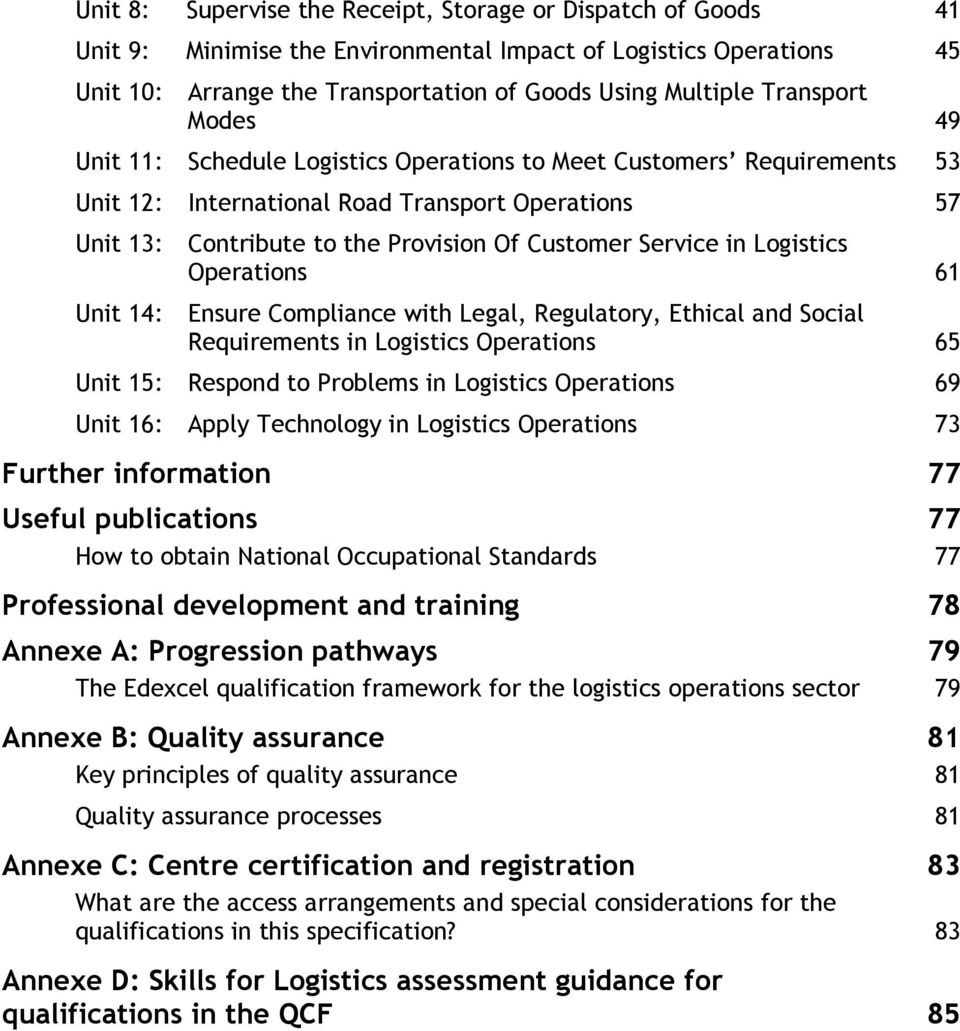
4 Unit 8: Supervise the Receipt, Storage or Dispatch of Goods 41 Unit 9: Minimise the Environmental Impact of Logistics Operations 45 Unit 10: Arrange the Transportation of Goods Using Multiple Transport Modes 49 Unit 11: Schedule Logistics Operations to Meet Customers Requirements 53 Unit 12: International Road Transport Operations 57 Unit 13: Contribute to the Provision Of Customer Service in Logistics Operations 61 Unit 14: Ensure Compliance with Legal, Regulatory, Ethical and Social Requirements in Logistics Operations 65 Unit 15: Respond to Problems in Logistics Operations 69 Unit 16: Apply Technology in Logistics Operations 73 Further information 77 Useful publications 77 How to obtain National Occupational Standards 77 Professional development and training 78 Annexe A: Progression pathways 79 The Edexcel qualification framework for the logistics operations sector 79 Annexe B: Quality assurance 81 Key principles of quality assurance 81 Quality assurance processes 81 Annexe C: Centre certification and registration 83 What are the access arrangements and special considerations for the qualifications in this specification? 83 Annexe D: Skills for Logistics assessment guidance for qualifications in the QCF 85
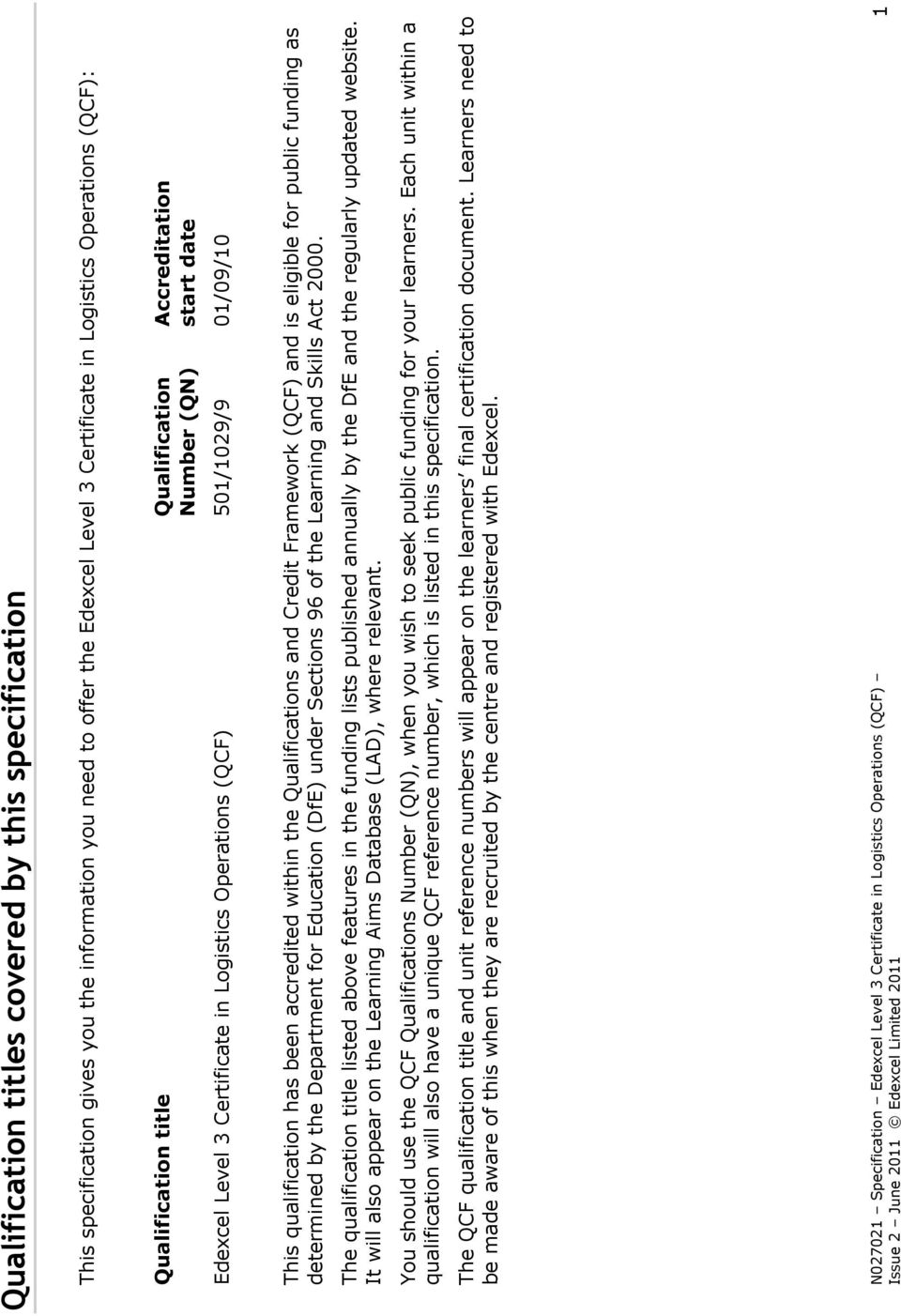
5 Qualification titles covered by this specification This specification gives you the information you need to offer the Edexcel Level 3 Certificate in Logistics Operations (QCF): Qualification title Qualification Number (QN) Accreditation start date Edexcel Level 3 Certificate in Logistics Operations (QCF) 501/1029/9 01/09/10 This qualification has been accredited within the Qualifications and Credit Framework (QCF) and is eligible for public funding as determined by the Department for Education (DfE) under Sections 96 of the Learning and Skills Act The qualification title listed above features in the funding lists published annually by the DfE and the regularly updated website. It will also appear on the Learning Aims Database (LAD), where relevant. You should use the QCF Qualifications Number (QN), when you wish to seek public funding for your learners. Each unit within a qualification will also have a unique QCF reference number, which is listed in this specification. The QCF qualification title and unit reference numbers will appear on the learners final certification document. Learners need to be made aware of this when they are recruited by the centre and registered with Edexcel. 1
6 The NQF qualification listed below is valid until the date shown. It will continue to be available in the Logistic Operations Advanced Apprenticeship Framework until the end date shown. Qualification title Qualification Number (QN) Accreditation start date Accreditation end date Edexcel Level 3 NVQ in Logistics Operations Management 500/4012/1 01/05/08 31/12/10 2

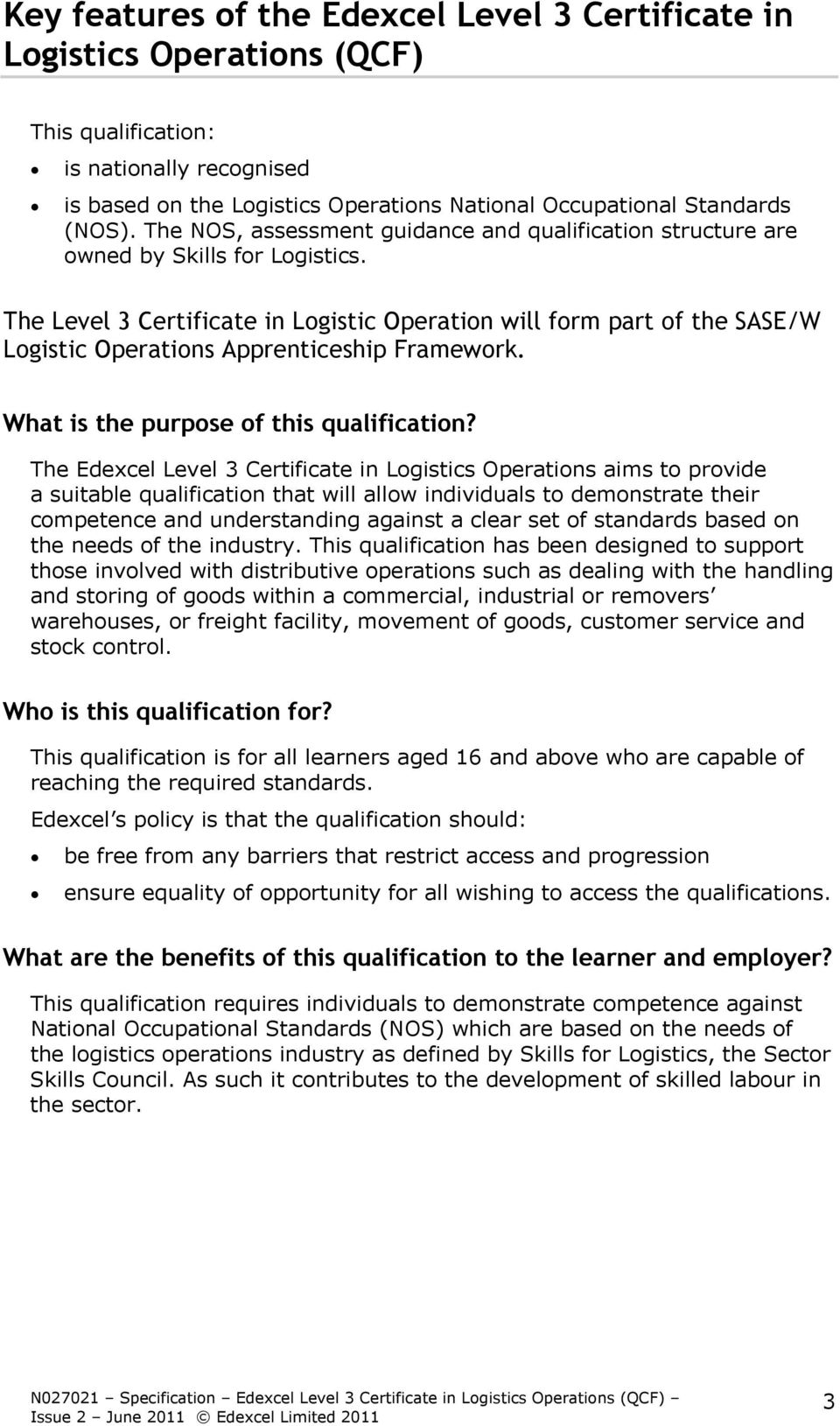
7 Key features of the Edexcel Level 3 Certificate in Logistics Operations (QCF) This qualification: is nationally recognised is based on the Logistics Operations National Occupational Standards (NOS). The NOS, assessment guidance and qualification structure are owned by Skills for Logistics. The Level 3 Certificate in Logistic Operation will form part of the SASE/W Logistic Operations Apprenticeship Framework. What is the purpose of this qualification? The Edexcel Level 3 Certificate in Logistics Operations aims to provide a suitable qualification that will allow individuals to demonstrate their competence and understanding against a clear set of standards based on the needs of the industry. This qualification has been designed to support those involved with distributive operations such as dealing with the handling and storing of goods within a commercial, industrial or removers warehouses, or freight facility, movement of goods, customer service and stock control. Who is this qualification for? This qualification is for all learners aged 16 and above who are capable of reaching the required standards. Edexcel s policy is that the qualification should: be free from any barriers that restrict access and progression ensure equality of opportunity for all wishing to access the qualifications. What are the benefits of this qualification to the learner and employer? This qualification requires individuals to demonstrate competence against National Occupational Standards (NOS) which are based on the needs of the logistics operations industry as defined by Skills for Logistics, the Sector Skills Council. As such it contributes to the development of skilled labour in the sector. 3
8 What are the potential job roles for those working towards this qualification? Road transport manager Roadie Stock control/replenishment assistant Transport planner Transport scheduler Van driver Vehicle parts operative What progression opportunities are available to learners who achieve this qualification? This qualification supports and offers opportunities for progression to Level 4 qualifications. It will also offer candidates, in a suitable job role, the ability to develop their career path and may have already completed the Edexcel Level 2 Certificate in Warehousing and Storage (QCF). Further information is available in Annexe A. 4

9 What is the qualification structure for the Edexcel Level 3 Certificate in Logistics Operations (QCF)? Individual units can be found in the Units section. The QCF level and credit value are given on the first page of each unit. Candidates need to achieve a minimum of 9 credits from Mandatory group A, a minimum of 3 credits from Optional group B, a minimum of 3 credits from Optional group C, a minimum of 3 credits from Optional group D and a minimum of 3 credits from Optional group E. Mandatory group A Credit value required: minimum 9, maximum 9. Unit 1: Y/601/9456 Make an Effective Contribution to a Business in the Logistics Sector Unit 2: K/502/1072 Health, Safety and Security at Work Unit 3: M/601/7597 Optimise the Use of Logistics Resources Optional group B Credit Value required: minimum 3, maximum 4. Unit 4: H/601/7600 Improve Performance in Logistics Operations Unit 5: T/601/7603 Provide Leadership for your Team in Logistics Operations Unit 6: R/601/7611 Allocate and Check Work in your Team in Logistics Operations Optional group C Credit value required: minimum 3, maximum 6. Unit 7: J/601/7928 Maintain the Safety and Security of Hazardous Goods and Materials in Logistics Operations Unit 8: Y/601/7934 Supervise the Receipt, Storage or Dispatch of Goods Unit 9: K/601/7601 Minimise the Environmental Impact of Logistics Operations Optional group D Credit value required: minimum 3, maximum 5. Unit 10: Y/600/7646 Arrange the Transportation of Goods Using Multiple Transport Modes Unit 11: K/601/7596 Schedule Logistics Operations to Meet Customers Requirements Unit 12: K/601/7176 International Road Transport Operations 5
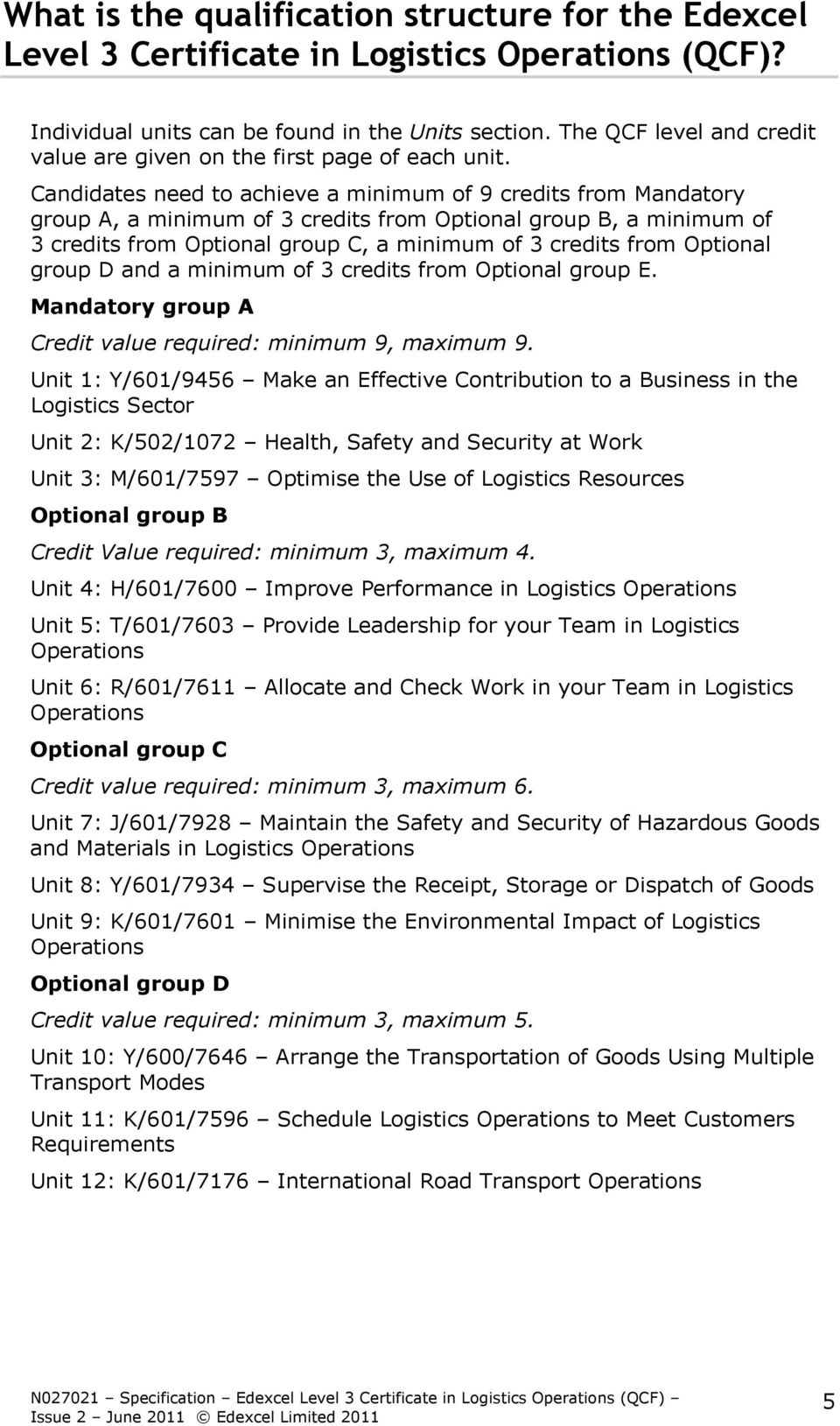
10 Optional group E Credit value required: minimum 3, maximum 4. Unit 13: Y/601/7920 Contribute to the Provision Of Customer Service in Logistics Operations Unit 14: M/601/7602 Ensure Compliance with Legal, Regulatory, Ethical and Social Requirements in Logistics Operations Unit 15: T/601/7598 Respond to Problems in Logistics Operations Unit 16: A/601/7599 Apply Technology in Logistics Operations 6

11 How is the qualification graded and assessed? The overall grade for this qualification is a pass. The learner must achieve all the required units within the specified qualification structure. To pass a unit the learner must: achieve all the specified learning outcomes satisfy all the assessment criteria by providing sufficient and valid evidence for each criterion show that the evidence is their own. The qualification is designed to be assessed: in the workplace or in conditions resembling the workplace, as specified in the Skills for Logistics assessment guidance for qualifications in the QCF, or as part of a training programme. Skills for Logistics assessment guidance The assessment guidance for qualifications in the QCF includes details on: criteria for defining realistic working environments roles and occupational competence of assessors, expert witnesses, internal verifiers and standards verifiers quality control of assessment Evidence of competence may come from: current practice where evidence is generated from a current job role a programme of development where evidence comes from assessment opportunities built into a learning/training programme whether at or away from the workplace the Recognition of Prior Learning (RPL) where a learner can demonstrate that they can meet the assessment criteria within a unit through knowledge, understanding or skills they already possess without undertaking a course of learning. They must submit sufficient, reliable and valid evidence for internal and standards verification purposes. RPL is acceptable for accrediting a unit, several units or a whole qualification a combination of these. 7
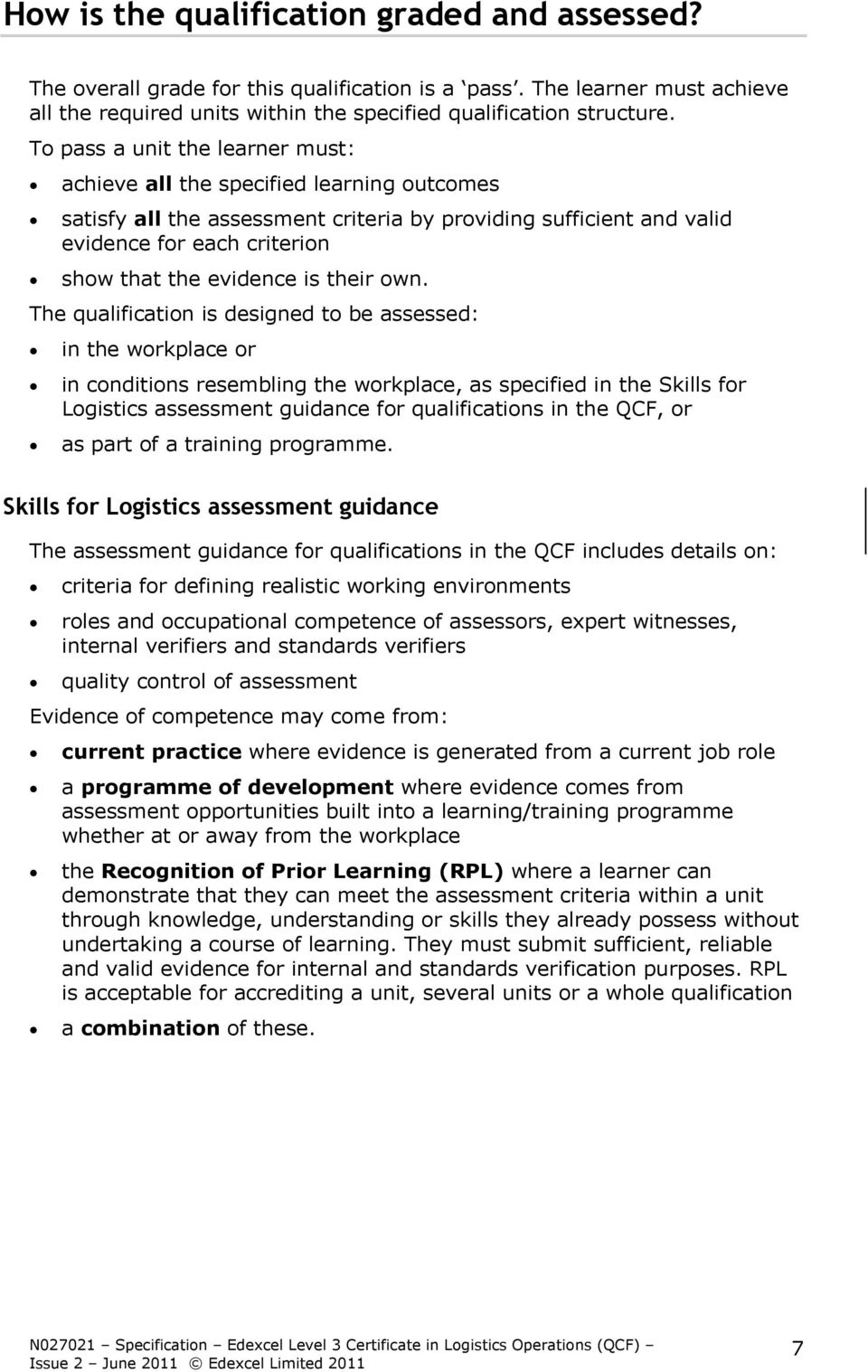
12 It is important that the evidence is: Valid Authentic Current Reliable Sufficient relevant to the standards for which competence is claimed produced by the learner sufficiently recent to create confidence that the same skill, understanding or knowledge persist at the time of the claim indicates that the learner can consistently perform at this level fully meets the requirements of the standards. Types of evidence To successfully achieve a unit the learner must gather evidence which shows that they have met the required standard in the assessment criteria. Evidence can take a variety of different forms including the following examples: direct observation of the learner s performance by their assessor outcomes from oral or written questioning products of the learner s work personal statements and/or reflective accounts outcomes from simulation, where permitted by the Skills for Logistics assessment guidance for qualifications in the QCF professional discussion assignment, project/case studies authentic statements/witness testimony expert witness testimony reflective accounts evidence of Recognition of Prior Learning. Learners can use one piece of evidence to prove their knowledge, skills and understanding across different assessment criteria and/or across different units. It is, therefore, not necessary for learners to have each assessment criterion assessed separately. Learners should be encouraged to reference the assessment criteria to which the evidence relates. Evidence must be made available to the assessor, internal verifier and Edexcel standards verifier. A range of recording documents is available on the Edexcel website Alternatively, centres may develop their own. 8
13 Centre recognition and approval Centre recognition Centres that have not previously offered Edexcel qualifications need to apply for and be granted centre recognition as part of the process for approval to offer individual qualifications. New centres must complete both a centre recognition approval application and a qualification approval application. Existing centres will be given automatic approval for a new qualification if they are already approved for a qualification that is being replaced by the new qualification and the conditions for automatic approval are met. Centres already holding Edexcel approval are able to gain qualification approval for a different level or different sector via Edexcel online. Approvals agreement All centres are required to enter into an approvals agreement which is a formal commitment by the head or principal of a centre to meet all the requirements of the specification and any linked codes or regulations. Edexcel will act to protect the integrity of the awarding of qualifications, if centres do not comply with the agreement. This could result in the suspension of certification or withdrawal of approval. Quality assurance Detailed information on Edexcel s quality assurance processes is given in Annexe B. What resources are required to deliver this qualification? This qualification is designed to support learners working in the Logistics Operations sector. Physical resources need to support the delivery of the qualifications and the assessment of the learning outcomes and must be of industry standard. Centres must meet any specific resource requirements outlined in Annexe D: Assessment guidance. Staff assessing the learner must meet the requirements within the overarching assessment guidance for the sector. 9

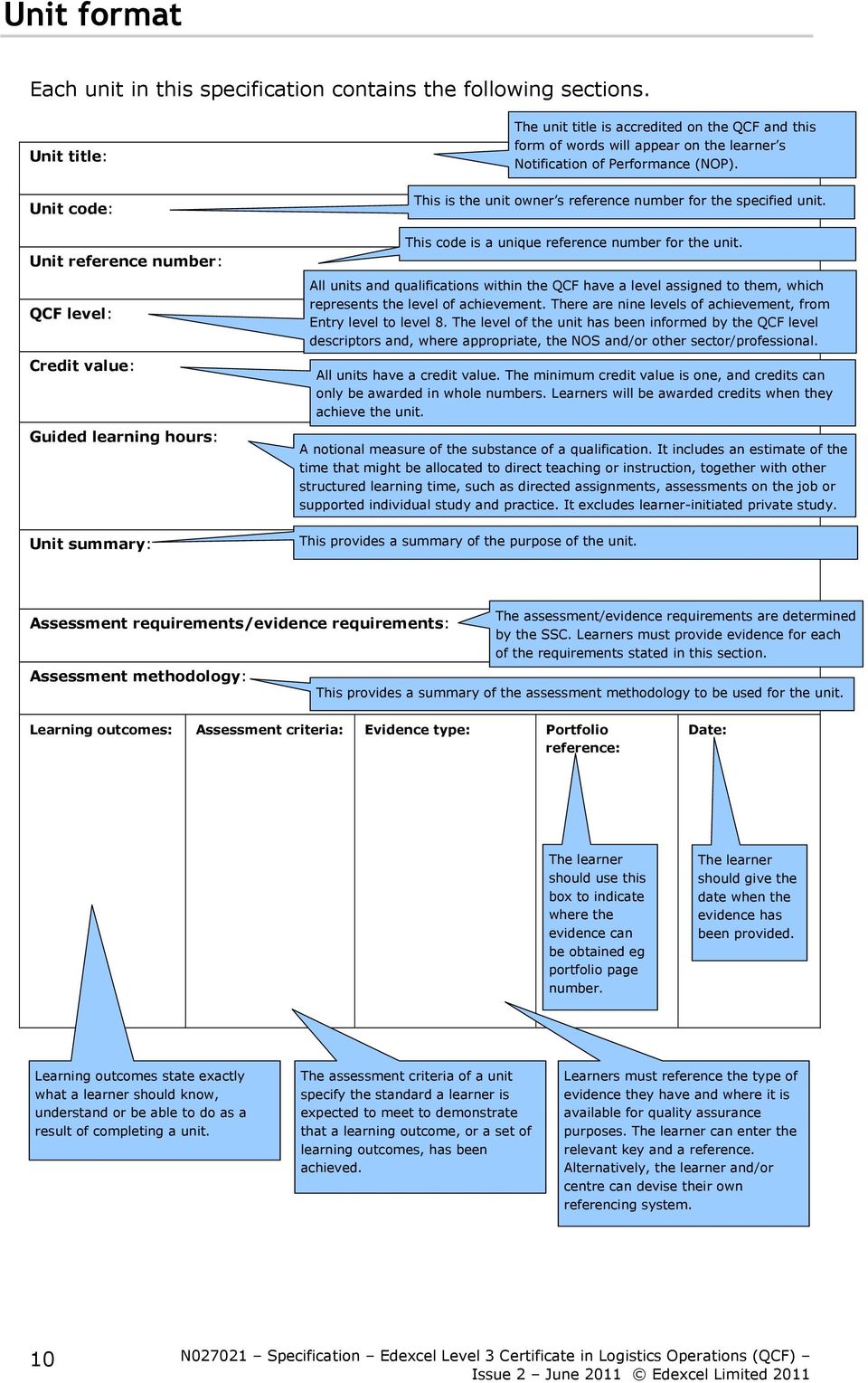
14 Unit format Each unit in this specification contains the following sections. Unit title: Unit code: Unit reference number: QCF level: Credit value: Guided learning hours: Unit summary: The unit title is accredited on the QCF and this form of words will appear on the learner s Notification of Performance (NOP). This is the unit owner s reference number for the specified unit. This code is a unique reference number for the unit. All units and qualifications within the QCF have a level assigned to them, which represents the level of achievement. There are nine levels of achievement, from Entry level to level 8. The level of the unit has been informed by the QCF level descriptors and, where appropriate, the NOS and/or other sector/professional. All units have a credit value. The minimum credit value is one, and credits can only be awarded in whole numbers. Learners will be awarded credits when they achieve the unit. A notional measure of the substance of a qualification. It includes an estimate of the time that might be allocated to direct teaching or instruction, together with other structured learning time, such as directed assignments, assessments on the job or supported individual study and practice. It excludes learner-initiated private study. This provides a summary of the purpose of the unit. Assessment requirements/evidence requirements: Assessment methodology: The assessment/evidence requirements are determined by the SSC. Learners must provide evidence for each of the requirements stated in this section. This provides a summary of the assessment methodology to be used for the unit. Learning outcomes: Assessment criteria: Evidence type: Portfolio reference: Date: The learner should use this box to indicate where the evidence can be obtained eg portfolio page number. The learner should give the date when the evidence has been provided. Learning outcomes state exactly what a learner should know, understand or be able to do as a result of completing a unit. The assessment criteria of a unit specify the standard a learner is expected to meet to demonstrate that a learning outcome, or a set of learning outcomes, has been achieved. Learners must reference the type of evidence they have and where it is available for quality assurance purposes. The learner can enter the relevant key and a reference. Alternatively, the learner and/or centre can devise their own referencing system. 10
15 Units 11
16 12

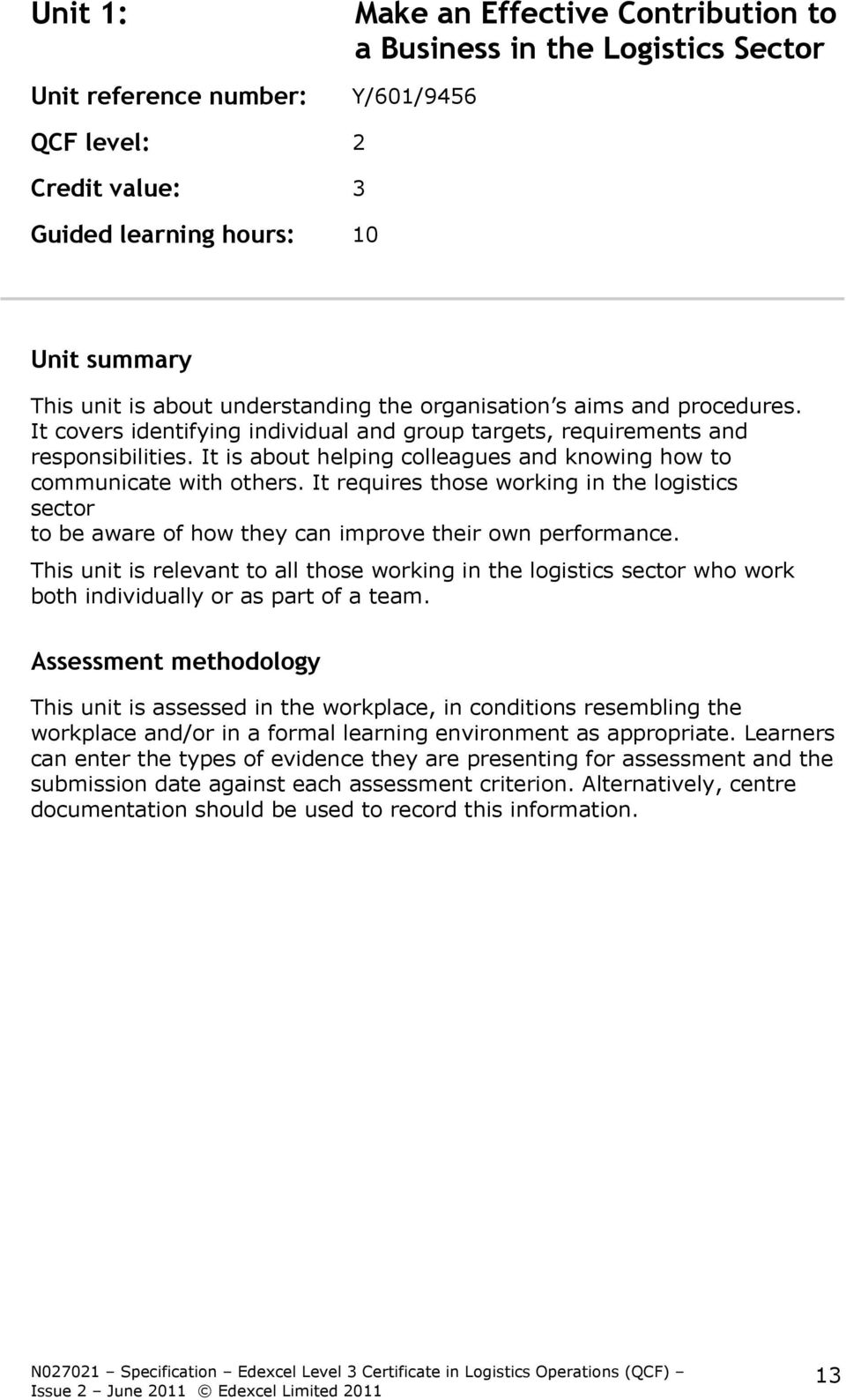
17 Unit 1: Unit reference number: Make an Effective Contribution to a Business in the Logistics Sector Y/601/9456 QCF level: 2 Credit value: 3 Guided learning hours: 10 Unit summary This unit is about understanding the organisation s aims and procedures. It covers identifying individual and group targets, requirements and responsibilities. It is about helping colleagues and knowing how to communicate with others. It requires those working in the logistics sector to be aware of how they can improve their own performance. This unit is relevant to all those working in the logistics sector who work both individually or as part of a team. Assessment methodology This unit is assessed in the workplace, in conditions resembling the workplace and/or in a formal learning environment as appropriate. Learners can enter the types of evidence they are presenting for assessment and the submission date against each assessment criterion. Alternatively, centre documentation should be used to record this information. 13
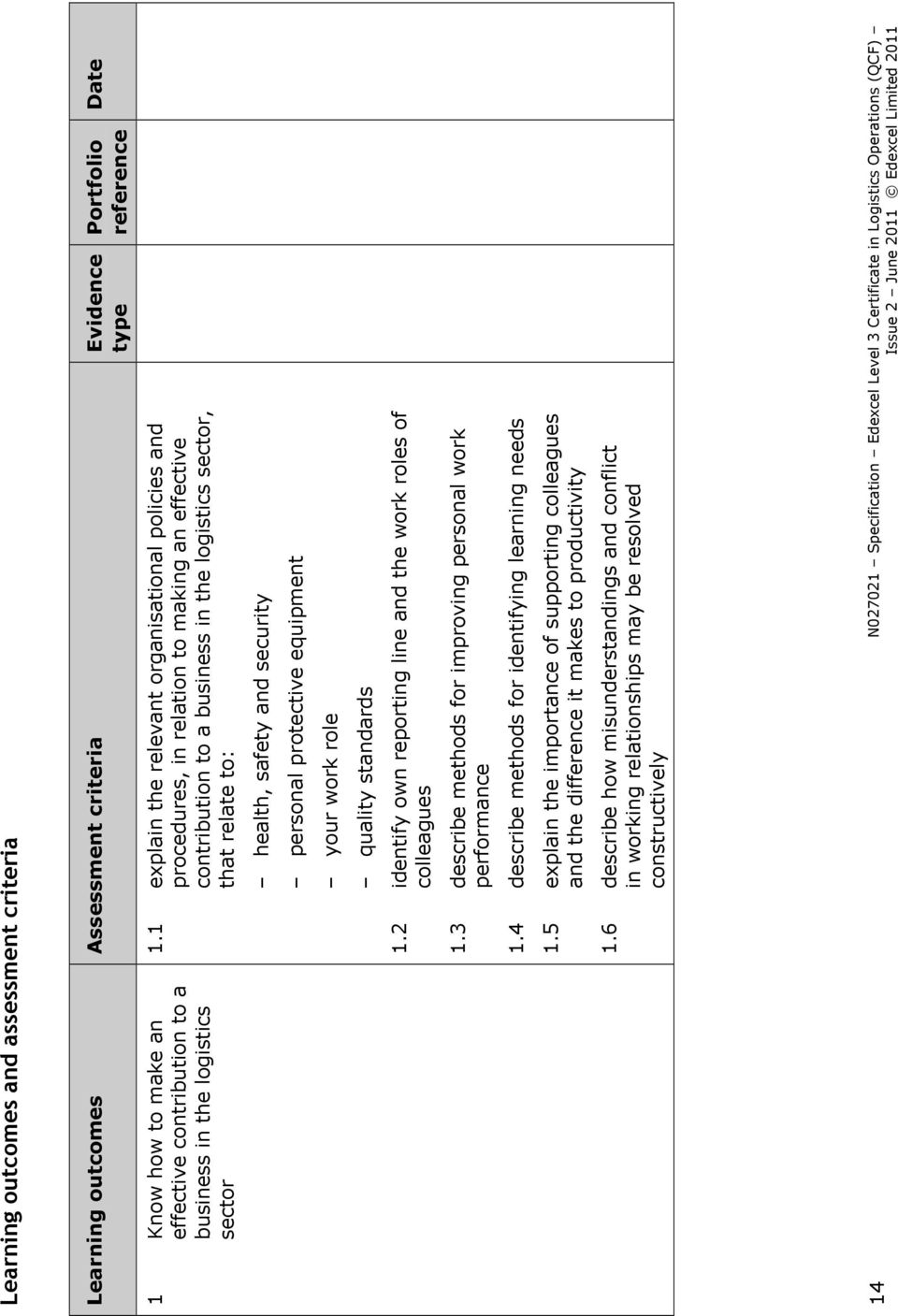
18 Learning outcomes and assessment criteria Learning outcomes Assessment criteria Evidence type Portfolio reference Date 1 Know how to make an effective contribution to a business in the logistics sector 1.1 explain the relevant organisational policies and procedures, in relation to making an effective contribution to a business in the logistics sector, that relate to: health, safety and security personal protective equipment your work role quality standards 1.2 identify own reporting line and the work roles of colleagues 1.3 describe methods for improving personal work performance 1.4 describe methods for identifying learning needs 1.5 explain the importance of supporting colleagues and the difference it makes to productivity 1.6 describe how misunderstandings and conflict in working relationships may be resolved constructively 14
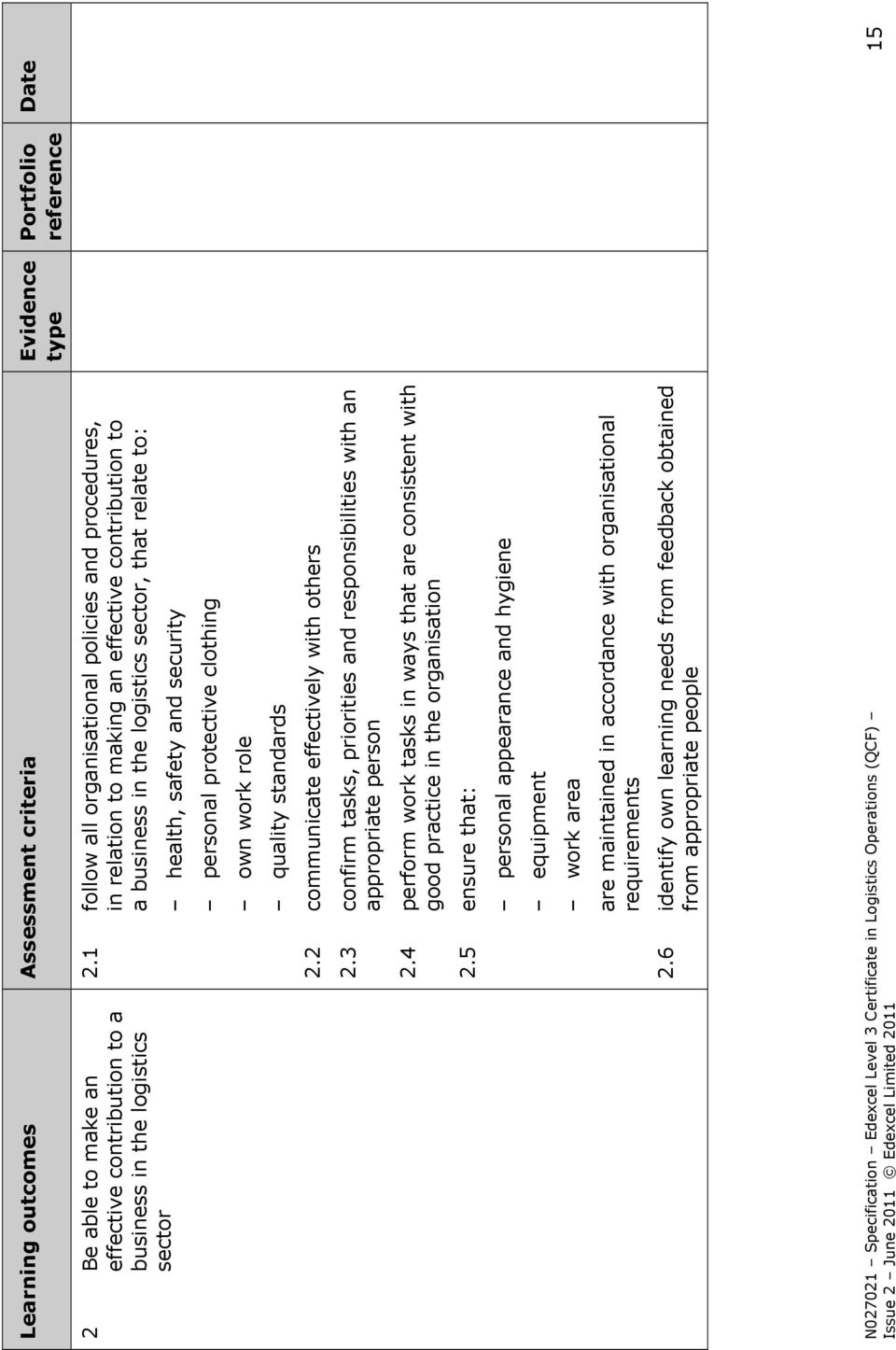
19 Learning outcomes Assessment criteria Evidence type 2 Be able to make an effective contribution to a business in the logistics sector 2.1 follow all organisational policies and procedures, in relation to making an effective contribution to a business in the logistics sector, that relate to: health, safety and security personal protective clothing own work role quality standards 2.2 communicate effectively with others 2.3 confirm tasks, priorities and responsibilities with an appropriate person 2.4 perform work tasks in ways that are consistent with good practice in the organisation 2.5 ensure that: personal appearance and hygiene equipment work area are maintained in accordance with organisational requirements 2.6 identify own learning needs from feedback obtained from appropriate people Portfolio reference Date 15
20 Learning outcomes Assessment criteria Evidence type Portfolio reference Date 2.7 agree a learning plan that is realistic, with an appropriate person 2.8 promptly action requests from others that fall within own responsibility Learner name: Date: Learner signature: Date: Assessor signature: Date: Internal verifier signature: (if sampled) Date: 16
21 Unit 2: Unit reference number: Health, Safety and Security at Work K/502/1072 QCF level: 2 Credit value: 3 Guided learning hours: 20 Unit summary This unit is for those who take responsibility for their own health, safety and security in the workplace, and monitor the workplace for hazards. The job role involves contributing to the safety and security in the workplace, taking action in the event of an incident, raising the alarm, following correct procedures for shut down and evacuation, using emergency equipment correctly and safely, and monitoring the workplace for hazards. Assessment methodology This unit is assessed in the workplace, in conditions resembling the workplace and/or in a formal learning environment as appropriate. Learners can enter the types of evidence they are presenting for assessment and the submission date against each assessment criterion. Alternatively, centre documentation should be used to record this information. 17
22 Learning outcomes and assessment criteria Learning outcomes Assessment criteria Evidence type Portfolio reference Date 1 Be able to work safely 1.1 take appropriate action in the event of fire, emergencies or accidents 1.2 identify where alarms, emergency exits, escape routes, emergency equipment and assembly points are located 1.3 demonstrate safe and appropriate use of emergency equipment 1.4 distinguish between different alarm sounds 1.5 comply with equipment operating procedures and manufacturers instructions 1.6 demonstrate safe handling and lifting techniques 1.7 demonstrate correct use and maintenance of any protective clothing and/or equipment 1.8 comply with personal responsibilities under the health and safety at work act/coshh 1.9 identify who the nominated first aiders are 18
23 Learning outcomes Assessment criteria Evidence type 2 Be able to monitor the workplace for hazards 2.1 identify hazardous substances that are used in the workplace and demonstrate methods of making them safe or reducing their danger in the event of an accident 2.2 identify hazards posed by machinery that is used in the workplace and demonstrate methods of making safe or reducing their danger in the event of an accident 2.3 demonstrate how to handle and store hazardous substances including debris 2.4 demonstrate how to store materials and equipment 2.5 explain what the most likely accidents and emergencies in the workplace are and how to deal with them 2.6 comply with personal responsibilities under the COSHH (Control of Substances Hazardous to Health) 3 Be able to contribute to workplace security 3.1 outline and comply with the organisation s rules, codes, guidelines and standards relating to security 3.2 explain how to deal with loss of property Portfolio reference Date 19
24 Learner name: Date: Learner signature: Date: Assessor signature: Date: Internal verifier signature: (if sampled) Date: 20
25 Unit 3: Unit reference number: Optimise the Use of Logistics Resources M/601/7597 QCF level: 3 Credit value: 3 Guided learning hours: 15 Unit summary This unit is about identifying the appropriate resource and planning how to use it and monitoring its use to improve performance. This unit is relevant for operatives working in logistics operations. Operatives could, for example, be working in warehousing and storage, transport or freight forwarding. Assessment methodology This unit is assessed in the workplace, in conditions resembling the workplace and/or in a formal learning environment as appropriate. Learners can enter the types of evidence they are presenting for assessment and the submission date against each assessment criterion. Alternatively, centre documentation should be used to record this information. 21
26 Learning outcomes and assessment criteria Learning outcomes Assessment criteria Evidence type Portfolio reference Date 1 Know how to optimise the use of logistics resources 1.1 explain the relevant organisational policies and procedures, in relation to optimising the use of logistics resources, that relate to: health, safety and security compliance roles, responsibilities, information and management systems legislation and regulations 1.2 describe the different sources and types of information required for optimising the use of logistics resources 1.3 explain the importance of good communication methods 1.4 explain the types of resource used in specific logistics operations 1.5 explain the methods used for optimising the use of logistics resources 1.6 explain the factors that need to be taken into account when optimising the use of logistics resources 1.7 explain methods for improving or developing used logistics resources 22
27 Learning outcomes Assessment criteria Evidence type 1.8 identify problems that can occur when optimising the use of logistics resources 1.9 explain appropriate action when dealing with identified problems 2 Be able to optimise the use of logistics resources 2.1 follow all organisational policies and procedures, in relation to optimising the use of logistics resources, that relate to: health, safety and security compliance roles, responsibilities, information and management systems legislation and regulations 2.2 identify the availability and demand for logistics resources in the organisation 2.3 determine the level and type of resources used for the logistics operation 2.4 use logistics resources effectively and efficiently 2.5 plan the use of logistics resources to achieve a balance between usage and performance 2.6 monitor the use of logistics resources to identity any positive or negative effects on the environment Portfolio reference Date 23
28 Learner name: Date: Learner signature: Date: Assessor signature: Date: Internal verifier signature: (if sampled) Date: 24
29 Unit 4: Unit reference number: Improve Performance in Logistics Operations H/601/7600 QCF level: 3 Credit value: 4 Guided learning hours: 20 Unit summary This unit is about identifying areas of the operation which can be improved. It deals with consulting colleagues to identify problems and the impact of improvements, and how to evaluate the effect improvements have on the operation. This unit is relevant for operatives working in logistics operations. Operatives could, for example, be working in warehousing and storage, transport or freight forwarding. Assessment methodology This unit is assessed in the workplace, in conditions resembling the workplace and/or in a formal learning environment as appropriate. Learners can enter the types of evidence they are presenting for assessment and the submission date against each assessment criterion. Alternatively, centre documentation should be used to record this information. 25
30 Learning outcomes and assessment criteria Learning outcomes Assessment criteria Evidence type Portfolio reference Date 1 Know how to improve performance in logistics operations 1.1 explain the relevant organisational policies and procedures, in relation to improving performance in logistics operations, that relate to: health, safety and security compliance roles, responsibilities, information and management systems 1.2 describe the different sources and types of information required for improving performance in logistics operations 1.3 explain improvements methods that are used in the organisation and industry 1.4 explain methods used for evaluating improvement methods 1.5 identify problems that can occur when improving performance in logistics operations 1.6 explain appropriate action when dealing with identified problems 26
31 Learning outcomes Assessment criteria Evidence type 2 Be able to improve performance in logistics operations 2.1 follow all organisational policies and procedures, in relation to improving performance in logistics operations, that relate to: health, safety and security compliance roles, responsibilities, information and management systems 2.2 assess an area for improvement 2.3 assess improvement methods appropriate for the logistics operation 2.4 recommend suitable methods for improving performance 2.5 develop success criteria to be used to evaluate application of the improvement methods 2.6 implement the improvement methods 2.7 monitor the application of the improvement methods 2.8 evaluate the application of the improvement methods 2.9 record work according to organisational procedures Portfolio reference Date 27
32 Learner name: Date: Learner signature: Date: Assessor signature: Date: Internal verifier signature: (if sampled) Date: 28
33 Unit 5: Unit reference number: Provide Leadership for your Team in Logistics Operations T/601/7603 QCF level: 3 Credit value: 4 Guided learning hours: 20 Unit summary This unit is about providing leadership for your team. It deals with planning teams objectives, motivating team members, communication and steering the team through difficulties. This unit is relevant for team leaders, supervisors and managers working in logistics operations. Team leaders, supervisors and managers could, for example, be working in warehousing and storage, transport or freight forwarding. Assessment methodology This unit is assessed in the workplace, in conditions resembling the workplace and/or in a formal learning environment as appropriate. Learners can enter the types of evidence they are presenting for assessment and the submission date against each assessment criterion. Alternatively, centre documentation should be used to record this information. 29
34 Learning outcomes and assessment criteria Learning outcomes Assessment criteria Evidence type Portfolio reference Date 1 Know how to provide leadership for own team in logistics operations 1.1 explain the relevant organisational policies and procedures, in relation to providing leadership for own team, that relate to: roles, responsibilities, information and management systems setting objectives equality and diversity, and inclusion monitoring work activities 1.2 explain different leadership styles 1.3 explain the principles of effective communication 1.4 explain methods for motivating, supporting and encouraging team members to achieve team objectives 1.5 explain the importance of creating an environment of trust and mutual respect 1.6 explain the importance of understanding difficult situations, conflicts and disagreements and techniques for resolving these 1.7 explain the benefits of encouraging creativity and innovation within a team 30
35 Learning outcomes Assessment criteria Evidence type 2 Be able to provide leadership in own team in logistics operations 2.1 follow all organisational policies and procedures, in relation to providing leadership in own team in logistics operations, that relate to: roles, responsibilities, information and management systems setting objectives equality and diversity, and inclusion monitoring work activities 2.2 communicate effectively 2.3 communicate the purpose and objectives of the team to all members 2.4 plan the achievement of the objectives with team members 2.5 set individual work objectives to each member of the team 2.6 encourage team members to achieve team objectives 2.7 provide support to team members 2.8 motivate team members 2.9 encourage creativity and innovation to achieve team objectives Portfolio reference Date 31
36 Learning outcomes Assessment criteria Evidence type Portfolio reference Date 2.10 encourage team members to take the lead when they have the knowledge and expertise to do so 2.11 ensure that any conflict is dealt with promptly 2.12 monitor the activities and progress of the team 2.13 record work according to organisational procedures Learner name: Date: Learner signature: Date: Assessor signature: Date: Internal verifier signature: (if sampled) Date: 32
37 Unit 6: Unit reference number: Allocate and Check Work in your Team in Logistics Operations R/601/7611 QCF level: 3 Credit value: 3 Guided learning hours: 12 Unit summary This unit is about allocating and checking work in own team in logistics operations. It deals with planning, confirming work activities, allocating work activities fairly amongst team members, motivating and supporting team members to achieve work activities and monitoring the achievement of work activities. This unit is relevant for team leaders, supervisors and managers working in logistics operations. Team leaders, supervisors and managers could, for example, be working in warehousing and storage, transport or freight forwarding. Assessment methodology This unit is assessed in the workplace, in conditions resembling the workplace and/or in a formal learning environment as appropriate. Learners can enter the types of evidence they are presenting for assessment and the submission date against each assessment criterion. Alternatively, centre documentation should be used to record this information. 33
38 Learning outcomes and assessment criteria Learning outcomes Assessment criteria Evidence type Portfolio reference Date 1 Know how to allocate and check work in own team in logistics operations 1.1 explain the relevant organisational policies and procedures, in relation to allocating and checking work in own team in logistics operations, that relate to: health, safety and security roles, responsibilities, information and management systems use of sustainable resources equality and diversity, and inclusion monitoring work activities 1.2 explain the principles of effective communication 1.3 explain methods for motivating, supporting and encouraging team members to complete allocated work 1.4 explain methods for improving the performance of the team and recognising achievement 34
39 Learning outcomes Assessment criteria Evidence type 2 Be able to allocate and check work in own team in logistics operations 2.1 follow all organisational policies and procedures, in relation to allocating and checking work in own team in logistics operations, that relate to: health, safety and security roles, responsibilities, information and management systems use of sustainable resources equality and diversity, and inclusion monitoring work activities 2.2 confirm the work required of the team with own line manager 2.3 plan the work of the team, identifying priorities and critical activities and available resources 2.4 allocate the work to team members fairly 2.5 brief team members on the standard of work required 2.6 encourage team members to make suggestions and seek clarification in relation to work allocated 2.7 motivate team members 2.8 check the progress and quality of work activities 2.9 provide feedback to team members on work performance 2.10 ensure that any conflict is dealt with promptly 2.11 record work according to organisational procedures Portfolio reference Date 35
40 Learner name: Date: Learner signature: Date: Assessor signature: Date: Internal verifier signature: (if sampled) Date: 36
41 Unit 7: Unit reference number: Maintain the Safety and Security of Hazardous Goods and Materials in Logistics Operations J/601/7928 QCF level: 3 Credit value: 6 Guided learning hours: 30 Unit summary This unit is about keeping hazardous goods safe and secure by regular monitoring of risks and taking prompt action when required. This unit is aimed at operatives in logistics operations. Operatives could, for example, be working in warehousing and storage, transport or freight forwarding. Assessment methodology This unit is assessed in the workplace, in conditions resembling the workplace and/or in a formal learning environment as appropriate. Learners can enter the types of evidence they are presenting for assessment and the submission date against each assessment criterion. Alternatively, centre documentation should be used to record this information. 37
42 Learning outcomes and assessment criteria Learning outcomes Assessment criteria Evidence type Portfolio reference Date 1 Know how to maintain the safety and security of hazardous goods and materials in logistics operations 1.1 explain the relevant organisational policies and procedures for maintaining the safety and security of hazardous goods and materials in logistics operations, that relate to: health, safety and security personal protective equipment environmental factors special requirements storage conditions monitoring systems 1.2 explain the appropriate action to take in an emergency 1.3 explain the meaning of different hazardous markings and areas 1.4 describe storage and distribution requirements for the hazardous goods and materials including any precautions that must be taken 1.5 explain the use of equipment that can be used when maintaining the safety and security of hazardous goods and materials 38
43 Learning outcomes Assessment criteria Evidence type Portfolio reference 1.6 identify problems that can occur when maintaining the safety and security of hazardous goods and materials 1.7 explain appropriate action when dealing with identified problems 2 Be able to maintain the safety and security of hazardous goods and materials in logistics operations 2.1 obtain all relevant information on the hazardous goods and materials 2.2 demonstrate that the correct precautions have been undertaken in accordance with health and safety and organisational polices and procedures 2.3 monitor the condition of the hazardous goods and materials in accordance with manufacturers instructions and organisational polices and procedures 2.4 manoeuvre the hazardous goods and materials safely with the appropriate equipment according to agreed procedures Learner name: Date: Learner signature: Date: Assessor signature: Date: Internal verifier signature: (if sampled) Date: Date 39
44 40
45 Unit 8: Unit reference number: Supervise the Receipt, Storage or Dispatch of Goods Y/601/7934 QCF level: 3 Credit value: 6 Guided learning hours: 20 Unit summary This unit is about supervising the areas and processes for receipt, storage and dispatch of goods. It deals with ensuring the correct equipment is used, that areas are safe and appropriate for the receipt of goods, and that information in relation to monitoring the receipt, storage or dispatch of goods is communicated. This unit is aimed at operatives in logistics operations. Operatives could, for example, be working in warehousing and storage, transport or freight forwarding. Assessment methodology This unit is assessed in the workplace, in conditions resembling the workplace and/or in a formal learning environment as appropriate. Learners can enter the types of evidence they are presenting for assessment and the submission date against each assessment criterion. Alternatively, centre documentation should be used to record this information. 41
46 Learning outcomes and assessment criteria Learning outcomes Assessment criteria Evidence type Portfolio reference Date 1 Know how to supervise the receipt, storage or dispatch of goods in logistics operations 1.1 explain the relevant organisational policies and procedures for supervising the receipt, storage or dispatch of goods in logistics operations, that relate to: health, safety and security environmental factors special requirements stock rotation monitoring and testing 1.2 explain sources of information required to determine the capacity and limitations of the storage facility 1.3 describe the equipment that can be used for the receipt, storage or dispatch of the goods 1.4 identify problems that can occur when monitoring the receipt, storage or dispatch of goods 1.5 explain appropriate action when dealing with identified problems 42
47 Learning outcomes Assessment criteria Evidence type Portfolio reference 2 Be able to supervise the receipt, storage or dispatch of goods in logistics operations 2.1 inspect the type, condition, quantity of the goods being received, stored or dispatched 2.2 check the storage conditions and equipment required to receive, store or dispatch the goods 2.3 organise the movement or rotation of goods to assist receiving, storing or dispatching goods 2.4 demonstrate how to use the organisations resources effectively 2.5 communicate effectively with others 2.6 complete records for supervising the receipt, storage or dispatch of goods accurately Learner name: Date: Learner signature: Date: Assessor signature: Date: Internal verifier signature: (if sampled) Date: Date 43
48 44
49 Unit 9: Unit reference number: Minimise the Environmental Impact of Logistics Operations K/601/7601 QCF level: 3 Credit value: 3 Guided learning hours: 15 Unit summary This unit is about monitoring the environmental impact of the operation and identifying ways of reducing that impact. It deals with how energy and materials are used and identifying ways of using them more effectively. This unit is relevant for operatives working in logistics operations. Operatives could, for example, be working in warehousing and storage, transport or freight forwarding. Assessment methodology This unit is assessed in the workplace, in conditions resembling the workplace and/or in a formal learning environment as appropriate. Learners can enter the types of evidence they are presenting for assessment and the submission date against each assessment criterion. Alternatively, centre documentation should be used to record this information. 45
50 Learning outcomes and assessment criteria Learning outcomes Assessment criteria Evidence type Portfolio reference Date 1 Know how to minimise the environmental impact of logistics operations 1.1 explain the relevant organisational policies and procedures, in relation to minimising the environmental impact of logistics operations, that relate to: health, safety and security compliance roles, responsibilities, information and management systems environmental protection systems to assess environmental impact recycling and disposal of materials 1.2 describe the different sources and types of information required for improving performance in logistics operations 1.3 explain environmental issues affecting the logistics sector 1.4 identify ways to reduce the effects on the environment 1.5 identify ways to use energy and materials more effectively and efficiently 46
51 Learning outcomes Assessment criteria Evidence type 2 Be able to minimise the environmental impact of logistics operations 2.1 follow all organisational policies and procedures, in relation to minimising the environmental impact of logistics operations, that relate to: health, safety and security compliance roles, responsibilities, information and management systems environmental protection systems to assess environmental impact recycling and disposal of materials 2.2 implement the organisation s environmental policy 2.3 monitor the use of energy and materials to deliver logistics operations 2.4 assess the environmental risks of specific logistics operations before implementation 2.5 report on the effects of logistics operations on the environment 2.6 ensure that surplus materials are disposed of or recycled correctly 2.7 brief visitors and sub-contractors of environmental responsibilities according to organisational polices 2.8 recommend ways to minimise the environmental impact of logistics operations 2.9 record work according to organisational procedures Portfolio reference Date 47
52 Learner name: Date: Learner signature: Date: Assessor signature: Date: Internal verifier signature: (if sampled) Date: 48
53 Unit 10: Unit reference number: Arrange the Transportation of Goods Using Multiple Transport Modes Y/600/7646 QCF level: 3 Credit value: 3 Guided learning hours: 26 Unit summary This unit is aimed at people working with the administration of International Trade and Logistics Operations. It covers: Arranging transportation of goods using multiple modes of transport. Assessment methodology This unit is assessed in the workplace, in conditions resembling the workplace and/or in a formal learning environment as appropriate. Learners can enter the types of evidence they are presenting for assessment and the submission date against each assessment criterion. Alternatively, centre documentation should be used to record this information. 49
54 Learning outcomes and assessment criteria Learning outcomes Assessment criteria Evidence type Portfolio reference Date 1 Be able to identify the criteria for arranging transportation of goods using multiple modes of transport 1.1 identify all relevant details on the goods to be transported to include: health, safety and security environmental factors special requirements 1.2 identify criteria for selecting service providers to include: systems for selecting service providers systems for placing orders advantages and disadvantages of different modes of transport major routes, hubs and destinations rates and terms of conditions legislation and regulations in relation to the goods 1.3 identify organisational procedures to complete required selection 50
55 Learning outcomes Assessment criteria Evidence type 2 Be able to arrange the transporting of goods using multiple modes of transport 2.1 confirm with appropriate people the criteria required 2.2 confirm with appropriate people relevant details of the goods 2.3 explain the advantages and disadvantages of each mode of transport 2.4 assess each mode of transport for the goods 2.5 determine the most appropriate combination of modes of transport 2.6 place and confirm the order according to organisational procedures 2.7 complete all documentation accurately in accordance with organisational procedures and legislation 2.8 ensure that all documentation is filed and stored according to organisational procedures and legislation 2.9 pass on documentation to appropriate people at the right time according to organisational procedures and legislation 3 Identify any problems that can occur when arranging the transportation of goods using multiple modes of transport 3.1 identify problems that can occur arranging the transportation of goods using multiple modes of transport 3.2 show how to take appropriate action to deal with the problems Portfolio reference Date 51
56 Learner name: Date: Learner signature: Date: Assessor signature: Date: Internal verifier signature: (if sampled) Date: 52
57 Unit 11: Unit reference number: Schedule Logistics Operations to Meet Customers Requirements K/601/7596 QCF level: 3 Credit value: 4 Guided learning hours: 18 Unit summary This unit is about identifying the type of operation required and producing schedules to meet the customer s needs. It covers the requirements for good planning, scheduling methods and with dealing with problems with the schedule. This unit is relevant to all operatives at every level in logistics operations. Operatives could, for example, be working in warehousing and storage, transport or freight forwarding. Assessment methodology This unit is assessed in the workplace, in conditions resembling the workplace and/or in a formal learning environment as appropriate. Learners can enter the types of evidence they are presenting for assessment and the submission date against each assessment criterion. Alternatively, centre documentation should be used to record this information. 53
58 Learning outcomes and assessment criteria Learning outcomes Assessment criteria Evidence type Portfolio reference Date 1 Know how to schedule logistics operations to meet customer requirements 1.1 explain the relevant organisational policies and procedures, in relation to scheduling logistics operations to meet customer requirements, that relate to: health, safety and security compliance roles, responsibilities, information and management systems 1.2 describe the different sources and types of information required for scheduling logistics operations to meet customer requirements 1.3 explain the importance of good communication methods 1.4 explain the methods and tools used for scheduling logistics operations to meet customer requirements 1.5 explain the factors that need to be taken into account when scheduling logistics operations to meet customer requirements 1.6 describe the activities that need to be taken into account when scheduling logistics operations to meet customer requirements 54
59 Learning outcomes Assessment criteria Evidence type 1.7 identify problems that can occur when scheduling logistics operations to meet customer requirements 1.8 explain appropriate action when dealing with identified problems 2 Be able to schedule logistics operations to meet customer requirements 2.1 follow all organisational policies and procedures, in relation to scheduling logistics operations to meet customer requirements, that relate to: health, safety and security compliance roles, responsibilities, information and management systems 2.2 comply with logistics operations that are required to meet customers requirements 2.3 agree with customers the timings and deadlines for the provision for the logistics operations 2.4 apply scheduling methods and tools according to organisational procedures 2.5 apply logistics resources and sequence of tasks required to provide the logistics operations 2.6 review all relevant factors and risks that could affect the schedule 2.7 plan the logistics operations to ensure that the supply chain continues to function effectively Portfolio reference Date 55
60 Learning outcomes Assessment criteria Evidence type Portfolio reference Date 2.8 monitor the provision of logistics operations against the schedule 2.9 record work according to operational procedures Learner name: Date: Learner signature: Date: Assessor signature: Date: Internal verifier signature: (if sampled) Date: 56
61 Unit 12: Unit reference number: International Road Transport Operations K/601/7176 QCF level: 4 Credit value: 5 Guided learning hours: 25 Unit summary This unit is about international road transport operations. It deals with obtaining information in regard to vehicle, load, and driver requirements in order to produce documentation for the movement of loads outside of the United Kingdom. This unit is relevant to all operatives at every level in logistics operations. Operatives could, for example, be working in warehousing and storage, transport or freight forwarding. Assessment methodology This unit is assessed in the workplace, in conditions resembling the workplace and/or in a formal learning environment as appropriate. Learners can enter the types of evidence they are presenting for assessment and the submission date against each assessment criterion. Alternatively, centre documentation should be used to record this information. 57
62 Learning outcomes and assessment criteria Learning outcomes Assessment criteria Evidence type Portfolio reference Date 1 Know how to undertake international road transport operations 1.1 explain the relevant organisational policies and procedures, in relation to international road transport operations, that relate to: health, safety and security legal requirements operating requirements environmental factors international movements documentation systems driver hours and licensing requirements vehicle operators licensing requirements 1.2 explain different modes of transport that can be used 1.3 explain the types of load and characteristics of the consignment to be moved 1.4 explain the types of vehicles and specialist equipment that can be used to move the loads 1.5 explain the skills and qualifications required of driver personnel 1.6 explain how drivers, vehicles, equipment and other resources are allocated 58
63 Learning outcomes Assessment criteria Evidence type 1.7 explain required documentation for the international movement of goods 1.8 identify problems that can occur when undertaking international road transportation operations 1.9 explain the appropriate action to take, in order to deal with identified problems 2 Be able to undertake international road transport operations 2.1 follow organisational policies and procedures, in relation to protecting the vehicle and load, that relate to: ` health, safety and security legal requirements operating requirements environmental factors international movements documentation systems driver hours and licensing requirements vehicle operator licensing requirements 2.2 assess which information is required for: loads to be transported into and out of the United Kingdom the driver, vehicle in relation to international movement of goods Portfolio reference Date 59
64 Learning outcomes Assessment criteria Evidence type Portfolio reference Date 2.3 obtain the required documentation for international movements 2.4 record the required information on the international movements of goods 2.5 confirm the allocation of resources 2.6 issue instructions and relevant documentation to the appropriate personnel 2.7 advise appropriate personnel of the movement of the load 2.8 communicate effectively 2.9 ensure the movement of the loads complies with relevant legislation, regulation and codes of practice 2.10 monitor the movements of the loads 2.11 maintain records in accordance with operational procedures Learner name: Date: Learner signature: Date: Assessor signature: Date: Internal verifier signature: (if sampled) Date: 60
65 Unit 13: Unit reference number: Contribute to the Provision Of Customer Service in Logistics Operations Y/601/7920 QCF level: 2 Credit value: 3 Guided learning hours: 18 Unit summary This unit is about creating and maintaining customer satisfaction and developing relationships through effective communication. It includes understanding business and customer confidentiality, the organisation s image and the limits of own authority when dealing with customers. This unit is relevant to those who work in the logistics sector who work both individually and as part of a team. Assessment methodology This unit is assessed in the workplace, in conditions resembling the workplace and/or in a formal learning environment as appropriate. Learners can enter the types of evidence they are presenting for assessment and the submission date against each assessment criterion. Alternatively, centre documentation should be used to record this information. 61
66 Learning outcomes and assessment criteria Learning outcomes Assessment criteria Evidence type Portfolio reference Date 1 Know how to contribute to the provision of customer services in logistics operations 1.1 explain the relevant organisational policies and procedures, in relation to the provision of customer services in logistics operations, that relate to: health, safety and security personal protective equipment maintaining effective customer relations personal appearance and hygiene reporting procedures and systems recording information confidentiality complaints 1.2 describe different types of customers in relation to own organisation 1.3 describe the importance of promoting the organisation s image positively effective communication good customer service 1.4 identify the services available to customers in own organisation 62
67 Learning outcomes Assessment criteria Evidence type 1.5 describe the implications of: a negative image on your organisation poor communication poor customer service 1.6 describe: own role in dealing with customer complaints and the limits of your responsibility 1.7 identify who to report to when you are unable to deal with a customer enquiry or request 2 Be able to contribute to the provision of customer services in logistics operations 2.1 follow all organisational policies and procedures, in relation to contributing to customer services in logistics operations, that relate to: health, safety and security personal protective equipment maintaining effective customer relations personal appearance and hygiene reporting procedures and systems recording information confidentiality complaints Portfolio reference Date 63
68 Learning outcomes Assessment criteria Evidence type Portfolio reference Date 2.2 develop positive relationships with customers 2.3 ensure that own personal appearance and hygiene meet organisational policies and standards 2.4 communicate effectively with customers 2.5 ensure that all information available is up-to-date and accurate 2.6 identify customer needs 2.7 deal effectively with customer enquiries 2.8 ensure the customer is promptly informed of any action that is taken 2.9 maintain customer confidentiality 2.10 update customer records accurately 2.11 record customer enquiries and outcomes accurately using the organisation s procedures and systems 2.12 deal with customer complaints effectively Learner name: Date: Learner signature: Date: Assessor signature: Date: Internal verifier signature: (if sampled) Date: 64
69 Unit 14: Unit reference number: Ensure Compliance with Legal, Regulatory, Ethical and Social Requirements in Logistics Operations M/601/7602 QCF level: 3 Credit value: 3 Guided learning hours: 15 Unit summary This unit is about ensuring compliance with organisations policies and procedures in order to meet legislative, regulatory, ethical and social requirements. This unit is relevant for operatives working in logistics operations. Operatives could, for example, be working in warehousing and storage, transport or freight forwarding. Assessment methodology This unit is assessed in the workplace, in conditions resembling the workplace and/or in a formal learning environment as appropriate. Learners can enter the types of evidence they are presenting for assessment and the submission date against each assessment criterion. Alternatively, centre documentation should be used to record this information. 65
70 Learning outcomes and assessment criteria Learning outcomes Assessment criteria Evidence type Portfolio reference Date 1 Know how to ensure compliance with legal, regulatory, ethical and social requirements in logistics operations 1.1 explain the relevant organisational policies and procedures, in relation compliance with legal, regulatory, ethical and social requirements in logistics operation that relate to: monitoring developments in legislation and regulation governance non-compliance maintaining polices and procedures risk management ethics and values confidentially 1.2 describe the different sources and types of information that are used for current organisational and operational procedures 1.3 describe the organisation s approach to current and emerging social attitudes to management and leadership practice 1.4 describe regulatory, ethical and operational requirements, both national and international that affect own logistics operation 66
71 Learning outcomes Assessment criteria Evidence type 1.5 describe ways in which other organisations in the logistics sector deal with current and emerging social concerns and expectations 1.6 explain the importance of implementing the polices and procedures 2 Be able to ensure compliance with legal, regulatory, ethical and social requirements 2.1 follow all organisational policies and procedures, in relation to compliance with legal, regulatory, ethical and social requirements in logistics operations, that relate to: monitoring developments in legislation and regulation governance non-compliance maintaining polices and procedures risk management ethics and values confidentiality 2.2 obtain information from suitable sources on the current organisational and operational policies and procedures 2.3 communicate effectively 2.4 ensure the organisation s polices and procedures are implemented 2.5 monitor the organisation s policies and procedures Portfolio reference Date 67
72 Learning outcomes Assessment criteria Evidence type Portfolio reference Date 2.6 assess the organisation s policies and procedures 2.7 review the organisation s policies and procedures 2.8 assess the impact of failure to comply with the organisation s policies and procedures 2.9 recommend changes to organisation s policies and procedures 2.10 report on the organisation s policies and procedures 2.11 provide feedback on the implementation of the organisation s policies and procedures 2.12 provide information to those that require it promptly 2.13 encourage the sharing of information within the constraints of confidentiality 2.14 record work according to organisational procedures Learner name: Date: Learner signature: Date: Assessor signature: Date: Internal verifier signature: (if sampled) Date: 68
73 Unit 15: Unit reference number: Respond to Problems in Logistics Operations T/601/7598 QCF level: 3 Credit value: 3 Guided learning hours: 15 Unit summary This unit is about using previous experience to deal with problems, identifying the most appropriate response and monitoring its effectiveness. This unit is relevant for operatives working in logistics operations. Operatives could, for example, be working in warehousing and storage, transport or freight forwarding. Assessment methodology This unit is assessed in the workplace, in conditions resembling the workplace and/or in a formal learning environment as appropriate. Learners can enter the types of evidence they are presenting for assessment and the submission date against each assessment criterion. Alternatively, centre documentation should be used to record this information. 69
74 Learning outcomes and assessment criteria Learning outcomes Assessment criteria Evidence type Portfolio reference Date 1 Know how to respond to problems in logistics operations 1.1 explain the relevant organisational policies and procedures, in relation to responding to problems in logistics operations, that relate to: health, safety and security compliance roles, responsibilities, information and management systems 1.2 explain the importance of good communication methods 1.3 describe the different types of information required for responding to problems in logistics operations 1.4 explain factors that could lead to problems in logistics operations 1.5 explain contingency planning methods 1.6 explain risk assessment methods used 2 Be able respond to problems in logistics operations 2.1 follow all organisational policies and procedures, in relation to responding to problems in logistics operations that relate to: health, safety and security compliance roles, responsibilities, information and management systems 70
75 Learning outcomes Assessment criteria Evidence type 2.2 develop procedures for identifying problems 2.3 respond to problems within logistics operations 2.4 review problems that have occurred previously and the factors that led to them 2.5 assess the impact of previous problems on the logistics operation 2.5 plan the activities and resources that are required to respond to a particular problem 2.6 implement the plan in response to a particular problem 2.7 obtain feedback on the plan 2.8 develop contingency plans 2.9 implement contingency plans 2.10 obtain feedback from others on the use of contingency plans 2.11 review the effectiveness of the plans 2.12 record work according to organisational procedures Portfolio reference Date 71
76 Learner name: Date: Learner signature: Date: Assessor signature: Date: Internal verifier signature: (if sampled) Date: 72
77 Unit 16: Unit reference number: Apply Technology in Logistics Operations A/601/7599 QCF level: 3 Credit value: 4 Guided learning hours: 18 Unit summary This unit is about using technology that is effective and efficient. Checking that colleagues know how to use technology and identifying possible improvements. This unit is relevant for operatives working in logistics operations. Operatives could, for example, be working in warehousing and storage, transport or freight forwarding. Assessment methodology This unit is assessed in the workplace, in conditions resembling the workplace and/or in a formal learning environment as appropriate. Learners can enter the types of evidence they are presenting for assessment and the submission date against each assessment criterion. Alternatively, centre documentation should be used to record this information. 73
78 Learning outcomes and assessment criteria Learning outcomes Assessment criteria Evidence type Portfolio reference Date 1 Know how to apply technology in logistics operations 1.1 explain the relevant organisational policies and procedures, in relation to applying technology in logistics operations, that relate to health, safety and security compliance roles, responsibilities, information and management systems 1.2 explain the importance of good communication methods 1.3 describe the different sources and types of information required for applying technology in logistics operations 1.4 explain the resources and systems that can be applied in logistics operations 1.5 explain the latest technological advances that may be applied in logistics operations 1.6 explain the impact of new technology in the logistics operation 1.7 identify problems that can occur when applying technology in logistics operations 74
79 Learning outcomes Assessment criteria Evidence type 2 Be able to apply technology in logistics operations 2.1 follow all organisational policies and procedures, in relation to applying technology in logistics operations, that relate to: health, safety and security compliance roles, responsibilities, information and management systems 2.2 check that the technology is applied 2.3 check that maintenance schedules are undertaken 2.4 check that colleagues using the technology can operate it competently 2.5 monitor colleagues in the safe use of the technology 2.6 identify colleagues training needs 2.7 respond to training needs 2.8 report on how the technology has improved logistics operations 2.9 make recommendations for further improvement to logistics operations 2.10 overcome any failures in the technology 2.11 record work according to organisational procedures Portfolio reference Date 75
80 Learner name: Date: Learner signature: Date: Assessor signature: Date: Internal verifier signature: (if sampled) Date: 76
81 Further information Our customer service numbers are: BTEC and NVQ GCSE GCE The Diploma DiDA and other qualifications Calls may be recorded for training purposes. Useful publications Related information and publications include: Centre Handbook for Edexcel QCF NVQs and Competence-based Qualifications published annually functional skills publications specifications, tutor support materials and question papers Regulatory Arrangements for the Qualification and Credit Framework (published by Ofqual, August 2008) the current Edexcel publications catalogue and update catalogue. Edexcel publications concerning the Quality Assurance System and the internal and standards verification of vocationally related programmes can be found on the Edexcel website. NB: Some of our publications are priced. There is also a charge for postage and packing. Please check the cost when you order. How to obtain National Occupational Standards Skills for Logistics 12 Warren Yard Wolverton Mill Milton Keynes MK12 5NW Telephone: skillsforlogistics.org Website: 77
82 Professional development and training Edexcel supports UK and international customers with training related to NVQ and BTEC qualifications. This support is available through a choice of training options offered in our published training directory or through customised training at your centre. The support we offer focuses on a range of issues including: planning for the delivery of a new programme planning for assessment and grading developing effective assignments building your team and teamwork skills developing student-centred learning and teaching approaches building functional skills into your programme building effective and efficient quality assurance systems. The national programme of training we offer can be viewed on our website ( You can request customised training through the website or by contacting one of our advisers in the Training from Edexcel team via Customer Services to discuss your training needs. The training we provide: is active is designed to be supportive and thought provoking builds on best practice may be suitable for those seeking evidence for their continuing professional development. 78
83 Annexe A: Progression pathways The Edexcel qualification framework for the logistics operations sector Level General qualifications Diplomas BTEC vocationallyrelated qualifications Entry BTEC specialist qualification/ professional BTEC Level 2 Certificate in Warehousing and Storage Principles (QCF) NVQ/competence Level 3 Certificate in Logistics Operations (QCF) Level 2 Certificate in Warehousing and Storage (QCF) 79
84 80
85 Annexe B: Quality assurance Key principles of quality assurance A centre delivering Edexcel qualifications must be an Edexcel recognised centre and must have approval for qualifications that it is offering. The centre agrees as part of gaining recognition to abide by specific terms and conditions around the effective delivery and quality assurance of assessment; the centre must abide by these conditions throughout the period of delivery. Edexcel makes available to approved centres a range of materials and opportunities to exemplify the processes required for effective assessment and provide examples of effective standards. Approved centres must use the guidance on assessment to ensure that staff who are delivering Edexcel qualifications are applying consistent standards. An approved centre must follow agreed protocols for: standardisation of assessors; planning, monitoring and recording of assessment processes; internal verification and recording of internal verification processes; and for dealing with special circumstances, appeals and malpractice. Quality assurance processes The approach to quality assured assessment is made through a partnership between a recognised centre and Edexcel. Edexcel is committed to ensuring that it follows best practice and employs appropriate technology to support quality assurance process where practicable. Therefore, the specific arrangements for working with centres will vary. Edexcel seeks to ensure that the quality assurance processes that it uses do not place undue bureaucratic processes on centres and works to support centres in providing robust quality assurance processes. The learning outcomes and assessment criteria in each unit within this specification set out the standard to be achieved by each learner in order to gain each qualification. Edexcel operates a quality assurance process, which is designed to ensure that these standards are maintained by all assessors and verifiers. For the purposes of quality assurance all individual qualifications and units are considered as a whole. Centres offering these qualifications must be committed to ensuring the quality of the units and qualifications they offer, through effective standardisation of assessors and internal verification of assessor decisions. Centre quality assurance and assessment processes are monitored by Edexcel. 81
86 The Edexcel quality assurance processes will involve: gaining centre recognition and qualification approval if a centre is not currently approved to offer Edexcel qualifications annual visits to centres by Edexcel for quality review and development of overarching processes and quality standards. Quality review and development visits will be conducted by an Edexcel quality development reviewer annual visits by occupationally competent and qualified Edexcel Standards Verifiers for sampling of internal verification and assessor decisions for the occupational sector the provision of support, advice and guidance towards the achievement of National Occupational Standards. Centres are required to declare their commitment to ensuring quality and appropriate opportunities for learners that lead to valid and accurate assessment outcomes. In addition, centres will commit to undertaking defined training and online standardisation activities. 82
87 Annexe C: Centre certification and registration Edexcel Standards Verifiers will provide support, advice and guidance to centres to achieve Direct Claims Status (DCS). Edexcel will maintain the integrity of Edexcel QCF NVQs through ensuring that the awarding of these qualifications is secure. Where there are quality issues identified in the delivery of programmes, Edexcel will exercise the right to: direct centres to take actions limit or suspend certification suspend registration. The approach of Edexcel in such circumstances is to work with the centre to overcome the problems identified. If additional training is required, Edexcel will aim to secure the appropriate expertise to provide this. What are the access arrangements and special considerations for the qualifications in this specification? Centres are required to recruit learners to Edexcel qualifications with integrity. Appropriate steps should be taken to assess each applicant s potential and a professional judgement made about their ability to successfully complete the programme of study and achieve the qualification. This assessment will need to take account of the support available to the learner within the centre during their programme of study and any specific support that might be necessary to allow the learner to access the assessment for the qualification. Centres should consult Edexcel s policy on learners with particular requirements. Edexcel s policy on access arrangements and special considerations for Edexcel qualifications aims to enhance access to the qualifications for learners with disabilities and other difficulties (as defined by the 1995 Disability Discrimination Act and the amendments to the Act) without compromising the assessment of skills, knowledge, understanding or competence. Please refer to Access Arrangements and Special Considerations for BTEC and Edexcel NVQ Qualifications for further details. 83
88 84
89 Annexe D: Skills for Logistics assessment guidance for qualifications in the QCF Skills for Logistics Assessment Guidance for the Qualifications and Credit Framework March
90 Assessment Guidance for the Qualifications and Credit Framework 1. Introduction This document is for those Awarding Organisations that intend to offer QCF qualifications based on Skills for Logistics National Occupational Standards. It is a tool that can be used in conjunction with any unit whose purpose is to confirm occupational competence. Such units are designed and informed by the views of logistics employers to meet the needs of the UK economy. They are designed to prepare candidates for further learning or training, or update their existing knowledge and skills, or their continuing professional development. Skills for Logistics aim to develop and implement combined units of assessment, based on relevant National Occupational Standards (NOS), which are fit for purpose and maintain quality assured approaches to assessment and verification This guidance for assessment should be used by Awarding Organisations to ensure that competence units are assessed in accordance with the needs of employers and stakeholders in the sector. The intention of this guidance is to minimise bureaucracy whilst maintaining integrity and quality assurance of assessment and verification of achievement. This document applies to all qualifications in the Qualifications Credit Framework (QCF) from the 1st October 2010 and that fall within the Skills for Logistics sector. It replaces any other assessment strategies and guidance currently in use. QCF qualifications are not currently used as a Licence to Practice in the Logistics Sector, they are however recognised and supported by employers and stakeholders in the sector. 2. Definitions Certain terms used in this document have particular meanings and that should be taken in context within the assessment guidance: to assess: to evaluate in a detailed and analytical way.* to verify: to demonstrate that something is true, accurate or justified* competence: the proven/demonstrated and individual capacity to use know-how, skills, knowledge in order to meet usual and changing occupational requirements.* *reference Oxford English Dictionary Skills for Logistics consider the combination of skills and knowledge to be fundamental to the furthering of the skills agenda as outlined in the White Paper; Skills for Growth the national skills strategy BIS November
91 Competence for a particular job role is likely to include the generic skills required for that occupation, specialised skills for a particular supply chain and employability skills such as team working, creative thinking, communication and customer care. The inclusion of such skills in a qualification creates a more holistic approach to developing the skills required for the needs of the UK economy. 3. External Quality Control External quality control is achieved through rigorous monitoring and standardisation of assessment decisions; Awarding Organisations achieve this by operating within their existing systems for quality monitoring, risk assessment, and management of their approved centres following guidance issued by the Regulatory Authorities. 4. Additional Assessment Needs QCF units that are used to assess competence within the QCF need to be assessed and quality assured in accordance with the following additional requirements: 1 When QCF units are used to assess competence, Awarding Organisations (AO s) are required to make sure their recognised assessment centres assess learners according to the NOS issued by the SSC for learning and development. 2 Learners should be enabled to complete, wherever possible, real work activities that provide both evidence of underpinning knowledge and evidence of competence to demonstrate they have met the learning outcomes and assessment criteria of the QCF unit and that they are competent in relation to the NOS 3 When a Learner is unable to complete real work activities simulation is permitted, circumstances in which simulation may take place are: a learner is required to complete a work activity that does not occur on a regular basis and therefore opportunities to complete a particular work activity do not easily arise, a learner is required to respond to a situation that rarely occurs, such as responding to an emergency situation, the safety of the learner and/or resources would be put at risk 4 When simulation is used, those who assess the learner should be confident that the simulation replicates the workplace to such an extent that learner s will be able to fully transfer their occupational competence to the workplace and real situations. 5 Assessors must be occupationally competent in the occupational area they are assessing where they have sufficient and relevant technical/occupational competence in the unit, at or above the level of the unit being assessed 87
92 6 Assessors and Internal Verifiers must hold or be working towards the appropriate regulatory body approved qualifications for assessment and internal verification, such as those developed by Lifelong Learning UK. 7 Assessors must be fully conversant with the units against which the assessments and verifications are to be undertaken 8 Assessors must carry out assessment according to the relevant Learning and Development National Occupational Standards (approved January 2010)* 9 All assessment decisions made by those working towards a relevant assessor qualification must be verified by a qualified Teacher/Trainer, Assessor or an Assessor recognised by the Awarding Organisation as appropriate 10 Trainee Assessors should have a plan, which is overseen by the relevant assessment centre, to achieve the relevant assessor qualification within an agreed timescale *these can be found on the National Occupational Standards Directory: 5. Quality Assurance Requirements This section summarises the quality assurance requirements that apply to QCF units and qualifications used to demonstrate competence. Awarding Organisations should ensure that recognised assessment centres are familiar with these requirements. 1 QCF units that are used to assess competence must be verified: internally by an Internal Verifier who is accountable to the assessment centre externally by an External Verifier who is accountable to the Awarding Organisation 2 Internal Verifiers must: hold or be working towards a suitable Internal Verifier qualification such as one based on LLUK standards have sufficient and relevant technical/occupational familiarity with the units that are verified be fully conversant with the standards and assessment criteria in the units to be assessed understand the Awarding Organisation s quality assurance systems and requirements for this qualification 3 Trainee Internal Verifiers must have: a plan that is overseen by the recognised assessment centre, to achieve an appropriate Internal Verifier qualification within an agreed timescale 88
93 4 External Verifiers must: hold or be working towards a suitable External Verifier qualification such as one based on LLUK standards have sufficient and relevant technical/occupational familiarity with the units that are externally verified be fully conversant with the standards and assessment criteria in the units to be assessed understand the Awarding Organisation s quality assurance systems and requirements for this qualification 5 Trainee External Verifiers should have: a plan that is overseen by the recognised assessment centre, to achieve an appropriate External Verifier qualification within an agreed timescale 6 Skills for Logistics recognise that employers in the sector provide in-house training, development and assessment processes that can meet the standards set for Assessors and Verifiers. Where an employer maps its in-house training, development and assessment processes against the Assessor and Verifier National Occupational Standards and shows that all are met; subject to agreement with the Awarding Organisation and Skills for Logistics, an employer is permitted to carry out Assessment and Verification using staff members who do not hold Assessor and Verifier qualifications. Such individuals must however, meet all other requirements for Assessors and Verifiers. 6. External Monitoring/Risk Management Awarding Organisations should decide the frequency of external monitoring activities, which should be based on the risks associated with a qualification of this type and an assessment of the centre s performance and past record. Awarding Organisations should develop suitable auditing processes, where naturally occurring quality assurance already exist in the workplace assessment environments. 7. Equality and Diversity Awarding Organisations and their assessment centre staff must ensure no learner is discriminated against, either directly or indirectly on the grounds of: race, colour, ethnicity, nationality, ethnicity, sex, marital status, gender reassignment, sexual orientation, disability, social status, belief or non-belief, language with the exception of the Welsh language and the legal requirements of the Welsh Language Act. 89
94 Annex A Specific Criteria for the Assessment and Verification of Driving Goods Vehicles Assessors In the case of qualifications titled Driving Goods Vehicles, assessors must hold a Driving Licence i.e., Cat A or Cat B or Cat C1 or Cat C or Cat C+E, with the entitlement needed to drive the vehicle on which the assessment is being undertaken. Assessors must satisfy the external verifier that they are occupationally competent in the employment context in which assessment is undertaken. When assessment takes place in the context of the movement or handling of dangerous goods the assessor must hold a current ADR certificate. Internal Verifiers In the case of the qualification Driving Goods Vehicles at Level 2 and Level 3 internal verifiers must have a working knowledge of the DVLA Driving Licence regulations relating to the candidate and the vehicle on which the assessment is being undertaken. When assessment takes place in the context of the management, movement or handling of dangerous goods the internal verifier must have a working knowledge of ADR certification and the risks associated with the transport of dangerous goods. External Verifiers When assessment takes place in the context of the handling of dangerous goods the external verifier must have a working knowledge of ADR certification and the risks associated with the transport of dangerous goods. 90
95 Annex B Specific criteria for the Assessment and Verification of Warehousing and Storage Assessors In the case of qualifications titled Warehousing and Storage, where the candidate uses equipment that requires specific training, or a licence (certificate), for example lift trucks, assessors must have undertaken the specific training, or hold the licence for the type of equipment on which the assessment is to take place. Expert witness Where the assessor has not undertaken the specific training, or does not hold the licence for the type of equipment on which the assessment is to take place, the testimony of an expert witness should be sought. An expert witness must be someone who is both competent on the type of equipment and is working sufficiently closely with the candidate to be able to comment on their operating ability. Competence may be demonstrated by the achievement of a licence or evidence of specific training. The expert witness is not consulted as a professional assessor, but as someone who is expert in the use of the type of equipment being used. 91
96 Annex C Specific Criteria for the Assessment, Verification and Certification of Mail Services/Package Distribution In the case of qualifications titled Mail Services or Package Distribution it is recognised that there are situations where the workplace may not be appropriate, or waiting for naturally occurring evidence is impractical in relation to units based on the National Occupational Standard SFL140 Contribute to safety and security in mail services. Skills for Logistics therefore allow centres to set up or devise assessment situations for this unit, with the prior agreement of the external verifier that the simulation is valid before assessment is undertaken. 4679seb030611S:\LT\PD\NVQ Competence\N L3 Cert in Logistics Operations Issue 2.doc.1-97/2 92
97 Publications Code N June 2011 For more information on Edexcel and BTEC qualifications please visit our website: Edexcel Limited. Registered in England and Wales No Registered Office: One90 High Holborn, London WC1V 7BH. VAT Reg No
Specification. Edexcel NVQ qualification. Edexcel Level 3 NVQ Certificate in Management (QCF)
 Specification Edexcel NVQ qualification Edexcel Level 3 NVQ Certificate in Management (QCF) For first registration August 2010 Edexcel, a Pearson company, is the UK s largest awarding organisation offering
Pearson Edexcel Level 3 Certificate in Hospitality Retail Outlet Management (QCF) Specification
 Pearson Edexcel Level 3 Certificate in Hospitality Retail Outlet Management (QCF) Specification NVQ/Competence-based qualification First registration January 2014 Pearson Education Limited is one of the
Pearson Edexcel Level 5 NVQ Diploma in Management (QCF) Specification
 Pearson Edexcel Level 5 NVQ Diploma in Management (QCF) Specification NVQ/Competence-based qualification First registration February 2014 Edexcel and BTEC qualifications are awarded by Pearson, the UK
Level 2 Certificate in Warehousing and Storage Skills (QCF)
 Level 2 Certificate in Warehousing and Storage Skills (QCF) Qualification Handbook www.cityandguilds.com September 2010 Version 1.1 Level 2 Certificate 1016-02 QAN 501/1082/2 About City & Guilds City &
Level 2 Certificate in International Trade and Logistics Operations (3293-01)
 Level 2 Certificate in International Trade and Logistics Operations (3293-01) Qualification handbook 501/1989/8 www.cityandguilds.com April 2011 Version 1.1 (June 2011) About City & Guilds As the UK s
Edexcel Level 3 Awards and Certificate in Assessing the Quality of Assessment (QCF)
 Edexcel Level 3 Awards and Certificate in Assessing the Quality of Assessment (QCF) Specification Edexcel specialist qualification First teaching September 2010 Issue 2 Pearson Education Ltd is one of
Level 2 NVQ in Warehousing and Storage (1009)
 Level 2 NVQ in Warehousing and Storage (1009) Candidate logbook QCA number - 500/4022/4 www.cityandguilds.com June 2008 Version 1.0 About City & Guilds City & Guilds is the UK s leading provider of vocational
QUALIFICATION HANDBOOK
 QUALIFICATION HANDBOOK Level 2 and 3 NVQ Certificate in Rail Engineering Traction and Rolling Stock (7597-05/10) September 2011 Version 1.1 (September 2011) Qualification at a glance Subject area Rail
VTCT Level 3 NVQ Diploma in Hospitality Supervision and Leadership (QCF)
 VTCT Level 3 NVQ Diploma in Hospitality Supervision and Leadership (QCF) Operational start date: 1 March 2012 Credit value: 37 Guided learning hours (GLH): 206-276 Qualification number: 600/4532/2 Statement
BTEC Level 3 Certificate, BTEC Level 3 Subsidiary Diploma, BTEC Level 3 90-credit Diploma, BTEC Level 3 Diploma and BTEC Level 3 Extended Diploma in
 BTEC Level 3 Certificate, BTEC Level 3 Subsidiary Diploma, BTEC Level 3 90-credit Diploma, BTEC Level 3 Diploma and BTEC Level 3 Extended Diploma in Issue 3 Pearson Education Ltd is one of the UK s largest
Specification. Issue 5. First teaching September 2010
 Pearson BTEC Entry Level Award in Business Administration (Entry 3) (QCF) Pearson BTEC Level 1 Award/Certificate/ Diploma in Business Administration (QCF) Specification Issue 5 First teaching September
Level 3 Diploma in Hospitality Supervision and Leadership (NVQ) (7250) Logbook
 Level 3 Diploma in Hospitality Supervision and Leadership (NVQ) (7250) Logbook www.cityandguilds.com December 2009 Version 1.6 2 About the qualification 2.2 The structure of the Level 3 Diploma in Hospitality
Pearson BTEC Level 3 Diploma for Residential Childcare (England) (QCF) Specification
 Pearson BTEC Level 3 Diploma for Residential Childcare (England) (QCF) Specification Combined (Competence and Knowledge) qualification First registration January 2015 Edexcel, BTEC and LCCI qualifications
Enterprise and Entrepreneurship
 Pearson BTEC Level 3 in Enterprise and Entrepreneurship Pearson BTEC Level 3 Subsidiary Diploma Pearson BTEC Level 3 90-credit Diploma Pearson BTEC Level 3 Diploma Pearson BTEC Level 3 Extended Diploma
IQ Level 3 NVQ Diploma in Management (QCF) Specification
 IQ Level 3 NVQ Diploma in Management (QCF) Specification Regulation No: 600/6699/4 Page 1 of 94 IQB/0.2/115 Version 1.0 10/10/2012 Author CZ Contents Page Introduction... 4 About this Qualification (Description,
BTEC Level 3 Certificate, BTEC Level 3 Subsidiary Diploma, BTEC Level 3 90-credit Diploma, BTEC Level 3 Diploma and BTEC Level 3 Extended Diploma in
 BTEC Level 3 Certificate, BTEC Level 3 Subsidiary Diploma, BTEC Level 3 90-credit Diploma, BTEC Level 3 Diploma and BTEC Level 3 Extended Diploma in Issue 2 Pearson Education Ltd is one of the UK s largest
Specification. BTEC Entry 3, Level 1
 Specification BTEC Entry 3, Level 1 Edexcel Entry Level BTEC Award in Caring for Children (Entry 3) (QCF) Edexcel Level 1 BTEC Award/Certificate/Diploma in Caring for Children (QCF) For first teaching
BTEC Level 3 Certificate, BTEC Level 3 Subsidiary Diploma, BTEC Level 3 90-credit Diploma, BTEC Level 3 Diploma and BTEC Level 3 Extended Diploma in
 BTEC Level 3 Certificate, BTEC Level 3 Subsidiary Diploma, BTEC Level 3 90-credit Diploma, BTEC Level 3 Diploma and BTEC Level 3 Extended Diploma in For first teaching September 2010 90-credit Diploma
QUALIFICATION HANDBOOK
 QUALIFICATION HANDBOOK Level 2 Extended Certificate in Health Informatics (7450-12) February 2012 Version 1.0 Qualification at a glance Subject area City & Guilds number 7450 Health Informatics Age group
Level 5 Diploma in Managing the Supply Chain (QCF) Qualification Specification
 Level 5 Diploma in Managing the Supply Chain (QCF) Qualification Specification Created: May 2012 Version: 1.0 Accreditation Number: 600/5605/8 Qualification Start Date: 1 st June 2012 Qualification Last
Pearson BTEC Level 5 Award in Principles of Managing the Learning and Development Function (QCF)
 Pearson BTEC Level 5 Award in Principles of Managing the Learning and Development Function (QCF) BTEC Professional qualifications Specification First teaching August 2014 Pearson Education Limited is one
BTEC Level 3 Certificate, BTEC Level 3 Subsidiary Diploma, BTEC Level 3 90-credit Diploma, BTEC Level 3 Diploma and BTEC Level 3 Extended Diploma in
 BTEC Level 3 Certificate, BTEC Level 3 Subsidiary Diploma, BTEC Level 3 90-credit Diploma, BTEC Level 3 Diploma and BTEC Level 3 Extended Diploma in Issue 2 Pearson Education Ltd is one of the UK s largest
Levels 1 & 2 in Cleaning and Support Services Skills (QCF)
 Levels 1 & 2 in Cleaning and Support Services Skills (QCF) Qualification Handbook Level 1 Award/Certificate 7648-01 Award 500/9760/X Certificate 500/9209/1 www.cityandguilds.com May 2011 Version 1.1 Level
QCF. Residential childcare. Centre Handbook
 QCF Residential childcare Centre Handbook OCR Level 3 Diploma for Residential Childcare (England) Entry code 10405 OCR Level 5 Diploma in Leadership and Management for Residential Childcare (England) Entry
Level 3 Diploma in Health and Social Care (Adults) for England (4222-31)
 Level 3 Diploma in Health and Social Care (Adults) for England (4222-31) Candidate logbook 501/1194/2 All pathways www.cityandguilds.com June 2011 Version 1.0 About City & Guilds As the UK s leading vocational
Qualification Information Booklet Level 2 Certificate in Lifting and Positioning Engineering Construction Loads
 Qualification Information Booklet Level 2 Certificate in Lifting and Positioning Engineering Construction Loads CONTENTS INTRODUCTION...3 1. WHAT IS AN ECITB QCF QUALIFICATION?...4 1.1 What is the process
Pearson Edexcel BTEC Level 7 Diploma in Strategic Management and Leadership
 Pearson Edexcel BTEC Level 7 Diploma in Strategic Management and Leadership at the London College of Business Programme Title Awarding Body Pearson Edexcel BTEC Level 7 Diploma in Strategic Management
BTEC Level 3 Certificate, BTEC Level 3 Subsidiary Diploma, BTEC Level 3 90-credit Diploma, BTEC Level 3 Diploma and BTEC Level 3 Extended Diploma in
 BTEC Level 3 Certificate, BTEC Level 3 Subsidiary Diploma, BTEC Level 3 90-credit Diploma, BTEC Level 3 Diploma and BTEC Level 3 Extended Diploma in For first teaching September 2010 90-credit Diploma
EDI Level 3 Assessing Qualifications. EDI Level 4 Internal Quality Assurance Qualifications. EDI Level 4 External Quality Assurance Qualifications
 Vocational Qualifications EDI Level 3 Assessing Qualifications EDI Level 4 Internal Quality Assurance Qualifications EDI Level 4 External Quality Assurance Qualifications Candidate Pack Effective from:
Specification. Edexcel BTEC Level 3 Certificate/Diploma in Skills and Activities for Sport and Active Leisure (Sports Science) (QCF)
 Specification BTEC Specialist qualifications Edexcel BTEC Level 3 Certificate/Diploma in Skills and Activities for Sport and Active Leisure (Sports Science) (QCF) Supplementary information For first teaching
BTEC. Edexcel Level 4 BTEC Higher Nationals in Business. Issue 2. September 2004. Edexcel Level 4 BTEC Higher Nationals. Guidance and units.
 BTEC Edexcel Level 4 BTEC Higher Nationals in Business Issue 2 September 2004 Guidance and units Edexcel Level 4 BTEC Higher Nationals Business London Qualifications is one of the leading examining and
QUALIFICATION HANDBOOK
 QUALIFICATION HANDBOOK Level 3 NVQ Diploma in Engineering Technical Support (Engineering Software Development) (1786-35) September 2011 Version 1.0 Qualification at a glance Subject area City & Guilds
Edexcel BTEC Level 5 Diploma in Innovation and Growth (QCF)
 Edexcel BTEC Level 5 Diploma in Innovation and Growth (QCF) BTEC Professional Combined Competence and Knowledge qualification Specification First teaching October 2012 Pearson Education Limited is one
LEVEL QCF. Accredited
 LEVEL QCF Accredited Issue 5 March 2015 Edexcel, BTEC and LCCI qualifications Edexcel, BTEC and LCCI qualifications are awarded by Pearson, the UK s largest awarding body offering academic and vocational
QCF. Warehousing and Storage Logistics Operations. Centre Handbook
 Centre Handbook QCF Warehousing and Storage Logistics Operations Level 2 Certificate in Warehousing and Storage Level 3 Certificate in Logistics Operations Scheme code 04419 Scheme code 04420 OCR 2013
datasheet QCF Contact Centre Operations What is an NVQ?
 QCF Contact Centre Operations Contact Centre Operations Level 2 Certificate (10265) Contact Centre Operations Level 3 Diploma (10268) Contact Centre Operations Level 4 Diploma (10269) OCR s qualifications
Qualification Specification. Higher Apprenticeship in Business & Professional Administration Level 4 (England)
 Qualification Specification Higher Apprenticeship in Business & Professional Administration Level 4 (England) Version 2.0 (July 2016) Qualification Specification: Business Administration: Higher Apprenticeship
Specification. Edexcel BTEC Level 2 Extended Certificate in Beauty Therapy Services and BTEC Level 2 Diploma in Beauty Therapy (QCF) BTEC Firsts
 Specification BTEC Firsts Edexcel BTEC Level 2 Extended Certificate in Beauty Therapy Services and BTEC Level 2 Diploma in Beauty Therapy (QCF) For first teaching September 2010 October 2010 Edexcel, a
BTEC International Quality Assurance Handbook 2015-16
 BTEC International Quality Assurance Handbook 2015-16 1. Introduction Contents How to use this handbook... 2 Introduction... 2 WHAT IS QUALITY ASSURANCE?... 2 WHICH QUALIFICATIONS DOES THIS HANDBOOK COVER?...
QUALIFICATION HANDBOOK
 QUALIFICATION HANDBOOK Level 3 NVQ Diploma in Mechanical Manufacturing Engineering (Composite Manufacture Engineering) (1712-35) August 2011 Version 1.0 Qualification at a glance Subject area City & Guilds
Pearson BTEC Level 1/ Level 2 First Diploma in Business Specification
 Pearson BTEC Level 1/ Level 2 First Diploma in Business Specification First teaching September 2013 Pearson Education Limited is one of the UK s largest awarding organisations, offering academic and vocational
Health, Safety and Welfare in Construction and the Built Environment
 Unit 1: Health, Safety and Welfare in Construction and the Built Environment NQF Level 3: Guided learning hours: 60 BTEC National Unit abstract Health, safety and welfare are of paramount importance to
LEVEL QCF. Accredited
 LEVEL QCF Accredited Issue 5 February 2015 Edexcel, BTEC and LCCI qualifications Edexcel, BTEC and LCCI qualifications are awarded by Pearson, the UK s largest awarding body offering academic and vocational
QUALIFICATION HANDBOOK
 QUALIFICATION HANDBOOK Level 3 NVQ Diploma in Engineering Technical Support (Computer Control Programming) (1786-33) September 2011 Version 1.0 Qualification at a glance Subject area City & Guilds number
3 Specification LEVEL. From September 2010. Accredited on the QCF
 Sport LEVEL 3 Specification From September 2010 Accredited on the QCF Edexcel BTEC Level 3 Certificate in Sport Edexcel BTEC Level 3 Subsidiary Diploma in Sport Edexcel BTEC Level 3 Diploma in Sport Edexcel
Assessment Strategy for. Audit Practice, Tax Practice, Management Consulting Practice and Business Accounting Practice.
 Assessment Strategy for Audit Practice, Tax Practice, Management Consulting Practice and Business Accounting Practice December 2013 Introduction This Assessment Strategy has been designed to apply to qualifications
Level 2 Certificate in Understanding the Safe Handling of Medicines (QCF)
 Skillsfirst Awards Handbook Level 2 Certificate in Understanding the Safe Handling of Medicines (QCF) SHMC2 Suite 215 Fort Dunlop Fort Parkway Birmingham B24 9FD www.skillsfirst.co.uk Contents Page Section
GUIDE TO THE FRITZ INSTITUTE CILT(UK) CERTIFICATION IN HUMANITARIAN LOGISTICS
 GUIDE TO THE FRITZ INSTITUTE CILT(UK) CERTIFICATION IN HUMANITARIAN LOGISTICS Delivered By: Sponsored By: Awarding Organisation: 1 GUIDE TO THE CERTIFICATION IN HUMANITARIAN LOGISTICS CONTENTS GUIDE TO
QUALIFICATION HANDBOOK
 QUALIFICATION HANDBOOK Level 3 NVQ Diploma in Mechanical Manufacturing Engineering (CNC Machining) (1712-31) September 2011 Version 1.0 Qualification at a glance Subject area City & Guilds number 1712-31
Unit purpose and aim. The learner may explain: What documentation the candidates organisation uses The company policies and procedures on
 Unit Title: Assess in the work environment OCR unit number 2 Sector unit number 2 Level: 3 Credit value: 6 Guided learning hours: 30 Unit accreditation number: H/601/5314 Unit purpose and aim The aim of
Welcome to your BTEC First 2012 specification
 Pearson Education Limited is one of the UK's largest awarding organisations, offering academic and vocational qualifications and testing to schools, colleges, employers and other places of learning, both
LEVEL QCF. Accredited
 LEVEL QCF Accredited Issue 8 February 2015 Edexcel, BTEC and LCCI qualifications Edexcel, BTEC and LCCI qualifications are awarded by Pearson, the UK s largest awarding body offering academic and vocational
Level 2 NVQ Diploma in Trowel Occupations (Construction) (6570-02) May 2014 Version 2.0
 QUALIFICATION HANDBOOK Level 2 NVQ Diploma in Trowel Occupations (Construction) (6570-02) May 2014 Version 2.0 Qualification at a glance Subject area City & Guilds number 6570 Age group approved 16-18,19+
Distance Learning Policy
 Distance Learning Policy For internal and external use September 2013 Issue 1.0 Quality, Standards and Research Contents Scope of policy 3 Policy statement 3 Regulatory references 7 Policy review date
Advanced Certificate in Professional Business and Enterprise Support Services. Qualification and Unit Specification
 Advanced Certificate in Professional Business and Enterprise Support Services Qualification and Unit Specification Contents Page Qualification Overview.............................................. 3 Unit
Level 2 Certificate in Preparing and Delivering a Sustainable Social Enterprise Activity (QCF)
 Level 2 Certificate in Preparing and Delivering a Sustainable Social Enterprise Activity (QCF) 601/0432/6 Qualification and Unit Specification 2013 SFEDI Awards Contents About SFEDI Awards... 3 Customer
Release: 1. ICT40510 Certificate IV in Telecommunications Network Planning
 Release: 1 ICT40510 Certificate IV in Telecommunications Network Planning ICT40510 Certificate IV in Telecommunications Network Planning Modification History Not Applicable Description Descriptor This
QCF. Business Administration. Centre Handbook. OCR Level 2 Diploma in Business Administration Entry code 10383. Oxford Cambridge and RSA
 Oxford Cambridge and RSA QCF Business Administration Centre Handbook OCR Level 2 Diploma in Business Administration Entry code 10383 OCR 2014 September 2014 OCR Level 2 Diploma in Business Administration
Supporting Teaching and Learning in Schools
 QCF Supporting Teaching and Learning in Schools OCR Level 3 Certificate in Supporting Teaching and Learning in Schools Scheme code 04468 Scheme code 04469 Scheme code 04470 Centre Handbook OCR Level 3
LEVEL QCF. Accredited
 LEVEL QCF Accredited Issue 9 February 2015 Edexcel, BTEC and LCCI qualifications Edexcel, BTEC and LCCI qualifications are awarded by Pearson, the UK s largest awarding body offering academic and vocational
Level 1 Certificate in Network Construction Operations - Gas (6028-10)
 Level 1 Certificate in Network Construction Operations - Gas (6028-10) Learner logbook www.cityandguilds.com January 2013 Version 2.0 Qualification title Number QAN Level 1 Certificate in Network Construction
Distance Assessment Policy
 Distance Assessment Policy For internal and external use September 2013 Issue 1.0 Quality, Standards and Research Contents Contents 2 Scope of policy 3 Policy statement 4 Regulatory references 8 Policy
Qualification Specification. Higher Apprenticeship in Retail Management Level 4 (England)
 Qualification Specification Higher Apprenticeship in Retail Management Level 4 (England) Version 2.0 (July 2016) Page 1 of 21 This qualification specification covers the following qualifications: Qualification
LEVEL QCF. Accredited
 LEVEL QCF Accredited Issue 5 March 2015 Edexcel, BTEC and LCCI qualifications Edexcel, BTEC and LCCI qualifications are awarded by Pearson, the UK s largest awarding body offering academic and vocational
Unit Title: Unit purpose and aim
 Unit Title: Preparing and Operating Telescopic Handlers to Lift and Transfer Loads in the Workplace Level: 2 Credit value: 25 Guided learning hours: 83 Unit expiry date: 31/10/2014 Unit purpose and aim
Diploma in Management Level 4
 Diploma in Management Level 4 This qualification is accredited by OFQUAL as being Stand Alone and part of Apprenticeships. Learners must achieve 37 credits and above to gain the Diploma qualification.
Health and Safety in the Engineering Workplace
 Unit 1: Health and Safety in the Engineering Workplace Unit code: QCF Level 3: Credit value: 10 Guided learning hours: 60 Aim and purpose T/600/0249 BTEC National This unit will give learners an understanding
IAM Level 2. NVQ Certificate in Business and Administration. Qualification handbook. 2012 edition
 IAM Level 2 NVQ Certificate in Business and Administration Qualification handbook 2012 edition Published by the IAM IAM 2012 Registered charity number 254807 Published 2012 All rights reserved. This publication
Level 5 NVQ in Occupational Health and Safety Practice (3644) Candidate logbook
 Level 5 NVQ in Occupational Health and Safety Practice (3644) Candidate logbook Publications and enquiries The publications listed below are available free of charge from Publications Sales City & Guilds
Higher Nationals LEVEL QCF. Accredited
 Higher Nationals LEVEL QCF Accredited Issue 4 July 2011 Edexcel, a Pearson company, is the UK s largest awarding body, offering academic and vocational qualifications and testing to more than 25,000 schools,
BTEC Level 1/Level 2 First Award in Business Specification
 BTEC Level 1/Level 2 First Award in Business Specification First teaching September 2012 Issue 2 Pearson Education Limited is one of the UK's largest awarding organisations, offering academic and vocational
Unit Title: Unit purpose and aim
 Unit Title: Preparing and Operating Sideloader Forklifts to Lift and Transfer Loads in the Workplace Level: 2 Credit value: 16 Guided learning hours: 53 Unit expiry date: 31/10/2014 Unit purpose and aim
QUALIFICATION HANDBOOK
 QUALIFICATION HANDBOOK Level 3 NVQ Extended Diploma in Engineering Maintenance (1788-80) August 2013 Version 1.0 Revised version for registrations from August 1 st 2013 Qualification at a glance Subject
Pearson Edexcel Level 2 Award/Certificate/Diploma in Retail Skills (QCF)
 Pearson Edexcel Level 2 Award/Certificate/Diploma in Retail Skills (QCF) Specification Competence-based qualifications First registration September 2011 Issue 5 Edexcel, BTEC and LCCI qualifications Edexcel,
Level 2 NVQ Certificate in Pharmacy Service Skills (QCF) (5355-02)
 Level 2 NVQ Certificate in Pharmacy Service Skills (QCF) (5355-02) Qualification handbook for centres 500/9234/0 www.cityandguilds.com September 2010 Version 3.0 (May 2013) About City & Guilds City & Guilds
NOS. Supply Chain Management Occupational Standards
 NOS National Supply Chain Management Occupational Standards Contents Unit Supply Chain Management National Occupational Standards - Technical T1 Maintain operational relationships within the supply chain
Managing Physical Resources in a Business Environment
 Unit 20: Managing Physical Resources in a Business Environment Unit code: QCF Level 3: Credit value: 10 Guided learning hours: 60 Aim and purpose A/502/5451 BTEC National The aim of this unit is to introduce
32 PROMOTE, MONITOR AND MAINTAIN HEALTH, SAFETY AND SECURITY IN THE WORKING ENVIRONMENT
 Unit overview Elements of competence 32a 32b 32c Monitor and maintain the safety and security of the working environment Promote health and safety in the working environment Minimise risks arising from
EDI Level 1-2 NVQ Award in Business and Administration. EDI Level 1-4 NVQ Certificate in Business and Administration
 Vocational Qualifications EDI Level 1-2 NVQ Award in Business and Administration EDI Level 1-4 NVQ Certificate in Business and Administration EDI Level 2-4 NVQ Diploma in Business and Administration Specification
Hair. level 2 diploma in HairdressinG Practices. Candidate name: Candidate number:
 Hair level 2 diploma in HairdressinG Practices Candidate name: Candidate number: an introduction to itec ITEC is the premier International Awarding Organisation for qualifications in Beauty, Complementary
Level 2 Certificate in Accounting (7437-02)
 Level 2 Certificate in Accounting (7437-02) Qualification handbook for centres 501/0004/X www.cityandguilds.com October 2010 Version 1.0 About City & Guilds City & Guilds is the UK s leading provider of
Specification. Edexcel BTEC Level 3 Diploma and BTEC Level 3 Extended Diploma in Electrical/Electronic Engineering (QCF) BTEC Nationals
 Specification BTEC Nationals Edexcel BTEC Level 3 Diploma and BTEC Level 3 Extended Diploma in Electrical/Electronic Engineering (QCF) For first teaching September 2010 February 2010 Edexcel, a Pearson
Unit Title: Deal with Accidents and Emergencies
 Unit Credit Value: 2 Unit Level: Two Unit Guided Learning Hours: 14 Ofqual Unit Reference Number: D/501/5138 Unit Review Date: 31/10/2016 Unit Sector: 8.1 Sport, Leisure and Recreation Unit Summary This
Title: EAL Level 2 NVQ Diploma in BusinessImprovement Techniques (QCF) At a glance. Level: Credit value: Guided learning hours: Minimum learner age:
 Title: EAL Level 2 NVQ Diploma in BusinessImprovement Techniques (QCF) At a glance Qualification code: Level: Credit value: Guided learning hours: Minimum learner age: Registration end date: Certification
Specification. Specification HEALTH AND SOCIAL CARE HEALTH AND SOCIAL CARE BTEC FIRST. From September 2012. Issue 2. Issue 2.
 BTEC FIRST Issue 2 For more information on Edexcel and BTEC qualifications please visit our website: www.edexcel.com BTEC is a registered trademark of Pearson Education Limited Pearson Education Limited.
Qualification Snapshot CIH Level 4 Certificate in Managing Responsive Repairs (QCF)
 Qualification Snapshot CIH Certificate in Managing Responsive Repairs (QCF) The Chartered Institute of Housing (CIH) is an awarding organisation for national qualifications at levels 2, 3 and 4. CIH is
TAE40110 Certificate IV in Training and Assessment... 1. Press Crtl + Click to go to link... 1. Table of Contents... 1. Employment opportunities...
 TAE40110 Certificate IV in Training and Assessment Press Crtl + Click to go to link Table of Contents TAE40110 Certificate IV in Training and Assessment... 1 Press Crtl + Click to go to link... 1 Table
Documents. Unit reference number: Y/506/1809 QCF level: 2 Credit value: 3 Guided learning hours: 24. Unit summary
 Unit 25: Produce Business Documents Unit reference number: Y/506/1809 QCF level: 2 Credit value: 3 Guided learning hours: 24 Unit type: Competence Unit summary A key part of the role of business administrator
Registered Secondary teachers RPL APPLICATION TAE40110 CERTIFICATE IV IN TRAINING AND ASSESSMENT: ONLINE
 Registered Secondary teachers RPL APPLICATION TAE40110 CERTIFICATE IV IN TRAINING AND ASSESSMENT: ONLINE Name of applicant: Postal address: Phone: Fax: Email: Declaration I declare that the information
Level 2 NVQ in Refrigeration and Air Conditioning
 Level 2 NVQ in Refrigeration and Air Conditioning Small Commercial Refrigeration and Air Conditioning Systems (6087-02) National occupational standards units (Assessment and evidence requirements) www.cityandguilds.com
Overview PPLHSL14. Manage the receipt, storage or dispatch of goods
 Overview This standard is about managing the receipt, storage or dispatch of goods. This standard is for hospitality team leaders, first line managers or supervisors. The logistics chain from goods arriving,
Level 2 Award in Fire Risk Assessment 2014 Specification
 Level 2 Award in Fire Risk Assessment 2014 Specification Version 1 For assessments in 2014 Accredited by the Qualifications Regulators at Level 2 in the Qualifications and Credit Framework Qualification
QUALIFICATION HANDBOOK
 QUALIFICATION HANDBOOK Level 3 NVQ Extended Diploma in Engineering Maintenance (1788) May 2014 Version 3.0 Qualification at a glance Subject area City & Guilds number 1788 Age group approved 18+, 19+ Entry
OIL AND GAS INDUSTRY COMPETENCE ASSESSMENT AND VERIFICATION GUIDELINES
 OIL AND GAS INDUSTRY COMPETENCE ASSESSMENT AND VERIFICATION GUIDELINES September 2013 AMENDMENT Revision 0 released September 2013 PAGES CHANGES MADE BY: CHECKED BY: H Sanderson APPROVED BY: P Lammiman
MANAGEMENT AND LEADERSHIP
 Professional Developing the skills learners need for workplace progression BTEC Professional Qualifications in MANAGEMENT AND LEADERSHIP Specification From August 2010 Accredited on the QCF Edexcel BTEC
CPP30411 Certificate III Security Operations Recognition of Prior Learning & Current Competency Kit. Evidence Matrix and Collation Report
 CPP30411 Certificate III Security Operations Recognition of Prior Learning & Current Competency Kit Evidence Matrix and Collation Report Applicant Name Date of Application Personal &Organisational details
Digital Industries Apprenticeship: Assessment Plan. Cyber Security Technologist. April 2016
 Digital Industries Apprenticeship: Assessment Plan Cyber Security Technologist April 2016 1 Digital Industries Apprenticeships: Assessment Plan 1. General Introduction and Overview The apprenticeship Standard
National 4 Automotive Skills: Skills for Work Course Specification
 National 4 Automotive Skills: Skills for Work Course Specification Valid from August 2013 This edition: August 2013, version 2.0 This specification may be reproduced in whole or in part for educational
Welcome to your BTEC First 2012 specification
 BTEC Level 1/Level 2 First Certificate in Information and Creative Technology BTEC Level 1/Level 2 First Extended Certificate in Information and Creative Technology Specification First teaching September