
LEVEL QCF. Accredited
|
|
|
- Meryl Cross
- 9 years ago
- Views:
Transcription
1 LEVEL QCF Accredited Issue 5 March 2015

2 Edexcel, BTEC and LCCI qualifications Edexcel, BTEC and LCCI qualifications are awarded by Pearson, the UK s largest awarding body offering academic and vocational qualifications that are globally recognised and benchmarked. For further information, please visit our qualification websites at or Alternatively, you can get in touch with us using the details on our contact us page at qualifications.pearson.com/contactus About Pearson Pearson is the world's leading learning company, with 40,000 employees in more than 70 countries working to help people of all ages to make measurable progress in their lives through learning. We put the learner at the centre of everything we do, because wherever learning flourishes, so do people. Find out more about how we can help you and your learners at qualifications.pearson.com This specification is Issue 6. Key changes are sidelined. We will inform centres of any changes to this issue. The latest issue can be found on our website: qualifications.pearson.com References to third-party material made in this specification are made in good faith. Pearson does not endorse, approve or accept responsibility for the content of materials, which may be subject to change, or any opinions expressed therein. (Material may include textbooks, journals, magazines and other publications and websites.) All information in this specification is correct at time of publication. ISBN All the material in this publication is copyright Pearson Education Limited 2015

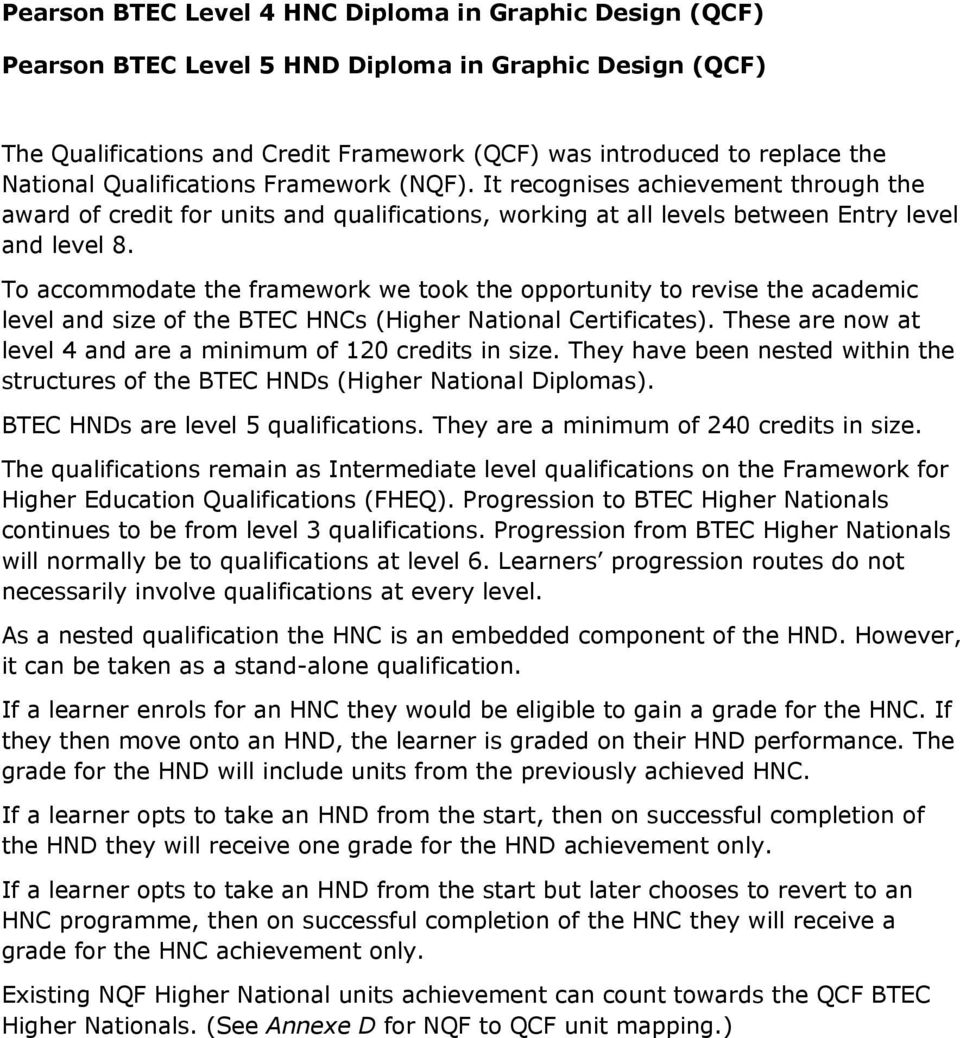
3 Pearson BTEC Level 4 HNC Diploma in Graphic Design (QCF) Pearson BTEC Level 5 HND Diploma in Graphic Design (QCF) The Qualifications and Credit Framework (QCF) was introduced to replace the National Qualifications Framework (NQF). It recognises achievement through the award of credit for units and qualifications, working at all levels between Entry level and level 8. To accommodate the framework we took the opportunity to revise the academic level and size of the BTEC HNCs (Higher National Certificates). These are now at level 4 and are a minimum of 120 credits in size. They have been nested within the structures of the BTEC HNDs (Higher National Diplomas). BTEC HNDs are level 5 qualifications. They are a minimum of 240 credits in size. The qualifications remain as Intermediate level qualifications on the Framework for Higher Education Qualifications (FHEQ). Progression to BTEC Higher Nationals continues to be from level 3 qualifications. Progression from BTEC Higher Nationals will normally be to qualifications at level 6. Learners progression routes do not necessarily involve qualifications at every level. As a nested qualification the HNC is an embedded component of the HND. However, it can be taken as a stand-alone qualification. If a learner enrols for an HNC they would be eligible to gain a grade for the HNC. If they then move onto an HND, the learner is graded on their HND performance. The grade for the HND will include units from the previously achieved HNC. If a learner opts to take an HND from the start, then on successful completion of the HND they will receive one grade for the HND achievement only. If a learner opts to take an HND from the start but later chooses to revert to an HNC programme, then on successful completion of the HNC they will receive a grade for the HNC achievement only. Existing NQF Higher National units achievement can count towards the QCF BTEC Higher Nationals. (See Annexe D for NQF to QCF unit mapping.)
4 BTEC Higher Nationals within the QCF, NQF and FHEQ QCF/NQF/ FHEQ level 8 Progression opportunities and examples of qualifications within each level PhD/DPhil Professional doctorates (credit based), e.g. EdD Master s degrees 7 Postgraduate diplomas Postgraduate Certificate in Education (PGCE) Bachelor s degrees, e.g. BA, BSc 6 Professional Graduate Certificate in Education Graduate certificates and diplomas BTEC HNDs (Higher National Diplomas) 5 Foundation Degrees, e.g. FdA, FdSc Diplomas of Higher Education (Dip HE) BTEC HNCs (Higher National Certificates) 4 Certificates of Higher Education (Cert HE) Level 4 National Vocational Qualifications (NVQs) BTEC Level 3 Extended Diplomas BTEC Level 3 Diplomas BTEC Level 3 Subsidiary Diplomas 3 BTEC Level 3 Certificates GCE Advanced Level Level 3 NVQs Advanced Diplomas

5 UNITS The units for the Pearson BTEC Higher Nationals in Graphic Design (QCF) are on the CD ROM that accompanies this specification and on our website. Contents Qualification titles covered by this specification 1 Qualification Numbers 1 Introduction 2 Structure of the qualification 2 BTEC Level 4 HNC 2 BTEC Level 5 HND 2 Rules of combination for BTEC Levels 4 and 5 Higher National qualifications 3 Key features 8 Progression from the BTEC Level 4 HNC 9 Progression from the BTEC Level 5 HND 9 Professional body recognition 10 National Occupational Standards 10 Qualification Frameworks for Higher National Diplomas 10 Teaching, learning and assessment 11 Unit format 11 Learning and assessment 13 Grading Higher National units 14 Calculation of the qualification grade 15 Recognition of Prior Learning 17 Quality assurance of BTEC Higher Nationals 18 Programme design and delivery 20 Mode of delivery 21 Resources 21 Delivery approach 22 Meeting local needs 22
6 Access and recruitment 23 Restrictions on learner entry 23 Equality Act 2010 and Pearson equality policy 24 English language expectations 24 Professional body contact details 25 How to obtain National Occupational Standards 25 Professional development and training 26 Annexe A 27 Qualification Requirement 27 Annexe B 31 National Occupational Standards (NOS) 31 Annexe C 35 Grade descriptors 35 Annexe D 37 Unit mapping in depth 37 Annexe E 43 Calculation of the qualification grade 43

7 Qualification titles covered by this specification Pearson BTEC Level 4 HNC Diploma in Graphic Design (QCF) Pearson BTEC Level 5 HND Diploma in Graphic Design (QCF) These qualifications have been accredited to the Qualifications and Credit Framework (QCF). The Qualification Numbers (QNs) for these qualifications are listed below. These qualification titles are as they will appear on learners certificates. Learners need to be made aware of this when they are recruited by the centre and registered with Pearson. Providing this happens, centres are able to describe the programme of study leading to the award of the qualification in different ways to suit the medium and the target audience. The Quality Assurance Agency for Higher Education (QAA) has produced guidelines for centres in preparing programme specifications (reference Guidelines for preparing programme specifications: UK Quality Code for Higher Education, Part A Chapter A3.) Qualification Numbers The Qualifications and Credit Framework (QCF) code is known as a Qualification Number (QN). Each unit within a qualification will also have a QCF unit code. The QCF qualification and unit codes will appear on learners final certification documentation. The QNs for the qualifications in this publication are: 500/9238/8 Pearson BTEC Level 4 HNC Diploma in Graphic Design (QCF) 500/9247/9 Pearson BTEC Level 5 HND Diploma in Graphic Design (QCF). 1

8 Introduction This specification contains the units and associated guidance for the Pearson BTEC Level 4 HNC in Graphic Design (QCF) and the Pearson BTEC Level 5 HND in Graphic Design (QCF). Each unit sets out the required learning outcomes, assessment criteria and content and may also include advice regarding essential delivery and assessment strategies. This document also contains details of the teaching, learning, assessment and quality assurance of these qualifications. It includes advice about our policies regarding access to our qualifications, the design of programmes of study and delivery modes. Structure of the qualification BTEC Level 4 HNC The Pearson BTEC Level 4 HNC in Graphic Design (QCF) is a qualification with a minimum of 120 credits of which 60 are mandatory core. The BTEC Level 4 HNC programme must contain a minimum of 65 credits at level 4. BTEC Level 5 HND The Pearson BTEC Level 5 HND in Graphic Design (QCF) is a qualification with a minimum of 240 credits of which 80 are mandatory core. The BTEC Level 5 HND programme must contain a minimum of 125 credits at level 5 or above. 2

9 Rules of combination for BTEC Levels 4 and 5 Higher National qualifications The rules of combination specify the: total credit value of the qualification minimum credit to be achieved at the level of the qualification mandatory core unit credit specialist unit credit maximum credit that can be centre devised or imported from other QCF BTEC Higher National qualifications. When combining units for a BTEC Higher National qualification it is the centre s responsibility to ensure that the following rules of combination are adhered to: Pearson BTEC Level 4 HNC in Graphic Design (QCF) 1 Qualification credit value: a minimum of 120 credits. (A maximum of 55 credits may be at level 5.) 2 Minimum credit to be achieved at the level of the qualification (level 4): 65 credits. 3 Mandatory core unit credit: 60 credits. 4 Specialist unit credit: a minimum of 60 credits. 5 A maximum of 30 credits can be centre devised or imported from other QCF BTEC Higher National qualifications to meet local needs. Level rules and mandatory core units must not be changed. Pearson BTEC Level 5 HND in Graphic Design (QCF) 1 Qualification credit value: a minimum of 240 credits. 2 Minimum credit to be achieved at the level of the qualification (level 5) or above: 125 credits. 3 Mandatory core unit credit: 80 credits. 4 Specialist unit credit: a minimum of 160 credits. 5 The requirements of the HNC have to be met. 6 A maximum of 60 credits can be centre devised or imported from other QCF BTEC Higher National qualifications to meet local needs. Level rules and mandatory core units must not be changed. 3

10 Structure of the Pearson BTEC Level 4 HNC Diploma in Graphic Design (QCF) Unit number Mandatory core units all units must be taken Unit level Unit credit 1 Visual Communication in Art and Design Ideas Generation and Development in Art and Design 3 Contextual and Cultural Referencing in Art and Design Professional Practice in Art and Design 5 15 Specialist units Group A (minimum 30 credits) 10 Design Method Design Principles Products, Marketing and Advertising Media Advertising Campaigns Art Direction for Advertising Copywriting for Advertising Personal Style in Graphic Design Typographic Skills Advanced Typographic Design Typographic Ideas Mass Text Application Editorial Design Corporate Identity in Graphic Design Visual Communication in Graphic Design Cultural Interpretation in Graphic Design Packaging in Graphic Design Art, Design and Media Practice within the Digital Environment Management of the Design and Production Process Advertising Photography Reprographic Processes in Photography Digital Image Creation and Development Drawing Techniques and Processes in Art and Design

11 Unit number Specialist units Group B (no minimum credit) Unit level Unit credit 5 Project Design, Implementation and Evaluation Critical Study in Art and Design Professional Studies in Art and Design Ideas in Context Research Project Personal and Professional Development Managing a Creative Business Business Practice in Art and Design Work-based Experience Employability Skills References and Sources in Art and Design Communication with Images in Art and Design Interactive Media Design and Prototyping Interactive Media Web Authoring Animation Techniques for Interactivity in Art and Design Interactive Media Presentation Interactive Media Principles D, 3D and Time-based Digital Applications Photographic Techniques Photographic Materials, Techniques and Technology 4 15 The BTEC Level 4 HNC programme must contain a minimum of 65 credits at level 4. 5

12 Structure of the Pearson BTEC Level 5 HND in Graphic Design (QCF) Unit number Mandatory core units all units must be taken Unit level Unit credit 1 Visual Communication in Art and Design Ideas Generation and Development in Art and Design 3 Contextual and Cultural Referencing in Art and Design Professional Practice in Art and Design Project Design, Implementation and Evaluation 5 20 Specialist units Group A (minimum 60 credits) 10 Design Method Design Principles Products, Marketing and Advertising Media Advertising Campaigns Art Direction for Advertising Copywriting for Advertising Personal Style in Graphic Design Typographic Skills Advanced Typographic Design Typographic Ideas Mass Text Application Editorial Design Corporate Identity in Graphic Design Visual Communication in Graphic Design Cultural Interpretation in Graphic Design Packaging in Graphic Design Art, Design and Media Practice within the Digital Environment Management of the Design and Production Process Advertising Photography Reprographic Processes in Photography Digital Image Creation and Development Drawing Techniques and Processes in Art and Design
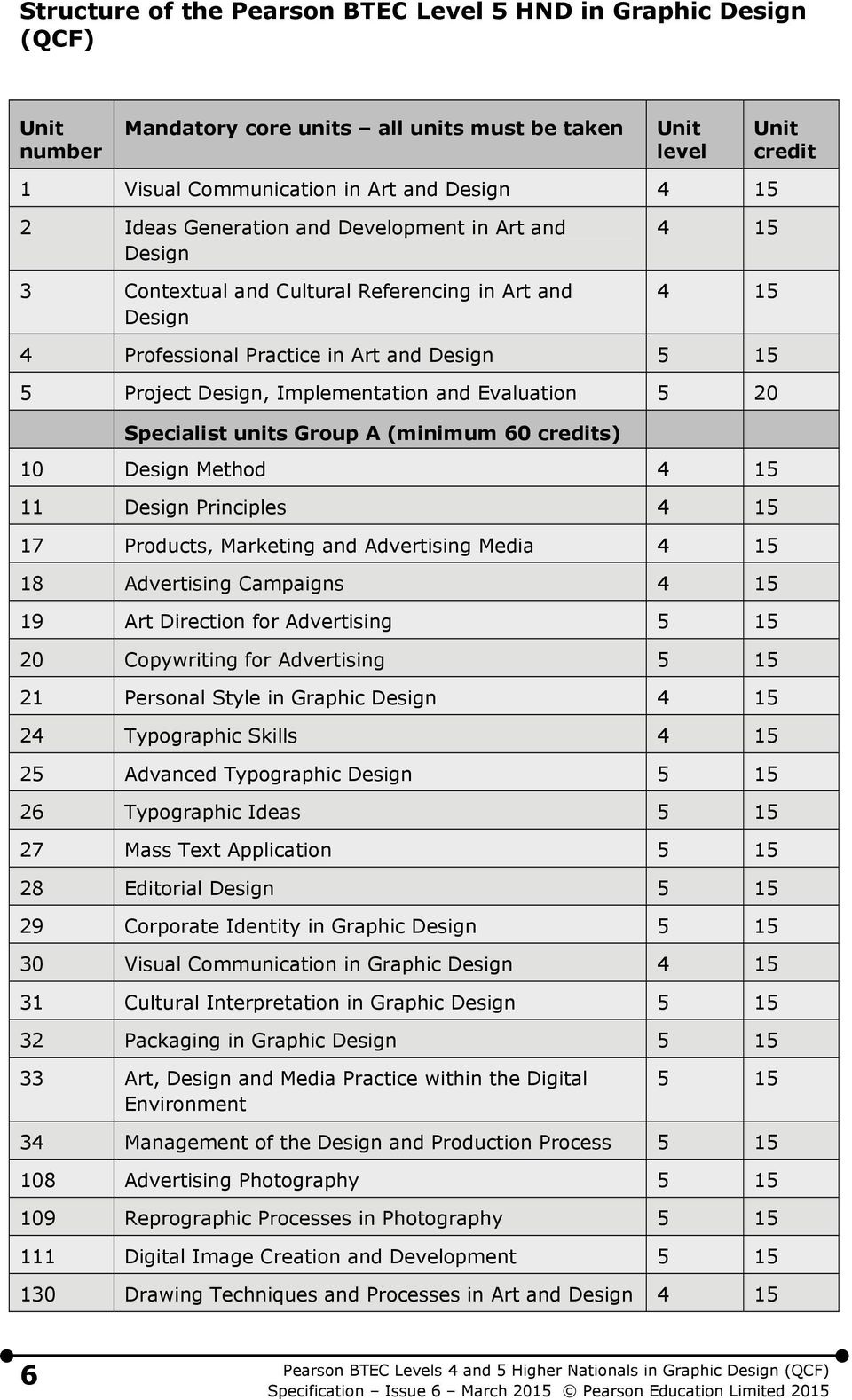
13 Unit number Specialist units Group B (no minimum credit) Unit level Unit credit 6 Critical Study in Art and Design Professional Studies in Art and Design Ideas in Context Research Project Personal and Professional Development Managing a Creative Business Business Practice in Art and Design Work-based Experience Employability Skills References and Sources in Art and Design Communication with Images in Art and Design Interactive Media Design and Prototyping Interactive Media Web Authoring Animation Techniques for Interactivity in Art and Design Interactive Media Presentation Interactive Media Principles D, 3D and Time-based Digital Applications Photographic Techniques Photographic Materials, Techniques and Technology 4 15 The BTEC Level 5 HND programme must contain a minimum of 125 credits at level 5. 7

14 Key features BTEC Higher Nationals are designed to provide a specialist vocational programme, linked to professional body requirements and National Occupational Standards where appropriate. They offer a strong, sector-related emphasis on practical skills development alongside the development of requisite knowledge and understanding. The qualifications provide a thorough grounding in the key concepts and practical skills required in their sector and their national recognition by employers allows direct progression to employment. A key progression path for BTEC HNC and HND learners is to the second or third year of a degree or honours degree programme, depending on the match of the BTEC Higher National units to the degree programme in question. The Pearson BTEC HNC and HND in Graphic Design (QCF) offer a progression route to the professional qualifications offered by the Chartered Society of Designers. Pearson BTEC Higher Nationals in Graphic Design (QCF) have been developed to focus on: providing education and training for a range of careers in graphic design providing opportunities for graphic designers to achieve a nationally recognised level 4/level 5 vocationally specific qualification providing opportunities for full-time learners to gain a nationally recognised vocationally specific qualification to enter employment in design or progress to higher education vocational qualifications such as a full-time degree in graphic design or related area developing the knowledge, understanding and skills of learners in the field of graphic design providing opportunities for learners to focus on the development of higher-level skills in a graphic design context providing opportunities for learners to develop a range of skills and techniques and attributes essential for successful performance in working life develop learners ability to manage themselves develop learners critical awareness and their ability to research and synthesise complex information develop learners skills in communication and presentation develop learners ability to handle information. 8

15 Progression from the BTEC Level 4 HNC The Pearson BTEC Level 4 HNC Diploma in Graphic Design (QCF) provides a specialist work-related programme of study that covers the key knowledge, understanding and practical skills required in the graphic design sector and also offers particular specialist emphasis through the choice of specialist units. BTEC Level 4 HNCs provide a nationally recognised qualification offering career progression and professional development for those already in employment and opportunities to progress into higher education. The qualifications are primarily undertaken by part-time learners studying over two years. In some sectors there are opportunities for those wishing to complete an intensive programme of study in a shorter period of time. This specification gives centres a framework to develop engaging programmes for higher education learners who are clear about the area of employment that they wish to enter. The Pearson BTEC Level 4 HNC Diploma in Graphic Design (QCF) offers a progression route for learners who are employed in graphic design. Progression from the BTEC Level 5 HND The BTEC Level 5 HND provides greater breadth and specialisation than the BTEC Level 4 HNC. BTEC HNDs are followed predominately by full-time learners. They allow progression into or within employment in the design sector, either directly on achievement of the award or following further study to degree level. The Pearson BTEC Level 5 HND Diploma in Graphic Design (QCF) provides opportunities for learners to apply their knowledge and practical skills in the workplace. Full-time learners have the opportunity to do this through formal work placements or part-time employment experience. The qualification prepares learners for employment in the design sector and will be suitable for learners who have already decided that they wish to enter this area of work. Some adult learners may wish to make the commitment required by this qualification in order to enter a specialist area of employment in graphic design or progress into higher education. Other learners may want to extend the specialism that they followed on the BTEC Level 4 HNC programme. Progression from this qualification may well be into or within employment in the design sector where learners may work towards full membership of British Design Innovation (BDI), the Chartered Society of Designers, the Design Business Association, or Design and Art Direction (D&AD). The Pearson BTEC Level 5 HND Diploma in Graphic Design (QCF) offers a progression route for learners who are studying on a Pearson BTEC Level 4 HNC Diploma in Graphic Design (QCF). 9

16 Professional body recognition The Pearson BTEC Higher Nationals in Graphic Design (QCF) have been developed with career progression and recognition by professional bodies in mind. It is essential that learners gain the maximum benefit from their programme of study. Learners following a Pearson BTEC Higher National in Graphic Design (QCF) are able to apply for student membership of the Chartered Society of Designers. National Occupational Standards Pearson BTEC Higher Nationals in Graphic Design (QCF) are designed to relate to the National Occupational Standards in the design sector at level 4 and 5, developed by CCSkills and Skillset Sector Skills Councils in the areas of Design, Crafts, Animation, Design for the Moving Image, Interactive Media and Computer Games and Photo Imaging, which in turn form the basis of National Vocational Qualifications (NVQs). BTEC Higher Nationals do not purport to deliver occupational competence in the sector, which should be demonstrated in a work context. However, the qualifications provide underpinning knowledge for the National Occupational Standards, as well as developing practical skills in preparation for work and possible achievement of NVQs in due course. Links to National Occupational Standards are indicated in individual units. Annexe B contains mapping of the Higher National units in this specification against relevant Level 4/Level 5 NVQs where appropriate. Qualification Frameworks for Higher National Diplomas In England, Wales and Northern Ireland, BTEC HNC and HND Diplomas may either be awarded by degree-awarding bodies under a licence from Pearson (which allows them to devise, deliver and award Higher National qualifications themselves), or they may be awarded directly by Pearson, as an awarding body regulated by Ofqual. The majority of BTEC HNC and HND Diplomas are awarded by Pearson. Only those HNC and HND Diplomas that are awarded by degree-awarding bodies are included on the Framework for Higher Education Qualifications (FHEQ) (because this framework comprises qualifications awarded by degree-awarding bodies.) BTEC HNC and HND Diplomas awarded directly by Pearson are regulated qualifications at Level 4 and Level 5 on the Qualifications and Credit Framework (QCF) and the Credit and Qualifications Framework for Wales (CQFW) and are subject to the academic standards and regulations of Pearson and the requirements of the QCF and CQFW. The QCF level descriptors have been used to describe the relative intellectual demand, complexity, depth of learning and learner autonomy associated with the level 4 or 5 level of learning and achievement. QAA subject and qualification benchmark statements have been used to provide points of reference for each level. Employers and higher education providers can expect that typical learners studying for the Pearson BTEC Higher Nationals in Graphic Design (QCF) should have developed certain higher level skills and abilities and studied a mandatory curriculum and selected optional specialist units. This detail is contained in the Qualification Requirements in Annexe A of this specification. 10

17 Teaching, learning and assessment Learners must achieve a minimum of 120 credits (of which at least 65 must be at level 4) on their programme of learning to be awarded a BTEC Level 4 HNC and a minimum of 240 credits (of which at least 125 must be at level 5 or above) to be awarded a BTEC Level 5 HND. The assessment of BTEC Higher National qualifications is criterion-referenced and centres are required to assess learners evidence against published learning outcomes and assessment criteria. All units will be individually graded as pass, merit or distinction. To achieve a pass grade for the unit learners must meet the assessment criteria set out in the specifications. This gives transparency to the assessment process and provides for the establishment of national standards for each qualification. The units in BTEC Higher National qualifications all have a standard format which is designed to provide guidance on the requirements of the qualification for learners, assessors and those responsible for monitoring national standards. Unit format Each unit is set out in the following way. Unit title, unit code, QCF level and credit value The unit title is accredited on the QCF and this form of words will appear on the learner s Notification of Performance. Each unit is assigned a level, indicating the relative intellectual demand, complexity and depth of study, and learner autonomy. All units and qualifications within the QCF will have a level assigned to them, which represents the level of achievement. There are nine levels of achievement, from Entry level to level 8. The level of the unit has been informed by the QCF level descriptors and, where appropriate, the National Occupational Standards (NOS) and/or other sector/professional benchmarks. Each unit in BTEC Higher National qualifications has a credit value which specifies the number of credits that will be awarded to a learner who has achieved all the learning outcomes of the unit. Learners will be awarded credits for the successful completion of whole units. Aim The aim provides a clear summary of the purpose of the unit and is a succinct statement that summarises the learning outcomes of the unit. Unit abstract The unit abstract gives the reader an appreciation of the unit in the vocational setting of the qualification, as well as highlighting the focus of the unit. It gives the reader a snapshot of the unit and the key knowledge, skills and understanding gained while studying the unit. The unit abstract also highlights any links to the appropriate vocational sector by describing how the unit relates to that sector. 11

18 Learning outcomes The learning outcomes identify what each learner must do in order to pass the unit. Learning outcomes state exactly what a learner should know, understand or be able to do as a result of completing the unit. Learners must achieve all the learning outcomes in order to pass the unit. Unit content The unit content identifies the breadth of knowledge, skills and understanding needed to design and deliver a programme of learning to achieve each of the learning outcomes. This is informed by the underpinning knowledge and understanding requirements of relevant National Occupational Standards (NOS) where appropriate. Each learning outcome is stated in full and then the key phrases or concepts related to that learning outcome are listed in italics followed by the subsequent range of related topics. The information below shows how unit content is structured and gives the terminology used to explain the different components within the content. Learning outcome: this is given in bold at the beginning of each section of content. Italicised sub-heading: it contains a key phrase or concept. This is content which must be covered in the delivery of the unit. Colons mark the end of an italicised sub-heading. Elements of content: the elements are in roman text and amplify the subheading. The elements must also be covered in the delivery of the unit. Semicolons mark the end of an element. Brackets contain amplification of elements of content which must be covered in the delivery of the unit. e.g. is a list of examples used for indicative amplification of an element (that is, the content specified in this amplification that could be covered or that could be replaced by other, similar material). It is not a requirement of the unit specification that all of the content is assessed. Learning outcomes and assessment criteria Each unit contains statements of the evidence that each learner should produce in order to receive a pass. Guidance This section provides additional guidance and amplification related to the unit to support tutors/deliverers and assessors. Its subsections are given below. Links sets out possible links between units within the specification. Provides opportunities for the integration of learning, delivery and assessment. Links to relevant National Occupational Standards and Professional Bodies Standards will be highlighted here. Essential requirements essential, unique physical and/or staffing resources or delivery/assessment requirements needed for the delivery of this unit are specified here. 12

19 Employer engagement and vocational contexts this is an optional section. Where relevant it offers suggestions for employer contact to enhance the delivery of the unit. These subsections should be read in conjunction with the learning outcomes, unit content, assessment criteria and the generic grade descriptors. The centre will be asked to ensure that essential resources are in place when it seeks approval from Pearson to offer the qualification. Learning and assessment The purpose of assessment is to ensure that effective learning has taken place of the content of each unit. Evidence of this learning, or the application of the learning, is required for each unit. The assessment of the evidence relates directly to the assessment criteria for each unit, supported by the generic grade descriptors. The process of assessment can aid effective learning by seeking and interpreting evidence to decide the stage that learners have reached in their learning, what further learning needs to take place and how best to do this. Therefore, the process of assessment should be part of the effective planning of teaching and learning by providing opportunities for both the learner and assessor to obtain information about progress towards learning goals. The assessor and learner must be actively engaged in promoting a common understanding of the assessment criteria and the grade descriptors (what it is they are trying to achieve and how well they achieve it) for further learning to take place. Therefore, learners need constructive feedback and guidance about how they may improve by capitalising on their strengths and clear and constructive comments about their weaknesses and how these might be addressed. Assessment instruments are constructed within centres. They should collectively ensure coverage of all assessment criteria within each unit and should provide opportunities for the evidencing of all the grade descriptors. It is advised that assessment criteria and contextualised grade descriptors are clearly indicated on each assessment instrument to provide a focus for learners (for transparency and to ensure that feedback is specific to the criteria) and to assist with internal standardisation processes. Tasks/activities should enable learners to produce evidence that relates directly to the assessment criteria and grade descriptors. When centres are designing assessment instruments, they need to ensure that the instruments are valid, reliable and fit for purpose, building on the application of the assessment criteria. Centres are encouraged to place emphasis on practical application of the assessment criteria, providing a realistic scenario for learners to adopt, making maximum use of work-related practical experience and reflecting typical practice in the sector concerned. The creation of assessment instruments that are fit for purpose is vital to achievement. 13

20 Grading Higher National units The grading of BTEC Higher National qualifications is at the unit and the qualification level. Each successfully completed unit will be graded as a pass, merit or distinction. A pass is awarded for the achievement of all outcomes against the specified assessment criteria. Merit and distinction grades are awarded for higher-level achievement. The generic merit and distinction grade descriptors listed in Annexe C are for grading the total evidence produced for each unit and describe the learner s performance over and above that for a pass grade. Each of the generic merit and distinction grade descriptors should be amplified by use of indicative characteristics which exemplify the merit and distinction grade descriptors. These give a guide to the expected learner performance, and support the generic grade descriptors. The indicative characteristics should reflect the nature of a unit and the context of the sector programme. The indicative characteristics shown in the table for each of the generic grade descriptors in Annexe C are not exhaustive. Consequently, centres should select appropriate characteristics from the list or construct others that are appropriate for their sector programme and level. It is important to note that each assessment activity does not need to incorporate all the merit and/or distinction grade descriptors. Contextualising the generic grade descriptors The generic merit and distinction grade descriptors need to be viewed as a qualitative extension of the assessment criteria for pass within each individual unit. The relevant generic grade descriptors must be identified and specified within an assignment and the relevant indicative characteristics should be used to place the required evidence in context. Additional guidance on contextualisation of grade descriptors can be found in HN Delivery Guides on the website. Summary of grades In order to achieve a pass in a unit In order to achieve a merit in a unit In order to achieve a distinction in a unit all learning outcomes and associated assessment criteria have been met pass requirements achieved all merit grade descriptors achieved and all prescribed indicative characteristics. pass and merit requirements achieved all distinction grade descriptors achieved and all prescribed indicative characteristics. 14

21 Calculation of the qualification grade Pass qualification grade Learners who achieve the minimum eligible credit value specified by the rule of combination will achieve the qualification at a pass grade (see section Rules of combination for the BTEC Level 4 and 5 Higher National qualifications). The Rules of combination have been summarised below: BTEC HNC Diplomas To achieve the qualification a learner must: achieve at least 120 credits at or above the level of the qualification (a maximum of 55 credits may be at Level 5) achieve a minimum of 65 credits at Level 4 complete a valid combination of units. BTEC HND Diplomas To achieve the qualification a learner must: achieve at least 240 credits at or above the level of the qualification achieve a minimum of 125 credits at Level 5 or above. The best valid combination of units is used to calculate the overall grade, e.g. if a learner has completed more than the minimum number of optional units at the appropriate level the best performance from these will be used. All learners will receive a Notification of Performance showing all unit grades whether or not they were included in the calculation for the overall grade. Qualification grades above pass grade BTEC HNC Diplomas Calculation of the BTEC HNC qualification grade is based on the learner s best performance in units at or above the level of the qualification to the value of 75 credits: The best 75 credits must come from a maximum of 120 credits as a valid rule of combination The units from which the best 75 credits are selected come from the whole qualification including the mandatory core credit. This means that credit from some mandatory core units is likely to form part of the best 75 credits in most programmes (the mandatory core credit units will automatically be included in the calculation once the maximum amount of credit for optional specialist units for the rule of combination is used up.) It is the responsibility of a centre to ensure that a correct unit combination is adhered to. 15
22 Qualification grades Learners will be awarded a pass, merit or distinction qualification grade using the points gained through the 75 best credits based on unit achievement. Unit credit points available for specified unit grades, for either Level 4 or Level 5 units Unit points per credit Pass Merit Distinction Example for level 4 or level 5 unit of 15 credits Pass Merit Distinction BTEC Level 4 HNC overall qualification grades Points range Grade 0 74 Pass P Merit M 150 Distinction D BTEC HND Diplomas The grade achieved in units from an appropriate HNC may contribute to an HND grade. If a learner moves from HNC to HND, credits at Level 5 or above from both the HNC and HND can contribute to the best 75 credits of the overall HND grade. Note that for HND learners, level 4 units do not count towards the qualification grade. Calculation of the BTEC HND qualification grade is based on the learner s best performance in units at or above the level of the qualification i.e. only units at level 5 can be counted towards the value of 75 credits: The best 75 credits must come from a maximum of 240 credits as a valid rule of combination The units from which the 75 best credits are selected come from the whole qualification including the mandatory core credit, but must be level 5 units or above. This means that credit from some mandatory core units is likely to form part of the best 75 credits in most programmes (the mandatory core credit units will automatically be included in the calculation once the maximum amount of credit for optional specialist units for the rule of combination is used up.) It is the responsibility of a centre to ensure that a correct unit combination is adhered to. 16
23 Qualification grades Learners will be awarded a pass, merit or distinction qualification grade using the points gained through the 75 best credits based on unit achievement. Unit credit points for specified unit grades at Level 5 only Unit points per credit Pass Merit Distinction BTEC Level 5 HND overall qualification grades Points range Grade 0 74 Pass P Merit M 150 Distinction D Annexe E gives examples of how qualification grades are calculated. Recognition of Prior Learning Recognition of Prior Learning (RPL) is a method of assessment (leading to the award of credit) that considers whether a learner can demonstrate that they can meet the assessment requirements for a unit through knowledge, understanding or skills they already possess and so do not need to develop through a course of learning. Pearson encourages centres to recognise learners previous achievements and experiences whether at work, home and at leisure, as well as in the classroom. RPL provides a route for the recognition of the achievements resulting from continuous learning. RPL enables recognition of achievement from a range of activities using any valid assessment methodology. Provided that the assessment requirements of a given unit or qualification have been met, the use of RPL is acceptable for accrediting a unit, units or a whole qualification. Evidence of learning must be valid and reliable. For full guidance about Pearson s policy on RPL, please see our Recognition of Prior Learning Policy and Process on our website. 17
24 Quality assurance of BTEC Higher Nationals Pearson s quality assurance system for all BTEC higher-level programmes on the QCF at Levels 4 7 will ensure that centres have effective quality assurance processes to review programme delivery. It will also ensure that the outcomes of assessment are to national standards. The quality assurance process for centres offering BTEC higher-level programmes on the QCF at Levels 4 7 comprises three key components. 1) Approval process Centres new to the delivery of this programme will be required to seek approval through the existing qualification and centre approval process. Prior to approval being given, centres will be required to submit evidence to demonstrate that they: have the human and physical resources required for effective delivery and assessment understand the implications for independent assessment and agree to abide by these have a robust internal assessment system supported by fit for purpose assessment documentation have a system to internally verify assessment decisions, to ensure standardised assessment decisions are made across all assessors and sites. Such applications have to be supported by the head of the centre (principal, chief executive etc) and include a declaration that the centre will operate the programmes strictly as approved and in line with Pearson requirements. 2) Monitoring of internal centre systems Centres will be required to demonstrate ongoing fulfilment of the centre approval criteria over time and across all programmes. The process that assures this is external examination, which is undertaken by External Examiners. Centres will be given the opportunity to present evidence of the ongoing suitability and deployment of their systems to carry out the required functions. This includes the consistent application of policies affecting learner registrations, appeals, effective internal examination and standardisation processes. Where appropriate, centres may present evidence of their operation within a recognised code of practice, such as that of the Quality Assurance Agency for Higher Education. Pearson reserves the right to confirm independently that these arrangements are operating to Pearson s satisfaction. Pearson will affirm, or not, the ongoing effectiveness of such systems. Where system failures are identified, sanctions (appropriate to the nature of the problem) will be applied in order to assist the centre in correcting the problem. 18
25 3) Independent assessment review The internal assessment outcomes reached for all BTEC higher-level programmes on the Qualifications and Credit Framework at Levels 4-7 are subject to an independent assessment review by a Pearson-appointed External Examiner. The outcomes of this process will be to: confirm that internal assessment is to national standards and allow certification or make recommendations to improve the quality of assessment outcomes before certification is released or make recommendations about the centre s ability to continue to be approved for the qualifications in question. Additional arrangement for ALL centres Regardless of the type of centre, Pearson reserves the right to withdraw either qualification or centre approval when it deems there is an irreversible breakdown in the centre s ability either to quality assure its programme delivery or its assessment standards. 19
26 Programme design and delivery BTEC Higher National qualifications consist of mandatory core units and specialist units. The specialist units are designed to provide a specific focus to the qualification. Required combinations of specialist units are clearly set out in relation to each qualification in the defined qualification structures provided in this document. In BTEC Higher National qualifications each unit s credit value usually consists of multiples of 5 credits. Most units are 15 credits in value. These units have been designed from a learning time perspective. Each 15-credit unit approximates to a learning time of 150 hours. It is expected that these BTEC Level 5 HNDs, accredited onto the Qualifications and Credit Framework (QCF), will also require approximately 960 guided learning hours (GLH). Consequently, using the above approach, the BTEC Level 4 HNCs, are half the size of the BTEC Level 5 Higher National Diplomas which will require approximately 480 GLH. Within the information relating to these units on the QCF, each 15-credit unit has been allocated a figure of 60 GLH to help guide centres (other units with smaller or larger credit values have figures calculated on a pro rata basis). Centres delivering these qualifications are required to use their professional expertise in their design and delivery within the overall guided learning hours for the qualification. Guided learning hours are defined as all the time when a tutor, trainer or facilitator is present to give specific guidance towards the learning aim being studied on a programme. This definition includes lectures, tutorials and supervised study in, for example, open learning centres and learning workshops. Learning time is defined as the time taken by learners at the level of the unit, on average, to complete the learning outcomes of the unit to the standard determined by the assessment criteria. It should address all learning (including assessment) relevant to the learning outcomes, regardless of where, when and how the learning has taken place. It does not include time spent by staff in day-to-day marking of assignments where the learner is not present. Centres are advised to consider this definition when planning the programme of study associated with this specification. Annexe D provides information for centres and learners who wish to compare, for teaching and learning purposes, the units of the Pearson Level 5 BTEC Higher Nationals in Graphic Design (NQF) with the new units of the Pearson BTEC Higher Nationals in Graphic Design (QCF). 20
27 Mode of delivery Pearson does not define the mode of study for the BTEC Higher National qualifications. Centres are free to offer the qualification(s) using any mode of delivery that meets the needs of their learners. This may be through traditional classroom teaching, open learning, distance learning or a combination of these. Whatever mode of delivery is used, centres must ensure that learners have appropriate access to the resources identified in the specification and to the subject specialists delivering the units. This is particularly important for learners studying for the qualification through open or distance learning. Our Distance Learning and Distance Assessment policies are given on our website. Learners studying for the qualification on a part-time basis bring with them a wealth of experience that should be utilised to maximum effect by tutors and assessors. Assessment instruments based on learners work environments should be encouraged. Those planning the programme should aim to enhance the vocational nature of the BTEC Higher National qualification by: liaising with employers to ensure that the course is relevant to learners specific needs accessing and using non-confidential data and documents from learners workplaces including sponsoring employers in the delivery of the programme and, where appropriate, in the assessment linking with company-based/workplace training programmes making full use of the variety of experiences of work and life that learners bring to the programme. Resources BTEC Higher National qualifications are designed to prepare learners for employment in specific industry sectors. Physical resources need to support the delivery of the programme and the proper assessment of the outcomes and, therefore, should normally be of industry standard. Staff delivering programmes and conducting the assessments should be familiar with current practice, legislation and standards used in the sector concerned. Centres will need to meet any specialist resource requirements when they seek approval from Pearson. Please refer to the Essential requirements section in individual units for specialist resource requirements. 21
28 Delivery approach It is important that centres develop an approach to teaching and learning that supports the specialist vocational nature of the BTEC Higher National qualification. Specifications contain a balance of practical skill development and knowledge requirements, some of which can be theoretical in nature. Tutors and assessors need to ensure that appropriate links are made between theory and practice and that the knowledge base is applied to the sector. This will require the development of relevant and up-to-date teaching materials that allow learners to apply their learning to actual events and activities within the sector. Maximum use should be made of the learner s experience. Meeting local needs Centres should note that the qualifications set out in these specifications have been developed in consultation with centres, employers and relevant professional organisations. The units are designed to meet the skill needs of the sector and the specialist units allow coverage of the full range of employment within the sector. Centres should make maximum use of the choice available to them within the specialist units to meet the needs of their learners, as well as the local skills and training needs. Where centres identify a specific need that cannot be addressed using the units in this specification, centres can seek approval from Pearson to use units from other BTEC Higher National qualifications on the QCF. Centres will need to justify the need for importing units from other specifications and Pearson will ensure that the vocational focus of the qualification remains the same. Applications must be made in advance of delivery by 31 January in the year of registration (see the website for details). The flexibility to import standard units from other QCF BTEC Higher National specifications is limited to a maximum of 30 credits in a BTEC HNC qualification and a maximum of 60 credits only in any BTEC HND qualification. This is an overall maximum and centres should check the Rules of Combination information for the specific qualification to confirm the actual requirements. These units cannot be used at the expense of the mandatory core units in any qualification nor can the qualification rules of combination level rules be compromised. The centre must ensure that approved units are used only in eligible combinations. 22
29 Access and recruitment Pearson s policy regarding access to our qualifications is that: qualifications should be available to everyone who is capable of reaching the required standards qualifications should be free from any barriers that restrict access and progression there must be equal opportunities for everyone wishing to access the qualification. Centres are required to recruit learners to BTEC Higher National qualifications with integrity. This will include ensuring that applicants have appropriate information and advice about the qualifications and that the qualification will meet their needs. Centres should take appropriate steps to assess each applicant s potential and make a professional judgement about their ability to successfully complete the programme of study and achieve the qualification. This assessment will need to take account of the support available to the learner within the centre during their programme of study and any specific support that might be necessary to allow the learner to access the assessment for the qualification. Centres will need to review the profile of qualifications and/or experience held by applicants, considering whether this profile shows an ability to progress to level 4 or level 5 qualifications. For learners who have recently been in education, the entry profile is likely to include one of the following: a BTEC Level 3 qualification in Graphic Design a GCE level profile that demonstrates strong performance in a relevant subject or an adequate performance in more than one GCE subject. This profile is likely to be supported by GCSE grades at A* to C other related level 3 qualifications an Access to Higher Education Certificate received from an approved further education institution related work experience. Mature learners may present a more varied profile of achievement that is likely to include extensive work experience (paid and/or unpaid) and/or achievement of a range of professional qualifications in their work sector. Restrictions on learner entry BTEC Higher National qualifications are accredited on the QCF for learners aged 18 years and over. 23
30 Equality Act 2010 and Pearson equality policy Equality and fairness are central to our work. Our equality policy requires all learners to have equal opportunity to access our qualifications and assessments, and our qualifications are required to be awarded in a way that is fair to every learner. We are committed to making sure that: learners with a protected characteristic (as defined by the Equality Act 2010) are not, when they are undertaking one of qualifications, disadvantaged in comparison with learners who do not share that characteristic all learners achieve the recognition they deserve for undertaking a qualification and that this achievement can be compared fairly to the achievement of their peers. You can find details on how to make adjustments for learners with protected characteristics in the policy document Access Arrangements, Reasonable Adjustments and Special Considerations, available on our website. An adjustment may not be considered reasonable if it involves unreasonable costs and/or timeframes or affects the security or integrity of the assessment. There is no duty on awarding organisations to make any adjustment to the Assessment Objectives being tested in an assessment. English language expectations Centres delivering BTEC level 4 to 7 programmes are expected to ensure that all learners who are non-native English speakers or who have not studied the final two years of school in English, can demonstrate capability in English at a standard commensurate with: IELTS 5.5, with a minimum of 5.0 being awarded on individual sections for a level 4 or 5 qualification IELTS 6.5 for a level 6 or 7 qualification Pearson s Standard Verifiers (EE) will expect centres to demonstrate that their learners meet these expectations. 24
31 Professional body contact details British Design Innovation Innovation Bank 6 Blenheim Place Brighton East Sussex BN1 4AE Telephone: Website: Chartered Society of Designers 1 Cedar Court Royal Oak Yard Bermondsey Street London SE1 3GA Telephone: Website: Design Business Association Old Street London EC1V 9HX Telephone: Website: D&AD Britannia House Hanbury Street London E1 5JL Telephone: Website: How to obtain National Occupational Standards The National Occupational Standards for Design can be obtained from: Creative & Cultural Skills Lafone House Leathermarket Street London SE1 3HN Telephone: Website: 25
32 Professional development and training Pearson supports UK and international customers with training related to BTEC qualifications. This support is available through a choice of training options offered on our website at: qualifications.pearson.com/en/support/training-from-pearson-uk The support we offer focuses on a range of issues, such as: planning for the delivery of a new programme planning for assessment and grading developing effective assignments building your team and teamwork skills developing learner-centred learning and teaching approaches building in effective and efficient quality assurance systems. The national programme of training we offer is on our website. You can request centre-based training through the website or you can contact one of our advisers in the Training from Pearson UK team via Customer Services to discuss your training needs. BTEC training and support for the lifetime of the qualifications Training and networks: our training programme ranges from free introductory events through sector-specific opportunities to detailed training on all aspects of delivery, assignments and assessment. We also host some regional network events to allow you to share your experiences, ideas and best practice with other BTEC colleagues in your region. Regional support: our team of Curriculum Development Managers and Curriculum Support Consultants, based around the country, are responsible for providing advice and support in centres. They can help you with planning and curriculum developments. To get in touch with our dedicated support teams please visit our website qualifications.pearson.com/en/support/contact-us 26
33 Annexe A Qualification Requirement Rationale The Pearson BTEC Higher Nationals in Graphic Design (QCF) should be developed to focus on: the areas of Graphic Design, Graphic Design (Advertising), Graphic Design (Illustration) and Graphic Design (Typography) equipping learners with the knowledge, and understanding and skills required for success in current and future employment or for progression to an undergraduate degree equipping learners with transferable skills that will enable them to meet changing circumstances, whether these arise from a shift in their own sphere of employment, promotion to management roles or from general changes in professional practices or technological advances the role of the graphic designer and their relationship within the business in which they work, how their role and that of their business fits within the overall structure of the graphic communications industry providing opportunities for learners to focus on the development of the higherlevel skills in a graphic design context providing opportunities for centres to devise programmes of study that meet local or specialist needs. Aims of the qualification BTEC Higher National Diplomas in Graphic Design should meet the needs of the above rationale by: providing an educational foundation for a range of creative, technical and management careers in graphics providing specialist studies directly relevant to pathways of graphic design in which learners intend to seek employment enabling learners to make an immediate contribution in employment providing flexibility, knowledge, skills and motivation as a basis for future studies and career development developing learners abilities in graphic design through effective use and combination of the knowledge and skills gained in different parts of the qualification developing a range of skills and techniques, personal qualities and an attitude essential for successful performance in professional working life. 27
34 Mandatory curriculum Visual communication: learners should research and use a range of drawing and other visual communication techniques and approaches, and critically examine and develop techniques used in their own work. Ideas generation: learners should develop their knowledge of visual language through the evaluation of the work of other artists, craftworkers and designers. They should interpret the meanings and messages in particular art and design movements and also in the work of individual artists, craftworkers and designers. Learners should experiment with a range of traditional and non-traditional materials and processes. Context: learners should study cultural history that informs current thought and debate within art, craft and design. The emphasis should be on research and study skills and on learners acquiring source material and knowledge. Learners should be provided with the knowledge, skill and understanding necessary to define and research an historical context and relate it to the present. They should also demonstrate theoretical and practical knowledge of historical and contemporary ideas in their own work. Professional practice: learners should relate practical studies in art, craft or design to a professional context. They should present and promote their work to professional standards. Optional curriculum Optional specialist routes through the qualification can be developed in the following context. Advertising: where learners investigate markets and advertising, learn to produce advertising campaigns, art direction for advertising and copywriting for advertising. Illustration: where learners learn drawing techniques and approaches, the development of a personal style, referencing and drawing for illustration and how to communicate with images. Typography: where learners investigate typography, develop advanced typographic skills, develop typographic ideas and explore mass text manipulation. Working in the digital environment: where learners learn to work with interactive applications, website design, images, video, sound and digital images. Managing the design and production process: where learners explore and understand the design process, and learn how to manage the design and production process. Links to National Standards There is the opportunity for programmes in art and design to provide some of the underpinning knowledge, understanding and skills for the Level 4 NVQ Design Management. 28
35 Entry prerequisites There are no particular entry requirements for this qualification. Learners who enter with at least one of the following are likely to benefit more readily from an art and design programme: a BTEC National in an art and design subject, a relevant GCE profile with appropriate supporting passes at GCSE, appropriate work experience. Higher-level skills and abilities Learners will be expected to develop the following skills during the programme of study: analysing, synthesising and summarising information critically the ability to read and use appropriate literature and contextual information with a full and critical understanding the ability to think independently and solve problems the ability to take responsibility for their own learning and recognise their own learning style obtaining and integrating several lines of subject-specified evidence to formulate and develop ideas applying subject knowledge and understanding to address familiar and unfamiliar problems recognising the moral and ethical issues of design-based enquiry and experimentation and appreciating the need for ethical standards and professional codes of conduct designing, planning, conducting and reporting on assignments undertaking studio practice in a responsible, safe and ethical manner developing an appreciation of the interdisciplinary nature of graphic design, and the capacity to give a clear and accurate account of a subject, marshal arguments in a mature way and engage in debate and dialogue with both specialists and non-specialists. 29
36 30
37 Annexe B National Occupational Standards (NOS) Mapping against the National Occupational Standards The grid below maps the knowledge covered in the National Occupational Standards against the underpinning knowledge of the Pearson BTEC Higher Nationals in Graphic Design (QCF). HNC/D titles Unit 1 Unit 2 Unit 3 Unit 4 Unit 5 Unit 6 Unit 7 Unit 8 Unit 9 Unit 10 Unit 11 Unit 12 Unit 13 Unit 14 Unit 15 Unit 16 Unit 17 Unit 18 Unit 19 Unit 20 NOS suite title Animation Crafts Design Fashion and Textiles Interactive Media Jewellery Moving Image Photo Imaging 31
38 HNC/D titles Unit 21 Unit 22 Unit 23 Unit 24 Unit 25 Unit 26 Unit 27 Unit 28 Unit 29 Unit 30 Unit 31 Unit 32 Unit 33 Unit 34 Unit 63 Unit 64 Unit 65 Unit 66 Unit 67 NOS suite title Animation Crafts Design Fashion and Textiles Interactive Media Jewellery Moving Image Photo Imaging 32
39 HNC/D titles NOS suite title 33 Unit 84 Unit 108 Unit 109 Unit 110 Unit 111 Unit 116 Unit 130 Animation Crafts Design Fashion and Textiles Interactive Media Jewellery Moving Image Photo Imaging
40 34
41 Annexe C Grade descriptors Pass grade A pass grade is achieved by meeting all the requirements defined in the assessment criteria for pass for each unit. Merit grade Merit grade descriptors In order to achieve a merit the learner must: identify and apply strategies to find appropriate solutions select/design and apply appropriate methods/techniques present and communicate appropriate findings Exemplar indicative characteristics Centres can identify and use other relevant characteristics. This is NOT a tick list. The learner s evidence shows, for example: effective judgements have been made complex problems with more than one variable have been explored an effective approach to study and research has been applied relevant theories and techniques have been applied a range of methods and techniques have been applied a range of sources of information has been used the selection of methods and techniques/sources has been justified the design of methods/techniques has been justified complex information/data has been synthesised and processed appropriate learning methods/techniques have been applied the appropriate structure and approach has been used coherent, logical development of principles/concepts for the intended audience a range of methods of presentation have been used and technical language has been accurately used communication has taken place in familiar and unfamiliar contexts the communication is appropriate for familiar and unfamiliar audiences and appropriate media have been used. 35
42 Distinction grade Distinction grade descriptors In order to achieve a distinction the learner must: use critical reflection to evaluate own work and justify valid conclusions take responsibility for managing and organising activities demonstrate convergent/lateral/ creative thinking Exemplar indicative characteristics Centres can identify and use other relevant characteristics. This is NOT a tick list. The learner s evidence shows, for example: conclusions have been arrived at through synthesis of ideas and have been justified the validity of results has been evaluated using defined criteria self-criticism of approach has taken place realistic improvements have been proposed against defined characteristics for success autonomy/independence has been demonstrated substantial activities, projects or investigations have been planned, managed and organised activities have been managed the unforeseen has been accommodated the importance of interdependence has been recognised and achieved ideas have been generated and decisions taken self-evaluation has taken place convergent and lateral thinking have been applied problems have been solved innovation and creative thought have been applied receptiveness to new ideas is evident effective thinking has taken place in unfamiliar contexts. 36
43 Annexe D Unit mapping in depth QCF versions of the BTEC Higher National units in Graphic Design (specification start date 01/09/2010) are mapped against the NQF BTEC Higher National units in Graphic Design (specification end date 31/08/2010). New QCF units NQF units Mapping/comments (new topics in italics) Number Name Number Name 1 Visual Communication in Art and Design Visual Communication Content in old unit is mapped fully to new unit 2 Ideas Generation and Development in Art and Design Ideas Generation Content in old unit is mapped fully to new unit 3 Contextual and Cultural Referencing in Art and Design Historical and Contextual Referencing in Fine Art/Historical and Contextual Referencing/Ideas in Context Content from old units has been merged into the new unit to allow application to specialist pathways 4 Professional Practice in Art and Design Visual Arts Professional Practice/Professional Practice and Development/Interactive Media Professional Practice Content from old units has been merged into the new unit to allow application to specialist pathways 5 Project Design, Implementation and Evaluation - The new unit is designed to be used in conjunction with specialist units to create a major project 6 Critical Study in Art and Design Critical Study in Fine Art/Critical Study Content from old units has been merged into the new unit 37
44 New QCF units NQF units Mapping/comments (new topics in italics) Number Name Number Name 7 Professional Studies in Art and Design Professional Studies Content in old unit is mapped fully to new unit 8 Ideas in Context Ideas in Context Content in old unit is mapped fully to new unit 9 Research Project - The new unit is designed to be used in conjunction with specialist units to create a major project 10 Design Method Design Method Content in old unit is mapped fully to new unit 11 Design Principles Design Principles Content in old unit is mapped fully to new unit 12 Personal and Professional Development Professional Practice and Development The new unit can be applied to any specialist pathway 13 Managing a Creative Business - This is a new unit designed to be used in any specialist pathway 14 Business Practice in Art and Design Business Practice Content in old unit is mapped fully to new unit 15 Work-based Experience - This is a new unit designed to be used in any specialist pathway 16 Employability Skills - This is a new unit designed to be used in any specialist pathway 17 Products, Marketing and Advertising Media Products, Marketing and Advertising Media Content in old unit is mapped fully to new unit 18 Advertising Campaigns Advertising Campaigns Content in old unit is mapped fully to new unit 19 Art Direction for Advertising Art Direction for Advertising Content in old unit is mapped fully to new unit 38
45 New QCF units NQF units Mapping/comments (new topics in italics) Number Name Number Name 20 Copywriting for Advertising Copywriting for Advertising Content in old unit is mapped fully to new unit 21 Personal Style in Graphic Design Developing a Personal Style Content in old unit is mapped fully to new unit 22 References and Sources in Art and Design Referencing and Sources Content in old unit is mapped fully to new unit 23 Communication with Images in Art and Design Communicating with Images Content in old unit is mapped fully to new unit 24 Typographic Skills Typographic Skills Content in old unit is mapped fully to new unit 25 Advanced Typographic Design Advanced Typographic Design Content in old unit is mapped fully to new unit 26 Typographic Ideas Typographic Ideas Content in old unit is mapped fully to new unit 27 Mass Text Application Exploring Mass Text Applications Content in old unit is mapped fully to new unit 28 Editorial Design Editorial Design Content in old unit is mapped fully to new unit 29 Corporate Identity in Graphic Design Corporate Identity Content in old unit is mapped fully to new unit 30 Visual Communication in Art and Design Visual Communication Content in old unit is mapped fully to new unit 31 Cultural Interpretation in Graphic Design Cultural Interpretation Content in old unit is mapped fully to new unit 32 Packaging in Graphic Design Packaging Content in old unit is mapped fully to new unit 39
46 New QCF units NQF units Mapping/comments (new topics in italics) Number Name Number Name 33 Art, Design and Media Practice within the Digital Environment Working in the Digital Environment Content from old units has been merged into the new unit to allow application to specialist pathways 34 Management of the Design and Production Process Managing the Design and Production Process Content in old unit is mapped fully to new unit 63 Interactive Media Design and Prototyping Interactive Media Design and Authoring/Multimedia Design and Authoring Content from old units has been updated and merged into the new unit to allow application to specialist pathways 64 Interactive Media Web Authoring Interactive Media Web Authoring/Multimedia Web Authoring Content from old units has been updated and merged into the new unit to allow application to specialist pathways 65 Animation Techniques for Interactivity in Art and Design Animation Techniques Content in old unit is mapped fully to new unit 66 Interactive Media Presentation Multimedia Presentation Content in old unit is mapped fully to new unit 67 Interactive Media Principles Interactive Media Principles Content in old unit is mapped fully to new unit 84 2D, 3D and Time-based Digital Applications 2D, 3D, 4D Digital Applications Content in old unit is mapped fully to new unit 108 Advertising Photography Advertising Photography Content in old unit is mapped fully to new unit 109 Reprographic Processes in Photography Reprographic Processes Content in old unit is mapped fully to new unit 110 Photographic Techniques Photographic Techniques Content in old unit is mapped fully to new unit 40
47 New QCF units NQF units Mapping/comments (new topics in italics) Number Name Number Name 111 Digital Image Creation and Development Digital Imaging in Fine Art/Digital Imaging/Creating Digital Images/Image Manipulation Applications Content from old units has been updated and merged into the new unit to allow application to specialist pathways 116 Photographic Materials, Techniques and Technology Materials, Techniques and Technology Content in old unit is mapped fully to new unit 130 Drawing Techniques and Processes in Art and Design Drawing Techniques and Approaches Content in old unit is mapped fully to new unit 41
48 42
49 Annexe E Calculation of the qualification grade Pass qualification grade Learners who achieve the minimum eligible credit value specified by the rule of combination will achieve the qualification at pass grade (see section Rules of combination for BTEC Levels 4 and 5 Higher National qualifications). Qualification grades above pass grade Learners will be awarded a merit or distinction qualification grade by the aggregation of points gained through the successful achievement of individual units. The graded section of both qualifications is based on the learner s best performance in units at the level or above of the qualification to the value of 75 credits. The number of points available is dependent on the unit grade achieved and the credit size of the unit (as shown in the table below). Points available per credit at specified unit grades Points per credit Pass Merit Distinction So a 15 credit unit awarded a merit grade will gain 15 points. Qualification grades BTEC Level 4 HNC Points range Grade 0-74 Pass P Merit M 150 Distinction D BTEC Level 5 HND Points range Grade 0-74 Pass P Merit M 150 Distinction D 43
50 These are some examples of how the HNC Diploma grades are calculated: Example 1: Achievement of a BTEC HNC Diploma with Pass grade Level Credit Grade Grade points Points per unit (weighting credit points) Unit 1 Mandatory core unit 4 15 P 0 Unit 2 Mandatory core unit 4 15 P 0 Unit 3 Mandatory core unit 4 15 M 1 15 Unit 4 Mandatory core unit 4 15 M 1 15 Unit 15 Specialist unit 5 15 P 0 Unit 17 Specialist unit 5 15 P 0 Unit 18 Specialist unit 4 15 M 1 15 Unit 12 Specialist unit 4 15 M 1 15 Unit 14 Specialist unit 4 10 D 2 20 Qualification total requirement Unit 14 is not included as it is an additional unit on top of the 120 credit qualification The learner can only include the points from the best 75 out of 120 credits in a valid combination. Example 2: Achievement of a BTEC HNC Diploma with Merit grade Level Credit Grade Grade points Unit 1 Mandatory core unit 4 15 M 1 15 Unit 2 Mandatory core unit 4 15 P 0 Unit 3 Mandatory core unit 4 15 M 1 15 Points per unit (weighting credit points) The best 75 credits include both core and optional units. Unit 4 Mandatory core unit 4 15 P 0 Unit 15 Specialist unit 5 15 P 0 Unit 9 Specialist unit 4 15 M 1 15 Unit 18 Specialist unit 4 15 M 1 15 Unit 12 specialist unit 4 15 M 1 15 Qualification total requirement The learner has sufficient points for a merit. 44
51 Example 3: Achievement of an HNC Diploma with Distinction grade Level Credit Grade Grade points Unit 1 Mandatory core unit 4 15 M 1 (15) Unit 2 Mandatory core unit 4 15 P 0 Unit 3 Mandatory core unit 4 15 D 2 30 Unit 4 Mandatory core unit 4 15 P 0 Unit 15 Specialist unit 4 15 D 2 30 Unit 17 Specialist unit 4 15 D 2 30 Unit 9 Specialist unit 4 15 D 2 30 Unit 12 Specialist unit 4 15 D 2 30 Qualification total requirement- 120 Points per unit (weighting credit points) The learner has grade points in more than 75 credits. The best performance is used to calculate the grade. These can be level 4/5 for the HNC The learner has enough points for a Distinction from 75 credits. 45
52 Examples for the HND Diploma: The tables below give examples of how the overall grade is determined. Only points from units at or above the level of the qualification can be counted towards the grade. Examples used are for illustrative purposes only. Other unit combinations are possible. Example 1: Achievement of an HND Diploma with a pass grade Level Credit Grade Grade points Unit 1 Mandatory core unit 4 15 P X (15) Unit 2 Mandatory core unit 4 15 M X Unit 3 Mandatory core unit 4 15 M X 30 Unit 4 Mandatory core unit 4 15 M X Unit 5 Mandatory core unit 4 15 M X Unit 6 Mandatory core unit 5 15 P 0 Unit 7 Mandatory core unit 5 15 M 1 15 Points per unit (weighting credit points) Count the points from level 5 units for the best 75 credits X these units are below the level of the HND Diploma so not counted for grading Unit 8 Mandatory core unit 5 20 P 0 Unit 20 Specialist unit 5 15 M 1 15 Unit 21 Specialist unit 5 15 P 0 Unit 23 Specialist unit 5 15 P 0 Unit 25 Specialist unit 4 15 P X Unit 26 Specialist unit 5 15 M 1 15 Unit 29 Specialist unit 4 15 M X Unit 33 Specialist unit 4 15 M X Unit 35 Specialist unit 5 15 M 1 15 Qualification grade totals Min 125 at level The learner has sufficient points for a pass grade. 46
53 Example 2 Achievement of an HND Diploma with a Merit grade Level Credit Grade Grade points Unit 1 Mandatory core unit 4 15 P X Unit 2 Mandatory core unit 4 15 M X Unit 3 Mandatory core unit 4 15 M X Unit 4 Mandatory core unit 4 15 M X Unit 5 Mandatory core unit 4 15 M X Unit 6 Mandatory core unit 5 15 M 1 15 Unit 7 Mandatory core unit 5 15 D 2 30 Unit 8 Mandatory core unit 5 20 D 2 40 Unit 20 Specialist unit 5 15 M 1 15 Unit 21 Specialist unit 5 15 M 1 (15) Unit 23 Specialist unit 5 15 P 0 Unit 25 Specialist unit 4 15 P X Unit 26 Specialist unit 5 15 M 1 (15) Unit 29 Specialist unit 4 15 M X Unit 33 Specialist unit 4 15 M X Unit 35 Specialist unit 5 15 M 1 (15) Unit 36 Specialist unit 5 10 D 2 20 Qualification grade totals Min 125 at level Points per unit (weighting credit points) The learner can be considered for a merit: only count the points from the best 75 credits from a valid combination of 240 credits X these units are below the level of the qualification so cannot be counted for grading The best 75 credits include both mandatory core and optional units () these units are not counted in the overall score The learner has sufficient points for a merit grade. 47
54 Example 3 Achievement of an HND Diploma with a distinction grade Level Credit Grade Grade points Unit 1 Mandatory core unit 4 15 P X Unit 2 Mandatory core unit 4 15 M X Unit 3 Mandatory core unit 4 15 D X Unit 4 Mandatory core unit 4 15 D X Unit 5 Mandatory core unit 4 15 M X Unit 6 Mandatory core unit 5 15 D 2 30 Unit 7 Mandatory core unit 5 15 D 2 30 Unit 8 Mandatory core unit 5 20 D 2 30 Unit 20 Specialist unit 5 15 D 2 30 Unit 21 Specialist unit 5 15 D 2 30 Unit 23 Specialist unit 5 15 P 0 Unit 25 Specialist unit 4 15 P X Unit 26 Specialist unit 5 15 M 1 (15) Points per unit (weighting credit points) The learner can be considered for a distinction: only count the points from level 5 units for the best 75 credits from a valid combination of 240 credits () these units are not counted in the overall score X not counted as below the level of the qualification. Unit 29 Specialist unit 4 15 M X Unit 33 Specialist unit 4 15 M X Unit 35 Specialist unit 5 15 M 1 (15) Unit 36 Specialist unit 4 15 P X Qualification grade totals Min 125 at level The learner has sufficient points for a distinction grade. Db60315G:\WORDPROC\LT\PD\HIGHER NATIONALS\ _BTEC_HNS_L45_GRAPHDES_ISSUE_6\ _BTEC_HNS_L45_GRAPHDES_ISSUE_6.DOC.1 55/0 48
55 March 2015 For information about Edexcel, BTEC or LCCI qualifications visit qualifications.pearson.com BTEC is a registered trademark of Pearson Education Limited Pearson Education Limited. Registered in England and Wales No Registered Office: 80 Strand, London WC2R 0RL. VAT Reg No GB
LEVEL QCF. Accredited
 LEVEL QCF Accredited Issue 8 February 2015 Edexcel, BTEC and LCCI qualifications Edexcel, BTEC and LCCI qualifications are awarded by Pearson, the UK s largest awarding body offering academic and vocational
LEVEL QCF. Accredited
 LEVEL QCF Accredited Issue 5 March 2015 Edexcel, BTEC and LCCI qualifications Edexcel, BTEC and LCCI qualifications are awarded by Pearson, the UK s largest awarding body offering academic and vocational
LEVEL QCF. Accredited
 LEVEL QCF Accredited Issue 9 February 2015 Edexcel, BTEC and LCCI qualifications Edexcel, BTEC and LCCI qualifications are awarded by Pearson, the UK s largest awarding body offering academic and vocational
Higher Nationals LEVEL QCF. Accredited
 Higher Nationals LEVEL QCF Accredited Issue 4 July 2011 Edexcel, a Pearson company, is the UK s largest awarding body, offering academic and vocational qualifications and testing to more than 25,000 schools,
LEVEL QCF. Accredited
 LEVEL QCF Accredited Issue 5 February 2015 Edexcel, BTEC and LCCI qualifications Edexcel, BTEC and LCCI qualifications are awarded by Pearson, the UK s largest awarding body offering academic and vocational
BTEC Level 3 Certificate, BTEC Level 3 Subsidiary Diploma, BTEC Level 3 90-credit Diploma, BTEC Level 3 Diploma and BTEC Level 3 Extended Diploma in
 BTEC Level 3 Certificate, BTEC Level 3 Subsidiary Diploma, BTEC Level 3 90-credit Diploma, BTEC Level 3 Diploma and BTEC Level 3 Extended Diploma in Issue 3 Pearson Education Ltd is one of the UK s largest
BTEC Higher Nationals. Guidance and units. Edexcel Level 4 BTEC Higher Nationals in Graphic Design
 BTEC Higher Nationals Guidance and units Edexcel Level 4 BTEC Higher Nationals in Graphic Design May 2004 London Qualifications is one of the leading examining and awarding bodies in the UK and throughout
BTEC Level 3 Certificate, BTEC Level 3 Subsidiary Diploma, BTEC Level 3 90-credit Diploma, BTEC Level 3 Diploma and BTEC Level 3 Extended Diploma in
 BTEC Level 3 Certificate, BTEC Level 3 Subsidiary Diploma, BTEC Level 3 90-credit Diploma, BTEC Level 3 Diploma and BTEC Level 3 Extended Diploma in Issue 2 Pearson Education Ltd is one of the UK s largest
BTEC. Edexcel Level 5 BTEC Higher Nationals in. Hospitality Management. July 2005. Guidance and units. Hospitality Management
 BTEC Edexcel Level 5 BTEC Higher Nationals in Hospitality Management July 2005 Guidance and units Edexcel Level 5 BTEC Higher Nationals in Hospitality Management Edexcel Limited is one of the leading examining
Edexcel BTEC Level 7 Award, Certificate, Diploma and Extended Diploma in Strategic Management and Leadership (QCF)
 Edexcel BTEC Level 7 Award, Certificate, Diploma and Extended Diploma in Strategic Management and Leadership (QCF) BTEC Professional qualifications Specification From August 2010 Issue 2 Pearson Education
Specification. BTEC Entry 3, Level 1
 Specification BTEC Entry 3, Level 1 Edexcel Entry Level BTEC Award in Caring for Children (Entry 3) (QCF) Edexcel Level 1 BTEC Award/Certificate/Diploma in Caring for Children (QCF) For first teaching
Specification. Edexcel BTEC Level 3 Diploma and BTEC Level 3 Extended Diploma in Electrical/Electronic Engineering (QCF) BTEC Nationals
 Specification BTEC Nationals Edexcel BTEC Level 3 Diploma and BTEC Level 3 Extended Diploma in Electrical/Electronic Engineering (QCF) For first teaching September 2010 February 2010 Edexcel, a Pearson
BTEC Level 3 Certificate, BTEC Level 3 Subsidiary Diploma, BTEC Level 3 90-credit Diploma, BTEC Level 3 Diploma and BTEC Level 3 Extended Diploma in
 BTEC Level 3 Certificate, BTEC Level 3 Subsidiary Diploma, BTEC Level 3 90-credit Diploma, BTEC Level 3 Diploma and BTEC Level 3 Extended Diploma in For first teaching September 2010 90-credit Diploma
BTEC Level 3 Certificate, BTEC Level 3 Subsidiary Diploma, BTEC Level 3 90-credit Diploma, BTEC Level 3 Diploma and BTEC Level 3 Extended Diploma in
 BTEC Level 3 Certificate, BTEC Level 3 Subsidiary Diploma, BTEC Level 3 90-credit Diploma, BTEC Level 3 Diploma and BTEC Level 3 Extended Diploma in Issue 2 Pearson Education Ltd is one of the UK s largest
Specification. Edexcel BTEC Level 3 Certificate/Diploma in Skills and Activities for Sport and Active Leisure (Sports Science) (QCF)
 Specification BTEC Specialist qualifications Edexcel BTEC Level 3 Certificate/Diploma in Skills and Activities for Sport and Active Leisure (Sports Science) (QCF) Supplementary information For first teaching
Edexcel Level 3 Awards and Certificate in Assessing the Quality of Assessment (QCF)
 Edexcel Level 3 Awards and Certificate in Assessing the Quality of Assessment (QCF) Specification Edexcel specialist qualification First teaching September 2010 Issue 2 Pearson Education Ltd is one of
BTEC Level 3 Certificate, BTEC Level 3 Subsidiary Diploma, BTEC Level 3 90-credit Diploma, BTEC Level 3 Diploma and BTEC Level 3 Extended Diploma in
 BTEC Level 3 Certificate, BTEC Level 3 Subsidiary Diploma, BTEC Level 3 90-credit Diploma, BTEC Level 3 Diploma and BTEC Level 3 Extended Diploma in Issue 2 Pearson Education Ltd is one of the UK s largest
Enterprise and Entrepreneurship
 Pearson BTEC Level 3 in Enterprise and Entrepreneurship Pearson BTEC Level 3 Subsidiary Diploma Pearson BTEC Level 3 90-credit Diploma Pearson BTEC Level 3 Diploma Pearson BTEC Level 3 Extended Diploma
Specification. Edexcel BTEC Level 2 Extended Certificate in Beauty Therapy Services and BTEC Level 2 Diploma in Beauty Therapy (QCF) BTEC Firsts
 Specification BTEC Firsts Edexcel BTEC Level 2 Extended Certificate in Beauty Therapy Services and BTEC Level 2 Diploma in Beauty Therapy (QCF) For first teaching September 2010 October 2010 Edexcel, a
MANAGEMENT AND LEADERSHIP
 Professional Developing the skills learners need for workplace progression BTEC Professional Qualifications in MANAGEMENT AND LEADERSHIP Specification From August 2010 Accredited on the QCF Edexcel BTEC
BTEC Level 1/Level 2 First Award in Business Specification
 BTEC Level 1/Level 2 First Award in Business Specification First teaching September 2012 Issue 2 Pearson Education Limited is one of the UK's largest awarding organisations, offering academic and vocational
BTEC Level 3 Certificate, BTEC Level 3 Subsidiary Diploma, BTEC Level 3 90-credit Diploma, BTEC Level 3 Diploma and BTEC Level 3 Extended Diploma in
 BTEC Level 3 Certificate, BTEC Level 3 Subsidiary Diploma, BTEC Level 3 90-credit Diploma, BTEC Level 3 Diploma and BTEC Level 3 Extended Diploma in For first teaching September 2010 90-credit Diploma
Pearson BTEC Level 5 Award in Principles of Managing the Learning and Development Function (QCF)
 Pearson BTEC Level 5 Award in Principles of Managing the Learning and Development Function (QCF) BTEC Professional qualifications Specification First teaching August 2014 Pearson Education Limited is one
BTEC. Edexcel BTEC Professional Diploma in Business Information Technology (BIT) February 2006. Edexcel BTEC Professional Diploma in Business
 BTEC Edexcel BTEC Professional Diploma in Business Information Technology (BIT) February 2006 Guidance and units Edexcel BTEC Professional Diploma in Business Information Technology Edexcel Limited is
Specification. Issue 5. First teaching September 2010
 Pearson BTEC Entry Level Award in Business Administration (Entry 3) (QCF) Pearson BTEC Level 1 Award/Certificate/ Diploma in Business Administration (QCF) Specification Issue 5 First teaching September
Specification. Specification HEALTH AND SOCIAL CARE HEALTH AND SOCIAL CARE BTEC FIRST. From September 2012. Issue 2. Issue 2.
 BTEC FIRST Issue 2 For more information on Edexcel and BTEC qualifications please visit our website: www.edexcel.com BTEC is a registered trademark of Pearson Education Limited Pearson Education Limited.
Welcome to your BTEC First 2012 specification
 BTEC Level 1/Level 2 First Certificate in Information and Creative Technology BTEC Level 1/Level 2 First Extended Certificate in Information and Creative Technology Specification First teaching September
BTEC. Edexcel Level 4 BTEC Higher Nationals in Business. Issue 2. September 2004. Edexcel Level 4 BTEC Higher Nationals. Guidance and units.
 BTEC Edexcel Level 4 BTEC Higher Nationals in Business Issue 2 September 2004 Guidance and units Edexcel Level 4 BTEC Higher Nationals Business London Qualifications is one of the leading examining and
Pearson BTEC Level 1/ Level 2 First Diploma in Business Specification
 Pearson BTEC Level 1/ Level 2 First Diploma in Business Specification First teaching September 2013 Pearson Education Limited is one of the UK s largest awarding organisations, offering academic and vocational
Specification. Edexcel BTEC Level 3 Certificate and BTEC Level 3 Subsidiary Diploma in Personal and Business Finance (QCF) BTEC Nationals
 Specification BTEC Nationals Edexcel BTEC Level 3 Certificate and BTEC Level 3 Subsidiary Diploma in Personal and Business Finance (QCF) For first teaching September 2010 January 2010 Edexcel, a Pearson
Pearson Edexcel Level 5 NVQ Diploma in Management (QCF) Specification
 Pearson Edexcel Level 5 NVQ Diploma in Management (QCF) Specification NVQ/Competence-based qualification First registration February 2014 Edexcel and BTEC qualifications are awarded by Pearson, the UK
BTEC Level 5 Diploma in Automotive Management and Leadership (QCF)
 BTEC Level 5 Diploma in Automotive Management and Leadership (QCF) BTEC Professional qualification Specification First teaching September 2012 Pearson Education Limited is one of the UK's largest awarding
Higher National Certificate in Electrical-Electronic Engineering
 Higher National Certificate in Electrical-Electronic Engineering 2 Department: Engineering 3 Course Validation Number: 4 UCAS Code: 5 Qualification/Award Title: Higher National Certificate 6 Awarding Body:
Flexible, online studies & locally delivered UK HND, Degree & Masters level qualifications in:
 Flexible, online studies & locally delivered UK HND, Degree & Masters level qualifications in: Accounting & Finance Business Marketing Law Human Resource Leadership & Management Health & Social Care Teacher
HND Business & Accounting. Programme Specification
 HND Business & Accounting Programme Specification Awarding Body: Teaching Institution: Final Award: Programme Title: Mode of Study: Language of Study: UCAS Code: Edexcel (BTEC) South and City College Birmingham
Welcome to your BTEC First 2012 specification
 Pearson Education Limited is one of the UK's largest awarding organisations, offering academic and vocational qualifications and testing to schools, colleges, employers and other places of learning, both
Pearson BTEC Level 3 Diploma for Residential Childcare (England) (QCF) Specification
 Pearson BTEC Level 3 Diploma for Residential Childcare (England) (QCF) Specification Combined (Competence and Knowledge) qualification First registration January 2015 Edexcel, BTEC and LCCI qualifications
Pearson BTEC Level 5 Certificate in Management (QCF) Pearson BTEC Level 5 Diploma in Management (QCF) Specification. BTEC Professional qualifications
 Pearson BTEC Level 5 Certificate in Management (QCF) Pearson BTEC Level 5 Diploma in Management (QCF) Specification BTEC Professional qualifications First teaching March 2015 Edexcel, BTEC and LCCI qualifications
Specification. BTEC Professional qualifications
 Pearson BTEC Level 5 Award in Management and Leadership (QCF) Pearson BTEC Level 5 Certificate in Management and Leadership (QCF) Pearson BTEC Level 5 Diploma in Management and Leadership (QCF) Specification
Specification. Edexcel NVQ qualification. Edexcel Level 3 NVQ Certificate in Management (QCF)
 Specification Edexcel NVQ qualification Edexcel Level 3 NVQ Certificate in Management (QCF) For first registration August 2010 Edexcel, a Pearson company, is the UK s largest awarding organisation offering
Pearson BTEC Level 3 National Diploma in
 Pearson BTEC Level 3 National Diploma in Film and Television Production Film and Television Visual Effects Sound Production Digital Publishing Digital Games Design and Development Specification First teaching
Edexcel BTEC Level 5 Diploma in Innovation and Growth (QCF)
 Edexcel BTEC Level 5 Diploma in Innovation and Growth (QCF) BTEC Professional Combined Competence and Knowledge qualification Specification First teaching October 2012 Pearson Education Limited is one
UK Quality Code for Higher Education
 UK Quality Code for Higher Education Part A: Setting and Maintaining Academic Standards The Frameworks for Higher Education Qualifications of UK Degree-Awarding Bodies October 2014 PART A Contents List
CANTERBURY CHRIST CHURCH UNIVERSITY FACULTY OF SOCIAL AND APPLIED SCIENCES. HNC Hospitality Management. In collaboration with East Kent College
 CANTERBURY CHRIST CHURCH UNIVERSITY FACULTY OF SOCIAL AND APPLIED SCIENCES HNC Hospitality Management In collaboration with East Kent College Final version following revalidation for the programme approved
HND Creative Media - Computer Game Design. Programme Specification
 HND Creative Media - Computer Game Design Programme Specification Programme Specification HND in Creative Media Production (Computer Game Design) Awarding Body: Teaching Institution: Final Award: Programme
Pearson Edexcel Level 3 Certificate in Hospitality Retail Outlet Management (QCF) Specification
 Pearson Edexcel Level 3 Certificate in Hospitality Retail Outlet Management (QCF) Specification NVQ/Competence-based qualification First registration January 2014 Pearson Education Limited is one of the
3 Specification LEVEL. From September 2010. Accredited on the QCF
 Sport LEVEL 3 Specification From September 2010 Accredited on the QCF Edexcel BTEC Level 3 Certificate in Sport Edexcel BTEC Level 3 Subsidiary Diploma in Sport Edexcel BTEC Level 3 Diploma in Sport Edexcel
Human Resource Management
 Course Specification Human Resource Management Association of Business Executives (ABE) July 2012 Prepared By Arun Chalise Course Specification 2012 Page 1 Course Specification Human Resource Management
Pearson Edexcel BTEC Level 7 Diploma in Strategic Management and Leadership
 Pearson Edexcel BTEC Level 7 Diploma in Strategic Management and Leadership at the London College of Business Programme Title Awarding Body Pearson Edexcel BTEC Level 7 Diploma in Strategic Management
Specification. BTEC Specialist qualifications
 Specification BTEC Specialist qualifications Edexcel BTEC Level 2 Award in Food Safety in Health and Social Care and Early Years and Childcare Settings (QCF) Edexcel BTEC Level 2 Award in Promoting Food
BTEC Centre Guide to Assessment 2015-16. BTEC Levels 4 to 7
 BTEC Centre Guide to Assessment 2015-16 BTEC Levels 4 to 7 Content Introduction 3 Which qualifications does this guide cover? 3 Other essential guidance 4 BTEC qualification specification 4 UK Vocational
Business Management 2012
 Course Specification Business Association of Business Executives (ABE) July 2012 Prepared By Arun Chalise Course Specification 2012 Page 1 Course Specification Business Awarding Institution/Body. Association
PROGRAMME SPECIFICATION
 PROGRAMME SPECIFICATION 1. Programme Title BA (Hons) Counselling 2. Name of final Award (s) 3. Awarding body/institution 4. Teaching institution 5. Mode (s) of Delivery GENERAL INFORMATION BA (Hons) Counselling
Pearson BTEC Level 3 National Diplomas in Fitness Services, Leisure Operations, Sports Performance and Excellence Specification
 Pearson BTEC Level 3 National Diplomas in Fitness Services, Leisure Operations, Sports Performance and Excellence Specification First teaching September 2016 Issue 1 Edexcel, BTEC and LCCI qualifications
PROGRAMME SPECIFICATION
 PROGRAMME SPECIFICATION Bachelor of Arts with Honours (SW) in Marketing Awarding institution Teaching institution UCAS Code JACS Code Programme Duration Language of Programme Liverpool John Moores University
Department of Science, Maths, Technology and Computing HNC & HND in Applied Chemistry Programme Specification
 Department of Science, Maths, Technology and Computing HNC & HND in Applied Chemistry Programme Specification Contents Programme title... 2 Course codes... 2 School responsible for the management of the
Pearson BTEC Level 4 Diploma in Management and Leadership (QCF) Specification
 Pearson BTEC Level 4 Diploma in Management and Leadership (QCF) Specification BTEC Professional qualifications First teaching September 2014 Edexcel, BTEC and LCCI qualifications Edexcel, BTEC and LCCI
Foundation Degree (Arts) International Hospitality Management
 Foundation Degree (Arts) International Programme Specification Programme Code: 2C44 Programme valid from September 2014 Valid for delivery at: University of Derby Derby College (from September 2015) CONTENTS
OCL s Edexcel E-Learning Programmes
 Oxford College of London 156-158 Katherine Road London E6 1ER PH: +44 (0) 208 472 5377 E: [email protected] W: www.ocl.ac OCL s Edexcel E-Learning Programmes Prepared by: E-Learning Department Oxford College
Level 5 Diploma in Managing the Supply Chain (QCF) Qualification Specification
 Level 5 Diploma in Managing the Supply Chain (QCF) Qualification Specification Created: May 2012 Version: 1.0 Accreditation Number: 600/5605/8 Qualification Start Date: 1 st June 2012 Qualification Last
Higher Education Review of Guildford College of Further and Higher Education
 Guildford College of Further and Higher Education September 2014 Contents About this review... 1 Key findings... 2 QAA's judgements about... 2 Good practice... 2 Recommendations... 2 Theme: Student Employability...
BTEC Centre Guide to Assessment (Entry Level to Level 3)
 BTEC Centre Guide to Assessment (Entry Level to Level 3) BTEC Centre Guide to Assessment: Entry Level to Level 3 Contents Which qualifications does this guide cover? 3 Important note: updated assessment
Programme Specification for MSc Applied Sports Performance Analysis
 PROGRAMME SPECIFICATION Postgraduate Courses Programme Specification for MSc Applied 1. Awarding institution/body University of Worcester 2. Teaching institution University of Worcester 3. Programme accredited
Supporting Teaching and Learning in Schools
 QCF Supporting Teaching and Learning in Schools OCR Level 3 Certificate in Supporting Teaching and Learning in Schools Scheme code 04468 Scheme code 04469 Scheme code 04470 Centre Handbook OCR Level 3
Specification. Edexcel BTEC Level 3 Certificate in Counselling Skills (QCF) Edexcel BTEC Level 3 Diploma in Counselling Skills (QCF)
 Specification BTEC Specialist qualifications Edexcel BTEC Level 3 Certificate in Counselling Skills (QCF) Edexcel BTEC Level 3 Diploma in Counselling Skills (QCF) First teaching April 2011 Edexcel, a Pearson
Traci Wells, Ph.D. Ujjaini Sahasrabudhe Lauren Welch, EducationUSA
 DEMYSTIFYING HIGHER EDUCATION IN ENGLAND, WALES, AND NORTHERN IRELAND: RECENT DEVELOPMENTS Traci Wells, Ph.D. Ujjaini Sahasrabudhe Lauren Welch, EducationUSA FHEQ AQA APL UCAS QCF NQF BTEC ACCA NVQ QCDA
Distance Learning Policy
 Distance Learning Policy For internal and external use September 2013 Issue 1.0 Quality, Standards and Research Contents Scope of policy 3 Policy statement 3 Regulatory references 7 Policy review date
Pearson BTEC Level 5 Diploma in Leadership and Management for Residential Childcare (England) (QCF)
 Pearson BTEC Level 5 Diploma in Leadership and Management for Residential Childcare (England) (QCF) Specification BTEC Professional qualifications First teaching January 2015 Issue 2 Edexcel, BTEC and
Programme Specification
 Hertfordshire Business School Title of Programme: Programme Code: MSc Marketing BSMSCMK Programme Specification This programme specification is relevant to students entering: 01 September 2015 Associate
BIMM Course Specification
 Full title of the course & award BA (Hons) in Music Production Mode of attendance Full-time Length of course This course is taught as a three-year course at levels four, five and six. Start date Initial
The educational aims provide the over-arching structure to the course, together with also establishing its key philosophical underpinnings.
 PROGRAMME SPECIFICATION MSc Applied Sport Science 1 Awarding institution/body University of Worcester 2 Teaching institution University of Worcester 3 Programme accredited by N/A 4 Final award MSc 5 Programme
Arrangements for: SQA Level 2 Certificate in Plant Operations General Construction (Construction) (QCF) SQA Code: GD3R 54 Ofqual Code: 600/2724/1
 Arrangements for: SQA Level 2 Certificate in Plant Operations General Construction (Construction) (QCF) SQA Code: GD3R 54 Ofqual Code: 600/2724/1 Operational start date: 1 September 2011 Date of original
Pearson BTEC Nationals in Art and Design from 2016
 Pearson BTEC Nationals in Art and Design from 2016 Introductory Guide Introducing your new BTEC Nationals in Art and Design Your Introductory Guide at a glance Flexible choice of subjects and course sizes
Part B Credit Framework for All Taught Programmes 3Rs for Students on Taught Programmes September 2014
 B B1 Credit Framework for all Taught Programmes Principles B1.1 Students receive academic credit in respect of their learning achievements as expressed in terms of learning outcomes. B1.2 A credit value,
All LJMU programmes are delivered and assessed in English
 PROGRAMME SPECIFICATION Bachelor of Science with Honours in Wildlife Conservation Awarding institution Teaching institution UCAS Code JACS Code Programme Duration Language of Programme Liverpool John Moores
PROGRAMME SPECIFICATION
 PROGRAMME SPECIFICATION Bachelor of Arts Honours (SW) in Business Studies Awarding institution Teaching institution UCAS Code JACS Code Programme Duration Language of Programme Liverpool John Moores University
Programme Specification BA (Hons) Business and Management
 Programme Specification BA (Hons) Business and Management 1. Awarding Institution/Body Teesside University [TU] 2. Teaching Institution Leeds City College 3. Collaborating Organisations (include type)
How To Get A Foundation Degree
 Foundation Degree Sports Studies 55 50 45 40 35 5 10 15 20 25 30 Foundation Degree What is a Foundation degree? Foundation degrees are intermediate level Higher Education qualifications which are delivered
Level 5 Diploma in Compliance Risk Management. Meeting your professional development needs
 Level 5 Diploma in Compliance Risk Management Meeting your professional development needs Contents Introduction Qualification overview About this qualification Assessment methods The Legal and Regulatory
UNDERGRADUATE PROGRAMME SPECIFICATION
 UNDERGRADUATE PROGRAMME SPECIFICATION Programme Title: HNC in Applied Technologies Awarding Body: Teaching Institutions: Staffordshire University Barnsley College Shrewsbury College of Arts and Technology
Honours Degree (top-up) Computing Abbreviated Programme Specification Containing Both Core + Supplementary Information
 Honours Degree (top-up) Computing Abbreviated Programme Specification Containing Both Core + Supplementary Information 1 Awarding Institution / body: Lancaster University 2a Teaching institution: University
BTEC National Qualifications A Guide for Higher Education Admissions Staff
 A Guide for Higher Education Admissions Staff Enhancing Progression Opportunities for Vocational Learners September 2009 CONTENTS Introduction 1 Structure 2 Duration of Course 2 Entry Requirements 2 Assessment
HIGHER NATIONAL DIPLOMA DIGITAL PHOTOGRAPHY. Programme Specification
 HIGHER NATIONAL DIPLOMA DIGITAL PHOTOGRAPHY Programme Specification Awarding Body Teaching Institution Award title(s) Programme title Language of study UCAS Code(s) Programme specification status Edexcel
Teaching and Learning Methods
 Programme Specification (Postgraduate) Date amended: 1. Programme Title (EdD) 2. Awarding body or institution University of Leicester 3. a) Mode of Study part time b) Type of Study postgraduate research
BIMM Course Specification
 Full title of the course & final award Mode of attendance BA (Hons) in Event Management Full-time Length of course This course is taught as a traditional three-year course at levels four, five and six,
QCF. Business Administration. Centre Handbook. OCR Level 2 Diploma in Business Administration Entry code 10383. Oxford Cambridge and RSA
 Oxford Cambridge and RSA QCF Business Administration Centre Handbook OCR Level 2 Diploma in Business Administration Entry code 10383 OCR 2014 September 2014 OCR Level 2 Diploma in Business Administration
PROGRAMME SPECIFICATION FINAL. MSc Human Resource Management. Postgraduate Diploma Human Resource Management
 s PROGRAMME SPECIFICATION FINAL PART 1: COURSE SUMMARY INFORMATION Course summary Final award Intermediate award Course status Awarding body Faculty School Location of study/ campus Partner institution(s)
BTEC Level 3 Extended Diploma in Business
 Heathcote School & Science College Business Studies Department BTEC Level 3 Extended Diploma in Business Student Course Handbook 2015-16 Name: Teacher/s: Course Introduction Welcome to the BTEC Level 3
Higher Apprenticeship in Construction Management Levels 4, 5, and 6 (England)
 Higher Apprenticeship in Construction Management Levels 4, 5, and 6 (England) Latest framework version? Please use this link to see if this is the latest issued version of this framework: afo.sscalliance.org/frameworkslibrary/index.cfm?id=fr02453
FOUNDATION DEGREE - BUSINESS MANAGEMENT PROGRAMME SPECIFICATION
 FOUNDATION DEGREE - BUSINESS MANAGEMENT PROGRAMME SPECIFICATION 1 Awarding institution/body University of Essex 2 Teaching institution Writtle College 3 Programme accredited by n/a 4 Named award FdA Business
University of Westminster
 University of Westminster Programme Specification - Course Record Information Name and level of final & intermediate awards Awarding Body Location of Delivery Mode of Delivery Certificate/Foundation Degree
QCF. Residential childcare. Centre Handbook
 QCF Residential childcare Centre Handbook OCR Level 3 Diploma for Residential Childcare (England) Entry code 10405 OCR Level 5 Diploma in Leadership and Management for Residential Childcare (England) Entry
PROGRAMME SPECIFICATION Final. Course summary Postgraduate Certificate Human Resource Management
 s PROGRAMME SPECIFICATION Final PART 1: COURSE SUMMARY INFORMATION Course summary Final award Intermediate award Course status Awarding body Faculty School Location of study/ campus Postgraduate Diploma
HNC ELECTRICAL & ELECTRONIC ENGINEERING. Programme Specification
 HNC ELECTRICAL & ELECTRONIC ENGINEERING Programme Specification Programme Specification Title of Programme: HNC ELECTRICAL & ELECTRONIC ENGINEERING This specification provides a concise summary of the
EDI Level 1-2 NVQ Award in Business and Administration. EDI Level 1-4 NVQ Certificate in Business and Administration
 Vocational Qualifications EDI Level 1-2 NVQ Award in Business and Administration EDI Level 1-4 NVQ Certificate in Business and Administration EDI Level 2-4 NVQ Diploma in Business and Administration Specification