
HP Power over Ethernet (PoE/PoE+)
|
|
|
- Pearl Melton
- 9 years ago
- Views:
Transcription
1 HP Power over Ethernet (PoE/PoE+) Planning and Implementation Guide Power over Ethernet

2

3 Power over Ethernet (PoE/PoE+) Planning and Implementation Guide
4 Copyright Hewlett-Packard Development Company, L.P. The information contained herein is subject to change without notice. This document contains proprietary information, which is protected by copyright. No part of this document may be photocopied, reproduced, or translated into another language without the prior written consent of Hewlett- Packard. Publication Number October 2013 Applicable Products The PoE, PoE+, PPoE+, or PWR models of the following switches and switch series, power supplies, and modules are described in this document: Switches and Switch Series: HP 2520 and 2520G Switch Series HP 2530 Switch Series HP 2610 Switch Series HP PoE and HP G-PoE Switches HP 2620 Switch Series HP 2910 al Switch Series HP 2920 Switch Series HP 3500 and 3500yl Switch Series HP 3800 Switch Series HP 5400 zl Switch Series HP 8200 zl Switch Series Disclaimer HEWLETT-PACKARD COMPANY MAKES NO WARRANTY OF ANY KIND WITH REGARD TO THIS MATERIAL, INCLUDING, BUT NOT LIMITED TO, THE IMPLIED WARRANTIES OF MERCHANTABILITY AND FITNESS FOR A PARTICULAR PURPOSE. Hewlett-Packard shall not be liable for errors contained herein or for incidental or consequential damages in connection with the furnishing, performance, or use of this material. The only warranties for HP products and services are set forth in the express warranty statements accompanying such products and services. Nothing herein should be construed as constituting an additional warranty. HP shall not be liable for technical or editorial errors or omissions contained herein. Hewlett-Packard assumes no responsibility for the use or reliability of its software on equipment that is not furnished by Hewlett-Packard. Warranty For HP networking warranty information, go to A copy of the specific warranty terms applicable to your Hewlett-Packard products and replacement parts can be obtained from your HP Sales and Service Office or authorized dealer. Power Supplies and Power Supply Shelves: HP zl Power Supplies and Power Supply Shelf HP 600, 610, 620, and 630 Redundant and External Power Supplies HP 640 Redundant and External Power Supply Shelf Modules: zl Switch Series Modules For information on specific models available, go to and search on the model number, for example A list of the available models is displayed.
5 Contents 1 Introduction Overview Power Through the Cable PoE Capabilities of the HP Products Quick Reference Table Operating Rules Introduction Configuring PoE/PoE+ Power Using the CLI Allocating PoE Power by Class or User-defined Power Level Switch Port Priority Switch Priority Class Threshold PoE Power Characteristics Line Loss PD Power Classification PD Power Requirements Provisioning Power for PoE Planning and Implementation for the HP 2520 and HP 2520G Switches Introduction HP 2520-PoE Switches HP 2520G-PoE Switches PoE Provisioning Planning the PoE Configuration HP PoE and 2520G-8-PoE Configurations HP PoE and HP 2520G-24-PoE Configurations

6 4 Planning and Implementation for the HP 2530-PoE+ Switches Introduction HP 2530-PoE+ Switches PoE Provisioning Planning the PoE Configuration HP and 8G PoE+ Switch Configurations HP and 24G PoE+ Switch Configurations HP and 48G PoE+ Switch Configurations Planning and Implementation for the HP 2610-PoE Switches Introduction HP 2610-PoE Switches Power Redundancy for the HP 2610-PoE Switches PoE Provisioning Planning the PoE Configuration HP PPoE Switch Configurations HP PoE Switch Configurations HP PoE Switch Configurations Planning and Implementation for the HP 2615 and HP 2915G Switches Introduction HP PoE Switch HP G-PoE Switch PoE Provisioning Planning the PoE Configuration HP PoE and HP G-PoE Configurations Planning and Implementation for the HP 2620-PoE+ Switches Introduction HP 2620-PoE+ Switches Power Redundancy for the HP 2620-PoE+ Switches

7 PoE Provisioning PoE/PoE+ Allocation Using LLDP Information Planning the PoE Configuration HP PPoE+ Configurations HP PoE+ Configurations HP PoE+ Configuration Planning and Implementation for the HP 2910-PoE+ al Switches Introduction HP 2910-PoE+ al Switches Power Redundancy for the HP 2910-PoE+ al Switches PoE Provisioning PoE/PoE+ Allocation Using LLDP Information Planning the PoE Configuration HP G-PoE+ al Switch Configuration HP G-PoE+ al Switch Configuration Planning and Implementation for the HP 2920-PoE+ Switches Introduction HP 2920-PoE+ Switches Power Redundancy for the HP 2920-PoE+ Switches PoE Provisioning PoE/PoE+ Allocation Using LLDP Information Planning the PoE Configuration HP G-PoE+ Configurations HP G-PoE+ Configurations Planning and Implementation for the HP 3500-PoE Switches Introduction HP 3500-PoE Switches Power Redundancy for the HP 3500-PoE Switches PoE Provisioning PoE Allocation Using LLDP Information
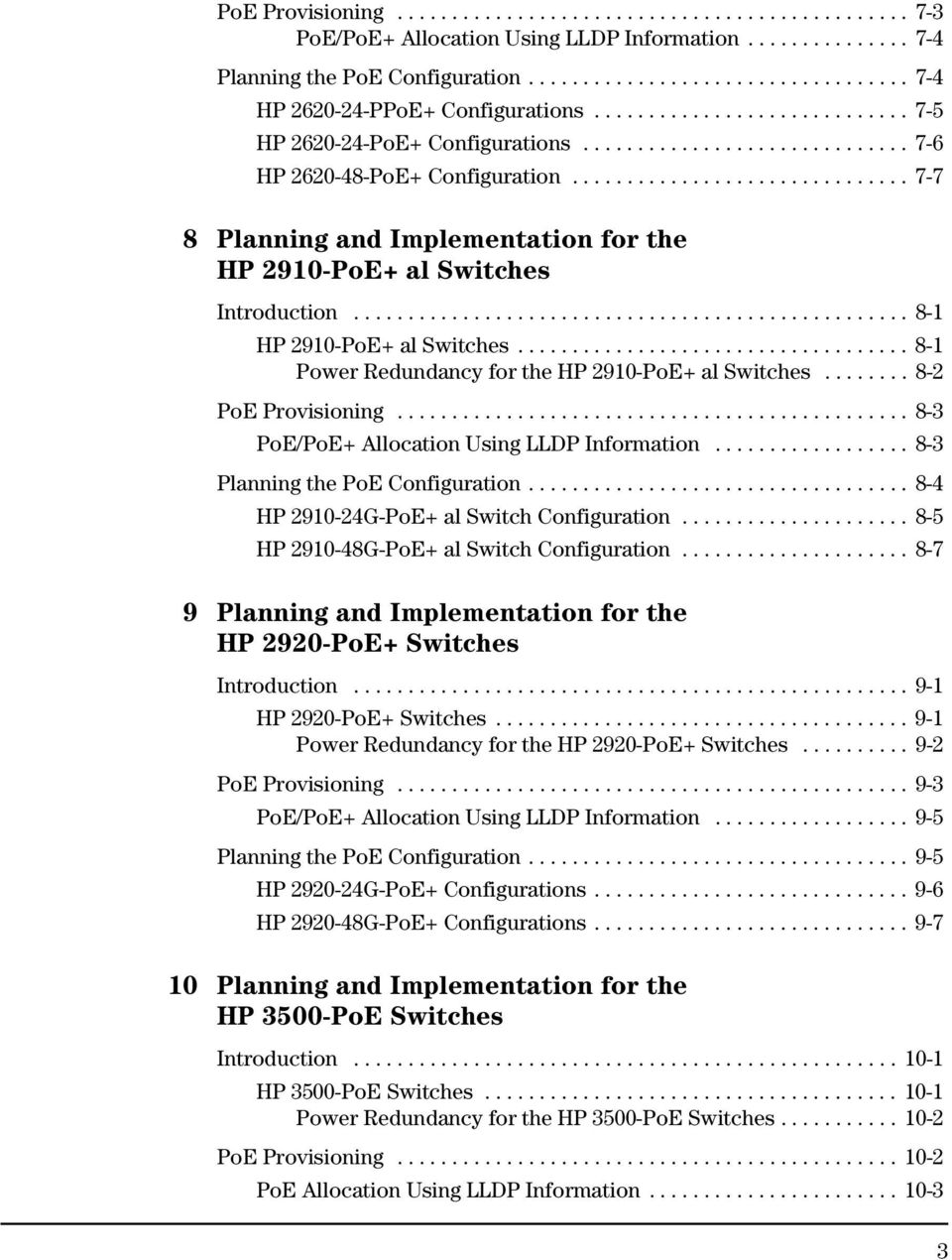
8 Planning the PoE Configuration HP PoE Switch Configuration HP PoE Switch Configuration Planning and Implementation for the HP 3500-PoE yl Switches Introduction HP 3500-PoE yl Switches Power Redundancy for the HP 3500-PoE yl Switches HP 3500-PoE+ yl Switches Power Redundancy for the HP 3500-PoE+ yl Switches PoE Provisioning HP 3500-PoE yl Switches PoE/PoE+ Allocation Using LLDP Information HP 3500-PoE+ yl Switches PoE/PoE+ Allocation Using LLDP Information Planning the PoE or PoE+ Configuration HP G-PoE yl Switch Configuration HP G-PoE yl Switch Configuration HP G-PoE+ yl Switch Configuration HP G-PoE+ yl Switch Configuration Planning and Implementation for the HP 3800-PoE+ Switches Introduction HP 3800-PoE+ Switches Power Redundancy for the HP 3800-PoE+ Switches PoE Provisioning PoE/PoE+ Allocation Using LLDP Information Planning the PoE+ Configuration HP G-PoE+-2SFP+ or HP G-PoE+-2XG Switch Configurations HP G-PoE+-4SFP+ or HP G-PoE+-4XG Switch Configurations

9 13 Planning and Implementation for the HP 5400zl/8200zl Switches Introduction HP 5400zl/8200zl Switches Power Redundancy for the HP 5400zl/8200zl Switches PoE/PoE+ Chassis Switch zl Power Supplies Why Mixing Power Supplies in chassis is NOT Supported PoE Chassis Switch Power Supplies PoE/PoE+ Chassis Switch Power Supply Configuring PoE Redundancy HP PoE and PoE+ zl Modules HP 24-Port Gig-T PoE zl Module HP 20-Port Gig-T PoE / 4-port Mini-GBIC zl Module HP 24-Port 10/100/1000 PoE+ zl Module HP 20-Port 10/100/1000 PoE+ / 4-Port Mini-GBIC zl Module HP 24-Port 10/100 PoE+ zl Module HP 24-Port Gig-T PoE+ v2 zl Module HP 20-Port Gig-T PoE+ / 4-Port SFP v2 zl Module HP 20-Port Gig-T PoE+ / 2-Port 10GbE SFP+ v2 zl Module HP 24-Port 10/100 PoE+ v2 zl Module HP 12-Port Gig-T PoE+ / 12-Port SPF v2 zl Module PoE Provisioning PoE/PoE+ Allocation Using LLDP Information PoE Power Requirements Planning the PoE Configuration Power Configuration for HP 5406zl/8206zl PoE Switches Power Configuration for HP 5406zl/8206zl PoE/PoE+ Switches Power Configuration for HP 5412zl/8212zl PoE Switches Power Configuration for HP 5412zl/8212zl PoE/PoE+ Switches Configuration Examples HP 5406zl Configurations HP 5406zl and HP 8206zl Configurations using the Power Supply Shelf Example Configuration for HP 5406zl With One PoE/PoE+ Power Supply Example Configuration for HP 8206zl with One PoE/PoE+ Power Supply Example Configuration for HP 8206zl with Two PoE/PoE+ Power Supplies

10 HP 8206zl Configurations using the Power Supply Shelf HP 5412zl/8212zl Switch Configurations Standard J8712A Configurations Standard J8713A Configurations Mixed J8712A and J8713A Configurations Using the HP 1500W PoE+ zl Power Supply (J9306A) HP 5412zl/8212zl Configurations using the Power Supply Shelf Infrastructure Requirements Air conditioning Power requirements Physical Space Racks A Planning Considerations General Considerations A-1 Specific Considerations for the HP 2910al-PoE Switches A-2 Specific Considerations for the HP 3500-PoE Switches A-2 Specific Considerations for the HP 3500yl-PWR Switches A-3 Specific Considerations for the HP 3500yl-PoE+ Switches A-4 Specific Considerations for the HP 5400zl/8200zl Switches A-4 6

11 1 Introduction This chapter provides an overview of: Power over Ethernet (PoE/PoE+). A list of reasons why you might want to implement PoE/PoE+ in your network environment. How PoE/PoE+ supplies power over twisted pair cable. The capabilities of the HP devices used to provide PoE/PoE+. Overview Power over Ethernet technology allows IP telephones, wireless LAN Access Points and other appliances to receive power as well as data over existing LAN cabling, without needing to modify the existing Ethernet infrastructure. Power over Ethernet has become a standard feature of ethernet switches, as the cost of adding power supplies to the Ethernet switches is small. IEEE 802.3af is an extension to the existing Ethernet standards. It offers the first truly international standard for power distribution (consider how many different AC power plugs exist worldwide). Almost all appliances require both data connectivity and a power supply. Just as telephones are powered from the telephone exchange through the same twisted pair that carries the voice, we can now do the same thing with Ethernet devices. The technology is bound to make a big impact in the world of embedded computing. In the realm of embedded computers, where the systems are increasingly connected to LANs and the internet, the advantages of providing power and data through a single cable should be obvious. Consider a typical application: a system for a multi-level car parking garage that includes security cameras, information signs, call-for-help telephones and vehicle sensors. Such a system is distributed over a significant area, where main power is not easily available. A single link to a PoE Ethernet Switch makes implementing this system less expensive and faster than using a non-poe switch. 1-1

12 Introduction Overview Since the original introduction of PoE, the IEEE has initiated a new project called 802.3at which is commonly referred to as PoE+. This project enhances PoE in a couple of very important ways. First, it provides up to 30W of power to a Powered Device (PD), 25.5 watts to the device and 4.5 for line loss, and allows this power to also run on cabling designed for 1000BASE-T. Secondly, it provides a new mechanism for communicating power capability and requirements using the 802.1ab Link Layer Discovery Protocol (LLDP). This protocol addition allows PoE+ switches to deliver power more efficiently and thereby provide power to more devices for a given power supply capacity. The new standard is going to be a superset of the 802.3af because it provides all the same functionality, and more. The table below shows the capabilities of 802.3af versus 802.3at. Classification Discovery Power to PD Physical Logical <25.5W 802.3at 802.3at <12.95W 802.3af 802.3at 802.3at In order for 802.3at to provide higher power, Class D (Cat5e) or better cables are required at also increases the minimum output voltage of the Power Source Equipment (PSE) from 44 volts to 50 volts. For this reason, you may note that PoE+ devices use a 54 volt power supply. Note The detection and classification functions ensure that if two PoE sources are attached together, power will not be improperly applied. 1-2

13 Introduction Overview Power over Ethernet connections to embedded computers will allow a less expensive installation (no AC cabling, lower labor costs), facilitate updating the installation and repositioning of end devices (wireless access points, security cameras, and so forth) without electricians, while maintaining full control over every node through the internet. Figure 1-1 shows a typical system implemented to power telephones and wireless access points. The PoE Ethernet switches are installed to supply power over the twisted pair LAN cables to run phones or other appliances as required. Mitel 3300 IP PBX Power Supply Shelf HP 5406zl Switch Phones Cameras HP 3500yl-48G-PWR Switch HP 3500yl-24G-PWR Switch HP 620 RPS/EPS Wireless Access Points Cameras Phones Wireless Access Points Figure 1-1. Example of a Typical PoE Implementation 1-3

14 Introduction Power Through the Cable Here are some reasons why you might want to do this: Simplifies installation and saves space - only one set of wires to bring to your appliance. Saves time and money - there is no need to pay for additional electrical power runs or to delay your installation schedule to make them. Minimal disruption to the workplace - the appliance can be easily moved, to wherever you can lay a LAN cable. Safer - no AC voltages need to be added for additional network devices. As well as the data transfer to and from the appliance, you can use SNMP network management infrastructure to monitor and control the appliances. Appliances can be shut down or reset remotely - no need for a reset button or power switch. When implementing wireless LAN systems it simplifies the radio frequency (RF) survey task, as the access point can easily be moved and wired in. Power Through the Cable A standard CAT5 Ethernet cable has four twisted pairs. Only two of these pairs are used for 10Base-T and 100Base-TX data; all four are used for 1000Base-T data. The specification allows two options for using these cables for power: The spare pairs are used. The pair on pins 4 and 5 are connected together and form the positive supply, and the pair on pins 7 and 8 are connected and form the negative supply. The data pairs are used. Since Ethernet pairs are transformer coupled at each end, it is possible to apply DC power to the center tap of the isolation transformer without upsetting the data transfer. In this mode of operation the pair on pins 1 and 2 and the pair on pins 3 and 6 can be of either polarity. The 802.3af standard does not allow both pairs (spare and data) to be used - a choice must be made. The Power Sourcing Equipment (PSE) applies power to either set of wires. HP switches, as a PSE, supply PoE power over the data pair or, pins 1 and 2, and the pair on pins 3 and 6. The Powered Device (PD) must be able to accept power from both options because mid-span equipment must (according to the specification) supply power over the spare pair or pins 4 and 5, and the pair on pins 7 and

15 Introduction PoE Capabilities of the HP Products An obvious requirement of the specification is to prevent damage to existing Ethernet equipment. A discovery process, run from the PSE, examines the Ethernet cables, looking for devices that comply with the specification. It does this by applying a small current-limited voltage to the cable and checks for the presence of a 25k ohm resistor in the remote device. Only if the resistor is present, will the full wattage be applied, but this is still current-limited to prevent damage to cables and equipment in fault conditions. Once discovered, a different voltage is applied, and based upon the current drawn, the class of device can be determined. This indicates how much power is to be drawn. The 802.3at standard provides both a physical classification and a logical classification, which is even more precise. The PD must continue to draw a minimum current. If it does not (for example, when the device is unplugged) then the PSE removes the power and the discovery process begins again. PoE Capabilities of the HP Products These switches are designed to be used primarily in wiring closets directly connected to computers, printers, and servers to provide dedicated bandwidth to those devices. Additionally, they support the IEEE 802.3af PoE standard, and the IEEE 802.3at PoE+ standard. They can supply power over a twisted-pair cable to power devices such as telephones, wireless access points, IP Gateways, and audio and video remote monitoring. The HP PoE switch devices are multi-port switches that can be used to build high-performance switched workgroup networks with PoE. These switches are store-and-forward devices that offer low latency for high-speed networking. The PoE switches are designed to support Redundant Power Supply and Power over Ethernet (PoE and/or PoE+) technologies. For a list of the products described in this manual, see For more information about the PoE/PoE+ capabilities of your switch model, see the chapter in this document that describes your switch. 1-5

16 Introduction Quick Reference Table Quick Reference Table Model/ Device Port Type PoE Port Count/ PoE watts per port 1 Stackable Switches: HP PoE 10/ watts 7.5 watts HP 2520G-8-PoE 10/100/ watts 7.5 watts HP PoE 10/ watts 7.5 watts HP 2520G-24-PoE 10/100/ watts 7.5 watts HP PoE+ 10/ watts 7.5 watts HP G-PoE+ 10/100/ watts 7.5 watts HP PoE+ 10/ watts 15.4 watts 7.5 watts HP G-PoE+ 10/100/ watts 15.4 watts 7.5 watts HP PoE+ 10/ watts 15.4 watts 7.5 watts HP G-PoE+ 10/100/ watts 15.4 watts 7.5 watts Gigabit Uplink Ports RPS/EPS Maximum Power Internal and External 2 2 N/A 67 watts available to ports 1-8 (provided by the internal source). 2 2 N/A 67 watts available to ports 1-8 (provided by the internal source). 2 2 N/A 195 watts available to ports 1-24 (provided by the internal source). 2 2 N/A 195 watts available to ports 1-24 (provided by the internal source). 2 N/A 67 watts available to ports 1-8 (provided by the external power supply) 2 N/A 67 watts available to ports 1-8 (provided by the external power supply) 2 N/A 195 watts available to ports 1-24 (provided by the internal source). 4 N/A 195 watts available to ports 1-24 (provided by the internal source). 2 N/A 382 watts available to ports 1-48 (provided by the internal source). 4 N/A 382 watts available to ports 1-48 (provided by the internal source). 1-6

17 Power Fault Locator Power Fault Locator Console Console ProCurve Switch Mdl EPS RPS Status of the Back 2910bl-24G-PoE J9146A PoE+ * Status PoE LED Mode Tmp Fan Test Reset Spd mode: off = 10 Mbps 2 flash = 100 Mbps Act on = 1 Gbps FDx 3 flash = 10 Gbps Spd * PoE Usr Clear ProCurve Switch 2910bl-48G-PoE J9148A Status Act PoE LED FDx Tmp Mode Spd Fan PoE Test Usr Reset PoE+ * Clear Auxiliary Port Link Link 1 2 Mode Mode PoE+ Integrated 10/100/1000Base-T Ports (1-24T) Ports are Auto-MDIX Mdl EPS RPS Status of the Back * Spd mode: off=10 Mbps, 2 flash=100 Mbps, on=1 Gbps, 3 flash=10 Gbps PoE+ Integrated 10/100/1000Base-T Ports (1-48T) Ports are Auto-MDIX Link 1 Mode Link 13 Mode Link 25 Mode Link 37 Mode Link 2 Mode Link 14 Mode Link 26 Mode Link 13 Mode T 23T Link Link 14 Mode Mode Dual-Personality Ports: 10/100/1000-T (T) or SFP (S) 22T 24T Link Link 21S 22S Mode Mode 23S 24S Dual-Personality Ports: 10/100/1000-T (T) or SFP (S) 45T 46T 47T 48T Link Link 45S 46S Mode Mode 47S 48S Introduction Quick Reference Table Model/ Device Port Type PoE Port Count/ PoE watts per port 1 HP PPoE 10/ watts 10.5 watts HP PoE 10/ watts Gigabit Uplink Ports RPS/EPS 4 J8168A J8169A 4 J8168A J8169A Maximum Power Internal and External 126 watts available to ports 1-12 (provided by the internal source). 408/204 3 watts available, provided by the EPS source. 406 watts available to ports 1-24 (provided by the internal source). 408/204 3 watts available, provided by the EPS source. HP PoE 10/ watts HP PoE 10/ watts 7.5 watts HP PPoE+ 10/100/ watts 15.4 watts 7.5 watts HP PoE+ 10/100/ watts HP PoE+ 10/100/ watts 4 15 watts 4 J8168A J8169A HP G-PoE+ al 10/100/ watts 4 J9146A HP G-PoE+ al 10/100/ ! Use only one (T or S) for each Port! Use only one (T or S) for each Port 30 watts 4 15 watts 406 watts available to ports 1-24 (provided by the internal source). 408/204 3 watts available to ports (provided by the EPS source). 2 2 J9565A 67 watts available to ports 1-8 (provided by the internal source). 2 N/A 126 watts internal only. 2 J9443A 382 watts available to ports 1-24 (provided by the internal source). 388 watts available as backup in case of failure, provided by the external source. 4 J9443A 382 watts available to ports 1-48 (provided by the internal source). 388 watts available as backup in case of failure, provided by the external source. 382 watts available to ports 1-24 (provided by the internal source). 4 2 J9148A 382 watts available to ports 1-48 (provided by the internal source). 1-7

18 Introduction Quick Reference Table Model/ Device Port Type PoE Port Count/ PoE watts per port 1 HP G-PoE 10/100/ watts 7.5 watts HP G-PoE+ 10/100/ ports With 575W power supply: 30 watts 15.4 watts 7.5 watts With 1050W power supply: 30 watts 15.4 watts 7.5 watts HP G-PoE+ 10/100/ With 575W power supply: 30 watts 15.4 watts 7.5 watts With 1050W power supply: 30 watts 15.4 watts 7.5 watts HP PoE 10/ watts Gigabit Uplink Ports RPS/EPS 2 2 J9562A 67 watts available to ports 1-8 (provided by the internal source). 4 2 J9805A With 575W power supply installed: 370 watts available to ports 1-24 (provided by the internal source). With 1050W power supply installed: 740W available to ports 1-24 (provided by the internal source). Up to 370 watts extra PoE available from 575W power supply installed in a connected HP 640 RPS/EPS Shelf. 5 Up to 700W extra PoE available from 1050W power supply installed in a connected HP J9805A With 575W power supply installed: 370 watts available to ports 1-48 (provided by the internal source). With 1050W power supply installed: 740W available to ports 1-48 (provided by the internal source). Up to 370 watts extra PoE available from 575W power supply installed in a connected HP 640 RPS/EPS Shelf. 5 Up to 700W extra PoE available from 1050W power supply installed in a connected HP J8696A Maximum Power Internal and External 398 watts available to ports 1-24 (provided by the internal source). 388 watts available as backup in case of failure, provided by the external source. 1-8
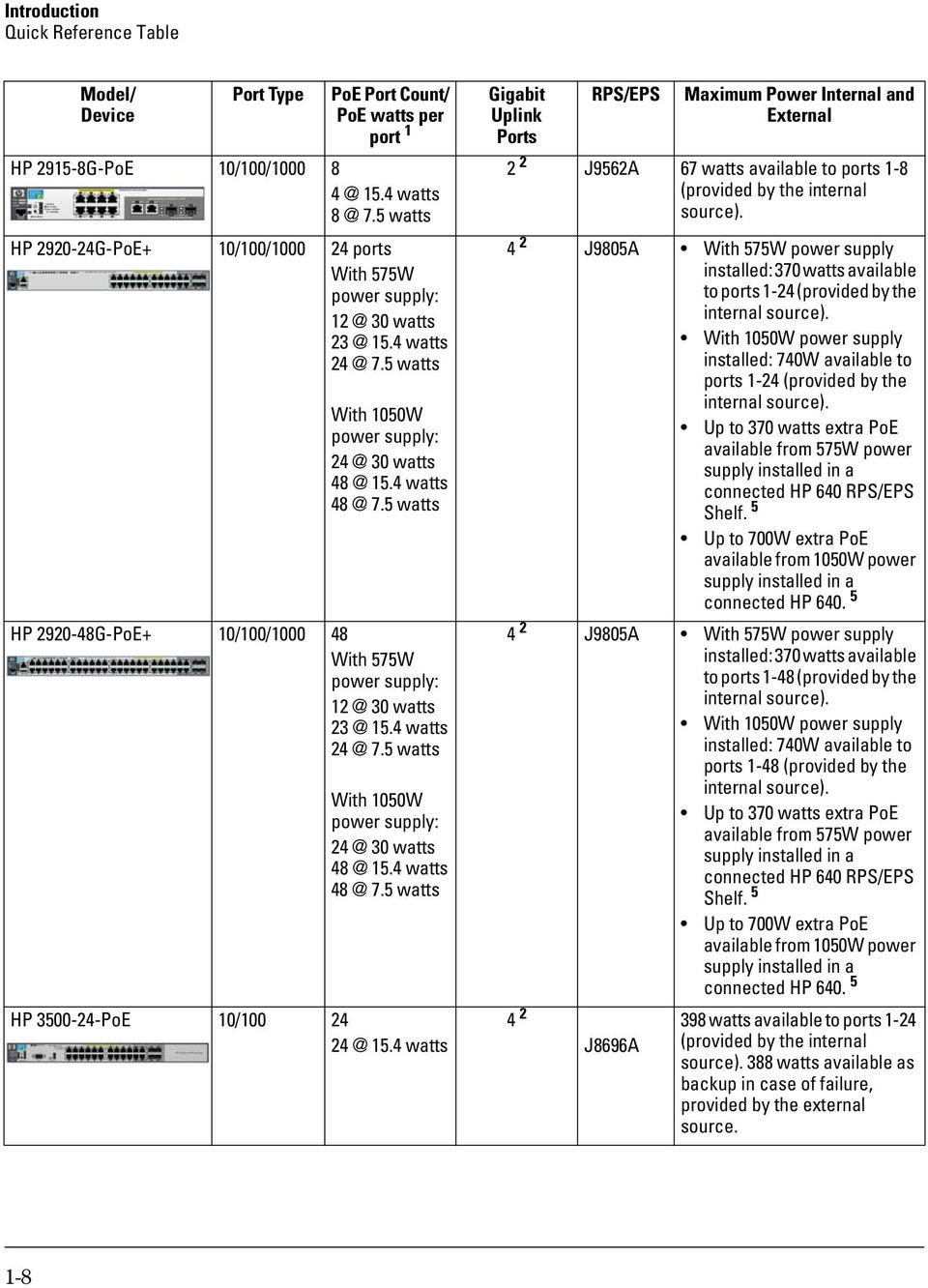
19 Introduction Quick Reference Table Model/ Device Port Type PoE Port Count/ PoE watts per port 1 HP PoE 10/ watts Gigabit Uplink Ports RPS/EPS Maximum Power Internal and External 4 2 J8696A 786 watts available to ports 1-48 (provided by both the internal and external sources). HP G-PoE yl 10/100/ watts HP G-PoE yl 10/100/ watts 7.5 watts HP G-PoE+ yl 10/100/ watts 30 watts HP G-PoE+ yl 10/100/ watts 30 watts 4 2 J8696A 398 watts available to ports 1-24 (provided by the internal source). 388 watts available as backup in case of failure, provided by the external source. 4 2 J8696A 786 watts available to ports 1-48 (provided by both the internal and external sources). 4 2 J9310A 786 watts available to ports 1-24 (provided by both the internal and external sources). 4 2 J9311A 786 watts available to ports 1-48 (provided by both the internal and external sources). HP G-PoE+-2SFP+ HP G-PoE+-2XG HP G-PoE+- 4SFP+ HP G-PoE+-4XG 10/100/ Depends on how many power supplies and on what voltage the power supply is connected to, either 110 or 220 voltage 10/100/ Depends on how many power supplies and on what voltage the power supply is connected to, either 110 or 220 voltage 2 None Up to 1080 watts of PoE/PoE+ power across all RJ-45 ports depending on the voltage the power supply is connected to, either 110 or 220 voltage 4 None Up to 1080 watts of PoE/PoE+ power across all RJ-45 ports depending on the voltage the power supply is connected to, either 110 or 220 voltage 1-9
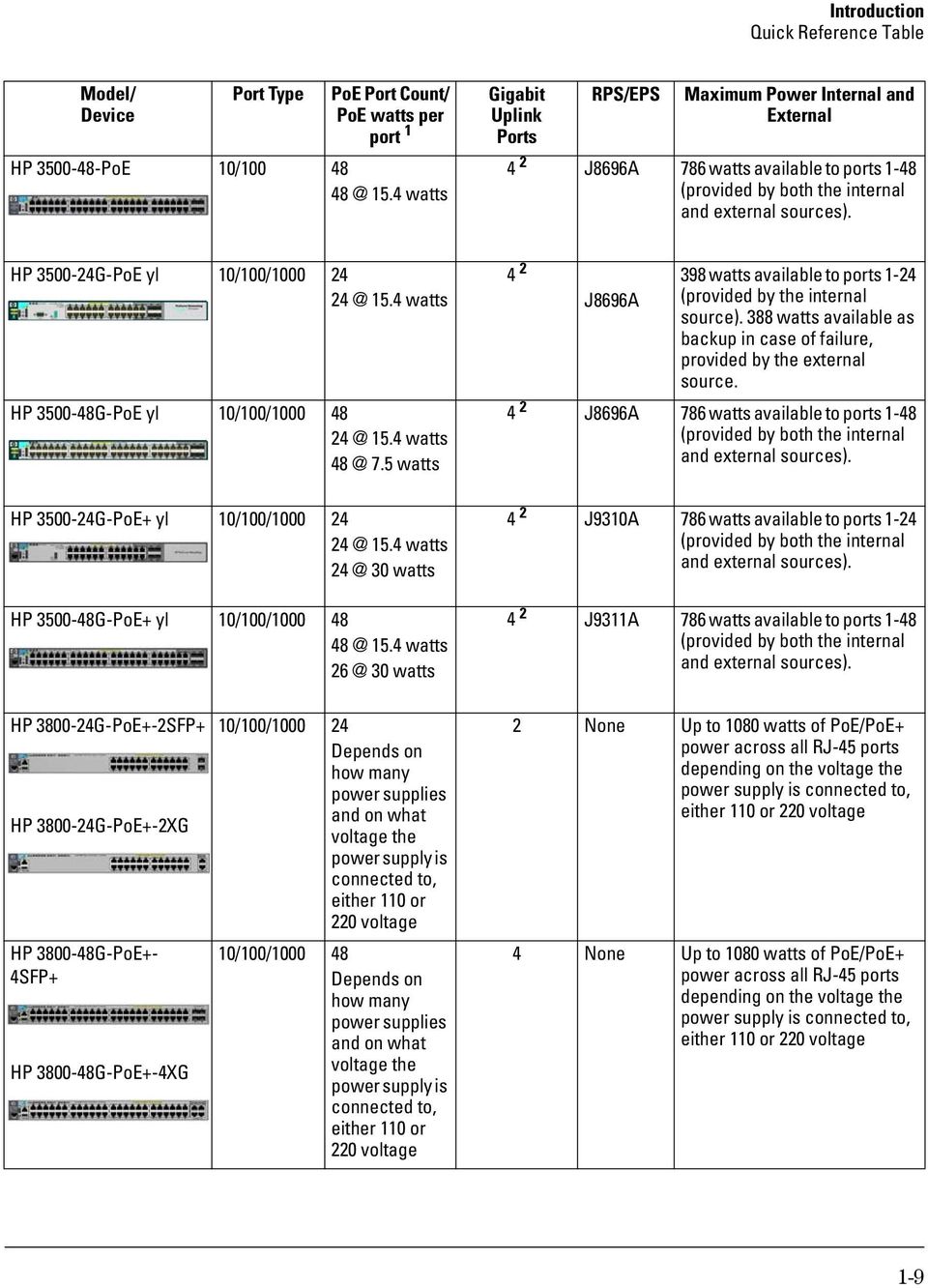
20 Introduction Quick Reference Table Model/ Device Port Type PoE Port Count/ PoE watts per port 1 Chassis Switches: HP 5406zl 10/100/1000 Depends on which modules and how many modules. Range of Gigabit Uplink Ports Depends on which modules and how many modules. Range of 4-24 RPS/EPS J8714A Maximum Power Internal and External A maximum of 2 internal power supplies up to 1800 watts and the external source can provide up to 1800 watts depending on which power supplies are installed. HP 5412zl 10/100/1000 Depends on which modules and how many modules. Range of Depends on which modules and how many modules. Range of 4-48 J8714A A maximum of 4 internal power supplies up to 3600 watts and the external source can provide up to 1800 watts depending on which power supplies are installed. HP 8206zl 10/100/1000 Depends on which modules and how many modules. Range of Depends on which modules and how many modules. Range of 4-24 J9306A A maximum of 2 internal power supplies up to 1800 watts and the external source can provide up to 1800 watts. HP 8212zl 10/100/1000 Depends on which modules and how many modules. Range of Depends on which modules and how many modules. Range of 4-48 J8714A A maximum of 4 internal power supplies up to 3600 watts and the external source can provide up to 1800 watts depending on which power supplies are installed. 1-10

21 Introduction Quick Reference Table Model/ Device Modules: 24-port Gig-T PoE zl Module (J8702A) Port Type PoE Port Count/ PoE watts per port 1 Gigabit Uplink Ports RPS/EPS Maximum Power Internal and External 10/100/ watts 0-24 Depends on voltage ( or ) 20-port Gig-T PoE / 4-port mgbic zl Module (J8705A) 10/100/ watts 0-4 Depends on voltage ( or ) 24-Port Gig-T PoE+ zl Module (J9307A) 10/100/ up to 30 watts@ v 0 J9306A Depends on voltage ( or ) and if using PoE or PoE+ 20-Port Gig-T PoE+ / 4- Port mgbic zl Module (J9308A) 10/100/ up to 30 watts@ v 0-4 J9306A Depends on voltage ( or ) and if using PoE or PoE+ 24-Port 10/100 PoE+ zl Module (J9478A) 10/ up to 30 watts@ v 0 J9306A Depends on voltage ( or ) and if using PoE or PoE+ 24-port Gig-T PoE+ v2 zl Module (J9534A) 10/100/ up to 30 watts@ v 0 J9306A Depends on voltage ( or ) and if using PoE or PoE+ 20-port Gig-T PoE+ / 4- port SFP v2 zl Module (J9535A) 10/100/ up to 30 watts@ v 0-4 J9306A Depends on voltage ( or ) and if using PoE or PoE+ 20-port Gig-T PoE+ / 2- port 10GbE SFP+ v2 zl Module (J9536A) 10/100/ up to 30 watts@ v 0-2 J9306A Depends on voltage ( or ) and if using PoE or PoE+ 1-11
22 Introduction Quick Reference Table Model/ Device 24-Port 10/100 PoE+ v2 zl Module (J9547A) Port Type PoE Port Count/ PoE watts per port 1 10/ up to 30 watts@ v Gigabit Uplink Ports RPS/EPS Maximum Power Internal and External 0-24 J9306A Depends on voltage ( or ) and if using PoE or PoE+ 12-Port Gig-T PoE+ / 12- Port SFP v2 zl Module (J9637A) 10/100/ up to v 0-24 J9306A Depends on voltage ( or ) and if using PoE or PoE+ 1 Redundant power and extra PoE power can be added by connecting a Redundant and External power supply. 2 The uplink ports on this switch are dual-personality. If the RJ-45 port is used, the SFP port is disabled. 3 The wattage available to each switch depends on the number of switches connected to the EPS. 4 An EPS is required for extra PoE+ power to get 24 ports at 30 watts or 48 ports at 15.4 watts. 5 The wattage of the power supply installed in the HP 640 RPS/EPS Shelf must be equal to or greater than the wattage of the power supply installed in the switch. 1-12
23 2 Operating Rules Introduction This chapter discusses the operating rules and characteristics of the HP networking product capabilities, switches, and external power supplies, including an overview of how PoE power is configured on these devices, and how the switches prioritize PoE provisioning to their network ports. Configuring PoE/PoE+ Power Using the CLI Allocating PoE Power by Class or User-defined Power Level The 2910al, 2920, 3500, 3500yl, 3800 and the 5400zl/8200zl switches provide maximum flexibility by allowing the switch to detect and display 802.3af or 802.3at device class, but does not enforce the power level specified in each device class. In addition to this, the switch can allocate PoE/PoE+ power according to the power level specified in each device class or a level defined by the customer. There are three methods to allocate PoE/PoE+ power: By device usage (default). The switch does not enforce the power limit. By power level specified in 802.3af or 802.3at. The device class will be detected according to the specification and power limits will be enforced. By user-defined configuration. Using the poe-value command, you can configure per port values or for a range of ports to power values of 1-17 watts for PoE switches, or 1-33 watts for the PoE+ switches. Incorrectly setting the PoE/PoE+ maximum value to be less than the connected device requires will result in a PoE/PoE+ fault. For more information, see the Management and Configuration Guide for your switch at: 2-1
24 Operating Rules Configuring PoE/PoE+ Power Using the CLI Switch Port Priority Using a port-number priority method, a lower-numbered port has priority over a higher-numbered port within the same configured priority class, for example, port A1 has priority over port A5 if both are configured with High priority. A port can be assigned a power priority that alters the assignment of power to it by the switch. For more information, see the Management and Configuration Guide for your switch at: Switch Priority Class Using a priority class method, a power priority of Low (the default), High, or Critical is assigned to each enabled PoE port. This assignment is done through the command line interface of the switch and alters the hardware port-number priority for power allocation. Low (default) - This priority class receives power only if all other priority classes are receiving power. If there is enough power to provision PDs on only some of the ports with a low priority, then power is allocated to the ports in ascending order, beginning with the lowest-numbered port in the class until all available power is in use. High - This priority class receives power only if all PDs on ports assigned with a critical priority are receiving full power. If there is not enough power to provision PDs on ports assigned with a high priority, then no power goes to the low priority ports. If there is enough power to provision PDs on only some of the high priority ports, then power is allocated to the high priority ports in ascending order, beginning with lowest-numbered high priority port, until all available power is in use. Critical - This priority class is the first to be allocated power. If there is not enough power to provision PDs on all of the ports configured for this class, then no power goes to High or Low priority ports. If there is enough power to provision PDs on only some of the critical ports, then power is allocated to the critical ports in ascending order, beginning with the lowest-numbered port in the class. For more information, see the Management and Configuration Guide for your switch at: 2-2
25 Operating Rules PoE Power Characteristics Threshold You can configure one of the following thresholds: A global power threshold that applies to all modules on the switch. This setting acts as a trigger for sending a notice when the PoE power consumption on any PoE module installed in the switch crosses the configured global threshold level. (Crossing the threshold level in either direction PoE power usage either increasing or decreasing triggers the notice.) The default setting is 80%. A per-slot power threshold that applies to an individual PoE module installed in the designated slot. This setting acts as a trigger for sending a notice when the module in the specified slot exceeds or goes below a specific level of PoE power consumption. For example if the threshold is set at 50%, the switch informs you that the switch has exceeded the threshold when 51% of available PoE power is being used. For more information, see the Management and Configuration Guide for your switch at: PoE Power Characteristics Line Loss A certain amount of power is consumed by the resistance of the wire in the LAN cable connected from the switch to the powered device (typically less than 16% loss), which can be influenced by cable length, quality, and other factors. The IEEE 802.3af specification has addressed loss of power by providing more power than a powered device requires. As well, depending upon the classification (Class 0-4) of the device, the switch will provide more or less power to address the specific power needs of that end device. PD Power Classification A PD is classified based on the maximum power it draws across all input voltages and operational modes. The most common class is 0, in which the switch will allow a maximum draw of 15.4 watts per port. As an example, 15.4 watts - Power Loss (16%) = watts. See Table
26 Operating Rules PoE Power Characteristics Table 2-1. Power Usage Class Usage Minimum Power Levels at Output of PSE Range of Maximum Power required by the PD 0 Default 15.4 watts 0.44 to watts 1 Optional 4.0 watts 0.44 to 3.84 watts 2 Optional 7.0 watts 3.84 to 6.49 watts 3 Optional 15.4 watts 6.49 to watts 4 Optional 30 watts 0.05 to watts As you can see in the table for classifications 0-3, any 802.3af compliant PD will never require more than watts. The switch provides a minimum of 15.4 watts at the port in order to guarantee enough power to run a device, after accounting for line loss. For classification 4, the switch provides 30 watts at the port in order to guarantee enough power to run a device, after accounting for line loss. PD Power Requirements When a PD is initially connected to a PoE port, a minimum of 17 watts for PoE and 33 watts for PoE+ of available power is required to begin the power-up sequence. This 17 or 33 watts is needed to determine the type of PD requesting power (see PD Power Classification on page 2-3). Once the power classification is determined and power is supplied, any power beyond the maximum power requirements for that class of PD is available for use. In the default switch configuration all PoE/PoE+ ports have a Low priority. If the switch has less than 17 W of PoE power available or 33 W for PoE+, the switch transfers power from lower-priority ports to higher-priority ports. See Switch Priority Class on page 2-2 for information on the use of PoE port priority classifications. Within each priority class, a lower numbered port is supplied power before a higher numbered port. Disconnecting a PD from a port causes the switch to stop providing power to that port and makes that power available to other ports configured for PoE operation. 2-4
27 Operating Rules Provisioning Power for PoE Provisioning Power for PoE Many of the PoE/PoE+ switches discussed in this manual support an external power supply (EPS) that can provide either redundant or extra PoE/PoE+ power. It is important to understand how PoE power is provisioned in order to use these EPSs efficiently. The following chapters will discuss this in detail for each of the products. By connecting an EPS you can optionally provision more PoE wattage per port and or supply the switch with redundant 12V power to operate should an internal power supply fail. For example, by installing a second power supply in the 5406zl/8206zl or a third power supply in a 5412zl/8212zl chassis, depending on how many PoE ports are being supplied with power, the switch can have redundant power if one power supply fails. A Power Supply Shelf (external power supply) can also be connected to the 5400zl/8200zl switches to provide extra or redundant PoE power. For example, if the 5406zl has two 24-port PoE modules (J8702A) installed, and all ports are using 15.4 watts, then the total wattage used is watts (48 x 15.4). To supply the necessary PoE wattage a J8713A power supply is installed in one of the power supply slots. To gain redundant power, a second J8713A must be installed in the second power supply slot. If the first power supply fails, then the second power supply can supply all necessary power. For information on provisioning PoE power by your switch, see the chapter in this manual for your switch model. 2-5
28 Operating Rules Provisioning Power for PoE 2-6
29 3 Planning and Implementation for the HP 2520 and HP 2520G Switches Introduction This chapter discusses the planning process you should follow to successfully implement PoE using an HP 2520 or HP 2520G Switch. See General Considerations on page A-1 for an example list of considerations during the planning phase. HP 2520-PoE Switches The HP PoE Switch (J9137A), has 8 PoE-integrated auto-sensing 10/ 100Base-TX RJ-45 ports with two dual-personality gigabit uplink ports. The HP PoE Switch (J9138A), has 24 PoE-integrated auto-sensing 10/ 100Base-TX RJ-45 ports and two 10/100/1000Base-T uplink ports, with two dual-personality gigabit uplink ports. These switches also support some pre-standard PoE devices. For a list of these devices, see the FAQs for your switch model. This feature is enabled by default. The dual-personality ports have either auto-sensing 10/100/1000Base-T RJ-45 or SFP connectivity. The dual-personality ports do not support PoE. 3-1
30 Planning and Implementation for the HP 2520 and HP 2520G Switches Introduction HP 2520G-PoE Switches The HP 2520G-8-PoE Switch (J9298A), has 8 PoE-integrated auto-sensing 10/ 100/1000Base-T RJ-45 ports with two dual-personality gigabit uplink ports. The HP 2520G-24-PoE Switch (J9299A), has 24 PoE-integrated auto-sensing 10/100/1000Base-T RJ-45 ports including four dual-personality gigabit uplink ports. These switches also support some pre-standard PoE devices. For a list of these devices, see the FAQs for your switch model. This feature is enabled by default. The dual-personality ports have either auto-sensing 10/100/1000Base-T RJ-45 or SFP connectivity. The dual-personality ports do not support PoE. 3-2
31 Planning and Implementation for the HP 2520 and HP 2520G Switches PoE Provisioning PoE Provisioning The PoE and 2520G-8-PoE Switches provision (allocate power to) ports 1-8 with 67 watts of power for PoE applications compatible with the IEEE 802.3af standard. The PoE and 2520G-24-PoE Switches provision ports 1-24 with 195 watts of power for PoE applications compatible with the IEEE 802.3af standard. Note There is no external power supply (EPS) available for these switches. Table 3-1. PoE Power Provisioning PoE Devices PoE for PoE and 2520G-8-PoE Switches PoE for PoE and 2520G-24-PoE Switches Internal Only (no EPS) 67 watts available to ports watts available to ports Planning the PoE Configuration This section assists you in building a PoE configuration. Using the following examples you can plan, build, and connect PoE devices quickly and easily. There are four configurations: HP PoE Switch with Gigabit Uplink HP PoE Switch with Gigabit Uplink HP 2520G-8-PoE Switch HP 2520G-24-PoE Switch Each example shows a complete configuration. A table shows the PoE power available to connected PoE devices. Once you have selected your specific configuration and the PoE power provided, you then add up the maximum amount of power each of your IEEE 802.3af-compliant devices require (use maximum power in watts, usually 3-3
32 Planning and Implementation for the HP 2520 and HP 2520G Switches Planning the PoE Configuration found on a product s data sheet). Adjust this total maximum power figure by adding 16% to account for possible line loss. This value must be less than the maximum power available shown in the table for your configuration. Remember these switches use a single internal power supply which provides two isolated output voltages for switch and PoE functionality. One supply voltage provides power for the switch functionality while the isolated voltage provides power for the PoE functionality. If either voltage fails, the entire power supply shuts down disconnecting all switch and PoE connections. 3-4
33 Planning and Implementation for the HP 2520 and HP 2520G Switches Planning the PoE Configuration HP PoE and 2520G-8-PoE Configurations The table in the example configuration contain entries that show the PoE power available when the HP PoE or HP 2520G-8-PoE is used to supply PoE power. 8 ports can receive up to 8 watts of PoE power 8 ports can receive up to 7.5 watts of PoE power Figure 3-1. Example of an HP PoE or HP 2520G-8-PoE Switch If any of the mini-gbic ports are used the corresponding RJ-45 port will not be supplied with PoE power. This needs to be taken into consideration when planning per-port PoE wattage. Source of Power Internal PoE Power Supply Watts Available Number of Ports Powered and Average watts/port 67 average 7.5 W each average 15.4 W each 3-5
34 Planning and Implementation for the HP 2520 and HP 2520G Switches Planning the PoE Configuration HP PoE and HP 2520G-24-PoE Configurations The table in the example configuration contain entries that show the PoE power available when the HP PoE or HP 2520G-24-PoE Switch is used to supply PoE power. HP PoE Switch 12 ports can receive up to 15.4 watts of PoE power 24 ports can receive up to 7.5 watts of PoE power HP 2520G-24-PoE Switch 12 ports can receive up to 15.4 watts of PoE power 24 ports can receive up to 7.5 watts of PoE power Figure 3-2. Example of an HP PoE or HP 2520G-24-PoE Switch If any of the mini-gbic ports are used the corresponding RJ-45 port will not be supplied with PoE power. This needs to be taken into consideration when planning per-port PoE wattage. Source of Power Internal PoE Power Supply Watts Available Number of Ports Powered and Average watts/port 195 average 15.4 W each average 7.5 W each 3-6
35 4 Planning and Implementation for the HP 2530-PoE+ Switches Introduction This chapter discusses the planning process you should follow to successfully implement PoE or PoE+ using an HP 2530-PoE+ Switch. See General Considerations page A-1, for an example list of considerations during the planning phase. HP 2530-PoE+ Switches The HP PoE+ Switch (J9780A) has 8 PoE+ integrated, auto-sensing 10/100Base-TX RJ-45 ports with two dual-personality gigabit uplink ports. The dual-personality ports do not support PoE/PoE+. The HP G-PoE+ Switch (J9774A) has 8 PoE+ integrated, autosensing 10/100/1000Base-T RJ-45 ports with two dual-personality gigabit uplink ports. The dual-personality ports do not support PoE/PoE+. The HP PoE+ Switch (J9779A) has 24 PoE+ integrated, autosensing 10/100Base-TX RJ-45 ports, two 10/100/1000Base-T RJ-45 ports, and two gigabit uplink SFP ports. The Gig-T and SFP ports do not support PoE/ PoE+. 4-1
36 Planning and Implementation for the HP 2530-PoE+ Switches Introduction The HP G-PoE+ Switch (J9773A) has 24 PoE+ integrated, autosensing 10/100/1000Base-T RJ-45 ports with four gigabit uplink SFP ports. The SFP ports do not support PoE/PoE+. The HP PoE+ Switch (J9778A) has 48 PoE+ integrated, autosensing 10/100Base-TX RJ-45 ports, two auto-sensing 10/100/1000Base-T RJ- 45 ports, and two gigabit uplink SFP ports. The Gig-T and SFP ports do not support PoE/PoE+. The HP G-PoE+ Switch (J9772A) has 48 PoE+ integrated, autosensing 10/100/1000Base-T RJ-45 ports with four gigabit uplink SFP ports. The SFP ports do not support PoE/PoE+. These switches also support some pre-standard PoE devices. For a list of these devices, see the FAQs for your switch model. This feature is disabled by default and you must enable it if you want to use it by issuing the following command from the switch CLI: HP 2530 (config)# power pre-std-detect For more configuration information, refer to the Management and Configuration Guide for your switch at Auto search on 2530, select your switch model from the list, and click Display selected. Then click on the links that have Manuals in them to get to the web page that lists the available manuals. 4-2
37 Planning and Implementation for the HP 2530-PoE+ Switches PoE Provisioning PoE Provisioning The and G PoE+ Switches provision ports 1-8 with 67 watts of power for PoE/PoE+ applications compatible with the IEEE 802.3af and IEEE 802.3at standards. The and G PoE+ Switches provision ports 1-24 with 195 watts of power for PoE/PoE+ applications compatible with the IEEE 802.3af and IEEE 802.3at standards. The and G PoE+ Switches provision ports 1-48 with 382 watts of power for PoE/PoE+ applications compatible with the IEEE 802.3af and IEEE 802.3at standards. Note There is no external power supply (EPS) available for the 2530-PoE/PoE+ Switches. Table 4-1. PoE Power Provisioning PoE Devices PoE/PoE+ for PoE+ Switch and G-PoE+ Switch PoE/PoE+ for PoE+ Switch and G-PoE+ Switch PoE/Po+ for PoE+ Switch and 2530G-48G-PoE+ Switch Internal Only (no EPS) 67 watts available to ports watts available to ports watts available to ports
38 Planning the PoE Configuration This section assists you in building a PoE or PoE+ configuration. Using the following examples you can plan, build, and connect PoE and PoE+ devices quickly and easily. There are six HP 2530 switches that provide PoE/PoE+: HP PoE+ Switch HP G-PoE+ Switch HP PoE+ Switch HP G-PoE+ Switch HP PoE+ Switch HP G-PoE+ Switch Each example shows a complete configuration. A table shows the PoE/PoE+ power available to connected PoE and PoE+ devices. Once you have selected your specific configuration and the PoE/PoE+ power provided, you then add up the maximum amount of power each of your IEEE 802.3af-compliant (PoE) and IEEE 802.3at-compliant (PoE+) devices require (use maximum power in watts, usually found on a product s data sheet). Adjust this total maximum power figure by adding 16% to account for possible line loss. This value must be less than the maximum power available shown in the table for your configuration. Remember that these switches use a single internal power supply which provides two isolated output voltages for switch and PoE functionality. One supply voltage provides power for the switch functionality while the isolated voltage provides power for the PoE functionality. If either voltage fails, the entire power supply shuts down disconnecting all switch and PoE connections.
39 Planning and Implementation for the HP 2530-PoE+ Switches Planning the PoE Configuration HP and 8G PoE+ Switch Configurations The table in the example configuration contain entries that show the PoE/ PoE+ power available when the HP PoE+ or 8G-PoE+ Switch is used to supply PoE or PoE+ power. HP 2530G-8G PoE+ Switch Any 2 of the ports can receive up to 30 Watts of PoE+ power 1 Any 4 of the ports can receive up to 15.4 Watts of PoE+ power 2 All 8 ports can receive up to 7.5 Watts of PoE power Figure 4-1. Example of an HP G-PoE+ Switch (also applies to HP PoE+ Switch) Note: PoE or PoE+ is not supplied to any of the dual-personality ports. Source of Power Internal PoE+ Power Supply Watts Available Number of Ports Powered and Average Watts/Port 67 average 30 W each average 15.4 W each average 7.5 W each 1 Any 2 of the 8 ports can be used, not just the first two ports 2 Any 4 of the 8 ports can be used, not just the first four ports 4-5
40 Planning and Implementation for the HP 2530-PoE+ Switches Planning the PoE Configuration HP and 24G PoE+ Switch Configurations The table in the example configuration contain entries that show the PoE/ PoE+ power available when the HP PoE+ or 24G-PoE+ Switch is used to supply PoE or PoE+ power. HP 2530G-24G PoE+ Switch Any 6 of the ports can receive up to 30 Watts of PoE+ power 1 Any 12 of the ports can receive up to 15.4 Watts of PoE+ power 2 All 24 ports can receive up to 7.5 Watts of PoE power Figure 4-2. Example of an HP G-PoE+ Switch (also applies to HP PoE+ Switch) Note: PoE or PoE+ is not supplied to any of the SFP ports. Source of Power Internal PoE+ Power Supply Watts Available Number of Ports Powered and Average Watts/Port 195 average 30 W each average 15.4 W each average 7.5 W each 1 Any 6 of the 24 ports can be used, not just the first six ports 2 Any 12 of the 24 ports can be used, not just the first twelve ports 4-6
41 HP G PoE+ Switch Planning and Implementation for the HP 2530-PoE+ Switches Planning the PoE Configuration HP and 48G PoE+ Switch Configurations The table in the example configuration contain entries that show the PoE/ PoE+ power available when the HP or 48G PoE+ Switch is used to supply PoE or PoE+ power. Any 12 of the ports can receive up to 30 Watts of PoE+ power 1 Any 24 of the ports can receive up to 15.4 Watts of PoE power 2 All 48 ports can receive up to 7.5 Watts of PoE power Figure 4-3. Example of an HP G-PoE+ Switch (also applies to HP PoE+ Switch) Note: PoE or PoE+ is not supplied to any of the SFP ports. Source of Power Internal PoE Power Supply Watts Available Number of Ports Powered and Average Watts/Port 382 average 30 W each average 15.4 W each average 7.5 W each 1 Any 12 of the 48 ports can be used, not just the first twelve ports 2 Any 24 of the 48 ports can be used, not just the first twenty-four ports 4-7
42 Planning and Implementation for the HP 2530-PoE+ Switches Planning the PoE Configuration 4-8
43 5 Planning and Implementation for the HP 2610-PoE Switches Introduction This chapter discusses the planning process you should follow to successfully implement PoE using HP 2610-PoE Switches. See General Considerations on page A-1 for an example list of considerations during the planning phase. HP 2610-PoE Switches The HP PoE Switch J9089A (previously called the HP ProCurve Switch PWR) has 48 PoE-integrated auto-sensing 10/100Base-TX RJ- 45 ports with four gigabit uplink ports. The HP PoE Switch J9087A (previously called the HP ProCurve Switch PWR) has 24 PoE-integrated auto-sensing 10/100Base-TX RJ- 45 ports with four gigabit uplink ports. The HP PPoE Switch J9086A (previously called the HP ProCurve Switch /12PWR) has 12 PoE-integrated auto-sensing 10/ 100Base-TX RJ-45 ports with 12 non-poe RJ-45 ports and four gigabit uplink ports. 5-1
44 Planning and Implementation for the HP 2610-PoE Switches Introduction These switches also support some pre-standard PoE devices. For a list of these devices, see the FAQs for your switch model. This feature is disabled by default and you must enable it if you want to use it by issuing the following command from the switch CLI: HP 2610 (config)# power pre-std-detect For more configuration information, refer to the Management and Configuration Guide for your switch at Auto search on 2610, select your switch model from the list, and click Display selected. Then click on the links that have Manuals in them to get to the web page that lists the available manuals. Power Redundancy for the HP 2610-PoE Switches The internal power supply in these switches provides both the 12V (RPS) and 50V (EPS) circuits. If either the 12V or 50V fails, the power supply shuts down which will bring down all switch and PoE connections. Therefore it is important to provide a redundant power supply for both the 12V and 50V circuits. Thus when you connect EPS from an HP 600 RPS/EPS (J8168A) device to one of the HP 2610-PoE Switches, you should also connect the RPS as well to provide full redundant power. The HP 2610-PoE Switches can be connected to an HP 600 RPS/EPS and receive full redundant power from the RPS part of the unit for switch operation, if the internal power supply in the switch fails. If multiple switches are connected to the RPS ports and several switches lose power at the same time, the switch attached to the lowest RPS port number receives power. The HP 600 RPS/EPS unit can provide all the power necessary to keep one switch running. EPS power from the HP 600 RPS/EPS is the PoE capability of the device. It supplies backup and additional PoE power for the ports of the HP 2610-PoE Switches. The HP 610 EPS can also be used for this purpose, to supply PoE power only. The HP 610 EPS cannot supply RPS power, it can only supply PoE power. 5-2
45 Planning and Implementation for the HP 2610-PoE Switches PoE Provisioning PoE Provisioning The PPoE Switch provisions ports 1-12 with 126 watts. The PoE Switch provisions ports 1-24 with 406 watts. The PoE Switch provisions ports 1-48 with 406 watts. This reduces the per port wattage by half as compared to the PoE Switch. These switches support PoE applications compatible with the IEEE 802.3af standard and some pre-standard devices. However, by connecting a 600 RPS/EPS or a 610 EPS, you can optionally provision ports on the PoE Switch with 408 watts of external PoE power, thereby bringing the per port wattage up to 15.4 watts per port, unless you have the other EPS port of the 600 RPS/EPS or the other port of a pair on the 610 EPS connected to a HP PoE device. In this case you cannot provision the full 408 watts to the PoE Switch only half, or 204 watts. Table 5-1. PoE Power Provisioning PoE Devices Internal Only Internal and EPS EPS Only PoE for PPoE Switch 126 watts available to ports watts available to ports 1-12 (provided by the internal source). 408/ 204* watts available, provided by the EPS source. If the switch s internal power supply has failed, the EPS provides 408/204* watts to ports PoE for PoE Switch 406 watts available to ports Redundant 408/204* watts available to ports 1-24, but only if the internal power supply fails. 408/204* watts available to ports (The EPS provides PoE power to ports 1-24 only if the internal power supply fails.) PoE for PoE Switch 406 watts available to ports watts available to ports 1-24 (provided by the internal source). 408/ 204* watts available to ports (provided by the EPS source). The internal power supply has failed, and the EPS provides 408/204* watts to ports Note that 22 watts of this power is always allocated exclusively to ports 1-24 or ) * If both EPS ports on the 600 RPS/EPS or both ports of a pair on the 610 EPS are connected to switches, each switch can receive 204 watts of power. If a single switch is connected to the EPS ports, that switch can receive 408 watts. 5-3
46 Planning and Implementation for the HP 2610-PoE Switches Planning the PoE Configuration Planning the PoE Configuration This section assists you in building a reliable and, if required, redundant PoE configuration. Using the following examples you can plan, build, and connect your PoE devices quickly and easily. Your configuration may vary however this section discusses some of the more common configurations. There are three configurations: HP PPoE Switch HP PoE Switch HP PoE Switch Each example shows a complete configuration including an optional 600 RPS/ EPS or 610 EPS unit. A table shows the PoE power available to connected PoE devices when using just the switch or when using the switch and either the 600 RPS/EPS or 610 EPS unit. The tables show the available power when the 600 RPS/EPS or 610 EPS unit is providing PoE power to connected switch devices. Once you have selected your specific configuration and the PoE power provided, you then add up the maximum amount of power each of your IEEE 802.3af-compliant devices require (use maximum power in watts, usually found on a product s data sheet). Adjust this total maximum power figure by adding 16% to account for possible line loss. This value must be less than the maximum power available shown in the table for your configuration. If you are planning to include redundant power in your configuration you need to determine which PoE devices must receive redundant PoE power, then total their power requirements as explained in the paragraph above. The maximum power figure must be less than the maximum power available when the switch is powered by the 600 RPS/EPS or the 610 EPS unit, taking into consideration the number of switches the 600 RPS/EPS or 610 EPS unit is powering. Note Full redundancy is achieved by connecting both the RPS and EPS ports of the HP 2610-PoE Switches to the corresponding ports of an HP 600 RPS/EPS. The following examples only show the EPS connections, however, remember these switches use a single internal power supply which provides two isolated output voltages for switch and PoE functionality. One supply voltage provides power for the switch functionality while the isolated voltage provides power 5-4
47 Planning and Implementation for the HP 2610-PoE Switches Planning the PoE Configuration for the PoE functionality. If either voltage fails, the entire power supply shuts down disconnecting all switch and PoE connections. Therefore it is important to provide redundancy for each isolated voltage. HP PPoE Switch Configurations The tables in the example configurations contain entries that show the PoE power available when the HP PPoE Switch is used alone. When used with the HP 600 RPS/EPS or HP 610 EPS unit, PoE power is available to the PoE ports should the internal PoE power supply fail. Table entries show the PoE power available when the HP 600 RPS/EPS or HP 610 EPS alone provides PoE power. HP 600 RPS/EPS HP /12PWR Switch Figure 5-1. Example of an HP 600 RPS/EPS Powering One HP PPoE Switch Source of Power Internal PoE Power Supply Internal plus External PoE Power Supply External PoE Power Supply (Failed Internal PoE Power Supply) Watts Available Number of Ports Powered and Average watts/port 126 average 7.5 W each average 15.4 W each Redundant Number of Ports Powered and Average watts/ Port None average 15.4 W each average 7.5 W each average 15.4 W each 408 average 7.5 W each average 15.4 W each None A single HP PPoE Switch with a dedicated HP 600 RPS/EPS unit has fully redundant PoE power for the 12 PoE ports at 7.5 W per port or 12 ports at 15.4 W per port. Only 12 ports can be PoE powered. 5-5
48 Planning and Implementation for the HP 2610-PoE Switches Planning the PoE Configuration The internal power supply can provide up to 126 W of power to be used on all 12 PoE ports. The power can be allocated up to the maximum of 12 ports, or 126 W, whichever is depleted first with a reserve of 22 W maintained by the switch for power management. If more power is needed to allow the maximum of 15.4 W on all 12 ports, an external power supply accessory is needed. Also (not shown), two HP PPoE Switches with a dedicated HP 600 RPS/EPS unit has full redundant PoE power for both switches. The HP 600 RPS/EPS supplies 408 watts to one switch and 204 watts to each switch when two switches are connected to the HP 600 RPS/EPS. HP PoE Switch Configurations The tables in the example configurations contain entries that show the PoE power available when the HP PoE Switch is used alone. When used with the HP 600 RPS/EPS or HP 610 EPS unit, PoE power is available to the PoE ports should the internal PoE power supply fail. Table entries show the PoE power available when the HP 600 RPS/EPS or HP 610 EPS alone provides PoE power. HP 600 RPS/EPS HP PoE Switch Figure 5-2. Example of an HP 600 RPS/EPS Powering One HP PoE Switch Source of Power Internal PoE Power Supply Internal plus External PoE Power Supply Watts Available Number of Ports Powered and Average watts/port 406 average 15.4 W each None Redundant Number of Ports Powered and Average watts/ Port average 15.4 W each average 15.4 W each 5-6
49 Planning and Implementation for the HP 2610-PoE Switches Planning the PoE Configuration Source of Power External PoE Power Supply (Failed Internal PoE Power Supply) Watts Available Number of Ports Powered and Average watts/port 408 average 15.4 W each None Redundant Number of Ports Powered and Average watts/ Port A single HP PoE Switch with a dedicated HP 600 RPS/EPS unit has fully redundant PoE power for all 24 ports at 15.4 W per port. HP 600 RPS/EPS HP PoE Switch Figure 5-3. Example of an HP 600 RPS/EPS Powering Two HP PoE Switches Source of Power Internal PoE Power Supply Internal plus External PoE Power Supply Watts Available Number of Ports Powered and Average watts/port 406 average 15.4 W each None Redundant Number of Ports Powered and Average watts/ Port average 15.4 W each 7.5 W each 15.4 W each 5-7
50 Planning and Implementation for the HP 2610-PoE Switches Planning the PoE Configuration Source of Power Watts Available Number of Ports Powered and Average watts/port Redundant Number of Ports Powered and Average watts/ Port External PoE Power Supply (Failed Internal PoE Power Supply) W each 15.4 W each None When two switches are connected to the HP 600 RPS/EPS ports, the PoE power available to each switch is a maximum of 204 W. If all of your PDs consume on average less than 7.5 W each (allowing for any line loss) then all 24 ports will receive redundant power should a switch s internal PoE power supply fail. Redundant power is available as long as the total power required remains below 204 W. 5-8
51 Planning and Implementation for the HP 2610-PoE Switches Planning the PoE Configuration HP PoE Switch Configurations The tables in the example configurations contain entries that show the PoE power available when the HP PoE Switch is used alone. When used with the HP 600 RPS/EPS or HP 610 EPS unit, additional PoE power is available to the PoE ports and PoE power is available should the switch s internal PoE power supply fail. Table entries show the PoE power available when the HP 600 RPS/EPS or the HP 610 EPS alone provides PoE power. In the following examples using the HP PoE Switch, reference is made to two blocks of ports: ports 1-24 and ports This applies when external PoE power is available from an HP 600 RPS/EPS or HP 610 EPS unit. In that case, the internal switch PoE power supply provides 406 watts of power to ports 1-24 and the HP 600 RPS/EPS or HP 610 EPS provides 408 watts of power to ports If you are using the HP PoE Switch with external PoE power, the number of ports with available PoE power when the switch is powered by just the HP 600 RPS/EPS or HP 610 EPS unit may be less than the number of ports powered when both the switch and the HP 600 RPS/EPS or HP 610 EPS unit are supplying power. In the default configuration the number and location of ports with redundant PoE power is determined by three factors: 1. The number of switches drawing external PoE power from the HP 600 RPS/EPS or HP 610 EPS unit: If only a single switch is using external PoE power, the HP 600 RPS/ EPS or HP 610 EPS provides 408 watts of PoE power. If two switches are using external PoE power from the HP 600 RPS/ EPS or two switches are connected to the same pair on the HP 610 EPS, a switch receives 204 watts of PoE power. Should the switch s internal PoE power supply fail, the HP 600 RPS/EPS or HP 610 EPS provides power up to the wattage stated above. 2. When the internal PoE power supply fails, the HP 600 RPS/EPS reserves a minimum of 22 watts for the less-loaded bank of ports. In the default configuration, at a minimum, the first two ports in the bank (1 and 2 or 25 and 26) will have PoE power. Note It is the ports configured with the highest priority of either bank (1-24 or 25-48) that will receive PoE power. For example, if the highest priority ports have been re-configured to be 23, 24 and 47, 48, then they will have PoE power. 3. In the default configuration PoE power priority is determined by port number, with the lowest numbered port having the highest priority. 5-9
52 If redundant PoE power is required, use the example tables to determine how much power is available to which ports. HP 600 RPS/EPS HP PoE Switch Figure 5-4. Example of an HP 600 RPS/EPS Powering One HP PoE Switch Source of Power Internal PoE Power Supply Internal plus External PoE Power Supply Watts Available Number of Ports Powered and Average watts/port 406 average 15.4 W each average 7.5 W each Redundant Number of Ports Powered and Average watts/ Port None average 15.4 W each average 15.4 W each average 7.5 W each External PoE Power Supply (Failed Internal PoE Power Supply) 408 (22 W is reserved for either ports 1-24 or 25-48) average 15.4 W each average 7.5 W each None The lowest loaded bank of ports (1-24 or 25-48) has 22 watts reserved. That power is available for use by the two highest priority ports in the bank, (in a default configuration ports 1 and 2, or 25 and 26).
53 Planning and Implementation for the HP 2610-PoE Switches Planning the PoE Configuration HP 600 RPS/EPS HP PoE Switch Figure 5-5. Example of an HP 600 RPS/EPS Powering Two HP PoE Switches Source of Power Watts Available Number of Ports Powered and Average watts/port Redundant Number of Ports Powered and Average watts/ Port Internal PoE Power Supply 406 average 15.4 W each average 7.5 W each None Internal plus External PoE Power Supply average 15.4 W each and 7.5 W each or average 15.4 W each 10 (bank 1) and 2 (bank average 15.4 W each 19 (bank 1) and 4 (bank average 7.5 W each average 4.2 W each External PoE Power Supply (Failed Internal PoE Power Supply) 204 (22 W is reserved for either ports 1-24 or 25-48) 10 (bank 1) and 2 (bank average 15.4 W each 19 (bank 1) and 4 (bank average 7.5 W each average 4.2 W each None The lowest loaded bank of ports (1-24 or 25-48) has 22 W reserved and is bank 2 in the table above. 5-11
54 Planning and Implementation for the HP 2610-PoE Switches Planning the PoE Configuration HP PoE Switches HP 610 RPS/EPS Figure 5-6. Example of an HP 610 EPS Powering Four HP PoE Switches Source of Power Internal PoE Power Supply Internal plus External PoE Power Supply External PoE Power Supply (Failed Internal PoE Power Supply) Watts Available Number of Ports Powered and Average watts/port 406 average 15.4 W each (22 W is reserved for either 1-24 or 25-48) average 7.5 W each average 15.4 W each and 7.5 W each or average 15.4 W each 10 (bank 1) and 2 (bank average 15.4 W each 19 (bank 1) and 4 (bank average 7.5 W each Redundant Number of Ports Powered and Average watts/ Port None 10 (bank 1) and 2 (bank average 15.4 W each 19 (bank 1) and 4 (bank average 7.5 W each average 4.2 W each None average 4.2 W each With all four EPS ports in use, each switch only receives 204 watts. 5-12
55 6 Planning and Implementation for the HP 2615 and HP 2915G Switches Introduction This chapter discusses the planning process you should follow to successfully implement PoE using an HP 2615 or HP 2915G Switch. See General Considerations on page A-1 for an example list of considerations during the planning phase. HP PoE Switch The HP PoE Switch (J9565A) has 8 PoE-integrated auto-sensing 10/100Base-TX RJ-45 ports with two dual-personality gigabit uplink ports. There is no power redundancy for this switch. HP G-PoE Switch The HP G-PoE Switch (J9562A) has 8 PoE-integrated auto-sensing 10/100/1000Base-T RJ-45 ports with two dual-personality gigabit uplink ports. There is no power redundancy for this switch. These switches also support some pre-standard PoE devices. For a list of these devices, see the FAQs for your switch model. This feature is enabled by default on both the HP 2615 and HP 2915 Switches. The dual-personality ports have either auto-sensing 10/100/1000Base-T RJ-45 or SFP connectivity. The dual-personality ports do not support PoE. 6-1
56 Planning and Implementation for the HP 2615 and HP 2915G Switches PoE Provisioning PoE Provisioning The PoE and G-PoE Switches provision ports 1-8 with 67 watts of power for PoE applications compatible with the IEEE 802.3af standard. Table 6-1. PoE Power Provisioning PoE Devices PoE for PoE Switch and G-PoE Switch Internal Only 67 watts available to ports 1-8. Note There is no external power supply (EPS) available for these switches. Planning the PoE Configuration This section assists you in building a PoE configuration. Using the following examples you can plan, build, and connect PoE devices quickly and easily. There are two configurations: HP PoE Switch with Gigabit Uplink HP G-PoE Switch Each example shows a complete configuration. A table shows the PoE power available to connected PoE devices. Once you have selected your specific configuration and the PoE power provided, you then add up the maximum amount of power each of your IEEE 802.3af-compliant devices require (use maximum power in watts, usually found on a product s data sheet). Adjust this total maximum power figure by adding 16% to account for possible line loss. This value must be less than the maximum power available shown in the table for your configuration. 6-2
57 Planning and Implementation for the HP 2615 and HP 2915G Switches Planning the PoE Configuration HP PoE and HP G-PoE Configurations The table in the example configuration contain entries that show the PoE power available when the HP PoE or HP G-PoE is used to supply PoE power. 8 ports can receive up to 7.5 watts of PoE power 8 ports can receive up to 7.5 watts of PoE power Figure 6-1. Example of an HP PoE or HP G-PoE Switch Note: The Dual-Personality SFP ports and the corresponding RJ-45 ports do not supply PoE power. Source of Power Internal PoE Power Supply Watts Available Number of Ports Powered and Average watts/port 67 average 7.5 W each average 15.4 W each 6-3
58 Planning and Implementation for the HP 2615 and HP 2915G Switches Planning the PoE Configuration 6-4
59 7 Planning and Implementation for the HP 2620-PoE+ Switches Introduction This chapter discusses the planning process you should follow to successfully implement PoE+ using an HP 2620 Switch. See General Considerations on page A-1 for an example list of considerations during the planning phase. HP 2620-PoE+ Switches The HP PoE+ Switch (J9627A) has 48 PoE+ integrated, autosensing 10/100/1000Base-T RJ-45 ports with four gigabit uplink ports. The HP PoE+ Switch (J9625A) has 24 PoE+ integrated, autosensing 10/100/1000Base-T RJ-45 ports with two gigabit uplink ports. The HP PPoE+ Switch (J9624A) has 24 PoE+ integrated, autosensing 10/100/1000Base-T RJ-45 ports with two gigabit uplink ports. These switches also support some pre-standard PoE devices. While HP strives to support as many non-standard devices as possible, some devices in the market are designed in ways that are restrictive, or exclusive of the IEEE standard and thus cannot be supported. For a list of these devices, see the 7-1
60 Planning and Implementation for the HP 2620-PoE+ Switches Introduction FAQs for your switch model at and click on faqs. This feature is enabled by default and you must disable it if you do not want to use it by issuing the following command via the switch CLI: HP 2620#(config) no power pre-std-detect For more configuration information, refer to the Management and Configuration Guide for your switch at Auto search on 2620, select your switch model from the list, and click Display selected. Then click on the links that have Manuals in them to get to the web page that lists the available manuals. Power Redundancy for the HP 2620-PoE+ Switches The internal power supply in these switches provides both the 12V (RPS) and 54V (EPS) circuits. If the 54V portion of the power supply fails, it will only shut down the PoE connections. However, if the 12V portion of the power supply fails, it will shut down the entire switch. Therefore it is important to provide a redundant power supply for both the 12V and 54V circuits. It is recommended that both EPS and RPS be connected to provide full redundancy. HP Redundant/External Power Supplies (RPS/EPS) can be connected to the HP 2620 Switches for redundant 12 V system power (RPS) and to provide for additional PoE+ provisioning. For RPS power, the HP 2620-PoE+ Switches can be connected to either an HP 620 RPS/EPS (J8696A) or HP 630 RPS/EPS (J9443A). For additional PoE+ EPS power, only the HP 630 can be used. The HP 620 does not provide 54 V for PoE+, only 50 V for PoE, and the HP 2620 Switches do not support connections to the HP 620 for EPS. The HP 2620 Switches provide up to 30W from each port (25.5W for PD, 4.5W for cable dissipation); the number of ports that can be operated at full power is limited to 12 ports at full power, and/or 24 ports at 15.4W. To increase the capacity of the switch, an external power supply can be attached to double the total system capacity to 24 ports at 30W, or 48 ports at 15.4W. The power supplies for these switches are optimized to provide the most efficient and cost effective solution. 7-2
61 Planning and Implementation for the HP 2620-PoE+ Switches PoE Provisioning PoE Provisioning The PPoE+ Switch can supply up to 126 watts of PoE+ power to ports 1-12 for PoE and PoE+ applications that are compatible with the IEEE 802.3af and 802.3at standards and some pre-standard devices. The PoE+ Switch can supply up to 382 watts of PoE+ power to ports 1-24 for PoE and PoE+ applications that are compatible with the IEEE 802.3af and 802.3at standards and some pre-standard devices. The PoE+ Switch can supply up to 382 watts of PoE+ power to ports 1-48 for PoE and PoE+ applications that are compatible with the IEEE 802.3af and IEEE 802.3at standards and some pre-standard devices. This reduces the average per port wattage by half as compared to the PoE+ Switch. An external power supply, the HP 630 Redundant and/or External (HP 630 RPS/EPS) power supply (J9443A) can be connected to either of the PoE+ or the PoE+ Switches to provide redundant or extra PoE+ power. The PPoE+ does not support external PoE+ power. Table 7-1. PoE Power Provisioning for the 2620-PoE+ Switches PoE Devices Internal Only Internal and External External Only PoE for PPoE+ Switch 126 watts available to ports Internal power only. Internal power only. PoE for PoE+ Switch 382 watts available to ports watts available to ports 1-24 (provided by the internal and external source). 388 watts available as backup in case of internal switch power supply failure, provided by the external source. If the switch s internal power supply has failed, 388 watts are available to ports 1-24 from the external source. PoE for PoE+ Switch 382 watts available to ports watts available to ports 1-48 (provided by the internal and external source). If the switch s internal power supply has failed, 388 watts available to ports 1-48 from the external source. 7-3
62 Planning and Implementation for the HP 2620-PoE+ Switches Planning the PoE Configuration PoE/PoE+ Allocation Using LLDP Information A PoE port can automatically configure certain PoE+ link partner devices if the device supports advertising of its PoE needs. By enabling PoE LLDP detection, available information about the power requirements of the PD may be used by the switch to configure the power allocation. The initial configuration for PoE ports may change if more accurate configuration information is provided by way of LLDP. For more configuration information, refer to the Management and Configuration Guide for your switch at Auto search on 2620, select your switch model from the list, and click Display selected. Then click on the links that have Manuals in them to get to the web page that lists the available manuals. Planning the PoE Configuration This section assists you in building a PoE+ configuration. Using the following examples you can plan, build, and connect PoE+ devices quickly and easily. There are six configurations: HP PPoE+ Switch HP PoE+ Switch HP PoE+ Switch connecting an external power supply HP PoE+ Switch HP PoE+ Switch connecting an external power supply Each example shows a complete configuration. A table shows the PoE+ power available to connected PoE+ devices when using just the switch and when connecting an external power supply. Once you have selected your specific configuration and the PoE+ power provided, you then add up the maximum amount of power each device requires (use maximum power in watts, usually found on a product s data sheet). Adjust this total maximum power figure by adding 16% to account for possible line loss. This value must be less than the maximum power available shown in the table for your configuration. 7-4
63 HP PPoE+ Configurations Planning and Implementation for the HP 2620-PoE+ Switches Planning the PoE Configuration The table in this example configuration contains entries that show the PoE+ power available for the HP PPoE+. 4 ports can receive up to 30 watts of PoE+ power Figure 7-1. Example of an HP PPoE+ Switch Source of Power Internal PoE+ Power Supply Watts Available Number of Ports Powered and Average watts/port 126 average 30W each for a total of 120 W average 15.4 W each average 7.5 W each average 4.0 W each Redundant Number of Ports Powered and Average watts/ Port None 7-5
64 Planning and Implementation for the HP 2620-PoE+ Switches Planning the PoE Configuration HP PoE+ Configurations The table in this example configuration contains entries that show the PoE+ power available for the HP PoE+ Switch. 12 ports can receive up to 30 watts of PoE+ power or 24 ports can receive up to 15.4 watts of PoE power Figure 7-2. Example of a HP PoE+ Switch Source of Power Internal PoE+ Power Supply Watts Available Number of Ports Powered and Average watts/port 364 average 30W each for a total of 360 W average 15.4 W each average 7.5 W each average 4.0 W each Redundant Number of Ports Powered and Average watts/ Port None The table in the next example configuration contains entries that show the PoE+ power available for the HP PoE+ when connecting to an external power supply. HP 2620 Switch HP 630 RPS/EPS Figure 7-3. Example of a HP PoE+ Switch connecting to an HP 630 RPS/EPS 7-6
65 Planning and Implementation for the HP 2620-PoE+ Switches Planning the PoE Configuration One HP PoE+ switch can be supported by one HP 630 RPS/EPS. This is a full redundant configuration. The switch can be supplied with power should the internal power supply fails. The HP 630 RPS/EPS can supply system power to keep the switch powered on and PoE+ power to supply the attached PoE+ devices with power. Source of Power Internal PoE+ Power Supply Internal plus External PoE+ Power Supply External PoE+ Power Supply (failed Internal PoE Power Supply) Watts Available Number of Ports Powered and Average watts/port from internal supply 364 average 30W each for a total of 360 W average 15.4 W each average 7.5 W each average 30.0 W each for a total of 720 average 15.4 W each average 7.5 W each average 30W each for a total of 360 W average 15.4 W each average 7.5 W each Redundant Number of Ports Powered and Average watts/port None average 30.0 W each for a total of 360 W average 15.4 W each average 7.5 W each None 1 The HP 630 RPS/EPS power supply is rated at 398 watts, however, 388 watts are supplied to the switch due to line loss on the EPS cable. HP PoE+ Configuration PoE+ power requirements are figured differently for the HP PoE+ Switch. The table in this example configuration contains entries that show the PoE+ power available for the HP PoE+ switch. In the default configuration PoE+ power priority is determined by port number, with the lowest numbered port (port 1) having the highest priority, and the highest numbered port (port 48) having the lowest priority. Note It is the ports configured with the highest priority of either bank (1-24 or 25-48) that will receive PoE+ power first. For example, if the highest priority ports have been re-configured to be 23, 24 and 47, 48, then they will receive PoE+ power before the lower priority ports. 7-7
66 Planning and Implementation for the HP 2620-PoE+ Switches Planning the PoE Configuration 12 ports can receive up to 30 watts of PoE+ power or All 24 ports can receive up to 15.4 watts of PoE power or 48 ports can receive up to 7.5 watts of PoE power Figure 7-4. Source of Power Internal PoE+ Power Supply Example of a HP PoE+ Switch Watts Available Number of Ports Powered and Average watts/port 364 average 30 W each average 15.4 W each average 7.5 W each average 4.0 W each Redundant Number of Ports Powered and Average watts/ Port None For example, the switch starts with 364 watts. It takes watts to fully provision 12 ports at 30 watts per port (plus 4 watts to account for load fluctuations), leaving the pool of available watts empty. Since a port requires 33 watts to power up a PoE+ device, there is not enough available power to power another device. The table in this example configuration contains entries that show the PoE+ power available for the HP PoE+ Switch when connecting to an external power supply. HP port switch HP 630 RPS/EPS Figure 7-5. Example of a HP PoE+ Switch connecting to an HP630 RPS/EPS 7-8
67 Planning and Implementation for the HP 2620-PoE+ Switches Planning the PoE Configuration Source of Power Internal PoE+ Power Supply Internal plus External PoE+ power Supply External PoE+ Power Supply (failed Internal Power Supply) Watts Available Number of Ports Powered and Average watts/port 364 average 30 W each average 15.4 W each average 7.5 W each average 4.0 W each average 30.0 W each for a total of 720 average 15.4 W each average 7.5 W each average 4.0 W each average 30W each for a total of 360 W average 15.4 W each average 7.5 W each average 4.0 W each Redundant Number of Ports Powered and Average watts/port None average 30.0 W each for a total of 360 W average 15.4 W each average 7.5 W each average 4.0 W each None 1 The HP 630 RPS/EPS power supply is rated at 398 watts, however, 388 watts are supplied to the switch due to line loss on the EPS cable. The switch can receive redundant power from the HP 630 RPS/EPS should the switch s internal power supply fail. 7-9
68 Planning and Implementation for the HP 2620-PoE+ Switches Planning the PoE Configuration 7-10
69 J9148A Status PoE Tmp Fan Test LED FDx Mode Spd PoE Reset PoE+ Act Usr J9146A PoE+ Status Act PoE LED FDx Tmp Mode Spd Fan PoE Test Reset Usr Clear Clear Mdl PoE+ Integrated 10/100/1000Base-T Ports (1-48T) Ports are Auto-MDIX Link 1 Mode Link Mode Link Mode Link Mode Link Mdl EPS EPS Mode RPS RPS Status of the Back Spd mode: off = 10 Mbps 2 flash = 100 Mbps on = 1 Gbps 3 flash = 10 Gbps Auxiliary Port Status of the Back Link Link Link Mode Mode Mode Link Mode PoE+ Integrated 10/100/1000Base-T Ports (1-24T) Ports are Auto-MDIX Link Mode 21T 23T Link Mode Dual-Personality Ports: 10/100/1000-T (T) or SFP (S) 45T 46T 47T 48T Link Link 45S 46S Mode Mode Dual-Personality Ports: 10/100/1000-T (T) or SFP (S) 22T 24T Link Link 21S 22S Mode Mode 47S 48S 23S 24S 8 Planning and Implementation for the HP 2910-PoE+ al Switches Introduction This chapter discusses the planning process you should follow to successfully implement PoE+ using an HP 2910-PoE+ al Switch. After understanding what PoE+ is and its operating rules, the next step to implementation is planning. See General Considerations on page A-1 for an example list of considerations during the planning phase. HP 2910-PoE+ al Switches The HP G-PoE+ al Switch (J9148A) has 44 PoE+ integrated, autosensing 10/100/1000Base-T RJ-45 ports with four dual-personality gigabit uplink ports. Power Fault Locator Console ProCurve Switch 2910bl-48G-PoE * * Spd mode: off=10 Mbps, 2 flash=100 Mbps, on=1 Gbps, 3 flash=10 Gbps Link 14 Mode ! Use only one (T or S) for each Port The HP G-PoE+ al Switch (J9146A) has 20 PoE+ integrated, autosensing 10/100/1000Base-T RJ-45 ports with four dual-personality gigabit uplink ports. Power Fault Locator Console ProCurve Switch 2910bl-24G-PoE * * ! Use only one (T or S) for each Port These switches also support some pre-standard PoE devices. While HP strives to support as many non-standard devices as possible, some devices in the market are designed in ways that are restrictive, or exclusive of the IEEE standard and thus cannot be supported. For a list of these devices, see the FAQs for your switch model at and click on faqs. This feature is enabled by default. It you do not want to use it, you must disable it by issuing the following command via the switch CLI: HP 2910al#(config) no power pre-std-detect 8-1
70 Planning and Implementation for the HP 2910-PoE+ al Switches Introduction For more configuration information, refer to the Management and Configuration Guide for your switch at Auto search on 2910, select your switch model from the list, and click Display selected. Then click on the links that have Manuals in them to get to the web page that lists the available manuals. Note The dual-personality ports have either auto-sensing 10/100/1000Base-T RJ-45 or SFP connectivity. The SFP ports do not support PoE. If any of the SFP ports are used, the corresponding RJ-45 port will not be supplied with PoE/PoE+ power. Power Redundancy for the HP 2910-PoE+ al Switches The internal power supply in these switches provides both the 12V (RPS) and 54V (EPS) circuits. If the 54V portion of the power supply fails, it will only shut down the PoE connections. However, if the 12V portion of the power supply fails, it will shut down the entire switch. Therefore it is important to provide a redundant power supply for both the 12V and 54V circuits. It is recommended that both EPS and RPS be connected to provide full redundancy. HP Redundant/External Power Supplies (RPS/EPS) can be connected to the HP 2910al Switches for redundant 12 V system power (RPS) and to provide for additional PoE+ provisioning. For RPS power, the HP 2910-PoE+ al Switches can be connected to either an HP 620 RPS/EPS (J8696A) or HP 630 RPS/EPS (J9443A). For additional PoE+ EPS power, only the HP 630 can be used. The HP 620 does not provide 54 V for PoE+, only 50 V for PoE, and the HP 2910-PoE+ al Switches do not support connections to the HP 620 for EPS. The HP 2910-PoE+ al Switch provides up to 30W from each port (25.5W for PD, 4.5W for cable dissipation); the number of ports that can be operated at full power is limited to 12 ports at full power, and/or 24 ports at 15.4W. To increase the capacity of the switch, an external power supply can be attached to double the total system capacity to 24 ports at 30W, or 48 ports at 15.4W. The power supplies for these switches are optimized to provide the most efficient and cost effective solution. 8-2
71 Planning and Implementation for the HP 2910-PoE+ al Switches PoE Provisioning PoE Provisioning The G-PoE+ al Switch can supply up to 382 watts of PoE+ power across ports 1-24 for PoE+ applications that are compatible with the IEEE 802.3at standard. The G-PoE+ al Switch can supply up to 382 watts of PoE+ power across ports 1-48 for PoE+ applications that are compatible with the IEEE 802.3at standard. This reduces the average per port wattage by half as compared to the 2910al-24G-PoE+ Switch. An external power supply, the HP 630 Redundant and/or External (HP 630 RPS/EPS) Power Supply (J9443A) can be connected to either of the PoE+ al Switches to provide redundant or extra PoE+ power. Table 8-1. PoE Power Provisioning for the 2910-PoE+ al Switches PoE Devices Internal Only Internal and External External Only PoE for G-PoE+ al Switch 382 watts available to ports watts available to ports 1-24 (provided by the internal and external source). 388 watts available as backup in case of failure, provided by the external source. If the switch s internal power supply has failed, 388 watts available to ports 1-24 from the external source. PoE for G-PoE+ al Switch 382 watts available to ports watts available to ports 1-48 (provided by the internal and external source). If the switch s internal power supply has failed, 388 watts available to ports 1-48 from the external source. PoE/PoE+ Allocation Using LLDP Information A PoE port can automatically configure certain PoE+ link partner devices if the device supports advertising of its PoE needs. By enabling PoE LLDP detection, available information about the power requirements of the PD may be used by the switch to configure the power allocation. The initial configuration for PoE ports may change if more accurate configuration information is provided by way of LLDP. For more configuration information, refer to the Management and Configuration Guide for your switch at Auto search on 2910, select your switch model from the list, and click Display selected. Then click on the links that have Manuals in them to get to the web page that lists the available manuals. 8-3
72 Planning and Implementation for the HP 2910-PoE+ al Switches Planning the PoE Configuration Planning the PoE Configuration This section assists you in building a PoE+ configuration. Using the following examples you can plan, build, and connect PoE+ devices quickly and easily. There are four configurations: HP G-PoE+ al Switch HP G-PoE+ al Switch connecting an external power supply HP G-PoE+ al Switch HP G-PoE+ al Switch connecting an external power supply Each example shows a complete configuration. A table shows the PoE+ power available to connected PoE+ devices when using just the switch and when connecting an external power supply. Once you have selected your specific configuration and the PoE+ power provided, you then add up the maximum amount of power each device requires (use maximum power in watts, usually found on a product s data sheet). Adjust this total maximum power figure by adding 16% to account for possible line loss. This value must be less than the maximum power available shown in the table for your configuration. 8-4
73 Planning and Implementation for the HP 2910-PoE+ al Switches Planning the PoE Configuration HP G-PoE+ al Switch Configuration The table in this example configuration contains entries that show the PoE+ power available for the HP G-PoE+ al Switch. Power Fault Locator Console ProCurve Switch Mdl EPS RPS Status of the Back 2910bl-24G-PoE J9146A PoE+ * Spd mode: off = 10 Mbps 2 flash = 100 Mbps Status Act on = 1 Gbps PoE LED FDx 3 flash = 10 Gbps Tmp Mode Spd * Fan PoE Test Usr Auxiliary Port Reset Clear Link 1 Mode Link 2 Mode PoE+ Integrated 10/100/1000Base-T Ports (1-24T) Ports are Auto-MDIX Dual-Personality Ports: 10/100/1000-T (T) or SFP (S) Link 13 Mode T 23T Link 21S Mode 23S Link 14 Mode T 24T Link 22S Mode 24S! Use only one (T or S) for each Port 12 ports can receive up to 30 watts of PoE+ power 24 ports can receive up to 15.4 watts of PoE power Figure 8-1. Example of an HP G-PoE+ al Switch Note: If any of the mini-gbic ports are used (21-24) the corresponding RJ-45 port will not be supplied with PoE+ power. Therefore that needs to be taken into consideration when planning per port PoE+ wattage. If for example, port 24 is used for a mini-gbic, then the RJ45-port 24 is disabled. Therefore the PoE+ power that was being supplied to the RJ45-port 24 is returned to the total available pool of PoE+ power. Source of Power Internal PoE+ Power Supply Watts Available Number of Ports Powered and Average watts/port 382 average 30W each for a total of 360 W average 15.4 W each average 7.5 W each average 4.0 W each Redundant Number of Ports Powered and Average watts/ Port None 8-5
74 Planning and Implementation for the HP 2910-PoE+ al Switches Planning the PoE Configuration The table in this example configuration contains entries that show the PoE+ power available for the HP 2910al-24G-PoE+ Switch when connecting to an external power supply. HP 2910al 24 port switch HP 630 RPS/EPS Figure 8-2. Example of an HP G-PoE+ al Switch connecting to an HP 630 RPS/EPS Note: The same considerations apply for the mini-gbic ports as in the previous example. One HP G-PoE al Switch can be supported by one HP 630 RPS/EPS. This is a full redundant configuration. The switch can be supplied with power should either of their internal power supplies fail. The HP 630 RPS/EPS can supply system power to keep the switch powered on and PoE+ power to supply the attached PoE+ devices with power. Source of Power Internal PoE+ Power Supply Internal plus External PoE+ Power Supply External PoE+ Power Supply (failed Internal PoE Power Supply) Watts Available Number of Ports Powered and Average watts/port from internal supply 382 average 30W each for a total of 360 W average 15.4 W each average 7.5 W each average 30.0 W each for a total of 720 average 15.4 W each average 7.5 W each average 30W each for a total of 360 W average 15.4 W each average 7.5 W each Redundant Number of Ports Powered and Average watts/port None average 30.0 W each for a total of 360 W average 15.4 W each average 7.5 W each None 1 The HP 630 RPS/EPS power supply is rated at 398 watts, however, 388 watts are supplied to the switch due to line loss on the EPS cable. 8-6
75 Planning and Implementation for the HP 2910-PoE+ al Switches Planning the PoE Configuration HP G-PoE+ al Switch Configuration PoE+ power requirements are configured differently for the HP G- PoE+ al Switch. The table in this example configuration contains entries that show the PoE+ power available for the HP G-PoE+ al Switch. In the default configuration PoE+ power priority is determined by port number, with the lowest numbered port (port 1) having the highest priority, and the highest numbered port (port 48) having the lowest priority. Note It is the ports configured with the highest priority of either bank (1-24 or 25-48) that will receive PoE+ power first. For example, if the highest priority ports have been re-configured to be 23, 24 and 47, 48, then they will receive PoE+ power before the lower priority ports. Power Fault Locator Console ProCurve Switch 2910bl-48G-PoE J9148A Status PoE Tmp Fan Test LED Mode Reset PoE+ Act FDx Spd PoE Usr * Clear Mdl EPS RPS Status of the Back * Spd mode: off=10 Mbps, 2 flash=100 Mbps, on=1 Gbps, 3 flash=10 Gbps PoE+ Integrated 10/100/1000Base-T Ports (1-48T) Ports are Auto-MDIX Link 1 Mode Link 13 Mode Link 25 Mode Link 37 Mode Link 2 Mode Link 14 Mode Link 26 Mode Link Mode Dual-Personality Ports: 10/100/1000-T (T) or SFP (S) 45T 47T Link 45S Mode 47S 46T 48T Link 46S Mode 48S! Use only one (T or S) for each Port 12 ports can receive up to 30 watts of PoE+ power or All 24 ports can receive up to 15.4 watts of PoE power or 48 ports can receive up to 7.0 watts of PoE power Figure 8-3. Example of an HP G-PoE+ al Switch Source of Power Internal PoE+ Power Supply Watts Available Number of Ports Powered and Average watts/port 382 average 30 W each average 15.4 W each average 7.5 W each average 4.0 W each Redundant Number of Ports Powered and Average watts/ Port None For example, the switch starts with 382 watts. It takes watts to fully provision 12 ports at 30 watts per port (plus 6 watts to account for load fluctuations), leaving 22 watts to be returned to the pool of available watts. Since a port requires 33 watts to power up a PoE+ device, there is not enough available power to power another device. 8-7
76 Planning and Implementation for the HP 2910-PoE+ al Switches Planning the PoE Configuration The table in this example configuration contains entries that show the PoE+ power available for the HP G-PoE+ al Switch when connecting to an external power supply. HP 2910al 48 port switch HP 630 RPS/EPS Figure 8-4. Example of an HP G-PoE+ al Switch connecting to an HP 630 RPS/EPS Source of Power Internal PoE+ Power Supply Internal plus External PoE+ power Supply External PoE+ Power Supply (failed Internal Power Supply) Watts Available Number of Ports Powered and Average watts/port 382 average 15.4 W each average 7.5 W each average 4.0 W each average 30.0 W each for a total of 720 average 15.4 W each average 7.5 W each average 4.0 W each average 30W each for a total of 360 W average 15.4 W each average 7.5 W each average 4.0 W each Redundant Number of Ports Powered and Average watts/port None average 30.0 W each for a total of 360 W average 15.4 W each average 7.5 W each average 4.0 W each None 1 The HP 630 RPS/EPS power supply is rated at 398 watts, however, 388 watts are supplied to the switch due to line loss on the EPS cable. The switch can receive redundant power from the HP 630 RPS/EPS should the switch s internal power supply fail. 8-8
77 9 Planning and Implementation for the HP 2920-PoE+ Switches Introduction This chapter discusses the planning process you should follow to successfully implement PoE or PoE+ using the HP 2920-PoE+ Switches. See General Considerations on page A-1 for an example list of considerations during the planning phase. HP 2920-PoE+ Switches The HP G-PoE+ Switch (J9729A) has 44 PoE-integrated autosensing 10/100/1000Base-T RJ-45 ports with four dual-personality gigabit uplink ports. The HP G-PoE+ Switch (J9727A) has 20 PoE-integrated autosensing 10/100/1000Base-T RJ-45 ports with four dual-personality gigabit uplink ports. These switches also support some pre-standard PoE devices. For a list of these devices, see the FAQs for your switch model. This feature is enabled by default. If you do not want to use it, you must disable it by issuing the following command via the switch CLI: HP Switch (config)# no power pre-std-detect For more configuration information, refer to the Management and Configuration Guide for your switch at Auto search on 2920, select your switch model from the list, and click Display selected. Then click on the links that have Manuals in them to get to the web page that lists the available manuals. 9-1
78 Planning and Implementation for the HP 2920-PoE+ Switches Introduction Note The dual-personality ports have either auto-sensing 10/100/1000Base-T RJ-45 or SFP+ connectivity. The SFP+ ports do not support PoE. If any of the SFP+ ports are used, the corresponding RJ-45 port will not provide PoE power to connected devices. Power Redundancy for the HP 2920-PoE+ Switches There are two optional internal power supplies in these 2920-PoE+ switches, a 575W model (J9738A) which provides up to 370W of PoE, and a 1050W model (J9737A) which provides up to 740W of PoE. Both models provide both system power to run the switch and PoE power for connected PDs. If the power supply fails, both of these functions are stopped and the switch is shut down. With the 575W power supply installed, the HP 2920 Switches provide up to 30W of PoE for up to 12 ports, or 15.4W for up to 24 ports. With the 1050W power supply installed, the HP 2920 Switches can provide 30W of PoE for up to 24 ports, or 15.4W for up to 48 ports. To increase the PoE capacity of the switch, an HP 640 RPS/EPS Shelf can be connected to the HP 2920 Switches for redundant switch system power (RPS) and to provide for additional PoE+ power (EPS). The HP 640 has three power supply bays into which you can install the same power supplies that you install into the 2920 Switches. With a 1050W power supply installed in the HP 640 RPS/EPS Shelf, an additional 700W of PoE can be provided to a connected HP 2920 Switch. You can connect an HP 2920 that has either the 575W power supply or 1050W power supply to an HP 640 bay that has a 1050W power supply. With a 575W power supply installed in the HP 640 RPS/EPS Shelf, an additional 370W of PoE can be provided to a connected HP 2920 Switch. The HP 640 RPS/ EPS Shelf design requires that the power supply installed in the 640 be equal to or greater in power than the power supply in the connected switch. Therefore, to a 640 bay that has a 575W power supply installed, you can connect only HP 2920 Switches that also have a 575W power supply installed, not switches that have the 1050W power supply. For more information on using the HP 640 RPS/EPS Shelf with you HP 2920 Switches, see the HP 640 RPS/EPS Shelf Installation and Power Setup Guide. You can locate that guide on the HP Networking web site, networking/support. Auto search on 640, click the check box for the HP 640 RPS/EPS Shelf, click Display selected, and then click on the links that include the word manuals in them to get to the web page that lists the manuals for the HP 640 RPS/EPS Shelf. 9-2
79 Planning and Implementation for the HP 2920-PoE+ Switches PoE Provisioning PoE Provisioning The 2920-PoE+ Switches have two power supply options: 575W (J9738A) and 1050W (J9737A). The G-PoE+ Switch can provide this much PoE+: With the 575W power supply installed: up to 370 watts of PoE+ power across any 23 of the 24 ports. With the 1050W power supply installed: up to 740 watts of PoE+ across all 24 ports. The G-PoE+ Switch can provide this much PoE+: With the 575W power supply installed: up to 370 watts of PoE+ across any 47 of the 48 ports With the 1050W power supply installed: up to 740W of PoE+ across all 48 ports. The G-PoE+ and G-PoE+ Switches provision (allocate power to) the switch ports as shown in Table 9-1. For the G-PoE+ Switch, for a given power supply, the average per port wattage is half as much compared to the G-PoE+ Switch. Table 9-1. PoE Power Provisioning for the 2920-PoE Switches from Internal Power Supplies PoE Devices With 575W PSU Internal Only With 1050W PSU PoE for G-PoE Switch PoE for G-PoE Switch 370 watts available to ports watts available to ports watts available to ports watts available to ports 1-48 Connecting an HP 640 RPS/EPS Shelf (J9805A) with 575W or 1050W power supplies installed provides the additional PoE+ power shown in Table 9-2 and Table
80 Table 9-2. Maximum PoE Power Available with 575W PSU in HP 640 RPS/EPS Number of ports enabled in the zone For 2920 Switch with 575W PSU and 640 RPS/EPS with 575W PSU PoE from 640 RPS/EPS PSU PoE from switch PSU Total PoE For 2920 Switch with 1050W PSU and 640 RPS/EPS with 575W PSU PoE from 640 RPS/EPS PSU PoE from switch PSU Total PoE 1 port (zones 1,2, or 3) 370W 370W 740W 0W (not supported) 740W 740W 2 ports (zones 1, 2, or 3) 3 ports (zone 1 only) 4 ports (zone 1 only) 140W 60W 0W 370W 370W 370W 510W 430W 370W The PSU in the 640 RPS/EPS must have equal to or greater power (Watts) than the PSU in the switch (see Table 3-2) 740W 740W 740W 740W 740W 740W Table 9-3. Maximum PoE Power Available with 1050W PSU in HP 640 RPS/EPS Zone Number of ports enabled in the zone For 2920 Switch with 575W PSU and 640 RPS/EPS with 1050W PSU PoE from 640 RPS/EPS PSU PoE from switch PSU Total PoE For 2920 Switch with 1050W PSU and 640 RPS/EPS with 1050W PSU PoE from 640 RPS/EPS PSU PoE from switch PSU Total PoE 1 port (zones 1,2, or 3) 2 ports (zones 1, 2, or 3) 3 ports (zone 1 only) 4 ports (zone 1 only) 700W 370W 1070W 700W 740W 1440W 370W 370W 740W 370W 740W 1110W 130W 370W 500W 130W 740W 870W 60W 370W 430W 60W 740W 800W
81 Planning and Implementation for the HP 2920-PoE+ Switches Planning the PoE Configuration PoE/PoE+ Allocation Using LLDP Information A PoE port can automatically configure certain PoE+ link partner devices if the device supports advertising of its PoE needs. By enabling PoE LLDP detection, available information about the power requirements of the PD may be used by the switch to configure the power allocation. The initial configuration for PoE ports may change if more accurate configuration information is provided by way of LLDP. For more configuration information, refer to the Management and Configuration Guide for your switch at Auto search on 2920, select your switch model from the list, and click Display selected. Then click on the links that have Manuals in them to get to the web page that lists the available manuals. Planning the PoE Configuration This section assists you in building a PoE or PoE+ configuration. Using the following examples you can plan, build, and connect PoE and PoE+ devices quickly and easily. There are two configurations: HP G-PoE+ Switch HP G-PoE+ Switch Each example shows a complete configuration. A table shows the PoE/PoE+ power available to connected PoE and PoE+ devices. Once you have selected your specific configuration and the PoE/PoE+ power provided, you then add up the maximum amount of power each of your IEEE 802.3af-compliant (PoE) and IEEE 802.3at-compliant (PoE+) devices require (use maximum power in watts, usually found on a product s data sheet). Adjust this total maximum power figure by adding 16% to account for possible line loss. This value must be less than the maximum power available shown in the table for your configuration. These switches use a single internal power supply which provides output voltages for both switch and PoE functionality. One supply voltage provides power for the switch functionality while the isolated voltage provides power for the PoE functionality. If either voltage fails, the entire power supply shuts down disconnecting all switch and PoE connections. 9-5
82 Planning and Implementation for the HP 2920-PoE+ Switches Planning the PoE Configuration HP G-PoE+ Switch Backup power (RPS) and extra PoE/PoE+ power can be provided by connecting an HP 640 RPS/EPS Shelf to the switch. The same PoE+ power supplies that you install in the HP 2920 Switches can be installed in the HP 640. For more information on the HP 640, see Table 9-2 on page 9-4 and Table 9-3 on page 9-4, and see the HP 640 RPS/EPS Shelf Installation and Power Setup Guide, which can be found on the web site support. Auto search on 640, select the 640 from the list, click on Display selected, and then click on the links that have the word manuals in them to get to the manuals web page.also see HP G-PoE+ Configurations. 575W PSU: Any 12 of the ports can receive up to 30 Watts of PoE+ power 1 575W PSU: Any 23 of the ports can receive up to 15.4 Watts of PoE+ power. 1050W PSU: Any 23 of the ports can receive up to 30 Watts of PoE+ power. See the table below 2 All 24 ports can receive up to 7.5 Watts of PoE+ power Figure 9-1. Example of an HP G-PoE+ Switch Note: PoE or PoE+ is not supplied to any of the SFP ports. Source of Power Internal 575W PoE+ Power Supply Internal 1050W PoE+ Power Supply Watts Available Number of Ports Powered and Average Watts/Port 370 average 30 W each 1 average 15.4 W each 2 average 7.5 W each 740 average 30 W each 2 average 15.4 W each average 7.5 W each 1 Any 12 of the 24 ports can be used, not just the first block of ports. 2 Any 23 of the 24 ports can be used. 9-6
83 HP G-PoE+ Configurations Planning and Implementation for the HP 2920-PoE+ Switches Planning the PoE Configuration HP G-PoE+ Switch Any 12 of the ports can receive up to 30 Watts of PoE+ power 1 575W PSU: Any 23 of the ports can receive up to 15.4 Watts of PoE+ power W PSU: Any 23 of the ports can receive up to 30 Watts of PoE+ power. See the table below W PSU: Any 47 of the ports can receive up to 7.5 Watts of PoE+ power W PSU: All 48 ports can receive up to 15.4 Watts of PoE+ power. See the table below. Figure 9-2. Example of an HP G-PoE+ Switch Note: PoE or PoE+ is not supplied to any of the SFP ports. Source of Power Internal 575W PoE+ Power Supply Internal 1050W PoE+ Power Supply Watts Available Number of Ports Powered and Average Watts/Port 370 average 30 W each 1 average 15.4 W each 2 average 7.5 W each average 30 W each 2 average 15.4 W each average 7.5 W each 1 Any 12 of the 48 ports can be used, not just the first block of ports. 2 Any 23 of the 48 ports can be used. 3 Any 47 of the 48 ports can be used. Note: Additional PoE+ can be provided by connecting either 2920 Switch to an HP 640 RPS/EPS Shelf with a PoE+ power supply installed. For more information, see the HP 640 Installation and Power Setup Guide on the web site Auto search on 640, select the HP 640 from the list, click Display selected, then click on the links that include the word manuals in them to get to the manuals web page. 9-7
84 Planning and Implementation for the HP 2920-PoE+ Switches Planning the PoE Configuration 9-8
85 10 Planning and Implementation for the HP 3500-PoE Switches Introduction This chapter discusses the planning process to follow to successfully implement PoE on an HP 3500-PoE Switch. See General Considerations on page A-1 for an example list of considerations during the planning phase. HP 3500-PoE Switches The HP PoE Switch (J9473A) has 44 PoE-integrated auto-sensing 10/100Base-TX RJ-45 ports and four dual-personality gigabit uplink ports, either RJ-45 or SFP. The HP PoE Switch (J9471A) has 20 PoE-integrated auto-sensing 10/100Base-TX RJ-45 ports with four dual-personality gigabit uplink ports, either RJ-45 or SFP. These switches also support some pre-standard PoE devices. For a list of these devices, see the FAQs for your switch model. This feature is enabled by default. If you do not want to use it, you must disable it by issuing the following command via the switch CLI: HP Switch (config)# no power pre-std-detect 10-1
86 Planning and Implementation for the HP 3500-PoE Switches PoE Provisioning For more configuration information, refer to the Management and Configuration Guide for your switch at Auto search on 3500, select your switch model from the list, and click Display selected. Then click on the links that have Manuals in them to get to the web page that lists the available manuals. Note The dual-personality ports have either auto-sensing 10/100Base-TX RJ-45 or SFP connectivity. The SFP ports do not support PoE. If any of the SFP ports are used, the corresponding RJ-45 port will not be supplied with PoE power. Power Redundancy for the HP 3500-PoE Switches The internal power supply in these switches provides both the 12V (RPS) and 50V (EPS) circuits. If the 50V portion of the power supply fails, it will only shut down the PoE connections. However, if the 12V portion of the power supply fails, it will shut down the entire switch. Therefore it is important to provide a redundant power supply for both the 12V and 50V circuits. It is recommended that both EPS and RPS be connected to provide full redundancy. The HP 3500-PoE Switches can be connected to an HP 620 RPS/EPS (J8696A) and receive full redundant power from the RPS part of the unit for switch operation if the internal power supply in the switch fails. If two switches are connected to the RPS ports and both switches lose power at the same time, they both receive redundant power. The HP 620 RPS/EPS unit can provide all the power necessary to keep two switches running. If maximum PoE power is to be used on all 48 ports, you must connect an HP 620 RPS/EPS, since the internal power supply only has enough power to supply 24 ports with maximum wattage. In this case, there is no redundancy. PoE Provisioning The PoE Switch can supply up to 398 watts of PoE power across ports 1-24 ports for PoE applications compatible with the IEEE 802.3af standard and some pre-standard devices. The PoE Switch can supply up to 398 watts of PoE power across ports 1-48 for applications compatible with the IEEE 802.3af standard and some pre-standard devices. This only allows half the per-port wattage as is available on the PoE switch. 10-2
87 Planning and Implementation for the HP 3500-PoE Switches PoE Provisioning An external power supply, the HP 620 RPS/EPS (J8696A), can be connected to either of the HP 3500-PoE switches to provide redundant or extra PoE power. The 620 RPS/EPS can be connected to up to two switches and provide 388 watts of 50V power to each switch. Table PoE Power Provisioning for the 3500-PoE Switches PoE Devices Internal Only Internal and External External Only PoE for PoE Switch PoE for PoE Switch 398 watts available to ports watts available to ports watts available to ports 1-24 (provided by the internal source). 388 watts available as backup in case of failure, provided by the external source. 786 watts available to ports 1-48 (provided by the internal source). If the internal power supply has failed, the external source provides 388 watts to ports If the internal power supply has failed, the external source provides 388 watts to ports Note that a minimum of 22 watts will always be allocated to both port groups (ports 1-24 and ports 25-48). Note There is a special power provision on the PoE switch where the switch reserves 22 watts for each bank of 24 ports, ports 1-24 and 25-48, so that neither set of ports receives the entire 398 watts. This is designed for the integrity and safety of PoE during power balancing to properly detect PDs and bring them online. PoE Allocation Using LLDP Information You can have the port automatically configure certain PoE link partner devices if the devices supports advertising of its PoE needs. By enabling PoE LLDP detection, available information about the power usage of the PD will be used by the switch to configure the power allocation. The default configuration is for PoE information to be ignored if detected through LLDP. For more configuration information, refer to the Management and Configuration Guide for your switch at Auto search on 3500, select your switch model from the list, and click Display selected. Then click on the links that have Manuals in them to get to the web page that lists the available manuals. 10-3
88 Planning and Implementation for the HP 3500-PoE Switches Planning the PoE Configuration Planning the PoE Configuration This section assists you in building a PoE configuration. Using the following examples you can plan, build, and connect PoE devices quickly and easily. There are four configurations for the HP 3500 Switches: HP PoE Switch HP PoE Switch connecting an external power supply HP PoE Switch HP PoE Switch connecting an external power supply Each example shows a complete configuration. A table below the configuration shows the PoE power available to connected PoE devices when using just the switch. Once you have selected your specific configuration and the PoE power provided, you then add up the maximum amount of power each device requires (use maximum power in watts, usually found on a product s data sheet). Adjust this total maximum power figure by adding 16% to account for possible line loss. This value must be less than the maximum power available shown in the table for your configuration. HP PoE Switch Configuration The table in this example configuration shows the PoE power available for the HP PoE Switch using the internal power supply. All 24 ports can receive up to 15.4 watts of PoE power Figure Example of an HP PoE Switch Using the Internal Power Supply 10-4
89 Planning and Implementation for the HP 3500-PoE Switches Planning the PoE Configuration If any of the mini-gbic ports are used (21-24) the corresponding RJ-45 port will not be supplied with PoE power. This needs to be taken into consideration when planning per-port PoE wattage. For example, if port 24 is used for a mini-gbic, then J45-port 24 is disabled. The PoE power that was supplied to RJ45-port 24 is returned to the total available pool of PoE power. Source of Power Internal PoE Power Supply Watts Available Number of Ports Powered and Average watts/port 398 average 15.4 W each for a total of W Redundant Number of Ports Powered and Average watts/ Port None The table in this example configuration shows the PoE power available for the HP PoE Switch when configured with an external power supply. HP port switches HP 620 RPS/EPS Figure Example of two HP PoE Switches connecting to an HP 620 External and Redundant Power Supply (J8696A) Note: The same considerations apply for the mini-gbic ports as in the previous example. Two HP PoE Switches can be supported by one HP 620 RPS/EPS. This is a full redundant configuration both of the switches can be supplied with power should either of their internal power supplies fail. The HP 620 RPS/EPS 10-5
90 Planning and Implementation for the HP 3500-PoE Switches Planning the PoE Configuration can supply system power to keep the switch powered on and PoE power to supply the attached PoE devices with power. Source of Power Internal PoE Power Supply Internal plus External PoE Power Supply External PoE Power Supply (failed Internal PoE Power Supply) Watts Available Number of Ports Powered and Average watts/port from internal supply 398 average 15.4 W each for a total of W W each for a total of W 388 average 15.4 W each for a total of W Redundant Number of Ports Powered and Average watts/port None average 15.4 W each for a total of W None HP PoE Switch Configuration PoE power requirements are determined differently for the HP PoE Switch. In the default configuration PoE power priority is determined by port number, with the lowest numbered port (port 1) having the highest priority, and the highest numbered port (port 48) having the lowest priority. Note The ports configured with the highest priority of either bank (1-24 or 25-48) receive PoE power first. For example, if the highest priority ports have been re-configured to be 23, 24 and 47, 48, then they will receive PoE power before the lower priority ports. 24 ports can receive up to 15.4 watts of PoE power or 48 ports can receive up to 7.0 watts of PoE power Figure Example of an HP PoE Switch 10-6
91 Planning and Implementation for the HP 3500-PoE Switches Planning the PoE Configuration Source of Power Internal PoE Power Supply Watts Available Number of Ports Powered and Average watts/port 398 average 15.4 W each average 7.5 W each average 4.0 W each Redundant Number of Ports Powered and Average watts/ Port None The lowest loaded bank of ports (1-24 or 25-48) has 22 watts reserved. That power is available for use by the two highest priority ports in the bank, (in a default configuration ports 1 and 2, or 25 and 26). For example, the switch starts with 398 watts. Then it reserves 22 watts per bank leaving 354 watts total for allocation. If ports 1-24 are chosen to be used then the 22 watts that was held in reserve for that bank of ports will be added back in for a total of 376 watts. It takes watts to fully provision 24 ports (plus 5 watts to account for load fluctuations), leaving 1.4 watts to be returned to the pool of available watts. This can then be added to the 22 watts held in reserve for the bank of ports 25-48, giving a total of available watts of 23.4 watts. Since a port requires 17 watts to power up a device, there is enough available power to power one more device in a port, somewhere between ports 25-48, providing 25 powered ports. You could also load balance or split the number of devices and wattage between the two banks of ports. The 398 watts would be divided in half; 199 watts would be allocated to ports 1-24, and 199 watts would be allocated to ports There could be 12 devices on the bank with ports 1-24, and 13 devices on the other bank of ports, Both of these examples use maximum device wattage. If however, devices using lower wattages are connected there could be more devices connected to the switch than shown in these examples. Each environment will be different. Configuring the CLI threshold command sets a threshold which informs you when the switch is using more than the configured percentage of PoE power. For example, if the threshold is set at 50%, the switch informs you that it has exceeded the threshold when 51% of available PoE power is being used. For more information on the threshold command, see the Management and Configuration Guide for your switch at
92 Planning and Implementation for the HP 3500-PoE Switches Planning the PoE Configuration The table in this example configuration shows the PoE power available for the HP PoE Switch. HP port switches HP 620 RPS/EPS Figure Example of two HP PoE Switches connecting to an HP 620 External and Redundant Power Supply (J8696A) Source of Power Internal PoE Power Supply Internal plus External PoE power Supply External PoE Power Supply (failed Internal Power Supply) Watts Available Number of Ports Powered and Average watts/port 398 average 15.4 W each average 7.5 W each average 4.0 W each Redundant Number of Ports Powered and Average watts/port None average 15.4 W each average 15.4 W each 388 (22 W is reserved for either ports 1-24 or 25-48) average 15.4 W each average 7.5 W each average 4.0 W each average 7.5 W each None Each of the switches can receive full redundant power from the HP 620 RPS/ EPS should one of the internal power supplies fail. The lowest loaded bank of ports (1-24 or 25-48) has 22 watts reserved. That power is available for use by the two highest priority ports in the bank, (in a default configuration ports 1 and 2, or 25 and 26). 10-8
93 11 Planning and Implementation for the HP 3500-PoE yl Switches Introduction This chapter discusses the planning process you should follow to successfully implement PoE and PoE+ using the HP 3500-PoE and PoE+ yl Switches. See General Considerations on page A-1 for an example list of considerations during the planning phase. HP 3500-PoE yl Switches The HP G-PoE yl Switch J8693A (previously called the HP ProCurve Switch 3500yl-48G-PWR) has 44 PoE-integrated auto-sensing 10/ 100/1000Base-T RJ-45 ports with four dual-personality gigabit uplink ports. The HP G-PoE yl Switch J8692A (previously called the HP ProCurve Switch 3500yl-24G-PWR) has 20 PoE-integrated auto-sensing 10/ 100/1000Base-T RJ-45 ports with four dual-personality gigabit uplink ports. These switches also support some pre-standard PoE devices. For a list of these devices, see the FAQs for your switch model. This feature is enabled by default. If you do not want to use it, you must disable it by issuing the following command via the switch CLI: HP Switch (config)# no power pre-std-detect 11-1
94 Planning and Implementation for the HP 3500-PoE yl Switches Introduction For more configuration information, refer to the Management and Configuration Guide for your switch at Auto search on 3500, select your switch model from the list, and click Display selected. Then click on the links that have Manuals in them to get to the web page that lists the available manuals. Note The dual-personality ports have either auto-sensing 10/100/1000Base-T RJ-45 or SFP connectivity. The SFP ports do not support PoE. If any of the SFP ports are used, the corresponding RJ-45 port will not be supplied with PoE power. Power Redundancy for the HP 3500-PoE yl Switches The internal power supply in these switches provides both the 12V (RPS) and 50V (EPS) circuits. If the 50V portion of the power supply fails, it will only shut down the PoE connections. However, if the 12V portion of the power supply fails, it will shut down the entire switch. Therefore it is important to provide a redundant power supply for both the 12V and 50V circuits. It is recommended that both EPS and RPS be connected to provide full redundancy. The HP 3500-PoE yl Switches can be connected to an HP 620 RPS/EPS (J8696A) and receive full redundant power from the RPS part of the unit for switch operation if the internal power supply in the switch fails. If two switches are connected to the RPS ports and both switches lose power at the same time, they both receive redundant power. The HP 620 RPS/EPS unit can provide all the power necessary to keep two switches running. If maximum PoE power is to be used on all 48 ports, it becomes necessary to connect an HP 620 RPS/EPS, since the internal power supply only has enough power to supply 24 ports with maximum wattage. In this case, there is no redundancy. HP 3500-PoE+ yl Switches The HP G-PoE+ yl Switch (J9311A) has 44 PoE-integrated autosensing 10/100/1000Base-T RJ-45 ports with four dual-personality gigabit uplink ports. 11-2
95 Planning and Implementation for the HP 3500-PoE yl Switches Introduction The HP G-PoE+ yl Switch (J9310A) has 20 PoE-integrated autosensing 10/100/1000Base-T RJ-45 ports with four dual-personality gigabit uplink ports. These switches also support some pre-standard PoE devices. For a list of these devices, see the FAQs for your switch model. This feature is enabled by default. If you do not want to use it, you must disable it by issuing the following command via the switch CLI: HP Switch (config)# no power pre-std-detect For more configuration information, refer to the Management and Configuration Guide for your switch at Auto search on 3500, select your switch model from the list, and click Display selected. Then click on the links that have Manuals in them to get to the web page that lists the available manuals. Note The dual-personality ports have either auto-sensing 10/100/1000Base-T RJ-45 or SFP connectivity. The SFP ports do not support PoE. If any of the SFP ports are used, the corresponding RJ-45 port will not be supplied with PoE power. Power Redundancy for the HP 3500-PoE+ yl Switches The internal power supply in these switches provides both the 12V (RPS) and 54V (EPS) circuits. If the 54V portion of the power supply fails, it will only shut down the PoE connections. However, if the 12V portion of the power supply fails, it will shut down the entire switch. Therefore it is important to provide a redundant power supply for both the 12V and 54V circuits. It is recommended that both EPS and RPS be connected to provide full redundancy. The HP 3500-PoE+ yl Switches can be connected to an HP 630 RPS/EPS (J9443A) and receive full redundant power from the RPS part of the unit for switch operation if the internal power supply in the switch fails. The HP 630 RPS/EPS unit can provide all the power necessary to keep only one switch running. If maximum PoE+ power is to be used on all 48 ports, it becomes necessary to connect a HP 630 RPS/EPS, since the internal power supply only has enough power to supply 24 ports with maximum wattage. In this case, there is no redundancy. 11-3
96 Planning and Implementation for the HP 3500-PoE yl Switches PoE Provisioning PoE Provisioning HP 3500-PoE yl Switches The HP G-PoE yl Switch can supply up to 398 watts of PoE power across ports 1-24 for PoE applications compatible with the IEEE 802.3af standard. The HP G-PoE yl Switch can supply up to 398 watts of PoE power across ports 1-48 for PoE applications compatible with the IEEE 802.3af standard. This reduces the average per port wattage by half as compared to the HP G-PoE yl Switch. An external power supply, the 620 RPS/EPS (J8696A) can be connected to either of the 3500-PoE yl Switches to provide redundant or extra PoE power. The 620 RPS/EPS can be connected to up to two switches and provide 388 watts of 50V power to each switch. Table PoE Power Provisioning for the 3500-PoE yl Switches PoE Devices Internal Only Internal and External External Only PoE for G- PoE yl Switch PoE for G- PoE yl Switch 398 watts available to ports watts available to ports watts available to ports 1-24 (provided by the internal source). 388 watts available as backup in case of failure, provided by the external source. 786 watts available to ports 1-48 (provided by both the internal and external sources). If the switch s internal power supply has failed, the external source provides 388 watts to ports If the switch s internal power supply has failed, the external source provides 388 watts to ports Note that a minimum of 22 watts will always be allocated to both port groups (ports 1-24 and ports 25-48). Note There is a special power provision on the G-PoE yl Switch. This 48- port switch reserves 22 watts for each bank of 24 ports, ports 1-24 and 25-48, so that neither set of ports receives the entire 398 watts. This is designed for the integrity and safety of PoE during power balancing to properly detect PDs and bring them online. 11-4
97 Planning and Implementation for the HP 3500-PoE yl Switches PoE Provisioning PoE/PoE+ Allocation Using LLDP Information You can have the port automatically configure certain PoE link partner devices if the devices supports advertising of its PoE needs. By enabling PoE LLDP detection, available information about the power usage of the PD will be used by the switch to configure the power allocation. The default configuration is for PoE information to be ignored if detected through LLDP. For more configuration information, refer to the Management and Configuration Guide for your switch at Auto search on 3500, select your switch model from the list, and click Display selected. Then click on the links that have Manuals in them to get to the web page that lists the available manuals. HP 3500-PoE+ yl Switches The HP G-PoE+ yl Switch can supply up to 398 watts of PoE power across ports 1-24 for PoE+ applications compatible with the IEEE 802.3at standard. The HP G-PoE+ yl Switch can supply up to 398 watts of PoE power across ports 1-48 for PoE+ applications compatible with the IEEE 802.3at standard. This reduces the average per port wattage by half as compared to the HP G-PoE+ yl Switch An external power supply, the HP 630 Redundant and/or External (HP 630 RPS/EPS) power supply (J9443A) can be connected to either of the 3500-PoE+ yl Switches to provide redundant or extra PoE+ power. The HP 630 RPS/EPS provides up to 388 watts of PoE+ power at 54 volts. The 630 RPS/EPS power supply is rated at 398 watts, however, 388 watts are supplied to the switch due to line loss on the EPS cable. Table PoE Power Provisioning for the 3500-PoE+ yl Switches PoE Devices Internal Only Internal and External External Only PoE for G-PoE+ yl Switch 398 watts available to ports watts available to ports 1-24 (provided by the internal and external source). 388 watts available as backup in case of failure, provided by the external source. If the switch s internal power supply has failed, 388 watts available to ports 1-24 from the external source. PoE for G-PoE+ yl Switch 398 watts available to ports watts available to ports 1-48 (provided by the internal and external source). If the switch s internal power supply has failed, 388 watts available to ports 1-48 from the external source. 11-5
98 Planning and Implementation for the HP 3500-PoE yl Switches Planning the PoE or PoE+ Configuration PoE/PoE+ Allocation Using LLDP Information A PoE port can automatically configure certain PoE+ link partner devices if the device supports advertising of its PoE needs. By enabling PoE LLDP detection, available information about the power requirements of the PD may be used by the switch to configure the power allocation. The initial configuration for PoE ports may change if more accurate configuration information is provided by way of LLDP. For more configuration information, refer to the Management and Configuration Guide for your switch at Auto search on 3500, select your switch model from the list, and click Display selected. Then click on the links that have Manuals in them to get to the web page that lists the available manuals. Planning the PoE or PoE+ Configuration This section assists you in building a PoE or PoE+ configuration. Using the following examples you can plan, build, and connect PoE or PoE+ devices quickly and easily. There are eight configurations for the HP 3500 yl Switches. Four configurations are for standard PoE and four configurations are for PoE+: HP G-PoE yl Switch HP G-PoE yl Switch connecting an external power supply HP G-PoE yl Switch HP G-PoE yl Switch connecting an external power supply HP G-PoE+ yl Switch HP G-PoE+ yl Switch connecting an external power supply HP G-PoE+ yl Switch HP G-PoE+ yl Switch connecting an external power supply Each example shows a complete configuration. A table shows the PoE or PoE+ power available to connected PoE or PoE+ devices when using just the switch or when connecting to an external power supply. Once you have selected your specific configuration and the PoE or PoE+ power provided, you then add up the maximum amount of power each device requires (use maximum power in watts, usually found on a product s data 11-6
99 Planning and Implementation for the HP 3500-PoE yl Switches Planning the PoE or PoE+ Configuration sheet). Adjust this total maximum power figure by adding 16% to account for possible line loss. This value must be less than the maximum power available shown in the table for your configuration. HP G-PoE yl Switch Configuration The table in this example configuration contains entries that show the PoE power available for the HP G-PoE yl Switch. All 24 ports can receive up to 15.4 watts of PoE power Figure Example of an HP G-PoE yl Switch Note: If any of the mini-gbic ports are used (21-24) the corresponding RJ-45 port will not be supplied with PoE power. Therefore that needs to be taken into consideration when planning per port PoE wattage. If for example, port 24 is used for a mini-gbic, then the RJ45-port 24 is disabled. Therefore the PoE power that was being supplied to the RJ45-port 24 is returned to the total available pool of PoE power. Source of Power Internal PoE Power Supply Watts Available Number of Ports Powered and Average watts/port 398 average 15.4 W each for a total of W Redundant Number of Ports Powered and Average watts/ Port None 11-7
100 Planning and Implementation for the HP 3500-PoE yl Switches Planning the PoE or PoE+ Configuration The table in this example configuration contains entries that show the PoE power available for the HP G-PoE yl Switch when connected to an external power supply. HP 3500yl 24 port switches HP 620 RPS/EPS Figure Example of two HP G-PoE yl Switches connecting to an HP 620 External and Redundant Power Supply (J8696A) The same considerations apply for the mini-gbic ports as in the previous example. Two HP G-PoE yl Switches or two HP PoE yl Switches can be supported by one HP 620 RPS/EPS. This is a full redundant configuration. Both of the switches can be supplied with power should either of their internal power supplies fail. The HP 620 RPS/EPS can supply system power to keep the switch powered on and PoE power to supply the attached PoE devices with power. Source of Power Internal PoE Power Supply Internal plus External PoE Power Supply External PoE Power Supply (failed Internal PoE Power Supply) Watts Available Number of Ports Powered and Average watts/port from internal supply 398 average 15.4 W each for a total of W average 15.4 W each and 7.5 W each or average 15.4 W each 388 average 15.4 W each for a total of W Redundant Number of Ports Powered and Average watts/port None average 15.4 W each for a total of W None 11-8
101 Planning and Implementation for the HP 3500-PoE yl Switches Planning the PoE or PoE+ Configuration HP G-PoE yl Switch Configuration PoE power requirements are figured differently for the HP G-PoE yl Switch. In the default configuration PoE power priority is determined by port number, with the lowest numbered port (port 1) having the highest priority, and the highest numbered port (port 48) having the lowest priority. Note It is the ports configured with the highest priority of either bank (1-24 or 25-48) that will receive PoE power first. For example, if the highest priority ports have been re-configured to be 23, 24 and 47, 48, then they will receive PoE power before the lower priority ports. All 25 ports can receive up to 15.4 watts of PoE power or 48 ports can receive up to 7.5 watts of PoE power Figure Example of an HP G-PoE yl Switch Source of Power Internal PoE Power Supply Watts Available Number of Ports Powered and Average watts/port 398 average 15.4 W each average 7.5 W each average 4.0 W each Redundant Number of Ports Powered and Average watts/ Port None The lowest loaded bank of ports (1-24 or 25-48) has 22 watts reserved. That power is available for use by the two highest priority ports in the bank, (in a default configuration ports 1 and 2, or 25 and 26). For example, the switch starts with 398 watts. Then it reserves 22 watts per bank leaving 354 watts total for allocation. If ports 1-24 are chosen to be used then the 22 watts that was held in reserve for that bank of ports will be added back in for a total of 376 watts. 11-9
102 Planning and Implementation for the HP 3500-PoE yl Switches Planning the PoE or PoE+ Configuration It takes watts to fully provision 24 ports (plus 5 watts to account for load fluctuations), leaving 1.4 watts to be returned to the pool of available watts. This can then be added to the 22 watts held in reserve for the bank of ports 25-48, giving a total of available watts of 23.4 watts. Since a port requires 17 watts to power up a device, there is enough available power to power one more device in a port, somewhere between 25-48, giving a total number of powered ports of 25. Another example would be to load balance or split the number of devices and wattage between the two banks of ports. In this example the total wattage of 398 would be divided in half, 199 watts would be allocated to ports 1-24, and 199 watts would be allocated to ports By load balancing in this manner there could be 12 devices on one bank of ports, say 1-24, and 13 on the other bank of ports, Both of these examples use maximum device wattage. If however, devices using lower wattages are connected there could be more devices connected to the switch than shown in these examples. Each environment will be different. There is a CLI command available, the threshold command. It has an informational only result. This command sets a threshold, by percent, to inform you the switch is now using more than a certain percentage of PoE power. For example if the threshold is set at 50%, the switch will issue an information message informing you the switch has exceeded the threshold when 51% of available PoE power is being used. For more information on the threshold command, Refer to the Management and Configuration Guide for your switch at
103 Planning and Implementation for the HP 3500-PoE yl Switches Planning the PoE or PoE+ Configuration The table in this example configuration contains entries that show the PoE power available for the HP G-PoE yl Switch. HP 3500yl 48 port Switches HP 620 RPS/EPS Figure Example of two HP G-PoE yl Switches connecting to an HP 620 External and Redundant Power Supply (J8696A) Source of Power Internal PoE Power Supply Internal plus External PoE power Supply External PoE Power Supply (failed Internal Power Supply) Watts Available Number of Ports Powered and Average watts/port 398 average 15.4 W each average 7.5 W each average 4.0 W each (22 W is reserved for either ports 1-24 or 25-48) Redundant Number of Ports Powered and Average watts/port None average 15.4 W each average 15.4 W each average 15.4 W each average 7.5 W each average 4.0 W each average 7.5 W each None Each of the two switches can receive full redundant power from the HP 620 RPS/EPS should one of the switches internal power supplies fail. The lowest loaded bank of ports (1-24 or 25-48) has 22 watts reserved. That power is available for use by the two highest priority ports in the bank, (in a default configuration ports 1 and 2, or 25 and 26)
104 HP G-PoE+ yl Switch Configuration The table in this example configuration contains entries that show the PoE+ power available for the HP G-PoE+ yl Switch. 13 ports can receive up to 30 watts of PoE+ power All 24 ports can receive up to 15.4 watts of PoE power Figure Example of an HP G-PoE+ yl Switch Note: If any of the mini-gbic ports are used (21-24) the corresponding RJ-45 port will not be supplied with PoE+ power. Therefore that needs to be taken into consideration when planning per port PoE wattage. If for example, port 24 is used for a mini-gbic, then the RJ45-port 24 is disabled. Therefore the PoE+ power that was being supplied to the RJ45-port 24 is returned to the total available pool of PoE+ power. Source of Power Internal PoE Power Supply Watts Available Number of Ports Powered and Average watts/port 398 average 30 W each for a total of 390 W. average 15.4 W each for a total of W Redundant Number of Ports Powered and Average watts/ Port None
105 Planning and Implementation for the HP 3500-PoE yl Switches Planning the PoE or PoE+ Configuration The table in this example configuration contains entries that show the PoE+ power available for the HP G-PoE+ yl Switch. HP 3500yl 24 port switch HP 630 RPS/EPS Figure Example of an HP G-PoE+ yl Switch connecting to an HP 630 External and/or Redundant Power Supply (J9443A) Note: The same considerations apply for the mini-gbic ports as in the previous example. One HP G-PoE+ yl Switch can be supported by one HP 630 RPS/EPS. This is a full redundant configuration. The switch can be supplied with power should either part of the internal power supply fail. The HP 630 RPS/EPS can supply system power to keep the switch powered on and PoE+ power to supply the attached PoE+ devices with power. Source of Power Internal PoE Power Supply Internal plus External PoE+ Power Supply 1 External PoE+ Power Supply (failed Internal PoE Power Supply) 1 Watts Available Number of Ports Powered and Average watts/port from internal supply 398 average 30 W each for a total of 360 W average 15.4 W each for a total of W average 30 W each average 15.4 W each and 7.5 W each 382 average 30 W each for a total of 360 W average 15.4 W each for a total of W Redundant Number of Ports Powered and Average watts/port None average 30 W each for a total of 360 W average 15.4 W each and 7.5 W each None 1 The HP 630 RPS/EPS power supply is rated at 398 watts, however, 382 watts are supplied to the switch due to line loss on the EPS cable
106 Planning and Implementation for the HP 3500-PoE yl Switches Planning the PoE or PoE+ Configuration HP G-PoE+ yl Switch Configuration PoE+ power requirements are calculated differently for the HP G- PoE+ yl Switch. In the default configuration PoE+ power priority is determined by port number, with the lowest numbered port (port 1) having the highest priority, and the highest numbered port (port 48) having the lowest priority. Note It is the ports configured with the highest priority of either bank (1-24 or 25-48) that will receive PoE+ power first. For example, if the highest priority ports have been re-configured to be 23, 24 and 47, 48, then they will receive PoE+ power before the lower priority ports. All 25 ports can receive up to 15.4 watts of PoE power or 48 ports can receive up to 7.5 watts of PoE power Figure Example of an HP G-PoE+ yl Switch Source of Power Internal PoE Power Supply Watts Available Number of Ports Powered and Average watts/port 398 average 30 W each average 15.4 W each average 7.5 W each average 4.0 W each Redundant Number of Ports Powered and Average watts/ Port None The lowest loaded bank of ports (1-24 or 25-48) has 22 watts reserved. That power is available for use by the two highest priority ports in the bank, (in a default configuration ports 1 and 2, or 25 and 26). For example, the switch starts with 398 watts. Then it reserves 22 watts per bank leaving 354 watts total for allocation. If ports 1-24 are chosen to be used then the 22 watts that was held in reserve for that bank of ports will be added back in for a total of 376 watts
107 Planning and Implementation for the HP 3500-PoE yl Switches Planning the PoE or PoE+ Configuration It takes 330 watts to fully provision 11 ports (plus 5 watts to account for load fluctuations), leaving 19 watts to be returned to the pool of available watts. This can then be added to the 22 watts held in reserve for the bank of ports 25-48, giving a total of available watts of 41 watts. Since a port requires 33 watts to power up a PoE+ device, there is not enough available power to power another device. Another example would be to load balance or split the number of devices and wattage between the two banks of ports. In this example the total wattage of 398 would be divided in half, 199 watts would be allocated to ports 1-24, and 199 watts would be allocated to ports By load balancing in this manner there could be 6 devices on one bank of ports, say 1-24, and 6 on the other bank of ports, Both of these examples use maximum device wattage. If however, devices using lower wattages are connected there could be more devices connected to the switch than shown in these examples. Each environment will be different. There is a CLI command available, the threshold command. It has an informational only result. This command sets a threshold, by percent, to inform you the switch is now using more than a certain percentage of PoE power. For example if the threshold is set at 50%, the switch will issue an information message informing you the switch has exceeded the threshold when 51% of available PoE power is being used.for more information on the threshold command, Refer to the Management and Configuration Guide for your switch at
108 Planning and Implementation for the HP 3500-PoE yl Switches Planning the PoE or PoE+ Configuration The table in this example configuration contains entries that show the PoE+ power available for the HP G-PoE+ yl Switch. HP 3500yl 24 port switch HP 630 RPS/EPS Figure Example of an HP G-PoE+ yl Switch connecting to an HP 630 External and/or Redundant Power Supply (J9443A) Source of Power Internal PoE Power Supply Internal plus External PoE+ power Supply 1 External PoE+ Power Supply (failed Internal Power Supply) 1 Watts Available Number of Ports Powered and Average watts/port 398 average 30 W each average 15.4 W each average 7.5 W each average 4.0 W each (22 W is reserved for either ports 1-24 or 25-48) average 30 W each average 15.4 W each average 30 W each average 15.4 W each average 7.5 W each average 4.0 W each Redundant Number of Ports Powered and Average watts/port None average 30 W each average 15.4 W each average 7.5 W each None 1 The HP 630 RPS/EPS power supply is rated at 398 watts, however, 382 watts are supplied to the switch due to line loss on the EPS cable. The switch can be supplied with power should either part of the internal power supply fail. The HP 630 RPS/EPS can supply system power to keep the switch powered on and PoE+ power to supply the attached PoE+ devices with power The lowest loaded bank of ports (1-24 or 25-48) has 22 watts reserved. That power is available for use by the two highest priority ports in the bank, (in a default configuration ports 1 and 2, or 25 and 26)
109 12 Planning and Implementation for the HP 3800-PoE+ Switches Introduction This chapter discusses the planning process you should follow to successfully implement PoE and PoE+ using a HP 3800-PoE+ Switch. See General Considerations on page A-1 for an example list of considerations during the planning phase. Notes In the stacked environment, the PoE/PoE+ will still be managed at the member level. This means that power available to one member cannot be shared with other members. The PoE features will have to be configured member-by-member. By default, LLDP on each switch is enabled. PoE+ (802.3at) Powered Devices (PD) that only support 2-event class signature may not be able to negotiate for additional power when connected to the switch. In such cases, the LLDP option on the switch port must be disabled to enable the 2-event classification so that such PoE+ PDs may be detected. For information on CLI commands to configure a HP 3800 Switch stack, and to disable LLDP, see the Management and Configuration Guide for your switch. Go to Auto search on your switch model, for example Click on your switch model in the displayed list and click on Display selected. Then click on the links that have Manuals in them to get to the web page that displays the available manuals. 12-1
110 Planning and Implementation for the HP 3800-PoE+ Switches Introduction HP 3800-PoE+ Switches The HP G-PoE+-4SFP+ Switch (J9574A), has 48 PoE+ integrated, auto-sensing 10/100/1000Base-T RJ-45 ports with four SFP+ uplink ports for installing HP transceivers. The HP G-PoE+-2SFP+ Switch (J9573A), has 24 PoE+ integrated, auto-sensing 10/100/1000Base-T RJ-45 ports and two SFP+ uplink ports for installing HP transceivers. The HP G-PoE+-4XG Switch (J9588A), has 48 PoE+ integrated, auto-sensing 10/100/1000Base-T RJ-45 ports with four XG uplink ports. The HP G-PoE+-2XG Switch (J9587A), has 24 PoE+ integrated, auto-sensing 10/100/1000Base-T RJ-45 ports and two XG uplink ports. These switches also support some pre-standard PoE devices. For a list of these devices, see the FAQs for your switch model. This feature is disabled by default and you must enable it if you want to use it by issuing the following command from the switch CLI: HP 3800 (config)# power pre-std-detect For more configuration information, refer to the Management and Configuration Guide for your switch at Auto search on 3800, select your switch model from the list, and click Display selected. Then click on the links that have Manuals in them to get to the web page that lists the available manuals. 12-2
111 Planning and Implementation for the HP 3800-PoE+ Switches PoE Provisioning Power Redundancy for the HP 3800-PoE+ Switches The internal power supply in these switches provides both the 12V (RPS) and 54V (EPS) circuits. If the 54V portion of the power supply fails, it will only shut down the PoE connections. However, if the 12V portion of the power supply fails, it will shut down the entire switch. Therefore it is important to provide a redundant power supply for both the 12V and 54V circuits. The HP 3800-PoE+ Switches can have a second power supply installed and can support full redundant power should the primary power supply fail. The second power supply can provide all the power necessary to keep the switch running. If maximum PoE+ power is to be used on all 48 ports, it becomes necessary to install a second power supply, since a single power supply only has enough power to supply 24 ports with maximum wattage. In this case, there is no redundancy. For detailed information on the power supplies see the HP 3800 Switches Installation and Getting Started Guide at support. Auto search on 3800, select your switch model from the list, and click Display selected. Then click on the links that have Manuals in them to get to the web page that lists the available manuals. PoE Provisioning The HP G-PoE+-2SFP+ Switch, HP G-PoE+-2XG Switch, HP G-PoE+-4SFP+ Switch, and HP G-PoE+-4XG Switch have 24 or 48 ports respectively and depending on how many power supplies are installed and to what voltage the power supply is connected to, either 110 or 220 volts, can supply up to 1080 watts of PoE+ power across all RJ-45 ports for PoE+ applications compatible with the IEEE 802.3at standard. If the power supply is connected to 110 volts, then the power supply will supply 700 watts to the switch. if the power supply is connected to 220 volts, then the power supply will supply 1000 watts to the switch. For detailed information on the power supplies, see the HP 3800 Switches Installation and Getting Started Guide at Auto search on 3800, select your switch model from the list, and click Display selected. Then click on the links that have Manuals in them to get to the web page that lists the available manuals. 12-3
112 Planning and Implementation for the HP 3800-PoE+ Switches PoE Provisioning Table PoE Power Provisioning for the 3800-PoE+ Switches PoE Devices One power supply Two power supplies PoE for the G-PoE+-2SFP+ and G-PoE+-2XG Switches PoE for the G-PoE+-4SFP+ and G-PoE+-4XG Switches When connected to 110 volts, 573 watts available to ports 1-24 with 127 watts being used by the system. When connected to 220 volts there is 873 watts available for PoE+. When connected to 110 volts, 573 watts available to ports 1-48 with 127 watts being used by the system. When connected to 220 volts, 815 watts available to ports 1-48 with 185W being used by the system. When connected to 110 volts, 1080 watts available to ports 1-24 with 127 watts being used from the first power supply by the system. When connected to 220 volts, 1080 watts available to ports 1-24 for PoE+. When connected to 110 volts, 1080 watts available to ports 1-48 with 127 watts being used from the first power supply by the system. When connected to 220 volts, 1080 watts available to ports 1-48 with 185 watts being used by the system. PoE/PoE+ Allocation Using LLDP Information Note A PoE port can automatically configure certain PoE+ link partner devices if the device supports advertising of its PoE needs. By enabling PoE LLDP detection, available information about the power requirements of the PD may be used by the switch to configure the power allocation. The initial configuration for PoE ports may change if more accurate configuration information is provided by way of LLDP. By default, LLDP on each switch is enabled. PoE+ (802.3at) Powered Devices (PD) that only support 2-event class signature may not be able to negotiate for additional power when connected to the switch. In such cases, the LLDP option on the switch port must be disabled to enable the 2-event classification so that such PoE+ PDs may be detected. For information on CLI commands to disable LLDP, see the Management and Configuration Guide for your switch at Auto search on 3800, select your switch model from the list, and click Display selected. Then click on the links that have Manuals in them to get to the web page that lists the available manuals. 12-4
113 Planning and Implementation for the HP 3800-PoE+ Switches Planning the PoE+ Configuration Planning the PoE+ Configuration This section assists you in building a PoE+ configuration. Using the following examples you can plan, build, and connect PoE or PoE+ devices quickly and easily. There are four configurations for HP 3800-PoE+ Switches: HP G-PoE+-2SFP+ Switch, or HP G-PoE+-2XG Switch, with one power supply HP G-PoE+-2SFP+ Switch, or HP G-PoE+-2XG Switch, with two power supplies HP G-PoE+-4SFP+ Switch, or HP G-PoE+-4XG Switch, with one power supply HP G-PoE+-4SFP+ Switch, or HP G-PoE+-4XG Switch, with two power supplies Each example shows a complete configuration. A table shows the PoE or PoE+ power available to connected PoE or PoE+ devices when using one or two power supplies in the switch. Only the 1000 watt power supply can be used for PoE/PoE+ applications. The power supplied by the power supply depends upon what voltage is applied to it and into which switch the power supply is installed. When supplied with 110 V, the power supply runs at a max of 700 W: When the power supply is installed in the HP G-PoE+-2SFP+ or HP G-PoE+-2XG Switch, 127 W is reserved for system operation leaving 573 W for PoE/PoE+ operation. When a second power supply is installed the total amount of wattage can be allocated for PoE/PoE+ operation. In this case, with the combined 700W and 573W supplied, up to 1080 W for PoE/PoE+ operation is available. When installed in the HP G-PoE+-4SFP+ or HP G- PoE+-4XG Switch, 185 W is reserved for system operation leaving 515 W for PoE/PoE+ operation. When a second power supply is installed the total amount of wattage can be allocated for PoE/PoE+ operation up to 1080 watts. Limiting the total number of PoE+ ports to 36. When supplied with 220 V, the power supply runs at a max of 1000 W: When the power supply is installed in the HP G-PoE+-2SFP+ or HP G-PoE+-2XG Switch, 127 W is reserved for system operation leaving 873 W for PoE/PoE+ operation. When a second power supply is installed the total amount of wattage can be allocated for PoE/PoE+ operation up to 1080 watts. 12-5
114 Planning and Implementation for the HP 3800-PoE+ Switches Planning the PoE+ Configuration When installed in the HP G-PoE+-4SFP+ or HP G- PoE+-4XG Switch, 185 W is reserved for system operation leaving 815 W for PoE/PoE+ operation. When a second power supply is installed the total amount of wattage can be allocated for PoE/PoE+ operation up to 1080 watts. Limiting the total number of PoE+ ports to 36. Once you have selected your specific configuration and the PoE or PoE+ power provided, you then add up the maximum amount of power each device requires (use maximum power in watts, usually found on a product s data sheet). Adjust this total maximum power figure by adding 16% to account for possible line loss. This value must be less than the maximum power available shown in the table for your configuration. All these calculations assume worst-case device power and 100M cables and are the most conservative estimate of what can be supported. Actual power usage and number of devices supported will be different in each case. HP G-PoE+-2SFP+ or HP G-PoE+-2XG Switch Configurations The table in this example configuration contains entries that show the PoE+ power available for the HP G-PoE+-2SFP+ or HP G-PoE+-2XG Switch when using only one power supply. 19 ports can supply up to 30 watts of PoE+ power or 24 ports can supply 15.4 watts of PoE power Figure Example of the HP G-PoE+-2SFP+ or HP G-PoE+-2XG Switch with one power supply installed 12-6
115 Planning and Implementation for the HP 3800-PoE+ Switches Planning the PoE+ Configuration In this configuration there is no backup if the power supply fails. All switch power and PoE power will be lost. Source of Power One 1000 watt Power Supply One 1000 watt Power Supply Watts Available 127 W for system use, and 573 W for 110 V 127 W for system use, 873 W for 220 V Number of Ports Powered and Average watts/port average 30 W each for a total of 570 W. average 15.4 W each average 7.5 W each average 30 W each for a total of 720 W. average 15.4 W each average 7.5 W each Redundant Number of Ports Powered and Average watts/ Port None None The table in this example configuration contains entries that show the PoE power available for the HP G-PoE+-2SFP+ or HP G-PoE+-2XG Switch when two power supplies are installed. All 24 ports can supply up to 30 watts of PoE+ power or 15.4 watts of PoE power Figure Example of the HP G-PoE+-2SFP+ or HP G-PoE+-2XG Switch with two power supplies installed Two power supplies can be installed in the HP G-PoE+-2SFP+ or HP G-PoE+-2XG Switch to add more PoE/PoE+ power or to provide backup power should one of the power supplies fail. For example, if there are two 1000 watt power supplies installed, wattage from one of the power supplies can be used to supply PoE/PoE+ power to the ports and the other power supply can be held in reserve. Should the first power supply fail the reserve power supply can pick up the load and supply the needed PoE/PoE+ power. Or, both power supplies can be used to supply a maximum wattage of PoE/PoE+ power. 12-7
116 Planning and Implementation for the HP 3800-PoE+ Switches Planning the PoE+ Configuration Source of Power Two 1000 watt Power Supplies Two 1000 watt Power Supplies Watts Available 127 W for system use, and 573 W W (for a max of 720 W) for 110 V 127 W for system use, and 873 W W (for a max of 720 W) for 220 V Number of Ports Powered and Average watts/port from internal supply average 30 W each for a total of 720 W average 15.4 W each average 7.5 W each average 30 W each for a total of 720 W average 15.4 W each average 7.5 W each Redundant Number of Ports Powered and Average watts/port average 30 W each for a total of 570 W average 30 W each for a total of 720 W HP G-PoE+-4SFP+ or HP G-PoE+-4XG Switch Configurations The table in this example configuration contains entries that show the PoE/ PoE+ power available for the HP G-PoE+-4SFP+ or HP G- PoE+-4XG Switch when using only one power supply. PoE power requirements are figured differently for the HP G-PoE+- 4SFP+ or HP G-PoE+-4XG Switch. In the default configuration PoE/ PoE+ power priority is determined by port number, with the lowest numbered port (port 1) having the highest priority, and the highest numbered port (port 48) having the lowest priority. Note It is the ports configured with the highest priority of either bank (1-24 or 25-48) that will receive PoE/PoE+ power first. For example, if the highest priority ports have been configured to be 23, 24 and 47, 48, then they will receive PoE/ PoE+ power before the lower priority ports. 12-8
117 Planning and Implementation for the HP 3800-PoE+ Switches Planning the PoE+ Configuration Up to 17 ports can supply 30 watts of PoE+ or 33 ports can supply up to 15.4 watts of PoE power Figure Example of a HP G-PoE+-4SFP+ or HP G-PoE+-4XG Switch with one power supply installed In this configuration there is no backup if the power supply fails. All switch power and PoE power will be lost. Source of Power One 1000 watt Power Supply One 1000 watt Power Supply Watts Available 185 W for system use, and 515 W for 110 V 185 W for system use, and 815 W for 220 V Number of Ports Powered and Average watts/port average 30 W each for a total of 510 W average 15.4 W each average 7.5 W each average 30 W each for a total of 720 W average 15.4 W each average 7.5 W each Redundant Number of Ports Powered and Average watts/ Port None None The lowest loaded bank of ports (1-24 or 25-48) has 22 watts reserved. That power is available for use by the two highest priority ports in the bank, (in a default configuration ports 1 and 2, or 25 and 26). For example, the switch starts with 700 or 1000 watts. Depending on which voltage is applied to the switch, 110 or 220. The switch will use 185 W for switch operation. This drops the usable PoE/PoE+ wattage down to either 515 W for 110 voltage or 815 W for 220 voltage. Then it reserves 22 watts per bank leaving 471 W at 110 voltage or 771 W at 220 voltage for PoE/PoE+ allocation. If ports 1-24 are chosen to be used then the 22 watts that was held in reserve for that bank of ports will be added back in for a total of 493 W at 110 voltage or 793 W at 220 voltage. 12-9
118 Planning and Implementation for the HP 3800-PoE+ Switches Planning the PoE+ Configuration It takes 720 watts to fully provision 24 ports (plus 5 watts to account for load fluctuations, 725 watts), therefore, at 110 voltage and 493 W, only 16 ports can be provisioned. If a second power supply is added at 110 voltage, that would add 700 watts because the 127 watts for system power would be coming from the initial power supply. This would allow for a maximum of 1080 W for PoE/ PoE+ provisioning. This would allow for 36 ports to receive up to 30 W of PoE/ PoE+ power. However, if the switch is supplied with 220 volts then there would be 815 W for PoE/PoE+ provisioning. This would provision 27 ports with 30W of PoE+ power. If a second power supply is added at 220 volts, that would add 1000 watts because the 185 watts for system power would be coming from the initial power supply. This would allow for a maximum of 1080 W for PoE/PoE+ provisioning. This would allow for 36 ports to receive up to 30 W of power. These examples hold true unless the second power supply is configured as a redundant power supply. Then all wattages must be figured on a single power supply. Another example would be to load balance or split the number of devices and wattage between the two banks of ports. In this example the total wattage would be divided in half where half of the available watts would be allocated to ports 1-24, and the other half would be allocated to ports By load balancing in this manner there could be a specified number of devices on one bank of ports, say 1-24, and another specified number of devices on the other bank of ports, powered at an average of 30 watts each. Both of these examples use maximum device wattage. If however, devices using lower wattages are connected there could be more devices connected to the switch than shown in these examples. Each environment will be different. There is a CLI command available, the THRESHOLD command. It has an informational only result. This command sets a threshold, by percent, to inform you the switch is now using more than a certain percentage of PoE power. For example if the threshold is set at 50%, the switch will issue an information message informing you the switch has exceeded the threshold when 51% of available PoE power is being used. For more information on the threshold command, Refer to the Management and Configuration Guide for your switch at
119 Planning and Implementation for the HP 3800-PoE+ Switches Planning the PoE+ Configuration The table in this example configuration contains entries that show the PoE+ power available for the HP G-PoE+-4SFP+ or HP G-PoE+-4XG Switch when two power supplies are installed. 36 ports can supply up to 30 watts of PoE+ power Figure Example of HP G-PoE+-4SFP+ or HP G-PoE+-4XG Switch with two power supplies installed The switch can supply full redundant power from the second power supply should one of the power supplies fail, however PoE/PoE+ power will be reduced until the failed power supply is replaced. The lowest loaded bank of ports (1-24 or 25-48) has 22 watts reserved. That power is available for use by the two highest priority ports in the bank, (in a default configuration ports 1 and 2, or 25 and 26). Source of Power Two 1000 watt Power Supplies Two 1000 watt Power Supplies Watts Available 185 W for system use, and 515 W+ 700 W (for a max of V 185 W for system use, and 815 W W (for a max of V Number of Ports Powered and Average watts/port average 30 W each for a total of average 15.4 W each average 7.5 W each average 30 W each for a maximum of 1080 W average 15.4 W each average 7.5 W each Redundant Number of Ports Powered and Average watts/port average 30 W each for a total of 570 W average 15.4 W each average 7.5 W each average 30 W each for a total of 810 W average 15.4 W each average 7.5 W each 12-11
120 Planning and Implementation for the HP 3800-PoE+ Switches Planning the PoE+ Configuration 12-12
121 13 Planning and Implementation for the HP 5400zl/8200zl Switches Introduction This chapter discusses the planning process you should follow to successfully implement PoE or PoE+ on HP 5400zl/8200zl switches. The HP 5412zl Switch and the HP 8212zl Switch share a common PoE/PoE+ implementation; and the HP 5406zl Switch and the HP 8206zl Switch share a common PoE/PoE+ implementation. Port counts, power supply wattages, specifications, and functionality for these two platforms are the same with respect to PoE and PoE+. See General Considerations on page A-1 for an example list of considerations during the planning phase. HP 5400zl/8200zl Switches Note The PoE/PoE+ capabilities of the 5400zl and 8200zl chassis products, along with the power supplies and modules that provide that PoE/PoE+ power to connected devices, are described in this chapter. Pre-defined bundles of chassis, power supplies, and modules are available, but are not specifically described in this chapter. Go to networking/support and search on 5400 or 8200 to see all the products that are available for these switch series. 13-1
122 Planning and Implementation for the HP 5400zl/8200zl Switches Introduction The HP 5406zl Switch is a chassis that can hold up to six 24-port modules to provide up to /100/1000Base-T RJ-45 ports for PoE/PoE+ power. The HP 5412zl Switch is a chassis that can hold up to twelve 24-port modules to provide up to /100/1000Base-T RJ-45 ports for PoE/PoE+ power. 13-2
123 Planning and Implementation for the HP 5400zl/8200zl Switches Introduction The HP 8206zl Switch is a chassis that can hold up to six 24-port modules to provide up to /100/1000Base-T RJ-45 ports for PoE/PoE+ power. 13-3
124 Planning and Implementation for the HP 5400zl/8200zl Switches Introduction The HP 8212zl Switch is a chassis that can hold up to twelve 24-port modules to provide up to /100/1000Base-T RJ-45 ports for PoE/PoE+ power. Note The HP 5412zl Switch and the HP 8212zl Switch share a completely common PoE/PoE+ implementation. Port counts, power supply wattages, specifications, and functionality for these two platforms are the same with respect to PoE/PoE+. Power Redundancy for the HP 5400zl/8200zl Switches There are three types of power supplied by the HP 5400zl/8200zl switch power supplies: 12V power or system power 50V power for PoE power 54V power for PoE/PoE+ power 13-4
125 Planning and Implementation for the HP 5400zl/8200zl Switches Introduction The 12V system power is used to operate the internal components of the switch. The 50V PoE or 54V PoE/PoE+ power is used to power the PoE devices connected to the modules. It is important to provide a secondary power supply for redundancy purposes for both the 12V and 50V or 54V circuits. The internal power supply in these switches provides both the 12V (system) and 50V (PoE) or 54V (PoE+) circuits. If the 12V (system) power fails the switch will shut down. If the 50V or 54V fails, all PDs would lose power. Therefore, to keep the switch running should one power supply, or either power source fail, you should install a second power supply. The HP 5406zl/8206zl Switches can hold two internal power supplies and the HP 5412zl/8212zl Switches can hold four internal power supplies. PoE/PoE+ Chassis Switch zl Power Supplies Why Mixing Power Supplies in chassis is NOT Supported Using a combination of zl PoE power supplies J8712A and J8713A and a J9306A zl power supply in PoE/PoE+ systems is NOT supported. Use the J9306A zl power supply for systems providing PoE and PoE+ power. The reason the power supplies should not be mixed is because the J8712A and J8713A power supplies provide PoE power at 50 volts (273 watts for J8712A and 900 watts for J8713A). The J9306A zl power supply provides PoE/PoE+ power at 54 volts (300 watts at 110 volts and 900 watts at 220 volts). If you install a J8712A or J8713A with a J9306A power supply, they do voltage sharing. This means that the 54 volts of the J9306A zl power supply will supersede the 50 volts of the J8712A or J8713A power supplies. Only the J9306A will provide PoE/PoE+ power. For example, if an HP 5406zl Switch on a 110 volt circuit has a J8712A installed, and then a J9306A is inserted, the switch only provides 300 watts of power, not 573 watts (273 watts watts). Only the J9306A provides PoE/PoE+ power, which is 300 watts. In another example, if an HP 8212zl switch on a 220 volt circuit has three J8713A power supplies installed, and then a J9306A is inserted, the switch only provides 900 watts of PoE/PoE+ power, not 3600 watts (2700 watts from the three J8713A power supplies and 900 watts from the J9306A power supply). Only the J9306A will provide PoE/PoE+ power. 13-5
126 Planning and Implementation for the HP 5400zl/8200zl Switches Introduction PoE Chassis Switch Power Supplies Note HP highly recommends that the two types of power supplies are not mixed in the same chassis. For PoE only, the following power supplies can be used: J8712A, which operates at volts drawing a maximum of 11.5 amps, or volts drawing a maximum of 5.7 amps, and supplies 273 watts of PoE power J8713A, which operates at volts drawing a maximum of 10 amps, and supplies 900 watts of PoE power Using two J8712As, or two J8713As, or a mix of both is supported (however mixing power supplies is not recommended, see page for more information) and necessary to ensure the switch has both 12V (system power) and 50V (PoE power) should one power supply fail. See the HP ProCurve Switch zl Internal Power Supplies Installation Guide, for more information and specifications on these power supplies. When considering redundant power, also consider the power source for the power supplies. Each power supply should be connected to a separate power source circuit in order to supply complete redundancy. Should one circuit fail, it would then be possible for the other circuit to continue supplying power to the second power supply in the switch, keeping the switch running. There is also an external power supply, the HP Switch zl Power Supply Shelf (J8714A), that can be connected to either the HP 5400zl Switches or the HP 8200zl Switch for the purpose of adding extra or backup 50V (PoE power). The HP Switch zl Power Supply Shelf will not supply any 12V (system power) to any zl switch, since the switch is provided with 12V redundancy when more than one power supply is installed in the chassis. PoE/PoE+ Chassis Switch Power Supply For PoE or PoE+, the J9306A power supply can be used. This power supply operates at V providing 300 watts of PoE/PoE+ power, or V providing 900 watts of PoE/PoE+ power. See the HP Switch zl Internal Power Supplies Installation Guide for more information and specifications on this power supply. There is also an external power supply, the HP Switch zl Power Supply Shelf (J8714A), that can be connected to either the HP 5400zl Switches or the HP 8200zl Switches to add extra or backup 54V (PoE/PoE+) power. The HP zl 13-6
127 Planning and Implementation for the HP 5400zl/8200zl Switches Introduction Switch Power Supply Shelf will not supply any 12V (system power) to any zl switch, since the switch is provided with 12V redundancy when more than one power supply is installed in the chassis. Configuring PoE Redundancy When considering redundant power, also consider the power source for the power supplies. Each power supply should be connected to a separate power source circuit in order to supply complete redundancy. Should one circuit fail, it would then be possible for the other circuit to continue supplying power to the second power supply in the switch, keeping the switch running. When PoE redundancy is enabled, PoE redundancy occurs automatically. The switch keeps track of power use and won t supply PoE power to additional PoE devices trying to connect if that results in the switch not having enough power in reserve for redundancy if one of the power supplies should fail. There are three configurable redundancy methods: No PoE redundancy enforcement (default). All available power can be allocated. Full redundancy: half of the totally available PoE power can be allocated and half is held in reserve for redundancy. If power supplies with different ratings are used, the highest-rated power supply is held in reserve to ensure full redundancy. N+1. One of the power supplies is held in reserve for redundancy. If a single power supply fails, no powered devices are shut down. If power supplies with different ratings are used, the highest-rated power supply is held in reserve to ensure full redundancy. Note When changing from one method to another, always check the current level of PoE usage before implementing the change. The change could cause existing connection to lose PoE power. When considering redundant power, also consider the power source for the power supplies. Each power supply should be connected to a separate power source circuit in order to supply complete redundancy. Should one circuit fail, it would then be possible for the other circuit to continue supplying power to the second power supply in the switch, keeping the switch running. 13-7
128 Planning and Implementation for the HP 5400zl/8200zl Switches Introduction HP PoE and PoE+ zl Modules HP 24-Port Gig-T PoE zl Module The HP 24-Port Gig-T PoE zl Module (J8702A) has 24 auto-sensing 10/100/ 1000Base-T RJ-45 ports that are capable of providing PoE power. All RJ-45 ports have the IEEE 802.3ab Auto-MDIX feature and support IEEE 802.3af PoE. HP 20-Port Gig-T PoE / 4-port Mini-GBIC zl Module The HP 20-Port Gig-T PoE / 4-port Mini-GBIC zl Module (J8705A) has 20 autosensing 10/100/1000Base-T RJ-45 ports that are capable of supplying PoE power. All RJ-45 ports have the IEEE 802.3ab Auto-MDIX feature and support IEEE 802.3af PoE. Additionally there are four SFP ports, which do not supply PoE power. HP 24-Port 10/100/1000 PoE+ zl Module The HP 24-Port 10/100/1000 PoE+ zl Module (J9307A) has 24 auto-sensing 10/ 100/1000Base-T RJ-45 ports that are capable of providing PoE/PoE+ power. All RJ-45 ports have the IEEE 802.3ab Auto-MDIX feature and support IEEE 802.3at PoE
129 Planning and Implementation for the HP 5400zl/8200zl Switches Introduction HP 20-Port 10/100/1000 PoE+ / 4-Port Mini-GBIC zl Module The HP 20-Port 10/100/1000 PoE+ / 4-Port Mini-GBIC zl Module (J9308A) has 20 auto-sensing 10/100/1000Base-T RJ-45 ports that are capable of supplying PoE/PoE+ power. All RJ-45 ports have the IEEE 802.3ab Auto-MDIX feature and support IEEE 802.3at PoE+. The four SFP ports do not provide PoE/PoE+ power. HP 24-Port 10/100 PoE+ zl Module The HP 24-Port 10/100 PoE+ zl Module (J9478A) has 24 auto-sensing 10/ 100Base-TX RJ-45 ports that are capable of providing PoE/PoE+ power. All RJ-45 ports have the IEEE 802.3u Auto-MDIX feature and support IEEE 802.3at PoE+. HP 24-Port Gig-T PoE+ v2 zl Module HP 24-Port Gig-T PoE+ v2 zl Module (J9534A) has 24 auto-sensing 10/100/1000 Base-T RJ-45 ports that are capable of providing PoE/PoE+ power. All ports have the IEEE 802.3ab Auto-MDIX feature and support IEEE 802.3at PoE
130 Planning and Implementation for the HP 5400zl/8200zl Switches Introduction HP 20-Port Gig-T PoE+ / 4-Port SFP v2 zl Module HP 20-Port Gig-T PoE+ / 4-Port SFP v2 zl Module (J9535A) has 20 auto-sensing 10/100/1000Base-T RJ-45 ports that are capable of providing PoE/PoE+ power. All RJ-45 ports have the IEEE 802.3ab Auto-MDIX feature and support IEEE 802.3at PoE+. The four SFP ports do not provide PoE/PoE+ power. HP 20-Port Gig-T PoE+ / 2-Port 10GbE SFP+ v2 zl Module HP 20-Port Gig-T PoE+ / 2-Port 10GbE SFP+ v2 zl Module (J9536A) has 20 auto-sensing 10/100/1000Base-T RJ-45 ports that are capable of providing PoE/ PoE+ power. All RJ-45 ports have the IEEE 802.3ab Auto-MDIX feature and support IEEE 802.3at PoE+. The two SFP+ ports do not provide PoE/PoE+ power. HP 24-Port 10/100 PoE+ v2 zl Module HP 24-Port 10/100 PoE+ v2 zl Module (J9547A) has 24 auto-sensing 10/ 100Base-TX RJ-45 ports that are capable of providing PoE/PoE+ power.all ports have the IEEE 802.3u Auto-MDIX feature and support IEEE 802.3at PoE
131 Planning and Implementation for the HP 5400zl/8200zl Switches Introduction HP 12-Port Gig-T PoE+ / 12-Port SPF v2 zl Module HP 12-Port Gig-T PoE+ / 12-Port SFP v2 zl Module (J9637A) has 12 autosensing 10/100/1000 Base-T RJ-45 ports that are capable of providing PoE/ PoE+ power, and 12 SPF ports that do not provide PoE/PoE+. All the Gig-T ports have the IEEE 802.3ab Auto-MDIX feature and support IEEE 802.3at PoE
132 Planning and Implementation for the HP 5400zl/8200zl Switches PoE Provisioning PoE Provisioning Each chassis provisions (allocates power to) ports 1-24 of each module with the watts associated with the specific power supply installed. The power for PoE applications is compatible with the IEEE 802.3af standard and some prestandard devices. As soon as a module is installed into the switch, 22 watts is reserved for its use. An external power supply, the HP Switch zl Power Supply Shelf (J8914A) can be connected to these switches to provide extra PoE power. The Power Supply Shelf can be connected to up to two switches and provide up to 1800 watts depending on which power supplies are installed. The 5406zl/8206zl switches can supply up to 1800 watts of PoE power plus an additional 1800 watts with the addition of two external J9306A power supplies. The 5412zl/8212zl switches can supply up to 3600 watts of PoE power, depending on which power supply is installed. The J8712A power supply provides up to 273 watts of PoE power. If two J8712As are installed they can supply up to 546 watts of PoE power and if four are installed they can supply up to 1092 watts of PoE power. The J8713A power supply provides up to 900 watts of PoE power. If two J8713As are installed they can supply up to 1800 watts of PoE power and if four are installed they can supply up to 3600 watts of PoE power. The two types of power supplies can be mixed (although not recommended), that is, one or two J8712As and one or two J8713As can be installed at the same time depending on which of the Series 5400zl/8200zl Switches are being used. The J9306A power supply provides up to 300 watts of PoE/PoE+ power at V and 900 watts of PoE/PoE+ power at V. Mixing this power supply with any other type of power supply is NOT supported. Note HP highly recommends that power supplies are not mixed in the same 5400zl/ 8200zl chassis or Power Supply Shelf
133 Planning and Implementation for the HP 5400zl/8200zl Switches PoE Provisioning Table PoE Power Provisioning for the 5400zl/8200zl Switches for PoE PoE Devices Internal Only (J8712A, J8713A) Internal and External (J8712A, J8713A) External Only (J8712A, J8713A) PoE for 5406zl Switch PoE for Switch 5412zl/8212zl 1 power supply J8712A, 273 watts 2 power supplies J8712A, 546 watts 1 power supply J8713A, 900 watts 2 power supplies J8713A, 1800 watts 2 power supplies one J8712A and one J8713A (not recommended),1173 watts 2 power supplies J8712A, 546 watts 2 power supplies J8713A, 1800 watts 2 power supplies, one J8712A and one J8713A (not recommended), 1173 watts 3 power supplies J8712A, 819 watts 3 power supplies J8713A, 2700 watts 3 power supplies, two J8712A and one J8713A (not recommended), 1446 watts 3 power supplies, one J8712A and two J8713A (not recommended), 2073 watts 4 power supplies J8712A, 1092 watts 4 power supplies J8713A, 3600 watts 4 power supplies, two J8712A and two J8713A (not recommended), 2346 watts A maximum of 2 internal power supplies up to 1800 watts and the external source can provide up to 1800 watts depending on which power supplies are installed. A maximum of 4 internal power supplies up to 3600 watts and the external source can provide up to 1800 watts depending on which power supplies are installed. The internal power supply has failed, and the external source provides up to 1800 watts depending on which power supplies are installed. Note that without internal power the switch will not be active since the EPS does not supply system power. The internal power supply has failed, and the external source provides up to 1800 watts depending on which power supplies are installed. Note that without internal power the switch will not be active since the EPS does not supply system power
134 Planning and Implementation for the HP 5400zl/8200zl Switches PoE Provisioning Table PoE Power Provisioning for the 5400zl/8200zl Switches for PoE/PoE+ PoE Devices Internal Only (J9306A) Internal and External (J9306A) External Only (J9306A) V V V V PoE/PoE+ for 5406zl/8206zl Switches watts watts watts watts A maximum of 2 internal power supplies up to 600 watts and the external source can provide an additional 600 watts. A maximum of 2 internal power supplies up to 1800 watts, and the external source can provide an additional 1800 watts. The internal power supply has failed, and the external source provides up to 600 watts or 1800 watts depending on the voltage used. Note that without internal power the switch will not be active since the EPS does not supply system power. PoE/PoE+ for 5412zl/8212zl Switches watts watts watts watts watts watts watts watts A maximum of 4 internal power supplies up to 1200 watts and the external source can provide an additional 600 watts. A maximum of 4 internal power supplies provide up to 3600 watts. Up to two external power supplies provide an additional 1800 watts. The internal power supply has failed, and the external source provides up to 600 watts or 1800 watts depending on the voltage used. Note that without internal power the switch will not be active since the EPS does not supply system power. PoE/PoE+ Allocation Using LLDP Information A PoE port can automatically configure certain PoE link partner devices if the device supports advertising of its PoE needs. By enabling PoE LLDP detection, available information about the power requirements of the PD may be used by the switch to configure the power allocation. The initial configuration for PoE ports may change if more accurate configuration information is provided by way of LLDP. For more information, see the Management and Configuration Guide for your switch at Auto search on 5400, select your switch model from the list, click Display selected, then click on the links that include the word manuals in them to get to the manuals web page
135 Planning and Implementation for the HP 5400zl/8200zl Switches PoE Provisioning PoE Power Requirements PoE Only Modules. There are two PoE modules for the 5400zl/8200zl chassis and they have the same requirement for reserving 22 watts (see above). There are 22 watts per module that is always held in reserve. HP Switch zl 24-Port 10/100/1000 PoE Module (J8702A) HP Switch zl 20-Port 10/100/ port Mini-GBIC Module (J8705A) Each group of 24 ports is its own management group and needs to have a minimum allocation associated with it in order to properly detect PDs and bring them online. Each group of 24 ports will have a PoE power allocation of at least 22 watts. This 22 watts must be subtracted from the total wattage when figuring how many PoE devices to connect to which ports on a switch or module. In order to be able to allocate the reserved 22 watts, either use the ports it is allocated to, or the PoE power to all ports on the associated module must be turned off. PoE/PoE+ Modules. There are seven zl modules that can provide PoE/PoE+ power to the 5400zl/ 8200zl switches. A minimum of 17 watts is required to power up a port used for PoE; a minimum of 33 watts is required to power up a port used for PoE+. There is a maximum limit of 370 watts of PoE/PoE+ power available per slot. HP 24-Port 10/100/1000 PoE+ zl Module (J9307A) HP 20-Port 10/100/1000 PoE+/4 Port mini-gbic zl Module (J9308A) HP 24-Port 10/100 PoE+ Module (J9478A) HP 24-Port Gig-T PoE+ v2 zl Module (J9534A) HP 20-Port Gig-T PoE+/4 Port SPF v2 zl Module (J9535A) HP 20-Port Gig-T PoE+/2 Port 10-GbE SPF+ v2 zl Module (J9536A) HP 24-Port 10/100 PoE+ v2 zl Module (J9547A) HP Switch 12-Port 1Gig-T PoE+ / 12-Port SFP v2 zl Module (J9637A) 13-15
136 Planning and Implementation for the HP 5400zl/8200zl Switches Planning the PoE Configuration Planning the PoE Configuration This section assists you in building a reliable and, if required, redundant PoE configuration. Using the following examples you can plan, build, and connect your PoE devices quickly and easily. Your configuration may vary, however, this section discusses some of the more common configurations. Power Configuration for HP 5406zl/8206zl PoE Switches Tables 13-3 and 13-4 show the maximum system power available for various power configurations. The configurations can be for full redundancy or for N+1 redundancy, as illustrated in figure Watts PoE/ PoE+ power 900 Watts PoE/ PoE+ power 900 Watts PoE/ PoE+ power 900 Watts PoE/ PoE+ power Full Redundancy: When full redundancy is configured, half of the available PoE/PoE+ power is held in reserve to provide full replacement PoE/PoE+ power. 900 Watts PoE/ PoE+ power 900 Watts PoE/ PoE+ power 900 Watts PoE/ PoE+ power 900 Watts PoE/ PoE+ power N+1: When N+1 redundancy is configured, one of the power supplies is held in reserve to provide replacement PoE/PoE+ power. Figure Example of Full and N+1 Redundancy Configuration 13-16
137 Planning and Implementation for the HP 5400zl/8200zl Switches Planning the PoE Configuration Table HP 5406zl/ 8206zl System Power Configurations Number of Power Supplies J8712A (110 or 220 V) J8713A (220 V only) N + 1 or Full Redundancy Model Redundant System Power System Power(12v) None 2 0 Full up to 600 W system power None 0 2 Full Up to 600 W system power Table HP 5406zl/8206zl System Power Configurations (J9306A) Number of Power Supplies Redundancy Model J9306A N + 1 Redundant System Power or System Power V Full None 2 0 Full up to 600 W system power None 0 2 Full Up to 600 W system power Table 13-5 shows the maximum PoE power available for various power configurations. Table HP 5406zl/8206zl Power Configurations for PoE Only (not PoE+) Switch Model HP 5406zl/8206zl Number of Power Supplies Redundancy Model Non-Redundant Power Available J8712A (110 or 220 volts) J8713A (220 volts only) N + 1 or Full Redundant PoE Power Non-Redundant PoE Power PoE Power (50v) Internal None 273 W 2 0 Full Up to 273 W 546 W None 900 W 0 2 Full Up to 900 W 1800 W 13-17
138 Planning and Implementation for the HP 5400zl/8200zl Switches Planning the PoE Configuration Switch Model HP 5406zl/8206zl Number of Power Supplies Redundancy Model Non-Redundant Power Available J8712A (110 or 220 volts) J8713A (220 volts only) N + 1 or Full Redundant PoE Power Non-Redundant PoE Power Mixed PoE Power (NOT Recommended)) 1 1 N+1 System and Redundancy - up to 273 W, see page W (With External Power Supplies Added> 3 0 N+1 Up to 546 W 819 W 4 0 Full Up to 546 W 1092 W 0 3 N+1 Up to 1800 W 2700 W 0 4 Full Up to 1800 W 3600 W Power Configuration for HP 5406zl/8206zl PoE/PoE+ Switches Note Using PoE power supplies J8712A and J8713A with J9306A in PoE/PoE+ systems is NOT supported. Use the J9306A zl power supply for systems providing both PoE and PoE+ power. Table 13-6 shows the maximum PoE/PoE+ power available for various power configurations. Table HP 5406zl/8206zl Power Configurations for PoE/PoE+ Switch Model 5406zl/8206zl Number of Power Supplies J9306A Redundancy Model Non-Redundant Power V N + 1 or Full Redundant PoE/PoE+ Power Non-Redundant PoE/PoE+ Power PoE/PoE+ Power (54v) Internal None 300 W 2 0 Full Up to 300 W 600 W None 900 W 0 2 Full Up to 900 W 1800 W 13-18
139 Planning and Implementation for the HP 5400zl/8200zl Switches Planning the PoE Configuration Switch Model 5406zl/8206zl Number of Power Supplies J9306A Redundancy Model Non-Redundant Power V N + 1 or Full Redundant PoE/PoE+ Power Non-Redundant PoE/PoE+ Power (With External Power Supplies Added> 3 0 N+1 Up to 600 W 900 W 4 0 Full Up to 600 W 1200 W 0 3 N+1 Up to 1800 W 2700 W 0 4 Full Up to 1800 W 3600 W Power Configuration for HP 5412zl/8212zl PoE Switches The HP 5412zl and HP 8212zl Switches require a minimum of two power supplies to function. Tables 13-7 and 13-8 show the maximum system power available for various power configurations. Table zl/8212zl System Power Configurations Number of Power Supplies J8712A (110 or 220 V) J8713A (220 V only) N + 1 or Full Redundancy Model Redundant System Power System Power(12v) None 3 0 N+1 Up to 1200 W system power 4 0 Full Up to 1200 W system power None 0 3 N+1 Up to 1200 W system power 0 4 Full Up to 1200 W system power 13-19
140 Planning and Implementation for the HP 5400zl/8200zl Switches Planning the PoE Configuration Table zl/8212zl System Power Configurations (J9306A) Number of Power Supplies Redundancy Model J9306A N + 1 Redundant System Power or System Power V Full None 3 0 N+1 Up to 1200 W system power 4 0 Full Up to 1200 W system power 0 2 _ None 0 3 N+1 Up to 1200 W system power 0 4 Full Up to 1200 W system power Table 13-9 shows the maximum PoE power available for various power configurations. Table zl/8212zl Power Configurations for PoE Only (not PoE+) Switch Model 5412zl/ 8212zl Number of Power Supplies Redundancy Model Non-Redundant Power Available J8712A (110 or 220 volts) J8713A (220 volts only) N + 1 or Full Redundant PoE Power Non-Redundant PoE Power PoE Power (50v) Internal None 546 W 3 0 N+1 Up to 546 W 819 W 4 0 Full Up to 546 W 1092 W None 1800 W 0 3 N+1 Up to 1800 W 3600 W 0 4 Full Up to 1800 W 3600 W Mixed PoE Power (NOT Recommended)) 2 1 N+1 Up to 273 W 1446 W 1 2 N+1 Up to 900 W 2073 W 2 2 N+1 Up to 1173 W 2346 W 13-20
141 Planning and Implementation for the HP 5400zl/8200zl Switches Planning the PoE Configuration Switch Model 5412zl/ 8212zl Number of Power Supplies Redundancy Model Non-Redundant Power Available J8712A (110 or 220 volts) J8713A (220 volts only) N + 1 or Full Redundant PoE Power Non-Redundant PoE Power (With External Power Supplies Added> 5 0 N+1 Up to 1092 W 1365 W 6 0 Full Up to 819 W 1638 W 0 5 N+1 Up to 3600 W 4500 W 0 6 Full Up to 2700 W 5400 W Power Configuration for HP 5412zl/8212zl PoE/PoE+ Switches Table shows the maximum PoE/PoE+ power available for various power configurations. Note Using PoE power supplies J8712A and J8713A with the J9306A in PoE/PoE+ switches is NOT supported. Use the J9306A zl power supply for switches providing both PoE and PoE+ power. Table HP 5412zl/8212zl Power Configurations for PoE/PoE+ Switch Model 5406zl/ 8206zl Number of Power Supplies J9306A Redundancy Model Non-Redundant Power V N + 1 or Full Redundant PoE/PoE+ Power Non-Redundant PoE/PoE+ Power PoE/PoE+ Power (54v) Internal None 600 W 3 0 N+1 Up to 300 W 900 W 4 0 Full Up to 600 W 1200 W None 1800 W 0 3 N+1 Up to 900 W 2700 W 0 4 Full Up to 1800 W 3600 W Continued on the next page
142 Planning and Implementation for the HP 5400zl/8200zl Switches Configuration Examples Switch Model 5406zl/ 8206zl Number of Power Supplies J9306A Redundancy Model Non-Redundant Power V N + 1 or Full Redundant PoE/PoE+ Power Non-Redundant PoE/PoE+ Power (With External Power Supplies Added> 5 0 N+1 Up to 1200 W 1500 W 6 0 Full Up to 900 W 1800 W 0 5 N+1 Up to 3600 W 4500 W 0 6 Full Up to 2700 W 5400 W Configuration Examples In the following configuration examples, each example shows a complete configuration. A table shows the PoE power available to connected PoE devices when using just the switch and when connecting an external power supply. Once you have selected your specific configuration and the PoE power provided, you then add up the maximum amount of power each of your devices require (use maximum power in watts, usually found on a product s data sheet). Adjust this total maximum power figure by adding 16% to account for possible line loss. This value must be less than the maximum power available shown in the table for your configuration
143 HP 5406zl Configurations Planning and Implementation for the HP 5400zl/8200zl Switches Configuration Examples The table in each example configuration contains entries that show the PoE power available for the PoE modules. 273 watts for PoE 14 ports on module A and 2 ports on module B can receive up to 15.4 watts of PoE power Front Power Supply J8712A Back Figure Example of a 5406zl with one power supply, J8712A In this example there is one J8712A power supply supplying 273 watts for PoE usage. Source of Power Watts Available Number of Ports Powered and Average watts/port Single Internal Power Supply (J8712A) 273 average 15.4 W average 7.5 W each average 4.0 W each Redundant Number of Ports Powered and Average watts/port None To achieve the 16 ports at 15.4 watts the PoE devices must be divided up and connected to two different modules. Remember, as soon as a module is installed into the switch, 22 watts are reserved for its use. In order to use those watts, devices must be connected to that module or PoE power must be disabled to all ports on that module. If PoE power is disabled to all ports on a module the 22 watts that was reserved for that module is returned to the pool of available watts and can be used by another module s ports
144 Planning and Implementation for the HP 5400zl/8200zl Switches Configuration Examples In this example (Figure 13-3) there are three modules in the chassis; 22 watts is reserved for each module. In order to use the 22 watts, PDs must be connected to each module, or all ports on one module could have the PoE power disabled. 273 watts for PoE 273 watts for PoE The PoE power for all ports on this module has been disabled 35 ports can receive up to 15.4 watts of PoE power Power Supply J8712A Figure Example of a 5406zl with two power supplies, J8712A There are two power supplies supplying 273 watts each for a maximum of 546 watts. Source of Power Watts Available Number of Ports Powered and Average watts/port Two Internal Power Supplies (J8712A) Two External Power Supplies (J8712A) 546 (without redundancy) Additional 546 average 15.4 W each average 7.5 W each average 4.0 W each average 15.4 W each average 7.5 W each average 4.0 W each Redundant Number of Ports Powered and Average watts/port average 15.4 W average 7.5 W each average 4.0 W each average 15.4 W average 7.5 W each average 4.0 W each In this example the load must be balanced or split between two or three modules in order to effectively use all 546 watts. The number of devices and wattage must be split between the modules. This would also help limit the effects of a single module failure. If one module fails, only the devices on that module would lose power. Alternatively, one power supply could be used to supply PoE power at 273 watts and the other power supply could be held in reserve as a secondary power supply if the primary power supply fails. If both power supplies are connected to different power sources, one could backup the other in case of failure. With this option the user must manage the PoE usage in order to maintain redundancy
145 Planning and Implementation for the HP 5400zl/8200zl Switches Configuration Examples Connecting a fully loaded external power supply can double the available PoE power. See page watts for PoE Front Power Supply J8713A Back Figure Example of a 5406zl with one power supply, J8713A In this example (Figure 13-4) there is one J8713A power supply supplying 900 watts for PoE usage. Compared to the J8712A, one J8713A power supply can supply more PoE wattage than two J8712As. This configuration offers 116 ports of which all can be powered at 7.5 watts each, and offers fiber optic gigabit connectivity. Source of Power Watts Available Number of Ports Powered and Average watts/port Single Internal PoE Power Supply (J8713A) 900 average 15.4 W each average 7.5 W each average 4.0 W each Redundant Number of Ports Powered and Average watts/port None If low wattage devices (4.0 watts) are connected to the switch, a 24 port module could be installed in each of the six slots providing 144 ports and all ports could be powered by a single J8713A power supply
146 Planning and Implementation for the HP 5400zl/8200zl Switches Configuration Examples 900 watts for PoE 900 watts for PoE Front Power Supply J8713A Figure Example of a 5406zl with two power supplies, J8713A This configuration (Figure 13-5) is an example of two power supplies supplying 900 watts each for a maximum of 1800 watts to a fully loaded chassis of 144 ports. Therefore out of the total 144 available ports, 116 can be powered at 15.4 watts each. Source of Power Watts Available Number of Ports Powered and Average watts/port Two Internal PoE Power Supplies (J8713A) Two External Power Supplies (J8713A) 1800 (without redundancy) Additional 1800 average 15.4 W each average 7.5 W each average 4.0 W each average 15.4 W each average 7.5 W each average 4.0 W each Redundant Number of Ports Powered and Average watts/port average 15.4 W each average 7.5 W each average 4.0 W each average 15.4 W each average 7.5 W each average 4.0 W each Alternatively, one power supply could be used to supply PoE power at 900 watts and the other power supply could be used as a secondary power supply. If both power supplies are connected to different power sources, one could backup the other in case of failure. With this option the user must manage the PoE usage in order to maintain redundancy. In this example the threshold command could be set at 50%, and if the switch begins to use more than 900 watts an event message would be logged, allowing you to adjust the PoE load or add a Power Supply Shelf for additional power as required to obtain the best power balance for your operation. Connecting a fully loaded external power supply can double the available PoE power. See page
147 Planning and Implementation for the HP 5400zl/8200zl Switches Configuration Examples 273 watts for PoE 900 watts for PoE Front Power Supply J8712A Power Supply J8713A Figure Example of a 5406zl with two power supplies (J8712A and J8713A) In this example (Figure 13-6) there is one J8712A and one J8713A power supply supplying 1173 watts for PoE usage. This configuration offers 136 ports of which all can be powered at 7.0 watts each, and offers eight ports for fiber optic gigabit connectivity. Note HP ProCurve Networking highly recommends that the two types of power supplies are not mixed in the same 5406zl chassis. Source of Power Watts Available Number of Ports Powered and Average watts/port Two Internal PoE Power Supplies: one J8712A one J8713A 1173 (without redundancy) average 15.4 W each average 7.5 W each average 4.0 W each Redundant Number of Ports Powered and Average watts/port average 15.4 W average 7.5 W each average 4.0 W each One power supply (J8712A) could be used to supply PoE power at 273 watts and the other power supply (J8713A) could be used as a secondary power supply. If both power supplies are connected to different power sources, one could backup the other in case of failure. However, if the J8713A power supply fails, the J8712A can keep the switch running but cannot supply all the PoE power that the J8713A was supplying. Therefore you need to plan very carefully when using this configuration. In a system with mixed power supplies, failover is calculated based on the largest power supply failing. If it turns out to be the smaller power supply that fails, some of the ports that were powered off during the power failure will come back on. For example, in figure 4-5 there are mixed power supplies 13-27
148 Planning and Implementation for the HP 5400zl/8200zl Switches Configuration Examples offering 900 W+ 273 W for 1173 W total. Failover power will be calculated at 273 W, so if a power supply fails all the controllers will fall back to a power level that can be supported by 273 W. If it turns out the 273 W supply failed, the system will detect that during the power supply polling cycle and increase power back up to 900 W total. This would result in some load coming back on if the total power used by all the loads in the box was greater than 273 W. HP 5406zl and HP 8206zl Configurations using the Power Supply Shelf The following example configurations are the same for the HP 5406zl and HP 8206zl switches. As shown in Figures 13-7 and 13-8, the Power Supply Shelf can be connected to the HP 5406zl or the HP 8206zl to supply extra or redundant PoE/PoE+ power to the PoE modules. To Power Source To Power Source 5406zl or 8206zl EPS Cables Figure Connecting the EPS to one HP 5406zl or HP 8206 zl Switch To Power Source To Power Source HP 5406zl or HP 8206zl HP 5406zl or HP 8206zl EPS Cables Figure Connecting the EPS to two HP 5406zl or HP 8206zl Switches 13-28
149 Example Configuration for HP 5406zl With One PoE/PoE+ Power Supply Planning and Implementation for the HP 5400zl/8200zl Switches Configuration Examples In this example there is one J9306A power supply operating at volts, providing 300 watts for PoE/PoE+ usage. 300 watts for PoE/ PoE+ Front Power Supply J9306A Back Figure Example of an HP 5406zl with One Power Supply Volts Source of Power Single Internal PoE+ Power Supply (J9306A) Watts Available ( V) Number of Ports Powered and Average watts/port 300 W average 30 W each average 15.4 W each average 7.5 W each average 4.0 W each Redundant Number of Ports Powered and Average watts/port None 13-29
150 Planning and Implementation for the HP 5400zl/8200zl Switches Configuration Examples Example Configuration for HP 8206zl with One PoE/PoE+ Power Supply In this example there is one J9306A power supply operating at volts, providing 900 watts for PoE/PoE+ usage. Figure HP 8206zl Switch Source of Power Single Internal PoE+ Power Supply (J9306A) Watts Available ( V) Number of Ports Powered and Average watts/port 900 W average 30 W each average 15.4 W each average 7.5 W each average 4.0 W each Redundant Number of Ports Powered and Average watts/port None If low-wattage devices (4.0 watts) are connected to the switch, a 24-port module could be installed in each of the six slots, providing 144 ports that could be powered by a single J9306A power supply
151 Example Configuration for HP 8206zl with Two PoE/PoE+ Power Supplies Planning and Implementation for the HP 5400zl/8200zl Switches Configuration Examples This configuration is an example of two PoE+ power supplies supplying 900 watts each for a maximum of 1800 watts to a fully loaded chassis of 144 ports. Source of Power Watts Available Number of Ports Powered and Average watts/port Two Internal PoE/ PoE+ Power Supplies (J9306A) Two External PoE/PoE+ Power Supplies (J9306A) 1800 (without redundancy) Additional 1800 average 30 W each average 15.4 W each average 7.5 W each average 4.0 W each average 30 W each average 15.4 W each average 7.5 W each average 4.0 W each Redundant Number of Ports Powered and Average watts/port average 30 W each average 15.4 W each average 7.5 W each average 4.0 W each average 30 W each average 15.4 W each average 7.5 W each average 4.0 W each Another option is for one power supply to provide PoE power at 900 watts and the other power supply to be used as a secondary power supply. If both power supplies are connected to different power sources, one can backup the other in case of failure. With this option you must manage the PoE usage in order to maintain redundancy. HP 8206zl Configurations using the Power Supply Shelf The Power Supply Shelf can be connected to the HP 8206zl to supply extra or redundant PoE power to the PoE modules. See Figures 13-7 and 13-8 for representative examples of using the Power Supply Shelf
152 Planning and Implementation for the HP 5400zl/8200zl Switches Configuration Examples HP 5412zl/8212zl Switch Configurations The HP 5412zl Switch and the HP 8212zl Switch share a completely common PoE/PoE+ implementation. Port counts, power supply wattages, specifications, and functionality for these two platforms are the same with respect to PoE. This section is divided into sub-sections: Standard J8712A Configurations Standard J8713A Configurations Mixed J8712A and J8713A Configurations Using the J9306A Power Supply HP ProCurve 5412zl/8212zl Configurations using the Power Supply Shelf Standard J8712A Configurations The table in each example configuration contains entries that show the PoE power available for the PoE modules. There needs to be two power supplies in the HP 5412zl/8212zl Switch to power all 12 slots. Only one power supply in the HP 5412zl/8212zl Switch is an unsupported configuration. The PoE power for all ports on this module have been disabled 35 ports can receive up to 15.4 watts of PoE power 273 watts for PoE 273 watts for PoE Front Back Figure Example of an HP 5412zl Switch with two power supplies, J8712A In this example (Figure 13-11) there are two power supplies supplying 273 watts each for a maximum of 546 watts
153 Planning and Implementation for the HP 5400zl/8200zl Switches Configuration Examples To achieve the 35 ports at 15.4 watts the PoE devices must be divided up and connected to two different modules. Remember, as soon as a module is installed into the switch, 22 watts is reserved for its use. In order to use those watts, devices must be connected to that module or PoE power must be disabled to all ports on that module. If PoE power is disabled to all ports on a module the 22 watts that was reserved for that module is returned to the pool of available watts and can be used by another module s ports. In this example the load must be balanced or split between two or three modules in order to effectively use all 546 watts. The number of devices and wattage must be split between the modules. This would also help limit the effects of a single module failure. If one module fails, only the devices on that module would lose power. In this example, there are three modules in the chassis and therefore 22 watts is reserved for each module. In order to use the 22 watts, PDs must be connected to each module. Or all ports on one module could have the PoE power disabled. There is no redundant power with this configuration. If a power supply fails, the remaining power supply can keep the switch running, but cannot supply all the PoE power needed by the modules. Source of Power Watts Available Number of Ports Powered and Average watts/port Two Internal Power Supplies (J8712A) 546 (without redundancy) average 15.4 W each average 7.5 W each average 4.0 W each Redundant Number of Ports Powered and Average watts/port None 13-33
154 Planning and Implementation for the HP 5400zl/8200zl Switches Configuration Examples 273 watts for PoE 5 ports must be used on this module 53 ports can receive up to 15.4 watts of PoE 273 watts for PoE 273 watts for PoE Front Back Figure Example of an HP 5412zl Switch with three power supplies, J8712A In this example (Figure 13-12) there are three power supplies supplying 273 watts each for a maximum of 819 watts. To achieve the 53 ports at 15.4 watts the PoE devices must be divided up and connected to three different modules. Remember, as soon as a module is installed into the switch, 22 watts is reserved for its use. Source of Power Watts Available Number of Ports Powered and Average watts/port Three Internal Power Supplies (J8712A) 819 (without redundancy) average 15.4 W each average 7.5 W each average 4.0 W each Redundant Number of Ports Powered and Average watts/port average 15.4 W average 7.5 W each average 4.0 W each In this configuration one power supply (273 watts) could be used for redundant power. However, remember it can only support a limited number of ports depending on the wattages that are being supplied to the ports
155 Planning and Implementation for the HP 5400zl/8200zl Switches Configuration Examples 273 watts for PoE 273 watts for PoE 71 ports can receive up to 15.4 watts of PoE power 273 watts for PoE 273 watts for PoE Front Back Figure Example of an HP 5412zl Switch with four power supplies, J8712A In this example (Figure 13-13) there are four power supplies supplying 273 watts each for a maximum of 1092 watts. All three modules can be used or six and a half modules (145 ports) at 7.5 watts per port. Source of Power Watts Available Number of Ports Powered and Average watts/port Four Internal Power Supplies (J8712A) 1092 (without redundancy) average 15.4 W each average 7.0 W each average 4.0 W each Redundant Number of Ports Powered and Average watts/port average 15.4 W average 7.5 W each average 4.0 W each Two power supplies could be used to supply PoE power at 546 watts and the other two power supplies could be held in reserve as redundant power supplies if the primary power supplies fail. If two power supplies are connected to different power sources, they could backup the other two in case of failure. With this option the user must manage the PoE usage in order to maintain redundancy
156 Planning and Implementation for the HP 5400zl/8200zl Switches Configuration Examples Standard J8713A Configurations 900 watts for PoE 900 watts for PoE Front Back Figure Example of an HP 5412zl Switch with two power supplies, J8713A This configuration (Figure 13-14) is an example of two power supplies supplying 900 watts each for a maximum of 1800 watts to a fully-loaded HP 5412zl Switch with 288 ports. Therefore out of the total 288 available ports, 116 can be powered at 15.4 watts each. That s equal to a little over 4 modules, or all ports could be used at 4.0 watts. Source of Power Watts Available Number of Ports Powered and Average watts/port Two Internal PoE Power Supplies (J8713A) 1800 (without redundancy) average 15.4 W each average 7.5 W each average 4.0 W each Redundant Number of Ports Powered and Average watts/port None 55 ports could be provisioned at 15.4 watts using 847 watts of the total 1800 leaving 953 watts. Then provision the other 238 ports at 4 watts using 952 watts of the remaining 953 watts. Finally leaving 1 watt. This configuration could be redundant for PoE power up to 900 W. The upper 6 slots would stay up if they were the ports suppling the PoE power and the lower 6 slots were used for other than PoE power. One power supply has enough power to supply system power to the upper 6 slots and keep the switch up and running. And as long as the 900 watts of PoE power is not exceeded, then the top 6 modules would remain powered
157 Planning and Implementation for the HP 5400zl/8200zl Switches Configuration Examples 900 watts for PoE 900 watts for PoE 900 watts for PoE Front Back Figure Example of an HP 5412zl Switch with three power supplies, J8713A This configuration (Figure 13-15) is an example of three power supplies supplying 900 watts each for a maximum of 2700 watts to a fully-loaded HP 5412zl Switch with 288 ports. Therefore out of the total 288 available ports, 175 can be powered at 15.4 watts each. That s equal to a little over 6 and a half modules. Or all ports could be used at 7.5 watts. Source of Power Watts Available Number of Ports Powered and Average watts/port Three Internal PoE Power Supplies (J8713A) 2700 (without redundancy) average 15.4 W each average 7.5 W each average 4.0 W each Redundant Number of Ports Powered and Average watts/port average 15.4 W each average 7.5 W each average 4.0 W each Two power supplies could be used to supply PoE power at 1800 watts and the other one power supply could be held in reserve as redundant power supply if one of the primary power supplies fail. However this configuration cannot be fully redundant
158 Planning and Implementation for the HP 5400zl/8200zl Switches Configuration Examples 900 watts for PoE 900 watts for PoE 900 watts for PoE 900 watts for PoE Front Back Figure Example of an HP 5412zl Switch with four power supplies, J8713A This configuration (Figure 13-16) is an example of four power supplies supplying 900 watts each for a maximum of 3600 watts to a fully-loaded HP 5412zl Switch with 288 ports. Therefore out of the total 288 available ports, 233 can be powered at 15.4 watts each. Source of Power Watts Available Number of Ports Powered and Average watts/port Four Internal PoE Power Supplies (J8713A) 3600 (without redundancy) average 15.4 W each average 7.5 W each average 4.0 W each Redundant Number of Ports Powered and Average watts/port average 15.4 W each average 7.5 W each average 4.0 W each Two power supplies could be used to supply PoE power at 1800 watts and the other two power supplies could be used as secondary power supplies. If the two sets of power supplies are connected to different power sources, one set of two could backup the other two in case of failure. With this option the user must manage the PoE usage in order to maintain redundancy
159 Planning and Implementation for the HP 5400zl/8200zl Switches Configuration Examples Mixed J8712A and J8713A Configurations Note HP networking highly recommends that the two types of power supplies are not mixed in the same HP 5412zl Switch or HP 8212zl Switch. Although mixing power supplies is not recommended, the following examples demonstrate the most common usages. Refer to page for the discussion on failover in a mixed power supply environment. 900 watts for PoE 273 watts for PoE 273 watts for PoE Front Back Figure Example of an HP 5412zl with three power supplies (two J8712A and one J8713A) This configuration (Figure 13-17) is an example of three power supplies two J8712As supplying 546 watts and one J8713A supplying 900 watts for a maximum of 1446 watts. Therefore out of the total 288 available ports, 93 can be powered at 15.4 watts each. Source of Power Watts Available Number of Ports Powered and Average watts/port Three Internal PoE Power Supplies: two J8712As one J8713A 1446 (without redundancy) average 15.4 W each average 7.5 W each average 4.0 W each Redundant Number of Ports Powered and Average watts/port None Redundancy now becomes an issue. You can use the one J8713A (900 watts) to backup the two J8712As if either one of them fails, but you cannot use the two J8712As to backup the J8713A as they don t have enough PoE power
160 Planning and Implementation for the HP 5400zl/8200zl Switches Configuration Examples The J8713A is only be able to power 6 module slots should both of the J8712As fail. You may not be able to supply all ports with PoE power depending on which modules and which ports are configured to supply PoE power. 273 watts for PoE 900 watts for PoE 900 watts for PoE Front Back Figure Example of an HP 5412zl with three power supplies (one J8712A and two J8713A) This configuration (Figure 13-18) is an example of using three power supplies one J8712A supplying 273 watts and two J8713As supplying 1800 watts supplying a maximum of 2073 watts. A total of 134 ports can be powered at 15.4 watts each. Source of Power Watts Available Number of Ports Powered and Average watts/port Redundant Number of Ports Powered and Average watts/port Three Internal PoE Power Supplies: one J8712A two J8713As 2073 (without redundancy) average 15.4 W each average 7.5 W each average 4.0 W each average 15.4 W each with a J8713A in reserve average 7.5 W each with a J8713A in reserve average 4.0 W each with a J8713A in reserve In this example, one J8713A could be held in reserve to provide redundant power for the other J8713A since they are equal in power. However if the J8712A should fail there would be no redundancy for that power supply unless you borrow power from the reserve J8713A. If you do that and the primary J8713A fails, there will not be enough power to fully backup the failed J8713A
161 Planning and Implementation for the HP 5400zl/8200zl Switches Configuration Examples 273 watts for PoE 273 watts for PoE 900 watts for PoE 900 watts for PoE Front Back Figure Example of an HP 5412zl with four power supplies (two J8712A and two J8713A) In this example (Figure 13-19) there are two J8712A and two J8713A power supplies supplying 2892 watts for PoE usage. With this configuration, 187 ports (or more than 7 modules) can be provisioned at 15.4 watts, or all 288 ports can be powered at 7.0 watts each. Note HP networking highly recommends that the two types of power supplies are not mixed in the same HP 5412zl Switch or HP 8212zl Switch. Source of Power Watts Available Number of Ports Powered and Average watts/port Four Internal PoE Power Supplies: two J8712As and two J8713As 2892 (without redundancy) average 15.4 W each average 7.5 W each average 4.0 W each Redundant Number of Ports Powered and Average watts/port average 15.4 W average 7.5 W each average 4.0 W each The reason the redundant number of ports in this table is so low is because redundant PoE power should always be based on the smallest power supply. In this case the smallest power supply is the J8712A providing 546 watts
162 Planning and Implementation for the HP 5400zl/8200zl Switches Configuration Examples Using the HP 1500W PoE+ zl Power Supply (J9306A) The J9306A power supply provides PoE/PoE+ power for zl switches. The physical configurations are like those seen for the HP 5400zl/8200zl switches with the other power supplies. The J9306A operates at V supplying 300 watts of PoE/PoE+ power, and V supplying 900 watts of PoE/PoE+ power. Note on Mixing Power Supplies Using a combination of the PoE power supplies J8712A and/or J8713A and a J9306A in PoE/PoE+ systems is NOT supported. The following example shows how many PoE/PoE+ ports can be powered at various wattages for the J9306A power supply operating at volts. Source of Power Watts Available at V Number of Ports Powered and Average watts/port Redundant Number of Ports Powered and Average watts/port Two Internal PoE/ PoE+ Power Supplies (J9306A) 600 (without redundancy) average 30 W each average 15.4 W each average 7.5 W each average 4.0 W each average 30 W each average 15.4 W each average 7.5 W each average 4.0 W each Four Internal PoE/PoE+ Power Supplies (J9306A) 1200 (without redundancy) average 30 W each average 15.4 W each average 7.5 W each average 4.0 W each average 30 W each average 15.4 W each average 7.5 W each average 4.0 W each Four Internal plus Two External PoE/PoE+ Power Supplies (J9306A) Additional 600 for a total of 1800 (without redundancy) average 30 W each 116@ average 15.4 W each average 7.5 W each average 4.0 W each average 30 W each average 15.4 W each average 7.5 W each average 4.0 W each The next example shows how many PoE/PoE+ ports can be powered at various wattages for the J9306A power supply operating at volts
163 Planning and Implementation for the HP 5400zl/8200zl Switches Configuration Examples Source of Power Watts Available at V Number of Ports Powered and Average watts/port Redundant Number of Ports Powered and Average watts/port Two Internal PoE/ PoE+ Power Supplies (J9306A) 1800 (without redundancy) average 30 W each average 15.4 W each average 7.5 W each average 4.0 W each average 30 W each average 15.4 W each average 7.5 W each average 4.0 W each Four Internal PoE/PoE+ Power Supplies (J9306A) 3600 (without redundancy) average 30 W each average 15.4 W each average 7.5 W each average 4.0 W each average 30 W each average 15.4 W each average 7.5 W each average 4.0 W each Four Internal plus Two External PoE/PoE+ Power Supplies (J9306A) Additional 1800 for a total of 5400 (without redundancy) average 30 W each average 15.4 W each average 7.5 W each average 4.0 W each average 30 W each average 15.4 W each average 7.5 W each average 4.0 W each 900 watts for PoE/PoE+ 900 watts for PoE/PoE+ 900 watts for PoE/PoE+ 900 watts for PoE/PoE+ Front Back Figure Example of an HP 5412zl with four power supplies (J9306A) operating at volts 13-43
164 Planning and Implementation for the HP 5400zl/8200zl Switches Configuration Examples HP 5412zl/8212zl Configurations using the Power Supply Shelf The Power Supply Shelf can be connected to the HP 5412zl/8212zl Switch to supply extra or redundant PoE power to the PoE modules installed in the switch. Either EPS port on the Power Supply Shelf can be connected to either EPS port on the switch. To avoid confusion, it is recommended that EPS 1 of the Power Supply Shelf be connected to EPS 1 of the switch. To Power Source To Power Source EPS 1 To Power Source To Power Source EPS 2 EPS Cables 5412zl EPS 1 EPS 2 Figure Connecting the EPS to one HP 5412zl Switch 13-44
165 Planning and Implementation for the HP 5400zl/8200zl Switches Configuration Examples In this configuration, EPS 2 of the Power Supply Shelf can be connected to either EPS 1 or EPS 2 of either switch. To Power Source To Power Source EPS 1 To Power Source To Power Source To Power Source 5412zl 8212zl EPS 2 EPS 2 EPS Cables EPS 1 Figure Connecting the EPS to two switches, one 5412zl and one 8212zl 13-45
166 Planning and Implementation for the HP 5400zl/8200zl Switches Configuration Examples 13-46
167 14 Infrastructure Requirements Air conditioning Power supplies create a great amount of heat. Ensure you have enough cool air to maintain an ambient temperature between 0 C to 50 C (32 F to 131 F) around the switch devices inside the rack or equipment closet. If you are installing any of the X2 transceivers the operating ambient temperature should not exceed 40 C (104 F). See transceiver specifications in the installation guide for your switch. A typical 48 port PoE switch BTU rating is approximately 920. Adding in a maximum number of PoE powered devices (PD) connected to the switch at 15.4 watts, the BTU rating can jump to approximately Although typically the PDs are outside of the data closet area, the total BTU needs of the air conditioning system (for the whole building for example) needs to take this additional cooling requirement into consideration. When adding a Redundant Power Supply (RPS), the BTU rating can grow to approximately 3500 and more. This example only takes into consideration one PoE switch with redundant power. As more switches, PoE PDs, and redundant power supplies are added the BTU rating increases requiring more cooling. Ensure wiring closets and other areas where PoE switches and power supplies are congregated have proper cooling. Even though most PDs do not draw the maximum 15.4 watts, it is still good to plan for the maximum. Power requirements Ensure you have enough power supplied to the area where the switches will be mounted. Some units have dual power supplies in them that you may want to consider connecting each power supply to different circuits in order to provide redundant power to the switch. 14-1
168 Infrastructure Requirements Physical Space Many switches come with dual power ratings (110 or 220 volt operation). Therefore planning for power requirements is critical. If a wiring closet currently only supplies 110 volts it must be determined whether or not to operate the switch at 110 volts or 220 volts. You not only need to plan for voltage requirements but amperage requirements. PoE switches can be double or triple the amperage draw compared to a non-poe switch. Physical Space These devices may be deeper (longer) than other equipment in your network due to the added PoE power supplies. Also if RPS units have been added to the rack or wiring closet, ensure enough space has been planned for all devices. Space around the switch and around the other units must be available to allow: access by service personnel space for power cords and other wiring cool air circulation Racks PoE switch devices and RPS units may be heavier than other non-poe switch devices in your network. Therefore you should rack heavy devices at the bottom of the rack, followed by lighter devices as you move up the rack. This will help to keep the rack from tipping over. Secure racks as specified by your rack s manufacturer. Ensure your racks are compliant with any earthquake structural rules and regulations. 14-2
169 A Planning Considerations This appendix is divided into five sections: General Considerations Specific Considerations for the HP 2910al-PoE Switches Specific Considerations for the HP 3500-PoE Switches Specific Considerations for the HP 3500yl-PWR Switches Specific Considerations for the HP 5400zl/E8200zl Switches These lists are in no way exhaustive, however answers to these and other questions will help define how many and what types of switches are needed to implement a PoE configuration. General Considerations The following is an example list of considerations during the planning phase no matter which series of switches are being installed: How many devices need PoE power? What devices will need PoE power? How much power will each device require, in watts? What is the total of all their wattages? Will the devices be connected to a 2910al, 3500yl, 5400zl or to a 8200zl switch? How many ports are needed? How many ports are available? Are the devices to be powered by PoE power supported? The HP Switches covered in this manual support any products that meet the IEEE 802.3at standard and the IEEE 802.3af PoE standard and some pre-standard PoE devices. For a current list, see the FAQ page for your switch, which can be found at How many PDs per Switch? A-1
170 Planning Considerations Specific Considerations for the HP 2910al-PoE Switches The number of PDs supported per switch depends on the power allocation and how much power each PD uses and how much power is left. The examples in the following section show the power consumption in some typical configurations. Specific Considerations for the HP 2910al-PoE Switches The following is an example list of considerations during the planning phase specific to the HP 2910al Switches: What if power is lost to the switch? Power for the switch to operate (system power) Power for PoE devices Which devices to plug into which ports and with what priorities? Port prioritization Port priority class Total watts available (382) Which bank of 24 ports will be used? Will load balancing be used? Will any mini-gbics be used and in what ports? Should the HP 630 RPS/EPS be plugged into a different power source than the switch it is going to backup? Specific Considerations for the HP 3500-PoE Switches The following is an example list of considerations during the planning phase specific to the HP 3500-PoE Switches: What if power is lost to the switch? Power for the switch to operate (system power) Power for PoE devices Which devices to plug into which ports and with what priorities? Port prioritization Port priority class A-2
171 Planning Considerations Specific Considerations for the HP 3500yl-PWR Switches Reserve watts Total watts available (398) Which bank of 24 ports will be used? Will load balancing be used? Will any mini-gbics be used and in what ports? Should the HP 620 RPS/EPS be plugged into a different power source than the switch it is going to back up. Specific Considerations for the HP 3500yl-PWR Switches The following is an example list of considerations during the planning phase specific to the HP 3500yl Switches: What if power is lost to the switch? Power for the switch to operate (system power) Power for PoE devices Which devices to plug into which ports and with what priorities? Port prioritization Port priority class Reserve watts Total watts available (398) Which bank of 24 ports will be used? Will load balancing be used? Will any mini-gbics be used and in what ports? Should the HP 620 RPS/EPS be plugged into a different power source than the switch it is going to back up. A-3
172 Planning Considerations Specific Considerations for the HP 3500yl-PoE+ Switches Specific Considerations for the HP 3500yl-PoE+ Switches The following is an example list of considerations during the planning phase specific to the HP 3500yl-PoE+ Switches: What if power is lost to the switch? Power for the switch to operate (system power) Power for PoE devices Which devices to plug into which ports and with what priorities? Port prioritization Port priority class Reserve watts Total watts available (398) Which bank of 24 ports will be used? Will load balancing be used? Will any mini-gbics be used and in what ports? Should the HP 630 RPS/EPS be plugged into a different power source than the switch it is going to back up. Specific Considerations for the HP 5400zl/8200zl Switches The following is an example list of considerations during the planning phase specific to the HP 5400zl/8200zl Switches: What if power is lost to the switch? Power for the switch to operate (system power) Power for PoE devices Which devices to plug into which ports, modules, and with what priorities? Slot prioritization Port prioritization Port priority class Reserve watts Total watts available A-4
173 Planning Considerations Specific Considerations for the HP 5400zl/8200zl Switches Which modules will be used for PoE and which will not? Will load balancing be used? A-5
174 Planning Considerations Specific Considerations for the HP 5400zl/8200zl Switches A-6
175
176 Technology for better business outcomes To learn more, visit Copyright Hewlett-Packard Development Company, L.P. The information contained herein is subject to change without notice. The only warranties for HP products and services are set forth in the express warranty statements accompanying such products and services. Nothing herein should be construed as constituting an additional warranty. HP will not be liable for technical or editorial errors or omissions contained herein. October 2013 Manual Part Number
Power over Ethernet Devices
 Planning and Implementation Guide over Ethernet Devices over Ethernet www.procurve.com ProCurve over Ethernet () Planning and Implementation Guide Copyright 2003, 2005 Hewlett-Packard Development Company,
Power Over Ethernet (PoE) Operation for the Series 2600-PWR Switches
 11 Power Over Ethernet (PoE) Operation for the Series 2600-PWR Switches Contents Applicable Switch Models....................................... 11-2 Introduction..................................................
ProCurve Switch 5400 and 3500 Power Over Ethernet
 ProCurve Networking ProCurve Switch 5400 and 3500 Power Over Ethernet Introduction... 2 PoE States and their Meanings... 2 PoE LEDs... 2 Building Blocks... 3 Dynamic Power Balancing... 3 Power Usage and
Power over Ethernet (PoE) Explained
 Power over Ethernet (PoE) Explained What is Power over Ethernet? Power over Ethernet (POE) is a technology that lets network cables carry electrical power. For example, a digital security camera normally
The ABCs of Power Over Ethernet
 The ABCs of Power Over Ethernet Industrial Ethernet as a Fieldbus Industrial Ethernet, as a fieldbus replacement technology, lacks two attributes found in fieldbuses. The first is bus topology. The second
Models HP NJ2000G IntelliJack
 Overview (Retired) Models HP NJ2000G IntelliJack JD057A Key features Innovative switch with in-the-wall installation Easy, secure port expansion without new cabling PoE powered with PoE forwarding Available
EAGLE Power over Ethernet Products for IP Powering Applications. Flexibility, Simplicity and Value LAN POWER SYSTEMS. Trend Datacom USA, Inc.
 EAGLE Power over Ethernet Products for IP Powering Applications Flexibility, Simplicity and Value LAN POWER SYSTEMS Trend Datacom USA, Inc. Presentation Agenda IEEE802.3af PoE Technology Definitions and
Power over Ethernet (PoE)
 Power over Ethernet (PoE) Power over Ethernet (PoE) sends direct current (DC) voltage and computer data over the same Ethernet cable, enabling a device to receive DC power and computer data simultaneously.
Quick Installation Guide 24-port PoE switch with 2 copper Gigabit ports and 2 Gigabit SFP ports (af Version 15.4W)
 Quick Installation Guide 24-port PoE switch with 2 copper Gigabit ports and 2 Gigabit SFP ports (af Version 15.4W) Table of Contents Introduction.. Power Over Ethernet (PoE) & Features.... Unpacking and
COBRA Power over Ethernet Products for IP Surveillance Applications LAN POWER SYSTEMS. Trend Datacom USA, Inc.
 COBRA Power over Ethernet Products for IP Surveillance Applications LAN POWER SYSTEMS Trend Datacom USA, Inc. Presentation Agenda IEEE802.3af PoE Technology Definitions and Implementations IP Surveillance
HP ProCurve Switch 1400 Series
 Product overview The HP ProCurve Switch 1400 Series provides plug-and-play simplicity for high-bandwidth connectivity. The ProCurve Switch 1400 Series consists of two unmanaged switches. The HP ProCurve
M7250P. PoE Powered. Gigabit Ethernet Media Converter 1000BASE-TX TO 1000BASE-SX/LX. Installation Guide
 M7250P PoE Powered Gigabit Ethernet Media Converter 1000BASE-TX TO 1000BASE-SX/LX Installation Guide September 2009 VERSITRON, Inc. 83 Albe Drive - Suite C Newark, DE 19702 www.versitron.com www.versitron.com
Cisco EtherSwitch Network Modules
 Cisco EtherSwitch Network Modules 16- and 36-Port 10/100 Ethernet Modules for Cisco 2600/2800/3600/3700/3800 Series Routers Figure 1. Cisco 16-Port and 36-Port EtherSwitch Network Modules The Cisco 16-
Interoperability between Cisco Unified IP 7900 Series phones and ProCurve switches
 An HP ProCurve Networking Application Note Interoperability between Cisco Unified IP 7900 Series phones and ProCurve switches Contents 1. Introduction... 3 2. Architecture... 3 3. Checking PoE compatibility...
HP V1410 Switch Series. Product overview. Key features. Data sheet
 Data sheet Product overview HP V1410 series switches are unmanaged Gigabit Ethernet and Fast Ethernet switches designed for small businesses looking for entry-level, low-cost networking solutions with
Impact of Power-over-Ethernet (PoE) on Industrial-based Networking
 Ethernet-based communication, Transmission Control Protocol/Internet Protocol (TCP/IP), is emerging at all levels of the mass communications market. The introduction of Power-over- Ethernet (PoE) is poised
Interoperability between Mitel IP Phones and ProCurve Switches
 An HP ProCurve Networking Application Note Interoperability between Mitel IP Phones and ProCurve Switches Contents 1. Introduction... 3 2. Architecture... 3 3. Configuration... 3 3.1 Check power over Ethernet
HP ProCurve 1410 Switch Series Overview. Models HP ProCurve 1410-24G Switch
 Overview Models HP ProCurve 1410-8G Switch HP ProCurve 1410-16G Switch HP ProCurve 1410-24G Switch J9559A J9560A J9561A Key features Unmanaged Layer 2 Gigabit switch 8-, 16-, and 24-port models Fanless
PoE+ Extender Switch User's Manual. Rev. 2.00-60W
 PoE+ Extender Switch User's Manual Rev. 2.00-60W We make no warranties with respect to this documentation and disclaim any implied warranties of merchantability, quality, or fitness for any particular
ProCurve Switch 1400 Series
 The ProCurve Switch 1400 series provides plug-and-play simplicity for high-bandwidth connectivity. The Switch 1400 series consists of two unmanaged switches. The ProCurve Switch 1400-24G is a 24-port 10/100/1000
3Com WHITE PAPER. Power over Ethernet Overview
 3Com Power over Ethernet Solutions WHITE PAPER CONTENTS What is Power over Ethernet?...1 IEEE 802.3af: The PoE Standard...1 Is Power over Ethernet Right For You?...1 The Benefits of Implementing Power
How To Make Power Over Ethernet A Viable Alternative To A Network Cable (Networking)
 POWERSense TM : Power over Ethernet BELDENCDT Networking 2004, Belden CDT Inc. All rights reserved. POWERSense TM Presentation Agenda IEEE802.3af PoE Technology Definitions, implementation, components
HP ProCurve Switch 1800 Series Overview. HP ProCurve Switch 1800-24G. HP ProCurve Switch 1800-24G. HP ProCurve Switch 1800-8G
 Overview HP ProCurve Switch 1800-24G HP ProCurve Switch 1800-8G Models HP ProCurve Switch 1800-8G HP ProCurve Switch 1800-24G J9029A J9028B Key features Web-managed Layer 2 Gigabit switch 8- and 24-port
How To Power A Power Supply Shelf With A Power Unit (Hp 2920)
 Overview Models HP 640 Redundant/External Power Supply Shelf J9805A Key features Provides redundant or extenal power for HP 2920 Switch Series products Uses same modular power supplies as the HP 2920 Switches
HP ProCurve 2520G-PoE Switches
 HP ProCurve 2520G-PoE Switches Installation and Getting Started Guide Power over Ethernet HP ProCurve 2520G-PoE Switches Installation and Getting Started Guide Copyright 2009-2011 Hewlett-Packard Development
Release Notes: Version P.1.8 Software. Related Publications. for HP ProCurve 1810G Switches
 Release Notes: Version P.1.8 Software for HP ProCurve 1810G Switches Release P.1.8 supports the HP ProCurve 1810G-8 (J9449A) and 1810G-24 (J9450A) switches. These release notes include information on the
IP videoconferencing solution with ProCurve switches and Tandberg terminals
 An HP ProCurve Networking Application Note IP videoconferencing solution with ProCurve switches and Tandberg terminals Contents 1. Introduction... 3 2. Architecture... 3 3. Videoconferencing traffic and
ProCurve Networking. Troubleshooting WLAN Connectivity. Technical White paper
 ProCurve Networking Troubleshooting WLAN Connectivity Technical White paper Introduction... 3 Identifying the Problem... 3 Troubleshooting Wireless Station Connection to AP... 4 Can Any Wireless Stations
8-Port PoE Network Switch
 Page 1 of 12 8-Port PoE Network Switch User s Guide Document Number 91I00-1 Rev A August, 2009 FCC Warning: Page 2 of 12 This devices has been tested and found to comply with the regulations for Class
ProCurve Switch 1700 Series
 The ProCurve Switch 1700 series complements the ProCurve Switch 1800 series as the newest addition to the ProCurve Web-managed portfolio. Ideal for businesses making the transition from unmanaged to managed
DES-1005P 5-Port 10/100Mbps with 1-Port PoE Unmanaged Switch
 DES-1005P 5-Port 10/100Mbps with 1-Port PoE Unmanaged Switch Manual RECYCLABLE V1.01 TABLE OF CONTENTS About This Guide... 1 Purpose... 1 Introduction... 2 Fast Ethernet Technology... 2 Switching Technology...
AN 17.18. SMSC Design Guide for Power Over Ethernet Applications. 1 Introduction. 1.1 Power Over Ethernet
 AN 17.18 SMSC Design Guide for Power Over Ethernet Applications 1 Introduction 1.1 Power Over Ethernet Power over Ethernet (POE) has emerged as a practical method of providing power to Ethernet devices
48 GE PoE-Plus + 2 GE SFP L2 Managed Switch, 375W
 GEP-5070 Version: 1 48 GE PoE-Plus + 2 GE SFP L2 Managed Switch, 375W The LevelOne GEP-5070 is an intelligent L2 Managed Switch with 48 x 1000Base-T PoE-Plus ports and 2 x 100/1000BASE-X SFP (Small Form
QuickSpecs. Models. ProCurve Mini-GBICs Overview. ProCurve Gigabit-LX-LC Mini-GBIC. ProCurve Gigabit-LH-LC Mini-GBIC
 Overview ProCurve Gigabit-SX-LC Mini-GBIC ProCurve Gigabit-LX-LC Mini-GBIC ProCurve Gigabit-LH-LC Mini-GBIC Models ProCurve Gigabit-SX-LC Mini-GBIC ProCurve Gigabit-LX-LC Mini-GBIC ProCurve Gigabit-LH-LC
QuickSpecs. HP M220 802.11n Access Point Series. Models HP M220 802.11n WW Access Point. Key features
 Overview HP M220 802.11n Access Point Series Models HP M220 802.11n AM Access Point HP M220 802.11n WW Access Point J9798A J9799A Key features IEEE 802.11a/b/g/n access point Single-radio, dual-band (2.4
Power over Ethernet technology for industrial Ethernet networks
 Power over Ethernet technology for industrial Ethernet networks Introduction Ethernet networking has grown beyond office and home usage to become a very successful protocol suite used in many industrial
Foglight Experience Monitor and Foglight Experience Viewer
 Foglight Experience Monitor and Foglight Experience Viewer Quest Software, Inc. April 2008 Using the Dell Remote Access Controller Copyright Quest Software, Inc. 2008. All rights reserved. This guide contains
Design Guidelines for PoE Based Security Systems. Carlos Carle, P.E. SignaMax Systems, Inc.
 Design Guidelines for PoE Based Security Systems Carlos Carle, P.E. SignaMax Systems, Inc. What is PoE? Power Over Ethernet or PoE Technology describes a system to safely transfer electrical power, along
Models HP 1405-8 V2 Switch. HP 1405-16 Desktop Switch
 Overview Models HP 1405-5G V2 Switch HP 1405-8G V2 Switch HP 1405-16G Desktop Switch HP 1405-5 V2 Switch HP 1405-8 V2 Switch HP 1405-16 Desktop Switch J9792A J9794A JD844A J9791A J9793A JD858A Key features
Modem and Local Area Network
 Modem and Local Area Network User Guide Copyright 2007 Hewlett-Packard Development Company, L.P. The information contained herein is subject to change without notice. The only warranties for HP products
Interoperability between Avaya IP phones and ProCurve switches
 An HP ProCurve Networking Application Note Interoperability between Avaya IP phones and ProCurve switches Contents 1. Introduction... 3 2. Architecture... 3 3. Checking PoE compatibility... 3 4. Configuring
HP 2530 8-Port Switches Quick Setup Guide
 HP 2530 8-Port Switches Quick Setup Guide The switch drawings in this document are for illustration only and may not match your particular switch model. For more detailed instructions and information to
Power over Ethernet (PoE) Power Requirements FAQ
 Power over Ethernet (PoE) Power Requirements FAQ Document ID: 97869 Questions Introduction What is Power over Ethernet? What is the difference between inline power and PoE? What is the difference between
Meraki MS22 / MS42 Cloud Managed Gigabit PoE Switch Family
 DATASHEET Meraki MS22 / MS42 Cloud Managed Gigabit PoE Switch Family Overview The Meraki MS line of cloud-managed access switches bring the benefits of cloud computing, including management simplicity,
installation and getting started guide hp procurve switch 2650 www.hp.com/go/hpprocurve
 installation and getting started guide hp procurve switch 2650 www.hp.com/go/hpprocurve HP Procurve Switch 2650 Installation and Getting Started Guide Copyright 2002 Hewlett-Packard Company All Rights
HP 1405 Small Office Switch Series
 Data sheet HP 1405 Small Office Switch Series Key features Entry-level switching for small offices Plug and play; no configuration required Energy efficient, with EEE and idle-port power down (v2 models)
HP ProCurve Wireless Access Point 10ag Overview
 Overview Models, North America only, Worldwide J9140A J9141A Key features Wireless AP with IEEE 802.11a/b/g support Powerable by PoE or AC Secure connectivity, dual radio, up to eight SSIDs Industry-leading
HP ProCurve MultiService Access Point Series
 Product overview HP ProCurve MultiService Mobility Access Points (MSM APs) bring intelligence to the network edge by providing scalable, seamless wireless access anywhere, anytime. Their feature set is
Modem and Local Area Networks. Document Part Number: 383057-002
 and Local Area Networks Document Part Number: 383057-002 October 2005 Contents 1 Modem Using the modem cable............................ 2 Using a country-specific modem cable adapter.......... 3 Modem
AXIS T81B22 DC 30W Midspan
 INSTALLATION GUIDE AXIS T81B22 DC 30W Midspan ENGLISH About this Document This document includes instructions for installing AXIS T81B22 on your network. Previous experience of networking will be beneficial
PowerSense Products. Table of Contents
 PowerSense PoE Products 14 Table of Contents PowerSense Products Page No. Introduction 14.2 Power Over Ethernet Midspan Hubs 14.3 14.5 PowerSense AX-8000 Series: Modular Multiport 14.3 PowerSense AX-8000
TCP/IP MODULE CA-ETHR-A INSTALLATION MANUAL
 TCP/IP MODULE CA-ETHR-A INSTALLATION MANUAL w w w. c d v g r o u p. c o m CA-ETHR-A: TCP/IP Module Installation Manual Page Table of Contents Introduction...5 Hardware Components... 6 Technical Specifications...
Sharing Pictures, Music, and Videos on Windows Media Center Extender
 Sharing Pictures, Music, and Videos on Windows Media Center Extender Applies to: Microsoft Windows XP Media Center Edition Microsoft Windows Media Center Extender Microsoft Windows Media Center Extender
Abstract. Avaya Solution & Interoperability Test Lab
 Avaya Solution & Interoperability Test Lab Configuring NETGEAR PROSAFE 8-port, 16-port and 24-port switches Supporting Power over Ethernet with Avaya Communication Manager, Avaya one-x Quick Edition G10
HP M220 802.11n Access Point Series
 Data sheet HP M220 802.11n Access Point Series Key features IEEE 802.11a/b/g/n access point Single-radio, dual-band (2.4 GHz or 5 GHz) Simplified wireless LAN administration with clustering technology
ProCurve Switch 1700-8 ProCurve Switch 1700-24
 Management and Configuration Guide ProCurve Switch 1700-8 ProCurve Switch 1700-24 www.procurve.com ProCurve Series 1700 Switch Management and Configuration Guide Copyright 2007 Hewlett-Packard Development
USB Secure Management for ProCurve Switches
 ProCurve Networking USB Secure Management for ProCurve Switches Introduction... 2 A simple solution with multiple uses... 2 Staged deployment... 2 Remote deployment or upgrade... 3 Troubleshooting... 3
MS Cloud Managed Gigabit Switch Series
 MS Cloud Managed Gigabit Switch Series Overview The Meraki MS is the world s first cloud-managed switch bringing the benefits of the cloud: simplified management, reduced complexity, network wide visibility
Cisco 110 Series Unmanaged Switches
 Data Sheet Cisco 110 Series Unmanaged Switches Affordable, Easy-to-Use Switches for Small Business Networks, with Zero Configuration Required Highlights Affordable 10/100/1000-Mbps speeds for even the
20 GE PoE-Plus + 4 GE PoE-Plus Combo SFP + 2 GE SFP L2 Managed Switch, 370W
 GEP-2672 Version: 1 20 GE PoE-Plus + 4 GE PoE-Plus Combo SFP + 2 GE SFP L2 Managed Switch, 370W The LevelOne GEP-2672 is a Layer 2 Managed switch with 24 x 1000Base-T PoE-Plus ports associated with 4 x
Configure IOS Catalyst Switches to Connect Cisco IP Phones Configuration Example
 Configure IOS Catalyst Switches to Connect Cisco IP Phones Configuration Example Document ID: 69632 Introduction Prerequisites Requirements Components Used Conventions Background Information Configure
Megapixall Security Tools & Accessories
 Megapixall Security Tools & Accessories Table of Contents Code Product Page MPIX-POEINJ Single Port POE 30w Injector 3 MPIX-POE4 8 Port POE switch, 4 Ports of POE 4 MPIX-POE8 8 Port POE Switch with 1 Gigabit
HP V1405 Switch Series. Product overview. Key features. Data sheet
 Data sheet Product overview HP V1405 series devices are plug-and-play unmanaged fixed-configuration Fast Ethernet and Gigabit Layer 2 switches designed for small and midsize businesses looking for entry-level,
HP ProCurve Networking. Networking solutions for small and growing businesses
 HP ProCurve Networking Networking solutions for small and growing businesses Contents A network you can depend on....................................1 Essential network connectivity....................................2
ProCurve Wireless Access Point 10ag
 Installation and Configuration Guide ProCurve Wireless Access Point 10ag Power over Ethernet Devices www.procurve.com ProCurve Wireless Access Point 10ag Installation and Configuration Guide Copyright
Wide-ranging security features High degree of flexibility Maximum investment protection Fan-free operation Maximum future-proofness Top performance
 Wide-ranging security features High degree of flexibility Maximum investment protection Fan-free operation Maximum future-proofness Top performance Compact design TOP FEATURES Gigabit Performance mit Energy-Efficient
HP Advanced Wireless Docking Station. User Guide
 HP Advanced Wireless Docking Station User Guide Copyright 2014, 2015 Hewlett-Packard Development Company, L.P. Intel is a trademark of Intel Corporation in the U.S. and other countries. Windows and Windows
HP ProCurve 1810G Switch Series
 HP ProCurve 1810G Switch Series Product overview The HP ProCurve 1810G Switch Series provides reliable, plug-and-play Gigabit network connectivity. As the follow-on to the popular HP ProCurve Switch 1800
Provides one channel for Ethernet over existing
 LB304A LBPS301A LBPS304A Hardened Ethernet Extender Quick Start Guide Provides one channel for Ethernet over existing voice-grade copper twisted-pair wire. copper BLACK wire. BOX Customer Support Information
Powerline 1200 User Manual
 User Manual Models PL1200 PLP1200 January 2016 202-11566-01 350 E. Plumeria Drive San Jose, CA 95134 USA Support Thank you for purchasing this NETGEAR product.you can visit www.netgear.com/support to register
Port Trunking. Contents
 12 Port Trunking Contents Overview..................................................... 12-2................................... 12-2 Port Connections and Configuration.......................... 12-3 Link
QuickSpecs. Integrated NC3163 Fast Ethernet NIC PCI 10/100 with full WOL (Wake On LAN) and PXE support. Overview. Models.
 Overview Models WOL (Wake On LAN) and PXE support The Integrated NC3163 Fast Ethernet NIC is a LOM (LAN on Motherboard); it is an embedded chip that provides high-performance and feature-rich functionality
HP ProCurve Networking
 Networking Networking solutions for small and growing businesses A network you can depend on...2 Essential network connectivity...3 Improved network performance for growing businesses...4 Increased security...5
Copper to Fiber Stand-Alone Media Converter. Quick Installation Guide
 Copper to Fiber Stand-Alone Media Converter Quick Installation Guide Model No. FVT-2001 FVT-2002 FVT-2201 FVT-2401 GVT-2000 GVT-2001 Description 10/100BASE-TX to 100BASE-FX MMF SC Converter, 2km 10/100BASE-TX
8-Port 10/100Mbps 802.3at PoE + 1-Port 10/100/1000Mbps Desktop Switch
 8-Port 10/100Mbps 802.3at + 1-Port 10/100/1000Mbps Desktop Switch Key Features RJ-45 Interface 8-Port 10/100Mbps Fast Ethernet Switch 8-Port supports 56V DC power to powered device 1-Port 10/100/1000Mbps
Cisco SLM248P 48-Port 10/100 + 2-Port Gigabit Smart Switch: SFPs/PoE
 Cisco SLM248P 48-Port 10/100 + 2-Port Gigabit Smart Switch: SFPs/PoE Cisco Small Business Smart Switches Cost-Effective, Secure Switching with Simplified Management and PoE for Your Growing Business Highlights
Interface Adapters PS/2 Interface Adapter 1 pack 262588-B21 PS/2 Interface Adapter 8 pack 262587-B21 USB Interface Adapter 1 pack 336047-B21
 Overview Models HP Server Console Switches 1X8-Port KVM 336044-B21 2X16-Port KVM 336045-B21 CAT5e Cables 3 Foot (1 m) 4 pack 263474-B21 6 Foot (2 m) 8 pack 263474-B22 12 Foot (4 m) 8 pack 263474-B23 20
IEEE 802.3af 4-Port Power over Ethernet Injector Hub POE-400. User s Manual
 IEEE 802.3af 4-Port Power over Ethernet Injector Hub POE-400 User s Manual - 1 - Trademarks Disclaimer Copyright PLANET Technology Corp. 2006. Contents subject to revision without prior notice. PLANET
HP 1405 Small Office Switch Series
 Data sheet HP 1405 Small Office Switch Series Key features Entry-level switching for small offices Plug and play; no configuration required Energy saving; EEE and port powerdown (v2 only) Quality of Service
Engineering Advisory 48152 Power Consumption and Management on Polycom Phones
 Consumption and Management on Polycom Phones This engineering advisory shows detailed information about the power consumption and management of the Polycom SoundPoint IP desktop phones, Polycom SoundStation
HP ProCurve Switch 2500 Series
 Product overview The HP ProCurve Switch 2500 Series consists of Layer 2 managed 12- and 24-port switches. The switches include two Gigabit transceiver slots for copper or fiber connectivity, including
4-Port 10/100Mbps with PoE + 1-Port 100FX Industrial Ethernet Switch Wide Temperature
 4-Port 10/Mbps with + 1-Port FX Industrial Ethernet Switch Wide Temperature 15 F Fiber Optic Link Capability for Flexible Distance Extension The series equips one Base-FX port that provides more flexibility
RGPS-7084GP-P. Industrial 12-port rack-mount managed Gigabit PoE Ethernet switch with 8x10/100/1000Base-T(X) P.S.E. ports and 4x1000Base-X, SFP socket
 Rack-Mount Managed Gigabit PoE v1.2 / Dec, 2011 Features Supports O-Ring (recovery time < 30ms over 250 units of connection), MSTP/RSTP/STP (IEEE 802.1s/w/D) for Ethernet Redundancy Supports Jumbo frame
HP V1810 Switch Series
 HP V1810 Switch Series Data sheet Product overview HP V1810 Switch Series devices are basic smart managed fixed-configuration Gigabit Ethernet Layer 2 switches designed for small businesses looking for
Cisco Small Business Managed Switches
 Cisco SRW224P 24-Port 10/100 + 2-Port Gigabit Switch: WebView/PoE Cisco Small Business Managed Switches Secure, Reliable, Intelligent Switching with PoE for Growing Businesses Highlights Connects up to
HP ProCurve Mobility Security IDS/IPS Series
 Key features Central management of security policies Out-of-the-box and custom reports Predefined compliance reports Roles-based administrative rights Integrates with existing SNMP management systems Datasheet
2-Port Gigabit Ethernet Switch Operations Guide
 The IP Endpoint Company 2-Port Gigabit Ethernet Switch Operations Guide Part #011187 Document Part #930591A for Firmware Version 1.0.0 CyberData Corporation 3 Justin Court Monterey, CA 93940 (831) 373-2601
Models HPE OfficeConnect M210 802.11n (WW) Access Point
 Overview Models HPE OfficeConnect M210 802.11n (AM) Access Point HPE OfficeConnect M210 802.11n (WW) Access Point JL023A JL024A Key features IEEE 802.11a/b/g/n access point (AP) Single-radio, dual-band
Power over Ethernet for VoIP Applications. White Paper
 Power over Ethernet for VoIP Applications White Paper June 2011 Unified Communications Today s business environment requires constant improvement in technology to support the Unified Communications (UC)
HP 5400R zl2 Switches
 HP 5400R zl2 Switches Installation and Getting Started Guide Power over Ethernet HP 5400R zl2 Switches Installation and Getting Started Guide HP 5412R zl2 Switch Copyright 2005-2013, 2015 Hewlett-Packard
QuickSpecs. Models HP MSR Open Application Platform (OAP) with VMware vsphere MIM Module
 Models HP MSR Open Application Platform (OAP) with VMware vsphere FIC Module HP MSR Open Application Platform (OAP) with VMware vsphere MIM Module JG533A JG532A Key features Industry-leading VMware vsphere
INTEGRATING POWER OVER ETHERNET and FIBER NETWORKS
 WHITE PAPER INTEGRATING POWER OVER ETHERNET and FIBER NETWORKS Overcoming the Distance Limitations of Copper Cabling to PoE Devices Table of Contents Introduction 1 PoE Overview 1 IEEE PoE Standards 3
How To Write A Power Over Hdbaset (Power Over Ethernet) Power Over Power Over Ipetty (Powerover Powerover Ipetto) Powerover Power Over Ethersea (Powerbee) Power On A Network Cable
 [INTRODUCTION TO POWER OVER HDBASET] September 2011 HDBaseT Alliance 3855 SW 153 rd Drive, Beaverton, OR 97006 Tel +1 (503) 619-0337 Fax (503) 619-6708 [email protected] www.hdbaset.org Introduction to
capacity management for StorageWorks NAS servers
 application notes hp OpenView capacity management for StorageWorks NAS servers First Edition (February 2004) Part Number: AA-RV1BA-TE This document describes how to use HP OpenView Storage Area Manager
http://www.3com.com/products/en_us/printsafe.jsp?sku=websw45... PRODUCT DETAILS 3Com Switch 4500 Family 1 de 9 03/03/2008 9:43
 1 de 9 03/03/2008 9:43 PRODUCT DETAILS 3Com Switch 4500 Family 2 de 9 03/03/2008 9:43 Features, Benefits & Specifications Intelligent and secure Voice-Ready edge connectivity The 3Com Switch 4500 family
Power over Ethernet. IEEE 802.3af
 Power over Ethernet IEEE 802.3af Introduction The networking of industrial plants is an important topic in the world of automation and is constantly increasing. Based on the role model of the office networks,
Management Software. User s Guide AT-S88. For the AT-FS750/24POE Fast Ethernet Smart Switch. Version 1.0. 613-000555 Rev. B
 Management Software AT-S88 User s Guide For the AT-FS750/24POE Fast Ethernet Smart Switch Version 1.0 613-000555 Rev. B Copyright 2007 Allied Telesis, Inc. All rights reserved. No part of this publication