
HEAD AND NECK NETWORK SITE SPECIFIC GROUP And THYROID SUBGROUP CONSTITUTION Including Network Configuration and Operational Framework
|
|
|
- Stuart Clarke
- 9 years ago
- Views:
Transcription
1 HEAD AND NECK NETWORK SITE SPECIFIC GROUP And THYROID SUBGROUP CONSTITUTION Including Network Configuration and Operational Framework Agreed by: Mr Iain McVicar Consultant Maxillofacial Surgeon, Nottingham University Hospitals EMCN Head and Neck NSSG Chairperson & Mr D Ratliff, Consultant Surgeon, Northampton General Hospital Thyroid Subgroup Chairperson 9 th July 2010 Agreed by: Mr T Rideout Chief Executive, NHS Leicester City Chairperson, EMCN Board 10 th August 2010 Agreed by: Mr Prem Singh, CE NHS Derby City As the designated representative of the PCTs in the Network for Measures 10-1A-202i, 10-1A-203i, 10-1A-204i, 10-1A-205i, 10-1A-206i 10 th August 2010 (Minutes of EMCN Board 10 th August 2010) Agreed by: The Trust Lead Clinicians of the MDTs 10 th August 2010 (Minutes of NSSG of 10 th August 2010) For 10-1C-110i, 10-1C111i Agreed by: EMCN Head and Neck NSSG & Thyroid Subgroup 9 th July 2010 Status: Final Publication Date: July 2010 Expiry Date: July 2012 EMCN Peer Review Self Assessment/ head & Neck NSSG and Thyroid Subgroup Constitution em 1/111

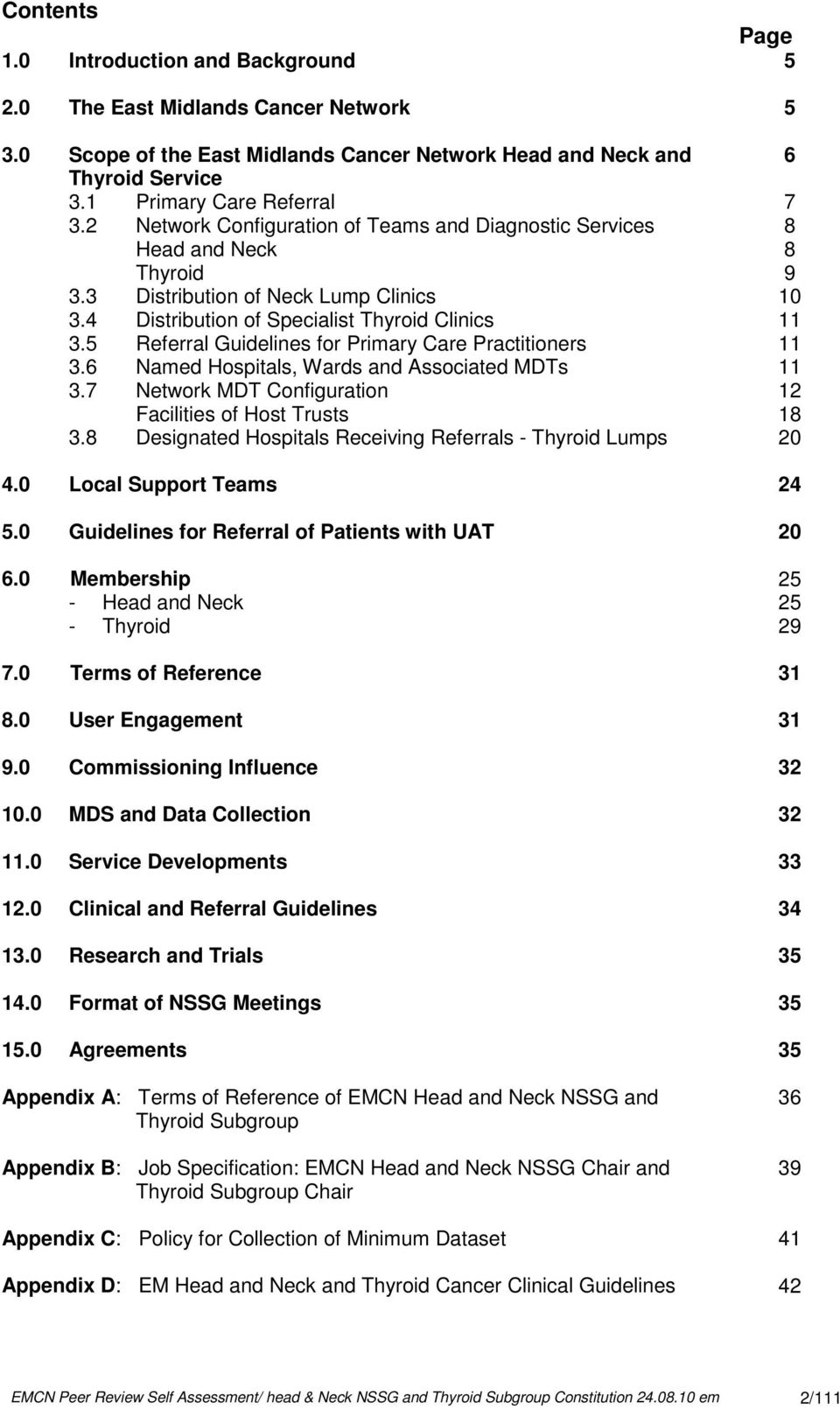
2 Contents Page 1.0 Introduction and Background The East Midlands Cancer Network Scope of the East Midlands Cancer Network Head and Neck and Thyroid Service 3.1 Primary Care Referral 3.2 Network Configuration of Teams and Diagnostic Services Head and Neck Thyroid 3.3 Distribution of Neck Lump Clinics 3.4 Distribution of Specialist Thyroid Clinics 3.5 Referral Guidelines for Primary Care Practitioners 3.6 Named Hospitals, Wards and Associated MDTs 3.7 Network MDT Configuration Facilities of Host Trusts 3.8 Designated Hospitals Receiving Referrals - Thyroid Lumps Local Support Teams Guidelines for Referral of Patients with UAT Membership - Head and Neck - Thyroid Terms of Reference User Engagement Commissioning Influence MDS and Data Collection Service Developments Clinical and Referral Guidelines Research and Trials Format of NSSG Meetings Agreements 35 Appendix A: Terms of Reference of EMCN Head and Neck NSSG and Thyroid Subgroup Appendix B: Job Specification: EMCN Head and Neck NSSG Chair and Thyroid Subgroup Chair Appendix C: Policy for Collection of Minimum Dataset 41 Appendix D: EM Head and Neck and Thyroid Cancer Clinical Guidelines 42 EMCN Peer Review Self Assessment/ head & Neck NSSG and Thyroid Subgroup Constitution em 2/111
3 Page Reference Number for Peer Review Measures Head & Neck NSSG Page Reference Measure Thyroid Subgroup Page Reference A-201i 29 (Membership) A-201i 31 (ToR) A-202i 5 7/8 10-1A-203i 7/ A-204i A-205i 11 7/11/34/ A-206i 7/11/34/46 11/ A-207i 11/49 11/34/50/ A-208i / A-209i / a-210i 34/ A-211i 9/ A-212i A-213i A-214i A-215i A-216i A-217i C-101i 29 34/ C-103i C-104i 25/29 35/ C-105i C-106i 35/104 34/ C-107i C-108i 34/ C-109i 34/ C-110i C-111i C-114i 105 EMCN Peer Review Self Assessment/ head & Neck NSSG and Thyroid Subgroup Constitution em 3/111

4 NHS East Midlands * NATCANSAT has not yet produced an East Midlands Cancer Network (EMCN) Map. The EMCN is not fully co-terminous with NHS East Midlands as it does not cover north Lincolnshire or Bassetlaw. However the map does serve to illustrate the size and complexity of EMCN OXFORD Oxford Radcliffe Hospital EMCN Peer Review Self Assessment/ head & Neck NSSG and Thyroid Subgroup Constitution em 4/111

5 1.0 Introduction and Background (Demonstrating Compliance with Measure 10-1A-201i and 10-1A-202i) The purpose of this document is to provide the East Midlands Cancer Network Board and East Midlands Stakeholder Organisations (Service users and their families or carers, Acute Trusts, Primary Care Trusts, Voluntary Sector Organisations, Users and Clinicians) with an overview of how the East Midlands Head and Neck and Thyroid Cancer Network is structured in order to provide Improving Outcomes Guidance (IOG) compliant services. The associated documents Work Plan and Annual Report - demonstrate how the Head and Neck Cancer NSSG and its Thyroid Cancer Subgroup support the delivery of clinically safe, evidence based, clinically effective, IOG compliant cancer services for patients with head and neck and thyroid cancer, which are responsive to user identified issues and recommendations. The chairs of the three local Head and Neck groups and representation for the thyroid subgroup met on 20 th November 2009 to agree how to develop an East Midlands Cancer Network Head and Neck NSSG. It was agreed that there should be a single group for the network which deals with Upper Aerodigestive Tract (UAT) cancer with a Thyroid Subgroup. Following on from this meeting the inaugural meeting of the East Midlands Head and Neck Cancer NSSG was held on 12 th March The Network Management Board agree the format for the oversight of head and neck cancer for the whole group which is set out below for ease of reference:- Format 2 as presented in the Manual for Cancer Services (Measure 10-1A-202i) A single group for the network which deals with UAT cancer having the structure, functions and terms of reference specified in Measure 10-1A-201i plus a separate single subgroup of the NSSG which deals with thyroid cancer. Please see section 6 for further details on the membership of the EMCN Head and Neck NSSG and Thyroid Subgroup. SEPARATE UAT NSSG AND THYROID SUBGROUP: Each group is reviewed separately and independently The following measures from the Manual for Cancer Services apply and will be reflected in the three documents: Measures 10-1c-101, 10-1C-102, 10-1C-109 to Applied once to each group 10-1C-114 Measures 10-1C-103, 10-1C-115, 10-1C116 Applied once to each group Measures 10-1C-104, 10-1C-105, 10-1C-107 Applied once to UAT group Measures 10-1C-106, 10-1C-108 Applied once to thyroid group 2.0 The East Midlands Cancer Network The East Midlands Cancer Network (EMCN) embraces a core population of approximately 4.2 million people. It was formed by the merger of the three previous East Midlands Cancer Networks Derby- Burton, Mid-Trent and Leicestershire, Northamptonshire & Rutland and went operational on 1 st October It is not fully co-terminous with NHS East Midlands. There are close cross boundary working relationships with the adjacent cancer networks North Trent, Pan EMCN Peer Review Self Assessment/ head & Neck NSSG and Thyroid Subgroup Constitution em 5/111

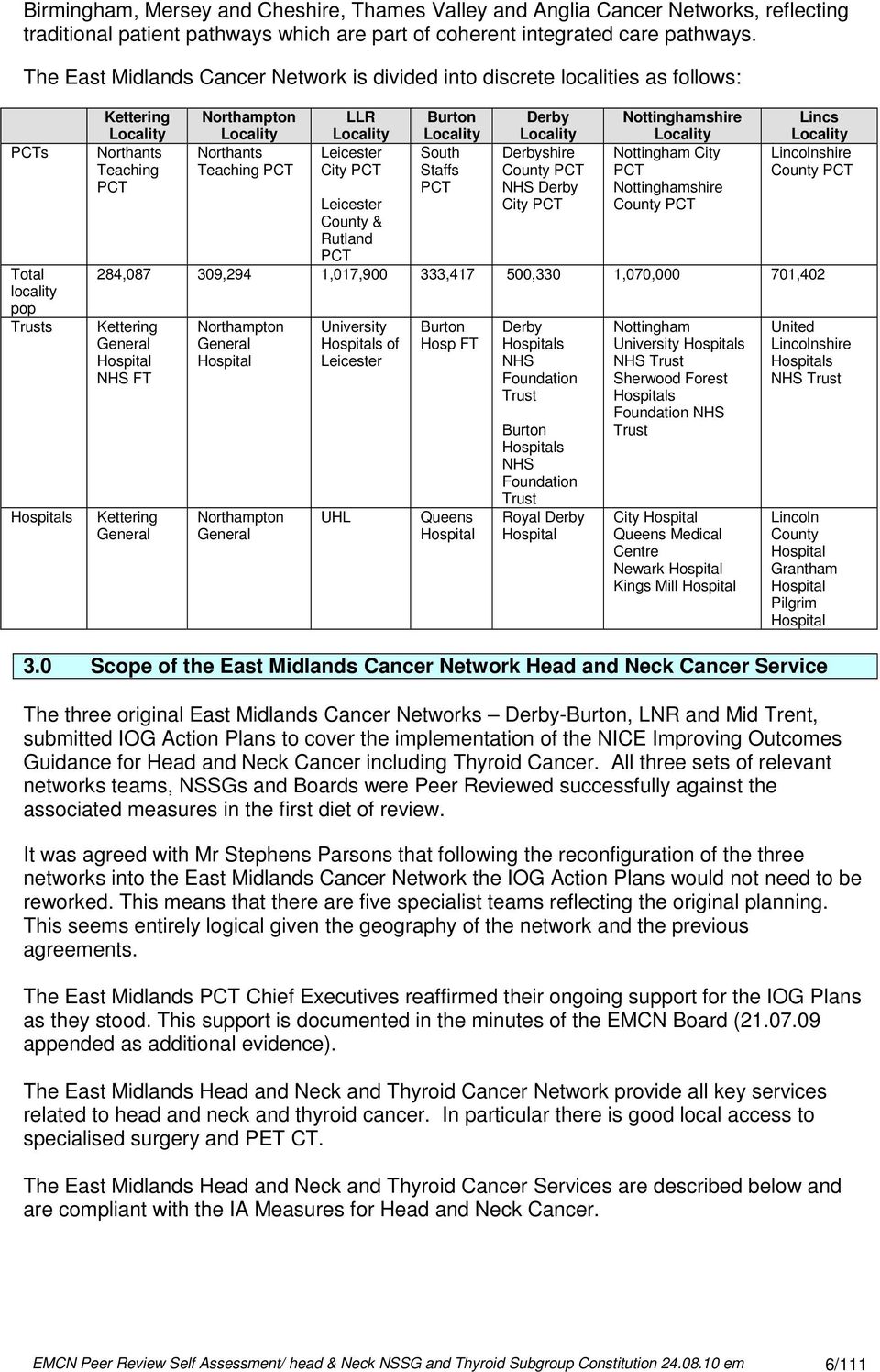
6 Birmingham, Mersey and Cheshire, Thames Valley and Anglia Cancer Networks, reflecting traditional patient pathways which are part of coherent integrated care pathways. The East Midlands Cancer Network is divided into discrete localities as follows: PCTs Total locality pop Trusts Hospitals Kettering Locality Northants Teaching PCT Northampton Locality Northants Teaching PCT LLR Locality Leicester City PCT Leicester County & Rutland PCT Burton Locality South Staffs PCT Derby Locality Derbyshire County PCT NHS Derby City PCT Nottinghamshire Locality Nottingham City PCT Nottinghamshire County PCT Lincs Locality Lincolnshire County PCT 284, ,294 1,017, , ,330 1,070, ,402 Kettering General Hospital NHS FT Kettering General Northampton General Hospital Northampton General University Hospitals of Leicester UHL Burton Hosp FT Queens Hospital Derby Hospitals NHS Foundation Trust Burton Hospitals NHS Foundation Trust Royal Derby Hospital Nottingham University Hospitals NHS Trust Sherwood Forest Hospitals Foundation NHS Trust City Hospital Queens Medical Centre Newark Hospital Kings Mill Hospital United Lincolnshire Hospitals NHS Trust Lincoln County Hospital Grantham Hospital Pilgrim Hospital 3.0 Scope of the East Midlands Cancer Network Head and Neck Cancer Service The three original East Midlands Cancer Networks Derby-Burton, LNR and Mid Trent, submitted IOG Action Plans to cover the implementation of the NICE Improving Outcomes Guidance for Head and Neck Cancer including Thyroid Cancer. All three sets of relevant networks teams, NSSGs and Boards were Peer Reviewed successfully against the associated measures in the first diet of review. It was agreed with Mr Stephens Parsons that following the reconfiguration of the three networks into the East Midlands Cancer Network the IOG Action Plans would not need to be reworked. This means that there are five specialist teams reflecting the original planning. This seems entirely logical given the geography of the network and the previous agreements. The East Midlands PCT Chief Executives reaffirmed their ongoing support for the IOG Plans as they stood. This support is documented in the minutes of the EMCN Board ( appended as additional evidence). The East Midlands Head and Neck and Thyroid Cancer Network provide all key services related to head and neck and thyroid cancer. In particular there is good local access to specialised surgery and PET CT. The East Midlands Head and Neck and Thyroid Cancer Services are described below and are compliant with the IA Measures for Head and Neck Cancer. EMCN Peer Review Self Assessment/ head & Neck NSSG and Thyroid Subgroup Constitution em 6/111
7 3.1 Primary Care Referral Policy (Demonstrating Compliance with Measure 10-1A-203i, 10-1A-205i and 10-1A-206i) The Chair of the East Midlands Cancer Network Board and the PCT Chief Executives of the reconfigured PCTs reviewed the original referral policy for head and neck and thyroid patients referred as urgent, suspicious of cancer at the EMCN Board on 10 th August 2010 They, on behalf of the East Midlands Health Community endorsed the policy unchanged as outlined below: The policy is that such patients should be referred on the agreed form to the 2WW Office (or similar) at: Kettering General Hospital for Northamptonshire PCT (Heartlands) Clinical Lead for Head and Neck Mr A Tewary. Mr Tewary is a core member of the Head & Neck SMDT. Clinical Lead for Thyroid Mr S Al-Hamali. Mr Al Hamali co-chair of the Northamptonshire Thyroid SMDT. Northampton General Hospital for Northamptonshire PCT (Daventry & South Northants and Northampton) Clinical Lead for Head and Neck Mr W Smith. This is a local and specialist MDT Clinical Leads for Thyroid Mr D Ratliff co-chair of the Northamptonshire Thyroid MDT University Hospitals of Leicester for Leicester City PCT and Leicestershire County & Rutland PCT Clinical Lead for Head and Neck - Mr J Hayter. This is a Local/Specialist MDT Clinical Lead for Thyroid - Dr I Peat. This is a Local/Specialist MDT United Lincoln Hospitals for Lincolnshire PCT Clinical Lead for Head and Neck - Mr Alasdair McKechnie. This is a local and specialist MDT working jointly with NUH through a VTC linked single MDT Clinical Lead for Thyroid Mr A McRae. This is a local/ specialist MDT working jointly by VTC with NUH. Sherwood Forest NHS FT for Nottinghamshire County PCT All patients are discussed at the Nottingham MDT. Clinical Lead for Thyroid Mr Nigam attends NUH MDT Nottingham University Hospitals for Nottingham City PCT Clinical Lead for Head and Neck Ms Lorna Sneddon This is a local and specialist MDT Clinical Lead for Thyroid Mr Chas Ubhi. This is a local and specialist MDT Derby Royal Hospital for NHS Derby City and Derbyshire County PCT Clinical Lead for Head and Neck Mr Keith Jones. This is a local and specialist MDT Clinical Lead for Thyroid Mr Jerry Sharp. This is a local and specialist MDT Burton Hospitals for South Staffs PCT Clinical Lead for Head and Neck and Thyroid - Mr A Thompson. This is a local MDT There is a single point of contact agreed as follows: Trust Named Contact Telephone/ Kettering General Hospital 2ww Office Northampton General 2ww Office Hospital UHL Cancer Office EMCN Peer Review Self Assessment/ head & Neck NSSG and Thyroid Subgroup Constitution em 7/111

8 Derby Hospitals Via Choose & Book or Direct Fax Colorectal Clinic Burton Patient Access Centre Direct Fax Kings Mill Choose and Book NUH Helen Andrews United Lincoln Julie Miller Extn 2660 The Primary Care Referral Proforma for each Trust have been scrutinised and confirmed as fulfilling the requirements of the network policy. 3.2 Network Configuration of Teams & Diagnostic Services (Demonstrating Compliance with Measure 10-1A-203i, 10-1A-205i) Each of the original networks was compliant with the number of specialist MDTs within the network. Given the complex geography and distance of the East Midlands that was one of the reasons why no reconfiguration was proposed after the merger. This was agreed with Mr S Parsons, Director, NCAT. As part of the Action Plan to implement the Improving Outcomes Guidance for Head and Neck Cancer the designated hospitals for Diagnosis and Assessment of patients fulfilling the criteria of urgent suspicious of head and neck and thyroid cancer and the associated clinicians are outlined in the following tables. All have the relevant contractual time. Head and Neck PCT Lincolnshire 701,402 Nottinghamshire 678,301 Nottingham City 288,754 Trust United Lincolnshire Hospitals NHS Trust Sherwood Forest Hospitals NHS Foundation Trust Nottingham University Hospitals NHS Trust Hospitals providing diagnostic services for Head and Neck cancer Lincoln County Hospital King s Mill Hospital Queens Medical Centre City Hospital MDTs And Lead Clinician Lincoln County Mr A McKecnhie Pilgrim Hospital, Boston Mr A McRae All patients referred to Nottingham MDT Queens Medical Centre Ms L Sneddon Refers to Specialist MDTs Lincoln County Hospital VTC with Nottingham Mr A McKechnie Queens Medical Centre Ms L Sneddon Queens Medical Centre Ms L Sneddon RT and chemo Provide both radio and chemotherapy In Lincoln RT Chemotherapy In Nottingham With some outreach chemo at SFHFT Provides both radio and chemotherapy Derby City 237,905 Derby Hospitals NHS Royal Derby Hospital Royal Derby Hospital Royal Derby Hospital Provides both radio and chemotherapy EMCN Peer Review Self Assessment/ head & Neck NSSG and Thyroid Subgroup Constitution em 8/111
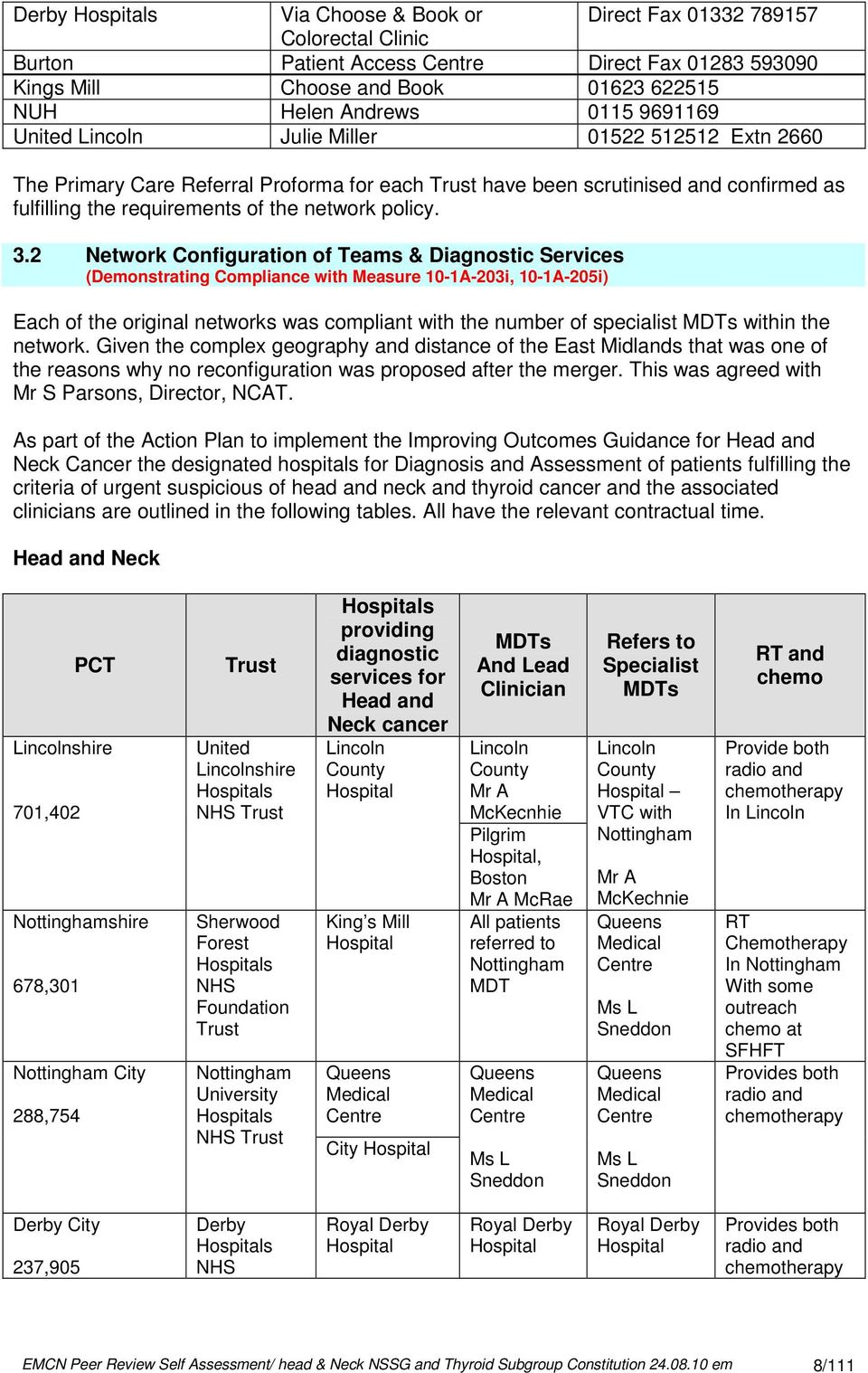
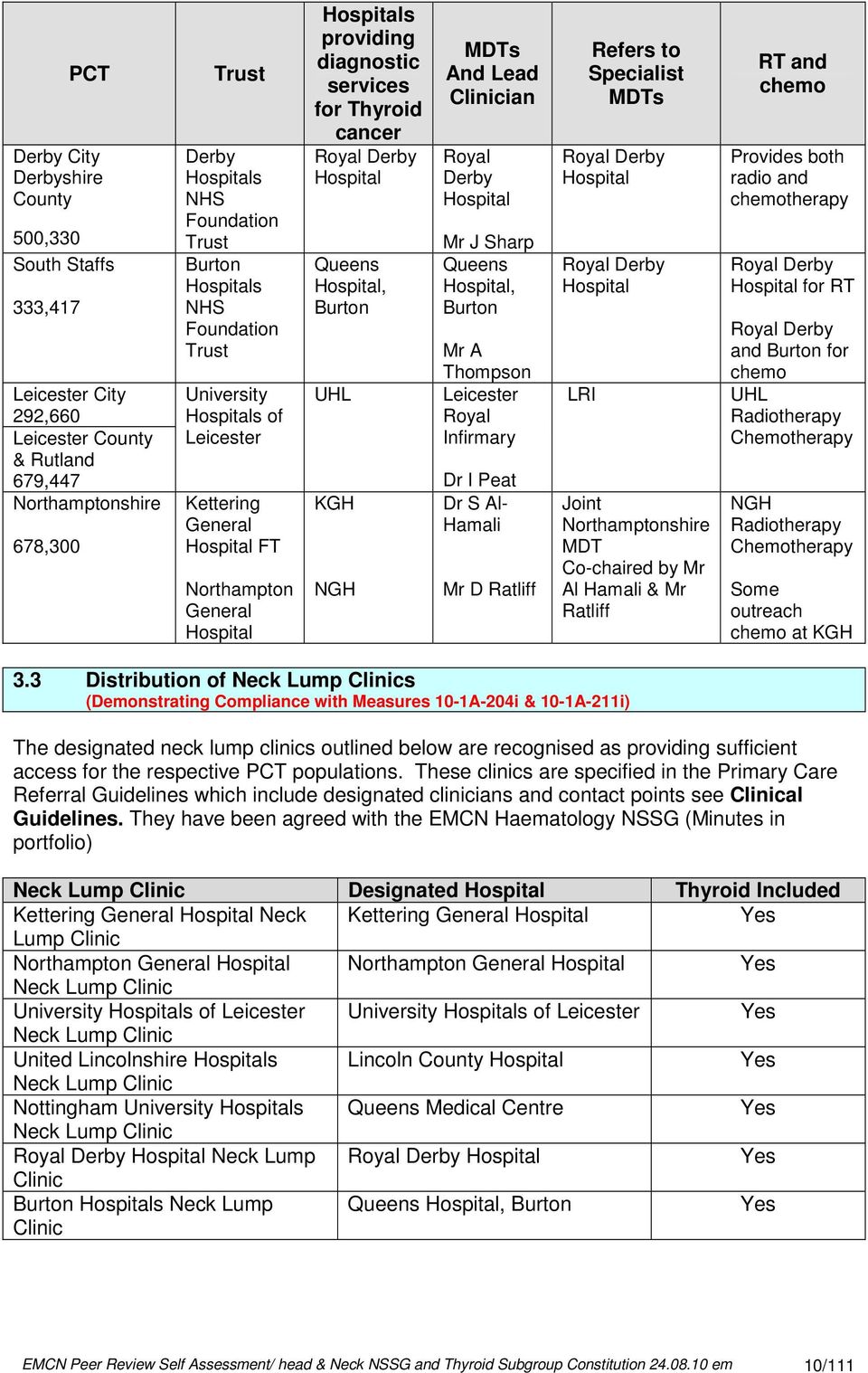
9 PCT Derbyshire County 284,000 (40%) Trust Foundation Trust Hospitals providing diagnostic services for Head and Neck cancer MDTs And Lead Clinician Mr K Jones Refers to Specialist MDTs Mr K Jones RT and chemo South Staffs 333,417 Leicester City 292,660 Leicester County and Rutland Burton Hospitals NHS Foundation Trust University Hospitals of Leicester Queens Hospital, Burton Leicester Royal Infirmary Queens Hospital, Burton Mr A Thompson Leicester Royal Infirmary Mr J Hayter Royal Derby Hospital Mr K Jones LRI Royal Derby Hospital for RT Royal Derby and Burton for chemo UHL Radiotherapy Chemotherapy 679,447 Northamptonshire 678,300 Kettering General Hospital FT Northampton General Hospital KGH NGH Local MDT Mr W Smith Local MDT Mr W Smith Northampton General Hospital NGH Radiotherapy Chemotherapy Brachytherapy Some outreach chemo at KGH Thyroid PCT Lincolnshire 701,402 Trust United Lincolnshire Hospitals NHS Trust Hospitals providing diagnostic services for Thyroid cancer Lincoln County Grantham Hospital MDTs And Lead Clinician Local MDT Mr A McRae Refers to Specialist MDTs Lincoln County Hospital VTC with Nottingham RT and chemo Provide both radio and chemotherapy In Lincoln Nottinghamshire County 678,301 Nottingham City 288,754 Sherwood Forest Hospitals NHS Foundation Trust Nottingham University Hospitals NHS Trust Pilgrim Hospital City Hospital, Nottingham City Hospital Queens Medical Centre Local MDT Mr J Chelladurai Mr Nigam from Kings Mill Hospital attends NUH MDT City Hospital, Nottingham Mr C Ubhi City Hospital, Nottingham VTC with Lincoln RT Chemotherapy In Nottingham With some outreach chemo at SFHFT Provides both radio and chemotherapy EMCN Peer Review Self Assessment/ head & Neck NSSG and Thyroid Subgroup Constitution em 9/111

10 PCT Derby City Derbyshire County 500,330 South Staffs 333,417 Leicester City 292,660 Leicester County & Rutland 679,447 Northamptonshire 678,300 Trust Derby Hospitals NHS Foundation Trust Burton Hospitals NHS Foundation Trust University Hospitals of Leicester Kettering General Hospital FT Northampton General Hospital Hospitals providing diagnostic services for Thyroid cancer Royal Derby Hospital Queens Hospital, Burton UHL KGH NGH MDTs And Lead Clinician Royal Derby Hospital Mr J Sharp Queens Hospital, Burton Mr A Thompson Leicester Royal Infirmary Dr I Peat Dr S Al- Hamali Mr D Ratliff Refers to Specialist MDTs Royal Derby Hospital Royal Derby Hospital LRI Joint Northamptonshire MDT Co-chaired by Mr Al Hamali & Mr Ratliff RT and chemo Provides both radio and chemotherapy Royal Derby Hospital for RT Royal Derby and Burton for chemo UHL Radiotherapy Chemotherapy NGH Radiotherapy Chemotherapy Some outreach chemo at KGH 3.3 Distribution of Neck Lump Clinics (Demonstrating Compliance with Measures 10-1A-204i & 10-1A-211i) The designated neck lump clinics outlined below are recognised as providing sufficient access for the respective PCT populations. These clinics are specified in the Primary Care Referral Guidelines which include designated clinicians and contact points see Clinical Guidelines. They have been agreed with the EMCN Haematology NSSG (Minutes in portfolio) Neck Lump Clinic Designated Hospital Thyroid Included Kettering General Hospital Neck Kettering General Hospital Yes Lump Clinic Northampton General Hospital Northampton General Hospital Yes Neck Lump Clinic University Hospitals of Leicester University Hospitals of Leicester Yes Neck Lump Clinic United Lincolnshire Hospitals Lincoln County Hospital Yes Neck Lump Clinic Nottingham University Hospitals Queens Medical Centre Yes Neck Lump Clinic Royal Derby Hospital Neck Lump Royal Derby Hospital Yes Clinic Burton Hospitals Neck Lump Clinic Queens Hospital, Burton Yes EMCN Peer Review Self Assessment/ head & Neck NSSG and Thyroid Subgroup Constitution em 10/111
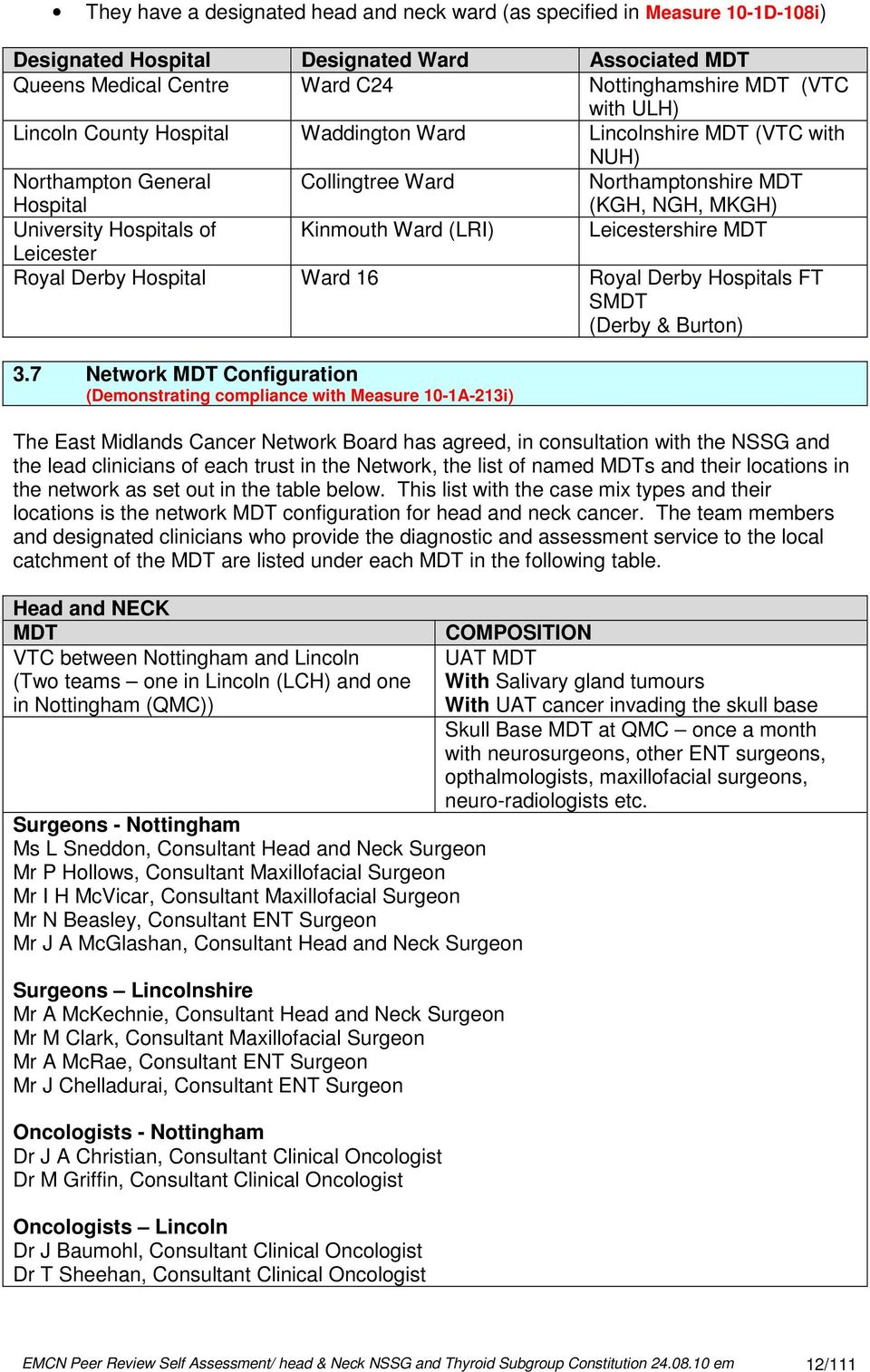
11 3.4 The Distribution of Specialist Thyroid Clinics (Demonstrating Compliance with Measure 10-1A-205i) The designated specialist thyroid clinics outlined below are recognised as providing sufficient access for the respective PCT populations. These clinics are specified in the Primary Care Referral Guidelines which include designated clinicians and contact points see Clinical Guidelines. PCT Designated Hospital Specialist Thyroid Clinic Nottinghamshire City Hospital Nottingham Yes Nottingham City Northamptonshire Northampton General Hospital Yes Leicester City Leicester County & Rutland Derby City Derbyshire County South Staffs LRI Royal Derby Hospital Yes Yes 3.5 Referral Guidelines for Primary Care Practitioners (Demonstrating Compliance with Measure 10-1A-206i, 10-1A-207i and 10-1A-208i) (Measure 10-1A-206i) The referral guidelines for primary care practitioners regarding patients with head and neck symptoms are included in the Guidelines for the Investigation and Treatment of Head and Neck and Thyroid Cancer Appendix D. (Measure 10-1A-207i) The referral guidelines for primary care have been distributed to primary care medical practices, primary dental practices, designated consultant clinicians, non-designated head and neck consultant clinicians (ENT surgeons, endocrine surgeons, OMFS surgeons, oral medicine specialists, endocrinologists, restorative dentistry consultants). These were distributed by PCT Cascade,post and the Trust internal distribution systems. (Measure 10-1A-208i) The referral proformas have been agreed by the NSSG and localised (by identifying a single referral point for each designated hospital to which proformas can be sent for direction to individual specialists) for each designated hospital across the EMCN. The referral proforma is used for patients with UAT symptoms which are outside the 'urgent suspicion of cancer' definition, and who have no neck lumps and allow for the referrer to categorise a patient by presenting features, so that the hospital can direct the referral to the relevant specialty (e.g. ENT, OMFS). The proforma have been cross referenced to the EMCN Guidelines to ensure that they are compliant with the agreed policies. 3.6 The Named Hospitals and Wards with the Named MDTs Associated with each Hospital (Demonstrating Compliance with Measure 10-1A-212i) The named hospitals and wards where the curative surgical treatment for head and neck cancer will take place are set out in the table below. The hospitals each fulfil the following criteria: They are the designated hospital for the diagnostic and assessment service (cross reference to Measure 10-1A-206i) They are the hospital where one or more named MDTs carry out all their curative surgical procedures for head and neck cancer. EMCN Peer Review Self Assessment/ head & Neck NSSG and Thyroid Subgroup Constitution em 11/111

12 They have a designated head and neck ward (as specified in Measure 10-1D-108i) Designated Hospital Designated Ward Associated MDT Queens Medical Centre Ward C24 Nottinghamshire MDT (VTC with ULH) Lincoln County Hospital Waddington Ward Lincolnshire MDT (VTC with NUH) Northampton General Hospital Collingtree Ward Northamptonshire MDT (KGH, NGH, MKGH) University Hospitals of Kinmouth Ward (LRI) Leicestershire MDT Leicester Royal Derby Hospital Ward 16 Royal Derby Hospitals FT SMDT (Derby & Burton) 3.7 Network MDT Configuration (Demonstrating compliance with Measure 10-1A-213i) The East Midlands Cancer Network Board has agreed, in consultation with the NSSG and the lead clinicians of each trust in the Network, the list of named MDTs and their locations in the network as set out in the table below. This list with the case mix types and their locations is the network MDT configuration for head and neck cancer. The team members and designated clinicians who provide the diagnostic and assessment service to the local catchment of the MDT are listed under each MDT in the following table. Head and NECK MDT VTC between Nottingham and Lincoln (Two teams one in Lincoln (LCH) and one in Nottingham (QMC)) Surgeons - Nottingham Ms L Sneddon, Consultant Head and Neck Surgeon Mr P Hollows, Consultant Maxillofacial Surgeon Mr I H McVicar, Consultant Maxillofacial Surgeon Mr N Beasley, Consultant ENT Surgeon Mr J A McGlashan, Consultant Head and Neck Surgeon Surgeons Lincolnshire Mr A McKechnie, Consultant Head and Neck Surgeon Mr M Clark, Consultant Maxillofacial Surgeon Mr A McRae, Consultant ENT Surgeon Mr J Chelladurai, Consultant ENT Surgeon Oncologists - Nottingham Dr J A Christian, Consultant Clinical Oncologist Dr M Griffin, Consultant Clinical Oncologist Oncologists Lincoln Dr J Baumohl, Consultant Clinical Oncologist Dr T Sheehan, Consultant Clinical Oncologist COMPOSITION UAT MDT With Salivary gland tumours With UAT cancer invading the skull base Skull Base MDT at QMC once a month with neurosurgeons, other ENT surgeons, opthalmologists, maxillofacial surgeons, neuro-radiologists etc. EMCN Peer Review Self Assessment/ head & Neck NSSG and Thyroid Subgroup Constitution em 12/111
13 Head and NECK MDT COMPOSITION Radiologists - Nottingham Dr R K Lenthall, Consultant Radiologist, NUH Radiologists Lincoln Dr I Rothwell Histopathologist - Nottingham Mr R O Allibone, Consultant Histopathologist Histopathologist Lincoln Dr M Reed Clinical Nurse Specialist - Nottingham Ms J Graves Clinical Nurse Specialist Lincoln Ms A Mason Speech and Language Therapist - Nottingham Ms S Slade Ms F Robinson Speech and Language Therapy Lincoln Ms S Taylor Dietitian - Nottingham Ms M Donaldson Dietitian Lincoln Ms S Whitworth Neurosurgical member Skull based tumours are discussed at both Head and Neck and Neurosciences MDT meetings. Both MDTs meet once a month in the Skull Base MDT. Neurosurgical members are Mr Iain Robertson and Mr Graham Dow who are extended members of the Head and Neck MDT. Northamptonshire Head and Neck MDT (Based at NGH) VTC with Kettering General Hospital Surgeons Mr W Smith, Consultant Head and Neck Surgeon Mr S Al-Hamali, Consultant ENT Surgeon Mr V Bahal, Consultant Head and Neck Surgeon Mr C Harrop, Consultant Maxillofacial Surgeon Mr A Tewary, Consultant ENT Surgeon Mr P Ameerally, Consultant Maxillofacial Surgeon Oncologists Dr G Andrade, Consultant Clinical Oncologist Head and Neck and malignant salivary gland Base of skull is referred on to the Oxford MDT EMCN Peer Review Self Assessment/ head & Neck NSSG and Thyroid Subgroup Constitution em 13/111

14 Head and NECK MDT Dr C Elwell, Consultant Clinical Oncologist Dr R Matthew, Consultant Clinical Oncologist COMPOSITION Radiologists Dr A Bisset, Consultant Radiologist Dr C Clark, Consultant Radiologist Dr V Sukumar, Consultant Radiologist Histopathologists Dr N Gorgees, Consultant Histopathologist Dr J Nottingham, Consultant Histopathologist Dr D Walter, Consultant Histopathologist Dr S Milkins, Consultant Histopathologist Clinical Nurse Specialists Ms P Gibbings Ms A Hicks Speech and Language Therapists Ms E Coker Ms K Jackson-Waite Dietitian Mrs K Owen Leicestershire Head and Neck MDT (Based at UHL) Head and Neck With Salivary gland tumours Base of skull is referred on to the Nottingham MDT Surgeons Mr T Alun-Jones, Consultant ENT Surgeon Mr P Conboy, Consultant ENT Surgeon Mr J Hayter, Consultant Head and Neck Surgeon Mr A Moir, Consultant ENT Surgeon Mr C Avery, Consultant ENT Surgeon Oncologists Dr I Peat, Consultant Clinical Oncologist Dr S Vasanthan, Consultant Clinical Oncologist Dr T Sridhar, Consultant Oncologist Dr D Peel, Consultant Oncologist Radiologists Dr B Morgan, Consultant Radiologist Dr R Vaidhyanath, Consultant Radiologist Histopathologists Dr P Shaw, Consultant Pathologist Dr C Kendall, Consultant Histopathologist Clinical Nurse Specialists Ms R White EMCN Peer Review Self Assessment/ head & Neck NSSG and Thyroid Subgroup Constitution em 14/111

15 Head and NECK MDT COMPOSITION Speech and Language Therapists Ms S Harris Dietitian Miss C Hanlon Royal Derby Hospitals Head and Neck MDT VTC with Queens Hospital, Burton Surgeons Mr K Jones, Consultant Maxillofacial Surgeon Mr S Mortimore, Consultant ENT Surgeon UAT MDT With Salivary gland tumours Base of skull was originally referred to Liverpool in the process of repatriation to NUH. Oncologists Dr M Kumar, Consultant Clinical Oncologist Radiologists Dr N Cozens, Consultant Radiologist Dr S Elliott, Consultant Radiologist Mr Kulkarni, Consultant Radiologist Histopathologists Dr I Robinson, Consultant Histopathologist Clinical Nurse Specialists Ms K Jukes Ms J Petrie Ms V Shepherd Speech and Language Therapists Ms A Cartwright Dietitian Ms S Moorley Ms L Munro Thyroid cancer (endocrine) only MDT VTC between Nottingham and Lincoln (Two teams one in Lincoln (LCH) and one in Nottingham (CHN)) COMPOSITION Thyroid only Surgeons - Nottingham Mr C Ubhi, Consultant ENT Surgeon Surgeons - Lincoln Mr A McRae, Consultant ENT Surgeon Mr J Chelladurai, Consultant ENT Surgeon EMCN Peer Review Self Assessment/ head & Neck NSSG and Thyroid Subgroup Constitution em 15/111

16 Head and NECK MDT COMPOSITION Oncologists - Nottingham Dr S Morgan, Consultant Clinical Oncologist Oncologist Lincoln Dr T Sheehan, Consultant Clinical Oncologist Histopathologists - Nottingham Dr Z Chaudhary Histopathologists Lincoln Dr M Reed Clinical Nurse Specialists - Nottingham Ms L Sellors Clinical Nurse Specialists - Lincoln Ms A Mason Northamptonshire Thyroid MDT VTC with Kettering Surgeons Mr D Ratcliff, Consultant Surgeon Mr S Al-Hamali, Consultant Surgeon Thyroid only Oncologists Dr R Matthew, Consultant Clinical Oncologist Radiologists Dr A Bisset, Consultant Radiologist Dr D Walter, Consultant Radiologist Histopathologists Dr N Gorgees, Consultant Histopathologist Dr J Nottingham, Consultant Histopathologist Clinical Nurse Specialists Ms P Gibbings Speech and Language Therapists Ms E Coker Dietitian Ms K Owen Leicestershire Thyroid MDT (UHL) Surgeons Mr T Alun-Jones, Consultant ENT Surgeon Mr P Conboy, Consultant ENT Surgeon Mr A Moir, Consultant ENT Surgeon Thyroid only EMCN Peer Review Self Assessment/ head & Neck NSSG and Thyroid Subgroup Constitution em 16/111

17 Head and NECK MDT COMPOSITION Oncologists Dr I Peat, Consultant Oncologist Dr R Matthew, Consultant Oncologist Radiologists Dr A Bisset, Consultant Radiologist Dr D Walter, Consultant Radiologist Histopathologists Dr C Kendall, Consultant Histopathologist Clinical Nurse Specialists Ms P Gibbings Kettering Diabetic & Endocrine CNS Speech and Language Therapists Ms E Coker Dietitian Ms K Owen Royal Derby Hospitals Thyroid MDT VTC with Queens Hospital, Burton Surgeons Mr J Sharp, Consultant ENT Surgeon Mr A Thompson, Consultant ENT Surgeon Thyroid only Oncologists Mr M Kumar, Consultant Oncologist Dr R Vijayan, Consultant Oncologist Radiologists Dr N Cozens, Consultant Radiologist Dr S Elliott, Consultant Radiologist Dr Kulkarni, Consultant Radiologist Histopathologists Dr D Green, Consultant Histopathologist Dr I Robinson, Consultant Histopathologist Clinical Nurse Specialists Mrs K Jukes, Clinical Nurse Specialist Ms J Petrie, Clinical Nurse Specialist Ms V Shepherd, Clinical Nurse Specialist Speech and Language Therapists Mrs K Young, Speech and Language Therapist Dietitian EMCN Peer Review Self Assessment/ head & Neck NSSG and Thyroid Subgroup Constitution em 17/111

18 Head and NECK MDT Mrs S Moorley, Dietitian COMPOSITION The facilities of the host trusts are as follows:- Host Trust Nottingham University Hospitals United Lincolnshire Hospitals Kettering General Hospital (as part of the linked Thyroid MDT) Facilities on site Thyroid Surgery Complex Specialist Head and Neck Surgery Craniofacial Surgery Chemotherapy Radiotherapy Imaging Radiology/Interventional Radiology Pathology Endoscopy Dietetics SALT ITU/HDU Designated Head and Neck Beds Prosthetics Nuclear Medicine Restorative Dentistry Videofluoroscopy PET-CT Local Support Group Thyroid Surgery Head and Neck Surgery Chemotherapy Radiotherapy Imaging Radiology Pathology Endoscopy Dietetics SALT ITU/HDU Designated Head and Neck Beds Prosthetics Nuclear Medicine Videofluoroscopy Local Support Group Thyroid surgery Imaging Pathology Palliative and Supportive Care Patient Information Outreach Chemotherapy SALT Dietetics Endoscopy Videofluoroscopy VOCAL Support Group (Local Support Group) EMCN Peer Review Self Assessment/ head & Neck NSSG and Thyroid Subgroup Constitution em 18/111

19 Host Trust Northampton General Hospital (as part of the linked Thyroid MDT) University Hospitals of Leicester Royal Derby Hospital FT Burton Hospitals NHS Trust Facilities on site Thyroid Surgery Complex Specialist Head and Neck Surgery Chemotherapy Radiotherapy Imaging Pathology Endoscopy Dietetics SALT FACE FAX Support Group ITU/HDU Designated Head and Neck Beds Prosthetics Nuclear Medicine Hygienist Restorative Dentistry Videofluoroscopy Thyroid Surgery Complex specialist Head and Neck Surgery Chemotherapy Radiotherapy Radiology (including interventional) Nuclear Medicine Restorative Dentistry Pathology Endoscopy Dietetics SALT ITU/HDU Designated Head and Neck Beds Videofluoroscopy Prosthetics PET-CT for LNR Specialist Head and Neck Surgery Thyroid Surgery Imaging Pathology Palliative and Supportive Care Patient Information Chemotherapy Radiotherapy ITU/HDU Prosthetics Nuclear Medicine SALT Dietetics Endoscopy Videofluoroscopy Support Groups Access to tracheostomy clinic Nurse led endoscopy Nurse led thyroid follow up Thyroid Surgery EMCN Peer Review Self Assessment/ head & Neck NSSG and Thyroid Subgroup Constitution em 19/111

20 Host Trust Facilities on site Imaging Chemotherapy Dietetics SALT Videofluoroscopy Nuclear Medicine Patient Information Palliative and Supportive Care Pathology 3.8 The Designated Hospitals Receiving Referrals of Patients with Thyroid Lumps (Demonstrating Compliance with Measure 10-1A-214i, cross reference to 10-1A-211i) In agreement with the Network Management Board, PCT leads and NSSG the following are the named PCTs which will refer patients with lumps clinically of thyroid origin to the named, designated hospitals. The configuration and associated populations are as originally submitted and accepted by NCAT and peer reviewed as compliant in the second diet of review. Referring PCT Nottingham City PCT Nottinghamshire County Teaching PCT Population Receiving Hospital for Lumps of Thyroid Origin 1,070,000 City Hospital QMC Lincolnshire PCT 701,402 Lincoln County Hospital Northamptonshire 284,087 Kettering General Teaching PCT Hospital (Heartlands) Northamptonshire Teaching PCT (Daventry, South Northants and Northampton area) 309,087 Northampton General Hospital Milton Keynes PCT 220,000 Milton Keynes General Hospital Leicestershire County and 1,017,900 University Hospitals of Rutland PCT Leicester Leicester City PCT Derby City 285,000 Derbyshire County 284,000 40% of population referred South Staffordshire 37% of population referred Leicestershire County 10% of population referred 220,150 66,000 Royal Derby Hospitals NHS FT Burton Hospitals NHS Trust 4.0 The Role of Local Support Teams in the Network (Demonstrating compliance with Measures 10-1A-215i, 10-1A-216i) MDT discussing patient Nottingham/Lincoln VTC MDT Northamptonshire Thyroid MDT Leicestershire Thyroid MDT Royal Derby Hospitals NHS FT Measure 10-1A-215i Distribution of Local Support Team: The distribution of the Local Support Teams remains as agreed with the original chairs of the Locality Groups at the time of the first diet of review. Named Local Support Team Designated Hospitals Area(s) Covered by Local Support Team EMCN Peer Review Self Assessment/ head & Neck NSSG and Thyroid Subgroup Constitution em 20/111

21 Derbyshire Local Support Team Leicestershire Local Support Team Lincolnshire Local Support Team Northamptonshire Local Support Team Nottinghamshire Local Support Team Derby Hospitals NHS Foundation Trust Burton Hospitals NHS Foundation Trust University Hospitals of Leicester NHS Trust United Lincolnshire Hospitals NHS Trust Kettering General Hospital NHS Trust Northampton General Hospital NHS Trust Nottingham University Hospitals NHS Trust Sherwood Forest Hospitals NHS Foundation Trust Derby Derbyshire Burton Leicester Leicestershire Rutland Lincoln Lincolnshire Kettering Northampton Northamptonshire Nottingham County Nottingham City Measure 10-1A-216i Role of Local Support Team Introduction It is clearly recognised that both patients treated curatively for Head and Neck Cancer as well as those treated symptomatically require considerable ongoing support both during and after any immediate treatment phase. To this end the service has established Local Support Teams to ensure that access to appropriate ongoing support is available as and when needed by each individual and their family or carers. Patients can have considerable co-morbidity. The surgical and non-surgical oncology treatments both of OMFS Cancer and ENT Cancers within the UAT can be physically demanding and alter radically the individual s appearance and speech with all the concomitant potential for psychological morbidity as well as physical disability. To maximise the support provision as close as possible to the individual there is a small core team that co-ordinate the relevant input from the appropriate local community services and hospital services. Purpose of the Local Support Team for Head and Neck Cancer Patients To manage the aftercare and rehabilitation of head and neck cancer patients within the relevant locality To work closely with the relevant specialist MDT To work closely with other teams who may have contact with Head and Neck patients on their cancer journey To have agreed shared-care policies with the referring MDT to ensure that there is clarity of responsibility for the provision of relevant care at each stage on the pathway To co-ordinate the provision from relevant local services for each individual EMCN Peer Review Self Assessment/ head & Neck NSSG and Thyroid Subgroup Constitution em 21/111
22 Service that require to be available through the Local Support Team The Local Support Team will ensure access to the following services for the individual as required:- Dietetics: advice on nutrition including modified consistency diet, special diets and supplements, monitoring of weight, feeding tube and associated stoma care management SALT: communication and dysphagia management Community Nursing: dressings, training of staff, valve care, monitoring of weight Palliative and Supportive Care Macmillan CNS, Hospital and Community Palliative Care Teams Welfare Rights: Disability rights if unable to return to work Support Groups: FACE FAX, Laryngectomy Association Information: Local information, Cancer Information, National Patient Information (Prescriptions) Community dentistry Prosthetics Physiotherapy; shoulder issues following radical surgery Occupational Therapy To ensure that the individuals and their family or carers receive timely and appropriate support. Whilst it is not envisaged that all disciplines will meet regularly on a formally basis it is envisaged that there will be clear channels for communication. Protocols agreed with the MDTs Valve care Nutritional Assessment Dental access Patient packs Please see below a summary of the protocol for referring patients back to members of the MDT from the local support team: EMCN Peer Review Self Assessment/ head & Neck NSSG and Thyroid Subgroup Constitution em 22/111
23 Patients are advised to contact these key persons should problems arise in between regular reviews once discharged from hospital or completion of treatment PROBLEM SUPPORT TEAM MEMBERS MDT MEMBERS Swallow District Nurse GP Speech & Language Therapist Hospital Clinician Dietitian Stoma / Valve District Nurse GP Speech & Language Therapist Hospital Clinician Nurse Practitioner Wound District Nurse GP Speech & Language Therapist Hospital Clinician Symptom Management District Nurse GP Speech & Language Therapist Hospital Clinician Alteration to the capacity for independence Relevant Short / Long / Term Team / GP Hospital Clinician EMCN Peer Review Self Assessment/ head & Neck NSSG and Thyroid Subgroup Constitution em 23/111
24 Co-ordinated Lead It is envisaged that in each team the lynchpin for co-ordination will be the CNS. However, if this is not possible then this role could, in certain circumstances be fulfilled by the SALT or dietitian. 5.0 The Guidelines for Referral of Patients with UAT (Demonstrating compliance with Measure 10-1A-217i and 10-1A-218i) The following are the guidelines for the referral of patients with UAT cancer from designated hospitals in the Network to the MDTs for UAT cancer. UAT, salivary glands, skull based tumours Patients fulfilling the following criteria should be referred: Newly diagnosed UAT cancer including malignant salivary tumour and skull based tumours They must meet the imaging criteria for suspected UAT, malignancy salivery tumour or skull based tumour. Imaging (CR or MRI) if this is a diagnostic test. Clinical symptoms suggestive of recurrence in patients with a previous history of UAT cancer, malignant tumour of the salivary glands or skull based tumour Palliative issues All relevant clinical information is required: Previous relevant surgery Case notes with history All diagnostic test results Where a reoccurrence of a cancer is suspected they will be discussed without confirmed histology. Table 1 - Referral to MDT for UAT and malignant salivary gland tumours Designated Hospital MDT for discussion MDT Co-ordinator Queens Medical Centre Single MDT VTC with Lincoln Nicola Hodgkinson Ext Lincoln County Hospital Single MDT VTC with Nottingham Wendy Smith ext 2659 Kettering General Hospital Northampton General Northamptonshire Head and Neck MDT Donna Jacobs Hospital Milton Keynes General Hospital (based at NGH) University Hospitals of Leicestershire Head and Lyn Connell Leicester Royal Derby Hospital Queens Hospital Burton Neck MDT Royal Derby Hospital Table 2 Referral to MDT for Base of Skull lesions Tehmoor Najib Designated Hospital MDT for discussion MDT co-ordinator Queens Medical Centre Single MDT VTC with Lincoln Nicola Hodgkinson Ext Lincoln County Hospital Single MDT VTC with Wendy Smith EMCN Peer Review Self Assessment/ head & Neck NSSG and Thyroid Subgroup Constitution em 24/111
25 Northampton General Hospital (including Kettering General Hospital patients) University Hospitals of Leicester Royal Derby Hospital (including Queens Hospital, Burton patients Nottingham ext 2659 Oxford MDT Donna Jacobs Via the Northamptonshire Head and Neck MDT Nottingham MDT Via the Leicestershire Head and Neck MDT Nottingham MDT Via the Derby Head and Neck MDT Nicola Hodgkinson Ext Gemma Tooby Ext Thyroid Patients fulfilling the following criteria should be referred: Newly diagnosed Thyroid cancer They must meet the imaging criteria for suspected thyroid cancer Imaging (CT or MRI) if this is a diagnostic test. Clinical symptoms suggestive of recurrence in patients with a previous history of thyroid cancer Palliative issues All relevant clinical information is required:- Previous relevant surgery Case notes with history All diagnostic tests results Where a reoccurrence of a cancer is suspected they will be discussed without confirmed histology. Table 3 Referral to MDT for Thyroid Tumours Designated Hospital MDT for discussion MDT co-ordinator Nottingham City Hospital Single MDT VTC with Lincoln Jackie Cowley Lincoln County Hospital Single MDT VTC with Ext Nottingham Kettering General Hospital Northamptonshire Thyroid MDT Bronwen Thomason Northampton General Hospital Northamptonshire Thyroid MDT University Hospitals of Leicester Leicestershire Thyroid MDT (based at LRI) Lynn Connell Royal Derby Hospitals Queens Hospital, Burton Royal Derby Hospital Tehmoor Najib The Northamptonshire MDT also takes ALL the Thyroid Cancer Patients from Milton Keynes General Hospital. These patients are cared for by Mr P Gurr who has a joint NGH/MKGH appointment. 6.0 East Midlands Cancer Network Head and Neck Cancer NSSG and Thyroid Subgroup Membership: (Demonstrating compliance with Measure 10-1A-201i and Measure 10-1C-101i, 10-1C-104i) EMCN Peer Review Self Assessment/ head & Neck NSSG and Thyroid Subgroup Constitution em 25/111
26 The NSSG Leads, at the Planning Meeting on 20 th November 2010, reviewed the membership requirements. It was agreed that the core membership would be as described within the Manual of Cancer Services, namely: MDT Lead from each Network MDT At least one nurse member of an MDT in the network A Service Improvement representative and NSSG lead Three User representatives, if possible or an agreed mechanism for securing user input NHS member responsible for users issues and patient/carer information (CNS) Member of the NSSG responsible for trials recruitment Named administrative/secretarial support (as documented) In the spirit of inclusion all members of the three previous NSSGs are members of the East Midlands Head and Neck Cancer NSSG or Thyroid subgroup.. The core membership of the East Midlands Head and Neck NSSG is compliant with the requirements of the guidance. It is multidisciplinary and has representation from each acute trust providing Local/Specialist services, links to Primary Care and to Users and Carers. Core members are marked**. However in recognition of the demands on clinical time it has been proposed that specialist groups marked* function as virtual subgroups and that at least one member will be present at the NSSG. Measure 10-1A-101i: The designated administrative support for the East Midlands Head and Neck Cancer NSSG and the associated Thyroid Subgroup is as follows: Mrs Beverley Dyson, Team Administrator EMCN Ms Janet Duffin, Service Development Manager, East Midlands Cancer Network Dr Elspeth Macdonald, Director, East Midlands Cancer Network These colleagues will work with the chair to organise the support for the meetings including venues, papers, minutes and other requirements identified by the NSSG Chair. East Midlands Cancer Network Head and Neck and Cancer NSSG Local Head and Neck MDT Name Base Kettering Local MDT Milton Keynes Local MDT link Burton Local MDT Mr A Tewary** Consultant ENT Surgeon, KGH Mr P Gurr** Consultant ENT Surgeon, NGH/MKGH Mr A Thompson** Consultant ENT Surgeon, QHB Specialist Head and Neck MDT Nottingham SMDT Ms L Sneddon** Consultant Head and Neck Surgeon QMC Derbyshire SMDT Mr K Jones** Consultant Maxillofacial Surgeon, RDH Leicestershire Mr J Hayter** Consultant Maxillofacial Surgeon, LRI SMDT Northampton SMDT Mr W Smith** Consultant Head and Neck Surgeon, NGH Lincolnshire SMDT Mr A Consultant Head and Neck Surgeon, LCH McKechnie** Thyroid MDTs Name Base Derbyshire SMDT Northamptonshire local & SMDT Consultant ENT Surgeon, RDH Consultant Surgeon, NGH NUH local & SMDT Mr J Sharp** Mr D Ratliff** & Mr Al Hamali** Mr C Ubhi** Consultant Surgeon KGH Consultant ENT Surgeon, CHN EMCN Peer Review Self Assessment/ head & Neck NSSG and Thyroid Subgroup Constitution em 26/111
27 East Midlands Cancer Network Head and Neck and Cancer NSSG Local Head and Neck MDT Name Base With Lincoln MDT Mr A McRae** Consultant ENT Surgeon, LCH Name Base NSSG Chairs Mr I McVicar** Mr W Smith** Mr J Sharp** Consultant Maxillofacial Surgeon, QMC EMCN NSSG Chair Consultant Head and Neck Surgeon, NGH Consultant ENT Surgeon, RDH Surgical Representation Medical Representation Imaging Representation* Pathology Representation* Oncology Representation* Dr V Bahal Mr N Beasley Mr M Clark Mr P Conboy Mr C Harrop Mr A Hawrani Mr P Hollows Mr K Lingam Professor N London Mr J McGlashan Mr A Moir Mr S Mortimore Mr A Perks Dr T Howlett Dr M Levy Dr A Bisset Dr C Clark Dr N Cozens Dr S Elliott Dr K Kulkarni Dr R Lenthall Dr B Morgan Dr I Rothwell Dr V Sukumar Dr Vaidhyanath Dr D Walter Dr R Allibone Dr N Gorgees Dr J Falconer- Smith Dr C Kendall Dr T Khan Dr J Nottingham Dr M Reed Dr I Robinson Dr G Andrade Dr S Muhkerjee Dr J Christian Dr C Elwell Dr M Griffin Dr R Matthew Dr S Morgan Dr I Peat Dr T Sheehan Dr S Vasanthan Consultant Thyroid Surgeon, KGH Consultant ENT Surgeon, QMC Consultant Head and Neck Surgeon, ULH Consultant ENT Surgeon, LRI Consultant Maxillofacial Surgeon, KGH&NGH Consultant ENT Surgeon, QHB Consultant Maxillofacial Surgeon, QMC Consultant Surgeon, RDH Consultant Surgeon, LRI Consultant Head and Neck Surgeon, QMC Consultant ENT Surgeon, LRI Consultant ENT Surgeon, RDH Consultant Plastic Surgeon, CHN Consultant Physician and Endocrinologist, LRI Consultant Endocrinologist, LRI Consultant Radiologist, NGH Consultant Radiologist, KGH Consultant Radiologist, RDH Consultant Radiologist, RDH Consultant Radiologist, Queens Hospital Burton Consultant Radiologist, CHN Consultant Radiologist, LRI Consultant Radiologist, LCH Consultant Radiologist, NGH Consultant Radiologist, LRI Consultant Radiologist, KGH Consultant Histopathologist, QMC Consultant Histopathologist, KGH Consultant Chemical Pathologist, UHL Consultant Histopathologist, DRI Consultant Histopathologist, NGH Consultant Histopathologist, NGH Consultant Head and Neck Pathologist, LCH Consultant Pathologist, RDH Consultant Clinical Oncologist, NGH Consultant Oncologist, NGH Research Lead for NSSG Consultant Clinical Oncologist, CHN Consultant Clinical Oncologist, NGH Consultant Clinical Oncologist, CHN Consultant Clinical Oncologist, NGH Consultant Clinical Oncologist, CHN Consultant Oncologist, LRI Consultant Clinical Oncologist, LCH Consultant Clinical Oncologist, LRI Service Mrs Cameron** EMCN SIL EMCN Peer Review Self Assessment/ head & Neck NSSG and Thyroid Subgroup Constitution em 27/111
28 East Midlands Cancer Network Head and Neck and Cancer NSSG Local Head and Neck MDT Name Base Improvement Ms Walker EMCN Local Improvement Lead NCRN Ms J Berridge NCRN Mid Trent Representation* Ms S Hare NCRN Derby Burton Palliative Care Representation* Clinical Nurse Specialist Representation* Allied Health Professionals Speech and Language Therapists Dietetics Ms S Nicholson Dr G Finn Dr V Keeley Dr S Shah Ms F Dawson Ms L Elliott Ms P Gibbings Ms J Graves Ms A Hicks Ms K Jukes Ms J Petrie Ms V Shepherd Ms S Slade Ms S Stringer Mrs R White Ms A Mason Ms A Cartwright Ms E Coker Ms S Harris Ms K Jackson- Waite Ms F Millichap Ms F Robinson Ms K Young Ms Donaldson Miss C Hanlon Ms S Moorley Ms L Munro Mrs K Owen Ms V Harrison NCRN LNR Consultant in Palliative Medicine, John Eastwood Hospice Consultant in Palliative Care, RDH Consultant in Palliative Care, Cransley Hospice, Northants Clinical Nurse Specialist, LRI Clinical Nurse Specialist, LRI Clinical Nurse Specialist, NGH (User Issues) Clinical Nurse Specialist, KMH Clinical Nurse Specialist, NGH Clinical Nurse Specialist, RDH Clinical Nurse Specialist, Queens Hospital Burton Clinical Nurse Specialist, RDH Clinical Nurse Specialist, QMC Clinical Nurse Specialist, KMH Clinical Nurse Specialist, LRI Clinical Nurse Specialist, LCH Speech and Language Therapist, Queens Hospital, Burton Speech and Language Therapist, NGH Speech and Language Therapist, NGH Speech and Language Therapist, NGH Speech and Language Therapist, Milton Keynes Speech and Language Therapy Manager, QMC Speech and Language Therapist, RDH Clinical Specialist Dietitian, QMC Head and Neck Dietitian, LRI Dietitian, RDH Dietetics, Queens Hospital Burton Senior Dietitian, NGH Dental Public Consultant in Dental Public Health, Health Northamptonshire Heartlands PCT Community Sister C Nichol District Nurse Liaison, Queens Hospital Burton AHP Lead EMCN Ms R Hopkin EMCN Allied Health Professional Lead Medical Physics Mr S Evans Head of Physics, NGH Mr P Goldie Senior Physicist, NGH Dr J Marais Nuclear Medicine Physicist, NGH Mr D Monk Medical Physicist, LRI Biochemistry Dr Gidden Consultant Chemical Biochemist, NGH Patient Representative Mr T Thompson** Communicating Members Ms S Bashir Ms D Julal Ms V Mallows Mr T Alun- Jones Oncology Data Manager, QHB MDT Co-ordinator, RDH PCT Cancer Lead Consultant ENT Surgeon, Glenfield and LRI EMCN Peer Review Self Assessment/ head & Neck NSSG and Thyroid Subgroup Constitution em 28/111
29 East Midlands Cancer Network Head and Neck and Cancer NSSG Local Head and Neck MDT Name Base Administration Pharmacy Mr P Ameerally Mr C Avery Dr C Clark Dr A Kilvert Dr G McCreaner Dr S Milkins Dr B O Malley Dr K Rizvi Ms V Phillips Ms L Sellors Mrs B Dyson** Dr Macdonald** Ms J Duffin** C Clarke C Ward Consultant Maxillofacial Surgeon, NGH Consultant Maxillofacial Surgeon, LRI Consultant Radiologist, KGH Consultant Endocrinologist, NGH Consultant Biochemist, KGH Consultant Histopathologist, KGH Consultant Endocrinologist, KGH Consultant Endocrinologist, KGH Patient Information Manager EMCN ENT Sister, NUH PA - EMCN EMCN Director EMCN Service Development Manager Network Pharmacist, EMCN LNR Network Pharmacist, EMCN Derby Burton Primary Care Chair EMCN Primary Care Group Circulation for Information Trust Managers for Ms J Pipes Information Mrs C Greenfield Ms J Jan Mr G Pilkington Ms L Hitchins Ms F Gordon Ms J Harper Ms S Donelly Network Lead Clinicians for Information Clinical Implementation Managers for Implementation Ms H O Connell Mr M Lamb Dr W Goddard Dr P Shaw Ms A Johnson Ms M Emery Cancer Centre Manager, ULH Trust Cancer Manager, NUH Trust Lead Cancer Manager, SFFT Cancer Manager, Derby Royal Hospital Cancer Lead, Burton Hospitals Cancer Services Manager, UHL Lead Cancer Manager, Kettering General Cancer Centre Manager, Northampton General Cancer Service Manager, LRI EMCN Mid Trent Lead Clinician EMCN Derby Burton Lead Clinician EMCN LNR Lead Clinician EMCN EMCN East Midlands Cancer Network Thyroid Subgroup of the Head and Neck NSSG Local Thyroid Lead Name Designation and Base MDT Lincolnshire MDT Mr A McRae** Consultant Head and Neck Surgeon, LCH Boston MDT Mr J Consultant ENT Surgeon, PHB Chelladurai** Burton MDT Mr A Thompson** Consultant ENT Surgeon, QHB Kettering MDT Dr S Al-Hamali** Consultant Surgeon, KGH Link to Milton Mr P Gurr** Consultant ENT Surgeon, NGH Keynes MDT Specialist Thyroid MDT Northampton MDT Dr D Ratliff** Consultant Surgeon, NGH Chair EMCN Thyroid Subgroup of the Head and Neck NSSG Derbyshire Thyroid Mr J Sharp** Consultant ENT Surgeon, RDH EMCN Peer Review Self Assessment/ head & Neck NSSG and Thyroid Subgroup Constitution em 29/111
30 East Midlands Cancer Network Thyroid Subgroup of the Head and Neck NSSG Local Thyroid Lead Name Designation and Base MDT MDT Nottingham MDT Mr C Ubhi** Consultant ENT Surgeon, NUH Leicestershire Dr I Peat** Consultant Clinical Oncologist, LRI MDT - Other Surgical Members Medical Members Imaging Representation* Pathology Representation* Oncology Representation* Service Improvement NCRN Representation* Mr T Alun-Jones Mr V Bahal Mr J Chelladurai Mr P Conboy Mr A Moir Mr A Tewary Mr J McGlashan Dr T Howlett Dr M Levy Prof J O Donnell Dr A Bisset Dr D Walter Dr N Cozens Dr N Gorgees Dr C Kendall Dr J Nottingham Dr I Robinson Dr R Matthew Dr S Morgan Dr T Sheehan Dr R Vijayan Mrs T Cameron** Mrs L Walker Ms J Berridge Ms S Hare Ms S Nicholson Consultant ENT Surgeon, UHL Consultant Surgeon, KGH Consultant ENT Surgeon, PHB Consultant ENT Surgeon, UHL Research Lead Consultant ENT Surgeon, UHL Consultant ENT Surgeon, KGH Consultant Head and Neck Surgeon, NUH Consultant Physician, UHL Consultant Endocrinologist, UHL Consultant Chemical Biochemist, NGH Consultant Radiologist, NGH Consultant Radiologist, KGH Consultant Radiologist, Derby Consultant Histopathologist, KGH Consultant Histopathologist, UHL Consultant Pathologist, NGH Consultant Histopathologist, Royal Derby Consultant Oncologist, NGH Consultant Clinical Oncologist, CHN Consultant Clinical Oncologist, LCH Consultant Oncologist, Royal Derby EMCN Service Improvement Lead EMCN Service Improvement Local Lead NCRN Mid Trent NCRN Derby Burton NCRN LNR Palliative Care Dr S Shah Consultant in Palliative Care, Cransley Hospice Clinical Nurse Specialist Representation* Allied Health Professionals Communicating Members Administration Pharmacy Ms P Gibbings Ms A Mason Ms L Sellors Ms K Jukes Ms V Shepherd Ms E Coker Mr S Evans Mr P Goldie Ms C Greaves Mr J Marais Mr D Monk Ms K Young Dr A Kilvert Dr G McCreanor Prof M Nicholson Dr B O Malley Dr K Patel Dr P Amin Mrs B Dyson** Dr Macdonald** Ms J Duffin** C Clarke C Ward Clinical Nurse Specialist, NGH Clinical Nurse Specialist, LCH Clinical Nurse Specialist, NUH CNS Derby Burton CNS Derby Burton Speech and Language Therapist, NGH Medical Physics, NGH Radiotherapy Physics, NGH Nuclear Medicine, ULH Nuclear Medical Physicist, NGH Medical Physicist, UHL SALT, Derby Burton Consultant Endocrinologist, NGH Consultant Biochemist, KGH Consultant Surgeon, UHL Consultant Endocrinologist, KGH Consultant Endocrinologist, KGH Consultant Endocrinologist, Derby PA - EMCN EMCN Director EMCN service Development Manager Network Pharmacist, EMCN LNR Network Pharmacist, EMCN Derby Burton EMCN Peer Review Self Assessment/ head & Neck NSSG and Thyroid Subgroup Constitution em 30/111
31 East Midlands Cancer Network Thyroid Subgroup of the Head and Neck NSSG Local Thyroid Lead Name Designation and Base MDT Primary Care Chair EMCN Primary Care Group Circulation for Information Trust Managers for Information Network Lead Clinicians for Information Clinical Implementation Managers for Implementation Ms J Pipes Mrs C Greenfield Ms J Jan Mr G Pilkington Ms L Hitchins Ms F Gordon Ms J Harper Ms S Donelly Ms H O Connell Mr M Lamb Dr W Goddard Dr P Shaw Ms A Johnson Ms M Emery Cancer Centre Manager, ULH Trust Cancer Manager, NUH Trust Lead Cancer Manager, SFFT Cancer Manager, Derby Royal Hospital Cancer Lead, Burton Hospitals Cancer Services Manager, UHL Lead Cancer Manager, Kettering General Cancer Centre Manager, Northampton General Cancer Service Manager, LRI EMCN Lead Clinician EMCN Lead Clinician EMCN Lead Clinician EMCN Clinical Implementation Manager EMCN Clinical Implementation Manager 7.0 Terms of Reference: (Demonstrating compliance with Measure 10-1A-201i and Measure 10-1C-104i) The East Midlands Head and Neck Cancer NSSG and Thyroid Subgroup Terms of Reference were drafted at the meeting of the Chairs on 20 th November They were then circulated to all three local groups and relevant stakeholders for comment and amendment. The final document was ratified formally by the East Midlands NSSG on 12 th March The Terms of Reference are included in full in Appendix A. It has been agreed with the East Midlands Cancer Network Strategic Board that network groups will be considered quorate when all three local networks and specialist groups are represented at any one meeting. 8.0 User Engagement: To date the method of securing users input to individual NSSGs has varied across the three original networks. The East Midlands Strategic Partnership Group will be the primary source of advice and representation on site specific and cross cutting groups. In the establishment phase of the new East Midlands wide NSSG it is envisaged that a designated member of the NSSG, usually one of the site specific Clinical Nurse Specialists, will have responsibility for users issues. They will ensure that these issues are raised with the East Midlands Strategic Partnership Group and the local network partnership groups and their advice and comment fed back appropriately. They will also link to the EMCN Nurse Director. The East Midlands Cancer Network Head and Neck NSSG has elected one user representative as a core member of the group. The Thyroid Subgroup has still to secure user representation as part of the core membership. EMCN Peer Review Self Assessment/ head & Neck NSSG and Thyroid Subgroup Constitution em 31/111
32 Prior to all new user representatives attending site specific meetings they will be offered a meeting with their local User Involvement Facilitator to give them the opportunity to discuss the role and responsibilities and clarify that they have attended appropriate training to enable them to participate actively. The User Facilitator will provide ongoing support to the individuals. It is expected as a standard of good practice that users actively engaged in the network will have undertaken Cancer Voices training and feel confident to participate at the events they attend. The Network Nurse Director or the Local Clinical Implementation Manager will discuss any points of clarification with new members if required. The user representatives attending the site specific group will have access to the local Clinical Implementation Manager to raise any issues arising from the meeting. The lead member of the Network Team who attends the site specific group will support the user representatives, ensure that they are introduced to the chair and ensure that the chair conducts formal introductions at each meeting. Other sources of user contribution will include agreed surveys (developed and ratified by the Partnership Groups at local and East Midlands level), plus other approaches as recommended by the service users such as focus groups and workshops. 9.0 NSSG Commissioning Influence: The Network as a whole and its constituent groups feed in to the commissioning process at several levels: o The NSSG development plans are presented formally to the East Midlands Specialised Commissioning Group Board (SCG) upon which sit the Director of the East Midlands Specialised Commissioning Group and PCTs at Chief Executive level for each locality. o Commissioning of drugs has an agreed process with the Network and SCG. The submissions have to be supported East Midlands wide, co-ordinated by the Network Pharmacists and show clear reference to: NICE London Cancer New Drugs Group Scottish Medicines Consortium (SMC) - All Wales Medicines Strategy Group National Prescribing Centre - htpp@// o Specific local development issues will be discussed at the locality boards upon which sit the PCT Cancer Commissioning leads for that locality. o Network team contributes to the Local Operational Plan (LOP) process of each PCT and the East Midlands Cancer Network (EMCN) Board reviews all the cancer lines in the LOPs o Network represented on the Regional Clinical Cabinet and Next Stage Review (NSR) Collaborative Programme Steering Group as well as the county NSR groups to ensure that links to all policy levers are utilised EMCN Peer Review Self Assessment/ head & Neck NSSG and Thyroid Subgroup Constitution em 32/111
33 10.0 EM Head and Neck/Thyroid Cancer Minimum Dataset & Data Collection: (Demonstrating compliance with Measures 10-1C-110i and Measure 10-1C-111i) The East Midlands Head and Neck Cancer NSSG Chair has agreed with the East Midlands NSSG members representing all MDTs that the Network will collect: Monitoring for cancer wait times (Exeter Returns) in accordance with DSCN 20/2008 and any subsequent revisions Registry Dataset in line with the National Contract for Acute Services v4.5b Chemotherapy and radiotherapy data for Clinical Information Project Dataset for DAHNO %20and%20Neck)DAHNO Dataset for the Audit of the British Association of Endocrine & Thyroid Surgeons The Clinical Information Analysis project data is an agreed upload from the Trusts. The input is funded by the East Midlands Cancer Network. Each team will be responsible for collecting the sections of the dataset that relates to their direct management of the patient. When a patient is referred between teams for specialist investigation/treatment then it will be the responsibility of the specialist MDT Team to transfer the relevant dataset they collect during the care of the patient back to the referring MDT Team. For Cancer Waiting Times (CWT) data if the patient is a 2ww referral then the Trust that receives that referral and first sees the patient is responsible for collecting and uploading the CWT dataset. Trusts are also responsible for uploading the treatment section of the CWT dataset for all patients they provide first treatment for. This should be in accordance with DSCN 20/2008. MDTs need to ensure that the relevant data items are available on the appropriate Trust IT systems. The dataset policy is included in Appendix C East Midlands Head and Neck Cancer Service Development Plan : (Demonstrating compliance with Measures 10-1C-114i) A baseline review of services was undertaken at the inaugural meeting of the EMCN Head and Neck NSSG on 12 th March Following on from this a Service Development Plan for Head and Neck and Thyroid Cancer across the East Midlands was confirmed to cover the period The key issues for development are summarised below: Service Issue Sites where available Development Plan Action Brachytherapy It was agreed that this had a limited role in head and neck cancer. The NSSG agreed to support the designation of a single site as the regional service EMCN Director to work with Brachytherapy Working Group and SCG. Develop access plan to be agreed for clinical guidelines EMCN Peer Review Self Assessment/ head & Neck NSSG and Thyroid Subgroup Constitution em 33/111
34 Service Issue Sites where available Development Plan Action CNS Review EMCN Review of work load and Link to the EMCN Nurse options for innovation Director to ensure input Horizon Scanning for Trials and New Drugs End of Life Care (EOLC) Community Services Restorative Dentistry Patient Information Head and neck and Thyroid To be identified Available in Nottingham and Leicester Awaiting roll out to Trusts from NCAT. Will be available at all Trusts Identify pilot options for outside funding Take through the EMDAG Process with the Network Pharmacists Ongoing. Next review Sept 10 Contribute to the NSR work streams through the EMCN Nurse Director Scoping exercise to be undertaken by CNS subgroup to ascertain what is available across the EMCN Ensure access for all parts of the EMCN. None available in Derby Burton PIMs to work with Trusts to ensure Patient Information embedded The progress against the Service Development Plan will be reviewed annually Clinical and Referral Guidelines (Demonstrating Compliance with Measures 10-1A-206i, 208i, 209i, 210i, 211i, 10-1C-103i, 105i, 106i, 107i, 108i, 109i) The East Midlands Head and Neck Cancer NSSG has agreed that the referral guidelines for Head and Neck and Thyroid Cancer are those contained in the NICE Guidance In compliance with Measure 08-1A-202i the PCT agreed point of contact for Referral for Suspected Cancer has been agreed as the 2ww office or equivalent in each Trust. This policy was reconfirmed by the PCT representatives at the EMCN Board on 10 th April 2010 and noted formally in the agreement for the constitution by Mr P Singh, Chief Executive NHS Derby City as the designated PCT representative. Trust Named Contact Telephone/ Kettering General Hospital 2ww Office Northampton General 2ww Office Hospital UHL Cancer Office Derby Hospitals Via Choose & Book or Head Direct Fax and Neck Clinic Burton Patient Access Centre Direct Fax Kings Mill Choose and Book NUH Helen Andrews United Lincoln Julie Miller Extn 2660 EMCN Peer Review Self Assessment/ head & Neck NSSG and Thyroid Subgroup Constitution em 34/111
35 Patients presenting as an emergency will be stabilised then transferred to the relevant specialist team for further treatment. This policy has been circulated through the Trust Teams and Directorates. The East Midlands Head and Neck Cancer NSSG Clinical Guidelines were developed collaboratively and reviewed collectively. They were formally ratified by the Chair of the NSSG at the East Midlands NSSG meeting on 9 th July They were endorsed by the Chair of the Network on 10 th August The guidelines were distributed electronically to all members of the NSSG, Trust Lead Clinicians, Trust Lead Cancer Managers, Trust Lead Nurses and PCT Cancer Leads. They are included in Appendix D. In compliance with Measures 10-1C-105i and 10-1C-106i the NSSG/Thyroid Group agreed imaging guidelines for UAT cancer and thyroid cancer reflect The Royal College of Radiologists Recommendations for Cross-Sectional Imaging in Cancer Management. Please see Appendix D NSSG Clinical Guidelines for further details. In compliance with Measures 10-1C-107i and 10-1C-108i the NSSG the NSSG/Thyroid Group agreed pathology guidelines for UAT cancer and thyroid cancer reflect The Royal College of Pathologists Minimum Data Sets East Midlands Head and Neck Cancer NSSG Research and Trials The East Midlands currently has three separate NCRN Groups who work in close cooperation. There is no intention at present, on the part of the National Cancer Research Network, of this structure changing. The trials portfolio will be kept under review to ensure that: there is equity of access to trials across the East Midlands there is equity of funding across the East Midlands barriers to recruitment are minimised good practice is shared The East Midlands SCG is working with the Network and the NCRN to resolve the issue of additional costs Format of Head and Neck Cancer NSSG Meetings There will be a minimum of two East Midlands Head and Neck NSSG meetings per annum Key pieces of work may be facilitated through short term working groups (ideally electronically) Cancer commissioners to be invited to strengthen communications MDT representation needs to be robust to ensure that full engagement takes place Standing agenda items will be agreed 15.0 Agreements These are on the front sheet of the EMCN Head and Neck Cancer NSSG Constitution. EMCN Peer Review Self Assessment/ head & Neck NSSG and Thyroid Subgroup Constitution em 35/111
36 APPENDIX A: Terms of Reference of East Midlands Head Neck NSSG OVERALL AIMS EAST MIDLANDS CANCER NETWORK Derby/Burton, Mid Trent, Leicester Northampton and Rutland HEAD AND NECK CANCER SITE SPECIFIC GROUP And THYROID SUBGROUP TERMS OF REFERENCE To provide specialist advice and guidance to the East Midlands Cancer Network Strategic Board (NSB), Primary Care Trusts (PCTs) and the Specialist Commissioning Group (SCG) and PCT Commissioners on the standards of service for patients with head and neck and thyroid cancer reflecting current best practice and opportunities for development. The Network Site Specific Group (NSSG) will aim to ensure that patients with head and neck and thyroid cancer receive high quality equitable cancer care throughout the East Midlands Cancer Network regardless of geography or socio-economic factors and will, wherever possible, endeavour to improve the standard of care provided. The overarching East Midlands Head and Neck Cancer NSSG is supported by the three mandated local groups. These local groups ensure that there is strong clinical engagement across the complex geography of the East Midlands. They also provide support and guidance both in making and implementing East Midlands wide policies and guidelines as well as ensuring robust coherent service development and local implementation of policies. SPECIFIC RESPONSIBILITIES 1. Agree and/or review annually clinical and managerial protocols and guidelines for the head and neck and thyroid cancer services to meet national and local guidelines and standards of best practice 2. To ensure that all parts of the care pathway including primary care, supportive and social care are fully integrated 3. To work with the East Midlands Strategic Partnership Group to ensure that care reflects patient needs and users views on quality of care inform redesign where needed 4. To work with the East Midlands Strategic Partnership Group to ensure that robust, high quality and relevant information is available network wide 5. To act as the source of clinical expertise on the particular tumour site for the network and provide guidance to the NSB, PCTs and SCG on priorities for development within services 6. Agree and/or review (where appropriate):- - minimum datasets and key clinical indicators (consistent with the registry needs and national audit) - IOG implementation EMCN Peer Review Self Assessment/ head & Neck NSSG and Thyroid Subgroup Constitution em 36/111
37 - Head and Neck and Thyroid cancer activity 2ww and non-2ww - Serious Untoward Incidents (SUIs) - Investment plans 7. Use the results of any network audits to advise the NSB, PCTs and SCG on quality of services in the Network and associated service developments 8. Support long term audit and monitoring of outcomes and performance 9. Review current services annually and identify gaps in service provision or quality and build proposals for improvement into development plans 10. Make recommendations to NSB on the future configuration arrangements for service delivery 11. In conjunction with the Network team contribute to Peer Review including: - self assessment against the national standards - preparation for visits as selected - ensuring remedial actions are undertaken - production of business plans supported by the Network Team - production of and advice on the implementation of head and neck and thyroid cancer service development plans - contribute to the production of a network strategic development plan 12. Work with the Cancer Research Network teams across the East Midlands to agree and review an approved list of trials for head and neck and thyroid cancer and ensure there are consistent mechanisms in place to assess all cancer patients for trials entry 13. Work with the local NSSGs and Multidisciplinary Teams (MDTs) to review trials recruitment against the agreed portfolio and support actions to increase local and regional recruitment 14. To contribute to the Network Education and Training Strategies 15. Work closely with other generic groups (imaging, pathology, commissioning, palliative care etc) to ensure their specialist requirements/standards are incorporated within the tumour site guidelines document. 16. Support the introduction of effective new treatments 17. Review opportunities for innovation in practice, skill mix and in the delivery of care The group is free to seek clinical opinion from outside the network as appropriate. Subgroups and short life working groups will operate as required by the work of the group. MEMBERSHIP There will be a single rotating Chair nominated by the members of the group. The tenure of office of the chair will be two years as agreed by the NSSG Leads. The rotation of the Chair will be Mid Trent, Derby-Burton, LNR. The specification of the post is included Appendix B. EMCN Peer Review Self Assessment/ head & Neck NSSG and Thyroid Subgroup Constitution em 37/111
38 The Chair is the nominated lead for Service Improvement supported by the local leads for each local group and EMCN Service Improvement Lead. Trials review and recruitment strategy will be the responsibility of the nominated oncology/research lead. The Group will include members from Derby/Burton, Mid Trent and LNR local cancer networks and will reflect the requirements of the Manual of Cancer Standards. There will be core representation from each local network from: Surgery Radiology Pathology Clinical Oncology & Medical Oncology Palliative Care Nursing and Allied Health Professionals There will be two/three user representatives one from each local group but, in the event of there not being this representation, this is through an agreed mechanism with feedback through the local Patient and Public Partnership Group (3Ps) and strategic meetings with the East Midlands Strategic Partnership Group. Quorate is representation from each of the three local network groups and specialist groups. Group membership will be reviewed annually. Appropriate contact will be established with other relevant tumour site specific groups in particular sarcoma and skin cancer. FREQUENCY OF MEETINGS The East Midlands Group will meet as a minimum twice a year (one of these meetings being the Plenary Session) with local network business meetings as necessary by local agreement. With the agreement of the NSSG the local leads and Chair may hold executive meetings as required to aid planning and performance. VENUE The venue for the meetings will be at a central location in the East Midlands Network. COMMUNICATIONS The NSSG will address barriers between organisations, professionals and levels of care. Members of the East Midlands NSSG will feed back to their local network groups. Ratified minutes of the East Midlands NSSG will be circulated to the members of the group and to the local network management teams There will be agreed input into the commissioning cycle both at East Midlands Strategic Board level and through the local Boards EMCN Peer Review Self Assessment/ head & Neck NSSG and Thyroid Subgroup Constitution em 38/111
39 APPENDIX B East Midlands Cancer Network Job Specification: Head and Neck Cancer Network Site Specific Group Lead & Thyroid Subgroup Chairperson Job title: Responsible to: Lead, Head and Neck Cancer Network Site Specific Group Thyroid Subgroup Chairperson Director of East Midlands Cancer Network Roles and Responsibilities The Head and Neck Cancer Network Site Specific Group (NSSG) Lead has overall responsibility for the development of co-ordinated, cohesive and integrated networked cancer services for that specific tumour site. This will be achieved primarily by ensuring that the NSSG operates efficiently and effectively to facilitate these developments across the network. Specifically, the Lead should: Ensure the NSSG has representation from all the key stakeholders operating in the care of head and neck cancer across East Midlands Cancer Network Work with East Midlands Cancer Network to ensure all Trusts in the network are involved and primary care is appropriately represented. Aim to ensure groups are multi-professional in nature Take responsibility for agreeing and maintaining terms of reference for the NSSG, including the development of a future vision for the service and associated short-term objectives and targets. Ensure that systems and processes are in place to: o Review (& update) local & national standards o Collect minimum cancer data sets o Support accreditation/quality assurance o Agree common audits and bench-marking o Agree common clinical trials o Facilitate user involvement in the development of services Ensure that any tumour specific issues of clinical governance are supported by adequate protocols across the network. Organise NSSG meetings. The East Midlands Cancer Network office will provide secretarial assistance to book rooms and circulate agenda for these meetings. Prepare the agenda for, and chair, NSSG meetings, ensuring that adequate time is allowed for each item under discussion and stakeholders views are sought. Ensure that minutes and action notes are circulated to the wider network as appropriate. Ensure that the East Midlands Cancer Network Director is properly briefed about the progress being made by the NSSG. EMCN Peer Review Self Assessment/ head & Neck NSSG and Thyroid Subgroup Constitution em 39/111
40 Ensure an Annual Report is presented to the East Midlands Cancer Network Strategic Board Co-ordinate views on new staffing and equipment proposals which impact on the care offered and feed these views into the Network Board Lead discussions with other NSSGs or cross cutting groups on issues of common interest. Personal Qualities and Experience Ideally, the Lead will: Be a recognised expert in the care of head and neck cancer patients Have widespread experience in the general care of cancer patients Show commitment to developing the NSSG as a network team Be capable of leading a team of clinicians within a complex organisational network Have the ability to think strategically Be able to influence others to develop a commonly held vision for the development of the service. Demonstrate enthusiasm for working collaboratively with other organisations, including other Trusts and primary care. Be energetic and enthusiastic, and capable of enthusing others Have excellent communication skills Be a team player, able to lead and work within a multidisciplinary environment, with an appreciation of the skills which different professions can bring to the service Have capacity in their current workload to carry out the function of Lead Term of Office The term of office will be as agreed with the NSSG EMCN Peer Review Self Assessment/ head & Neck NSSG and Thyroid Subgroup Constitution em 40/111
41 APPENDIX C - Policy for Collection of Minimum Dataset (Demonstrating Compliance with Measure 10-1C-111i) The Manual of Cancer Services 2004 states that each NSSG should agree a network-wide policy specifying which type of team should collect which portion of the agreed MDS. The East Midlands Cancer Network has agreed that each team is responsible for collecting the sections of the dataset that relate to their direct management of the patient. Data collected by the unit is shared with the centre for patients requiring specialist surgery or nonsurgical oncology and vice versa. For the purposes of the NSSG it is the responsibility of each Team to report all patients who begin their cancer pathway in that Trust even though these patients may not receive all their subsequent treatment at that Trust. The situation in respect of Cancer Wait Times (CWT) data collection is that if the patient is an Urgent GP Referral (2 week wait or Urgent Suspected Cancer) then the local Trust that receives that referral and first sees the patient is responsible for collecting and uploading the appropriate CWT dataset. Many data items are collected routinely through PAS and other information systems. However in most cases at present these are not linked effectively. Data linkage is an area that the network will seek to facilitate. Signed: Mr Iain McVicar Mr Tim Rideout Chair of Head and Neck Chair of EMCN Board Cancer NSSG Date: 9 th July 2010 Date: 10 th August 2010 Mr D Ratliff Chair of Thyroid Subgroup Date: 9 th July 2010 EMCN Peer Review Self Assessment/ head & Neck NSSG and Thyroid Subgroup Constitution em 41/111
42 APPENDIX D: Head & Neck and Thyroid Clinical Guidelines (Demonstrating Compliance with Measure 10-1C-103i) Guidelines for the Investigation and Treatment of Head and Neck and Thyroid Cancer Status: Final Ratified by: Mr Iain McVicar, NSSG Chair on Endorsed by: Tim Rideout, Chair of the Network Review Date: July 2011 EMCN Peer Review Self Assessment/ head & Neck NSSG and Thyroid Subgroup Constitution em 42/111
43 Table of Contents Page 1. Summary of Operational Arrangements Primary Care Referral Arrangements 2.1 Head and Neck Referral Arrangements 2.2 Thyroid Referral Arrangements 2.3 Distribution Process for Primary Care Referral Guidelines 3 Referral Guidelines Between Teams 3.1 Network wide UAT Referral Proforma for Routine Referrals 3.2 Internal Referral Guidelines for Non-Designated Hospital Clinicians 3.3 Distribution Process for Internal Referral Guidelines 3.4 Designated Hospitals Receiving Referrals of Patients with Thyroid. Lumps 3.5 Referral Guidelines Between Teams 3.6 Head and Neck Specific Clinical Guidelines Neck - Oral Cavity and Lip Cancer - Oropharyns - Nasopharynx - Laryngeal - Hypopharynx - Noses and sinuses - Ear and Temporal Bone - Salivary Gland - General Principles for Radiotherapy and Chemotherapy 3.7 Thyroid Cancer Specific Clinical Guidelines 104 Appendix D1 Primary Care Referral Guidelines Schema 106 Appendix D2 Network-wide UAT Referral Proforma for Routine Referrals 111 EMCN Peer Review Self Assessment/ head & Neck NSSG and Thyroid Subgroup Constitution em 43/111
44 Page Reference Number for Peer Review Measures Measure Page Number 10-1A-206i A-207i A-208i A-209i A-210i A-211i A-214i 52 Page Reference Number for Peer Review Measures Head and Neck Clinical Guidelines Measure Page Number 10-1C-103i C-105i C-107i C-109i 104 Page Reference Number for Peer Review Measures Thyroid Clinical Guidelines Measure Page Number 10-1C-103i C-106i C-108i C-109i 104 EMCN Peer Review Self Assessment/ head & Neck NSSG and Thyroid Subgroup Constitution em 44/111
45 1. Summary of Operational Arrangements Head and neck Cancer is the eighth most common cancer in men and sixteenth in women with several types and sites of cancer, many of which are rare with treatment being complex and difficult for patients. Hence, many disciplines are involved. Skilled assessment, care and rehabilitation are crucial to quality of life outcomes and require good sustained organisation. Robust clinical guidelines are put in place to ensure this happens. The arrangements for diagnosis and treatment of head and neck cancer are governed by the NICE Improving Outcomes Guidelines published in November The key principles from this document as followed by the East Midlands Cancer network are:- - Services for patients with head and neck cancers should be commissioned at the East Midlands Cancer Network level. Assessment and treatment services should become increasingly concentrated in Cancer Centres serving populations of over a million patients. - Multi-disciplinary teams (MDTs) with a wide range of specialists will be central to the service, each managing at least 100 new cases of upper qerodigestive tract cancer per annum. They will be responsible for assessment, treatment, planning and management of every patient. Specialised teams will deal with patients with thyroid cancer, and with those with rare or particularly challenging conditions such as salivary glands and skull base tumours. - Arrangements for referral at each stage of the patient s cancer journey should be streamlined. Diagnostic clinics should be established for patients with neck lumps. - Clinical nurse specialists, speech and language therapists, dieticians and restorative dentists play crucial roles but a variety of other therapists are also required, from the pre-treatment assessment period until rehabilitation is complete. - Co-ordinated local support teams should be established to provide long term support and rehabilitation for patients in the community. These teams will work closely with every level of the service, from primary care teams to the specialist MDT. - MDTs should take responsibility for ensuring that accurate and complete data on disease stage, management and outcomes are recorded. Information collection and audit are crucial to improving services and must be adequately supported. EMCN Peer Review Self Assessment/ head & Neck NSSG and Thyroid Subgroup Constitution em 45/111
46 - - Research into the effectiveness of management including assessment, treatment, delivery of services and rehabilitation urgently requires development and expansion. Multi-centre clinical trials should be encouraged and supported. 2. Primary Care Referral Arrangements (Demonstrating Compliance with Measure 10-1A-206i) 2.1 Head and Neck Referral Arrangements The East Midlands Cancer Network Head and Neck Cancer NSSG and Thyroid Subgroup agreed the implementation of referral guidelines for patients where there was a suspicion of head and neck/thyroid cancer in line with the recommendations of the Manual of Cancer Services. A patient who presents with symptoms suggestive of an upper aerodigestive tract/head and neck cancer should be referred to an appropriate specialist. Any patient with persistent symptoms or signs related to the head and neck in whom a definitive diagnosis of a benign lesion cannot be made should be referred or followed up until the symptoms and signs disappear. If the symptoms and signs have not disappeared after 6 weeks an urgent referral should be made. Primary healthcare professions should advise all patients, including those with dentures, to have regular dental checkups. The key questions for the primary care practitioner, which then govern the type and destination of the referral of a patient with potential head and neck cancer are:- For patients with neck lumps Is the lump clinically thyroid or not? Are there urgent features to the lump itself? Are there other urgent features, not directly of the lump itself. If so, are they pointing to UAT or to haematological malignancy? Does the patient have stridor? For patients with no neck lump Are there urgent features or not? Does the patient have stridor The answers to these questions determine the 2 or 3 steps through the referral schemas given in Appendix D1. Specific recommendations In a patient with unexplained red and white patches (including suspected lichen planus) of the oral mucosa an urgent referral should be made. A non-urgent referral EMCN Peer Review Self Assessment/ head & Neck NSSG and Thyroid Subgroup Constitution em 46/111
47 should be made in the absence of these features. If oral lichen planus is confirmed the patient should be monitored for oral cancer as part of routine dental examination (See: NICE Clinical Guideline No In patients with unexplained ulceration of the oral mucosa or mass persisting for more than 3 weeks an urgent referral should be made. In adult patients with unexplained tooth mobility persisting for more than 3 weeks an urgent referral to a dentist should be made. In any patient with hoarseness persisting for more than 3 weeks, particularly smokers aged 50 years and older and heavy drinkers, an urgent referral for a chest X-ray should be made. Patients with positive findings should be referred urgently to a team specialising in the management of lung cancer. Patients with a negative finding should be urgently referred to a team specialising in head and neck cancer. In patients with an unexplained lump in the neck that has recently appeared or a lump that has not been diagnosed before that has changed over a period of 3 to 6 weeks, an urgent referral should be made. In patients with an unexplained persistent swelling in the parotid or submandibular gland, an urgent referral should be made. In patients with unexplained persistent sore or painful throat, an urgent referral should be made. In patients with unilateral unexplained pain in the head and neck area for more than 4 weeks, associated with otalgia (ear ache) but with normal otoscopy, an urgent referral should be made. Investigations With the exception of persistent hoarseness, investigations for head and neck cancer in primary care are not recommended as they can delay referral. Local Services and Contact points Referral Arrangements Hospital Designated Clinician Contact Details Lincoln County Hospital Pilgrim Hospital, Boston Grantham Hospital Mr A McKechnie 2ww office Fax Queens Medical Centre City Hospital Miss L Sneddon 2ww office Tel: Fax: Kettering General Hospital Mr A Tewary 2ww Office Northampton General Hospital Mr W Smith 2ww Office University Hospitals of Leicester Mr J Hayter Cancer Unit Office EMCN Peer Review Self Assessment/ head & Neck NSSG and Thyroid Subgroup Constitution em 47/111
48 Referral Arrangements Hospital Designated Clinician Contact Details Queens Hospital, Burton Mr A Thompson Patient Access Centre Direct Fax Royal Derby Hospital Mr K Jones Via Choose and Book or Direct Fax Thyroid referral arrangements In patients presenting with symptoms of tracheal compression, including stridor due to thyroid swelling, immediate referral should be made In patients presenting with a thyroid swelling associated with any of the following an urgent referral should be made:- A solitary nodule increasing in size A history of neck irradiation A family history of an endocrine tumour Unexplained hoarseness or voice changes Cervical lymphadenopathy Very young (pre-pubetal) patients Patients aged 65 years and older In patients with a thyroid swelling without stridor or any of the features indicated in the list above, the primary healthcare professional should request thyroid function tests. Patients with hyper- or hypothyroidism and an associated goitre are very unlikely to have thyroid cancer and could be referred non-urgently, to an endocrinologist. Those with goitre and normal thyroid function tests who do not have any of the features indicated in the above list should be referred non-urgently. Initiation of other investigations by the primary healthcare profession, such as ultrasonography or isotope scanning, is likely to result in unnecessary delay and is not recommended. The GP should be informed within 24 hours (by telephone or fax) of the diagnosis being communicated to the patient for the first time and should be made aware of the information which has been given to the patient and of the planned treatment. Subsequent alterations in prognosis, management or drug treatment should be communicated promptly to the GP. The patient should be informed of the diagnosis by a member of the specialist team. EMCN Peer Review Self Assessment/ head & Neck NSSG and Thyroid Subgroup Constitution em 48/111
49 Local Services and Contact Points Referral Arrangements - Thyroid Cancer Hospital Designated Clinician Contact Details Nottingham City Hospital Nottingham Queens Medial Centre Mr C Ubhi Miss L Sneddon 2ww office Tel: Fax: Lincoln County Hospital Grantham and Kesteven Hospital Mr A McCrae 2ww office Fax Pilgrim Hospital, Boston Mr J Chelladurai Kettering General Hospital Mr S Al-Hamali 2ww Office Northampton General Mr D Ratliff 2ww Office Hospital UHL Dr I Peat Cancer Unit Office Royal Derby Hospitals Mr J Sharp Via Choose and Book or Direct Fax Queens Hospital, Burton Mr A Thompson Patient Access Centre Direct Fax Referral schemas Appendix D1 Page 66 are included to help through the steps for referral of either head and neck or thyroid tumours. 2.3 Distribution Process for Primary Care Referral Guidelines (Demonstrating compliance with Measure Number 10-1A-207i) The distribution of the Primary Care Referral Guidelines for suspected Head and Neck Cancer including Thyroid Cancer was achieved as follows:- Primary Care Medical Practices: Cascade through the PCT cascade system Post Primary Care Dental Practices: Post Distribution through the PCTs Designated and non-designated Hospital Consultants (ENT surgeons, endocrine surgeons, OMFS surgeons, oral medicine specialists, endocrinologists, restorative dentists: Through the Cancer managers in each Acute Trust Through the relevant directorate managers By MDT By personal copy through the post/ It is anticipated that all clinical guidelines for each tumour site in the East Midlands Cancer Network will be available on the Network website. EMCN Peer Review Self Assessment/ head & Neck NSSG and Thyroid Subgroup Constitution em 49/111
50 3.0 Referral Guidelines Between Teams 3.1 Network-wide UAT Referral Proforma for Routine Referrals (Demonstrating Compliance with Measure 10-1A-208i) A referral proforma, the format of which was agreed by the EMCN Head and Neck and Thyroid NSSG at it s meeting on 9 th July, will be used for Network-wide referral for routine referrals of patients. This is used for: Patients with UAT symptoms which are outside the urgent suspicion of cancer definition and who have not neck lumps. It allows the referrer to categorise a patient by presenting features, so that the hospital can direct the referral to the relevant specialist (e.g. ENT, OMFS). The network-wide format is made locally specific by identifying a single referral point for each designated hospital to which proformas can be sent for direction to individual specialists. A copy of the referral proforma is included as Appendix D2 - Page Internal Referral Guidelines for Non-Designated Hospital Clinicians (Demonstrating Compliance with Measure 10-1A-209i) The following are the internal guidelines for hospital clinicians for head and neck cancer presenting to non-designated clinicians. These guidelines are based on the schema proposed by the Manual for Cancer Services. Head and Neck patient with signs and symptoms suggestive of cancer presents to nondesignated clinician Cancer highly likely Cancer diagnosis uncertain and biopsy deemed necessary for initial diagnosis of malignancy URGENT REFERRAL CORE MEMBER OF MDT WITHOUT BIOPSY URGENT REFERRAL CORE MEMBER OF MDT WITH RESULTS The locally specific, named, designated clinicians are included in the table below: Table 1: Onward referral to core MDT members without biopsy plus those patients with neck lumps: EMCN Peer Review Self Assessment/ head & Neck NSSG and Thyroid Subgroup Constitution em 50/111
51 Hospital of nondesignated clinician Queens Medical Centre Nottingham City Hospital, Nottingham Kings Mill Hospital Refer to Core MDT Member Mr P Hollows Miss L Sneddon Mr I McVicar Mr N Beasley Mr J McGlashan Contact Nicola Hodgkinson Ext MDT for discussion Nottingham Head and Neck MDT Lincoln County Hospital Pilgrim Hospital, Boston Grantham and Kesteven General Hospital Queens Hospital, Burton Royal Derby Hospital Kettering General Hospital Northampton General Hospital United Hospitals of Leicester Mr A McKechnie Mr M Clarke Mr A McRae Mr J Chelladurai Mr A McCrae Mr A Thompson Mr K Jones Mr J Sharp Mr Tewary Mr Harrop Mr Smith Mr Tewary Mr Smith Mr Harrop Mr Gurr Mr Avery Mr Conboy Mr Moir Mr Alun Jones Mr Hayter Wendy Smith Ext 2659 Tehmoor Najib Annette Perry Extn 5058 MDT Co- ordinator: MDT Co- ordinator: MDT Co- ordinator: Lincolnshire Head and Neck MDT Lincolnshire Head and Neck MDT Lincolnshire Head and Neck MDT Royal Derby Hospitals Head and Neck MDT Northants Head and Neck MDT Northants Head and Neck MDT Leicestershire Head and Neck MDT 3.3 Distribution Process for Internal Referral Guidelines (Demonstrating Compliance with Measure 10-1A-210i) The Internal Referral Guidelines are distributed to the following using the stated processes:- Designated consultant Clinicians:- Post Non-designated OMFS/ENT Clinicians:- Post Endocrine Surgeons:- Post EMCN Peer Review Self Assessment/ head & Neck NSSG and Thyroid Subgroup Constitution em 51/111
52 Oral Medicine Specialists:- Post Endocrinologists:- Post 3.4 The Designated Hospitals Receiving Referrals of Patients with Thyroid Lumps (Demonstrating Compliance with Measure 10-1A-211i, cross reference to 10-1A-214i) In agreement with the Network Management Board, PCT leads and NSSG the following are the named PCTs which will refer patients with lumps clinically of thyroid origin to the named, designated hospitals. The populations were agreed with NCAT as part of the IOG Action Plan submissions by the three former networks. They were reviewed and accepted as compliant on the basis of these populations. Referring PCT Nottingham City PCT Nottinghamshire County Teaching PCT Receiving Hospital for Population Lumps of Thyroid Origin 1,070,000 City Hospital QMC Lincolnshire PCT 701,402 Lincoln County Hospital Northamptonshire 284,087 Kettering General Teaching PCT 309,087 Hospital (Heartlands) Northamptonshire Teaching PCT (Daventry, South Northants and Northampton area) Northampton General Hospital Milton Keynes PCT 220,000 Milton Keynes General Hospital Leicestershire County and 1,017,900 University Hospitals of Rutland PCT Leicester Leicester City PCT Derby City Derbyshire County 40% of population referred South Staffordshire 37% of population referred Leicestershire County 10% of population referred 500,330 Royal Derby Hospitals NHS FT 333,417 66,000 Burton Hospitals NHS Trust MDT discussing patient Nottingham/Lincoln VTC MDT Northamptonshire Thyroid MDT Leicestershire Thyroid MDT Royal Derby Hospitals NHS FT EMCN Peer Review Self Assessment/ head & Neck NSSG and Thyroid Subgroup Constitution em 52/111
53 3.5 Referral Guidelines Between Teams Tertiary Referral Guidelines Tertiary referrals come from consultants outside the Head and Neck cancer teams and other hospitals. Tertiary referrals should be made to a named Consultant and usually after an initial telephone conversation. The required tests that should have been completed prior to a tertiary referral being made are set out below:- 1. A biopsy taken and a positive histological diagnosis of cancer made. 2. Imaging (CT or MRI) if this is a diagnostic test. a. Imaging other than as a diagnostic test is helpful providing no delays to the patient s tertiary referral will result. For example, where there are waits for CT or MRI slots. Imaging is often repeated at the tertiary centre even if the patient has previous scans. 3. Clinical information is also required. a. Previous relevant surgery. b. If previous case notes not available a photocopy of the relevant areas to be sent with the referral. c. All diagnostic test results. 4. Where a reoccurrence of a cancer is suspected by the referring unit these patients will be accepted by the tertiary centre without confirmed histology. Childhood Head and Neck Cancer Growing masses in the Head and neck in children and your people (<18 yrs) should be referred primarily to the paediatric oncology service at Queens medical Centre Nottingham for assessment prior to the consideration of surgical intervention. The range of diagnoses in childhood and adolescence is considerably different than that seen in adulthood, the prognosis is also different. The nursing and social needs of the young person or child and their family are just as important as the surgery as this is rarely the sole method of treatment. The child/young person will be cared for in an age appropriate environment, with specialist nurses, youth workers and social support. Neurosurgical Procedures Patients who require complex procedures and an input from neurosurgeons or the use of specialised techniques when treating skull base tumours should be referral to the specialist team at Queens Medical Centre, Nottingham (who involve the neurosurgical team). In view of the rarity of such cases, the referring clinicians may EMCN Peer Review Self Assessment/ head & Neck NSSG and Thyroid Subgroup Constitution em 53/111
54 participate in the management of such patients and may join the surgical tem when surgery is to be performed. The referring clinicians may not undertake such surgical procedures in isolation. This treatment should be performed by the local specialists who with involvement from the visiting referring surgeons if required. Vascularised Bone Graft This is undertaken at all designated operating sites. Out of Network Referrals Referral of patients out of the East Midlands Cancer Network for treatment of Head and Neck Cancers is rare but would occur as part of the ongoing care of the patient in the following circumstances:- 1. Patients requiring hyperbaric oxygen. 2. Patients requiring photodynamic therapy have been referred to UCH. Pre-treatment Assessment and Management Careful assessment of each patient s clinical, nutritional and psychological stage must be carried out to inform MDT decisions on treatment options. Co-morbidity, performance status, psychological state, nutritional status and alcohol dependence should be assessed. The Clinical Nurse Specialist should ensure that all patients and carers receive appropriate support and information, that their non-medical needs are assessed and that there is effective liaison between hospital staff, primary care teams and other agencies as required. Patients who are dependent on smoking, drinking or other addictive substances that increase the risk of head and neck cancers should be offered interventions to help them stop. The full range of treatment options should be discussed with the patient with supporting written information if required. These discussions may be held over a number of meetings so that patients have adequate time to consider the MDT s proposals. a) Dental Assessment Once a treatment plan has been agreed a dental assessment should be carried out on those patients where treatment will affect the mouth or jaws. Any necessary dental extractions should be carried out pre-treatment with sufficient time allowed for healing. The patients should be encouraged to have good oral hygiene and attend their general dental practitioner if appropriate. Referral to a specialist restorative dentistry consultant should be considered in appropriate patients. b) Speech and Language Therapist (SLT) and Nutritional Assessment If a patient is to have treatment that will affect eating or swallowing the team should discuss the method of feeding that will be used and inform the primary care team EMCN Peer Review Self Assessment/ head & Neck NSSG and Thyroid Subgroup Constitution em 54/111
55 well in advance if tube feeding is required so that the patient can be supported at home. The iagramma and SLT should work together with the patient to explain swallowing and nutritional issues and make sure the patient is prepared, before treatment begins, for any short or long term interventions that may be required. c) Anaesthetic Assessment Patients who are to undergo surgery that will involve the airways should be assessed by the specialist anaesthetist who works with surgeons at the MDT. d) Treatment options Diagnostic Services Cancer can only be diagnosed in the head and neck by definitive histology. This can be in the form of fine needle aspirate, core biopsy or open biopsy. The specimen should be reported by a head and neck pathologist. Outpatient Arrangements Oral cavity lesions are most commonly diagnosed by biopsies performed on an outpatient basis under local anaesthesia. Treatment Options The patient should have clear explanations and written information of treatments involved and their risks and common side effects and should have the opportunity to discuss likelihood of cure and quality of life after treatment. The minimum investigations will include:- 1. Biopsy 2. Appropriate imaging 3. Baseline medical investigations such as full blood count, liver function tests, urea and electrolytes, clotting screen etc. All patients require a full medical examination to assess fitness for treatment and assess co-morbidity (sometimes previously undiagnosed) EMCN Peer Review Self Assessment/ head & Neck NSSG and Thyroid Subgroup Constitution em 55/111
56 Head and Neck Specific Guidelines Status: Final Ratified by: Mr Iain McVicar, NSSG Chair on Endorsed by: Tim Rideout, Chair of the Network Review Date: EMCN Peer Review Self Assessment/ head & Neck NSSG and Thyroid Subgroup Constitution em 56/111
57 Table of Contents Page Head and Neck Specific Clinical Guidelines - Neck 19 - Oral Cavity and Lip Cancer 25 - Oropharynx 31 - Nasopharynx 35 - Laryngeal 38 - Hypopharynx 44 - Nose and sinuses 49 - Ear and Temporal Bone 53 - Salivary Gland 56 - General Principles for Radiotherapy and Chemotherapy 62 Thyroid Specific Clinical Guidelines 65 In compliance with Measure 10-1C-105i the NSSG agreed imaging guidelines for UAT cancer reflect The Royal College of Radiologists Recommendations for Cross-Sectional Imaging in Cancer Management. In compliance with Measure 10-1C-107i the Head & Neck NSSG Pathology Guidelines are: EMCN Peer Review Self Assessment/ head & Neck NSSG and Thyroid Subgroup Constitution em 57/111
58 CLINICAL GUIDELINES FOR HEAD AND NECK In compliance with Measure 10-1C-105i the NSSG agreed imaging guidelines for UAT cancer reflect The Royal College of Radiologists Recommendations for Cross-Sectional Imaging in Cancer Management. 1. NECK Key Points The status of cervical lymph nodes is the single most important prognostic factor. Single node metastasis at presentation reduces the cure rate by 50%. Prognosis is dependent on a number of metastases, level in the neck, presence of extra-capsular spread, perineural and /or vascular invasion. A significant number of malignant nodes will be less that 10 mm. in diameter. The incidence of micrometastases is highly dependent on the site and size of the primary tumour, e.g. glottic tumours (1%), nasopharyngeal tumours (80%). The majority of tumours metastasise in a predictable manner to certain nodal groups. Bilateral nodal disease should be considered for tongue base, nasopharyngeal and supraglottic laryngeal tumours. Standardised reporting of neck dissection specimens according to the Royal College of Pathologists Guidelines is essential. Assessment of the Neck Clinical examination This is generally inaccurate with sensitivity and specificity 60 70%. CT scanning has a higher sensitivity (69 93%) than clinical examination. MRI is slightly better than CT in assessing the clinically negative neck. Ultrasound guided FNAC, although requiring expertise and experience, is a very useful technique for the assessment of neck node metastases. It has a sensitivity of 76% and a specificity 100% in necks that are clinically negative. Staging of the neck Nx N0 N1 N2a N2b N2c N3 Nodes cannot be assessed No node metastases Ipsilateral single node < or equal to 3cms diameter Ipsilateral single neck node 3-6cms Ipsilateral multiple nodes 3-6cms Bilateral, contra-lateral nodes 3-6cms > 6cms node Staging of neck disease is the single most important factor in the prognosis of the patient. EMCN Peer Review Self Assessment/ head & Neck NSSG and Thyroid Subgroup Constitution em 58/111
59 Final stage is the culmination of clinical examination, imaging, +/- cytological results and histopathological report. MANAGEMENT OF THE NECK IN HEAD AND NECK CANCER. Nomenclature for Neck Dissection Radical neck dissection Modified radical neck dissection Selective neck dissection Extended radical neck dissection Classification of neck dissection techniques Is the fundamental procedure by which any other neck dissection is compared. Levels I V dissected; accessory nerve, internal jugular vein and sternomastoid muscle resected. Denotes preservation of one or more of the accessory nerve, internal jugular vein or sternomastoid muscle (types I, II, III respectively), levels I-V dissected. Denotes preservation of one or more groups of lymph nodes e.g. supraomohyoid (level I III) Lateral neck dissection (level II,III,IV) Denotes radical neck dissection plus removal of one or more additional lymphatic and/or non-lymphatic structure(s). Treatment of cervical lymph nodes is either ELECTIVE (clinically negative neck) or THERAPEUTIC (clinically positive neck). CLINICALLY NEGATIVE NECK (N0) Treatment should be prescribed: i. Where there is a high incidence of occult nodal metastases (over 20%). Most sites and stages of squamous cell carcinoma in the neck and head fall into this category, except lip, early glottic cancer and lower alveolus. All other tumours qualify for elective treatment of the neck because the incidence of occult node metastases is over 20% (although this is accepted practice, it is not supported by strong evidence). ii. Where the neck needs to be entered for surgical access to the primary tumour and/or micro-vascular anastomoses iii. When the patient is an irregular attender. iv. Where the status of lymph nodes cannot be adequately assessed e.g. obesity. EMCN Peer Review Self Assessment/ head & Neck NSSG and Thyroid Subgroup Constitution em 59/111
60 Elective radiotherapy to the neck is as effective as elective surgical treatment and the choice of treatment is heavily influenced by the mode of treatment for the primary tumour. Choice of Neck Dissection Oral cavity and oropharyngeal tumours are managed with selective neck dissections involving levels I IV. Laryngeal and hypopharyngeal tumours require a selective neck dissection of levels II IV. Classical radical neck dissection has no role to play in the management of the N0 neck. Selective neck dissection is as effective as modified radical neck dissection type II. Sentinel node biopsy is still a research tool. RADIOTHERAPY FOR THE CLINICALLY NEGATIVE NECK Primary treatment This should be considered in situations as follows: If the primary tumour is treated with radiotherapy, the at risk lymph node regions harbouring occult disease should be included in the treatment field. Elective radiotherapy is preferred when both sides of the neck are treated electively such as e.g. nasopharyngeal tumours. Postoperative radiotherapy This is indicated where the histopathological report reveals:- a) Multiple nodal level involvement. 5. Presence of extra capsular spread THE CLINICALLY POSITIVE NECK (N1 3) Treatment of the clinically positive neck involves a combination of surgery and radiotherapy. Single modality treatment may be sufficient for N1 disease. Combined modality treatment (surgery plus post operative radiotherapy) is generally indicated for N2 and N3. The dose should be tailored to the bulk of the disease. Modified radical neck dissection is as oncologically effective as classic radical neck dissection even in advanced disease when combined with post-operative radiotherapy. EMCN Peer Review Self Assessment/ head & Neck NSSG and Thyroid Subgroup Constitution em 60/111
61 MRND type 1 is recommended for the management of node positive necks where possible. Level V involvement is uncommon such that the need for comprehensive i.e. level V neck dissection even in node positive necks has been questioned. Conversion to radical neck dissection from modified radical neck dissection is required where there is involvement of non-lymphatic structures (accessory nerve, jugular vein etc.) Post operative radiotherapy to the neck is indicated when there are bad prognostic features: a) Multiple nodal level involvement b) extra-capsular spread c) perineural invasion d) perivascular invasion e) involvement of nonlymphatic structures f) involvement of skin of the neck g) bilateral positive nodes THE OCCULT PRIMARY TUMOUR MANAGEMENT OF THE NECK 5% of patients with head and neck cancer fall into this category as the primary site can nearly always been identified. Metastatic lymph nodes containing SCC with the exception of supraclavicular fossa nodes should be considered as metastases from the upper aero-digestive tract. Supraclavicular fossa nodes usually arise from regions outside the head and neck, e.g. oesophagus, stomach. Management and Diagnosis Full examination of the upper aero-digestive tract is essential. Endoscopy should be performed under general anaesthetic with biopsy if the tumour is obvious. If no tumour is obvious then biopsy should be taken of the nasopharynx, ipsilateral tonsillectomy and tongue base. Bi-lateral tonsillectomy has been advocated as there is a 10% incidence of contra lateral nodes from occult tonsil primary. RADIOLOGY: chest x-ray, CT scan or MRI scan of the head and neck should be performed preferably prior to biopsy. The CT of the chest is useful where there are respiratory symptoms or clinical suspicion of tumours of the lower aerodigestive tract e.g. bronchus. CYTOLOGY: FNAC is mandatory. A repeat FNAC should be considered if the initial aspiration is negative. Tru-cut biopsy may be considered if FNAC equivocal. GENERAL EXAMINATION: examination of the breasts, chest, abdomen should be performed. Management of the neck in the occult primary EMCN Peer Review Self Assessment/ head & Neck NSSG and Thyroid Subgroup Constitution em 61/111
62 Evidence for management is retrospective and of variable quality. It is, however, apparent that surgical salvage after failed radiotherapy is not effective in terms of survival. Management is highly dependent on the outcome of the FNAC. If the FNAC is positive, a neck dissection should be performed. If the neck is N1 stage, postoperative radiotherapy should be given where poor prognostic factors exist (see above). For N2, N3 necks, combined modality treatment is indicated. Consideration should be given to chemo radiotherapy. If the FNAC is negative, an excisional biopsy is performed under frozen section control. If positive for SCC, proceed immediately to neck dissection (radical neck dissection or preferably modified radical neck dissection). Postoperative radiotherapy should be given where there are bad prognostic features on histological examination. Management after incisional biopsy/ lumpectomy a) For N1/NX disease neck dissection. b) N2, N3 disease, a neck dissection should be performed with post-operative radiotherapy. Chemo-radiotherapy should only be performed within a clinical trial. Management of the likely primary sites Elective mucosal irradiation (EMI) should be individualised for each patient, bearing in mind the potential severe morbidity and many patients may be treated unnecessarily. Elective mucosal irradiation does not improve survival. Ipsilateral mucosal radiation is advocated, as it is an alternative with less morbidity. Recurrence after Combined Treatment This carries a very poor prognosis and often associated with distant metatastes. Reexcision maybe considered to control neck recurrence and the associated distressing symptoms. Patient should be referred to palliative care physicians as soon as possible. Radiotherapy Techniques Radiotherapy should only be delivered under the remit of an accredited department. Modern methods will utilise mega voltage photons from a linear accelerator (typical energies 4 6 NVs). In early cancer of oral cavity, orapharynx, hypopharynx and larynx, the first station/echelon nodes are treated in continuity with the primary tumour. EMCN Peer Review Self Assessment/ head & Neck NSSG and Thyroid Subgroup Constitution em 62/111
63 Number of fields and energy of photons/electrons used are dependent on the exact geometry of the tumour and patient. This information is, under certain circumstances, best obtained by the means of a CT scan. Intensity modulated radiotherapy (IMRT) maybe of value in reducing the side effects in the unexplored neck. This is still experimental and is the subject of clinical trials. Concomitant chemo-radiotherapy may improve progression free survival but only where patients are medically suitable. Altered fractionation techniques and adjuvant treatment do have improved outcomes and should be considered for patients who are medically fit and well and able to tolerate this intensive treatment. Indications for post-operative radiotherapy are derived from careful pathological examination. Indications for post-operative radiotherapy are: a. Multiple nodal involvement. b. Extracapsular spread. c. Perineural invasion. d. Perivascular invasion. e. Involvement of the overlying skin. It is important to complete post-operative radiotherapy within eleven weeks of surgery, particularly in patients who are at high risk of recurrence (see above). Palliative treatment Incurable nodal disease may be managed with palliative chemotherapy or radiotherapy. Chemotherapy including cisplatin, 5FU and methotrexate. Palliative radiotherapy should be delivered in a simple field arrangement, by lateral parallel pair or single anterior field doses. EMCN Peer Review Self Assessment/ head & Neck NSSG and Thyroid Subgroup Constitution em 63/111
64 2. GUIDELINES FOR ORAL CAVITY AND LIP CANCER ORAL CAVITY Diagnosis This is based on: Physical examination of the oral cavity and oropharynx: Examination under anaesthetic indicated when clinical assessment difficult. Panendoscopy for those at high risk of a second primary tumour. Clinical diagram to outline the extent of tumour. Careful documentation with a standard tumour map. Biopsy report should include the differentiation, tumour thickness, evidence of vascular and peri neural invasion. Imaging All malignant tumours of the upper aerodigestive tract require radiological imaging. A variety of techniques including MRI, CT, plain radiography and isotope scanning maybe necessary. An orthopantomogram is required on all patients. MRI scan remains the preferred modality for imaging of the oral cavity primary tumour. Ideally, MRI should be performed BEFORE biopsy of the primary tumour. Consultation All patients with a diagnosis of head and neck cancer must be seen in a multidisciplinary team setting. Staging Primary Tumour All patients must be staged prior to treatment planning: TX T0 T1s T1 T2 T3 T4 Primary tumour cannot be assessed No evidence of primary tumour Carcinoma in situ <or equal to 2cms diameter >2-4 cms diameter > 4cms diameter Tumour of any size invading adjacent structures e.g. bone, skin, extrinsic muscles EMCN Peer Review Self Assessment/ head & Neck NSSG and Thyroid Subgroup Constitution em 64/111
65 Staging of the primary tumour is based on: Clinical examination including visualisation and palpation Imaging Histological diagnosis MANAGEMENT OF ORAL CANCER Early Oral Cancer T1/T2 this maybe treated by a single modality therapy either surgery or primary radiotherapy. Surgery is the preferred modality of treatment unless the patient is medically unfit. Larger T2 lesions (greater than 3 cms) usually require combination therapy. Surgery is preferred for tumours of anterior oral tongue, floor of mouth and buccal mucosa. Radiotherapy is preferred if the oral commissure is involved. Gingival/palatal lesions are treated surgically. SURGERY Consideration must be given to: Insertion of feeding gastrostomy preferably prior to definitive surgery. Tracheostomy when required. Dental extractions if necessary (preferably performed under anaesthetic, and at the time of EUA and biopsy. Excision of neck dissection specimens and primary tumour in continuity. Frozen section evaluations iagrammatical. Orientation of primary and neck dissection specimen for the pathologist by the surgeon. RADIOTHERAPY Radiotherapy may be appropriate especially in the very elderly in whom anaesthesia is a particular risk. Equivalent survival rates can be achieved either with primary radiotherapy or surgery to T1 and low volume to T2 tumours of the oral cavity. Disadvantages of external beam radiotherapy: a. Cannot be used a second time. b. Salvage surgery following radiotherapy is often associated with low survival and high morbidity. Side effects include: a. Xerostomia, mucositis and osteo-radionecrosis of the mandible. EMCN Peer Review Self Assessment/ head & Neck NSSG and Thyroid Subgroup Constitution em 65/111
66 Patients may require multiple dental extractions prior to and after treatment. Late Oral Cancer (T3, T4 tumours) These should be treated by a combination of surgery/post operative radiotherapy. Special Surgical Considerations 1. Mandible A segmental mandibulectomy (full thickness resection of bone) is carried out where invasion of the bone is evident. Primary reconstruction of the jaw is preferable over delayed mandibular reconstruction. A full range of reconstructive techniques including composite flaps must be readily available. A suitable mandibular reconstruction plating system should be available. Vascularised fibula or vascularised iliac crest remains the gold standard for mandibular reconstruction. 6. Soft tissue defects The fasciocutaneous radial forearm flap is the standard versatile, reliable and robust flap for oral and oropharyngeal soft tissue defects. More bulky reconstructions require rectus abdominus flap. Pedicle flaps e.g. pectoralis major should only be contemplated for salvage procedures. A two-team approach to surgery is mandatory to shorten operative time and to reduce post-operative complications. TREATMENT OF THE NECK IN ORAL CAVITY TUMOURS 7. The clinically negative neck (N0) In oral cavity and oropharyngeal cancer the incidence of occult metastases is approximately 34%. Expectant management of N0 of the clinically negative neck is not recommended, i.e. a policy of wait and see is to be avoided. If surgery to the primary tumour is contemplated, simultaneous neck dissection should be considered. If radiotherapy is planned for the primary tumour then elective radiotherapy may be used to manage the clinically negative neck. EMCN Peer Review Self Assessment/ head & Neck NSSG and Thyroid Subgroup Constitution em 66/111
67 Anterior oral cavity lesions Because of lymphatic crossover in anterior oral cavity lesions or those located at or near the mid-line, consideration should be given to bilateral treatment of the neck radiotherapy or bilateral neck dissection. Oral tongue lesions These have a high incidence of metastases to levels I IV. Selective neck dissection in oral tongue tumours should include levels I IV. 8. The clinically positive neck (N1 N3) With palpable neck node involvement or conclusive evidence following imaging of the neck, surgical treatment is preferred. Selective neck dissection for N1 neck can be contemplated for oral cavity tumours with isolated/single nodal metastases. Modified radical neck dissection/radical neck dissection or even extended radical neck dissection maybe be required for more extensive disease. Most patients will require post-operative radiotherapy. CRITERIA FOR POST-OPERATIVE RADIOTHERAPY Primary Site Positive margins. Large T2, all T3 and T4, irrespective of nodal status. Peri-neural or intra-vascular invasion on definitive histological assessment. Poorly differentiated squamous cell carcinoma. Radiotherapy should begin as soon as possible and after surgery. Radiotherapy should commence no later than six weeks after surgery. Neck More than one positive node. Presence of extra capsular spread. Perivascular invasion. Perineural invasion. Involvement of the overlying skin. LIP CANCER Cancer of the lower lip is common. Cancer of the upper lip and commissures is rare. EMCN Peer Review Self Assessment/ head & Neck NSSG and Thyroid Subgroup Constitution em 67/111
68 DIAGNOSIS 9. Clinical assessment Complete history including history of sun exposure and tobacco usage. Clinical examination remains the mainstay for diagnosis. Careful examination of the oral cavity and oropharynx under direct vision is recommended. Incisional biopsy need only be considered if the clinical appearance is equivocal. 10. Imaging An orthopantomogram is indicated for assessment of the anterior mandible and dentition prior to radiotherapy. Dental Assessment consideration for pre-radiation extractions, restoration or prophylactic treatment. TREATMENT Primary Lip Cancer Surgical excision is generally preferred as the initial treatment. Frozen sections are helpful. Small lesions can be excised under local anaesthetic +/- intravenous sedation. Superficial early lesions of the vermillion may be treated by laser or lip shave. Full thickness lip lesions require immediate repair/reconstruction. Reconstruction of the defect < 1/3 of the lip removed - V or W closure. >1/3 2/3 of the lower lip local flap reconstruction e.g. Johannson Step reconstruction. >2/3 of the lower lip usually requires micro-vascular free tissue transfer method fasciocutaneous forearm flap. Invasion to adjacent tissues e.g. lip e.g. mandible is extremely rare. Radiotherapy and Chemoradiotherapy Radiation therapy is satisfactory particularly for patients who are medically unfit to undergo surgery. Treatment by external beam radiotherapy Brachytherapy will require gingival shielding to reduce mucositis. EMCN Peer Review Self Assessment/ head & Neck NSSG and Thyroid Subgroup Constitution em 68/111
69 Large lip tumours require surgery as the primary treatment with appropriate reconstruction. Management of the Neck in Lip Cancer Occult lymph node metastases in lip cancer is low. The policy of lip cancer behaves differently from oral cavity and oro pharyngeal cavity cancer. CLINICALLY NEGATIVE NECK A policy of watch and wait is recommended. T2 tumours of the lip 15 35% of occult lymph node metastasis. No firm evidence to prescribe routine selective neck dissection. A policy of watch and wait is recommended for this lesion. T3 T4 lesions +/- poorly differentiated bilateral selective neck dissection (I III) is contemplated where patients are medically fit. CLINICALLY POSITIVE NECK N1 Ipsilateral selective neck dissection or modified radical neck dissection is recommended. Consider contra-lateral supra-omohyoid neck dissection. N2/N3 Consider bilateral neck dissection. Tracheostomy maybe required. Indications for post-operative radiotherapy As for the management of the neck in oral cavity cancer. Recurrence This is uncommon but is best managed with aggressive surgical resection with frozen section control. EMCN Peer Review Self Assessment/ head & Neck NSSG and Thyroid Subgroup Constitution em 69/111
70 3. CLINICAL GUIDELINES FOR OROPHARYNX GENERAL CONSIDERATIONS Tumours in this head and neck subsite can be further subdivided into four anatomical areas. They are: a. Tonsil b. Base of tongue c. Soft palate d. Pharyngeal wall Many tumours in this subsite are large with considerable overlap of the above subsites. Assessment Examination under anaesthetic and biopsy is mandatory for all cases to: a. Establish histological diagnosis. b. Stage the tumour. c. Exclude synchronous head and neck tumours. d. Assess extent of possible surgical resection. e. Indicate type of required reconstruction. f. Assess and manage the dentition. Investigations a. MRI is required for all cases. b. CT thorax should be considered in advanced disease (high incidence of distant metastases in oropharyngeal cancer). c. FNAC of enlarged lymph nodes. d. Orthopantomogram to assess dentition. Pre-Treatment Consultations a. Dietary Most patients require enteral feeding preferably by feeding gastrostomy, as both radiotherapy and surgery interfere with swallowing. b. Speech and language assessment Treatment of oropharyngeal tumours, especially surgery, has an enormous impact on communication and swallowing. c. Oral surgical assessment This is required two-fold: i. to assess and treat any existing dental disease. EMCN Peer Review Self Assessment/ head & Neck NSSG and Thyroid Subgroup Constitution em 70/111
71 ii. to assess suitability for mandibulotomy procedures. TONSIL Many tonsillar carcinomas present with an enlarged lymph node as a primary symptom. T1/T2 Lesions These are uncommon but can be managed by: a. trans-oral surgery (rarely) b. radical radiotherapy T3/T4 Lesions These require combined treatment in the form of: a. temporary tracheostomy, neck dissection, mandibulotomy and resection of primary tumour + reconstruction. b. post-operative radiotherapy including the contra-lateral neck. Reconstruction Defects of the tonsillar bed can be preferably managed with microvascular radial artery forearm flaps or pectoralis major myocutaneous flap. If the primary tumour involves the retromolar trigone, rim resection of mandible or segmental resection is appropriate. Full thickness resection requires mandibular reconstruction with either microvascular fibula or iliac crest graft. BASE OF TONGUE General Principles Treatment options include: 1. Brachytherapy in conjunction with bilateral neck dissection. 2. External beam radiotherapy possibly in conjunction with chemotherapy has been advocated in some centres. Various chemotherapy regimes can be used which include platinum-based drugs, carboplatin or cisplatin with 5 fluorouracil. 3. Neck dissection + mandibulotomy + incontinuity resection of tongue base with immediate reconstruction with microvascular radial forearm flap. EMCN Peer Review Self Assessment/ head & Neck NSSG and Thyroid Subgroup Constitution em 71/111
72 Many base of tongue tumours present as persistent cervical lymphadenopathy. Primary modality of treatment is influenced by the status of disease in the neck. N0 necks may be best managed with primary radiotherapy to the primary site and ipsilateral neck. N1-N3 ipsilateral necks are best managed with primary surgery with strong consideration for incontinuity resection of the tongue base with immediate reconstruction with microvascular radial artery forearm flap. PRIMARY TUMOUR T1 lesion can be treated by surgery e.g. transhyoid approach OR transoral laser techniques T2, T3 and T4 lesions require combined treatment. Recurrence of base of tongue tumour after primary chemo-radiotherapy often requires management by total glossectomy with laryngectomy and bilateral neck dissection. This has a high morbidity requiring careful counselling and extensive rehabilitation. SOFT PALATE Tumours in this area usually appear on the edge of the soft palate or uvula. T1 tumours may be managed by trans-oral resection or laser excision. T2,T3,T4 tumours require management as outlined for tonsillar tumours. POSTERIOR PHARYNGEAL WALL T1 tumours can be managed either by endoscopic resection or radical radiotherapy. T2, T3, T4 tumours require combined treatment as outlined for tonsillar tumours. MANAGEMENT OF THE NECK IN OROPHARYNGEAL CANCER Base of tongue, posterior pharyngeal wall and palatal lesions frequently encroach across the midline. This can result in bilateral lymph node metastases. This concept needs consideration when planning treatment. N0 neck This should be managed electively either by radical radiotherapy or selective neck dissection. If the primary tumour is managed by surgery, selective neck dissection (levels I-III) should be carried out in continuity with the primary tumour. N1-N3 neck EMCN Peer Review Self Assessment/ head & Neck NSSG and Thyroid Subgroup Constitution em 72/111
73 This is managed either by selective or type I modified radical neck dissection. When the neck is managed surgically, the primary tumour should also be managed similarly. Post-operative radical radiotherapy is indicated if more than one node is involved or if extra-capsular spread is identified. EMCN Peer Review Self Assessment/ head & Neck NSSG and Thyroid Subgroup Constitution em 73/111
74 4. CLINICAL GUIDELINES FOR NASOPHARYNX INTRODUCTION Tumours of the nasopharynx present with a variety of symptoms and include: e. Nasal obstruction f. Conductive unilateral hearing loss g. Cranial nerve palsy secondary to skull base invasion h. Unexplained cervical lymphadenopathy SIGNS Nasopharyngeal tumours may either be obvious or undetectable on initial examination. Examination under anaesthetic and biopsy is essential to confirm the diagnosis. Unlike many other anatomical sites in the upper aerodigestive tract, tumours of the nasopharynx need distinguishing between squamous cell carcinoma and lymphoma (other rare tumours also occur at this site). ASSESSMENT Cervical lymphadenopathy is the frequently presenting feature of nasopharyngeal carcinoma. Blind biopsies should be taken from the nasopharynx (as well as tongue base and ipsilateral tonsil) to detect occult primary tumour. CT scanning and MRI are complementary in the assessment of nasopharyngeal tumour. Chest x-ray Blood test including LFT Liver ultrasound if LFT abnormal Bone scan CT thorax FNAC of cervical lymphadenopathy Dental examination (see later) Patients with a nasopharyngeal carcinoma have a high incidence of distant metastases compared with other tumours of the aerodigestive tract. TREATMENT OPTIONS Localised Disease a. Radiotherapy b. Chemotherapy EMCN Peer Review Self Assessment/ head & Neck NSSG and Thyroid Subgroup Constitution em 74/111
75 c. Surgery Radiotherapy +/- Chemotherapy High dose radiation therapy +/- chemotherapy is the primary treatment for nasopharyngeal carcinoma, even in patients with palpable neck disease. External beam irradiation is the method of delivery, occasionally boosted by interstitial implants. Platinum-based chemo-radiotherapy produces better results than radiotherapy alone, albeit at the cost of increased toxicity. Surgery There are few indications for surgery in the initial management of nasopharyngeal carcinoma. METASTATIC DISEASE Patients with distant metastases are incurable High dose radiotherapy to the primary site and neck may be indicated to provide symptom control RECURRENT NASOPHARYNGEAL CANCER Treatment Options Patients with failed primary treatment or recurrent disease may be treated either by: a. Further external beam radiotherapy b. Interstitial radiotherapy c. Surgical resection Radiotherapy The surgical implantation of gold grains into the nasopharynx via a palatal split approach under direct vision has reported up to 80% control for residual disease and 54% for recurrent disease. Patients with disease outside the nasopharynx have lower control rates. Surgery This may be indicated with disease that has spread into the paranasopharyngeal space but not involving the internal carotid artery and skill base. A trans-maxillary approach is the preferred access procedure. Modified radical neck dissection is indicated for nodal recurrence. EMCN Peer Review Self Assessment/ head & Neck NSSG and Thyroid Subgroup Constitution em 75/111
76 Morbidity Strong consideration should be given to the provision of a feeding gastrostomy prior to either radiotherapy or surgery. Dental assessment prior to treatment is mandatory as radiotherapy for nasopharyngeal carcinoma often produces severe xerostomia and acceleration of dental disease. Regular dental hygienist appointments are important and extraction of carious teeth should be carried out prior to radiotherapy. Regular monitoring of thyroid function to detect primary hypothyroidism is important following neck irradiation. Survival Small localised cancers of the nasopharynx are rare but curable with primary radiotherapy. Survival approaches 80% - 90% in this group. Moderately advanced disease with no evidence of lymph node metastases carries survival rates of 50% - 70%. Patients with advanced disease and cervical node metastases carry a very poor prognosis even when local control is achieved. Most recurrences occur within five years of diagnosis. EMCN Peer Review Self Assessment/ head & Neck NSSG and Thyroid Subgroup Constitution em 76/111
77 5. CLINICAL GUIDELINES LARYNGEAL TUMOURS An Overview Management of cancer of the larynx involves: a) Diagnosis and appropriate staging b) Treatment of: Glottic cancer early/late Supraglottic tumours early/late/advanced Subglottic tumours c) Management of the neck d) The use of chemotherapy in laryngeal cancer Diagnosis of Laryngeal Cancer Diagnosis of laryngeal cancer involves formal examination under anaesthetic after provisional diagnosis by direct or indirect laryngoscopy. All patients require a histological confirmation by biopsy Photo documentation is preferred. It is preferable that all patients with a provisional diagnosis of laryngeal cancer should undergo formal examination under anaesthetic by surgeons involved in subsequent management. An accurate anatomical description of the tumour extent is essential to ensure accurate staging of the disease both clinically and radiologically. Glottic, supraglottic and subglottic tumours differ significantly in their patterns of behaviour and modes of spread. Separate consideration should be given to each anatomical site. In general, radiotherapy and conservative surgery alone are options for early disease. Combined radiotherapy and surgery are used for advanced disease and those patients with cervical node metastases. It is no longer acceptable for surgeons to manage patients with laryngeal cancer on the basis of one surgical option (total laryngectomy). The surgeon s repertoire EMCN Peer Review Self Assessment/ head & Neck NSSG and Thyroid Subgroup Constitution em 77/111
78 must include conservative methods: laser, partial laryngectomy, selective neck dissection and surgical voice restoration. All patients subjected to laryngectomy must be offered modern methods of voice restoration including valve speech. GLOTTIC TUMOURS Early Glottic Cancer Early glottic cancer is potentially curable with either modality Single modality is usually the preferred choice. Standard UK practice for treating T1 and T2 laryngeal cancer is radiotherapy Surgical modality may be by either endoscopic or open resection (partial laryngectomy). Endoscopic laser techniques are increasingly popular in some centres. STAGE FOR GLOTTIC TUMOURS Tx T0 T1s T1a T1b T2 T3 T4 Primary tumour cannot be assessed No evidence of primary tumour Carcinoma in situ Limited/mobile (one cord) Limited/mobile (both cords) Extends to supra or subglottis (impaired mobility) Cord fixation Extends beyond larynx Stage T1s Carcinoma in situ can be reversed by the cessation of smoking. Excisional biopsy by laser provides excellent control. Excision with preservation of the vocal ligament is probably the best option. Stage T1a Endoscopic laser resection or radiotherapy provide equal control rates. The surgical access may define method of treatment. Partial laryngectomy may be required, but voice results are better with radiotherapy and/or endoscopic EMCN Peer Review Self Assessment/ head & Neck NSSG and Thyroid Subgroup Constitution em 78/111
79 laser resection. Endolaryngeal laser surgery is more cost effective than radiotherapy. Stage T1b Treatment options are the same as T1a. Stage T2 T2a (no cord restriction) radiotherapy may be preferable for superficial tumours. T2b (tumours impairing cord movement) can be treated either with partial laryngectomy or radiotherapy. Advanced Glottic Cancer Stage T3 Treatment needs to be individualised. A review of prognostic factors is relevant. Better prognosis is seen in glottic lesions, female patients and N0 necks. Many advanced glottic cancers are under staged and are upgraded to T4 due to unsuspected cartilaginous involvement. Options for treatment include surgery, radiotherapy or combined therapy. Loco-regional control may be better in the surgically treated patient. Salvage surgery usually requires total laryngectomy but salvage partial laryngectomy has been reported with good outcomes. Stage T4 Primary surgery with postoperative radiotherapy is the treatment of choice. Patients who are not fit for or refuse surgery can be offered chemoradiotherapy since this may provide better overall survival compared to radiotherapy alone. SUPRAGLOTTIC TUMOURS There is a high incidence of overt and occult metastases in supraglottic cancer. Early disease is treated with single modality, advanced disease with combined surgery and radiotherapy. EMCN Peer Review Self Assessment/ head & Neck NSSG and Thyroid Subgroup Constitution em 79/111
80 Early supraglottic cancer Early supraglottic tumours (T1-2) can be treated either with conservative surgery (including endolaryngeal resection) or radiotherapy. Consideration should be given to bilateral elective management of the neck either by primary radiotherapy or bilateral selective neck dissection. Advanced Supraglottic Cancer (T3-4) Total laryngectomy with postoperative radiotherapy has been the mainstay of treatment. No survival advantage has been demonstrated compared to chemoradiotherapy and salvage laryngectomy if necessary. Primary laryngectomy with follow up with postoperative radiotherapy confers significant survival advantage compared to radical radiotherapy alone followed by salvage surgery. Patients undergoing conservative laryngeal surgery should be medically fit and with adequate pulmonary function prior to surgery. SUBGLOTTIC TUMOURS Most of these tumours are indistinguishable from glottic tumours. Most present late with stridor and require total laryngectomy with postoperative radiotherapy. MANAGEMENT OF THE NECK IN LARYNGEAL CANCER The management of the neck is highly dependent on the site of the primary tumour. The clinically negative neck (N0) Early glottic cancer (T1-T2) does not require elective neck treatment since the risk of occult neck metastases is low. Neck irradiation is as effective as elective neck dissection. Elective neck treatment is recommended for: a) Advanced glottic cancer b) Transglottic cancer c) All T stages of supraglottic cancer d) Subglottic cancer EMCN Peer Review Self Assessment/ head & Neck NSSG and Thyroid Subgroup Constitution em 80/111
81 The treatment of the neck should follow wherever feasible the same modality as treatment of the primary. If the primary site is treated with radiotherapy then elective neck radiation should be performed. If the primary site is treated by surgery then appropriate elective neck dissection should be performed. a) Glottic cancer ipsilateral neck dissection (Levels II,III,IV) b) Supraglottic cancer bilateral selective neck dissection (Levels II, III, IV) c) Subglottic extension of glottic cancers/subglottic cancer bilateral neck dissection (Levels II, III, IV and VI) d) If the paratracheal nodes are histologically positive then postoperative radiotherapy should be considered for the mediastinum. Indications for postoperative radiotherapy: a) Multiple node metastases b) Extra capsular spread c) Positive paratracheal nodes (Level VI) mediastinal irradiation In salvage surgery after failed primary radiotherapy neck dissection should be considered even if the neck is negative. The clinically positive neck (N+) If radiotherapy/chemoradiotherapy is used to treat the primary tumour both sides of the neck should be included in the irradiation fields. If post radiotherapy assessment at six weeks demonstrates residual neck disease then modified radical neck dissection (MRND) or radical neck dissection (RND) should be prescribed. If the primary tumour is treated by surgery then MRND is performed. Ipsilateral neck dissection is indicated for glottic cancer Bilateral neck dissection is indicated for supraglottic cancer. Indications for postoperative radiotherapy are: a) Multiple positive nodes b) Extra capsular spread c) Positive paratracheal nodes d) Involvement of adjacent structures e) Skin involvement EMCN Peer Review Self Assessment/ head & Neck NSSG and Thyroid Subgroup Constitution em 81/111
82 Special Circumstances Stridor This presents a difficult problem; most have advanced disease that dictates combined treatment: Endoscopic debulking is carried out where this is feasible. Tracheostomy although not desirable may be necessary. Emergency laryngectomy should only be used in exceptional circumstances. Recurrent/residual disease Further management is dependent on the primary treatment. Recurrence after radiotherapy is managed by salvage surgery. Total laryngectomy is the most commonly performed salvage surgery. Conservative laryngeal procedures may be considered in selected cases. Unresectable recurrences are treated with radiotherapy with or without chemotherapy. Stomal recurrence particularly if arising superiorly may be respectable and requires mediastinal resection and possible pharyngectomy with reconstruction. Chemotherapy in Laryngeal Cancer The role of chemotherapy in laryngeal cancer continues to evolve. Carefully controlled trials of chemotherapy should be supported on the following basis: High response rates to chemotherapy are achievable in laryngeal cancer Chemotherapy with radiotherapy may improve laryngeal preservation rates Awareness that the effect of concurrent chemoradiotherapy may be to increase toxicity EMCN Peer Review Self Assessment/ head & Neck NSSG and Thyroid Subgroup Constitution em 82/111
83 Optimal combinations of chemotherapy and radiotherapy have yet to be determined EMCN Peer Review Self Assessment/ head & Neck NSSG and Thyroid Subgroup Constitution em 83/111
84 6. CLINICAL GUIDELINES HYPOPHARYNX ASSESSMENT Thorough assessment of a patient with hypopharyngeal carcinoma includes: i. Endoscopy j. Chest x-ray k. CT and MRI l. Pulmonary function testing 11. Endoscopy Tumour site and extent of disease should be recorded iagrammatically and biopsy taken for histological examination. At the same assessment, oesophagoscopy and bronchoscopy are used to eliminate synchronous primary tumours and tracheal invasion respectively. Percutaneous endoscopic gastrostomy may be appropriate at this assessment. b. Chest X-Ray This is better than bronchoscopy in identifying a second primary tumour. Chest CT is preferable. 12. CT/MRI Cross sectional imaging should be performed in all cases. CT has the advantage of assessing the presence of thyroid cartilage invasion. MRI scan offers a better soft tissue image. Chest CT should be performed for most tumours. Most patients with hypopharyngeal carcinoma should undergo both MRI and CT scanning. 13. Pulmonary Function Tests These are useful where a tumour is amenable to surgical treatment. TREATMENT General Considerations 1. Physical state 2. Mental state 3. Patient s wishes (in light of extent of surgery and morbidity) EMCN Peer Review Self Assessment/ head & Neck NSSG and Thyroid Subgroup Constitution em 84/111
85 Combined surgery and radiotherapy is the optimal treatment for all except the earlier stage tumours. Local control is improved with a combination of surgery and radiotherapy. Conservative surgical techniques are preferable for early stage disease. Resection should be wide to provide clear margins as positive margins have a poor prognostic factor. Submucosal spread of tumour is common and more extensive especially in piriform sinus carcinoma. The patient should be advised to stop smoking. Neoadjuvant chemotherapy should only be prescribed within a setting of a clinical trial. SURGERY T1 and T2 tumours Early tumours are infrequent. Single modality treatment of the primary tumour can be either: a. partial pharyngolaryngectomy b. radiotherapy c. endoscopic resection Insufficient evidence exists to identify one method as superior to all others. Radiotherapy appears to be less effective in tumours that are bulky or involve the piriform sinus apex. T3 and T4 tumours These require combined radical surgery with post-operative radiotherapy. The type of surgery depends on the site and extent of the tumour. Most tumours require total laryngectomy with partial pharyngectomy or total pharyngolaryngectomy. Resection and reconstruction No clear guidelines exist and each situation demands individual techniques. Endoscopic resection is suited for early posterior wall and piriform fossa tumours. Partial pharyngectomy with or without partial laryngectomy is useful for advanced tumours. EMCN Peer Review Self Assessment/ head & Neck NSSG and Thyroid Subgroup Constitution em 85/111
86 Reconstruction Several options exist dependent on the extent of the defect: Partial pharyngectomy defects a. Primary closure small posterior wall defects b. Radial forearm free flap c. Myocutaneous pectoralis major flap d. Jejunal patch flaps are useful Total pharyngolaryngectomy a. Free jejunal transfer is the technique that provides the most optimal outcome b. Tubed free radial forearm flap is an alternative c. gastric transposition may be required for extensive defects RADIOTHERAPY Primary radiotherapy with salvage surgery is commonly prescribed in many UK centres. Primary radiotherapy is appropriate for: a. Small hypopharyngeal tumours b. Patients medically unfit for extensive surgery c. Patients who refuse extensive surgery e.g. pharyngolaryngectomy Dose of primary radical radiotherapy varies from 55 Gy to 70 Gy over a period of 4-7 weeks. Post-operative radiotherapy This is indicated for: a. T3-T4, N0-N3 tumours b. T1-T2, N0 tumours if histology shows: i. positive margins ii. vascular invasion iii. perineural invasion iv. extra-capsular spread v. if neck dissection is not being carried out. Radiotherapy should be commenced within six weeks of diagnosis. Lymph node metastases Two-thirds of patients have positive lymph node metastases at the time of presentation and diagnosis. EMCN Peer Review Self Assessment/ head & Neck NSSG and Thyroid Subgroup Constitution em 86/111
87 Occult metastases are found in 40% of patients with hypopharyngeal tumours with an N0 stage neck. Occult spread occurs commonly to levels II IV (rare for levels I or V to be involved in an N0 neck). Spread is bilateral in midline and bilateral tumours. Management of lymph node metastases N0 neck Little scientific evidence on the best mode of management. The management of the N0 neck is highly dependent on the management of primary tumour i.e. a. Primary radiotherapy to the neck if primary radiotherapy to the tumour site. b. Neck dissection if surgery is prescribed for the primary tumour c. Selective neck dissection of levels II, III and IV is recommended with inclusion of level IV in tumours that extend to the post cricoid region or apex of piriform fossa. d. Oro-pharyngeal extension demands, in addition, level I dissection. Clinically positive neck (N1 N3) Modified radical neck dissection is indicated. Levels II, III, IV are adequate for N1 disease. Surgery should be used for recurrent disease if it is resectable followed by postoperative radiotherapy if it has not already been prescribed. Chemotherapy has a palliative role. REHABILITATION Involvement of the speech therapist as early as possible is the cornerstone of rehabilitation. All patients to be seen by a speech therapist prior to commencement of treatment. Surgical voice restoration should be considered either primarily or as a secondary procedure. Low-pressure valves are necessary when free tissue transfer has been used for reconstruction. Long-term use of feeding gastrostomy is frequently required. EMCN Peer Review Self Assessment/ head & Neck NSSG and Thyroid Subgroup Constitution em 87/111
88 PALLIATIVE CARE One-third of patients are incurable on presentation. Pain control and the use of percutaneous endoscopic feeding gastrostomy helps to maintain the quality of life. Palliative radiotherapy can produce tumour shrinkage and provide relief of symptoms. EMCN Peer Review Self Assessment/ head & Neck NSSG and Thyroid Subgroup Constitution em 88/111
89 7. CLINICAL GUIDELINES NOSE & SINUSES INTRODUCTION Tumours in the sinonasal region are rare. Instance < 1/100,000 people per year. Squamous cell carcinoma commonest tumour. Other tumours include: adenocarcinoma olfactory neuroblastoma adenoid cystic carcinoma malignant melanoma sarcomas Anatomical site All areas of the nasal cavity and paranasal sinuses can be affected. Common sites include maxillary sinus, lateral wall of the nose and ethmoidal air cells. Frontal and sphenoidal sinus tumours are very rare. Assessment and Diagnosis Symptoms include: Unilateral nasal obstruction Unexplained epistaxis Cheek/facial swelling Visual disturbances Imaging CT - MRI - Biopsy - coronal and axial cuts with intravenous contrast enhancement three planar T1 pre and post gadolinium DPTA +/- T2 fat suppression. usually under a general anaesthetic. An endoscopic approach is preferred to avoid transgression of normal tissue planes. Related consultations Patients with sinonasal tumours may also require the input of: a. oral and orbital prosthetic rehabilitation. b. neurosurgical input. c. Medical oncology. Treatment Options Most patients require combined modality treatment. Radiotherapy may be given before or after surgery. Usual dose of 60-66Gy in fractions over 6 weeks. EMCN Peer Review Self Assessment/ head & Neck NSSG and Thyroid Subgroup Constitution em 89/111
90 Neck nodes do not require prophylactic treatment. Concomitant chemotherapy this is increasingly indicated with radiotherapy in both the pre and post-operative situation for patients with SCC and other tumours such as rhabdomyosarcoma and advanced lymphoma. Brachytherapy this may be used for SCC for the columella and anterior nasal septum. Radiotherapy alone is required for lymphoma or for palliative treatment. Surgical Management a. Maxillectomy SCC is the commonest indication for this operation. Midfacial degloving, lateral rhinotomy or Weber-Fergusson incisions may be combined with orbital exenteration or extended to craniofacial resection. Immediate prosthetic rehabilitation is optimal. Modern approach of immediate reconstruction of the maxillectomy defect involves the use of microvascular free tissue transfer including the use of composite flaps e.g. iliac crest: DCIA/scapula/fibula flaps. Modified denture/prosthetic obturator provision is an alternative but considered only in the medically compromised patient. b. Partial or medial maxillectomy (lateral Rhinotomy) Indicated for: Localised tumours of the nasal mucosa, nasal septum and lateral wall. Rapid access with reasonable cosmesis e.g. elderly patients. c. Midfacial degloving This procedure is an access procedure to maxilla, ethmoids and nasal cavity. Often combined with bicoronal incision for skull base/craniofacial resection. d. Rhinectomy Required for extensive tumours of the anterior cartilaginous septum and nasal dorsum. Usually SCC. Local skin flap or prosthetic reconstruction. Multiple reconstructive procedures are required but delayed until pathological clearance established. Prosthetic rehabilitation (adhesive or implant retained) is a well-tried reconstructive alternative. EMCN Peer Review Self Assessment/ head & Neck NSSG and Thyroid Subgroup Constitution em 90/111
91 e. Endoscopical endonasal approaches Suitable for relatively benign neoplastic e.g. inverted papilloma and small tumours. f. Neck dissection Indications for neck dissection for sinonasal malignant disease are: a. Clinical evidence of cervical node enlargement. b. Imaging evidence of cervical node enlargement. c. Access for microvascular anastomosis. HISTOPATHOLOGY Frozen sectional control is usually required for extensive resection. Second opinion pathology may be indicated for individual tumours. MANAGEMENT OF SPECIFIC TUMOURS 1. Squamous cell carcinoma Combined surgery and radiotherapy usually required with the exception of small localised tumours. 14. Adenocarcinoma associated with hard wood exposure but not exclusive. Commonly involve the antero-ethmoidal air cells. Surgical excision e.g. craniofacial +/- maxillectomy +/- post-op radiotherapy is the mainstay of treatment. 15. Adenoidcystic carcinoma Widespread local dissemination by perineural lymphatic and embolic dissemination. Pulmonary metastases common. Wide excision and post-operative radiotherapy mainstay of treatment (radiotherapy delays local recurrence but does not affect overall survival). Late recurrence is common year follow-up recommended. 16. Olfactory neuroblastoma Arises from olfactory epithelium e.g. superior nasal cavity. Craniofacial resection usually required. Referral to supra-regional centre. 17. Inverted papilloma Arises commonly in middle meatus involving the maxillary, ethmoid and frontal sinuses. Local invasion of bone but potential for malignant transformation (1-2%) Surgical excision mainstay of treatment. EMCN Peer Review Self Assessment/ head & Neck NSSG and Thyroid Subgroup Constitution em 91/111
92 18. Angiofibroma Arises within the sphenoplalatine region with extension into nasopharynx, sphenoid and infratemporal fossa. Surgery is the mainstay of treatment with radiotherapy for recurrence. Endoscopic excision combined with embolisation also possible. FOLLOW-UP MANAGEMENT Baseline post-operative imaging at three months. EUA and debridement of cavity may be required on a regular basis. EMCN Peer Review Self Assessment/ head & Neck NSSG and Thyroid Subgroup Constitution em 92/111
93 8. CLINICAL GUIDELINES FOR EAR AND TEMPORAL BONE INTRODUCTION Cancers arising in the temporal bone are extremely rare. Tumours may involve the ear in the following way: a. Primary cancer involving the ear from auricle, external auditory canal or middle ear and temporal bone. 70% of ear cancer originates in the skin of the pinna. b. Tumours from adjacent sites extending into the temporal bone. These include malignancies from the parotid gland, TMJ, skin of the pre-auricular and postauricular sulcus. 19. Metastases from tumours arising in breast, kidney, lung, prostate and other sites. DIAGNOSIS Diagnosis is usually required before planning definitive treatment (small lesions of the pinna may be suitable for excisional biopsy). Associated enlarged lymph nodes should undergo FNAC assessment prior to definitive treatment. IMAGING High resolution CT is the investigation of choice for assessing bony anatomy of the temporal bone. MRI is useful to define a tumour that may arise from the brain or involve or arise from surrounding anatomical sites e.g. parotid gland. Carotid angiography may be indicated to establish unequivocally the involvement of the carotid artery. If involvement of the internal carotid artery is suspected, then its sacrifice (or reconstruction) may be considered by some surgeons as part of the resection. Under these circumstances, assessment of the effect of occlusion of the ICA is required. This usually involves a test balloon occlusion under local anaesthetic to assess the neurological sequelae. STAGING There is no staging system for malignancies of the ear accepted by either the AJCC or UICC. EMCN Peer Review Self Assessment/ head & Neck NSSG and Thyroid Subgroup Constitution em 93/111
94 TREATMENT Cutaneous carcinoma of the pinna Surgical resection remains the mainstay of treatment, either by traditional methods or Mohs micrographic technique. Where lymphadenopathy exists, surgery in the form of extended neck dissection involving parotidectomy is required (to eliminate the parotid/preauricular lymph nodes). Patients who require resection of carcinoma of the pinna need the input of surgeons who are trained in a repertoire of reconstructive techniques. Radiotherapy can offer a high cure rate for small carcinomas of the pinna. Carcinomas involving the external auditory canal/temporal bone With a lack of accepted staging system, clinical experience dictates management. Complete surgical resection with clear microscopic margins is the preferred initial primary treatment where the tumour is resectable. A number of surgical approaches are available and include: a. Mastoidectomy includes all types of modified radical and radical mastoidectomy. b. Lateral temporal bone resection (TBR) removal of the osseous and cartilaginous external auditory canal, tympanic membrane, malleus and incus. c. Subtotal TBC includes the additional removal of the otic capsule. 20. Total TBR involves the additional removal of the petrous apex. The above procedures may be combined with parotidectomy and neck dissection depending on the extent of the local disease and associated lymphadenopathy. Surgical resection and reconstruction that involves the internal carotid artery is controversial. No studies are available to show improved survival with the aggressive approach. The role of pre-operative or post-operative radiotherapy is unknown. Indications for post-operative radiotherapy, however, include: a. Close resection margins (less than 5mms), when proximity of tumour to important structures such as internal carotid artery precludes wide margins. b. Positive resection margins. 21. Perineural invasion. These conditions apply to the majority of temporal bone resections post-operative radiotherapy is indicated in most cases. EMCN Peer Review Self Assessment/ head & Neck NSSG and Thyroid Subgroup Constitution em 94/111
95 PROGNOSIS Cutaneous carcinoma of the pinna has been described by several authors as having a higher rate of recurrence and worse prognosis than other skin cancers. Patients with carcinoma of the pinna should only be managed by surgeons who are regularly involved in head and neck cancer surgery. Squamous cell carcinoma of the ear has a reported recurrence rate of 14% with death in 2.5% of patients from local failure. The prognosis for carcinoma of the external auditory canal/temporal bone where disease is confined to the canal is approximately 50% with 5 year s survival but falls to approximately 29% with middle ear involvement. SUMMARY Carcinoma of the temporal bone is rare. No studies are available to evaluate treatment options. Clinical experience dictates the management. Complete surgical resection with clear margins is the preferred initial treatment. The precise role of pre and post-operative radiotherapy is unclear although postoperative radiotherapy is indicated in most cases. EMCN Peer Review Self Assessment/ head & Neck NSSG and Thyroid Subgroup Constitution em 95/111
96 9. CLINICAL GUIDELINES FOR SALIVARY GLAND TUMOURS INTRODUCTION Salivary gland tumours are a diverse range of histology and clinical behaviour. Benign tumours are relatively common. Malignant tumours are relatively rare. Carcinomas are classified as: a. High grade b. Low grade c. Mixed behaviour The 1991 WHO histological classification is as follows: a. Adenomas b. Carcinomas c. Non-epithelial tumours. d. Malignant lymphomas e. Secondary tumours f. Unclassified tumours. g. Miscellaneous/tumour-like disorders Clinical pathology correlation has proved unreliable and overall clinical behaviour rather than histology provides a better guide for treatment and prognosis. Malignant salivary gland tumours are more common in the submandibular, sublingual and minor salivary glands than the parotid gland. The parotid gland is the commonest site of salivary gland tumours, most of which are benign. Adenomas Pleomorphic adenoma Myoepithelial adenoma Basal cell adenoma Warthin s tumour Adenolymphoma Ductal papilloma Cystadenoma Carcinomas Acinic cell carcinoma Mucoepidermoid carcinoma Adenoid cystic carcinoma Polymorphous low-grade (terminal duct) Papillary cystadenocarcinoma Mucinous adenocarcinoma Adenocarcinoma Carcinoma in pleomorphic adenoma (malignant mixed tumour) Squamous cell carcinoma Undifferentiated carcinoma EMCN Peer Review Self Assessment/ head & Neck NSSG and Thyroid Subgroup Constitution em 96/111
97 Assessment and Investigations Many malignant tumours, particularly low grade, are indistinguishable from benign lesions. Definitive histology is usually available after surgical resection. Diagnosis of high grade malignant tumour is based on: a. Clinical features pain, rapid growth, fixation to adjacent tissues, facial nerve involvement or neck node metastases. b. MRI scanning non-homogenicity, muscle infiltration and enlarged lymph nodes all suggest malignancy. c. FNAC useful for major salivary gland tumours where malignancy is suspected (the role of FNAC in overtly benign disease is questionable). Expert cytopathology should distinguish malignant from benign disease in 90% of cases. d. Open biopsy this should be avoided as tumour spillage has an adverse affect on survival. e. Frozen section often more difficult than in SCC of the upper aerodigestive tract. False negative rates are high and frozen sections are not as reliable in salivary gland malignancy. Management Surgery remains the mainstay of treatment for malignant tumours of the salivary glands. This may or may not be followed by post-operative radiotherapy. SUBMANDIBULAR GLAND Primary tumour Total excision of the gland is appropriate extra capsular excision or supra-hyoid or supra-omohyoid neck dissection is deemed appropriate. The argument for wide resection for adenocystic carcinoma including sacrifice of lingual, hypoglossal and marginal mandibular nerve is equivocal. High grade malignancy in younger patients should be treated aggressively with excision of the gland involving a 2cm margin of healthy tissue. Large tumours with bone involvement i.e. mandible, require composite resection of soft tissue and rim or segmental mandibular resection. Management of the neck High grade tumour with no node metastases (N0) should undergo elective supraomohyoid dissection. Patients with positive neck metastases should have modified radical neck or full radical neck dissection. EMCN Peer Review Self Assessment/ head & Neck NSSG and Thyroid Subgroup Constitution em 97/111
98 RADIOTHERAPY Indications include: High grade or bulky disease. Residual neck disease Microscopical extra-capsular spread within adjacent lymph nodes. Adenoid cystic carcinoma Inoperable tumours are best managed with palliative radiotherapy. PAROTID GLAND Primary tumour Conservative parotidectomy should be performed with preservation of the facial nerve provided there is no microscopic invasion. Deep lobe tumours will require total parotidectomy. Facial nerve preservation is recommended unless tumour infiltration is obvious per-operatively. Primary nerve grafting should be considered if clearance of the main facial nerve trunk has been achieved. Adenoid cystic carcinoma requires total parotidectomy sacrificing any part of the facial nerve involved with tumour. Neck Neck dissection should be performed where there is evidence of nodal disease either on clinical assessment or MRI scan. Prophylactic neck dissection should be considered for patients with high grade tumours e.g. adeno-carcinoma, SCC, high grade muco-epidermoid carcinoma. RADIOTHERAPY Postoperative As for submandibular gland. Palliative As for submandibular gland. MINOR SALIVARY GLANDS Confirmation of diagnosis usually requires open biopsy e.g palatal swelling. The prognosis is more closely related to the stage of disease rather than histology i.e. larger tumours do worse than smaller tumours. EMCN Peer Review Self Assessment/ head & Neck NSSG and Thyroid Subgroup Constitution em 98/111
99 Treatment Surgery remains the mainstay of treatment. On bloc resection with wide adequate resection margins is the cornerstone of treatment. Ablative defects require reconstruction e.g. temporalis muscle flap for posterior maxillectomy defects. Management of the neck Clinically positive neck requires: Modified radical or radical neck dissection where there is evidence of lymph node involvement on clinical examination or MRI scan. Clinically negative neck: Prophylactic neck dissection is only indicated for high grade tumours e.g. adenocarcinoma, carcinoma in pleomorphic adenoma or undifferentiated carcinomas. Indications for Radiotherapy Microscopic residual disease. Adenoid cystic tumours. Aggressive undifferentiated tumours. THE NATURAL HISTORY OF COMMON TUMOURS Acinic cell carcinoma 3% of parotid tumours. Peak incidence 5 th decade. Demonstrates variable histological pattern multifocal and occasionally bilateral. Survival 90% at 5 years and 55% at 20 years. Lymph node metastases in 10%. Total parotidectomy, wide local excision with preservation of uninvolved nerves is the mainstay of treatment. Prophylactic neck dissection not indicated. Mucoepidermoid tumour Variable malignancy with low and high grade lesions. Low grade lesions show a benign nature. Commonest major malignant salivary gland tumour (4-9%). >90% in the parotid almost always in the superficial lobe. Commonest malignant salivary gland tumour in children. Highest incidence 3 rd 5 th decade. M=F. Histologically divided into low, intermediate and high grade lesions. These divisions correlate directly with the prognosis. 5 years survival with low grade is 86% 5 years survival for high grade 22%. EMCN Peer Review Self Assessment/ head & Neck NSSG and Thyroid Subgroup Constitution em 99/111
100 40% incidence of lymph node metastases for intermediate and high grade tumours. Low grade tumour require local resection by parotidectomy with adjuvant radiotherapy for the high grade lesion. Adenoid cystic carcinoma Common salivary gland malignancy mucosal sites more frequent than major salivary glands. 2-6% of parotid malignant tumours 15% of submandibular tumours. Low pervasive growth high incidence of perineural infiltration. Variable histological appearance. High rate of morbidity due to local recurrence and distant metastases particularly to lung. NB: 20% of patients with primary metastases survive more than 5 years. 5 years survival of 60% with 20 years survival of 20%. Treatment by wide local resection with preservation of uninvolved major nerves. Post-operative radiotherapy indicated. Adenocarcinoma Uncommon tumour usually in the parotid gland. M=F any age affected. Histological appearance variable. Low grade well-differentiated papillary vs mucinous high grade undifferentiated lesions. Distant metastases in 40% for high grade tumours. 5 years survival: 75% for low grade tumours, 19% for high grade tumours. Treatment is by wide local resection with elective neck dissection and postoperative radiotherapy. Malignant mixed tumour (carcinoma within PSA) 99% arise from pleomorphic adenoma after a period of years. Frequency between 2-5%. The most aggressive of all malignant neoplasms with incidence of blood borne metastases. 5, 10 and 15 years cure rates of 40%, 24% and 19% respectively. Treatment involves radical resection plus neck dissection with post-operative radiotherapy. Squamous cell carcinoma M:F = 2:1 A very rare tumour difficult to differentiate from high grade muco-epidermoid lesion or secondary deposit from a distant site. Elderly patients >60 years old very bad prognosis. Treatment with radical surgery and post-operative radiotherapy. EMCN Peer Review Self Assessment/ head & Neck NSSG and Thyroid Subgroup Constitution em 100/111
101 10. GENERAL PRINCIPLES FOR RADIOTHERAPY AND CHEMOTHERAPY TREATMENT FOR MANAGEMENT OF CARCINOMAS OF THE HEAD AND NECK Pre-treatment assessment of the patient in a multi-disciplinary team setting is essential for radiotherapy treatment. At the consultation full staging information should be available, this should include details of any examination under anaesthetic carried out, with appropriate histology results and appropriate radiological investigations. Where cases have not been seen pre-operatively photographs and surgical mapping are essential. These should be read in conjunction with the pathology report to delineate areas of higher risk where extra radiation dose may be necessary. Where significant areas of the oral cavity and oro-pharynx will be irradiated patients will require dental assessment prior to radiotherapy and should know the importance of continued dental hygiene following their treatment. Nutritional support Consideration should be given to insertion of a PEG feeding tube prior to intensive chemo-radiation where significant parts of the oral cavity and oro-pharyngeal mucosa will be irradiated. Many of these patients require tube feeding and insertion of a PEG tube prior to treatment can reduce treatment interruptions. Immobilisation shell Patients undergoing radical treatment will require an immobilisation shell. To reduce anxiety adequate preparation with explanation of how the shell is made including diagrams and leaflets in the clinic is helpful. Dose and fractionation Stage 1 and 2 disease T1 to T2 larynx only Patients with stage T1 or T2 laryngeal cancer can be treated with a hypofractionated regime of 55Gy in 20 daily fractions over four weeks. The same treatment regime can be used for small volume tumours at other sites as clinically appropriate although has a less robust evident base than for treatment of carcinoma of the larynx. It may be preferred to use standard fractionation of 60 to 66Gy in daily 2Gy fractions over 6 to 6½ weeks. Stage 3 and 4 disease any node positive Ts/T4 N0 Fit patients with stage 3 or 4 head and neck cancer treated with a definitive radiotherapy should not be treated with conventional fractionation alone (10Gy per week). Treatment should be with either modified fractionation or synchronous chemo-radiotherapy. The moderately accelerated regime e.g. DAHANCA 66-66Gy in 5½ weeks or concomitant boost 72Gy in six weeks seem most attractive. The radiotherapy regimes used with Platinum based chemotherapy are usually delivered EMCN Peer Review Self Assessment/ head & Neck NSSG and Thyroid Subgroup Constitution em 101/111
102 over 6 to 7 weeks, but there is also considerable experience in using chemoradiotherapy over 4 weeks. The following regimes are recommended: Moderately accelerated radiotherapy 66-68Gy in 2Gy fractions 6 times a week over 5½ weeks or 66-70Gy in 6½ to 7 weeks with synchronous chemotherapy. A recent study has shown that Cetuximab concurrently with radiotherapy has equivalent efficacy to chemo-radiotherapy with less toxicity. NICE approval of this is awaited. Medical Co-morbidity Patients with extensive medical co-morbidity may be treated with definitive radiotherapy alone in conventional or short regimes. Prophylactic nodal doses 50Gy in 2Gy fraction should be delivered to uninvolved nodal areas where risk of involvement is >20%. Post operative radiotherapy Post operative radiotherapy should be offered to patients with the following: 1. Incomplete excision margin (*= denotes high risk of recurrence). 2. If there is extra-capsular nodal spread (*+ denotes high risk of recurrence). 3. When a nodal disease is found in more than one surgical level. 4. If there are any nodes more than 3cm in size. 5. More than two nodes pathologically involved. 6. Advanced T disease. The suggested dose is 60Gy in daily 2Gy fractions over six weeks with a boost of up to 6Gy in 3 fractions. Two recent publications have shown a benefit to adding single agent Cisplatin to this radiotherapy regime and it should be considered for patients with one or more very high-risk factors as defined about. Patients over the age of 70 were not treated in these trials and particular caution should be used in patients with significant co-morbidity when using Cisplatin as toxic deaths occurred. Treatment interruptions should be avoided (see departmental policies on avoiding interruptions in radical radiotherapy). Palliative radiotherapy Suggested regimes: 27Gy in 6 fractions in 2-3 weeks 20Gy in 5 fractions 30Gy in 10 fractions Supportive care on radiotherapy and chemotherapy Patients should be advised to stop smoking and moderate alcohol intake. EMCN Peer Review Self Assessment/ head & Neck NSSG and Thyroid Subgroup Constitution em 102/111
103 Patients should be assessed regularly during their radiotherapy and chemotherapy with particular regard to the extent of mucositis, pain control and nutritional status. Prophylactic anti-fungals and mouthwashes have been shown to reduce the severity of mucositis and should be prescribed to all patients along with soluble analgesia at the start of treatment. Opiate analgesics will be required for significant numbers of patients towards the end of their treatment. It is essential to ensure that ongoing care of radiotherapy reaction is organised and patient s and carers should be given appropriate contact numbers for advice in the post-radiotherapy period. EMCN Peer Review Self Assessment/ head & Neck NSSG and Thyroid Subgroup Constitution em 103/111
104 11. Guidelines for the Management of Thyroid Cancer The East Midlands Cancer Network Thyroid Group and associated Services adhere to the Royal College of Physicians, British Thyroid Association Guidelines for the Management of Thyroid Cancer, These are guidelines are reflected in the local operational policies NSSG Policy Regarding which Named Surgeons Perform Lymph Node Resections on Thyroid Cancer Patients (Demonstrating Compliance with Measure 10-1C-109i) The Thyroid Subgroup agreed at the meeting held on 9 th July 2010 in consultation with all the MDTs in the network that the following named surgeons in the network are authorised to perform lymph node resections on thyroid cancer patients. Each of the named surgeons below is a core MDT members. (They may also be members of UAT MDTs). MDT Lincolnshire Thyroid MDT Nottingham Thyroid MDT Northamptonshire Thyroid MDT Leicestershire Thyroid MDT Derbyshire Thyroid MDT Designated Surgeons Mr A McRae Mr J Chelladurai Mr J McGlashan Mr N Beasley Mr C Ubhi Mr S Al Hamali Mr V Bahal Mr P Gurr Mr D Ratliff Mr A Tewary Mr T Alun Jones Mr P Conboy Professor N London Mr A Moir Professor M Nicholson Mr J Sharp Mr A Thompson Thyroid Subgroup Imaging Guidelines: (Measure 10-1C-106i) In compliance with Measure 10-1C-106i the NSSG Thyroid Subgroup agreed imaging guidelines thyroid cancer reflect The Royal College of Radiologists Recommendations for Cross-Sectional Imaging in Cancer Management. EMCN Peer Review Self Assessment/ head & Neck NSSG and Thyroid Subgroup Constitution em 104/111
105 Thyroid Subgroup Pathology Guidelines (Demonstrating Compliance with Measure 10-1C-108i) The EMCN Thyroid Subgroup agreed to adopt as the network guidance for thyroid cancer the guidance produced by the Royal College of Pathologists, namely: Royal College of Pathologists: Standards and Datasets for Reporting Cancers Dataset for thyroid cancer histopathology reports 2010 Royal College of Pathologists: Standards and Datasets for Reporting Cancers Dataset for parathyroid cancer histopathology reports February 2006 The full Royal College of Pathologists documents are appended as hard copies. Areas of Responsibility: The responsibility for the pathology and associated testing lies with the diagnostic and assessment services. There may be subsequent discussion at the MDT particularly in cases of medullary carcinoma where it is necessary to establish if this is a sporadic or familial case of thyroid cancer. Thyroid Subgroup Service Development Plan (Measure 10-1C-114i) At the East Midlands Thyroid Cancer Subgroup on 9 th July 2010 a review of the current services was undertaken to ensure that there was equity of access and identify areas where development could be undertaken to enhance what was recognised as a high quality service. The issues identified were included in the Thyroid Subgroup Service Development Plan for Thyroid Cancer confirmed to cover the period The key issues for development are summarised below: Service Issue Issue to address Development Plan Action CNS Review EMCN Review of work load and Link to the EMCN Nurse options for innovation Director to ensure input EOLC Patient Information Head and Neck and Thyroid TYA Path VTC Upgrades Awaiting roll out to Trusts from NCAT. Will be available at all trusts BTA Leaflets Ensure robust link to the TYA Service as appropriate Facilitate VTC Links for network meetings both at NSSG and MDT level Contribute to the NSR work streams through the EMCN Nurse Director Patient Information Managers to work with Trusts to ensure Patient Information embedded. Work with the TYA Subgroup to develop the referral and choice criteria Dec 2010 to be complete EMCN Peer Review Self Assessment/ head & Neck NSSG and Thyroid Subgroup Constitution em 105/111
106 Appendix D1 - Primary Care Referral Guidelines FIGURE 1 SCHEMA Numbers refer to numbered footnotes below NECK LUMP? THYROID? FEATURES SUSPICIOUS OF MALIGNANCY? STRIDOR? REFERRAL GUIDELINE Clinically thyroid Features suspicious of thyroid cancer +/- stridor 1A STRIDOR > Same-day referral >Designated clinician or A&E > Management then diagnosis No features suspicious of thyroid cancer NECK LUMP Clinically nonthyroid NO STRIDOR > Fast-track appointment >Designated clinician for thyroid > Neck Lump or thyroid clinic 2 See Figure 2 >Routine appointment > Designated clinician for thyroid > Neck lump or thyroid clinic 2 EMCN Peer Review Self Assessment/ head & Neck NSSG and Thyroid Subgroup Constitution em 106/111
107 FIGURE 2: SCHEMA Numbers refer to numbered footnotes NECK LUMP? THYROID? FEATURES SUSPICIOUS OF MALIGNANCY? STRIDOR? REFERRAL GUIDELINE See Figure 1 Clinically thyroid > Lump persists after 3 weeks despite antibiotics > Inf. Mono. Excluded > No associated (non-lump) features of malignancy 1B > Fast-track appointment > Designated clinical for UAT or Cons Haem- Onc > Neck Lump Clinic 3 NECK LUMP Clinically nonthyroid > Lump has associated (nonlump) features of UAT malignancy+/- stridor 4 > Lump has associated (nonlump features of haematological malignancy +/- stridor 7 > Lump disappears within 3 weeks +/- antibiotics or positive for Inf Mono > No associated (non-lump) features of malignancy NO STRIDOR STRIDOR NO STRIDOR > Fast-track appointment > Designated clinician for UAT > Direct or at neck lump clinic 5 > Same-day referral > Designated clinician or A&E > Management then diagnosis > Fast-track appointment > Cons Haem- Onc > Direct or at neck lump clinic 5 Not applicable EMCN Peer Review Self Assessment/ head & Neck NSSG and Thyroid Subgroup Constitution em 107/111
108 FIGURE 3: SCHEMA Numbers refer to numbered footnotes see pages 3-4 The local Operational Policies confirm the current clinical points of contact as outlined earlier in the constitution. NECK LUMP? THYROID? FEATURES SUSPICIOUS OF MALIGNANCY? STRIDOR? REFERRAL GUIDELINE NECK LUMP > Lump has associated (nonlump) features of UAT malignancy+/- stridor 4 NO STRIDOR STRIDOR > Fast-track appointment > Designated clinician for UAT > Direct > Same-day referral > Designated clinician or A&E > Management then diagnosis > Lump has associated (nonlump features of haematological malignancy +/- stridor 7 > Routine appointment > Central contact point of designated hospital referral proforma EMCN Peer Review Self Assessment/ head & Neck NSSG and Thyroid Subgroup Constitution em 108/111
109 Notes to numbered points on Figures 1-3 1A Features suspicious of cancer associated with a thyroid lump (reference: guidelines for the management of thyroid cancer in adults, British Thyroid Association and Royal College of Physicians): Solitary nodules increasing in size Patient has history of neck irradiation or family history of thyroid cancer Patient over 65 Unexplained hoarseness or voice change associated with a goitre Associated cervical lymphadenopathy 1B Features suspicious of cancer associated with the non-thyroid neck lump itself (reference: Department of Health Referral Guidelines for the Diagnosis of Cancer, reviewed 2005): Persists for 3 weeks despite antibiotics Infections Mononucleosis excluded 2 Depending on network-agreed local arrangements, designated clinicians for UAT assessment may also be designated for thyroid assessment and the services may be provided in one common neck lump clinic; or endocrinologists/endocrine surgeons may be designated for assessment of thyroid cancer only and work in a specific thyroid clinic. 3 See measure 1D-112 regarding the requirements for common working between designated clinicians for UAT cancer assessment and consultant haematooncologists. 4 Features suspicious of UAT cancer which are not features of the lump itself (reference: Department of Health Referral Guidelines for the Diagnosis of Cancer, revised 2005): Hoarseness for more than 6 weeks Oral mucosal ulcer persisting for more than 3 weeks Oral swelling persisting for more than 3 weeks Red or red and white patches of the oral mucosa Dysphagia for more than 3 weeks Unilateral nasal obstruction, especially with purulent discharge Unexplained tooth mobility, not associated with periodontal disease Cranial neuropathies Orbital masses 5 Referral to a neck lump clinic or direct to a designated clinician is at the discretion of the referrer depending on the nature of the presenting features. EMCN Peer Review Self Assessment/ head & Neck NSSG and Thyroid Subgroup Constitution em 109/111
110 6 In the absence of a thyroid lump, there are unlikely to be any other head and neck features which would discriminate towards thyroid cancer compared to UAT cancer. Stridor is dealt with independently. Features of haematological malignancy, without neck lumps, are not relevant to head and neck specific guidelines. The very rare cases of UAT and thyroid cancer presenting only with features due to distant metastases are not covered by these guidelines. They are better dealt with as part of guidelines on the diagnosis and management of a separate entity carcinoma of unknown origin. 7 Features suspicious of haematological malignancy (reference: Department of Health Referral Guidelines for Suspected Cancer). EMCN Peer Review Self Assessment/ head & Neck NSSG and Thyroid Subgroup Constitution em 110/111
111 Appendix D2 - Network-wide UAT Referral Proforma for Routine Referrals PATIENT INFORMATION: Patient Surname: Patient First Name(s): Title: GP/HOSPITAL INFORMATION: Referring GP: Referring Practice: GP Practice Code: Sex: Address: DOB: Practice Tel No: Practice Fax No: Hospital Number: NHS Number: Post Code: Date of Referral: Home Tel No: Work Tel No: Mobile: Has the patient been told they may have cancer? YES/NO Is an interpreter required? YES/NO If YES, what language? Referral to: (please tick one box): ENT MAXILLOFACIAL REFERRAL INFORMATION (please tick boxes against relevant symptoms. Tick at least one box) Anatomical Site: Oral Cavity (Maxillofacial only) Neck Larynx Larynx (ENT only) Salivary Gland Clinical Features: Hoarseness< 2 weeks Unilateral painful salivary gland swelling Oral Ulcer< 2 weeks Painful lump in neck >3 weeks Tonsillar enlargement Unusual oral swelling >3 weeks Unexplained generalised sore throat Suspicious white patches of oral mucosa Painful swallowing < 4 weeks Risk Factors: Non-Smoker Smoker Alcohol consumption Comments: (e.g. current symptoms, past history, social history, allergies, current medication) EMCN Peer Review Self Assessment/ head & Neck NSSG and Thyroid Subgroup Constitution em 111/111
How To Write An Emnc Rehabilitation Strategy
 Delivering the Supportive and Palliative Care Improving Outcomes Guidance (IOG) across the East Midlands Priority 8 Rehabilitation Services Rehabilitation Strategy East Midlands Cancer Network 2010 Document
Rehabilitation Services within Essex Cancer Network for people with Brain & CNS tumours
 Rehabilitation Services within Essex Cancer Network for people with Brain & CNS tumours The NICE IOG for people with Brain & other CNS tumours (2006) states that patients with such tumours should have
The East Midlands Mesothelioma Multi-disciplinary Team (MDT) Cancer Services Information for Patients
 The East Midlands Mesothelioma Multi-disciplinary Team (MDT) Cancer Services Information for Patients i Introduction The team of health professionals looking after you is known as the multidisciplinary
The Role of the MDT Coordinator. Laura Throssell
 The Role of the MDT Coordinator Laura Throssell NHS Cancer Plan (2000) the care of all patients with cancer should be formally reviewed by a specialist team. all patients have the benefit of the range
84% Self Assessment WORCESTERSHIRE ROYAL HOSPITAL. Key. Quality and Performance Summary. Trust Results
 WORCESTERSHIRE ROAL HOSPITAL Report Type Self Assessment National Benchmark Position: Overall Compliance (% score) Trust WORCESTERSHIRE ACUTE HOSPITALS NHS TRUST Key Guide This service Highest Performing
Greater Manchester and Cheshire HPB Unit Guidelines for the Assessment & Management of Hepatobiliary and Pancreatic Disease Chapter 4
 Greater Manchester and Cheshire HPB Unit Guidelines for the Assessment & Management of Hepatobiliary and Pancreatic Disease Chapter 4 Contents 4. Manchester Cancer Pathways 32 4.1. Manchester Cancer 33
LUNG CANCER AND MESOTHELIOMA NETWORK SITE SPECIFIC GROUP ANNUAL REPORT 2009 September 2010
 East Midlands Cancer Network LUNG CANCER AND MESOTHELIOMA NETWORK SITE SPECIFIC GROUP ANNUAL REPORT 2009 September 2010 Dr Giles Cox Consultant Physician in Respiratory Medicine, Sherwood Forest NHS FT
GUIDELINES FOR ASSESSMENT OF SPINAL STABILITY THE CHRISTIE, GREATER MANCHESTER & CHESHIRE. CP57 Version: V3
 GUIDELINES FOR ASSESSMENT OF SPINAL STABILITY THE CHRISTIE, GREATER MANCHESTER & CHESHIRE Procedure Reference: Document Owner: CP57 Version: V3 Dr V. Misra Accountable Committee: Acute Oncology Group Network
East Midlands Cancer Network (EMCN) Lung and Mesothelioma Network Site Specific Group (NSSG)
 East Midlands Cancer Network (EMCN) Lung and Mesothelioma Network Site Specific Group (NSSG) Minutes of the meeting held on Friday 13 th May 2011 10.45am-1.00pm Whitehouse Hotel, Kegworth, DE74 2DF Dr
EMCN Macmillan-Lead Nurse & AHP Leads Combined Group
 EMCN Macmillan-Lead Nurse & AHP Leads Combined Group Minutes of the Meeting held on Thursday 24 th May From 2.00pm to 4.30pm At the Whitehouse Hotel, Kegworth, DE74 2DF (J24 M1) Present: Maxine Astley-Pepper
Early Supported Discharge (in the context of Stroke Rehabilitation in the Community)
 Early Supported Discharge (in the context of Stroke Rehabilitation in the Community) Gold Standard Framework This document was produced with reference to national standards for best practice (e.g. NICE
How To Contact The Lung Cancer And Mesothelioma Multi-Disciplinary Team
 Oxford University Hospitals NHS Trust Oxford Lung Cancer and Mesothelioma Multi- Disciplinary Team (MDT) This information leaflet explains the role of the Multi-Disciplinary Team and Specialist Nursing
NCPC CANCER GROUP SUBMISSION TO THE PALLIATIVE CARE FUNDING REVIEW ON THE ROLE OF REHABILITATION IN PALLIATIVE CARE, MARCH 2011
 NCPC CANCER GROUP SUBMISSION TO THE PALLIATIVE CARE FUNDING REVIEW ON THE ROLE OF REHABILITATION IN PALLIATIVE CARE, MARCH 2011 1. INTRODUCTION In October 2010, NCPC submitted an initial response to the
Salisbury Lung Cancer Service (1 of 5)
 Salisbury Lung Cancer Service (1 of 5) i If you need this information in another language or medium (audio, large print, etc) please contact Customer Care on 0800 374 208 email: customercare@ salisbury.nhs.uk.
Multidisciplinary team members views about MDT working:
 National Cancer Action Team Multidisciplinary team members views about MDT working: Results from a survey commissioned by the National Cancer Action Team September 2009 Report prepared by: Cath Taylor,
Greater Manchester, Lancashire and South Cumbria Strategic Clinical Network & Senate. Rehabilitation Care Pathway for Head & Neck Tumour
 Greater Manchester, Lancashire and South Cumbria Strategic Clinical Network & Senate Rehabilitation Care Pathway for Head & Neck Tumour Date August 2012 Review Date August 2014 1 CONTENTS Introduction
How To Prepare A Meeting For A Health Care Conference
 THORACIC ONCOLOGY MULTIDISCIPLINARY TEAM MEETINGS: OPERATIONAL POLICY EXECUTIVE SUMMARY 1. All patients in Lothian with thoracic malignancies should be discussed at designated times in pathway (see App
THYROID NSSG Wednesday 29 February 2012, 2:00pm Evolve Business Centre, Houghton-le-Spring
 THYROID NSSG Wednesday 29 February 2012, 2:00pm Evolve Business Centre, Houghton-le-Spring M I N U T E S Present: Kate Farnell, Patient Thyroid Cancer Advisor, Butterfly Trust KF Sarah Johnson, Consultant
Rehabilitation Network Strategy 2014 2017. Final Version 30 th June 2014
 Rehabilitation Network Strategy 2014 2017 Final Version 30 th June 2014 Contents Foreword 3 Introduction Our Strategy 4 Overview of the Cheshire and Merseyside Rehabilitation Network 6 Analysis of our
The Characteristics of an Effective Multidisciplinary Team (MDT)
 National Cancer Action Team The Characteristics of an Effective Multidisciplinary Team (MDT) February 2010 Contents Page Foreword The Characteristics of an Effective MDT Aim Introduction Categorisation
Lung Cancer Multidisciplinary Meeting Toolkit. National Lung Cancer Working Group
 Lung Cancer Multidisciplinary Meeting Toolkit National Lung Cancer Working Group September 2014 Contents Introduction 1 Multidisciplinary meetings 1 Toolkit for implementing high-quality lung cancer MDMs
University College Hospital. The lung cancer multidisciplinary team. Information for patients and carers
 University College Hospital The lung cancer multidisciplinary team Information for patients and carers 2 If you would like this document in another language or format, or require the services of an interpreter,
ESTABLISHMENT OF A CENTRAL ADELAIDE LOCAL HEALTH NETWORK ALLIED HEALTH LEADERSHIP STRUCTURE
 ESTABLISHMENT OF A CENTRAL ADELAIDE LOCAL HEALTH NETWORK ALLIED HEALTH LEADERSHIP STRUCTURE CENTRAL ADELAIDE LOCAL HEALTH NETWORK November 2013 November 2013 1 1.0 INTRODUCTION Central Adelaide Local Health
The new Cardiac Nurse Practitioner candidate position at Austin Health
 The new Cardiac Nurse Practitioner candidate position at Austin Health The new Cardiac Nurse Practitioner (NP) candidate position offered by Austin Health is also the first Cardiac NP candidate position
There must be an appropriate administrative structure for each residency program.
 Specific Standards of Accreditation for Residency Programs in Radiation Oncology 2015 VERSION 3.0 INTRODUCTION The purpose of this document is to provide program directors and surveyors with an interpretation
Oncology and haematology clinical trials Information for patients at St Thomas Hospital
 Oncology and haematology clinical trials Information for patients at St Thomas Hospital Contents p.2 Contents p.4 Welcome p.4 Meet the team p.6 Where will my appointment be? p.8 Tests and treatments and
The new Stroke Nurse Practitioner candidate position at Austin Health
 The new Stroke Nurse Practitioner candidate position at Austin Health The new Stroke Nurse Practitioner (NP) candidate position offered by Austin Health provides an exciting opportunity for a senior nurse
Guidelines for Management of Renal Cancer
 Guidelines for Management of Renal Cancer Date Approved by Network Governance July 2012 Date for Review July 2015 Changes Between Versions 2 and 3 Section 5 updated bullets 5.3 and 5.4 Section 6 updated
SPECIALIST PALLIATIVE CARE DIETITIAN
 SPECIALIST PALLIATIVE CARE DIETITIAN JOB PROFILE Post:- Responsible to: - Accountable to:- Specialist Palliative Care Dietitian Clinical Operational Manager Director of Clinical Services Job Summary Work
Oncology Nurse Care Coordinators as. Navigators. Improving cancer disease management and the patient experience
 Oncology Nurse Care Coordinators as Navigators Improving cancer disease management and the patient experience Oncology nurses have always played a crucial role in coordinating physicians, other cancer
National Cancer Rehabilitation Pathways. Rachel Atkinson AHP Lead May 2011
 National Cancer Rehabilitation Pathways Rachel Atkinson AHP Lead May 2011 National Cancer and Palliative Care Rehabilitation workforce Project One of the objectives was to produce 9 tumour specific, evidence
4.2 Spinal Cord Compression
 4.2 Spinal Cord Compression AO Protocol Name: Metastatic Spinal Cord Compression (MSCC) AO Type: Type I (New Cancer), Type III (Cancer Complication) Author: ST Introduction: MSCC can cause irreversible
Critical Care Rehabilitation Service Using the model of a generic rehabilitation assistant
 Critical Care Rehabilitation Service Using the model of a generic rehabilitation assistant Lisa Salisbury, Research Physiotherapist, The University of Edinburgh. Leanne Dow, Generic Rehabilitation Assistant,
Cancer services children s CSCF v3.2
 Cancer services children s CSCF v3.2 Module overview Please note: This module should be read in conjunction with the Fundamentals of the Framework (including glossary and acronym list), Children s Services
Service specification for Head and neck cancer
 London Cancer Service specification for Head and neck cancer April 2013 Final version for circulation to provider trusts 1 Contents 1. Introduction...3 1.1. Background to the development of this service
Learning Disability Acute Liaison Nurse Team
 University Hospitals of Leicester NHS Trust Learning Disability Acute Liaison Nurse Team based at the University Hospitals of Leicester NHS Trust Annual Report April 2013 to March 2014 (Dickens)8148183
MID STAFFORDSHIRE NHS FOUNDATION TRUST
 MID STAFFORDSHIRE NHS FOUNDATION TRUST Report to: Report of: Joint Health Scrutiny Accountability Session Antony Sumara Chief Executive Date: 20 April 2011 Subject: Mid Staffordshire NHS Foundation Trust
Guideline for the Follow Up of Patients Following Treatment for Breast Cancer
 Guideline for the Follow Up of Patients Following Treatment for Breast Cancer Date Approved by Network Governance July 2012 Date for Review July 2015 Page 1 of 6 1 Scope of the Guideline This guideline
Rehabilitation PSU Speech-Language Pathology Services
 Rehabilitation PSU Speech-Language Pathology Services Age of Population: Birth to 18 years of age, check description below for age range per program and referral process Languages: all services are available
POSITION DESCRIPTION
 POSITION DESCRIPTION POSITION TITLE Health Independence Program Speech Pathologist Speech Pathologist Grade 2 REPORTS TO: Manager Health Independence Programs & Health and Rehabilitation Centre Professionally
How To Treat Mesothelioma
 Mesothelioma in the UK Liz Darlison Mesothelioma UK The National Macmillan Mesothelioma Resource Centre June 2010 Mesothelioma Applied Research Foundation - 2010 www.curemeso.org Contents Size of Mesothelioma
Information for patients and carers
 Central Coast Cancer Centre Radiation Oncology Service Information for patients and carers All Enquiries: (02) 4320 9888 Fax: (02) 4320 9870 Specialist Appointment Information Date: Time: Location: Central
Neurological Rehabilitation in Practice
 Neurological Rehabilitation in Practice Christopher Ward Professor & Consultant in Rehabilitation Medicine University of Nottingham School of Community Health Sciences Derby Hospitals Foundation Trust
Palliative Care Role Delineation Framework
 Director-General Palliative Care Role Delineation Framework Document Number GL2007_022 Publication date 26-Nov-2007 Functional Sub group Clinical/ Patient Services - Medical Treatment Clinical/ Patient
Cancer: Pancreatic (Adult)
 A02/S/b 2013/14 NHS STANDARD CONTRACT FOR CANCER: PANCREATIC (ADULT) SECTION B PART 1 - SERVICE SPECIFICATIONS Service Specification No. Service Commissioner Lead Provider Lead Period Date of Review A02/S/b
The Dream MDT for lung cancer: Delivering high quality lung cancer care and outcomes. UK Lung Cancer Coalition November 2012
 The Dream MDT for lung cancer: Delivering high quality lung cancer care and outcomes 1 UK Lung Cancer Coalition November 2012 November 2012 The Dream MDT for lung cancer Contents page Introduction 2 The
Cancer of the Thyroid Explained
 Cancer of the Thyroid Explained Patient Information Introduction This leaflet tells you about the condition known as thyroid cancer. We hope it will answer some of the questions that you or those who care
National Cancer Peer Review Programme Manual for Cancer Services:
 Intelligence National Cancer Action Team Part of the National Cancer Programme National Cancer Peer Review Programme Manual for Cancer Services: Network Service User Partnership Group Measures Version
Joint Future THE GRAMPIAN BRAIN INJURY STRATEGY.
 Joint Future THE GRAMPIAN BRAIN INJURY STRATEGY. 2004-2010 1 Contents. 1. Foreword : Our Vision p.3 2. Executive Summary p.4 3. Some background. p.5 4. Definitions and numbers. p.6 5. Involving users and
Transurethral Resection of Bladder Tumour (T.U.R.B.T)
 Transurethral Resection of Bladder Tumour (T.U.R.B.T) Patient Information Introduction This booklet has been written to help you understand the surgery you are about to undergo. It will give you information
Mesothelioma Priority Setting Partnership. PROTOCOL November 2013
 Mesothelioma Priority Setting Partnership PROTOCOL November 2013 Purpose The purpose of this protocol is to set out the aims, objectives and commitments of the Mesothelioma Priority Setting Partnership
Stroke Services: Ensuring the best outcomes for patients and communities in the year ahead. Progress and Way Forward
 Stroke Services: Ensuring the best outcomes for patients and communities in the year ahead Progress and Way Forward Version 3.0, 3 March 2014 Summary The most important message for anyone with a suspected
CURRICULUM VITAE STEPHEN ANDREW LAYTON. www.stephenlayton.info
 CURRICULUM VITAE STEPHEN ANDREW LAYTON www.stephenlayton.info 04/09/15 PERSONAL DETAILS Name Stephen Andrew LAYTON Telephone 01522 532522 Mobile 07966035988 E Mail [email protected] POSTAL ADDRESS
Specific Standards of Accreditation for Residency Programs in General Surgery
 Specific Standards of Accreditation for Residency Programs in General Surgery 2010 INTRODUCTION The purpose of this document is to provide program directors and surveyors with an interpretation of the
Rehabilitation Pathways
 Rehabilitation Pathways MCCN Allied Health Professionals Cross Cutting Group (CCG) Author: Allied Health Professionals CCG Date Approved: 15 November 2010 Version: 1.1 Supersedes : N/A Review Date: November
Acutely ill patients in hospital
 Acutely ill patients in hospital Recognition of and response to acute illness in adults in hospital Issued: July 2007 NICE clinical guideline 50 guidance.nice.org.uk/cg50 NICE 2007 Contents Introduction...
Adult Neuromuscular pathway (Dec 2014) (18 years onwards)
 Key DGH Not Specialised Commissioning CCG Funded, Neurosciences Centre activity Specialised Commissioning route funded by NHS England (NHSE) Consultant to Consultant Yorkshire and the Humber Strategic
NOTTINGHAM UNIVERSITY HOSPITAL NHS TRUST STATEMENT OF PURPOSE
 NOTTINGHAM UNIVERSITY HOSPITAL NHS TRUST STATEMENT OF PURPOSE Legal status of the Trust University Hospitals NHS Trust (NUH) came into being on 1st April 2006 and assumed responsibility for the services
National Clinical Programmes
 National Clinical Programmes Section 3 Background information on the National Clinical Programmes Mission, Vision and Objectives July 2011 V0. 6_ 4 th July, 2011 1 National Clinical Programmes: Mission
Clinical Audit Procedure for NHS-LA and CNST Casenote Audit
 Clinical Audit Procedure for NHS-LA and CNST Casenote Audit NHS Litigation Authority (NHS-LA) Risk Management Standards for Acute Trusts Pilot Clinical Negligence Scheme for Trusts (CNST) Maternity Clinical
Macmillan Lung Cancer Clinical Nurse Specialist. Hospital Supportive & Specialist Palliative Care Team (HSSPCT)
 Title Location Macmillan Lung Cancer Clinical Nurse Specialist Hospital Supportive & Specialist Palliative Care Team (HSSPCT) Grade 7 Reports to Responsible to HSSPCT Nursing Team Leader HSSPCT Nursing
This document contains four General Surgery placement descriptions:
 This document contains four General Surgery descriptions: North Central Thames Foundation School Individual Placement Description - Basildon and Thurrock University Hospitals NHS Foundation Trust Placement
A comprehensive service for private patients with temporomandibular joint disorders
 A comprehensive service for private patients with temporomandibular joint disorders The TMJ team at The Lister Hospital The Temporomandibular Joint Clinic at The Lister Hospital The TMJ Clinic at The Lister
Certificate of Equivalence of Core Surgical Training
 Certificate of Equivalence of Core Surgical Training This certificate may be required to confirm the competences expected at completion of core surgical training. ALL other applicants should have this
National Network for Burn Care. National Burn Care Standards
 National Network for Burn are National Burn are Standards Revised January 2013 To be reviewed April 2015 National Network for Burn are (NNB) National Burn are Standards ontents Introduction 4 sing the
Breast Cancer Care & Research
 Breast Cancer Care & Research Professor John FR Robertson University of Nottingham Nottingham City Hospital Breast Cancer (BC) 15,000 BC deaths in the UK each year 20% female cancer deaths 5% all female
This document contains three General Surgery placement descriptions:
 This document contains three General Surgery descriptions: North Central Thames Foundation School (NCTFS) Individual Description - Basildon and Thurrock University Hospitals NHS Foundation Trust type of
B10/S/a Cancer: Malignant Mesothelioma (Adult)
 B10/S/a 2013/14 NHS STANDARD CONTRACT FOR CANCER: MALIGNANT MESOTHELIOMA (ADULT) SECTION B PART 1 - SERVICE SPECIFICATIONS Service Specification No. Service Commissioner Lead Provider Lead Period Date
Cancer Care Delivered Locally by Physicians You Know and Trust
 West Florida Physician Office Building Johnson Ave. University Pkwy. Olive Road N. Davis Hwy. For more information on West Florida Cancer Center: 850-494-5404 2130 East Johnson Avenue Pensacola, Florida
Military Crosswalk - Texas State Auditor's Office
 Occupational Category - Medical and Health Job Classification Series - Dietetic 4001 - Dietetic I 4002 - Dietetic II 4001 - Dietetic I 4002 - Dietetic II 68M Nutrition Care No military equivalent HM Hospital
How To Manage A Cancer Oncology Clinic
 GYNAECOLOGICAL ONCOLOGY MULTIDISCIPLINARY TEAM MEETINGS: OPERATIONAL POLICY Version 3 Policy agreed Sept 2009 (updated Jan/Feb 2013) Agreed by: SCAN gynae group 2009 Update agreed SCAN gynae group May
Bupa By You. Summary
 Bupa By You Summary Find the cover that s right for you There s a lot to take in when purchasing health insurance that s why we ve created this easy to use guide which summarises the cover that s available
British Thoracic Oncology Group (BTOG) Annual Report - April 2014 to March 2015
 0116 250 2811 [email protected] www.btog.org @BTOGORG British Thoracic Oncology Group (BTOG) Annual Report - April 2014 to March 2015 BTOG s Aim BTOG is the multi-disciplinary group for professionals
How treatment is planned Giving your consent The benefits and disadvantages of treatment Second opinion
 Treatment overview for lung cancer This information is an extract from the booklet Understanding lung cancer. You may find the full booklet helpful. We can send you a free copy see page 5. Contents How
Cheshire and Merseyside Rehabilitation Network Referral Criteria
 Cheshire and Merseyside Rehabilitation Network Referral Criteria Date Approved: September 2014 Effective From: September 2014 Review Date: August 2015 1. Rehabilitation Definition Rehabilitation is an
Accreditation Standards for Dental Practitioner Programs
 Australian Dental Council Dental Council (New Zealand) Accreditation Standards for Dental Practitioner Programs Review Discussion Paper December 2013 Australian Dental Council/Dental Council (New Zealand)
HEAD INJURY; THE REHABILITATION PATHWAY. Professor Graham Powell. Professor of Clinical and Neuropsychology
 HEAD INJURY; THE REHABILITATION PATHWAY by Professor Graham Powell Professor of Clinical and Neuropsychology The management of head injury will broadly flow along a pathway from Accident and Emergency
AMERICAN BURN ASSOCIATION BURN CENTER VERIFICATION REVIEW PROGRAM Verificatoin Criterea EFFECTIVE JANUARY 1, 2015. Criterion. Level (1 or 2) Number
 Criterion AMERICAN BURN ASSOCIATION BURN CENTER VERIFICATION REVIEW PROGRAM Criterion Level (1 or 2) Number Criterion BURN CENTER ADMINISTRATION 1. The burn center hospital is currently accredited by The
Guidance on competencies for management of Cancer Pain in adults
 Guidance on competencies for management of Cancer Pain in adults Endorsed by: Contents Introduction A: Core competencies for practitioners in Pain Medicine B: Competencies for practitioners in Pain Medicine
Lymphoma and palliative care services
 Produced 2010 Next revision due 2012 Lymphoma and palliative care services Introduction Despite improvements in treatment, many people with lymphoma will not be cured. Death and dying are things that people
Birmingham and Solihull LETC - Council Members
 Birmingham and Solihull LETC - Council Members Council Members Tracy Taylor- Chair is chief executive of Birmingham Community Healthcare NHS Trust, which provides more than 130 community and specialist
WIMMERA ONCOLOGY NURSE PRACTITIONER MODEL OF CARE
 Department of Health, Nurse Policy Branch: Victorian Nurse Practitioner Project Round 4.5 Oncology services Deliverable 1 WIMMERA ONCOLOGY NURSE PRACTITIONER MODEL OF CARE A collaboration between: Wimmera