
IQ Range Installation and Maintenance Instructions
|
|
|
- Austen Ford
- 9 years ago
- Views:
Transcription
1 IQ Range Installation and Maintenance Instructions Please ensure that this publication is thoroughly read and understood Publication number E170E2 Date of issue 01/05

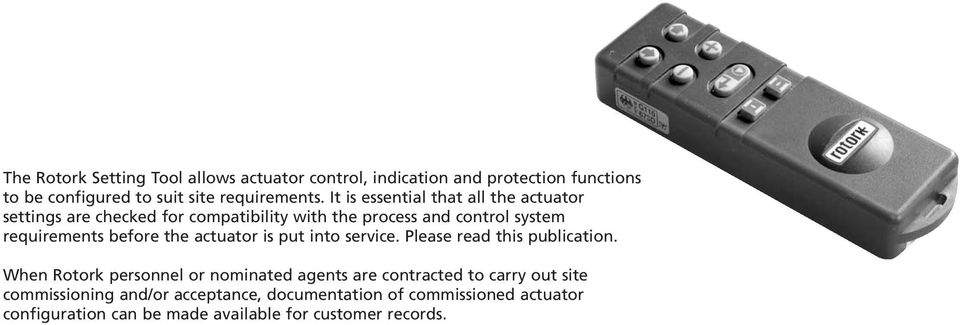
2 The Rotork Setting Tool allows actuator control, indication and protection functions to be configured to suit site requirements. It is essential that all the actuator settings are checked for compatibility with the process and control system requirements before the actuator is put into service. Please read this publication. When Rotork personnel or nominated agents are contracted to carry out site commissioning and/or acceptance, documentation of commissioned actuator configuration can be made available for customer records.
3 This manual provides instruction on: * Manual and electrical (local and remote) operation. * Preparation and installation of the actuator onto the valve. * Subsequent commissioning and adjustment of the Primary Settings for correct valve operation. * Commissioning and adjustment of the Secondary Settings to suit site-specific control and indication requirements. * Maintenance Troubleshooting. * Sales and Service. Refer to Publication E180E2 for repair, overhaul and spare part instructions. THE ROTORK IQ RANGE THE FIRST VALVE ACTUATOR THAT YOU CAN COMMISSION AND INTERROGATE WITHOUT REMOVING ELECTRICAL COVERS. Using the supplied infra-red Setting Tool to access the actuator set up procedures, point and shoot setting of torque levels, position limits and all other control and indication functions can be made safely, quickly and conveniently, even in hazardous locations. The IQ allows commissioning and adjustment to be carried out with the main power supply to the actuator switched on or off. Standard diagnostics access information about the control system, valve and actuator status in the form of display icons and help screens. Instantaneous valve torque and position can be monitored on the actuator with a single key press of the Setting Tool. The on board Datalogger captures operational and valve torque data enabling informed maintenance choices to be made. IQ Insight software for PC and PDA allows the Datalogger to be interrogated, as well as the complete actuator set up to be configured and recorded. The actuator containing the Setting Tool will be identified with a yellow label on the terminal cover. Visit our web site at for more information on the IQ and other Rotork actuator ranges.

4

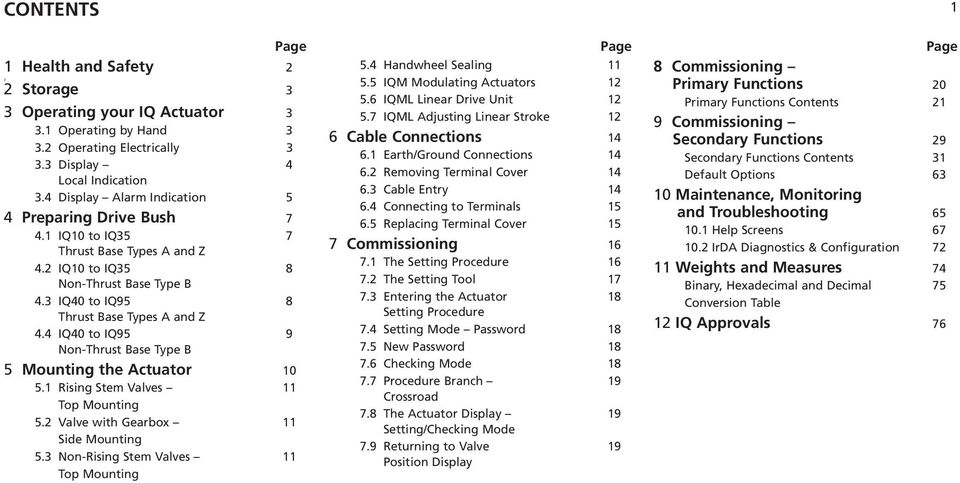
5 CONTENTS Page 1 Health and Safety Storage 3 3 Operating your IQ Actuator Operating by Hand Operating Electrically Display 4 Local Indication 3.4 Display Alarm Indication 5 4 Preparing Drive Bush IQ10 to IQ35 7 Thrust Base Types A and Z 4.2 IQ10 to IQ35 8 Non-Thrust Base Type B 4.3 IQ40 to IQ95 8 Thrust Base Types A and Z 4.4 IQ40 to IQ95 9 Non-Thrust Base Type B 5 Mounting the Actuator Rising Stem Valves 11 Top Mounting 5.2 Valve with Gearbox 11 Side Mounting 5.3 Non-Rising Stem Valves 11 Top Mounting Page 5.4 Handwheel Sealing IQM Modulating Actuators IQML Linear Drive Unit IQML Adjusting Linear Stroke 12 6 Cable Connections Earth/Ground Connections Removing Terminal Cover Cable Entry Connecting to Terminals Replacing Terminal Cover 15 7 Commissioning The Setting Procedure The Setting Tool Entering the Actuator 18 Setting Procedure 7.4 Setting Mode Password New Password Checking Mode Procedure Branch 19 Crossroad 7.8 The Actuator Display 19 Setting/Checking Mode 7.9 Returning to Valve 19 Position Display Page 8 Commissioning Primary Functions 20 Primary Functions Contents 21 9 Commissioning Secondary Functions 29 Secondary Functions Contents 31 Default Options Maintenance, Monitoring and Troubleshooting Help Screens IrDA Diagnostics & Configuration Weights and Measures 74 Binary, Hexadecimal and Decimal 75 Conversion Table 12 IQ Approvals 76 1
6 1 Health and Safety 2 This manual is produced to enable a competent user to install, operate, adjust and inspect Rotork IQ range valve actuators. The electrical installation, maintenance and use of these actuators should be carried out in accordance with the National Legislation and Statutory Provisions relating to the safe use of this equipment, applicable to the site of installation. For the UK: Electricity at Work Regulations 1989 and the guidance given in the applicable edition of the IEE Wiring Regulations should be applied. Also the user should be fully aware of his duties under the Health and Safety Act For the USA: NFPA70, National Electrical Code is applicable. The mechanical installation should be carried out as outlined in the manual and also in accordance with relevant standards such as British Standard Codes of Practice. If the actuator has nameplates indicating that it is suitable for installation in Hazardous Gas Areas then the actuator is suitable for use in Zone 1 and Zone 2 (or Div 1 and Div 2) explosive atmospheres only. It should not be installed in atmospheres where gases are present with an ignition temperature less than 135 C, unless suitability for lower ignition temperatures has been indicated on the actuator nameplate. Any test instruments applied to the actuator should be of equivalent certification. The electrical installation, maintenance and the use of the actuator should be carried out in accordance with the code of practice relevant for that particular Hazardous Gas Area certification. No inspection or repair should be undertaken unless it conforms to the specific Hazardous Gas Area certification requirements. Under no circumstances should any modification or alteration be carried out on the actuator as this could invalidate the conditions under which its certification was granted. Access to live electrical conductors is forbidden in the hazardous area unless this is done under a special permit to work, otherwise all power should be isolated and the actuator moved to a non-hazardous area for repair or attention. Only persons competent by virtue of their training or experience should be allowed to install, maintain and repair Rotork actuators. Work undertaken must be carried out in accordance with instructions in the manual. The user and those persons working on this equipment should be familiar with their responsibilities under any statutory provisions relating to the Health and Safety of their workplace. WARNING: Motor Temperature With excessive use the motor surface temperature could reach 132ºC (270ºF). Thermostat Bypass If the actuator is configured to bypass the motor thermostat, when using the ESD function, the hazardous area certification will be invalidated. Control and Indication Where the actuator build allows remote control and indication supplies higher than 150V a.c. but below 300V a.c. (refer to actuator wiring diagram) the remote control and indication supplies must be derived from a supply which is designated as installation category (overvoltage category) ll as defined in BSEN (Safety Requirements For Electrical Equipment for measurement, control and laboratory use). Enclosure Materials IQ10 to IQ35 are manufactured from aluminium alloy with stainless steel fasteners and the thrust bases are manufactured in cast iron. IQ40 to IQ95 enclosures are manufactured in aluminium alloy and cast iron with stainless steel fasteners and the thrust bases are manufactured in cast iron. The user must ensure that the operating environment and any materials surrounding the actuator cannot lead to a reduction in the safe use of, or the protection afforded by, the actuator. Where appropriate the user must ensure the actuator is suitably protected against it s operating environment. Should further information and guidance relating to the safe use of the Rotork IQ range of actuators be required, it will be provided on request. WARNING: Operating by Hand With respect to handwheel operation of Rotork electric actuators, see warning on p3.

7 2 Storage 3 Operating your IQ Actuator 3 If your actuator cannot be installed immediately store it in a dry place until you are ready to connect incoming cables. If the actuator has to be installed but cannot be cabled it is recommended that the plastic transit cable entry plugs are replaced with metal plugs which are sealed with PTFE tape. The Rotork double-sealed construction will preserve internal electrical components perfectly if left undisturbed. It is not necessary to remove any electrical compartment covers in order to commission the IQ actuator. Rotork cannot accept responsibility for deterioration caused on-site once the covers are removed. Every Rotork actuator has been fully tested before leaving the factory to give years of trouble free operation, providing it is correctly commissioned, installed and sealed. 3.1 Operating by Hand WARNING With respect to handwheel operation of Rotork electric actuators, under no circumstances should any additional lever device such as a wheel-key or wrench be applied to the handwheel in order to develop more force when closing or opening the valve as this may cause damage to the valve and/or actuator or may cause the valve to become stuck in the seated/backseated position. Fig. 3 To engage handwheel drive depress the Hand/Auto lever into Hand position and turn the handwheel to engage the clutch. The lever can now be released when it will return to its original position. The handwheel will remain engaged until the actuator is operated electrically when it will automatically disengage and return to motor drive. If required the Hand/Auto lever can be locked in either position using a padlock with a 6.5mm hasp. 3.2 Operating Electrically Check that power supply voltage agrees with that stamped on the actuator nameplate. Switch on power supply. It is not necessary to check phase rotation. Do not operate the actuator electrically without first checking, using the infra-red Setting Tool, that at least the Primary Settings have been made (refer to Section 8 page 20). Selecting Local/Stop/Remote Operation The red selector enables either Local or Remote control, lockable in each position using a padlock with a 6.5mm hasp. When the selector is locked in the Local or Remote positions the Stop facility is still available. The selector can also be locked in the Stop position to prevent electrical operation by Local or Remote control. Fig. 3.1 Local Control With the red selector positioned at Local (anti-clockwise) the adjacent black knob can be turned to select Open or Close. For Stop, turn red knob clockwise. Remote Control Rotate the red selector to the Remote position (clockwise), this gives remote

8 4 control only for Open and Close but local Stop can still be used by turning the red knob anti-clockwise. 3.3 Display Local Indication The liquid crystal display screen has 2 modes of position indication: 1. Valve position power on 2. Valve position power off On power up the actuator s liquid crystal display screen is back-lit with a soft amber light and one of the indicator lamps will be on, dependent on position. The display screen will show percentage open or an end of travel symbol. (See Figs 3.3, 3.4 and 3.5) As standard, red lamp signifies valve open, yellow intermediate, and green lamp signifies valve closed. Open and closed colour functions can be reversed on request. Open Red indicator and open symbol displayed Closed Green indicator and closed symbol displayed 5 Fig. 3.2 The Actuator Display The display consists of: 1. Red position indication lamp 2. Yellow position indication lamp 3. Green position indication lamp 4. Liquid crystal display screen (LCD) 5. Infra-red sensors 6. Infra-red signal confirmation indicator (Red) 6 Fig. 3.3 Mid Travel Yellow indicator and percentage open value displayed Fig. 3.5 With the main power supply switched off, the liquid crystal display screen is powered by a battery and continues to display actuator position. However, the battery does not support screen backlighting, or position indicator lamps. Fig. 3.4

9 5 3.4 Display Alarm Indication The IQ display incorporates valve, control system, actuator and battery alarm indication in the form of four display icons. Located in the top portion of the display, each icon represents certain alarm conditions. Standard help screens are also available to assist in determining the actuator operational and alarm status (refer to Help Screens page 67). Fig. 3.6 Valve Alarm The valve alarm icon, Fig 3.6, is displayed when a valve problem causes the actuator to trip-off due to the configured torque value being developed (refer to [tc]/[to] pages 25/26).The possible causes are: Valve tight or obstructed in mid travel. Valve stuck or jammed Valve process conditions changed (increase in pressure, flow etc.) Once the actuator has tripped off on torque, electrical operation in the same direction is inhibited. The icon will remain displayed until movement in the opposite direction takes place. The valve alarm icon will not be displayed when stopping at end of travel for valves configured to torque seat or torque back seat at end of travel (refer to [C2]/[C3] pages 23/24). Try handwheel operation of the valve to feel for stiffness (refer to page 3). Control Alarm Fig. 3.7 The control system alarm icon, Fig 4.5, is displayed when the remote control system maintains an active ESD or interlock signal (the ESD, interlock function or conditional control having been enabled.) Local and Remote operation will be inhibited while an active ESD or interlock signal is present (refer to [A1] ESD Action page 34, [A8] External Interlocks page 36 and Conditional Control [A9] page 36.) Investigate the operational conditions of the actuator remote control system.

10 6 Actuator Alarm Fig. 3.8 The actuator alarm icon, Fig. 3.8, is displayed when an active actuator alarm is present. Electrical operation will be inhibited while an alarm is present. The possible causes are: Transformer thermostat tripped Battery low on power up* Power supply fault *see Battery Alarm (To identify the specific cause of the alarm refer to Help Screens pages 67-71). Battery Alarm Fig. 3.9 The battery alarm icon, Fig. 3.9, is displayed when the actuator detects its battery as being low, discharged or missing. If, on power up, the actuator detects a discharged battery and actuator power loss inhibit feature [OS] is enabled (refer to page 62), both battery and actuator alarm icons (Fig.3.8 and 3.9) will be displayed. Electrical operation will be inhibited. When the battery alarm icon is displayed, the battery should be replaced immediately (refer to page 65). The actuator checks the battery status at approximately 10 minute intervals. After replacing a battery the alarm icon will continue to be displayed until the next check indicates the battery is healthy. This may take up to 10 minutes.

11 4 Preparing Drive Bush IQ10 to IQ35 Thrust Base Types A and Z Removal of Drive Bush for Machining Fig. 4 Bronze Drive Bush Fitted into Thrust Taking Base Turn actuator onto its side, remove the two cap-headed screws holding base plate onto thrust base, pull out the drive bush complete with its bearing assembly. Before machining the drive bush the thrust bearing must be removed. IQ10, IQ12 and IQ18 actuators have a sealed thrust bearing located on the drive bush and retained by the steel Fig. 4.1 Components of Type A Thrust Base bearing stop ring. The bearing stop ring is locked with one socket set screw. IQ20, IQ25 and IQ35 have a thrust race ball bearing within the steel bearing housing, located on the drive bush and retained by the steel bearing stop ring. The bearing is sealed within its housing by O-rings located on the drive bush and on the bearing stop ring. The bearing stop ring is locked with two socket set screws. 1. Locate and loosen the locking socket set screw(s) in the bearing stop ring. 2. Unscrew the bearing stop from the drive bush. Slide the bearing off the drive bush. Keep the drive bush and stop ring in a safe clean place. 3. For all sizes ensure the drive bush male thread (stop ring) is not damaged during machining. For sizes IQ20, IQ25 & IQ35, ensure the O-ring located in the drive bush is not damaged during machining. Machine drive bush to suit the valve stem, allowing generous clearance on the screw thread for rising stem valves. Re-assembly 1. Remove all swarf from the drive bush, ensuring the O rings on the drive bush and bearing stop ring (where fitted) are undamaged, clean and greased. 2. Slide the bearing assembly onto the drive bush and ensure it is fitted down to the drive bush shoulder. 3. Screw the stop ring with the locking socket set screw(s) uppermost on to the drive bush until it comes to a stop hand tight and lock with the locking socket set screws. The locking socket set screws must be done up tight to prevent the assembly working loose, as shown in Fig 4.2. Refer to the table below for required tightening torques. Socket set Allen key Torque Torque screw size bit size Nm lbs/ft M4 M M6 M Fig Refit the drive bush assembly into the base casting on the actuator, ensuring that the slots in the drive bush are located into the drive dogs of the hollow output shaft. 5. Refit the base plate and secure with cap-headed screws.
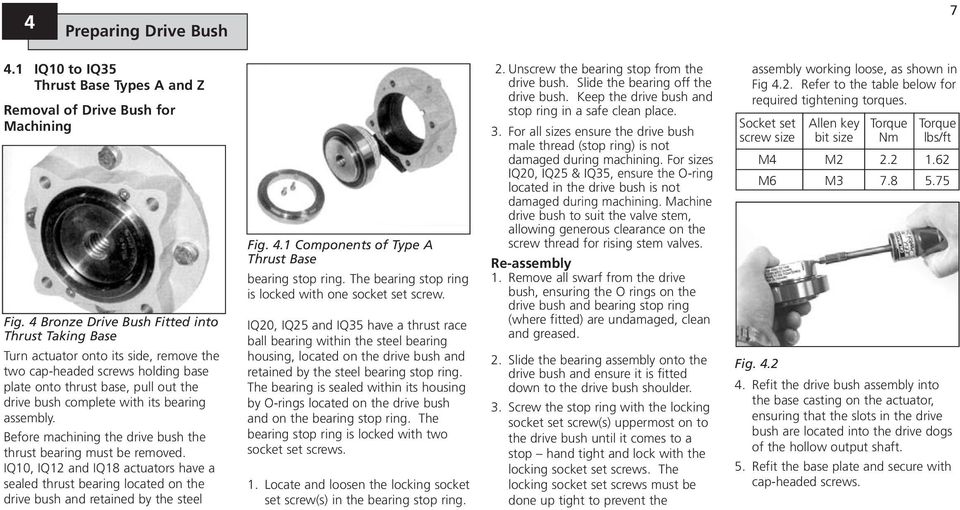
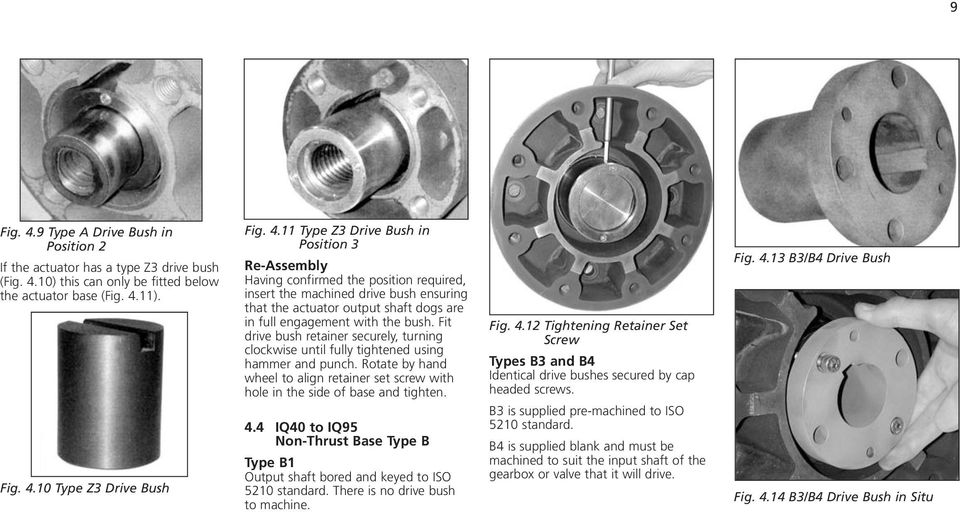
12 8 4.2 IQ10 to IQ35 Non-Thrust Base Type B Undo the four set screws securing the base plate to the gearcase and remove the base plate. The drive bush and its retaining clip can now be seen. Types B3 and B4 removal: (refer to Fig. 4.3) Using external circlip pliers, expand the circlip while pulling on the drive bush. The drive bush will detach from the actuator centre column with the circlip retained in its groove. Fig. 4.4 Type B1 (Refer to Fig. 4.4) The procedure for removal and refitting of the B1 drive bush is the and same as for B3 and B4, However the circlip is replaced with a custom spring clip. The spring clip operates in the same manner as the B3/B4 circlip but is expanded using long-nose pliers. Fig. 4.5 Locating Set Screw Loosen set screw and unscrew retainer using hammer and punch. Remove drive bush and machine to suit valve stem or gearbox input shaft. Allow generous clearance on screw thread for rising stem valves. Fig. 4.7 Type A Drive Bush If the actuator has a type A drive bush (Fig. 4.7) this can be fitted in position 1 or 2 to suit the position of the valve mounting flange. 4.3 IQ40 to IQ95 Thrust Base Types A and Z Removal of Drive Bush for Machining Engage hand and turn handwheel until retainer set screw is visible through hole in actuator base. Fig. 4.3 Fig. 4.8 Type A Drive Bush in Position 1 Fig. 4.6 Removal of Retainer

13 9 Fig. 4.9 Type A Drive Bush in Position 2 If the actuator has a type Z3 drive bush (Fig. 4.10) this can only be fitted below the actuator base (Fig. 4.11). Fig Type Z3 Drive Bush Fig Type Z3 Drive Bush in Position 3 Re-Assembly Having confirmed the position required, insert the machined drive bush ensuring that the actuator output shaft dogs are in full engagement with the bush. Fit drive bush retainer securely, turning clockwise until fully tightened using hammer and punch. Rotate by hand wheel to align retainer set screw with hole in the side of base and tighten. 4.4 IQ40 to IQ95 Non-Thrust Base Type B Type B1 Output shaft bored and keyed to ISO 5210 standard. There is no drive bush to machine. Fig Tightening Retainer Set Screw Types B3 and B4 Identical drive bushes secured by cap headed screws. B3 is supplied pre-machined to ISO 5210 standard. B4 is supplied blank and must be machined to suit the input shaft of the gearbox or valve that it will drive. Fig B3/B4 Drive Bush Fig B3/B4 Drive Bush in Situ
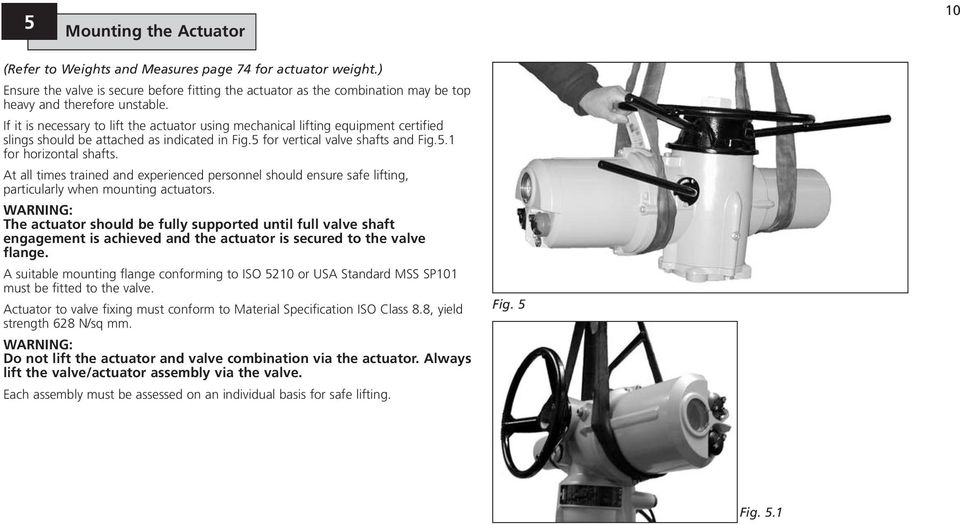
14 5 Mounting the Actuator 10 (Refer to Weights and Measures page 74 for actuator weight.) Ensure the valve is secure before fitting the actuator as the combination may be top heavy and therefore unstable. If it is necessary to lift the actuator using mechanical lifting equipment certified slings should be attached as indicated in Fig.5 for vertical valve shafts and Fig.5.1 for horizontal shafts. At all times trained and experienced personnel should ensure safe lifting, particularly when mounting actuators. WARNING: The actuator should be fully supported until full valve shaft engagement is achieved and the actuator is secured to the valve flange. A suitable mounting flange conforming to ISO 5210 or USA Standard MSS SP101 must be fitted to the valve. Actuator to valve fixing must conform to Material Specification ISO Class 8.8, yield strength 628 N/sq mm. WARNING: Do not lift the actuator and valve combination via the actuator. Always lift the valve/actuator assembly via the valve. Each assembly must be assessed on an individual basis for safe lifting. Fig. 5 Fig. 5.1
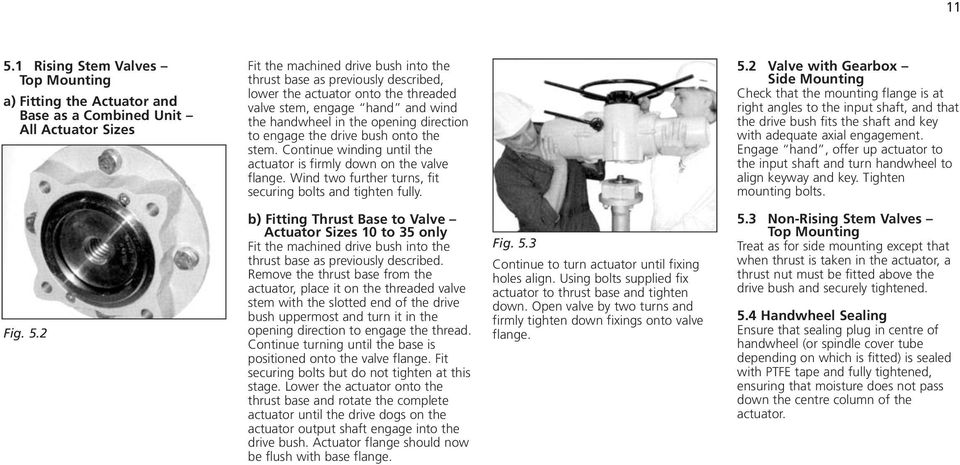
15 Rising Stem Valves Top Mounting a) Fitting the Actuator and Base as a Combined Unit All Actuator Sizes Fit the machined drive bush into the thrust base as previously described, lower the actuator onto the threaded valve stem, engage hand and wind the handwheel in the opening direction to engage the drive bush onto the stem. Continue winding until the actuator is firmly down on the valve flange. Wind two further turns, fit securing bolts and tighten fully. 5.2 Valve with Gearbox Side Mounting Check that the mounting flange is at right angles to the input shaft, and that the drive bush fits the shaft and key with adequate axial engagement. Engage hand, offer up actuator to the input shaft and turn handwheel to align keyway and key. Tighten mounting bolts. Fig. 5.2 b) Fitting Thrust Base to Valve Actuator Sizes 10 to 35 only Fit the machined drive bush into the thrust base as previously described. Remove the thrust base from the actuator, place it on the threaded valve stem with the slotted end of the drive bush uppermost and turn it in the opening direction to engage the thread. Continue turning until the base is positioned onto the valve flange. Fit securing bolts but do not tighten at this stage. Lower the actuator onto the thrust base and rotate the complete actuator until the drive dogs on the actuator output shaft engage into the drive bush. Actuator flange should now be flush with base flange. Fig. 5.3 Continue to turn actuator until fixing holes align. Using bolts supplied fix actuator to thrust base and tighten down. Open valve by two turns and firmly tighten down fixings onto valve flange. 5.3 Non-Rising Stem Valves Top Mounting Treat as for side mounting except that when thrust is taken in the actuator, a thrust nut must be fitted above the drive bush and securely tightened. 5.4 Handwheel Sealing Ensure that sealing plug in centre of handwheel (or spindle cover tube depending on which is fitted) is sealed with PTFE tape and fully tightened, ensuring that moisture does not pass down the centre column of the actuator.
16 IQM Modulating Actuators The IQM range of actuators are suitable for modulating control duty of up to 1200 starts per hour in accordance with IEC 34-1 to S4 50%. IQM actuators have a dynamic braking facility as standard. If mechanical overrun of the actuator and valve prove to be excessive for accurate control, the brake can be enabled by fitting a link to the actuator terminal block as indicated by the wiring diagram. With dynamic braking enabled, motor heating effects increase and therefore the number of actuator starts should be reduced to prevent motor thermostat tripping (refer to publication E 410E for more information). Commissioning of IQM range actuators is identical to the standard IQ (refer to Sections 7, 8 and 9 commencing on page 16). 5.6 IQML Linear Drive Unit Consists of a lead screw assembly arrangement attached to the base of the actuator in order to provide a linear output stroke between 8mm ( 3 /8 in) minimum and 120mm (4 3 /4in) maximum. The IQML can be supplied with or without a yoke mounting adaptor. This adaptor consists of four pillars and a base flange to suit the valve. Fig. 5.5 IQML without Yoke 5.7 IQML Adjusting Linear Stroke With actuator securely fitted to valve, but with the linear drive disconnected, ensure valve is at its fully closed (down) position. Remove cover tube from actuator handwheel, locate the down stop adjustment on the linear drive unit and with two spanners loosen the lock nut, run the lock nut and tubular down stop to the end of the thread. Fig. 5.6 Down Stop two Spanners Fig. 5.4 IQML with Yoke

17 IQML Adjusting Linear Stroke continued Turn the actuator handwheel clockwise, linear drive will move down towards the valve spindle, couple linear drive to valve spindle. Turn the tubular down stop clockwise into the actuator until it comes to a mechanical stop. If the valve must close onto its seat by TORQUE ACTION then back off (anti-clockwise) the down stop by one third of one turn (equivalent to 1mm). Run the lock nut down ontothe tubular down stop and tighten with two spanners. There is no up stop (open) on the linear drive unit, the mechanical stop in the valve will give this position. Refit the top cover tube to the handwheel using PTFE tape to seal the thread. The linear drive unit is pre-packed with grease type Rocol MTS 1000, use this or an equivalent high temperaturebearing grease. A grease nipple is situated in the base of the actuator to enable lubrication of the lead screw. Periodically, depending on usage and temperature, apply two pumps of a grease gun.
18 6 Cable Connections 14 WARNING: Ensure all power supplies are isolated before removing actuator covers. Check that the supply voltage agrees with that stamped on actuator nameplate. A switch or circuit breaker must be included in the wiring installation of the actuator. The switch or circuit breaker shall be mounted as close to the actuator as possible and shall be marked to indicate that it is the disconnecting device for that particular actuator. The actuator must be protected with overcurrent protection devices rated in accordance with Rotork publication No. E130E Electric motor performance data for IQ range actuators. WARNING: Actuators for use on phase to phase voltages greater than 600V a.c.must not be used on supply systems such as floating, or earth-phase systems, where phase to earth voltages in excess of 600V a.c. could exist. 6.1 Earth/Ground Connections A lug with a 6mm diameter hole is cast adjacent to the conduit entries for attachment of an external protective earthing strap by a nut and bolt. An internal earth terminal is also provided, however it must not be used alone as the protective Earth Connection. 6.2 Removing Terminal Cover Using a 6mm Allen key loosen the four captive screws evenly. Do not attempt to lever off the cover with a screwdriver as this will damage the O ring seal and may damage the flamepath on a certified unit. Fig. 6 Actuators containing a Setting Tool fitted to the inside of the terminal compartment cover are identified with a self-adhesive yellow label on the outside of the terminal compartment cover. The wiring code card fixed in the cover is particular to each actuator and must not be interchanged with any other actuator. If in doubt check the serial number on the code card with that of the actuator. Fig. 6.1 A plastic bag in the terminal compartment contains: Terminal screws and washers. Spare cover O ring seal. Wiring diagram. Instruction book. Fig Cable Entry Only appropriate certified Explosion- Proof entry reducers, glands or conduit may be used in hazardous locations. Remove red plastic transit plugs. Make cable entries appropriate to the cable type and size. Ensure that threaded adaptors, cable glands or conduit are tight and fully waterproof. Seal unused cable entries with a steel or brass threaded plug. In hazardous areas an appropriately certified threaded blanking plug must be used.

19 Connecting to Terminals On EExde enclosure units connections to the power and control terminals must be made using AMP type ring tabs for power and earth terminals and AMP type ring tabs for the control terminals. Refer to the wiring diagram inside the terminal cover to identify functions of terminals. Check that supply voltage is the same as that marked on the actuator nameplate. Remove power terminal screen. Begin by connecting these cables and replace screen. When all connections are made ensure wiring diagram is replaced in the terminal compartment. 6.5 Replacing Terminal Cover Ensure cover O ring seal and spigot joint are in good condition and lightly greased before re-fitting cover.
20 7 Commissioning The Setting Procedure The Rotork IQ range of actuators is the first that enables commissioning to be carried out without removing covers. Setting torque, limit and other functions is achieved by using the Infra- Red Setting Tool. The Setting Tool is certified Intrinsically Safe to allow commissioning in hazardous areas. All the commissioning functions are stored in non-volatile memory in the actuator. The Setting Tool enables the user to view all the functions in turn via the actuator display window. As each function is viewed its setting can be checked and, if required, changed within the bounds of that function. Commissioning may be carried out with main power switched on or off. Refer to page 20 for Power Off Setting. The setting procedure is divided into two stages: 1. Primary Functions Settings for end of travel limit actions, torque values, limit positions etc. 2. Secondary Functions Settings covering the control, indication and optional equipment functions. All IQ actuator functions are configured before dispatch to Rotork standard default settings unless alternatives have been specified with the order. Should difficulty be encountered during commissioning the default settings can be reinstated, returning the actuator configuration to its original manufactured state. Site commissioning can then begin again (refer to Section 9.16 page 63). The default function should be used with caution as settings selected after manufacture may be essential for the safe operation of the valve and/or plant. Actuator Display Position Display 50 This may be an open or closed symbol or a percentage open value. Torque and Position Refer to Section 10. Password P? PC Ir Ic Setting Branch cr (crossroad) Note: The Primary Functions must be commissioned first. Primary Functions Direction Limit Actions Torque Values Limit Positions Secondary Functions Indication Contacts Control Mode Options Help Screens Defaults

21 The Setting Tool Specification Enclosure IP67 Certification EEx ia IIC T4 (intrinsically safe) FM, INT SAFE, Class I & II Div 1 Groups A B C D E F G, T4A CSA, Exia, Class I, II Div 1 Groups A B C D Power supply 9V Battery (supplied and fitted) Operating range 0.75m (from actuator display window) Name Instruction 1. Key* Display next function down 2. Key* Display next function across 3. - Key Decrease/change displayed function s value or option setting 4. + Key Increase/change displayed function s value or option setting 5. Key Enter displayed value or option setting * Pressing the two arrow keys together returns the actuator display to the position indication mode Infra-red local operation (when enabled) 5. Key Stop actuator 6. Key Open actuator 7. Key Close actuator 8. Infra-red Transmitter Window Fig. 7 The Setting Tool 7 4 Setting Tool Battery Replacement Battery status can be checked by looking at the Infra-red transmitter window while depressing any Setting Tool button. A flashing red indicator should be seen. Battery replacement must be carried out in a safe area. To replace the battery remove the six caphead screws in the back of the Setting Tool. Remove the back cover to expose the battery. In order to maintain hazardous area certification fit only Duracell MN1604 or Rayovac Alkaline Maximum NoAL-9V battery types. Refit cover ensuring red indicator LED faces the transmitter window in the back cover. When a button is depressed the Setting Tool transmits the relevant instruction to the actuator by infra-red pulses and must therefore be directly in front of the actuator indicator window and at a distance no greater than 0.75m. 6
22 Entering the Actuator Setting Procedure With the actuator securely mounted on the valve, the mains supply on and Local control or Stop selected. PRESS THE KEY. The actuator display will change and the Torque & Position display will be seen. (For instantaneous torque & position monitoring, refer to Section 10, page 66.) PRESS THE KEY. The actuator display will change and the password protection display will be seen. The Actuator Function Settings can be protected by the Use of a Password 7.4 Setting Mode Password To enable setting and adjustment of the actuator functions the correct password must be entered. The factory set (default) password is [ld]. If the actuator has previously been set with a site password this must be displayed. Use the + or - keys to scroll through the available passwords 00 FF (hexadecimal). With the correct password displayed press the enter key. PRESS THE KEY. Two setting bars will appear and will remain visible on every function display screen. Default Password, Setting Mode Enabled 7.5 New Password [PC] To configure a new password, the actuator must be in setting mode with the password display setting mode enabled showing, PRESS THE KEY. The display will change to [PC]. Using the + or - key scroll through the available passwords until the desired password is displayed. PRESS THE KEY. Password Changed to [IE] NOTE: The new password becomes effective the next time setting mode is entered. 7.6 Checking Mode The actuator function settings can be checked without entering the correct password. The settings can only be viewed and not altered. The setting bars will not be seen. Password Display, Checking Mode Once the procedure has been entered in the required mode PRESS THE KEY. The procedure branch [Cr] (crossroad) display can now be seen (refer to Section 7.7 page 19).
23 Procedure Branch Crossroad [Cr] To access the Primary Function settings press the arrow key (refer to Section 8 Commissioning Primary Functions page 20). To access the Secondary Function settings press the arrow key (refer to Section 9 Commissioning Secondary Functions page 31). 7.8 The Actuator Display Setting/Checking Mode Actuator functions as laid out in the Primary and Secondary commissioning stages, can be individually displayed by using the Setting Tool arrow keys. The arrow key will always display the FIRST function on the next level DOWN within the procedure. The arrow key will always display the NEXT function on the SAME level and will wrap around the functions on the same level. The actuator display indicator lamps will continue to indicate valve position. Actuator functions are displayed in code form in the top portion of the liquid crystal display screen. The setting for the displayed function is shown in the lower portion of the screen. Depending on the actuator function displayed, its setting may be an option or a value. In setting mode the Setting Tool + or - keys will cause the setting to be changed. In checking mode the settings cannot be altered. In setting mode, once displayed, a new setting can be entered into the actuator memory by pressing the key. The setting will flash off and back on, confirming its selection. TOP PORTION Function e.g. tc = Torque Close LOWER PORTION Function Setting e.g. Value = 40% Typical Actuator Function Display Setting Mode Enabled 7.9 Returning to Valve Position Display There are four ways of returning to valve position display: 1. Approximately 5 minutes after the last Setting Tool operation the display will automatically return to position display. 2. Press the and arrow keys together. 3. Press the arrow key until the display returns to position. 4. With any actuator function screen displayed, select Remote control using the red Local/Stop/Remote selector.
24 Fig. 8 8 Commissioning Primary Functions The actuator s Primary Function settings affect the correct operation of the valve by the actuator. If the actuator has been supplied with the valve, the valve maker or supplier may have already made these settings. ELECTRICAL OPERATION MUST NOT TAKE PLACE UNTIL THE PRIMARY SETTINGS HAVE BEEN MADE AND CHECKED. This instruction assumes setting mode has been entered (refer to section 7.4 page 18). Viewing the Primary Function Settings With the actuator mounted on the valve, the power supply on and Local or Stop control selected, point the Setting Tool at the actuator indicator window from a distance of no more than 0.75m. By pressing the key and, when appropriate, the key, it is possible to move through the procedure, displaying the various functions and their settings as shown in Fig. 8.1 (refer to page 21).The righthand side of Fig.8.1 explains the function of each LCD display. 20 Power Off Setting IQ allows settings to be viewed and set without main power. To enable this function, engage handwheel drive and rotate until the output drive moves (refer to page 3). The Setting Tool can now be used. As long as a Setting Tool key press takes place within the 30 seconds timeout period, Power Off Setting will remain enabled. If no infrared Setting Tool communication takes place the display will return to indicating position. The actuator must then be operated by handwheel to re-enable Power Off Setting. Settings and operation must be verified by electric operation and function test of the actuator to ensure correct operation.
25 21 Viewing the Primary Function Settings Position Display 50 (This may be an open or closed symbol or a % open value.) Refer to Section 7 Commissioning Torque and Position Display P? PC Ir Ic Password Password Change IrDA Cell Phone cr c1 c2 c3 tc to LC LO Procedure Branch (crossroad) Direction to Close Close Action Open Action Torque Value Closing Torque Value Opening Limit Closed Limit Open 50 Position Display Fig. 8.1 Primary Setting Function Displays PRIMARY FUNCTIONS CONTENTS page C1 Direction to Close 22 C2 Close Action 23 C3 Open Action 24 tc Torque Value Closing 25 to Torque Value Opening 26 LC Set Limit Closed 27 LO Set Limit Open 27 The actuator can be configured to be clockwise or anti-clockwise to close.
26 C1 Direction to Close 22 Manually operate actuator and valve to establish correct closing direction. If the handwheel labelling is found to be incorrect please apply to Rotork for conversion labels. 50 P? PC Ir Ic cr c1 c2 c3 tc to LC LO 50 Using the + or - key, display character conforming to correct closing direction. [C] in the Setting Field Indicating Clockwise to Close [A] in the Setting Field Indicating Anti-clockwise to Close Having ensured that the display corresponds to the established closing direction PRESS THE KEY., PRESS THE KEY.
27 C2 Close Action 23 The actuator can be configured to close on torque for seating valves and limit for non-seating valves. (Refer to valve manufacturer for recommended selection). In the absence of valvemaker instructions refer to the following table Using the + or - key, display the desired option. NOTE: When set to close on torque, the actuator will apply the value of torque as set for [tc] in seating the valve (refer to [tc] page 25). 50 P? PC Ir Ic cr Valve type Close Open Wedge gate torque limit Globe torque limit Butterfly limit limit Thru conduit limit limit Ball limit limit Plug limit limit Sluice gate limit limit Penstock limit limit Parallel slide limit limit [Ct] in the Setting Field Indicating Close on Torque - defualt setting. c1 c2 c3 [CL] in the Setting Field Indicating Close on Limit tc to LC LO 50 Having selected the required option PRESS THE KEY., PRESS THE KEY.
28 C3 Open Action 24 The actuator can be configured to open on torque for back seating valves or limit for non back seating valves. Refer to valve manufacturer for recommended setting. In the absence of valvemaker instructions set Open Limit. Using the + or - key display the desired option. NOTE: When set to open on torque, the actuator will apply the value of torque as set for [to] in back seating the valve (refer to [to] page 26). 50 [Ot] in the Setting Field Indicates Open on Torque - defualt setting. P? PC Ir Ic cr c1 c2 c3 tc to LC LO 50 [OL] in the Setting Field Indicates Open on Limit PRESS THE KEY., PRESS THE KEY.
29 tc Torque Value Closing 25 The value of torque available in the close direction can be configured. Refer to valve manufacturer for recommended value. The closing torque value can be varied between 40% and Rated, in 1% increments. 50 P? PC Ir Ic cr c1 c2 c3 tc to LC LO 50 Using the + and - keys display recommended value. In the absence of a recommended torque value, try a low setting and increase until satisfactory valve operation is achieved. PRESS THE KEY. The displayed value will flash, indicating that it has been set. Should the set value of torque be developed in closing, the actuator will torque trip and stop. PRESS THE KEY. NOTE: Rated torque is quoted on the actuator nameplate. 40% of Rated Torque 99% of Rated Torque Rated Torque
30 to Torque Valve Opening 26 The value of torque available in the open direction can be configured. Refer to valve manufacturer for recommended value. The opening torque value can be varied between 40% and Rated, in 1% increments. In addition Boost can be configured when no open torque protection is required. Should the set value of torque be developed in opening, the actuator will torque trip and stop. PRESS THE KEY. 50 P? PC Ir Ic cr c1 c2 c3 tc to LC LO 50 BOOST SHOULD NOT BE SELECTED WHEN THE ACTUATOR HAS BEEN CONFIGURED TO OPEN ON TORQUE (refer to [C3] page 24) unless back seating at Rated torque is acceptable. Using the + and - keys display the recommended torque value. In the absence of a recommended torque value, try a low setting and increase until satisfactory valve operation is achieved. NOTE: Rated torque is quoted on the actuator nameplate. Boost torque is at least 140% of Rated torque. PRESS THE KEY. The displayed value will flash, indicating that it has been set. 40% 99% Rated Boost In checking mode, on pressing the key after reviewing open torque setting, the display will revert to valve position.
31 LC Set Limit Closed LO Set Limit Open 27 NOTE: It is possible to set the Open Limit Position [LO] first. With [LC] displayed 50 With [LO] displayed 50 P? PC Ir Ic cr c1 c2 c3 tc to LC LO 50 Limit Closed Move valve manually to the closed position. Allow for overrun by winding actuator output open by two handwheel turns. PRESS THE KEY. The two bars will flash and the closed indicator lamp will illuminate, indicating closed limit position has been set. PRESS THE KEY. To check closed limit position hand wind valve open until the amber lamp illuminates. Wind valve back closed until the closed lamp illuminates. P? PC Ir Ic cr c1 c2 c3 tc to LC LO 50 NOTE: When in checking mode Set Limit Open [LO] does not appear. Limit Open Move valve manually to the open position. Allow for overrun by winding actuator output closed by two handwheel turns. PRESS THE KEY. The two bars will flash and the open indicator lamp will illuminate, indicating open limit position has been set. PRESS THE KEY. The open symbol (refer to Fig page 4) should now appear. NOTE: When in checking mode Set Limit Closed [LC] does not appear.
32 Return to Positional Display P? PC Ir Ic cr c1 c2 c3 tc to LC LO 50 If the procedure has been followed as described, the positional display will indicate that the actuator is in the open position. Select Remote control momentarily, using the red selector to exit setting procedure and then select required control: Local, Stop or Remote. With the correct settings made electric operation can now be carried out safely.
33 Fig. 9 9 Commissioning Secondary Functions The Secondary Functions can be configured to suit site control and indication requirements. It is important that Primary Functions such as limits and torque switch settings are set before work commences on commissioning the Secondary Functions (refer to page 20). The layout of the Secondary Functions accessed with the Setting Tool are detailed in Fig To successfully commission the Secondary Functions, information about the site or process control system will be required. The supplied actuator Wiring Diagram details control and indication devices fitted to the actuator along with terminal connection detail and standard remote control wiring systems. 29 Power Off Setting IQ allows settings to be viewed and set without main power. To enable this function, engage handwheel drive and rotate until the output drive moves by one turn (refer to page 3).The Setting Tool can now be used. As long as a Setting Tool key press takes place within the 30 seconds timeout period, Power Off Setting will remain enabled. If no infra-red Setting Tool communication takes place the display will return to indicating position. The actuator must then be operated by handwheel to re-enable Power Off Setting. Settings and operation must be verified by electric operation and function test of the actuator to ensure correct operation.
34 30 50 Positional Display IrDA Cell comms Phone P? PC Ir Ic Contact Function Value Contact Form cr Contact S1 r1 r1 r1 Primary Functions Contact S2 r2 r2 r2 Contact S3 r3 r3 r3 Contact S4 r4 r4 r4 ESD ESD Thermostat ESD Overide ESD Override Maintained 2-wire External Conditional Torque Switch ESD Action Contact Type Bypass Interlocks Local Stop Local Control Control Interlocks Control Bypass Control Mode Configuration A1 A2 A3 A4 A5 A6 A7 A8 A9 At Extra Indication Folomatic Remote Bus Interrupter Setting Tool Power Loss Contacts CPT Remote Control Control Source System Timer Local Control Inhibit Option Selection OE OI OF Od OP OJ Or OS Option Functions - If OE, OF, OP, or OJ are fitted and selected ON their appropriate set-up screens will be inserted here. Help Screens H1 H2 H3 H4 H5 H6 H7 H8 H9 Default Option d1 d2 Return to Positional Display Fig. 9.1 Secondary Functions
35 SECONDARY FUNCTIONS CONTENTS page 9.1 Accessing the Secondary Settings Indication Contacts S1, S2, S3 and S Control Mode Configuration Option Extra Indication Contacts S5 S Option CPT (Current Position Transmitter) Option Folomatic Remote Control Remote Control Source Bus System Option Pakscan Bus System Option Modbus Bus System Option Profibus DP Bus System Option DeviceNet Bus System Positioning Control Settings Option Interrupter Timer Setting Tool Local Control Inhibit Operation After Power Loss Default Options Default Options Help Screens IrDA Diagnostics and Configuration 72 Having established that the Primary Functions have been correctly set, the Secondary Functions can now be configured to suit site control and indication requirements. It is possible to move through the various Secondary Functions as shown in Fig. 9.1 using the and keys. The actuator wiring diagram will indicate any options fitted. Options Setting Tool Local Control [Or] and Power Loss Inhibit [OS] are standard features, their use being optional. 9.1 Accessing the Secondary Functions 31 In order to display the Secondary Functions it is necessary to press the key until [Cr] appears. If you have chosen to enter Secondary Functions in the checking mode the display will be as Fig If you have chosen to enter Secondary Functions in the setting mode the display will be as Fig. 9.3 (refer to Section 7). Fig. 9.2 Fig. 9.3 PRESS THE KEY.
36 9.2 Indication Contacts S1, S2, S3 and S4 r1 Contact S1 - Function 32 Indication contacts S1 [r1], S2 [r2], S3 [r3] and S4 [r4] may each be set to trip for any one of the following functions: Code Function [CL] closed end position [OP] open end position [Po] intermediate position [tc] torque trip close [to] torque trip open [tt] torque trip any position [tl] torque trip mid travel [dc] actuator closing [do] actuator opening [d?] actuator rotating [St] motor stalled [ba] battery low [HA] hand operation [bl] blinker [LS] local stop [Ol] open interlock [Cl] close interlock [ll] interlock active [ES] ESD signal [LP] lost phase ** [Lo] local selected [re] remote selected [AA] actuator alarm * [24] 24V power failure *** [rr] motor running [UA] Valve alarm* [Ht] thermostat tripped [CA] Control alarm* [rp] relay parity The S contact form can be set normally open [no] or normally closed [nc]. The procedures for setting up contacts S2, S3 and S4 are the same as those shown for S1. Unless specified with order, the default settings for indication contacts are as follows: S1 [CL] closed end position [no] S2 [OP] open end position [no] S3 [CL] closed end position [nc] S4 [OP] open end position [nc] * Contact alarm indication will operate under the same conditions as the display alarm indication icons (refer to page 5 for information). ** [LP] Function not available for phases 1 & 2, only for phase 3. For phase loss detection on phase 1 & 2 please use monitor relay *** [24] Function not available if the 3 phase supply is lost. Using the + or - key display the desired function. PRESS THE KEY. The displayed function will flash Contact S1 Configured to Trip at Valve Closed Limit PRESS THE KEY.
37 r1 Contact S1 - Value r1 Contact S1 Contact Form 33 When the S contact function is set to [P0], the required intermediate position value must be set. No other contact function requires a value to be set. The value can be set from 1% open to 99% open in 1% increments. Using the + or - key, display the required value. PRESS THE KEY. The displayed value will flash indicating that it has been set. Value Set to Indicate 25% Open PRESS THE KEY. Use the + or - keys to select between [no] (normally open) and [nc] (normally closed). PRESS THE KEY. Contact S1 Configured as a Normally Open Contact NOTE: If function [PO] is selected and it is configured as a normally open contact it will make at the set value with the actuator moving in the open direction. To access S2 S4 PRESS THE KEY.
38 9.3 Control Mode Configuration A1 ESD Action A2 ESD Contact Type A3 ESD Thermostat Bypass 34 The Control Mode Configuration affects how the actuator will respond under conditions of emergency shut down, local control, remote control interlocks, and 2-wire remote control. Also included is an unseating torque switch bypass function. Unless specified with order, the control mode configuration will be set as shown for default configuration on page 63. If it is necessary to change the configuration follow the instructions in this section. There are 10 configurable control functions: A1 ESD action A2 ESD contact type A3 ESD thermostat bypass A4 ESD override interlock A5 ESD override local stop A6 Maintained local control A7 2-wire remote control A8 External interlocks A9 Conditional Control At Torque switch bypass. An active ESD signal applied to the actuator will override any existing or applied local or remote control signal. ESD can be configured to override the transformer thermostat, active interlocks or local stop selection. Refer to A3, A4 and A5. The default action under an active ESD signal is to stay put [SP]. Press the + or - key to select the required ESD action: [CL] Close on ESD [SP] Stay put on ESD [OP] Open on ESD PRESS THE KEY. ESD Set to Close The default setting for ESD Contact Type is [no]. The actuator responds to a remote control ESD signal derived from a normally open contact making. For ESD, where a remote control ESD signal is derived from a normally closed contact breaking, the signal being removed, press the + or - key. The display will change to [nc]. PRESS THE KEY. Actuator Responds to a Remote, Normally Open ESD Contact Making (Signal Applied) Note: If Folomatic analogue control is required A2 must be set to [no]. The default setting for Motor Thermostat Bypass is [OF] during ESD. The thermostats remain in circuit and enabled during ESD. The motor thermostats can be bypassed during ESD as a factory set, hard-wired option only. Contact Rotork for information. Danger: Actuator hazardous area certification is invalidated while the thermostats are bypassed. A3 should be set to reflect the factory set configuration of thermostat bypass. During an ESD event: [A3]=[OF] thermostats enabled [A3]=[On] thermostats bypassed Thermostats Enabled During ESD
39 A4 ESD Override Interlocks A5 ESD Override Local Stop A6 Maintained Local Control A7 2-wire Remote Control 35 The default setting for ESD Override Interlocks is [OF]. ESD action will not override an active interlock applied to the actuator. If an applied ESD signal is required to override active interlocks causing the ESD action as set for A1, press the + or - key. The display will change to [On]. PRESS THE KEY. ESD Override Interlock Off The default setting for ESD Override Local Stop is [OF]. ESD will not override local stop when selected. If an applied ESD signal is required to override local stop causing the ESD action as set for A1, press the + or - key. The display will change to [On]. PRESS THE KEY. ESD Override Local Stop Off The default setting for Local Actuator Pushbutton control is self-maintained [On]. If non-maintained actuator pushbutton control is required (jogging, inching, push to run), press the + or - key. The display will change to [OF]. PRESS THE KEY. Self-Maintained Local Control The default setting for 2-wire Remote Control is Stayput [SP]. If a open and closed remote control signal are applied simultaneously the actuator will stayput (stop if running). Refer to actuator wiring diagram or publication E120E. Use the + or - key to select the required priority: [OP] Open [SP] Stay put [CL] Close PRESS THE KEY. 2-wire Control Stayput Priority
40 A8 External Interlocks A9 Conditional Control At Torque Switch Bypass 36 Actuators are delivered with the interlock facility disabled [OF] Refer to the actuator wiring diagram or publication E120E for interlock control circuits. To enable remote external interlocks press the + or - key. The display will change to [On]. PRESS THE KEY. Interlocks Disabled Note: If interlocking is required in only one direction, it will be necessary to connect a link between the actuator terminals associated with the other direction. Where a high level of safety integrity is required, Conditional Control can be configured. In this mode two discreet signals are required for remote operation. Remote control will be conditional on both a control signal (open or close) and the appropriate interlock signal being applied simultaneously. Failure of either or a spurious signal will not cause operation. Interlocks [A8] must be set [On]. Interlock signals are not required for local operation. The default setting for conditional control is [OF]. To enable conditional control press the + or - key.the display will change to [On]. PRESS THE KEY. The default setting for Torque Switch Bypass is [OF], the torque switches are not bypassed during the unseating movement. To bypass the torque switches during the unseating movement press the + or - key. The display will change to [On]. PRESS THE KEY. The torque switches will be bypassed from closed limit to 5% open when opening and from open limit to 95% when closing. Bypassing the torque switches makes torque in excess of rated and up to actuator stall available for unseating a sticky valve. Outside these positions the torque setting will revert to the values set for [tc], see page 25 and [to] page 26. Conditional Control Off Torque Switch Bypass Off
41 9.4 Option Extra Indication Contacts OE Display Extra Contact Set-up Screens 37 Extra indication contacts S5 [r5], S6 [r6], S7 [r7] and S8 [r8] are available as an option. Check actuator circuit diagram for inclusion. When the Extra Contact Option is included the set-up procedure and available contact functions for S5 S8 are identical to S1 S4 (refer to Section 9.2 page 32). Unless specified with order the default setting for the extra indication contacts will be as follows: S5 [r5] Close limit indication S6 [r6] Open limit indication S7 [r7] Torque trip mid travel S8 [r8] Remote control selected NOTE: If the Extra Contact Option is not included in the actuator build, any settings made for S5 S8 will have no effect on the indication output of the actuator. The action of turning on the Extra Contact Option makes an additional series of set-up screens available Enabled Disabled Extra Contact Set-up Displays Press the + or - key to select the Extra Contact Option set-up screens [On]. PRESS THE KEY. PRESS THE KEY TO ACCESS S5 TO S8 SET-UP DISPLAYS. The procedure for setting S5 to S8 is the same as that for S1 to S4 (refer to Section 9.2 page 32).
42 9.5 Option CPT [OI] (Current Position Transmitter) 38 Setting instructions for actuators including a CPT providing 4-20 ma analogue position feedback. The CPT is an optional extra. It may be internally or externally powered. Check wiring diagram for inclusion and connection details. NOTE: If the actuator has options Folomatic and CPT, redefining the CPT, will require the Folomatic to be recommissioned (refer to Section 9.6 Folomatic [OI] page 39). With [HI] Displayed, the (CPT) 20mA Output will Correspond to Actuator Fully Open If 20mA is required to correspond to actuator closed use the + or - key to change to [LO]. PRESS THE KEY. indicating that the option has been set.
43 9.6 Option Folomatic Remote Control Folomatic Feedback OI OF Display Folomatic Set-up Screens 39 Setting instructions for actuators including a Folomatic (proportional) Controller for use in (analogue) valve position control. The Folomatic is an optional control device. Check actuator wiring diagram for inclusion. This instruction lists the Folomatic function displays in their sequence and assumes that all Folomatic functions are to be checked/set. The actuator should be selected in Local or Stop with the set point signal connected to terminals 26(+ve) and 27( ve) (refer to wiring diagram). Before commissioning of the Folomatic functions can begin, the Folomatic Feedback must be set to suit the applied set point signal. The action of turning on the Folomatic option makes an additional series of settings available. Before setting the parameters for Option Folomatic ensure Remote Control Source [Od] has been selected to [bo] in Section 9.7. Folomatic set-up screens can be turned OFF to provide extra security. Once selected ON the option function displays allow commissioning of the Folomatic to be undertaken. NOTE: Turning ON/OFF the Folomatic set-up screens (when fitted) does not affect its operation. With [HI] displayed, an increasing set point signal will correspond to valve opening. If a high set point signal is required to correspond to valve closing use the + or - key to change to [LO]. PRESS THE KEY. If setting [OI] is modified after commissioning the Folomatic, it will be necessary to recommission the Folomatic. Press the key to access the Folomatic set-up display [OF]. Folomatic Folomatic Set-up Screens Set-up Screens OFF ON Use the + or - key to select Folomatic Display [On]. PRESS THE KEY. Press the key to access the Folomatic set-up displays.
44 FI Set Point Signal Type Fr Set Point Signal Range FL Valve Position LOW Set Point FH Valve Position HIGH Set Point 40 Using the + or - key select [ l] for current set point signal or [ U] for voltage set point signal. PRESS THE Current Mode Selected KEY. Press the key to display [Fr]. Using the + or - key select [05], [10] or [20] to correspond with the set point signals within the range of 0 5mA or volts, 0 10mA or volts or 0 20mA or volts (i.e. 4 20mA). 0 20mA or Voltage Range Selected PRESS THE KEY. Press the key to display [FL]. APPLY MINIMUM SET POINT SIGNAL Using the + or - key select: [ ][] = valve closed [00] to [99] = percent open [ ] = valve open to correspond with the LOW set point signal. Valve Closed on LOW Signal PRESS THE KEY. The displayed value will flash indicating that it has been set. Press the key to display [FH]. APPLY MAXIMUM SET POINT SIGNAL Using the + or - key select: [ ][] = valve closed [00] to [99] = percent open [ ] = valve open to correspond with the HIGH set point signal. Valve Open on HIGH Signal PRESS THE KEY. The displayed value will flash indicating that it has been set. Press the key to display [Fd].
45 Fd Deadband Adjustment Ft Motion Inhibit Timer Adjustment FA Action On Loss of Set Point Signal FF Failsafe Action 41 If the actuator hunts or responds unnecessarily to a fluctuating set point signal the deadband must be increased. If more accurate control is required the deadband may be decreased. Use the + or - key to select the deadband width. Range corresponds to 0 9.9% of setpoint signal. NOTE: Maximum deadband is 9.9% of valve stroke. Normally minimum deadband should not be less than 1%. The motion inhibit timer introduces a delay in the actuator response to a rapidly fluctuating set point signal, preventing unnecessary movement. Once the system stabilises the actuator will respond to steady changes in the set point signal as necessary. Use + or - key to adjust motion inhibit time in seconds: range Normally it is recommended that motion inhibit time should not be set to less than 5 seconds (refer to note on page 62). Use + or - key to enable [On] or disable [OF] action on loss of set point signal. [On] Failsafe as determined by [FF]. [OF] Failsafe to position corresponding to low set point. Failsafe action when [FA] enabled. Use + or - key to select, on loss of set point signal: [Lo] move valve to position corresponding to minimum set point. [SP] stayput on loss of set point. [Hl] move valve to position corresponding to maximum set point. Enabled Deadband Set to 1.2% of Valve Stroke PRESS THE KEY. The displayed value will flash indicating that it has been set. Press the key to display [Ft]. PRESS THE Motion Inhibit Time Set to 5 Seconds KEY. The displayed value will flash indicating that it has been set. Press the key to display [FA]. PRESS THE KEY. NOTE: Failsafe action ON will be effective only for systems using an offset or live zero signal range, for example 4 20 ma. Press the key to display [FF]. PRESS THE KEY. Commissioning of the Folomatic is now complete. Remote control may be selected.
46 9.7 Remote Control Source Od Remote Control Source 42 The available forms of remote control are listed below: Standard hardwired control Analogue control-option Folomatic Network control including: Option Pakscan Option Modbus Option Profibus The setting for Remote Control Source will depend on the type of remote control required and the option specified and fitted. Check actuator circuit diagram for remote control form. The setting of Remote Control Source will be determined by the option that has been fitted, if any. [re] Standard hardwired remote control. [bo] Option Folomatic. [op] Options Pakscan, Profibus, Modbus, Foundation Fieldbus or DeviceNet. [OF] All remote control disabled (Actuator available for local control only). To change the remote source press the + or - key until the required setting is displayed. PRESS THE KEY. Standard Hardwired Remote Control
47 9.8 Bus System Option Pakscan [OP] Pakscan Address PA Pb Pakscan Baud Rate 43 Setting instructions for actuators including an optional Pakscan Field Control Unit check wiring diagram for inclusion. Before setting the parameters for Option Pakscan ensure Remote Control Source [Od] has been selected to [op] in Section 9.7. (refer to page 42) Pakscan set-up screens can be turned off to provide extra security. The action of turning screens on or off does not affect its operation. Use the + or - key to turn on Pakscan set-up screens. Pakscan Set-up Screens ON PRESS THE KEY. Press the key to display the Pakscan set-up screens. The actuator Pakscan Field Control Unit must be allocated a unique loop address. The actuator must be in Loopback for its address to be set or changed. Loopback can be achieved in two ways: 1. Turn OFF the master station. 2. Isolate the actuator from the 2-wire control loop. Using the + or - keys display the required loop address. Address to be set within the range 01 F0 Hexadecimal. (refer to table on page 75). The actuator Pakscan Field Control Unit baud rate must be set to the loop baud rate. For a Pakscan 2-wire control loop the selected baud rate must be common to the master station and all the field control units included in the loop. The actuator must be in Loopback for its baud rate to be set or changed. Loopback can be achieved in two ways: 1. Turn OFF the master station. 2. Isolate the actuator from the 2-wire control loop. PRESS THE KEY. Press the key to display [Pb]. Continued
48 Pb Pakscan Baud Rate PF Pakscan Remote Auxiliary Input 44 Using the + or - keys display the required baud rate. 01 = 110 baud 03 = 300 baud 06 = 600 baud 12 = 1200 baud 24 = 2400 baud PRESS THE 2400 baud rate set KEY. Press the key to display [PF]. The IQ actuator has the facility to accept 4 auxiliary inputs (AUX1 AUX4). These are used when supplementary remote control or digital auxiliary inputs are required in addition to the standard control and feedback features incorporated into the Pakscan card. It is also possible to have a combination of both remote control and volt-free inputs to provide, for example, open and close control as well as a high and low tank level alarm indication, supplied via an external transducer. The hexadecimal number displayed under PF can be considered as a software mask. It is this mask that tells the Pakscan card what type of input to expect, control or input signal, and what form the input will be, normally open or normally closed (refer to page 75 for Binary, Hexadecimal and Decimal Conversion Table). To decipher the mask the number needs to be split into two separate hexadecimal characters, each of which can be sub-divided into 4 binary bits. The first 4 bits represent the function and the second 4 represent the input source (known as invert). Pictorially this can be represented as: Left side hex character Right side hex character Aux 4 to 1 (function) AUX 4 to 1 (Invert) Bits When used for remote control of the actuator bits 4 to 1 of the function character have been designated as follows: Bit 4 (AUX4) ESD Bit 3 (AUX3) Stop/Maintain Bit 2 (AUX2) Close Bit 1 (AUX1) Open (When used for digital signal inputs they are simply designated as AUX 4 to AUX 1)
49 PF Pakscan Remote Auxiliary Input 45 Rules 1. Function bit set to 0 Any function bit set to 0 indicates that the particular aux input is to be treated as a digital signal for field status reporting, e.g. a level switch or motor running status. If the corresponding invert bit is set to a 0, an open contact is reported as a logic "1" and a closed contact is reported as a logic 0 (i.e. this will invert the input). If the corresponding invert bit is set to a 1, an open contact is reported as a logic "0" and a closed contact is reported as a logic 1 (i.e. this gives a noninverting input). 2. Function bit set to 1 Any function bit set to 1 indicates that the particular aux input is to be treated as a digital command to operate the actuator. When the corresponding invert bit is set to a 0 this represents an N.C. contact as being the command source, i.e. a closing contact de-energises the input and an opening contact energises the input. When the corresponding invert bit is set to a 1, this represents an N.O. contact as being the command source, i.e. a closing contact energises the input and an opening contact de-energises the input. 3. ESD Control When using ESD (aux input 4), the ESD contact mode setting [A2] should be set to the default value of [no]. The [A1] ESD direction setting should be set to either Open or Close the valve (refer to page 34). 4. Stop/Maintain Control When energised this will make the Aux input Open/Close/ESD control push-to-run, (non-maintained). When de-energised, the Aux input Open/Close/ESD control will be maintained. 5. Remote I/P Setting Ensure that the correct [Od] setting is selected (refer to page 42). For Pakscan this is [op]. The factory default for [PF] is [OF]. Examples 1. The full range of remote controls is needed. Open and Close are NO and ESD and Stop/maintain is NC. Aux I/P Function = F Invert = 3 i.e. set [PF] to [F3] 2. Open and close control is required along with 2 inverted digital signal inputs (Note that with this setting the open and close commands will be maintained.) Aux I/P Function = 3 Invert = 3 i.e. set [PF] to [33] 3. Only an ESD input is needed. The requirement is for push to run control with a NO contact input. Aux I/P Function = C Invert = 8 i.e. set [PF] to [C8]
50 PF Pakscan Remote Auxiliary Input PP 46 Using the + or - keys display the required mask setting. Setting [PP] is not used by Pakscan. Entered settings will be ignored. Auxiliary Input Mask [OF] PRESS THE KEY. If Pakscan positioning control is required, return to the position display by pressing and keys together. Display [OF] (refer to page 58).
51 9.9 Bus System Option Modbus [OP] PA Modbus Address Pb Modbus Baudrate 47 Setting instructions for actuators including an optional Modbus RTU module check wiring diagram for inclusion. Before setting the parameters for Option Modbus ensure Remote Control Source [Od] has been selected to [op] in Section 9.7. (refer to page 42). Modbus module set-up screens can be turned off to provide extra security. The action of turning screens on or off does not affect its operation. Use the + or - keys to turn on Modbus set-up screens. Modbus Set-up Screens [On] PRESS THE KEY. Press the key to display the Modbus set-up screens. The Modbus module must be allocated a unique address. To set the address the Modbus module must be isolated from the host by disconnecting the RS485 highway or turning off the host device. Using the + or - keys display the required address. Address to be set within the range 01 to F7 Hexadecimal (refer to page 75 for conversion). If an address value outside this range is entered, the address set will revert to 01 (for 00) or F7 (for value above F7). The Modbus module must be set to the RS485 highway baudrate. To set the baudrate the Modbus module must be isolated from the host by disconnecting the RS485 highway or turning off the host device. Using the or keys display the required baudrate: [01] 110 [03] 300 [06] 600 [12] 1200 [24] 2400 [48] 4800 [96] 9600 [19] [38] PRESS THE KEY. Press the key to display [Pb]. PRESS THE 2400 Baud KEY. Press the key to display [PF].
52 PF Modbus Remote Auxiliary Input 48 The IQ actuator has the facility to accept 4 auxiliary inputs (AUX1 AUX4). These are used when supplementary remote control or digital auxiliary inputs are required in addition to the standard control and feedback features incorporated into the Modbus module. It is also possible to have a combination of both remote control and volt-free inputs to provide, for example, open and close control as well as a high and low tank level alarm indication, supplied via an external transducer. The hexadecimal number displayed under PF can be considered as a software mask. It is this mask that tells the Modbus module what type of input to expect, control or input signal, and what form the input will be, normally open or normally closed (refer to page 75 for Binary, Hexadecimal and Decimal Conversion Table). To decipher the mask the number needs to be split into two separate hexadecimal characters, each of which can be sub-divided into 4 binary bits. The first 4 bits represent the function and the second 4 represent the input source (known as invert). Pictorially this can be represented as: Left side hex character Right side hex character Aux 4 to 1 (function) AUX 4 to 1 (Invert) Bits When used for remote control of the actuator bits 4 to 1 of the function character have been designated as follows: Bit 4 (AUX4) ESD Bit 3 (AUX3) Stop/Maintain Bit 2 (AUX2) Close Bit 1 (AUX1) Open (When used for digital signal inputs they are simply designated as AUX 4 to AUX 1.) Rules 1. Function bit set to 0 Any function bit set to 0 indicates that the particular aux input is to be treated as a digital signal for field status reporting, e.g. a level switch or motor running status. If the corresponding invert bit is set to a 0, an open contact is reported as a logic 1 and a closed contact is reported as a logic 0 (i.e. this will invert the input). If the corresponding invert bit is set to a 1, an open contact is reported as a logic "0" and a closed contact is reported as a logic 1 (i.e. this gives a noninverting input). 2. Function bit set to 1 Any function bit set to 1 indicates that the particular aux input is to be treated as a digital command to operate the actuator. When the corresponding invert bit is set to a 0 this represents an N.C. contact as being the command source, i.e. a closing contact de-energises the input and an opening contact energises the input. When the corresponding invert bit is set to a 1, this represents an N.O. contact as being the command source, i.e. a closing contact energises the input and an opening contact de-energises the input. 3. ESD Control When using ESD (aux input 4), the ESD contact mode setting [A2] should be set to the default value of [no]. The [A1] ESD direction setting should be set to either Open or Close the valve (refer to page 34).
53 PF Modbus Remote Auxiliary Input PP Modbus Parity Stop/Maintain Control When energised this will make the Aux input Open/Close control push-to-run. When de-energised, the Aux input Open/Close control will be maintained. ESD is always push to run (non maintained). 5. Remote I/P Setting Ensure that the correct [Od] setting is selected (refer to page 42). For Modbus this is [re]. The factory default for [PF] is [OF]. Examples 1. The full range of remote controls is needed. Open and Close are NO and ESD and Stop/maintain is NC. Aux I/P Function = F Invert = 3 i.e. set [PF] to [F3] 2. Open and close control is required along with 2 inverted digital signal inputs. (Note that with this setting the open and close commands will be maintained.) Aux I/P Function = 3 Invert = 3 i.e. set [PF] to [33] 3. Only an ESD input is needed. The requirement is for push to run control with a NO contact input. Aux I/P Function = C Invert = 8 i.e. set [PF] to [C8] Using the or keys display the required mask setting. Auxiliary Input Mask [OF] PRESS THE KEY. Press the key to display [PP]. Where Modbus parity bit detection is used the module must be set with the parity bit setting of the host. Using the + or - keys display the required parity bit: [no] No parity bit [En] Even parity bit [Od] Odd parity bit PRESS THE No Parity Bit KEY. Continued
54 50 For Modbus module positioning settings and action on loss of signal setting [OF] (refer to page 58). If Modbus positioning control and action on loss of communication are required, return to the position display by pressing and keys together. Display [OF] (refer to page 58).
55 9.10 Bus System Option Profibus DP [OP] PA Profibus Address 51 Setting instructions for actuators including an optional Profibus DP module check wiring diagram for inclusion. Before setting the parameters for Option Profibus ensure Remote Control Source [Od] has been selected to [op] in Section 9.7. (refer to page 42). Profibus module set-up screens can be turned off to provide extra security. The action of turning screens on or off does not affect its operation. Use the + or - keys to turn on Profibus set-up screens. Profibus set-up screens [On] PRESS THE KEY. Press the key to display the Profibus set-up screens. The Profibus DP module must be allocated a unique address. To set the address the Profibus module must be isolated from the host by disconnecting the RS485 highway or turning off the host device. Using the + or - keys display the required address. Address to be set within the range 01 to 7E Hexadecimal (refer to page 75 for conversion). If an address value outside this range is entered, the address set will revert to 01 (for 00) or 7E (for value above 7E). PRESS THE KEY. Press the to display [Pb].
56 PF Profibus Remote Auxiliary Input 52 The IQ actuator has the facility to accept 4 auxiliary inputs (AUX1 AUX4). These are used when supplementary remote control or digital auxiliary inputs are required in addition to the standard control and feedback features incorporated into the Profibus module. It is also possible to have a combination of both remote control and volt-free inputs to provide, for example, open and close control as well as a high and low tank level alarm indication, supplied via an external transducer. The hexadecimal number displayed under PF can be considered as a software mask. It is this mask that tells the Profibus module what type of input to expect, control or input signal, and what form the input will be, normally open or normally closed (refer to page 75 for Binary, Hexadecimal and Decimal Conversion Table). To decipher the mask the number needs to be split into two separate hexadecimal characters, each of which can be sub-divided into 4 binary bits. The first 4 bits represent the function and the second 4 represent the input source (known as invert). Pictorially this can be represented as: Left side hex character Right side hex character Aux 4 to 1 (function) AUX 4 to 1 (Invert) Bits When used for remote control of the actuator bits 4 to 1 of the function character have been designated as follows: Bit 4 (AUX4) ESD Bit 3 (AUX3) Stop/Maintain Bit 2 (AUX2) Close Bit 1 (AUX1) Open (When used for digital signal inputs they are simply designated as AUX 4 to AUX 1.)
57 PF Profibus Remote Auxiliary Input 53 Rules 1. Function bit set to 0 Any function bit set to 0 indicates that the particular aux input is to be treated as a digital signal for field status reporting, e.g. a level switch or motor running status. If the corresponding invert bit is set to a 0, an open contact is reported as a logic 1 and a closed contact is reported as a logic "0" (i.e. this will invert the input). If the corresponding invert bit is set to a 1, an open contact is reported as a logic 0 and a closed contact is reported as a logic 1 (i.e. this gives a noninverting input). 2. Function bit set to 1 Any function bit set to 1 indicates that the particular aux input is to be treated as a digital command to operate the actuator. When the corresponding invert bit is set to a 0 this represents an N.C. contact as being the command source, i.e. a closing contact de-energises the input and an opening contact energises the input. When the corresponding invert bit is set to a 1, this represents an N.O. contact as being the command source, i.e. a closing contact energises the input and an opening contact de-energises the input. 3. ESD Control When using ESD (aux input 4), the ESD contact mode setting [A2] should be set to the default value of [no]. The [A1] ESD direction setting should be set to either open or close the valve (refer to page 34). 5. Remote Source Setting [Od] Ensure that the correct [Od] setting is selected (refer to page 42). For Profibus this is [OP]. The factory default for [PF] is [OF] Examples 1. The full range of remote controls is needed. Open and Close are NO and ESD and Stop/maintain is NC. Aux I/P Function = F Invert = 3 i.e. set [PF] to [F3] 2. Open and close control is required along with 2 inverted digital signal inputs. (Note that with this setting the open and close commands will be maintained.) Aux I/P Function = 3 Invert = 3 i.e. set [PF] to [33] 3. Only an ESD input is needed. The requirement is for push to run control with a NO contact input. Aux I/P Function = C Invert = 8 i.e. set [PF] to [C8] 4. Stop/Maintain Control When energised this will make the Aux input Open/Close control push to run When de-energised, the Aux input Open/Close control will be maintained. ESD is always push to run (non maintained).
58 PF Profibus Remote Auxiliary Input PP 54 Using the + or - keys display the required mask setting. Setting [PP] is not used by Profibus. Entered settings will be ignored. PRESS THE Auxiliary Input Mask OF KEY. If Profibus positioning control and action on loss of communication are required, return to the position display by pressing and keys together. Display [OF] (refer to page 58).
59 9.11 Option DeviceNet PA DeviceNet Address Pb DeviceNet Baudrate 55 Setting instructions for actuators including an optional DeviceNet DFU module check wiring diagram for inclusion. DeviceNet module set up screens can be turned off to provide extra security. The action of turning screens on or off does not effect its operation. Use the + or - key to turn on DeviceNet set up screens. The DeviceNet module must be allocated a unique address. Using the + or - keys display the required address. Address to be set within the range 01 to 3F Hexadecimal. See page 72 for conversion. If an address value outside this range is entered, the address set will revert to 01 (for 00) or 3F (for value above 3F). The DeviceNet module must be set to the DeviceNet highway baudrate. Using the + or - keys display the required baudrate: [01] 125 k baud [03] 250 k baud [06] 500 k baud DeviceNet Set-up Screens ON PRESS THE KEY. Press the key to display the DeviceNet set up displays. PRESS THE KEY. Press the key to display [Pb]. PRESS THE KEY. Press the key to display [PF].
60 PF DeviceNet Remote Auxiliary Input 56 Press the key to display [PF]. The IQ actuator has the facility to accept 4 auxiliary inputs (AUX1 AUX4). These are used when supplementary remote control or volt free digital auxiliary inputs are required in addition to the standard control and feedback features incorporated into the DeviceNet module. It is also possible to have a combination of both remote control and volt free inputs to provide, for example, open and close control as well as a high and low tank level alarm indication, supplied via an external transducer. The hexadecimal number displayed under PF can be considered as a software mask. It is this mask that tells the DeviceNet module what type of input to expect, control or input signal, and what form the input will be, normally open or normally closed. To decipher the mask the number needs to be split into two separate hexadecimal characters, each of which can be sub-divided into 4 binary bits. The first 4 bits represent the function and the second 4 represent the input source (known as invert). Pictorially this can be represented as: Left side hex character Right side hex character Aux 4 to 1 (function) AUX 4 to 1 (Invert) Bits When used for remote control of the actuator bits 4 to 1 of the function character have been designated as follows: Bit 4 (AUX4) ESD Bit 3 (AUX3) Stop/Maintain Bit 2 (AUX2) Close Bit 1 (AUX1) Open (When used for digital signal inputs they are simply designated as AUX 4 to AUX 1.) Rules 1. Function bit set to 0 Any function bit set to 0 indicates that the particular aux input is to be treated as a digital signal for field status reporting, e.g. a level switch or motor running status.if the corresponding invert bit is set to a "0", an open contact is reported as a logic 1 and a close contact is reported as a logic 0 (i.e. this will invert the input). If the corresponding invert bit is set to a 1, an open contact is reported as a logic "0" and a close contact is reported as a logic 1 (i.e. this gives a non-inverting input). 2. Function bit set to 1 Any function bit set to 1 indicates that the particular aux input is to be treated as a digital command to operate the actuator. When the corresponding invert bit is set to a "0" this represents an N.C. contact as being the command source, i.e. a closing contact de-energises the input and an opening contact energises the input. When the corresponding invert bit is set to a 1, this represents an N.O. contact as being the command source, i.e. a closing contact energises the input and an opening contact de-energises the input. 3. ESD Control When using ESD (aux input 4), the ESD contact mode setting [A2] should be set to the default value of [no]. The [A1] ESD direction setting should be set to either open or close the valve (refer to page 34).
61 PF DeviceNet Remote Auxiliary Input (continued) PP DeviceNet Parity Stop/Maintain Control When energised this will make the Aux input Open/Close control push-to-run. When de-energised, the Aux input Open/Close control will be maintained. ESD is always push to run (non maintained). 5. Remote I/P Setting Ensure that the correct Od setting is selected (refer to page 42). For DeviceNet this is [OP]. The factory default for [PF] is [OF]. Examples 1. The full range of remote controls is needed. Open and Close are NO and ESD and Stop/maintain is NC. Aux I/P Function = F Invert = 3 i.e. set [PF] to [F3] 2. Open and close control is required along with 2 inverted digital signal inputs. (Note that with this setting the open and close commands will be maintained.) Aux I/P Function = 3 Invert = 3 i.e. set [PF] to [33] 3. Only an ESD input is needed. The requirement is for push to run control with a NO contact input. Aux I/P Function = C Invert = 8 i.e. set [PF] to [C8] Using the + or - keys display the required mask setting. PRESS THE Auxiliary Input Mask OF KEY. Press the key to display [PP]. This option is not used by the DeviceNet DFU Module. PRESS THE No Parity Bit KEY.
62 9.12 Bus System Positioning Control Settings OF Display Bus System Positioning Set-up Screens FL Bus System Valve Position at 0% DV FH Bus System Valve Position at 100% DV 58 If the system control strategy for Pakscan, Modbus or Profibus requires intermediate valve travel positioning, certain control parameters need to be checked: the Limited Range Position Settings, the Motion Inhibit Time and its Deadband. There are an additional two Action on Loss of Signal parameters relating only to Modbus and Profibus systems that also need to be checked. Limited Range Positioning is a selectable option whereby positioning limits, 0% and 100%, can be at different positions to those used for digital Closed and Open limit commands. Limited range positioning can be set using the [FL] and [FH] screens. It should be noted that the actuator will respond to a digital Open or Close host command by moving the valve to the set limits irrespective of settings made for positioning control. Settings for Deadband and Motion Inhibit Time affect accuracy and response time. Bus system positioning control set-up screens can be suppressed to provide extra security. Use the + or - key to turn on the positioning set-up screens. Bus System Positioning Control Screens [On] PRESS THE KEY. Press the key to display Bus System Positioning Control Settings. Once [FI] is displayed, press the key to display [FL]. [FL] is the position to which the actuator will move if a 0% command is sent and is the position at which the actuator will report 0% to the host. The default setting is for 0% to be the Close limit. If altered, it is possible that the position indicated by the actuator display will differ to that indicated by the host. Use the + or - key to select the desired valve position for a 0% command. PRESS THE 0% DV = Valve Closed KEY. Press the key to display [FH]. [FH] is the position to which the actuator will move if a 100% command is sent and is the position at which the actuator will report 100% to the host. The default setting is for 100% to be the Open limit. If altered, it is possible that the position indicated by the actuator display will differ to that indicated by the host. Use the + or - key to select the desired valve position for a 100% command. PRESS THE 100% DV = Valve Open KEY. Press the key to display [Fd].
63 Fd All positioning commands are subject to a deadband tolerance. The deadband sets the expected positioning accuracy of the actuator and is dependent on various factors including, actuator output speed, number of turns and valve torque. If the deadband is set too low the valve may hunt around the set point. Use the + or - key to display the required setting: [00] to [99] 0% to 9.9% of valve stroke. PRESS THE Bus System Deadband Adjustment 2.5% Deadband KEY. Press the key to display [Ft]. Ft MIT sets the minimum time between successive position commands being actioned. It is used in situations to reduce the number of starts per hour and to smooth out fluctuations if continuous positioning is implemented. Setting the longest possible time while maintaining acceptable control will maximise the life of the motorised valve. Use the + or - key to display the required setting: [02] to [99] 2 to 99 seconds. PRESS THE Bus System Motion Inhibit Time (MIT) 5 Second MIT KEY. Press the key to display [FA]. FA Modbus, Profibus & DeviceNet Action on Loss of Signal Modbus, Profibus & DeviceNet modules can be set to respond on loss of host communication by positioning the valve. Modbus checks for a loss of general highway communications whereas Profibus checks for a loss of communications addressed specifically to itself. The default setting is off [OF] and the default timeout is 255 sec. Use the + or - key to display the required setting: [On] Failsafe determined by setting [FF] [OF] No failsafe action PRESS THE Failsafe Action Enabled KEY. Press the key to display [FF]. 59 FF Modbus, Profibus & DeviceNet Failsafe Action Modbus, Profibus & DeviceNet failsafe action when [FA] is enabled. Use the + or - key to display the required setting: [Lo] Close valve [SP] Stay put [HI] Open valve PRESS THE Failsafe Close KEY.
64 9.13 Option Interrupter Timer Setting instructions for actuator including an interrupter timer. The interrupter timer enables pulsed stop/start operation by the actuator as a response to local and remote control commands. This effectively increases the valve stroke time and can be adjusted to prevent hydraulic shock (water hammer) and flow surges in pipelines. The interrupter timer is an optional extra check wiring diagram for inclusion. OJ Interrupter Timer Enabled/Disabled When fitted, the timer will be made available for operation. The Interrupter cannot be enabled or disabled using the Setting Tool. Interrupter Timer Interrupter Timer Disabled Enabled When the timer option is available an additional series of settings can be accessed by pressing the key. NOTE: If the timer option is not available pressing the key will not access setting. Press the key to display interrupter timer set-up screens. Jd The default for timer direction is [CL], timer operation will start in closing and stop in opening pulsing operation around the close position. If pulsing operation is required to stop in closing and start in opening around the open position, use the + or - key. The display will change to [OP]. PRESS THE Interrupter Timer Direction KEY. Pulsed Operation Around the Closed Position NOTE: Instructions [JC] and [JO] are for timer operation around the Closed position. For timing around the Open position, read stop for start [JC] and start for stop [JO]. Press the key to display [JC]. JC 60 Position in Valve Closing Stroke for Timer to Start Using the + or - key select the position for the TIMER TO START WHEN THE VALVE IS CLOSING. [ ][] = valve closed [00] to [99] = percentage open [ ] = valve open Timer Set to Start Pulsing when Closing Valve Reaches 25% Open PRESS THE KEY. If the timing is not required in the closing stroke select [JC] to [ ][] valve closed position. Press the key to display [JO].
65 JO Position in Valve Opening Stroke for Timer to Stop Jn Contactor On Time Contactor Off Time JF JE ESD Override Interrupter Timer 61 Using the + or - key select the position for the TIMER TO STOP WHEN THE VALVE IS OPENING. [ ][] = valve closed [00] to [99] = percentage open [ ] = valve open Timer Set to Stop Pulsing when Opening Valve Reaches 25% Open PRESS THE KEY. If timing is not required in the opening stroke select [JO] to [ ][]. Press the key to display [Jn]. Using the + or - key select the actuator run period in the range 1 99 seconds. Actuator Run Period Set for 5 Seconds PRESS THE KEY. Press the key to display [JF]. Using the + or - key select the actuator stop period in the range 1 99 seconds. Actuator OFF Period Set for 25 Seconds PRESS THE KEY. Press the key to display [JE] (refer to note on Page 62). The interrupter timer may be overridden when the actuator is under ESD signal command. This will mean the actuator will run to limit without stop/start action under ESD command. Refer to A1 A3 (refer to page 34 for ESD settings). The default for ESD override interrupter timer is [OF]. The interrupter timer will continue stop/start action during ESD action. If ESD must override the timer use the + or - to display [On]. PRESS THE ESD Override Timer OFF KEY.
66 Example Note 9.14 Setting Tool Local Control [Or] 9.15 Inhibit Operation After Power Loss [OS] 62 An actuator fitted with the interrupter timer and set as the example shown in these instructions would operate at: Rated speed from full Open to 25% Open. 1 /6 rated speed from 25% Open to Fully Closed and from Fully Closed to 25% Open. Rated speed from 25% Open to Fully Open. With a Folomatic option fitted and the Interrupter Timer enabled, the Folomatic Motion Inhibit Timer must be adjusted to the same time as that set for the Interrupter Timer contactor off. Failure to do so will cause the actuator response to defer to the lower time which may cause control or process problems. For ON and OFF times in excess of 99 seconds apply to Rotork. The default setting for Setting Tool Local Control is [OF]. To enable Setting Tool Control press the + or - key to select [On]. PRESS THE KEY. With the red control selector in Local, the Setting Tool control keys are active (refer to page 17). The default setting for this protection option is disabled [OF]. When disabled it is important that the actuator is not manually operated during a power failure if the battery is low as changes in position cannot be tracked - refer to page 6 for battery level status display. Should this occur the limits must be reset before electric operation takes place- refer to LC/LO page 27. Locking the hand auto lever can prevent manual operation - refer to 3.1 page 2. Local Setting Tool Control Enabled Vandal resistant actuators ONLY (red/black selectors not supplied). For control, the selection of [Or] is as follows: [On] Local Setting Tool control only. [OF] Local/Remote Control disabled. [re] Remote Control only. The protection may be enabled by using the + or - key to select [On] PRESS THE KEY. indicating that it has been set. When protection is enabled, on power up if a low battery is detected, the actuator will inhibit electrical operation and display Power Loss Inhibit via actuator alarm display (refer to page 6) and the monitor relay will deenergise. Limits must reset and the battery replaced refer to page 65.
67 9.16 Default Options [d1] and [d2] All IQ functions are configured to a set of Rotork default (standard) settings before despatch, see the table opposite. When requested, alternative settings specified with the order will be used. When site commissioning takes place, entered settings overwrite Rotork defaults and these current settings are used for operation along with the remaining unadjusted defaults. Should difficulty be encountered during commissioning the default settings can be reinstated, returning the actuator configuration to its original manufactured state. Site commissioning must then begin again. There are two levels of default: d1 Rotork standard or customer specified primary and secondary settings. d2 Limit positions only factory set limits. NOTE: Settings associated with control options Folomatic, Pakscan, Modbus Profibus and Foundation Fieldbus are not affected by d1 or d2. Functions will remain as set. If d1 is entered, all Primary and Secondary Functions except limit positions will return to their default setting. See the table opposite for Rotork standard settings. Primary setting (except limits) and secondary settings must then be checked and reset as required (refer to Primary Functions page 15 and Secondary Functions page 29). If d2 is entered the limits will be reset, with the actuator positioned at 50%. Limits must then be reset to the suit the valve (refer to Primary Functions page 20). Rotork standard [d1] Default settings for IQ: Function [d1] Default Setting [P?] Password Unaffected will remain as set [Ir] IrDA Insight [On] IrDA Enabled [Ic] Cell Phone [OF] Disabled Primary Functions [C1] Close Direction [C] Clockwise [C2] Close Action [Ct] Close Torque [C3] Open Action [Ot] Open Torque [tc] Close Torque [40] 40% of rated [to] Open Torque [40] 40% of rated Secondary Functions [r1] Indication Contact S1 [CI]/[nO] Close, Normally Open [r2] Indication Contact S2 [OP]/[nO] Open, Normally Open [r3] Indication Contact S3 [CI]/[nC] Close, Normally Closed [r4] Indication Contact S4 [OP]/[nO] Open, Normally Closed [A1] ESD Action [SP] Stay put on ESD [A2] ESD Contact Type [no] Normally Open (make for ESD) [A3] ESD Thermostat Override [OF] Thermostats Active during ESD [A4] ESD Override Interlocks [OF] Interlocks Active during ESD [A5] ESD Override Local Stop [OF] Local Stop Active during ESD [A6] Maintained Local Control [On] Maintains in Local Control 63
68 9.17 Default Options [d1] and [d2] Rotork standard [d1] Default settings continued: Function [d1] Default Setting [A7] 2-wire Remote Control [SP] Stayput on 2-wire signal [A8] Interlocks [OF] I/L function disabled [A9] Conditional Control [OF] Function disabled [AE] Torque Switch Bypass [OF] Function disabled [OE] Option Extra Indication Contacts [OF] Unless fitted. See wiring diagram [OI] Option CPT [HI] 4mA at Closed [OF] Option Folomatic [OF] Unless fitted. See wiring diagram [Od] Remote Source [re] Unless option fitted (refer to 9.7 page 42.) [OP] Option Bus System Control [OF] Unless fitted. See wiring diagram [OJ] Option Interrupter Timer [OF] Unless fitted. See wiring diagram [Or] Setting Tool Local Control [OF] Setting Tool Control disabled [OS] Power Loss Inhibit [OF] Protection off 64 The Rotork standard default settings are subject to change without notice. If specified with order, [d1] settings will be configured as requested. To reinstate [d1] settings, with [d1] displayed. PRESS THE KEY. The setting bars will flash, indicating the [d1] default settings have been reinstated. To reinstate factory set limits (actuator positioned at 50%) with [d2] displayed, PRESS THE KEY. The setting bars will flash, indicating the [d2] default limits have been reinstated. [d1] Displayed [d2] Displayed Option Extra Indication Contacts (when fitted) - refer to wiring diagram [r5] Indication Contact S5 [CI]/[nO] Close, normally open [r6] Indication Contact S6 [OP]/[nO] Open, normally open [r7] Indication Contact S7 [ti]/[no] Torque Trip Mid Travel, normally open [r8] Indication Contact S8 [re]/[no] Remote Selected, normally open
69 10 Maintenance, Monitoring and Troubleshooting 65 Maintenance Every Rotork actuator has been fully tested before dispatch to give years of trouble-free operation providing it is installed, sealed and commissioned in accordance with the instructions given in this publication. The IQ actuator s unique double sealed, non-intrusive enclosure provides complete protection for the actuator components. Covers should not be removed for routine inspection as this may be detrimental to the future reliability of the actuator. The electrical control module cover is bonded by the Rotork quality control seal. It should not be removed as the module contains no site-serviceable components. All electrical power supplies to the actuator must be isolated before any maintenance or inspection is carried out, except replacement of the battery. Electrical supplies must be isolated before actuator covers are removed refer to Battery replacement instructions. Routine maintenance should include the following: * Check actuator to valve fixing bolts for tightness. * Ensure valve stems and drive nuts are clean and properly lubricated. * If the motorised valve is rarely operated, a routine operating schedule should be set up. * Replace actuator battery every 5 years. * Check the actuator enclosure for damage, loose or missing fasteners. * Ensure there is not an excessive build up of dust or contaminant on the actuator. * Check for any loss of lubricant. The Actuator Battery The battery supports the actuator position updating circuits and the position (LCD) display when the main power supply is turned off. It ensures the current position is updated and displayed when manual operation takes place with the main power turned off. The battery is not required to retain any actuator settings. WARNING: The battery holder in the actuator gearcase also protects the user from the hazardous live connections inside the actuator and therefore it must not be damaged. The actuator must be isolated or disconnected if the battery holder has to be removed from the actuator gearcase. A unique circuit has been incorporated into the battery function of the IQ, effectively reducing the overall drain and significantly increasing the battery life. In normal circumstances battery replacement interval should not exceed 5 years. Ambient temperature and plant operating conditions may affect battery life. Battery level status is indicated by an icon on the actuator display, refer to Section 3.4 Alarm Indication (refer to page 5). If the battery icon is displayed the battery must be replaced. Battery Replacement If the actuator is located within a hazardous area permission must be obtained in the form of a hot work permit or other local regulation before removal and/or replacement of the battery. Removal of the battery with the main electrical power switched off will result in stored Datalogger records being lost. It is therefore recommended that the battery is replaced with the main electrical supply to the actuator switched on. If main electrical power is not available or if main power has been switched off while the battery was discharged, it is recommended that the actuator limits be checked after battery replacement (refer to Section 8 Commissioning Primary Functions, page 20). Battery Removal The actuator must be selected to Stop using the red selector (refer to page 3). Access to the battery is via a labelled sealing plug situated on the main gearcase near the handwheel hub.
70 10 Maintenance, Monitoring and Troubleshooting cont. 66 Use an 8mm Allen key to remove the sealing plug, ensuring the O ring seal remains on the plug. Disconnect the battery wiring loom from the battery terminals. Using the black pull strap, lift the battery out of the rubber sealing pocket. Fig. 10 Battery Types For European hazardous area certified actuators (ATEX) use an Ultralife U9VL lithium manganese dioxide battery only. For FM and CSA certified enclosures use an Ultralife U9VL lithium manganese dioxide battery. Equivalent, UL recognised, batteries may be used. For watertight (WT) actuator enclosures use an Ultralife U9VL lithium manganese dioxide battery or any equivalent 9V battery. If in doubt regarding the correct battery type, contact Rotork. Fitting Replacement Battery Fit the pull strap around the replacement battery and insert into the rubber sealing pocket. Reconnect the battery wiring loom to the battery terminals. Refit the battery sealing plug ensuring O ring is in good condition and correctly fitted. Hand tighten sealing plug using an 8mm Allen key. Oil Unless specially ordered for extreme climatic conditions, Rotork actuators are dispatched with gearcases filled with SAE 80EP oil which is suitable for ambient temperatures ranging from 22 F / 30 C to 160 F / 70 C. IQ actuators do not require regular oil changes (refer to Weights and Measures Section 11, page 74). Torque and Position Monitoring The IQ range of actuators incorporate real time, instantaneous Torque & Position monitoring as standard. Torque & Position can be used to monitor valve performance during operation. The effect of process changes (differential pressure etc.) can be evaluated. Tight spots in valve travel can be pinpointed as well as gauging torque developed through stroke for torque value setting (refer to pages 25, 26). Using the Setting Tool, the display can be set to indicate Torque and Position as follows: With the actuator displaying Current Position and selected to Local or Stop, using the Setting Tool, PRESS THE KEY. The display will split, the top indicating the instantaneous torque (as a % of rated), the bottom indicating the measured position (% open). Example shows 19% (of rated) torque at 50% open position. Display torque range: [00] to [99]% of rated torque in 1% increments. For values of torque above 99% the display will indicate [HI]. Display position range: [ ][] = valve closed [00] to [99] = percentage open [ ] = valve open For a stationary actuator the display will indicate the actual torque value as applied by the actuator. To keep the torque + position display active press the + or - keys. The display will remain active for approximately 5 minutes from the last key operation.
71 10 Maintenance, Monitoring and Troubleshooting cont Help Screens 67 Troubleshooting The IQ range of actuators is the world s first that can be commissioned and interrogated without removing electrical covers. Help Screen diagnostics enable fast and complete fault finding to be carried out. With power off, the actuator display is not backlit. Position indicator lamp not illuminated. With mains power on, the actuator s display should be backlit (refer to Section 3.3 page 4 The Actuator Display). Check that 3 phase supply is available and is of the correct voltage as stated on the actuator nameplate. Measure voltage phase to phase across terminals 1, 2 and 3 of the actuator terminal bung. With power Off, the actuator does not display position. With mains power off the actuator battery supports position indication liquid crystal display only. (Refer to Section 3.3 page 4 The Actuator Display). If the display is blank the actuator battery must be replaced and the limits of travel reset (refer to Section 10 page 65 The Actuator Battery). With the actuator powered up and Local or Stop selected, eight Help Screens can be accessed using the Setting Tool (refer to Fig. 9.1 page 30 for their location). With Remote selected press the key on the Setting Tool twice. The Help Screens will displayed. Each screen uses bars to indicate the status of a particular control or indication function. Each bar reacts to changes in the status of its actuator function by turning on or off. For troubleshooting, access the following Help Screens and refer to text: H1 Factors inhibiting electrical operation. H2 Monitor battery level and ESD control input. H3 Monitor the position limit and actuator power supply status. H4 Monitor remote control inputs to the actuator. H5 Monitor remote interlocks local control inputs and motor thermostats. H6 Monitor torque switch status and IR Setting Tool communication for vandal proof applications. H7 Monitor travel limits, centre column and position limit status. H8 Monitor the actuator s positionsensing devices. H9 Rotork use only. Help screen bars shown are undefined and may be ON, OFF or flashing.
72 H1 Factors Inhibiting Electrical Operation Phase Loss H1 Position Error Local Controls Error Battery Low on Power-up Help Screen 1 POSITION ERROR Bar ON = Current Position Error Present. During power up the actuator position processor compares the current position to that stored in the Eeprom. If there is a discrepancy this is shown as a current position error. Re-setting of both actuator limits should now be carried out (refer to page 27). BATTERY LOW ON POWER UP Bar ON = Low battery detected On Power Up. If [OS] is selected [On] (set as default ) the actuator operation will be inhibited when powered up with a discharged battery (refer to [OS] page 58). The battery should be replaced at the earliest opportunity (refer to page 65). LOCAL CONTROLS ERROR Bar ON = Invalid Local Control Signals Detected. For example if a Local Open and Close signal is detected at the same time this would be classed as an invalid or fault condition. PHASE LOSS Bar ON = Phase Lost (3 Phase Actuators Only). Loss of third monitored power supply phase connected to actuator terminal 3. H2 Low Battery Battery Discharged Battery Level and ESD Control Input H2 ESD Active Help Screen 2 BATTERY DISCHARGED Bar ON = Battery Discharged. Bar ON when the battery is no longer able to support actuator functions under loss of power conditions. The battery must be replaced (refer to Section 10 page 65) and limit positions reset (refer to [LC] and [LO] page 27). 68 LOW BATTERY Bar ON = Battery level low. Bar OFF = Battery OK. Bar ON when the battery is low but still able to support the necessary actuator functions. The battery should be replaced at the earliest possible opportunity. ESD SIGNAL ACTIVE Bar ON = ESD Signal is present. When applied, an Emergency Shutdown Signal will override any existing local or remote control signal, causing the actuator to respond in the direction selected for ESD. The ESD function will be determined by the settings on Control Mode Configuration screens [A1] to [A5] (refer to Section 9.3 page 34). The actuator will not respond to any local or remote control while an ESD signal is maintained.
73 H3 Factors Inhibiting Electrical Operation H3 Clockwise Limit H4 Remote Control Inputs H4 Remote Remote Maintain 2 Open 1 REMOTE CLOSE 1 Bar OFF = Remote Close Signal Present. ESD 1 Bar OFF = ESD signal present. H5 Remote Interlocks, Local Control Inputs, & T/stat Local Stop not Selected H5 Open Interlock 69 Inhibit Help Screen 3 CLOCKWISE LIMIT Bar ON = Actuator has reached clockwise limit of travel. ANTI-CLOCKWISE LIMIT Bar ON = Actuator has reached Anti-clockwise limit. INHIBIT Bar ON = Actuator inhibited. Possible Causes: Phase Loss (3 phase only). Power Loss Inhibit (page 62). Internal Failure. Anti Clockwise Limit ESD 2 Remote Close 1 Remote Close 2 ESD 1 Remote Remote Open 2 Maintain 1 Help Screen 4 All remote signals designated with 1 are standard hard wired remote inputs. When a Pakscan, Profibus or Foundation Fieldbus card is fitted, remote control inputs are designated with a 2. REMOTE OPEN 1 Bar OFF = Remote Open Signal Present. REMOTE MAINTAIN 1 Bar OFF = Remote Maintain signal present. Bar ON = Remote Maintain not present and/or Remote Stop active. REMOTE OPEN 2 Bar OFF = Remote Open signal present from BUS option pcb. REMOTE CLOSE 2 Bar OFF = Remote Close signal present from BUS option pcb. ESD 2 Bar OFF = ESD signal present from BUS option pcb. REMOTE MAINTAIN 2 Bar OFF = Remote Maintain signal present from BUS option pcb. Thermostat Tripped Local Open not Present Local Close Remote not not Present Selected Help Screen 5 Close Interlock Local not Selected OPEN INTERLOCK Bar ON = Open Interlock Active. (Actutator disabled) Unauthorised Open electrical operation can be prevented by interlocking the actuator (Open) control with an external interlock contact. If external interlocks are not required the interlock function must be selected OFF.
74 H5 Remote Interlocks, Local Control Inputs, & T/stat continued CLOSE INTERLOCK Bar ON = Close Interlock Active. (Actuator disabled) Unauthorised Close electrical operation can be prevented by interlocking the actuator (Close) control with an external interlock contact. If external interlocks are not required the interlock function must be selected OFF. REMOTE NOT SELECTED Bar ON = Remote control not selected. Bar OFF = Remote control selected. LOCAL CLOSE NOT PRESENT Bar ON = Local Close signal not present. Bar OFF = Local Close signal present. LOCAL OPEN NOT PRESENT Bar ON = Local Open signal not present. Bar OFF = Local Open signal present. THERMOSTAT TRIPPED Bar ON = Thermostat tripped. The actuator motor is protected by thermostats. Should the motor become overheated the thermostats will trip and the actuator will stop. On cooling the thermostat will automatically reset, enabling operation. See the actuator nameplate for the motor rating. LOCAL STOP NOT SELECTED Bar ON = Local Stop not selected. Bar OFF = Local stop selected. LOCAL NOT SELECTED Bar ON = Local control not selected. Bar OFF = Local control selected. H6 IR Local Control Disabled Torque Switch Status & IR Setting Tool Comms for Vandal Proof Applications H6 IR Remote Control not Selected Local Controls not Fitted IR Closed Signal not Present IR Open Torque Signal not Switch Present Tripped Help Screen 6 When actuators are supplied for Vandal Proof applications the local control knobs are removed to prevent unauthorised operation. The local control functions are then carried out by using the Infra-red Setting Tool. LOCAL CONTROLS NOT FITTED Bar OFF = Local controls fitted (standard). Bar ON = Local controls not fitted (vandal proof). 70 TORQUE SWITCH TRIPPED Bar OFF = Torque switch tripped. When the actuator generates a value of torque equal to that set for Open (when opening) or Close (when closing) it will stop, protecting itself and the valve from damage. This feature is known as Over Torque Protection. Once a torque trip has occurred further operation IN THE SAME DIRECTION is prevented. This latching of the event protects the actuator and valve from repeated hammering against the obstruction as a response to a maintained control signal. To de-latch the actuator it must be reversed. (For actuator torque adjustment, refer to [tc ] and [to] pages 25 and 26)
75 H6 Torque Switch Status & IR Setting Tool Comms for Vandal Proof Applications cont. IR OPEN SIGNAL NOT PRESENT Bar OFF = IR Open signal present. IR CLOSE SIGNAL NOT PRESENT Bar OFF = IR Close signal present. IR LOCAL CONTROL DISABLED Bar OFF = IR Local control enabled. To operate the actuator locally with the IR Setting Tool refer to the option selection screen [Or] Section 9.14 page 62. [Or] must be selected to [On]. IR REMOTE CONTROL NOT SELECTED Bar OFF = IR Remote control selected (vandal-proof units only). When actuator is supplied without local controls for vandal proof applications the option selection screen [Or] must be set to [re] for Remote operation (refer to Section 9.14 page 62). H7 Relay 3 Relay 2 Travel Limits, Centre Column & Remote Indication Outputs Relay 4 Relay 1 H7 Open Limit Help Screen 7 Close Actuator Moving OPEN LIMIT Bar ON = Actuator has reached open limit. CLOSE LIMIT Bar ON = Actuator has reached Close limit. ACTUATOR MOVING Bar ON = Actuator moving. SWITCH CONTACTS S1, S2, S3, S4 Bar ON = S contact is close circuit. Bar indication is real time and reactive (refer to Section 9.2 [r1] page 32 for configuration of S contacts). H3 Actuator Position Sensing Devices H8 Position Sensor A Help Screen 8 Position Sensor B POSITION SENSOR A Senses output rotation. Used for the position sensing circuit. Correct operation of the sensor is indicated by the bar being ON (and OFF) 12 times per output revolution. When the motor is running, ON and OFF bit duration should be equal. POSITION SENSOR B Senses output rotation. Used for the position sensing circuit. Correct operation of the sensor is indicated by the bar being ON (and OFF) 12 times per output revolution. When the motor is running, ON and OFF bit duration should be equal. For the two sensors, A and B, correct operation is indicated by the following truth table. To observe this function, select manual operation and turn the actuator handwheel clockwise, starting with all sensors OFF: CLOCKWISE 30 Deg. Sensor B Sensor A
76 10.2 IrDA Diagnostics & Config. IQ Insight IrDA Comms [Ir] 10.2 IrDA Diagnostics & Config. IQ Insight Cell Phone [Ic] 72 IQ Insight software tool for PC has been developed to enable the actuator configuration and onboard datalogger to be reconfigured and analysed. To enable communication with IQ Insight the actuator IrDA interface must be enabled. A PC running IQ Insight software may be located at the actuator or, using a cell phone link, at a remote site (for information on IQ Insight see The default setting for IQ IrDA is [On], enabling IrDA. To disable IrDA use the + or - key. The display will change to [OF]. PRESS THE KEY. indicating it has been set. IQ Insight IrDA Communication Enabled. Using IQ Insight software tool, remote diagnostics can be enabled using a cell phone located at the actuator to transmit and receive data to and from a remote PC running IQ Insight software. The cell phone must be IrDA compatible and have access to a transmit/receive data line (contact your cell phone manufacturer and service provider). (For information on IQ Insight software refer to publication E111E). The actuator IrDA feature must be enabled (refer to [Ir] IQ Insight IrDA Comms). Before starting, the cell phone must be configured for "data" as opposed to voice and be positioned in direct line of sight to the actuator display, no more than 0.5m (2ft) from the display. The default setting for IQ Insight Cell Phone is [OF]. To enable remote diagnostics use the + or - key. The display will change to [On]. PRESS THE KEY. The actuator display will automatically return to indicating the current position. The actuator will search for a compatible IrDA device within range for approximately 30 seconds. On establishing communication, the actuator display will indicate the symbol shown below.
77 10.2 IrDA Diagnostics & Config. IQ Insight Cell Phone [Ic] cont. The cell phone must be kept within range for the duration of the remote diagnostic session. If communication is not established or is lost, after 30 seconds the actuator will stop searching. To resume remote cell phone diagnostics the process outlined above must be started again. IQ Insight software is available free of charge from the Rotork web site, or for sale as a pak which includes an IrDA serial link for convenient connection when using a notebook PC in the field. NOTE: The use of a notebook PC or cell phone with actuators located in hazardous areas will be subject to local regulations. It is the responsibility of the user to seek guidance and permission. The IQ Setting Tool is certified Intrinsically Safe (IS) and therefore can be used in defined hazardous areas (refer to page 17). Diagnostic devices are available for local configuration, analysis and transportation of actuator data to other areas. Contact Rotork for further information. 73
78 11 Weights and Measures 74 Oil Unless specially ordered for extreme climatic conditions, Rotork actuators are dispatched with gearcases filled with SAE 80EP oil suitable for ambient temperatures ranging from 22 F/ 30 C to 160 F/70 C. NOTE: Excludes second stage gearbox if fitted. Food grade lubricating oil is available as an alternative: contact Rotork. Actuator Size Nett Weight Oil Capacity kg/lbs litres/pt.-us IQ10 32/70 0.3/0.63 IQ12 32/70 0.3/0.63 IQ18 32/70 0.3/0.63 IQ20 52/ /1.7 IQ25 52/ /1.7 IQ35 75/ /2.3 IQ40 200/ /15.8 IQ70 215/ /14.7 IQ90 230/ /14.7 IQ91 220/ /14.7 IQ95 230/ /14.7
79 BHD Binary, Hexadecimal and Decimal Conversion Table 75 BINARY HEX DEC BINARY HEX DEC BINARY HEX DEC BINARY HEX DEC BINARY HEX DEC BINARY HEX DEC BINARY HEX DEC BINARY HEX DEC A C E A C E A C E A C E A C E A C E A C E A C E A C E A C E A A A A A AA CA EA B B B B B AB CB EB C C C C C AC CC EC D D D D D AD CD ED E E E E E AE CE EE F F F F F AF CF EF B D F B D F B D F B D F B D F B D F B D F B D F B D F B D F A A A A A BA DA FA B B B B B BB DB FB C C C C C BC DC FC D D D D D BD DD FD E E E E E BE DE FE F F F F F BF DF FF 255
80 12 IQ Approvals 76 Refer to actuator nameplate for unit specific approval details European Hazardous area EExd IIB T4. ATEX (94/9/EC) II 2GD CENELEC Norm EN50014 and EN50018 Temperature -20 C to +70 C (-4 F to +158 F). *Option -30 C to +70 C (-22 F to +158 F). *Option -40 C to +70 C (-40 F to +158 F). *Option -50 C to +40 C (- 58 F to +104 F). EExd IIC T4. ATEX (94/9/EC) II 2GD CENELEC Norm EN50014 and EN Temperature -20 C to +70 C (-4 F to +158 F). EExde IIB T4. ATEX (94/9/EC) II 2GD CENELEC Norm EN50014, EN50018 and EN Temperature -20 C to 70 C (-4 F to +158 F). *Option -30 C to +70 C (-22 F to +158 F). *Option -40 C to +70 C (-40 F to +158 F). *Option -50 C to +40 C (-58 F to +104 F). EExde IIC T4. ATEX (94/9/EC) II 2GD CENELEC Norm EN50014, EN50018 and EN Temperature -20 C to +70 C (-4 F to +158 F). International Hazardous area IEC. Exd IIB T4 IEC and IEC for Exd IIB T4 Temperature -20 C to +60 C (-4 F to +140 F) IEC. Exd IIC T4 IEC and IEC for Exd IIC T4 Temperature -20 C to +60 C (-4 F to +140 F) USA hazardous Area FM. Class 1, Division 1, Groups C, D, E, F, G hazardous areas. Factory Mutual - Explosionproof to NEC Article 500. Temperature -30 C to +60 C (-22 F to +140 F). *Option -40 C to +60 C (-40 F to +40 F). *Alternative for Group B hazardous area. Temperatures as for Groups C and D. Canada hazardous Area CSA EP. Class 1, Division 1, Groups C and D hazardous areas. Canadian Standard Association - Explosionproof Temperature -30 C to +70 C -22 F to +158 F). *Option -50 C to +40 C (-58 F to +104 F). *Alternative for Group B hazardous area. Temperatures as for Groups C and D. International Non hazardous WT: Standard watertight, BS EN :1992, IP68, 7 metres/72 hours. Temperature -30 C to +70 C (-22 F to +158 F). *Option -40 C to +70 C (-40 F to +158 F). *Option -50 C to +40 C (-58 F to +104 F). US Non hazardous NEMA 4, 4X and 6. Temperature -30 C to +70 C (-22 F to +158 F). *Option -40 C to +70 C (-40 F to +158 F). *Option -50 C to +40 C (-58 F to +104 F). Canada Non hazardous CSA WT: Canadian Standard Association Watertight. Wiring and components complying with CSA Enclosure 4 and 4X. Temperature -30 C to +70 C (-22 F to +158 F). *Option -40 C to +70 C (-40 F to +158 F). *Option -50 C to +40 C (-58 F to +104 F). Rotork can supply actuators to national standards not listed above. For details please contact Rotork.
81 If your Rotork actuator has been correctly installed and sealed, it will give years of trouble-free service. Should you require technical assistance or spares, Rotork guarantees the best service in the world. Contact your local Rotork representative or the factory direct at the address on the nameplate, quoting the actuator type and serial number. Algeria Tel: Fax: Argentina Tel: / Fax: / [email protected] Australia Rotork Company HQ Tel: Fax: [email protected] Australia Brisbane Rotork Company Tel: Fax: Australia Sydney Rotork Company Tel: Fax: Australia Western Australia Agent Tel: Fax: [email protected] Austria Agent Tel: Fax: [email protected] Bahrain Rotork Regional Office Tel: Fax: [email protected] Bahrain Agent Tel: Fax: [email protected] Belgium Agent Tel: Fax: [email protected] Bolivia Agent Tel: Fax: [email protected] Brazil Agent Tel: Fax: [email protected] Brunei Agent Tel: Fax: [email protected] Canada Rotork Company HQ Tel: Fax: [email protected] Canada Edmonton Rotork Company Tel: Fax: [email protected] Canada Montreal Rotork Company Tel: Fax: [email protected] Canada S.W. Ontario Rotork Company Tel: Fax: [email protected] Canada Toronto Rotork Company Tel: Fax: [email protected] Caribbean (Puerto Rico) Agent Tel: Fax: Chile Agent Tel: / Fax: [email protected] China North/Beijing Rotork Company Tel: /94590 Fax: [email protected] China Shanghai Rotork Company Tel: Fax: [email protected] China Sichuan Rotork Branch Tel: Fax: [email protected] China (South) Guangzhou Rotork Branch Tel: Fax: [email protected] China Hong Kong Rotork Company Tel: Fax: [email protected] Colombia Agent Main Office Tel: Fax: [email protected] Costa Rica Agent Tel: /1 Fax: [email protected] Croatia Agent Tel: Fax: Cyprus Agent Tel: Fax: [email protected] Czech Republic Agent Tel: Fax:
82 Denmark Agent Tel: Fax: Ecuador Agent Tel: Fax: [email protected] Egypt Agent Tel: / Fax: [email protected] Finland Agent Tel: Fax: France Rotork Company Tel: Fax: (name)@rotork.fr Germany Rotork Company Tel: Fax: [email protected] Greece Agent Tel: / Fax: [email protected] Hungary Agent Tel: Fax: [email protected] India Bangalore Rotork Factory Tel: Fax: [email protected] India Calcutta Rotork Branch Tel: Fax: [email protected] India Chennai Rotork Company Tel: / Fax: [email protected] India Mumbai Rotork Branch Tel Fax: [email protected] India New Delhi Rotork Branch Tel Fax: [email protected] Indonesia Rotork Company Tel Fax: [email protected] Ireland (Northern) Agent Tel: Fax: [email protected] Ireland (Southern) Dublin Agent Tel: Fax: [email protected] Italy Rotork Company Tel: Fax: [email protected] Japan Osaka Rotork Company Tel: Fax: Japan Tokyo Rotork Company HQ Tel: Fax: [email protected] Jordan Agent Tel: Fax: [email protected] Korea (South) Rotork Company Tel: Fax: [email protected] Kuwait Agent Tel: Fax: [email protected] Latvia Agent Tel: / Fax: [email protected] Libya Agent Tel: /78598 Fax: [email protected] Lithuania Agent Tel: Fax: [email protected] Malaysia East Malaysia Agent Tel: Fax: Malaysia West Malaysia Rotork Company Tel: Fax: [email protected] Mexico Agent Tel: /2777 Fax: [email protected] Netherlands Rotork Company Tel: Fax: [email protected] New Zealand Auckland Agent North Island Tel: Fax: New Zealand Christchurch Agent South Island Head Office Tel: Fax:
83 New Zealand Wellington Agent North Island Tel: Fax: Nigeria Agent Tel: / Fax: [email protected] Norway Stavanger Agent HQ Tel: Fax: Norway Bergen Agent Sales Office/Workshop Tel: Fax: Norway Oslo Agent Sales Office Tel: Fax: Oman Agent Tel: Fax: [email protected] Pakistan Agent Tel: / Fax: [email protected] Peru Agent Tel: Fax: [email protected] Philippines Manila Agent Tel: / Fax: [email protected] Poland Agent Tel: Fax: Portugal Agent Tel: Fax: [email protected] Qatar Agent Tel: Fax: [email protected] Romania Agent Tel: / Fax: Manual [email protected] Russia Rotork Company Tel: Fax: [email protected] Saudi Arabia Agent/J.V. Tel: Fax: Saudi Arabia Rotork Company Tel: Fax: [email protected] Singapore Rotork Company Tel: Fax: South Africa Rotork Company Tel: Fax: Spain Rotork Company Tel: Fax: [email protected] Sweden Partille Agent Head Office Tel: Fax: [email protected] Sweden Saffle Agent Local Office Tel: Fax: [email protected] Syria Agent Tel: Fax: Taiwan Agent Tel: Fax: [email protected] Thailand Rotork Company Tel: Fax: [email protected] Trinidad Agent Tel: / Fax: [email protected] Turkey Agent Tel: Fax: [email protected] U.K. Head Office, Tel: , Fax [email protected] United Arab Emirates Agent Tel: Fax: [email protected] United States of America Rotork Company HQ Rochester Tel: Fax: [email protected] United States of America Rotork Company Duluth Tel: Fax: [email protected] United States of America Chicago & Mid West Rotork Company Tel: Fax:
84 United States of America Houston Rotork Company Tel: Fax: United States of America New York City Rotork Company Tel: Fax: United States of America North East Rotork Company Tel: Fax: United States of America Northern California Rotork Company Tel: Fax: United States of America Northwest Area Rotork Company Tel: Fax: United States of America Philadelphia Rotork Company Tel: Fax: United States of America South Central Region Rotork Company Tel: Fax: United States of America Southern California Rotork Company Tel: Fax: Venezuela & N. Antilles Rotork Company HQ Tel: /4208 Fax: [email protected] Venezuela & N. Antilles Cagua Rotork Company Tel: Fax: Venezuela & N. Antilles Maracaibo Rotork Company Tel: / Fax: [email protected] Venezuela & N. Antilles Puerto La Cruz Rotork Company Tel: Fax: Vietnam Agent Tel: Fax: [email protected] Yemen Agent Tel: Fax: [email protected]
85
86 Heading ATTENTION: RED PLASTIC PLUGS IN CONDUIT ENTRIES ARE FOR TRANSIT ONLY. FOR LONG TERM PROTECTION FIT SUITABLE METAL PLUGS. ATTENZIONE: I TAPPI IN PLASTICA ROSSA PER L'ENTRATA CAVI SONO SOLO TEMPORANEI. PER UNA PROTEZIONE PERMANENTE PREGO SOSTITUIRLI CON APPOSITI TAPPI METALLICI. ATENCION: LOS TAPONES ROJOS DE PLASTICO EN LAS ENTRADAS DE CABLE SON UNICAMENTE PARA TRANSPORTE. PARA PROTECCION PERMANENTE COLOCAR TAPONES METALICOS APROPIADOS. ACHTUNG: DIE ROTEN PLASTIKSTOPFEN SIND NUR FÜR DEN TRANSPORT GEEIGNET. FÜR DAVERHAFTEN SCHUTZ SIND DIESE GEGEN GEEIGNETE BLINDSTOPFEN AUSZÜTAUSCHEN. ATTENTION: LES BOUCHONS PLASTIQUES ASSURENT UNE PROTECTION TEMPORAIRE. POUR UNE PROTECTION DEFINITIVE UTILISER DES BOUCHONS METALLIQUES. As we are continually developing our products, the design of Rotork actuators is subject to change without notice. The latest product and technical information is available at our website: The name Rotork is a registered trade mark. Rotork recognises all registered trade marks. Published and produced in the U.K. by Rotork Controls Ltd.
IQT Range Installation and Maintenance Instructions
 IQT Range Installation and Maintenance Instructions Addendum For the latest information on commissioning this actuator see the addendum starting on p78. Click HERE to go to addendum. Please ensure that
STORAGE, INSTALLATION AND MAINTENANCE PROCEDURES
 GATE VALVE O.S. & Y 1.0 Periodic Inspections 1.1 The valve stem packing should be inspected at least monthly. If the stem packing shows signs of leakage, simply tighten the adjusting nuts to compress the
Drive shaft, servicing
 Volkswagen Passat B6 - Drive shaft, servicing Стр. 1 из 41 40-7 Drive shaft, servicing Drive shafts, overview I - Assembly overview: Drive axle with CV joint VL100 40-7, Drive axle with CV joint VL100,
A descriptive definition of valve actuators
 A descriptive definition of valve actuators Abstract A valve actuator is any device that utilizes a source of power to operate a valve. This source of power can be a human being working a manual gearbox
DIAMOND Gear Company, LTD. an ERIKS Company. Installation, Maintenance, & Operation Manual Declutchable Worm Gear
 DIAMOND Gear Company, LTD. an ERIKS Company Installation, Maintenance, & Operation Manual Declutchable Worm Gear 2016 DECLUTCHABLE WORM GEAR INSTRUCTIONS This is an instructional manual which provides
ABV20 Air Actuated Boiler Blowdown Valve Installation and Maintenance Instructions
 4057250/8 IM-P405-16 AB Issue 8 ABV20 Air Actuated Boiler Blowdown Valve Installation and Maintenance Instructions 1 General safety information 2 General product information 3 Installation 4 Operation
Dismantling and Reassembly Guide
 Super X3 Mill Dismantling and Reassembly Guide A picture story book to help you dismantle and reassemble your Sieg Super X3 Mill Arc Euro Trade Ltd. 10 Archdale Street, Syston, Leicester, LE7 1NA. Web:
Original Assembly Guide
 TCT Multipurpose Single Bevel Sliding Compound Mitre Saw Original Assembly Guide Read instructions before assembling this tool. Table of Contents GB Assembly Guide Read instructions before assembling this
2100 AD 015 0009 Mirror Elevator Ball Nut Replacement Procedure
 2100 AD 015 0009 Mirror Elevator Ball Nut Replacement Procedure Derek Guenther 1/28/2015 Rev. Purpose The purpose of this document is to describe the procedure necessary to replace one of the ball nuts
LUCCI AIRFUSION QUEST II CEILING FAN
 LUCCI AIRFUSION QUEST II CEILING FAN WITH IR REMOTE INSTALLATION OPERATION MAINTENANCE WARRANTY INFORMATION CAUTION READ INSTRUCTIONS CAREFULLY FOR SAFE INSTALLATION AND FAN OPERATION. V1.0 QUEST II IR
SERVICE PARTS LIST PAGE 1 OF 6 BASE ASSEMBLY SPECIFY CATALOG NO. AND SERIAL NO. WHEN ORDERING PARTS 12" DUAL BEVEL COMPOUND MITER SAW B27A
 PAGE 1 OF 6 BASE ASSEMBLY 00 0 EXAMPLE: Component Parts (Small #) Are Included When Ordering The Assembly (Large #). SPECIFY CATALOG NO. AND NO. WHEN ORDERING PARTS 1 02-80-0050 Thrust Bearing (1) 2 05-80-0510
JANUS INTERNATIONAL CORPORATION INSTALLATION INSTRUCTIONS Pantheon Mini Operator
 JANUS INTERNATIONAL CORPORATION INSTALLATION INSTRUCTIONS Pantheon Mini Operator The Janus Pantheon mini operator does not typically require the provision of any additional site requirements other than
Drayton Digistat +2RF/+3RF
 /+3RF Programmable Room Thermostat Wireless Model: RF700/22090 Model: RF701/22092 Power Supply: Battery - Thermostat Mains - Digistat SCR Invensys Controls Europe Customer Service Tel: 0845 130 5522 Customer
OWNER S MANUAL. Permolock C3. Docking system for Power wheelchair in vehicle
 OWNER S MANUAL US Permolock C3 Docking system for Power wheelchair in vehicle How to contact Permobil Head Office of the Permobil group Permolock C3 Docking system for electric wheelchair in vehicle Produced
Operating Instructions
 Important information: These instructions contain safety information, read and follow them carefully. Dialight will not accept any responsibility for injury, damage or loss which may occur due to incorrect
Fisher 1052 Size 20 Diaphragm Rotary Actuator with F and G Mounting Adaptation
 Instruction Manual 1052 Size 20 Actuator (F & G) Fisher 1052 Size 20 Diaphragm Rotary Actuator with F and G Mounting Adaptation Contents Introduction... 1 Scope of manual... 1 Description... 1 Specifications...
SELECTION, APPLICATION AND MAINTENANCE
 DIESEL PROTECTION SYSTEMS Automatic Diesel Engine Shut Down System for Safe Area Applications SELECTION, APPLICATION AND MAINTENANCE Series 300 Series 310 SYSTEM DESCRIPTION Suitable for attended engine
3. SEISCO PARTS & SERVICE REMOVAL AND REPAIR GUIDE
 4 3. SEISCO PARTS & SERVICE REMOVAL AND REPAIR GUIDE A. Changing the Control Board B. Replacing a Heating Element C. Thermistor Replacement D. High Limit Switch Replacement E. Level Detector Replacement
CAST IRON THE BASICS. Heatline - Cast Iron Radiators SMOOTH FLAT FILE TO REMOVE ANY SWARF. ONE TIME. ASSEMBLY. JOINTS SHOULD BE TIGHTENED.
 CAST IRON THE BASICS 1. DO NOT LIFT ON YOUR OWN. 2. ONLY LIFT THE RADIATOR VERTICALLY. 3. DO NOT LIFT MORE THAN 8/10 SECTIONS AT ANY ONE TIME. 4. POSITION THE RADIATOR BEFORE FINAL ASSEMBLY. 5. THIS PRODUCT
Floodlight Range Installation Guide
 SPARTAN Floodlight Range Installation Guide CML13ATEX3007 IEC Ex CML14.0001 This installation guide provides instructions for installing the Infra-Red and White-Light SPARTAN SPX series of explosion protected
INSTALLATION OPERATION AND MAINTENANCE INSTRUCTIONS FOR EXHEAT INDUSTRIAL IMMERSION HEATERS (INCLUDING FLAMEPROOF)
 INSTALLATION OPERATION AND MAINTENANCE INSTRUCTIONS FOR EXHEAT INDUSTRIAL IMMERSION HEATERS (INCLUDING FLAMEPROOF) Please read these instructions thoroughly before installation and ensure they are passed
AXLE SHAFTS - FRONT. 1998 Pontiac Bonneville MODEL IDENTIFICATION DESCRIPTION & OPERATION TROUBLE SHOOTING REMOVAL & INSTALLATION
 AXLE SHAFTS - FRONT 1998 Pontiac Bonneville 1998-99 DRIVE AXLES FWD Axle Shafts - Cars - "C", "G" & "H" Bodies GM Aurora, Bonneville, Eighty Eight, LeSabre, LSS, Park Avenue, Regency, Riviera MODEL IDENTIFICATION
EX-TECH SAS CP/PB 150 EXPLOSIONPROOF MANUAL CALL POINT/ PUSH BOTTON TECHNICAL MANUAL
 PRODUCT NAME: CP/PB -150- EXPLOSION-PROOF-MANUAL CALL POINT/ PUSH BOTTON DOC NO.: EX-TECH SAS-12-CP-PB150-TM REV01 EXPLOSION-PROOF MANUAL CALL POINT/ PUSH BOTTON II 2GD EPL Gb, Db Ex d IIC T6, IP66 Ex
INFRARED QUARTZ WALL HEATER
 INFRARED QUARTZ WALL HEATER MODEL NO: IQ2000 PART NO: 6939004 MOUNTING & OPERATION INSTRUCTIONS GC0715 INTRODUCTION Thank you for purchasing this CLARKE Infrared Wall Heater. Before attempting to use this
Product Description Full Voltage Starting Electric Fire Pump Controllers FTA1000
 Product Description Full Voltage Starting Electric Fire Pump Controllers FTA1000 Description Firetrol FTA1000 Full Voltage Fire Pump Controllers are intended for use with electric motor driven fi re pumps
DIAMOND Retractable Rodding Robot Model SPRAYROD-R
 2004-12-21 2 1 (23) DIAMOND Retractable Rodding Robot Model SPRAYROD-R 2004-12-21 2 2 (23) Table of contents 1 TECHNICAL DESCRIPTION...4 1.1 MAIN DETAILS...5 1.2 COMPONENTS DESCRIPTION...5 1.2.1 Pneumatic
HERZ-Thermal Actuators
 HERZ-Thermal Actuators Data Sheet 7708-7990, Issue 1011 Dimensions in mm 1 7710 00 1 7710 01 1 7711 18 1 7710 80 1 7710 81 1 7711 80 1 7711 81 1 7990 00 1 7980 00 1 7708 11 1 7708 10 1 7708 23 1 7709 01
2005 MINI Cooper. 2002-05 MANUAL TRANSMISSIONS On-Vehicle Servicing. Cooper S Getrag 285
 2002-05 MANUAL TRANSMISSIONS On-Vehicle Servicing APPLICATION MANUAL TRANSMISSION APPLICATIONS Application Transmission Model Cooper R65 Cooper S Getrag 285 LUBRICATION SERVICE INTERVALS Inspect fluid
SECTION G2: CABLE PROCESSOR MODULE MAINTENANCE
 SECTION G2: CABLE PROCESSOR MODULE MAINTENANCE Cable Processor Module overview WARNING! When tipping the Cable Processor Module back, (after removing the toggle arm pin), use extreme caution not to drop
Parts#MB003-003 Reverse Gear MAMBA (Monoblock for Cable operated) For 5 speed Trans., '87 to '06 Big Twin models (except '06 Dyna)
 Installation Instructions Reverse Gear MAMBA (Monoblock for Cable operated) Read and become familiar with these installation instructions before start. Two Piece for H-D 5 Speed Trans., Cable operated
430 Power/Electronics Replacement
 Replacing the main board WARNING Before proceeding, turn off the main power switch and unplug the power cord. Caution Make sure you are properly grounded with an ESD strap before continuing. The main printed
Installation, Operating and Maintenance Instructions for AEON Metal Seated Gate Valve (MSGV) Water
 1 Foreword 1.1 Thank you for choosing one of the range of AEON's BS standard valves. For safety purposes, the user shall read this instruction to fully understand the operation of the product. 2 AEON Design
Wireless 7 Day Programmable Room Thermostat
 Wireless 7 Day Programmable Room Thermostat Cat. No. TRT037 Transmitter Receiver Operating & Installation Instructions What is a programmable room thermostat? an explanation for householders A programmable
Fleck 4650. Service Manual INSTALLATION AND START-UP PROCEDURE TABLE OF CONTENTS JOB SPECIFICATION SHEET
 Fleck 4650 Service Manual TABLE OF CONTENTS JOB SPECIFICATION SHEET...1 INSTALLATION AND START-UP PROCEDURE...1 CONTROL VALVE DRIVE ASSEMBLY...2 CONTROL DRIVE ASSEMBLY FOR CLOCK...3 BYPASS VALVE ASSEMBLY...4
SunMaxx Solar Filling Station Operating Instructions
 SunMaxx Solar Filling Operating Instructions Content 1. Declaration of conformity... 2 2. Introduction... 2 3. Transportation and unpacking... 4 4. Mounting and commissioning... 5 5. End of operation...
SET-UP AND INSTALLATION FOR LEAD SCREW CARTRIDGE ASSEMBLY
 SET-UP AND INSTALLATION FOR LEAD SCREW CARTRIDGE ASSEMBLY 82-13-1 O-Ring (Rear) The Lead Screw Assembly is shipped separately. Note: Install Electrical and Pneumatic Circuitry. Be Sure electrical and pneumatic
OPERATING and MAINTENANCE MANUAL SERIES 2700A CONTROL VALVE CONTENTS. INTRODUCTION...1 Scope...1 Description...1 Valve Identification...
 OPERATING and MAINTENANCE MANUAL SERIES 2700A CONTROL VALVE CONTENTS INTRODUCTION...1 Scope...1 Description...1 Valve Identification...2 1.0 VALVE INSTALLATION...2 2.0 VALVE MAINTENANCE...3 Actuator Disassembly...3
I nstallation. M100Q Series Proportional Actuator with R81Q Controller Board for Thermistor Sensor Applications. Tools Needed.
 FANs 268.1, 1628.3 Installation Bulletin M100Q Issue Date 1099 M100Q Series Proportional Actuator with R81Q Controller Board for Thermistor Sensor Applications I nstallation Parts Included M110QGA-1 and
Oil and Coolant Circulating Heating System. Model - OCSM
 Oil and Coolant Circulating Heating System Model - OCSM Installation & Operation Manual 216280-000 REV 2 Identifying Your System The HOTSTART heating system is designed to heat fluids for use in marine
! WARNING. Before using product, read and understand instructions.
 McDonnell & Miller Installation & Maintenance Instructions MM-600G) Series FS8-W General Purpose Liquid Flow Switch OPERATION This control is an independently mounted water flow sensing device that makes
FIRERAY 2000 Installation Guide
 FIRERAY 2000 Installation Guide Features Range 33ft to 330 ft. 24Vdc operation Selectable alarm thresholds Low current consumption Ground level electronics Manual or Automatic reset System Description
INSTALLATION AND OPERATING INSTRUCTIONS For Model GL1 Gate Locks
 Securitron Magnalock Corp. www.securitron.com ASSA ABLOY, the global leader Tel 800.624.5625 [email protected] in door opening solutions INSTALLATION AND OPERATING INSTRUCTIONS For Model GL1 Gate
IQ Range 3 rd Generation Intelligent Electric Actuator
 Introducing the new generation of intelligent valve control. For over 50 years Rotork has used innovation in designing reliable, flexible and robust valve actuators and control systems. Continuing our
Installation Instructions 4508 4508S
 SYMPHONY Spread Lavatory Faucet with Speed Connect Drain Congratulations on purchasing your American Standard faucet with Speed Connect drain, a feature found only on American Standard faucets. Speed Connect
Rebuild Instructions for 70001 and 70010 Transmission
 Rebuild Instructions for 70001 and 70010 Transmission Brinn, Incorporated 1615 Tech Drive Bay City, MI 48706 Telephone 989.686.8920 Fax 989.686.6520 www.brinninc.com Notice Read all instructions before
M-9424-463V Intake Manifold INSTALLATION INSTRUCTIONS
 Please visit www.fordracingparts.com for the most current instruction information!!! PLEASE READ ALL OF THE FOLLOWING INSTRUCTIONS CAREFULLY PRIOR TO INSTALLATION. AT ANY TIME YOU DO NOT UNDERSTAND THE
Front brakes (FN- 3), servicing
 j a t Front brakes (FN- 3), servicing 46-1 Front brakes, servicing Note: Install complete repair kit. After replacing brake pads and before moving vehicle, depress brake pedal several times firmly to properly
GPS AutoSteer System Installation Manual
 GPS AutoSteer System Installation Manual Supported Vehicles John Deere Sprayers 4720 4630 4730 4830 AutoTrac Ready PN: 602-0227-01-A LEGAL DISCLAIMER Note: Read and follow ALL instructions in this manual
DeZURIK 3-20" BAW AWWA BUTTERFLY VALVES WITH TRANSFER MOLDED SEAT
 3-20" BAW AWWA BUTTERFLY VALVES WITH TRANSFER MOLDED SEAT Instruction D10386 August 2013 Instructions These instructions provide installation, operation and maintenance information for BAW Butterfly Valves.
Volkswagen Jetta, Golf, GTI 1999, 2000 2.8 Liter VR6 2V Engine Mechanical, Engine Code(s): AFP 17 Engine-Lubrication (Page GR-17)
 17 Engine-Lubrication (Page GR-17) Lubrication system components, removing and installing Oil filter housing, disassembling and assembling Oil pan, removing and installing Oil pressure and oil pressure
3. Loosen 3 x grub screws in the Dec end cap and unscrew the cap and counterweight shaft. NEQ6 Belt Modification Kit.
 NEQ6 Belt Modification Kit. Thank you for your purchase. Please read these instructions fully before fitting. Your package should contain 2 off 47 & 2 off 12 tooth aluminium pulleys 2 off belts 6mm wide
Explosion proof enclosures
 1 of 7 Explosion proof enclosures DE8 C 2 of 7 The Ex d enclosures are rugged and designed for harsh environment like: Oil and gas industry Chemical industry Pharmaceutical industry Agribusiness Without
Operating Manual. Los Angeles Abrasion Machine HM-70A & HM-70AF
 Operating Manual Los Angeles Abrasion Machine HM-70A & HM-70AF Rev: 07/19/2012 PHONE: 800-444-1508 P.O. Box 200, Lewis Center, Ohio 43035-0200 FAX: 800-255-5314 740-548-7298 E-mail: [email protected]
S&G Model 2937 Group 1 Combination Lock
 Installation and Combination Changing Instructions S&G Model 2937 Group 1 Combination Lock NOTE: READ COMPLETE INSTRUCTIONS BEFORE INSTALLATION These instructions should be followed when installing the
RI-215A Operator s Manual. Part Number: 71-0045RK Revision 0 Released: 10/3/05
 RI-215A Operator s Manual Part Number: 71-0045RK Revision 0 Released: 10/3/05 Warranty RKI Instruments, Inc., warrants gas alarm equipment sold by us to be free from defects in materials and workmanship,
Switches and Indicators. Swisstac
 Switches and Indicators Switches and Indicators Index Series Description Page 583 Product Assembly Page 584 Mounting Instruction Page 585 Product Range - pushbuttons for standard mounting - pushbuttons
Volkswagen Jetta, Golf, GTI 1999, 2000 Brake System 47 Brakes - Hydraulic Components (Page GR-47)
 47 Brakes - Hydraulic Components (Page GR-47) FS III front brake calipers, servicing Front brake caliper piston, removing and installing FN 3 front brake calipers, servicing Front caliper piston, removing
PRODUCT: WASHER / WASHER-DRYER COMBO MODEL: AW 120 / AW 122 / AW 125 AWD 120 / AWD 121 / AWD 129
 PRODUCT: WASHER / WASHER-DRYER COMBO MODEL: The information included in this Splendide Repair Manual may change without notice. Please see our web site www.splendide.com/service/docs.html for updates,
ATS Overhead Table Shelf System INSTRUCTION MANUAL
 ATS Overhead Table Shelf System INSTRUCTION MANUAL ATS Overhead Table Shelf System Instruction Manual Warranty Newport Corporation warrants this product to be free of defects in material and workmanship
EXLUX ECOLUX C-LUX LIGHTING. Explosion Protected Fluorescent Lighting Fixtures for Hazardous and Corrosive Applications
 EXLUX ECOLUX C-LUX LIGHTING 6000 6008 6400 6408 6600 6608 6500 Explosion Protected Fluorescent Lighting Fixtures for Hazardous and Corrosive Applications Features: Electronic Ballasts For Fluorescent Bipin
300 SERIES 331, 332, 333, 344, 356 AND 367 MODELS
 Section: MOYNO 500 PUMPS Page: 1 of 8 Date: March 1, 1998 SERVICE MANUAL MOYNO 500 PUMPS 300 SERIES 331, 332, 333, 344, 356 AND 367 MODELS Mechanical Seal Models Packing Gland Models MODELS DESIGN FEATURES
Pallet Jack. OWNER S MANUAL Model MH1230. Important Safety Instructions Assembly Instructions Parts and Hardware Identification
 OWNER S MANUAL Model MH1230 Important Safety Instructions Assembly Instructions Parts and Hardware Identification Pallet Jack CAUTION: Read, understand and follow ALL instructions before using this product
Control Box Wiring For PRSstandard Tool
 888-680-4466 ShopBotTools.com Control Box Wiring For PRSstandard Tool Copyright 2016 ShopBot Tools, Inc. page 1 Copyright 2016 ShopBot Tools, Inc. page 2 Table of Contents Introduction:...5 Installation:...5
Rear wheel brakes, servicing. Стр. 1 из 45. Note:
 Volkswagen Touareg - Rear wheel brakes, servicing Стр. 1 из 45 46-2 Rear wheel brakes, servicing Rear brakes, FN 44 brake caliper, servicing Note: After replacing brake pads, depress brake pedal firmly
Unit 24: Applications of Pneumatics and Hydraulics
 Unit 24: Applications of Pneumatics and Hydraulics Unit code: J/601/1496 QCF level: 4 Credit value: 15 OUTCOME 2 TUTORIAL 4 DIRECTIONAL CONTROL VALVES The material needed for outcome 2 is very extensive
Front axle components, overview
 just a test. Front axle components, overview 40-1 General Information Load bearing components and parts of the suspension must not be welded or straightened. Vehicles without drive axle must not be moved,
Turbocharger system components, servicing
 21-1 Turbocharger system components, servicing Engine codes: AAZ, 1Z, AHU Observe rules of cleanliness Page 21-10 Turbocharger hoses and lines, connecting Page 21-11 WARNING! Do not re-use any fasteners
Elektromotoren und Gerätebau Barleben GmbH
 Elektromotoren und Gerätebau Barleben GmbH OPERATING INSTRUCTIONS Transformer Protection Relay NM Series (Buchholz principle) Elektromotoren und Gerätebau Barleben GmbH Table of contents Page 1. Safety
SELF-STEERING AXLE TABLE OF CONTENTS
 SELF-STEERING AXLE TABLE OF CONTENTS Section 1 - Introduction Section 2 - Pre-Installation Check List Section 3 - Ride Height Adjustments Section 4 - Suspension Mount Section 5 - Axle Mount Section 6 -
5800 Temperature Sensor Cable Assembly
 5800 Temperature Sensor Cable Assembly Removal and Replacement Instruction Sheet #60-4702-070 Revision D, January 14, 2013 Overview The 5800 has two refrigeration temperature sensors, one attached to the
INSTRUCTION MANUAL (WINDOW WIPER)
 INSTRUCTION MANUAL (WINDOW WIPER) SUBJECT CONTENTS PAGE 1. GENERAL 2 2. CONTRUCTION 2 2-1. STRAIGHT LINE TYPE WINDOW WIPER 2 2-2. CONTROL BOX 2 2-3. SPARE PARTS 2 3. MECHANISM AND OPERATION 2 3-1. STRAIGHT
AMERBRITE UNDERWATER WHITE LED POOL LAMP
 AMERBRITE UNDERWATER WHITE LED POOL LAMP FOR USE ONLY WITH PENTAIR AMERLITE LUMINAIRE INSTALLATION AND USER S GUIDE IMPORTANT SAFETY INSTRUCTIONS READ AND FOLLOW ALL INSTRUCTIONS SAVE THESE INSTRUCTIONS
2 & 5-Wire Overfill Sensors
 2 & 5-Wire Overfill Sensors Optic overfill sensors detect the presence of liquid at a preset level. The new Civacon Universal 2 & 5-Wire Sensor is fully compatible with all our current Sensors and Monitors,
Volkswagen Jetta, Golf, GTI 1999, 2000 Brake System 46 Brakes - Mechanical Components (Page GR-46)
 46 Brakes - Mechanical Components (Page GR-46) Front brakes Brake pads, removing and installing Brake pads, removing and installing FN 3 brake caliper, servicing FS III brake caliper, servicing Rear wheel
Char-Lynn Hydraulic Motor. Repair Information. 10 000 Series. October, 1997
 Char-Lynn Hydraulic Motor October, 1997 Repair Information Geroler Motor Two Speed 001 27 Retainer inside bore of valve plate bearingless motors only 4 15 16 3 6 35 Parts Drawing 25 2 2 1 19 17 36 40 47
PG DRIVES TECHNOLOGY R-NET PROGRAMMER R-NET PROGRAMMING SOFTWARE - DEALER ELECTRONIC MANUAL SK78809/2 SK78809/2 1
 R-NET PROGRAMMING SOFTWARE - DEALER ELECTRONIC MANUAL SK78809/2 SK78809/2 1 PG Drives Technology 2009 All rights reserved. This manual is furnished under copyright and may only be used in accordance with
OPERATING INSTRUCTIONS FOR
 OPERATING INSTRUCTIONS FOR MEDECO KEY MACHINES FOR MEDECO ORIGINAL, BIAXIAL, MEDECO 3, KEYMARK CLASSIC & KEYMARK X4 PRODUCTS MEDECO HIGH SECURITY LOCKS ASSUMES NO RESPONSIBILITY FOR INJURY OR PROPERTY
3097 en - 2013.06 / e. This manual is to be given to the end user POULIBLOC 2000-3000. Shaft mount reducer. Installation
 097 en - 0.06 / e 8 en This manual is to be given to the end user POULIBLOC 000-000 Installation LEOY-SOME ISTALLATIO POULIBLOC 000-000 097 en - 0.06 / e This document complements the general instructions
TraceTek TTDM Series Leak Detection and Location Modules Replacement Parts Installation Instructions
 TraceTek TTDM Series Leak Detection and Location Modules Replacement Parts Installation Instructions TRACETEK TraceTek TTDM Replacement Parts General Information These instructions detail the steps to
MAKING MODERN LIVING POSSIBLE. living connect. Installation and User Guide. Danfoss Heating Solutions
 MAKING MODERN LIVING POSSIBLE living connect Installation and User Guide Danfoss Heating Solutions 2 living connect Thank you for buying a Danfoss product Danfoss Heating Solutions 3 Contents 1. System
Table of Contents. Overview 1. Pump Disassembly 2. Control Disassembly / Reassembly 7. Pump Reassembly 13. Adjustment Procedures DR Control 19
 Table of Contents Overview 1 Pump Disassembly 2 Control Disassembly / Reassembly 7 Pump Reassembly 13 Adjustment Procedures DR Control 19 Adjustment Procedures DRG Control 20 Adjustment Procedures DFR
Before installation it is important to know what parts you have and what the capabilities of these parts are.
 INSTALLATION GUIDE Before installation it is important to know what parts you have and what the capabilities of these parts are. The Recon XZT is the smallest and most powerful gauge of its kind. With
FRONT BUMPER INSTALLATION INSTRUCTIONS 2007-2011 DODGE / MERCEDES SPRINTER
 Aluminess Products Inc 9402 Wheatlands Ct. #A Santee, CA 92071 619-449-9930 FRONT BUMPER INSTALLATION INSTRUCTIONS 2007-2011 DODGE / MERCEDES SPRINTER Please read before beginning Stainless steel hardware
Volkswagen New Beetle 2.0 Liter 4-cyl General, Engine (Engine Code AEG) 17 Engine-Lubrication system (Page GR-17)
 17 Engine-Lubrication system (Page GR-17) Lubrication system components, removing and installing Oil pan, removing and installing Oil pressure and oil pressure switch, checking Dynamic oil pressure warning
98371000 REV. REL 1302 WEST BEARDSLEY AVENUE P.O. BOX 1127 ELKHART IN 46515 (574) 295-8330 FAX (574) 293-9914 2011 ELKHART BRASS MFG. CO., INC.
 81471067 Electric Monitor Motor Control Panel For use with Model 8394059 SPIT-FIRE Monitor Installation, Operation, and Maintenance Instructions FOR ATEX APPLICATIONS 1302 WEST BEARDSLEY AVENUE P.O. BOX
Wireless Home Security Alarm System AM 500
 Wireless Home Security Alarm System AM 500 12 MONTH GUARANTEE Installation & Operating Instructions INTRODUCTION The AM500 is a simple self-contained alarm system. It protects the home by sounding a siren
Dive Rite 200 & 300 Bar Isolator Manifold Service Manual
 Dive Rite 200 & 300 Bar Isolator Manifold Service Manual Principal Photography and Text by Pete Nawrocky Copyright 2003 Lamartek Inc. D/B/A Dive Rite 0 Warning This manual is only to be used as a guide
Fluid Level Gauge Fluid Level Sensor Temperature Switch FSA / FSK / TS
 Fluid Level Gauge Fluid Level Sensor Temperature Switch FSA / FSK / TS up to size 381; to PN 0.5; to T = 80 C 1. Description 1.1. General FSA fluid level gauges, FSK fluid level sensors and TS temperature
Machine needle shut-off nozzle type HP
 Machine needle shut-off nozzle type HP pneumatically or hydraulically controlled Index of contents Chapter Page Safety instructions... 2 Installation instructions... 3 - Installation steps... 3 Initial
Product Description Primary Resistance Starting Electric Fire Pump Controllers FTA1500
 Product Description Primary Resistance Starting Electric Fire Pump Controllers FTA1500 Description Firetrol FTA1500 Primary Resistance Fire Pump Controllers use resistors in the line to reduce line voltage
CONTENTS. 1. CE DECLARATION OF CONFORMITY FOR MACHINES pag.11. 2. DESCRIPTION pag.12. 3. TECHNICAL SPECIFICATIONS pag.13. 4. INSTALLATION pag.
 CONTENTS 1. CE DECLARATION OF CONFORMITY FOR MACHINES pag.11. DESCRIPTION pag.1 3. TECHNICAL SPECIFICATIONS pag.13 4. INSTALLATION pag.13 5. TESTING THE AUTOMATED SYSTEM pag.19 6. MANUAL OPERATION pag.19
CHROME FRONT BRAKE MASTER CYLINDER KIT
 -J075 REV. 009-0-0 CHROME FRONT BRAKE MASTER CYLINDER KIT GENERAL Kit Number 5-99D, 5-99D Models These Chrome Master Cylinder Kits are designed to replace the original equipment front brake master cylinder
Char-Lynn Spool Valve Hydraulic Motors. Repair Information. W Series Geroler Motors
 Char-Lynn Spool Valve Hydraulic Motors Repair Information W Series Geroler Motors with Parking Brake 004 Nut Key Ring, Retaining Bearing Ring, Retaining Ring, Retaining Washer (Thick), Pressure Washer,
Installation and Operation Manual. Digital Remote Meter for Monitoring System Performance. Version: RM-1
 REMOTE METER TM Installation and Operation Manual. Digital Remote Meter for Monitoring System Performance. Version: RM-1 1098 Washington Crossing Road Washington Crossing, PA 18977 USA www.morningstarcorp.com
FLUORESCENT UV- RING LIGHT OPERATING INSTRUCTION
 FLUORESCENT UV- RING LIGHT OPERATING INSTRUCTION Caution! UV-radiation of this device is in the range of UV-A (320-400 nm). Direct exposure to eyes shall therefore be avoided. UV protection glasses shall
Pipe threads for tubes and fittings where pressure-tight joints are not made on the threads. (requires PTFE sealing tape or liquid sealant).
 Fittings for CO 2 Pipe Threads Pipe thread references quoted in this catalogue conform with the requirements specified in the latest issue and amendments of the following ISO Standards: ISO 7-1 (BS21)
IF IT FLOWS THE BOWIE PUMP CAN PUMP IT
 IF IT FLOWS THE BOWIE PUMP CAN PUMP IT Bowie Industries, Inc. Bowie, TX 76230 USA Page 1 Bowie Pumps Manual General Pump Information..Page 2 300 Series Pumps.. Page 5 400 Series Pumps.Page 11 500 Series
Your safety and the safety of others are very important.
 NATURAL GAS TO PROPANE CONVERSION KIT 090 INSTALLATION INSTRUCTIONS FOR ALTITUDES 0 -,00 FT. ONLY PROPANE CONVERSION KIT SAFETY... INSTALLATION REQUIREMENTS... Tools and Parts... LP Gas Requirements...