
Take Root: Volunteer Management
|
|
|
- Jack Barber
- 10 years ago
- Views:
Transcription
1 Take Root: Volunteer Management

2

3 Take Root: Volunteer Management Dear Colleagues, As a training and technical assistance provider for grantees of the Corporation for National and Community Service, Hands On Network is delighted to share with you this guidebook on Volunteer Management. Hands On Network has developed a new generation of volunteer engagement techniques-tailored to today s community service organization. These techniques make the Hands On Network training curriculum dynamic, innovative, impact oriented, and easily applicable to your program. This guidebook was developed to help national service programs explore the basics of volunteer management. It is meant to be a user-friendly resource for developing volunteer recruitment, retention, and recognition strategies and methods of offering projects for diverse audiences. This guide does not prescribe how your programs should be structured; it does, however, provide resources you can adapt to meet your local program needs. The goal of this guidebook is to provide information that will help your program take root, leverage volunteers, and grow. To that end, the guidebook contains action-oriented sections to help you recruit, schedule, retain, and recognize volunteers. In addition, each chapter includes an activities and templates section with tools to assist you in applying the guidebook content to your program. If you are interested in further training or technical assistance, please contact us at training@ handsonnetwork.org. You can also access free elearning courses and other valuable resources in the CNCS Resource Center at In Service, Delores Druilhet Morton Director, Training and Leadership Development
4 Table of Contents Chapter 1: Volunteer Recruitment 5 Volunteer Motivation 6 Recruitment Basics 7 Recruitment Strategies 10 Activities and Templates 14 History, Culture, and Cause Worksheet 15 Volunteer Position Description Worksheet 17 Recruitment Strategy Worksheet 18 Chapter 2: Volunteer Scheduling 22 Working with Volunteers Schedules 23 Project Calendars 23 Activities and Templates 25 Project Appeal Activity 26 Chapter 3: Volunteer Retention 28 Before the Project: Motivation 29 During the Project: Engagement 30 After the Project: Reflection 32 Activities and Templates 35 Reflection Directions Activity 36 Volunteer Project Information Form 41 Chapter 4: Volunteer Recognition 42 Recognizing Volunteers 43 Rules for Recognition 46 Tips and Tools for Recognition 48 Activities and Templates 50 Why Bother? Activity 51 Summary 52 Additional Resources 53 Pages 4

5 Chapter 1 Volunteer Recruitment Overview Goals Without volunteers, most not-for-profits would cease to exist or would otherwise suffer a drastic reduction in capacity to serve communities and achieve the mission of the organization. Recruitment is the first step in securing volunteer participation in your national service program. This chapter will help you explore the basics of recruitment and how to create a recruitment strategy. Understand volunteer motivation Explore basics of recruitment Develop a recruitment strategy CNCS Resource Center Volunteer Recruitment: Tips from the Field Marketing Volunteer Opportunities to Baby Boomers Reaching Out to Potential Volunteers with Disabilities Volunteer Recruitment Websites Using Tag Lines to Attract On-line Volunteers
6 Volunteer Motivation Before you can begin recruiting volunteers for your project, you must first understand who volunteers and why. In a report released in December 2004, the Bureau of Labor Statistics noted Americans strong commitment to volunteering. Between September 2003 and September 2004, about 64.5 million Americans engaged in volunteer work! Many factors people to volunteers. Some reasons include: They were personally asked. An organization with which they are affiliated is participating. They have a personal connection to the mission of the project or organization. They enjoy the type of work being performed. They want to learn new skills. They want to meet people. One study from Independent Sector (2001) reports that 71% of people asked to volunteer, did. Volunteering is also a great way to develop personal and professional skills. These skills include cultural awareness, creativity, problem solving, and teamwork. Volunteering can also meet motivational needs, as outlined by McClelland and Atkinson s Motivational Theory. According to this theory, people have three separate motivational needs, with one being predominate: Affiliation The affiliation-motivated person needs personal interaction, works to make friends, likes to get involved with group projects, and needs to be perceived as a good person. Achievement The achievement-motivated person needs specific goals to work toward, seeks responsibility, sticks to tasks until completed, and sees problems as challenges. Power The power-motivated person needs to impact and influence others, can work alone or in a group, can respond to needs of people or programs, and keeps an eye on overall goals of the agency. Chapter 1: Volunteer Recruitment
7 Recruitment Basics Understanding why people volunteer and their motivational needs will help you target your recruitment strategies to engage the volunteers you need to achieve your project goals. While some volunteers may only relate to their own personal reasons for volunteering, you must articulate the relationship between the work of the project and the benefit to either the community or the volunteer. You can convey this and other motivating messages in your recruitment efforts. Recruitment is the process of enlisting volunteers into the work of the program. Because volunteers give their time only if they are motivated to do so, recruitment is not a process of persuading people to do something they don t want to do. Rather, recruitment should be seen as the process of showing people they can do something they already want to do. People already know that there are problems in the world, that people, the environment and animals need the support of people who care. As a volunteer recruiter it is your job to enroll people into knowing they are that person who cares, give them incentives to volunteer, and point out exactly how they are capable of helping. Your Program s History, Culture, and Cause Before you begin to recruit, be sure you understand your national service program s history, culture, and cause. You should be able to answer the following questions: How do we typically use our volunteers (committed or not, mostly service days, randomly or regularly)? Which programs are successful? Which are/were not? With whom have we collaborated? Which of those unions were successful? Which were not? What publicity, good or bad, has our program received that may affect our recruitment efforts? Can we speak knowledgeably about our program s mission/cause? Do we feel comfortable speaking to how the projects of the national service program will help achieve the mission? Can we clearly articulate to volunteers how their work will contribute to the program s mission and goals? Is our workplace open and friendly to volunteers? Chapter 1: Volunteer Recruitment

8 Would we recommend volunteering in our program to close friends and family? Why or why not? Determining Volunteer Needs Effective volunteer recruitment begins with a volunteer program that is well planned and executed and that offers meaningful work. Program staff should clarify the work that needs to be done to achieve the goals of the project/program and then segment that work into components that reflect the reality of today s work force. You will need to consider the type(s) of volunteers you need for your project or program. Think beyond your traditional volunteer base. Do you need someone with many hours to devote to the project, or people who want to serve only one afternoon? Is the project appropriate for children, seniors, or other people with different abilities and needs? Some trends and groups to consider include: Long-term volunteering Long-term service provides volunteers the opportunity to commit to a project or program that spans an extended period of time. Short-term/episodic volunteering Episodic volunteer opportunities include those that are of short duration and those that occur at regular intervals, such as annual events. Family volunteering Family volunteering provides volunteers the opportunity to participate in meaningful service while spending time with their families. Student volunteering Through volunteering with schools and youth groups, young people gain valuable knowledge and skills. Internships Through internships, fellowships, and apprenticeships, students gain valuable experience while serving the community service organization. Chapter 1: Volunteer Recruitment
9 Virtual volunteering Virtual volunteering allows anyone to contribute time and expertise without ever leaving his or her home. For many volunteer opportunities, you can work with an advisory team or conduct a survey to identify volunteer assignments that will help advance the goals of the program. If you are working on a specific service project, you can determine your volunteer needs through developing a task list. Consider what you want to accomplish and the tasks needed; then create a comprehensive list of the assignments and the number of volunteers needed for each task. Volunteer Position Descriptions The volunteer position description is a very useful tool. It outlines responsibilities, support, and benefits of specific volunteer opportunities. It also strengthens your recruitment efforts because it defines the assignment, skills, abilities, and interests necessary to perform the task successfully. A volunteer position description should include the following components: Title Provide a descriptive title that gives the volunteer a sense of identity. This will also help program staff and other volunteers understand the assigned role. Purpose/objective Use no more than two sentences to describe the specific purpose of the position. If possible, state the purpose in relation to the nonprofit s mission and goals. Location Describe where the person will be working. Key responsibilities List the position s major responsibilities. Clearly define what the volunteer is expected to do as part of this assignment. Chapter 1: Volunteer Recruitment

10 Qualifications Clearly list education, experience, knowledge, skills, and age requirements. Also note if the opportunity is accessible to people with disabilities. If a background check is required, it should be indicated here. Time commitment Note the length of the assignment, hours per week, and/or other special requirements. Training/support provided Define nature and length of all general and position-specific training required for the assignment. Also list resources and other support available to the volunteer. Benefits Describe benefits available to volunteer, such a lunch, T-shirt, development opportunities Volunteer supervisor and contact information List the staff person or volunteer leader who will be working most directly with the volunteer and his/her contact information. Recruitment Strategies You have determined your volunteer needs and created a task list and/or position descriptions for the assignments. The next step is to create a recruitment strategy to determine whom you will ask to volunteer and how you will ask them. First, examine the volunteer positions to be filled. Ask yourself these questions: Who will be qualified for and interested in this position? Who will be able to meet the time commitments? Where will you find these people? What motivates them to serve? What is the best way to approach them? Now that you have decided on who, you need to start thinking about how to target them. Remember that different messages will appeal to different audiences, so you will want to use a variety of recruitment methods. You can use targeted recruitment that is focused 10 Chapter 1: Volunteer Recruitment

11 and addressed to a specific audience where people will have the skills, interests, and availability needed to fill your positions. Broad-based recruitment can be effective for positions requiring minimal training or for when you need a lot of people for a short-term event. Here are just a few ways of recruiting volunteers: The personal ask is always the most compelling! Post your volunteer opportunity on the Web, using your program s Web site or another site such as volunteermatch.com. Strategically post flyers or brochures in the community. Partner with volunteers from a school, corporation, community center, faithbased group, or other non-profit. Utilize local media (e.g., newspapers and radio) to spread the word about your volunteer opportunities. Network with community groups and leaders. Use on-line forums and/or blogs to spread the word. No matter the volunteer opportunity, you should have some idea of where to look for volunteers in your community. Consider a wide range of individuals and groups that are potential volunteers for your program or project, as well as locations to post flyers and brochures: Faith-based groups and/or houses of worship Military bases or retired military groups Unions and trade workers associations Sororities and fraternities Teacher s associations Retired firefighter, police, and executive associations Moms groups Realtors (welcome wagon packages) Independent living homes Disability services groups Scouts, 4-H, Boys & Girls Clubs, or other youth organizations Other national service programs Grocery store billboards Bingo halls Chapter 1: Volunteer Recruitment 11
12 Doctors offices Public transit stations Shopping malls Corporate buildings Job counseling offices Schools Salons Restaurants Newsletters Don t forget to get permission to display information in specific locations. You may want to ask the owners/managers to attend an orientation so they can better inform interested volunteers who pick up a flyer. Here are some other tips to build volunteer initiatives: Make sure all staff know about the opportunities available for volunteering with your program and where to refer interested volunteers. Integrate volunteer management skills into staff training. Visit off-site volunteer projects so that the volunteers associate your program with the project. Use surveys to find out the interests of volunteers. Use colorful descriptions for volunteer positions that are clear and straightforward. Try not use the word volunteer on marketing pieces. You run the risk of attracting only those who already volunteer or other volunteer managers. Remember that anyone can be a volunteer. People vary by age, race, ethnicity, religion, sexual orientation, ability, and income. Not all volunteers are the same and not all types of volunteering will appeal to all groups, so have diverse volunteering opportunities available and target recruitment in ways that will appeal to different groups. 12 Chapter 1: Volunteer Recruitment
13 Your recruitment strategy is the key to engaging the right number of people with the right skills, interest, and availability for the job. Make sure to plan for a wide variety of volunteers at your project. If you have too few participants, the project will likely go unfinished. If you have too many, some volunteers will have little to do and might feel that their time was ill spent. The next chapter will offer tips on using project calendars to schedule volunteers for various service opportunities. The above information is a compilation of materials from Make A Difference, a member organization of Hands On Network; Volunteer Management by Steve McCurley and Rick Lynch (1997); and Chapter 1: Volunteer Recruitment 13

14 Activities and Templates The training and implementation tools in this section will help you identify your volunteer needs and develop your recruitment strategy. This section includes: History, Culture, and Cause Worksheet Volunteer Position Description Worksheet Recruitment Strategy Worksheet 14 Chapter 1: Volunteer Recruitment
15 History, Culture, and Cause Worksheet Before you begin to recruit, be sure you understand your national service program s history, culture, and cause. Take a few minutes to answer these questions: How do we typically use our volunteers? Which programs are successful? Which are/were not? With whom have we collaborated? Which of those unions were successful? Which were not, and why? What publicity, good or bad, has our program received that may affect our recruitment efforts? Can we speak knowledgeably about our program s mission/cause? Do we feel comfortable speaking to how the projects of the national service program will help achieve the mission? Chapter 1: Volunteer Recruitment 15
16 Can we clearly articulate to volunteers how their work will contribute to the program s mission and goals? Is our workplace open and friendly to volunteers? Would we recommend volunteering in our program to close friends and family? Why or why not? 16 Chapter 1: Volunteer Recruitment
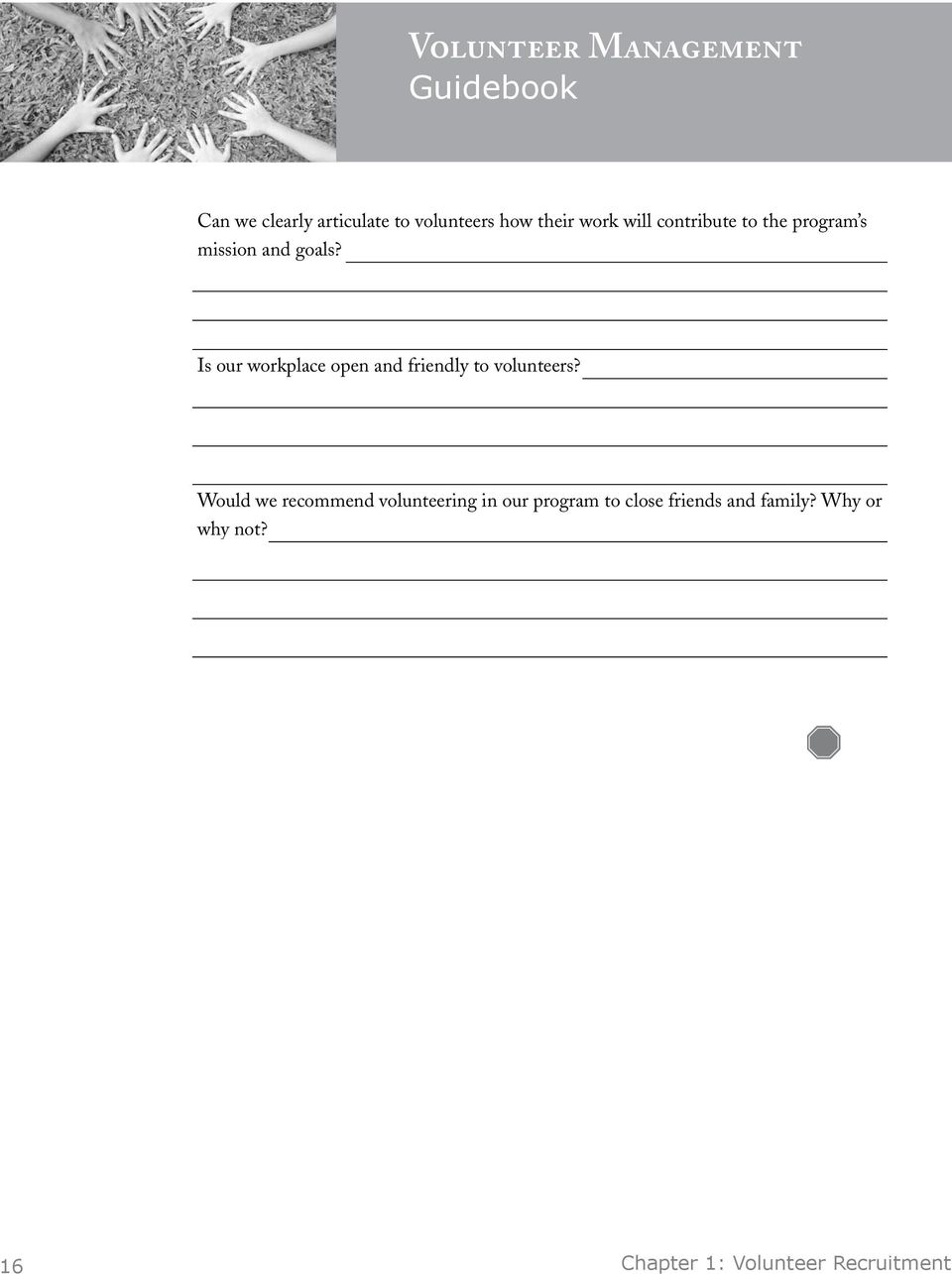
17 Volunteer Position Description Worksheet Use the worksheet below to outline responsibilities, support, and benefits of specific volunteer opportunities. Remember to be as detailed as possible and use clear language no jargon or acronyms that new volunteers may not understand. Title: Purpose/objective: Location: Key responsibilities: Qualifications: Time commitment: Training/support provided: Benefits: Volunteer supervisor: Phone: Program website: Chapter 1: Volunteer Recruitment 17
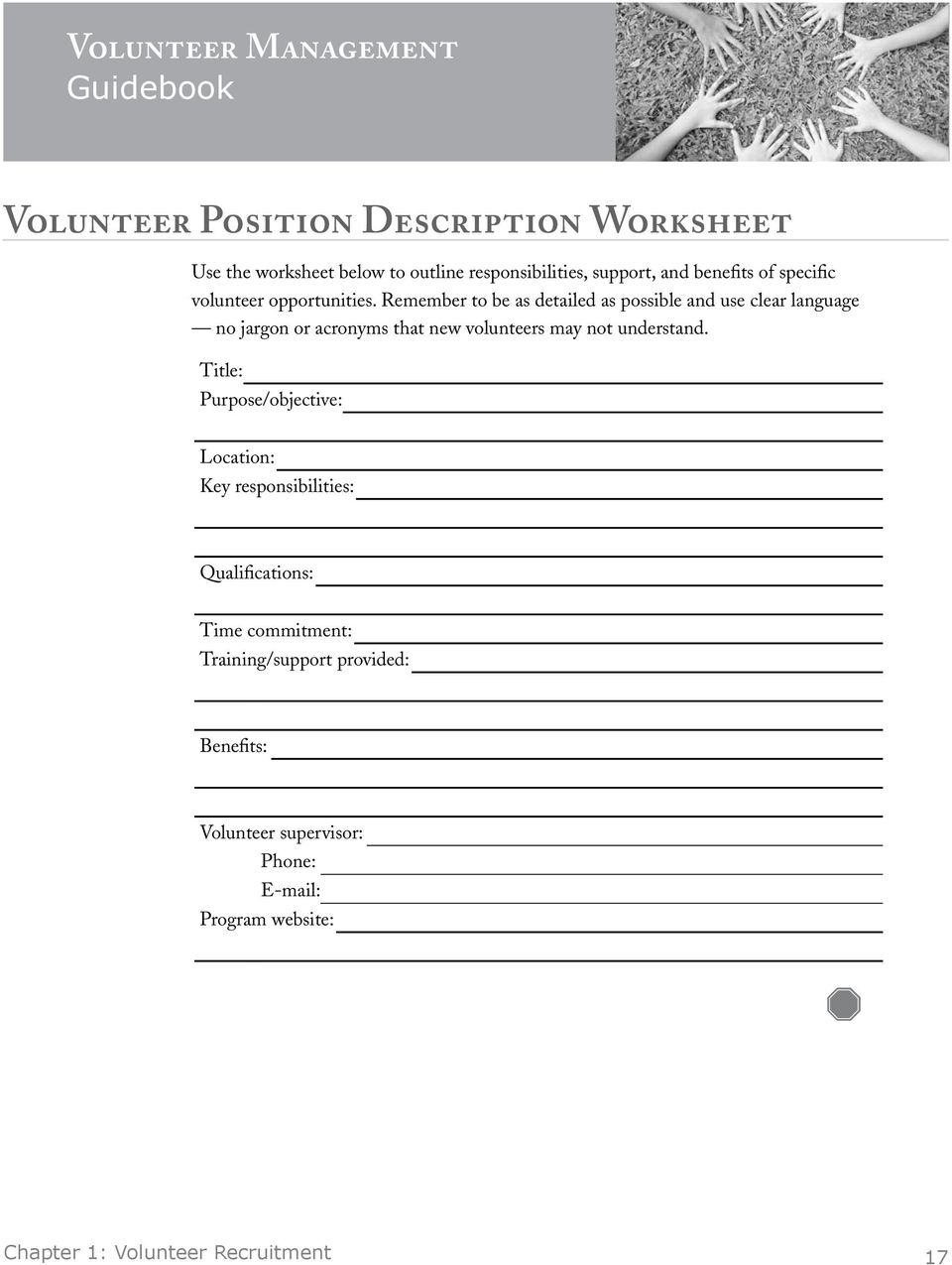
18 Recruitment Strategy Worksheet Develop a strategy for how you will recruit volunteers for your project. Determine whom you will ask to volunteer and how you will recruit them. Volunteer Needs How many volunteers are needed for the project? By what date must volunteers be secured? What is the time commitment required for this project? What is the minimum age requirement for volunteers? Is the project accessible to persons with disabilities? Briefly describe what volunteers are needed for (include position descriptions if applicable): Describe special skills, knowledge, or qualifications required: 18 Chapter 1: Volunteer Recruitment
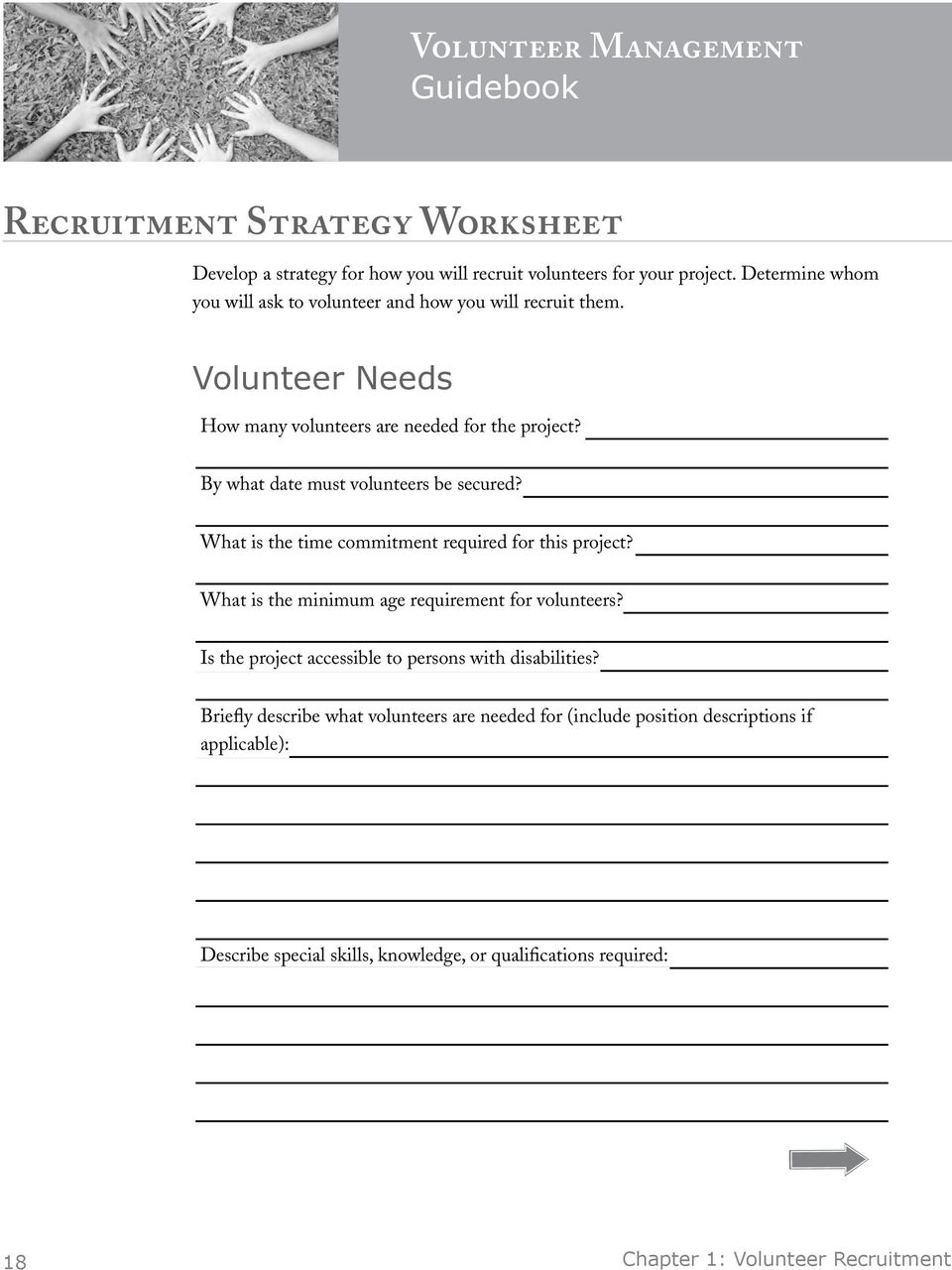
19 Recruitment Audience Who will be qualified for and interested in this position? Who will be able to meet the time commitments? Where will we find these people? What motivates them to serve? What is the best way to approach them? Chapter 1: Volunteer Recruitment 19
20 Recruitment Plan What methods can we use (brochures, Web posts, etc.)? With what groups can we partner (faith-based groups, civic organizations, etc.)? Where can we post/distribute recruitment information? What are specific ways/places we can target diverse audiences? 20 Chapter 1: Volunteer Recruitment

21 Additional Notes Chapter 1: Volunteer Recruitment 21
22 Chapter 2 Volunteer Scheduling Overview The way you plan your service projects will significantly affect the success of your volunteer recruitment. Imagine being a potential volunteer: You are a single parent whose only family time is on the weekends, a woman who works swing shift, or a large youth group. How does your program offer projects that appeal to these volunteers? This chapter will help you discover ways to maximize your recruitment efforts and strengthen your volunteer base by working with volunteer s schedules and using project calendars. Goals Work with volunteers schedules Create project calendars CNCS Resource Center Service Events Calendar Managing Volunteers Using a Weblog to Manage Information and Promote Communication Using a Database-driven Website to Connect Students with Community Volunteer Opportunities 22
23 Working with Volunteers Schedules Just as volunteers come from different backgrounds and community groups, they also have a wide variety of schedules. In order to engage the highest number of volunteers, consider ways to coordinate service events for people with varying schedules, needs, and interests. Include volunteer efforts at different times of day and different days of the week. Have flexible hours or recruit volunteers to serve in shifts instead of an entire day. Plan projects around multiple impact areas or diverse opportunities within a single issue. Offer family-friendly projects in which parents and their children can serve together. Provide opportunities for first-time volunteers and for volunteers with more advanced skills. Plan projects for individuals and for groups. Include indoor and outdoor projects. Offer short-term and long-term projects. Project Calendars A project calendar is a listing of available volunteer opportunities and other information about your program or projects. Project calendars are a great way to inform volunteers about upcoming service projects, recruit new volunteers, and engage new project sponsors. In addition to an actual calendar outlining volunteer opportunities for the month, project calendars should include a brief description of projects listed. Sort project descriptions according to impact area (e.g., health, the elderly, education) and be sure to outline important details such as age requirements, times, locations, the number of volunteers needed, how to register, and the project leaders contact information. Don t forget to specify who the project is appropriate for, such as families, first-time volunteers, or volunteers with specific skills. Chapter 2: Volunteer Scheduling 23
24 Project calendars can be used for more than detailing the upcoming projects. You can also use the calendar as a newsletter to spotlight certain volunteers or projects, give updates on your national service program, share news flashes, and highlight special events. Other calendar items could be volunteer orientation and recognition events. On-line Calendars Maintaining your project calendar on-line is ideal for updating frequently and providing volunteers with the most current details and project information. On-line calendars also provide a search option so volunteers can more easily find opportunities that appeal to them. You can include an on-line pre-registration and/or project orientation. Software such as Hands On Technology can help you build and maintain an on-line project calendar. Print Calendars You can publish a monthly or even weekly project calendar as a newsletter. Here are a few suggestions: Keep articles short. Include pictures. Make it consistent, readable, and easy to follow. Use a variety of serious issues and happy things. Involve program staff and volunteers in writing articles. Mail the project calendars to volunteers, partners, supporters, and other interested individuals. Distribute the calendars where you can reach prospective volunteers, as determined in your recruitment strategy. Offering diverse service opportunities for volunteers and marketing the events through project calendars are great recruiting tools. Current and prospective volunteers will be more informed about upcoming projects that fit their schedules, needs, and interests. The next chapter will offer suggestions for retaining volunteers once they are recruited and registered for your projects. 24 Part of the above information is adapted from materials from Hands On Charlotte, a member organization of Hands On Network. Chapter 2: Volunteer Scheduling
25 Activities and Templates The training and implementation tools in this section will help you identify ways to offer projects that meet volunteers interests, skills, and availability. This section includes: Project Appeal Activity Chapter 2: Volunteer Scheduling 25
26 Project Appeal Activity Brainstorm ideas for projects that would appeal to the different types of volunteers listed below. Be sure to think about projects that meet volunteers schedules, needs and interests, including projects that occur at different times, have flexible hours, address various impact areas, and require skilled and/or first-time volunteers. Long-term Volunteers: Short-term Volunteers: Families: Youth: 26 Chapter 2: Volunteer Scheduling
27 Interns: Virtual Volunteers: Chapter 2: Volunteer Scheduling 27
28 Chapter 3 Volunteer Retention Overview The best way to increase your volunteer base is to retain current volunteers. Retention is simply a matter of making volunteers feel good about themselves and their service. It includes motivating volunteers before the project, engaging them during the project, and leading them to reflect on the project. This chapter will provide you with tips for retaining volunteers for your program and projects. Goals Motivate volunteers before the project Engage volunteers during the project Reflect after the project CNCS Resource Center Using Volunteer Retention Principles to Examine Program Strengths and Challenges Care and Feeding of Volunteers Creating a Volunteer Handbook Resolving Conflict Between Volunteers Engaging Staff in Reducing the Volunteer Attrition Rate 28
29 Before the Project: Motivation From the very beginning of volunteers involvement in your service activities, you should maintain good communication with them. Motivate them to stay interested and involved in your project with a few simple steps: Be prompt in your response to phone calls/ s. Return volunteer calls or s within 24 hours. Be thorough in your explanation of the volunteer duties. Volunteers will be more likely to sign up if they know exactly what they will be doing, and they will know what to expect at the project. Use this opportunity to teach potential volunteers about the issue area, the community service organization they will be serving, and the potential impact of the project. Use their names often; this helps develop a personal connection. Keep the commitments you make. People will not support you if you don t provide information requested, address issues they bring up, and/or miss scheduled appointments. Continue to be in contact with your team. Keeping volunteers motivated and excited about your project is the best guarantee for success! The more contact you provide, the more engaged your volunteers will be, and the more motivated they will be when they arrive. Also, respond to people s inquiries in a timely and thorough manner. Make sure to confirm project details with them. Contact volunteers with a phone call or that: Introduces you (or another staff person, partner, or volunteer) as the project leader Thanks them for volunteering Provides the date and time of the project, service site address, directions, and parking information Describes what will occur at the project Lets volunteers know what to wear or not wear to the project Encourages volunteers to bring supplies they may have Tells volunteers whom to contact if they have a change in plans Chapter 3: Volunteer Retention 29
30 By communicating all details and project background to volunteers and staying in touch with them frequently, they will begin to create an attachment to the affiliate and the project even before they arrive. Thus they are more likely to show up on the day of the project and want to stay involved with your program for future volunteer opportunities. During the Project: Engagement Volunteer management incorporates elements of project and volunteer management. Having a well-planned and well-run project will make the volunteer experience more enjoyable and meaningful, thus they will be more likely to engage in future service. On the day of the project, designate an area for volunteers to check in. This will allow you to better manage volunteers that attend the project and effectively track their volunteer hours. Welcome volunteers as they arrive. Use nametags at the project and get to know your volunteers. Introduce volunteers to one another to encourage interaction. Orientation & Training Have the Project Leader and/or agency representative give a brief (5-10 minute) orientation. The orientation should include an overview of the agency s mission and services, and how volunteer support is contributing to that mission. Discuss the community issue that is being addressed by the agency and/or the project. This segment could include a brief history of the issue, current statistics, current events related to the issue area (e.g., legislation activity), and other civic engagement opportunities linked to this issue (e.g., advocacy training, future service projects). The orientation and education portion of the project has many positive impacts on volunteers. It allows them to: See the impact they are having on the agency and its clients Feel a greater part of a whole, when they see all the services the agency provides Better understand the critical needs of the community Better understand how to effect change within the issue being addressed 30 Chapter 3: Volunteer Retention
31 Orientation makes volunteers feel connected to the agency, clients, or their community, and makes their work more meaningful, and in turn makes them more likely to engage in future service. After the orientation, give a brief outline of the project and what volunteers will be doing during the project, so that everyone knows what to expect and what is expected of them. Also be sure to allow time for training volunteers for any specialized tasks or skills they will need to successfully complete the project. Utilization Make sure everyone has something to do. Underutilization is one of the biggest threats to retention. If people do not feel needed, they will not come back. Balancing Different Personalities Working with groups can be challenging. Understanding volunteers personalities can help you position them in different teams of your project so they have the best change of personal success and compatibility with you and other volunteers. Some volunteers want to lead, some want to socialize, some pay attention to details, and others are compassionate and dependable. You may also encounter volunteers who are headstrong, who aren t actively involved, or who complain excessively. When you are dealing with groups, you are almost guaranteed to encounter clashing personalities. Just remember: opposite personalities can complement one another if they try to understand the other s perspective. Treat every individual with dignity and respect: Talk openly and professionally with your volunteer to try to eliminate the problem. Consult with another staff person or volunteer leader who can troubleshoot with you on ways to resolve the problem. Document any incidents immediately and contact the office if you do not feel you can resolve the problem. If a client is causing problem, consult with the agency contact immediately. The agency is responsible for managing the clients; you are responsible for managing the volunteers. Chapter 3: Volunteer Retention 31
32 It is important to recognize and deal with problem volunteers. You cannot just ignore the problem and expect it to go away. It will affect other volunteers and their experience, and may influence them negatively. Project Closure Always leave time for clean up. Utilize your volunteers to assist with this! Review the accomplishments of the day (e.g., number of meals served, walls painted, boxes sorted, etc.) so volunteers have an idea of the impact of their service. Discuss how these accomplishments may have affected the service recipients. Reflect on the project (see below). Invite volunteers to participate in future service and take future action related to the issue or national service program. After the Project: Reflection Reflection is an important part of offering closure to a project. Reflection allows volunteers to stop for a moment, think about what they ve accomplished, share their experiences, and offer feedback for future projects or ideas for how they will continue to address the social issue. Reflection is designed to encourage volunteers to examine the project so that they see the impact of their service. Understanding how their service impacts the community will encourage volunteers to be involved in future projects. Reflection can be conducted in many ways. Volunteers can have a group discussion, write about their experience, create a photo-journal of the project, or respond to quotes about service. Be creative and allow for interaction. Encourage each volunteer to contribute to the discussion and make sure that all volunteers have an opportunity to share their thoughts. Sample questions for reflection discussion: What did you learn today about the agency, your fellow volunteers, the service recipients, or yourself? How do you feel about the project? Was it worthwhile? Was it time well spent? 32 Chapter 3: Volunteer Retention
33 What would you change about this project? Do you plan to take future action related to this issue? What other ideas or opinions can you offer this program or project? Be creative in how you offer reflection activities. Here are a few ideas: Web of Service: Have the group stand in a circle. Holding the end of a ball of string, hand the ball off to another participant. Ask him or her to reflect on a particular question (e.g., what was something new you learned today?). Once she has answered the question, she should hold on to her piece of the string and pass the ball onto someone else. Continue the process until everyone has reflected on the question and has a section of string in his or her hands. When completed, you should have something that looks like a web. When everyone has answered, make some points about the interconnectedness of people, how they are all part of the solution, for if one person had not contributed to their service projects the outcome would ve been different. End with another question and have the volunteers retrace their steps passing the string in reverse order. Talking Object: Gather volunteers in a circle or semi-circle, offer a talking object to pass around the circle as people answer reflection questions. One to Three Words: Each person shares one to three words to describe the service activity or how he/she feels about the service activity or anything else regarding the project. Poetry: Have volunteers write a sentence about the project. Gather these sentences. Then after a few months/weeks, compile the sentence into a poem or story. Quotes of Service: Quotes are useful to encourage volunteer reflection. Project leaders can read the quote and ask for a response or simply let the volunteers silently reflect on the words as they part from each other. Without community service, we would not have a strong quality of life. It s important to the person who serves as well as the recipient. It s the way in which we ourselves grow and develop... Dr. Dorothy I. Height president and CEO of the National Council of Negro Women Chapter 3: Volunteer Retention 33
34 No joy can equal the joy serving others. Sai Baba When you give to others, you speak a silent but audible thank you. Appreciation for others and ourselves is life and spirit for each and every one of us. Submitted and written by Kara Cherry Whitaker, 14 years old, Ohio You make a living by what you get. You make a life by what you give. Winston Churchill Be sure to thank volunteers for their efforts and inform them of upcoming projects. For volunteers who frequently return to your projects or who show leadership or desire additional responsibilities, delegate tasks to get them more involved and connected to your project or to allow them to enhance skills. Let them make phone calls, send s, be in charge of specific tasks, etc. Encourage them to become a Volunteer Leader. Retaining volunteers is essential to the success of your program. From project beginning to end, volunteers need to feel good about themselves and their service. You can accomplish this through motivation, engagement, and reflection. Many times retention and recognition are so closely related that they are actually interdependent on one another. The next chapter will offer many tips and suggestions for recognizing volunteers for their service efforts. The above information is a compilation of materials from Make A Difference, a 501(c)(3); Volunteer Management by Steve McCurley and Rick Lynch (1997); com; and 34 Chapter 3: Volunteer Retention
35 Activities and Templates The training and implementation tools in this section will help you explore volunteer retention methods, including project reflection and volunteer communication. This section includes: Reflection Directions Activity Volunteer Project Information Form Chapter 3: Volunteer Retention 35
36 Reflection Directions Activity Working with your small group, reflect on today s workshop using one of the exercises below: Activity 1 As a group, discuss today s session. Reflect on what you learned and how it will apply to your national service program. Share at least one action step that you will take as a result of what you ve learned today. Notes Activity 2 Draw a cartoon about today s session. Illustrate what you learned, new ideas you discovered, and/or practices you will adopt. 36 Chapter 3: Volunteer Retention
37 Activity 3 Write a poem about today s session. Through the poem, reflect on things you learned and how you will utilize the information in your national service program. Activity 4 Create and perform a dance that illustrates your experiences with volunteer management. Include how today s session has enhanced your knowledge and/or taught you new ideas to try with your national service program. Notes Activity 5 Create and sing a song or jingle about today s session. What did you learn, what new ideas did you discover, and how will this workshop affect the way you work with volunteers? Chapter 3: Volunteer Retention 37
38 Activity 6 Think of one word that describes today s session. Write it in large capital letters going down the left side of the page. Pass the paper to the person on your left and have that person write a sentence beginning with the first letter of your word. The sentence should be a reflection on the workshop, including things learned or next steps. Continue passing the paper until every letter has a sentence. Activity 7 Think about an answer to this question: What will you do as a result of things learned in today s session? Then act out your answer while the other group members try to guess what you re trying to convey. Continue until each person has had a chance to act. Debrief by asking questions to clarify or expand thoughts, feelings, and insights. Notes Activity 8 Create bookmarks with pictures, written reflections, or quotes about today s session. Illustrate what you learned and/or action steps you will take. 38 Chapter 3: Volunteer Retention
39 Activity 9 Create a group banner that depicts today s session using a combination of words and pictures. The banner should convey what you learned and how you will adapt it to your work with national service. Notes Activity 10 Choose one or more of the service quotes below. As a group, discuss the meaning of the quote and how it applies to both your work and today s session. A different world cannot be built by indifferent people. Horace Mann One of the oldest human needs is having someone wonder where you are when you don t come home at night. Margaret Mead Unless you choose to do great things, it makes no difference how much you are rewarded or how much power you have. Oprah Winfrey If you don t like the way the world is, you change it. You have an obligation to change it. You just do it one step at a time. Marian Wright Edelman Each of us guards a gate of change that can only be unlocked from the inside. We cannot open the gate of another, either by argument or by emotional appeal. Marily Ferguson We can only serve that which we are profoundly connected to. Sam Daly-Harris We are a landscape of all we have seen. Isamu Noguchi Chapter 3: Volunteer Retention 39
40 Those of us who attempt to do things for others or for the world without deepening our own sense of self-understanding, freedom, integrity, and capacity to love, will not have anything to give others. Robert Greenleaf The horizon leans forward, offering you space to place new steps of change. Maya Angelou (from On the Pulse of the Morning ) We don t see things as they are; we see things as we are. Cicero Notes 40 Chapter 3: Volunteer Retention
41 Volunteer Project Information Form Thank you for volunteering for our upcoming service project. We have a wonderful project planned! Below are the details for the project. Please review the following information and contact us if you have any questions. We look forward to seeing you! Project: Location: Project Leader: Day of event phone: Date: Time: Phone: Agency we are assisting: What will we be doing: What you should wear: What you should bring: Project site address: Directions: Where you should park: If you have questions prior to the day of the project, please contact the project leader at the phone number or listed above. Plan to arrive at the project site prior to the start time. Check in at the volunteer registration area, where a team leader will greet you, answer any questions, and get you started. Timeline of Activity Volunteer check-in and registration Orientation to agency and project Serve! Clean-up Wrap-up, reflection, and evaluation Chapter 3: Volunteer Retention 41
42 Chapter 4 Volunteer Recognition Overview Recognition is a key component of volunteer management. Volunteers need to know that their service has made an impact and that they are appreciated by the community, fellow volunteers, and program staff. This chapter will offer ideas for creative ways to tailor recognition to meet your individual volunteers needs. Goals Recognize volunteers Understand rules for recognition Explore tips and tools for recognition CNCS Resource Center Recognizing Volunteer and Paid Staff: The Art, the Science and a Gazillion Ideas Creating Imaginative Recognition Events for Senior Volunteers Going Beyond Annual Banquets to Recognize Senior Volunteers Recruiting, Retaining, and Recognizing Seniors Celebrate Living: Volunteer Recognition 42
43 Recognizing Volunteers Recognition makes volunteers feel appreciated and valued. If volunteers don t feel like their contribution is valuable or necessary, they won t return. Volunteer recognition can take many forms, from a simple thank-you card to a large annual event. An ideal recognition system makes use of many different procedures, to have something for every volunteer and to keep it personal and meaningful. Matching Recognition to Types of Volunteers Volunteers have different personalities, are motivated to serve for different reasons, and serve in different ways. Therefore, you should use a variety of recognition methods for your volunteers. Tailor your recognition to individual volunteers, to make it most effective and meaningful. By Motivational Orientation Think about recognition that is appropriate for volunteers with different motivational needs. Achievement-oriented volunteers: Ideal result of recognition is additional training or more challenging tasks. Subject for recognition is best linked to a very specific accomplishment. Phrasing of recognition should include Best or Most awards. Recognition decision should include checkpoints or records. Awardees should be selected by co-workers. Affiliation-oriented volunteers: Recognition should be given at a group event. Recognition should be given in presence of peers, family, or other bonded groups. Recognition should have a personal touch. Recognition should be organizational in nature, given by organization. Recognition should be voted by peers. Chapter 4: Volunteer Recognition 43
44 Power-oriented volunteers: Key aspect of recognition is promotion, conveying greater access to authority or information. Recognition should be commendation from Names. Recognition should be announced to community at large, put in newspaper, etc. Recognition decision should be made by the organization s leadership. By Style of Volunteering You should also vary recognition for volunteers who serve one afternoon Long-term volunteer: Recognition with and by the group Recognition items make use of group symbols Recognition entails greater power, involvement, information about the organization Presenter of recognition is a person in authority Short-term (episodic) volunteer: Recognition is given in immediate work unit or social group Recognition is portable something the volunteers can take with them when they leave, such as a present photograph, or other memorabilia Presenter is either the immediate supervisor or the client Informal vs. Formal Recognition Day-to-day recognition is the most effective because it is much more frequent than a once-a-year banquet and helps to establish good working relationships. Formal recognition includes awards, certificates, plaques, pins, and recognition dinners or receptions to honor volunteer achievement. They are helpful mainly in satisfying the needs of the volunteer who has a need for community approval, but have little impact (or occasionally a negative impact) on volunteers whose primary focus is helping the clientele. These volunteers may feel more motivated and honored by a system which recognizes the 44 Chapter 4: Volunteer Recognition
45 achievements of their clients and the contribution the volunteer has made towards this achievement. When determining whether to establish a formal recognition, consider the following: Is this being done to honor the volunteer, or so the staff can feel involved and can feel that they have shown their appreciation for volunteers? Is it real and not stale or mechanical? Does it fit? Would the volunteers feel better if you spent the money on the needs of the clients rather than on an obligatory luncheon? Can you make it a sense of celebration and builder of team identity? Goals for a Recognition Event Educate Inspire Educate everyone attending about the scope, meaning, and value of volunteer services to your organization. Report the outcomes of volunteer effort. Gain publicity for the organization and the volunteer program. Gain respect for the volunteer program and the director of it. Recommit (re-enthuse) volunteers for the coming year of work recruit. New volunteers for vacant positions. Challenge all volunteers through recognition of the accomplishments of a selected few. Recognize Say thank you for everything and anything volunteered to the organization during the past year, and make sure everyone volunteering during the past year feels appreciated. Acknowledge the contributions of some paid staff supervisors to the success of volunteers. Chapter 4: Volunteer Recognition 45
46 Have fun! Allow volunteers, and staff, a chance to have fun and meet each other. Creative Recognition Volunteer recognition does not have to cost a lot, and there are many alternatives to the traditional annual recognition banquet. Use your imagination and think outside the box to come up with some fun, inexpensive ideas that are fun for volunteers. Rules for Recognition Recognize... or else The need for recognition is very important to most people. If volunteers do not get recognition for productive participation, it is likely that they will feel unappreciated and may stop volunteering with your program. Give it frequently Recognition has a short shelf life. Its effects start to wear off after a few days, and after several weeks of not hearing anything positive, volunteers start to wonder if they are appreciated. Giving recognition once a year at a recognition banquet is not enough. Give it via a variety of methods One of the implications of the previous rule is that you need a variety of methods of showing appreciation to volunteers. Give it honestly Don t give praise unless you mean it. If you praise substandard performance, the praise you give to others for good work will not be valued. If a volunteer is performing poorly, you might be able to give him honest recognition for his effort or for some personality trait. Give it to the person, not the work This is a subtle but important distinction. If volunteers organize a fund-raising event, for example, and you praise the event without mentioning who organized it, the volunteers may feel some resentment. Make sure you connect the volunteer s name to it. It is better to say John, Betty, and Megan did a great job of organizing this event than to say This event was very well-organized. 46 Chapter 4: Volunteer Recognition
47 Give it appropriately to the achievement Small accomplishments should be praised with low-effort methods, large accomplishments should get something more. For example, if a volunteer tutor teaches a child to spell cat today we could say Well done! If she writes a grant that doubles our funding, a banner lauding her accomplishment might be more appropriate. Give it consistently If two volunteers are responsible for similar achievements, they ought to get similar recognition. If one gets her picture in the lobby and another gets an approving nod, the latter may feel resentment. This does not mean that the recognition has to be exactly the same but that it should be the result of similar effort on your part. Give it on a timely basis Praise for work should come as soon as possible after the achievement. Don t save up your recognition for the annual banquet. If a volunteer has to wait months before hearing any word of praise, she may develop resentment for lack of praise in the meantime. Give it in an individualized fashion Different people like different things. One might respond favorably to football tickets, while another might find them useless. Some like public recognition; others find it embarrassing. In order to provide effective recognition, you need to get to know your volunteers and what they will respond to positively. Give it for what you want more of Too often your staff pays most attention to volunteers who are having difficulty. Unfortunately, this may result in ignoring good performers. We are not suggesting that you ignore sub-par volunteers, just that you make sure that you praise the efforts of those who are doing a good job. Chapter 4: Volunteer Recognition 47
48 Tips and Tools for Recognition Here are some easy, everyday ways to recognize volunteers: Use to send thank you letters/messages. Send postcards or thank you cards to volunteers after they attend a project. Send a birthday card. Submit pictures of volunteers to be in your organization s newsletter. Post pictures of volunteers on a bulletin board at your organization. Provide organizational goodies hats, shirts, pins, magnets, water bottles, etc. Have them join you for coffee or lunch. Below are some more involved, intermediate recognition ideas: Nominate a volunteer Star of the Month award them a certificate, letter, or small gift. Sponsor happy hours and social events. Encourage volunteers to meet each other. Recognize volunteers on local radio or television stations. Invite volunteers to serve as project leaders or committee members. Give gift certificates to museums, movies, restaurants, etc. Solicit your community for donations! Nominate volunteers for local/national awards such as the Presidential Service Awards. Write articles about them in newsletters or newspapers. Write a letter to their employer highlighting the accomplishments of the volunteer. Be sure to find out of the volunteer would appreciate this before writing the letter! Celebrate major accomplishments. Recognize anniversaries with your organization. Have them attend a training, workshop, seminar, etc. at the expense of your organization. Give them additional responsibilities. Create a photo collage or slide show of volunteer activities. 48 Chapter 4: Volunteer Recognition
49 Some large-scale means of recognition: Hold annual recognition events: a dinner, a breakfast, an awards ceremony/ celebration, a picnic/potluck, theme party, etc. Recognize long-term volunteers with Service Awards: a plaque, trophy, certificate, etc. Give additional responsibilities and a new title. Put up a banner celebrating major accomplishments. Enlist them in training staff and other volunteers. Involve them in the annual planning process. Make a donation to the organization of their choice in their name. Organize an outing at a zoo, amusement park, sporting event, etc., where volunteers get in for free. Recognition is an important part of volunteer management. Recognition is an opportunity for the community, other volunteers, and program staff to show their appreciation for the volunteers efforts. When tailored to meet the volunteers needs, recognition helps them feel good about themselves and their service. The above information is a compilation of materials from Make A Difference, a 501(c)(3); Volunteer Management by Steve McCurley and Rick Lynch (1997); and Chapter 4: Volunteer Recognition 49
50 Activities and Templates The training and implementation tools in this section will give you the opportunity to investigate volunteer recognition. This section includes: Why Bother? Activity 50 Chapter 4: Volunteer Recognition
51 Why Bother? Activity Working with your small group, brainstorm reasons that recognition is important. Discuss your own experiences in both giving and receiving recognition for volunteer efforts. Brainstorming Notes Chapter 4: Volunteer Recognition 51
52 Summary Without the right number of volunteers with the right skills, your service project won t be successful. Whether recruiting volunteers for a one-day service project or for a weekly commitment, you should understand your volunteer needs and then target recruitment efforts to reach the volunteers you want to engage. Offer opportunities that will appeal to their interests and work with their schedules. Retain volunteers by supporting them before, during, and after the project. Finally, recognize their efforts in a way that makes them feel appreciated and connected to the community. 52
53 Additional Resources Listed below are several on-line resources on volunteerism and volunteer development. Energize Inc. ephilanthropyfoundation.org e-volunteerism.com Hands On Network Idealist.org: Action Without Borders Independent Sector National & Global Youth Service Day National Service Resource Center Network for Good Service Leader ServeNet Students in Service to America 53
54 Additional Notes Volunteer Management
55
56 To learn more about Hands On training opportunities, please contact: Or visit us at The Corporation for National and Community Service works to improve lives, strengthen communities, and foster civic engagement through service and volunteering. The Corporation provides opportunities for Americans of all ages and backgrounds to serve their communities and country through Senior Corps, AmeriCorps, and Learn and Serve America. Together with the USA Freedom Corps, the Corporation is helping build a culture of citizenship, service, and responsibility in America. Hands On Network brings people together to strengthen communities through meaningful volunteer action. Hands On Network is a growing network of 58 volunteer organizations and a half million volunteers changing communities in and outside the United States. Hands On Network creates and manages nearly 50,000 projects a year from building wheelchair ramps in San Francisco, to teaching reading in Atlanta, to rebuilding homes and lives in the Gulf Coast communities. The Hands On approach equips volunteers, creates leaders, and changes lives.
International Year of Chemistry (IYC) 2011 Event Planning Guide
 International Year of Chemistry (IYC) 2011 Event Planning Guide FINDING PARTNERS Determine who could celebrate IYC with you in your local area. Potential partners include: American Chemical Society groups
How to Host an ACHA Fundraiser Adult Congenital Heart Association
 How to Host an ACHA Fundraiser Adult Congenital Heart Association 3300 Henry Ave., Suite 112 Philadelphia, PA 19129 (215) 849-1260 Toll-Free: (888) 921-ACHA www.achaheart.org Dear Potential Fundraiser,
No One is Too Busy for the Human Race
 No One is Too Busy for the Human Race If you only have 2 hours a week Find two to five people who will get out there and tell people about your group and collect pledges. One or two good askers can do
It s more fun than fundraising and participating alone. Getting fit and fundraising are easier as a Team
 1 Welcome to TeamMS TeamMS is the best team you ll ever be on! Here s why... TeamMS Provides inspiration and competition for other participants Team energy is contagious It s more fun than fundraising
AVON 39 The Walk to End Breast Cancer TEAM HANDBOOK
 AVON 39 The Walk to End Breast Cancer TEAM HANDBOOK Thank you being part of an AVON 39 Team! Time and time again we ve heard that being part of a team enhances all team members AVON 39 experience. Whether
November 2-6, 2015. Celebrate Your Eye Care Team. Ophthalmic Medical Technicians Week
 Ophthalmic Medical Technicians Week November 2-6, 2015 Celebrate Your Eye Care Team Providing Certification and Education for Eye Care Excellence Since 1969 6th ANNUAL OPHTHALMIC MEDICAL TECHNICIANS WEEK
CONFLICT RESOLUTION DAY. Checklist
 Checklist Frequently Asked Questions Action Plan Ten Tips for Event Organizers Activities List The Media Connection Tips for publicizing your event Press Release template School Proclamation and Pledge
Canadian Gymnastics Week Step by Step Action Plan
 Canadian Gymnastics Week Step by Step Action Plan Gymnastics Canada Gymnastique 1 Step by Step Action Plan Step by Step Summary Here are 10 steps that will ensure your Canadian Gymnastics Week celebrations
Step One: Creating Your Inclusiveness Committee. Step Two: Training and Consultants. Step Three: Definitions and Case Statement.
 Module 15: Marketing and Community Relations Marketing and Community Relations Step One: Creating Your Inclusiveness Committee Step Two: Training and Consultants Step Three: Definitions and Case Statement
your activities and events. All Young Marines that participate in Veterans Appreciation Week are eligible to wear ribbon.
 Welcome Welcome to the Young Marines Veteran's Appreciation Week Campaign Toolkit November 5-11, 2014 Our goal is to provide you useful information to help you effectively manage and promote your YMVAW
HOW TO GENERATE PUBLICITY FOR YOUR NATIONAL SCIENCE WEEK EVENT
 HOW TO GENERATE PUBLICITY FOR YOUR NATIONAL SCIENCE WEEK EVENT INTRODUCTION This guide has been developed to help you to promote your National Science Week event. If you have already run a National Science
GIRL SCOUT GOLD AWARD PROJECT GUIDE
 GIRL SCOUT GOLD AWARD PROJECT GUIDE Girl Scout Promise On my honor, I will try: To serve God and my country, To help people at all times, And to live by the Girl Scout Law. Girl Scout law I will do my
United Way Campaign Guide Executive Summary for Employee Campaign Managers
 United Way Campaign Guide Executive Summary for Employee Campaign Managers PREPARE FOOD Meet with your CEO Recruit your Campaign Team Learn about United Way and the community s Agenda for Change PLAN Analyze
A Guide for Parents: Helping Your Child Succeed in School
 A Guide for Parents: Helping Your Child Succeed in School A guide to help you understand: No Child Left Behind State Learning Standards Parent Practices to Help Children Learn Parent/School Relationships
DECC Campaign Toolkit
 DECC Campaign Toolkit We know that being a Lead Coordinator takes a lot of dedication and commitment to improving our community and we thank you for your hard work. The most successful campaigns are refreshed
Empowering Your Ministry
 Empowering Your Ministry 1 Ten Things That Will Empower Your Youth Ministry Programs 1. Have a clear vision. Spend time visioning for the highest quality program you can imagine and then create a plan
STEPS TO PLAN A VOLUNTEER FUNDRAISING EVENT
 STEPS TO PLAN A VOLUNTEER FUNDRAISING EVENT An event, very simply, is something that happens at a given time and place. However, creating an event for an organization such as the American Brain Tumor Association
Campaign Tool Kit. Change is possible. You can help. United Way of Central New Mexico
 Campaign Tool Kit Change is possible. You can help. United Way of Central New Mexico Planning and Running Your Campaign Table of Contents p. 2 Role of Employee Campaign Manager p. 3 10 Steps to Success
Event Planning. Easy guide to planning your event
 Event Planning Easy guide to planning your event What is an "Event"? Events are large-scale activities put on by an Committee, Volunteers or contracted professional which require much larger-thanusual
BEST PRACTICE GUIDE: CORPORATE ENGAGEMENT
 BEST PRACTICE GUIDE: CORPORATE ENGAGEMENT How do sports-based youth development (SBYD) programs identify and work with corporate partners? How are corporate volunteers engaged? The following is a brief
Room Parent Handbook TABLE OF CONTENTS
 Room Parent Handbook TABLE OF CONTENTS I. Room Parent s Job Description II. Lead Room Parent III. General Room Parent Information IV. Curriculum Night V. Available Work Areas / Dress Code VI. Donation
WELCOME TEAM CAPTAINS!
 WELCOME TEAM CAPTAINS! Thank you for joining the online fundraiser for (org name)! This kit is designed to provide you with the tools you will need to make your team s experience fun, successful and rewarding.
PREPARING FOR THE INTERVIEW
 U N I V E R S I T Y C A R E E R S E R V I C E S PREPARING FOR THE INTERVIEW THE INTERVIEW The interview is an opportunity to demonstrate to an employer why you are the best fit for the position. Essentially,
EVENT PLANNING TOOLKIT
 EVENT PLANNING TOOLKIT Thank you for your interest in planning an event for the Huntington Society of Canada. With your help, we can make a difference! The money raised by your event will be put into action
Stanford Relay For Life 2003 Colleges Against Cancer, Stanford University Chapter
 TEAM CAPTAIN S HANDBOOK Stanford Relay For Life 2003 Colleges Against Cancer, Stanford University Chapter It s about a community that takes up the fight WHAT IS RELAY FOR LIFE? Relay For Life is the American
Building Out the Mission: My Mission Statement
 TIME: 30 Minutes Building Out the Mission: My Mission Statement Exercise SP1 PURPOSE: To provide participants with the opportunity to develop their own personal mission statements. INSTRUCTIONS: 1. Key
Creating the Ask: Red Cross Clubs: Recruit, Retain and Recognize Club Members
 s: Recruit, Retain and Recognize Club Members There are many different stages in the life of a club. Some of you might just be starting a while others have a well-established program. Regardless of how
Co-authored by: Michelle Frechette Ames, MBA. Marketing Diva www.marketedbymichelle.com
 Michelle Frechette Ames & Christine Baker Marriage Co-authored by: Michelle Frechette Ames, MBA Marketing Diva www.marketedbymichelle.com Christine Baker Marriage, LMT Business Mentor for Bodyworkers and
What do you love to do? Retirement Activity Book
 What do you love to do? Retirement Activity Book Welcome to the AfterWorks Retirement Seminar Being able to do more of what you love is really what investing is all about. You may think that your financial
Event Information. General Information Q: HOW LONG IS AIDS WALK MIAMI?
 Event Information Q: HOW LONG IS AIDS WALK MIAMI? A: AIDS Walk Miami is a 5 kilometers (3.1 miles) and takes roughly 1 to 1 ½ hours to complete. Volunteers with directional signs will be posted along the
R ESOURCES FOR. chapter eleven E VENT P LANNING. contents
 R ESOURCES FOR chapter eleven E VENT P LANNING contents Sample learning day format...1 Sample community meetings format...5 Event planning workshop...9 Sample event timeline... 13 S AMPLE L EARNING D
Employee Campaign Coordinator (ECC) Handbook. Be the One. It takes just one person to change one life.
 It takes just one person to change one life. Employee Campaign Coordinator (ECC) Handbook How to Be the ONE at your company that leads a great LIVE UNITED Campaign Be the One. unitedwaycassclay.org Be
Sergeant at Arms CLUB OFFICER TRAINING
 Sergeant at Arms CLUB OFFICER TRAINING TOASTMASTERS INTERNATIONAL P.O. Box 9052 Mission Viejo, CA 92690 USA Phone: +1 949-858-8255 Fax: +1 949-858-1207 www.toastmasters.org/members 2015 Toastmasters International.
Ideas 4 Paying It Forward In Schools
 Ideas 4 Paying It Forward In Schools Pay it forward in schools (real life examples) Southwestern College (United States) After watching the movie Pay it Forward the class was split up into 10 groups and
Fundraising can be a daunting task. Many in the non-profit sector worry about where to go for the support they need. Complaints I often hear are:
 MARY AUSTIN FULLER Recipe for a Fundraising House Party by Mary Austin Fuller Fundraising can be a daunting task. Many in the non-profit sector worry about where to go for the support they need. Complaints
10 Steps For A Successful Employee Campaign
 10 Steps For A Successful Employee Campaign STEP 1: REVIEW PAST CAMPAIGNS Meet with last year s campaign coordinator to: DISCUSS last year s campaign and its success, strengths, and weaknesses. ANALYZE
Girls on the Run NYC - SoleMates Participant Guide
 Girls on the Run NYC - SoleMates Participant Guide Welcome to the Girls on the Run NYC SoleMates Team for 2015! Thank you for joining SoleMates in support of Girls on the Run NYC! Your participation and
BrainDeer 5K Tampa 2015
 BrainDeer 5K Tampa 2015 Saturday, December 12 th, 2015 Gadsden Park 6901 S MacDill Ave, Tampa, FL 33611 Registration opens at 8:00 A.M. Race starts at 9:00 A.M. 1 Dear Team Captains, Hello and welcome!
Business Advisory Board Best Practice Guide 1
 Business Advisory Board Best Practice Guide 1 Table of Contents Building and Maintaining a Business Advisory Board... 3 Engaging Business Advisory Board Members... 4 Business Advisory Board Frequently
Group Volunteering TOOLS AND RESOURCES FOR ORGANIZATIONS AND VOLUNTEER CENTRES
 Group Volunteering TOOLS AND RESOURCES Funded in part by the Government of Canada s Social Development and Partnerships Program Contents What is group volunteering?... 3 Finding group volunteering opportunities...
Things We Don t Talk About
 Red Tent & Screening Planning Toolkit Things We Don t Talk About Women s Stories from the Red Tent A ilm by Dr. Isadora Gabrielle Leidenfrost TABLE OF CONTENTS About the Film... 2 FAQ s... 2 About this
Tactics for Successful Marketing
 Tactics for Successful Marketing Celebrate National School Breakfast Week One of the easiest ways to promote your breakfast program is to celebrate National School Breakfast Week, held annually during
A World of Girls uses stories to help girls find clues about how they can create positive change in the world change that affects girls.
 The First 8 Meetings A World of Girls uses stories to help girls find clues about how they can create positive change in the world change that affects girls. What You Need: Amuse girl book: Each girl needs
Good Fast or Low cost marketing
 Email Marketing 101 Good Fast or Low cost marketing We ve all heard the old adage about how, when it comes to marketing, you can get what you need done well, delivered quickly or produced inexpensively;
Goal Setting & Work. Shasta County Health and Human Services Agency Department of Social Services CalWORKs Employment Services Program
 What s in your tool kit? Goal Setting & Work Shasta County Health and Human Services Agency Department of Social Services CalWORKs Employment Services Program Goal Setting & Work 11/08 Goal Setting Action
Fundraising Event Guidelines
 Fundraising Event Guidelines Our Mission To amplify the love, hope and compassion in the world, making each health journey easier. Thank You! We are honored that you have chosen to raise funds for. Fundraising
Fundraising and Awareness Planning Guide
 Fundraising and Awareness Planning Guide Thank you for your interest in becoming a fundraising and awareness partner with The Breast Cancer Society, Inc. Your efforts are appreciated and needful. It is
How to Hold Great Fundraising Events A Step by Step Guide. By Joe Garecht
 How to Hold Great Fundraising Events A Step by Step Guide By Joe Garecht 2010 by Joe Garecht. All rights reserved. This e-book is protected by U.S. and international copyright law. You may not sell or
How to Plan a Charity Walk or Run
 How to Plan a Charity Walk or Run Charity events in any form are always popular, but increasingly, many organizations are choosing to recruit their fundraisers through more interactive events such as walks
CSCMP Roundtable Marketing Guidebook
 CSCMP Roundtable Marketing Guidebook 2 Table of Contents Section 1 Introduction 4 CSCMP Mission CSCMP Vision CSCMP Goals Section 2 Roundtable Marketing Objectives 4 Support the CSCMP Mission, Vision and
Planning a Successful Lobby Day
 Planning a Successful Lobby Day One of the most effective ways of letting elected officials know your organization s views on issues is through a personal meeting. In political terms, this is called lobbying.
Customer Referral Programs A How-To Guide to Help You Generate Better Sales Leads
 Customer Referral Programs A How-To Guide to Help You Generate Better Sales Leads Whatare Customer Referral Programs? Customer referral programs are a simple, low cost and effective marketing strategy,
Field Guide YMCA Community Campaign with Online Peer to Peer Fundraising Tool
 Field Guide YMCA Community Campaign with Online Peer to Peer Fundraising Tool 4 Rules of Fundraising 1. Effective fundraising is direct and personal. 2. People give because they are asked and shown how
Private Today, Public Tomorrow
 Estimated time: 45 minutes Essential Question: How can you respect the privacy of others online? Learning Overview and Objectives Overview: Students reflect on their responsibility to protect the privacy
Communications and Marketing Checklist For School Developers
 The California Charter Schools Association s Communications and Marketing Checklist For School Developers You ve done it you have successfully written your petition. Now comes the next step making sure
2013 Activity Planning Guide
 2013 Activity Planning Guide Dear Healthcare Quality Week Celebrator: Thank you for participating in NAHQ s Healthcare Quality Week! We hope your week is truly rewarding and successful. Healthcare Quality
Your Fundraising Campaign: A How-To Guide for Maximizing Success
 Your Fundraising Campaign: A How-To Guide for Maximizing Success Hello Fundraisers! We created this guide to help you maximize your fundraising success on Volunteer Forever. First of all, congratulations
HOW TO GENERATE PUBLICITY FOR YOUR NATIONAL SKILLS WEEK EVENT
 HOW TO GENERATE PUBLICITY FOR YOUR NATIONAL SKILLS WEEK EVENT INTRODUCTION This guide has been developed to help you to promote your National Skills Week event. It provides a range of ideas, even taking
10 STEPS TO A GREAT YEARBOOK
 10 STEPS TO A GREAT YEARBOOK A TreeRing Publication By Clara Wallace Clara is a graphic designer and artist that volunteers her time as the yearbook editor for Lisa J. Mails Elementary school in Murrieta,
Running a Successful Club Publicity Officer
 Tips for Young Farmer Leaders Running a Successful Club Publicity Officer Welcome to running Successful Clubs Tips for Leaders - a guide to help you run a strong and successful Young Farmers Club. The
Module 6: Recruitment And Organization Building
 And Organization Building GOALS By the end of this module, participants should be able to understand: The concept of self-interest and how it is used to recruit and retain volunteers. The Six-Step Process
HAWAII SCHOOLS CATCHAFIRE PROJECT GUIDE 1 PROJECT MENU GUIDE
 HAWAII SCHOOLS CATCHAFIRE PROJECT GUIDE 1 PROJECT MENU GUIDE MARKETING & Brand Messaging Communication Materials Audit Communications Strategy Storytelling Copywriting Print Materials Design E-Newsletter
Quick Guide to Getting Started: Twitter for Small Businesses and Nonprofits
 Quick Guide to Getting Started: Twitter for Small Businesses and Nonprofits Social Media www.constantcontact.com 1-866-876-8464 Insight provided by 2011 Constant Contact, Inc. 11-2168 What is Twitter?
Email Marketing for Small Business: What s the Big Idea? A hands-on guide to making email marketing work for you.
 Email Marketing for Small Business: What s the Big Idea? A hands-on guide to making email marketing work for you. You re considering email marketing to promote your business? Smart Move! Congratulations,
Can research inform practice?
 Picture This! Engaging at risk youth in educational programs can often be challenging. Students must be motivated to stay with a program and they must have the right teacher or leader to create innovative
THIRD PARTY EVENT HANDBOOK
 THIRD PARTY EVENT HANDBOOK ORGANIZING AN EVENT AN OUTLINE: 1. Define your goals Establish a planning committee Brainstorm event ideas Set the date/time Develop a timeline Secure a venue/location (including
2012 Relay For Life Community Event Email Templates
 2012 Relay For Life Community Event Email Templates 01 Recruitment Email: Send as soon as site is live to all past team captains. Subject: Time to team up for Relay For Life! We wanted you to be the first
Private Today, Public Tomorrow
 Estimated time: 40 minutes Essential Question: How can you respect the privacy of others online? Learning Overview and Objectives Overview: Students reflect on their responsibility to protect the privacy
c be th h e ange Volunteer Trip Scholarship Application Kenya, August 2012
 Volunteer Trip Scholarship Application Kenya, August 2012 WELCOME Welcome to the Be The Change Volunteer Trip Scholarship Application. We re so excited that you re thinking of joining us on a life-changing
2015 Media Planning Handbook
 2015 Media Planning Handbook Promoting the U.S. Professors of the Year Award www.usprofessorsoftheyear.org 2015 U.S. PROFESSORS OF THE YEAR MEDIA PLANNING HANDBOOK 1 TABLE OF CONTENTS Capitalizing on Award
COMMUNITY IMPACT PROGRAM Communications tools for grantees
 COMMUNITY IMPACT PROGRAM Communications tools for grantees CREATING A SOCIAL MEDIA FRAMEWORK Your social media framework is the roadmap for social media activity related to the Community Impact project.
Sage Nonprofit Solutions. 20 Publicity Ideas for A-Thon Fundraising Success
 Sage Nonprofit Solutions 20 Publicity Ideas for A-Thon Fundraising Success Fundraising through community events such as walk-a-thons has become increasingly popular in the not-for-profit community. Whether
PROMOTION AND MARKETING A Cliff s Notes Course in getting noticed By Kathye Quick
 PROMOTION AND MARKETING A Cliff s Notes Course in getting noticed By Kathye Quick Marketing 101 - Websites Not only do you need a presence on the internet, you should be actively marketing on the internet.
Orleans United Church Youth Ministry
 Orleans United Church Youth Ministry Principles, Programs and Goals and Objectives Summer 2012 Michael Parsche, Chair, Youth Ministry Orleans United Church 1111 Orleans Blvd, Orleans, Ontario Orleans United
The Referral Blueprint
 The Referral Blueprint Your path to success has never been so clear. Our Referral Blueprint has been designed to help you get more referrals by building a business Powered by Referrals. Our goal is to
campaign guide Leading the way
 Leading the way campaign guide Now a part of United Way of Southwestern Pennsylvania Serving Allegheny, Westmoreland, Fayette & Southern Armstrong Counties United Way of Westmoreland County STRATEGIESFORSUCCESS
Vice President Education CLUB OFFICER TRAINING
 Vice President Education CLUB OFFICER TRAINING TOASTMASTERS INTERNATIONAL P.O. Box 9052 Mission Viejo, CA 92690 USA Phone: +1 949-858-8255 Fax: +1 949-858-1207 www.toastmasters.org/members 2015 Toastmasters
A M B A S S A D O R S
 AMBASSADORS 1 TEL: 020 8875 1805 Email:[email protected] Web:www.backupteam.org.uk Content 1. Who are Back Up Ambassadors? 2. What do Back Up Ambassadors do? 3. What we ask from you 4. What
Team Building Ideas to Motivate, Engage, encourage
 MOTIVATE ENGAGE encourage Team Building Ideas to Motivate, Engage, and Encourage How to Use this ebook Baudville 52 Ways to a Positive Culture ebook PAGE 1 Keep your team feeling motivated, engaged, and
GUIDE TO PLANNING AND CONDUCTING A FINANCIAL AID NIGHT
 GUIDE TO PLANNING AND CONDUCTING A FINANCIAL AID NIGHT INTRODUCTION High school and financial aid counselors, as well as counselors employed by community social service agencies, are major sources of information
HOW TO START, GROW, AND MANAGE A LEARNING COMMUNITY OF PRACTICE
 HOW TO START, GROW, AND MANAGE A LEARNING COMMUNITY OF PRACTICE Daniel Jones Training Solutions Manager Zurich Insurance Company Austrasse 44 W609 8045 Zurich Switzerland Email: Twitter: [email protected]
All you have do is ASK!
 Fundraising Ideas - Quick Tips How to Raise $250 (or more) in One Week Key First Steps: 1. Work with team members to set individual fundraising goals 2. Set an overall Team Fundraising goal to focus and
Event Kit An event planning guide for Playgroups and community organisations
 Event Kit An event planning guide for Playgroups and community organisations National Playgroup Week Serious fun! Discover Playgroup 25 March 1 April 2012 National Playgroup Week is an annual celebration
Corporate Incentives - 10 Reasons Why Gift Cards are More Compelling than Cash
 Corporate Incentives - 10 Reasons Why Gift Cards are More Compelling than Cash Trophy value, desirability, and ease of program administration lead benefits. Number one in popularity for corporate incentives,
FUNDRAISING TIPS & IDEAS
 FUNDRAISING TIPS & IDEAS 1. Fundraise Online. Register online at www.cysticfibrosis.ca/greatstrides and open the door to more fundraising resources. You can track your progress, allow others to donate