
Jan Kallsen. Computational Finance Lecture notes
|
|
|
- Brett Welch
- 10 years ago
- Views:
Transcription
1 Jan Kallsen Computational Finance Lecture notes CAU zu Kiel, SS 11, Version: July 8, 11
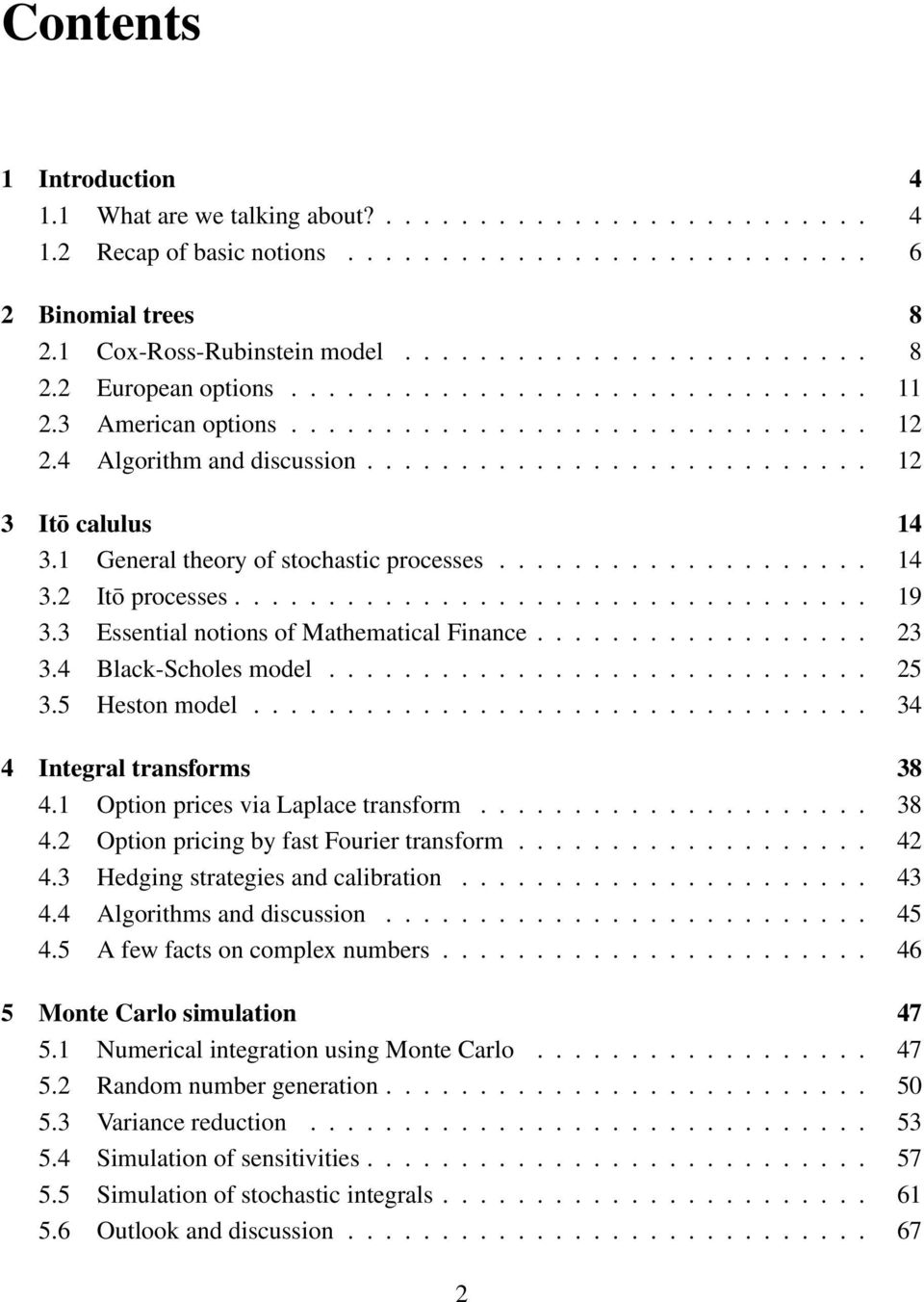
2 Contents 1 Introduction What are we talking about? Recap of basic notions Binomial trees 8.1 Cox-Ross-Rubinstein model European options American options Algorithm and discussion Itō calulus General theory of stochastic processes Itō processes Essential notions of Mathematical Finance Black-Scholes model Heston model Integral transforms Option prices via Laplace transform Option pricing by fast Fourier transform Hedging strategies and calibration Algorithms and discussion A few facts on complex numbers Monte Carlo simulation Numerical integration using Monte Carlo Random number generation Variance reduction Simulation of sensitivities Simulation of stochastic integrals Outlook and discussion
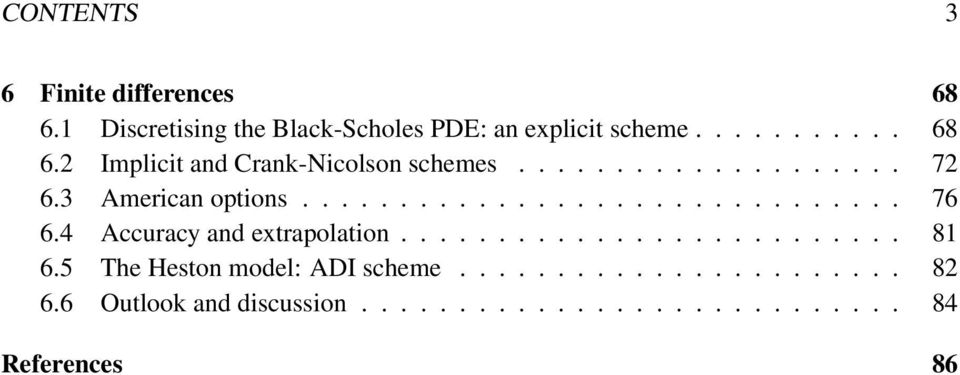
3 CONTENTS 3 6 Finite differences Discretising the Black-Scholes PDE: an explicit scheme Implicit and Crank-Nicolson schemes American options Accuracy and extrapolation The Heston model: ADI scheme Outlook and discussion References 86
4 Chapter 1 Introduction 1.1 What are we talking about? Mathematical finance tells us something about reasonable values of contingent claims, about hedging strategies and the like. But if the theory is to be applied in practice, we ultimately need numbers. Often these have to be obtained by numerical methods because explicit formulas are rare. In this course we discuss a number of approaches of quite different nature. Why do we not stick to the one method which proves superior in all circumstances? It simply does not exist. Some methods are faster, others easier to implement, even others more generally applicable. In this course, we repeatedly consider the following basic tasks. 1. How can one compute the value of an European style option? Mathematically, this boils down to calculating the expectation of the payoff under some appropriate probability measure.. How can one compute the value of an American option? This related question is more difficult because it involves solving an optimal stopping problem. 3. How can one compute the hedging strategy for such claims? In many models this means computing the so-called Greeks, i.e. derivatives of the option price relative to certain state variables. 4. How can one calibrate a parametric model to observed option prices? This means choosing the model parameters such that option prices in the model are as close as possible to quoted market prices. This is only a selection of problems that must be solved in practice. Other questions involving numerical methods include parameter estimation in statistics or the computation of risks, probabilities, value at risk etc. These are more of statistical nature and are not considered in this course. Neither do we discuss issues and models that require a deeper knowledge of financial mathematics as e.g. interest rate models, credit derivatives, commodity and energy markets etc. 4

5 1.1. WHAT ARE WE TALKING ABOUT? 5 What is a good numerical method? Let us just mention a few aspects. 1. How precise is the method? For an approximation this basically means: is it precise enough for practical purposes? Many methods can be made arbitrarily precise by increasing computing power. This immediately leads to the next aspect.. How fast or expensive is the algorithm or, more precidely, how many arithmetic operations and how much memory does is take to reach a certain precision? The relative performance of two methods may depend on the precision that is actually required. Often, the absolute error ε of a method depends on the number N of operations approximately as εn) CN p with some constants C > and p > which depend on the method. For large N a method with higher rate p will ultimately be faster. However, for limited computing power and hence N, it may be more efficient to use a method with lower rate p if the multiplicative constant C is much smaller. 3. One should also keep in mind how much effort it takes to implement the method. If the result is needed only once, it may be more reasonable to spend one day to write a computer programme which needs another day to produce numbers rather than working one month on a very efficient implementation that takes only a second to compute the result. 4. Finally, it is of interest how broadly a method is applicable. The stochastic models used in Mathematical Finance are subject to change, depending on their ability to fit real data. Moreover, more and more complex derivatives are developed. Therefore, one might prefer methods that easily be generalise to a large variety of models and payoffs. In this course we focus on methods rather than models. We consider the above basic tasks repeatedly in the simple Black-Scholes model and in the slightly more complex Heston model, where closed-form solutions are no longer avialable. We do not consider other important model classes as e.g. models with jumps, more involved continuous models, or discrete-time models beyond the binomial tree. We also stick to rather simple payoffs. Concrete numerical examples play an important role in this course. We choose the scientific software package Scilab for this purpose because it is freely available, convenient, sufficiently fast for our purposes, and does not requie a deep background in computer programming. Therefore, it serves as a useful environment for research and development. For high demands in speed and precision C/C++ is often used in practice. This course is mainly based on [Sey6, Gla3, Rai] and scattered literature. As an outlook we refer to the website of the premia project at INRIA, France where many numerical algorithms for financial mathematics are implemented and well documented.
6 6 CHAPTER 1. INTRODUCTION 1. Recap of basic notions This course assumes knwledge of financial mathematics as in the course Mathematical Finance in the previous semester. Here we briefly recall some basic notions that are used in the sequel. We mostly work in a market with two primary assets, a riskless bond written as B = Bt)) t and a risky asset stock or currency) S = St)) t. Typically, we assume fixed interest rate r in the sense that and a stock of geometric Brownian motion type Bt) = e rt 1.1) St) = S) expµt + σw t)) 1.) with parameters µ R, σ > and standard Brownian motion W. Occasionally, we allow that dividends or interest are paid on S with constant rate δ, i.e. the cumulative dividend process D in the sense of the previous course equals Dt) = t δss)ds. A derivative or option is an asset whose payoff depends on the underlying. The payoff X at time T may be a function fst )) of the underlying at time T as e.g. X = ST ) K) + for a simple European call or it could be a more complex function of the whole past of S. In complete markets such options can be replicated perfectly. This means that there exists a self-financing portfolio ϕ = ϕ, ϕ 1 ) whose value at time T equals V ϕ T ) = X. Absence of arbitrage implies that V ϕ t) is the only reasonable option price of the option at time t. It can be computed as conditional expectation V ϕ t) = Bt)E Q X/BT )) 1.3) of the discounted payoff under the unique equivalent martingale measure Q, i.e. the unique probability measure Q P such that S/B or, in the dividend-paying case, S + 1 B B D is a Q-martingale. If the market is incomplete, the equivalent martingale measure Q is no longer unique. Absence of arbitrage then implies that option prices are still of the form 1.3) for at least one such Q. However, a replicating portfolio ϕ typically ceases to exist. American options are specified by an entire exercise process X = Xt)) t as e.g. Xt) = K St)) + for an American put. In the complete case, the only reasonable price is the B-fold of the Snell envelope of X/B relative to Q. The Q-Snell envelope is the smallest Q-supermartingale dominating X/B. Again, Q denotes the unique equivalent martingale measure from above. One can write this fair price also as V t) = Bt) sup E Q Xτ)/Bτ)), 1.4) τ

7 1.. RECAP OF BASIC NOTIONS 7 where the supremum extends over all stopping times stopping at t or later. If τ denotes the optimal stopping time, the holder should exercise the option at τ in order to avoid unnecessary losses. One such stopping time is the first time t such that V t) = Xt), i.e. the market price of the option equals the exercise price. The stopped process V τ is a Q-martingale and it is the value process of a self-financing hedging strategy ϕ for the American option. In the incomplete case, such a hedge does not exist. But we can still say that absence of arbitrage implies that the option s value is of the form 1.4) for at least one equivalent martingale measure Q. Martingale modelling means looking for the dynamics of the stock under such a martingale measure, which turns all discounted prices into martingales or, for American options, Snell envelopes. One typically starts a priori with a parametric family of conceivable models for the Q-dynamics of the stock. The unknown parameters are chosen such that the moments 1.3) resp. 1.4) match the observed option prices as closely as possible. This procedure is called calibration.

8 Chapter Binomial trees.1 Cox-Ross-Rubinstein model We encountered the binomial or Cox-Ross-Rubinstein CRR) model in the previous course as a simple discrete-time model for the stock. Here, we consider it as a numerical method for computing option prices and hedges in the Black-Scholes model that we briefly discussed in Section 1.. The point is that the stock price evolution as well as option prices in a properly chosen sequence of CRR models converges to the corresponding Black-Scholes notions if the number of time step tends to infinity. Put differently, option prices and hedges from a CRR model with large number of time steps can be chosen as an approximation for Black-Scholes prices and hedges. We consider equidistant times = t, t 1,..., t M = T with t i = i t and hence t = T/M. The bank account or bond moves according to Bt i ) = e rt i. The stock goes up by a factor u resp. down by a factor d in each period, i.e. St i ) = { Sti 1 )u with probability p St i 1 )d with probability 1 p, where d < e r t < u. More precisely, p and 1 p denote the conditional probabilities of going up resp. down given the past. For option pricing real-world transition probabilities do not matter. Instead we need to consider martingale probabilities, i.e. probabilities such that E Q St i )/Bt i ) F ti ) = St i 1 )/Bt i 1 ). If we denote the Q-transition probabilities by q resp. 1 q, the left-hand side equals St i 1)u i 1)d q + 1 q) St Bt i 1 )er t Bt i 1 )e, r t 8

9 .1. COX-ROSS-RUBINSTEIN MODEL 9 which equals the right-hand side if and only if or qu + 1 q)d e r t = 1 q = er t d u d..1) This transition probability is the same for all branchings. Uniqueness of this probability implies that the model is complete. We mean to use the CRR model as an approximation to the Black-Scholes model which we briefly sketched in Section 1.. The basic processes B, S in 1.1,1.) involve parameters r, S), µ, σ. Moreover, we consider a finite time horizon T. The parameter µ changes under the transition to the unique martingale measure as we will see in Chapter 3. In fact, the stock price 1.) can be rewritten as ) r σ ) St) = S) exp t + σw Q t), where W Q denotes a standard Brownian motion relative to Q. In the binomial model we must fix parameters r, S), T, M, u, d, q. In order for the bond, the initial value of the stock, and the time horizon to coincide we naturally choose r, S), T as in the Black-Scholes model that is to be approximated. The number of periods M depends on the precision that is needed. Large M means better approximation but higher costs of computation. In order for the models to behave similarly, we choose the remaining parameters u, d, p such that the first two conditional moments in the Black-Scholes model and its CRR approximation coincide. For the conditonal expectation we have E Q St i ) F ti 1 ) = St i 1)Bt i ) Bt i 1 ) in both the Black-Scholes and the CRR model because S/B is a martingale under any equivalent martingale measure Q. For the second moment in the Black-Scholes model we obtain E Q St i ) F ti 1 ) = St i 1 ) expr σ ) t)e Q exp σw Q t i ) W Q t i 1 )) ) Fti 1 ) = St i 1 ) expr σ ) t) exp 1 σ) t) = St i 1 ) expr + σ ) t), where the second equality follows from the following two facts: W Q t) W Q s) is normally distributed with mean and variance t s, moreover Ee X ) = expσ /) for any Gaussian random variable with mean and variance σ. In the CRR model we have E Q St i ) F ti 1 ) = qst i 1 ) u + 1 q)st i 1 ) d = St i 1 ) qu + 1 q)d )

10 1 CHAPTER. BINOMIAL TREES If we want the conditional second moments to coincide in both models, we must require expr + σ ) t) = qu + 1 q)d..) We obtain two conditions.1,.) for three variables u, d, q. As a third condition we impose ud = 1,.3) which implies that the median of the possible final stock prices S)d M, S)d M 1 u,..., S)d M/ u M/,... S)du M 1, S)u M equals the initial stock price S). Equations.1.3) for u, d, q lead to α e σ t = α u 1 u u 1 u + u α u u u 1 = αu u + u 1 αu u u 1 = αu 1 + αu 1 with α = e r t. Put differently, u α 1 + αe σ t )u + 1 = or u = β ± β 1 for and hence β = α 1 + αe σ t = e r t + e r+σ ) t d = 1 u = 1 β ± β 1 = β β 1 β β + 1 = β β 1. Since we require d < u, we end up with u = β + β 1.4) d = u 1 = β β 1.5) β = 1 e r t + e r+σ ) t ).6) q = er t d u d,.7) which indeed solves.1.3). For M this sequence of CRR models converges in law in some proper sense to the corresponding Black-Scholes model. This statement can be made precise and shown based on the central limit theorem.

11 .. EUROPEAN OPTIONS 11. European options Let us consider a European option with payoff gst )) for some function g as e.g. gx) = x K) + call) or gx) = K x) + put). We denote the fair price of the option at time t by V St i ), t i ). The Q-martingale property for discounted option prices reads as E Q V St i ), t i )/Bt i ) F ti 1 ) = V St i 1 ), t i 1 )/Bt i 1 ).8) or which is q V St i 1)u, t i ) + 1 q) V St i 1)d, t i ) = V St i 1), t i 1 ), Bt i 1 )e r t Bt i 1 )e r t Bt i 1 ) V St i 1 ), t i 1 ) = e r t qv St i 1 )u, t i ) + 1 q)v St i 1 )d, t i ))..9) This allows to compute option prices starting from V ST ), T ) = gst )) and moving backwards in time Since the model is complete, the payoff gst )) can be replicated perfectly by a selffinancing portfolio ϕ = ϕ, ϕ 1 ). Its value equals ϕ t i )Bt i ) + ϕ 1 t i )St i ) = V St i ), t i ).1) or ϕ t i )Bt i 1 ) + ϕ 1 t i )St i 1 ) = V St i 1 ), t i 1 ).11) by self-financiability..1) yields ϕ t i )Bt i ) + ϕ 1 t i )St i 1 )u = V St i 1 )u, t i ) ϕ t i )Bt i ) + ϕ 1 t i )St i 1 )d = V St i 1 )d, t i ). and hence by taking differences. From.11) we get ϕ 1 t i ) = V St i 1)u, t i ) V St i 1 )d, t i ) St i 1 )u d).1) ϕ t i ) = V St i 1), t i 1 ) ϕ 1 t i )St i 1 )..13) B ti 1 Observe that the option price and the hedging strategy dpend only on the current value of the stock and the time. We use these objects as approximations for the corresponding quantities in the Black-Scholes model, which also depend only on St) and t. As noted above, one can show that we convergence holds for M. In principle one can repeat the above arguments for options that depend on the whole stock price path St ), St 1 ),..., ST ). In this case the option price at time t i depends on

12 1 CHAPTER. BINOMIAL TREES St ), St 1 ),..., St i ) ae well. However, this makes the algorithm much more expensive because the structure of the recombinig tree with only n + 1)n + )/ instead of n nodes cannot be exploited any more. Nevertheless, knock-out barrier options can be treated efficiently. Their payoff vanishes if the stock price exceeds a certain barrier at least once before expiration. Although their fair value at time t i depends on the whole past, their value given that the option has not been knocked out yet does not. It can be calculated using a recursion along the same lines as above..3 American options The above recusive algorithm needs only little modification for an American option with excersise price gst i )) at time t i. General theory from the previous course tells us that its fair value at time t i 1 satisfies V St i 1 ), t i 1 ) = max { gst i 1 )), Bt i 1 )E Q V St i ), t i )/Bt i ) F ti 1 ) }. rather than.8). repeating the above calculation this leads to V St i 1 ), t i 1 ) = max { gst i 1 )), e r t qv St i 1 )u, t i ) + 1 q)v St i 1 )d, t i )) }. instead of.9). General theory tell us that τ f = inf{t i : V St i ), t i ) = gst i ))} and τ s = inf { t i : gst i )) > e r t qv St i )u, t i+1 ) + 1 q)v St i )d, t i+1 )) } are the first and the last reasonable times to exercise the option. Before that, they can be hedged perfectly using the strategy ϕ satisfying.1,.13). Recall that the prices of European and American call coincide for nonnegative interest rate r because the second term in the maximum always dominates the first..4 Algorithm and discussion In order to write down an algorithm in pseudo code, we need some notation. S ji = S)u j d i j denotes the stock price at time t i after j upward and hence i j downward movements. Likewise, V ji denotes the option price at time t i after j upward movements of the stock, which means in the European case and V ji = e r t qv j+1,i q)v j,i+1 )..14) V ji = { { max Sji K) +, e r t qv j+1,i q)v j,i+1 ) } for a call, max { K S ji ) +, e r t qv j+1,i q)v j,i+1 ) } for a put.15)
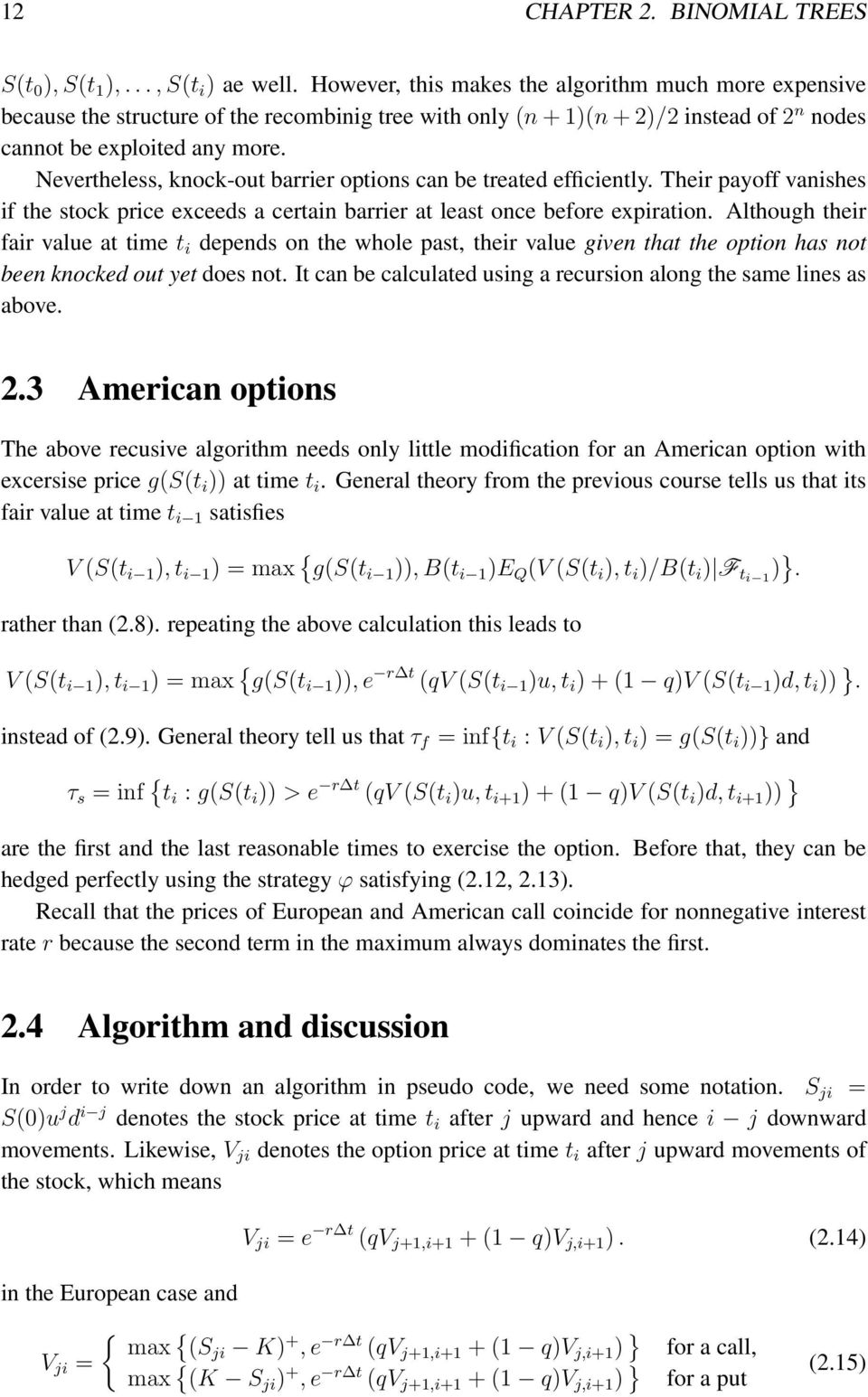
13 .4. ALGORITHM AND DISCUSSION 13 for American options, both with initial condition V jm = { SjM K) + for a call, K S jm ) + for a put..16) We can now formulate the algorithm for computing European and American calls and puts in the Black-Scholes model based on the binomial approximation: Input r, σ, S), T, K, call/put, European/American, M Compute t := T/M Set u, d, q according to.4.7). Set S := S). S ji = S u j d i j for i =,..., M and j =,..., i. V jm according to.16). V ji according to.14) resp..15) for i = M 1,...,. Output V The output V is the desired approximation for the initial option price in the Black-Scholes model. We end this section with a short discussion. The binomial approximation provides a simple algorithm for both European and American options, which is easy to understand and converges to the right value for M. Moreover, the output can be interpreted as the correct answer in a different financial market model. On the other hand, other methods based e.g. on numerical solution of the Black Scholes partial differential equation PDE) turn out to be more efficient. Moreover, the binomial approximation delivers the option price only for a specific value S), not simultaneously for all inital stock prices. Finally, a generalisation to more general models is not immediately obvious. But other tree-based approximations have been suggested in the literature to improve and generalise the above binomial approach.

14 Chapter 3 Itō calulus Most models in financial mathematics are formulated in continuous time. One cannot work with them without a certain background in the theory of stochastic processes. This is provided here on an informal level and with a view towards finance. 3.1 General theory of stochastic processes Most notions in the general theory of stochastic processes have a counterpart in discrete time, which we already encountered in the previous course on Mathematical Finance. We provide them here only as a transition to the next section, where the concepts are reformulated for the more specific setup that we really need, namely the case of Itō processes. For more precise definitions, motivation, and examples we refer to the previous course. The starting point is a probability space Ω, F, P ) consisting of the set Ω of possible outcomes, a σ-field F on Ω and a probability measure P on F. Recall that a σ-field is a collection of subsets of Ω called events. The probability measure P assigns probabilities to any of these events. For deep mathematical reasons it is typically not possible to assign probabilities to all subsets of Ω, which is why the σ-field F is introduced. In addition, we need a dynamic structure on the probability space, i.e. a filtration F = F t ) t. As in discrete time, this denotes an increasing family of σ-fields. The σ-field F t contains all events that are no longer random or undecided at time t. The whole structure Ω, F, F, P ) is called filtered probability space. In practise, typically neither Ω nor F nor F nor P is explicitly specified. Only some of its properties are needed. The real objects of interest are stochastic processes X = Xt)) t, i.e. collections of random variables Xt), indexed by time t. This random variable Xt) stands for the value of some quantity at time t, e.g. a stock price, the number of shares in a portfolio etc. It could be vector-valued as Xt) = X 1 t),..., X d t)), denoting e.g. the value at time t of d stocks in the market. From a different viewpoint, X can be interpreted as a random function of time. In this course we consider mostly continuous processes, i.e. the random path Xω, t)) t depends continuously on t. Advanced models in particular for asset prices do also allow for jumps. Nevertheless, the paths are generally still assumed to be càdlàg, i.e. right continuous 14
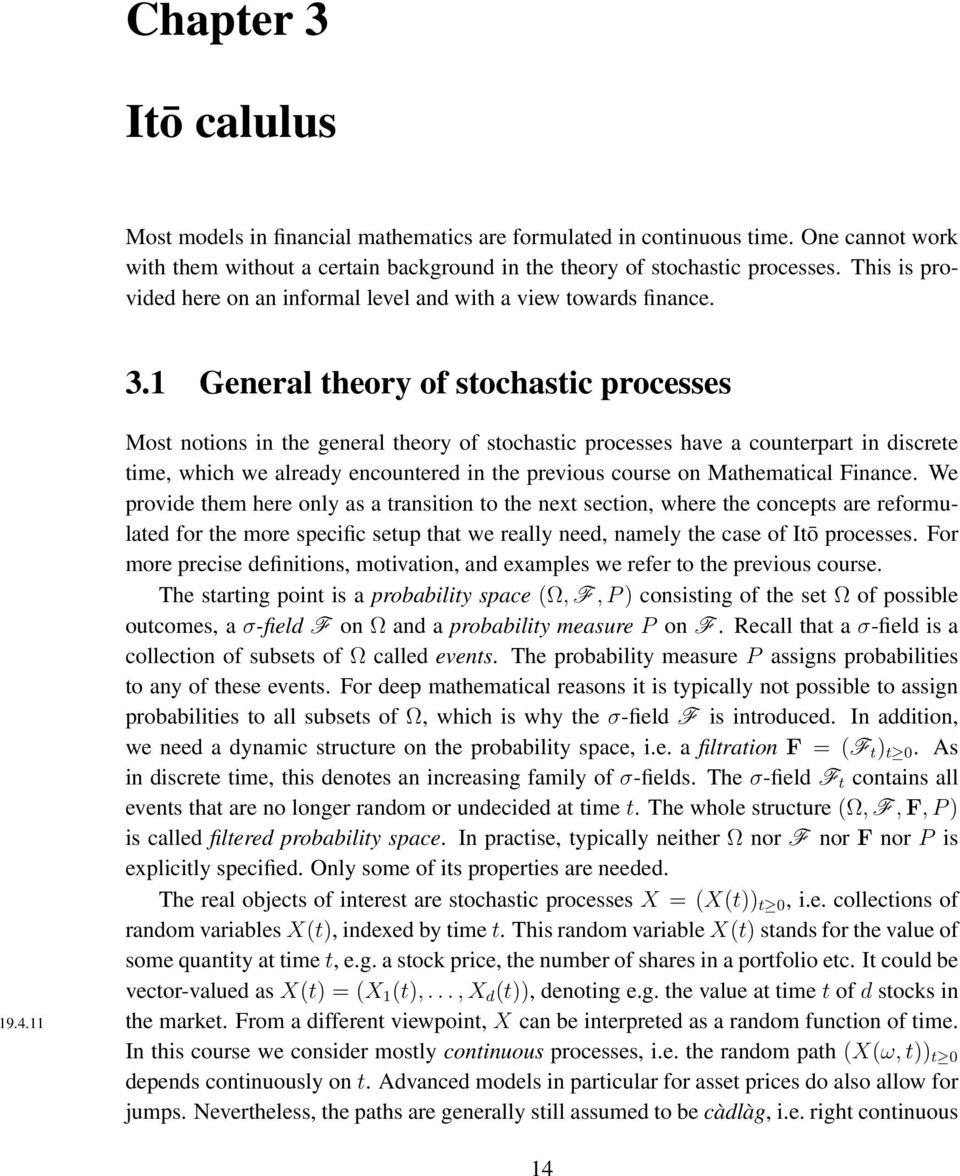
15 3.1. GENERAL THEORY OF STOCHASTIC PROCESSES 15 with limits from the left continu à droite avec des limites à gauche). This implies that Xt) denotes the value of the process after a jump has happened, whereas the left-hand limit Xt ) := lim s t Xs) denotes the value before the jump. The jumps itself is denoted by Xt) := Xt) Xt ). Functions considered in calculus are typically of finite variation, i.e. a difference of two increasing functions. Surprisingly, this is not the case for stochastic processes, which tend to be very shaky or rapidly oscillating. In mathematical terms, they are of infinite variation. All processes are typically assumed to be adapted to the filtration, i.e. the value Xt) is supposed to be observable at t at the latest. For stochastic integration in discrete time we also introduced processes which are known one period ahead. Such predictable processes which are observable an infinitesimal time before the respective time t, also play an important role in continuous time. However, we skip the somewhat technical definition here. Any process X generates a filtration, namely the smallest filtration is is adapted to. This means that all randomness in the model originates in the process X. This assumption is sometimes needed for statements concerning in particular market completeness. A stopping time T is a random time that is observable, i.e. we know at any time t whether T has already happened or not. If X denotes a process and T a stopping time, the stopped process X T equals X up to time T and stays frozen at the value XT ) afterwards. A martingale is an adapted process X satisfying EXt) F s ) = Xs) for any s t, i.e. we expect on average the present value for the future. A supermartingale is decreasing on average, i.e. we have EXt) F s ) Xs) for any s t, whereas a submartingale grows on average, i.e. EXt) F s ) Xs) for any s t. Martingales, supermartingales, and submartingales X are stable under stopping, i.e. the stopped process X T is again a martingale, supermartingale resp. submartingale for any stopping time T. Random variables Y naturally generate a martingale X via Xt) = EY F t ). An important example of this type is connected to measure changes to some probability measure Q P. If dq denotes the dp density of Q, then the martingale Zt) = E dq F dp t) is called density process of Q relative to P. A large class of adapted stochastic process X allow for a decomposition of the form X = X) + M + A with a martingale M and a predictable process of finite variation A. This Doob-Meyer decomposition generailizes the discrete time Doob decomposition. The process A stands for the trend or predictable growth whereas the martingale part M represents the unsystematic random deviation from that trend. The key concept from stochastic calculus needed in Finance is the stochastic integral representing in particular financial gains. If the integrand H is piecewise constant, i.e. of the form n Ht) = Y i 1 ti 1,t i ]t), i=1 then the integral H X = Ht)dXt) is defined as H Xt) := t Hs)dXs) := n Y i Xt t i ) Xt t i 1 )). 3.1) i=1
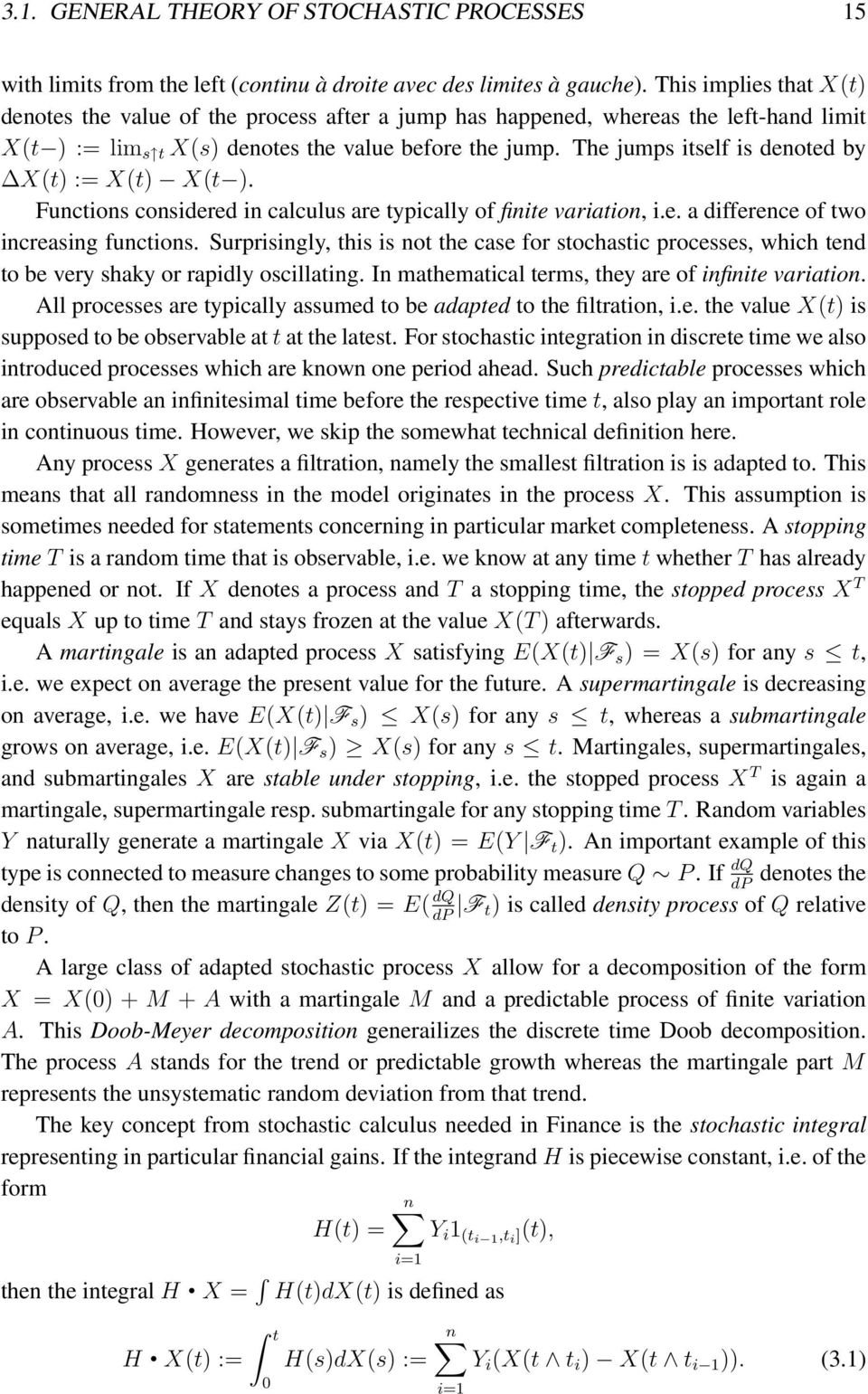
16 16 CHAPTER 3. ITŌ CALULUS If Ht) stands for the number of shares in the portfolio at time t and Xt) denotes the stock price at time t, then simple bookkeeping yields that t Hs)dXs) stands for the financial gains of the portfolio from time to t. If both H = H 1,..., H d ) and X = X 1,..., X d ) are vector-valued, then 3.1) needs to be replaced by H Xt) := t Hs)dXs) := d n Y i,j X j t t i ) X j t t i 1 )) j=1 i=1 because the total financial gains of the portfolio are the sum of the gains in any of the d assets. The stochastic integral is defined for more general integrands H than piecewise constant ones but its mathematical definition is quite involved. Roughly speaking, it may be viewed as a limit of expressions of the form 3.1) if the integrand H is approximated closer and closer by piecewise constant ones. Later, a differential notation turns out to be useful. We write as a shorthand for which by t t dy s) = Hs)dXs) 1dY s) = t Hs)dXs), 1dY s) = Y t) Y ) in turn means nothing else than Y t) = Y ) + t Hs)dXs). The stochastic integral is linear in both H and X, moreover it is continuous in H. The stochastic integral of a martingale is typically a martingale if we forget about important mathematical subtleties as we generally do in this course. We have the rule H K X) = HK) X which one applies without noticing in the differential notation: Ht)Kt)dXt)) = Ht)Kt))dXt). From discrete time, we also know the integration by parts rule or Xt)Y t) = X)Y ) + t Xs )dy s) + t Y s )dxs) + [X, Y ]t) dxt)y t)) = Xt )dy t) + Y t )dxt) + d[x, Y ]t) in differential notation. Here, [X, Y ]t) denotes the covariation process, which is the limit of expressions n X k k 1 t) X t)) Y k k 1 t) Y t)) 3.) n n n n i=1

17 3.1. GENERAL THEORY OF STOCHASTIC PROCESSES 17 if we let n tend to infinity. In other words, [X, Y ] sums up products of increments of X and Y over infinitesimal time intervals. For X = Y it is called quadratic variation. Sometimes, the possibly confusing notation dxt)dy t) = d[x, Y ]t) is used in the literature, which is motivated by 3.). We will see in the next section how it is computed in more specific situation. At this point we only note that it vanishes if either X or Y is continuous and if either of them is of finite variation. Moreover, [X, Y ] is itself of finite variation. The covariation is linear in both X and Y. Moreover, it commutes with stochastic integration in the sense that [ Hs)dXs), Y ] t) = t Hs)d[X, Y ]s). The most important formula in stochastic calculus is Itō s formula, which is fxt)) = fx)) + + s t t f Xs ))dxs) + 1 t fxs)) fxs )) f Xs )) Xs)) f Xs ))d[x, X]s) for one-dimensional processes and smooth functions f : R R. For continuous processes, it simplifies to or fxt)) = fx)) + t f Xs))dXs) + 1 t dfxt)) = f Xt))dXt) + 1 f X)d[X, X]t) f Xs))d[X, X]s) in differential notation. If X = X 1,..., X d ) is d-dimensional and f : R d R, the partial derivatives i f and second partial derivatives ij f come into play: fxt)) = fx)) + or dfxt)) = d i=1 t i fxs))dx i s) + 1 d i fxt))dx i t) + 1 i=1 d i,j=1 t ij fxs))d[x i, X j ]s)3.3) d ij fxt))d[x i, X j ]t). in differential notation. Some stochastic processes are defined in terms of integral equations that involve the as yet unknown process on both sides. More specifically, suppose that a process X,a function f : R R and an initial value z are given. We look for a process Z of the form Zt) = z + t i,j=1 fzs))dxs)
![At this point we only note that it vanishes if either X or Y is continuous and if either of them is of finite variation. Moreover, [X, Y ] is itself of finite variation.](/docs-images/41/2205516/images/page_17.jpg "The covariation is linear in both X and Y. Moreover, it commutes with stochastic integration in the sense that [ Hs)dXs), Y ] t) = t Hs)d[X, Y ]s).")
18 18 CHAPTER 3. ITŌ CALULUS or dzt) = fzt ))dxt), Z) = z 3.4) in differential notation. As a particular example consider the stochastic exponential or Doléans exponential Z = E X), which is the solution to 3.4) for fx) = x and z = 1, i.e. satisfying dzt) = Zt )dxt), Z) = 1. Intuitively, this means that the changes of Z are proportional to the present value of Z. We have encountered the discrete-time version of this process in the previous course. Since Z appears on both sides, it is not a priori clear that a unique solution to 3.4) exists. However, it can be shown this is generally the case for sufficiently well-behaved functions f. In particular, this holds for the stochastic exponential, which has an explicit representation of the form E X)t) = exp Xt) X) 1 ) [X, X]t) e Xs) 1 + Xs) ). s t For continuous processes X, this reduces to E X)t) = exp Xt) X) 1 ) [X, X]t). If the probability measure is changed from P to Q P, martingales do not remain martingale any more. Denote the density process of Q relative to P by Z. Then a process X is a martingale relative to Q if and only if XZ is a martingale relative to P. This simple statement can be used to show the following version of Girsanov s theorem: if X denotes a P -martingale, then t 1 Xt) d[z, X]s) Zs ) is a martingale under Q. Lévy processes X are defined as processes with stationary and independent increments. This means that the increment Xt) Xs) of the process for s t is independent of the information up to time s and its law depends only on the length t s of the interval, but not on s and t themselves. Intuitively, this means that Lévy processes stand for constant growth in a stochastic sense. In intervals of the same length they grow in the same way. They can also be viewed as the continuous time counterpart of random walks, i.e. the sum of independent and identically distributed random variables. Arguably they can be viewed as the most basic and important class of stochastic processes. Lévy processes may have jumps. If we restrict attention to processes with continuous paths, we end up with the much smaller class of Brownian motions X. Their law is specified by only two parameters, namely the expectation µ = EX1)) and the variance σ = VarX1)). In fact, the random variable Xt) is Gaussian with expected value EXt)) = µt and variance VarXt)) = σ t. Moreover, the process can be written as Xt) = µt + σw t), 3.5)
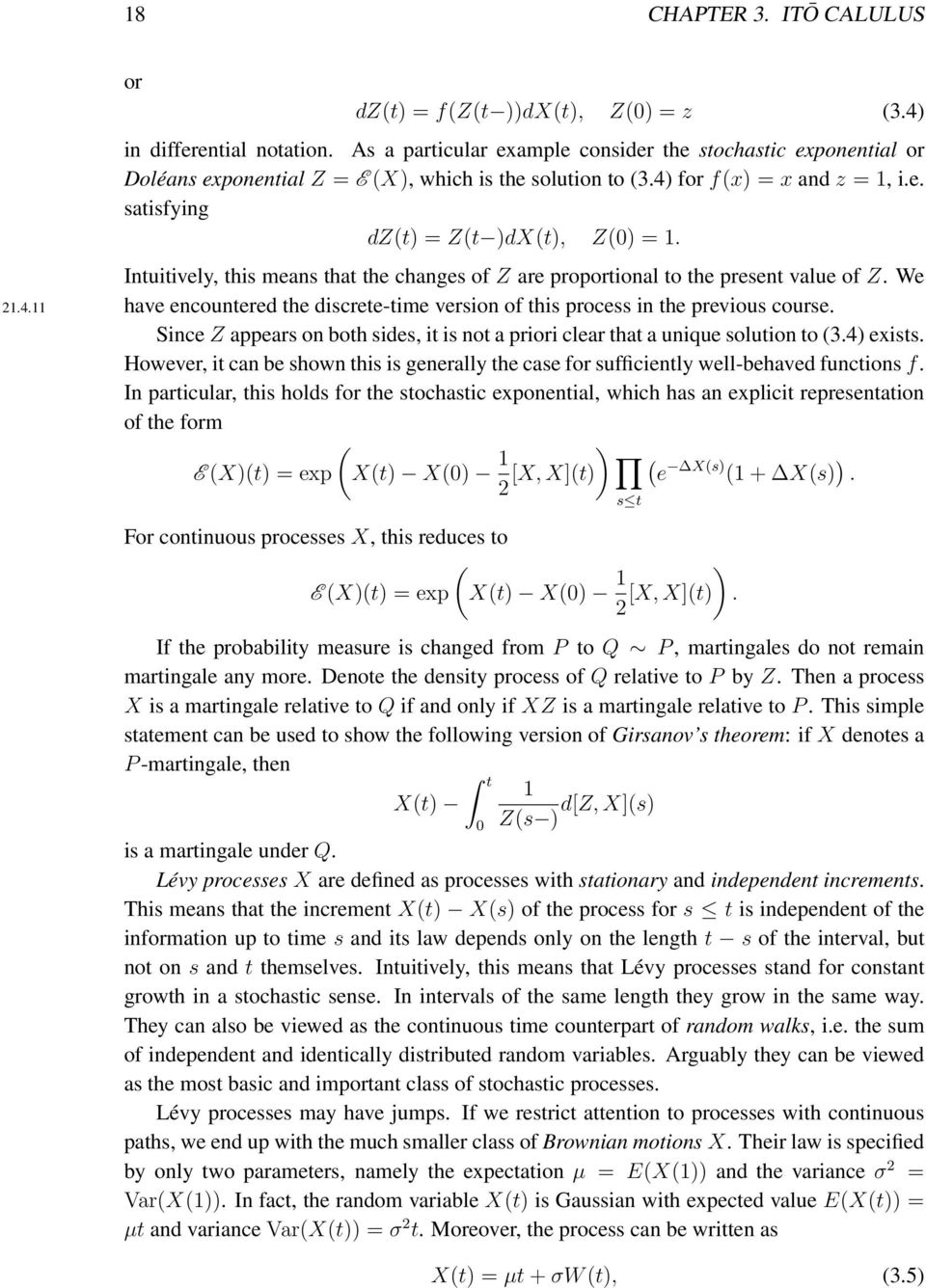
19 3.. ITŌ PROCESSES 19 where W denotes standard Brownian motion or a Wiener process, i.e. a Brownian motion with µ =, σ = 1. As far as its law is concerned, any continuous process of constant growth can hence be viewed as a linear combination of two building blocks: a deterministic linear trend t and an erratically moving Wiener process W. One may note that Brownian motion are of infinite variation and nowhere differentiable unless they are deterministic linear functions. The Wiener process may be regarded as the most important stochastic process altogether. It has been introduced in 19 by Louis Bachelier in his Ph.D. thesis on financial mathematics and by Albert Einstein in his 195 paper on thermal molecular motion. Brownian motion as the only continuous process with stationary and independent increments has a natural extension to the multivariate case. The law of such a continuous R d -valued Lévy process X = X 1,..., X d ) is specfied by the expectation vector µ = EX1)) = EX 1 1)),..., EX d 1))) and the covariance matrix c = ΣΣ = CovX1)) = CovX i 1), X j 1)) i,j=1,...,d. For µ = and c = 1 d we call X standard Brownian motion in R d. As for d = 1, both expectation and covariance matrix of the Gaussian random vector Xt) are linear in t. Moreover, any d-dimensional Brownian motion is of the form Xt) = µt + ΣW t) with standard Brownian motion W in R d. The quadratic variation of Brownian motion 3.5) equals [X, X]t) = σ t and in particular [W, W ]t) = t for a Wiener process W. More generally, the covariation process of Brownian motion X = X 1,..., X d ) in R d with covariance matrix c is given by [X, X]t) = c ij t and in particular [W i, W j ]t) = for standard Brownian motion W in R d. { t if i = j, otherwise 3. Itō processes We do not need the theory of stochastic processes in full generality for our purposes. We focus instead on processes with continuous paths, i.e. without jumps. Although the latter play an important role in theory and practice, continuity may be considered as an acceptable first approximation which simplyfies the mathematical treatment considerably. Among continuous models Itō processes play a predominant role. For an intuitive understanding let us recall the basic idea underlying ordinary calculus. Deterministic functions of constant growth can be written as Xt) = µt

20 CHAPTER 3. ITŌ CALULUS with slope or growth rate µ. Of course, not all real world phenomena exhibit constant growth. But the fundamental idea of analysis is the observation that they often do so on a local scale. In other words, a large class of functions are of the form dxt) = µt)dt, i.e. in a neighbourhood of t they resemble a linear function with growth rate µt). Of course, this local growth rate µt) is just the derivative of X in the language of calculus, which now depends on t. Now, we want to mimic this idea in a random setting. As argued above, continuous processes of constant growth are of the form Xt) = µt + σw t) with standard Brownian motion W and constants µ, σ. Along the same lines as in deterministic setups, we want to consider processes that locally resemble such a Brownian motion with drift rate µ and diffusion coefficient σ. To this end, we have to make sense of an equation of the form dxt) = µt)dt + σt)dw t), 3.6) where the local drift rate µt) and the local diffusion coefficient σt) now depend on time t and possibly also on randomness. 3.6) does not make sense in ordinary calculus but it can be interpreted as an integral equation Xt) = X) + t µs)ds + t σs)dw s) 3.7) in the sense of the previous section. Processes of this form are called Itō processes. We will reformulate the results and rules of Section 3.1 for the special case of Itō processes. 3.7) is also the Doob-Meyer decomposition of X. The martingale part is the second integral, whereas the first signifies the trend. X is essentially a martingale if the drift rate µ vanishes. For positive µ the process X is a supermartingale, for negative µ a submartingale. In particular, we obtain t ) E σs)dw s) = because the expectation of a martingale is its initial value. Stopping an Itō process X at some stopping time T just means that µ and σ vanish after T, i.e. dx T t) = µt)1 {t T } dt + σt)1 {t T } dw t). Since the quadratic variation of standard Brownian motion W is [W, W ]t) = t, the rules of the previous section yield d[x, X]t) = σ t)dt. More generally, we have d[x, X]t) = σt) σt)dt
21 3.. ITŌ PROCESSES 1 for Itō processes X and X with Sometimes, one can find the shorthand d Xt) = µt)dt + σt)dw t). dtdt = dtdw t) = dw t)dt =, dw t)dw t) = dt to help working with Itō processes. Itō s formula reads as dfxt)) = f Xt))µt) + 1 ) f Xt))σ t) dt + f Xt))σt)dW t) or dft, Xt)) = 1 ft, Xt)) + ft, Xt))µt) + 1 ) ft, Xt))σ t) dt 3.8) + ft, Xt))σt)dW t) 3.9) if the function f depends on both t and X. If we apply this to the function fx) = x, we obtain dx t) = Xt)µt) + σ t))dt + Xt)σt)dW t). Since the expectation of the martingale part vanishes, we obtain for µt) = the following Itō isometry t ) t ) ) Var σs)dw s) = E σs)dw s) t ) = E σ s)ds. Similarly, one can show t Cov σs)dw s), t As a side remark, for deterministic µ, σ Xt) = t ) t ) σs)dw s) = E σs) σs)ds. 3.1) µs)ds + t σs)dw s) is a Gaussian random variable with mean t µs)ds and variance t σ s)ds. The stochastic exponential of an Itō process readily follows from the general formula as t E X)t) = exp µs) 1 ) t ) σ s) ds + σs)dw s). 3.11) For Browian motion we have the following version of Girsanov s theorem. If the density process Z of Q P reads as dzt) = Zt)σt)dW t),
22 CHAPTER 3. ITŌ CALULUS the Wiener process W can be written as dw t) = dw Q t) + σt)dt with some Q-standard Brownian motion W Q, i.e. it acquires a drift with rate σt) under Q. Finally, we want to mention the important martingale representation theorem for Brownian motion. It basically states that any martingale X has a representation as a stochastic integral of a Wiener process W, i.e. it is of the form Xt) = X) + t σs)dw s) for some process σ. However, this holds only if the filtration is generated by W, i.e. if all the randomness in the model can be traced back to the Brownian motion W under consideration. This result, which also extends to the d-dimensional case, plays an important role for market completeness in Mathematical Finance. For Itō processes stochastic differential equations SDE s) are typically stated in the form dxt) = µt, Xt))dt + σt, Xt))dW t), X) = x 3.1) with deterministic functions µ, σ of the current state Xt) of the solution process and possibly also of time t. If the functions µ, σ are regular enough, then this equation or initial value prolem has a unique solution. As a side remark, note that 3.1) reduces to dxt) = µt, Xt))dt, X) = x for σ =, which is another way of writing the ordinary differential equation dxt) dt = µt, Xt)), X) = x. In that sense stochastic differential equations of the form 3.1) truly generalise ordinary differential equations by adding a stochastic term. The following linear SDE dxt) = µxt)dt + σxt)dw t), X) = x with constants µ, σ can be rephrased as dxt) = Xt)dY t), X) = x with Y t) = µt + σw t). Using formula 3.11) for the stochastic exponential, we conclude Xt) = xe Y )t) = x exp µ 1 ) ) σ t + σw t). This process X is called geometric Brownian motion.
23 3.3. ESSENTIAL NOTIONS OF MATHEMATICAL FINANCE 3 As a second example we consider the Ornstein-Uhlenbeck process, which solves the SDE dxt) = λxt)dt + σdw t), X) = x 3.13) with constants λ, σ. We will verify that X is of the form Xt) = xe λt + t e λt s) σdw s). 3.14) The initial condition X) = x is obviously satisfied by X in 3.14). Set Ut) = e λt and V t) = t eλs σdw s). We must show that our candidate Xt) = Ut)x + V t)) from 3.14) satisfies SDE 3.13). Firstly, note that dut) = λe λt dt = λut)dt e.g. by Itō s fomula and Integration by parts yields dx + V t)) = e λt σdw t). dxt) = dut)x + V t))) = x + V t))dut) + Ut)dx + V t)) + d[u, x + V ]t) = λut)x + V t))dt + Ut)e λt σdw t) + = λxt) + σdw t), which is indeed the SDE under consideration. 3.3 Essential notions of Mathematical Finance We do note study stochastic processes here for their own sake but in the context of finance. In this section we introduce resp. recall important notions from financial mathematics whose discrete-time counterparts we encountered in the previous course. The starting point is the d + 1-dimensional price process St) = S t),..., S d t)) of d + 1 traded securities in the market. We mostly work with two assets i.e. d = 1) whose price processes S t) = e rt and S 1 t) = S 1 ) expµt + σw t)) are of the form 1.1, 1.). As in Section 1. we will later denote them as Bt), St) for ease of notation. Trading is expressed in terms of a likewise d+1-dimensional trading strategy or portfolio ϕt) = ϕ t),..., ϕ d t)). The value of this portfolio at time t is The strategy is called self-financing if V ϕ t) = ϕt) St) = dv ϕ t) = ϕt) dst) = d ϕ i t)s i t). i= ) d ϕ i t)ds i t), 3.15) i=
24 4 CHAPTER 3. ITŌ CALULUS which as usually means that no funds are added or withdrawn after inception of the portfolio. Bookkeeping is often simplyfied by using asset S as a numeraire for discounting, i.e. all prices are expressed as multiples of S. Ŝt) := St)/S t) = 1, S 1 t)/s t),..., S d t)/s t)) is called discounted price process and ˆV ϕ t) = V ϕ t)/s t) discounted value process of portfolio ϕ. Observe that a strategy is self-financing if and only if d ˆV ϕ t) = ϕt) dŝt), i.e. if 3.15) holds in discounted terms. As in discrete time we can identify self-financing strategies with arbitrarily chosen initial capital V ) and a partial portfolio ϕ 1 t),..., ϕ d t). The missing component ϕ t) is then uniquely determined by the self-financing condition. The key concept of finacial mathematics is arbitrage, which essentially refers to a self-financing strategy ϕ with initial value V ϕ ) =, and final value V ϕ T ) with P V ϕ T ) > ) >. In fact, this definition must be modified or refined slightly in order to obtain a reasonable theory. We do not discuss these very delicate and nontrivial aspects here. Under absence of arbitrage the law of one price holds, which states that two self-financing portfolios ϕ, ψ with the same final value V ϕ T ) = V ψ T ) have the same value at any time t T. The first) fundamental theorem of asset pricing FTAP) links absence of arbitrage with martingales. Up to subtle technicalities, a market does not allow for arbitrage opportunities if and only if there exists an equivalent martingale measure EMM), i.e. a probability measure Q P such that the discounted price processes Ŝi are Q-martingales for i =,..., d. We generally assume that abesence of aritrage holds. The notion of arbitrage opens the door towards statements on derivative prices. In its most basic form a derivative, option or contingent claim is expressed in terms of a random variable X, namely its payoff at time T. Often, this is of the form X = fs 1 T )) with some funtion f as e.g. fx) = x K) + for a European call. General theory tells us that the only reasonable option price at time t T is given by the conditional expectation V t) = S t)e Q X/S T ) F t ), 3.16) where Q denotes an EMM as in the FTAP. Otherwise arbitrage opportunities would be introduced into the market by trading the option. If there several EMM s Q exist, 3.16) does not yet determine option prices uniquely. However, if several options are traded, they all have to be priced using the same EMM Q. The right-hand side of 3.16) does not depend on the chosen EMM Q if and only if the option can be replicated by dynamic trading. In other words, if there exists a self-financing hedging strategy ϕ with final value V ϕ T ) = X. This holds in particular if there is only one EMM. More specifically, the second fundamental theorem of asset pricing states that there exists only one EMM if and only if any contingent claim can be replicated. In this case, the market is called complete.
25 3.4. BLACK-SCHOLES MODEL 5 In this course we consider market models which are driven by an n-dimensional Brownian motion. As a rule of thumb such markets are complete if and only if the number n of Brownian motions is less than the number of traded assets, i.e. if we have n d. However, this general rule may be violated in concrete cases. American options are defined in terms of their exercise price process Xt), which specifies how much money the owner of the option receives if the option is exercised at time t. General theory tells us that the only reasonable prices of an American option are of the form V t) = S t) ˆV t), where ˆV denotes the Q-Snell envelope of ˆXt) := Xt)/S t) under some EMM Q, i.e. the smallest Q-supermartingale satisfying ˆV ˆX. Otherwise, arbitrage opportunities arise. As a supermartingale, the Snell envelope has negative drift rate relative to Q. However, whenever ˆV t ) > ˆXt ) it even behaves as a martingale, i.e. its Q-drift rate vanishes on the set { ˆV t ) > ˆXt )}. As noted in Section 1., the Snell envelope is linked to an optimal stopping problem. We have V t) = S t) sup E Q Xτ)/S τ) F t ), τ where the supremum extends over all stopping times stopping at t or later. For the particular case of an American call with payoff process Xt) = St) K) +, the fair option price can be computed more easily, provided that the numeriare S is an increasing process. In this situation the optimal stopping time is to wait till expiry T, which means that the fair value of an European and American call with the same strike and maturity coincide. This holds for the put as well if the numeriare S is constant, which, however, is typically not the case. 3.4 Black-Scholes model We turn now to the Black-Scholes model Bt) = e rt, 3.17) St) = S) expµt + σw t)), 3.18) which was already mentioned above and in Section 1.. With the help of the martingale convergence theorem one can show that this market model is complete. This is in line with the above rule of thumb because the number of assets beyond the numeraire coincides with the number of driving Brownian motions. In order to compute option prices we need the law of the stock price under the unique EMM Q. To this end, observe that the discounted price process Ŝt) = S) expµ r)t + σw t)) solves the stochastic differential equation ) ) dŝt) = Ŝt) µ r + σ dt + σdw t)
26 6 CHAPTER 3. ITŌ CALULUS because of 3.11). From this Itō process decomposition one can observe that Ŝ is a martingale only if µ = r σ. But if we consider the measure Q P with density process dzt) = Zt) µ r + σ / dw t), σ Girsanov s theorem as in Section 3. yields that dw t) = dw Q t) µ r + σ / dt σ with some Q-Wiener process W Q. This yields dŝt) = Ŝt)σdW Q t), 3.19) which implies that Ŝ is a Q-martingale because the drift part in the Itō process decomposition relative to Q vanishes. Hence we have found the unique EMM Q. According to 3.11) and using S = ŜB we obtain ) ) St) = S) exp r σ t + σw Q t) Pricing by integration We can now compute the fair price of an European option with payoff X = fst )), which is given by V ) = B)E Q fst ))/BT )). 3.) We only need to observe that W Q T ) has the same law as T Y for a standard normal random variable Y. Moreover, since we have for any function g, we conclude that V ) = 1 π f EgY )) = 1 π gx)e x dx r S) exp σ / ) T + σ )) T x e rt e x dx. 3.1) Hence option prices in the Black-Scholes model can be computed by numerical integration. This extends to all models where the density of the law of ST ) or logst )) under the pricing measure Q is known in closed form. In order to compute the fair option price V t) = Bt)E Q fst ))/BT ) F t ) 3.) at time t, we use the representation ) ) ST ) = St) exp r σ T t + σw Q T ) W Q t))
27 3.4. BLACK-SCHOLES MODEL 7 and observe that W Q T ) W Q t) has the same law as T ty for a standard normal random variable Y. Moreover, St) is known at time t and is hence to be treated as a constant in the computation of the conditional expectation 3.). This leads to the generalisation V t) = 1 π f r St) exp σ / ) T t) + σ )) T tx e rt t) e x dx. of 3.1). In some cases as e.g. for call and put options, V t) can be expressed more explicitly. For fx) = S K) + this was done in the previous course. For this payoff we obtained the following Black-Scholes formula: with V t) = St)Φd 1 ) Ke rt t) Φd ) 3.3) d 1 = d = log St) K log St) K σ + rt t) + T t) σ, T t σ + rt t) T t) σ T t and the cumulative distribution function Φz) = 1 π z e x dx of the standard normal distribution. Note that the payoffs of calls and puts with the same strike and maturity are related by K ST )) + = Ke rt BT ) ST ) + ST ) K) +. The law of one price yields that a the put has always the same value as a portfolio of Ke rt bonds, 1 shares of stock, and +1 call. This relationship is called put-call parity. For the European put with payoff function fx) = K x) + we therefore conclude V t) = Ke rt t) Φ d ) St)Φ d 1 ). Partial differential equation PDE) approach Integration is not the only way to compute option prices. We will now consider an alternative approach relying on the solution of partial differential equations. To this end we focus on a European style contingent claim whose payoff X = fs T ) is a function of the stock at time T. Recall that the discounted fair option price price ˆV t) = V t)/bt) is a martingale relative to the unique EMM Q. It is not surprising and can in fact be shown that this price ˆV t) at time t is a deterministic function of the present stock price St) and time t. In other
28 8 CHAPTER 3. ITŌ CALULUS words, it does not depend on the past stock prices which do not play a role for the expected payoff. We denote this function also as ˆv, i.e. we write the discounted option price as ˆV t) = ˆvt, St)) with some function ˆv on [, T ] R +. Similarly, we write V t) = vt, St)), which implies vt, x) = ˆvt, x)e rt because V t) = ˆV t)bt) = ˆV T )e rt. Since Itō s formula yields dst) = St)rdt + St)σdW Q t), d ˆV t) = dˆvt, St)) = 1ˆvt, St)) + ˆvt, St))rSt) + 1 ) ˆvt, St))σ S t) dt + ˆvt, St))σSt)dW Q t). 3.4) Since ˆV is a Q-martingale, it drift part has to vanish regardless of t and the present value of St). This is only possible if ˆv satisfies the partial differential equation PDE) or 1ˆvt, x) + ˆvt, x)rx + 1 ˆvt, x)σ x = 3.5) ˆvt, x) = rx t x ˆvt, x) 1 σ x ˆvt, x) x in a possibly more familiar notation. Since vt, x) = ˆvt, x)e rt, this leads to the Black- Scholes PDE vt, x) = rvt, x) rx t x vt, x) 1 σ x vt, x), 3.6) x which is complemented by the final value vt, x) = fx) 3.7) from vt, ST )) = V T ) = fst )). In other words, European option prices can be computed by solving 3.6, 3.7). It is straightforward to verify that the function ) log x σ + rt t) + T t) K vt, x) = xφ σ T t ) log x σ Ke rt t) + rt t) T t) K Φ σ T t
29 3.4. BLACK-SCHOLES MODEL from 3.3) solves 3.6, 3.7) for fx) = x K) +. For other payoffs there may not be a closed-form solution. In Chapter 6 we will study how to solve the Black-Scholes PDE numerically. We can now determine the replicating strategy as well. If ϕ = ϕ, ϕ 1 ) denotes a selffinancing strategy, its discounted value satisfies d ˆV ϕ t) = ϕ 1 t)dŝt) = ϕ 1t)Ŝt)σdW Q t). 3.8) If ϕ is the replicating strategy for the option, its value coincides with the option price. Comparing 3.4) and 3.8) yields ϕ 1 t)ŝt)σ = ˆvt, St))σSt) or ϕ 1 t) = St) Ŝt) ˆvt, St)) = e rt ˆvt, St)) = vt, St)), 3.9) i.e. the partial derivative of the option price relative to the stock price yields the number of shares of stock in the replicating portfolio. This number is often called delta of the option in the literature. The remaining funds in the hedging portfolio are invested in bonds, which yields ϕ t) = vt, St)) ϕ 1t)St) Bt) = vt, St)) vt, St))St) ) e rt. 3.3) For call options fx) = x K) + we obtain ) log St) σ + rt t) + T t) K ϕ 1 t) = Φ σ, T t ) log St) σ ϕ t) = Ke rt + rt t) T t) K Φ σ. T t Path-dependent options We turn now to a few exotic options whose payoff depends not only on ST ), but also on the minimum or maximum of the stock price in the interval [, T ]. We start with Barrier options whose payoff depends on the fact whether or not the stock price has reached a certain threshold before expiration. The payoff of e.g. a down-and-out call with strike K and knock-out barrier H equals X = ST ) K) + 1 {mint T St)>H}. 3.31)
30 3 CHAPTER 3. ITŌ CALULUS Similarly, we could have up-and-out, down-and-in, up-and-in options depending on whether the threshold is an upper or lower one and whether the option loses knocks out) or gains knocks in) its value at the barrier. We consider here the contingent claim 3.31). Upper barriers are treated similarly. Knock-in options as e.g. a down-and-in call can be decomposed as ST ) K) + 1 {mint T St) H} = ST ) K) + ST ) K) + 1 {mint T St)>H} and hence reduced to standard and down-and-out calls. We take the PDE approch to compute the fair price and hedge for the down-and-out call. We assume S) > H for the initial stock price because the option is worthless otherwise. It makes sense to assume that the option price V t) is a function of time t, the present stock price St) and the running minimum Mt) = min s t Ss). Of course, V t) = if Mt) H because the expected payoff vanishes in this case. If Mt) > H, however, the precise value of Mt) should not pay a role because it does not affect the probability whether the option will be knocked out in its remaining life time [t, T ]. These considerations, which can be made precise, lead to the ansatz V t) = vt, St))1 {Mt)>H} with some deterministic function v on [, T ] R +. For the discounted price process, this yields ˆV t) = ˆvt, St))1 {Mt)>H} with ˆvt, x) = e rt vt, x). This process is a Q-martingale. An application of the martingale representation theorem yields that it can be written as a stochastic integral relative to W Q, which implies that it is a continuous process. On the other hand, it seems to jump to at the stopping time τ = inf{t : Mt) H} = inf{t : St) = H}, i.e. at the first time that the stock price touches the barrier. This apparent contradiction is resolved by imposing the the boundary condition ˆvt, H) = or equivalently vt, H) =. Itô s fomula yields dˆvt, St)) = 1ˆvt, St)) + ˆvt, St))rSt) + 1 ) ˆvt, St))σ S t) dt + ˆvt, St))σSt)dW Q t) as in 3.4). Since the stopped process ˆvt τ, St τ)) = ˆV τ t) = ˆV t) is a Q-martingale, its drift part must vanish before τ. Therefore, we end up with the same PDE 3.6) as for non-path dependent claims. However, it must hold only beyond the barrier, i.e. for x > H. For the final value we have vt, x) = x K) + for x > H. Altogether, we need to solve vt, x) t = rvt, x) rx x vt, x) 1 σ x vt, x), x vt, H) = vt, x) = x K) +
31 3.4. BLACK-SCHOLES MODEL 31 for t [, T ], x H. It is not difficult to verify that this PDE is solved by ) log x σ ) + r + )T t) K vt, x) = x Φ σ T t ) )) 1+ r H σ log H σ ) + r + )T t) Kx Φ x σ T t ) log x σ e rt t) ) + r )T t) K K Φ σ T t ) )) r H σ 1 log H σ ) + r )T t) Kx Φ x σ. T t For the replicating strategy ϕ = ϕ, ϕ 1 ), the same argument as above yields that 3.3, 3.9) hold up to time τ. If resp. after the barrier has been reached, there is nothing to be hedged any more, i.e. ϕ = after τ. As a second example we consider a lookback call with payoff weggelassen where X = ST ) MT ), Mt) = min s t St) denotes the running minimum as before. This contingent claim can be interpreted as a call whose strike equals the minimal stock price in the period under consideration. As for the down-and-out call it makes sense to assume that the fair option price is a function of time, the present stock price and the running minimum, i.e. of the form V t) = vt, St), Mt)). Let us write the discounted option price ˆV t) = e rt V t) as ˆV t) = ˆvt, Ŝt), Mt)) with ˆvt, x, m) = e rt vt, xe rt, m). 3.3) We do not know the Itō process decomposition of M. In fact, it is not even an Itō process because it is a decreasing process which cannot be written as an integral with repsect to time. Therefore, we use he more general Itō formula 3.3) to get ahead. Note that all covariation processes involving t or Mt) vanish because these are continuous processes of finite variation. Hence 3.3) yields d ˆV t) = dˆvt, Ŝt), Mt)) = 1ˆvt, Ŝt), Mt))dt + ˆvt, Ŝt), Mt))dŜt) + 3ˆvt, Ŝt), Mt))dMt) + 1 ˆvt, Ŝt), Mt))d[Ŝ, Ŝ]t)dt
32 3 CHAPTER 3. ITŌ CALULUS Since dŝt) = σŝt)dw Q t), we obtain d ˆV t) = dˆvt, Ŝt), Mt)) = ˆvt, Ŝt), Mt))dŜt) + 3ˆvt, Ŝt), Mt))dMt) + 1ˆvt, Ŝt), Mt)) + 1 ) ˆvt, Ŝt), Mt))σ Ŝ t) dt The dmt)-term does not contribute anything unless the stock price ST ) happens to coincide with its running minimum Mt). The discounted stock price Ŝt) is a Q-martingale. In order for the sum ˆV t) to be a Q-martingale as well, the drift part must vanish, i.e. we conclude 1ˆvt, x, m) + 1 ˆvt, x, m)σ x = on xe rt > m, i.e. as long as the stock price exceeds its running minimum. By 3.3) and using -notation this yields x vt, x, m) = rvt, x, m) rx t x vt, x, m) 1 σ x vt, x, m), 3.33) x which is again the Black-Scholes PDE up to the fact that v depends on m as well. In order for ˆV to be a Q-martingale, the 3ˆvt, Ŝt), Mt))dMt)-term must vanish as well because it belongs to the drift part in the Doob-Meyer decomposition. This means that the partial derivative must vanish whenever M moves, i.e. whenever the stock price coincides with its running minimum. In other words, we obtain the boundary condition 3ˆvt, x, m) = for x = me rt or vt, x, m) = for x = m. 3.34) m T he terminal condition is obviously vt, x, m) = x m. 3.35) Hence we need to solve the PDE 3.33, 3.34, 3.35) for t [, T ], x >, m, x] in order to price the lookback call. It is once more straightforward to verify that this PDE is solved by ) log x σ ) + r + )T t) m vt, x, m) = xφ σ T t ) log x σ e rt t) ) + r )T t) m mφ σ T t ) xσ log m σ r Φ ) r + )T t) x + e rt t) xσ r ) r m x σ T t σ Φ log m x σ ) r σ T t ) )T t).
33 3.4. BLACK-SCHOLES MODEL 33 For the perfect hedge ϕ = ϕ, ϕ 1 ) we can apply the earlier arguments and obtain once more ϕ 1 t) = vt, St), Mt)), ϕ t) = vt, St), Mt)) vt, St), Mt))St) ) e rt. For lookback puts with payoff X = max t [,T ] St) ST ) one obtains similar results. American options We turn now to the valuation of American options in the Black-Scholes model. Suppose that the exercise process is of the form Xt) = gt, St)) for some function g of time and stock price. For standard call and put options, the payoff function gt, x) = x K) + resp. gt, x) = K x) + does not actually depend on time. Let us denote the fair price process of the option as V t). As in the European case, it makes sense to assume that it is a deterministic function of time and the present stock price, i.e. of the form V t) = vt, St)). The corresponding discounted price can be written as ˆV t) = ˆvt, St)) with ˆvt, x) = vt, x)e rt. As in 3.4) Itō s formula yields d ˆV t) = dˆvt, St)) = 1ˆvt, St)) + ˆvt, St))rSt) + 1 ) ˆvt, St))σ S t) dt + ˆvt, St))σSt)dW Q t). The American option price dominates the exercise price, i.e. vt, x) gt, x). Moreover, general theory tells us as this process is a supermartingale relative to the unique EMM Q. In other words, its drift rate in the Itō process decomposition is less or equal to zero. This leads to the inequality 1ˆvt, x) + ˆvt, x)rx + 1 ˆvt, x)σ x instead of 3.5). Replacing ˆv by v as in 3.6) and using -notation we obtain x vt, x) rvt, x) + rx t x vt, x) + 1 σ x vt, x). x Recall also that the Q-drift rate of an American option vanishes as long as the option price V t) is strictly above the exercise price Xt) = gt, St)). This leads once more to the familiar Black-Scholes PDE vt, x) rvt, x) + rx t x vt, x) + 1 σ x vt, x) =, x which, however, generally holds only for those t, x) satisfy with vt, x) > gt, x). The terminal value is vt, x) = gt, x)
34 34 CHAPTER 3. ITŌ CALULUS as in the European case. Putting everything together, we look for a function vt, x) on [, T ] R + which satisfies vt, x) rvt, x) + rx t vt, x) rvt, x) + rx t x vt, x) + 1 σ x vt, x), x x vt, x) + 1 σ x x ) vt, x) vt, x) gt, x), vt, x) gt, x)) =, vt, x) gt, x) =. 3.36) This linear complementarity problem, variational inequality, or free boundary value problem does not generally allow for a closed form solution. We will consider its numerical solution in Chapter 6. However, recall from Section 3.3 that the prices of American and European calls coincide unless the interest rate r is strictly negative or dividends are paid on the stock. Optimal exercise times and hedging strategies can also be deduced from the solution v to 3.36). The earliest optimal stopping time is the first time t where vt, x) = gt, x) for x = St). Alternatively, one may choose the latest optimal time which is is the first time where the first inequality in 3.36) starts being strict. Let us also note that there is some early-exercise curve S f t) for the American put. If the present stock price St) falls below S f t), it is time to exercise the option. As far as hedging is concerned, the results 3.9, 3.3) and arguments from the European case apply before the option is exercised. 3.5 Heston model It has been repeatedly observed in the empirical literature that the assumption of constant volatility σ in the Black-Scholes model seems to be violated in real markets. In this section the parameter ν = σ is replaced by a specific stochastic process. Contrary to the previous section we model the stock directly under the pricing measure from the EMM, i.e. we take the viewpoint of martingale modelling in the language of Section 1.. We replace Equation 3.19) for the discounted stock by dŝt) = Ŝt)σt)dW Q t) = Ŝt) νt)dw Q t), with some Q-Wiener process W Q. The stochastic process νt) = σ t) is assumed to satisfy the SDE dνt) = κ λνt)) dt + νt) σd W t), 3.37) where κ, λ, σ, ν) are parameters and W denotes another Q-Wiener process which may or may not be correlated with the above Wiener process W Q. For ease of exposition we focus on the uncorrelated case, which means that W Q, W ) is a Q-standard Brownian motion in R. The bond is given as before by Bt) = e rt or dbt) = Bt)rdt, B) = )
35 3.5. HESTON MODEL 35 In undiscounted terms we have dst) = St)rdt + St) νt)dw Q t) 3.39) by St) = Bt)Ŝt) and integration by parts. We want to determine fair option prices in this joint model 3.38, 3.39, 3.37) for the bond Bt), the stock St), and the squared volatility νt). In principle, this can be done by integrating the payoff relative to the law of ST ) as in 3.1). However, contrary to the Black-Scholes case we do not have a closed-form expression for the density of ST ) or logst )). Therefore we consider the PDE approach here. By contrast to the Black-Scholes model we face an additional state variable, namely the current value of volatility. Therefore, it makes sense to assume that the fair price of a European option with payoff fst )) is of the form V t) = vt, St), νt)) with some deterministic function v. In discounted terms, we write ˆV t) = ˆvt, St), νt)) with ˆvt, x, ν) = e rt vt, x, ν). Itō s formula yields d ˆV t) = dˆvt, St), νt)) = 1ˆvt, St), νt)) + ˆvt, St), νt))rst) + 3ˆvt, St), νt)) κ λνt)) + 1 ˆvt, St), νt))νt)s t) ˆvt, St), νt)) σ )dt + ˆvt, St), νt)) νt)st)dw Q t) + 3ˆvt, St), νt)) σd W t) 3.4) similar to 3.4). However, we need to apply the general Itō formula 3.3) because we formulated 3.8) only for one-dimensional X and W. As in the Black-Scholes model, the Q-martingale property leads to a SDE for ˆv, namely or 1ˆvt, x, ν) + ˆvt, x, ν)rx + 3ˆvt, x, ν) κ λν) + 1 ˆvt, x, ν)νx ˆvt, x, ν) σ = vt, x, ν) = rvt, x, ν) rx vt, x, ν) σ vt, x, ν) t x ν 1 1 νx vt, x, ν) vt, x, ν), 3.41) x σ ν in undiscounted terms and -notation. For the final value we have x vt, x, ν) = fx) 3.4)
36 36 CHAPTER 3. ITŌ CALULUS as in the Black-Scholes case. The PDE 3.41, 3.4) generalises 3.6, 3.7) in the stochastic volatility model 3.38, 3.39, 3.37) This can be extended to American option along the same lines as in the Black-Scholes model. Instead of 3.36) we obtain vt, x, ν) rvt, x, ν) + rx vt, x, ν) + σ vt, x, ν) t x ν νx vt, x, ν) + vt, x, ν) x σ ν, vt, x, ν) gt, x), vt, x, ν) rvt, x, ν) + rx vt, x, ν) + σ vt, x, ν) t x ν ) 3.43) νx vt, x, ν) + vt, x, ν) x σ, ν vt, x, ν) gt, x)) =, vt, x, ν) gt, x) =. Coming back to European options, we want to determine perfect hedging strategies. However, the Heston model is driven by a two-dimensional Brownian motion. Therefore it is incomplete according to the rule of thumb. As a way out we consider a liquid European call option as an additional hedging instrument. We denote its price process by Ct) = ct, St), νt)). By 3.4) we have dĉt) = ĉt, St), νt)) νt)st)dw Q t) + 3 ĉt, St), νt)) σ νt)d W t) for the discounted price Ĉt) = ĉt, St), νt)) = ct, St), νt))e rt, which yields dĉt) = ct, St), νt))e rt νt)st)dw Q t) + 3 ct, St), νt))e rt σ νt)d W t) The function c is just the solution to 3.41, 3.4) for fx) = x K) +. Now, we consider an additional option as above with discounted fair price ˆV t) = ˆvt, St), νt)). By 3.4) it moves according to d ˆV t) = ˆvt, St), νt)) νt)st)dw Q t) + 3ˆvt, St), νt)) σ νt)d W t). 3.44) The discounted value of a self-financing strategy ϕ = ϕ, ϕ 1, ϕ ) consisting of ϕ bonds, ϕ 1 shares of stock, and ϕ liquid call options satisfies d ˆV ϕ t) = ϕ 1 t)dŝt) + ϕt)dĉt) = ϕ 1 t) νt)ŝt) + ϕ t) ct, St), νt))e rt ) νt)ŝt) dw Q t) + ϕ t) 3 ct, St), νt))e rt σ νt)d W t) 3.45) ϕ is a perfect hedge for the option with price process V if the right-hand sides of 3.44) and 3.45) match. This can be done by choosing ϕ t) = 3ˆvt, St), νt))e rt 3 ct, St), νt)), ϕ 1 t) = ˆvt, St), νt))e rt ϕ t) ct, St), νt)).
37 3.5. HESTON MODEL 37 In undiscounted terms, this yields ϕ t) = 3vt, St), νt)) 3 ct, St), νt)), 3.46) ϕ 1 t) = vt, St), νt)) ϕ t) ct, St), νt)). 3.47) ϕ can be obtained by the self-financing condition as usual: ϕ t) = V t) ϕ 1t)St) ϕ t)ct) Bt) ) = vt, St), νt)) ϕ 1 t)st) ϕ t)ct, St), νt)) e rt. 3.48) Consequently, we can compute hedging strategies if we dispose of numerical solutions for the option prices ct, x, ν), vt, x, ν) and their derivatives. The latter are called sensitivities in the literature.
38 Chapter 4 Integral transforms 4.1 Option prices via Laplace transform Closed-form expressions for option prices are available only in rare cases. Often, the probability densities of ST ) or log ST ) are unknown so that computation by numerical integration of the payoff is not obvious either. We consider here an approach to pricing European non-path dependent options which is based on characteristic functions rather than densities. We consider a model with bond and stock of the form Bt) = e rt, St) = e XT ) with some stochastic process X as e.g. Brownian motion. If the payoff of the claim under consideration is of the form fxt )), the initial fair option price equals ) fxt )) V ) = B)E Q BT ) = e rt E Q fxt )) ). 4.1) For call resp. put options we have fx) = e x K) + resp. fx) = K e x ) + because the payoff is written as a function of the logarithmic stock price. For very simple payoffs, the expectation in 4.1) can in fact be calculated explicitly in many models, namely for fx) = e zx with some constant z. For the sequel, we even need to take complex-valued z into account, i.e. we consider payoffs of the form fx) = e zx = e Rez) cosz) + i sinx)), where z C and i = 1. Of course, complex-valued options do not make sense from an economic point of view but this fortunately does not affect their mathematical treatment. The corresponding option price equals V ) = e rt E Q e zxt ) ) = e rt χ iz) 38
39 4.1. OPTION PRICES VIA LAPLACE TRANSFORM 39 with χu) = E Q e iuxt ) ). χu) is called extended) characteristic function of XT ) in u and it is known in closed form for many processes X. We assume it to be given for the time being and turn to particular examples later. The next step and key idea is to write an arbitrary, more complicated payoff e.g. a European call) in the form fx) = ϱz)e zx dz 4.) with some function ϱz). Such a representation can be viewed as a generalized linear com bination of simple payoffs e zx. By linearity of the pricing rule 4.1) in the payoff, we end up with V ) = e rt = e rt ϱz)e Q e zxt ) )dz ϱz)χ iz)dz, 4.3) which can be evaluated by numerical integration if both functions ϱ and χ are known. But how can we determine an integral representation as in 4.)? To this end, consider the bilateral Laplace transform fz) = fx)e zx dx of f. This integral may not be defined for all z C. But if f exists for some z = R R and satisfies a certain integrability condition, then f can be recovered from f by the following inversion formula: fx) = 1 πi = 1 π R+i R i fz)e zx dz fr + iu)e R+iu)x du. Hence we have found an integral representation as in 4.) and the correponding pricing formula 4.3) reads as V ) = e rt πi = e rt π R+i R i fz)χ iz)dz fr + iu)χu ir)du. For slight simplification observe that fr iu) = fr + iu) and χ u ir) = χu ir).
40 4 CHAPTER 4. INTEGRAL TRANSFORMS This yields V ) = e rt π = e rt π = e rt π fr + iu)χu ir) fr iu)χ u ir) ) du fr + iu)χu ir) + fr + iu)χu ir) ) du Re fr + iu)χu ir) ) du. 4.4) Similarly, we obtain the fair price at time t if we replace the lifetime T by T t and the characteristic function of XT ) by the characteristic function of XT ) given F t, i.e. we have V t) = t) e rt where χ t denotes the conditonal characteristic function π Re fr + iu)χt u ir) ) du, 4.5) χ t u) = E Q e iuxt ) F t ). Let us now determine the Laplace transform of the call payoff function fx) = e x K) + : fz) = = = log K e x K) + e zx dx e 1 z)x Ke zx )dx [ 1 1 z e1 z)x + K z e zx ] x= x=log K = K1 z 1 z K1 z z K 1 z = zz 1). 4.6) This holds for all z with R = Rez) > 1 because otherwise e 1 z)x does not tend to zero for x. Interestingly, the same formula is obtained for the put fx) = K e x ) + but now for z with R = Rez) <. We still need to determine the characteristic function χ in order to use formulas 4.4) resp. 4.5). Let us start with the Black-Scholes model 3.17, 3.18). As noted above, e rt χu) = e rt E Q e iuxt ) ) is just the fair price of an option with payoff e iuxt ) = e iu log ST ). From Section 3.4 we know that it can be written as v, S)) with some function v satisfying the PDE 3.6). We make the ansatz that the solution is of the form vt, x) = e α+βt+iu log x with some unknown
41 4.1. OPTION PRICES VIA LAPLACE TRANSFORM 41 parameters α, β. Inserting this function shows that it solves the PDE for α = βt, β = iur iu + u )σ /, i.e. we conclude ) χu) = exp iulog S) + rt ) iu + u ) σ T. For χ t we obtain accordingly ) χ t u) = exp iulog St) + rt t)) iu + u ) σ T t). 4.7) In the Heston model of Section 3.5 we must consider the slightly more complicated PDE 3.41) instead of 3.6). We make the ansatz that the solution is of the form vt, x, ν) = e ψ t)+ψ 1 t) log x+ψ t)ν with unknown functions ψ, ψ 1, ψ. Insertion in the PDE leads to the system of ordinary differential equations ODE s) ψ t t) = κψ t) iur, ψ T ) =, ψ t 1t) =, ψ 1 T ) = iu, ψ t t) = eσ ψ t) + λψ t) + uu+i), ψ T ) = for ψ, ψ 1, ψ. The equation for ψ is an ODE of Riccati type. ψ is obtained by integration from ψ. The solution to the system is of the form ) expψ t)) = e iurt t) λt t)/ κ/eσ e, coshdt t)/) + λ sinhdt t)/)/d ψ 1 t) = iu, ψ t) = iu + u ) sinhdt t)/)/d coshdt t)/) + λ sinhdt t)/)/d with d = du) = λ + σ iu + u ). These formulas hold for Reu) in a neighbourhood of whose size depends on the parameters. Hence we have ) χ t u) = e iulog St)+rT t)) λt t)/ κ/eσ e coshdt t)/) + λ sinhdt t)/)/d ) iu + u ) sinhdt t)/)/d exp νt) 4.8) coshdt t)/) + λ sinhdt t)/)/d in the Heston model 3.38, 3.39, 3.37). Therefore, opion prices can now be determined from 4.5) by numerical integration. The constant R must be chosen such that the exponential moment Ee RXT ) ) is finite, which is true for arbitrary R in the Black-Scholes model but not e.g. in the Heston case. Moreover, the integrand of 4.4) tends to vary a lot near the poles of f, i.e. near 1 and in the case 4.6) of calls resp. puts. This complicates numerical integration. The question how to pick R optimally is considered in detail in [Lee4]. As a reasonable rule of thumb one may want to stay away from both the poles of f and the maximal resp. minimal R with Ee RXT ) ) <.
42 4 CHAPTER 4. INTEGRAL TRANSFORMS 4. Option pricing by fast Fourier transform For calibration purposes one often needs the prices of many calls resp. puts simultaneously. Let us denote by V κ ) the price of a call with strike K = e κ, which is of the form 4.5) with f = f κ given by f κ z) = e1 z)κ zz 1). 4.9) Since f κ z) = e 1 z)κ f z) = e 1 R iu)κ f z), 4.5) can be rewritten as V κ t) = t)+1 R)κ e rt π Re f R + iu)χ t u ir)e iuκ) du. This can be interpreted in terms of a Fourier transform. The continuous) Fourier transform of a function g is defined as ĝκ) = 1 π gu)e iuκ du or a closely related expression. If g u) = gu), this equals ĝκ) = π Re gu)e iuκ) du. 4.1) Therefore, V κ t) = t)+1 R)κ e rt ĝκ) π with gu) = f R + iu)χ t u ir). 4.11) Efficient numerical algorithms have been developped which compute ĝκ) simultaneously for many values κ. These, however, refer to the discrete rather than continuous Fourier transform. In order to use them, we must approximate the integral in 4.1) by a finite sum. To this end, we approximate the improper integral by a proper one: Re gu)e iuκ) du M Re gu)e iuκ) du with some sufficiently large upper limit M. The error of this approximation depends on how quickly the integrand and in particular χ t u ir) decays to for u. This in turns depends on the smoothness of the probability density of XT ): the smoother the density, the faster the decay of its Fourier transform. In a second step, we approximate the integral by a finite sum. We use the midpoint rule and obtain M Re gu)e iuκ) du N Re gn 1 ) )e in 1 ) κ) 4.1) n=1
43 4.3. HEDGING STRATEGIES AND CALIBRATION 43 for some sufficiently large N and corresponding mesh size = M/N. The quality of this approximation depends on the smoothness of g and in particular of χ t. This is determined by the existence of high moments of XT ) or, put differently, by the thickness of the tails of the law of XT ). If we set κ m := κ 1 + m 1) π, m = 1,..., N 4.13) M with arbitrary κ 1, the right-hand side of 4.1) equals N ) m 1)n 1) πi Re e N gn 1 ) )e in 1) κ 1 e i κm n=1 for κ = κ m. The discrete Fourier transfom DFT) of a vector x = x 1,..., x N ) is often defined as ˆx = ˆx 1,..., ˆx N ) with If we set ˆx m = N n=1 m 1)n 1) πi e N x n, m = 1,..., N. 4.14) x n := gn 1 ) ) e in 1) κ 1, 4.15) the right-hand side of 4.1) equals Reˆx m e i κm ) for κ = κ m. Consequently, V κm t) exp rt t) + 1 R)κ m) Re ˆx m e i κm), m = 1,..., N. 4.16) π A good approximation is obtained if M = N is large and is small. For error bounds we refer again to [Lee4]. The discrete Fourier transform allows for an efficient implementation if N is a power of two, i.e. of the form p for some integer p. The corresponding fast Fourier transform FFT) algorithm computes ˆx = ˆx 1,..., ˆx N ) simultaneously in only ON log N) steps, rather than in ON ) steps as one would expect. If option prices are needed for some κ with κ m 1 < κ < κ m, the simplest approach is linear interpolation, i.e. the approximation V κ t) κ m κ)v κm t) + κ κ m 1 )V κm 1 t) κ m κ m Hedging strategies and calibration From Sections 3.4 and 3.5 we know that hedging strategies can often be expressed in terms of derivatives of the pricing function. Let us consider the Black-Scholes case first. We know already from Section 3.4 that the fair option price of 4.5) can be written as a function of t and the present stock prive St). In fact, the dependence on St) is hidden in 4.7). By 3.9, 3.3) the perfect hedge ϕ = ϕ, ϕ 1 ) of the option is obtained by calculating the derivative of 4.5) with respect to the stock price. Under weak regularity conditions, the derivative can be moved inside the integral and the real part, which yields ϕ 1 t) = t) e rt π Re fr + iu)δt u ir) ) du,
44 44 CHAPTER 4. INTEGRAL TRANSFORMS where δ t u) denotes the derivative of χ t u) from 4.7) with respect to St), i.e. ) δ t u) = iu exp iu 1) log St) iu u ) σ T t). In other words, replacing χ t by δ t in the above approach leads to hedging strategies instead of option prices. In the slightly more involved Heston model the situation is similar. According to Section 3.5, the option price is a function of t, St), and νt). The dependence on St) and νt) is again hidden in χ t. We need the partial derivatives with respect to both state variables in order to compute hedging strategies ϕ = ϕ, ϕ 1, ϕ ) as in ). Again, differentiation can be moved inside the integral sign and the real part. As in the Black-Scholes model hedging strategies are obtained by replacing χ t in 4.5) by the corresponding derivatives of 4.8). We leave their calculation up to the reader. Let us come back to martingale modelling as it was mentioned in Sections 1. and 3.5. We consider the Heston model as an example. Its parameters κ, λ, σ and also the initial squared volatility ν) must be determined in practice. This is typically done by calibration to liquid options. Suppose that the prices π 1,..., π n of n European call resp. put options are observed at time. Their model prices V 1 ),..., V n ) depend on the above unknown parameters. Calibration means choosing κ, λ, σ, ν) such that model and observed prices coincide, i.e. π i = V i ), i = 1,..., n. Since the number of options n typically exceed the number of parameters here: 4), these equations probably cannot be solved exactly. A way out is to minimze some form of distance as e.g. n π i V i )) 4.17) i=1 as a function of the unknown parameters. This distance can be modified in many ways. The options could e.g. be weighted by their liquidity or bid-ask spread. Or the distance could be modified such that the contribution of an option vanishes as long as its model price lies inside that observed bid-ask-bounds. Many algorithms have been developed in order to minimise expressions as in 4.17). They typically proceed by some form of successive approximation. In any case, one needs a fast implementation for the computation of model prices V i ) because this step is repeated many times in the optimisation procedure for various parameter vectors. Some algorithms rely on knowing the derivative of the objective function 4.17) with respect to the parameters. The integral transform method is well suited to provide such information. As in the above discussion on hedging, the dependence on parameters in hidden in the characteristic function χ t, cf. 4.8). The relevant derivatives of V i ) can be calculated easily by differentiation under the integral sign.
45 4.4. ALGORITHMS AND DISCUSSION Algorithms and discussion As an example we provide an algorithm which computes a range of European call resp. put prices in the Heston model. Input Model parameters: r, κ, λ, σ, S), ν) Option parameters: T, call/put Further parameters: R > 1 for calls, R < for puts, N, M, κ 1 Compute Define function f as in 4.9). Define function χ = χ as in 4.8). Define function g as in 4.11). Set = M/N. Define vector x = x 1,..., x N ) as in 4.15). Compute the discrete Fourier transform 4.14) of x. Compute κ m as in 4.13) for m = 1,..., N. Compute K m = expκ m ) for m = 1,..., N. Compute V m := V κm ) as in 4.16) for m = 1,..., N. Output K m, V m ) for m = 1,..., N. The output of this algorithm are N pairs of a strike and the respective call/put price at time which corresponds to this strike. Let us also consider an algorithm which calibrates parameters to observed option prices. We consider a model class with parameters ϑ 1,..., ϑ p, e.g. κ, λ, σ, ν) in the Heston model. Moreover, we suppose that we dispose of a numerical algorithm for the computation of option prices in this model. This algorithm may depend on parameters η 1,..., η m e.g. R for 4.5) is used or R, N, M, κ 1 for the above FFT-based algorithm. Input Fixed model parameters: r, S) Option data: T i, K i, call/put, π i for i = 1,..., n Parameters for numerical algorithms: η 1,..., η m Starting values: ϑ 1,,..., ϑ p,. Compute Define the option pricing function V r, S), ϑ 1,..., ϑ p, T, K, call/put), e.g. using 4.4). It may depend on parameters η 1,..., η m ) needed for the algorithm. Define the loss function lϑ 1,..., ϑ p ) as in 4.17). Minimize lϑ 1,..., ϑ p ) as a function of ϑ 1,..., ϑ p. The minimisation procedure may require starting values ϑ 1,,..., ϑ p,. It may also require the derivatives of l relative to ϑ 1,..., ϑ p, in which case these should be provided as well.
46 46 CHAPTER 4. INTEGRAL TRANSFORMS Output Calibrated parameters ϑ 1,..., ϑ p The output of this algorithm are model parameters ϑ 1,..., ϑ p such that theoretical and observed option prices match as closely as possible. Option pricing by integral transforms is by now a standard approach in both theory and practice. It is fast, relatively simple, and flexible. It can be applied to models with jumps, stochastic volatility, many state veriables etc. as long as the characteristic function of the underlying is known in closed form. However, the approach cannot be applied immediately to American options. A way out is to approximate the latter by Bermudan options, which can be exercised only at finitely many instances. These can be priced by a recursive procedure similar as in Section.3 for the Cox-Ross-Rubinstein model. Each step in the recursion corresponds to the computation of a European option which can be done as in the previous sections. For details we refer to [LFBO7]. In any case, calculating American options using integral transforms requires higher effort than in the European case, both as far as implementation and computing time is concerned. Treating path-dependent options is not obvious either but it has been considered in particuar cases. 4.5 A few facts on complex numbers Complex numbers are of the form z = a + ib with a, b R, where the imiginary number i = 1 denotes one of the two square roots of 1, i.e. i = 1. Rez) = a resp. Imz) = b are called real part and imaginary part of z. Calculations with complex numbers follow largely the same rules as those with real numbers. The exponential function for complex numbers is defined as e z = e a cos b + i sin b) for z = a+ib. The complex conjugate of z = a+ib is z = a ib. We have z +z = Rez), z + z = z + z, zz = zz, e z = e z Moreover, z = z if z is real and z = z if z is purely imaginary, i.e. if z = ib with real b. The analysis of complex functions obeys similar rules as in the real-valued case. At this point we recall the definition of the hyperbolic sine and cosine functions: sinhx) = ex e x, coshx) = ex + e x.
47 Chapter 5 Monte Carlo simulation 5.1 Numerical integration using Monte Carlo In very complex models or for complicated, in particular path-dependent payoff structures, many numerical methods relying on e.g. solving PDE s or using integral transforms run into severe difficulties. In these cases Monte Carlo simulation may help although it does not seem very efficient on first glance. Recall that prices of European options with payoff fst )) are of the form V ) = e rt E Q fst ))) if the numeraire price process equals Bt) = e rt. In order to compute such expectations, we start by considering the general question how to approximate expectations V = EfX)) numerically, where X denotes a real- or vector-valued random variable and f some real-valued function. We assume that we know how to simulate X on the compute. More precisely, the computer is supposed to produce a realisation of N independent, identically distributed random variables X 1,..., X N, which have the same distribution as X. Then we use the average or emipiral mean ˆV N = 1 N N fx n ) 5.1) n=1 as an approximation for V. Why does this make sense? Unbiasedness Note that ˆV N is random because it is computed from random numbers. But at least its expectation equals E ˆV N ) = 1 N = 1 N N EfX n )) n=1 N EfX)) n=1 = EfX)) = V, 47
48 48 CHAPTER 5. MONTE CARLO SIMULATION i.e. ˆV N is an unbiased estimator for the desired expectation V = EfX)). This is nice but does not necessarily mean that ˆV N is close to V because the variance may be very large, Consistency But according to the law of large numbers we have that ˆV N converges for N to V = EfX)). In that sense ˆV N is a consistent estimator for V. Hence we can get an arbitrarily precise approximation by simulating sufficiently often. Rate of convergence On the other hand, due to limited time we have to stop simulating at some point. So what is the precision of the approximation for fixed N? As we have seen, the error is random and zero on average. Its variance equals Var ˆV n ) = 1 N = 1 N N VarfX n )) n=1 N VarfX)) n=1 = 1 N VarfX)), which implies that the standard deviation is σ ˆV n ) = Var ˆV n ) = 1 σfx)). 5.) N In this sense the rate of convergence is 1/ N. In order to halve the error, we need on average four times as many simuations. This rate of convergence seems rather slow. On the other hand, in particular for high-dimensional random vectors it is hard to beat this seemingly low rate of convergence. Asymptotic normality and confidence intervals For large N we can in fact tell more than just the variance of the error. By the central limit theorem the standardised error ˆV N V σ ˆV N ) = N ˆVN V ) σfx)) converges in law to some standard Gaussian random variable Z. This implies that ) P ˆV N V > ε) P Z > ε ) N Nε = Φ σfx)) σfx)) 5.3) for arbitrary ε > and large N, where Φx) = 1 x π exp z /)dz denotes once more the cumulative distribution function of the standard normal law. Suppose that we want the probability of an error greater than ε to be smaller than e.g..1. In principle, we can now compute how large N must be chosen to reach this precision. The inequality ) Nε Φ.1 σfx))
49 5.1. NUMERICAL INTEGRATION USING MONTE CARLO 49 can be rewritten as N > Φ 1.5) ) VarfX)) ε VarfX)) ε. 5.4) However, it is unlikely that we can compute the right hand side of 5.4) explicitly. Indeed, if even the expectation of fx) is unknown, we probably do not know its variance either. The way out is to approximate it as well by an average of random variables. From statistics we know that the sample variance ˆσ NfX)) = = 1 N 1 N N 1 N fx n ) ˆV ) N n=1 1 N N fxn ) ) ) ˆV N n=1 is an unbiased and consistent estimator for the variance σ fx)) = VarfX)). Using Slutsky s theorem it is not hard to show that N ˆVN V ) ˆσ N fx)) 5.5) converges to a standard Gaussian random variable as well. This means that we can just replace the unknown variance in 5.3) resp. 5.4) by its approximation ˆσ N fx)) and still get a reasonable criterion on how large N should be chosen. From a related perspective, the asymptotic normality of 5.5) can be used to construct asymptotic confidence bounds. Since 95% of all observations lie within 1.96 standard deviations of the mean, we may say that provided that N is not too small holds approximately with probability.95. V = ˆV N ± 1.96 ˆσ N fx)) Mean squared error in the biased case Sometimes it is not obvious how to simulate X but we know how to simulate Y with similar law or, more precisely, with EfY )) EfX)). In this case we take Ṽ = 1 N N fy n ) n=1
50 5 CHAPTER 5. MONTE CARLO SIMULATION as an approximation for V, where Y 1,..., Y N denote independent random variables with the same law as Y. Since Ṽ may no longer be an unbiased estimator for V, the mean squared error now equals MSEṼ ) = EṼ V ) ) = EṼ V )) + VarṼ V ) = EṼ ) V ) + VarṼ ) = EfY )) V ) 1 + VarfY )). N The first term represents the bias, the second the variance of the approximation. Often there is a tradeoff between bias and variance. E.g. one could simulate random variables Y with smaller bias EfY )) V, which however, require more simulation time so that N must be reduced. Numerical integration As a side remark we note that Monte Carlo simulations can be used to compute integrals b fx)dx because b fx)dx = b a)efx)) for a random a a variable X with uniform distribution on the interval [a, b]. This is particularly useful in higher dimensions. We have fx 1,..., x d )dx 1,..., x d = EfX)), where X = X 1,... X d ) denotes a random vector with uniform law on [, 1] d, i.e. X 1,... X d are independent an identically distributed with uniform law on [, 1]. 5. Random number generation We turn now to the question how to simulate random variables with a given law. Random number generators on computers usually generate independent random variables with uniform law on [, 1], i.e. with cumulative distribution function cdf) F x) = P X x) = if x <, x if x < 1, 1 if x 1. These are actually obtained by a deterministic algorithm and hence not at all random. Nevertheless they behave as random numbers for most practical purposes. Depending on the software package, random variables with other laws are also available or must be built from uniform ones. We mention a few methods how this can be done. Inversion Suppose that we want to simulate a random variable with arbitrary cumulative distribution function F. We denote the inverse function of F as F 1, which can be defined even in the case that F is not invertible, namely as pseudo inverse F 1 u) = inf{x R : F x) u}.
51 5.. RANDOM NUMBER GENERATION 51 If U is a random variable whose law is uniform on [, 1], then X = F 1 U) is indeed a random variable with cdf F because P X x) = P F 1 U) x) = P U F x)) = F x). If U 1,..., U n denote independent random variables with uniform law on [, 1], then X i := F 1 U i ), i = 1,..., n are n independent random variables with cdf F. As an example consider { if x <, F x) = 1 e λx if x with some parameter λ, which means that we want to simulate random variables whose law is exponential with parameter λ. The pseudo inverse of F is F 1 u) = log1 u). λ Therefore X = log1 U)/λ is exponentially distributed with parameter λ if U has uniform law on [, 1]. One can in fact also choose X = logu)/λ because 1 U has the same law as U. Acceptance/rejection method Unfortunately, the pseudo inverse is not easily avialable for many cumulative distribution functions. An alternative is provided by the acceptance/rejection method. Suppose that we want to simulate a random variable X with probability density function f. We may not know right away how to do this but are able to simulate random variables Y whose probability density function g satisfies fx) Cgx) for some constant C which is not too large. In order to simulate X, we first simulate independent random variables Y, U, where Y has density g and U is uniformly distributed on [, 1]. We accept Y as a simulation of X if U fy )/CgY )). Otherwise we repeat the first step In order to convince ourselves that X has indeed the right density, observe that P X t) = P Y t U fy )/CgY ))) P Y t, U fy )/CgY )) = P U fy )/CgY ))) t fy)/cgy)) dugy)dy = fy)/cgy)) dugy)dy t = fy)/cgy))gy)dy fy)/cgy))gy)dy = = t fy)dy fy)dy t fy)dy
52 5 CHAPTER 5. MONTE CARLO SIMULATION for any t R. As an example we want to simulate a standard normal random variable X. Note that X = X sgnx). It is not hard to show that sgnx) = ±1, each with probability 1/, the modulus X has density fx) = e x, x, π and sgnx), X are independent. In order to simulate X we consider gx) = e x, x, which is the density of an exponential random variable with parameter 1. The ratio hx) = fx)/gx) = expx x /) /π reaches is maximum at x = 1, which implies that fx) Cgx) for C = h1) = e/π 1.3. Note that fy) Cgy) = e y 1). Hence we obtain the following algorithm for simulating a standard normal random variable X: 1. Simulate an exponential random variable Y with parameter 1, i.e. simulate a uniform random variable U 1 on [, 1] and set Y = log U 1.. Simulate another uniform random variable U on [, 1]. 3. Set X = Y if U fy )/CgY )), otherwise repeat the first two steps. 4. Generate another uniform random variable U 3 on [, 1]. 5. Set X = X if U 3.5 and X = X otherwise. Transformations of random vectors probabilistic terms as follows: The change of variables formula can be restated in Theorem 5.1 Suppose that U = U 1,..., U n ) is a random vector with positive density f on A R n. Moreover, let h : A R n be a function with continuously differentiable inverse. Then the random vector X = hu) has a density g given by on ha). gx) = fh 1 x)) detdh 1 x)) As an example consider a pair U 1, U of independent random variables with uniform distribution on [, 1]. Now set Z 1 = logu 1 ) cosπu ), Z = logu 1 ) sinπu ).
53 5.3. VARIANCE REDUCTION 53 Then Z 1, Z is a pair of independent standard normal random variables, which can be verified by using the above theorem. This approach to simulating Gaussian random variables is called Box-Muller method. In spite of its simplicity, other methods run faster on computers because they avoid trigonometric functions. Similar transformations as above exist also for a number of other distributions. Now suppose that we need to simulate a Gaussian random vector X = X 1,..., X d ) with mean vector µ R d and covariance matrix Σ R d d. We start by simulating d independent standard normal random variables Z 1,..., Z d. This implies that the random vector Z = Z 1,..., Z d ) is Gaussian with mean vector and covariance matrix 1 d. Determine a matrix A R d d with AA = Σ, e.g. the Cholesky decomposition is a lower triangular matrix. Now set X = AZ + µ, X is Gaussian because it is an affine transformation of a Gaussian random vector. Its expectation equals EX) = AEZ) + µ. Similarly, we obtain its covariance matrix CovX) = CovAZ) = ACovZ)A T = AA = Σ. Consequently, X has the desired law. 5.3 Variance reduction Recall that the rate of convergence of the Monte Carlo method is relatively low. A way out is to reduce the numerator σfx)) in the expression 5.) of the standard deviation σfx)). We briefly discuss three of many approaches here. For more background on variance reduction cf. [Gla3]. Antithetic variables Suppose that the law of X is symmetric in the sense that X and X have the same distribution. Now replace the standard Monte Carlo estimate 5.1) by with V AV = 1 ˆV + V ) = 1 N V = 1 N N fxn ) + f X n ) ) n=1 N f X n ). n=1 V AV is an unbiased estimate for V as well because EV AV ) = 1 E ˆV ) + EV )) = V by symmetry of the law of X. Its variance equals VarV AV ) = 1 4 Var ˆV ) + VarV ) + Cov ˆV, V ) ) = 1 Var ˆV ) + 1 Cov ˆV, V ) 1 Var ˆV ) + 1 Var ˆV )VarV ) = Var ˆV ),
54 54 CHAPTER 5. MONTE CARLO SIMULATION where the inequality follows from Schwartz inequality. Therefore the methods seems at least not to increase the variance. However, if we take into account that it may take up to twice the time to compute V AV compared to ˆV, we should require VarV AV ) 1 Var ˆV ) or, equivalently, Cov ˆV, V ) <. Since Cov ˆV, V ) = 1 N = 1 N N m,n=1 CovfX m ), f X n )) N CovfX m ), f X m )) m=1 = 1 CovfX), f X)), N this holds if and only if fx) and f X) are negatively correlated. This holds e.g. for in- or decreasing functions. Note that the payoff of the call can be written as an increasing function of a standard and hence symmetric Gaussian random variable. Therefore antithetic variables may help to reduce the variance if Monte Carlo simulation is used to compute call resp. put prices in the Black-Scholes model. Control variates The control variate approach is applicable if we know some Y fx) auch that EY ) can be computed explicitly. Since EfX)) = EY ) + EfX) Y ), it remains to simulate EfX) Y ), which can be done hopefully with smaller variance. To this end, simulate independent pairs X n, Y n ), n = 1,..., N, each having the same law of X, Y ). Now replace ˆV from 5.1) by V CV = ˆV 1 N = 1 N N Y n + EY ) n=1 N fx n ) Y n ) + EY ). The estimate V CV is an unbiased estimate for V because EV CV ) = E ˆV ) 1 N EY n ) + EY ) = V. N For the variance we obtain n=1 VarV CV ) = Var ˆV ) + Var 1 N = Var ˆV ) + 1 N N n=1 n=1 N Y n ) Cov ˆV, 1 N n=1 VarY n ) N N m,n=1 ) N Y n n=1 CovfX m ), Y n )) = Var ˆV ) + 1 VarY ) CovfX), Y )). 5.6) N
55 5.3. VARIANCE REDUCTION 55 The variance is reduced compared to ˆV if CovfX), Y ) VarY )/. One should note, however, that more operations are needed for a single simulation. In any case, fx) and Y should ideally be highly correlated for the method to make sense. One can improve the method further by considering βy instead of Y for some appropriately chosen constant β. In view of 5.6) we need to minimize VarβY ) CovfX), βy ) = β VarY ) βcovfx), Y = VarY ) β CovfX), Y ) ) VarY ) as a function of β. The optimal choice is obviously CovfX), Y ) VarY ) β = CovfX), Y ), 5.7) VarY ) in which case the variance is reduced by CovfX), Y ) /VarY ). Note, however, that it may be not be obvious how to compute the optimal β in concrete cases because CovfX), Y ) is typically not known explicitly. A way out is to replace the numerator and possibly also the denominator of 5.7) by a first Monte-Carlo simulation. A classical application of the control variate approach is the computation of the price of Asian options e.g. with payoff M i=1 ST i/m)/m K)+, which corresponds to a call on the arithmetic mean on the stock price path. In the Black-Scholes model, the fair price of the related payoff M i=1 ST i/m))1/m K) + can be evaluated explicitly. Since the geometric mean provides a natural proxy of the arithmetic mean, the control variate approach is likely to be useful here. Note that we need to simulate the whole paths ST i/m), i =,..., M in this application, which we be considered in Section 5.5 below. Importance sampling Sometimes fx) attains large values with only small probability. The results of the Monte Carlo estimate depends crucially on how often these unlikely events appear in the simulation. The idea now is to change the distribution of X in order to make the relevant events more likely. Suppose that the law of X has density g. Let h be another probability density such that gx) > implies hx) >. Finally, denote by Y a random variable with probability density function h. The importance sampling estimate is based on independent random variables Y 1,..., Y N with the same law as Y. Specifically, it is defined as V IS = 1 N N n=1 fy n ) gy n) hy n ). 5.8)
56 56 CHAPTER 5. MONTE CARLO SIMULATION It is unbiased for ˆV because Its variance equals which should be compared to EV IS ) = 1 N E fy n ) gy ) n) N hy n=1 n ) = fy) gy) hy) hy)dy = fy)gy)dy = EfX)) = V. VarV IS ) = 1 N Var fy N n ) gy ) n) hy n=1 n ) = 1 fy) gy) ) hy)dy V ) N hy) = 1 fy)) gy) ) N hy) gy)dy V = 1 E fx)) gx) ) ) V, N hx) Var ˆV ) = 1 N E fx)) ) V ). In general, this variance can be both smaller or larger. Ideally, we have ) hx) cfx)gx) with some norming constant c because this implies Var fy ) gy ) Var1/c) = and hy ) hence VarV IS ). However, even the calculation of the constant 1 c = fx)gx)dx = EfX)) = V is as hard as the original problem! Nevertheless, it seems reasonable to look for a density h which is approximately proportional to fg resp. attains large values where this is the case for fg. Let us finally remark that an unbiased estimate of is easily obtained from VarV IS ) = 1 N Var fy ) gy ) ) hy ) VarV IS ) = 1 1 N 1 N N n=1 fy n ) gy ) ) n) VIS. hy n )
57 5.4. SIMULATION OF SENSITIVITIES 57 As an example consider a call ST ) K) + in the Black-Scholes model which is far out of the money, i.e. K is very large compared to S). Recall from 3.) or 3.1) that its fair price equals V = e rt E S) exp r σ /)T + σ T X ) ) ) + K 5.9) where X denotes some standard normal random variable. In a Monte Carlo simulation ˆV = 1 N N e S) rt exp r σ /)T + σ ) ) + T X n K. n=1 according to 5.1), only the few outcomes X n > d contribute to the empirical mean, where d = log K σ r )T S) σ. T Instead of the density gx) = 1 π e x of standard normal random variable X n let us consider Gaussian random variables Y n with density hx) = 1 π e x µ), where the mean is chosen such that Y n > d happens with probability 1/, i.e. µ = d. The Monte Carlo estimate 5.8) now reads as V IS = 1 N N n=1 µ rt Ynµ+ e S) exp r σ /)T + σ ) ) + T Y n K, where the Y n are independent Gaussian random variables with mean µ and variance Simulation of sensitivities Hedging strategies do often involve derivatives of the option price relative to state variables as e.g. the current stock price. Put in a general context, we are facing the problem how to compute the derivative z ϑ) of an expectation zϑ) = EZϑ)) which depends on a parameter ϑ. As an example, consider once more Equation 5.9) for the fair price of a European call, here written as zs) = EZs)), where Zs) = e rt s exp r σ /)T + σ T X ) K) +, X denotes some standard normal random variable, and s the initial stock price. According to 3.9) the derivative z s) stands for the number of shares of stock in the hedging portfolio.
58 58 CHAPTER 5. MONTE CARLO SIMULATION Finite difference method For a sufficiently smooth function z we have the Taylor expansion zϑ + h/) = zϑ) + z ϑ)h/ + z ϑ)h /8 + Oh 3 ), where Oh ) stands for an expression such that Oh 3 )/h 3 is bounded in a neighbourhood of h =. Similarly, which yields zϑ h/) = zϑ) z ϑ)h/ + z ϑ)h /8 + Oh 3 ), z zϑ + h/) zϑ h/) ϑ) = + Oh ) h ) Zϑ + h/) Zϑ h/) = E + Oh ) h The quantities EZϑ + h/)) and EZϑ h/)) can be computed by Monte Carlo simulation as usual. Choosing a small h reduces the bias due to the Oh ) term. However, it increases the variance of the estimator, at least if EZϑ + h/)) and EZϑ h/)) are computed using separate simulations. Let us analyse how large h should be chosen in order to minimise the mean square error Eẑ ϑ) z ϑ)) ) of the Monte Carlo estimate ẑ ϑ) := 1 N N n=1 Z n ϑ + h/) Z n ϑ h/) h of z ϑ). For the time being let us assume that all N random variables Z n ϑ ± h/) are independent and distributed as Zϑ ± h/). If we assume that VarZ n ϑ ± h/)) VarZϑ)) for sufficiently small h, we have A Taylor expansion yields Varẑ ϑ)) 1 N N 1 h VarZϑ)) = Nh VarZϑ)). zϑ + h/) zϑ h/) h This means that the bias equals approximately = z ϑ) + h 4 z ϑ) + Oh 4 ). Eẑ ϑ)) z ϑ) h 4 z ϑ) for small h. The mean squared error is the sum of squared bias and variance: Eẑ ϑ) z ϑ)) ) = Eẑ ϑ)) z ϑ)) + Varẑ ϑ)) ) h 4 z ϑ) + Nh VarZϑ))
59 5.4. SIMULATION OF SENSITIVITIES 59 This is to be minimised as a function of h or, equivalently, h. A function fx) = bx + a/x attains its minimal value at x = a/b) 1/3, namely fx ) = ba ) 1/3 1/3 + 1/4) 1/3 ). In our case, we have x = h ; a = VarZϑ))/n; b = z ϑ)/4. This yields that the optimal h is approximately ) 1/6 576VarZϑ)) h N =, z ϑ) with a root mean square error Eẑ ϑ) z ϑ)) ) = O1/ 3 N). This reduced convergence rate means that we need eight times as many simulations to halve the error. Let us come back to the Black-Scholes example, in which case we need to simulate Z n s + h/) Z n s h/) h = e rt s + h/) exp r σ /)T + σ ) ) + T X + K h s h/) exp r σ /)T + σ ) ) ) + T X K with independent standard normal random variables X +, X. In this case, we may alternatively want to use the same rather than independent random variables X = X + = X. As before we have ) Zs + h/) Zs h/) E = z s) + Oh ) h because dependence does not play any role for the expectation. Moreover, we have Zs + h/) Zs h/) h s + h/) exp r σ /)T + σ T X ) ) K e rt h s h/) exp r σ /)T + σ T X ) ) ) K = exp σ T/ + σ T X) because the function fx) = x K) + is Lipschitz with Lipschitz constant 1. Hence we get for the variance ) Zs ) ) Zs + h/) Zs h/) + h/) Zs h/) Var E h h E exp σ T + σ ) T X),
60 6 CHAPTER 5. MONTE CARLO SIMULATION which now does not depend on h at all. Therefore there is no reason not to choose a very small h. As a result we see that the use of common random variables in the difference quotient may considerably reduce the variance, to the effect that h can be chosen very small. Infinitesimal perturbation A second approach is to simulate Z ϑ). If differentiation and expectation can be interchanged, we have E d Zϑ)) = d EZϑ)) = d zϑ) = dϑ dϑ dϑ z ϑ), which means that the estimate ẑ ϑ) = 1 N Z N nϑ) makes sense, where Z 1ϑ),..., Z N ϑ) denotes independent random variables with the same law as Z ϑ). It is indeed possible to interchange differentiation and expectation if e.g. Zϑ) is Lipschitz in a neighbourhood of ϑ with a random Lipschitz constant whose expected value is finite. In this case we obtain the usual Monte Carlo convergence rate of 1/ N instead of the 1/ 3 N of the finite difference approach. In the above example of a European call we simulate Z s) = 1 {s expr σ /)T +σ T X)>K} exp σ T/ + σ T X ) with standard normal X. The use of the finite difference method with common random variables leads in the limit h to the infinitesimal perturbation approach. Likelihood ratio method Sometimes the dependence of zϑ) = EZϑ)) on the parameter ϑ van be shifted from the random variable Z to the probability measure P, i.e. we are actually considering zϑ) = E ϑ Z), where the probability measure P ϑ instead of Z depends on ϑ. More specifically, suppose that Z = fx) where X has density g ϑ relative to P ϑ, which implies zϑ) = E ϑ fx)) = fx)g ϑ x)dx. n=1 If differentiation and integration can be interchanged, we have z ϑ) = fx) dg ϑx) dϑ dx dg ϑ x) dϑ = fx) g ϑ x) g ϑx)dx = fx) d logg ϑx)) g ϑ x)dx dϑ = E ϑ fx) d logg ) ϑx)) dϑ Consequently, we may use the Monte Carlo estimate ẑ ϑ) = 1 N N n=1 fx n ) d logg ϑx n )), dϑ
61 5.5. SIMULATION OF STOCHASTIC INTEGRALS 61 where X 1,..., X N are independent random variables with density g ϑ. As with infinitesimal perturbation we obtain an unbiased estimate under conditions that allow to interchange differentiation and integration. Here, however, these hold more frequently than in the infinitesimal perturbation case. As an example let us turn back to the European call with zs) = E e rt s exp r σ /)T + σ T X ) ) ) + K = E e rt exp log s + r σ /)T + σ T X ) ) ) + K = E s e exp rt r σ /)T + σ T X ) ) ) + K, where X is N, 1)-distributed under P and Nlogs)/ σ T, 1)-distributed under P s. In the above notation but with s instead of ϑ) we need d logg s x)) ds fx) = e exp rt r σ /)T + σ T x ) + K), ) 1 x logs) ) g s x) = exp σ T, π = x s σ T log s sσ T. In contrast to the infinitesimal perturbation method this works also for discontinuous payoffs as e.g. digital options Simulation of stochastic integrals In some applications we need to simulate the whole path Xt)) t [,T ] of a stochastic process rather than just its terminal value XT ). This happens e.g. if we want to compute prices of path-dependent claims as e.g. lookback, barrier or Asian options. But even if we are interested only in XT ), it may be necessary to simulate the past as well because we do not know the law of XT ) in closed form. In this section we focus on diffusion-type processes, i.e. solution to stochastic differential equations of the form dxt) = axt), t)dt + bxt), t)dw t) 5.1) with some Wiener process W, some starting value X), and given deterministic functions a, b. It is obviously impossible to simulate infinitely many numbers on a real computer. The goal is therefore to generate random paths of X on some equidistant time grid = t < t 1 < < t m = T with t i = i t and t = T/m, i.e. Xt ),..., Xt m ).
62 6 CHAPTER 5. MONTE CARLO SIMULATION Simulation of Brownian motion and geometric Brownian motion In rare cases, the stochastic differential equation 5.1) has an explicit solution in terms of the driving Brownian motion W. This is obviously the case if a and b are constants, i.e. Xt) = X) + at + bw t). 5.11) Note that W i = W t i ) W t i 1 ), i = 1,..., m are independent normal random variables with mean and variance t. Moreover, we have Xt i ) = X) + i j=1 a t + b W i). In order to simulate Xt ),..., Xt m ), start with m independent standard normal random variables Z 1,..., Z m and set Y i := X) + i j=1 a t + b tz j ) for i =,..., m. Then Y, Y 1,..., Y m ) has the same law and hence can be used as a simulation for the random vector Xt ),..., Xt m )). Let us consider the slightly more involved case of geometric Brownian motion, which is of the form dxt) = Xt)µdt + σdw t)), i.e. at, Xt)) = µxt), bt, Xt)) = σxt). Recall that the solution to this stochastic differential equation is Xt) = X) expµ σ /)t + σw t)). The process in the exponent is of the form 5.11) with a = µ σ /, b = σ. If Y, Y 1,..., Y m ) denotes a simulation of this process at t,..., t m, then X)e Y,..., X)e Ym ) has the same law as the random vector Xt ),..., Xt m )). Euler method In general, exact simulation as in the previous paragraph is out of reach. In order to obtain a decent approximation, we proceed step by step. Suppose that Xt ),..., Xt i 1 ) have already been simulated. Note that Xt i ) = Xt i 1 ) + ti t i 1 axt), t)dt + ti t i 1 bxt), t)dw t). If the mesh size of the grid is small and the coefficients a, b are sufficiently smooth, we may approximate axt), t) axt i 1 ), t i 1 ), bxt), t) bxt i 1 ), t i 1 ) for t i 1 < t t i, which implies that ti Xt i ) Xt i 1 ) + axt i 1 ), t i 1 )dt + bxt i 1 ), t i 1 )dw t) t i 1 t i 1 = Xt i 1 ) + axt i 1 ), t i 1 )t i t i 1 ) + bxt i 1 ), t i 1 )W t i ) W t i 1 )) ti = Xt i 1 ) + axt i 1 ), t i 1 ) t + bxt i 1 ), t i 1 ) W i. with W i = W t i ) W t i 1 ). Since W 1,..., W m are independent normal random variables with mean and variance, we have found a simple method to simulate an approximation of X on the grid. The algorithm of this Euler method in pseudo code reads as follows.
63 5.5. SIMULATION OF STOCHASTIC INTEGRALS 63 Initialise t = T/m, t =, Y = X), Loop For i = 1,,..., m compute t i = t i 1 + t W = Z t with new standard normal random variable Z Y i = Y i 1 + ay i 1, t i 1 ) t + by i 1, t i 1 ) W Output Y,..., Y m The output Y,..., Y m stands for the desired simulation of Xt ),..., Xt m ). Stochastic Taylor expansion We analyse the Euler method using the so-called stochastic Taylor expansion. For simplicity, we suppose that a and b above do not depend on t, i.e. dxt) = axt))dt + bxt))dw t). 5.1) Itō s formula yields dfxt)) = f Xt))aXt)) + 1 ) f Xt))bXt)) dt + f Xt))bXt))dW t) = L fxt))dt + L 1 fxt))dw t) for smooth functions f and Letting f = a resp. b in 5.1) yields Xt i ) = Xt i 1 ) + with + Consequently, ti t i 1 ti L fx) = ax)f x) + 1 bx) f x), L 1 fx) = bx)f x). t i 1 bxt i 1 )) + t axt i 1 )) + t ) L axs))ds + L 1 axs))dw s) dt t i 1 t i 1 t ) L bxs))ds + L 1 bxs))dw s) dw t) t i 1 t i 1 t L a = aa + 1 b a, L 1 a = ba L b = ab + 1 b b, L 1 b = bb. Xt i ) = Xt i 1 ) + axt i 1 ))t i t i 1 ) + bxt i 1 ))W t i ) W t i 1 )) + R i
64 64 CHAPTER 5. MONTE CARLO SIMULATION with R i = ti t t i 1 ti + t i 1 t i 1 L axs))dsdt + t ti t i 1 t t i 1 L axs))dsdw t) + t i 1 L 1 axs))dw s)dt ti t i 1 t t i 1 L 1 axs))dw s)dw t). The Euler method from above amounts to the approximation R i. But we can do better. Let us approximate R i by assuming Xs) Xt i 1 ), which yields with R i L axt i 1 ))I + L 1 axt i 1 ))I 1 + L bxt i 1 ))I 1 + L 1 bxt i 1 ))I 11 I = I 1 = = I 1 = I 11 = ti t t i 1 ti t t i 1 ti t i 1 dsdt = ti t i 1 dw s)dt = t i 1 t t i 1 )dt = 1 t i t i 1 ) = 1 t) = O t) ), ti t i 1 W t) W t i 1 ))dt t i 1 t i t)dw t) N, t i t i 1 ) 3 /3) = N, t) 3 /3), ti t ti dsdw t) = t t i 1 )dw t) t i 1 t i 1 t i 1 N, t i t i 1 ) 3 /3) = N, t) 3 /3), ti t i 1 t t i 1 dw s)dw t) = ti = 1 W t i) W t i 1 )) t i t i 1 ) = 1 t i 1 W t) W t i 1 ))dw t) Wi ) t ) The equality of the two integrals in I 1 follows from integration by parts: ti t i t i 1 )dw t) = t i t i 1 )W t i ) W t i 1 )) t i 1 = ti t i 1 t t i 1 )dw t) + ti t i 1 W t) W t i 1 ))dt. Moreover, recall from Section 3. that integrals t σs)dw s) with deterministic σ are normally distributed with mean and variance t σs) ds. Since W i ist normally distributed with mean and variance t, we have E W i ) ) = t and Var W i ) ) = 3 t). Consequently, EI 11 ) = and VarI 11 ) = t) /. Milshtein method The standard deviation of the I 11 -term is of the order t and hence larger than EI ) for the other integrals I = I, I 1, I 1. Therefore, it seems most worthwhile to include I 11 in the approximation: Xt i ) Xt i 1 ) + axt i 1 ))t i t i 1 ) + bxt i 1 ))W t i ) W t i 1 ) + 1 bxt i 1))b Xt i 1 )) W t i ) W t i 1 )) t i t i 1 ) )
65 5.5. SIMULATION OF STOCHASTIC INTEGRALS 65 The algorithm of the corresponding Milshtein method in pseudo code reads as follows. Initialise t = T/m, t =, Y = X), Loop For i = 1,,..., m compute t i = t i 1 + t a = ay i 1 ) b = by i 1 ) b = b Y i 1 ) W = Z t with new standard normal random variable Z Y i = Y i 1 + a t + b W + 1 bb W ) t) Output Y,..., Y m Again, the output Y,..., Y m stands for the desired simulation of Xt ),..., Xt m ). A more refined method One can go even one step further and incorporate all four terms I, I 1, I 1, I 11 in the approximation: Xt i ) Xt i 1 ) + axt i 1 ))t i t i 1 ) + bxt i 1 ))W t i ) W t i 1 )) + L axt i 1 ))I + L 1 axt i 1 ))I 1 + L bxt i 1 ))I 1 + L 1 bxt i 1 ))I 11 If we set Y i = t i t i 1 t t i 1 )dw t), we can write I = 1 t), I 1 = W i t Y i, I 1 = Y i, I 11 = 1 Wi ) t ), hence Xt i ) Xt i 1 ) + axt i 1 )) t + bxt i 1 )) W i + L axt i 1 )) 1 t) + L 1 axt i 1 )) W i t Y i ) + L bxt i 1 )) Y i + L 1 bxt i 1 )) 1 Wi ) t ). For a simulation of this expression we need the joint law of W i and Y i. They are jointly normally distributed because they are both obtained by a linear operation from the same Wiener process W. Moreoever, both have expectation because they are integrals relative
66 66 CHAPTER 5. MONTE CARLO SIMULATION to W. Their variances equal Var W i ) = t and Var Y i ) = t) 3 / as has already been calculated. The covariance of the two equals Cov W i, Y i ) = ti t i 1 t t i 1 )dt = 1 t) by 3.1). Altogther, we obtain that W i, Y i ) is a Gaussian random vector with mean, ) and covariance matrix ) t 1 t) 1 t) 1. t)3 Approximation error Let us briefly discuss the error of the above methods. To this end we denote the approximation of the solution XT ) to the stochastic differential equation 5.1) by Y t. The absolute error is ε t) = E XT ) Y t ). One says that the method converges strongly with order γ > if ε t) = O t) γ ) for t. Relative to this criterion, the Euler method converges strongly with order 1/, whereas the inclusion of the I 11 -term in the Milshtein leads to an improved order of 1. Note, however, that the absolute error is not the only reasonable. For the puposes of Monte- Carlo simulation, it is more important whether EfXT ))) is close to EfY t )) for the function f under consideration. One says that the method converges weakly relative to f with convergence order β > if EfXT ))) EfY t )) = O t) β ). For sufficiently regular functions a, b, f the both the Euler and the Milshtein method have weak convergence 1. Therefore, the inclusion of the I 11 -term does not the weak convergence order. This may be different if path dependent claims are to be computed. On the other hand, the inclusion of all four terms I, I 1, I 1, I 11 in the more refined method leads to an improved weak convergence order. Alternatively, the following Richardson extrapolation may be used to obtain an improved approximation. Richardson extrapolation makes sense to expect Since the Euler method has weak convergence order 1, it EfY t )) = EfXT ))) + c t + O t) ) with some constant c, at least if the coefficients a, b of the stochastic differential equation and the function f are sufficiently regular. If we repeat the simulation with mesh size t instead of t, we obtain EfY t )) = EfXT ))) + c t + O t) ).
67 5.6. OUTLOOK AND DISCUSSION 67 Let us now consider the linear combination of both simulations. We obtain Z = fy t ) fy t ) EZ) = EfXT ))) + c t c t + O t) ) = EfXT ))) + O t) ), i.e. this simple modification yields a method of weak convergence order under sufficient regularity. Let us also consider the variance of this modified method. If Y t, Y t are simulated with independent random variables, we obtain VarZ) = 4VarfY t )) + VarfY t )). As in the simulation of derivatives with the finite difference approach, the use of common random variables may reduce the variance. If Y t, Y t are not simulated independently, we obtain the expression VarZ) = 4VarfY t )) + VarfY t )) 4CovfY t ), fy t )) for the variance. We should therefore try to increase the correlation of Y t and Y t as much as possible. To this end, observe that the sum W ti W ti 1 ) + W ti 1 W ti ) = W ti W ti of two neighbouring increments corresponds to one increment on the grid with double mesh size t. In the above approaches, the increments W ti 1 W ti, W ti W ti 1 are simulated as tz i 1 resp. tz i with independent standard normal random varaibles Z 1, Z. Consequently, one should use tz i 1 +Z i ) for the simulation of the corresponding increment on the coarse grid. 5.6 Outlook and discussion Let us briefly discuss the multivariate case where both the Brownian motion and the solution X of 5.1) are vector-valued. This happens e.g. for the Heston model 3.37, 3.39). The Euler method and Richardson extrapolation allow for straightforward extensions to this slightly more general setup. Higher order methods relying on the stochastic Taylor expansion, on the other hand, may require a detailed analysis because of involved multiple integrals. Altogether, the Monte Carlo method provides a universal tool which can be implemented relatively easily. Variance reduction and similar refienments may be necessary to achieve a reasonable accuracy. The computation of American options is not obvious in the first place but has been considered in the context of Monte Carlo type approaches, cf. [Gla3] for details
68 Chapter 6 Finite differences As we have seen in Section 3.4, option pricing and hedging often boils down to solving partial differential equations PDE s). In this chapter we discuss methods to solve such equations. Recall that the fair price at time t of a European option with payoff fst )) is of the form vt, St)), where v solves 3.6, 3.7). The goal is now to solve this Black-Scholes PDE numerically. 6.1 Discretising the Black-Scholes PDE: an explicit scheme Transformation to the heat equation We begin with some transformations which lead to a simpler equation and help avoiding some numerical problems. To this end write x = logx/k), t = σ T t), q = r/σ, y t, x) = v Ke ex, T t ) 1 1 ) t) K 1 exp σ q 1) x + 4 q 1) + q. Straightforward calculations show that y t, x) solves the PDE with initial condition y, x) = { y t = y 6.1) x max{e ex q+1) e ex q 1), } max{e ex q 1) e ex q+1), } for a call, for a put. 6.) We look for a solution for t [, 1 σ T ], x R. The solution to the original problem can we recovered from y t, x) by vt, x) σ = y T t), log x K ) K exp 1 q 1) log x 1 K 4 q 1) + q Equation 6.1) is called heat equation and it plays an important role in physics. 68 ) σ ) T t).
69 6.1. DISCRETISING THE BLACK-SCHOLES PDE: AN EXPLICIT SCHEME 69 Discrete approximation In the finite difference approach to solving PDE S numerically, the derivatives are approximated by difference quotients. Similarly as in Section 5.4 we consider Taylor expansions of a general smooth function f. Its first order approximation reads as which implies fx + h) = fx) + f x)h + Oh ), f x) = fx + h) fx) h + Oh). Recall that Oh) means that Oh)/h is bounded for small h, i.e. the approximation error depends roughly linearly on h. A better approximation is obtained if we consider a symmetric difference quotient. Considering second order Taylor approximations we get which implies fx + h) fx h) = fx) + f x)h + 1 f x)h + Oh 3 ) f x) = fx) + f x)h 1 f x)h + Oh 3 ), fx + h) fx h) h + Oh ). Note that the error is now quadratic in h and hence much smaller if h is small enough. For the numerical treatment of 6.1) we need to consider second order derivatives as well. As before we prefer symmetric expressions. Using third order Taylor expansions we obtain fx + h) fx) + fx h) = fx) + f x)h + 1 f x)h f x)h 3 + Oh 4 ) fx) + fx) f x)h + 1 f x)h 1 6 f x)h 3 + Oh 4 ) which yields f x) = fx + h) fx) + fx h) h + Oh ). We are now ready to discretise PDE 6.1). Instead of solving it on the whole area t [, 1 σ T ], x R, we compute an approximation of y on some grid. More specifically we look for y νi = y t ν, x i ), ν =, 1,..., ν max, i =, 1,..., m, where t ν = ν t; t = t max /ν max ; t max = σ T ; a < < b; x i = a+i x; x = b a)/m. Let us denote the numerical approximation as w νi, in contrast to the true solution which is denoted by y νi.
70 7 CHAPTER 6. FINITE DIFFERENCES Explicit scheme In the explicit method we use a one-sided approximation for the derivative in time and a symmetric one for the derivative in space: y νi = y ν+1,i y νi + O t) 6.3) t t y νi = y ν,i+1 y νi + y ν,i 1 + O x ). 6.4) x x A numerical approximation w νi of the solution y νi to 6.1) is obtained by equating 6.3, 6.4) and ignoring the error terms: w ν+1,i w νi t = w ν,i+1 w νi + w ν,i 1 x. 6.5) We proceed step by step in time. Suppose that w eνi has already been computed for ν ν and all i. Then w ν+1,i is obtained as or w ν+1,i = w νi + t x w ν,i+1 w νi + w ν,i 1 ) w ν+1,i = λw ν,i λ)w νi + λw ν,i+1 6.6) with λ = et. The starting values w ex i = y, x i ) are obtained from the initial condition 6.). It is less obvious how to choose the boundary values for i = resp. m. For the time being we let w ν = w νm =. A better choice will be discussed later. In vector notation we write the approximation at time t ν as w ν) = w ν1,..., w ν,m 1 ). Equation 6.6) now reads as w ν+1) = Aw ν), ν =, 1,, ) with 1 λ λ... λ 1 λ λ A = A expl = λ 1 λ λ... λ 1 λ Stability The approximation error in 6.3) resp. 6.4) is small if the grid is very fine. On the other hand, choosing a fine grid means that repeating 6.6) many times. It may not be a priori clear whether these many iterations do not ultimately lead to a lage error even if the error of any single computation is very small. If the mesh size of the grid tends to zero, we would like the difference between the numerical and the exact solution to converge to as well. As a general rule in numerical analysis, this convergence of the method follows from consistency and stability. A method is called consistent if the local approximation error tends to. Roughly speaking, this local error corresponds to the O t) and O x ) terms in 6.3) and 6.4). Stability prevents that samll errors blow up in the process of the computation. Rather than giving precise
71 6.1. DISCRETISING THE BLACK-SCHOLES PDE: AN EXPLICIT SCHEME 71 definitions and theorems we illustrate the phenomenon heuristically. The explicit scheme above is based on the iteration 6.7). Up to rounding errors, w ν) coincides with the exact solution y ν) for ν =. This is no longer the case for ν 1. Let us denote the difference between the two by e ν). How does this initial error from step 1 contribute to the result at a later time ν? To this end note that A ν w 1) A ν y 1) = A ν e 1). In order for errors not to blow up, we would like this error to tend to for ν. In other words, we require A ν z ν for any z R m ) According to a result from numerical analysis, 6.8) holds if and only if A ν ) ij for any i, j which in turn holds if and only if the maximal absolute eigenvalue ϱa) of A satisfies ϱa) < 1. This maximal absolute eigenvalue is called spectral radius of A We have the following lemma, which can be verified by straightforward insertion. Lemma 6.1 Eigenvalues of simple tridiagonal matrices) The eigenvalues and eigenvectors of α β... γ α β G = R n n γ α β... γ α are of the form µ k) = α + β γ/β coskπ/n + 1)) and γ kπ ) v k) = β sin γ ) N nkπ ) ),..., sin n + 1 β n + 1 for k = 1,..., n. Note that matrix A = A expl above is of the form A = 1 λg with G = ) Applying Lemma 6.1 yields eigenvalues coskπ/m) = 4 sin kπ/m), k = 1,..., m 1 of G and hence 1 4λ sin kπ/m) of A. Now 1 4λ sin kπ/m) < 1 holds if and only if λ sin m 1)π/m)) < 1/. Note that sin m 1)π/m)) converges to 1 for m. In order for A to satisfy the stability criterion above regardless of m, we require λ < 1/ or, equivalently, t < x /. Altogether, this implies that the time steps t must be chosen very small if we want to attain a fine resolution x in space, This restriction leads to possibly high computation costs. We will now consider a modified method without this restriction.
72 7 CHAPTER 6. FINITE DIFFERENCES 6. Implicit and Crank-Nicolson schemes Implicit scheme 6.3) is not the only way to discretise the time derivative. We could also use the approximation y νi t = y νi y ν 1,i t + O t), 6.1) which leads to or w ν,i w ν 1,i t = w ν,i+1 w νi + w ν,i 1 x. 6.11) w ν 1,i = λw ν,i λ)w νi λw ν,i+1 6.1) instead of 6.6), where λ = et. On first glance, this does not seem to lead to anything ex useful because three unknowns w ν,i 1, w νi, w ν,i+1 now have to be compueted from only one known variable w ν 1,i. However, in vector notation along the same lines as 6.7), 6.1) reads as Aw ν) = w ν 1), ν = 1,, ) with A = A impl = 1 + λ λ... λ 1 + λ λ λ 1 + λ λ... λ 1 + λ The solution of this equation is given by w ν) = A 1 w ν 1). As in the explicit case, we tacitly assumed the boundary conditions w ν = w νm =. What about stability of this implicit scheme? Note that A = A impl is of the form A = 1 + λg with G as in 6.9). Similar as before, we have that its eigenvalues are of the form 1 + 4λ sin kπ/m)), k = 1,..., m 1. Consequently, the eigenvalues of the inverse matrix A 1 equal 1/1 + 4λ sin kπ/m))), k = 1,..., m 1. It is easy to see that the modulus of these eigenvalues is dominated by 1 regardless of λ. Consequently, we need not impose any restriction on t in order for the implicit scheme to be stable. But for an efficient implementation we need to invert matrix A impl quickly. In general, inversion of an n n matrix e.g. by Gaussian elimination requires On 3 ) operations. However, for a tridiagonal matrix this can be done in On) steps as we will see below.
73 6.. IMPLICIT AND CRANK-NICOLSON SCHEMES 73 Inversion of tridiagonal matrices We are looking for the solution x R n of the equation Ax = b for tridiagonal A R n n, i.e. α 1 β 1... γ α β γ n 1 α n 1 β n 1... γ n α n x 1. x n = We start by eliminating the γ i by starting in the first row and successively subtracting an appropriate multiple of row i + 1 from row i. This yields the new equation ˆα 1 β 1... x 1 ˆb1 ˆα β =.. ˆα n 1 β n 1... ˆα n x n ˆbn with ˆα 1 = α 1, ˆb1 = b 1, ˆα i = α i γ i ˆα i 1 β i 1, ˆbi = b i γ i ˆα i 1ˆbi 1, i =,..., n. This simpler equation can now be solved moving from the bottom to the top. We obtain b 1. b n. x n = ˆb n â n, x i = 1ˆα i ˆb i β i x i+1 ), i = n 1,..., 1. Altogether, we end up with the following algorithm in On) operations. Input α 1,..., α n, β 1,..., β n, γ 1,..., γ n. Compute ˆα 1 = α 1, ˆb 1 = b 1 For i =,..., n: ˆα i = α i x n = ˆb n ân γ i ˆα i 1 ˆβi 1, ˆb i = b i For i = n 1,..., 1: x i = 1ˆα i ˆb i β i x i+1 ). γ i ˆα i 1ˆbi 1. Output x 1,..., x n
74 74 CHAPTER 6. FINITE DIFFERENCES Crank-Nicolson scheme So far, the asymmetric discretisation of the time derivative lead to an error of the order t i. By considering instead a symmetric version, we can reduce this to t i. To this end, we average 6.5) and 6.11) with ν + 1 instead of ν, which yields or w ν+1,i w νi t = w ν,i+1 w νi + w ν,i 1 + w ν+1,i+1 w ν+1,i + w ν+1,i 1 x. λ w ν+1,i λ)w ν+1,i + λ w ν+1,i+1 = λ w ν,i λ)w νi λ w ν,i ) with λ = means with et. As in the implicit case, this makes more sense in vector notation. 6.14) ex Aw ν+1) = Bw ν), ν =, 1,, ) 1 + λ λ/... A = λ/ 1 + λ λ/ A CN = , λ/ 1 + λ λ/ B =... λ/ 1 + λ 1 λ λ/... λ/ 1 λ λ/ B CN = , λ/ 1 λ λ/... λ/ 1 λ where we implicitly used the boundary conditions w ν = w νm = as before. Since A is a tridiagonal matrix, the solution w ν+1) to 6.15) can be computed in On) operations using the algorithm from above. Let us have a look at the stability of this method. Note that w ν+1) = 4C 1 1)w ν) with C = 1 + λ G) and G as in 6.9). Analysing the eigenvalues similarly as before yields that the stability condition concerning the the spectral radius of 4C 1 1 is satisfied for any choice of λ. The Crank-Nicolson scheme can be implemented as easily as the implicit scheme and it shares the unconditional stability property. But compared to both the explicit and the implicit method, it converges faster. Due to the symmetric discretisation of the derivatives both in space and time, rate of convergence is typically O t ) + O x ). We end by stating the algorithm of the Crank-Nicolson scheme in pseudo code. Input a, b, ν max, m Compute x = b a)/m t = σ T ν max w ) i = y, x i ), i =,..., m with y from 6.).
75 6.. IMPLICIT AND CRANK-NICOLSON SCHEMES 75 Loop For ν =,..., ν max 1: Solve for x. Set w ν+1) = x. Ax = Bw ν) 6.16) Output w νmax) Boundary conditions So far we imposed the naive boundary conditions w ν = w νm =. These can be improved by considering the true asymptotics of the option price for very small and very large stock prices. Let us consider call options first. If the present stock price is very small, it is very unlikely that the option ends up in the money. This motivates that the fair option price satisfies vt, St)) for St) K. If, on the other hand, the present stock price is very high, a final stock price below the strike is very unlikely. The fair price of an option with payoff ST ) K equals St) Ke rt t) at time t. This motivates the approximation vt, St)) St) Ke rt t) for St) K. By the put-call parity, the put price can be approximated as vt, St)) Ke rt t) St) for St) K and vt, St)) for St) K. Changing variables back to t, x etc., we end up with the approximations with r 1 t, x) = r t, x) = exp y t, x) r 1 t, x) for x, y t, x) r t, x) for x 1 q + 1) x + 1 ) 1 q + 1) t exp 4 q 1) x + 1 ) q 1) t 4 for the European call and 1 r 1 t, x) = exp q 1) x + 1 ) q 1) t 4 r t, x) = 1 exp q + 1) x + 1 ) q + 1) t 4 for the European put. This suggests modifying the numerical schemes by setting w ν = r 1 t, a), w νm = r t, b). The modified boundary conditions imply that e.g. the Crank- Nicolson algorithm now reads as with d ν) = Aw ν+1) = Bw ν) + d ν) r 1 t ν+1, b) + r 1 t ν, b). r t ν+1, a) + r t ν, a).
76 76 CHAPTER 6. FINITE DIFFERENCES Of course Bw ν) is to be replaced by Bw ν) + d ν) in the above algorithm. 6.3 American options Transformation to simpler system of in)equalities We now turn to the computation of American put option prices using finite differences. Recall that the partial differential equation 3.6, 3.7) is to be replaced by the linear complementarity problem 3.36). PDE 3.6, 3.7) turned into 6.1, 6.) after transformation. Using the same change of variables, 3.36) can be rewritten as linear complementarity problem ) y t y y g) = x with y t y, y g x y, x) = g, x) 6.17) g t, x) = expq + 1) t/4) max{e ex q 1) e ex q+1), } and q = r/σ. Similarly as in the previous section, the behaviour at the boundaries can be approximated as y t, x) g t, x) for x, y t, x) g t, x) for x. Discretisation using finite differences Recall that we discretized the heat equation 6.1, 6.) as w ν+1,i w νi t ϑ w ν+1,i+1 w ν+1,i + w ν+1,i 1 x 1 ϑ) w ν,i+1 w νi + w ν,i 1 x = with ϑ = for the explicit, ϑ = 1 for the implicit, and ϑ = 1 for the Crank-Nicolson scheme. Accordingly, 6.17) naturally turns into w ν+1,i λϑw ν+1,i+1 w ν+1,i + w ν+1,i 1 ) w νi λ1 ϑ)w ν,i+1 w νi + w ν,i 1 ) 6.18) with λ = t/ x after discretisation. As in Section 6.1 vector notation helps to solve the problem. To this end let b ν) = b ν1,..., b ν,m 1 ) with b νi = w νi + λ1 ϑ)w ν,i+1 w νi + w ν,i 1 ), i =,... m 6.19) b ν1 and b ν,m 1 will be chosen later in order to incorporate the boundary conditions. Moreover, set w ν) = w ν1,..., w ν,m 1 ) as before and g ν) = g ν1,..., g ν,m 1 ) with g νi = gt ν, x i ). 6.)
77 6.3. AMERICAN OPTIONS 77 Finally setting A = 1 + λϑ λϑ... λϑ 1 + λϑ λϑ λϑ 1 + λϑ λϑ... λϑ 1 + λϑ R m 1) m 1) 6.18) can be written as componentwise inequality Aw ν+1) b ν), ν =, 1,... Inequality y g in 6.17) turns into w ν) g ν). Accordingly, ) y t y y g) = x is expressed as Aw ν+1) b ν)) w ν+1) g ν+1)) = after discretisation. The initial condition y, x) = g, x) turns into w ) = g ), which means w i = g i for i = 1,..., m 1. The approximative behaviour at the boundaries translates into w ν = g ν and w mν = g mν for i = 1,.... Similarly as in the previous section, these boundary conditions are taken care of by choosing b ν1, b ν,m 1 appropriately, namely as b ν1 = w ν1 + λ1 ϑ)w ν w ν1 + w ν ) + λϑg ν+1,, b ν,m 1 = w ν,m 1 + λ1 ϑ)w νm w ν,m 1 + w ν,m ) + λϑg ν+1,m. 6.1) Altogether, we obtain the following algorithm for American options, which replaces the loop in the algorithm close to the end of Section 6.. Loop For ν =,..., ν max 1: Compute g = g ν+1) according to 6.). Compute b = b ν) according to 6.19, 6.1). Solve Aw b, w g, Aw b) w g) = 6.) for w. Set w ν+1) = w. In the sequel we turn to the numerical solution of the linear complementary problem 6.), which replaces 6.16).
78 78 CHAPTER 6. FINITE DIFFERENCES Iterative solutions of linear equalities and inequalities Let us start by considering linear equations Ax = b with given n n-matrix A, given b R n, and unknown x R n. Denote by M an invertible n n-matrix. Observe that Ax = b holds if and only if or if Mx = M A)x + b x = 1 n M 1 A)x + M 1 b 6.3) respectively. This is a fixed point equation. It can be solved iteratively by starting with some x ) and letting x k+1) = 1 n M 1 A)x k) + M 1 b 6.4) for k = 1,,... If x ) happens to be the solution to 6.3), we have x k) = x ) for all k. But the question of interest is whether x k) converges to the fixed point x. Observe that for x k+1) x) = Bx k) x), k = 1,,... B = 1 n M 1 A. In Section 6.1 we noted that this converges to if the spectral radius ϱb) of B is smaller than 1. As a side remark, we have and ϱb) max i=1,...,n ϱb) max j=1,...,n n B ij j=1 n B ij. How shall the preconditioner M be chosen? It needs be chosen such that 6.4) can be solved quickly. On the other hand, it should be chosen similarly to A in order to make the matrix B small. A number of methods have been suggested. To this end, write A = D + L + U with a diagonal matrix D, a lower triangular matrix L with zero entries on the diagonal, and an upper triangular matrix U with zero entries on the diagonal. The Jacobi method is to choose M = D, which means that i=1 Dx k+1) = L + U)x k) + b. The Gauß-Seidel method is to choose M = D + L, which results in D + L)x k+1) = Ux k) + b. This is generaised by the method of successive over-relaxation SOR), which is based on M = 1 D + L with some relaxation parameter ω satisfying < ω <. This leads to ω 1 ω D + L)xk+1) = 1 1 ω )D + U)xk) + b
79 6.3. AMERICAN OPTIONS 79 or Dx k+1) = Dx k) + ω b Lx k+1) U + D)x k)). This is solved by i 1 r k+1) i = b i A ij x k+1) j j=1 n j=i A ij x k) j, x k+1) i = x k) i + ω rk+1) i, i = 1,..., n. A ii Let us now come back to the complementarity problem 6.). The substitution x = w g, y = Aw b, ˆb = b Ag leads to the following equivalent problem: find x, y such that Ax y = ˆb, x, y, x y =. 6.5) Indeed, a simple calculation shows that a solution x, y to 6.5) yields a solution w = x + g to 6.). The idea to solve 6.5) iteratively is a modification of the above SOR method. The algorithm is of the following form: Outer loop For k = 1,,... : Inner loop For i = 1,..., n: r k) i = ˆb i 1 i A ij x k) j x k) i = max j=1 {, x k 1) i A ii x k 1) i } + ω rk) i A ii y k) i = r k) i + A ii x k) i x k 1) i ) n j=i+1 A ij x k 1) j It may not be obvious that the above algorithm leads to a sequence which converges to a solution to 6.5). This can be shown by considering a convergence to the solution of an equivalent quadratic minimisation problem under constraints Algorithm in pseudo code Altogether, we have the following algorithm for computing American put prices in the Black-Scholes model. Input Model parameters: r, σ, S) Option parameters: K, T Further parameters: ϑ e.g. ϑ = 1/ for Crank-Nicolson), ω, 1) e.g. ω = 1), a, b, m, ν max e.g. a = 5, b = 5, m = ν max = 1), error bounds ε e.g. ε = 1 5 ), ε e.g. ε = 1 5 ),
80 8 CHAPTER 6. FINITE DIFFERENCES Compute x = b a)/m t = σ T/ν max ) x i = a + i x for i =,..., m λ = t/ x Set w = g ) = g, x 1 ),..., g, x m 1 )). t-loop For ν =, 1,..., ν max 1: t ν = ν t g νi = g t ν, x i ), g ν+1,i = g t ν+1, x i ) for i =,..., m b i = w i + λ1 ϑ)w i+1 w i + w i 1 ) for i m b 1 = w 1 + λ1 ϑ)w w 1 + g ν ) + λϑg ν+1, b m 1 = w m 1 + λ1 ϑ)g νm w m 1 + w m ) + λϑg m,ν+1 Set v i = max{w i, g ν+1,i } for i = 1,..., m 1. SOR loop For k = 1,,... : While v new v > ε: v = v new For i = 1,..., m 1: ϱ = b i + λϑv new i 1 + v i+1 ))/1 + λϑ) with v new = v m = v new i = max{g ν+1,i, v i + ωϱ v i ))} w = w ν+1) = v Compute for i = 1,..., m 1: S i = Ke x i V, S i ) = Kw i exp x i q 1) 1 σ T q 1) /4 + q )) Test for early exercise Set i f = max{i : V S i, ) + S i K < ε}. If S) < S if, one is in the stopping region. Output S i, V, S i )) i=1,...,m 1 The output of this algorithm are m 1 pairs of initial stock prices and the corresponding American put prices.
81 6.4. ACCURACY AND EXTRAPOLATION Accuracy and extrapolation The computation of option prices is subject to many possible errors which can be estimated only partially. First of all the Black-Scholes model provides only a very rough approximation to real markets. This is more or less true for any model. Moreover, parameters are subject to estimation error. In the finite difference method, discretisation of the derivatives and truncation of the domain lead to numerical errors. These are also involved in the iterative solution of linear in)equalities and due to roundoff errors. Elementary error estimates Here we try to provide elementary estimates for the discretisation error. Let us distinguish the true solution η and its approximation η = η ), which depends on a mesh size or some other crucial parameter. The goal is to determine such that η ) η < ε for some given error bound ε. To this end, we need to determine η ) η as a function of. Let us assume that the numerical scheme is of order p in the sense that η ) η γ p for small, where γ denotes some constant. If we run the numerical schemes with two different parameters 1,, we obtain which leads to For = 1 / we have which yields η 1 = η 1 ) η + γ p 1 η = η ) η + γ p, 6.6) γ η 1 η p 1 p. γ p η 1 η p 1, 6.7) γ η 1 η 3 for p = as in the Crank-Nicolson scheme. In particular, we obtain the error estimate η η η 1 η. 3 Richardson extrapolation As in Section 5.4, we may use this approximation in order to improve our estimate. 6.6) and 6.7) yield and in particular η η γ p η η 1 η p 1 p p η η η 1 η = 4η η for p = and = 1 /. This often leads to a considerably improved approximation. However, we lose the information on its precision.
82 8 CHAPTER 6. FINITE DIFFERENCES 6.5 The Heston model: ADI scheme In this section, we consider European option pricing in the slightly more involved Heston model. Instead of PDE 3.6, 3.7), we must consider 3.41, 3.4), which has an additional state variable ν. In order to obtain a slightly simpler equation, we change variables to x = logx) rt, t = T t, ν = ν, and y t, x, ν) = e rt vt, x, ν) = e rt et) vt t, e ex rt et), ν) Straightforward calculations yield that PDE 3.41, 3.4) turns into t y t, x, ν) = 1 ν x y t, x, ν) 1 ν x y t, x, ν) 1 + σ ν y t, x, ν) + σ ν y t, x, ν), 6.8) y, x, ν) = fe ex rt et) ). 6.9) , 6.9) which must be solved for t T, < x <, < ν <. Our goal is to obtain a useful approximation of y k,i,j) = y t k, x i, ν j ) on a grid k =,..., k max, i = 1,..., i max, j = 1,..., j max. By discretising the derivatives as before one can formulate an explicit scheme which, however, faces stability restrictions as in the Black-Scholes case. Implicit and Crank-Nicolson schemes can be deduced as well. However, since the respective matrices are no longer tridiagonal, numerical solution of the corresponding linear equations is more involved. As a way out we discuss the so-called ADI alternating directions implicit) scheme, which proceeds by introducing an intermediate time step t k+ 1 t k+ 1 The step t k t k+ 1 is carried out implictly in x and explicitly in ν. The second half step t k+1, on the other hand, is explicit in x and implicit in ν. To be more specific, we discretise y t t k, x i, ν j ) = y 1 k+,i,j) y k,i,j), t y t t k+ 1, x i, ν j ) = yk+1,i,j) y k+ 1,i,j), t y x t k, x i, ν j ) = y x t k+ 1, x i, ν j ) = y k+ 1,i+1,j) y k+ 1,i,j) + y k+ 1,i 1,j), x y x t k, x i, ν j ) = y x t k+ 1, x i, ν j ) = y k+ 1,i+1,j) y k+ 1,i 1,j), x y ν t k, x i, ν j ) = y k,i,j+1) y k,i,j) + y k,i,j 1), ν y ν t k+ 1, x i, ν j ) = y k+1,i,j+1) y k+1,i,j) + y k+1,i,j 1), ν y ν t k, x i, ν j ) = y k,i,j+1) y k,i,j 1), ν y ν t k+ 1, x i, ν j ) = y k+1,i,j+1) y k+1,i,j 1). ν.
83 6.5. THE HESTON MODEL: ADI SCHEME 83 If we denote the numerical approximation of y k,i,j) by w k,i,j) similarly as before, we obtain w k+ 1,i,j) w k,i,j) t = ν 1 w k+ 1,i+1,j) w k+ 1,i,j) + w k+ 1,i 1,j) j x 1 ν w k+ 1,i+1,j) w k+ 1,i 1,j) j x + 1 σ w k,i,j+1) w k,i,j) + w k,i,j 1) ν + σ w k,i,j+1) w k,i,j 1) ν 6.3) for the first half step t k t k+ 1. Successively. we have w k+1,i,j) w k+ 1,i,j) t = 1 ν w k+ 1,i+1,j) w k+ 1,i,j) + w k+ 1,i 1,j) j x 1 ν w k+ 1,i+1,j) w k+ 1,i 1,j) j x + 1 σ w k+1,i,j+1) w k+1,i,j) + w k+1,i,j 1) ν + σ w k+1,i,j+1) w k+1,i,j 1) ν 6.31) for the second half step t k+ 1 t k+1. Both 6.3) and 6.31) can be expressed in terms of linear equations with tridiagonal matrices. For fixed j we have A 1) w k+ 1,i,j)) i=1,...,i max = b 1) i,j) ) i=1,...,i max with A 1) = 1 + λeν j λeν j 1 ex)... λeν j 1 + ex) 1 + λeν j λeν j 1 ex) λeν j 1 + ex) 1 + λeν j λeν j 1 ex)... λeν j 1 + ex) 1 + λeν j and λ = t/ x. The matrix b 1) is obtained as for fixed i, where B 1) = b 1) i,j) ) j=1,...,j max = B 1) w k,i,j) ) j=1,...,jmax 1 µeσ µeσ 1 + eν)... µeσ 1 eν) 1 µeσ µeσ 1 + eν) µeσ 1 eν) 1 µeσ µeσ 1 + eν)... µeσ 1 eν) 1 µeσ
84 84 CHAPTER 6. FINITE DIFFERENCES with µ = t/ ν. The second half step works similarly. For fixed i we have A ) w k+1,i,j) ) j=1,...,jmax = b ) i,j) ) j=1,...,j max with A ) = 1 + µeσ µeσ 1 + eν)... µeσ 1 eν) 1 + µeσ µeσ 1 + eν) µeσ 1 eν) 1 + µeσ µeσ 1 + eν)... µeσ 1 eν) 1 + µeσ. The matrix b ) is obtained as b ) i,j) ) i=1,...,i max = B ) w k+ 1,i,j)) i=1,...,i max for fixed j, where B ) = 1 λeν j λeν j 1 ex)... λeν j 1 + ex) 1 λeν j λeν j 1 ex) λeν j 1 + ex) λeν j λeν j 1 ex)... λeν j 1 + ex) 1 λeν j. We do not discuss the incorporation of boundary conditions a this point, which may be based on limit considerations as in Section 6.. Likewise, the ADI scheme can be modified for the solution of linear complementarity problems 3.43), which occur in the treatment of Amer85-87ican options. 6.6 Outlook and discussion Derivative pricing by PDE methods constitutes a standard tool for derivative pricing, hedging, and calibration. In low dimensions the method is fast and yields prices simultaneously for many initial stock/strike price ratios. In contrast to numerical integration, integral transform and Monte Carlo methods, American options can be treated with essentially the same effort. On the other hand, the approach becomes increasingly involved and costly in the case of multiple state variables and hence dimensions. This curse of dimensionality partly explains the popularity of Monte Carlo methods in Finance. Asset price models with jumps lead to partial integro-differential equations PIDE) rather than PDE s. They contain integral and hence nonlocal operators. The matrices in the discretisation are no longer tridiagonal, which again complicates their numerical solution. Finally, we want to mention an alternative, generally much more flexible and powerful approach to solving PDE s and also PIDE s, namely the finite element method FEM). Let
85 6.6. OUTLOOK AND DISCUSSION 85 us briefly explain the key idea by considering a simple toy problem. Suppose that we look for a numerical approximation of the solution u : [, 1] R to the boundary value problem u x) = fx), 6.3) u) = u1) = 6.33) The finite element method is based on the weak or variational formulation of the equation. After multiplication with a test function v : [, 1] R and integration, Equation 6.3) turns into 1 1 u x)vx)dx = fx)vx)dx. 6.34) If 6.34) holds for all functions v from a suffciently large space, any solution u to 6.34) solves 6.3) as well. We focus on test functions satisfying v) = v1) =. The left-hand side of 6.34) can then be modified using integration by parts: This yields 1 or, equivalently, if we define and u x)vx)dx = u 1)v1) u )v) 1 = 1 u x)v x)dx = ϕg, h) = g, h = 1 u x)v x)dx fx)vx)dx u x)v x)dx ϕu, v) = f, v 6.35) 1 1 g x)h x)dx gx)hx)dx. In order to discretise the problem we consider only functions from a finite-dimensional subspace, e.g. the n-dimensional space V of piecewise linear functions with grid points x 1,..., x n. On the other hand, we require 6.35) to hold only for test functions from an n- dimensional space, e.g. the same space V. In other words, the discrete weak solution w V is defined here as the solution to ϕw, v) = f, v, v V. If the dimension n of the subspace tends to, we can hope for convergence of this discrete weak solution to the solution of 6.34). Denote by w 1,..., w n basis functions of V. Then the coefficients c 1,..., c n of the discrete weak solution w = n i=1 c iw i satisfy n c i ϕw i, w j ) = f, w j, j = 1,..., n. 6.36) i=1
86 86 CHAPTER 6. FINITE DIFFERENCES ) is a linear system of n equations with n unknowns. Consequently, we need to solve linear equations similarly as for the finite difference method. But even if the two approaches ultimately lead to similar equations in this simple example, the finite element method is generally much more flexible and powerful than the finite difference approach. Since the approximation of derivatives is avoided, it is possible to work with irregular grids, which can be chosen adaptively depending on the local discretisation error.
87 Bibliography [Gla3] P. Glasserman. Monte Carlo Methods in Financial Engineering. Springer, Berlin, 3. [Lee4] R. Lee. Option pricing by transform methods: extensions, unification and error control. Journal of Computational Finance, 7:51 86, 4. [LFBO7] R. Lord, F. Fang, F. Bervoets, and K. Oosterlee. A fast method for pricing earlyexercise options with the FFT. volume 4488 of Lecture Notes in Computer Science, pages Springer, Berlin, 7. [Rai] [Sey6] S. Raible. Lévy Processes in Finance: Theory, Numerics, and Empirical Facts. Dissertation Universität Freiburg i. Br.,. R. Seydel. Tools for Computational Finance. Springer, Berlin, third edition, 6. 87
Mathematical Finance
 Mathematical Finance Option Pricing under the Risk-Neutral Measure Cory Barnes Department of Mathematics University of Washington June 11, 2013 Outline 1 Probability Background 2 Black Scholes for European
The Black-Scholes Formula
 FIN-40008 FINANCIAL INSTRUMENTS SPRING 2008 The Black-Scholes Formula These notes examine the Black-Scholes formula for European options. The Black-Scholes formula are complex as they are based on the
Lecture. S t = S t δ[s t ].
![Lecture. S t = S t δ[s t ].](/thumbs/28/12512709.jpg "Lecture. S t = S t δ[s t ].") Lecture In real life the vast majority of all traded options are written on stocks having at least one dividend left before the date of expiration of the option. Thus the study of dividends is important
Lecture In real life the vast majority of all traded options are written on stocks having at least one dividend left before the date of expiration of the option. Thus the study of dividends is important
Numerical methods for American options
 Lecture 9 Numerical methods for American options Lecture Notes by Andrzej Palczewski Computational Finance p. 1 American options The holder of an American option has the right to exercise it at any moment
Martingale Pricing Applied to Options, Forwards and Futures
 IEOR E4706: Financial Engineering: Discrete-Time Asset Pricing Fall 2005 c 2005 by Martin Haugh Martingale Pricing Applied to Options, Forwards and Futures We now apply martingale pricing theory to the
Monte Carlo Methods in Finance
 Author: Yiyang Yang Advisor: Pr. Xiaolin Li, Pr. Zari Rachev Department of Applied Mathematics and Statistics State University of New York at Stony Brook October 2, 2012 Outline Introduction 1 Introduction
Pricing Barrier Options under Local Volatility
 Abstract Pricing Barrier Options under Local Volatility Artur Sepp Mail: [email protected], Web: www.hot.ee/seppar 16 November 2002 We study pricing under the local volatility. Our research is mainly
Moreover, under the risk neutral measure, it must be the case that (5) r t = µ t.
 LECTURE 7: BLACK SCHOLES THEORY 1. Introduction: The Black Scholes Model In 1973 Fisher Black and Myron Scholes ushered in the modern era of derivative securities with a seminal paper 1 on the pricing
Stocks paying discrete dividends: modelling and option pricing
 Stocks paying discrete dividends: modelling and option pricing Ralf Korn 1 and L. C. G. Rogers 2 Abstract In the Black-Scholes model, any dividends on stocks are paid continuously, but in reality dividends
Option Pricing. Chapter 9 - Barrier Options - Stefan Ankirchner. University of Bonn. last update: 9th December 2013
 Option Pricing Chapter 9 - Barrier Options - Stefan Ankirchner University of Bonn last update: 9th December 2013 Stefan Ankirchner Option Pricing 1 Standard barrier option Agenda What is a barrier option?
CS 522 Computational Tools and Methods in Finance Robert Jarrow Lecture 1: Equity Options
 CS 5 Computational Tools and Methods in Finance Robert Jarrow Lecture 1: Equity Options 1. Definitions Equity. The common stock of a corporation. Traded on organized exchanges (NYSE, AMEX, NASDAQ). A common
On Black-Scholes Equation, Black- Scholes Formula and Binary Option Price
 On Black-Scholes Equation, Black- Scholes Formula and Binary Option Price Abstract: Chi Gao 12/15/2013 I. Black-Scholes Equation is derived using two methods: (1) risk-neutral measure; (2) - hedge. II.
How To Price A Call Option
 Now by Itô s formula But Mu f and u g in Ū. Hence τ θ u(x) =E( Mu(X) ds + u(x(τ θ))) 0 τ θ u(x) E( f(x) ds + g(x(τ θ))) = J x (θ). 0 But since u(x) =J x (θ ), we consequently have u(x) =J x (θ ) = min
ARBITRAGE-FREE OPTION PRICING MODELS. Denis Bell. University of North Florida
 ARBITRAGE-FREE OPTION PRICING MODELS Denis Bell University of North Florida Modelling Stock Prices Example American Express In mathematical finance, it is customary to model a stock price by an (Ito) stochatic
7: The CRR Market Model
 Ben Goldys and Marek Rutkowski School of Mathematics and Statistics University of Sydney MATH3075/3975 Financial Mathematics Semester 2, 2015 Outline We will examine the following issues: 1 The Cox-Ross-Rubinstein
Introduction to Arbitrage-Free Pricing: Fundamental Theorems
 Introduction to Arbitrage-Free Pricing: Fundamental Theorems Dmitry Kramkov Carnegie Mellon University Workshop on Interdisciplinary Mathematics, Penn State, May 8-10, 2015 1 / 24 Outline Financial market
Sensitivity analysis of European options in jump-diffusion models via the Malliavin calculus on the Wiener space
 Sensitivity analysis of European options in jump-diffusion models via the Malliavin calculus on the Wiener space Virginie Debelley and Nicolas Privault Département de Mathématiques Université de La Rochelle
1 The Black-Scholes model: extensions and hedging
 1 The Black-Scholes model: extensions and hedging 1.1 Dividends Since we are now in a continuous time framework the dividend paid out at time t (or t ) is given by dd t = D t D t, where as before D denotes
LECTURE 9: A MODEL FOR FOREIGN EXCHANGE
 LECTURE 9: A MODEL FOR FOREIGN EXCHANGE 1. Foreign Exchange Contracts There was a time, not so long ago, when a U. S. dollar would buy you precisely.4 British pounds sterling 1, and a British pound sterling
The Black-Scholes-Merton Approach to Pricing Options
 he Black-Scholes-Merton Approach to Pricing Options Paul J Atzberger Comments should be sent to: atzberg@mathucsbedu Introduction In this article we shall discuss the Black-Scholes-Merton approach to determining
COMPLETE MARKETS DO NOT ALLOW FREE CASH FLOW STREAMS
 COMPLETE MARKETS DO NOT ALLOW FREE CASH FLOW STREAMS NICOLE BÄUERLE AND STEFANIE GRETHER Abstract. In this short note we prove a conjecture posed in Cui et al. 2012): Dynamic mean-variance problems in
Option Pricing. Chapter 4 Including dividends in the BS model. Stefan Ankirchner. University of Bonn. last update: 6th November 2013
 Option Pricing Chapter 4 Including dividends in the BS model Stefan Ankirchner University of Bonn last update: 6th November 2013 Stefan Ankirchner Option Pricing 1 Dividend payments So far: we assumed
From Binomial Trees to the Black-Scholes Option Pricing Formulas
 Lecture 4 From Binomial Trees to the Black-Scholes Option Pricing Formulas In this lecture, we will extend the example in Lecture 2 to a general setting of binomial trees, as an important model for a single
THE BLACK-SCHOLES MODEL AND EXTENSIONS
 THE BLAC-SCHOLES MODEL AND EXTENSIONS EVAN TURNER Abstract. This paper will derive the Black-Scholes pricing model of a European option by calculating the expected value of the option. We will assume that
QUANTIZED INTEREST RATE AT THE MONEY FOR AMERICAN OPTIONS
 QUANTIZED INTEREST RATE AT THE MONEY FOR AMERICAN OPTIONS L. M. Dieng ( Department of Physics, CUNY/BCC, New York, New York) Abstract: In this work, we expand the idea of Samuelson[3] and Shepp[,5,6] for
Chapter 2: Binomial Methods and the Black-Scholes Formula
 Chapter 2: Binomial Methods and the Black-Scholes Formula 2.1 Binomial Trees We consider a financial market consisting of a bond B t = B(t), a stock S t = S(t), and a call-option C t = C(t), where the
Notes on Black-Scholes Option Pricing Formula
 . Notes on Black-Scholes Option Pricing Formula by De-Xing Guan March 2006 These notes are a brief introduction to the Black-Scholes formula, which prices the European call options. The essential reading
Finite Differences Schemes for Pricing of European and American Options
 Finite Differences Schemes for Pricing of European and American Options Margarida Mirador Fernandes IST Technical University of Lisbon Lisbon, Portugal November 009 Abstract Starting with the Black-Scholes
Stephane Crepey. Financial Modeling. A Backward Stochastic Differential Equations Perspective. 4y Springer
 Stephane Crepey Financial Modeling A Backward Stochastic Differential Equations Perspective 4y Springer Part I An Introductory Course in Stochastic Processes 1 Some Classes of Discrete-Time Stochastic
More Exotic Options. 1 Barrier Options. 2 Compound Options. 3 Gap Options
 More Exotic Options 1 Barrier Options 2 Compound Options 3 Gap Options More Exotic Options 1 Barrier Options 2 Compound Options 3 Gap Options Definition; Some types The payoff of a Barrier option is path
TABLE OF CONTENTS. A. Put-Call Parity 1 B. Comparing Options with Respect to Style, Maturity, and Strike 13
 TABLE OF CONTENTS 1. McDonald 9: "Parity and Other Option Relationships" A. Put-Call Parity 1 B. Comparing Options with Respect to Style, Maturity, and Strike 13 2. McDonald 10: "Binomial Option Pricing:
Does Black-Scholes framework for Option Pricing use Constant Volatilities and Interest Rates? New Solution for a New Problem
 Does Black-Scholes framework for Option Pricing use Constant Volatilities and Interest Rates? New Solution for a New Problem Gagan Deep Singh Assistant Vice President Genpact Smart Decision Services Financial
Lecture 4: The Black-Scholes model
 OPTIONS and FUTURES Lecture 4: The Black-Scholes model Philip H. Dybvig Washington University in Saint Louis Black-Scholes option pricing model Lognormal price process Call price Put price Using Black-Scholes
S 1 S 2. Options and Other Derivatives
 Options and Other Derivatives The One-Period Model The previous chapter introduced the following two methods: Replicate the option payoffs with known securities, and calculate the price of the replicating
LECTURE 15: AMERICAN OPTIONS
 LECTURE 15: AMERICAN OPTIONS 1. Introduction All of the options that we have considered thus far have been of the European variety: exercise is permitted only at the termination of the contract. These
Option pricing. Vinod Kothari
 Option pricing Vinod Kothari Notation we use this Chapter will be as follows: S o : Price of the share at time 0 S T : Price of the share at time T T : time to maturity of the option r : risk free rate
Numerical Methods for Option Pricing
 Chapter 9 Numerical Methods for Option Pricing Equation (8.26) provides a way to evaluate option prices. For some simple options, such as the European call and put options, one can integrate (8.26) directly
Black-Scholes Option Pricing Model
 Black-Scholes Option Pricing Model Nathan Coelen June 6, 22 1 Introduction Finance is one of the most rapidly changing and fastest growing areas in the corporate business world. Because of this rapid change,
Lecture 10. Finite difference and finite element methods. Option pricing Sensitivity analysis Numerical examples
 Finite difference and finite element methods Lecture 10 Sensitivities and Greeks Key task in financial engineering: fast and accurate calculation of sensitivities of market models with respect to model
Diusion processes. Olivier Scaillet. University of Geneva and Swiss Finance Institute
 Diusion processes Olivier Scaillet University of Geneva and Swiss Finance Institute Outline 1 Brownian motion 2 Itô integral 3 Diusion processes 4 Black-Scholes 5 Equity linked life insurance 6 Merton
The Behavior of Bonds and Interest Rates. An Impossible Bond Pricing Model. 780 w Interest Rate Models
 780 w Interest Rate Models The Behavior of Bonds and Interest Rates Before discussing how a bond market-maker would delta-hedge, we first need to specify how bonds behave. Suppose we try to model a zero-coupon
A Genetic Algorithm to Price an European Put Option Using the Geometric Mean Reverting Model
 Applied Mathematical Sciences, vol 8, 14, no 143, 715-7135 HIKARI Ltd, wwwm-hikaricom http://dxdoiorg/11988/ams144644 A Genetic Algorithm to Price an European Put Option Using the Geometric Mean Reverting
Lecture 12: The Black-Scholes Model Steven Skiena. http://www.cs.sunysb.edu/ skiena
 Lecture 12: The Black-Scholes Model Steven Skiena Department of Computer Science State University of New York Stony Brook, NY 11794 4400 http://www.cs.sunysb.edu/ skiena The Black-Scholes-Merton Model
Lectures. Sergei Fedotov. 20912 - Introduction to Financial Mathematics. No tutorials in the first week
 Lectures Sergei Fedotov 20912 - Introduction to Financial Mathematics No tutorials in the first week Sergei Fedotov (University of Manchester) 20912 2010 1 / 1 Lecture 1 1 Introduction Elementary economics
Black-Scholes Equation for Option Pricing
 Black-Scholes Equation for Option Pricing By Ivan Karmazin, Jiacong Li 1. Introduction In early 1970s, Black, Scholes and Merton achieved a major breakthrough in pricing of European stock options and there
Hedging Exotic Options
 Kai Detlefsen Wolfgang Härdle Center for Applied Statistics and Economics Humboldt-Universität zu Berlin Germany introduction 1-1 Models The Black Scholes model has some shortcomings: - volatility is not
Asian Option Pricing Formula for Uncertain Financial Market
 Sun and Chen Journal of Uncertainty Analysis and Applications (215) 3:11 DOI 1.1186/s4467-15-35-7 RESEARCH Open Access Asian Option Pricing Formula for Uncertain Financial Market Jiajun Sun 1 and Xiaowei
A spot price model feasible for electricity forward pricing Part II
 A spot price model feasible for electricity forward pricing Part II Fred Espen Benth Centre of Mathematics for Applications (CMA) University of Oslo, Norway Wolfgang Pauli Institute, Wien January 17-18
Hedging Illiquid FX Options: An Empirical Analysis of Alternative Hedging Strategies
 Hedging Illiquid FX Options: An Empirical Analysis of Alternative Hedging Strategies Drazen Pesjak Supervised by A.A. Tsvetkov 1, D. Posthuma 2 and S.A. Borovkova 3 MSc. Thesis Finance HONOURS TRACK Quantitative
Jung-Soon Hyun and Young-Hee Kim
 J. Korean Math. Soc. 43 (2006), No. 4, pp. 845 858 TWO APPROACHES FOR STOCHASTIC INTEREST RATE OPTION MODEL Jung-Soon Hyun and Young-Hee Kim Abstract. We present two approaches of the stochastic interest
The Black-Scholes pricing formulas
 The Black-Scholes pricing formulas Moty Katzman September 19, 2014 The Black-Scholes differential equation Aim: Find a formula for the price of European options on stock. Lemma 6.1: Assume that a stock
Maximum likelihood estimation of mean reverting processes
 Maximum likelihood estimation of mean reverting processes José Carlos García Franco Onward, Inc. [email protected] Abstract Mean reverting processes are frequently used models in real options. For
4: SINGLE-PERIOD MARKET MODELS
 4: SINGLE-PERIOD MARKET MODELS Ben Goldys and Marek Rutkowski School of Mathematics and Statistics University of Sydney Semester 2, 2015 B. Goldys and M. Rutkowski (USydney) Slides 4: Single-Period Market
Lecture 6: Option Pricing Using a One-step Binomial Tree. Friday, September 14, 12
 Lecture 6: Option Pricing Using a One-step Binomial Tree An over-simplified model with surprisingly general extensions a single time step from 0 to T two types of traded securities: stock S and a bond
Four Derivations of the Black Scholes PDE by Fabrice Douglas Rouah www.frouah.com www.volopta.com
 Four Derivations of the Black Scholes PDE by Fabrice Douglas Rouah www.frouah.com www.volopta.com In this Note we derive the Black Scholes PDE for an option V, given by @t + 1 + rs @S2 @S We derive the
Option Valuation. Chapter 21
 Option Valuation Chapter 21 Intrinsic and Time Value intrinsic value of in-the-money options = the payoff that could be obtained from the immediate exercise of the option for a call option: stock price
Master of Mathematical Finance: Course Descriptions
 Master of Mathematical Finance: Course Descriptions CS 522 Data Mining Computer Science This course provides continued exploration of data mining algorithms. More sophisticated algorithms such as support
Hedging Barriers. Liuren Wu. Zicklin School of Business, Baruch College (http://faculty.baruch.cuny.edu/lwu/)
 Hedging Barriers Liuren Wu Zicklin School of Business, Baruch College (http://faculty.baruch.cuny.edu/lwu/) Based on joint work with Peter Carr (Bloomberg) Modeling and Hedging Using FX Options, March
Pricing Discrete Barrier Options
 Pricing Discrete Barrier Options Barrier options whose barrier is monitored only at discrete times are called discrete barrier options. They are more common than the continuously monitored versions. The
第 9 讲 : 股 票 期 权 定 价 : B-S 模 型 Valuing Stock Options: The Black-Scholes Model
 1 第 9 讲 : 股 票 期 权 定 价 : B-S 模 型 Valuing Stock Options: The Black-Scholes Model Outline 有 关 股 价 的 假 设 The B-S Model 隐 性 波 动 性 Implied Volatility 红 利 与 期 权 定 价 Dividends and Option Pricing 美 式 期 权 定 价 American
Some Research Problems in Uncertainty Theory
 Journal of Uncertain Systems Vol.3, No.1, pp.3-10, 2009 Online at: www.jus.org.uk Some Research Problems in Uncertainty Theory aoding Liu Uncertainty Theory Laboratory, Department of Mathematical Sciences
Review of Basic Options Concepts and Terminology
 Review of Basic Options Concepts and Terminology March 24, 2005 1 Introduction The purchase of an options contract gives the buyer the right to buy call options contract or sell put options contract some
Computational Finance Options
 1 Options 1 1 Options Computational Finance Options An option gives the holder of the option the right, but not the obligation to do something. Conversely, if you sell an option, you may be obliged to
Barrier Options. Peter Carr
 Barrier Options Peter Carr Head of Quantitative Financial Research, Bloomberg LP, New York Director of the Masters Program in Math Finance, Courant Institute, NYU March 14th, 2008 What are Barrier Options?
Options pricing in discrete systems
 UNIVERZA V LJUBLJANI, FAKULTETA ZA MATEMATIKO IN FIZIKO Options pricing in discrete systems Seminar II Mentor: prof. Dr. Mihael Perman Author: Gorazd Gotovac //2008 Abstract This paper is a basic introduction
BINOMIAL OPTIONS PRICING MODEL. Mark Ioffe. Abstract
 BINOMIAL OPTIONS PRICING MODEL Mark Ioffe Abstract Binomial option pricing model is a widespread numerical method of calculating price of American options. In terms of applied mathematics this is simple
Generating Random Numbers Variance Reduction Quasi-Monte Carlo. Simulation Methods. Leonid Kogan. MIT, Sloan. 15.450, Fall 2010
 Simulation Methods Leonid Kogan MIT, Sloan 15.450, Fall 2010 c Leonid Kogan ( MIT, Sloan ) Simulation Methods 15.450, Fall 2010 1 / 35 Outline 1 Generating Random Numbers 2 Variance Reduction 3 Quasi-Monte
THE FUNDAMENTAL THEOREM OF ARBITRAGE PRICING
 THE FUNDAMENTAL THEOREM OF ARBITRAGE PRICING 1. Introduction The Black-Scholes theory, which is the main subject of this course and its sequel, is based on the Efficient Market Hypothesis, that arbitrages
Option Pricing. 1 Introduction. Mrinal K. Ghosh
 Option Pricing Mrinal K. Ghosh 1 Introduction We first introduce the basic terminology in option pricing. Option: An option is the right, but not the obligation to buy (or sell) an asset under specified
Invariant Option Pricing & Minimax Duality of American and Bermudan Options
 Invariant Option Pricing & Minimax Duality of American and Bermudan Options Farshid Jamshidian NIB Capital Bank N.V. FELAB, Applied Math Dept., Univ. of Twente April 2005, version 1.0 Invariant Option
Simulating Stochastic Differential Equations
 Monte Carlo Simulation: IEOR E473 Fall 24 c 24 by Martin Haugh Simulating Stochastic Differential Equations 1 Brief Review of Stochastic Calculus and Itô s Lemma Let S t be the time t price of a particular
A SNOWBALL CURRENCY OPTION
 J. KSIAM Vol.15, No.1, 31 41, 011 A SNOWBALL CURRENCY OPTION GYOOCHEOL SHIM 1 1 GRADUATE DEPARTMENT OF FINANCIAL ENGINEERING, AJOU UNIVERSITY, SOUTH KOREA E-mail address: [email protected] ABSTRACT. I introduce
Valuing Stock Options: The Black-Scholes-Merton Model. Chapter 13
 Valuing Stock Options: The Black-Scholes-Merton Model Chapter 13 Fundamentals of Futures and Options Markets, 8th Ed, Ch 13, Copyright John C. Hull 2013 1 The Black-Scholes-Merton Random Walk Assumption
Pricing Formula for 3-Period Discrete Barrier Options
 Pricing Formula for 3-Period Discrete Barrier Options Chun-Yuan Chiu Down-and-Out Call Options We first give the pricing formula as an integral and then simplify the integral to obtain a formula similar
Pricing of an Exotic Forward Contract
 Pricing of an Exotic Forward Contract Jirô Akahori, Yuji Hishida and Maho Nishida Dept. of Mathematical Sciences, Ritsumeikan University 1-1-1 Nojihigashi, Kusatsu, Shiga 525-8577, Japan E-mail: {akahori,
1 IEOR 4700: Introduction to stochastic integration
 Copyright c 7 by Karl Sigman 1 IEOR 47: Introduction to stochastic integration 1.1 Riemann-Stieltjes integration Recall from calculus how the Riemann integral b a h(t)dt is defined for a continuous function
LOGNORMAL MODEL FOR STOCK PRICES
 LOGNORMAL MODEL FOR STOCK PRICES MICHAEL J. SHARPE MATHEMATICS DEPARTMENT, UCSD 1. INTRODUCTION What follows is a simple but important model that will be the basis for a later study of stock prices as
Valuation of American Options
 Valuation of American Options Among the seminal contributions to the mathematics of finance is the paper F. Black and M. Scholes, The pricing of options and corporate liabilities, Journal of Political
Option Pricing. Chapter 11 Options on Futures. Stefan Ankirchner. University of Bonn. last update: 13/01/2014 at 14:25
 Option Pricing Chapter 11 Options on Futures Stefan Ankirchner University of Bonn last update: 13/01/2014 at 14:25 Stefan Ankirchner Option Pricing 1 Agenda Forward contracts Definition Determining forward
Institutional Finance 08: Dynamic Arbitrage to Replicate Non-linear Payoffs. Binomial Option Pricing: Basics (Chapter 10 of McDonald)
 Copyright 2003 Pearson Education, Inc. Slide 08-1 Institutional Finance 08: Dynamic Arbitrage to Replicate Non-linear Payoffs Binomial Option Pricing: Basics (Chapter 10 of McDonald) Originally prepared
The Binomial Option Pricing Model André Farber
 1 Solvay Business School Université Libre de Bruxelles The Binomial Option Pricing Model André Farber January 2002 Consider a non-dividend paying stock whose price is initially S 0. Divide time into small
On the Valuation of Power-Reverse Duals and Equity-Rates Hybrids
 On the Valuation of Power-Reverse Duals and Equity-Rates Hybrids Oliver Caps [email protected] RMT Model Validation Rates Dresdner Bank Examples of Hybrid Products Pricing of Hybrid Products using a
Lecture 21 Options Pricing
 Lecture 21 Options Pricing Readings BM, chapter 20 Reader, Lecture 21 M. Spiegel and R. Stanton, 2000 1 Outline Last lecture: Examples of options Derivatives and risk (mis)management Replication and Put-call
EC3070 FINANCIAL DERIVATIVES
 BINOMIAL OPTION PRICING MODEL A One-Step Binomial Model The Binomial Option Pricing Model is a simple device that is used for determining the price c τ 0 that should be attributed initially to a call option
Chapter 11 Options. Main Issues. Introduction to Options. Use of Options. Properties of Option Prices. Valuation Models of Options.
 Chapter 11 Options Road Map Part A Introduction to finance. Part B Valuation of assets, given discount rates. Part C Determination of risk-adjusted discount rate. Part D Introduction to derivatives. Forwards
Sensitivity Analysis of Options. c 2008 Prof. Yuh-Dauh Lyuu, National Taiwan University Page 264
 Sensitivity Analysis of Options c 2008 Prof. Yuh-Dauh Lyuu, National Taiwan University Page 264 Cleopatra s nose, had it been shorter, the whole face of the world would have been changed. Blaise Pascal
Invesco Great Wall Fund Management Co. Shenzhen: June 14, 2008
 : A Stern School of Business New York University Invesco Great Wall Fund Management Co. Shenzhen: June 14, 2008 Outline 1 2 3 4 5 6 se notes review the principles underlying option pricing and some of
Decomposition of life insurance liabilities into risk factors theory and application
 Decomposition of life insurance liabilities into risk factors theory and application Katja Schilling University of Ulm March 7, 2014 Joint work with Daniel Bauer, Marcus C. Christiansen, Alexander Kling
Some Practical Issues in FX and Equity Derivatives
 Some Practical Issues in FX and Equity Derivatives Phenomenology of the Volatility Surface The volatility matrix is the map of the implied volatilities quoted by the market for options of different strikes
On exponentially ane martingales. Johannes Muhle-Karbe
 On exponentially ane martingales AMAMEF 2007, Bedlewo Johannes Muhle-Karbe Joint work with Jan Kallsen HVB-Institut für Finanzmathematik, Technische Universität München 1 Outline 1. Semimartingale characteristics
Numerical PDE methods for exotic options
 Lecture 8 Numerical PDE methods for exotic options Lecture Notes by Andrzej Palczewski Computational Finance p. 1 Barrier options For barrier option part of the option contract is triggered if the asset
Numeraire-invariant option pricing
 Numeraire-invariant option pricing Farshid Jamshidian NIB Capital Bank N.V. FELAB, University of Twente Nov-04 Numeraire-invariant option pricing p.1/20 A conceptual definition of an option An Option can
Simple Arbitrage. Motivated by and partly based on a joint work with T. Sottinen and E. Valkeila. Christian Bender. Saarland University
 Simple Arbitrage Motivated by and partly based on a joint work with T. Sottinen and E. Valkeila Saarland University December, 8, 2011 Problem Setting Financial market with two assets (for simplicity) on
LECTURE 10.1 Default risk in Merton s model
 LECTURE 10.1 Default risk in Merton s model Adriana Breccia March 12, 2012 1 1 MERTON S MODEL 1.1 Introduction Credit risk is the risk of suffering a financial loss due to the decline in the creditworthiness