
Visa U.S.A. Cardholder Information Security Program (CISP) Security Audit Procedures and Reporting
|
|
|
- Marshall Palmer
- 10 years ago
- Views:
Transcription
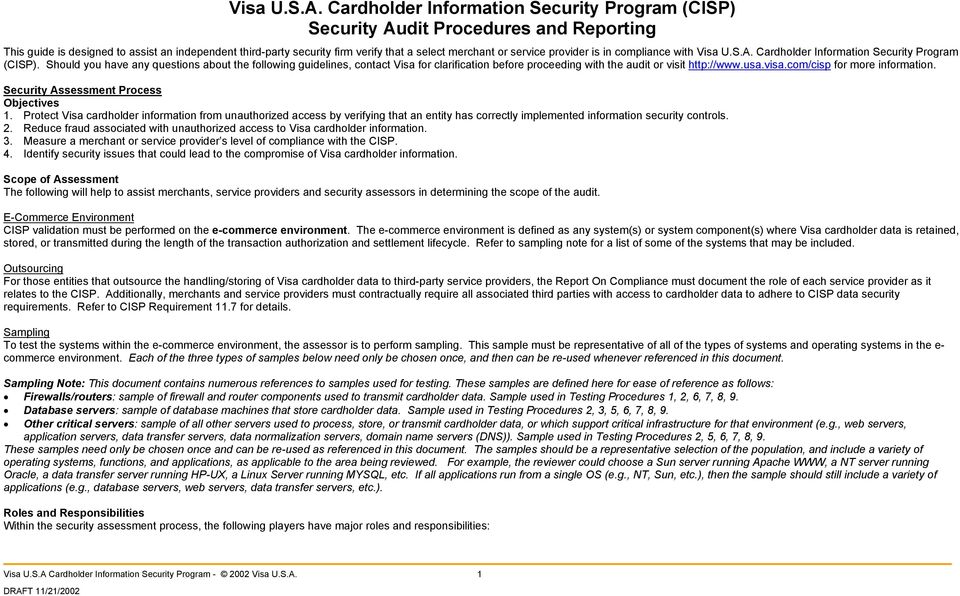
1 This guide is designed to assist an independent third-party security firm verify that a select merchant or service provider is in compliance with Visa U.S.A. Cardholder Information Security Program (CISP). Should you have any questions about the following guidelines, contact Visa for clarification before proceeding with the audit or visit for more information. Security Assessment Process Objectives 1. Protect Visa cardholder information from unauthorized access by verifying that an entity has correctly implemented information security controls. 2. Reduce fraud associated with unauthorized access to Visa cardholder information. 3. Measure a merchant or service provider s level of compliance with the CISP. 4. Identify security issues that could lead to the compromise of Visa cardholder information. Scope of Assessment The following will help to assist merchants, service providers and security assessors in determining the scope of the audit. E-Commerce Environment CISP validation must be performed on the e-commerce environment. The e-commerce environment is defined as any system(s) or system component(s) where Visa cardholder data is retained, stored, or transmitted during the length of the transaction authorization and settlement lifecycle. Refer to sampling note for a list of some of the systems that may be included. Outsourcing For those entities that outsource the handling/storing of Visa cardholder data to third-party service providers, the Report On Compliance must document the role of each service provider as it relates to the CISP. Additionally, merchants and service providers must contractually require all associated third parties with access to cardholder data to adhere to CISP data security requirements. Refer to CISP Requirement 11.7 for details. Sampling To test the systems within the e-commerce environment, the assessor is to perform sampling. This sample must be representative of all of the types of systems and operating systems in the e- commerce environment. Each of the three types of samples below need only be chosen once, and then can be re-used whenever referenced in this document. Sampling Note: This document contains numerous references to samples used for testing. These samples are defined here for ease of reference as follows: Firewalls/routers: sample of firewall and router components used to transmit cardholder data. Sample used in Testing Procedures 1, 2, 6, 7, 8, 9. Database servers: sample of database machines that store cardholder data. Sample used in Testing Procedures 2, 3, 5, 6, 7, 8, 9. Other critical servers: sample of all other servers used to process, store, or transmit cardholder data, or which support critical infrastructure for that environment (e.g., web servers, application servers, data transfer servers, data normalization servers, domain name servers (DNS)). Sample used in Testing Procedures 2, 5, 6, 7, 8, 9. These samples need only be chosen once and can be re-used as referenced in this document. The samples should be a representative selection of the population, and include a variety of operating systems, functions, and applications, as applicable to the area being reviewed. For example, the reviewer could choose a Sun server running Apache WWW, a NT server running Oracle, a data transfer server running HP-UX, a Linux Server running MYSQL, etc. If all applications run from a single OS (e.g., NT, Sun, etc.), then the sample should still include a variety of applications (e.g., database servers, web servers, data transfer servers, etc.). Roles and Responsibilities Within the security assessment process, the following players have major roles and responsibilities: Visa U.S.A Cardholder Information Security Program Visa U.S.A. 1
2 Visa Develop CISP requirements and Security Audit Procedures (SAP) 1 for assessment of select merchant and service provider environment. Review completed Report On Compliance (ROC) and respond to merchant or service provider with a letter of acceptance. Follow-up with merchant or service provider and security firm to correct any non-compliance issues and subsequently get into full compliance. A list of service providers who have completed the program will be provided to Acquirers. Acquirer Be primary link between Visa and merchant. Hold financial responsibility in the Visa system for ensuring merchant s compliance with CISP and other Operating Regulations. Follow-up with merchant to correct any non-compliance issues and subsequently get into full compliance. Select Merchant Comply with all provisions of CISP. Contractually require all associated third parties with access to cardholder data to adhere to CISP. Engage an independent security firm to validate CISP compliance. Provide necessary documentation that a security firm requires in order to perform the security assessment process. As part of the security assessment process, the security firm collects information about the organization, contracts, documented security policies and procedures. Note that providing these items in a timely manner helps keep assessment fee at a reasonable level. Ensure staff that manages the merchant s security-related functions are available for the security firm during the assessment process. Promptly correct any identified security deficiencies. Service Provider Comply with all provisions of CISP. Contractually require all associated third parties with access to cardholder data to adhere to CISP. Engage an independent security firm to validate CISP compliance. Provide necessary documentation that a security firm requires in order to perform the security assessment process. As part of the security assessment process, the security firm collects information about the organization, contracts, documented security policies and procedures. Note that providing these items in a timely manner helps keep assessment fee at a reasonable level. Ensure staff that manages the service provider s security-related functions are available for the security firm during the assessment process. Promptly correct any identified security deficiencies. Independent Security Firm Conduct an onsite security assessment review based on Visa U.S.A. CISP and SAP. Preview the scope of the assessment with merchant or service provider. Typically Visa expects these examinations to include the following: 1. Gather documentation before interviews, observations and test are to begin. 1 Visa s testing procedure to validate compliance with the CISP. Visa U.S.A Cardholder Information Security Program Visa U.S.A. 2

3 2. Based on merchant or service provider s environment and Visa s requirements, determine the scope of the assessment. This should also include timeframe of the assessment. 3. If access to a secured environment is necessary during the assessment, security firm must obtain approval from data owner. 4. Schedule interviews with merchant or service provider s staff. Interviewees typically include the individuals who are responsible for contract administration or legal department staff, human resources, information security, network security, physical security, and staff with access to Visa cardholder data. 5. Perform physical examination of technical parameter settings and review supporting documentation. 6. All security firms must describe outline findings utilizing Visa s Report On Compliance (ROC) template below. 7. Follow-up and Consultation Security Firm must provide consultation to the merchant or service provider to ensure entity fully understands the Report On Compliance report and findings. Report On Compliance The Report On Compliance (ROC) must be distributed to Visa, merchant and Acquirer or service provider and is a condition of ongoing Visa card acceptance. Visa will classify the Report as Visa Secret. 2 All independent security firms must apply the following report content and format when completing the Report On Compliance (ROC): 1. Executive Summary Include the following: Describe nature of business Environment in which the assessment was focused (i.e., client s Internet access points, internal corporate network). Visa USA requires an assessment to be performed on selected systems that handle and/or store cardholder information. Any service provider relationships Any wholly-owned entities that require compliance with CISP Any international entities that require compliance with CISP Any wireless LANs and/or wireless POS terminals 2. Description of Scope of Work and Approach Taken Describe the depth to which assessment was performed and a high-level overview of the methodology. Timeframe of assessment Any specific requests beyond the scope of the Visa Security Audit Procedures (SAP), such as vulnerability scans, penetration test and/or application code review that may have been performed. 3. Findings and Observations Describe tests performed other than Visa Security Audit Procedures (SAP) for the requirements. Independent security firms must utilize the template beginning on page 5 to provide detailed report findings on each requirements and sub-requirements. 4. Contact Information and Report Date Include select merchant or service provider security contact details Include professional services firm contact details 2 This classification applies to the most sensitive business information, which is intended for use within Visa. Its unauthorized disclosure could seriously and adversely impact Visa, its employees, member banks, business partners, and/or the Brand. Visa U.S.A Cardholder Information Security Program Visa U.S.A. 3

4 Definitions For the purpose of the Security Audit Procedures the following definitions will be used: Requirements The Cardholder Information Security Program requirements by which an assessment firm and Visa will validate a merchant or service provider s CISP compliance. Best Practices - Recommended processes for an entity to use, in addition to or to enhance required processes. Best practices may become required processes at the discretion of the Security Assessor or Visa, depending on other controls in place and the risk level of the business process. Testing Procedure A process to be followed by an independent security audit firm to address individual requirements and testing considerations. In Place Please provide a brief description of controls found in place, including those controls found to be in place as a result of compensating controls. Not In Place Please provide a brief description controls that are not in place. Target Date/ Comments For those controls Not In Place include a target date that the merchant or service provider expects to have controls In Place. Any additional notes or comments may be included here as well. Requirements Best Practices Testing Procedures In Place Not In Place Target Date/ Comments Requirement 1: Install and maintain a working firewall to protect data 1.1 Establish a formal process for approving all external network connections. A separate DMZ segment may be used for VISA cardholder information. Cardholder information should not be stored longer than is necessary on front-end systems. The DMZ should not be able to talk directly to trusted network. Transactions that need to move from DMZ to internal network should be batched in DMZ and then pulled by internal network from DMZ. Consider network encryption (SSL) between front-end systems and 1.1 Verify that a process requiring written approval for all new network connections is included in a firewall administration policy, and that the firewall administration policy exists, is documented and implemented, and requires the bulleted items below. Verify existence of these items: A current network diagram that documents all connections to Visa cardholder data Existence of a firewall at each Internet connection and between any DMZ and the Intranet Description of groups, roles, and responsibilities for logical management of network components A documented list of services / ports necessary for the business Justification and documentation for any available protocols besides HTTP and SSL, SSH, and VPN Periodic review of firewall/router rule sets Management approval for external network connections and all other changes to the firewall configuration Configuration standards for firewalls and routers, including testing of all changes prior to implementation. Visa U.S.A Cardholder Information Security Program Visa U.S.A. 4

5 Requirements Best Practices Testing Procedures In Place Not In Place Target Date/ Comments 1.2 Build a firewall that will: Note: Any business protocols outside of the scope of the CISP requirements must be justified and documented in your company policy. 1.2 Verify firewall/router configurations by reviewing a sample of firewalls/routers (Sampling Note, page 1), for those implemented 1) between the Internet and the DMZ and 2) between the DMZ and the internal network. For example, include the choke router at the Internet, the DMZ router and firewall, the DMZ cardholder segment, the perimeter router, and the internal cardholder network segment. Inspect network diagrams, firewall rule sets, router configuration settings, etc., as follows: Deny all traffic from untrusted networks/hosts, except for: Web protocols The Visa system only allows HTTP port 80 and Secure Sockets Layer (SSL) typically port 443. System administration protocols (e.g., Secure Shell (SSH) or Virtual Private Network (VPN). Other protocols required by the business. back-end databases. This Best Practice may become a requirement at the discretion of the Security Assessor or Visa if the examined entity relies heavily on compensating controls to meet CISP requirements, or engages in more risky business processes (such as processes which recognize the customer, and on subsequent visits, populate transactions with cardholder data when a password is entered). For best-practice security configurations, consider To determine that inbound and outbound traffic is acceptable and documented, verify that traffic is limited to: Web protocols (HTTP, HTTPS) System administration/remote access protocols (VPN, SSH) Other allowed traffic required by the business and documented in the firewall policy. Visa U.S.A Cardholder Information Security Program Visa U.S.A. 5

6 Requirements Best Practices Testing Procedures In Place Not In Place Target Date/ Comments Restrict connections between publicly accessible servers and any component storing cardholder data. The firewall configuration must deny all traffic except for protocols required by the business Prohibit an external network direct public access to any system component that is storing cardholder information (i.e., databases). The Center for Internet Security s benchmark and scoring tool for Cisco IOS routers ( as well as a Top 20 Scanner scan for the FBI/SANS Top 20 Vulnerabilities at (Scanner at vulnerabilities at To determine that connections are restricted between publicly accessible servers and components storing cardholder data, verify the following: Inbound Internet traffic is limited to IP addresses within the DMZ Inbound and outbound Internet traffic is limited to ports 80 and 443 Internal addresses cannot pass from the Internet into the DMZ Only established connections are allowed in, and only if they are associated with a previously established session (run NMAP with syn reset or syn ack bits set a response means packets are allowed through even if they are not part of a previously established session) Outbound traffic is limited to that which is necessary for the Visa cardholder environment Running configuration files (e.g., those used for normal running of the routers) and start-up configuration files (those used when machines are rebooted) have the same secure configurations. All other inbound and outbound traffic not covered in above is specifically denied To determine that direct access between external public networks and components storing cardholder data are prohibited, perform the following, specifically for the firewall/router configuration implemented between the DMZ and the internal network: Verify there is no direct route inbound or outbound for Internet traffic Verify that internal outbound traffic from cardholder applications can only access IP addresses within the Visa DMZ. Visa U.S.A Cardholder Information Security Program Visa U.S.A. 6

7 Requirements Best Practices Testing Procedures In Place Not In Place Target Date/ Comments 1.3 Implement Internet Protocol (IP) masquerading to prevent your internal address from being translated and revealed on the Internet. Use technologies such as Port Address Translation (PAT) or Network Address Translation (NAT). 1.3 For firewall components reviewed in 1.2, above, verify that NAT or other technology is used for IP masquerading to restrict broadcast of IP addresses from the internal network to the Internet. 1.4 Implement 2-factor authentication for remote access to the network. Use technologies such as RADIUS or TACACS with tokens. 1.5 Ensure your firewall and router platform: Conforms to your organization s system configuration standards Is restricted to only one application or primary function per server Meets or exceeds the minimum hardware and software requirements. 1.6 Monitor your firewall Central Processing Unit (CPU) load and up/down status with reasonable regularity (at least every 15 minutes). 1.4 To verify that 2-factor authentication is in place for remote network access, observe an administrator while they connect remotely and verify that both a password and an additional authentication item (Smart card or token PIN, etc.) are requested. 1.5 Processes in place for Operating System hardening, including for firewalls and routers, are validated under Requirement 8, Testing Procedure Verify that the processes used to ensure continual firewall redundancy and availability include checking for load and up/down status at least every 15 minutes. Processes in place to encrypt non-console administrative access to firewalls and operating systems are validated under Requirement 4, Testing Procedure 4.4. Requirement 2: Keep security patches up-to-date. 2.1 Make sure all systems and software have the latest vendor-supplied security patches: Note: Systems and software include, but are not limited to: servers, routers, switches, firewalls, operating systems, applications, databases, etc. Each vendor typically lists recommended security patches on their web site. For example, Microsoft is at underneath the security bulletins section and Sun Administrative access controls for network components are validated under Requirement 6, Testing Procedure Using the sample firewalls/routers, database servers, and other critical servers (Sampling Note on page 1), perform the following for each system selected Visa U.S.A Cardholder Information Security Program Visa U.S.A. 7

8 Requirements Best Practices Testing Procedures In Place Not In Place Target Date/ Comments Keep up with vendor changes and enhancements to security patches is at patches Compare the list of security patches installed on each system to the vendor security patch list to verify that current vendor patches are currently installed Install new/modified security patches within one month of release. 2.2 Test all security patches before they are deployed. 2.3 Follow change control procedures for system and software configuration. Production data (including cardholder data) should not be used for testing Examine policies related to security patch installation to verify that it is policy to install new security patches within 30 days. 2.2 Verify the following with the system administrator: Patches are tested in a test environment before being deployed into production. The test environment is separate from the production environment. Test procedures are documented. 2.3.a Verify that company change-control procedures used to implement security patches and software modifications require the following: Documentation of customer impact Management sign-off by appropriate parties Specification of an implementation window Testing that verifies operational functionality Back-out procedures. 2.3.b Select one web server, one firewall, and one router from sample firewalls/routers, database servers, and other critical servers (Sampling Note on page 1). To verify that change-control procedures are followed, find the three most recent security related updates (e.g., application of security patches) for each system, and trace those updates back to related change control documentation. Verify that this documentation is completed in accordance with company procedures. Visa U.S.A Cardholder Information Security Program Visa U.S.A. 8

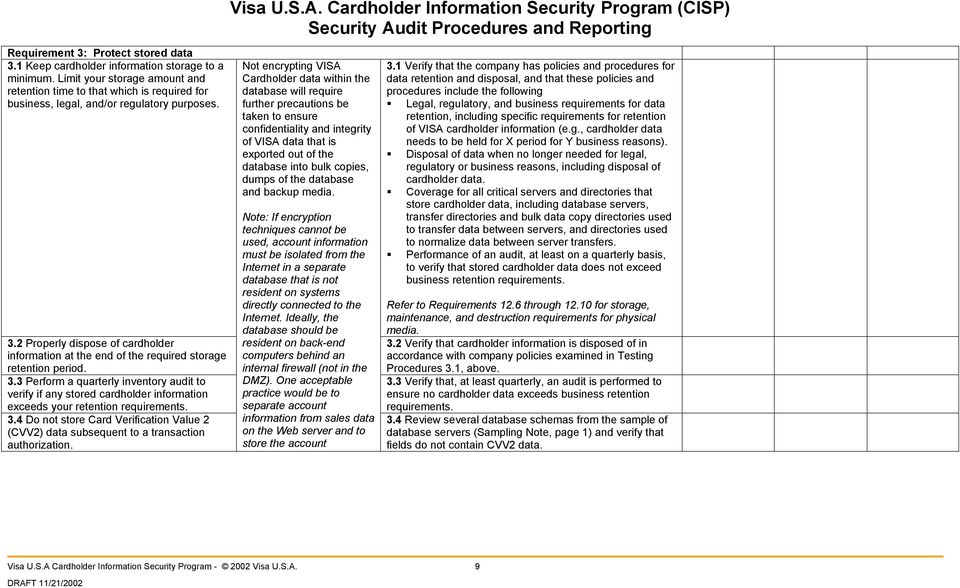
9 Requirement 3: Protect stored data 3.1 Keep cardholder information storage to a minimum. Limit your storage amount and retention time to that which is required for business, legal, and/or regulatory purposes. 3.2 Properly dispose of cardholder information at the end of the required storage retention period. 3.3 Perform a quarterly inventory audit to verify if any stored cardholder information exceeds your retention requirements. 3.4 Do not store Card Verification Value 2 (CVV2) data subsequent to a transaction authorization. Not encrypting VISA Cardholder data within the database will require further precautions be taken to ensure confidentiality and integrity of VISA data that is exported out of the database into bulk copies, dumps of the database and backup media. Note: If encryption techniques cannot be used, account information must be isolated from the Internet in a separate database that is not resident on systems directly connected to the Internet. Ideally, the database should be resident on back-end computers behind an internal firewall (not in the DMZ). One acceptable practice would be to separate account information from sales data on the Web server and to store the account 3.1 Verify that the company has policies and procedures for data retention and disposal, and that these policies and procedures include the following Legal, regulatory, and business requirements for data retention, including specific requirements for retention of VISA cardholder information (e.g., cardholder data needs to be held for X period for Y business reasons). Disposal of data when no longer needed for legal, regulatory or business reasons, including disposal of cardholder data. Coverage for all critical servers and directories that store cardholder data, including database servers, transfer directories and bulk data copy directories used to transfer data between servers, and directories used to normalize data between server transfers. Performance of an audit, at least on a quarterly basis, to verify that stored cardholder data does not exceed business retention requirements. Refer to Requirements 12.6 through for storage, maintenance, and destruction requirements for physical media. 3.2 Verify that cardholder information is disposed of in accordance with company policies examined in Testing Procedures 3.1, above. 3.3 Verify that, at least quarterly, an audit is performed to ensure no cardholder data exceeds business retention requirements. 3.4 Review several database schemas from the sample of database servers (Sampling Note, page 1) and verify that fields do not contain CVV2 data. Visa U.S.A Cardholder Information Security Program Visa U.S.A. 9
10 3.5 Implement a mechanism to segregate each merchant s stored cardholder data. This requirement applies to entities that process and/or store cardholder data for information on the mainframe, off-line, or in a secure zone. 3.5 Verify, by discussions with database administrators and via inspection of database schemas examined in Testing Procedure 3.4, above, that stored cardholder data is segregated in one of the following ways: multiple merchants. Entities that only Key Storage and Key In a separate table or database for each merchant, or store and/or process cardholder data for a Management Physically or logically isolated between merchant single merchant do not need to comply with this requirement. Do not store private keys or server systems. If merchant data is not segregated, confirm and document certificate files in a use of adequate compensating controls as documented in public place Attachment B to the CISP Requirements. The best key This testing procedure is only for entities that process management is fully and/or store cardholder data for multiple merchants. 3.6 Encrypt all passwords automated. 3.6 For critical servers in the cardholder environment, 3.7 Render unreadable stored cardholder data by using any of the following approaches: One-way ciphers (hashed indexes), such as SHA-1, but not MD5 Truncation Simple ciphers Index tokens and PADs, with the PADs being securely stored Strong cryptography, such as Triple-DES, with associated key management processes and procedures. Hardware encryption is more secure than software encryption, especially those that erase the encryption key if the device is tampered with. Software products may be used depending on circumstances, but hardware devices are preferred. Keys should be randomly generated by an automatic process, where every key is equally likely to be chosen. If keys must be easy-to-remember, make them obscure. Consider split responsibility for keys such that it requires 2 or 3 people, each knowing only their part of the key, to examine password files to verify that passwords are unreadable. Include password files for firewalls, routers, operating systems, applications, databases, and web servers. 3.7.a Document information about the cryptographic system used to protect stored data, including the vendor, type of cryptographic system, and the encryption algorithms. Verify that data is encrypted using one of the following algorithms: One-way ciphers (hashed indexes), such as SHA-1, but not MD5 Truncation Simple ciphers Index tokens and PADs, with the PADs being securely stored Strong cryptography, such as Triple-DES, with associated key management processes and procedures. If cardholder data is not encrypted, confirm and document use of adequate compensating controls as documented in Attachment A to the CISP Requirements. 3.7.b Examine several tables from the sample of database servers (Sampling Note, page 1) to verify the data is encrypted (i.e., not stored in plain text). Visa U.S.A Cardholder Information Security Program Visa U.S.A. 10

11 3.8 Implement a cryptographic solution that: reconstruct the whole 3.8 Review vendor and company documentation for the cryptographic solution to verify existence of documentation and that the solution in place includes the following: Is isolated so that secret data cannot Physical or logical isolation to protect secret data. be disclosed Conforms to applicable international and national standards, as well as all legal and regulatory controls Adherence to international and national standards as well as legal and regulatory controls Uses only crypto devices that meet the approval standards and policies of your organization. 3.9 Protect encryption keys against both disclosure and misuse: Restrict access to keys to the fewest number of custodians necessary Store keys securely in the fewest possible locations and forms Limit the risks associated with shared symmetric keys; only use them for one-toone communication between two entities Fully document all key management processes and procedures. Refer to Attachments A & B to the CISP Requirements: Encrypt Stored Data and Data Segregation Mechanisms for further details. key. Key-encryption keys should be used to encrypt keys prior to distribution distribute key-encrypting keys manually and securely. Use hardware systems with anti-tamper enclosures to store keys, if possible. Ideally, a key should never appear unencrypted outside the encryption device. Store keys used to encrypt keys separately from keys used to encrypt data. No encryption key should be used for an indefinite period it should expire automatically. However, keys used to encrypt data files for storage can t be changed often. Instead, for example, encrypt each file with a unique file key, and then encrypt all file keys with a keyencryption key. The key-encryption key should then be memorized or stored in a secure location Existence of, and adherence to, organization s approval standards and policies for use of crypto devices. 3.9 Verify that processes to protect encryption keys against disclosure and misuse include the following: Access to cryptographic keys is restricted to very few custodians Storage of cryptographic keys in encrypted format and storage of key-encrypting keys separately from dataencrypting keys Shared-symmetric keys are only used for one-toone communication between two entities Verify the existence of key management procedures, and that these procedures have provisions for the following: Generation of strong keys Secure key distribution Secure key storage Periodic key changes Destruction of old keys. See related Key Management Best Practices at left. Visa U.S.A Cardholder Information Security Program Visa U.S.A. 11

12 Requirement 4: Encrypt transmission of cardholder and sensitive information across public networks. 4.1 Use encryption techniques such as Secure Sockets Layer (SSL), Point-to-Point Tunneling Protocol (PPTP), Internet Protocol Security (IPSEC), etc., to make sensitive data impossible to read during transmission. 4.2 Never send cardholder information via unencrypted Implement strong cryptography and appropriate key controls to safeguard data during transmission. 4.4 Encrypt non-console administrative access. Use technologies such as SSH or VPN. Refer to CISP Requirement 3.0 for specific actions related to cryptographic solutions and key management. Consider network encryption (SSL) between front-end systems and back-end database. This Best Practice may become a requirement at the discretion of the Security Assessor or Visa if the examined entity relies heavily on compensating controls to meet CISP requirements, or engages in more risky business processes (such as recognizing the customer, and on subsequent visits, populating the transactions with cardholder data when a password is entered). Requirement 5: Use and regularly update anti-virus software or programs. 5.1 Deploy anti-virus mechanisms on all systems. Use anti-virus mechanisms on all Microsoft OS and Mail gateways involved in 4.1 Verify the use of encryption (e.g., SSL) wherever cardholder data is transmitted or received over the Internet by performing the following: For SSL implementations, verify that HTTPS appears as a part of the browser Universal Record Locator (URL) during a transaction, and that no cardholder data was required when HTTPS did not appear in the URL. Select a sample of transactions as they are received from a cardholder or merchant, and observe the transactions as they occur to verify that cardholder data is encrypted during transit. 4.2 To verify that cardholder data is not sent via unencrypted , perform the following: Verify existence of a policy stating that VISA cardholder information is not to be sent via unencrypted s. Verify that encryption software is provided to employees, and that its use is strongly encouraged. 4.3 Verify that at least 128 bit encryption is used during data transmission. 4.4 For the samples of firewalls/routers database servers, and other critical servers (Sampling Note, pg.1), verify that non-console administrative access is encrypted by: Observing administrators as they log on and determining that SSH (or other encryption method) is invoked before the administrator s password is requested. Reviewing services and parameter files to determine that telnet and other remote login commands are not available for use. 5.1 For the samples of database and other critical servers (Sampling Note, page 1) verify that anti-virus software is installed on the systems. Visa U.S.A Cardholder Information Security Program Visa U.S.A. 12

13 5.2 Keep all anti-virus mechanisms current and actively running. Make sure they are capable of generating audit logs. Visa U.S.A. Cardholder Information Security Program (CISP) the transmission or storage of VISA cardholder data. Anti-virus logs should be kept for a minimum of 6 months or a period equal to your company s standard retention policy. Requirement 6: Restrict access to data by business need-to-know. 6.1 Develop a data control policy. Limit access to computing resources and cardholder information to only those individuals whose job requires such access. 6.2 Establish a mechanism for systems with multiple users that restricts access based on a user s need to know. 5.2 To verify that anti-virus software is current, actively running, and capable of generating logs, perform the following: Obtain and review the policy requiring updates to antivirus software and definitions. Verify that the master installation of the software is enabled for automatic updates and periodic scans, and that the servers examined at 5.1 above have these features enabled. Verify that log generation is available and enabled and that the logs are being retained in accordance with the company s retention policy. 6.1 Using the sampled firewalls/routers, database servers, and other critical servers (Sampling Note, page 1), obtain a list of all User IDs and their associated access rights, and perform the following: Confirm via discussions with the security manager that access rights assigned to privileged User IDs are restricted to least privileges necessary to perform the job. Confirm via examination of authorization forms that all administrators are authorized and have active accounts. Select a sample of general users and confirm via examination of authorization forms that those users are authorized and have active accounts. 6.2 Verify there is a written procedure for data control, and that it includes the following: Coverage of all production operating systems, network components, databases, and applications. Assignment of privileges to individuals based on job classification and function. Requirement for an authorization form that is signed by management and specifies required privileges. Visa U.S.A Cardholder Information Security Program Visa U.S.A. 13

14 Requirement 7: Assign a unique ID to each person with computer access. 7.1 Uniquely identify all users before allowing Authentication must clearly them to access system resources or establish a user s unique cardholder information. identity. 7.2 Employ at least one of the methods below to authenticate all internal and external users: Unique user name and password Token devices (i.e., Secured, certificates, or public key) Biometrics 7.3 Ensure proper user authentication and password management for non-consumer users: Control the addition, deletion, and modification of user IDs, credentials, or other identifier objects Immediately revoke accesses of terminated users Distribute password procedures and policies to all users who have access to cardholder information. Visa U.S.A. Cardholder Information Security Program (CISP) An internal employee transfer may result in the employee no longer needing access to cardholder data. Repeated system access attempts could mean someone is trying to establish a false identity for illegal system access or use a valid identity in an unauthorized manner. 7.1 For the samples of firewalls/routers, database servers, and other critical servers (Sampling Note, page 1), review user ID listings and verify the following: Generic ID s are not used except in emergency situations. Shared IDs for system administration activities and other critical functions do not exist. 7.2 To verify that users are authenticated using unique ID and password for access to the cardholder environment, perform the following: Document the authentication method(s) used. For each type of authentication method used and once for each type of server (e.g., firewall, database, application, Web, etc.), perform or observe a test authentication to verify authentication is working as expected. For example, if one factor authentication (user ID and password) is employed, perform a test logon to verify that a user ID and password are required to authenticate access. If SecurID authentication is used, perform a test logon to verify that token pin is required to authenticate access. 7.3 Verify, via review of procedures and discussions that procedures exist for adding, deleting, and modifying user IDs and access credentials. Perform the following: Select a sample of user IDs from sampled firewalls/routers, database servers, and other critical servers (Sampling Note, page 1), and trace those IDs to the authorization forms. Verify the IDs are implemented in accordance with the authorization form (e.g., with privileges as specified, all signatures obtained, etc.) Select a sample of employees terminated in the last 6 months, and verify that their IDs have been inactivated or removed Select a sample of employees with access to cardholder data, and ask them about their awareness of password procedures. Visa U.S.A Cardholder Information Security Program Visa U.S.A. 14

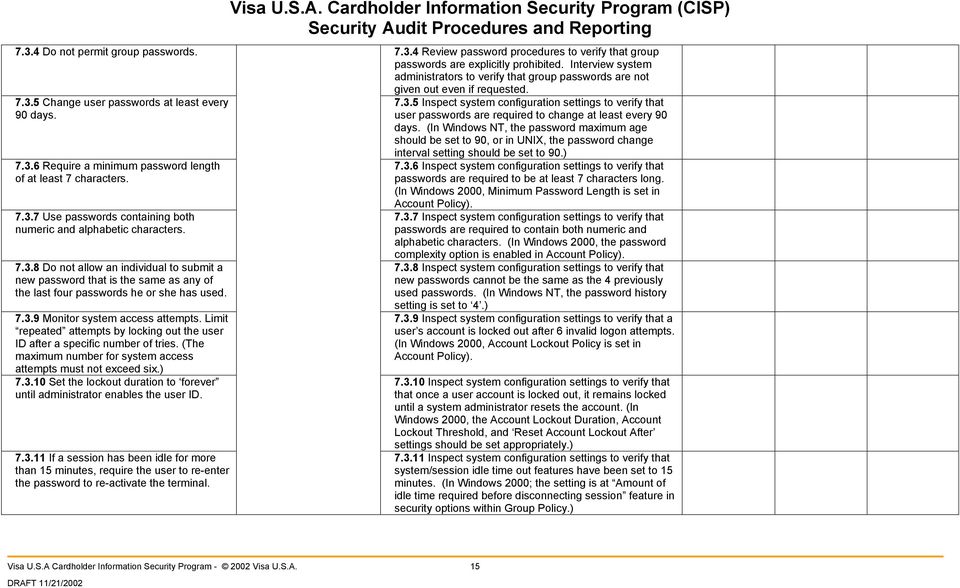
15 7.3.4 Do not permit group passwords Review password procedures to verify that group passwords are explicitly prohibited. Interview system administrators to verify that group passwords are not given out even if requested Change user passwords at least every 90 days Require a minimum password length of at least 7 characters Use passwords containing both numeric and alphabetic characters Do not allow an individual to submit a new password that is the same as any of the last four passwords he or she has used Monitor system access attempts. Limit repeated attempts by locking out the user ID after a specific number of tries. (The maximum number for system access attempts must not exceed six.) Set the lockout duration to forever until administrator enables the user ID If a session has been idle for more than 15 minutes, require the user to re-enter the password to re-activate the terminal Inspect system configuration settings to verify that user passwords are required to change at least every 90 days. (In Windows NT, the password maximum age should be set to 90, or in UNIX, the password change interval setting should be set to 90.) Inspect system configuration settings to verify that passwords are required to be at least 7 characters long. (In Windows 2000, Minimum Password Length is set in Account Policy) Inspect system configuration settings to verify that passwords are required to contain both numeric and alphabetic characters. (In Windows 2000, the password complexity option is enabled in Account Policy) Inspect system configuration settings to verify that new passwords cannot be the same as the 4 previously used passwords. (In Windows NT, the password history setting is set to 4.) Inspect system configuration settings to verify that a user s account is locked out after 6 invalid logon attempts. (In Windows 2000, Account Lockout Policy is set in Account Policy) Inspect system configuration settings to verify that that once a user account is locked out, it remains locked until a system administrator resets the account. (In Windows 2000, the Account Lockout Duration, Account Lockout Threshold, and Reset Account Lockout After settings should be set appropriately.) Inspect system configuration settings to verify that system/session idle time out features have been set to 15 minutes. (In Windows 2000; the setting is at Amount of idle time required before disconnecting session feature in security options within Group Policy.) Visa U.S.A Cardholder Information Security Program Visa U.S.A. 15
16 Authenticate all access to any database containing cardholder information. This includes access attempts made by applications, administrators, and all other users. Visa U.S.A. Cardholder Information Security Program (CISP) Verify that all database access is authenticated, including that for individuals, applications, and administrators. Also verify that direct SQL queries to the database are prohibited. Requirement 8: Do not use vendor-supplied defaults for system passwords and other security parameters 8.1 Always change the vendor-supplied Vendor-supplied defaults before you install a system on the passwords are well known network (i.e., passwords, SNMP community and easily obtained from strings, unnecessary accounts, etc.). vendors or the Internet. 8.2 Develop system configuration standards for all networks components. Make sure these standards address all known security vulnerabilities and industry best practices. Note: Network components include, but are not limited to servers, switches, firewalls, etc Implement only one application or primary function per network component (i.e., one application per server) Make sure each network component contains the minimum hardware and software it needs to prevent misuse Disable all unnecessary services. There are many good sources for security configuration standards, which include discussion of risky services and features, and proper security parameter settings. The Center for Internet Security ( has numerous free benchmarks (best-practice security configurations) and scoring tools for Windows NT and 2000, Solaris, and others (Apache and IIS are in draft form), as well as a Top 20 Scanner to scan for the FBI/SANS Top 20 Vulnerabilities (Scanner at vulnerabilities at ( 8.1 To verify that default accounts and passwords have been changed, use the samples of firewalls/routers, database servers, and other critical servers (Sampling Note, page 1), and attempt to logon (with system administrator help) to the devices using default vendorsupplied accounts and passwords (e.g., for the Microsoft SQL server, the default password for the SA account is blank. Use vendor manuals and sources on the Internet to find more vendor-supplied accounts/passwords.) 8.2 Evaluate the organization s system configuration standards for network components and critical servers. Verify each item below is included in the standard, and via discussions with the relevant administrator, verify that each item is included when new systems are configured. Also perform additional steps as follows: Only one application or primary function is implemented per server Each component contains the minimum hardware and software needed to prevent misuse All unnecessary services are disabled (necessary ones are documented). Obtain and inspect a list of enabled system services/daemons from a subset of the total sample. Verify that the list of enabled services does not contain unnecessary services and that any potentially dangerous ones are justified and documented (e.g. FTP and telnet). Visa U.S.A Cardholder Information Security Program Visa U.S.A. 16

17 8.2.4 Configure system security parameters to prevent misuse Remove all unnecessary functionality, e.g., drivers, features, subsystems, file systems, etc. Visa U.S.A. Cardholder Information Security Program (CISP) Also consider SANS at for training, publications, links to other sites, etc Enable the audit subsystem in support of Requirement Configure the networking subsystems to protect against known attacks. 8.3 Establish a process to identify newly discovered security vulnerabilities. Update your standards to address new vulnerability issues. Requirement 9: Track all user access to data by a unique ID 9.1 Establish a process for linking all data access activities (especially those with root or administrative privileges) to an individual user or system System security parameters are configured to prevent misuse. Verify that system administrators and/or security managers have knowledge of common security parameter settings for their operating systems, database servers, and Web servers. Review system configuration standards and verify inclusion of these parameters settings. Select a small sub-sample from the samples of database and other critical servers, and verify that several of the most risky parameters are set appropriately All unnecessary functionality (e.g., drivers, features, subsystems, file systems, etc.) is removed. Verify necessary functions are documented and are the only ones present on the sub-sample of machines used above Audit capabilities are enabled on firewalls, routers, database servers, and other critical servers Systems are configured to protect against known attacks. 8.3 Review processes in place to identify new security vulnerabilities, and verify that the process includes updates to the system configuration standards reviewed in 8.2 above as new vulnerability issues are found. Audit trail files should not be able to be deleted for at 9.1 Verify, via observation and discussions with the system administrator, that audit trails are enabled and active. 9.2 Implement automated audit trails to reconstruct the following events: least 6 months. No one should be able to delete the files from their original location. Copy the files to a location for retention, and the authorized 9.2 Confirm though inquiry and via cursory review of audit logs for the samples of firewalls/routers, database servers, and other critical servers (Sampling Note, page 1), that audit trails record the following types of events: All accesses to cardholder data administrator can delete Access to cardholder data All actions taken by any individual with root or administrative privileges from there as necessary Actions taken by any individual with root or administrative privileges Access to all audit trails Access to all audit trails Invalid logical access attempts Invalid logical access attempts Use of identification and Use of identification and authentication mechanisms authentication mechanisms Initialization of the audit logs Initialization of audit logs Deletion of objects Deletion of objects Visa U.S.A Cardholder Information Security Program Visa U.S.A. 17

18 9.2.8 Actions taken in response to the Compromise of cryptographic keys compromise of cryptographic keys Changes in the custody of keys and devices or media holding keys All encryption key management operations 9.3 Record the following audit trail entries for each event: User identification User identification Type of event Type of event Date and time Date and time stamp Success or failure indication Success or failure indication Origination of event Origination of event Identity or name of affected data, system component, or resource 9.4 Secure audit trails so they cannot be altered in any way. 9.5 Review security, firewall, and server logs at least daily. 9.6 Retain your audit trail history for a period that is consistent with its effective use, as well as legal regulations. (An audit history usually covers a period of six months or more.) Requirement 10: Regularly test security systems and processes Test security controls, limitations, Custom code should be network connections, and restrictions reviewed for security routinely to make sure they can adequately concerns before being identify or stop any unauthorized access place into production. attempts. These code reviewers Changes in the custody of keys and devices or media holding keys All encryption key management operations 9.3 Confirm through inquiry and observation that the audit trail minimally captures the following information: Identity or name of affected data, system component, or resources 9.4 Verify the following via discussions with the system administrator and cursory review of file permissions: Only individuals who have a job-related need can view audit trail files No one has the ability to change or delete current audit trail files. 9.5 Verify that processes are in place to review security logs at least daily, and that follow-up to exceptions is specified. 9.6 Verify that audit log retention policies exist and are implemented, and include log retention for at least 6 months. For the samples of firewall/routers/ database servers, and other critical servers (Sampling Note, page 1), verify that audit logs are available online or on tape for the period of time specified in the policy Confirm through inquiry that periodic security testing of the devices within the VISA cardholder environment occurs. Visa U.S.A Cardholder Information Security Program Visa U.S.A. 18

19 10.2 Run internal and external network vulnerability scans at least monthly and after any change in the network configuration (e.g., new system component installations, changes in network topology, firewall rule modifications, or product upgrades) Before promoting custom application code to the production site, review it carefully to identify any potential coding vulnerability Perform penetration testing on network infrastructure and applications at least once a year and after any significant infrastructure and application upgrade or modification (e.g., operating system upgrade, sub-network added to environment, web server added to environment, etc.) Use network intrusion detection systems to monitor all network traffic and alert personnel to suspected compromises. Designate specific personnel to be available on a 24/7 basis to respond to unexpected compromise alerts Deploy file integrity monitoring to alert personnel to unauthorized modification of critical system or content files Designate specific personnel to be available on a 24/7 basis to respond to reports of unauthorized critical system or content file changes Perform critical files comparisons at least daily (or more frequently if the process can be automated) Be prepared to respond immediately to a system failure: Visa U.S.A. Cardholder Information Security Program (CISP) should be knowledgeable about secure coding techniques as well as things that developers should avoid dong to develop secure applications. Consider sources such as The Open Web Application Security Project at Do not display whole credit card numbers on any Web pages just show the last 4 digits. Per VISA regulations, Incident Response and Disaster Recovery procedures should include the following: Immediately notify VISA U.S.A. Fraud Control, through the merchant bank or processor, of any suspected or confirmed loss or theft of material or records that contain account information. Demonstrate the ability to prevent future loss or theft of account or transaction information; and Allow VISA U.S.A. or an independent third t t bl t 10.2 Inspect output from the most recent network, host, and application vulnerability scans to verify that periodic security testing of the devices within the VISA cardholder environment occurs. Confirm that high level risks identified in the scans are accompanied by remediation plans which: Outline how and when the risk will be addressed Specify who has ownership of the system at risk Confirm that written policies dictates that code reviews are required, are to be performed by individuals other then the originating author of the code (e.g., developer), and that those performing the code reviews have knowledge of secure coding techniques. Confirm that such code reviews are occurring after code changes Verify that penetration testing is performed on network infrastructure and applications at least annually and after any significant changes to the environment Verify the use of network intrusion detection products to monitor and alert personnel of suspected compromises, and confirm existence of related policies and procedures. Via observation and review of policies, confirm the existence of 24/7 incident response and monitoring coverage Verify the use of file integrity monitoring products, and confirm existence of related policies and procedures Verify via observation and review of policies, existence of 24/7 response for critical system or file changes Verify that critical file comparisons are performed at least daily Verify the existence of a Disaster Recovery Plan and related procedures, and that the plan includes: Visa U.S.A Cardholder Information Security Program Visa U.S.A. 19

20 Create a business and disaster recovery plan that involves a crisismanagement team who can handle all mission-critical decisions, if possible together during a moment of crisis. Visa U.S.A. Cardholder Information Security Program (CISP) A crisis-management team to handle all important decisions Test the plan at least annually. A strong incident response Testing of the plan at least annually Provide adequate training to staff with operational business and recovery plan execution responsibilities Training for staff with execution responsibilities 10.8 Be prepared to respond immediately to a system breach Create a plan that designates roles and responsibilities in the event of system compromise. Make sure the plan addresses security communication/contract strategies (e.g., informing Visa, law enforcement, internal parties, etc.) Verify the existence of an Incident Response Plan and related procedures, and that the plan includes: Roles, responsibilities, and communication strategies in the event of a compromise. (Visa, law enforcement, and internal parties should all be detailed in the list of those to receive communication in the event of a compromise.) Test the plan at least annually Testing of the plan at least annually Provide appropriate training to staff Training for staff with security breach with security breach response responsibilities responsibilities Make sure media is backed up nightly to adequately facilitate recovery. Store media back-ups in a secure off-site facility, which may be either an alternate third-party or a commercial storage facility. party acceptable to VISA to verify that ability by conducting a security review. capability includes active monitoring where individuals are watching screens for alerts or receive pages vs. passive monitoring where individuals receive s that are inspected at a later time Review policies and procedures for backups, as well as supporting documentation (backup tape logs, etc.) to verify that backups are performed in accordance with the following: Full backups are performed nightly, or full backups are performed weekly with nightly incremental backups. Backup media are stored and transported in a physically secure, fireproof, offsite location. Backup media are available within a reasonable time (e.g., 4 hours) of a request by an authorized administrator. Requirement 11: Maintain a policy that addresses information security for employees and contractors Establish and publish a security policy that: Educate employees and contractors about their 11.1 Review the information security policy, verify the policy is published, and verify that: Addresses all CISP requirements cardholder information The policy addresses all CISP requirements Reflects your organization s business objectives and risk control standards security responsibilities through posters, letters, The information security policy reflects the organization s business objectives. Visa U.S.A Cardholder Information Security Program Visa U.S.A. 20

21 11.2 Develop daily operational security procedures that are consistent with CISP requirements Make sure your security policy and procedures clearly define information security responsibilities for all employees and contractors Assign to an individual or team the following information security management responsibilities: Establish, document, and distribute security policies and procedures Monitor and analyze security alerts and information and distribute to appropriate personnel Establish, document, and distribute security incident response and escalation procedures to ensure timely and effective handling of all situations Administer user account and authentication management, including additions, deletions, and modifications resulting from user changes and terminations Monitor and control all access to data Make all employees aware of the importance of cardholder information security: Educate employees through posters, letters, memos, meetings, promotions, etc Require employees to acknowledge in writing they have read and understood your company s security policy and procedures Screen all potential employees to minimize the risk of attacks from internal sources. Visa U.S.A. Cardholder Information Security Program (CISP) memos, meetings, promotions, etc. A formalized, documented, enforceable agreement must be maintained between the select merchant or service provider as keeper of cardholder data and any 3 rd parties with access to the data. This agreement may be addressed by various means, such as within the provisions of the contracts between these entities, an addendum to a current contract, or an entirely new contract. This agreement can be customized to cover the areas relevant to the business performed by the 3rd party. In the example of an offsite media storage company, such relevant areas would include contacting the select merchant or service provider if there is any compromise to their data, conducting background checks on all personnel with access to such data, supporting critical information retrieval in the event of a disaster at the 11.2 Review the daily operational security procedures. Verify they are consistent with CISP, and include administrative and technical procedures for each of the CISP requirements Verify that information security policies clearly define information security responsibilities for both employees and contractors Verify that the following information security responsibilities are specifically and formally assigned: Creating and distributing security policies and procedures Monitoring and analyzing security alerts, and distributing information to appropriate personnel Creating and distributing security incident response and escalation procedures Administering user account and authentication management Monitoring and controlling all access to data Verify the existence of a security awareness program, and that it contains the following components: Multiple methods of communicating awareness (posters, letters, meetings, etc.) Requirement for employees to acknowledge in writing that they have read and understood the company s information security policy Verify that background checks are performed on all potential employees including pre-employment, criminal, credit history, and reference checks. Visa U.S.A Cardholder Information Security Program Visa U.S.A. 21
22 11.7 Contractually require all associated third parties with access to cardholder data to adhere to CISP data security requirements. At a minimum, the agreement should address: Security provisions outlined in the CISP, and any fines and penalties as specified by Visa for a lack of compliance with those provisions Ownership by Visa, Acquirer, and Merchants of cardholder information and that it can ONLY be used for assisting these parties in completing a transaction, supporting a loyalty program, providing fraud control services, or for uses specifically required by law Business continuity in the event of a major disruption, disaster or failure Audit provisions that ensure that Visa, or a Visa approved third party, will be provided with full cooperation and access to conduct a thorough security review after a security intrusion. The review will validate compliance with Visa CISP standards for protecting cardholder data Third party termination clauses to address compliance with CISP and security of cardholder information during contract terminations and related data transfers. Visa U.S.A. Cardholder Information Security Program (CISP) event of a disaster at the select merchant s or service provider s facilities, and using disaster recovery and business continuity controls at the offsite media storage company. Many CISP controls would not be relevant to an offsite storage facility (as part of a CISP review), but those that are relevant to the security and availability of cardholder data should be in the agreement. Another example would be if the 3rd party had an electronic connection to the select merchant or service provider, then their firewall administration, etc. would become part of the agreement. Consider 3 rd party relationships in which VISA cardholder information is processed or transmitted to/from an international entity that is not subject to VISA U.S.A. CISP. These entities are subject to VISA International Account Information Security (AIS) Review any contracts between the organization and any 3 rd parties that handle cardholder data (e.g., backup tape storage facilities, managed service providers such as Web hosting companies or security service providers, or those that receive data for fraud modeling purposes). Verify that the CISP requirements that are relevant to the business relationship between the organization and the 3 rd party are included in the contract (see further explanations in the Best Practices column). Specifically verify that contracts address: CISP security requirements and any related fines and penalties Ownership and acceptable uses of cardholder information Business continuity provided by the 3 rd party Audit provisions for Visa or Visa-approved entities in the event of a cardholder data compromise Security of cardholder information during 3 rd party contract terminations. Visa U.S.A Cardholder Information Security Program Visa U.S.A. 22
23 Requirement 12: Restrict physical access to cardholder data 12.1 Use appropriate facility entry controls to limit physical access to systems that store or process cardholder data Develop procedures to help all personnel easily distinguish between employees and visitors, especially in areas where cardholder information is accessible. Visa U.S.A. Cardholder Information Security Program (CISP) 12.1 Verify the existence of the following physical security controls for each computer room, data center and other physical areas with systems that contain cardholder data: Verify that video cameras are present in the data centers to monitor systems storing cardholder data. Observe that consoles for 3 randomly selected systems that store and/or transmit cardholder data are locked to prevent unauthorized use. Verify that network jacks are only enabled when needed by authorized employees. For example, conference rooms used to host visitors should not have network ports enabled with DHCP Procedures to help distinguish between employees and visitors are reviewed at below. Note: Unless otherwise indicated, employee refers to full-time and part-time employees, temporary employees/personnel, and consultants who are resident on the entity s site. A visitor is defined as a vendor, guest of an employee, service personnel, or anyone who needs to enter the facility for a short duration, usually less than three hours Make sure all visitors are: 12.3 Verify the following employee/visitor controls are Authorized before entering areas where cardholder data is processed or maintained Given a physical token (e.g., badge or access device) that identifies them as non-employees containing a fixed expiration date Asked to surrender the physical token before leaving the facility or at the date of expiration. present: Verify the use of ID badges within the company. Verify that a visitor ID badge does not permit unescorted access to physical areas that store cardholder data Observe people within the facility to verify that: 1) ID badges clearly distinguish employees from visitors/outsiders and 2) visitor badges contain a fixed expiration date Verify that visitors are asked to surrender their ID badge upon departure or expiration date. Visa U.S.A Cardholder Information Security Program Visa U.S.A. 23
24 12.4 Use a visitor log to retain a physical audit trail of visitor activity. Retain this log for a minimum of three months Restrict and/or monitor closely visitor access to areas where cardholder information is processed or maintained Physically secure all paper and electronic media (e.g., computer, networking, and communications hardware, telecommunication lines, etc.) that contain cardholder information Maintain strict control over the internal or external distribution of any kind of media that contains cardholder information: Visa U.S.A. Cardholder Information Security Program (CISP) 12.4 Verify that a visitor log is in use for physical access to the facility as well as computer rooms and data centers where cardholder information is stored or transmitted. Confirm the log contains the visitors name, the firm represented, and the employee authorizing physical access, and is retained for at least 3 months Restrictions and monitoring for visitor access to restricted areas are reviewed at , , and Review the procedures and processes in place for protecting all paper and electronic media that contains cardholder data. Verify that, in addition to paper and electronic media in computer rooms and data centers, the process includes controls for paper, CDs and disks in employee desks and open workspaces, and PC hard drives Verify that a policy exists to control distribution of cardholder information, covers all distributed media including that distributed to individuals, and that this policy requires the following: Label the media as confidential All media should be labeled as confidential Send the media via secured courier All media sent outside the facility is logged and or a delivery mechanism that can be authorized by management, and sent via secured courier accurately tracked. or other delivery mechanism that can be tracked Ensure management approves all media that is moved from a secured area (especially when media is distributed to individuals) Maintain strict control over the storage and accessibility of media that contains cardholder information: Properly inventory all media and make sure it is securely stored Implement data retention and disposal policies and procedures for all media containing cardholder information Select a recent sample of 3 days of offsite media tracking logs (see 12.7a above) and verify the presence in the logs of tracking details and proper management authorization Verify that a policy exists to control storage and maintenance of hardcopy and electronic media, and that this policy requires periodic media inventories. Verify related processes by performing the following: Review supporting documentation to verify that periodic media inventories are performed Observe storage containers for information to be destroyed to verify that containers are secured. For example, verify that a to be shredded container has a lock preventing access to the contents. Visa U.S.A Cardholder Information Security Program Visa U.S.A. 24
25 Refer to CISP Requirement 3.0 for specific actions and timeframes related to cardholder information retention and disposal Destroy media containing cardholder information when it is no longer needed for business or legal reasons: Shred or incinerate hardcopy materials Purge, degauss, shred, or otherwise destroy electronic media so that cardholder data cannot be reconstructed. Visa U.S.A. Cardholder Information Security Program (CISP) Data retention and destruction procedures reviewed in below and at Testing Procedure Verify that a policy exists for periodic media destruction, especially with respect to cardholder data. Verify that the procedure requires the following: Shredding or incineration of hardcopy materials Destruction of electronic media beyond recovery by using a military wipe program to delete files, degaussing, or otherwise physically destroying the media. Visa U.S.A Cardholder Information Security Program Visa U.S.A. 25
26 Attachment A Visa USA Cardholder Information Security Program Requirement #3: Protect stored data Encryption Clarification As merchants and service providers work to ensure compliance with the Digital Dozen, Visa has been made aware of the need to further clarify the requirement to encrypt stored data. The intent of the requirement is to protect stored cardholder information. While strong encryption (PGP or Triple-DES and associated key management practices and procedures) may be the implied recommendation, Visa is aware that this technique may not be achievable in some environments, and that acceptable alternatives, including other encryption or storage mechanisms that achieve this same objective, need to be articulated. Baseline Clarifications The MINIMUM account information that needs to be encrypted is the Visa account number and expiration date. (Note that CVV2 data must not be retained in any zone.) The term encryption refers to any of several techniques used to render account information unreadable. Account numbers must NEVER be stored in the clear on the same webserver that is connected to the Internet (i.e., in the DMZ). Acceptable Practices For account information accessible from the Internet, any of the following approaches are being used to secure the account number and expiration date: One-way ciphers (hashed indexes), such as SHA-1, but not MD5 Truncation Simple ciphers Index tokens and PADs, with the PADs being securely stored Strong cryptography, such as PGP or Triple-DES, with associated key management processes and procedures If encryption techniques cannot be used, account information must be isolated from the Internet in a separate database not resident on systems directly connected to the Internet. Ideally, the database should be resident on back-end computers behind an internal firewall (not in the DMZ.) One acceptable practice would be to separate account information from sales data on the Web server and to store the account information on the mainframe, off-line, or in a secure zone. Visa U.S.A Cardholder Information Security Program Visa U.S.A. 26
27 Attachment B Visa USA Cardholder Information Security Program Requirement #3: Protect stored data Data Segregation Mechanisms As service providers work to ensure compliance with the Visa U.S.A. Cardholder Information Security Program (CISP), Visa has been made aware of the need to further clarify the subrequirement to segregate merchants stored data. The intent of this sub-requirement is to mitigate the risk in the event an entity is compromised. A service provider environment hosts numerous customer data. An attack on one customer is an attack on all. By separating one customer s data from another, the number of credit cards that a hacker could potentially compromise in an attack is limited. This document will discuss best practices in Internet commerce security and Visa s recommendations for segregating merchant information. Internet Commerce: At a minimum, all service providers must implement the following practices for their e-commerce environment: Implement multiple layers of firewall (i.e., separate external and internal network). The database that stores merchant and cardholder information must not reside on the same network segment as the web servers (i.e., DMZ). This database must be placed in a secured zone. To further protect merchant and cardholder information, we recommend implementing additional databases to push sensitive information from the main database (i.e., account numbers and expiration date) onto this database. This database must be placed in a secured zone. All CISP requirements must be implemented on these systems. Additionally, these guidelines should be followed to protect merchant and cardholder information, whether or not physical or logical segregation is implemented. Access to data should be restricted by business need-to-know. Apply the principle of least privilege restricting data based on a user s need to know. For systems with multiple users, a mechanism should be established that restricts access based on a users need to know. Avoid direct access to tables. Use stored procedures, and views to provide a shield between the site and actual cardholder information. A web-application that accesses a database SHOULD NOT use an administrative account, which can read and write all data and make changes to the database schema. The account should be limited to only the access rights and privileges needed to perform the functions of the site. Each e-commerce entity should have a separate database account with access limited to that e-commerce entity s cardholder data. The web-application should not store the credentials for e-commerce entities with database accounts. The e-commerce entity would provide the credentials that would then be passed through to the database. Segregation of Merchant information: Physical separation of data is the strongest segregation mechanism for securing stored data, however if you cannot accomplish physical segregation, at a minimum there should be a logical separation of data. 1) Physical data segregation. Practices include: Completely separate network for each merchant. If separate network cannot be met, implement separate backend servers that store merchant information. 2) Logical data separation. Practices include: Use separate merchant tables to store cardholder information. A service provider storing cardholder data for multiple e-commerce entities should separate each e-commerce entity s cardholder data and separate cardholder lookup or transactional tables. Visa U.S.A Cardholder Information Security Program Visa U.S.A. 27
Question Name C 1.1 Do all users and administrators have a unique ID and password? Yes
 Category Question Name Question Text C 1.1 Do all users and administrators have a unique ID and password? C 1.1.1 Passwords are required to have ( # of ) characters: 5 or less 6-7 8-9 Answer 10 or more
SonicWALL PCI 1.1 Implementation Guide
 Compliance SonicWALL PCI 1.1 Implementation Guide A PCI Implementation Guide for SonicWALL SonicOS Standard In conjunction with ControlCase, LLC (PCI Council Approved Auditor) SonicWall SonicOS Standard
PCI Security Audit Procedures Version 1.0 December 2004
 PCI Security Audit Procedures Version 1.0 December 2004 Payment Card Industry Security Audit Procedures Disclaimer The Payment Card Industry (PCI) Security Audit Procedure is to be used as a guideline
Visa U.S.A Cardholder Information Security Program (CISP) Payment Application Best Practices
 This document is to be used to verify that a payment application has been validated against Visa U.S.A. Payment Application Best Practices and to create the Report on Validation. Please note that payment
74% 96 Action Items. Compliance
 Compliance Report PCI DSS 2.0 Generated by Check Point Compliance Blade, on July 02, 2013 11:12 AM 1 74% Compliance 96 Action Items Upcoming 0 items About PCI DSS 2.0 PCI-DSS is a legal obligation mandated
PCI DSS Requirements - Security Controls and Processes
 1. Build and maintain a secure network 1.1 Establish firewall and router configuration standards that formalize testing whenever configurations change; that identify all connections to cardholder data
Payment Card Industry Data Security Standard
 Payment Card Industry Data Security Standard Build and Maintain a Secure Network Requirement 1: Requirement 2: Install and maintain a firewall configuration to protect data Do not use vendor-supplied defaults
Payment Card Industry Security Audit Procedures. January 2005
 Payment Card Industry Security Audit Procedures January 2005 Copyright The information contained in this manual is proprietary and confidential to MasterCard International Incorporated (MasterCard) and
Using Automated, Detailed Configuration and Change Reporting to Achieve and Maintain PCI Compliance Part 2
 Using Automated, Detailed Configuration and Change Reporting to Achieve and Maintain PCI Compliance Part 2 An in-depth look at Payment Card Industry Data Security Standard Requirements 1, 2, 3, 4 Alex
March 2012 www.tufin.com
 SecureTrack Supporting Compliance with PCI DSS 2.0 March 2012 www.tufin.com Table of Contents Introduction... 3 The Importance of Network Security Operations... 3 Supporting PCI DSS with Automated Solutions...
GFI White Paper PCI-DSS compliance and GFI Software products
 White Paper PCI-DSS compliance and Software products The Payment Card Industry Data Standard () compliance is a set of specific security standards developed by the payment brands* to help promote the adoption
Implementation Guide
 Implementation Guide PayLINK Implementation Guide Version 2.1.252 Released September 17, 2013 Copyright 2011-2013, BridgePay Network Solutions, Inc. All rights reserved. The information contained herein
Achieving PCI-Compliance through Cyberoam
 White paper Achieving PCI-Compliance through Cyberoam The Payment Card Industry (PCI) Data Security Standard (DSS) aims to assure cardholders that their card details are safe and secure when their debit
Payment Card Industry (PCI) Data Security Standard ROC Reporting Instructions for PCI DSS v2.0
 Payment Card Industry (PCI) Data Security Standard ROC Reporting Instructions for PCI DSS v2.0 September 2011 Changes Date September 2011 Version Description 1.0 To introduce PCI DSS ROC Reporting Instructions
How To Protect Data From Attack On A Network From A Hacker (Cybersecurity)
 PCI Compliance Reporting Solution Brief Automating Regulatory Compliance and IT Best Practices Reporting Automating Compliance Reporting for PCI Data Security Standard version 1.1 The PCI Data Security
General Standards for Payment Card Environments at Miami University
 General Standards for Payment Card Environments at Miami University 1. Install and maintain a firewall configuration to protect cardholder data and its environment Cardholder databases, applications, servers,
Did you know your security solution can help with PCI compliance too?
 Did you know your security solution can help with PCI compliance too? High-profile data losses have led to increasingly complex and evolving regulations. Any organization or retailer that accepts payment
PCI DSS requirements solution mapping
 PCI DSS requirements solution mapping The main reason for developing our PCI GRC (Governance, Risk and Compliance) tool is to provide a central repository and baseline for reporting PCI compliance across
How NETGEAR ProSecure UTM Helps Small Businesses Meet PCI Requirements
 How NETGEAR ProSecure UTM Helps Small Businesses Meet PCI Requirements I n t r o d u c t i o n The Payment Card Industry Data Security Standard (PCI DSS) was developed in 2004 by the PCI Security Standards
A Rackspace White Paper Spring 2010
 Achieving PCI DSS Compliance with A White Paper Spring 2010 Summary The Payment Card Industry Data Security Standard (PCI DSS) is a global information security standard defined by the Payment Card Industry
1.3 Prohibit Direct Public Access - Prohibit direct public access between the Internet and any system component in the cardholder data environment.
 REQUIREMENT 1 Install and Maintain a Firewall Configuration to Protect Cardholder Data Firewalls are devices that control computer traffic allowed between an entity s networks (internal) and untrusted
PCI DSS Policies Outline. PCI DSS Policies. All Rights Reserved. ecfirst. 2010. Page 1 of 7 www.ecfirst.com
 Policy/Procedure Description PCI DSS Policies Install and Maintain a Firewall Configuration to Protect Cardholder Data Establish Firewall and Router Configuration Standards Build a Firewall Configuration
Payment Card Industry (PCI) Data Security Standard
 Payment Card Industry (PCI) Data Security Standard Requirements and Security Assessment Procedures Version 1.2.1 July 2009 Document Changes Date Version Description Pages October 2008 July 2009 1.2 1.2.1
TASK -040. TDSP Web Portal Project Cyber Security Standards Best Practices
 Page 1 of 10 TSK- 040 Determine what PCI, NERC CIP cyber security standards are, which are applicable, and what requirements are around them. Find out what TRE thinks about the NERC CIP cyber security
Becoming PCI Compliant
 Becoming PCI Compliant Jason Brown - [email protected] Enterprise Security Architect Enterprise Architecture Department of Technology, Management and Budget State of Michigan @jasonbrown17 History
The Comprehensive Guide to PCI Security Standards Compliance
 The Comprehensive Guide to PCI Security Standards Compliance Achieving PCI DSS compliance is a process. There are many systems and countless moving parts that all need to come together to keep user payment
Using Automated, Detailed Configuration and Change Reporting to Achieve and Maintain PCI Compliance Part 4
 WHITEPAPER Using Automated, Detailed Configuration and Change Reporting to Achieve and Maintain PCI Compliance Part 4 An in-depth look at Payment Card Industry Data Security Standard Requirements 10, 11,
Policies and Procedures
 Policies and Procedures Provided by PROGuard The following are policies and procedures which need to be enforced to ensure PCI DSS compliance. In order to answer yes to the questions and pass the SAQ,
Credit Card Security
 Credit Card Security Created 16 Apr 2014 Revised 16 Apr 2014 Reviewed 16 Apr 2014 Purpose This policy is intended to ensure customer personal information, particularly credit card information and primary
Automate PCI Compliance Monitoring, Investigation & Reporting
 Automate PCI Compliance Monitoring, Investigation & Reporting Reducing Business Risk Standards and compliance are all about implementing procedures and technologies that reduce business risk and efficiently
CorreLog Alignment to PCI Security Standards Compliance
 CorreLog Alignment to PCI Security Standards Compliance Achieving PCI DSS compliance is a process. There are many systems and countless moving parts that all need to come together to keep user payment
Using Skybox Solutions to Achieve PCI Compliance
 Using Skybox Solutions to Achieve PCI Compliance Achieve Efficient and Effective PCI Compliance by Automating Many Required Controls and Processes Skybox Security whitepaper August 2011 1 Executive Summary
REDSEAL NETWORKS SOLUTION BRIEF. Proactive Network Intelligence Solutions For PCI DSS Compliance
 REDSEAL NETWORKS SOLUTION BRIEF Proactive Network Intelligence Solutions For PCI DSS Compliance Overview PCI DSS has become a global requirement for all entities handling cardholder data. A company processing,
Payment Card Industry Self-Assessment Questionnaire
 How to Complete the Questionnaire The questionnaire is divided into six sections. Each section focuses on a specific area of security, based on the requirements included in the PCI Data Security Standard.
Chapter 84. Information Security Rules for Street Hail Livery Technology System Providers. Table of Contents
 Chapter 84 Information Security Rules for Street Hail Livery Technology System Providers Table of Contents 84-01 Scope of the Chapter... 2 84-02 Definitions Specific to this Chapter... 2 83-03 Information
Payment Card Industry (PCI) Data Security Standard
 Payment Card Industry (PCI) Data Security Standard Security Audit Procedures Version 1.1 Release: September 2006 Table of Contents Introduction... 3 PCI DSS Applicability Information... 4 Scope of Assessment
Network Security Guidelines. e-governance
 Network Security Guidelines for e-governance Draft DEPARTMENT OF ELECTRONICS AND INFORMATION TECHNOLOGY Ministry of Communication and Information Technology, Government of India. Document Control S/L Type
IT Best Practices Audit TCS offers a wide range of IT Best Practices Audit content covering 15 subjects and over 2200 topics, including:
 IT Best Practices Audit TCS offers a wide range of IT Best Practices Audit content covering 15 subjects and over 2200 topics, including: 1. IT Cost Containment 84 topics 2. Cloud Computing Readiness 225
Payment Card Industry (PCI) Compliance. Management Guidelines
 Page 1 thehelpdeskllc.com 855-336-7435 Payment Card Industry (PCI) Compliance Management Guidelines About PCI Compliance Payment Card Industry (PCI) compliance is a requirement for all businesses that
Secure Auditor PCI Compliance Statement
 Payment Card Industry (PCI) Data Security Standard is an international information security standard assembled by the Payment Card Industry Security Standards Council (PCI SSC). The standard was created
Cyber-Ark Software and the PCI Data Security Standard
 Cyber-Ark Software and the PCI Data Security Standard INTER-BUSINESS VAULT (IBV) The PCI DSS Cyber-Ark s View The Payment Card Industry Data Security Standard (PCI DSS) defines security measures to protect
University of Sunderland Business Assurance PCI Security Policy
 University of Sunderland Business Assurance PCI Security Policy Document Classification: Public Policy Reference Central Register IG008 Policy Reference Faculty / Service IG 008 Policy Owner Chief Financial
Central Agency for Information Technology
 Central Agency for Information Technology Kuwait National IT Governance Framework Information Security Agenda 1 Manage security policy 2 Information security management system procedure Agenda 3 Manage
PCI Data Security and Classification Standards Summary
 PCI Data Security and Classification Standards Summary Data security should be a key component of all system policies and practices related to payment acceptance and transaction processing. As customers
Achieving PCI DSS Compliance with Cinxi
 www.netforensics.com NETFORENSICS SOLUTION GUIDE Achieving PCI DSS Compliance with Cinxi Compliance with PCI is complex. It forces you to deploy and monitor dozens of security controls and processes. Data
Enforcing PCI Data Security Standard Compliance
 Enforcing PCI Data Security Standard Compliance Marco Misitano, CISSP, CISA, CISM Business Development Manager Security & VideoSurveillance Cisco Italy 2008 Cisco Systems, Inc. All rights reserved. 1 The
Payment Card Industry (PCI) Data Security Standard. Summary of Changes from PCI DSS Version 2.0 to 3.0
 Payment Card Industry (PCI) Data Security Standard Summary of s from Version 2.0 to 3.0 November 2013 Introduction This document provides a summary of changes from v2.0 to v3.0. Table 1 provides an overview
Key Steps to Meeting PCI DSS 2.0 Requirements Using Sensitive Data Discovery and Masking
 Key Steps to Meeting PCI DSS 2.0 Requirements Using Sensitive Data Discovery and Masking SUMMARY The Payment Card Industry Data Security Standard (PCI DSS) defines 12 high-level security requirements directed
Windows Azure Customer PCI Guide
 Windows Azure PCI Guide January 2014 Version 1.0 Prepared by: Neohapsis, Inc. 217 North Jefferson St., Suite 200 Chicago, IL 60661 New York Chicago Dallas Seattle PCI Guide January 2014 This document contains
LogRhythm and PCI Compliance
 LogRhythm and PCI Compliance The Payment Card Industry (PCI) Data Security Standard (DSS) was developed to encourage and enhance cardholder data security and facilitate the broad adoption of consistent
Using PowerBroker Identity Services to Comply with the PCI DSS Security Standard
 White Paper Using PowerBroker Identity Services to Comply with the PCI DSS Security Standard Abstract This document describes how PowerBroker Identity Services Enterprise and Microsoft Active Directory
Payment Card Industry (PCI) Data Security Standard
 Payment Card Industry (PCI) Data Security Standard Requirements and Security Assessment Procedures Version 2.0 October 2010 Document Changes Date Version Description Pages October 2008 July 2009 October
Global Partner Management Notice
 Global Partner Management Notice Subject: Critical Vulnerabilities Identified to Alert Payment System Participants of Data Compromise Trends Dated: May 4, 2009 Announcement: To support compliance with
SAQ D Compliance. Scott St. Aubin Senior Security Consultant QSA, CISM, CISSP
 SAQ D Compliance Scott St. Aubin Senior Security Consultant QSA, CISM, CISSP Ground Rules WARNING: Potential Death by PowerPoint Interaction Get clarification Share your institution s questions, challenges,
PCI Compliance - A Realistic Approach. Harshul Joshi, CISM, CISA, CISSP Director, Information Technology CBIZ MHM [email protected]
 PCI Compliance - A Realistic Approach Harshul Joshi, CISM, CISA, CISSP Director, Information Technology CBIZ MHM [email protected] What What is PCI A global forum launched in September 2006 for ongoing enhancement
TABLE OF CONTENTS. Compensating Controls Worksheet... 51. ReymannGroup, Inc. PCI DSS SAQ Tool Version 2009 Page 1 of 51
 TABLE OF CONTENTS Purpose of this Tool... 2 How to Get the Most Value from this Tool... 2 Build and Maintain a Secure Network Requirement 1: Install and maintain a firewall configuration to protect data...
PCI Requirements Coverage Summary Table
 StillSecure PCI Complete Managed PCI Compliance Solution PCI Requirements Coverage Summary Table January 2013 Table of Contents Introduction... 2 Coverage assumptions for PCI Complete deployments... 2
Payment Card Industry (PCI) Data Security Standard. Version 1.1
 Payment Card Industry (PCI) Data Security Standard Version 1.1 Release: September, 2006 Build and Maintain a Secure Network Requirement 1: Requirement 2: Install and maintain a firewall configuration to
Top Three POS System Vulnerabilities Identified to Promote Data Security Awareness
 CISP BULLETIN Top Three POS System Vulnerabilities Identified to Promote Data Security Awareness November 21, 2006 To support compliance with the Cardholder Information Security Program (CISP), Visa USA
Supplier Information Security Addendum for GE Restricted Data
 Supplier Information Security Addendum for GE Restricted Data This Supplier Information Security Addendum lists the security controls that GE Suppliers are required to adopt when accessing, processing,
ensure prompt restart of critical applications and business activities in a timely manner following an emergency or disaster
 Security Standards Symantec shall maintain administrative, technical, and physical safeguards for the Symantec Network designed to (i) protect the security and integrity of the Symantec Network, and (ii)
PA-DSS Implementation Guide for. Sage MAS 90 and 200 ERP. Credit Card Processing
 for Sage MAS 90 and 200 ERP Credit Card Processing Version 4.30.0.18 and 4.40.0.1 - January 28, 2010 Sage, the Sage logos and the Sage product and service names mentioned herein are registered trademarks
Visa U.S.A. Cardholder Information Security Program. Self-Assessment Questionnaire. Level 3 Merchants
 Visa U.S.A. Cardholder Information Security Program for Level 3 Merchants Visa U.S.A Cardholder Information Security Program - 2004 Visa U.S.A. 1 Table of Contents Who Should Complete This... 3 How to
Compliance and Security Information Management for PCI DSS Requirement 10 and Beyond
 RSA Solution Brief Compliance and Security Information Management for PCI DSS Requirement 10 and Beyond Through Requirement 10, PCI DSS specifically requires that merchants, banks and payment processors
Bendigo and Adelaide Bank Ltd Security Incident Response Procedure
 Bendigo and Adelaide Bank Ltd Security Incident Response Procedure Table of Contents 1 Introduction...1 2 Incident Definition...2 3 Incident Classification...2 4 How to Respond to a Security Incident...4
PCI Requirements Coverage Summary Table
 StillSecure PCI Complete Managed PCI Compliance Solution PCI Requirements Coverage Summary Table December 2011 Table of Contents Introduction... 2 Coverage assumptions for PCI Complete deployments... 2
www.xceedium.com 2: Do not use vendor-supplied defaults for system passwords and other security parameters
 2: Do not use vendor-supplied defaults for system passwords and other security parameters 2.1: Always change vendor-supplied defaults and remove or disable unnecessary default accounts before installing
05.118 Credit Card Acceptance Policy. Vice Chancellor of Business Affairs. History: Effective July 1, 2011 Updated February 2013
 05.118 Credit Card Acceptance Policy Authority: Vice Chancellor of Business Affairs History: Effective July 1, 2011 Updated February 2013 Source of Authority: Office of State Controller (OSC); Office of
PCI DSS 3.0 Changes Bill Franklin Executive IT Auditor [email protected] January 23, 2014
 PCI DSS 3.0 Changes Bill Franklin Executive IT Auditor [email protected] January 23, 2014 Agenda Introduction PCI DSS 3.0 Changes What Can I Do to Prepare? When Do I Need to be Compliant? Questions
Payment Card Industry Data Security Standard
 Payment Card Industry Data Security Standard Introduction Purpose Audience Implications Sensitive Digital Data Management In an effort to protect credit card information from unauthorized access, disclosure
Achieving PCI Compliance Using F5 Products
 Achieving PCI Compliance Using F5 Products Overview In April 2000, Visa launched its Cardholder Information Security Program (CISP) -- a set of mandates designed to protect its cardholders from identity
University of Dayton Credit / Debit Card Acceptance Policy September 1, 2009
 University of Dayton Credit / Debit Card Acceptance Policy September 1, 2009 Effective Date of this Policy: August 1, 2008 Last Revision: September 1, 2009 Contact for More Information: UDit Internal Auditor
Best Practices for PCI DSS V3.0 Network Security Compliance
 Best Practices for PCI DSS V3.0 Network Security Compliance January 2015 www.tufin.com Table of Contents Preparing for PCI DSS V3.0 Audit... 3 Protecting Cardholder Data with PCI DSS... 3 Complying with
RSA Authentication Manager 7.1 Security Best Practices Guide. Version 2
 RSA Authentication Manager 7.1 Security Best Practices Guide Version 2 Contact Information Go to the RSA corporate web site for regional Customer Support telephone and fax numbers: www.rsa.com. Trademarks
PCI Compliance Can Make Your Organization Stronger and Fitter. Brent Harman Manager, Systems Consultant Team West NetPro Computing, Inc.
 PCI Compliance Can Make Your Organization Stronger and Fitter Brent Harman Manager, Systems Consultant Team West NetPro Computing, Inc. Today s Agenda PCI DSS What Is It? The Regulation 6 Controls 12 Requirements
Technology Innovation Programme
 FACT SHEET Technology Innovation Programme The Visa Europe Technology Innovation Programme () was designed to complement the Payment Card Industry (PCI) Data Security Standard (DSS) by reflecting the risk
Cyber - Security and Investigations. Ingrid Beierly August 18, 2008
 Cyber - Security and Investigations Ingrid Beierly August 18, 2008 Agenda Visa Cyber - Security and Investigations Today s Targets Recent Attack Patterns Hacking Statistics (removed) Top Merchant Vulnerabilities
Payment Card Industry (PCI) Data Security Standard. Summary of Changes from PCI DSS Version 1.2.1 to 2.0
 Payment Card Industry (PCI) Data Security Standard Summary of s from PCI DSS Version 1.2.1 to 2.0 October 2010 General General Throughout Removed specific references to the Glossary as references are generally
Improving PCI Compliance with Network Configuration Automation
 Improving PCI Compliance with Network Configuration Automation technical WHITE PAPER Table of Contents Executive Summary...1 PCI Data Security Standard Requirements...2 BMC Improves PCI Compliance...2
The University of Texas at El Paso
 The University of Texas at El Paso Payment Card Industry Standards and Procedures Standards, Procedures, and Forms That Conform to PCI DSS version 2.0 Policy Version 2.0 March 2012 About this Document
PCI COMPLIANCE Protecting Against External Threats Protecting Against the Insider Threat
 PCI COMPLIANCE Achieving Payment Card Industry (PCI) Data Security Standard Compliance With Lumension Security Vulnerability Management and Endpoint Security Solutions Cardholder Data at Risk While technology
Catapult PCI Compliance
 Catapult PCI Compliance Table of Contents Catapult PCI Compliance...1 Table of Contents...1 Overview Catapult (PCI)...2 Support and Contact Information...2 Dealer Support...2 End User Support...2 Catapult
ARE YOU REALLY PCI DSS COMPLIANT? Case Studies of PCI DSS Failure! Jeff Foresman, PCI-QSA, CISSP Partner PONDURANCE
 ARE YOU REALLY PCI DSS COMPLIANT? Case Studies of PCI DSS Failure! Jeff Foresman, PCI-QSA, CISSP Partner PONDURANCE AGENDA PCI DSS Basics Case Studies of PCI DSS Failure! Common Problems with PCI DSS Compliance
Visa Asia Pacific Account Information Security (AIS) Program Payment Application Best Practices (PABP)
 Visa Asia Pacific Account Information Security (AIS) Program Payment Application Best Practices (PABP) This document is to be used for payment application vendors to validate that the payment application
ISO 27001 PCI DSS 2.0 Title Number Requirement
 ISO 27001 PCI DSS 2.0 Title Number Requirement 4 Information security management system 4.1 General requirements 4.2 Establishing and managing the ISMS 4.2.1 Establish the ISMS 4.2.1.a 4.2.1.b 4.2.1.b.1
FIREWALL CHECKLIST. Pre Audit Checklist. 2. Obtain the Internet Policy, Standards, and Procedures relevant to the firewall review.
 1. Obtain previous workpapers/audit reports. FIREWALL CHECKLIST Pre Audit Checklist 2. Obtain the Internet Policy, Standards, and Procedures relevant to the firewall review. 3. Obtain current network diagrams
FINAL DoIT 04.01.2013- v.8 APPLICATION SECURITY PROCEDURE
 Purpose: This procedure identifies what is required to ensure the development of a secure application. Procedure: The five basic areas covered by this document include: Standards for Privacy and Security
Payment Application Data Security Standards Implementation Guide
 Payment Application Data Security Standards Implementation Guide 062212 PADSS 2012 Blackbaud, Inc. This publication, or any part thereof, may not be reproduced or transmitted in any form or by any means,
SECTION: SUBJECT: PCI-DSS General Guidelines and Procedures
 1. Introduction 1.1. Purpose and Background 1.2. Central Coordinator Contact 1.3. Payment Card Industry Data Security Standards (PCI-DSS) High Level Overview 2. PCI-DSS Guidelines - Division of Responsibilities
Josiah Wilkinson Internal Security Assessor. Nationwide
 Josiah Wilkinson Internal Security Assessor Nationwide Payment Card Industry Overview PCI Governance/Enforcement Agenda PCI Data Security Standard Penalties for Non-Compliance Keys to Compliance Challenges
An Oracle White Paper January 2010. Using Oracle Enterprise Manager Configuration Management Pack for PCI Compliance
 An Oracle White Paper January 2010 Using Oracle Enterprise Manager Configuration Management Pack for PCI Compliance Disclaimer The following is intended to outline our general product direction. It is
6. AUDIT CHECKLIST FOR NETWORK ADMINISTRATION AND SECURITY AUDITING
 6. AUDIT CHECKLIST FOR NETWORK ADMINISTRATION AND SECURITY AUDITING The following is a general checklist for the audit of Network Administration and Security. Sl.no Checklist Process 1. Is there an Information
Teleran PCI Customer Case Study
 Teleran PCI Customer Case Study Written by Director of Credit Card Systems for Large Credit Card Issuer Customer Case Study Summary A large credit card issuer was engaged in a Payment Card Industry Data