
Wind Load Design Criteria 3.0
|
|
|
- Mervin Johns
- 9 years ago
- Views:
Transcription
1 Wind Load Design Criteria 3.0 Wind Loads Design Criteria 3.0 is produced and distributed by Engineer Educators, Inc. and is based on information contained in the 5 th Edition of the Florida Building Code (2014), effective June 30, 2015 and the ASCE Standard Engineer Educators, Inc. 857 East Park Avenue Tallahassee FL
2 Preface The original Wind Load Design Criteria course was published by Engineer Educators, Inc. in It was based on provisions for wind load design contained in the 2001 Edition of the Florida Building Code and the ASCE Standard In 2005, the course was revised to reflect changes made by the 2004 Edition of the Florida Building Code and the ASCE Standard 7-02, some of which were significant. In April 2009, this course was revised to incorporate revisions made by the 2007 Edition of the Florida building Code, which became effective march 1, 2009, and the ASCE Standard Significant changes included the elimination of the simplified procedure for determining wind loads previously allowed under the Florida Building Code and the modification of the wind-borne debris region in the Florida panhandle. In April 2012 this course was revised to cover provisions for wind load design criteria contained in the 2010 Edition of the Florida Building Code. These revisions contained provisions for wind loads stipulated in the 2010 Edition of the Florida Building Code, which became effective March 15, 2012 and the ASCE Standard Significant changes include the following: 1. The wind load provisions in Chapter 6 of ASCE 7-05 have been reorganized into six chapters in ASCE 7-10 to enhance their presentation by locating major subject areas as distinct chapters. 2. Ultimate design wind speeds are selected based on risk category (occupancy) of the building or structure. 3. The use of the Importance Factor (I) has been eliminated from the calculation of design wind pressures. 4. The Florida Building Code permits the use of an alternate all-heights method to determine the wind effects on regularly shaped buildings or structures. This is an alternative to Chapters 27 and 30 of ASCE 7-10 and is described in Section of the Florida building Code. There were no substantive changes to Section 1609, Wind Loads in the 2014 Edition of the Florida Building Code, which became effective on June 30, Accordingly, this course remains unchanged from that of the courses published on May 15,

3 Table of Contents Preface I. Background II. III. IV. Characteristics of Hurricanes Building and Wind Event Interactions Determination of Wind Forces V. Basic Reactions to Wind Loads VI. VII. VIII. IX. Design Criteria Design Procedures Representative Examples Figures and Tables 3
4 I. Background A. Purpose. The purpose of this course is to familiarize practitioners with the design parameters for wind loads that are applicable to the methodologies permitted in the Florida Building Code, Section B. History. Past major storm events throughout the state have caused damage of varying degrees to structures of all types. While many reasons can be cited for the partial or total structural failures which have occurred, the following major weaknesses have been noted: 1. A major portion of the damage to buildings occurred due to weaknesses in windows, doors (particularly garage doors), curtain walls and cladding. 2. Structural components such as anchors, ties, bracing, connections of all types, and other types of fasteners were not adequate. 3. Structures were built without adequate plans and specifications and not under the responsible charge of qualified licensed professionals. 4. Field inspections during construction have been inadequate. 5. In some cases building codes and standards have been weak and not commensurate with the storm events which may be expected to occur. There are two main elements which comprise a building envelope. They are: 1. Main Wind Force Resisting System (MWFRS). The structural elements necessary to provide support and stability for the overall structure. The MWFRS consists of foundations, columns, beams, trusses, bracing, walls and diaphragms that will resist all applied loads and transfer these forces into the ground. This system usually receives wind loading on more than one surface of the structure. 2. Components and Cladding (C&C). These are elements of the building envelope that do not qualify as part of the MWFRS such as windows, doors, curtain walls or siding, roof sheathing and coverings, soffits and overhangs, and building attachments. When assessing the cause of structural failures, the element which failed (either MWFRS or C&C or both) should be identified. 4

5 With the adoption of the 2010 Florida Building Code, and previous 2001, 2004 and 2007 versions, change has occurred with regard to the design, construction, and inspection of buildings now being built. These changes include: 1. Building officials and plan reviewers are looking for more information on the plans and in the specifications. In many cases, calculations are being requested from the designer to substantiate structural details shown on the plans. 2. Field inspectors are requiring more information/detail. 3. The building industry is becoming more compliance oriented. 5

6 II. Characteristics of Hurricanes A. General. Hurricanes consist of high-velocity winds blowing, in the northern hemisphere, counter-clockwise around a low-pressure center, known as the eye of the storm. Wind and atmospheric pressures will vary depending on the strength of the storms, which are rated on a scale of from 1 to 5 (Safir-Simpson Hurricane Scale). A Category 1 hurricane has winds of at least 74 mph while a Category 5 has winds that exceed 155 mph. In the northern hemisphere hurricanes generally move from east to west in the lower latitudes at speeds ranging, generally, from 5 to 35 mph depending on the latitude. These are the storms that affect Florida and the east coast of the United States. However, hurricanes which form in the Gulf of Mexico out of low pressure areas may move westerly, northerly or even northeasterly, approaching Florida from the Gulf coast. Thus, it is evident that Florida is vulnerable to hurricanes approaching from almost any direction. 6 Hurricane effects include: Increased and sustained wind speeds Wind gusts that may greatly exceed the sustained wind speed Slowly changing wind direction Creation of wind-borne debris Storm surge along coastlines High waves in the open ocean Extensive rainfall Atmospheric pressure changes Tornadoes Building designs for high wind areas must consider the following elements: Main Wind Force Resisting System Components and Cladding Internal pressures as a result of entry of wind into the building Wind-borne debris impacts The designs should consider wind acting on the structure from any direction as a result of the constantly changing relationship between the structure and the center or eye of the approaching (or departing) storm. Obviously, slow-moving hurricanes will result in wind forces on a structure for a greater duration of time. B. Records. There are approximately 125 years of historical records for hurricanes including occurrence, track, intensity, and other properties. Using this data, computer models have been programmed to generate several thousand years of artificial hurricane records that replicate statistically these historic tracks and other hurricane properties. This approach was used to develop the hurricane wind speed contours depicted on the American Society of Civil Engineers (ASCE) Basic Wind Speed Maps which are shown in this course material Variations in wind speeds will occur by height (elevation) and exposure categories as discussed in a subsequent chapter of this course.

7 Data has also been developed to reflect frequency-recurrence intervals of storm events and hurricane occurrence probabilities at selected geographic locations. This data is sometimes used by financial institutions and the insurance industry to assess risks. The Florida Legislature adopted a modified ASCE Figure 6-1B Basic Wind Speeds as found in the Florida Building Code, Figure 1609, State of Florida Wind Borne Debris Region and Basic Wind Speed. In addition to delineating wind borne debris regions, the modification increased the wind velocity to be used in structural calculations to 140 miles per hour in Broward County and 146 miles per hour in Miami-Dade County. Figure 1609 is also shown in Chapter IX. The 2010 Florida Building Code contains the following definitions: Hurricane-Prone Regions. Areas vulnerable to hurricanes defined as: 1. The U.S. Atlantic Ocean and Gulf of Mexico coast where the basic wind speed for Risk Category II buildings greater than 115 mph and 2. Hawaii, Puerto Rico, Guam, Virgin Islands and American Samoa. Wind-Borne Debris Region. Areas within hurricane-prone regions located: 1. Within 1 mile of the coastal mean high water line where the ultimate design wind speed V ult is 130 mph or greater; or 2. In areas where the ultimate design wind speed V ult is 140 mph or greater. For Risk Category II buildings and structures and Risk Category III building and structures, except health care facilities, the wind borne debris region shall be based on Figure 1609 A. For Risk Category IV buildings and structures and Risk Category III health care facilities, the wind borne debris region shall be based on Figure 1609 B. Figures 1609 A and 1609 B are shown in Chapter IX. 7
8 III. Building and Wind Event Interactions While there are several loads that contribute to the stresses on a structure (dead, live, impact, etc.) only wind loads are considered herein. A. Main Wind Force Resisting System. The Main Wind Force Resisting System (MWFRS) is an assemblage of structural elements which provide support and stability for the overall structure. The MWFRS consists of the building foundation, structural floor members (joists, beams, framing systems) columns, roof rafters or trusses, structural bracing, walls and diaphragms that act to transfer loads. The MWFRS experience external pressure and forces from wind which: Affect building surfaces. Cause inward-acting pressures on windward walls. Cause outward-acting pressures on leeward and side walls and roof. May cause collapse of surface due to aerodynamic effects. B. Components and Cladding Components and Cladding include elements of the building envelope that are not considered as part of the MWFRS. Examples of component elements include fasteners, purlins, girts, studs, roof decking and roof trusses. Examples of cladding include wall coverings, curtain walls, roof coverings, exterior windows and/or doors. In certain design scenarios, elements of components and/or cladding may be considered as part of the MWFRS. Components and Cladding experience both general and local external pressures. The air flow separates at the sharp edges (corners, wall and roof junctions, etc.) of structures which cause high turbulence and localized high positive and negative pressures. Aerodynamic effects are complex and depend on the shape of the structure. Accordingly, components and cladding are subject to failures resulting from a variety of factors. C. Internal Pressures Internal pressures are caused by permeability in a building and/or when wind enters the building through its dominant opening. In the determination of total wind pressures, internal pressures are either additive to or subtracted from the external pressures. The magnitude of internal pressure depend on whether the building is open, partially enclosed or enclosed according to the following definitions in ASCE 7-10: 1. Open building: A building having each wall at least 80% open. An example would be a rigid frame building having no side walls. 8
9 2. Partially enclosed building: A building which complies with both of the following conditions: a. The total area of openings in a wall that receives positive external pressure exceeds the sum of the areas of openings in the balance of the building envelope (walls and roof) by more than 10%, and b. The total area of openings in a wall that receives positive external pressure exceeds four (4) square feet or 1.0% of the area of that wall, whichever is smaller, and the percentage of openings in the balance of the building envelope does not exceed 20% 3. Enclosed building: A building that does not comply with the requirements for open or partially enclosed buildings. Other definitions pertaining to buildings and used in this course include the following: a. Building, low rise: Enclosed or partially enclosed buildings that comply with the following conditions: (1) Mean roof height h less than or equal to 60 feet. (2) Mean roof height h does not exceed least horizontal dimension. b. Building, simple diaphragm: A building in which both windward and leeward wind loads are transmitted by roof and vertical spanning wall assemblies, through continuous floor and roof diaphragms to the MWFRS. Building or other structures, regular shaped; A building or other structures having no unusual geometrical irregularity in spatial form. D. Summary 9 The effects of wind on buildings can be summarized as follows: 1. Windward walls and steep-sloped roofs are acted on by inward-acting or positive pressures. 2. Leeward walls and both steep and low-sloped roofs are acted on by outwardacting or negative pressures. 3. Air flow separates at sharp edges and at points where the building geometry changes 4. Localized suction or negative pressures at eaves, ridges, and the corners of roofs and walls are caused by turbulence and flow separation. These pressures affect loads on components and cladding. Wind forces must be evaluated not only for inward and outward acting pressures, but also pressures normal to and parallel to the main roof ridge. Ultimately, the wind load case that results in the greatest pressures, either positive or negative, should be used as the basis for wind-resistant designs. On complex building configurations, it might be

10 10 necessary for the designer to divide the building into components to determine wind forces on each component separately and then combine the reactions to obtain the total loadings on the entire structure.

11 IV. Determination of Wind Forces Figure is taken from ASCE Standard 7-10 and is an outline of the process to be followed in determining wind loads. Chapter 26- General Requirements: Use to determine the basic parameters for determining wind loads on both the MWFRS and C&C. These basic parameters are: Basic wind speed, V, see Figure A, B or C Wind directionally factor, K d, see Section 26.6 Exposure category, see Section 26.7 Topographic factor, K zt, see Section 26.8 Gust Effect Factor, see Section 26.9 Enclosure classification, see Section nternal pressure coefficient, (GC pi ), see Section Wind Loads on the MWFRS may be determined by: Chapter 27: Directional procedure for buildings of all heights Chapter 28: Envelope procedure for low rise buildings Chapter 29: Directional procedure for building appurtenances (roof overhangs and parapets) and other structures Chapter 31: Wind tunnel procedure for any building or other structure Wind Loads on the C&C may be determined by: Chapter 30: - Envelope Procedure in Parts 1 and 2 or - Directional Procedure in Parts 3,4 and 5 - Building appurtenances (roof overhang and parapets) in Part 6 Chapter 31: Wind tunnel procedure for any building or other structure Figure Outline of Process for Determining Wind Loads 11

12 As seen from the outline, there are several elements to be considered in determining wind loads on buildings or structures. A brief discussion of the General Requirements are as follows: A. Determine Basic Design Wind Speed The American Society of civil Engineers (ASCE) in their standard, ASCE 7-10, Minimum Design Loads for Buildings and other Structures, has developed Basic Wind Speed Maps (Figures A, B and C which are not included in the Exhibits in this course manual) for the United States, including Alaska and Hawaii and all U.S. territories. The maps are based on climatological data gathered over many years from numerous sources. Figures 1609A, 1609B, and 1609C (Section IX) are an enlarged view of the above maps and cover the state of Florida. Pursuant to the 2010 Florida Building Code, ultimate design wind speeds to determine wind forces on buildings shall be selected using these maps. When required ultimate design wind speeds shown on these maps shall be converted to nominal design wind speeds, V asd, using Table The specific map to be used is determined by the risk category of the building (structure) being designed. The risk category depends on the nature of occupancy of the building and can be obtained from Table (Section IX). Designers should check with the Building Department in the jurisdiction in which the project lies, since many countries on the map contain more than one velocity line and, in these instances, Building Departments have adopted a single design wind speed for the entire jurisdiction. B. Wind Directionality Factor The wind directionality factor, K d, shall be determined from Table Note the footnote in the Table regarding application only when used in conjunction with load combinations. C. Exposure Category For each wind direction considered, an exposure category that adequately reflects the characteristics of ground surface irregularities shall be determined for the site at which the building or structure is to be constructed. C.1 Surface roughness categories. A ground surface roughness within each 45-degree (0.79 rad) sector shall be determined for a distance upwind of the site as defined in C.2 from the categories defined below in the purpose of assigning an exposure category. 1. Surface Roughness B. Urban and suburban areas, wooded areas or other terrain with numerous closely spaced obstructions having the size of single-family dwellings or larger. 2. Surface Roughness C. Open terrain with scattered obstructions having heights generally less than 30 feet. This category includes flat open country and grasslands. This surface roughness shall also apply to any building located within surface roughness B-type terrain where the building in within 1000 feet horizontally in any direction of open areas of surface roughness C or D-type terrain that extends more than 600 feet and width greater than 150 feet in the upwind direction. 12

13 3. Surface Roughness D. Flat, unobstructed areas and water surfaces. This category includes smooth mud flats, salt flats and unbroken ice. D. C.2 Exposure categories. An exposure category shall be determined in accordance with the following: 1. Exposure B. For buildings with a mean roof height of less then or equal to 30 feet. Exposure B shall apply where the ground surface roughness as defined by Surface Roughness B prevails in the upwind direction for a distance of at least 1,500 ft. For buildings with a mean roof height greater than 30 ft, Exposure B shall apply where Surface Roughness B prevails in the upwind direction for a distance of at least 2,600 feet or 20 times the height of the building, whichever is greater. 2. Exposure C. Exposure C shall apply for all cases where Exposure B or D do not apply. 3. Exposure D. Exposure D shall apply where the ground surface roughness, as defined by Surface Roughness D prevails in the upwind direction for a distance of at least 5,000feet or 20 times the height of the building, whichever is greater. Exposure D shall extend inland from the shoreline for a distance of 600 feet or 20 times the height of the building, whichever is greater from an Exposure D condition as defined in the previous sentence. E. Topographical Factor The effect on wind forces due to topographic features is discussed in Section 26.8 of ASCE standard The general topography in Florida does not lend itself to wind speed-up and the effects thereof. Accordingly, K zt is equal to 1.0. F. Gust Effect Factor Gust effects are discussed in Section 26.9 of ASCE standard The gust-effect factor for a rigid building or other structure is permitted to be taken as G. Enclosure Classification For the purpose of determining internal pressure coefficients, all buildings shall be classified as enclosed partially enclosed, or open as defined in Section III.C. Glazed openings in Risk Category II, III or IV buildings located in hurricane-prone regions, and wind-borne debris regions shall be protected with an impact-protective system or shall be impact-resistant glazing. The protection of openings is discussed in the Florida building code, Section and in ASCE standard 7-10, Section

14 H. Internal Pressure Coefficient Internal pressure coefficient (GCpi) shall be determined from Table based on building enclosures classifications defined in Section 111.C. I. Construction Documents The Florida Building Code stipulates that the following information related to wind loads shall be shown on the construction documents, regardless of whether wind loads govern the design of the lateral-force-resisting system of the building: 1. Ultimate design wind speed V ult, (3-second gust). Miles per hour and nominal design wind speed V asd, as determined in accordance with Section Risk category from Table or Table of ASCE Wind exposure. Where more than one wind exposure is utilized, the wind exposure and applicable wind direction shall be indicated. 4. The applicable enclosure classifications and, if designing with ASCE 7, internal pressure coefficient. 5. Components and cladding, The design wind pressures in terms of psf to be used for the selection of exterior component and cladding material not specifically designed by the registered design professional. 14

15 V. Basic Reaction to Wind Loads Wind loads differ from vertical/gravity loads in that they are applied horizontally on the elevation of the structure and they may come from any direction. While all applied loads must be resisted by the structure and ultimately distributed into the ground, the load path for vertical loads is more obvious than that for wind loads. In addition, connections become much more critical in the design of resistance to wind loads. They must be designed to have adequate capacity for forces coming from any direction. The design of structures to resist lateral (wind) loads involves certain structural elements which merit definition, as follows: Diaphragm A horizontal or nearly horizontal system designed to transmit lateral forces to shearwalls or other vertical resisting elements. Shearwall A wall, load bearing or non-load bearing, designed to resist forces acting on the plane of the wall. Base Shear Total design lateral force at the base of the structure. Overturning Moment The reaction created at the base of a vertical projection as a result of a lateral force (wind) acting on the face of the projection. These elements are shown graphically in the sketch provided below. The wind, acting on the windward side of the wall, exerts a force on the wall sheathing (components and cladding) which is distributed into the vertical wall framing members 15
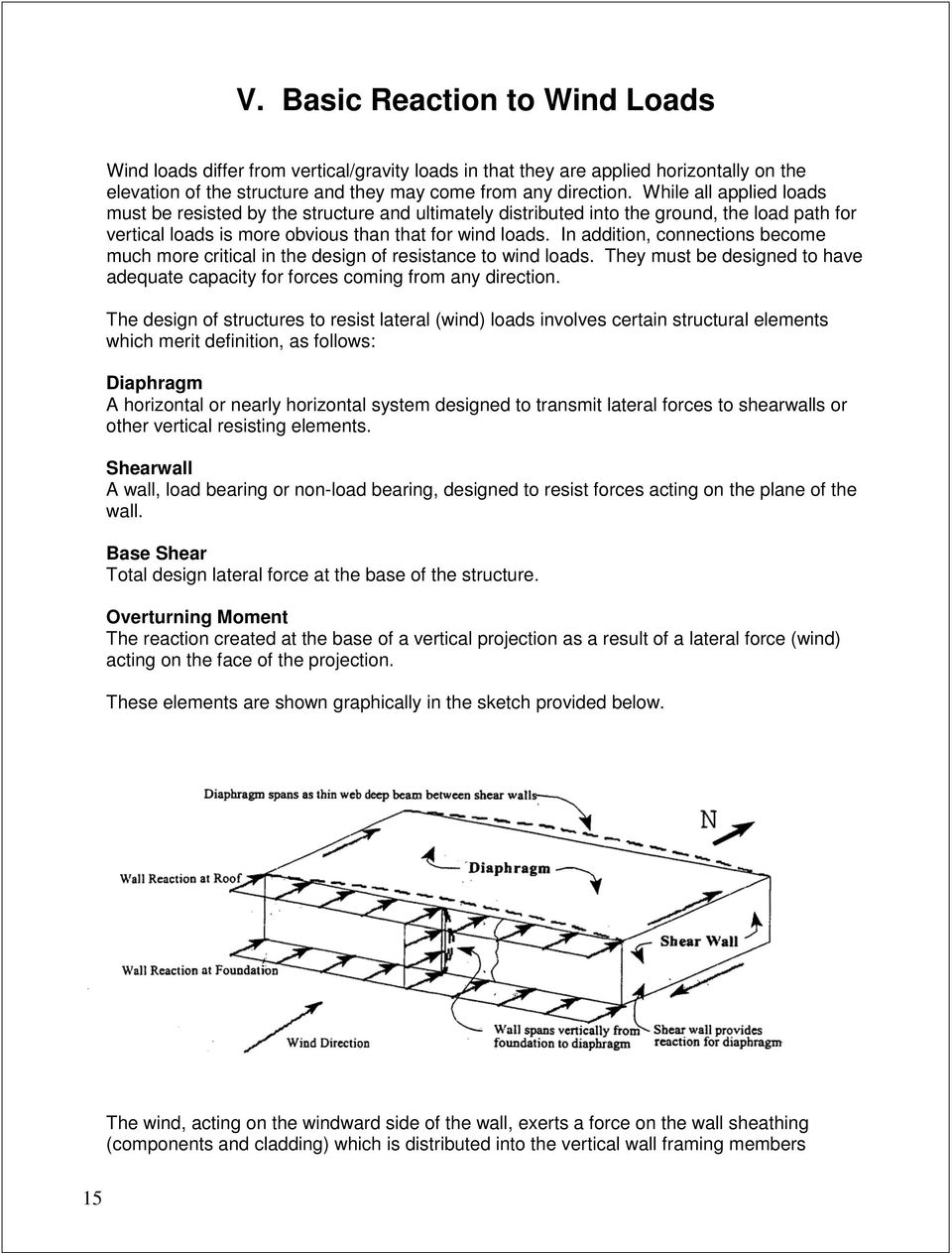
16 (MWFRS). This force is distributed about equally into the foundation below and roof diaphragm above. Along the foundation line resistance to the wind load acting on the lower half of the wall framing members is accommodated by connections which distribute the load directly into the foundation or slab. At the top of the wall resistance to the applied wind load is provided by the strength and stiffness of the roof diaphragm. The loads from the top of the framing members are transferred to the roof diaphragm by properly designed connections. The roof diaphragm acts like a long deep beam supported by the two walls (shear walls) parallel to the wind direction. The roof diaphragm is attached to the shear walls with fasteners of sufficient capacity to transfer the loads into the shear walls. The diaphragm reaction applied to the top of the shear walls is transferred to the bottom of the wall through shear in the plane of the wall. Like the roof diaphragm, the shear wall must have sufficient strength and stiffness to carry the applied loads to the foundation without undue deformation of the structure. Shear wall segments suitable for resisting shear are dependent upon door and window openings which break up continuity of the wall. The shear wall (or wall segments) must be tied to the foundation with connectors of sufficient capacity to resist the base shear and prevent the shear wall from sliding off the foundation under the applied wind load. In addition to resisting the base shear, it is usually necessary to restrain the ends of each shear wall segment to resist the overturning moment. In some structures, the weight of the structure acting at the point of connection may offset the uplift force making a special connection unnecessary. Usually, however, a tension connection connecting each end of the shear wall to the foundation will be required. Once this analysis is complete, it is necessary to redesign the structure with the wind blowing at right angles to its original position. The same procedure, as described above, should be used. While this example was for a simple box structure, the same load path and analysis applies to buildings of other shapes and roof types. The importance of designing adequate connections between the structural elements cannot be over-emphasized. Historical wind event data has shown that most building failures have occurred as a result of improper connection design or installation. 16

17 VI. Design Criteria A. Florida Building Code (FBC) 1. Determination of Wind Loads According to section FBC wind loads on every building or structure shall be determined in accordance with Chapters 26 though 30 of ASCE 7 or the provisions of the alternate all heights method in Section , which in discussed in Section VIII. Wind shall be assumed to come from any horizontal direction and wind pressures shall be assumed to act normal to the surface considered. There are several exceptions to Section as follows: a. Subject to certain limitations, the provisions of International Code Council, Inc., ICC 600, Standard for Residential Construction in High Wind Regions, shall be permitted for applicable Group R-2 and R-3 buildings b. Subjects to certain limitations, provisions of ANSI/AF&PA (American Forest & Paper Association) WFCM (Wood Frame Construction Manual) for one or twofamily dwellings shall be permitted for applicable wood frame buildings of Group R-3 occupancy where nominal design wind speeds are 150 mph or less. c. Subject to the limitations described hereafter under Applicability residential structures using the provisions of AISI S230. d. Designs using NAAMM EP1001, Specification for Design Loads of Metal Flagpoles. e. Designs using TIA-222 for antenna supporting structures and antennas shall be permitted for communication tower and steel antenna support structures. f. Wind tunnel tests in accordance with chapter 31 of ASCE 7. g. Designs using AASHTO LT5-4 structural Specifications for Highway Signs Luminaries, and Traffic Signals. h. Wind loads for screened enclosures shall be determined in accordance with Section FBC The wind speeds in Figure 1609A, 1609B and 1609C shall be converted to nominal wind speeds, V asd in accordance with Section when the provisions of the standards referenced in exception a though e and g are used unless the wind provisions in the standards are based on Ultimate Wind Speeds as specified in Figures 1609A 1609B or 1609C or chapter 26 of ASCE Applicability. The provisions of ICC 600 are applicable only to buildings located within Exposure B or C as defined in Section The provisions of ICC 600, AF&PA WFCM, and AISI S230 shall not apply to buildings sited on the upper half of an isolated hill, ridge or escarpment meeting the following conditions: a. The hill, ridge or escarpment is 60 feet or higher if located in Exposure B or 30 feet or higher if located in Exposure C; b. The maximum average slope of the hill exceeds 10 percent; and c. The hill, ridge or escarpment is unobstructed upwind by other such topographic features for a distance from the high point of 50 times the height of the hill or 1 mile, whichever is greater. 17

18 B. ASCE Standard Wind loads on the MWFRS may be determined by: a. Directional Procedure for buildings of all heights as described in Chapter 27 Part 1 applies to buildings of all heights where it is necessary to separate applied wind loads onto the windward, leeward, and side walls of the building to properly assess the internal forces in the MWFRS members and Part 2 applies to a special class of buildings designated as enclosed simple diaphragm buildings having a height of 160 feet or less. b. Envelope Procedure for low-rise buildings as described in Chapter 28. c. Directional Procedure for building appurtenances (roof overhangs and parapets) and other structures as described in Chapter 29. d. Wind Tunnel Procedure for any building or other structure as described in chapter Wind loads on the components and cladding may be determined by: a. Envelope Procedure in Parts 1 and 2 or b. Directional Procedure in Parts 3, 4, and 5 c. Building appurtenances such as roof overhangs and parapets and rooftop equipment in Part 6 all as described in chapter 30. d. Wind Tunnel procedure for any building or other structure as described in chapter 31 C. Florida Building Code Alternate all-heights method. The alternate wind design provisions in Section of the FBC are simplifications of chapter 27, Part 1- Directional Procedure of ASCE The Provisions of Section are permitted to be used to determine the wind effects on regularly shaped buildings or other structures provided they meet the conditions described in Section of the FBC. The building or other structure must have a height of 75 feet or less in order to use this simplified method. D. Criteria for using ASCE Standard Conditions A building whose design wind loads are determined in accordance with ASCE 7 shall comply with all of the following conditions: a. The building is a regular-shaped building as defined in Section b. The building does not have response characteristics making it subject to across wind loading, vortex shedding, or instability due to galloping or flutter; or it does not have a site location for which channeling effects of buffeting in the wake of upwind obstructions warrant special consideration 2. Limitations The provisions of ASCE 7 take into consideration the load magnification effect caused by gusts in resonance with along-wind vibrations of flexible buildings. The loads on buildings not meeting the requirements of ASCE 7 Sections 27-30, or having unusual shapes or response characteristics, shall be determined using recognized literature documenting such wind load effects or shall use the wind tunnel procedure specified in Chapter 31.

19 19 3. Shielding There shall be no reductions in velocity pressure due to apparent shielding afforded by buildings and other structures or terrain features.

20 VII. Design Procedures Selected Procedure In determining the design wind loads for buildings and other structures, the procedure to be utilized shall be selected in accordance with the criteria described in Chapter VI. The design methods will be described in this chapter. A. Wind Loads on Buildings, MWFRS (Directional Procedure) 1 Building of all Heights a. Enclosed, Partially Enclosed, and Open Buildings The steps to determine the wind loads on the MWFRS for enclosed, partially enclosed and open buildings of all heights are shown in the following Table 7- B.1. Table 7-B.1 Steps to Determine MWFRS Wind Loads for Enclosed, Partially Enclosed and Open Buildings or all Heights Step 1: Determine risk category of building or other structure, see Table Step 2: Determine the basic wind speed, V, for the applicable risk category, see Figure 1609A, B or C Step 3: Determine wind Load parameters: Wind directionality factor, K d, see Section IV.B and Table Exposure category, see Section IV.C. Topographic factor, K zt, see Section IV.D Gust Effect Factor, G, see Sections IV.E Enclosure classification, see Section IV.F Internal pressure coefficient, (GC pi ), see Section 1V.g and Table Step 4: Determine velocity pressure exposure coefficient, K z or K h, see Table Step 5: Determine velocity pressure q z or q h Eq Step 6: Determine external pressure coefficient, C p or C N Fig for walls and flat, gable, hip, monoslope or mansard roofs Values for other roof types shown in Chapter 27, ASCE 7-10 Step 7: Calculate wind pressure, p, on each building surface Eq for ridge buildings Eq for flexible buildings Eq for open buildings

21 Velocity Pressure Velocity pressure, q z, evaluated at height z shall be calculated by the following equation: Where q z = K z K zt K d V 2 (lb/ft 2 ) (27.3-1) K d = wind directionality factor K z = velocity pressure exposure coefficient K zt = topographic factor defined V = basic wind speed q z = velocity pressure calculated using Eq at height z q h = velocity pressure calculated using Eq at mean roof height h. The numerical coefficient shall be used except where sufficient climatic data are available to justify the selection of a different value of this coefficient for a design application. b. Enclosed and Partially Enclosed Rigid buildings Design wind pressure for the MWFRS of buildings of all heights shall be determined by the following equation: p = qgc p q i (GC pi ) (lb/ft 2 ) (27.4-1) Where q = q z for windward walls evaluated at height z above ground q = q h for leeward walls, side walls and roofs evaluated at heights h q i = q h for windward walls, side walls, leeward walls, and roofs of enclosed buildings and for negative internal pressure evaluation in partially enclosed buildings q i = q z for positive internal pressure evaluation in partially enclosed buildings where height z is defined as the level of the highest opening in the building that could affect the positive internal pressure. For buildings sited in wind-borne debris regions, glazing that is not impact resistant or protected with an impact resistant covering shall be treated as an opening. For positive internal pressure evaluation, qi may conservatively be evaluated at height h(q i = q h ) G = gust-effect factor C p = external pressure coefficient from Figs , and (GC pi ) = internal pressure coefficient from Table q and q i shall be evaluated using exposure defined in Section IV.C.2. Pressure shall be applied simultaneously on windward and leeward walls and on roof surfaces as defined in Figs , and Design wind pressures for the MWFRS of flexible buildings shall be determined from the following equation: p = qg f C p q i (GC pi ) (lb/ft 2 ) (27.4-2) 21
22 where q, q i, C p and (GC pi ) are as defined above and G f (gust-effect factor) is determined in accordance with section IV.E. c. Open buildings with Monoslope, Pitched, and Troughed Free Roofs The net design pressure for the MWFRS of open buildings with monoslope, pitched, or troughed roofs shall be determined by the following equation: Where p = q h GC N (27.4-3) q h = velocity pressure evaluated at mean roof height h using exposure as defined in Section IV.C.2 that results in the heights wind loads for any wind direction at the site G = gust-effect factor from Section IV.E C N = net pressure coefficient determined from Figs through (ASCE 7-10) Net pressure coefficients, C N include contributions from top and bottom surfaces. All Load cases shown for each roof angle shall be investigated. Plus and minus signs signify pressure acting toward and away from the top surfaces of the roof, respectively. For free roofs with an angle of plane of roof from horizontal θ less than or equal to 5 and containing fascia panels, the fascia panel shall be considered an inverted parapet. The contribution of loads on the fascia to the MWFRS loads shall be determined using Section with q p equal to q h. d. Roof Overhangs The positive external pressure on the bottom surface of windward roof overhangs shall be determined using C p = 0.8 and combined with the top surface pressures determined using Fig e. Parapets The design wind pressure for the effect of parapets on MWFRS of rigid or flexible buildings with flat, gable, or hip roofs shall be determined by the following equation: where p p =q p (GC pn ) (lb/ft2) (27.4-4) p p = combined net pressure on the parapet due to the combination of the net pressures from the front and back parapet surfaces. Plus (and minus) signed signify net pressure acting toward (and away from ) the front (exterior) side of the parapet q p = velocity pressure evaluated at the top of the parapet (GC pn ) = combined net pressure coefficient = +1.5 for windward parapet = -1.0 for leeward parapet 22
23 f. Design Wind Load Cases The MWFRS of buildings of all heights, whose wind loads have been determined under the provisions of this chapter, shall be designed for the wind load cases as defined in Fig g. Minimum Design wind Loads The wind load to be used in this design of the MWFRS for an enclosed or partially enclosed building shall not be less than 16 lb/ft 2 multiplied by the wall area of the building and 8 lb/ft 2 multiplied by the roof area of the building projected onto a vertical plane normal to the assumed wind direction. Wall and roof loads shall be applied simultaneously. The design wind force for open buildings shall be not less than 16 lb/ft 2 multiplied by the area A f. 2. Enclosed Simple Diaphragm Buildings with h 160 ft a. Design Procedure The procedure specified herein applies to the determined of MWFRS wind loads of enclosed simple diaphragm buildings, with a mean roof height h 160 ft. the steps required for the determination of MWFRS wind loads on enclosed simple diaphragm buildings are shown in Table 7.B.2 Note: Part 2 is a simplified method for determining the wind pressured for the MWFRs of enclosed, simple diaphragm buildings whose height h in 160 ft. The wind pressures are obtained directly from a table. The building may be of any general plan shape and roof geometry that matched the specified figures. This method is a simplification of traditional all heights method (Directional Procedure) contained in Part 1. Table 7.B.2 Steps to Determine MWFRS Wind Loads Enclosed Simple Diaphragm Buildings (h 160 ft.) Step 1: Determine risk category of building of other structure, see Table Step 2: Determine the basic wind speed, V, for applicable risk category, see Figure A, B or C Step 3: Determine wind load parameters: Wind directionality factor, K d, see section IV.B and Table Exposure category B, C or D, see Section IV.C Topographic factor, K zt, see Section IV.D Enclosed classification, see Section IV.F Step 4: Enter table to determine net pressures on walls at top and base of building respectively, p h, p 0, Table Step 5: Enter table to determine net roof pressures, p z, Table
24 Step 6: Determine topographic factor, K zt, and apply factor to wall and roof pressure (if applicable), see Section IV.D Step 7: Apply loads to walls and roof simultaneously. b. Conditions In addition to the requirements in Section of ASCE 7-10, a building whose design wind loads are determined in accordance with this section shall meet all of the following conditions for either a Class 1 or Class 2 building (see Fig ): (1) Class 1 Building: (a)the building shall be an enclosed simple diaphragm building. (b)the building shall have a mean roof height h 60 ft (c)the ratio of L/B shall not be less than 2.0 nor more than 5.0 (0.2 L/B 5.0). (d)the topographic effect factor K zt = 1.0 (2) Class 2 Buildings: (a)the building shall be an enclosed simple diaphragm building. (b)the building shall have a mean roof height 60 ft < h 160 ft (c)the ratio of L/B shall not be less than 0.5 nor more than 2.0 (0.5 L/B 2.0) (d)the fundamental natural frequency (Hertz) of the building shall not be less 75/h where h is in feet. (e)the topographic effect factor K zt = 1.0 c. Wind Load Parameters Specified in chapter 26 Refer to Chapter 26 for determination of Basic Wind Speed V (Section 26.5) and exposure category (Section 26.7) and topographic factor K zt (Section 26.8) d. Diaphragm Flexibility The design procedure specified herein applies to buildings having either rigid or flexible diaphragms. The structural analysis shall consider the relative stiffness of diaphragms and the vertical elements of the MWFRS. Diaphragms constructed of wood panels can be idealized as flexible. Diaphragms constructed of untopped metal deck, concrete filled metal decks, and concrete slabs, each having a span-to-depth ratio of 2 or less, are permitted to be idealized as rigid for consideration of wind loading. e. Wall and Roof Surfaces Class 1 and 2 buildings Net wind pressures for the walls and roof surfaces shall be determined from Tables and , respectively, for the applicable exposure category as determined by Section For Class 1 building with L/B values less then 0.5, use wind pressures tabulated for L/B = 0.5. For Class 1 buildings with L/B values greater than 2.0, use wind pressures tabulated for L/B =
25 Net wall pressures shall be applied to the projected area of the building walls in the direction of the wind, and exterior side pressures shall be applied to the projected area of the building walls normal to the direction of the wind acting outward according to Note 3 of Table , simultaneously with the roof pressures from Table as shown in Fig Where two load cases are shown in the table of roof pressures, the effects of each load case shall be investigated separately. The MWFRS in each direction shall be designed for the wind load cases as defined in fig f. Parapets The effect of horizontal wind loads applied to all vertical surfaces of roof parapets for the design of the MWFRS shall be based on the application of an additional net horizontal wind pressure applied to the projected area of the parapet surface equal to 2.25 times the wall pressures tabulated in Table for L/B/ = 1.0. The net pressures specified accounts for both the windward and leeward parapet loading on both the windward and leeward building surface. The parapet pressure shall be applied simultaneously with the specified wall and roof pressures shown in the table as shown in fig The height h used to enter Table to determine the parapet pressure shall be the height to the top of the parapet as shown in Fig (use h = h p ) g. Roof Overhangs The effect of vertical wind loads on any roof overhangs shall be based on the application of a positive wind pressure on the underside of the windward overhang equal to 75% of the roof edge pressure from Table for Zone 1 or Zone 3 as applicable. This pressure shall be applied to the windward roof overhang only and shall be applied simultaneously with other tabulated wall and roof pressures as shown in fig B. Wind Loads on Buildings, MWFRS (Envelope Procedure) 1. Enclosed and Partially Enclosed Low Rise (h less than or equal to 60 ft) Buildings The steps to determine the wind loads on the MWFRS on low-rise buildings are shown in Table 7-C.1 Table 7-C.1 Steps to Determine wind Loads on MWFRS Low-Rise Buildings 25 Step 1: Determine risk category of building or other structure, see Table Step 2: Determine the basic wind speed, v for applicable risk category, see Fig 1609A, B or C Step 3: Determine wind load parameters: Wind directionality factor, K d, see Section IV.B and Table Exposure category B, C or D, see Section IV.C. Topographic factor, K zt, see Section IV.D. Enclosure classification, see Section IV.F. Internal pressure coefficient, (GC pi ), see Section IV.G.
26 Step 4: Determine velocity pressure exposure coefficient, K z or K h, see Table Steps 5: Determine velocity pressure, q z or q h, Eq Step 6: Determine external pressure coefficient, (GC p ), using Fig for flat and gable roofs. Step 7: Calculate wind pressure, p, from Eq Velocity Pressure Velocity pressure, qz, evaluated at height z shall be calculated by the following equation: q z = K z K zt K d V 2 (lb/ft2) (28.3-1) K d = Wind directionality factor K z = velocity pressure exposure coefficient taken from Table K zt = topographic factor V = basic wind speed q h = velocity pressure q z calculated using Eq at mean roof height h The numerical coefficient shall be used except where sufficient climatic data are available to justify the selection of a different value of this factor for a design application. a. Design Wind Pressure for Low-Rise Buildings (heights less than 60 ft. Design wind pressure for the MWFRS of low-rise buildings shall be determined by the following equation: p = q h [(GC pf ) (GC pi )] (lb/ft 2 ) (28.4-1) where q h = velocity pressure evaluated at mean roof height h (GC pf ) = external pressure coefficient from Fig (GC pi ) = internal pressure coefficient from Table The combined gust effect factor and external pressure coefficients for low-rise buildings, (GC pf ), are not permitted to be separated. b. Parapets The design wind pressure for the effect of parapets on MWFRS of low-rise buildings with flat gable, or hip roofs shall be determined by the following equation: where p p = q p (GC pn ) (lb/ft 2 ) (28.4-2) 26
27 pp = combined net pressure on the parapet due to the combination of the new pressure from the front and back parapet surfaces. Plus ( and minus) signs signify net pressure acting toward (and away from) the front (exterior) side of the parapet q p = velocity pressure evaluated at the top of the parapet GC pn = combined net pressure coefficient +1.5 for windward parapet -1.0 for leeward parapet c. Roof Overhangs The positive external pressure on the bottom surface of windward roof overhangs shall be determined using Cp = 0.7 in combination with the top surface pressures determined using fig d. Minimum Design Wind Loads The wind load to be used in the design of the MWFRS for an enclosed or partially enclosed building shall not be less than 16 lb/ft 2 multiplied by the wall area of the building and 8 lb/ft2 multiplied by the roof area of the building projected onto a vertical plane normal to the assumed wind direction. 2. Enclosed Simple Diaphragm Low-Rise Buildings General Requirements The steps required for the determination of MWFRS wind loads on enclosed simple diaphragm buildings are shown in Table 7.C.2 User Note: Part 2 of Chapter 28 is a simplified method to determine the wind pressure on the MWFRS of enclosed simple diaphragm low-rise buildings having a flat, gable, or hip roof. The wind pressures are obtained directly from a table and applied on horizontal and vertical projected surfaces of the building. This method is a simplification of the Envelope Procedure contained in Part 1. Table 7.C.2 Steps to Determine Wind Loads on MWFRS Simple Diaphragm Low-Rise Buildings Step 1: Determined risk category of building of other structure, see Table Step 2: Determine the basic wind speed, V, for applicable risk category, see Fig. 1609A, B or C Step 3: Determine wind load parameters: Exposure category B, C or D, see Section IV.C. Topographic factor, K zt, see Section IV.D. Step 4: Enter figure to determine wind pressures for h = 30 ft, p s30, see Fig
28 Step 5: Enter figure to determine adjustment for building height and exposure, λ, see Fig Step 6: Determine adjusted wind pressures, p s, see Eq a. Scope A building whose design wind loads are determined in accordance with this section shall meet all the conditions of Section C.2.b below. If a building does not meet all the conditions described, then its MWFRS wind loads shall be determined by Part 1 of this chapter, by the Directional Procedure of Chapter 27, or by the Wind Tunnel Procedure of Chapter 31 of ASCE 7-10 b. Conditions For the design of MWFRS the building shall comply with all of the following conditions: 1. The building is a simple diaphragm building. 2. The building is a low-rise building. 3. The building is enclosed and conforms to the wind-borne debris provisions of Section ASCE The building is a regular-shaped building or structure. 5. The building is not classified as a flexible building. 6. The building does not have response characteristics making it subject to across wind loading, vortex shedding, instability due to galloping or flutter; and it does not have a site location for which channeling effects or buffeting in the wake of upwind obstructions warrant special consideration. 7. The building has an approximately symmetrical cross-section in each direction with either a flat roof or a gable or hip roof with θ The building is exempted from torsional load cases as indicated in Note 5 of Fig , or the torsional load cases defined in Note 5 do not control the design of any of the MWFRS of the building. c. Design Wind Loads Simplified design wind pressures, p s, for the MWFRS of low-rise simple diaphragm buildings represent the net pressures (sum of internal and external) to be applied to the horizontal and vertical projections of building surfaces as shown in Fig For the horizontal pressures (Zones A, B, C, D), p s is the combination of the windward and leeward net pressures. p shall be determined by the following equation: where p s = λ K zt p S30 (28.6-1) λ = adjustment factor of building height and exposure from Fig K zt = topographic factor as defined in Section 26.8 evaluated at mean roof height, h p S30 = simplified design wind pressure for Exposure B, at h = 30ft from Fig
29 d. Minimum Design Wind Loads The load effects of the design wind pressures from Section shall not be less than a minimum load defined by assuming the pressures, p s, for zones A and C equal to +16 psf, Zones B and D equal to +8 psf, while assuming p s for Zones E, F, G, and H are equal to 0 psf. C. Wind Loads on Other Structures and Building Appurtenances MWFRS The steps required for the determination of wind loads on building appurtenances (such as rooftop structures and equipment) and other structure of all heights (such as solid freestanding walls and freestanding solid signs, chimneys, tanks, open signs, lattice frameworks, and trussed towers) using the Directional Procedure are shown in Table Table Steps to Determine Wind Loads on MWFRS Rooftop Equipment and Other Structures Step 1: Determine risk category of building or other structure, see Table Step 2: Determine the basic wind speed, V, for applicable risk category, see Figure 1609A, B or C Step 3: Determine wind load parameters: Wind directionality factor, K d, see Section IV.B and Table Exposure category B, C or D, see Section IV.C. Topographic factor, K zt, see Section IV.D Gust Effect Factor, G, see Section IV.E Step 4: Determine velocity pressure exposure coefficient, K z or K h, see Table Step 5: Determine velocity pressure q z or q h, see Eq Step 6: Determine force coefficient, C f. Solid freestanding signs or solid freestanding walls. Fig Chimneys, tanks, rooftop equipment Fig Open signs, lattice frameworks Fig Trussed towers Fig Step 7: Calculate wind force, F: Eq for signs and walls Eq and Eq for rooftop structure and equipment Eq for other structures 29 Note: The figures in step 6 and equations in step 7 can be found in Chapter 29 of ASCE 7-10, and are not included in this course material.
30 Velocity Pressure Exposure Coefficient Based on the exposure category determined in Section IV.C, a velocity pressure exposure coefficient K z or K h as applicable shall be determined from Table For a site location in a transition zone between exposure categories that is near to a change in ground surfaces roughness, intermediate values of K z or K h, between those shown in Table , are permitted provided that they are determined by a rational analysis method defined in the recognized literature. Velocity Pressure Velocity pressure, q z evaluated at height z shall be calculated by the following equation: where q z = K z K zt K d V 2 (lb/ft 2 ) (29.3-1) K d = Wind directionality factor K z = velocity pressure exposure coefficient K zt = topographic factor V = basic wind speed qh = velocity pressure calculated using Eq at height h The numerical coefficient shall be used except where sufficient climatic data are available to justify the selection of a different value of this factor for a design application. a. Parapets Wind loads on parapets are specified in Section V!!.B for buildings of all heights designed using Directional Procedure and in Section VII.C for low-rise buildings designed using the Envelope Procedure. b. Roof Overhangs Wind Loads on roof overhangs are specified in Section VII.B for buildings of all heights designated using the Directional Procedure and in Section VII.C low-rise buildings designed using the Envelope Procedure. c. Minimum Design Wind Loading The design wind force for other structures shall be not less than 16 lb/ft 2 the area A f. multiplied by D. Wind Loads Components and Cladding (C&C) 1. Scope Building Types This section applies to the determination of wind pressures on components and cladding (C&C) on buildings a. Part 1 is applicable to an enclosed or partially enclosed: (1) Low-rise building (2) Building with h 60 ft 30
31 The building has a flat roof, gable roof, multispan gable roof, hip roof, monoslope roof, stepped roof, or sawtooth roof and the wind pressures are calculated from a wind pressure equation. b. Part 2 is a simplified approach and is applicable to an enclosed: (1) Low-rise building (2) Building with h 60 ft the building has a flat roof, gable roof, or hip roof and the wind pressures are determined directly from a table. c. Part 3 is applicable to an enclose or partially enclosed: Building with h 60 ft The building has a flat roof, pitched roof, gable roof, hip roof, mansard roof, arched roof, or domed roof and the wind pressures are calculated from a wind pressure equation. d. Part 4 is a simplified approach and is applicable to an enclosed (1) Building with h 160 ft The building has a flat roof, gable roof, hip roof, monoslope roof, or mansard roof and the wind pressures are determined directly from a table. e. Part 5 is applicable to an open building of all heights having pitched free roof, monoslope free roof, or trough free roof. f. Part 6 is applicable to building appurtenances such as roof overhangs and parapets and rooftop equipment. Conditions A building whose design wind loads are determined in accordance with this chapter shall comply with all of the following conditions: a. The building is a regular-shaped building b. The building does not have response characteristics making it subject to across wind loading, vortex shedding, or instability due to galloping or flutter; or it does not have a site location for which channeling effects of buffeting in the wake of upwind obstructions warrant special consideration. Limitations The provisions of this section take onto consideration the load magnification effect caused by gusts in resonance with along-wind vibrations of flexible buildings. The loads on buildings not meeting the requirements of the conditions described above, or having unusual shapes or response characteristics, shall be determined using recognized literature documenting such wind load effects or shall use the wind tunnel procedure specified in Section VII.F. Shielding There shall be no reduction in velocity pressure due to apparent shielding afforded by buildings in other structures or terrain features. 31
32 Air-Permeable Cladding Design wind loads determined from this section shall be used for air-permeable cladding unless approved test data or recognized literature demonstrates lower loads for the type of air-permeable cladding being considered. 2. General Requirements Wind Load Parameters Specified in Section IV The following wind load parameters are specified in Section IV a. Basic Wind Speed v b. Wind directionality factor K d c. Exposure category d. Topographic factor K zt e. Gust Effect Factor f. Enclosure classification g. Internal pressure coefficient Minimum Design Wind Pressure The design wind pressure for components and cladding of building shall not be less than a net pressure of 16 lb/ft 2 acting in either direction normal to the surface. Tributary Areas Greater than 700 ft 2 Component and cladding elements with tributary areas greater than 700 ft 2 shall be permitted to be designed using provisions for MWFRS. External Pressure Coefficients Combined gust effect factor and external pressure coefficients for components and cladding, (GC p ), are given in the figures associated with this chapter. The pressure coefficient values and gust effect factor shall not be separated. 3. Velocity Pressure Velocity Pressure Exposure Coefficient Based on the exposure category determined in Section IV, a velocity pressure exposure coefficient K z of K h as applicable, shall be determined from Table For a site located in a transition zone between exposure categories, that is, near to a change in ground surface roughness, intermediate values of K z or K h, between those shown in Table , are permitted, provided that they are determined by a rational analysis method defined in the recognized literature. Velocity Pressure Velocity pressure q z, evaluated at height z shall be calculated by the following equation: q z = K z K zt K d V 2 (lb/ft 2 ) (30.3-1) Where K d = wind directionality factor defined in Section 26.6 K z = Velocity pressure exposure coefficient delineated in Table K zt = topographic factor 32
33 V = basic wind speed q h = velocity pressure calculated using Eq at height h The numerical coefficient shall be used except where sufficient climatic data are available to justify the selection of a different value of this factor for a design application. Design Wind Pressures The procedures for the determination of design wind pressures for components and cladding for all types and heights of buildings and structures are described in Chapter 30 of ASCE Standard Part 2 of Chapter 30 is a simplified method to determine wind pressures on C&C of enclosed low-rise buildings (h = 60 ft or less) having flat, gable or hip roof shapes. The provisions of Part 2 are based on the envelope procedure with wind pressures determined from a table and adjusted as appropriate. The building type applicable to Part 2 are representatives of many buildings constructed in Florida and the design procedures are describes hereafter. For the design procedures for other building types, see ASCE Standard 7-10, Parts 1 and 3 though Low-Rise Buildings (Simplified) 33 a. Building Types The provisions of Section VII.E are applicable to an enclosed: h. Low-Rise building with h 60 ft The building has a flat roof, gable roof, or hip roof. The steps required for the determination of wind loads on components are cladding for these building types are shown in Table VII.E-1 Conditions For the design of components and cladding the building shall comply with all the following conditions: 1. The mean roof height h must be less than or equal to 60 ft. 2. The building in enclosed as defined in Section III and conforms to the wind-borne debris provisions of Section II 3. The building is a regular-shaped building or structure as defined in Section III 4. The building does not have response characteristics making it subject to across wind loading, vortex shedding, or instability due to galloping or flutter; and it does not have a site location for which channeling effects or buffeting in the wake of upwind obstructions warrant special consideration. 5. The building has either a flat roof, a gable roof with θ 45, or a hip roof with θ 27. Design wind Pressures Net design wind pressures, p net, for component and cladding of buildings designed using the procedure specified herein represent the net pressures (sum of internal and external) that shall be applied normal to each building surface as shown in fig p net shall be determined by the following equation:
34 p net = λk zt p net30 (30.5-1) where λ = adjustment factor for building height and exposure from Fig K zt = topographic factor evaluated at 0.33 mean roof height, 0.33h P net30 = net design wind pressure for Exposure B, at h = 30 ft, from Fig Table VII.E-1 Steps to Determine C&C Wind Loads Enclosed Low-Rise Buildings (Simplified Method) Step 1: Determine risk category, see Table Step 2: Determine the basic wind speed, v, for applicable risk category, see Figure A, C or C Step 3: Determine wind load parameters: Exposure category B, C or D, see Section IV.C. Topographic factor K zt, see Section IV.D Step 4: Enter figure to determine wind pressures at h = 30 ft., p net30, see Fig Step 5: enter figure to determine adjustment for building height and exposure, λ, see Fig Step 6: Determine adjusted wind pressures, p net, see Eq E. Wind Tunnel Procedure The wind tunnel procedure may always be used for determining wind pressure for the MWFRS and/or for C&C for any building or structure. This method is considered to produce the most accurate wind pressures for any method described in ASCE Standard The wind tunnel procedure is discussed in Chapter 31 of ASCE F. Florida Building Code- Alternate all-heights Method The alternate wind design provisions in Section of the FBC are simplifications of Chapter 27, Part 1 Directional Procedure of ASCE Scope. As an alternative to ASCE 7 Chapter 27, Part 1 and Chapter 30, Part 3, the following provisions are permitted to be used to determine the wind effects on regularly shaped buildings, or other structures that are regularly shaped, which meet all the following conditions: a. The building or other structure is less than or equal to 75 feet in height with a height-to-least-width ratio of 4 or less, or the building or other structure has a fundamental frequency greater than or equal to 1 hertz. b. The building or other structure is not sensitive to dynamic effects.
35 c. The building or other structure is not located on a site for which channeling effects of buffeting in the wake of upwind obstructions warrant special consideration. d. The building shall meet the requirements of a simple diaphragm building as defined in ASCE 7 Section 26.2, where wind loads are only transmitted to the main wind-force-resisting system (MWFRS) at the diaphragms. e. For open buildings, multispan gable roofs, stepped roofs, sawtooth roofs, domed roofs, roofs with sloped greater than 45 degrees, solid free-standing walls and solid signs, and rooftop equipment, apply ASCE 7 provisions. 2. Symbols and notations. Coefficients and variables used in the alternative all-heights method equations are as follows: C net = net-pressure coefficient based on K d [(G) (C p ) (GC pi )], in accordance with Table (2). G = Gust effect factor for rigid structures in accordance with ASCE 7 Section K d = Wind directionality factor in accordance with ASCE 7 Table P net = Design wind pressure to be used in determination of wind loads on building or other structures or their components and cladding, in psf. q s = Wind stagnation pressure in psf in accordance with Table (1). 3. Design equations When using the alternative all-heights method, the MWFRS, and components and cladding of every structure shall be designed to resist the effects of wind pressures on the building envelope in accordance with Equation P net = q s K z C net [K zt ] (Equation 16-34) Design wind forces for the MWFRS shall not be less than 16 psf multiplied by the wall are of the building and 8 psf multiplied by the roof area of the building projected on a plane normal to the assumed wind direction (see ASCE 7 Section for criteria). Design net wind pressure for components and cladding shall not be less than 16 psf acting in either direction normal to the surface. 4. Design procedure The MWFRS and the components and cladding of every building or other structure shall be designed for the pressures calculated using Equation Main wind-force-resisting systems. The MWFRS shall be investigated for the torsional effects indentified in ASCE 7 Figure Determination of K z and K zt Velocity pressure exposure coefficient, K zt shall be determined in accordance with ASCE 7 Sections 27.3 and 30.3 and the topographic factor, K zt, shall be determined in accordance with ASCE 7 Section (1) For the windward side of a structure, K zt and K z shall be based on height z 35
36 (2) For leeward and sidewalls, and for windward and leeward roofs, K zt and K z shall be based on mean roof height h. 7. Determination of net pressure coefficients, and C net For the design of the MWFRS and for components and cladding, the sum of the internal and external net pressure shall be based on the net pressure coefficient, C net. The pressure coefficient, C net, for walls and roofs shall be determined from Table (2). Where C net has more than one value, the more severe wind load condition shall be used for design. 8. Application of wind pressures When using the alternative all-heights method, wind pressures shall be applied simultaneously on, and in a direction normal to, all building envelope wall and roof surfaces. 9. Components and cladding Wind pressure for each component or cladding element is applied as follows using C net values based on the effective wind area, A, contained within the zones in areas of discontinuity of width and/or length a, 2a or 4a at: corners of roofs and walls; edge strips for ridges, rakes and eaves; or field areas on walls or roofs as indicated in figures in tables in ASCE 7 as reference in Table (2) in accordance with the following a. Calculated pressures at local discontinuities acting over specific edge strips or corner boundary areas. b. Include field (Zone 1, 2 or 4, as applicable) pressures applied to areas beyond the boundaries of the areas of discontinuity. c. Where applicable, the calculated pressures at discontinuities (Zones 2 or 3) shall be combined with design pressures that apply specifically on rakes or eave overhangs. 10. Garage doors and rolling doors Pressures from Table (1) for wind loading actions on grage doors and rolling doors for building designed as enclosed shall be permitted 11. Rooftop structures and equipment The lateral force on rooftop structures and equipment with A f, less than (0.1Bh) located on buildings of all heights shall be determined from Equation of ASCE 7 in which the value of GC f shall be taken as 3.1. GC f shall be permitted to be reduced linearly from 3.1 to 1.1 as the value of A f is increased from (0.1Bh) to (Bh). The value of G from Section 26.9 of ASCE 7 shall not be used. Additionally, a simultaneous uplift force shall be applied, given by Equation of ASCE 7 in which GC f = 1.5 and A f is replaced by the horizontal projected area, A r, of the rooftop structure or equipment. For the uplift force GC f shall be permitted to be reduced linearly from 1.5 to 1.0 as the value of A f is increased from (0.1BL) to (BL). 12. Minimum Design Wind Loads The load effects of the design wind pressures from Section shall not be less than a minimum load defined by assuming the pressures, p s, for zones Z and C equal to +16 psf, Zones B and D equal to +8 psf, while assuming ps for Zones E, F, G, and H are equal to 0 psf 36
37 37
38 A. Preface VIII Representative Examples Two examples will be illustrated to show how that various tables and equations discussed in previous chapters are used to determine wind forces on building. Both examples will use similar criteria as follows: a. Building locations: Ft. Myers, Florida (Wind Borne Debris Region) b. Building outline: 40 feet by 100 feet x 40 feet high with a flat roof c. Enclosed building d. Exposure C e. Topographic Factor K zt = 1.0 f. Building Use: Commercial Office (Rick Category II) g. Wind load resisting system: Floor/roof support is provided by major beams spanning north-south and bar joists spanning east-west with metal decking and concrete floor/roof deck. The sketch below illustrates the conditions. 38
39 B. ASCE 7-10 Based on the example presented in paragraph A, the following procedures for determining wind pressures are applicable: MWFRS Envelope Procedure, Part 2 Components and Cladding, Part 2, Low- Rise Buildings (Simplified) Determine wind pressure p s30 for the MWFRS From Figure 1609A, the basic wind speed is 160 mph. From figure selected the wind pressures of the MWFRS for the various zones. Horizontal Pressures: a. End Zone of wall 40.6 psf b. End zone of roof 21.1 psf c. Interior zone of wall 26.9 psf d. Interior zone of rood 12.5 psf Vertical Pressures: a. End zone of windward roof 48.8 psf b. End zone of leeward roof 27.7 psf c. Interior zone of windward roof 34.0 psf d. Interior zone of leeward roof 21.5 psf Overhangs: a. End zone 68.3 psf b. Interior zone 53.5 psf The above values are for a building height of 30 feet. The example given was for a building height of 40 feet and Exposure C. Find the adjustment factor for the example conditions in the table at the end of Figure The adjustment factor is the above values need to be multiplied by 1.49 to obtain the actual wind pressures on the MWFRS 1. Components and Cladding For the components and cladding the net design wind pressures are determined using the method described in Part 2 of Chapter 30 of ASCE This is a simplified method applicable to enclosed low-rise buildings having flat, gable or hip-roof shapes and is based on the Envelope Procedure with wind pressures determined from a table and adjusted as appropriate. For the given example, the following values (in psf) are obtained from Figures based on an effective wind area of 10 sq. ft. 39
40 Roof: a. Interior zone 18.7 and 46.1 b. End zone 18.7 and 77.3 c. Corner zone 18.7 and Wall a. Interior zone 46.1 and 50.0 b. End zone 46.1 and 61.7 Plus and minus signs signify pressures acting toward and away from the surfaces, respectively. Similar to the procedure for the MWFRS, the above values have to be adjusted for building height and exposure using the table at the end of Figure The adjustment factor is 1.49 and the above values have to be multiplied by it to obtain the actual wind pressures on the C&C of the given example. C. Florida Building Code-Alternate all-heights method The equation to be used in determining design wind pressures are found in Section P net = q s K z C net [K zt ] The symbols and notations are described in Section For the given example: q s = 65.6 psf see table (1) for 16- mph wind speed K z = 1.04 ASCE 7-10, Table where h=40 ft, Exposure C C net = values taken from Table (2) K zt = 1.0 ASCE 7-10, Section , Topographic Factor P net = 65.5 (1.04) C net [1.0] = C net For example: The C net for the positive internal pressure on the windward wall for the MWFRS is 0.43 P net then becomes (0.43) = 29.3 psf. Compare this value to the previous examples (ASCE 7-10) Envelope procedure, Part 2 where the pressures were 40.6 psf for the end zone and 26.9 psf for the interior zone. For the C&C wall elements see Part 4 of Table (2), h=60 ft. The positive C net factor = 1.0 and the negative C net factor = for 10 ft 2 sections. P net = (1.0) = psf P net = (-1.09) = psf 40
41 These values are considerably greater than the 46.1 psf and psf using the ASCE Thus, it would appear that the FBC all-heights method is a more conservative approach to determining wind pressure. Similar to the ASCE method, the values obtained have to be adjusted in accordance with Table (2). The adjustment factor for h = 40 ft and Exposure C is
42
43
44
45
46
47
48
49
50
51
52
53
54
55
56
57
58
59
60
61
62
63
64
65
66
67
68
69
70
71
72
73
74
75
76
77
78
79
80
81
82
83
84
85
86
87
88
89
90
91
92
93
94
95 Wind Load Design Criteria 3.0 Examination
96 Wind Load Design Criteria III Examination 1. In Florida, the standard for design of structures to resist wind loads is: a. The Building Department in the jurisdiction in which the project lies b. ASCE 7-10 c. Southern Building Code Congress International d. Florida Building code 2. A major portion of storm damage to structures in past storm events had been due to: a. Weakness in openings b. Lack of adequate connections c. Inadequate field inspections d. Inadequate plans and specifications 3. Florida is vulnerable to hurricanes: a. Approaching from the Atlantic Ocean b. Approaching from the Gulf of Mexico c. Approaching from any direction d. Approaching in counter-clockwise direction about the eye of the storm e. 4. Which of the following elements do not have to be considered in designing buildings for high wind areas: a. Main wind force resisting system b. Components and cladding c. External pressures d. Wind-borne debris impacts 5. Wind gusts that greatly exceed a sustained wind speed are a result of: a. A tornado b. A hurricane effect c. A slowly changing wind direction d. An atmospheric pressure change 6. External pressure and forces: a. Cause inward-acting pressure on windward walls b. Cause outward-acting pressures on leeward walls c. Create aerodynamic effects d. All of the above
97 7. Maximum internal pressures will be realized in: a. An open building b. A partially enclosed building c. An enclosed building having no permeability d. The type of building does not matter 8. Certain information relating to wind loads needs to be shown on construction documents: a. If the structure is in a wind borne debris region b. If the structure is in a high velocity hurricane zone c. If wind loads govern the design of the lateral force resisting system of the building d. To comply with the Florida Building Code 9. When determining wind loads for building, the basic wind speed map to be used: a. Shall be selected based on the geographical area in which the project lies b. Shall be selected based on the design procedure to be utilized c. Is determined by the risk category of the building being designed d. Is determined by the Building Official in the jurisdiction in which the building is located. 10. Historical wind event data reveals that most building failures have occurred as a result of: a. Door and window openings which break up the continuity of the shear walls resisting the wind forces b. Improper connection design or installation c. The lack of tension connections between shear walls and the foundation d. Miscalculation of wind forces 11. The initial resistance to a wind force acting on the upper half of a single story building is: a. The shear walls parallel to the wind direction b. The building foundation c. The roof diaphragm d. Connections at the top and bottom of the windward wall 12. Section of the Florida building Code specifies how wind forces on every building or structure are to be determined: a. An exception allows a simplified procedure to be used for building 60 feet high or less b. An exception allows a simplified procedure to be used for building 30 feet high or less c. There are no exceptions d. There are eight (8) exceptions subject to certain provisions 13. As an alternative to ASCE 7-10, Section of the Florida building Code permits an alternate all-heights method to be used to determine wind effects on regularly shaped buildings. In order to use this method the building: a. Can be of any height b. Must be 60 feet or less in height c. Must be 30 feet or less in height d. Must be 75 feet or less in height
98 14. In using the directional procedure (ASCE 7-10, Part 1) for determining the design wind loads on buildings the velocity pressure is: a. Determined by a formula b. Obtained from Figure c. Based on the exposure category d. Based on the wind directionality factor 15. Designs performed pursuant to Part 2 of the directional procedure obtain wind pressures: a. By using prescribed equations b. Directly from a table c. From wind speed maps d. From the Building Official 16. An enclosed building, 30 feet in height, complies with all the conditions required for the wind load design to be performed using the Envelope procedure, Part 2. Given the basic wind speed of 130 mph, Exposure C and a roof angle of 20 degrees, what is the horizontal pressure in Zone C a psf b psf c psf d psf 17. The determination of the MWFRS wind loads on low-rise buildings may be made: a. Using the directional procedure b. Using the envelope procedure c. Using the wind tunnel procedure d. Either b or c above 18. The MWFRS of an enclosed building 60 feet in height a. May be designed pursuant to the Florida Building Code, Section b. May be designed pursuant ASCE 7-10, Directional Procedure c. May be designed pursuant to ASCE 7-10, Envelope Procedure d. May be designed using any of the above procedures 19. Under any design procedure utilized (ASCE 7-10 or FBC Section 1609) the minimum design wind load on the wall area of the MWFRS for an enclosed or partially enclosed building shall be: a. 16 psf b. 8 psf c. 10 psf d. There is no minimum
99 20. A proposed low-rise enclosed building having a height of 30 feet the be located in an Exposure C area subject to a basic wind speed of 140 mph. What is the design wind pressure on the wall of the components and cladding of a 10 sq. ft effective wind area situated in Zone 4? a psf 38.2 psf b psf 36.7 psf c psf 53.5 psf d psf 47.2 psf
Advanced FBC: Changes to the Wind Load Provisions of the 2010 Florida Building Code and ASCE 7-10
 Advanced FBC: Changes to the Wind Load Provisions of the 2010 Florida Building Code and ASCE 7-10 presented by T. Eric Stafford T. Eric Stafford & Associates, LLC This material is protected and the property
determining wind and snow loads for solar panels America s Authority on Solar
 determining wind and snow loads for solar panels America s Authority on Solar Determining wind and snow loads for solar panels 1 introduction As one of the largest and most established vertically integrated
ANSI/SPRI Wind Design Standard Practice for Roofing Assemblies
 Approved September 19, 2007 ANSI/SPRI WD-1 ANSI/SPRI Wind Design Standard Practice for Roofing Assemblies TABLE OF CONTENTS Section Page 1.0 INTRODUCTION...........................................................
Wind-Resistive Design of Wood Buildings
 Wind-Resistive Design of Wood Buildings Wood is a proven choice for wind-resistive construction Sponsored by rethink Wood and the American Wood Council By Jeffrey B. Stone, Ph.D. M ost regions of the United
The Florida Building Code
 Setting New Standards for Safety The Florida Building Code Florida Building Commission Florida Department of Community Affairs The Florida Building Code System The Florida Building Commission Florida Building
POST AND FRAME STRUCTURES (Pole Barns)
 POST AND FRAME STRUCTURES (Pole Barns) Post and frame structures. The following requirements serve as minimum standards for post and frame structures within all of the following structural limitations:
Prof. Dr. Zahid A. Siddiqi, UET, Lahore WIND LOAD
 WIND LOAD Wind load is produced due to change in momentum of an air current striking the surface of a building. A building is less likely to experience the other design loads in its life but it is almost
Computer Program for the Analysis of Loads On Buildings. Using the ASCE 7-93 Standard. Stephen E. Browning. Master of Engineering.
 Computer Program for the Analysis of Loads On Buildings Using the ASCE 7-93 Standard Minimum Design Loads for Buildings and Other Structures by Stephen E. Browning Report submitted to the Faculty of Virginia
Report on. Wind Resistance of Signs supported by. Glass Fiber Reinforced Concrete (GFRC) Pillars
 Report on Wind Resistance of Signs supported by Glass Fiber Reinforced Concrete (GFRC) Pillars Prepared for US Sign and Fabrication Corporation January, 2006 SUMMARY This study found the attachment of
CH. 2 LOADS ON BUILDINGS
 CH. 2 LOADS ON BUILDINGS GRAVITY LOADS Dead loads Vertical loads due to weight of building and any permanent equipment Dead loads of structural elements cannot be readily determined b/c weight depends
HURRICANE MITIGATION RETROFITS FOR EXISTING SITE-BUILT SINGLE FAMILY RESIDENTIAL STRUCTURES
 HURRICANE MITIGATION RETROFITS FOR EXISTING SITE-BUILT SINGLE FAMILY RESIDENTIAL STRUCTURES 101 Retrofits Required. Pursuant to Section 553.844 553.884, Florida Statutes, strengthening of existing site-built,
Chapter 6 ROOF-CEILING SYSTEMS
 Chapter 6 ROOF-CEILING SYSTEMS Woodframe roof-ceiling systems are the focus of this chapter. Cold-formed steel framing for a roof-ceiling system also is permitted by the IRC but will not be discussed;
SECTION 3 ONM & J STRUCTURAL ANALYSIS
 Historic Boynton Beach High School Existing Building Assessment City of Boynton Beach February 10, 2011 SECTION 3 ONM & J STRUCTURAL ANALYSIS STRUCTURAL ENGINEERS SPECIAL INSPECTORS STRUCTURAL CONDITION
4.3.5 - Breakaway Walls
 4.3.5 - Breakaway Walls Elevation of a structure on a properly designed foundation reduces the potential for water damage from flooding. When the space below the lowest elevated floor is maintained free
The Florida Building Code
 The Florida Building Code Florida s Response to Hurricane Risk Rick Dixon Florida Building Commission Florida Building Commission Architect Structural Engineer Mechanical Engineer Fire Protection Engineer
World Tower. Company, Inc. Classification Overview. Categories: Structure Classification Exposure Categories Topographic Effects Geological
 Manufacturing Custom Fabricated Structures since 1979 Professional In-House Design Staff Tower Delivery Service World Tower Company, Inc. Classification Overview Categories: Structure Classification Exposure
Perforated Shearwall Design Method 1
 Perforated Shearwall Design Method 1 Philip Line, P.E., Bradford K. Douglas, P.E., American Forest & Paper Association, USA Abstract Wood frame shearwalls are traditionally designed using full-height shearwall
CHAPTER 6 WIND LOADS
 CHAPTER 6 WIND LOADS C6-1 CHAPTER 6 WIND LOADS Outline 6.1 General 6.1.1 Scope of application 6.1. Estimation principle 6.1.3 Buildings for which particular wind load or wind induced vibration is taken
2010 Florida Building Code Wind Standard
 v2 2010 Florida Building Code Wind Standard Building Codes and Standards Mo Madani, CBO, Technical Unit Manager Joe Bigelow, Presentation Designer, Florida Building Code Staff 2 Contents Part 1 - The Florida
Mark Cramer Inspection Services, Inc.
 Mark Cramer Inspection Services, Inc. 492 Twentieth Avenue, Indian Rocks Beach, FL 34635-2970 (727) 595-4211 Fax (727) 596-7583 Certified Member #12085 American Society of Home Inspectors Construction
Informational Bulletin
 Informational Bulletin March 2007 Bulletin #31 *Replaces Informational Bulletin #8 Updated Impact Requirements for Building Components This Bulletin presents a general overview of the current impact requirements
Solar Water Heating and Solar Electric Generators Installed on One or Two Family Dwellings
 Solar Water Heating and Solar Electric Generators Installed on Category: Residential Construction Revised: [Paul L. Scarlett], Director Responsible Bureau Section: Development Services Center 1900 SW Fourth
Wind Mitigation Discount Plan
 Wind Mitigation Discount Plan Louisiana Hurricane Loss Mitigation Survey Form Inspector Instructions The purpose of these instructions is to provide guidance to certified inspectors on how to properly
Common Errors in Truss Design
 In today s competitive world of trusses, component manufacturers are always looking for ways to generate more efficient truss designs. Occasionally, truss designs need to be changed in order to be sealed
Advanced Wind Mitigation Methodologies Pt. 2 Online Retrofit Course. Section 1: Introduction
 Advanced Wind Mitigation Methodologies Pt. 2 Online Retrofit Course Section 1: Introduction Slide 1: Advanced Wind Mitigation Methodologies Pt.2 Online Retrofit Course Slide 2: Welcome to Advanced Wind
providing documentation that validates the year of construction. Acceptable documents include
 902. WINDSTM MITIGATION FEATURES A. For policies that cover the peril of Windstorm or Hail, a premium credit may be available if one or more of the following loss mitigation features or construction techniques
Load Design Charts. R-CONTROL SIPs STRUCTURAL INSULATED PANELS. www.r-control.com CONTROL, NOT COMPROMISE.
 R-CONTROL s STRUCTURAL INSULATED PANELS Note: Information deemed reliable at time of printing. Please visit www.r-control.com for latest information. June 2012 CONTROL, NOT COMPROMISE. www.r-control.com
Optimum proportions for the design of suspension bridge
 Journal of Civil Engineering (IEB), 34 (1) (26) 1-14 Optimum proportions for the design of suspension bridge Tanvir Manzur and Alamgir Habib Department of Civil Engineering Bangladesh University of Engineering
4B-2. 2. The stiffness of the floor and roof diaphragms. 3. The relative flexural and shear stiffness of the shear walls and of connections.
 Shear Walls Buildings that use shear walls as the lateral force-resisting system can be designed to provide a safe, serviceable, and economical solution for wind and earthquake resistance. Shear walls
Section A Roof Truss
 Section A Roof Truss Truss Types Wisconsin Truss, Inc. can build a variety of truss types, pictured below are some common examples. Common Bobtail Scissor Mono Studio Dual Slope Cathedral Tray Vault Parallel
Conservatory Roof Structural Information Guide
 Conservatory Roof Structural Information Guide Effective from ugust 8 Useful Information This guide displays data on the permissible roof member spans and for different roof loadings; it should be used
Page & Turnbull imagining change in historic environments through design, research, and technology
 DCI+SDE STRUCTURAL EVALUATIONS OFFICE BUILDING, TOOL SHED & WATER TANK, AND BLACKSMITH & MACHINE SHOP BUILDINGS SAN FRANCISCO, CALIFORNIA [14290] PRIMARY PROJECT CONTACT: H. Ruth Todd, FAIA, AICP, LEED
1997 Uniform Administrative Code Amendment for Earthen Material and Straw Bale Structures Tucson/Pima County, Arizona
 for Earthen Material and Straw Bale Structures SECTION 70 - GENERAL "APPENDIX CHAPTER 7 - EARTHEN MATERIAL STRUCTURES 70. Purpose. The purpose of this chapter is to establish minimum standards of safety
Protecting YOUR NEW HOME FROM Wind Damage
 Protecting YOUR NEW HOME FROM Wind Damage Blueprint for Safety... A Blueprint for Life When severe weather threatens, protecting life and property automatically becomes top priority for millions of Florida
Steel joists and joist girders are
 THE STEEL CONFERENCE Hints on Using Joists Efficiently By Tim Holtermann, S.E., P.E.; Drew Potts, P.E.; Bob Sellers, P.E.; and Walt Worthley, P.E. Proper coordination between structural engineers and joist
INTRODUCTION TO BEAMS
 CHAPTER Structural Steel Design LRFD Method INTRODUCTION TO BEAMS Third Edition A. J. Clark School of Engineering Department of Civil and Environmental Engineering Part II Structural Steel Design and Analysis
APPLICATION INFORMATION FOR RESIDENTIAL ROOFING AND RESIDENTIAL ROOFING PACKET
 Environmental Protection and Growth Management Department PERMITTING, LICENSING AND CONSUMER PROTECTION DIVISION 1 N. University Drive, Box #302 Plantation, Florida 33324 954-765-4400 www.broward.org/permittingandlicensing
Formwork for Concrete
 UNIVERSITY OF WASHINGTON DEPARTMENT OF CONSTRUCTION MANAGEMENT CM 420 TEMPORARY STRUCTURES Winter Quarter 2007 Professor Kamran M. Nemati Formwork for Concrete Horizontal Formwork Design and Formwork Design
Timber Frame Construction
 Timber Frame Construction Introduction Design and Detailing What is timber? Failure modes History of timber frame construction Forms of timber frame construction Live and dead loads Wind loads Roof construction
SINGLE FAMILY RESIDENCE HURRICANE MITIGATION APPLICATION
 SINGLE FAMILY RESIDENCE HURRICANE MITIGATION APPLICATION As of October 1, 2007, this mitigation form must be submitted as part of the roofing permit application package. Secondary water barrier (if applicable)
Commercial Residential Model Reviews
 Commercial Residential Model Reviews Prepared by the Professional Team for The Florida Commission on Hurricane Loss Projection Methodology May 2002 I. Background and Items for Consideration In May, 2000,
6 RETROFITTING POST & PIER HOUSES
 Retrofitting Post & Pier Houses 71 6 RETROFITTING POST & PIER HOUSES by James E. Russell, P.E. 72 Retrofitting Post & Pier Houses Retrofitting Post & Pier Houses 73 RETROFITTING POST AND PIER HOUSES This
SEISMIC DESIGN. Various building codes consider the following categories for the analysis and design for earthquake loading:
 SEISMIC DESIGN Various building codes consider the following categories for the analysis and design for earthquake loading: 1. Seismic Performance Category (SPC), varies from A to E, depending on how the
CHAPTER 2 HYDRAULICS OF SEWERS
 CHAPTER 2 HYDRAULICS OF SEWERS SANITARY SEWERS The hydraulic design procedure for sewers requires: 1. Determination of Sewer System Type 2. Determination of Design Flow 3. Selection of Pipe Size 4. Determination
TECHNICAL NOTE. Design of Diagonal Strap Bracing Lateral Force Resisting Systems for the 2006 IBC. On Cold-Formed Steel Construction INTRODUCTION
 TECHNICAL NOTE On Cold-Formed Steel Construction 1201 15th Street, NW, Suite 320 W ashington, DC 20005 (202) 785-2022 $5.00 Design of Diagonal Strap Bracing Lateral Force Resisting Systems for the 2006
Windows, skylights, vents, and glazed portions of doors are critical components of a building s
 WINDOWS, DOORS, AND OPENING PROTECTION 10 Windows, Doors, and Opening Protection 10.1 Introduction Windows, skylights, vents, and glazed portions of doors are critical components of a building s envelope.
Appendix B. 2010 Florida Building Code Building Section 423.25 Public Shelter Design Criteria
 Appendix B 2010 Florida Building Code Building Section 423.25 Public Shelter Design Criteria 423.25 Public shelter design criteria. 423.25.1 New facilities. New educational facilities for school boards
Florida Building Code 2004 SECTION 1009 STAIRWAYS AND HANDRAILS
 Florida Building Code 2004 SECTION 1009 STAIRWAYS AND HANDRAILS 1009.1 Stairway width. The width of stairways shall be determined as specified in Section 1005.1, but such width shall not be less than 44
REINFORCED CONCRETE. Reinforced Concrete Design. A Fundamental Approach - Fifth Edition. Walls are generally used to provide lateral support for:
 HANDOUT REINFORCED CONCRETE Reinforced Concrete Design A Fundamental Approach - Fifth Edition RETAINING WALLS Fifth Edition A. J. Clark School of Engineering Department of Civil and Environmental Engineering
Wind Speed Maps for the Caribbean for Application with the Wind Load Provisions of ASCE 7
 Wind Speed Maps for the Caribbean for Application with the Wind Load Provisions of ASCE 7 Prepared by P. J. Vickery and D. Wadhera Applied Research Associates, Inc. 8540 Colonnade Centre Drive, Suite 307
This handout is a guide only and does not contain all of the requirements of the Minnesota State Building Code or city ordinances.
 Residential Decks Community Development Department Building Inspections Division 5200 85 th Avenue North / Brooklyn Park, MN 55443 Phone: (763) 488-6379 / Fax: (763) 493-8171 6/15 www.brooklynpark.org
Asphalt Shingle Application Requirements
 Alberta Allied Roofing Association Asphalt Shingle Application Requirements Section 1 Roof Decks 1.1 General Asphalt Shingles are not permitted to be installed directly over rigid insulation. When Asphalt
Residential Deck Safety, Construction, and Repair
 Juneau Permit Center, 4 th Floor Marine View Center, (907)586-0770 This handout is designed to help you build your deck to comply with the 2006 International Residential Building code as modified by the
STANDARD OPEN PATIO COVER
 STANDARD OPEN PATIO COVER BUILDING & SAFETY DIVISION 201 E. LA HABRA BLVD. LA HABRA, CA 90631 62-90-9710 Call Before You Dig 1-800-227-2600 PLEASE NOTE: This information Bulletin is made available to assist
Wind Mitigation Inspection
 [email protected] Tampa Bay Area: SW & Central Florida: (813) 368-6407 (239) 896-3986 Wind Mitigation Inspection VonHaase, Dale 4585 Bowen Bayou Road Sanibel, FL 33957 5/6/2013 Note to Policyholder:
RESIDENTIAL ROOF PERMITTING - 101. A REFRESHER WORKSHOP September 11, 2014
 RESIDENTIAL ROOF PERMITTING - 101 A REFRESHER WORKSHOP September 11, 2014 Agenda Basics of Permit Application Use of Charlotte County GIS system Florida Product Approvals Top Application Mistakes Standard
research report Residential Hip Roof Framing Using Cold-Formed Steel Members RESEARCH REPORT RP06-2 American Iron and Steel Institute
 research report Residential Hip Roof Framing Using Cold-Formed Steel Members RESEARCH REPORT RP06-2 2006 American Iron and Steel Institute Residential Hip Roof Framing Using Cold-Formed Steel Members i
LP OSB Sheathing & Structural 1 Sheathing
 Rated OSB Sheathing Roof Panels Span Ratings Max. Live Load Thickness Span Rating for Roofs (lbs)** 3/8" 24/0 30 7/16" 24/16 40 15/32" 32/16 70 1/2" 32/16 70 19/32" 40/20 130 23/32" 48/24 175 1-1/8" 48
STRUCTURAL CONCEPT FOR LIGHT GAUGE STEEL FRAME SYSTEM
 Chapter 9 STRUCTURAL CONCEPT FOR LIGHT GAUGE STEEL FRAME SYSTEM 9.1 BACKGROUND Steel is widely used in the construction of multi-storey buildings. However, steel construction is seldom used and is traditionally
Technical Notes 3B - Brick Masonry Section Properties May 1993
 Technical Notes 3B - Brick Masonry Section Properties May 1993 Abstract: This Technical Notes is a design aid for the Building Code Requirements for Masonry Structures (ACI 530/ASCE 5/TMS 402-92) and Specifications
Status of Building Codes in New Jersey and New York: The Future of Resilience in a Post-Sandy Environment
 Status of Building Codes in New Jersey and New York: The Future of Resilience in a Post-Sandy Environment Sandy devastated properties in several states, but primarily in New York and New Jersey. Now, as
Solar Panel Installations
 Solar Panel Installations Page 1 of 6 SINGLE-FAMILY RESIDENTIAL CHECKLIST City of Hayward Development Services Department Revised: 7-09-15 PERMIT REQUIREMENTS Permits are required for all solar panel installations.
Structural Design for Residential Construction
 Structural Design for Residential Construction Cynthia Chabot, P.E. Chabot Engineering www.chabotengineering.com What is residential construction? One and two family dwellings Typically wood framed construction
SLAB DESIGN. Introduction ACI318 Code provides two design procedures for slab systems:
 Reading Assignment SLAB DESIGN Chapter 9 of Text and, Chapter 13 of ACI318-02 Introduction ACI318 Code provides two design procedures for slab systems: 13.6.1 Direct Design Method (DDM) For slab systems
DIVISION: 07 00 00 THERMAL AND MOISTURE PROTECTION SECTION: 07 32 16 CONCRETE ROOF TILES REPORT HOLDER: BORAL ROOFING
 0 ICC-ES Report ICC-ES (800) 423-6587 (562) 699-0543 www.icc-es.org 000 Most Widely Accepted and Trusted ESR-1647 Reissued 08/2015 This report is subject to renewal 08/2016. DIVISION: 07 00 00 THERMAL
CHAPTER 6 CONSTRUCTION TYPES
 CHAPTER 6 CONSTRUCTION TYPES SECTION 601 GENERAL 601.1 Scope. Provisions of this chapter shall govern the classification of construction type by materials and fire resistance of its elements and the use
www.icc-es.org (800) 423-6587 (562) 699-0543 A Subsidiary of the International Code Council *Revised April 2014
 ICC-ES Evaluation Report ESR-1647* Issued July 2013 This report is subject to renewal August 1, 2015. www.icc-es.org (800) 423-6587 (562) 699-0543 A Subsidiary of the International Code Council DIVISION:
Protecting Your Home from Wind Damage
 Protecting Your Home from Wind Damage During severe thunderstorms or hurricanes, homes may be damaged or destroyed by high winds. Debris flying through the air can break windows and doors, allowing high
DIVISION: 07 00 00 THERMAL AND MOISTURE PROTECTION SECTION: 07 32 16 CONCRETE ROOF TILES REPORT HOLDER:
 0 ICC ES Report ICC ES (800) 423 6587 (562) 699 0543 www.icc es.org 000 Most Widely Accepted and Trusted ESR 1900 Reissued 03/2016 This report is subject to renewal 03/2017. DIVISION: 07 00 00 THERMAL
DESIGN OF SLABS. 3) Based on support or boundary condition: Simply supported, Cantilever slab,
 DESIGN OF SLABS Dr. G. P. Chandradhara Professor of Civil Engineering S. J. College of Engineering Mysore 1. GENERAL A slab is a flat two dimensional planar structural element having thickness small compared
MacroFlo Opening Types User Guide <Virtual Environment> 6.0
 MacroFlo Opening Types User Guide 6.0 Page 1 of 18 Contents 1. Introduction...4 2. What Are Opening Types?...5 3. MacroFlo Opening Types Manager Interface...5 3.1. Add... 5 3.2. Reference
9.8.1.1. General (1) This Section applies to the design and construction of interior and exterior stairs, steps, ramps, railings and guards.
 Section 9.8. Stairs, Ramps, Handrails and Guards 9.8.1. Application 9.8.1.1. General (1) This Section applies to the design and construction of interior and exterior stairs, steps, ramps, railings and
Bracing Webs in Trusses that have Dissimilar Configurations
 Bracing Webs in Trusses that have Dissimilar Configurations Released April 25, 2006 Issue: Truss Design Drawings (TDD) that are prepared in accordance with ANSI/TPI 1, National Design Standard for Metal
COMMON FOR ARCHITECTS AND ENGINEERS Excerpts from HB 2284, 82 nd R
 Legislation passed by the 82 nd legislature has modified the Texas Engineering Practice Act and the Texas Architect Practice Act. In order to give the public a clearer understanding of these changes, the
[TECHNICAL REPORT I:]
![[TECHNICAL REPORT I:]](/thumbs/26/8259375.jpg "[TECHNICAL REPORT I:]") [Helios Plaza] Houston, Texas Structural Option Adviser: Dr. Linda Hanagan [TECHNICAL REPORT I:] Structural Concepts & Existing Conditions Table of Contents Executive Summary... 2 Introduction... 3 Structural
[Helios Plaza] Houston, Texas Structural Option Adviser: Dr. Linda Hanagan [TECHNICAL REPORT I:] Structural Concepts & Existing Conditions Table of Contents Executive Summary... 2 Introduction... 3 Structural
Building Construction. Lightweight construction. Conventional Construction
 Ventilation 53 Building Construction The firefighter s ability to safely and efficiently ventilate a building through its roof will depend to some degree on the firefighter s understanding of roof construction.
PANELIZED HOME INSTALLATION GUIDELINE
 PANELIZED HOME INSTALLATION GUIDELINE A typical home package will be constructed of Snap-N-Lock Insulated Panels clad with steel skins. 4" panels will be used for the walls, and 6" panels for the roof.
Raising the Roof Creating Roofs in Revit David Cohn
 David Cohn AB322-1 Roofs are one of the most complex architectural elements to model, but with Revit you can create just about any type of roof. This class will explore the best methods for creating various
Handling, Erection and Bracing of Wood Trusses
 Handling, Erection and Bracing of Wood Trusses Follow these guidelines for safe installation of Wood Trusses. These guidelines should not be considered to be the only method for erecting and bracing of
Guideline for Fire Safety Elements of Solar Photovoltaic Systems July 17, 2008 Rev: 1/1/10
 Guideline for Fire Safety Elements of Solar Photovoltaic Systems July 17, 2008 Rev: 1/1/10 This document was developed by the Orange County Fire Chiefs Association, Orange County Fire Marshal Committee.
ROOF CONSTRUCTION Roof Styles Gable Roof Hip Roof Gambrel Roof
 ROOF CONSTRUCTION The overall appearance of a building is greatly affected by the roof lines and the roofing materials. The designer has many standard designs to choose from and should be able to find
Patio Covers / Carports
 Patio Covers / Carports Building Guides for Homeowners Why Do I need a Permit? D I D Y O U K N O W? As owner-builder you are the responsible party of record on such a permit. If your work is being performed
The Analysis of Open Web Steel Joists in Existing Buildings
 PDHonline Course S117 (1 PDH) The Analysis of Open Web Steel Joists in Existing Buildings Instructor: D. Matthew Stuart, P.E., S.E., F.ASCE, F.SEI, SECB, MgtEng 2013 PDH Online PDH Center 5272 Meadow Estates
CITIZENS PROPERTY INSURANCE CORPORATION. STREET ADDRESS: 14300 Gulf Blvd, Maderia Beach, FL 33708 6 Six story masonry residence
 CITIZENS PROPERTY INSURANCE CORPORATION BUILDING TYPE II AND III MITIGATION VERIFICATION AFFIDAVIT This affidavit must be completed to capture mitigation features applicable to a Type II (4 to 6 story)
Building Permit Application Packet. BUILDING CODES Adopted by La Plata County For Enforcement In The Unincorporated Areas Of La Plata County
 Building Permit Application Packet The purpose of Building Codes is to establish the minimum requirements to safe guard the public health, safety and general welfare through structural strength, means
2008 Florida Residential Wind Loss Mitigation Study
 Florida Office of Insurance Regulation Contract Number IR18 October 28 28 Florida Residential Wind Loss Mitigation Study Prepared for: Florida Office of Insurance Regulation 2 E. Gaines Street, Larson
Repairs, Remodeling, Additions, and Retrofitting
 Repairs, Remodeling, Additions, and Retrofitting HOME BUILDER S GUIDE TO COASTAL CONSTRUCTION FEMA 499/August 2005 Technical Fact Sheet No. 30 Purpose: To outline National Flood Insurance Program (NFIP)
Florida Building Code, 5th Edition (2014) June 30 th, 2015
 Florida Building Code, 5th Edition (2014) Update June 30 th, 2015 FBC Update, 5 th Edition (2014) Uses 2012 ICC as its Base Code as required by Florida Legislature Causing sections to be changed Books
CF-Mesa, CF-Light Mesa, CF-Flute, CF-Metl-Plank, CF-Striated, CF-Santa Fe, CF-Architectural Flat, CF...
 Building Insulations - Walls and Ceilings (FM Approval Numbers 4411, 4651, 4880, 4881, 4882) Insulating materials may occur in building construction to reduce heat or sound transmission through a wall,
TYPICAL PATIO COVERS 111
 City of Laguna Niguel Building Division 30111 Crown Valley Pkwy Laguna Niguel, CA 92677 (949) 362-4360 FAX 362-4369 www.cityoflagunaniguel.org TYPICAL PATIO COVERS 111 PLEASE NOTE: This information Bulletin
Metal Roof Systems in High-Wind Regions
 Metal Roof Systems in High-Wind Regions http://www.fema.gov HURRICANE IKE RECOVERY ADVISORY Purpose: To recommend practices for designing and installing metal roof systems that will enhance wind resistance
Final inspections are completed by site visit only. Access to fenced yards shall be planned.
 ROOFING RESIDENTIAL BUILDING INSPECTIONS DEPARTMENT www.ci.blaine.mn.us This handout is intended only as a guide and is based in part on the 2015 Minnesota State Building Code, Blaine City ordinances,
Protecting Your Home From Hurricane Wind Damage
 T H E W I N D Protecting Your Home From Hurricane Wind Damage During a hurricane, homes may be damaged or destroyed by high winds and high waves. Debris can break windows and doors, allowing high winds