
The Adjusting Process
|
|
|
- Brooke Evans
- 10 years ago
- Views:
Transcription
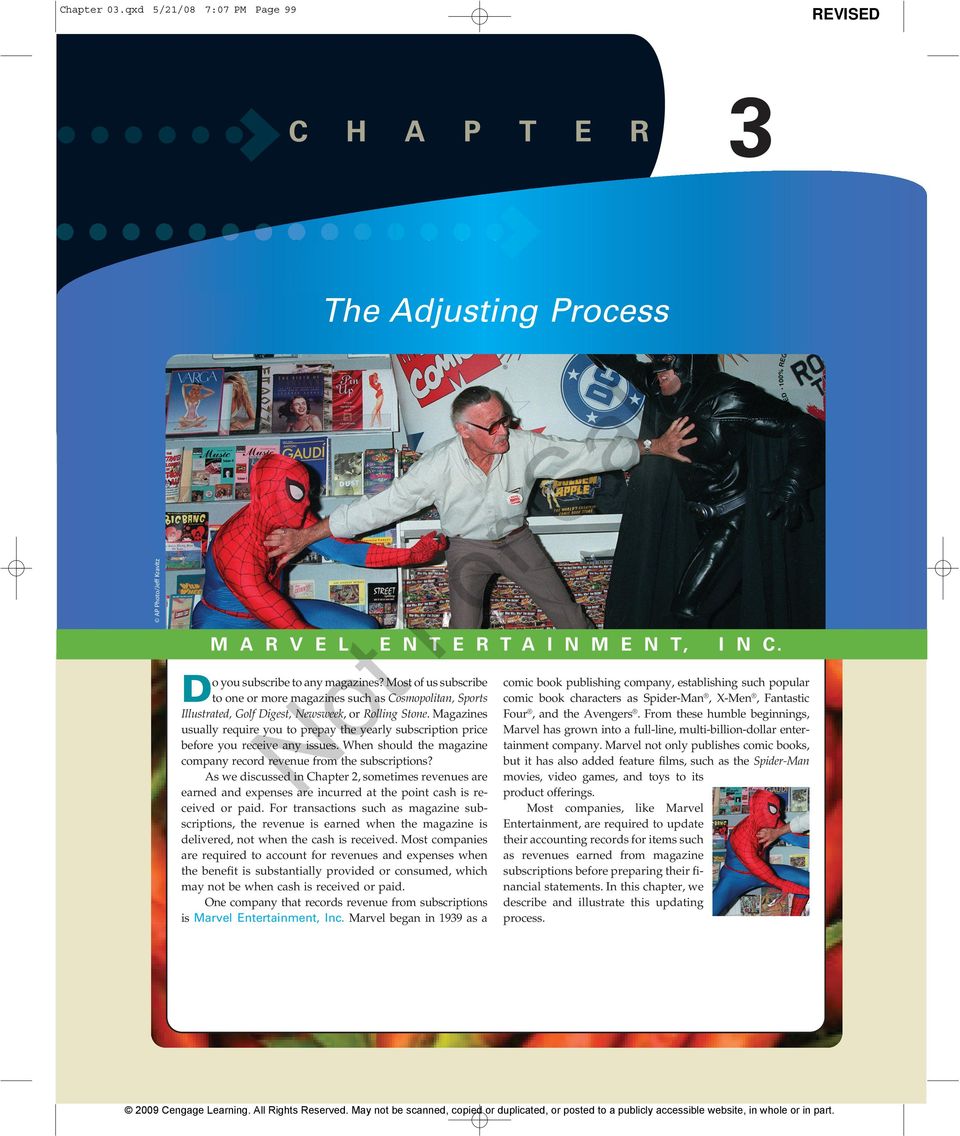
1 Chapter 03.qxd 5/21/08 7:07 PM Page 99 C H A P T E R 3 AP Photo/Jeff Kravitz Fo r Sa le The Adjusting Process M A R V E L D E N T E R T A I N M E N T, N ot o you subscribe to any magazines? Most of us subscribe to one or more magazines such as Cosmopolitan, Sports Illustrated, Golf Digest, Newsweek, or Rolling Stone. Magazines usually require you to prepay the yearly subscription price before you receive any issues. When should the magazine company record revenue from the subscriptions? As we discussed in Chapter 2, sometimes revenues are earned and expenses are incurred at the point cash is received or paid. For transactions such as magazine subscriptions, the revenue is earned when the magazine is delivered, not when the cash is received. Most companies are required to account for revenues and expenses when the benefit is substantially provided or consumed, which may not be when cash is received or paid. One company that records revenue from subscriptions is Marvel Entertainment, Inc. Marvel began in 1939 as a I N C. comic book publishing company, establishing such popular comic book characters as Spider-Man, X-Men, Fantastic Four, and the Avengers. From these humble beginnings, Marvel has grown into a full-line, multi-billion-dollar entertainment company. Marvel not only publishes comic books, but it has also added feature films, such as the Spider-Man movies, video games, and toys to its product offerings. Most companies, like Marvel Entertainment, are required to update their accounting records for items such as revenues earned from magazine subscriptions before preparing their financial statements. In this chapter, we describe and illustrate this updating process.
2 Chapter 03.qxd 5/21/08 7:08 PM Page Chapter 3 The Adjusting Process After studying this chapter, you should be able to: 1 Describe the nature of the adjusting process Journalize entries for accounts requiring adjustment. Summarize the adjustment process. Prepare an adjusted trial balance. Nature of the Adjusting Process The Adjusting Process EE 3-1 (page 101) Types of Accounts Requiring Adjustment EE 3-2 (page 104) 1 Describe the nature of the adjusting process. American Airlines uses the accrual basis of accounting. Revenues are recognized when passengers take flights, not when the passenger makes the reservation or pays for the ticket. Recording Adjusting Entries Prepaid Expenses EE 3-3 (page 107) Unearned Revenues EE 3-4 (page 108) Accrued Revenues EE 3-5 (page 109) Accrued Expenses EE 3-6 (page 111) Depreciation Expense EE 3-7 (page 113) Summary of Adjustment Process EE 3-8 (page 113) Adjusted Trial Balance EE 3-9 (page 119) At a Glance Menu Turn to pg 121 Nature of the Adjusting Process When preparing financial statements, the economic life of the business is divided into time periods. This accounting period concept requires that revenues and expenses be reported in the proper period. To determine the proper period, accountants use generally accepted accounting principles (GAAP). The use of the accrual basis of accounting is required by GAAP. Under the accrual basis of accounting, revenues are reported in the income statement in the period in which they are earned. For example, revenue is reported when the services are provided to customers. Cash may or may not be received from customers during this period. The accounting concept supporting this reporting of revenues is called the revenue recognition concept. Under the accrual basis, expenses are reported in the same period as the revenues to which they relate. For example, utility expenses incurred in December are reported as an expense and matched against December s revenues even though the utility bill may not be paid until January. The accounting concept supporting reporting revenues and related expenses in the same period is called the matching concept, or matching principle. By matching revenues and expenses, net income or loss for the period is properly reported on the income statement. Although GAAP requires the accrual basis of accounting, some businesses use the cash basis of accounting. Under the cash basis of accounting, revenues and expenses are

3 Chapter 03.qxd 5/21/08 7:08 PM Page 101 Chapter 3 The Adjusting Process 101 The matching concept supports reporting revenues and related expenses in the same period. Example Exercise 3-1 reported in the income statement in the period in which cash is received or paid. For example, fees are recorded when cash is received from clients; likewise, wages are recorded when cash is paid to employees. The net income (or net loss) is the difference between the cash receipts (revenues) and the cash payments (expenses). Small service businesses may use the cash basis, because The Adjusting Process they have few receivables and payables. For example, attorneys, physicians, and real estate agents often use the cash basis. For them, the cash basis provides financial statements similar to those of the accrual basis. For most large businesses, however, the cash basis will not provide accurate financial statements for user needs. For this reason, we use the accrual basis in this text. At the end of the accounting period, many of the account balances in the ledger can be reported in the financial statements without change. For example, the balances of the cash and land accounts are normally the amount reported on the balance sheet. Under the accrual basis, however, some accounts in the ledger require updating. 1 This updating is required for the following reasons: 1. Some expenses are not recorded daily. For example, the daily use of supplies would require many entries with small amounts. Also, managers usually do not need to know the amount of supplies on hand on a day-to-day basis. 2. Some revenues and expenses are incurred as time passes rather than as separate transactions. For example, rent received in advance (unearned rent) expires and becomes revenue with the passage of time. Likewise, prepaid insurance expires and becomes an expense with the passage of time. 3. Some revenues and expenses may be unrecorded. For example, a company may have provided services to customers that it has not billed or recorded at the end of the accounting period. Likewise, a company may not pay its employees until the next accounting period even though the employees have earned their wages in the current period. All adjusting entries affect at least one income statement account and one balance sheet account. The analysis and updating of accounts at the end of the period before the financial statements are prepared is called the adjusting process. The journal entries that bring the accounts up to date at the end of the accounting period are called adjusting entries. All adjusting entries affect at least one income statement account and one balance sheet account. Thus, an adjusting entry will always involve a revenue or an expense account and an asset or a liability account. Accounts Requiring Adjustment Indicate with a Yes or No whether or not each of the following accounts normally requires an adjusting entry. a. Cash c. Wages Expense e. Accounts Receivable b. Prepaid Rent d. Office Equipment f. Unearned Rent Follow My Example 3-1 a. No c. Yes e. Yes b. Yes d. No f. Yes 1 For Practice: PE 3-1A, PE 3-1B 1 Under the cash basis of accounting, accounts do not require adjusting. This is because transactions are recorded only when cash is received or paid. Thus, the matching concept is not used under the cash basis.
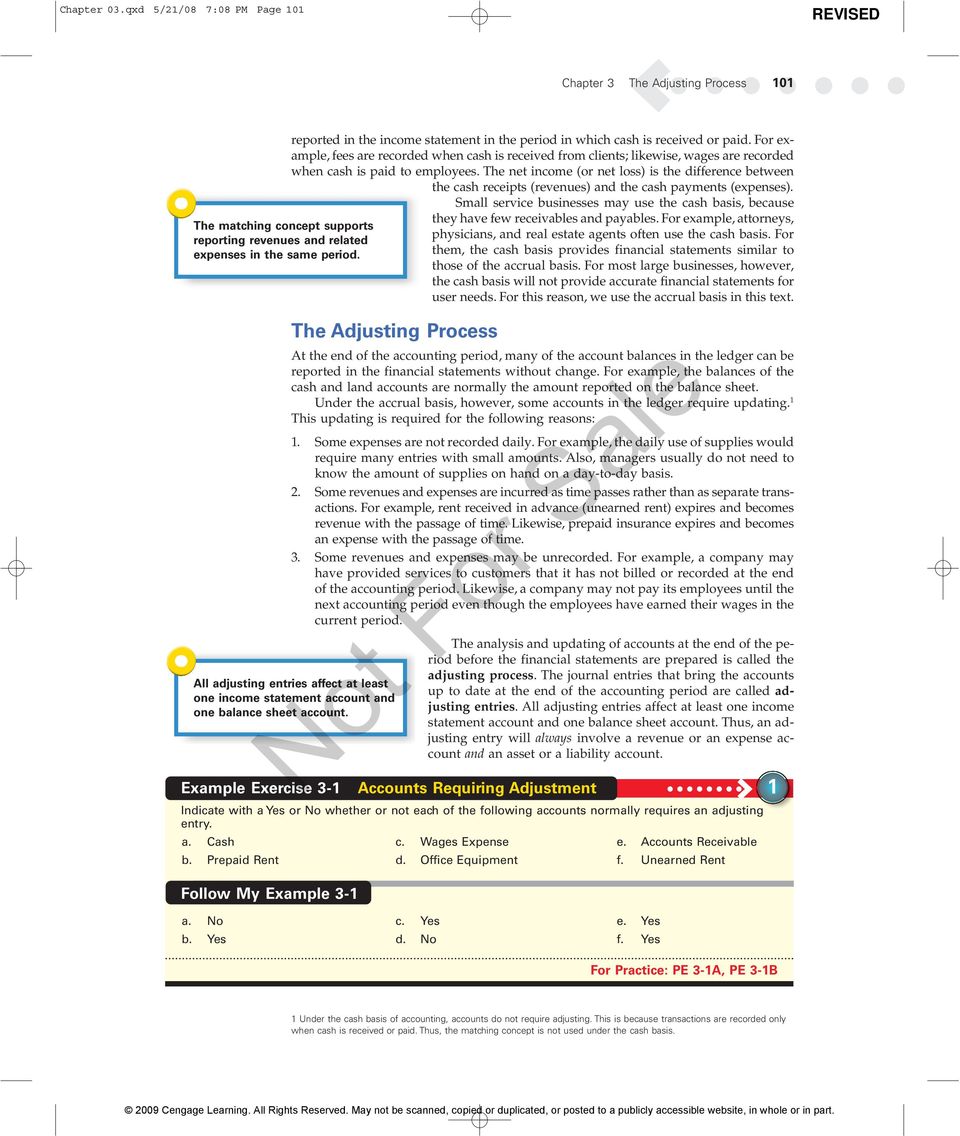
4 Chapter 03.qxd 5/21/08 7:08 PM Page Chapter 3 The Adjusting Process Types of Accounts Requiring Adjustment Four basic types of accounts require adjusting entries as shown below. 1. Prepaid expenses 3. Accrued revenues 2. Unearned revenues 4. Accrued expenses Prepaid expenses are the advance payment of future expenses and are recorded as assets when cash is paid. Prepaid expenses become expenses over time or during normal operations. To illustrate, the following transaction of NetSolutions from Chapter 2 is used. Dec. 1 NetSolutions paid $2,400 as a premium on a one-year insurance policy. The tuition you pay at the beginning of each term is an example of a prepaid expense to you, as a student. Exhibit 1 On December 1, the cash payment of $2,400 was recorded as a debit to Prepaid Insurance and credit to Cash for $2,400. At the end of December, only $200 ($2,400 divided by 12 months) of the insurance premium is expired and has become an expense. The remaining $2,200 of prepaid insurance will become an expense in future months. Thus, the $200 is insurance expense of December and should be recorded with an adjusting entry. Other examples of prepaid expenses include supplies, prepaid advertising, and prepaid interest. Unearned revenues are the advance receipt of future revenues and are recorded as liabilities when cash is received. Unearned revenues become earned revenues over time or during normal operations. To illustrate, we use the following December 1 transaction of NetSolutions. Dec. 1 NetSolutions received $360from a local retailer to rent land for three months. On December 1, the cash receipt of $360 was recorded as a debit to Cash and a credit to Unearned Rent for $360. At the end of December, $120 ($360 divided by 3 months) of the unearned rent has been earned. The remaining $240 will become rent revenue in future months. Thus, the $120 is rent revenue of December and should be recorded with an adjusting entry. Other examples of unearned revenues include tuition received in advance by a school, an annual retainer fee received by an attorney, premiums received in advance by an insurance company, and magazine subscriptions received in advance by a publisher. Exhibit 1 illustrates the nature of prepaid expenses and unearned revenues. Type of Adjustments: Prepaid Expenses and Unearned Revenues
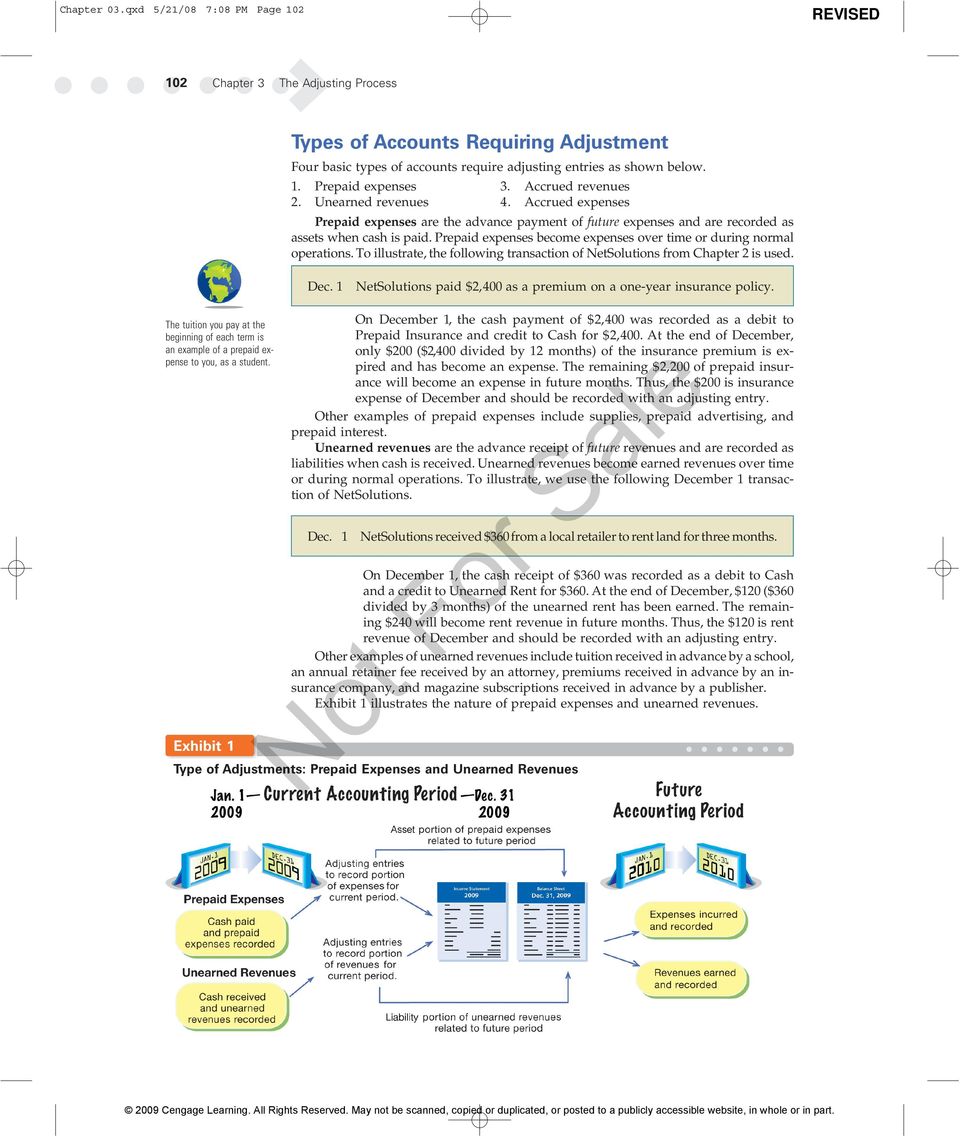
5 Chapter 03.qxd 5/21/08 7:08 PM Page 103 Chapter 3 The Adjusting Process 103 Exhibit 2 Accrued revenues are unrecorded revenues that have been earned and for which cash has yet to be received. Fees for services that an attorney or a doctor has provided but not yet billed are accrued revenues. To illustrate, we use the following example involving NetSolutions and one of its customers. Dec. 15 NetSolutions signed an agreement with Dankner Co. on December 15 under which NetSolutions will bill Dankner Co. on the fifteenth of each month for services rendered at the rate of $20 per hour. From December 16, NetSolutions provided 25 hours of service to Dankner Co. Although the revenue of $500 (25 hours $20) has been earned, it will not be billed until January 15. Likewise, cash of $500 will not be received until Dankner pays its bill. Thus, the $500 of accrued revenue and the $500 of fees earned should be recorded with an adjusting entry on December. Other examples of accrued revenues include accrued interest on notes receivable and accrued rent on property rented to others. Accrued expenses are unrecorded expenses that have been incurred and for which cash has yet to be paid. Wages owed to employees at the end of a period but not yet paid is an accrued expense. To illustrate, the following example involving NetSolutions and its employees is used: Dec. Type of Adjustments: Accrued Revenues and Expenses NetSolutions owes its employees wages of $250 for Monday and Tuesday, December 30 and. NetSolutions paid wages of $950 on December 13 and $1,200 on December 27,. These payments covered the biweekly pay periods that ended on those days. As of December,, NetSolutions owes its employees wages of $250 for Monday and Tuesday, December 30 and. The wages of $250 will be paid on January 10, 2010, however, they are an expense of December. Thus, $250 of accrued wages should be recorded with an adjusting entry on December. Other examples of accrued expenses include accrued interest on notes payable and accrued taxes. As illustrated above, accrued revenues are earned revenues that are unrecorded. The cash receipts for accrued revenues are normally received in the next accounting period. Accrued expenses are expenses that have been incurred, but are unrecorded. The cash payments for accrued expenses are normally paid in the next accounting period. Exhibit 2 illustrates the nature of accrued revenues and accrued expenses.
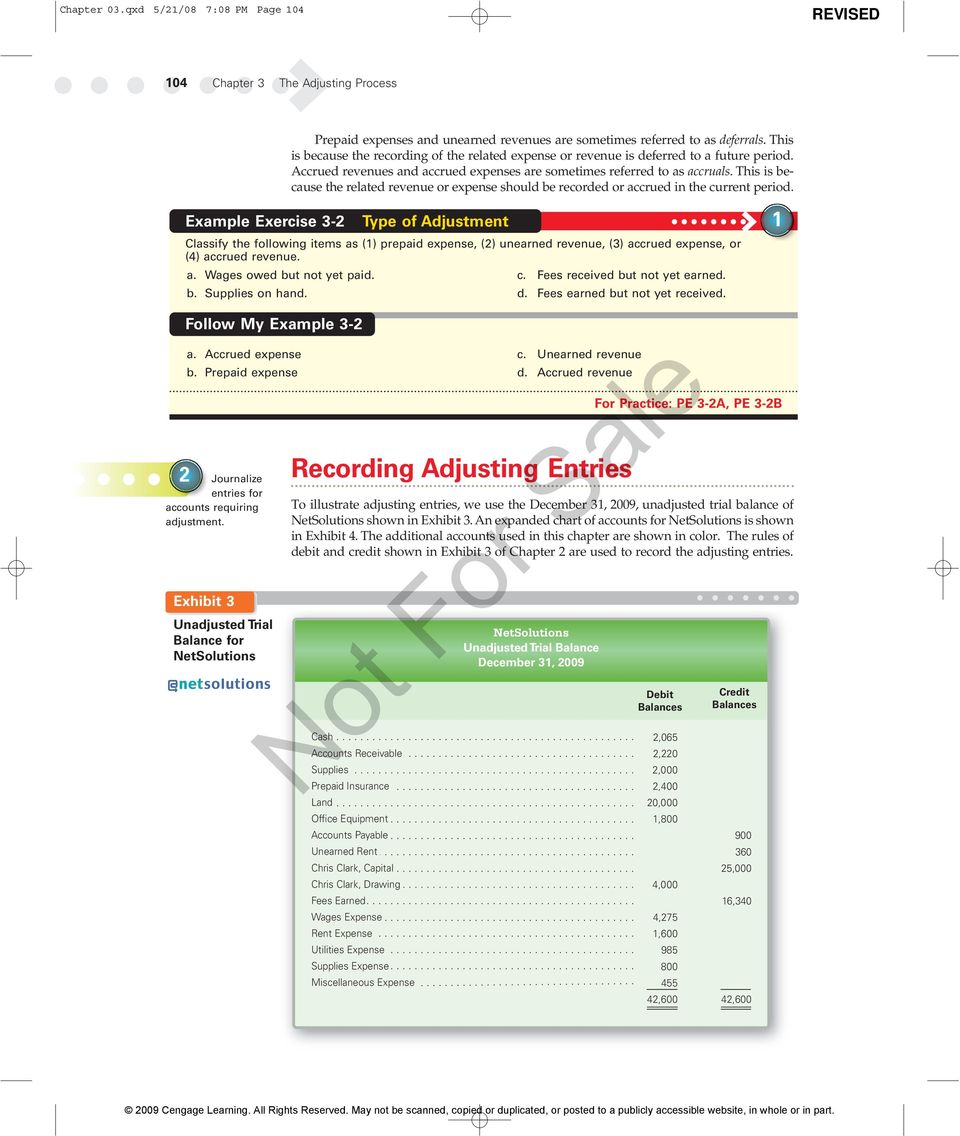
6 Chapter 03.qxd 5/21/08 7:08 PM Page Chapter 3 The Adjusting Process Prepaid expenses and unearned revenues are sometimes referred to as deferrals. This is because the recording of the related expense or revenue is deferred to a future period. Accrued revenues and accrued expenses are sometimes referred to as accruals. This is because the related revenue or expense should be recorded or accrued in the current period. Example Exercise 3-2 Type of Adjustment 1 Classify the following items as (1) prepaid expense, (2) unearned revenue, (3) accrued expense, or (4) accrued revenue. a. Wages owed but not yet paid. c. Fees received but not yet earned. b. Supplies on hand. d. Fees earned but not yet received. 1 Follow My Example 3-2 a. Accrued expense c. Unearned revenue b. Prepaid expense d. Accrued revenue 2 Journalize entries for accounts requiring adjustment. Exhibit 3 Unadjusted Trial Balance for NetSolutions Recording Adjusting Entries For Practice: PE 3-2A, PE 3-2B To illustrate adjusting entries, we use the December,, unadjusted trial balance of NetSolutions shown in Exhibit 3. An expanded chart of accounts for NetSolutions is shown in Exhibit 4. The additional accounts used in this chapter are shown in color. The rules of debit and credit shown in Exhibit 3 of Chapter 2 are used to record the adjusting entries. Cash Accounts Receivable Supplies Prepaid Insurance Land Office Equipment Accounts Payable Unearned Rent Chris Clark, Capital Chris Clark, Drawing Fees Earned Wages Expense Rent Expense Utilities Expense Supplies Expense Miscellaneous Expense NetSolutions Unadjusted Trial Balance December, Debit Balances 2,065 2,220 2,000 2,400 20,000 1,800 4,000 4,275 1, ,600 Credit Balances ,000 16,340 42,600
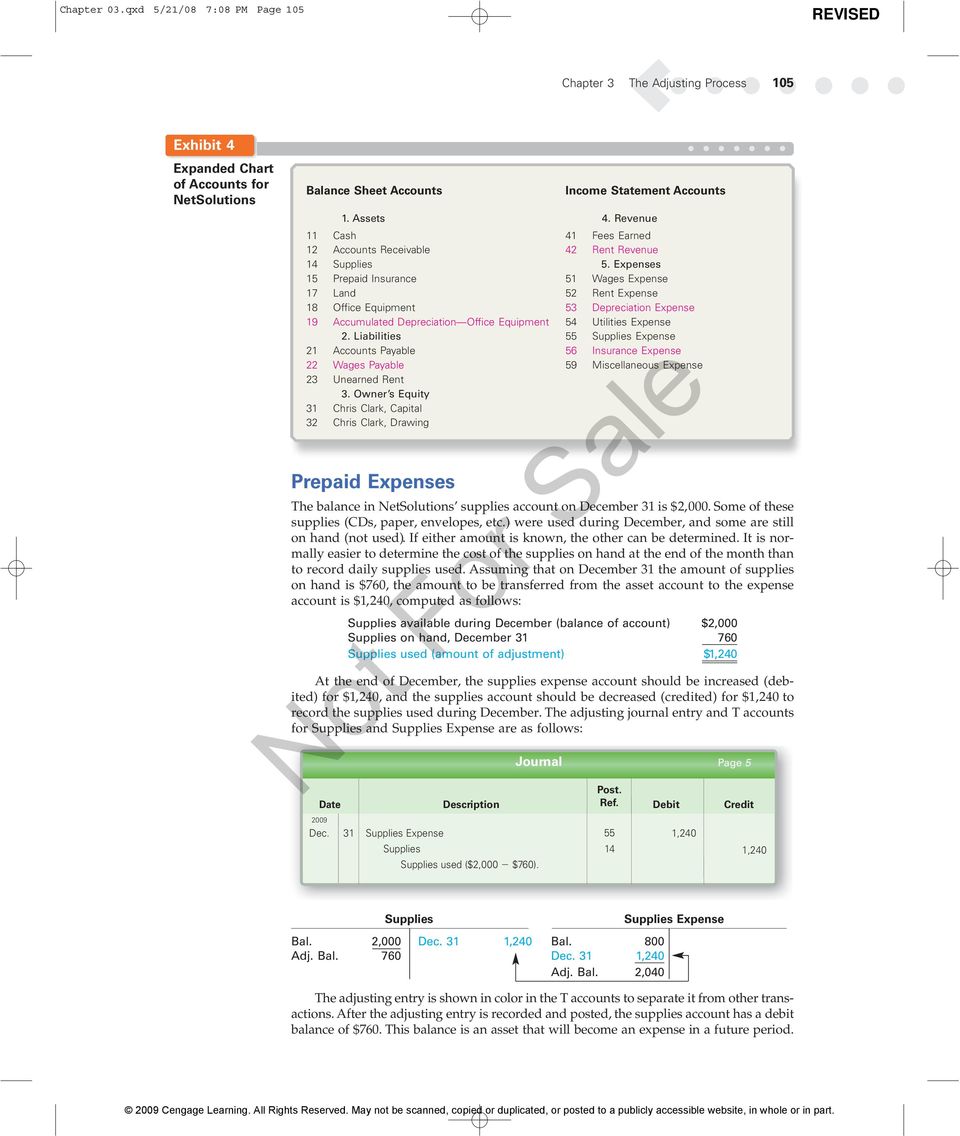
7 Chapter 03.qxd 5/21/08 7:08 PM Page 105 Chapter 3 The Adjusting Process 105 Exhibit 4 Expanded Chart of Accounts for NetSolutions Balance Sheet Accounts Prepaid Expenses Income Statement Accounts 1. Assets 4. Revenue 11 Cash 41 Fees Earned 12 Accounts Receivable 42 Rent Revenue 14 Supplies 5. Expenses 15 Prepaid Insurance 51 Wages Expense 17 Land 52 Rent Expense 18 Office Equipment 53 Depreciation Expense 19 Accumulated Depreciation Office Equipment 54 Utilities Expense 2. Liabilities 55 Supplies Expense 21 Accounts Payable 56 Insurance Expense 22 Wages Payable 59 Miscellaneous Expense 23 Unearned Rent 3. Owner s Equity Chris Clark, Capital 32 Chris Clark, Drawing The balance in NetSolutions supplies account on December is $2,000. Some of these supplies (CDs, paper, envelopes, etc.) were used during December, and some are still on hand (not used). If either amount is known, the other can be determined. It is normally easier to determine the cost of the supplies on hand at the end of the month than to record daily supplies used. Assuming that on December the amount of supplies on hand is $760, the amount to be transferred from the asset account to the expense account is $1,240, computed as follows: Supplies available during December (balance of account) $2,000 Supplies on hand, December 760 Supplies used (amount of adjustment) $1,240 At the end of December, the supplies expense account should be increased (debited) for $1,240, and the supplies account should be decreased (credited) for $1,240 to record the supplies used during December. The adjusting journal entry and T accounts for Supplies and Supplies Expense are as follows: Dec. Supplies Expense Supplies Description Supplies used ($2,000 $760). Journal Page 5 Ref. Debit Credit ,240 1,240 Supplies Bal. 2,000 Dec. 1,240 Bal. 800 Adj. Bal. 760 Dec. 1,240 Adj. Bal. 2,040 Supplies Expense The adjusting entry is shown in color in the T accounts to separate it from other transactions. After the adjusting entry is recorded and posted, the supplies account has a debit balance of $760. This balance is an asset that will become an expense in a future period.
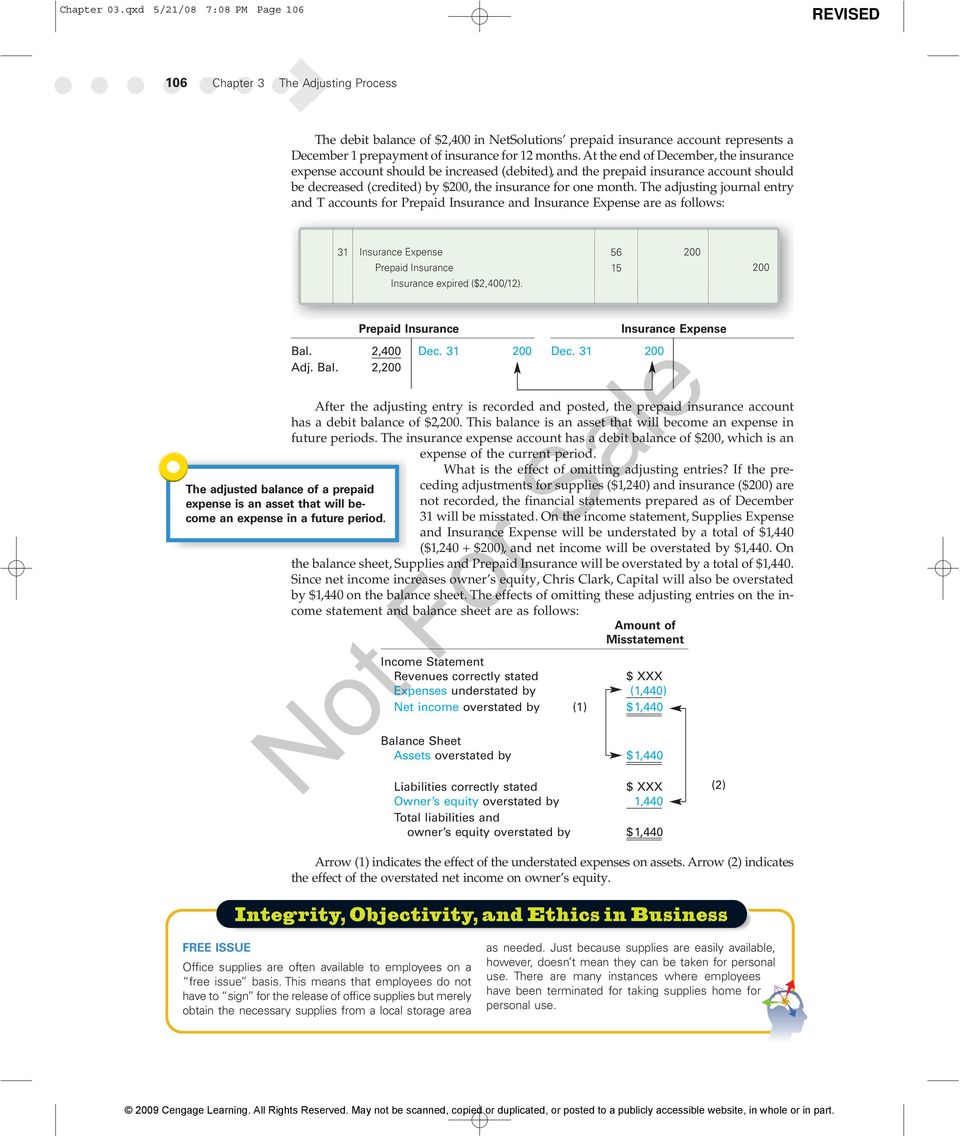
8 Chapter 03.qxd 5/21/08 7:08 PM Page Chapter 3 The Adjusting Process The debit balance of $2,400 in NetSolutions prepaid insurance account represents a December 1 prepayment of insurance for 12 months. At the end of December, the insurance expense account should be increased (debited), and the prepaid insurance account should be decreased (credited) by $200, the insurance for one month. The adjusting journal entry and T accounts for Prepaid Insurance and Insurance Expense are as follows: Insurance Expense 56 Prepaid Insurance 15 Insurance expired ($2,400/12) The adjusted balance of a prepaid expense is an asset that will become an expense in a future period. Prepaid Insurance Bal. 2,400 Dec. 200 Dec. 200 Adj. Bal. 2,200 Insurance Expense After the adjusting entry is recorded and posted, the prepaid insurance account has a debit balance of $2,200. This balance is an asset that will become an expense in future periods. The insurance expense account has a debit balance of $200, which is an expense of the current period. What is the effect of omitting adjusting entries? If the preceding adjustments for supplies ($1,240) and insurance ($200) are not recorded, the financial statements prepared as of December will be misstated. On the income statement, Supplies Expense and Insurance Expense will be understated by a total of $1,440 ($1,240 + $200), and net income will be overstated by $1,440. On the balance sheet, Supplies and Prepaid Insurance will be overstated by a total of $1,440. Since net income increases owner s equity, Chris Clark, Capital will also be overstated by $1,440 on the balance sheet. The effects of omitting these adjusting entries on the income statement and balance sheet are as follows: Amount of Misstatement Income Statement Revenues correctly stated $ XXX Expenses understated by (1,440) Net income overstated by (1) $ 1,440 Balance Sheet Assets overstated by $ 1,440 Liabilities correctly stated $ XXX Owner s equity overstated by 1,440 Total liabilities and owner s equity overstated by $ 1,440 Arrow (1) indicates the effect of the understated expenses on assets. Arrow (2) indicates the effect of the overstated net income on owner s equity. (2) FREE ISSUE Office supplies are often available to employees on a free issue basis. This means that employees do not have to sign for the release of office supplies but merely obtain the necessary supplies from a local storage area as needed. Just because supplies are easily available, however, doesn t mean they can be taken for personal use. There are many instances where employees have been terminated for taking supplies home for personal use.
9 Chapter 03.qxd 5/21/08 7:08 PM Page 107 Chapter 3 The Adjusting Process 107 Payments for prepaid expenses are sometimes made at the beginning of the period in which they will be entirely used or consumed. To illustrate, we use the following December 1 transaction of NetSolutions: Dec. 1 NetSolutions paid rent of $800 for the month. Example Exercise 3-3 Adjustment for Prepaid Expense The prepaid insurance account had a beginning balance of $6,400 and was debited for $3,600 of premiums paid during the year. Journalize the adjusting entry required at the end of the year assuming the amount of unexpired insurance related to future periods is $3,250. Follow My Example 3-3 Best Buy sells extended warranty contracts with terms between 12 and 36 months. The receipts from sales of these contracts are reported as unearned revenue on Best Buy s balance sheet. Revenue is recorded as the contracts expire. On December 1, the rent payment of $800 represents Prepaid Rent. However, the Prepaid Rent expires daily, and at the end of December there will be no asset left. In such cases, the payment of $800 is recorded as Rent Expense rather than as Prepaid Rent. In this way, no adjusting entry is needed at the end of the period. 2 Insurance Expense ,750 Prepaid Insurance ,750 Insurance expired ($6,400 $3,600 $3,250). Unearned Revenues For Practice: PE 3-3A, PE 3-3B The December unadjusted trial balance of NetSolutions indicates a balance in the unearned rent account of $360. This balance represents the receipt of three months rent on December 1 for December, January, and February. At the end of December, one month s rent has been earned. Thus, the unearned rent account should be decreased (debited) by $120, and the rent revenue account should be increased (credited) by $120. The $120 represents the rental revenue for one month ($360/3). The adjusting journal entry and T accounts are shown below. Unearned Rent 23 Rent Revenue 42 Rent earned ($360/3 months). Unearned Rent 2 An alternative treatment of recording the cost of supplies, rent, and other prepayments of expenses is discussed in an appendix that can be downloaded from the book s companion Web site (academic.cengage.com/accounting/warren) 3 An alternative treatment of recording revenues received in advance of their being earned is discussed in an appendix that can be downloaded from the book s companion Web site (academic.cengage.com/accounting/warren). 120 Rent Revenue Dec. 120 Bal. 360 Dec. 120 Adj. Bal. 240 After the adjusting entry is recorded and posted, the unearned rent account has a credit balance of $240. This balance is a liability that will become revenue in a future period. Rent Revenue has a balance of $120, which is revenue of the current period. 3 If the preceding adjustment of unearned rent and rent revenue is not recorded, the financial statements prepared on December will be misstated. On the income statement, Rent Revenue and the net income will be understated by $120. On the balance sheet, Unearned Rent will be overstated by $120, and Chris Clark, Capital will be understated by $120. The effects of omitting this adjusting entry are shown at the top of the next page

10 Chapter 03.qxd 5/21/08 7:08 PM Page Chapter 3 The Adjusting Process Amount of Misstatement Income Statement Revenues understated by $(120) Expenses correctly stated XXX Net income understated by $(120) Balance Sheet Assets correctly stated $XXX Example Exercise 3-4 Liabilities overstated by $ 120 Owner s equity understated by (120) Total liabilities and owner s equity correctly stated $XXX Adjustment for Unearned Revenue The balance in the unearned fees account, before adjustment at the end of the year, is $44,900. Journalize the adjusting entry required if the amount of unearned fees at the end of the year is $22,300. Follow My Example 3-4 RadioShack Corporation is engaged in consumer electronics retailing. RadioShack accrues revenue for finance charges, late charges, and returned check fees related to its credit operations. Unearned Fees ,600 Fees Earned ,600 Fees earned ($44,900 $22,300). Accrued Revenues 2 For Practice: PE 3-4A, PE 3-4B During an accounting period, some revenues are recorded only when cash is received. Thus, at the end of an accounting period, there may be revenue that has been earned but has not been recorded. In such cases, the revenue should be recorded by increasing (debiting) an asset account and increasing (crediting) a revenue account. To illustrate, assume that NetSolutions signed an agreement with Dankner Co. on December 15. The agreement provides that NetSolutions will answer computer questions and render assistance to Dankner Co. s employees. The services will be billed to Dankner Co. on the fifteenth of each month at a rate of $20 per hour. As of December, NetSolutions had provided 25 hours of assistance to Dankner Co. The revenue of $500 (25 hours $20) will be billed on January 15. However, NetSolutions earned the revenue in December. The claim against the customer for payment of the $500 is an account receivable (an asset). Thus, the accounts receivable account should be increased (debited) by $500 and the fees earned account should be increased (credited) by $500. The adjusting journal entry and T accounts are shown below. Accounts Receivable 12 Fees Earned 41 Accrued fees (25 hrs. $20) Accounts Receivable Fees Earned Bal. 2,220 Bal. 16,340 Dec. 500 Dec. 500 Adj. Bal. 2,720 Adj. Bal. 16,840

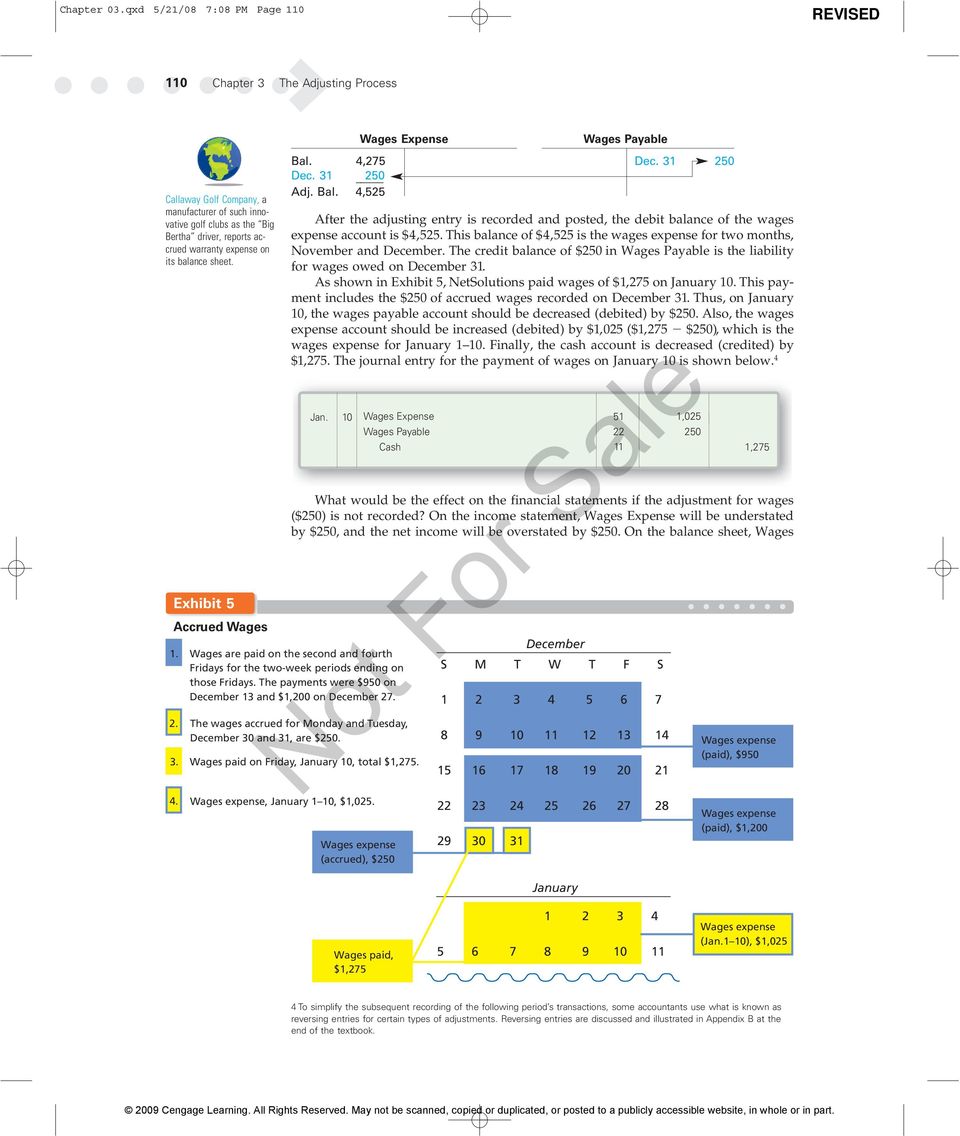
11 Chapter 03.qxd 5/21/08 7:08 PM Page 109 Chapter 3 The Adjusting Process 109 Example Exercise 3-5 If the adjustment for the accrued revenue ($500) is not recorded, Fees Earned and the net income will be understated by $500 on the income statement. On the balance sheet, Accounts Receivable and Chris Clark, Capital will be understated by $500. The effects of omitting this adjusting entry are shown below. Amount of Misstatement Income Statement Revenues understated by $ (500) Expenses correctly stated XXX Net income understated by $ (500) Balance Sheet Assets understated by $ (500) Liabilities correctly stated $ XXX Owner s equity understated by (500) Total liabilities and owner s equity understated by $ (500) Adjustment for Accrued Revenues At the end of the current year, $13,680 of fees have been earned but have not been billed to clients. Journalize the adjusting entry to record the accrued fees. Follow My Example 3-5 Accounts Receivable ,680 Fees Earned ,680 Accrued fees. Accrued Expenses 2 For Practice: PE 3-5A, PE 3-5B Some types of services used in earning revenues are paid for after the service has been performed. For example, wages expense is used hour by hour, but is paid only daily, weekly, biweekly, or monthly. At the end of the accounting period, the amount of such accrued but unpaid items is an expense and a liability. For example, if the last day of the employees pay period is not the last day of the accounting period, an accrued expense (wages expense) and the related liability (wages payable) must be recorded by an adjusting entry. This adjusting entry is necessary so that expenses are properly matched to the period in which they were incurred in earning revenue. To illustrate, NetSolutions pays its employees biweekly. During December, NetSolutions paid wages of $950 on December 13 and $1,200 on December 27. These payments covered pay periods ending on those days as shown in Exhibit 5. As of December, NetSolutions owes $250 of wages to employees for Monday and Tuesday, December 30 and. Thus, the wages expense account should be increased (debited) by $250 and the wages payable account should be increased (credited) by $250. The adjusting journal entry and T accounts are shown below. Wages Expense 51 Wages Payable 22 Accrued wages

12 Chapter 03.qxd 5/21/08 7:08 PM Page Chapter 3 The Adjusting Process Callaway Golf Company, a manufacturer of such innovative golf clubs as the Big Bertha driver, reports accrued warranty expense on its balance sheet. Exhibit 5 Accrued Wages Wages Expense Wages Payable Bal. 4,275 Dec. 250 Dec. 250 Adj. Bal. 4,525 After the adjusting entry is recorded and posted, the debit balance of the wages expense account is $4,525. This balance of $4,525 is the wages expense for two months, November and December. The credit balance of $250 in Wages Payable is the liability for wages owed on December. As shown in Exhibit 5, NetSolutions paid wages of $1,275 on January 10. This payment includes the $250 of accrued wages recorded on December. Thus, on January 10, the wages payable account should be decreased (debited) by $250. Also, the wages expense account should be increased (debited) by $1,025 ($1,275 $250), which is the wages expense for January Finally, the cash account is decreased (credited) by $1,275. The journal entry for the payment of wages on January 10 is shown below. 4 Jan. 10 Wages Expense 51 1,025 Wages Payable Cash 11 1,275 What would be the effect on the financial statements if the adjustment for wages ($250) is not recorded? On the income statement, Wages Expense will be understated by $250, and the net income will be overstated by $250. On the balance sheet, Wages Wages are paid on the second and fourth Fridays for the two-week periods ending on those Fridays. The payments were $950 on December 13 and $1,200 on December 27. The wages accrued for Monday and Tuesday, December 30 and, are $250. Wages paid on Friday, January 10, total $1, Wages expense, January 1 10, $1,025. Wages expense (accrued), $250 December S M T W T F S January Wages expense (paid), $950 Wages expense (paid), $1,200 Wages paid, $1, Wages expense (Jan.1 10), $1,025 4 To simplify the subsequent recording of the following period s transactions, some accountants use what is known as reversing entries for certain types of adjustments. Reversing entries are discussed and illustrated in Appendix B at the end of the textbook.
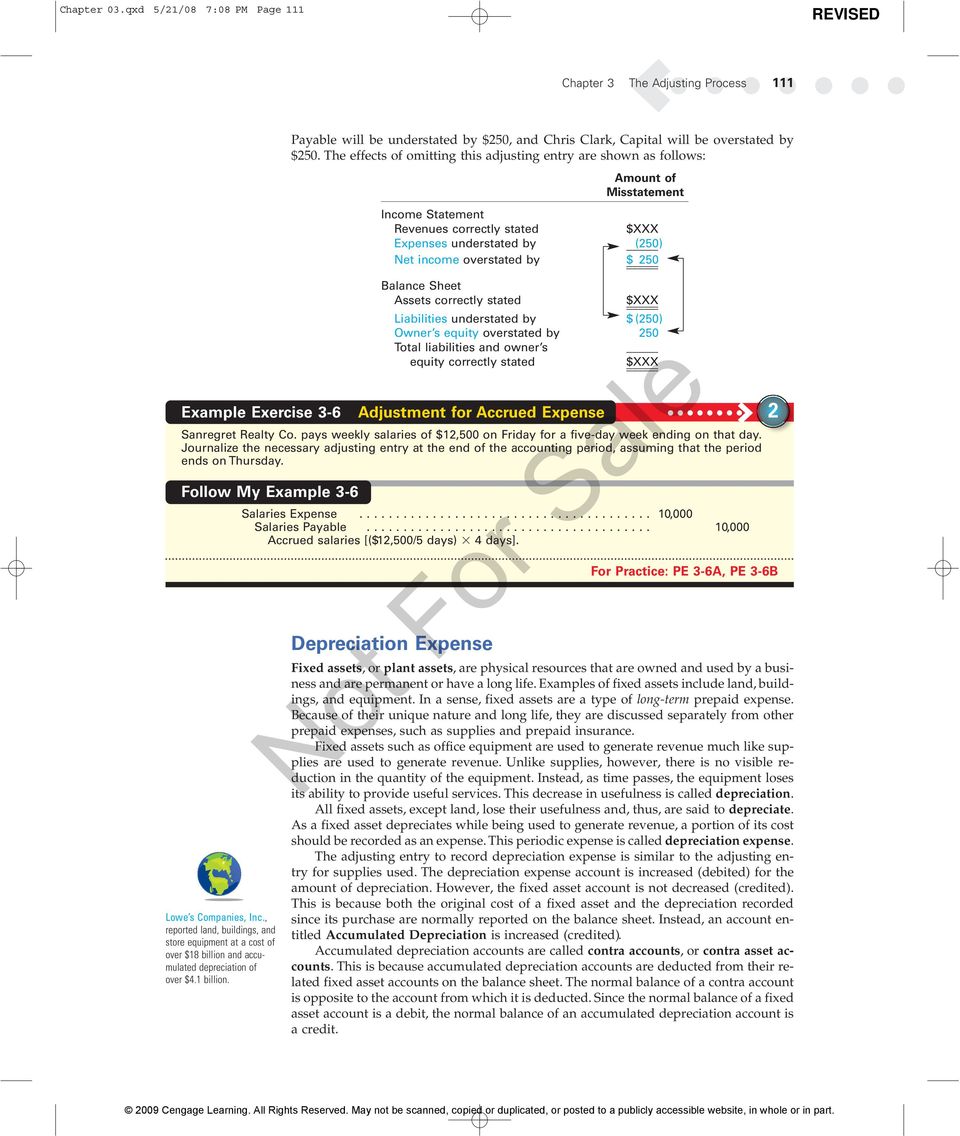
13 Chapter 03.qxd 5/21/08 7:08 PM Page 111 Chapter 3 The Adjusting Process 111 Example Exercise 3-6 Payable will be understated by $250, and Chris Clark, Capital will be overstated by $250. The effects of omitting this adjusting entry are shown as follows: Amount of Misstatement Income Statement Revenues correctly stated $XXX Expenses understated by (250) Net income overstated by $ 250 Balance Sheet Assets correctly stated $XXX Liabilities understated by $ (250) Owner s equity overstated by 250 Total liabilities and owner s equity correctly stated $XXX Adjustment for Accrued Expense Sanregret Realty Co. pays weekly salaries of $12,500 on Friday for a five-day week ending on that day. Journalize the necessary adjusting entry at the end of the accounting period, assuming that the period ends on Thursday. Follow My Example 3-6 Lowe s Companies, Inc., reported land, buildings, and store equipment at a cost of over $18 billion and accumulated depreciation of over $4.1 billion. Salaries Expense ,000 Salaries Payable ,000 Accrued salaries [($12,500/5 days) 4 days]. Depreciation Expense 2 For Practice: PE 3-6A, PE 3-6B Fixed assets, or plant assets, are physical resources that are owned and used by a business and are permanent or have a long life. Examples of fixed assets include land, buildings, and equipment. In a sense, fixed assets are a type of long-term prepaid expense. Because of their unique nature and long life, they are discussed separately from other prepaid expenses, such as supplies and prepaid insurance. Fixed assets such as office equipment are used to generate revenue much like supplies are used to generate revenue. Unlike supplies, however, there is no visible reduction in the quantity of the equipment. Instead, as time passes, the equipment loses its ability to provide useful services. This decrease in usefulness is called depreciation. All fixed assets, except land, lose their usefulness and, thus, are said to depreciate. As a fixed asset depreciates while being used to generate revenue, a portion of its cost should be recorded as an expense. This periodic expense is called depreciation expense. The adjusting entry to record depreciation expense is similar to the adjusting entry for supplies used. The depreciation expense account is increased (debited) for the amount of depreciation. However, the fixed asset account is not decreased (credited). This is because both the original cost of a fixed asset and the depreciation recorded since its purchase are normally reported on the balance sheet. Instead, an account entitled Accumulated Depreciation is increased (credited). Accumulated depreciation accounts are called contra accounts, or contra asset accounts. This is because accumulated depreciation accounts are deducted from their related fixed asset accounts on the balance sheet. The normal balance of a contra account is opposite to the account from which it is deducted. Since the normal balance of a fixed asset account is a debit, the normal balance of an accumulated depreciation account is a credit.
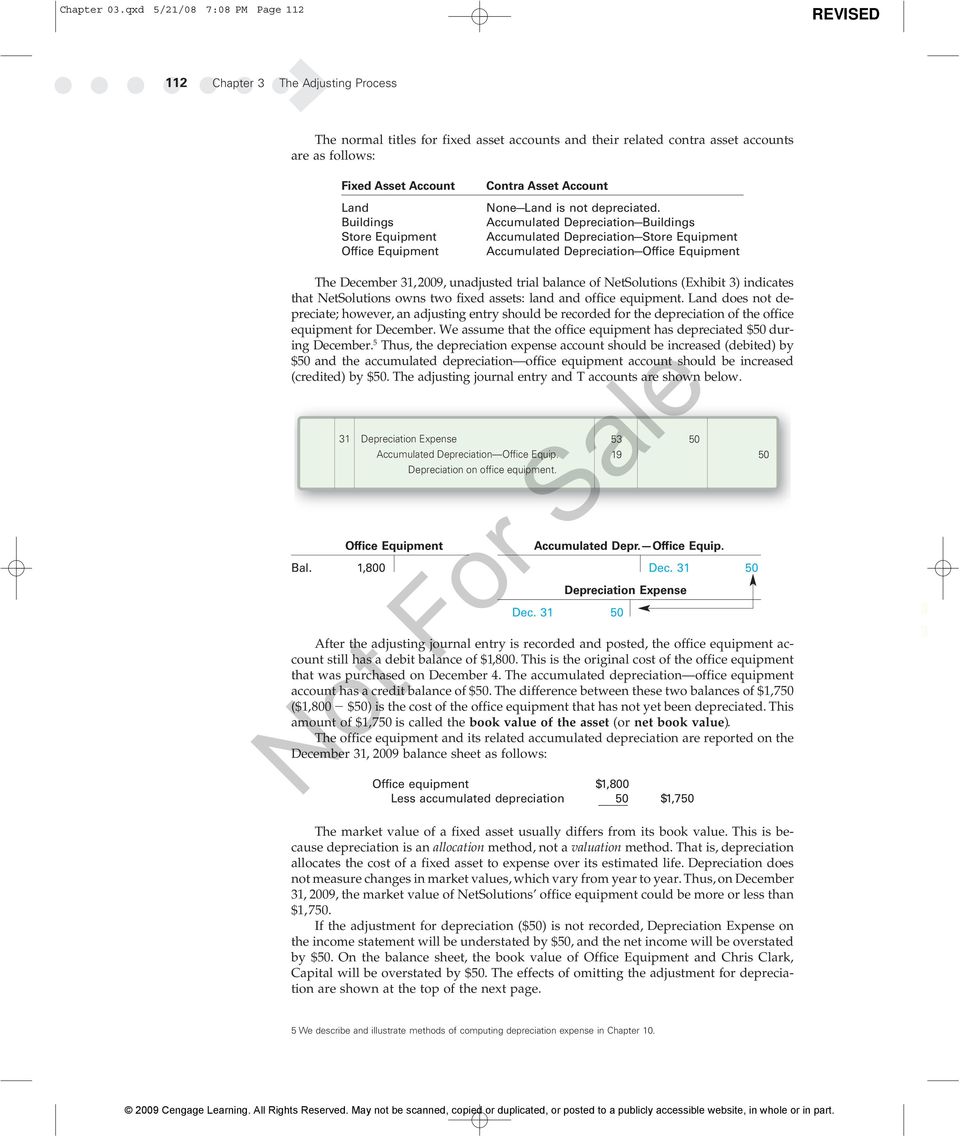
14 Chapter 03.qxd 5/21/08 7:08 PM Page Chapter 3 The Adjusting Process The normal titles for fixed asset accounts and their related contra asset accounts are as follows: Fixed Asset Account Land Buildings Store Equipment Office Equipment Contra Asset Account None Land is not depreciated. Accumulated Depreciation Buildings Accumulated Depreciation Store Equipment Accumulated Depreciation Office Equipment The December,, unadjusted trial balance of NetSolutions (Exhibit 3) indicates that NetSolutions owns two fixed assets: land and office equipment. Land does not depreciate; however, an adjusting entry should be recorded for the depreciation of the office equipment for December. We assume that the office equipment has depreciated $50 during December. 5 Thus, the depreciation expense account should be increased (debited) by $50 and the accumulated depreciation office equipment account should be increased (credited) by $50. The adjusting journal entry and T accounts are shown below. Depreciation Expense 53 Accumulated Depreciation Office Equip. 19 Depreciation on office equipment. Office Equipment Accumulated Depr. Office Equip. Bal. 1,800 Dec. 50 Depreciation Expense Dec. 50 After the adjusting journal entry is recorded and posted, the office equipment account still has a debit balance of $1,800. This is the original cost of the office equipment that was purchased on December 4. The accumulated depreciation office equipment account has a credit balance of $50. The difference between these two balances of $1,750 ($1,800 $50) is the cost of the office equipment that has not yet been depreciated. This amount of $1,750 is called the book value of the asset (or net book value). The office equipment and its related accumulated depreciation are reported on the December, balance sheet as follows: Office equipment $1,800 Less accumulated depreciation 50 $1,750 The market value of a fixed asset usually differs from its book value. This is because depreciation is an allocation method, not a valuation method. That is, depreciation allocates the cost of a fixed asset to expense over its estimated life. Depreciation does not measure changes in market values, which vary from year to year. Thus, on December,, the market value of NetSolutions office equipment could be more or less than $1,750. If the adjustment for depreciation ($50) is not recorded, Depreciation Expense on the income statement will be understated by $50, and the net income will be overstated by $50. On the balance sheet, the book value of Office Equipment and Chris Clark, Capital will be overstated by $50. The effects of omitting the adjustment for depreciation are shown at the top of the next page We describe and illustrate methods of computing depreciation expense in Chapter 10.
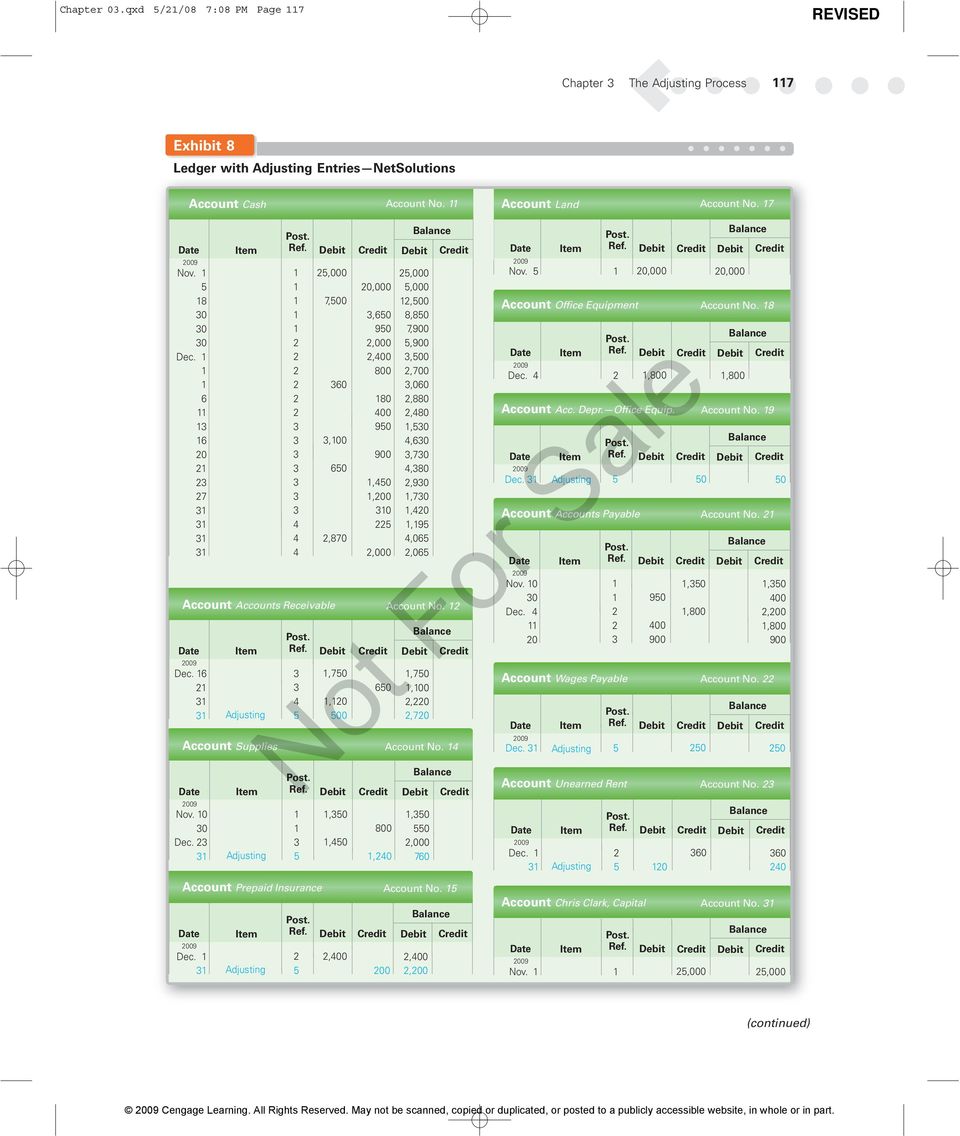
15 Chapter 03.qxd 5/21/08 7:08 PM Page 113 Chapter 3 The Adjusting Process 113 Example Exercise 3-7 Amount of Misstatement Income Statement Revenues correctly stated $XX Expenses understated by (50) Net income overstated by $ 50 Balance Sheet Assets overstated by $ 50 Liabilities correctly stated $XX Owner s equity overstated by 50 Total liabilities and owner s equity overstated by $ 50 Adjustment for Depreciation The estimated amount of depreciation on equipment for the current year is $4,250. Journalize the adjusting entry to record the depreciation. Follow My Example Summarize the adjustment process. Depreciation Expense ,250 Accumulated Depreciation Equipment ,250 Depreciation on equipment. Example Exercise For Practice: PE 3-7A, PE 3-7B Summary of Adjustment Process 3 objective Effect of Omitting Adjustments For the year ending December, 2010, Mann Medical Co. mistakenly omitted adjusting entries for (1) $8,600 of unearned revenue that was earned, (2) earned revenue that was not billed of $12,500, and (3) accrued wages of $2,900. Indicate the combined effect of the errors on (a) revenues, (b) expenses, and (c) net income for the year ended December, Follow My Example 3-8 We have described and illustrated the basic types of adjusting entries. A summary of these basic adjustments is shown in Exhibit 6 on pages The adjusting entries for NetSolutions are shown in Exhibit 7 on page 116. The adjusting entries are dated as of the last day of the period. However, because collecting the adjustment data requires time, the entries are usually recorded at a later date. An explanation is included with each adjusting entry. NetSolutions adjusting entries have been posted to the ledger shown in Exhibit 8 on pages The adjustments are shown in color in Exhibit 8 to distinguish them from other transactions. a. Revenues were understated by $21,100 ($8,600 $12,500). b. Expenses were understated by $2,900. c. Net income was understated by $18,200 ($8,600 $12,500 $2,900). 3 For Practice: PE 3-8A, PE 3-8B
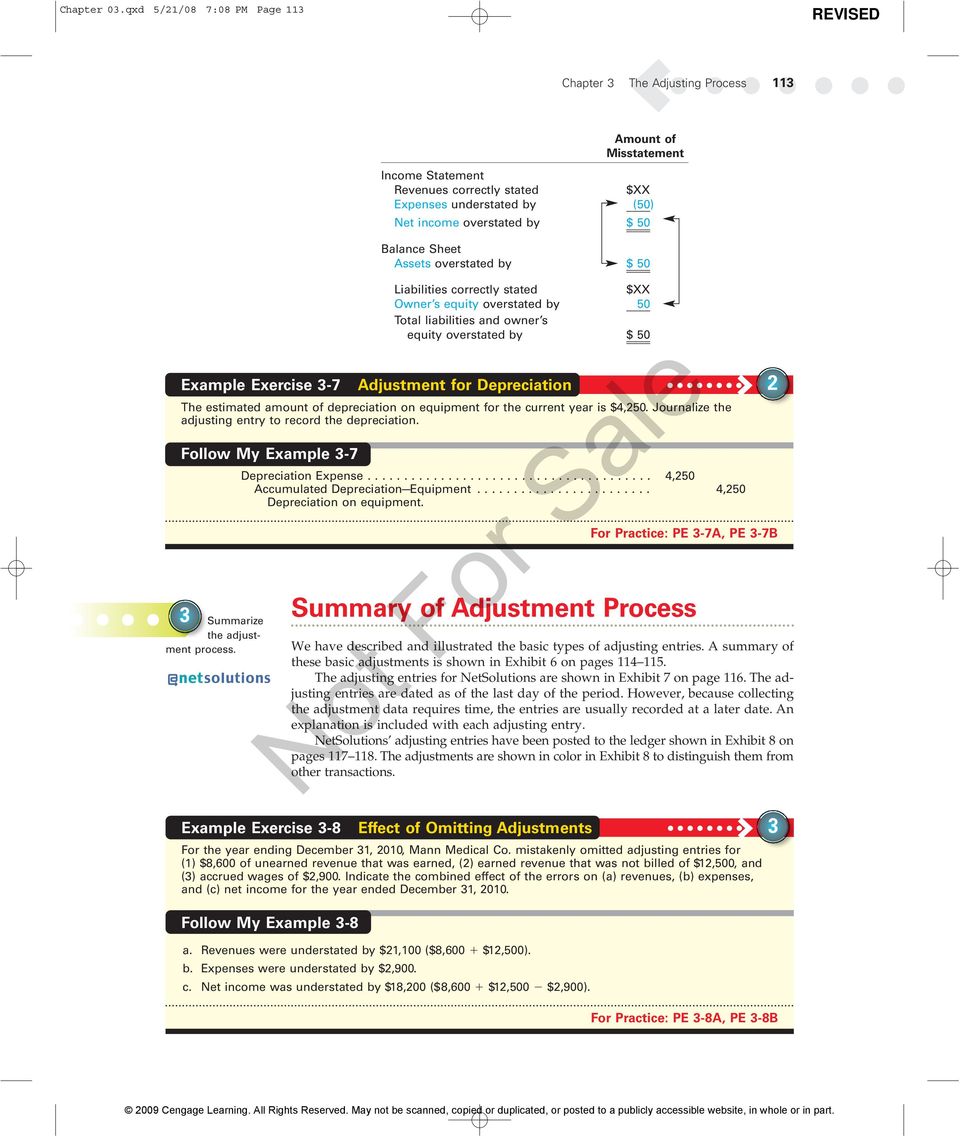
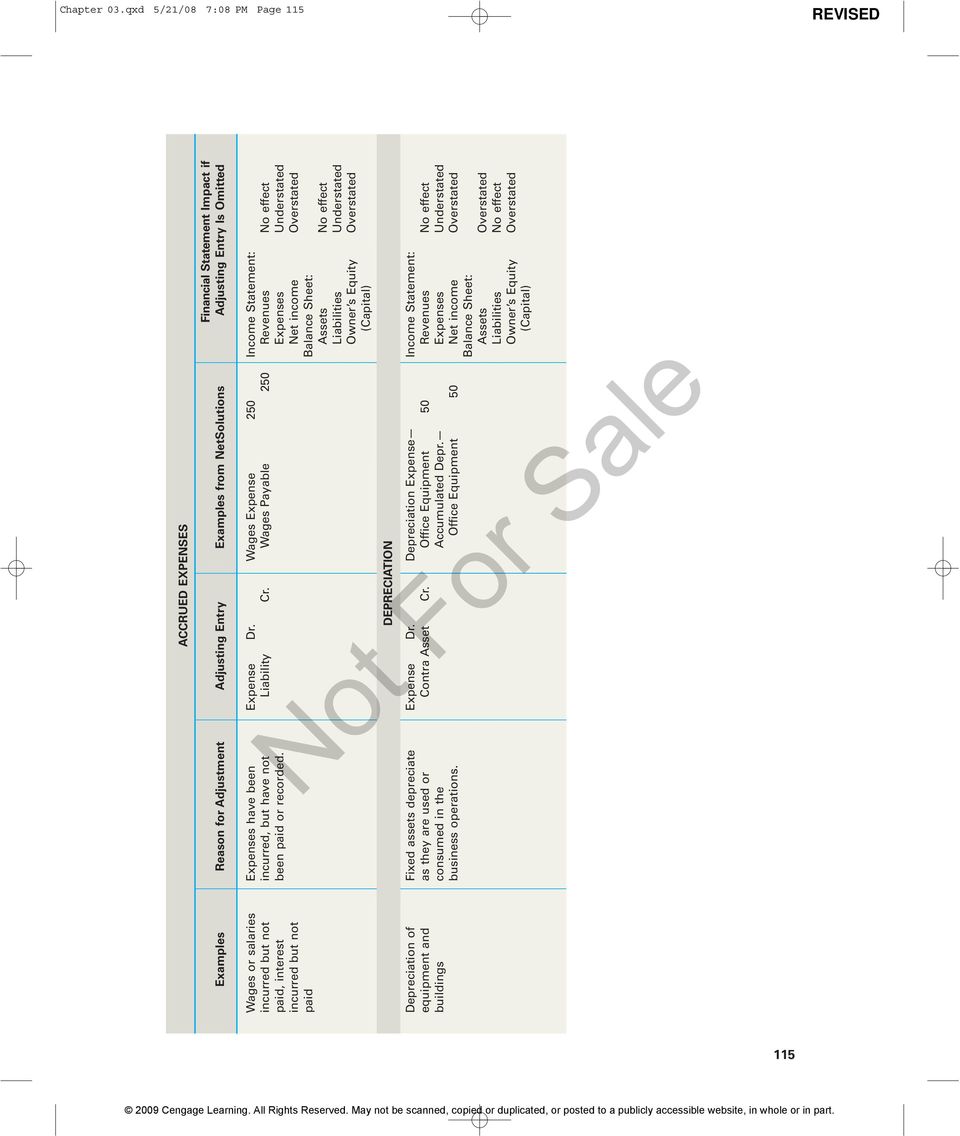
16 Chapter 03.qxd 5/21/08 7:08 PM Page 114 Exhibit 6 Summary of Adjustments PREPAID EXPENSES Financial Statement Impact if Examples Reason for Adjustment Adjusting Entry Examples from NetSolutions Adjusting Entry Is Omitted Supplies, Prepaid Prepaid expenses Expense Dr. Supplies Expense 1,240 Income Statement: Insurance (assets) have been Asset Cr. Supplies 1,240 Revenues No effect used or consumed in Expenses Understated the business operations. Insurance Expense 200 Net income Overstated Prepaid Insurance 200 Balance Sheet: Assets Overstated Liabilities No effect Owner s Equity Overstated (Capital) UNEARNED REVENUES Unearned rent, Cash received before the Liability Dr. Unearned Rent 120 Income Statement: magazine services have been Revenue Cr. Rent Revenue 120 Revenues Understated subscriptions provided is recorded as Expenses No effect received in a liability. Some services Net income Understated advance, fees have been provided to Balance Sheet: received in customer before the end Assets No effect advance of of the accounting period. Liabilities Overstated services Owner s Equity Understated (Capital) ACCRUED REVENUES Services Services have been Asset Dr. Accounts Receivable 500 Income Statement: performed but provided to the Revenue Cr. Fees Earned 500 Revenues Understated not billed, interest customer, but have not Expenses No effect to be received been billed or recorded. Net income Understated Interest has been Balance Sheet: earned, but has not Assets Understated been received or Liabilities No effect recorded. Owner s Equity Understated (Capital) 114
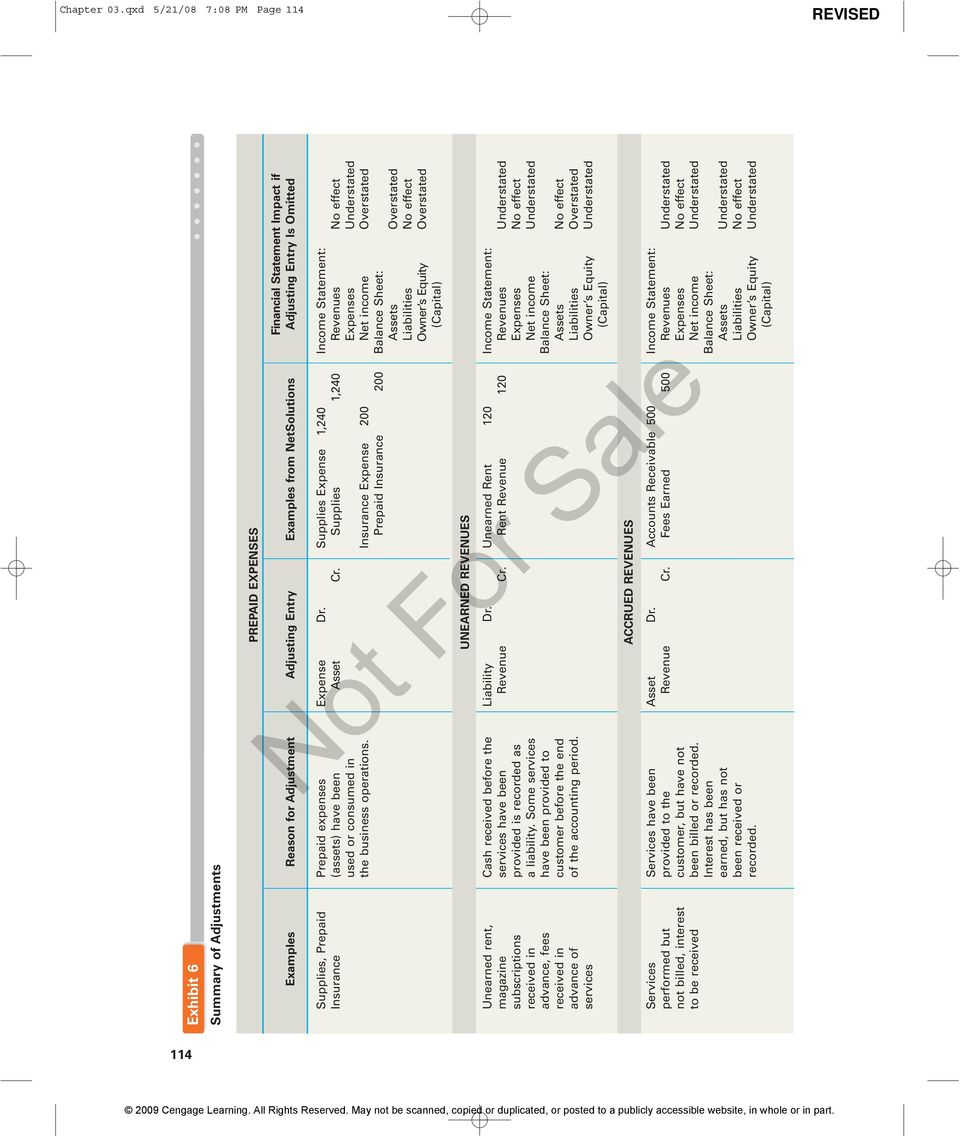
17 Chapter 03.qxd 5/21/08 7:08 PM Page 115 ACCRUED EXPENSES Financial Statement Impact if Examples Reason for Adjustment Adjusting Entry Examples from NetSolutions Adjusting Entry Is Omitted Wages or salaries Expenses have been Expense Dr. Wages Expense 250 Income Statement: incurred but not incurred, but have not Liability Cr. Wages Payable 250 Revenues No effect paid, interest been paid or recorded. Expenses Understated incurred but not Net income Overstated paid Balance Sheet: Assets No effect Liabilities Understated Owner s Equity Overstated (Capital) DEPRECIATION Depreciation of Fixed assets depreciate Expense Dr. Depreciation Expense Income Statement: equipment and as they are used or Contra Asset Cr. Office Equipment 50 Revenues No effect buildings consumed in the Accumulated Depr. Expenses Understated business operations. Office Equipment 50 Net income Overstated Balance Sheet: Assets Overstated Liabilities No effect Owner s Equity Overstated (Capital) 115
18 Chapter 03.qxd 5/21/08 7:08 PM Page Chapter 3 The Adjusting Process Exhibit 7 Adjusting Entries NetSolutions Description Journal Page 5 Ref. Debit Credit Dec. Adjusting Entries Supplies Expense Supplies Supplies used ($2,000 $760) ,240 1,240 One way for an accountant to check whether all adjustments have been made is to compare the current period s adjustments with those of the prior period. MICROSOFT CORPORATION Insurance Expense Prepaid Insurance Insurance expired ($2,400/12 months). Unearned Rent Rent Revenue Rent earned ($360/3 months). Accounts Receivable Fees Earned Accrued fees (25 hrs. $20). Wages Expense Wages Payable Accrued wages. Depreciation Expense Accum. Depreciation Office Equipment Depreciation on office equipment. Microsoft Corporation develops, manufactures, licenses, and supports a wide range of computer software products, including Windows Vista, Windows XP, Word, Excel, and the Xbox gaming system. When Microsoft sells its products, it incurs an obligation to support its software with technical support and periodic updates. As a result, not all the revenue is earned on the date of sale; some of the revenue on the date of sale is unearned. The portion of revenue related to support services, such as updates and technical support, is earned as time passes and support is provided to customers. Thus, each year Microsoft makes adjusting entries transferring some of its unearned revenue to revenue. The following excerpts were taken from Microsoft s 2007 financial statements: The percentage of revenue recorded as unearned... ranges from approximately 15% to 25% of the sales price for Windows XP Home, approximately 5% to 15% of the sales price for Windows XP Professional,... Unearned Revenue: June 30, 2007 June 30, 2006 Unearned revenue (in millions) $12,646 $10, During the year ending June 30, 2008, Microsoft expects to record over $10,779 million of unearned revenue as revenue. Source: Taken from Microsoft s June 30, 2007, annual report. At the same time, Microsoft will record additional unearned revenue from current period sales.

19 Chapter 03.qxd 5/21/08 7:08 PM Page 117 Chapter 3 The Adjusting Process 117 Exhibit 8 Ledger with Adjusting Entries NetSolutions Account Cash Account No. 11 Account Land Account No. 17 Nov Dec Item Ref. Debit Credit ,000 7, , ,870 1,750 1, ,000 3, ,000 2, ,450 1, ,000 Balance Debit 25,000 5,000 12,500 8,850 7,900 5,900 3,500 2,700 3,060 2,880 2,480 1,530 4,630 3,730 4,380 2,930 1,730 1,420 1,195 4,065 2,065 Credit Account Accounts Receivable Account No. 12 Dec Item Adjusting Ref. Debit Credit ,350 1, Balance Debit 1,750 1,100 2,220 2,720 Credit Account Supplies Account No. 14 Nov Dec. 23 Item Adjusting Ref. Debit Credit 800 1,240 Balance Debit Credit 1, , Nov. 5 Item Ref. Debit Credit 1 20, ,800 Balance Debit 20,000 Credit Account Office Equipment Account No. 18 Dec. 4 Item Ref. Debit Credit Balance Debit 1,800 Credit Account Acc. Depr. Office Equip. Account No. 19 Dec. Account Accounts Payable Account No. 21 Nov Dec Item Ref. Debit Credit 1,350 1, Balance Debit Credit Account Wages Payable Account No. 22 Dec. Item Adjusting Item Adjusting Ref. Debit Credit 5 50 Ref. Debit Credit Balance Debit Balance Debit Credit 50 1, ,200 1, Credit Account Unearned Rent Account No. 23 Dec. 1 Item Ref. Debit Credit 2 Adjusting Balance Debit 250 Credit Account Prepaid Insurance Account No. 15 Dec. 1 Item Adjusting Ref. Debit Credit 2 5 2, Balance Debit 2,400 2,200 Credit Account Chris Clark, Capital Account No. Nov. 1 Item Ref. Debit Credit 1 25,000 Balance Debit Credit 25,000 (continued)
20 Chapter 03.qxd 5/21/08 7:08 PM Page Chapter 3 The Adjusting Process Exhibit 8 Ledger with Adjusting Entries NetSolutions (concluded) Account Chris Clark, Drawing Account No. 32 Account Depreciation Expense Account No. 53 Nov. 30 Dec. Item Balance Ref. Debit Credit Debit Credit 2 4 2,000 2,000 2,000 4,000 Dec. Item Adjusting Balance Ref. Debit Credit Debit Credit Account Fees Earned Account No. 41 Nov. 18 Dec Nov. 30 Dec. 1 Adjusting ,500 3,100 1,750 2,870 1, ,600 7,500 10,600 12,350 15,220 16,340 16,840 Account Rent Revenue Account No. 42 Dec. Nov. 30 Dec Item Item Adjusting Adjusting Balance Ref. Debit Credit Debit Credit Balance Ref. Debit Credit Debit Credit Account Wages Expense Account No. 51 Item , , ,125 3,075 4,275 4, Balance Ref. Debit Credit Debit Credit Account Rent Expense Account No. 52 Item Balance Ref. Debit Credit Debit Credit Account Utilities Expense Account No. 54 Nov. 30 Dec. Nov. 30 Dec. Dec. Nov. 30 Dec. 6 Item Adjusting Adjusting Balance Ref. Debit Credit Debit Credit , Account Supplies Expense Account No. 55 Item Balance Ref. Debit Credit Debit Credit 800 2,040 Account Insurance Expense Account No. 56 Item Balance Ref. Debit Credit Debit Credit 200 Account Miscellaneous Expense Account No. 59 Item Balance Ref. Debit Credit Debit Credit Prepare an adjusted trial balance. Adjusted Trial Balance 4 Objective After the adjusting entries have been posted, an adjusted trial balance is prepared. The adjusted trial balance verifies the equality of the total debit and credit balances before the financial statements are prepared. If the adjusted trial balance does not balance, an error has occurred. However, as we discussed in Chapter 2, errors may occur even though the adjusted trial balance totals agree. For example, if an adjusting entry were omitted, the adjusted trial balance totals would still agree.

21 Chapter 03.qxd 5/21/08 7:08 PM Page 119 Chapter 3 The Adjusting Process 119 Exhibit 9 shows the adjusted trial balance for NetSolutions as of December,. In Chapter 4, we discuss how financial statements, including a classified balance sheet, can be prepared from an adjusted trial balance. Exhibit 9 Adjusted Trial Balance NetSolutions Adjusted Trial Balance December, Example Exercise 3-9 Cash Accounts Receivable Supplies Prepaid Insurance Land Office Equipment Accumulated Depreciation Office Equipment Accounts Payable Wages Payable Unearned Rent Chris Clark, Capital Chris Clark, Drawing Fees Earned Rent Revenue Wages Expense Rent Expense Depreciation Expense Utilities Expense Supplies Expense Insurance Expense Miscellaneous Expense Debit Balances 2,065 2, ,200 20,000 1,800 4,000 4,525 1, , ,400 Effect of Errors on Adjusted Trial Balance Credit Balances ,000 16, ,400 For each of the following errors, considered individually, indicate whether the error would cause the adjusted trial balance totals to be unequal. If the error would cause the adjusted trial balance totals to be unequal, indicate whether the debit or credit total is higher and by how much. a. The adjustment for accrued fees of $5,340 was journalized as a debit to Accounts Payable for $5,340 and a credit to Fees Earned of $5,340. b. The adjustment for depreciation of $3,260 was journalized as a debit to Depreciation Expense for $3,620 and a credit to Accumulated Depreciation for $3,260. Follow My Example 3-9 a. The totals are equal even though the debit should have been to Accounts Receivable instead of Accounts Payable. b. The totals are unequal. The debit total is higher by $360 ($3,620 $3,260). 4 For Practice: PE 3-9A, PE 3-9B
22 Chapter 03.qxd 5/21/08 7:08 PM Page Chapter 3 The Adjusting Process Financial Analysis and Interpretation Comparing each item in a current statement with a total amount within that same statement is useful in analyzing relationships within a financial statement. Vertical analysis is the term used to describe such comparisons. In vertical analysis of a balance sheet, each asset item is stated as a percent of the total assets. Each liability and owner s equity item is stated as a percent of the total liabilities and owner s equity. In vertical analysis of an income statement, each item is stated as a percent of revenues or fees earned. Vertical analysis may be prepared for several periods to analyze changes in relationships over time. Vertical analysis of two years of income statements for J. Holmes, Attorneyat-Law, is shown below. J. Holmes, Attorney-at-Law Income Statements For the Years Ended December, 2010 and 2010 Amount Percent Amount Percent Fees earned $187, % $150, % Operating expenses: Wages expense $ 60, % $ 45, %* Rent expense 15, % 12, % Utilities expense 12, % 9, % Supplies expense 2, % 3, % Miscellaneous expense 2, % 1, % Total operating expenses $ 92, % $ 70, % Net income $ 95, % $ 79, % *$45,000 $150,000 The preceding vertical analysis indicates both favorable and unfavorable trends affecting the income statement of J. Holmes, Attorney-at-Law. The increase in wages expense of 2% (32% 30%) is an unfavorable trend, as is the increase in utilities expense of 0.7% (6.7% 6.0%). A favorable trend is the decrease in supplies expense of 0.6% (2.0% 1.4%). Rent expense and miscellaneous expense as a percent of fees earned were constant. The net result of these trends was that net income decreased as a percent of fees earned from 52.8% to 50.7%. The analysis of the various percentages shown for J. Holmes, Attorney-at-Law, can be enhanced by comparisons with industry averages. Such averages are published by trade associations and financial information services. Any major differences between industry averages should be investigated.
23 Chapter 03.qxd 5/21/08 7:08 PM Page 121 At a Glance 3 1 Describe the nature of the adjusting process. 2 3 Key Points The accrual basis of accounting requires that revenues are reported in the period in which they are earned and expenses matched with the revenues they generate. The updating of accounts at the end of the accounting period is called the adjusting process. Each adjusting entry affects an income statement and balance sheet account. The four types of accounts requiring adjusting entries are prepaid expenses, unearned revenues, accrued revenues, and accrued expenses. Journalize entries for accounts requiring adjustment. Key Points Adjusting entries illustrated in this chapter include prepaid expenses, unearned revenues, accrued revenues, and accrued expenses. In addition, the adjusting entry necessary to record depreciation on fixed assets was illustrated. Summarize the adjustment process. Key Points A summary of adjustments, including the type of adjustment, reason for the adjustment, the adjusting entry, and the effect of omitting an adjustment on the financial statements, is shown in Exhibit 6. Key Learning Outcomes Explain why accrual accounting requires adjusting entries. List accounts that do and do NOT require adjusting entries at the end of the accounting period. Give an example of a prepaid expense, unearned revenue, accrued revenue, and accrued expense. Key Learning Outcomes Prepare an adjusting entry for a prepaid expense. Prepare an adjusting entry for an unearned revenue. Prepare an adjusting entry for an accrued revenue. Prepare an adjusting entry for an accrued expense. Prepare an adjusting entry for depreciation expense. Key Learning Outcomes Determine the effect on the income statement and balance sheet of omitting an adjusting entry for prepaid expense, unearned revenue, accrued revenue, accrued expense, and depreciation. Example Practice Exercises Exercises A, 3-1B A, 3-2B Example Exercises Practice Exercises A, 3-3B A, 3-4B A, 3-5B A, 3-6B A, 3-7B Example Practice Exercises Exercises A, 3-8B 4 Prepare an adjusted trial balance. Key Points After all the adjusting entries have been posted, the equality of the total debit balances and total credit balances is verified by an adjusted trial balance. Key Learning Outcomes Prepare an adjusted trial balance. Determine the effect of errors on the equality of the adjusted trial balance. Example Exercises Practice Exercises Key Terms A, 3-9B 121
24 Chapter 03.qxd 5/21/08 7:08 PM Page Chapter 3 The Adjusting Process Key Terms accounting period concept (100) accrual basis of accounting (100) accrued expenses (102) accrued revenues (102) accumulated depreciation (111) adjusted trial balance (118) adjusting entries (101) adjusting process (101) book value of the asset (or net book value) (112) cash basis of accounting (100) contra account (or contra asset account) (111) depreciate (111) depreciation (111) depreciation expense (111) fixed assets (or plant assets) (111) matching concept (or matching principle) (100) prepaid expenses (102) revenue recognition concept (100) unearned revenues (102) Illustrative Problem Three years ago, T. Roderick organized Harbor Realty. At July, 2010, the end of the current year, the unadjusted trial balance of Harbor Realty appears as shown below. Cash Accounts Receivable Supplies Prepaid Insurance Office Equipment Accumulated Depreciation Office Equipment Accounts Payable Wages Payable Unearned Fees T. Roderick, Capital T. Roderick, Drawing Fees Earned Wages Expense Depreciation Expense Rent Expense Utilities Expense Supplies Expense Insurance Expense Miscellaneous Expense Harbor Realty Unadjusted Trial Balance July, 2010 Debit Balances 3,425 7, , ,650 5,200 22, ,200 2, , ,000 Credit Balances 9, ,250 29,000 59, ,000 The data needed to determine year-end adjustments are as follows: a. Supplies on hand at July, 2010, $380. b. Insurance premiums expired during the year, $5. c. Depreciation of equipment during the year, $4, 950. d. Wages accrued but not paid at July, 2010, $440. e. Accrued fees earned but not recorded at July, 2010, $1,000. f. Unearned fees on July, 2010, $750.
25 Chapter 03.qxd 5/21/08 7:08 PM Page 123 Chapter 3 The Adjusting Process 123 Instructions 1. Prepare the necessary adjusting journal entries. Include journal entry explanations. 2. Determine the balance of the accounts affected by the adjusting entries, and prepare an adjusted trial balance. Solution July Supplies Expense Supplies Supplies used ($1,270 $380). Insurance Expense Prepaid Insurance Insurance expired. Depreciation Expense Accumulated Depreciation Office Equipment Depreciation expense. Wages Expense Wages Payable Accrued wages. Accounts Receivable Fees Earned Accrued fees. Description Unearned Fees Fees Earned Fees earned ($1,250 $750). Journal Ref. Debit Credit , , , ,
26 Chapter 03.qxd 5/21/08 7:08 PM Page Chapter 3 The Adjusting Process 2. Harbor Realty Adjusted Trial Balance July, 2010 Debit Balances Credit Balances Cash Accounts Receivable Supplies Prepaid Insurance Office Equipment Accumulated Depreciation Office Equipment Accounts Payable Wages Payable Unearned Fees T. Roderick, Capital T. Roderick, Drawing Fees Earned Wages Expense Depreciation Expense Rent Expense Utilities Expense Supplies Expense Insurance Expense Miscellaneous Expense Self-Examination Questions (Answers at End of Chapter) 1. Which of the following items represents a deferral? A. Prepaid insurance C. Fees earned B. Wages payable D. Accumulated depreciation 2. If the supplies account, before adjustment on May, indicated a balance of $2,250, and supplies on hand at May totaled $950, the adjusting entry would be: A. debit Supplies, $950; credit Supplies Expense, $950. B. debit Supplies, $1,300; credit Supplies Expense, $1,300. C. debit Supplies Expense, $950; credit Supplies, $950. D. debit Supplies Expense, $1,300; credit Supplies, $1, The balance in the unearned rent account for Jones Co. as of December is $1,200. If Jones Co. failed to record the adjusting entry for $600 of rent earned during December, the effect on the balance sheet and income statement for December would be: A. assets understated $600; net income overstated $600. 3,425 8, ,650 5,200 22,855 4,950 4,200 2, , ,390 14, ,000 60, ,390 B. liabilities understated $600; net income understated $600. C. liabilities overstated $600; net income understated $600. D. liabilities overstated $600; net income overstated $ If the estimated amount of depreciation on equipment for a period is $2,000, the adjusting entry to record depreciation would be: A. debit Depreciation Expense, $2,000; credit Equipment, $2,000. B. debit Equipment, $2,000; credit Depreciation Expense, $2,000. C. debit Depreciation Expense, $2,000; credit Accumulated Depreciation, $2,000. D. debit Accumulated Depreciation, $2,000; credit Depreciation Expense, $2, If the equipment account has a balance of $22,500 and its accumulated depreciation account has a balance of $14,000, the book value of the equipment would be: A. $36,500. C. $14,000. B. $22,500. D. $8,500.
27 Chapter 03.qxd 5/21/08 7:08 PM Page 125 Chapter 3 The Adjusting Process 125 Eye Openers 1. How are revenues and expenses reported on the income statement under (a) the cash basis of accounting and (b) the accrual basis of accounting? 2. Fees for services provided are billed to a customer during. The customer remits the amount owed in During which year would the revenues be reported on the income statement under (a) the cash basis? (b) the accrual basis? 3. Employees performed services in, but the wages were not paid until During which year would the wages expense be reported on the income statement under (a) the cash basis? (b) the accrual basis? 4. Is the matching concept related to (a) the cash basis of accounting or (b) the accrual basis of accounting? 5. Is the cash balance on the unadjusted trial balance the amount that should normally be reported on the balance sheet? Explain. 6. Is the supplies balance on the unadjusted trial balance the amount that should normally be reported on the balance sheet? Explain. 7. Why are adjusting entries needed at the end of an accounting period? 8. What is the difference between adjusting entries and correcting entries? 9. Identify the four different categories of adjusting entries frequently required at the end of an accounting period. 10. If the effect of the debit portion of an adjusting entry is to increase the balance of an asset account, which of the following statements describes the effect of the credit portion of the entry? a. Increases the balance of a liability account. b. Increases the balance of a revenue account. c. Increases the balance of an expense account. 11. If the effect of the credit portion of an adjusting entry is to increase the balance of a liability account, which of the following statements describes the effect of the debit portion of the entry? a. Increases the balance of an expense account. b. Increases the balance of a revenue account. c. Increases the balance of an asset account. 12. Does every adjusting entry have an effect on determining the amount of net income for a period? Explain. 13. What is the nature of the balance in the prepaid insurance account at the end of the accounting period (a) before adjustment? (b) after adjustment? 14. On July 1 of the current year, a business paid the July rent on the building that it occupies. (a) Do the rights acquired at July 1 represent an asset or an expense? (b) What is the justification for debiting Rent Expense at the time of payment? 15. (a) Explain the purpose of the two accounts: Depreciation Expense and Accumulated Depreciation. (b) What is the normal balance of each account? (c) Is it customary for the balances of the two accounts to be equal in amount? (d) In what financial statements, if any, will each account appear?
28 Chapter 03.qxd 5/21/08 7:08 PM Page Chapter 3 The Adjusting Process Practice Exercises PE 3-1A Accounts requiring adjustment obj. 1 EE 3-1 p. 101 PE 3-1B Accounts requiring adjustment obj. 1 EE 3-1 p. 101 PE 3-2A Type of adjustment obj. 1 EE 3-2 p. 104 PE 3-2B Type of adjustment obj. 1 EE 3-2 p. 104 PE 3-3A Adjustment for prepaid expense EE 3-3 p. 107 PE 3-3B Adjustment for prepaid expense EE 3-3 p. 107 PE 3-4A Adjustment for unearned revenue EE 3-4 p. 108 PE 3-4B Adjustment for unearned revenue EE 3-4 p. 108 PE 3-5A Adjustment for accrued revenues EE 3-5 p. 109 PE 3-5B Adjustment for accrued revenues EE 3-5 p. 109 Indicate with a Yes or No whether or not each of the following accounts normally requires an adjusting entry. a. Building c. Interest Payable e. Nath Luken, Capital b. Cash d. Miscellaneous Expense f. Prepaid Insurance Indicate with a Yes or No whether or not each of the following accounts normally requires an adjusting entry. a. Accumulated Depreciation c. Land e. Supplies b. Klaire Reid, Drawing d. Salaries Payable f. Unearned Rent Classify the following items as (1) prepaid expense, (2) unearned revenue, (3) accrued revenue, or (4) accrued expense. a. Cash received for use of land next month c. Rent expense owed but not yet paid b. Fees earned but not received d. Supplies on hand Classify the following items as (1) prepaid expense, (2) unearned revenue, (3) accrued revenue, or (4) accrued expense. a. Cash received for services not yet c. Rent revenue earned but not rendered received b. Insurance paid d. Salaries owed but not yet paid The prepaid insurance account had a beginning balance of $6,000 and was debited for $7,200 of premiums paid during the year. Journalize the adjusting entry required at the end of the year assuming the amount of unexpired insurance related to future periods is $4,200. The supplies account had a beginning balance of $1,815 and was debited for $3,790 for supplies purchased during the year. Journalize the adjusting entry required at the end of the year assuming the amount of supplies on hand is $1,675. On October 1,, Nautilus Co. received $15,300 for the rent of land for 12 months. Journalize the adjusting entry required for unearned rent on December,. The balance in the unearned fees account, before adjustment at the end of the year, is $,850. Journalize the adjusting entry required assuming the amount of unearned fees at the end of the year is $6,195. At the end of the current year, $12,400 of fees have been earned but have not been billed to clients. Journalize the adjusting entry to record the accrued fees. At the end of the current year, $9,134 of fees have been earned but have not been billed to clients. Journalize the adjusting entry to record the accrued fees.
29 Chapter 03.qxd 5/21/08 7:08 PM Page 127 Chapter 3 The Adjusting Process 127 PE 3-6A Adjustment for accrued expense EE 3-6 p. 111 PE 3-6B Adjustment for accrued expense EE 3-6 p. 111 PE 3-7A Adjustment for depreciation EE 3-7 p. 113 PE 3-7B Adjustment for depreciation EE 3-7 p. 113 PE 3-8A Effect of omitting adjustments obj. 3 EE 3-8 p. 113 PE 3-8B Effect of omitting adjustments obj. 3 EE 3-8 p. 113 PE 3-9A Effect of errors on adjusted trial balance obj. 4 EE 3-9 p. 119 PE 3-9B Effect of errors on adjusted trial balance obj. 4 EE 3-9 p. 119 Haifa Realty Co. pays weekly salaries of $29,100 on Monday for a six-day workweek ending the preceding Saturday. Journalize the necessary adjusting entry at the end of the accounting period assuming that the period ends on Thursday. Colossal Realty Co. pays weekly salaries of $19,375 on Friday for a five-day workweek ending on that day. Journalize the necessary adjusting entry at the end of the accounting period assuming that the period ends on Tuesday. The estimated amount of depreciation on equipment for the current year is $5,500. Journalize the adjusting entry to record the depreciation. The estimated amount of depreciation on equipment for the current year is $3,200. Journalize the adjusting entry to record the depreciation. For the year ending November 30, 2010, Towson Medical Services Co. mistakenly omitted adjusting entries for (1) $1,430 of supplies that were used, (2) unearned revenue of $11,150 that was earned, and (3) insurance of $6,000 that expired. Indicate the combined effect of the errors on (a) revenues, (b) expenses, and (c) net income for the year ended November 30, For the year ending February 28,, Samaritan Medical Co. mistakenly omitted adjusting entries for (1) depreciation of $4,100, (2) fees earned that were not billed of $15,300, and (3) accrued wages of $3,750. Indicate the combined effect of the errors on (a) revenues, (b) expenses, and (c) net income for the year ended February 28,. For each of the following errors, considered individually, indicate whether the error would cause the adjusted trial balance totals to be unequal. If the error would cause the adjusted trial balance totals to be unequal, indicate whether the debit or credit total is higher and by how much. a. The adjustment for accrued wages of $4,150 was journalized as a debit to Wages Expense for $4,150 and a credit to Accounts Payable for $4,150. b. The entry for $1,290 of supplies used during the period was journalized as a debit to Supplies Expense of $1,290 and a credit to Supplies of $1,920. For each of the following errors, considered individually, indicate whether the error would cause the adjusted trial balance totals to be unequal. If the error would cause the adjusted trial balance totals to be unequal, indicate whether the debit or credit total is higher and by how much. a. The adjustment of $8,175 for accrued fees earned was journalized as a debit to Accounts Receivable for $8,175 and a credit to Fees Earned for $8,157. b. The adjustment of depreciation of $2, 700 was omitted from the end-of-period adjusting entries.
30 Chapter 03.qxd 5/21/08 7:08 PM Page Chapter 3 The Adjusting Process Exercises EX 3-1 Classifying types of adjustments obj. 1 EX 3-2 Classifying adjusting entries obj. 1 EX 3-3 Adjusting entry for supplies EX 3-4 Determining supplies purchased Classify the following items as (a) prepaid expense, (b) unearned revenue, (c) accrued revenue, or (d) accrued expense. 1. A two-year premium paid on a fire insurance policy. 2. Fees earned but not yet received. 3. Fees received but not yet earned. 4. Salary owed but not yet paid. 5. Subscriptions received in advance by a magazine publisher. 6. Supplies on hand. 7. Taxes owed but payable in the following period. 8. Utilities owed but not yet paid. The following accounts were taken from the unadjusted trial balance of Washington Co., a congressional lobbying firm. Indicate whether or not each account would normally require an adjusting entry. If the account normally requires an adjusting entry, use the following notation to indicate the type of adjustment: AE Accrued Expense AR Accrued Revenue PE Prepaid Expense UR Unearned Revenue To illustrate, the answer for the first account is shown below. Account Accounts Receivable Cash Interest Payable Interest Receivable Joyce Carns, Capital Land Office Equipment Prepaid Rent Supplies Unearned Fees Wages Expense Answer Normally requires adjustment (AR). The balance in the supplies account, before adjustment at the end of the year, is $1,736. Journalize the adjusting entry required if the amount of supplies on hand at the end of the year is $813. The supplies and supplies expense accounts at December, after adjusting entries have been posted at the end of the first year of operations, are shown in the following T accounts: Supplies Bal. 675 Bal. 2,718 Supplies Expense Determine the amount of supplies purchased during the year. EX 3-5 Effect of omitting adjusting entry objs. 2, 3 At March, the end of the first month of operations, the usual adjusting entry transferring prepaid insurance expired to an expense account is omitted. Which items will be incorrectly stated, because of the error, on (a) the income statement for March and (b) the balance sheet as of March? Also indicate whether the items in error will be overstated or understated.
31 Chapter 03.qxd 5/21/08 7:08 PM Page 129 Chapter 3 The Adjusting Process 129 EX 3-6 Adjusting entries for prepaid insurance The balance in the prepaid insurance account, before adjustment at the end of the year, is $11, 500. Journalize the adjusting entry required under each of the following alternatives for determining the amount of the adjustment: (a) the amount of insurance expired during the year is $8,750; (b) the amount of unexpired insurance applicable to future periods is $2, 750. EX 3-7 Adjusting entries for prepaid insurance EX 3-8 Adjusting entries for unearned fees Amount of entry: $21,175 EX 3-9 Effect of omitting adjusting entry objs. 2, 3 EX 3-10 Adjusting entry for accrued fees The prepaid insurance account had a balance of $5,400 at the beginning of the year. The account was debited for $6,000 for premiums on policies purchased during the year. Journalize the adjusting entry required at the end of the year for each of the following situations: (a) the amount of unexpired insurance applicable to future periods is $1,000; (b) the amount of insurance expired during the year is $10,400. The balance in the unearned fees account, before adjustment at the end of the year, is $38, 375. Journalize the adjusting entry required if the amount of unearned fees at the end of the year is $17,200. At the end of February, the first month of the business year, the usual adjusting entry transferring rent earned to a revenue account from the unearned rent account was omitted. Indicate which items will be incorrectly stated, because of the error, on (a) the income statement for February and (b) the balance sheet as of February 28. Also indicate whether the items in error will be overstated or understated. At the end of the current year, $8,140 of fees have been earned but have not been billed to clients. a. Journalize the adjusting entry to record the accrued fees. b. If the cash basis rather than the accrual basis had been used, would an adjusting entry have been necessary? Explain. EX 3-11 Adjusting entries for unearned and accrued fees The balance in the unearned fees account, before adjustment at the end of the year, is $112, 790. Of these fees, $69,735 have been earned. In addition, $13, 200 of fees have been earned but have not been billed. Journalize the adjusting entries (a) to adjust the unearned fees account and (b) to record the accrued fees. EX 3-12 Effect of omitting adjusting entry objs. 2, 3 The adjusting entry for accrued fees was omitted at March, the end of the current year. Indicate which items will be in error, because of the omission, on (a) the income statement for the current year and (b) the balance sheet as of March. Also indicate whether the items in error will be overstated or understated.
32 Chapter 03.qxd 5/21/08 7:08 PM Page Chapter 3 The Adjusting Process EX 3-13 Adjusting entries for accrued salaries a. Amount of entry: $2,220 EX 3-14 Determining wages paid EX 3-15 Effect of omitting adjusting entry objs. 2, 3 EX 3-16 Effect of omitting adjusting entry objs. 2, 3 EX 3-17 Adjusting entries for prepaid and accrued taxes b. $24,750 EX 3-18 Adjustment for depreciation EX 3-19 Determining fixed asset s book value Canyon Realty Co. pays weekly salaries of $3,700 on Friday for a five-day workweek ending on that day. Journalize the necessary adjusting entry at the end of the accounting period assuming that the period ends (a) on Wednesday and (b) on Thursday. The wages payable and wages expense accounts at October, after adjusting entries have been posted at the end of the first month of operations, are shown in the following T accounts: Wages Payable Bal. 3,175 Bal. 93,800 Determine the amount of wages paid during the month. Wages Expense Accrued salaries of $4,950 owed to employees for December 30 and are not considered in preparing the financial statements for the year ended December. Indicate which items will be erroneously stated, because of the error, on (a) the income statement for the year and (b) the balance sheet as of December. Also indicate whether the items in error will be overstated or understated. Assume that the error in Exercise 3-15 was not corrected and that the $4,950 of accrued salaries was included in the first salary payment in January. Indicate which items will be erroneously stated, because of failure to correct the initial error, on (a) the income statement for the month of January and (b) the balance sheet as of January. Northwest Financial Services was organized on April 1 of the current year. On April 2, Northwest prepaid $4,500 to the city for taxes (license fees) for the next 12 months and debited the prepaid taxes account. Northwest is also required to pay in January an annual tax (on property) for the previous calendar year. The estimated amount of the property tax for the current year (April 1 to December ) is $21,375. a. Journalize the two adjusting entries required to bring the accounts affected by the two taxes up to date as of December, the end of the current year. b. What is the amount of tax expense for the current year? The estimated amount of depreciation on equipment for the current year is $1, 840. Journalize the adjusting entry to record the depreciation. The balance in the equipment account is $925, 700, and the balance in the accumulated depreciation equipment account is $1, 100. a. What is the book value of the equipment? b. Does the balance in the accumulated depreciation account mean that the equipment s loss of value is $1, 100? Explain. EX 3-20 Book value of fixed assets In a recent balance sheet, Microsoft Corporation reported Property, Plant, and Equipment of $7, 223 million and Accumulated Depreciation of $4,179 million. a. What was the book value of the fixed assets? b. Would the book value of Microsoft Corporation s fixed assets normally approximate their fair market values?
33 Chapter 03.qxd 5/21/08 7:08 PM Page 1 Chapter 3 The Adjusting Process 1 EX 3-21 Effects of errors on financial statements objs. 2, 3 For a recent period, the balance sheet for Circuit City Stores, Inc., reported accrued expenses of $464, 511, 000. For the same period, Circuit City reported income before income taxes of $151,112,000. Assume that the accrued expenses apply to the current period and were not recorded at the end of the current period. What would have been the income (loss) before income taxes? EX 3-22 Effects of errors on financial statements objs. 2, 3 EX 3-23 Effects of errors on financial statements objs. 2, 3 1. a. Revenue understated, $21,950 For a recent year, the balance sheet for The Campbell Soup Company includes accrued expenses of $1, 022,000,000. The income before taxes for The Campbell Soup Company for the year was $1,001,000,000. a. Assume the accruals apply to the current year and were not recorded at the end of the year. By how much would income before taxes have been misstated? b. What is the percentage of the misstatement in (a) to the reported income of $1, 001,000, 000? Round to one decimal place. The accountant for Mystic Medical Co., a medical services consulting firm, mistakenly omitted adjusting entries for (a) unearned revenue earned during the year ($21, 950) and (b) accrued wages ($6,100). Indicate the effect of each error, considered individually, on the income statement for the current year ended July. Also indicate the effect of each error on the July balance sheet. Set up a table similar to the following, and record your answers by inserting the dollar amount in the appropriate spaces. Insert a zero if the error does not affect the item. Error (a) Error (b) Over- Under- Over- Understated stated stated stated 1. Revenue for the year would be $ $ $ $ 2. Expenses for the year would be $ $ $ $ 3. Net income for the year would be $ $ $ $ 4. Assets at July would be $ $ $ $ 5. Liabilities at July would be $ $ $ $ 6. Owner s equity at July would be $ $ $ $ 6. Owner s equity at July would be$ $ $ $ EX 3-24 Effects of errors on financial statements objs. 2, 3 If the net income for the current year had been $424,300 in Exercise 3-23, what would have been the correct net income if the proper adjusting entries had been made? EX 3-25 Adjusting entries for depreciation; effect of error objs. 2, 3 On December, a business estimates depreciation on equipment used during the first year of operations to be $12,200. a. Journalize the adjusting entry required as of December. b. If the adjusting entry in (a) were omitted, which items would be erroneously stated on (1) the income statement for the year and (2) the balance sheet as of December?
34 Chapter 03.qxd 5/21/08 7:08 PM Page Chapter 3 The Adjusting Process EX 3-26 Adjusting entries from trial balances obj. 4 The unadjusted and adjusted trial balances for Glockenspiel Services Co. on March, 2010, are shown below. Glockenspiel Services Co. Trial Balance March, 2010 Unadjusted Adjusted Debit Credit Debit Credit Balances Balances Balances Balances EX 3-27 Adjusting entries from trial balances obj. 4 Corrected trial balance totals, $621,900 Cash Accounts Receivable Supplies Prepaid Insurance Land Equipment Accumulated Depreciation Equipment Accounts Payable Wages Payable Page Birch, Capital Page Birch, Drawing Fees Earned Wages Expense Rent Expense Insurance Expense Utilities Expense Depreciation Expense Supplies Expense Miscellaneous Expense Journalize the five entries that adjusted the accounts at March, None of the accounts were affected by more than one adjusting entry. The accountant for Rooster Laundry prepared the following unadjusted and adjusted trial balances. Assume that all balances in the unadjusted trial balance and the amounts of the adjustments are correct. Identify the errors in the accountant s adjusting entries. Rooster Laundry Trial Balance January, 2010 Unadjusted Adjusted Debit Credit Debit Credit Balances Balances Balances Balances Cash ,000 15,000 Accounts Receivable ,500 44,000 Laundry Supplies ,500 11,000 Prepaid Insurance* ,400 2,800 Laundry Equipment , ,000 Accumulated Depreciation ,000 96,000 Accounts Payable ,200 19,200 Wages Payable ,400 Carlos Martinez, Capital , ,600 Carlos Martinez, Drawing ,550 57,550 Laundry Revenue , ,200 Wages Expense ,400 98,400 Rent Expense ,150 51,150 Utilities Expense ,000 37,000 Depreciation Expense ,000 Laundry Supplies Expense ,500 Insurance Expense ,600 Miscellaneous Expense ,500 6, , , , ,400 *$7,600 of insurance expired during the year.
35 Chapter 03.qxd 5/21/08 7:08 PM Page 133 Chapter 3 The Adjusting Process 133 EX 3-28 Vertical analysis of income statement The following data (in millions) is taken from the financial statements of Williams- Sonoma for the years ending 2007 and 2006: EX 3-29 Vertical analysis of income statement Problems Series A PR 3-1A Adjusting entries Net sales (revenues) $3,728 $3,539 Net income a. Determine the amount of change (in millions) and percent of change in net income for b. Determine the percentage relationship between net income and net sales (net income divided by net sales) for 2007 and c. What conclusions can you draw from your analysis? The following income statement data (in thousands) for Dell Inc. and Gateway, Inc., were taken from their recent annual reports: Dell Gateway Net sales $35,404,000 $ 4,171,325 Cost of goods sold (expense) (29,055,000) (3,605,120) Operating expenses (3,505,000) (1,077,447) Operating income (loss) $ 2,844,000 $ (511,242) a. Prepare a vertical analysis of the income statement for Dell. b. Prepare a vertical analysis of the income statement for Gateway. c. Based on (a) and (b), how does Dell compare to Gateway? On August, 2010, the following data were accumulated to assist the accountant in preparing the adjusting entries for Cobalt Realty: a. Fees accrued but unbilled at August are $9,560. b. The supplies account balance on August is $3,150. The supplies on hand at August are $900. c. Wages accrued but not paid at August are $1,200. d. The unearned rent account balance at August is $9, 375, representing the receipt of an advance payment on August 1 of three months rent from tenants. e. Depreciation of office equipment is $1, 600. Instructions 1. Journalize the adjusting entries required at August, Briefly explain the difference between adjusting entries and entries that would be made to correct errors. PR 3-2A Adjusting entries Selected account balances before adjustment for Oval Realty at April 30, 2010, the end of the current year, are shown at the top of the next page.
36 Chapter 03.qxd 5/21/08 7:08 PM Page Chapter 3 The Adjusting Process Debits Credits Accounts Receivable $ 65,000 Accumulated Depreciation $ 10,000 Depreciation Expense Equipment 100,000 Fees Earned 379,500 Prepaid Rent 8,200 Rent Expense Supplies 1,950 Supplies Expense Unearned Fees 9,000 Wages Expense 128,000 Wages Payable PR 3-3A Adjusting entries Data needed for year-end adjustments are as follows: a. Supplies on hand at April 30, $600. b. Depreciation of equipment during year, $1, 000. c. Rent expired during year, $6, 000. d. Wages accrued but not paid at April 30, $1,900. e. Unearned fees at April 30, $3, 750. f. Unbilled fees at April 30, $4, 500. Instructions Journalize the six adjusting entries required at April 30, based on the data presented. Wind River Outfitters Co., an outfitter store for fishing treks, prepared the following unadjusted trial balance at the end of its first year of operations: Wind River Outfitters Co. Unadjusted Trial Balance February 28, 2010 Debit Credit Balances Balances Cash ,200 Accounts Receivable ,800 Supplies ,600 Equipment ,000 Accounts Payable ,100 Unearned Fees ,600 Fran Fielding, Capital ,400 Fran Fielding, Drawing ,000 Fees Earned ,900 Wages Expense ,400 Rent Expense ,500 Utilities Expense ,000 Miscellaneous Expense , , ,000 For preparing the adjusting entries, the following data were assembled: a. Supplies on hand on February 28 were $750. b. Fees earned but unbilled on February 28 were $2,900. c. Depreciation of equipment was estimated to be $5,400 for the year. d. Unpaid wages accrued on February 28 were $800. e. The balance in unearned fees represented the February 1 receipt in advance for services to be provided. Only $1, 600 of the services was provided between February 1 and February 28. Instructions Journalize the adjusting entries necessary on February 28.
37 Chapter 03.qxd 5/21/08 7:08 PM Page 135 Chapter 3 The Adjusting Process 135 PR 3-4A Adjusting entries objs. 2, 3, 4 PR 3-5A Adjusting entries and adjusted trial balances objs. 2, 3, 4 2. Total of Debit column: $333,050 Billy Board Company specializes in the maintenance and repair of signs, such as billboards. On March, 2010, the accountant for Billy Board Company prepared the following trial balances: Billy Board Company Trial Balance March, 2010 Unadjusted Adjusted Debit Credit Debit Credit Balances Balances Balances Balances Cash ,750 4,750 Accounts Receivable ,400 17,400 Supplies ,200 1,850 Prepaid Insurance ,000 3,600 Land ,000 50,000 Buildings , ,000 Accumulated Depreciation Buildings ,500 58,100 Trucks ,000 75,000 Accumulated Depreciation Trucks ,000 14,300 Accounts Payable ,920 7,520 Salaries Payable ,180 Unearned Service Fees ,500 5,100 William Elkins, Capital , ,400 William Elkins, Drawing ,500 7,500 Service Fees Earned , ,080 Salary Expense ,000 81,180 Depreciation Expense Trucks ,300 Rent Expense ,900 11,900 Supplies Expense ,350 Utilities Expense ,200 6,800 Depreciation Expense Buildings ,600 Taxes Expense ,900 2,900 Insurance Expense ,400 Miscellaneous Expense ,150 9, , , , ,680 Instructions Journalize the seven entries that adjusted the accounts at March. None of the accounts were affected by more than one adjusting entry. 2 Jacksonville Financial Services Co., which specializes in appliance repair services, is owned and operated by Cindy Latty. Jacksonville Financial Services Co. s accounting clerk prepared the unadjusted trial balance at December, 2010, shown below. Jacksonville Financial Services Co. Unadjusted Trial Balance December, 2010 Debit Balances Credit Balances Cash ,200 Accounts Receivable ,750 Prepaid Insurance ,000 Supplies ,725 Land ,000 Building ,750 Accumulated Depreciation Building ,850 Equipment ,000 Accumulated Depreciation Equipment ,650 Accounts Payable ,750 Unearned Rent ,600 Cindy Latty, Capital ,550 Cindy Latty, Drawing ,000 Fees Earned ,600 Salaries and Wages Expense ,850 Utilities Expense ,100 Advertising Expense ,500 Repairs Expense ,100 Miscellaneous Expense , , ,000
38 Chapter 03.qxd 5/21/08 7:08 PM Page Chapter 3 The Adjusting Process The data needed to determine year-end adjustments are as follows: a. Depreciation of building for the year, $2,100. b. Depreciation of equipment for the year, $3,000. c. Accrued salaries and wages at December, $800. d. Unexpired insurance at December, $1, 500. e. Fees earned but unbilled on December, $2,150. f. Supplies on hand at December, $600. g. Rent unearned at December, $1, 500. PR 3-6A Adjusting entries and errors obj Corrected Net Income: $135,375 Instructions 1. Journalize the adjusting entries. Add additional accounts as needed. 2. Determine the balances of the accounts affected by the adjusting entries and prepare an adjusted trial balance. At the end of July, the first month of operations, the following selected data were taken from the financial statements of Monita Forche, an attorney: Net income for July $135,800 Total assets at July 750,000 Total liabilities at July 250,000 Total owner s equity at July 500,000 In preparing the financial statements, adjustments for the following data were overlooked: a. Unbilled fees earned at July, $6, 700. b. Depreciation of equipment for July, $3, 000. c. Accrued wages at July, $2, 150. d. Supplies used during July, $1, 975. Instructions 1. Journalize the entries to record the omitted adjustments. 2. Determine the correct amount of net income for July and the total assets, liabilities, and owner s equity at July. In addition to indicating the corrected amounts, indicate the effect of each omitted adjustment by setting up and completing a columnar table similar to the following. Adjustment (a) is presented as an example. Net Total Total Total Income Assets Liabilities Owner s Equity Reported amounts $135,800 $750,000 $250,000 $500,000 Corrections: Adjustment (a) 6,700 6, ,700 Adjustment (b) Adjustment (c) Adjustment (d) Corrected amounts Problems Series B PR 3-1B Adjusting entries On March, 2010, the following data were accumulated to assist the accountant in preparing the adjusting entries for Hackney Realty: a. The supplies account balance on March is $2,5. The supplies on hand on March are $990. b. The unearned rent account balance on March is $7,950, representing the receipt of an advance payment on March 1 of three months rent from tenants. c. Wages accrued but not paid at March are $800.
39 Chapter 03.qxd 5/21/08 7:08 PM Page 137 Chapter 3 The Adjusting Process 137 d. Fees accrued but unbilled at March are $7,100. e. Depreciation of office equipment is $700. Instructions 1. Journalize the adjusting entries required at March, Briefly explain the difference between adjusting entries and entries that would be made to correct errors. PR 3-2B Adjusting entries PR 3-3B Adjusting entries Selected account balances before adjustment for Perfect Realty at October, 2010, the end of the current year, are as follows: Debits Credits Accounts Receivable $ 40,000 Equipment 100,000 Accumulated Depreciation $ 12,000 Prepaid Rent 9,000 Supplies 1,800 Wages Payable Unearned Fees 6,000 Fees Earned 215,000 Wages Expense 75,000 Rent Expense Depreciation Expense Supplies Expense Data needed for year-end adjustments are as follows: a. Unbilled fees at October, $2,900. b. Supplies on hand at October, $400. c. Rent expired, $6, 000. d. Depreciation of equipment during year, $3, 000. e. Unearned fees at October, $800. f. Wages accrued but not paid at October, $1, 400. Instructions Journalize the six adjusting entries required at October, based on the data presented. Chinook Company, an electronics repair store, prepared the unadjusted trial balance shown below at the end of its first year of operations. Chinook Company Unadjusted Trial Balance November 30, 2010 Debit Balances Credit Balances Cash ,900 Accounts Receivable ,000 Supplies ,800 Equipment ,400 Accounts Payable ,500 Unearned Fees ,000 Neal Salmon, Capital ,000 Neal Salmon, Drawing ,000 Fees Earned ,500 Wages Expense ,000 Rent Expense ,000 Utilities Expense ,500 Miscellaneous Expense , , ,000
40 Chapter 03.qxd 5/21/08 7:08 PM Page Chapter 3 The Adjusting Process For preparing the adjusting entries, the following data were assembled: a. Fees earned but unbilled on November 30 were $1, 300. b. Supplies on hand on November 30 were $3, 100. c. Depreciation of equipment was estimated to be $3,500 for the year. d. The balance in unearned fees represented the November 1 receipt in advance for services to be provided. Only $4, 000 of the services was provided between November 1 and November 30. e. Unpaid wages accrued on November 30 were $900. Instructions Journalize the adjusting entries necessary on November 30, PR 3-4B Adjusting entries objs. 2, 3, 4 Luxor Company specializes in the repair of music equipment and is owned and operated by Amy Busby. On November 30, 2010, the end of the current year, the accountant for Luxor Company prepared the following trial balances: Luxor Company Trial Balance November 30, 2010 Unadjusted Adjusted Debit Credit Debit Credit Balances Balances Balances Balances Cash ,250 38,250 Accounts Receivable , ,500 Supplies ,250 2,700 Prepaid Insurance ,250 4,500 Equipment , ,450 Accumulated Depreciation Equipment , ,000 Automobiles , ,500 Accumulated Depreciation Automobiles ,750 61,200 Accounts Payable ,930 26,400 Salaries Payable ,000 Unearned Service Fees ,000 8,700 Amy Busby, Capital , ,020 Amy Busby, Drawing ,000 75,000 Service Fees Earned , ,100 Salary Expense , ,900 Rent Expense ,000 54,000 Supplies Expense ,550 Depreciation Expense Equipment ,500 Depreciation Expense Automobiles ,450 Utilities Expense ,900 14,370 Taxes Expense ,175 8,175 Insurance Expense ,750 Miscellaneous Expense ,825 9,825 1,320,000 1,320,000 1,341,420 1,341,420 Instructions Journalize the seven entries that adjusted the accounts at November 30. None of the accounts were affected by more than one adjusting entry. PR 3-5B Adjusting entries and adjusted trial balances objs. 2, 3, 4 2. Total of Debit column: $822,180 Misfire Company is a small editorial services company owned and operated by Pedro Borman. On August, 2010, the end of the current year, Misfire Company s accounting clerk prepared the unadjusted trial balance shown on the next page. The data needed to determine year-end adjustments are as follows: a. Unexpired insurance at August, $1, 800. b. Supplies on hand at August, $750. c. Depreciation of building for the year, $2,000. d. Depreciation of equipment for the year, $5, 000. e. Rent unearned at August, $2,850.
41 Chapter 03.qxd 5/21/08 7:08 PM Page 139 Chapter 3 The Adjusting Process 139 PR 3-6B Adjusting entries and errors obj Corrected Net Income: $136,850 f. Accrued salaries and wages at August, $2,800. g. Fees earned but unbilled on August, $12,380. Misfire Company Unadjusted Trial Balance August, 2010 Debit Balances Credit Balances Cash ,500 Accounts Receivable ,400 Prepaid Insurance ,200 Supplies ,980 Land ,500 Building ,250 Accumulated Depreciation Building ,550 Equipment ,300 Accumulated Depreciation Equipment ,950 Accounts Payable ,150 Unearned Rent ,750 Pedro Borman, Capital ,000 Pedro Borman, Drawing ,000 Fees Earned ,600 Salaries and Wages Expense ,370 Utilities Expense ,375 Advertising Expense ,800 Repairs Expense ,250 Miscellaneous Expense , , ,000 Instructions 1. Journalize the adjusting entries. Add additional accounts as needed. 2. Determine the balances of the accounts affected by the adjusting entries, and prepare an adjusted trial balance. At the end of April, the first month of operations, the following selected data were taken from the financial statements of Beth Cato, an attorney: Net income for April $125,750 Total assets at April ,000 Total liabilities at April ,000 Total owner s equity at April ,000 In preparing the financial statements, adjustments for the following data were overlooked: a. Supplies used during April, $3, 100. b. Unbilled fees earned at April 30, $18, 750. c. Depreciation of equipment for April, $2,700. d. Accrued wages at April 30, $1,850. Instructions 1. Journalize the entries to record the omitted adjustments. 2. Determine the correct amount of net income for April and the total assets, liabilities, and owner s equity at April 30. In addition to indicating the corrected amounts, indicate the effect of each omitted adjustment by setting up and completing a columnar table similar to the following. Adjustment (a) is presented as an example. Net Total Total Total Income Assets Liabilities Owner s Equity Reported amounts $125,750 $500,000 $180,000 $320,000 Corrections: Adjustment (a) 3,100 3, ,100 Adjustment (b) Adjustment (c) Adjustment (d) Corrected amounts
42 Chapter 03.qxd 5/21/08 7:08 PM Page Chapter 3 The Adjusting Process Continuing Problem 3. Total of Debit column: $40,460 The unadjusted trial balance that you prepared for Music Depot at the end of Chapter 2 should appear as follows: Music Depot Unadjusted Trial Balance July, 2010 Debit Credit Balances Balances Cash ,780 Accounts Receivable ,150 Supplies Prepaid Insurance ,700 Office Equipment ,000 Accounts Payable ,680 Unearned Revenue ,200 Lee Chang, Capital ,500 Lee Chang, Drawing ,700 Fees Earned ,300 Wages Expense ,400 Office Rent Expense ,750 Equipment Rent Expense ,100 Utilities Expense Music Expense ,810 Advertising Expense ,600 Supplies Expense Miscellaneous Expense ,680 38,680 The data needed to determine adjustments for the two-month period ending July, 2010, are as follows: a. During July, Music Depot provided guest disc jockeys for WHBD for a total of 120 hours. For information on the amount of the accrued revenue to be billed to WHBD, see the contract described in the July 3, 2010, transaction at the end of Chapter 2. b. Supplies on hand at July, $175. c. The balance of the prepaid insurance account relates to the July 1, 2010, transaction at the end of Chapter 2. d. Depreciation of the office equipment is $60. e. The balance of the unearned revenue account relates to the contract between Music Depot and WHBD, described in the July 3, 2010, transaction at the end of Chapter 2. f. Accrued wages as of July, 2010, were $120. Instructions 1. Prepare adjusting journal entries. You will need the following additional accounts: 18 Accumulated Depreciation Office Equipment 22 Wages Payable 57 Insurance Expense 58 Depreciation Expense 2. Post the adjusting entries, inserting balances in the accounts affected. 3. Prepare an adjusted trial balance. Special Activities SA 3-1 Ethics and professional conduct in business Cliff Hall opened Meridian Co. on January 1,. At the end of the first year, the business needed additional capital. On behalf of Meridian, Cliff applied to Federal National Bank for a loan of $300,000. Based on Meridian financial statements, which had been prepared on a cash basis, the Federal National Bank loan officer rejected the loan as too risky. After receiving the rejection notice, Cliff instructed his accountant to prepare the financial statements on an accrual basis. These statements included $48,500 in accounts
43 Chapter 03.qxd 5/21/08 7:08 PM Page 141 Chapter 3 The Adjusting Process 141 receivable and $15,650 in accounts payable. Cliff then instructed his accountant to record an additional $20,000 of accounts receivable for commissions on property for which a contract had been signed on December 28,, but which would not be formally closed and the title transferred until January 5, Cliff then applied for a $300,000 loan from First City Bank, using the revised financial statements. On this application, Cliff indicated that he had not previously been rejected for credit. Discuss the ethical and professional conduct of Cliff Hall in applying for the loan from First City Bank. SA 3-2 Accrued expense SA 3-3 Accrued revenue SA 3-4 Adjustments and financial statements On December 30, 2010, you buy a Ford Expedition. It comes with a three-year, 36,000- mile warranty. On March 5, 2011, you return the Expedition to the dealership for some basic repairs covered under the warranty. The cost of the repairs to the dealership is $1,645. In what year, 2010 or 2011, should Ford Motor Company recognize the cost of the warranty repairs as an expense? The following is an excerpt from a conversation between Joel Loomis and Krista Truitt just before they boarded a flight to Paris on Delta Air Lines. They are going to Paris to attend their company s annual sales conference. Joel: Krista, aren t you taking an introductory accounting course at college? Krista: Yes, I decided it s about time I learned something about accounting. You know, our annual bonuses are based on the sales figures that come from the accounting department. Joel: I guess I never really thought about it. Krista: You should think about it! Last year, I placed a $750,000 order on December 28. But when I got my bonus, the $750,000 sale wasn t included. They said it hadn t been shipped until January 3, so it would have to count in next year s bonus. Joel: A real bummer! Krista: Right! I was counting on that bonus including the $750,000 sale. Joel: Did you complain? Krista: Yes, but it didn t do any good. Ashley, the head accountant, said something about matching revenues and expenses. Also, something about not recording revenues until the sale is final. I figure I d take the accounting course and find out whether she s just jerking me around. Joel: I never really thought about it. When do you think Delta Air Lines will record its revenues from this flight? Krista: Hmmm... I guess it could record the revenue when it sells the ticket... or... when the boarding passes are taken at the door... or... when we get off the plane... or when our company pays for the tickets... or... I don t know. I ll ask my accounting instructor. Discuss when Delta Air Lines should recognize the revenue from ticket sales to properly match revenues and expenses. Several years ago, your brother opened Niagara Appliance Repairs. He made a small initial investment and added money from his personal bank account as needed. He withdrew money for living expenses at irregular intervals. As the business grew, he hired an assistant. He is now considering adding more employees, purchasing additional service trucks, and purchasing the building he now rents. To secure funds for the expansion, your brother submitted a loan application to the bank and included the most recent financial statements (shown below) prepared from accounts maintained by a part-time bookkeeper. Niagara Appliance Repairs Income Statement For the Year Ended October, 2010 Service revenue $112,500 Less: Rent paid $,200 Wages paid ,750 Supplies paid ,000 Utilities paid ,500 Insurance paid ,600 Miscellaneous payments ,100 82,150 Net income $ 30,350 (continued)
44 Chapter 03.qxd 5/21/08 7:08 PM Page Chapter 3 The Adjusting Process SA 3-5 Codes of ethics Group Project Niagara Appliance Repairs Balance Sheet October, 2010 Assets Cash $15,900 Amounts due from customers ,750 Truck ,350 Total assets $90,000 Equities Owner s capital $90,000 After reviewing the financial statements, the loan officer at the bank asked your brother if he used the accrual basis of accounting for revenues and expenses. Your brother responded that he did and that is why he included an account for Amounts Due from Customers. The loan officer then asked whether or not the accounts were adjusted prior to the preparation of the statements. Your brother answered that they had not been adjusted. a. Why do you think the loan officer suspected that the accounts had not been adjusted prior to the preparation of the statements? b. Indicate possible accounts that might need to be adjusted before an accurate set of financial statements could be prepared. Obtain a copy of your college or university s student code of conduct. In groups of three or four, answer the following question: 1. Compare this code of conduct with the accountant s Codes of Professional Conduct, which is linked to the text Web site at academic.cengage.com/accounting/warren. 2. One of your classmates asks you for permission to copy your homework, which your instructor will be collecting and grading for part of your overall term grade. Although your instructor has not stated whether one student may or may not copy another student s homework, is it ethical for you to allow your classmate to copy your homework? Is it ethical for your classmate to copy your homework? Answers to Self-Examination Questions 1. A A deferral is the delay in recording an expense already paid, such as prepaid insurance (answer A). Wages payable (answer B) is considered an accrued expense or accrued liability. Fees earned (answer C) is a revenue item. Accumulated depreciation (answer D) is a contra account to a fixed asset. 2. D The balance in the supplies account, before adjustment, represents the amount of supplies available. From this amount ($2,250) is subtracted the amount of supplies on hand ($950) to determine the supplies used ($1, 300). Since increases in expense accounts are recorded by debits and decreases in asset accounts are recorded by credits, answer D is the correct entry. 3. C The failure to record the adjusting entry debiting Unearned Rent, $600, and crediting Rent Revenue, $600, would have the effect of overstating liabilities by $600 and understating net income by $600 (answer C). 4. C Since increases in expense accounts (such as depreciation expense) are recorded by debits and it is customary to record the decreases in usefulness of fixed assets as credits to accumulated depreciation accounts, answer C is the correct entry. 5. D The book value of a fixed asset is the difference between the balance in the asset account and the balance in the related accumulated depreciation account, or $22,500 $14,000, as indicated by answer D ($8,500).
The Matching Concept and the Adjusting Process
 The Matching Concept and the Adjusting Process o b j e c t i v e s After studying this chapter, you should be able to: 4 Explain how the matching concept relates to the accrual basis of accounting. Explain
Time Period Assumption
 ILLUSTRATION 3-1 GUIDELINES TO REPORT REVENUE AND EXPENSES Time Period Assumption Economic life of business can be divided into artificial time periods Revenue Recognition Principle Revenue recognized
CHAPTER 3 THE ADJUSTING PROCESS
 1. a. Under cash-basis accounting, revenues are reported in the period in which cash is received and expenses are reported in the period in which cash is paid. b. Under accrual-basis accounting, revenues
CHAPTER 3 ADJUSTING THE ACCOUNTS
 CHAPTER 3 ADJUSTING THE ACCOUNTS TIME PERIOD ASSUMPTION The time period (or periodicity) assumption assumes that the economic life of a business can be divided into artificial time periods generally a
COMPLETING THE ACCOUNTING CYCLE
 4 COMPLETING THE ACCOUNTING CYCLE objectives After studying this chapter, you should be able to: Review the seven basic steps of the accounting cycle. Prepare a work sheet. Prepare financial statements
How To Account For Revenue Under Accrual Accounting
 BAT 4M: Chapter 3 ANSWERS TO QUESTIONS 01. (a) Under the time period assumption, an accountant is required to determine the relevance of each business transaction to specific accounting periods, and its
Vol. 1, Chapter 3 - Accounting Adjustments
 Vol. 1, Chapter 3 - Accounting Adjustments Problem 1 1. ($20,000 2,000) 48 = $375 per month 2. Jan. 31 Depreciation Expense $375 Accumulated Depreciation Van $375 To record depreciation expense for January
SMART TOUCH LEARNING Balance Sheet May 31, 2013 $ 4,800. $ 48,700 Accounts receivable 2,600. 900 Inventory 30,500. 100 Supplies.
 3 The Adjusting Process Are these balances correctly showing everything the company OWNS? SMART TOUCH LEARNING ance Sheet May 31, 2013 Are these balances correctly showing everything the company OWES?
SOLUTIONS. Learning Goal 16
 Learning Goal 16: Prepare Closing Entries S1 Learning Goal 16 Multiple Choice 1. d 2. a 3. b 4. d Because drawing is closed directly into the capital account, not into income summary. 5. c 6. b This a
Chapter 5 Accrual Adjustments and Financial Statement Preparation. Revenue recognition Matching expenses to revenues Expenses related to periods
 Chapter 5 Accrual Adjustments and Financial Statement Preparation Revenue recognition Matching expenses to revenues Expenses related to periods 1 The Measurement of Income major function of accounting
Module 3: Adjusting the accounts, preparing the statements, and completing the accounting cycle
 Page 1 of 27 Module 3: Adjusting the accounts, preparing the statements, and completing the accounting cycle Overview In Module 2 you studied the fundamental steps in recording accounting information by
1. If the assets owned by a business total $100,000 and liabilities total $70,000, stockholders' equity totals $30,000.
 Rallis Page 1 Name: _ Date: 1. If the assets owned by a business total $100,000 and liabilities total $70,000, stockholders' equity totals $30,000. A) True B) False 2. If total liabilities decreased by
Adjusting the Accounts
 2794T_c03_094-143.qxd 6/5/08 5:54 PM Page 94 TEAM-B 108:JWCL039:Ch03: Chapter 3 Adjusting the Accounts STUDY OBJECTIVES The Navigator After studying this chapter, you should be Scan Study Objectives able
Chapter 4. Completing the accounting cycle. Appendix 4A: Reversing entries
 1 Chapter 4 Completing the accounting cycle Appendix 4A: Reversing entries 2 Learning objective 1. Prepare reversing entries and describe their purpose 3 Reversing entries Reversing entries are optional
Accounting Cycle. Matching Principle
 CHAPTER 3 Accounting Cycle Analyze and record the transactions Post the transactions and prepare trial balance Adjust the accounts and prepare trial balance Prepare the financial statements Close the accounts
THE ACCOUNTING INFORMATION SYSTEM
 CHAPTER 3 THE ACCOUNTING INFORMATION SYSTEM OVERVIEW Accounting information must be accumulated and summarized before it can be communicated and analysed. In this chapter, we will discuss the steps involved
CHAPTER 3. BE3-2 Advertising. Dec. 31 Advertising Supplies Expense 7200 Advertising Supplies 7200 to adjust. BE3-3 Bere Co.
 CHAPTER 3 BE3-2 Advertising Advertising Supplies Supplies Expense 8700 7200 7200 1500 7200 Dec. Advertising Supplies Expense 7200 Advertising Supplies 7200 BE3-3 Bere Co. Prepaid Insurance Insurance Expense
Adjusting Accounts and Preparing Financial Statements
 wil79549_ch03_0090-0133 07/30/2008 5:36 pm Page 90 pinnacle 201:MHBR055:mhwiL19:wiL19ch03: A Look Back Chapter 2 explained the analysis and recording of transactions. We showed how to apply and interpret
CHAPTER 4. Adjusting the accounts and preparing financial statements CONTENTS
 CHAPTER 4 Adjusting the accounts and preparing financial statements CONTENTS Demonstration problem 4.1 Adjusting entries and corrections 4.2 Adjusting centries and effect on financial statements 4.3 Adjusting
EXERCISES. Does not normally require adjustment. Normally requires adjustment (AE).
 EXERCISES Ex. 3 1 1. Prepaid expense 2. Accrued revenue 3. Unearned revenue 4. Accrued expense 5. Unearned revenue 6. Prepaid expense 7. Accrued expense 8. Accrued expense Ex. 3 2 Account Accounts Receivable...
ACCRUAL ACCOUNTING CONCEPTS
 c04accrualaccountingconcepts.qxd 8/3/10 1:50 PM Page 162 chapter 4 ACCRUAL ACCOUNTING CONCEPTS 162 the navigator Scan Study Objectives Read Feature Story Scan Preview Read Text and Answer Do it! p. 175
ACCT1115. Review Package - Midterm SOLUTION Fall 2013
 ACCT1115 Review Package - Midterm SOLUTION Fall 2013 Part I Multiple Choice 1) How should you record the purchase of an expensive automobile? a) Decrease cash, increase assets b) Decrease cash, increase
CHAPTER 3: PREPARING FINANCIAL STATEMENTS
 CHAPTER 3: PREPARING FINANCIAL STATEMENTS I. TIMING AND REPORTING A. The Accounting Period Time period assumption an organization s activities can be divided into specific time periods. Examples: a month,
Adjusting the Accounts
 HOSP 1210 (Financial Acct) Learning Centre Adjusting the Accounts Anytime we prepare financial statements or reach the end of an accounting period, there are account adjustments that need to be made to
Accounting 300A-10A The Operating Cycle: Worksheet/Closing Entries Page 1
 Accounting 3A-1A The Operating Cycle: Worksheet/Closing Entries Page 1 THE WORKSHEET and CLOSING ENTRIES I. Review of Key Concepts and Terms: A. The purpose of the worksheet 1. To show that the accounts
> DO IT! Chapter 3 Adjusting the Accounts. Timing Concepts. Adjusting Entries for Deferrals D-12. Solution
 Chapter 3 Adjusting the Accounts Timing Concepts Review the glossary terms. Study carefully the revenue recognition principle, the expense recognition principle, and the time period assumption. Several
CHAPTER 4 Accrual Accounting Concepts Study Objectives
 CHAPTER 4 Accrual Accounting Concepts Study Objectives Explain the revenue recognition principle and the matching principle. Differentiate between the cash basis and the accrual basis of accounting. Explain
Periodicity Assumption... Time Period Assumption... Chapter 4 Accrual Accounting Concepts
 Financial Accounting: Tools for Business Decision Making, 4th Ed. CHAPTER 4 Kimmel, Weygandt, Kieso Chapter 4 Accrual Accounting Concepts KEY THINGS WE LL DO: Refresh and expand Ch.3 concepts. Differentiate
Module 3: Adjusting the accounts, preparing the statements, and completing the accounting cycle
 Course Schedule Course Modules Review and Practice Exam Preparation Resources Module 3: Adjusting the accounts, preparing the statements, and completing the accounting cycle Overview In Module 2 you studied
CHAPTER 3 ADJUSTING THE ACCOUNTS SUMMARY OF QUESTIONS BY STUDY OBJECTIVES AND BLOOM S TAXONOMY. Multiple Choice Questions
 sg st a CHAPTER 3 ADJUSTING THE ACCOUNTS SUMMARY OF QUESTIONS BY STUDY OBJECTIVES AND BLOOM S TAXONOMY Item SO BT Item SO BT Item SO BT Item SO BT Item SO BT True-False Statements 1. 1 C 9. 2 C 17. 5 C
Chapter 3. Adjusting the accounts. Appendix 3A: An alternative method of recording deferrals
 1 Chapter 3 Adjusting the accounts Appendix 3A: An alternative method of recording deferrals 2 Learning objectives 1. Prepare adjusting entries for prepaid expenses originally recorded in an expense account
Accrual Accounting Process: Part II
 Accrual Accounting Process: Part II 15.511 Corporate Accounting Summer 2003 Professor S.P. Kothari Sloan School of Management Massachusetts Institute of Technology June 14, 2003 1 Agenda for Today Continue
Supplement to CHAPTER 3 CLOSING ENTRIES AND THE WORK SHEET
 Supplement to CHAPTER 3 CLOSING ENTRIES AND THE WORK SHEET Answers to Review Questions 1. No, the work sheet cannot be used as a substitute for the financial statements. It is a tool used in preparing
Accrual vs Deferral Accrual vs Cash Basis
 1 - Accrual vs Deferral Accrual vs Cash Basis - understanding debits and credits a transaction either increases or decreases the balance of accounts. increases and decreases in accounts are based on the
CHAPTER 3 Solutions MEASURING BUSINESS INCOME
 CHAPTER 3 Solutions MEASURING BUSINESS INCOME Chapter 3, SE 1. 1. 2. 3. 4. c b d a Chapter 3, SE 2. Dec. 31 Insurance Expense 800 Prepaid Insurance To record insurance expired during the year $460 + $1,040
Closing Entries and the Postclosing Trial Balance
 6-1 McGraw-Hill 2009 The McGraw-Hill Companies, Inc. All rights reserved. Chapter Closing Entries and the Postclosing Trial Balance 6 Section 1: Closing Entries Section Objectives 1. Journalize and post
The Accounting Process
 GAAP LITERATURE The Accounting Process Chapter 3 TRADITIONAL: Original pronouncements, issued by the FASB. SEPT. 2009 CHANGE: Codification issued by the FASB. DIFFERENCE: Codification is listed by topic
PART A: TRUE/FALSE (1 point each):
 CHABOT COLLEGE General Accounting (BUS-7) Dmitriy Kalyagin PART A: TRUE/FALSE (1 point each): EXAM #4 (Chapters 10, 12, 13) 1. Employees who are exempt from the FLSA are entitled for overtime pay for hours
Chapter 5: Adjustments and the Worksheet
 Chapter 5: Adjustments and the Worksheet Chapter Opener: Thinking Critically Students should suggest that accountants estimate the amount of wear and tear on the equipment. This expense should be charged
CHAPTER 3 The Accounting Information System
 CHAPTER 3 The Accounting Information System 3-1 LECTURE OUTLINE Chapter 3 provides a review of accounting procedures throughout the accounting cycle. Depending on time constraints and students accounting
b. Do not recognize revenue until steel is shipped. c. Do not recognize revenue until next year after the games are played.
 CHAPTER FOUR SE4-2 Revenue recognition a. Recognize revenue from car sales for 12,000. Notes receivable $12,000 Sales revenue $12,000 b. Do not recognize revenue until steel is shipped. c. Do not recognize
Accrual Accounting and the Financial Statements
 Accrual Accounting and the Financial Statements 3 LEARNING OBJECTIVES SPOTLIGHT Le Château has been selling fashion apparel, footwear, and accessories in Canada for over 50 years. What started as a single,
Completing the Accounting Cycle
 C H A P T E R 4 Completing the Accounting Cycle Financial Accounting 14e Warren Reeve Duchac human/istock/360/getty Images Flow of Accounting Information (slide 1 of 5) End-of-Period Spreadsheet (Work
PART 1. BASIC CONCEPTS AND ACCOUNTING MODEL
 CHAPTER 1 PART 1. BASIC CONCEPTS AND ACCOUNTING MODEL OBJECTIVES The objectives of this part are: To introduce a definition of accounting, the need for accounting information, and the various accounting
Module 6 Intro to Adjusting Entries
 Module 6 Intro to Adjusting Entries Entries required at the end of each accounting period to recognize on accrual basis: Revenues earned for the period Expenses that match the revenue earned And to report
The worksheet for Hancock Company shows the following in the financial statement
 Chapter 4 Do it! Susan Elbe is preparing a worksheet. Explain to Susan how she should extend the following adjusted trial balance accounts to the financial statement columns of the worksheet. Cash Accumulated
Accounting for Accruals and Deferrals
 CHAPTER 2 Accounting for Accruals and Deferrals LEARNING OBJECTIVES After you have mastered the material in this chapter, you will be able to: SECTION 1: SHOW HOW ACCRUALS AFFECT FINANCIAL STATEMENTS LO
ACCRUAL ACCOUNTING CONCEPTS
 CHAPTER 4 ACCRUAL ACCOUNTING CONCEPTS Summary of Learning Objectives SMH 1 Explain the revenue recognition principle and the 6 Describe the nature and purpose of the adjusted trial expense recognition
Accrual accounting ACCRUAL VERSUS CASH BASIS OF ACCOUNTING. ACCRUAL VERSUS CASH BASIS OF ACCOUNTING continued. Chapter 3
 Chapter 3 Accrual accounting concepts PowerPoint presentation by Anne Abraham University of Wollongong 2009 John Wiley & Sons Australia, Ltd ACCRUAL VERSUS CASH BASIS OF ACCOUNTING Accrual-based accounting
Information System. CHAPTER The Accounting. eeded: A Reliable Information System LEARNING OBJECTIVES
 8658d_c03.qxd 11/4/02 11:11 AM Page 61 mac62 mac62:1st Shift: 3 CHAPTER The Accounting Information System eeded: A Reliable Information System N Maintaining a set of accounting records is not optional.
Accrual Accounting Process
 Accrual Accounting Process 15.501 Accounting Spring 2004 Professor S. Roychowdhury Sloan School of Management Massachusetts Institute of Technology Feb 17/18, 2004 1 An accountant s functions include Classifying
3 Accrual Accounting & Income
 29366_10_ch3_p125-196 12/12/07 5:50 PM Page 125 3 Accrual Accounting & Income SPOTLIGHT STARBUCKS CORPORATION Starbucks has changed coffee from a breakfast drink to an experience. The corporation began
Accounting II Second Semester Final
 Name: Class: Date: Accounting II Second Semester Final Multiple Choice Identify the letter of the choice that best completes the statement or answers the question. 1. Profit is the difference between:
For More Course Tutorials Visit www.uoptutorial.com
 ACC 205 WEEK 2 EXERCISE ASSIGNMENT REVENUE AND EXPENSES(NEW) Click Here to Buy the Tutorial http://www.uoptutorial.com/index.php?route=product/p roduct&path=641&product_id=9760 For More Course Tutorials
The Accounting Cycle. Chapters 4 and 3
 The Accounting Cycle Chapters 4 and 3 Accumulate... Accumulate... Communicate! Business Transactions Source Documents Analyzed Journalized Posted The Accounting Cycle 1. Business transactions create source
CHAPTER 2 REVIEW OF THE ACCOUNTING PROCESS. Lecture Outline
 CHAPTER 2 REVIEW OF THE ACCOUNTING PROCESS Overview Chapter 1 explained that the primary means of conveying financial information to investors, creditors, and other external users is through financial
CHAPTER 4 THE ACCOUNTING CYCLE: ACCRUALS AND DEFERRALS
 CHAPTER 4 THE ACCOUNTING CYCLE: ACCRUALS AND DEFERRALS OVERVIEW OF BRIEF EXERCISES, EXERCISES, PROBLEMS, AND CRITICAL THINKING CASES Brief Exercises B. Ex. 4.1 B. Ex. 4.2 B. Ex. 4.3 B. Ex. 4.4 Topic Deferred
Student Solutions Manual to Accompany. Introduction to Financial Accounting. David Annand. Based on International Financial Reporting Standards
 Student Solutions Manual to Accompany Introduction to Financial Accounting Based on International Financial Reporting Standards David Annand Copyright 2014 David Annand Published by David Annand 4910C
Accumulated Depreciation Equipment
 Chapter 4 Completing the Accounting Cycle > DO IT! Worksheet Balance sheet: Extend assets to debit column. Extend liabilities to credit column. Extend contra assets to credit column. Extend drawings account
CHAPTER 2 ACCOUNTING FOR TRANSACTIONS
 CHAPTER 2 ACCOUNTING FOR TRANSACTIONS Key Terms and Concepts to Know Double entry accounting: Debits and Credits Total debits must always equal total credits Accounting Books: Accounts General Journal
How To Calculate A Trial Balance For A Company
 THE BASIC MODEL The accounting information system is designed to collect and organize data into information that is useful for stakeholders. The Accounting Equation The basic accounting equation is what
Exam 1 chapters 1-4 Needles 10ed
 Exam 1 chapters 1-4 Needles 10ed Multiple Choice Identify the choice that best completes the statement or answers the question. 1. Which of the following is the most appropriate definition of accounting?
When you are low on cash but need to pick up party
 C H A P T E R 6 Accounting for Merchandising Businesses Susan Van Etten D O L L A R T R E E S T O R E S, I N C. When you are low on cash but need to pick up party supplies, housewares, or other consumer
Chapter 4 Adjustments, Financial Statements, and the Quality of Earnings
 Chapter 4 Adjustments, Financial Statements, and the Quality of Earnings ANSWERS TO QUESTIONS 1. Adjusting entries are made at the end of the accounting period to record all revenues and expenses that
How To Adjust For The Year End
 ACCOUNTING 30S WORKSHEET ON ADJUSTING ENTRIES Put on your thinking caps and sharpen your pencils boys and girls it's time to practice with adjusting entries! 1. Give in general journal form the year-end
Chapter 1. Introduction to Accounting and Business
 1 Chapter 1 Introduction to Accounting and Business Learning Objective 1 Describe the nature of a business, the role of accounting, and ethics in business. Nature of Business and Accounting A business
Adjusting Entries and the Work Sheet
 Heintz & Parry th Edition Chapter 5 th Edition College Accounting Adjusting Entries and the Work Sheet 1 Prepare end-of-period adjustments. END-OF-PERIOD ADJUSTMENTS Changes occur that affect the business
The Work Sheet and the Closing Process
 C H A P T E R 4 The Work Sheet and the Closing Process A systematic approach is essential for efficient and accurate processing of large amounts of information. Whether work sheets are on paper or computerized,
Basic Accounting Principles
 Basic Accounting Principles Basic Accounting Model The basic accounting model represents the relationship between assets (what the company owns), liabilities (what the company owes), and owner s equity
CHAPTER 12 ACCRUALS, DEFERRALS, AND THE WORKSHEET
 CHAPTER 12 ACCRUALS, DEFERRALS, AND THE WORKSHEET Chapter Opener: Thinking Critically Students may assess that an unexpected decline in sales would mean surplus inventory which would have to be reduced
Chapter 5 Accounting for Merchandising Operations
 Chapter 5 Accounting for Merchandising Operations Purchase Transactions Purchaser records goods at cost. When goods are returned, purchaser reduces Inventory. On September 5, De La Hoya Company buys merchandise
Chapter 13 Financial Statements and Closing Procedures
 Chapter 13 - Financial Statements and Closing Procedures Chapter 13 Financial Statements and Closing Procedures TEACHING OBJECTIVES 13-1) Prepare a classified income statement from the worksheet. 13-2)
CHAPTER 4 COMPLETING THE ACCOUNTING CYCLE SUMMARY OF QUESTIONS BY STUDY OBJECTIVES AND BLOOM S TAXONOMY. True-False Statements
 CHAPTER 4 COMPLETING THE ACCOUNTING CYCLE SUMMARY OF QUESTIONS BY STUDY OBJECTIVES AND BLOOM S TAXONOMY Item SO BT Item SO BT Item SO BT Item SO BT Item SO BT True-False Statements 1. 1 K 9. 2 K 17. 4
Chapter 16 Accounting for Income Taxes
 DEFERRED TAX ASSETS AND DEFERRED TAX LIABILITIES Fundamental Concepts There are fundamental differences in the amount of income and expenses reported for GAAP and income tax purposes. The objective for
The Measurement of the Business Income. 1 by recording revenues when earned and expenses when incurred. 2 by adjusting accounts
 Recap from Week 3 The Measurement of the Business Income The primary objective of accounting is measuring the net income of the businesses according to the generally accepted accounting principles. Net
The Accounting Cycle Completed
 5 The Accounting Cycle Completed Adjusting, Closing, and Post-Closing Trial Balance THE BIG PICTURE You are planning your school schedule for next term. Your goal is to take a full course load and find
Fundamentals of Financial Accounting
 Fundamentals of Financial Accounting CHAPTER I Accounting in action. What is accounting? Accounting is the recording of financial transactions plus storing, sorting, retrieving, summarizing, and presenting
Review of Accounting Principles
 Appendix A Review of Accounting Principles Appendix A is a review of basic accounting principles and procedures. Standard accounting procedures are based on the double-entry system. This means that each
BUS312A/612A Financial Reporting I. Homework 9.10.2014 & 9.15.2014 The Accounting Cycle Review Chapter 3
 BUS312A/612A Financial Reporting I Homework 9.10.2014 & 9.15.2014 The Accounting Cycle Review Chapter 3 E3-1 (Transaction Analysis-Service Company) During the first month of operations of her business
Dr. M. D. Chase BA 201 Examination 1J
 Dr. M. D. Chase BA 201 Examination 1J Instructions: 1. Place your Name, Code Number of the Examination and the Examination Number on your Scantron form. Failure to follow these instructions will result
a. $ 65,000. b. $ 80,000. c. $130,000. d. $145,000.
 注 意 1. 本 試 題 卷 共 50 題, 總 分 100 分 第 01-15 題, 每 題 1.75 分, 合 計 26.25 分 ; 第 16-35 題, 每 題 2 分, 合 計 40 分 ; 第 36-50 題, 每 題 2.25 分, 合 計 33.75 答 錯 不 倒 扣 2. 請 將 答 案 按 試 題 題 號, 依 序 填 入 答 案 卡 1.FastForward had cash
Transaction Analysis SPOTLIGHT. 2 Chapter 40878 Page 53 09/25/07 jhr APPLE COMPUTER, INC.
 2 Chapter 40878 9/25/07 3:18 PM Page 53 2 Transaction Analysis 2 Chapter 40878 Page 53 09/25/07 jhr SPOTLIGHT APPLE COMPUTER, INC. How do you manage your music library? You may use Apple Computer s itunes,
Accounting Skills Assessment Practice Exam Page 1 of 10
 NAU ACCOUNTING SKILLS ASSESSMENT PRACTICE EXAM & KEY 1. A company received cash and issued common stock. What was the effect on the accounting equation? Assets Liabilities Stockholders Equity A. + NE +
CHAPTER II GENERAL LEDGER ACCOUNTS
 CHAPTER II GENERAL LEDGER ACCOUNTS A general ledger is basic to an accounting system. The General Ledger of a fund is a summary record containing the balance of assets, liabilities, deferred revenues,
Section 3 ACCRUED EXPENSES (ACCRUED LIABILITIES)
 Section 3 ACCRUED EXPENSES (ACCRUED LIABILITIES) Introduction Accrued expenses are expenses that have been incurred, but not yet paid for. To put it another way, an accrued expense is paid after being
Chapter 4. Completing the accounting cycle
 1 Chapter 4 Completing the accounting cycle 2 Learning objectives 1. Prepare an accounting worksheet and describe its purpose 2. Prepare a classified balance sheet and explain the major headings 3. Explain
A = L + OE. Transaction 1 Assets = Liabilitites + Owners equity + 1,000,000 Cash + 1,000,000 Common stock
 FINANCIAL STATEMENT ANALYSIS Henry Jarva Aalto University, Spring 2015 Student name: EXERCISE 1. Provide journal entries for Transactions 5 8, Adjusting Entries 2 7, and prepare Exhibit 1. 2. Calculate
ANSWERS TO QUESTIONS FOR GROUP LEARNING
 Accounting for a 5 Merchandising Business ANSWERS TO QUESTIONS FOR GROUP LEARNING Q5-1 A merchandising business has a major revenue reduction called cost of goods sold. The computation of cost of goods
Accruals and prepayments
 5 Accruals and prepayments this chapter covers... In the last chapter we have looked at the preparation of financial statements or final accounts using the extended trial balance, or spreadsheet, approach.
Accounting Principles Dr. Mishari Alfraih. Adjusting the Accounts
 Accrual- vs. Cash-Basis Accounting Accrual-Basis Accounting Adjusting the Accounts Transactions recorded in the periods in which the events occur Revenues are recognized when earned, rather than when cash
TRANSACTIONS ANALYSIS EXAMPLE. Maxwell Partners Medical Diagnostic Services report the following information for 2011, their first year of operations:
 TRANSACTIONS ANALYSIS EXAMPLE Maxwell Partners Medical Diagnostic Services report the following information for 2011, their first year of operations: 1. Billings to clients for services provided: $350,000
Chapter Twelve. Current Liabilities. Current Liabilities for Competing Companies
 Chapter Twelve Current Liabilities and Contingencies 1. Define current liabilities & identify common CL 2. Account for accruals 3. Account for deferrals 4. Account for compensated absences 5. How to report
Accg100 Accounting 1A. Lecture Notes
 Accg100 Accounting 1A Lecture Notes Semester 2, 2012 1 Table of Contents Lecture Notes Page Week 1: Introduction to Accounting, Ethics, 3 Business Entities, Financial Statements Week 2: Accounting for
Learning Goal 26. bal. 62,300 3,000
 S1 Learning Goal 26 Multiple Choice 1. c Remember that any entry to the Accounts Receivable account also requires an entry to a subsidiary account. 2. b 3. d Only the direct write-off method debits an
Accounting Notes. Cash - includes money and any medium of exchange that a bank accepts at face value
 Asset Accounts: Cash - includes money and any medium of exchange that a bank accepts at face value Accounts Receivable - a record of an oral or implied promise of future cash receipts in exchange for goods
EXERCISES. The cash from operating activities detail is provided as follows for class discussion:
 EXERCISES Ex. 14 1 There were net additions, such as depreciation and amortization of intangible assets of $389 million, to the net loss reported on the income statement to convert the net loss from the