
Annual Report
|
|
|
- Merryl Miles
- 9 years ago
- Views:
Transcription
1 Annual Report
2
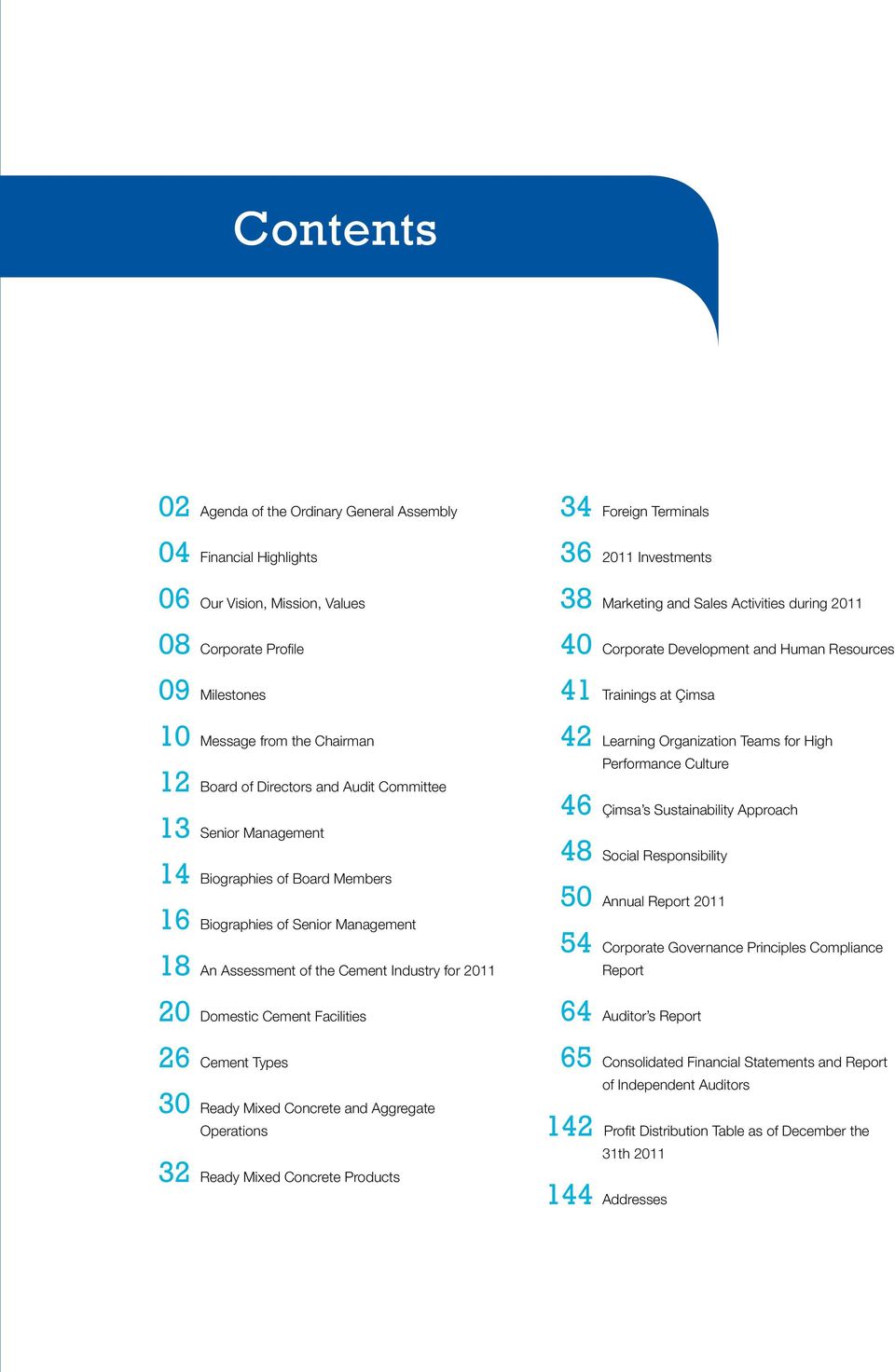
3 Contents 02 Agenda of the Ordinary General Assembly 34 Foreign Terminals 04 Financial Highlights Investments 06 Our Vision, Mission, Values 38 Marketing and Sales Activities during Corporate Profile 40 Corporate Development and Human Resources 09 Milestones 41 Trainings at Çimsa 10 Message from the Chairman 12 Board of Directors and Audit Committee 13 Senior Management 14 Biographies of Board Members 16 Biographies of Senior Management 18 An Assessment of the Cement Industry for Learning Organization Teams for High Performance Culture 46 Çimsa s Sustainability Approach 48 Social Responsibility 50 Annual Report Corporate Governance Principles Compliance Report 20 Domestic Cement Facilities 64 Auditor s Report 26 Cement Types 30 Ready Mixed Concrete and Aggregate Operations 32 Ready Mixed Concrete Products 65 Consolidated Financial Statements and Report of Independent Auditors 142 Profit Distribution Table as of December the 31th Addresses
4 ÇİMSA ÇİMENTO SANAYİ VE TİCARET A.Ş. ANNUAL REPORT 2011 Agenda of the Ordinary General Assembly The Agenda of the Ordinary General Assembly for ÇİMSA ÇİMENTO SANAYİ ve TİCARET A.Ş. to be held on April the 24th 2012 AGENDA: 1. Call to Order and Composition of the Administrative Board, 2. Authorization of the Administrative Board to Approve the Meeting Minutes of the General Assembly, 3. Reading and Discussion of the Board of Directors' Annual Report and the Audit Committee s Report for 2011, 2 4. Informing the General Assembly about Donations Made and Aid Given during 2011, 5. Informing the General Assembly about Transactions with Related Parties during 2011, 6. Informing the General Assembly about Securities, Liens, Mortgages Established for Third Parties and the Income or Benefits that they Generated during Informing the General Assembly about the Remuneration Policy for Members of the Board and Senior Executives pursuant to the Company's Corporate Governance Principles, 8. Reading, Negotiation and Confirmation of the Balance Sheet and the Profit/ Loss Statements, and Approval or Rejection of the Profit Distribution Proposal by the Board of Directors for the year 2011, 9. Submission, for the Approval of the General Assembly, those Members Elected to be a Member of the Board of Directors for the Remaining Part of the Year to those Seats Vacated During the Year, 10. Release of the Members of the Board of Directors and the Audit Committee from Liability in relation to Activities during 2011,

5 11. Approval of the Amendment of the Company's Articles of Association as Suggested in the attached Draft Amendment pursuant to the Permit Obtained from the Capital Markets Board and from the Republic of Turkey's Ministry of Customs and Trade, 12. Election of the Members of the Board of Directors, Determination of the Independent Members of the Board of Directors and Determination of the Terms to be served by the Members of the Board of Directors, 13. Determination of the Remunerations to Be Paid to the Members of the Board of Directors, Approval of the Appointment of the Independent Audit Agency as Chosen by the Board of Directors, 15. Authorization of the Shareholders who Manage the Company, Members of the Board of Directors, Senior Managers and their Partners and Relatives by Blood and Marriage up to Second Degree to in relation to the Performance of any Transactions that May Cause Conflicts of Interest to Compete with their Affiliates, 16. Authorization of the Chairman and the Members of the Board of Directors to conduct procedures as set out in articles 334 and 335 of the Turkish Commercial Code

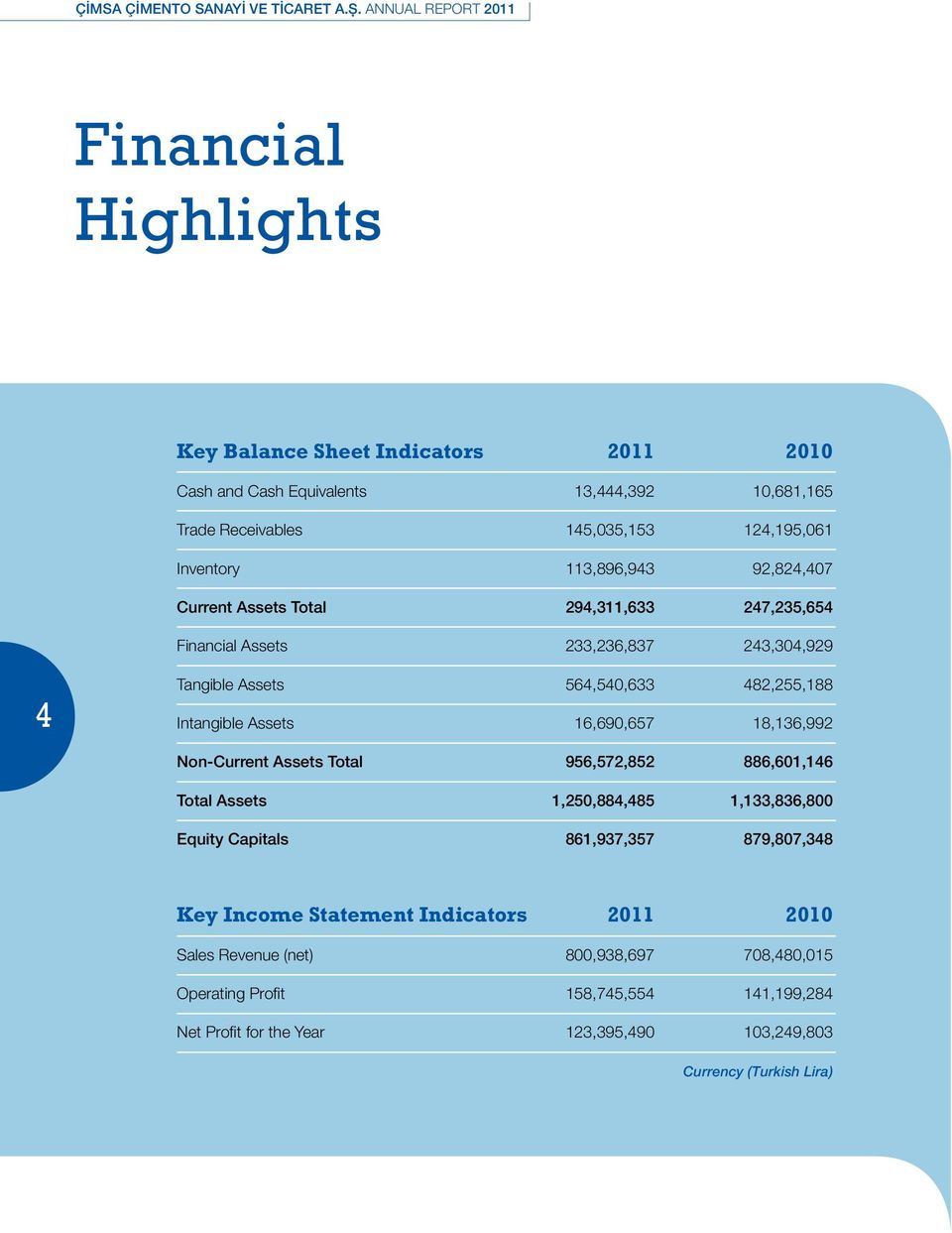
6 ÇİMSA ÇİMENTO SANAYİ VE TİCARET A.Ş. ANNUAL REPORT 2011 Financial Highlights Key Balance Sheet Indicators Cash and Cash Equivalents 13,444,392 10,681,165 Trade Receivables 145,035, ,195,061 Inventory 113,896,943 92,824,407 Current Assets Total 294,311, ,235,654 Financial Assets 233,236, ,304,929 4 Tangible Assets 564,540, ,255,188 Intangible Assets 16,690,657 18,136,992 Non-Current Assets Total 956,572, ,601,146 Total Assets 1,250,884,485 1,133,836,800 Equity Capitals 861,937, ,807,348 Key Income Statement Indicators Sales Revenue (net) 800,938, ,480,015 Operating Profit 158,745, ,199,284 Net Profit for the Year 123,395, ,249,803 Currency (Turkish Lira)
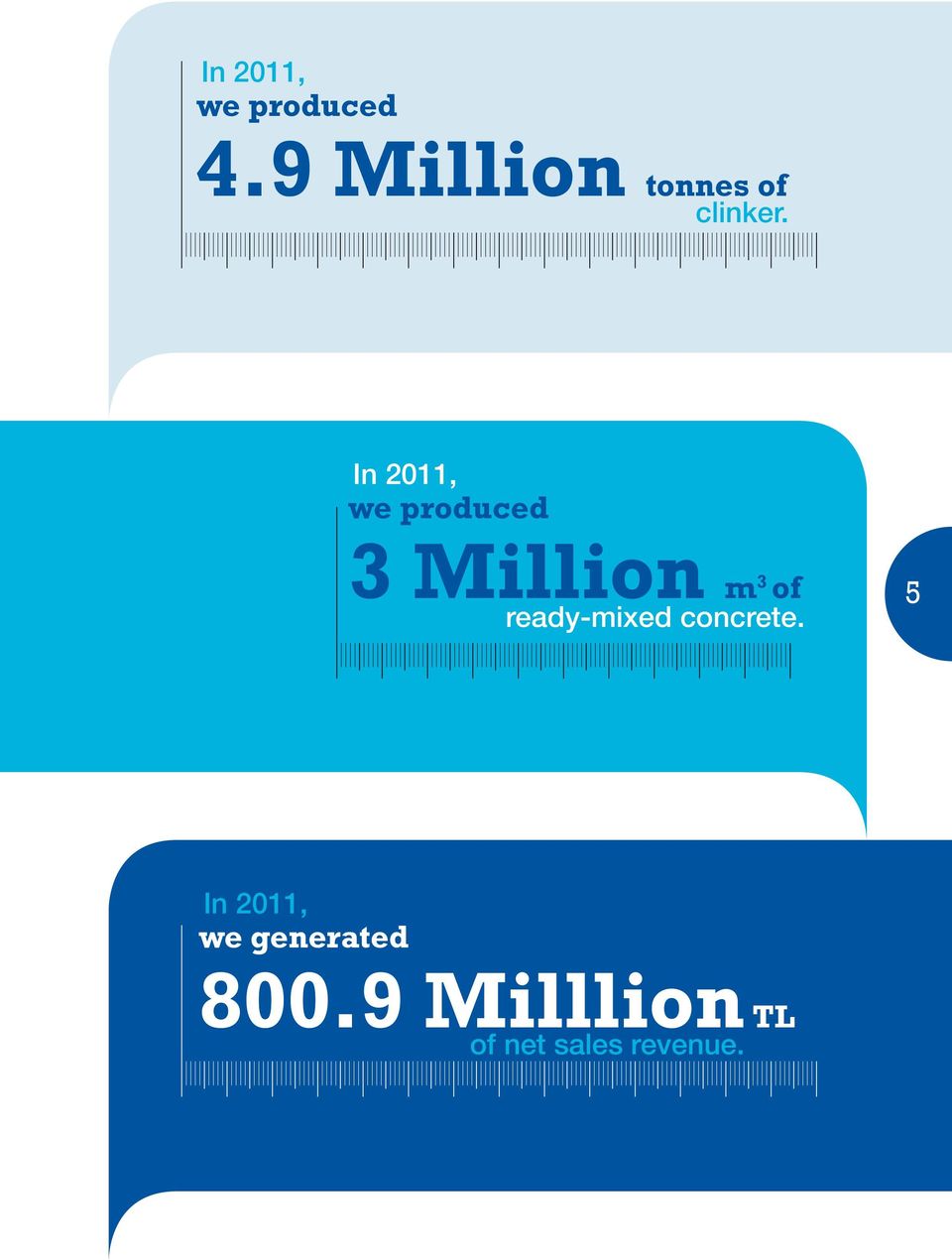
7 In 2011, we produced 4.9 Million tonnes of clinker. In 2011, we produced 3 Million m 3 of ready-mixed concrete. 5 In 2011, we generated Milllion TL of net sales revenue.
8 ÇİMSA ÇİMENTO SANAYİ VE TİCARET A.Ş. ANNUAL REPORT 2011 Our Vision To be Turkey s most profitable cementand concrete company. 6 Our Mission To be an international business partner for cement and concrete users.

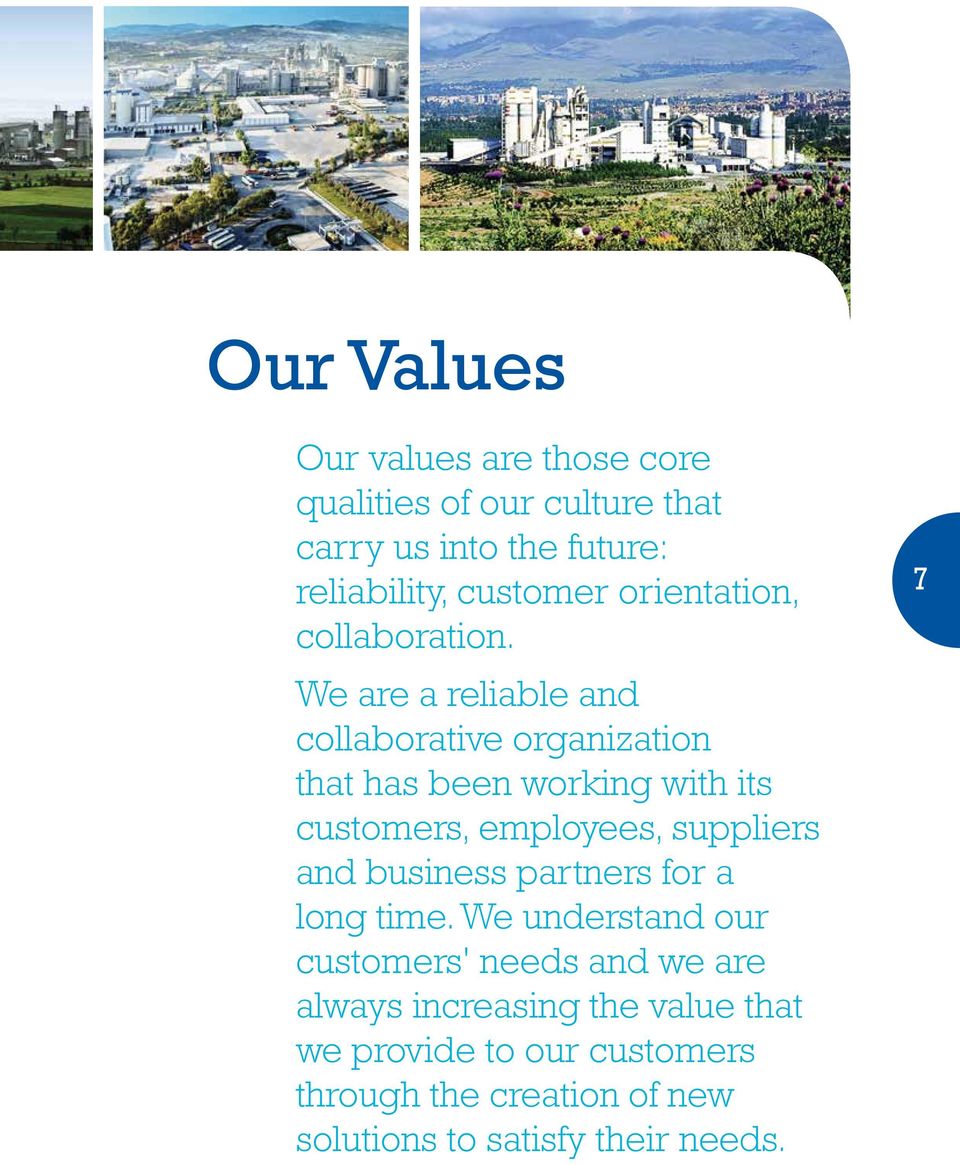
9 Our Values Our values are those core qualities of our culture that carry us into the future: reliability, customer orientation, collaboration. We are a reliable and collaborative organization that has been working with its customers, employees, suppliers and business partners for a long time. We understand our customers' needs and we are always increasing the value that we provide to our customers through the creation of new solutions to satisfy their needs. 7
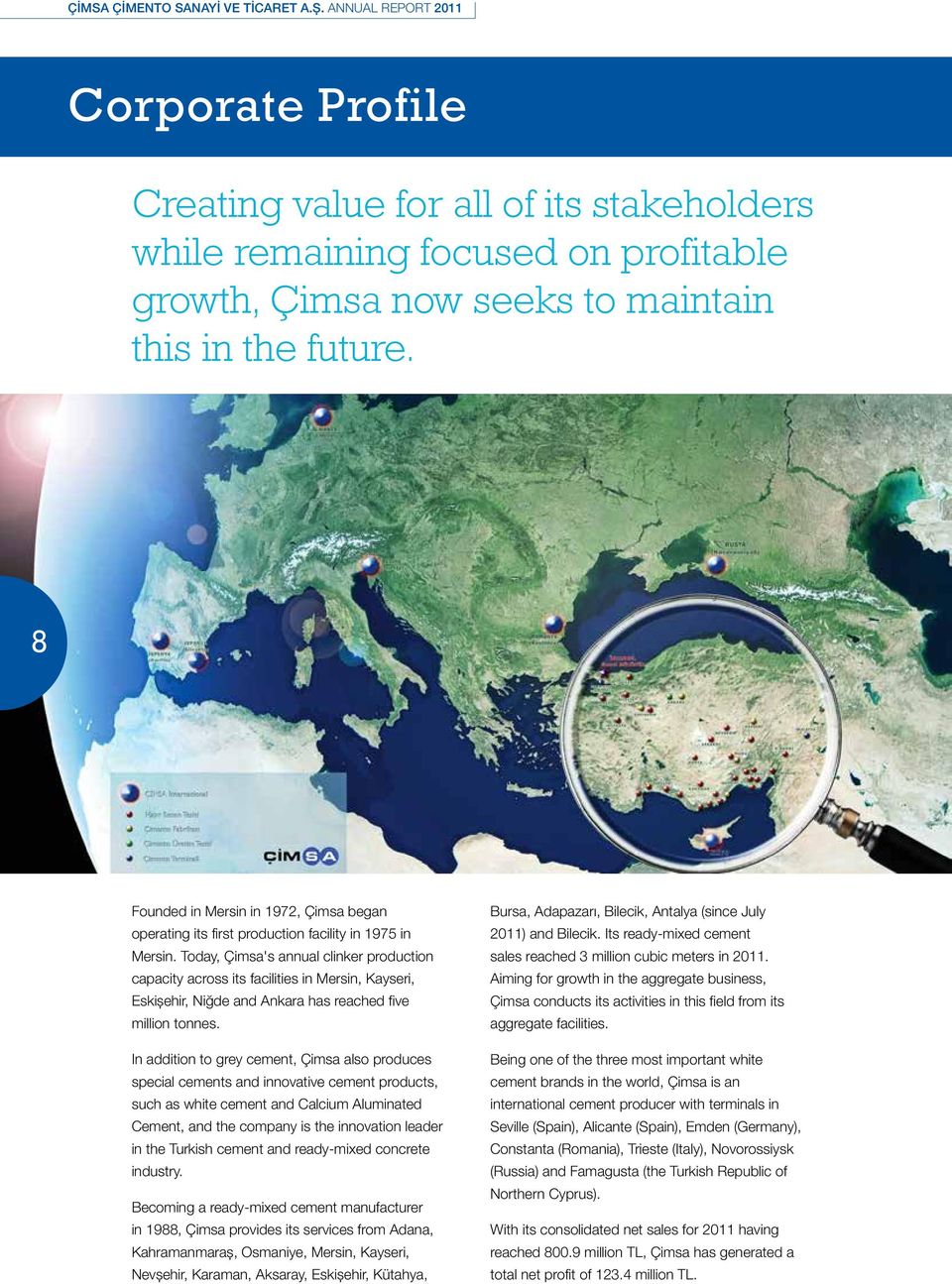
10 ÇİMSA ÇİMENTO SANAYİ VE TİCARET A.Ş. ANNUAL REPORT 2011 Corporate Profile Creating value for all of its stakeholders while remaining focused on profitable growth, Çimsa now seeks to maintain this in the future. 8 Founded in Mersin in 1972, Çimsa began operating its first production facility in 1975 in Mersin. Today, Çimsa's annual clinker production capacity across its facilities in Mersin, Kayseri, Eskişehir, Niğde and Ankara has reached five million tonnes. In addition to grey cement, Çimsa also produces special cements and innovative cement products, such as white cement and Calcium Aluminated Cement, and the company is the innovation leader in the Turkish cement and ready-mixed concrete industry. Becoming a ready-mixed cement manufacturer in 1988, Çimsa provides its services from Adana, Kahramanmaraş, Osmaniye, Mersin, Kayseri, Nevşehir, Karaman, Aksaray, Eskişehir, Kütahya, Bursa, Adapazarı, Bilecik, Antalya (since July 2011) and Bilecik. Its ready-mixed cement sales reached 3 million cubic meters in Aiming for growth in the aggregate business, Çimsa conducts its activities in this field from its aggregate facilities. Being one of the three most important white cement brands in the world, Çimsa is an international cement producer with terminals in Seville (Spain), Alicante (Spain), Emden (Germany), Constanta (Romania), Trieste (Italy), Novorossiysk (Russia) and Famagusta (the Turkish Republic of Northern Cyprus). With its consolidated net sales for 2011 having reached million TL, Çimsa has generated a total net profit of million TL.
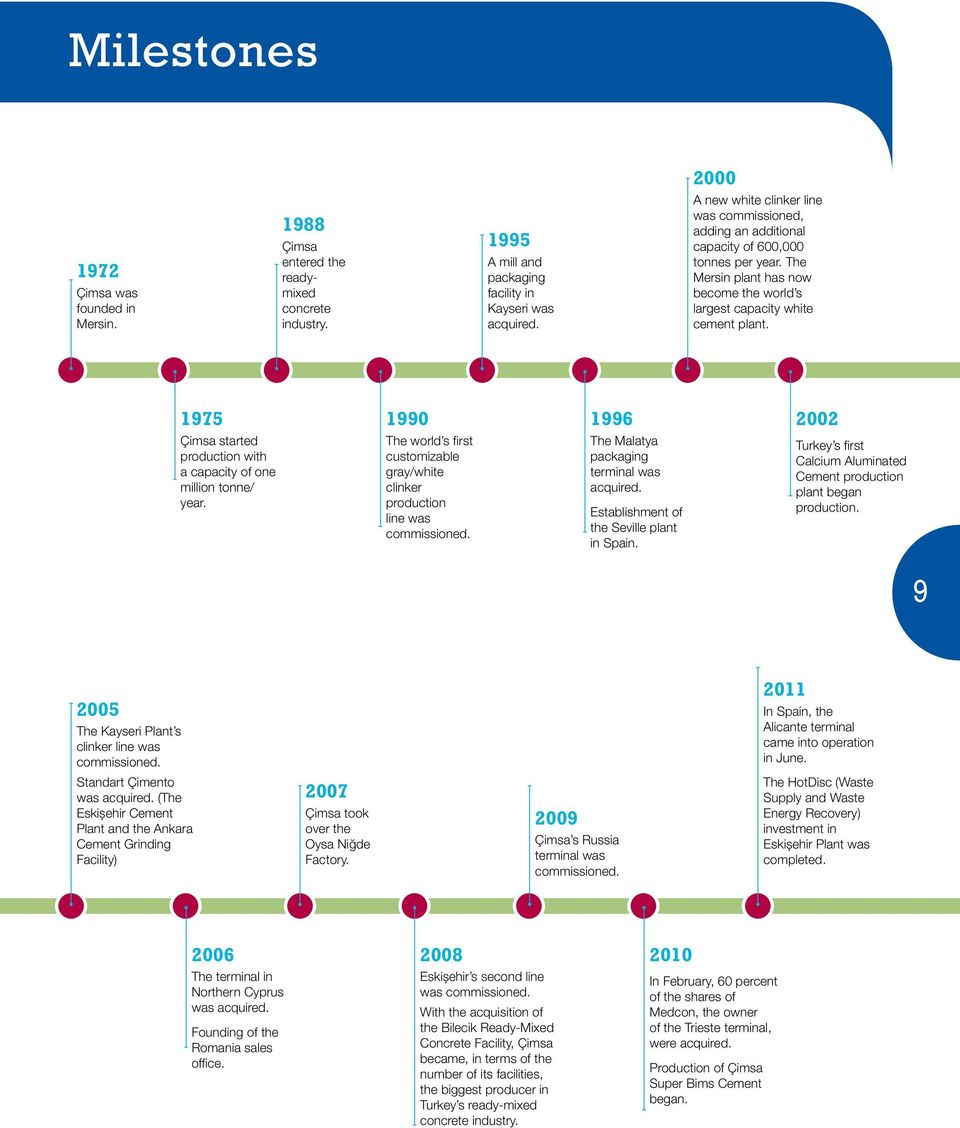
11 Milestones 1972 Çimsa was founded in Mersin Çimsa entered the readymixed concrete industry A mill and packaging facility in Kayseri was acquired A new white clinker line was commissioned, adding an additional capacity of 600,000 tonnes per year. The Mersin plant has now become the world s largest capacity white cement plant Çimsa started production with a capacity of one million tonne/ year The world s first customizable gray/white clinker production line was commissioned The Malatya packaging terminal was acquired. Establishment of the Seville plant in Spain Turkey s first Calcium Aluminated Cement production plant began production The Kayseri Plant s clinker line was commissioned In Spain, the Alicante terminal came into operation in June. Standart Çimento was acquired. (The Eskişehir Cement Plant and the Ankara Cement Grinding Facility) 2007 Çimsa took over the Oysa Niğde Factory Çimsa s Russia terminal was commissioned. The HotDisc (Waste Supply and Waste Energy Recovery) investment in Eskişehir Plant was completed The terminal in Northern Cyprus was acquired. Founding of the Romania sales office Eskişehir s second line was commissioned. With the acquisition of the Bilecik Ready-Mixed Concrete Facility, Çimsa became, in terms of the number of its facilities, the biggest producer in Turkey s ready-mixed concrete industry In February, 60 percent of the shares of Medcon, the owner of the Trieste terminal, were acquired. Production of Çimsa Super Bims Cement began.
12 ÇİMSA ÇİMENTO SANAYİ VE TİCARET A.Ş. ANNUAL REPORT 2011 Message from the Chairman 10 Dear Business Partners, The effects of the crisis in global financial markets that started in the last quarter of 2008, coming, in 2009, to affect especially the productive sectors of the world's developed economies, continued to be felt during Both the uncertainties and the downside risks in the global markets continued to increase during the first half of The slowdown in developed countries' economic growth and uncertainties about the future reduced domestic demand in these countries. While the expected growth of the developed countries' economies for 2011 is around 1.6%, this figure is forecast to be as high as 6.2% for the economies of developing countries. The Turkish economy grew by 8.5% during Although the most important risk for the Turkish economy during 2011 was the current account deficit and the low quality of the financial markets, significant steps towards improvement were taken during the last quarter in regards to the management of the current account deficit. The construction sector grew by 11.2% by the end of The contribution of the sector to GDP increased to 5.8% as of This sector, now employing around 2 million people, rose to 8% of the nation's total employment. Cement Sector Continues to Grow In 2011, the world's total cement consumption was around 3.6 billion tonnes. The developing countries were once again the engine of the world s cement market. While developed countries' cement consumption increased by 2%, in the developing countries it grew by 7% (excluding China). The global cement demand is expected to run parallel to economic growth during Cement consumption increased from 50.5 million* tonnes in 2010 to 55.8 million* tonnes in During 2012, cement consumption is expected to grow by 5% due to a range of infrastructure, housing and urban transformation projects.the consumption per capita reached 758 kg in 2011 and is expected to increase to 785 kg by the end of The sectors' capacity continued to be greater than the domestic demand throughout The surplus of the capacity over domestic demand continued to be successfully exported, despite difficulties in foreign markets and political uncertainties in the Middle Eastern and North African markets. For 2011, Turkey's total exports reached 14.1 million tonnes. The negative effects on the export markets of the political uncertainty in the Middle East and North Africa is expected to continue but to a decreasing extent during An examination of our country's main segments' cement consumption reveals that 50-55% of the consumption goes to housing projects, 35% for infrastructure projects and the remaining 15% is consumed by other construction projects. The prioritization of energy and transportation infrastructure will ensure that Turkey's economic growth is sustainable and will ensure that the distribution of cement consumption becomes more balanced. The factors that will trigger growth in the future will be investments in urban transformation, energy and transportation infrastructure.the aim of urban transformation projects is to prevent *This is an estimation made by the company using data from the Turkish Cement Manufacturers Association and adding in the estimated sales of the manufacturers that are not members of the association.
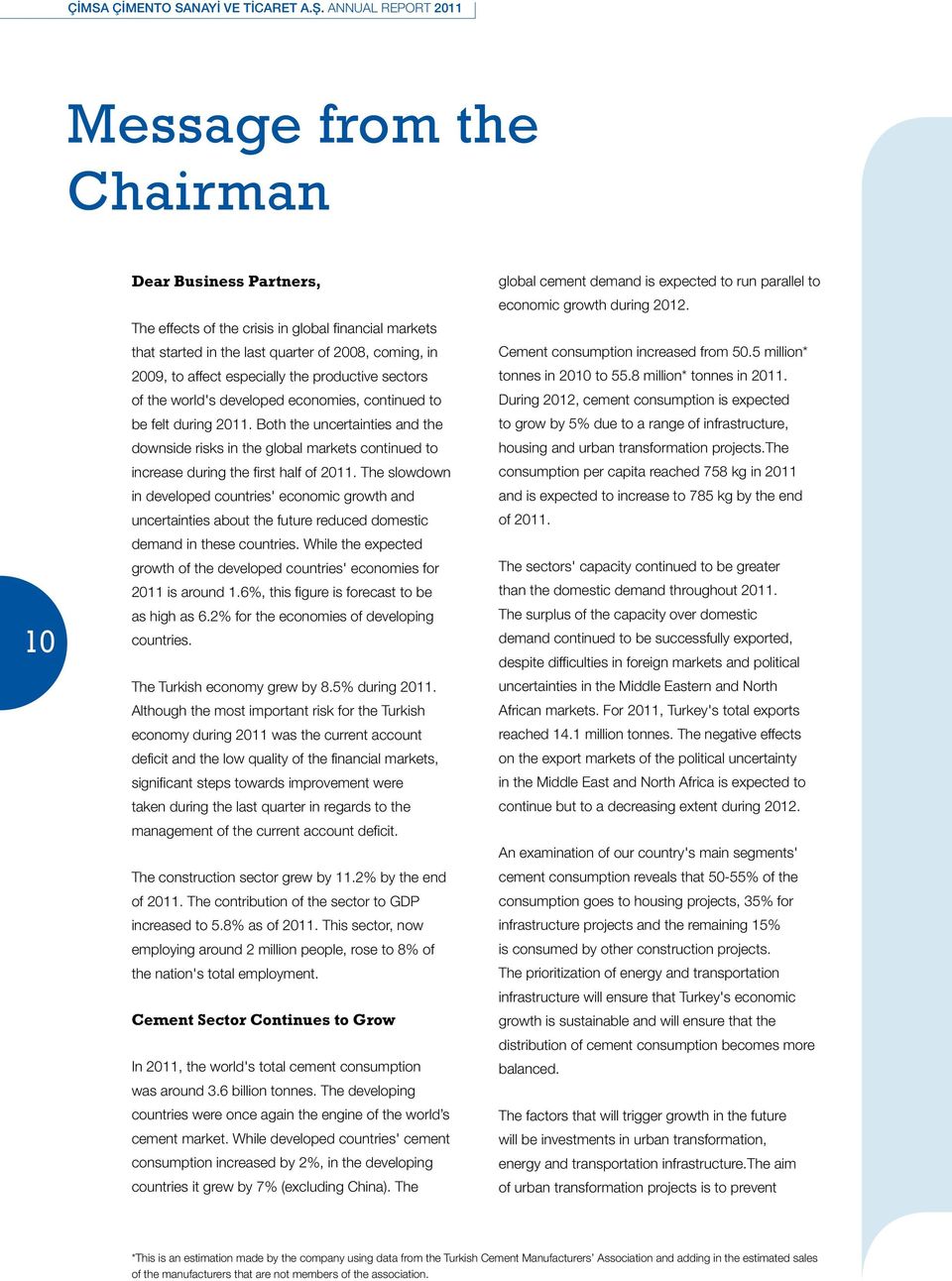
13 unplanned urbanization and to ensure compliance with earthquake regulations and standardization processes in Turkey. Çimsa, one of the cement sector's most profitable companies, increased its consolidated turnover by 13% to million TL and its consolidated operating profit by 12.5% to million TL. Being a leader in the Turkish white cement market, Çimsa is one of the most important brands in this area worldwide. Thanks to its foreign terminals, it operates as a genuine global player in the export market. I believe that 2012 will also be a successful year for Çimsa and I extend my sincere gratitude to everyone who has contributed to the leadership, the strong market position, the profitability and all of the successful operations that have led the sector to view Çimsa as the unique company that it is. Best Regards, Mehmet GöçmenChairman Innovative and Environmentally- Friendly Projects from Çimsa Since 2010, Çimsa has focused on sustainability management. 11 The main goals of Çimsa for the next ten years are to create real long term added value for shareholders, to make contributions to society and to ensure a sustainable environment. Çimsa continuously examines and undertakes improvements in response to those economic, environmental and social impacts caused by and will be caused by activities of the past, the present and the future. The company does this by taking into consideration the whole process, from the extraction of raw materials to the products' final moment of use. Çimsa supports sustainable development and the use of natural resources in the most efficient way throughout the cement sector, which makes intense use of energy and raw materials. Therefore, its emphasis is on reducing the use of fossil fuels while increasing the use of alternative fuels and resources.
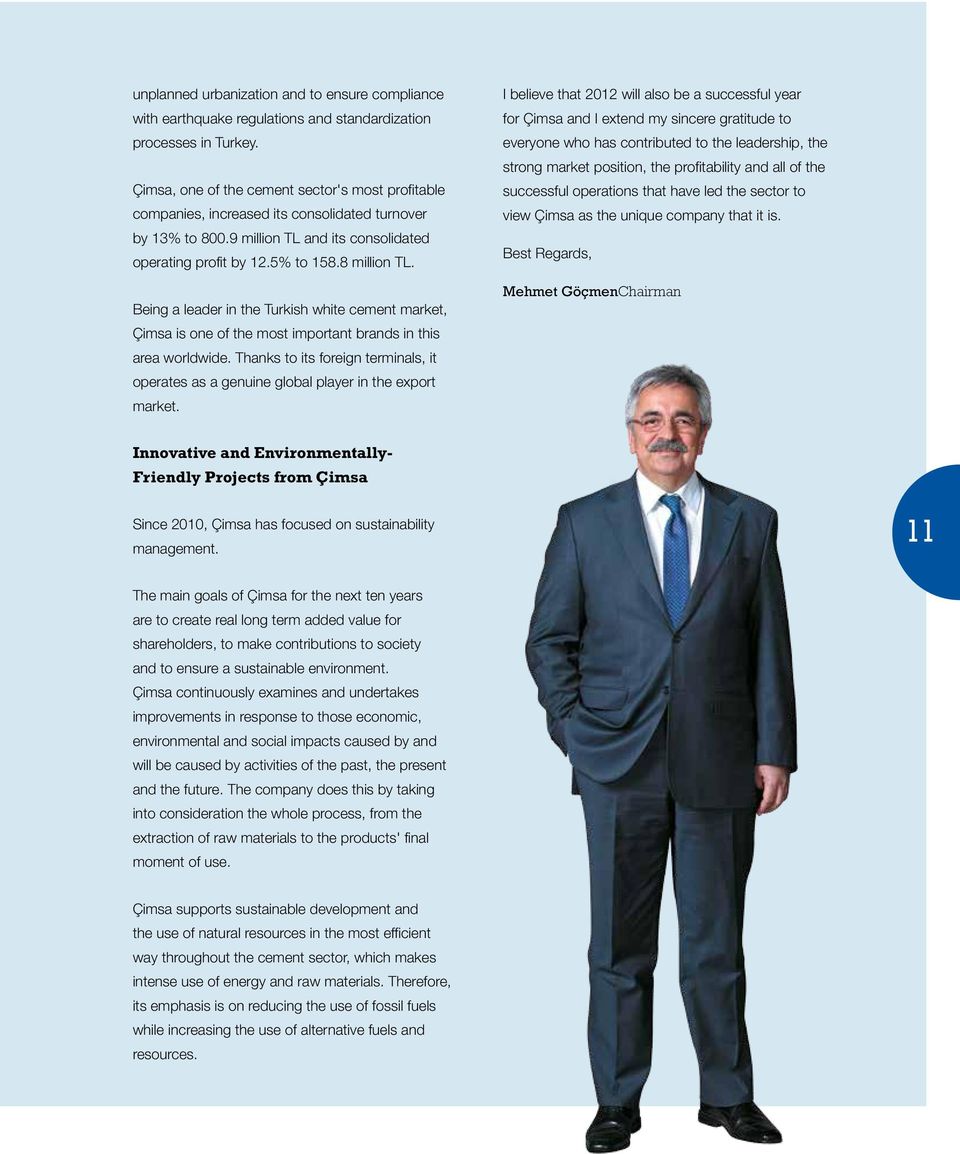
14 ÇİMSA ÇİMENTO SANAYİ VE TİCARET A.Ş. ANNUAL REPORT 2011 Board of Directors and Audit Committee Board of Directors 1- Mehmet Göçmen, Chairman 2- Serra Sabancı, Member 3- Mustafa Nedim Bozfakıoğlu, Vice Chairman 4- Levent Demirağ, Member 5- Mehmet Hacıkamiloğlu, General Manager6- Seyfettin Ata Köseoğlu, Member (since August 18, 2011) Audit Committeeİlker YILDIRIM, Bahadır BORAN (since ), Nur ŞENOL (since )
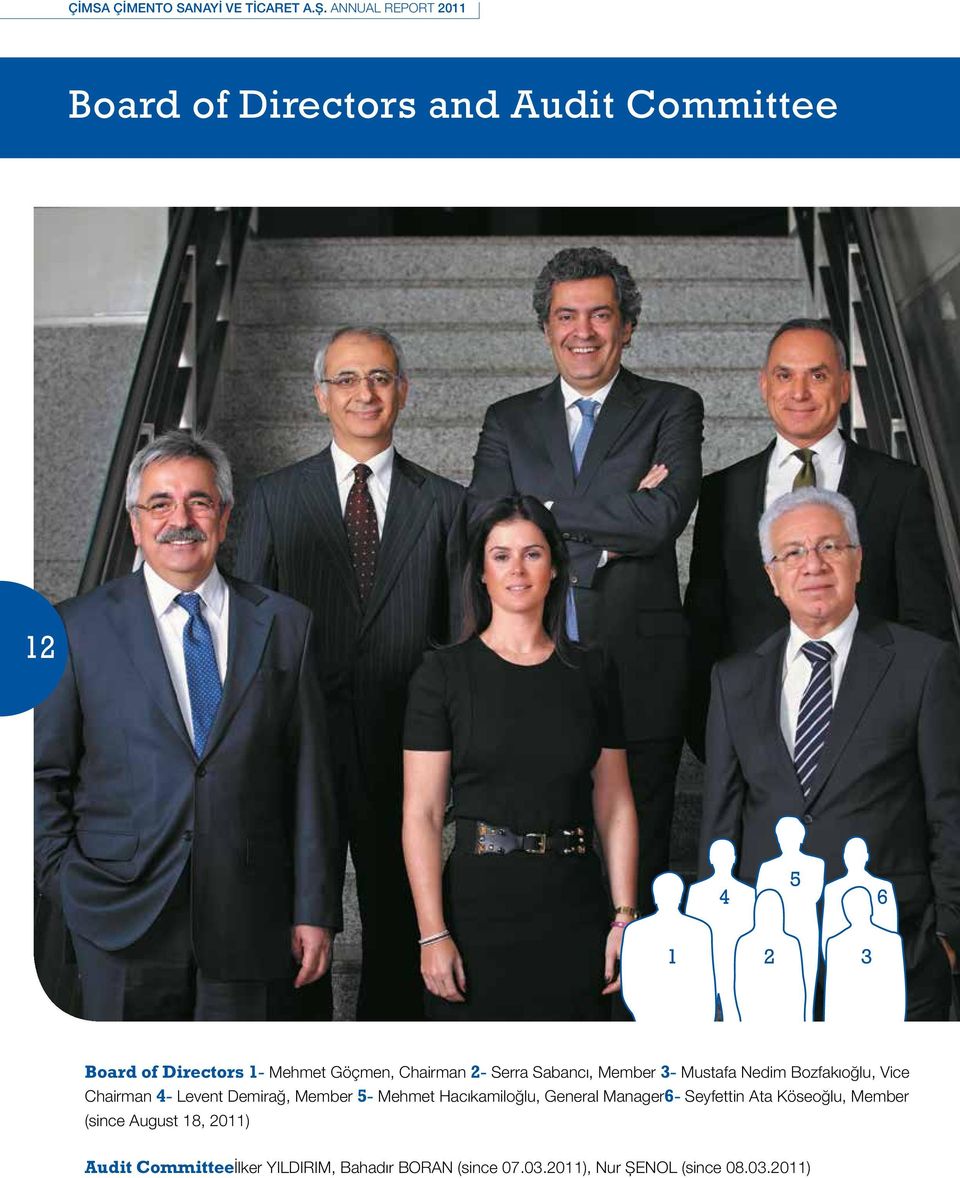
15 Senior Management Senior Management 1- Mehmet Hacıkamiloğlu, General Manager2- Nevra Özhatay, Assistant General Manager (Financial Affairs) 3- Hüseyin Özkan, Assistant General Manager (Domestic Sales) 4- Şahap Sarıer, Assistant General Manager (Cement Production) 5- Mutlu Doğruöz, Assistant General Manager (Investment) 6- Tamer Denizci, Assistant General Manager (Supply Chain) 7- Ayfer Güreş, Assistant General Manager (Corporate Development and Human Resources) 8- Ülkü Özcan, Strategy and Marketing Manager
16 ÇİMSA ÇİMENTO SANAYİ VE TİCARET A.Ş. ANNUAL REPORT 2011 Biographies of Board Members 14 Mehmet Göçmen, ChairmanBorn in 1957, Mehmet Göçmen graduated from Galatasaray High School and Middle East Technical University Industrial Engineering department. He received his graduate degree in Industrial Egineering and Operational Research from the Syracuse University, USA. He started his career at Çelik Halat ve Tel San. A.Ş. in Between 1996 and 2002, he served as the General Manager of Lafarge Ekmel Beton A.Ş., and as the Vice President for Business Development and Foreign Relations at Lafarge Turkey. He began serving as Akçansa's General Manager in June 2003 before being appointed to Sabancı Holding on August 1, 2008 as the Head of Group Human Resources. From 20 July he became Head of Sabanı Holding's Cement Group. Mustafa Nedim Bozfakıoğlu, Vice ChairmanBorn in Tarsus in 1950, Nedim Bozfakıoğlu graduated in 1972 from The Istanbul University School of Economics. He served at Lassa and Kordsa as Finance Manager and as Financial Affairs Vice Manager. He was subsequently appointed to the position of Head of Budgeting, Accounting and Consolidation Departments at Sabancı Holding, where he still serves as the Secretary General. Serra Sabancı, MemberBorn in 1975 in Adana, Serra Sabancı completed her higher education at the University of Portsmouth and at Istanbul Bilgi University s Economics Department, where she graduated with the best degree of her year. After working at Temsa, Ms. Sabancı received training in the fields of Company Acquisition

17 and Board Membership at London s Institute of Directors. Serra Sabancı is still the Head of the Board of Directors at Sabancı Holding, in addition to various other Group companies, while at the same time serving as a Member of the Board of Trustees of Sabancı Vakfı. Levent Demirağ, MemberBorn in 1959 in Erzurum, Levent Demirağ graduated from the Ankara University Faculty of Political Sciences in From 1980 to 1992 he worked as a Financial Analyst for the Ministry of Finance. Having served since 1994 in various positions within Sabancı Holding, Levent Demirağ is currently the Head of Sabancı Holding Financial Affairs and Finance Department. Mahmut Volkan Kara(until August 18, 2011), MemberBorn in Istanbul in 1973, Volkan Kara graduated from Robert College and from the Mechanical Engineering Department of Istanbul Technical University. At the University of North Carolina s Kenan-Flagler School of Management he completed his graduate education with an M.B.A. degree. In the USA he worked in Austin Texas for Dell Computers, in Chicago Illinois for A.T. Kearney and then in Milwaukee Wisconsin for SAB Miller. His current position is the Corporate Strategy and Planning Director of the Sabancı Holding Strategy and Business Development Group Presidency. On 1 June 2011 he was appointed as the Head of Strategy and Business Development Group for Sabancı Holding. Mehmet Hacıkamiloğlu, General ManagerAfter earning a bachelor s degree in Civil Engineering from Boğaziçi University, Mehmet Hacıkamiloğlu completed the International Business Specialization Program at Istanbul University and the Executive-MBA program at Sabancı University. Mr Hacıkamiloğlu then joined Sabancı as the Facility Manager of Betonsa, moving on to become the company s Investment and Planning Specialist. From 1997 to 1999, Mr Hacıkamiloğlu was Akçansa's Strategy Development and Planning Manager and Agregasa s Company Manager from 1999 to After a further two years as Akçansa s Financial Coordinator, he joined Çimsa as the Assistant General Manager for Financial and Administrative Affairs. He was appointed as Çimsa's General Manager on June 1, Mehmet Hacıkamiloğlu still serves as Çimsa's General Manager. 15 Seyfettin Ata Köseoğlu(since ), Memberborn in 1960 in Akşehir, Ata Köseoğlu graduated from Boğaziçi University's Department of Mechanical Engineering. He went on to complete his M.A. in the Electrical Engineering department of Leigh University and he received an M.B.A. from Boston University. After starting his career in the banking industry at İktisat Bank, Ata Köseoğlu served at Finansbank, Bear Stearns, Societe Generale Investment Bank, Credit Suisse First Boston Bank and BNP Baribas/TEB respectively.
18 ÇİMSA ÇİMENTO SANAYİ VE TİCARET A.Ş. ANNUAL REPORT 2011 Biographies of Senior Management 16 Mehmet Hacıkamiloğlu, General ManagerPlease refer to page 15 for a brief resume. Nevra Özhatay, Assistant General Manager (Financial Affairs)After completing her MBA at Exeter University in the UK, following a bachelor's degree in Business Administration from Boğaziçi University, Nevra Özhatay began to work at Sabancı Holding Cement Group as a Financial Specialist in In 1996 Ms. Özhatay joined Akçansa as the Management Support Manager, becoming the Strategy and Business Development Expert in 1998, the Planning and Control Manager in 2000, the Strategy and Business Development Manager in 2004 and the Logistics, Strategy and Business Development Director in Since the beginning of 2009, Ms. Özhatay has been working as the Financial Affairs Assistant General Manager at Çimsa. Hüseyin Özkan, Assistant General Manager (Domestic Sales) A graduate of METU s Economics Department, in 1983 Hüseyin Özkan started his career as a Marketing Supervisor at Exsa Export A.Ş. In 1986 he joined Çimsa Çimento as the Internal and External Trade Supervisor, being promoted to the position of Sales and Marketing Manager. Since 1999 he has been the company s Assistant General Manager for Marketing and Sales. He was appointed the Assistant General Manager Responsible for Domestic Sales on January 1, Şahap Sarıer, Assistant General Manager (Cement Production)Şahap Sarıer began his career in 1995 as a Field Engineer at Betonsa after completing his Civil Engineering qualifications at the Dokuz Eylül University. Continuing from 1995 to 1997 as Betonsa s Operating Supervisor, Mr Sarıer worked as the Regional Manager of Akçansa Ready-Mixed Concrete from 1998 to 2004.
19 For the next two years he was Karçimsa A.Ş. s Operations Manager. In 2006 Mr Sarıer became Çimsa's Assistant General Manager Responsible for Ready-Mixed Cement, being appointed as the Assistant General Manager Responsible for Cement Production as of 01 January Mr Sarıer holds an Executive MBA from Sabancı University. Mutlu Doğruöz, Assistant General Manager (Investment)An electrical engineering graduate from Boğaziçi University, Mutlu Doğruöz began his career in 1983 as an Electronics Supervisor at Enka Teknik where, for five years, he was in charge of the maintenance and operations of their automation systems. In 1989 he was appointed Deputy Project Manager at Saudi Services Group. Following four years of experience there he joined Çimes Elektronik Sanayi. At Çimes, Mr Doğruöz served as the Company Manager, the Assistant General Manager and the General Manager respectively. In 2006 he joined Çimsa Çimento as the company's Investment Manager, a position that he still holds. Tamer Denizci, Assistant General Manager (Supply Chain)Tamer Denizci began his career as the Financial Affairs Supervisor at Dusa Endüstriyel Sanayi. Following four years of experience at Dusa he worked from 1992 to 1994 as the Manager of Financial and Administrative Affairs at Yes International A.S.. In 1994, he moved to Lafarge Beton A.S. as their Financial Affairs Manager, following which he served as Lafarge Aslan Çimento s Export and Sales Director. In 2006, Denizci joined Çimsa as the company s Financial Affairs Assistant General Manager, and he continues to work at Çimsa as the company's Supply Chain Assistant General Manager. Mr Denizci is a graduate of İstanbul Technical University s Department of Management Engineering. Ayfer Güreş, Assistant General Manager(Corporate Development and Human Resources)Ayfer Güreş holds a bachelor s degree in Psychological Counseling and Guidance from Boğaziçi University and a master s degree in Organizational Psychology from Columbia University. Ms Güreş began her career at Mudo A.S. as a Human Resources Specialist. After completing her post graduate education, she joined Sabancı Holding as a specialist in Between 1997 and 2007, she worked as the Human Resources Manager at Sabancı Holding, and in 2007 she started to work as a Corporate Development and Human Resources Manager at Çimsa Çimento. Ayfer Güreş is currently the Assistant General Manager in charge of Corporate Development and Human Resources. Ülkü Özcan, Strategy and Marketing Manager After graduating from Galatasaray High School and Marmara University s Department of Business Administration (English), Ülkü Özcan began her career at Lafarge Turkey in She served as a Strategic Planning Expert from 1999 to 2003, as the Strategy and Business Development Manager from 2005 to 2007 and the Marketing Project Manager from 2005 to In January 2010, Özcan joined Çimsa Çimento as the company's Strategy and Business Development Manager. 17
20 ÇİMSA ÇİMENTO SANAYİ VE TİCARET A.Ş. ANNUAL REPORT 2011 An Assessment of the Cement Industry for The differentiation trend between the developed and the developing countries that started in 2010 continued in While the demand for cement in developing countries is generally low compared to developed countries, it has increased significantly. While developed countries' cement consumption increased by 2%, in the developing countries consumption grew by 7% (excluding China) in The global players in the concrete market were affected by the stagnation in the developed markets, the political developments in the Middle East and North Africa and the increase in energy prices and therefore could not improve their profit margins. While, in 2011, the cement sector contracted by 3% in the Middle East and by 5% in South Africa, it grew by 6% in Northern Europe, 4% in the Middle East and Africa and by 6% in Latin America. However, eastern Europe became the region with the highest growth in the world with a growth rate of 10%. In 2011, Turkey's construction sector grew by 15.3% in the first quarter, 13% in the second quarter, 10.2% in the third quarter and 7% in the fourth quarter, reaching a total growth of 11.2% in Turkey is the largest cement producer in Europe and the fourth largest worldwide, after China, the USA and India. In total, 65 facilities operate in the Turkish cement industry, 48 of which are integrated facilities and 17 are grinding and packing facilities. In 2011, cement production in Turkey was 63 million* tonnes and cement consumption was 56 million* tonnes. The industry's surplus capacity, after domestic demand was satisfied, was exported. However the social and political turbulence in the Middle East and North Africa, especially during the first quarter of 2011, caused a decrease in Turkey's total cement and clinker exports. Total cement and clinker exports for 2011 decreased by 24% in comparison to 2010, coming to 14.3 million tonnes. The cement sector, being aware of its environmental responsibilities, works to have an active role in extending sustainable growth while, at the same time, continuing to grow economically. Sustainable growth, within the regulatory framework of EU compliance, was an important topic throughout 2011, as it was in The use of waste fuel, alternative raw materials, the discharge of waste water and the prevention of soil pollution are each serious and important topics that our country pays a great deal of attention to in order to decrease total energy costs and carbon emissions. *This is an estimation made by the company using data from the Turkish Cement Manufacturers Association and then adding in the estimated sales of those manufacturers that are not members of the association.
21 In 2011, Turkey's cement production was 63 million * tonnes and its cement consumption was 56 million * tonnes. 19
22 ÇİMSA ÇİMENTO SANAYİ VE TİCARET A.Ş. ANNUAL REPORT 2011 Domestic Cement Facilities 20 Mersin Plant's First Facility Production Line.This facility started production in It features a rotary kiln 5.25 m in diameter and 83 m long. In 1983 the facility was modernized by the addition of a coal grinding and burning system to reduce its fuel costs. The facility has two crushers, one pre-homogenization facility, two ball mills for raw materials, two raw meal silos and two closed clinker stock halls. In the first quarter of 2010 the facility was further modernized. The current planet-type clinker cooling system was replaced and a FLS SF-Cooler type grate cooler system was installed. After this investment, the plant s production capacity reached approximately 3,700 tonnes/day, compared to a previous 3,400 tonnes/day. In addition, the total heat consumption required for the production of clinker has been reduced. Furthermore, this system has significantly contributed to the first facility's de-dusting practices. The Second Facility's Production Line. The second facility s rotary kiln, commissioned in December 1989, is capable of producing both grey and white clinker. It has a diameter of 3.6 m and a length of 49 m. The facility contains crushers, a raw material mill with pre-homogenization systems, a coal mill, two raw meal silos, a rotary kiln and a clinker stock hall. This facility, capable of producing both grey and white clinker according to the saled demand; it has a grey clinker production capacity of 1,845 tonnes/ day and a white clinker production capacity of 1,470 tonnes/day. The power generated by the Waste Heat Power Generation Project at Çimsa's Mersin Plant will supply the 50% of the total power requirement of the First and the Second facilities. In addition to meeting part of the power requirement, this project also contributes to the environment with reducing carbon emission. The Third Facility's Production Line.With a rotary kiln 3.75 m in diameter and 57 m long, the Hacı Sabancı White Cement Production Facility began operating in December The Third Facility has a production capacity of 1,750 tonnes/ day. The facility contains a crusher, a raw material mill with pre-homogenization facilities, a coal mill, a raw meal silo, a rotary kiln and a clinker stock hall. The Calcium Aluminate Cement Production FacilityThis facility, commissioned in 2002, has two kilns giving it a clinker production capacity of two tonnes/hour. This facility also features a cement mill with a grinding capacity of five tonnes/hour, and a packaging unit. In 2007, with the commissioning of a second kiln having a clinker production capacity of two tonnes/hour, the facility's production capacity was increased. In addition, after a packaging unit was installed in 2009, the products are now offered to customers in packages of 25 kg, in pallets, and in large bags of 1.5 tonnes. The Paper Bag Plant. In 2011, 27.2 million paper bags were produced by the Mersin paper bag plant. These were used in the Mersin, Kayseri, Niğde, Eskişehir and Ankara Plants. The investments in the Mersin plant with the aim to increase sustainability and to protect the environment continued in The Mersin Plant also has four cement mills, three of which are ball mills, the other being a vertical mill.
23 The Kayseri Plant.The Çimsa Kayseri Plant was established in 1992 by Akçimento, a Sabancı Holding company and was acquired by Çimsa in It has an annual cement grounding and packaging capacity of 1.6 million tonnes. A pregrinding system was added to the cement mill in 2005 to improve the cement grinding capacity and to reduce the energy consumption. In order to turn the facility into an integrated cement plant, the construction of clinker production line was started on October 9, After the completion of the construction, installation and commissioning operations, the plant's first clinker production took place on 26 December Equipped with state of the art technologies, the facility's main unit consists of an ILC type low NOx emission pre-calcination system, a pre-heater with five stages of cyclones and a rotary kiln 55 m long and 3.60 m in diameter. With a clinker production capacity of 2,300 tonnes/day, this facility also features a raw material crusher, pre-homogenization facilities for both clay and limestone, one coal ball mill, one vertical raw meal mill and two cement ball mills. The Kayseri Plant produces puzzolanic cement at the TS EN 197 CEM IV /B (P) 32.5 R standard. In the production of this cement, trass is used as an additive. The Kayseri trass drying project enables the drying of trass. This means that damp trass, extracted from a quarry only 10.3 kilometers away, can now be used instead of trass formerly provided from a quarry 180 kilometers away. absence of any additional fuel consumed in order to dry the trass. The Kayseri Plant became the first firm in the cement sector to obtain a TS EN Power Management Certificate, a certificate awarded only to firms that have implemented an effective power management system and system procedures. This again demonstrates the leading role that Çimsa plays in the sector in the reduction of costs and the elimination of greenhouse gas emissions. Noting that respect for the environment is an integral part of sustainability, in September 2011 Çimsa's Kayseri Plant succeeded in becoming the first cement factory to obtain an Environmental Permit and License for Waste Water Discharge, Air Emission and Waste Incineration. The Eskişehir Plant.The Eskişehir Cement Plant was commissioned in 1957 with a wet kiln 3.6 m in diameter and 125 m long, possessing the capacity to produce 150,000 tonnes/year. This plant operated until The first production line that we see operating today was commissioned in This line has a capacity of 275,000 tonnes/ year, a three stage pre-heater and a dry system kiln 3.6 m in diameter and 52 m long, which increased the line s total capacity to 425,000 tonnes/year. On 27 December 2005, TMSF transferred the Eskişehir Plant to Çimsa Çimento Sanayi ve Ticaret A.Ş. 21 This unique project supported by TUBITAK as part of its TEYDEP 1501 Industry R&D program, has further advantages including the elimination of the installation of a new drying unit and the complete Following the acquisition of the plant by Çimsa in May 2007, the first production line had a dynamic separator added to its raw material mill, the current clinker cooler was replaced, the rotary kiln s burning
24 ÇİMSA ÇİMENTO SANAYİ VE TİCARET A.Ş. ANNUAL REPORT 2011 Domestic Cement Facilities 22 systems, dosage systems and its new electrofilter units were renewed. As a result of these investments, a clinker production capacity of 1,750 tonnes/day was achieved. A new closed circuit cement mill with a capacity of 85 tonnes/hour was also commissioned. In September 2007, a completely new coal vertical mill system was commissioned. This could serve both production lines and has a capacity of 40 tonnes/hour. The old coal systems were decommissioned. In January 2008, a completely new second production line was commissioned. This line had a similar structure to that of the current Kayseri plant, a capacity of 2,300 tonnes/day, bringing the plant s total production capacity to 4,050 tonnes/day. The Eskişehir Cement Plant became a modern production facility following the installation of its raw material crusher and a raw material prehomogenization system which were both installed in January 2008, at the same time as the second production line. The plant's cement silos were installed in The plant also features three ball cement mills used for production of the final cement product. With the installation of new, modern electro-filters on the first and second facilities' rotary kiln lines during 2007 and 2008 respectively, the Eskişehir plant s dust emissions have now been significantly reduced. In addition, the dust cyclone on the line that fed hot gas from the second facility to the new coal mill has been replaced with a more efficient cyclone. Dust leakages from the plant have been reduced by the renewal and modernization of the plant s raw material and clinker hall. It is Çimsa s goal to become one of Turkey s leading waste disposal companies. The Hotdisc Project (Waste Supply and Waste Energy Recovery) was carried out at the Eskişehir Plant as part of this plan. The Hotdisc Project will control, both, the kiln s processes and its overall product quality, in addition to generating from waste 30% of its total calorific consumption. The Niğde Plant.Established in 1957, the Niğde Cement Plant started production in 1964 following the completion of its production line. At the time it was a wet system with a capacity of 85,000 tonnes/year. The plant's total production capacity was increased to 350,000 tonnes/year after the commissioning of its second production line, a dry system, on September 2, Over the following years, the wet system clinker line was shut down because it had reached the end of its economic and technological life, while production continued using the dry system s rotary kiln. After the privatization of the plant, the kiln s capacity of 850 tonnes/day was increased to 1,240 tonnes/ day following investments made during 1993 including thereplacement of the rotary kiln unit's cyclone, a modernization of its transport, cooling and burning systems, and the replacement of its exhaust gas fan and its electro-filter.
25 Pursuant to the Competition Authority s ruling regarding the termination of the Sabancı and Oyak partnership, the Oysa Niğde Cement Plant was renamed to the Çimsa Çimento San. ve Tic. A.Ş. Niğde Cement Plant as of November the 1st, 2007, continuing production under this name. After it was acquired by Çimsa, many production and energy efficiency improvements were made at the Niğde Cement Plant and it has currently reached a clinker production capacity of 1,380 tonnes/day. In addition to the rotary kiln with its four-stage pre-heater and grate cooler, a diameter of 3.8 m and a length of 52 m, the plant has one production line and one hammer crusher, one ball raw meal mill, a vertical coal mill and a cement mill with a single roller press grinding system. Always developing innovative products to satisfy every one of its customers needs, in 2010 Çimsa created and began producing its "Super Bims" Cement at its Niğde Plant. Four different groups using the 6-sigma methodology were established in order to increase efficiency in different areas and a number of significant efficiency results were achieved. Seeing the environment and sustainable growth as priorities in all its activities, the facility proved this sensitivity by planting 16,000 trees during The Ankara Lalahan Cement Grinding and Packing Facility.The construction of Ankara Lalahan Cement Grinding and Packing Facility started in January 2001 and it was commissioned in July In 2005, it was acquired by Çimsa along with the Eskişehir Cement Plant. As the Ankara Plant does not have a rotary kiln, clinker supplied from other Çimsa Plants is ground and converted into cement here before being sold. The Ankara Cement Grinding and Packing Facility has a single cement mill with a capacity of 85 tonnes/hour, one raw material crusher, two cement silos and a packing unit. The Marmara Rota Port Cement Packing Facility.Located at the Kocaeli Yarımca Gulf Rota Port, the Marmara Facility has been leased by Çimsa in June It has an installed silo capacity of 5,000 tonnes, and a bagged and bulk cement packing/loading capacity of 100 tonnes/hour. Çimsa Super White Cement is sent from Mersin in bulk and stored in facility's 5,000 tonne horizontal silo. The Marmara Facility was leased especially to be closer to the company's customers in the Marmara Region; from the facility white cement is sold both in bulk and packaged. The Malatya Cement Packing Facility. Established in 1996 near the Malatya Battalgazi Train Station, the Malatya Cement Packing Facility has a processing and packing capacity of 60,000 tonnes/year. At the facility there are three cement silos with a total capacity of 900 tonnes. Cement is sold here both packaged and in bulk. 23
26 ÇİMSA ÇİMENTO SANAYİ VE TİCARET A.Ş. ANNUAL REPORT 2011 Çimsa Facility Information Production Lines Clinker Production Capacity (tonnes/day) Raw Meal Kiln Diameter (m) Cooler Type Mill Type Mersin Çimsa 1. Facility 3,700 grey clinker 5.25 Grid cooler Ball mill 2. Facility 1,845 grey clinker 3.60 Grid cooler Roller mill or 2. Facility 1,470 white clinker 3.60 Grid cooler Roller mill 3. Facility 1,750 white clinker 3.75 Grid cooler Roller mill 1. Isıdaç Isıdaç-40 clinker 2. Isıdaç Isıdaç-40 clinker Kayseri Çimsa Production Line 2,300 grey clinker 3.60 Grid cooler Roller mill Eskişehir Çimsa 1. Production Line 1,750 grey clinker 3.60 Grid cooler Ball mill 2. Production Line 2,300 grey clinker 3.60 Grid cooler Ball mill Niğde Çimsa Production Line 1,380 grey clinker 3.80 Grid cooler Ball mill 24 Grinding Facility Mill Production Capacity (tonnes/ day) Mill Diameter (m) Mill Length (m) Cement Mill Type Ankara Çimsa ,20 13 Ball mill Production Figures for 2011 Clinker Production Cement Production Grey Clinker 3,956,079 tonnes Grey Cement 4,545,074 tonnes White Clinker 875,929 tonnes White Cement 1,020,988 tonnes Isıdaç-40 Clinker 27,207 tonnes Isıdaç-40 26,234 tonnes Sulphate Resistant Clinker 29,293 tonnes SDÇ Cement 25,637 tonnes Ekoharç 12,195 tonnes Total 4,888,508 tonnes Total 5,630,128 tonnes Capacity Utilization of the Rotary Kilns for 2011 Mersin Rotary Kiln I 91% Mersin Rotary Kiln II 95% Mersin Rotary Kiln III 96% Kayseri Rotary Kiln 97% Eskişehir Rotary Kiln I 90% Eskişehir Rotary Kiln II 96% Niğde Rotary Kiln 95%
27 CE Certified Certification EN CEM I 52,5 R White Portland Cement EN CEM I 42,5 R Grey Portland Cement EN Calcium Aluminate Cement EN CEM II/B-L 42,5 R White Portland Calcareous Cement EN CEM II/B-M (V-L) 42,5 R Portland Composite Cement EN MC 12,5 X Mortar Cement EN CEM II/B-M (P-L) 32,5 R Portland Composite Cement EN CEM II/A-M (P-L) 42,5 N Portland Composite Cement EN CEM II/A-M (P-L) 42,5 R Portland Composite Cement EN CEM IV/B (P) 32,5 R Puzzolanic Cement EN CEM II/A-L 42,5 R Portland Calcareous Cement EN CEM III/A 32,5 R Blast Furnace Cement EN Ground Blast Furnace Slag G Certified Certification TS 21 BPÇ 52,5 R/85 TS SDÇ 42,5 R White Portland Cement Sulphate Resistant Cement National Standards Compliance Certification BL I 52,5 R UNE (Spain) HR EN 197-1: 2005 CEM I 42,5 R (Crotia) Grey Portland Cement HR EN 197-1: 2005 CEM I 52,5 R (Crotia) White Portland Cement CEM I 52,5 R SONCAP Certificate (Nigeria) White Portland Cement CEM I 52,5 R SASO Certificate (Saudi Arabia) White Portland Cement CEM I 52,5 R GOST-R Certificate (Russia, Ukraine) White Portland Cement CEM I 42.5 R GOST-R Certificate (Russia, Ukraine) Grey Portland Cement TSE Compliance Certification TS 21 BPÇ 52,5 R/85 TS EN CEM I 42,5 R TS EN TS EN CEM II/B-L 42,5 R TS EN CEM II/B-M (V-L) 42,5 R TS EN MC 12,5 X TS EN CEM II/B-M (P-L) 32,5 R TS EN CEM II/A-M (P-L) 42,5 N TS EN CEM II/A-M (P-L) 42,5 R TS EN CEM IV/B (P) 32,5 R TS EN CEM II/A-L 42,5 R TS SDÇ 42,5 R TS EN CEM III/A 32,5 R Products White Portland Cement Grey Portland Cement Calcium Aluminate Cement White Portland Calcareous Cement Portland Composite Cement Mortar Cement Ekoharç Portland Composite Cement Portland Composite Cement Portland Composite Cement Puzzolanic Cement Portland Calcareous Cement Sulphate Resistant Cement Blast Furnace Cement Other Certification TSE EN ISO EN 9001: 2008 TSE EN ISO EN 14001: 2004 TSE_SG-OHSAS TS EN 16001: 2010 Mersin Kayseri Eskişehir Niğde Ankara Plant Plant Plant Plant Plant TS EN CEM I 42,5 R Portland Cement (Grey) x x x x x TS EN CEM II/B-M (V-L) 42,5 R Portland Composite Cement x TS EN CEM I 52,5 R Portland Cement (White) x TS EN CEM II/B-L 42,5 R Portland Calcareous Cement (White) x EN MC 12,5 X Mortar Cement (Ekoharç) x EN Calcium Aluminate Cement x TS EN CEM II/A-M (P-L) 42,5 R Portland Composite Cement x x x x TS EN CEM II/A-M (P-L) 42,5 N Portland Composite Cement x TS EN CEM II/B-M (P-L) 32,5 R Portland Composite Cement x x TS EN CEM II/A-L 42,5 R Portland Calcareous Cement x TS EN CEM III/A 32,5 R Blast Furnace Cement x TS EN CEM IV/B (P) 32,5 R Puzzolanic Cement x x x TS SDÇ 42,5 R Sulphate Resistant Cement x 25 Packaging Types and Variations Bagged Loading Capacity 3 tier bagged 3 tier craft paper 50 kg. 4 tier bagged 4 tier craft paper 50 kg bagged 1 tier white, 1 tier laminated dark and 2 tiers dark craft paper 50 kg bagged 1 tier white, 1 tier laminated dark and 3 tiers dark craft paper 50 kg bagged 1 tier white, 1 tier laminated dark and 4 tiers dark craft paper 50 kg bagged 1 tier white, 1 tier laminated dark and 2 tiers dark craft paper 25 kg. 2+1 bagged 2 tiers dark craft, 1 tier laminated dark craft 25 kg. 1 tier bagged 1 tier laminated polypropylene 50 kg. 2 tier bagged 50 kg. Sling Paletless 39 bags 1.95 tonnes 800 tonnes/days Big Bag 1.5 tonnes 800 tonnes/days Laminated Polypropylene 1,5 tonne 800 tonnes/days Slingbag 1.5 tonnes Laminated Polypropylene 1 tonne 800 tonnes/days Palette Wooden 15x100x120 cm bags (50 kg.) tonnes 800 tonnes/days Palette Wooden 15x100x120 cm 64 bags (25 kg.) 1.6 tonnes 800 tonnes/days Other Bulk Lime Truck tonnes 4,000 tonnes/days Clinker Bulk Ship 2,500 tonnes/days Big Bag Laminated polypropylene tonnes 800 tonnes/days
28 ÇİMSA ÇİMENTO SANAYİ VE TİCARET A.Ş. ANNUAL REPORT 2011 Cement Types Manufacturing special types of cement, including White Cement and Calcium Aluminate Cement, Çimsa is consistently innovative, continuing to lead the market due its flexible, customized products and services. 26 Portland Cement.Complying with the TS EN CEM I 42.5R standard and containing high levels of C3S, Portland Cement ensures high resistance development. It is the most commonly used type of cement in high-resistance concrete types and in multi-storey constructions. It is particularly preferred in prestressed, prefabricated implementations and used in tunnel formwork systems in housing concretes. Çimsa s Puzzolanic Cement has been EC certified by the Council for Quality and the Environment (CQE), giving it the right to display the CE trademark. composed of around 35% very finely ground volatile cinder and limestone. This very fine additional backfill material fills the micro-pores in the concrete, increasing the concrete's impermeability as it is compressed. The siliceous volatile cinder utilized in the manufacture of Portland Composite Cement accelerates the concrete s internal reactions as it sets, increasing the resultant concrete s resistance against exterior impacts thus ensuring that its final pressure tolerance is high. Çimsa's Portland Composite Cement has the TS EN 197-1:2002 CEM II/A-M (PL) 42.5 R standard marking and contains portland clinker, and maximum 21% puzzolana and limestone. It is classified as one of cements having the highest early resistance in its class. While its hydration temperature is low, its early resistance is high. Çimsa s Puzzolanic Cement has been EC certified by the Council for Quality and the Environment (CQE), giving it the right to display the CE trademark. Portland Composite CementPortland Composite Cement is in the high-early resistance cement group, in compliance with the TS EN CEM IIB-M (V-L) 32.5R standard. In addition to Portland Cement, it is Puzzolanic CementPuzzolanic Cement is developed through a process of grinding its mineral additives (puzzolana) with a specific proportion of Portland Cement clinker and limestone to a degree specified (maximum 55%) in its TS EN 197-1:2002 CEM IV/B (P) 32.5 R standard. Çimsa s Puzzolanic Cement has been EC certified by the Council for Quality and the Environment (CQE), giving it the right to display the CE trademark. During the concrete s testing processes, its water: cement ratio is relatively high. Thanks to its high levels of concrete agents, its
29 hydration temperature remains low; however, it has greatly elevated levels of resistance to alkali-aggregate reactions and to other external chemical reactions. Puzzolanic Cement is generally utilized in construction, repair works, plastering and in the manufacture of construction chemicals. Sulphate Resistant CementTS SDÇ 32.5 R cement is obtained by grinding SDÇ clinker with a precise ratio of C3A and C4AF, together with a specified amount of limestone. The declaration of conformity of Sulphate Resistant Cement against its affiliated standard (TS 10157) has been approved, in accordance with the Ordinance on National Regulations (Nr: YİG-15/2006-7) that is binding on all construction materials that are not required to hold a CE trademark but that are covered by the Construction Materials Ordinance ( 89 / 106 / EEC). Çimsa EkoHarç is easy to use in implementations that do not require pressure resistance, such as masonry and alum plastering. Interacting directly with the end user in affordable, long lasting and high quality constructions, this is an ecologically and environment friendly product, a product that generates much lower levels of gas emissions than cements or limestone products. Mortar Cement (MC 12.5 X) is a finely ground, homogenous and water-proof connector that, to enhance its resistance, contains at least 40% inorganic components, including Portland Cement clinker and natural puzzolana. Its components neither increase the corrosion rate on any metal parts in contact with the mortar, nor do they deteriorate under the impact of fire. Its classification under the Turkish standards system is TS 22-1 ENV The proportion of C3A (tricalcium aluminate) in Sulphate Resistant Cement is limited to 5% while its total C4AF + 2*C3A is limited to 25%. The preparation of raw materials and the furnacing techniques applied to this concrete shows slight differences in comparison to gray clinkers. Only few plants manufacture this type of concrete. As this type of cement is effectively inert against sulphate-containing waters, it is utilized in harbors, waste water facilities, dams, underground flood channels, irrigation channels and in refinery facilities. It is a type of cement suitable for any construction that requires substantial resistance to chemical reactions, including environments that interact with seawater or sulphates. Its 28-day resistance measurement is above that of the 42.5 R resistance class, falling between 46 and 50 N/mm 2. Mortar Cement (EkoHarç).Offering a high adhesive power, Çimsa s EkoHarç enables the production of a high breaking strength mortar plaster. Reducing the risk of thermal stress through its low contraction and hydration parameters, the mortars and plasters developed with Çimsa s EkoHarç also display high levels of resistance due their low water permeability. Requiring only silica and water, this is a product that enables the quick and easy production of a mortar of plaster, without the usage of any lime. The amount of air contained within the fresh mortar once it is mixed with the Mortar Cement (MC 12.5 X) is 4% by volume. The EkoHarç Mortar Cement has a water retention value of 85%. The specified air content ensures an adequate level of bonding, while its water retention value ensures proper performance and cohesion at either low or high degrees of saturation. The resistance values for cement with a ratio water:mortar ratio of 0.5 are 12.5 N/mm for seven days and 22.5 N/mm for 28 days. Mortar Cement (MC 12.5 X) blends at a suitable rate of malleability after mixing in only an amount of water and silica appropriate for the task at hand, without the requirement for any further additives. For all sorts of fine construction work - including plastering, ground alum, mosaics, hothouses, weatherresistant moldings, wall and floor tiles, glazed tiles and natural stones - Mortar Cement (MC 12.5 X) only requires the mixing in of the correct amounts of silica and water. As a component of alum concretes it results in lower risk stress due to its low contractile qualities; as an ingredient of external plasters it exhibits elevated resilience against humidity and harsh climactic conditions; in internal plasters it ensures smoothness, rigidness and respiration. 27
30 ÇİMSA ÇİMENTO SANAYİ VE TİCARET A.Ş. ANNUAL REPORT 2011 Cement Types 28 Super Bims Cement.Providing high levels of insulation against both heat and sound, resistance to fire and to earthquakes, lightweight, affordable, healthy and an environment friendly construction material, Bims Blocks are a feasible alternative to bricks and gas concrete for both the internal and external walls of buildings. After identifying the requirements of those looking to use Bims Blocks, a construction material rapidly expanding its share of the construction material market in response to energy efficiency concerns, Çimsa produced a cement tailor-made for the market s specific customer expectations: early molding, early high strength and low water requirements. This product is Çimsa s SuperBims cement. SuperBims cement is manufactured in compliance with the TS EN standard, and permission to apply the CE trademark has been given by the Council for Quality and Environment. Blast Furnace Cement. Blast Furnace Cement is a product that incorporates the blast furnace slag produced as a waste product of the iron-steel industry in accordance with the TSE EN 197-1:2002/A1 2005/ A standard. strength, it reduces or entirely eliminates the steam cure phase during the prefabrication of construction components. Again, due to its high strength, it delivers the best performance amongst all cements available for the manufacturing of high strength construction components. Given the demand for high resistance in manufacturing of construction chemicals, Superwhite Portland Cement is the most widely used cement. Being less alkaline than other cements, it significantly reduces the alkaline-silica reactions that can occur, over time, with aggregates. This property also helps to extend and protect the life of the fiber in both fiber reinforced concrete (FRC) and in insulated precast exterior siding coatings. It increases buildings durability, prevents stresses and provides a high level of impermeability. Its volume expansion is also very low. Superwhite Portland Cement has a very high and stable level of whiteness, a minimum of 85%. Therefore, more homogenous, brighter and non-fading colors are now available for colored mortars and concretes. Further, as it absorbs much less solar radioactive energy due to its white color, it extends the life of the construction components particularly in regions with high temperature differences between day and night. It is a product preferred for the construction of large concrete masses thanks to its low hydration temperature, its being inert against chemical wastes and its long-term high pressure resistance. It has many advantages in the construction of dams, ports, treatment plants and bridges. It is an environmentally-friendly and economic product due to its use for disposing another industrial waste and its low clinker content. Super White Portland Cement.Çimsa BPÇ 52.5 R/85 Superwhite Cement is a top tier cement. It has the highest strength of any cement in Turkey, with an actual 28 day strength of 60 MPa. Due to its
31 In addition to being an R type cement with high levels of early resistance, its resistance acquisition rate and its final peak resistance are also high. At the same time, due the very fine grinding of its components, it delivers high levels of adherence resistance. Consequently, it is the most preferred product in construction chemicals. With Çimsa s BPÇ 52,5 Super White Cement finely ground from refined raw materials, it is possible to produce perfectly smooth surfaces from gross concretes as well as aesthetic and decorative products, art products and even statues. Ekobeyaz (Economic White) Cement (White Calcareous Cement).Ekobeyaz Cement presents stable and high level whiteness, for best color adjustment. Its resistance is compliant with the 42,5R standard, so as to reduce the plastic contraction cracks on surface and to ensure lower contraction and temperature hydration. Categorized as a Portland Calcerous Cement TS EN CEM II/B-L 42.5R concrete, Ekobeyaz is presented to our customers as a more affordable, useful and ecological alternative. It contains around 25% high quality and refined marble powder. With a standard whitness rate of 86%, Ekobeyaz is categorized as a cement with high early resistance. As it is highly resilient against chemicals and the effects of acids, it is utilized as the internal casings of sewage systems, in animal shelters, industrial boilers, staircases, lintels, girders and in water collection drains. Due to its ability to take plugs rapidly, it is also used for concrete components that are to be exposed to sulphate-containing water or salt water, for ground tiles that need to be ready quickly, for plastering and for various types of repair work. Due to its aluminate composition, it is resistant to high temperatures. It only refractors at 1,280 C and with usage of proper aggregate usage, it holds its resiliency up to 1,300 C. Therefore it is utilized extensively in the refractory industry for the manufacture of refractory mortars, fire resistant plates, furnaces, fireplaces, barbecues, and industrial boilers. Furthermore, blended with Portland Cement, it can be used with door, window and mirror braces to prevent water leaks during repairs and anchorage works. 29 It is reasonably resilient and is highly impervious to alkali - aggregate reactions. It is used in precast applications, mill mixed plasters, adhesives, joint filters, urban furniture, tile manufacturing and in all sorts of artistic work. Calcium Aluminated Cement -Isıdaç 40.Isıdaç 40 is the first and only calcium aluminate cement manufactured in Turkey. Having an alumina content of 40%, Isıdaç 40 is a Calcium Aluminate Cement compliant with the EN standard. Due to its high hidratation heat, it can be utilized even in extremely cold weather conditions (-10 ºC) and its sixhour pressure resistance is MPa. Only six hours are required for Isıdaç 40 to attain a strength which regular cements take 28 days to attain. As it is resilient against abrasive effects, it is utilized in engineering implementations such as tarmacs, bridges, the flues of dams, highways, paving, mining, pipe works and for waste water systems.
32 ÇİMSA ÇİMENTO SANAYİ VE TİCARET A.Ş. ANNUAL REPORT 2011 Ready Mixed Concrete and Aggregate Operations Through investments specifically aligned with national construction and infrastructure demand, while remaining focused on quality, occupational safety and the environment, Çimsa now has steady and sustainable growth in its ready mixed concrete division. 30 Çimsa Ready Mixed Concrete was first manufactured in 1998 at its Zeytinli Ready Mixed Concrete facility. After expanding its activities to Adana, Mersin, Kayseri, Osmaniye, Kahramanmaraş, Nevşehir, Aksaray, Karaman, Bilecik, Adapazarı, Bursa, Eskişehir, Kütahya, Antalya (operated until July 2011) and Konya, Çimsa now has an extensive distribution network of 38 ready mixed concrete facilities: 26 wet and 12 dry plants. Following technological and scientific improvements closely, the company passes each practical advance on to its customers in the form of new products, new machines and new services. With a total of 131 experienced and specialized employees, the facilities feature 300 transmixers with 73 mobile and 5 fixed pumps. Sakarya and Eskişehir were included in this system in 2011, after Mersin and Adana, with the implementation of practices supporting the centralization of our ready mixed concrete facilities customer order processing. By calculating the specific distances and costs for delivery from each production facility to each destination construction area, taking into account customer requirements, the most feasible and profitable shipment method was then selected for each delivery. During 2012 this project will expand to the Kayseri-Niğde Region. After beginning the replacement of all facilities manufacturing software, all of Çimsa s data flows can now be automatically transferred from its plants to the central facilities. In fact, Çimsa will soon become the first company in Turkey using its own manufacturing software at all of its facilities. Çimsa maintains a customer oriented approach. The Centralized Shipment Project focuses on quality of service by fulfilling all shipment requirements on time, delivering the highest added value, increasing customer satisfaction and customer loyalty. While already fulfilling its customers' ready mixed concrete demands through its established facilities, via its mobile facilities and in conjunction with our business partners, Çimsa also satisfies major projects' requirements.
33 The second stage of the Ankara-İstanbul High Speed Train project, the İnönü-Köseköy line and the Sarıgüzel and Kandil Enerjisa dam could be said to be our primary projects, along with 9 others during Entering a new business area with 2 active furnaces in 2010, Çimsa's Aggregate Business had grown by 116% to 2.8 million tonnes by the end of 2011 with 5 active furnaces in Mersin, Tarsus, Eskişehir, Bozüyük and İnegöl. We have our own license for 4 of the 5 furnaces. A total of 60% of our sales are made to international customers while 40% are directed to Çimsa's Ready-Mixed Cement facilities. The ISD and other environmental investments continued in 2011, with an additional investment in increased capacity being made to our Tarsus facility. Our occupational health and safety improvements throughout our ready mixed concrete division continued on through As part of our Green and Safe Facilities Project that we began in 2011, in order to evaluate Occupational Safety, Traffic, The Environment and Quality, each ready mixed concrete facility was inspected three times, a total of ninety inspections for the year. Based on those inspections, our Kozan Facility was awarded the honor of first place, being entitled to carry the banner of Green and Safe Facility for the following year. In connection with its occupational health and safety orientated approach to ready mixed concrete production, Çimsa studied each of its facilities, its transport operations and each of the construction sites that it interacts with. Through these investigations, the elimination of errors and deficiencies at their sources are sought through base-cause analyses. As part of the scope of our "Green and Safe Facility Project", unsafe conditions and activities at each of our facilities are now closely monitored and, as a consequence, our accident ratios have all rapidly decreased. The reporting and information exchange system at each of Çimsa's ready mixed concrete facility have been improved, teamwork has been refined and extended, resulting in a safer, cleaner and more organized work environment. The dust emissions at each ready mixed concrete facility are inspected and measured at regular 31
34 ÇİMSA ÇİMENTO SANAYİ VE TİCARET A.Ş. ANNUAL REPORT 2011 Ready Mixed Concrete Products Closely monitoring technological and scientific improvements in its fields of operation, Çimsa continues to develop innovative products and solutions to that satisfy the varying demands of its customers. 32 intervals by organizations certified for such work by the Ministry of the Environment and Forestry, in accordance with the relevant regulations. These measurements are then reported and tracked. Several investments have been already made and a number of efforts initiated to further reduce the plants dust emissions, even though these are all already comfortably below regulatory limits. Visko Beton Concrete (Self-Compacting Concrete).Visko Beton Concrete is Çimsa s selfcompacting concrete which has many advantages when compared to conventional concrete. Viskobeton Concrete spreads without settling, despite its fluidity and its need to be compressed with a vibrator, ensuring a smooth surface free of any holes by going through dense reinforcements. Deco Beton (Decorative Colored Pressed Concrete).Known as Textured Decorative Colored Concrete, or Pressed Concrete, Deco Beton is a floor covering material that can easily be used in both indoor and outdoor locations. Some typical attributes of Deko Beton concrete are its acquiring of its surface appearance directly from the concrete, following which it then wears and ages at the same rate as the concrete. Drabeton (Dramixli Concrete).Drabeton is a product that offers a complete solution when the requirement is for a reinforced earth concrete. Drabeton is A composite material, Flexible, Ductile, Able to resist to high static load. It is resistant to contraction stress due to being composed of highly resistant materials, including as dralif. Likewise, due its dramix content, it is highly resistant to tensile stress without the need for any sort of additional reinforcements.
35 Sıvamiks (Ready to Use Wet Plaster). Sıvamiks, a substitute for what is known as dark plaster, holds no persistence and traceability in its quality. Created as an output of Çimsa s technological efforts, Sıvamiks adheres better to surfaces, delivers better water and temperature insulation because it is not composed of lime or any such materials, delivers great savings in the amount of paint that needs to be applied to it and its short setting time of only 72 hours means that jobs can be completed quickly. Given these attributes, Sıvamiks is much more affordable than hand manufactured plasters. UyuBet (Sleeping Concrete)Designed by Çimsa for locations requiring the long distance transport of concrete, Sleeping Concrete makes no compromises in either quality or standards compliance. By limiting the hydration temperature within the concrete, the concrete's setting period is deferred, thus preventing the loss of strength. After extensive field and laboratory studies, UyuBet has been designed to eliminate all concerns about the loss of concrete quality which could otherwise occur when long transport or waiting times are the result of casting being required in remote locations. Colored ConcreteColored Concrete delivers an esthetic appearance and strength of form without the need for any sort of additional construction materials; for use in architectural, esthetic and artistic products. In addition to these attributes, any desired color can be obtained by utilizing the correct pigment materials, while any desired surface shape may be produced through specially textured molds. Being hydraulically active, Colored Concrete products feature increased manufacturing speed and increased product quality. Colored Concrete is a low alkaline type of cement, requiring no steam curing process during the manufacture of prefabricated concrete components. Using Colored Concrete, any sort of concrete that needs to satisfy either the High Resistance Concrete (C50-C200) or the TSE standard can be manufactured. This is another demonstration of how Çimsa operates as a company: strongly focused on its customers satisfaction, on continuous improvement and on quality. 33
36 ÇİMSA ÇİMENTO SANAYİ VE TİCARET A.Ş. ANNUAL REPORT 2011 Foreign Terminals Conducting export activities amounting to 1.2 million tones in 2011, Çimsa is determined to become even closer to its customers by extending its number of foreign terminals. 34 Cimsa-Adriatico S.R.L Trieste (Italy) Following Çimsa s acquisition of the majority of the shares of Medcon on February 9, 2010, the company became the owner of the majority shares of a terminal at the Port of Trieste. This terminal is composed of four storage silos with a total capacity of 5,000 tonnes. On 26 April 2010 the company s name was changed to Çimsa Adriatico SRL. The terminal now allows Çimsa to access the Italian market, the third largest cement consumer in Europe after Spain and France. The terminal, thanks to its favorable location, can make sales not only to Northern Italy, but also to the markets of the developing nations of Bosnia and Herzegovina, Slovenia and Croatia, as well as to the developed South East of Germany and to Austria. Furthermore, the terminal can store and package white, gray cement and ISIDAÇ 40 cement (calcium alimunated cement). Cimsa Cementos Espana S.A.U. (Spain) Since 1996, Çimsa has been reaching Spanish white cement consumers directly through its terminal in Sevilla, thus being able to increase its share of the cement market. The white cement produced in the Mersin Cement Factory is delivered to its Sevilla Port by ships. Here, it is transferred to two silos with a combined capacity of tonnes owned by Cimsa Cementos. In addition, the terminal features a 125 tonne/day packaging facility and a factory producing white cement-added flooring materials. Since 1996 Cimsa Cementos Sevilla has been marketing Çimsa White Cement in the Madrid, Cordoba and Granada markets. ISIDAÇ 40 (Calcium Aluminated Cement) is shipped from Turkey in bags and marketed from the terminal. The Cimsa Alicante terminal was constructed in order to increase the company's focus on its Spanish consumers, the most important and sophisticated white cement market of Europe. The terminal has been in operation since June Cimsa Cement Sales North GmbH (Germany)This operation markets white cement in bulk to Germany, France and the Benelux countries from a 7,500 tonne horizontal silo in Eemshaven, Netherlands. The Company also serves these markets through its sales offices in Hamburg and its administrative office in Emden. ISIDAÇ 40 (Calcium Aluminate Cement) is also sold from the terminal. ISIDAÇ 40 (Calcium Aluminate Cement) is shipped from Turkey in bags. The German white cement market is one of the most important markets in Europe, along with the white cement market of Spain, Italy and France. Since 2000, Çimsa has made sales directly into this
37 market under its own brand and through its own terminals. Çimsa's Germany Terminal was elected as the best firm in its category and entitled to become a class A supplier in 2011 following the supplier assessment made by the Schönox owned Akzo Nobel, one of the most important construction chemicals companies in Germany. Cimsa-Rus Cement Trading Company Limited (Russia)In 2008, Çimsa decided to establish a terminal in the city of Novorossiysk in order to meet the demands of the fast growing Russian market. The establishment of the CIMSA- RUS CTK company was completed in July While the terminal and its packaging facility was originally intended only for white cement, its commercial activities now also include gray cement and ISIDAÇ 40 (Calcium Alimunated Cement). markets white cement and ISIDAÇ 40 (Calcium Alimunated Cement) to Romania and into its adjacent markets. Çimsa Cement Free Zone Ltd. (TRNC). Since 2005, Çimsa has provided services to the Cypriot market through its terminal in the Turkish Republic of Northern Cyprus (TRNC) Famagusta Free Port Area. The terminal features 5,000 tonnes of gray cement storage capacity. The cement is shipped to Famagusta where it is loaded into the Çimsa Cement Free Zone s storage silos. In alignment with the market demand, the cement is sold from the silos in bulk. Bagged cement is imported from Çimsa s Mersin Plant and sold to customers that need bagged cement. 35 Due to its location, the Russian market can also serve a number of special customers. Cimsarom Marketing Distributie S.R.L. (Romania)Cimsarom Marketing Distributie was set up in Constanta to serve the Romanian markets, which developed quickly after its gained membership of the EU. From here, Çimsa mostly
38 ÇİMSA ÇİMENTO SANAYİ VE TİCARET A.Ş. ANNUAL REPORT Investmentsı During 2011, Çimsa spent US$57 million on domestic investments and US$1.65 million on investments in international terminals, a total of US$58.7 million. 36 Çimsa, both the leading and the most innovative company in the cement and ready-mixed concrete industry, achieves sustainable growth by maintaining its profitability. Through its investments, Çimsa reinforces its leading position in the industry while continuing to raise the bar when it comes to sustainability, the environment and occupational safety. Çimsa integrates sustainability into its business model through the establishment of its values and by focusing on long term growth. In 2011, Çimsa's domestic investments focused on modernization and innovation, especially sustainability, while the Alicante (Spain) terminal investment project was put into operation as one of its international investment projects. During 2011, Çimsa spent US$57 million on domestic investments and US$1.65 million on investments in international terminals, a total of US$58.7 million. Çimsa invested over 56 million TL in sustainability and the environment during The company's most significant investments can be briefly listed: The facility to generate power from waste kiln gases at Mersin's First and Second production facilities; the Hotdisc Projest (Waste Supply and Waste Energy Recovery) which is an alternative fuel burning system and its units on Eskişehir's Second production facility; system; Calciner's system to feed ÖTL into Mersin's First production facility; the conversion of the raw meal/furnace's electrofilters into bag filters at the Mersin and Eskişehir Second production facilities and the additional de-dusting systems for a number of plants. The investments made during 2011 are summarized in this following section. The Power Generation from Waste Gases Project accelerated during the first quarter of It is now in its last stage and is expected to start generating power following the completion of its testing and commissioning processes in early April. This project's investment cost was US$21.8. This project is expected to supply around 50% of the power requirement of the initial and secondary production lines at the Mersin site and it is estimated that it will decrease total carbondioxide emissions by 33,000 tonnes per year. It will also
39 decrease the temperature of the gas released to the atmosphere by C, contributing positively by reducing global warming. The Hotdisc Project (the Waste Supply and Waste Energy Recovery Project) that will meet 30% of the fuel requirement of the Secondary production facility at the Eskişehir plant was completed at the end of This project's investment cost was US$7.7. Fossil fuel consumption at the Eskişehir's Secondary production facility has been decreased by 30% while waste materials are now disposed of in the best possible way. The projects to convert the raw meal/furnace electrofilters into bagged filters at Mersin's initial production facility and at Eskişehir's secondary production facility were completed in The project to convert raw meal/furnace electrofilters into bagged filters at Mersin's secondary production facility was mostly completed by the end of The project to raw meal/furnace electrofilters into bagged filters at the Kayseri production facility, preparations for which were ongoing during 2011, is expected to be completed in the first quarter of The 70,000 tonne closed clinker storage silo at the Eskişehir Plant was completed and put into operation at the end of the first quarter of The existing stock hall s reinforcement, roofing and other facing works were also completed around the same time. The construction of the Kayseri, Eskişehir and Adana-İncirlik ready-mixed concrete facilities started in the third quarter of 2011 and the commissioning of these facilities was planned for January The Mersin Tece and Konya Ereğli ready-mixed concrete facilities shifted to use wet system from a dry system. The new Sucular aggregate production facility came into operation in December Investments in landscaping, storage silo filter automation and workplace health and safety were made at many of our ready-mixed concrete facilities. After construction began in early March 2010, the Alicante (Spain) cement terminal came into operation in early June
40 ÇİMSA ÇİMENTO SANAYİ VE TİCARET A.Ş. ANNUAL REPORT 2011 Marketing and Sales Activities Activities seeking to increase the use of white cement in the precast concrete industry are ongoing. White cement s usage in the precast industry has increased due to its early high-strength, meaning that the normal curing phase can be bypassed and formwork can be removed early. Because of to these activities, undertaken since 2008, a totally new white cement market, around 10% of Turkey s total white cement market, has been created. There are to be various projects during 2011 to build on these foundations, with the aim of increasing total domestic white cement demand.
41 The success of Çimsa in the white cement industry is based on understanding its client s demands, producing the appropriate products, its creation of new usage areas for its products, and via its provision of technical support regarding product usage areas right up until the end product is produced. As part of 2011's marketing activities, various technical support activities were undertaken both in the Cement Practice Center s laboratories and on site. These sought to increase customer satisfaction, to increase their loyalty and to satisfy both their pre-sale and post-sale requirements. The Cement Practice Center conducted studies on the usage of white, gray, Portland and calcium alimunated cements. It then shared the results of these studies with Çimsa s customers. Market research and customer loyalty surveys were conducted in both Turkey and abroad to better understand customers' needs so that Çimsa could then offer them more appropriate products and services. Further, a market and customer information infrastructure was created to track market dynamics and to support the creation of responsive action plans. Marketing plans were prepared for each region to organize and prioritize that region s marketing activities based on its customers needs and expectations. During 2011, Çimsa took part in the Turkey s Istanbul Construction Fair and the İzmi Construction Fair, not only to improve its brand image and to increase its brand recognition but also to interact with its customer. As part of its social responsibility project, run through a university-industry cooperation program, a joint study with the Mersin University s Faculty of the Arts was undertaken. As usual, in 2011 the "Environment and Sculpture" class was conducted at the Çimsa Cement Practice Center s workshop. Construction Engineering Days were organized in cooperation with Eskişehir Osmangazi University. Organized with the participation of 250 people across Turkey, Çimsa and 350 construction engineering students from across Turkey met together before starting work on a common platform via which they could share their knowledge with their friends. Çimsa has been supporting the Archiprix (a competition organized by Yem and the Şevki Vanlı Architecture Foundation to choose the best Engineering Students' diploma projects) for the last 10 years. Today there are 10 architectures with Çimsa White Cement Award in the sector. For the first time, in 2011 an award was given to a Sustainability Project. 39
42 ÇİMSA ÇİMENTO SANAYİ VE TİCARET A.Ş. ANNUAL REPORT 2011 Corporate Development and Human Resources All roles and responsibilities have been redefined in order to ensure that employees feel more responsibility for their tasks and so that Çimsa can achieve its targets. 40 The operational model and organization structure of Çimsa was redesigned following the SADE (Responsibility-Openness-Change-Activity) Project initiated two years ago. All roles and responsibilities have been redefined and incorporated into a new structure in order to ensure that employees feel more responsibility for their tasks and so that Çimsa can achieve its targets. The new organization structure was implemented in The purpose of these changes is to have a structure under which all Customer and Market expectation are the main inputs into all activities, a structure that manages the value chain more actively and one that carries out its activities more effectively. The sales organization was restructured into Domestic and Foreign Sales in order to learn about the market, manage change in the market and to plan better for the future. The Domestics Sales organization was divided into two: Central Anatolia and Mediterranean. The restructuring also incorporated Channel Sales Management. All sales channels were redefined on the basis of end users, distributors and ready-mixed cement customers. The aim was for the new structure to separate operational and strategic works from each other, increase profitability, and to improve the company's customer-oriented approach. For these purposes, operational activities were defined and a Shared Services Center (OHM) organization was built by bringing together all such responsibilities under one single umbrella. Çimsa employees serving in the Accounting, Purchase and Sale operations are expected to create synergy and to increase operational effectiveness under the OHM umbrella. A Supply Chain Management Approach was created that comprises the backbone of the new operational model. This structure, including the Planning and Logistics functions, started its activities with the Optimum Project. This project aimed to generate better estimates and planning. Infrastructure investments have been made in order to improve inventory management, shipment management and the company's planning ability. Organization and Task Allocation were made more product group-oriented (that is, category-orientated) in order to increase effectiveness and efficiency in purchasing processes. All this works will ensure that the environment necessary for Çimsa to achieve its aims is prepared.
43 Training at Çimsa The last quarter of 2011 was especially busy for Çimsa's training and development activities. In addition to training for the company's quality systems, for occupational health and safety, the environment, automation and lean six sigma all being part of Çimsa's permanent training schedule, additional Çimsa organized trainings have been designed after taking into account the needs of Çimsa's staff, the knowledge and skills required by the new style of work, and in relation to the behaviors that now need to be seen at Çimsa. Management and supply chain trainings were organized in 2011 in line with these purposes. The needs analysis and the design of the Sales Chain and Purchase Competence Development Program were completed and plans for 2012 were made. Another activity important to Çimsa's training and development work was the completion of the Occupational Training for Employees Engaged in Heavy and Dangerous Work program in The trainings and certification process were organized at the Eskişehir Plant an involved the participation of eightyseven employees. The same training for employees of the Mersin Plant started in November and will continue through The certification process for all of these employees is planned for Yesterday, Today, Tomorrow: Effective Management Trainings Two trainings sessions were organized with the participation of thirty two middle-level managers in order to accelerate the realization of the changing management model and to support these Çimsa managers. The items chosen by the training managers were supported through prioritized development planning workshops. Effective Management Training An Effective Management training program was organized and enjoyed the participation of twenty one employees with team management responsibilities. During these training sessions they developed basic management skills. This training including skills critical for basic management functionality. It aimed to provide the participants with some understanding of the skill levels required by different management functions and to develop their management competences by using the Çimsa development portal. Supply Chain Management TrainingSupply Chain Management (TZY) training sessions were organized. These used the TZY approach that forms the backbone of the value chain model and the new operational model. This program, designed in three models, includes the following training modules: 1. Supply Chain Management Shared Approach Training for senior management 2. Çimsa Supply Chain Management Approach Training for process owners across the Çimsa Supply Chain 3. Çimsa Supply Chain Management Information and Skill Extension Training for team and internal trainers that implement field practices for the Supply Chain These are the topics included. These 2011 training sessions were organized and had the participation of forty five employees. These sessions helped the participants in terms of knowledge and they were a platform that ensured that solutions were looked for in connection to the shared problems of the different functions across the management of the supply chain. The plan for 2012 is to organize field trainings in which teams from production, maintenance, raw materials, ready-mixed concrete, sales and logistics will participate. Here will be shared how problems in terms of Supply Chain Management applications are resolved and related problems will be answered. 41
44 ÇİMSA ÇİMENTO SANAYİ VE TİCARET A.Ş. ANNUAL REPORT 2011 Learning Organization Teams for High Performance Culture 42 The main goals of the learning organization application teams can be briefly summarized: finding permanent and systematic solutions to a range of problems; improving team work and cooperation among teams; establish the culture of continuous learning as part of an institution's daily life. The learning organization s work continued with the participation of many employees during Their work in 2011 included teams from each plant, with one team comprised of employees from the Ready-Mixed Concrete and General Management Office increasing even further the distance covered Çimsa employees during their learning journey. In 2011, the subject of the learning organizations' work was mainly to do with technical matters that had changed from the previous years. This led to projects that will be realized by the 2012 teams formed at Çimsa plants at the end of With the support of its employees, Çimsa will contribute to the personal development of the children and the public in those regions in which Çimsa plants are located. The seeds of these projects came from 2010's Zeytin Ağacı (olive tree) team and from the ideas provided by employees via the Idea Campaign. Initially, the Life Long Learning project was developed which set as its target audience Çimsa employees' families. Its stated purpose was to provide opportunities to support the social and cultural development of these families. The teams started developing this idea by undergoing volunteering training in order to assist Çimsa employees in contributing to the activities within the framework of volunteering. This work is expected to be implemented in Teams of Team Location Function Subject of Work Saklıkent Mersin Restructuring of the plant's archive 33 Cr Mersin Cost optimization work for reducing water-soluble Chrome+6 Kalite Mutfağı Eskişehir Establishing and sharing a critical parameter follow-up and monitoring system for cement and clinker production Toz Koparan Ankara De-dusting Cem 9 Kayseri Decreasing clinker usage amounts in, and CO 2 emissions from, cement products Süpürgeciler Niğde De-dusting, general cleaning and enhanced organization in the factory Zeytin Ağacı İstanbul Organizing a social responsibility project involving the participation of Çimsa employees and their families Life Cycle Ready Mixed Concrete Establishment of an infrastructure for the prevention of traffic accidents of involving ready-mixed concrete vehicles
45 Teams of Team Hanımeli Vision Under a volunteering framework, to provide an allowance covering at least 50% of the cost of the provision of resources to partners and relatives of Çimsa employees to help with the social development of children; To teach them three handicrafts that they can use to develop their own opportunities To ensure that they have the skills required for the sale and marketing of their products To organize five activities that will assist in the social development of their children. Nar Tanesi (Eskişehir) To establish and maintain a Social Volunteering Unit at the Çimsa Eskişehir Plant and its regional ready-mixed concrete facility. With the support of employees of the Çimsa Eskişehir Plant and the regional ready-mixed concrete facility then undertake volunteering works for benefit of the families of Çimsa employees. To organize five activities/works that will assist with training and development during To reach 200 people in 2012 and to ensure that there is a 60% satisfaction level with the group's 2012 projects. To increase the number of members of the Social Volunteering Unit to 50. To double the number of employees who want to volunteer at the plant and at the readymixed concrete facility. Gönülçelen (Kayseri) As social responsibility volunteers for Çimsa Kayseri Plant, from December 2011 to June 2012, To organize programs for partners of Çimsa employees in relation to a healthy diet and life; take precautions against accidents in the home; contribute to homes' economy; enhance family communication; assist with children's development and environmental awareness. For these projects, ensure a participation rate of 60%. To organize cultural, art and sport activities, by age-group, that will improve Çimsa employees' children's self-confidence; ensure a participation rate of 60%. Finally, to transfer this project to the general social environment and to ensure the continuation of the related volunteering. 43 Çığ (Mersin) To provide support to 60% of the Çimsa Mersin Plant and regional ready-mixed concrete facility's employees' children that study at school; to ensure the continuance of this support. Takım Yıldızı (Niğde) As Takım Yıldızı, in order to support employees personal development we will establish a development workshop, We will ensure that plant personnel, permanent subcontractor's employees, their partners and children from participate in these workshops a) the social and communication activities will have a participation rate of 51%, b) the long term workshop will have a participation rate of 10%. To present two visual performances (concerts, exhibitions, plays etc.) and to transfer these to the social environment at the end of the project. Güvenlik Zinciri (Ready-Mixed Concrete) To establish new environments featuring İ (Construction) S (Site) G (Safety). To decrease occupational accidents at sites by at least 50% and to increase applications of ISG by 50% during To prepare questions regarding the site to be used in OIDT audits and to publish these by February 15, 2012.
46 ÇİMSA ÇİMENTO SANAYİ VE TİCARET A.Ş. ANNUAL REPORT Idea FactoryThe Idea Factory has become an indispensable part of Çimsa work life. The Idea Factory compiles the ideas presented by Çimsa employees in a systematic way, evaluates these against objective criteria, examines them in accordance with other criteria such as originality, spheres of influence, ease of implementation and economic benefit. It then awards ideas evaluated against these criteria. From its initiation until today, the Idea Factory has hosted around three thousand ideas. Of these, 118 out of the 540 ideas in the system were implemented during The ideas received cover an extensive range, from customer services to social responsibility. However, the fields that received the highest number of ideas were İSG and operational effectiveness. Çimsa employees share their ideas about safer and more effective work via the Idea Factory. The Çimsa Idea Factory is, at the same time, enriched by the requirements of and feedback from the company's employees. One of the nicest facets of this process is the Idea Silo, designed to re-review those ideas that are not currently applicable due to costs or equipment issues during the budget period. If necessary, resources can be allocated, and the projects put into practice in the following year. Some further work is planned for 2012 in relation to comments made by employees in order to increase the effectiveness of the Idea Factory. As noted, the Idea Factory has become an important part of Çimsa work life; it continues to be implemented at all plants, receive contributions of more and more employees and to improve the quality of the ideas received. Details of the number of ideas received by the Idea Factory during 2011 are shown in the following illustration: Personnel moves, collective agreement practices, personnel compensation and benefits: a) Personnel MovesA total of 1,003 personnel work at Çimsa Çimento San. ve Tic. A.Ş. (Çimsa) workplaces as of December 31, Between 01 January 2011 and 31 December 2011, a total of 90 personnel left Çimsa and 95 personnel were recruited. b) Collective Agreement PracticesThe Group s Collective Labor Agreement that expired on December 31, 2010 was renegotiated by the Turkish Cement, Glass and Ceramic Workers' Union and by the Cement and Clay Products Industry Employers' Association on June 20, It was put into effect for two years from 01 January, The Group s Collective Labor Agreement will end on 31 December c) Compensation and Benefits for Personnel outside the Scope of this agreementa total remuneration package including 12 gross salaries per year and 4 bonuses in March, June, September and December is provided to those (white collar) personnel not covered by this agreement. As defined in the relevant company procedures, benefits such as private health and life insurance, a corporate mobile phone, personal retirement insurance and a company car can be provided to the white collar personnel depending on the size of the business and their position. d) Compensation and Benefits for Personnel outside the Scope of the Group s Collective Labor AgreementA total remuneration package comprising 12 gross salaries per year and 4 bonuses for March, June, September and December is provided to those (blue collar) personnel covered by this agreement. Moreover, other social allowances, such as marriage, birth and death, can be provided, in addition to the social aid provided for as twelve gross payments Number of Ideas Received 152 Number of Ideas Accepted 118 Number of Ideas Implemented
47 45
48 ÇİMSA ÇİMENTO SANAYİ VE TİCARET A.Ş. ANNUAL REPORT 2011 Çimsa s Sustainability Approach Energy efficiency, alternative fuel and raw material usage, dust emissions. 46 Since 2010, Çimsa has focused on sustainability management with its vision of becoming Turkey s most profitable cement and concrete company with the support of Sabancı Holding. The company published its first sustainability report in 2010 covering the years 2007 to This was a B Level report under ther reporting framework of the Global Reporting Initiative (GRI). Çimsa groups its sustainability work under three topics. These topics are economic, environmental and social effects. The main goals of Çimsa for the next ten years are the creation of real long term added value for shareholders, making contributions to society and to ensure a sustainable environment. Çimsa continuously examines and then undertakes improvements in response to those economic, environmental and social impacts that have been caused by and will be caused by activities of the past, the present and the future. The company does this by taking into consideration its complete processes, from the extraction of raw materials to its products' final point of use. Çimsa invested 56 Million TL in 2011 for the realization of its sustainability goals. Çimsa thinks of climate change as an obstacle to sustainable development, in addition to being an environmental problem. Çimsa focused on the following areas in connection with its work on sustainability during 2011: Energy efficiency; the use of alternative fuels and raw materials; dust emissions.
49 The use of alternative fuels and raw materials Çimsa supports sustainable development by using natural resources in the most efficient way. This is especially important in the cement sector where energy and raw materials are used so intensely. Therefore, the company emphasizes reductions in the use of fossil fuels while increasing the use of alternative resources. The Hotdisc Project's (Waste Supply and Waste Energy Recovery) investment, a big step towards achieving this goal, was completed in The Hotdisc Project (Waste Supply and Waste Energy Recovery) will control the kiln s processes, its overall product quality, while generating 30% of its total calorific consumption from waste. Energy efficiency The power to be generated by the Power Generation from Waste Heat Project at Çimsa's Mersin Plant will cover a significant part of the facility's total power needs. This project will also decrease carbon releases into the atmosphere. The Kayseri Plant became the first firm in the cement sector to obtain a TS EN Power Management Certificate, a certificate provided only to firms that have implemented an effective power management system and system procedures. This again demonstrates the leading role that Çimsa plays in the sector in the reduction of costs and the elimination of greenhouse gas emissions. Dust emissions Çimsa achieved a 23% decrease in emissions across all of its cement plants following the works carried out since In May 2010 an online connection was established to the Provincial Directorate of the Environment and Forestry, following which all furnace gas emissions of the Çimsa Kayseri and Niğde Plants are now continuously monitored. 47
50 ÇİMSA ÇİMENTO SANAYİ VE TİCARET A.Ş. ANNUAL REPORT 2011 Social Responsibility Çimsa, one of the leading organizations of the cement sector, continues to provide important services and make to investments for the benefit of its country, especially regarding culture, the arts, the environment, education, health and earthquake preparations - in addition to its contribution in the economic field. 48 With the cooperation of Çimsa, the Across - Kiklad Isles and West Anatolia in Three Thousand B.C. exhibition, a very important event dealing with shared history in the Aegean, ran from March 23 to October 30, 2011 at Sabancı University's Sakıp Sabancı Museum. Around 200,000 young people from five universities were reached via the Sabancı Spring 2011 organized under the sponsorship of Çimsa and with a high level of participation from Çimsa Eskişehir employees. As a company that carries out industry leading work in the field of occupational health and safety, Çimsa became the sponsor of a comic competition with the theme Occupational Accidents and Occupational Health in the Construction Sector organized by the Department of Construction Engineering at Eskişehir Anadolu University. Çimsa has always contributed to activities in the cities in which its plants are located that help support and preserve the local heritage. In line with this goal, Çimsa contributed to the event Do you know Niğde and its 6,000 years of history? in Niğde. This event tells the historical and social aspects of Niğde, a city in which Çimsa continues to conduct its production activities. Believing that only young people can create the path that ensures a strong Turkey, Çimsa became the sponsor to the Model United Nations Turkey Conference at Kadir Has University organized by the Young Prediction Association. The conference, running from October 7 to October 9, 2011, was held in Turkey - and in Turkish - for the first time last year. Wanting to fulfill all of its employees with the pleasure of creating together, sharing and getting results, Çimsa implemented the Zeytin Ağacı: Idea Factory to evaluate the social responsibility projects suggested by its employees. This year the Life Long Learning project was undertaken, inspired by ideas from the Idea Factory. This project aims to provide Çimsa's employees and their families living close to each other in various cities with opportunities that would support their social and cultural development. Çimsa organized many support projects together with local governments, academic institutes and the leading non-governmental organizations of
51 the nation in order help heal the wounds caused a number of unfortunate events that have occurred in our country and in the world. In February 2011 Çimsa organized its traditional blood donation at Çimsa Kayseri Plant campaign for the sixth time. The campaign ran under the motto Çimsa and Kızılay: Hand by Hand Çimsa's employees supported the blood donation campaign through the high number of participants the campaign enjoyed. Çimsa made donations, in coordination with the Sabancı Group, to help with the problems and damage caused by the 7.2-magnitude earthquake that hit Van in October of 2011 in order to address some of the most urgent needs of the earthquake's victims. 49
52 ÇİMSA ÇİMENTO SANAYİ VE TİCARET A.Ş. ANNUAL REPORT 2011 Annual Report ) Partnership Title: Çimsa Çimento Sanayi ve Ticaret A.Ş. 2) Report Period: ) Board of Directors and Audit Committee for the Period: Board of Directors: Mehmet GÖÇMEN - Chairman Mustafa Nedim BOZFAKIOĞLU - Vice Chairman Serra SABANCI - Member Levent DEMİRAĞ - Member Mahmut Volkan KARA - Member until August 15, 2011) Seyfettin Ata KÖSEOĞLU - Member (since August 15, 2011) There are no executive members of the Board of Directors. The Board of Directors is composed of five members elected by the shareholders as stipulated in the Company s Articles of Association. There are no independent members among the members elected by the General Assembly. Members were selected to replace those members of the Board of Directors whose terms expired. At the Ordinary General Assembly Meeting held on April 7, 2010 these members' terms were set to be three years, that is until the Ordinary General Assembly Meeting to be held in 2013 dealing with the results of 2012,. Mehmet Göçmen was elected as Chairman and Mustafa Nedim Bozfakıoğlu as Vice Chairman at the Board of Directors Meeting on April 6, Seyfettin Ata Köseoğlu was elected to the seat vacated by the resignation of Mahmut Volkan Kara on August 18, He will complete the remaining term and then be submitted to the approval of the shareholders at the first subsequent General Assembly Meeting. Audit Committe: İlker YILDIRIMBahadır BORAN (until March 7, 2011) Nur ŞENOL (since March 8, 2011) Members were selected to replace those members of the Audit Committee whose terms had expired. At the Ordinary General Assembly Meeting held on April 7, 2010 these members' terms were set to be three years, that is until the Ordinary General Assembly Meeting to be held in 2013 dealing with the results of 2012,. Nur ŞENOL was elected to the Audit Committee following the resignation of Bahadir BORAN on March 7, He will serve until the first General Assembly Meeting. An election was held for membership of the Audit Committee, the term of which expired at the Ordinary General Assembly Meeting held on April 6, Nur ŞENOL was re-elected. The committee's term was set to be two years that is until the Ordinary General Assembly Meeting to be held in 2013 dealing with the results of ) The Enterprise's Financial Resources and Risk Management Policies The enterprise's investment and operating capital is financed by short, middle and long term export loans, loans in Turkish Lira and in foreign currency.
53 The definition and monitoring of all the risks that the company may potentially encounter forms the basis of its risk management. Hacı Ömer Sabancı Holding A.Ş., one of the company's partners, carries out the company's specific corporate risk management practices in parallel with the risk management and practice procedures implemented by the group. All risks that the company may come across are classified according by priority and monitored by senior management and by the Board of Directors. In accordance with the group's risk management policies, Sabancı Holding insures against the risks that could directly affect the company's financial situation so that the same facilities are available for all global facilities. The foreign exchange risks arising from the company's foreign currency loans are that are eliminated by the exports' profits or by suitable financial instruments are evaluated separately. The company issues futures with a maturity of not more than 12 months to protected itself against financial risks related to foreign currency fluctuations and against cash flow risks that may arise in future. Loans in Turkish Lira are now beginning to be used due to the decreased costs of obtaining Turkish Lira. The aim of the utilization of short term loans in Turkish Lira is to decrease financing costs. 5) Estimations Regarding the Development of Enterprise Çimsa, a Sabancı Cement Group member, enhances its normal strategic planning process with a scenario-based approach. This scenario-based strategic planning is defined as simply developing all strategic options required for successful operation under all potential future scenarios. Çimsa determines the best strategic approach under each scenario that could arise in the future, instead of the planning based on one single possible future. This will provide Çimsa with flexibility in terms of preparation and planning for the future. 6) R&D Activities The power to be generated by the Power Generation from Waste Heat Project at the Mersin Plant will cover a significant part of the facility's total power needs. This project will also decrease its release of carbon. Çimsa, one of Turkey's leading waste disposal firms, has undertaken the Hotdisc Project (Waste Supply and Waste Energy Recovery) at its Eskişehir Plant. The Hotdisc Project will control, both, the kiln s processes and its overall product quality, in addition to generating from waste 30% of its total calorific consumption. In May 2010 an online connection was established to the Provincial Directorate of the Environment and Forestry, following which all furnace gas emissions of the Çimsa Kayseri and Niğde Plants are now continuously monitored. During 2010, Çimsa created Super Bims Cement at its Niğde Plant, and has now started production. 7) Changes in Articles of Association During the Period It was decided at the Ordinary General Assembly Meeting held on April 6, 2011 that the Third and the Sixth articles of the Articles of Association should be amended in accordance with the regulations set down by the Capital Markets Board. The amended was registered on 13 April 2011 and published in the Turkish Trade Registry Gazette no dated 19 April ) Nature and Volume of the Capital Market Instruments Issued, if Any There are no issued capital market instruments. 9) Place of Çimsa in the Sector in which It Operates Founded in Mersin in 1972, Çimsa began operating its first cement plant in 1975 in Mersin. Today, Çimsa s clinker production capacity across all of its cement plants in Mersin, Kayseri, Eskişehir, Niğde and its grinding facility in Ankara totals five million tonnes In addition to grey cement, Çimsa also produces 51
54 ÇİMSA ÇİMENTO SANAYİ VE TİCARET A.Ş. ANNUAL REPORT 2011 Annual Report special cements types, such as White Cement and Calcium Aluminated Cement. The company is the innovation leader in the Turkish cement and readymixed concrete industry. After beginning its ready-mixed cement operations in 1988, Çimsa now provides these services from its Adana, Mersin, Kayseri, Osmaniye, Kahramanmaraş, Nevşehir, Eskişehir, Kütahya, Bursa, Konya, Karaman, Aksaray, Sakarya and Bilecik plants, and its ready-mixed cement sales increased to three million cubic meters in Having a growth target also for the aggregate operations, Çimsa conducts these operations from five aggregate facilities. Being one of the three most important brands worldwide in the field of white cement, Çimsa is an international cement producer, with terminals in Seville (Spain), Alicante (Spain), Emden (Germany), Constanta (Romania), Trieste (Italy), Novorossiysk (Russia) and Famagusta (the Turkish Republic of Northern Cyprus). 10) Precautions Planned to Improve the Financial Structure of the Enterprise Çimsa makes action plans for the effective operation of its capital. The company makes investments and carries out work related to infrastructure, marketing and cost improvements in order to manage its operating capital effectively within the framework of existing market conditions. It manages its financial structure in accordance with its established procedures by planning for all of its Turkish Lira and foreign currency requirements. 11) Sales. Domestic sales turnover increased by 15% for the year to December 31, 2011 as compared to the same period of the previous year, totalling million TL. Foreign sales turnover, on the other hand, decreased by 12%, to million TL. 12) Information about Donations Made During the Year Donations worth 1,447, TL were made to various public organizations and institutes during the year. 13) Important Events After the Balance Sheet Date On February 15, 2012 the company concluded its share transfer agreement for the purchase of 153,000,000 shares of a total value of 1,530,000 TL representing 51% of the capital of Afyon Çimento Sanayii Türk A.Ş. owned by PARCIB SAS, a 100% affiliate of CIMENT FRANÇAIS. According to the share transfer agreement, the share transfer fee for the 153,000,000 shares owned by PARCIB SAS was determined to be 57,530,000 TL. The share transfer amount was set in Turkish Lira by negotiation. The transfer of the shares and the payment of the share transfer fee will be made after permission from the Competition Board is obtained and the other transactions listed in the share transfer agreement have been completed. The share transfer fee shall be subject to arrangements both before and after the closure of the agreement, pursuant to the provisions of the share transfer agreement. There are no direct or indirect relationships with the selling company in terms of control or capital. The public was informed that we are liable to make an invitation and the invitation will be made at the price that we will pay for the share purchase pursuant to Provision no. 8/(1) of the Communique on the Collection of Partnership Shares by Invitation, Serial No. IV 44 in connection to this purchase, pursuant to this Communique, if the shares are transferred.
55 14) Financial Ratios Consolidated Consolidated Net Operating Capital = Current Actives Current Passives 27,437,030 58,954,014 I- Liquidity Ratios: 1- Current Ratio = Floating Assets / Short Term Liabilities Liquidity Ratio = Floating Assets - Stocks - Other Floating Assets / Short Term Liabilities II- Financial Structure Ratios: 1- Total Liabilities / Equity Capital Short Term Liabilities / Total Actives Long Term Liabilities / Total Actives III- Profitability Ratios: 1- Net Period Profit / Net Sales Net Period Profit / Total Actives Net Period Profit / Equity
56 ÇİMSA ÇİMENTO SANAYİ VE TİCARET A.Ş. ANNUAL REPORT 2011 Corporate Governance Principles Compliance Report Declaration of Compliance with the Principles of Corporate Governance. In 2011, all necessary attention was paid to each of the following matters, including those arrangements that are not required to be complied with given the listing under the heading 'Corporate Governance Principles' as published by the company in 2005, after revision, and explained in the details below. Moreover, the preliminary work towards harmonization was started at the same time, pursuant to the Communique on the Determination and Implementation of the Principles of Corporate Management, Serial No. IV 56 published by SPK in the Official Gazette No dated 30 December The work ensuring compliance with all necessary restrictions listed in the abovementioned Communique are still ongoing and will be completed withing the periods mentioned in the relevant Communique and SPK notifications. during 2011 and one analyst meeting was held as part of the execution of these duties. Moreover, the company participated in two investment conferences in Turkey and one international Roadshow. Also, the shares of four of our stockholders who could not participate in the previous year's capital increase were appropriately and correctly adjusted. 3. Use of Shareholders' Right to Information In our company, no shareholder has the right to additional privileges or priority when accessing information. To expand all shareholders' right to information and to maintain the proper use of this right, all required information, documentation and financial statements are continuously updated and made available to shareholders, in both Turkish and English, on our company's corporate website ( tr) within the required notice time. SECTION I-SHAREHOLDERS 2. Relationship with our Shareholders. Our company has a Corporate Investors Relations Department to manage relationships with shareholders. This department is coordinated by our Assistant General Manager (Financial Affairs) Nevra Özhatay ([email protected]). In addition, Ahmet Büyükalp ([email protected]) and Borhan Tosun ([email protected]) work in this department as specialists. This department s phone number 0 (216) and its fax number 0 (216) ; both can be used to contact this department s staff. This department works to maintaining the company's relationships with its shareholders. Negotiations were conducted with forty corporate shareholders nationwide In 2011, information requests related to the capital increase, dividend distributions, the exchange of shares, dematerialization and the general assembly were handled via the telephone, , fax and in faceto face communication. Additionally, four annual reports were requested and posted to shareholders. Shareholders can follow information about the company via specific events disclosures via the Disclosure Platform ( and in newspaper advertisements. The Company's Articles of Association does not have a provision for the assignment of a private auditor. In 2011, no such requests were received from our shareholders.
57 4. General Assembly Information An Ordinary Meeting of the General Assembly was held on April 6, 2011; the meeting's quorum was met with an attendance of 70.88%. Some of the company's stakeholders participated in the General Assembly after being requested to complete the required processes. Invitations to the general assembly were made in compliance with the Turkish Commercial Code and its Articles of Association, as approved by Ministry of Industry and the Trade Commissary. Prior to General Assembly, a meeting notice and meeting agenda were published on KAP, in Turkish Trade Registry Gazette and in the Dünya Newspaper in order to notify the company's shareholders. Governance with all laws is ensured, all important decisions related to changes in laws will be submitted to shareholders for the approval of the General Assembly. 5. Voting Rights and Minority Rights The Articles of Association do not contain privileged vote rights. The Articles of Association do not have any arrangement for cumulative voting. As any granting of a cumulative vote under the current partnership structure will ruin the harmony of the company's management structure, no such arrangement has been made. 55 In the meeting, shareholders could ask questions and each received the proper and necessary explanations. An activity report was prepared and distributed to the partners attending the General Assembly. In this report the partners were informed about the previous year's activities. Replacements for those Members of Board of Directors and the Audit Committee which resigned during the year were selected in accordance with the shareholder's suggestions. The General Assembly s meeting's minutes are available from the company s headquarters upon shareholder request. The meeting s minutes were also published in the Turkish Trade Registry Gazette. Additionally, a table listing the General Assembly s attendants and the meeting s minutes was published on the company s website. During the General Assembly, important decisions as specified in the Turkish Trade Registry Gazette, were submitted for the shareholder's approval. As compliance of the company's Principles of Corporate 6. Profit Distribution Policy and Time for Distribution of Profit The company's dividend distribution policy is specified in article 26 of its Articles of Association. Accordingly, the dividend is distributed from the company's net profit, after taxes are subtracted from the company's gross profit, in the proportion specified by the proposal of the Board of Directors and approved by the General Assembly under the company's Articles of Association, considering its legal reserve funds and CMB Legislation. Dividend distribution policy is covered in a separate section in the company's annual report and is disclosed to shareholders and the public at the General Assembly. The company's dividend is distributed within the legal period. The company has adopted a policy of the "distribution of a minimum of 50% of the distributable profit to its partners before the end of the May following the end of the accounting period.
58 ÇİMSA ÇİMENTO SANAYİ VE TİCARET A.Ş. ANNUAL REPORT 2011 Corporate Governance Principles Compliance Report This policy can be reviewed every year by the Board of Directors in accordance with national and global economic conditions, and given the current status of the company's projects and its funds. No privileges are available for any shareholder in terms of the dividend distribution. 7. Transfer of Shares Company Articles of Association does not have any provision that limits the transfer of shares. The company's disclosure of information is made through press bulletins, messages, telephone conversations, interviews with media organizations and via press agents. Also, information about the company is available on its web site as recommended by the CMB Corporate Management Principles published in 2005, with amendments and additions in line with the company's Information Policy. 56 SECTION II - DISCLOSURE AND TRANSPARENCY 8. Company Information Policy. The Board of Directors is authorized and responsible for tracking, monitoring and improving Çimsa Çimento Sanayi ve Ticaret A.Ş.'s disclosure and information policy. The Information Policy was created and approved by the Board of Directors in accordance with the CMB Corporate Governance Principles. It was disclosed through a Disclosure of Specific Events on 30 April 2009, being available at as of this date. The Information Policy was submitted to partners at the company's Extraordinary General Meeting of 28 August In accordance with this policy, each year the company discloses to the public independently audited financial statements in the sixth and twelfth month, and nonaudited financial statements in the year's third and ninth month. Announcement of the consolidated reports prepared in accordance with International Financial Reporting Standards (IFRS) are made within the period legally specified by the CMB. The sub-headings under the Investment section of the web site are as follows. Partnership Structure Board of Directors Articles of Association Trade Registry Information Information Policy Corporate Compliance Report Profit Share Distribution General Assembly Information Annual Report All Financial Information Resolutions of the Board of Directors Special Situation Statements Investors Relations Frequently Asked Questions 9. Disclosures of Specific Events In 2011, the company has make nineteen Special Situation Statements in accordance with the regulations of the Capital Markets Board and the İstanbul Stock Exchange. As part of its Disclosure Project, the company submits its Disclosure of Specific Events for its shareholder's information. These declarations have
59 all been made on time, and neither the SPK nor the ISE imposed any sanctions. The company's stock is not traded on foreign exchange markets. 10. The Company's Web Site and its Content. The company has a website at The information specified in the article of Chapter II of the CMB Corporate Management Policies published in 2005, with amendments and additions, is available on this website. The website contains information on the corporation, its products, services, financial indicators, annual reports, investor relations, financial statements, its information policy, its social responsibility activities and its human resources policies. CHAPTER III - STAKEHOLDERS 13. Notification of Stakeholders Notifications to all stakeholders are made through the İstanbul Stock Exchange by periodic public notifications, as required by the relevant legislation and through the specific events disclosure forms. Matters such as Ordinary and Extraordinary General Assembly Meetings and dividend distributions are announced in newspaper advertisements as stipulated in the relevant legislation and in the Company s Articles of Association. Notifications are also made through meetings with the press, press releases and in interviews with media organizations. 57 The content on the website is arranged in accordance with the resolution of the Capital Markets Board meeting dated 10 December 2004, no 48/ Declaration of Real Person Ultimate Controlling Shareholder/Shareholders. Our company has no real person ultimate controlling shareholder. Furthermore, company employees are notified through the company s quarterly newsletter, through information sent by , in internal training sessions, via the Çimsa Portal and at annual notification meetings. Notifications for clients are made through annual meetings, in publicity activities and through trainings and seminars. 12. Public Disclosure of the Company s Insider Trading List. The Members of the Company s Board of Directors, the Auditors, its Senior Managers are each listed on the company's Insider Trading List appearing in the company s annual report. In addition, the insider trading list includes the Strategy and Marketing Manager, Financial Affairs Manager, Budget and Finance Manager, Information Technologies and Automation Manager, Internal Auditing Manager, Corporate Risk Manager and the Independent Audit Agency. Partners are concurrently notified of all information, other than confidential and trade secret information, in an accurate and clear manner. 14. Participation of Stakeholders in Management At least once a year, the Company organizes meetings at which the activities of the previous year are evaluated, targets for the next year are shared with its employees and their feedback collected. Within our business excellence practices, our learning organization efforts and as part of our recommendation system, team work is encouraged. Thus it is ensured
60 ÇİMSA ÇİMENTO SANAYİ VE TİCARET A.Ş. ANNUAL REPORT 2011 Corporate Governance Principles Compliance Report that the project team participates in issues such as goal setting, process improvements and in all investments that are of interest to the company. Partners participate in the company s management through the company's Ordinary and the Extraordinary General Assembly Meetings. To date, no discrimination issues have been reported by Çimsa employees. 16. Information about Relationships with Clients and Vendors. The company's new organizational structure was implemented in Partners also participate in the company s management through retailer meetings and client engagement surveys. Human Resources 15. Human Resources Policy The Company's corporate development and human resources vision is to create a culture of high performance; its mission is to ensure organizational change and development. In line with this, Çimsa's operational model and organization structure has been redesigned through the SADE (Responsibility- Openness-Change-Activity) Project that began two years ago. All roles and responsibilities have been redefined under this new structure in order to ensure that the employees feel more responsibility for their tasks and to help Çimsa achieve its targets. In parallel with the goal of becoming customer and market oriented, the purpose of these changes is to have a structure that uses all Customer and Market expectations as the core inputs into all activities, a structure that manages the value chain more actively and that carries out all of its activities more effectively. The sales organization was restructured into Domestic and Foreign Sales in order to learn about the market, manage change in the market and to plan better for the future. The Domestics Sales organization was divided into two: Central Anatolia and Mediterranean. Moreover, the sales organization now incorporates Channel Sales Management in order to learn more about customers, their needs and their demands, and then to convert these expectations and demands into operational actions. End users, distributors and ready-mixed concrete customers are redefined as the customer groups and sales channels to be focused on. All issues relating to union member employees are managed under the scope of the Collective Labor Agreement in effect. There are departments to manage relationships with all employees, including Corporate Development and Human Resources, Corporate Communications, the Code of Ethics Consultancy, and the Labor Health and Security. There are also detailed written guidelines and procedures that embody all of the relevant regulations and practices related to business life. The aim was for the new structure to separate operational and strategic works from each other, increase profitability, and to improve the company's customer-oriented approach. For these purposes, operational activities were defined and a Shared Services Center (OHM) organization was built by bringing together all such responsibilities under one single umbrella. Çimsa employees serving in the Accounting, Purchase and Sale operations are expected to create synergy and to increase operational effectiveness under the OHM umbrella.
61 A Supply Chain Management Approach was created that comprises the backbone of the new operational model. This structure, including the Planning and Logistics functions, started its activities with the Optimum Project. This project aimed to generate better estimates and planning. Infrastructure investments have been made in order to improve inventory management, shipment management and the company's planning ability. Organization and Task Allocation were made more product group-oriented (that is, category-orientated) in order to increase effectiveness and efficiency in purchasing processes. 17. Social Responsibility Çimsa, one of the leading organizations of the cement sector, continues to provide important services and make to investments for the benefit of its country, especially regarding culture, the arts, the environment, education, health and earthquake preparations - in addition to its contribution in the economic field. Within this scope, the following activities were conducted in 2011: As a company that carries out industry leading work in the field of occupational health and safety, Çimsa became the sponsor of a comic competition with the theme Occupational Accidents and Occupational Health in the Construction Sector organized by the Department of Construction Engineering at Eskişehir Anadolu University. Çimsa has always contributed to activities in the cities in which its plants are located that help support and preserve the local heritage. In line with this goal, Çimsa contributed to the event Do you know Niğde and its 6,000 years of history? in Niğde. This event tells the historical and social aspects of Niğde, a city in which Çimsa continues to conduct its production activities. Believing that only young people can create the path that ensures a strong Turkey, Çimsa became the sponsor to the Model United Nations Turkey Conference at Kadir Has University organized by the Young Prediction Association. The conference, running from October 7 to October 9, 2011, was held in Turkey - and in Turkish - for the first time last year. 59 With the cooperation of Çimsa, the Across - Kiklad Isles and West Anatolia in Three Thousand B.C. exhibition, a very important event dealing with shared history in the Aegean, ran from March 23 to October 30, 2011 at Sabancı University's Sakıp Sabancı Museum. Çimsa shared this event with all employees of the cement sector and all stakeholders with local media visits. Around 200,000 young people from five universities were reached via the Sabancı Spring 2011 organized under the sponsorship of Çimsa and with a high level of participation from Çimsa Eskişehir employees. Wanting to fulfill all of its employees with the pleasure of creating together, sharing and getting results, Çimsa implemented the Zeytin Ağacı: Idea Factory to evaluate the social responsibility projects suggested by its employees. This year the Life Long Learning project was undertaken, inspired by ideas from the Idea Factory. This project aims to provide Çimsa's employees and their families living close to each other in various cities with opportunities that would support their social and cultural development.
62 ÇİMSA ÇİMENTO SANAYİ VE TİCARET A.Ş. ANNUAL REPORT 2011 Corporate Governance Principles Compliance Report 60 CHAPTER IV THE BOARD OF DIRECTORS 18. The Structure and Constitution of the Board of Directors and its Independent Members Board of Directors: 1- Mehmet GÖÇMEN - Chairman 2- Mustafa Nedim BOZFAKIOĞLU - Vice Chairman 3- Serra SABANCI - Member 4- Levent DEMİRAĞ - Member 5- Mahmut Volkan KARA - Member (until August 15, 2011) Seyfettin Ata KÖSEOĞLU - Member (since August 15, 2011) Mehmet HACIKAMİLOĞLU - General Manager There are no executive members of the Board of Directors. The Board of Directors is composed of five members elected by the shareholders as stipulated in the Company s Articles of Association. There are no independent members among the members elected by the General Assembly. Board Members may assume additional role(s) outside the company, and these additional roles are not limited and subject to any specific rules. Upon the resolution of the General Assembly, Board Members are entitled to carry out the transactions described in articles 334 and 335 of the Turkish Commercial Code. 19. Qualifications of the Board Members Although there are no provisions in the Articles of Association regarding the minimum qualifications required for those seeking election to the Board Members, all Board Members comply with articles 3.1.1, and of Section IV of the Capital Markets Board s Corporate Management Principles published in 2005 and its amendments and additions. 20. The Company's Mission, Vision and its Strategic Objectives The Company s Board of Directors has identified the Company s vision and mission, and it has announced these to the public in its activity report and via the company s corporate web site ( The rate of attainment of targets set in the company's annual budgets is presented to the Board of Directors both as a comparison within the financial year in terms of budget versus actual and in comparison to the same period in previous years. The Board of Directors repeats this process every month. Our Vision: To be Turkey s most profitable cement and concrete company Our Mission: To be an international business partner for cement and concrete users. Strategic targets are prepared through the company s annual strategic planning process, based on work conducted by the strategic planning department and with the active participation of the company's senior and middle level managers. At the end of this process, the targets are presented to the Board of Directors and approved by the Board of Directors. Main strategic objectives: Provide operational excellence: Set targets for every function in value chain processes, including management, production, sales and delivery; follow these targets with key performance indicators; make continuous improvements in
63 performance process; establish a corporate information database; take each necessary measure identified by the detailed scenario-based studies up of the cash flow forecasts; deliver operational excellence by managing each of these under a system approach discipline. Be a sustainable construction products company: Starting with the stakeholders who are most affected by the company's social and environmental impacts, effectively manage communication with all stakeholders; create long term value, both for stakeholders and for the Company. Be market and customer oriented: Listen to and understand the customers' needs and requests by making the market and customers the focal point of all of the company's activities; thus creating added value for customers; be the customers' most preferred business partner. Grow profitably: Make investments in new and attractive areas that will create synergies with Çimsa's current operational markets in such a way that these investments will create added value for the company's other primary targets and will help the company to grow sustainably. 21. Risk Management and Internal Control Mechanisms Our Corporate Risk Management Unit works to ensure that risk management is effectively used by the Board of Directors. As part of the work of the Corporate Risk Management Unit, it has developed and implemented processes for company-based effective risk management. The main function of the Internal Audit Department is to render independent and unbiased security and counselling services, utilizing the Global Internal Audit Standards pertaining to Çimsa Çimento San. ve Tic.. The Internal Audit Department, affiliated with the Audit Committee and composed of members of the Board of Directors, conducts inspections, investigations and examinations to protect the rights and interests of the Company. It then develops recommendations regarding each internal and an external risk. It carries out each of the following duties in order to contribute to the growth, development and institutionalization of the company: a) To examine each site's and department's internal control systems, in the company's central offices and regional areas including all of its terminals, warehouses and international enterprises. These examinations are to ensure compliance with corporate management principles and ethical values, to ensure the effectiveness and efficiency of its risk management practices, to prepare audit plan programs and to implement these in accordance with the pre-determined schedule, b) To monitor audit report practices, and to ensure that all work and transactions are carried out in accordance with the agreements made and in compliance with the directions of the General Directorate; c) To conduct inspection, research and investigation in relation to special tasks assigned by the Chairman of the Board of Directors, the Audit Committee and the General Manager; to submit the results of these studies, as a report, to the relevant authority; d) To monitor the execution of all company regulations, procedures, communiques and unit-specific directions, ensuring that they are enforced and to then make suggestions in connection to those matters that need to be remedied; 61
64 ÇİMSA ÇİMENTO SANAYİ VE TİCARET A.Ş. ANNUAL REPORT 2011 Corporate Governance Principles Compliance Report e) To ensure that the activities and transactions of all units are carried out in line with the Board of Directors' decisions, plans and budget targets and in accordance with all legislation, regulations, procedures, communiques, directions etc.; The Corporate Risk Management Unit reports to the board of directors as to whether its current actions have created the desired impact and improvement in regards to risk, as well as in relation to the other results achieved by recent actions. f) To make financial and economic analyses in relation to the work and transactions conducted and to develop suggestions that will ensure that efficiency increases; The Board of Directors has decided that the Internal Audit Manager will report to the Committee Responsible for Audit. 62 g)to keep the Audit Committee continuously informed about all audit activities, the adequacy of the domestic control system and to implement all of the committee's demands and suggestions; h) To carry out all the tasks as suggested by the Board of Directors and senior management, to provide valueadding consultancy and support services related to the achievement of the company's goals, to increase the value of the company's shares, to help develop the company's processes and activities, to increase service quality and customer satisfaction etc. Using the Corporate Risk Management Unit, the company measures, evaluates and prioritizes all of its operational, financial, strategic and external environmental risks that could prevent it from attaining its general strategy and targets. The company can then assesses its resources requirements, coordinate its activities, take action against the identified critical risks and regularly monitor all risks. With the establishment of Corporate Risk Management, the aim is to develop a risk management perspective and culture in all of the company's units, develop proactive approaches, reveal possible opportunities, protect and increase the company's value, develop natural hedging and portfolio management and to further increase its stakeholders' trust and reliance. 22. Authority and Responsibilities of Members of the Board and of Managers The Company's Board of Directors' management rights and representative authorities are defined in general terms in the Company's Articles of Association. The rights and responsibilities of managers, on the other hand, are not included in the Company's Articles of Association. However, these authorities and responsibilities have been defined by the Company s Board of Directors. 23. Board of Directors' Principles of Activity As mentioned in company s articles of association, Çimsa s Board of Directors consists of five members selected from among its shareholders at its annual General Assembly. As mentioned in the Company s Articles of Association, each member for the Çimsa s Board of Directors is elected for three years at the most. At the end of this time those members whose time has concluded can be reelected. As mentioned in the Company s Articles of Association, the Members of the Board of Directors elect a Vice President to represent the President in his or her absence. The Board of Directors gathers at least once a month (as required by the articles of association) to review the monthly operating results. The agenda of the Company s Board of Directors Meetings is set by the Company s General Manager. The Financial Affairs Assistant General Manager
65 assumes the duties of the secretariat and ensures the supply of information to, and the communications of, the members of the Board of Directors. Çimsa s Board of Directors met twenty times during 2011 and made forty-four decisions. During the meetings held during 2011, no opinions were expressed in opposition to the decisions made by the Members of the Board of Directors. While the issues contained in the SPK Corporate Management Principles IV. part published in 2005 with amendments and additions were being resolved, the actual participation of those Members who did not present any apologies for any of their absences was provided for at the Board of Directors meetings. Since the Members of the Board of Directors did not have any questions regarding these issues, none have been appended to the record. The Members of the Board of Directors are not entitled to a majority vote or to the right of veto in regard to these decisions. of business ethics on the Business Ethic Compliance Declaration they fill out and sign. 26. The Number, Structure and Independence of the Committees established by the Board of Directors. Reporting to the Board of Directors, the Audit Committee is formed from the non-executive members of the Board of Directors. As the Board of Directors of the Company is concerned personally with the Principles of Corporate Compliance, it was not deemed necessary to form any separate committee. The Members of the Audit Committee are chosen as Committee Members in order to harness their global experiences and their knowledge. There are no executive or independent members of the Board of Directors. There have been no conflicts of interest during 2011 due to the committees' member structure Prohibition of Transactions and Competition with the CompanyDuring the current period, the Members of the Board of Directors did not perform any activities that should be identified as transaction with, or competition with, the company. 25. Ethical RulesThe Rules of Business ethics are established and implemented by the company. The rules of business ethics are published on the corporate web site and announced to the public. Employees are informed about these rules through the publication of these rules on the company s internal communication portal, in printed booklets that are distributed to all employees and in training sessions. In addition, at the end of each year, each employee refreshes their knowledge of business ethics through an e-learning program, and they renew their commitment to the rules 27. Financial Benefits Provided to the Board of DirectorsAccording to the Articles of Association, each right, benefit and salary provided to the Members of the Board will be determined by the General Assembly. No dividend for being a member of the Board of Directors, or another payment, was made during During 2011, the company did not lend any money to any Member of the Board of Directors; it did not give any loans; it did not allow the use of loans in the name of personal loans through third persons, and it did not give any assurances, such as bailments, in their favor.
66 ÇİMSA ÇİMENTO SANAYİ VE TİCARET A.Ş. ANNUAL REPORT 2011 Auditor s Report ÇİMSA ÇİMENTO SANAYİ VE TİCARET A.Ş. TO THE GENERAL ASSEMBLY OF Shareholding Title Registered Office Capital Field of Activity : Çimsa Çimento Sanayi ve Ticaret A.Ş. : İstanbul : 135,084,442 TL : Cement Production and Trade Auditor s Name-Surname Terms of Office Partnerhip Status : İlker YILDIRIM - Nur ŞENOL : Two to three years : They are one of the company's partners. 64 Number of Meetings of Board of Directors and Audit Committee Scope, date and results of the inspection on partnership accounts, books and documents Number and results of the counting at the partnership counter, pursuant to paragraph 353/1-3 of TCC Dates and results of the inspection pursuant to paragraph 353/4 of TCC Complaints, frauds and transactions associated with these : They did not participate in the Board of Directors meetings. The Audit Committee organized four meetings. : An inspection was made in each of June, September and December 2011, and in February of 2012, in accordance with Commercial Law and the Tax Legislation. Nothing was found that needed to be reviewed. All decisions of the company's management were seen to have been registered in the company's records. : The counter countings and records were found to comply with each other. : It was determined though monthly inspections that all negotiable documents and books are present and that they comply with the company's records. : No complaints were made. We inspected the accounts and transactions of ÇİMSA Çimento Sanayi ve Ticaret A.Ş. covering the period from 01 January 2011 to 31 December 2011 in accordance with the Turkish Commercial Code, the Articles of Association of the Partnership, other legislation and in terms of generally accepted accounting principles and standards. The attached balance sheet issued on 31 December 2011, whose content we accepted according to our comments, reflects the actual financial situation of the partnership at the aforementioned date. The Income Statement for the period from 01 January 2011 to 31 December 2011 reflects the actual activity results for the aforementioned period. The Annual Report is found to be in compliance with reality. In relation to the profit distribution, the suggestion complies with all laws and with the Articles of Association of the Partnership. We hereby submit our approval of the Balance Sheet, of the Income Statement, and our release of the Board of Directors to your vote. 21 March 2012 AUDIT COMMITTEE İlker YILDIRIM Nur ŞENOL
67 Çimsa Çimento Sanayi ve Ticaret A.Ş. and its Affliates Consolidated financial tables and independent audit report dated 31 December
68 Çimsa Çimento Sanayi ve Ticaret Anonim Şirketi and Its Subsidiaries Table of contents Page Report of independent auditors Consolidated balance sheet 1-2 Consolidated statement of income/ (loss) 3 Consolidated statement of comprehensive income/ (loss) 4 Consolidated statement of changes in equity 5 Consolidated statement of cash flows 6 Notes to the consolidated financial statements 7-78
69 INDEPENDENT AUDITOR S REPORT To the Board of Directors of Çimsa Çimento Sanayi ve Ticaret Anonim Şirketi We have audited the accompanying consolidated financial statements of Çimsa Çimento Sanayi ve Ticaret Anonim Şirketi and its subsidiaries (hereafter together referred to as the Group ) which comprise the consolidated balance sheet as of 31 December 2011, consolidated income statement, consolidated comprehensive income statement, consolidated statement of changes in equity, consolidated statement of cash flow for the year then ended and a summary of significant accounting policies and other explanatory notes. Management's responsibility for the financial statements Management is responsible for the preparation and fair presentation of these financial statements in accordance with Financial Reporting Standards published by Capital Market Board. This responsibility includes designing, implementing and maintaining internal control relevant to the preparation and fair presentation of financial statements that are free from material misstatement, whether due to fraud or error; selecting and applying appropriate accounting policies; and making accounting estimates that are reasonable in the circumstances. Auditor's responsibility Our responsibility is to express an opinion on these financial statements based on our audit. We conducted our audit in accordance with generally accepted auditing standards issued by Capital Market Board. Those standards require that we comply with ethical requirements and plan and perform the audit to obtain reasonable assurance whether the financial statements are free from material misstatement. An audit involves performing procedures to obtain audit evidence about the amounts and disclosures in the financial statements. The procedures selected depend on the auditor's judgment, including the assessment of the risks of material misstatement of the financial statements, whether due to fraud or error. In making those risk assessments, the auditor considers internal control relevant to the entity's preparation and fair presentation of the financial statements in order to design audit procedures that are appropriate in the circumstances, but not for the purpose of expressing an opinion on the effectiveness of the entity's internal control. An audit also includes evaluating the appropriateness of accounting policies used and the reasonableness of accounting estimates made by management, as well as evaluating the overall presentation of the financial statements. We believe that the audit evidence we have obtained is sufficient and appropriate to provide a basis for our audit opinion.
70 Opinion In our opinion, the consolidated financial statements present fairly, in all material respects, the financial position of Çimsa Çimento Sanayi ve Ticaret Anonim Şirketi and its subsidiaries as of 31 December 2011, and its financial performance and cash flows for the year then ended in accordance with financial reporting standards published by Capital Market Board. Additional paragraph for convenience translation into English The accounting principles described in Note 2 to the consolidated financial statements (defined as CMB Financial Reporting Standards ) differ from International Financial Reporting Standards ( IFRS ) issued by the International Accounting Standards Board with respect to the application of inflation accounting for the period between 1 January - 31 December Accordingly, the accompanying consolidated financial statements are not intended to present the financial position and results of operations in accordance with IFRS. İstanbul, 21 March 2012 DRT BAĞIMSIZ DENETİM VE SERBEST MUHASEBECİ MALİ MÜŞAVİRLİK A.Ş. Member of DELOITTE TOUCHE TOHMATSU LIMITED Berkman Özata Partner
71 (Convenience translation of financial statements and footnotes originally issued in Turkish) Çimsa Çimento Sanayi ve Ticaret Anonim Şirketi and its Subsidiaries Consolidated balance sheet as at 31 December 2011 (Currency - Turkish Lira (TL), unless otherwise indicated) Current period Prior period Audited Audited Notes 31 December December 2010 Assets Current assets Cash and cash equivalents Trade receivables Trade receivables from related parties Other trade receivables 9-a Other receivables 10-a Inventories Other current assets 18-a Non-current assets Other receivables 10-a Available for sale investments Investments accounted under equity method Property, plant and equipment Intangible assets Goodwill Deferred tax assets Other non-current assets 18-a Total assets The accompanying policies and explanatory notes on pages 7 through 78 form an integral part of the consolidated financial statements. 1
72 (Convenience translation of financial statements and footnotes originally issued in Turkish) Çimsa Çimento Sanayi ve Ticaret Anonim Şirketi and its Subsidiaries Consolidated balance sheet as at 31 December 2011 (Currency - Turkish Lira (TL), unless otherwise indicated) Current period Prior period Audited Audited Notes 31 December December 2010 Liabilities Current liabilities Financial liabilities Borrowings Financial lease liabilities Trade payables Due to related parties Other trade payables 9-b Other payables 10-b Current income tax liabilities Provisions Other current liabilities 18-b Other current liabilities Financial liabilities Borrowings Financial lease liabilities Provisions Provision for employee termination benefits Deferred tax liabilities Other non - current liabilities 18-c Shareholders equity Shareholders equity Share capital Adjustment to share capital Share premium Investments revaluation reserve 19 ( ) Foreign currency translation reserve Restricted reserves Retained earnings Profit for the year Non-controlling interests Total liabilities and equity The accompanying policies and explanatory notes on pages 7 through 78 form an integral part of the consolidated financial statements. 2
73 (Convenience translation of financial statements and footnotes originally issued in Turkish) Çimsa Çimento Sanayi ve Ticaret Anonim Şirketi and its Subsidiaries Consolidated statement of income for the year ended 31 December 2011 (Currency - Turkish Lira (TL), unless otherwise indicated) Continued operations Notes Current period Audited 31 December 2011 Prior period Audited 31 December 2010 Net sales Cost of sales (-) 20 ( ) ( ) Gross profit Marketing, selling and distribution expense (-) 21 ( ) ( ) General and administrative expense (-) 21 ( ) ( ) Research and development expense 21 - ( ) Other operating income Other operating expense (-) 23 ( ) ( ) Operating profit Profit/loss from investments accounted under equity m ( ) Financial income (+) Financial expense (-) 24 ( ) ( ) Profit before taxation from Continued Operations Tax expense for continuing operations ( ) ( ) Tax income / (expense) for the period 25 ( ) ( ) Deferred tax income / (expense) 25 ( ) Continued Operation Profit/(Loss) for the period Profit for period Attributable to Non-controlling interests ( ) Equity holders of the group Earnings per share (Kr) 26 0,0091 0,0076 The accompanying policies and explanatory notes on pages 7 through 78 form an integral part of the consolidated financial statements. 3
74 (Convenience translation of financial statements and footnotes originally issued in Turkish) Çimsa Çimento Sanayi ve Ticaret Anonim Şirketi and its Subsidiaries Consolidated statement of comprehensive income for the year ended 31 December 2011 (Currency - Turkish Lira (TL), unless otherwise indicated) Current period Prior period Audited Audited Notes 31 December 31 December Net profit Other comprehensive income Increase / (decrease) in investments 19 ( ) revaluation reserve Currency translation difference Other comprehensive income / (loss) (net of deferred tax) ( ) Total comprehensive income / (loss) Income attributable to Non-controlling interests ( ) Equity holders of the Group The accompanying policies and explanatory notes on pages 7 through 78 form an integral part of the consolidated financial statements. 4
75 (Convenience translation of financial statements and footnotes originally issued in Turkish) Çimsa Çimento Sanayi ve Ticaret Anonim Şirketi and its Subsidiaries Consolidated statement of changes in equity for the year ended 31 December 2011 (Currency - Turkish Lira (TL), unless otherwise indicated) Share capital Adjustments to Share Capital Share Premium Incvestments revaluation reserve Currency transation differences Restricted reserves Retained earnings Net profit for the period Attributable to equity holders of the parent Total non-controlling interests Total equity Balances as of 1 January ( ) Transfers ( ) Dividends paid ( ) ( ) - ( ) Spin-off of the associate (Note 12, 19) ( ) - - ( ) - ( ) - ( ) Acquisition of a subsidiary Net profit for the year ( ) Other comprehensive income-profit/loss due to revalation from assets held for sale Other comprehensive Income -Tax of profit /Loss due to revalation of financial assets held for sale ( ) ( ) - ( ) Other compherensive income -Translation gain /loss due to translation of assets of the entities abroad Other comprehensive income (Note 19) Total comprehensive income ( ) Balances as of 31 December Balances as of 31 December Transfers ( ) Dividends paid ( ) ( ) - ( ) Net profit for the year Other comprehensive income-profit/loss due to revalation from assets held for sale ( ) ( ) - ( ) Other comprehensive Income -Tax of profit /Loss due to revalation of financial assets held for sale Other compherensive income -Translation gain /loss due to translation of assets of the entities abroad Other comprehensive income (Note 19) ( ) ( ) - ( ) Total comprehensive income ( ) Balances as of 31 December ( ) The accompanying policies and explanatory notes on pages 7 through 78 form an integral part of the consolidated financial statements. 5
76 (Convenience translation of financial statements and footnotes originally issued in Turkish) Çimsa Çimento Sanayi ve Ticaret Anonim Şirketi and its Subsidiaries Consolidated statement of cash flow for the year ended 31 December 2011 (Currency - Turkish Lira (TL), unless otherwise indicated) Current Period Prior Period Audited Audited 1 January 1 January Notes 31 December December 2010 Cash flows from operating activities Profit before tax from continuing operations Reconciliation between net profit and cash generated from operating activities Depreciation and amortization 13,14, (Gain) / loss on sale of property, plant and equipment 23 ( ) (37.362) Provision for employee termination benefits Seniority incentive premium, net Unpaid vacation accrual Interest expense Interest income 24 ( ) ( ) (Profit) / loss from investments accounted under equity method 12 ( ) Bargain purchase gain 5 - ( ) Provision for litigations Recultivation provision Unrealized foreign exchange loss Fair value (increase) / decrease of derivative financial instruments 29 ( ) Bonus provisions Other provisions Operating profit before changes in working capital Movements in working capital Trade receivables and other receivables ( ) ( ) Inventories ( ) ( ) Other assets and other liabilities ( ) ( ) Trade payables and payables to related parties Employee termination benefits paid 17 ( ) ( ) Litigation, vacation, bonus and termination benefits paid ( ) ( ) Income taxes paid ( ) ( ) Net cash provided by operating activities Cash flows from investing activities Contribution to capital increase of investment accounted under equity method ( ) - Purchase of property, plant and equipment 13 ( ) ( ) Purchase of intangible assets 14 ( ) ( ) Proceeds from sales of tangible assets Interest received Net cash paid for the acquisition of a subsidiary 5 - ( ) Net cash used in investing activities ( ) ( ) Cash flows from financing activities Dividend payments ( ) ( ) Proceeds from borrowings Repayment of borrowings ( ) ( ) Repayment of financial leases ( ) ( ) Interest paid ( ) ( ) Net cash used in financing activities ( ) Translation differences on cash and cash equivalents ( ) Net increase/(decrease) in cash and cash equivalents ( ) Cash and cash equivalents at the beginning of the period Cash and cash equivalents at the end of the period The accompanying policies and explanatory notes on pages 7 through 78 form an integral part of the consolidated financial statements. 6
77 (Convenience translation of financial statements and footnotes originally issued in Turkish) Çimsa Çimento Sanayi ve Ticaret Anonim Şirketi and its Subsidiaries Notes to the consolidated financial statements for the year ended 31 December 2011 (Currency - Turkish Lira (TL), unless otherwise indicated) 1. Organization and nature of operations General Çimsa Çimento Sanayi ve Ticaret A.Ş. ( Çimsa or the Company ) was founded with registration date of 16 December 1972 and announced at Turkish Trade Registry Gazette numbered 4729 and dated 21 December Operations of the Group consist of production and sales of cement, clinker and ready mix concrete. The ultimate shareholder of the Group is Hacı Ömer Sabancı Holding A.Ş. ( Sabancı Holding ). The registered office address of the Group is Kısıklı Cad. No:4 Sarkuysan-Ak İş Merkezi S Blok Kat:2 Altunizade, Üsküdar / İstanbul. A certain amount of the shares of the Company is traded on Istanbul Stock Exchange. Subsidiaries and jointly controlled entities As of 31 December 2011 and 31 December 2010, information related to the Company s consolidated subsidiaries and jointly controlled entities are as follows: Entity Date of establishment Operating and establishment locations Principal activities Effective shareholding of the Company 31 December December 2010 Çimsa Cement Free-Zone Limited (Cimsa Cement) (*) TRNC Cement, sales and marketing 99,99% 99,99% CIMSAROM Marketing Distributie S.R.L. Cement packaging, sales and Romania (Çimsarom) (*) marketing 99,99% 99,99% Sales of bulk and bagged Çimsa Cementos Espana, S.A.U Spain cement to white cement (Cementos Espana,S.A.U.) (*) market 100% 100% Cımsa Cement Sales North GmbH (**) Germany Marketing of white cement 50% 50% Çimsa Mersin Serbest Bölge Şubesi (*) Mersin Export of cement 100% 100% Regent Place Limited (Regent) (*) British Virgin Financial investment and Islands holding group 100% 100% OOO Çimsa Rus CTK (OOO Rusya) (*) Russia White cement packaging, sales and marketing 100% 100% Çimsa Adriatico Srl (*) Italy Cement sales and marketing 60% 60% (*) Full consolidation method has been applied. (**) Proportionate consolidation method has been applied. The Company s associate, Exsa Export Sanayi Mamülleri Satış ve Araştırma A.Ş. (Exsa), is consolidated using equity method accounting. For the purpose of presentation of the consolidated financial statements, Çimsa, its subsidiaries and its jointly controlled entity will be together referred as the Group. 7
78 (Convenience translation of financial statements and footnotes originally issued in Turkish) Çimsa Çimento Sanayi ve Ticaret Anonim Şirketi and its Subsidiaries Notes to the consolidated financial statements for the year ended 31 December 2011 (Currency - Turkish Lira (TL), unless otherwise indicated) 1. Organization and nature of operations (Continued) Nature of activities The Group is engaged in production and sales of cement, clinker and ready mix concrete. The consolidated financial statements were authorized for issue by the Board of Directors of Çimsa on 19 March The General Assembly and certain regulatory bodies have the power to amend the statutory financial statements after issuance. The Group has an average of 570 blue collar employees as of 31 December 2011 (31 December ) and on average 464 white collar employees (31 December ). 2. Basis of presentation of financial statements 2.1 Basis of presentation The Company and its Turkish subsidiaries maintain their books of account and prepare their statutory financial statements in accordance with accounting principles in the Turkish Commercial Code ( TCC ) and tax legislation. Subsidiaries that are registered in foreign countries maintain their books of account and prepare their statutory statements in accordance with the prevailing accounting principles in their registered countries. The Capital Markets Board ( CMB ) regulated the principles and procedures of preparation, presentation and announcement of financial statements prepared by the entities with the Communiqué No: XI-29, Principles of Financial Reporting in Capital Markets ( the Communiqué ). This Communiqué is effective for the annual years starting from 1 January 2009 and supersedes the Communiqué No: XI-25 The Financial Reporting Standards in the Capital Markets. According to the Communiqué, entities shall prepare their financial statements in accordance with International Financial Reporting Standards ( IAS / IFRS ) endorsed by the European Union. Until the differences of the IAS / IFRS as endorsed by the European Union from the ones issued by the International Accounting Standards Board ( IASB ) are announced by Turkish Accounting Standards Board ( TASB ), IAS / IFRS issued by the IASB shall be applied. Accordingly, Turkish Accounting Standards / Turkish Financial Reporting Standards ( TAS / TFRS ) issued by the TASB which are in line with the aforementioned standards shall be applied The financial statements and explanatory notes are presented using the compulsory standard formats as published by the Communiqué Serial XI, declared by the CMB on 17 April 2008 and 9 January 2009 including the compulsory disclosures. Statutory Decree No: 660, which has been become effective and published in the Official Gazette on 2 November 2011, and the Additional Clause 1 of the Law No: 2499 were nullified and accordingly, Public Oversight, Accounting and Audit Standards Institution (the Institution ) was established. As per Additional Article 1 of the Statutory Decree, applicable laws and standards will apply until new standards and regulations be issued by the Institution and will become effective. In this respect, the respective matter has no effect over the Basis of The Preparation of Financial Statements Note disclosed in the accompanying financial statements as of the reporting date. With the decision taken on 17 March 2005, the CMB has announced that, effective from 1 January 2005, for companies operating in Turkey and preparing their financial statements in accordance with CMB Financial Reporting Standards, the application of inflation accounting is no longer required. Accordingly, non-monetary assets and liabilities and components of shareholders equity including share capital reported in the balance sheets as of 31 December 2011 and 31 December 2010 are derived by indexing the additions occurred until 31 December 2004 to 31 December 2004 and carrying the additions after this date with their nominal amounts. 8
79 (Convenience translation of financial statements and footnotes originally issued in Turkish) Çimsa Çimento Sanayi ve Ticaret Anonim Şirketi and its Subsidiaries Notes to the consolidated financial statements for the year ended 31 December 2011 (Currency - Turkish Lira (TL), unless otherwise indicated) 2. Basis of presentation of financial statements (Continued) 2.1 Basis of presentation (Continued) Functional and presentation currency As of 31 December 2011, the functional and presentation currency of the Company is TL. Functional currency of Çimsa Cement Free Zone Limited is United States Dollar (USD), functional currency of Cement Sales North Gmbh, Çimsa Cementos Espana S.A.U., Regent Place Ltd. and Çimsa Adriatico SRL is Euro, the functional currency of Çimsarom Marketing Sı Distribute Srl is New Romanian Lei and functional currency of OOO Çimsa Rus Ctk is Ruble. Based on International Accounting Standard IAS 21, for subsidiaries operating in countries without high inflation rates, the exchange rate used for translating the balance sheet items is the exchange rate at the balance sheet date; for income statement balances, the average exchange rate of the related period and the consolidated financial statements are presented in TL. The resulting foreign currency gain/loss is recorded under the Currency Translation Differences account in equity. 2.2 New and Revised International Financial Reporting Standards The following new and revised Standards and Interpretations have been adopted in the current period and have affected the amounts reported and disclosures in these financial statements. Details of other standards and interpretations adopted in these financial statements but that have had no material impact on the financial statements are set out in the related paragraphs. (a) New and Revised IFRSs affecting presentation and disclosure only Amendments to IAS 1 Presentation of Financial Statements (as part of Improvements to IFRSs issued in 2010) The amendments to IAS 1 clarify that an entity may choose to present the required analysis of items of other comprehensive income either in the statement of changes in equity or in the notes to the financial statements. In the current year, the Group has chosen to present such an analysis on the statement of changes in equity. The amendments have been applied retrospectively. (b) New and Revised IFRSs affecting the reported financial performance and / or balance sheet None. (c) Standards, amendments and interpretations to existing standards effective in 2011 but not relevant to the Company The following new and revised IFRSs have also been adopted in these consolidated financial statements. The application of these new and revised IFRSs has not had any material impact on the amounts reported for the current and prior years but may affect the accounting for future transactions or arrangements. IAS 24 (Revised 2009).Related Party Disclosures In November 2009, IAS 24 Related Party Disclosures was changed in two ways (a) IAS 24 (2009) Description of related party was changed and (b) IAS24(2009) State connection corparations have exception for some footnote. Company and its subsidiaries are not government-related entities. 9
80 (Convenience translation of financial statements and footnotes originally issued in Turkish) Çimsa Çimento Sanayi ve Ticaret Anonim Şirketi and its Subsidiaries Notes to the consolidated financial statements for the year ended 31 December 2011 (Currency - Turkish Lira (TL), unless otherwise indicated) 2. Basis of presentation of financial statements (Continued) 2.2 New and Revised International Financial Reporting Standards (Continued) (c) Standards, amendments and interpretations to existing standards effective in 2011 but not relevant to the Company (Continued) Amendments to IAS 32 Classification of Rights Issues The amendments address the classification of certain rights issues denominated in a foreign currency as either equity instruments or as financial liabilities. Under the amendments, rights, options or warrants issued by an entity for the holders to acquire a fixed number of the entity's equity instruments for a fixed amount of any currency are classified as equity instruments in the financial statements of the entity provided that the offer is made pro rata to all of its existing owners of the same class of its non-derivative equity instruments. Before the amendments to IAS 32, rights, options or warrants to acquire a fixed number of an entity's equity instruments for a fixed amount in foreign currency were classified as derivatives. The amendments require retrospective application. The application of the amendments has had no effect on the amounts reported in the current and prior years because the Group has not issued instruments of this nature. Amendments to IFRIC 14 Prepayments of a Minimum Funding Requirement IFRIC 19 Extinguishing Financial Liabilities with Equity Instruments IFRIC 14 addresses when refunds or reductions in future contributions should be regarded as available in accordance with paragraph 58 of IAS 19; how minimum funding requirements might affect the availability of reductions in future contributions; and when minimum funding requirements might give rise to a liability. The amendments now allow recognition of an asset in the form of prepaid minimum funding contributions. The application of the amendments has not had material effect on the Group's consolidated financial statements. The Interpretation provides guidance on the accounting for the extinguishment of a financial liability by the issue of equity instruments. Specifically, under IFRIC 19, equity instruments issued under such arrangement will be measured at their fair value, and any difference between the carrying amount of the financial liability extinguished and the consideration paid will be recognized in profit or loss. The application of IFRIC 19 has had no effect on the amounts reported in the current and prior years because the Group has not entered into any transactions of this nature 10
81 (Convenience translation of financial statements and footnotes originally issued in Turkish) Çimsa Çimento Sanayi ve Ticaret Anonim Şirketi and its Subsidiaries Notes to the consolidated financial statements for the year ended 31 December 2011 (Currency - Turkish Lira (TL), unless otherwise indicated) 2. Basis of presentation of financial statements (Continued) 2.2 New and Revised International Financial Reporting Standards (Continued) (c) Standards, amendments and interpretations to existing standards effective in 2011 but not relevant to the Company (Continued) Improvements to IFRSs issued in 2010 Except for the amendments to IFRS 3 and IAS 1 described earlier in section (a), and (b), the application of Improvements to IFRSs issued in 2010 has not had any material effect on amounts reported in the consolidated financial statements IFRS 3 (revised in 2008) Business Combinations As part of Improvements to IFRSs issued in 2010, IFRS 3 was amended to clarify that the measurement choice regarding non-controlling interests at the date of acquisition is only available in respect of non-controlling interests that are present ownership interests and that entitle their holders to a proportionate share of the entity's net assets in the event of liquidation. All other types of non-controlling interests are measured at their acquisitiondate fair value, unless another measurement basis is required by other Standards. In addition, IFRS 3 was amended to provide more guidance regarding the accounting for share-based payment awards held by the acquirer s employees. Specifically, the amendments specify that share-based payment transactions of the acquire that are not replaced should be measured in accordance with IFRS 2 Share-based Payment at the acquisition date ( market-based measure ). Since the Group has no business transaction in the above nature, such changes has had no effect on the consolidated financial statements. (d) New and Revised IFRSs in issue but not yet effective and not expected to be early adopted by the Group (Continued) The Group has not applied the following new and revised IFRSs that have been issued but are not yet effective: Amendments to IFRS 7 IFRS 9 IFRS 10 IFRS 11 IFRS 12 IFRS 13 Amendments to IAS 1 Amendments to IAS 12 IAS 19 (as revised in 2011) IAS 27 (as revised in 2011) IAS 28 (as revised in 2011) IFRIC 20 Amendments to IAS 32 Disclosures Transfers of Financial Assets; Offsetting of Financial Assets and Financial Liabilities Financial Instruments Consolidated Financial Statements Joint Arrangements Disclosure of Interests in Other Entities Fair Value Measurement Presentation of Items of Other Comprehensive Income Deferred Taxes Recovery of Underlying Assets Employee Benefits Separate Financial Statement Investments in Associates and Joint Ventures Stripping Costs in the Production Phase of a Surface Mine Financial Instruments: Presentation - Offsetting of Financial Assets and Financial Liabilities The amendments to IFRS 7 increase the disclosure requirements for transactions involving transfers of financial assets. These amendments are intended to provide greater transparency around risk exposures when a financial asset is transferred but the transferor retains some level of continuing exposure in the asset. The amendments also require disclosures where transfers of financial assets are not evenly distributed throughout the period. 11
82 (Convenience translation of financial statements and footnotes originally issued in Turkish) Çimsa Çimento Sanayi ve Ticaret Anonim Şirketi and its Subsidiaries Notes to the consolidated financial statements for the year ended 31 December 2011 (Currency - Turkish Lira (TL), unless otherwise indicated) 2. Basis of presentation of financial statements (Continued) 2.2 New and Revised International Financial Reporting Standards (Continued) (d) New and Revised IFRSs in issue but not yet effective and not expected to be early adopted by the Group (Continued) The group management does not anticipate that these amendments to IFRS 7 will have a significant effect on the Group s disclosures. However, if the Group enters into other types of transfers of financial assets in the future, disclosures regarding those transfers may be affected. The amendments to IFRS 7 require an entity to disclose information about rights of offset and related agreements for financial instruments under an enforceable master netting agreement or similar arrangement. The new disclosures are required for annual or interim periods beginning on or after 1 January IFRS 9 issued in November 2009 introduces new requirements for the classification and measurement of financial assets. IFRS 9 amended in October 2010 includes the requirements for the classification and measurement of financial liabilities and for derecognition. Key requirements of IFRS 9 are described as follows: IFRS 9 requires all recognized financial assets that are within the scope of IAS 39 Financial Instruments: Recognition and Measurement to be subsequently measured at amortized cost or fair value. Specifically, debt investments that are held within a business model whose objective is to collect the contractual cash flows, and that have contractual cash flows that are solely payments of principal and interest on the principal outstanding are generally measured at amortized cost at the end of subsequent accounting periods. All other debt investments and equity investments are measured at their fair values at the end of subsequent accounting periods. The most significant effect of IFRS 9 regarding the classification and measurement of financial liabilities relates to the accounting for changes in the fair value of a financial liability (designated as at fair value through profit or. loss) attributable to changes in the credit risk of that liability. Specifically, under IFRS 9, for financial liabilities. that are designated as at fair value through profit or loss, the amount of change in the fair value of the financial liability that is attributable to changes in the credit risk of that liability is presented in other comprehensive income, unless the recognition of the effects of changes in the liability's credit risk in other comprehensive income would create or enlarge an accounting mismatch in profit or loss. Changes in fair value attributable to a financial liability's credit risk are not subsequently reclassified to profit or loss. Previously, under IAS 39, the entire amount of the change in the fair value of the financial liability designated as at fair value through profit or loss was presented in profit or loss. IFRS 9 was amended to defer the mandatory effective date of both the 2009 and 2010 versions of IFRS 9 to annual periods beginning on or after 1 January Prior to the amendments, application of IFRS 9 was mandatory for annual periods beginning on or after 1 January The amendments continue to permit early application. The amendments modify the existing comparative transition disclosures in IAS 8 Accounting Policies, Changes in Accounting Estimates and Errors and IFRS 7 Financial Instruments: Disclosures. Instead of requiring restatement of comparative financial statements, entities are either permitted or required to provide modified disclosures on transition from IAS 39 Financial Instruments: Recognition and Measurement to IFRS 9 depending on the entity s date of adoption and whether the entity chooses to restate prior periods. 12
83 (Convenience translation of financial statements and footnotes originally issued in Turkish) Çimsa Çimento Sanayi ve Ticaret Anonim Şirketi and its Subsidiaries Notes to the consolidated financial statements for the year ended 31 December 2011 (Currency - Turkish Lira (TL), unless otherwise indicated) 2. Basis of presentation of financial statements (Continued) 2.2 New and Revised International Financial Reporting Standards (Continued) (d) New and Revised IFRSs in issue but not yet effective and not expected to be early adopted by the Group (Continued) The group management anticipates that IFRS 9 will be adopted in the Group's consolidated financial statements for the annual period beginning 1 January 2015 and that the application of IFRS 9 may not have significant impact on amounts reported in respect of the Group's financial assets and financial liabilities. However, it is not practicable to provide a reasonable estimate of that effect until a detailed review has been completed. In May 2011, a package of five Standards on consolidation, joint arrangements, associates and disclosures was issued, including IFRS 10, IFRS 11, IFRS 12, IAS 27 (as revised in 2011) and IAS 28 (as revised in 2011). Key requirements of these five Standards are described below. IFRS 10 replaces the parts of IAS 27 Consolidated and Separate Financial Statements that deal with consolidated financial statements. SIC-12 Consolidation Special Purpose Entities has been withdrawn upon the issuance of IFRS 10. Under IFRS 10, there is only one basis for consolidation, which is control. In addition, IFRS 10 includes a new definition of control that contains three elements: (a) power over an investee, (b) exposure, or rights, to variable returns from its involvement with the investee, and (c) the ability to use its power over the investee to affect the amount of the investor's returns. Extensive guidance has been added in IFRS 10 to deal with complex scenarios. IFRS 11 replaces IAS 31 Interests in Joint Ventures. IFRS 11 deals with how a joint arrangement of which two or more parties have joint control should be classified. SIC-13 Jointly Controlled Entities Non-monetary Contributions by Venturers has been withdrawn upon the issuance of IFRS 11. Under IFRS 11, joint arrangements are classified as joint operations or joint ventures, depending on the rights and obligations of the parties to the arrangements. In contrast, under IAS 31, there are three types of joint arrangements: jointly controlled entities, jointly controlled assets and jointly controlled operations. In addition, joint ventures under IFRS 11 are required to be accounted for using the equity method of accounting, whereas jointly controlled entities under IAS 31 can be accounted for using the equity method of accounting or proportionate accounting. IFRS 12 is a disclosure standard and is applicable to entities that have interests in subsidiaries, joint arrangements, associates and/or unconsolidated structured entities. In general, the disclosure requirements in IFRS 12 are more extensive than those in the current standards. These five standards are effective for annual periods beginning on or after 1 January Earlier application is permitted provided that all of these five standards are applied early at the same time. 13
84 (Convenience translation of financial statements and footnotes originally issued in Turkish) Çimsa Çimento Sanayi ve Ticaret Anonim Şirketi and its Subsidiaries Notes to the consolidated financial statements for the year ended 31 December 2011 (Currency - Turkish Lira (TL), unless otherwise indicated) 2. Basis of presentation of financial statements (Continued) 2.2 New and Revised International Financial Reporting Standards (Continued) (d) New and Revised IFRSs in issue but not yet effective and not expected to be early adopted by the Group (Continued) The group management anticipates that these five standards will be adopted in the Group's consolidated financial statements for the annual period beginning 1 January The application of these five standards may have significant impact on amounts reported in the consolidated financial statements. The application of IFRS 11 may result in changes in the accounting of the Group's jointly controlled entity that is currently accounted for using proportionate consolidation. Under IFRS 11, a jointly controlled entity may be classified as a joint operation or joint venture, depending on the rights and obligations of the parties to the joint arrangement. However, the directors have not yet performed a detailed analysis of the impact of the application of these Standards and hence have not yet quantified the extent of the impact. IFRS 13 establishes a single source of guidance for fair value measurements and disclosures about fair value measurements. The Standard defines fair value, establishes a framework for measuring fair value, and requires disclosures about fair value measurements. The scope of IFRS 13 is broad; it applies to both financial instrument items and non-financial instrument items for which other IFRSs require or permit fair value measurements and disclosures about fair value measurements, except in specified circumstances. In general, the disclosure requirements in IFRS 13 are more extensive than those required in the current standards. For example, quantitative and qualitative disclosures based on the three-level fair value hierarchy currently required for financial instruments only under IFRS 7 Financial Instruments: Disclosures will be extended by IFRS 13 to cover all assets and liabilities within its scope. IFRS 13 is effective for annual periods beginning on or after 1 January 2013, with earlier application permitted. The directors anticipate that IFRS 13 will be adopted in the Group's consolidated financial statements for the annual period beginning 1 January 2013 and that the application of the new Standard may affect the amounts reported in the financial statements and result in more extensive disclosures in the financial statements. The amendments to IAS 1 retain the option to present profit or loss and other comprehensive income in either a single statement or in two separate but consecutive statements. However, the amendments to IAS 1 require additional disclosures to be made in the other comprehensive income section such that items of other comprehensive income are grouped into two categories: (a) items that will not be reclassified subsequently to profit or loss; and (b) items that will be reclassified subsequently to profit or loss when specific conditions are met. Income tax on items of other comprehensive income is required to be allocated on the same basis. The amendments to IAS 1 are effective for annual periods beginning on or after 1 July The presentation of items of other comprehensive income will be modified accordingly when the amendments are applied in the future accounting periods. The amendments to IAS 12 are effective for annual periods beginning on or after 1 January The directors anticipate that the application of the amendments to IAS 12 in future accounting periods will not result in any adjustments on the consolidated financial statements of the Group. However, the directors have not yet performed a detailed analysis of the impact of the application of the amendments. 14
85 (Convenience translation of financial statements and footnotes originally issued in Turkish) Çimsa Çimento Sanayi ve Ticaret Anonim Şirketi and its Subsidiaries Notes to the consolidated financial statements for the year ended 31 December 2011 (Currency - Turkish Lira (TL), unless otherwise indicated) 2. Basis of presentation of financial statements (Continued) 2.2 New and Revised International Financial Reporting Standards (Continued) (d) New and Revised IFRSs in issue but not yet effective and not expected to be early adopted by the Group (Continued) The amendments to IAS 19 change the accounting for defined benefit plans and termination benefits. The most significant change relates to the accounting for changes in defined benefit obligations and plan assets. The amendments require the recognition of changes in defined benefit obligations and in fair value of plan assets when they occur, and hence eliminate the 'corridor approach' permitted under the previous version of IAS 19 and accelerate the recognition of past service costs. The amendments require all actuarial gains and losses to be recognized immediately through other comprehensive income in order for the net pension asset or liability recognized in the consolidated statement of financial position to reflect the full value of the plan deficit or surplus. The amendments to IAS 19 are effective for annual periods beginning on or after 1 January 2013 and require retrospective application with certain exceptions. The directors anticipate that the amendments to IAS 19 will be adopted in the Group's consolidated financial statements for the annual period beginning 1 January 2013 and that the application of the amendments to IAS 19 may have impact on amounts reported in respect of the Groups defined benefit plans. However, the directors have not yet performed a detailed analysis of the impact of the application of the amendments and hence have not yet quantified the extent of the impact. On 19 October 2011 the IASB issued an Interpretation, IFRIC 20 Stripping Costs in the Production Phase of a Surface Mine, clarifying the requirements for accounting for stripping costs in the production phase of a surface mine. The Interpretation clarifies when production stripping should lead to the recognition of an asset and how that asset should be measured, both initially and in subsequent periods. The Interpretation is effective for annual periods beginning on or after 1 January 2013 with earlier application permitted. The amendments to IAS 32 are intended to clarify existing application issues relating to the offsetting rules and reduce the level of diversity in current practice. The amendments are effective for annual periods beginning on or after 1 January Critical accounting estimates and judgments There are no changes in the accounting policies for the period between 1 January - 31 December Summary of significant accounting policies Basis of consolidation Subsidiaries Subsidiary is consolidated from the date on which control is transferred to the Company until the date on which the control is transferred out of the Company. This control is normally evidenced when Çimsa owns, either directly or indirectly, more than 50% of the voting rights of a group s share capital and is able to govern the financial and operating policies of an enterprise so as to benefit from its activities. Accordingly, the financial statements of Çimsa Cement, Cementos Espana, Çimsarom, Regent, OOO Russia and Çimsa Adriatico Srl are fully consolidated in accordance with IAS 27 Consolidated and Separate Financial Statements. 15
86 (Convenience translation of financial statements and footnotes originally issued in Turkish) Çimsa Çimento Sanayi ve Ticaret Anonim Şirketi and its Subsidiaries Notes to the consolidated financial statements for the year ended 31 December 2011 (Currency - Turkish Lira (TL), unless otherwise indicated) 2. Basis of presentation of financial statements (Continued) 2.4 Summary of significant accounting policies (Continued) Basis of consolidation (Continued) Subsidiaries (Continued) Non-controlling interests in the net assets of the consolidated subsidiaries are separately presented within the Group s equity as non-controlling interests. Non-controlling interests are composed of the sum of those emerged at the initial business combination and non-controlling interests in the changes in equities occurred in the aftermath of the business combination. Jointly controlled entities CSN is jointly controlled by Çimsa and other shareholders, with a participation ratio of 50%. Balance sheet and income statement items of this company have been added to the balance sheet and income statement items of Çimsa by considering the shareholding percentage of Çimsa in the joint venture. Receivables and payable balances of Çimsa from/to this companies and income statement items have been eliminated based on the shareholding interest. Consolidated financial statements include the financial statements of Çimsa and its subsidiaries and jointly controlled entity. Financial statements of the subsidiaries and jointly controlled entities are prepared using uniform accounting policies for like transactions and other events in similar circumstances for the same reporting year. Unrealized profit / (loss) arising from transactions between the Group and its joint ventures is eliminated according the proportion of the Group in joint venture. Investments accounted under the equity method The associate of the Group, Exsa, is accounted under the equity method, which is classified under the Group s financial assets. The investment in an associate is carried on the balance sheet at cost plus post-acquisition changes in the Group s share of net assets of the associates. Consolidated income statement reflects the share of the Group on the results of operations of the associate. Changes in equity of associate that have not yet been reflected in the profit or loss of the associate may require necessary adjustments in the associate s book value by considering the shareholding percentage of the Group in associate. The share of the Group of such adjustment is accounted directly in the Group s own equity Exsa Export Sanayi Mamülleri Satış ve Araştırma A.Ş. s financia statements are prepared for the same period and with respect to the same accounting policies. The Group considers at each balance sheet date whether there is impairment on the investments accounted under the equity method. Offsetting Financial assets and liabilities are offset and the net amount is reported in the balance sheet when there is a legally enforceable right to set off the recognized amounts and there is an intention to settle on a net basis or realize the asset and settle the liabilities simultaneously. Cash and cash equivalents For the purposes of the presentation of consolidated cash flow statement, cash and cash equivalents comprise cash on hand, cash in banks, checks readily convertible to known amounts of cash and short-term deposits with an original maturity of three months or less. 16
87 (Convenience translation of financial statements and footnotes originally issued in Turkish) Çimsa Çimento Sanayi ve Ticaret Anonim Şirketi and its Subsidiaries Notes to the consolidated financial statements for the year ended 31 December 2011 (Currency - Turkish Lira (TL), unless otherwise indicated) 2. Basis of presentation of financial statements (Continued) 2.4 Summary of significant accounting policies (Continued) Inventories Inventories are valued at the lower of cost or net realizable value. Costs incurred in bringing each product to its present location and conditions are accounted for as follows: Raw materials - purchase cost on a monthly average basis Finished goods and work-in-process - cost includes direct material and labor cost, the applicable allocation of fixed and variable overhead costs (considering normal operating capacity) on the basis of monthly average basis. Net realizable value is the estimated selling price in the ordinary course of business, less estimated costs of completion and estimated costs necessary to make the sale. Property, plant and equipment Property, plant and equipment are stated at cost less accumulated depreciation and any impairment in value. The initial cost of property, plant and equipment comprises its purchase price and non-refundable purchase taxes and any directly attributable costs of bringing the asset to its working condition and location for its intended use. Expenses for the repair of property, plant and equipment are normally charged against income. They are, however, capitalized in exceptional cases if they result in an enlargement or substantial improvement of the respective assets. Gains or losses on disposals of property, plant and equipment are determined by comparing proceeds with their carrying amounts and are included in the related income and expense accounts, as appropriate. Land is not subject to depreciation. Depreciation is calculated on all property, plant and equipment on a straightline basis over the estimated useful life of the asset as below. The economic useful lives of property, plant and equipments are as follows Land and land improvements Buildings Machinery and equipment Furniture and fixtures Motor vehicles Other Leasehold Improvements Useful lives 8 50 years years 3 25 years 3 50 years 5 14 years 5 10 years Lease period Intangible assets Intangible assets which mainly comprise of software and mining rights are measured at cost. Intangible assets may be capitalized in case when they generate economic benefit and costs can ne measured accurately. Subsequent to initial recognition, internally-generated intangible assets are reported at cost less accumulated amortization and accumulated impairment losses. 17
88 (Convenience translation of financial statements and footnotes originally issued in Turkish) Çimsa Çimento Sanayi ve Ticaret Anonim Şirketi and its Subsidiaries Notes to the consolidated financial statements for the year ended 31 December 2011 (Currency - Turkish Lira (TL), unless otherwise indicated) 2. Basis of presentation of financial statements (Continued) 2.4 Summary of significant accounting policies (Continued) Intangible assets (Continued) Where no internally-generated intangible asset can be recognized, development expenditure is charged to profit or loss in the period in which it is incurred. The estimated useful lives of the intangible assets are determined as either a specific time or perpetual. Amortization is calculated using the straight-line method over the estimated useful life. The estimated useful life and amortization method are reviewed at the end of each annual reporting period, with the effect of any changes in estimate being accounted for on a prospective basis. The amortization expenses of the intangible assets with certain estimated useful lives are reflected into the income statement in accordance with the function of the intangible asset. Intangible assets which mainly comprise of software and mining rights are capitalized at cost. Except for mining rights, intangible assets are amortized with respect to straight-line method over the estimated useful life (5 years) of the related intangible asset. Mining rights are amortized based on the ratio of depletion of mining reserves to total reserves. The remaining amortization period depends on the depletion rate of the reserves. The Group does not have any intangible asset with indefinite useful life. The carrying values of intangible assets are reviewed for impairment when there is any event or changes in circumstances indicate that the carrying value may not be recoverable Derecognition of intangible assets An intangible asset is derecognised on disposal, or when no future economic benefits are expected from use or disposal. Gains or losses arising from derecognition of an intangible asset, measured as the difference between the net disposal proceeds and the carrying amount of the asset, are recognised in profit or loss when the asset is derecognised. Impairment on non-financial assets At each balance sheet date, the Company assesses whether there is any indication that book value of tangible and intangible assets, calculated by acquisition cost less accumulative amortization, is impaired. When an indication of impairment exists, the Company estimates the recoverable amount of such assets. When individual recoverable value of assets cannot be measured, recoverable value of cash generating unit of that asset is measured. Recoverable amount is the higher of value in use or fair value less costs to sell. Value in use is the present value of the future cash flows expected to be derived from an asset or cash-generating unit by using discount rates before taxes that reflects risks related with that asset. The main estimates that are used during these analyses comprise expected inflation rates, expected increase in sales and cost of sales, expected changes in exportdomestic market composition and expected growth rate of the country If the recoverable amount of an asset (or cash-generating unit) is estimated to be less than its carrying amount, the carrying amount of the asset (cash-generating unit) is reduced to its recoverable amount. An impairment loss is recognized immediately in the consolidated statement of income. 18
89 (Convenience translation of financial statements and footnotes originally issued in Turkish) Çimsa Çimento Sanayi ve Ticaret Anonim Şirketi and its Subsidiaries Notes to the consolidated financial statements for the year ended 31 December 2011 (Currency - Turkish Lira (TL), unless otherwise indicated) 2. Basis of presentation of financial statements (Continued) 2.4 Summary of significant accounting policies (Continued) Impairment on non-financial assets (Continued) Where an impairment loss subsequently reverses, the carrying amount of the asset (cash-generating unit) is increased to the revised estimate of its recoverable amount, but so that the increased carrying amount does not exceed the carrying amount that would have been determined had no impairment loss been recognized for the asset (cash-generating unit) in prior years. Impairment loss on goodwill cannot be reversed in the consolidated statement of income in future periods. Goodwill Goodwill arising on an acquisition of a business is carried at cost as established at the date of acquisition of the business less accumulated impairment losses, if any. For the purposes of impairment testing, goodwill is allocated to each of the Group's cash-generating units (or groups of cash-generating units) that is expected to benefit from the synergies of the combination. A cash-generating unit to which goodwill has been allocated is tested for impairment annually, or more frequently when there is indication that the unit may be impaired. If the recoverable amount of the cash-generating unit is less than its carrying amount, the impairment loss is allocated first to reduce the carrying amount of any goodwill allocated to the unit and then to the other assets of the unit pro rata based on the carrying amount of each asset in the unit. Any impairment loss for goodwill is recognized directly in profit or loss in the consolidated income statement. An impairment loss recognized for goodwill is not reversed in subsequent periods. On disposal of the relevant cash-generating unit, the attributable amount of goodwill is included in the determination of the profit or loss on disposal. Business combinations The acquisition of subsidiaries and businesses are accounted for using the acquisition method. The consideration transferred in a business combination is measured at fair value, which is calculated as the sum of the acquisitiondate fair values of the assets transferred by the Group, liabilities incurred by the Group to the former owners of the acquire and the equity interests issued by the Group in exchange for control of the acquire. Acquisitionrelated costs are generally recognized in profit or loss as incurred. At the acquisition date, the identifiable assets acquired and the liabilities assumed are recognized at their fair value at the acquisition date, except that: Deferred tax assets or liabilities and liabilities or assets related to employee benefit arrangements are recognized and measured in accordance with IAS 12 Income Taxes and IAS 19 Employee Benefits respectively; Liabilities or equity instruments related to share-based payment arrangements of the acquire or share-based payment arrangements of the Group entered into to replace share-based payment arrangements of the acquire are measured in accordance with IFRS 2 Share-based Payment at the acquisition date; and Assets (or disposal groups) that are classified as held for sale in accordance with IFRS 5 Non-current Assets Held for Sale and Discontinued Operations are measured in accordance with that Standard. 19
90 (Convenience translation of financial statements and footnotes originally issued in Turkish) Çimsa Çimento Sanayi ve Ticaret Anonim Şirketi and its Subsidiaries Notes to the consolidated financial statements for the year ended 31 December 2011 (Currency - Turkish Lira (TL), unless otherwise indicated) 2. Basis of presentation of financial statements (Continued) 2.4 Summary of significant accounting policies (Continued) Business combinations (Continued) Goodwill is measured as the excess of the sum of the consideration transferred, the amount of any noncontrolling interests in the acquiree, and the fair value of the acquirer's previously held equity interest in the acquiree (if any) over the net of the acquisition-date amounts of the identifiable assets acquired and the liabilities assumed. If, after reassessment, the net of the acquisition-date amounts of the identifiable assets acquired and liabilities assumed exceeds the sum of the consideration transferred, the amount of any non-controlling interests in the acquiree and the fair value of the acquirer's previously held interest in the acquiree (if any), the excess is recognized immediately in profit or loss as a bargain purchase gain. Non-controlling interests that are present ownership interests and entitle their holders to a proportionate share of the entity's net assets in the event of liquidation may be initially measured either at fair value or at the noncontrolling interests' proportionate share of the recognized amounts of the acquiree's identifiable net assets. The choice of measurement basis is made on a transaction-by-transaction basis. Other types of non-controlling interests are measured at fair value or, when applicable, on the basis specified in another IFRS. When the consideration transferred by the Group in a business combination includes assets or liabilities resulting from a contingent consideration arrangement, the contingent consideration is measured at its acquisition-date fair value and cluded as part of the consideration transferred in a business combination. Changes in the fair value of the contingent consideration that qualify as measurement period adjustments are adjusted retrospectively, with corresponding adjustments against goodwill. Measurement period adjustments are adjustments that arise from additional information obtained during the measurement period (which cannot exceed one year from the acquisition date) about facts and circumstances that existed at the acquisition date. The subsequent accounting for changes in the fair value of the contingent consideration that do not qualify as measurement period adjustments depends on how the contingent consideration is classified. Contingent consideration that is classified as equity is not remeasured at subsequent reporting dates and its subsequent settlement is accounted for within equity. Contingent consideration that is classified as an asset or a liability is remeasured at subsequent reporting dates in accordance with IAS 39 Financial Instruments: Recognition and Measurement, or IAS 37 Provisions, Contingent Liabilities and Contingent Assets, as appropriate, with the corresponding gain or loss being recognised in profit or loss. When a business combination is achieved in stages, the Group's previously held equity interest in the acquiree is remeasured to fair value at the acquisition date (i.e. the date when the Group obtains control) and the resulting gain or loss, if any, is recognised in profit or loss. Amounts arising from interests in the acquiree prior to the acquisition date that have previously been recognised in other comprehensive income are reclassified to profit or loss where such treatment would be appropriate if that interest were disposed of. If the initial accounting for a business combination is incomplete by the end of the reporting period in which the combination occurs, the Group reports provisional amounts for the items for which the accounting is incomplete. Those provisional amounts are adjusted during the measurement period (see above), or additional assets or liabilities are recognised, to reflect new information obtained about facts and circumstances that existed at the acquisition date that, if known, would have affected the amounts recognised at that date. Business combinations that took place prior to 1 January 2010 were accounted for in accordance with the previous version of IFRS 3. 20
91 (Convenience translation of financial statements and footnotes originally issued in Turkish) Çimsa Çimento Sanayi ve Ticaret Anonim Şirketi and its Subsidiaries Notes to the consolidated financial statements for the year ended 31 December 2011 (Currency - Turkish Lira (TL), unless otherwise indicated) 2. Basis of presentation of financial statements (Continued) 2.4 Summary of significant accounting policies (Continued) Foreign currency transactions The Company and its subsidiaries translate the transactions in foreign currencies during the period at the exchange rates prevailing at the dates of the transactions. Monetary assets and liabilities denominated in foreign currencies have been translated at the exchange rates prevailing at period-end. Exchange gains or losses arising on the settlement and translation of foreign currency items have been included in the statement of income. Nonmonetary items carried at fair value that are denominated in foreign currencies are retranslated at the rates on the initial transaction date. Non-monetary items carried at fair value that are denominated in foreign currencies are retranslated at the rates prevailing on the date when the fair value was determined. Exchange differences arising, if any, are recognized in other comprehensive income and accumulated in equity (attributed to non-controlling interests as appropriate). On the disposal of a foreign operation, all of the exchange differences accumulated in equity in respect of that operation attributable to the owners of the Company are reclassified to profit or loss. In relation to a partial disposal of a subsidiary that does not result in the Group losing control over the subsidiary, the proportionate share of accumulated exchange differences are re-attributed to non-controlling interests and are not recognized in profit or loss. For all other partial disposals (i.e. partial disposals of associates or jointly controlled entities that do not result in the Group losing significant influence or joint control), the proportionate share of the accumulated exchange differences is reclassified to profit or loss. Goodwill and fair value adjustments on identifiable assets and liabilities acquired arising on the acquisition of a foreign operation are treated as assets and liabilities of the foreign operation and translated at the rate of exchange prevailing at the end of each reporting period. Exchange differences arising are recognized in equity. Foreign currency translation rates used as of respective year-ends are as follows: Date TL/USD TL/EUR 31 December ,8889 2, December ,5460 2,0491 Borrowing costs Borrowing costs in 2008 and before are expensed in the period they occurred. Since 1 January 2009, borrowing costs directly attributable to the acquisition, construction or production of an asset that necessarily takes a substantial period of time to get ready for its intended use or sale are capitalized as part of the cost of the respective assets. All other borrowing costs are expensed in the period in which they occur. Borrowing costs include interests and other costs related to the borrowing activity. General borrowings of the Group are capitalized to the applicable qualifying assets based on a capitalization rate. The capitaliz ation rate is the weighted average of the borrowing costs applicable to the borrowings of the entity that are outstanding during the period, other than borrowings made specifically for the purpose of obtaining a qualifying asset. Investment income earned on the temporary investment of specific borrowings pending their expenditure on qualifying assets is deducted from the borrowing costs eligible for capitalization. 21
92 (Convenience translation of financial statements and footnotes originally issued in Turkish) Çimsa Çimento Sanayi ve Ticaret Anonim Şirketi and its Subsidiaries Notes to the consolidated financial statements for the year ended 31 December 2011 (Currency - Turkish Lira (TL), unless otherwise indicated) 2. Basis of presentation of financial statements (Continued) 2.4 Summary of significant accounting policies (Continued) Provisions, contingent assets and liabilities Provisions Provisions are recognized when the Group has a present obligation as a result of a past event, and it is probable that the Group will be required to settle that obligation, and a reliable estimate can be made of the amount of the obligation. The amount recognized as a provision is the best estimate of the consideration required to settle the present obligation at the balance sheet date, taking into account the risks and uncertainties surrounding the obligation. Where a provision is measured using the cash flows estimated to settle the present obligation, its carrying amount is the present value of those cash flows. When some or all of the economic benefits required to settle a provision are expected to be recovered from a third party, the receivable is recognized as an asset if it is virtually certain that reimbursement will be received and the amount of the receivable can be measured reliably. Income tax Tax expense (income) is the aggregate amount included in the determination of net profit or loss for the period in respect of current and deferred tax. Deferred income tax is provided, using the liability method, on all temporary differences at the balance sheet date between the tax bases of assets and liabilities and their carrying amounts for financial reporting purposes. Deferred income tax liabilities are recognized for all taxable temporary differences. Deferred tax assets are recognized for all deductible temporary differences and unused tax losses, to the extent that it is probable that taxable profit will be available against which the deductible temporary differences and unused tax losses can be utilized. The carrying amount of deferred income tax assets is reviewed at each balance sheet date and reduced to the extent that it is no longer probable that sufficient taxable profit will be available to allow all or part of the deferred income tax asset to be utilized. Deferred income tax assets and liabilities are measured at the tax rates that are expected to apply to the period when the asset is realized or the liability is settled, based on tax rates (and tax laws) that have been enacted or substantively enacted at the balance sheet date. Deferred tax can be directly related to equity accounts if it s related to the transactions in connection with share capital in the same or different period. Deferred tax assets and liabilities are offset when there is a legally enforceable right to set off current tax assets against current tax liabilities and when they relate to income taxes levied by the same taxation authority and the Group intends to settle its current tax assets and liabilities on a net basis. 22
93 (Convenience translation of financial statements and footnotes originally issued in Turkish) Çimsa Çimento Sanayi ve Ticaret Anonim Şirketi and its Subsidiaries Notes to the consolidated financial statements for the year ended 31 December 2011 (Currency - Turkish Lira (TL), unless otherwise indicated) 2. Basis of presentation of financial statements (Continued) 2.4 Summary of significant accounting policies (Continued) Employee Benefits / Retirement Pay Provision: a) Defined benefit plan: In accordance with existing social legislation in Turkey, the Group is required to make lump-sum termination indemnities to each employee who has completed over one year of service with the Group and whose employment is terminated due to retirement or for reasons other than resignation or misconduct As indicated in Note 17 in detail, in the accompanying financial statements, the Company has reflected a liability using the Projected Unit Credit Method based on the actuarial valuation performed by independent actuaries. The employee termination benefits are discounted to the present value of the estimated future cash outflows using the interest rate estimate of qualified actuaries. All actuarial gain and loss is recognized in income statement at the amount that exceeds 10% of net present value of provision for employee termination benefits to be amortized in remaining years to average retirement of current employees by using corridor method in accordance with IAS 19. In the consolidated balance sheets, employee termination benefits are reflected under non-current liabilities as a separate line item. b) Defined contribution plans: The Group pays contributions to the Social Security Institution of Turkey on a mandatory basis. The Group has no further payment obligations once the contributions have been paid. The contributions are recognized as employee benefit expense when they are due c) Provision for seniority incentive premium The Group has a liability to pay seniority incentive premium to the blue collar workers for five years period in accordance with the collective labor agreement. The Group discounts each first future payment and records the amounts to its consolidated income statement. Leasing The Group as lessee Financial leasing Finance leases, which transfer to the Company substantially all the risks and benefits incidental to ownership of the leased item, are capitalized at the inception of the lease at the fair value of the leased property or, if lower, at the present value of the minimum lease payments. Lease payments are apportioned between the finance charges and reduction of the lease liability so as to achieve a constant rate of interest on the remaining balance of the liability. Finance charges are charged directly against income. Capitalized leased assets are depreciated over the estimated useful life of the asset. Operating lease Leases of assets under which substantially all the risks and rewards of ownership are effectively retained by the lessor, are classified as operating leases. Lease payments under an operating lease are recognized as an expense on a straight-line basis over the lease term. 23
94 (Convenience translation of financial statements and footnotes originally issued in Turkish) Çimsa Çimento Sanayi ve Ticaret Anonim Şirketi and its Subsidiaries Notes to the consolidated financial statements for the year ended 31 December 2011 (Currency - Turkish Lira (TL), unless otherwise indicated) 2. Basis of presentation of financial statements (Continued) 2.4 Summary of significant accounting policies (Continued) Related parties A party is related to the Company if: (a) (b) (c) (d) (e) (f) (g) Directly, or indirectly through one or more intermediaries, the party: (i) controls, is controlled by, or is under common control with, the entity (this includes parents, subsidiaries and fellow subsidiaries; (ii) has an interest in the entity that gives it significant influence over the entity; or (ii) has joint control over the entity; the party is an associate of the entity; the party is a joint venture in which the entity is a venturer; the party is a member of the key management personnel of the entity or its parent; the party is a close member of the family of any individual referred to in (a) or (d); the party is an entity that is controlled, jointly controlled or significantly influenced by or for which significant voting power in such entity resides with, directly or indirectly, any individual referred to in (d) or (e); or the party is a post-employment benefit plan for the benefit of employees of the entity, or of any entity that is a related party of the entity. A related party transaction is a transfer of resources, services, or obligations between related parties, regardless of whether a price is charged Revenue Revenue is measured at the fair value of the consideration received or receivable. Revenue is reduced for estimated customer returns, rebates, and other similar allowances. Sale of Goods Revenue from sale of goods is recognized when all the following conditions are satisfied: The Group transfers the buyer the significant risks and rewards of ownership of the goods, The Group retains neither continuing managerial involvement to the degree usually associated with ownership nor effective control over the goods sold, The amount of revenue can be measured reliably, It is probable that the economic benefits associated with the transaction will flow to the entity, and The costs incurred or to be incurred in respect of the transaction can be measured reliably. Rendering of services Waste disposal and ash volatile revenue from rendering services is recognized by reference to the stage of completion when it can be measured reliably. Where the contract outcome cannot be measured reliably, revenue is recognized only to the extent of the expenses recognized that are recoverable. 24
95 (Convenience translation of financial statements and footnotes originally issued in Turkish) Çimsa Çimento Sanayi ve Ticaret Anonim Şirketi and its Subsidiaries Notes to the consolidated financial statements for the year ended 31 December 2011 (Currency - Turkish Lira (TL), unless otherwise indicated) 2. Basis of presentation of financial statements (Continued) 2.4 Summary of significant accounting policies (Continued) Revenue (Continued) Interest Interest income from a financial asset is recognized when it is probable that the economic benefits will flow to the Group and the amount of income can be measured reliably. Interest income is accrued on a time basis, by reference to the principal outstanding and at the effective interest rate applicable, which is the rate that exactly discounts estimated future cash receipts through the expected life of the financial asset to that asset's net carrying amount on initial recognition. Dividends Dividend income from investments is recognized when the shareholder's right to receive payment has been established (provided that it is probable that the economic benefits will flow to the Group and the amount of income can be measured reliably). Earnings per share Basic earnings per share are calculated by dividing the net profit for the period by the weighted average number of ordinary shares outstanding during the period. In Turkey, companies can increase their share capital by making distribution of free shares to existing shareholders from various internal resources. For the purpose of the earnings per share calculation such share issues are regarded as issued stock. Accordingly, the weighted average number of shares used in earnings per share calculation is derived by giving retroactive effect to the issue of such shares. Events subsequent to the balance sheet date An explanation for any event between the balance sheet date and the publication date of the balance sheet, which has positive or negative effects on the Group (should any evidence come about events that were prior to the balance sheet date or should new events come about) will be explained in the relevant note. If such an event were to arise, the Group restates its financial statements accordingly. Trade and settlement date accounting All purchases and sales of financial assets are recognized on the trade date, in other words, the date the Group commits to purchase the asset. Regular way purchases or sales are purchases or sales of financial assets that require delivery of assets within the time frame generally established by regulation or convention in the market place. 25
96 (Convenience translation of financial statements and footnotes originally issued in Turkish) Çimsa Çimento Sanayi ve Ticaret Anonim Şirketi and its Subsidiaries Notes to the consolidated financial statements for the year ended 31 December 2011 (Currency - Turkish Lira (TL), unless otherwise indicated) 2. Basis of presentation of financial statements (Continued) 2.4 Summary of significant accounting policies (Continued) Financial instruments A financial instrument is any contract that gives rise to both a financial asset of one enterprise and a financial liability or equity instrument of another enterprise. A financial asset is any asset that is: cash, a contractual right to receive cash or another financial asset from another enterprise, a contractual right to exchange financial instruments from another enterprise under conditions that are potentially favorable, or, an equity instrument of another enterprise. A financial liability that is a contractual obligation: to deliver cash or another financial asset to another enterprise, or to exchange financial instruments with another enterprise under conditions that are potentially unfavorable. When a financial asset or financial liability is recognized initially, it is measured at its cost, which is the fair value of the consideration given (in the case of an asset) or received (in case of a liability) for it. Transaction costs are included (deducted for financial liabilities) in the initial measurement of all financial assets and liabilities. Fair value of financial instruments The fair value is the amount for which a financial instrument could be exchanged in a current transaction between ceiling parties, other than in a faced sale or liquidation, and this best evidenced by a quoted market price, if one exist. The methods and assumptions in fair value estimation of the financial instruments of the Group are explained in Note 29. Financial assets Loans and receivables Loans and receivables which are with fixed or determinable payments that are not quoted in an active market are classified to this category. Such financial assets are carried at amortized cost using the effective interest rate method less any impairment. Trade receivables are recognized and carried at original invoice amount less an allowance for any uncollectible amounts using the effective interest rate method. Notes and post-dated checks which are classified within trade receivables are measured at discounted cost using the effective interest rate method. 26
97 (Convenience translation of financial statements and footnotes originally issued in Turkish) Çimsa Çimento Sanayi ve Ticaret Anonim Şirketi and its Subsidiaries Notes to the consolidated financial statements for the year ended 31 December 2011 (Currency - Turkish Lira (TL), unless otherwise indicated) 2. Basis of presentation of financial statements (Continued) 2.4 Summary of significant accounting policies(continued) Financial assets (Continued) Available for sale investments All investments are initially recognized at cost, being the fair value of the consideration given, and including acquisition charges associated with the investment. After initial recognition, investments which are classified as available-for-sale are measured at fair value. Gains or losses on available-for-sale investments are recognized as a separate component of equity until the investment is sold, collected or otherwise disposed of, or until the investment is determined to be impaired, at which time the cumulative gain or loss previously reported in equity is included in income. For investments that are actively traded on the organizational structures, fair value is determined by reference to market prices at the close of business on the balance sheet date. Investments which are not actively traded on the organizational structures are stated at cost less any impairment in value. Impairment on financial assets Financial assets are assessed at each balance sheet date whether there is any objective evidence that a financial asset or a group of financial assets is impaired. A financial asset or a group of financial assets is deemed to be impaired if, and only if, there is objective evidence of impairment as a result of one or more events that had occurred after the initial recognition of the asset and that loss event has an impact on the estimated future cash flows of the financial asset or the group of financial assets that can be reliably estimated. For loans and receivables impairment loss is measured as the difference between the asset s carrying amount and the present value of estimated future cash flows calculated using effective interest rate. The Group follows its receivables separately. The Group also includes a financial asset to the financial assets with the same risk properties and assesses for impairment as a whole in case there is not a specific and separate event determined that causes impairment. Except for trade receivables, which is reduced through the use of an allowance account, impairment on all other financial assets are directly written off in the related account. In case trade receivables cannot be collected, the related amount is written off from allowance account. The change in allowance account is accounted in the income statement. The allowance for doubtful receivables is established through a provision charged to expenses. Provision is made when there is objective evidence that the Group will not be able to collect the debts. The allowance is an estimated amount that management believes to be adequate to absorb possible future losses on existing receivables that may become uncollectible due to current economic conditions and inherent risks in the receivables. Bad debts are written off when identified. 27
98 (Convenience translation of financial statements and footnotes originally issued in Turkish) Çimsa Çimento Sanayi ve Ticaret Anonim Şirketi and its Subsidiaries Notes to the consolidated financial statements for the year ended 31 December 2011 (Currency - Turkish Lira (TL), unless otherwise indicated) 2. Basis of presentation of financial statements (Continued) 2.4 Summary of significant accounting policies (Continued) Financial assets (Continued) Impairment on financial assets (continued) When the fair value of an available-for-sale financial asset that carried at its fair value is below its cost value of the financial asset due to the fluctuations in the market, the Group assesses the impairment by considering if the fair value decline is material, permanent and not recoverable in the long-term. In accordance with the Group s accounting estimations and policies, in order to assess the fair value decline in the available-for-sale financial asset to be permanent and not recoverable in the long-term, at least one year should pass from the date that the fair value is below its cost of the financial asset. In case there is any impairment, such impairment is transferred from equity to statement of income Financial liabilities Financial liabilities are recognized initially at fair value and at directly attributable transaction costs and after initial recognition; financial liabilities are subsequently measured at amortized cost by using the effective interest rate method. Effective interest rate method is the amortized cost method and allocation of the related interest expenses to the related periods. Effective interest rate is the rate reducing the future expected cash payments to present value of the financial liability within an expected life of the asset or in a shorter period. Bank borrowings All borrowings are initially recognized at cost, being the fair value of the consideration received net of issue costs associated with the borrowing. After initial recognition, borrowings are subsequently measured at amortized cost using the effective interest rate method. Amortized cost is calculated by taking into account any issue costs, and any discount or premium on settlement. Gains and losses are recognized in net profit or loss when the liabilities are derecognized, as well as through the amortization process. Trade payables Trade and other payables are carried at amortized cost which is the fair value of the consideration to be paid in the future for goods and services received, whether or not billed to the Group. Recognition and derecognition of financial instruments The Group recognizes a financial asset or financial liability in its balance sheet when it becomes a party to the contractual provisions of the instrument. The Group derecognizes a financial asset or a portion of financial asset when and only when it loses control of the contractual rights that comprise the financial asset or a portion of financial asset and when risk and benefit related to property. The Group derecognizes a financial liability when a liability is extinguished that is when the obligation specified in the contract is discharged, cancelled and expires. 28
99 (Convenience translation of financial statements and footnotes originally issued in Turkish) Çimsa Çimento Sanayi ve Ticaret Anonim Şirketi and its Subsidiaries Notes to the consolidated financial statements for the year ended 31 December 2011 (Currency - Turkish Lira (TL), unless otherwise indicated) 2. Basis of presentation of financial statements (Continued) 2.5 Critical accounting judgments and key sources of estimation uncertainty The preparation of the financial statements requires management to make estimates and assumptions that affect the reported amounts of assets and liabilities at the date of balance sheet date. Actual results may vary from the current estimates. These estimates are reviewed periodically, and, as adjustments become necessary, they are reported in earnings in the periods in which they become known. Significant judgments which may affect the amounts reflected to the financial statements and significant estimates and judgments made considering the key sources which exist as of the balance sheet date or may exist in the future are as follows: a) Reserve for retirement pay liability is determined by using actuarial assumptions such as discount rates, future salary increase and employee s turnover rates. The estimations include significant uncertainties due to their long term nature. The details about reserve for employee benefits are provided in Note 17. b) Provision for doubtful receivables is an estimated amount that management believes to reflect possible future losses on existing receivables that have collection risk due to current economic conditions. During the impairment test for the receivables, the debtors, other than the key accounts and related parties, are assessed with their prior year performances, their credit risk in the current market, their performance after the balance sheet date up to the issuing date of the financial statements; and also the renegotiation conditions with these debtors are considered. The provision for doubtful receivables is explained in Note 9. c) In determining the provision for litigations, the Group considers the probability of legal cases to be resulted against the Group and in case it is resulted against the Group considers its consequences based on the assessments of legal advisor. The explanations of the provision provided by the Group based on the best estimate using the available information are provided at Note 16. d) The Group performs the impairment analysis on goodwill by using discounted cash flows. In these analyses, there are certain assumptions about discount rates used and the Group s future operations (Note 15). e) The Group makes assumptions based on views of the technical personnel in the calculation of provision for recultivation of exploitation lands (Note16). f) During the assessment of the reserve for obsolete inventories, inventories are physically and historically analyzed, usefulness of the inventories are determined based on the view of the technical personnel and if it is necessary, allowance is booked. Sales prices listed, average discount rates given for sale and expected cost incurred to sell are used to determine the net realizable value of the inventories. As a result of this, the details of the provision for the inventory items whose net realizable value is below its cost are explained in Note
100 (Convenience translation of financial statements and footnotes originally issued in Turkish) Çimsa Çimento Sanayi ve Ticaret Anonim Şirketi and its Subsidiaries Notes to the consolidated financial statements for the year ended 31 December 2011 (Currency - Turkish Lira (TL), unless otherwise indicated) 2. Basis of presentation of financial statements (Continued) 2.6 Comparative Information and Correction to Previous Year Financial Statements The consolidated financial statements of the Group have been prepared comparatively with the prior period in order to enable information about financial position and performance trends. If the presentation or classification of the financial statements is changed, in order to be comparative, financial statements of the previous periods are also re-classified and significant changes are disclosed. In the current year, the Group made certain reclassifications to previous period financial statements in order to conform to the current year s presentation. There is no profit/loss effect of such reclassifications. The nature, reason and amount of these reclassifications are described below: In 2010, the Group management presented tax and duties expenses amounting to TL in Other operating expenses. In the current year, the Group management reclassified these expenses to General administrative expenses. The reclassification provides a more appropriate comparison between the two financial years. The result of this reclassification is an increase of TL in General administrative expenses and an equivalent increase of the same amount in Other operating expenses on the consolidated income statement for the year ended 31 December Segment reporting Since major portion of foreign sales of the Group is made on a one-off basis to different locations, the distribution of sales to specific locations are not consistent between years. Therefore, details of revenues are disclosed as foreign and domestic sales in Note 20. The Group manages and organizes its operations depending on the content of provided services and goods. The Group prepares its segment reporting in accordance with IFRS 8. Transfer prices between segments are prepared on the same basis with third parties. As of 31 December 2011 and 31 December 2010, the information about the Group s segments consists of revenues and profits obtained from cement (including clinker and agregate) and ready mix concrete. 30
101 (Convenience translation of financial statements and footnotes originally issued in Turkish) Çimsa Çimento Sanayi ve Ticaret Anonim Şirketi and its Subsidiaries Notes to the consolidated financial statements for the year ended 31 December 2011 (Currency - Turkish Lira (TL), unless otherwise indicated) 3. Segment reporting (Continued) 1 January - 31 December 2011 Cement Ready -mix concrete Undistributed Elimination Total Net sales ( ) Cost of sales (-) ( ) ( ) ( ) Gross profit ( ) Operating expense (-) ( ) ( ) ( ) - ( ) Other operating income / expense (-), net ( ) ( ) ( ) - ( ) Operating profit ( ) ( ) Profit/loss from investments accounted under equity method Financial income / expense (-), net - - ( ) - ( ) Net income before taxes from continuing operations ( ) ( ) Tax expense for continuing operations, net - - ( ) - ( ) Tax expense for the year - - ( ) - ( ) Deferred tax income / (expense) - - ( ) - ( ) Net profit from continuing operations ( ) ( ) December 2011 Cement Ready -mix concrete Undistributed Elimination Total Assets and liabilities Segment assets Available for sale financial assets Investments accounted under equity method Undistributed assets Total assets Segment liabilities Undistributed liabilities Total liabilities
102 (Convenience translation of financial statements and footnotes originally issued in Turkish) Çimsa Çimento Sanayi ve Ticaret Anonim Şirketi and its Subsidiaries Notes to the consolidated financial statements for the year ended 31 December 2011 (Currency - Turkish Lira (TL), unless otherwise indicated) 3. Segment reporting (Continued) 1 January - 31 December 2011 Cement Ready -mix concrete Undistributed Elimination Total Other Segment Information Capital expenditures (expenses Tangible fixed assets Intangible fixed assets Total capital expenditures Depreciation expenses ( ) ( ) - - ( ) Amortization expenses ( ) ( ) 1 January - 31 December 2010 Cement Ready -mix concrete Undistributed Elimination Total Net sales ( ) Cost of sales (-) ( ) ( ) ( ) Gross profit ( ) Operating expense (-) ( ) ( ) ( ) - ( ) Other operating income / expense (-), net ( ) ( ) - - ( ) Operating profit ( ) ( ) Profit/loss from investments accounted under equity method - - ( ) - ( ) Financial income / expense (-), net - - ( ) - ( ) Net income before taxes from continuing operations ( ) ( ) Tax expense for continuing operations, net - - ( ) - ( ) Tax expense for the year - - ( ) - ( ) Deferred tax income / (expense) Net profit from continuing operations ( ) ( )
103 (Convenience translation of financial statements and footnotes originally issued in Turkish) Çimsa Çimento Sanayi ve Ticaret Anonim Şirketi and its Subsidiaries Notes to the consolidated financial statements for the year ended 31 December 2011 (Currency - Turkish Lira (TL), unless otherwise indicated) 3. Segment reporting (Continued) 31 December 2010 Cement Ready -mix concrete Undistributed Elimination Total Assets and liabilities Segment assets Available for sale financial assets Investments accounted under equity method Undistributed assets Total assets Segment liabilities Undistributed liabilities Total liabilities January - 31 December 2010 Cement Ready -mix concrete Undistributed Elimination Total Other Segment Information Capital expenditures (expenses) Tangible fixed assets Intangible fixed assets Total capital expenditures Depreciation expenses ( ) ( ) - - ( ) Amortization expenses ( ) ( ) - - ( ) The Group does not have any particular customer which comprises 10% or more of total sales. 33
104 (Convenience translation of financial statements and footnotes originally issued in Turkish) Çimsa Çimento Sanayi ve Ticaret Anonim Şirketi and its Subsidiaries Notes to the consolidated financial statements for the year ended 31 December 2011 (Currency - Turkish Lira (TL), unless otherwise indicated) 4. Joint ventures Current assets, non-current assets, short-term liabilities, revenues and expenses of CSN, which is consolidated by proportional consolidation method, are as follows (the amounts are multiplied by the shareholding rate of 50%): Satılmaya Hazır Finansal Varlıklar Company 31 December 2011 Percentage of ownership (% ) Amount Hacı Ömer Sabancı Holding A.Ş.(*) 1, January - 1 January - 31 December December 2010 Revenues Expenses ( ) ( ) 5. Business combinations The determination of the fair value of the assets Med. Con SRL (title changed to Cimsa Adriatico Srl on 26 April 2010), which has been acquired by the Group on 9 February 2010 and accounted for on a provisional basis according to IFRS 3 Business Combinations, is performed by Çelen Kurumsal Gayrimenkul Değerleme ve Danışmanlık A.Ş. on 28 February The bargain purchase gain of TL resulting from the fair value determination is accounted for under other income in the Group s consolidated statement of income and the financial statements for the year 2010 have been restated accordingly. 31 December 2011 Current assets Non-current assets Short-term liabilities Long-term liabilities Net assets % of net assets Acquisition cost Bargain purchase gain ( ) Cimsa Adriatico Srl (Med.Con SRL) s revenue and net loss for the period between the acquisition date and the previous balance sheet date, included in the attached financial statements, are TL and TL , respectively. If Cimsa Adriatico Srl (Med.Con SRL) is assumed to be acquired on 1 January 2010, it would increase the Group s revenue by TL TL and decrease the profit for the period by TL
105 (Convenience translation of financial statements and footnotes originally issued in Turkish) Çimsa Çimento Sanayi ve Ticaret Anonim Şirketi and its Subsidiaries Notes to the consolidated financial statements for the year ended 31 December 2011 (Currency - Turkish Lira (TL), unless otherwise indicated) 6. Cash and cash equivalents 31 December December 2010 Cash Bank deposits Checks in collection with maturities before year end Total The Group does not have any time deposits as of 31 December 2011 (31 December day, interest rates fluctuate between 2% - 5%). The Group does not have any restricted deposits as of 31 December 2011 and 31 December Available for sale financial investments Company 31 December December 2010 Percentage of ownership Percentage of ownership (% ) Amount (%) Amount Hacı Ömer Sabancı Holding A.Ş.(*) 1, , Mesbaş Mersin Serbest Böl. İşl A.Ş (Mesbaş) 0, , Batı Akdeniz Liman İşl. A.Ş. (Batı Akdeniz) (**) - - 8, Anfas Antalya Fuarcılık A.Ş. (Anfaş) 0, , Temsa Araştırma, Geliştirme ve Teknoloji A.Ş Except for the shares of Hacı Ömer Sabancı Holding A.Ş. ( Sabancı Holding ); since the shares in available-forsale financial assets are composed of shares of unlisted entities and their fair values cannot be measured reliably, these assets (adjusted for inflation until the end of 2004) are stated at cost less provision for diminution in value, if any. (*) The shares of Akbank within the portfolio of Exsa which is accounted for under equity method are transferred to Sabancı Holding as real capital via spin-off process in January Among the increased capital of Sabancı Holding with nominal value of TL , TL is distributed to the shareholders of Exsa other than Sabancı Holding, so that TL 1 nominal value of Exsa share corresponds to 0, shares of Sabancı Holding with TL 1 nominal value. Out of the increased capital, free shares with a nominal value of TL are given to the Company on 18 January Following this share acquisition, the Company s share in Hacı Ömer Sabancı Holding A.Ş. increased to 1,0553%. Hacı Ömer Sabancı Holding A.Ş. s shares are valued according to the quoted market price. The value of Hacı Ömer Sabancı Holding A.Ş. s shares according to the quoted market price is TL (31 December 2010: TL ). (**) Since Batı Akdeniz Liman İşletmeleri A.Ş. has been liquidated, the Group s 8,32% share with the nominal value of TL 416, inflation adjusted value of TL 9.258, has been recorded as expense. 35
106 (Convenience translation of financial statements and footnotes originally issued in Turkish) Çimsa Çimento Sanayi ve Ticaret Anonim Şirketi and its Subsidiaries Notes to the consolidated financial statements for the year ended 31 December 2011 (Currency - Turkish Lira (TL), unless otherwise indicated) 8. Financial liabilities Short-term financial liabilities 31 December 2011 Balance Balance Currency Original Maturity TL Unsecured loans TL (**) January December Current portion of long-term loans TL (**) January December Secured loans Euro (****) January - 31 March USD January Current portion of long-term loans USD (*) March December Current portion of long-term loans Euro (**) January July Current portion of long-term loans Euro (**) January July Current portion of long-term loans Euro (**) April October Current portion of long-term loans Euro (**) September Leasing Current portion of long term-leasing Euro January November Unsecured loans 31 December 2010 Balance Balance Currency Original Maturity TL TL(**) January - 25 May Euro(***) May Current portion of long-term loans TL(**) January - 23 December Secured loans Euro(****) March USD January Current portion of long-term loans USD (*) March - 17 December Current portion of long-term loans Euro(**) January - 1 July Current portion of long-term loans Euro(**) April - 10 October Leasing Current portion of long term-leasing Euro January - 20 December (*) Payment of the principal and interest will be made quarterly and semi-annually, respectively. (**) Payment of the principal and interest will be made semi-annually. (***) Payment of the principal and interest will be made annually. (****) Short-term loans to be repaid within one month. 36
107 (Convenience translation of financial statements and footnotes originally issued in Turkish) Çimsa Çimento Sanayi ve Ticaret Anonim Şirketi and its Subsidiaries Notes to the consolidated financial statements for the year ended 31 December 2011 (Currency - Turkish Lira (TL), unless otherwise indicated) 8. Financial liabilities (Continued) Long-term financial liabilities 31 December 2011 Balance Balance Currency Original Maturity TL Unsecured loans TL (**) January March Current portion of long-term loans TL (**) ( ) 4 January December 2012 ( ) Secured loans Euro (**) April October Euro (**) January January Euro (**) March September USD (*) March December Current portion of long-term loans USD (*) ( ) 17 March December 2012 ( ) Current portion of long-term loans Euro (**) ( ) 1 January July 2012 ( ) Current portion of long-term loans Euro (**) ( ) 1 January July 2012 ( ) Current portion of long-term loans Euro (**) ( ) 10 April October 2012 ( ) Current portion of long-term loans Euro (**) ( ) 16 September 2012 ( ) (*) Payment of the principal and interest will be made quarterly and semi-annually. (**) Payment of the principal and interest will be made semi-annually. 31 December 2010 Balance Balance Currency Original Maturity TL Unsecured loans TL(**) January June Current portion of long-term loans TL(**) ( ) 10 January December 2011 ( ) Secured loans Euro (**) April October Euro (**) January July Euro (**) September September USD (*) March December Current portion of long-term loans USD (*) ( ) 17 March - 17 December 2011 ( ) Current portion of long-term loans Euro(**) ( ) 1 January July 2011 ( ) Current portion of long-term loans Euro(**) ( ) 10 April - 10 October 2011 ( ) Leasing Long-term leasing Euro January November Current portion of long-term leasing Euro ( ) 20 January - 20 December 2011 ( ) (*) Payment of the principal and interest will be made quarterly and semi-annually. (**) Payment of the principal and interest will be made semi-annually. 37
108 (Convenience translation of financial statements and footnotes originally issued in Turkish) Çimsa Çimento Sanayi ve Ticaret Anonim Şirketi and its Subsidiaries Notes to the consolidated financial statements for the year ended 31 December 2011 (Currency - Turkish Lira (TL), unless otherwise indicated) 8. Financial liabilities (Continued) Repayment schedule of long-term borrowings is as follows: 31 December December 2010 Repayment within 1-2 years Repayment within 2-3 years Repayment within 3-4 years Repayment within 4-5 years Repayment 5 years and later The weighted average effective interest rates for the Group s TL, USD and Euro borrowings as of 31 December 2011 are 9,33% (31 December 2010: 7,87%), 3,63% (31 December 2010: 6,37%) and 5% (31 December 2010: 2,23%), respectively. Financial leasing commitments In 2009, the Group signed a leasing agreement related with the purchase of transmixers. Lease payments related to the financial lease agreement have commenced on 19 November 2009 and will be paid in monthly equal installments until 20 November Repayment schedule of financial leasing commitments is as follows: 31 December December year years Total financial lease obligations Interest (40.349) ( ) Net present value of total financial lease obligations As of 31 December 2011, the weighted average effective interest rate for the Group s liabilities resulting from leasing transactions is 6,63% (31 December 2010: 6,63%). 38
109 (Convenience translation of financial statements and footnotes originally issued in Turkish) Çimsa Çimento Sanayi ve Ticaret Anonim Şirketi and its Subsidiaries Notes to the consolidated financial statements for the year ended 31 December 2011 (Currency - Turkish Lira (TL), unless otherwise indicated) 9. Trade receivables and payables a) Short-term other trade receivables 31 December December 2010 Trade receivable, net Notes receivable and post-dated checks Less : Allowance for doubtful receivables ( ) ( ) Trade receivables collection terms vary based on the type of the product and agreements made with customers and the average term is 58 days (31 December days). Average collection term of notes receivable and post-dated checks are 31 days (31 December days). Effective interest rates are 10,00% for TL, 0,58% for USD and 1,23% for EUR (2010 TL: 10%, USD: 0,28%, EUR: 0,81%). The movement of the provision for doubtful receivables for the years ended 31 December 2011 and 31 December 2010 is as follows: 31 December December January Charge for the year As of 31 December 2011 and 31 December 2010, the maturity analysis of the receivables past due but not impaired are as follows: Neither past due nor impaired Less than one month 1-2 months 2-3 months More than 3 months Total 31 December December
110 (Convenience translation of financial statements and footnotes originally issued in Turkish) Çimsa Çimento Sanayi ve Ticaret Anonim Şirketi and its Subsidiaries Notes to the consolidated financial statements for the year ended 31 December 2011 (Currency - Turkish Lira (TL), unless otherwise indicated) 9. Trade receivables and payables (Continued) a) Short-term other trade receivables (Continued) Letters of guarantee As of 31 December 2011 and 31 December 2010, guarantees/mortgages received from suppliers and customers are as follows: 31 December December 2010 Original Amount Currency Type Original Amount TL Equivalent TL Equivalent Letters of guarantee received Euro Letters of guarantee received USD Letters of guarantee received TL Mortgages received TL Cheques and notes received TL Cheques and notes received Euro Cheques and notes received USD Treasury bond received TL Pledges TL Total guarantees received b) Short-term other trade payables As of 31 December 2011 and 31 December 2010, Group s trade payables amount to TL and TL , respectively. Average payment period of trade payable is 55 days (31 December days). Interest rates used when determining the amortized cost are 10% for TL, 0,58% for USD and 1,23% for Euro. (31 December 2010 TL: 10%, USD: 0,28%, Euro: 0,81%). 10. Other receivables and other payables a) Other short and long-term receivables As of 31 December 2011 and 31 December 2010, Group s short-term other receivables are TL and TL , respectively. Among the short-term other receivables, the receivables from personnel as of 31 December 2011 and 31 December 2010 are TL and TL , respectively. As of 31 December 2011 and 31 December 2010, Group s long-term other receivables are TL and TL , respectively, and they mainly include deposits given to governmental institutions. 40
111 (Convenience translation of financial statements and footnotes originally issued in Turkish) Çimsa Çimento Sanayi ve Ticaret Anonim Şirketi and its Subsidiaries Notes to the consolidated financial statements for the year ended 31 December 2011 (Currency - Turkish Lira (TL), unless otherwise indicated) 10. Other receivables and other payables (Continued) b) Short-term other liabilities 31 December December 2010 Advances received from customers Taxes and funds payable Social security payables Payables to shareholders Payables to personnel Inventories December December 2010 Raw materials Work-in-process Finished goods Goods in transit Inventory impairment provision ( ) ( ) Movement of inventory impairment provision December December 2010 Opening balance ( ) ( ) Period charge - - Closing balance ( ) ( ) The portion amounting to TL of the inventory impairment provision is due to the spare parts whose net realizable values are below their costs and the remaining portion of TL is due to the spare parts of the revolving oven which is not usable. 41
112 (Convenience translation of financial statements and footnotes originally issued in Turkish) Çimsa Çimento Sanayi ve Ticaret Anonim Şirketi and its Subsidiaries Notes to the consolidated financial statements for the year ended 31 December 2011 (Currency - Turkish Lira (TL), unless otherwise indicated) 12. Investments accounted under equity method Associate Entity Principal activities Effective percentage of ownership (% ) 31 December December 2010 Book value Effective percentage of ownership (%) Book value Exs a Intermediary for import and export 32, , Total The assets, liabilities and net profit calculated by using the effective percentage of ownership as of 31 December 2011 and 31 December 2010, of Exsa which is consolidated by equity method are as follows: 31 December December 2010 Assets Liabilities ( ) ( ) Net assets Group's share Value increase/(decrease) differences, net (*) ( ) Group's share ( ) January- 1 January- 31 December December 2010 Revenues Expenses ( ) ( ) Net profit/(loss) ( ) Group's share ( ) (*) Presented under other comprehensive income/expenses As explained in Note 7, due to the spin-off process of Exsa, there has been a decline of TL in the financial assets value increase/decrease fund in Exsa s equities and the effect of this decline to the Group is TL Besides this transaction, in the current period, there has been an increase of TL in Exsa s financial assets value increase/decrease fund. The effect of this increase to the Group is TL As a result of Exsa spin-off process, besides the decrease in financial assets increase/decrease fund, the portion of the decrease in Exsa s equity allocated to the Group is TL Since the transaction is performed by entities under common control, with the decision of the parent entity, it s accounted for in the retained earnings under equity without being accounted for in the comprehensive statement of income. As a result of the tax investigation performed by the Ministry of Finance about the spin-off; related to Corporate Tax; TL ,82 tax and ,82 penalty, related to Prepaid Corporate Tax; TL ,73 tax and TL ,66 penalty, related to Income Withholding Tax; TL ,93 tax and TL ,9 penalty, related to unjust tax refund; TL ,19 tax and TL ,19 penalty, have been assessed. Exsa agreed with the Ministry of Finance on paying TL including tax principals and overdue interests. The above-mentioned amount is reflected into Exsa s financial statements as of 31 December 2010 and the effect to the Group is a loss amounting TL
113 Çimsa Çimento Sanayi ve Ticaret Anonim Şirketi ve Bağlı Ortaklıkları 31 Aralık 2011 tarihi itibariyle konsolide finansal tablolara ilişkin dipnotlar (Birim Aksi belirtilmedikçe Türk Lirası (TL)) 13. Property, plant and equipment assets (net) The table below summarizes the net movement of property, plant and equipments for the year ended 31 December 2011: Land Land improvments Buildings Machinery and equipment Vehicles Furniture and fixture Other tangible assets Leasehold improvments Construction in progress Total 31 December 2010, net Currency translation difference Additions Sales / disposals, net - (57.374) ( ) ( ) (72.067) (18.574) ( ) Transfers ( ) - Depreciation charge for the year - ( ) ( ) ( ) ( ) ( ) ( ) ( ) - ( ) 31 December 2011, net December 2011 Cost Accumulated depreciation ( ) ( ) ( ) ( ) ( ) ( ) ( ) ( ) - ( ) Net book value As of 31 December 2011, TL of borrowing costs have been capitalized (31 December 2010: None). 43
114 Çimsa Çimento Sanayi ve Ticaret Anonim Şirketi ve Bağlı Ortaklıkları 31 Aralık 2011 tarihi itibariyle konsolide finansal tablolara ilişkin dipnotlar (Birim Aksi belirtilmedikçe Türk Lirası (TL)) 13. Property, plant and equipment assets (net) (Continued) The table below summarizes the net movement of property, plant and equipment for the year ended 31 December 2010: Land Land improvments Buildings Machinery and equipment Vehicles Furniture and fixture Other tangible assets Leasehold improvments Construction in progress Total 31 December 2009, net Assets acquired by business comb Currency translation difference (2.203) (5.675) ( ) (1.364) (911) - (67.014) Additions Sales / disposals, net ( ) - (66.527) (48.584) ( ) (10.028) - ( ) ( ) ( ) Transfers ( ) - Depreciation charge for the year - ( ) ( ) ( ) ( ) ( ) ( ) ( ) - ( ) Accumulated depreciation of assets acquired by business combinations - - ( ) ( ) (64.746) (23.640) (60.463) - - ( ) 31 December 2010 net December 2010 Cost Accumulated depreciation - ( ) ( ) ( ) ( ) ( ) ( ) ( ) - ( ) Net book value There is no pledge or mortgage on assets of the Group as of 31December 2011 except for the tangible assets amounting TL (31 December ). As of 31 December 2011, total cost of property, plant and equipment and intangible assets which are fully depreciated/amortized but are still in use is TL (31 December TL ). As of 31 December 2011, total cost and accumulated depreciation of property, plant and equipment which are obtained by financial leasing amount to TL and TL , respectively (31 December TL and TL ). 44
115 Çimsa Çimento Sanayi ve Ticaret Anonim Şirketi ve Bağlı Ortaklıkları 31 Aralık 2011 tarihi itibariyle konsolide finansal tablolara ilişkin dipnotlar (Birim Aksi belirtilmedikçe Türk Lirası) 14. Intangible assets (net) Other Mining rights intangible assets Total 31 December 2010, net Amortization charge for the period ( ) ( ) ( ) Translation difference Additions December 2011, net December 2011 Cost Accumulated amortization ( ) ( ) ( ) Net book value Other Mining rights intangible assets Total 31 December 2009, net Amortization charge for the period ( ) (78.789) ( ) Cost of assets acquired by business combinations (Note 5) Accumulated amortization of assets acquired by business combinations (Note 5) - (93.264) (93.264) Translation difference - (1.902) (1.902) Additions December 2010, net December 2010 Cost Accumulated amortization ( ) ( ) ( ) Net book value Mining rights are amortized in proportion to the reserves consumed in current year to total reserve amount. Remaining amortization time depends on the depletion time of the remaining reserves. 45
116 Çimsa Çimento Sanayi ve Ticaret Anonim Şirketi ve Bağlı Ortaklıkları 31 Aralık 2011 tarihi itibariyle konsolide finansal tablolara ilişkin dipnotlar (Birim Aksi belirtilmedikçe Türk Lirası) 15. Goodwill The goodwill amount presented in the Group s financial statements as of 31 December 2011 is related to Eskişehir and Ankara Cement Factories (Standart Çimento) acquired in 2005, Çimsa Cement located in TRNC, and Bilecik Ready Mix Cement Facilities acquired in As of 31 December 2011, the Group performed an impairment analysis on cash generating unit related with goodwill and as a result, did not detect any need for impairment allowance. The Group used the approved financial budgets covering the period until 2018 for the estimated discounted cash flows in TL with the principal assumptions of weighted average cost of capital of 13,38%, and increase in the sales prices and costs by 5%. The table below summarizes the goodwill movement as of 31 December 2011 and 31 December 2010: 31 December 2011 Opening Translation difference Total Eskişehir Bilecik Hazır Beton Cement Free Zone Ltd December 2010 Opening Translation difference Total Eskişehir Bilecik Hazır Beton Cement Free Zone Ltd Provisions, contingent assets and liabilities Short-term provisions 31 December December 2010 Unpaid vacation liability Provision for litigations Provision for bonuses and premiums Other
117 Çimsa Çimento Sanayi ve Ticaret Anonim Şirketi ve Bağlı Ortaklıkları 31 Aralık 2011 tarihi itibariyle konsolide finansal tablolara ilişkin dipnotlar (Birim Aksi belirtilmedikçe Türk Lirası) 16. Provisions, contingent assets and liabilities (Continued) The table below summarizes the movement of the provision for bonuses as of 31 December 2011 and 31 December 2010: Provision for bonuses and premiums 31 December December January Paid in current period ( ) - Charge for the year Vacation pay liability 31 December December January Used vacations ( ) ( ) Charge for the year Provision for litigations 31 December December January Paid litigations in current period ( ) ( ) Charge for the year Long-term provisions 31 December December 2010 Recultivation provision expense Other Possible contingencies relating to environment law and land protection and utilization law The operations of the Group such as mining, cement production are subject to the Environment Law, and to the Land Protection and Utilization Law. All liabilities such as taxes, duties and emission fees resulting from this legislation have been fulfilled by the Group. This legislation addresses the costs that could arise from recovering the damage, pollution in the land while vacating the mines. Accordingly, the management calculated the estimated cost of plans that is deemed to meet the requirements of legislation related with the mining area the Group operates on. As a result, related with the surface area which is already excavated as of 31 December 2011, the Group has accounted for a recultivation provision at an amount of TL in Long-term provisions (31 December 2010 TL ). 47
118 Çimsa Çimento Sanayi ve Ticaret Anonim Şirketi ve Bağlı Ortaklıkları 31 Aralık 2011 tarihi itibariyle konsolide finansal tablolara ilişkin dipnotlar (Birim Aksi belirtilmedikçe Türk Lirası) 16. Provisions, contingent assets and liabilities (Continued) Guarantee letters As of 31 December 2011 and 31 December 2010, guarantees which are mainly given to vendors, Akbank, and Ziraat Bank are as follows: 31 December December 2010 Original Guarantees Currency Amount TL Equivalent Original Amount TOTAL (TL) A. Given on behalf of its own legal entity TL USD Euro B. Given in favor of partnership within full scope of consolidation - - C. Given for the third parties that are in the context of commercial activities - - D. Other - - i. In favor of the parent company ii. iii. Given in favor of group companies that are not in the scope of clauses B and C Given in favor of the third parties that are not in the scope of clause C Total The ratio of other GPMs to the Group s equity as of 31 December 2011 is 0% (as of 31 December %). Litigations - As of 31 December 2011, the total amount of outstanding lawsuits filed against the Group is approximately TL (31 December 2010 TL ). As of 31 December 2011, based on the consultation to the legal advisors, the Group has reflected a provision amounting to TL (31 December 2010 TL ) considering that their probable resolution will be against the Group. 48
119 Çimsa Çimento Sanayi ve Ticaret Anonim Şirketi ve Bağlı Ortaklıkları 31 Aralık 2011 tarihi itibariyle konsolide finansal tablolara ilişkin dipnotlar (Birim Aksi belirtilmedikçe Türk Lirası) 17. Employee termination benefits Provision for employee benefits long-term 31 December December 2010 Provision for retirement pay Seniority incentive premium Provision for employee termination benefits: In accordance with existing social legislation in Turkey, the Group is required to make lump-sum termination indemnities to each employee who has completed over one year of service with the Group and whose employment is terminated due to retirement or for reasons other than resignation or misconduct. Such payments are calculated on the basis of 1 month s pay limited to a maximum of TL at 31 December 2011 (2010 TL 2.517). As of 31 December 2011, this liability is reflected in the consolidated financial statements by using the Projection Method based on actuary method and assumptions made by professional actuaries. The principal actuarial assumptions used to calculate the liability at the balance sheet date are as follows: 31 December December 2010 Discount rate 10% 10% Estimated salary increase rate 5,1% 5,1% Personnel turnover rate 13,77% 13,73% Movement of the provision for employee termination benefits for the years ended 31 December 2011 and 31 December 2010 is as follows: 31 December December 2010 Provision for employee termination benefits 1 January Retirement pay liability paid ( ) ( ) Interest expense (Note 24) Actuarial loss/(gain) (9.689) ( ) Charge for the year, net Effect of acquisition of subsidiary Translation differences Year end
120 Çimsa Çimento Sanayi ve Ticaret Anonim Şirketi ve Bağlı Ortaklıkları 31 Aralık 2011 tarihi itibariyle konsolide finansal tablolara ilişkin dipnotlar (Birim Aksi belirtilmedikçe Türk Lirası) 18. Other assets and liabilities a) Other current and non-current assets Other current assets 31 December December 2010 VAT receivable Export VAT Advances given to suppliers Prepaid insurance expense Job advances Derivative financial liabilities (Not 28) Prepaid taxes and funds Other miscellaneous current assets Other non-current assets December December 2010 Advances given Prepaid expenses Other b) Other short-term liabilities December December 2010 Advances received Tax penalty liabilities in accordance with law no VAT payable Derivative financial instruments (Note 28) Other short term liabilities c) Other long-term liabilities 31 December December 2010 Tax penalty liabilities in accordance with law no Other long term liabilities
121 Çimsa Çimento Sanayi ve Ticaret Anonim Şirketi ve Bağlı Ortaklıkları 31 Aralık 2011 tarihi itibariyle konsolide finansal tablolara ilişkin dipnotlar (Birim Aksi belirtilmedikçe Türk Lirası) 18. Other assets and liabilities (Continued) c) Other long-term liabilities (Continued): According to VAT Law no 11/c, the VAT amount regarding to the goods which are rendered to export dealers by manufacturers is not collected, and are recorded to export VAT and deferred VAT accounts. Uncollected VAT is declared on related VAT declaration; accrued VAT is deferred and recorded to deferred VAT accounts. After verification of the realization of export, tax administration makes cancellation for the deferred VAT accordingly amounts in export VAT and deferred VAT are netted off. 19. Equity 31 December December 2010 Number of ordinary shares (authorized and outstanding) 1 Kr per value As of 31 December 2011 and 31 December 2010, the composition of shareholders and their respective percentage of ownership can be summarized as follows: 31 December December 2010 Amount % Amount % Hacı Ömer Sabancı Holding A.Ş , ,43 Adana Çimento San. ve Tic. A.Ş , ,54 Akçansa Çimento San. ve Tic. A.Ş , ,98 Hacı Ömer Sabancı Vakfı , ,11 Diğer ve halka arz , ,94 Nominal share capital total Implementing of inflation accounting Total Financial assets fair value reserve The changes in Financial Assets Fair Value Reserve of Exsa, which is consolidated by equity method, are as follows (Note 12): Group's share Exsa total 32,875% 1 January 2011 opening Financial assets fair value reserve current period increase / (decrease) ( ) ( ) 31 December 2011 Balance ( ) ( ) 51
122 Çimsa Çimento Sanayi ve Ticaret Anonim Şirketi ve Bağlı Ortaklıkları 31 Aralık 2011 tarihi itibariyle konsolide finansal tablolara ilişkin dipnotlar (Birim Aksi belirtilmedikçe Türk Lirası) 19. Equity (Continued) Financial assets fair value reserve (Continued) Group's share Exsa total 32,875% 1 January 2010 opening Current period increase / (decrease) Spin-off effect ( ) ( ) 31 December 2010 Balance The movement of the value increase of Hacı Ömer Sabancı Holding A.Ş. shares as a result of the valuation according to the quoted price as of 31 December 2011, which are accounted for under the available-for-sale financial assets, is as follows: Deferred tax Market value effect Net value Affiliate 1 January 2011 opening ( ) Financial assets fair value reserve current period increase / (decrease) ( ) ( ) 31 December 2011 Balance ( ) Deferred tax Market value effect Net value Affiliate 18 January recorded amount ( ) Financial assets fair value reserve current period increase / (decrease) ( ) December 2010 Balance ( ) Profit reserves retained earnings Legal reserves The legal reserves consist of first and second legal reserves in accordance with the Turkish Commercial Code. The first legal reserve is appropriated out of the statutory profits at the rate of 5%, until the total reserve reaches a maximum of 20% of the Company s share capital. The second legal reserve is appropriated at the rate of 10% of all distributions in excess of 5% of the Company s share capital. Retained earnings Since the General Assembly Meeting had been held as of 6 April 2011, the journalization for the distribution of the net profit for 2010 amounting to TL has been made as of the balance sheet date and presented as a decrease in retained earnings. Foreign currency translation differences According to IAS 21 Effects of Changes in Foreign Exchange Rates, during the consolidation, the assets and liabilities of Group s subsidiaries and joint ventures in foreign countries are translated to Turkish Lira with respect to the exchange rates on the balance sheet date. Income and expense items are translated via the average exchange rates of the period. The differences emerged as a result of using the closing and average exchange rates are accounted for as foreign currency translation differences in the comprehensive statement of income. 52
123 Çimsa Çimento Sanayi ve Ticaret Anonim Şirketi ve Bağlı Ortaklıkları 31 Aralık 2011 tarihi itibariyle konsolide finansal tablolara ilişkin dipnotlar (Birim Aksi belirtilmedikçe Türk Lirası).19. Equity (Continued) fol- Public companies are subject to dividend requirements regulated by the Turkish Capital Market Board as lows: Dividend distribution is conducted in accordance with Communiqué Serial: IV, XI-27 of CMB, Principle of Dividend Advance Distribution of Companies that are Subject to the Capital Market Board Regulations and terms of articles of corporations and profit distribution policies publicly disclosed by the companies. According to the communique, It is required to state the first dividend ratio in the articles of association of corporations. First dividend ratio of the shareholders cannot be less than 20% of the distributable profit after providing for the reserves required according to the law and taxes, funds, financial payments and the accumulated losses, if any. Public entities, depending on the resolution of their General Assembly, are entitled to; 1) Distribute dividends completely in cash, 2) Distribute dividends completely in bonus share form, 3) Distribute dividends both in cash and bonus share form with certain rates, keeping the remaining amount in the company, 4) Keep the amount of dividends in the company without distributing them in neither cash nor bonus share form. For such companies, The Board can oblige the company to distribute the first dividend from previous period s allocated profit in cash until the agenda of the General Assembly shall be announced. The companies should complete the dividend distribution process until the end of the 5th month following the end of the fiscal year. The Board did not resolve any decision regarding the distribution of 2011 profit. In addition the Board agreed on the resolutions related to the profit distribution in the past that the companies which are obliged to prepare consolidated financial statements should calculate the net distributable profit based on the net profit on the consolidated financial statements prepared in accordance with Communique Serial: XI No: 29 of CMB which are made public, as long as these can be remedied from the resources in the statutory records. Distributable profit of the Group in 2011 from the resources in the accounts of the financial statements prepared in accordance with the standards issued by the Capital Market Board of Turkey is TL Moreover, resources those can be considered for profit distribution amount to TL and comprise of TL undistributed accumulated profits and TL of gain on sale of properties which is exempt from Corporate Tax. However, TL and TL of gain on sale of properties cannot be distributed until the year 2012 and 2015, respectively, according to Corporate Tax Law. Otherwise, such amount will be subject to corporate tax together with tax penalty. On 7 April 2011 and 11 April 2011, the Group paid TL 0,70 per share dividend to the shareholders (total dividend TL ) (2010: TL ). As of 31 December 2011 and 31 December 2010, the composition of consolidated legal reserves, extraordinary reserves, accumulated profit, share premium and other reserves can be summarized as follows: 31 December December 2010 Legal reserves Other capital reserves Extraordinary reserves Accumulated profit due to inflation difference Share premium Special funds Non-controlling Interests All non-controlling shares are eliminated from equity accounts, including paid-in capital, of consolidated subsidiaries and presented as non-controlling interest in shareholders equity in the consolidated balance sheet. 53
124 Çimsa Çimento Sanayi ve Ticaret Anonim Şirketi ve Bağlı Ortaklıkları 31 Aralık 2011 tarihi itibariyle konsolide finansal tablolara ilişkin dipnotlar (Birim Aksi belirtilmedikçe Türk Lirası) 20. Sales and cost of sales Sales income (Net) 1 January - 1 January - 31 December December 2010 Domestic sales Export sales Other deductions (-) ( ) ( ) Sale discounts (-) ( ) ( ) Cost of sales 1 January - 1 January - 31 December December 2010 Direct material and supplies expenses ( ) ( ) Direct labor expenses ( ) ( ) Depreciation and amortization expenses ( ) ( ) Other production expenses ( ) ( ) Total production cost ( ) ( ) Change in work-in-process ( ) Beginning WIP ( ) Ending WIP ( ) Change in finished goods ( ) Beginning finished goods ( ) Ending finished goods ( ) Cost of merchandises sold ( ) ( ) Total ( ) ( ) 54
125 Çimsa Çimento Sanayi ve Ticaret Anonim Şirketi ve Bağlı Ortaklıkları 31 Aralık 2011 tarihi itibariyle konsolide finansal tablolara ilişkin dipnotlar (Birim Aksi belirtilmedikçe Türk Lirası) 21. Marketing, selling and distribution expenses and general administrative expenses 1 January - 1 January - 31 December December 2010 General administrative expenses ( ) ( ) Marketing, selling and distribution expenses ( ) ( ) Research and development expenses - ( ) ( ) ( ) 1 January - 1 January - 31 December December 2010 General administrative expenses Personnel expenses ( ) ( ) Consulting expenses ( ) ( ) Tax, duty and charge expenses ( ) ( ) Travel expenses ( ) ( ) Employee termination expenses ( ) ( ) Depreciation and amortization expenses ( ) ( ) IT expenses ( ) ( ) Insurance expenses ( ) ( ) Rent expenses ( ) ( ) Communication and advertisement expenses ( ) ( ) Repair and maintenance expenses ( ) ( ) Advertising expense ( ) ( ) Other miscellaneous expenses ( ) ( ) ( ) ( ) 1 January - 1 January - 31 December December 2010 Marketing, selling and distribution expenses Personnel expenses ( ) ( ) Representative expenses ( ) ( ) Depreciation and amortization expenses ( ) (65.366) Travel expenses ( ) ( ) Outsourced services ( ) ( ) Insurance expenses ( ) ( ) Rent expenses ( ) ( ) Advertising expenses - ( ) Other miscellaneous expenses ( ) ( ) ( ) ( ) 55
126 Çimsa Çimento Sanayi ve Ticaret Anonim Şirketi ve Bağlı Ortaklıkları 31 Aralık 2011 tarihi itibariyle konsolide finansal tablolara ilişkin dipnotlar (Birim Aksi belirtilmedikçe Türk Lirası) 21. Marketing, selling and distribution expenses and general administrative expenses (Continued) 1 January - 1 January - 31 December December 2010 Research and development expenses Personnel expenses - ( ) - ( ) 22. Nature of expenses 1 January - 1 January - 31 December December 2010 Depreciation and amortization expenses Property, plant and equipment Cost of production ( ) ( ) General administrative expenses ( ) ( ) Marketing, selling and distribution expenses ( ) (62.279) Total depreciation expenses (Note 13) ( ) ( ) Intangible fixed assets Cost of production ( ) ( ) General administrative expenses (72.935) (58.534) Marketing, selling and distribution expenses (23.111) (3.087) Total amortization expenses (Note 14) ( ) ( ) Personnel expenses Wages and salaries ( ) ( ) Provision for employee termination benefits ( ) ( ) Employer s share of social security premiums ( ) ( ) ( ) ( ) 56
127 Çimsa Çimento Sanayi ve Ticaret Anonim Şirketi ve Bağlı Ortaklıkları 31 Aralık 2011 tarihi itibariyle konsolide finansal tablolara ilişkin dipnotlar (Birim Aksi belirtilmedikçe Türk Lirası) 23. Other operating income / (expense) Other operating income 1 January - 1 January - 31 December December 2010 Scrap sale income Gain on sale of property, plant and equipment Waste disposal and ash volatile income Closing of provisions income Discount income due to law no Research and development income Negative goodwill (Note 5) Other Other operating expenses (-) 1 January - 1 January - 31 December December 2010 Tax penalty expense due to Law 6111 (*) ( ) - Provision expenses ( ) ( ) Donations ( ) (68.226) Outsourced benefits and services ( ) ( ) Recultivation provisions ( ) ( ) Loss on sale of property, plant and equipment ( ) (59.468) Indemnity and punishments ( ) ( ) Court and execution expenses ( ) ( ) Other ( ) ( ) ( ) ( ) (*) Based on the aim to eliminate the risk for the taxes and penalties imposed related to the tax investiations in 2006 for the years 2001, 2002 and 2003, the Group relunquished the lawsuits and applied to the tax office on 13 April 2011 to benefit from the tax law no. 6111, Restructuring of Certain Receivables. As a result of this application, a total of TL will be paid to the tax office for the previously imposed TL tax and TL penalties and the amount will be paid in 18 equal installments in 36 months (Note: 18) 57
128 Çimsa Çimento Sanayi ve Ticaret Anonim Şirketi ve Bağlı Ortaklıkları 31 Aralık 2011 tarihi itibariyle konsolide finansal tablolara ilişkin dipnotlar (Birim Aksi belirtilmedikçe Türk Lirası) 24. Financial income / (expenses) 1 January - 1 January - 31 December December 2010 Foreign exchange gain Interest income Term difference income Other financial income Total financial income Exchange losses ( ) ( ) Interest expenses ( ) ( ) Interest expense of retirement pay liability ( ) ( ) Other financial expenses ( ) - Total financial expenses ( ) ( ) 25. Tax assets and liabilities General information The Group is subject to taxation in accordance with the tax procedures and the legislation effective in the countries where the Group is operating. In Turkey, the corporation tax rate is 20%. Corporate tax returns are required to be filed until the twentyfifth of the fourth month following the balance sheet date and paid in one installment until the end of the fourth month. The tax legislation provides for a temporary tax of 20% to be calculated and paid based on earnings generated for each quarter. The amounts thus calculated and paid are offset against the final corporate tax liability for the year. In Turkey, the tax legislation does not permit a parent group and its subsidiaries to file a consolidated tax return. Therefore, provision for taxes, as reflected in the consolidated financial statements, has been calculated on a separate-entity basis. Corporate tax losses can be carried forward for a maximum period of five years following the year in which the losses were incurred. The tax authorities can inspect tax returns and the related accounting records for a retrospective maximum period of five years. The dividend payments made other than to the companies resident in Turkey that are not responsible from the corporate and income tax and the dispensed ones and to resident and nonresident individuals and nonresident legal entities in Turkey are due to 15% income tax. The dividend payments made from the resident companies in Turkey to again resident companies in Turkey are not due to tax, and in case of not calculating the profit or not adding to capital, the income tax is not calculated. In accordance with the General Communiqué (Serial no:1) on Disguised Profit Distribution Through Transfer Pricing was published in November 2007, the forms should be prepared until the deadline of annual corporate tax return. The Group has completed its work and made the related declarations 58
129 Çimsa Çimento Sanayi ve Ticaret Anonim Şirketi ve Bağlı Ortaklıkları 31 Aralık 2011 tarihi itibariyle konsolide finansal tablolara ilişkin dipnotlar (Birim Aksi belirtilmedikçe Türk Lirası) 25. Tax assets and liabilities (Continued) As of 31 December 2011 and 31 December 2010, income taxes payables are summarized as follows: 31 December December 2010 Current period corporate tax ( ) ( ) Current period corporate tax Tax (liabilities)/assets from net income for the year ( ) ( ) Major components of income tax expense are as follows: 31 December December 2010 Consolidated income statement Current period corporate tax ( ) ( ) Deferred tax income/(expense) ( ) Income tax expense reported in the consolidated income ( ) ( ) 59
130 Çimsa Çimento Sanayi ve Ticaret Anonim Şirketi ve Bağlı Ortaklıkları 31 Aralık 2011 tarihi itibariyle konsolide finansal tablolara ilişkin dipnotlar (Birim Aksi belirtilmedikçe Türk Lirası) 25. Tax assets and liabilities (Continued) Deferred tax assets and liabilities The details of deferred tax assets and liabilities of the Group as of 31 December 2011 and 31 December 2010 are as follows: Deferred tax assets Deferred tax liabilities Net 31 December December December December December December 2010 Temporary differences on property, plant and equipment ( ) ( ) Temporary differences on intangible assets - - ( ) ( ) ( ) ( ) Goodwill - - ( ) ( ) ( ) ( ) Inventories - - ( ) ( ) ( ) ( ) Revaluation of available-for-sale investments - - ( ) ( ) ( ) ( ) Provision for employee termination benefit Provision for litigations Provision for recultivation Provision for unused vacation pay Rediscount of receivable and payables (48.317) (53.590) Provision for seniority incentive premium Other ( ) ( ) ( ) ( ) ( ) 60
131 Çimsa Çimento Sanayi ve Ticaret Anonim Şirketi ve Bağlı Ortaklıkları 31 Aralık 2011 tarihi itibariyle konsolide finansal tablolara ilişkin dipnotlar (Birim Aksi belirtilmedikçe Türk Lirası) 25. Tax assets and liabilities (Continued) Movement table of net deferred tax liabilities is as follows: 31 December December January balance Deferred tax expense/(income) recognized in income statement ( ) Recorded in the statement of equity (*) ( ) Effect of acquisition of a subsidiary - ( ) Net balance (*)The deferred tax effect of the valuation of 1,056% of the shares of Hacı Ömer Sabancı Holding A.Ş., acquired by the the Group on 18 January 2010, using the quoted market prices as of 31 December 2011, is accounted for under equity. The reconciliation of income tax expense applicable to profit before income tax at the statutory income tax rate to income tax expense reported in the consolidated income statements for the periods ended 31 December 2011 and 31 December 2010 is as follows: 31 December December 2010 Profit before taxation from continued operation At the effective statutory income tax rate of 20% ( ) ( ) Income exempt from tax Effect of the gain / (loss) of the investments accounted ( ) Non-deductible expenses ( ) ( ) Other ( ) ( ) ( ) ( ) 26. Earnings per share Earnings per share (EPS) is calculated by dividing the net profit for the year attributable to ordinary shareholders by the weighted average number of ordinary shares outstanding during the year. Earnings per share: 31 December Aralık 2010 Net income for the period from Continued Operations Average number of shares at nominal value of Kr Earnings per share from continued operations 0,0091 0,
132 Çimsa Çimento Sanayi ve Ticaret Anonim Şirketi ve Bağlı Ortaklıkları 31 Aralık 2011 tarihi itibariyle konsolide finansal tablolara ilişkin dipnotlar (Birim Aksi belirtilmedikçe Türk Lirası) 26. Earnings per share (Continued) Dividend distributed per share For the years ended 31 December 2011 and 31 December 2010, dividends distributed per share are as follows: 31 December December 2010 Dividend distributed Average number of shares Net dividend distributed per share (Kr) 0, ,00606 There have been no other transactions involving ordinary shares or potential ordinary shares since the reporting date and before the completion of these financial statements. 27. Related party disclosures Entities are defined as related if one of the entities has control over the other entity or has a significant influence over the other entity s financial and administrative decisions. The Group is controlled by Hacı Ömer Sabancı Holding A.Ş. For the consolidated financial statements, the other shareholder of CSN which is a jointly controlled company, shareholder companies and financial assets of Hacı Ömer Sabancı Holding A.Ş. and their affiliates and subsidiaries and also other companies of Sabancı Group are presented separately and these companies and top management of the Group are referred to as related parties. The Group has various transactions with related parties. Related party balances and related party transactions as of and for the years ended 31 December 2011 and 31 December 2010 comprise mainly following: 62
133 Çimsa Çimento Sanayi ve Ticaret Anonim Şirketi ve Bağlı Ortaklıkları 31 Aralık 2011 tarihi itibariyle konsolide finansal tablolara ilişkin dipnotlar (Birim Aksi belirtilmedikçe Türk Lirası) 27. Related party disclosures (Continued) Shareholders Due from related parties Due to related parties 31 December Aralık December Aralık 2010 Hacı Ömer Sabancı Holding A.Ş Akçansa Çimento Sanayi ve Ticaret A.Ş Other Bimsa Ulusl.İş Bilgi ve Yön.Sistemleri A.Ş Avivasa Emeklilik ve Hayat A.Ş Aksigorta A.Ş Enerjisa A.Ş Başkent Elektrik Dağıtım A.Ş Brisa Bridgestone Sabancı Lastik San.ve Tic A.Ş Other Total(*) Due to shareholders (**) (Note:10-b) (*) Presented under short term trade receivables and payables and are not guaranteed. (**) The total balance consists of the dividends payable as of 31 December
134 Çimsa Çimento Sanayi ve Ticaret Anonim Şirketi ve Bağlı Ortaklıkları 31 Aralık 2011 tarihi itibariyle konsolide finansal tablolara ilişkin dipnotlar (Birim Aksi belirtilmedikçe Türk Lirası) 27. Related party disclosures (Continued) 31 December Aralık 2010 Bank balances Other Akbank T.A.Ş Bank balances Other Akbank T.A.Ş Financial leasing Other Ak Finansal Kiralama A.Ş
135 Çimsa Çimento Sanayi ve Ticaret Anonim Şirketi ve Bağlı Ortaklıkları 31 Aralık 2011 tarihi itibariyle konsolide finansal tablolara ilişkin dipnotlar (Birim Aksi belirtilmedikçe Türk Lirası) 27. Related party disclosures (Continued) Sales to related parties 1 January - 31 December January - 31 December 2010 Goods Service Other(*) Goods Service Other(*) Shareholders Akçansa Çimento Sanayi ve Ticaret A.Ş Hacı Ömer Sabancı Holding A.Ş Associate Exs a Other Temsa Global A.Ş Enerjisa A.Ş Brisa Bridgestone Sabancı Lastik San.ve Tic A.Ş Sasa Polyester Sanayi A.Ş Other Total (*) Significant portion of other item consists of income from the disposal of waste. 65
136 Çimsa Çimento Sanayi ve Ticaret Anonim Şirketi ve Bağlı Ortaklıkları 31 Aralık 2011 tarihi itibariyle konsolide finansal tablolara ilişkin dipnotlar (Birim Aksi belirtilmedikçe Türk Lirası) 27. Related party disclosures (Continued) Purchases from Related Parties 1 January - 31 December January - 31 December 2010 Goods Service Other(*) Goods Service Other Ortaklar Akçansa Çimento Sanayi ve Ticaret A.Ş Hacı Ömer Sabancı Holding A.Ş Associate Exs a Other Enerjisa A.Ş Aksigorta A.Ş Bimsa Ulusl.İş Bilgi ve Yön.Sistemleri A.Ş Avivasa Emeklilik ve Hayat A.Ş Olmuksa A.Ş Başkent Elektrik Dağıtım A.Ş Brisa Bridgestone Sabancı Lastik San.ve Tic A.Ş Sabancı Üniversitesi Other Total
137 Çimsa Çimento Sanayi ve Ticaret Anonim Şirketi ve Bağlı Ortaklıkları 31 Aralık 2011 tarihi itibariyle konsolide finansal tablolara ilişkin dipnotlar (Birim Aksi belirtilmedikçe Türk Lirası) 27. Related party disclosures (Continued) 1 January 31 December January 31 December 2010 Interest income from related parties Akbank T.A.Ş Interest expense to related parties Akbank T.A.Ş. ( ) ( ) Compensation benefits to top management In the current period, compensation benefits paid to the Chairman and members of the Board of Directors, general manager, general coordinator and deputy general managers, is TL (31 December 2010 TL ). Salaries paid are TL (31 December 2010 TL ) and contributions paid to Social Security Institution are TL (31 December 2010 TL ). No employee termination benefit was paid to the top management as of 31 December 2011 and 31 December Financial risk management objectives and policies Financial risk factors The Group s principal financial instruments are cash, short-term time deposits and bank borrowings. The main purpose of use of these financial instruments is to raise finance for the Group s operations and to hedge interest rate risk. The Group has various other financial instruments such as trade receivables and trade payables, which arise directly from its operations. The main risks arising from the Group s financial instruments are liquidity risk, foreign currency risk, interest rate risk and credit risk. The Group management reviews and agrees policies for each risk as summarized below: Foreign currency risk Foreign currency risk occurs due to the Group s some liabilities which are denominated in mostly USD and in EUR and other foreign currency denominated held by the Group assets and liabilities. The Group is also exposed to foreign currency risk due to the transactions made in foreign currency. This risk occurs due to purchases, sales and bank borrowings of the Group which are denominated in currencies other than the functional currency. The Group manages foreign currency risk due to using bank loans in foreign currency by using natural hedges that arise from offsetting foreign currency denominated assets and liabilities 67
138 Çimsa Çimento Sanayi ve Ticaret Anonim Şirketi ve Bağlı Ortaklıkları 31 Aralık 2011 tarihi itibariyle konsolide finansal tablolara ilişkin dipnotlar (Birim Aksi belirtilmedikçe Türk Lirası) 28. Financial risk management objectives and policies (Continued) Foreign currency risk (Continued) The Group s position of the income before tax (as a result of the changes in monetary assets and liabilities) in relation to the changes in USD, EUR and GBP, is presented below: 31 December 2011 TL equivalent (functional currency) USD EURO GBP 1 Trade receivables Due from related parties Other trade receivables Other receivables Advances given to suppliers inventory Monetary financial assets (cash, bank accounts Current assets (1+2) Trade payables Due to related parties Other trade payables Advances received Provisions Other short term liabilities Financial liabilities Short term financial liabilities Current portion of long-term borrowings Other financial liabilities Short term liabilities (4+5) Trade payables Financial liabilities Long term liabilities (7+8) Total liabilities (6+9) Net foreign currency asset/ (liability) position ( ( ) ( ) ( ) (1.121) 12 Net foreign currency asset/(liability) position o ( ) ( ) ( ) (1.121) 13 Export Import
139 Çimsa Çimento Sanayi ve Ticaret Anonim Şirketi ve Bağlı Ortaklıkları 31 Aralık 2011 tarihi itibariyle konsolide finansal tablolara ilişkin dipnotlar (Birim Aksi belirtilmedikçe Türk Lirası) 28. Financial risk management objectives and policies (Continued) Foreign currency risk (Continued) 31 Aralık 2010 TL equivalent (functional currency) USD EURO GBP 1 Trade receivables Due from related parties Other trade receivables Other receivables Advances given to suppliers inventory Monetary financial assets (cash, bank accounts Current assets (1+2) Trade payables Due to related parties Other trade payables Advances received Provisions Other short term liabilities Financial liabilities Short term financial liabilities Current portion of long-term borrowings Other financial liabilities Short term liabilities (4+5) Trade payables Financial liabilities Long term liabilities (7+8) Total liabilities (6+9) Net foreign currency asset/ (liability) position ( ( ) ( ) Net foreign currency asset/(liability) position o ( ) ( ) Export Import
140 Çimsa Çimento Sanayi ve Ticaret Anonim Şirketi ve Bağlı Ortaklıkları 31 Aralık 2011 tarihi itibariyle konsolide finansal tablolara ilişkin dipnotlar (Birim Aksi belirtilmedikçe Türk Lirası) 28. Financial risk management objectives and policies (Continued) Foreign currency risk (Continued) Forward foreign exchange contracts The Group enters into forward foreign exchange contracts to hedge the risks related to the fluctuations in the foreign exchange rates for the anticipated transactions, with due dates not exceeding 12 months. The following table details the forward foreign currency contracts outstanding as at reporting date: 31 December 2011 Foreign Currency Agreement value Fair Value Unrealized purchase agreement TL TL TL USD purchase Between 1-12 months December 2010 Foreign Currency Agreement value Fair Value Unrealized purchase agreement TL TL TL USD purchase Between 1-12 months ( ) As of 31 December 2011, the unrealized gains resulting from the changes in the fair values of forward foreign exchange contracts and accounted for in financial income/expenses are TL ( 31 December 2010 TL loss). The effect of devaluation of TL by 10% is presented in the table below on profit before tax. As of 31 December 2011 Appreciation of foreign currency Gain/loss Depreciation of foreign currency Appreciation of foreign currency Equity Depreciation of foreign currency In case of 10% appreciation of USD against TL 1-USD denominated net assets, liabilities ( ) USD denominated hedging instruments (-) Net effect in USD ( ) In case of 10% appreciation of EUR against TL: 1- EUR denominated net assets, liabilities (38.561) EUR denominated hedging instruments (-) Net effect in EUR (38.561) In case of 10% appreciation of GBP against TL 1- Other foreign currency denominated net assets, liabilities (327) Other foreign currency denominated hedging instruments (-) Net effect in other foreign currency (327)
141 Çimsa Çimento Sanayi ve Ticaret Anonim Şirketi ve Bağlı Ortaklıkları 31 Aralık 2011 tarihi itibariyle konsolide finansal tablolara ilişkin dipnotlar (Birim Aksi belirtilmedikçe Türk Lirası) 28. Financial risk management objectives and policies (Continued) As of 31 December 2010 Appreciation of foreign currency Gain/loss Depreciation of foreign currency Appreciation of foreign currency Equity Depreciation of foreign currency In case of 10% appreciation of USD against TL 1-USD denominated net assets, liabilities ( ) USD denominated hedging instruments (-) Net effect in USD ( ) In case of 10% appreciation of EUR against TL: 1- EUR denominated net assets, liabilities ( ) EUR denominated hedging instruments (-) Net effect in EUR ( ) - - In case of 10% appreciation of GBP against TL 1- Other foreign currency denominated net assets, liabilities (4.135) Other foreign currency denominated hedging instruments (-) Net effect in other foreign currency (4.135) - - In case of 10% appreciation of Yen against TL 1- Other foreign currency denominated net assets, liabilities Other foreign currency denominated hedging instruments (-) Net effect in other foreign currency Interest rate risk The Group is exposed to interest rate risk through the impact of rate changes on interest bearing assets and liabilities. The Group manages interest rate risk by using natural hedges that arise from offsetting interest rate of assets and liabilities. 31 December December 2010 Financial instruments with floating interest rate Financial liabilities
142 Çimsa Çimento Sanayi ve Ticaret Anonim Şirketi ve Bağlı Ortaklıkları 31 Aralık 2011 tarihi itibariyle konsolide finansal tablolara ilişkin dipnotlar (Birim Aksi belirtilmedikçe Türk Lirası) 28. Financial risk management objectives and policies (Continued) The effect of increase by 0,005 in interest rates of borrowings with variable interest rate, on profit before tax is presented in the table below. Income / (loss) before tax 31 December 31 December Effect of 0,005 increase in interest rates of USD and Euro with all other variables held constant 1- USD risk amount Hedging instruments (-) - - Net effect Euro risk amount ( ) ( ) 2- Hedging instruments Net effect ( ) ( ) Credit risk Credit risk is the risk that one party to a financial instrument will fail to discharge an obligation and cause the other party to incur a financial loss. The Group manages its credit risk by limiting exposure to any one institution and revaluing the credibility of the related institutions continuously. The Group seeks to manage its credit risk exposure through diversification of sales activities to avoid undue concentrations of risks with individuals or groups of customers in specific locations or businesses. The Group also obtains security when appropriate. Maximum credit risk amount of the Group is carrying value of the financial assets in consolidated financial statement. 72
143 Çimsa Çimento Sanayi ve Ticaret Anonim Şirketi ve Bağlı Ortaklıkları 31 Aralık 2011 tarihi itibariyle konsolide finansal tablolara ilişkin dipnotlar (Birim Aksi belirtilmedikçe Türk Lirası) 28. Financial risk management objectives and policies (Continued) Credit risk (Continued) As of 31 December 2011 Receivables Deposits Trade receivables Other receivables Deposits in banks Related Party Other Party Related Party Other Party Related Party Other Party Derivative Instruments Maximum credit risk exposures as of report date (A+B+C+D+E) (1) Protected part of Maximum credit risk by guarantees etc A. Net book value of financial assets which are not overdue or not impaired (2) B. Net book value of financial assets of which conditions are negotiated, otherwise considered as impaired or overdue (3) C. Net book value of assets which are overdue but not impaired assets Under guarantee D. Net book value of impaired assets Overdue (gross book value) Impairment (-) - ( ) Protected part of maximum credit risk by guarantees, etc Not overdue (gross book value) Impairment (-) Protected part of maximum credit risk by guarantees, etc E. Factors including off balance sheet credit risk Other 73
144 Çimsa Çimento Sanayi ve Ticaret Anonim Şirketi ve Bağlı Ortaklıkları 31 Aralık 2011 tarihi itibariyle konsolide finansal tablolara ilişkin dipnotlar (Birim Aksi belirtilmedikçe Türk Lirası) As of 31 December 2010 Receivables Deposits Trade receivables Other receivables Deposits in banks Related Party Other Party Related Party Other Party Related Party Other Party Derivative Instruments Maximum credit risk exposures as of report date (A+B+C+D+E) (1) Protected part of Maximum credit risk by guarantees etc Other A. Net book value of financial assets which are not overdue or not impaired (2) B. Net book value of financial assets of which conditions are negotiated, otherwise considered as impaired or overdue (3) C. Net book value of assets which are overdue but not impaired assets - Under guarantee D. Net book value of impaired assets - Overdue (gross book value) Impairment (-) - ( ) Protected part of maximum credit risk by guarantees, etc Not overdue (gross book value) Impairment (-) Protected part of maximum credit risk by guarantees, etc E. Factors including off balance sheet credit risk (1) When determining the amount, guarantees received and factors increasing the credibility are not considered. (2) Guarantees consist of letters of guarantees, guarantee cheques and mortgages received from customers. The portion of the guarantee which covers the risk has not been taken into consideration. (3) The Group did not have any collection problems with these customers in the past. 74
145 Çimsa Çimento Sanayi ve Ticaret Anonim Şirketi ve Bağlı Ortaklıkları 31 Aralık 2011 tarihi itibariyle konsolide finansal tablolara ilişkin dipnotlar (Birim Aksi belirtilmedikçe Türk Lirası) 28. Financial risk management objectives and policies (Continued) Liquidity risk Prudent liquidity risk management implies maintaining sufficient cash and marketable securities, the availability of funding through an adequate amount of committed credit facilities and the ability to close out market positions. The current and prospective risk of funding the debts is mitigated by matching the cash in and out flow volume supported by committed lending limits from qualified credit institutions. The breakdown of financial assets and liabilities according to their maturities is disclosed considering the period elapsed from balance sheet date to due date: As of 31 December 2011 Contractual undiscounted payments Less than 3 months Between Between More than Maturities per agreement Carrying value (=I+II+III+IV) (I) 3-12 Months(II) 1-5 year (III) 5 years (IV) Non derivative financial liabilities Bank borrowings Trade payables Other payables As of 31 December 2010 Contractual undiscounted payments Less than 3 months Between Between More than Maturities per agreement Carrying value (=I+II+III+IV) (I) 3-12 Months(II) 1-5 year (III) 5 years (IV) Non derivative financial liabilities Bank borrowings Trade payables Other payables
146 Çimsa Çimento Sanayi ve Ticaret Anonim Şirketi ve Bağlı Ortaklıkları 31 Aralık 2011 tarihi itibariyle konsolide finansal tablolara ilişkin dipnotlar (Birim Aksi belirtilmedikçe Türk Lirası) 28. Financial risk management objectives and policies (Continued) Capital management The Group manages its capital by maintaining permanence of its operations and on the other hand by reviewing terms of the trade receivables, trade payables and financial liabilities and cash from operations by using the debt and equity ratio in the most efficient way. The Group s top management evaluates the cost of capital and the risks which are associated with every equity account, and presents to Board of Directors those which depend on their decision. The Group s objective is to maintain the stability of capital structure by taking new debts or repayment of debts and also via dividend payments, depending on the decisions of Board of Directors. The Company follows up the debt to equity ratio in the capital management in parallel with other companies in the sector. Net debt is calculated by dividing net debt to total equity. 31 December December 2010 Total debt Less: Cash and cash equivalents (Note 6) ( ) ( ) Net debt Total shareholders equity Net debt/shareholders equity %26 % Financial instruments (fair value explanations and disclosures within the framework of hedge accounting) The Group has determined estimated fair values of financial instruments with the current market information and by using appropriate valuation methods. However, evaluating market knowledge and estimating fair values, requires interpretation. In conclusion, these estimations may not be the real indicators of the amounts that can be provided from current market transaction by the Group. The fair values of financial assets and liabilities carried at cost or amortized cost calculated by effective interest rate method, are as follows: Financial assets - The fair values of certain financial assets carried at cost, including cash and cash equivalents plus the respective accrued interest and other financial assets are considered to approximate their respective carrying values due to their short-term nature and negligible credit losses. The carrying value of trade receivables along with the related allowance for doubtful receivables is estimated to be their fair values. Financial liabilities- Trade payables and other monetary liabilities are considered to approximate their respective carrying values due to their short-term nature. The bank borrowings are stated at their amortized costs and transaction costs are included in the initial measurement of bank borrowings. The fair value of long-term bank borrowings with variable interest rates are considered to state their respective carrying values since the interest rate applied to bank borrowings are updated periodically by the lender to reflect active market price quotations. The fair values of long-term bank borrowings with fixed interest rates considered to approximate their respective carrying values due to the fact that fixed rate is the rate applicable as of balance sheet date. The fair values of short-term bank borrowings are considered to approximate their respective carrying values due to their shortterm nature. 76
147 Çimsa Çimento Sanayi ve Ticaret Anonim Şirketi ve Bağlı Ortaklıkları 31 Aralık 2011 tarihi itibariyle konsolide finansal tablolara ilişkin dipnotlar (Birim Aksi belirtilmedikçe Türk Lirası) 29. Financial instruments (fair value explanations and disclosures within the framework of hedge accounting) (Continued) Fair value hierarchy table The Company classifies the fair value measurement of each class of financial instruments according to the source, using the three-level hierarchy, as follows; Level 1: Market price valuation techniques for the determined financial instruments traded in markets (unadjusted) Level 2: Other valuation techniques including direct or indirect observable inputs Level 3: Valuation techniques not containing observable market inputs As of 31 December 2011, the hierarchy table of the Company s assets and liabilities at fair value is as follows: a) Assets at fair value 31 December 2011 Level 1 (*) Level 2 (**) Level 3 Financial investments Hacı Ömer Sabancı Holding Total assets a) Assets at fair value 31 December 2010 Level 1 (*) Level 2 (**) Level 3 Financial investments Hacı Ömer Sabancı Holding Total assets December 2011 Level 1 (*) Level 2 (**) Level 3 Derivative instruments December 2010 Level 1 (*) Level 2 (**) Level 3 Derivative instruments - ( ) - (*) Valued by the quoted market price as of the balance sheet date. (**) Fair value has been determined by reference to the interest rates valid for the rest of the contract in relation to the original currency. 77
148 Çimsa Çimento Sanayi ve Ticaret Anonim Şirketi ve Bağlı Ortaklıkları 31 Aralık 2011 tarihi itibariyle konsolide finansal tablolara ilişkin dipnotlar (Birim Aksi belirtilmedikçe Türk Lirası) 30. Subsequent events The share transfer agreement, with PARCIB SAS, the subsidiary of Ciment Français, related to the sale of the shares of Afyon Çimento Sanayii Türk A.Ş. held by the Group portfolio having a nominal value of TL , was signed on 15 February shares, which consist of 51% of the shares held by the Group, will be sold to Parcib SAS for a consideration of TL The share transfer amount was determined by bargaining purchase method. Payment for the shares and the transfer of shares will take place after providing Turkish Competition Authority permission and fulfillment of other transactions stated at the share transfer agreement. The transfer amount of shares will be subject to before and after closing adjustments based on the share transfer agreement. 78
In Every Aspect of Life...
 In Every Aspect of Life... ÇİMSA ANNUAL REPORT 2010 Contents 02 Agenda of the Ordinary General Assembly 03 Sustainable Life and Cement 05 Financial Highlights 07 Our Vision-Mission-Values 09 Corporate
ÇIMSA CEMENT INDUSTRY AND TRADE INC. JANUARY 01, 2012 JUNE 30, 2012 ACTIVITY REPORT
 ÇIMSA CEMENT INDUSTRY AND TRADE INC. JANUARY 01, 2012 JUNE 30, 2012 ACTIVITY REPORT 1- Title of the Partnership: Çimsa Cement Industry and Trade Inc. 2- Reporting Period: January 1 June 30, 2012 3- Company
Embodied CO 2 e of UK cement, additions and cementitious material
 Fact Sheet 18 Embodied CO 2 e of UK cement, additions and cementitious material 1 Introduction The information in this fact sheet is aimed at providing lifecycle 1 to inform carbon footprinting in the
ISIDAÇ 40. building chemicals. Special cement for your special products!
 ISIDAÇ 40 building chemicals Special cement for your special products! Çimsa ISIDAÇ 40 Calcium Aluminate Cement Building Chemicals Applications www.cimsa.com.tr ISIDAÇ 40 is a Calcium Aluminate Cement
ÇIMSA CEMENT INDUSTRY AND TRADE INC. JANUARY 01, 2011 JUNE 3, 2011 ACTIVITY REPORT
 ÇIMSA CEMENT INDUSTRY AND TRADE INC. JANUARY 01, 2011 JUNE 3, 2011 ACTIVITY REPORT A) Partnership Title: Çimsa Cement Industry and Trade Inc. Report Period: 01.01.2011-30.06.2011 Board of Directors 1.
GROUND GRANULATED BLAST FURNACE SLAG & SLAG CEMENT
 GROUND GRANULATED BLAST FURNACE SLAG & SLAG CEMENT GRANULATED BLAST FURNACE SLAG Blast Furnace Slag is an industrial by-product for production of pig iron from iron ore in blast furnaces. Raw iron is decomposed
What is Cement? History Overview of the Cement Manufacturing Process Brief Overview of Kiln Operations Why Burn Wastes?
 What is Cement? History Overview of the Cement Manufacturing Process Brief Overview of Kiln Operations Why Burn Wastes? A hydraulic cement made by finely pulverizing the clinker produced by calcining to
ÇIMSA CEMENT INDUSTRY AND TRADE INC. JANUARY 01, 2011 SEPTEMBER 30, 2011 ACTIVITY REPORT
 ÇIMSA CEMENT INDUSTRY AND TRADE INC. JANUARY 01, 2011 SEPTEMBER 30, 2011 ACTIVITY REPORT 2 A) Partnership Title: Çimsa Cement Industry and Trade Inc. Report Period: 01.01.2011-30.09.2011 Board of Directors
Antonio Jose Cumbane (PhD) Maputo, 31 st May 2011
 Environmental Health and Safety Aspects in the Cement Industry Antonio Jose Cumbane (PhD) Maputo, 31 st May 2011 Content The Mozambique Cement Industry Cement manufacturing Environmental Health and Safety
2050 LOW CARBON ECONOMY Executive Summary THE EUROPEAN CEMENT ASSOCIATION
 The role of CEMENT in the 2050 LOW CARBON ECONOMY Executive Summary THE EUROPEAN CEMENT ASSOCIATION Concrete is the third most used substance in the world after air and water, a staple of modern life and
Research and Development Information
 Portland Cement Association Research and Development Information 5420 Old Orchard Road Skokie, IL U.S.A. 60077-1083 Fax (847) 966-9781 (847) 966-6200 PCA R&D Serial No. 2086 The Reduction of Resource Input
The Global Cement Industry
 The Global Cement Industry Cement is a basic ingredient for the construction industry. Cement is made out of limestone, shell, clay mined out of a quarry close to the plant. The raw material is crushed,
responsibility We add value to our costomers projects. ANNUAL REPORT 2007
 responsibility We add value to our costomers projects. ANNUAL REPORT 2007 Contents 01 Agenda 02 Çimsa in Brief 03 Financial Highlights 04 Milestones 06 Message from the Chairman 08 Board of Directors and
Coal ash utilisation over the world and in Europe
 Workshop on Environmental and Health Aspects of Coal Ash Utilization International workshop 23 rd 24 th November 2005 Tel-Aviv, Israel Coal ash utilisation over the world and in Europe Hans-Joachim Feuerborn
Chapter Two Types of Cement The properties of cement during hydration vary according to:
 Chapter Two Types of Cement The properties of cement during hydration vary according to: Chemical composition Degree of fineness It is possible to manufacture different types of cement by changing the
Installation of Greenfield Vs Brownfield Cement Plant
 Installation of Greenfield Vs Brownfield Cement Plant 1.0 ABSTRACT V.K. Batra and Kamal Kumar Holtec Consulting Private Limited, Gurgaon The setting up of greenfield cement projects means starting from
Aalborg Portland. - a leading global building material supplier
 Aalborg Portland - a leading global building material supplier Cement and concrete are the building materials of today - and of the future: an indispensable element when we wish to continue development
CEMENT AND CONCRETE IN AFRICA PRESENTATION OF UNIVERSITY OF THE WITWATERSRAND SOUTH AFRICA AKINDAHUNSI A. A
 CEMENT AND CONCRETE IN AFRICA PRESENTATION OF UNIVERSITY OF THE WITWATERSRAND SOUTH AFRICA BY AKINDAHUNSI A. A INTRODUCTION Concrete: Most widely used material About a ton of concrete produced per person
PROFESSIONAL CEMENT PLANT OPTIMIZATION, MODERNIZATION AND ENERGY CONSERVATION
 PROFESSIONAL CEMENT PLANT OPTIMIZATION, MODERNIZATION AND ENERGY CONSERVATION Dr. Hans Wilhelm Meyer & Marc Lambert PEG S.A., Geneva, Switzerland ABSTRACT Optimization, modernization and energy conservation
CGA Standard Practices Series. Article 600 Standard for Pozzolan Enhanced Grouts Used in Annular Seals & Well Destruction
 California Groundwater Association An NGWA Affiliate State PO Box 14369 Santa Rosa CA 95402 707-578-4408 fax: 707-546-4906 email: [email protected] website: www.groundh2o.org CGA Standard Practices Series
MEDIA RELEASE SIKA WITH STRONG GROWTH IN EMERGING MARKETS
 DATUM 1 / 6 Zugerstrasse 50 6341 Baar, Switzerland www.sika.com CONTACT TELEPHONE E MAIL Dominik Slappnig Corporate Communications & Investor Relations +41 58 436 68 21 [email protected] SIKA
Recent Development of the Indian Cement Industry...
 Recent Development of the Indian Cement Industry... by R. Gupta, N. Muthuswami India is the largest Democracy in the World with a stable government representing the whole nation (now in the region of 1.21
ÇĠMSA CEMENT INDUSTRY AND TRADE INC. JANUARY 1, 2010 MARCH 31, 2010 ACTIVITY REPORT
 ÇĠMSA CEMENT INDUSTRY AND TRADE INC. JANUARY 1, 2010 MARCH 31, 2010 ACTIVITY REPORT 1 A) Partnership Title: Çimsa Cement Industry and Trade Inc. Report Period: 01.01.2010-31.03.2010 Board of Directors
Rumeli Cement Group Plants Preliminary Information. September 2004
 Rumeli Cement Group Plants Preliminary Information September 2004 The present document has been prepared by Rumeli Group, Ernst & Young and Garanti Securities in good faith for information purposes only,
Çimsa Cement Industry and Trade Inc. January 1 June 30 2009 Period Activity Report
 Çimsa Cement Industry and Trade Inc. January 1 June 30 2009 Period Activity Report 1- a) Report Period: 01.01.2009-30.06.2009 b) Partnership Title: Çimsa Cement Industry and Trade Inc. c) Board of Directors
Good morning, this is Jose Velez, CEO of Cementos Argos. I am joined by Mr. Ricardo Sierra, CFO and Maria Clara Aristizabal, Assistant to the CEO.
 CONFERENCE CALL SCRIPT CEMENTOS ARGOS FIRST QUARTER RESULTS 2009 Good morning, this is Jose Velez, CEO of Cementos Argos. I am joined by Mr. Ricardo Sierra, CFO and Maria Clara Aristizabal, Assistant to
ENVIRONMENTAL Product Declaration as per ISO 14025 and EN 15804. Akçansa Çimento Sanayi ve Ticaret A.Ş. Portland Cement CEM I 42.
 ENVIRONMENTAL Product Declaration as per ISO 14025 and EN 15804 Owner of the Declaration Programme holder Institut Bauen und Umwelt e.v. (IBU) Publisher Institut Bauen und Umwelt e.v. (IBU) Declaration
The UAE Cement Industry Outlook: Business Opportunities and Future Growth Potential to 2016
 Brochure More information from http://www.researchandmarkets.com/reports/2216600/ The UAE Cement Industry Outlook: Business Opportunities and Future Growth Potential to 2016 Description: Synopsis The report
CEMENT CHEMISTRY & TYPES OF CEMENT
 CEMENT CHEMISTRY & TYPES OF CEMENT Cement is a hydraulic binder, i.e., an inorganic, non-metallic, finely ground substance which, after mixing with water, sets and hardens independently as a result of
CHAPTER 1 INTRODUCTION
 CHAPTER 1 INTRODUCTION 1.1 Project Background Beta Cement Ltd, hereinafter referred to as the promoter and/or proponent, intends to construct a cement storage terminal on premises that has been reserved
Environmental commitment and social responsibility
 Environmental commitment and social responsibility Environmental Commitment and Social Responsibility Holcim s ambition is to create value for all relevant stakeholders in a sustainable manner. Therefore,
INTERIM REPORT 1.1.-30.6.2004
 INTERIM REPORT 1.1.-30.6.2004 RAUTE OYJ 1 (9) RAUTE OYJ S INTERIM REPORT FOR JANUARY 1 JUNE 30, 2004 Net sales MEUR 41.9 (MEUR 33.0) and operating profit MEUR 4.1 (MEUR -7.4) increased. Net sales of current
Mapei, Italy Economic benefits of standards Case Study. September 2011 June 2012
 Mapei, Italy Economic benefits of standards Case Study September 2011 June 2012 1 Content of this presentation Mapei, Italy Basic company information Production of chemicals & Mapei s value chain Use of
MINUTES OF THE ORDINARY GENERAL SHAREHOLDERS MEETING OF BRİSA BRIDGESTONE SABANCI LASTİK VE TİCARET ANONİM ŞİRKETİ, HELD ON APRIL
 MINUTES OF THE ORDINARY GENERAL SHAREHOLDERS MEETING OF BRİSA BRIDGESTONE SABANCI LASTİK VE TİCARET ANONİM ŞİRKETİ, HELD ON APRIL 27, 2012 The Ordinary General Shareholders Meeting of Brisa Bridgestone
Summary of Consolidated Financial Statements for the First Quarter of Fiscal Year Ending December 31, 2016 (Japanese GAAP)
 This document is a translation of the Japanese financial statements and is not in conformity with accounting principles of the United States. Summary of Consolidated Financial Statements for the First
cement Masonry Cement Engineered for quality and reliability, Lafarge cements for masonry deliver consistent performance. page 2 Lafarge Cement
 cement Masonry Cement Engineered for quality and reliability, Lafarge cements for masonry deliver consistent performance. page 2 Lafarge Cement Lafarge in North America The Lafarge Group is the world leader
Rainwater Harvesting
 Rainwater Harvesting With climate change now a reality rather than a speculated possibility, the demand on water resources has gone up, whilst the amount of water available for supply has gone down. Forth
A guide to solid recovered fuel. Putting waste to good use and producing a sustainable alternative to fossil fuels
 A guide to solid recovered fuel Putting waste to good use and producing a sustainable alternative to fossil fuels SITA UK is a national recycling and resource management company. We provide recycling and
Global Strategic Management Mini Cases Series
 CEMEX Global Expansion From a relatively modest Mexican family-owned conglomerate, CEMEX was since 1996, the 3 rd largest cement company in the world measured by cement production capacity. Having completed
Annual Results Press Conference Analyst Presentation Datwyler Group. 4 March 2016
 Annual Results Press Conference Analyst Presentation Datwyler Group 4 March 2016 Review and outlook Dr. Paul J. Hälg, CEO Datwyler Group Key profit figures reported Strong franc puts pressure on revenue
INTERIM REPORT 1.1.-30.9.2004
 INTERIM REPORT 1.1.-30.9.2004 RAUTE OYJ 1 (9) RAUTE OYJ S INTERIM REPORT FOR JANUARY 1 - SEPTEMBER 30, 2004 Net sales MEUR 60.6 (MEUR 55.1) and operating profit MEUR 4.8 (MEUR -7.6) grew markedly. Net
INDUSTRIAL PLANTS, COMPUTER & MACHINERY Manufacturing & Trade Co.Ltd.
 INDUSTRIAL PLANTS, COMPUTER & MACHINERY Manufacturing & Trade Co.Ltd. Reference list: 2013 1 1. CNL Cimento Nacional LDA Maputo - Mozambik Project Definition : Capacity increasing the existing plant as
Waste Incineration Plants
 Waste Incineration Plants Modern Technology for a better Environmental Welcome at Hafner! We Manufacture Systems for Energy Recovery from Wastes and Biomass as well as for Treatment of Hazardous Wastes.
Saint Gobain Gyproc India Ltd. (Formerly India Gypsum Ltd.)
 Saint Gobain Gyproc India Ltd. (Formerly India Gypsum Ltd.) Gyproc Plasters The cracks in cement sand plaster are an inherent feature which cannot be completely prevented but can only be controlled and
1. ELECTRONIC COMPONENT, POWER SUPPLIES AND EMBEDDED SYSTEMS FAIR
 1. ELECTRONIC COMPONENT, POWER SUPPLIES AND EMBEDDED SYSTEMS FAIR ELECTRONIST Fair which was held for the first time this year from September 27, 2012 to September 30, 2012 took its first step to be an
1.3 Properties of Coal
 1.3 Properties of Classification is classified into three major types namely anthracite, bituminous, and lignite. However there is no clear demarcation between them and coal is also further classified
TURKISH NUCLEAR POWER PROGRAMME NUCLEAR ENERGY PROJECT IMPLEMENTATION DEPARTMENT
 TURKISH NUCLEAR POWER PROGRAMME NUCLEAR ENERGY PROJECT IMPLEMENTATION DEPARTMENT 0 75 75 150 km Kocaeli (İzmit) BOSBORUS 0 İzmir Konya ANKARA 150 mi İçel (Mersin) REPUPLIC OF CYPRUS Iskenderun Adana SYRIA
Pellet Process - Uses and Exposures
 Pellet Process - Uses and Exposures 1 PROCESS - MANUFACTURING & USES 1 1.1 Manufacturing of pellets 2 Pellets are formed from the raw materials fine ores and additives of < 0.05 mm - into 9-16 mm spheres
Comparing Levels of Development
 2 Comparing Levels of Development Countries are unequally endowed with natural capital. For example, some benefit from fertile agricultural soils, while others have to put a lot of effort into artificial
PRESS RELEASE DANIELI GROUP
 DANIELI & C. OFFICINE MECCANICHE S.p.A. Buttrio (UD) via Nazionale n. 41 Fully paid-up share capital of euro 81,304,566 Registration Number with the Register of Companies of Udine, tax number and VAT registration
BENTELER GROUP SALES DOWN 28%
 Excerpt from the Annual Report 2009 BENTELER GROUP SALES DOWN 28% The Benteler Group employs 23,146 people at 150 locations in 38 countries In 2009 the Benteler Group generated sales of 4,564 million euros
SULFUR RECOVERY UNIT. Thermal Oxidizer
 SULFUR RECOVERY UNIT Thermal Oxidizer BURNERS FLARES INCINERATORS PARTS & SERVICE SULFUR RECOVERY UNIT Thermal Oxidizer Tail Gas Thermal Oxidizer designed and built to GOST-R requirements. Zeeco can meet
PRESS RELEASE DANIELI GROUP
 Danieli & C. Officine Meccaniche S.p.A. Buttrio (UD) via Nazionale n. 41 Fully-Paid Share Capital of Euro 81,304,566 Tax Code and Registration Number with the Register of Companies of Udine: 00167460302
HÜRRİYET GAZETECİLİK VE MATBAACILIK A.Ş.
 HÜRRİYET GAZETECİLİK VE MATBAACILIK A.Ş. BOARD OF DIRECTORS QUARTERLY REPORT FOR THE PERIOD ENDING www.hurriyetkurumsal.com Contents A. Information related to Hürriyet Gazetecilik ve Matbaacılık A.Ş...2
HÜRRİYET GAZETECİLİK VE MATBAACILIK A.Ş. BOARD OF DIRECTORS QUARTERLY REPORT FOR THE PERIOD ENDING 31 MARCH 2010 (1 January 31 March 2010 Period)
 HÜRRİYET GAZETECİLİK VE MATBAACILIK A.Ş. BOARD OF DIRECTORS QUARTERLY REPORT FOR THE PERIOD ENDING www.hurriyetcorporate.com Contents A. Information related to Hürriyet Gazetecilik ve Matbaacılık A.Ş...2
ACE: Leader in the European Automotive Components Market
 ACE: Leader in the European Automotive Components Market ACE 2012-2015 Strategy 21/12/2011 Following on from our Current Report in December 2010, ACE s management herein presents its 2011 update on the
ANALYSIS OF ENERGY SAVING OPPORTUNITIES IN CEMENT SECTOR
 IOSR Journal of Computer Engineering (IOSR-JECE) ISSN : 2278-0661, ISBN : 2278-8727, PP : 07-13 www.iosrjournals.org ANALYSIS OF ENERGY SAVING OPPORTUNITIES IN CEMENT SECTOR Mahendra Rane (Department of
IS ENERGY IN ESTONIA CHEAP OR EXPENSIVE?
 IS ENERGY IN ESTONIA CHEAP OR EXPENSIVE? Rita Raudjärv, Ljudmilla Kuskova Energy is a resource without which it is hard to imagine life in today's world. People seem to take it for granted that energy
Revenue Chapter 810-8-7 ALABAMA DEPARTMENT OF REVENUE ADMINISTRATIVE CODE CHAPTER 810-8-7 ALABAMA UNIFORM SEVERANCE TAX TABLE OF CONTENTS
 Revenue Chapter 810-8-7 ALABAMA DEPARTMENT OF REVENUE ADMINISTRATIVE CODE CHAPTER 810-8-7 ALABAMA UNIFORM SEVERANCE TAX TABLE OF CONTENTS 810-8-7-.01 Scope Of Rules 810-8-7-.02 Definitions 810-8-7-.03
Issue. September 2012
 September 2012 Issue In a future world of 8.5 billion people in 2035, the Energy Information Administration s (EIA) projected 50% increase in energy consumption will require true all of the above energy
PRESS RELEASE THE BOARD OF DIRECTORS OF CAMFIN SPA APPROVES FINANCIAL STATEMENTS AS OF 30 JUNE 2010:
 CAMFIN PRESS RELEASE THE BOARD OF DIRECTORS OF CAMFIN SPA APPROVES FINANCIAL STATEMENTS AS OF 30 JUNE 2010: CONSOLIDATED NET INCOME 1.6 MILLION EUROS (22.7 MILLION EUROS IN THE FIRST HALF OF 2009 THANKS
BAHAR UŞAR SMMM, MBA ISTANBUL, MAY 2006 - 1 -
 A NATIONAL COMPARATIVE ADVANTAGE STUDY OF THE TURKISH CEMENT AND REAL ESTATE INDUSTRY AND THEIR EFFECT ON THE CONSTRUCTION INDUSTRY, EMPLOYMENT AND REGIONAL DEVELOPMENT BAHAR UŞAR SMMM, MBA ISTANBUL, MAY
NUCLEAR FUEL CYCLE ROYAL COMMISSION. Advantages and disadvantages of different technologies and fuel sources; risks and opportunities
 NUCLEAR FUEL CYCLE ROYAL COMMISSION Submission on Issues Paper 3: Advantages and disadvantages of different technologies and fuel sources; risks and opportunities 3.8 What issues should be considered in
Paper P5. Advanced Performance Management. Thursday 4 December 2014. Professional Level Options Module
 Professional Level Options Module Advanced Performance Management Thursday 4 December 2014 Time allowed Reading and planning: Writing: 15 minutes 3 hours This paper is divided into two sections: Section
GrandVision reports Revenue growth of 13.8% and EPS growth of 31.7%
 GrandVision reports Revenue of 13.8% and EPS of 31.7% Schiphol, the Netherlands 16 March 2015. GrandVision NV (EURONEXT: GVNV) publishes Full Year and Fourth Quarter 2015 results. 2015 Highlights Revenue
Sustainable cement production CO-PROCESSING OF ALTERNATIVE FUELS AND RAW MATERIALS IN THE EUROPEAN CEMENT INDUSTRY
 Sustainable cement production CO-PROCESSING OF ALTERNATIVE FUELS AND RAW MATERIALS IN THE EUROPEAN CEMENT INDUSTRY CONTENTS Executive summary.................................................... 3 Cement
Consolidated Financial Results for the First Quarter of the Fiscal Year Ending March 31, 2016 (Japan GAAP)
 Consolidated Financial Results for the First Quarter of the Fiscal Year Ending March 31, 2016 (Japan GAAP) Name of Listed Company: Yokogawa Electric Corporation (the Company herein) Stock Exchanges Where
Understanding BS EN 771-3: Aggregate concrete masonry units
 60 Charles Street, Leicester LE1 1FB Tel: 0116 253 6161 Fax: 0116 251 4568 Email: [email protected] Website: www.cba-blocks.org.uk February 2006 Understanding BS EN 771-3: Aggregate concrete
CHAIRMAN S ADDRESS: MR MALCOLM KINNAIRD AC
 ANNUAL GENERAL MEETING Adelaide Brighton Ltd 19 MAY 2010 CHAIRMAN S ADDRESS: MR MALCOLM KINNAIRD AC Adelaide Brighton reported a record net profit after tax of $123.1 million, a 2.0% increase over the
CEMENT SECTOR NAMA READINESS PROGRAMME IN VIETNAM CLIMATE. Nordic Partnership initiative: SOLUTIONS #NNCS NEW NORDIC
 NEW NORDIC CLIMATE SOLUTIONS #NNCS Nordic Partnership initiative: CEMENT SECTOR NAMA READINESS PROGRAMME IN VIETNAM The NAMA Readiness Programme for Vietnam s cement sector has been on-going since March
Annual Report 2007 COMMERCIAL FINANCE WWW.INGCOMFIN.PL
 2007 Annual Report 2007 COMMERCIAL FINANCE WWW.INGCOMFIN.PL It is with pleasure that I present to you the Annual Report of 2007 which describes the activity of ING Commercial Finance Polska S.A. Last year
Business Policy of CEZ Group and ČEZ, a. s.
 Business Policy of CEZ Group and ČEZ, a. s. Contents: Introduction 1. CEZ Group mission and vision 2. Scope of business of CEZ Group 3. Business concept Guiding principles Trade Generation Electricity
THIS BROCHURE CONTAINS 13 RECYCLED TETRA PAK CARTONS*
 THIS BROCHURE CONTAINS 13 RECYCLED TETRA PAK CARTONS* Recycling of used beverage cartons in Europe Introduction In Europe, used beverage cartons are collected from households and recycled into new products.
Overview of Integrated Coal Gasification Combined-cycle Technology Using Low-rank Coal
 19 Overview of Integrated Coal Gasification Combined-cycle Technology Using Low-rank Coal TAKAO HASHIMOTO *1 KOICHI SAKAMOTO *2 YOSHIKI YAMAGUCHI *3 KOJI OURA *4 KENICHI ARIMA *5 TAKESHI SUZUKI *6 Mitsubishi
Consolidated Earnings Report for the Second Quarter of Fiscal 2011 [Japanese GAAP]
![Consolidated Earnings Report for the Second Quarter of Fiscal 2011 [Japanese GAAP]](/thumbs/39/20260573.jpg "Consolidated Earnings Report for the Second Quarter of Fiscal 2011 [Japanese GAAP]") Consolidated Earnings Report for the Second Quarter of Fiscal 2011 [Japanese GAAP] October 27, 2010 Company Name: KOITO MANUFACTURING CO., LTD. Stock Listing: First Section, Tokyo Stock Exchange Code Number:
Consolidated Earnings Report for the Second Quarter of Fiscal 2011 [Japanese GAAP] October 27, 2010 Company Name: KOITO MANUFACTURING CO., LTD. Stock Listing: First Section, Tokyo Stock Exchange Code Number:
97 MW of Cat coal seam methane power in New South Wales, Australia
 CAT GAS SOLUTIONS 97 MW of Cat coal seam methane power in New South Wales, Australia SMARTER ENERGY SOLUTIONS From natural gas combined heat and power (CHP) for facilities to alternative biogas electric
Management Report at December 31, 2010
 Management Report at December 31, 010 1 Key Figures Page Review of Operations and Financial Result Page 4 3 Consolidated Financial Statements Page 1 couva4_pressebook_fr&gb.indd 6 17/0/011 09:50:03 CONSOLIDATED
BASIS cement ENVIRONMENTAL PRODUCT DECLARATION. Aalborg Portland A/S ISO 14025 ISO 21930 EN 15804. The Norwegian EPD Foundation 07.02.2013 07.02.
 17.12.213 ENVIRONMENTAL PRODUCT DECLARATION ISO 1425 ISO 2193 EN 1584 Owner of the declaration Program holder Publisher Declaration number Issue date Valid to NEPD-161E 7.2.213 7.2.218 BASIS cement CEM
Joint Stock Company Valmieras stikla šķiedra Reg. No. 40003031676 Cempu Street 13, Valmiera, LV-4201
 Cempu Street 13, Valmiera, LV-4201 JOINT STOCK COMPANY VALMIERAS STIKLA ŠĶIEDRA Registration Number 40003031676 ended March 31 st 2016 UNAUDITED Made in accordance with the International Financial Reporting
Fact Sheet on China s energy sector and Danish solutions
 Fact Sheet on China s energy sector and Danish solutions 1. EXPANSION WITH RENEWABLE ENERGY: China focuses on a massive expansion with non fossil energy that is renewable energy and nuclear energy. The
CONTENTS. ZVU Engineering a.s., Member of ZVU Group, WASTE HEAT BOILERS Page 2
 WASTE HEAT BOILERS CONTENTS 1 INTRODUCTION... 3 2 CONCEPTION OF WASTE HEAT BOILERS... 4 2.1 Complex Solution...4 2.2 Kind of Heat Exchange...5 2.3 Heat Recovery Units and Their Usage...5 2.4 Materials
Italcementi Group revenue 4,235.4 million euro (-5.4%, -2.2% like-forlike and at constant exchange rates)
 BOARD OF DIRECTORS EXAMINES SALES FIGURES FOR YEAR TO DECEMBER 31, Italcementi Group revenue 4,235.4 million euro (-5.4%, -2.2% like-forlike and at constant exchange rates) Sales volumes: 43.1 million
SSE s criteria used for GHG emissions reporting
 SSE s criteria used for reporting 1 Introduction This document details the annual greenhouse gas emissions reporting approach used by SSE Plc to report the tonnes of carbon dioxide equivalent (CO2e) during
STOCK EXCHANGE RELEASE October 23, 2003, at 3.40 p.m. RAUTE OYJ S INTERIM REPORT FOR JANUARY 1 SEPTEMBER 30, 2003
 1 RAUTE OYJ Translation STOCK EXCHANGE RELEASE October 23, 2003, at 3.40 p.m. RAUTE OYJ S INTERIM REPORT FOR JANUARY 1 SEPTEMBER 30, 2003 The Raute Group posted consolidated net sales of MEUR 55.1 (MEUR
News Release. Master Builders Solutions launched in South Africa. New global brand bundles products and solutions for the construction industry
 News Release Master Builders Solutions launched in South Africa May 27, 2014 Caria Badenhorst Phone +27 11 203 2400 E-mail : [email protected] New global brand bundles products and solutions for
Statement by Kasper Rorsted Chairman of the Management Board Conference-Call November 11, 2015, 10.30 a.m.
 Statement by Kasper Rorsted Chairman of the Management Board Conference-Call November 11, 2015, 10.30 a.m. Welcome to our conference call today. As you will have seen, this morning we sent out our news
YATIRIM FINANSMAN & ING POLAND TURKEY CONFERENCE 17-18 MARCH 2015
 YATIRIM FINANSMAN & ING POLAND TURKEY CONFERENCE 17-18 MARCH 2015 1 MAIN PILLARS OF CEMENT SECTOR IN TURKEY: HOUSING Urban Transformation: Government targets to demolish 6.5 Million housing units in earthquake-risk
Consolidated Financial Results for the First Three Quarters of the Fiscal Year Ending March 31, 2016 (Japan GAAP)
 Consolidated Financial Results for the First Three Quarters of the Fiscal Year Ending March 31, 2016 (Japan GAAP) Name of Listed Company: Yokogawa Electric Corporation (the Company herein) Stock Exchanges
Last update: January 2009 Doc.: 08A05203_e
 Last update: January 2009 Doc.: 08A05203_e Organic Rankine Cycle (ORC) modules ORC is a commercial technology for distributed production of combined heat and power from various energy sources. TURBODEN
DANIELI & C. OFFICINE MECCANICHE S.p.A. Buttrio (UD) via Nazionale n. 41
 DANIELI & C. OFFICINE MECCANICHE S.p.A. Buttrio (UD) via Nazionale n. 41 Fully paid-up share capital of euro 81,304,566 Registration Number with the Register of Companies of Udine, tax number and VAT registration
Global water resources under increasing pressure from rapidly growing demands and climate change, according to new UN World Water Development Report
 WWDR4 Background Information Brief Global water resources under increasing pressure from rapidly growing demands and climate change, according to new UN World Water Development Report As demand for water
PRESS RELEASE. Indesit Company s Board of Directors examines the results for 2 nd quarter 2012 and approves the 1 st half management report
 PRESS RELEASE Indesit Company s Board of Directors examines the results for 2 nd quarter and approves the 1 st half management report Growth in 2 nd quarter revenues and market share. Operating margin