
Design Better Products. SolidWorks SolidWorks Enterprise PDM Installation Guide
|
|
|
- Lydia Daniels
- 9 years ago
- Views:
Transcription

1 Design Better Products SolidWorks 2009 SolidWorks Enterprise PDM Installation Guide
2 , Dassault Systèmes Dassault Systèmes SolidWorks Corporation, a Dassault Systèmes S.A. company. 300 Baker Avenue Concord, Massachusetts USA All Rights Reserved The information and the software discussed in this document are subject to change without notice and are not commitments by Dassault Systèmes SolidWorks Corporation (DS SolidWorks). No material may be reproduced or transmitted in any form or by any means, electronic or mechanical, for any purpose without the express written permission of DS SolidWorks. COMMERCIAL COMPUTER SOFTWARE - PROPRIETARY U.S. Government Restricted Rights. Use, duplication, or disclosure by the government is subject to restrictions as set forth in FAR (Commercial Computer Software - Restricted Rights), DFARS (Commercial Computer Software and Commercial Computer Software Documentation), and in the license agreement, as applicable. Contractor/Manufacturer: Dassault Systèmes SolidWorks Corporation, 300 Baker Avenue, Concord, Massachusetts USA The software discussed in this document is furnished under a license and may be used or copied only in accordance with the terms of this license. All warranties given by DS SolidWorks as to the software and documentation are set forth in the SolidWorks Corporation License and Subscription Service Agreement, and nothing stated in, or implied by, this document or its contents shall be considered or deemed a modification or amendment of such warranties. SolidWorks, edrawings, and the edrawings logo are registered trademarks of DS SolidWorks. SolidWorks Enterprise PDM and SolidWorks 2009 are product names of DS SolidWorks. Other brand or product names are trademarks or registered trademarks of their respective holders. Outside In Viewer Technology, Stellent Chicago Sales, Inc. Copyright , Oracle. Copyright 2008, Microsoft Corporation. All rights reserved.
3 Table of Contents Chapter 1 Installation Overview About this Book Required Installation Components Optional Enterprise PDM Components Enterprise PDM Deployment Scenarios Medium Office Network Large Office Network WAN Connected Offices System Requirements Installation Summary Installation Assistance Chapter 2 Installing and Configuring SQL Server Installing SQL Server Before Installing Performing the SQL Server 2005 Installation After Installing SQL Server 2005 Troubleshooting Upgrading to SQL Server Before Upgrading Performing the Upgrade After Upgrading Installing the SQL Server 2005 Service Pack Distributing SQL Server SQL_DMO Components Installing SQL Server SQL_DMO Components Manually Scripting a Silent Install of SQL Server SQL_DMO Components Installing SQL Server Before Installing Performing the SQL Server 2008 Installation Upgrading to SQL Server Before Upgrading Performing the Upgrade Changing the SQL Server Login Account Used by Enterprise PDM Insufficient SQL Permissions SolidWorks Enterprise PDM Installation Guide iii

4 Chapter 3 Installing SolidWorks Enterprise PDM Initiating Enterprise PDM Installations Installing SolidWorks Enterprise PDM Database Server Before Installing the Database Server Performing the Database Server Installation Installing SolidWorks Enterprise PDM Archive Server Before Installing the Archive Server Performing the Archive Server Installation Running the Archive Server on Windows XP SP2 and Vista Adding Archive Servers in a WAN Environment Installing SolidWorks Enterprise PDM Web server Installing SolidWorks Enterprise PDM Client Before Installing Clients Installing Clients Using the Installation Wizard Enabling Logging to Troubleshoot Installation Creating an Enterprise PDM Client Administrative Image Deploying Clients with Active Directory Deploying SQL Server SQL_DMO Client Components Enabling Logging When Deploying Enterprise PDM Scripting a Silent Install of Enterprise PDM Chapter 4 Creating and Distributing File Vault Views File Vault Creation Creating Local File Vault Views Creating a File Vault View Using the View Setup Wizard Enabling Broadcast on Windows XP SP Using a Shared File Vault View with Multiple User Profiles Using Enterprise PDM on a Terminal Server Creating a File Vault View Setup File Scripting File Vault View Setup Distributing a File Vault View Using Active Directory Receiving a Distributed File Vault View Distributing File Vault Views in a WAN Environment The PDMWorks Enterprise Settings Group Policy Chapter 5 Configuring Content Search Content Search Overview Recommended Computer Configuration Configuring the Index Service on the SQL Server System Verifying Microsoft Indexing Service Installation Indexing the File Vault Archives Configuring the Index Service on a Non-SQL Server System Update the File Vault Database with the Index Server Name Change the Database Server Login Account Change the SQL Server Login Account Adding Index Server Filters Compressed Archives (gzip) Filter Microsoft Index Filters Managing File Vault Index Catalogs Removing a File Vault Index iv SolidWorks Enterprise PDM Installation Guide

5 Chapter 6 Upgrading Enterprise PDM About Enterprise PDM Upgrade Upgrading from Versions Older than Conisio Upgrading the Enterprise PDM Web Server Client Licenses Visual Basic 6 Add-ins Before Upgrading Determining the Current Version Removing Visual Basic 6 Add-ins Upgrade Order Upgrading the Archive Server Upgrading the Database Server Upgrading File Vaults Upgrading the File Vault Database Upgrading the File Vault Archives Upgrading a Replicated File Vault Archive Upgrading the Remaining Clients After Upgrading Clients Chapter 7 Backing Up and Restoring File Vaults Backing Up the File Vault Database Backing Up the Enterprise PDM Master Database Backing Up the Archive Server Settings Backing Up the Archive Files Scheduling Database Backups Using a Maintenance Plan Starting the SQL Server Agent Setting Up a Maintenance Plan for Database Backup Restoring a File Vault Restoring the SQL Server File Vault Databases Restoring the Archive Server and File Vault Archives Chapter 8 Additional Configuration Managing the SQL Transaction Log Size Configuring Enterprise PDM to Communicate Using IP Addresses Only Verifying IP Address Communication Moving Server Components to Another System Copying Files to the New Server Configuring the Moved SQL File Vault Database Configuring the Moved Archive Server Updating Client Registry Keys Verifying the Server Move SolidWorks Enterprise PDM Installation Guide v
6 SolidWorks Enterprise PDM Installation Guide vi

7 1 Installation Overview About this Book The SolidWorks Enterprise PDM Installation Guide describes: Installation Overview Required and optional installation components, deployment scenarios, and installation summary. Installing and Configuring SQL Server SQL Server 2005 and SQL Server 2008 installation and upgrade, and SQL Server 2005 service pack installation. Includes SQL Server SQL_DMO component distribution and changing the SQL Server login account. Installing SolidWorks Enterprise PDM The installation of Enterprise PDM database, archive, and Web servers, and Enterprise PDM clients. Client installation includes creating and deploying admin images, and scripting silent installations. Creating and Distributing File Vault Views Creating file vault views using the View Setup wizard. Includes using shared views, scripting file vault view setup, and distributing file vault views. Configuring Content Search Configuration of the Enterprise PDM Index Service. Includes indexing file vault archives, updating the index server name, changing login accounts, and adding index server filters. Upgrading Enterprise PDM Upgrade of the database, archive, and Web servers, the file vault database and archives, and Enterprise PDM clients. Backing Up and Restoring File Vaults Backing up the file vault database and Enterprise PDM Master database, including archive server settings. Includes scheduling database backups and restoring file vaults. Additional Configuration Managing the SQL transaction log size, configuring Enterprise PDM communication with IP addresses only, and moving server components to another system. SolidWorks Enterprise PDM Installation Guide 1-1
8 Chapter Installation Overview Required Installation Components To use Enterprise PDM, these components must be installed and configured: Microsoft SQL Server The Enterprise PDM file vault database must be hosted on Microsoft SQL Server 2005 (SP2 or higher) or Microsoft SQL Server 2008 (SP0 or higher). The SQL Server software is not included on the SolidWorks Enterprise PDM DVD and must be installed separately. Enterprise PDM database server The database server periodically polls Enterprise PDM databases for updates such as notifications, local view refresh, replication schedule updates, and index server changes. It also manages data import and export rules. Enterprise PDM archive server The archive server hosts the physical files stored in a Enterprise PDM file vault, and manages users and their credentials. Enterprise PDM client Each computer accessing the Enterprise PDM file vault must have one of the following clients installed: - Enterprise PDM Supports working with all file types, including enhanced management and previewing of CAD formats such as SolidWorks. CAD add-ins allow users to access Enterprise PDM from within the CAD application. - Enterprise PDM Contributor Supports working with all file types, including CAD files. However, the CAD add-ins are not supported on this client type. - Enterprise PDM Viewer Allows read-only access to file vaults; user cannot add or modify (check out, check in, update values) files or use CAD add-ins. Optional Enterprise PDM Components Enterprise PDM Web server The Web server provides access to a file vault from the Internet or an intranet. Enterprise PDM index server The Enterprise PDM index server provides for full content search in many file types stored in a Enterprise PDM file vault. 1-2 SolidWorks Enterprise PDM Installation Guide

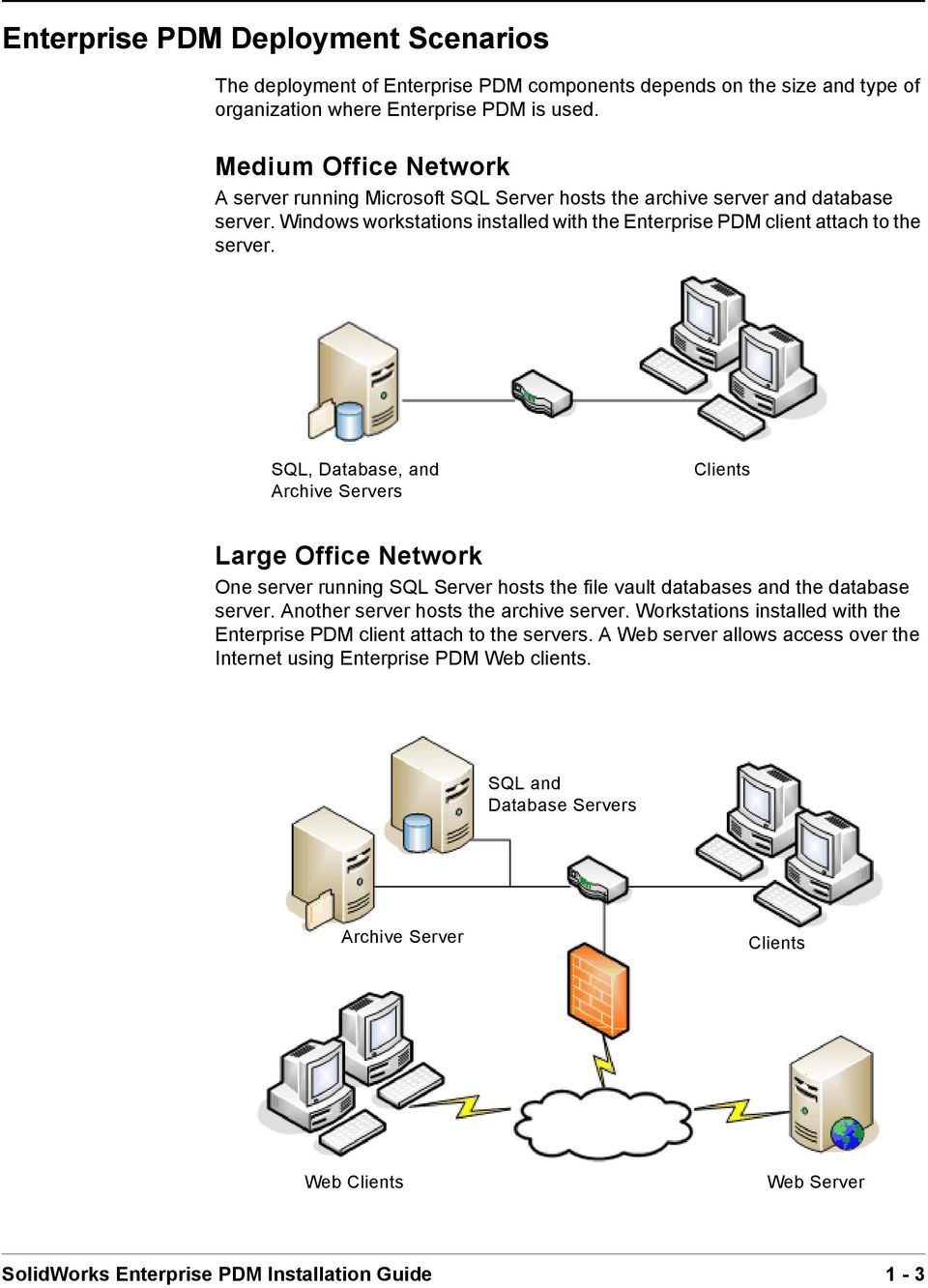
9 Enterprise PDM Deployment Scenarios The deployment of Enterprise PDM components depends on the size and type of organization where Enterprise PDM is used. Medium Office Network A server running Microsoft SQL Server hosts the archive server and database server. Windows workstations installed with the Enterprise PDM client attach to the server. SQL, Database, and Archive Servers Clients Large Office Network One server running SQL Server hosts the file vault databases and the database server. Another server hosts the archive server. Workstations installed with the Enterprise PDM client attach to the servers. A Web server allows access over the Internet using Enterprise PDM Web clients. SQL and Database Servers Archive Server Clients Web Clients Web Server SolidWorks Enterprise PDM Installation Guide 1-3
10 Chapter Installation Overview WAN Connected Offices One main server running SQL Server hosts the central database server. A second server hosts the archive server. Each WAN office has a server hosting a local archive server with a replicated file vault archive. Workstations installed with the Enterprise PDM client attach to their local archive server and to the central database server. SQL and Database Servers Site A Clients Archive Server Site B Site C Clients Archive Server with Replicated File Vault Archive Server with Replicated File Vault Clients VPN over WAN Web Server Web Clients 1-4 SolidWorks Enterprise PDM Installation Guide

11 System Requirements Installation Summary Enterprise PDM system requirements are available on the SolidWorks Web site at: Although components can be installed in any order, the recommended sequence for a LAN installation is described. To install Enterprise PDM components: 1 Install SQL Server on the system that will host the Enterprise PDM file vault database, unless you have an existing SQL Server running. See Installing and Configuring SQL Server on page Install the database server component on the system running the SQL Server. See Installing SolidWorks Enterprise PDM Database Server on page Install the archive server on the system running the SQL Server or on a separate system. See Installing SolidWorks Enterprise PDM Archive Server on page Install the Enterprise PDM client on all workstations that will work in the file vault. See Installing SolidWorks Enterprise PDM Client on page Create a new file vault using the Enterprise PDM administration tool on a system where the Enterprise PDM client is installed. See File Vault Creation on page Optionally, set up the Enterprise PDM index server for content search support. See Configuring Content Search on page Attach the remaining clients to the archive server and create local file vault views using the View Setup wizard. See Creating Local File Vault Views on page 4-2. SolidWorks Enterprise PDM Installation Guide 1-5

12 Chapter Installation Overview Installation Assistance First level technical support for SolidWorks products is provided by your reseller. For help contacting your reseller: Refer to Call from the USA or Canada. Call from other locations. Send to [email protected]. 1-6 SolidWorks Enterprise PDM Installation Guide
13 2 Installing and Configuring SQL Server SolidWorks Enterprise PDM uses a Microsoft SQL-based database to store information about files and activities in a file vault. File vaults require SQL Server 2005 (SP2 or higher) or SQL Server 2008 (SP0 or higher). It is recommended that you use SQL Server 2005 to host the file vault database. If you already have the required version of SQL Server installed, continue to Installing SolidWorks Enterprise PDM on page 3-1. If you are uncertain of which SQL Server version is installed, see Microsoft Knowledge Base article to identify version and edition: Note Microsoft SQL Server is not included on the SolidWorks Enterprise PDM DVD. You must obtain it separately. This chapter contains the following topics: Installing SQL Server 2005 on page 2-2 Upgrading to SQL Server 2005 on page 2-7 Installing the SQL Server 2005 Service Pack on page 2-10 Distributing SQL Server SQL_DMO Components on page 2-12 Changing the SQL Server Login Account Used by Enterprise PDM on page 2-21 SolidWorks Enterprise PDM Installation Guide 2-1
14 Chapter Installing and Configuring SQL Server Installing SQL Server 2005 The installer provides help. See the SQL Server books online for detailed installation instructions: Before Installing If Enterprise PDM is installed on the system, use Add or Remove Programs to uninstall the Microsoft SQL Server 2005 Backward Compatibility package before starting the SQL Server 2005 installation. Performing the SQL Server 2005 Installation To install SQL Server 2005: 1 Close all Windows applications, including Windows Explorer. 2 Insert the SQL Server 2005 CD, and use the default selections unless otherwise instructed. Screen Start End User License Agreement Installing Prerequisites Action Under Install, select Server components, tools, books online, and samples. Read and accept the license agreement and click Next. Click Install if required components are listed. If there are no prerequisites, click Next. Welcome to the Microsoft SQL Server Installation Wizard System Configuration Check Registration Information Click Next. The installation wizard scans the system to ensure the requirements are met. View and correct any warnings. If there are no warnings, click Next. Type your name and company information and click Next. 2-2 SolidWorks Enterprise PDM Installation Guide

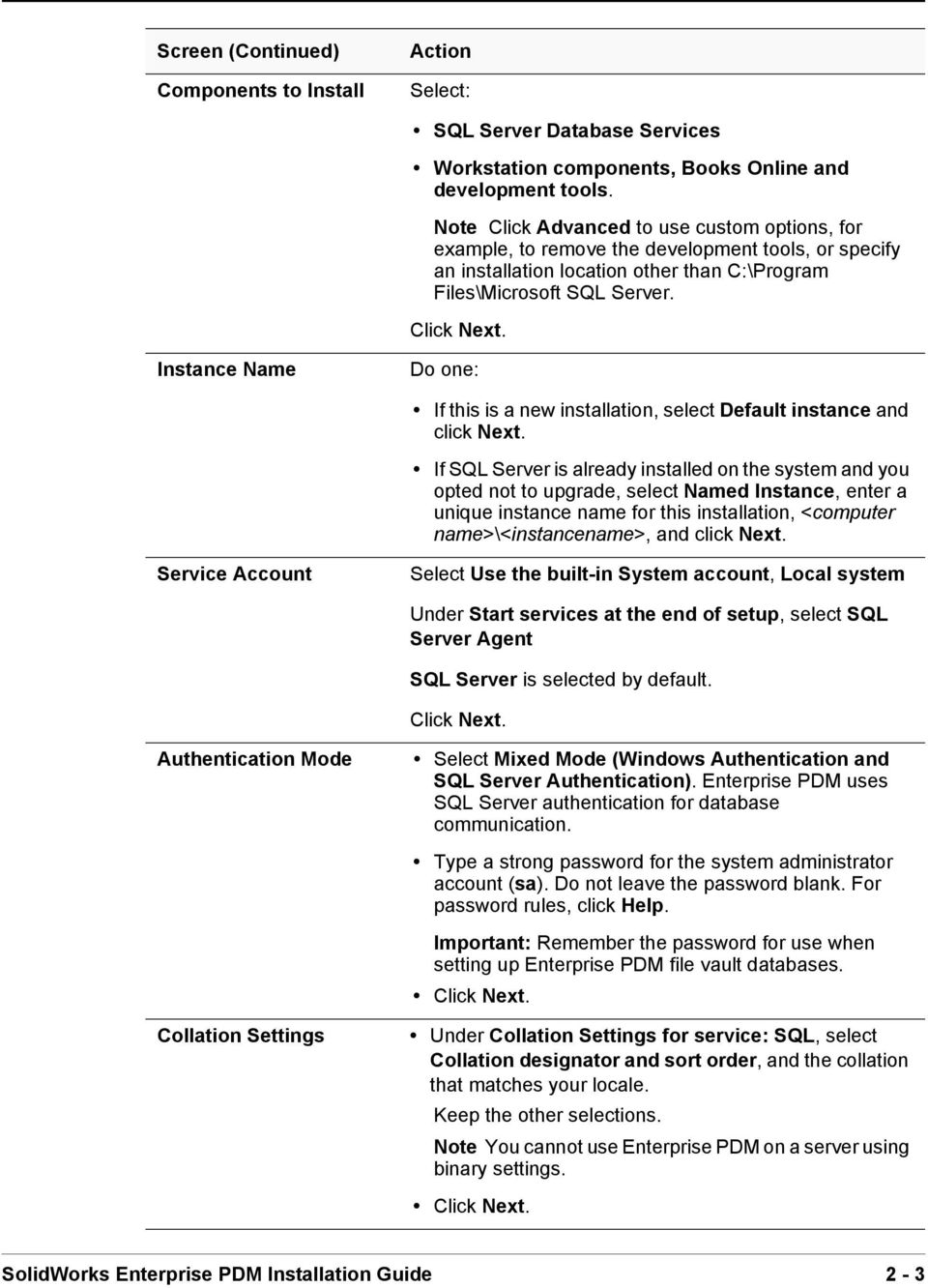
15 Screen (Continued) Components to Install Action Select: SQL Server Database Services Workstation components, Books Online and development tools. Note Click Advanced to use custom options, for example, to remove the development tools, or specify an installation location other than C:\Program Files\Microsoft SQL Server. Click Next. Instance Name Do one: If this is a new installation, select Default instance and click Next. If SQL Server is already installed on the system and you opted not to upgrade, select Named Instance, enter a unique instance name for this installation, <computer name>\<instancename>, and click Next. Service Account Select Use the built-in System account, Local system Under Start services at the end of setup, select SQL Server Agent SQL Server is selected by default. Click Next. Authentication Mode Select Mixed Mode (Windows Authentication and SQL Server Authentication). Enterprise PDM uses SQL Server authentication for database communication. Type a strong password for the system administrator account (sa). Do not leave the password blank. For password rules, click Help. Important: Remember the password for use when setting up Enterprise PDM file vault databases. Click Next. Collation Settings Under Collation Settings for service: SQL, select Collation designator and sort order, and the collation that matches your locale. Keep the other selections. Note You cannot use Enterprise PDM on a server using binary settings. Click Next. SolidWorks Enterprise PDM Installation Guide 2-3
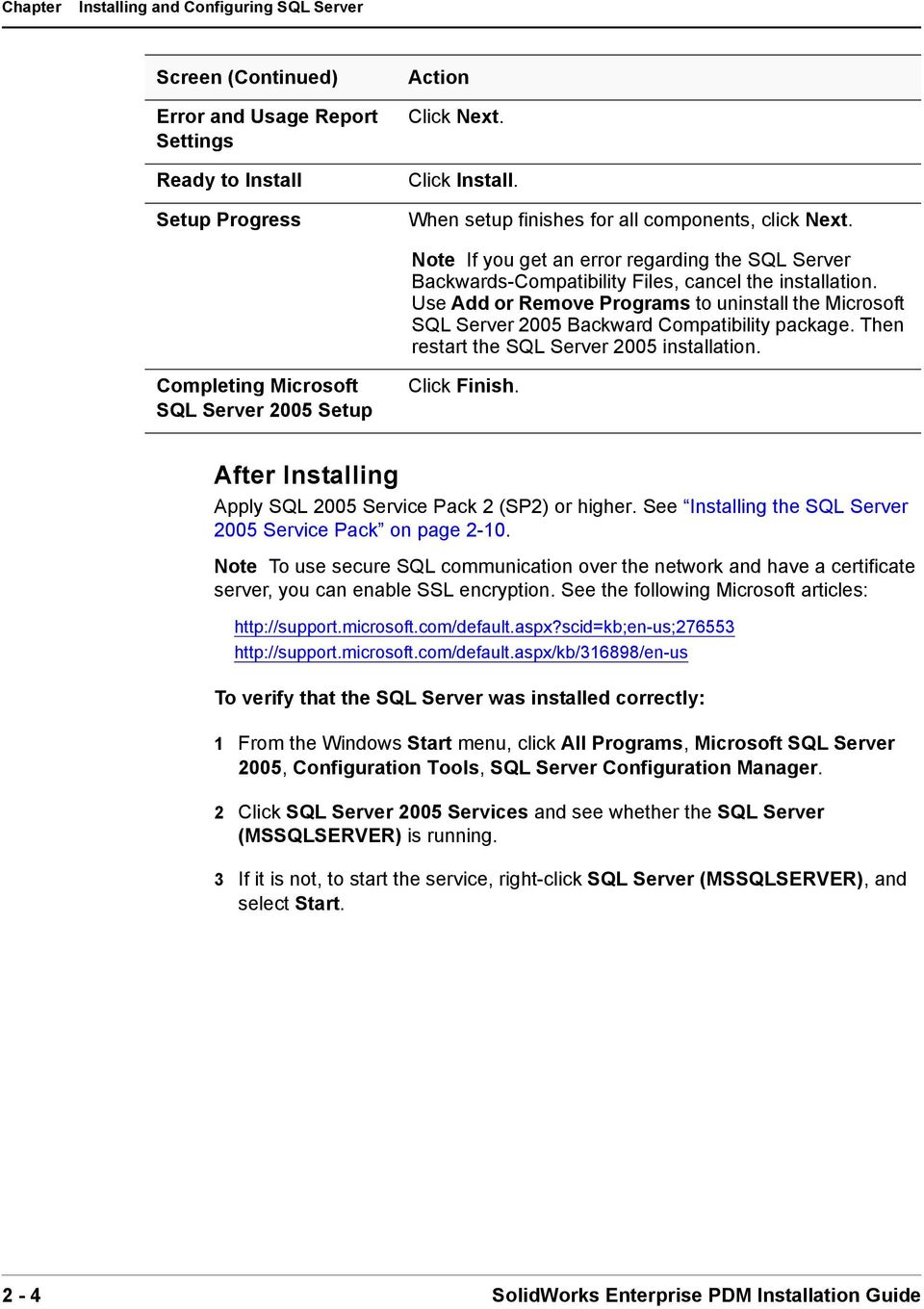
16 Chapter Installing and Configuring SQL Server Screen (Continued) Error and Usage Report Settings Ready to Install Setup Progress Action Click Next. Click Install. When setup finishes for all components, click Next. Note If you get an error regarding the SQL Server Backwards-Compatibility Files, cancel the installation. Use Add or Remove Programs to uninstall the Microsoft SQL Server 2005 Backward Compatibility package. Then restart the SQL Server 2005 installation. Completing Microsoft SQL Server 2005 Setup Click Finish. After Installing Apply SQL 2005 Service Pack 2 (SP2) or higher. See Installing the SQL Server 2005 Service Pack on page Note To use secure SQL communication over the network and have a certificate server, you can enable SSL encryption. See the following Microsoft articles: To verify that the SQL Server was installed correctly: 1 From the Windows Start menu, click All Programs, Microsoft SQL Server 2005, Configuration Tools, SQL Server Configuration Manager. 2 Click SQL Server 2005 Services and see whether the SQL Server (MSSQLSERVER) is running. 3 If it is not, to start the service, right-click SQL Server (MSSQLSERVER), and select Start. 2-4 SolidWorks Enterprise PDM Installation Guide
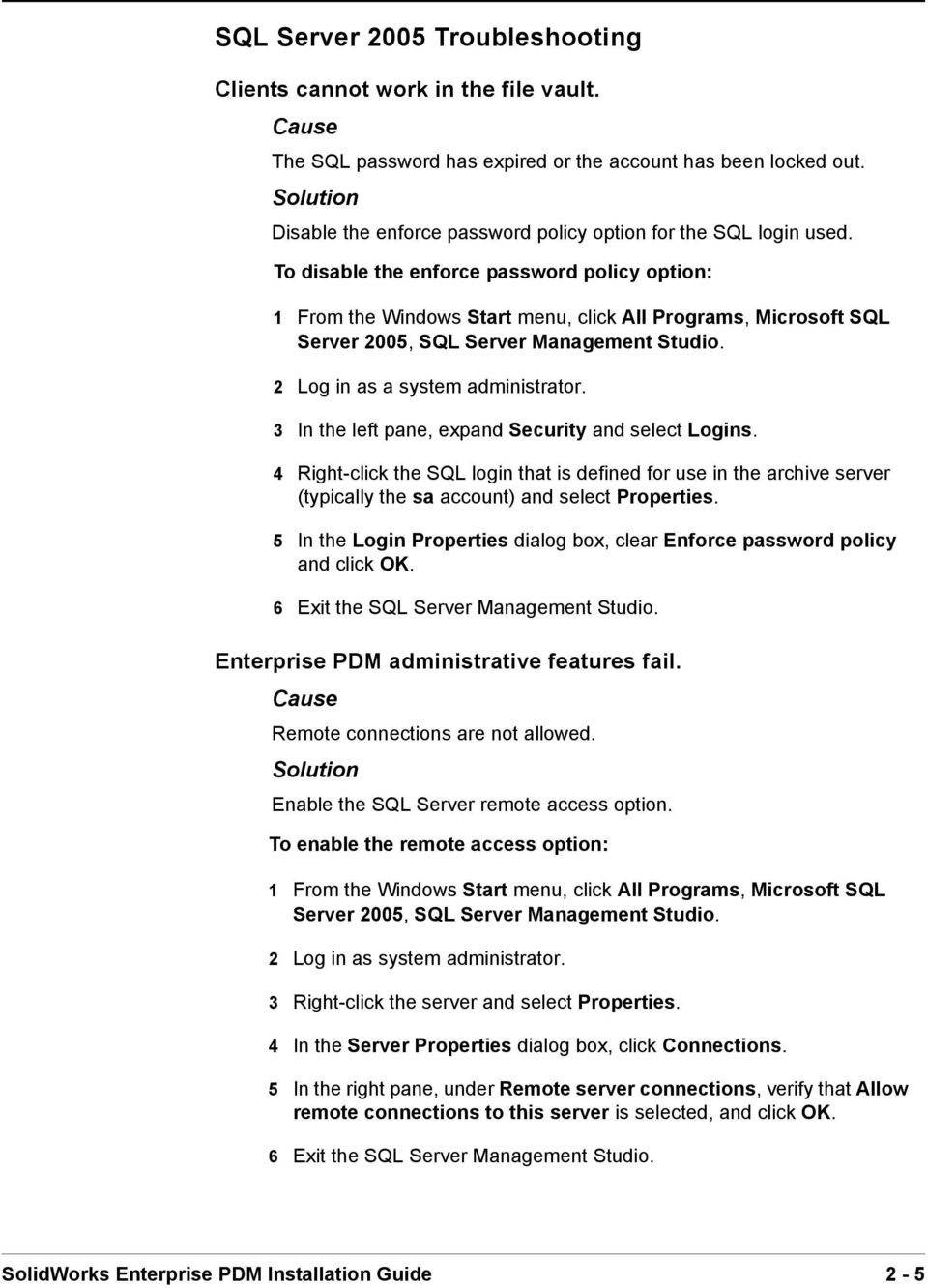
17 SQL Server 2005 Troubleshooting Clients cannot work in the file vault. Cause The SQL password has expired or the account has been locked out. Solution Disable the enforce password policy option for the SQL login used. To disable the enforce password policy option: 1 From the Windows Start menu, click All Programs, Microsoft SQL Server 2005, SQL Server Management Studio. 2 Log in as a system administrator. 3 In the left pane, expand Security and select Logins. 4 Right-click the SQL login that is defined for use in the archive server (typically the sa account) and select Properties. 5 In the Login Properties dialog box, clear Enforce password policy and click OK. 6 Exit the SQL Server Management Studio. Enterprise PDM administrative features fail. Cause Remote connections are not allowed. Solution Enable the SQL Server remote access option. To enable the remote access option: 1 From the Windows Start menu, click All Programs, Microsoft SQL Server 2005, SQL Server Management Studio. 2 Log in as system administrator. 3 Right-click the server and select Properties. 4 In the Server Properties dialog box, click Connections. 5 In the right pane, under Remote server connections, verify that Allow remote connections to this server is selected, and click OK. 6 Exit the SQL Server Management Studio. SolidWorks Enterprise PDM Installation Guide 2-5
18 Chapter Installing and Configuring SQL Server Enterprise PDM cannot connect to the server. Cause TCP/IP is not enabled, or the TCP port is wrong. Solution Activate the TCP/IP protocol for client connections and ensure that TCP port 1433 is open. To activate the TCP/IP protocol: 1 From the Windows Start menu, click All Programs, Microsoft SQL Server 2005, Configuration Tools, SQL Server Configuration Manager. 2 Log in as system administrator. 3 In the left pane, expand SQL Server 2005 Network Configuration, and click Protocols for MSSQLSERVER. 4 In the right pane, verify that TCP/IP is enabled. 5 Right-click TCP/IP and select Properties. 6 On the IP Addresses tab, ensure that TCP is using port Exit the SQL Server Configuration Manager. Enterprise PDM Administration tool crashes when creating the vault or vault views. This solution also applies when: SQL-DMO is reported as missing when logging in to a file vault. Logging in to a local vault view fails. Cause The SQL Server 2005 SQL-DMO drivers are not installed or are out of date. Solution Update the SQL Server 2005 SQL-DMO drivers for all thick clients (Enterprise PDM for SolidWorks, Enterprise PDM Contributor, and Enterprise PDM Viewer). See Distributing SQL Server SQL_DMO Components on page SolidWorks Enterprise PDM Installation Guide

19 Upgrading to SQL Server 2005 Follow these instructions to upgrade an existing SQL Server 7 or SQL Server 2000 instance to SQL Server See the SQL Server books online for detailed instructions: If you are uncertain of which SQL Server version is installed, refer to Microsoft Knowledge Base article to identify version and edition: All file vault databases are automatically upgraded to SQL Server 2005 format when the server instance is upgraded. Before Upgrading Make a full SQL backup of all existing SQL databases. You cannot downgrade a database that has been upgraded to SQL Server 2005 or SQL Server 2008, or restore a SQL 2005 or SQL 2008 database backup in an older SQL Server version (i.e., SQL Server 2000). However, you can restore a SQL/MSDE 2000 database backup directly into SQL Server Ensure that you upgrade the correct instance of SQL Server. It is possible to run SQL Server 2005 parallel to SQL Server 2000 or 7. However, it is recommended to upgrade, not to create an instance. If Enterprise PDM is already installed on the system, use Add or Remove Programs to uninstall the Microsoft SQL Server 2005 Backward Compatibility package. Obtain the user name and password of an SQL account with administrative access to the instance you are upgrading. Performing the Upgrade To upgrade to SQL Server 2005: 1 Close all Windows applications, including Windows Explorer. 2 Insert the SQL Server 2005 CD, and use the default selections unless otherwise instructed. Screen Start End User License Agreement Action Under Install, click Server components, tools, books online, and samples. Read and accept the license agreement and click Next. SolidWorks Enterprise PDM Installation Guide 2-7

20 Chapter Installing and Configuring SQL Server Screen (Continued) Installing Prerequisites Action Click Install if required components are listed. If there are no required components, click Next. Welcome to the Microsoft SQL Server Installation Wizard System Configuration Check Registration Information Components to Install Click Next. The installation wizard scans the system to ensure the requirements are met. View and correct any warnings before continuing. If there are no warnings, click Next. Type your name and company information and click Next. Select: SQL Server Database Services Workstation components, Books Online and development tools Note Click Advanced to use custom options, for example, to remove the development tools, or specify an installation location other than C:\Program Files\Microsoft SQL Server. Click Next. Instance Name Select the instance to upgrade, typically the Default instance. To upgrade a Named instance, select an existing instance. If you enter a new instance name, SQL Server 2005 is installed in addition to the older server and does not replace or upgrade it. Refer to SQL Server books online for detailed instructions on upgrading instances. Note Click Installed Instances to see a list of existing instances on the server that can be upgraded on the system. In the Installed Instances dialog box, select the instance to upgrade and click OK. Click Next. Existing Components Select all SQL components that can be upgraded and click Next. 2-8 SolidWorks Enterprise PDM Installation Guide

21 Screen (Continued) Upgrade Logon Information Action Select SQL Server Authentication Mode. Type the username and password of an SQL account with system administrative access to the instance being upgraded (typically the sa user account). Click Next. Service Account Select Use the built-in System account, Local system. Under Start services at the end of setup, select SQL Browser. Click Next. Error and Usage Report Settings Ready to Install Setup Progress Completing Microsoft SQL Server 2005 Setup Click Next. Click Install. When setup finishes for all components, click Next. Click Finish. After Upgrading Verify the upgrade. See To verify that the SQL Server was installed correctly: on page 2-4. Apply SQL 2005 Service Pack 2 (SP2) or higher. See Installing the SQL Server 2005 Service Pack on page Distribute or install the SQL Server 2005 SQL-DMO drivers to all thick clients (Enterprise PDM, Enterprise PDM Contributor, and Enterprise PDM Viewer). See Distributing SQL Server SQL_DMO Components on page Troubleshoot problems. See SQL Server 2005 Troubleshooting on page 2-5. SolidWorks Enterprise PDM Installation Guide 2-9
22 Chapter Installing and Configuring SQL Server Installing the SQL Server 2005 Service Pack Enterprise PDM requires at least Service Pack 2 (SP2) installed on the SQL Server 2005 instance hosting the file vault databases. Follow these instructions to apply the latest SQL Server 2005 service pack. For more information, see the service pack installation documentation on the download site. To find the installed version of SQL Server 2005: 1 From the Windows Start menu, click All Programs, Microsoft SQL Server 2005, SQL Server Management Studio. 2 Log in as a system administrator. 3 Right-click the server and select Properties. 4 In the left pane, click General. 5 In the right pane, locate the version number and use this table to determine the service pack SQL Server SQL Server 2005 Service Pack 1 (SP1) SQL Server 2005 Service Pack 2 (SP2) 6 If Service Pack 2 is not installed, download and install it. To obtain the SQL Server 2005 service pack: 1 Go to: 2 Under How to obtain, click the link for To obtain SQL Server 2005 SP2. 3 Select the appropriate package for the server platform (32-bit or 64-bit edition) and language of SQL Server 2005 you are using. The x86 package is for the 32-bit edition. 4 Download the service pack files to the SQL Server. To prepare to install the service pack: 1 Make a full SQL backup of any existing SQL user databases (for example, the file vault database.) 2 From the Windows Start menu, click Control Panel, Administrative Tools. 3 In the Administrative Tools dialog box, click Services SolidWorks Enterprise PDM Installation Guide
23 4 In the Services dialog box, stop all applications and services that connect to the instances of SQL Server being upgraded, including: SQL Server Management Studio Enterprise PDM database server Enterprise PDM archive server Note Do NOT stop the following SQL services: SQL Server (MSSQLSERVER) and SQL Server Agent (MSSQLSERVER). To install the SQL Server service pack: 1 Run the self-extracting service package file. Screen Welcome License Terms Feature Selection Authentication Error and Usage Reporting Settings Running Processes Ready to Install Setup Progress Completing Microsoft SQL Server 2005 SP2 Setup Additional Information Action Click Next. Read and accept the license agreement and click Next. Verify that all features are checked and click Next. Select Apply selection to all instances and click Next. Select reporting options and click Next. End any running processes and click Next. Click Install. When setup finishes for all components, click Next. Click Next. If you are not running Vista, clear Launch the provisioning tool for Windows Vista after SP2 installation completes. Click Finish to close the setup wizard. If you are running Vista, in the SQL Server User Provisioning on Vista dialog box, under Available privileges, select the administrative priveleges needed and move them to the Priveleges that will be granted list. 2 If a reboot was not required, you may have to start the SQL Server service: a b From the Windows Start menu, click All Programs, Microsoft SQL Server 2005, Configuration Tools, SQL Server Configuration Manager. Select SQL Server 2005 Services. SolidWorks Enterprise PDM Installation Guide 2-11
24 Chapter Installing and Configuring SQL Server c If SQL Server (MSSQLSERVER) is not running, right-click it and click Start. 3 Start any other services that you stopped before the service pack was applied, including the database server and archive server. Distributing SQL Server SQL_DMO Components When clients are installed using the Enterprise PDM installation program, the SQL- DMO drivers required to communicate with SQL Server 2005 and SQL Server 2008 are installed automatically. Microsoft XML Core Services (MSXML) 6.0 and.net Framework 3.0 should also be installed. You must distribute or manually install the drivers, MSXML 6.0, and.net Framework 3.0 if you install clients from an administrative installation image. For information on distributing MSXML and.net Framework, see: To distribute these components: Use Active Directory. Use the process described in Deploying Clients with Active Directory on page Copy SQLServer2005_BC.msi to a network share that is accessible by UNC path from all systems where the package should be deployed. Then include the.msi file (with UNC path) in a software installation package. Install manually. See Installing SQL Server SQL_DMO Components Manually on page Script a silent install. See Scripting a Silent Install of SQL Server SQL_DMO Components on page Installing SQL Server SQL_DMO Components Manually The following procedure describes the manual installation of SQL_DMO components on a 32-bit operating system. For 64-bit operating systems, the Windows Installer and SQL_DMO components are located in the \setup64\ folder. To manually install the SQL Server SQL_DMO components: 1 Install Windows Installer 3.1, located on the SolidWorks Enterprise PDM DVD at: \Setup\ISSetupPrerequisites\{6BDA23CF-2B09-49F6-A0FA- 37C3ED3B9B93}\ WindowsInstaller-KB v2-x86.exe Note Windows Installer 3.1 is usually installed automatically when using Windows update. If clients have automatic Windows update applied, you do not need to install it SolidWorks Enterprise PDM Installation Guide
25 2 Install the SQL Server 2005 SQL_DMO components, located on the SolidWorks Enterprise PDM DVD at: \Setup\ISSetupPrerequisites\{2A2B0450-D83A-4779-B083- FC7E50A1BB86}\SQLServer2005_BC.msi Scripting a Silent Install of SQL Server SQL_DMO Components Both Windows Installer 3.1 and the SQL Server SQL_DMO components can be installed silently. For details about silent install options for either component, see Windows Installer 3.1 The SQL_DMO 2005 component installation package requires Windows Installer 3.1. If it is not installed, you should first include this in the scripted install. The Windows Installer 3.1 redistributable (WindowsInstaller-KB v2- x86.exe) is on the SolidWorks Enterprise PDM DVD under \Setup\ISSetupPrerequisites\{6BDA23CF-2B09-49F6-A0FA-37C3ED3B9B93}. To launch the installation silently: 1 Open a DOS window. 2 Issue the command: WindowsInstaller-KB v2-x86.exe /passive /norestart SQL_DMO 2005 components The SQL_DMO 2005 redistributable package (SQLServer2005_BC.msi) is on the SolidWorks Enterprise PDM DVD under \Setup\ISSetupPrerequisites\{2A2B0450-D83A-4779-B083-FC7E50A1BB86}. To launch the SQL_DMO component install silently: 1 Make sure that you have installed Windows Installer Open a DOS window. 3 Issue the command: Msiexec /I SQLServer2005_BC.msi /qb ALLUSERS=1 ADDLOCAL=SQL_DMO SolidWorks Enterprise PDM Installation Guide 2-13
26 Chapter Installing and Configuring SQL Server Installing SQL Server 2008 The SQL Server installer provides help, including considerations for running on Windows Vista. The SQL Server 2008 books online provide hardware and software requirements and detailed installation instructions. See: Before Installing For local installations, you must run Setup as an administrator. If you install SQL Server 2008 from a remote share, you must use a domain account that has read and execute permissions on the remote share. If Enterprise PDM is installed on the system, use Add or Remove Programs to uninstall the Microsoft SQL Server 2005 Backward Compatibility package before starting the SQL Server 2005 installation. Microsoft.Net framework version 2.0 and Windows Installer 4.5 are required. If they are not installed, the Installation Wizard installs them before starting the SQL Server 2008 install. These installations may require you to restart your computer. Performing the SQL Server 2008 Installation To install SQL Server 2008: 1 Close all Windows applications, including Windows Explorer. 2 Insert the SQL Server 2008 installation media. From the root folder, double-click setup.exe. and use the default selections unless otherwise instructed. Screen SQL Server Installation Center/Planning page SQL Server Installation Center/ Installation page Setup Support Rules Action In the left pane, click Installation. Click New SQL Server stand-alone installation or add features to an existing installation. The installer checks for problems that will prevent the installation of the SQL Server support files. If no problems are reported, click OK. If problems are reported, click Show details to list the components that failed or prompted warnings. Click Cancel to stop the installation and fix the problems. Product Key Select Enter the product key and type your license key. Click Next SolidWorks Enterprise PDM Installation Guide
27 Screen (Continued) License Terms Setup Support Files Setup Support Rules Action Read and accept the license agreement and click Next. Click Install. The installer performs an additional check. If no problems are reported when the installer checks your computer, click Next. If problems are reported, click Show details to list the components that failed or prompted warnings. Click Cancel to stop the installation and fix the problems. Feature Selection Under Instance Features, select: Database Engine Services Under Shared Features, select: Client Tools Connectivity Client Tools Backward Compatibility SQL Server Books Online Management Tools - Basic Management Tools - Complete Click Next. Instance Configuration Do one: If this is a new installation, select Default instance and click Next. If SQL Server is already installed on the system and you opted not to upgrade, select Named Instance, enter a unique instance name for this installation, <computer name>\<instancename>, and click Next. Disk Space Requirements If disk space requirements are met, click Next. If they are not, note the space required, click Cancel, add the required space and run the installation again. SolidWorks Enterprise PDM Installation Guide 2-15
28 Chapter Installing and Configuring SQL Server Screen (Continued) Service Configuration Service Account tab Action Use the following settings: SQL Server Agent and SQL Server Database Engine: Account Name - NT AUTHORITY\SYSTEM Startup Type - Automatic SQL Server Browser, Account Name - NT AUTHORITY\LOCAL SYSTEM Startup Type - Automatic Service Configuration Collation tab 1 For Database Engine, click Customize. 2 In the dialog box, select Windows Collation designator and sort order, and the Collation designator that matches your locale. Keep the other selections. Note You cannot use Enterprise PDM on a server using binary settings. 3 Click Next. Database Engine Configuration Account Provisioning tab (Do not change settings on the Data Directories or Filestream tabs.) 1 Select Mixed Mode (SQL Server Authentication and Windows Authentication). Enterprise PDM uses SQL Server authentication for database communication. 2 Type a strong password for the system administrator account (sa). Do not leave the password blank. For password rules, click Help. Retype the password to confirm it. Important: Remember the password for use when setting up Enterprise PDM file vault databases. 3 Under Specify SQL Server administrators, click Add. 4 In the Select Users, Computers, or Groups dialog box, enter the name of the local administrator of the system or the Administrators group 5 Click Next. Database Engine Configuration Data Directories tab Error and Usage Reporting Optionally, to change the default folder where databases created by Enterprise PDM are stored, change the location for User database directory and User database log directory. Click Next SolidWorks Enterprise PDM Installation Guide
29 Screen (Continued) Installation Rules Action The installer checks for problems that will prevent the installation of SQL Server If no problems are reported, click Next. If problems are reported, click Show details to list the components that failed or prompted warnings. Click Cancel to stop the installation and fix the problems. Ready to Install Installation Progress Click Install. Installation may take a long time. If you get an error regarding the SQL Server Backwards- Compatibility Files, cancel the installation. Use Add or Remove Programs to uninstall the Microsoft SQL Server 2005 Backward Compatibility package. Then restart the SQL Server 2008 installation. When the progress bar shows Setup process complete, click Next. Complete Click Close. If you receive a message that computer restart is required, click OK. If a restart does not begin automatically, manually restart your computer. SolidWorks Enterprise PDM Installation Guide 2-17
30 Chapter Installing and Configuring SQL Server Upgrading to SQL Server 2008 Follow these instructions to upgrade an existing SQL Server 2000 or SQL 2005 instance to SQL Server See the SQL Server 2008 books online for detailed instructions: If you are uncertain of which SQL Server version is installed, refer to Microsoft Knowledge Base article to identify version and edition: All file vault databases are automatically upgraded to SQL Server 2008 format when the server instance is upgraded. Before Upgrading Microsoft provides a SQL Server Upgrade Advisor to help you prepare for upgrades to SQL Server See: For local upgrades, you must run Setup as an administrator. If you upgrade SQL Server from a remote share, you must use a domain account that has read and execute permissions on the remote share. In addition: Make a full SQL backup of all existing SQL databases. You cannot downgrade a database that has been upgraded to SQL Server 2008, or restore a SQL 2008 database backup in an older SQL Server version (i.e., SQL Server 2005). However, you can restore a SQL/MSDE 2005 database backup directly into SQL Server Ensure that you upgrade the correct instance of SQL Server. It is possible to run SQL Server 2008 parallel to SQL Server 2005 or SQL Server However, it is recommended to upgrade, not to create an instance. If Enterprise PDM is already installed on the system, use Add or Remove Programs to uninstall the Microsoft SQL Server 2005 Backward Compatibility package. Obtain the user name and password of an SQL account with administrative access to the instance you are upgrading. Microsoft.Net framework version 2.0 and Windows Installer 4.5 are required. If they are not installed, the Installation Wizard installs them before starting the SQL Server 2008 install. These installations may require you to restart your computer SolidWorks Enterprise PDM Installation Guide
31 Performing the Upgrade To upgrade to SQL Server 2008: 1 Close all Windows applications, including Windows Explorer. 2 Insert the SQL Server 2008 installation media, and from the root folder, doubleclick setup.exe. Use the default selections unless otherwise instructed. Screen SQL Server Installation Center/Planning page SQL Server Installation Center/ Installation page Setup Support Rules Action In the left pane, click Installation. Click Upgrade from SQL Server 2000 or SQL Server The installer checks for problems that will prevent the installation of the SQL Server support files. If no problems are reported, click OK. If problems are reported, click Show details to list the components that failed or prompted warnings. Click Cancel to stop the installation and fix the problems. Product Key License Terms Setup Support Files Setup Support Rules Select Enter the product key and type your license key. Click Next. Read and accept the license agreement and click Next. Click Install. The installer performs an additional check. If no problems are reported when the installer checks your computer, click Next. If problems are reported, click Show details to list the components that failed or prompted warnings. Click Cancel to stop the installation and fix the problems. Select Instance Select Features Select MSSQLSERVER as the instance to upgrade. Lists the installed SQL features that will be upgraded. Click Next. Instance Configuration Lists the Named instance MSSQLSERVER as the instance that will be upgraded. Click Next. SolidWorks Enterprise PDM Installation Guide 2-19
32 Chapter Installing and Configuring SQL Server Screen (Continued) Disk Space Requirements Server Configuration Full-text Upgrade Error and Usage Reporting Upgrade Rules Action If disk space requirements are met, click Next. If they are not, note the space required, click Cancel, add the required space and run the installation again. Click Next. Select Import and click Next. Click Next. The installer checks for problems that will prevent the upgrade to SQL Server If no problems are reported, click Next. If problems are reported, click Show details to list the components that failed or prompted warnings. Click Cancel to stop the installation and fix the problems. Ready to Upgrade Upgrade Progress Complete SQL Server Installation Center Click Upgrade. When the upgrade finishes for all components, click Next. Click Close. Click X in the upper right corner to close SolidWorks Enterprise PDM Installation Guide
33 Changing the SQL Server Login Account Used by Enterprise PDM The archive and/or database server services must be able to reach any Enterprise PDM databases they manage using an SQL login that has at least db_owner access to the databases. Normally when SQL Server is installed, a system administrator login (sa) is created that has full access to all databases on the SQL Server. Use this system administrator, or create a new user with db_owner access to the Enterprise PDM databases. If you plan to create new file vault databases using a db_owner SQL login, create this SQL login first. Note If you install a new database server, you are asked for this information during setup. To create a new SQL login account: 1 On the SQL Server that should host the new Enterprise PDM databases, from the Windows Start menu, click All Programs, Microsoft SQL Server 2005, SQL Server Management Studio. 2 Log in as a system administrator. 3 In the left pane, expand the SQL Server node and Security. 4 Right-click Logins and select New Login. 5 In the Login - New dialog box, select General: a b c d Type a Login name for the new SQL user. Select SQL Server Authentication and enter a password. Clear Enforce password policy. Click OK. 6 Close the management studio. Note This login does not need any additional permissions to be used by Enterprise PDM. To use the new SQL login with the Enterprise PDM archive: 1 On the system running the Enterprise PDM archive server, from the Windows Start menu, click All Programs, SolidWorks Enterprise PDM, Archive Server Configuration. 2 In the SolidWorks Enterprise PDM Archive Server dialog box, select Tools, Default settings. 3 In the Settings dialog box, under SQL login, click Change. SolidWorks Enterprise PDM Installation Guide 2-21
34 Chapter Installing and Configuring SQL Server 4 In the Change SQL User Login dialog box, enter the SQL user login and password of the new SQL user. Note From now on, new file vault databases that are created are assigned db_owner access for this user. 5 On the system running the Enterprise PDM database server, from the Windows Start menu, click All Programs, SolidWorks Enterprise PDM, Database Server Configuration. 6 In the SolidWorks Enterprise PDM Database Server dialog box, enter the new SQL user login and password, and click OK. 7 Restart the SolidWorks Enterprise PDM Database Server service. To give an SQL user db_owner access to existing Enterprise PDM file vault databases: 1 On the SQL Server that hosts the new Enterprise PDM databases, from the Windows Start menu, click All Programs, Microsoft SQL Server 2005, SQL Server Management Studio. 2 Log in as a system administrator. 3 In the left pane, under the SQL Server node, expand Security and click Logins. 4 Right-click the SQL user and select Properties. 5 In the Login Properties dialog box: a b c d In the left pane, select User Mapping. In the right pane, under Users mapped to this login, select Map for all Enterprise PDM databases (file vault databases and ConisioMasterDb.) For each database, under Database role membership, select db_owner. Click OK. 6 Right-click the server and select New Query. 7 In the right pane, enter the following query statement on the new db_owner user and click Execute. GRANT VIEW SERVER STATE TO [<SQL_USER_NAME>] 8 Exit Microsoft SQL Server Management Studio. 9 On the system running the Enterprise PDM archive server, from the Windows Start menu, click All Programs, SolidWorks Enterprise PDM, Archive Server Configuration. 10 In the SolidWorks Enterprise PDM Archive Server dialog box, select Tools, Default settings SolidWorks Enterprise PDM Installation Guide
35 11 In the Settings dialog box, under SQL login, click Change. 12 In the Change SQL User Login dialog box, enter the SQL user login and password of the new SQL user and click OK. 13 On the system running the Enterprise PDM database server, from the Windows Start menu, click All Programs, SolidWorks Enterprise PDM, Database Server Configuration. 14 In the SolidWorks Enterprise PDM Database Server dialog box, enter the new SQL user login and password and click OK. 15 Restart the SolidWorks Enterprise PDM Database Server service. Insufficient SQL Permissions If you do not assign the SQL user sufficient SQL permissions, you cannot log in to any file vault views. Warning messages are displayed if the SQL user does not have at least db_owner access: To the ConisioMasterDb database Example: Could not log in to the database <filevault> on Server <server>". Cause: Could not access the item in the database To the file vault database Example: Could not access the item in the database. SolidWorks Enterprise PDM Installation Guide 2-23
36 Chapter Installing and Configuring SQL Server 2-24 SolidWorks Enterprise PDM Installation Guide
37 3 Installing SolidWorks Enterprise PDM The SolidWorks Enterprise PDM media contains the server and client components. You can install each component separately, or select multiple components to install in a single operation. For example, to install the database server and archive server on the same computer, you can select both options on the Server Installation screen. When you install multiple components, the screens appropriate to those components are displayed. For simplicity, the procedures in this chapter describe the component installations separately. This chapter contains the following topics: Initiating Enterprise PDM Installations on page 3-2 Installing SolidWorks Enterprise PDM Database Server on page 3-4 Installing SolidWorks Enterprise PDM Archive Server on page 3-6 Installing SolidWorks Enterprise PDM Web server on page 3-12 Installing SolidWorks Enterprise PDM Client on page 3-12 SolidWorks Enterprise PDM Installation Guide 3-1
38 Chapter Installing SolidWorks Enterprise PDM Initiating Enterprise PDM Installations You perform the same initial steps to begin all Enterprise PDM installations. Note Adobe Acrobat must be installed if you want to view documentation provided on the SolidWorks Enterprise PDM DVD. To initiate the Enterprise PDM installation: 1 Insert the SolidWorks Enterprise PDM DVD. If the SolidWorks Enterprise PDM 2009 Setup screen is not displayed, navigate to Autorun.exe on the install disk and double-click. Note You can also start the installation wizard manually by running \setup\setup.exe from the CD; however, this bypasses the initial installation screen. 2 On the SolidWorks Enterprise PDM 2009 Setup screen, to change the setup screen language, place your cursor over the language icon language. and select a 3 At the bottom of the screen, you can: Click the first two links to view summary installation instructions. Click Administration Guides to view installation and administration documentation. 4 To begin the installation, click Install. The installation wizard checks whether the required software components, Windows Installer 3.1 and SQL Server 2005 SQL_DMO drivers, are installed on the system. 5 If a required component is missing, a dialog box listing the missing components is displayed. Click OK to install the components. 3-2 SolidWorks Enterprise PDM Installation Guide
39 When done, the installation wizard continues. Initiate the installation using the following instructions: Screen Welcome License Agreement Customer Information Action Click Next. Accept the license agreement and click Next. Enter your User Name and Organization. Select the Default language. Click Next. Destination Folder Do one: To accept the default installation location, click Next. To specify a different installation location, click Change, browse to the new location, click OK, and then click Next. Setup Type Do one: Select Server Installation to install one or more of the Enterprise PDM servers. See: Installing SolidWorks Enterprise PDM Database Server on page 3-4 Installing SolidWorks Enterprise PDM Archive Server on page 3-6 Installing SolidWorks Enterprise PDM Web server on page 3-12 Select Client Installation to install the Enterprise PDM Client. See: Installing SolidWorks Enterprise PDM Client on page Select Custom to choose the features to be installed, including the GZ filter for indexing compressed archives. SolidWorks Enterprise PDM Installation Guide 3-3
40 Chapter Installing SolidWorks Enterprise PDM Installing SolidWorks Enterprise PDM Database Server The database server periodically polls Enterprise PDM databases for updates such as notifications, local view refresh, replication schedule updates, and index server changes. It must be installed for: Automatic notifications View updates Card list updates Cold store scheduling Replication scheduling Index server administration Data import/export Workflow and other automatic notifications, such as change state, check out, check in, add, and deadline Automatic updates (refresh) of listings in file vault views and add-ins Periodic updates of card lists that use SQL queries for their content Updates of archive servers with changes made to cold store schedules Updates of archive servers with changes made to replication schedules Administration of the indexing service for content searches Execution of data import and export rules at predefined intervals It is recommended that you install the database server on the same system as Microsoft SQL Server. You can install it on another system, but some network overhead may occur. Before Installing the Database Server Ensure that the database server has access to the archive server over TCP port 3030 and to the SQL Server over TCP port Obtain the following information: - SQL Server name - Name and password of an SQL user account with read/write access Note If you do not know the name of a user with read and write access, you can use the SQL sa account that has these permissions. You can also create a login for this purpose. See Changing the SQL Server Login Account Used by Enterprise PDM on page SolidWorks Enterprise PDM Installation Guide
41 Performing the Database Server Installation To install the database server: 1 Login locally or remotely as a user with local administrative rights on the system where you are installing the database server. 2 Begin the installation, as described in Initiating Enterprise PDM Installations on page Complete the installation using the following instructions: Screen Setup Type Action Select Server Installation, and click Next. Note To install multiple components on the same system, such as client and server components, or install additional components, select Custom. Server Installation SolidWorks Enterprise PDM Database Server SQL Login Select Database Server, and click Next. Do one: - Type the name of the SQL Server to host the file vault databases that the database server will manage. - Click Browse to display a list of available SQL Servers and instances on the network. Select the appropriate name and click OK. Note If SQL Server is installed on the system where you are installing the database server, type or select (local). In the Login name field, type the name of an SQL user on the server who has read and write access (i.e., db_owner permission) to all Enterprise PDM databases hosted on the SQL Server (the file vault databases and ConisioMasterDb.) In the Password field, type the SQL user s password. Click Next. The login information is verified. If it is incorrect, a warning is displayed. Ready to Install the Program InstallShield Wizard Completed Click Install. Click Finish. SolidWorks Enterprise PDM Installation Guide 3-5
42 Chapter Installing SolidWorks Enterprise PDM Installing SolidWorks Enterprise PDM Archive Server The archive server hosts the physical files (drawings, documents, etc.) stored in a Enterprise PDM file vault and manages Enterprise PDM users and their credentials. All clients using Enterprise PDM must connect to one or more archive servers hosting one or more file vault archives. The archive server runs as a service on the system account of the computer where it is installed, sending and receiving files between the clients and the file vault archive. It also stores passwords and user login information. Only one archive server installation is required per computer, hosting one or more file vault archives. In a replicated environment, multiple archive servers can be set up to host replicated copies of the same file vault archive. See the SolidWorks Enterprise PDM Replication Guide, located in the \Support\Guides\ directory of the SolidWorks Enterprise PDM DVD. Note To prevent problems attaching to the archive server, the server name should be 15 characters or less. Before Installing the Archive Server Set up the users, accounts, and permissions required to complete the archive server installation. Root folder access The system account must have full access rights to create folders and files under the folder to be designated as the archive server root folder. The root folder can also be on a network share that allows the archive server service to both read and write files. Note You can change the archive server service log-on account to users other than the system account in the service properties. SQL user account The SQL user that communicates with Enterprise PDM file vault databases must have at least db_owner permissions to any existing file vault databases on the SQL Server. You can use the sa account that was created when the SQL Server was installed. For more information about SQL logins, see Changing the SQL Server Login Account Used by Enterprise PDM on page User and group accounts If you want to assign user and group access rights to the archive server during the installation, create the users and groups before you begin. TIP: To use domain users in Enterprise PDM, create a domain group on the domain controller and add domain users that should be able to log into 3-6 SolidWorks Enterprise PDM Installation Guide
43 Enterprise PDM. During installation, add the domain group using the Find User or Group dialog; the users will appear in the Enterprise PDM administration tool. After installation, you can run the Archive Server Configuration tool to add or change user and group assignments. Performing the Archive Server Installation To install the archive server: 1 Login locally or remotely as a user with local administrative rights on the system where you are installing the archive server. 2 Begin the installation, as described in Initiating Enterprise PDM Installations on page Complete the installation using the following instructions: Screen Setup Type Server Installation Ready to Install the Program Action Select Server Installation. Select Archive Server, and click Next. Click Install. Note If you see a message that your local security network access is set to Guests only and should be changed to Classic, click Yes to accept the change. When the installation finishes, the Archive Server Configuration wizard appears. Archive Server Configuration Wizard Welcome Root folder Click Next. Do one: Accept the default location for the archive server root folder. Change the location by doing one of the following: - Click the browse button and browse to a folder. - Type the path. If the folder you specified does not exist, you are asked if it should be created. The root folder path is assigned the name Archives, which is used when setting up or attaching to a file vault from the View Setup wizard on a client. Note You must include the root folder and its subfolders (i.e., file vault archives) in the daily backup routines. Click Next. SolidWorks Enterprise PDM Installation Guide 3-7
44 Chapter Installing SolidWorks Enterprise PDM Screen (Continued) Admin password SQL user login and password Security Action Type and confirm a password for the Admin user. The Admin user account is assigned full administrative rights to file vaults. Admin can create users, set up workflows, delete files, etc. It is the only user present in a newly created file vault. You can change the password at any time using the Archive Server Configuration tool. Click Next. Type the login information for the SQL user who will communicate with the file vault databases hosted on the SQL Server. You can use the SQL Server system administrator user sa. If you specify an SQL user with low permissions on the SQL Server, this user will be assigned db_owner access to any new file vaults created. Click Next. To define the Windows user accounts that are allowed access to this archive server, by select the accounts under Available users and groups and click the arrow pointing to Administrative access or Attach access. Available users and groups All local users and groups found on the system are listed by default. To add domain accounts to the list: Click Find User or Group. In the Find User or Group dialog box, search for additional user or group accounts. To add a domain group, for example, type <DOMAIN>\<GROUPNAME> and click OK. Administrative access Provides sufficient access to create new file vaults, or remove, attach, or upgrade existing file vaults on this archive server. When you create a file vault, enter the username and password of an account added to this section. Attach access Provides sufficient access to attach to existing file vaults managed by this archive server. When you create a file vault view or connect to a file vault, enter the username and password of an account added to this section. 3-8 SolidWorks Enterprise PDM Installation Guide
45 Screen (Continued) Login type Action Select one of the following authentication methods to use by default when creating new file vaults managed by this archive server: Enterprise PDM login Enterprise PDM user names and passwords are stored on the archive server. You can add and remove them using the Enterprise PDM administration tool on an Enterprise PDM client. Windows login Synchronizes logins to a file vault with the logged-in Windows users (Active Directory). Passwords and names are defined using standard Windows account management. In the Windows login settings dialog box, select accounts under Available users and groups and add them to Added users and groups by clicking the right-arrow button. To add domain accounts to the list: - Click Find User or Group. - In the Find User or Group dialog box, search for additional user or group accounts. To add a domain group, for example, type <DOMAIN>\<GROUPNAME> and click OK. LDAP login Retrieves user accounts from a server using the LDAP method (for example, Novell servers). The users are available when adding users to a file vault using the Enterprise PDM administration tool. Passwords and user names are defined on the LDAP server managing the accounts. To define the connection settings to the server using LDAP: Server name Type the name or IP address of an LDAP server. Port Type the port used for LDAP on the server. The default port is 389. Contexts Add at least one context with users that should be listed in the Enterprise PDM user manager. The context names must be entered as distinguished names; for example, O=company, OU=department, O=company or CN=Users, DC=company, DC=com. User Context Type a context for the user login used by the archive server to connect to the LDAP server. Username Password Completed Click Finish. Type a username that exists in the user context selected. This user is used by the archive server to connect to the LDAP server. Type the password for the selected user. SolidWorks Enterprise PDM Installation Guide 3-9
46 Chapter Installing SolidWorks Enterprise PDM Running the Archive Server on Windows XP SP2 and Vista Windows XP SP2 and Vista have built-in firewalls activated by default. This can restrict network access to applications requiring connections over the TCP/IP interface. The archive server uses TCP port 3030 to communicate with the clients. This port must be fully opened in the Windows XP SP2 firewall for an Enterprise PDM installation to work correctly. If the port is not opened, the archive server is not available. To communicate with clients, the SQL Server TCP port 1433 must also be opened in the firewall. If you have problems with a SQL Server running on Windows XP SP2, use the following process to create port exceptions for the 1433 port. The following procedure describes firewall setup for Windows XP SP2. Setup for Vista is similar. To set up the firewall for the archive server: 1 From the Windows Start menu, click Control Panel, Security Center. 2 In the Windows Security Center dialog box, under Manage security settings for, select Windows Firewall. 3 In the Windows Firewall dialog box, on the Exceptions tab, click Add Port. 4 In the Add a Port dialog box: In the Name field, type the exception name. In the Port Number field, type Select TCP. Click Change Scope. 5 In the Change Scope dialog box, select My network (subnet) only to restrict network access to only network computers. Click OK twice. 6 Create another exception for port 3030 by repeating steps 3 through 5, but select UDP as the protocol. 7 In the Windows Firewall dialog box, select both new port exceptions to activate them. 8 Click OK. Adding Archive Servers in a WAN Environment SolidWorks Enterprise PDM clients are normally set up to communicate with the Archive Server and SQL server using the server system names. These system names are resolved to IP addresses, and if this name lookup fails or is slow it can cause the following: 3-10 SolidWorks Enterprise PDM Installation Guide
47 Clients cannot find the servers at all. This is a common problem when using subnets or WAN configurations. Overall performance using Enterprise PDM features such as logging in, browsing, or adding files is slow. Replication between servers fails. To ensure optimal performance, make sure that the DNS server configuration is set up to resolve names correctly and efficiently. To verify that the server name can be resolved: 1 Open the command prompt by clicking Start > Run >CMD. 2 Type Ping <server_name>. If the server can be reached by name, a reply with the server IP address appears. For example: PING SRV-DEV-15 Reply from : bytes=32 time<1ms TTL=128 3 Verify that the correct IP is returned. If DNS returns the wrong IP address, a different system than the server responds. If the server name cannot be resolved, the DNS server configuration is not correctly configured. For example: PING SRV-DEV-15 Ping request could not find host SRV-DEV-15. Please check the name and try again. If the DNS servers cannot be configured or performance is still bad, update the client s hosts file with the correct server name and IP address. This ensures that the hosts file is queried for the server address directly instead of waiting for the DNS name resolve. To configure the hosts file to resolve the server name: 1 On the Enterprise PDM client, locate the Hosts file. The default location is: C:\Windows\System32\Drivers\Etc\ 2 Open the file in Notepad. 3 Add a new line and enter the server IP address followed by the server name. For example: SRV-DEV-15 4 Repeat step 3 for any additional servers used by Enterprise PDM. 5 Save and close the hosts file. SolidWorks Enterprise PDM Installation Guide 3-11
48 Chapter Installing SolidWorks Enterprise PDM Installing SolidWorks Enterprise PDM Web server The SolidWorks Enterprise PDM Web server gives users live access to one or more file vaults from any system using Windows Internet Explorer over the Internet or an intranet. To learn how to install and use the Web server and client, see the SolidWorks Enterprise PDM Web Server Guide, located in the \Support\Guides\ directory of the SolidWorks Enterprise PDM DVD. Installing SolidWorks Enterprise PDM Client For a system to work with an Enterprise PDM file vault, it must have the Enterprise PDM client installed. The following types of Enterprise PDM client are available: Enterprise PDM Editor Supports working with all file types, including enhanced management and previewing of many CAD formats such as SolidWorks, AutoCAD, Inventor, Solid Edge, and Pro/ENGINEER. Should be used on any system working with CAD files. Enterprise PDM Contributor Supports working with all file types, including CAD files. However, CAD add-ins are not supported on this client type. Enterprise PDM Viewer Allows read-only access to file vaults; user cannot add or modify (check out, check in, update values) any files. CAD add-ins are not supported on this client type. You can install clients: By using the installation wizard on the SolidWorks Enterprise PDM DVD. See Installing Clients Using the Installation Wizard on page By creating an administrative deployment image to install multiple seats. See Creating an Enterprise PDM Client Administrative Image on page Before Installing Clients Find out the type of client your license agreement entitles you to use. The floating license manager in Enterprise PDM prevents logging into a file vault if the wrong client type is installed. If you are installing the Enterprise PDM Editor Client, you can install CAD addins. Add-ins make version management features such as check out, check in, and get available from menus and toolbars within your CAD software. They are 3-12 SolidWorks Enterprise PDM Installation Guide
49 optional and do not affect which file formats can be managed by Enterprise PDM using the Windows Explorer interface or file open/save dialogs. The following product-specific prerequisites apply: - SolidWorks You can manage SolidWorks files without having SolidWorks installed. It is recommended to have the edrawings viewer installed for previewing. EDrawings is normally installed automatically with the client. - Autodesk Inventor To manage Inventor files (add, check out, check in, preview, etc.), the client system must have either the full Autodesk Inventor application or the Inventor Design Assistant software installed. For previewing Inventor files, Inventor View should be installed. - Autodesk AutoCAD AutoCAD does not have to be installed to manage DWG/DXF files. It is recommended to have the edrawings or DWG TrueView application installed for previewing DWG files and the DWF viewer for previewing DWF files. - Solid Edge Enterprise PDM requires the full Solid Edge application installed for managing and previewing Solid Edge files. - Pro/ENGINEER Enterprise PDM requires the full Pro/ENGINEER application installed for managing and previewing Pro/ENGINEER files. These requirements apply to installations performed from the SolidWorks Enterprise PDM media or from an administrative image. Installing Clients Using the Installation Wizard To install a client with the installation wizard: 1 Log on to the client computer as a user with local administrative rights. 2 Begin the installation, as described in Initiating Enterprise PDM Installations on page 3-2. SolidWorks Enterprise PDM Installation Guide 3-13
50 Chapter Installing SolidWorks Enterprise PDM 3 Complete the installation using the following instructions: Screen Setup Type Action To install the client without Item Explorer, select Client Installation and click Next. To include the Item Explorer in your installation: Select Custom. On the Custom Setup screen, under Client, click Item Explorer and select This feature will be installed on local hard drive. Click Next. Choose Product Type Select the type of client to install, based on your license: Enterprise PDM Editor Enterprise PDM Contributor Enterprise PDM Viewer Click Next. Select Add-Ins If the product type is Enterprise PDM Editor, optionally, select the CAD software add-ins to install. Click Next. Ready to Install the Program InstallShield Wizard Completed Click Install. Click Finish. Enabling Logging to Troubleshoot Installation An installation log is useful when troubleshooting a failing installation. To create an installation log: 1 Open a command prompt. 2 Change directory to the appropriate setup folder on the SolidWorks Enterprise PDM DVD. 32-bit systems 64-bit systems Setup Setup SolidWorks Enterprise PDM Installation Guide
51 3 Type the appropriate command to start a logged installation: 32-bit systems 64-bit systems MSIEXEC /i PDMWorksEnt.msi /L*v C:\LOGFILE.TXT MSIEXEC /i PDMWorksEnt64.msi /L*v C:\LOGFILE.TXT An installation log is created with information about the installation. Creating an Enterprise PDM Client Administrative Image An administrative installation image lets you control the installation and upgrade of the client on multiple client machines. You must create and deploy separate images depending on client license type or operating system (64-bit/32-bit). The installation wizard creates a setup package (PDMWorksEnt.msi and required files) that you can distribute using Microsoft Active Directory or another distribution method. To create an administrative image: 1 From the Windows Start menu, click Run. 2 Browse to or type the location of setup.exe on your SolidWorks Enterprise PDM DVD and add the command switch /a. For example: Operating system 3 Click OK. Command 32-bit PDMWorksEnt\Setup\setup.exe /a 64-bit PDMWorksEnt\Setup64\setup.exe /a 4 Create the administrative image using the following instructions: Screen Choose Setup Language Welcome License Agreement Select default language Item Support Action Select the language for the setup wizard and click OK. Click Next. Read and accept the license agreement, and click Next. Select the language for the clients, and click Next. To give clients installing from an admin image access to the Item Explorer, select Item Explorer, and click Next. To prevent access to the Item Explorer, click Next. SolidWorks Enterprise PDM Installation Guide 3-15
52 Chapter Installing SolidWorks Enterprise PDM Screen (Continued) Choose Product type Action Select the type of client for which to create an admin image, based on your license: Enterprise PDM Editor Enterprise PDM Contributor Enterprise PDM Viewer Click Next. Select Add-Ins If the product type is Enterprise PDM Editor, optionally, select the CAD software add-ins to install. Click Next. Network Location Enter a location where the client image should be created. Note If you plan to distribute this image, place it on a network resource that is available to all client systems. Ready to Install the Program InstallShield Wizard Completed Click Install. Click Finish. Deploying Clients with Active Directory By using the Group Policy features of Microsoft Active Directory, you can centrally deploy, install, and manage Enterprise PDM clients throughout an organization. You can also perform routine maintenance tasks such as upgrading, patching, and removing clients from a central location, without going to individual workstations. You must also deploy the SQL Server SQL_DMO components to all clients if you distribute the clients by way of an administrative image. Note Only the Enterprise PDM client can be deployed using this method. Install the archive server and database server using the standard installation method. Active Directory deployment considerations: Because Enterprise PDM is installed on a computer level, before any user has logged on, the deployment package should be available (i.e., shared with sufficient access rights) to all systems assigned for deployment. To deploy Enterprise PDM on operating systems using a language other than English, activate the option Ignore language when deploying this application in the advanced deployment package settings. Once deployed, you can add file vault views to the clients: - Using a policy. See Distributing a File Vault View Using Active Directory on page SolidWorks Enterprise PDM Installation Guide
53 - By a scripted view installation. See Scripting File Vault View Setup on page 4-6. To deploy a client admin image using Windows 2003 Server Active Directory: 1 Create an administrative image (PDMWorksEnt.msi) in a network location that is accessible by UNC path to all systems where Enterprise PDM should be deployed. See Creating an Enterprise PDM Client Administrative Image on page From the Windows Start menu, click All Programs, Administrative Tools, Active Directory Users and Computers. 3 Create a security group, or use an existing security group, and add the computers where Enterprise PDM should be deployed. To create a security group: a b c Right-click Users and select New, Group. In the New Object - Group dialog box, type a Group name. Under Group type, select Security, and click OK. To add domain computers to the security group: a b Right-click the security group and select Properties. On the Members tab, click Add and add the computers. 4 Right-click the top domain container (or any top organizational unit (OU) containing the target computers) and select Properties. 5 To create a new policy object: a In the container s Properties dialog box, on the Group Policy tab, click New. b Name the policy object and click OK. 6 Select the new policy object and click Properties. 7 In the policy object s Properties dialog box, on the Security tab, click Add to add the security group that contains the computers (created in step 3.) 8 Select the security group. To assign the policy to the group, under Permissions, click Allow for Apply Group Policy. If you do not want to set the policy on other domain groups, select each group and make sure that Allow for Apply Group Policy is cleared. 9 Click OK. 10 Select the new group policy object again and click Edit. SolidWorks Enterprise PDM Installation Guide 3-17
54 Chapter Installing SolidWorks Enterprise PDM 11 In the Group Policy Object Editor, navigate to Computer Configuration, Software Settings, Software Installation. 12 Right-click and select New, Package. 13 Browse to the PDMWorksEnt.msi file in the location where you created the administrative client image. Note You should browse to the location through network places to use the UNC path correctly. Do not use a mapped drive. 14 Click Open. 15 In the Deploy Software dialog box, select Assigned and click OK. The client image is ready for deployment and will be installed to the computers in the security group the next time the systems start up. Deploying SQL Server SQL_DMO Client Components You must deploy SQL_DMO client components to all clients if you distribute the clients by way of an administrative image.microsoft XML Core Services (MSXML) 6.0 and.net Framework 3.0 should also be installed. You must distribute or manually install the drivers, MSXML 6.0, and.net Framework 3.0 if you install clients from an administrative installation image. For information on distributing MSXML and.net Framework, see: To deploy the SQL_DMO components using Active Directory, you use the same process that you use to deploy the Enterprise PDM administrative client image. To deploy SQL Server SQL_DMO client components manually: 1 Install Windows Installer 3.1, located on the SolidWorks Enterprise PDM DVD at: \Setup\ISSetupPrerequisites\{6BDA23CF-2B09-49F6-A0FA- 37C3ED3B9B93}\ WindowsInstaller-KB v2-x86.exe Note Windows Installer 3.1 is usually installed automatically when using Windows update. If clients have automatic Windows update applied, you do not need to install it. 2 Install the SQL Server 2005 SQL_DMO components, located on the SolidWorks Enterprise PDM DVD at: \Setup\ISSetupPrerequisites\{2A2B0450-D83A-4779-B083- FC7E50A1BB86}\SQLServer2005_BC.msi 3-18 SolidWorks Enterprise PDM Installation Guide
55 To deploy SQL_DM0 client components using active directory: Copy SQLServer2005_BC.msi to a network share that is accessible by UNC path from all systems where the package should be deployed. Then include the.msi file (with UNC path) in a software installation package. Enabling Logging When Deploying Enterprise PDM To troubleshoot installation problems that occur when you deploy a client admin image from Active Directory, you should enable logging of the installation procedure. This is done through a Group Policy. To enable logging when deploying Enterprise PDM: 1 On the Active Directory server, locate the OU where the deployment package is assigned. 2 Right-click it, and select Properties. 3 In the Properties dialog box, on the Group Policy tab, click New to add a new Group Policy object. Name the policy (for example, Logging) and click OK. 4 Select the new policy (or an existing deployment policy) and click Edit. 5 In the Group Policy Object Editor, expand Computer Configuration, Administrative Templates, Windows Components, Windows Installer. 6 In the right pane, double-click the Logging setting. 7 In the policy object s Properties dialog box: a b c Enable the policy. In the Logging text box, type the full logging arguments: iwearucmpvo Click OK. 8 On the Group Policy tab, if you created a new group policy object, make sure that the new policy is listed at the top of the list. When you deploy Enterprise PDM, an.msi installation log will be created in the Temp folder under the Windows system folder. Scripting a Silent Install of Enterprise PDM You can script the client installation from an administrative image (for example, to run the installation from a.bat file). When you install clients using as administrative image, you must also install the SQL 2005 Server SQL_DMO components. See Scripting a Silent Install of SQL Server SQL_DMO Components on page SolidWorks Enterprise PDM Installation Guide 3-19
56 Chapter Installing SolidWorks Enterprise PDM To script a silent install: 1 Create an administrative image for the client type you are installing to create the PDMWorksEnt.msi install package that is used in the following commands. See Creating an Enterprise PDM Client Administrative Image on page Update your installation script with one of the following commands to launch a silent install: Silent install with progress Msiexec /i PDMWorksEnt.msi /qb Silent install without progress Msiexec /i PDMWorksEnt.msi /qn Silent install with progress and automatic reboot (if required) Msiexec /i PDMWorksEnt.msi /qb- Silent install without prompting for reboot Msiexec /i PDMWorksEnt.msi /qb REBOOTYESNO=NO REBOOT=REALLYSUPPRESS Note If you upgrade a previous installation with this option, you must perform a reboot at the end of the installation to reload any replaced files that are in use. Silent install with progress and without automatic edrawings install Msiexec /i PDMWorksEnt.msi /qb REMOVE=eDrawings Note If you omit the REMOVE=eDrawings switch, the edrawings viewer will automatically be included when installing from an administrative image. Silent Install Switches Switch /qn /qb /qr /qf /qn+ /qb+ /qb- REMOVE=[string] Description No UI Basic UI Reduced UI with a modal dialog box displayed at the end of the installation Full UI with a modal dialog box displayed at the end of the installation No UI except for a modal dialog box displayed at the end of the installation Basic UI with a modal dialog box displayed at the end of the installation Basic UI with no modal dialog boxes Excludes a feature from installing 3-20 SolidWorks Enterprise PDM Installation Guide
57 4 Creating and Distributing File Vault Views Enterprise PDM file vaults store the files and information managed by Enterprise PDM. To add a file to a file vault, you place it in a local file vault view, which is a working folder where all intermediate file modifications are performed. The file vault view is directly connected to: The archive server, which stores the physical files in a file vault archive. The file vault database, which stores information about files and activities in the file vault. You can only access files and information stored in a file vault from a system with the Enterprise PDM client installed and by logging in as a user with sufficient access rights. This chapter contains the following topics: File Vault Creation on page 4-2 Creating Local File Vault Views on page 4-2 Distributing a File Vault View Using Active Directory on page 4-7 Distributing File Vault Views in a WAN Environment on page 4-9 SolidWorks Enterprise PDM Installation Guide 4-1
58 Chapter Creating and Distributing File Vault Views File Vault Creation Use the Enterprise PDM Administration tool to create the file vault on the archive server. See the section on creating a new file vault in the SolidWorks Enterprise PDM Administration Guide, located in the \Support\Guides\ directory of the SolidWorks Enterprise PDM DVD. Creating Local File Vault Views Users managing files must connect to a file vault through a local file vault view (working folder) created on each client. To create a file vault view: Use the Enterprise PDM Administration tool. See the section on creating a local file vault view in the SolidWorks Enterprise PDM Administration Guide. Use the View Setup Wizard. See Creating a File Vault View Using the View Setup Wizard on page 4-2. Creating a File Vault View Using the View Setup Wizard To set up the file vault view, the Enterprise PDM client must be installed. To create a file vault using the View Setup wizard: 1 From the Windows Start menu, click All Programs, SolidWorks Enterprise PDM, View Setup. 2 Create the file vault view using the following instructions: Screen Welcome Select archive server(s) Action Click Next. The available archive servers on the network are listed. If the archive server you want to attach to is listed, select it. If the archive server you want is not shown: - Click Add. - In the Add Server manually dialog box, type the system name and click OK. A login dialog box is displayed if your account does not have sufficient access rights. Log in with a user account with attach access to file vaults on the archive server. - Select the new archive server. To connect to other archive servers with file vaults, select them. Click Next. 4-2 SolidWorks Enterprise PDM Installation Guide
59 Screen Select vault(s) Action All file vaults on the selected archive servers are listed. Select the vaults for which you want to create a local file vault view. Click Next. Select location Choose where the file vault view will be created. You can place the view in any location; however, for a shared view that is accessible to all profiles on the system, create it in the root of the local hard drive to make it easily accessible. Select the type of view to create: - Only for me The local view is only accessible to the Windows profile that is currently logged on the system. Use this option when multiple users are using the same system; for example, in a terminal server or Citrix environment. Place the local file vault view in a user folder that is accessible to the currently logged-in profile. See Using Enterprise PDM on a Terminal Server on page For all users on this computer The local view is accessible to all Windows profiles on this system (preferred). The user currently logged in must have local administrator rights to use this option because it requires updating the local system registry. See Using a Shared File Vault View with Multiple User Profiles on page 4-4. Click Next. Review actions Completed Click Finish. Click Closed. Enabling Broadcast on Windows XP SP2 If you run Enterprise PDM on a Windows XP SP2 workstation where the Windows firewall is activated and broadcast is not enabled, archive servers are not listed when you create a file vault view using View Setup. This is because Enterprise PDM uses a broadcast method to get a list of all available archive servers on the network. This broadcast is sent to the default port 3030 on the server system from a dynamic port on the client. By default, Windows firewall only allows a 3 second time period to return the broadcast result from the server to the dynamic client port. After that, the broadcast reply is stopped by the firewall. For the archive server broadcast to work correctly on a Windows XP SP2 client with Windows firewall active, you must add the applications that request the broadcast to the firewall exception list. For Enterprise PDM, these are the View Setup Wizard SolidWorks Enterprise PDM Installation Guide 4-3
60 Chapter Creating and Distributing File Vault Views (ViewSetup.exe) and the Enterprise PDM administration tool (ConisioAdmin.exe). This Microsoft Knowledge Base article describes this issue in detail: To enable broadcast on Windows XP SP2: 1 From the Windows Start menu, click Control Panel, Security Center. 2 In the Windows Security Center dialog box, under Manage security settings for, select Windows Firewall. 3 In the Windows Firewall dialog box, on the Exceptions tab, click Add Program. 4 Click Browse and locate ViewSetup.exe (found by default in \Program Files\SolidWorks Enterprise PDM\). Click Open. 5 Repeat step 4 to add ConisioAdmin.exe, which displays in the Programs list as SolidWorks Enterprise PDM Administration. 6 Click OK to close the Windows Firewall dialog box. 7 Close the Windows Security Center. Using a Shared File Vault View with Multiple User Profiles A shared file vault view is created by a user with local administrative Windows permissions. The local administrator group is, by default, given full file permissions to any files created (or cached) in that view. On many systems, the local user or power user groups have only limited file permissions to folders in Windows. If a user with local administrative permissions caches a file in the shared vault view, other Windows user profiles with only user or power user access permissions might not have sufficient permissions to fully access the file or change the read-only state when checking out the file. If you plan to use a shared file vault view with Windows user or power user profiles, you should define folder access permissions for those groups. To change access permissions on a shared view using the Properties dialog box: 1 Log into the system as a user with local administrative permissions. 2 In Windows Explorer, navigate to the file vault view folder and select it. 3 Right-click the file vault view folder and select Properties. 4 In the file vault view s Properties dialog box, click the Security tab. 4-4 SolidWorks Enterprise PDM Installation Guide
61 5 Under Group or user names, select the Windows profile groups to use the shared file vault view and make sure that they have all access permissions checked (i.e., Full Control). 6 Click OK. To change access permissions on a shared view from the command prompt: 1 Log into the system as a user with local administrative permissions. 2 Open a command prompt and open the parent folder containing the file vault view (usually C:\). 3 Use the cacls command to assign sufficient access control to the user and power user groups. CACLS <vault_view_name> /E /G <group/username> :F For example, to grant a local users group sufficient access control, type: CACLS c:\pdmwe File Vault /E /G users :F Read more about the cacls command at: Using Enterprise PDM on a Terminal Server Enterprise PDM clients can be installed in a terminal environment, such as Microsoft Terminal Server or Citrix. Keep in mind the following differences from installing standalone clients: The client software is installed once on the terminal server because all terminal profiles use the same core system and program files. You cannot combine different client license types on the same terminal system; the same license type is used by all terminal client profiles. When creating local file vault views for terminal clients, you must be logged in as the Windows profile that should have access to the view. Make the views private by using the Only for me attach type or Not available to everyone option. Note To make it easier to administer views to multiple terminal client profiles, use the Enterprise PDM policy or create an administrative view setup file. Only the Windows profile for which the view was created can log in to the file vault view because the view information is stored in the current user section of the registry, which is only available to the current profile. To have the private views rooted to the same location for all profiles, place them in the terminal user s home folder. For example, use the environment variables %HOMEDRIVE%%HOMEPATH%. These have the same path for most users. You should not create a shared view accessible by everyone on the terminal server in a terminal environment. If using a shared view, all terminal users will work in the same local cache, meaning they may overwrite each others file changes. SolidWorks Enterprise PDM Installation Guide 4-5
62 Chapter Creating and Distributing File Vault Views Creating a File Vault View Setup File If you create a view setup file (.cvs), you can attach clients to a file vault by running the.cvs file, without having to use the View Setup wizard. The.cvs file can also be launched silently using triggers, as described in Scripting File Vault View Setup on page 4-6. You can create a.cvs file from any existing Enterprise PDM client. To create the.cvs file: 1 Launch View Setup using the trigger /a. For example, from the Windows Start menu, click Run, C:\Program Files\SolidWorks Enterprise PDM\ViewSetup.exe /a. 2 Step through the View Setup wizard as if creating local views. See Creating a File Vault View Using the View Setup Wizard on page 4-2. You can select any number of views. On the Finish screen, the available action is Save to file. 3 Click Finish and specify a location and filename for the view setup file. 4 Click Close. To use the View Setup file: 1 Copy the.cvs file to a client that you want to attach to the file vault. 2 Double-click the.cvs file. The View Setup wizard opens to the Finish screen, which lists the vaults for which local views will be created. 3 Click Finish. Scripting File Vault View Setup The View Setup wizard can be launched with the following triggers to automate view installations. This can be useful when you want to distribute the file vault view using login scripts or a similar distribution method. /a Creates a view setup file. <path to.cvs-file> Opens the view setup file and lets you attach using the information from the file. /q Performs attach silently without showing wizard. Will only work in combination with /s switch or a.cvs file. 4-6 SolidWorks Enterprise PDM Installation Guide
63 /s {<VaultID>} Find the Vault ID by selecting the properties of the vault in the Enterprise PDM administration tool. Examples: ViewSetup.exe PDMWEVault.cvs /q Creates a vault view silently from the.cvs file. ViewSetup.exe /s {A8E07E93-F594-42c9-A01B-F613DBA53CB5} {699C4EC3-60FC-452f-940E-8786A7AAF1B2} /a Creates a.cvs file with the two file vaults supplied by ID. Distributing a File Vault View Using Active Directory By using the Enterprise PDM user policy for Microsoft Active Directory, you can centrally deploy file vault views on client workstations. Most policy dialog boxes have an Explain tab with descriptive text about the policy. Before you configure Active Directory, find the unique vault ID of the vault view you want to distribute. To find the vault ID: 1 On a client computer, from the Windows Start menu, click All Programs, SolidWorks Enterprise PDM, Administration. 2 Right-click the vault view and click Properties. If you have more than one archive server hosting the vault, see Distributing File Vault Views in a WAN Environment on page In the File Vault Properties dialog box, you can copy the vault ID and paste it into a file. You can also find the vault ID in the vault database SystemInfo table. To distribute a vault view using Windows 2003 Server Active Directory: 1 From the Windows Start menu, click All Programs, Administrative Tools, Active Directory Users and Computers. 2 Create a security group (or use an existing group). 3 Right-click the security group and select Properties. 4 In the security group s Properties dialog box, on the Members tab, add the users to which the Enterprise PDM file vault view should be deployed. 5 Right-click the top domain container (or any top organizational unit (OU) containing the target users) and select Properties. SolidWorks Enterprise PDM Installation Guide 4-7
64 Chapter Creating and Distributing File Vault Views 6 In the domain Properties dialog box, on the Group Policy tab, click New to create a new policy object. 7 Select the new object and click Properties. 8 In the object s Properties dialog box, on the Security tab: Add the group containing the users to the list and select it. Under Permissions, in the Allow column, select Apply Group Policy to assign the policy to the group. If you do not want the policy to be set on other domain groups, make sure that the permission is turned off on the other groups. Click OK. 9 In the domain Properties dialog box, select the PDMWEView object again and click Edit. 10 In the Group Policy Object Editor, browse to User Configuration, Administrative Templates. Right-click and select Add/Remove Templates. 11 In the Policy Templates dialog box, add the Enterprise PDM policy template, located on the SolidWorks Enterprise PDM DVD under \Support\Policies\PDMWorks Enterprise.ADM. 12 When it is loaded, click Close. A new PDMWorks Enterprise Settings option appears under the administrative templates. 13 Browse to the View Setup folder and double-click Automatic View Setup. 14 In the Automatic View Setup Properties dialog box: Select Enabled. Click Show to show the views to install. In the Show Contents dialog box, click Add to add the file vault view. In the Add Item dialog box, assign a name for the view to be distributed (preferably the same name as the file vault). Add the Vault ID to the item value field. Click OK three times. Note If you have more than one archive server hosting the vault, see Distributing File Vault Views in a WAN Environment on page For the new view to be announced when the user logs in, Enterprise PDM must be started. To automate this, browse to the Login Manager folder and enable the Start PDMWorks Enterprise Login manager at Windows login policy. 16 Close the Policy Editor. 4-8 SolidWorks Enterprise PDM Installation Guide
65 Receiving a Distributed File Vault View When you distribute a file vault view, users receive automatic notifications: When users in the distributed group next log in, the following balloon tip informs them that a new vault view is available: Your system administrator has assigned new vaults for you to attach. Click here to attach them. Clicking the message box displays the Select Location screen of the View Setup wizard to let the user select where the view should be placed. If the user does not click the message box before it disappears, clicking the Enterprise PDM icon in the tray shows an Attach option where the distributed views are available. If the automatic view setup policy had the option Setup Views Silent selected, users see the following message. Your system administrator has attached you to new vaults. Click here to browse. Clicking the message box opens the vault view in Windows Explorer. For the silent view setup policy to work, the domain user profiles that use the policy must be part of the Attach access (or administrative access) list in the security section of the archive server configuration tool. Otherwise, the view must be manually created using the Attach option. Distributing File Vault Views in a WAN Environment By default, an archive server announces itself over the network to clients using a broadcast interface (over port 3030). When creating views, this lets the View Setup wizard or Administration tool list the archive server automatically. When a script or Active Directory policy distributes a file vault view, the client uses the first archive server that is announced to it. In some situations such as a replicated environment with multiple servers, this may not be the correct server. If you have problems using scripted views or policies over WAN or restricted networks, add the appropriate server manually using the PDMWorks Enterprise Settings policy. To manually configure the archive server that is announced to clients: 1 From the Windows Start menu, click All Programs, SolidWorks Enterprise PDM, Administration. 2 Under Local Settings, click Group Policies. 3 In the Group Policy dialog box, click User Configuration, Administrative Templates, PDMWorks Enterprise Settings. 4 To disable the normal broadcast for the PDMWorks Enterprise policy: In the right pane, double-click Disable broadcast. SolidWorks Enterprise PDM Installation Guide 4-9
66 Chapter Creating and Distributing File Vault Views In the Disable Broadcast Properties dialog box, select Disabled, and click OK. 5 To add the archive server that the clients should connect to: a b Click View Setup. Double-click Configure Select Server Page. c d e f g In the Configure Select Server Page Properties dialog box, select Enabled. Click Show to show the default servers. In the Show Contents dialog box, click Add to add the server. In the Add Item dialog box, type the archive server name and port, normally Click OK to close each dialog box. When file vault views are distributed, clients are forced to use the specified archive server. The PDMWorks Enterprise Settings Group Policy To specify how Enterprise PDM is configured on a client: You can use policy options to distribute the Enterprise PDM settings as described in Distributing a File Vault View Using Active Directory on page 4-7. If you are not using Active Directory to distribute group policies, you can add the PDMWorks Enterprise policy manually on a client as a local group policy. To add the policy manually: 1 From the Windows Start menu, click All Programs, SolidWorks Enterprise PDM, Administration. 2 Select Local settings. 3 Right-click Group policies, and click Open. 4 In the Group Policy dialog box, select User Configuration. 5 Right-click Administrative Templates, and select Add/Remove Templates. 6 In the Add/Remove Templates dialog box, click Add. 7 In the Policy Templates dialog box, browse to the PDMWorks Enterprise.ADM policy template on the SolidWorks Enterprise PDM DVD under \Support\Policies and click Open. 8 Click Close. The PDMWorks Enterprise Settings policy options appear under Administrative Templates SolidWorks Enterprise PDM Installation Guide
67 PDMWorks Enterprise Settings Policy Options: Policy Settings Configure Broadcast Port Disable Broadcast Disable Automatic View Refresh Login Manager Settings Enable Alternative Servers Start PDMWorks Enterprise Login Manager at Windows Login Add Alternative Servers View Setup settings Disable Add Server Description Defines the port used for broadcast, by default, port This port must match the archive server port. You should not have to change it. Prevents users from using broadcast to find archive servers on the local subnet. Only manually added servers will be used. Use this policy to make sure that a specific archive server is used. See Distributing a File Vault View Using Active Directory on page 4-7. Normally, broadcast updates (refreshes) the Explorer file view when another Enterprise PDM client modifies something in the view (for example, by renaming or checking out a file). Use this option to prevent views from being updated automatically. Users must press F5 to manually refresh the folder listing in a view. If a file vault is replicated, enabling this policy creates a list in the login dialog box of archive servers hosting the replicated vault that the user can connect to. Use this policy if working on a laptop and working in both locations hosting a replicated vault. Only the servers that are broadcasted are listed. You might have to include the server in the Add alternative servers policy. Set this policy when you distribute views with the Automatic View Setup policy. It starts the Enterprise PDM login manager at login so that views can be added. The alternative servers list contains available broadcasted servers hosting the replicated vault. If the broadcast does not list the server, you might have to add it manually using this policy. Add the server name as the Value Name, and server port as the Value. Prevents the user from manually adding servers to the list of vault sources in the View Setup wizard. Use this policy in combination with Disable Broadcast and Select Server page to restrict clients to a specified set of servers. SolidWorks Enterprise PDM Installation Guide 4-11
68 Chapter Creating and Distributing File Vault Views Policy Select Attach Page Description Controls the Select Location screen of the View Setup wizard. It should be defined when adding views silently. Location: Sets the default file vault attach location. This can be used in terminal services environments to force file vault views to be created in a specific directory (commonly the user's home drive). Select Server Page Automatic View Setup Type: Sets the default file vault attach type. A restricted Windows user does not typically have the right to add file vault views per computer. Controls the Select Archive Server screen of the View Setup wizard. Adds default archive server names to the list of servers to choose from in the wizard. Type the name of the archive server and the port (3030) as value. Use this in combination with Disable Broadcast and Disable Add Server to force clients to use a specified set of servers. You should also use this policy when broadcast prevents archive servers from being listed in the View Setup wizard (for example, over a WAN). Use this policy to distribute file vault views to client computers. Add the vault name and vault ID for the views that should be announced. When using Setup views silent, the views are added without any user interaction. When you use this option, to make sure that the view is created in the correct location, you should also define the Select Attach Page policy. If the client computers reside in different subnets and cannot receive broadcast, you must define the Select Server Page policy. Workflow Editor settings Disable Workflow Background Explorer settings Configure Thumbnails Drawing Extensions Sets the workflow editor background to white in the Enterprise PDM administration tool. Defines the size and color depth of thumbnails that are created on the archive server. Lets you can add other extensions that should behave like drawings in the BOM view. By default, SLDDRW and IDW files are counted as drawings. When you clear the Bill Of Material view option Include selected, drawing files are normally not considered the top-node; therefore both drawing and assembly are excluded SolidWorks Enterprise PDM Installation Guide
69 5 Configuring Content Search When you index a file vault archive, the search tool can use the content search option to search a document s contents or properties. For example, you can search for all documents containing the word product, or you can search for all Microsoft Office documents written by a specific author. This chapter contains the following topics: Content Search Overview on page 5-2 Recommended Computer Configuration on page 5-2 Configuring the Index Service on the SQL Server System on page 5-3 Configuring the Index Service on a Non-SQL Server System on page 5-4 Adding Index Server Filters on page 5-7 Managing File Vault Index Catalogs on page 5-8 SolidWorks Enterprise PDM Installation Guide 5-1
70 Chapter Configuring Content Search Content Search Overview SolidWorks Enterprise PDM content search uses the Microsoft Indexing Service to create a catalog for each indexed file vault. The catalog contains index information and stored properties for all versions of all documents in the file vault archive folders. The Indexing Service periodically scans the file vault archive folders and extracts the content using filter components. Microsoft Indexing Service supplies filters for Microsoft Office files, HTML files, MIME messages, and plain-text files. You can install other document filters for content search in, for example, PDF files. The indexing process creates a catalog with a master index that stores words and their locations within a set of indexed documents. Enterprise PDM content search queries the catalogs for word combinations using the master index as well as word lists and shadow indexes to execute content searches. Recommended Computer Configuration You should set up the Enterprise PDM index server for a file vault on the SQL Server hosting the file vault database. Hosting the indexing service catalog on another system can affect content search performance. See Configuring the Index Service on a Non-SQL Server System on page 5-4. The minimum hardware configuration for the indexing service is the same as for the Enterprise PDM database server. However, the performance of the indexing and search tool depends on the number and size of documents to be indexed and the resources available to the indexing service. The following table shows the recommended memory configuration for the indexing service. Number of documents to be indexed Minimum memory (in Mb) Recommended memory (in Mb) Fewer than 100, From 100,000 through 64 From 64 through ,000 From 250,000 through 64 From 128 through , ,000 or more or more If the number of documents (and versions) in the file vault is very large, insufficient memory will seriously affect performance. If performance is slow when the indexing service is running: Tune performance as described in the Windows Indexing Service help. Add more memory and increase the amount of memory dedicated to mapping the property cache. Use a faster CPU to improve the performance of indexing and the speed of processing queries. 5-2 SolidWorks Enterprise PDM Installation Guide
71 The total size of the documents to be indexed affects the disk space required for storing Indexing Service data. On an NTFS file system, the space required for the catalog is about 15% of the amount of text indexed. Configuring the Index Service on the SQL Server System Configuring the Enterprise PDM index service on the SQL Server requires: 1 Verifying Microsoft Indexing Service Installation on page Indexing the File Vault Archives on page 5-3 Verifying Microsoft Indexing Service Installation To verify that Microsoft Indexing Service is installed: 1 On the SQL Server hosting the file vault to be indexed, open Control Panel, Add or Remove Programs. 2 On the left side of the Add or Remove Programs dialog box, click Add/ Remove Windows Components. 3 In the Windows Component Wizard, verify that Indexing Service is enabled (checked). If not, select it to install it. To monitor and tune the indexing service: 1 Right-click My Computer and select Manage. 2 In the Computer Management dialog box, expand Services and Application, Indexing Service. Indexing the File Vault Archives This procedure describes index server setup when the index server and database server are installed on the SQL Server hosting the file vault databases. To install the index server on a separate system, see Configuring the Index Service on a Non-SQL Server System on page 5-4. Before indexing the file vault archives: Make sure that the database server has been installed and configured. Obtain the user name and password of a Enterprise PDM user with Can update index settings permissions. If the index server is located on a system other than the archive server, obtain one of the following: - The domain login information of a user with full (read and write) access to the UNC share to the archive folder. - The login information of a local Windows user on the index server. SolidWorks Enterprise PDM Installation Guide 5-3
72 Chapter Configuring Content Search To set up the index server on the SQL Server system: 1 On a client, from the Windows Start menu, click All Programs, SolidWorks Enterprise PDM, Administration. 2 Log into the file vault to be indexed as an Enterprise PDM user with Can update index settings permissions. 3 In the left pane, under the file vault, right-click Indexing and select Open. 4 If prompted, log into the archive server as a user with administrative access. 5 In the Index Settings dialog box, to enable content search in this file vault, select Index File Vault Archives. 6 Under Archive Locations, double-click the archive path. 7 In the Edit File Vault Archive Folder Path dialog box, in the second field, specify the path to the archive as seen from the system running the Indexing Service. You can use the Browse button to locate the archive folder. If the index server (typically, the SQL Server) is located on the same system as the archive server, copy the path displayed in the first field and paste it into the second field. If the index server is located on a system other than the archive server, provide a UNC path to the archive folder. Type one of the following: The domain login of a user, such as the domain administrator, with full access to the UNC share. The username and password of a local Windows user on the index server. 8 Click OK and close the Index Settings dialog box. A new index service catalog for the file vault, named Conisio_<vaultD>, is created on the index server. Any file vault archives containing supported file types are indexed when the indexing service runs, which may be instantly or somewhat delayed. 9 To verify, right-click My Computer and select Manage. 10 In the Computer Management dialog box, expand Services and Application, Indexing Service and ensure that the Conisio catalog has been created. Configuring the Index Service on a Non-SQL Server System To set up the indexing service, the Enterprise PDM database server and Microsoft SQL Server must be able to communicate with the system used as the index server. To use a system other than the SQL Server as the index server, perform the following steps before setting up the indexing for a file vault: 5-4 SolidWorks Enterprise PDM Installation Guide
73 1 Update the File Vault Database with the Index Server Name on page Change the Database Server Login Account on page Change the SQL Server Login Account on page 5-6 If the index server and SQL Server are in the same domain, you do not have to change the SQL Server login account. 4 When the service accounts and file vault database have been configured, add the indexing service and index the file vault archives as described in Indexing the File Vault Archives on page 5-3. Update the File Vault Database with the Index Server Name To update the file vault database with the index server name: 1 From the Windows Start menu, click All Programs, Microsoft SQL Server 2005, SQL Server Management Studio. 2 In the left pane, expand Databases, the file vault database, Tables. 3 Right-click the SystemInfo table (dbo.systeminfo) and select Open Table. 4 In the right pane, update the IndexServer column with the name of the index server system. Note If you do not update the SystemInfo table with the correct index server name, Microsoft Indexing Service on the SQL Server is used as the index server. 5 Save your changes and exit the Management Studio. Change the Database Server Login Account If the database and archive services and the index server service are running on separate systems, they must be able to communicate using a service account other than the system account. Before changing the database server login account, obtain the login information of a Windows user with local administrative rights on the database server and the index server. The user must have the same name, password, and local account privileges on both systems. To change the login account for the database server: 1 From the Windows Start menu, click Control Panel, Administrative Tools, Services. SolidWorks Enterprise PDM Installation Guide 5-5
74 Chapter Configuring Content Search 2 Right-click SolidWorks Enterprise PDM Database Server and select Properties. 3 In the SolidWorks Enterprise PDM Database Server Properties dialog box, on the Log On tab, under Log on as, select This account. 4 Specify a Windows user account, such as a domain administrator, with local administrative rights on both the system running the database server and the index server. Click OK. 5 Stop and start the SolidWorks Enterprise PDM Database Server service. Note If the database server cannot communicate with the index server, you will not be able to create or remove indexing for the file vault archives. The following error message may be displayed: Access is denied. The SolidWorks Enterprise PDM Database Server failed to contact <servername>. Change the SQL Server Login Account If the SQL Server service and index server service are running on separate systems and are not part of the same domain, they must be able to communicate using a service account other than the system account. If they are in the same domain, this procedure is not necessary. Before changing the SQL Server login account, obtain the login information of a Windows user with local administrative rights on the SQL Server and the index server. The user must have the same name, password, and local account privileges on both systems. To change the login account for the Microsoft SQL Server: 1 From the Windows Start menu, click Control Panel, Administrative Tools, Services. 2 Scroll down to the SQL Server (MSSQLSERVER), right-click it, and select Properties. 3 In the SQL Server (MSSQLSERVER) Properties dialog box, on the Log On tab, under Log on as, select This account. 4 Specify a Windows user account such as a domain administrator, with local administrative rights on both the system running the Microsoft SQL Server and the index server. Click OK. 5-6 SolidWorks Enterprise PDM Installation Guide
75 Adding Index Server Filters 5 Stop and start the MSSQL Service. Note If the SQL Server cannot communicate with the index server, running a content search in Enterprise PDM fails and results in the following error message: A communication link failure occurred when accessing the database server. The database service might have been restarted or the network might have gone down. Please try the operation again and contact your system administrator if the problem persists. <vaultname> By default, the Microsoft Indexing Service supports content indexing for the following file formats: Microsoft Office files, HTML files, MIME messages, and plain-text files. By installing index filters on the index server, you can include content search support for many other file formats. Compressed Archives (gzip) Filter If older versions in the file vault archive are compressed, only the latest uncompressed version of a file will be indexed. Installing the GZ Filter To index compressed archives as well as add the Enterprise PDM GZ filter, install the GZ filter using one of the following methods: Using the Enterprise PDM installation wizard: a Log in to the system configured for index search with administrator rights. b c d e Insert the SolidWorks Enterprise PDM DVD. Double-click \setup\setup.exe. On the Program Maintenance screen, select Modify and click Next. On the Custom Setup screen, select to install the GZ Filter. Manually registering the filter: a From the SolidWorks Enterprise PDM DVD, copy the file \Support\Filters\GZFilter.dll to a local folder on the index server. b c Open a DOS window and change directory to the location of the filter. Register the file by typing regsvr32 GZFilter.dll. Rescanning the Index Catalog If the indexing service has already indexed the uncompressed archives, you must launch a re-scan of the entire index catalog to refresh its content. You can do this from the indexing node under the catalog directory on the index server. SolidWorks Enterprise PDM Installation Guide 5-7
76 Chapter Configuring Content Search To rescan the index catalog: 1 Right-click My Computer and select Manage. 2 In the Computer Management dialog box, expand Services and Applications, Indexing Service, Conisio_<vaultID>. 3 Click Directories. 4 In the right pane, right-click the directory, and select All Tasks, Rescan (Full). Microsoft Index Filters You can download additional index filters (ifilters) from Microsoft to add content search support for many other file types; for example, PDF, DWF, MSG, StarOffice, ZIP, and RAR. You can find the filters at: Follow the installation instructions for each filter. You must launch a re-scan of the whole index catalog to refresh its content with the new file format support. See Rescanning the Index Catalog on page 5-7. Managing File Vault Index Catalogs There are many ways to configure the behavior of the Microsoft indexing service. For detailed information, see the Windows Help regarding the index server node and online at To manage file vault index catalogs: 1 Right-click My Computer and select Manage. 2 In the Computer Management dialog box, expand Services and Applications. 3 To check the status of a file vault index, select Indexing Service. The right pane shows the status of a file vault archive index; for example, how many files are waiting to be indexed. 4 To stop and start the indexing service, right-click the Indexing Service and select to stop or start the service. 5 To change the frequency an archive is scanned, right-click Indexing Service, and select All Tasks, Tune Performance. 6 Set the preferred option and click OK. 5-8 SolidWorks Enterprise PDM Installation Guide
77 Removing a File Vault Index When you remove a file vault index, only the index catalog is removed; no physical file archives are affected by this operation. Before removing a file vault index, obtain login information for the following: A user with the Enterprise PDM permission Can update index settings A user with administrative access to the archive server To remove an index for a file vault archive: 1 On a client, from the Windows Start menu, click All Programs, SolidWorks Enterprise PDM, Administration. 2 Log into the file vault from which you want to remove the index. 3 Right-click Indexing and select Open. 4 If prompted, log into the archive server as a user that has administrative access to the archive server. 5 Clear Index File Vault Archives and click OK. SolidWorks Enterprise PDM Installation Guide 5-9
78 Chapter Configuring Content Search 5-10 SolidWorks Enterprise PDM Installation Guide
79 6 Upgrading Enterprise PDM You upgrade using the Enterprise PDM installation wizard. The wizard automatically uninstalls any old software components found and then installs the new software. Follow these instructions when upgrading from a previous Conisio, PDMWorks Enterprise, or SolidWorks Enterprise PDM version or service pack. See Determining the Current Version on page 6-3 to find out which version is currently installed. This chapter contains the following topics: About Enterprise PDM Upgrade on page 6-2 Upgrading the Archive Server on page 6-4 Upgrading the Database Server on page 6-5 Upgrading File Vaults on page 6-6 Upgrading the Remaining Clients on page 6-10 SolidWorks Enterprise PDM Installation Guide 6-1
80 Chapter Upgrading Enterprise PDM About Enterprise PDM Upgrade Upgrading from Versions Older than Conisio 6.2 The earliest Conisio version supported by the Enterprise PDM Upgrade Wizard is Conisio 6.2. If you are running Conisio 6.1 or earlier and want to upgrade to SolidWorks Enterprise PDM 2009, you must first upgrade the file vault database and archives to Conisio 6.2 format or later. Follow the instructions included with that version. See Determining the Current Version on page 6-3. Upgrading the Enterprise PDM Web Server To upgrade Enterprise PDM Web Server components from Conisio version 5.3 or older to Enterprise PDM Web Server, uninstall the older Web server using Add or Remove Programs, and follow the installation instructions in the Web Server Guide. For newer versions, follow the standard upgrade procedures. Client Licenses A database upgrade to a new major version resets the license count to 0 users. After the upgrade, you must install a valid license for multiple users to log in. When upgrading from an older service pack, for example Enterprise PDM 2009 SP1 to Enterprise PDM 2009 SP2, your existing license code is still valid. Visual Basic 6 Add-ins Visual Basic 6 is not supported in SolidWorks Enterprise PDM All add-ins must be written as multi-threaded (using, for example, the Visual Studio.Net environment). Before Upgrading Request a new license code from the SolidWorks customer center or your reseller. Check in all files. Back up: - SQL Server file vault database. See Scheduling Database Backups Using a Maintenance Plan on page Complete file vault archive. See Backing Up the Archive Files on page Archive server settings. See Backing Up the Archive Server Settings on page 7-3. Make sure that no users are working in the old file vault. On all clients, users should close all tools started using the file vault, and then choose Log Off and Exit from the PDMWorks menu in the task bar. Remove Visual Basic 6 compiled add-ins from the file vault. See Removing Visual Basic 6 Add-ins on page SolidWorks Enterprise PDM Installation Guide
81 Determining the Current Version You can find out the current version of Conisio or Enterprise PDM software and the file vault database. To determine the current version: 1 Open the Control panel. 2 Double-click Add or Remove Programs. 3 Locate Conisio or SolidWorks Enterprise PDM in the list. 4 Click the Click here for support information link. The Support Info dialog box lists the Publisher, Version, and Contact, and provides links for support information and product updates. The version numbers correspond to the following installed versions: Conisio Conisio Conisio PDMWorks Enterprise <> PDMWorks Enterprise bit Edition <> PDMWorks Enterprise bit Edition <> PDMWorks Enterprise 2008 To find out which updates have been applied: 1 From the Windows Start menu, click All Programs, SolidWorks Enterprise PDM, Administration. 2 In the left pane, right-click on the file vault name and select Properties. 3 In the File Vault Properties dialog box, check the Installed Updates list. This list shows the update product, version, and upgrade date. Removing Visual Basic 6 Add-ins If an upgraded file vault contains add-ins created in Visual basic 6, an error is generated when a client browses into the upgraded file vault view. To remove Visual Basic 6 compiled add-ins: 1 From the Windows Start menu, click All Programs, SolidWorks Enterprise PDM, Administration. 2 In the left pane, select the file vault and log in as Admin. SolidWorks Enterprise PDM Installation Guide 6-3
82 Chapter Upgrading Enterprise PDM 3 Expand Add-ins. 4 Right-click the add-in and click Remove. Upgrade Order Perform the Enterprise PDM 2009 upgrade procedures in the following order: 1 Upgrading the Archive Server on page 6-4 Upgrading the Archive Server 2 Upgrading the Database Server on page Upgrading the File Vault Database on page Upgrading the File Vault Archives on page 6-8 This includes upgrading an initial client from which the file vault archive upgrade is performed. 5 Upgrading the Remaining Clients on page 6-10 If both the archive server and database server software are installed on the same system, you can upgrade or install both components at the same time. All settings from the previous installation of the archive server are retained. To upgrade the archive server: 1 Log in locally or remotely as a user with local administrative rights on the system where the archive server is installed. 2 Insert the SolidWorks Enterprise PDM DVD. Note You can also start the install wizard manually by running \setup\setup.exe from the CD; however, this bypasses the initial screen. Do not try to update the archive server using the \Upgrade\Upgrade.exe file; this file should only be used when performing a database upgrade. 3 On the SolidWorks Enterprise PDM installation screen, click Upgrade. A warning is displayed stating that older versions of the Enterprise PDM software have been found and will be upgraded. 4 Click OK. 5 Follow the install wizard steps by clicking Next at each screen. 6 On the Setup Type screen, select Server Installation and click Next. Note If you are upgrading multiple Enterprise PDM components on the same system, select Custom. 6-4 SolidWorks Enterprise PDM Installation Guide
83 7 On the Server Installation screen, ensure that the Archive Server is selected and click Next. If the database server is installed on the same system, you can also select it. 8 When the upgrade is complete, click Finish. Upgrading the Database Server If you upgraded the database server while upgrading the archive server, skip to Upgrading the File Vault Database on page 6-6. Before upgrading the database server, obtain the following: Login information for a user with local administrative rights. SQL Server name Name and password of an SQL user account with read/write access to all Enterprise PDM databases hosted on the SQL Server Note If you do not know the name of a user with read and write access, you can use the SQL sa account that has these permissions. You can also create a login for this purpose. See Changing the SQL Server Login Account Used by Enterprise PDM on page 2-21 for details. To upgrade the database server: 1 Log in locally or remotely to the SQL Server where the vault database is hosted. 2 Insert the SolidWorks Enterprise PDM DVD. 3 On the SolidWorks Enterprise PDM installation screen, click Upgrade. A message states that an older version of the Enterprise PDM server software has been found and will be upgraded. 4 Click OK. 5 Follow the install wizard steps by clicking Next at each screen. Screen Setup Type Server Installation Action Select Server Installation, and click Next. Note To upgrade multiple Enterprise PDM components on the same system, select Custom. Select Database Server, and click Next. SolidWorks Enterprise PDM Installation Guide 6-5
84 Chapter Upgrading Enterprise PDM Screen SolidWorks Enterprise PDM Database Server SQL Login Action Do one: - Type the name of the SQL Server to host the file vault databases the database server will manage. - Click Browse to display a list of available SQL servers and instances on the network. Select the appropriate name and click OK. Note If the SQL Server is installed on the system where you are installing the database server, type or select (local). In the Login name field, type the name of an SQL user on the server who has read and write access (i.e., db_owner permission) to all Enterprise PDM databases hosted on the SQL Server (the file vault databases and ConisioMasterDb.) Use the sa login if unsure. In the Password field, type the SQL user s password. Click Next. Ready to Install the Program InstallShield Wizard Completed The login information is verified. If it is incorrect, a warning is displayed. Click Install. Click Finish. Upgrading File Vaults To upgrade file vaults, you first upgrade the file vault database, and then the file vault archives. Upgrading the File Vault Database You can run the Enterprise PDM Database Upgrade Wizard on the archive or database server, or from a system running Enterprise PDM client. However, all installed Enterprise PDM software on the system must match the upgrade wizard version. You cannot run the upgrade wizard on a client or server system that is still using an older version of the software. The database upgrade process may take some time to finish, depending on the database size and version. Before upgrading the file vault database: Obtain an Enterprise PDM 9.0 license code. Make sure that no users are working in the vault. 6-6 SolidWorks Enterprise PDM Installation Guide
85 Back up the file vault database. See Backing Up the File Vault Database on page 7-2. Install or upgrade the archive server software. See Upgrading the Archive Server on page 6-4. Install or upgrade the database server software. See Upgrading the Database Server on page 6-5. Do not uninstall old clients until the database upgrade has been completed. To upgrade the file vault database: 1 Insert the SolidWorks Enterprise PDM DVD. 2 On the SolidWorks Enterprise PDM installation screen, select How to upgrade from a previous SolidWorks Enterprise PDM version. A summary upgrade procedure is displayed. 3 After Step 4 of the upgrade procedure, click Upgrade Database to start the database upgrade wizard. Note You can also start the upgrade wizard manually from the Upgrade folder on the install CD by running Upgrade.exe. 4 When a message box warns that the database and file vault upgrade wizard should only be run by administrators, click Yes. 5 Complete the steps of the Enterprise PDM Database Update Wizard. Screen Step 1 Step 2 Action Verify that you have performed all of the upgrade prerequisites, and click Next From the server list, select the SQL Server hosting the file vault database you want to upgrade. If the server is not listed, you can type the name of the SQL system. Click Next. In the login dialog box, type the user name and password of an SQL user with sysadmin permissions, such as sa, and click Login. Step 3 Select the file vault database(s) to upgrade. Click Next. SolidWorks Enterprise PDM Installation Guide 6-7
86 Chapter Upgrading Enterprise PDM Screen Step 4 Action Click Next to begin the upgrade process. IMPORTANT: Do not close the upgrade wizard or turn off the SQL Server until the upgrade is completed. Step 5 When the file vault database upgrade finishes, a log is displayed with the actions and results of the upgrade. To keep a copy of the upgrade log, select and copy the results and paste them to a text file. Click Finish. Upgrading the File Vault Archives After you upgrade the file vault database, you can upgrade the file vault archives using the Enterprise PDM administration tool, which is only available on client installations. To upgrade file vault archives: Upgrade or install an initial client on the workstation where you will upgrade the file vault archives. Update other clients after the file vault archives are updated. Upgrade the file vault archive with the Enterprise PDM administration tool. The vault archive upgrade process can take several hours to complete depending on the number of files and size of the archive. During the upgrade, users cannot work in the file vault. Before upgrading the file vault archives: Back up the entire file vault archive. Make sure no users are logged in. Obtain the login credentials of: - A Windows user account with administrative access to the archive server. - An Enterprise PDM account with file vault management permission. To upgrade the first Enterprise PDM client: 1 Log in to a client workstation as a user with local administrative rights. 2 Insert the SolidWorks Enterprise PDM DVD. 3 On the SolidWorks Enterprise PDM installation screen: If an older version of Enterprise PDM client is installed, click Upgrade. At the message that the current client software will be upgraded, click OK. If Enterprise PDM client is not installed. click Install. 6-8 SolidWorks Enterprise PDM Installation Guide
87 4 Follow the install wizard steps by clicking Next in each screen. 5 On the Setup Type screen, select Client Installation. Note If you are upgrading multiple Enterprise PDM components on the same system, select Custom. 6 Follow the installation wizard as you would if you were installing a new client. See Installing Clients Using the Installation Wizard on page Note On the Choose Product Type screen, select the correct product for your client license type. To upgrade the file vault archives: 1 From the Windows Start menu, click All Programs, SolidWorks Enterprise PDM, Administration. 2 If the archive server hosting the upgraded file vault is not shown in the left pane: a b c Select File, Add Server. In the Add Server dialog box, select or type the name of the archive server, specify the port, and click OK. Log in to the archive server using a Windows user account with administrative access to the archive server. 3 Expand the archive server in the left pane. File vault archives that require upgrading are listed under the archive server with a red icon. If the icon is not shown, refresh the view by right-clicking the archive server name and selecting Refresh. If the icon is still not shown after refreshing, the file vault archive is up to date and no upgrade is required. 4 Right-click the archive name and click Upgrade. If you are prompted to log in, enter a Enterprise PDM username and password for a user with file vault management permission (usually Admin). 5 Two messages are displayed: The first warns that the upgrade can take a long time and that no users should be logged in. SolidWorks Enterprise PDM Installation Guide 6-9
88 Chapter Upgrading Enterprise PDM The second states that a backup of the archive server should exist. If you have met these prerequisites, click Yes to both. During the archive upgrade, the Work Monitor window displays a progress bar. Do not abort the process until the word Completed! appears. Note If you have multiple file vault archives to upgrade, you can start the upgrade on those also. They are added to the Work Monitor. When the upgrade finishes, to view a log of the upgrade results click Show Log. 6 Close the Work Monitor. 7 To verify that the upgrade was successful, log in to the file vault view and try to retrieve a file. Upgrading a Replicated File Vault Archive When upgrading archive servers hosting a replicated file vault: You must upgrade the archive server software on all servers hosting the replicated vault. The selected archive will still be upgraded and you will have to launch the archive upgrade for the replicated servers separately once the software is upgraded. If the archive server software is upgraded on all replicated archive servers and they show up in the administration tree, the replicated file vault archive will be upgraded on all servers simultaneously. If the vault is replicated and the replicated archive servers are not listed in the administration tree, a dialog is shown where you can select to attach to the replicated server. If you opt not to connect, only the selected archive will be upgraded and you will have to launch the archive upgrade for the replicated servers separately. Upgrading the Remaining Clients When the file vault database and archive have been upgraded, you can upgrade the remaining clients to Enterprise PDM. Use the procedure for upgrading the first client, found in Upgrading the File Vault Archives on page 6-8. After Upgrading Clients After upgrading: Enter the new license key to allow multiple users to log in. Optionally, update the default Complete search and Users search cards. You should do this if upgrading from version 2006 of older. Note Upgrading cards removes any changes you have made to them SolidWorks Enterprise PDM Installation Guide
89 Update add-ins Add-ins for SolidWorks Enterprise PDM 2009 must be multi-threaded. - The PDMWorks Enterprise 2007 Dispatch module is single-threaded. Use the Dispatch modules on the SolidWorks Enterprise PDM DVD, which are compiled as multi-threaded, to update the Dispatch add-in. - If the upgraded file vault contains add-ins created in Visual Basic 6, when clients browse into the upgraded file vault view, they receive error messages that the add-ins are not multi-threaded. Remove Visual Basic 6 add-ins and replace them with add-ins that are built as multi-threaded. When you perform these tasks on one client, they are distributed to other clients automatically. To enter the new license key: 1 From the Windows Start menu, click All Programs, SolidWorks Enterprise PDM, Administration. 2 Browse to the file vault in the left pane and log in as Admin. 3 Under the file vault, double-click License. 4 In the Set License Key dialog box, under License Key, type in or paste the new license key, and click OK. To update the default search cards: 1 In the Enterprise PDM administration tool, under the file vault, double-click Cards. 2 In the Card Editor, select File, Import. 3 Locate and open the Complete search card all(search Complete)_gb.crd, found, by default, in \Program Files\SolidWorks Enterprise PDM\Default Cards. Note Card are language-specific. Choose the appropriate card for your environment. 4 In the Card Editor dialog box, under Card Properties, assign the users and groups that may use the search card. 5 To save the search card, select File, Save. Assign a new name or overwrite the existing card, if needed. 6 Repeat steps 4 through 7 for the search users card, All(Search Users)_gb.crd. SolidWorks Enterprise PDM Installation Guide 6-11
90 Chapter Upgrading Enterprise PDM To update add-ins: 1 In the Enterprise PDM administration tool, under the file vault, double-click Add-ins. 2 To update the Dispatch add-in: a b In the Administrative Add-ins dialog box, select the old Dispatch add-in and click Remove. Click New and and locate the appropriate Dispatch add-in on the SolidWorks Enterprise PDM DVD under \Support\Dispatch\. Click Open. Note On a 64-bit operating system, select both Dispatch.dll and Dispatch64.dll. 3 Repeat steps 2 for any other add-ins that are not multi-threaded. 4 Click OK. The updated add-ins are distributed automatically to the other clients when they log in SolidWorks Enterprise PDM Installation Guide
91 7 Backing Up and Restoring File Vaults File vault backups should be part of the daily management of SolidWorks Enterprise PDM. They are also required before you upgrade your Enterprise PDM components. You can use the SQL Maintenance Wizard to schedule a planned backup. When backing up the vault, the latest updates in files that are still checked out and modified on client workstations are not included since they are stored in the local file vault view (cache) of the client. To ensure that the latest information of all files is always included in a backup, the files should be checked in. This chapter contains the following topics: Backing Up the File Vault Database on page 7-2 Backing Up the Enterprise PDM Master Database on page 7-2 Backing Up the Archive Server Settings on page 7-3 Backing Up the Archive Files on page 7-3 Scheduling Database Backups Using a Maintenance Plan on page 7-4 Restoring a File Vault on page 7-6 SolidWorks Enterprise PDM Installation Guide 7-1
92 Chapter Backing Up and Restoring File Vaults Backing Up the File Vault Database Backup the file vault database hosted on the SQL Server using professional backup software such as Veritas Backup Exec with SQL agent. You can also perform the backup using the SQL Management tools that are included with the SQL Server. To backup file vault databases: 1 From the Windows Start menu, click All Programs, Microsoft SQL Server 2005, SQL Server Management Studio. 2 In Microsoft SQL Server Management Studio, expand the Databases folder. 3 Right-click the database to be backed up, and select Tasks, Back Up. 4 In the Back Up Databases dialog box, under Source: - For Backup type, select Full. - For Backup component, select Database. 5 Under Destination, click Add. 6 In the Select Backup Destination dialog box, enter a destination path and filename for the backed up database and click OK. 7 Click OK to start the backup. 8 When the backup completes, click OK. 9 Repeat the backup procedure for any additional file vault databases. 10 Exit the Management Studio. Backing Up the Enterprise PDM Master Database In addition to the file vault database(s), the Enterprise PDM master database called ConisioMasterDb must be backed up. To backup this database, follow the instructions in Backing Up the File Vault Database on page SolidWorks Enterprise PDM Installation Guide
93 Backing Up the Archive Server Settings The archive server contains file vault settings such as passwords and defined login types. It is also the physical location of the Enterprise PDM vault archive files. Backing up the archive server settings does not back up the archive files. After backing up the archive server settings, include the backup file in your normal file backup. To backup the archive server settings 1 On the archive server, from the Windows Start menu, click All Programs, SolidWorks Enterprise PDM, Archive Server Configuration. 2 Select Tools, Backup settings. 3 In the Backup Settings dialog box: a b c d e Select Include all vaults. (preferred setting) Alternatively, you can select Include selected vaults and specify the file vaults for which settings will be backed up. Specify or select the Backup location. The default location is the archive root folder. To schedule an automatic backup, click Schedule and specify the schedule. Type and confirm a password for the backup file. Note This password is required to restore settings. Do one of the following: Backing Up the Archive Files To perform the backup immediately, click Launch backup. When a message confirms the backup, click OK. To perform the backup at the scheduled time, click OK. The backup file is saved in the specified location and called Backup.dat. The file vault archives contain the physical files that are stored in a file vault. A file added to the vault is stored in the archive folder specified by the archive server. To back up the archive files of a file vault, locate the archive folder with the same name as the file vault. It is stored under the defined root folder path on the archive server. See Installing SolidWorks Enterprise PDM Archive Server on page 3-6. If you are uncertain where the file vault archives are stored, view the registry key HKEY_LOCAL_MACHINE\SOFTWARE\SolidWorks\Applications\PDMWorks Enterprise\ArchiveServer\Vaults\<vaultname>\ArchiveTable. Use a backup application such as Backup Exec to back up this folder and its contents. SolidWorks Enterprise PDM Installation Guide 7-3
94 Chapter Backing Up and Restoring File Vaults Scheduling Database Backups Using a Maintenance Plan To set up a recurring automatic backup of the file vault SQL databases, you can use the SQL Server Management Studio maintenance plans. A maintenance plan lets you create complete backups of the databases, which you can include in your normal file backup routine. Before scheduling database backups: The SSIS (Integration Services) must be installed on the SQL Server. The Integration Services are normally included as part of the Workstation Components step in the SQL Server install wizard. For more information, see: The SQL Server Agent must be running. Install SQL Server 2005 SP2 or higher if you have trouble setting up or using the maintenance plans. Starting the SQL Server Agent If the SQl Server Agent is not running, you could see a message that the Agent XPs component is turned off as part of the security configuration of your computer. To start the SQL Server Agent: 1 From the Windows Start menu, click All Programs, Microsoft SQL Server 2005, Configuration tools, SQL Server Configuration Manager. 2 In the left pane, select SQL Server 2005 Services. 3 If the state of SQL Server Agent is Stopped, right-click it and select Start. Note Ensure that the Start Mode of the agent is set to Automatic. If it is not, right-click the agent and select Properties, then configure the Start Mode on the Services tab. 4 Exit the SQL Server Configuration Manager. Setting Up a Maintenance Plan for Database Backup The easiest way to set up a backup maintenance plan is using the SQL Maintenance wizard. When the backup maintenance plan is run, the file vault databases are backed up and placed in a folder you specify. Include the backup folder in your normal daily backup procedure. To set up a backup maintenance plan: 1 From the Windows Start menu, click All Programs, Microsoft SQL Server 2005, SQL Server Management Studio. 7-4 SolidWorks Enterprise PDM Installation Guide
95 2 In the left pane, under the SQL Server, expand Management. 3 Right-click Maintenance Plans and select Maintenance Plan Wizard. Screen SQL Server Maintenance Plan Wizard Select Plan Properties Select Maintenance Tasks Select Maintenance Task Order Define Back Up Database (Full) Task Action Click Next. Enter a name and description for the maintenance plan Click Change to set up a schedule. In the Job Schedule Properties dialog box, specify a name for the schedule and choose the recurring times to run the database backups. Set the times close to the start time of the normal daily file backups. The backup of a database to a hard drive usually completes within minutes. Click OK. Click Next. Select Back Up Database (Full). Note If you rely on daily backups, you can select Back Up Database (Differential) as well. You should create at least one full backup set each week. Click Next. Ensure that the backup task is listed and click Next. Expand the Databases list. Select All user databases. This selects all Enterprise PDM databases and excludes the SQL system databases, which are not required by Enterprise PDM. Note To select databases individually, select These databases and make your selections. Be sure to select the file vault database(s) and the ConisioMasterDb database. Click OK. Select Backup set will expire and define how many days the existing backup set files should be kept. Select Back up to Disk. Select Create a backup file for every database. For Folder, enter a local path on the SQL Server to an existing folder where the backup files should be created. Click Next. SolidWorks Enterprise PDM Installation Guide 7-5
96 Chapter Backing Up and Restoring File Vaults Screen Select Report Options Complete the Wizard Maintenance Plan Wizard Progress Action For backup task report, select Write a report to a text file or report, and specify where it should be saved or sent. Click Next. Click Finish. When all tasks have been completed, click Close. Restoring a File Vault Restoring a file vault requires recent backups of: File vault databases ConisioMasterDb database Archive server configuration settings File vault archive files Restoring the SQL Server File Vault Databases To restore the SQL Server file vault databases: 1 Install the SQL Server: Configure the SQL login type to mixed mode. Select to install the management tools. See Installing and Configuring SQL Server on page Apply the latest SQL service pack. 3 Restore the SQL database backup files to a temporary folder on the SQL Server. 4 From the Windows Start menu, click All Programs, Microsoft SQL Server 2005, SQL Server Management Studio. 5 In the left pane, right-click Databases and select Restore Database. 6 In the Restore Database dialog box, in the To database field, enter the name of the file vault database exactly as it was named when backed up. 7 Under Source for restore, select From device and click the browse button. 8 In the Specify Backup dialog box, click Add. 9 In the Locate Backup File dialog box, select the database backup file and click OK twice to return to the Restore Database dialog box. 7-6 SolidWorks Enterprise PDM Installation Guide
97 10 Under Select the backup sets to restore, click Restore for the database to restore. 11 In the left pane, select Options. 12 In the right pane, verify that the paths to the database files are correct. SQL defaults to the paths used when backing up the database. 13 Click OK to start the restore. 14 Repeat this procedure for additional file vault databases, including the ConisioMasterDb database. Verifying the ConisioMasterDb Restore After you restore the ConisioMasterDb database, ensure that information in the VaultName and DatabaseName columns of the FileVaults table is correct. If either entry is missing, notifications cannot be processed. To verify the ConisioMasterDb restore: 1 From the Windows Start menu, All Programs, Microsoft SQL Server 2008, SQL Server Management Studio. 2 Expand Databases, ConisioMasterDb, Tables, dbo.filevaults. 3 Click Columns, and verify the VaultName and DatabaseName. Restoring the Archive Server and File Vault Archives Use this procedure to restore the archive server setting to the previous settings, including all login settings and user information. To restore the archive server and file vault archives: 1 On the new archive server, restore the physical vault archives from the backup (folders 0-F) to the same location as before the backup. 2 Install the archive server. Use the settings you used in the original install. If unsure, use the default options. Define the root folder path you defined used originally. 3 Restore the archive server configuration settings backup file Backup.dat to the archive root folder. 4 From the Windows Start menu, click All Programs, SolidWorks Enterprise PDM, Archive Server Configuration. 5 Select Tools, Backup settings. 6 In the Backup Settings dialog box, click Load Backup. SolidWorks Enterprise PDM Installation Guide 7-7
98 Chapter Backing Up and Restoring File Vaults 7 Locate the archive server settings backup file Backup.dat and click Open. 8 In the Enter Password dialog box, type the backup file password. 9 When the settings are restored, click OK. 7-8 SolidWorks Enterprise PDM Installation Guide
99 8 Additional Configuration This chapter contains the following topics: Managing the SQL Transaction Log Size on page 8-2 Configuring Enterprise PDM to Communicate Using IP Addresses Only on page 8-3 Moving Server Components to Another System on page 8-5 SolidWorks Enterprise PDM Installation Guide 8-1
100 Chapter Additional Configuration Managing the SQL Transaction Log Size Each SQL database contains one database file (.mdf) and at least one transaction log file (.ldf). The database file stores the physical data added to the database, and the transaction log keeps records of database modifications. The SQL Server uses the transaction log to maintain database integrity, particularly during recovery. By default, the recovery method of an SQL database is set to full recovery model, which means that every change to the database is logged. A large transaction log can grow until it is out of disk space and causes the performance of the SQL Server to drop. The full recovery model is preferred to restore to an exact point-in-time, but if you rely on nightly database backups and want to ensure that the transaction log does not grow and degrade SQL performance, you should change to the simple recovery model. To reduce the size of a large transaction log after you change to simple recovery model, shrink the transaction log. For more details about changing the recovery model, see the SQL Server books online and this Microsoft Knowledge Base article: To change to the simple recovery model: 1 From the Windows Start menu, click All Programs, Microsoft SQL Server 2005, SQL Server Management Studio. 2 In the left pane, expand the Databases folder, right-click the database name and select Properties. 3 In the Database Properties dialog box, in the left pane, select Options. 4 In the Recovery model list, select Simple and click OK. To shrink the transaction log: 1 Right-click the database name, and select Tasks, Shrink, Files. 2 In the Shrink File dialog box, in the File type list, select Log. 3 Click OK. 8-2 SolidWorks Enterprise PDM Installation Guide
101 Configuring Enterprise PDM to Communicate Using IP Addresses Only By default, when setting up a Enterprise PDM environment, clients communicate with servers using system names. If the DNS lookup is unstable or not sufficient for the network setup, you can configure Enterprise PDM to use only IP-numbers to communicate. This setup involves: Updating the archive server Updating the SQL Server Updating the Enterprise PDM clients Note When connecting to the archive server, you can remove and re-attach the file vault view using the archive server IP address instead of updating the registry manually. To update the archive server: 1 On the system running the archive server, from the Windows Start menu, click Run, regedit to open the registry. 2 Find the key for the archive server: HKEY_LOCAL_MACHINE\SOFTWARE\SolidWorks\Application\ PDMWorks Enterprise\ArchiveServer 3 In the right pane, right-click and select New, String value and name the string value ServerName. 4 Double-click ServerName. 5 In the Edit string dialog box, in the Value data field, type the IP address of the archive server and click OK. 6 Find the key for the file vault: HKEY_LOCAL_MACHINE\SOFTWARE\SolidWorks\Applications\ PDMWorks Enterprise\ArchiveServer\Vaults\<VAULTNAME> 7 Double-click Server and update the Value data field with the IP address to the SQL Server hosting the vault database. Click OK. 8 Restart the archive server service. To update the SQL Server: 1 From the Windows Start menu, click All Programs, Microsoft SQL Server 2005, SQL Server Management Studio. 2 In the left pane, expand Databases, the vault database, and Tables. SolidWorks Enterprise PDM Installation Guide 8-3
102 Chapter Additional Configuration 3 Right-click dbo.archiveservers and select Open Table. 4 Under ArchiveServerName, change the entry to the IP address of the archive server hosting the vault. 5 Right-click dbo.systeminfo and select Open Table. 6 Under ArchiveServerName, change the entry to the IP address of the archive server hosting the vault. 7 Exit the Microsoft SQL Management Studio. To update the clients: 1 If started, exit Enterprise PDM by right-clicking the logo in the system tray and selecting Exit. Ensure the administration tool is not running. 2 On the system running the archive server, from the Windows Start menu, click Run, regedit to open the registry. 3 Find the key for the file vault view: HKEY_LOCAL_MACHINE\SOFTWARE\SolidWorks\Applications\ PDMWorks Enterprise\Databases\<VAULTNAME> 4 Update the DbServer value with the IP address to the SQL Server hosting the vault database. 5 Update the ServerLoc value with the IP address to the archive server hosting the vault archive. 6 If the administration tool was used on the client, delete the following key: HKEY_CURRENT_USER\Software\SolidWorks\Application\PDMWorks Enterprise\ConisioAdmin Note The key is recreated when starting the administration tool. Verifying IP Address Communication When all servers and clients are updated, verify that you can: Log into the file vault. Add a new file. Retrieve an existing file. If the vault is replicated, ensure you are using IP addresses in the replication settings dialog. If you experience problems connecting with the new addresses, check the client and archive server log for errors. Also, ensure that you can ping the servers from the client using the supplied IP addresses. 8-4 SolidWorks Enterprise PDM Installation Guide
103 Moving Server Components to Another System Use these procedures: To move the Enterprise PDM server components from one system to another When changing the name on the server system to verify which database and registry entries should be updated These instructions describe moving both the database and archive server. If you are moving only one, follow the appropriate instructions. Moving the server components involves: 1 Copying Files to the New Server on page Configuring the Moved SQL File Vault Database on page Configuring the Moved Archive Server on page Updating Client Registry Keys on page Verifying the Server Move on page 8-8 Before you start, make sure no one is using Enterprise PDM. Copying Files to the New Server To copy files from the old server to the new server 1 On the old SQL Server, backup the file vault database and the ConisioMasterDb. See Backing Up the File Vault Database on page Copy the backup file to the new server. 3 From the Windows Start menu, click All Programs, SolidWorks Enterprise PDM, Archive Server Configuration. 4 To make a backup of the archive server settings: a b c Select Tools, Backup settings. See Backing Up the Archive Server Settings on page 7-3. Clear or set a password, and click Launch backup. Copy the backup file (backup.dat) to the new server. SolidWorks Enterprise PDM Installation Guide 8-5
104 Chapter Additional Configuration 5 Copy the entire file vault archive folder from the old server to the new server, maintaining the same path. If you are unsure where the archives are located, check this registry key: HKEY_LOCAL_MACHINE\SOFTWARE\SolidWorks\Application\ PDMWorks Enterprise\ArchiveServer\Vaults\<VAULTNAME>\ArchiveTable Configuring the Moved SQL File Vault Database To configure the moved SQL file vault database: 1 On the new server, install the SQL Server software. See Installing SQL Server 2005 on page To keep the collation settings the same as the same as the old server: a b c d From the Windows Start menu, click All Programs, Microsoft SQL Server 2005, SQL Server Management Studio. Right-click the server and select Properties. In the Server Properties dialog box, in the right pane, note the Server Collation setting of the old server. During the new SQL install, select Custom and set the same collation. 3 Restore the backed-up database, keeping the original name. Note Stop the old SQL Server service or take the old databases offline so that you do not have two servers with the same vault database active. 4 In the restored file vault database, update with the new archive server name in table ArchiveServers and SystemInfo. Note In a replicated environment, the ArchiveServers table contains each replicated server. Be sure to update only the moved server entry. Do not change the VaultName entry. 5 To allow indexing of the moved file vault database, created a linked server entry: a b In Microsoft SQL Management Studio, right-click on the moved file vault database and select New Query. Enter the following command in the query window, then press Execute (F5) to run the query. Exec Sys_IndexServerLink 1 Note If indexing is already set up on the old server, remove and recreate the index catalog on the new server using the Indexing node in the Administration tool. 8-6 SolidWorks Enterprise PDM Installation Guide
105 Configuring the Moved Archive Server To configure the moved archive server: 1 Install the archive server on the new server. See Installing SolidWorks Enterprise PDM Archive Server on page 3-6. Use the default settings used on the old server, if you can remember them. 2 From the Windows Start menu, click All Programs, SolidWorks Enterprise PDM, Archive Server Configuration. 3 Select Tools, Backup settings. 4 In the Backup Settings dialog box, click Load Backup. The old archive server settings are imported. 5 On the new archive server, from the Windows Start menu, click Run, regedit to open the registry 6 Update and verify the following keys, which may differ from the old server settings: HKEY_LOCAL_MACHINE\SOFTWARE\SolidWorks\Application\ PDMWorks Enterprise\ArchiveServer\Computers\<local>\Archives Ensure that the default value points to the correct root folder (=parent) where the file vault archive is stored (i.e., the path where the file vault archive folder was copied to). For example, type: C:\Program Files\SolidWorks Enterprise PDM\Data HKEY_LOCAL_MACHINE\SOFTWARE\SolidWorks\Application\ PDMWorks Enterprise\ArchiveServer\Vaults\<VAULTNAME> Ensure that Server value is updated to the new SQL Server name and SQLDbName matches the restored file vault database name. Do not change the DbName entry. HKEY_LOCAL_MACHINE\SolidWorks\Application\PDMWorks Enterprise\ArchiveServer\Vaults\<VAULTNAME>\ArchiveTable Make sure all paths point to the file vault archive location where you copied the files to (from the old server.) 7 Stop the old archive server from running. Preferably disconnect the old server from the network so that it is not available until all clients are updated, or stop the archive server and SQL Server service. SolidWorks Enterprise PDM Installation Guide 8-7
106 Chapter Additional Configuration Updating Client Registry Keys To update client registry keys: 1 On each client, update the following registry key: HKEY_LOCAL_MACHINE\SOFTWARE\SolidWorks\Application\ PDMWorks Enterprise\Databases\<VAULTNAME> Update the DbServer (database server) and ServerLoc (archive server) with the new server name. 2 On each client, delete the following registry key: HKEY_CURRENT_USER\Software\SolidWorks\Application\ PDMWorks Enterprise\ConisioAdmin Verifying the Server Move If you can log in as the Admin user and see the file vault listing, you know that the database connection works. Make sure that the archive server fully works by adding a text file, checking it in, and deleting it. If you cannot login, verify all of the previous steps and registry changes. 8-8 SolidWorks Enterprise PDM Installation Guide
107 Index Symbols.cvs file creating 4-6 scripting installation 4-6 A Active Directory deploying client admin images 3-16 distributing a file vault view 4-7 administrative image creating for client install 3-15 deploying 3-16 installing silently 3-19 archive server backing up files 7-3 backing up settings 7-3 configuring after moving 8-7 enabling broadcast 4-3 enabling IP address communication 8-3 in WAN environment 3-10 installation prerequisites 3-6 installing 3-6 moving to another system 8-5 on Windows XP SP restoring 7-7 specifying root folder 3-7 upgrading 6-4 using a new SQL login 2-21 authentication mode, SQL Server authentication mode, SQL Server B backup archive server files 7-3 archive server settings 7-3 file vault database 7-2 master database 7-2 scheduling 7-4 broadcast, enabling on Windows XP SP2 4-3 C changing login account 2-21 Citrix, creating file vault views 4-5 client admin image, creating 3-15 admin image, deploying 3-16 admin image, installing silently 3-19 enabling deployment log 3-19 enabling installation log 3-14 Enterprise PDM 3-12 installation prerequisites 3-12 installing using the installation wizard 3-13 license types 3-12 PDMWorks Enterprise Settings 4-10 terminal server environment 4-5 updating after archive server move 8-8 updating with IP addresses 8-4 upgrading 6-10 upgrading licenses 6-2 collation settings, SQL Server collation settings, SQL Server components optional 1-2 required 1-2 compressed archives, indexing 5-7 content search description 5-2 recommended configuration 5-2 D database server changing login account 5-5 installing 3-4 upgrade 6-5 db_owner access, file vault databases 2-22 deploying 3-18 deployment scenarios 1-3 large office network 1-3 medium office network 1-3 WAN connected offices 1-4 SolidWorks Enterprise PDM Installation Guide 1-1
108 Chapter F file vault creating 4-2 moving to another system 8-5 restoring 7-6 file vault archive indexing on SQL Server system 5-3 restoring 7-7 upgrading 6-8 upgrading replicated archive 6-10 file vault database backing up 7-2 configuring after moving 8-6 giving SQL user db_owner access 2-22 updating index server name 5-5 upgrading 6-6 file vault index, removing 5-9 file vault view access permissions 4-4 creating 4-2 creating, using the View Setup wizard 4-2 distributing 4-7 distributing, in WAN environment 4-9 receiving a distributed view 4-9 scripting view setup 4-6 setup file 4-6 shared 4-4 filters, adding to index server 5-7 G GZ filter installing 5-7 rescanning the index catalog 5-7 H hosts file, adding archive servers 3-10 I ifilters, downloading from Microsoft 5-8 index catalog description 5-2 managing 5-8 rescanning 5-7 index server adding filters 5-7 configuring on non-sql Server system 5-4 configuring on SQL Server system 5-3 installation prerequisites 5-3 installing gzip filter 5-7 installing on SQL Server system 5-3 managing catalogs 5-8 removing file vault index 5-9 updating name in file vault server 5-5 installation components 1-1 IP addresses updating archive server 8-3 updating clients 8-4 updating SQL Server 8-3 using for client/server communication 8-3 verifying communication 8-4 Item Explorer, installing 3-14, 3-15 L licenses client license types 3-12 entering new licenses 6-11 upgrading client 6-2 logging enabling for client deployment 3-19 enabling for client installations 3-14 login account changing for SQL Server 2-21, 5-6 changing on database server 5-5 M manual installation 2-12 Microsoft Indexing Service downloading filters 5-8 supported formats 5-2 Microsoft Terminal Server, creating file vault views 4-5 P password policy disabling on SQL Server PDMWorks Enterprise policy, Active Directory 4-7 PDMWorks Enterprise Settings enabling 4-10 options 4-11 R remote access, enabling for SQL Server restore archive server 7-7 file vault 7-6 file vault archives 7-7 SQL Server file vault database 7-6 root folder 3-7 access permissions 3-6 S search cards, updating 6-11 service pack, SQL Server silent install client admin image 3-19 SolidWorks Enterprise PDM, initiating installation 3-2 specifying for archive server 3-7 SQL Server changing login account 5-6 SQL Server authentication mode 2-3 collation settings 2-3 configuring after moving 8-6 creating a new user 2-21 disabling password policy 2-5 distributing SQL_DMO components 2-12 enabling IP address communication 8-3 installation prerequisites 2-2 Index - 2 SolidWorks Enterprise PDM Installation Guide
109 SQL Server 2005 (cont.) installation verification 2-4 installing 2-2 insufficient permission errors 2-23 maintenance plan for backups 7-4 managing transaction log 8-2 remote access, enabling 2-5 service pack installation 2-10 starting the SQL Server Agent 7-4 TCP/IP protocol, activating 2-6 troubleshooting 2-5 upgrade prerequisites 2-7 upgrading to 2-7 SQL Server 2008 authentication mode 2-16 collation settings 2-16 installation prerequisites 2-14 installing 2-14 upgrade prerequisites 2-18 SQL_DMO components 2-12, 3-18 distributing 2-12 system requirements, SolidWorks Enterprise PDM 1-5 T TCP/IP protocol, SQL Server 2005, activating 2-6 terminal server, client installation 4-5 transaction log, managing 8-2 troubleshooting SQL Server U upgrade archive server 6-4 client licenses 6-2 clients 6-10 component order 6-4 database server 6-5 entering new licenses 6-11 Enterprise PDM components 6-2 file vault archives 6-8 file vault database 6-6 older versions 6-2 prerequisites 6-2 replicated file vault archive 6-10 to SQL Server updating search cards 6-11 Web server 6-2 user profiles, for shared file vault view 4-4 V view setup file, creating 4-6 View Setup wizard, creating file vault views 4-2 W WAN environment configuring archive servers 3-10 distributing file vault views 4-9 Web server upgrading 6-2 Windows XP SP2 configuring for archive server 3-10 enabling broadcast 4-3 SolidWorks Enterprise PDM Installation GuideIndex - 3
110 Chapter 1-4 SolidWorks Enterprise PDM Installation Guide
INSTALLATION GUIDE SOLIDWORKS ENTERPRISE PDM 2014
 INSTALLATION GUIDE SOLIDWORKS ENTERPRISE PDM 2014 Contents Legal Notices...7 1 SolidWorks Enterprise PDM Installation Guide...10 2 Installation Overview...11 Required Installation Components...11 Optional
INSTALLATION GUIDE SOLIDWORKS ENTERPRISE PDM 2015
 INSTALLATION GUIDE SOLIDWORKS ENTERPRISE PDM 2015 Contents Legal Notices...7 1 SOLIDWORKS Enterprise PDM Installation Guide...10 2 Installation Overview...11 Required Installation Components...11 Optional
INSTALLATION GUIDE SOLIDWORKS PDM 2016
 INSTALLATION GUIDE SOLIDWORKS PDM 2016 Contents Legal Notices...7 1 SOLIDWORKS PDM Installation Guide...10 2 Installation Overview...12 Required Installation Components...13 Optional Installation Components
Migrating MSDE to Microsoft SQL 2008 R2 Express
 How To Updated: 11/11/2011 2011 Shelby Systems, Inc. All Rights Reserved Other brand and product names are trademarks or registered trademarks of the respective holders. If you are still on MSDE 2000,
Portions of this product were created using LEADTOOLS 1991-2009 LEAD Technologies, Inc. ALL RIGHTS RESERVED.
 Installation Guide Lenel OnGuard 2009 Installation Guide, product version 6.3. This guide is item number DOC-110, revision 1.038, May 2009 Copyright 1992-2009 Lenel Systems International, Inc. Information
Portions of this product were created using LEADTOOLS 1991-2010 LEAD Technologies, Inc. ALL RIGHTS RESERVED.
 Installation Guide Lenel OnGuard 2010 Installation Guide, product version 6.4. This guide is item number DOC-110, revision 1.045, May 2010 Copyright 1995-2010 Lenel Systems International, Inc. Information
Bosch ReadykeyPRO Unlimited Installation Guide, product version 6.5. This guide is item number DOC-110-2-029, revision 2.029, May 2012.
 Bosch ReadykeyPRO Unlimited Installation Guide, product version 6.5. This guide is item number DOC-110-2-029, revision 2.029, May 2012. Copyright 1995-2012 Lenel Systems International, Inc. Information
Networking Best Practices Guide. Version 6.5
 Networking Best Practices Guide Version 6.5 Summer 2010 Copyright: 2010, CCH, a Wolters Kluwer business. All rights reserved. Material in this publication may not be reproduced or transmitted in any form
Install SQL Server 2014 Express Edition
 How To Install SQL Server 2014 Express Edition Updated: 2/4/2016 2016 Shelby Systems, Inc. All Rights Reserved Other brand and product names are trademarks or registered trademarks of the respective holders.
Table of Contents. CHAPTER 1 About This Guide... 9. CHAPTER 2 Introduction... 11. CHAPTER 3 Database Backup and Restoration... 15
 Table of Contents CHAPTER 1 About This Guide......................... 9 The Installation Guides....................................... 10 CHAPTER 2 Introduction............................ 11 Required
Preparing Your Server for an MDsuite Installation
 Preparing Your Server for an MDsuite Installation Introduction This document is intended for those clients who have purchased the MDsuite Application Server software and will be scheduled for an MDsuite
Installation Guide for Pulse on Windows Server 2012
 MadCap Software Installation Guide for Pulse on Windows Server 2012 Pulse Copyright 2014 MadCap Software. All rights reserved. Information in this document is subject to change without notice. The software
Installation Guide for Pulse on Windows Server 2008R2
 MadCap Software Installation Guide for Pulse on Windows Server 2008R2 Pulse Copyright 2014 MadCap Software. All rights reserved. Information in this document is subject to change without notice. The software
Table of Contents. FleetSoft Installation Guide
 FleetSoft Installation Guide Table of Contents FleetSoft Installation Guide... 1 Minimum System Requirements... 2 Installation Notes... 3 Frequently Asked Questions... 4 Deployment Overview... 6 Automating
QUANTIFY INSTALLATION GUIDE
 QUANTIFY INSTALLATION GUIDE Thank you for putting your trust in Avontus! This guide reviews the process of installing Quantify software. For Quantify system requirement information, please refer to the
ArcGIS 9. Installation Guide: Workgroup for Microsoft SQL Server Express
 ArcGIS 9 Installation Guide: Workgroup for Microsoft SQL Server Express Copyright 2006 ESRI All Rights Reserved. Printed in the United States of America. The information contained in this document is the
WhatsUp Gold v16.1 Installation and Configuration Guide
 WhatsUp Gold v16.1 Installation and Configuration Guide Contents Installing and Configuring Ipswitch WhatsUp Gold v16.1 using WhatsUp Setup Installing WhatsUp Gold using WhatsUp Setup... 1 Security guidelines
WhatsUp Gold v16.2 Installation and Configuration Guide
 WhatsUp Gold v16.2 Installation and Configuration Guide Contents Installing and Configuring Ipswitch WhatsUp Gold v16.2 using WhatsUp Setup Installing WhatsUp Gold using WhatsUp Setup... 1 Security guidelines
VERITAS Backup Exec TM 10.0 for Windows Servers
 VERITAS Backup Exec TM 10.0 for Windows Servers Quick Installation Guide N134418 July 2004 Disclaimer The information contained in this publication is subject to change without notice. VERITAS Software
SQL 2014 Configuration Guide
 SQL 2014 Configuration Guide 2015 ImproMed, LLC. All rights reserved. No part of this publication may be reproduced, transmitted, transcribed, stored in a retrieval system, or translated into any language
Preparing Your Network for an MDsuite Installation
 Preparing Your Network for an MDsuite Installation Professional Data Services 1632 East 23 rd Avenue Hutchinson, KS 67502 Toll-free: 800.875.0480 Fax: 858.486.5493 www.mdsuite.com Introduction This document
Metalogix SharePoint Backup. Advanced Installation Guide. Publication Date: August 24, 2015
 Metalogix SharePoint Backup Publication Date: August 24, 2015 All Rights Reserved. This software is protected by copyright law and international treaties. Unauthorized reproduction or distribution of this
About This Manual. 2 About This Manual
 Ver.4.1 Important This System Guide applies to RadiNET Pro Ver. 4.1. Please read this System Guide and the User s Manual on the RadiNET Pro CD-ROM carefully to familiarize yourself with safe and effective
Design Better Products. SolidWorks 2008. What s New for PDMWorks Enterprise
 Design Better Products SolidWorks 2008 What s New for PDMWorks Enterprise 1995-2007, Dassault Systèmes SolidWorks Corporation is a Dassault Systèmes S.A. (Nasdaq:DASTY) company. 300 Baker Avenue Concord,
Diamond II v2.3 Service Pack 4 Installation Manual
 Diamond II v2.3 Service Pack 4 Installation Manual P/N 460987001B ISS 26APR11 Copyright Disclaimer Trademarks and patents Intended use Software license agreement FCC compliance Certification and compliance
How To Create An Easybelle History Database On A Microsoft Powerbook 2.5.2 (Windows)
 Introduction EASYLABEL 6 has several new features for saving the history of label formats. This history can include information about when label formats were edited and printed. In order to save this history,
User Manual. Onsight Management Suite Version 5.1. Another Innovation by Librestream
 User Manual Onsight Management Suite Version 5.1 Another Innovation by Librestream Doc #: 400075-06 May 2012 Information in this document is subject to change without notice. Reproduction in any manner
WhatsUp Gold v16.3 Installation and Configuration Guide
 WhatsUp Gold v16.3 Installation and Configuration Guide Contents Installing and Configuring WhatsUp Gold using WhatsUp Setup Installation Overview... 1 Overview... 1 Security considerations... 2 Standard
Microsoft SQL 2008 / R2 Configuration Guide
 TM Triple Crown Microsoft SQL 2008 / R2 Configuration Guide Revised June 11, 2013 2013 ImproMed, LLC. All rights reserved. No part of this publication may be reproduced, transmitted, transcribed, stored
Veritas Cluster Server Database Agent for Microsoft SQL Configuration Guide
 Veritas Cluster Server Database Agent for Microsoft SQL Configuration Guide Windows 2000, Windows Server 2003 5.0 11293743 Veritas Cluster Server Database Agent for Microsoft SQL Configuration Guide Copyright
Omgeo OASYS Workstation Installation Guide. Version 6.4 December 13, 2011
 Omgeo OASYS Workstation Installation Guide Version 6.4 December 13, 2011 Copyright 2011 Omgeo LLC. All rights reserved. This publication (including, without limitation, any text, image, logo, compilation,
Version 4.61 or Later. Copyright 2013 Interactive Financial Solutions, Inc. All Rights Reserved. ProviderPro Network Administration Guide.
 Version 4.61 or Later Copyright 2013 Interactive Financial Solutions, Inc. All Rights Reserved. ProviderPro Network Administration Guide. This manual, as well as the software described in it, is furnished
Symantec Backup Exec TM 11d for Windows Servers. Quick Installation Guide
 Symantec Backup Exec TM 11d for Windows Servers Quick Installation Guide September 2006 Symantec Legal Notice Copyright 2006 Symantec Corporation. All rights reserved. Symantec, Backup Exec, and the Symantec
Embarcadero Performance Center 2.7 Installation Guide
 Embarcadero Performance Center 2.7 Installation Guide Copyright 1994-2009 Embarcadero Technologies, Inc. Embarcadero Technologies, Inc. 100 California Street, 12th Floor San Francisco, CA 94111 U.S.A.
Upgrading from MSDE to SQL Server 2005 Express Edition with Advanced Services SP2
 Upgrading from MSDE to SQL Server 2005 Express Edition with Advanced Services SP2 Installation and Configuration Introduction This document will walk you step by step in removing MSDE and the setup and
2014 Workgroup PDM Client Installation
 2014 Workgroup PDM Client Installation TITLE: 2014 Workgroup PDM Client Installation DATE: 08/28/2013 SUBJECT: ABSTRACT: Installation of 2014 Workgroup PDM Clients Comprehensive installation guide of 2014
VERITAS Backup Exec 9.1 for Windows Servers Quick Installation Guide
 VERITAS Backup Exec 9.1 for Windows Servers Quick Installation Guide N109548 Disclaimer The information contained in this publication is subject to change without notice. VERITAS Software Corporation makes
ACTIVE DIRECTORY DEPLOYMENT
 ACTIVE DIRECTORY DEPLOYMENT CASAS Technical Support 800.255.1036 2009 Comprehensive Adult Student Assessment Systems. All rights reserved. Version 031809 CONTENTS 1. INTRODUCTION... 1 1.1 LAN PREREQUISITES...
SharePoint Server for Business Intelligence
 SharePoint Server for Business Intelligence SharePoint Business Intelligence Content Team Summary: Step-by-step, learn how to install and configure SharePoint Server 2010 and SQL Server 2008 to create
Preparing to Install SQL Server 2005
 Preparing to Install SQL Server 2005 Depending on your requirements, Microsoft SQL Server 2005 Setup installs a new instance of SQL Server. The following topics address important considerations for the
GUARD1 PLUS SE Administrator's Manual
 GUARD1 PLUS SE Administrator's Manual Version 4.4 30700 Bainbridge Road Solon, Ohio 44139 Phone 216-595-0890 Fax 216-595-0991 [email protected] www.guard1.com i 2010 TimeKeeping Systems, Inc. GUARD1 PLUS
@ptitude Observer. Installation Manual. Part No. 32170700 Revision G
 Part No. 32170700 Revision G Installation Manual Copyright 2012 by SKF Reliability Systems All rights reserved. Aurorum 30, 977 75 Lulea Sweden Telephone: +46 (0) 31 337 10 00, Fax: +46 (0) 920 134 40
UNICORN 6.4. Administration and Technical Manual
 UNICORN 6.4 Administration and Technical Manual Page intentionally left blank Table of Contents Table of Contents 1 Introduction... 1.1 Administrator functions overview... 1.2 Network terms and concepts...
Secret Server Installation Windows 8 / 8.1 and Windows Server 2012 / R2
 Secret Server Installation Windows 8 / 8.1 and Windows Server 2012 / R2 Table of Contents Table of Contents... 1 I. Introduction... 3 A. ASP.NET Website... 3 B. SQL Server Database... 3 C. Administrative
Version 3.8. Installation Guide
 Version 3.8 Installation Guide Copyright 2007 Jetro Platforms, Ltd. All rights reserved. This document is being furnished by Jetro Platforms for information purposes only to licensed users of the Jetro
4cast Client Specification and Installation
 4cast Client Specification and Installation Version 2015.00 10 November 2014 Innovative Solutions for Education Management www.drakelane.co.uk System requirements The client requires Administrative rights
Installation & Configuration Guide
 Installation & Configuration Guide Bluebeam Studio Enterprise ( Software ) 2014 Bluebeam Software, Inc. All Rights Reserved. Patents Pending in the U.S. and/or other countries. Bluebeam and Revu are trademarks
MGC WebCommander Web Server Manager
 MGC WebCommander Web Server Manager Installation and Configuration Guide Version 8.0 Copyright 2006 Polycom, Inc. All Rights Reserved Catalog No. DOC2138B Version 8.0 Proprietary and Confidential The information
Dell Statistica 13.0. Statistica Enterprise Installation Instructions
 Dell Statistica 13.0 2015 Dell Inc. ALL RIGHTS RESERVED. This guide contains proprietary information protected by copyright. The software described in this guide is furnished under a software license or
TECHNICAL SUPPORT GUIDE
 TECHNICAL SUPPORT GUIDE INTRODUCTION This document has been developed to provide a guideline for assisting our clients and their technicians with a standard Console Gateway Live configuration. IS THIS
How To Install Outlook Addin On A 32 Bit Computer
 Deployment Guide - Outlook Add-In www.exclaimer.com Contents About This Guide... 3 System Requirements... 4 Software... 4 Installation Files... 5 Deployment Preparation... 6 Installing the Add-In Manually...
Enterprise Manager. Version 6.2. Installation Guide
 Enterprise Manager Version 6.2 Installation Guide Enterprise Manager 6.2 Installation Guide Document Number 680-028-014 Revision Date Description A August 2012 Initial release to support version 6.2.1
Introduction and Overview
 Inmagic Content Server Workgroup 10.00 Microsoft SQL Server 2005 Express Edition Installation Notes Introduction and Overview These installation notes are intended for the following scenarios: 1) New installations
Installing OneStop Reporting Products
 Installing OneStop Reporting Products Contents 1 Introduction 2 Product Overview 3 System Requirements 4 Deployment 5 Installation 6 Appendix 2010 OneStop Reporting http://www.onestopreporting.com [email protected]
Operating System Installation Guide
 Operating System Installation Guide This guide provides instructions on the following: Installing the Windows Server 2008 operating systems on page 1 Installing the Windows Small Business Server 2011 operating
Team Foundation Server 2010, Visual Studio Ultimate 2010, Team Build 2010, & Lab Management Beta 2 Installation Guide
 Page 1 of 243 Team Foundation Server 2010, Visual Studio Ultimate 2010, Team Build 2010, & Lab Management Beta 2 Installation Guide (This is an alpha version of Benjamin Day Consulting, Inc. s installation
STATISTICA VERSION 9 STATISTICA ENTERPRISE INSTALLATION INSTRUCTIONS FOR USE WITH TERMINAL SERVER
 Notes: STATISTICA VERSION 9 STATISTICA ENTERPRISE INSTALLATION INSTRUCTIONS FOR USE WITH TERMINAL SERVER 1. These instructions focus on installation on Windows Terminal Server (WTS), but are applicable
safend a w a v e s y s t e m s c o m p a n y
 safend a w a v e s y s t e m s c o m p a n y SAFEND Data Protection Suite Installation Guide Version 3.4.5 Important Notice This guide is delivered subject to the following conditions and restrictions:
Symantec AntiVirus Corporate Edition Patch Update
 Symantec AntiVirus Corporate Edition Patch Update Symantec AntiVirus Corporate Edition Update Documentation version 10.0.1.1007 Copyright 2005 Symantec Corporation. All rights reserved. Symantec, the Symantec
Installation Instruction STATISTICA Enterprise Small Business
 Installation Instruction STATISTICA Enterprise Small Business Notes: ❶ The installation of STATISTICA Enterprise Small Business entails two parts: a) a server installation, and b) workstation installations
AD RMS Step-by-Step Guide
 AD RMS Step-by-Step Guide Microsoft Corporation Published: March 2008 Author: Brian Lich Editor: Carolyn Eller Abstract This step-by-step guide provides instructions for setting up a test environment to
StruxureWare Power Monitoring 7.0.1
 StruxureWare Power Monitoring 7.0.1 Installation Guide 7EN02-0308-01 07/2012 Contents Safety information 5 Introduction 7 Summary of topics in this guide 7 Supported operating systems and SQL Server editions
Sage 200 Web Time & Expenses Guide
 Sage 200 Web Time & Expenses Guide Sage (UK) Limited Copyright Statement Sage (UK) Limited, 2006. All rights reserved If this documentation includes advice or information relating to any matter other than
Management Center. Installation and Upgrade Guide. Version 8 FR4
 Management Center Installation and Upgrade Guide Version 8 FR4 APPSENSE MANAGEMENT CENTER INSTALLATION AND UPGRADE GUIDE ii AppSense Limited, 2012 All rights reserved. part of this document may be produced
Blackbaud FundWare Installation and Update Guide VERSION 7.60, JULY 2010
 Blackbaud FundWare Installation and Update Guide VERSION 7.60, JULY 2010 Blackbaud FundWare Installation and Update Guide USER GUIDE HISTORY Date Changes November 2000 June 2001 August 2001 January 2002
Microsoft Corporation. Project Server 2010 Installation Guide
 Microsoft Corporation Project Server 2010 Installation Guide Office Asia Team 11/4/2010 Table of Contents 1. Prepare the Server... 2 1.1 Install KB979917 on Windows Server... 2 1.2 Creating users and groups
ilaw Installation Procedure
 ilaw Installation Procedure This guide will provide a reference for a full installation of ilaw Case Management Software. Contents ilaw Overview How ilaw works Installing ilaw Server on a PC Installing
STATISTICA VERSION 12 STATISTICA ENTERPRISE SMALL BUSINESS INSTALLATION INSTRUCTIONS
 STATISTICA VERSION 12 STATISTICA ENTERPRISE SMALL BUSINESS INSTALLATION INSTRUCTIONS Notes 1. The installation of STATISTICA Enterprise Small Business entails two parts: a) a server installation, and b)
SplendidCRM Deployment Guide
 SplendidCRM Deployment Guide Version 5.x Last Updated: December 14, 2010 Category: Deployment This guide is for informational purposes only. SPLENDIDCRM SOFTWARE MAKES NO WARRANTIES, EXPRESS OR IMPLIED,
Windows Server Update Services 3.0 SP2 Step By Step Guide
 Windows Server Update Services 3.0 SP2 Step By Step Guide Microsoft Corporation Author: Anita Taylor Editor: Theresa Haynie Abstract This guide provides detailed instructions for installing Windows Server
Microsoft Dynamics GP Release
 Microsoft Dynamics GP Release Workflow Installation and Upgrade Guide February 17, 2011 Copyright Copyright 2011 Microsoft. All rights reserved. Limitation of liability This document is provided as-is.
Issue Tracking Anywhere Installation Guide
 TM Issue Tracking Anywhere Installation Guide The leading developer of version control and issue tracking software Table of Contents Introduction...3 Installation Guide...3 Installation Prerequisites...3
Dell Statistica Document Management System (SDMS) Installation Instructions
 Dell Statistica Document Management System (SDMS) Installation Instructions 2015 Dell Inc. ALL RIGHTS RESERVED. This guide contains proprietary information protected by copyright. The software described
NSi Mobile Installation Guide. Version 6.2
 NSi Mobile Installation Guide Version 6.2 Revision History Version Date 1.0 October 2, 2012 2.0 September 18, 2013 2 CONTENTS TABLE OF CONTENTS PREFACE... 5 Purpose of this Document... 5 Version Compatibility...
Symantec Backup Exec 2010 R2. Quick Installation Guide
 Symantec Backup Exec 2010 R2 Quick Installation Guide 20047221 The software described in this book is furnished under a license agreement and may be used only in accordance with the terms of the agreement.
Quick Install Guide. Lumension Endpoint Management and Security Suite 7.1
 Quick Install Guide Lumension Endpoint Management and Security Suite 7.1 Lumension Endpoint Management and Security Suite - 2 - Notices Version Information Lumension Endpoint Management and Security Suite
FAS Asset Accounting FAS CIP Accounting FAS Asset Inventory SQL Server Installation & Administration Guide Version 2011.1
 FAS Asset Accounting FAS CIP Accounting FAS Asset Inventory SQL Server Installation & Administration Guide Version 2011.1 2011 Sage Software, Inc. All rights reserved. Published by Sage 2325 Dulles Corner
StreamServe Persuasion SP4
 StreamServe Persuasion SP4 Installation Guide Rev B StreamServe Persuasion SP4 Installation Guide Rev B 2001-2009 STREAMSERVE, INC. ALL RIGHTS RESERVED United States patent #7,127,520 No part of this document
Sharp Remote Device Manager (SRDM) Server Software Setup Guide
 Sharp Remote Device Manager (SRDM) Server Software Setup Guide This Guide explains how to install the software which is required in order to use Sharp Remote Device Manager (SRDM). SRDM is a web-based
Matisse Installation Guide for MS Windows
 Matisse Installation Guide for MS Windows July 2013 Matisse Installation Guide for MS Windows Copyright 2013 Matisse Software Inc. All Rights Reserved. This manual and the software described in it are
STATISTICA VERSION 10 STATISTICA ENTERPRISE SERVER INSTALLATION INSTRUCTIONS
 Notes: STATISTICA VERSION 10 STATISTICA ENTERPRISE SERVER INSTALLATION INSTRUCTIONS 1. The installation of the STATISTICA Enterprise Server entails two parts: a) a server installation, and b) workstation
Matisse Installation Guide for MS Windows. 10th Edition
 Matisse Installation Guide for MS Windows 10th Edition April 2004 Matisse Installation Guide for MS Windows Copyright 1992 2004 Matisse Software Inc. All Rights Reserved. Matisse Software Inc. 433 Airport
Install Pocket Inventory in a Windows Server 2008 Standard Environment
 One Blue Hill Plaza, 16th Floor, PO Box 1546 Pearl River, NY 10965 1-800-PC-AMERICA, 1-800-722-6374 (Voice) 845-920-0800 (Fax) 845-920-0880 Install Pocket Inventory in a Windows Server 2008 Standard Environment
Setting Up a Unisphere Management Station for the VNX Series P/N 300-011-796 Revision A01 January 5, 2010
 Setting Up a Unisphere Management Station for the VNX Series P/N 300-011-796 Revision A01 January 5, 2010 This document describes the different types of Unisphere management stations and tells how to install
How To Manage Storage With Novell Storage Manager 3.X For Active Directory
 www.novell.com/documentation Installation Guide Novell Storage Manager 4.1 for Active Directory September 10, 2015 Legal Notices Condrey Corporation makes no representations or warranties with respect
UNICORN 7.0. Administration and Technical Manual
 UNICORN 7.0 Administration and Technical Manual Page intentionally left blank Table of Contents Table of Contents 1 Introduction... 1.1 Administrator functions overview... 1.2 Network terms and concepts...
Active Directory Management. Agent Deployment Guide
 Active Directory Management Agent Deployment Guide Document Revision Date: April 26, 2013 Active Directory Management Deployment Guide i Contents System Requirements... 1 Hardware Requirements... 2 Agent
Using SQL Reporting Services with Amicus
 Using SQL Reporting Services with Amicus Applies to: Amicus Attorney Premium Edition 2011 SP1 Amicus Premium Billing 2011 Contents About SQL Server Reporting Services...2 What you need 2 Setting up SQL
Spector 360 Deployment Guide. Version 7.3 January 3, 2012
 Spector 360 Deployment Guide Version 7.3 January 3, 2012 Table of Contents Deploy to All Computers... 48 Step 1: Deploy the Servers... 5 Recorder Requirements... 52 Requirements... 5 Control Center Server
Web-Access Security Solution
 WavecrestCyBlock Client Version 2.1.13 Web-Access Security Solution UserGuide www.wavecrest.net Copyright Copyright 1996-2014, Wavecrest Computing, Inc. All rights reserved. Use of this product and this
Installation Instruction STATISTICA Enterprise Server
 Installation Instruction STATISTICA Enterprise Server Notes: ❶ The installation of STATISTICA Enterprise Server entails two parts: a) a server installation, and b) workstation installations on each of
Table of Contents. 2009 Radiant Systems, Inc. All rights reserved. iii
 Installation Guide Table of Contents Introduction...1 System requirements...3 CounterPoint SQL Server...3 Workstations...3 Software updates...5 Microsoft SQL Server...7 SQL Server 2005 Express Edition...7
IBM WebSphere Application Server Version 7.0
 IBM WebSphere Application Server Version 7.0 Centralized Installation Manager for IBM WebSphere Application Server Network Deployment Version 7.0 Note: Before using this information, be sure to read the
Step-by-Step Guide to Securing Windows XP Professional with Service Pack 2 in Small and Medium Businesses
 Step-by-Step Guide to Securing Windows XP Professional with Service Pack 2 in Small and Medium Businesses 2004 Microsoft Corporation. All rights reserved. This document is for informational purposes only.
Upgrading to Document Manager 2.7
 Upgrading to Document Manager 2.7 22 July 2013 Trademarks Document Manager and Document Manager Administration are trademarks of Document Logistix Ltd. TokOpen, TokAdmin, TokImport and TokExRef are registered
SQL Server 2008 R2 Express Installation for Windows 7 Professional, Vista Business Edition and XP Professional.
 SQL Server 2008 R2 Express Installation for Windows 7 Professional, Vista Business Edition and XP Professional. 33-40006-001 REV: B PCSC 3541 Challenger Street Torrance, CA 90503 Phone: (310) 303-3600
Migrating MSDE to Microsoft SQL 2005 Express SP4
 How To Updated: 10/28/2011 2011 Shelby Systems, Inc. All Rights Reserved Other brand and product names are trademarks or registered trademarks of the respective holders. If you are still on MSDE 2000 and
Setup and Configuration Guide for Pathways Mobile Estimating
 Setup and Configuration Guide for Pathways Mobile Estimating Setup and Configuration Guide for Pathways Mobile Estimating Copyright 2008 by CCC Information Services Inc. All rights reserved. No part of