
Fix Your Posture, Fix Your Pain Seminar/Workshop
|
|
|
- Brendan Walters
- 9 years ago
- Views:
Transcription
1 Fix Your Posture, Fix Your Pain Seminar/Workshop Hamilton Health Sciences July 2014 Jean LaFleur CAT(C), CSCS, NSCA-CPT, FMS-1, B.HK, Dip SIM Learning Objectives 1. Postural syndromes: Upper and Lower cross syndromes (UCS, LCS): Do these syndromes apply to me? 2. Forward Head Posture 3. Causes of Upper and Lower crossed syndromes. 4. Ideal posture and Work place posture. 5. Upper Crossed Syndrome and Forward Head Posture 6. The neck and its connection to UCS. 7. Stretching for tight Upper Crossed muscles. 8. Lower Crossed muscles(lcs) Tight vs. Weak 9. The Knee and its connection to LCS. 10. Stretching for tight Lower Crossed muscles. The Upper and Lower Crossed Syndromes: Vladimir Janda s model of crossed syndromes shows that specific muscles in front of the body pull the body forward and can ultimately render the body shorter. According to Janda, when upper crossed muscles such as the pectorals, upper trapezius, latissimus dorsi, SCM s, levator scapulae, anterior scalenes, suboccipitals and subscapularis muscles are stressed, they become neurologically facilitated and tight. These slow-twitch, fatigue-resistant muscles are labeled tonic or hypertonic, and will be named short and tight in the presentation. Inversely, Janda also found that the antagonists to the tonic muscles such as the longus capitis, longus colli, hyoids, serratus anterior, rotator cuff, rhomboid major, lower and middle trapezius actually weaken when exposed to the same stress. These second set of muscles are labeled phasic, and will be named weak and inhibited in the presentation. The last century has witnessed a dramatic conversion of our culture to flexion addiction. Flexion just means bending your spine by crunching or moving your rib cage closer to your pelvis whether in lying or standing, or sitting. This pervasive and insidious postural disorder is mainly due to our general transition from being an active group (years ago) to a sedentary bunch of sitters. As such, our muscles have adapted by neurologically shortening and compromising the length of our hip flexors (iliopsoas and rectus femoris). These short hip flexors pull the hip (ilia) forward and down resulting in an excessive lumbar lordosis (curve in lower back) when standing. This aberration of posture is referred to as lower crossed syndrome. Compensations from this exaggerated lordotic condition reverberate up the spine often causing the following: 1

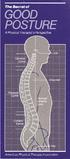
2 Forward Head Posture (FHP): It is a common understanding that the human head weighs approximately 8 lbs or so. In those with forward head posture, (FHP), the weight of the head bearing down on the joints of the neck and upper back (thoracic spine) is at a minimum of 12 lbs. For every inch of FHP, it can increase the weight of the head on the spine by an additional 10 pounds ( Kapandji, Physiology of Joints, Vol. 3) Once the ear has passed the mid-line of the shoulder by 3 inches or more, it has noted in the research that the human head has an equivalent load of 42 pounds on the spine. Complications from Forward head postures: A head in FHP can add up to 30 lbs. of abnormal leverage on the cervical spine. This can pull the entire spine out of alignment. A FHP can also result in a loss of a 30% vital lung capacity. As we lose the natural curve in our cervical spine, this blocks the action of the hyoid muscles, which help lift first rib during our inhalations. The entire G.I system (particularly the large intestine) may become agitated from FHP resulting in sluggish bowel function and evacuation. Causes of FHP, Upper Cross and Lower Cross syndromes: Prolonged sitting postures (at work and home) Forward-Head-Sitting Postures: Sitting on a couch, with head propped up and forward ahead of shoulders. This is also seen with people who read in bed. Flexion work with exercise: crunches from floor, sit-ups, some moves from Pilates, or any movements that encourage the lumbar spine to flex (bend) initiated by the contraction of the abdominals. A poorly designed work station. Weak abdominals: poorly recruited or trained abdominals Weak abdominals due to the reciprocal inhibition from surgical scars. Procedures that have penetrated all the layers of the abdominal wall can leave a scar that will tether to itself the fascial layers and compromise the muscle s function by being compressed. - Procedures such as C-sections, hysterectomies, or other abdominal surgeries such as appendix removal, and hernia repairs can leave scarring that can negatively affect abdominal function. - Weak lumbar ( lower back) musculature (poor strength endurance) Spinal osteoporosis: complications from spinal osteoporosis can lead to compression fractures in the thoracic vertebrae which can alter the alignment, curve and function of the thoracic spine. Exercising on abdominal or trunk exercise machines while sitting, and attempting to stabilize the core under the machine s load. Ideal Posture The body s centre of gravity is balanced over the centre of the mid-foot. Proper alignment is observed from the mid-line of the ear, down to the shoulder, through to the hip, through the knee, to the mid-foot. Good posture allows: - Better breathing: by allowing better expansion of the lungs, and better mobility of the ribs. - More energy and concentration from increased oxygen uptake from enhanced ventilation capacity. - Enhanced aesthetic appearance through being taller, clothing fitting better, and being taller is the new thin!!!!! 2

3 Recommended features for an ergonomic work station: The seated posture is supported by the chair, level of the table and computer, and placement of the keyboard. Notice that the arms are supported by the arms of the chair relieving the neck muscles that would have to suspend the weight of the arm while the worker typed. Upper Cross Syndrome UCS is a combination of a group of over-excited (facilitated) muscles in the front of the body, pulling the body forward, and ultimately down. Forward heads and rounder shoulders are the most common postural faults. This distorted pattern has the tight line running through the levator scapula, upper trapezius and pectorals which causes shoulder elevation and a forward tilt of the scapulae (shoulder blades) The weak line crosses through the deep neck flexors and over-stretched lower shoulder stabilizers (rhomboid major and lower trapezius allowing this asymmetry to occur). Neck pain is quite common for those possessing UCS, mainly due to the muscle s (levator scapula, and Upper trapezius) inability to compensate for the line of pull. Potential injuries from this postural syndrome: Shoulder pain, neck pain, upper back (thoracic) pain, headaches, etc. The first order of treatment is to correct the lengthtension or short-tightness of the affected muscles. Stretching enables muscles to be more extensible. Important Stretching Principles (for all stretches) 1. Be specific for optimal results. - Identify the specific muscles to be stretched (done for you) - Isolate the muscles to be stretched by precise localized movements (instructed for you in the hand-out and videos. 2. Increase local blood flow and oxygen to the tissues before and after activity and stretching. The contracting muscles are major vehicles used to deliver blood and oxygen. Repetitive muscle contractions deliver greater amounts of blood and oxygen to the specific muscles more rapidly i.e; Head Rolls: 8 rotate right- 8 rotate left 3. Establish a proper breathing rhythm when stretching. Inhale as the body part returns to the starting posture, exhale during the work phase of the stretch. 4. For maximum results: stretch gently for 2-3 seconds duration, release the pressure, return to the starting position, and repeat the prescribed number of repetitions. Stretch the muscle only to the point slightly beyond mild irritation. Be sure to not over stretch the muscle as this can cause muscle soreness from tissue tearing. 5. For more sensitive neck muscles: repeat 3 sec stretches for 12 repetitions. 6. For larger muscles groups such as the muscles in the thighs (quads or hamstrings) you hold the stretches for 5 seconds, return to starting position, and repeat 10 repetitions. 7. Some stretches may also be held statically for 4 x 30 seconds. 3

4 UCS and Forward Head Posture (FHP) Muscles associated with chronic pain: Levator Scapula Upper Trapezius Sub-occipital muscles ( Head extensors) Stretches for muscles: Levator Scapula stretch: To stretch: rotate your head to one shoulder as much as comfortable, and drop the chin down to the shoulder. At the same time, use the opposite arm to reach behind your head, hence, rotating the scapula upwards and placing greater tension on the muscle. Hold stretch for 3 seconds, return to starting point, and repeat for 10 repetitions. Upper Trapezius stretch: Sidebend your head (ear to shoulder), and then drop your chin down to your chest. Apply this stretch slowly and gently, switch sides. Apply this stretch for 3 seconds x 10 Sub-occipitals stretch: Chin-Tucks for FHP To stretch: take two fingers and push gently onto the front of your chin. Allow your chin to sink backwards as your head rotates slightly, and you feel a stretch behind your skull. Hold stretch for 3 seconds and repeat for 10 repetitions. Pecs Major and Minor stretches: (Recommended for those with FHP and Rounded shoulders) Pec Major: To stretch: Place your shoulder joint up against a corner of a wall, elevate your elbow at the shoulder level. Step on the other side of the corner (as in picture above) of the wall, where your trunk is already facing the opposite direction of your shoulder. Do not allow your shoulder to lose contact with the wall. Squeeze your shoulder blade in and down towards your spine. Now, as you take a deep breath in, gently, turn your sternum away from your shoulder until you feel a stretch as you exhales. You will feel a stretch across your front chest and pecs. Apply the stretch for 5 seconds, and switch to the other side. Repeat 10 repetitions for each side. Pec Minor: Place right hand on the back of your neck, and elbow above your shoulder level by about 3 to 4 inches. Apply the same technique as in the Pec Major stretch. Utilize the exhale to increase the distance you gain as you rotate your sternum away from the shoulder. Hold the stretch for 5 seconds, return to starting position, and repeat 10 repetitions for each side. 4

5 Front (Anterior) Chain stretch: (Pecs, the abdominal connections to the Pecs) - Stand in a door way. Place your elbows at or just above shoulder height. - Using your rear foot, push yourself forward slightly until you feel a stretch across your chest and front shoulder. - Back off from the stretch slightly, take a deep breath, and take up the tension in your chest and rib cage by shifting your weight even further forward into the stretch as you exhale. - Hold the stretch for 5 seconds, return to the starting position, and repeat for 10 repetitions. Abdominals/Upper Thoracic Spine stretch: Begin this stretch by sitting on a fitted-for you stability ball. This stretch addresses most of the tensions incurred by the abdominal and muscles of the rib cage. Walk forwards, and lay back on ball until your head and upper spine and shoulders are resting on ball and in a supine position. Keep the back of your skull on the ball as your now take small steps backwards, further adhering each spinal segment to the ball until you reach your tailbone. Keep your hips elevated to start, until you are comfortable with the stretch and position. Progressions: You can extend the arms overhead, when you feel comfortable enough, you can then extend the legs out, thereby fully extending your spine overtop of the ball. Progress through this stretch slowly, until you feel a comfortable stretch through your abdominals, front hips, rib cage, neck muscles, chest muscles, etc., You may hold this stretch for a longer interval (20 to 30 seconds). Repeat 3 to 4 times. Lower Cross syndrome The tight-line traverses the iliopsoas or centre of the front hip (hip flexors) and lower back (lumbar erectors), while the weak line connects the abdominals and glute muscles. In this lower crossed pattern, the short and tight iliopsoas tilts the pelvis forward (anteriorly), creating an excessive lumbar lordosis (curve). This also creates excessive tension in the lumbar muscles which hold this bowing pattern. The weak abdominals and gluteal muscles, unable to stabilize the pelvis, allow the dysfunctional swayback pattern to develop. ( see image below) Prolonged sitting also perpetuates the slumping which eventually flattens or reverses the normal lumbar lordotic curve. This often results in the flat-back posture with compensatory losses of normal spinal curves. Lower Crossed Syndrome and Tight muscles Ilio-psoas (hip flexors) Rectus Femoris and Quadriceps 5

6 Tensor Fascia Lata (TFL) Hamstrings and Lower back muscles (highlighted in red) Lower crossed syndrome and the knee Much has been documented about lower extremity muscle imbalances, joint dysfunction and the net result on the knee. For the purposes of this presentation, the author supports the model that the knee often falls victim to the imbalances from the joints above and below it. For example, if the glute muscles on the side of the hip (glutes medius) are weak, they will allow the knee to buckle in (valgus) and create stress on the inner ligaments, joint capsule, meniscus, etc. In this case the glute muscles are unable to stabilize the pelvis adequately to prevent the knee from caving in. On the other hand, if the ankle does not possess enough mobility as in the ability to keep one s heel flat on the floor while squatting and maintaining proper posture, then the ankle joint and the surrounding musculature will force the knee to compensate by taking on the load of the movement or changing the way the knee moves entirely. Heel lifts are added to the subject s squat pattern because of a lack of dorsiflexion or ankle mobility. Without this compensation, squatting will force the knee forward and exposing it to an increase compressive load at the patellar ligament. There are many other examples of the knee s poor adaptation to its neighboring joint s lack of mobility or stability. Recommended stretches for optimal knee function and hip balancing. Hamstring stretch: Elevate your foot onto a bench, or chair. Perform a pelvic tilt by arching your back towards the opposite wall. Increase the tension of the stretch by pushing your chest out and forward, pushing your butt back and not, by reaching down to your leg or foot. Quadriceps stretch: (If overly tight, these muscles can compress your knee joints) Place your foot on a bar, bench, or chair, or simply grab it with your hand(s). Maintain the alignment of your thigh with your belly-button. Perform a posterior pelvic tilt until you sense tension in your quad muscle. Bend the other leg enough to lower your pelvis to place tension on your quad muscle. Maintain these two adjustments throughout the stretch. 6

7 Ilio-psoas (Hip Flexor) stretch: (Right hip:) Kneel on right knee, place your left foot diagonally out, wide enough to support a weight shift. Your feet should be squared to the front. Perform a strong posterior pelvic tilt. (Maintain this adjustment) Push the top side of your head up towards the ceiling- with an extreme effort. Finally, push your hip forward by contracting your glute muscle, and maintain a pelvic tilt with an extreme effort. Rectus Femoris Stretch: Relieving the tension from this muscle will help with resolving any pain that eminates from the front part of the knee cap (patella-femoral syndrome) Kneel on right knee. Grab the right foot with the right hand, and pull towards the outer aspect of your right hip. Ensure you are beside a wall to maintain your balance with the other hand. Perform a strong pelvic tilt (posterior). Remain tall through your trunk. Lumbar erectors stretch: The lower fibers of the erector spinae muscles are a close second in creating the lower cross syndrome. Seated on SITS bones, spread your legs slightly wider than hip width. Extend both arms in front of your chest, locking out your elbows. Fully extend your wrists, fingers, and hands. Turn your arms outward (external rotation), turning your thumbs out. With an extreme effort, push through the long axis of your arms, through the heel of your palms. Slump your lower back by performing a pelvic tilt, with an extreme effort. TFL stretch ( stretching this muscle will help relieve I-T band syndrome or pain on the outside of the knee) Wrap your right leg around the front part of your left knee. Make sure the back of your right knee makes contact with the front of your left knee Remaining tall, bend your left knee and shift your weight through your hip to the left. You should feel a stretch on the outer part of your hip- this is the gluteus medius muscle By turning your left foot inwards slightly to 1 or 2 o çlclock, you will feel the stretch now in your front pocket area. This is the TFL muscle. Hold this stretch for 5 seconds, switch legs, and repeat for both legs 12 repetitions. Switch legs. References Be sure to submit your address on the sheet so I can send your videos on the proper stretching of postural-tight muscles. 1. Advanced Myoskeletal Techniques. Dalton, E, PhD. Second edition Excerpts from Your Body Back to Balance Seminar, River Oaks Community Centre, Oakville, ON, Kapanjdi-The Physiology of Joints. Vol

8 For further information about our services to help balance your life and body visit us at: or us at: 8

DSM Spine+Sport - Mobility
 To set yourself up for success, practice keeping a neutral spine throughout all of these movements. This will ensure the tissue mobilization is being applied to the correct area, and make the techniques
Flexibility Assessment and Improvement Compiled and Adapted by Josh Thompson
 Flexibility Assessment and Improvement Compiled and Adapted by Josh Thompson Muscles must have a full and normal range of motion in order for joints and skeletal structure to function properly. Flexibility
BEACH VOLLEYBALL TRAINING PROGRAM
 2008 ELITE PERFORMANCE ATHLETE CONDITIONING BEACH VOLLEYBALL TRAINING PROGRAM Team BC 2008 Steve Van Schubert, CAT(C), CSCS Training Schedule General Outline Phase 1 2 Weeks Phase 2 3 Weeks Phase 3 3 Weeks
McMaster Spikeyball Therapy Drills
 BODY BLOCKS In sequencing Breathing and Tempo Flexibility / Mobility and Proprioception (feel) Upper body segment Middle body segment Lower body segment Extension / Static Posture Office / Computer Travel
SAMPLE WORKOUT Full Body
 SAMPLE WORKOUT Full Body Perform each exercise: 30 secs each x 2 rounds or 2-3 sets of 8-12 reps Monday & Wednesday or Tuesday & Thursday Standing Squat Muscles: glutes (butt), quadriceps (thigh) Stand
No Equipment Agility/Core/Strength Program for Full Body No Equip Trainer: Rick Coe
 No Equipment Agility/Core/Strength Program for Full Body No Equip Trainer: Rick Coe Introduction Program designed to be performed in a circuit. Perform exercises in sequence without rest 2-3 times. Increase
A proper warm-up is important before any athletic performance with the goal of preparing the athlete both mentally and physically for exercise and
 A proper warm-up is important before any athletic performance with the goal of preparing the athlete both mentally and physically for exercise and competition. A warm-up is designed to prepare an athlete
Sheet 1A. Treating short/tight muscles using MET. Pectorals. Upper trapezius. Levator scapula
 Sheet 1A Treating short/tight muscles using MET Pectorals Once daily lie at edge of bed holding a half-kilo can, arm out sideways. Raise arm and hold for 10 seconds, then allow arm to hang down, stretching
Stretching in the Office
 Stretching in the Office Legs: Quads, Hamstrings, IT band, Hip flexors, Gluts, Calves Quads: Standing @ desk maintaining upright posture, grab one leg @ a time by foot or ankle and bring it towards backside
Pilates for Kyphosis A BASI Pilates program designed to help correct thoracic kyphosis
 Pilates for Kyphosis A BASI Pilates program designed to help correct thoracic kyphosis 1 Lucy Penrose 19/01/2014 Wimbledon UK, April 2013 Abstract Kyphosis refers to an exaggerated curve in the thoracic
EXERCISE MANUAL PERSONALITY GYM
 EXERCISE MANUAL PERSONALITY GYM EXERCISE MANUAL PERSONALITY GYM legs. 1 calves raise Stand with the wide part of one foot on the seated row foot support. Start in a position with your calves stretched.
Living Room Bodyweight Workout Week 1 March or jog in place for 1 min to increase heart rate and lubricate joints.
 Warm Up- Living Room Bodyweight Workout Week 1 March or jog in place for 1 min to increase heart rate and lubricate joints. Protocol- All exercises will be done for 2 sets of 10 repetitions. After the
Lumbar/Core Strength and Stability Exercises
 Athletic Medicine Lumbar/Core Strength and Stability Exercises Introduction Low back pain can be the result of many different things. Pain can be triggered by some combination of overuse, muscle strain,
CHAPTER 3: BACK & ABDOMINAL STRETCHES. Standing Quad Stretch Athletic Edge - www.athleticedge.biz - (650) 815-6552
 CHAPTER : BACK & ABDOMINAL STRETCHES Standing Quad Stretch ) Stand and grasp right ankle with same hand, use a wall or chair to Lower maintain Back balance with left hand. Maintain an upright Stretches
KNEE EXERCISE PROGRAM
 KNEE PROGRAM INTRODUCT ION Welcome to your knee exercise program. The exercises in the program are designed to improve your knee stability and strength of the muscles around your knee and hip. The strength
Shoulders (free weights)
 Dumbbell Shoulder Raise Dumbbell Shoulder Raise 1) Lie back onto an incline bench (45 or less) with a DB in each hand. (You may rest each DB on the corresponding thigh.) 2) Start position: Bring the DB
Posture. Let s look at. in the head is jutting. the norm. you know if your belt. If you belt. lower body. 2 sections, upper. pulls?
 Fixing the Computer Guy Posture Lower back/h hip stability Let s look at ideal posture for a minute. Look at your profile in the mirror. Chances are you re gonna find that your head is jutting forward,
Ken Ross BSc ST, Nat Dip ST
 Ken Ross BSc ST, Nat Dip ST Trunk Most people will suffer from back pain at some point in their lives. Good spinal posture places minimal strain on the muscles which maintain the natural curve of the spine
by Ellen Saltonstall and Dr. Loren Fishman
 10 Yoga Poses for Low Back Pain Prevention by Ellen Saltonstall and Dr. Loren Fishman Introduction This series of poses is designed to prevent future back pain and also to relieve back pain that you may
Spinal Exercise Program/Core Stabilization Program Adapted from The Spine in Sports: Robert G. Watkins
 Spinal Exercise Program/Core Stabilization Program Adapted from The Spine in Sports: Robert G. Watkins Below is a description of a Core Stability Program, designed to improve the strength and coordination
General Guidelines. Neck Stretch: Side. Neck Stretch: Forward. Shoulder Rolls. Side Stretch
 Stretching Exercises General Guidelines Perform stretching exercises at least 2 3 days per week and preferably more Hold each stretch for 15 20 seconds Relax and breathe normally Stretching is most effective
Exercise 1: Knee to Chest. Exercise 2: Pelvic Tilt. Exercise 3: Hip Rolling. Starting Position: Lie on your back on a table or firm surface.
 Exercise 1: Knee to Chest Starting Position: Lie on your back on a table or firm surface. Action: Clasp your hands behind the thigh and pull it towards your chest. Keep the opposite leg flat on the surface
HELPFUL HINTS FOR A HEALTHY BACK
 HELPFUL HINTS FOR A HEALTHY BACK 1. Standing and Walking For correct posture, balance your head above your shoulders, eyes straight ahead, everything else falls into place. Try to point toes straight ahead
EGOSCUE CLINIC PAIN/POSTURE STRETCHES 1. Standing Arm Circles: Helps Restore Upper Body Strength
 EGOSCUE CLINIC PAIN/POSTURE STRETCHES 1. Standing Arm Circles: Helps Restore Upper Body Strength Two sets of 40 repetitions each. Stand with your feet pointed straight and hip-width apart. Place your fingertips
Don t. Hamstrings. Calf Muscles. both legs 2-3 times. stretch is felt in the back of the calf. Repeat with both legs 2-3 times.
 Remember to: Warm-up your muscles first before stretching (e.g. stretch after walking). Stretch until you feel mild discomfort, not pain. Never bounce or force a stretch. Hold the stretch for 10-30 seconds
Spine Conditioning Program Purpose of Program
 Prepared for: Prepared by: OrthoInfo Purpose of Program After an injury or surgery, an exercise conditioning program will help you return to daily activities and enjoy a more active, healthy lifestyle.
Fact sheet Exercises for older adults undergoing rehabilitation
 Fact sheet Exercises for older adults undergoing rehabilitation Flexibility refers to the amount of movement possible around a joint and is necessary for normal activities of daily living such as stretching,
How To Stretch Your Body
 Exercise Module A New Leaf Choices for Healthy Living University of North Carolina at Chapel Hill 2007 Center for Health Promotion and Disease Prevention Physical Activity Exercises for Keeping Active
COMMON OVERUSE INJURIES ATTRIBUTED TO CYCLING, AND WAYS TO MINIMIZE THESE INJURIES
 COMMON OVERUSE INJURIES ATTRIBUTED TO CYCLING, AND WAYS TO MINIMIZE THESE INJURIES Listed are a few of the most common overuse injuries associated with cycling long distances. 1. Cervical and upper back
Lower Body Exercise One: Glute Bridge
 Lower Body Exercise One: Glute Bridge Lying on your back hands by your side, head on the floor. Position your feet shoulder width apart close to your glutes, feet facing forwards. Place a theraband/mini
Low Back Pain Exercises Interactive Video Series Transcript July 2013
 Introduction Low Back Pain Exercises Interactive Video Series Transcript July 2013 ** Note: If an exercise causes an increase in your pain, stop the exercise.** [Music introduction; Dr. John Sheehan onscreen]
Hip and Trunk Exercise Program
 Hip and Trunk Exercise Program Hip and Pelvis Exercise Program Gluteus Medius and Minimus (Hip Abductors) Page 2 Lateral Hip Rotators Page 6 Tensor Fascia Lata (TFL) and Illiotibial Band (ITB) Page 7 Lower
EXERCISE DESCRIPTIONS PHASE I Routine #1
 EXERCISE DESCRIPTIONS PHASE I Routine #1 Hip Mobility Exercise: Forward Out-In Movement: Raise leg out to the side, and rotate around to the front. Keep shin/thigh angle at 90 degrees. Exercise: Backward
Cardiac Rehab Program: Stretching Exercises
 Cardiac Rehab Program: Stretching Exercises Walk around the room, step side to side, ride a bike or walk on a treadmill for at least 5 minutes to warm up before doing these stretches. Stretch warm muscles
HYPERLORDOSIS & PILATES TREATMENT
 HYPERLORDOSIS & PILATES TREATMENT Grace Tiangco 3/18/15 2012-2013 Abstract Sacramento/Mountain View Lordosis or Hyperlordosis is defined as a postural type in which the natural curves of the spine are
Psoas Syndrome. The pain is worse from continued standing and from twisting at the waist without moving the feet.
 Psoas Syndrome The iliopsoas muscle is a major body mover but seldom considered as a source of pain. Chronic lower back pain involving the hips, legs, or thoracic regions can often be traced to an iliopsoas
THE BIG SIX. Six Best Volleyball Strength Training Exercises. By Dennis Jackson, CSCS www.strength-and
 THE BIG SIX Six Best Volleyball Strength Training Exercises By Dennis Jackson, CSCS www.strength-and and-power power-for for-volleyball.com THE SQUAT What it is The two most common squatting exercises
are you reaching your full potential...
 T h e r e s n o s u c h t h i n g a s b a d e x e r c i s e - j u s t e x e r c i s e d o n e b a d l y FIT for sport are you reaching your full potential... These tests are a series of exercises designed
Today s session. Common Problems in Rehab. www.physiofitness.com.au/filex.htm LOWER BODY REHAB ESSENTIALS TIM KEELEY FILEX 2012
 Tim Keeley B.Phty, Cred.MDT, APA Principal Physiotherapist physiofitness.com.au facebook.com/physiofitness Today s session Essential list for the lower body Rehab starting point Focussing on activation,
CORRECTIVE CHIROPRACTIC EXERCISES
 CORRECTIVE CHIROPRACTIC EXERCISES J O W E T T & M O U L T O N C h i r o p r a c t o r s introduction This booklet, presented by Jowett and Moulton Chiropractors, is designed to provide you with a general
Knee Conditioning Program. Purpose of Program
 Prepared for: Prepared by: OrthoInfo Purpose of Program After an injury or surgery, an exercise conditioning program will help you return to daily activities and enjoy a more active, healthy lifestyle.
Exercises for Low Back Injury Prevention
 DIVISION OF AGRICULTURE RESEARCH & EXTENSION University of Arkansas System Family and Consumer Sciences Increasing Physical Activity as We Age Exercises for Low Back Injury Prevention FSFCS38 Lisa Washburn,
Exercises for the Hip
 Exercises for the Hip Gluteal Sets: Lie on your back, tighten buttocks and hold for 3-5 seconds. Repeat 20 times. Supine Hip ER/IR: Lie on your back with legs straight. Gently rotate knees out and in limited
MELT Mini Map For Motorcyclists
 MELT Mini Map For Motorcyclists The MELT Self-Treatment Tools needed for this monthʼs Mini Map can be found online at store.meltmethod.com. Depending on which tools you have on hand, you can start with
The Santa Monica Orthopaedic and Sports Medicine Research Foundation. The PEP Program: Prevent injury and Enhance Performance
 The Santa Monica Orthopaedic and Sports Medicine Research Foundation The PEP Program: Prevent injury and Enhance Performance This prevention program consists of a warm-up, stretching, strengthening, plyometrics,
Range of Motion. A guide for you after spinal cord injury. Spinal Cord Injury Rehabilitation Program
 Range of Motion A guide for you after spinal cord injury Spinal Cord Injury Rehabilitation Program This booklet has been written by the health care providers who provide care to people who have a spinal
Self-mobilization methods
 Self-mobilization methods 5 Muscle energy techniques, as outlined in previous chapters, provide us with an excellent series of methods for relaxation and stretching of specific tight, shortened, contracted
The Lose-the-Last-1o-Pounds Workout
 Printable Workout: www.myfitstation.com The Lose-the-Last-1o-Pounds Workout From The Women s Health Big Book of Exercises Phase 1) Week 1-4 It s time to finish off that fat for good! This 8-week plan from
Stretching the Major Muscle Groups of the Lower Limb
 2 Stretching the Major Muscle Groups of the Lower Limb In this chapter, we present appropriate stretching exercises for the major muscle groups of the lower limb. All four methods (3S, yoga, slow/static,
Exercises for Growing Taller
 1 Exercises for Growing Taller A Mini-Guide By Rodney Williams Copyright and Legal Notice 2 Published by: Copyright 2011. All Rights Reserved. No part of this publication may be reproduced or transmitted
The Process of Strength and Conditioning for Golfers
 The Process of Strength and Conditioning for Golfers The use of different sporting activities and resistance work to develop a strength and conditioning program specific to golf. Many club golfers are
12 Week Do-it-Yourself Fitness Program
 12 Week Do-it-Yourself Fitness Program Created by Brad Awalt, MS, ACSM Assistant Manager, Health Plus [email protected] January 2011 Do you have a goal to begin an exercise routine, but not sure
Do you sit at a desk all day? Does your 9 to 5 leave no time for structured exercise..?
 Do you sit at a desk all day? Does your 9 to 5 leave no time for structured exercise..? Staying healthy at work is easier than you might think: Try building the following desk based exercises into your
Coaching the Injury Prone Athlete. www.englandathletics.org www.englandathletics.org/east
 Coaching the Injury Prone Athlete Injury! The Causes? Frequently the consequence of poor physical preparation ( accidents excluded) Exceeding training loads the athlete can handle at that time Volume,
Self-Myofascial Release Foam Roller Massage
 How it works. Self-Myofascial Release Foam Roller Massage Traditional stretching techniques simply cause increases in muscle length and can actually increase your chances of injury. Self-myofascial release
Addressing Pelvic Rotation
 1 of 5 4/20/2008 10:31 AM http://www.strengthcoach.com Addressing Pelvic Rotation Aaron Brooks of Perfect Postures When trying to address your athlete's or client's limitations due to pain or joint restriction,
Flat foot and lower back pain
 Flat foot and lower back pain Dr James Tang, MBA, BDS, LDS RCS General Dental Practitioner, NASM Corrective Exercise Specialist with special interest in postural dysfunction & lower back problems, Level
Strength Training for the Runner
 Strength Training for the Runner Strength Training for the Runner What? The goal of resistance training for runners is not necessarily adding muscle mass but 1. improving muscular strength, 2. improving
NETWORK FITNESS FACTS THE HIP
 NETWORK FITNESS FACTS THE HIP The Hip Joint ANATOMY OF THE HIP The hip bones are divided into 5 areas, which are: Image: www.health.com/health/static/hw/media/medical/hw/ hwkb17_042.jpg The hip joint is
A Stretch-Break Program for Your Workplace! www.healthyworkplaceweek.ca
 www.healthyworkplaceweek.ca A Stretch-Break Program for Your Workplace! Why is stretching at work important? Sitting at a desk or computer; or standing at your work station for extended periods of time
SHOULDER PULL DOWNS. To learn efficient use of the shoulder blades and arms while maintaining a neutral spine position.
 SHOULDER INTRODUCT ION Welcome to your shoulder exercise program The exercises in the program are designed to improve your shoulder mobility, posture and the control of the muscles in your neck and shoulder
he American Physical Therapy Association would like to share a secret with you. It can help you do more with less effort breathe easier feel great.
 The Secret... T he American Physical Therapy Association would like to share a secret with you. It can help you do more with less effort breathe easier feel great. The secret is about good posture, which
Passive Range of Motion Exercises
 Exercise and ALS The physical or occupational therapist will make recommendations for exercise based upon each patient s specific needs and abilities. Strengthening exercises are not generally recommended
Rehabilitation after shoulder dislocation
 Physiotherapy Department Rehabilitation after shoulder dislocation Information for patients This information leaflet gives you advice on rehabilitation after your shoulder dislocation. It is not a substitute
UPPER QUADRANT PAC. Do only those exercises that I have checked off for you to do independently. THINGS TO AVOID
 UPPER QUADRANT PAC Most common pain / disfunction syndromes occur as a result of a combination of poor posture habit and imbalanced muscle groups. The following exercise protocols will address the most
PERFORMANCE RUNNING. Piriformis Syndrome
 Piriformis Syndrome Have you started to experience pain in your hip or down your leg while beginning or advancing your fitness program? This pain may be stemming from the piriformis muscle in your hip.
MINDING OUR BODIES. Healthy Eating and Physical Activity for Mental Health
 MINDING OUR BODIES Healthy Eating and Physical Activity for Mental Health Facilitators Guide: Background Information (note: tell participants to consult with their doctor before starting to exercise) What
Take a few minutes for yourself and incorporate some Office Yoga into your daily routine.
 OFFICE YOGA Working in an office or at a computer for prolonged periods of time can put strain on the neck, shoulder and back muscles which in turn can lead to tension and stiffness. This tension can cause
EXERCISE INSTRUCTIONS 1
 EXERCISE INSTRUCTIONS 1 Contents ANKLE TOUCHES... 4 BACK EXTENSIONS... 4 BACK REVERSE FLYES... 4 BALL ROLL... 4 BASKETBALL SQUATS... 4 BEAR CRAWL... 4 BICEP CURL (Resistance Band)... 4 BOXING JABS... 5
Core stability training program
 Core stability training program The structure of the lumbar region is inheriently unstable. In practical term this means the lumbar spine relies upon sufficent support from the muscles that actively suport
Sutton & Cheam Swimming Club. Land Training for Swimming and Water Polo
 Sutton & Cheam Swimming Club Land Training for Swimming and Water Polo Why do we need to perform land work? Many of the basics for swimming and water polo can be gained by experiencing activities out
Low Back Pain: Exercises
 Low Back Pain: Exercises Your Kaiser Permanente Care Instructions Here are some examples of typical rehabilitation exercises for your condition. Start each exercise slowly. Ease off the exercise if you
Anatomy & Physiology 120. Lab #7 Muscle Tissue and Skeletal Muscles
 Anatomy & Physiology 120 Lab #7 Muscle Tissue and Skeletal Muscles What you Need to Know Look briefly at the Structure of: 1) Skeletal, 2) Smooth & 3) Cardiac Muscle Naming, Identification, Functions You
This document fully describes the 30 Day Flexibility Challenge and allows you to keep a record of your improvements in flexibility.
 Welcome to the StretchTowel 30 Day Flexibility Challenge! You can Be More Flexible in 30 days by following our stretching program for 10 minutes a day. The best part is that you can stretch using the StretchTowel
Lower Back Pain An Educational Guide
 Lower Back Pain An Educational Guide A publication from the Center of Pain Medicine and Physiatric Rehabilitation 2002 Medical Parkway Ste 150 1630 Main St Ste 215 Annapolis, MD 21401 Chester, MD 21619
Clasp hands behind hips and stretch arms down towards floor. Roll shoulder back to open chest. Do not let back arch. Power Skips
 Warm Up Exercises Jump Rope Ankle Bounces Jumping Jacks Using a fast twirl, rapidly jump up and down using spring in the feet and ankles, not in knees. V-Jumps Rapidly jump up and down using spring in
Mike s Top Ten Tips for Reducing Back Pain
 Mike s Top Ten Tips for Reducing Back Pain The following article explains ways of preventing, reducing or eliminating back pain. I have found them to be very useful to myself, my clients and my patients.
Info. from the nurses of the Medical Service. LOWER BACK PAIN Exercise guide
 Info. from the nurses of the Medical Service LOWER BACK PAIN Exercise guide GS/ME 03/2009 EXERCISE GUIDE One of the core messages for people suffering with lower back pain is to REMAIN ACTIVE. This leaflet
The Pilates Studio of Los Angeles / PilatesCertificationOnline.com
 Anatomy Review Part I Anatomical Terminology and Review Questions (through pg. 80) Define the following: 1. Sagittal Plane 2. Frontal or Coronal Plane 3. Horizontal Plane 4. Superior 5. Inferior 6. Anterior
Myofit Massage Therapy Stretches for Cycling
 Guidelines for Stretching Always assume the stretch start position and comfortably apply the stretch as directed. Think Yoga - gently and slowly, no ballistic actions or bouncing at joint end range. Once
Strength Exercises for Improved Running Biomechanics
 2 CHAPTER Strength Exercises for Improved Running Biomechanics ssssssssssssssssssssssssssssssssssssssssssssssssssssssssssssssssssssssssssssssssssssssssssssssssssssssssssdd s Many gait abnormalities seen
Preventing Overuse Injuries at Work
 Preventing Overuse Injuries at Work The Optimal Office Work Station Use an adjustable chair with good lumbar support. Keep your feet flat on a supportive surface (floor or foot rest). Your knees should
MET: Posterior (backward) Rotation of the Innominate Bone.
 MET: Posterior (backward) Rotation of the Innominate Bone. Purpose: To reduce an anterior rotation of the innominate bone at the SI joint. To increase posterior (backward) rotation of the SI joint. Precautions:
PILATES Fatigue Posture and the Medical Technology Field
 PILATES Fatigue Posture and the Medical Technology Field Marybeth Kane May 2014 Course: 2014, Pacific Palisades, CA 1 ABSTRACT A medical laboratory scientist (MLS) (also referred to as a medical technologist
Basic techniques of pulmonary physical therapy (I) 100/04/24
 Basic techniques of pulmonary physical therapy (I) 100/04/24 Evaluation of breathing function Chart review History Chest X ray Blood test Observation/palpation Chest mobility Shape of chest wall Accessory
Chair Exercises For Older Adults
 Chair Exercises For Older Adults Many of these exercises were adapted from these sources: National Institute on Aging, Exercise: A Guide from the National Institute on Aging, 2001, http://www.nia.nih.gov/healthinformation/publications/exerciseguide/.
Exercises for older people
 Exercise for older people Exercises for older people Sitting Getting started If you ve not done much physical activity for a while, you may want to get the all-clear from a GP before starting. For the
How to Get and Keep a Healthy Back. Amy Eisenson, B.S. Exercise Physiologist
 How to Get and Keep a Healthy Back Amy Eisenson, B.S. Exercise Physiologist Lesson Objectives Statistics of Back Pain Anatomy of the Spine Causes of Back Pain Four Work Factors Core Muscles Connection
Chair Exercises and Lifting Weights
 Chair Exercises and Lifting Weights Why are chair exercises and lifting weights important? Physical activity is one of the most important things you can do to maintain your diabetes control as well as
What is Separation of the Abdominal Muscles after Childbirth (also known as Divarication of Rectus Abdominis)?
 What is Separation of the Abdominal Muscles after Childbirth (also known as Divarication of Rectus Abdominis)? Following your pregnancy and the birth of your baby your abdominal (tummy) muscles may have
How To Roll Out
 THE GUIDE: ROLLING OUT WHAT IS THE MYOFASCIAL SYSTEM? The Myofascial System is a superficial fascia (a thin sheath of silvery tissue) that wraps around the outer surface of muscles and individual muscle
For Deep Pressure Massage
 T H E R A C A N E O W N E R S M A N U A L For Deep Pressure Massage Thera Cane is a self massager used to apply pressure to sore muscles. The unique design of the Thera Cane lets you apply deep pressure
BP MS 150 lunch and learn: Stretching and injury prevention. Dr. Bart Kennedy (Sports Chiropractor) and Josh Thompson February 04, 2015
 BP MS 150 lunch and learn: Stretching and injury prevention Dr. Bart Kennedy (Sports Chiropractor) and Josh Thompson February 04, 2015 Epidemiology Overuse injuries most common, traumatic event second
BRUGGER'S POSTURAL RELIEF EXERCISE
 BRUGGER'S POSTURAL RELIEF EXERCISE Brugger's Postural Relief Exercise strengthens your muscles. lt promotes stability and relaxes tight muscles that tighten due to postural stress (see Figure 2). Check
ACL Reconstruction Rehabilitation
 ACL Reconstruction Rehabilitation The following exercises are commonly used for rehabilitation following ACL reconstruction surgery. However, each knee surgery is unique and each person s condition is
SPINE. Postural Malalignments 4/9/2015. Cervical Spine Evaluation. Thoracic Spine Evaluation. Observations. Assess position of head and neck
 SPINE Observations Body type Postural alignments and asymmetries should be observed from all views Assess height differences between anatomical landmarks Figure 25-9 Figure 25-10 Figure 25-11 & 12 Postural
Range of Motion Exercises
 Range of Motion Exercises Range of motion (ROM) exercises are done to preserve flexibility and mobility of the joints on which they are performed. These exercises reduce stiffness and will prevent or at
Muscular System. Student Learning Objectives: Identify the major muscles of the body Identify the action of major muscles of the body
 Muscular System Student Learning Objectives: Identify the major muscles of the body Identify the action of major muscles of the body Structures to be identified: Muscle actions: Extension Flexion Abduction
FUNCTIONAL STRENGTHENING
 FUNCTIONAL STRENGTHENING *This group of exercises are designed to increase leg and core endurance and stability as related to bipedal functional activities. *Perform this program for 4-6 weeks. It is ideal