
European Climate Change Policy Beyond 2012
|
|
|
- Gary Waters
- 10 years ago
- Views:
Transcription
1 European Climate Change Policy Beyond 2012 World Energy Council 2009 Promoting sustainable energy for the greatest benefit of all
2 European Climate Change Policy Beyond 2012 European Climate Change Policy Beyond 2012 World Energy Council 2009 Copyright 2009 World Energy Council All rights reserved. All or part of this publication may be used or reproduced as long as the following citation is included on each copy or transmission: Used by permission of the World Energy Council, London, Published 2009 by: World Energy Council Regency House 1-4 Warwick Street London W1B 5LT United Kingdom ISBN: Disclaimer: This report reflects the views of WEC European Members and does not necessarily represent the view of all WEC members.
3 European Climate Change Policy Beyond 2012 World Energy Council Contents Contents 1 Introduction 3 General Background 5 The Greenhouse Gas Effect and its Connection to Climate Change 5 The 4 th Assessment Report by the IPCC 6 Greenhouse Gas Data 8 Increases in global CO 2 emissions, Scenarios of global carbon emissions until Key Messages 16 Global Climate Change Policy 17 The present international framework 17 Kyoto protocol status 19 Status of technological partnerships 21 The current negotiation process and agenda: Bali road map to Copenhagen 22 Bali Action Plan 23 The role of the G8 statements 24 ETS around the world 26 Key Messages 28 Climate Friendly Technologies 29 Global Potential 30 Demand side 31 Supply Side 38 Key Messages 47 The Larger Context of EU Climate Change Policy Making 49 The EU Emissions Trading Scheme in a nutshell 50 Expectations and Reality 51 Joint Implementation (JI) and Clean Development Mechanism (CDM) 56 A view of the EU-ETS market 59 Other EU policies with impact on climate change 62 Review of the EU-ETS: a new regulatory framework 65 Lesson learnt 68 Key Messages 69 Further Development of EU Climate Change Policy 71 Defining the Long-Term Goal 71 Linking to other ETS 73 Leakage 77 Security of Supply and Affordable Energy 78 Key Messages 78 Pathway to a Climate Friendly Europe 79 Roadmap for the electricity sector 79 Transport roadmap 87 Key Messages 95 Conclusions 96 General Policy 96 Policy Instruments 97 Emissions Trading as Instrument 98 Recommendations for the EU-ETS 98

4 2 European Climate Change Policy Beyond 2012 World Energy Council 2009 Study Group Membership 100 Annexes 101 Global Emissions Data 101 List of Annex I and Annex II countries 104 CoP and G8-meetings 105 Emission Trading Schemes and Exchanges 108 Alternative Technologies 112 Some basic EU data on allocation and emissions 115 References 117

5 European Climate Change Policy Beyond 2012 World Energy Council Introduction There is an increasing scientific consensus that human activities do trigger climate changes. Actual forecasts predict temperature increases that are likely to be beyond the adaptation potential of ecosystems. These considerations play a major role in shaping public opinion and the media landscape, influencing both policy makers and industry in recent years, culminating in the view that Europe needs to play a leading role in combating climate change. But what is Europe's role in the fight against climate change? Looking at Europe's contribution to global greenhouse gas (GHG) emissions, Europe's share is not only rather limited, but its global share is actually decreasing. This decrease is due to both the substantial increase in emissions in other regions and the fact that Europe, or at least the EU-27, has in place abatement goals for greenhouse gases. More importantly on a global scale, however, Europe is able to develop and deliver technological solutions that will reduce their own GHG emissions while at the same time helping other regions with their GHG abatement. The challenge is global: while Europe may be leading the way, there is still a need for other players to act quickly in reducing GHG emissions. To develop the so-called climate-friendly technologies, investment into research, development and deployment of new technologies is needed. Consequently, the most important task for any regulatory framework is to provide sufficient incentives for investment leading to the replacement of old and carbon-intense processes by more efficient, low-carbon technologies. The energy sector is, of course, a major contributor to the global GHG emissions. As such it has a vested interest in fostering sustainable investment. The investment cycle of this industry, however, necessitates a reliable and predictable long-term framework. The global warming challenge is not an issue that will be solved within a few months; it certainly will take a few decades. The focus of this report is on energy supply and transport use; however, even here, unavoidably, power generation issues dominate to some extent. It is however crucial, that all sectors play a role in abating GHG emissions: industry, housing, agriculture and most importantly transport with its rapidly increasing emissions. Reducing GHG emissions will be, as is well known, a financial burden on society. However, as the Stern report (2006) clearly demonstrated, the potential long-term cumulated costs for doing nothing are higher than the estimated abatement costs. From a simple cost-benefit analysis viewpoint, it is cheaper to spend now. Since the effects of climate change are long-term and cumulative, an interesting difficulty occurs: the benefits of the investments will not be reaped by the investors, but by their children 1. As mentioned in the Bruntland report, the welfare of future generations is an important part of sustainable development. Nevertheless, the current recession is creating pressure to find economically efficient solutions for GHG reductions: since money is 1 James E. Rogers, CEO of Duke Energy, speaks in this context of cathedral thinking : The cathedrals of Europe took many decades to build, and the people starting the work were sure, that they will never see the final result.

6 4 23/11/2009European Climate Change Policy Beyond 2012 World Energy Council 2009 scarce, the least expensive solutions have to be considered first. The WEC report European Climate Change Policy Beyond 2012 provides an overview of the EU climate and energy policy package and, more specifically, the further developments of its emissions trading scheme (EU-ETS). Whereas EU policy covering the period to 2020 has well developed milestones and legislation, the future beyond 2020 is rather nebulous. This has severe implications on the investments in the energy sector and on research and development activities. Sustainability of investments not only necessitates consideration of environmental issues: also important are security of supply and affordability of energy. The report will explore the main conclusions drawn from EU policy and the ETS and outline what should be the principal drivers of an economically and ecologically sustainable pathway for a European climate and energy policy. change terms unless they contribute to costeffectiveness globally. If Europe's policies fail the latter test, the hoped-for benefits in Europe will never materialise and the thesis of the Stern Report (2006) that 'it is cheaper to spend now' may prove to be fundamentally flawed. Chapter 1 provides some general background and statistical material about the GHG emissions, particularly CO 2 emissions. In chapter 2 the political framework is described, briefly examining the different levels: global, regional and national. Chapter 3 identifies some important abatement technologies and their technical and economic potential. The current status of the EU climate policy is explored in chapter 4, looking at its possible future development in chapter 5. Chapter 6 lays out the pathway to a climate friendly Europe. Finally, chapter 7 will provide the main conclusions of this study. A very important caveat must be emphasised at the beginning of this report. Like all other regions and countries of the world, Europe faces an unprecedented dilemma flowing from the fact that climate change is a global problem. There can be no solution for Europe, irrespective of how generous Europe's contribution to solving the problem may be, unless there is an effective solution for the entire world. In other words, there can never be a sustainable European pathway unless there is a sustainable global pathway. What, then, is "cost-effective" in climate change terms? Even if Europe's policies are cost-effective for Europe, they will not be cost-effective in climate

7 European Climate Change Policy Beyond 2012 World Energy Council General Background The Greenhouse Effect and its Connection to Climate Change The greenhouse effect is defined as the absorption of long-wave radiation in the atmosphere due to reflection of solar energy by the earth s surface. Some trace gases 2, e.g. hydrogen (H 2 ), carbon dioxide (CO 2 ), ozone (O 3 ), nitrous oxide (N 2 O), methane (CH 4 ) and hydro-fluorocarbons (HFC) can absorb parts of this infra-red radiation which then heats the atmosphere, rather like the effect in a greenhouse. These trace gases are thus known as greenhouse gases (GHGs) and the effect is known as the greenhouse effect. The natural greenhouse effect, as given by the historical concentration of GHGs in the atmosphere, increases what would be average temperature, namely -18 C, by 33 C, leading to an average atmospheric temperature of 15 C. If the temperature were significantly lower, life on earth would not be possible. This phenomenon that of absorbing long wave radiation and the resultant heat was first explained in 1824 thanks to the calculations of Jean Baptiste Fourier (Fourier, 1824). A change in the global climate is seen as a likely consequence of variations in the GHG concentration in the atmosphere. Scientists have observed an average global warming of the earth's Figure 1 Energy budget of the earth Source: IPCC, 4 th Assessment Report Incoming solar energy is reflected or absorbed by different layers of the earth s atmosphere or surface. The remaining energy on earth determines the average temperature. 2 Trace gases have a very low concentration in the atmosphere, hence they are measured in ppm = parts per million or even in ppb = parts per billion (1 ppm is one molecule per 1 million air molecules).
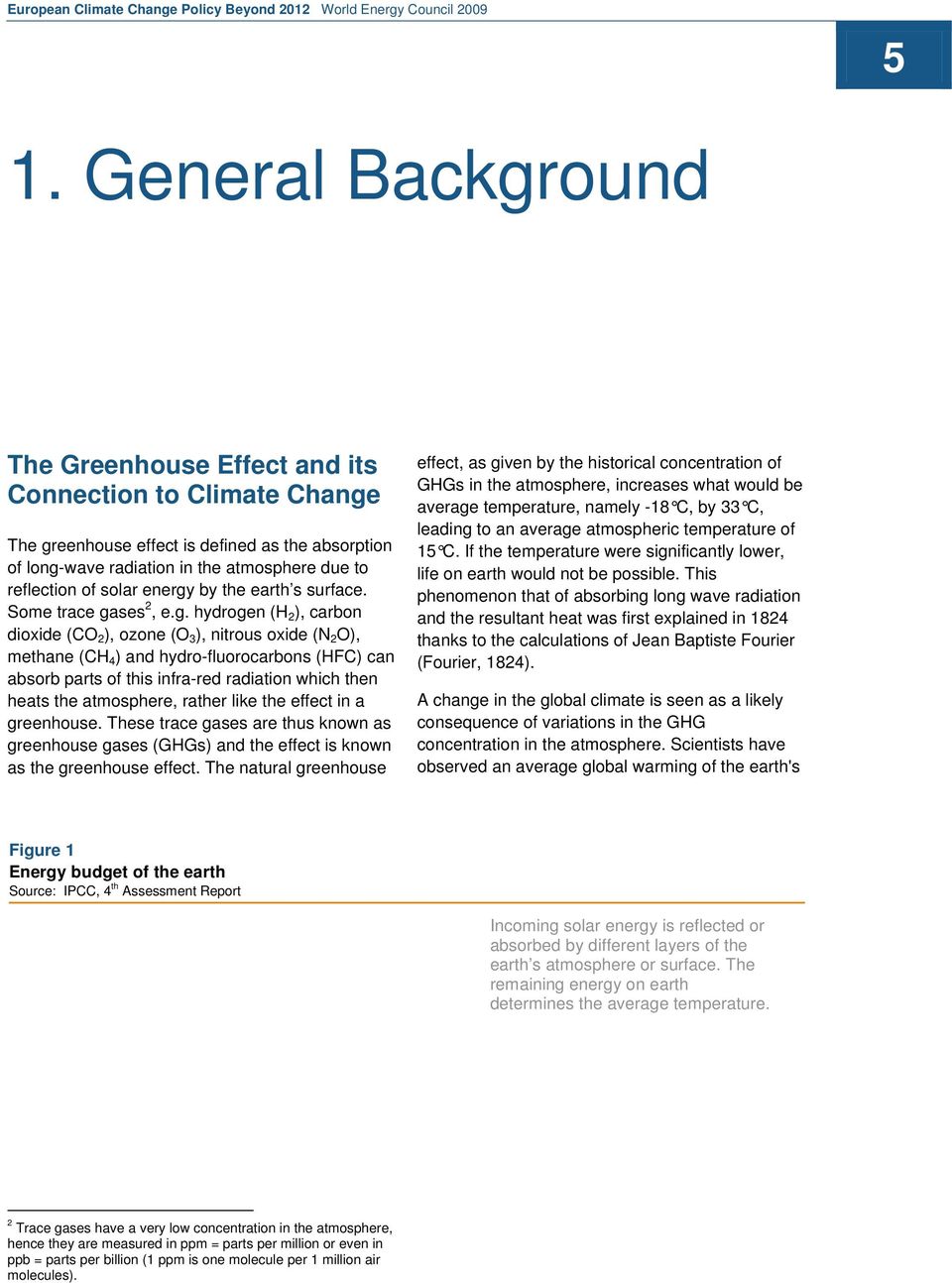
8 23/11/2009European Climate Change Policy Beyond 2012 World Energy Council temperature of about 1 C since the pre-industrial area (IPCC, 2007, 4 th Assessment Report). The changes in the GHG concentration are due to imbalances between the sources of GHGs and their sinks (a sink is something that absorbs GHGs). In comparison to the pre-industrial period, GHGs are being emitted at a higher rate than they can be absorbed. For instance, the reason that burning fossil fuels is seen as one cause of climate change is that the time it takes to produce fossil fuels (a process which absorbs GHGs) is magnitudes longer than the rate in which we are consuming them and rereleasing the GHGs into the atmosphere. The scientific community also discusses several consequences due to climate change e.g. on the level of the sea water, snow and rainfall in different regions as well as an increase in the occurrence of natural catastrophic events e.g. hurricanes. The 4 th Assessment Report by the IPCC The current consensus of climate researchers is reflected in the 4th assessment report of the Intergovernmental Panel on Climate Change (IPCC). While some details of climate change are still not fully understood, there is agreement on several key issues. One of the issues on which there is consensus is that the concentration of GHGs in the atmosphere has increased since preindustrial times, i.e. since Of course, the Earth's climate and levels of GHGs has always been in flux to some extent, as shown in Figure 2. However, it is important to note that not Table 1 Increase in CO 2 and Methane between the Pre- Industrial and 2005 Source: IPCC, 4 th Assessment Report. The latest value for the CO 2 -concentration quoted by the National Oceanic and Atmospheric Administration (NOAA) was 387 ppm in January 2009 Greenhouse gas Carbon dioxide Pre- Industrial 2005 Range of the last years Main source 280 ppm 379 ppm ppm Fossil Fuels Methan 715 ppb 1,774 ppb ppb Agriculture only is the current level of GHGs relatively high, the changes take place on a very short time scale. This triggers the following question: is the ecosystem able to adapt to these changes and how will human beings react to new climate situations they have never experienced before. It should be noted that there are also natural phenomena influencing changes in the concentration of GHGs, e.g. water vapour or eruptions by volcanoes. In former times the concentration of GHGs was even higher than it is today; however, at that point in time there was, firstly, no human life on earth and, secondly, the changes happened over a much longer time scale than the changes we are experiencing today. Currently, the anthropogenic GHG contribution is merely 2% of the total GHG emissions (Rahmstorf, 2002); however, since the natural GHG effect is already responsible for a temperature increase of 33 C (see Page 6), there is, even now, an increase in temperature of 0.7 C due solely to anthropogenic GHG emissions.

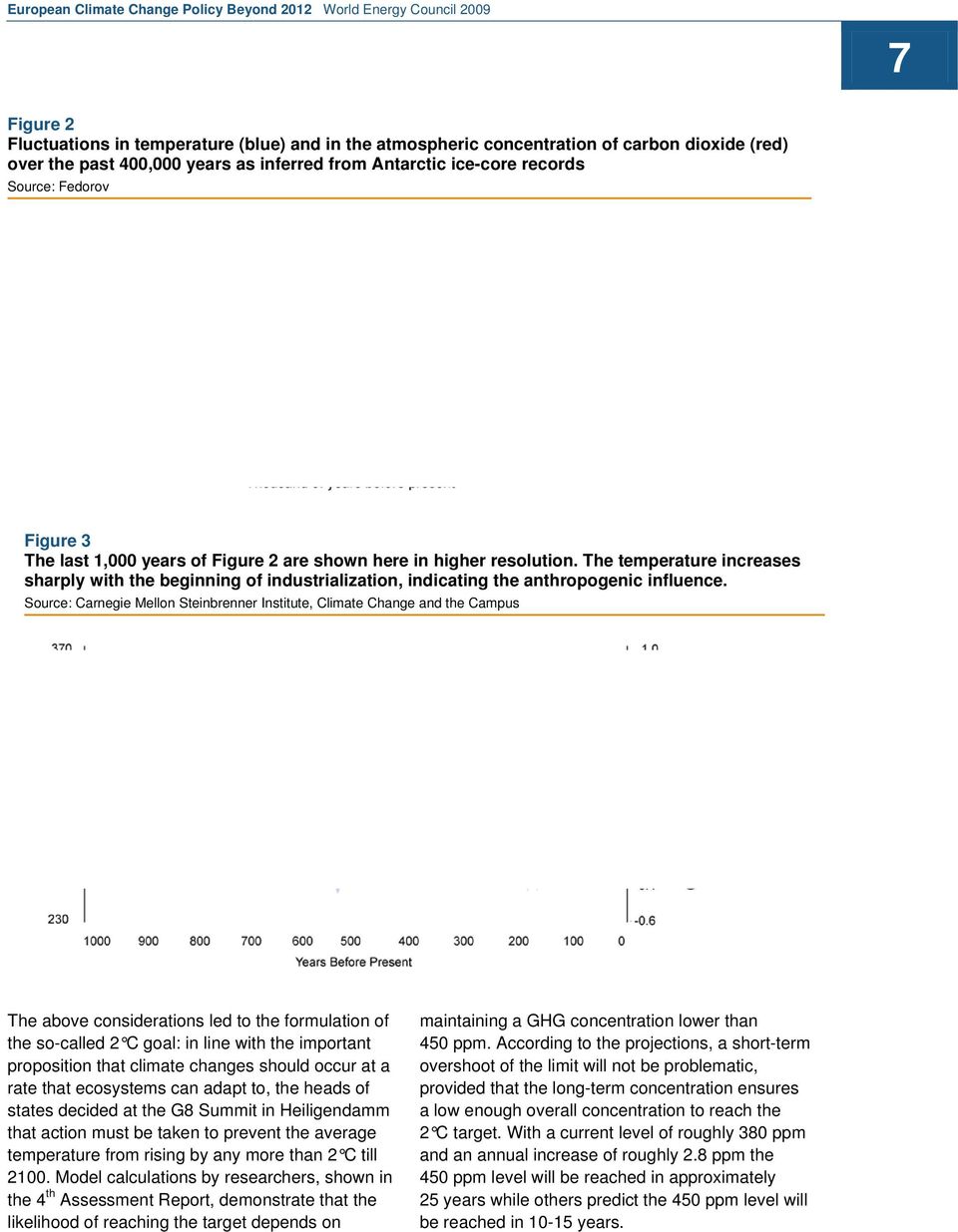
9 European Climate Change Policy Beyond 2012 World Energy Council Figure 2 Fluctuations in temperature (blue) and in the atmospheric concentration of carbon dioxide (red) over the past 400,000 years as inferred from Antarctic ice-core records Source: Fedorov Figure 3 The last 1,000 years of Figure 2 are shown here in higher resolution. The temperature increases sharply with the beginning of industrialization, indicating the anthropogenic influence. Source: Carnegie Mellon Steinbrenner Institute, Climate Change and the Campus The above considerations led to the formulation of the so-called 2 C goal: in line with the important proposition that climate changes should occur at a rate that ecosystems can adapt to, the heads of states decided at the G8 Summit in Heiligendamm that action must be taken to prevent the average temperature from rising by any more than 2 C till Model calculations by researchers, shown in the 4 th Assessment Report, demonstrate that the likelihood of reaching the target depends on maintaining a GHG concentration lower than 450 ppm. According to the projections, a short-term overshoot of the limit will not be problematic, provided that the long-term concentration ensures a low enough overall concentration to reach the 2 C target. With a current level of roughly 380 ppm and an annual increase of roughly 2.8 ppm the 450 ppm level will be reached in approximately 25 years while others predict the 450 ppm level will be reached in years.
10 23/11/2009European Climate Change Policy Beyond 2012 World Energy Council Figure 4 The likelihood of realising the 2 C goal can be translated into a GHG stabilisation level in ppm. For a given CO 2 -equivalence 3 stabilisation level, i.e. the long-term GHG concentration in the atmosphere, models are used to simulate the effects on the global temperature and to calculate the likelihood of a certain temperature increase. The value of 450 ppm generates a medium likelihood, i.e. there is a 50% probability this long-term value would lead to an increase equal to 2 C. While the different model results (i.e. the various lines) still show a large variation they are, however, consistent. Source: Meinshausen To reach the long-term goal of 450 ppm different 3 abatement paths can be plotted out. They describe the evolution of global emissions over time. The abatement paths all follow a similar format: in the next few years total emissions may still increase although they are to be severely cut down in the long term. However, even a complete and immediate stop of all GHG emissions today would not stop the climate changes that have already started due to the amount of cumulated emissions. This means the effect of all abatement measures taken now will only be seen in a few decades. In their 4 th Assessment Report, the Intergovernmental Panel on Climate Change (IPCC) concluded "Most of the observed increase in global average temperatures since the mid-20th century is very likely due to the greenhouse gas concentrations. The wording very likely means the IPCC is more than 90% certain global warming is due to GHGs. Greenhouse Gas Data As documented by the International Energy Agency (IEA Paris, CO 2 emissions from fuel combustion , 2006 Edition ), primary energy production and final energy use has various environmental implications. Fossil fuel consumption is responsible for about 60% of global anthropogenic GHG emissions. The 4 th Assessment Report by the IPCC estimates the global GHG emissions to be equivalent to about 50 billion tons of CO 2 per year, including emissions 3 Each greenhouse gas has a different global warming potential (GWP). For example, one ton of methane has the same impact on climate change as 25 tons of CO 2 (Source: IPCC 4 th Assessment Report). Using the GWP, all greenhouse gases can be calculated as an equivalent CO 2 -amount or CO 2 - concentration.
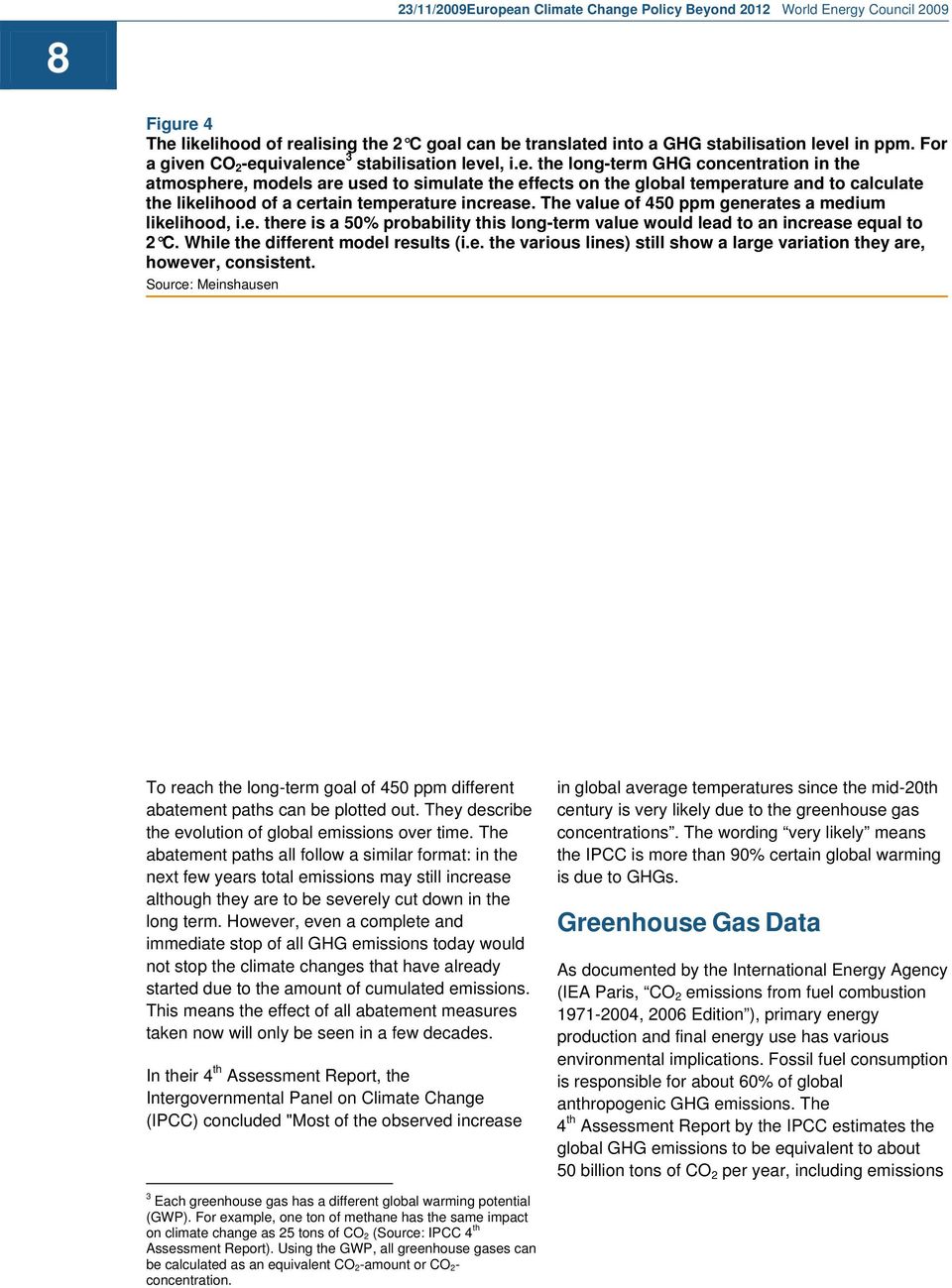
11 European Climate Change Policy Beyond 2012 World Energy Council Figure 5 Energy supply contributed slightly more than one quarter of the total global GHG emissions in The energy supply sector consists of a sequence of elaborate and complex processes for extracting energy resources, converting these into more desirable and suitable forms of energy and delivering energy to places where the demand exists (see also Annex 4, Table A-4. Source: IPCC 4, 4 th Assessment Report Forestry 17.40% Waste and wastewater 2.80% Energy supply 25.90% Agriculture 13.50% Industry 19.40% Residential and commercial buildings 7.90% Transport 13.10% from 4 forests and agriculture 5, mainly methane which has a global warming potential of 25 times that of carbon dioxide. The IEA, in their World Energy Outlook 2008, has estimated CO 2 emissions alone in 2006 from energy to be 28 billion tons of CO 2. The 1992 United Nations Framework Convention on Climate Change (UNFCCC) has set up an overall framework for intergovernmental efforts to tackle the challenges posed by climate change. The Convention s ultimate objective is to stabilise GHG concentrations in the atmosphere at a level that would prevent dangerous anthropogenic interference with the climate system. Among several human activities that produce GHGs, the use of energy represents the largest source of emissions. Energy accounts for roughly 60% of the global anthropogenic GHGs, with emissions resulting from the production, transformation, handling and consumption of all kinds of energy commodities. Much of the rest of the emissions is accounted for by agriculture (producing mainly CH 4 and N 2 O) such as domestic livestock (e.g. enteric fermentation (CH 4 and N 2 O), manure management (N 2 O)) and rice cultivation as well as industrial processes unrelated to energy, producing mainly fluorinated gases and N 2 O. In addition, there are CH 4 emissions from waste disposal sites and waste water handling (see Figure 5). Looking at the impact of the different GHGs, CO 2 is responsible for roughly three quarters of the total anthropogenic GHG emissions. The second largest contribution is made by methane, with a share of approximately 15%. As such, the focus has been, for the most part, on carbon dioxide abatement. Nevertheless, other gases also offer interesting technological abatement options that could be used, although the main focus must remain on strong CO 2 -abatement (see Figure 6). The situation in Europe mirrors the global state of affairs: in 2006 in Europe, energy supply and use was responsible for about 61% of the total GHG emissions. The transport sector as the second most important sector had a share of 19% with the other sectors contributing the remaining 20% (see Figure 7). 4 The 4 th Assessment Report is the most recent assessment report of the IPCC. The 5 th Assessment Report is due to be finalised in GHG sources in agriculture are, for example, from livestock, livestock manure, artificial fertilisers and rice farming.
12 10 23/11/2009European Climate Change Policy Beyond 2012 World Energy Council 2009 Figure 6 The six Kyoto-gases and their share of the global anthropogenic GHG emissions 2004 (data measured in CO 2 -eq). In total, carbon dioxide is responsible for slightly more than three quarters of the global emissions. Source: IPCC, 4 th Assessment Report F-gases 1.10% Laughing gas 7.90% Methane 14.30% Carbon dioxide fossil fuel use 56.60% Carbon dioxide (other) 2.80% Carbon dioxide (deforestation, decay of biomass etc) 17.30% Figure 7 Sector contributions to EU-27 CO 2 -eq emissions in 2006: the electricity and heat sector is the main contributor. Source: EEA, Annual European Community Greenhouse Gas Inventory and Inventory Report 2008 Other 0% Waste 3% Agriculture 9% Industrial processes 8% Energy supply & use 61% Transport 19% Increases in global CO 2 emissions, According to IEA statistics, global emissions of CO 2, the most important anthropogenic GHG in terms of quantity, have increased by 29% from 21 billion tons in 1990 to 27.1 billion tons in In 2006 this increased to 27.9 billion tons, with further increases in 2007 and Ziesing (Energiewirtschaftliche Tagesfragen, 09/2008), for example, states that global carbon emissions totalled 29.8 billion tons in This is equivalent to a 35% rise from Ziesing's base figure of 22 billion tons indicated for A breakdown in emission levels by country and region gives a quite varied picture. CO 2 emissions in OECD countries rose by only 16% in the period In the same period, developing and newly industrialised countries carbon emissions doubled. Russia and other non-oecd countries in Eastern Europe, by contrast, reported a decline of about one third. In 1990 OECD countries

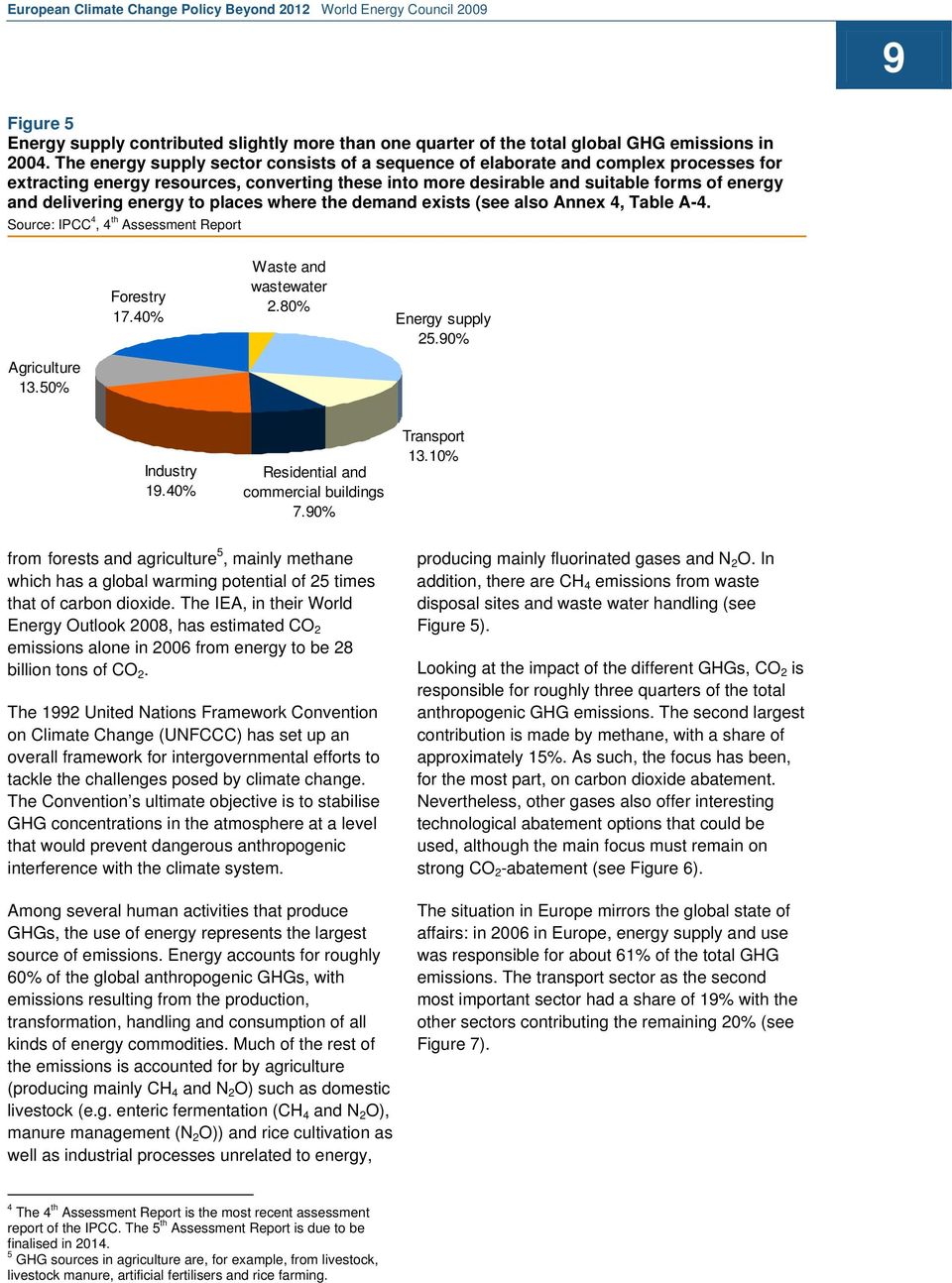
13 European Climate Change Policy Beyond 2012 World Energy Council Figure 8 Increase of the Global Emissions between 1970 and 2004 Source: IEA, 2006, CO 2 Emissions from Fuel Combustion contributed 53% of global carbon emissions; by 2005 this had dropped to 48%. In the EU-27 countries, total CO 2 emissions, not including LULUCF 6, fell from 5.6 billion tons in 1990 to 5.1 billion tons in the year 2006 (EEA, Annual European Community Greenhouse Gas Inventory, 2008). This is, to a large extent, due to structural changes in the economy in Eastern European countries and, in some cases, the modernisation of power plants, reducing the EU-27's share in global carbon emissions. Figure 9 Changes in contribution to global CO 2 -emissions per period for the different regions between 1990 and The economic downturn in the 1990s in the former Warsaw Pact states led to a drastic decrease of emissions. In contrast, the strong economic growth in many countries from 2000 to 2007 led to a sharp increase in GHG emissions. Source: Ziesing, Energiewirtschaftliche Tagesfragen 9/2008, pp LULUCF = land use, land use change, forestry
14 23/11/2009European Climate Change Policy Beyond 2012 World Energy Council Figure 10 Change in global CO 2 -emissions by region between 1990 and The economic growth in developing countries has led to an increase in their contribution to global CO 2. Source: IEA, World Energy Outlook 2008 In 2006 and 2007 emissions in developing, and newly industrialized countries in particular, have continued to rise. China alone emitted 1 billion tons more carbon dioxide in 2007 than in Indeed, China's carbon dioxide emissions have nearly tripled since 1990, from 2.2 billion tons to 6.1 billion tons in In the US, carbon dioxide emissions have likewise risen by 1 billion tons to 6.1 billion tons in the period (an overall rise of 20%). However, 2007 per capita CO 2 emissions in the US (20.5 tons) were four times higher than in China (4.7 tons). With 4.7 tons, China exceeded Figure 11 Index of power generation per capita and CO 2 emissions per produced kwh for the year 2005 (Data are indexed to the world average of 1). Interestingly, the high electricity consumption in industrialised areas corresponds to lower specific emissions. In contrast, growing economies show above-average specific emissions: here technological improvements are essential for GHG reduction. Source: IEA, 2007, CO 2 Emissions from Fuel Combustion

15 European Climate Change Policy Beyond 2012 World Energy Council Table 2 The electricity consumption per capita is shown for some countries, together with the specific emissions to produce electricity, the absolute emissions connected with electricity consumption per capita and the absolute emissions connected with electricity consumption for a country or region Source: IEA, 2007, CO 2 Emissions from Fuel Combustion and authors calculation kwh / capita g CO 2 / kwh t CO 2 / capita 8 Population 9 Million t CO 2 USA 14, , million 2,553 EU-27 8, , million 1,449 China 2, ,91 1,332 million 2,540 India ,60 1,149 million 691 World 3, ,71 6,705 million 11,481 the global 7 average 8 per capita emission level for the first time, if only slightly, in Electricity production as part of energy production is one of the main contributors to GHG emissions. The table above shows the electricity consumption per capita by country/region and the associated CO 2 emissions (see also Figure 11). In the emerging economies the amount of CO 2 produced per kilowatt of electricity is high compared to industrialised countries. The low level of electricity consumption in India or China, however, leads to an overall low value of electricity-related emissions per capita; this will no doubt change in the years to come. Currently, the world population is over 6 billion people and is projected to increase by 50% to 9 billion people by As the population grows, so will our energy requirements. Moreover, the expected improvement in the standard of living in the emerging economies will again lead to a higher energy demand. Both factors are therefore regarded as major contributors to future global GHG emissions. The table above gives a rough indication for order of magnitude of certain measures. It should not be treated as a forecast, as the data ignores any demographic or other dynamic effects. The figures can be used to explore the potential impact of 7 These numbers represent the specific carbon dioxide emissions due to electricity consumption and are not the total carbon dioxide emissions per capita. 8 Population Reference Bureau: 2008 World Population Data Sheet 9 This differs to the data in Figure 11 as each covers a different time frame. hypothetical future developments on CO 2 emissions. For example: If China doubles its per capita consumption, GHG emissions increase by + 2,540 million tons CO 2 If India doubles its per capita consumption, GHG emissions increase by million tons CO 2 If EU gains 10% end user efficiency, GHG emissions decrease by million tons CO 2 If EU halves its specific emissions, GHG emissions decrease by million tons CO 2 If China doubles consumption, but reaches the level of EU-27 specific emissions, the GHG emissions of China would decrease by million tons CO 2 If the USA reaches the specific emissions level of the EU-27, GHG emissions decrease by + 1,034 million tons CO 2 These simple calculations clearly show the potential impact of growing economies with large populations. However, it also demonstrates the possible impact of technology such as using modern technology for power generation to reduce the specific emissions (measured in grams of CO 2 / kwh). Having the specific EU emissions or even doubling China's electricity consumption while at the same time reaching the current EU-27 specific emissions levels could put a substantial

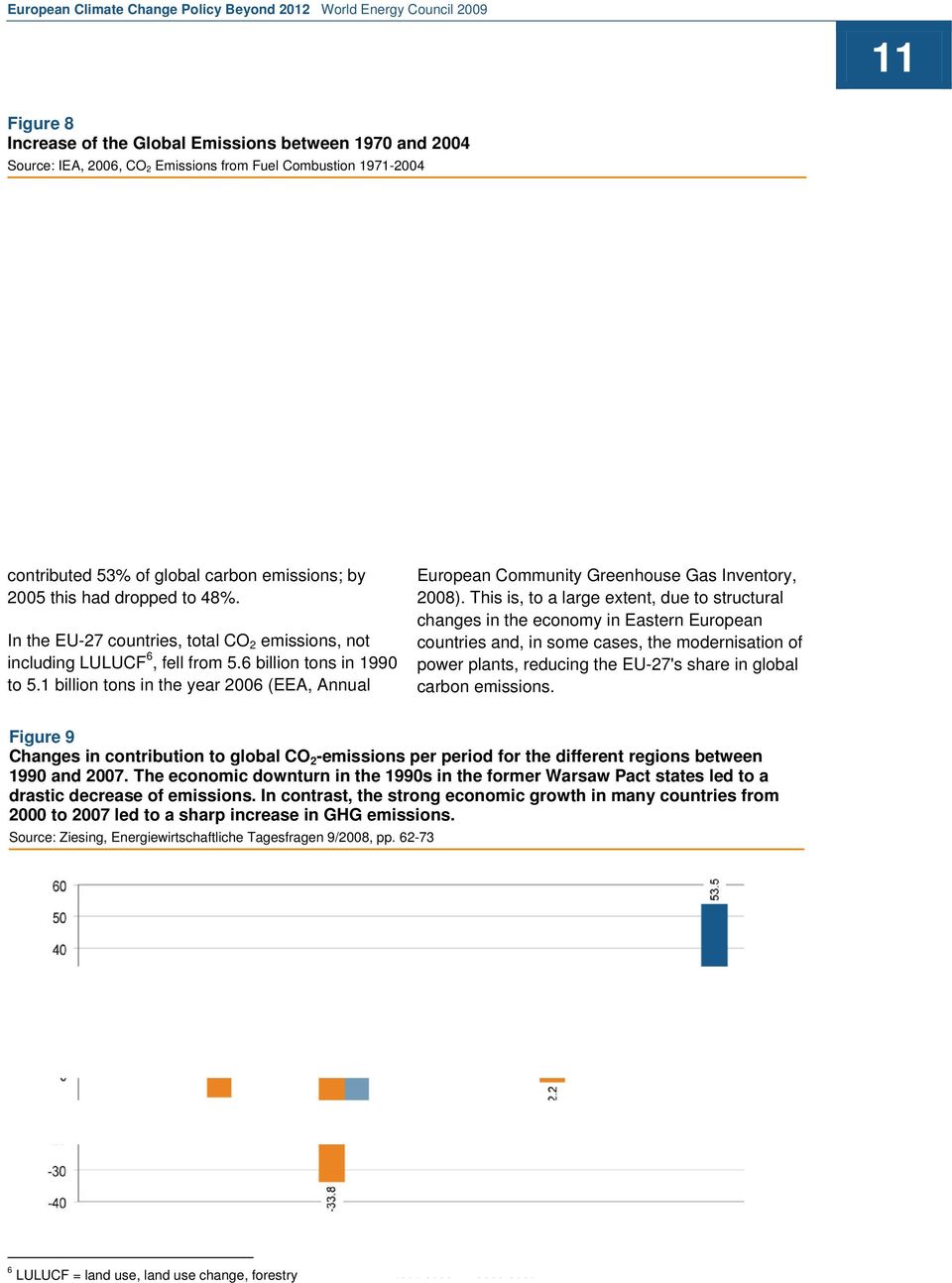
16 14 23/11/2009European Climate Change Policy Beyond 2012 World Energy Council 2009 Figure 12 Energy-related CO 2 -emissions in the year The European Union's contribution is 14%. Source: IEA, World Energy Outlook 2008 Latin America, 3% Africa, 3% Middle East, 5% Rest, 10% Other Asia, 5% India, 4% USA, 21% China, 21% Russia, 9% Japan, 4% OECD-Europe, 15% dent in CO 2 emissions. Moreover, the United States can make a significant contribution by improving the overall energy efficiency of their current electricity generation. Finally, the differences in energy use per capita shown earlier in Figure 11 clearly point to energy efficiency as a necessary cornerstone of climate change policies. The consequence is not too surprising: modern climate-friendly technologies need to be developed and implemented. One possible centre of innovation is Europe; however, implementing these modern technologies in growing economies is essential. Furthermore, as Figure 12 demonstrates, Europe cannot, on its own, tackle climate change: it is critical that Europe take the lead in developing international cooperation, keeping in mind that is critical that Europe take the lead in developing international cooperation, keeping in mind that other regions are growing much faster in terms of economy and GHG emissions. Scenarios of global carbon emissions until 2030 As stated in the IEA's World Energy Outlook 2008, global energy-related carbon emissions will continue to grow until at least In a Reference Scenario that assumes no change to current climate regulations, it is predicted emissions will increase by 45% between 2006 and In addition, the IEA considered two climate-policy scenarios corresponding to long-term stabilisation of GHG concentrations at 550 and 450 parts per million of CO 2 -equivalent. The 550 Policy Scenario Figure 13 Energy-related CO 2 emissions in the Reference Scenario of the World Energy Outlook Source: IEA, World Energy Outlook 2008
17 European Climate Change Policy Beyond 2012 World Energy Council Figure 14 World GHG emissions in the different scenarios of the World Energy Outlook The IEA considered a reference scenario, a scenario with a 550 ppm goal and one with a 450 ppm goal and reflected the needed abatement broken down to the different Kyoto gases. Source: IEA, World Energy Outlook 2008 equates to an increase in global temperature of approximately 3 C, the 450 Policy Scenario to a rise of around 2 C. Unlike the Reference Scenario above, these scenarios assume additional climate protection efforts. Broken down into country groups, the picture in the Reference Scenario (see Figure 13) is as follows: for industrialised (OECD) countries, a 3% rise in carbon emissions is projected to occur between 2006 and The emissions in developing and newly industrialised countries are expected to nearly double in the same period. This would lower the share of OECD countries in global emissions to 32% by 2030 while the EU-27's share would decrease to 9%. Non-OECD countries account for 97% of the Figure 15 Reductions in energy-related CO 2 emissions in the climate-policy scenarios of the World Energy Outlook Depending on the political goal of 450 ppm or 550 ppm different technological options need to be used to different degrees, but all of them are needed. The time needed to develop and implement CCS means it will only begin to play a major role after Source: OECD/IAE, 2008

18 16 23/11/2009European Climate Change Policy Beyond 2012 World Energy Council 2009 rise in world emissions during this time (excluding international marine bunkers and international aviation). Global GHG emissions, including nonenergy CO 2 and all other gases, are projected to grow from 44 gigatonnes CO 2 -eq in 2005 to 60 gigatonnes CO 2 -eq in 2030, an increase of 35%. The 550 Policy Scenario involves a flattening of GHG emissions by 2020 and reductions soon after. The 450 Policy Scenario involves much more substantial reductions after 2020 (see Figure 14). Even then, emissions overshoot the trajectory needed to meet the 450 ppm CO 2 -eq target. To reach either of these outcomes, hundreds of millions of households and businesses will need to achieve substantial emissions reductions after In both scenarios, total emissions are significantly lower in 2030 than in the reference scenario, requiring a drastic change in how we consume energy. This will require innovative policies, an appropriate regulatory framework, the rapid development of a global carbon market and increased investment in energy research, development and demonstration, as stated by the IEA. Elaborating and implementing new legislations, however, takes time i.e. significant contributions will only come with a time delay. However, for a variety of reasons, the impact of technology may well be limited. Carbon Capture and Storage (CCS) 10 still needs time to be developed and deployed; consequently its contribution will be limited until Nuclear power can also be an important part of the 10 In Carbon Capture and Storage GHG emissions of large point sources, e.g. fossil power plants are captured. The carbon dioxide is then stored to prevent its release into the atmosphere. solution; however, financing, engineering resources and time are needed to increase the delivery of the industry (see Figure 15). The situation is similar for renewables: the cost of producing electricity still needs to be reduced for renewables to be a viable source of energy, so further research and development is necessary; their contribution is also strongly dependent on further development of the European energy grid infrastructure. Key Messages: GHG emissions are still rising globally; however, the EU-27 is projected to further reduce their own GHG emissions. A major contributor to GHGs is fossil fuel combustion, especially for electricity production. All stakeholders of society must actively contribute to the climate change objectives. Technological solutions are present, but need time before they can make a major contribution to further GHG reduction. The European share of the global GHG emissions is constantly decreasing. Europe's main contribution will be the provision of clean technology development. Any effective strategy to combat climate change needs a global solution. Europe can lead the way in reductions and research, but other regions need to move quickly and establish their own pathways to GHG reduction.

19 European Climate Change Policy Beyond 2012 World Energy Council Global Climate Change Policy The present international framework By the 1980s, climate change was considered a potential risk and, in 1988, the World Meteorological Organisation and the United Nations Environment Programme established the Intergovernmental Panel on Climate Change (IPCC) to review the scientific evidence. In 1990, the United Nations General Assembly agreed to establish an Intergovernmental Negotiating Committee to develop an international framework. In 1992, at the Earth Summit, the United Nations Framework Convention on Climate Change (UNFCCC) treaty was adopted, with the objective of achieving the stabilisation of greenhouse gas concentrations in the atmosphere at a low enough level to prevent dangerous anthropogenic interference with the climate system 11. The UNFCCC is supported by two subsidiary bodies, one to support the operation of the convention, the other to provide scientific and technical advice (the Subsidiary Body on Technological and Scientific Advise, SBSTA). UNFCCC delegates meet once a year in the Conference of The Parties (CoP) to examine the progress to date and discuss future actions. In December 1997, at CoP3, the Kyoto Protocol was signed, signifying the dedication of a number of developed countries to work towards emission reduction target commitments by 2010, using 1990 emissions levels as a comparison. The average emission reduction expected from these commitments between 2008 and 2012 is about 5%; a small step perhaps, but still the first step towards stabilisation. Those countries which first committed to reduction targets have been referred to as Annex I Parties, taking responsibility for the current GHG accumulation stemming from their past industrial development, although the USA, while a signatory, has not yet ratified the Kyoto protocol. The potential reduction, based on present ratification, consists of about 600 million tons of CO 2 per year. If all Annex I parties are taken into account, the potential reduction increases to about 900 million tons of CO 2 (Sardenberg). The Convention has now been signed by 189 parties. Fifty-five parties, representing at least 55% of the total CO 2 emissions in 1990, needed to ratify the treaty before it came into force: a target reached in February 2005 when 141 countries (61.6% of the emissions from the industrialized signatory s countries) ratified the treaty. The United Nations conference in 1992 in Rio de Janeiro on environment and development began a concrete phase of negotiations by adopting a convention (UNFCCC) that defined sustainable development and set provisions for updates ("protocols") that would set mandatory emission limits 12. By signing the UNFCCC, as of August nations, upon ratification, committed to a voluntary "non-binding aim" to reduce atmospheric concentrations of GHG with the goal of "preventing 11 United Nations Framework Convention on Climate Change, Article 2 12 The principal update is the Kyoto Protocol, which has become much better known than the UNFCCC itself.

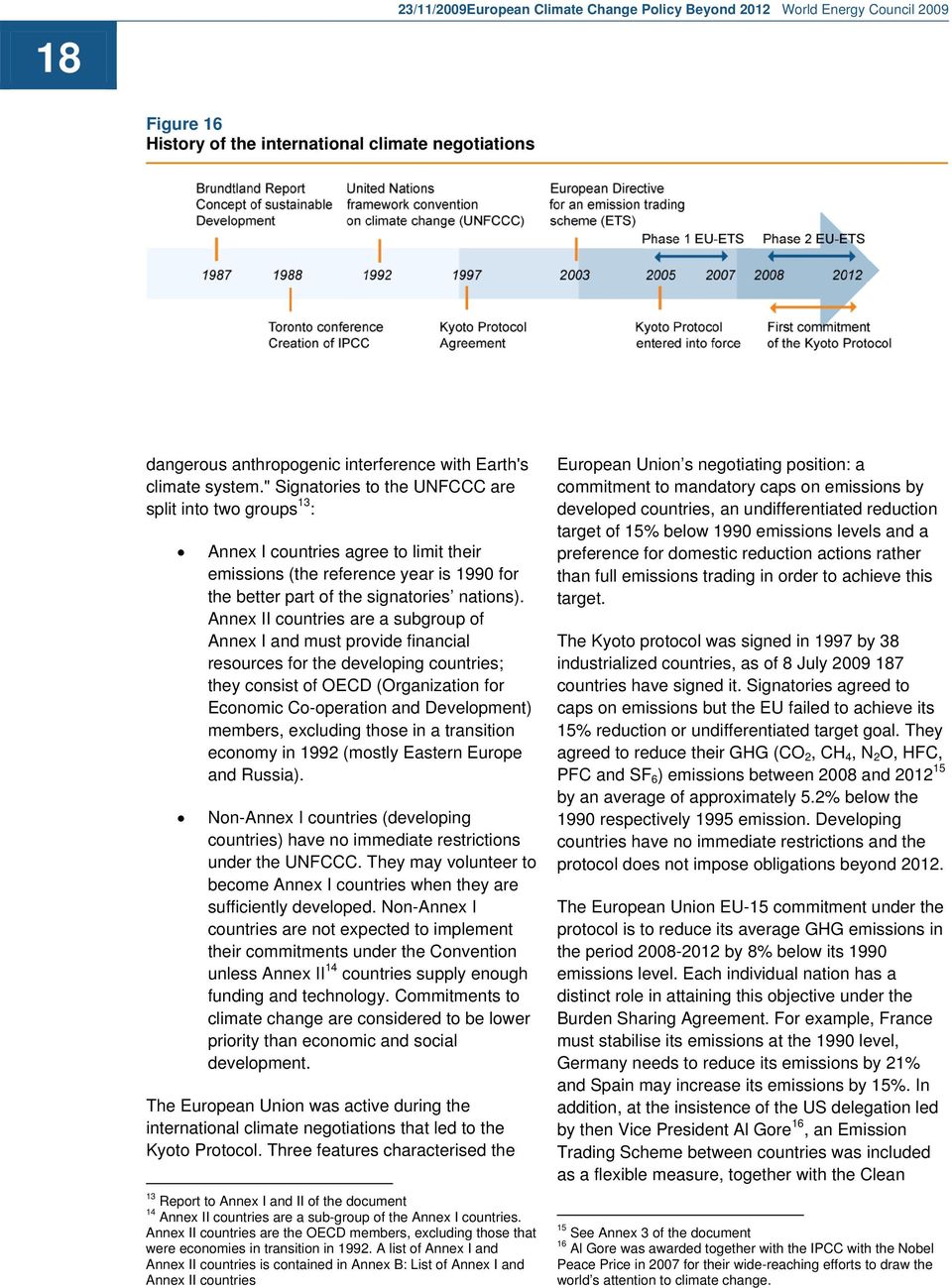
20 18 23/11/2009European Climate Change Policy Beyond 2012 World Energy Council 2009 Figure 16 History of the international climate negotiations dangerous anthropogenic interference with Earth's climate system." Signatories to the UNFCCC are split into two groups 13 : Annex I countries agree to limit their emissions (the reference year is 1990 for the better part of the signatories nations). Annex II countries are a subgroup of Annex I and must provide financial resources for the developing countries; they consist of OECD (Organization for Economic Co-operation and Development) members, excluding those in a transition economy in 1992 (mostly Eastern Europe and Russia). Non-Annex I countries (developing countries) have no immediate restrictions under the UNFCCC. They may volunteer to become Annex I countries when they are sufficiently developed. Non-Annex I countries are not expected to implement their commitments under the Convention unless Annex II 14 countries supply enough funding and technology. Commitments to climate change are considered to be lower priority than economic and social development. The European Union was active during the international climate negotiations that led to the Kyoto Protocol. Three features characterised the 13 Report to Annex I and II of the document 14 Annex II countries are a sub-group of the Annex I countries. Annex II countries are the OECD members, excluding those that were economies in transition in A list of Annex I and Annex II countries is contained in Annex B: List of Annex I and Annex II countries European Union s negotiating position: a commitment to mandatory caps on emissions by developed countries, an undifferentiated reduction target of 15% below 1990 emissions levels and a preference for domestic reduction actions rather than full emissions trading in order to achieve this target. The Kyoto protocol was signed in 1997 by 38 industrialized countries, as of 8 July countries have signed it. Signatories agreed to caps on emissions but the EU failed to achieve its 15% reduction or undifferentiated target goal. They agreed to reduce their GHG (CO 2, CH 4, N 2 O, HFC, PFC and SF 6 ) emissions between 2008 and by an average of approximately 5.2% below the 1990 respectively 1995 emission. Developing countries have no immediate restrictions and the protocol does not impose obligations beyond The European Union EU-15 commitment under the protocol is to reduce its average GHG emissions in the period by 8% below its 1990 emissions level. Each individual nation has a distinct role in attaining this objective under the Burden Sharing Agreement. For example, France must stabilise its emissions at the 1990 level, Germany needs to reduce its emissions by 21% and Spain may increase its emissions by 15%. In addition, at the insistence of the US delegation led by then Vice President Al Gore 16, an Emission Trading Scheme between countries was included as a flexible measure, together with the Clean 15 See Annex 3 of the document 16 Al Gore was awarded together with the IPCC with the Nobel Peace Price in 2007 for their wide-reaching efforts to draw the world s attention to climate change.
21 European Climate Change Policy Beyond 2012 World Energy Council Development Mechanism (CDM) and the Joint Implementation (JI). A brief description of each mechanism is provided below. Kyoto protocol status Under the Kyoto Protocol the Annex-I countries have agreed to reduce their GHG emissions by 2012 to a level 5.2% below that emitted in a particular year (for CO 2 the reference year is 1990). The European community is on target to reach the required reduction of 8% by By 2006 the EU-15 had reduced its carbon equivalent emissions by 2.7% compared to the base reference year. France, Germany and the UK are among the higher achievers. These good results may be explained by the effort made by these countries and their fiscal incentives for clean technologies. A decrease in their own domestic industrial production leading to an increase in importation of manufactured goods may, however, be part of the explanation. While Russia appears to exceed its target, this can, for the most part, be explained by the collapse of the soviet economy at the beginning of 1990s. Canada, Australia, Japan and the USA show difficulties in reducing their emissions or even complying with the Kyoto Protocol target. While Japan is already operating a voluntary Emission Trading Scheme (ETS), Australia is only now setting up an ETS that will operate by 2010 at the earliest. There are great hopes that the USA will follow suit in the next few years. Table 3 Total GHG-emissions excluding LULUCF for some Annex-I-countries Source: UNFCCC, 2009 Emissions in 1990 (Mt CO 2- eq) Emissions in 2006 (Mt CO 2 ) Kyoto target (%) Kyoto reduction target (Mt CO 2 ) Emissions evolution in 2006 /1990 baseline (%) Australia % % Canada % % EU-15 4,243 4, % % France % 0-7,1% Germany 1,228 1, % % United Kingdom % % Japan 1,272 1, % % Russia 3,326 2, % % USA 6,135 7, % %
22 23/11/2009European Climate Change Policy Beyond 2012 World Energy Council In the UN Framework Convention on Climate Change (signed by 154 countries and the European Community in Rio de Janeiro in 1992), the industrialised countries, jointly referred to as Annex I Parties (i.e. OECD members and the transition countries in Central and Eastern Europe), undertook to take specific measures to reduce their GHG emissions to 1990 levels by the year When the UNFCCC entered into force in 1994, the Conference of Parties (CoP) was established as the supreme governing body, encompassing all countries that had ratified the Convention. CoP3 was held in Kyoto in 1997 at which point the Kyoto Protocol was adopted. In this Protocol, 38 Annex I countries committed themselves to controlling emissions of a "basket" of six GHGs or groups of GHGs within a defined period based on specifically defined percentage rates. Annex B of the Kyoto Protocol lists the countries that have assumed a specific duty to limit their greenhouse gas emissions. They include the OECD countries, Central and Eastern European countries and Russia. Annex B countries are not entirely identical to Annex I countries. Annex I countries also include Turkey and Belarus: the two states who were not parties to the Convention when the Kyoto Protocol was adopted. While the US is listed in Annex B of the Protocol, it later declared that it would not ratify the Kyoto Protocol. The Protocol covers the greenhouse gases CO 2, CH 4, N 2 O, two groups of hydrocarbons (HFC and PFC) and sulphur hexafluoride (SF 6 ) to be controlled within the financial years ; the base year is 1990 or (optionally) 1995 for the last three gases. Countries identified as economies in transition have the option to chose, as a base year, any year from the period Figure 17 History of international climate change negotiations Source: Caisse des Dépôts, 2008, Climate Report
23 European Climate Change Policy Beyond 2012 World Energy Council As mentioned previously, the entry into force of the Kyoto Protocol was subject to the condition that it be confirmed by the governments of at least 55 states accounting for at least 55% of the CO 2 emitted by Annex I countries in Although the US and, initially, Australia declared they did not consider themselves bound to the commitments of the Kyoto Protocol and did not ratify it, ratification by Russia ensured the threshold was met. On 16 February 2005, the Kyoto Protocol entered into force. The Kyoto Protocol has put international climate policy on a completely new footing. For the first time reduction targets, binding under international law, must be reached. The same is true of burden sharing in the European Union. However, sanctions for failing to reach targets have not, as yet, been defined. In subsequent years the climate change conferences in Buenos Aires (1998), Bonn (1999), The Hague (2000), Marrakesh (2001), New Delhi (2002), Milan (2003), Buenos Aires (2004), Montréal (2005), Nairobi (2006) and Bali (2007) involved negotiations on the final shape, implementation and further development of the Protocol. At the climate conference in Bali (CoP13) on 3-14 December 2007, the community of states considered an agreement to limit GHGs beyond The result was the Bali roadmap for a future international agreement on climate change. Via an intermediate step, the climate conference in Poznan in December 2008 (CoP14), the UN climate change negotiations are projected to conclude in Copenhagen (CoP15) in December 2009 with an international climate protection agreement for the post-2012 period with the involvement of all principal emitting countries. Status of technological partnerships A number of governments have already created multilateral or bilateral partnerships. The most promising partnership is the Asia Pacific Partnership (AP6) Initiative set up in 2006 by six major countries. This partnership focuses on the development of technologies to tackle climate change. The United States, while they have not ratified Kyoto, are part of the initiative, as is Australia and Japan. China, India and South Korea are committed to R&D and a cooperation framework. In order to implement large scale mitigation projects it is, of course, necessary to have at our disposal all available low carbon technologies commercially developed. As such, eight task forces have been launched: Cleaner Fossil Energy: chaired by Australia, co-chaired by China Renewable Energy and Distributed Generation: chaired by Republic of Korea, co-chaired by Australia Power Generation and Transmission: chaired by the United States of America, co-chaired by China Aluminium: chaired by Australia, cochaired by the United States of America
24 22 23/11/2009European Climate Change Policy Beyond 2012 World Energy Council 2009 Buildings and Appliances: chaired by Republic of Korea, co-chaired by the United States of America Cement: chaired by Japan, co-chaired by China Coal Mining: chaired by the United States of America, co-chaired by India Steel: chaired by Japan, co-chaired by India The USA has announced bilateral agreements with a number of other countries. The European community has set up a partnership with India and China. In addition, there are a variety of preexisting or emerging technological platforms on carbon capture and storage, for example: the CSLF (Carbon Sequestration Leadership Forum) and the ZEP (European initiative on Zero Emission Platform also based on carbon capture and storage). Cooperative programmes also exist in relation to advanced nuclear technologies: the Generation IV initiative consisting of ten countries from four continents and the INPRO (International Project on Innovative Nuclear Reactors and Fuel Cycles) programme initiated by the IAEA (International Atomic Energy Agency). This is far from an exhaustive list and new initiatives are constantly emerging. Of course the need for energy is ever present, requiring infrastructure upgrades which cannot wait for the initiatives to deliver. Nevertheless, well developed and established low carbon technologies are already commercially available, such as nuclear energy, hydropower and other renewable energies on the production side; with an impressive portfolio of energy-efficient technologies on the demand side. The current negotiation process and agenda: Bali road map to Copenhagen In 2007 in Bali the CoP approved a "roadmap" for two years of talks leading to the adoption of a new treaty to extend the initiatives of Kyoto beyond 2012 and widening it to include the United States and developing nations such as China and India. Under the deal, a successor pact should hopefully be agreed to at a meeting in Copenhagen in late The negotiation process has been split into two paths: a follow up of the Kyoto protocol by a new Ad Hoc Working Group on the Kyoto Protocol (AWG-KP) and a more comprehensive agreement for post 2012, dealt by the Ad Hoc Working Group on Long Term Cooperative Action under the Convention (AWG-LCA). The process set up four initial meetings during 2008 for the two WGs who will then continue working until an agreement is reached for beyond The deal in Bali was achieved after the United States dropped their opposition to a proposal by the main developing-nation bloc, the G77, for richer nations to play a greater role in assisting the developing world fight rising GHG emissions.
25 European Climate Change Policy Beyond 2012 World Energy Council Bali Action Plan The CoP recognised that deep cuts in global emissions are required to achieve the objectives of the Convention and emphasised the need to urgently address climate change as mentioned in the 4 th Assessment Report of the Intergovernmental Panel on Climate Change 17. In developing the strategies to be adopted at CoP15, the delegates are focusing on: (a) A shared vision for long-term cooperative action, including a long-term global goal for emission reductions, to achieve the ultimate objective of the Convention, in accordance with the provisions and principles of the Convention, in particular the principle of common but differentiated responsibilities and respective capabilities, and taking into account social and economic conditions and other relevant factors; (b) Enhanced national and international action on mitigation of climate change, including measuring and reporting of emissions, emissions reduction objectives and efforts, with special attention dedicated to deforestation and forest degradation in developing countries and forest carbon stock management; 17 Contribution of Working Group III to the 4 th Assessment Report of the Intergovernmental Panel on Climate Change - Technical Summary, pages 39 and 90, and Chapter 13, page 776 cooperative sectoral approaches and sector-specific actions; opportunities for using markets to enhance the cost-effectiveness of, and to promote, mitigation actions, bearing in mind the different circumstances of developed and developing countries; (c) Enhanced action on adaptation; (d) Enhanced action on technology development and transfer to support action on mitigation and adaptation, including: the development and transfer of technology to developing countries in order to promote access to affordable and environmentally sound technologies; ways to accelerate deployment, diffusion and transfer of affordable, environmentally sound technologies; cooperation on research and development of current, new and innovative technology, including win-win solutions; (e) Enhanced action on the provision of financial resources and investment to support action on mitigation and adaptation and technology cooperation, (mobilization of public- and privatesector funding and investment, including facilitation of carbon-friendly investment choices; support for capacity-building).
26 23/11/2009European Climate Change Policy Beyond 2012 World Energy Council Table 4 Scheduled meeting until the end of 2009 Dates Locations AWG-LCA AWG-KP 31 March to 4 April 2008 Bangkok, Thailand 1 5 part 1 2 to 13 June 2008 Bonn, Germany 2 5 part 2 21 to 27 August 2008 Accra, Ghana 3 6 part 1 1 to 12 December 2008 Poznan, Poland 4 6 part 2 29 March to 8 April 2009 Bonn, Germany to 12 June 2009 Bonn, Germany September to 9 October 2009 Bangkok, Thailand to 6 November 2009 Barcelona, Spain to 18 December 2009 Copenhagen, Denmark 8 10 The Bali Action Plan requires the AWG-LCA to report to the CoP14 in Poznan 2008 on progress made. Four meetings have been scheduled in 2008 up to Poznan CoP14 and four more were scheduled in 2009 before CoP15 in Copenhagen at the end of 2009 (see table above). From 2005, parties have entered into dialogues concerning the post Kyoto period: first in Montréal then in Nairobi and twice again before Bali. The AWG-LCA invited its Chair to prepare the following documents to facilitate negotiations among Parties: a document for consideration in March 2009 (Bonn), on the components of the agreement; outcome to be adopted by the Conference of the Parties at its fifteenth session, describing areas of convergence in the ideas and proposals of parties, exploring options for dealing with areas of divergence and identifying any gaps that might need to be filled in reaching an agreed outcome; a negotiating text for consideration at its sixth session in June 2009 (Bonn), taking account of the results of the previous session and further submissions from parties. The role of the G8 statements The G8 is a forum for the governments of the following industrialized nations: Canada, France, Germany, Italy, Japan, Russia, the United Kingdom and the United States. The annual summit meeting of the G8 heads of government is hosted by the presidency who also sets the meeting agenda. In order to include the major growing economies five countries are included in the G8+5 meetings namely Brazil, China, India, Mexico and South Africa. Climate change is since a while a regular issue on the G8 meetings. At the Gleneagles summit in Scotland (UK) in 2005, the G8 began to grapple with the issue of climate change, clean energy and sustainable development, culminating in a Gleneagles plan of action. This plan deals with technological improvements that transform the way we use energy (buildings, appliances, surface transport, aviation, industry, cleaner fossil fuels, renewable energy and electricity grids). The plan recognises that climate change is a serious and long-term challenge that has the potential to affect every part of the globe but at the same time that around 2 billion people lack access to modern energy services. In 2006, at the St Petersburg G8 summit, the question of nuclear safety and security of supply was addressed. The G8 called upon all States to become parties, as soon as practicable, to the two most recent multilateral instruments to combat nuclear terrorism: namely, the International Convention for the Suppression of Acts of Nuclear Terrorism, adopted in New York, 13 April 2005; and
27 European Climate Change Policy Beyond 2012 World Energy Council the Amendment to the Convention on the Physical Protection of Nuclear Material, adopted in Vienna, 8 July An effective, efficient nuclear regulatory system is essential for safety and security. G8 re-affirmed the importance for national regulators to have sufficient authority, independence, and competence. In 2007 the Heiligendamm summit (Germany) acknowledged a proposal for a global initiative on energy efficiency, agreeing to explore the most effective means to promote energy efficiency internationally. This lead to the establishment of the International Partnership for Energy Efficiency Cooperation during the G8 summit in Aomori (Japan) in This international partnership covers the G8 countries and China, India, South Korea and the European Community. The G8 Finance Ministers agreed to the G8 Action Plan for Climate Change to Enhance the Engagement of Private and Public Financial Institutions. The Ministers also supported the launch of new Climate Investment Funds by the World Bank. Concerning environment and climate change, the Hokkaido declaration (34 th Summit of the G8 Heads of State and Government) stipulates: We are committed to avoiding the most serious consequences of climate change and determined to achieve the stabilization of atmospheric concentrations of global greenhouse gases consistent with the ultimate objective of Article 2 of the Convention and within a time frame that should be compatible with economic growth and energy security. Achieving this objective will only be possible through common determination of all major economies, over an appropriate time frame, to slow, stop and reverse global growth of emissions and move towards a low-carbon society. We seek to share with all Parties to the UNFCCC the vision of, and together with them to consider and adopt in the UNFCCC negotiations, the goal of achieving at least 50% reduction of global emissions by 2050, recognizing that this global challenge can only be met by a global response, in particular, by the contributions from all major economies, consistent with the principle of common but differentiated responsibilities and respective capabilities. Substantial progress toward such a long-term goal requires, inter alia, in the near-term, the acceleration of the deployment of existing technologies, and in the medium- and long-term, will depend on the development and deployment of low-carbon technologies in ways that will enable us to meet our sustainable economic development and energy security objectives. In this regard, we emphasize the importance and urgency of adopting appropriate measures to stimulate development and deployment of innovative technologies and practices. The G8 summit 2009 in L Aquila (Italy, originally planned to take place in Maddalena) it was declared, that Leaders recognised the scientific view on the need to keep global temperature rise below two degrees Celsius above pre-industrial levels, and agreed on a long-term goal of reducing global emissions by at least 50% by 2050 and, as part of this, on an 80% or more reduction goal for developed countries by The 2 C-goal, however, can only be reached if major growing
28 26 23/11/2009European Climate Change Policy Beyond 2012 World Energy Council 2009 economies like India and China will join the major industrial countries in efforts to reduce GHG emissions. A list of the G8 meetings is contained in Annex C. ETS around the world A number of countries are implementing emission markets in order to fulfil their obligations under the Kyoto Protocol or their own national targets. In the table below, characteristics of the different markets in place or announced are given (excluding the European Trading Scheme which will be described in the next chapter). Presently a number of systems have been developed that place an economic value on carbon emissions. They are generally regional or national systems and most of them are based on market schemes: a cap is imposed on total emissions; a limited number of emissions permit units are provided which can then be traded. All these systems apply to both states and industry. Not counting the Kyoto Protocol and without doubling up, these schemes cover around 3,700 million tons of CO 2, of which about 200 million tonnes is from the US; 2,500 million tons comes from countries who have ratified the Kyoto Protocol. The implementation of a federal emissions trading system in the US in the coming year could considerably enlarge the coverage of the fledgling initiatives from the individual States. The US system could, potentially, initially cover about 5 billion tonnes. Table 5 Existing and envisioned systems (Status as of September 2009) Emission Trading System Emissions covered (mill. tons of CO 2 ) World Kyoto Protocol About 6500 by 2000 Europe EU-ETS About 2100 by 2008 UK-emissions trading scheme Norwegian GHG domestic Cap & Trade Swiss CO 2 Tax and allocations Croatia 18 (project of domestic cap & Trade) About 30 by 2002 Status Existing since 1997 Existing since 2005 Stopped from April 2002 to December in 2003 Existing since May 1999 for the electricity sector, already linked with EU ETS 4-5 (10-15% of GHG) 13.3 ( about 40% of GHG) Existing since 2008, link with EU-ETS under negotiation Trading will start by date of Croatia joining the EU Compliance requirement Mandatory Mandatory Voluntary Mandatory Mandatory Mandatory
29 European Climate Change Policy Beyond 2012 World Energy Council North America 18 Emission Trading System American Clean Energy and Security Act of 2009 Chicago Climate Exchange (CCX) - voluntary EIA voluntary reporting program RGGI (Regional GHG Initiative) - 10 North Eastern States New Hampshire multiple pollutant reduction program (part to RGGI) WCI (Western Climate Initiative) 8 States and 4 provinces Californian global warming solution act (Part to WCI) New-Mexico (Part to WCI) Arizona (Part to WCI) Oregon CO 2 emissions standards for energy facilities (Part to WCI) MGGA (Midwestern GHG Reduction Accord) - 6 States and 1 province Emissions covered (mill. tons of CO 2 ) Status 4,000-4,700 Approved by the house of Representatives, but not yet by the Senate Compliance requirement Mandatory 250 Created in January 2003 Voluntary - Energy Policy Act of 1992 Voluntary 188 Started in January 2009 Mandatory 5 To comply with the established annual caps by December 31, 2006 (2002 Act) 700 in 2012, 1,250 in 2015 January 2012 Mandatory Mandatory 468 (2005) In project (2006 Act) Mandatory 70 (2005) Post 2012,under a plan being developed by seven Western states and four Canadian provinces Mandatory 109 (2005) Post 2012 at the earliest Mandatory 53 (2005) Rules established in 1997, updated in 2007 About 900 by 2011 January 2011 North Carolina About 100 Standards from 2003 for fossil plants Canada - big emitters program Mandatory Mandatory Unknown Around 300 Post 2012 Mandatory Mexico GHG Mexico program 118 Since 2005, 18% of national GHG until to 2012, Post 2012 new system with a target reduction of 50% by 2050 Voluntary reporting until 2012 and then mandatory 18 GHG emissions covered: Mt CO 2 -eq (for existing facilities: Mt CO 2 -eq and for new entrants and extensions: 0.86 CO 2 -eq). Monitoring, reporting and verification of GHG emissions from facilities involved in ETS should start by 2010, while trading starts by joining to the EU.
30 28 23/11/2009European Climate Change Policy Beyond 2012 World Energy Council 2009 OECD Pacific Emission Trading System New South Wales & ATC GHG abatement scheme Australia National ETS New-Zealand Domestic ETS Japan Trial Emission Trading Scheme Emissions covered (mill. tons of CO 2 ) About 80 (NSW: 160 Mt emitted in 2006) About 260 Status Started in 2003, abatement of app. 8 t/year and 7 t/year until 2007, then app. 7t/year until 2012; Under the current regime, the NSW Greenhouse Gas Abatement Scheme will end after 31 December The Electricity Supply Amendment (Greenhouse Gas Abatement Scheme) Bill (2006) proposes to extend the operation of the scheme from 2012 to 2021 and beyond (Electricity 50% of GHG). Post 2010; possibly 70% of total GHG (about 380) Compliance requirement Mandatory Mandatory About 30 to 50 January 2009 Mandatory Under review Started in October participants as of July South Korea About 390 Implemented on a voluntary basis, but to be updated to nation-wide ETS according to results of Post-2012 negotiation (coverage 78% of energy GHG) Voluntary Voluntary The EU-ETS has so far been the predominant trading scheme. However, the EU-27 only emits about 15% of worldwide emissions, a share that is supposed to decrease in the next decades due to the high growth in emissions in developing economies as China and India. On all the markets the price per ton of CO 2 has been relatively modest, being less than or close to US-$10 except on the European market where the price sky rocketed to 30 at the beginning of Price volatility is due to the announcement of a possible shortage in permits because of the limitation of free allocations in National Allocation Plans in Europe driving the price up or, alternatively, of a possible large future contribution of allowances coming from the Kyoto Protocol Mechanisms driving prices down again. The present framework is still evolving and the crystallisation of the program will substantially contribute to the average price stabilising up to and beyond In the long term, the price is likely to be governed by the cost of Carbon Capture and Storage technology. Key messages: The global climate debate is a long process of negotiations: this is unavoidable, since it is a global problem; however, it is problematic due to the rapidly changing climate. Other national and regional initiatives exist in addition to the EU-27 scheme: a global scheme forged by linking these initiatives is a promising possibility. This could also help to establish a global carbon price. The EU- ETS, however, is currently the predominant carbon market. Technology partnerships are the first step to greater technology distribution: technology is a key component of climate change policy. However, in order to seize their potential it is vital that new technologies are implemented globally.
31 European Climate Change Policy Beyond 2012 World Energy Council Climate Friendly Technologies In the previous chapter the framework and targets of the global climate policy was described. However, in order to fulfil the political goals, technological answers are needed: they need to be developed and tested extensively, in order for them to function in a robust and cost-efficient manner. Due to the expeditious start to the EU emissions trading scheme in 2005, the European industry commenced R&D into climate friendly technology earlier than some other competitors, leading to a cutting-edge role. A combination of the EU-ETS and other legislation e.g. on renewable energy, on CHP (combined heat and power) and on energy efficiency, propelled the EU further into their technological role. Three different forms of intervention can be utilised to fight climate change. On the energy supply side there is a need for both a transition to low or zeroemission technologies (nuclear energy, CCS, Figure 18 Total EU-27 greenhouse gas emissions by sector in 2005 Source: EEA, 2008, Energy and Environment Report
32 23/11/2009European Climate Change Policy Beyond 2012 World Energy Council Figure 19 Comparison of the World Energy Outlook ppm case and the BLUE Map scenario, Source: IEA, 2008, Energy Technology Perspectives renewables) and to an increased efficiency of energy generation. On the energy demand side the main challenge is to reduce consumption, achieved through the use of more efficient technologies and a more energy conserving lifestyle. All sectors and all actors must contribute to these interventions. However, technology is thus not the only answer to the climate change challenge. Our future society will have to see energy as a precious resource, to be used with care. Reduction of GHG emissions will have to become a dominant factor in both public and private decision making. Education and information can contribute to create a more energy lean society whereby traditional habits will shift towards a more energy efficient behaviour. Global Potential An important tool for comparing and evaluating the effectiveness of technologies and practices in terms of climate change mitigation may be the Cost-Abatement-Curve (e.g. McKinsey s 19 ). However, such tools must be adapted for the particular technology/practice and nation/society they are evaluating; in fact, the costs make-up and the abatement potential strongly depend on technical and political-economical conditions. Figure 19 shows how, according to a study by the IEA (IEA, 2008, ETP - Energy Technology Perspectives), different technologies can contribute to reduce GHG emissions seen in the Baseline scenario, in order to reach a Blue Map scenario (half the CO 2 emissions of 2005 by the year 2050), with energy efficiency contributing over a third of the entire reduction. In fact, there is no one magic bullet technology available to fight climate change; rather, a large portfolio of techniques must be implemented to effectively address the greenhouse effect. In order to understand the potential impact of new technology, it is important to know what our future energy requirements will be. The following pages provide an analysis of the different trends in energy-relevant indicators (e.g. energy demand or generation by sector or fuel, capacity, etc.) in order to paint a picture of the future of energy supply and demand. Most of the trends are taken from the DG- TREN provisional study for EU-27 countries updated in 2007: DG TREN, 2008, which is used as a reference source for this chapter. It refers to a baseline scenario which stimulates current trends and policies as implemented in all Member-states by the end of The consulting company McKinsey made interviews with relevant stakeholders in several countries to find typical abatement options and their costs from an investor s perspective.
33 European Climate Change Policy Beyond 2012 World Energy Council Figure 20 Final Energy Demand by sector EU-27 Source: DG TREN, 2008 Figure 21 Final Energy Demand by fuel type EU-27 Source: DG TREN, 2008 Demand side Figure 20, Figure 21, Figure 22 show, respectively, the EU-27 trends in final energy demand by sector, final energy demand by fuel type and electricity consumption by sector. Transport will remain the dominant consumer of energy with an energy demand 28% higher in 2030 than in However, an improvement in fuel efficiency means transport energy demand will grow less than transport activity for the same period. Energy demand in industry is assumed to be 20% higher in 2030 compared with Household energy demand is expected to rise by 12% between 2005 and 2030, following demographic changes leading towards households smaller in size and larger in number. The service sector and industry (especially non-energy intensive industries) will also have a substantial growth in energy demand, whereas households and agriculture will both have lower growth rates due to increases in efficiency. Figure 22 Electricity Consumption by Sector EU-27 Source DG TREN, 2008
34 23/11/2009European Climate Change Policy Beyond 2012 World Energy Council Figure 23 Odyssee ODEX - energy efficiency index Source: EEA, Energy and Environment Report 2008 A greater consumption of electricity in industry (+37%) is expected over the period Overall, electricity shows the largest increase in final energy demand (+38% by 2030), which could lead to important contributions from low-carbon power generation in order to effect a stronger reduction of GHG emissions (see Figure 21). Improvements in energy efficiency will be an important goal in all energy applications but it will be crucial in the transport sector, which is not only one of the major users of energy, but also relies substantially on oil as its energy source. In general, many specific electricity applications in all sectors can be targeted for efficiency improvements. Figure 23 shows the evolution of energy efficiency 20 indices for different sectors in Europe during the period (EEA, 2008). All sectors have seen a continuous improvement in 20 An energy efficiency index can be defined as a ratio between the actual energy consumption of the sector in year t and the sum of the implied energy consumption from each underlying sub-sector, divided by end-use in year t; it is based on the unit consumption of the sub-sector in a reference year - in this case energy efficiency, with industry showing the greatest improvement in energy efficiency and transport the smallest. Efficient lighting Figure 24 shows a comparison of lighting technology efficiency over time (EURELECTRIC, 2007). In a scenario where policies remain unchanged technology fails to develop, an 80% growth in energy consumption for lighting is likely to be expected by 2030 (EURELECTRIC, 2007). In this sector both available technologies and the current extensive R&D effort can lead to improved and more sustainable lighting systems. The efficiency of illumination in typical light sources has constantly evolved over the years; lifetime has also improved. Incandescent lamps and fluorescent lamps are the most used technologies today. Today 85% of lamps sold for residential use are still standard incandescent lamps: the least efficient and with a short lifespan. Compact fluorescent lamps are 4-5 times more efficient than incandescent lamps, with a lifespan that is, ten
35 European Climate Change Policy Beyond 2012 World Energy Council Figure 24 Comparison of lighting technology efficiency over time (Laborelec) Source: EURELECTRIC, 2007 lamps, with a lifespan that is, ten times longer on average. By 2030 it is expected that 50% of all lighting needs will be met by more efficient lamps. Under this scenario, savings in electricity use for lighting can reach 30% in the average household (EURELECTRIC, 2007). The most innovative lighting technology is the lightemitting diode (LEDs), which could lead to a substantial revolution in the sector. Arrays of LEDs already rival incandescent lamps in terms of light properties. It is expected that, within a few years, LEDs will be used in standard lighting systems, competing with the more traditional technologies. Political intervention, either by setting incentives or by gradually banning traditional technology altogether, are likely to accelerate the market penetration by lighting efficient technologies as they encourage network effects and the development of economical production methods are driving prices down. For example, the EU will phase out incandescent bulbs from the European market in the period , saving close to 40 TWh of electricity with a corresponding reduction of about 15 million tonnes of CO 2 emissions per year (Eco Design EU Regulatory Committee, 12/08). requirements of most appliances can be reduced to less than 1W (an average DVD player currently uses more than 4W) by using proper devices. In 2004, the average energy consumption per dwelling in the EU-15 was only 3% below the 1990 level (EEA, 2008), whereas the energy efficiency index was 12% below (see Figure 24). This means that lifestyle changes have cancelled out almost all the energy efficiency improvements. Larger houses and an increasing number of appliances counteract the progress made in energy efficiency and behaviour, resulting in the net decrease in consumption (dark blue bar in Figure 25) of only 0.2% per year. Figure 25 Drivers of change in average annual energy consumption per household in the EU-15 from 1990 to 2004 Source: EEA, Energy and Environment Report 2008 Household & Office Appliances Homes and offices are equipped with electronic devices used for entertainment, work and communication. The fastest-growing area of residential electric end-use is projected to be in consumption of standby power which is expected to rise to 62 TWh just in Europe by the year 2010 (EURELECTRIC, 2007). The standby power
36 23/11/2009European Climate Change Policy Beyond 2012 World Energy Council Figure 26 Household Energy Use by End-Use, IEA19 Source: OECD/IEA, 2008 Building efficiency Energy consumption in buildings constitutes a large share of the world s total end use of energy. In dwellings the main source of energy consumption is space heating, representing more than 50% of the total consumption; the most rapid growth in energy demand is due to heating appliances, with consumption increasing by 57% between 1990 and 2005 (see Figure 26). Energy consumption for both heating and cooling can be reduced by a large range of building insulation technologies. Passive solar energy can be exploited to heat buildings through the use of glass walls or windows oriented and arranged to optimise the solar light absorption. Figure 27 Domestic CO 2 emissions from different heating systems. Due to the decrease of the specific emissions in the electricity system, the heat pump emissions per house are decreasing. Obviously the use of low-carbon electricity contributes to CO 2 reduction Source: EURELECTRIC, 2008
37 European Climate Change Policy Beyond 2012 World Energy Council In passive cooling, natural cooling systems (such as cold springs) can be easily integrated in to traditional systems. Natural or passive ventilation options can be used to avoid powered ventilation systems. Passive systems need to be considered in the early design phase. Among active systems heat pumps are particularly promising, especially when geothermal sources are available, strongly improving the heat pump COP (Coefficient of Performance). Heat pumps have no emissions at the point of use, thus a substantial synergy with low-carbon electricity can be achieved by the substitution of traditional heating and airconditioning systems with heat pumps. Though energy saving is currently not always enough to recoup the initial high investment costs, in the most proactive countries (such as Sweden, Finland, Switzerland and Austria), the expected annual growth of the heat pump market for the period is in the 15-40% range (EURELECTRIC, 2007). Figure 27 shows the reductions of GHG emissions from heat pumps by low carbon electricity mix change. The technologies needed to reduce energy consumption on the demand side are available; however, it is also necessary to correctly identify the main sources of energy consumption for the consumer. In households especially, there is a large discrepancy between the actual energy use and people s own estimates 21 : Table 6 Difference between the actual energy use and people s estimates in Households Source: Innovationsstiftung Schleswig-Holstein, 2007 Energy Use % of actual demand % of actual demand estimated by consumer Heating Car transport Hot water 8 18 Electricity 8 39 Whereas the public obviously underestimates the energy demand for heating, the actual demand for electricity is over-estimated. Decisions based on these erroneous views can lead to inefficient investments, i.e. more expensive climate change measures will be taken and low-hanging fruits ignored. 21 Onside, Ausgabe 16, Oktober 2007, Innovationsstiftung Schleswig-Holstein
38 23/11/2009European Climate Change Policy Beyond 2012 World Energy Council Figure 28 Passenger (left) and Freight (right) Transport Energy Use by Mode, IEA18. Source: OECD/IEA, 2008 Transport Reductions in emissions in the transport sector can be achieved through improvements at all points in the supply/demand chain, with responsibility shared between all contributing actors. An exclusive focus on vehicle and craft technology solutions addresses only a small selection of potential improvements, preventing us from reaching the optimum reductions for the resources available. If we consider passenger road transport, for example, a non exhaustive list of the chain links and actors in question includes: (a) Fuel producers and suppliers - fuel carbon intensity. The carbon intensity of fuel can be reduced through more efficient extraction and refining and by using low-carbon sustainable biofuels. (b) Manufacturers efficiency technology. Technical improvements in conventional vehicles combined with the use of new technologies can significantly improve efficiency; examples include improvement of engines, fuels and power trains. The use of low emissions vehicles will be promoted by the EU s new regulations on CO 2 emissions from passenger cars, which will enter into force (c) Consumers - vehicle choice. If consumers choices are to be nudged towards selecting lower emissions vehicles, governments need to provide incentives, either through the taxation system or otherwise. (d) Consumers - driving style. By adopting a less aggressive driving style, drivers can, with training and education programmes, reduce their emissions by over 20%. (e) Governments - infrastructure. Governments should invest in road infrastructure to ease bottlenecks and reduce congestion, reducing the amount of time vehicles are on the road. In addition, Intelligent Transport Systems (including ICT) can significantly improve traffic flow on existing roads. (f) Government - taxation. As above, governments should ensure that the tax and incentive systems are geared towards encouraging low-carbon transport, by providing proportional incentives for the purchase of more efficient vehicles and the production and sale of low-carbon fuels (such as biofuels). Further additional elements include the promotion of public transport, car pooling, and lifestyle changes. Similar assessments can be made for aviation and shipping emissions. The underlying principle to this approach is that of cost effectiveness. Those measures which reduce aggregate emissions at the lowest cost should be implemented first.
39 European Climate Change Policy Beyond 2012 World Energy Council Figure 29 Average Fuel Intensity of the Car Stock. In most countries the average fuel intensity is decreasing. Source: OECD/IEA, 2008 Even with incentives, future mobility trends and technologies will not emerge automatically. Therefore, consideration needs to be given to the framework for these trends. Low-carbon fuels, in particular biofuels, are potentially a cost effective method for reducing GHG emissions. They must be sustainable, meaning their production should not divert land from food production, either directly or indirectly, and their net greenhouse gas balance should be highly positive. These principles are underpinned in the EU Renewable Energy Directive, in which percentage volume targets (10% in 2020) for renewable energy in transport and minimum lifecycle greenhouse gas saving and robust sustainability criteria for biofuels, in particular relating to land use, are set. Additionally, the EU Fuel Quality Directive sets targets for the carbon intensity of fuels (between 6% and 10% reduction by 2020), based on the same sustainability criteria, which itself will encourage increased biofuel production. Total decarbonisation of transport, a sector currently dominated by oil and the internal combustion engine (ICE), is expected to be very costly and challenging (IEA, 2008, ETP). Cars and trucks are by far the largest energy users for transport in all countries (see Figure 28). While biofuels can be used in all forms of transport, electrical batteries and hydrogen fuel cells represent alternatives mainly for light vehicles. The latter allow for significant synergies with a lowcarbon electricity mix (see Figure 30). The decreasing trends in car fuel intensity (energy used per vehicle-km) for almost every country, as shown in Figure 29, are principally due to new technologies like electronic controls of fuel management and general improved efficiency of engines. However, it is important to consider the countervailing trends in vehicle weight increase, congestion, car ownership and usage which all contribute to reduce the benefits and produce intermittent increases in fuel intensity. Rail transport has the advantage of allowing electrification and synergy with low carbon power generation, low friction and high velocity. Some specific technologies which can increase energy efficiency are: better traffic management, reducing train auxiliary energy consumption, extended use of regenerative braking, motor drive and aerodynamics enhancement. Public transport generally uses less energy than private transport per capita, thus development of public options for transporting people will always have a positive effect on GHG emissions. This is a further responsibility for local and national governments, who need to provide the investment and/or incentives for private investment, to ensure that the public has sufficient transport options to meet their needs while also enhancing efficiency. Freight transport issues could also be addressed by introducing a fifth transport mode with its own unique features and intrinsic characteristics of
40 23/11/2009European Climate Change Policy Beyond 2012 World Energy Council Figure 30 Comparison on CO 2 emissions for ICE and Plug-In Hybrid. Similar to the heat pump case, the lowcarbon path of electricity generation also leads to reduction of GHG emissions for the use of electricity. Source: EURELECTRIC, 2007 sustainability; an example is Pipe net, a network of vacuum-sealed pipes where goods-carrying capsules are moved automatically by electrical linear motors (Pipe net, 2008) (see Annex E.2). Transport is one of the sectors where a change in the lifestyle can be very effective and is advisable if we are to fully exploit all the options technology can offer. Changes in lifestyle may be achieved through education and information; management and policy, again, will play an important role by introducing initiatives such as car pooling and intelligent traffic lights. Industrial applications The manufacturing industry uses more than onethird of global energy and produces a proportional amount of GHG emissions, either directly or indirectly (using electricity for example). Heavy industry has gained in efficiency in recent years with potential for still greater improvements. It is the less energy-intensive industries that can better take advantage of technology through more efficient motor drive systems and combined heat and power. In fact, 65% of all the electricity consumed by the EU industrial sector and almost 40% consumed by the tertiary sector is used by motor drive. The application of high-efficiency motor technologies, in particular energy-efficient motors and Variable Speed Drives, could save about 166 TWh by 2030 in the EU-25 (EURELECTRIC, 2007). Supply side Power generation Future developments in power generation technologies can help to achieve a sustainable electricity system. Technologies producing CO 2 - free or CO 2 -low electricity are crucial, together with improvements in thermal efficiency and CO 2 capture and storage (CCS) systems. The following overview is focused only on technologies that can play a substantial role in the near future ( ). Nuclear fusion or large scale application of hydrogen is thus not included. Figure 31 shows the different stages of development for different technologies; all technologies need to be developed and applied for effective and efficient climate mitigation. Renewable energy sources Figure 32 and Figure 33 show renewable energy's share in gross electricity generation and capacity respectively. In Europe, according to a baseline projection scenario, the dynamics of the energy mix
41 European Climate Change Policy Beyond 2012 World Energy Council Figure 31 Categorisation of power sector technologies after development stage and their mitigation potential in Gigatons of CO 2 (1 Gt = 1 Gigaton = million tons). The more to the left a technology is placed, the more advanced towards commercial use it is the more up a technology, the higher the abatement potential. Source: IEA, 2008, Energy Technology Perspectives changes significantly in favour of renewables, natural gas and solid fuels, whereas nuclear and oil lose their market share. Figure 32 and Figure 33 show that the growth of renewables is driven by wind power, with electricity generated by biomass also rising notably; solar PV, though still a small industry, has high growth rates, while the additional contribution from the largest European renewable source, hydro power, is small as a result of limited additional potential and environmental restrictions. Nuclear declines and its share falls from over 30% today to only 20% in 2030 despite considerable investment in new nuclear plants (DG TREN, 2008). In 2007, installed wind power capacity increased more than 20% worldwide and its growth is steady (IEA, 2007, WIND). Wind energy is one of the main contributors to the growth in renewable sources. It is expected to provide, by 2030, over 15 times the electricity provided in 2000 and likely to produce almost as much electricity as hydro (DG TREN, 2008; SER, 2008). In Europe, total wind power capacity operating by the end of 2007 was expected to produce 119 TWh (3.7% of EU electricity demand), avoiding emissions of about 90 million tonnes of CO 2 annually. For wind energy, financial incentives and favourable regulatory environments are crucial in order to keep the growth steady. Resistance from local communities must be addressed by educational campaigns demonstrating the advantages of wind energy. Off-shore plants are more expensive than on-shore plants (currently more than double the cost per kw installed both for infrastructure and for operations (SER, 2008)). In any case, they attract greater public acceptance, have fewer problems with complex terrain and are much more productive (in Europe in 2006 offshore wind farms, representing the 1.8% of the total installed wind power capacity, generated 3.3% of the whole electricity from wind energy (IEA, 2007, WIND)). Technological issues still facing wind energy are: development and adaptation of grid systems which are seldom suited to receiving electricity from many small, decentralised power plants; development of test sites to test new turbines; larger turbine development; new materials for blades; small wind turbines; intermit energy supply; cable connections and deployment in waters for off-shore plants; deployment in difficult terrain and advanced turbine designs that can withstand icing, typhoon force winds and high-energy lightning strikes. Intermittent electricity back-up issues could be addressed by technologies which integrate wind generation with hydropower, providing balance and reserves in an all-renewables mix. Photovoltaic (PV) energy can be achieved through several technologies, all with various efficiency,
42 40 23/11/2009European Climate Change Policy Beyond 2012 World Energy Council 2009 Figure 32 EU-27 renewables share in electricity Source: DG TREN, 2008 Figure 33 EU-27 Capacity of renewables in GW Source: DG TREN, 2008 manufacturing cost and GHG emissions (due to manufacturing, maintenance and disposal phases). 90% of worldwide cell production is based upon crystalline silicon technologies, but a continuous and steady expansion of the other technologies (i.e. thin-film) is expected in the near future. The potential contribution of solar power is very high: the world s total primary energy demand would be met if only 4% of all the world s very dry desert areas were used for PV installations (Greenpeace, 2008). Total installed capacity of PV systems worldwide reached more than 9 GW in 2007 (more than 6 times that in 2000). PV installations around the world have been growing at an average annual rate of more than 35% since 1998 (Greenpeace, 2008). The expansion of the market has consistently been higher than expected since 2001, particularly with outperforming countries like Germany and Spain in Europe. According to a moderate growth scenario (Greenpeace, 2008), with no change in political support, the average market growth rate of PV sector ranges from 30% until 2010 to 12% in the decade. Photovoltaic electricity net generation capacity in EU-27 countries is expected to rise from 1,797 MWe in 2005 to 15,394 MWe in 2030, increasing its share of all net renewables capacity from 1% to 6% (DG TREN 2008). European production of PV modules in 2007 reached 1,179 MWp with Germany and Spain counting for more than 90% of the total (EurObserv ER 2008). The European Directive 2003 on biofuels (2003/30/EC) sets an indicative target of 5.75% by 2010, for the share of biofuels in petrol and diesel for transportation purposes. The European Union has updated the directive, setting the target of 10% Renewable Energies (RES) in transport by year 2020 (EU COM/2008/0019). Biomass can also be used to replace fossil fuels in electricity and heat production (see Figure 33). Biofuels and other energy uses of biomass are competing for the same limited resource, as the same crops can often be used either for power or transportation purposes, and because they are competing for land not only among themselves, but also with other food agricultural products. Thus biofuels and other bio energy should never be looked at in isolation, but always as a part of integrated policies to increase the use of renewables within a framework of agricultural and international trade policies (EEA, 2008). Second generation biofuels from non-food crops may represent a viable solution to the aforementioned issues. Second generation is the term used to describe lignocellulosic biofuels which are made from the whole plant, not just from the sugar or oil rich components of food crops (first generation biofuels). Such biofuels, produced from whole plants, can be derived from a variety of non-food agriculture including wood, grass, purpose grown energy crops such as poplar and willow and biomass
43 European Climate Change Policy Beyond 2012 World Energy Council wastes from urban, agricultural, and forestry sources. Second-generation biofuels might be produced by either biological or thermo-chemical methods. Either method would provide several important benefits as compared with first-generation biofuels: a larger portion of the plant could be converted into fuel, effecting a more efficient use of natural resources; species could be bred for energy characteristics, leading to high yields with low inputs; second-generation biofuels could also lead to a substantial reduction of GHGs; they are potentially lower in cost thanks to cheaper agriculture costs; they will not compete directly with food crops and so could help mitigate the conflict between land use for food/feed/fibre and for energy crops. On the negative side, second-generation biofuels are more capital-intensive and require larger facilities in order to capitalise on economies of scale than first-generation biofuels do. Research and development breakthroughs are needed for improving conversion processes and reducing costs for biological second-generation biofuels. It is also important to note that second generation does not guarantee sustainability. The most important criteria are always sustainability (for which EU and many national governments are creating standards), land yield and compatibility with existing vehicles and infrastructure. For example, biomass to liquid (Fischer Tropsch) diesel can exhibit 90% GHG saving and is fully compatible with existing diesel and has very high yield. Cellulosic ethanol also has excellent GHG savings and yield, whereas its use in the petrol stock is without adoption of the engines limited by technical restrictions of the proportion of ethanol permitted (between and 5 and 10%). But with the adoption a proportion as high as 85% is possible. Additionally, biofuels made from food crops can be sustainable. For example, hydro-treated vegetable oil (HVO diesel) can be made from sustainable high-yield oil crops (on the same land that might otherwise be used for non-food crops for second generation biofuels). And, this is a fuel that is also compatible with existing diesel fuel. Finally, in the last few years a third and fourth generation of biofuels were being developed, using energy and biomass crops that have been designed in such a way that their very structure or properties conform to the requirements of a particular bioconversion process, whose agents (bacteria, micro-organisms) have been bioengineered for highest efficiency. In recent years, the development of solar thermal has also accelerated, especially in Germany (more than 1.5 million m 2 installed in 2006) and France (300,000 m 2 installed in 2006, with a growth of 80% in one year) despite the fact that subsidies for solar heating more than halved in the same period (EEA, 2008). Solar thermal technologies cover, at low cost, a wide range of applications: from domestic or large-scale hot water production and heating to heat processing. There is an array of possible future technological enhancements: improved collectors and systems, suitable for colder climates with a possible dual purpose of heating when required, larger systems for hot water production
44 23/11/2009European Climate Change Policy Beyond 2012 World Energy Council Figure 34 EU-27 Power generation (Net) Source: DG TREN, 2008 in, for example, hospitals, hotels, public buildings, public baths and cooling requirements in manufacturing industries. These systems typically also require more complex controls in order to avoid overheating, a more detailed layout and more intricate installation, maintenance and operation. New generation systems also include systems for air-conditioning and process cooling (SOLATERM - FP6). Other RES technologies like geothermal, concentrating solar power, tidal and wave energy also contribute to the overall share of electricity generation. In particular, tidal/wave energy is projected to contribute to a greater degree post reaching 2.4 GW of installed capacity by 2030, while some 440 MW worth of new geothermal power stations are also anticipated (DG TREN, 2008). Nuclear energy Fission nuclear power plants generate the heat necessary to run a steam turbine, without chemical reactions or CO 2 production during regular operations; even the LCA GHG emissions are negligible ( gco 2 /kwhe for both upstream and downstream activities, where the lower value is when nuclear electricity is used for enrichment by the old gaseous diffusion technology or when the newest and much less energy consuming centrifuge technology is used (Weisser, 2007), whatever the carbon content of the energy mix. Centrifuge technology is expected to substitute gaseous diffusion in the next future. On the other hand, initial investment costs are high, as is plant decommissioning and the handling of nuclear waste. After a period of strong public resistance and negligible politic support, nuclear energy is once again becoming a more accepted option, even in countries where nuclear power was phased out in the 1980s. Nuclear technologies have seen gradual improvements in efficiency and further potential exists: up to 2050 energy efficiency will improve by 10% on average, for all associated technologies (Light Water from 35% to 38%, Fast Breeder from 42% to 46%, High Temperature from 41% to 45%) (EURELECTRIC, 2007). Global nuclear installed capacity is expected to rise from about 370 GW (net) in 2007 (8% of the all generated electricity) to either 473 GW or to 748 GW in 2030 (depending on the model used, i.e., 7% and 9% respectively of total electricity generation), according to IAEA. Proven uranium resources are sufficient to meet world requirements well beyond 2030 even under the most extreme policy scenario. Furthermore, advanced Generation III and IV reactors will provide fissile fuel regeneration and nuclear waste reduction thanks to what is known as the transmutation methodology. Uranium resources have less geopolitical risks than other fuels because they are more evenly distributed in the earth s crust and strong
45 European Climate Change Policy Beyond 2012 World Energy Council Figure 35 Reactors connected to the grid or under construction worldwide as of year-end 2007 Source: AREVA, 2007 concentrations tend to be found in countries considered politically stable. However, greater investment is needed in mining and fuel production capacity in order to meet projected goals. A total of 441 reactors were connected to the grid in 31 countries in the world s largest energy consuming regions as of December 31, With about 45% of the world s installed capacity, Europe is the leading region for nuclear power generation, ahead of North America, which represents approximately 31% of global capacity. However, through to 2015, most of the medium term growth potential is located in Asia (Japan, South Korea and now China) and, to a lesser extent, in the CIS, as indicated in Figure 35 (AREVA, 2007). Figure 34 shows that, as a result of European policies of phasing out and decommissioning, power generation from nuclear plants will, in 2030, be some 12% lower than in The share of Figure 36 Nuclear generation IV technology roadmap in brief Source: DOE 2009
46 44 23/11/2009European Climate Change Policy Beyond 2012 World Energy Council 2009 nuclear generation in total power generation is projected to be 19.8% in 2030, down from 31.5% in Figure 36 shows the different stages of nuclear technological development over time. Combined Heat and Power (CHP) CHP is an energy conversion process whereby primary energy input is used to produce two energy fluxes, in most cases electricity and heat. Under the right conditions the energy needed to produce such electricity and heat in a CHP plant is less than the energy input to produce the same quantities of electricity and heat by separate electricity and heat production. CHP covers a wide range of technologies and applications, ranging from micro-cogeneration to heat homes, to decentralised industrial plants to deliver process steam, to centralised plants feeding into district heating schemes. A long term perspective on the heat demand is required to reduce the investment risk. Key elements required in order to deliver substantial energy savings are: the right size of the plant and the use of technology with a high electrical efficiency. In such conditions, CHP applications, depending upon practical circumstances, can deliver total energy savings in the range of 10% to 30%. CHP technologies are widely available in the market; in many cases they are economically competitive and can substantially contribute to improving energy efficiency and reducing related GHG emissions. In the longer term, however, when moving to a carbon neutral energy system, greater reductions in GHG emissions will be required than can be delivered solely by CHP installations. In the foreseeable future it doesn't appear possible to equip smaller scale decentralised plants with CCS technology in an economically feasible way. The GHG emissions of such plants, although reduced, will remain substantial if based on the combustion of conventional fuels. This will lead to a change in the ways CHP is applied and the following trends can be expected to materialise: A preference for heat pump technology - driven by low-carbon electricity and extracting renewable ambient heat - to supply low temperature heat for space heating or warm water supply, with CHP as an alternative in case heat pump technology cannot be applied; An acceleration in the introduction of innovative industrial electro-technologies that are more energy-efficient and avoid, or substantially reduce, the need for large quantities of process steam; An increased use of biomass to fire CHP plants as a means to achieve low carbon emissions without CCS; The emergence of CCS-equipped largescale CHP plants to supply process steam to large industrial complexes or to feed district heating schemes;
47 European Climate Change Policy Beyond 2012 World Energy Council Figure 37 CO 2 capture across all sectors in various scenario Source: Gielen Absorber chillers to extend the effectiveness of a CHP plant as well as catering to the user s cooling needs. CHP is expected to have a continuously increasing market penetration, with cogeneration units attaining a share of 29% of thermal power net capacity for electricity and steam generation (18% of total net power capacity) in 2030 for EU-27; by that year 21% of EU-27 gross electricity production will be produced by CHP (DG TREN, 2008). Carbon capture and sequestration Carbon Capture and Storage (CCS) is, for the near future, the most promising option for a fast and significant reduction of CO 2 emissions from fossil fuel combustion at a reasonable cost. The electricity sector is the most important area fin terms of CCS, but manufacturing industries and transportation fuel (oil derived and hydrogen) production are also potential candidates in the longer term. (WEC, 2007, Carbon Capture and Storage; RWE 2008, Vattenfall). Figure 37 shows projections of CCS CO 2 abatement up to 2050 for various emission trading scenarios ($/ton CO 2 ) (Gielen). Increasing cost-effectiveness (in particular for the capture segment of cycle which is the most challenging) and solving the permanence issue in relation to underground storage, are the main hurdles for this technology in the near future. Capture technologies aim to produce a concentrated stream of carbon dioxide that can be transported to a suitable storage site. In fossil-fuel run power plants CO 2 represents only a small portion of the flue gas. There are three main technology options available for capturing the CO 2 produced in large power plants: Oxyfuel combustion, where CO 2 is practically the only product following combustion in almost pure oxygen and recycled flue gas, instead of in air. Postcombustion, where CO 2 is washed from the flue gas after conventional combustion. Precombustion, where a gasification process removes the carbon from the fuel before the resulting hydrogen gas (H 2 ) is combusted. Current research challenges are: to decrease the cost of capture and to scale-up the technologies to the size required to address large scale power generation and make it almost CO 2 free. From the point of view of size, a large coal plant of 1000 MW will typically generate about kilotonnes of CO 2 per year if it is running at base load (CARMA). This is more than ten times the capacity of existing separation technologies.
48 46 23/11/2009European Climate Change Policy Beyond 2012 World Energy Council 2009 For storage, three alternatives are regarded as especially interesting: Existing oil and gas fields where CO 2 can be injected to enhance the recovery of oil and gas. Depleted oil and gas fields that have demonstrated their ability to hold oil and gas for millions of years and, therefore, have great potential to serve as long-term storage sites for CO 2. Deep saline geological formations containing salt water are potential storage options for CO 2. Suitable formations are typically located at least 800 metres underground and contain salt water that is unfit for drinking purposes. The carbon dioxide partially dissolves in the water and, in some cases, slowly reacts with minerals to form carbonates, thereby permanently trapping the carbon dioxide underground. Other storage systems include ocean storage (direct release into the ocean water or onto the deep sea floor). Total cost of CO 2 abatement for CCS technology is estimated to be between US-$25.00 and US- $ per ton of tco 2 captured, depending on technology costs (Precombustion, Postcombustion or Oxyfuel combustion), source type, location and fuel costs. The lowest cost should be for CCS implementation in already existing integrated gasification combined cycle (IGCC) power plants (Spratt). A recent study by McKinsey (McKinsey, 2008) indicated costs for new coal fired power stations with CCS to be around per tonne CO 2 in Activity in both the industry and policy sectors is providing impetus for further developments in CCS: the EU Strategic Energy Technology Plan (SET- Plan) recognised the need to implement demonstration projects in order to accelerate the learning curve about the real potential of these technologies (EEA, 2008). In January 2008, the EC adopted a proposal for a Directive on the geological storage of CO 2 in order to enable environmentally safe CCS development. It does so by providing a legal framework for managing environmental and human health risks, removing barriers in the existing environmental legislation and introducing provisions for ensuring environmental integrity throughout the life-cycle of the plant (EEA, 2008). There are currently a number of CCS projects operational worldwide and new pilot plants are currently being developed around the world (EEA, 2008). Future Outlook In the medium and long-term there are various types of technologies that could play significant role in reducing CO 2 and mitigating climate change. Such technologies include: energy efficiency improvements throughout the energy system (both at the end-use and supply side); fourth generation fission; nuclear fusion; biomass; second generation biofuels, both wood derived and clean fossil technologies (including carbon capture and
49 European Climate Change Policy Beyond 2012 World Energy Council storage); energy from waste; hydrogen production from non-fossil energy sources and fuel cells. Particularly interesting in the fuel cells field are high temperature fuel cells: molten carbonate fuel cells (MCFC), for example, demonstrate very high efficiency, long life and suitability for direct syngas and biogas supply (IPASS). Some technologies, like nuclear fusion and hydrogen production from solar energy, (e.g. photobiological water splitting and photoelectrochemical water splitting) are still in their infancy and require public research, development and diffusion support, while others like PEM fuel cells are more developed and require only market incentives to ensure their deployment and diffusion. Some technologies also require greater promotion to generate public acceptance (e.g. CO 2 Geological Storage) as well as the resolution of legal and liability issues. For freight transport, the introduction of nontraditional modes of delivery through underground pipes using automated electrical linear motors (e.g. see Pipe net system (Pipe net 2008), Annex E.2) could enhance the portfolio of options to reduce the effect of mobility on climate change. There are some promising options, besides the above mentioned technologies, that focus on inducing cooling to offset any global warming. Proposals to dust the atmosphere (as is done naturally through major volcanic eruptions) are a potential way of producing cooling, as are proposals to orbit giant sunshades and so forth. Modifying the Earth s surface reflectivity, increasing the solar energy reflected to space (Albedo) and reducing the amount of energy that contributes to the Earth s warming, by covering surfaces with a higher reflection coefficient than the underlying Earth s surface, could be a more feasible solution when considering reliability, humanitarianism and economics 22 (Cotana, see Annex E.1). Key messages: In order to achieve deep cuts in GHG emissions in the foreseeable future, it is crucial to utilise a large array of different technologies. Efficiency improvements in all sectors are crucial. Electricity is the only energy sector that can reduce its specific emissions in the near future through a range of available technologies: it offers the prospect of low carbon road transport through hybrid and electric vehicles and of contributing to low carbon heating and cooling through heat pump systems. Yet technology alone will have a limited effect if it is not accompanied by lifestyle changes. Technology diffusion will not occur by itself: there is a need for a whole range of policy measures including education and 22 In a speech at the opening of the St James s Palace Nobel Laureate Symposium in May 2009, US Energy Secretary Steven Chu did, in fact, propose to paint the world white. A global initiative to change the colour of roofs, roads and pavements so that they reflect more sunlight and heat could play a big part in containing global warming, he said. By lightening paved surfaces and roofs to the colour of cement, it would be possible to cut carbon emissions by as much as taking all the world s cars off the roads for 11 years, he said.
50 48 23/11/2009European Climate Change Policy Beyond 2012 World Energy Council 2009 information, demonstrating the long term costs of high GHG emissions, efficiency standards, R&D, incentives and support schemes. Only intense R&D may bring some technologies to commercial maturity and competitive costs by Investments into R&D should be allocated more proportionally giving priority to those that are expected to reduce the bulk of CO 2 emissions. Promising climate-friendly technologies e.g. CCS and renewables that are currently not economic need temporary financial support to be developed and make them competitive.
51 European Climate Change Policy Beyond 2012 World Energy Council The larger context of EU climate change policy The EU Emissions Trading Scheme in a nutshell 23 The EU-wide Emissions Trading Scheme (ETS), introduced in January 2005, is the world s first and biggest international trading system. It applies to around 12,000 installations, including industrial consumers and electricity generators, but also a few larger, publicly owned combustion plants such as those in hospitals and educational institutions. In total, it covers around half of the EU s total emissions of CO 2. The scheme is a cap and trade system. Participants are distributed allowances up front and are required to surrender a quantity of allowances each year which matches the level of their emissions in that year. The level of allowances is set by member states, via National Allocation Plans approved by the Commission; in principle, the totals should both be consistent with Kyoto targets and be less than what the sector would have emitted in the absence of emissions trading this ensures that there is a scarcity of allowances, thus creating a market for them. There are penalties (100 /t of CO 2 and the obligation to buy the needed number of allowances) for non-compliance designed to be severe enough to create a clear incentive for participants to comply. The scheme has being implemented in stages, with several continuing periods of engagements (periodic reviews). The first learning stage lasted till the end of 2007 and was designed, among other 23 Energy and Climate Change Study, World Energy Council 2007, Published June 2007 things, to allow experience to be gained and learned from; allowances for the subsequent period of , in line with the first Kyoto period, have been set by the European Commission at a lower level than the initial allocations. The scheme itself covers the EU but is designed to allow trading with other parts of the world via the Kyoto mechanisms. Under the so-called linking directive the ETS can also accept CDM and JI credits, subject to conditions on the technologies and the number of credits involved. Under the rules of the Directive, each Member State is obligated to develop a national registry in which capped installations must open accounts to register their allowance allocations and track all movements of allowances resulting from purchases or sales. These registries are essential to ensure the environmental integrity of the scheme, as capped installations must surrender allowances equal to their actual annual emissions. National registries are connected to the Community Independent Transaction Log (CITL). Moreover, the EU-ETS covers only the major emitters: power generation, paper industry, refineries, glass industry, cement and steel industry. Average trading volumes have been around million allowances per day, so the newly-created carbon market has been reasonably liquid (though tiny compared with currency and equity markets). However, prices have been surprisingly volatile. They were initially expected by many to settle below 10 per tonne but since the scheme started they have risen from around 6 to a high of above 30 before falling sharply again to below 20 and finally to collapse to values below 1 Euro towards the end of phase I ( ) (though forward
52 23/11/2009European Climate Change Policy Beyond 2012 World Energy Council Figure 38 Basic steps in the implementation of the EU Emissions Trading Scheme Source: Caisse des Dépôts, 2008, Climate Report prices for the second phase of the scheme have been more robust). The total volume traded in the global carbon market grew from 1.6 Gt (1.6 billion tonnes) in 2006, to 2.7 Gt in The value of the carbon traded grew even more, by 80% in the same period, from 22bn (US-$33bn) to 40bn (US- $60bn). Moreover, the EU-ETS is still by far the largest carbon market worldwide, with 62% of the physical market and 70% of the financial market. The EU-ETS grew over the course of 2007, with a traded volume of 1.6 Gt and a value of 28m. This represents a growth in volume of 62% and a value growth of 55% since Fluctuations in the EU carbon market have closely followed fluctuations in the petrol market, providing a clearer price signal to investors. Even when, in April 2006, prices crashed due to over-supply of allowances on the market, the volume of transactions shows that the market rapidly reacted and readjusted by itself. 24 Point Carbon (2008): Carbon Post-2012 is now Røine, K., E. Tvinnereim and H. Hasselknippe (eds.) 60 pages.
53 European Climate Change Policy Beyond 2012 World Energy Council Table 7 EU-ETS phase 1 main characteristics Level of the cap Coverage Allocation rules Auctioning Kyoto credits Sum of caps in each country s NAP based on negotiating processes between Member State governments and the Commission playing the role of enforcer of scarcity CO2 only Power stations, ferrous metals production, cement, refineries, pulp and paper, glass and ceramics, and all combustion facilities >20MW 42% of the European emissions At discretion of Members States but there were common characteristics: Auctioning was little used Strong reliance on recent historical emissions Expected shortage was allocated to the power sector New entrant/closure provisions was made Maximum 5% (only 4 Member States used auctioning, mostly to cover administration costs) CDM and JI allowed excluding land use. Member States set caps on how many allowances can be imported Expectations and Reality The EU-ETS was expected to reduce GHG emissions in the most cost-efficient manner. However, overall CO 2 emissions from businesses in the EU-ETS increased by 0.68% in , and decreased by 3% in These increases and reductions are the result of a combination of several influences, the most important of which are briefly outlined in the following paragraphs. Setting up the regulatory framework Setting up the regulatory framework is a never ending process. The first round of National Allocation Plan (NAP) approval by the European Commission ended in June , whereas the original deadline was 31 March In April 2006 the European Commission started infringement procedures against several Member states for failure to implement the EU regulatory framework into national law. More specifically, several Member States have been charged for failure to: link national registries with the EU-wide registry system, submit information on policies and measures and on emission projections, submit information on greenhouse gas emissions, prepare for international emissions trading under the Kyoto Protocol 28. At the commencement of the second trading period (1 January 2008) there had been no apparent improvement in the situation. The European Commission finalised the assessment process for the second trading period in late October , after tough negotiations with Member States on the approval of NAPs. All these delays created uncertainties in setting up the right regulatory framework and created an unstable investment environment for the business sector. 25 Emissions trading: 2007 verified emissions from EU-ETS businesses, European Commission, IP/08/787, 23 May Emissions trading: EU-ETS emissions fall 3% in 2008, European Commission, IP/09/794, 15 May Emissions trading: Commission approves last allocation plan ending NAP marathon, European Commission, IP/05/762, 20 June EU climate change policies: Commission asks member states to fulfil their obligations, European Commission, IP/06/469, 6 April Emissions trading: EU-wide cap for set at 2.08 billion allowances after assessment of national plans for Bulgaria, European Commission, IP/07/1614, 26 October 2007
54 52 23/11/2009European Climate Change Policy Beyond 2012 World Energy Council 2009 Allocation methods Member States were each required to develop a national plan stating the total quantity of allowances they wished to allocate and the method of allocation. This has led to different allocation systems and methodologies between Member States, resulting in an uneven playing field for operators in the EU-ETS. The discrepancies can be attributed to the varying levels of ambition with which member states implemented the scheme. As a consequence, distortions in the competition between Member States' trading sectors and also within sectors occurred, with same installations receiving different quotas of allowances in different Member States 30. Verification of emissions data At the end of January 2004 the European Commission had adopted guidelines for the monitoring of GHG emissions 31, as industries had not previously been required to monitor such emissions. The lack of verified emission data when setting up the NAPs for the first trading period enabled practically all Member States to support their own industry by relying on overoptimistic projections, justifying the provision of more allowances, in excess of that needed to ensure scarcity in the market. The over-allocation of 30 Commission staff working document accompanying document to the Proposal for a directive of the European Parliament and of the Council amending Directive 2003/87/EC so as to improve and extend the EU greenhouse gas emission allowance trading system, Impact Assessment, SEC(2008) 52, /156/EC: Commission Decision of 29 January 2004 establishing guidelines for the monitoring and reporting of greenhouse gas emissions pursuant to Directive 2003/87/EC of the European Parliament and of the Council, L 59/1, allowances in the first trading period became evident in May 2006, when the European Commission published the 2005 verified emission data: the CO 2 price in the market collapsed, immediately falling from 30/ton to 10/ton. The prudent choice of opting for non-binding guidelines on reporting and verification, due to lack of ex ante data, had the ex post effect of creating very diverse systems throughout Europe. The consequence has been high transaction costs and high uncertainty regarding the reliability of verified data. Time frame and investment incentives The first trading period ended on 31 December 2007, with no possibility of banking or transferring allowances to or from the second trading period. This aspect, together with the over supply of allowances available on the market, had the effect of bringing the CO 2 price down to 1.2 a tonne in March 2007, declining to 0.10 in September Moreover, investments in substantial abatements of GHG emissions are costly and deliver results in the medium to long term. The three-year trading period, combined with delays in setting the regulatory framework and high CO 2 price volatility, had been too short to allow the industry sector to properly plan and develop new investments that would have abated GHG emissions.
55 European Climate Change Policy Beyond 2012 World Energy Council Figure 39 Various options for tackling carbon leakage: Since none of them is a silver bullet, the best solution would be a global carbon price in order to avoid distortions due to regional carbon prices. Source: Neuhoff, K., 2008, Tackling carbon How to price carbon for climate policy Banking The decision to not allow inter-period banking strongly contributed to price volatility and led to a complete disconnection between the first two market periods ( ; ). Industrial players, therefore, could not hedge between the current carbon constraints they were facing and the constraints they were anticipating in the future. This was a severe obstacle for attracting investment. The reason for not allowing cross-period banking was that the first period affected only EU trading and policy, whereas the second period is a set Kyoto-period. Competitiveness and Carbon Leakage Meeting the Kyoto Protocol targets requires the progressive absorption of costs related to GHG emissions into the industrial production process. This raises the issue of sectors or sub-sectors exposed to international competition, where similar products can be imported without being subject to similar carbon constraints. While an overall environmentally positive effect could be envisaged were an installation to relocate outside the EU, replacing an older plant with a newer and more efficient one, doubts arise when relocating to countries with no carbon constraints, possibly resulting in the equivalent or even higher levels of GHG emissions. According to the World Trade Organisation (WTO), products cannot be discriminated against on the basis of production processes. As the CO 2 footprint of a final product is given by its production process, the potential for unfair international competition in the medium-long term became a growing issue. Firms could potentially move production to just outside the EU and then export their products into the EU, avoiding the ETS. While some plants and firms are clearly not mobile in this way, others will be. Moreover, ETS interacts with, and may cancel out, other climate policies. If, for example, Member States subsidise the large scale building of renewable power plants, then the effect will simply be to reduce the price of carbon in the system (and therefore increase emissions elsewhere). Different options are possible to tackle what is known as carbon leakage (see Figure 39).
56 23/11/2009European Climate Change Policy Beyond 2012 World Energy Council Figure 40 Trends in nominal end user energy prices and disposable income, EU-15. Especially due to an oil price increase the gas price increased strongly between 2005 and Source: EEA, Energy and Environment Report 2008 The impact of the EU-ETS on the electricity industry It was intended, in the creation of the EU-ETS, that the CO 2 price would be included in the marginal costs of electricity production. By adding an extra CO 2 cost on most emitting combustion plants, a competitive electricity market would have shifted production to low-emitting installations. The empirical evidence shows that this process did not entirely happen. The reason is to be found in a combination of events, both within and outside the system. First, high CO 2 prices should provide an incentive to shift from coal to gas-fired power plants (the socalled fuel switch). However, as a side-effect of the EU-ETS, the signals seen by investors meant that coal prices lowered. In the meantime, gas prices rose, both as a side-effect and also as a result of increases in oil prices, to which European gas prices are linked. The result of this conjunction left coal-fired plants still competitive on the market, despite higher CO 2 emissions. Secondly, according to the EU-ETS architecture, allowances have to be surrendered in the case of the closure of an installation. As allowances have been granted for free during the first trading period, operators had no incentive to close inefficient power plants. The result was continuing high CO 2 emissions and a postponing of the transition to low emitting plants. Thirdly, the EU-ETS has been implemented in an electricity market that was, and still is, in the process of being liberalised. In such a situation, where markets were still progressively opening up and new entrants still had to bring new generation capacity into operation, the lack of competition and the short time horizon of the trading period did not facilitate the transition to low emitting plants in the very short term. The initial result of this combination of events was that electricity prices increased more than expected, without trigging substantial investments in low emitting technologies. However, one has to say that passing on of costs via the absorption of CO 2 costs had an impact, the extent of which is difficult to assess 32. Emissions trading, in fact, is only one among many market forces related to the dynamic supply/demand balance that will have an influence on the electricity markets and prices. These forces include: fuel prices, supply capacity 32 J.P.M. Sijm et al., CO 2 price dynamics: The implications of EU emissions trading for the price of electricity, ECN, September 2005; J.P.M. Sijm, CO 2 price dynamics: A follow-up analysis, ECN, March 2006
57 European Climate Change Policy Beyond 2012 World Energy Council Figure 41 Sector allocation in the first trading period The power and heat sector has the lion share of the allocation, but not a market dominating position. Source: CITL Pulp and Paper 2% Metal 11% Others 9% Oil and gas 8% Cement and glass 11% Power and heat 59% and competition, trends in demand, different taxes and support schemes, cross-border capacities (competition by generators from other countries), exchange rates, hydro inflows, temperature or other factors including capital cost or the body of regulations affecting the electricity industry (such as the Internal Electricity Market Directive or the Large Combustion Plant Directive). Moreover, electricity prices were rising from 2000 onwards, much earlier than the adoption of the EU-ETS Directive, for the most part due to rising fuel prices. Overall, price increases have been particularly steep since 2004 with current prices almost 17% above 1995 levels. Gas prices have been on a steep upward trend since 1995 but accelerated further from 2004 onwards, driven by rising oil prices (to which the price of gas is generally linked). In 2007 gas prices were almost 75% above their 1995 levels 33. A secondary result of the above mentioned events is that the increase in electricity prices generated substantial revenue increases for certain electricity companies. This element has been defined by many commentators as a windfall profit, due to CO 2 costs being incorporated into opportunity costs even though companies had received free CO 2 allowances. However, this conclusion tends to oversimplify the functioning of the electricity market, by focusing on a limited number of contributing factors. It is common practice that generators hedge some of their price exposure by buying fuel and emission allowances and selling out the electricity. Most generators follow a strategy where they sell out 60-80% of production a year in advance, 30-50% two years in advance, and around 10% three years in advance 34. An operator, when deciding how much electricity to, would consider both the fuel cost and the CO 2 cost required to offset the emission generated (opportunity cost). In this context, having to buy CO 2 allowances on the market or receiving them for free does not impact on the decision to generate electricity at a certain price. If the amount of allowances received does not equal the number of allowances needed, the operator would have to buy allowances on the market and, as the empirical evidence shows, the electricity sector has been substantially short in allowances received in comparison to other sectors. Some basic allocation data Allocations by sector for the first period of the EU- ETS are shown in Figure 41. The power and heat sector received almost 60% of the total allocations, due to its status as a major emitter. However, the abatement burden on this sector was also quite high. Consequently, this sector was underallocated in comparison with its actual emissions 33 Energy and environment report 2008, EN31 Energy prices, European Environment Agency, 20 Nov Key Elements for Inclusion in a Commission Regulation on ETS Allowance Auctioning, EURELECTRIC Position Paper, December 2008
58 23/11/2009European Climate Change Policy Beyond 2012 World Energy Council Figure 42 Length and shortage of activities in the whole first trading period. The dark blue bar shows the total allocation versus the total emissions as a yellow bar. The resulting net position is shown as a light blue bar. Whereas combustion, typically for electricity production, shows a negative net position, all other activities show a positive net position, i.e. these activities were allocated with more allowances than needed. Source: CITL, 2007 and was, as such, a net-buyer in the market (see Figure 42). The net sellers were other participants, mainly in the non-electricity sector. These sectors were successful in negotiating an EUA 35 allocation above their actual GHG emissions and could thus benefit by selling the surplus to the market. Joint Implementation (JI) and the Clean Development Mechanism (CDM) The EU-ETS s link with the international Kyoto credit market has driven the development of CDM projects in developing countries and has also led to additional emissions reductions through JI projects. Member States are able to import credits through abatement projects in order to meet their targets. Collectively, Member States have set themselves a limit on the number of allowances imported in this manner, which may still be more than enough to cover the scarcity in the system. The World Bank estimates that the overall scarcity of permits in the second phase will be around 1.2 Gt CO 2 -eq and EU Member States have allowed themselves to import about 1.3 Gt CO 2 -eq of credits. The process of negotiating the NAPs for phase 2 revealed the limits of the Commission s ability to crack down on over-allocation to the largest Member States. In particular, Germany accepted a reduction of its total emissions cap of 28.9 Mt CO 2 - eq only to gain an increase in its Kyoto credit import quota of 32.8 Mt CO 2 -eq. However, UK, Spain, Finland, and Italy, because they cannot meet their target entirely by imported credits, are likely to face higher costs, while the costs for other Member States will be lower. This is because firms in other Member States will be able to carry out a profitable carry trade which is the ability to import cheap Kyoto credits, while selling off their surplus EUA (which are more expensive) to the UK, Spain, Finland, and Italy. 35 EUA = EU Allowance, one EUA corresponds to the emissions of one ton CO 2 per year for a participant in the EU Emissions Trading Scheme.
59 European Climate Change Policy Beyond 2012 World Energy Council Figure 43 CDM mechanism Receive CER Green technology transfer The Clean Development Mechanism A CDM is based on the following assumptions: an industrialised country from Annex B of the Kyoto Protocol can export its green technology 36 to a developing country from Non-Annex 1 of the UNFCCC and receives in exchange CDM credits, known as Certified Emission Reduction (CER = 1 metric tonne of CO 2 -eq ). The industrialised country can then sell its CER or exchange it for an AAU 37. CDM has been painted as a win-win relationship as the industrialised country can meet its commitments at a lower price (it is cheaper to invest in a developing country than to effect domestic emissions reductions) and the developing country benefits from the green technology. Most of 36 Excluding nuclear energy technology. 37 AAU = Assigned Amount Unit: A Kyoto Protocol unit equal to 1 metric tonne of CO 2- equivalent. Each Annex I Party issues AAUs up to the level of its assigned amount, established pursuant to Article 3, paragraphs 7 and 8, of the Kyoto Protocol (cf. Kyoto commitments). Assigned amount units may be exchanged through emissions trading. the CDM projects being implemented concern investments in China, India and Brazil. The Joint Implementation With the beginning of the Kyoto commitment period in 2008, it is now possible to transfer Emission Reduction Units (ERUs) officially into the participant's registries, although the project under the JI mechanism could have been already started in the year 2000 or later. It is based on the CDM principle but it does not involve the same actors, rather it involves industrialised countries from Annex B of the Kyoto Protocol. One country which invests in infrastructure in the second country designed to reduce emissions (nuclear energy technology is excluded). The investing country receives JI credits named Emission Reduction Unit (ERU = 1 metric tonne of CO 2 -eq) for the reductions or removals that the project achieves, whereas the host country has to reduce its assigned amount under the Kyoto Protocol by the number of issued credits, resulting in a stable
60 58 23/11/2009European Climate Change Policy Beyond 2012 World Energy Council 2009 Figure 44 Host countries and nature for CDM Source: World Bank, May 2008 India 16% South Korea Rest of Asia Latin America 5% 6% 9% Brazil 8% Other 6% Fuel switching 9% Wind 8% Biomass 9% HFC 33% Energy efficiency 12% China 50% Other 13% N2O 16% Figure 45 Investing Countries for CDM projects Source: World Bank, May 2008 France 9% Germany 8% Austria 3% Luxembourg 12% United Kingdom 51% Japan 17% Figure 46 Host countries and nature of projects for Joint Implementation Source: World Bank, May 2008 Baltic States 3% Ukraine 19% Czech Republic 3% Russia 46% Fugitives emissions 29% N2O 6% Other 7% Energy efficiency 14% Bulgaria 11% Romania 5% Poland 3% Hungary 5% Other 5% Landfill gas 6% Mines gas 10% Energy distribution 6% Wind 7% Biomass 7% Fuel switching 8%
61 European Climate Change Policy Beyond 2012 World Energy Council Figure 47 Kyoto mechanisms interactions Source: Fortis Bank number of issued credits, resulting in a stable authorised emission level even after the implementation of the offset projects. Most of the JI projects being implemented nowadays concerned investments in countries with an economy in transition such as Eastern Europe and Russia. Figure 47 summarises the different manners by which the three Kyoto Mechanisms are utilised. The EUA (European Allowance) is equal to 1 metric tonne of CO 2 -eq. A view of the EU-ETS market Weather has a major influence on the price formation within the electricity spot market, affecting both the demand and supply sides. Higher demand for electricity is usually met by fossil-fuelled power plants, with nuclear and hydro facilities covering the base load. As a consequence, the higher demand for electricity leads to an increase in CO 2 output. Generally, above-average temperatures in winter lead to a lower demand for electricity; however, aboveaverage temperatures in summer lead to a higher demand due to an increase in air conditioning usage. This effect was clearly demonstrated in the summer of 2005 in Southern and Western Europe, i.e. in Spain, Portugal, Southern France and Italy. Furthermore high temperatures in summer time can lead to water cooling problems in some areas of Europe and so the nuclear electricity production will be lowered, as happened in France in Precipitation is the main factor influencing hydro production. The more CO 2 -free hydro power is available, the less fossil-fuelled power plants need to run and vice versa. The drought in South- Western Europe in 2005 led to an enormous reduction in the power produced by hydro plants; Spain in particular had to rely heavily on fossil fuel power plants, in excess of what was anticipated. The deviations in the annual hydro production are, in most of the European countries, is large enough to be measured in TWhs, i.e. the resulting deviations in the CO 2 -inventory are in the order of some million tons. The dominant influence on the price of EU allowances in 2005 stemmed from the primary fuel markets for coal, gas and crude oil. The fuel switch from coal to gas is one of the rare fast options to abate CO 2 immediately, without lengthy preparations. It depends, however, on whether there is sufficient capacity to realise the switch, i.e. sufficient capacities in coal and gas plants must be available. In Europe it is mainly the UK and the Netherlands that fulfil this prerequisite. The decision to generate electricity from a coal plant or a gas plant can be made on a daily basis. This decision will be based on the fuel prices for gas and coal, on the market price for electricity and the EU allowance price. With the price hike in natural gas occurring in 2005, gas plants became substantially more expensive than coal plants. Due to the introduction of a sufficiently high allowance price, the use of gas plants could be economically
62 60 23/11/2009European Climate Change Policy Beyond 2012 World Energy Council 2009 Figure 48 Price chart of allowances on the forward market traded for delivery in the following year. Note that the trading started before 1 January Since the start of the EU-ETS a few carbon exchanges have started up in Europe (e.g. ECX, EEX, Nordpool, Powernext, Sende CO 2 ), furthermore a dynamic bilateral market exists. Source: Market Data justified. This is precisely the goal of the emissions trading scheme: first, to incorporate the carbon price in decisions and second, to provide incentives towards using less carbon-intensive production. As a consequence, the increase in natural gas prices together with fairly stable coal prices led to an increase in emission allowance prices. Since the power plants in the rest of Europe also accounted for the price of emissions in day to day operating decisions, the effect of the higher carbon prices spread through Europe. In addition, the high electricity prices in the UK led to bigger electricity exports from France into the UK via the so-called interconnector, increasing the price of electricity in France, leading increased imports to France from neighbouring countries. The fact that the fuel switch is, in the short term, the only real option for abating CO 2, is not enough to explain its dominant position in the market. The other contributing factor is that power producers in the UK were allocated very few emissions credits, placing upon them almost the entire UK abatement burden. In contrast, industrial plants in the UK received an allocation similar to their demand. The restricted allocation led to a risk-averse strategy, i.e. electricity sold on the forward market, was immediately hedged on the allowance market by buying the corresponding amount of EU allowances. Consequently, the demand for allowances was quite high without a corresponding increase on the allowance supply side, e.g. due to selling activities by industrial plants. A fundamental driver of prices for all sectors covered by the ETS is economic growth. A higher industrial output results in higher CO 2 emissions, leading to an increasing demand for emission allowances. It is expected that this dependence will weaken in the future as the industry's and electricity company's interests in reducing CO 2 output increases. A comparable situation arose in the 1970s with the crude oil price hike. Higher energy efficiency was induced by a dramatic oil price increase. In a similar fashion, the climate goals will lead to further incentives for the more efficient use of energy. Similarly, economic downturn results in lower emissions. Indeed, the recent downturn is seen as a factor in the decrease in emissions in However, market observers also believe that part of the 3%-reduction is due the high market price of CO 2 emissions. As can be gleaned from the discussion above, apart from the price drivers connected with political and regulatory issues, the factors mentioned related solely to electricity and heat generation. To some extent this is surprising as 43% of allowances were allocated to the industrial installations. Nevertheless, industry has not been an active player in the emissions market so far.
63 European Climate Change Policy Beyond 2012 World Energy Council Figure 49 Trading volumes in the EU-ETS by brokers and exchanges. Still the market shows a substantial growth in turnover. Exchanges are getting more and more important: whereas in % of the trades were done OTC, in 2008 only 55% were done OTC i.e. 45% on exchanges. Source: co 2 ncept plus e. V. The reasons for this appear to be as follows: first, the industrial sector has a relatively high share of small installations with rather low total emissions per year. For example, in Germany there are 1,278 installations with annual emissions lower than 50,000 tons per year. The total emissions of all these plants are less than 4% of the total allocated amount of the German ETS installations. These companies use the market solely for meeting their obligations and do not actively trade. Furthermore, for most companies in the industrial sector, trading itself is a challenge. They still struggle with implementing the infrastructure needed for trading or are still in the process of looking for external portfolio managers. Additionally, some of these companies are still expecting (or sometimes hoping) substantial economic growth. This creates a fear that the allocations might not be sufficient. Companies used to trading usually do not share these opinions, thinking more in terms of risk management: buying the projected needed amount and selling the surplus depending on their price forecasts. Publication of Emission Inventories The most dramatic effect on prices in 2006 was due to the information policy of the EU registries in the same year. During April and May 2006 the data from the emission inventories of the EU member states for the year 2005 were published. The release of each member state's data was not released simultaneously; rather, each state published their own data independently. There were two important discoveries at this time: first, the number of allocations was much higher than the total emissions of 2005 and second, the allocation to the energy sector was insufficient, whereas the industrial plants possessed allocations than actually required. The surplus to industry was greater than the shortage for energy; however, as the industrial sector was reluctant to risk selling their allocations on the market, the market price increases for emission allowances was still positive. The EU representatives are now aware of the influence emission inventories have on the market and they have promised a better solution. In the end, the fact that the market was saturated led to a huge price drop: In mid April 2006 the quotes for emission allowances were over 30 /t, by mid May they were below 9 /t. After these events the prices stabilised for a few months around 15 /t. As those with an excess of allowances felt pressured to sell, the price decreased to almost 0 /t by the end of Only five countries were short of allowances during period: the UK (-82.8 MtCO 2 -eq), Italy (-33.1 MtCO 2 -eq), Spain (-25.3 MtCO 2 -eq), Ireland (-6.3 MtCO 2 -eq) and Austria (-0.7 MtCO 2 -eq).
64 23/11/2009European Climate Change Policy Beyond 2012 World Energy Council Figure 50 Geographical transfers of EUAs in Mio. t CO 2 in the EU in the first trading period The green-coloured countries were importers of EUAs, the red-coloured countries exporters. The exchange between the countries show, that the market mechanism to find the least-expensive abatement option was from the start an European issue. Source: Caisse des Dépôts, 2008, Climate Report Other countries distributed more allowances than there were actual emissions. This led to a significant cross-border flow of allowances. For example, the UK bought approximately 22 MtCO 2 - eq in permits, while firms in France and Germany could sell off a surplus of around 28 MtCO 2 -eq and 23 MtCO 2 -eq respectively. Other EU policies with impact on climate change Setting the scene for the next decade: the Energy Climate Package In January 2008 the European Commission presented a set of legislative proposals: the socalled Energy Climate Package, aimed at achieving the following targets by 2020: A reduction of at least 20% in GHGs rising to 30% (base year 1990) if there is an international agreement committing other developed countries to "comparable emission reductions and economically more advanced developing countries to contributing adequately according to their responsibilities and respective capabilities". A 20% share of renewable energy sources in EU energy consumption. A 20% increase in energy efficiency Communication from the Commission to the European Parliament, the Council, the European Economic and Social Committee and the Committee of the Regions by 2020 Europe's climate change opportunity, COM (2008), 30, final.
65 European Climate Change Policy Beyond 2012 World Energy Council Figure 51 CO 2 emission reductions delivered by the EU renewables target. Obviously the renewables target has a strong influence on the carbon market and vice versa, highlighting again, that regulatory coherence is necessary. The following scenarios are considered: business-as-usual with no renewables target, a cost-effective solution is reached through trade in green certificates, partial trade (80% domestic actions, 20% free trade), no trade of green certificates at all, a 20% GHG reduction target and finally a 30% GHG reduction target. Source: EURELECTRIC RES, 2008 Reducing GHG emissions in the EU by 20% by 2020 would be addressed through the EU-ETS, for the industrial sectors, and through individual Member State targets, for all sectors not expressly included in the EU-ETS, according to the following split: EU-ETS sector: -21 % compared to 2005; Non-EU-ETS sector: -10% compared to 2005, defined by national targets. Increasing the Share of Renewable Energy Sources The directive on the promotion of the use of energy from renewable energy sources (RES Directive), adopted together with the review of the EU-ETS directive, sets mandatory national targets consistent with a total target of at least a 20% share of energy from renewable sources in the EU Community's gross final energy consumption in According to the impact assessment undertaken by the EU Commission, a 34% share of RES in electricity generation, combined with around 18% in heating and cooling and 10-14% in the transport sector, would be sufficient to meet the 2020 target 39. The directive also includes specific provisions setting sustainability criteria for biofuels and other bioliquids. The full-cycle GHG emission saving from the use of biofuels and other bioliquids taken into account to meet the targets in the directive must be at least 35%. With effect from 2017 it must be at least 50% and from 2018 at least 60% for biofuels and bioliquids produced in installations in which production started from 2017 onwards. When looking at the interaction between 2020 RES target and the EU-ETS, one will notice that roughly 1/3 of the electricity sector would be subject to RES national targets and related supporting schemes, while the remaining 2/3 will be regulated through a EU cap-and-trade system. A EURELECTRIC study on the interaction between these targets has highlighted that the total cost of reaching the GHG reduction target will increase due to the parallel RES target (especially in the absence of trading among Member States), even though the price of allowances in the EU-ETS will be lower. The reason for the lower allowance price is that the emissions reductions realised via renewables are 39 Renewable Energy Roadmap. Renewable energies in the 21st century: building a more sustainable future (COM, 2006, 848 Final).
66 23/11/2009European Climate Change Policy Beyond 2012 World Energy Council Figure 52 Due to the strong influence of renewable targets on the carbon market, the market price for EU allowances is affected to a large extent by the renewable goals of the EU. Source: EURELECTRIC RES, 2008 not paid for within the EU-ETS. As such, the residual demand for abatements from the industry sector and fuel switching in power and heat production is reduced and, as a result, carbon price levels will be reduced too 40. Promoting Energy Efficiency On the demand side, the EU had been promoting energy efficiency and energy saving as a way of mitigating the growth of energy demand, leading to a reduction in GHG emissions, especially in energy-intensive sectors such as buildings, manufacturing, energy conversion and transport. The European Commission proposed its first action plan on the promotion of energy efficiency, for the period , and a second for the subsequent period, With the latter, the EU has committed to reduce its annual consumption of primary energy by 20% by 2020 in comparison with a baseline scenario. On the regulatory side, the EU has adopted a framework for energy end-use efficiency and energy services, which includes an indicative energy savings target for the member states of 9% by 2015, obligations on national public authorities 40 Reaching EU RES targets in an efficient manner Benefits of trade, EURELECTRIC, December regarding energy savings and energy efficient procurement, and measures to promote energy efficiency and energy services. Other framework directives include the promotion of energy efficiency in product design, energy performance of buildings and the promotion of highly efficient cogeneration plants 41. Promoting the development of CCS Another important directive for technology deployment in addressing climate change is the directive setting a legal framework for carbon capture and storage (CCS) 42, which establishes a favourable context for the implementation of technological solutions for CCS. To achieve this, the Commission proposes: building 12 demonstration coal and gas plants by 2015; mandatory CCS for plants built after 2020; mandatory Capture Ready technology for plants built between 2015 and More details on :0018:FIN:EN:PDF (last checked16 July 2009)
67 European Climate Change Policy Beyond 2012 World Energy Council Figure 53 Emissions intensity of public, conventional thermal power production, EU-27 Source: EEA, Energy and Environment Report 2008 Reduction in fluorinated GHG The EU has specifically regulated the containment, use, recovery and destruction of certain fluorinated GHGs (HFCs, PFCs and sulphur hexafluorides). Emissions of these three gases are forecast to increase to around 98 million tonnes of CO 2 equivalent by 2010, representing 2% to 4% of the total projected GHG emissions for the period. The regulations should lead to a reduction in emissions of 23 million tonnes of CO 2 equivalent by 2010 and an even greater reduction thereafter 43. The regulations cover the labelling of products and equipment containing these gases, as well as prohibitions on advertising and the training and certification of personnel regarding these gases Review of the EU-ETS: a new regulatory framework The directive which sets the legal framework for the EU-ETS for the period , known as the third trading period, builds on lessons learnt from previous trading periods. 43 For more information: Community-wide cap and long-term target visibility The directive sets an EU-wide cap for the period , decreasing according to a linear factor the mid-point of the period 2008 to 2012 until 2020 and beyond. This methodology, together with a longer trading period (8 years) compared to the two previous periods (3 and 5 years respectively), would contribute to providing greater predictability for industrial sectors when planning investments. Extension of the scope of the EU-ETS The directive extends the scope of the EU-ETS to other GHGs such as nitrous oxide (fertilisers) and perfluorocarbons (aluminium), and covers all big industrial emitters. Provisions have also been made for the inclusion of other sectors, for example, aviation (from 2012 onwards) and international maritime shipping. Harmonised allocation methods In the long run, all installations will have to buy their allowances on the market, through auctioning procedures. The electricity sector (except a transitional clause for new Member States) will start in 2013 with full auctioning, while other sectors will receive a substantial share of free
68 66 23/11/2009European Climate Change Policy Beyond 2012 World Energy Council 2009 Figure 54 Forms of linking to other ETS systems. allowances which will decrease over time. These free permits will be allocated on the basis of exante benchmarks, set at European level, which should help avoid market distortions. Funding projects that mitigate GHG emissions The system also anticipates the establishment of a funding mechanism, by which at least 50% of auction revenue will be allocated by Members States to the following activities: to reduce GHG emissions, including contribution to the Global Energy Efficiency and Renewable Energy Fund and to the Adaptation Fund as created by UNFCCC CoP14 in Poznan; to adapt to the impact of climate change and to fund research and development. This includes developing demonstration projects for reducing emissions and adaptation, including participation in initiatives within the framework of the European Strategic Energy Technology Plan and the European Technology Platforms; to develop renewable energies to meet the commitment of the community to using 20% renewable energy sources by 2020; developing technologies to assist in the transition to a safe and sustainable lowcarbon economy; and to help meet the community's commitment to increase energy efficiency by 20% by 2020; for measures to avoid deforestation and increase afforestation and reforestation in developing countries that have ratified the future international agreement; to transfer technologies and to facilitate adaptation to the adverse effects of climate change in these countries 44 ; for forestry sequestration in the EU; for the environmentally safe capture and geological storage of CO 2, in particular from solid fossil fuel power stations and a range of industrial sectors and sub-sectors, to encourage a shift to low-emission and public forms of transport; to finance research and development in energy efficiency and clean technologies in the sectors covered by the scope of the directive; for measures intended to increase energy efficiency and insulation or to provide financial support in order to address social aspects in lower and middle income households. Strengthening monitoring, reporting and verification procedures Rules on monitoring, reporting and verification of emissions, previously set in non-binding guidelines, 44 A nice incentive for forestation can be given by simultaneous carbon sequestration via wood burial (see Annex E.3).
69 European Climate Change Policy Beyond 2012 World Energy Council would become mandatory. At the same time the rules will become harmonised across Europe, thus avoiding market distortions. Linking to other ETS systems The European Commission has also expressed support for linking with other regional ETS systems for the long term, similar to the agreements being developed in the United States. However, it is important to realise that linking can be effected in one of two ways: Direct Linking: the two systems recognise the value of each permit as is, such as between the EU-ETS and the Norwegian system. This is a possibility for the United States and the Western Climate Initiative. Indirect Linking: the two systems recognise the value of offset permits, as is seen with the CER/ERU. The EU is planning an OECD-wide market in 2015 and an even broader market by 2020 (EU Commission 2009). Effort-sharing: targets for Member States All GHG emissions not included in the EU-ETS would have to be addressed by national governments. Within this category fall sectors such as transport, households and agriculture. The EU has adopted a so-called effort-sharing scheme: each country was allocated a 2020 target and support mechanisms have been established, allowing a certain degree of flexibility in reaching interim national targets. GHGs from transport Given the rise in GHG emissions from the transport sector and its multi-sectoral nature the EU has addressed the issue with a variety of instruments each catering to its particular sector's requirements. GHG emissions for road transport comprise approximately 7% of global and 19% of European Union emissions. In the European Union these emissions are currently dealt with outside the Emissions Trading Scheme and fall under the effort sharing agreement between EU member states to reach the agreed 20% overall GHG reduction by A number of regulatory and non-regulatory measures are in place or under consideration to bring about the required reductions. In addition to the general measures taken under the effort sharing agreement, specific measures have been developed to reduce GHG emissions from fuels (both for road transport and inland water vessels) and set emission performance standards for new passenger cars. The first measure established that Member States shall require suppliers to reduce, as gradually as possible, life cycle GHG emissions per unit of energy from fuel and energy supplied by up to 10% by 31 December 2020, compared with the fuel baseline standard. The second measure limits the average CO 2 emissions for new passenger cars to 130 g CO 2 /km through improvements and innovation in vehicle motor technology, e.g. low rolling resistance tyres and the application of low carbon biofuels. This will be complemented by additional measures corresponding to a reduction of 10g CO 2 /km as part of the community's integrated approach. Moreover, it introduces a target, for the new car
70 68 23/11/2009European Climate Change Policy Beyond 2012 World Energy Council 2009 fleet, of average emissions of 95 g CO 2 /km from The integrated approach mentioned above ensures that all actors contributing to the emission of GHGs in transport are also contributing to emissions reduction. Such actors and measures include information and training programmes to increase efficiency of consumer driving styles, improved infrastructure to reduce congestion, CO 2 labelling of vehicles to inform consumer purchase choice and, in member states, taxation schemes to encourage the purchase of low carbon vehicles. The EU has also recently passed its Renewable Energy Directive, including a target for 10% of fuel in 2020 to be sustainable low-carbon biofuel. As yet there is no concrete plan to include transport emissions in the EU Emissions Trading scheme. However, discussion of its inclusion has taken place in certain policy circles. One major point of concern is the potential effect on the price of ETS allowances. Mitigation costs in the transport sector have been calculated to be above 100/tonne (results of the Review of the Community Strategy to reduce CO 2 emissions from passenger cars and light-commercial vehicles Impact Assessment SEC (2007) 60). Transport s inclusion may therefore increase the price of allowances, which would likely not be supported by other sectors. Should transport be considered for inclusion into the ETS, the form of its inclusion is critical. The most efficient method is that which has the least complexity and therefore the smallest number of regulated entities, as well as a reliable method to calculate actual emissions. An upstream system, whereby fuel suppliers and producers are responsible for allowances would fulfil these conditions, whereby the regulating effect on emissions would be through the increased price of fuel, as the cost of allowances would be passed on to consumers. In regards to Aviation emissions, in 2008 the EU approved a directive including aviation in the EU- ETS as of 1 January 2012, applying to all flights arriving at or departing from an EU airport. Allowances allocated to the aviation sector would only be used to meet the obligations placed on aircraft operators to surrender allowances. In other words, allowances allocated to the aviation sector would only be traded within the sector and not with other sectors included in the EU-ETS. In the situation where no international agreement is reached which includes international maritime emissions, this sector would also be included into the EU-ETS, ideally by Lesson learnt The EU-ETS, started in 2005, is now running its second trading period and has recently created the legal framework for the third trading period, setting the scene for the next decade and paving the way for the decades to come. It is probably the strongest policy instrument, although not the only one, developed by the EU in addressing climate change. From the experience gained in the EU, the following key lessons can be drawn:
71 European Climate Change Policy Beyond 2012 World Energy Council Key messages: The EU-ETS works: despite initial difficulties typical in a new institutional setting, the EU- ETS has been shown to work, to be costeffective, to attract capital and to reduce GHG emissions. Keep the system simple: a cost-effective system tends to attract political attention for trying to address additional issues directly or indirectly related to climate change (such as industrial competitiveness and social cohesion). The more issues addressed, the more the system becomes cumbersome, bureaucratic and over-regulated. Other policy issues are definitely important, but they do not necessarily need to be addressed simultaneously in the ETS. Other policy instruments exist which may be better suited for the task. monitoring, reporting and verifying GHG emissions before the start of an ETS. Coherency of the policy-framework: as briefly illustrated, the EU-ETS is probably the main instrument in tackling climate change, but it is not the only one. Ensuring coherency between all policy instruments aimed at addressing climate change is fundamental. Let the market work: avoid multiplication of target setting on GHG emissions as the essential target. Leave as much as possible to the market to arbitrate between different options in order to find the least cost solutions. Long-term visibility and predictability: in order to properly deliver, the legislative framework has to be stable, predictable, and give long term visibility for investments. Especially in the industrial sectors, where investments are capital intensive, often subject to long permitting procedures and intended to last more than ten years, it is crucial to have a clear understanding of what the regulatory conditions will be when the investments become functional. Robustness of monitoring, reporting and verification systems: in order to avoid distortions in the market, including price shocks, it is crucial that a robust and harmonised regulation is in place for
72 70 23/11/2009European Climate Change Policy Beyond 2012 World Energy Council 2009 Table 8 Major Changes to the EU-ETS EU-ETS Phase Level of the cap Coverage Allocation rules Auctioning Kyoto credits Phase 1 ( ) Sum of caps in each country s NAP based on negotiating processes between Member State governments and the European Commission playing the role of enforcer of scarcity. CO 2 only Power stations, ferrous metals production, cement, refineries, pulp and paper, glass and ceramics, and all combustion facilities >20MW and some optouts 42% of the European emissions At discretion of Members States but there is common characteristics: Auctioning is little used Strong reliance on recent historical emissions Expected shortage is allocated to the power sector New entrant/ closure provisions is made Maximum 5%, (only 4 Member States used auctioning, mostly to cover administration costs) CDM and JI allowed excluding land use. Member States set caps on how many allowances can be imported Phase 2 ( ) Sum of caps in each country s NAP aimed at respecting Kyoto targets and governed by European Commission antisubsidy rulings that prevent allocation exceeding. CO 2 with some N 2 O emitting facilities opt-in Sectors: As of phase 1 without opt-outs. Some combustion facilities below 20 MW opt-in Air travelling is proposed for inclusion in 2011 or Possibly the maritime emissions related At discretion of Members States but there is common characteristics: Auctioning is little used Strong reliance on recent historical emissions Expected shortage is allocated to the power sector New entrant/closure provisions benchmarked Maximum 13.4% (UK: 7%, Germany: 8.8%) As of phase 1 Phase 3 ( ) Cap calculated for Europe as a whole decreasing by 1.74%/yr from phase 2 average annual allowances starting in 2010 and aimed to deliver 21% emission reduction in 2020 compared to 2005 level and continue thereafter at the same rate with a review in (Here a 20% reduction target is assumed) Revision clause in case of approval of international agreement on climate change. CO 2, nitrous oxide for acid production and PFCs for aluminium Additional sectors: nonferrous metals, rock wool, gypsum, various chemicals, CCS related emissions Combustion facilities above 20MW with harmonized rules and derogations below 35MW Fully harmonised across Member States No free allocation for power generators, except temporary derogation with free allowances from up to 70% in 2013 to 0% in 2020 at the latest for several new Member States, and except electricity produced from waste gases 80% free allocation for other sectors in 2013 declining to 30% in 2020, with the view of reaching 0% in 2027, unless identified as exposed to carbon leakage Free allocation based on sectoral ex-ante benchmarks, based on the average performance of the 10% most efficient installations in sectors exposed to carbon leakage would receive 100% free allowances 5% of the allocations set aside for new entrants. Out of this reserve, 300m allowances for CCS and RES demo projects 88% of the total allowances auctioned revenue is given to countries in proportion to their verified 2005 emissions. 10% is redistributed according to GDP per capita. 2% is redistributed among countries whose GHG emissions in 2005 were at least 20% below 1990 level CER/ERU banking from phase 2 under phase 2 qualifying rules, up to 50% of the EU-wide reductions.
73 European Climate Change Policy Beyond 2012 World Energy Council Further Development of EU climate policy So far the EU path towards 2020 is only roughly defined. There are still uncertainties that make investments in climate-friendly technology cumbersome. However, some milestones have been defined and hopefully within the next few years steps will be taken towards a more global climate policy. Beyond 2020, the EU has just declared its goal of reducing GHG emissions by between 60% and 80% before 2050, but we are still awaiting further details on how this will be done. Defining the Long-Term Goal Looking at the current global recession, the question might arise whether climate change will still be the major talking point and political driver it was in recent years in Europe. Furthermore, will politicians be able to make strong commitments for a low-carbon economy in times of economic scarcity. Figure 55 Changes in the GHG emissions in the EU between 1990 and Until 2012 the EU ETS is well defined, with room still to move up till The time beyond 2020 is still in the development stage: only a rough idea for abatement targets has been provided Source: DNK, Energie für Deutschland 2009
74 23/11/2009European Climate Change Policy Beyond 2012 World Energy Council Table 9 The five big emitters are responsible for roughly two thirds of all global emissions; in 2007 as well as in Source: IEA, World Energy Outlook 2008 Country / Region % of global emissions in 2007 % of global emissions in 2020 in the Reference scenario China United States European Union India 4 6 Russia 6 5 Total Still, the general assumption of all market participants in Europe is that climate change policy will play an important and effective role in the next decades and preparing for a low-carbon economy is still the right thing to do. As indicated a number of times in the report so far, one of the most important questions with respect to the long-term goal is the required participation of the major emitting countries. According to the IEA in their World Energy Outlook 2008, the five big emitters are responsible for roughly two thirds of all global emissions. Table 5 shows the figures for 2007 and a reference scenario projection to Consequently, it is an absolute must for non-oecd countries to play their part in a global climate change-regime. The big problem, of course, is how to allocate the responsibilities for emissions reductions to the participating countries. Some, but not all, principles for defining the amount of responsibility are 45 : Current or historic emissions level Requiring that current or recent emissions be the benchmark from which all countries achieve reductions Cumulative emissions Holding countries responsible for their total 45 World Energy Outlook 2008, IEA; Joseph E. Aldy et al., Beyond Kyoto - Advancing the international effort against climate change, Pew Center 2003; D. Bodansky International Climate Efforts beyond 2012: a survey of approaches, Pew Center 2004; Cédric Philibert, Approaches for Future International Co-operation, OECS/IEA, Paris, 2005 contribution to climate change, including those emissions made in the past. ( Brazilian proposal ) Population Aiming to equalise global per-capita emissions allowances by a given date; GDP per capita Recognising the ability to pay for climatechange mitigation. In Kyoto, binding targets were only applied to the world s richer nations. Emissions per unit of GDP Recognising the necessary pollution that comes with a high level of output. Reduction potential Reflecting different countries' scope for reducing emissions (this will typically involve sectoral, bottom-up analyses, taking into account factors such as economic structure and fuel mix). Costs or benefits of reduction Reflecting different national endowments, mitigation costs and potential to benefit from abatement. The basis upon which we allocate responsibility has a dramatic impact on the ability to reach the abatement targets (IEA, World Energy Outlook 2008).
75 European Climate Change Policy Beyond 2012 World Energy Council Table 10 Change of regional energy-related CO 2 -emissions under different allocation schemes to achieve a 10%-reduction in global emissions in 2020 relative to the IEA Reference Scenario. Source: IEA, World Energy Outlook 2008 Country / Region Based on 2020 Reference Scenario shares Relative reduction to Equal per Capita current Emissions Relative reduction to current emissions Relative reduction to current GDP China -10% -41% -34% -67% United States 10% -75% +15% +19% European Union -10% -47% +17% +77% India -10% +153% -33% -36% Russia -10% -71% -4% -49% The figures shown in Table 10 make it very obvious, why there are lengthy debates on the issue. However, whereas most of the debates so far concentrated on fairness, there was less discussion as to whether it is possible to find any real solution at all. Carlo Carraro 46 pointed out that different regions will experience different climatic effects; indeed, some countries might even benefit from limited increases in temperature. Since, in his analysis, the participation of all countries is needed for an effective strategy against climate change, financial transfer schemes are needed to the countries that will suffer from climate change from those that will benefit. His conclusions were that there is no possibility for a stable coalition, indicating that it will be essential to thoroughly consider potential adaptation measures, since mitigation seems unlikely. The threat of not finding a global solution is enhanced by the emerging national protectionism as a consequence of the recession 47. Some countries currently insist that climate-friendly technology should not be imported but domestically produced, creating unnecessary delay in the mitigation process. A similar threat to the development of much needed climate-friendly technology is seen in the discussion on intellectual property rights. In times of emergency, national governments can decide to overrule internationally recognised intellectual property rights. For technology-developing companies this seriously threatens their ability to generate an income on the R&D market. It is essential that technology providers have sufficient incentive to develop technological answers that, via a global carbon price, will be disseminated around the globe. Any distortion of this market mechanism will, in the end, lead to a suboptimal fight against climate change. Linking to other ETS Since the EU-ETS is the centrepiece of the EU climate change policy, from an EU perspective the establishment of other ETS and their linking to the EU-ETS is essential. Though the EU-ETS might serve as a model for other ETS, for example in the US 48, it is quite likely that there will be differences between schemes; the question is: will these differences be minor enough to allow the schemes to link up. Closely related to this discussion is the question of whether WTO 49 rules need to be changed. In the WEC-study Trade and Investment Rules for Energy 50 it was pointed out that governments should agree with the principle that carbon-related tax measures should, as far as possible, not interfere with, or inhibit, the trans-border movement of energy, goods, services, capital and people. 46 Carlo Carraro, The Road to Copenhagen: Can Climate Policy Be Effective?, Presentation at the 8 th Munich Economic Summit, 28/29 May Tim Sprissler, Back to the bad old days? The return of protectionism, Deutsche Bank Research, International Topics, Current Issues, 4 June John E. Parsons et al, Designing a US market for CO2, Journal of Applied Corporate Finance, Volume 21, Number 1, Winter WTO = World Trading Organization 50 To be published by the World Energy Council in 2009
76 23/11/2009European Climate Change Policy Beyond 2012 World Energy Council Figure 56 The graph illustrates the sources of global GHGs. It is obviously climate change cannot be solved by the EU alone or by the largest economy in the EU-27. Furthermore, other sectors must contribute in addition to the energy or electricity sector. A global approach integrating the most relevant sectors is needed. Source: Own calculations based on IEA, 2008, CO 2 -Emissions from Fuel Combustion 2008 Figure 57 A possible way for an OECD-wide link beyond 2015 Source: Lazarowicz
77 European Climate Change Policy Beyond 2012 World Energy Council Such taxes or border measures are not seen as being in conformity with the obligations and disciplines set out in the GATT and the WTO agreement. In agreeing that urgent international action is needed on climate change, national GHGreduction policies must be fully GATT-consistent and avoid disrupting energy and energy product markets. As the Task Force report states, in addition to ensuring that national measures affecting trade in energy goods and services fully respect the rules in the GATT and WTO Agreement, governments should maintain open markets for foreign investments in energy, particularly in clean energy technologies that contribute to global GHG-reduction objectives. In a recent study for the 3C-initiative (Combat Climate Change) 51, it was highlighted that two key elements of market design which may affect the potential for linkage are: approaches to the management of price levels and price volatility, and the provisions for offsetting through reductions outside the market. Furthermore, the 3C initiative has developed recommendations for how a global framework can support progress on these two issues. A step-wise approach is recommended: 1. Dialogue 2. Pilot linking 3. Full linking Step 1 - Dialogue The aim of the dialogue is to reach an agreement on the way forward, including milestones. During 51 Linkage and Leakage, 3C-Initiative, to be published the dialogue the following questions should be discussed thoroughly: Issues needing ongoing dialogue regarding price management: 1. What are the underlying factors for the historic price swings how can these be avoided? What lessons have been learned about information access and transparency that can prevent major swings? 2. What aspects of market design can support price convergence? 3. What measures can protect participants who are particularly vulnerable to high prices? Issues needing on-going dialogue regarding offsetting provisions: 1. The basis for the use of offsetting (i.e. economic efficiency, political engagement, sustainable development, etc). A shared view of the role of offsets will support linking. 2. Standards for environmental integrity in offsetting provisions dialogue should develop a common view and eventually common standards. 3. Price effects harmonising offsetting provisions will also depend on the relative effect offsets have on the overall price. This effect will in turn be based on the type and quantity of offsets available. Dialogue can support the exchange of data and a shared
78 76 23/11/2009European Climate Change Policy Beyond 2012 World Energy Council 2009 view on the role offsets can play in linked markets. 4. Recognition of international offsetting mechanisms, such as CDM and JI, and their presumed successors within the global framework. 5. Standards for domestic offset systems: dialogue should help develop a common view and, eventually, mutual acceptability. Step 2 - Pilot linking As a next step, a pilot linking should take place to enable markets to develop trust and establish interests among participants in favour of increased links between markets. Pilot approaches that accommodate different approaches to price management: There are two different types of pilot linking that should be considered: 1. Unilateral linking - allowances can only flow from the system without a price cap (or a safety valve, offsetting, penalties in lieu of permit repurchase etc.) to the system with a price cap. 2. Restricted linking by one of the following methods: (a) Cap on the amount of traded allowances the participating companies are only allowed to buy or sell a certain percentage of the needed allowances outside their own cap-and-trade system. (b) Exchange rate of the traded allowances the cap-and-trade regime, without any price management mechanisms, can introduce an exchange rate to limit the flow of allowances. (c) A gateway approach installations in the cap-and-trade systems would be restricted from trading allowances once the market price goes above the level of the price cap that one of the systems has introduced. Pilot approaches that accommodate different approaches to offsetting: Restricted linking 1. A gateway approach acceptance of only those credits generated by certain pre-agreed types of offsets. 2. Cap on the amount of traded allowances (addresses price effect but not environmental integrity) 3. Combinations of 1 and 2 above Step 3 Full linking After developing a certain level of trust in the linked system it will be easier to introduce full linking, once the cap-and-trade systems have sufficiently harmonised approaches to price management and offsetting. What full linking will require in terms of harmonisation of price management:
79 European Climate Change Policy Beyond 2012 World Energy Council Policy makers need to abandon, or alternatively agree, on price management strategies in order to completely link the systems. By initiating linkage, although restricted, one creates a dependency on linkage, the confidence and trust in other capand-trade regimes increases and it is easier to abandon (or agree on) price management incentives. 2. The process of integrated price management should be supported by trust-building dialogue. The effects of pilot linking on price volatility and levels should be carefully scrutinised as policymakers move towards full linkage. What full linking will require in terms of offsetting harmonisation: 1. Full linking requires policymakers to agree on the type of offsetting mechanisms available. The easiest and most-straight forward solution is for all cap-and-trade systems to use internationally-governed mechanisms (e.g. CDM or its successor). 2. If, however, some cap-and-trade regimes use domestic offset systems, there will be a need for institutions to harmonise and/or set the standards for these systems. Leakage The problem of carbon leakage whereby production of emissions relocates from a stricter regime to a less strict regime has become a key concern for policy makers and for certain industries that are perceived as particularly vulnerable. These concerns are best addressed through a harmonised international policy where all countries take on similar restrictions. Unfortunately, such a situation is still a long way off. Given the uncertainties around the development of a global policy, it may be necessary to discourage leakage through, for example, compensatory and/or punitive measures for the sectors most exposed to carbon leakage. A particular concern in dealing with the carbon leakage problem is to ensure that national measures fully respect the GATT and the WTO rules, as the WEC Report on Trade and Investment makes clear. Governments should not use border measures that discriminatory or otherwise inconsistent with these rules. Concerns about leakage threaten to both delay action on climate and undermine progress toward freer global trade. In order to maintain momentum, an international framework should address the issue by accommodating both short-term and longterm solutions in parallel, similar to the step-wise approach proposed for linkage. The most important role the framework can play is to establish common principles for compensatory action on carbon leakage. Parties to the framework should agree to avoid trade-based measures, and to establish common acceptance of: 1. Cost-containment provisions (short-term) 2. Coordinated international action (long-term) Principles for acceptable cost containment measures could be agreed to and maintained via
80 78 23/11/2009European Climate Change Policy Beyond 2012 World Energy Council 2009 the framework, while simultaneously; participating parties can develop coordinated action (e.g., sectoral agreements) in areas where agreements can be reached. Step 1 - Cost containment provisions Free allocation can be used for certain sectors, especially during the first years of the cap-andtrade scheme, but should eventually be phased out and be replaced by auctioning. A part of the auctioning income could be used to support the most vulnerable industries, so long as it does not conflict with WTO rules. Step 2 - Coordinated international action It is important to involve as many countries as possible. International coordination to level the playing field may, therefore, need to start with limited ambition but high levels of participation. Sectoral agreements may well form part of a solution that can be implemented in a shorter timeframe than a global commitment. While sectoral arrangements are politically contentious, less ambitious agreements which are not perceived as unfairly burdensome by objectors may be sufficient to moderate competitive distortions created by different carbon regimes. Security of Supply and Affordable Energy Climate change is a serious issue and a key consideration in any energy policy. However, it is still one important issue amongst many. Climate change must be viewed as part of a comprehensive and balanced energy policy. In a recent regional WEC-study 52, the vulnerability of Europe with respect to possible energy crises was thoroughly investigated. Additional work based on this study 53 indicated that, to maintain low vulnerability, broad energy mix and affordable prices for the customers are essential. The recommendation: to rely on climate-friendly technologies such as nuclear, clean coal and renewables, is in line with GHG reduction goals while at the same time ensuring a secure electricity supply. The technological diversity also creates competition between the different climate-friendly technologies, competition crucial for affordable prices for the end-user. Key messages: While a mitigation approach is still necessary, a need to adapt to climate changes is inevitable. A linking of different ETS needs considerable discussion and work. The length of the process means the need for an intermediate solution for leakage problems is likely. However, it must be realised that leaves open opportunities to introduce protectionism in energy trade. 52 WEC, Vulnerability of Europe and its economy to energy crises, Bernhard Hillebrand, Energy and Vulnerability of the EUeconomies, EEFA, November 2007; further calculations are in progress.
81 European Climate Change Policy Beyond 2012 World Energy Council Pathway to a climate friendly Europe Roadmap for the electricity sector The need to curb climate change by reducing CO 2 -eq. output is obvious. The question remaining is: what is the best way of achieving a climate friendly Europe or world? After considering a number of technologies that reduce CO 2 output, the conundrum is which solutions, how many and at what price? The problem is not a new one and there are several studies dealing with future investment strategies and the possible structure of the energy system. To identify feasible pathways to a climate friendly Europe, the study by EURELECTRIC Role of Electricity provided profound advice and inspiration on possible adjustments to policies and measures for creating a climate friendly Europe. The Role of Electricity is based on a comparison of various long-term scenarios: to visualise the individual effects of different energy policies, the scenarios are described by common economical key indicators and fuel prices (see Figure 58), while varying the political measures and incentives. The study describes and analyses the following scenarios: I. The Baseline Scenario II. Alternative Scenarios 1. Efficiency and RES 2. Supply Scenario 3. Role of Electricity Figure 58 Import prices of Hydrocarbons in constant currency Source: EURELECTRIC, 2008, Future Role of Electricity
82 23/11/2009European Climate Change Policy Beyond 2012 World Energy Council Figure 59 Power generation by energy source Source: EURELECTRIC, 2008, Role of Electricity The Baseline Scenario The Baseline Scenario reflects business-as-usual trends and is very similar to that used in the 2006 update of the European Commission Energy and Transport Scenarios on key drivers. Dynamic trends and changes are reflected but their evolution is assumed, in this scenario, to result only from existing policy and trends, without considering new policy instruments targets. The assumptions for economic growth are optimistic: Europe is projected to grow at an average rate of 2% per year until 2030 after which growth slows and approaches 1% per year until The scenario reflects an energy pathway influenced by relatively high oil and gas prices. While natural gas is projected to be tightly linked with oil prices, coal prices are projected to rise at far lower rates as a result of high coal resources and more favourable geopolitics (see Figure 58). Despite remarkable energy intensity gains obtained under Baseline conditions, the energy future of Europe under current trends and policies is not sustainable in the long run: The considerable energy intensity reductions and the significant penetration of renewables projected under Baseline are not enough to curb CO 2 emissions. This is due to three factors that counterbalance the gains made by efficiency and renewables: a) energy demand trends for transport are steady and no substitute to oil emerges under Baseline; b) coal-fired power generation reemerges in the long run, c) nuclear generation declines and is substituted by coal. Under these conditions, CO 2 emissions remain far higher than the emission reductions target required to meet Kyoto obligations and climate-friendly post- Kyoto emissions paths. New policies and measures are required for the EU to meet long term climate change objectives, especially with respect to the implications of energy import dependence and climate change. For this purpose the study investigates a number of alternative scenarios. Alternative Scenarios Regarding the climate change abatement goals, the alternative scenarios are all quantified through the same ambitious target for mitigating CO 2 emission: under all alternative scenarios the EU-25 is intending to meet an overall CO 2 emissions reduction of -30% in 2030 and -20% in 2020, compared to For longer-term analysis, this reduction is assumed to become more ambitious:
83 European Climate Change Policy Beyond 2012 World Energy Council % in 2040 and -50% in By using the same targets for each scenario we are able to compare their efficacy. Efficiency & RES This scenario assumes that policy will focus on the areas of energy efficiency and renewables. For this purpose, the scenario involves a package of measures promoting energy savings and highly efficient appliances plus policies facilitating further development and deployment of renewables, including support for biomass through the Common Agricultural Policy. This scenario does not involve any revision of nuclear policy as compared with baseline and excludes the development of carbon capture and storage (CCS) technology. Supply Scenario This scenario assumes that policy will focus principally on power generation in order to obtain a low carbon energy system and meet the emissions cap. The scenario does not foresee any additional efforts to promote energy efficiency or renewables over and above the Baseline scenario. This scenario assumes that a new nuclear policy is adopted and put in place and that CCS is facilitated and successfully developed. The new nuclear policy involves the possibility of extending the lifetime of old nuclear plants (selectively, depending on technical constraints) in member states with a history of using nuclear energy and relies on the success of new nuclear fission technology. Regarding CCS, the scenario assumes that CCS-enabled coal- and gas-fired power plants will become commercially available and that CO 2 transport and storage will develop throughout Europe. Role of Electricity The scenario does not exclude any possible options for a low-carbon energy system in Europe. This scenario involves policies promoting energy efficiency on the demand side and policies supportive of renewables as envisaged in the Baseline scenario, but without incorporating any additional policies for renewables or biomass. In addition, this scenario assumes that new demandside electro-technologies will successfully develop. Some of these technologies improve energy efficiency in specific end use sectors, such as efficient lighting and motor drives, while others facilitate higher penetration of electricity in substitutable energy uses, including heat pumps and plug-in hybrid vehicles. On the supply side, policies are geared to mobilise, alongside renewables, both nuclear and CCS technology, as specified for the Supply Scenario. Climate change and the Scenarios All alternative scenarios assume that the emissions cap is applied to the EU as a whole and that it will be possible for all sectors and countries of the EU to contribute under a perfect allocation scheme to effect an emissions reduction. In other words, all sectors and countries contribute as much as needed to obtain the overall emissions reduction with the condition that all sectors face exactly the same marginal abatement cost. This marginal cost,
84 23/11/2009European Climate Change Policy Beyond 2012 World Energy Council Figure 60 Development of emissions in scenario Source: EURELECTRIC, 2008, Role of Electricity called carbon value, corresponds to the marginal value of the relative difficulty of meeting the constraint and does not entail any direct cost to consumers or producers, who only bear indirect costs as a result of energy system restructuring. All alternative scenarios follow the post-kyoto emissions path and involve considerable energy restructuring. Each scenario, however, enables a different kind of restructuring in order to lead to a low-carbon energy system. Through an optimal market equilibrium approach, the model determines the best mix of means and options to reach the EU targets. The European Union announced its reduction targets in the beginning of 2008, only a short time after the assumptions for the modelling were fixed. Therefore the modelled targets differ slightly from the EU targets. Nevertheless, the study sets out ambitious targets and provides a useful picture of the effects of certain policies. Discussion of results of Alternative Scenarios All scenarios involve reducing final energy demand. In general, the results confirm that policy must make energy efficiency their first priority in order to reduce the carbon intensity of the European economy. Efficiency & RES leads to greatest reduction in energy demand. Under this scenario, despite economic growth, final energy demand is same level in 2030 as in 2010; by 2050 it is 10% less than 2005 levels. This corresponds to the main focus of that particular scenario improvement in energy efficiency. Electricity consumption is higher in the Role of Electricity scenario with results showing that the success of new electro-technologies, leading to higher use of electricity in cars and thermal uses, also enables cost-effective displacement of emissions from the energy demand side to the supply side. This displacement is such that overall emissionabatement costs are reduced as is the level of emissions. The advanced electro-technologies lead to energy savings in 2030 of up to 10% in the buildings sector and 7% in industry. The share of electricity in total final energy rises in this scenario against Baseline from 25% in 2030, to 31% in The share of plug-in hybrid vehicles in transport reaches 11% in 2030 and 23% by Both the Efficiency & RES and Role of Electricity scenarios show 15% lower energy demand for transport in 2030 than in the Baseline scenario. This is due equally to a shift in favour of using
85 European Climate Change Policy Beyond 2012 World Energy Council Table 11 Summary of energy system chances (EU-25) Source: EURELECTRIC, 2008, Role of Electricity Scenario Results for 2030 Baseline Role of Electricity Supply Scenario Efficiency & RES Final Energy Demand (2005=100) Electricity Consumption (2005=100) Electricity Price (2005=100) Electricity from Nuclear (TWh) 654 1,643 1, Electricity from Renewables (TWh) 1,092 1,359 1,267 1,675 CO 2 Stored (cumulative Mt) - 3,797 5,315 - Power Investment (cumulative GW) 928 1, public transport and to higher efficiency of vehicles. Both scenarios also improve transport s performance in terms of carbon intensity, through greater use of bio-fuels in the Efficiency & RES scenario (25% in 2050) and greater use of electricity in the Role of Electricity scenario (26% in 2050). Hydrogen and fuel cells start to emerge in both scenarios after In the two scenarios involving new nuclear policy, nuclear power generation is around 60% higher in 2030 compared to 2005; it more than doubles by In all the alternative (non-baseline) scenarios, electricity from renewable sources increases substantially from Particularly in the Role of Electricity and Efficiency & RES scenarios, RES-electricity expands to between 3 and 4 times higher than its 2005 level. CCS technology allows considerable avoidance of emissions: under the Supply scenario, over 5 billion tons of CO 2 are stored underground from 2020 to 2030 and 14 billion tons from 2030 to This may be compared against a total CO 2 storage potential of more than 70 billions tons. All three alternative scenarios transform power generation into a very low-carbon intensive energy conversion sector: from 0.43 t of CO 2 per MWh in 2000, emissions from the European Power sector decline to 0.15 t/mwh under Efficiency & RES, to 0.13 t/mwh under Role of Electricity and to as low as 0.06 t/mwh under the Supply scenario. In the last scenario, more than 60% of the CO 2 emitted form power generation in 2030 is captured and stored, compared with 42% in Role of Electricity. Investments in power generation are higher than Baseline in all alternative scenarios. This is related to premature scrapping of some of the older plants. The considerable restructuring of power generation is accompanied by higher average electricity prices: 20% higher in the Supply scenario, 11% higher in the Efficiency & RES scenario and the lowest increase of 9% under the Role of Electricity scenario. Gas-fired generation remains important in Efficiency & RES due to lack of alternatives, apart from renewables. The Role of Electricity scenario uses all energy sources for power generation in a balanced manner. Total generation in this scenario exceeds all other cases because electricity demand is substantially higher. New plants with CCS facilities take a share of the total that is between 12% and 19% in 2030 and between 17% and 23% in The extension of the lifetime of older nuclear plants accounts for 78 GW and, by reducing cost, has a downward effect on electricity generation prices. The Baseline scenario involves a dramatic increase in Europe s dependence on energy imports, whereas the alternative scenarios, as a result of lower energy use and shifts towards carbon-free sources, involve lower energy imports. This is particularly significant for oil: the level of net imports of oil, despite the decline of indigenous oil
86 23/11/2009European Climate Change Policy Beyond 2012 World Energy Council Table 12 Power Sector Investments Source: EURELECTRIC, 2008, Role of Electricity Results for 2030 Baseline Efficiency & RES Supply Scenario Role of Electricity Power Generation Investment (GW) ,090 Gas Plants Solid Fuel Plants Renewables Nuclear Nuclear with Extension of life time (GW) New Plants with CCS Capacity (GW) CHP indicator (% of electricity from CHP) Non fossil fuels in electricity generation (%) CO 2 Emissions per MWh production in Europe, decreases over time in all alternative scenarios. Oil imports will be lower after 2030 than the 2005 level in both the Efficiency & RES and Role of Electricity scenarios. The incremental need for gas imports in the alternative scenarios also decreases against Baseline, but gas imports are generally very stable and remain considerable in all alternative scenarios. This is, of course, due to the fact that emission reduction is the main driver of change. In terms of incrementally increasing gas imports compared to 2005, the Role of Electricity scenario performs better than the other two scenarios. Incrementally increasing imports of coal decrease in all alternative scenarios compared to Baseline, but less so in Role of Electricity as in this scenario electricity generation is highest. The Role of Electricity scenario thus performs best in absolute terms in reducing the incremental needs for net gas and oil imports compared to In terms of overall dependence on oil and gas imports, in percentage terms, all alternative scenarios reduce dependence versus Baseline. The Role of Electricity shows a greater reduction than the other two scenarios: dependence on oil and gas imports in percentage terms in 2030 approaches the 2005 level. Under Efficiency & RES, power generation mostly relies on renewables and a change of fuel mix in favour of gas to reduce emissions. It also uses more nuclear energy than Baseline as some countries that allow further expansion of nuclear undertake greater investments. Power generation under the Supply scenario mostly relies on nuclear energy and CCS and less on renewables. Changes of fossil-fuel mix (i.e. a shift to gas) are lower in this scenario, partly because the CCS technology allows use of coal to be maintained and partly because of the higher potential for nuclear development. The Role of Electricity scenario follows a more balanced approach regarding the broad use of the different means of reducing carbon. The scenario uses not only nuclear and CCS but also renewables in substantially higher amounts in 2030 than Supply and Baseline. This portfolio approach, which characterises the Role of Electricity scenario, explains its superior performance in terms of economic cost and carbon value: it uses every means of reducing carbon at its cost-related optimal level. Excluding an option for carbon-reduction creates the difficulty that, in order to achieve the same overall amount of CO 2 emissions reductions, some other means will have to be used at non-optimal cost levels. This is not, however, the only reason why the Role of Electricity scenario performs better in terms of both costs and carbon value. This scenario also
87 European Climate Change Policy Beyond 2012 World Energy Council Figure 61 Breakdown of CO 2 avoided (relative contribution by reduction options) Source: EURELECTRIC, 2008, Role of Electricity maximises the benefits of the portfolio approach by allowing higher cost-effective emissions reduction through greater penetration of efficient electric appliances, electric vehicles, lighting, etc. combined with the transformation of the power sector into a low-carbon energy conversion system. This scenario captures the benefits of advanced electro-technologies (plug-in hybrid vehicles, heat pumps, etc.) for which the Role of Electricity scenario assumes a significant degree of marketacceptance and technological success. The role of these electro-technologies justifies the term intelligent use of electricity as they promote energy efficiency in specific end uses combined with higher use of electricity in thermal and transport sectors. The cost implications of emissions mitigation under the different scenarios demonstrates the advantage Table 13 Costs implications Source: EURELECTRIC, 2008, Future Role of Electricity Results for 2030 Baseline Role of Electricity Supply Scenario Efficiency & RES Total Cost of Energy (2005=100) Total Cost of Energy as % of GDP Total Unit Cost of Energy (2005=100) Average Price of Electricity (2005=100) Carbon Value ( 2005/tCO 2 ) Power Investment in billion (up to 2030) 933 1,115 1,036 1,039
88 23/11/2009European Climate Change Policy Beyond 2012 World Energy Council Figure 62 European transport energy demand: history and projections Source: European Commission, Directorate-General for Energy and Transport, Energy and Transport Figures 2009 of the Role of Electricity scenario resulting from the supply portfolio approach combined with the intelligent use of electricity on the demand side. The additional costs incurred under the Role of Electricity scenario are reasonable: the total cost of energy as a percentage of GDP increases slightly from Baseline, while the other two scenarios involve a significant increase in this percentage. The Role of Electricity scenario holds greater promise for economic development in view of its lower energy costs and is also more robust as its reliance on a broader portfolio of supply and demand solutions allows the system to better absorb unexpected changes or developments. Conclusions Under an ambitious CO 2 emissions-reduction target of -30% in 2030 versus 1990 levels, an electricityrelated package of low-carbon solutions on both the demand and supply sides can be extremely cost-effective. This electricity-related package delivers considerable benefits by reducing import dependence on oil and gas. The package enables high technological progress in all electricity domains and can induce positive economic effects. The package does imply an additional cost to consumers, but this is reasonable and optimised. In this package, higher but intelligent use of electricity on the demand side is combined with very low-carbon power generation: this is the key to cost-effectiveness. This is made possible by the success of a series of technologies and policies, such as: Plug-in hybrid vehicles; Heat pumps, efficient lighting, etc.; Ambitious development of energy efficiency; Higher potential of renewables; Carbon capture and storage; Nuclear energy. In a recent EURELECTRIC-declaration by European electricity sector chief executives on Climate Change, Electricity Markets and Supply Security stated that a carbon-neutral power supply in Europe is achievable by 2050 provided that a stable, coherent and market-oriented investment framework is given. The needed technologies are renewable energies, nuclear power and efficient clean fossil technologies as e.g. CCS.
89 European Climate Change Policy Beyond 2012 World Energy Council Table 14 Stakeholders in transport, collectively responsible for consumption and emissions Stakeholders Vehicle / Craft manufacturer (aircraft, passenger vehicles, commercial vehicles, ships, trains) Fuel suppliers (kerosene, petrol, diesel, bunker fuel) Consumers (airlines, car drivers, companies, passengers) Vehicle operators (private and professional pilots, drivers etc.) Governments Area of responsibility Vehicle / Craft technology Fuel technology Choice of transport mode Driving behaviour Tax and policy framework, transport infrastructure Furthermore it was pointed out in the declaration that the promotion of energy efficiency is of major importance. The use of electricity should be encouraged where it contributes to a reduction of GHG emissions. Transport roadmap Current estimates predict a significant increase in demand for transport, both passenger and freight, over the next few decades, as illustrated in Figure 62. Such projections are based on extrapolation of previous growth rates and assume in particular that, in Europe; the transition countries will rapidly increase both their GDP and transport demand. Assuming the continuation of existing trends in energy efficiency, which increases modestly each year in transport, transport energy demand can be expected to grow, but at a rate lower than transport demand. This in turn implies, as a base scenario, similar growth in CO 2 emissions and petroleum use. Objective and approach It is the objective of any measures addressing this situation to achieve sustainability, in which all three elements must be considered economic, social and environmental. These elements in turn point to two major policy goals: reducing GHG emissions and increasing energy security, in both the short and long term. Reaching these goals will require an approach in which all stakeholders play a role; that is, stakeholders being those parties that contribute to or have an effect on consumption of transport energy and emissions of CO 2. The approach must also be applied in all transport sectors in order to ensure the maximum contribution, thus encompassing aviation, road passenger and freight transport, shipping and rail. In each of these sectors, vehicle and craft manufacturers, fuel suppliers, consumers, vehicle operators and governments each have an essential role. These stakeholders are responsible, respectively, for vehicle technology, fuel technology, choice of transport mode, driving behaviour and the tax and policy framework, as shown in Table 14. This is known as the integrated approach and should underlie any plan to increase sustainability, as it brings all potential measures into play, maximising the overall effectiveness. A possible alternative approach is to advocate for a reduction in transport itself as well a shift to modes with lower energy and carbon intensity. This is manifested in a call for policies to discourage developing countries from adopting the high-energy intensity transport practises of the developed world, in particular extensive use of private vehicles. This particular approach will not be followed here, as historical trends demonstrate clearly that economic growth and transport growth are closely entwined and are likely to remain so. Modal shifts should not be imposed on society free choice requires that all modes are available and made as efficient as possible, allowing participants in society to select the best mode according to their requirements and means. Denying people in the developing world the opportunity for personal private transport that is taken for granted in developed countries appears inappropriate. We must accept that transport will grow and therefore
90 23/11/2009European Climate Change Policy Beyond 2012 World Energy Council Figure 63 Road map for technologies Source: WEC compiled estimates have to formulate policy and develop technologies which will meet the rising economic, social and environmental demands in all regions of the globe. In order to determine the direction in which policy must be taken, potential technologies must first be investigated before then exploring how policy can encourage the most effective technologies and other measures. Since road transport comprises approximately 74% of the passenger travel (by distance travelled) and 45% of the freight tonnage travel (in the EU), the following analysis will be performed using the example of the road transport sector. However the analysis can apply to any transport mode or technology. Technology roadmap Vehicle technologies can be divided into three broad categories: conventional engines, alternative fuels and advanced technologies. These are represented as a roadmap in Figure 63, demonstrating potential developments to It is impossible today to predict those technologies that will dominate by 2050, nor can the precise date of widespread implementation be predicted. Any one, two or a combination of the technologies shown could become dominant, and the uptake of technologies will, in each case, take time according to technical viability, investment requirement and cost. The time frames are thus intentionally left indeterminate. In parallel to the three technology paths is a further category, that of demand management. This encompasses a number of potential policies and measures with the aim of making the transport system as a whole more efficient and sustainable. These include current advances in intelligent transport systems, improved road infrastructure, improved public transport and, for the long term, potential mobility concepts such as personal rapid transit. It should not be the intention of such systems to enforce the shift from individual transportation to mass transit, but simply to ensure that demand for each type of transport can be met in the most effective and efficient manner, enhancing sustainability for the long term. Effective policy actions Policy measures are required that will effectively encourage all stakeholders to contribute to meeting the stated objectives. In this report it was stated the
91 European Climate Change Policy Beyond 2012 World Energy Council Figure 64 Effect of CO 2 proportional fuel incentives 54 Source: Long term costs (IEA 2030), Retail prices (EIA), GHG savings (European Commission) objectives as reducing GHG emissions and increasing energy security whilst still providing effective and appropriate transport for those that demand it. In this context a number of principles for policy measures can be quoted: Technology neutrality policy makers should not mandate or incentivise specific technologies; Mobilise all stakeholders (integrated approach); Each gram of CO 2 has the same value regardless of the source; In policy, target the final result, allowing the means to be determined by market and social forces. The target of reducing GHG emissions is perhaps easiest to understand, since it is directly measurable the policy illustration will be performed using this example. The most effective measure (defined as the contribution achieved at lowest cost to society) is one that directly encourages the desired effect. 54 HVO = hydro treated vegetable oil, BTL = biomass to liquid (Fischer-Tropsch) diesel Since GHG emissions in transport (overwhelmingly CO 2 ) are directly proportional to the number of carbon atoms in fossil fuel used, an economic incentive to reduce this parameter (i.e. carbon atoms) is appropriate. Incentivising lower CO 2 in fuels Concentrating for the moment on fuels, a direct incentive (either as subsidy or tax rate reduction) proportional to the reduction in well-to-wheel CO 2 (in fact carbon content per unit energy = carbon intensity) would create an incentive for developing and using fuels with a low carbon intensity (see Figure 64). Such fuels include those fossil fuels manufactured using more efficient processes. However, the main contribution, as acknowledged by the European Union s recently ratified Directive on Renewable Energy, is likely to come from biofuels, whose net well-to-wheel carbon emissions are reduced due to the absorption of carbon from the atmosphere into the biomass source material. A decision needs to be made regarding the level of incentive. This must be determined according to the burden to be applied to this sector compared to other sectors; for example, an incentive equivalent to 100/tonne CO 2 would be effective in promoting certain advanced biofuels, but the comparison with the cost of carbon reduction in the market (currently < 20/tonne) is unfavourable.
92 90 23/11/2009European Climate Change Policy Beyond 2012 World Energy Council 2009 Figure 65 Illustration of CO 2 proportional and non-proportional vehicle incentives This is presented in Figure 64, where the projected long-term cost of production of a number of biofuels is plotted against their well-to-wheel GHG savings. The dashed lines demonstrate the effect of GHG-proportional taxes at different rates: 1. full mineral oil tax (in Germany), 2. tax equivalent to 100/tonne CO 2, 3: no tax benefit for biofuels. The biofuels residing below the respective lines are those which would be commercially viable under the applied regime. According to the cost and GHG savings assumptions used, hydro treated vegetable oil (HVO), cane ethanol and cellulosic ethanol appear to have the greatest chance for commercial viability. Biomass to liquid fuel (BTL), though the most favourable in terms of well-to-wheel GHG savings, would have to reduce its projected production costs to become viable. A further element that needs to be taken into account is the compatibility of the fuels with existing and prospective engines. HVO and BTL are highly compatible with existing engines, whereas ethanol is currently not compatible at mixtures above about 10% concentration. This would give HVO and BTL a further advantage regarding potential long-term high-volume demand, whereas ethanol demand may be restricted if the incompatibility at high mixture concentrations cannot be resolved. An additional benefit of incentives relating to the CO 2 content of fuels is that they can be equally applied to all modes of transport in which liquid fuels (or indeed other energy forms) are used. Incentivising lower CO 2 through vehicles Similar measures can be implemented for vehicles, in this case a purchase incentive which relates to the expected contribution of the vehicle to the objective. The potential effectiveness of such schemes has been demonstrated, for example recently in France with its ecology premium. The government offers a rebate to purchasers of vehicles with official CO 2 emissions < 130g/km and levies a charge on vehicles > 160g (see Figure 65). Although this particular concept is interesting, its application is not recommended: it is not the most effective method to effect lower CO 2 emissions, since the incentive is not proportional to performance. It does not recognise the benefit of purchasing, for example, a 130 g vs. 160 g vehicle (nor indeed between 120 g/km and 60 g/km!). To be effective, the incentive must be on a proportional sliding scale according to CO 2 emissions performance of the vehicle (i.e. a linear, not stepped function). The sliding scale is used in the new German vehicle taxation scheme, which charges a 2 annual circulation tax per g/km above a threshold (currently 120 g/km) to achieve the desired proportionality. The value of this per tonne of CO 2 can be calculated, assuming 15,000 km per year 15,000 g/yr = 15 kg = tonne, valuing each tonne of CO 2 at 133. This is somewhat greater than the market price of CO 2 (currently 13) and still larger than the 100/tonne penalty.
93 European Climate Change Policy Beyond 2012 World Energy Council Figure 66 Illustration of CO 2 proportional vehicle incentives with weight based element Source: WEC compiled estimates The decision between a purchase tax and an annual circulation tax depends on the assessment of consumer behaviour. In principle it should not make a difference assuming rational consumers and a suitable discount rate. If the German annual tax were applied as a purchase tax, assuming 12 year vehicle lifetime and 10% discount rate, the tax per g/km would be This is illustrated in Figure 65, demonstrating that the value of the two countries schemes is roughly equivalent, but the proportional scheme would be the most effective. A further nuance is introduced by recognising that, to allow affordable mobility across the full range of vehicles, the greater utility of larger vehicles should be taken into account. The incentive can therefore be related, not to absolute CO 2 emissions per km, but against a benchmark dependent on the utility parameter of the car. The EU s new regulation on CO 2 emissions from passenger cars has recognised this in its target setting (see Section The place for regulation ), whereby emissions targets for passenger cars are dependent on vehicle weight, with somewhat higher targets for higher vehicle weights, as illustrated in Figure 66. This would ensure that a fair incentive exists for consumers of all types of vehicles, both large and small, encouraging lower emissions across the entire spectrum of vehicle types. This type of incentive is demonstrated here using the example of passenger cars but could easily be applied to other forms of transport vehicle: light and heavy commercial vehicles, ships, trains and aircraft. An exception to the proportionality rule can be made in the case of extreme low emission vehicles which, in addition to market pull, may require an extra incentive to attract a functioning market. Therefore, a steeper increment in the available incentive can be considered below a level of, for example, 50g/km, which would currently only include electric and fuel cell vehicles, but would also encourage very low emission conventional vehicles. It should not be targeted to particular technologies, only to performance levels. Such a scheme was indeed introduced as part of the EU s regulation on CO 2 emissions for passenger cars. Further measures If such fiscal incentives are implemented by governments, ideally harmonised across as many markets as possible, in theory no further measures are necessary. The market will demand those vehicles that result in CO 2 reductions at the lowest cost, to be supplied by manufacturers. If the incentive is set close to the market price of the CO 2 emissions over the vehicle lifetime, the most efficient reductions in the entire economy will be ensured. However, this ignores two points: political imperative for transport to contribute to CO 2 reductions and the initial investments needed to develop technology. The place for regulation Even though it has been demonstrated that CO 2 mitigation costs in the transport sector are higher
94 23/11/2009European Climate Change Policy Beyond 2012 World Energy Council Figure 67 EU CO 2 emission regulation for passenger cars from 2012 Source: AAA, EU Commission than in other sectors (if substantial, rather than marginal, gains are the goal), the sector is still required to do its part. In all major global markets this is manifested as emissions limit regulations. The European Union recently passed the Fuel Quality Directive which uses similar measures to the suggested incentivisation method described above, namely it attempts to reduce the carbon intensity of fuels, but in this case using a fixed target. It requires a reduction in carbon intensity of automotive fuels of 6% between 2010 and It is expected that this target will be reached, for the most part because the target is a political compromise in which the many actors, including governments and energy companies, reached an agreement on a technically and economically feasible target. It may not, however, be as efficient in reducing carbon intensity as the incentivisation method described above, as the fixed target is inflexible and fails to take into account the real cost effectiveness of the reductions. The EU has recently agreed to limits on CO 2 emissions for new vehicles of 120g/km by 2015 and 95g/km by These in themselves will require automotive manufacturers to reduce emissions across the board using new technologies and downsizing vehicles. Potential targets are also under investigation for light and heavy commercial vehicles. As indicated above in section Incentivising lower CO 2 through vehicles, E.U. targets for passenger cars from 2012 are a function of vehicle weight, with somewhat higher CO 2 emissions targets for heavier vehicles. This is illustrated in Figure 67, which plots actual per vehicle CO 2 emissions against weight for the year 2006 and includes the EU s agreed target function. From the graph it is clear that a larger percentage reduction is required from heavier vehicles, but different weights do not have the same absolute target. Higher CO 2 emission reduction targets require more technological investment and therefore higher cost per vehicle. This target function therefore creates a more difficult target for heavier vehicles. By not setting a single absolute target, a level of equity is created for those consumers who take the choice to purchase a heavier vehicle. Figure 68 on the following page shows projections of CO 2 emissions according to this regulatory regime, with three scenarios for the average emissions of new passenger cars (left hand graph): 1. Business as usual (as projected by the WBCSD in 2005). 2. Uniform reduction in average emissions at the same rate as Assuming 95 g/km average in 2020 (EU regulation) and constant percentage reductions in each time period equivalent to that between 2000 and Shown in Figure 68 are the average emissions of a vehicle of average size and utility as well as
95 European Climate Change Policy Beyond 2012 World Energy Council Figure 68 CO 2 emissions regulations for passenger cars Source: WBCSD, World Energy Council expected emissions levels of various advanced technologies, to demonstrate the necessary technological advances to reach the required CO 2 levels (WEC calculations based on WBCSD figures). The results demonstrate that with regulatory ambition equivalent to that in the first 20 years of the century (green line), a substantial penetration of advanced technology vehicles (plug in hybrids, fuel cell, and battery electric) would be necessary by For the less ambitious reduction scenario (pink line), this penetration is still required by The graph also demonstrates that substantial advances in the carbon content of electricity production are needed in order for fuel cell or electric vehicles to reach their CO 2 reducing potential. Aggregate EU CO 2 emissions (right hand graph) demonstrate that substantial reductions (over 50% by 2050) are possible in the most ambitious scenario. Again, this result is based on a significant penetration of the market by electric or fuel cell vehicles, with more modest reductions possible with a later introduction of these technologies. It can be concluded that only with substantial progress in advanced technology vehicles can ambitious goals be met. This result cannot be forced nor assumed: it depends on technical advancement as well as major improvements in the cost effectiveness of those technologies. Government support for technology The second point stated in section Incentivising lower CO 2 through vehicles above relates to the barrier to initial technology investment that needs to be overcome in order for new technologies (vehicles, fuels and other) to be market deployable. Excellent examples include electric and fuel cell vehicles and advanced biofuels such as biomassto-liquid and algae. Even in a robust economic climate the investments required to research, develop, produce and market new technologies can be prohibitive, even for large profitable companies. The risk that the new technology will not make it to the market, but in the R&D stage consumes large amounts of precious capital, can be too great for companies to risk starting full scale development. For this reason both patience and government support are needed. Governments can direct funding and subsidies towards technologies which are seen to have potential and so absorb some of the risk. In a sense this is an exercise in the undesirable art of picking technologies, but is appropriate because it is not prescribing the market deployment, but only attempting to enable a potential market.
96 94 23/11/2009European Climate Change Policy Beyond 2012 World Energy Council 2009 The relevant decisions on government investment must be made in a transparent and nondiscriminatory manner. This requires full and objective impact assessment, cost benefit analysis and the involvement of expert stakeholders in the decision making, including manufacturers, technology suppliers and expert independent consultants. Investment should be directed towards those technologies which are determined by objective analysis to bring the greatest long-term contribution to meeting the targets at lowest overall cost. The technologies must be those that will be in high demand (which, by the time of market introduction, may or may not still be incentivised in the technology-neutral manner described above in Section Incentivising lower CO 2 through vehicles. It can be directed to all parts of the value chain basic research, technical development, production tooling and facilities and marketing. Additionally, governments are responsible for providing infrastructure: for example, ensuring the road system is sufficient to provide for mobility demand and implementing advanced systems such as Intelligent Transport Systems (ITS). For the long term it also includes building the recharging/ refuelling infrastructure for electric and fuel cell vehicles and any other new modes of transport we may develop. To avoid the chicken and egg problem, this infrastructure must be built somewhat in anticipation of the increasing deployment of the vehicles, again requiring collaboration with manufacturers and fuel suppliers. Demand management technologies and programmes can also be incentivised, by using such measures as ITS, telecommuting and urban planning. It should not, however, be used as a method for enforcing modal shift, normally manifested as a shift from road to rail or private to public transport. Enforced shifts from road due to such policies can only result in the reduced economic utility of the whole transport system and a reduction in social welfare, in particular for low income citizens or those in developing countries, who are thus deprived of low cost flexible road transport options. As stated in the European Union s 2006 mid term review of its 2001 Transport Policy White Paper, co-modality is the more effective policy, in which the efficiency of all transport modes is increased, as is the effectiveness of transfer between modes. Thereby, users are free to choose the most suitable mode for their purposes rather than being forced into a potentially unsuitable mode by modal shift policies. Many government programmes of the type described above, on both technology investment and infrastructure, are indeed undertaken by governments. While they are essential, they must be part of an integrated approach which includes incentivisation of the market for those technologies and measures which will contribute to the objective. An issue that requires immediate international attention is to find some way to avoid trade challenges under the WTO agreement, either by governments or by private parties, which target government support programs that are geared to
97 European Climate Change Policy Beyond 2012 World Energy Council meeting internationally-agreed GHG-reduction targets or to stimulating development of green technologies. With the broad definition of subsidy under the WTO Agreement, there is a danger of international trader disputes erupting over various funding and other programs designed to encourage these new technologies. Consideration should be given to an internationally-agreed standstill on launching actions within the WTO in this area. Intelligent electrification is a key to realise a low carbon economy. Electricity must develop into a low carbon energy source and into a driver for low-carbon and energyefficient demand side applications, also in newer areas such as transport and heating/cooling. Key messages: All low carbon options both, at the supply side and at the demand side must be actively pursued under a predictable framework that allows the market to invest into all these options. The way towards a low-carbon economy can be very costefficient, so long as we allow market forces to influence the application of the most cost effective solutions. The creation of a low-carbon economy needs time for development and implementation. It cannot be achieved overnight as certain intermediate steps towards a low-carbon society are necessary. Governments have to think carefully about the right measures: whereas emissions trading might make sense for large emitters, small emitting sources might require a different set of incentives to a change towards less emission. In addition to setting the regulatory framework, governments can help by funding technology research.
98 96 23/11/2009European Climate Change Policy Beyond 2012 World Energy Council Conclusions The following recommendations and conclusions reflect the point of view of the European countries in the WEC. General Policy A Global Commitment In order to combat climate change effectively, all major emitters must play a role, including all major developed and developing economies. Ambitious yet realistic goals to decrease global GHG emissions must be defined. Having clear, consistent, and enforceable goals for key emitters will prevent the transfer of carbon-intense production to countries with no carbon constraints so called carbon leakage. A Global Carbon Price Coordination Mechanism The international community must coordinate to set a global pricing mechanism for carbon emissions. This is the most effective climate change mitigation policy measure available. A global price of carbon will maximise cost-effectiveness will minimise economic distortions. Additionally, a carbon price will provide an incentive to invest in climate-friendly technologies, and it will suppress any carbon leakage effects by guaranteeing a level playing field and avoiding protectionist tendencies in energy trade. For both environmental and competition reasons, it may also be necessary to discourage leakage through compensatory and/or punitive measures for the sectors most vulnerable to carbon leakage. While a global carbon price would be an important step in combating climate change, it is unclear when or whether a global carbon price can actually be established. Long-term visibility and consistency of policies Investments in abatement technologies are another central part of reducing GHG emissions, and any regulatory framework must provide sufficient incentives for the development and deployment of these technologies. However, it is important to note that such investments will only occur if the political framework is predictable. Therefore, it is necessary to have long-term, stable, and transparent frameworks, i.e. long-term abatement goals. Moreover, climate change policies should be consistent with related preexisting policies to the greatest extent possible. Develop a low-carbon energy supply by using all options on the supply and demand side All available technology options should be used in order to achieve a low carbon society in an economically efficient manner. Climate-friendly technologies that have strong potential to reduce emissions but that are not currently economically viable should receive temporary financial support in order to develop them into more competitive products. Other suggestions include developing large opportunities to save energy at the endcustomer side and fostering synergies between low-carbon electricity and efficient electrotechnologies.
99 European Climate Change Policy Beyond 2012 World Energy Council Security of Supply and Affordability Climate change policies also need to take into account the security of supplies, investments, and affordability of energy to consumers. This triple objective has the greatest chance of being met by allowing the market to develop the lowest-cost approach and by privileging certain technologies that also reduce the hydrocarbon dependency. Increased prices of energy and energy-related goods are an inevitable consequence of any emissions reduction policy, regardless of which reduction instrument is chosen. This is because any carbon reduction policy necessitates investments in low-carbon technology, which are still more expensive than investments in businessas-usual technology. However, it should be remembered these energy price increases are also incentives for the end-customers to use energy more efficiently and to change to alternatives with lower emissions. Policy Instruments Use the market when possible, install market mechanisms where feasible and monitor market development Markets are the most efficient tool to detect and encourage the lowest-cost solutions for climate change. A market price can give consumers the right signals to invest in low carbon technologies, provided that the market can develop without distortions. In order to assess progress on this front, a regulatory system to monitor market mechanisms should be created. This regulatory structure would ensure that the desired objectives are reached. Use Command and Control (mainly in the form of standards), where market mechanisms cannot deliver fast enough In spite of substantial potential, technology diffusion might not happen quickly enough in areas outside the ETS. Therefore, it is necessary to have a whole range of policy measures, including education, information, sensitisation, incentive schemes, and standards. Efficiency standards could be adopted in areas that are not effectively influenced by economic steering in the short and medium term. Support research and development, demonstration and technology diffusion In order to invent and develop the needed technologies, it is essential to support R&D activities. With a functioning, non-distorted market, clean technology diffusion would be facilitated through the carbon price. However, existing market distortions mean that promising climate-friendly technologies may also require support in the demonstration phase. Technology diffusion may also be enhanced via the development of technology partnerships. Promote free trading of energy and goods The WTO rules governing free trade and trade liberalisation should be respected in climate policy,
100 98 23/11/2009European Climate Change Policy Beyond 2012 World Energy Council 2009 as the trading of climate-friendly technology and the protection of intellectual property will facilitate sustainable development towards a low-carbon economy. Border tax adjustments should be avoided. Emissions Trading as Instrument Achieve a consistent global framework To facilitate a global carbon price setting mechanism and to encourage the most efficient low-carbon technologies, all markets should be linked to a single global carbon market. Efforts to implement this linkage should be intensified. As linkages improve, innovation will be accelerated by access to a larger market. Any distortions caused by differing national approaches must be avoided in order to prevent carbon leakage effects. Have a long-term outlook The energy sector needs long-term predictability for R&D and its investments. Ensuring this predictability will speed up decisions for investments in low-carbon technologies and is thus necessary in order to reach stated climate goals on schedule. Strengthen JI and CDM As long as emissions targets are tailored to the level of economic development in countries, the instruments of joint implementation (JI) and clean development mechanisms (CDM) should remain. JI and CDM have already led to substantial emission reductions in developing countries. The JI and CDM mechanisms should be improved and should include cost-efficient emission reduction measures without technology restriction e.g. large hydro, nuclear, and CCS. By broadening the participation to more regions, sectors, and gases, important steps will be taken as a gradual transition to a global carbon market. Evolve to an economy-wide ET system All major GHG emitting sectors need to take part in the emissions trading system, or, at the very least, must be equipped with other GHG reduction policy instruments. Key sectors in this context include the energy sector, transport, aviation, maritime emissions, manufacturing, construction, buildings, services, and agriculture. Recommendations for the EU- ETS The EU should seize the leading role The EU should take the lead in developing a global carbon market while at the same time promoting the OECD-wide carbon market starting latest at 2015, with further extensions to include major emitting developing countries until Ideally, a global carbon market would be created by directly linking the ETS markets while also paying respect to national or regional specifics. Necessary changes should be signalled in advance in order to ensure stability and to allow market participants sufficient time to react and adapt. Policy measures including carbon markets must be cost-efficient globally, not just in Europe.
101 European Climate Change Policy Beyond 2012 World Energy Council Keep regulatory stability Emission trading is a market-based instrument. The government s role is to establish a regulatory framework. Regulatory stability is crucial for a wellfunctioning market. Keep the system simple A cost-effective emissions trading system tends to attract political attention, and politicians often try to use the development of the ETS as a way to address other issues that are directly or indirectly related to climate change (industrial competitiveness and social cohesion, for example). While these are legitimate policy goals, it is important to recognize that the more issues that the ETS tries to address, the more cumbersome, overregulated, and bureaucratic the system becomes. Other policy issues are important, but they should not necessarily be addressed in the context of ETS development. Other policy instruments exist which may be better suited to the task. Robustness of monitoring, reporting and verification systems In order to avoid market distortions such as price shocks and to ensure the environmental integrity of climate change policies, it is crucial that a robust regulatory framework is in place for monitoring, reporting, and verifying of GHG emissions. Coherency of the policy-framework As noted, the EU-ETS is the main instrument in tackling climate change in Europe, but it is not the only one. Ensuring coherence between all policy instruments aimed at addressing climate change is fundamental. Long-term visibility and predictability In order to achieve its objectives, the legislative framework for climate change has to be stable and predictable and must provide long-term transparency for investors. In the energy industry, investments are often capital intensive and subject to long permit application procedures that may last for more than a decade. In this context, it is crucial to have a clear understanding of what the regulatory conditions will be years into the future when the investments become fully operational.
102 100 23/11/2009European Climate Change Policy Beyond 2012 World Energy Council 2009 Study Group Membership Chair: Dr. Stefan Ulreich (Germany) Members: Simon Godwin (Belgium) Željko Jurić (Croatia) Tomáš Chmelík (Czech Republic) Nicole Dellero (France) Christine Faure-Fedigan (France) Jean-Eudes Moncomble (France) Hans-Wilhelm Schiffer (Germany) Christian Güthert (Germany) Uwe Maaßen (Germany) Heimo Friede (Germany) Alessandro Clerici (Italy) Federico Rossi (Italy) Francesca Massara (Italy) Massimo Ceccariglia (Italy) Theo W. Fens (The Netherlands) Miodrag Mesarovic (Serbia) Tomaž Štokelj (Slovenia) Leif Halvorsen (Sweden) Eberhard Jochem (Switzerland) Marco Berg (Switzerland) International Organizations: Paul Bulteel (Belgium) John Scowcroft (Belgium) Nicola Rega (Belgium) WEC Liason: Slav Slavov, Regional Coordinator for Europe
103 European Climate Change Policy Beyond 2012 World Energy Council Annexes Annex A: Global Emissions Data Table A-1 Structure of global greenhouse gas emissions in Sectoral Approach for CO 2 emissions from fuel combustion EDGAR 4 database plus estimates for other emissions. In general, estimates for emissions other than CO 2 from fuel combustion are subject to significantly larger uncertainties. Source: IEA, World Energy Outlook 2008 CO 2 CH 4 N 2O in million tons of CO 2 equivalent using GWP-100 share in % Main Activity Producer Electricity and Heat Unallocated Auto producers of Power and Heat Other Energy Industries Manufacturing Industries and Construction Transport Residential Commerce/Trade/Services/Agriculture 9, , , , , , , Total Fuel Combustion 27, Fugitive Industrial Processes Other , , Total 31, Energy Agriculture Waste Other 2, , , Total 6, Energy Agriculture Industrial Processes Other , Total 3, HFCs Industrial Processes PFCs Industrial Processes SF6 Industrial Processes Total GHG 43,
104 23/11/2009European Climate Change Policy Beyond 2012 World Energy Council Table A-2 Development of global CO 2 emissions from fuel combustion by groups of countries, Source: IEA, World Energy Outlook 2008 Country / group countries million tons share in % OECD North America 5, , OECD Pacific 1, , OECD Europe 3, , Transition countries (incl. Russia) 3, , Africa Middle East Latin America China 2, , NON-OECD-Asia (without China) 1, , International shipping and International air transport World 20, , Incl. EU-27 4, , Table A-3 Forecast of global CO 2 emissions from fuel combustion by groups of countries, Source: IEA, World Energy Outlook Country / group countries Reference scenario OECD North America 7, Policy scenario Million tons 450 Policy scenario 10,400* 8,200* OECD Pacific 2,112 OECD Europe 3,995 Transition countries (incl. Russia) 3,139 21,200* 16,300* Africa 1,170 Middle East 2,614 Latin America 1,598 China 11,706 NON-OECD-Asia (without China) 5,593 International shipping and International air transport 1,366 World 40,553 31,600 24,500 Incl. EU-27 3,755 n.a. n.a. * OECD countries and those EU countries that are not member of the OECD, comparable figure for 2006: 13,000 million tons
105 European Climate Change Policy Beyond 2012 World Energy Council Table A-4 Relation between equilibrium density of GHG in the atmosphere and the likelihood of a temperature increase Source: IPCC document Climate Change 2007, The Physical Science Basis (Page 66), Cambridge University Press Equilibrium CO 2 -eq (ppm) Temperature Increase (ºC) Best Estimate Very likely Above Likely in the Range , ,
106 104 23/11/2009European Climate Change Policy Beyond 2012 World Energy Council 2009 Annex B: List of Annex I and II countries Annex I countries Annex I countries (industrialised countries) are: Australia, Austria, Belarus, Belgium, Bulgaria, Canada, Croatia, Czech Republic, Denmark, Estonia, Finland, France, Germany, Greece, Hungary, Iceland, Ireland, Italy, Japan, Latvia, Liechtenstein, Lithuania, Luxembourg, Monaco, Netherlands, New Zealand, Norway, Poland, Portugal, Romania, Russian Federation, Slovakia, Slovenia, Spain, Sweden, Switzerland, Turkey, Ukraine, United Kingdom, United States of America Annex II countries Annex II countries are developed countries which are required to pay for some of the climate change abatement costs of developing countries: Australia, Austria, Belgium, Canada, Denmark, Finland, France, Germany, Greece, Iceland, Ireland, Italy, Japan, Luxembourg, Netherlands, New Zealand, Norway, Portugal, Spain, Sweden, Switzerland, United Kingdom, United States of America
107 European Climate Change Policy Beyond 2012 World Energy Council Annex C: CoP and G8-meetings Table C-1 CoP meetings COP 1 Date Location Main achievements 28 March 7 April 1995 Berlin, Germany COP July 1996 Geneva, Switzerland Report of the Global Environment Facility to the Conference of the Parties on the development of an operational strategy and on initial activities in the field of climate change (matters relating to arrangements for the financial mechanism). Activities implemented jointly: annual review of progress under the pilot phase; Report of the Global Environment Facility to the Conference of the Parties COP Dec 1997 Kyoto, Japan Kyoto Protocol : Adoption of a protocol or an equivalent legal instrument: Fulfilment of the Berlin Mandate COP Nov.1998 Buenos Aires, Argentina COP 5 25 Oct. 5 Nov Bonn, Germany COP Nov The Hague, The Netherlands COP 7 COP 8 29 Oct. 9 Nov Oct. 1 Nov Marrakech, Morocco New-Delhi, India Kyoto Protocol : Review of the implementation of commitments Development and transfer of technologies Adoption of The Buenos Aires plan of actions on: the financial mechanism; development and transfer of technologies; implementation of Article 4.8 and 4.9 of the Convention Activities implemented jointly under the pilot phase; the work programme on mechanisms of the Kyoto Protocol; preparatory work for a protocol; ensuring achievement of the decisions within the mentioned time frame. The Convention and its Protocol gave the world hope and direction. The challenge facing participants at the 6th Conference of the Parties (COP 6), i.e. to decide how to implement the goals agreed to by Parties has not been achieved. Success with the Marrakech Accords drafting the flexibility mechanisms of the Kyoto Protocol (Clean Development Mechanism and Joint Implementation plus trading of allowances) The Delhi Ministerial Declaration On Climate Change and Sustainable Development COP Dec Milan, Italy Round-table discussion 1: climate change, adaptation, mitigation and sustainable development Round-table discussion 2: technology, including technology use and development and the transfer of technologies Round-table discussion 3: assessment of progress at the national, regional and international levels to fulfill the promise and objective enshrined in the climate change agreements, including the
108 106 23/11/2009European Climate Change Policy Beyond 2012 World Energy Council 2009 Date Location Main achievements COP Nov Buenos Aires, Argentina COP Nov. 9 Dec Montréal, Canada Discussions at COP 10 highlighted a range of climate-related issues including: the impact of climate change and adaptation measures, mitigation policies and their impacts and technology. Participants had also reviewed the entry into force of the Kyoto Protocol The Kyoto Protocol is now in force, a dialogue about the future action has begun, parties have progressed their work on adaptation and advanced the implementation of the regular work programme of the Convention and of the Protocol COP Nov Nairobi, Kenya Report of the co-facilitators of the dialogue on long-term cooperative action to address climate change by enhancing implementation of the Convention COP Dec Bali, Indonesia Bali Road Map (four pillars: mitigation, adaptation, finance and technology transfer). Setting up AWG-LCA and AWG-KP COP Dec Poznan, Poland Advancing the Bali Action Plan COP Dec Copenhagen, Denmark Post Kyoto scheme to be decided
109 European Climate Change Policy Beyond 2012 World Energy Council Table C-2 List of past G8 meetings and locations Location Date L Aquila, Japan 8-10 July 2009 Hokkaido Toyako, Japan 7-9 July 2008 Heiligendamm, Germany 6-8 June 2007 St Petersburg, Russia July 2006 Gleneagles, Scotland, United Kingdom 6-8 July 2005 Sea Island, Georgia, United States of America 8-1 June 2004 Evian, France 1-3 June 2003 Kananaskis, Canada June 2002 Genoa, Italy 2-22 July 2001 Okinawa, Japan July 2000 Köln, Germany 18-2 June 1999 Birmingham, United Kingdom May 1998 Denver, United States of America 2-22 June 1997 Lyon, France June 1996 Moscow, Russia - Nuclear Safety and Security Summit 19-2 April 1996 Halifax, Canada June 1995 Naples, Italy 8-1 July 1994 Tokyo, Japan 7-9 July 1993 Munich, Germany 6-8 July 1992 London, United Kingdom July 1991 Houston, United States of America 9-11 July 199 Paris, France July 1989 Toronto, Canada June 1988 Venice, Italy 8-1 June 1987 Tokyo, Japan 4-6 May 1986 Bonn, Germany 2-4 May 1985 London, United Kingdom 7-9 June 1984 Williamsburg, United States of America 28-3 May 1983 Versailles, France 4-6 June 1982 Ottawa, Canada July 1981 Venice, Italy June 198 Tokyo, Japan June 1979 Bonn, Germany July 1978 London, United Kingdom 6-8 May 1977 Puerto Rico, United States of America June 1976 Rambouillet, France November 1975
110 108 23/11/2009European Climate Change Policy Beyond 2012 World Energy Council 2009 Annex D: Emission Trading Schemes and Exchanges Table D-1 Existing emission trading schemes outside Europe (The EU-27 system is described in Chapter 4 in detail) Country Participants Baseline Characteristics Mandatory Voluntary First review Japan 715 companies (industry, finance, retail, construction, transportation, building, food and beverage, etc.) Gases CO 2 from fuel combustion Participants to set own target during period 2008 to Government to acknowledge each target set by participants. Either emission volume or emission coefficient can be the unit of the target. Trial scheme established by Japanese government Started in October 2008 No penalties No price cap Borrowing/ Banking possible CDM/JI authorized Voluntary First review will be expected at the end of New South Wales (Australia) Electricity generators, sellers and retail license holders Gases CO 2, CH 4, N 2 O, HFC, PFC and SF 6 An annual GHG benchmark for the electricity sector is set. To be compliant, participants must surrender abatement certificates from project-based emissions reduction activities. Started in 2003 The government has committed to extend the target to 2020 unless a federal system is implemented. Penalty: 7.2 /tco 2 -eq. 10% shortfall allowed without penalty, but has to be provided the following year. Mandatory (Large consumers >100GWh/y may voluntarily participate) 206 abatement projects have been accredited. No new development in the scheme s design have been made since The spot market is in line with the penalty price (~7 ) The federal system may be implemented in 2010
111 European Climate Change Policy Beyond 2012 World Energy Council Country Participants Baseline Characteristics Mandatory Voluntary First review Norway Energy production, refining, offshore oil industry, coke, iron, steel, cement, lime, glass and ceramic (40% of the Norway emissions) except installations under the carbon tax (40 /t) Grandfathering based. 20.5Mt allocated for and 15 Mt/y for % auctioning or Started in 2005 Penalty: 100 /tco 2 -eq CDM/JI limited to 13% per year 20 to 25 Mt European Allowances demand during phase 2 are forecast. Mandatory The market was long during the first phase ( ) as the EU-ETS 2006 emissions: 5.97 Mt 2006 allocations: 6.27 Mt Norway s domestic ETS is now link with the EU-ETS Gases CO 2 N 2 O from 2008 CCX (Chicago) 101 participants (industrials, municipalities, forestry) and 200 associate members Gases 6% reduction of the average annual emissions from 1998 to 2001 or of the year 2000 Started in 2003, second phase CDM allowed 100Mt already exchanged Voluntary but contractual CCX will probably play a key role in the implementation of the federal cap and trade system CO 2, CH 4, N 2 O, HFC, PFC and SF 6 Table D-2 Announced Trading schemes Country Participants Baseline Characteristics Mandatory Voluntary Australia Direct emissions from facilities emitting more than 25 ktco 2- eq/y. Upstream fuel suppliers for other energy-related emissions, Agriculture and land use will initially be excluded. 55% of the Australian emissions will be covered Long term cap: -60% by 2050 compared to 2000 level. Short term cap for 2020 but not defined yet Starts in 2010, annual compliance Price cap and penalty not yet defined CDM/JI allowed, limit not defined Mix of free allocations and auctioning Voluntary Gases CO 2, CH 4, N 2 O, HFC, PFC and SF 6 Canada Electricity produced by combustion, oil and gas, forest products, smelting, refining, iron and steel, cement, lime and chemicals production Gases CO 2, CH 4, N 2 O, HFC, PFC and SF 6 Objectives in term of energy intensity: -10% by 2010 from 2006 level and -2%/yr until 2015 Starts in 2010 Allowances received through market or technology fund (10 /t from 2010) Domestic projects or CDM limited at 10% of the total allowances, JI not authorised. Mandatory (Large consumers >100GWh/y may voluntarily participate)
112 110 23/11/2009European Climate Change Policy Beyond 2012 World Energy Council 2009 Country Participants Baseline Characteristics Mandatory Voluntary New Zealand Forestry, liquid fossil fuels (mainly transport), industrial processes, agriculture, waste, stationary energy Gases CO 2, CH 4, N 2 O, HFC, PFC and SF 6 Operate within the cap established under the Kyoto Protocol and under the international agreement for post 2012 ( 35Mt/yr: Areva estimation) End 2008: only forestry 2009: liquid fossil fuels 2010: stationary energy and industrial process 2013: agriculture CDM/JI authorised Mandatory South Korea Industry Sectors participation: similar to EU- ETS + local governments (households and public) : Coverage about 390 Mt Gases CO 2 National mid term goal (2009) based on BAU and Post 2012 regime Initially implemented on a voluntary basis, to be updated to nation wide ETS according to post 2012 negotiation Voluntary market since Climate Change Act Climate change master plan Voluntary with government incentives Switzerland 10% of Switzerland emissions Consumers of large quantities of heating and motor fuels Gases CO 2 Industrials engagements Started in 2008, Free allocations, No price cap Penalty: Payment of tax plus interest without participation in refund mechanism CDM/JI limited to 8% of the total allowances. Voluntary but legally binding once companies commit to targets California 85% of the Californian emissions Gases CO 2, CH 4, N 2 O, HFC, PFC and SF 6 Cap GHG emissions at 1990 level by 2020 (365MtCO 2 eq in 2020) Starts in 2012, Offsets credits including LULUCF, WCI allocation rules, 10% offset credits Mandatory WCI (Western States, USA) 11 States and 13 observers States Gases CO 2, CH 4, N 2 O, HFC, PFC and SF 6 Cap GHG emissions at 15% below 2005 by 2020 Starts expected for January 2012 Mandatory Midwestern states USA 9 Midwestern States, Emitters > t/y Cap GHG at 1990 levels by 2020 Starts in 2011 or 2012 Mandatory Gases CO 2, CH 4, N 2 O, HFC, PFC and SF 6
113 European Climate Change Policy Beyond 2012 World Energy Council Country Participants Baseline Characteristics Mandatory Voluntary RGGI (USA) 10 US States Electricity generators with capacity over 25 MW Gases CO 2 Stabilizing the emissions (155Mt/y) until 2015 and reducing by 10% through Allowances may be over-allocated by 13% due to many possibilities for fuel switching (Point Carbon). Risk of windfall profits and carbon leakage in other American States. Start in 2008, 2nd phase (3 years compliance period) 25% minimum for auctioning 25% of the allowances would be for consumer benefit and strategic energy purpose Offset projects: if carbon price is lower than 7$/t, domestic reduction project can be used up to 3.3% of the total allowances, if not 5% would be allowed. CDM/JI: authorised only if the carbon price is higher than 10$/t. Mandatory Table D-3 Exchanges on main carbon markets from Source: IETA Mt M /t Mt M /t Mt M /t Mt M /t EUAs (EU-ETS) 321 6, ,101 19, ,061 36, ,165 70, RGAs (RGGI) NGACs (NSW-Australia) CFIs (CCX Chicago) Primary CERs 341 1, , , , Secondary CERs , , ERUs AAUs Others All 711 8, ,639 23, ,983 46, ,526 87,
114 112 23/11/2009European Climate Change Policy Beyond 2012 World Energy Council 2009 Annex E: Alternative Technologies Annex E 1: Albedo Control Systems (ACS) The rapid and continuous increase in the concentration of GHGs and the weaknesses in policies and technical instruments to fight the increase made it necessary to find environmentally friendly, technically simple and cheap solutions to be applied in countries with limited economic resources to control the global average temperature increase. An effective solution to reduce global warming and counteract the effect of emissions of GHGs in terms of global temperature could be the control of Earth s albedo (ACS) by implementing white- reflecting surfaces with a high reflection coefficient. Reflecting surfaces reduce absorbed energy thus increasing the solar energy reflected in to space and so reducing the amount of energy contributing to the Earth s warming. Quantification of reflecting surface effectiveness has been accomplished through an innovative and patented mathematical equation, based on an energy balance between sky, atmosphere and earth surface. The correlation between the temperature reduction and the GHG decrease in the atmosphere has been also calculated. The effectiveness of reflective surfaces is closely related to latitude and meteorological and morphological characteristics of the installation area. Each m 2 of high albedo (90%) surface compensates for an amount of CO 2 -eq introduced in the atmosphere varying from 45 to 62 kg. Table E-1 Comparison of avoided CO 2 -eq emission costs between different renewable sources and the white reflecting technology Technology Avoided CO 2-eq costs c /KgCO 2-eq Photovoltaic amorphous silicon 74.8 Photovoltaic multicrystalline silicon 83.0 Photovoltaic monocrystalline silicon 98.8 Thermal solar (flat collector) 14.5 Wind generator 3.9 Hydroelectrical 4.3 Albedo control 4.4
115 European Climate Change Policy Beyond 2012 World Energy Council The reflective surfaces can be created both on land and sea; both artificial and natural surfaces can be used (roofs of houses, sport facilities and industrial plants, roads, pedestrian areas, city squares, car parking lots, gardens, parks, etc). Alternatively, trees, shrubs or flowers with appropriate colour characteristics (high average reflection coefficients) can also be utilised. On land, reflective surfaces can be obtained by laying paints, films, plates or any type of coating with a high reflection coefficient. Other cheaper materials, such calcium carbonate powder, grain patterns for flower beds or gardens or lime hydrate could be used in many areas. Reflective surfaces could be also implemented by restoring disused salt evaporation ponds. A procedure to control surface albedo based on high definition satellite differential spectrophotometry has been developed and standardised. In Table E-1, a comparison among ACS and renewable energy sources is shown, based on the cost required to avoid the same amount of introduced CO 2 -eq. As far as renewable energy power plants are concerned, the cost of GHG emissions reduction has been evaluated as the ratio of the difference in production cost of ACS as compared with the most successful traditional technology in reducing emissions by the same amount, for the generation of an electrical or thermal energy unit. The reference price for white reflecting surfaces is the cost of paint/film, marked up to include the labour cost necessary to produce and efficiently operate the surfaces (Patent). Territories in the equatorial belt (intertropical zones), dry and low cloud areas, seas and oceans are favoured locations to implement the proposed solution due to high insulation and low cloud coverage. Interesting economic opportunities could arise for underdeveloped and developing countries in such areas. If the global warming reduction effectiveness of reflecting surfaces was internationally acknowledged, these countries could make a greater contribution to the worldwide efforts towards a better climate. Annex E 2: Pipe net system Pipe net is an innovative freight transport system for loads up to 50 Kg (volume litres), constituted by a network of vacuum-sealed pipes divided into sections, where goods-carrying capsules are moved by electric linear motors (LSM) in very low-friction conditions and at variable speeds. In comparison to other systems, Pipe net focuses on small volume freight, avoiding many of the critical issues innovative systems meet in their development. With Pipe net, small volume freight is conveyed at high speeds in order to maintain a transport capability higher than traditional systems. Pipe net s main features are: high transport capability (through high speed and high linefill rate); traffic relief potential; low energy consumption (LSM recovers part of the acceleration energy); low environmental impact both from air and noise emissions; fast delivery of goods; seamless and affordable connections by flexible integration into existing transport facilities; intermodal/comodal integration with traditional transport systems to increase the quantity and quality of the solutions for the optimisation of
116 23/11/2009European Climate Change Policy Beyond 2012 World Energy Council Figure E-1 Carbon sequestration via wood burial Source: Ning Zeng, 2008 logistic supply chains; potential for widespread distribution and door-to-door features; reduction in morbidity and mortality on the streets and goodson-demand features (the system is oriented towards the final customer). A distinguishing feature of Pipe net is its application flexibility, in particular when it is associated multimodally (through inter and comodal services) with traditional transport systems: Pipe net can be applied to urban scenarios with a high density of logistic service needs, thanks to its low environmental impact, its traffic relief capacity and the high rate of freight delivery; it can connect several strategic areas of one or more industrial zones and reach the artistically relevant city centres due to the small infrastructural size and its building integration with pre-existent facilities (such as railways, underground, bridges, etc.). Pipe net can connect two distribution points of one logistics operator with a high traffic density (business to business connection); the multi-modal potential of Pipe net also allows for functional integration with the logistic services provided by road and rail transportation; through intermodal interfacing the last link of the supply chain can be covered, while specific comodal strategies satisfy the logistic needs in any scenario (Pipenet 2008). Annex E 3: Carbon sequestration via wood burial A simple method for carbon sequestration consists of storing wood in such a way as to prevent the emission of GHGs in to the atmosphere while allowing it to rot and simultaneously planting new trees. Harvested wood can be buried in trenches or stowed away in above-ground shelters. Since trees are very efficient in collecting CO 2 from the atmosphere when they grow, this method is a simple method of absorbing CO 2 from the atmosphere. It is estimated that a sustainable longterm carbon sequestration potential for wood burial is 10 ± 5 GtC per year, costs are estimated to be $14/tCO 2. Critical to the proper implementation of this method, however, is an effective monitoring and reporting system. The technique described here has a number of benefits. Most importantly, it is low-tech and safe, allowing it to be implemented globally on a largescale, delivering substantial reductions.
117 European Climate Change Policy Beyond 2012 World Energy Council Annex F: Basic EU data on allocation and emissions Table F-1 Allocations and , verified emissions for 2005, 2006 and 2007, JI/CDM-limit, number of installations Source: EU Verified emissions Average allocation 05/07 Average allocation 08/12 J/CDMlimit 08/12 Number of Installations Austria 33,372,826 32,382,804 31,751,165 32,900, Mt 3.07 Mt Belgium 55,363,223 54,775,314 52,795,318 62,114, Mt 4.91 Mt Bulgaria 42.3 Mt 5.33 Mt Cyprus 5,078,877 5,259,273 5,396,164 5,701, Mt 0.55 Mt Czech Republic 82,454,618 83,624,953 87,834,758 97,267, Mt 8.68 Mt Germany 474,990, ,016, ,004, ,390, Mt Mt 1,842 1,851 1,915 Denmark 26,475,718 34,199,588 29,407,355 33,499, Mt 4.17 Mt Estonia 12,621,817 12,109,278 15,329,931 18,953, Mt 0 Mt Spain 183,626, ,711, ,495, ,838, Mt Mt ,05 Finland 33,099,625 44,621,411 42,541,327 45,499, Mt 3.76 Mt France 131,263, ,979, ,634, ,909, Mt Mt 1,084 1,089 1,094 Greece 71,267,736 69,965,145 72,717,006 74,400, Mt 6.22 Mt Hungary 26,161,627 25,845,891 26,835,478 31,660, Mt 2.69 Mt Ireland 22,441,000 21,705,328 21,246,117 22,320, Mt 2.23 Mt Italy 225,989, ,439, ,368, ,070, Mt Mt ,009 Lithuania 6,603,869 6,516,911 5,998,744 12,265, Mt 1.76 Mt
118 116 23/11/2009European Climate Change Policy Beyond 2012 World Energy Council 2009 Verified emissions Average allocation 05/07 Average allocation 08/12 JI/CDMlimit 08/12 Number of Installations Luxemburg 2,603,349 2,712,972 2,567,231 3,358, Mt 0.25 Mt Latvia 2,854,481 2,940,680 2,849,203 4,560, Mt 0.34 Mt Malta 2.1 Mt 0 Mt Netherlands 80,351,288 76,701,184 79,874,658 88,942, Mt 8.58 Mt Poland 203,149, ,616, ,601, ,838, Mt Mt Portugal 36,425,915 33,083,871 31,183,076 38,161, Mt 3.48 Mt Romania 75.9 Mt 7.59 Mt Sweden 19,381,623 19,884,147 15,348,209 23,209, Mt 2.28 Mt Slovenia 8,720,548 8,842,181 9,048,633 8,743, Mt 1.31 Mt Slovakia 25,231,767 25,543,239 24,516,830 30,489, Mt 2.28 Mt United Kingdom 242,513, ,159, ,581, ,831, Mt Mt ,057 Total 2,012,043,453 2,033,636,557 2,049,927,884 2,151,926,173 2, Mt 279,07 Mt 10,282 10,605 11,186
119 European Climate Change Policy Beyond 2012 World Energy Council Annex G: References 3C 2007, A roadmap to combating climate change, The 3C initiative s recommendations to political leaders (2007) AREVA 2007, Reference Document 2007, AREVA Arrhenius, Svante (1896) On the influence of carbonic acid in the air upon the temperature of the ground. The London, Edinburgh and Dublin Philosophical Magazine and Journal of Science 5, (1896) Berner, R. A. and Z. Kothavala (2001). "GEOCARB III: A revised model of atmospheric CO2 over Phanerozoic time". American Journal of Science 304: Bergman, Noam M., Timothy M. Lenton, and Andrew J. Watson (2004). "COPSE: A new model of biogeochemical cycling over Phanerozoic time". American Journal of Science 301: Caisse des Dépôts, Climate Report, Issue n 13, June 2008 CARMA-Carbon Monitoring for Action database, Center for Global Development, Washington (USA) Cotana, Cotana F., Rossi F., Blonder G., "Relative economic costs of modifing Earth's albedo to mitigate global warming", Climatic Change, in review. DG TREN, 2008, European Energy and Transport Trends to 2030 update 2007, European Commission DG for Energy and Transport, 8 Apr 2008 DOE 2002, A Technology Roadmap for Generation IV Nuclear Energy Systems, US DOE Nuclear Energy Research Advisory Committee and the Generation IV International Forum, 2002 EEA 2006, Annual European Community greenhouse gas inventory and inventory report 2006 EEA 2008, Energy and Environment Report 2008, European Environment Agency, 2008 EU Commission 2009, Towards a comprehensive climate change agreement in Copenhagen, COM( final, 28th January 2009 EU Commission 2009, Directorate-General for Energy and transport, Energy and Transport in Figures 2009 EURELECTRIC 2007, The Role of Electricity, EURELECTRIC Union of Electricity Industry, march 2007 EURELECTRIC RES, Reaching EU RES targets in an efficient manner Benefits of trade, EURELECTRIC, December 2008
120 118 23/11/2009European Climate Change Policy Beyond 2012 World Energy Council 2009 EurObserv ER 2008: The State of Renewable Energies in Europe, 8 th EurObserv ER Report, 2008 Fedorov A.V. et al. (2006), Science 312, 1485 Fourier, J. (1824). Remarques Générales Sur Les Températures Du Globe Terrestre Et Des Espaces Planétaires. Annales de Chemie et de Physique. Vol. 27. pp Fourier, J. (1827). Mémoire Sur Les Températures Du Globe Terrestre Et Des Espaces Planétaires. Mémoires de l'académie Royale des Sciences. Vol. 7. pp Gielen, D. Gielen, The Future Role of CO2 Capture and Storage Results of the IEA-ETP Model, IEA/EET, 2003 GreenPeace 2008, Solar Generation V 2008, EPIA-European Photovoltaic Industry Association, GreenPeace, 2008 IEA 2006, CO 2 Emissions from Fuel Combustion IEA 2007, CO 2 Emissions from Fuel Combustion IEA 2008, CO 2 Emissions from Fuel Combustion IEA 2007, World Energy Outlook 2007 IEA 2008, World Energy Outlook 2008 IEA 2008 ETP, Energy Technology Perspectives, International Energy Agency, 2008, Paris IPCC (2007) 4 th Assessment Report Lazarowicz, Marc Lazarowicz, Global Carbon trading, A framwork for reducing emissions, TSO The Stationary Office, 2009 Matthes, Dr. Felix Christian Matthes, Presentation Perspektiven des internationalen Klimaregimes für den Zeitraum nach 2012 Interaktionen mit dem Emissionshandel, 23rd November 2006, Berlin Meinshausen, Malte On the Risk of Over-shooting 2 C. Proceedings from International Symposium on Stabilisation of Greenhouse Gas Concentrations Avoiding Dangerous Climate Change, Exeter, 1 3 February 2005 Ning Zeng 2008, Carbon sequestration via wood burial, Carbon Balance and Management 2008, 3:1, 3rd January 2008 OECD/IEA 2008, Worldwide Trends in Energy Use and Efficiency, OECD/IEA, 2008 Patent, Patent N. PG 2006A0086 "Superfici riflettenti equivalenti a quantità di gas serra ai fini dei certificati di emissione e del commercio dei diritti di emissione, basate sul controllo dell'albedo terrestre e finalizzate al contenimento del riscaldamento globale in base alla relazione quantitativa tra la temperatura media della Terra, la concentra zione di gas serra in atmosfera e le caratteristiche radiative della superficie terrestre stessa"
121 European Climate Change Policy Beyond 2012 World Energy Council Pipenet 2008, Pipe net: innovation in the transport through high rate small volume payloads, 5th International Symposium on Underground Freight Transportation (ISUFT) by Capsule Pipelines and Other Tube/ Tunnel Systems proceedings, March 2008, Texas (USA) Rahmstorf, Stefan (2002) Flotte Kurven, dünne Daten, Die Zeit, 5th September 2002 Rothman, Daniel H. (2001). "Atmospheric carbon dioxide levels for the last 500 million years". Proceedings of the National Academy of Sciences 99 (7): RWE 2008, Power: Perspectives, CCS Carbon Capture and Storage (2008) Sardenberg, Ronaldo Mota, 5th UNCTAD/Earth Council Policy Forum on Trade and Climate Change: The State of the Greenhouse Gas (GHG) Market, Minister of Science and Technology (Brazil), Chairman of the Inter -Ministerial Commission on Climate Change, Rio de Janeiro, August 30th, 2001 SER 2008, Second Strategic Energy Review An EU Energy Security and Solidarity Action Plan, COM(2008)744, Commission of The European Communities Spratt, R. Spratt, P. Zakkour, The Way Forward in Fundamentals of Carbon Capture and Storage Technologies, The Petroleum Economist Ltd, London, 2007 Vattenfall, Informations about CCS are provided in English on the internet via the web address: ex.jsp Vattenfall 2006, Curbing Climate Change (2006) WCI (2007), Key elements of a Post-2012 Agreement on Climate Change, World Coal Institute WCI CCS, CCS & The Clean Development Mechanism, World Coal Institute (2008) WEC (2007), Carbon Capture and Storage: a WEC Interim Balance, World Energy Council WEC (2007), Energy and Climate Change, World Energy Council Weisser 2007, D. Weisser, A guide to life-cycle greenhouse gas (GHG) emissions from electric supply technologies, Energy International Journal, Elsevier (Oford), 2007, vol. 32, no.9, pp Ziesing, Hans-Joachim, Weiteres Warten auf Rückgang der weltweiten CO2-Emissionen, Energiewirtschaftliche Tagesfragen 9/2008, pp
122
123 Member Committees of the World Energy Council Albania Algeria Argentina Australia Austria Belgium Botswana Brazil Bulgaria Cameroon Canada China Colombia Congo (Democratic Republic) Côte d'ivoire Croatia Cyprus Czech Republic Denmark Egypt (Arab Republic) Estonia Ethiopia Finland France Germany Ghana Greece Hong Kong, China Hungary Iceland India Indonesia Iran (Islamic Republic) Ireland Israel Italy Japan Jordan Kazakhstan Kenya Korea (Rep.) Kuwait Latvia Lebanon Libya/GSPLAJ Lithuania Luxembourg Macedonia (Republic) Mexico Monaco Mongolia Morocco Namibia Nepal Netherlands New Zealand Niger Nigeria Norway Pakistan Paraguay Peru Philippines Poland Portugal Qatar Romania Russian Federation Saudi Arabia Senegal Serbia Slovakia Slovenia South Africa Spain Sri Lanka Swaziland Sweden Switzerland Syria (Arab Republic) Taiwan, China Tajikistan Tanzania Thailand Trinidad & Tobago Tunisia Turkey Ukraine United Arab Emirates United Kingdom United States Uruguay Yemen
124 World Energy Council Regency House 1-4 Warwick Street London W1B 5LT United Kingdom T (+44) F (+44) E [email protected] Promoting the sustainable supply and use of energy for the greatest benefit of all ISBN: [Insert ISBN here]
Six greenhouse gases covered by the United Nations Framework Convention on Climate Change (UNFCCC) and its Kyoto Protocol are:
 Fact sheet: The need for mitigation United Nations Framework Convention on Climate Change Along with adaptation, mitigation is one of the two central approaches in the international climate change process.
Fact sheet: STEPPING UP INTERNATIONAL ACTION ON CLIMATE CHANGE The Road to Copenhagen
 Fact sheet: STEPPING UP INTERNATIONAL ACTION ON CLIMATE CHANGE The Road to Copenhagen Introduction Climate change is today widely recognized as one of mankind s greatest challenges in the 21st century.
Annex 5A Trends in international carbon dioxide emissions
 Annex 5A Trends in international carbon dioxide emissions 5A.1 A global effort will be needed to reduce greenhouse gas emissions and to arrest climate change. The Intergovernmental Panel on Climate Change
Nuclear power is part of the solution for fighting climate change
 Nuclear power is part of the solution for fighting climate change "Nuclear for Climate" is an initiative undertaken by the members of the French Nuclear Energy Society (SFEN), the American Nuclear Society
Questions and Answers on the European Commission Communication: The Paris Protocol A blueprint for tackling global climate change beyond 2020
 European Commission - Fact Sheet Questions and Answers on the European Commission Communication: The Paris Protocol A blueprint for tackling global climate change beyond 2020 Brussels, 25 February 2015
Keeping below 2 degrees
 Keeping below 2 degrees Avoiding dangerous climate change It is widely recognised that if the worst impacts of climate change are to be avoided then the average rise in the surface temperature of the Earth
Submission by Norway to the ADP
 Submission by Norway to the ADP Norway s Intended Nationally Determined Contribution 1. Introduction Norway is fully committed to the UNFCCC negotiation process towards adopting at COP21 a protocol, another
The Copenhagen Accord on Climate Change: A legal analysis
 Fordham University New York 22 February 2010 Understanding Copenhagen: U.S and E.U. Negotiation Positions and the Landscape for Future Negotiations The Copenhagen Accord on Climate Change: A legal analysis
Kyoto Protocol MEMO/04/43. What is the Kyoto Protocol? Bruxelles, 4 March 2004
 MEMO/04/43 Bruxelles, 4 March 2004 Kyoto Protocol What is the Kyoto Protocol? The United Nations Framework Convention on Climate Change (UNFCCC) and its Kyoto Protocol provide the only international framework
The Economics of Climate Change C 175. To Kyoto and Beyond. Spring 09 UC Berkeley Traeger 7 International Cooperation 22
 To Kyoto and Beyond 7 International Cooperation 22 International Cooperation on Climate Change 1988 United Nations General Assembly adopted resolution urging the protection of global climate for present
E VIRO ME T Council meeting Luxembourg, 14 October 2013
 COU CIL OF THE EUROPEA U IO EN Conclusions on Preparations for the 19th session of the Conference of the Parties (COP 19) to the United ations Framework Convention on Climate Change and the 9th session
Residential & Commercial Sectors Overview CLIMATE
 CLIMATE TECHBOOK Residential and Commercial Emissions in the United States Greenhouse gas (GHG) emissions data can be reported either by economic sector, which includes electric power generation as a separate
Comprehensive emissions per capita for industrialised countries
 THE AUSTRALIA INSTITUTE Comprehensive emissions per capita for industrialised countries Hal Turton and Clive Hamilton The Australia Institute September 2001 the Parties included in Annex I shall implement
NEW ZEALAND. Submission to the ADP. New Zealand s Intended Nationally Determined Contribution. 7 July 2015
 NEW ZEALAND Submission to the ADP New Zealand s Intended Nationally Determined Contribution 7 July 2015 New Zealand hereby communicates its intended nationally determined contribution and the accompanying
The Copenhagen Decisions. Submission on the outcome of the Ad Hoc Working Group on Long Term Cooperative Action under the Convention under item 3
 The Copenhagen Decisions Submission on the outcome of the Ad Hoc Working Group on Long Term Cooperative Action under the Convention under item 3 Proposal by the African Group Rev.1 (Copenhagen Denmark,
Business proposals in view of a 2015 international climate change agreement at COP 21 in Paris
 Business proposals in view of a 2015 international climate change agreement at COP 21 in Paris * 4th June 2015 By May 20 th 2015, Chairmen / Chief Executive Officers (CEOs) of 73 international companies
Annual European Union greenhouse gas inventory 1990 2013 and inventory report 2015
 EEA Technical report No 19/2015 Annual European Union greenhouse gas inventory 1990 2013 and inventory report 2015 Submission to the UNFCCC Secretariat ISSN 1725-2237 EEA Technical report No 19/2015 Annual
New Zealand s response to climate change. March 2008 www.nzinstitute.org
 New Zealand s response to climate change March 2008 www.nzinstitute.org THE AIM OF THIS PRESENTATION This presentation summarises the research, analysis, and recommendations made in the New Zealand Institute
Why are developing countries exempt from the emissions targets?
 Kyoto Protocol Overview The Kyoto Protocol is a legally binding, international agreement that sets targets for industrialized countries to limit or reduce their emissions of greenhouse gases (GHG) by the
We endorse a comprehensive approach to address all greenhouse gas emissions. We recognise the importance of increasing energy efficiency
 JOINT STATEMENT BY THE G8 ENERGY MINISTERS, THE EUROPEAN ENERGY COMMISSIONER, THE ENERGY MINISTERS OF BRAZIL, CHINA, EGYPT, IN- DIA, KOREA, MEXICO, SAUDI ARABIA, AND SOUTH AFRICA The Energy Ministers of
EXAMPLES OF SUCCESSFUL POLICY TOOLS FOR EMISSION REDUCTION
 Submission of the United Nations Environment Programme (UNEP) Sustainable Building Initiative (SBCI) to the Ad Hoc Working Group on Long-Term Cooperative Action under the Convention (AWG-LCA) 24 April
GLENEAGLES PLAN OF ACTION CLIMATE CHANGE, CLEAN ENERGY AND SUSTAINABLE DEVELOPMENT. 1. We will take forward actions in the following key areas:
 GLENEAGLES PLAN OF ACTION CLIMATE CHANGE, CLEAN ENERGY AND SUSTAINABLE DEVELOPMENT 1. We will take forward actions in the following key areas: Transforming the way we use energy Powering a cleaner future
Scope 1 describes direct greenhouse gas emissions from sources that are owned by or under the direct control of the reporting entity;
 9 Greenhouse Gas Assessment 9.1 Introduction This chapter presents an assessment of the potential greenhouse gas emissions associated with the Simandou Railway and evaluates the significance of these in
Draft decision -/CP.15. Copenhagen Accord
 UNITED NATIONS Distr. LIMITED FCCC/CP/2009/L.7 18 December 2009 Original : ENGLISH CONFERENCE OF THE PARTIES Fifteenth session Copenhagen, 7 18 December 2009 Agenda item 9 High-level segment Draft decision
The Contribution of Global Agriculture to Greenhouse Gas Emissions
 The Contribution of Global Agriculture to Greenhouse Gas Emissions Dr. Tommy Boland, School of Agriculture and Food Science, University College Dublin, Belfield, Dublin 4 [email protected] Acknowledge
Major Economies Business Forum: Perspectives on the Upcoming UN Framework Convention on Climate Change COP-17/CMP-7 Meetings in Durban, South Africa
 Major Economies Business Forum: Perspectives on the Upcoming UN Framework Convention on Climate Change COP-17/CMP-7 Meetings in Durban, South Africa The Major Economies Business Forum on Energy Security
climate change is happening. This April produced the record for the first month in human history
 Tsering Lama Occidental College 15 Climate Change, Renewable Energy, and the Hong Kong Connection In a literature review, 97% of climate scientists have concluded that anthropogenic climate change is happening.
MATTERS RELATED TO THE UNITED NATIONS FRAMEWORK CONVENTION ON CLIMATE CHANGE (UNFCCC) AND OTHER INTERNATIONAL BODIES
 FORTY-THIRD SESSION OF THE IPCC Nairobi, Kenya, 11-13 April 2016 IPCC-XLIII/INF. 4 (9.III.2016) Agenda Item: 7.1 ENGLISH ONLY MATTERS RELATED TO THE UNITED NATIONS FRAMEWORK CONVENTION ON CLIMATE CHANGE
Energy Climate and Change
 Secure Sustainable Together Climate and Change World Outlook Special Briefing for COP21 INTERNATIONAL ENERGY AGENCY The International Agency (IEA), an autonomous agency, was established in November 1974.
Making Coal Use Compatible with Measures to Counter Global Warming
 Making Use Compatible with Measures to Counter Global Warming The J-POWER Group is one of the biggest coal users in Japan, consuming approximately 2 million tons of coal per year at eight coal-fired power
Energy Projections 2006 2030 Price and Policy Considerations. Dr. Randy Hudson Oak Ridge National Laboratory
 Energy Projections 2006 2030 Price and Policy Considerations Dr. Randy Hudson Oak Ridge National Laboratory There is perhaps no single current topic so potentially impacting to all life on this planet
World Simulations with GEM-E3
 World Simulations with 1 Introduction The implementation of the Kyoto protocol would imply the emissions of Annex B countries to be collectively reduced by 5% in 2008-2012 relatively to their 1990 level,
World Energy Outlook. Dr. Fatih Birol IEA Chief Economist Paris, 27 February 2014
 World Energy Outlook Dr. Fatih Birol IEA Chief Economist Paris, 27 February 2014 The world energy scene today Some long-held tenets of the energy sector are being rewritten Countries are switching roles:
FCCC/SBSTA/2016/1. United Nations. Provisional agenda and annotations. I. Provisional agenda
 United Nations FCCC/SBSTA/2016/1 Distr.: General 7 March 2016 Original: English Subsidiary Body for Scientific and Technological Advice Forty-fourth session Bonn, 16 26 May 2016 Item 2 of the provisional
Roadmap for moving to a competitive low carbon economy in 2050
 Roadmap for moving to a competitive low carbon economy in 2050 COUNTRY CAPITAL XXX, 9 March 2011 NAME XXX DG Climate Action European Commission 1 Limiting climate change a global challenge Keeping average
Tracking intended nationally determined contributions: what are the implications for greenhouse gas emissions in 2030?
 Tracking intended nationally determined contributions: what are the implications for greenhouse gas emissions in 2030? Rodney Boyd, Joe Cranston Turner and Bob Ward Policy paper August 2015 ESRC Centre
Proposal of Upstream Emissions Trading in Japan
 OECD GLOBAL FORUM ON SUSTAINABLE DEVELOPMENT: EMISSIONS TRADING CONCERTED ACTION ON TRADEABLE EMISSIONS PERMITS COUNTRY FORUM OECD Headquarters, Paris 17-18 March, 2003 Proposal of Upstream Emissions Trading
Interview: Aurélie Faure, Financial Analyst at Dexia Asset Management
 Research letter n 09/03 October 2009 http://www.carbonium.fr/pdf/research0903.pdf CONTENTS Interview: Aurélie Faure, Financial Analyst at Dexia Asset Management... p. 1 Hot topics in Copenhagen... p. 3
FACTS ABOUT CLIMATE CHANGE
 FACTS ABOUT CLIMATE CHANGE 1. What is climate change? Climate change is a long-term shift in the climate of a specific location, region or planet. The shift is measured by changes in features associated
PRACTICAL STRATEGIES FOR IMMEDIATE PROGRESS ON CLIMATE CHANGE BUILDING BLOCKS FOR A GLOBAL AGREEMENT
 PRACTICAL STRATEGIES FOR IMMEDIATE PROGRESS ON CLIMATE CHANGE BUILDING BLOCKS FOR A GLOBAL AGREEMENT Forging an effective response to climate change is one of the international community s highest priorities.
Policy Brief International Renewable Energy Investment Credits Under a Federal Renewable Energy Standard
 Policy Brief International Renewable Energy Investment Credits Under a Federal Renewable Energy Standard Andrew Stevenson and Nigel Purvis* July 13, 2010 Key Findings Allowing regulated entities to comply
UNITED NATIONS FRAMEWORK CONVENTION ON CLIMATE CHANGE. REVIEW OF INFORMATION AND POSSIBLE DECISIONS UNDER ARTICLE 4.2(f) Submission by Turkey
 December 1997 ENGLISH ONLY UNITED NATIONS FRAMEWORK CONVENTION ON CLIMATE CHANGE CONFERENCE OF THE PARTIES Third session Kyoto, 1-10 December 1997 Agenda item 3 (e) REVIEW OF INFORMATION AND POSSIBLE DECISIONS
What will global annual emissions of greenhouse gases be in 2030, and will they be consistent with avoiding global warming of more than 2 C?
 What will global annual emissions of greenhouse gases be in 2030, and will they be consistent with avoiding global warming of more than 2 C? Rodney Boyd, Nicholas Stern and Bob Ward Policy paper May 2015
World Energy Outlook 2007: China and India Insights. www.worldenergyoutlook.org International Energy Agency
 World Energy Outlook 27: China and India Insights www.worldenergyoutlook.org International Energy Agency Why Focus on China & India? Increase in World Primary Energy Demand, Imports & Energy-Related CO
Office of Climate Change, Energy Efficiency and Emissions Trading. Business Plan
 Office of Climate Change, Energy Efficiency and Emissions Trading Business Plan April 1, 2011 - March 31, 2014 Table of Contents Message from the Premier...3 1.0 OVERVIEW...4 2.0 MANDATE...5 3.0 LINES
Brief on Climate Change Finance
 Brief on Climate Change Finance Introduction Climate change is a complex policy issue with major implications in terms of finance. All actions to address climate change ultimately involve costs. Funding
epp european people s party
 Combatting climate change while securing affordable energy EPP Policy Paper adopted by the EPP Political Assembly 28th January 2014 01 New climate and energy policy towards a competitive and green European
Chapter 1.9 Global Environmental Concerns
 Chapter 1.9 Global Environmental Concerns Part I Objective Type Questions 1. The spread of the Stratosphere above the Earth s surface is a) Below 15 km b) 10 to 50 km c) above 50 km d) above 100 km 2.
To approve Intended Nationally Determined Contributions of the Republic of Armenia under the UNFCCC according to the following Annex.
 Protocol Decision No 41, 10 September, 2015 Government of the Republic of Armenia On approving the Intended Nationally Determined Contributions of the Republic of Armenia under the UN Framework Convention
A sustainable energy and climate policy for the environment, competitiveness and long-term stability
 2009-02-05 A sustainable energy and climate policy for the environment, competitiveness and long-term stability The party leaders of Alliance for Sweden entered into an agreement today on a long-term,
INTERNATIONAL ENERGY CHARTER MINISTERIAL CONFERENCE & HIGH-LEVEL BUSINESS EVENT 20-21 MAY 2015 THE HAGUE, THE NETHERLANDS Investing in Energy
 INTERNATIONAL ENERGY CHARTER MINISTERIAL CONFERENCE & HIGH-LEVEL BUSINESS EVENT 20-21 MAY 2015 THE HAGUE, THE NETHERLANDS Investing in Energy CHAIR S SUMMARY 1 Introduction On 20 and 21 May 2015 the Ministerial
PRESS RELEASE. UN Climate Change Conference in Doha kicks off with calls to implement agreed decisions, stick to agreed tasks and timetable
 For use of the media only PRESS RELEASE UN Climate Change Conference in Doha kicks off with calls to implement agreed decisions, stick to agreed tasks and timetable (Doha, 26 November 2012) The UN Climate
Synthesis report on the aggregate effect of the intended nationally determined contributions
 ADVANCE VERSION United Nations FCCC/CP/2015/7 Distr.: General 30 October 2015 Original: English Conference of the Parties Twenty-first session Paris, 30 November to 11 December 2015 Item 4(a) of the provisional
AUSTRALIA. Submission to the SBSTA May 2013. Views on the Elaboration of a Framework for Various Approaches. I. Overview
 AUSTRALIA Submission to the SBSTA May 2013 Views on the Elaboration of a Framework for Various Approaches I. Overview This submission contains Australia s views on the matters referred to in paragraphs
Updated development of global greenhouse gas emissions 2013
 Updated development of global greenhouse gas emissions 2013 Hans-Joachim Ziesing Low Carbon Markets and the Legacy of Nuclear Power 19 th REFORM Group Meeting, Schloss Leopoldskron, Salzburg September
Capacity Building in the New Member States and Accession Countries on Further Climate Change Action Post-2012
 Capacity Building in the New Member States and Accession Countries on Further Climate Change Action Post-2012 (Service Contract N o 070402/2004/395810/MAR/C2) 29 November 2007 Almost all New Members States
FCCC/SBI/ICA/2015/TASR.1/KOR
 United Nations FCCC/SBI/ICA/2015/TASR.1/KOR Distr.: General 10 February 2016 English only Summary report on the technical analysis of the first biennial update report of the Republic of Korea submitted
UNITED NATIONS ECONOMIC COMMISSION FOR EUROPE. Renewable Energy A Crucial Role in the Future Energy Mix
 UNITED NATIONS ECONOMIC COMMISSION FOR EUROPE Renewable Energy A Crucial Role in the Future Energy Mix UNECE UNITED NATIONS ECONOMIC COMMISSION FOR EUROPE RENEWABLE ENERGY A CRUCIAL ROLE IN THE FUTURE
REPUBLIC OF TURKEY INTENDED NATIONALLY DETERMINED CONTRIBUTION
 REPUBLIC OF TURKEY INTENDED NATIONALLY DETERMINED CONTRIBUTION In accordance with decisions 1/CP.19 and 1/CP.20, the Republic of Turkey hereby presents its Intended Nationally Determined Contribution (INDC)
Calculating Greenhouse Gas Emissions
 GIIRS Emerging Market Assessment Resource Guide: What s in this Guide? I. Definition: What Are Greenhouse Gas (GHG) Emissions? II. Why Calculate GHGs? III. How to Calculate Company-wide GHGs IV. Outsourcing
Climate Change and Renewable Energy A Perspective from a Measurements Viewpoint
 Climate Change and Renewable Energy A Perspective from a Measurements Viewpoint Regional Workshop on Metrology and Technology Challenges of Climate Change and Renewable Energy Guatemala City, Guatemala
KYOTO PROTOCOL TO THE UNITED NATIONS FRAMEWORK CONVENTION ON CLIMATE CHANGE
 KYOTO PROTOCOL TO THE UNITED NATIONS FRAMEWORK CONVENTION ON CLIMATE CHANGE UNITED NATIONS 1998 KYOTO PROTOCOL TO THE UNITED NATIONS FRAMEWORK CONVENTION ON CLIMATE CHANGE The Parties to this Protocol,
Climate Change and. Environment Position. Statement. and 2017 Action Plan. action. Statement. Action Plan. September 2014
 1 action September 2014 Westpac Group has a long-standing commitment to operating sustainably. 3 Helping future generations For us, this is about helping future generations live better lives in a healthy
Our financing of the energy sector in 2013
 Our financing of the energy sector in 213 rbs.com/sustainable About this document This report is the fourth Our financing of the energy sector briefing that we have produced since 21. The aim remains the
1. Transport challenges in subnational entities and related GHG emissions
 MOBILITY and TRANSPORTS CODATU and FRANCE NATURE ENVIRONNEMENT 1. Transport challenges in subnational entities and related GHG emissions Mobility for people as well as goods is at the heart of issues related
Intended Nationally Determined Contribution
 Department of Environment Islamic Republic of Iran Intended Nationally Determined Contribution 19 November 2015 National Climate Change Committee: Iran INDC, page 1 1. Introduction The Islamic Republic
Prepared by the Commission on Environment & Energy
 Policy statement Energy efficiency: a world business perspective Prepared by the Commission on Environment & Energy Key messages Energy efficiency is a fundamental element in progress towards a sustainable
Chairman, Working Group on Global Environment Strategy Committee on the Environment and Sft Safety KEIDANREN (Japan Business Federation)
 The Japanese Business Community's Initiative to Tackle Climate Change Jun.1997 *Dec. 1997 Launched "KEIDANREN Action Plan on the Environment" Adoption of Kyoto Protocol @ COP3 Jan. 2013 Launched "KEIDANREN's
The European Renewable Energy Directive and international Trade. Laurent Javaudin Delegation of the European Commission to the U.S.
 The European Renewable Energy Directive and international Trade Laurent Javaudin Delegation of the European Commission to the U.S. The European Union 27 Member States 490 million people 2 Outline The Present:
Revealing the costs of air pollution from industrial facilities in Europe a summary for policymakers
 Revealing the costs of air pollution from industrial facilities in Europe a summary for policymakers A new European Environment Agency (EEA report, Revealing the costs of air pollution from industrial
Energy Megatrends 2020
 Energy Megatrends 2020 Esa Vakkilainen 1 NOTE The data included in the following is mainly based on International Energy Agency's (IEA) World Energy Outlook 2007 IEA is considered the most reliable source
Annex. Elements for a draft negotiating text 1. [English only]
![Annex. Elements for a draft negotiating text 1. [English only]](/thumbs/18/905512.jpg "Annex. Elements for a draft negotiating text 1. [English only]") Annex [English only] Elements for a draft negotiating text 1 A. Preamble 2 Option 1: {Placeholder for preamble} Option 2: The Parties to this agreement, In pursuit of the ultimate objective of the Convention
Annex [English only] Elements for a draft negotiating text 1 A. Preamble 2 Option 1: {Placeholder for preamble} Option 2: The Parties to this agreement, In pursuit of the ultimate objective of the Convention
Achievement of Sustainable Development through Green Growth (First note, very preliminary)
 1. Background Achievement of Sustainable Development through Green Growth (First note, very preliminary) Sung Jin Kang Department of Economics Korea University The most important source of climate change
Australia s 2030 Emission Reduction Target
 Australia s 2030 Emission Reduction Target Strong, credible, responsible The Australian Government will reduce greenhouse gas emissions to 26 28 per cent below 2005 levels by 2030. Our target is a step
Summary of the Impact assessment for a 2030 climate and energy policy framework
 Summary of the Impact assessment for a 2030 climate and energy policy framework Contents Overview a. Drivers of electricity prices b. Jobs and growth c. Trade d. Energy dependence A. Impact assessment
Energy Efficiency Indicators for Public Electricity Production from Fossil Fuels
 international energy agency agence internationale de l energie Energy Efficiency Indicators for Public Electricity Production from Fossil Fuels IEA Information paper In Support of the G8 Plan of Action
World Energy Outlook 2009. Presentation to the Press London, 10 November 2009
 World Energy Outlook 29 Presentation to the Press London, 1 November 29 The context The worst economic slump since the 2 nd World War & signs of recovery but how fast? An oil price collapse & then a rebound
REPORT OF THE CONFERENCE OF THE PARTIES ON ITS THIRD SESSION, HELD AT KYOTO FROM 1 TO 11 DECEMBER 1997. Addendum
 UNITED NATIONS Distr. GENERAL FCCC/CP/1997/7/Add.1 25 March 1998 Original: ENGLISH CONFERENCE OF THE PARTIES REPORT OF THE CONFERENCE OF THE PARTIES ON ITS THIRD SESSION, HELD AT KYOTO FROM 1 TO 11 DECEMBER
D DAVID PUBLISHING. Voluntary Carbon Market in Turkey. 1. Introduction. Fehiman Ciner 1 and Aydemir Akyurek 2
 Journal of Energy and Power Engineering 8 (2014) 1908-1912 D DAVID PUBLISHING Fehiman Ciner 1 and Aydemir Akyurek 2 1. Department of Environmental Engineering, Faculty of Engineering, Nigde University,
How To Attend The Business And Climate Summit In Paris
 Working together to build a better economy MAY 20-21, 2015 PARIS UNESCO Headquarters BUSINESSCLIMATESUMMIT.COM 200 days before the UN Climate Change Conference in Paris, the May 20-21 Business & Climate
Greenhouse gas abatement potential in Israel
 Greenhouse gas abatement potential in Israel Israel s GHG abatement cost curve Translated executive summary, November 2009 1 Executive Summary Background At the December 2009 UNFCCC Conference in Copenhagen,
 ()),&,(17&2$/86( (1(5*
 Geothermal power station in Tuscany, Italy. Delivering On Renewable Energy Around The World: How Do Key Countries Stack Up?
 energy facts Jeda Villa Bali lets.book Solar power panels in Indonesia. Geothermal power station in Tuscany, Italy. Delivering On Renewable Energy Around The World: How Do Key Countries Stack Up? by Jake
Nordea Asset Management. Our Approach on Climate Change
 Nordea Asset Management Our Approach on Climate Change Introduction Scientific fact base The Intergovernmental Panel on Climate Change (IPCC) Fifth Assessment Report concludes that Climate change and
EU energy and climate policies beyond 2020
 EU energy and climate policies beyond 2020 Policy recommendations EU s energy and climate change policies are in need of reform. They need to be consistent, simplified and set to drive European competitiveness.
Good afternoon, and thanks to the Energy Dialogue for your kind invitation to speak today.
 Good afternoon, and thanks to the Energy Dialogue for your kind invitation to speak today. Europe is at the forefront of a global transition to a cleaner energy economy. At the same time globally energy