
Developing an Isolated Word Recognition System in MATLAB
|
|
|
- Eleanor Hoover
- 9 years ago
- Views:
Transcription
1 MATLAB Digest Developing an Isolated Word Recognition System in MATLAB By Daryl Ning Speech-recognition technology is embedded in voice-activated routing systems at customer call centres, voice dialling on mobile phones, and many other everyday applications. A robust speech-recognition system combines accuracy of identification with the ability to filter out noise and adapt to other acoustic conditions, such as the speaker s speech rate and accent. Designing a robust speech-recognition algorithm is a complex task requiring detailed knowledge of signal processing and statistical modeling. Products Used M AT L A B Data Acquisition Toolbox Signal Processing Toolbox Statistics Toolbox This article demonstrates a workflow that uses built-in functionality in MATLAB and related products to develop the algorithm for an isolated digit recognition system. The system is speaker-dependent that is, it recognizes speech only from one particular speaker s voice. The Development Workflow There are two major stages within isolated word recognition: a training stage and a testing stage. Training involves teaching the system by building its dictionary, an acoustic model for each word that the system needs to recognize. In our example, the dictionary comprises the digits zero to nine. In the testing stage we use acoustic models of these digits to recognize isolated words using a classification algorithm. The development workflow consists of three steps: Speech acquisition Speech analysis User interface development Acquiring Speech For training, speech is acquired from a microphone and brought into the development environment for offline analysis. For testing, speech is continuously streamed into the environment for online processing. During the training stage, it is necessary to record repeated utterances of each digit in the dictionary. For example, we repeat the word one many times with a pause between each utterance. Using the following MATLAB code with a standard PC sound card, we capture ten Classifying Speech- Recognition Systems Most speech-recognition systems are classified as isolated or continuous. Isolated word recognition requires a brief pause between each spoken word, whereas continuous speech recognition does not. Speech-recognition systems can be further classified as speakerdependent or speaker-independent. A speaker-dependent system only recognizes speech from one particular speaker s voice, whereas a speakerindependent system can recognize speech from anybody. 1 MATLAB Digest
2 seconds of speech from a microphone input at 8000 samples per second: Fs = 8000; % Sampling Freq (Hz) Duration = 10; % Duration (sec) y = wavrecord(duration*fs,fs); We save the data to disk as mywavefile.wav : This approach works well for training data. In the testing stage, however, we need to continuously acquire and buffer speech samples, and at the same time, process the incoming speech frame by frame, or in continuous groups of samples. We use Data Acquisition Toolbox to set up continuous acquisition of the speech signal and simultaneously extract frames of data for processing. The MATLAB code shown in Figure 1 uses a Windows sound card to capture data at a sampling rate of 8000 Hz. Data is acquired and processed in frames of 80 samples. The process continues until the RUNNING flag is set to zero. Analyzing the Acquired Speech We begin by developing a word-detection algorithm that separates each word from ambient noise. We then derive an acoustic model that gives a robust representation of each word at the training stage. Finally, we select an appropriate classification algorithm for the testing stage. Developing a Speech-Detection Algorithm The speech-detection algorithm is developed by processing the prerecorded speech frame by frame within a simple loop. For example, the MATLAB code in Figure 2 continuously reads 160 sample frames from the data in speech. % Define system parameters framesize = 80; % Framesize (samples) Fs = 8000; % Sampling Frequency (Hz) RUNNING = 1; % A flag to continue data capture % Setup data acquisition from sound card ai = analoginput('winsound'); addchannel(ai, 1); % Configure the analog input object. set(ai, 'SampleRate', Fs); set(ai, 'SamplesPerTrigger', framesize); set(ai, 'TriggerRepeat',inf); set(ai, 'TriggerType', 'immediate'); % Start acquisition start(ai) % Keep acquiring data while RUNNING ~= 0 while RUNNING % Acquire new input samples newdata = getdata(ai,ai.samplespertrigger); % Do some processing on newdata <DO _ SOMETHING> % Set RUNNING to zero if we are done if <WE_ARE_DONE> RUNNING = 0; end end % Stop acquisition stop(ai); % Disconnect/Cleanup delete(ai); clear ai; Figure 1. MATLAB code for capturing speech data. To detect isolated digits, we use a combination of signal energy and zero-crossing counts for each speech frame. Signal 2 MATLAB Digest

3 % Define system parameters seglength = 160; % Length of frames overlap = seglength/2; % # of samples to overlap stepsize = seglength - overlap; % Frame step size nframes = length(speech)/stepsize-1; % Initialize Variables samp1 = 1; samp2 = seglength; %Initialize frame start and end for i = 1:nframes % Get current frame for analysis frame = speech(samp1:samp2); % Do some analysis <DO _ SOMETHING> % Step up to next frame of speech samp1 = samp1 + stepsize; samp2 = samp2 + stepsize; end Figure 2. MATLAB code for reading a speech sample frame by frame. Since the Yule-Walker algorithm fits an autoregressive linear prediction filter model to the signal, we must specify an order of this filter. We select an arbitrary value of 12, which is typical in speech applications. Figures 3a and 3b plot the PSD estimate of three different utterances of the words one and two. We can see that the peaks in the PSD remain consistent for a particular digit but differ between digits. This means that we can derive the acoustic models in our system from spectral features. From the linear predictive filter coefficients, we can obtain several feature vectors using Signal Processing Toolbox functions, including reflection coefficients, log area ratio parameters, and line spectral frequencies. One set of spectral features commonly used in speech applications because of its robustness is Mel Frequency Cepstral Coefficients (MFCCs). MFCCs give a measure of the energy within overlapping frequency bins of a spectrum with a warped (Mel) frequency scale 1. energy works well for detecting voiced signals, while zero-crossing counts work well for detecting unvoiced signals. Calculating these metrics is simple using core MATLAB mathematical and logical operators. To avoid identifying ambient noise as speech, we assume that each isolated word will last at least 25 milliseconds. Developing the Acoustic Model A good acoustic model should be derived from speech characteristics that will enable the system to distinguish between the different words in the dictionary. We know that different sounds are produced by varying the shape of the human vocal tract and that these different sounds can have different frequencies. To investigate these frequency characteristics we examine the power spectral density (PSD) estimates of various spoken digits. Since the human vocal tract can be modeled as an all-pole filter, we use the Yule-Walker parametric spectral estimation technique from Signal Processing Toolbox to calculate these PSDs. After importing an utterance of a single digit into the variable speech, we use the following MATLAB code to visualize the PSD estimate: order = 12; nfft = 512; Fs = 8000; pyulear(speech,order,nfft,fs); Since speech can be considered to be shortterm stationary, MFCC feature vectors are calculated for each frame of detected speech. Using many utterances of a digit and combining all the feature vectors, we can estimate a multidimensional probability density function (PDF) of the vectors for a specific digit. Repeating this process for each digit, we obtain the acoustic model for each digit. During the testing stage, we extract the MFCC vectors from the test speech and use a probabilistic measure to determine the source digit with maximum likelihood. The challenge then becomes to select an appropriate PDF to represent the MFCC feature vector distributions. 1 We modified an MFCC implementation from the Auditory Toolbox, available via the MATLAB Central Link Exchange. 3 MATLAB Digest

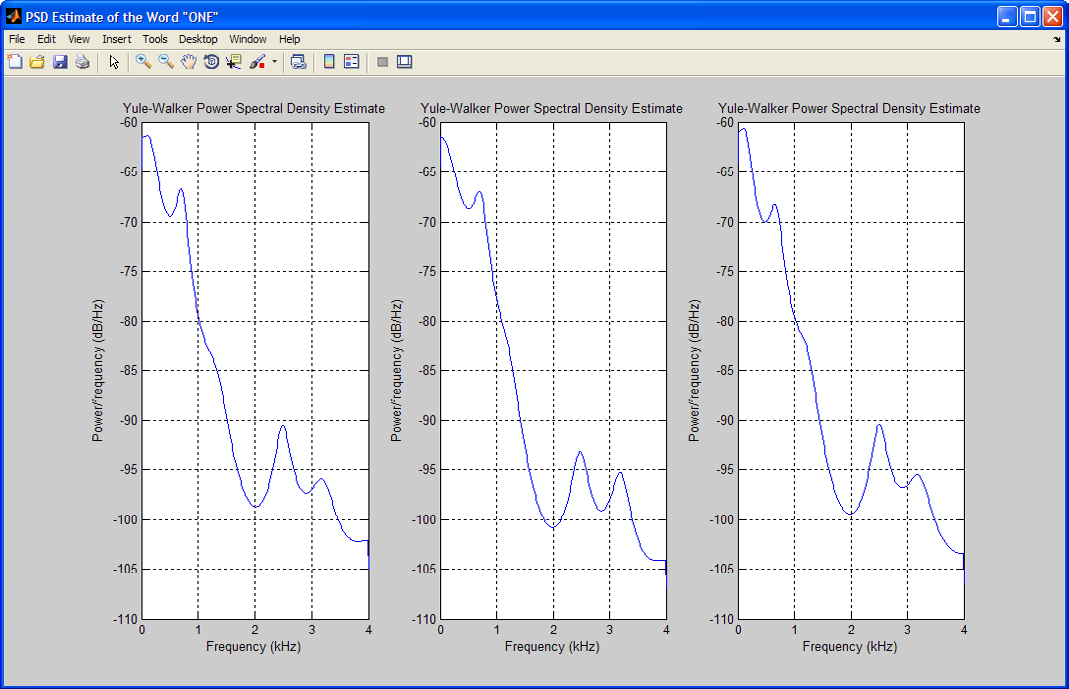
4 Figure 3a. Yule Walker PSD estimate of three different utterances of the word ONE. Figure 3b. Yule Walker PSD estimate of three different utterances of the word TWO. 4 MATLAB Digest


5 Figure 4a shows the distribution of the first dimension of MFCC feature vectors extracted from the training data for the digit one. We could use dfittool in Statistics Toolbox to fit a PDF, but the distribution looks quite arbitrary, and standard distributions do not provide a good fit. One solution is to fit a Gaussian mixture model (GMM), a sum of weighted Gaussians (Figure 4b). The complete Gaussian mixture density is parameterized by the mixture weights, mean vectors, and covariance matrices from all component densities. For isolated digit recognition, each digit is represented by the parameters of its GMM. To estimate the parameters of a GMM for a set of MFCC feature vectors extracted from training speech, we use an iterative expectation-maximization (EM) algorithm to obtain a maximum likelihood (ML) estimate. Given some MFCC training data in the variable MFCCtraindata, we use the Statistics Toolbox gmdistribution function to estimate the GMM parameters. This function is all that is required to perform the iterative EM calculations. Figure 4a. Distribution of the first dimension of MFCC feature vectors for the digit one. %Number of Gaussian component densities M = 8; model = gmdistribution.fit(mfcctraindata,m); Selecting a Classification Algorithm After estimating a GMM for each digit, we have a dictionary for use at the testing stage. Given some test speech, we again extract the MFCC feature vectors from each frame of the detected word. The objective is to find the digit model with the maximum a posteriori probability for the set of test feature vectors, which reduces to maximizing a log-likelihood value. Given a digit model gmmmodel and some test feature vectors Figure 4b. Overlay of estimated Gaussian components (red) and overall Gaussian mixture model (green) to the distribution in 4(a). 5 MATLAB Digest


6 If the goal is to implement the speechrecognition algorithm in hardware, we could use MATLAB and related products to simulate fixed-point effects, automatically generate embedded C code, and verify the generated code. Resources visit Technical Support Online User Community Figure 5: Interface to final application. testdata, the log-likelihood value is easily computed using the posterior function in Statistics Toolbox: [P, log _ like] = posterior(gmmmodel,testdata); We repeat this calculation using each digit s model. The test speech is classified as the digit with the GMM that produces the maximum log-likelihood value. For More Information Demo: Acoustic Echo Cancellation Article: Developing Speech-Processing Algorithms for a Cochlear Implant For Download Auditory Toolbox and the MFCC function Demos Training Services Third-Party Products and Services Worldwide CONTACTS [email protected] 2009 The MathWorks, Inc. MATLAB and Simulink are registered trademarks of The MathWorks, Inc. See for a list of additional trademarks. Other product or brand names may be trademarks or registered trademarks of their respective holders. Building the User Interface After developing the isolated digit recognition system in an offline environment with prerecorded speech, we migrate the system to operate on streaming speech from a microphone input.we use MATLAB GUIDE tools to create an interface that displays the time domain plot of each detected word as well as the classified digit (Figure 5). Extending the Application The algorithm described in this article can be extended to recognize isolated words instead of digits, or to recognize words from several speakers by developing a speakerindependent system v00 01/10 6 MATLAB Digest
![testdata, the log-likelihood value is easily computed using the posterior function in Statistics Toolbox: [P, log _ like] = posterior(gmmmodel,testdata); We repeat this calculation using each digit s](/docs-images/47/20933311/images/page_6.jpg "model. The test speech is classified as the digit with the GMM that produces the maximum log-likelihood value. For More Information Demo: Acoustic Echo Cancellation www.mathworks.")
SPEAKER IDENTIFICATION FROM YOUTUBE OBTAINED DATA
 SPEAKER IDENTIFICATION FROM YOUTUBE OBTAINED DATA Nitesh Kumar Chaudhary 1 and Shraddha Srivastav 2 1 Department of Electronics & Communication Engineering, LNMIIT, Jaipur, India 2 Bharti School Of Telecommunication,
Introduction to Object-Oriented Programming in MATLAB
 MATLAB Digest Introduction to Object-Oriented Programming in MATLAB By Stuart McGarrity Object-oriented programming (OO) applies to software development the standard science and engineering practice of
Establishing the Uniqueness of the Human Voice for Security Applications
 Proceedings of Student/Faculty Research Day, CSIS, Pace University, May 7th, 2004 Establishing the Uniqueness of the Human Voice for Security Applications Naresh P. Trilok, Sung-Hyuk Cha, and Charles C.
Emotion Detection from Speech
 Emotion Detection from Speech 1. Introduction Although emotion detection from speech is a relatively new field of research, it has many potential applications. In human-computer or human-human interaction
Ericsson T18s Voice Dialing Simulator
 Ericsson T18s Voice Dialing Simulator Mauricio Aracena Kovacevic, Anna Dehlbom, Jakob Ekeberg, Guillaume Gariazzo, Eric Lästh and Vanessa Troncoso Dept. of Signals Sensors and Systems Royal Institute of
School Class Monitoring System Based on Audio Signal Processing
 C. R. Rashmi 1,,C.P.Shantala 2 andt.r.yashavanth 3 1 Department of CSE, PG Student, CIT, Gubbi, Tumkur, Karnataka, India. 2 Department of CSE, Vice Principal & HOD, CIT, Gubbi, Tumkur, Karnataka, India.
Converting Models from Floating Point to Fixed Point for Production Code Generation
 MATLAB Digest Converting Models from Floating Point to Fixed Point for Production Code Generation By Bill Chou and Tom Erkkinen An essential step in embedded software development, floating- to fixed-point
Artificial Neural Network for Speech Recognition
 Artificial Neural Network for Speech Recognition Austin Marshall March 3, 2005 2nd Annual Student Research Showcase Overview Presenting an Artificial Neural Network to recognize and classify speech Spoken
L9: Cepstral analysis
 L9: Cepstral analysis The cepstrum Homomorphic filtering The cepstrum and voicing/pitch detection Linear prediction cepstral coefficients Mel frequency cepstral coefficients This lecture is based on [Taylor,
Is a Data Scientist the New Quant? Stuart Kozola MathWorks
 Is a Data Scientist the New Quant? Stuart Kozola MathWorks 2015 The MathWorks, Inc. 1 Facts or information used usually to calculate, analyze, or plan something Information that is produced or stored by
Automatic Evaluation Software for Contact Centre Agents voice Handling Performance
 International Journal of Scientific and Research Publications, Volume 5, Issue 1, January 2015 1 Automatic Evaluation Software for Contact Centre Agents voice Handling Performance K.K.A. Nipuni N. Perera,
MUSICAL INSTRUMENT FAMILY CLASSIFICATION
 MUSICAL INSTRUMENT FAMILY CLASSIFICATION Ricardo A. Garcia Media Lab, Massachusetts Institute of Technology 0 Ames Street Room E5-40, Cambridge, MA 039 USA PH: 67-53-0 FAX: 67-58-664 e-mail: rago @ media.
VOICE RECOGNITION KIT USING HM2007. Speech Recognition System. Features. Specification. Applications
 VOICE RECOGNITION KIT USING HM2007 Introduction Speech Recognition System The speech recognition system is a completely assembled and easy to use programmable speech recognition circuit. Programmable,
Advanced Signal Processing and Digital Noise Reduction
 Advanced Signal Processing and Digital Noise Reduction Saeed V. Vaseghi Queen's University of Belfast UK WILEY HTEUBNER A Partnership between John Wiley & Sons and B. G. Teubner Publishers Chichester New
Maschinelles Lernen mit MATLAB
 Maschinelles Lernen mit MATLAB Jérémy Huard Applikationsingenieur The MathWorks GmbH 2015 The MathWorks, Inc. 1 Machine Learning is Everywhere Image Recognition Speech Recognition Stock Prediction Medical
BLIND SOURCE SEPARATION OF SPEECH AND BACKGROUND MUSIC FOR IMPROVED SPEECH RECOGNITION
 BLIND SOURCE SEPARATION OF SPEECH AND BACKGROUND MUSIC FOR IMPROVED SPEECH RECOGNITION P. Vanroose Katholieke Universiteit Leuven, div. ESAT/PSI Kasteelpark Arenberg 10, B 3001 Heverlee, Belgium [email protected]
MATLAB Distributed Computing Server Licensing Guide
 MATLAB Distributed Computing Server Licensing Guide How to Contact MathWorks Latest news: www.mathworks.com Sales and services: www.mathworks.com/sales_and_services User community: www.mathworks.com/matlabcentral
Sistemi di acquisizione. Grazie al sito National Instruments
 Sistemi di acquisizione Grazie al sito National Instruments Tipiche funzionalità per scheda Ingressi analogici 8-32 canali Amplificazione controllabile da PC Uscite analogiche (di solito 2) Ingressi per
CS 688 Pattern Recognition Lecture 4. Linear Models for Classification
 CS 688 Pattern Recognition Lecture 4 Linear Models for Classification Probabilistic generative models Probabilistic discriminative models 1 Generative Approach ( x ) p C k p( C k ) Ck p ( ) ( x Ck ) p(
DAQ in MATLAB HANS-PETTER HALVORSEN, 2012.09.11
 Telemark University College Department of Electrical Engineering, Information Technology and Cybernetics DAQ in MATLAB HANS-PETTER HALVORSEN, 2012.09.11 Faculty of Technology, Postboks 203, Kjølnes ring
Speech Signal Processing: An Overview
 Speech Signal Processing: An Overview S. R. M. Prasanna Department of Electronics and Electrical Engineering Indian Institute of Technology Guwahati December, 2012 Prasanna (EMST Lab, EEE, IITG) Speech
Hardware Implementation of Probabilistic State Machine for Word Recognition
 IJECT Vo l. 4, Is s u e Sp l - 5, Ju l y - Se p t 2013 ISSN : 2230-7109 (Online) ISSN : 2230-9543 (Print) Hardware Implementation of Probabilistic State Machine for Word Recognition 1 Soorya Asokan, 2
Speech recognition technology for mobile phones
 Speech recognition technology for mobile phones Stefan Dobler Following the introduction of mobile phones using voice commands, speech recognition is becoming standard on mobile handsets. Features such
EE289 Lab Fall 2009. LAB 4. Ambient Noise Reduction. 1 Introduction. 2 Simulation in Matlab Simulink
 EE289 Lab Fall 2009 LAB 4. Ambient Noise Reduction 1 Introduction Noise canceling devices reduce unwanted ambient noise (acoustic noise) by means of active noise control. Among these devices are noise-canceling
Automatic Detection of Emergency Vehicles for Hearing Impaired Drivers
 Automatic Detection of Emergency Vehicles for Hearing Impaired Drivers Sung-won ark and Jose Trevino Texas A&M University-Kingsville, EE/CS Department, MSC 92, Kingsville, TX 78363 TEL (36) 593-2638, FAX
Solutions to Exam in Speech Signal Processing EN2300
 Solutions to Exam in Speech Signal Processing EN23 Date: Thursday, Dec 2, 8: 3: Place: Allowed: Grades: Language: Solutions: Q34, Q36 Beta Math Handbook (or corresponding), calculator with empty memory.
EM Clustering Approach for Multi-Dimensional Analysis of Big Data Set
 EM Clustering Approach for Multi-Dimensional Analysis of Big Data Set Amhmed A. Bhih School of Electrical and Electronic Engineering Princy Johnson School of Electrical and Electronic Engineering Martin
Introduction to MATLAB Gergely Somlay Application Engineer [email protected]
 Introduction to MATLAB Gergely Somlay Application Engineer [email protected] 2012 The MathWorks, Inc. 1 What is MATLAB? High-level language Interactive development environment Used for: Numerical
Manual Analysis Software AFD 1201
 AFD 1200 - AcoustiTube Manual Analysis Software AFD 1201 Measurement of Transmission loss acc. to Song and Bolton 1 Table of Contents Introduction - Analysis Software AFD 1201... 3 AFD 1200 - AcoustiTube
APPLYING MFCC-BASED AUTOMATIC SPEAKER RECOGNITION TO GSM AND FORENSIC DATA
 APPLYING MFCC-BASED AUTOMATIC SPEAKER RECOGNITION TO GSM AND FORENSIC DATA Tuija Niemi-Laitinen*, Juhani Saastamoinen**, Tomi Kinnunen**, Pasi Fränti** *Crime Laboratory, NBI, Finland **Dept. of Computer
Annotated bibliographies for presentations in MUMT 611, Winter 2006
 Stephen Sinclair Music Technology Area, McGill University. Montreal, Canada Annotated bibliographies for presentations in MUMT 611, Winter 2006 Presentation 4: Musical Genre Similarity Aucouturier, J.-J.
Structural Health Monitoring Tools (SHMTools)
 Structural Health Monitoring Tools (SHMTools) Getting Started LANL/UCSD Engineering Institute LA-CC-14-046 c Copyright 2014, Los Alamos National Security, LLC All rights reserved. May 30, 2014 Contents
Data Analysis with MATLAB. 2013 The MathWorks, Inc. 1
 Data Analysis with MATLAB 2013 The MathWorks, Inc. 1 Agenda Introduction Data analysis with MATLAB and Excel Break Developing applications with MATLAB Solving larger problems Summary 2 Modeling the Solar
Thirukkural - A Text-to-Speech Synthesis System
 Thirukkural - A Text-to-Speech Synthesis System G. L. Jayavardhana Rama, A. G. Ramakrishnan, M Vijay Venkatesh, R. Murali Shankar Department of Electrical Engg, Indian Institute of Science, Bangalore 560012,
Product Information CANape Option Simulink XCP Server
 Product Information CANape Option Simulink XCP Server Table of Contents 1 Overview... 3 1.1 Introduction... 3 1.2 Overview of Advantages... 3 1.3 Application Areas... 3 1.4 Further Information... 4 2 Functions...
PRODUCT INFORMATION. Insight+ Uses and Features
 PRODUCT INFORMATION Insight+ Traditionally, CAE NVH data and results have been presented as plots, graphs and numbers. But, noise and vibration must be experienced to fully comprehend its effects on vehicle
Machine Learning with MATLAB David Willingham Application Engineer
 Machine Learning with MATLAB David Willingham Application Engineer 2014 The MathWorks, Inc. 1 Goals Overview of machine learning Machine learning models & techniques available in MATLAB Streamlining the
PATTERN RECOGNITION AND MACHINE LEARNING CHAPTER 4: LINEAR MODELS FOR CLASSIFICATION
 PATTERN RECOGNITION AND MACHINE LEARNING CHAPTER 4: LINEAR MODELS FOR CLASSIFICATION Introduction In the previous chapter, we explored a class of regression models having particularly simple analytical
Understanding CIC Compensation Filters
 Understanding CIC Compensation Filters April 2007, ver. 1.0 Application Note 455 Introduction f The cascaded integrator-comb (CIC) filter is a class of hardware-efficient linear phase finite impulse response
Department of Electrical and Computer Engineering Ben-Gurion University of the Negev. LAB 1 - Introduction to USRP
 Department of Electrical and Computer Engineering Ben-Gurion University of the Negev LAB 1 - Introduction to USRP - 1-1 Introduction In this lab you will use software reconfigurable RF hardware from National
CCNY. BME I5100: Biomedical Signal Processing. Linear Discrimination. Lucas C. Parra Biomedical Engineering Department City College of New York
 BME I5100: Biomedical Signal Processing Linear Discrimination Lucas C. Parra Biomedical Engineering Department CCNY 1 Schedule Week 1: Introduction Linear, stationary, normal - the stuff biology is not
ANALYZER BASICS WHAT IS AN FFT SPECTRUM ANALYZER? 2-1
 WHAT IS AN FFT SPECTRUM ANALYZER? ANALYZER BASICS The SR760 FFT Spectrum Analyzer takes a time varying input signal, like you would see on an oscilloscope trace, and computes its frequency spectrum. Fourier's
Embedded Vision on FPGAs. 2015 The MathWorks, Inc. 1
 Embedded Vision on FPGAs 2015 The MathWorks, Inc. 1 Enhanced Edge Detection in MATLAB Test bench Read Image from File Add noise Frame To Pixel Median Filter Edge Detect Pixel To Frame Video Display Design
Recent advances in Digital Music Processing and Indexing
 Recent advances in Digital Music Processing and Indexing Acoustics 08 warm-up TELECOM ParisTech Gaël RICHARD Telecom ParisTech (ENST) www.enst.fr/~grichard/ Content Introduction and Applications Components
Marathi Interactive Voice Response System (IVRS) using MFCC and DTW
 Marathi Interactive Voice Response System (IVRS) using MFCC and DTW Manasi Ram Baheti Department of CSIT, Dr.B.A.M. University, Aurangabad, (M.S.), India Bharti W. Gawali Department of CSIT, Dr.B.A.M.University,
Figure1. Acoustic feedback in packet based video conferencing system
 Real-Time Howling Detection for Hands-Free Video Conferencing System Mi Suk Lee and Do Young Kim Future Internet Research Department ETRI, Daejeon, Korea {lms, dyk}@etri.re.kr Abstract: This paper presents
Building a Simulink model for real-time analysis V1.15.00. Copyright g.tec medical engineering GmbH
 g.tec medical engineering GmbH Sierningstrasse 14, A-4521 Schiedlberg Austria - Europe Tel.: (43)-7251-22240-0 Fax: (43)-7251-22240-39 [email protected], http://www.gtec.at Building a Simulink model for real-time
Analyzing LASIK Optical Data Using Zernike Functions
 MATLAB Digest Analyzing LASIK Optical Data Using Zernike Functions By Paul Fricker Researchers in fields as diverse as optometry, astronomy, and photonics face a common challenge: how to accurately measure
Analog Devices Welcomes Hittite Microwave Corporation NO CONTENT ON THE ATTACHED DOCUMENT HAS CHANGED
 Analog Devices Welcomes Hittite Microwave Corporation NO CONTENT ON THE ATTACHED DOCUMENT HAS CHANGED www.analog.com www.hittite.com THIS PAGE INTENTIONALLY LEFT BLANK PLL & PLL with Integrated VCO Evaluation
Voice Communication Package v7.0 of front-end voice processing software technologies General description and technical specification
 Voice Communication Package v7.0 of front-end voice processing software technologies General description and technical specification (Revision 1.0, May 2012) General VCP information Voice Communication
RANDOM VIBRATION AN OVERVIEW by Barry Controls, Hopkinton, MA
 RANDOM VIBRATION AN OVERVIEW by Barry Controls, Hopkinton, MA ABSTRACT Random vibration is becoming increasingly recognized as the most realistic method of simulating the dynamic environment of military
POTENTIAL OF STATE-FEEDBACK CONTROL FOR MACHINE TOOLS DRIVES
 POTENTIAL OF STATE-FEEDBACK CONTROL FOR MACHINE TOOLS DRIVES L. Novotny 1, P. Strakos 1, J. Vesely 1, A. Dietmair 2 1 Research Center of Manufacturing Technology, CTU in Prague, Czech Republic 2 SW, Universität
Speech recognition for human computer interaction
 Speech recognition for human computer interaction Ubiquitous computing seminar FS2014 Student report Niklas Hofmann ETH Zurich [email protected] ABSTRACT The widespread usage of small mobile devices
Installation, Licensing, and Activation License Administration Guide
 Installation, Licensing, and Activation License Administration Guide R2015b How to Contact MathWorks Latest news: www.mathworks.com Sales and services: www.mathworks.com/sales_and_services User community:
MFCC-Based Voice Recognition System for Home Automation Using Dynamic Programming
 International Journal of Science and Research (IJSR) MFCC-Based Voice Recognition System for Home Automation Using Dynamic Programming Sandeep Joshi1, Sneha Nagar2 1 PG Student, Embedded Systems, Oriental
IBM Research Report. CSR: Speaker Recognition from Compressed VoIP Packet Stream
 RC23499 (W0501-090) January 19, 2005 Computer Science IBM Research Report CSR: Speaker Recognition from Compressed Packet Stream Charu Aggarwal, David Olshefski, Debanjan Saha, Zon-Yin Shae, Philip Yu
Alignment and Preprocessing for Data Analysis
 Alignment and Preprocessing for Data Analysis Preprocessing tools for chromatography Basics of alignment GC FID (D) data and issues PCA F Ratios GC MS (D) data and issues PCA F Ratios PARAFAC Piecewise
Myanmar Continuous Speech Recognition System Based on DTW and HMM
 Myanmar Continuous Speech Recognition System Based on DTW and HMM Ingyin Khaing Department of Information and Technology University of Technology (Yatanarpon Cyber City),near Pyin Oo Lwin, Myanmar Abstract-
Investigations on Error Minimizing Training Criteria for Discriminative Training in Automatic Speech Recognition
 , Lisbon Investigations on Error Minimizing Training Criteria for Discriminative Training in Automatic Speech Recognition Wolfgang Macherey Lars Haferkamp Ralf Schlüter Hermann Ney Human Language Technology
Probability and Random Variables. Generation of random variables (r.v.)
 Probability and Random Variables Method for generating random variables with a specified probability distribution function. Gaussian And Markov Processes Characterization of Stationary Random Process Linearly
The effect of mismatched recording conditions on human and automatic speaker recognition in forensic applications
 Forensic Science International 146S (2004) S95 S99 www.elsevier.com/locate/forsciint The effect of mismatched recording conditions on human and automatic speaker recognition in forensic applications A.
A TOOL FOR TEACHING LINEAR PREDICTIVE CODING
 A TOOL FOR TEACHING LINEAR PREDICTIVE CODING Branislav Gerazov 1, Venceslav Kafedziski 2, Goce Shutinoski 1 1) Department of Electronics, 2) Department of Telecommunications Faculty of Electrical Engineering
RF Measurements Using a Modular Digitizer
 RF Measurements Using a Modular Digitizer Modern modular digitizers, like the Spectrum M4i series PCIe digitizers, offer greater bandwidth and higher resolution at any given bandwidth than ever before.
Introduction to Pattern Recognition
 Introduction to Pattern Recognition Selim Aksoy Department of Computer Engineering Bilkent University [email protected] CS 551, Spring 2009 CS 551, Spring 2009 c 2009, Selim Aksoy (Bilkent University)
Statistical Machine Learning
 Statistical Machine Learning UoC Stats 37700, Winter quarter Lecture 4: classical linear and quadratic discriminants. 1 / 25 Linear separation For two classes in R d : simple idea: separate the classes
Agilent Creating Multi-tone Signals With the N7509A Waveform Generation Toolbox. Application Note
 Agilent Creating Multi-tone Signals With the N7509A Waveform Generation Toolbox Application Note Introduction Of all the signal engines in the N7509A, the most complex is the multi-tone engine. This application
IVR Primer Introduction
 IVR Primer Introduction Speech-enabled applications are quickly becoming very popular. Why? Because using voice to navigate is more natural for users than punching telephone keypads. Speech as a navigation
Secure-Access System via Fixed and Mobile Telephone Networks using Voice Biometrics
 Secure-Access System via Fixed and Mobile Telephone Networks using Voice Biometrics Anastasis Kounoudes 1, Anixi Antonakoudi 1, Vasilis Kekatos 2 1 The Philips College, Computing and Information Systems
From Raw Data to. Actionable Insights with. MATLAB Analytics. Learn more. Develop predictive models. 1Access and explore data
 100 001 010 111 From Raw Data to 10011100 Actionable Insights with 00100111 MATLAB Analytics 01011100 11100001 1 Access and Explore Data For scientists the problem is not a lack of available but a deluge.
Dream DRM Receiver Documentation
 Dream DRM Receiver Documentation Dream is a software implementation of a Digital Radio Mondiale (DRM) receiver. All what is needed to receive DRM transmissions is a PC with a sound card and a modified
Gender Identification using MFCC for Telephone Applications A Comparative Study
 Gender Identification using MFCC for Telephone Applications A Comparative Study Jamil Ahmad, Mustansar Fiaz, Soon-il Kwon, Maleerat Sodanil, Bay Vo, and * Sung Wook Baik Abstract Gender recognition is
Implementing an In-Service, Non- Intrusive Measurement Device in Telecommunication Networks Using the TMS320C31
 Disclaimer: This document was part of the First European DSP Education and Research Conference. It may have been written by someone whose native language is not English. TI assumes no liability for the
Simple Voice over IP (VoIP) Implementation
 Simple Voice over IP (VoIP) Implementation ECE Department, University of Florida Abstract Voice over IP (VoIP) technology has many advantages over the traditional Public Switched Telephone Networks. In
Integrating MATLAB into your C/C++ Product Development Workflow Andy Thé Product Marketing Image Processing Applications
 Integrating MATLAB into your C/C++ Product Development Workflow Andy Thé Product Marketing Image Processing Applications 2015 The MathWorks, Inc. 1 Typical Development Workflow Translating MATLAB to C/C++
WebSphere Business Monitor
 WebSphere Business Monitor Monitor sub-models 2010 IBM Corporation This presentation should provide an overview of the sub-models in a monitor model in WebSphere Business Monitor. WBPM_Monitor_MonitorModels_Submodels.ppt
Online Diarization of Telephone Conversations
 Odyssey 2 The Speaker and Language Recognition Workshop 28 June July 2, Brno, Czech Republic Online Diarization of Telephone Conversations Oshry Ben-Harush, Itshak Lapidot, Hugo Guterman Department of
CROP CLASSIFICATION WITH HYPERSPECTRAL DATA OF THE HYMAP SENSOR USING DIFFERENT FEATURE EXTRACTION TECHNIQUES
 Proceedings of the 2 nd Workshop of the EARSeL SIG on Land Use and Land Cover CROP CLASSIFICATION WITH HYPERSPECTRAL DATA OF THE HYMAP SENSOR USING DIFFERENT FEATURE EXTRACTION TECHNIQUES Sebastian Mader
Product Development Flow Including Model- Based Design and System-Level Functional Verification
 Product Development Flow Including Model- Based Design and System-Level Functional Verification 2006 The MathWorks, Inc. Ascension Vizinho-Coutry, [email protected] Agenda Introduction to Model-Based-Design
Origins, Evolution, and Future Directions of MATLAB Loren Shure
 Origins, Evolution, and Future Directions of MATLAB Loren Shure 2015 The MathWorks, Inc. 1 Agenda Origins Peaks 5 Evolution 0-5 Tomorrow 2 0 y -2-3 -2-1 x 0 1 2 3 2 Computational Finance Workflow Access
Impedance 50 (75 connectors via adapters)
 VECTOR NETWORK ANALYZER PLANAR TR1300/1 DATA SHEET Frequency range: 300 khz to 1.3 GHz Measured parameters: S11, S21 Dynamic range of transmission measurement magnitude: 130 db Measurement time per point:
STA 4273H: Statistical Machine Learning
 STA 4273H: Statistical Machine Learning Russ Salakhutdinov Department of Statistics! [email protected]! http://www.cs.toronto.edu/~rsalakhu/ Lecture 6 Three Approaches to Classification Construct
Hideo Okawara s Mixed Signal Lecture Series. DSP-Based Testing Fundamentals 46 Per-pin Signal Generator
 Hideo Okawara s Mixed Signal Lecture Series DSP-Based Testing Fundamentals 46 Per-pin Signal Generator Advantest Corporation, Tokyo Japan August 2012 Preface to the Series ADC and DAC are the most typical
Non-Data Aided Carrier Offset Compensation for SDR Implementation
 Non-Data Aided Carrier Offset Compensation for SDR Implementation Anders Riis Jensen 1, Niels Terp Kjeldgaard Jørgensen 1 Kim Laugesen 1, Yannick Le Moullec 1,2 1 Department of Electronic Systems, 2 Center
Image Compression through DCT and Huffman Coding Technique
 International Journal of Current Engineering and Technology E-ISSN 2277 4106, P-ISSN 2347 5161 2015 INPRESSCO, All Rights Reserved Available at http://inpressco.com/category/ijcet Research Article Rahul
Lecture 1-6: Noise and Filters
 Lecture 1-6: Noise and Filters Overview 1. Periodic and Aperiodic Signals Review: by periodic signals, we mean signals that have a waveform shape that repeats. The time taken for the waveform to repeat
Exploratory Data Analysis with MATLAB
 Computer Science and Data Analysis Series Exploratory Data Analysis with MATLAB Second Edition Wendy L Martinez Angel R. Martinez Jeffrey L. Solka ( r ec) CRC Press VV J Taylor & Francis Group Boca Raton
Electronic Communications Committee (ECC) within the European Conference of Postal and Telecommunications Administrations (CEPT)
 Page 1 Electronic Communications Committee (ECC) within the European Conference of Postal and Telecommunications Administrations (CEPT) ECC RECOMMENDATION (06)01 Bandwidth measurements using FFT techniques
Statistical Machine Learning from Data
 Samy Bengio Statistical Machine Learning from Data 1 Statistical Machine Learning from Data Gaussian Mixture Models Samy Bengio IDIAP Research Institute, Martigny, Switzerland, and Ecole Polytechnique
LMS is a simple but powerful algorithm and can be implemented to take advantage of the Lattice FPGA architecture.
 February 2012 Introduction Reference Design RD1031 Adaptive algorithms have become a mainstay in DSP. They are used in wide ranging applications including wireless channel estimation, radar guidance systems,
Echtzeittesten mit MathWorks leicht gemacht Simulink Real-Time Tobias Kuschmider Applikationsingenieur
 Echtzeittesten mit MathWorks leicht gemacht Simulink Real-Time Tobias Kuschmider Applikationsingenieur 2015 The MathWorks, Inc. 1 Model-Based Design Continuous Verification and Validation Requirements
[Download Tech Notes TN-11, TN-18 and TN-25 for more information on D-TA s Record & Playback solution] SENSOR PROCESSING FOR DEMANDING APPLICATIONS 29
![[Download Tech Notes TN-11, TN-18 and TN-25 for more information on D-TA s Record & Playback solution] SENSOR PROCESSING FOR DEMANDING APPLICATIONS 29](/thumbs/25/5773993.jpg "[Download Tech Notes TN-11, TN-18 and TN-25 for more information on D-TA s Record & Playback solution] SENSOR PROCESSING FOR DEMANDING APPLICATIONS 29") is an extremely scalable and ultra-fast 10 Gigabit record and playback system. It is designed to work with D-TA sensor signal acquisition products that are 10 Gigabit (10GbE) network attached. The can
is an extremely scalable and ultra-fast 10 Gigabit record and playback system. It is designed to work with D-TA sensor signal acquisition products that are 10 Gigabit (10GbE) network attached. The can
Speech: A Challenge to Digital Signal Processing Technology for Human-to-Computer Interaction
 : A Challenge to Digital Signal Processing Technology for Human-to-Computer Interaction Urmila Shrawankar Dept. of Information Technology Govt. Polytechnic, Nagpur Institute Sadar, Nagpur 440001 (INDIA)
Demo: Real-time Tracking of Round Object
 Page 1 of 1 Demo: Real-time Tracking of Round Object by: Brianna Bikker and David Price, TAMU Course Instructor: Professor Deepa Kundur Introduction Our project is intended to track the motion of a round
High Quality Integrated Data Reconstruction for Medical Applications
 High Quality Integrated Data Reconstruction for Medical Applications A.K.M Fazlul Haque Md. Hanif Ali M Adnan Kiber Department of Computer Science Department of Computer Science Department of Applied Physics,