
AN INTRODUCTION TO MEDICAID
|
|
|
- Collin Cooper
- 9 years ago
- Views:
Transcription
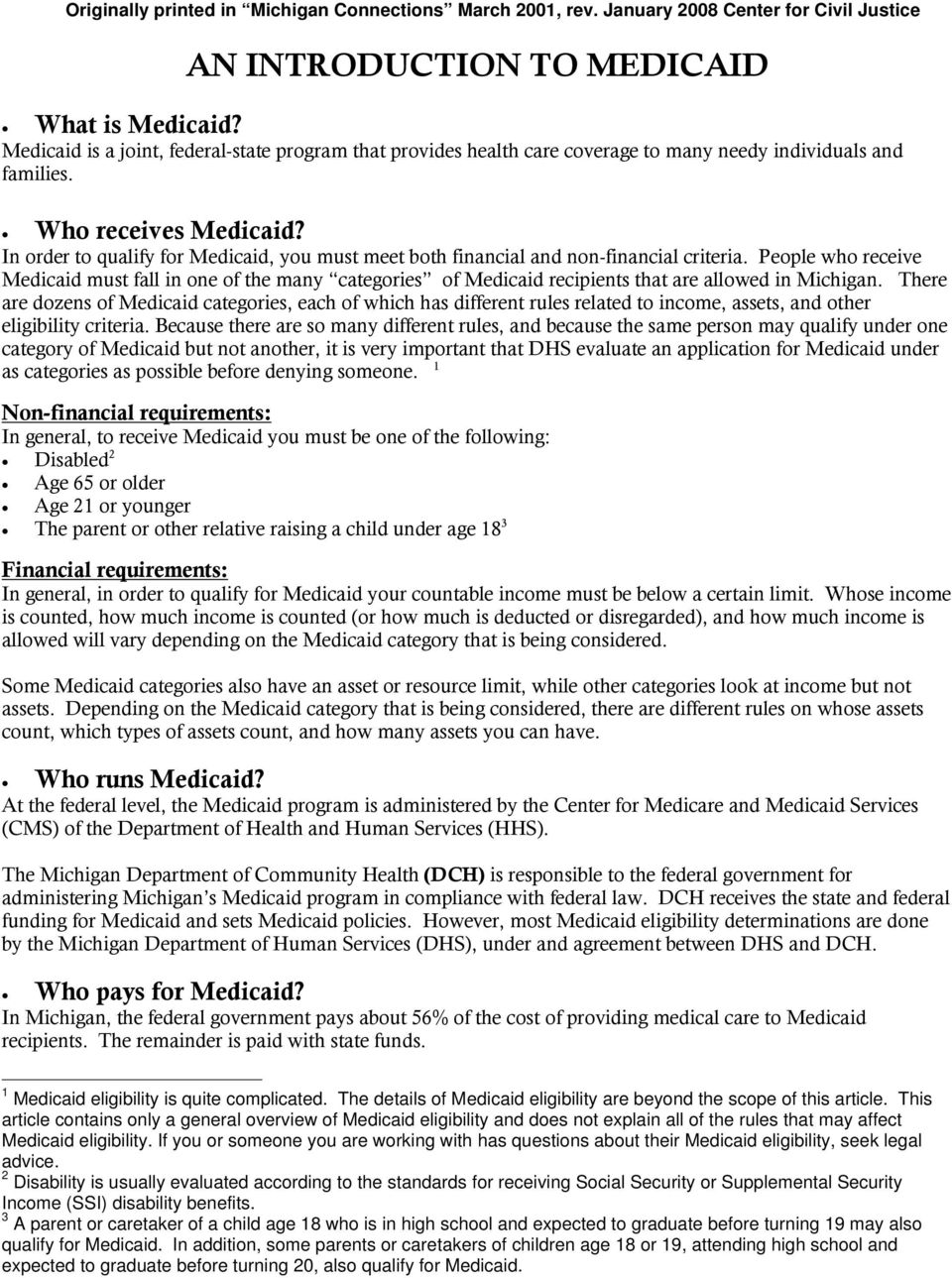
1 Originally printed in Michigan Connections March 2001, rev. January 2008 Center for Civil Justice AN INTRODUCTION TO MEDICAID What is Medicaid? Medicaid is a joint, federal-state program that provides health care coverage to many needy individuals and families. Who receives Medicaid? In order to qualify for Medicaid, you must meet both financial and non-financial criteria. People who receive Medicaid must fall in one of the many categories of Medicaid recipients that are allowed in Michigan. There are dozens of Medicaid categories, each of which has different rules related to income, assets, and other eligibility criteria. Because there are so many different rules, and because the same person may qualify under one category of Medicaid but not another, it is very important that DHS evaluate an application for Medicaid under as categories as possible before denying someone. 1 Non-financial requirements: In general, to receive Medicaid you must be one of the following: Disabled 2 Age 65 or older Age 21 or younger The parent or other relative raising a child under age 18 3 Financial requirements: In general, in order to qualify for Medicaid your countable income must be below a certain limit. Whose income is counted, how much income is counted (or how much is deducted or disregarded), and how much income is allowed will vary depending on the Medicaid category that is being considered. Some Medicaid categories also have an asset or resource limit, while other categories look at income but not assets. Depending on the Medicaid category that is being considered, there are different rules on whose assets count, which types of assets count, and how many assets you can have. Who runs Medicaid? At the federal level, the Medicaid program is administered by the Center for Medicare and Medicaid Services (CMS) of the Department of Health and Human Services (HHS). The Michigan Department of Community Health (DCH) is responsible to the federal government for administering Michigan s Medicaid program in compliance with federal law. DCH receives the state and federal funding for Medicaid and sets Medicaid policies. However, most Medicaid eligibility determinations are done by the Michigan Department of Human Services (DHS), under and agreement between DHS and DCH. Who pays for Medicaid? In Michigan, the federal government pays about 56% of the cost of providing medical care to Medicaid recipients. The remainder is paid with state funds. 1 Medicaid eligibility is quite complicated. The details of Medicaid eligibility are beyond the scope of this article. This article contains only a general overview of Medicaid eligibility and does not explain all of the rules that may affect Medicaid eligibility. If you or someone you are working with has questions about their Medicaid eligibility, seek legal advice. 2 Disability is usually evaluated according to the standards for receiving Social Security or Supplemental Security Income (SSI) disability benefits. 3 A parent or caretaker of a child age 18 who is in high school and expected to graduate before turning 19 may also qualify for Medicaid. In addition, some parents or caretakers of children age 18 or 19, attending high school and expected to graduate before turning 20, also qualify for Medicaid.
2 Originally printed in Michigan Connections March 2001, rev. January 2008 Center for Civil Justice 2 Who sets the rules for Medicaid? Congress enacts the federal laws that govern Medicaid (Title XIX of the Social Security Act). CMS issues federal rules that interpret and implement the federal laws passed by Congress. Michigan must operate its Medicaid program in compliance with the federal laws. In some areas, federal Medicaid laws give Michigan choices in the design of its Medicaid program. Under federal law, some groups of persons must be covered by Medicaid, while others are covered only at the state s option. Similarly, some types of medical care and services must be covered under federal Medicaid law, while others are optional. The Michigan legislature enacts state laws that govern the Medicaid program in Michigan. In addition to laws that are contained in the Social Welfare Act, the legislature passes an appropriations act to fund DCH each year (including funding for the Michigan Medicaid program), which usually contains boilerplate language that govern some aspects of Michigan Medicaid in that funding year. In addition, by deciding how much such state funding to provide for Medicaid in the year, the state legislature may limit the choices that DCH can make about who to cover under Medicaid and what services to provide to Medicaid recipients. All of the state laws must comply with federal law. DCH issues policies that govern the day-to-day operation of Michigan s Medicaid program. These policies must comply with both state and federal law. Many of the rules that affect clients can be found in the DHS Program Eligibility and Program Administrative Manuals, which are now posted on line at UNDERSTANDING DEDUCTIBLE MEDICAID IN MICHIGAN Perhaps the questions that are most frequently asked about Medicaid in Michigan are Why are deductibles so high? and What can be done about it? This article explains what Medicaid with a Deductible is, and provides some answers to these important questions. I. BACKGROUND: SPENDDOWN MEDICAID GENERALLY What is Medicaid with a Deductible? Medicaid with a deductible is Medicaid for individuals whose income is too high to qualify for other Medicaid categories, but who meet the non-financial requirements for one of the Medicaid Deductible categories, as well as the asset limit, if any. Medicaid with a deductible allows some individuals to receive Medicaid by showing that their medical expenses are very high in comparison with their income. Each person is allowed a minimal amount of protected income each month. DHS expects that if you have income above this protected amount, you will use this excess income to pay your medical expenses. This amount of excess income is called your deductible. You can meet your deductible obligation by showing that you have medical expenses (either paid or unpaid) that equal to or more than the deductible amount. Once you show that you have met the deductible for a particular month, Medicaid will pay for all your Medicaid-covered medical expenses during the rest of the month. Your ability to obtain payment for medical care under Medicaid deductible categories will depend on the amount of your medical expenses in any given month. 4 This makes Medicaid with a Deductible different than 4 Note that you can use unpaid bills even bills from past months -- to meet your deductible as long as these bills will not be paid by any other insurance (including Medicare). A large unpaid bill from a month in which you did not receive Medicaid can be applied to your Medicaid deductible for several months. (For example if your Medicaid deductible is

3 Originally printed in Michigan Connections March 2001, rev. January 2008 Center for Civil Justice 3 other categories of Medicaid where DHS focuses on the amount of income you have, and does not consider the amount of your medical expenses. 5 A person may be eligible for one or more categories of Medicaid with a deductible, depending on whether the person is a child, a child s caregiver, elderly or disabled. How is the deductible amount calculated? Medicaid deductibles are calculated on a monthly basis. They are calculated by subtracting the Medicaid Protected Income Level (PIL) from monthly net countable income. The rules about whose income counts, and how much of it is counted, deducted, or disregarded, will vary depending on which category of Medicaid is being considered by DHS. 6 The PIL that is used in calculating an individual s deductible amount will vary depending on the number of persons included in the individual s Medicaid group 7 and the part of Michigan in which the individual lives (the shelter area ). A chart of PILs for Michigan is included at the end of this article. You can also find the current PILs in the Program Reference Manual Tables and Charts, in PRT Item 240. (See ). The shelter areas are listed in PRT 200. Because the PILs are quite low, deductibles are often quite high. Even individuals who are struggling to pay for medical care, or who are finding that they cannot afford to pay for the medical care and treatment they need, may be unable to meet their deductible and thus unable to qualify for Medicaid. II. WHY ARE PROTECTED INCOME LEVELS IN MICHIGAN SO LOW? Theoretically, the protected income limit (PIL) is the amount needed to meet the group s non-medical needs (food, shelter, clothing, transportation, etc.). Any income in excess of the PIL is then considered to be available for the group to meet its own medical expenses. However, federal law sets the upper and lower limits for states to use in setting the Protected Income Level (PIL) or Medically Needy Income Level (MNIL) that is used to determine Medicaid deductibles in Michigan. 8 Under the federal law, the PIL cannot be greater than 133 1/3% of the amount that was paid to families under the Aid to Families with Dependent Children (ADC in Michigan) program on July 16, Can t Michigan raise its protected income levels? Michigan currently uses PILs that are 133 1/3% of the ADC levels in effect on July 16, Michigan cannot make any significant increases to its PILs unless federal law is changed. What else could be done to help individuals with high deductibles? In 2001, the federal Medicaid agency (CCJ) issued a federal regulation that would allow states to change the way that they count income in calculating a person s Medicaid eligibility and deductible amount. The regulation 9 allows the state to lower deductible amounts by reducing the amount of income that is taken into account when calculating a person s deductible. States are allowed to apply the more liberal/less restrictive methodologies to $50 per month, a $200 unpaid bill will meet the Medicaid deductible for 4 months. Note that once a bill has been applied to one or more months, it cannot be used again in the future. 5 The categories of Medicaid that use deductibles are sometimes referred to as Group 2 Medicaid. Categories that look only at the amount of income you have are called Group 1 Medicaid. 6 Rules on calculating net countable income are complicated and vary depending on the Medicaid category and the individual s household family composition. Details on calculation of countable income are beyond the scope of this article. 7 Rules on determining who is included in the Medicaid group vary according to the Medicaid category being considered, and are beyond the scope of this article CFR (c) and (e), 42 CFR , 42 USC 1396b(f)(1)(B)(i), 9 42 CFR (f), implementing 42 USC 1396a(r)(2).

4 Originally printed in Michigan Connections March 2001, rev. January 2008 Center for Civil Justice 4 some but not all eligibility groups. Unfortunately, because of the state s fiscal problems, Michigan has not used this option to increase health care coverage for persons who currently have very high deductibles. Also, as described below, Michigan could choose to make Medicaid available to more people through one of the categories that do not have deductibles. Federal law gives states several options that they can use to make health care available to more people. Why does a person suddenly have a deductible of hundreds of dollars when their income only goes up a few dollars? This happens when a person s income goes just over the income limit for a Medicaid category that does not have a deductible (Group 1 categories). Many of these Group 1 categories have income limits that are much higher than the protected income level used for Medicaid with a deductible. Remember, eligibility for Medicaid categories that do not have deductibles is an all or nothing proposition. If your income is below the limits allowed for a particular category, you receive Medicaid and there is no deductible. If it is over the limit for the category, you no longer qualify for Medicaid under that category. You cannot spend down to the income limit for the Group 1 category. Instead, if you want Medicaid and do not qualify for any other Group 1 Medicaid categories, you must qualify by meeting a deductible that is based on the very low protected income level. Example: The ADCare Medicaid category provides Group 1 Medicaid coverage to all persons who are disabled or are age 65 or older, and who have income below the federal poverty level. If an ADCare recipient s income goes even one dollar over the poverty level, she or he will no longer be eligible for ADCare and will, instead, be required to meet a deductible based on the PIL, which is only 37% - 59% of the poverty level, as shown in Appendix B. Let s assume Steve is disabled and receives countable income of $690 per month in The poverty level for a single person in 2000 is $696 per month so he qualifies for ADCare Medicaid. However, if Steve s income increases by only $10 to $700 per month, he will lose ADCare Medicaid and have to meet a Medicaid deductible. The protected income level (PIL) for Steve (since he is a group of 1 person) is only $341 - $408 per month, depending on where he lives in Michigan. Let s say Steve s PIL is $341. DHS will subtract Steve s protected income level from Steve s countable income to find his deductible amount ($ = $359). Therefore, even though Steve s income only went up $10 per month, he will now have to show paid or unpaid bills of $359 for each month that he wants to receive Medicaid with a deductible. III. IF MICHIGAN CAN T CHANGE ITS PROTECTED INCOME LEVELS, ARE THERE OTHER WAYS TO PROVIDE MEDICAID TO LOW INCOME PERSONS WHO NEED MEDICAL CARE? In addition to the option of Federal law includes important options that could help many needy persons qualify for Medicaid without having to meet a deductible. The following two options allow the state to expand Medicaid categories that provide categorical (Group 1) eligibility to certain groups of people. Individuals cannot qualify for these categories by meeting a deductible, because they are not medically needy (Group 2) categories. Providing Medicaid Eligibility to More Low Income Working Parents Michigan has the option of changing the amount of income and assets that it counts when determining eligibility for Low Income Family ( LIF ) Medicaid a Group 1 (non-deductible) Medicaid category known at the federal level as section 1931 Medicaid. Because financial eligibility for Medicaid is based on whether countable

5 Originally printed in Michigan Connections March 2001, rev. January 2008 Center for Civil Justice 5 income and assets are below limits for the particular category of Medicaid, changing the amount of income or assets that are countable would make more people eligible. The income limits for LIF Medicaid are particularly low, because they cannot be more than 100% of the 7/16/96 ADC levels. Because of Michigan s low ADC levels, this means that a family s countable income must be below approximately 35% of the federal poverty level, depending on where they live.. By disregarding (not counting) a larger portion of a family s income from work or child support, Michigan could make more low income parents eligible for Medicaid. Following the passage of section 1931 in 1996, many Michigan organizations that work with low income families and children tried to convince the state to adopt a proposal that would have used this section 1931 Medicaid option to expand Medicaid eligibility for working parents, by disregarding a portion of the income of families with earnings. However, the proposal was never adopted in the legislature and the state has never chosen to use the section 1931 option to help uninsured, working parents. Providing Medicaid to More Persons with Disabilities Who Work Michigan has the option of providing Medicaid to individuals who meet the Social Security Administration s disability standard, but do not qualify for Supplemental Security Income (SSI) because of their earnings. These employed persons with disabilities would have to be years old, but they would not have to have received SSI in the past. Michigan can set the income and asset limit (if any), without any federal limitations. Freedom to Work Medicaid, which allows persons with disabilities who are working to continue receiving Medicaid by disregarding their earnings in determining income eligibility, was established by the Michigan legislature and opened for enrollment in January The eligibility criteria were narrowly drawn to prevent individuals who had not qualified for Medicaid in the past (including those who could only qualify by meeting a deductible) from being able to qualify under this category. As of November 2007, there were just over 1,000 Michigan residents receiving Medicaid under this category. All had been eligible for Medicaid (without a deductible) immediately prior to their enrollment in Freedom to Work Medicaid. Michigan could expand eligibility for Freedom to Work eligibility, to help more persons with disabilities who want to work.

6 Originally printed in Michigan Connections March 2001, rev. January 2008 Center for Civil Justice 6 Appendix A: Protected Income Levels (PILs) in Michigan Shelter Area I II III IV V VI Group Size EACH ADDITIONAL PERSON ADD SHELTER AREAS I III IV V VI II Alger Arenac Alcona Allegan Barry Genesee Baraga Chippewa Benzie Alpena Bay Ingham Gogebic Delta Cheboygan Berrien Clinton Livingston Huron Houghton Crawford Branch Eaton Macomb Iron Iosco Dickinson Calhoun Grand Traverse Monroe Keweenaw Lake Gladwin Cass Kalamazoo Oakland Luce Manistee Hillsdale Charlevoix Kent St. Clair Mecosta Oceana Jackson Clare Lapeer Washtenaw Menominee Ontonagon Kalkaska Emmet Leelanau Presque Isle Osceola Mackinac Gratiot Lenawee Schoolcraft Oscoda Mason Ionia Midland Missaukee Isabella Otsego Montcalm Marquette Ottawa Muskegon Montmorency Saginaw Newaygo Roscommon Van Buren Ogemaw St. Joseph Sanilac Shiawassee Wexford Tuscola Wayne

7 Originally printed in Michigan Connections March 2001, rev. January 2008 Center for Civil Justice 7 Appendix B: Comparison of Michigan s Protected Income Levels* and 2000 Federal Poverty Levels Group Size Protected Income Level (PIL) PIL as a Percent of Poverty Poverty Level 1 $408 59% $696 2 $541 58% $938 3 $567 48% $ $593 42% $ $689 41% $ $822 43% $1904 * For comparison, this Table uses the highest Protected Income Levels (PILs) that are used in Michigan. These are the PILs used in Shelter Area VI.

8 Originally printed in Michigan Connections March 2001, rev. January 2008 Center for Civil Justice 8 Appendix C: MIChild and Selected Medicaid Categories -- Income Limit Compared to 2000 Federal Poverty Level 200% $1,735 $1,875 $1,875 $1, % $1,407 $1,475 $1,275 Percent of Poverty 100% 50% $401 $541 $938 $1,075 $875 $675 $475 $275 $75 0% Low Income Family (LIF) Medicaid Group 2 Protected Income Limit (PIL) ADCare Medicaid for the Elderly and Disabled Healthy Kids Medicaid - Ages 1-17 Healthy Kids Medicaid - Under Age 1 MIChild ($125) NOTE: This chart shows the highest Low Income Family income limit and Group 2 Protected Income Limit for a Group Size of 2, which are the limits used in Shelter Area VI.

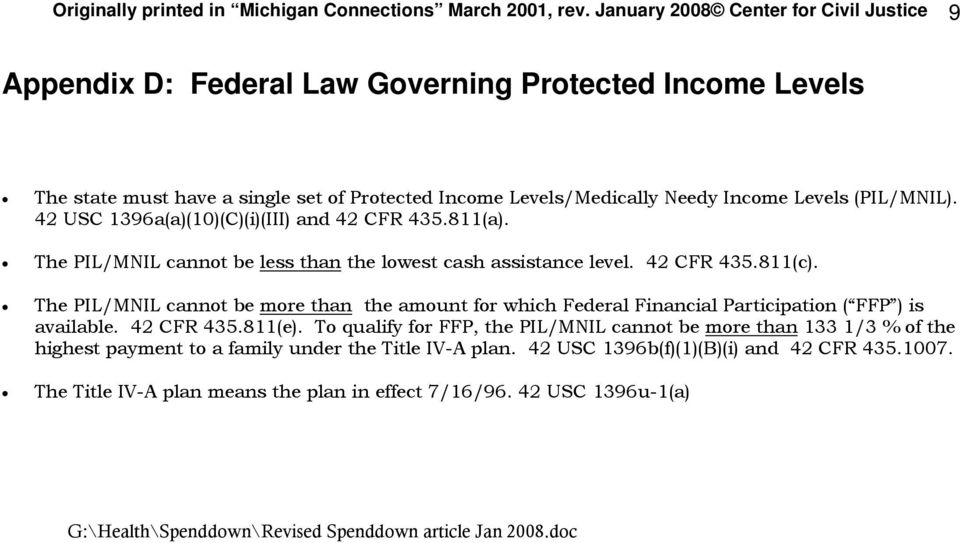
9 Originally printed in Michigan Connections March 2001, rev. January 2008 Center for Civil Justice 9 Appendix D: Federal Law Governing Protected Income Levels The state must have a single set of Protected Income Levels/Medically Needy Income Levels (PIL/MNIL). 42 USC 1396a(a)(10)(C)(i)(III) and 42 CFR (a). The PIL/MNIL cannot be less than the lowest cash assistance level. 42 CFR (c). The PIL/MNIL cannot be more than the amount for which Federal Financial Participation ( FFP ) is available. 42 CFR (e). To qualify for FFP, the PIL/MNIL cannot be more than 133 1/3 % of the highest payment to a family under the Title IV-A plan. 42 USC 1396b(f)(1)(B)(i) and 42 CFR The Title IV-A plan means the plan in effect 7/16/ USC 1396u-1(a) G:\Health\Spenddown\Revised Spenddown article Jan 2008.doc
Michigan Local Emergency Managers
 Michigan Local Emergency Managers Contact Information Alcona County Emergency Management 989-736-8185 [email protected] Alger County Emergency Management 906-387-4444 [email protected] Allegan
Medigap Outline of Coverage for Plans A, D, F, G and N
 Medigap Outline of Coverage for Plans A, D, F, G and N Contents Understanding your premiums... 3 Choosing a plan is easy... 11 Coverage that meets your needs... 12 Learning more about your choices... 20
Health Insurance Exchanges:
 Health Insurance Exchanges: Implications for Hospitals and Health Systems Lansing, Michigan June 12, 2015 2015 2014 Kaufman, Hall & Associates, Inc. All rights reserved. Appendix: Michigan Public Exchange
Election Cycle Campaign Finance Contribution Limits For State Level Office, Local Level Office, Judicial and Caucus Committee PACs
 Election Cycle Campaign Finance s For State Level Office, Local Level Office, Judicial and Caucus Committee PACs s The Michigan Campaign Finance Act (MCFA) establishes contribution limits for publicly
State Bar of Michigan
 State Bar of Michigan 2014 Economics of Law Practice Attorney Income and Billing Rate Summary Report July 2014 Contents Economics of Law Practice in Michigan 2014 Attorney Income and Billing Rate Summary
Powering Michigan Agriculture with Renewable Energy Conference East Lansing, MI
 Powering Michigan Agriculture with Renewable Energy Conference East Lansing, MI 03-10-2016 Purpose Program is designed to promote renewable energy development and energy efficiency for Agricultural Producers
Highlights of MCIR version 7
 Highlights of MCIR version 7 MCIR Home Screen All users will notice newly organized menus. All types of reports (Reminder/Recall, Import/Export, Profile, Batch, etc.) are now accessed under the Reports
UMHS participation in health insurance plans on the Michigan Individual Marketplace and Small Business SHOP
 UMHS participation in health insurance plans on the Michigan Individual Marketplace and Small Business SHOP Detailed view Definitions for acronyms are at the end of the document As of 1/13/14 Alliance
Michigan Adoption and Foster Care Agencies by County
 Michigan Adoption and Foster Care Agencies by County indicates agencies located in this county A full listing of agencies that focus on Infant and International adoptions, along with Department of Human
Michigan* Initiatives. Area. Seasonal monthly declines. ranks. ng changes in. consistent picture. rates. higher over Despite thesee.
 Jobless Rates Increase over Month as Employment Falls Seasonally January 24 th, 2013 Seasonal payroll job and employmentt reductions across most industries locally pushedd jobless rates higher over the
2010 Economics of Law Practice Attorney Income and Billing Rate Summary Report
 State Bar of Michigan 2010 Economics of Law Practice Attorney Income and Billing Rate Summary Report January 2011 Exhibit 1 Table of Exhibits I 2010 Attorney Income Exhibit 1 2010 Estimated Attorney Income
Insurance Options Summary
 Insurance Options Summary For Public School Retirees Department of Technology, Management & Budget Your Health Plans The Office of Retirement Services strives to be good stewards of your pension and healthcare
2013 Rankings Michigan
 2013 Rankings Michigan Introduction Where we live matters to our health. The health of a community depends on many different factors, including the environment, education and jobs, access to and quality
Committed to the Future of Rural Communities. Rural Development Loan & Grant Programs Available in Michigan
 Committed to the Future of Rural Communities Rural Development Loan & Programs Available in Michigan February 2009 Housing Program www.rurdev.usda.gov/rhs/index.html Single Family Home Ownership Loans
MEDICAID MENTAL HEALTH AND SUBSTANCE ABUSE SERVICES SPECIALTY SERVICES WAIVER
 MEDICAID MENTAL HEALTH AND SUBSTANCE ABUSE SERVICES SPECIALTY SERVICES WAIVER If you have mild or moderate mental health needs such as depression or anxiety, you will receive medically necessary mental
Domestic Animals: Biting and Being Bitten
 Domestic Animals: Biting and Being Bitten Nancy Frank, DVM, MPH Michigan Department of Agriculture Animal Industry Division Michigan Rabies Conference April 24, 2006 Michigan Department of Agriculture
Procurement for Managed Care in Publicly Funded Health Care Programs: A Primer
 Procurement for Managed Care in Publicly Funded Health Care Programs: A Primer PREPARED FOR MICHIGAN ASSOCIATION OF HEALTH PLANS Introduction The State of Michigan has long relied upon a Medicaid delivery
Auto Crash Statistics
 2003-2012 Michigan Traffic Crashes Year Crashes Fatal Crashes Persons Killed Injuries 2003 391,486 1,172 1,283 105,555 2004 373,028 1,055 1,159 99,680 2005 350,838 1,030 1,129 90,510 2006 315,322 1,002
Best Practice Standard Reports and Enterprise Reporting
 Best Practice Standard Reports and Enterprise Reporting Enterprise Reporting Scott Baumann, Spectrum Health Scott Carter, LifePoint Hospitals CONFIDENTIAL PROPERTY OF MEDASSETS. MedAssets is a registered
Making Medicare choices easier. 2016 Plan information
 Making Medicare choices easier 2016 Plan information 2 Call us toll-free at 877.475.8423, seven days a week from 8 a.m. 8 p.m. TTY users should call 711. A health plan that puts you first With today s
Methamphetamine Reporting Act Michigan State Police Methamphetamine Investigation Team
 Methamphetamine Reporting Act Michigan State Police Methamphetamine Investigation Team Introduction This report is pursuant to MCL 28.193 which requires the Michigan State Police to report to the Michigan
Broadband Infrastructure, Adoption, and Technology Usage in Michigan. First in a Series of Working Reports on the State of Broadband in Michigan
 Broadband Infrastructure, Adoption, and Technology Usage in Michigan First in a Series of Working Reports on the State of Broadband in Michigan June 2011 Table of Contents Executive Summary... 3 Overview
Healthy Youth & Healthy Seniors:
 As a result of a community foundation grant, the Delta County Tobacco An Update from the Council of Michigan Foundations Reduction Coalition has been able to develop and implement an effective and creative
In this item MA includes MAGI-related and SSI-related beneficiaries.
 BAM 402 1 of 22 BENEFITS DEPARTMENT POLICY Medicaid () General lists of covered services are located at the end of this item; see EXHIBIT I. In this item includes GI-related and SSI-related beneficiaries.
Michigan Department of Community Health
 Michigan Department of Community Health HIPAA 5010 EDI Companion Guide for ANSI ASC X12N 834 Benefit Enrollment and Maintenance Non-Emergency Medical Transportation (NEMT) Version Date November 30, 2011
Evaluation of the Michigan Medical Professional Liability Insurance Market
 JENNIFER M. GRANHOLM GOVERNOR STATE OF MICHIGAN DEPARTMENT OF ENERGY, LABOR & ECONOMIC GROWTH STANLEY "SKIP" PRUSS, DIRECTOR OFFICE OF FINANCIAL AND INSURANCE REGULATION KEN ROSS COMMISSIONER Evaluation
Bankruptcy 101 Manual for Michigan Municipalities
 Better Communities. Better Michigan. Bankruptcy 101 Manual for Michigan Municipalities Bankruptcy 101 Manual for Michigan Municipalities Purpose and limitations of this manual Contents 3 The Basics 6 The
Behavioral Health and Developmental Disabilities Administration Fiscal Year 2014
 Behavioral Health and Developmental Disabilities Administration Fiscal Year 2014 Presentation to Senate Appropriations Subcommittee on Community Health February 28, 2013 James K. Haveman, MDCH Director
STATE OF MICHIGAN STATE 9-1-1 COMMITTEE LANSING
 RICK SNYDER GOVERNOR STATE OF MICHIGAN STATE 9-1-1 COMMITTEE LANSING SHERIFF DALE GRIBLER CHAIR March 19, 2012 Michigan House of Representatives Michigan Senate Lansing, Michigan Dear Michigan Legislators:
Individual Income Tax
 2008 Michigan 1040CR-7 Individual Income Tax Home Heating Credit Claim Forms and Instructions Jennifer M. Granholm, Governor Robert J. Kleine, State Treasurer w w w. m i c h i g a n. gov/ t a xe s FILING
MICHIGAN VETERANS VISION 2014-2018
 MICHIGAN VETERANS VISION 2014-2018 The willingness with which our young people are likely to serve in any war, no matter how justified, shall be directly proportional to how they perceive veterans of early
Michigan 2015. Home Heating. www.mifastfile.org. www.michigan.gov/taxes
 Michigan 2015 MI-1040CR-7 Home Heating Credit Claim aa E-file your Michigan Home Heating Credit Claim (MI-1040CR-7) with or without a Michigan Individual Income Tax Return (MI-1040) and get your home heating
Adecade into the 21st century, Michigan s longbruised
 Michigan League FOR Human Services December 2010 Michigan's Economy Continues to Cause Pain: Communities of Color Take a Harder Hit Adecade into the 21st century, Michigan s longbruised economy continues
Racial Differences Persist in Health Insurance Coverage and Access to Care in Michigan s Changing Health Care System
 O Racial Differences Persist in Health Insurance Coverage and Access to Care in Michigan s Changing Health Care System by Andrew J. Hogan Maureen A. Mickus Briefing Paper No. 2000-47 MSU is an affirmative-action,
STUDENT TRANSPORTATION BENCHMARKING SURVEY
 STUDENT TRANSPORTATION BENCHMARKING SURVEY Michigan School Business Officials in conjunction with Management Partnership Services, Inc. Table of Contents Introduction...1 Survey Results...1 Structure of
LTBB Contract Health. Member Handbook
 LTBB Contract Health Member Handbook Member Handbook Table of Contents Contract Health 1250 Lears Rd Table of Contents......2 What is Contract Health.... 3 Petoskey, MI 49770 Phone: (231) 242-1600 Fax:
PARTICIPATING PARTNERS LIST
 1 st Source Bank 21 st Mortgage Corporation Alden State Bank All States Investments, LLC Alliance Catholic Credit Union Alpena Alcona Area Credit Union America s Servicing Company (ASC), Division of Wells
PARTICIPATING PARTNERS LIST
 1 st Source Bank Citizens National Bank of Cheboygan 21 Mortgage Corporation City of Grand Rapids Advia Credit Union Clarkston State Bank Affiliated Mortgage Company ClearSpring Loan Services Alden State
MEDICAID AND LONG TERM CARE
 MEDICAID AND LONG TERM CARE BRADLEY GELLER MICHIGAN STATE LONG TERM CARE OMBUDSMAN PROGRAM Second Edition December 2011 This booklet is provided by the Michigan State Long Term Care Ombudsman Program.
PARTICIPATING PARTNERS LIST
 1 st Source Bank CitiMortgage, Inc 21 Mortgage Corporation Citizens Bank, National Association Adventure Credit Union Citizens National Bank of Cheboygan Advia Credit Union City of Grand Rapids Affiliated
Through Rose Colored Glasses: Public Perceptions of Nursing Home Quality. By: Andrew J. Hogan Maureen A. Mickus
 O Through Rose Colored Glasses: Public Perceptions of Nursing Home Quality By: Andrew J. Hogan Maureen A. Mickus Briefing Paper No. 2002-52 Series Editor: Amy J. Baumer SOSS Briefing Paper 2002-52 Page
TAB C. MSHDA Guidelines for Market Studies
 TAB C MSHDA Guidelines for Market Studies Updated for 2013 Approved Market Analyst List For Conducting Market Studies for Affordable Housing Projects in Michigan, 2013: Vogt Santer Insights Baker Tilly
All Interested Parties Erik Jonasson, Fiscal Analyst Drug Treatment Courts and Swift and Sure Sanctions Programs
 MEMORANDUM DATE: September 18, 2012 TO: FROM: RE: All Interested Parties Erik Jonasson, Fiscal Analyst Drug Treatment Courts and Swift and Sure Sanctions Programs This memorandum summarizes the current
Help With Health Care. Resources for the uninsured. Northern Michigan
 Help With Health Care Resources for the uninsured Northern Michigan Revised September 2014 2 Table of contents Introduction...2 How to get health insurance coverage in Michigan...2 Overview... 2 Healthy
STATE OF MICHIGAN Department of Management and Budget Purchasing Operations
 STATE OF MICHIGAN Department of Management and Budget Purchasing Operations Contract No. 071BXXXXX Comprehensive Health Care Program for the Michigan Department of Community Health Buyer Name: Kevin Dunn
MICHIGAN DEPARTMENT OF HEALTH & HUMAN SERVICES. Behavioral Health Treatment Episode Data Set (BH-TEDS) File Specifications for PIHP Regional Entities
 MICHIGAN DEPARTMENT OF HEALTH & HUMAN SERVICES Behavioral Health Treatment Episode Data Set (BH-TEDS) File Specifications for PIHP Regional Entities FY 2016 (Rev. 07.29.2015) Page 1 of 23 BH-TEDS Service
U-M Premier Care Member Handbook. with your Benefit Document and Amendments
 U-M Premier Care Member Handbook with your Benefit Document and Amendments Contents.U-M Premier Care Quick Guide... 1. Your primary care physician... 1. Your plan details... 2. What you pay for services...
U-M Premier Care Member Handbook. with your Benefit Document and Amendments
 U-M Premier Care Member Handbook with your Benefit Document and Amendments Contents.U-M Premier Care Quick Guide... 1. Your primary care physician... 1. Your plan details... 2. What you pay for services...
Guidance and Call Center Information for Medicare Advantage (MA) Organizations and Medicare Prescription Drug Plans (PDPs) in Michigan
 DEPARTMENT OF HEALTH & HUMAN SERVICES Centers for Medicare & Medicaid Services 7500 Security Boulevard Baltimore, Maryland 21244-1850 CENTER FOR MEDICARE DATE: February 12, 2015 TO: FROM: Medicare Advantage
DRAFT: 08/10/2015 Regional Substance Use Disorder Treatment Providers by County Mid- State Health Network
 Alpena Detox Arenac Sunrise Centre 630 Walnut St. Alpena MI 49707 877.205.5217 Case Management, Co- Occurring, Early Intervention,, Peer Recovery and Peer Support, Prevention 725 E. State St. Sterling
Work-related Amputations in Michigan, 2011. September 2013
 Work-related Amputations in Michigan, 2011 September 2013 Work-related Amputations in Michigan, 2011 A Joint Report of the Michigan Department of Community Health Bureau of Disease Control, Prevention,
Multifamily Loan Programs
 Multifamily Loan Programs Taxable and Tax-Exempt Direct Lending Programs These programs represent the Authority s response to localized housing and reinvestment needs by financing rental housing. Funding
Broadband Providers by County October 1, 2014
 COUNTY Alcona Alcona PROVIDER Allband Cmunications Cooperative Allband Cmunications Cooperative PROVIDER DOING- BUSINESS-AS NAME Allband Cmunications Cooperative Broadband Providers by County October 1,
Table of Contents 3 4 5 6 6-8 8 8 9 9 10 10 10 12 14 15 15 16 17 18 18 19 20 21 22 23-24 25 26 27
 Table of Contents Welcome Letter About Meridian Meridian Service Area Key Features Population Management Provider Manual NCQA Excellent Quality Improvement Eligibility Behavioral Health Preferred Laboratories
97 th Annual MICHIGAN ASSOCIATION OF REGISTERS OF DEEDS CONFERENCE. September 18-21, 2011 Stafford s Perry Hotel Petoskey, MI
 97 th Annual MICHIGAN ASSOCIATION OF REGISTERS OF DEEDS CONFERENCE September 18-21, 2011 Stafford s Perry Hotel Petoskey, MI President Bambi Somerlott Hillsdale County Register Many people have worked
MICHIGAN ATTORNEY GENERAL
 MICHIGAN ATTORNEY GENERAL Prepared by The Michigan Department of Attorney General August 18, 2014 LEGAL AND RELATED SERVICES DEDICATED TO VETERANS 1 Legal Programs For Low Income Veterans 2 Law School
Dear Merit Members, Don Welch, President/CEO for Merit Network
 2013 Annual Report Dear Merit Members, Pictured above: Don Welch receives the Computerworld 21st Century Award on behalf of Merit; Welch speaks during the 2013 Merit Member Conference. As we celebrate
Combined Sewer Overflow (CSO) & Sanitary Sewer Overflow (SSO) 2007 Annual Report
 Combined Sewer Overflow (CSO) & Sanitary Sewer Overflow (SSO) 2007 Annual Report () Special Feature: 20 Years of Progress in CSO Control in Michigan (1988 to 2008) This publication was prepared for the
MICHIGAN DEPARTMENT OF HEALTH AND HUMAN SERVIES Community Mental Health Services Programs
 Allegan County CMH Services Marianne Huff, Director 3283 122 nd Avenue PO Drawer 130 Allegan, Michigan 49010 [email protected] 269-673-6617 or 800-795-6617 Voice 269-673-6617 or 800-795-6617 24-Hour Crisis
Michigan Department of Licensing & Regulatory Affairs Bureau of Health Care Services Health Facilities Division
 Michigan Department of Licensing & Regulatory Affairs Bureau of Health Care Services Health Facilities Division LICENSED ACTIVE PSYCHIATRIC PROGRAMS INPATIENT & PARTIAL HOSPITALIZATION PROGRAMS October
Medicare & Medicaid Updates. Julie Kearney Kearney & Associates, Inc.
 Medicare & Medicaid Updates Julie Kearney Kearney & Associates, Inc. First Medicaid Update Cash Flow Delays copyright Kearney & Associates, Inc. 3 O When Medicare non-covered days are reported because
Enrollment, Eligibility and Disenrollment
 Health Plans Medicaid Medicaid is a federal program created by Title XIX of the Social Security Act in 1965. The primary objective of the program is to provide essential medical and health services to
DTE GAS COMPANY RATE BOOK FOR NATURAL GAS SERVICE. http://www.dteenergy.com/residentialcustomers/billingpayment/gasrate/gasratebook.
 Original Sheet No. A-1.00 DTE GAS COMPANY RATE BOOK FOR NATURAL GAS SERVICE These Standard Rules and Regulations and Rate Schedules contained herein have been adopted by the Company to govern its relations
MICHIGAN BID CALENDAR
 Page 1 AUGUST 4, 2016 SALT STORAGE BUILDING PROJECT REBID $500,000 Heavy and Highway Berrien MI 3560867 August 4, 2016 ST. JOSEPH PUBLIC SCHOOLS HIGH SCHOOL GYM DOOR REPLACEM... $100,000 Specialty Trades
Multi-Tiered System of Supports (MTSS) MEMSPA Conference August 2014
 Multi-Tiered System of Supports (MTSS) MEMSPA Conference August 2014 1 Agenda Introductions MTSS Overview & Self Assessment Assessment & Data Analysis Implementation & Inquiry Process MTSS Resources 2
Michigan Physical Therapy
 Michigan Physical Therapy A Publication of the Michigan Physical Therapy Association Volume 42, No. 3 Fall 2015 Keweenaw PRESIDENT S MESSAGE Sue Talley, PT, DPT, C/NDT, PhD(c), MPTA President Sue Talley
College of Business Administration ~ General Scholarships
 College of Business Administration ~ General Scholarships Please mark with an X ONLY those scholarships for which you meet ALL requirements. Thank you. American Photo Marketing Entrepreneurship Scholarship
CHANGE NOTICE NO. 5 to CONTRACT NO. 071B1300126 between THE STATE OF MICHIGAN and
 Form No. DTMB-3521 (Rev. 4/2012) AUTHORITY: Act 431 of 1984 COMPLETION: Required PENALTY: Contract change will not be executed unless form is filed STATE OF MICHIGAN DEPARTMENT OF TECHNOLOGY, MANAGEMENT
Provider Orientation for: Meridian Advantage Plan Meridian Prime Meridian Complete
 Provider Orientation for: Meridian Advantage Plan Meridian Prime Meridian Complete Table of Contents Welcome Letter About Meridian Service Area Key Features Eligibility Member Benefits Quality Improvement