
High Tunnel Hoop House Construction Guide
|
|
|
- Debra Stevens
- 10 years ago
- Views:
Transcription
1 High Tunnel Hoop House Construction Guide Steve Upson An Agricultural Division Publication NF-HO-14-01

2 Foreward This publication is the product of 17 years of experience in hoop house (high tunnel) design, construction and utilization. As an educator and consultant, I have been asked numerous times by work associates and growers to produce a how to resource on hoop house construction. Currently, there are many excellent Extension- and growerauthored publications on hoop house crop culture, but few publications on construction. It is not the intent of this publication to offer a complete set of construction plans for any particular type or size of hoop house but rather to introduce the novice grower/ hoop house builder to the various tools and techniques used in constructing a wide range of hoop house models. The various guidelines contained herein are applicable to both prefabricated commercial structures as well as homemade structures. Admittedly, my experience with hoop house structures has a southern flavor; consequently, the guidelines may or may not have application in other regions of the country. It is my belief that a careful study of this publication prior to purchasing a hoop house kit or materials to custombuild a structure will save the builder time and money as well as reduce the level of frustration encountered during the construction process.
3 Contents Introduction...1 Benefits...2 Crops...3 Models...4 Building material options...12 End wall and door options...17 Site selection and house orientation considerations...29 Site preparation...30 Hoop house perimeter layout...31 Ground post installation...42 End wall construction...48 Hoop, purlin, baseboard and hip-board installation...54 Brace for strength...64 Poly-film cover attachment...67 Roll-up side curtain (vent) construction...78 Windbreak curtain installation...86 Considerations for growing in hot weather...88 Recommended tools and supplies for hoop house construction...91
4

5 Introduction Market gardeners are faced with a myriad of production and marketing constraints. Some of these include escalating costs, government regulations, labor quality and quantity issues, competition, and inclement weather. While hoop house technology cannot solve all of these problems, utilization of this technology can reduce production risks associated with inclement weather. Growing in a hoop house is a little more complicated than field production and requires additional management skill, but don t let this keep you from realizing the benefits of this growing system. If you think of hoop house culture as nothing more than gardening under cover, it s much less intimidating. Hoop houses, also referred to as high tunnels or cold frames, are generally quonsetshaped and constructed of metal or plastic hoops (bows) covered with a single layer of 6-mil, greenhouse-grade, polyethylene film. Whereas a greenhouse is an environmentally controlled structure, a hoop house has no permanent heating system or electrical connections. Venting is accomplished by retracting the curtains on the sides of the house. Most houses range in width from 14 to 30 feet. On some sites, houses wider than 20 feet could experience overheating on warm, sunny days due to reduced cross ventilation. Houses can extend over 100 feet in length; however, the majority of commercial houses are 96 feet in length. Compared with greenhouses, hoop houses are relatively inexpensive, ranging in price from $1 to $4 per square foot. Most hoop houses are permanent, but a few are designed to be movable. Some houses are designed with removable hoops and permanent bases. These hybrid structures offer some of the benefits of both permanent and movable houses. Permanent structures are generally stronger, but movable houses allow for more efficient use of the structure. A hoop house strawberry crop ready to harvest 1

6 Benefits Of all the technologies/growing systems currently being utilized by market gardeners, hoop houses are generating the greatest buzz because of the many benefits they offer. Benefits of hoop house production include: 1. Protection against storms. Depending on the strength of the structure, hoop houses can provide protection against wind and rain that accompany heavy thunderstorms. Commercial greenhouse film is amazingly resilient to small hail. During the fall of 1996, a Noble Foundation hoop house tomato crop escaped the ravages of a hailstorm with ½-inch hail accompanied by 70 mph winds. Some of the hail penetrated the cover but not enough to damage the crop. 2. Damage caused by vertebrate and invertebrate pests can be reduced with careful management. As a rule, birds aren t a problem even when houses are fully vented. Installing shade fabric over the side vent openings will exclude small animals such as skunk, armadillo and opossum. Shade fabric is also effective in screening out large insects such as grasshoppers and moths. Fifty percent shade fabric is recommended as both a pest barrier and a windbreak. 3. As a general rule, expect less incidence of foliar disease in hoop houses, primarily because plants are sheltered from rainfall. An exception to this rule is powdery mildew. The high humidity common to the hoop house growing system accentuates the powdery mildew problem. 4. The greatest benefit of hoop house production is the extension of the growing season. As a rule of thumb, a well managed hoop house growing system utilizing plasticulture technology (raised beds, mulch film and row covers) can lengthen the growing season (frost-free period) by as much as 60 days. Being able to harvest certain warmseason crops up to a month earlier is due to a combination of being able to plant a couple of weeks earlier than field planting and faster maturity as a result of the growth-enhancing effect (warmth) of the house. Because the hoop house grower can benefit from a more favorable growing environment late into the year, warm-season crop production can be sustained into November or even through the month of December in the Deep South. The season extension benefit of hoop house production is not limited to warm-season crops. Harvest of fall-planted cool-season crops such as leafy greens, root crops and broccoli can be sustained through the winter when grown in a hoop house. Because they are not heated, hoop houses should not be considered freeze protection devices, although they can provide a few degrees of protection. The actual amount of protection you can expect will depend on factors such as wind speed, draft, residual floor/ bed heat, crop height above floor/beds, proximity to sidewalls, duration of the freeze and use of row/crop covers. 2 Benefits

7 Crops A hoop house summer squash crop Theoretically, any crop can be grown in a hoop house. Because of the increased cost of hoop house production, only high value crops have the potential for profit. A few hoop house crops that are commonly grown for market include tomato, eggplant, pepper, summer squash, cucumber, specialty melons, strawberry, raspberry and cut flowers. Public and private agricultural institutions worldwide continue to research economical methods of producing a wide range of crops in hoop houses, including peach, blueberry, okra and asparagus. Crops 3

8 Models Quonset model Hoop house structures fall into two basic categories: permanent and movable. Permanent structures are typically anchored to the ground using ground posts driven into the ground or anchored in concrete. Movable structures are designed to be pushed or pulled on skids or rollers. They are typically anchored to the ground using a cable or chain. The shape of the hoop (bow) can vary greatly on both types of structures. The quonset model is generally the easiest and least expensive structure to construct. The main disadvantage to this design is the lack of shoulder and headroom along the sides of the house. While satisfactory for producing low-growing crops, the shape restricts production of such crops as tomato and cucumber close to the sides of the house. This restriction can be partially overcome using wider and taller quonset structures. As a general rule, quonset structures less than 20 feet wide are inefficient for producing caged or trellised crops. 4 Models

9 Modified quonset models Straight wall Bowed out wall To provide more interior head and shoulder room along the sides of the house, hoop house manufacturers offer several variants of the standard quonset structure. Hoop houses equipped with straight side walls or bowed out side walls provide unhindered internal access along the sides of the house while permitting plenty of vertical growing space. Ensuring this extra room doesn t come without a cost. The additional pipe and extra bending required during side wall and hoop fabrication adds to the cost of these modified models. Models 5

10 Triple side vent model Ridge vent model Growers seeking maximum ventilation and heat dissipation can equip their houses with vents located at the top of the house. The sawtooth or triple side vent design utilizes a third or upper vent on one side of the house to dissipate heat. The side of the house containing the third vent is several feet higher than the other. The chimney effect created by the difference in wall heights permits heated air to move up and out of the house through the upper vent. Because cross ventilation powered by summer breezes is the primary means by which hot air is exhausted from the house, the upper vent should always be located on the leeward side. In Oklahoma, our prevailing summer breezes are out of the southwest. Under these conditions, a house oriented north and south should have the upper vent located on the east side. Houses oriented east and west should have the upper vent located on the north side. Houses equipped with a ridge vent running the length of the structure also offer excellent heat dissipation. In most of these structures, the ridge vent consists of a roll-up curtain. Whether you purchase a kit or fabricate your own structure, expect to pay more for a top-vented model due to the extended height and additional materials required to construct the vent. This design is also more difficult to maintain due to the location of the vent. If your goal is to extend the harvest of heat-sensitive crops, such as tomato, deep into the summer, a top-vented model is your best choice for managing heat. 6 Models

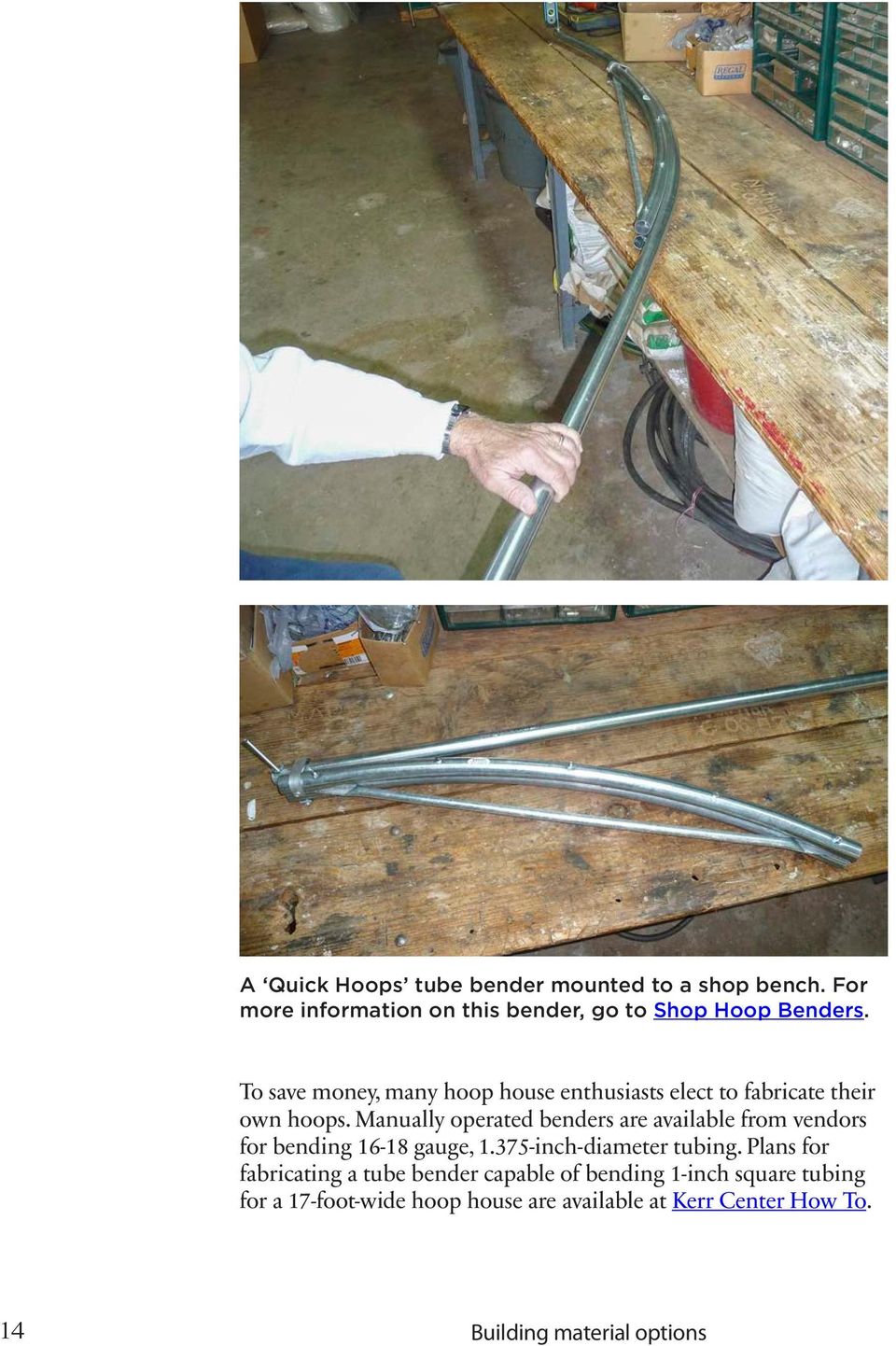
11 Gothic model Photos courtesy of Penn State University Gothic models are shaped similarly to traditional glass greenhouses. Due to the peaked roof, the poly-film covering does not adhere as tightly to the frame compared to a quonset structure. Growers often use strapping to limit the amount of film flapping that occurs during windy conditions. Growers located in areas frequented by heavy snows often choose Gothicstyle structures. The enhanced slope of the roof makes snow removal easier. Models 7

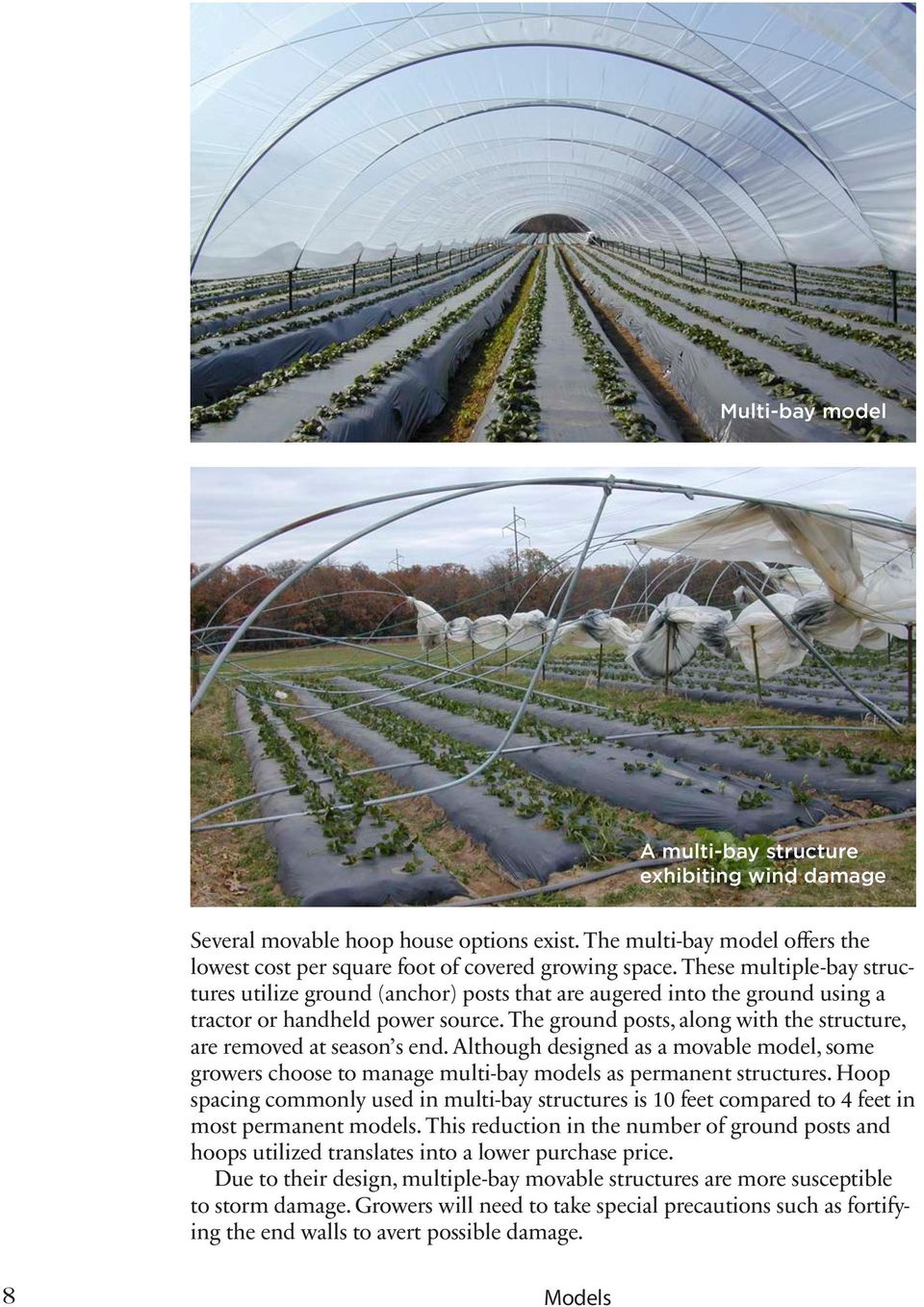
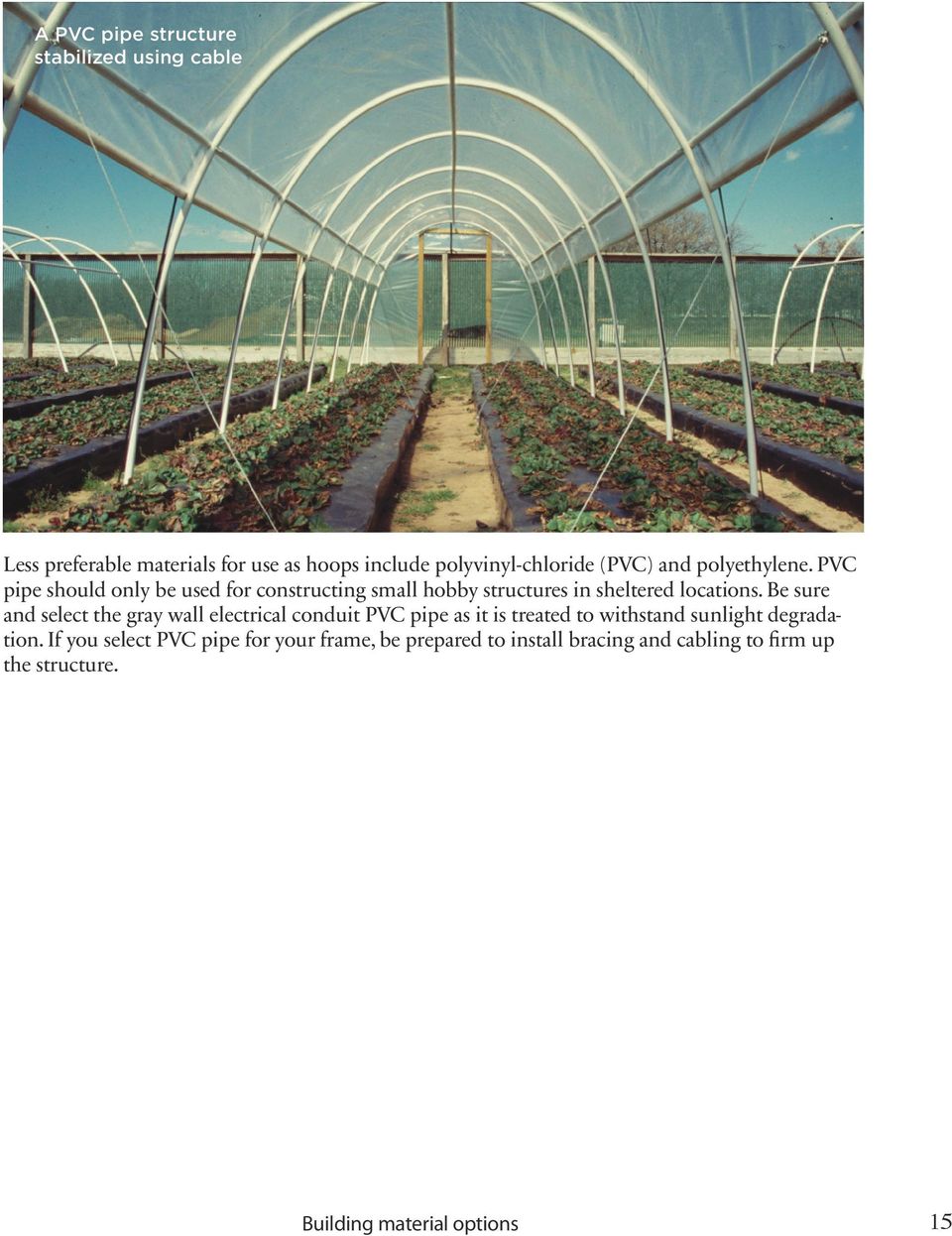
12 Multi-bay model A multi-bay structure exhibiting wind damage Several movable hoop house options exist. The multi-bay model offers the lowest cost per square foot of covered growing space. These multiple-bay structures utilize ground (anchor) posts that are augered into the ground using a tractor or handheld power source. The ground posts, along with the structure, are removed at season s end. Although designed as a movable model, some growers choose to manage multi-bay models as permanent structures. Hoop spacing commonly used in multi-bay structures is 10 feet compared to 4 feet in most permanent models. This reduction in the number of ground posts and hoops utilized translates into a lower purchase price. Due to their design, multiple-bay movable structures are more susceptible to storm damage. Growers will need to take special precautions such as fortifying the end walls to avert possible damage. 8 Models
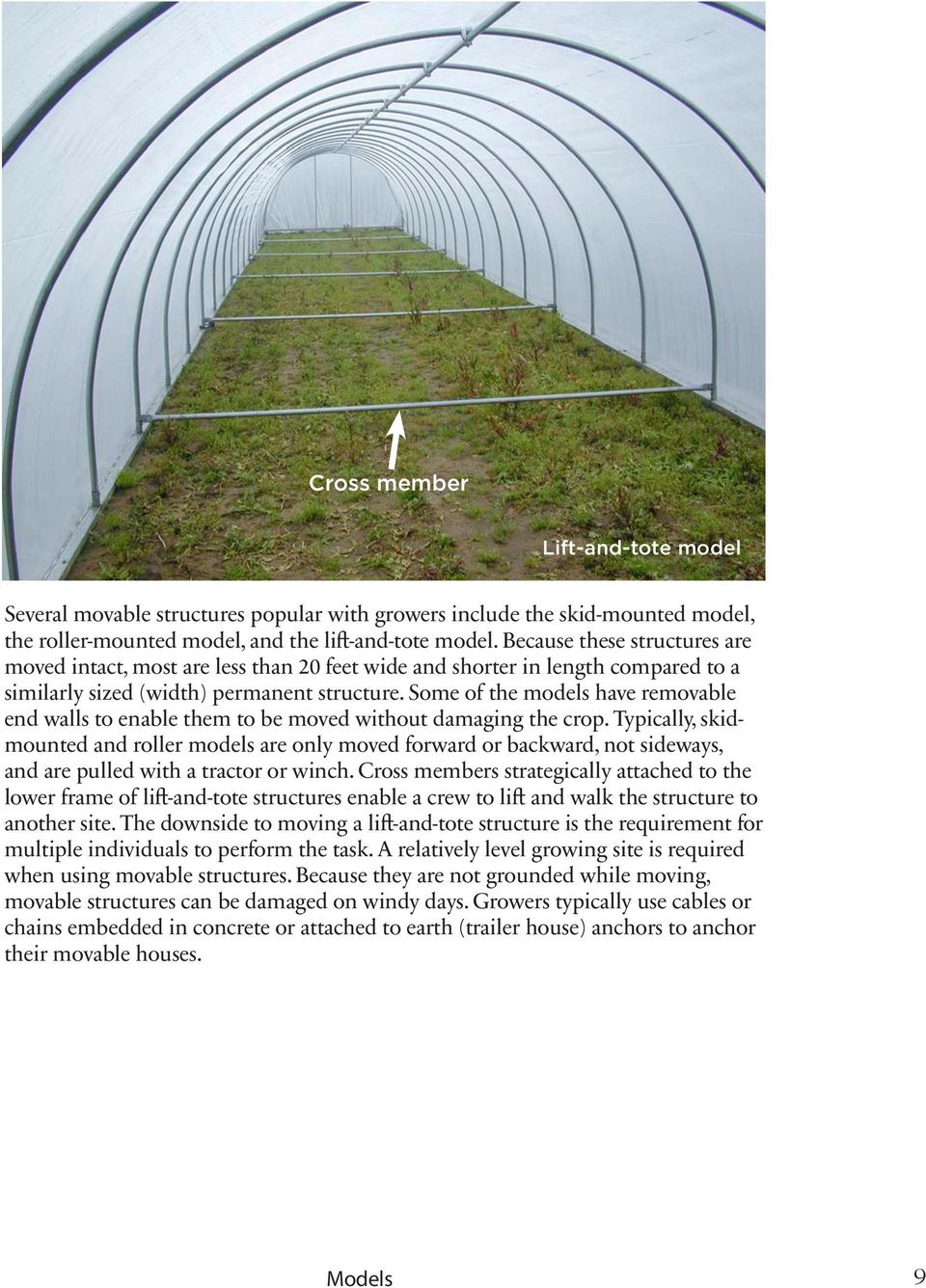
13 Cross member Lift-and-tote model Several movable structures popular with growers include the skid-mounted model, the roller-mounted model, and the lift-and-tote model. Because these structures are moved intact, most are less than 20 feet wide and shorter in length compared to a similarly sized (width) permanent structure. Some of the models have removable end walls to enable them to be moved without damaging the crop. Typically, skidmounted and roller models are only moved forward or backward, not sideways, and are pulled with a tractor or winch. Cross members strategically attached to the lower frame of lift-and-tote structures enable a crew to lift and walk the structure to another site. The downside to moving a lift-and-tote structure is the requirement for multiple individuals to perform the task. A relatively level growing site is required when using movable structures. Because they are not grounded while moving, movable structures can be damaged on windy days. Growers typically use cables or chains embedded in concrete or attached to earth (trailer house) anchors to anchor their movable houses. Models 9
14 Roller-mounted model Skid-mounted model 10 Models

15 The Noble Foundation poly pipe hybrid hoop house Hanley hybrid model Some growers are opting for hoop houses equipped with removable hoops and permanent ground posts. Commonly used ground post materials include steel pipe, T-post and rebar. These hybrid models incorporate some of the best features of both permanent and movable structures. Most are Quonset-shaped and range from 14 to 17 feet in width and between 7 and 8 feet at the peak. Typically, rope straps placed over the top are used to secure the poly covering to the frame. Because of their simple design, hybrid structures are easier to assemble and disassemble compared to similarly sized permanent structures. Construction plans for the Noble Foundation poly pipe model are available at Noble Poly Pipe Plans. Construction plans for the Hanley model are available at Hanley Model Construction Plans. Models 11

16 Building material options Select steel hoops for strength. Because of its strength and durability, heavy-gauge galvanized steel pipe should be your first choice of material for hoops. You can purchase pipe and have it custom bent or purchase a pre-engineered frame from a greenhouse distributor. On houses narrower than 20 feet, inch-outside-diameter (O.D.) pipe will suffice. On houses 20 feet and wider, it is customary to use 1.66-inch-O.D. pipe or larger for hoops. Pipe strength is not only a product of diameter, but also wall thickness (gauge). The smaller the gauge, the thicker the pipe wall. The minimum gauge to use for steel hoops on structures equal to or greater than 20 feet is 14. Chain link fence top rail tubing is the steel tubing of choice when fabricating hoops for small, hobby-scale hoop houses. Because top rail tubing thickness is only 16 or 17 gauge, it should only be used for hoops on structures less than 20 feet wide. Pipe used for ground (anchor) posts should be large enough to accept hoops readily and yet not have excess play inch-O.D. pipe is commonly used for ground posts with 1.66-inch-O.D. hoops. 12 Building material options

17 A 12-foot-wide X 16-foot-long X 7-foot-tall hobby hoop house frame made from inch-diameter, 16-gauge galvanized steel top rail tubing Building material options 13

18 A Quick Hoops tube bender mounted to a shop bench. For more information on this bender, go to Shop Hoop Benders. To save money, many hoop house enthusiasts elect to fabricate their own hoops. Manually operated benders are available from vendors for bending gauge, inch-diameter tubing. Plans for fabricating a tube bender capable of bending 1-inch square tubing for a 17-foot-wide hoop house are available at Kerr Center How To. 14 Building material options
19 A PVC pipe structure stabilized using cable Less preferable materials for use as hoops include polyvinyl-chloride (PVC) and polyethylene. PVC pipe should only be used for constructing small hobby structures in sheltered locations. Be sure and select the gray wall electrical conduit PVC pipe as it is treated to withstand sunlight degradation. If you select PVC pipe for your frame, be prepared to install bracing and cabling to firm up the structure. Building material options 15
20 The Noble Foundation poly pipe hoop house Two-inch-diameter black, oil and gas pipe (SDR-11) made of high-density polyethylene is a better choice than PVC for constructing houses up to 14 feet in width. It is more flexible and has a slower rate of photo-degradation (the process that causes brittleness) compared to PVC. Hoops should always be positioned on 4-foot centers. Some growers choose 6-foot hoop spacing as a cost-saving measure. This is a risky proposition in Oklahoma, considering the severity of our storms. You can pay more up front for a strong structure or pay later to repair or replace a weaker one. 16 Building material options

21 End wall and door options Hoop house end wall framed using square steel tubing Many commercial hoop house kits do not come equipped with functional end walls. Some merchandisers offer functional end wall packages as optional in order to keep the cost down. Another reason many merchandisers are hesitant to offer a one-size-fits-all end wall package is because in the real world of hoop house production, one size doesn t fit every grower s needs. Depending on location, the type of house being used (permanent or movable) and the crops being grown, end wall requirements can vary greatly. When designing an end wall, there are several points to consider, including the choice of construction materials to be used, the size (surface area) of the end wall, structure type (permanent or movable) and accessibility requirements. Growers have several options when choosing materials to frame end walls. Galvanized steel square tubing is the framing material of choice due to its high strength-to-weight ratio and resistance to weathering. End wall and door options 17
22 An end wall frame consisting of laminated posts and cross members made using 2-inch by 6-inch treated lumber C-purlin Pressure-treated, dimensional lumber is a popular choice among first-time hoop house builders because it is readily available and doesn t require specialized construction skills and equipment. Some of the negative aspects of using wood in hoop house construction include rotting and swelling. If you are an organic grower or plan to pursue organic certification, the use of pressure-treated lumber in hoop house construction is prohibited. Other construction materials include angle iron and steel C-purlin. As a general rule, the larger the end wall and door components, the larger the structural member requirement to compensate for greater wind loads. 18 End wall and door options
23 Anchoring end wall posts in concrete Tamping soil around end wall posts to set posts To save money, some growers tamp soil around end wall support columns during installation. While this may prove satisfactory on small structures, concrete should be used for setting columns on larger structures. To provide stability under adverse conditions, plan on setting columns at a depth of 3 feet. End wall and door options 19
24 An industrial-grade, steel-framed door equipped with a heavy duty latch and protected kick plate Accessing a hoop house through a standard 36-inch-wide door while operating equipment such as a rototiller, backpack sprayer or garden cart can be difficult. For greater ease of access, consider installing doors with a minimum width of 4 feet. If you choose not to fabricate your own doors, commercial, pre-hung greenhouse doors are available. One word of caution when purchasing a door for your hoop house; you get what you pay for. If at all possible, avoid cheap storm doors equipped with plastic hinges. With heavy use, the hinges will break and the kick plate will be knocked out within a year. Growers Supply offers a wide selection of doors as well as hoop house frames and supplies. 20 End wall and door options
25 Sliding door Scissor door Other door options include the sliding door and the scissor door. A sliding door incorporates the use of track located at the top, or top and bottom of the door frame. The top-track-mounted model is the most popular with growers as the track is less likely to get plugged with debris. The scissor door is a simple design consisting of two equal length pieces of metal tubing, each of which is connected at one end to the top of the end wall frame. The two pieces of tubing, oriented side by side, are attached loosely to the frame, allowing both tubes to move out and away from each other at the base in a scissor motion when the door is opened. The end wall poly film cover is cut down the middle from top to bottom and the cut ends attached to the tubing. Because this design does not incorporate the use of a true door frame for stability, it is better suited for use on small, low-profile structures. End wall and door options 21
26 Curtain doors The simplest door option (it s a stretch to call it a door) consists of a rectangular piece (curtain) of poly film permanently attached along the top of the door frame. A piece of metal tubing or conduit fastened to the base of the curtain allows it to be rolled up. Fabric clips fastened along both edges of the curtain at 1-foot intervals enable the sides of the curtain to be attached to the door frame. The clips are placed over nails or screws inserted into the side (upright) members of the frame. The nail or screw heads prevent the clips from detaching unless removed by hand. 22 End wall and door options
27 Top-hinged door Hinged double doors equipped with a built-in pedestrian door Some growers install oversized hinged doors in order to accommodate large equipment. Hinged double doors and top-hinged (old-style garage door) are most popular with growers. Penn State University uses a top-hinged design on their hoop houses. Plans for this design can be accessed at Penn State Plasticulture. In order to make entering and exiting the structure more convenient when using equipment, both end walls should be designed for drivethrough capability. End wall and door options 23
28 A movable hoop house equipped with a detachable end wall The Noble Foundation portable end wall Growers who use movable hoop houses typically equip their structures with detachable or portable end walls to accommodate movement of the structures without damaging crops. Some small movable frames equipped with non-detachable end walls are light enough to be lifted over the crop and moved as one unit. For quick removal, detachable end walls are typically attached to the frame using bolts or pins. The base of a detachable end wall can be stabilized and/ or anchored to the ground using a removable base plate, removable stakes or sections of chain embedded in concrete below the soil surface. 24 End wall and door options
29 Use of chain embedded in concrete to anchor base of a detachable end wall Use of a bolt, nut and chain to anchor detachable end wall and movable hoop house frame Construction plans for a portable end wall that can be used in combination with a small permanent or movable hoop house are available at Portable End Wall Construction. Most permanent structures requiring large equipment access are equipped with oversized doors; however, a few are equipped with removable end walls. On large (24 to 30 feet wide) permanent structures requiring tractor access, oversized attached doors are a better option than a movable end wall because they are more user friendly. End wall and door options 25
30 Connecting a detachable end wall to a hoop house frame by inserting end wall pegs into the square tubing of the hoop house frame Use of a bolt and nut to connect a detachable end wall to a hoop house frame 26 End wall and door options
31 An end wall designed for maximum ventilation: one over-door vent, two wing vents and two removable panels In the Southern Great Plains, growers erecting large, permanent hoop houses should incorporate some type of venting into stationary end walls. The more venting you can provide, the less heat stress your crops will be exposed to. Because heat rises, emphasis should be given to locating vents just below the roof peak which would be above a pedestrian door in most houses. These vents are typically the first to be opened in the morning to permit air exchange in order to lower the humidity in the house. Over-door vents permit air exchange without the risk of shocking the crop with cold air, a situation that can occur if the roll-up side curtains are opened prematurely on cold days. End wall and door options 27
32 Clear PVC greenhouse sheeting Heavy duty woven poly film Several materials are available to cover end walls and doors, including polycarbonate, PVC, woven poly fabric and standard greenhouse poly film. The rigid polycarbonate and PVC panels are excellent choices for stationary end walls. Because it resists puncturing, a problem often incurred when moving end wall frames, woven poly fabric is my choice for covering portable end wall frames and door panels. 28 End wall and door options
33 Site selection and house orientation considerations N S A hoop house with long axis oriented north to south Several factors should be taken into consideration when selecting a site to erect a hoop house, including sunlight exposure, wind exposure, slope and soil type. Of these four, sunlight and wind exposure are the most critical and should take precedence when selecting a site. It is assumed there is sufficient quantity and quality of water available for irrigation. Excess slope can be corrected using a tractor blade. A small amount of slope (1 percent or less) is desirable to move water away from the hoop house. If the soil type on the site is undesirable, purchased topsoil can be applied to rectify the situation. As passively heated and cooled structures, hoop houses are dependent on sunlight and wind for heating and cooling. Therefore, when locating a hoop house, select a site that has maximum exposure to both sunlight and wind. Any object, be it a plant or a building, that blocks even an hour of sunlight or air flow can compromise the potential of the system. Due to the abundant solar radiation in the Southern Great Plains, hoop houses can be oriented with their long axis north to south or east to west. Houses oriented north and south achieve a more equal distribution of sunlight when growing beds run parallel with the house. It is possible to achieve greater ventilation with the house oriented east and west, given that the prevailing summer wind is primarily from the south; however, on most exposed sites in Oklahoma, prevailing winds are strong and regular enough to provide adequate ventilation regardless of house orientation. Site selection and house orientation considerations 29
34 Site preparation Construction of raised beds is recommended prior to hoop house assembly. Preparing a site for a hoop house is similar to preparing a garden site. Start by eliminating all weeds and turf from the site. A glyphosate-based herbicide will control hard-to-kill perennial weeds such as bermudagrass and johnsongrass. If the site you have selected has minimal or no slope, pad construction is recommended to keep surface water from entering the hoop house. You may need to purchase several truckloads of soil to construct the pad. A pad 4 to 6 inches in height is sufficient to ensure water runs away from the house. The pad should extend 6 feet beyond the periphery of the house on all sides to create an apron to walk on. If you plan on installing permanent raised beds in your hoop house, consider constructing them first. It s much easier to fill the beds prior to constructing the house because you don t have to negotiate around the sidewalls. For detailed instructions on constructing raised beds, refer to the Noble Foundation publication Permanent Raised Bed Gardening at: Permanent Raised Bed Gardening. 30 Site preparation
35 Hoop house perimeter layout Use of grade stakes and string line to lay out house perimeter and elevation of ground posts 6 inches Once the pad is in place and has had time to settle, you need to establish the exact location of the hoop house perimeter (sides and end walls) and the elevation for the ground (anchor) posts. Depending on the model and the manufacturer s recommendations, the elevation of the ground posts can range from 6 inches to 18 inches above ground level. Instead of using a separate set of ground posts, some structures use single pieces of pipe that serve as both ground post and side wall. You may want to enlist the help of a friend with carpentry skills when laying out the foundation. A hoop house structure is similar to any other permanent building during construction. If the foundation is square and level (or at minimum, uniformly sloped), the structure should come together without any major complications. Hoop house perimeter layout 31
36 A House perimeter B Note: When using a tape measure, make sure the tape is taut. Use the same tape for all measurements and be consistent in your technique. Although not required, the presence of a second person greatly simplifies and speeds up the measuring process. The following procedure can be used to establish the boundaries of a hoop house and the elevation of the ground posts. You will need the following tools to complete the job: sledge hammer, carpenter's square, plumb bob, six gutter nails, six wood screws, twine or heavy string, six rebar stakes, six wood stakes, a surveying instrument, measuring rod, two measuring tapes long enough to reach across the plot, and a permanent marker. Begin by marking off one side of the plot. It is usually desirable to make this side parallel or perpendicular to the side of a nearby building, road or fence line. However, if the line of reference does not run true north-south or east-west, consider using a compass to establish the first side. Drive two rebar stakes (points A and B) an equal distance from the line of reference or locate them based on compass headings. Make sure the distance between points A and B is greater by several feet than the actual structure measurement. String a line between points A and B. 32 Hoop house perimeter layout
37 Next, push a large nail (a gutter nail is best) into the soil directly under the string and at the point you designate to be one corner of the house (point C ). Place another nail directly beneath the string at the point designating an adjacent corner of the house (point D). Line CD represents one end of the house. A C D B Hoop house perimeter layout 33
38 Measure the distance to both corners on the opposite end of the house, designating their locations (points E and F) with nails. Use a framing square to make corners C and D as close to a 90-degree angle as possible. A C F D E B 34 Hoop house perimeter layout
39 Now make sure corner C (angle FCD) forms a 90-degree angle. This is best accomplished by using the triangle ratio (referring to lengths of the sides of a right-angled triangle). Any multiple of will also work, such as or Using a larger multiple will help create an accurate 90-degree angle. The beauty of this procedure is that it enables you to square the entire plot using one corner set at 90 degrees. In our example, the house is 17 feet wide so a ratio is chosen. A 90-degree angle is established at corner C by first measuring 12 feet from point C and placing a nail directly under the string (point G). Next, two measuring tapes are attached to the nails at points C and G. A nail is placed at the union (point H) where the 16-foot and 20-foot marks of the respective tapes converge. (Note: you may need to grind down the nail heads to accommodate the tape measures.) A C 16 H F G D E B Hoop house perimeter layout 35
40 A C H F G D E B rebar stakes After removing the measuring tapes, drive a set of rebar stakes at each end of the house in line with points C and F and another set of stakes in line with points D and E. Position the stakes a few feet outside of the house perimeter (similar to the stakes at points A and B). Attach a string to the stakes, and string a line between points C and F and points D and E. The string line between points C and F should be positioned directly above the nails at points C and H. If not, pull up the stake adjacent to point F and adjust the location of the line and the nail at point F. Corner C (angle FCD) should now be approximately 90 degrees. 36 Hoop house perimeter layout
41 Next, check the distance between points F and E. The distance between points F and E should be the same as the distance between points C and D. If not, the nail at point E (not F) is adjusted accordingly. Corner D (angle EDC) should now be approximately 90 degrees. A C F D E B Hoop house perimeter layout 37
42 If you've followed these steps, your plot should be close to square. For the final proof, lines CE and DF must be of equal length. If the lengths are unequal, observe the following guidelines to square the plot: 1. Only adjust the location of points E and F. 2. Move the nails in only one direction along line EF, never towards or away from C or D. 3. When making an adjustment, always move nails in the same direction and at an equal distance. For example, if line CE is found to be 4 inches longer than line DF, move both nails 2 inches to the north along line EF. Measure lines CF, DE and EF to make sure they are still the proper lengths. Next, measure CE and DF again. Repeat procedure until plot is square. Using two tapes simultaneously to take diagonal measurements will speed up the process. When lines CE and DF are the same length, the two tapes will cross each other at the same measurement. A C N F B D E 38 Hoop house perimeter layout
43 Next, prepare six, 2-inch by 4-inch by 18-inch wood stakes. (Note: if the height of the ground posts extends greater than 6 inches above grade, you will need to prepare longer stakes). At corners C and D, drive the stakes 18 inches from the nail, centering them on each boundary line. Only one stake is required at points E and F. Drive the stakes into the ground only a few inches at this time. 2-inch by 4-inch stakes C F D E Hoop house perimeter layout 39
44 Select one stake and drive it to a height above the soil surface equivalent to the recommended height of the ground posts. Use a surveying instrument and leveling rod to establish the remaining stakes at the same elevation as the first. An alternative method, although less accurate, is to use string lines and a line (bubble) level to set the other five stakes level with the first. Insert a wood screw into the broad (4-inch) side of each stake, 4 inches from the top. Make sure the stakes are oriented with screws facing away from the house. 40 Hoop house perimeter layout
45 Next, establish the exact position of each boundary (perimeter). Attach strings to the nails on each stake, making sure strings run over the top of the stakes. Be sure each string line is taut. Use a plumb bob to position each string line precisely above the nail points. Mark the position of each string line on the top of each stake with a permanent marker. Mark both sides of the string. If a string breaks or you need to remove the strings prior to completing ground post installation, they may be reattached to their exact location using the marks. Congratulations! You have now defined the perimeter and ground post elevation of your hoop house. Hoop house perimeter layout 41
46 Ground post installation A typical ground post ranges in length from 30 to 40 inches and is larger in diameter than the post it will be supporting. When choosing a post, the length should be based on the soil type and the post height above ground. As a general rule, the sandier the soil, the longer the post should be to ensure adequate anchorage. With most commercial hoop house structures, ground posts should be driven to a minimum depth of 2 feet. Begin construction by driving a ground post in one corner of the foundation perimeter. Position the post as close to both string lines as possible without touching the line. Unless the manufacturer specifies how the width of the house is defined, i.e., the distance between the inside of one ground post to the inside of the opposite ground post, it typically does not matter what side of the line you install the posts. To prevent flaring of the post while driving, insert a post driver or trailer ball hitch into the post. Stop occasionally while driving and use a carpenter s level to ensure the post is being driven vertically. Drive the post to where it is even with the string line. Repeat this procedure until all of the posts on both sides of the house are in place. The use of a template fashioned from a piece of 2-inch by 4-inch lumber is a quick and accurate method of spacing the posts. House interior A ground post being installed on the outside of the string line 42 Ground post installation
47 Accurate ground post installation minimizes complications that can arise during house construction. House interior Ground posts installed on a 4-foot spacing using a template to ensure accurate post spacing Ground post installation 43
48 Installing ground posts can be a time consuming and exhausting experience. Professionals use a combination of tools and techniques to install ground posts. One such tool that can be fabricated by the grower is a driver extension. By raising and dropping the driver extension on a ground post, the post can be installed while standing in an upright position. A driver extension consists of two parts, a larger diameter pipe handle and a smaller diameter pipe guide. The pipe selected for the handle should be a heavier gauge with the same outside diameter as the pipe used for the ground posts. The section of pipe used for the guide is identical to that used for the hoops. To fabricate a driver extension, insert a 3-foot section of pipe (the guide) into a 5-foot section of pipe (the handle). Make sure the guide extends beyond the handle by 2 feet. You may need to pound the smaller diameter guide into the larger diameter handle. Using a heavier gauge pipe for the handle ensures the guide fits tightly and increases the weight of the driver extension, improving its performance. In case of a loose fit, drill a 5/16-inch hole through the joined pipe and fasten with a bolt. A shorter version of the driver extension can be used in combination with a T-post driver to achieve greater impact. Handle Guide Ground post Using a driver extension to drive a ground post 44 Ground post installation
49 Using a T-post driver in combination with a short driver extension to drive a ground post A pneumatic post driver makes post driving a breeze. Ground post installation 45
50 Post driven a few inches into the base of the hole to ensure it remains plumb during concrete application. In situations where it is not possible to drive posts, use an auger to prepare the holes. Add concrete around the base of the posts before replacing excavated material. To avoid using your hands to keep the post plumb while adding concrete, drive the post into the soil several inches below the base of the hole. On some sites, it may be necessary to loosen the soil at the base of the hole prior to driving posts. Check to ensure the posts remain plumb following concrete application. 46 Ground post installation
51 Flaring of ground post to prevent slippage in concrete base A bolt used to prevent slippage of post in concrete base During storms, ground posts have been known to pull free of their concrete bases due to a lack of adhesion. To prevent slippage from occurring, insert a bolt through the post or flare the base using a sledge hammer prior to installation. Ground post installation 47
52 End wall construction An end wall supported by four posts. The two middle posts also serve as door posts. Each post is a laminate consisting of two, 2-inch by 6-inch treated boards fastened together with wood screws. The end wall frame is typically the first component to install following ground post installation. If your house will be equipped with stationary end walls, the first item of business is post installation. Posts should be adequately sized and buried deep enough to bear the anticipated wind load. Embedding end wall posts in concrete is highly recommended. The number and spacing of end wall posts is dependent on the number and size of doors, vents, removable panels, etc. In many end walls, the end wall posts and door posts are one and the same. 48 End wall construction
53 Prior to constructing the end wall, install the end hoop. Position posts and adjust height of posts to link with hoop. Detach hoop and lay to the side. After posts are installed, reinstall hoop and connect with posts. (See next section for information on hoop assembly.) End wall construction 49
54 Use a string line attached to opposite ground posts to align end wall posts. A carpenter s level is needed when setting posts to ensure they are installed plumb. Two end wall center posts installed. Notice the use of braces to prevent movement of posts while concrete cures. 50 End wall construction
55 Drilling a bolt hole A cutoff saw is ideal for notching posts. Lag Screw A common method of attaching end hoops to posts is to cut a notch equivalent to the diameter of the hoop in the upper outside corner of each post and secure using a bolt or lag screw. A cutoff saw equipped with a hacksaw blade can be used to notch steel posts. To prevent tearing of the poly cover, use a wood rasp to round off the corners of wood posts or a grinder to round off corners on steel posts. You may also want to wrap the entire hoop/post union with heavyweight duct (Gorilla) tape to reduce the chance of tearing. Hoop installed in end wall post. Notice the rounded corners on the post. End wall construction 51
56 An end hoop connected to a steel end post using a saddle and carriage bolts. The saddle is welded to the top of the end post. Notice a single bolt is used to connect hoop and purlin. An end hoop connected to a steel end post using a piece of angle iron and a couple of Tek screws. The angle iron is welded to the top of the end post. 52 End wall construction
57 End wall cross members connected to end wall posts using angle brackets and Tek screws After the end wall posts are installed, frame in the end walls. This will enable the installation of doors, baseboards, and any vents and removable panels you wish to add. The end wall frame also serves as a surface for attaching poly film, rigid polycarbonate or PVC sheeting. Installation of doors, vents and sheeting can wait until after the hoop house frame is assembled. Hanger brackets make connecting 2-inch by 4-inch wood cross members to posts a quick and easy job. Steel angle brackets are commonly used for connecting square tubing cross members to posts. For a super strong end wall frame, consider welding cross members to posts. Hanger bracket End wall construction 53
58 Hoop, purlin, baseboard and hip-board installation A flat surface is ideal for hoop assembly. Most hoops (bows) are composed of several sections requiring assembly prior to inserting into ground posts. Avoid forming a twisted hoop during assembly. This is best accomplished by assembling the hoops on a flat surface. A concrete driveway or parking lot is ideal for this task. Each hoop section should have a swaged and an unswaged end for easy assembly. Hoop sections without swaged ends can be connected using a sleeve. Once the sections are connected to form a hoop, secure each joint using a self-tapping Tek screw. A pipe sleeve used to connect two hoop sections Sleeve 54 Hoop, purlin, baseboard and hip-board installation
59 Use of a pipe wrench to align ground post bolt holes with hoop bolt holes Insert the ends of each hoop into a set of ground posts and secure using a bolt or Tek screw. Some ground posts have predrilled holes that correspond to holes in the hoops. When the holes are lined up and bolts installed, the hoop should be at the correct elevation (assuming the ground posts are at the same elevation). The only downside of using ground posts with predrilled holes is the need for precise installation to ensure holes align during hoop installation. If the holes don t line up, use a large pipe wrench to twist the ground post into the correct alignment. If the pipe wrench doesn t work or if the ground posts are embedded in concrete, drill another set of holes. Hoop, purlin, baseboard and hip-board installation 55
60 Mark indicating hoop set point Drilling bolt hole to connect hoop with ground post. In this instance, the bolt is also used to connect the baseboard. If the hoops do not have predrilled holes, you can drill them prior to erection or use a permanent marker to mark a set point on both ends of the hoop. The set point designates the depth at which the hoops are inserted into the ground posts. For commercial, prefabricated structures, the hoop set point will be designated in the assembly instructions. To ensure a strong connection, the minimum depth at which the hoops should be set into the ground posts is 6 inches. Inserting the hoops greater than 12 inches is a waste of time and money. If the hoops form a snug fit when inserted into the ground posts, a Tek screw can be used to secure the union. If, however, the hoops fit loosely, Tek screws can be used to set the depth of the hoops in the posts, but should not be relied on to form a secure connection. Over time, movement of hoops in the ground posts can stress the screws, causing them to break. On loose-fitting hoops, connect hoops with posts using ¼-inch bolts. 56 Hoop, purlin, baseboard and hip-board installation
61 A hoop house equipped with a center purlin and two side purlins Swaged tubing Purlins are straight sections of pipe running the length of the house used to strengthen and stabilize the upper portion of the house. The same diameter of pipe used for the hoops is most commonly used for purlins. For ease of assembly, choose swaged tubing. Purlins should always be installed on the inner surface (underside) of the hoops. Every permanent hoop house needs, at minimum, one purlin. Typically, if only one purlin is used, it is installed in the center of the structure. Hoop, purlin, baseboard and hip-board installation 57
62 Purlin attachment using carriage bolt. To avoid tearing poly cover, make sure bolt head is installed with the head up. Purlin attachment using a pipe hanger Carriage bolt Purlins may be attached to hoops using carriage bolts, pipe hangers or cross connectors. Carriage bolts are the least preferred method due to the time required to drill the pipe. Cross connectors provide a strong union but are pricey. Pipe hangers are the connector of choice for experienced builders because they provide a secure union at a reasonable price and can be installed quickly using Tek screws. Prior to installation, use a chalked line to designate the exact location of each purlin. If ground posts are spaced accurately, a template, similar to what is used to space the ground posts, can be used to space the hoops during installation. If not, enlist the help of a friend standing off to the side of the house to ensure the hoops are plumb before fastening the purlin. Purlin attachment using a cross connector 58 Hoop, purlin, baseboard and hip-board installation
63 Baseboard installation using 2-inch by 6-inch treated lumber Baseboards are used to seal the base of the hoop house and to form a level landing for roll-up side curtains. Because baseboards keep the curtains off the ground, they don t get as dirty. Several materials can be used to make baseboards, including pressure-treated lumber, rubber lumber or square steel tubing. Baseboards range in height from 4 to 6 inches and in width from 1 to 2 inches. A chalked line drawn along each side of the house will ensure the baseboards are installed level or at least in a straight line. The preferred method of connecting baseboards to ground posts is with pipe hangers (a.k.a. brackets or clamps) and the appropriate type of fasteners (Tek screws for metal and wood screws for wood baseboards). Don t forget to secure the hanger to the post to prevent vertical movement of the baseboard. Depending on the wood metal Use heavy duty hangers and the appropriate fasteners when connecting baseboards to ground posts. material, baseboard sections can be connected on ends using ties, angles and plates of various kinds. Wood baseboard sections are typically spliced together using short pieces of wood. Hoop, purlin, baseboard and hip-board installation 59
64 Hardware for connecting wood and/or steel baseboard sections Steel mending plate Tie plate Steel angle Saddle rafter tie 60 Hoop, purlin, baseboard and hip-board installation
65 Installing baseboard to end wall posts using wood screws Recommended method of joining end wall and side wall baseboards Hoop, purlin, baseboard and hip-board installation 61
66 A hip-board fabricated using treated 1-inch by 6-inch lumber Short sections of the 1-inch by 6-inch lumber used to connect individual boards Hip-boards run the length of the house on both sides. Like purlins, they serve to stabilize the hoops. They also serve as the point of attachment for both the roof portion of poly film and the roll-up side curtains. The hip-boards are typically installed 4 to 6 feet above the ground. To ensure maximum cross ventilation when using roll-up side curtains, install hip-boards a minimum of 6 feet above the ground. At this height, the house is easily accessed from the sides when the curtains are fully retracted. Hip-boards can be constructed using wood, or round or square steel tubing. Pipe hangers are the preferred hardware for connecting hip-boards to hoops. The individual hip-board sections are connected end-to-end using the same hardware used in baseboard construction. 62 Hoop, purlin, baseboard and hip-board installation
67 Hip-board fabricated using square steel tubing A round tubing hip-board installed on the interior of a caterpillar tunnel Hip-boards are typically installed on the exterior of the house to facilitate attachment of the poly film cover and roll-up curtains. Structures that rely on rope to secure the poly cover to the frame, commonly called caterpillar or Spanish tunnels, do not require hip-boards to maintain a tight poly cover. If hip-boards are used on caterpillar tunnels, they should be mounted on the interior of the structure so as not to impede water flow off the structure. Hoop, purlin, baseboard and hip-board installation 63
68 Brace for strength Four hoops linked together to fortify end wall. Pipe hangers are used as connectors. Notice end of brace connected to ground post. Pipe bracing Steel pipe bracing should be installed to add strength to the end wall. On structures equipped with detachable end walls, interior posts are absent. By default, all of the wind load is transferred to the end hoop. In situations where no posts exist, bracing should be used to link the end hoop with as many hoops as possible. 64 Brace for strength
69 If not managed properly, ice and snow can collapse hoop houses. Wind is not the only force of nature that can adversely affect hoop house structures. Snow and ice storms have been responsible for the collapse of many hoop houses over the years. Unlike greenhouses, snow and ice will accumulate on top of hoop houses because they are not heated. The risk of collapse from snow is one more reason why you shouldn t cut corners when it comes to house construction. Don t, however, assume that your house is collapse-proof. It s a good practice to remove snow or ice from the house before significant accumulation occurs. In an emergency, portable forced-air propane or kerosene heaters placed in the house can be used to slow or prevent the accumulation of ice. Also consider installing temporary bracing in the form of steel or wood posts under the center purlin during the winter months to provide extra support. Brace for strength 65
70 Optional retractable snow load posts. Each post is attached to the center purlin using a custommade hanger fabricated from ¼-inch by 1-inch steel strap and ¼-inch bolts. For maximum effectiveness, locate the posts next to the hoops and space every other hoop. 66 Brace for strength
71 Poly film cover attachment There are two basic methods of attaching poly film to a hoop house; wood lath and aluminum poly fastener (Wiggle Wire). Wood lath is the least expensive of the two options. Wiggle Wire should be used in situations where the poly film will be removed on an annual basis such as when the film is removed and replaced by shade fabric. As a fastening device, two pieces of lath, a permanent base and a removable piece, work much better than one. If lath will be used, install a permanent base of 1-inch by 2-inch treated lath the length of each hip-board. Locate the lath at the top, outer surface of the hip-board, and attach using wood screws. Drill pilot holes in the lath to prevent it from splitting when screws are inserted. Attaching the poly film to the end walls can be the most difficult part of the process, depending on wind speed and direction at the time of film application. Consequently, it is important the film be attached to the end walls quickly. Wiggle Wire affords a much quicker method of attachment, thus the reason for using it on the end walls. Wiggle Wire comes in two pieces the wire and a base. Install the base to the top, outside surface of the hip-boards. If Wiggle Wire will be used to attach the poly cover to the end walls, the base can be installed on top of the end hoops or, if so equipped, on the end wall header boards. Use wood screws if the hip/header boards are wood and Tek screws if they are steel tubing. Permanently installed Wiggle Wire base Permanently installed lath Poly film cover attachment 67
72 Wiggle Wire base attached to end wall header board Header board Wiggle Wire base attached to the top of an end hoop Wiggle wire base 68 Poly film cover attachment
73 When ordering poly film, be sure to over-size. Order a sheet long enough to reach the header boards on both end walls and wide enough to provide for the roll-up curtains. As a rule of thumb, order the plastic film 4 feet longer and wider than what the structure requires. This not only provides a safety factor but also ensures adequate plastic for grasping and stretching. Ideally, the poly film should be applied on a calm, warm and sunny day. If you have no choice but to apply the film on a windy day, be sure to have plenty of help to keep a handle on the plastic. If applied on a cool, cloudy day, the plastic will relax when the temperature rises. Loose film is prone to flap in heavy winds, causing fatigue which can shorten the life of the film. When you are ready to apply the poly film, roll it out along one side of the hoop house, preferably the windward side. Attach ropes to the long edge closest to the hoop house, one on each end and one in the middle. On very long pieces of film, use additional ropes. Poly film cover attachment 69
74 An effective method of attaching a rope to the plastic is to form a wad of film and loop one end of the rope around it. Attach the free end of the rope to a half empty pint-size water bottle and throw the bottle over the top of the house to the other side. Pull the film over the house uniformly and position evenly on the structure. Do not rush this procedure. Take your time, being careful not to rip the film. 70 Poly film cover attachment
75 Poly film cover attachment 71
76 Securing film to end hoop using Wiggle Wire The poly film is at the mercy of the wind until you can get it attached to the structure. Start by fastening the plastic to both end hoops (or end walls if equipped with header boards) using Wiggle Wire. 72 Poly film cover attachment
77 Next, move to one side of the house. Beginning at one end, stretch the film down and towards the opposite end fastening it to the hip-board using either Wiggle Wire or 1-inch by 2-inch treated lath. To fasten film to hip-boards using lath, place a removable piece of lath over the film and beneath the permanently installed lath on the hip-board. Push the removable piece against the permanent piece to lock the film between the two. Fasten the removable lath to the hip-boards using screws. Remember to drill pilot holes prior to inserting screws to prevent lath from splitting. Repeat the process on the other side of the house. To speed up fastening, limit the length of lath to 4 feet and preinstall the screws in the lath pieces. Some growers choose to alternate from one side to the other, stretching and fastening film to the hip-board as they proceed to the opposite end of the house. Either way, the goal is the same to center the film on the frame, remove any slack and fasten it to the frame. When finished with both sides, check the film for slack. In most situations, you will need to re-stretch the poly film as it has a tendency to relax over time. If required, remove the Wiggle Wire from the end walls, remove any remaining slack and reinstall the Wiggle Wire. Follow the same procedure when removing slack on the sides of the house. While 6-mil greenhouse film is extremely strong, it can be torn, so don t overstretch it. Hip-board Permanent lath Removable lath Poly film cover attachment 73
78 A recent trend by growers is to replace hip-boards with rope as a means to secure the poly cover to the frame. One piece of rope is needed for each hoop. Eyebolts or custom-made brackets fastened to the ground posts at ground level anchor the rope to the base of the house. A common method used to connect the rope (and poly cover) to the frame consists of threading a single piece of rope through an eyebolt, over the top of the house, through the eyebolt at the other end of the hoop (opposite side of house) and back over the top of the house at which time a loop is tied in the lead end. Pulling the rope taut, the other (free) end of the rope is fed through the looped end and tied off using a half hitch. The use of a half hitch allows you to quickly untie the knot, readjust the tension on the rope and retie quickly. When installed properly, one half of the rope should be located on one side of the hoop and the other half on the other side of the hoop. When tensioned properly, the rope does not allow movement of the poly cover. When choosing rope, there are several options. Braided, 3/16-inch-diameter nylon rope is resistant to sunlight degradation and is not too abrasive on the poly cover. A less expensive option is heavyweight baling twine. Eyebolt used to secure rope to ground posts 74 Poly film cover attachment
79 1 Rope strap tie-off procedure: 1. Form loop at one end of rope. 2. Draw free end through loop. 3. Tie off rope using a half hitch. 2 3 Poly film cover attachment 75
80 Use of heavyweight baling twine to fasten poly cover to frame. Notice the placement of the rope on either side of the hoop. Custom-made bracket for attaching twine or rope 76 Poly film cover attachment
81 A caterpillar-style tunnel utilizing rope to fasten poly cover to the frame Poly film cover attachment 77
82 Roll-up side curtain (vent) construction Raising side curtain with the help of a PVC tee handle. Use long handles to increase leverage. If you applied the correct size of film for your house, it should be hanging over the baseboards and extending beyond the ends of the house. This additional film is required to complete the roll-up side curtains. A pipe reel is required to roll up each curtain. We recommend the use of lightweight steel tubing such as top rail chain link fence tubing to construct the reel. We do not recommend the use of PVC pipe for reels because the PVC polymer is reported to react with the polyethylene film, causing it to degrade. Also, during hot summer days when the side curtains are completely rolled up, the heat trapped in the curtains softens the pipe. If there is any sag to the pipe while it is soft, it will permanently Reel should extend 1 foot beyond each end of house. conform to the shape of the sag when it cools, preventing the curtain from rolling up and down uniformly. Top rail fence tubing comes with swaged ends, making reel assembly easy. Connect the pieces of tubing using Tek screws. Plan on making the reels about 2 feet longer than the house. Cut the reel to length using a hacksaw. One-inch PVC tee fittings attached to the ends of the reels make great handles. You can increase leverage by inserting short pieces of pipe into the tee fittings. 78 Roll-up side curtain (vent) construction
83 Poly film attached to reel using homemade plastic clips Before attaching the poly film to the reel, make sure the reel is centered on the baseboard with 1 foot of tubing exposed on each end. Make sure the reel is resting on top of the film. To ensure the reel remains on the baseboard during attachment, drive a few nails into the baseboard along the upper, outside edge. The use of homemade plastic clips is the least expensive method of attaching the film to the reel. To manufacture clips, use a utility knife to cut 2-inch-long pieces of 1-inch-diameter, low-pressure, black poly tubing. Remove a ½-inch-wide strip of plastic from the side of each section of pipe. The number of clips required for both reels is equivalent to the length of the house in feet plus two. Starting at one end of the house, wrap the film up and over the reel, and secure using a plastic clip. The clips hold tight enough to prevent the plastic from pulling off the reel, yet are loose enough to be adjusted by hand, if needed. Locate the first clip next to the end wall, not at the end of the reel, and space every 2 feet along the reel. The portion of the roll-up curtain extending beyond the end wall needs to be free of the reel so it can be fastened to the end wall when the curtain is down. Roll-up side curtain (vent) construction 79
84 Aluminum fabric clip When all of the clips are attached, slowly roll up the curtains, looking for any sag that develops in the pipe reel. You ll notice the higher you raise the side, the more pronounced the sag. To eliminate sag, lower the curtains and reposition the film on the reel with the clips, concentrating on the areas that are out of alignment. Continue to adjust the sides until they open fairly uniformly. When you are satisfied with the performance of the roll-up sides, permanently secure the clips using Tek screws. Commercial aluminum and PVC clips (snap clamps) can also be used to attach poly film to reels. These clips require no screws once they are snapped into place. Because they cannot be easily adjusted, do not install them until the roll-up sides receive their final adjustment. Snap clamps come in various sizes and are available from greenhouse supply companies. Aluminum fabric clip PVC snap clamp 80 Roll-up side curtain (vent) construction
85 A roll-up curtain locked into position using a 5/8-inch by 6-foot piece of sucker rod (rebar) Poly film wrapped under reel The side curtains can be rolled up by turning the pipe reel clockwise or counterclockwise. Depending on the direction of turn (and the end of the house the pipe reel handle is located), the poly film will either wrap over the reel or under it. The curtains will shed water better if the film wraps over the reel. Roll-up side curtain (vent) construction 81
86 Alternative methods of locking the position of roll-up curtain Poly film wrapped over reel Poly film wrapped over reel Notice the locking bar made of steel pipe can be moved in and out of the locked position without removing the bar from the PVC tee handle. 82 Roll-up side curtain (vent) construction
87 Water pockets Caterpillar tunnels are vented along each side by raising the poly film. This technique works great in dry weather but can present problems during rainy weather. When the film is lifted, folds are formed, which tend to trap water during a rain event. If the plastic is not lowered or folded up underneath itself prior to heavy precipitation, the structure may collapse due to the weight of the trapped water. Roll-up side curtain (vent) construction 83
88 Restraining straps are required to prevent the roll-up curtains from flapping in the wind when closed. Two materials to consider for this purpose are 1-inch black poly pipe and commercial woven polypropylene restraining straps specifically designed for use on greenhouses. The restraining straps can be purchased from greenhouse supply companies. Attach the top of the restraining straps to the hip-board and the bottom to the baseboard using woodscrews and washers. Locate a strap at every other hoop. Roll-up curtain restraining straps 84 Roll-up side curtain (vent) construction
89 Rigid panel shield Poly film shield Wiggle Wire used to seal edges of roll-up curtains Install shields to prevent cold air intrusion at the corners of the house and reduce potential damage to the roll-up curtains during stormy weather. Some growers utilize cut-to-fit rigid PVC or polycarbonate panels for shields. The panels extend from the end hoop to the adjacent hoop and from the hip board to the baseboard at each corner of the structure and are typically attached to the exterior surface of the hoops. The curtains cover the shields when closed. Poly film can also be used as shields. The poly film is typically wrapped around the hoops and attached to the inner surface of the hoops using Wiggle Wire. To seal the corners of the house during the winter months, consider wrapping the ends of the curtains around the corners of the house and securing to the end walls using Wiggle Wire. Remember to remove the Wiggle Wire before rolling up the sides or the poly film will tear. Attach a sign to the tee handles as a reminder to detach the film before raising the curtains. Roll-up side curtain (vent) construction 85
90 Windbreak curtain installation Windbreak curtain Plan on installing windbreak curtains on the sides of your hoop house. Not only do the curtains reduce stress on plants as a result of wind, they also serve as sunscreens, protecting exposed fruit from sunburn on the west side of the house during the late afternoon hours of summer. The curtains also serve as a barrier to small animals such as dog, cat, skunk, coyote, raccoon and opossum. To make the house animalproof, you ll want to secure the bottom of the curtains to the baseboards. Fifty percent black shade fabric is an excellent choice for use in windbreak curtains. This material is porous enough to allow for cross ventilation and yet dense enough to negate the effects of strong winds. 86 Windbreak curtain installation
91 A windbreak curtain fastened to a curtain rod to allow easy up and down movement Windbreak curtain rod Windbreak curtains can be mounted and operated in a roll-up fashion similar to the roll-up side curtains. They can also be woven between the hoops and attached to vertical curtain rods on both ends of the house. Weaving the fabric between the hoops is quicker to install and the less expensive of the two options. When installing the curtains using the weave technique, be sure to stretch the curtains when attaching them to the rods to eliminate as much sag as possible. Because the curtains are under tension, the rods must be strong enough to avoid bending. Use a 5/8-inch piece of rebar or a thick-walled pipe for the curtain rods. Attach the rods to the back side of the hip-board and baseboard using pipe hangers, and locate as close to the end walls as possible. Attach the curtains to the rods using fabric clips and nylon ties or wire. Clip- It brand clips can be purchased from most greenhouse supply companies. To be effective, it is not necessary to cover the entire side vent opening with a windbreak curtain. A 4-foot-high curtain is satisfactory for most situations. If your goal is to exclude birds and large insects, go ahead and cover the entire opening. Windbreak curtain installation 87
92 Considerations for growing in hot weather In the United States, most hoop house growers cover their houses with clear, greenhouse grade, polyethylene film. This film, however, is not without its drawbacks. Clear film, which is used so effectively to produce a favorable growing environment during the fall, winter and spring, can also create an unfavorable condition for both plants and people on warm days. The most obvious solution to this problem is to remove the cover from the house or, in the case of a movable structure, move to another location. Due to time and labor constraints involved with repeated application and removal of the covering, this option should only be used as a last resort. Draping shade fabric over the house to reduce light intensity is a common practice among growers. Shade material ranging from percent is recommended for use in the Southern Great Plains. As a general rule, shade fabric should be applied only when venting proves ineffective. 88 Considerations for growing in hot weather
93 Kool-Lite poly film glazing Several manufacturers offer light-diffusing and/or infrared-blocking greenhouse films that reduce the amount of radiation entering a hoop house. The reduction in radiation reduces the heat load in the house. When accompanied by adequate ventilation, a significant reduction in air temperature can be achieved. Films such as Kool-Lite and Solar-Ice have the unique ability to block more solar infrared radiation than conventional clear films. By blocking out more of this nonessential radiation, cooler house temperatures (up to 10 degrees Fahrenheit cooler) can be maintained during peak afternoon and evening hours. While these diffusing/infrared blocking films are more expensive than traditional greenhouse films, their use eliminates the need to install shade fabric. Considerations for growing in hot weather 89
94 A hoop house ready to plant For tips on managing hoop house crops, refer to the Noble Foundation horticulture publication website at: Noble Horticulture or visit the high tunnels website at: HighTunnels.org. 90
95 Recommended tools and supplies No. Item 1 Carpenter s level Chalked line 3 Locking tape measure 5 4 Knee pads 5 Mason s string 6 Wood rasp/shaver 6 7 Measuring tape (100 ft.) 8 Safety glasses 9 Work gloves Bolt cutters 11 Line level 12 Sledge hammer (3-4 lbs.) 13 Scissors Permanent markers 15 Torpedo level (magnetic) Adjustable clamps 17 Post driver 18 Framing square Recommended tools and supplies 91
96 No. Item 1 Gutter nails 2 Assorted driver bits 3 Drill bit set 4 Socket set 5 Wood drill bit set 6 Utility knife 7 Wrench set No. Item 8 Channel lock pliers 9 Wrench (adjustable) 10 File (half round metal) 11 Wood rasp/chisel 12 Assorted screwdriver set 13 Assorted cutting pliers 14 Assorted locking pliers 92 Recommended tools and supplies
97 No. Item 1 Impact driver (cordless) 2 Drill (cordless) 3 Circular saw (cordless) 4 Reciprocating saw (cordless) Recommended tools and supplies 93
98 1 2 3 No. Item 1 Transit 2 Measuring rod 3 Plumb bob 94 Recommended tools and supplies
99 1 2 No. Item 1 Stepladder 2 Sawhorse set (folding) Recommended tools and supplies 95
100 No. Item 1 Rebar stakes 2 Hoop spacing template 3 Post driver extension Recommended tools and supplies
101 The Noble Foundation encourages the use of information included with this publication. Those wishing to reproduce or reprint the guide should direct permission requests to Adam Calaway at All requests must be in writing and should include the requestor s name and contact information, and the nature or purpose of the use, reproduction or reprint. 97
102 The Samuel Roberts Noble Foundation 2510 Sam Noble Parkway Ardmore, Oklahoma Phone: (580) by the Samuel Roberts Noble Foundation
LIFE SCIENCE. Hoop House Construction for New Mexico: 12-ft. x 40-ft. Hoop House BRINGING TO YOUR HOME ECONOMICS COLLEGE OF AGRICULTURE AND
 Hoop House Construction for New Mexico: 12-ft. x 40-ft. Hoop House COLLEGE OF AGRICULTURE AND HOME ECONOMICS BRINGING SCIENCE TO YOUR LIFE Hoop House Construction for New Mexico: 12-ft. x 40-ft. Hoop House
March 14, 2007. Installation of Bay, Bow and Garden Windows
 March 14, 2007 Re: Installation of Bay, Bow and Garden Windows Attached are the Atrium Companies, Inc recommendation for the installation of bay, bow and garden windows. These instructions were developed
Building The Modular Moveable Greenhouse described in The Four Season Farm Gardener s Cookbook By Barbara Damrosch and Eliot Coleman
 1 Building The Modular Moveable Greenhouse described in The Four Season Farm Gardener s Cookbook By Barbara Damrosch and Eliot Coleman This modular greenhouse is designed so home gardeners can easily build
Guidelines for Earthquake Bracing of Residential Water Heaters
 Guidelines for Earthquake Bracing of Residential Water Heaters Department of General Services Division of the State Architect 1102 Q Street, Suite 5100 Sacramento, CA 95814 Phone: (916) 324-7099 Fax: (916)
8' W x 8' H or 10' H Peak Style Shelter Assembly Instructions
 ' W x ' H or ' H Peak Style Shelter Assembly Instructions Description ' x ' x ' Peak Style Shelter - Gray ' x ' x ' Peak Style Shelter - Gray Recommended Tools Please read instructions COMPLETELY before
IF YOU NEED A POLE BARN OR DIY KIT CALL NOW AND LETS MAKE A DEAL
 IF YOU NEED A POLE BARN OR DIY KIT CALL NOW AND LETS MAKE A DEAL Check out our Affordable Selection of DIY Pole Barn kit sizes and prices below. We offer a complete DIY pole barn kit plus independent experienced
Guidelines for Earthquake Bracing Residential Water Heaters
 Guidelines for Earthquake Bracing Residential Water Heaters Department of General Services Division of the State Architect In accordance with the Health and Safety Code Section 19215, the Division of the
WHI 90-Minute Rated Veneered Door Frame Installation Instructions
 No. 940-03-10 INSTALLATION INSTRUCTIONS 90 MINUTE RATED VENEERED DOOR FRAME DOOR REQUIREMENTS: Consult the door manufacturer to make sure that the doors are qualified for the hardware to be installed,
Chapter 3 Pre-Installation, Foundations and Piers
 Chapter 3 Pre-Installation, Foundations and Piers 3-1 Pre-Installation Establishes the minimum requirements for the siting, design, materials, access, and installation of manufactured dwellings, accessory
Residential Deck Safety, Construction, and Repair
 Juneau Permit Center, 4 th Floor Marine View Center, (907)586-0770 This handout is designed to help you build your deck to comply with the 2006 International Residential Building code as modified by the
STEADYfast Stabilizer Installation Notes Fifth Wheel and Travel Trailers 11/23/13
 STEADYfast Stabilizer Installation Notes Fifth Wheel and Travel Trailers 11/23/13 (See Supplemental Instructions for trailers with heavy duty round footplates and/or Power Leveling Systems) PHONE SUPPORT
AMERICAN GOTHIC PLAYHOUSE
 AMERICAN GOTHIC PLAYHOUSE Project Plan #856 Sheet 1 of 5 Pick a spot and get started with the beautiful that your kids will love. The design of the playhouse includes 35 square feet of interior space plus
FLAT ROOF CARPORT RECOMMENDED INSTRUCTION MANUAL
 FLAT ROOF CARPORT RECOMMENDED INSTRUCTION MANUAL Table of Contents Introduction... 2 Components... 3 Step 1 Marking out the Perimeter of the Carport... 3 Step 2a Footing Set-Out for Concrete Block Pad
Mark Cramer Inspection Services, Inc.
 Mark Cramer Inspection Services, Inc. 492 Twentieth Avenue, Indian Rocks Beach, FL 34635-2970 (727) 595-4211 Fax (727) 596-7583 Certified Member #12085 American Society of Home Inspectors Construction
MGB Chrome Bumper Conversion
 MGB Chrome Bumper Conversion Installation Instructions For 1974 1/2-1980 MGB This kit requires cutting, welding, and painting. Professional installation recommended. Note: Every MGB body is slightly different
Chapter 6 ROOF-CEILING SYSTEMS
 Chapter 6 ROOF-CEILING SYSTEMS Woodframe roof-ceiling systems are the focus of this chapter. Cold-formed steel framing for a roof-ceiling system also is permitted by the IRC but will not be discussed;
Protecting Your Home From Hurricane Wind Damage
 T H E W I N D Protecting Your Home From Hurricane Wind Damage During a hurricane, homes may be damaged or destroyed by high winds and high waves. Debris can break windows and doors, allowing high winds
HURRICANE MITIGATION RETROFITS FOR EXISTING SITE-BUILT SINGLE FAMILY RESIDENTIAL STRUCTURES
 HURRICANE MITIGATION RETROFITS FOR EXISTING SITE-BUILT SINGLE FAMILY RESIDENTIAL STRUCTURES 101 Retrofits Required. Pursuant to Section 553.844 553.884, Florida Statutes, strengthening of existing site-built,
4.3.5 - Breakaway Walls
 4.3.5 - Breakaway Walls Elevation of a structure on a properly designed foundation reduces the potential for water damage from flooding. When the space below the lowest elevated floor is maintained free
HALE PET DOOR INSTALLATION INSTRUCTIONS HALE STANDARD PANEL MODEL
 HALE PET DOOR INSTALLATION INSTRUCTIONS HALE STANDARD PANEL MODEL Please read these instructions carefully and completely before attempting to install Hale Pet Doors; they will guide you through the steps
Chapter 10 - Scaffolding Systems
 Chapter 10 - Scaffolding Systems Contents Chapter 10 - Scaffolding Systems... 10-1 Check and Oil the Pump Jacks... 10-4 Set Pump Jack Brackets... Error! Bookmark not defined. Set Pump Jack Poles... 10-5
Preventing Ice Dams on Roofs
 Preventing Ice Dams on Roofs Facility Manager November/December 2005 When a roof leaks, facility managers inevitably receive complaints from building occupants. If it is winter, ice dams are often the
Protecting Your Home from Wind Damage
 Protecting Your Home from Wind Damage During severe thunderstorms or hurricanes, homes may be damaged or destroyed by high winds. Debris flying through the air can break windows and doors, allowing high
How to build a high tunnel
 How to build a high tunnel Amanda Ferguson Department of Horticulture University of Kentucky High tunnels are used primarily as season-extenders. The sunny days in March and April in Kentucky can warm
Pole Lathe and Shave Horse Design
 Pole Lathe and Shave Horse Design These pictures and accompanying words are Copyright Michael Hughes February 2002. They are not to be re-produced, in part or whole, without permission from the author.
UNIVERSAL ASSEMBLY INSTRUCTIONS FOR VERSATUBE BUILDINGS CONTRACTOR SERIES 2 X 4 FRAMES
 UNIVERSAL ASSEMBLY INSTRUCTIONS FOR VERSATUBE BUILDINGS CONTRACTOR SERIES 2 X 4 FRAMES Our unique assembly process quickly transforms the individual pieces into a finished structure that will give you
FORM DESIGN. easy to work with, and generally available.
 Forms play a major role in concrete construction. They give the plastic concrete its shape and hold it until it hardens. Forms protect the concrete, assist in curing it, and support any reinforcing rods
EAST LYME HIGH SCHOOL
 Overview: 1971 N 1966 GYM 1966 CLASSROOM WING 1966 AUD. 1971 GYM 1998 1998 POOL EAST LYME HIGH SCHOOL Original 1966 Building: The original East Lyme High School was constructed in 1966 and was composed
DRAINAGE MATS For Vertical: Flow 15-P For Horizontal: Flow 18-H
 DRAINAGE MATS For Vertical: Flow 15-P For Horizontal: Flow 18-H Soil Drainage Mat with Built-In Protection Layer POLYGUARD DRAINAGE MATS are three-part prefabricated geocomposite drain consisting of a
EZ-48-3AB-125-35 Weather Station Mounting Tripod and Mast
 EZ-48-3AB-125-35 Weather Station Mounting Tripod and Mast EZ-125-35M 35 Mast Extension (Optional) EZ-125-SK Stake Kit (Optional) EZ-46-3 Tar Pad Kit (Optional) EZ-GWA Guy Wire Kit (Optional) Ambient Weather
INSTALLATION OF A BAY WINDOW
 INSTALLATION OF A BAY WINDOW Installation of a Bay Window These instructions relate to the replacement of an existing bay window or replacement of a straight window with a new bay window, in an opening
Chapter 3 Installing Over-the-Post Railing on an L-Shaped Stair
 49 Chapter 3 Installing Over-the-Post Railing on an L-Shaped Stair In this chapter: The Over-the-Post Balustrade System Determining the Rail Centerline Using Rail Bolts Making a Pitch Block Laying Out
Installation Instructions
 Installation Instructions 1. Position the unit onto bridging packers. These keep the unit away from any water sitting inside the frame. 2. Centralise the unit within the frame and pack the edges with appropriate
Final inspections are completed by site visit only. Access to fenced yards shall be planned.
 ROOFING RESIDENTIAL BUILDING INSPECTIONS DEPARTMENT www.ci.blaine.mn.us This handout is intended only as a guide and is based in part on the 2015 Minnesota State Building Code, Blaine City ordinances,
Assembly Instructions Barn Style 12 x 28 x 12
 ASSEMBLY INSTRUCTIONS BARN STYLE 12Wx28Lx12H Congratulations! Congratulations on your purchase of a Barn Style Portable Building by MDM Products LLC. With proper installation, use, and maintenance, your
Free 12 x 8 Shed Plan With Illustrations, Blueprints & Step By Step Details
 Free 12 x 8 Shed Plan With Illustrations, Blueprints & Step By Step Details Brought To You By: MyShedPlans Click Here To Download 12,000 Shed Plans >> 12 x 8 Basic Shed This 8 12-ft. shed features a simple
SUPER SHED. Indoor shelter for your outdoor tools.
 SUPER SHED Indoor shelter for your outdoor tools. Not everyone needs a garden shed. But, if you've no more space on your garage wall for that new leaf rake, if you can't find your potting trowel because
INSTRUCTIONS THOROUGHLY BEFORE BEGINNING***************
 Bill of Materials: RAC0012 Green Wing Aerodynamic Skirt Kit Item Part Number Description Quantity 1 RMC0218 Gen 2 Trailer Skirt Roadside 1 2 RMC0219 Gen 2 Trailer Skirt Curbside 1 3 RMC0041 Trailer Skirt
Electrical Wiring Technical Bulletin
 Electrical Wiring Technical Bulletin Overview In general, SIP construction is easier and more cost effective when things are planned and thought out before the panels are manufactured. This process will
RESIDENTIAL ROOFING & RE-ROOFING, ROOF VENTILATION AND ROOF SHEATHING REQUIREMENTS MICHIGAN RESIDENTIAL CODE 2000
 RESIDENTIAL ROOFING & RE-ROOFING, ROOF VENTILATION AND ROOF SHEATHING REQUIREMENTS MICHIGAN RESIDENTIAL CODE 2000 SECTION R905 REQUIREMENTS FOR ROOF COVERINGS R905.1 Roof covering application. Roof coverings
INSTALLATION RECOMMENDATIONS. Outdoor Rubber Tiles
 INSTALLATION RECOMMENDATIONS Outdoor Rubber Tiles Prior to Installation: The Outdoor Rubber Tiles and accessory transition pieces intended for this installation have been shipped to you via a freight carrier
Elevating Your House. Introduction CHAPTER 5
 CHAPTER 5 Elevating Your House Introduction One of the most common retrofitting methods is elevating a house to a required or desired Flood Protection Elevation (FPE). When a house is properly elevated,
6 RETROFITTING POST & PIER HOUSES
 Retrofitting Post & Pier Houses 71 6 RETROFITTING POST & PIER HOUSES by James E. Russell, P.E. 72 Retrofitting Post & Pier Houses Retrofitting Post & Pier Houses 73 RETROFITTING POST AND PIER HOUSES This
Policy on Water Heater Installations Policy No. UPC 510-1-94 Effective: September 1, 1995 Revised: February 10, 1996
 CITY OF SAN JOSE BUILDING DIVISION POLICY Policy on Water Heater Installations Policy No. UPC 510-1-94 Effective: September 1, 1995 Revised: February 10, 1996 All new and replacement water heaters installed
Assembly Instructions Shed Style 8Wx8Lx8H
 Assembly Instructions Shed Style 8Wx8Lx8H Congratulations! Congratulations on your purchase of a Shed Style Instant Shelter by MDM Products LLC. With proper installation, use, and maintenance, your new
Electrical for Detached Garages: Updated Feb 19, 2016 for 2015 CE Code in force Jan. 1, 2016. Underground branch circuit feeding a detached garage:
 Electrical for Detached Garages: Updated Feb 19, 2016 for 2015 CE Code in force Jan. 1, 2016 * Garage construction requires permits (electrical, building) * Permits must be applied for at the time. * Dial
International Greenhouse Company
 Greenhouse Foundation Design As with any building, a good solid foundation is crucial for the long term durability and functionality of your greenhouse. A weak foundation will cause your greenhouse to
POST AND FRAME STRUCTURES (Pole Barns)
 POST AND FRAME STRUCTURES (Pole Barns) Post and frame structures. The following requirements serve as minimum standards for post and frame structures within all of the following structural limitations:
Sun Windows General Information Sun New Construction Window Installation Instructions
 Sun Windows General Information Section 1 G F H H H A. Apply Weather Resistive Barrier B. Apply Sill Flashing Tape C. Place Waterproof Sill Shims D. Caulk Back of Nail Fin Sides & Top, Set Window, Fasten
Residential Garage Door Terminology
 A Air Infiltration: The leakage or passage of air through a door system Anodize: A hard non-corrosive oxide film on the surface of aluminum Astragal: A compressible or deformable seal provided on the bottom
Estimating Construction Costs for a Low-Cost Quonset-style Greenhouse
 EXTENSION Know how. Know now. EC104 Estimating Construction Costs for a Low-Cost Quonset-style Greenhouse David P. Lambe, Associate Professor of Practice Stacy A. Adams, Associate Professor of Practice
STRUCTURAL CONCEPT FOR LIGHT GAUGE STEEL FRAME SYSTEM
 Chapter 9 STRUCTURAL CONCEPT FOR LIGHT GAUGE STEEL FRAME SYSTEM 9.1 BACKGROUND Steel is widely used in the construction of multi-storey buildings. However, steel construction is seldom used and is traditionally
How to secure your property after a disaster
 How to secure your property after a disaster The Red Guide to Recovery HOuse secured properly Board-Up of Windows, Doors and Roof Hole. Lot secured with Perimeter Fencing. Fires, floods, tornadoes, hurricanes,
AZEK Rail Install Guide
 TRIM MOULDING DECK PORCH RAIL PAVERS AZEK Rail Install Guide Installing AZEK Rail with CableRail by Feeney... 1 Installing CableRail by Feeney for AZEK Rail... 7 Installing AZEK Rail Stairs with CableRail
RadianceRail Installation Guide
 RadianceRail Installation Guide Installing RadianceRail with CableRail by Feeney... 2 Installing CableRail by Feeney for RadianceRail... 7 Installing RadianceRail Stairs with CableRail by Feeney... 10
INSTALLATION. General. Important Note. Design. Transport
 General The roof trusses you are about to install have been manufactured to precise engineering standards. To ensure that the trusses perform as designed, it is essential that they be handled, erected
Air Conditioner Duct Construction & Repair
 PROPER ROOF AIR CONDITIONER MOUNTING At Newmar, there are two different models of air conditioners available on all towable and motorized units. The different models are the Dometic Brisk and Penguin models,
PUMP JACK SYSTEM AND ACCESSORIES
 Pump Jack Model # 2200 A low cost, easy to operate, safe, portable scaffolding built of rugged steel. It's perfect for shingling, siding, sheathing, insulating, painting, building, roofing, home repair
2. This is a close up of a typical area where the rocker is rusted out leaving holes under where the rocker moulding would be..
 ROCKER PANELS 55,56,57 CHEVY REPLACEMENT Do not throw away any pieces when you first remove them. There are many supports that are not reproduced and will need to be used again. When disassembling try
DE Frame with C Series Sidelight
 TOOLS REQUIRED Tape measure 6' magnetic level 3' magnetic level Screw gun with clutch adjusted #2 phillips tip #3 phillips tip Screwdriver (used to adjust frame on will using oval slots) Pry Bar Powder
4 Installation Requirements
 4 Installation Requirements 9 4.1 Code Reference The authority having jurisdiction should be referenced to determine what law, ordinance or code shall apply in the use of flexible duct. Ducts conforming
Report on. Wind Resistance of Signs supported by. Glass Fiber Reinforced Concrete (GFRC) Pillars
 Report on Wind Resistance of Signs supported by Glass Fiber Reinforced Concrete (GFRC) Pillars Prepared for US Sign and Fabrication Corporation January, 2006 SUMMARY This study found the attachment of
Ceiling Mounted Folding Attic Ladders Installation Instructions
 Ceiling Mounted Folding Attic Ladders Installation Instructions WARNING Before you start installing your new Louisville Ceiling Mounted Folding Attic Ladder, you must read and understand the following:
Replacement Window Installation Guide Non-Impact & Impact Resistant Windows without Nailing Fin
 Replacement Window Installation Guide Non-Impact & Impact Resistant Windows without Nailing Fin americancraftsmanwindows.com Project Requirements: Failure to follow these instructions may void product
CITY OF SELMA, TEXAS Inspection Checklist: Commercial
 Rev Y71004 The Permits and Inspections Department welcomes you to the City of Selma. The following information is provided to you as guidance through the inspection process. The City of Selma provides
City of Tucson and Pima County Arizona Building Code Appendix Chapter 72 Straw-Bale Structures
 City of Tucson and Pima County Arizona Building Code Appendix Chapter 72 Straw-Bale Structures SECTION 7201 - PURPOSE The purpose of this appendix chapter is to establish minimum prescriptive standards
Basement Window Installation Guide Hopper and Sliding
 Basement Window Installation Guide Hopper and Sliding americancraftsmanwindows.com Project Requirements: Installation must comply with all applicable building codes. Existing window frame, wall and weatherresistant
Residential Foundations and Basements
 Residential Foundations and Basements Disclaimer All of the following information is based on the 2006 International Residential Code with Kentucky Amendments. As some information is paraphrased, article
DECKING INSTALLATION, CARE & MAINTENANCE INSTRUCTIONS. 866.729.2378 MOISTURESHIELD.COM limited lifetime warranty 866.729.2378 WWW.MOISTURESHIELD.
 DECKING INSTALLATION, CARE & MAINTENANCE INSTRUCTIONS 866.729.2378 MOISTURESHIELD.COM limited lifetime warranty Welcome To The Even Greater Outdoors. Congratulations on choosing MoistureShield for your
BUILT-IN DISHWASHER INSTALLATION INSTRUCTIONS
 BUILT-IN DISHWASHER INSTALLATION INSTRUCTIONS PLEASE READ COMPLETE INSTRUCTIONS BEFORE YOU BEGIN LEAVE INSTALLATION INSTRUCTIONS AND USER'S GUIDE WITH OWNER ALL ELECTRIC WIRING AND PLUMBING MUST BE DONE
30 minutes in class, 2 hours to make the first time
 Asking questions and defining problems Developing and using models Planning and carrying out investigations 30 minutes in class, 2 hours to make the first time 3 12 x 24 x ¾ inch plywood boards 1 x 12
Installation Instructions For Slider Casement Air Conditioners
 Installation Instructions For Slider Casement Air Conditioners NOTE: These instructions describe installation in a typical wood framed window with a wood SLIDE-BY sash, or installation in a metal CASEMENT
Table of Contents. Western States Standing Seam SS675 Panel Installation, Flashings & Shop Drawing Detail Guide. Notes to Designer /Installers..
 Western States Standing Seam SS675 Panel Installation, Flashings & Shop Drawing Detail Guide Table of Contents Section Page Section Page Notes to Designer /Installers.. 1 Fastener Placement and Selection.2-3
UB1 AIR CONDITIONING UNIT INSTALLATION INSTRUCTIONS
 UB1 AIR CONDITIONING UNIT INSTALLATION INSTRUCTIONS INSTALLATION INSTRUCTIONS: Carefully read these instructions before installing your new air-conditioner. AUSTRALIAN AUTOMOTIVE AIR AL00500054E 1 Table
HORIZONTAL INSTALLATION
 THERMO/SOLAR Žiar s.r.o. MANUAL FOR INSTALLATION PV SUPPORTING FRAMES HORIZONTAL INSTALLATION Technical alternation reserved A1410 1 12/2014 CONTENT ORD.NO. PAGE Mounting information 3 Mounting, flat roof
Installation Manual. Solar Pool Heating System. Read the complete manual before beginning the installation
 Solar Pool Heating System Installation Manual Read the complete manual before beginning the installation 1. Sizing the System Visit www.techno-solis.com to size the system using the sizing calculator.
PANELIZED HOME INSTALLATION GUIDELINE
 PANELIZED HOME INSTALLATION GUIDELINE A typical home package will be constructed of Snap-N-Lock Insulated Panels clad with steel skins. 4" panels will be used for the walls, and 6" panels for the roof.
How To Repair A House
 Assessing Structural Damages Please note-this presentation is only intended to be used as a basic educational tool and is by no means all encompassing. Each property should be treated on a case by case
Installing Window and Door Mouldings
 Installing Window and Door Mouldings About Window and Door Mouldings The trim around windows and doors greatly influences the look and style of your interior. They also bridge the gaps and cover spaces
Best Barns USA Assembly Book
 Best Barns USA Assembly Book Revised November 27, 2013 the Easton - R 12'x 20' Manufactured by Reynolds Building Systems, Inc. 205 Arlington Drive Greenville, PA 16125 724-646-3775 This manual is copyrighted.
Installation Instructions Double-Hung, Single-Hung, Casement, Awning, Sliding, Picture & Shapes Non-Impact & Impact Resistant Nailing Fin Windows
 Installation Instructions Double-Hung, Single-Hung, Casement, Awning, Sliding, Picture & Shapes Non-Impact & Impact Resistant Nailing Fin Windows americancraftsmanwindows.com Project Requirements: Read
I BEAM TRACK INSTALLATION
 PDQ 0/700 FESTOON SYSTEM INSTALLATION AND MAINTENANCE INSTRUCTIONS INTRODUCTION The PDQ Festoon System was designed to run on one of three sizes of I-beams: S x., S8 x 8. and S x.. System trolleys must
Residential Roofing Guide
 Residential Roofing Guide TABLE OF CONTENTS Building Detail and Accessories...... 1 Panel Introduction and Handling...... 2 Cutting and Trimming.... 3 Roof Preparation..... 3 Roof Slope..... 3 Re-roofing...
Assembly Instructions for the InteliTrack 3000 Rail Tracking System
 Assembly Instructions for the InteliTrack 3000 Rail Tracking System InteliTrack is a trademark of Sedona Solar Technology. Sedona Solar Technology 16 April 2013 1 1. Before you begin WARNING Safety equipment
Basement & Foundation Damage
 Basement & Foundation Damage Please note-this presentation is only intended to be used as a basic educational tool and is by no means all encompassing. Each property should be treated on a case by case
STEEL BUILDINGS RECOMMENDED INSTALLATION GUIDE
 STEEL BUILDINGS RECOMMENDED INSTALLATION GUIDE 3 TO 30 METRE SPAN TILT UP METHOD SUPPLIED BY: Last update 8 December 2010 2010 FBHS (Aust) Pty Limited FBHS (Aust) Pty Limited ABN 83 126 232 504 trading
Cooktop Low-Profile Ventilation Hoods
 INSTALLATION GUIDE Cooktop Low-Profile Ventilation Hoods Contents Wolf Cooktop Low-Profile Ventilation Hoods........ 3 Cooktop Low-Profile Hood Specifications.......... 4 Cooktop Low-Profile Hood Installation............
CITY OF WHITE BEAR LAKE BUILDING INSPECTION DEPARTMENT 4701 Highway 61 White Bear Lake, MN 55110 Fax: 651-429-8503. Re-Roofing: Asphalt Shingles
 CITY OF WHITE BEAR LAKE BUILDING INSPECTION DEPARTMENT 4701 Highway 61 White Bear Lake, MN 55110 Fax: 651-429-8503 Re-Roofing: Asphalt Shingles This is a summary of the standard requirements based on the
Post and Beam Construction
 Post and Beam Construction A Presentation By the Canadian Wood Council Canadian Conseil Wood canadien Council du bois Early settlers introduced the concept of post and beam construction in North America
THE METALITH PERIMETER SECURITY SYSTEM INSTALLATION INSTRUCTIONS. Attention
 THE METALITH PERIMETER SECURITY SYSTEM INSTALLATION INSTRUCTIONS Thank you purchasing the Metalith Perimeter Security System. The following document provides the manufacturer s recommendations for successful
Chapter 36 - STRAW BALE CONSTRUCTION SECTION 3601 - PURPOSE. SECTION 3602 - SCOPE. SECTION 3603 - DEFINITIONS.
 Austin City Code - Volume II TITLE 25 LAND DEVELOPMENT\CHAPTER 25-12 TECHNICAL CODES\ARTICLE 1: UNIFORM BUILDING CODE\25-12-3 LOCAL AMENDMENTS TO THE BUILDING CODE Chapter 36 - STRAW BALE CONSTRUCTION
Owner s Manual & Safety Instructions
 Owner s Manual & Safety Instructions Save This Manual Keep this manual for the safety warnings and precautions, assembly, operating, inspection, maintenance and cleaning procedures. Write the product s
necessary for years of satisfactory service. SmartBlock insulating form concrete walls share the
 Chapter 7 PLUMBING AND ELECTRICAL 7.1 Introduction to Plumbing and Electrical Consideration of support services such as plumbing and electrical systems from the preliminary schematics phase through final
FTC 2015-2016 DIY Mountain Build Guide
 FTC 2015-2016 DIY Mountain Build Guide Assembly Instructions Check out the DIY2015-2016 Prints and BoM for individual part details. Release 1.0 9/10/15 Page 1 This guide and Bill of Materials are for constructing
Handling, Erection and Bracing of Wood Trusses
 Handling, Erection and Bracing of Wood Trusses Follow these guidelines for safe installation of Wood Trusses. These guidelines should not be considered to be the only method for erecting and bracing of
Installation Instructions Hustler 6-BTV Trap Vertical
 Installation Instructions Hustler 6-BTV Trap Vertical ASSEMBLY 1. Check the package contents against the parts list on page 2. 2. WARNING. Installation of this product near power lines is dangerous. For
THE TRIMLINE 10' x 20' CANOPY
 THE TRIMLINE 10' x 20' CANOPY Instructions for Assembly Please, assemble the TrimLine at home the first time, not at an event. Before beginning assembly of your TrimLine, please take time to review the
Drive shaft, servicing
 Volkswagen Passat B6 - Drive shaft, servicing Стр. 1 из 41 40-7 Drive shaft, servicing Drive shafts, overview I - Assembly overview: Drive axle with CV joint VL100 40-7, Drive axle with CV joint VL100,
CP2 Buried Cable Pedestal Initial & Rehab Installation Instructions
 Printing 3 March 2008 CP2 Buried Cable Pedestal Initial & Rehab Installation Instructions This instruction is intended for CP2 cable pedestal installations and replacements. The following tools will be
Roll-Up Door Maintenance Guide
 R Roll-Up Door Maintenance Guide Cable Replacement on Two Spring Type Balancer Page 1 Panel Replacement - Removable Roller Cover Type Bottom Panel Page 1 Panel Replacement - Removable Roller Cover Type