
Questions and Answers Emissions Reductions Needed to Stabilize Climate
|
|
|
- Vivian Claire Jordan
- 9 years ago
- Views:
Transcription
1 Questions and Answers Emissions Reductions Needed to Stabilize Climate by Susan Joy Hassol, for the Presidential Climate Action Project 1. How much can the atmosphere's temperature rise from its current level before we cross the threshold into dangerous climate change? What exactly constitutes dangerous human interference with the climate system is somewhat subject to interpretation. Many analysts think we have already crossed into dangerous territory and that what we must now seek to avoid is truly catastrophic climate change. The European Union and many scientific bodies have concluded that avoiding the most severe outcomes will require keeping the total global average warming to no more than 2ºC/3.5ºF relative to pre-industrial levels (about 1.1Cº/2ºF above present levels). While remaining below this threshold does not guarantee avoidance of significant adverse impacts, if we exceed it, impacts are projected to become much more severe, widespread, and irreversible, and we are likely to cross more dangerous thresholds in the climate system that could trigger large-scale catastrophic events. Some have suggested (Hansen et al., 2006) that principal criteria for defining dangerous should include sea level rise and extinction of species, as these are effects that could not be reversed on timescales relevant to humanity. Also note that a global average rise of 2ºC/3.5ºF means that the center of large continents, including North America, will see temperature increases about twice this large, with even larger increases in the Polar Regions. For further details, see IPCC 2007, Working Groups 1 and 2 reports. 2. What limits must be put on atmospheric concentrations of CO 2 (and CO 2 e) to stay below that temperature? 1
2 To have a good chance (not a guarantee) of avoiding temperatures above those levels, atmospheric concentrations of carbon dioxide would need to peak below about 400 to 450 ppm and stabilize in the long-term at around today s levels. There is not one precise number because the sensitivity of the climate system to greenhouse gases is not known precisely; different models show slightly different outcomes within this range. At the same time, concentrations of the other greenhouse gases including methane, nitrous oxide, soot, and halocarbons also would have to be stabilized at low enough levels to keep global temperatures below the level at which catastrophic impacts would proliferate. When these other gases are added to the calculus, including the offsetting cooling effects of some other compounds (discussed further below), analyses suggest that stabilizing concentrations below about 400 CO 2 e would give us about an 80% chance of avoiding crossing the 2ºC/3.5ºF threshold. Currently, the atmospheric CO 2 concentration stands at 382 ppm and is increasing by about 2 ppm per year, though this varies somewhat from year to year. The current total influence of human produced emissions (what might be referred to as CO 2 equivalent or CO 2 e) is roughly the same as that of CO 2 alone because the non-co 2 greenhouse gases (methane, nitrous oxide, etc.) roughly balance and cancel out the cooling influence of other human-produced emissions such as sulfate particulates that scientists call aerosols (not to be confused with aerosol sprays) (see Figure below; note that CO 2 forcing and total human forcing are roughly equal at present). Some analyses include only the influences of the long-lived greenhouse gases in their CO 2 e calculus, leaving out the offsetting cooling effect of the aerosols, and thus estimate the current CO 2 e forcing to be 455 ppm. One reason some analysts do not include the offsetting effects of the aerosols is that they have short atmospheric lifetimes, unlike the long-lived greenhouse gases. While 450 ppm CO 2 is a reasonable target that has been widely accepted, it is not really a precise point below which we are safe and above which we are in dangerous territory; it s more like a continuum. The lower the level at which we can stabilize concentrations, the better, because the higher the level, the more climatic thresholds we are likely to cross and the more severe the impacts will become. Thus, an inability to achieve any particular target is no reason to give up. However, before deciding, for example, that stabilizing at 550 ppm is the best we can do, we should recognize that if we do choose that level, we d most likely exceed the 2ºC/3.5ºF threshold. Furthermore, in addition to having only about a 15% chance of staying below the temperature threshold, we d also have about the same chance of exceeding a much higher temperature level of about 4.5ºC/8.1ºF if we stabilized concentrations at 550 ppm CO 2 e (see Meinshausen, 2006 for more details). 2

3 Source: IPCC, 2007, WG 1 Figure SPM-2 3. What is the relationship between CO 2 and CO 2 e? There is not a simple answer as CO 2 and CO 2 e are expected to change at different rates because the concentration of each gas changes at its own rate depending upon emissions; thus there is no consistent formula to convert one to the other. At present, the two are roughly equal because the warming effects of the non-co 2 greenhouse gases (methane, nitrous oxide, soot, halocarbons, etc.) roughly equal and thus cancel out the cooling effects of the sulfate aerosols and other cooling influences. This can be confusing because different analyses handle CO 2 e differently. For example, the methodology of the Stern Review of the Economics of Climate Change (2006) added in the warming influence of methane and nitrous oxide to that of CO 2 to come up with their estimate of a present concentration of 430 ppm CO 2 e. They did not include greenhouse gases other than those three, and did not include the offsetting cooling effect of aerosols. Others, using the total net forcing, consider current CO 2 e to be roughly the same as that of CO 2, that is, about 380 ppm. Under scenarios that assume no explicit climate policy, like the IPCC Special Report on Emissions Scenarios (SRES), the current rough equality between CO 2 and CO 2 e is expected to change because the cooling aerosols are projected to remain constant or decrease (as scrubbers are increasingly used on coal plants to reduce smog and acid rain) while the non-co 2 greenhouse gases that add to warming are projected to increase. Thus, by the middle of the century, under these scenarios, CO 2 e (including both the warming 3

4 effect of non-co 2 greenhouse gases and the cooling effect of sulfate aerosols, etc.) would be some ppm higher than CO 2 only. On the other hand, it is also possible that the non-co 2 greenhouse gases could be controlled (just as CO 2 could be controlled) so they do not grow as projected, so how this plays out is entirely dependent on human decisions. 4. How much and how fast do industrialized and developing countries need to reduce emissions in order to meet this temperature target? In order to stabilize CO 2 concentrations at about 450 ppm by 2050, global emissions would have to decline by about 60% by Industrialized countries greenhouse gas emissions would have to decline by about 80% by One way of doing this, proposed recently in a study by scientists at Duke University s Nicholas School, would be for the G8 countries to decrease emissions by an average of 2% per year starting in 2011, using 2010 as a baseline, for 40 years, resulting in an 80% reduction by In addition, the five largest developing countries (China, India, Brazil, South Africa, and Mexico) would begin a similar program ten years later, reducing their emissions by 2% a year starting in 2021, using 2020 as a baseline, and the rest of the world would have to stabilize emissions between 2030 and Around mid century, most other nations would also have to begin reducing emissions and/or the initial G8+5 would have to make greater reductions, in order to maintain the CO 2 concentration at or below 450 ppm. In addition, we would have to reduce emissions of the non-co 2 greenhouse gases (methane, nitrous oxide, soot, halocarbons, etc.) sufficiently to keep the temperature below the threshold discussed above. If we did not reduce those gases as well, their warming effect would take us above the target temperature discussed above. An analysis by Meinshausen shows that the achievement of long-term stabilization at 400 or 450 ppm CO 2 e will imply a temporary peaking of CO 2 e concentrations at higher levels, for example, peaking at 475 ppm and then stabilizing at 400 ppm roughly a century later. Following such a path would result in about a 75% chance of keeping the temperature rise below the 2ºC/3.5ºF target. However, as noted in the Stern Review, overshooting paths generally involve greater climatic risks than if the stabilization level were approached from below. In addition, overshooting paths require that, following the peak, emissions be reduced to extremely low levels, below the level of natural carbon absorption, which may prove to be very difficult. However, the only option for achieving the lower stabilization levels (400 ppm CO 2 e and below) in the long-term is to temporarily overshoot concentrations (not temperatures). 5. What is the estimated cost of such a reduction plan? The Intergovernmental Panel on Climate Change reported in 2007 that an emissions reduction scenario similar to that described here would result in an estimated reduction in cumulative global GDP of about 3% by This is equivalent to a reduction in global annual GDP growth of 0.12%. Applying this to the U.S. economy would mean that 4

5 instead of growing at 3.2% per year, as it has for the past two years, it would grow at 3.08%. So the bottom line is that it would not unduly affect economic growth. In fact, as the Stern Review and other studies make clear, the costs of not urgently embarking on an aggressive emissions reduction program would be much greater than the costs of undertaking one. The Stern review concludes that the benefits of strong, early action considerably outweigh the costs. Note that the IPCC findings rely on models that incorporate the best information currently available to estimate the cost of reducing heat-trapping gases. Real-world costs will depend on many variables, such as how the tax and trading systems are structured and how revenues are spent. Investing revenues from carbon taxes or auctioned permits from a carbon trading system back into the economy would lower costs. A reduction in public health costs and other benefits would offset and thus also lower costs. Omitting some regions, sectors, heat-trapping gases, technologies, or policy options would raise costs. In particular, it should be noted that these types of studies do not accurately foresee how technological innovation can reduce projected costs. Past experience in the U.S. demonstrates that various air pollution control measures have turned out to be much less costly that originally projected because the pace of technological innovation had been underestimated. 6. What would be the effect of delay on our ability to achieve the target and on the cost of doing so? Any delay will make a large difference in the annual rate of emissions reductions required to meet the target. A delay of global action by 10 years would nearly double the required rate of emissions reduction in 2025, greatly increasing costs. As an illustration, the example below from Doniger et al., 2006 compares two pathways for U.S. emissions reductions consistent with a 450 ppm target, one begun promptly and one delayed: A slow start leads to a crash finish. Prompt-start and delay pathways consistent with stabilizing heat-trapping gases at 450 ppm CO 2 equivalent. Global emissions are 480 gigatons carbon (GtC) from Meinshausen's S450Ce scenario. The U.S. share of global emissions is assumed to decline from 25% to 5% linearly between 2000 and This results in an emissions budget of 84 GtC in the 21st century. In the prompt-start case, emissions decline by 1.5% per year from 2010 to 2020, 2.5% per year from 2020 to 2030, and 3.2% per year thereafter. The delay case assumes that emissions grow by 0.7% per year from 2010 to 2030, a reduction of 0.5% annually compared with the Energy Information Admin. forecast; emissions must then decline by 8.2% per year thereafter to limit cumulative 21st-century emissions to 84 GtC. Cumulative emissions are 68 GtC in the prompt-start scenario and 79 GtC in the slow-start scenario. 5
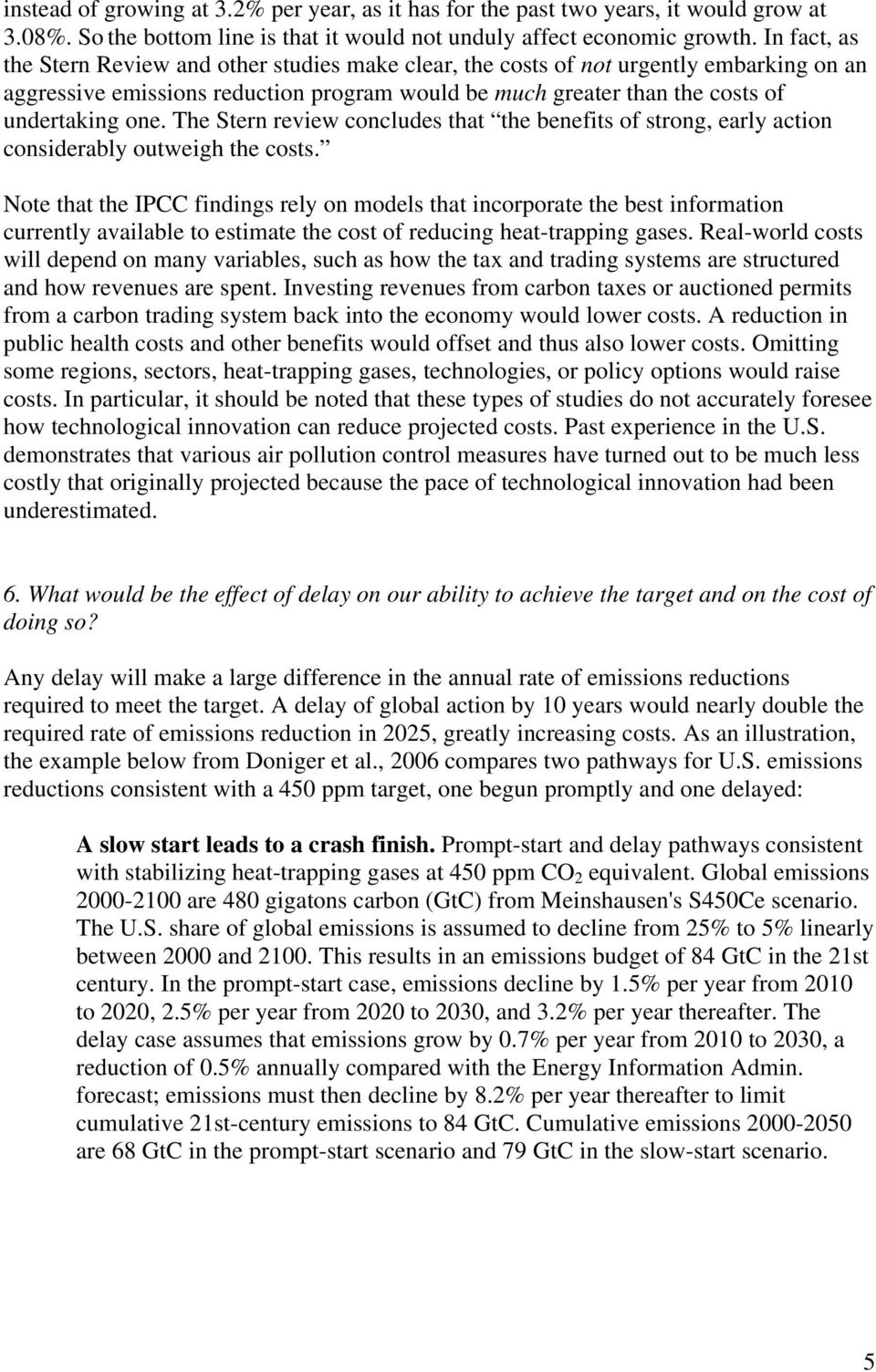
6 Note: The key is mislabeled in the graphic. The red curve is prompt and blue is delay 7. Are the goals of holding CO 2 to 450 ppm and 2ºC still credible and achievable? Yes. But there is no time to waste. If we delay action by even a few years, the rate of reduction needed to achieve these goals would then have to be beyond anything achieved historically and could be very costly, making it practically unachievable. 8. Who are the scientists and scientific institutions that subscribe to those goals as the threshold of dangerous climate change? Essentially all scientific bodies that have taken a stand have agreed with this goal. Some leading researchers, for example, James Hansen of NASA, argue for a slightly lower allowable level of temperature rise, no more than 1ºC from current levels. The work of Malte Meinshausen, which has synthesized many studies on climate sensitivities, has concluded that we would need to stabilize at about 400 ppm CO 2 e (including all forcings) in order to be likely to avoid exceeding the 2ºC threshold (even at that stabilization target, there is still about a 20% chance of exceeding the temperature target). 9. Everyone seems in agreement that developed nations need to reduce carbon emissions 80% below 1990 levels by What goals are needed for 2030 and what is the scientific foundation for the answer? There is not a simple answer because there is some flexibility in how much emissions are reduced in any given year. What is essential is to begin immediately, as delay will be costly, both economically, and in terms of achieving the climate stabilization goals. There are various pathways to get there, some involving sharper earlier cuts than others. Because energy efficiency provides the cheapest, easiest cuts at present, there should be a good deal of low-hanging fruit, especially in the U.S. where there is so much room for 6

7 improvement in this regard. Thus, early inexpensive cuts should be relatively easy and cuts should get harder after those are exhausted. On the other hand, as non-carbon energy technology options are further developed, cuts may well become easier in the future. 10. Many leaders in the U.S. climate-action community stress that our emission reductions should be front-end-loaded that we should achieve high, early reductions. Let's consider the strategy you outline under Question 4 above that developed nations would reduce emissions an average of 2% annually between 2010 and 2020, and the five major developing countries would begin reducing their emissions in 2021 at a rate of 2% each year compared to their 2020 emission levels. While 2% annual reductions are nice and neat, they don't fulfill the requirement that cuts be front-end loaded. What should PCAP propose instead -- again on a strong scientific and economic footing? Can we go above 2% annually without damaging the economy? It would seem to make sense to propose 2% annual reductions as the minimum targets and shoot for more, since the lower and earlier emissions peak, the slower the rate of emissions reductions that will have to be achieved later and the less severe the impacts of climate change will be. It may be possible to exceed 2% annual reductions without damage to the economy if it is done right, with economically efficient policies. This is true because energy efficiency improvements actually save money, and creating a new, low-carbon energy system will have many benefits, like jobs growth and investment, that will offset costs, particularly if one takes a longer term, bigger picture view of the economy. If appropriate, effective, and efficient policies are put in place, economic costs can be minimized and benefits maximized. Acknowledgements This paper was written by Susan Joy Hassol, Director, Climate Communication. The author appreciates helpful input and reviews by William Chameides, Dean, Nicholas School of the Environment and Earth Science, Duke University; Prasad Kasibhatla, Nicholas School; and Malte Meinshausen, Potsdam Institute for Climate Impact Research. Key References IPCC (2007). The Fourth Assessment Report of the Intergovernmental Panel on Climate Change, Cambridge University Press. The Stern Review on the Economic of Climate Change (2006). Cambridge University Press. Meinshausen, M. (2006). What does a 2 C target mean for greenhouse gas concentrations? A brief analysis based on multi-gas emission pathways and several climate sensitivity uncertainty estimates. In Avoiding Dangerous Climate Change, J. S. Schellnhuber, W. Cramer, N. Nakicenovic, T. M. L. Wigley and G. Yohe. Cambridge, Cambridge University Press. Kasibhatla and Chamedies (2007). G8 Leadership is Critical to Curbing Energy-Related CO 2 Emissions. Nicholas School of the Environment and Earth Sciences, Duke University. Doniger, D., A. Herzog, and D. Lashof, (2006). An Ambitious, Centrist Approach to Global Warming Legislation, Science, 3 Nov. Hansen, J. et al. (2007). Global Temperature Change. Proceedings of the National Academy of Sciences. 7

Keeping below 2 degrees
 Keeping below 2 degrees Avoiding dangerous climate change It is widely recognised that if the worst impacts of climate change are to be avoided then the average rise in the surface temperature of the Earth
Economic Development and the Risk of Global Climate Change
 14 Economic Development and the Risk of Global Climate Change Who is primarily responsible for creating the risk of global climate change? 78 Since the industrial revolution, economic development has been
FACTS ABOUT CLIMATE CHANGE
 FACTS ABOUT CLIMATE CHANGE 1. What is climate change? Climate change is a long-term shift in the climate of a specific location, region or planet. The shift is measured by changes in features associated
Implications of Abundant Natural Gas
 Implications of Abundant Natural Gas JAE EDMONDS AND HAEWON MCJEON APRIL 2013 May 29, 2013 1 Background May 29, 2013 2 The natural gas revolution The application of technologies for accessing unconventional
Are Humans Responsible for Global Warming?
 Are Humans Responsible for Global Warming? A REVIEW OF THE FACTS APRIL 2007 AUTHORS James Wang, Ph.D. Bill Chameides, Ph.D. Are Humans Responsible for Global Warming? The case for attributing the recent
Nuclear power is part of the solution for fighting climate change
 Nuclear power is part of the solution for fighting climate change "Nuclear for Climate" is an initiative undertaken by the members of the French Nuclear Energy Society (SFEN), the American Nuclear Society
Submission by Norway to the ADP
 Submission by Norway to the ADP Norway s Intended Nationally Determined Contribution 1. Introduction Norway is fully committed to the UNFCCC negotiation process towards adopting at COP21 a protocol, another
Data Sets of Climate Science
 The 5 Most Important Data Sets of Climate Science Photo: S. Rahmstorf This presentation was prepared on the occasion of the Arctic Expedition for Climate Action, July 2008. Author: Stefan Rahmstorf, Professor
INFORMATION NOTE. How Close Are We to the Two Degree Limit?
 INFORMATION NOTE How Close Are We to the Two Degree Limit? UNEP Governing Council Meeting & Ministerial Environment Forum 24-26 February, 2010 Bali, Indonesia By Chief Scientists Office, UNEP, in conjunction
SECTION 3 Making Sense of the New Climate Change Scenarios
 SECTION 3 Making Sense of the New Climate Change Scenarios The speed with which the climate will change and the total amount of change projected depend on the amount of greenhouse gas emissions and the
climate science A SHORT GUIDE TO This is a short summary of a detailed discussion of climate change science.
 A SHORT GUIDE TO climate science This is a short summary of a detailed discussion of climate change science. For more information and to view the full report, visit royalsociety.org/policy/climate-change
GETTING TO THE CORE: THE LINK BETWEEN TEMPERATURE AND CARBON DIOXIDE
 DESCRIPTION This lesson plan gives students first-hand experience in analyzing the link between atmospheric temperatures and carbon dioxide ( ) s by looking at ice core data spanning hundreds of thousands
Annex 5A Trends in international carbon dioxide emissions
 Annex 5A Trends in international carbon dioxide emissions 5A.1 A global effort will be needed to reduce greenhouse gas emissions and to arrest climate change. The Intergovernmental Panel on Climate Change
IEAGHG Information Paper 2015-10; The Earth s Getting Hotter and So Does the Scientific Debate
 IEAGHG Information Paper 2015-10; The Earth s Getting Hotter and So Does the Scientific Debate A recent study published in Nature Climate Change 1 suggests that the rate of climate change we're experiencing
The Science and Ethics of Global warming. Global warming has become one of the central political and scientific issues of
 The Science and Ethics of Global warming Global warming has become one of the central political and scientific issues of our time. It holds a fascination for scientists because of the tremendous complexity
Democratic and Republican Positions on Environmental Issues. Edward H. Klevans, Professor and Department Head Emeritus of Nuclear Engineering
 Democratic and Republican Positions on Environmental Issues Edward H. Klevans, Professor and Department Head Emeritus of Nuclear Engineering Issue: Climate Change Democratic Position The Democratic Platform
MATTERS RELATED TO THE UNITED NATIONS FRAMEWORK CONVENTION ON CLIMATE CHANGE (UNFCCC) AND OTHER INTERNATIONAL BODIES
 FORTY-THIRD SESSION OF THE IPCC Nairobi, Kenya, 11-13 April 2016 IPCC-XLIII/INF. 4 (9.III.2016) Agenda Item: 7.1 ENGLISH ONLY MATTERS RELATED TO THE UNITED NATIONS FRAMEWORK CONVENTION ON CLIMATE CHANGE
degrees Fahrenheit. Scientists believe it's human activity that's driving the temperatures up, a process
 Global Warming For 2.5 million years, the earth's climate has fluctuated, cycling from ice ages to warmer periods. But in the last century, the planet's temperature has risen unusually fast, about 1.2
The Nitrogen Cycle. What is Nitrogen? Human Alteration of the Global Nitrogen Cycle. How does the nitrogen cycle work?
 Human Alteration of the Global Nitrogen Cycle Heather McGraw, Mandy Williams, Suzanne Heinzel, and Cristen Whorl, Give SIUE Permission to Put Our Presentation on E-reserve at Lovejoy Library. What is Nitrogen?
The climate cooling potential of different geoengineering options
 The climate cooling potential of different geoengineering options Tim Lenton & Naomi Vaughan (GEAR) initiative School of Environmental Sciences, University of East Anglia, Norwich, UK www.gear.uea.ac.uk
Climate Control and Ozone Depletion. Chapter 19
 Climate Control and Ozone Depletion Chapter 19 Global Warming and Global Cooling Are Not New Over the past 4.5 billion years the climate has been altered by Volcanic emissions Changes in solar input Movement
What will global annual emissions of greenhouse gases be in 2030, and will they be consistent with avoiding global warming of more than 2 C?
 What will global annual emissions of greenhouse gases be in 2030, and will they be consistent with avoiding global warming of more than 2 C? Rodney Boyd, Nicholas Stern and Bob Ward Policy paper May 2015
The Kyoto Protocol Accomplishments and Failures. By Michael Chavez
 The Kyoto Protocol Accomplishments and Failures By Michael Chavez A History Treaty intended to achieve stabilization of greenhouse gases in the atmosphere at a level that would prevent dangerous anthropogenic
climate change is happening. This April produced the record for the first month in human history
 Tsering Lama Occidental College 15 Climate Change, Renewable Energy, and the Hong Kong Connection In a literature review, 97% of climate scientists have concluded that anthropogenic climate change is happening.
Chapter 3: Climate and Climate Change Answers
 Chapter 3: Climate and Climate Change Answers Section A: Climate 1. (a) Explain what each of the following means: (4 x 1 mark) (i) climate the average weather of an area over a 25 30 year period (ii) maritime
TeachingEnglish Lesson plans. Climate change. Worksheet A - Climate change the evidence Match the questions to the answers about climate change.
 Climate change Worksheet A - Climate change the evidence Match the questions to the answers about climate change. 1. What is climate change? 2. What is the greenhouse effect? 3. What is the evidence of
UNDERSTANDING CLIMATE CHANGE. 22 years of IPCC assessment
 UNDERSTANDING CLIMATE CHANGE 22 years of IPCC assessment Contents What is unique about IPCC?... 1 Who s who in the IPCC?... 1 How the IPCC reports are prepared... 2 The establisment of the IPCC... 4 The
COMMISSION STAFF WORKING DOCUMENT EXECUTIVE SUMMARY OF THE IMPACT ASSESSMENT. Accompanying the document
 EUROPEAN COMMISSION Brussels, XXX SWD(2014) 18 /2 COMMISSION STAFF WORKING DOCUMENT EXECUTIVE SUMMARY OF THE IMPACT ASSESSMENT Accompanying the document Proposal for a Decision of the European Parliament
Renewable Choice Energy
 Catawba College Table of Contents About Renewable Choice The Problem: Electricity Production Today The Solutions: Renewable Energy Sources Renewable Energy Credits (RECs) Who can participate in Renewable
WHEREAS environmental stewardship is one of the City of Santa Monica s core
 City Council Meeting October 11 2011 Santa Monica California RESOLUTION NUMBER jotp 2 1 CCS City Council Series A RESOLUTION OF THE CITY COUNCIL OF THE CITY OF SANTA MONICA IN SUPPORT OF REDUCING GREENHOUSE
Status of China s regional trading programs: progress and challenge
 Status of China s regional trading programs: progress and challenge Fei TENG Institute of Energy, Environment and Economy, Tsinghua University 2013 Aug 13-15 Contents Background Pilot project at local
«Introduce a tax on Carbon Dioxide»
 «Introduce a tax on Carbon Dioxide» by Bert Bolin and Måns Lönnroth Article published in Dagens Nyheter the largest Swedish daily newspaper on March 24, 1988 Preamble: Continued release of greenhouse gases
Nordea Asset Management. Our Approach on Climate Change
 Nordea Asset Management Our Approach on Climate Change Introduction Scientific fact base The Intergovernmental Panel on Climate Change (IPCC) Fifth Assessment Report concludes that Climate change and
Global Warming and Greenhouse Gases Reading Assignment
 What is global warming? Global Warming and Greenhouse Gases Imagine you live in a timber shack in Alaska. It's chilly up there, so you build yourself a huge log fire and pile on all the wood you can find.
The atmosphere has a number of gases, often in tiny amounts, which trap the heat given out by the Earth.
 The Earth is wrapped in a blanket of air called the atmosphere, which is made up of several layers of gases. The sun is much hotter than the Earth and it gives off rays of heat (radiation) that travel
Calculating the Environmental Impact of Aviation Emissions
 Part 1: Calculating the Environmental Impact of Aviation Emissions Dr Christian N. Jardine Environmental Change Institute Oxford University Centre for the Environment Dyson Perrins Building South Parks
To approve Intended Nationally Determined Contributions of the Republic of Armenia under the UNFCCC according to the following Annex.
 Protocol Decision No 41, 10 September, 2015 Government of the Republic of Armenia On approving the Intended Nationally Determined Contributions of the Republic of Armenia under the UN Framework Convention
GREENHOUSE EFFECT & GLOBAL WARMING - The internet as the primary source of information
 GREENHOUSE EFFECT & GLOBAL WARMING - The internet as the primary source of information - The internet as a resource - Use reputable web sites Government agencies: EPA, NASA, DOE, etc Academic Institutions
Kyoto Protocol MEMO/04/43. What is the Kyoto Protocol? Bruxelles, 4 March 2004
 MEMO/04/43 Bruxelles, 4 March 2004 Kyoto Protocol What is the Kyoto Protocol? The United Nations Framework Convention on Climate Change (UNFCCC) and its Kyoto Protocol provide the only international framework
The Atmosphere. Introduction Greenhouse Effect/Climate Change/Global Warming
 Introduction Greenhouse Effect/Climate Change/Global Warming The Atmosphere The terms Greenhouse Effect, Climate Change, and Global Warming are often used interchangeably, yet they really refer to three
Financing New Coal-Fired Power Plants
 Financing New Coal-Fired Power Plants Guidance Note 2011 Coal is likely to be part of the energy mix for the foreseeable future. Therefore, to limit dangerous climate change, coal-fired power generation
The solution to the climate crisis: a just transition to 100% renewable energy for all by 2050
 The solution to the climate crisis: a just transition to 100% renewable energy for all by 2050 Towards a universally accessible, affordable, and zero emissions energy system. November 2015 Summary To avoid
A Summary of the Kyoto Protocol and the Marrakesh Accords By James G. Derouin Fredric D. Bellamy David R. Nelson Mark E. Freeze 1
 A Summary of the Kyoto Protocol and the Marrakesh Accords By James G. Derouin Fredric D. Bellamy David R. Nelson Mark E. Freeze 1 The Kyoto Protocol is an outgrowth of the United Nations Framework Convention
BRSP-7 Page 1. A Open B Covered C Covered / Water. Two different experiments are presented, each experiment using a different pair of models:
 BRSP-7 Page 1 Perhaps you have heard of the greenhouse effect. In a greenhouse, short-wave radiation from sunlight passes freely through the glass and is converted to long-wave radiation inside. But the
Scope 1 describes direct greenhouse gas emissions from sources that are owned by or under the direct control of the reporting entity;
 9 Greenhouse Gas Assessment 9.1 Introduction This chapter presents an assessment of the potential greenhouse gas emissions associated with the Simandou Railway and evaluates the significance of these in
Figure 1. The circular flow of global warming science, impacts, and policy. From "Climate Casino" Copyright 2013 by William Nordhaus
 Figure 1. The circular flow of global warming science, impacts, and policy. Figure 2. Global CO2 emissions, 1900-2010. Figure 3. Carbon intensity of U.S. economy, 1900-2010. Figure 4. A comparison of a
Why are developing countries exempt from the emissions targets?
 Kyoto Protocol Overview The Kyoto Protocol is a legally binding, international agreement that sets targets for industrialized countries to limit or reduce their emissions of greenhouse gases (GHG) by the
EXAMPLES OF SUCCESSFUL POLICY TOOLS FOR EMISSION REDUCTION
 Submission of the United Nations Environment Programme (UNEP) Sustainable Building Initiative (SBCI) to the Ad Hoc Working Group on Long-Term Cooperative Action under the Convention (AWG-LCA) 24 April
Understanding the Changes to Global Warming Potential (GWP) Values
 Understanding the Changes to Global Warming Potential (GWP) Values Sylvie Trottier, Climate Change Analyst [email protected] 2 nd February 2015 Primary QA Review by Vanessa Boudreau Sannier
Six greenhouse gases covered by the United Nations Framework Convention on Climate Change (UNFCCC) and its Kyoto Protocol are:
 Fact sheet: The need for mitigation United Nations Framework Convention on Climate Change Along with adaptation, mitigation is one of the two central approaches in the international climate change process.
September 9, 2015. Mr. John Eichberger Executive Director Fuels Institute 1600 Duke Street, Suite 700 Alexandria, Virginia 22314
 September 9, 2015 Mr. John Eichberger Executive Director Fuels Institute 1600 Duke Street, Suite 700 Alexandria, Virginia 22314 RE: CMU Life Cycle Greenhouse Gas Study for Light Duty Vehicles Dear John:
How to implement renewable energy and energy efficiency options
 How to implement renewable energy and energy efficiency options Support for South African local government solar water heaters energy efficient lighting energy efficient buildings public transport How
PRESS RELEASE. UN Climate Change Conference in Doha kicks off with calls to implement agreed decisions, stick to agreed tasks and timetable
 For use of the media only PRESS RELEASE UN Climate Change Conference in Doha kicks off with calls to implement agreed decisions, stick to agreed tasks and timetable (Doha, 26 November 2012) The UN Climate
STERN REVIEW: The Economics of Climate Change
 Executive Summary The scientific evidence is now overwhelming: climate change presents very serious global risks, and it demands an urgent global response. This independent Review was commissioned by the
E VIRO ME T Council meeting Luxembourg, 14 October 2013
 COU CIL OF THE EUROPEA U IO EN Conclusions on Preparations for the 19th session of the Conference of the Parties (COP 19) to the United ations Framework Convention on Climate Change and the 9th session
Systems Thinking and Modeling Climate Change Amy Pallant, Hee-Sun Lee, and Sarah Pryputniewicz
 Systems Thinking and Modeling Climate Change Amy Pallant, Hee-Sun Lee, and Sarah Pryputniewicz You know the effects of the proverbial butterfly flapping its wings. But what about an automobile driver?
White Paper Life Cycle Assessment and Product Carbon Footprint
 White Paper Life Cycle Assessment and Product Carbon Footprint Fujitsu ESPRIMO E9900 Desktop PC Climate change is one of the most important global challenges that society of the 21st century faces. According
ANALYSIS OF THE ADMINISTRATION S PROPOSED TAX INCENTIVES FOR ENERGY EFFICIENCY AND THE ENVIRONMENT
 June 28, 1999 ANALYSIS OF THE ADMINISTRATION S PROPOSED TAX INCENTIVES FOR ENERGY EFFICIENCY AND THE ENVIRONMENT INTRODUCTION A few months ago in the FY 2000 budget the President proposed a $3.6 billion
Pathways to a Low-Carbon Economy. Version 2 of the Global Greenhouse Gas Abatement Cost Curve
 Pathways to a Low-Carbon Economy Version 2 of the Global Greenhouse Gas Abatement Cost Curve McKinsey & Company takes sole responsibility for the final content of this report, unless otherwise cited. Copyright
Realities vs. Misconceptions about Climate Change Science
 Realities vs. Misconceptions about Climate Change Science The issue of climate change has received so much attention in recent years that it has become difficult for interested citizens and policymakers
EURELECTRIC responses to the invitation in Draft decision -/CMP.5 to make submissions to the UNFCCC secretariat on:
 EURELECTRIC responses to the invitation in Draft decision -/CMP.5 to make submissions to the UNFCCC secretariat on: 1. Inclusion of CCS in Clean Development project activities 2. Standardized baselines
Chapter 7: Greenhouse gases and particulate matter
 Additional material for Fundamentals of Sustainable Development, Niko Roorda, 2012. Chapter 7: Greenhouse gases and particulate matter Debates on the anthropogenic greenhouse effect and climate change
Natural Gas and Greenhouse Gases. OLLI Lectures November 2014 Dennis Silverman Physics and Astronomy UC Irvine
 Natural Gas and Greenhouse Gases OLLI Lectures November 2014 Dennis Silverman Physics and Astronomy UC Irvine Replacing Coal With Natural Gas Greenhouse Gas Reduction by Switching from Coal to Natural
BIRDLIFE INTERNATIONAL S ASKS FOR UNFCCC COP21
 Background BIRDLIFE INTERNATIONAL S ASKS FOR UNFCCC COP21 The climate change talks in Paris (UNFCCC COP21) are the culmination of several years of negotiations towards the adoption of a global climate
Fixing the Leaks: What Would it Cost to Clean Up Natural Gas Leaks?
 FACT SHEET AND ANALYSIS Fixing the Leaks: What Would it Cost to Clean Up Natural Gas Leaks? About the Authors: The study was designed, carried out, and written by Carbon Limits, a Norwegian consulting
Generating Current Electricity: Complete the following summary table for each way that electrical energy is generated. Pros:
 P a g e 1 Generating Current Electricity: Complete the following summary table for each way that electrical energy is generated. Generating Electrical Energy Using Moving Water: Hydro-Electric Generation
COST OF GREENHOUSE GAS MITIGATION [21jun, 10jul 1pm]
![COST OF GREENHOUSE GAS MITIGATION [21jun, 10jul 1pm]](/thumbs/40/20967958.jpg "COST OF GREENHOUSE GAS MITIGATION [21jun, 10jul 1pm]") 5 COST OF GREENHOUSE GAS MITIGATION [21jun, 10jul 1pm] Fix of Section 5 tables, but no change needed. EEH 955am 11nov00: The cost of greenhouse gas mitigation using renewable energy technologies depends
5 COST OF GREENHOUSE GAS MITIGATION [21jun, 10jul 1pm] Fix of Section 5 tables, but no change needed. EEH 955am 11nov00: The cost of greenhouse gas mitigation using renewable energy technologies depends
The role of CO 2 in pool water
 The role of CO 2 in pool water A series of e-mail articles from the research group onbalance, January 2006 The role of CO 2 in pool water #1 While some service techs go about their business taking care
BBC Learning English Talk about English Insight plus Part 3 Global Warming
 BBC Learning English Insight plus Part 3 Global Warming Jackie: Welcome to BBC Learning English dot com and another chance to hear Insight Plus - a series, first broadcast in 2001 that looks at the language
Materials Needed: Choose one of the following methods depending on how familiar your students are with the internet and how to use it.
 Teacher Information Lesson Title: Global Warming, Green House Effect and Climate Changes Lesson Description: This lesson helps students to understand or review their understanding of global warming, the
The economic competitiveness of nuclear energy
 How competitive is nuclear energy? by J.H. Keppler* The economic competitiveness of nuclear energy will be crucial for determining its future share in world electricity production. In addition, the widespread
Comprehensive emissions per capita for industrialised countries
 THE AUSTRALIA INSTITUTE Comprehensive emissions per capita for industrialised countries Hal Turton and Clive Hamilton The Australia Institute September 2001 the Parties included in Annex I shall implement
WHY IS BREATHING SO IMPORTANT?
 You need to breathe to stay alive. But how clean is the air you breathe? If you breathe dirty air, you are more likely to develop health problems and become ill. Plants and animals need clean air too.