
The Decade After High School
|
|
|
- Cecil Baker
- 10 years ago
- Views:
Transcription
1 The Decade After High School A PA R E N T S G U I D E Cathy Campbell Michael Ungar Peggy Dutton

2 The Decade After High School A PA R E N T S G U I D E Cathy Campbell Michael Ungar Peggy Dutton

3 Copyright Campbell, C. and Ungar, M. (2008) Published by: The Canadian Education and Research Institute for Counselling (CERIC) 18 Spadina Road, Suite 200 Toronto, Ontario M5R 2S7 Canada website: In collaboration with: Resilience Research Centre School of Social Work Dalhousie University 6414 Coburg Road Halifax, Nova Scotia B3H 2A7 Canada website: Project Website: Campbell, C., Ungar, M. and Dutton, P. The Decade After High School: A Parent s Guide Layout Design: MeisterWorks Graphic Design Photographs: purchased from This material may be used, reproduced, stored, or transmitted for non-commercial purposes. However, the authors copyright is to be acknowledged. It is not to be used, reproduced, stored, or transmitted for commercial purposes without written permission from CERIC. Every reasonable effort has been made to identify the owners of copyright material reproduced in this publication and to comply with Canadian Copyright law. The publisher would welcome any information regarding errors or omissions. All names and identifying details of the individuals in this publication have been changed to protect their privacy. The photos in this booklet are for illustrative purposes only. They are not actual photos of any individuals mentioned. ISBN

4 Acknowledgements We would like to acknowledge a number of people and organizations who have contributed to the successful completion of this project. First, we would like to thank the young people from across Canada who participated in our study. Their willingness to participate and to share their perspectives has allowed us to shed some light on the complex and often turbulent time that occurs in the decade after high school. We are indebted to the Canadian Education and Research Institute for Counselling (CERIC) who has made this project possible through their financial support. We would also like to express our appreciation to the Nova Scotia Department of Work and Labour Force Development and the Nova Scotia Community College for allowing us to include their materials in our resource section for parents. Research Team Principal Investigators Cathy Campbell, BEd, MSW Halifax, Nova Scotia Advisory Board Sandy MacDonald, PhD Superintendent, PEI Eastern School District Charlottetown, Prince Edward Island Laurie Edwards, MPA Director, Learner Workforce Services Nova Scotia Community College Halifax, Nova Scotia Kris Magnusson, PhD Associate Vice President, Academic University of Lethbridge Lethbridge, Alberta Funder Canadian Education and Research Institute for Counselling (CERIC) 18 Spadina Road, Suite 200 Toronto, Ontario M5R 2S7 Michael Ungar, PhD School of Social Work, Dalhousie University Halifax, Nova Scotia Research Assistants Catherine Barlow, MSW Guelph, Ontario Megan Campbell, BA Halifax, Nova Scotia Susan Conohan, BEd Montague, Prince Edward Island Terri Scoville, PhD Candidate Calgary, Alberta Jennifer Thannhauser, PhD Candidate Calgary, Alberta ACK NOW LEDGEMEN TS III
5 Table of Contents Introduction 1 Chapter One: It s a Different World Out There 3 Young Adults are Different Career Pathways are Different Career Pathways Quiz Chapter Two: Finding Their Place 9 Navigators Explorers Drifters Is One Strategy Better Than Another? The Outcomes of Navigating, Exploring, and Drifting Chapter Three: Forces at Work 17 Self Awareness Education Credentials Exposure to a Range of Options Financing Post-Secondary Education The Labour Market Guidance and Support from Others Expectations and Messages Chance Events Chapter Four: Becoming Your Child s Career Guide 25 Suggestions for parents Resources for Parents 37
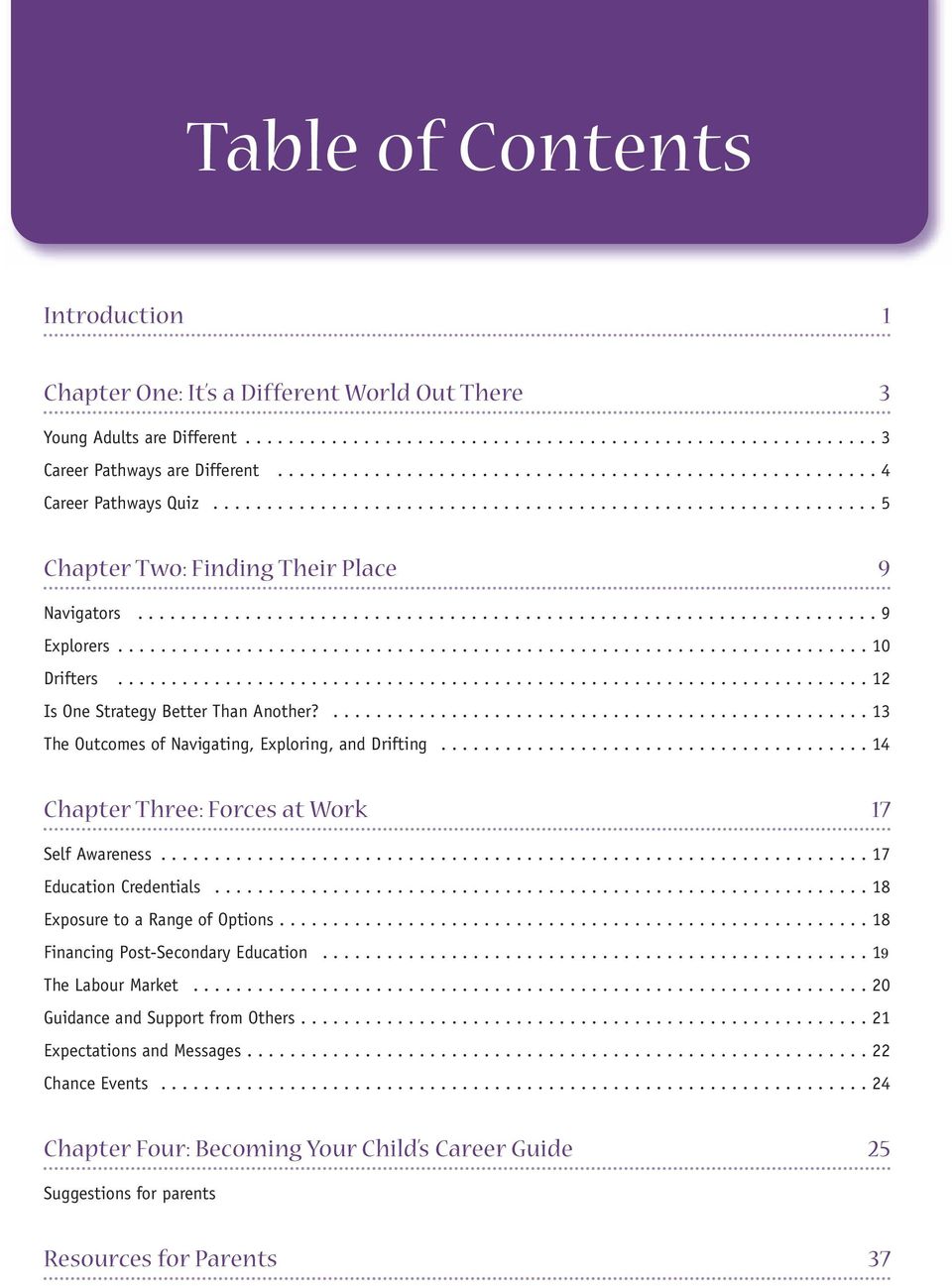
6 Introduction The transition from high school into educational and occupational pathways is a bewildering process for many young people and their parents. From the time they start kindergarten to the day they graduate from high school, most youth travel down a relatively straightforward path. They proceed systematically from one grade to another. Everyone their age is doing pretty much what they are doing school-wise, and career decisions are something for the distant future. Then comes high school graduation and the roadmap ends. Some young people move smoothly into post-secondary training and satisfying work while others flounder. They change their education programs multiple times or drop out altogether. Many graduate from college or university with no idea what they want to do and spend years careening from one job to another and back to school in an attempt to establish themselves in a fulfilling career. Parents are left on the sidelines, watching and worrying as their children struggle to find a place for themselves in the work world. In the past, you ve always been able to give your children the benefit of your experience in the form of solid information, helpful advice, and comforting encouragement. Now you feel helpless. There are so many more choices than when you were your children s age. How will they know what s best for them? Education has become so expensive. How can they avoid making a costly mistake? The labour market feels like one big rollercoaster. What guarantees are there that good jobs await them, even if they invest the time and money into college or university? You want to be able to guide your children through a successful transition into adulthood. You don t want to be a dictator. And you don t want to be a nag. But sometimes it happens just the same. Anxiety gets fuelled with frustration when your children don t seem to be getting serious about their futures. The temptation is to become critical or interfering as you try to prod your child into choosing a post-secondary education program or getting a decent job. In 2007 and 2008 we interviewed 100 young Canadians about their educational and career experiences in the ten years after graduating from high school. They described their successes and missteps; they spoke of pride of accomplishment and regrets for missed opportunities; they gave their best advice on what assistance they wished they had had when they were in high school. Out of that study, a guide for counselling professionals was created, as well as this booklet for parents written to give you hope and guidance. We start by offering you a glimpse into the world of today s emerging adult. We describe the multiplicity of pathways that youth follow when training for and finding their way in a labour market that is vastly different from when you were starting out. We conclude with practical suggestions for constructive roles you can play, activities you can undertake, and resources you can use as you help your children make informed, personally satisfying career decisions. Throughout the book we share the stories of the young people we interviewed and let their voices speak to you. I N T R OD U C T ION 1
7 Chapter One It s a Different World Out There Eighteen and getting out of high school, your whole world changes. It s a scary place. Think back to when you were eighteen and what you had to do with your parents. S24-year-old participant from Calgary Parents often assume that things haven t changed that much since they graduated from high school. They think that what worked for them will work for their children. Cassie, a 25-year-old, complained that her parents didn t get how much things had changed: I don t know if this is a generation thing, but my parents say things like, When I moved out at eighteen I never moved back home. I always took care of myself. My parents are very supportive financially and they don t really say much about it. At the same time, it s like you should be able to stand on your own two feet. My dad s like, I went to architecture school and became an architect. It s straightforward. You do this and then you become that. So it was like, what are you doing with your life? Things have changed. The way young people grow up has changed. The labour market has changed which means the way young people make career decisions has also changed. These shifts have impacted how young people navigate through the complexities of finding their place in a work world where the old rules don t apply anymore. Let s take a peak at what s happening with young people today. Young Adults are Different It s tough being a parent of older teenaged and twentysomething kids these days when you swore you would never become like your own parents. But, when you see your children without direction, wandering from one menial job to another or one training program to another, it s hard not to conclude that something is lacking in their motivation. You think back to when you were their age: you had finished school and were out on your own with a full-time job. Heck, you might have been married by then, started a family, even working on your first home mortgage. What s going on with this generation? C H A P T E R ONE 3

8 Dr. Jeffrey Arnett, a developmental psychologist, has spent a lot of years researching that very question. Dr. Arnett says that the transition from student to full-fledged adult is taking longer than it used to. He contends that the period between ages 18 and 25 is sufficiently distinct from other phases of human development that he s coined a term to describe it, emerging adulthood. As Arnett sees it, the early twenties is a time where many young people don t feel like adolescents, but they re not really feeling like adults yet either. 1 This period of emerging adulthood is the result of shifts in society that have been going on since the late 1960s. Posthigh school training is taking longer. Marriage and children are being postponed (or outright rejected). Youth expect, and have the freedom, to experiment with different options before they decide where they want to live, what work they want to do, and what lifestyle they want to pursue. 2 Added to the mix are some newer phenomena. Education has become more costly and many twentysomething college and university graduates are struggling to support themselves as independent adults. The proliferation of so many new career options means that making a choice can be quite overwhelming. Lastly, many young people have watched their parents cope with their own career disappointments and they are reluctant to make decisions that may lead them down similar paths. Taken altogether, many young adults are in no hurry to make decisions that may pigeon-hole them into a life they do not want to lead. They want to take the time to try out different experiences, explore their options, learn more about themselves, and stay open to opportunities that may come along further down the road. As a result, many of the major life decisions that used to be settled in a person s early twenties are now being postponed. Some young people build their careers in a systematic way by carefully considering their options and investigating the pros and cons of their choices. Just as often, however, career decisions are made in a haphazard fashion, with youth taking whatever jobs happen to come their way or enrolling in the post-secondary education institution that s closest at hand. Sometimes this laissez-faire approach works out just fine and the young person lucks into an option that fits his interests and personality. More frequently it doesn t. Whether focused or fuzzy, the one constant in the lives of emerging adults is that their plans keep changing. They may graduate from a program only to discover that they can t find a job or they don t like the work. Their postsecondary application may be declined and they have to return to the planning board. They may bounce around in entry-level, part-time, or short-term work, trying to find that full-time job that will establish their career. They may return to school to get re-credentialed for a career field that holds more promise. All of this trial and error and forwards/backwards/sideways maneuvering takes time. The good news, however, is that a few years does seem to make a difference. By their late twenties, most young people have become more settled. 3 Even if they haven t achieved their career goals yet, they have a sense of what those goals are and what it takes to reach them. As frustrating as this may be for parents to watch, things do come together in their own time. See: High Five Messages for Parents Career Pathways are Different At one time it may have been true that young people made relatively straightforward transitions from high school into the workforce. Today it is no longer the norm. Young people spend many more years experimenting with post-secondary education programs and jobs, trying to figure out who they are, what they want, and where they fit. How much do you know about the way that youth go about establishing their career pathways? Take the quiz on page 5 to test your knowledge of the educational and work experiences of young Canadians today. 4 THE DECADE AFTER HIGH SCHOOL: A PARENT S GUIDE
9 Career Pathways Quiz 1. True or False? It is normal for 18-year-olds to have made final decisions about their future education and career plans. 2. % of high school students in Canada go to post-secondary education within three years of graduation. a. 40% b. 64% c. 82% d. 93% 3. % of students drop out before completing their post-secondary education program. a. 6% b. 15% c. 26% d. 32% 4. % of post-secondary students graduate from a different program than the one they started in. a. 19% b. 31% c. 45% d. 60% 5. % of parents who completed university hope their children will do the same. a. 52% b. 70% c. 84% d. 94% 6. True or False? The more educational and career choices a young person has the easier it is to decide. 7. % of high school and university students reported that at least one chance event influenced their educational or career path. a. 10% b. 50% c. 70% d. 90% 8. % of Canadian university students owe, on average, more than $20,000 when they graduate with a bachelor s degree. a. 10% b. 32% c. 44% d. 50% 9. Two years after graduation % of Canadian undergraduates are in jobs that do not require the skills they have gained in university. a. 29% b. 50% c. 62% d. 71% 10. The transition from high school to full-time work now takes approximately years for young adults to complete. a. 4 years b. 6 years c. 8 years d. 10 years 11. % of high school students would like additional help with career planning. a. 25% b. 42% c. 64% d. 70% 12. Who are high school students most likely to approach for help with career planning? a. parents b. friends c. guidance counsellors d. teachers C H A P T E R ONE 5
10 Answers Career Pathways Quiz 1. True or False? It is normal for 18-year-olds to have made final decisions about their future education and career plans. Answer: False. Some 18-year-olds have travelled, held part-time jobs, or been involved in extracurricular activities. Some have done little other than study. Young people can t be expected to know what they are passionate about when they haven t had much experience yet. They also tend not to know much about the choices they are considering. What they do know often comes from misinformation or the opinions of family and friends. It is both astounding and distressing how many young people complete a training program oblivious to the realities of the work they will be doing upon graduation % of high school students in Canada go to post-secondary education within three years of graduation. 4 For parents who worry that their child won t ever go to college or university if they don t go directly after high school graduation, the facts should help allay your fears. Young people are well aware of the critical role that post-secondary education plays in terms of increasing their employment prospects. The vast majority of high school graduates do go to some type of post-secondary education, even if they opt for a break in their studies for a year or two % of students drop out before completing their post-secondary program. Not every young person is ready to go directly into post-secondary education, or is able to continue with their studies once they have enrolled. The most common reasons for dropping out are not having enough money, not liking a program, and wanting to work % of post-secondary students graduate from a different program than the one they started in. 6 Parents tend to assume that their children have made a firm decision when they choose a post-secondary program. The truth is quite different. Many young people use their college or university experience to test the waters and learn more about themselves. Some change programs more than once. Approximately 25% try three or more programs % of parents who completed university hope their children will do the same. 8 More than ever before, parents expect their children to acquire high levels of education. This is particularly true for parents who have university degrees themselves. Young people s educational aspirations for themselves are even higher. Remarkably, over 50% of high school graduates say they want to get a master s or Ph.D. degree. We know, however, that ten years after high school graduation only 4% of the population will have completed any graduate education The more educational and career choices a young person has the easier it is to decide. Answer: False. Too much choice can mean too much of a good thing. Just like trying to choose a box of cereal from the 50 brands on the grocery shelf, young people can become overwhelmed trying to evaluate all the options in front of them to come up with the best choice. Even when they choose, many continue to worry that they may have made the wrong decision, that maybe one of the choices they left behind was the right one % of high school and university students reported that at least one chance event influenced their educational or career path. 11 You should never underestimate the extent to which luck and unexpected events factor into the direction a young person s career path will take. For better or for worse, events beyond our control such as a chance encounter, an unexpected promotion, an illness, or obstacles to the original plan can either expand or contract the options that are available for a young person to consider. 6 THE DECADE AFTER HIGH SCHOOL: A PARENT S GUIDE

11 8. 50% of Canadian university students owe, on average, more than $20,000 when they graduate with a bachelor s degree. The cost of getting a post-secondary education is serious business for most young people and their parents. Close to 15% of students owed more than $25,000 when they graduated. 12 A graduating student with a $25,000 loan in 2008 will be indentured to the tune of $300 a month for ten years. It s little wonder that half of those who graduate with sizable debts say they re having difficulty making their payments. High levels of student debt also make it difficult for graduates to pursue further education which might improve their chances of getting better employment. 9. Two years after graduation, 50% of Canadian undergraduates are in jobs that do not require the skills they have gained in university. Young people with post-secondary degrees, diplomas or certificates are less likely to be unemployed and more likely to have a higher salary than those with only a high school diploma. 13 Post-secondary credentials, however, do not guarantee that young people will be well employed after they graduate. Many remain under-employed in jobs where they have significantly more education and skills than are required for the work they are doing. 10. The transition from high school to full-time work now takes approximately eight years for young adults to complete. 14 Until recently, the transition to adulthood was compressed into a relatively short timeframe. 15 Most youth entered the workforce directly after graduating from high school. Those who went to post-secondary education were generally able to find good jobs immediately after graduation. Today s youth face a different reality. Job prospects for those without post-secondary education are becoming increasingly limited. The need to invest in post-secondary education significantly increases the time it takes young people to make the transition from high school to full-time employment % of high school students would like additional help with career planning. 16 Many parents think that their children are disinterested in planning for the future. In reality, youth see career planning as being so important and daunting that they often avoid the issue and then make snap decisions under duress. 12. Who are high school students most likely to approach for help with career planning? Answer: parents. Parents have a tendency to think that their teenaged children don t want to hear what they have to say and won t listen when they do try to have a career conversation. This couldn t be further from the truth. In a survey of 7000 senior high school students in Alberta, 75% cited parents as being in the top three people they were most comfortable asking for career planning assistance, compared with friends at 43%, experts in the field at 42%, and counsellors at 36%. 17 This shouldn t come as a total surprise. In many families there has been a lifetime of building a relationship of familiarity and trust; the career question is simply another dimension of that relationship. The way it is supposed to look Most parents hope that their children s career path will follow a linear, predictable route from high school to The post-secondary way it is supposed training, and to then lookon to a permanent full-time job. Graduate from high school The way it looks for most In reality, most young people s career paths today look The way it looks for most something like this: Start post-secondary education Graduate from high school Change programs Graduate from college/university Change jobs Get a good job Retire Go back to school Take a year off Retire Work part-time C H A P T E R ONE 7

12 1. Jeffrey Jensen Arnett, Emerging Adulthood: A Theory of Development from the Late Teens Through the Twenties, American Psychologist 55 (2000), Jeffrey Jensen Arnett, Emerging Adulthood: The Winding Road from the Late Teens through the Twenties (New York: Oxford University Press, 2004). 3. Ibid. 4. Danielle Shaienks and Tomasz Gluszynski, Participation in Postsecondary Education: Graduates, Continuers and Drop Outs, Results from YITS Cycle 4 (Ottawa: Minister of Industry, 2007). 5. Ibid. 6. Ibid. 7. Ibid. 8. Lesley Andres, Educational and occupational participation and completion patterns of the Class of 88. A ten year perspective. (Vancouver: Commissioned report by the BC Council on Admissions and Transfer, 2002) 9. Ibid. 10. Barry Schwartz, The Paradox of Choice: Why Less is More ( New York: Harper Collins, 2004). 11. Jim Bright, Robert Pryor, and Lucy Harpham, The role of chance events in career decision making, Journal of Vocational Behavior, 66, no.3(2004): Statistics Canada, National Graduates Survey: Student Debt The Daily, 26 Apr /d040426a.htm (accessed 1 Jan. 2005). 13. Mary Allen, Shelley Harris, and George Butlin, Finding their way: a profile of young Canadian graduates.(ottawa: Ministry of Industry, 2003) 14. Sandra Franke, Studying and Working: The busy lives of students with paid Employment, Canadian Social Trends, (Spring 2003): Roderic Beaujot, Delayed Life Transitions: Trends and Implication. (Ottawa: Vanier Institute of the Family, 2004). 16. Kris Magnusson and Kerry B. Bernes,. Perceptions of Career Planning Needs: The Importance of Relational Supports for Students (paper presented at the Canadian Counselling Association Conference: Halifax, Nova Scotia, May 21, 2003). 17. Kim Witko, Kerry B. Bernes, Kris Magnusson, and Angela D. Bardick, Senior high school career planning: what students want. Journal of Educational Enquiry 6 no. 1 (2005), THE DECADE AFTER HIGH SCHOOL: A PARENT S GUIDE

13 Chapter Two Finding Their Place I don t believe that, at eighteen, most people have any clue what they re going to do, nor should they really. You ve just got to go through the years and you ll eventually figure it out. S25-year-old participant from Halifax It s hard for our children to choose a career direction until they know themselves well enough to be able to determine what they want to do. Ideally, young people have the opportunity to learn about their interests and abilities and to explore different options before they are required to decide. By the time they graduate from high school, some young people do have enough self-awareness and exposure to occupations to be reasonably confident that what they have chosen will be a good fit. Others need more time. No matter what it might look like from the outside, on the inside most young people really are trying to figure out where they belong in this world. They want to find a place where they can use their energies, passions, and abilities in a way that is meaningful. While the intention may be the same for all young people, the journey certainly isn t. The routes youth take are as varied as the individuals steering the course. To help you get a handle on how your children may be managing their career pathways, we have grouped the common themes under three broad categories that we call Navigators, Explorers, and Drifters. Navigators Now you have some idea why the late teens and twenties can be a chaotic time. But what s actually going on in your child s mind? One minute, your daughter has definitely decided to pursue environmental technology. A few weeks later, she s talking about computer animation. What s happening as she ricochets from one plan to another? Navigators are those young people who have a plan. They know what they want to do. Sometimes they ve known since they were quite young. Now it s full steam ahead, doing what s necessary to achieve their goal. Jenn, a 23-year-old, is in the process of getting her counselling psychology degree. She knew she wanted to be a psychologist since she was in Grade 10: C H A P T E R T WO 9

14 I knew that I wanted to work with people and to help them. There s all the people that take care of physical well being. That s not for me. I could never cut into somebody or inject somebody. I thought that mental well-being was just as important. Tim, another 23-year-old, aspired to be his own boss since graduating from high school: I took an entrepreneurship class in high school. It was my favourite class. Anytime they started talking about business, I paid full attention. I always liked selling when I was young. I used to go and sell stuff at the craft fairs and, when I took the course, it just caught me. For some Navigators, their plans go as they intended. They love their college or university programs and they excel as students. When they graduate, they find jobs related to their training and are rewarded with work that is interesting and satisfying. Other Navigators are not so fortunate. They start out with a concrete direction but, for any number of reasons, their plans derail. Jeff, a 28-year-old, navigated to a hot career area without considering whether he was interested in it: At the time when I went to university, computers were the thing, so that s what I did. Thinking, I like to play computer games, I ll love computer science. Not the same thing at all. I went to university for three years and I got my certificate in computer science, which is now just a real expensive banner on the wall. Henri navigated toward a career as a golf pro, but now works in the fishing industry where he can make a better living: My original plan was to stay in the States where I could work year round. Then I decided to come back and I got a job at a local golf academy. I was still planning to go to the States because in Canada the golf season is so short. But, I met my wife, got married, stayed here, and kind of got away from golf. Tessa, a 25-year-old, got a big break when she was hired as an art gallery curator. Her career dream was derailed, however, when a nasty work environment shattered her self-confidence. It turned out to be an absolute nightmare. My boss was abusive mentally and emotionally. So I left five months into my contract and I haven t worked in the field of art since. It was just a bad start to my career. It severely impacted my confidence. I went through periods of being extremely afraid to apply for any jobs in the art world, let alone talk to anybody from the art world. I felt like she probably dragged me through the mud. I still don t know to this day if she has or not. Explorers Explorers don t know specifically what they want to do, but they re actively trying to figure it out. They spend time thinking about where they might put their interests and talents to best use. They research the requirements and realities of possible career options. They seek out experiences to test whether an option is truly a good fit. Along the way, Explorers evaluate, reject and keep in reserve 10 THE DECADE AFTER HIGH SCHOOL: A PARENT S GUIDE
15 different options, until they are finally comfortable making a decision. Some Explorers have a good sense of themselves and just need more experiences to confirm their interests as they relate to education or work choices. Alicia is a 25-year-old who works for an immigrant settlement agency. She became aware of her interest in human rights and community development through volunteer work she did in high school. After graduation, she participated in an international educational exchange program which led to a series of paid and volunteer jobs working on environmental, social justice, and cross-cultural issues. After high school, I didn t really have a clear idea what I wanted to do. I knew that I wanted to travel, experience other cultures, I knew that I wanted to make a difference. I knew that I wanted to work with people in some context. Canada World Youth was what led to the next thing and led to the next thing and then here I am now, with a great job and working with youth who are from cross-cultural backgrounds. Other Explorers use college or university as a time to clarify their interests. Tanya knew about some of her strengths, but she didn t know where the training she chose would lead her: I played sports in high school and really enjoyed the team atmosphere and I was quite good at organizational skills. Part of the program I took was about running facilities, putting together tournaments and things like that. I didn t know what I was going to C H A P T E R T WO 1 1

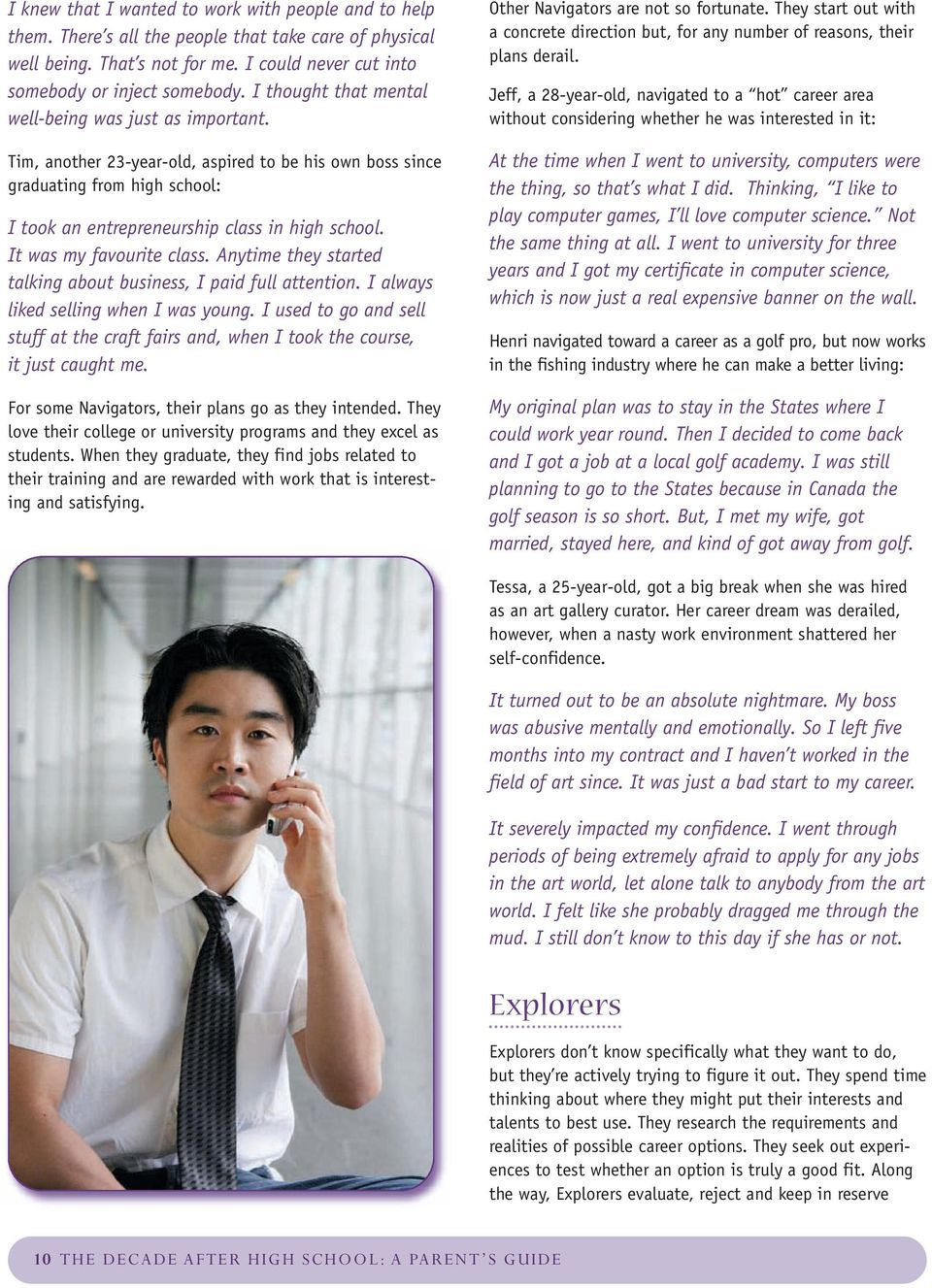
16 do at the other end, but it started me in some sort of direction. Then there are those Explorers who are full of interesting possibilities. They need time to sort through their options to decide which comes out on top. Maud, a 26-year-old, graduated with a science degree, then travelled before returning home. She now has a job as a youth worker which she knows she doesn t want to do long term. Maud is using her time to weigh her different options: I ve had lots of ideas. Medicine was a big one: I thought about that for quite some time, then opted not to go ahead with it. I didn t want the lifestyle and the schooling that went into it. I ve thought about being an OT [occupational therapist], going into naturopathic medicine, working at a vineyard, doing eco-tourism. I ve gone all over the map. This job has given me time to learn more about myself, flip-flopping through ideas as different interests occur to me and then trying to find one that suits. The late teens and early twenties are an ideal time for exploration because most young people are still single and not hemmed in by too many responsibilities. The time for exploring, however, starts to run out once marriage, children, and mortgages come on the scene. This was the case for Shauna, a 29-year-old, who had spent the preceding decade exploring her options. She would like to continue looking for more meaningful work, but she doesn t find it that easy since getting married: I have to be more calculated about exploring and go about it more intentionally. The question is, given my responsibilities, how can I satisfy my curiosity? Drifters Drifters don t know what they want to do, are lackadaisical about making choices, or face significant barriers to getting their career started. Being unable or unwilling to actively seek a career direction, they are apt to go with the flow. Some Drifters aren t ready to face up to the challenge of making a career decision. To avoid the discomfort they are feeling, they take the most convenient path that is at hand. Bianca reflected on her first year after high school: I remember graduating and thinking, I don t want to deal with school. Work was a way of being lazy because all you ve got to do is show up, do your job, and go home. There s nothing stressful or uncertain about it, whereas applying to school and making choices about your future, it s scary. So, I was like, I m going to work this stupid job and see what happens, until it drives me nuts and then I ll go to the next thing. Others drift because their lack of education keeps them stuck in low skill/low wage jobs. Jake is a 29-year-old who works as an unlicensed mechanic. After graduating from high school, he completed an autobody course, but couldn t find a job in his field because of poor health. For ten years, Jake drifted from one job to another. Most of them were just dead-end jobs. I probably shouldn t have even bothered with them. It wasn t what I wanted to be doing. They were just a job to make some money. They really had no future. I just got by and haven t done anything really meaningful career-wise. In the time I ve had, I could have done a lot more than I did, but I just go day to day. 12 THE DECADE AFTER HIGH SCHOOL: A PARENT S GUIDE
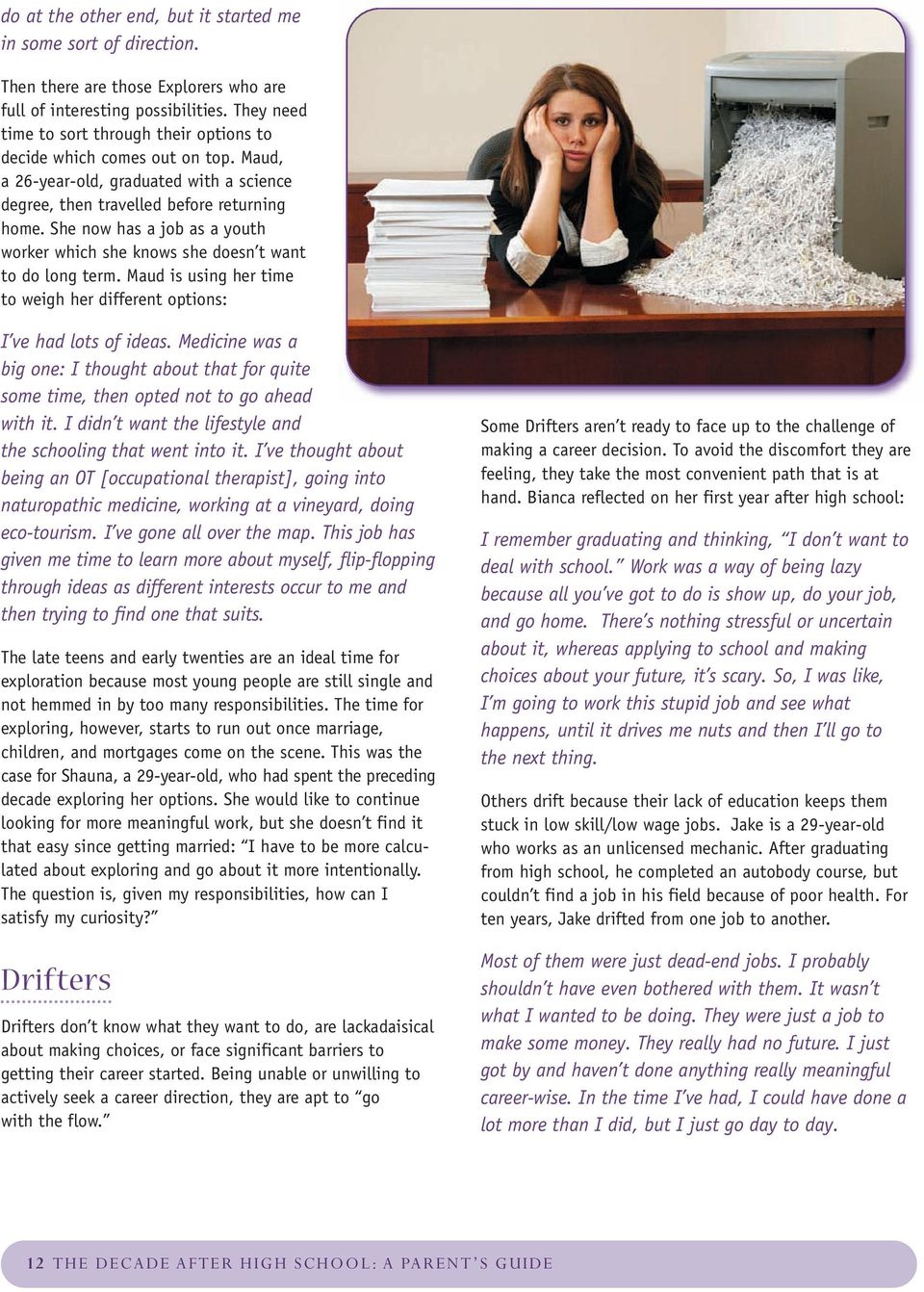
17 I ski a lot and there s better skiing in Calgary. I just wanted to see what Calgary was like. What many drifters fail to realize is that, by not deciding, they are in fact making a decision. They are choosing to avoid the issue by sticking with familiar routines where it is unlikely they will gain new experiences or become exposed to new possibilities. The typical image of a Drifter is someone who is wasting their time working in dead-end jobs, or not working at all. Jake s a good example of this: a decade after graduating from high school, he has little to show in the way of credentials, marketable skills, or prospects to improve his situation. However, Drifters are not always easy to spot. Graduate and professional schools are favourite hiding places for high functioning drifters, bright students who deal with the uncertainty about what to do by simply continuing to go to school. John is one such high functioning drifter: When I did my undergrad, I did a few co-op work terms and they provided very low job satisfaction. I don t even really know why I did computer science. I never owned a computer in my life. I always did well in school so one of the professors said I should apply for a scholarship for graduate school. I got a full scholarship so school was for free. The real danger of drifting lies in sticking with it too long. As the years slide by, the Drifter is liable to lose confidence and motivation and become stranded. Getting back on track then takes a super-human effort. Is One Strategy Better Than Another? It is natural to assume that navigating is the best strategy and that drifting is not a good option. While many twentysomethings are still trying to figure out what to do, others, like Jenn and Tim, have navigated in a pretty straight line from high school to post-secondary education or work and love what they are doing. Surely, it makes sense to encourage our children to know what they want to do coming out of high school and then follow through on their plans. While Navigators appear to be ahead, it doesn t always work out that way. Illustrative of this are the pathways taken by two young people who graduated from high school in the same year. One navigated directly to university with the plan of becoming an architect. The other drifted into jobs in retail and the fast food industry. Likely those C H A P T E R T WO 1 3
18 around them at the time thought the Navigator was using a far better strategy than the Drifter. However, ten years later, the Drifter is working in a field that he loves, while the Navigator is still trying to figure it out. The Navigator didn t know much about architecture when she enrolled at university. Within two years, she knew that it wasn t for her. She dropped out to explore her passion for music. Along the way, she discovered that sound engineering could provide her with a decent living and keep her in the music industry. There was only one hitch: the student loan she d run up attending university made going back to school unthinkable. Her only option for now is to try to find work in the music field that doesn t involve training. The Drifter, on the other hand, saw his friends accumulating student loan debts and he became concerned about the cost of going to university. He opted to work in jobs that were at hand with the general notion of saving money, but with no career goal in mind. Purely by chance he surfed his way onto a dental technology website. While he wasn t particularly interested in the field, the offer of training was irresistible: Going through a website I found this listing for a dental lab and they said on-the-job training provided and it s like, okay why not? That s pretty much hook, line and sinker for me. It s like okay, that s a job where they don t want somebody to Mickey Mouse around. That s why I took the job. And they ve lived up to it. It was the biggest fluke of my life. The Outcomes of Navigating, Exploring, and Drifting You will be relieved to know that the majority of young adults resolve their career confusion by the time they reach their late twenties. How satisfied they are with their choices and the places they find themselves is another matter. We found that young people fell into two categories that we call Committers and Settlers. Committers Committers have found a place that clicks for them, one that they are generally happy with and have no plans to change any time soon. The good news is that many young people reach this stage within a decade of leaving high school. Shawn, a 29-year-old, is happily committed to his work: I ve been a chartered accountant for five years. Mostly my line of work involves auditing, but it can involve some taxation, other special work, dealing with clients. I really enjoy it. You don t see the same thing day after Needless to say, this young person might have returned to drifting if he hadn t liked the work or didn t have the aptitude for it. As it happened, he realized the opportunity he had been given and applied himself to become proficient and to progress in the field. 14 THE DECADE AFTER HIGH SCHOOL: A PARENT S GUIDE

19 Settlers Settlers have found themselves in a place that they don t particularly like maybe because of poor pay, boring work, no room for advancement, or whatever. But, for one reason or another, they are not ready, willing or able to make a change, so they settle. Some young people settle when adult responsibilities take priority. Mylinda is a 24-year-old with a Business Administration diploma. She works as a labourer in a furniture factory and feels she s vastly underemployed. But she and her boyfriend have recently purchased a home and there are bills to pay. This job, yeah. It s not just me I m thinking about now. I have to think about my boyfriend and we want to start a family. So, it s not just me: it s somebody else too. But we ve both made sacrifices. day: you don t know what you re going to be doing when you come in in the morning. I like that the most. Emma is a 28-year-old who works in the disabilities field. Her job commitment comes from the struggles she encountered raising her own child who has a disability: I enjoy helping families with disabilities. I ve lived the experience every day. Other professionals only know from the textbook side. I think that makes a huge difference when you understand what the family is going through. Committers are committed for now. Over time, they may find that their chosen work no longer fits new interests or skills they have developed. Or it may simply be a case of the job growing stale. Jacques, a 27-year-old engineer, found himself in that very situation: Now that I ve been in the same job for three, four years, I m not sure if there s any more room for growth. Maybe I need to do something different. I ve learned everything I can for this job. Do I move somewhere else within the company, or do I move to a different company? I ve hit that wall just recently, actually. Others settle because financial security is more important than work fulfillment. Sean is a 27-year-old who works as an engineering technician with the military. He doesn t especially like his job, but he does like the lifestyle his job affords him: I don t dislike my work, but I wouldn t say I enjoy it. It s something I do. I guess there are people who take a lot of enjoyment out of what they do for a living. C H A P T E R T WO 1 5

20 Nothing Stays The Same As you have been reading this chapter, did you recognize your child in any of the descriptions? Is he navigating; is she drifting? Has he committed to a satisfying goal or settled for what works in some sort of fashion? For me, this is a means to live my life the way I want to. It allows me to be comfortable financially, to pursue my hobbies, diving, volleyball, things I want to do outside of work. Still others settle because the thought of changing is so scary. Dimitri, a 28-year-old, has no intentions of changing his situation even though he harbours bigger dreams: I cherish the idea of being an oceanographer, a geologist, or that type of thing. For now, it s just going to be off to the side. If I see a road that goes down that way, I might be tempted. But then again, I m mostly driven by my fears. What happens if I lose my career? What happens if I take this leap of faith and I end up falling a couple hundred feet on my nose? The reality is, no matter where they are right at the moment, there s a good chance they won t be there for the long term. If they re drifting now, they may bump into an exciting possibility, and suddenly they ll be navigating towards it. If they re navigating now, they may be back exploring their options if student debt or low marks makes it impossible to follow their original plans. If they are committed to their career choice as a single person, they may have to settle for good enough to support a family. There tends to be a fair amount of turbulence in the early years of adulthood as youth seek out new experiences, learn more about themselves, and adjust to unfolding adult responsibilities. Over time, things usually start to stabilize. As they approach their late-twenties, most young adults have some idea about the direction in which they are headed, even if they haven t yet arrived at their destination. 16 THE DECADE AFTER HIGH SCHOOL: A PARENT S GUIDE

21 Chapter Three Forces at Work It s been a big lesson in life that things don t work out the way that you envision and that s not necessarily a bad thing. It s just that you re not always in charge. S27-year-old participant from Guelph Yes, times have changed. Still, does finding a place you can be happy with have to be so complicated and drawn out? Why is my neighbour s kid focused and navigating towards a goal, while mine is still drifting in the fog? What makes the difference? A lot, as it turns out. There is a lengthy list of variables that can impact on a young adult s ability to mobilize a career into action. Some relate to a person s attributes, while others are completely outside of their control. These forces interact with one another in complex ways and, for better or for worse, they affect each of us in a uniquely personal manner. We will look at some of the most common factors and how they either propel or impede a young person s progress down a career path. Self-Awareness Self-awareness is the cornerstone of everything else that follows when a young person is making decisions about suitable training or career options. Without at least some inkling of who he is, a young person is just groping in the dark. Most high school students only have a vague notion about their interests and abilities, and they can get quite frustrated when you start quizzing them. They know the specific things they like and don t like to do, but they usually have no concept of what that means in terms of broader interests and abilities. Those youth who are uncertain about how their interests and abilities might be applied are likely to go through a prolonged process of trial and error before they get headed in the right direction. As one 28-year-old put it: What I needed was to have conversations around what my interests were and why they were, and I wasn t having those at all. I think that made me take cues from other people and watch how other people were doing it, rather than having someone ask me about what I was doing and what my interests were. Clearly, having a sense of what makes you tick puts a young person that much further ahead of the game. Twenty-five-year-old Gerard might naturally have followed the family tradition and become an engineer. Instead, he used his up close and personal exposure to the occupation to realize that his style of learning didn t jive with what was needed to be a successful engineering student: My father s an engineer; my sister went into engineering; a lot of my cousins went through engineering. My strengths were not in chemistry, physics, and the higher levels of mathematics, so engineering was not the path that I was going to take. I knew [going to college] was the direction I wanted to go because it wasn t so C H A P T E R T H R E E 1 7
22 theoretical. I wasn t the most applied during high school and sometimes I d find it hard to get through all my homework. Seeing what my sister was going through at university, I could see that it wasn t the place for me. After going to the Open House at college and seeing that the work was going to be more hands on, I could see that it would be more interesting. Education Credentials As a general rule, there is something of a pecking order when it comes to education and employment prospects. University and college graduates tend to outpace high school graduates and dropouts when it comes to getting a job, earning more money, and having more career options open to them. Those with occupationally-specific credentials, such as dental hygiene or plumbing, have an easier time getting career-related jobs than those gradu - ating from liberal arts or general science programs. And those with master s and doctorate degrees have an edge over bachelor s degree holders if they want to rise to the top of their professions. However, as with all rules, there are exceptions. More education does not guarantee your child s work future, nor is less education a recipe for unemployment. Enterprising high school graduates can, and do, find success in the business world. One 23-year-old entrepreneur told us: I m glad I never went to post-secondary education. A lot of people spent more time doing that. While they were in school, I was working full time. At the end, I m more ahead than they are. Many graduates of general arts and science programs (and their parents) are frustrated that their degrees aren t easily recognized in the work world. One 25-year-old expressed it this way: There is an impression that it s just a stepping-stone, it s grade 13. I ve often heard it referred to as that. After I finished my BA, I was looking for a job and can remember employers saying, Oh, that s just a BA. It is basically the same as a high school diploma. There is some truth to this belief. But sometimes it is a matter of young people having to better market their transferable skills to employers, rather than relying on their degrees to sell their case. Other times, bachelordegree holders need more time to work their way into career-related positions within a company through entrylevel jobs. Ultimately, many undergraduates decide to return to university to obtain graduate or professional school degrees, or they go to college to get a workspecific credential in the skilled trades, technologies, applied arts or health/human services areas. Given the vantage point of time, few young people express regret at having gone to university, even if their degrees don t point to a specific job. They appreciate the value of their student years as a time when they had the opportunity to grow up a bit, explore new experiences, and get some clarity about the kind of person they want to become. They also cherish the friendships they developed during those years, many of which remain a vital part of their networks into adulthood. On a practical level, liberal arts and general science graduates do acquire marketable skills; Beyond the subject matter they study (and remember or forget), they also learn how to think, research, and communicate. Their soft skills education adds value to any hard skills training or work situations they undertake in the future. Exposure to a Range of Options As they approach high school graduation, most young people feel the pressure to choose a post-secondary education program. Unfortunately, many are lost about what to do after graduation. Some opt for the path of least resistance: they choose a school or program based on their graduation marks or where their friends are going. Others agree with what they think you want them to do or make a choice just to get it over with. Typically, they don t spend much time considering the different types of training institutions or programs and what might be most suitable. One 25-year-old talked about his limited knowledge: 18 THE DECADE AFTER HIGH SCHOOL: A PARENT S GUIDE
23 I went to university. If there was another choice, would I have taken it? Well who knows, but I would have at least liked the opportunity. They have directions to get to university, but they don t have directions to anywhere else. Somehow we have to figure out a roadmap to another place. Many young people entering post-secondary education don t know much about the program they have chosen and that includes programs that are occupationally-specific such as nursing and carpentry. They don t know about the courses they will be required to take, the amount of work that is involved, whether they have the interest and aptitude to do well, or whether they can handle college/university life which can be vastly different from their high school experiences. Similarly, most students don t know very much about the vast array of occupations which exists in today s labour market. What they do know may be wildly inaccurate, based on conventional stereotypes (the mousey librarian, the nerdy accountant), or misinformation filtered through one person s experiences ( hot jobs, dead end jobs). Needless to say, the less young people know about the range of opportunities available, the fewer options they will consider and the more likely they ll make mistakes. Twenty-year-old Karla imagined herself working on public service promotional campaigns when she landed an advertising agency job. Instead, she found her values being severely tested when she was assigned to a plastic surgery clinic account: I ended up hawking fake boobs and vaginal reconstruction. I just realized that a lot of that career would be convincing people to buy stuff I didn t think they needed. Young people who make satisfying education and career choices tend to have experiences that expose them to the realities of whatever it is they are considering. These experiences help them figure out where their interests and abilities lie and, just as importantly, what they don t want to do. One 28-year-old who works as a counsellor describes how an early experience working with injured animals turned her off veterinary medicine: I had decided at a very young age that I was going to be a veterinarian. I worked for a vet for a while when I was in early high school and it was just a train wreck. It was a good way to determine I didn t want to do it. Financing Post-Secondary Education Going to college or university is usually a good long-term investment in a young person s work future. But, in the short haul, it s not cheap. Some families are able to pay part, or most, of their children s education, but many aren t in a position to help. A young person s access to financial resources influences their educational pursuits in many ways including when they go, how long they go, what program they take, and what institution they attend. For some young people, it C H A P T E R T H R E E 19
24 affects whether they ever go period. As one young woman said, Finances are probably the biggest barrier because you make your decisions not based on what you think is right, but what you can afford. Some young people who finance their own educations postpone starting until they have saved enough to get underway. Others combine their studies with part or fulltime jobs. Their challenge is to juggle competing responsibilities and maintain their marks. It can be devastating to work so hard and then have poor grades force you to quit before graduating or make you an uncompetitive candidate for graduate or professional school. As a student s debt grows from year to year, there can be some unpleasant lingering consequences. Some youth decide they ve had enough and leave before graduating in debt with no marketable credentials. Others stick it out, but are forced to take the best-paying job, rather than the most interesting, just to make their loan repayments. Still others keep adding to their debt loads in the hopes that more diplomas or degrees will increase their employability. Or they want to continue but can t, stymied by the weight of their existing debt. The Labour Market It s easy to become annoyed at your children s apparent inability to find a good job, to get out of the cycle of part-time, low pay, going nowhere employment. But the labour market can be fickle. In areas of the country where the economy is slower, employers can demand, and get, the best-educated, most-experienced worker. Your adult child may have a tough time competing. Many employers opt for a just-in-time workforce and are not willing to commit to full-time permanent jobs. Your new graduate may have no choice but to accept the anxiety of casual hours, short-term contracts and few benefits, just to get the experience. And, finally, depending on your child s degree or diploma, employers may not immediately see the relevance of the credential to their business operations. Your child may take longer to find a promising opening that fits his interests and develops his skills. Sarah, a 23-year-old with a bachelor s degree in psychology, is typical of a lot of new graduates: I started working part time at the group home and I was working at the mall too. Part way through the year, I got really sick of going between the two employers. I got double-booked at places despite my best efforts and it got really stressful. I looked into other jobs and discovered you might apply fifty places and get no calls, unless it s retail or something that isn t very good money and it s not enjoyable and the hours aren t very good. 20 THE DECADE AFTER HIGH SCHOOL: A PARENT S GUIDE
25 In robust economies, there is generally a greater choice in jobs and better salaries. For young people graduating with in-demand credentials, their job search may resemble the good old days when employers competed with each other to get the best workforce. It s easy for young people to assume that the streets are paved with jobs and everyone will share in the prosperity. The reality can be pretty disappointing. Twenty-sevenyear-old Claudia moved to Calgary figuring she d cash in on the boom times. She discovered something different: You can t expect to get into a job that is specifically what you want right away. You have to start with something. I think it s a big misconception that it s all easy going, so easy to get a job, easy to make lots of money. It s not. Living expenses are a lot higher, even though you may be making more money. So it s not easy. Guidance and Support from Others Very few young people make career decisions entirely on their own. Most need help connecting the dots between what they like to do/are good at and what education programs/occupations might match. Some talk to their teachers or professors to get information on educational programs and occupational options. Others seek advice from parents, older siblings, family friends, or their own friends. Many young people are deeply grateful for the emotional support that loved ones, particularly parents, give them as they falter or fly along their career pathways. Typical of the type of support that young people receive is Angie, a 24-year-old, who relied on her family to help her make it through her first year of university: I had a terrible roommate in first year. My parents were excellent, they would turn up on a week-night, when I was in tears. They would come and get me and bring me home on weekends. My boyfriend at the time, now husband, would drop everything and turn up on the drop of a hat if I needed him and would encourage me in any way possible. And my brother too, I talked a lot with my brother. He was one year ahead of me so he d been through everything before me. He was incredibly supportive and helpful. When it comes to more practical advice, many young people find that parents give them vague guidance along the lines of do what interests you or do whatever it is you want to do. While well-intended, it s not enough. What young people really need is someone to bounce ideas off and get feedback. They need the time and opportunity to think about, talk through, and come to understand what s out there and what might fit them. One 24-year-old described the process she used to help clarify her thoughts: It takes a long time to get things. When you say something out loud, it becomes real. You actually realize that I am thinking that. Now that I ve said it out loud, you know that makes sense or that s a ridiculous thing to think. A 25-year-old recalled her mother helping her gather information and research education programs: I remember my mom getting the Dalhousie calendar. She would read about different courses and really help me figure out what sounded cool, what sounded interesting to me. On the flip side, one young woman spoke about how not having that type of guidance from her parents affected her: They weren t going to tell me what to do, but that was an issue for me. I needed someone to help me in the right direction. Maybe that s why I did my travelling and working at different types of jobs for as long as I did. I was trying to discover that for myself. Even a minimal amount of guidance can make a major difference. The young person considering becoming a pilot might rethink her choice if she s reminded that math isn t her strong suit. The fashion plate teenager may re-evaluate landscape gardening when he realizes he ll be spending his working hours in rubber boots and muddy jeans. C H A P T E R T H R E E 2 1
26 questions to ask. I don t think the service was overly accessible. The door was probably always open, but it would have been nice if they had made more of an effort to come to us. At that age, you re kind of overwhelmed and don t really know what s going on. Expectations and Messages A number of young people we talked to were wistful about how things might have been different. A common refrain ran through their stories: I wish that someone had told me... I wouldn t have wasted so much time. I wouldn t have had to bang my head against the wall. One might hope that guidance and career counsellors are helping guide young people to make informed career decisions. Some do. Some don t. Karen had an ideal relationship with her guidance counsellor: She was so welcoming. Right from the start she looked at everything I did as so great and gave me suggestions as to where else I could volunteer. Without even me asking, she was there to suggest different career paths. She got me thinking about things I hadn t even gone to see her about. I probably saw her eight or nine times. She got very personal, not to a point that it was invasive, just she wanted to know where you needed the help, how she could help. Young people are bombarded with strong messages both spoken and implied about what is acceptable and expected in their education and career choices. Without the benefit of knowing who they are and what they want, many go along to get along. The most common message that young people hear is that they are expected to go on to college or university. One 24-year-old spoke about what happened in his high school graduating class: There were probably six people that their parents just shoved them in there [into college] because they needed to go to school. They dropped out, they didn t care, they didn t get good grades. They had no idea what they wanted to do, and their parents made them choose something. Victor, a 29-year-old, had the exact opposite experience when he visited his guidance counsellor: I found he was kind of one-sided. He was just saying, you should be an engineer. That s what he was pushing toward. I didn t like being pushed, so I stopped going. Many young people go through high school and postsecondary education without ever seeing a counsellor. Andrea, a 27-year-old, summed up what many students feel about a trip to the counselling office: I knew that they were there and they could probably help finding information about university or careers. I don t really understand why I didn t go. At the time, it was a bit intimidating; you don t really know what 22 THE DECADE AFTER HIGH SCHOOL: A PARENT S GUIDE
27 Another message, re-enforced by teachers and guidance counsellors, assumes that the grades a young person gets in high school dictates the type of post-secondary education he will pursue. Good and even average students are expected to attend university; poor students are encouraged to go to college or directly into the workforce. Perry, a 28-year-old who preferred hands-on learning, was not given any options to consider: I don t know if it s coming from a smaller school or what. At the time, if you went into the pre-calculus math class, then you were automatically supposed to go to university. There was no talk of trades or any other avenues at all. It was all this is the way to go. Sometimes young people are expected to live out their parents unrealized dreams. Shannon talked about how his educational path was directed by his father s past regrets: I was born just before my dad was supposed to go to university so he ended up opting out of going to take care of my mom. It was sort of like, well, I didn t get to go, so you re going to go. It s never really been an option that I was going to go, just a matter of for what. It is heartening when a young person knows what he wants to do. However, sometimes it pays for parents to temper their enthusiasm. Some young people will make a decision any decision just to stop the barrage of questions they re getting from family and friends about what they are going to do with their future. It doesn t necessarily mean that a lot of thought has gone into the decision. Brigette, a 29-year-old, spoke about the stress she experienced to come up with an answer to the question that wouldn t go away: The pressure to know what you re going to do with the rest of your life is pretty great. That s the one question that everyone kept asking me. I found that to be almost debilitating because I didn t know and everyone kept asking. I pretty much took the first job that I was offered because I thought, if I had a job, then that would be the answer. I wouldn t have to answer what I wanted to do with my life. Once a young person moves into the working world, the messages often shift over to good jobs and stable jobs. Jacquie started as an administrative assistant with an oil and gas company. She viewed it as a stopgap job while she figured out what she really wanted to do. Her parents viewed it differently: One reason why I stayed longer was that my parents were really excited about this job. They were saying, You could stay there for life. You could make this a career. You could move up. But I knew that it wasn t for me and I would hate my life. At heart, most parents just want their children to do what makes them happy. They want to be open and supportive of their children s decisions. But disapproval can start to creep in when a young person s choice is not compatible with what parents think is acceptable. Danny related how he felt coming up against his father s bias: I hate to pick on my dad, but the fact that he hates lawyers always comes out. He s like, You don t want to be a lawyer, do you? That just didn t help. I was almost ashamed to tell him that I wanted to go to law school. Young people who want to pursue a career in the arts seem to take the brunt of parents (and society s) scepticism or outright disapproval. They struggle to convince themselves and justify to others that the path they have chosen is worthwhile. One young woman quipped, People love music, but they hate musicians. Going up against your parents wishes isn t an easy thing to do. Many, particularly those who are younger, bend under the pressure. As one 25-year-old put it, You re only seventeen, eighteen, you re still a kid. You don t even know if you know how to say no to your parents. When young people do get the courage to deviate from their parents pre-made plans for them, they often seek the support of friends or other family members, leaving their parents in the dark until an alternate plan has been worked out. That was Jonathan s strategy when he made a radical shift from university scholar to hair salon stylist: C H A P T E R T H R E E 2 3
28 My father was a foreman; he didn t want me having a trade. He wanted me to have an education and master s program. The scariest thing ever was to go against my parents wishes. I think I whispered to my aunt, this is what I wanted to do, and she encouraged me. Then she got hold of my older sister and we were able to keep it low and not tell anyone. I wasn t happy for four years at university. I felt like I was treading water and not going anywhere. But, as soon as I was done university and able to take a course that I wanted, that was the best part. Pushing young people in directions they don t want to go frequently backfires and the consequences can be painful. They perform poorly in their studies, are miserable in their jobs and, generally, get waylaid in their efforts to discover the path they really want to be on. Chance Events Most people s careers don t progress strictly on the basis of hard work and good planning. An element of luck or accident usually crops up somewhere in the course of a person s life story. Anything out of the blue a chance meeting, an unexpected discovery, a timely break; a misfortune, mistake or missed opportunity can propel a person s career forward or throw it into a tailspin. Young people routinely fall into education programs or careers that they end up loving or not. They meet people who take them under their wing or sabotage their efforts. They fall in love, marry, and have kids of their own. Along the way, they become inspired to get serious about their futures or despair that time has run out and closed down their options. Gabriela described the fluke that turned her career direction on its head: young person believes he is inherently lucky. Those who understand that opportunity hides in unexpected places are able to recognize and seize what others overlook. While they remain open to the lucky break, they don t rely solely on good fortune to get them through all of life s situations. And when they hit a spate of misfortune, they are able to rebound because they can tell the difference between a temporary setback and an ultimate defeat. There s a Lot Going On It s pretty obvious that a lot of forces are swirling within our children and through the terrain in which they travel. How these forces will collide and how your child will deal with them cannot be accurately predicted in advance. You can t assume that your child, favoured with good grades, financial support from you, and a strong labour market to enter upon graduation, will breeze effortlessly along her career pathway. Similarly, the child who starts with fewer advantages is not doomed to a second rate future. We all know examples of people who have overcome significant hurdles to emerge victorious, and others who have squandered their advantages and have little to show for them. Whatever the starting point, for most young people the picture starts to take focus over time through the successes they achieve and the missteps they take. Sooner or later, they discover a career pathway that feels right and makes sense, one to which they can commit their energies. In our final chapter, we will show you ways that you can help your child acquire a career global positioning system that will take some of the bumps and detours out of the journey. I went to university and I picked the subject that was all wrong for me. But, if I hadn t picked engineering, I certainly would have never ended up as a chef on a yacht. I know that it s completely full of twists and turns, but the friend who got me the job was a friend that I met in engineering. The role that happenstance plays in building a career depends, in large part, on whether or not a 24 THE DECADE AFTER HIGH SCHOOL: A PARENT S GUIDE
29 Chapter Four Becoming Your Child s Career Guide Don t have a plan for your kids before they have one for themselves. S23-year-old participant from Halifax The young adults we spoke to recognized and appreciated the tremendous amount of emotional and financial support their parents gave them as they maneuvered along their career pathways. What many wished they had received more of was practical guidance and advice. These young people thought that they would have had an easier, less confusing time if someone had encouraged them to identify their interests and abilities, helped them to research training programs and work opportunities, and guided them in evaluating different options so that they could arrive at appropriate decisions. Many of the young people acknowledged that their parents probably felt ill-equipped to provide them with guidance. Some felt that their parents didn t want to influence their decisions or appear to be meddling. Whatever the reason, these young people felt that their parents opted to take a hands-off approach and hope for the best. of suggestions that you can use to devise your own career guiding approach that may work with your child. Set the stage Making career decisions is both a head and heart affair. Your child may hold cherished dreams or deep apprehensions about his future (heart), but he doesn t necessarily know much about his options or how to sort through the confusion to come to a decision (head). You don t need to be a trained counsellor or labour market expert to assume the role of supportive career guide. You have the benefit of your own life experiences and longstanding insight into your child that few others share. Before we get into the nitty-gritty of career guiding strategies, we want to set the groundwork for you being Becoming your child s career guide is not an easy job. Your child is in that in-between stage of emerging adulthood. Sometimes he will be fiercely independent; other times he will feel insecure and overwhelmed. As your child s career guide, you will need to strike that fine balance between being helpful and being a hindrance. And that can be a moving target, depending on what your child thinks he needs and his willingness to listen to what you have to say. We are assuming that you don t possess telepathic powers to detect precisely what your child needs and when she needs it. We are therefore presenting you with a number C H A P T E R FO U R 2 5
30 able to establish a receptive climate with your child, one in which she feels free to engage in non-judgmental career discussions with you. Put your child at the centre of all career exploration activities: It s your child s career and life. You may share many similarities, but you aren t clones. What you want for your child may not be what he wants for himself. Your task is to guide, not dictate, the pathway he follows. Watch and listen to your child: A lot of valuable information comes your way through casual observations and conversations that often have nothing whatsoever to do with careers. Hints about your child s interests and personal strengths emerge through her everyday activities and interactions with you and her world. Give your perspective, but don t be dismissive: Fledgling thoughts can be easily trampled down. You can discuss the pluses and pitfalls of your child s career notions without rejecting his ideas outright. Career planning isn t a one-shot deal: Self-awareness comes gradually with experiences and exposure to different opportunities. It can t be rushed just because a college application deadline is looming. In the long run, your child will be further ahead if she takes the extra time to make sure her choices are good for her. Recognize when it s time to prod: Your child may be shy, unconfident or scared. You may need to get more actively involved by making contacts, gathering information, or reminding him to follow through on his intentions. Once your child gets into gear, however, it s time to back off. Be open to change: Just because your child comes to a career decision that appears sound doesn t mean that things won t change. Recognize that decisions made in the early years of adulthood are based on the information that s available at the time. That may or may not be an accurate or complete picture. For most parents, it s probably safest to expect that there will be revisions to the original plan as your children become more aware of themselves and the adult world they ve entered. Manage your expectations/messages. Parents want their children to be happy. They also want them to be successful. Young people want the same things. Conflict can arise when parents define success differently from their children, or when parents push for tangible results takes priority over other considerations. As one young person told us, The things I was interested in weren t okay; the things that were okay didn t interest me. Depending on your definition of success, you may be consciously or unconsciously sending loud messages to your child about what educational and occupational choices meet the criteria. How do you stop yourself from doing something you may not even know you re doing? A starting place is to realize that, despite what you may think, your opinions hold a tremendous amount of influence over your children s actions. As one 24-year-old commented: It s funny how much power parents really have. Of course, children act like they don t, especially when you re eighteen, but approval and support really count for so much. Another way is to think back to when you were your child s age. Were your parents pushing you to make career choices before you were ready, or to choose something you had no interest in? Did you go against their wishes, or bend to the pressure? Are you still in a career field not of your own choosing and, if so, how does that feel? Asking yourself some soul-searching questions about your career beliefs is also helpful. Do you value a college education differently from university? What do you actually Now you have some idea of the mindset needed to be an effective career guide to your child. It s time to move on to specific strategies. 26 THE DECADE AFTER HIGH SCHOOL: A PARENT S GUIDE
31 know about the training that is offered at each type of institution and the types of jobs that graduates find? Are certain occupations more acceptable than others? Why? One young woman offered this advice to parents: Be very open-minded, not go with the stereotypical belief that a college diploma is so much less worthwhile compared to a university degree. Try to be educated on the options that are out there. If you discover you are partial to your child pursuing certain options over others, what s behind that? Do you hope that your child will follow your career path or do something even better? Are you afraid that your child will end up, as one young person told us, living in a cardboard box? Do you have leftover disappointments for a career goal that you didn t achieve? In other words, are your feelings springing out of concern for your child, or are some of them for your own benefit? One young person expressed it this way: One of the best things you can do is not try to make them live your dream. Stop and think about the advice you re giving your children. Am I giving them this advice because it s going to help, or because I regret something? You may not be able to stop the tape running through your head when you see your child talking about or taking off in a direction that worries or displeases you. You can, however, choose ways to act on your feelings that are helpful, rather than detrimental. Offering your point of view on the plan or suggestions for improving the plan is fine. Telling them what they should do is not. As one young person put it: Be there to guide, not push. It s more open, free flowing, more of your own choice. How do you know when you ve stepped over the line from suggesting to pushing? Again, our young people speak: I guess the balance would be, your child would tell you, Enough, Mom. After so many times, if your son or daughter says, I don t want to do it, then you need to take a step back and say, okay. Recognize if your child is not ready for post-secondary education. Many high school graduates wander off to college or university before they are academically or emotionally ready. Others don t know why they re going, but they go anyway. Sophie, a 28-year-old, described her decision-making process: I went to university because Sue went, and Jen went because I went, and Suzanne went because she didn t know what else to do. For many young people, going to college or university too soon can be a waste of time and money. For others who bomb out, their poor grades prevent them from getting into other programs once they have finally made up their minds. Chris, a 25-year-old, reflected on his educational experiences: If I could do it again, would I go straight from high school to university? Without a doubt, not. I wasn t ready. You spend $40,000 on university. I didn t get my $40,000 worth of university. Kenneth Gray, a professor of Workforce Education, offers the following wake-up calls that may help parents recognize that their high school student is not ready for postsecondary education. Obvious wake-up calls Poor grades Lack of career direction Not liking to read Requiring close parental supervision to complete homework Skipping classes C H A P T E R FO U R 2 7
32 Not graduating with their class Trouble with the law, drugs Not so obvious wake-up calls Evasive about plans after high school Never getting around to filling out post-secondary education applications Having parents fill out applications Applying only to schools where friends are going Showing no interest in visiting college or university campuses Many parents are anxious to have their high school graduate enrolled in a post-secondary program, any postsecondary program, by the time September rolls around. They want a safety net for their child and themselves. They want to know where their child is and that something productive is happening. They worry that, if their child doesn t go to college or university immediately after graduation, or if he doesn t keep going once he starts, that he never will. Most parents needn t be so worried on that account. Young people know that they need (and most want) to get a post-secondary education at some point. Twenty-fiveyear-old Aaron was typical of a lot of young people who want a break before they plunge into more studies. I did feel like I would go to school in some capacity. I wasn t sure what that would be or when it would be. I was really not in a hurry. I was just happy to be done high school, felt like an adult, I wanted to explore the world. I felt like high school wasn t real life, that I wanted to start living real life, whatever that was. Perhaps your child isn t ready for the challenge of postsecondary education just yet. Is there some middle ground between warehousing her at university and letting her drift? One way is to help her identify a worthwhile way to spend her time-out. A worthwhile activity can be anything that helps your child mature a bit, learn more about herself, gain confidence, and figure out what she wants to do. Some youth choose to sign up for gap year programs like Canada World Youth or Katimivik. But, it s not always necessary to leave home to grow up. Some youth use their time out productively by volunteering for a meaningful cause, taking an interesting entry-level job, upgrading their high school marks, or taking a college/university course to test the waters. For some youth, taking any job is all it takes to give them breathing space to focus on the value of getting an education. After first year university, Sheila took two years off to work as a nanny. She described the difference that the time out made to her attitude when she went back to her studies: I did a lot better because I was enjoying what I was doing. I was older and mature and I didn t care so much about the partying anymore. Everyone s different, but I needed to get it out of my system. Having two years of fun and not worrying about school because I d go to school in my pyjamas. I didn t know what was going on. Encourage your child to explore, experience, experiment. The single most profitable career exploration activity a young person can undertake is to gain as many different experiences as possible. Short of time travelling to the future, it is only through encountering different experiences that a young person can learn for sure what holds his interest, what he is capable of doing, and what career options have the potential for being personally fulfilling. High school and post-secondary students frequently use coursework to get some sense of their academic interests and abilities. But out-of-classroom experiences add an entirely different dimension by exposing young adults to people, places, and possibilities that are, for the most part, unknown to them. Unfortunately, many students are not proactive when it comes to seeking out hands-on experiences and contact with real world options. A golden opportunity for exploration and discovery is lost. 28 THE DECADE AFTER HIGH SCHOOL: A PARENT S GUIDE
33 through university, college, art school, travel, work, or whatever. I think a lot of the time parents emphasize post-secondary education where that might not be a good fit, instead of really listening to what it is that their child wants to do. You can encourage your child to use her school years, vacation breaks, and time-outs to try new experiences and connect with people of different ages, backgrounds, occupations, and viewpoints. Prompt her to try any of the following activities: Explore co-op placements, work experience opportunities, or internships that are part of the curriculum. Seek summer or part-time jobs that relate to her program of studies even if it means taking a pay cut. Become active in school organizations and clubs to explore her interests in such areas as leadership, journalism, recreation, social activism, drama, fundraising, or event organizing. Take elective courses or choose school projects where she may be exposed to different subject matter. Travel to learn another language, appreciate diversity, or work in an unfamiliar culture. Join a cause that s personally meaningful; volunteer for sports, cultural, education, or social/health service programs in the community. A large part of career exposure happens unintentionally when young people are busily going about their lives. Virtually any activity no matter how improbable has the potential of revealing a new perspective on the career picture. Robin, a 27-year-old, recounted how playing Ultimate Frisbee opened his eyes: When I first started playing, I was 21. I d be playing with 27-year-olds and 35-year-olds. All my friends were between 20 and 23 at university. It was nice to meet people who had already gone to university and had careers. I was like, this guy s a lawyer, but he s no happier than I am or he doesn t have anything that I want. Then it was like, maybe lots of people out there don t like their careers, don t like what they re doing. Robin didn t receive any specific educational or career choice advice from rubbing shoulders with these older Frisbee fanatics. What he was given was a glimpse into how careers unfold and a valuable lesson that career pathways are not always smooth sailing even when they seem that way from the outside. Through these real-world experiences, young people are able to test their interests and abilities in practical scenarios such as working in teams, critical thinking/problem solving, community service, research, writing, public speaking, data analysis, computer applications, and project planning. Chantal, a 25-year-old, talked about the value of getting experiences through whatever avenues might present themselves: In terms of narrowing down the career aspect, I think that comes in time. The more you age, the more you know yourself with the experiences you have. So encourage young people to go out and get their experiences, wherever that might be. It might be C H A P T E R FO U R 2 9
34 Young people can also benefit from hearing about the high points and hiccups of their parents career journeys. Carly, a 23-year-old, came from a professional family. She was feeling discouraged when she didn t get into graduate school until her parents shared their early career experiences with her: It helped a lot to know that they weren t always so sure in their path or that it took them a while to get there. Because they re close to retiring, it seemed so effortless. In reality, my dad applied to med school two or three times, my mom was going to do a different type of medicine, but changed because of my dad. So I was like, I m going to be okay. See: Volunteering Isn t Doing Something for Nothing Help your child connect their interests and abilities with career possibilities. Clues to what your child wants in the future are often evident in the things she is doing right now. As a parent, you re in an ideal position to observe the activities she s involved in and notice where her natural talents and interests lie. Over time, you will begin to detect that common patterns of interests keep appearing. She may choose physical activities over ones that require her to sit still; he s happiest watching the Discovery Channel; her mind has an enterprising bent as she arranges yard sales and canvasses for the school walk-athon; he has a big heart that is always looking out for the seniors and little kids in the neighbourhood. On the other side of the coin, your child probably doesn t hold back when it comes to showing you what does not hold any appeal. Cracking the books, doing dirty jobs, being thrust into the limelight, or staying organized can be agony for the child who is not wired along those lines. You ve probably already experienced push-back when you ve tried to prod her in a direction she s not comfortable going in. Your child likely hasn t done much thinking about why he likes/dislikes the things he does, let alone what that means in terms of future career prospects. Your role as detective/decoder can be indispensable. You can help your child uncover his innate preferences and aptitudes and to begin to imagine what career possibilities might dovetail. One of our young people talked about how he wished his mother had been more observant and involved in discussions like this with him: It would have been helpful if she paid more attention to the fact that I really didn t know what I wanted to do in school, or that I didn t really care about school that much. I think, if we had more conversations about what my classes were like, what I was interested in, then she would have had a better idea that I could be interested in this or that. But beware: nothing shuts a career conversation down faster with a young person than an interrogating question like, What are you going to do when you graduate? You will need to bide your time, use stealth, and maintain a light-handed approach as you gather and decipher career intelligence on your child. We ve described in detail how you can go about sleuthing and deciphering in Decoding Your Child s Interests, but basically it involves paying attention to what your child likes/dislikes doing and gently asking questions to clarify what it is about those activities that she finds so enjoyable. The ultimate goal is for you and your child to come up with many different options that would allow her interests, personality, and ability to shine through in the career choices she makes. It may seem convoluted and counter-intuitive to generate multiple scenarios when you want your child to narrow his focus and make a concrete decision. But, since there are literally thousands of occupations in the labour market, young people can't be expected to know about all the 30 THE DECADE AFTER HIGH SCHOOL: A PARENT S GUIDE
35 options that might be promising. They need the opportunity to discover the many possibilities that are out there and to figure out which options might fit them the best. Good self-awareness does not come with one serious sitdown two months before graduation. It comes in snippets at a time: watching your child interact with his friends; a five-minute chat in the car en route to soccer practice; casual supper conversations when the day s events are being recounted; bumping totally by accident into something or someone fascinating. Each aha moment is another piece of the puzzle that gradually starts to form a more complete picture of who your child is. This informal approach sends a powerful message to your child. It says that you are interested, but you re not going to be interfering. It says that you believe that exploring the career question is important, but arriving at the Answer will come in time. Your child will feel like she can relax and keep coming to you to bounce around new ideas and seek your input. See: Career Coaching Your Teen: Listening to Hear Helpful Career Coach Questioning Decoding Your Child s Interests Guide your child s exploration of education options. Your child may be in the dark about what to do after high school graduation. Or maybe he thinks he has it all figured out. Either way, it pays not to take anything for granted. You can help your child investigate different programs and institutions to make sure he (and you) knows what he s getting into. This includes details about the academic program itself, location and size of institution, cost of attending, extracurricular activities offered, and employment prospects after graduation. As much as possible, try to be a co-researcher with your child. Many of the young adults we spoke to mentioned they could have benefited from some research assistance. If your child is in high school and is shy or self-conscious, she may not know where to begin when it comes to running down information on training programs. One 28-year-old advised parents to be proactive: Fill out the steps because eighteen-year-old kids aren t going to do the research. If you want to have that conversation, parents should be more active in finding out information for their kids. At that age, you don t look and you don t research, you don t have the skills to do it. There are a number of ways that you and your child can gather the information you both will need to consider. Try some of the following: Read college/university calendars and visit websites. Attend campus Open Houses/information sessions or conduct your own campus tours; go with your child to make sure all of his (and your) questions are answered and to gauge his reaction to what he s hearing/seeing. Talk to admissions staff, campus counsellors, and faculty either during the tour or afterward to get additional information. Get feedback from current and past students and from employers of graduates to get the finer details on the school, its programs, and its graduate employment reputation. C H A P T E R FO U R 3 1
36 Research a variety of institutions/programs so you and your child don t overlook an option that might be a good fit. Make sure your child understands the information she is gathering. Does she know what courses she ll be taking? Do they interest her? Does she have the academic background to succeed in the program? Does the program lead to the career goal she has in mind? Does she have a goal in mind, or is school a nice refuge for a few years? Helping your child evaluate the relative merits of the choices he is considering is part cheerleader, part inquisitor. You don t want to reject any option outright as being outlandish, but you do want to know that your child has seriously thought about what s involved and whether he s up to it. One 24-year-old suggested how to be helpful and questioning at the same time: Try to support as much as you can. At the same time, if you know of any cons, speak about it openly. A lot of times a kid won t know how hard it is. They think they want to be a gym teacher because they like sports, but you have to do that undergrad, you know, kinesiology, which can be challenging for some people. Parents and their children don t always think of education as being another consumer product (until it s too late). Part of your evaluation should include getting beyond the institution s sales pitch to decide what the best value is: what does it cost, what will your child get in return, is that what your child needs/wants? Having thoroughly researched the different options, you will feel more comfortable knowing your child is making an informed decision one that suits him both academically and personally. See: Your Child: Education After High School Teach your child fiscal finesse. Typically, young people have not had much practical experience with large scale money management issues. If they are living away from home for the first time, they may have no experience with budgeting and little notion about the costs associated with maintaining their own residence. They may never have considered to what degree their student debt will mount over the duration of their studies. They may have no idea of their earning power upon graduation and how debt repayment will impact their career and lifestyle choices for years to come. As the person who may be contributing in whole or in part to this educational venture, you want to encourage your child to make fiscally informed decisions. This includes becoming aware of: the total cost of their education (not just tuition fees) basic budgeting and economizing strategies types of jobs and typical entry level salaries available to someone graduating with their chosen degree or diploma sources of student financial assistance (loans, bursaries, scholarships) for which they might be eligible different educational pathway scenarios including: postponing education until some savings have been accrued, beginning studies on a part-time basis while holding down a part or full-time job, and starting one s education at a lower-priced college and transferring credits later to a university program. The point of this exercise is not to dissuade your child from taking a particular program or incurring a substantial 32 THE DECADE AFTER HIGH SCHOOL: A PARENT S GUIDE
37 student debt, but rather to make the decision from a position of knowledge. If your child intends to combine work with school, you will also want to discuss what effect that juggling act will have on her academic performance, and at what point does work become unacceptably detrimental to her success as a student. Young people can have the misperception that student loans are free money. They need to know what monthly loan repayments they will be responsible for making, as well as the financial implications of leaving school before graduating or moving from full-time to part-time student status. Many of those who don t find themselves scrambling to make their loan payments or dodging phone calls from the banks. 25-year-old Simon recounted the distress his ignorance of the student loan system caused him: Student loans are pesky. I was going to part time instead of full time and I wasn t eligible for loans because part-time students aren t eligible. I didn t know that I had to be paying them back. So, then I got into a kafuffle and ended up having to pay them back while I went to university and paid for myself. I wish I would have known that the provincial and Canadian student loans are different. When you communicate with one, it doesn t mean you re communicating to another. That caused me a lot of grief. I didn t understand the difference between the two. Challenge your child to become occupationally literate. Your child may think he knows exactly what he s going to do, or he may not have started to figure it out yet. Either way, it s likely he will need some help researching different occupations to find out what the work is really like, what it takes to enter the field, and whether any of the options he s considering is something he wants to do. There s no end of occupational information produced by professional associations, industries and companies, or available through computer-based career guidance programs. These resources are good starting points. The problem is, there are a lot more occupations than are ever written about and, with those that are described, you only get a barebones impression of what the occupation is really like. The best occupational information comes from people connected with the career field. As a parent, you can help your children explore career options in the following ways: Encourage them to attend job fairs and career presentations, organized at their school or in the community. Go with them if it s a public event. Suggest they talk to a favourite teacher or instructor about educational specializations and current trends in the field. Urge them to take advantage of any work experience programs that are associated with their studies. Many young people find industry work placements invaluable in helping them focus on an area of specialization or expand their awareness of the breadth of work opportunities in a career field. Introduce them to family, friends or work colleagues who have careers that are of interest. Talking to people working in an occupation is an important way of learning about the pros and cons of that occupation. Making the initial contact for your child is helpful, but encourage your child to ask the fact-finding questions himself. Discuss current events with them. The one constant is that the work world keeps changing. Economic, technological, political, and social developments all impact the creation and demise of occupations. Your children s ability to ride the crest of change will depend on their being able to understand what s happening and make adjustments throughout their working lives. Your child s understanding of an occupation may contain crucial gaps or fantastical distortions. This can be particularly true when it comes to the realities of entry level work and what it takes to reach the levels of responsibility that your child may have in mind. Twentyfour-year-old Lesley spoke about her naiveté concerning the way the world worked: C H A P T E R FO U R 3 3
38 See: Investigate Don t Eliminate Your Career Options Access Your Allies: Using Your Network Information Meetings: Career Conversations with a Pro Information Meeting Notes I thought that I was going to get out of high school and work, then go travelling, then maybe go to university and then get this great global job in the World Trade Organization or the UN. You have these crazy ideas in your head. Then you get out there and realize that these things are attainable, but you have to work to get it. If you want to become a diplomat, you re going to have to have been in the government and accomplished other things first. How many 20-year-old diplomats, even 30-year-olds do you see? Most of them are 40 or 50. Just as you would co-research education programs with your child, you will want to take an active role in helping him evaluate the information he is collecting. Does he understand how well (or if) the work requirements fit his interests, abilities, and personality? Does he realize the steps he may have to take to reach his ultimate goal? Your child may be considering a career choice that makes you shudder. Without over-reacting, you can carefully question, offer your observations, and hopefully give your child a broader perspective to think about. Vanessa, a 24- year-old, provided this advice for parents: If somebody comes to you with a dream, even if you think it s ludicrous or they ll never make a living, don t just squash it. Hear them out and then talk about the practicalities. Ask them, do you have a plan of how to achieve it? If they ve thought it out well enough and thought about how they could make a living of it, I think it deserves to be heard and ultimately it s their choice. Encourage your child to visit the school Career Centre. Most high schools and post-secondary institutions have a counselling office or Career Centre. A lot of students don t know this and even fewer seek out their assistance. Each centre is somewhat different, but the following are some of the services they may offer: academic and personal counselling and study skills assistance career advising workshops on career planning, student success, job search, resume writing, and interview preparation on-campus recruiting, employer presentations, and Career Fairs print and website resources on education, occupational, and employment options information on internships, co-op/work experience programs, summer job listings, and student financial assistance. Your high school child may think the counselling office is just for students having academic or personal problems, or she may be too intimidated to see a counsellor for career advice. Your post-secondary child may think the Career Centre is for graduates looking for work. Try to persuade your child to make an initial visit to the counselling/ career centre early in her student life, just to become acquainted with the staff, resources, and services. When she does need career assistance, she may feel more comfortable going to ask for help. Parents often hope that the counsellor can administer a test to their children that tells them what careers would be best for them. Many high schools do have computerbased career guidance programs where students complete 34 THE DECADE AFTER HIGH SCHOOL: A PARENT S GUIDE
39 interests and abilities and what other occupations might suit her better. If your young adult completes some type of career assessment and can t make heads or tails of the results, this could be an opportunity for you to engage in career conversations with him similar to what we ve described in Decoding Your Child s Interests. By asking clarifying questions, listening carefully for clues, and brainstorming options that might mesh with your child s interests and personality, you may be able to accomplish what the career assessment set out to do. interests and abilities questionnaires and a list of occupations is generated that relates to the personal qualities the student has identified. There are benefits to using an assessment tool like this as a starting point. It is fast, frequently fun, and can get a young person started thinking about options. However, there are a number of significant limitations to career assessments that parents should be aware of. First off, no test can include all the occupations that exist in today s labour market so, at best, your child will only be exposed to a small sampling of the options that could be considered. Secondly, many young people are frustrated by the list of occupations that is generated. They can appear to be wacky to your child, like dolphin trainer or funeral director, or they can bear no resemblance to how your child sees herself. The impressions of one young man who took a career-interest test in high school are fairly typical: It said that I liked working with people and that I should be a firefighter. That would have been great, but it s kind of stereotypical. Working with people: I could have been a team manager, I could have been a social worker, I could have been so many different things. But it went ding, firefighter. The biggest drawback of career testing, however, is that it is frequently done in isolation. The list of occupational choices is produced, but there s no one to help your child make sense of the results. Why did those occupations show up? What do they have to do with me? If there s nothing on the list that appeals to your child, she s likely to scrap the entire test as being utterly useless. In fact, there could have been some value in the results, if someone had explained what those occupations suggested about her You may decide to pay to have your child go through a career planning process with a private career counsellor/coach or an on-line assessment service. These services may use such respected assessment tools as the Strong Interest Inventory or the Myers-Briggs Type Indicator which are indisputably superior to generic career tests. However, the same advisory holds. Any test reveals only a small piece of the puzzle that makes up your child and only a finite number of occupations are suggested. Unless someone who knows what the tests mean is available to interpret for your child, the results may be limiting and even frustrating. Support your children throughout their post-secondary training. Guiding your child s educational choices doesn t end when they hit the campus or you write the cheque for the first tuition instalment. Throughout their academic lives, students keep testing out their interests and abilities. As they succeed (or fail) in the courses they take, are involved in school or extracurricular activities, or talk with friends and faculty, they are exposed to new ideas and experiences. Inevitably, some will discover that they chose the wrong program or they ll find another one they like better. Even those who enter college or university with a definite plan may be drawn to different options. It can be quite stressful for you to watch as your child switches majors, programs, or even schools time and time again. You see money going down the drain and no light at the end of the tunnel. As the parent of a college or university student, you will need to continue in your role as sounding board. You ll want to stay in the loop on how C H A P T E R FO U R 3 5
40 decision? Is there a back-up plan if he s not accepted? Will he be able to emotionally rebound and carry on if Choice #1 doesn t work out? Parting Words We know we ve loaded you with a lot to consider. By now, you re probably thinking that being a career guide to your child is another full-time job. Not everything we ve said will apply to you, or at least not right away, and much depends on the age of your child and where she is along her career pathway. Your relationship with your child may also dictate whether or not you can do some of the things we have suggested. You may not feel comfortable taking on certain roles. That s fine. Do what you can. Work with what you ve got. your child s studies are going and what she s enjoying (or not). If problems start to surface, you ll want to determine if she s going through a temporary rough patch, struggling with a serious educational mismatch, or dealing with personal issues. It s only by being in-the-know that you will be able to decide how best to be supportive and what type of advice and assistance will be most helpful. Many young people are forced to return to school to improve their job marketability. Others have always aimed for graduate or professional school. Even though your child may be in his mid-20s, he will still need you in his corner, backing him up. You may naturally assume that, by this time, your child has researched his options and knows where he is headed. Not necessarily. The same probing/ clarifying line of questioning you used when he was younger may be required. Questions like: Where is this additional credential taking him? Is it connected to a realistic career goal, or is it stalling from making a Some things are beyond your control. You can t fix the labour market. You can t make your child brilliant if he s not. You can, however, be there for your child. Be available and ready to really listen. Be curious about your child s ideas, not openly disapproving. Be ready to share your experiences and insights, but don t expect your child s pathway to look like yours. Be willing to help your child find and use career information, but don t do all the work for him. Be supportive of your child trying out different experiences, even if it means she makes some mistakes. Be involved in helping your child make informed decisions, but support him in whatever he decides to do. Be prepared to help your child deal with setbacks, but give her the opportunity to get back on track herself. Be open to your child changing his mind. And, last but not least, Believe in your child: believe that she is capable of making good decisions and, given time and experience, she will find her place. See: Some Final Thoughts 36 THE DECADE AFTER HIGH SCHOOL: A PARENT S GUIDE
41 Resources for Parents RESO URCES FOR PAREN TS 37
42 HIGH FIVE MESSAGES FOR PARENTS Change is Constant Occupations come, go and change. People change too. It is no longer realistic to expect that a young person will choose an occupation, train for it, and do that sort of work for the rest of their lives. Young people must still plan for their futures, but they can no longer afford to plan with a rigid mindset ( I ve made a decision, now that s settled ). Real career resilience lies in being adaptable in the face of change. Youth need to learn to expect there will be change. They need to become conscious of the changes that are going on all around them. And they need to be able to recognize and seize opportunities that come their way many purely by accident or chance. Follow Your Heart If change is constant, the heart is relatively stable. Heart refers to the qualities interests, values and personality traits that make you you. Academic qualifications and technical skills will take you down the road, but heart puts you on the right road to begin with. And heart keeps you on the road when the going gets tough. The trick is, to follow your heart, you have to know your heart. That s a tall order to fill for an 18-year old just graduating from high school. Most young people simply haven t had enough life experiences to know with any confidence who they are and where they re headed. As a parent, you are in an ideal position to observe and nurture your children s interests and inclinations. You can urge your children to seek out interesting activities in school and out and to encourage them to give everything they do their best shot. You can initiate casual career conversations with your child around their areas of interest: what they like (and don t) about an activity and what else they could do to get more exposure to those things they love. Even youthful enthusiasms that seemingly have no relevance to the work world hold tantalizing clues to your child s inner leanings. That fashion maverick, sports extremist or rock star wannabe at home is demonstrating preferences that can be expressed in a variety of legitimate work roles. Focus on the Journey Even many adults would say that their careers in recent years have looked more like a winding road than a straight stretch of highway. Since we can t be sure what our ultimate destination will be, we might as well get the most out of the side trips along the way. For youth starting out, it s not so much a case of them not thinking about their futures, as it is that future is fuzzy, even formidable. A challenge for parents is to resist the temptation to have their children zero in too quickly on a single occupational choice before they ve had a chance to find out what s out there. Before youth can make reasonable decisions, they need to see the many possibilities, not the narrow choices. It s a case of, if you can t see it, you can t be
43 it. Youth need to learn more about different work and training options, ones they never even imagined existed. They need to have experiences so they have some way of discovering what fits them. And, most importantly, they need to see pathways: What can I do now to get to the next step? How do I get from here to there? Parents can play a pivotal role in helping their children maneuver through that IN BETWEEN stage between Here and There. You can help your children make sense of how their various experiences connect to options in the real world and how certain themes keep cropping up in the things they are drawn to. You can guide and support the many smaller decisions your children are making every day because career building doesn t come from one Big Decision. It is the result of many little decisions made over time. Stay Learning In and out of school, young people are always learning. They are learning in their school courses and extra-curricular activities, for sure. But they also learn through volunteer and part-time jobs, pastimes and hobbies, clubs and organizations, sports and recreational activities, and through commitment to pursuits that interest them. Parents play an important role in encouraging their children to pursue any opportunity to learn new skills, gain new knowledge, or learn something new about themselves. A lasting gift parents can give their children is feedback and credit: for jobs well done, efforts made, responsibilities upheld, difficulties overcome, and lessons learned. Children who feel they are competent to handle their immediate world are more apt to seek out new experiences that push the envelope and test new waters. Equally important is helping your children make sense of their learning experiences and to reinforce the connections between what they have learned and how that learning applies to different career directions. Along the way, your children will learn more and more about themselves, and they will become more confident to think about the big picture of their future. Access Your Allies Everyone needs help to build and sustain a career at some point along the way. Sometimes that help is information or advice; sometimes it is practical assistance (a loan, a job lead), and sometimes it is a sympathetic ear. As a parent, you have probably helped your children in many of these ways throughout their childhood. As a career coach, this role expands. You have an established network of friends and acquaintances who have their own networks of friends and acquaintances. You are in an excellent position to introduce your children to people in these ever-radiating circles who can give them reliable information or sound advice. You can also help your children realize that they too have a network of contacts that have, and will continue, to give them valuable support. Encourage your child to see that investing time in maintaining healthy relationships (allies) could be one of their biggest career building boons.
44 VOLUNTEERING ISN T DOING SOMETHING FOR NOTHING We all know that volunteering has a positive impact on our communities. But did you know that it can have many career benefits as well? Meet interesting people. Volunteering brings together a variety of people. It expands your child s circle of contacts and connects them with people they might never otherwise meet. While sharing the workload for a cause they believe in, your children are also sharing in the lives of those with whom they come in contact. People who take a personal interest in your child are more likely to offer information, support and connections that can be useful as they navigate their career path. Enhance resumes. Employers are interested in having a complete picture of applicants. Your child s volunteer life provides hands-on experience and examples of their character, commitment and interests. Volunteering can also help your child build a career portfolio in the form of references, skills training certificates, performance appraisals, awards, news clippings, etc. Learn new skills. Some organizations provide training for their volunteers in preparation for the work they will be doing. In addition to the technical skills and knowledge needed for the particular job, your child also develops personal management skills that are useful in all workplaces: the ability to work as part of a team, show up on schedule, handle responsibilities, solve problems, etc. Expand horizons. Volunteering gives your child the chance to discover what kinds of things they re good at and enjoy the most. This can help shape their ideas about their career goals. And it can help them understand people who are different from them people with disabilities, people in financial need, sick kids, newcomers to Canada, or the elderly. Feel good. Nothing makes a person feel more self-confident than realizing people depend on them, knowing they made a difference, and feeling proud of what they accomplished. Volunteering does this. Volunteering is also a great way to get a perspective on one s own life. It s easy for youth to get consumed with worries about grades or negative comparisons with friends. By focusing on things bigger than themselves, young people get some distance and have the opportunity to set their priorities straight.
45 A World of Volunteer Opportunities Fundraisers, canvassers, sellers Public relations workers, speakers Graphic designers, webpage designers, computer operators Tutors, trainers, mentors Office assistants Personal care assistants Entertainers, performers, artists Helpline operators Events organizers, participants Handy persons, builders, clean-up crews Drivers Sports coaches, crafts or recreation leaders Kitchen helpers, food servers What s Next? Your child can check the phone book under Organizations, Social and Human Service Organizations, Cultural Arts Associations, Sports Associations. They can ask friends or family for ideas and contacts and look on bulletin boards at the library. When they re calling an organization to offer their time, it s best to ask for the Volunteer Coordinator. Most places will ask applicants to come for an interview, which is usually pretty casual. Your child should be ready to answer some questions, like: Why do you want to volunteer for our organization? What do you know about our organization? How many hours a week will you be able to volunteer? What are your interests? Do you have any special skills? Your child should have a few questions prepared, like: What will be expected of me if I volunteer here? What kind of training will I receive? How many hours do you expect me to volunteer each week/month? If it s a good fit meaning your child likes the work and the organization and the organization likes your child volunteering can be an incredible way for your child to put their energies, interests and skills to meaningful use.
46 Career Coaching Your Teen: Listening To Hear In this fast-paced world, listening has become something of a dying art. But it s an essential skill to master if you want to be able to coach your son/daughter on career matters. You may find it difficult to be a patient and objective listener because there are so many emotions you bring to any encounter with your teen. If you're like most parents, becoming an effective listener will take some practice. Here are a few pointers to get you started. Own up to your biases. Everybody has them. College vs university training. Blue collar vs white collar jobs. Female vs male work. What are your biases and how could they get in the way of your teen s career exploration? Remember: This process is not about you. It's about your child, and it's critical that you learn to listen from your teen's perspective, not yours. Clear your mind. When you have a career conversation with your child, don t be pre-occupied with things you have to do or upsets that have happened during the day. Be prepared to focus on your teen s thoughts and feelings, and not your own. Don't think about what you're going to say next while your teen is talking. If you re busy rehearsing what you are going to say in response, then you re not really listening. There's a big difference between "listening to understand" what someone is saying and just "hearing the words." Don t get hung up on the words. Your child may have some career ideas that you think are pretty fuzzy or far-fetched. Don t think that s their final decision. Don t even assume that what you heard was what was meant. Focus instead on having your child describe what aspects of their career choice captured their interests. Try to get a picture in your mind of what your child wants. Job titles that fit the bill can come later. Don t interrupt your kids. As parents, we often think we know what our kids are going to say and we finish their sentences or start in with our responses. It ticks them off. Let them finish their thoughts: it will
47 signal that you really are listening and you might be surprised how willing they are to listen to you. Listen between the lines. When your child starts to share his/her career aspirations, tune into the emotion that comes with the words or what you re not hearing: defensive responses, topics avoided, quick dismissals. This may be a clue that your child has secret dreams that s/he believes are impossible or unacceptable to you. But neither of you will know how true that is unless you are able to examine it objectively. Encourage your child to explore his/her ideas to see where they lead. Suspend judgment. Pay attention to the way you're processing the information. Are you reacting negatively to what your child is saying? Are you quick to give your opinion? Poor response: What?? How can you even consider going so far away?? Better response: Interesting. I didn't know you were thinking about working abroad. Tell me more about it. Career conversations are a long term investment. It can be somewhat intimidating sitting down to have The Big Career Talk. It puts too much pressure on both parent and child to come with The Answer. The picture of who your child is and what s/he wants can only be revealed over time and not under duress. Families need to find opportunities where normal conversations about interests, talents, dreams and concerns can be discussed without the panic of an application or graduation deadline looming over their heads. Try to stay neutral at that moment. The fastest way to shut down your teen is to inject your views without first walking in his/her shoes. Your opinions are important, but it will be difficult for your child to figure out what s/he really wants if they think you re going to shoot down their ideas. Example: Child: I want to teach English at a school in Japan.
48 Parents Quick Guide - Helpful Career Coach Questioning Career coach, you say? Some days it feels more like career dentist. It s worse than pulling teeth to get your teen to open up about his/her dreams for the future! It s often easier to simply tell your child what career choice would be right for them (or, more accurately, try to!). It's much more difficult--- but, ultimately, more productive---to help your child figure out for him/herself what to do. Think of a career coach as being a guide on the side. Your goal is to help your child clarify what s/he wants (and doesn t want) in a career and to help him/her get around any obstacles or concerns that are standing in the way. At the heart of being an effective coach is knowing how (and when) to ask thought-provoking questions that your child can respond to honestly. Asking questions is a little bit science and a lot art; there's no perfect way to do it. The following tips will help you ask questions that are relevant and produce results, at the same time you avoid being overbearing. Avoid "Yes or No" Questions The moment you start asking questions that call for only a "yes or no" answer, you start down the unfortunate path of turning what's supposed to be a helpful dialogue into an annoying interrogation: I thought you told me you were interested in recreation, didn t you? Haven t you filled out that application yet? Don t you want to live at home? In the Peanuts tv specials, the teacher s voice always sounds like a broken trombone. Ask only yes/no types of questions and you'll start to sound the same way to your son or daughter. Don't Ask Leading Questions Trial lawyers aren t permitted to ask questions that lead the witness. You, too, should avoid asking questions that attempt to lead your child in a certain career direction. Examples:
49 Health careers are hot right now. Why don t you train to become a nurse? You're good with computers. What about something in the IT field? You may actually sway your teen into a career choice that isn t a fit---but you and your child may not discover what s happened until much later. Ask Questions to Clarify Don t automatically assume you understand what your teen is trying to tell you: don t even assume your teen knows for sure. It can all be quite fuzzy and overwhelming for your child to figure out who s/he is and what s/he wants for the future. It may take some probing with additional questions before your child s interests and preferences become clear. Give Your Child a Chance to Think Some people---particularly introverts- -- would rather go off and think about questions before responding to them immediately. Does your son/daughter typically prefer to ponder things for a few hours, or even a few days, before making decisions about them? If so, be sure to encourage your child to take the time he/she needs to consider your questions. Keep It Simple and Know When to Say When Resist the urge to bombard your child with a batch of questions: Which school have you picked? What program? When are you going to apply? Have you checked into student financial aid? Have you got a back-up choice if you don t get accepted? Ugh. Invariably, your child will latch onto one question (to the degree that she/he can understand or remember even that) and will never get back to the others. So in your career conversations with your child, stick with one topic at a time. If things are going well between the two of you, an hour s discussion will bear a lot of fruit. You can always pick up on the topic another day. Ask insightful questions of your child and demonstrate that you'll listen closely to his/her responses. It s one of the best career tools you can offer as a parent. You'll learn more about what's on your child's mind where careers are concerned (and how you might be helpful in that regard). Your child will see that you're a sincere, non-judgmental ally in his/her career decision-making process.
50 Decoding Your Child s Interests You probably have conversations with your children on a whole gamut of subjects, including grades, friends, drugs, dating, and home responsibilities. A career conversation follows the same course, just with a different focus. We ll take you through the steps. Step 1: Observe your child Take a good look at what your child does in the normal run of a week. What school subjects does he enjoy and/or do well at? What school activities/clubs/organizations is she involved with? How does he spend his free time: what out-of-school activities (hobbies, volunteer/paid jobs, interests) does he have? What interests and activities do her closest friends prefer? What activities does he do under protest (or not at all)? deal shrug or grunt, or a screwed up face that says, I hate it; I just keep getting roped in, you re going to get some insight into how important that activity really is to her. Step 3: Ask questions to clarify If your child seems receptive to your interest, you have the conversation opener to keep gently probing. What is it about the theatre troupe that you find so appealing? or What do you like best about tinkering with your friends computers? You might be surprised by the different responses you get. Your drama diva, for example, might tell you she enjoys the following: Working with children Working with a team Seeing a project through from start to finish Having an audience Being creative Step 2: Acknowledge your child s personal strengths Devising something from scratch Expressing myself Making people happy As you see your child absorbed in some activity, stop and make a casual comment about her interest or talent. She may, or may not, have been aware she was doing anything noteworthy. She almost certainly will be pleased that you think so, however. These conversations don t need to be long and drawn out: a simple You seem to really enjoy working with the children s theatre troupe or Your friends sure rely on you to keep their computers up and running will suffice. You re letting your child know that you ve noticed him and you re genuinely interested in what he s doing. Soon enough, your child will let you know what she thinks about the activity. Whether it s riotous enthusiasm, a no big You can use your child's comments as a starting point to observe what other activities she enjoys and whether certain interests keep reappearing. For example, if the parents of our young dramatist were to look back over other activities that she'd been drawn to, they might recall her time as a reporter for the school newspaper, the photo - graphy night class she took, the Go Green campaign she organized at her local ice rink, and the e-card invitation she designed for her grandmother's 60th birthday party. A common theme of being creative with words and images would start to emerge from these activities.
51 Advertising copywriter Elementary teacher Actor On-line curriculum developer Web page designer Events photographer Newspaper reporter Communicating Creatively Public relations specialist Graphic designer Daycare worker Computer animator Multi-media developer Freelance writer Exhibits designer Step 4: Translate interests into career possibilities Parents sometimes get too literal too soon. Mr. Sensitive should be a social worker. Ms. Fix-it should be a carpenter. A young person s self and career awareness is limited by the experiences that he has so far been exposed to. Connecting an interest with a specific occupational choice too quickly can close down exploration before it has even begun. Similarly, by having a negative reaction to a child s interest in something seemingly impractical such as sports, music or art, a parent is assuming that the only options available relate directly to a risky career as an athlete or on-stage performer. Take our theatre troupe thespian. Her parents would be equally misinformed if they dismissed her interest as having nothing to do with a future career direction, or if they over-emphasized its importance as pointing only towards a career in the performing arts. By brainstorming without censoring, one idea spawns another, then another. Some of the ideas will probably not be viable for practical reasons such as no training available, limited job prospects, or so-so abilities. Your child may not be interested in any of the options that are suggested. Still, generating a list of possibilities is powerfully uplifting. Both you and your child will be reassured that there are many avenues through which an interest can be expressed. As your child gains more experiences and researches the realities of different options, the list will become more fine-tuned as possibilities are confirmed, eliminated, or freshly discovered. When it comes time to decide, you and your child can feel more confident that the decision has been thoughtfully considered, taking into account the best information that was available at the time. A number of the things our young woman liked about her theatre experience don t necessarily have anything to do with show business. If our young person and her parents were to brainstorm possible occupations that gave her the opportunity to communicate creatively, the list might look something like this:
52 YOUR CHILD: EDUCATION AFTER HIGH SCHOOL Choosing where to go to college or university is an extremely personal and sometimes stressful decision. You want your children to find the training that gets them started on their chosen career path. But post-secondary education is also a leap into a world of new experiences and personal growth. The personality of the institution can play as big a role in your child s success as a student as the actual program they choose. Each of us has unique needs and values: what is important to your child may not matter to someone else. Since it is your child not the guidance counsellor, friends or you who will be the student, they need to figure out what matters to them and where they would feel most comfortable. Here are some things you can help your child consider when choosing the program and school that is right for them, both academically and personally. Academic Program What are the entrance requirements? Does your child have them? How long is the program? Can your child manage being in school for that amount of time? What courses will he/she take? Is that what they want to learn? What style of learning is it: lectures, discussions and written assignments, or hands-on labs, projects and work placements? Which style of learning suits your child best? Location How important is being near family, friends and what s familiar? Is your child from a small town looking for a new adventure in the city? A city dweller looking for a slower pace? How much of a change does your child want when he/she goes to school? Size Post-secondary institutions come in all sizes. Some schools have less than 100 students. Others, like Dalhousie University, have 15,000 or more students and the University of Toronto, Canada s biggest university, has over 50,000 students. Which is better small or big? That depends on what your child is comfortable with. A bigger institution usually means bigger class sizes, larger instructor-stude ratios, and classes spread all over the campus. Does your child go to a small high school or a large one? Does he/she like that size? Does your child like being places where everyone knows everyone, or does he/she prefer the anonymity of a crowd? Extracurricular Activities Larger institutions tend to have more sports and athletics programs, student organizations, social and cultural events, and extracurricular activities like student newspapers, radio stations, drama clubs and the like. How important is it to your child to be involved in campus activities outside of academics? Employment Opportunities Will the programs your child is considering prepare them for the career goal they have in mind? Do employers hire graduates of that program? What types of jobs do graduates get and is that what your child wants to do? Continued on back page...
53 COMPARING EDUCATION PRO Program: School Location/Size Length of Program Admission Requirements Academic Program (eg. courses, labs, projects, work experience, etc.) Extracurricular Activities (sports, clubs, organizations, etc.) Cost (eg. tuition, textbooks, tools, supplies, etc.) Employment Opportunities
54 GRAMS: WHAT FITS BEST?
55 Cost Cost is usually a big consideration when evaluating an educational choice and there is a great variation in tuition fees from one institution to another. But tuition is just one piece of the cost puzzle. There are also textbooks and supplies, student fees and, depending on the program, special clothing, protective gear, tools or equipment. If your child moves away from home, there are also living expenses to consider, whether that is student residences, sharing with someone, or living on their own. How much can your child (and the family) afford to spend? How much debt is he/she willing to take on? Have you and your child looked into sources of student financial aid (loans, scholarships, bursaries)? SOURCES OF INFORMATION College/university: Calendars & viewbooks Websites Open Houses, test drives, tours Admissions staff, student service counsellors, faculty People: High school guidance counsellors & teachers Employers Current students, past graduates CAMPUS VISIT 101 The best way to really get a feel for a school is by taking a tour of the campus. If your child is on an organized group tour, he/she will only hear and see what the guide wants to present. So, your child should have their own set of questions ready. And be ready to take good notes. In 48 hours it will all be a blur if they don t write down their impressions. The questions should be ones where answers can t be found in the school calendar or website, such as: How big are the classes? What is the workload like (hours of classes, homework/project assignments)? What types of financial aid are available and how do I apply? How easy is it to meet with faculty for academic help? What tutoring, advising or counselling services are available to help students adjust? What types of activities or organizations are available to students outside the classroom? How successful are graduates in finding jobs related to their training? After the tour, your child should retrace their steps and look more closely. They should: walk the campus, talk to students, pick up the school newspaper, read the bulletin boards, eat in the cafeteria, check out the dorms, library, fitness centre, or anywhere else they think they will be spending time. Can they imagine going to school there? If this is where they plan to spend the next two or four years, they need to feel at home in the place. Ultimately, your child needs to trust their instincts. If a place feels right, that s important. Similarly, if it just feels wrong, no matter who wants them to go there or how good it looks on paper, it probably isn t a good fit.
56 ACCESS YOUR ALLIES: USING YOUR NETWORK If you were in the market for a new microwave or hairdresser, you wouldn t hesitate to ask for advice from people in your circle who might know. Somehow, when it comes to career information or job leads, we re more reluctant to ask for help. It s time to give networking the respect it deserves as one of the most powerful career building tools you and your children will ever have. Networking starts at home A network consists of people who know you and support what you are doing; people who are genuinely interested in your success, and who are happy to give you their time, knowledge, advice and support. Networking is nothing more than a fancy way of saying Talk to people, and there s no rule that says the information and advice your child seeks has to come from career experts. So, start with people who are already an important (and comfortable) part of your child s life. Here are some examples: Family. Oddly enough, we often don t consider networking within our own families. That includes you, siblings, aunts, uncles, grandparents, cousins: you ve all been in the work world for a while, probably went to school with some interesting people, have friends who work in a range of different occupations, and those friends have friends... School associates. This includes classmates, teachers, principals, guidance counsellors, work experience coordinators, sports coaches. If your child has had a good relationship with anyone connected with school, contact doesn t have to end when your child moves to the next grade or changes schools. Friends. We ve already talked about your friends. This is your child s friends. They all have parents who have their own networks of relatives, friends, neighbours and acquaintances. Other trusted people. This could be anyone dentist, corner store owner, club leader, recreational director, niece s babysitter anyone you know and respect who can tap you into their own network of relatives, friends, neighbours and acquaintances. Do any of your contacts work in that occupation or know someone who does or know someone who knows someone who does? You and your child probably won t have to go beyond two or three phone calls before someone you know connects you to someone-in-the-know.
57 Getting over nerves Making cold calls to strangers can be quite unnerving, especially for youth who are shy or insecure. As a parent you can ease their stage fright. Work with your child to help identify people in your or their network with whom your child would be comfortable talking (see graphic Who is in Your Network?). Make some of the initial cold calls to introduce your child and smooth the way. Help your child develop a script of good questions to ask and offer to be the first interview subject so your child gets some practice (see handout Information Meetings ). Different people for different reasons Even if it isn t always obvious, parents are youth s #1 choice when it comes to seeking advice on career concerns. At certain times and for certain topics, however, your child may accept information and advice better from someone who s not their parent. When youth are researching different educational options, they may be more open to the information coming from experts Admissions personnel at post-secondary institutions, or graduates/students taking a training program. When youth are starting to mull over tentative career ideas, you may not be their first choice of confidante. Youth usually want to please their parents, so they may seek out a friend or favorite uncle to test out their budding dreams or express their fears or hopes about the future. They are looking for someone who will listen and acknowledge their ideas or concerns without judging or being disappointed. Once they feel more confident, they will include you in the plan. If it takes a village to raise a child, it takes a network to build and sustain a career. Who is in your network? Coaches & teammates Church & club members Neighbours You get the picture Parents employers & coworkers Your employers & coworkers People where you volunteer Family You Personal & family friends Internet web sites Instructors & classmates Friends friends Friends family Professional organizations People doing work that looks interesting People with whom you do business Casual acquaintances
58 INVESTIGATE DON T ELIMINATE YOUR CAREER OPTIONS Many people make assumptions about occupations. Often these assumptions are based on impressions they get from relatives and friends, from the media, or from jobs they see in their daily lives. Impressions are a good place to start when you re trying to identify career possibilities. But impressions can be misleading. They show only a small portion of reality, or worse, no reality at all. People make all kinds of false assumptions about an occupation s working conditions, job duties, educational requirements and employment prospects because they have limited information. For example, some people think that all highpaying jobs require a university degree; all librarians are quiet, studious types; flight attendants are glorified waiters; there are no job opportunities for fine arts majors. They may reject a career option as impossible or undesirable based solely on what they think they know, without checking out the facts. The flip side is equally true: many people make career choices based on precious little information. A person who loves helping others may think social work is the answer; another may dive into real estate because his cousin made a fortune in the field; someone else who wants surefire job security may jump into whatever field is hot in the news. They may fail to think about what s actually involved in the work, and whether their interests, skills and personality are suited to that type of work. Getting to the truth of any career option requires that you find accurate information from reliable sources. You will need to look in more than one place to get the full picture of any occupation you are considering. You will also need to investigate more than one occupation so you have choices to compare. In short, you will need to do some detective work. The following sources will help you get the inside scoop. Career websites and occupational directories give you general information about the work, training requirements and salary ranges. Information interviews give you an insider s view on the benefits, drawbacks and job options within an occupation. Real-life experience through volunteering, job shadowing or summer/ part-time jobs gives you hands-on exposure to what it s like to do a job. Ultimately, it will be up to you to decide if a career option fits. No glossy recruitment ad, fancy website, or glowing report from an employer should influence you to go in a direction that does not seem right to you. Make sure you have enough objective information to make that decision. So do your detective work: read, ask questions, observe, and take notes.
59 OCCUPATIONAL RE QUESTIONS What are the main duties? What skills are needed? What does it pay? What training/qualifications are needed? Location? Length? Cost? What are the job prospects like? How does this occupation suit the real Me? Does it fit with my strongest interests and abilities?
60 SEARCH SUMMARY OCCUPATIONS
61 INFORMATION MEETINGS: Career Conversations with a Pro Information meetings are a way of getting the real details on career options you may be considering from someone who has firsthand knowledge. It s based on the simple idea that, if you want to know what a graphic designer really does, you talk to a graphic designer. The following are a few tips to help you get started. Information meetings don t have to be formal. They can be as casual as talking to your neighbour at a barbeque, attending a Career Fair or college Open House, touring your brother s workplace, or talking to your dentist s receptionist while you re waiting for your appointment. There s always someone to talk to. Here s how it works. You need information. Someone has that information. Anyone is fair game as long as they know about the career in which you are interested. Start with people in your immediate circle: family, friends, community connections, school associates, co-workers, neighbours. Do they work in that career or know someone who does or know someone who knows someone who does? It usually only takes a couple of phone calls before someone you know can connect you with someone in-the-know. Practice makes perfect. You may be nervous about cold calling a stranger, so it s a good idea to start with people you know. If you can practice with a cooperative friend (even if you re not particularly interested in their occupation), you will gain confidence and find it gets easier each time. Information meetings are not job interviews. The purpose of information meetings is to find out what the work is really like, what opportunities there may be, and whether your interests and skills fit. It s not about looking for job openings, even if deep down inside, you really want one. That is not to say that an information meeting can t lead to job leads. The person you are meeting with today may be an important part of your job search network in the future. First things first. Most people love to talk about things they know about. On the other hand, you want to respect their time, so prepare first. Get some basic information on the occupation from books, newspaper articles, educational calendars, or web sites. Then think about what information you could not find and develop a list of questions on those topics (see the back page). If you are prepared, you will come across as someone who is serious about your career pursuits. Setting up the meeting Hello Mr/Ms X. This is Y. Z suggested I call you. I ve been thinking about career options that might be a good choice for me. I am hoping to talk to people who know about these fields and you were recommended to me. Would it be possible to take 15 or 20 minutes of your time to talk about how you got into your line of work and what you think about it? What would be a good time for you? [Basic script that you need to change to fit.]
62 Good Questions = Good Information The meeting might happen on the spot, so have your questions ready. Here are some basic questions. Your questions should be tailored to what you want to learn. What do you do on a typical day on the job? What do you enjoy most about the work? Least? What training or experience is needed? What personal qualities are important to succeed in this kind of work? What career opportunities are possible for someone entering this type of work? How do you see this occupation (industry) changing in the future? Can you suggest anyone else I should talk to? Thank you for your time. I really appreciate the information you have given me. Make sense of the information What did you like/dislike about what you heard? Can you see yourself doing this type of work? What would make this occupation more attractive to you? Did anything you hear make you think about other occupations you d like to explore? Get information from more than one person, then compare what they have to say: does everyone say the same things? how were they different? which person seems most like you? are you still interested in the occupation? And finally, what can you do right now that would help you get closer to your goal? Do you need to get some academic upgrading, apply to a training program, get related experience (volunteer, part-time, job shadowing), make contacts in the industry, start saving money..? Find something you can do immediately to keep your momentum going. Start somewhere. Start today. Not everyone is helpful Not every industry insider will give you fabulous career advice or job leads. If you are feeling discouraged after speaking with someone working in a career field, you may be talking to the wrong person. Here are some reasons an industry expert may not be helpful to newcomers. They want to feel special. Not many people are going to tell you it s a snap to break into their career field. But some people overplay what it takes to be successful. Making it sound more difficult than it is builds up what that person has achieved. They are struggling. Someone who has not achieved success or is unhappy for any number of reasons may try to help you by pointing out the realities of the occupation you want to work in. In their present state of mind, they simply are unable to see how a newcomer could be happy or successful in the field. They have a scarcity mindset. Someone with a scarcity mindset views everyone as a potential competitor. The more people who enter a career field, the less work there will be for them. They therefore do what they can to discourage others from entering the field. If you run into people like this, try to overlook their discouraging attitude. You won t likely be able to convince them that you could be successful despite the odds or that you don t pose a threat. So, just acknowledge their success, show respect for their achievements, and hope that, somewhere in the discussion, there is some valuable information you can use. Then move onto someone else who may be more helpful.
63 INFORMATION MEETING NOTES Contact person Name of company Telephone What do you do on a typical day on the job? What do you enjoy most about the work? Least? What education or experience do you need to get into this kind of work? What personal qualities are important to succeed in this work? Where are people most likely to be employed? What do you think the employment outlook for this work is going to be like over the next ten years?
64 How do you see the occupation/industry changing in the future (eg. changes in technologies, training, job duties, etc.)? What advice would you give someone who wants to get started in this type of work? Would you be able to recommend anyone else that I should talk to? Other Questions: POST-MEETING REVIEW I liked what I heard Yes No because I could see myself doing this work Yes No because I heard about other occupations I should explore Yes No I was given another contact I should call Yes No NEXT STEPS: Based on what I learned from this information meeting, I need to do the following things:
65 SOME FINAL THOUGHTS The following suggestions can apply, with modifications, to children of any age. The earlier they are instituted, the better when children s activities are still carefree, lines of communication are still open, and serious decisions don t have to be made. On the other hand, it s never too late to start. Your child is not you. Their world and their values may be very different from yours. Be aware that your own beliefs and attitudes may be pushing your child to live out your dream, rather than go in the direction they want. Resist the temptation to say things like: That won t pay the bills, or Be practical, or other comments that will tune your child out, shut them down, or pressure them into a decision they don t want to make. Your child hasn t lived your life experiences yet. Did you know what you wanted to be when you were 18? Are you doing now what you chose at that age? Chances are no. It takes time to discover who you are, and who you want to become. Part of that discovery, painful though it may be, may involve wrong choices, detours and setbacks. Patience truly is a virtue as you watch your child go through their own process of self-awareness and career exploration. Encourage your child to experience experiences. Ideally, your child s volunteer or part-time jobs are interesting and they re able to develop practical skills. But even drudge jobs develop responsibility, time management, teamwork and social skills not to mention the realization that I don t ever want to do that job again. Experiences build upon each other. They give youth knowledge upon which they can judge their capabilities and enlarge their career picture. Share some of the ups and downs from your own work life if you re asked and if it s helpful (try to avoid when I was your age stories). Take an interest in your child s interests. What school subjects does your child like? Dislike? What hobbies, pastimes and extra-curricular activities do they enjoy? What are their favourite books, movies, tv shows, websites? Who/what do they admire? Offer your own observations in broad terms: I ve noticed your friends like coming to you for advice or You seem to really enjoy tinkering with electronics. That way, you re recognizing and supporting an interest and your child is free to be themselves. You re not making the quantum leap to your child becoming a counsellor or engineer. Walk the fine line between stimulating children s interests and overloading them. Some youth need to be nudged to try something they don t think they d like or can handle. Others have to be reined in. You don t want your child s grades to suffer at the expense of part-time jobs and after-school activities. Nor do you want them to miss out on sports, clubs, pastimes and work experiences. What s enough? What s too much? Help your child to find a reasonable balance between their outside interests and their academic life.
66 Insist on persistence. Instil in your child the attitude of doing their best at whatever they attempt and sticking with it even if it doesn t come easy. Toughing out the sports team, music lessons or a hard course for the year develops selfdiscipline and perseverance. That s a valuable life lesson when first jobs may be short on fun and long on humdrum. Know what courses your child is taking. Your child can get a high school diploma with an exotic array of courses these days, but that may not be enough to get into the college or university program of their choice. Even in university, youth may choose courses by how they fit a timetable or how heavy the workload. Make sure your children (and you) know how their course choices now could affect their options in the future. Discuss money matters with your child. Do your children know what rent, groceries and car maintenance costs? Do they have a bank account including savings? Do they have to cost-share pricey purchases? Have they researched what it costs to go to college and how they ll make that happen (student loans, living at home)? Lessons in money management go a long way to getting your child thinking about the realities of being independent. Feed your child with feedback. Praise your child s everyday efforts and successes: sharing the household chores; volunteering at the Food Bank; juggling school and a part-time job. To feel hopeful about the future, youth need to feel competent in the present. This is doubly important if academics are not your child s strong suit. Casual acknowledgements go a long way to giving your child concrete information about their special talents and qualities. A touchy side of feedback is speaking up when minimal effort isn t good enough or your child doesn t have a particular talent for something s/he loves. Children who don t get honest (but gentle) feedback on their deficiencies miss the opportunity to improve or to reconsider their areas of strength. As adult workers, they are more prone to defeatism when things go wrong. Believe your child can make decisions that are right for them. Decision making is a skill that improves only if it is practiced. If children are allowed to make manageable decisions of increasing importance throughout childhood, they will have a better chance of making effective education and work decisions when they get older. Let your children make their own choices, but give them the benefit of your experience and advice. Once they have made a decision, encourage them to act upon and be responsible for that decision. Help your child deal with setbacks. If your child fails a course, quits college, or gets fired from a job, they already know they ve made a mistake. The less dwelling on that, the better. Try to find a middle ground between bawling them out and bailing them out. Rather, discuss what went wrong, what the consequences are, and what they need to do to get back on track. They made the mistake; they need to deal with it. Let your child know you are there for support and guidance, but don t hover and don t take over.
67 Funded by In collaboration with
What does student success mean to you?
 What does student success mean to you? Student success to me means to graduate with a B average with no failing grades. Ferris is ridicules tuition rates don t affect me since I was fortunate enough to
Clinical Trials. Clinical trials the basics
 Clinical Trials Clinical Trials This brochure is for people making decisions about cancer treatment. You may be thinking about a clinical trial for you or your child but need to know more before you decide.
Why Your Job Search Isn t Working
 Why Your Job Search Isn t Working 6 mistakes you re probably making and how to fix them I t s easy to think that your lack of success in finding a new job has nothing to do with you. After all, this is
How To Get A Job At A Community College
 28 Preview Now More Than Ever: Community Colleges Daniel Wister When Miranda left for school at a faraway university, she thought that all her dreams were on their way to coming true. Then, once disappointment
Sample Process Recording - First Year MSW Student
 Sample Process Recording - First Year MSW Student Agency: Surgical Floor, City Hospital Client System: Harold Harper, age 68, retired widower Date: November 18, 20xx Presenting Issues: Cardiologist observed
New Beginnings: Managing the Emotional Impact of Diabetes Module 1
 New Beginnings: Managing the Emotional Impact of Diabetes Module 1 ALEXIS (AW): Welcome to New Beginnings: Managing the Emotional Impact of Diabetes. MICHELLE (MOG): And I m Dr. Michelle Owens-Gary. AW:
Financial Freedom: Three Steps to Creating and Enjoying the Wealth You Deserve
 Financial Freedom: Three Steps to Creating and Enjoying the Wealth You Deserve What does financial freedom mean to you? Does it mean freedom from having to work, yet still being able to enjoy life without
Thank you so much for having me. I m really excited to be here today.
 Welcome to The Boomer Business Owner. My guest today is Ty Crandall. Ty is an honorary Baby Boomer, internationally known speaker, author, and business credit expert. With over 16 years of financial experience,
THE GOAL OF INFORMED INDEX.
 1 Table of Contents About This Study Introduction About the Participants Summary: Key Findings Detailed Findings Real-World Advice from Current College Students, Parents of College Students, and Former
True Stories: My Debt Crisis
 Read the following article and consider the following questions for the individual involved: 1. What were the threats and poor decisions? 2. What were the positive actions and good decisions? 3. What would
Life Insurance made easy
 Life Insurance made easy INTRODUCTION Your Health is your Wealth - I genuinely believe that to be true. I work in the A&E Department of a large hospital and every day I see the challenges people face in
Connectedness and the Emotional Bank Account
 Connectedness and the Emotional Bank Account Directions This is a self-guided activity that can be completed by parents, teens or both. It contains five parts and should take about 45 minutes to complete.
Understanding your ENGAGE Results
 Understanding your ENGAGE Results 2010 by ACT, Inc. All rights reserved. 18349 What is ENGAGE College? ENGAGE College is a survey from ACT that will help you identify your strengths and needs for several
prepared in making referrals through Choose and Book, which doesn t create any additional work for me.
 Health Management Limited has been appointed as the supplier to deliver Fit for Work (previously Health and Work Service) in England and Wales. The following is a personal account of a service user s journey.
flight attendant lawyer journalist programmer sales clerk mechanic secretary / receptionist taxi driver waiter/waitress
 Work Choices UNIT 3 Getting Ready Discuss these questions with a partner. flight attendant lawyer journalist programmer sales clerk mechanic secretary / receptionist taxi driver waiter/waitress 1 Look
Club Accounts. 2011 Question 6.
 Club Accounts. 2011 Question 6. Anyone familiar with Farm Accounts or Service Firms (notes for both topics are back on the webpage you found this on), will have no trouble with Club Accounts. Essentially
The Importance of Goal Setting When Starting Your Own Online Business
 The Importance of Goal Setting When Starting Your Own Online Business A Special Report By: Tom Browne 1. Dare to Have Big Dreams 2. Dream Boards 3. How to Set a Goal 4. Short- and Long-Term Goals 5. Identify
Brought to you by: http://privatemailingclub.com http://adtroopers.com http://trafficcoupons.com
 Brought to you by: http://privatemailingclub.com http://adtroopers.com http://trafficcoupons.com Do you ever have the feeling that there is something that other people know about making money online that
WHAT S INSIDE. Financial Planning. Starting out. Young families. Established families. Empty nesters. Retirement Getting the best advice
 FINANCIAL PLANNING If you re looking for advice on financial planning, this guide explains some of the things you may need to consider. We hope you find this guide and the important pointers to each life
A Learning Paths Whitepaper. Rapid Onboarding 3 Keys to Success
 A Learning Paths Whitepaper Rapid Onboarding 3 Keys to Success The Importance of Rapid Onboarding How soon would you be confident assigning a new employee to work with your most valued customer? When do
The 3 Biggest Mistakes Investors Make When It Comes To Selling Their Stocks
 3 The 3 Biggest Mistakes Investors Make When It Comes To Selling Their Stocks and a simple three step solution to consistently outperform the market year after year after year. 2 Dear friend and fellow
15 Toughest Interview Questions and Answers! Reference: WomenCo. Lifestyle Digest, [email protected]
 15 Toughest Interview Questions and Answers! Reference: WomenCo. Lifestyle Digest, [email protected] 1. Why do you want to work in this industry? I love to shop. Even as a kid, I spent hours flipping
Seven Facts You Must Know Before Going Back to College
 --an Education 2.0 Special Report-- Seven Facts You Must Know Before Going Back to College Have you thought about going back to college to finish your? Maybe you need an advanced to get that promotion
How to Find a Job if You Have Disabilities
 Post-Secondary Options This informative publication ensued from the collaborative works of Family Network on Disabilities and ASAN. Family Network on Disabilities understands and respects the beliefs and
PHOENIX HELPING YOUTH RISE ABOVE
 PHOENIX HELPING YOUTH RISE ABOVE Amy arrived in Nova Scotia as a young mother escaping an abusive relationship. She wanted to work and pursue an education while being the best mom she could be. That s
Part 4: Borrowing Money and Using Credit
 Part 4: Borrowing Money and Using Credit CHAPTER 11: Borrowing Money Let s discuss... $ Why people borrow more money today than in the past $ Why people borrow money $ Types of debt/credit $ The cost
Copyright (c) 2015 Christopher Small and The Art of Lawyering. All rights reserved.
 Copyright (c) 2015 Christopher Small and The Art of Lawyering. All rights reserved. 1 In this special report, I ll be sharing with you the ten biggest mistakes that lawyers make when marketing their law
CLARK UNIVERSITY POLL OF EMERGING ADULTS. Work, Education and Identity
 CLARK UNIVERSITY POLL OF EMERGING ADULTS Work, Education and Identity 1 Research Objectives Reflections on education and its impact on the lives of Emerging Adults and their transition into the workplace
ŒŒŒŒ THE 5 BIGGEST MYTHS ABOUT POTTY TRAINING AND THE TRUTH ABOUT GETTING DIAPER FREE IN JUST ONE DAY!
 THE 5 BIGGEST MYTHS ABOUT POTTY TRAINING ŒŒŒŒ AND THE TRUTH ABOUT GETTING DIAPER FREE IN JUST ONE DAY! Dana Obleman B.A (Psych.) B.Ed. (Elem) www.nosweatpottytraining.com The 5 Biggest Myths About Potty
The 10 Critical Questions to Ask BEFORE Hiring A Financial Planner
 SPECIAL REPORT The 10 Critical Questions to Ask BEFORE Hiring A Financial Planner (You May Be Surprised By The Questions) GLENN STEWARDSON Financial Planner Glenn Stewardson, CFP Assante Capital Management
DEFINE YOUR SALES PROCESS
 DEFINE YOUR SALES PROCESS TO GROW YOUR BUSINESS Internet Marketing 101: How Small Businesses Can Compete with the Big Guys DEFINE YOUR SALES PROCESS TO GROW YOUR BUSINESS A strong and effective sales team
SeeWhy Learning s Top-10 LLQP Exam Writing Tips
 SeeWhy Learning s Top-10 LLQP Exam Writing Tips How is it that so many students pass the course provider's certification exam (which means they know their stuff) but still fail the actual licensing exam?
How To Sell Your Home Quickly At No Cost To You
 How To Sell Your Home Quickly At No Cost To You Proven Step-By-Step Strategies For Selling Your Home, Land Or Property Quickly At No Cost To You Brought to you by: How To Use This Special Report This special
Moving on! Not Everyone Is Ready To Accept! The Fundamental Truths Of Retail Trading!
 Moving on If you re still reading this, congratulations, you re likely to be in the minority of traders who act based on facts, not emotions. Countless others would have simply denied the facts, and moved
Returning to Work is a Lot of Work
 Returning to Work is a Lot of Work Back in Motion Rehab Inc. January 2014 Returning to Work is a Lot of Work! There are a lot of reasons people have to take time off work. Sometimes people experience injuries
Lance Pitlick has built two careers from his passion for hockey
 cover story l by Liz Kohman // Photos by Silas Crews Lance Pitlick has built two careers from his passion for hockey H ockey coach Lance Pitlick was trying to teach his team to improve their stick handling
REDUCING SEXUAL RISK Lesson 1
 REDUCING SEXUAL RISK Lesson 1 GRADE 9 LEARNER OUTCOME 1 W-9.14: Develop strategies that address factors to prevent or reduce sexual risk; e.g., abstain from drugs and alcohol, date in groups, use assertive
HEARTS &MINDS. Consumer Study. Understanding Long-Term Care Buyers. Mutual of Omaha Insurance Company United of Omaha Life Insurance Company
 Consumer Study Understanding Long-Term Care Buyers Mutual of Omaha Insurance Company United of Omaha Life Insurance Company HEARTS &MINDS M28080 For producer use only. Not for use with the general public.
Seven Things You Must Know Before Hiring a Real Estate Agent
 Seven Things You Must Know Before Hiring a Real Estate Agent 1 Introduction Selling a home can be one of the most stressful situations of your life. Whether you re upsizing, downsizing, moving across the
Moses. July 11-12, 2015. God has a plan for us. Exodus 2-4; Jeremiah 29:11
 rd 3 5 July 11-12, 2015 Moses Exodus 2-4; Jeremiah 29:11 God has a plan for us. th Connect Time (20 minutes): Five minutes after the service begins, split kids into groups and begin their activity. Remember
Todd: Kim: Todd: Kim: Todd: Kim:
 Todd: [0:00:18] Hey everybody, welcome to another edition of The Prosperity Podcast, this is No BS Money Guy Todd Strobel. Once again, we have my cohost, bestselling financial author Kim Butler with us,
Thinking about College? A Student Preparation Toolkit
 Thinking about College? A Student Preparation Toolkit Think Differently About College Seeking Success If you are like the millions of other people who are thinking about entering college you are probably
How to Improve your Student Loan Payment, A guide to the best ways to save on your student loans
 Welcome to today s webinar. I am really excited to pass this information on to you and think you will find it wildly beneficial. The title of our presentation is How to Improve your Student Loan Payment,
Chapter 2. My Early Days Trading Forex
 Chapter 2 My Early Days Trading Forex I want to talk about my early days as a Forex trader because I m hoping that my story will be something you can relate to. So it doesn t really matter if you are brand
What do you love to do? Retirement Activity Book
 What do you love to do? Retirement Activity Book Welcome to the AfterWorks Retirement Seminar Being able to do more of what you love is really what investing is all about. You may think that your financial
What Lawyers Don t Tell You The Realities of Record Keeping
 What Lawyers Don t Tell You The Realities of Record Keeping Welcome to the Power of Attorney Podcast which is part of our Conversations that Matter Podcasts. My name is Mary Bart, Chair of Caregiving Matters.
The Debt Elimination Roadmap
 The Debt Elimination Roadmap Thank you for taking advantage of this special offer and taking a serious look at your current financial situation. What you ll find, over time, is that you re now involved
Seven Things You Must Know Before Hiring a Real Estate Agent
 Seven Things You Must Know Before Hiring a Real Estate Agent Seven Things To Know Before Hiring a Real Estate Agent Copyright All Rights Reserved 1 Introduction Selling a home can be one of the most stressful
Guide to Preparing for the Recruiting Process
 Guide to Preparing for the Recruiting Process Written by the Athnet Team 2011 1 Table of Contents 4 Goals You Should Set Before You Start the Recruiting Process 2 The 3 Steps in the Best Approach to Getting
My name is Sheila Neuburger and I graduated from the University of Toronto, Factor- Inwentash Faculty of Social Work in 1979.
 Profiles in Social Work Episode 29 Sheila Neuburger Intro - Hi, I m Charmaine Williams, Associate Professor and Associate Dean, Academic, for the University of Toronto, Factor-Inwentash Faculty of Social
NORTON MEDICAL CENTRE PATIENT SURVEY OF NEW APPOINTMENT SYSTEM
 NORTON MEDICAL CENTRE PATIENT SURVEY OF NEW APPOINTMENT SYSTEM SUMMARY Responses were from both male and female patients from across the age spectrum. NB: Not all patients responded to the demographic
How to Study Mathematics Written by Paul Dawkins
 How to Study Mathematics Written by Paul Dawkins Before I get into the tips for how to study math let me first say that everyone studies differently and there is no one right way to study for a math class.
Superbike Surgery Ltd
 Filecamp Case Study Superbike Surgery Ltd Jim Wright-Roberts Superbike Surgery Ltd superbikesurgery.co.uk There was a time when marketing firms, advertising agencies, in-house studios, photographers, and
TINA: But we re getting ahead of ourselves. Let s start at the beginning This is Ivy Tech.
 SFX: Commercial Soundtrack STU: There s nothing like it. Walking across that stage knowing you ve graduated and you re ready for the next step. Whether it s a job or continuing on with your education Ivy
A conversation with Scott Chappell, CMO, Sessions Online Schools of Art and Design
 A conversation with Scott Chappell, CMO, Sessions Online Schools of Interviewed by: Steven Groves, StevenGroves.com Guy R. Powell, DemandROMI Can you talk to us a little bit about Sessions and what Sessions
Learning to Delegate
 Learning to Delegate Overview Tips for managers on how to delegate Why is delegation necessary? Why do many managers have a hard time delegating? What to delegate What not to delegate How to delegate Give
THE STATESMAN. A GWC Student Attends Law School. New 2005 George Wythe College Campus. Happy Holidays! From George Wythe College. On Campus Seminars:
 THE STATESMAN Volume 8 Issue 12 December 2005 Happy Holidays! From George Wythe College On Campus Seminars: Dec 16-17 Mar 4-5 Mar 7-8 May 2-27 May 30-31 July 15-16 Roots of America How to Read a Book A
The Take Charge Approach to Leadership
 The Take Charge Approach to Leadership Edward J. Tomey, Professor Emeritus Antioch Unviersity New England Department of Organization & Management Note: This article is based on Ed Tomey s book manuscript
FIND YOUR WAY FORWARD WITH
 FIND YOUR WAY FORWARD WITH Introduction Thinking about going back to school to obtain or finish a degree? Maybe you want to switch career tracks. Or get a promotion. Or perhaps you simply crave the personal
Sample Process Recording - First Year MSW Student
 Sample Process Recording - First Year MSW Student Agency: Department of Social Services Client System: Claudia Jones, age 22, unemployed single mother Date: February 22, 20xx Presenting Issues: Client
A Psychologists Survival Guide to Graduate School
 A Psychologists Survival Guide to Graduate School Attending graduate school can be a very exciting experience, in that not every university student has the opportunity to gain entry into this prized and
The Hottest Recruiting Scripts in MLM by Eric Worre
 The Hottest Recruiting Scripts in MLM by Eric Worre It s a stone cold fact that we have a better way, now let s go tell the world For more information on how to become a Network Marketing Professional,
Module 4: Identifying and Researching Career Options Transcript
 Module 4: Identifying and Researching Career Options Transcript Introduction (video clip 1) This module will focus on the second step of the Career Planning Process, which is the step in which you ll figure
IN A SMALL PART OF THE CITY WEST OF
 p T h e L a s t L e a f IN A SMALL PART OF THE CITY WEST OF Washington Square, the streets have gone wild. They turn in different directions. They are broken into small pieces called places. One street
How does education after high school affect my job opportunities and the money I ll make? Approx. 45 minutes I. Warm Up: Why College?
 The Value of a Degree 3 CAREERS The BIG Idea How does education after high school affect my job opportunities and the money I ll make? AGENDA Approx. 45 minutes I. Warm Up: Why College? (10 minutes) II.
Money and the Single Parent. Apprisen. 800.355.2227 www.apprisen.com
 Money and the Single Parent Apprisen 800.355.2227 www.apprisen.com Money and the Single Parent Being a single parent is not easy. As a matter of fact, it is really hard. Single parents are stretched in
Young homeless people on healthcare. The views of the National Youth Reference Group
 Young homeless people on healthcare The views of the National Youth Reference Group Introduction The Queen s Nursing Institute s Homeless Health Project visited the St Basil s Charity in Birmingham in
Family protection made easy
 Family protection made easy A guide to life assurance This product is provided by Irish Life Assurance plc. AIB has chosen Irish Life, Ireland s leading life and pensions provider, to provide its customers
2. Planning your support how to use your Personal Budget
 2. Planning your support how to use your Personal Budget About this guide A Personal Budget is money from a local authority that can be used to pay for social care services and support. The money may be
How to get into vet school
 How to get into vet school By Amanda Hoffman, YCP Biology Class of 2012 Before you begin make sure that veterinary medicine is exactly what you want to study in your future, that this is the career you
Basic 12 for Middle School Workshop 1: Why is college a realistic goal for you?
 Basic 12 for Middle School Workshop 1: Why is college a realistic goal for you? Description: The workshop introduces students to the concept that all students should be thinking about going to college
Kim: Thank you Todd, I m delighted to be here today and totally looking forward to our conversation.
 Filename: P4P 019 The Facts of Life Insurance Todd: [0:00:18] Hey everybody, welcome to another edition of The Prosperity Podcast, this is No BS Money Guy Todd Strobel. Once again, we re lucky enough to
Data Collection Methods Establishing Procedures in the Classroom
 1 How Do Classroom Procedures and Notebook Organization Help Students and Their Teacher Stay on Track? Sarah Buell Annandale High School Fairfax County (VA) Public Schools Submitted June 2003 Abstract
Rock-N-Happy Heart: The Devotional By Yancy. by Yancy
 Rock-N-Happy Heart: The Devotional By Yancy by Yancy 1 73 Day 1-Dreams Will Come True Once upon a time a long time ago, I was a little girl with a dream. I loved to sing. (My parents have told that me
The Ultimate NURSING SCHOOL Admissions Checklist. steps to getting accepted into an accredited program
 The Ultimate NURSING SCHOOL Admissions Checklist 15 steps to getting accepted into an accredited program Getting In Can Seem INTIMIDATING Just looking at a list of nursing program requirements can seem
Young people and drugs
 Young people and drugs Many parents worry about whether their son or daughter is taking illegal drugs, how they can tell, and what to do about it. While there s a lot of concern about illegal drugs in
My name is Jim Felstiner and I graduated from the University of Toronto, Factor- Inwentash Faculty of Social Work in 1961.
 Profiles in Social Work Episode 23 James Felstiner Intro - Hi, I m Charmaine Williams, Associate Professor and Associate Dean, Academic, for the University of Toronto, Factor-Inwentash Faculty of Social
HOW TO SOLVE DAILY LIFE PROBLEMS. The Steps to Solving Daily Life Problems
 HOW TO SOLVE DAILY LIFE PROBLEMS Everyone has problems in their life. For the most part, we are able to quickly solve them without much trouble at all. We either come up with a quick solution or use a
Living with dying Patients and carers experiences of living with lung cancer. Dr Donna Fitzsimons, Lesley Rutherford & Jill McAuley
 Living with dying Patients and carers experiences of living with lung cancer Dr Donna Fitzsimons, Lesley Rutherford & Jill McAuley Study Aims To explore the experiences of patients living with lung cancer.
GAcollege411 Site Overview Transcript
 GAcollege411 Site Overview Transcript College Student Hey little man. High School Student What!!? UGH! Don t call me that! So, home for Spring Break, how s college going? College Student Oh, pretty good,
The Ultimate NURSING SCHOOL Admissions Checklist. steps to getting accepted into an accredited program
 The Ultimate NURSING SCHOOL Admissions Checklist 15 steps to getting accepted into an accredited program Getting In Can Seem INTIMIDATING Just looking at a list of nursing program requirements can seem
Why do we need Fundraising Software?
 Why do we need Fundraising Software? By Cascade Data Solutions We have very few donors. We can manage a list in Excel. We have QuickBooks for Nonprofits. We don t have the funds in our budget to purchase
VA LOANS. things you absolutely. need to know about. From chris birk, Home Loans. our national VA Loan expert and author of The Book on VA Loans
 things you absolutely need to know about VA LOANS From chris birk, our national VA Loan expert and author of The Book on VA Loans Home Loans Veterans United Home Loans NMLS ID #1907 (www.nmlsconsumeraccess.org).
Finding Your Gift: Three Paths to Maximizing Impact in Your Career
 Finding Your Gift: Three Paths to Maximizing Impact in Your Career Do you have a job, or a career? Are you working for a paycheck, or are you working on your life s mission? Would you like to discover
FREE SPECIAL REPORT WANT TO PROTECT YOUR FAMILY? WHAT YOU ABSOLUTELY, POSITIVELY HAVE TO KNOW WHEN BUYING CAR INSURANCE.
 FREE SPECIAL REPORT WANT TO PROTECT YOUR FAMILY? WHAT YOU ABSOLUTELY, POSITIVELY HAVE TO KNOW WHEN BUYING CAR INSURANCE. Keep reading to learn What are your chances of having an accident in Kentucky with
Simple Guide to Life Insurance for Parents
 Simple Guide to Life Insurance for Parents INTRODUCTION Your Health is your Wealth - I genuinely believe that to be true. I work in the A&E Department of a large hospital and every day I see the challenges
PRE-TOURNAMENT INTERVIEW TRANSCRIPT: Tuesday, January 27, 2015
 PRE-TOURNAMENT INTERVIEW TRANSCRIPT: Tuesday, January 27, 2015 LYDIA KO MODERATOR: Happy to be joined in the media center by Rolex Rankings No. 2, Lydia Ko. Lydia, you're coming off winning the CME last
Sales Lead Brokerage Profit Plan Bonus Document
 Sales Lead Brokerage Profit Plan Bonus Document Introduction Hello and thanks for ordering the Sales Lead Brokerage Profit Plan through the Money Makers Reviewed website. As you ll know if you read my
How To Understand The Experiences Of First Generation Students
 UNDERSTANDING AND SUPPORTING THE FIRST-GENERATION DOCTORAL STUDENT Susan K. Gardner, Ph.D. Associate Professor of Higher Education, University of Maine First-Generation Students First-generation students
Being a Guarantor. Financial Series. in Alberta. What is a Guarantor? June 2011. Has someone you know asked you to be a Guarantor?
 Financial Series June 2011 Being a Guarantor in Alberta Has someone you know asked you to be a Guarantor? Are you already a Guarantor and worried about what comes next, or what is already occurring? This
We welcome applications from mature. A guide for undergraduate mature students. Returning to learning
 /law A guide for undergraduate mature students www.york.ac.uk We welcome applications from mature students. Your wealth of experience and skills can make a valuable contribution to your course and your
EDUCATIONAL GOALS: CONSIDER THE QUESTION
 EDUCATIONAL GOALS: CONSIDER THE QUESTION RTSQ: Read the Stupid Question! This seems obvious, but many people gloss over the question. You want to analyze the question, answer all parts of the question,
UNTOLD MAP SECRETS. Are you a MyAdvertisingPays member? Great!
 UNTOLD MAP SECRETS The Guide for online marketing newbies Are you a MyAdvertisingPays member? Great! Do you know that you can earn money by using the advertising system of MyAdvertisingPays but you have
THEME: God has a calling on the lives of every one of His children!
 Devotion NT298 CHILDREN S DEVOTIONS FOR THE WEEK OF: LESSON TITLE: Paul s First Missionary Journey THEME: God has a calling on the lives of every one of His children! SCRIPTURE: Acts 12:25 13:52 Dear Parents