
Official Basketball Rules 2010
|
|
|
- Lesley Reed
- 9 years ago
- Views:
Transcription
1 Official Basketball Rules 2010 As approved by FIBA Central Board San Juan, Puerto Rico, 17 th April 2010 Valid as of 1 st October 2010
2 April 2010 Page 2 of 81 OFFICIAL BASKETBALL RULES 2010

3 OFFICIAL BASKETBALL RULES 2010 Table of contents April 2010 Page 3 of 81 RULE ONE THE GAME... 5 Art. 1 Definitions... 5 RULE TWO COURT AND EQUIPMENT...5 Art. 2 Court... 5 Art. 3 Equipment RULE THREE - TEAMS Art. 4 Teams Art. 5 Players: Injury Art. 6 Captain: Duties and powers Art. 7 Coaches: Duties and powers RULE FOUR - PLAYING REGULATIONS...15 Art. 8 Playing time, tied score and extra periods Art. 9 Beginning and end of a period or the game Art. 10 Status of the ball Art. 11 Location of a player and an official Art. 12 Jump ball and alternating possession Art. 13 How the ball is played Art. 14 Control of the ball Art. 15 Player in the act of shooting Art. 16 Goal: When made and its value Art. 17 Throw-in Art. 18 Time-out Art. 19 Substitution Art. 20 Game lost by forfeit Art. 21 Game lost by default RULE FIVE - VIOLATIONS Art. 22 Violations Art. 23 Player out-of-bounds and ball out-of-bounds Art. 24 Dribbling Art. 25 Travelling Art. 26 Three seconds Art. 27 Closely guarded player Art. 28 Eight seconds Art. 29 Twenty-four seconds Art. 30 Ball returned to the backcourt Art. 31 Goaltending and Interference RULE SIX - FOULS Art. 32 Fouls Art. 33 Contact: General principles...34 Art. 34 Personal foul Art. 35 Double foul Art. 36 Unsportsmanlike foul Art. 37 Disqualifying foul Art. 38 Technical foul Art. 39 Fighting... 43

4 April 2010 Page 4 of 81 OFFICIAL BASKETBALL RULES 2010 Table of contents / Table of diagrams RULE SEVEN - GENERAL PROVISIONS...45 Art. 40 Five fouls by a player Art. 41 Team fouls: Penalty Art. 42 Special situations Art. 43 Free throws Art. 44 Correctable errors RULE EIGHT - OFFICIALS, TABLE OFFICIALS, COMMISSIONER: DUTIES AND POWERS Art. 45 Officials, table officials and commissioner Art. 46 Referee: Duties and powers Art. 47 Officials: Duties and powers...51 Art. 48 Scorer and assistant scorer: Duties Art. 49 Timer: Duties Art. 50 Twenty-four (24) second operator: Duties A - OFFICIALS SIGNALS B - THE SCORESHEET C - PROTEST PROCEDURE D - CLASSIFICATION OF TEAMS E - TELEVISION (TV) TIME-OUTS INDEX TO THE RULES TABLE OF DIAGRAMS Diagram 1 Full size playing court... 7 Diagram 2 Restricted area... 8 Diagram 3 Two-point/Three-point field goal area... 9 Diagram 4 Scorer's table and substitution chairs... 9 Diagram 5 Cylinder principle Diagram 6 Players' positions during free throws Diagram 7 Officials' signals...60 Diagram 8 Scoresheet Diagram 9 Top of the scoresheet Diagram 10 Teams on the scoresheet Diagram 11 Running score Diagram 12 Summing up Diagram 13 Bottom of the scoresheet... 67
5 OFFICIAL BASKETBALL RULES 2010 Rule One The game April 2010 Page 5 of 81 Throughout the Official Basketball Rules, all references made to a player, coach, official, etc. in the male gender also apply to the female gender. It must be understood that this is done for practical reasons only. RULE ONE THE GAME Art. 1 Definitions 1.1 Basketball game Basketball is played by two (2) teams of five (5) players each. The aim of each team is to score in the opponents' basket and to prevent the other team from scoring. The game is controlled by officials, table officials and a commissioner, if present. 1.2 Basket: opponents'/own The basket that is attacked by a team is the opponents' basket and the basket which is defended by a team is the team's own basket. 1.3 Winner of a game The team that has scored the greater number of points at the end of playing time shall be the winner. RULE TWO COURT AND EQUIPMENT Art. 2 Court 2.1 Playing court The playing court shall have a flat, hard surface free from obstructions (Diagram 1) with dimensions of twenty-eight (28) m in length by fifteen (15) m in width measured from the inner edge of the boundary line. 2.2 Backcourt A team's backcourt consists of its team's own basket, the inbounds part of the backboard and that part of the playing court limited by the endline behind the team's own basket, the sidelines and the centre line. 2.3 Frontcourt 2.4 Lines A team's frontcourt consists of the opponents' basket, the inbounds part of the backboard and that part of the playing court limited by the endline behind the opponents' basket, the sidelines and the inner edge of the centre line nearest to the opponents' basket. All lines shall be drawn in white colour, five (5) cm in width and clearly visible.

6 April 2010 Page 6 of 81 OFFICIAL BASKETBALL RULES 2010 Rule Two Court and equipment Boundary line The playing court shall be limited by the boundary line, consisting of the endlines and the sidelines. These lines are not part of the playing court. Any obstruction including seated team bench personnel shall be at least two (2) m from the playing court Centre line, centre circle and free-throw semi-circles The centre line shall be marked parallel to the endlines from the mid-points of the sidelines. It shall extend 0.15 m beyond each sideline. The centre line is part of the backcourt. The centre circle shall be marked in the centre of the playing court and have a radius of 1.80 m measured to the outer edge of the circumference. If the inside of the centre circle is painted, it must be the same colour as the restricted areas. The free-throw semi-circles shall be marked on the playing court with a radius of 1.80 m measured to the outer edge of the circumference and with their centres at the mid-points of the free-throw lines (Diagram 2) Free-throw lines, restricted areas and free-throw rebound places The free-throw line shall be drawn parallel to each endline. It shall have its furthest edge 5.80 m from the inner edge of the endline and shall be 3.60 m long. Its mid-point shall lie on the imaginary line joining the mid-points of the two (2) endlines. The restricted areas shall be the rectangular areas marked on the playing court limited by the endlines, the extended free-throw lines and the lines which originate at the endlines, their outer edges being 2.45 m from the mid-points of the endlines and terminating at the outer edge of the extended free-throw lines. These lines, excluding the endlines, are part of the restricted area. The inside of the restricted areas must be painted. Free-throw rebound places along the restricted areas, reserved for players during free throws, shall be marked as in Diagram Three-point field goal area The team's three-point field goal area (Diagram 1 and Diagram 3) shall be the entire floor area of the playing court, except for the area near the opponents' basket, limited by and including: Two (2) parallel lines extending from and perpendicular to the endline, with the outer edge 0.90 m from the inner edge of the sidelines. An arc of radius 6.75 m measured from the point on the floor beneath the exact centre of the opponents' basket to the outer edge of the arc. The distance of the point on the floor from the inner edge of the mid-point of the endline is m. The arc is joined to the parallel lines. The three-point line is not part of the three-point field goal area.

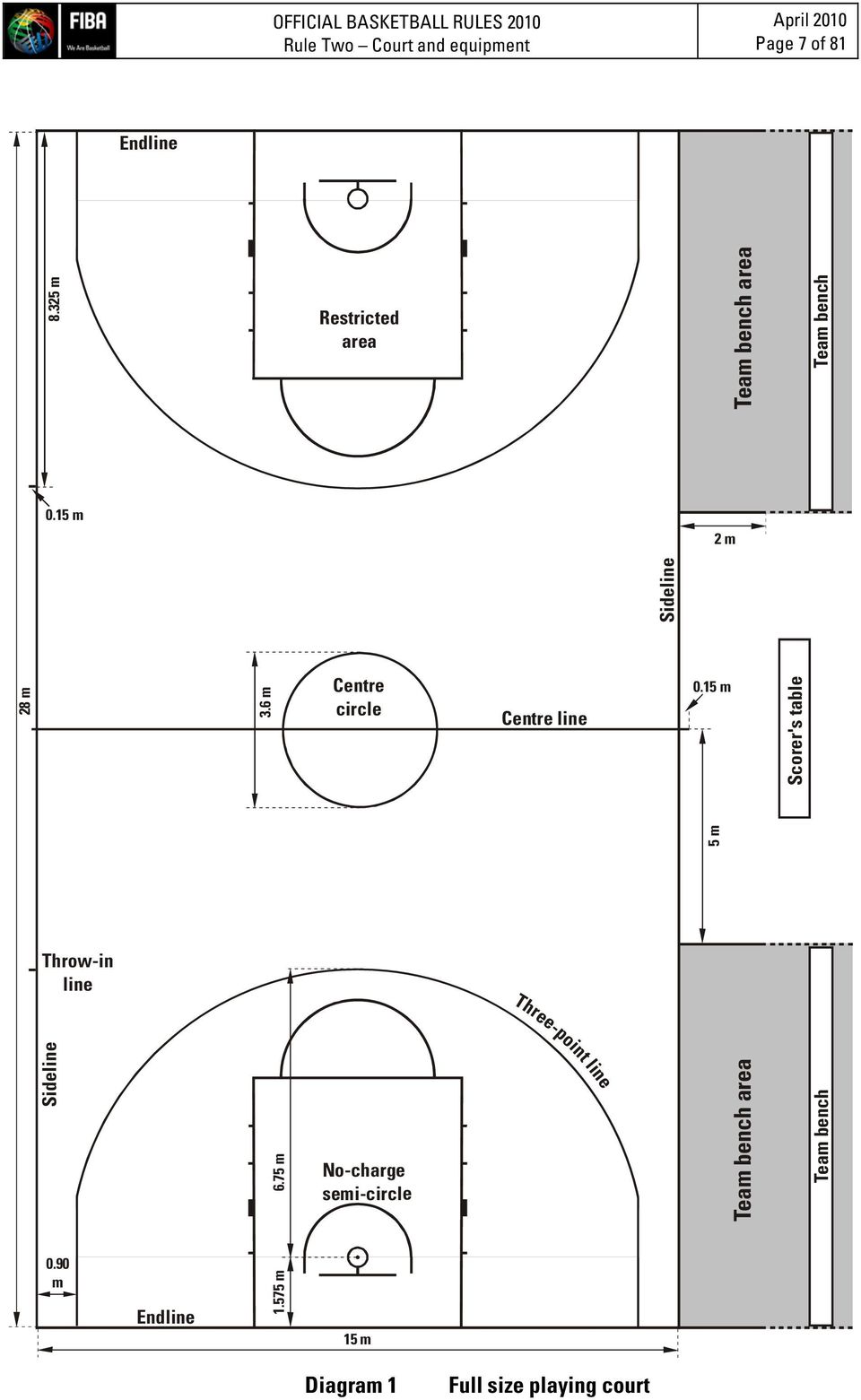
7 OFFICIAL BASKETBALL RULES 2010 Rule Two Court and equipment April 2010 Page 7 of 81 Endline m Restricted area Team bench area Team bench 0.15 m 2 m Sideline 28 m 3.6 m Centre circle Centre line 0.15 m Scorer's table 5 m Throw-in line Three-point line Sideline 6.75 m No-charge semi-circle Team bench area Team bench 0.90 m Endline m 15 m Diagram 1 Full size playing court
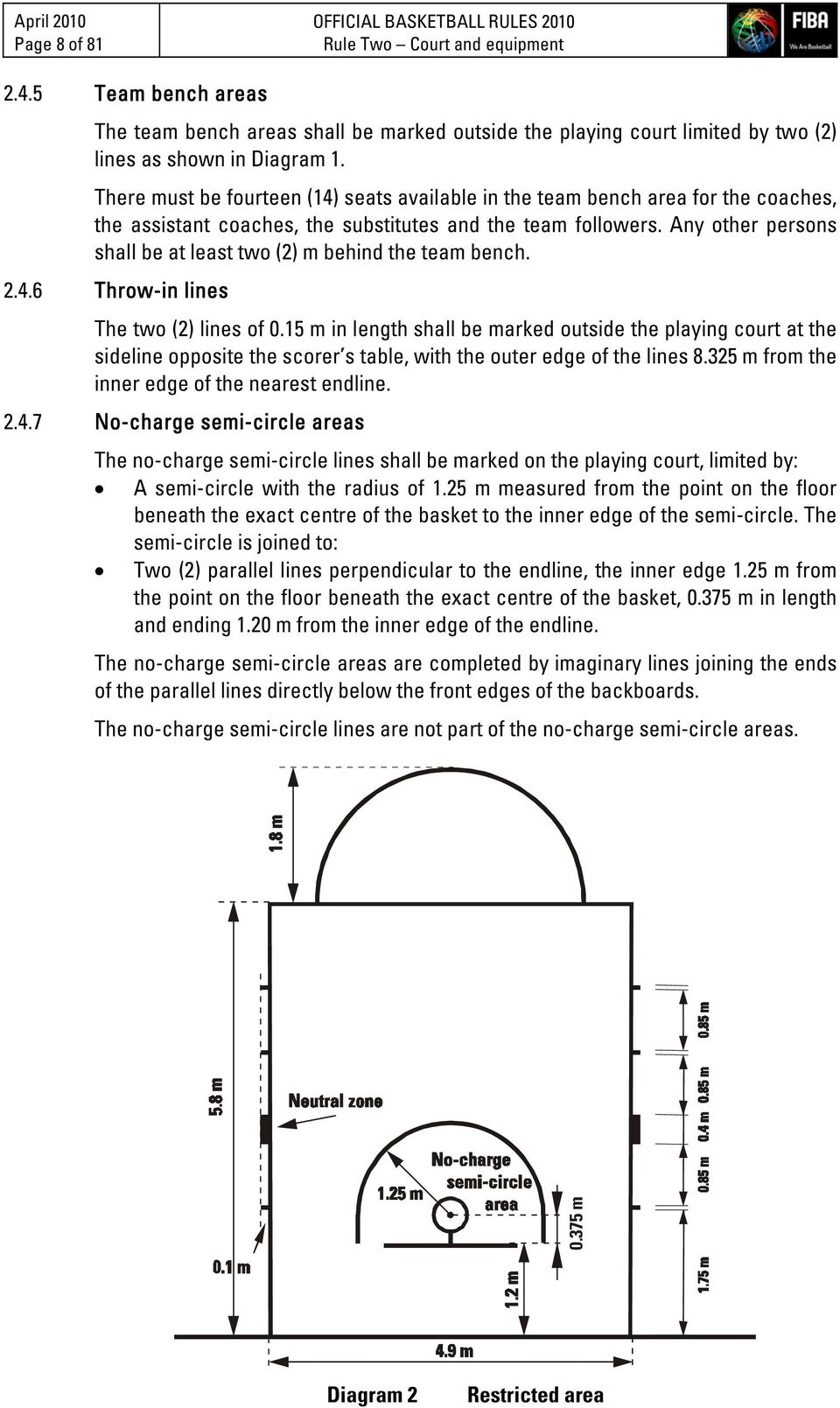
8 April 2010 Page 8 of 81 OFFICIAL BASKETBALL RULES 2010 Rule Two Court and equipment Team bench areas The team bench areas shall be marked outside the playing court limited by two (2) lines as shown in Diagram 1. There must be fourteen (14) seats available in the team bench area for the coaches, the assistant coaches, the substitutes and the team followers. Any other persons shall be at least two (2) m behind the team bench Throw-in lines The two (2) lines of 0.15 m in length shall be marked outside the playing court at the sideline opposite the scorer s table, with the outer edge of the lines m from the inner edge of the nearest endline No-charge semi-circle areas The no-charge semi-circle lines shall be marked on the playing court, limited by: A semi-circle with the radius of 1.25 m measured from the point on the floor beneath the exact centre of the basket to the inner edge of the semi-circle. The semi-circle is joined to: Two (2) parallel lines perpendicular to the endline, the inner edge 1.25 m from the point on the floor beneath the exact centre of the basket, m in length and ending 1.20 m from the inner edge of the endline. The no-charge semi-circle areas are completed by imaginary lines joining the ends of the parallel lines directly below the front edges of the backboards. The no-charge semi-circle lines are not part of the no-charge semi-circle areas m Diagram 2 Restricted area
9 OFFICIAL BASKETBALL RULES 2010 Rule Two Court and equipment April 2010 Page 9 of 81 Two-point field goal area Direction of play Opponents basket Three-point field goal area Diagram 3 Two-point/Three-point field goal area 2.5 Position of the scorer's table and substitution chairs (Diagram 4) 1 = Twenty-four (24) second operator 2 = Timer 3 = Commissioner, if present 4 = Scorer 5 = Assistant scorer Playing court Team bench area Substitution chairs Substitution chairs Team bench area Scorer's table The scorer's table and its chairs must be placed on a platform. The announcer and/or statisticians (if present) can be seated at the side of and/or behind the scorer s table. Diagram 4 Scorer's table and substitution chairs

10 April 2010 Page 10 of 81 OFFICIAL BASKETBALL RULES 2010 Rule Two Court and equipment Art. 3 Equipment The following equipment will be required: Backstop units, consisting of: Backboards Baskets comprising (pressure release) rings and nets Backboard support structures including padding Basketballs Game clock Scoreboard Twenty-four (24) second clock Stopwatch or suitable (visible) device (not the game clock) for timing time-outs Two (2) separate, distinctly different and loud sound signals Scoresheet Player foul markers Team foul markers Alternating possession arrow Playing floor Playing court Adequate lighting For a more detailed description of basketball equipment, see Appendix on Basketball Equipment.
11 OFFICIAL BASKETBALL RULES 2010 Rule Three - Teams April 2010 Page 11 of 81 RULE THREE - TEAMS Art. 4 Teams 4.1 Definition A team member is eligible to play when he has been authorised to play for a team according to the regulations, including regulations governing age limits, of the organising body of the competition A team member is entitled to play when his name has been entered on the scoresheet before the start of the game and as long as he has neither been disqualified nor committed five (5) fouls During playing time, a team member is: A player when he is on the playing court and is entitled to play. A substitute when he is not on the playing court but he is entitled to play. An excluded player when he has committed five (5) fouls and is no longer entitled to play During an interval of play, all team members entitled to play are considered as players. 4.2 Rule Each team shall consist of: No more than twelve (12) team members entitled to play, including a captain. A coach and, if a team wishes, an assistant coach. A maximum of five (5) team followers who may sit on the team bench and have special responsibilities, e.g. manager, doctor, physiotherapist, statistician, interpreter, etc Five (5) players from each team shall be on the playing court during playing time and may be substituted A substitute becomes a player and a player becomes a substitute when: The official beckons the substitute to enter the playing court. During a time-out or an interval of play, a substitute requests the substitution to the scorer. 4.3 Uniforms The uniform of the team members shall consist of: Shirts of the same dominant colour front and back. All players must tuck their shirts into their playing shorts. 'All-in-ones' are permitted. Shorts of the same dominant colour front and back, but not necessarily of the same colour as the shirts. Socks of the same dominant colour for all players of the team Each team member shall wear a shirt numbered on the front and back with plain numbers, of a solid colour contrasting with the colour of the shirt. The numbers shall be clearly visible and: Those on the back shall be at least twenty (20) cm high.

12 April 2010 Page 12 of 81 OFFICIAL BASKETBALL RULES 2010 Rule Three - Teams Those on the front shall be at least ten (10) cm high. The numbers shall be at least two (2) cm wide. Teams shall use numbers from four (4) to fifteen (15). National federations have the authority to approve, for their competitions, any other numbers with a maximum of two (2) digits. Players on the same team shall not wear the same number. Any advertising or logo shall be at least five (5) cm away from the numbers Teams must have a minimum of two (2) sets of shirts and: The first team named in the programme (home team) shall wear light-coloured shirts (preferably white). The second team named in the programme (visiting team) shall wear darkcoloured shirts. However, if the two (2) teams agree, they may interchange the colours of the shirts. 4.4 Other equipment All equipment used by players must be appropriate for the game. Any equipment that is designed to increase a player's height or reach or in any other way give an unfair advantage is not permitted Players shall not wear equipment (objects) that may cause injury to other players. The following are not permitted: Finger, hand, wrist, elbow or forearm guards, casts or braces made of leather, plastic, pliable (soft) plastic, metal or any other hard substance, even if covered with soft padding. Objects that could cut or cause abrasions (fingernails must be closely cut). Headgear, hair accessories and jewellery. The following are permitted: Shoulder, upper arm, thigh or lower leg protective equipment if the material is sufficiently padded. Undergarments that extend below the shorts of the same dominant colour as the shorts. Compression sleeves of the same dominant colour as the shirts. Compression stockings of the same dominant colour as the shorts. If for the upper leg it must end above the knee; if for the lower leg it must end below the knee. Knee braces if they are properly covered. Protector for an injured nose, even if made of a hard material. Non-coloured transparent mouth guard. Spectacles, if they do not pose a danger to other players. Headbands, maximum five (5) cm in width, made of non-abrasive, unicolour cloth, pliable plastic or rubber. Non-coloured transparent taping of arms, shoulders, legs, etc During the game a player may not display any commercial, promotional or charitable name, mark, logo or other identification including, but not limited to, on his body, in his hair or otherwise Any other equipment not specifically mentioned in this article must be approved by the FIBA Technical Commission.

13 OFFICIAL BASKETBALL RULES 2010 Rule Three - Teams April 2010 Page 13 of 81 Art. 5 Players: Injury 5.1 In the event of injury to a player(s), the officials may stop the game. 5.2 If the ball is live when an injury occurs, the official shall not blow his whistle until the team in control of the ball has shot for a field goal, lost control of the ball, withheld the ball from play or the ball has become dead. If it is necessary to protect an injured player, the officials may stop the game immediately. 5.3 If the injured player cannot continue to play immediately (within approximately 15 seconds) or, if he receives treatment, he must be substituted unless the team is reduced to fewer than five (5) players on the playing court. 5.4 Coaches, assistant coaches, substitutes, excluded players and team followers may enter the playing court, with the permission of an official, to attend to an injured player before he is substituted. 5.5 A doctor may enter the playing court, without permission of an official if, in the doctor's judgement, the injured player requires immediate medical treatment. 5.6 During the game, any player who is bleeding or has an open wound must be substituted. He may return to the playing court only after bleeding has stopped and the affected area or open wound has been completely and securely covered. If the injured player or any player who is bleeding or has an open wound recovers during a time-out taken by either team before the scorer s signal for the substitution, that player may continue to play. 5.7 Players who have been designated by the coach to start the game may be substituted in the event of an injury. In this case, the opponents are also entitled to substitute the same number of players, if they so wish. Art. 6 Captain: Duties and powers 6.1 The captain (CAP) is a player designated by his coach to represent his team on the playing court. He may communicate in a courteous manner with the officials during the game to obtain information, however, only when the ball becomes dead and the game clock is stopped. 6.2 The captain shall, immediately at the end of the game, inform the referee if his team is protesting against the result of the game and sign the scoresheet in the space marked 'Captain's signature in case of protest'. Art. 7 Coaches: Duties and powers 7.1 At least twenty (20) minutes before the game is scheduled to begin, each coach or his representative shall give the scorer a list with the names and corresponding numbers of the team members who are eligible to play in the game, as well as the name of the captain of the team, the coach and the assistant coach. All team members whose names are entered on the scoresheet are entitled to play, even if they arrive after the beginning of the game. 7.2 At least ten (10) minutes before the game is scheduled to begin, each coach shall confirm his agreement with the names and corresponding numbers of his team
14 April 2010 Page 14 of 81 OFFICIAL BASKETBALL RULES 2010 Rule Three - Teams members and the names of the coaches by signing the scoresheet. At the same time, they shall indicate the five (5) players who are to start the game. The coach of team 'A' shall be the first to provide this information. 7.3 The coaches, assistant coaches, team members and team followers are the only persons permitted to sit on the team bench and remain within their team bench area. 7.4 The coach and the assistant coach may go to the scorer s table during the game to obtain statistical information only when the ball becomes dead and the game clock is stopped. 7.5 Only the coach is permitted to remain standing during the game. He may address the players verbally during the game provided he remains within his team bench area. 7.6 If there is an assistant coach his name must be entered on the scoresheet before the beginning of the game (his signature is not necessary). He shall assume all duties and powers of the coach if, for any reason, the coach is unable to continue. 7.7 When the captain leaves the playing court the coach shall inform an official of the number of the player who will act as captain on the playing court. 7.8 The captain shall act as coach if there is no coach, or if the coach is unable to continue and there is no assistant coach entered on the scoresheet (or the latter is unable to continue). If the captain must leave the playing court, he may continue to act as coach. If he must leave following a disqualifying foul, or if he is unable to act as coach because of injury, his substitute as captain may replace him as coach. 7.9 The coach shall designate the free-throw shooter of his team in all cases where the free-throw shooter is not determined by the rules.

15 OFFICIAL BASKETBALL RULES 2010 Rule Four - Playing regulations April 2010 Page 15 of 81 RULE FOUR - PLAYING REGULATIONS Art. 8 Playing time, tied score and extra periods 8.1 The game shall consist of four (4) periods of ten (10) minutes. 8.2 There shall be an interval of play of twenty (20) minutes before the game is scheduled to begin. 8.3 There shall be intervals of play of two (2) minutes between the first and second period (first half), between the third and fourth period (second half) and before each extra period. 8.4 There shall be a half-time interval of play of fifteen (15) minutes. 8.5 An interval of play begins: Twenty (20) minutes before the game is scheduled to begin. When the game clock signal sounds for the end of a period. 8.6 An interval of play ends: At the beginning of the first period when the ball leaves the hand(s) of the referee on the jump ball. At the beginning of all other periods when the ball is at the disposal of the player taking the throw-in. 8.7 If the score is tied at the end of playing time for the fourth period, the game shall continue with as many extra periods of five (5) minutes as is necessary to break the tie. 8.8 If a foul is committed when or just before the game clock signal sounds for the end of playing time, any eventual free throw(s) shall be administered after the end of playing time. 8.9 If an extra period is required as a result of this free throw(s) then all fouls that are committed after the end of playing time shall be considered to have occurred during an interval of play and the free throws shall be administered before the beginning of the extra period. Art. 9 Beginning and end of a period or the game 9.1 The first period begins when the ball leaves the hand(s) of the referee on the jump ball. 9.2 All other periods begin when the ball is at the disposal of the player taking the throw-in. 9.3 The game cannot begin if one of the teams is not on the playing court with five (5) players ready to play.

16 April 2010 Page 16 of 81 OFFICIAL BASKETBALL RULES 2010 Rule Four - Playing regulations 9.4 For all games, the first team named in the programme (home team) shall have the team bench and its team s own basket on the left side of the scorer s table, facing the playing court. However, if the two (2) teams agree, they may interchange the team benches and/or baskets. 9.5 Before the first and third period, teams are entitled to warm-up in the half of the playing court in which their opponents' basket is situated. 9.6 Teams shall exchange baskets for the second half. 9.7 In all extra periods the teams shall continue to play towards the same baskets as in the fourth period. 9.8 A period, extra period or game shall end when the game clock signal sounds for the end of the period. Art. 10 Status of the ball 10.1 The ball can be either live or dead The ball becomes live when: During the jump ball, the ball leaves the hand(s) of the referee on the toss. During a free throw, the ball is at the disposal of the free-throw shooter. During a throw-in, the ball is at the disposal of the player taking the throw-in The ball becomes dead when: Any field goal or free throw is made. An official blows his whistle while the ball is live. It is apparent that the ball will not enter the basket on a free throw which is to be followed by: Another free throw(s). A further penalty (free throw(s) and/or possession). The game clock signal sounds for the end of the period. The twenty-four (24) second clock signal sounds while a team is in control of the ball. The ball in flight on a shot for a field goal is touched by a player from either team after: An official blows his whistle. The game clock signal sounds for the end of the period. The twenty-four (24) second clock signal sounds The ball does not become dead and the goal counts if made when: The ball is in flight on a shot for a field goal and: An official blows his whistle. The game clock signal sounds for the end of the period. The twenty-four (24) second clock signal sounds. The ball is in flight on a free throw when an official blows his whistle for any rule infraction other than by the free-throw shooter.
17 OFFICIAL BASKETBALL RULES 2010 Rule Four - Playing regulations April 2010 Page 17 of 81 A player commits a foul on any opponent while the ball is in the control of the opponent in the act of shooting for a field goal and who finishes his shot with a continuous motion which started before the foul occurred. This provision does not apply and the goal shall not count if after an official blows his whistle an entirely new act of shooting is made. during the continuous motion of a player in the act of shooting the game clock signal sounds for an end of period or the twenty-four (24) second clock signal sounds. Art. 11 Location of a player and an official 11.1 The location of a player is determined by where he is touching the floor. While he is airborne, he retains the same status he had when he last touched the floor. This includes the boundary line, the centre line, the three-point line, the freethrow line, the lines delimiting the restricted area and the lines delimiting the nocharge semi-circle area The location of an official is determined in the same manner as that of a player. When the ball touches an official, it is the same as touching the floor at the official's location. Art. 12 Jump ball and alternating possession 12.1 Jump ball definition A jump ball occurs when an official tosses the ball in the centre circle between any two (2) opponents at the beginning of the first period A held ball occurs when one or more players of each opposing team have one or both hands firmly on the ball so that neither player can gain control without undue roughness Jump ball procedure Each jumper shall stand with both feet inside the half of the centre circle nearest to his team s own basket with one foot close to the centre line Team-mates may not occupy adjacent positions around the circle if an opponent wishes to occupy one of those positions The official shall then toss the ball vertically upwards between the two (2) opponents, higher than either of them can reach by jumping The ball must be tapped with the hand(s) of at least one of the jumpers after it reaches its highest point Neither jumper shall leave his position until the ball has been legally tapped Neither jumper may catch the ball or tap it more than twice until it has touched one of the non-jumpers or the floor If the ball is not tapped by at least one of the jumpers, the jump ball shall be repeated No part of a non-jumper's body may be on or over the circle line (cylinder) before the ball has been tapped. An infraction of Art , , , , and is a violation.

18 April 2010 Page 18 of 81 OFFICIAL BASKETBALL RULES 2010 Rule Four - Playing regulations 12.3 Jump ball situations A jump ball situation occurs when: A held ball is called. The ball goes out-of-bounds and the officials are in doubt or disagree about which of the opponents last touched the ball. A double free-throw violation occurs during an unsuccessful last or only free throw. A live ball lodges between the ring and the backboard (except between free throws). The ball becomes dead when neither team had control of the ball nor was entitled to the ball. After the cancellation of equal penalties against both teams, there are no other foul penalties remaining for administration and neither team had control of the ball nor was entitled to the ball before the first foul or violation. All periods other than the first period are to begin Alternating possession definition Alternating possession is a method of causing the ball to become live with a throwin rather than a jump ball Alternating possession throw-in: Begins when the ball is at the disposal of the player taking the throw-in. Ends when: The ball touches or is legally touched by a player on the playing court. The team taking the throw-in commits a violation. A live ball lodges between the ring and the backboard during a throw-in Alternating possession procedure In all jump ball situations teams will alternate possession of the ball for a throw-in at the place nearest to where the jump ball situation occurs The team that does not gain control of the live ball on the playing court after the jump ball will be entitled to the first alternating possession The team entitled to the next alternating possession at the end of any period shall start the next period with a throw-in at the centre line extended, opposite the scorer s table, unless there are further free throws and a possession penalty to be administered The team entitled to the alternating possession throw-in shall be indicated by the alternating possession arrow in the direction of the opponents basket. The direction of the alternating possession arrow will be reversed immediately when the alternating possession throw-in ends A violation by a team during its alternating possession throw-in causes that team to lose the alternating possession throw-in. The direction of the alternating possession arrow will be reversed immediately, indicating that the opponents of the violating team will be entitled to the alternating possession throw-in at the next jump ball situation. The game shall then be resumed by awarding the ball to the opponents of the violating team for a throw-in at the place of the original throw-in.
19 OFFICIAL BASKETBALL RULES 2010 Rule Four - Playing regulations April 2010 Page 19 of A foul by either team: Before the beginning of a period other than the first period, or During the alternating possession throw-in, does not cause the team entitled to the throw-in to lose that alternating possession. Art. 13 How the ball is played 13.1 Definition During the game, the ball is played with the hand(s) only and may be passed, thrown, tapped, rolled or dribbled in any direction, subject to the restrictions of these rules Rule A player shall not run with the ball, deliberately kick or block it with any part of the leg or strike it with the fist. However, to accidentally come into contact with or touch the ball with any part of the leg is not a violation. An infraction of Art is a violation. Art. 14 Control of the ball 14.1 Definition Team control starts when a player of that team is in control of a live ball by holding or dribbling it or has a live ball at his disposal Team control continues when: A player of that team is in control of a live ball. The ball is being passed between team-mates Team control ends when: An opponent gains control. The ball becomes dead. The ball has left the player's hand(s) on a shot for a field goal or for a free throw. Art. 15 Player in the act of shooting 15.1 Definition A shot for a field goal or a free throw is when the ball is held in a player s hand(s) and is then thrown into the air towards the opponents' basket. A tap is when the ball is directed with the hand(s) towards the opponents' basket. A dunk is when the ball is forced downwards into the opponents' basket with one or both hands. A tap and a dunk are also considered as shots for a field goal The act of shooting: Begins when the player starts the continuous movement normally preceding the release of the ball and, in the judgement of an official, he has started an

20 April 2010 Page 20 of 81 OFFICIAL BASKETBALL RULES 2010 Rule Four - Playing regulations attempt to score by throwing, tapping or dunking the ball towards the opponents' basket. Ends when the ball has left the player s hand(s) and, in case of an airborne shooter, both feet have returned to the floor. The player attempting to score might have his arm(s) held by an opponent, thus preventing him from scoring, even though he is considered to have made an attempt to score. In this case it is not essential that the ball leaves the player's hand(s). There is no relationship between the number of legal steps taken and the act of shooting A continuous movement in the act of shooting: Begins when the ball has come to rest in the player's hand(s) and the shooting motion, usually upward, has started. May include the player's arm(s) and/or body movement in his attempt to shoot for a field goal. Ends when the ball has left the player s hand(s), or if an entirely new act of shooting is made. Art Definition Goal: When made and its value A goal is made when a live ball enters the basket from above and remains within or passes through the basket The ball is considered to be within the basket when the slightest part of the ball is within and below the level of the ring Rule A goal is credited to the team attacking the opponents basket into which the ball has entered as follows: A goal from a free throw counts one (1) point. A goal from the two-point field goal area counts two (2) points. A goal from the three-point field goal area counts three (3) points. After the ball has touched the ring on a last or only free throw and is legally touched by an offensive or defensive player before it enters the basket, the goal counts two (2) points If a player accidentally scores a field goal in his team s own basket, the goal counts two (2) points and shall be recorded as having been scored by the captain of the opposing team on the playing court If a player deliberately scores a field goal in his team s own basket, it is a violation and the goal does not count If a player causes the entire ball to pass through the basket from below, it is a violation The game clock must indicate 0:00.3 (three tenths of a second) or more for a player to gain control of the ball on a throw-in or on a rebound after the last or only free throw in order to attempt a shot for a field goal. If the game clock indicates 0:00.2 or 0:00.1 the only type of a valid field goal made is by tapping or directly dunking the ball.
21 OFFICIAL BASKETBALL RULES 2010 Rule Four - Playing regulations April 2010 Page 21 of 81 Art. 17 Throw-in 17.1 Definition A throw-in occurs when the ball is passed into the playing court by the out-ofbounds player taking the throw-in Procedure An official must hand or place the ball at the disposal of the player taking the throwin. He may also toss or bounce pass the ball provided that: The official is no more than four (4) m from the player taking the throw-in. The player taking the throw-in is at the correct place as designated by the official The player shall take the throw-in at the place nearest to the infraction or where the game was stopped by the official, except directly behind the backboard In the following situations the subsequent throw-in shall be administered at the centre line extended, opposite the scorer's table: At the beginning of all periods other than the first period. Following a free throw(s) resulting from a technical, unsportsmanlike or disqualifying foul. The player taking the throw-in shall have one foot on either side of the centre line extended, opposite the scorer s table, and shall be entitled to pass the ball to a team-mate at any place on the playing court During the last two (2) minutes of the fourth period and during the last two (2) minutes of each extra period, following a time-out taken by the team that is entitled to possession of the ball from its backcourt the throw-in shall be administered at the throw-in line opposite the scorer s table in the team s frontcourt Following a personal foul committed by a player of the team in control of the live ball, or of the team entitled to the ball, the subsequent throw-in shall be administered at the place nearest to the infraction Whenever the ball enters the basket but the field goal or the free throw is not valid, the subsequent throw-in shall be administered at the free-throw line extended Following a successful field goal or a successful last or only free throw: Any player of the non-scoring team shall take the throw-in at any place behind that team s endline. This is also applicable after an official hands or places the ball at the disposal of the player taking the throw-in after a time-out or after any interruption of the game following a successful field goal or a successful last or only free throw. The player taking the throw-in may move laterally and/or backwards and the ball may be passed between team-mates behind the endline, but the five (5) second count starts when the ball is at the disposal of the first player out-ofbounds.
22 April 2010 Page 22 of 81 OFFICIAL BASKETBALL RULES 2010 Rule Four - Playing regulations 17.3 Rule The player taking the throw-in shall not: Take more than five (5) seconds to release the ball. Step into the playing court while having the ball in his hand(s). Cause the ball to touch out-of-bounds, after it has been released on the throwin. Touch the ball on the playing court before it has touched another player. Cause the ball to enter the basket directly. Move from the designated throw-in place behind the boundary line, other than from his team s endline after a successful field goal or a successful last free throw, laterally in one (1) or in both directions, exceeding a total distance of one (1) m before releasing the ball. He is, however, permitted to move directly backwards from the boundary line as far as circumstances allow During the throw-in other player(s) shall not: Have any part of their bodies over the boundary line before the ball has been thrown-in across the boundary line. Be closer than one (1) m to the player taking the throw-in when the throw-in place has less than two (2) m between the boundary line and any out-of-bounds obstructions. An infraction of Art is a violation Penalty The ball is awarded to the opponents for a throw-in at the place of the original throw-in. Art. 18 Time-out 18.1 Definition A time-out is an interruption of the game requested by the coach or assistant coach Rule Each time-out shall last one (1) minute A time-out may be granted during a time-out opportunity A time-out opportunity begins when: For both teams, the ball becomes dead, the game clock is stopped and the official has ended his communication with the scorer's table. For both teams, the ball becomes dead following a successful last or only free throw. For the non-scoring team, a field goal is scored A time-out opportunity ends when the ball is at the disposal of a player for a throwin or for a first or only free throw Two (2) time-outs may be granted to each team at any time during the first half; three (3) at any time during the second half and one (1) during each extra period Unused time-outs may not be carried over to the next half or extra period.
23 OFFICIAL BASKETBALL RULES 2010 Rule Four - Playing regulations April 2010 Page 23 of A time-out is charged against the team whose coach first made a request unless the time-out is granted following a field goal scored by the opponents and without an infraction having been called A time-out shall not be permitted to the scoring team when the game clock is stopped following a successful field goal during the last two (2) minutes of the fourth period or the last two (2) minutes of each extra period unless an official has stopped the game Procedure Only a coach or assistant coach has the right to request a time-out. He shall establish visual contact with the scorer or he shall go to the scorer s table and ask clearly for a time-out, making the proper conventional sign with his hands A time-out request may be cancelled only before the scorer's signal has sounded for such a request The time-out period: Begins when an official blows his whistle and gives the time-out signal. Ends when the official blows his whistle and beckons the teams back on the playing court As soon as a time-out opportunity begins, the scorer shall sound his signal to notify the officials that a request for a time-out has been made. If a field goal is scored against a team which has requested a time-out, the timer shall immediately stop the game clock and sound his signal During the time-out and during an interval of play before the beginning of the second, fourth or each extra period the players may leave the playing court and sit on the team bench and the persons permitted to be in the team bench area may enter the playing court provided the team members remain within the vicinity of their team bench area If the request for the time-out is made by either team after the ball is at the disposal of the free-throw shooter for the first or only free throw, the time-out shall be granted if: The last or only free throw is successful. The last or only free throw is followed by a throw-in at the centre line extended, opposite the scorer s table. A foul is called between free throws. In this case the free throw(s) will be completed and the time-out will be permitted before the new foul penalty is administered. A foul is called before the ball becomes live after the last or only free throw. In this case the time-out will be permitted before the new foul penalty is administered. A violation is called before the ball becomes live after the last or only free throw. In this case the time-out will be permitted before the throw-in is administered. In the event of consecutive sets of free throws and/or possession of the ball resulting from more than one (1) foul penalty, each set is to be treated separately.
24 April 2010 Page 24 of 81 OFFICIAL BASKETBALL RULES 2010 Rule Four - Playing regulations Art. 19 Substitution 19.1 Definition A substitution is an interruption of the game requested by the substitute to become a player Rule A team may substitute a player(s) during a substitution opportunity A substitution opportunity begins when: For both teams, the ball becomes dead, the game clock is stopped and the official has ended his communication with the scorer's table. For both teams, the ball becomes dead following a successful last or only free throw. For the non-scoring team, a field goal is scored in the last two (2) minutes of the fourth period or the last two (2) minutes of each extra period A substitution opportunity ends when the ball is at the disposal of a player for a throw-in or a first or only free throw A player who has become a substitute and a substitute who has become a player cannot respectively re-enter the game or leave the game until the ball becomes dead again, after a clock-running phase of the game, unless: The team is reduced to fewer than five (5) players on the playing court. The player entitled to the free-throws as the result of the correction of an error is on the team bench after having been legally substituted A substitution shall not be permitted to the scoring team when the game clock is stopped following a successful field goal during the last two (2) minutes of the fourth period or the last two (2) minutes of each extra period unless an official has stopped the game Procedure Only a substitute has the right to request a substitution. He (not the coach or the assistant coach) shall go to the scorer s table and ask clearly for a substitution or sit on the substitution chair. He must be ready to play immediately A substitution request may be cancelled only before the scorer's signal has sounded for such a request As soon as a substitution opportunity begins the scorer shall sound his signal to notify the officials that a request for a substitution has been made The substitute shall remain outside the boundary line until the official blows his whistle, gives the substitution signal and beckons him to enter the playing court The player being substituted is permitted to go directly to his team bench without reporting either to the scorer or the official Substitutions shall be completed as quickly as possible. A player who has committed his five (5) fouls or has been disqualified must be substituted immediately (within approximately 30 seconds). If, in the judgement of an official, there is a delay of the game, a time-out shall be charged against the offending team. If the team has no time-out remaining a technical foul for delaying the game may be charged against the coach, recorded as 'B'.
25 OFFICIAL BASKETBALL RULES 2010 Rule Four - Playing regulations April 2010 Page 25 of If a substitution is requested during a time-out or during an interval of play other than the half-time interval, the substitute must report to the scorer before entering the game If the free-throw shooter must be substituted because he: Is injured. Has committed his five (5) fouls. Has been disqualified. The free throw(s) must be attempted by his substitute who may not be substituted again until he has played in the next clock-running phase of the game If the request for a substitution is made by either team after the ball is at the disposal of the free-throw shooter for the first or only free throw, the substitution shall be granted if: The last or only free throw is successful. The last or only free throw is followed by a throw-in at the centre line extended, opposite the scorer s table. A foul is called between free throws. In this case the free throw(s) will be completed and the substitution will be permitted before the new foul penalty is administered. A foul is called before the ball becomes live after the last or only free throw. In this case the substitution will be permitted before the new foul penalty is administered. A violation is called before the ball becomes live after the last or only free throw. In this case the substitution will be permitted before the throw-in is administered. In the event of consecutive sets of free throws resulting from more than one (1) foul penalty, each set is to be treated separately. Art Rule 20.2 Penalty Game lost by forfeit A team shall lose the game by forfeit if: Fifteen (15) minutes after the scheduled starting time, the team is not present or is unable to field five (5) players ready to play. Its actions prevent the game from being played. It refuses to play after being instructed to do so by the referee The game is awarded to the opponents and the score shall be twenty to zero (20 to 0). Furthermore, the forfeiting team shall receive zero (0) points in the classification For a two-game (home and away) total points series and for Play-Offs (best of three), the team that forfeits in the first, second or third game shall lose the series or Play-Offs by 'forfeit'. This does not apply for Play-Offs (best of five) If in a tournament the team forfeits for the second time, the team shall be disqualified from the tournament and the results of all games played by this team shall be nullified.
26 April 2010 Page 26 of 81 OFFICIAL BASKETBALL RULES 2010 Rule Four - Playing regulations Art Rule 21.2 Penalty Game lost by default A team shall lose a game by default if, during the game, the team has fewer than two (2) players on the playing court ready to play If the team to which the game is awarded is ahead, the score shall stand as at the time when the game was stopped. If the team to which the game is awarded is not ahead, the score shall be recorded as two to zero (2 to 0) in its favour. The defaulting team shall receive one (1) point in the classification For a two-game (home and away) total point series, the team that defaults in the first or in the second game shall lose the series by 'default'.
27 OFFICIAL BASKETBALL RULES 2010 Rule Five - Violations April 2010 Page 27 of 81 RULE FIVE - VIOLATIONS Art. 22 Violations 22.1 Definition A violation is an infraction of the rules Penalty The ball shall be awarded to the opponents for a throw-in at the place nearest to the infraction, except directly behind the backboard, unless otherwise stated in the rules. Art. 23 Player out-of-bounds and ball out-of-bounds 23.1 Definition A player is out-of-bounds when any part of his body is in contact with the floor or any object other than a player, on, above or outside the boundary line The ball is out-of-bounds when it touches: A player or any other person who is out-of-bounds. The floor or any object on, above or outside the boundary line. The backboard supports, the back of the backboards or any object above the playing court Rule The ball is caused to go out-of-bounds by the last player to touch or be touched by the ball before it goes out-of-bounds, even if the ball then goes out-of-bounds by touching something other than a player If the ball is out-of-bounds because of touching or being touched by a player who is on or outside the boundary line, this player causes the ball to go out-of-bounds If a player(s) move(s) to out-of-bounds or to his backcourt during a held ball, a jump ball situation occurs. Art. 24 Dribbling 24.1 Definition A dribble is the movement of a live ball caused by a player in control of that ball who throws, taps, rolls the ball on the floor or deliberately throws it against the backboard A dribble starts when a player, having gained control of a live ball on the playing court, throws, taps, rolls, dribbles it on the floor or deliberately throws it against the backboard and touches it again before it touches another player. A dribble ends when the player touches the ball with both hands simultaneously or permits the ball to come to rest in one or both hands. During a dribble the ball may be thrown into the air provided the ball touches the floor or another player before the player who threw it touches it again with his hand. There is no limit to the number of steps a player may take when the ball is not in contact with his hand A player who accidentally loses and then regains control of a live ball on the playing court is considered to be fumbling the ball.
28 April 2010 Page 28 of 81 OFFICIAL BASKETBALL RULES 2010 Rule Five - Violations The following are not dribbles: Successive shots for a field goal. Fumbling the ball at the beginning or at the end of a dribble. Attempts to gain control of the ball by tapping it from the vicinity of other players. Tapping the ball from the control of another player. Deflecting a pass and gaining control of the ball. Tossing the ball from hand to hand and allowing it to come to rest in one or both hands before touching the floor, provided that no travelling violation is committed Rule A player shall not dribble a second time after his first dribble has ended unless between the two (2) dribbles he has lost control of a live ball on the playing court because of: A shot for a field goal. A touch of the ball by an opponent. A pass or fumble that has touched or been touched by another player. Art. 25 Travelling 25.1 Definition Travelling is the illegal movement of one foot or both feet beyond the limits outlined in this article, in any direction, while holding a live ball on the playing court A pivot is the legal movement in which a player who is holding a live ball on the playing court steps once or more than once in any direction with the same foot, while the other foot, called the pivot foot, is kept at its point of contact with the floor Rule Establishing a pivot foot for a player who catches a live ball on the playing court: While standing with both feet on the floor: The moment one foot is lifted, the other foot becomes the pivot foot. While moving: If one foot is touching the floor, that foot becomes the pivot foot. If both feet are off the floor and the player lands on both feet simultaneously, the moment one foot is lifted, the other foot becomes the pivot foot. If both feet are off the floor and the player lands on one foot, then that foot becomes the pivot foot. If a player jumps off that foot and comes to a stop landing on both feet simultaneously, then neither foot is a pivot foot Progressing with the ball for a player who has established a pivot foot while having the control of a live ball on the playing court: While standing with both feet on the floor: To start a dribble, the pivot foot may not be lifted before the ball is released from the hand(s). To pass or shoot for a field goal, the player may jump off a pivot foot, but neither foot may be returned to the floor before the ball is released from the hand(s).
29 OFFICIAL BASKETBALL RULES 2010 Rule Five - Violations April 2010 Page 29 of 81 While moving: To pass or shoot for a field goal, the player may jump off a pivot foot and land on one foot or both feet simultaneously. After that, one foot or both feet may be lifted from the floor but neither foot may be returned to the floor before the ball is released from the hand(s). To start a dribble, the pivot foot may not be lifted before the ball is released from the hand(s). While coming to a stop when neither foot is the pivot foot: To start a dribble, neither foot may be lifted before the ball is released from the hand(s). To pass or shoot for a field goal, one foot or both feet may be lifted but may not be returned to the floor before the ball is released from the hand(s) Player falling, lying or sitting on the floor: It is legal when a player falls and slides on the floor while holding the ball or, while lying or sitting on the floor, gains control of the ball. It is a violation if the player then rolls or attempts to stand up while holding the ball. Art. 26 Three seconds 26.1 Rule A player shall not remain in the opponents' restricted area for more than three (3) consecutive seconds while his team is in control of a live ball in the frontcourt and the game clock is running Allowances must be made for a player who: Makes an attempt to leave the restricted area. Is in the restricted area when he or his team-mate is in the act of shooting and the ball is leaving or has just left the player's hand(s) on the shot for a field goal. Dribbles in the restricted area to shoot for a field goal after having been there for less than three (3) consecutive seconds To establish himself outside the restricted area, the player must place both feet on the floor outside the restricted area. Art. 27 Closely guarded player 27.1 Definition A player who is holding a live ball on the playing court is closely guarded when an opponent is in an active guarding position at a distance of no more than one (1) m Rule A closely guarded player must pass, shoot or dribble the ball within five (5) seconds. Art. 28 Eight seconds 28.1 Rule Whenever: A player gains control of a live ball in his backcourt, On a throw-in, the ball touches or is legally touched by any player in the backcourt and the team of that player taking the throw-in remains in control of the ball in its backcourt, that team must cause the ball to go into its frontcourt within eight (8) seconds.
30 April 2010 Page 30 of 81 OFFICIAL BASKETBALL RULES 2010 Rule Five - Violations The team has caused the ball to go into its frontcourt whenever: The ball, not in control of any player, touches the frontcourt, The ball touches or is legally touched by an offensive player who has both feet in contact with his frontcourt, The ball touches or is legally touched by a defensive player who has part of his body in contact with his backcourt, The ball touches an official who has part of his body in contact with the frontcourt of the team in control of the ball. During a dribble from the backcourt to the frontcourt, both feet of the dribbler and the ball are in contact with the frontcourt The eight (8) second period will continue with any time remaining when the same team that previously had control of the ball is awarded a throw-in in the backcourt, as a result of: A ball having gone out-of-bounds. A player of the same team having been injured. A jump ball situation. A double foul. A cancellation of equal penalties against both teams. Art Rule Twenty-four seconds Whenever: A player gains control of a live ball on the playing court, On a throw-in, the ball touches or is legally touched by any player on the playing court and the team of that player taking the throw-in remains in control of the ball, that team must attempt a shot for a field goal within twenty-four (24) seconds. To constitute a shot for a field goal within twenty-four (24) seconds: The ball must leave the player's hand(s) before the twenty-four (24) second clock signal sounds, and After the ball has left the player's hand(s), the ball must touch the ring or enter the basket When a shot for a field goal is attempted near the end of the twenty-four (24) second period and the twenty-four (24) second clock signal sounds while the ball is in the air: If the ball enters the basket, no violation has occurred, the signal shall be disregarded and the goal shall count. If the ball touches the ring but does not enter the basket, no violation has occurred, the signal shall be disregarded and the game shall continue. If the ball misses the ring, a violation has occurred. However, if the opponents have gained immediate and clear control of the ball, the signal shall be disregarded and the game shall continue. All restrictions related to goaltending and interference shall apply.
31 OFFICIAL BASKETBALL RULES 2010 Rule Five - Violations April 2010 Page 31 of Procedure If the game is stopped by an official: For a foul or violation (not for the ball having gone out-of-bounds) by the team not in control of the ball, For any valid reason by the team not in control of the ball, For any valid reason not connected with either team, Possession of the ball shall be awarded to the same team that previously had control of the ball. If the throw-in is administered in the backcourt, the twenty-four (24) second clock shall be reset to twenty-four (24) seconds. If the throw-in is administered in the frontcourt, the twenty-four (24) second clock shall be reset as follows: If fourteen (14) seconds or more is displayed on the twenty-four (24) second clock at the time when the game was stopped, the twenty-four (24) second clock shall not be reset, but shall continue from the time it was stopped. If thirteen (13) seconds or less is displayed on the twenty-four (24) second clock at the time when the game was stopped, the twenty-four (24) second clock shall be reset to fourteen (14) seconds. However, if in the judgement of an official, the opponents would be placed at a disadvantage, the twenty-four (24) second clock shall continue from the time it was stopped If the twenty-four (24) second clock signal sounds in error while a team has control of the ball or neither team has control of the ball, the signal shall be disregarded and the game shall continue. However, if in the judgement of an official, the team in control of the ball has been placed at a disadvantage, the game shall be stopped, the twenty-four (24) second clock shall be corrected and the ball shall be awarded to that team. Art. 30 Ball returned to the backcourt 30.1 Definition The ball goes into a team's backcourt when: It touches the backcourt. It touches or is legally touched by an offensive player who has part of his body in contact with the backcourt. It touches an official who has part of his body in contact with the backcourt The ball has been illegally returned to the backcourt when a player of the team in control of the live ball is the last to touch the ball in his frontcourt, after which that player or a team-mate is the first to touch the ball in the backcourt. This restriction applies to all situations in a team's frontcourt, including throw-ins. However, it does not apply to a player who jumps from his frontcourt, establishes new team control while still airborne and then lands in his team s backcourt Rule A player whose team is in control of a live ball may not cause the ball to be illegally returned to his backcourt.
32 April 2010 Page 32 of 81 OFFICIAL BASKETBALL RULES 2010 Rule Five - Violations 30.3 Penalty The ball shall be awarded to the opponents for a throw-in in their frontcourt at a place nearest to the infraction except directly behind the backboard. Art. 31 Goaltending and Interference 31.1 Definition A shot for a field goal or a free throw: Begins when the ball leaves the hand(s) of a player in the act of shooting. Ends when the ball: Enters the basket directly from above and remains within or passes through the basket. No longer has the possibility of entering the basket. Touches the ring. Touches the floor. Becomes dead Rule Goaltending occurs during a shot for a field goal when a player touches the ball while it is completely above the level of the ring and: It is on its downward flight to the basket, or After it has touched the backboard Goaltending occurs during a shot for a free throw when a player touches the ball while it is in flight to the basket and before it touches the ring The goaltending restrictions apply until: The ball no longer has the possibility of entering the basket. The ball has touched the ring Interference occurs when: After a shot for a field goal or the last or only free throw a player touches the basket or the backboard while the ball is in contact with the ring. After a free throw followed by an additional free throw(s), a player touches the ball, the basket or the backboard while there is still a possibility that the ball will enter the basket. A player reaches through the basket from below and touches the ball. A defensive player touches the ball or the basket while the ball is within the basket, thus preventing the ball from passing through the net. A player causes the basket to vibrate or grasps the basket in such a way that, in the judgement of an official, the ball has been prevented from entering the basket or has been caused to enter the basket. A player grasps the basket to play the ball When An official blows the whistle while the ball is in the hands of a player in the act of shooting, or the ball is in flight on a shot for a field goal, The game clock signal sounds for the end of a period while the ball is in flight on a shot for a field goal, No player shall touch the ball after it has touched the ring while it still has the possibility of entering the basket. All restrictions related to goaltending and interference shall apply.
33 OFFICIAL BASKETBALL RULES 2010 Rule Five - Violations April 2010 Page 33 of Penalty If the violation is committed by an offensive player, no points can be awarded. The ball shall be awarded to the opponents for a throw-in at the free-throw line extended, unless otherwise stated in the rules If the violation is committed by a defensive player, the offensive team is awarded: One (1) point when the ball was released for a free throw. Two (2) points when the ball was released from the two-point field goal area. Three (3) points when the ball was released from the three-point field goal area. The awarding of the points is considered as if the ball had entered the basket If the goaltending is committed by a defensive player during a last or only free throw, one (1) point shall be awarded to the offensive team, followed by the technical foul penalty charged against the defensive player.
34 April 2010 Page 34 of 81 OFFICIAL BASKETBALL RULES 2010 Rule Six - Fouls RULE SIX - FOULS Art. 32 Fouls 32.1 Definition A foul is an infraction of the rules concerning illegal personal contact with an opponent and/or unsportsmanlike behaviour Any number of fouls may be called against a team. Irrespective of the penalty, each foul shall be charged, entered on the scoresheet against the offender and penalised accordingly. Art. 33 Contact: General principles 33.1 Cylinder principle The cylinder principle is defined as the space within an imaginary cylinder occupied by a player on the floor. It includes the space above the player and is limited to: The front by the palms of the hands, The rear by the buttocks, and The sides by the outer edge of the arms and legs. The hands and arms may be extended in front of the torso no further than the position of the feet, with the arms bent at the elbows so that the forearms and hands are raised. The distance between his feet will vary according to his height. Diagram 5 Cylinder principle 33.2 Principle of verticality During the game, each player has the right to occupy any position (cylinder) on the playing court not already occupied by an opponent. This principle protects the space on the floor which he occupies and the space above him when he jumps vertically within that space.
35 OFFICIAL BASKETBALL RULES 2010 Rule Six - Fouls April 2010 Page 35 of 81 As soon as the player leaves his vertical position (cylinder) and body contact occurs with an opponent who had already established his own vertical position (cylinder), the player who left his vertical position (cylinder) is responsible for the contact. The defensive player must not be penalised for leaving the floor vertically (within his cylinder) or having his hands and arms extended above him within his own cylinder. The offensive player, whether on the floor or airborne, shall not cause contact with the defensive player in a legal guarding position by: Using his arms to create more space for himself (pushing off). Spreading his legs or arms to cause contact during or immediately after a shot for a field goal Legal guarding position A defensive player has established an initial legal guarding position when: He is facing his opponent, and He has both feet on the floor. The legal guarding position extends vertically above him (cylinder) from the floor to the ceiling. He may raise his arms and hands above his head or jump vertically but he must maintain them in a vertical position inside the imaginary cylinder Guarding a player who controls the ball When guarding a player who controls (holding or dribbling) the ball, the elements of time and distance do not apply. The player with the ball must expect to be guarded and must be prepared to stop or change his direction whenever an opponent takes an initial legal guarding position in front of him, even if this is done within a fraction of a second. The guarding (defensive) player must establish an initial legal guarding position without causing contact before taking his position. Once the defensive player has established an initial legal guarding position, he may move to guard his opponent, but he may not extend his arms, shoulders, hips or legs to prevent the dribbler from passing by him. When judging a charge/block situation involving a player with the ball, an official shall use the following principles: The defensive player must establish an initial legal guarding position by facing the player with the ball and having both feet on the floor. The defensive player may remain stationary, jump vertically, move laterally or backwards in order to maintain the initial legal guarding position. When moving to maintain the initial legal guarding position, one foot or both feet may be off the floor for an instant, as long as the movement is lateral or backwards, but not towards the player with the ball. Contact must occur on the torso, in which case the defensive player would be considered as having been at the place of contact first. Having established a legal guarding position the defensive player may turn within his cylinder to avoid injury. In any of the above situations, the contact shall be considered as having been caused by the player with the ball.
36 April 2010 Page 36 of 81 OFFICIAL BASKETBALL RULES 2010 Rule Six - Fouls 33.5 Guarding a player who does not control the ball A player who does not control the ball is entitled to move freely on the playing court and take any position not already occupied by another player. When guarding a player who does not control the ball, the elements of time and distance shall apply. A defensive player cannot take a position so near and/or so quickly in the path of a moving opponent that the latter does not have sufficient time or distance either to stop or change his direction. The distance is directly proportional to the speed of the opponent, never less than one (1) and never more than two (2) normal steps. If a defensive player does not respect the elements of time and distance in taking his initial legal guarding position and contact with an opponent occurs, he is responsible for the contact. Once a defensive player has established an initial legal guarding position, he may move to guard his opponent. He may not prevent him from passing by extending his arms, shoulders, hips or legs in his path. He may turn within his cylinder to avoid injury A player who is in the air A player who has jumped into the air from a place on the playing court has the right to land again at the same place. He has the right to land on another place on the playing court provided that the landing place and the direct path between the take-off and landing place is not already occupied by an opponent(s) at the time of take-off. If a player has taken off and landed but his momentum causes him to contact an opponent who has taken a legal guarding position beyond the landing place, the jumper is responsible for the contact. An opponent may not move into the path of a player after that player has jumped into the air. Moving under a player who is in the air and causing contact is usually an unsportsmanlike foul and in certain circumstances may be a disqualifying foul Screening: Legal and illegal Screening is an attempt to delay or prevent an opponent without the ball from reaching a desired position on the playing court. Legal screening is when the player who is screening an opponent: Was stationary (inside his cylinder) when contact occurs. Had both feet on the floor when contact occurs. Illegal screening is when the player who is screening an opponent: Was moving when contact occurred. Did not give sufficient distance in setting a screen outside the field of vision of a stationary opponent when contact occurred. Did not respect the elements of time and distance of an opponent in motion when contact occurred.
37 OFFICIAL BASKETBALL RULES 2010 Rule Six - Fouls April 2010 Page 37 of Charging 33.9 Blocking If the screen is set within the field of vision of a stationary opponent (front or lateral), the screener may establish the screen as close to him as he desires, provided there is no contact. If the screen is set outside the field of vision of a stationary opponent, the screener must permit the opponent to take one (1) normal step towards the screen without making contact. If the opponent is in motion, the elements of time and distance shall apply. The screener must leave enough space so that the player who is being screened is able to avoid the screen by stopping or changing direction. The distance required is never less than one (1) and never more than two (2) normal steps. A player who is legally screened is responsible for any contact with the player who has set the screen. Charging is illegal personal contact, with or without the ball, by pushing or moving into an opponent s torso. Blocking is illegal personal contact which impedes the progress of an opponent with or without the ball. A player who is attempting to screen is committing a blocking foul if contact occurs when he is moving and his opponent is stationary or retreating from him. If a player disregards the ball, faces an opponent and shifts his position as the opponent shifts, he is primarily responsible for any contact that occurs, unless other factors are involved. The expression 'unless other factors are involved' refers to deliberate pushing, charging or holding of the player who is being screened. It is legal for a player to extend his arm(s) or elbow(s) outside of his cylinder in taking position on the floor but they must be moved inside his cylinder when an opponent attempts to pass by. If the arm(s) or elbow(s) are outside his cylinder and contact occurs, it is blocking or holding No-charge semi-circle areas The no-charge semi-circle areas are drawn on the playing court for the purpose of designating a specific area for the interpretation of charge/block situations under the basket. On any penetration play situation into the no-charge semi-circle area a contact caused by an airborne offensive player with a defensive player inside the no-charge semi-circle shall not be called as an offensive foul, unless the offensive player is illegally using his hands, arms, legs or body, when the offensive player is in control of the ball whilst airborne, and he attempts a shot or passes off, and the defensive player has both feet inside the no-charge semi-circle area.
38 April 2010 Page 38 of 81 OFFICIAL BASKETBALL RULES 2010 Rule Six - Fouls Contacting an opponent with the hand(s) and/or arm(s) The touching of an opponent with a hand(s) is, in itself, not necessarily a foul. The officials shall decide whether the player who caused the contact has gained an advantage. If contact caused by a player in any way restricts the freedom of movement of an opponent, such contact is a foul. Illegal use of the hand(s) or extended arm(s) occurs when the defensive player is in a guarding position and his hand(s) or arm(s) is placed upon and remains in contact with an opponent with or without the ball, to impede his progress. To repeatedly touch or 'jab' an opponent with or without the ball is a foul, as it may lead to rough play. It is a foul by an offensive player with the ball to: 'Hook' or wrap an arm or an elbow around a defensive player in order to obtain an advantage. 'Push off' to prevent the defensive player from playing or attempting to play the ball, or to create more space for himself. Use an extended forearm or hand, while dribbling, to prevent an opponent from gaining control of the ball. It is a foul by an offensive player without the ball to 'push off' to: Get free to receive the ball. Prevent the defensive player from playing or attempting to play the ball. Create more space for himself Post play The principle of verticality (cylinder principle) applies also to post play. The offensive player in the post position and the defensive player guarding him must respect each other's rights to a vertical position (cylinder). It is a foul by an offensive or defensive player in the post position to shoulder or hip his opponent out of position or to interfere with his opponent's freedom of movement using extended arms, shoulders, hips, legs or other parts of the body Illegal guarding from the rear Illegal guarding from the rear is personal contact with an opponent, by a defensive player, from behind. The fact that the defensive player is attempting to play the ball does not justify his contact with an opponent from the rear Holding Holding is illegal personal contact with an opponent that interferes with his freedom of movement. This contact (holding) can occur with any part of the body Pushing Pushing is illegal personal contact with any part of the body in which a player forcibly moves or attempts to move an opponent with or without control of the ball.
39 OFFICIAL BASKETBALL RULES 2010 Rule Six - Fouls April 2010 Page 39 of 81 Art. 34 Personal foul 34.1 Definition A personal foul is a player s contact foul with an opponent, whether the ball is live or dead. A player shall not hold, block, push, charge, trip or impede the progress of an opponent by extending his hand, arm, elbow, shoulder, hip, leg, knee or foot, nor by bending his body into an 'abnormal' position (outside his cylinder), nor shall he indulge in any rough or violent play Penalty A personal foul shall be charged against the offender If the foul is committed on a player not in the act of shooting: The game shall be resumed with a throw-in by the non-offending team at the place nearest to the infraction. If the offending team is in a team foul penalty situation, then Art. 41 (Team fouls: Penalty) will apply If the foul is committed on a player in the act of shooting, that player shall be awarded a number of free throw(s) as follows: If the shot from the field goal area is successful, the goal shall count and, in addition, one (1) free throw. If the shot from the two-point field goal area is unsuccessful, two (2) free throws. If the shot from the three-point field goal area is unsuccessful, three (3) free throws. If the player is fouled as, or just before, the game clock signal sounds for the end of the period or as, or just before, the twenty-four (24) second clock signal sounds, while the ball is still in the player's hand(s) and the field goal is successful, the goal shall not count and two (2) or three (3) free throws will be awarded. Art. 35 Double foul 35.1 Definition A double foul is a situation in which two (2) opponents commit personal fouls against each other at approximately the same time Penalty A personal foul shall be charged against each offender. No free throws shall be awarded and the game shall be resumed as follows: If at approximately the same time as the double foul A valid field goal, or a last or only free throw is scored, the ball shall be awarded to the non-scoring team for a throw-in at any place at the endline. A team had control of the ball or was entitled to the ball, the ball shall be awarded to this team for a throw-in at the place nearest to the infraction. Neither team had control of the ball nor was entitled to the ball, a jump ball situation occurs.
40 April 2010 Page 40 of 81 OFFICIAL BASKETBALL RULES 2010 Rule Six - Fouls Art. 36 Unsportsmanlike foul 36.1 Definition An unsportsmanlike foul is a player contact foul which, in the judgement of an official, is not a legitimate attempt to directly play the ball within the spirit and intent of the rules The official must interpret the unsportsmanlike fouls consistently throughout the game and to judge only the action To judge whether a foul is unsportsmanlike, the officials should apply the following principles: If a player is making no effort to play the ball and contact occurs, it is an unsportsmanlike foul. If a player, in an effort to play the ball, causes excessive contact (hard foul), it is an unsportsmanlike foul. If a defensive player causes contact with an opponent from behind or laterally in an attempt to stop a fast break and there is no opponent between the offensive player and the opponents basket, it is an unsportsmanlike foul. If a player commits a foul while making a legitimate effort to play the ball (normal play), it is not an unsportsmanlike foul Penalty An unsportsmanlike foul shall be charged against the offender Free throw(s) shall be awarded to the player who was fouled, followed by: A throw-in at the centre line extended, opposite the scorer s table. A jump ball in the centre circle to begin the first period. The number of free throws shall be awarded as follows: If the foul is committed on a player not in the act of shooting: two (2) free throws. If the foul is committed on a player in the act of shooting: the goal, if made, shall count and, in addition, one (1) free throw. If the foul is committed on a player in the act of shooting and the goal is not made: two (2) or three (3) free throws A player shall be disqualified when he is charged with two (2) unsportsmanlike fouls If a player is disqualified under Art , that unsportsmanlike foul shall be the only foul to be penalised and no additional penalty for the disqualification shall be administered. Art. 37 Disqualifying foul 37.1 Definition A disqualifying foul is any flagrantly unsportsmanlike action of a player, substitute, excluded player, coach, assistant coach or team follower.
41 OFFICIAL BASKETBALL RULES 2010 Rule Six - Fouls April 2010 Page 41 of A coach who has received a disqualifying foul shall be replaced by the assistant coach as entered on the scoresheet. If no assistant coach is entered on the scoresheet, he shall be replaced by the captain (CAP) Penalty A disqualifying foul shall be charged against the offender Whenever the offender is disqualified according to the respective articles of these rules, he shall go to and remain in his team's dressing room for the duration of the game or, if he so chooses, he shall leave the building Free throw(s) shall be awarded: To any opponent, as designated by his coach in the case of a non-contact foul. To the player who was fouled in the case of a contact foul. Followed by: A throw-in at the centre line extended, opposite the scorer s table. A jump ball in the centre circle to begin the first period The number of free throws shall be awarded as follows: If the foul is committed on a player not in the act of shooting: two (2) free throws. If the foul is committed on a player in the act of shooting: the goal, if made, shall count and in addition one (1) free throw. If the foul is committed on a player in the act of shooting and the goal is not made: two (2) or three (3) free throws. Art. 38 Technical foul 38.1 Rules of conduct The proper conduct of the game demands the full and loyal cooperation of the members of both teams (players, substitutes, coaches, assistant coaches, excluded players and team followers) with the officials, table officials and commissioner, if present Each team shall do its best to secure victory, but this must be done in the spirit of sportsmanship and fair play Any deliberate or repeated non-cooperation or non-compliance with the spirit and intent of this rule shall be considered as a technical foul The official may prevent technical fouls by giving warnings or even overlooking minor infractions which are obviously unintentional and have no direct effect upon the game, unless there is repetition of the same infraction after the warning If an infraction is recognised after the ball becomes live, the game shall be stopped and a technical foul charged. The penalty shall be administered as if the technical foul had occurred at the time it is charged. Whatever occurred during the interval between the infraction and the game being stopped shall remain valid.
42 April 2010 Page 42 of 81 OFFICIAL BASKETBALL RULES 2010 Rule Six - Fouls 38.2 Violence Acts of violence may occur during the game, contrary to the spirit of sportsmanship and fair play. These should be stopped immediately by the officials and, if necessary, by public order enforcement officers Whenever acts of violence occur between players, substitutes, excluded players, coaches, assistant coaches or team followers, on the playing court or in its vicinity, the officials shall take the necessary action to stop them Any of the above persons who are guilty of flagrant acts of aggression against opponents or officials shall be disqualified. The referee must report the incident to the organising body of the competition Public order enforcement officers may enter the playing court only if requested to do so by the officials. However, should spectators enter the playing court with the obvious intention of committing acts of violence, the public order enforcement officers must intervene immediately to protect the teams and officials All other areas, including entrances, exits, hallways, dressing rooms, etc., come under the jurisdiction of the organising body of the competition and the public order enforcement officers Physical actions by players, substitutes, excluded players, coaches, assistant coaches and team followers which could lead to damaging of game equipment, must not be permitted by the officials. When behaviour of this nature is observed by the officials, the coach of the offending team shall be given a warning. Should the action(s) be repeated, a technical foul shall immediately be called on the individual(s) involved Definition A technical foul is a player non-contact foul of a behavioural nature including, but not limited to: Disregarding warnings given by officials. Disrespectfully touching the officials, the commissioner, the table officials or the team bench personnel. Disrespectfully communicating with the officials, the commissioner, the table officials or the opponents. Using language or gestures likely to offend or incite the spectators. Baiting an opponent or obstructing his vision by waving his hands near his eyes. Excessive swinging of elbows. Delaying the game by deliberately touching the ball after it passes through the basket or by preventing a throw-in from being taken promptly. Falling down to fake a foul. Hanging on the ring in such a way that the weight of the player is supported by the ring, unless a player grasps the ring momentarily following a dunk shot or, in the judgement of an official, is trying to prevent injury to himself or to another player.
43 OFFICIAL BASKETBALL RULES 2010 Rule Six - Fouls April 2010 Page 43 of 81 Goaltending during a last or only free throw by a defensive player. One (1) point shall be awarded to the offensive team, followed by the technical foul penalty charged against the defensive player A technical foul by a coach, assistant coach, substitute, excluded player or team follower is a foul for disrespectfully communicating with or touching the officials, the commissioner, the table officials or the opponents, or an infraction of a procedural or an administrative nature A coach shall be disqualified when: He is charged with two (2) technical fouls ('C') as a result of his personal unsportsmanlike behaviour. He is charged with three (3) technical fouls, either all of them ('B') or one of them ('C'), as a result of unsportsmanlike behaviour of the team bench (assistant coach, substitute, excluded player or team follower) If a coach is disqualified under Art , that technical foul shall be the only foul to be penalised and no additional penalty for the disqualification shall be administered Penalty If a technical foul is committed: By a player, a technical foul shall be charged against him as a player foul and shall count as one of the team fouls. By a coach ('C'), assistant coach ('B'), substitute ('B'), excluded player ('B') or team follower ('B'), a technical foul shall be charged against the coach and shall not count as one of the team fouls Two (2) free throws shall be awarded to the opponents, followed by: A throw-in at the centre line extended, opposite the scorer s table. A jump ball in the centre circle to start the first period. Art. 39 Fighting 39.1 Definition 39.2 Rule Fighting is physical interaction between two (2) or more opponents (players, substitutes, excluded players, coaches, assistant coaches and team followers). This article only applies to coaches, assistant coaches, substitutes, excluded players and team followers who leave the confines of the team bench area during a fight or during any situation which may lead to a fight Substitutes, excluded players or team followers who leave the team bench area during a fight, or during any situation which may lead to a fight, shall be disqualified Only the coach and/or assistant coach is permitted to leave the team bench area during a fight, or during any situation which may lead to a fight, to assist the officials to maintain or to restore order. In this situation, he shall not be disqualified If a coach and/or assistant coach leaves the team bench area and does not assist or attempt to assist the officials to maintain or to restore order, he shall be disqualified.
44 April 2010 Page 44 of 81 OFFICIAL BASKETBALL RULES 2010 Rule Six - Fouls 39.3 Penalty Irrespective of the number of coaches, assistant coaches, substitutes, excluded players or team followers disqualified for leaving the team bench area, a single technical foul ('B') shall be charged against the coach If members of both teams are disqualified under this article and there are no other foul penalties remaining for administration, the game shall be resumed as follows. If at approximately the same time as the game was stopped because of the fighting: A valid field goal is scored, the ball shall be awarded to the non-scoring team for a throw-in at any place at the endline. A team had control of the ball or was entitled to the ball, the ball shall be awarded to this team for a throw-in at the centre line extended, opposite the scorer s table. Neither team has control of the ball nor was entitled to the ball, a jump ball situation occurs All disqualifying fouls shall be recorded as described in B.8.3 and shall not count as a team foul All possible foul penalties against players on the playing court involved in fighting or any situation which lead to a fight, shall be dealt with in accordance with Art. 42 (Special situations).
45 OFFICIAL BASKETBALL RULES 2010 Rule Seven - General provisions April 2010 Page 45 of 81 RULE SEVEN - GENERAL PROVISIONS Art. 40 Five fouls by a player 40.1 A player who has committed five (5) fouls, personal and/or technical, shall be informed thereof by an official and must leave the game immediately. He must be substituted within thirty (30) seconds A foul by a player who has previously committed five (5) fouls is considered as an excluded player s foul and it is charged and entered in the scoresheet against the coach ('B'). Art. 41 Team fouls: Penalty 41.1 Definition A team is in a team foul penalty situation when it has committed four (4) team fouls in a period All team fouls committed in an interval of play shall be considered as being committed in the following period or extra period All team fouls committed in an extra period shall be considered as being committed in the fourth period Rule When a team is in a team foul penalty situation, all subsequent player personal fouls committed on a player not in the act of shooting shall be penalised by two (2) free throws, instead of a throw-in If a personal foul is committed by a player of the team in control of the live ball, or of the team entitled to the ball, such a foul shall be penalised by a throw-in for the opponents. Art. 42 Special situations 42.1 Definition In the same stopped-clock period which follows an infraction, special situations may arise when additional foul(s) are committed Procedure All fouls shall be charged and all penalties identified The order in which all infractions occurred shall be determined All equal penalties against the teams and all double foul penalties shall be cancelled in the order in which they were called. Once the penalties have been cancelled they are considered as never having occurred The right to possession of the ball as part of the last penalty shall cancel any prior rights to possession of the ball.
46 April 2010 Page 46 of 81 OFFICIAL BASKETBALL RULES 2010 Rule Seven - General provisions Once the ball has become live on the first or only free throw or on a throw-in penalty, that penalty can no longer be used for cancelling any remaining penalties All remaining penalties shall be administered in the order in which they were called If, after the cancellation of equal penalties against the teams, there are no other penalties remaining for administration, the game shall be resumed as follows. If at approximately the same time as the first infraction: A valid field goal is scored, the ball shall be awarded to the non-scoring team for a throw-in at any place at the endline. A team had control of the ball or was entitled to the ball, the ball shall be awarded to this team for a throw-in at the place nearest to the first infraction. Neither team had control of the ball nor was entitled to the ball, a jump ball situation occurs. Art. 43 Free throws 43.1 Definition A free throw is an opportunity given to a player to score one (1) point, uncontested, from a position behind the free-throw line and inside the semi-circle A set of free throws is defined as all free throws and/or subsequent possession of the ball resulting from a single foul penalty Rule When a personal foul is called the free throw(s) shall be awarded as follows: The player against whom the foul was committed shall attempt the free throw(s). If there is a request for him to be substituted, he must attempt the free throw(s) before leaving the game. If he must leave the game due to injury, having committed his five (5) fouls or having been disqualified, his substitute shall attempt the free throw(s). If no substitute is available, any team-mate as designated by his coach shall attempt the free throw(s) When a technical foul is called, any member of the opponent s team as designated by his coach shall attempt the free throws The free-throw shooter shall: Take a position behind the free-throw line and inside the semi-circle. Use any method to shoot a free throw in such a way that the ball enters the basket from above or the ball touches the ring. Release the ball within five (5) seconds after it is placed at his disposal by the official. Not touch the free-throw line or enter the restricted area until the ball has entered the basket or has touched the ring. Not fake a free throw.
47 OFFICIAL BASKETBALL RULES 2010 Rule Seven - General provisions April 2010 Page 47 of The players in the free-throw rebound places shall be entitled to occupy alternating positions in these spaces, which are considered to be one (1) m in depth (Diagram 6). During the free throws these players shall not: Occupy free-throw rebound places to which they are not entitled. Enter the restricted area, the neutral zone or leave the free-throw rebound place until the ball has left the hand(s) of the free-throw shooter. Distract the free-throw shooter by their actions. B7 A7 A6 A8 B8 B6 A4 B4 A5 B5 Diagram 6 Players' positions during free throws Players not in the free-throw rebound places shall remain behind the free-throw line extended and behind the three-point field goal line until the free throw ends During a free throw(s) to be followed by another set(s) of free throws or by a throwin, all players shall remain behind the free-throw line extended and behind the three-point field goal line Penalty An infraction of Art , , and is a violation If a free throw is successful and the violation(s) is committed by a free-throw shooter, point, if made, shall not count. The ball shall be awarded to the opponents for a throw-in at the free-throw line extended unless there is a further free throw(s) or possession penalty to be administered If a free throw is successful and the violation(s) is committed by any player(s) other than the free-throw shooter: Point, if made, shall count. Violation(s) shall be disregarded. In case of the last or only free throw, the ball shall be awarded to the opponents for a throw-in at any place at the endline.
48 April 2010 Page 48 of 81 OFFICIAL BASKETBALL RULES 2010 Rule Seven - General provisions If a free throw is not successful and the violation is committed by: A team-mate of the free-throw shooter on the last or only free throw, the ball shall be awarded to the opponents for a throw-in at the free-throw line extended unless that team is entitled to further possession. An opponent of the free-throw shooter, a substitute free throw shall be awarded to the free-throw shooter. Both teams, on the last or only free throw, a jump ball situation occurs. Art. 44 Correctable errors 44.1 Definition Officials may correct an error if a rule is inadvertently disregarded in the following situations only: Awarding an unmerited free throw(s). Failure to award a merited free throw(s). Erroneous awarding or cancelling of a point(s). Permitting the wrong player to attempt a free throw(s) General procedure To be correctable the above-mentioned errors must be recognized by the officials, commissioner, if present, or table officials before the ball becomes live following the first dead ball after the game clock has started following the error An official may stop the game immediately upon recognition of a correctable error, as long as neither team is placed at a disadvantage Any fouls committed, points scored, time used, additional activity which may have occurred after the error has occurred and before its recognition, shall remain valid After the correction of the error the game shall be resumed at the point it was stopped to correct the error, unless otherwise stated in these rules. The ball shall be awarded to the team entitled to the ball at the time the game was stopped for the correction Once an error that is still correctable has been recognised, and: If the player involved in the correction of the error is on the team bench after having been legally substituted (not for having committed five (5) fouls or for having been disqualified), he must re-enter the playing court, unless he is injured, to participate in the correction of the error (at this point he becomes a player). Upon completion of the correction, he may remain in the game unless a legal substitution has been requested again, in which case the player may leave the playing court. If the player was substituted due to his injury, having committed five (5) fouls or having been disqualified, his substitute must participate in the correction of the error Correctable errors cannot be corrected after the referee has signed the scoresheet Any errors in scorekeeping by the scorer or time-keeping by the timer involving the score, number of fouls, number of time-outs or time consumed or omitted, may be corrected by the officials at any time before the referee signs the scoresheet.
49 OFFICIAL BASKETBALL RULES 2010 Rule Seven - General provisions April 2010 Page 49 of Special procedure Awarding an unmerited free throw(s). The free throw(s) attempted as a result of the error shall be cancelled and the game shall be resumed as follows: If the game clock has not started, the ball shall be awarded for a throw-in to the team whose free throws had been cancelled from the free-throw line extended. If the game clock has started and: The team in control of the ball or entitled to the ball at the time the error is recognised is the same team that was in control of the ball at the time the error occurred, or Neither team is in control of the ball at the time the error is recognised, the ball shall be awarded to the team entitled to the ball at the time of the error. If the game clock has started and, at the time the error is recognised, the team in control of the ball or entitled to the ball is the opponent of the team that was in control of the ball at the time of the error, a jump ball situation occurs. If the game clock has started and, at the time the error is recognised, a foul penalty involving a free throw(s) has been awarded, the free throw(s) shall be administered and the ball shall be awarded for a throw-in to the team that was in control of the ball at the time the error occurred Failure to award a merited free throw(s). If there has been no change in possession of the ball after the error occurred, the game shall be resumed after correction of the error as after any normal free throw. If the same team scores after having been erroneously awarded possession of the ball for a throw-in, the error shall be disregarded Permitting the wrong player to attempt a free throw(s). The free throw(s) attempted, and the possession of the ball if part of the penalty, shall be cancelled and the ball shall be awarded to the opponents for a throw-in at the free-throw line extended, unless penalties for further infractions are to be administered.
50 April 2010 Page 50 of 81 OFFICIAL BASKETBALL RULES 2010 Rule Eight - Officials, table officials, commissioner: Duties and powers RULE EIGHT - OFFICIALS, TABLE OFFICIALS, COMMISSIONER: DUTIES AND POWERS Art. 45 Officials, table officials and commissioner 45.1 The officials shall be a referee and one (1) or two (2) umpire(s). They shall be assisted by the table officials and by a commissioner, if present The table officials shall be a scorer, an assistant scorer, a timer and a twenty-four (24) second clock operator The commissioner shall sit between the scorer and the timer. His primary duty during the game is to supervise the work of the table officials and to assist the referee and umpire(s) in the smooth functioning of the game The officials of a given game should not be connected in any way with either team on the playing court The officials, the table officials and the commissioner shall conduct the game in accordance with these rules and have no authority to change them The officials' uniform shall consist of an officials shirt, long black trousers, black socks and black basketball shoes The officials and table officials shall be uniformly dressed. Art. 46 Referee: Duties and powers The referee shall: 46.1 Inspect and approve all equipment to be used during the game Designate the official game clock, twenty-four (24) second clock, stopwatch and recognise the table officials Select a game ball from at least two (2) used balls provided by the home team. Should neither of these balls be suitable as the game ball, he may select the best quality ball available Not permit any player to wear objects that may cause injury to other players Administer a jump ball to start the first period and an alternating possession throwin to start all other periods Have the power to stop a game when conditions warrant it Have the power to determine that a team shall forfeit the game Carefully examine the scoresheet at the end of playing time or at any time he feels is necessary Approve and sign the scoresheet at the end of playing time, terminating the officials' administration and connection with the game. The officials' power shall begin when they arrive on the playing court twenty (20) minutes before the game is scheduled to begin, and end when the game clock signal sounds for the end of the playing time as approved by the officials Record on the reverse side of the scoresheet, before signing it: Any forfeit or disqualifying foul, Any unsportsmanlike behaviour by players, coaches, assistant coaches or team followers that occurs prior to the twenty (20) minutes before the game is scheduled to begin, or between the end of playing time and the approval and signing of the scoresheet.
51 OFFICIAL BASKETBALL RULES 2010 Rule Eight - Officials, table officials, commissioner: Duties and powers April 2010 Page 51 of 81 In such a case, the referee (commissioner, if present) must send a detailed report to the organising body of the competition Make the final decision whenever necessary or when the officials disagree. To make a final decision he may consult the umpire(s), the commissioner, if present, and/or the table officials Be authorised to approve and use the technical equipment, if available, to decide, before he signs the scoresheet, if a last shot for a field goal at the end of each period or each extra period was released during playing time and/or whether that shot for a field goal counts for two (2) or three (3) points Have the power to make decisions on any point not specifically covered by these rules. Art. 47 Officials: Duties and powers 47.1 The officials shall have the power to make decisions on infractions of the rules committed either within or outside the boundary line including the scorer's table, the team benches and the areas immediately behind the lines The officials shall blow their whistles when an infraction of the rules occurs, a period ends or the officials find it necessary to stop the game. The officials shall not blow their whistles after a successful field goal, a successful free throw or when the ball becomes live When deciding on a personal contact or violation, the officials shall, in each instance, have regard to and weigh the following fundamental principles: The spirit and intent of the rules and the need to uphold the integrity of the game. Consistency in application of the concept of 'advantage/disadvantage'. The officials should not seek to interrupt the flow of the game unnecessarily in order to penalise incidental personal contact which does not give the player responsible an advantage nor place his opponent at a disadvantage. Consistency in the application of common sense to each game, bearing in mind the abilities of the players concerned and their attitude and conduct during the game. Consistency in the maintenance of a balance between game control and game flow, having a 'feeling' for what the participants are trying to do and calling what is right for the game Should a protest be filed by one of the teams, the referee (commissioner, if present) shall, within one (1) hour following the end of playing time, report the protest to the organising body of the competition If an official is injured or for any other reason cannot continue to perform his duties within five (5) minutes of the incident, the game shall be resumed. The remaining official(s) will officiate alone until the end of the game, unless there is the possibility of replacing the injured official with a qualified substitute official. After consulting with the commissioner, if present, the other official will decide upon the possible replacement For all international games, if verbal communication is necessary to make a decision clear, it shall be conducted in English language.
52 April 2010 Page 52 of 81 OFFICIAL BASKETBALL RULES 2010 Rule Eight - Officials, table officials, commissioner: Duties and powers 47.7 Each official has the power to make decisions within the limits of his duties, but has no authority to disregard or question decisions made by the other official(s) Decisions made by the officials are final and cannot be contested or disregarded. Art. 48 Scorer and assistant scorer: Duties 48.1 The scorer shall be provided with a scoresheet and shall keep a record of: Teams, by entering the names and numbers of the players who are to start the game and of all substitutes who enter the game. When there is an infraction of the rules regarding the five (5) players to start the game, substitutions or numbers of players, he shall notify the nearest official as soon as possible. Running summary of points scored, by entering the field goals and the free throws made. Fouls charged against each player. The scorer must notify an official immediately when five (5) fouls are charged against any player. He shall record the fouls charged against each coach and must notify an official immediately when a coach should be disqualified. Similarly, he must notify an official immediately when a player has committed two (2) unsportsmanlike fouls and should be disqualified. Time-outs. He must notify the officials of the time-out opportunity when a team has requested a time-out and notify the coach through an official when the coach has no more time-out(s) left in a half or extra period. The next alternating possession, by operating the alternating possession arrow. The scorer shall reverse the direction of the alternating possession arrow immediately after the end of the first half as the teams shall exchange baskets for the second half The scorer shall also: Indicate the number of fouls committed by each player by raising, in a manner visible to both coaches, the marker with the number of fouls committed by that player. Position the team foul marker on the scorer's table, at the end nearest to the bench of the team in a team foul penalty situation, when the ball becomes live following the fourth team foul in a period. Effect substitutions. Sound his signal only when the ball becomes dead and before the ball becomes live again. The sound of his signal does not stop the game clock or the game nor cause the ball to become dead The assistant scorer shall operate the scoreboard and assist the scorer. In the case of any discrepancy between the scoreboard and the scoresheet which cannot be resolved, the scoresheet shall take precedence and the scoreboard shall be corrected accordingly If a scorekeeping error is recognised: During the game, the scorer must wait for the first dead ball before sounding his signal.
53 OFFICIAL BASKETBALL RULES 2010 Rule Eight - Officials, table officials, commissioner: Duties and powers April 2010 Page 53 of 81 After the end of the playing time and before the scoresheet has been signed by the referee, the error shall be corrected, even if this correction influences the final result of the game. After the scoresheet has been signed by the referee, the error may no longer be corrected. The referee or the commissioner, if present, must send a detailed report to the organising body of the competition. Art. 49 Timer: Duties 49.1 The timer shall be provided with a game clock and a stopwatch and shall: Measure playing time, time-outs and intervals of play. Ensure that the game clock signal sounds very loudly and automatically at the end of playing time in a period. Use any means possible to notify the officials immediately if his signal fails to sound or is not heard. Notify the teams and the officials at least three (3) minutes before the third period is to start The timer shall measure playing time as follows: Starting the game clock when: During a jump ball, the ball is legally tapped by a jumper. After an unsuccessful last or only free throw and the ball continues to be live, the ball touches or is touched by a player on the playing court. During a throw-in, the ball touches or is legally touched by a player on the playing court. Stopping the game clock when: Time expires at the end of playing time for a period, if not stopped automatically by the game clock itself. An official blows his whistle while the ball is live. A field goal is scored against a team which has requested a time-out. A field goal is scored in the last two (2) minutes of the fourth period and in the last two (2) minutes of each extra period. The twenty-four (24) second clock signal sounds while a team is in control of the ball The timer shall measure a time-out as follows: Starting the stopwatch immediately when the official blows his whistle and gives the time-out signal. Sounding his signal when fifty (50) seconds of the time-out have elapsed. Sounding his signal when the time-out has ended The timer shall measure an interval of play as follows: Starting the stopwatch immediately when a previous period has ended. Sounding his signal before the first and third period when three (3) minutes, one (1) minute and thirty (30) seconds remain until the beginning of the period. Sounding his signal before the second, fourth and each extra period when thirty (30) seconds remain until the beginning of the period. Sounding his signal and simultaneously stopping the stopwatch immediately when an interval of play has ended.
54 April 2010 Page 54 of 81 OFFICIAL BASKETBALL RULES 2010 Rule Eight - Officials, table officials, commissioner: Duties and powers Art. 50 Twenty-four (24) second operator: Duties The twenty-four (24) second clock operator shall be provided with a twenty-four (24) second clock which shall be: 50.1 Started or restarted when: A team gains control of a live ball on the playing court. On a throw-in, the ball touches or is legally touched by any player on the playing court. The mere touching of the ball by an opponent does not start a new twenty-four (24) second period if the same team remains in control of the ball Whenever an official blows the whistle as a result of: A foul or violation (not for the ball having gone out-of-bounds by the team not in control of the ball), The game being stopped because of an action not connected with the team in control of the ball, The game being stopped because of an action not connected with either team, unless the opponents would be placed at a disadvantage, the twenty-four (24) second clock shall be: 1. Stopped and reset to twenty-four (24) seconds, with no display visible, when: The ball legally enters the basket. The ball touches the ring of the opponents basket (unless the ball lodges between the ring and the backboard). The team is awarded a backcourt throw-in or free throw(s). The infraction of the rules is committed by the team in control of the ball. 2. Stopped but not reset to twenty-four (24) seconds when the same team that previously had control of the ball is awarded a frontcourt throw-in and fourteen (14) seconds or more are displayed on the twenty-four (24) second clock. 3. Stopped and reset to fourteen (14) seconds when the same team that previously had control of the ball is awarded a frontcourt throw-in and thirteen (13) seconds or less are displayed on the twenty-four (24) second clock Stopped, but not reset, when the same team that previously had control of the ball is awarded a throw-in as a result of: A ball having gone out-of-bounds. A player of the same team having been injured. A jump ball situation. A double foul. A cancellation of equal penalties against the teams Switched off, after the ball became dead and the game clock has been stopped, when there are fewer than twenty-four (24) or fourteen (14) seconds remaining on the game clock in any period. The twenty-four (24) second clock signal does not stop the game clock or the game, nor cause the ball to become dead, unless a team is in a control of the ball.
55 OFFICIAL BASKETBALL RULES 2010 A - Officials signals April 2010 Page 55 of 81 A - OFFICIALS SIGNALS A.1 The hand signals illustrated in these rules are the only official signals. They must be used by all officials in all games. A.2 It is important that the table officials are familiar with these signals. I. SCORING 1 ONE POINT 2 TWO POINTS 3 THREE-POINTS ATTEMPT 4 THREE-POINTS SUCCESSFUL SHOT 5 CANCEL SCORE OR CANCEL PLAY II. 1 finger, 'flag' from wrist CLOCK-RELATED 6 STOP CLOCK FOR VIOLATION OR STOP PLAY (blowing whistle simultaneously) OR DO NOT START CLOCK 2 fingers, 'flag' from wrist 7 STOP CLOCK FOR FOUL (blowing whistle simultaneously) 3 fingers extended 8 3 fingers extended on both hands TIME IN 9 Scissor-like action with arms, once across chest TWENTY-FOUR OR FOURTEEN SECOND RESET Open palm One clenched fist, other palm down pointing to offender's waist Chop with hand Rotate hand, index finger extended III. ADMINISTRATIVE 10 SUBSTITUTION (blowing whistle simultaneously) 11 BECKONING-IN 12 CHARGED TIME-OUT (blowing whistle simultaneously) 13 COMMUNICATION BETWEEN OFFICIALS AND TABLE OFFICIALS 14 VISIBLE COUNT (Five and eight seconds) Cross forearms Open palm, wave towards the body Form T, index finger showing Thumb up Fingers showing counting
56 April 2010 Page 56 of 81 OFFICIAL BASKETBALL RULES 2010 A - Officials signals IV. TYPE OF VIOLATIONS 15 TRAVELLING 16 ILLEGAL DRIBBLE: DOUBLE DRIBBLING 17 ILLEGAL DRIBBLE: CARRYING THE BALL 18 THREE SECONDS Rotate fists Patting motion Half rotation, forward direction Arm extended, show 3 fingers 19 FIVE SECONDS 20 EIGHT SECONDS 21 TWENTY-FOUR SECONDS 22 BALL RETURNED TO BACKCOURT Show 5 fingers Show 8 fingers Fingers touch shoulder Wave arm, index finger pointing 23 DELIBERATE FOOT BALL 24 OUT-OF-BOUNDS AND/OR DIRECTION OF PLAY 25 HELD BALL/JUMP BALL SITUATION Point finger to the foot Point finger parallel to sidelines Thumbs up followed by point finger in direction of alternating possession arrow
57 OFFICIAL BASKETBALL RULES 2010 A - Officials signals April 2010 Page 57 of 81 V. REPORTING A FOUL TO THE SCORER'S TABLE (3 Steps) STEP 1 - NUMBER OF PLAYER 26 No No No No No No No No No No No No. 15
58 April 2010 Page 58 of 81 OFFICIAL BASKETBALL RULES 2010 A - Officials signals STEP 2 - TYPE OF FOUL 38 ILLEGAL USE OF HANDS 39 BLOCKING (offence or defence) 40 EXCESSIVE SWINGING OF ELBOWS 41 HOLDING Strike wrist Both hands on hips Swing elbow backwards Grasp wrist downward 42 PUSHING OR CHARGING WITHOUT THE BALL 43 CHARGING WITH THE BALL 44 BY TEAM IN CONTROL OF THE BALL 45 DOUBLE Imitate push 46 TECHNICAL Clenched fist, strike open palm 47 UNSPORTSMANLIKE Point clenched fist towards basket of offending team 48 Wave clenched fists on both hands DISQUALIFYING Form T, palm showing Grasp wrist upward Clenched fists on both hands
59 OFFICIAL BASKETBALL RULES 2010 A - Officials signals April 2010 Page 59 of 81 STEP 3 - NUMBER OF FREE THROW(S) AWARDED 49 ONE FREE THROW 50 TWO FREE THROWS 51 THREE FREE THROWS Hold up 1 finger Hold up 2 fingers Hold up 3 fingers OR - DIRECTION OF PLAY 52 AFTER FOUL WITHOUT FREE THROW(S) 53 AFTER FOUL BY TEAM IN CONTROL OF THE BALL Point finger, arm parallel to sidelines Clenched fist, arm parallel to sidelines
60 April 2010 Page 60 of 81 OFFICIAL BASKETBALL RULES 2010 A - Officials signals VI. FREE-THROW ADMINISTRATION (2 Steps) STEP 1 - INSIDE THE RESTRICTED AREA 54 ONE FREE THROW 55 TWO FREE THROWS 56 THREE FREE THROWS 1 finger horizontal 2 fingers horizontal 3 fingers horizontal STEP 2 - OUTSIDE THE RESTRICTED AREA 57 ONE FREE THROW 58 TWO FREE THROWS 59 THREE FREE THROWS Index finger Fingers together on both hands 3 fingers extended on both hands Diagram 7 Officials' signals
61 OFFICIAL BASKETBALL RULES 2010 B - The scoresheet April 2010 Page 61 of 81 B - THE SCORESHEET FEDERATION INTERNATIONALE DE BASKETBALL INTERNATIONAL BASKETBALL FEDERATION SCORESHEET Team A Team B Competition Date Time Referee Game No. Place Umpire 1 Umpire 2 Team A Time-outs Team fouls Period Period Extra periods Licence Player no. Players No. Fouls in Coach Assistant Coach Team B Time-outs Team fouls Period Period Extra periods Licence Player no. Players No. Fouls in Coach Assistant Coach Scorer Assistant scorer Timer 24 operator Referee Umpire 1 Umpire 2 Captain s signature in case of protest Final Score Team A Team B Name of winning team RUNNING SCORE A B A B A B A B Scores Period A B Period A B Period A B Period A B Extra periods A B Diagram 8 Scoresheet
62 April 2010 Page 62 of 81 OFFICIAL BASKETBALL RULES 2010 B - The scoresheet B.1 The scoresheet shown in Diagram 8 is the one approved by the FIBA Technical Commission. B.2 It consists of one (1) original and three (3) copies, each of a different colour of paper. The original, on white paper, is for FIBA. The first copy, on blue paper, is for the organising body of the competition, the second copy, on pink paper, is for the winning team, and the last copy, on yellow paper, is for the losing team. Note: 1. It is recommended that the scorer uses two (2) different colours of pen, one for the first and third period and one for the second and fourth period. 2. The scoresheet may be prepared and completed electronically. B.3 At least twenty (20) minutes before the game is scheduled to begin, the scorer shall prepare the scoresheet in the following manner: B.3.1 He shall enter the names of the two (2) teams in the space at the top of the scoresheet. The team 'A' shall always be the local (home) team or for tournaments or games on a neutral playing court, the first team named in the programme. The other team shall be team 'B'. B.3.2 He shall then enter: The name of the competition. The number of the game. The date, the time and the place of the game. The names of the referee and the umpire(s). FEDERATION INTERNATIONALE DE BASKETBALL INTERNATIONAL BASKETBALL FEDERATION SCORESHEET Team A HOOPERS Team B POINTERS Competition _WCM _ Date Time 20:00 Referee WALTON, M. Game No. 5 Place GENEVA Umpire 1 CHANG, Y. Umpire 2 BARTOK, K. B.3.3 B B B B.3.4 Diagram 9 Top of the scoresheet He shall then enter the names of the members of each team, using the list of team members as provided by the coach or his representative. Team 'A' shall occupy the upper part of the scoresheet, and team 'B' the lower part. In the first column, the scorer shall enter the number (last three (3) digits) of each player's licence. For tournaments, the number of the player's licence shall only be indicated for the first game played by his team. In the second column, the scorer shall enter each player's name and initials, all in BLOCK CAPITAL letters, beside the number corresponding to the uniform number of each player. The captain of the team shall be indicated by entering (CAP) immediately after his name. If a team presents fewer than twelve (12) players, the scorer shall draw a line through the spaces for the licence number, name, number, etc. at the respective line of player s number. At the bottom of each team's section, the scorer shall enter (in BLOCK CAPITAL letters) the names of the team's coach and assistant coach.
63 OFFICIAL BASKETBALL RULES 2010 B - The scoresheet April 2010 Page 63 of 81 B.4 At least ten (10) minutes before the game is scheduled to begin both coaches shall: B.4.1 Confirm their agreement with the names and the corresponding numbers of their team members. B.4.2 Confirm the names of the coach and assistant coach. B.4.3 Indicate the five (5) players to start the game by marking a small 'x' beside the player's number in the 'Player in' column. B.4.4 Sign the scoresheet. The coach of team 'A' shall be the first to provide the above information. B.5 At the beginning of the game, the scorer shall circle the small 'x' of the five (5) players in each team to start the game. B.6 During the game, the scorer shall draw a small 'x' (not circled) in the 'Player in' column when the substitute enters the game for the first time as a player. Time-outs 7 8 Licence no MAYER, F. 002 JONES, M. 003 SMITH, E. 004 FRANK, Y. 010 NANCE, L. 012 KING, H. (CAP) 014 WONG, P. 015 RUSH, S. Period Period Extra periods Players Team fouls Player No. in Fouls MARTINEZ, M. 022 SANCHES, N. P 2 P 2 P U MANOS, K. P 2 D 2 Coach LOOR, A. C 2 B 2 Assistant Coach MONTA, B. Diagram 10 Teams on the scoresheet P 2 P P P 2 P 2 U 2 P P 1 T 2 P P 1 P P 2 P 2 P 2 P U 1 P 3 P 2 B.7 Time-outs B.7.1 Time-outs granted shall be recorded on the scoresheet by entering the minute of the playing time of the period or extra period in the appropriate boxes below the team's name. B.7.2 At the end of each half and extra period, unused boxes shall be marked with two (2) horizontal parallel lines. P P 2 T C
64 April 2010 Page 64 of 81 OFFICIAL BASKETBALL RULES 2010 B - The scoresheet B.8 Fouls B.8.1 B.8.2 B.8.3 B B B B B B B B B B Player fouls may be personal, technical, unsportsmanlike or disqualifying and shall be recorded against the player. Coach, assistant coach, substitute, excluded player and team follower fouls may be technical or disqualifying and shall be recorded against the coach. All fouls shall be recorded as follows: A personal foul shall be indicated by entering a 'P'. A technical foul against a player shall be indicated by entering a 'T'. A technical foul against the coach for his personal unsportsmanlike behaviour shall be indicated by entering a 'C'. A second similar technical foul shall also be indicated by entering a C, followed by a D in the remaining space. A technical foul against the coach for any other reason shall be indicated by entering a 'B'. An unsportsmanlike foul against a player shall be indicated by entering a 'U'. A second unsportsmanlike foul shall also be indicated by entering a U, followed by a D in the remaining spaces. A disqualifying foul shall be indicated by entering a 'D'. Any foul involving a free throw(s) shall be indicated by adding the corresponding number of free throws (1, 2 or 3) beside the 'P', 'T', 'C', 'B', 'U' or 'D'. All fouls against both teams involving penalties of the same severity and cancelled according to Art. 42 (Special situations) shall be indicated by adding a small 'c' beside the 'P', 'T', 'C', 'B', 'U' or 'D'. At the end of each period, the scorer shall draw a thick line between the spaces that have been used and those that have not been used. At the end of the playing time, the scorer shall obliterate the remaining spaces with a thick horizontal line. Examples for disqualifying fouls: Disqualifying fouls against coaches, assistant coaches, substitutes, excluded players and team followers for leaving the team bench area (Art. 39) shall be recorded as shown below. In all remaining foul spaces of the disqualified person an 'F' shall be entered. If only the coach is disqualified: Coach LOOR, A. D2 F F Assistant Coach MONTA, B. If only the assistant coach is disqualified: Coach LOOR, A. B 2 Assistant Coach MONTA, B. F F F If both the coach and the assistant coach are disqualified: Coach LOOR, A. D2 F F Assistant Coach MONTA, B. F F F
65 OFFICIAL BASKETBALL RULES 2010 B - The scoresheet April 2010 Page 65 of 81 If the substitute has fewer than four (4) fouls, then an 'F' shall be entered in all remaining foul spaces: 003 SMITH, E. 6 P 2 P 2 F F F If it is the substitute's fifth foul, then an 'F' shall be entered inside the last foul space: 002 JONES, M. 5 T 2 P 3 P 1 P 2 F If the excluded player has already committed five (5) fouls (fouled out), then an 'F' shall be entered in the column after the last foul: 015 RUSH, S. 11 T 2 P 3 P 2 P 1 P 2 F In addition to the above examples of the players Smith, Jones and Rush, or if a team follower is disqualified, a technical foul shall be entered: Coach LOOR, A. B 2 Assistant Coach MONTA, B. B Note: Technical or disqualifying fouls according to Art. 39 shall not count as team fouls. A disqualifying foul against a substitute (not including Art. 39) shall be recorded as follows: 001 MAYER, F. 4 D And Coach LOOR, A. B 2 Assistant Coach MONTA, B. B A disqualifying foul against an assistant coach (not including Art. 39) shall be recorded as follows: Coach LOOR, A. B 2 Assistant Coach MONTA, B. D B A disqualifying foul against an excluded player after his fifth foul (not including Art. 39) shall be recorded as follows: 015 RUSH, S. 11 T 2 P 3 P 2 P 1 P 2 D And Coach LOOR, A. B 2 Assistant Coach MONTA, B. B.9 Team fouls B.9.1 B.9.2 For each period, four spaces are provided in the scoresheet (immediately below the team's name and above the players' names) to enter the team fouls. Whenever a player commits a personal, technical, unsportsmanlike or disqualifying foul, the scorer shall record the foul against the team of that player by marking a large 'X' in the designated spaces in turn.
66 April 2010 Page 66 of 81 OFFICIAL BASKETBALL RULES 2010 B - The scoresheet B.10 The running score B.10.1 B.10.2 B.10.3 The scorer shall keep a chronological running summary of the points scored by each team. There are four (4) columns on the scoresheet for running score. Each column is divided again into four columns. The two (2) on the left are for team 'A' and the two (2) on the right for team 'B'. The centre columns are for the running score (160 points) for each team. The scorer shall: First, draw a diagonal line (/) for any valid field goal scored and a filled circle ( ) for any valid free throw scored, over the new total number of points as accumulated by the team that has just scored. Then, in the blank space on the same side of the new total number of points (beside the new / or ), enter the number of the player who scored the field goal or the free throw. B.11 The running score: Additional instructions B.11.1 A three-point field goal scored by a player shall be recorded by drawing a circle around the player's number. B.11.2 A field goal accidentally scored by a player in his team's own basket shall be recorded as having been scored by the captain of the opposing team on the playing court. B.11.3 Points scored when the ball does not enter the basket (Art Goaltending and Interference) shall be recorded as having been scored by the player who attempted the shot. B.11.4 At the end of each period, the scorer shall draw a thick circle ( ) around the latest number of points scored by each team, followed by a thick horizontal line under those points and under the number of each player who scored those last points. B.11.5 At the beginning of each period the scorer shall continue to keep a chronological running summary of the points scored from the point of interruption. B.11.6 Whenever possible, the scorer should check his running score with the visual scoreboard. If there is a discrepancy, and his score is correct, he shall immediately take steps to have the scoreboard corrected. If in doubt or if one of the teams raises an objection to the correction, he shall inform the referee as soon as the ball becomes dead and the game clock is stopped. A B Diagram 11 Running score
67 OFFICIAL BASKETBALL RULES 2010 B - The scoresheet April 2010 Page 67 of 81 B.12 The running score: Summing up B.12.1 At the end of each period, the scorer shall enter the score of that period in the proper section in the lower part of the scoresheet. B.12.2 At the end of the game, the scorer shall draw two (2) thick horizontal lines under the final number of points scored by each team and the numbers of the players who scored those last points. He shall also draw a diagonal line to the bottom of the column in order to obliterate the remaining numbers (running score) for each team. B.12.3 B.12.4 B.12.5 At the end of the game, the scorer shall enter the final score and the name of the winning team. The scorer shall then enter his surname, in block capital letters, on the scoresheet, after this has been done by the assistant scorer, timer and the twenty-four (24) second clock operator. Once signed by the umpire(s), the referee shall be the last to approve and sign the scoresheet. This act terminates the officials administration and connection with the game Diagram 12 Summing up Note: Should one of the captains (CAP) sign the scoresheet under protest (using the space marked 'Captain's signature in case of protest'), the table officials and the umpire(s) shall remain at the disposal of the referee until he gives them permission to leave. Diagram 13 Bottom of the scoresheet
68 April 2010 Page 68 of 81 OFFICIAL BASKETBALL RULES 2010 C - Protest procedure C - PROTEST PROCEDURE If, during a FIBA official competition, a team believes its interests have been adversely affected by a decision of an official [referee or umpire(s)] or by any event that took place during a game, it must proceed in the following manner: C.1 The captain (CAP) of that team shall, immediately at the end of the game, inform the referee that his team is protesting against the result of the game and sign the scoresheet in the space marked 'Captain's signature in case of protest'. To make this protest valid, it is necessary for the official representative of the national federation or the club to give confirmation of this protest in writing. This must be made within twenty (20) minutes following the end of the game. Detailed explanations are not necessary. It is sufficient to write: 'The national federation (or club) X protests against the result of the game between the teams X and Y'. Then he shall deposit with the FIBA representative or with the President of the Technical Committee, a sum equivalent to CHF 1.500, as security. The national federation of the team or the club in question must submit to the FIBA representative or to the President of the Technical Committee the text of its protest within one (1) hour following the end of the game. If the protest is accepted, the security will be refunded. C.2 The referee shall, within one (1) hour following the end of the game, report the incident which lead to the protest, to the FIBA representative or to the President of the Technical Committee. C.3 Should the national federation of the team or the club in question, or that of the opposing team or club, not be in agreement with the decision of the Technical Committee, it may then address an appeal to the Jury of Appeal. To make this appeal valid, it must be made, in writing, within twenty (20) minutes following the delivery of the decision of the Technical Committee and be accompanied by a deposit equivalent to CHF 3.000, as security. The Jury of Appeal shall judge the appeal in the last instance, and its decision shall be final. C.4 Videos, films, pictures or any equipment, visual, electronic, digital, or otherwise, may be used only to: Decide if a last shot for a field goal at the end of each period or each extra period was released during playing time and/or whether that shot for a field goal counts for two (2) or three (3) points. Determine responsibility in matters of discipline or for educational (training) purposes after the game has ended.
69 OFFICIAL BASKETBALL RULES 2010 D - Classification of teams April 2010 Page 69 of 81 D - CLASSIFICATION OF TEAMS D.1 Procedure Teams shall be classified according to their win-loss records, namely two (2) points for each game won, one (1) point for each game lost (including lost by default) and zero (0) points for a game lost by forfeit. D.1.1 If there are two (2) teams in the classification with equal points, the result(s) of the game(s) between the two (2) teams involved will be used to determine the placing. D.1.2 If the points and the goal average in the games between the two (2) teams are still the same, the classification will be determined by the goal average of all the games played in the group by each team. D.1.3 If there are more than two (2) teams in the classification with equal points, a second classification will be established, taking into account only the results of the games between the involved teams. D.1.4 If at any stage of this procedure the number of teams with equal points is reduced to only two (2) teams, the procedure in D.1.1 and D.1.2 above will be applied. D.1.5 If in the second classification there are still teams with equal points, the goal average will be used to determine the placing, taking into account only the results of the games between the involved teams. D.1.6 If there are still more than two (2) teams with the same goal average, the placing will be determined using the goal average from the results of all their games played in the group. D.1.7 If at any stage of this procedure the number of teams with equal points is reduced to a tie still involving more than two (2) teams, the procedure, beginning with D.1.3 above, is repeated. D.1.8 Goal average will always be calculated by division. D.2 Exception: If only three (3) teams take part in a competition and the situation cannot be resolved following the steps outlined above (the goal average by division is identical), then the points scored will determine the placing. Example: Results between A, B, C: A vs. B A vs. C B vs. C Team Games played Wins Losses Points Goal difference Goal average A : B : C : Therefore: 1 st B points scored 2 nd C points scored 3 rd A points scored
70 April 2010 Page 70 of 81 OFFICIAL BASKETBALL RULES 2010 D - Classification of teams If the teams are still tied after all the above steps have been followed, a draw will be used for the final placing. The method for the draw will be determined by the commissioner or by the competent local authority. D.3 Further examples of the classification rule: D.3.1 Two (2) teams - equal points and only one game played between them. D.3.2 D D D Team Games Wins Losses Points played A B C D E F The winner of the game between A and B will be classified first and the winner of D and E will be classified fourth. Two (2) teams - equal points and two (2) games played between them. Team Games Wins Losses Points played A B C D E F Results between A, B: A won both games: Therefore 1 st A 2 nd B Each team won one game: A vs. B B vs. A Goal difference: A B Goal average: A B Therefore 1 st A 2 nd B Each team won one game: A vs. B B vs. A The two (2) teams have the same goal difference ( ) and the same goal average by division (1.000).
71 OFFICIAL BASKETBALL RULES 2010 D - Classification of teams April 2010 Page 71 of 81 D.3.3 The placing will be determined using the goal average from the results of all their games played in the group. More than two (2) teams - equal points: Team Games Wins Losses Points played A B C D E F Results between A, B, C: A vs. B A vs. C B vs. C D.3.4 Team Games played Wins Losses Points Goal difference Goal average A B C Therefore 1 st A 2 nd B 3 rd C If the goal average is the same for the three (3) teams, the final placing will be determined from the results of all their games played in the group. More than two (2) teams - equal points: Team Games played Wins Losses Points A B C D E F The second classification will be established, taking into account only the results of the games between the teams that are tied.
72 April 2010 Page 72 of 81 OFFICIAL BASKETBALL RULES 2010 D - Classification of teams There are two (2) possibilities: I. II. Team Wins Losses Wins Losses A B C D In case I: 1 st A B, C, D will be determined as in example D.3.3 above. In case II: The classification of A and B and C and D will be determined as in example D.3.2 above. A team which, without valid reason, fails to show up for a scheduled game or withdraws from the playing court before the end of the game, shall lose the game by forfeit and receive zero (0) points in the classification. If the team forfeits for the second time, the results of all games played by this team shall be nullified.
73 OFFICIAL BASKETBALL RULES 2010 E - Television (TV) time-outs April 2010 Page 73 of 81 E - TELEVISION (TV) TIME-OUTS E.1 Definition E.2 Rule E.2.1 E.2.2 E.2.3 The organising body of the competition may decide for itself whether TV time-outs shall be applied and, if so, of what duration (60, 75, 90 or 100 seconds). One (1) TV time-out in each period is permitted, in addition to the regular time-outs. TV time-outs in extra periods are not permitted. The first time-out of each period (team or TV) shall be 60, 75, 90 or 100 seconds in duration. The duration of all other time-outs in a period shall be sixty (60) seconds. E.2.4 Both teams shall be entitled to two (2) time-outs during the first half and three (3) time-outs during the second half. These time-outs may be requested at any time during the game and their duration may be: 60, 75, 90 or 100 seconds, if considered to be a TV time-out, i.e. the first in a period, or Sixty (60) seconds, if not considered to be a TV time-out, i.e. requested by either team, after the TV time-out has been granted. E.3 Procedure E.3.1 E.3.2 E.3.3 E.3.4 Ideally, the TV time-out should be taken with five (5) minutes remaining in the period. However, there is no guarantee that this will be the case. If neither team has requested a time-out before the last five (5) minutes remaining in the period then a TV time-out shall be granted at the first opportunity when the ball becomes dead and the game clock is stopped. This time-out will not be charged against either team. If either team is granted a time-out before the last five (5) minutes remaining in the period, that time-out shall be used as a TV time-out. This time-out shall count as both a TV time-out and a time-out for the team requesting it. According to this procedure, there would be a minimum of one (1) time-out in each period and a maximum of six (6) time-outs in the first half and a maximum of eight (8) time-outs in the second half. END OF RULES AND GAME PROCEDURES
74 April 2010 Page 74 of 81 OFFICIAL BASKETBALL RULES 2010 Index to the rules INDEX TO THE RULES Act of shooting definition...19 foul on player...39 Advantage/disadvantage concept...51 All-in-ones...11 Alternating possession...17 Assistant coach duties and powers...13 scoresheet...14 Assistant scorer duties...52 Backcourt ball returned to the...31 definition...5 Ball control...19 dead...16 enters basket from below...20 enters own basket...20 goaltending...32 interference with the...32 kicking...19 live...16 progressing with the...28 returned to the backcourt...31 status...16 striking with the fist...19 within basket...20 Ball lodges between ring and backbord...18 Basket ball enters from below...20 ball enters own...20 ball within...20 change for the second half...16 opponents...5 own...5 Basketball equipment...10 Beginning of a period...15 Beginning of the game...15 Blocking...37 Boundary lines...6 Captain acting as coach...14 coach...14
75 OFFICIAL BASKETBALL RULES 2010 Index to the rules April 2010 Page 75 of 81 duties and powers...13 protest...13 Centre circle...6 Centre line...6 Charging...37 Charging by dribbler...35 Classification of teams...69 Closely guarded player...29 Coach disqualification...41, 43 duties and powers...13 member of team...11 standing...14 team list...13 technical foul...43 Colour of shirts...11 Commissioner definition...50 report...51 Compression sleeves...12 Compression stockings...12 Contact...34 Continuous movement...20 Control of the ball...19 Correctable errors...48 Court dimensions...5 lines...5 Cylinder principle definition...34 Dead ball...16 Decision of game...5 Decisions time and place for...51 Definition of game...5 Disqualifying foul...40 Doctor...11 Double foul...39 Dribbler charging by...35 Dribbling definition...27 Dunk...19 Eight seconds...29 Eligible to play...11 End of game definition...15 officials power...50 video...51, 68
76 April 2010 Page 76 of 81 OFFICIAL BASKETBALL RULES 2010 Index to the rules Ending of a period...15 Endlines...6 Entitled to play...11 Equipment...10 Excluded player definition...11 Extra period definition...15 ending...15 intervals...15 Fighting...43 Fingernails...12 Five fouls...11, 45 Five seconds closely guarded player...29 throw-in...22 Foul after playing time...15 at end of playing time...15 definition...34 disqualification of coach...41, 43 disqualifying...40 during alternating possession...19 fighting...43 five by player...11, 45 penalty...46 penalty situation...45 personal...39 player in the act of shooting...39 special situations...45 technical by coach...43 technical by player...42 unsportsmanlike...40 violence...42 Four fouls by team...45 Free throw rebound places...6, 47 Free throws...46 Free-throw lines...6 Free-throw shooter designation...14, 46 restrictions...46 Frontcourt ball goes into...30 definition...5 Fumble of the ball...27 Game beginning...15 decision...5 ending...15
77 OFFICIAL BASKETBALL RULES 2010 Index to the rules April 2010 Page 77 of 81 lost by default...26 lost by forfeit...25 playing time...15 Game ball...50 Game clock operations...53 Goal enters basket from below...20 own basket, accidentally...20 own basket, deliberately...20 value...20 when made...20 Goal average...69 Goaltending definition...32 Guarding a player who controls the ball...35 a player who does not control the ball...36 Half-time interval...15 Hands contacting opponents...38 use of...38 Held ball...17 Holding...38 Home team...12 Illegal guarding from the rear...38 Injury official...51 player...13 Interference with the ball...32 Interpreter...11 Interval of play definition...15 duties of timer...53 Jump ball...17 Jump ball situation...18 Kicking the ball...19 Legal guarding position...35 Live ball...16 Location of a player...17 Location of an official...17 Manager...11 Mouth guard...12 No-charge semi-circle...37 definition...8 Normal basketball position...34 Numbers on shirts...11 Objects
78 April 2010 Page 78 of 81 OFFICIAL BASKETBALL RULES 2010 Index to the rules worn by player...12, 50 Official definition...50 disagreement...51 location...17 powers...50 signals administrative...55 clock related...55 free-throw administration...60 reporting a foul...57 scoring...55 violations...56 time and place for decisions...51 uniform...50 Opponents basket...5 Other equipment...12 Out-of-bounds ball...27 player...27 Penalty for ball returned to the backcourt...32 disqualifying foul...41 double foul...39 fighting...44 free-throw violations...47 game lost by default...26 game lost by forfeit...25 interference with the ball...33 personal foul...39 technical foul by coach...43 technical foul by player...43 technical foul during interval of play...43 throw-in violation...22 unsportsmanlike foul...40 violations...27 Penalty situation...45 Period beginning...15 definition...15 ending...15 Personal contact...34 Personal foul...39 Physiotherapist...11 Pivot...28 Pivot foot...28 Player becomes substitute...11, 24 closely guarded...29
79 OFFICIAL BASKETBALL RULES 2010 Index to the rules April 2010 Page 79 of 81 control of the ball...19 entitled to play...11 five fouls...11, 45 in act of shooting...19 injury...13 location...17 number of...11 numbers on shirts...11 on the floor...29 starting five...14 substitution...24 technical foul...42 wearing objects...12, 50 who is in the air...36 Player coach...14 Player control definition...19 Playing court dimensions...5 lines...5 Playing time...15 Post play...38 Principle of verticality...34 Progressing with the ball...28 Protest commissioner's report...51 procedure...68 referee's report...51 Pushing...38 Rebound places...6, 47 Referee definition...50 powers...50 Restricted area...6 Rules of conduct definition...41 Scorer duties...52 Scorer s table...9 Scoresheet examination...50 form...62 procedure...62 Screening...36 Semi-circles...6 Shirts colour...11 numbers...11 Shorts...11
80 April 2010 Page 80 of 81 OFFICIAL BASKETBALL RULES 2010 Index to the rules Shot for goal definition...32 Sidelines...6 Socks...11 Special situations...45 Starting five players...14 Statistician...11 Striking the ball with the fist...19 Substitute becomes player...11, 24 Substitution chairs...9 Substitution opportunity...24 Table officials definition...50 uniform...50 Tap...19 Taping...12 Team bench areas definition...8 Team control definition...19 Team followers...11 Team foul penalty situation...45 Team fouls...45 Team member definition...11 Teams...11 Television (TV) time-outs...73 Three seconds...29 Three-point field goal area...6 Throw-in definition...21 five seconds...22 Throw-in line definition...8 Tied score...15 Time-out definition...22, 23 duties of scorer...52 duties of timer...53 opportunity...22 Timer duties...53 Travelling definition...28 Twenty-four (24) second clock reset in error...31 sounds in error...31 Twenty-four (24) second operator
81 OFFICIAL BASKETBALL RULES 2010 Index to the rules April 2010 Page 81 of 81 duties...54 Twenty-four (24) seconds...30 Umpire definition...50 Undergarments...12 Uniform officials, referee and umpire...50 player...11 table officials...50 Unsportsmanlike behaviour commissioner's report...51 referee's report...51 Unsportsmanlike foul...40 Verticality definition...34 legal guarding position...35 Video usage...51, 68 Violation special situations...45 Violations definition...27 Violence...42 Visiting team...12
Official Basketball Rules 2012
 Official Basketball Rules 2012 As approved by FIBA Central Board Rio de Janeiro, Brazil, 29 th April 2012 Valid as of 1 st October 2012 April 2012 Page 2 of 80 Table of contents / Table of diagrams RULE
Official Basketball Rules 2014
 Official Basketball Rules 2014 As approved by FIBA Central Board Barcelona, Spain, 2 nd February 2014 Valid as of 1 st October 2014 Page 2 of 86 OFFICIAL BASKETBALL RULES 2014 May 2014 TABLE OF CONTENTS
Official Basketball Rules 2008
 Official Basketball Rules 2008 As approved by FIBA Central Board Beijing, People s Republic of China, 26 th April 2008 Valid as of 1 st October 2008 April 2008 Page 2 of 80 April 2008 Page 3 of 80 TABLE
Official Wheelchair Basketball Rules
 Official Wheelchair Basketball Rules 2010 As approved by IWBF Executive Council Birmingham, Great Britain, 13 th July 2010 Valid as of 1 st October 2010 October 2010 Page 2 of 88 OFFICIAL WHEELCHAIR BASKETBALL
Official Basketball Rules 2010
 Official Basketball Rules 2010 Referees Manual Three-Person Officiating As approved by FIBA Central Board San Juan, Puerto Rico, 17 th April 2010 Valid as of 1 st October 2010 April 2010 Page 2 of 30 THREE-PERSON
MINI-BASKETBALL RULES
 MINI-BASKETBALL RULES 2005 FEDERATION INTERNATIONALE DE BASKETBALL INTERNATIONAL BASKETBALL FEDERATION FIBA Founded in 1932 Address: Chemin de Blandonnet 8 P.O. Box 715 CH-1214 Vernier Geneva Switzerland
Official Basketball Rules 2010
 Official Basketball Rules 2010 Referees Manual Two-Person Officiating As approved by FIBA Central Board San Juan, Puerto Rico, 17 th April 2010 Valid as of 1 st October 2010 April 2010 Page 2 of 78 Table
OFFICIAL BASKETBALL RULES SUMMARY OF CHANGES 2014
 OFFICIAL BASKETBALL RULES SUMMARY OF CHANGES 2014 1 No Charge Semi-circle Rule The no-charge semi-circle rule shall be applied when the defensive player has one foot or both feet in contact with the no-charge
Most Misunderstood Basketball Rules
 Most Misunderstood Basketball Rules This is a list of basketball rules that are often misunderstood by coaches, players, and parents. This has been developed over the past twenty-five years, officiating
IWBF Technical Commission
 THESE ARE PUBLISHED BY INTERNATIONAL WHEELCHAIR BASKETBALL FEDERATION (IWBF) (Founded 1973) Copyright: IWBF Edited by: IWBF Version: Vers#2 /01.2016 All rights reserved. No part of this publication may
FIBA vs North American Rules Comparison
 FIBA vs North American Rules Comparison by Anthony Reimer During his officiating career of over 20 years, Anthony Reimer became known in the province of Alberta, Canada, for his expertise in basketball
Each player must present a Rowan ID card before each contest to be eligible to participate.
 5 on 5 Basketball Rules Each player must present a Rowan ID card before each contest to be eligible to participate. All intramural participants are responsible for their own medical expenses. Any student
National Federation of State High School Associations. Basketball. Take Part. Get Set For Life.
 National Federation of State High School Associations Basketball Three Officials Mechanics Take Part. Get Set For Life. Presentation ti Topics Terminology Pregame Jump Ball Primary Coverage Areas Rotations
III. TEAM COMPOSITION
 Volleyball Rules I. GAME CHARACTERISTICS 1. Volleyball is a sport played by two teams on a playing court divided by a net. There are different, versions available for specific circumstances in order to
SECTION A OFFICIAL EVENTS
 1 The Official Special Olympics Sports Rules for Basketball shall govern all Special Olympics competitions. As an international sports program, Special Olympics has created these rules based upon Federation
RULES OF THE GAME FOR INTRAMURAL VOLLEYBALL Revised July 10, 2013
 RULES OF THE GAME FOR INTRAMURAL VOLLEYBALL Revised July 10, 2013 OFFICE OF INTRAMURAL SPORTS DEPARTMENT OF UNIVERSITY RECREATION DIVISION OF STUDENT AFFAIRS MISSISSIPPI STATE UNIVERSITY General Information
FLOOR HOCKEY RULES. Rule 1: Eligibility
 INTRAMURAL SPORTS Mission Statement The mission of the Department of Campus Recreation is to develop and provide high quality innovative fitness, recreation, and leadership programming to promote retention
YMCA Basketball Games and Skill Drills for 3 5 Year Olds
 YMCA Basketball Games and s for 3 5 Year Olds Tips ( s) Variations Page 2 Dribbling Game 10 Players will learn that they must be able to dribble to attack the basket (target) to score in basketball. The
17 Laws of Soccer. LAW 5 The Referee The referee enforces the 17 laws.
 17 Laws of Soccer The 17 laws explained below are the basic laws of soccer accepted throughout the world. These laws are usually altered slightly so the game is more fun and beneficial for young players.
The Laws of the Game Questions and Answers 2005
 The Laws of the Game Questions and Answers 2005 CONTENTS Questions and Answer 2005 Laws of the Game Law Answers Page 1 The Field of Play 1 7 4 2 The Ball 1 3 6 3 The Number of Players 1 29 7 4 The Players
EAA In-House Basketball Rules. Grades 4-6
 Welcome to EAA Inhouse Basketball Parent, coach, and player conduct Player Code of Conduct Rules for all schools Referee Coordinator Referees Referee Timesheet Missing referee Misconduct Sportsmanship
17 Basic Rules of Soccer
 17 Basic Rules of Soccer Soccer has 17 laws or rules by which the game is played. Most of these laws are easy to understand. The laws are designed to make soccer fun, safe, and fair for all participants.
NFHS 2013-14 FOOTBALL EXAM PART 2 (Answers)
 NFHS 2013-14 FOOTBALL EXAM PART 2 (Answers) 1) Football gloves must meet the NOCSAE test standard at the time of manufacture, unless made of unaltered plain cloth. [Rule 1-5-2b] 2) The field of play is
2012-13 Volleyball Exam Part I
 2012-13 Volleyball Exam Part I Note: This exam is for study purposes only. Do not mail to the League Office-exams submitted on this form will not be accepted. Exams must be submitted online through Officials
Official Rules of Netball
 Official Rules of Netball Revised 2012 Netball Australia L.2, 140 King St, Melbourne VIC 3000 PO Box 13285, Law Courts VIC 8010 Tel +61 3 8621 8600 Fax +61 3 9614 4308 [email protected] www.netball.asn.au
Player Information eligible to play on only one intramural soccer team per season. Illegal or Ineligible Penalty: Penalty: poor weather conditions
 Soccer Rules The following rules will govern play in Intramural Soccer. Rules not covered below are governed by FIFA (Federation International of Football Association) Rules. I. Player Information A. Player
FIFA Laws of the Game U10-18
 FIFA Laws of the Game U10-18 Law 1: Field of Play Law 2: The Ball Field size for U6-U12 players is reduced for small- sided play. U14 U19 play on regulation size fields. U6 & U8 play with size 3 soccer
MVAA 4th - 5th Grade Boys Basketball Rules
 MVAA 4th - 5th Grade Boys Basketball Rules I. STATEMENT OF PURPOSE: The purpose of the MVAA Basketball program is to promote the sport of basketball in an environment that is both fun and educational for
SECTION A OFFICIAL EVENTS
 1 The Official Special Olympics Sports Rules for Football (Soccer) shall govern all Special Olympics competitions. As an international sports program, Special Olympics has created these rules based upon
Law 12 Fouls and Misconduct (Part 1 - Fouls)
 Law 12 Fouls and Misconduct (Part 1 - Fouls) Topics 2 Fouls Basis requirements for a foul Direct Free Kick Indirect Free kick Careless, reckless, using excessive force Charging an opponent Holding an opponent
4 on 4 Intramural Volleyball Rules
 4 on 4 Intramural Volleyball Rules COURT 1. NET HEIGHT: Men: 7'11", Women/Co-Rec: 7'4" 2. OUT AREA: The players have the right to play the ball in the out court. Where competition is being conducted on
2013 SCFOA Football Rules & Mechanics Examination
 2013 SCFOA Football Rules & Mechanics Examination Use a #2 pencil to COMPLETELY fill in the correct answer. To change your answer ERASE COMPETELY & CLEANLY and mark again. Make no extra marks on the answer
MARBLE FALLS LEAGUES. Volleyball Rules
 MARBLE FALLS LEAGUES Volleyball Rules MATCH - Matches may either consist of 15 points or 30 minutes (whichever is first) TO WIN A GAME - One game match: 15 points, win by 2, no cap (until 30 minute mark)
7 v 7 Outdoor Soccer - Rules
 G e o r g e M a s o n U n i v e r s i t y 7 v 7 Outdoor Soccer - Rules Each player must present a valid Mason G Card before each contest to be eligible to participate. No ID No Play No Exceptions! *Note:
2011 Part II Soccer Exam. Question #1. Question #2. Question #3. Question #4. Question #5. Question #6
 2011 Part II Soccer Exam Question #1 The Team A goalkeeper is dribbling the ball with his feet in his own penalty area when opponent B1 fairly charges and steals the ball. The referee penalizes B1 and
Summary of FUTSAL Laws of the Gamel. A summary of FIFA's Futsal Laws of the Game
 Summary of FUTSAL Laws of the Gamel A summary of FIFA's Futsal Laws of the Game This is a summary of FIFA's "Laws of the Game for Futsal (Indoor Football)" Click the hypertext in the above sentence for
Team Handball Study Guide
 Team Handball Study Guide Grotthuss History Team Handball originated in northern Europe (Denmark, Germany, Norway and Sweden) in the end of the 19 th century. The Dane Holger Nielsen drew up the rules
BROWARD COUNTY BASKETBALL OFFICIALS ASSOCIATION 3-MAN EVALUATION FORM
 BROWARD COUNTY BASKETBALL OFFICIALS ASSOCIATION 3-MAN EVALUATION FORM Official s Name: Evaluator: Competition Level: Date: GUIDELINES FOR EVALUATING OFFICIALS 5-Excellent 4-Above Average 3-Average 2-Follow
Revised 12/05. Mac Chauvin Director of Officials. Louisiana High School Athletic Association
 Revised 12/05 1 Mac Chauvin Director of Officials Louisiana High School Athletic Association PREPARATION FOR OFFICIATING The first step for an official who desires to work high school games is to become
FUTSAL RULES Below are additions and/or highlights to FIFA Futsal Rules For details on FIFA Rules, see Rules PDF.
 FUTSAL RULES Below are additions and/or highlights to FIFA Futsal Rules For details on FIFA Rules, see Rules PDF. Equipment & Uniforms Game balls are to be provided. Personal Futsal balls are allowed,
Intramural Sports 4- on- 4 Volleyball Rules
 Intramural Sports 4- on- 4 Volleyball Rules Men s, Women s and Co- Rec Participation Warning There are inherent risks of mental and physical injury in Intramural Sports Volleyball; therefore, you may be
MEMORANDUM. Stefanie Sparks Smith Secretary-Rules Editor, NCAA Women s Lacrosse Rules Committee.
 MEMORANDUM September 25, 2015 VIA EMAIL TO: Head Women s Lacrosse Coaches and Officials. FROM: Julie Myers Chair, NCAA Women s Lacrosse Rules Committee. Stefanie Sparks Smith Secretary-Rules Editor, NCAA
OFFICIAL RULES OF THE NATIONAL SHUFFLEBOARD ASSOCIATION, INC. Revised 1997 Updated January 2005
 OFFICIAL RULES OF THE NATIONAL SHUFFLEBOARD ASSOCIATION, INC. Revised 1997 Updated January 2005 A - GAME 1. The game of shuffleboard is played by: two (2) persons (called singles), or by four (4) persons
The offensive team takes possession of the ball at its 5 yard line and has four
 RULES Scoring Touchdown: 6 Points PAT: 1 point from 3 yard line; 2 points from 10 yard line Team scoring a TD must declare 1 or 2 point decision immediately. The first declaration to the official will
2013-2014 USA Volleyball REFEREE EXAM Form C
 2013-2014 USA Volleyball REFEREE EXAM Form C Although USA Volleyball (USAV) and PAVO collaborate in developing the referee examinations, for clarity and simplification, the Form A and Form B examinations
A Let Serve is allowed. It is when the serve touches the net and goes over the net.
 League Rules Please make sure that the scoresheet is correct and signed before you leave the court. I can only record score I see that are valid by both captains. Sitzmark Volleyball is COED sixes. Which
headed toward the goal. Violation - Major Penalty to be served by a team member on the floor. 2. Goalies may only be substituted for during a
 Floor Hockey 1. AREA OF PLAY A. All Floor Hockey matches will be played on the Multi-Activity Courts. B. The active playing area is designated as the entire court surface within the walled perimeter. C.
SECTION A OFFICIAL EVENTS
 1 The Official Special Olympics Sports Rules for Volleyball shall govern all Special Olympics competitions. As an international sports program, Special Olympics has created these rules based upon Federation
SCHOOL NETBALL LEAGUE RULES FORMAT AND LOGISTICS
 SCHOOL NETBALL LEAGUE RULES FORMAT AND LOGISTICS Sporting-world.net schools Netball league handbook Aims Hasten the progress of youngsters to the standard game. Offer a game to suit the curriculum, extra-curricular
The first rules, written in longhand by Mr. Morgan, contained the following basic features:
 HISTORY OF VOLLEYBALL RULES Adapted and updated to 2006, from A Summary of Seventy-Five Years of Rules by William T. Odeneal, which appeared in the 1970 Annual Official Volleyball Rules and Reference Guide
PART 8: FLOOR HOCKEY TECHNICAL RULES
 2013 IDAF Rules 32 7.8 OFFICIALS 7.8.1 Minimum number. There shall be one head referee for the overall boccia tournament, one match referee for each match, and one scorekeeper for each match. The head
USA Volleyball Scorer Test A
 Exam Instructions and Information: Read each question thoroughly and answer each question on the attached answer sheet using current 2011-13 USA Volleyball Domestic Competition Regulations and the Scoring
Socci Sport Alternative Games
 - 1 - Socci Sport Alternative Games Table of Contents 1 Roller Socci 2 2 Pass and Shoot Socci 2 3 Punt & Catch Socci 2 4 Long Pass Socci 3 5 Pass, Dribble, and Shoot Socci 3 6 Scooter Socci Basketball
Play is governed by NFHS Soccer rules with the following modifications:
 Play is governed by NFHS Soccer rules with the following modifications: 1. AREA OF PLAY All Soccer matches will be played at the Intramural Fields with the below modifications to a regulation pitch. The
USAV New Rules and Interpretations
 USA Volleyball 2013-14 USAV New Rules and Interpretations 1 2013-2015 FIVB Rule NOT in Effect Rule 9.2.4 - It is a fault, during the reception of service, to make a double contact or catch using overhand
10 FREE BASKETBALL DRILLS
 BASKETBALL DRILLS AND PRACTICE PLANS 1 10 FREE BASKETBALL DRILLS by Coach Patrick Anderson BASKETBALL DRILLS AND PRACTICE PLANS 2 CONTENTS 1.1 Rapid Swing Pass... 3 1.2 Box Out React Drill... 3 1.3 Bump...
Delaware Sports League Flag Football Rules
 1 Field Delaware Sports League Flag Football Rules A. The field will be 80 yards long from goal line to goal line with the end zones being 10 yards each. B. The field will be divided into four (4) zones
Differences Between Box Lacrosse and Hockey
 Differences Between Box Lacrosse and Hockey Referees on the Floor Both referees on the floor have the same level of authority. o The more senior of the 2 officials will face off the ball at the beginning
Rules 2012/13. www.englandhockey.co.uk/in2hockey. The Rules of In2Hockey. are published by the EHB
 Rules 2012/13 The Rules of In2Hockey www.englandhockey.co.uk/in2hockey are published by the EHB in2hockey 7-A-Side Rules 2012/13 RULE 1 TEAMS a. The game is played between two teams. They shall each have
Futsal Laws of the Game Questions and Answers 2006
 Futsal Laws of the Game Questions and Answers 2006 CONTENTS Questions and Answers 2006 Futsal Laws of the Game Law Page 1 THE PITCH 4 2 THE BALL 6 3 THE NUMBER OF PLAYERS 7 4 THE PLAYERS EQUIPMENT 16 5
TEAM TENNIS TOURNAMENT *The following rules provided by Purdue Intramural Sports are not meant to be all encompassing.*
 TEAM TENNIS TOURNAMENT *The following rules provided by Purdue Intramural Sports are not meant to be all encompassing.* SECTION 1. LEAGUE FORMAT I. Tournament Overview A. The tournament will consist of
Laws of the Game. All full field divisions U19 and below.
 OBJECT OF THE GAME: To score more goals than your opponent. METHOD OF SCORING: A goal is scored when the entire ball, while in play, has passed completely over the goal line, between the goal posts and
Chapter Three Laws of the Game Of the Greater Longview Soccer Association
 Chapter Three Laws of the Game Of the Greater Longview Soccer Association 3.1 General FIFA Laws of the Game as Modified (recommended 2016/2017, mandatory 2017/2018). The Rules of play for Adult and Youth
SECTION A OFFICIAL EVENTS
 1 The Official Special Olympics Sports Rules for Beach Volleyball shall govern all Special Olympics competitions. As an international sports program, Special Olympics has created these rules based upon
NHSOA 2013 SOCCER EXAM
 NHSOA 2013 SOCCER EXAM 1. During their inspection of the field, the referees note that the portable goals are not secured, anchored or counterweighted. The home team s head coach says that this is the
VOLLEYBALL. Information SOMI-Specific Sport season: April-June
 VOLLEYBALL Culminating State Event State Summer Games Events Offered Skills Team Competition Modified Team Competition Unified Team Competition National Governing Body Federation Internationale de Volleyball
POLY HOCKEY. SOMI-Specific Information Sport season: September- November
 POLY HOCKEY Culminating State Event State Poly Hockey Events Offered Team Competition Individual Skills Contest Unified Team Competition SOMI-Specific Information Sport season: September- November Team
6v6 VOLLEYBALL RULES. General Guidelines
 6v6 VOLLEYBALL RULES Stanford University Intramural Sports follows the rules established by USA Volleyball with minor modifications. Rules governing and specific to Co- Recreational play are listed as
GENERAL RULES OF PLAY ALL LEVELS AND AGES EXCEPTIONS AND ADDITIONS TO FIFA LAWS Updated 8.6.15 with changes from July 19, 2015 GBM
 GENERAL RULES OF PLAY ALL LEVELS AND AGES EXCEPTIONS AND ADDITIONS TO FIFA LAWS Updated 8.6.15 with changes from July 19, 2015 GBM Except as otherwise noted in these rules, FIFA Laws will govern the play
Tab Ramos Sports Center Adult Roller Hockey Rules & Regulations
 Tab Ramos Sports Center Adult Roller Hockey Rules & Regulations 1) Leagues / Format: Sunday/Monday/Wednesday Men s Open will play 4v4 w/goalie & two 24 minute halves Tuesday Men s Over 30 will play 4v4
THE BAR VOLLEYBALL RULES (Derived from USAV, AVA and AVP official outdoor volleyball rules)
 THE BAR VOLLEYBALL RULES (Derived from USAV, AVA and AVP official outdoor volleyball rules) Playing Area and Equipment: 1. Balls will be supplied by The Bar. 2. Nets without antennas. Poles will act as
TABLE TENNIS SINGLES RULES
 TABLE TENNIS SINGLES RULES Table Tennis Singles Rules 1) Elimination Tournament. 2) One player per team. 3) Play best of 3 games. Games to 21, unless ties at 20. In that case, alternate service and must
INTER-CROSSE RULEBOOK
 INTER-CROSSE RULEBOOK VERSION 4.0 (2007.07) TABLE OF CONTENTS SECTION 1 THE GAME...4 SECTION 2 PLAYING AREA... 5 SECTION 3 EQUIPMENT... 7 3.1GOALS...7 3.2STICK...7 3.3BALL...8 3.4JERSEY...8 3.5FIELD PLAYER...
COMPETITION RULES BY-LAWS AND RELATED PROCEDURES
 COMPETITION RULES BY-LAWS AND RELATED PROCEDURES VACT Competition By-Laws (2015) Page 1 of 14 Foreword Volleyball ACT Inc (VACT) conducts its competitions and matches according to FIVB Rules except as
PART VI WATER POLO RULES 2015-2017
 PART VI WATER POLO RULES 2015-2017 WP 1 WP 2 WP 3 WP 4 WP 5 WP 6 WP 7 WP 8 WP 9 WP 10 WP 11 WP 12 WP 13 WP 14 WP 15 WP 16 WP 17 WP 18 WP 19 WP 20 WP 21 WP 22 WP 23 WP 24 WP 25 WPAG Appendix A Appendix
SUFFOLK SOCCER INTERLEAGUE LAWS OF THE GAME MODIFIED FIFA RULES
 LAW I THE FIELD OF PLAY The field of play must be rectangular. The length of the touch line must be greater than the length of the goal line. Length: minimum = 100yds, maximum = 130 yds Width: minimum
Bocce Ball Rules and Regulations of Play
 Bocce Ball Rules and Regulations of Play GAME TYPE: Ø Games are played to 16 points or a maximum of 1 hour. EQUIPMENT: Ø Players should wear the No Idea Sports Bocce Ball T-Shirts when playing. Ø The official
How To Play Usbf
 Open Rules The United States Bocce Federation is a nonprofit, charitable corporation organized to promote the sport of Bocce through education and amateur competition and any funds received are used strictly
2 THE LAWS OF TABLE TENNIS
 2 THE LAWS OF TABLE TENNIS 2.1 THE TABLE 2.1.1 The upper surface of the table, known as the playing surface, shall be rectangular, 2.74m long and 1.525m wide, and shall lie in a horizontal plane 76cm above
GARLAND VOLLEYBALL ASSOCIATION LEAGUE RULES Updated Feb 2010
 1. COURT SIZE & NET HEIGHT Court Size Net Height 3 rd & 4 th 30 x 40 or two 30 x 20 areas 6 0 5 th & 6 th Rec Standard Court - 30 x 60 6 6 6 th Comp & 7 th & 8 th Standard Court - 30 x 60 7 4 2. SERVING
West Chester University Department of Campus Recreation Intramural Table Tennis Rules
 West Chester University Department of Campus Recreation Intramural Table Tennis Rules West Chester University Intramural Table Tennis will follow the current rules of USATT (USA Table Tennis) and NIRSA
c. should request the tournament director mark the court so that servers will have 6 feet of space to serve 8 The substitution zone is the area: a.
 1 What should be done if a group of people in the stands are shaking bottles full of rocks while the opposing team is serving and during play? a. The administrator should be made aware of the situation
Laws of the Game 2010/2011. www.fifa.com
 Laws of the Game 2010/2011 www.fifa.com Laws of the Game 2010/2011 Fédération Internationale de Football Association President: Joseph S. Blatter Secretary General: Jérôme Valcke Address: FIFA FIFA-Strasse
Fun Basketball Drills Collection for Kids
 Fun Basketball Drills Collection for Kids Most of the listed drills will improve the players fundamental skills in a fun way. They can be used for U10 until senior level players. When you are teaching
A Quick 20 Step Guide to the Youth Rules (up to 16 years of age)
 A Quick 20 Step Guide to the Youth Rules (up to 16 years of age) Compiled by Nick Leonard Updated April 2014 1 The Playing Area for Youth Tag Rugby For recreational games of Tag Rugby it is by no means
COMPETITION RULES BY-LAWS AND RELATED PROCEDURES
 COMPETITION RULES BY-LAWS AND RELATED PROCEDURES VACT Competition By-Laws (2013) Page 1 of 14 Foreword Foreword Volleyball ACT Inc (VACT) conducts its competitions and matches according to FIVB Rules except
NATIONAL PADDLEBALL ASSOCIATION FOUR-WALL / INDOOR PADDLEBALL OFFICIAL FOUR WALL RULES
 NATIONAL PADDLEBALL ASSOCIATION FOUR-WALL / INDOOR PADDLEBALL OFFICIAL FOUR WALL RULES REVISED APRIL 2016 &CONSISTS OF 10 PAGES (POLICIES, RECOMMENDATIONS, & OUTDOOR PROVISIONS ARE PAGES 11 & 12) RULE
SMALL SIDED FOOTBALL LAWS OF THE GAME REVISED FEBRUARY 2012
 SMALL SIDED FOOTBALL LAWS OF THE GAME REVISED FEBRUARY 2012 Contents Introduction... 4 Section 1 - Small Sided Football Laws of the Game LAW 1: The Playing Area... 6 LAW 2: The Ball... 8 LAW 3: The Number
BEACH VOLLEYBALL LEAGUE Rules of the Game. Copyright 2015
 BEACH VOLLEYBALL LEAGUE Rules of the Game Copyright 2015 The rules governing sand volleyball are basically the same as those governing indoor volleyball with a few small yet significant differences. Listed
Answers are either TRUE or False = A or B (on the answer sheet) Example: [ A ] [==] [ C ] [ D ]
![Answers are either TRUE or False = A or B (on the answer sheet) Example: [ A ] [==] [ C ] [ D ]](/thumbs/40/21170446.jpg "Answers are either TRUE or False = A or B (on the answer sheet) Example: [ A ] [==] [ C ] [ D ]") 2012 SCFOA Football Rules & Mechanics Examination Use a #2 pencil to COMPLETELY fill in the correct answer. To change your answer ERASE COMPETELY & CLEANLY and mark again. Make no extra marks on the answer
2012 SCFOA Football Rules & Mechanics Examination Use a #2 pencil to COMPLETELY fill in the correct answer. To change your answer ERASE COMPETELY & CLEANLY and mark again. Make no extra marks on the answer
November 2, 2015. Volleyball Canada Indoor Officials Frequently Asked Questions Updated: November 2015
 November 2, 2015 1 A - 1084 Rue Kenaston Street Ottawa, Ontario K1B 3P5 Tel: 613-748 - 5681 Fax: 613-748.5727 [email protected] www.volleyball.c a Volleyball Canada Indoor Officials Frequently Asked Questions
TABLE TENNIS TABLE TENNIS
 1 The Official Special Olympics Sports Rules for Table Tennis shall govern all Special Olympics competitions. As an international sports program, Special Olympics has created these rules based upon International
DOUBLES TENNIS LEAGUE *The following rules provided by Purdue Intramural Sports are not meant to be all encompassing.*
 DOUBLES TENNIS LEAGUE *The following rules provided by Purdue Intramural Sports are not meant to be all encompassing.* SECTION 1. TOURNAMENT FORMAT I. League Overview A. The league will consist of a five
DANONE NATIONS CUP SOUTH AFRICA SASFA U12 SUMMARISED RULES 2016
 DANONE NATIONS CUP SOUTH AFRICA SASFA U12 SUMMARISED RULES 2016 PREAMBULE By participating in the Danone Nations Cup, all the teams undertake to respect the values of the event (humanism, open-mindedness,
Rules for the IEEE Very Small Competition Version 1.0
 7th LATIN AMERICAN IEEE STUDENT ROBOTICS COMPETITION Joint with JRI 2008 (Brazilian Intelligent Robotic Journey) and SBIA 2008 (19 th Brazilian Symposium on Artificial Intelligence) Rules for the IEEE
Answers and commentary
 Answers and commentary There will be at least 3 quizzes this season. To work state playoffs you must complete one of the three. Submit your answers via survey monkey. There is no specified passing grade.
Alpine School District Team Handball Presentation
 Alpine School District Team Handball Presentation Submitted by: Brandon Gustafson USA Team Handball Development 2330 California Ave. Salt Lake City, UT 84108 (801) 463-2000 About Team Handball Team Handball,
INSTRUCTIONS FOR USE OF THE USA VOLLEYBALL OFFICIAL BEACH VOLLEYBALL SCORESHEETS
 INSTRUCTIONS FOR USE OF THE USA VOLLEYBALL OFFICIAL BEACH VOLLEYBALL SCORESHEETS 1. PRELIMINARY The following instructions are the procedures to be used if a scorer (separate from the referee) is assigned
US INDOOR SOCCER RULES THE OFFICIAL RULES OF INDOOR SOCCER Youth and Amateur Edition
 US INDOOR SOCCER RULES THE OFFICIAL RULES OF INDOOR SOCCER Youth and Amateur Edition The Rules Rule 1 - The Field Of Play Due to structural differences among indoor soccer facilities, The Field of Play
NFHS WRESTLING EXAM PART II (ANSWERS)
 NFHS WRESTLING EXAM PART II (ANSWERS) 1) All scoring errors can be corrected if they are detected within 48 hours. [Rule 6-6-4, 5] (Correct) 2) The only way a wrestler can lose a match when ahead by 15