
SECTION B Supplemental Restraint System
|
|
|
- Ruby Willis
- 9 years ago
- Views:
Transcription
1 501-20B-i Supplemental Restraint System B-i SECTION B Supplemental Restraint System CONTENTS PAGE DIAGNOSIS AND TESTING Air Bag and Safety Belt Pretensioner Supplemental Restraint System (SRS) B-2 Principles of Operation B-2 High Speed Controller Area Network (HS-CAN) B-3 Impact Sensor B-3 Occupant Classification Sensor (OCS) System B-3 Belt Tension Sensor (BTS) B-3 Passenger Air Bag Module B-4 Restraints Control Module (RCM) B-4 Safety Belt Buckle Switches B-4 Safety Belt Retractor Pretensioner B-4 Seat Track Position Sensor B-4 Secondary Air Bag Warning (Chime) B-5 Seat Side Air Bag Module B-5 Fault PIDs B-5 Lamp Fault Codes (LFCs) B-5 Prove Out Procedure B-5 Inspection and Verification B-5 DTC Charts B-6 Symptom Chart B-11 Pinpoint Test Restraints Control Module (RCM) B-11 Pinpoint Test Occupant Classification System Module (OCSM) B-131

2 501-20B-2 Supplemental Restraint System B-2 DIAGNOSIS AND TESTING Air Bag and Safety Belt Pretensioner Supplemental Restraint System (SRS) Special Tool(s) Flex Probe Kit NUD105-R025D or equivalent Fluke 77-IV Digital Multimeter FLU77-4 or equivalent Vehicle Communication Module (VCM) and Integrated Diagnostic System (IDS) software with appropriate hardware, or equivalent scan tool Principles of Operation The Restraints Control Module (RCM) continuously receives/monitors all inputs from the following Supplemental Restraint System (SRS) components: Front impact severity sensor (frontal restraints sensor) First row side impact sensor (mounted on inner rocker panel) (left/right side restraints sensor 1) Safety belt buckle switches (driver and passenger) Driver seat track position sensor Occupant Classification System Module (OCSM) If the RCM detects sudden vehicle deceleration and/or lateral deceleration based on the information received from all sensors and switches and determines that deployment is required, the RCM sends voltage and current to deploy the appropriate SRS components. During a frontal or side crash, the RCM may deploy the following SRS components, based on crash severity and sensor input. Safety belt retractor pretensioner(s) Seat side air bag(s) Driver/passenger dual-stage air bag (one or both stages) The fact that the safety belt retractor pretensioner(s) or air bags did not activate for both front seat occupants in a crash does not mean that something is wrong with the system. The RCM performs a self-test of the complete SRS during each startup. If a SRS fault exists, the air bag warning indicator will illuminate and remain illuminated for the rest of the ignition cycle. In addition to the self-test at start up, the RCM continuously monitors all of its SRS components and circuitry for correct operation. Air Bag Warning Indicator The air bag warning indicator: located in the Instrument Cluster (IC) module will prove out by lighting for 6 seconds and then turn off. will flash and/or illuminate based on the message the IC module receives from the RCM. will illuminate if the IC module does not receive a message from the RCM.

3 501-20B-3 Supplemental Restraint System B-3 Air Bag Module Second Stage Deployment Check Because the driver and passenger front air bags each have 2 deployment stages, it is possible that Stage 1 has deployed and Stage 2 has not. If a front air bag module has deployed, it is mandatory that the front air bag module be remotely deployed using the appropriate air bag disposal procedure. For information on driver air bag module and/or passenger air bag module remote deployment, refer to Pyrotechnic Device Disposal Clockspring The clockspring: allows for continuous electrical connections between the driver air bag module and the RCM when the steering wheel is turned. Driver Air Bag Module The driver air bag module: is a dual-stage air bag, upon receiving a flow of current from the RCM, deploying at 1 of 2 different rates depending upon vehicle impact severity and sensor input. Event tification Signal In the event of a crash, the RCM provides an event notification signal to the fuel pump driver module(s) to disable the fuel system. The RCM does not monitor the event notification signal circuit for faults and will not set a DTC if a fault occurs. High Speed Controller Area Network (HS-CAN) This vehicle utilizes a communication system called a High Speed Controller Area Network (HS-CAN). The RCM communicates with various modules for required information about the vehicle. Refer to Section for information about the HS-CAN. Impact Sensor The SRS uses 3 satellite sensors in addition to the RCM. The RCM is mounted to the center tunnel beneath the console. The front impact severity sensor (frontal restraint sensor) is located in the front of the vehicle, behind the grille mounted on the radiator support. The side impact sensors are mounted on the inner rocker panels. Mounting orientation is critical for correct operation of all impact sensors. Occupant Classification Sensor (OCS) System The Occupant Classification Sensor (OCS) system is found only on the front passenger seat. The front passenger seat OCS system is comprised of a silicone gel-filled bladder mounted between the seat cushion foam and pan, a pressure sensor that is mounted to the seat frame and an OCSM which is also mounted to the seat frame. Pressure is applied to the OCS system bladder when weight of any occupant or object in the front passenger seat is present. The pressure is then transferred through a tube, is sensed by the OCS system pressure sensor, then electronically communicated to the OCSM. Based on pre-programmed set points, the OCSM will inform the RCM, via the HS-CAN, of the necessary information. The RCM uses this information in determining if the passenger air bag module is to be deployed in the event of a deployable crash. The RCM also uses this information to illuminate/not illuminate the Passenger Air Bag Deactivation (PAD) indicator. The OCSM monitors the OCS system for faults. The OCS system is also used for operation of the passenger Belt Minder. For information on the passenger Belt Minder feature, refer to Section A. To deactivate or reactivate the passenger Belt Minder feature, refer to Section or the Owner's Literature. Belt Tension Sensor (BTS) The Belt Tension Sensor (BTS): is a 3-wire Hall-effect sensor located at the safety belt anchor point and is part of the front passenger safety belt and retractor assembly. is used in conjunction with the OCS system. The BTS is used by the OCS system to identify the presence of a child safety seat on the front passenger seat. The BTS senses the tension on the safety belt assembly then provides an output to the OCSM, indicating that the safety belt assembly is cinched. After sensing the weight applied to the seat by the occupant and using the BTS input, the OCSM determines how the occupant should be classified and communicates this information to the RCM. If the occupant is classified as a child, the RCM will then automatically deactivate the passenger air bag module and illuminate the PAD indicator. Passenger Air Bag Deactivation (PAD) Indicator The Restraints Control Module (RCM) controls the state of the Passenger Air Bag Deactivation (PAD) indicator through a direct hard-wire connection, based on information provided by the OCS system. An exemption to this is when the front passenger seat is determined to be empty, and therefore indication of a deactivated passenger air bag module is not necessary. In all other cases, the PAD indicator is off when the passenger air bag module is enabled. When the ignition is ON, the RCM briefly activates the PAD indicator to prove out the indicator function and verify to the front occupants correct functional operation of the PAD indicator. The following table indicates the passenger air bag status and the PAD indicator status based on the size of the front passenger occupant.

4 501-20B-4 Supplemental Restraint System B-4 Passenger Air Bag and Passenger Air Bag Deactivation (PAD) Indicator Status Occupant Size Passenger Air Bag Module The passenger air bag module: Passenger Safety Belt Buckle Status Pass. Air Bag Status PAD Indicator ne Unbuckled Disabled Unlit ne Buckled Disabled Lit Small Buckled/ Unbuckled Disabled Lit Large Buckled/ Unbuckled Enabled Unlit is a dual-stage air bag, deploying at 1 of 2 different rates depending upon vehicle impact severity and sensor input. Restraints Control Module (RCM) If a vehicle has been in a crash, inspect the restraints control module (RCM) and the impact sensor (if equipped) mounting areas for deformation. If damaged, restore the mounting areas to the original production configuration. A new RCM and sensors must be installed whether or not the air bags have deployed. Failure to follow these instructions may result in serious personal injury or death in a crash. Carrying out Programmable Module Installation (PMI) will not enable the 911 assist option that is disabled. The RCM carries out the following functions: Activates the driver, passenger and/or side air bag modules depending upon vehicle impact severity and the sensor inputs. Activates the driver and passenger retractor pretensioner(s) to control the tension of the driver and passenger safety belts in the event of a deployable crash Monitors the SRS for faults Sends a message to the IC module to illuminate the air bag warning indicator if a fault is detected Communicates through the Data Link Connector (DLC) the current or historical DTCs The RCM monitors the SRS for possible faults. If a fault is detected, the RCM will request the IC module to illuminate the air bag warning indicator. When the ignition is turned OFF and then ON, the IC module will prove out the air bag warning indicator by lighting for 6 seconds. If no faults are detected by the RCM, the IC module will turn the air bag warning indicator off and it will remain off. If the RCM detects a fault, it will send a message to the IC module to turn the air bag warning indicator on and it will remain on for the rest of the ignition cycle. If the RCM requests illumination of the air bag warning indicator and the air bag warning indicator does not function, the IC module will automatically activate an audible chime. The chime is a series of 5 sets of 5 tone bursts. If the chime is heard, the SRS and the air bag warning indicator require repair. The RCM includes a backup power supply. This feature provides sufficient backup power to deploy the air bags in the event that the ignition circuit is lost or damaged during impact. The backup power supply will deplete its stored energy approximately one minute after power and/or ground has been removed from the RCM. Safety Belt Buckle Switches The safety belt buckles are comprised of integrated circuits called Hall-effect switches. The safety belt buckle switches indicate to the RCM whether the safety belts are buckled or unbuckled. The RCM supplies current to the safety belt buckle switch. Current flows through the switch, buckled or unbuckled to ground. The RCM will sense the difference in this current draw, approximately 6 ma (unbuckled) or 15 ma (buckled), and use this information in determining the deployment rate of the dual-stage driver and passenger air bag modules. If the RCM detects current out of this range, it will set a DTC. The RCM also communicates the driver safety belt buckle switch status to the IC module, which monitors the information to control the safety belt warning indicator. For information on the safety belt warning indicator, refer to Section Safety Belt Retractor Pretensioner Safety belt retractor pretensioners are pyrotechnic devices integrated to the safety belt retractor assemblies. Safety belt retractor pretensioners control the tension of the driver and passenger safety belts in the event of a deployable crash. Seat Track Position Sensor The seat track position sensors are comprised of integrated circuits called Hall-effect switches. The seat track position sensors indicate to the RCM the position of the driver and passenger seat. The RCM uses this information in determining the deployment rate of the dual-stage air bag modules.

5 501-20B-5 Supplemental Restraint System B-5 Secondary Air Bag Warning (Chime) The secondary air bag warning chime is an audible chime located in and controlled by the IC module. If a fault is detected with the air bag warning indicator, a DTC will be stored in memory of the IC module. Upon receiving the message from the RCM that a SRS fault has been detected, the IC module will sound the secondary air bag warning chime in a pattern of 5 sets of 5 beeps. Seat Side Air Bag Module The side air bag module is mounted in the seat backrest and will deploy upon receiving a flow of current from the RCM. Fault PIDs There are 2 types of fault PIDs that can be reported by the OCSM. The first type, considered conventional, has only one level of fault reporting and identifies a specific concern for a given component and points to a particular diagnostic path, example: DTC B1317 (Battery Voltage High). The RCM does not utilize fault PIDs for this vehicle. The second type uses a process within the software of the controller that maps the byte and bit to name a specific device and fault condition. This process is called bit-mapping and is referred to as fault PIDs in the diagnosis of the vehicle. This type does not identify the specific concern or component on the first level of fault reporting, example: DTC B2290 (Occupant Classification System Fault). DTC B2290 can have up to 3 specific on-demand fault PIDs (areas of concern) associated with this DTC. Those associated fault PIDs are an extension of the information provided by the DTC and are identified by the same DTC number. A scan tool must be used to view DTCs and their fault PIDs. Once a scan tool has retrieved a DTC, use the scan tool to view the fault PIDs. In the diagnostic path, other types of PIDs are sometimes used to determine the root cause (example: resistance or voltage PIDs). When viewing of fault PIDs has been carried out, the scan tool can display the PIDs associated with that DTC, including the status or state that exists (ondemand [active] DTC) or existed (continuous memory [historic] DTC). Refer to the manufacturer instructions for the scan tool being used on how to view fault PIDs. Lamp Fault Codes (LFCs) This vehicle supports Lamp Fault Codes (LFCs) only when the RCM is in plant mode (flashing of the air bag warning indicator). A new RCM installed to a vehicle will be in plant mode until: Programmable Module Installation (PMI) has been carried out. the RCM sees a fault-free SRS (no DTCs present). If a LFC is present after completing PMI, a fault is present in the SRS and on-demand DTCs must be retrieved and diagnosed. Prove Out Procedure Turn ignition from OFF to the ON position and monitor the air bag warning indicator with all SRS components connected. The IC module will illuminate the air bag warning indicator continuously for approximately 6 seconds and then turn off. If a SRS fault is present, the air bag warning indicator will: fail to light. remain lit continuously. flash. The air bag warning indicator may not illuminate to indicate a fault is present until approximately 30 seconds after the ignition has been turned from the OFF to the ON position. This is the time required for the RCM to complete the testing of the SRS. If the air bag warning indicator is inoperative and a SRS fault is detected, a chime will sound in a pattern of 5 sets of 5 beeps. If this occurs, the air bag warning indicator will need to be repaired before diagnosis can continue. Inspection and Verification 1. Verify the customer concern by checking the air bag warning indicator in the IC module. Refer to Prove Out the System 2. Visually inspect for obvious signs of mechanical or electrical damage. Do not disconnect electrical connectors until directed to do so within the pinpoint test. Visual Inspection Chart Mechanical Damaged Restraints Control Module (RCM) or loose mounting Damaged front impact severity sensor(s) or loose mounting Damaged side impact sensor(s) or loose mounting Damaged or disconnected Passenger Air Bag Deactivation (PAD) indicator Damaged or disconnected Occupant Classification System Module (OCSM) or loose mounting Electrical Open Smart Junction Box (SJB) fuse 31 (10A) (RCM) or fuse 46 (7.5A) (OCSM and PAD indicator) Damaged wiring harness Loose, damaged or corroded connectors Circuitry open/shorted Damaged shorting bars Loose, damaged or pinched passenger seat wire harness 3. If an obvious cause for an observed or reported concern is found, correct the cause (if possible) before proceeding to the next step. 4. Make sure to use the latest scan tool software release.

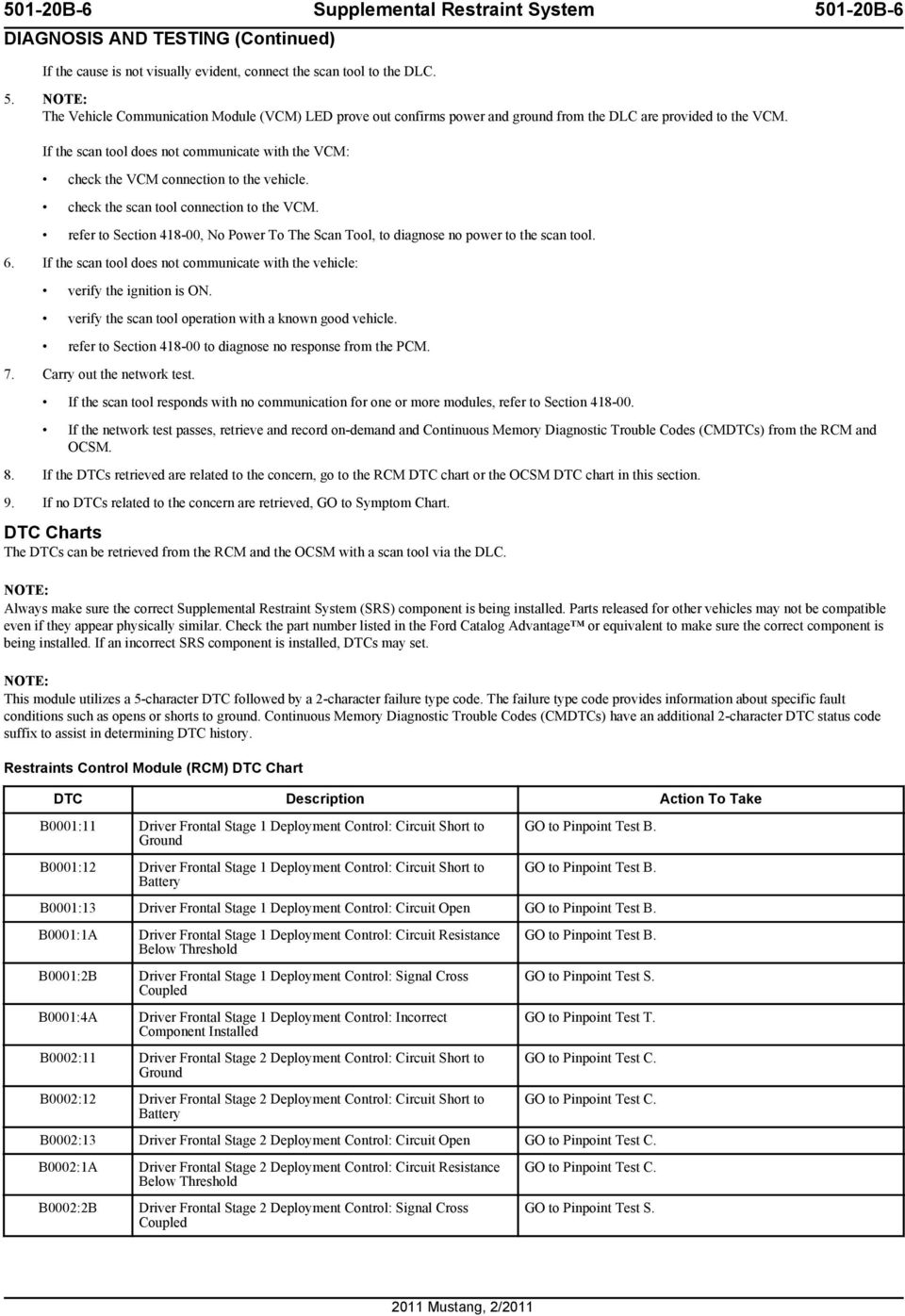
6 501-20B-6 Supplemental Restraint System B-6 If the cause is not visually evident, connect the scan tool to the DLC. 5. The Vehicle Communication Module (VCM) LED prove out confirms power and ground from the DLC are provided to the VCM. If the scan tool does not communicate with the VCM: check the VCM connection to the vehicle. check the scan tool connection to the VCM. refer to Section , Power To The Scan Tool, to diagnose no power to the scan tool. 6. If the scan tool does not communicate with the vehicle: verify the ignition is ON. verify the scan tool operation with a known good vehicle. refer to Section to diagnose no response from the PCM. 7. Carry out the network test. If the scan tool responds with no communication for one or more modules, refer to Section If the network test passes, retrieve and record on-demand and Continuous Memory Diagnostic Trouble Codes (CMDTCs) from the RCM and OCSM. 8. If the DTCs retrieved are related to the concern, go to the RCM DTC chart or the OCSM DTC chart 9. If no DTCs related to the concern are retrieved, GO to Symptom Chart. DTC Charts The DTCs can be retrieved from the RCM and the OCSM with a scan tool via the DLC. Always make sure the correct Supplemental Restraint System (SRS) component is being installed. Parts released for other vehicles may not be compatible even if they appear physically similar. Check the part number listed in the Ford Catalog Advantage or equivalent to make sure the correct component is being installed. If an incorrect SRS component is installed, DTCs may set. This module utilizes a 5-character DTC followed by a 2-character failure type code. The failure type code provides information about specific fault conditions such as opens or shorts to ground. Continuous Memory Diagnostic Trouble Codes (CMDTCs) have an additional 2-character DTC status code suffix to assist in determining DTC history. Restraints Control Module (RCM) DTC Chart DTC Description Action To Take B0001:11 Driver Frontal Stage 1 Deployment Control: Circuit Short to Ground B0001:12 Driver Frontal Stage 1 Deployment Control: Circuit Short to Battery GO to Pinpoint Test B. GO to Pinpoint Test B. B0001:13 Driver Frontal Stage 1 Deployment Control: Circuit Open GO to Pinpoint Test B. B0001:1A B0001:2B B0001:4A Driver Frontal Stage 1 Deployment Control: Circuit Resistance Below Threshold Driver Frontal Stage 1 Deployment Control: Signal Cross Coupled Driver Frontal Stage 1 Deployment Control: Incorrect Component Installed B0002:11 Driver Frontal Stage 2 Deployment Control: Circuit Short to Ground B0002:12 Driver Frontal Stage 2 Deployment Control: Circuit Short to Battery GO to Pinpoint Test B. GO to Pinpoint Test S. GO to Pinpoint Test T. GO to Pinpoint Test C. GO to Pinpoint Test C. B0002:13 Driver Frontal Stage 2 Deployment Control: Circuit Open GO to Pinpoint Test C. B0002:1A B0002:2B Driver Frontal Stage 2 Deployment Control: Circuit Resistance Below Threshold Driver Frontal Stage 2 Deployment Control: Signal Cross Coupled GO to Pinpoint Test C. GO to Pinpoint Test S.
7 501-20B-7 Supplemental Restraint System B-7 Restraints Control Module (RCM) DTC Chart (Continued) DTC Description Action To Take B0002:4A Driver Frontal Stage 2 Deployment Control: Incorrect Component Installed B0010:11 Passenger Frontal Stage 1 Deployment Control: Circuit Short to Ground B0010:12 Passenger Frontal Stage 1 Deployment Control: Circuit Short to Battery GO to Pinpoint Test T. GO to Pinpoint Test D. GO to Pinpoint Test D. B0010:13 Passenger Frontal Stage 1 Deployment Control: Circuit Open GO to Pinpoint Test D. B0010:1A B0010:2B B0010:4A Passenger Frontal Stage 1 Deployment Control: Circuit Resistance Below Threshold Passenger Frontal Stage 1 Deployment Control: Signal Cross Coupled Passenger Frontal Stage 1 Deployment Control: Incorrect Component Installed B0011:11 Passenger Frontal Stage 2 Deployment Control: Circuit Short to Ground B0011:12 Passenger Frontal Stage 2 Deployment Control: Circuit Short to Battery GO to Pinpoint Test D. GO to Pinpoint Test S. GO to Pinpoint Test T. GO to Pinpoint Test E. GO to Pinpoint Test E. B0011:13 Passenger Frontal Stage 2 Deployment Control: Circuit Open GO to Pinpoint Test E. B0011:1A B0011:2B B0011:4A Passenger Frontal Stage 2 Deployment Control: Circuit Resistance Below Threshold Passenger Frontal Stage 2 Deployment Control: Signal Cross Coupled Passenger Frontal Stage 2 Deployment Control: Incorrect Component Installed GO to Pinpoint Test E. GO to Pinpoint Test S. GO to Pinpoint Test T. B0020:11 Left Side Airbag Deployment Control: Circuit Short to Ground GO to Pinpoint Test F. B0020:12 Left Side Airbag Deployment Control: Circuit Short to Battery GO to Pinpoint Test F. B0020:13 Left Side Airbag Deployment Control: Circuit Open GO to Pinpoint Test F. B0020:1A Left Side Airbag Deployment Control: Circuit Resistance Below Threshold GO to Pinpoint Test F. B0020:2B Left Side Airbag Deployment Control: Signal Cross Coupled GO to Pinpoint Test S. B0020:4A Left Side Airbag Deployment Control: Incorrect Component Installed GO to Pinpoint Test T. B0028:11 Right Side Airbag Deployment Control: Circuit Short to Ground GO to Pinpoint Test G. B0028:12 Right Side Airbag Deployment Control: Circuit Short to Battery GO to Pinpoint Test G. B0028:13 Right Side Airbag Deployment Control: Circuit Open GO to Pinpoint Test G. B0028:1A Right Side Airbag Deployment Control: Circuit Resistance Below Threshold GO to Pinpoint Test G. B0028:2B Right Side Airbag Deployment Control: Signal Cross Coupled GO to Pinpoint Test S. B0028:4A Right Side Airbag Deployment Control: Incorrect Component Installed GO to Pinpoint Test T. B0050:11 Driver Seatbelt Sensor: Circuit Short to Ground GO to Pinpoint Test H. B0050:12 Driver Seatbelt Sensor: Circuit Short to Battery GO to Pinpoint Test H. B0050:13 Driver Seatbelt Sensor: Circuit Open GO to Pinpoint Test H. B0050:1D Driver Seatbelt Sensor: Circuit Current Out of Range GO to Pinpoint Test H. B0050:2B Driver Seatbelt Sensor: Signal Cross Coupled GO to Pinpoint Test S. B0050:4A Driver Seatbelt Sensor: Incorrect Component Installed GO to Pinpoint Test T. B0052:11 Passenger Seatbelt Sensor: Circuit Short to Ground GO to Pinpoint Test I. B0052:12 Passenger Seatbelt Sensor: Circuit Short to Battery GO to Pinpoint Test I. B0052:13 Passenger Seatbelt Sensor: Circuit Open GO to Pinpoint Test I. B0052:1D Passenger Seatbelt Sensor: Circuit Current Out of Range GO to Pinpoint Test I.

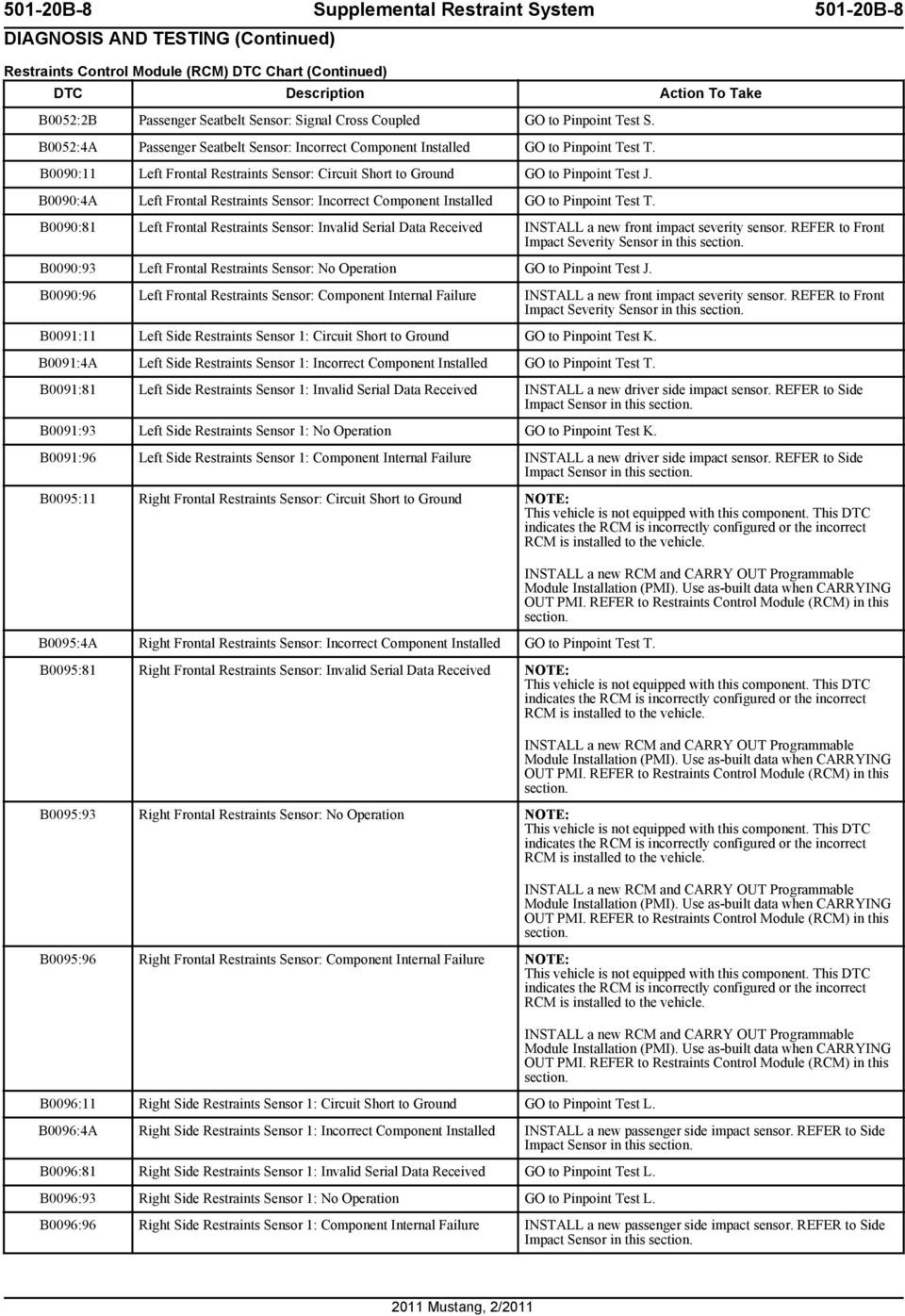
8 501-20B-8 Supplemental Restraint System B-8 Restraints Control Module (RCM) DTC Chart (Continued) DTC Description Action To Take B0052:2B Passenger Seatbelt Sensor: Signal Cross Coupled GO to Pinpoint Test S. B0052:4A Passenger Seatbelt Sensor: Incorrect Component Installed GO to Pinpoint Test T. B0090:11 Left Frontal Restraints Sensor: Circuit Short to Ground GO to Pinpoint Test J. B0090:4A Left Frontal Restraints Sensor: Incorrect Component Installed GO to Pinpoint Test T. B0090:81 Left Frontal Restraints Sensor: Invalid Serial Data Received INSTALL a new front impact severity sensor. REFER to Front Impact Severity Sensor B0090:93 Left Frontal Restraints Sensor: Operation GO to Pinpoint Test J. B0090:96 Left Frontal Restraints Sensor: Component Internal Failure INSTALL a new front impact severity sensor. REFER to Front Impact Severity Sensor B0091:11 Left Side Restraints Sensor 1: Circuit Short to Ground GO to Pinpoint Test K. B0091:4A Left Side Restraints Sensor 1: Incorrect Component Installed GO to Pinpoint Test T. B0091:81 Left Side Restraints Sensor 1: Invalid Serial Data Received INSTALL a new driver side impact sensor. REFER to Side Impact Sensor B0091:93 Left Side Restraints Sensor 1: Operation GO to Pinpoint Test K. B0091:96 Left Side Restraints Sensor 1: Component Internal Failure INSTALL a new driver side impact sensor. REFER to Side Impact Sensor B0095:11 Right Frontal Restraints Sensor: Circuit Short to Ground This vehicle is not equipped with this component. This DTC indicates the RCM is incorrectly configured or the incorrect RCM is installed to the vehicle. B0095:4A Right Frontal Restraints Sensor: Incorrect Component Installed GO to Pinpoint Test T. INSTALL a new RCM and CARRY OUT Programmable Module Installation (PMI). Use as-built data when CARRYING OUT PMI. REFER to Restraints Control Module (RCM) in this section. B0095:81 Right Frontal Restraints Sensor: Invalid Serial Data Received This vehicle is not equipped with this component. This DTC indicates the RCM is incorrectly configured or the incorrect RCM is installed to the vehicle. INSTALL a new RCM and CARRY OUT Programmable Module Installation (PMI). Use as-built data when CARRYING OUT PMI. REFER to Restraints Control Module (RCM) in this section. B0095:93 Right Frontal Restraints Sensor: Operation This vehicle is not equipped with this component. This DTC indicates the RCM is incorrectly configured or the incorrect RCM is installed to the vehicle. INSTALL a new RCM and CARRY OUT Programmable Module Installation (PMI). Use as-built data when CARRYING OUT PMI. REFER to Restraints Control Module (RCM) in this section. B0095:96 Right Frontal Restraints Sensor: Component Internal Failure This vehicle is not equipped with this component. This DTC indicates the RCM is incorrectly configured or the incorrect RCM is installed to the vehicle. B0096:11 Right Side Restraints Sensor 1: Circuit Short to Ground GO to Pinpoint Test L. INSTALL a new RCM and CARRY OUT Programmable Module Installation (PMI). Use as-built data when CARRYING OUT PMI. REFER to Restraints Control Module (RCM) in this section. B0096:4A Right Side Restraints Sensor 1: Incorrect Component Installed INSTALL a new passenger side impact sensor. REFER to Side Impact Sensor B0096:81 Right Side Restraints Sensor 1: Invalid Serial Data Received GO to Pinpoint Test L. B0096:93 Right Side Restraints Sensor 1: Operation GO to Pinpoint Test L. B0096:96 Right Side Restraints Sensor 1: Component Internal Failure INSTALL a new passenger side impact sensor. REFER to Side Impact Sensor
9 501-20B-9 Supplemental Restraint System B-9 Restraints Control Module (RCM) DTC Chart (Continued) DTC Description Action To Take B00A0:09 Occupant Classification System: Component Failure GO to Pinpoint Test M. B00A0:4A Occupant Classification System: Incorrect Component Installed GO to Pinpoint Test M. B00A0:63 Occupant Classification System: Circuit / Component Protection Time-Out GO to Pinpoint Test M. B00A0:64 Occupant Classification System: Signal Plausibility Failure GO to Pinpoint Test M. B00A0:68 Occupant Classification System: Event Information GO to Pinpoint Test M. B00B5:11 B00B5:12 Driver Seat Track Position Restraints Sensor: Circuit Short to Ground Driver Seat Track Position Restraints Sensor: Circuit Short to Battery GO to Pinpoint Test N. GO to Pinpoint Test N. B00B5:13 Driver Seat Track Position Restraints Sensor: Circuit Open GO to Pinpoint Test N. B00B5:1D B00B5:2B B00B5:4A B00C5:11 B00C5:12 Driver Seat Track Position Restraints Sensor: Circuit Current Out of Range Driver Seat Track Position Restraints Sensor: Signal Cross Coupled Driver Seat Track Position Restraints Sensor: Incorrect Component Installed Passenger Seat Track Position Restraints Sensor: Circuit Short to Ground Passenger Seat Track Position Restraints Sensor: Circuit Short to Battery GO to Pinpoint Test N. GO to Pinpoint Test S. GO to Pinpoint Test T. GO to Pinpoint Test V. GO to Pinpoint Test V. B00C5:13 Passenger Seat Track Position Restraints Sensor: Circuit Open GO to Pinpoint Test V. B00C5:1D B00C5:2B B00C5:4A B00D5:11 B00D5:12 Passenger Seat Track Position Restraints Sensor: Circuit Current Out of Range Passenger Seat Track Position Restraints Sensor: Signal Cross Coupled Passenger Seat Track Position Restraints Sensor: Incorrect Component Installed Restraint System Passenger Disable Indicator: Circuit Short to Ground Restraint System Passenger Disable Indicator: Circuit Short to Battery GO to Pinpoint Test V. GO to Pinpoint Test S. GO to Pinpoint Test T. GO to Pinpoint Test O. GO to Pinpoint Test O. B00D5:13 Restraint System Passenger Disable Indicator: Circuit Open GO to Pinpoint Test O. B00D5:4A Restraint System Passenger Disable Indicator: Incorrect Component Installed GO to Pinpoint Test T. B1193:00 Crash Event Storage Full and Locked: Sub Type Information INSTALL a new RCM and impact sensors. REFER to Inspection and Repair After a Supplemental Restraint System (SRS) Deployment B1211:11 Driver Seatbelt Retractor Pretensioner Deployment Control: Circuit Short to Ground B1211:12 Driver Seatbelt Retractor Pretensioner Deployment Control: Circuit Short to Battery B1211:13 Driver Seatbelt Retractor Pretensioner Deployment Control: Circuit Open B1211:1A B1211:2B B1211:4A Driver Seatbelt Retractor Pretensioner Deployment Control: Circuit Resistance Below Threshold Driver Seatbelt Retractor Pretensioner Deployment Control: Signal Cross Coupled Driver Seatbelt Retractor Pretensioner Deployment Control: Incorrect Component Installed B1214:11 Passenger Seatbelt Retractor Pretensioner Deployment Control: Circuit Short to Ground B1214:12 Passenger Seatbelt Retractor Pretensioner Deployment Control: Circuit Short to Battery GO to Pinpoint Test P. GO to Pinpoint Test P. GO to Pinpoint Test P. GO to Pinpoint Test P. GO to Pinpoint Test S. GO to Pinpoint Test T. GO to Pinpoint Test Q. GO to Pinpoint Test Q.

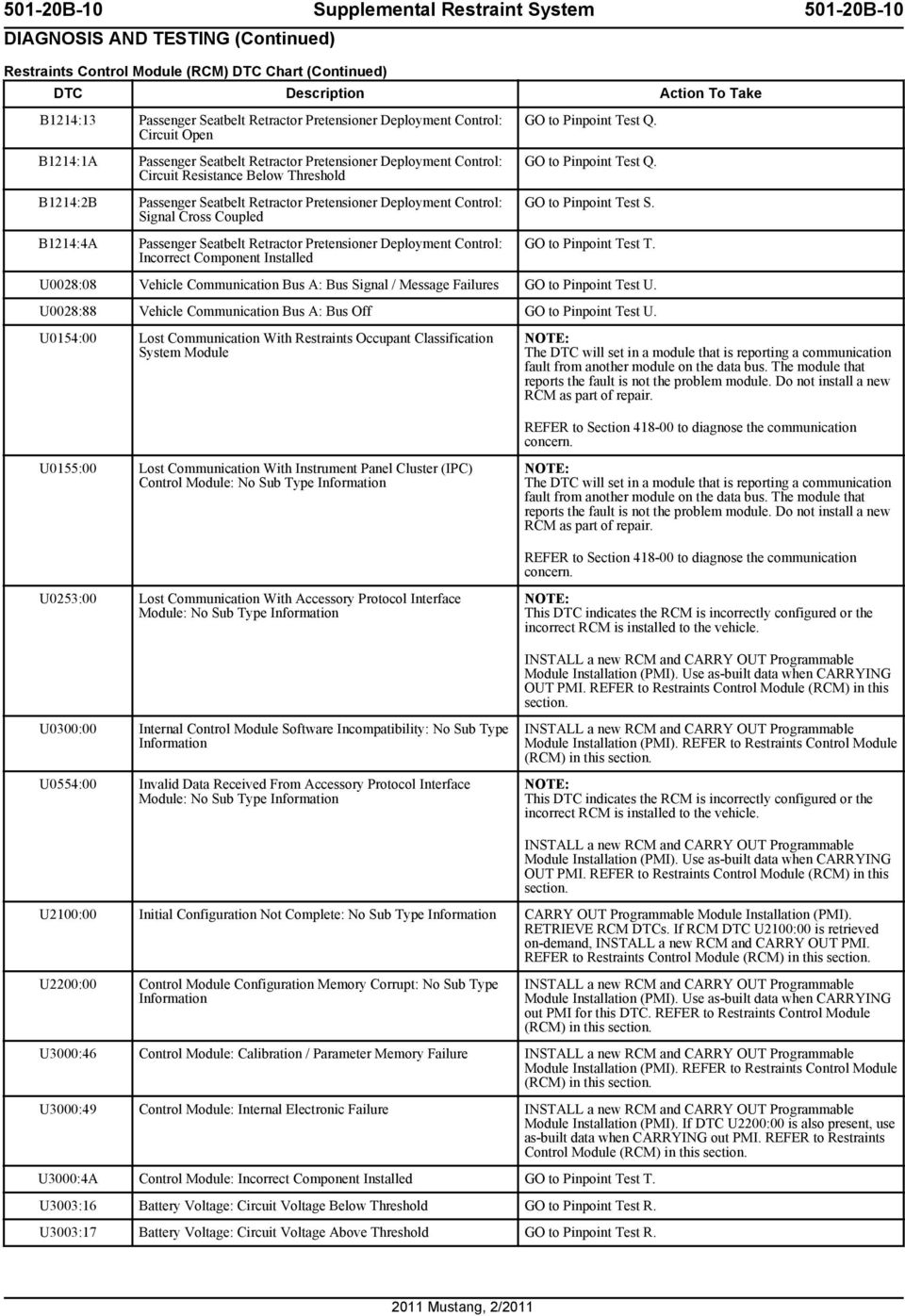
10 501-20B-10 Supplemental Restraint System B-10 Restraints Control Module (RCM) DTC Chart (Continued) DTC Description Action To Take B1214:13 Passenger Seatbelt Retractor Pretensioner Deployment Control: Circuit Open B1214:1A B1214:2B B1214:4A Passenger Seatbelt Retractor Pretensioner Deployment Control: Circuit Resistance Below Threshold Passenger Seatbelt Retractor Pretensioner Deployment Control: Signal Cross Coupled Passenger Seatbelt Retractor Pretensioner Deployment Control: Incorrect Component Installed GO to Pinpoint Test Q. GO to Pinpoint Test Q. GO to Pinpoint Test S. GO to Pinpoint Test T. U0028:08 Vehicle Communication Bus A: Bus Signal / Message Failures GO to Pinpoint Test U. U0028:88 Vehicle Communication Bus A: Bus Off GO to Pinpoint Test U. U0154:00 Lost Communication With Restraints Occupant Classification System Module The DTC will set in a module that is reporting a communication fault from another module on the data bus. The module that reports the fault is not the problem module. Do not install a new RCM as part of repair. REFER to Section to diagnose the communication concern. U0155:00 Lost Communication With Instrument Panel Cluster (IPC) Control Module: Sub Type Information The DTC will set in a module that is reporting a communication fault from another module on the data bus. The module that reports the fault is not the problem module. Do not install a new RCM as part of repair. REFER to Section to diagnose the communication concern. U0253:00 Lost Communication With Accessory Protocol Interface Module: Sub Type Information This DTC indicates the RCM is incorrectly configured or the incorrect RCM is installed to the vehicle. INSTALL a new RCM and CARRY OUT Programmable Module Installation (PMI). Use as-built data when CARRYING OUT PMI. REFER to Restraints Control Module (RCM) in this section. U0300:00 Internal Control Module Software Incompatibility: Sub Type Information U0554:00 Invalid Data Received From Accessory Protocol Interface Module: Sub Type Information INSTALL a new RCM and CARRY OUT Programmable Module Installation (PMI). REFER to Restraints Control Module (RCM) This DTC indicates the RCM is incorrectly configured or the incorrect RCM is installed to the vehicle. INSTALL a new RCM and CARRY OUT Programmable Module Installation (PMI). Use as-built data when CARRYING OUT PMI. REFER to Restraints Control Module (RCM) in this section. U2100:00 Initial Configuration t Complete: Sub Type Information CARRY OUT Programmable Module Installation (PMI). RETRIEVE RCM DTCs. If RCM DTC U2100:00 is retrieved on-demand, INSTALL a new RCM and CARRY OUT PMI. REFER to Restraints Control Module (RCM) U2200:00 Control Module Configuration Memory Corrupt: Sub Type Information INSTALL a new RCM and CARRY OUT Programmable Module Installation (PMI). Use as-built data when CARRYING out PMI for this DTC. REFER to Restraints Control Module (RCM) U3000:46 Control Module: Calibration / Parameter Memory Failure INSTALL a new RCM and CARRY OUT Programmable Module Installation (PMI). REFER to Restraints Control Module (RCM) U3000:49 Control Module: Internal Electronic Failure INSTALL a new RCM and CARRY OUT Programmable Module Installation (PMI). If DTC U2200:00 is also present, use as-built data when CARRYING out PMI. REFER to Restraints Control Module (RCM) U3000:4A Control Module: Incorrect Component Installed GO to Pinpoint Test T. U3003:16 Battery Voltage: Circuit Voltage Below Threshold GO to Pinpoint Test R. U3003:17 Battery Voltage: Circuit Voltage Above Threshold GO to Pinpoint Test R.
11 501-20B-11 Supplemental Restraint System B-11 Occupant Classification System Module (OCSM) DTC Chart DTC Description Action To Take B1231 Event Threshold Exceeded (Crash Data Memory Full) INSPECT the passenger seat for damage. REFER to Inspection and Repair After a Supplemental Restraint System (SRS) Deployment B1317 Battery Voltage High GO to Pinpoint Test R. B1318 Battery Voltage Low GO to Pinpoint Test R. B1342 ECU is Faulted INSTALL an Occupant Classification Sensor (OCS) system service kit. REFER to Occupant Classification Sensor in this section. B2290 Occupant Classification System Fault GO to Pinpoint Test W. B2909 Belt Tension Sensor (BTS) Fault GO to Pinpoint Test X. C1941 Zero Seat Weight Test Failure Can only be reported when carrying out System Reset. GO to Pinpoint Test W. U0151 Lost Communication with Restraints Control Module (RCM) REFER to Section to diagnose the communication concern. U2050 Application Present INSTALL a new OCS system service kit. REFER to Occupant Classification Sensor U2051 One or More Calibration Files Missing/Corrupt INSTALL a new OCS system service kit. REFER to Occupant Classification Sensor Symptom Chart Symptom Chart Condition Possible Sources Action Air bag warning indicator is illuminated continuously Fuse DTC Wiring, terminals or connectors Data Link Connector (DLC) Restraints Control Module (RCM) GO to Pinpoint Test A. Air bag indicator flashing RCM not configured CARRY OUT the RCM self-test and REFER to the RCM DTC chart in this section. Audible tone DTCs retrieved Supplemental Restraint System (SRS) system fault and air bag warning indicator fault The RCM does not respond to the scan tool Fuse Circuitry Scan tool DLC RCM The Occupant Classification System Module (OCSM) does not respond to the scan tool Fuse Circuitry Scan tool DLC OCSM REFER to DTC Charts REFER to Section to diagnose the no communication concern. REFER to Section to diagnose the no communication concern. Pinpoint Test Restraints Control Module (RCM) Pinpoint Test A: The Air Bag Warning Indicator is Illuminated Continuously Refer to Wiring Diagrams Cell 46, Supplemental Restraint System for schematic and connector information. rmal Operation During normal operation, the Instrument Cluster (IC) module will illuminate the air bag indicator continuously for 6 seconds. If the Supplemental Restraint System (SRS) is fault free, the air bag warning indicator will turn off and remain off. If a fault is detected in the SRS, the air bag warning indicator will illuminate and remain illuminated for the rest of the ignition cycle until the fault is no longer detected. The Restraints Control Module (RCM) will communicate to the IC module via the High Speed Controller Area Network (HS-CAN). The IC module will illuminate the air bag indicator based on messaging from the RCM or if there is no communication between the RCM and IC module. This pinpoint test is intended to diagnose the following:

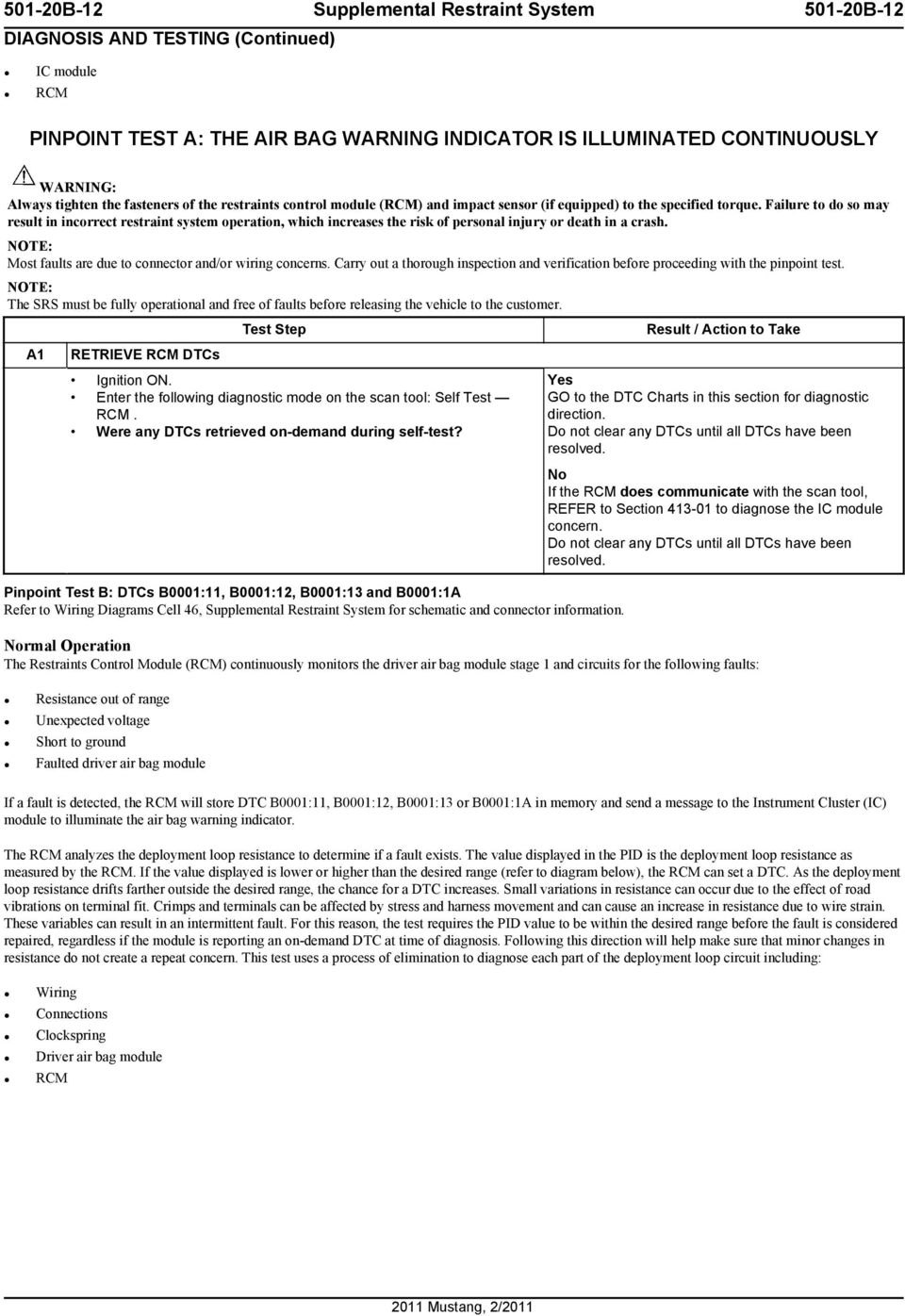
12 501-20B-12 Supplemental Restraint System B-12 IC module RCM PINPOINT TEST A: THE AIR BAG WARNING INDICATOR IS ILLUMINATED CONTINUOUSLY Always tighten the fasteners of the restraints control module (RCM) and impact sensor (if equipped) to the specified torque. Failure to do so may result in incorrect restraint system operation, which increases the risk of personal injury or death in a crash. Most faults are due to connector and/or wiring concerns. Carry out a thorough inspection and verification before proceeding with the pinpoint test. The SRS must be fully operational and free of faults before releasing the vehicle to the customer. A1 RETRIEVE RCM DTCs Test Step Were any DTCs retrieved on-demand during self-test? Pinpoint Test B: DTCs B0001:11, B0001:12, B0001:13 and B0001:1A Refer to Wiring Diagrams Cell 46, Supplemental Restraint System for schematic and connector information. Result / Action to Take GO to the DTC Charts in this section for diagnostic direction. Do not clear any DTCs until all DTCs have been resolved. If the RCM does communicate with the scan tool, REFER to Section to diagnose the IC module concern. Do not clear any DTCs until all DTCs have been resolved. rmal Operation The Restraints Control Module (RCM) continuously monitors the driver air bag module stage 1 and circuits for the following faults: Resistance out of range Unexpected voltage Short to ground Faulted driver air bag module If a fault is detected, the RCM will store DTC B0001:11, B0001:12, B0001:13 or B0001:1A in memory and send a message to the Instrument Cluster (IC) module to illuminate the air bag warning indicator. The RCM analyzes the deployment loop resistance to determine if a fault exists. The value displayed in the PID is the deployment loop resistance as measured by the RCM. If the value displayed is lower or higher than the desired range (refer to diagram below), the RCM can set a DTC. As the deployment loop resistance drifts farther outside the desired range, the chance for a DTC increases. Small variations in resistance can occur due to the effect of road vibrations on terminal fit. Crimps and terminals can be affected by stress and harness movement and can cause an increase in resistance due to wire strain. These variables can result in an intermittent fault. For this reason, the test requires the PID value to be within the desired range before the fault is considered repaired, regardless if the module is reporting an on-demand DTC at time of diagnosis. Following this direction will help make sure that minor changes in resistance do not create a repeat concern. This test uses a process of elimination to diagnose each part of the deployment loop circuit including: Wiring Connections Clockspring Driver air bag module RCM
13 501-20B-13 Supplemental Restraint System B-13 DTC Description B0001:11 Driver Frontal Stage 1 Deployment Control: Circuit Short to Ground B0001:12 Driver Frontal Stage 1 Deployment Control: Circuit Short to Battery B0001:13 Driver Frontal Stage 1 Deployment Control: Circuit Open B0001:1A Driver Frontal Stage 1 Deployment Control: Circuit Resistance Below Threshold Fault Trigger Condition When the RCM senses a short to ground on either driver air bag stage 1 circuit, a fault will be indicated. When the RCM senses a short to voltage on either driver air bag stage 1 circuit, a fault will be indicated. When the RCM measures greater than the desired resistance range between driver air bag stage 1 circuits, a fault will be indicated. When the RCM measures less than the desired resistance range between driver air bag stage 1 circuits, a fault will be indicated. This pinpoint test is intended to diagnose the following: Wiring, terminals or connectors Clockspring Driver air bag module RCM PINPOINT TEST B: DTCs B0001:11, B0001:12, B0001:13 AND B0001:1A Never probe the electrical connectors on air bag, Safety Canopy or side air curtain modules. Failure to follow this instruction may result in the accidental deployment of these modules, which increases the risk of serious personal injury or death. NOTICE: Use the correct probe adapter(s) from the Flex Probe Kit when taking measurements. Failure to use the correct probe adapter(s) may damage the connector. Most faults are due to connector and/or wiring concerns. Carry out a thorough inspection and verification before proceeding with the pinpoint test. Supplemental Restraint System (SRS) components should only be disconnected or reconnected when instructed to do so within a pinpoint test step. Failure to follow this instruction may result in incorrect diagnosis of the SRS. Always make sure the correct SRS component is being installed. Parts released for other vehicles may not be compatible even if they appear physically similar. Check the part number listed in the Ford Catalog Advantage or equivalent to make sure the correct component is being installed. If an incorrect SRS component is installed, DTCs may set. The SRS must be fully operational and free of faults before releasing the vehicle to the customer. B1 RETRIEVE RCM DTCs Test Step Was DTC B0001:11, B0001:12, B0001:13 or B0001:1A retrieved on-demand during self-test? Result / Action to Take This fault cannot be cleared until it is corrected and the DTC is no longer retrieved on-demand during self-test. For DTC B0001:13 or B0001:1A, GO to B2. For DTC B0001:11, GO to B11. For DTC B0001:12, GO to B14.

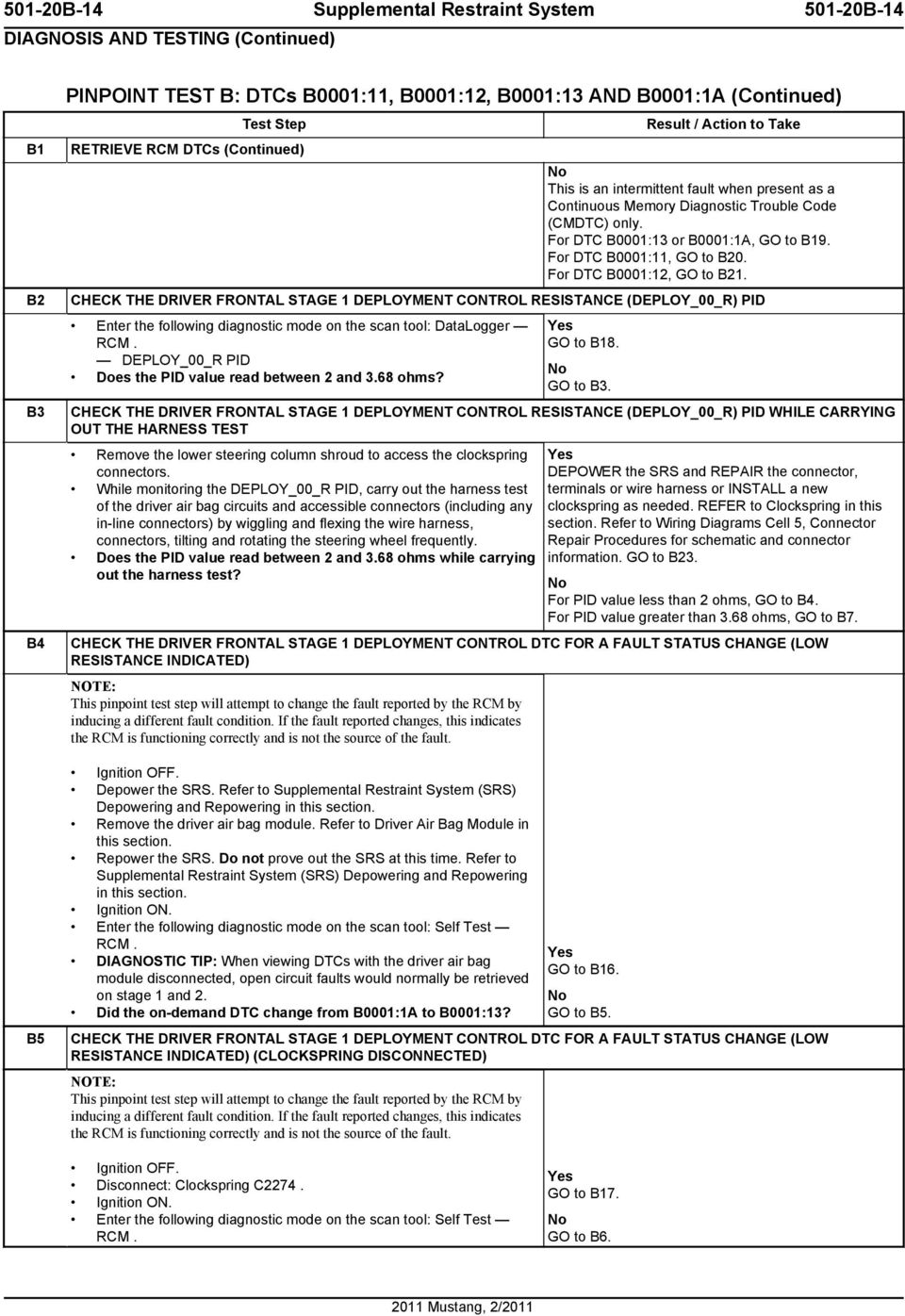
14 501-20B-14 Supplemental Restraint System B-14 B1 B2 B3 B4 B5 PINPOINT TEST B: DTCs B0001:11, B0001:12, B0001:13 AND B0001:1A (Continued) Test Step RETRIEVE RCM DTCs (Continued) Result / Action to Take This is an intermittent fault when present as a Continuous Memory Diagnostic Trouble Code (CMDTC) only. For DTC B0001:13 or B0001:1A, GO to B19. For DTC B0001:11, GO to B20. For DTC B0001:12, GO to B21. CHECK THE DRIVER FRONTAL STAGE 1 DEPLOYMENT CONTROL RESISTANCE (DEPLOY_00_R) PID Enter the following diagnostic mode on the scan tool: DataLogger DEPLOY_00_R PID Does the PID value read between 2 and 3.68 ohms? GO to B18. GO to B3. CHECK THE DRIVER FRONTAL STAGE 1 DEPLOYMENT CONTROL RESISTANCE (DEPLOY_00_R) PID WHILE CARRYING OUT THE HARNESS TEST Remove the lower steering column shroud to access the clockspring connectors. While monitoring the DEPLOY_00_R PID, carry out the harness test of the driver air bag circuits and accessible connectors (including any in-line connectors) by wiggling and flexing the wire harness, connectors, tilting and rotating the steering wheel frequently. Does the PID value read between 2 and 3.68 ohms while carrying out the harness test? DEPOWER the SRS and REPAIR the connector, terminals or wire harness or INSTALL a new clockspring as needed. REFER to Clockspring in this section. Refer to Wiring Diagrams Cell 5, Connector Repair Procedures for schematic and connector information. GO to B23. For PID value less than 2 ohms, GO to B4. For PID value greater than 3.68 ohms, GO to B7. CHECK THE DRIVER FRONTAL STAGE 1 DEPLOYMENT CONTROL DTC FOR A FAULT STATUS CHANGE (LOW RESISTANCE INDICATED) This pinpoint test step will attempt to change the fault reported by the RCM by inducing a different fault condition. If the fault reported changes, this indicates the RCM is functioning correctly and is not the source of the fault. Remove the driver air bag module. Refer to Driver Air Bag Module in this section. DIAGNOSTIC TIP: When viewing DTCs with the driver air bag module disconnected, open circuit faults would normally be retrieved on stage 1 and 2. Did the on-demand DTC change from B0001:1A to B0001:13? GO to B16. GO to B5. CHECK THE DRIVER FRONTAL STAGE 1 DEPLOYMENT CONTROL DTC FOR A FAULT STATUS CHANGE (LOW RESISTANCE INDICATED) (CLOCKSPRING DISCONNECTED) This pinpoint test step will attempt to change the fault reported by the RCM by inducing a different fault condition. If the fault reported changes, this indicates the RCM is functioning correctly and is not the source of the fault. Disconnect: Clockspring C2274. GO to B17. GO to B6.
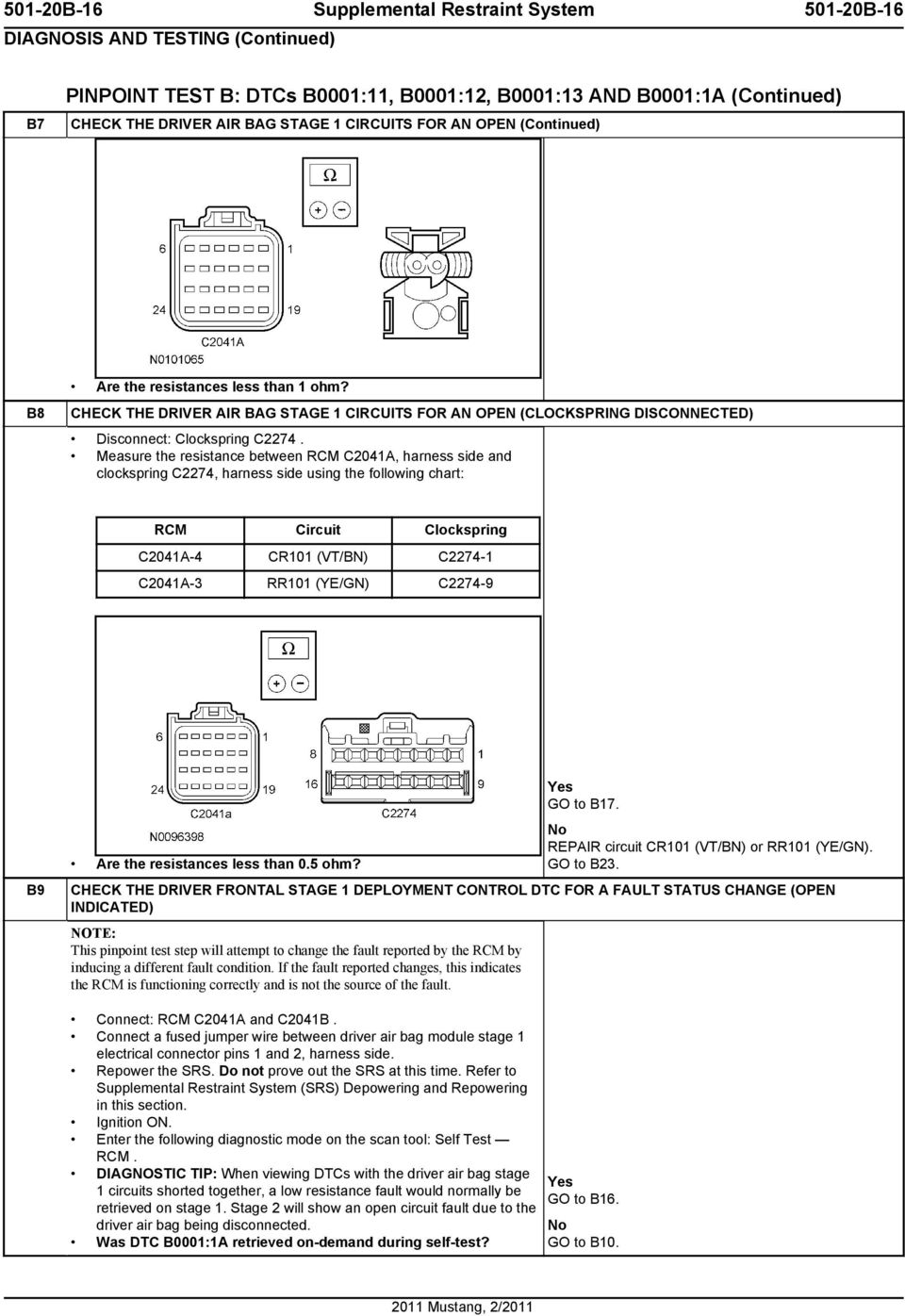
15 501-20B-15 Supplemental Restraint System B-15 PINPOINT TEST B: DTCs B0001:11, B0001:12, B0001:13 AND B0001:1A (Continued) B5 B6 CHECK THE DRIVER FRONTAL STAGE 1 DEPLOYMENT CONTROL DTC FOR A FAULT STATUS CHANGE (LOW RESISTANCE INDICATED) (CLOCKSPRING DISCONNECTED) (Continued) DIAGNOSTIC TIP: When viewing DTCs with the driver air bag module / clockspring disconnected, open circuit faults would normally be retrieved on stage 1 and 2. Did the on-demand DTC change from B0001:1A to B0001:13? CHECK THE RCM FOR LOW RESISTANCE Disconnect: RCM C2041A and C2041B. Measure the resistance between RCM C2041A pins 3 and 4, component side. REPAIR circuits CR101 (VT/BN) and RR101 (YE/GN). GO to B23. B7 Is the resistance greater than 10,000 ohms? CHECK THE DRIVER AIR BAG STAGE 1 CIRCUITS FOR AN OPEN Remove the driver air bag module. Refer to Driver Air Bag Module in this section. Disconnect: RCM C2041A and C2041B. Measure the resistance between RCM C2041A, harness side and driver air bag module stage 1 electrical connector, harness side, using the following chart: GO to B18. RCM Circuit Driver Air Bag Module Stage 1 Electrical Connector C2041A-4 CR101 (VT/BN) Driver Air Bag Module Stage 1 electrical connector C2041A-3 RR101 (YE/GN) Driver Air Bag Module Stage 1 electrical connector GO to B9. GO to B8.

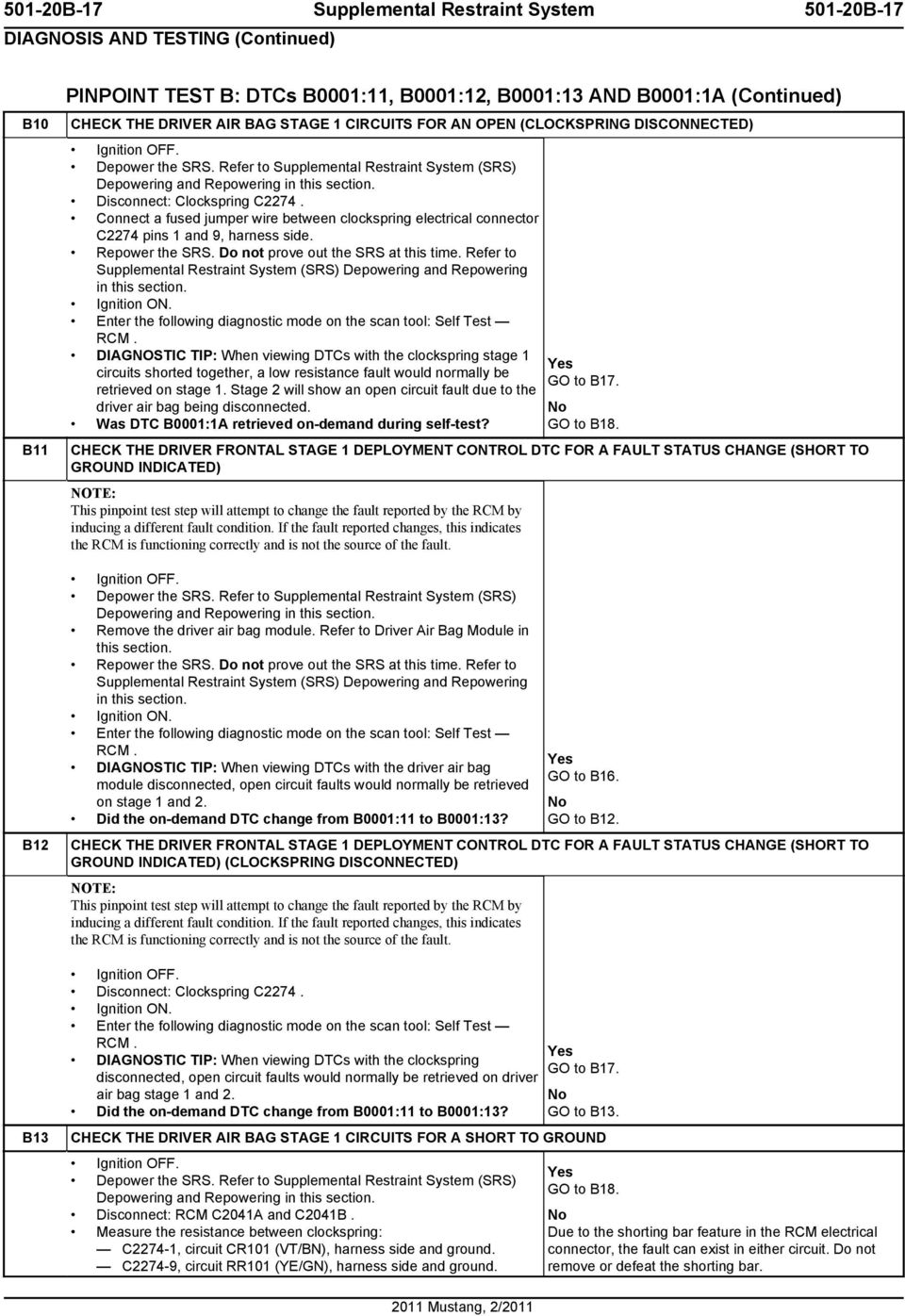
16 501-20B-16 Supplemental Restraint System B-16 B7 PINPOINT TEST B: DTCs B0001:11, B0001:12, B0001:13 AND B0001:1A (Continued) CHECK THE DRIVER AIR BAG STAGE 1 CIRCUITS FOR AN OPEN (Continued) B8 Are the resistances less than 1 ohm? CHECK THE DRIVER AIR BAG STAGE 1 CIRCUITS FOR AN OPEN (CLOCKSPRING DISCONNECTED) Disconnect: Clockspring C2274. Measure the resistance between RCM C2041A, harness side and clockspring C2274, harness side using the following chart: RCM Circuit Clockspring C2041A-4 CR101 (VT/BN) C C2041A-3 RR101 (YE/GN) C B9 Are the resistances less than 0.5 ohm? GO to B17. REPAIR circuit CR101 (VT/BN) or RR101 (YE/GN). GO to B23. CHECK THE DRIVER FRONTAL STAGE 1 DEPLOYMENT CONTROL DTC FOR A FAULT STATUS CHANGE (OPEN INDICATED) This pinpoint test step will attempt to change the fault reported by the RCM by inducing a different fault condition. If the fault reported changes, this indicates the RCM is functioning correctly and is not the source of the fault. Connect: RCM C2041A and C2041B. Connect a fused jumper wire between driver air bag module stage 1 electrical connector pins 1 and 2, harness side. DIAGNOSTIC TIP: When viewing DTCs with the driver air bag stage 1 circuits shorted together, a low resistance fault would normally be retrieved on stage 1. Stage 2 will show an open circuit fault due to the driver air bag being disconnected. Was DTC B0001:1A retrieved on-demand during self-test? GO to B16. GO to B10.
17 501-20B-17 Supplemental Restraint System B-17 B10 B11 B12 B13 PINPOINT TEST B: DTCs B0001:11, B0001:12, B0001:13 AND B0001:1A (Continued) CHECK THE DRIVER AIR BAG STAGE 1 CIRCUITS FOR AN OPEN (CLOCKSPRING DISCONNECTED) Disconnect: Clockspring C2274. Connect a fused jumper wire between clockspring electrical connector C2274 pins 1 and 9, harness side. DIAGNOSTIC TIP: When viewing DTCs with the clockspring stage 1 circuits shorted together, a low resistance fault would normally be retrieved on stage 1. Stage 2 will show an open circuit fault due to the driver air bag being disconnected. Was DTC B0001:1A retrieved on-demand during self-test? GO to B17. GO to B18. CHECK THE DRIVER FRONTAL STAGE 1 DEPLOYMENT CONTROL DTC FOR A FAULT STATUS CHANGE (SHORT TO GROUND INDICATED) This pinpoint test step will attempt to change the fault reported by the RCM by inducing a different fault condition. If the fault reported changes, this indicates the RCM is functioning correctly and is not the source of the fault. Remove the driver air bag module. Refer to Driver Air Bag Module in this section. DIAGNOSTIC TIP: When viewing DTCs with the driver air bag module disconnected, open circuit faults would normally be retrieved on stage 1 and 2. Did the on-demand DTC change from B0001:11 to B0001:13? GO to B16. GO to B12. CHECK THE DRIVER FRONTAL STAGE 1 DEPLOYMENT CONTROL DTC FOR A FAULT STATUS CHANGE (SHORT TO GROUND INDICATED) (CLOCKSPRING DISCONNECTED) This pinpoint test step will attempt to change the fault reported by the RCM by inducing a different fault condition. If the fault reported changes, this indicates the RCM is functioning correctly and is not the source of the fault. Disconnect: Clockspring C2274. DIAGNOSTIC TIP: When viewing DTCs with the clockspring disconnected, open circuit faults would normally be retrieved on driver air bag stage 1 and 2. Did the on-demand DTC change from B0001:11 to B0001:13? GO to B17. GO to B13. CHECK THE DRIVER AIR BAG STAGE 1 CIRCUITS FOR A SHORT TO GROUND Disconnect: RCM C2041A and C2041B. Measure the resistance between clockspring: C2274-1, circuit CR101 (VT/BN), harness side and ground. C2274-9, circuit RR101 (YE/GN), harness side and ground. GO to B18. Due to the shorting bar feature in the RCM electrical connector, the fault can exist in either circuit. Do not remove or defeat the shorting bar.
18 501-20B-18 Supplemental Restraint System B-18 B13 PINPOINT TEST B: DTCs B0001:11, B0001:12, B0001:13 AND B0001:1A (Continued) CHECK THE DRIVER AIR BAG STAGE 1 CIRCUITS FOR A SHORT TO GROUND (Continued) B14 B15 Are the resistances greater than 10,000 ohms? REPAIR circuit CR101 (VT/BN) or RR101 (YE/GN). GO to B23. CHECK THE DRIVER FRONTAL STAGE 1 DEPLOYMENT CONTROL DTC FOR A FAULT STATUS CHANGE (SHORT TO BATTERY INDICATED) (CLOCKSPRING DISCONNECTED) This pinpoint test step will attempt to change the fault reported by the RCM by inducing a different fault condition. If the fault reported changes, this indicates the RCM is functioning correctly and is not the source of the fault. Remove the driver air bag module. Refer to Driver Air Bag Module in this section. Disconnect: Clockspring C2274. DIAGNOSTIC TIP: When viewing DTCs with the driver air bag module/clockspring disconnected, open circuit faults would normally be retrieved on driver air bag stage 1 and 2. Did the on-demand DTC change from B0001:12 to B0001:13? GO to B17. GO to B15. CHECK THE DRIVER AIR BAG STAGE 1 CIRCUITS FOR A SHORT TO VOLTAGE Disconnect: RCM C2041A and C2041B. Measure the voltage between clockspring: C2274-1, circuit CR101 (VT/BN), harness side and ground. C2274-9, circuit RR101 (YE/GN), harness side and ground. Due to the shorting bar feature in the RCM electrical connector, the fault can exist in either circuit. Do not remove or defeat the shorting bar. REPAIR circuit CR101 (VT/BN) or RR101 (YE/GN). GO to B23. GO to B18.

19 501-20B-19 Supplemental Restraint System B-19 B15 PINPOINT TEST B: DTCs B0001:11, B0001:12, B0001:13 AND B0001:1A (Continued) CHECK THE DRIVER AIR BAG STAGE 1 CIRCUITS FOR A SHORT TO VOLTAGE (Continued) B16 B17 B18 Is voltage present on either circuit? CONFIRM THE DRIVER AIR BAG MODULE FAULT Make sure all restraint system components and the RCM electrical connectors are connected before carrying out the self-test. If not, DTCs will be recorded. If installed previously, remove the fused jumper wire from the air bag electrical connector. Install the driver air bag module. Refer to Driver Air Bag Module in this section. Was the original DTC retrieved on-demand during self-test? CONFIRM THE CLOCKSPRING FAULT Make sure all restraint system components and the RCM electrical connectors are connected before carrying out the self-test. If not, DTCs will be recorded. Connect: Clockspring C2274. Install the driver air bag module. Refer to Driver Air Bag Module in this section. Was the original DTC retrieved on-demand during self-test? CONFIRM THE RCM FAULT Make sure all restraint system components and the RCM electrical connectors are connected before carrying out the self-test. If not, DTCs will be recorded. Prior to reconnecting any previously disconnected SRS component: INSTALL a new driver air bag module. REFER to Driver Air Bag Module GO to B23. In the process of diagnosing the fault, the fault condition has become intermittent. Do not install any new SRS components at this time. SRS components should only be installed when directed to do so in the pinpoint test. For DTC B0001:13 or B0001:1A, GO to B19. For DTC B0001:11, GO to B20. For DTC B0001:12, GO to B21. INSTALL a new clockspring. REFER to Clockspring in this section. GO to B23. In the process of diagnosing the fault, the fault condition has become intermittent. Do not install any new SRS components at this time. SRS components should only be installed when directed to do so in the pinpoint test. For DTC B0001:13 or B0001:1A, GO to B19. For DTC B0001:11, GO to B20. For DTC B0001:12, GO to B21. INSTALL a new RCM. REFER to Restraints Control Module (RCM) GO to B23. In the process of diagnosing the fault, the fault condition has become intermittent. Do not install any new SRS components at this time. SRS components should only be installed when directed to do so in the pinpoint test.

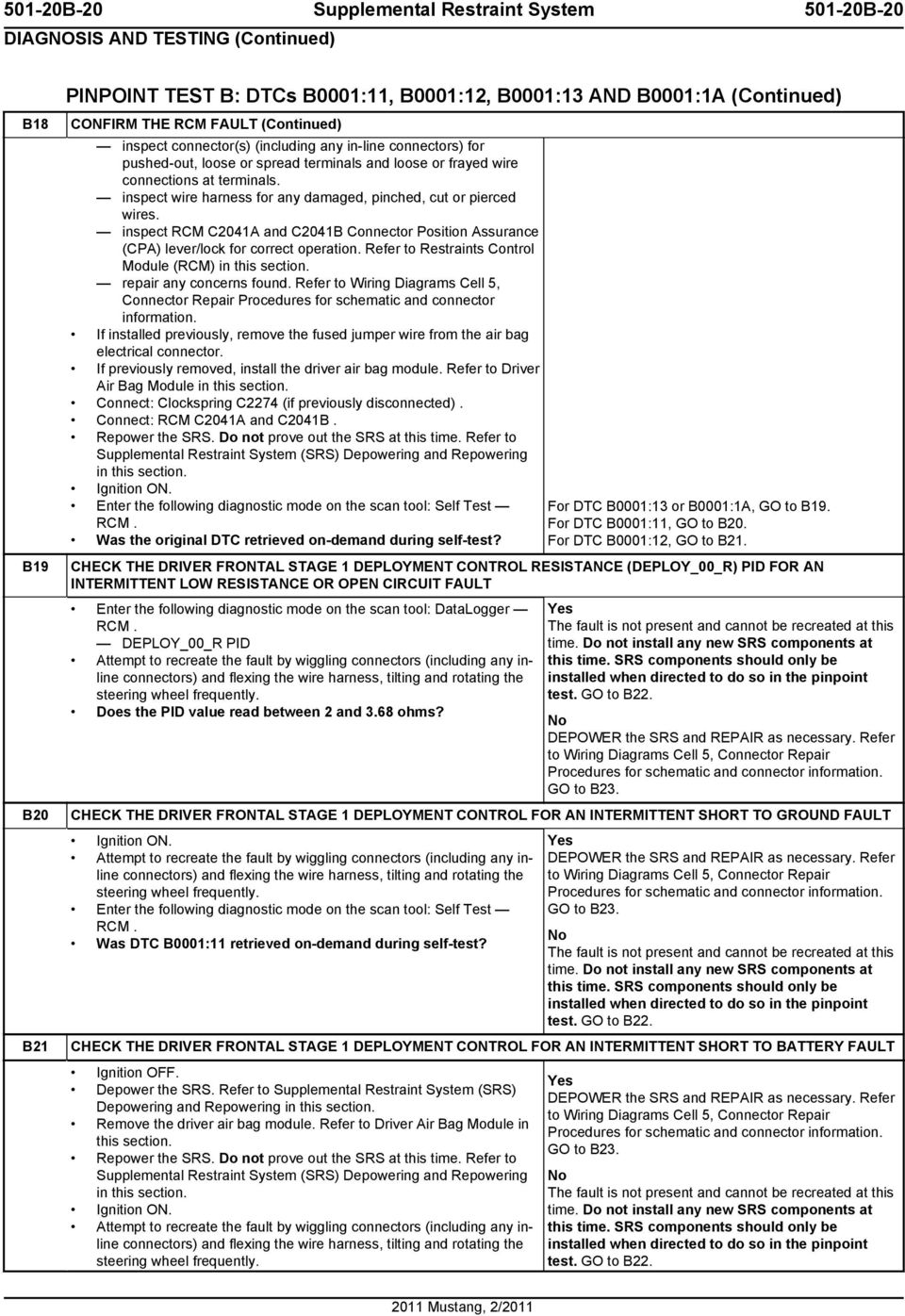
20 501-20B-20 Supplemental Restraint System B-20 PINPOINT TEST B: DTCs B0001:11, B0001:12, B0001:13 AND B0001:1A (Continued) B18 B19 B20 B21 CONFIRM THE RCM FAULT (Continued) inspect connector(s) (including any in-line connectors) for pushed-out, loose or spread terminals and loose or frayed wire connections at terminals. inspect wire harness for any damaged, pinched, cut or pierced wires. inspect RCM C2041A and C2041B Connector Position Assurance (CPA) lever/lock for correct operation. Refer to Restraints Control Module (RCM) repair any concerns found. Refer to Wiring Diagrams Cell 5, Connector Repair Procedures for schematic and connector information. If installed previously, remove the fused jumper wire from the air bag electrical connector. If previously removed, install the driver air bag module. Refer to Driver Air Bag Module Connect: Clockspring C2274 (if previously disconnected). Connect: RCM C2041A and C2041B. Was the original DTC retrieved on-demand during self-test? For DTC B0001:13 or B0001:1A, GO to B19. For DTC B0001:11, GO to B20. For DTC B0001:12, GO to B21. CHECK THE DRIVER FRONTAL STAGE 1 DEPLOYMENT CONTROL RESISTANCE (DEPLOY_00_R) PID FOR AN INTERMITTENT LOW RESISTANCE OR OPEN CIRCUIT FAULT Enter the following diagnostic mode on the scan tool: DataLogger DEPLOY_00_R PID Attempt to recreate the fault by wiggling connectors (including any inline connectors) and flexing the wire harness, tilting and rotating the steering wheel frequently. Does the PID value read between 2 and 3.68 ohms? The fault is not present and cannot be recreated at this time. Do not install any new SRS components at this time. SRS components should only be installed when directed to do so in the pinpoint test. GO to B22. DEPOWER the SRS and REPAIR as necessary. Refer to Wiring Diagrams Cell 5, Connector Repair Procedures for schematic and connector information. GO to B23. CHECK THE DRIVER FRONTAL STAGE 1 DEPLOYMENT CONTROL FOR AN INTERMITTENT SHORT TO GROUND FAULT Attempt to recreate the fault by wiggling connectors (including any inline connectors) and flexing the wire harness, tilting and rotating the steering wheel frequently. Was DTC B0001:11 retrieved on-demand during self-test? DEPOWER the SRS and REPAIR as necessary. Refer to Wiring Diagrams Cell 5, Connector Repair Procedures for schematic and connector information. GO to B23. The fault is not present and cannot be recreated at this time. Do not install any new SRS components at this time. SRS components should only be installed when directed to do so in the pinpoint test. GO to B22. CHECK THE DRIVER FRONTAL STAGE 1 DEPLOYMENT CONTROL FOR AN INTERMITTENT SHORT TO BATTERY FAULT Remove the driver air bag module. Refer to Driver Air Bag Module in this section. Attempt to recreate the fault by wiggling connectors (including any inline connectors) and flexing the wire harness, tilting and rotating the steering wheel frequently. DEPOWER the SRS and REPAIR as necessary. Refer to Wiring Diagrams Cell 5, Connector Repair Procedures for schematic and connector information. GO to B23. The fault is not present and cannot be recreated at this time. Do not install any new SRS components at this time. SRS components should only be installed when directed to do so in the pinpoint test. GO to B22.
21 501-20B-21 Supplemental Restraint System B-21 PINPOINT TEST B: DTCs B0001:11, B0001:12, B0001:13 AND B0001:1A (Continued) B21 B22 B23 CHECK THE DRIVER FRONTAL STAGE 1 DEPLOYMENT CONTROL FOR AN INTERMITTENT SHORT TO BATTERY FAULT (Continued) Was DTC B0001:12 retrieved on-demand during self-test? CHECK THE HARNESS AND CONNECTORS Remove the driver air bag module: inspect connector(s) (including any in-line connectors) for corrosion, loose or spread terminals and loose or frayed wire connections at terminals. inspect wire harness for any damage, pinched, cut or pierced wires. Inspect RCM C2041A and C2041B CPA lever/lock for correct operation. Refer to Restraints Control Module (RCM) Were any concerns found? CHECK FOR ADDITIONAL SRS DTCs REPAIR as necessary. Refer to Wiring Diagrams Cell 5, Connector Repair Procedures for schematic and connector information. GO to B23. The fault is not present and cannot be recreated at this time. Do not install any new SRS components at this time. SRS components should only be installed when directed to do so in the pinpoint test. GO to B23. Turn the ignition OFF and wait one minute to deplete the backup power supply. Failure to follow this instruction may result in serious personal injury or death in the event of an accidental deployment. Reconnect all SRS components (if previously disconnected). If previously directed to depower the SRS, repower the SRS. Do not prove out the SRS at this time. Refer to Supplemental Restraint System (SRS) Restraints. When selecting Restraints from the Self Test menu, DTCs will be retrieved from the RCM and OCSM. Are any RCM and/or OCSM DTCs retrieved on-demand during self-test? Pinpoint Test C: DTCs B0002:11, B0002:12, B0002:13 and B0002:1A Refer to Wiring Diagrams Cell 46, Supplemental Restraint System for schematic and connector information. Do not clear any DTCs until all DTCs have been resolved. GO to the DTC Charts in this section for pinpoint test direction. CLEAR all RCM and OCSM CMDTCs. PROVE OUT the SRS. Repair is complete. RETURN the vehicle to the customer. rmal Operation The Restraints Control Module (RCM) continuously monitors the driver air bag module stage 2 and circuits for the following faults: Resistance out of range Unexpected voltage Short to ground Faulted driver air bag module If a fault is detected, the RCM will store DTC B0002:11, B0002:12, B0002:13 or B0002:1A in memory and send a message to the Instrument Cluster (IC) module to illuminate the air bag warning indicator. The RCM analyzes the deployment loop resistance to determine if a fault exists. The value displayed in the PID is the deployment loop resistance as measured by the RCM. If the value displayed is lower or higher than the desired range (refer to diagram below), the RCM can set a DTC. As the deployment loop resistance drifts farther outside the desired range, the chance for a DTC increases. Small variations in resistance can occur due to the effect of road vibrations on terminal fit. Crimps and terminals can be affected by stress and harness movement and can cause an increase in resistance due to wire strain. These variables can result in an intermittent fault. For this reason, the test requires the PID value to be within the desired range before the fault is considered repaired, regardless if the module is reporting an on-demand DTC at time of diagnosis. Following this direction will help make sure that minor changes in resistance do not create a repeat concern. This test uses a process of elimination to diagnose each part of the deployment loop circuit including: Wiring
22 501-20B-22 Supplemental Restraint System B-22 Connections Clockspring Driver air bag module RCM DTC Description B0002:11 Driver Frontal Stage 2 Deployment Control: Circuit Short to Ground B0002:12 Driver Frontal Stage 2 Deployment Control: Circuit Short to Battery B0002:13 Driver Frontal Stage 2 Deployment Control: Circuit Open B0002:1A Driver Frontal Stage 2 Deployment Control: Circuit Resistance Below Threshold Fault Trigger Condition When the RCM senses a short to ground on either driver air bag stage 2 circuit, a fault will be indicated. When the RCM senses a short to voltage on either driver air bag stage 2 circuit, a fault will be indicated. When the RCM measures greater than the desired resistance range between driver air bag stage 2 circuits, a fault will be indicated. When the RCM measures less than the desired resistance range between driver air bag stage 2 circuits, a fault will be indicated. This pinpoint test is intended to diagnose the following: Wiring, terminals or connectors Clockspring Driver air bag module RCM PINPOINT TEST C: DTCs B0002:11, B0002:12, B0002:13 AND B0002:1A Never probe the electrical connectors on air bag, Safety Canopy or side air curtain modules. Failure to follow this instruction may result in the accidental deployment of these modules, which increases the risk of serious personal injury or death. NOTICE: Use the correct probe adapter(s) from the Flex Probe Kit when taking measurements. Failure to use the correct probe adapter(s) may damage the connector. Most faults are due to connector and/or wiring concerns. Carry out a thorough inspection and verification before proceeding with the pinpoint test. Supplemental Restraint System (SRS) components should only be disconnected or reconnected when instructed to do so within a pinpoint test step. Failure to follow this instruction may result in incorrect diagnosis of the SRS. Always make sure the correct SRS component is being installed. Parts released for other vehicles may not be compatible even if they appear physically similar. Check the part number listed in the Ford Catalog Advantage or equivalent to make sure the correct component is being installed. If an incorrect SRS component is installed, DTCs may set. The SRS must be fully operational and free of faults before releasing the vehicle to the customer. C1 RETRIEVE RCM DTCs Test Step Result / Action to Take This fault cannot be cleared until it is corrected and the DTC is no longer retrieved on-demand during self-test.
23 501-20B-23 Supplemental Restraint System B-23 PINPOINT TEST C: DTCs B0002:11, B0002:12, B0002:13 AND B0002:1A (Continued) C1 C2 C3 C4 C5 Test Step RETRIEVE RCM DTCs (Continued) Was DTC B0002:11, B0002:12, B0002:13 or B0002:1A retrieved on-demand during self-test? Result / Action to Take For DTC B0002:13 or B0002:1A, GO to C2. For DTC B0002:11, GO to C11. For DTC B0002:12, GO to C14. This is an intermittent fault when present as a Continuous Memory Diagnostic Trouble Code (CMDTC) only. For DTC B0002:13 or B0002:1A, GO to C19. For DTC B0002:11, GO to C20. For DTC B0002:12, GO to C21. CHECK THE DRIVER FRONTAL STAGE 2 DEPLOYMENT CONTROL RESISTANCE (DEPLOY_01_R) PID Enter the following diagnostic mode on the scan tool: DataLogger DEPLOY_01_R PID Does the PID value read between 2 and 3.68 ohms? GO to C18. GO to C3. CHECK THE DRIVER FRONTAL STAGE 2 DEPLOYMENT CONTROL RESISTANCE (DEPLOY_01_R) PID WHILE CARRYING OUT THE HARNESS TEST Remove the lower steering column shroud to access the clockspring connector. While monitoring the DEPLOY_01_R PID, carry out the harness test of the driver air bag circuits and accessible connectors (including any in-line connectors), by wiggling and flexing the wire harness, connectors, tilting and rotating the steering wheel frequently. Does the PID value read between 2 and 3.68 ohms while carrying out the harness test? DEPOWER the SRS and REPAIR the connector, terminals or wire harness or INSTALL a new clockspring as needed. REFER to Clockspring in this section. Refer to Wiring Diagrams Cell 5, Connector Repair Procedures for schematic and connector information. GO to C23. For PID value less than 2 ohms, GO to C4. For PID value greater than 3.68 ohms, GO to C7. CHECK THE DRIVER FRONTAL STAGE 2 DEPLOYMENT CONTROL DTC FOR A FAULT STATUS CHANGE (LOW RESISTANCE INDICATED) This pinpoint test step will attempt to change the fault reported by the RCM by inducing a different fault condition. If the fault reported changes, this indicates the RCM is functioning correctly and is not the source of the fault. Remove the driver air bag module. Refer to Driver Air Bag Module in this section. DIAGNOSTIC TIP: When viewing DTCs with the driver air bag module disconnected, open circuit faults would normally be retrieved on stage 1 and 2. Did the on-demand DTC change from B0002:1A to B0002:13? GO to C16. GO to C5. CHECK THE DRIVER FRONTAL STAGE 2 DEPLOYMENT CONTROL DTC FOR A FAULT STATUS CHANGE (LOW RESISTANCE INDICATED) (CLOCKSPRING DISCONNECTED) This pinpoint test step will attempt to change the fault reported by the RCM by inducing a different fault condition. If the fault reported changes, this indicates the RCM is functioning correctly and is not the source of the fault. Disconnect: Clockspring C2274. GO to C17. GO to C6.
24 501-20B-24 Supplemental Restraint System B-24 PINPOINT TEST C: DTCs B0002:11, B0002:12, B0002:13 AND B0002:1A (Continued) C5 C6 CHECK THE DRIVER FRONTAL STAGE 2 DEPLOYMENT CONTROL DTC FOR A FAULT STATUS CHANGE (LOW RESISTANCE INDICATED) (CLOCKSPRING DISCONNECTED) (Continued) DIAGNOSTIC TIP: When viewing DTCs with the driver air bag module/clockspring disconnected, open circuit faults would normally be retrieved on stage 1 and 2. Did the on-demand DTC change from B0002:1A to B0002:13? CHECK FOR A SHORT BETWEEN DRIVER AIR BAG STAGE 2 CIRCUITS Disconnect: RCM C2041A and C2041B. Measure the resistance between C2274-2, circuit CR102 (BU), harness side and C , circuit RR102 (WH), harness side. GO to C18. C7 Is the resistance greater than 10,000 ohms? CHECK THE DRIVER AIR BAG STAGE 2 CIRCUITS FOR AN OPEN Remove the driver air bag module. Refer to Driver Air Bag Module in this section. Disconnect: RCM C2041A and C2041B. Measure the resistance between RCM C2041A, harness side and driver air bag module stage 2 electrical connector, harness side using the following chart: REPAIR circuits CR102 (BU) and RR102 (WH). GO to C23. RCM Circuit Driver Air Bag Module Electrical Connector C2041A-7 CR102 (BU) Driver Air Bag Module Stage 2 electrical connector C2041A-8 RR102 (WH) Driver Air Bag Module Stage 2 electrical connector GO to C9. GO to C8.
25 501-20B-25 Supplemental Restraint System B-25 C7 PINPOINT TEST C: DTCs B0002:11, B0002:12, B0002:13 AND B0002:1A (Continued) CHECK THE DRIVER AIR BAG STAGE 2 CIRCUITS FOR AN OPEN (Continued) C8 Are the resistances less than 1 ohm? CHECK THE DRIVER AIR BAG STAGE 2 CIRCUITS FOR AN OPEN (CLOCKSPRING DISCONNECTED) Disconnect: Clockspring C2274. Measure the resistance between RCM C2041A, harness side and clockspring C2274, harness side using the following chart: RCM Circuit Clockspring C2041A-7 CR102 (BU) C C2041A-8 RR102 (WH) C C9 Are the resistances less than 0.5 ohm? GO to C17. REPAIR circuit CR102 (BU) or RR102 (WH). GO to C23. CHECK THE DRIVER FRONTAL STAGE 2 DEPLOYMENT CONTROL DTC FOR A FAULT STATUS CHANGE (OPEN INDICATED) This pinpoint test step will attempt to change the fault reported by the RCM by inducing a different fault condition. If the fault reported changes, this indicates the RCM is functioning correctly and is not the source of the fault. Connect: RCM C2041A and C2041B. Connect a fused jumper wire between driver air bag module stage 2 electrical connector pins 1 and 2, harness side. DIAGNOSTIC TIP: When viewing DTCs with driver air bag module stage 2 circuits shorted together, a low resistance fault would normally be retrieved on stage 2. Stage 1 will show an open circuit fault due to the driver air bag being disconnected. Was DTC B0002:1A retrieved on-demand during self-test? GO to C16. GO to C10.
26 501-20B-26 Supplemental Restraint System B-26 C10 C11 C12 C13 PINPOINT TEST C: DTCs B0002:11, B0002:12, B0002:13 AND B0002:1A (Continued) CHECK THE DRIVER AIR BAG STAGE 2 CIRCUITS FOR AN OPEN (CLOCKSPRING DISCONNECTED) Disconnect: Clockspring C2274. Connect a fused jumper wire between clockspring electrical connector C2274 pins 2 and 10, harness side. DIAGNOSTIC TIP: When viewing DTCs with the clockspring stage 2 circuits shorted together, a low resistance fault would normally be retrieved on stage 2. Stage 1 will show an open circuit fault due to the driver air bag being disconnected. Was DTC B0002:1A retrieved on-demand during self-test? GO to C17. GO to C18. CHECK THE DRIVER FRONTAL STAGE 2 DEPLOYMENT CONTROL DTC FOR A FAULT STATUS CHANGE (SHORT TO GROUND INDICATED) This pinpoint test step will attempt to change the fault reported by the RCM by inducing a different fault condition. If the fault reported changes, this indicates the RCM is functioning correctly and is not the source of the fault. Remove the driver air bag module. Refer to Driver Air Bag Module in this section. DIAGNOSTIC TIP: When viewing DTCs with the driver air bag module disconnected, open circuit faults would normally be retrieved on stage 1 and 2. Did the on-demand DTC change from B0002:11 to B0002:13? GO to C16. GO to C12. CHECK DRIVER FRONTAL STAGE 2 DEPLOYMENT CONTROL DTC FOR A FAULT STATUS CHANGE (SHORT TO GROUND INDICATED) (CLOCKSPRING DISCONNECTED) This pinpoint test step will attempt to change the fault reported by the RCM by inducing a different fault condition. If the fault reported changes, this indicates the RCM is functioning correctly and is not the source of the fault. Disconnect: Clockspring C2274. DIAGNOSTIC TIP: When viewing DTCs with the driver air bag module/clockspring disconnected, open circuit faults would normally be retrieved on stage 1 and 2. Did the on-demand DTC change from B0002:11 to B0002:13? GO to C17. GO to C13. CHECK THE DRIVER AIR BAG STAGE 2 CIRCUITS FOR A SHORT TO GROUND Disconnect: RCM C2041A and C2041B. Measure the resistance between clockspring: C2274-2, circuit CR102 (BU), harness side and ground. C , circuit RR102 (WH), harness side and ground. GO to C18. REPAIR circuit CR102 (BU) or RR102 (WH). GO to C23.
27 501-20B-27 Supplemental Restraint System B-27 C13 PINPOINT TEST C: DTCs B0002:11, B0002:12, B0002:13 AND B0002:1A (Continued) CHECK THE DRIVER AIR BAG STAGE 2 CIRCUITS FOR A SHORT TO GROUND (Continued) C14 C15 Are the resistances greater than 10,000 ohms? CHECK THE DRIVER FRONTAL STAGE 2 DEPLOYMENT CONTROL DTC FOR A FAULT STATUS CHANGE (SHORT TO BATTERY INDICATED) (CLOCKSPRING DISCONNECTED) This pinpoint test step will attempt to change the fault reported by the RCM by inducing a different fault condition. If the fault reported changes, this indicates the RCM is functioning correctly and is not the source of the fault. Remove the driver air bag module. Refer to Driver Air Bag Module in this section. Disconnect: Clockspring C2274. DIAGNOSTIC TIP: When viewing DTCs with the driver air bag module/clockspring disconnected, open circuit faults would normally be retrieved on stage 1 and 2. Did the on-demand DTC change from B0002:12 to B0002:13? GO to C17. GO to C15. CHECK THE DRIVER AIR BAG STAGE 2 CIRCUITS FOR A SHORT TO VOLTAGE Disconnect: RCM C2041A and C2041B. Measure the voltage between clockspring: C2274-2, circuit CR102 (BU), harness side and ground. C , circuit RR102 (WH), harness side and ground. REPAIR circuit CR102 (BU) or RR102 (WH). GO to C23. GO to C18.
28 501-20B-28 Supplemental Restraint System B-28 C15 PINPOINT TEST C: DTCs B0002:11, B0002:12, B0002:13 AND B0002:1A (Continued) CHECK THE DRIVER AIR BAG STAGE 2 CIRCUITS FOR A SHORT TO VOLTAGE (Continued) C16 C17 C18 Is voltage present on either circuit? CONFIRM THE DRIVER AIR BAG MODULE FAULT Make sure all restraint system components and the RCM electrical connectors are connected before carrying out the self-test. If not, DTCs will be recorded. If installed previously, remove the fused jumper wire from the driver air bag electrical connector. Install the driver air bag module. Refer to Driver Air Bag Module in this section. Was the original DTC retrieved on-demand during self-test? CONFIRM THE CLOCKSPRING FAULT Make sure all restraint system components and the RCM electrical connectors are connected before carrying out the self-test. If not, DTCs will be recorded. Connect: Clockspring C2274. If installed previously, remove the fused jumper wire from the air bag electrical connector. Install the driver air bag module. Refer to Driver Air Bag Module in this section. Was the original DTC retrieved on-demand during self-test? CONFIRM THE RCM FAULT Make sure all restraint system components and the RCM electrical connectors are connected before carrying out the self-test. If not, DTCs will be recorded. Prior to reconnecting any previously disconnected SRS component: INSTALL a new driver air bag module. REFER to Driver Air Bag Module GO to C23. In the process of diagnosing the fault, the fault condition has become intermittent. Do not install any new SRS components at this time. SRS components should only be installed when directed to do so in the pinpoint test. For DTC B0002:13 or B0002:1A, GO to C19. For DTC B0002:11, GO to C20. For DTC B0002:12, GO to C21. INSTALL a new clockspring. REFER to Clockspring in this section. GO to C23. In the process of diagnosing the fault, the fault condition has become intermittent. Do not install any new SRS components at this time. SRS components should only be installed when directed to do so in the pinpoint test. For DTC B0002:13 or B0002:1A, GO to C19. For DTC B0002:11, GO to C20. For DTC B0002:12, GO to C21. INSTALL a new RCM. REFER to Restraints Control Module (RCM) GO to C23. In the process of diagnosing the fault, the fault condition has become intermittent. Do not install any new SRS components at this time. SRS
29 501-20B-29 Supplemental Restraint System B-29 PINPOINT TEST C: DTCs B0002:11, B0002:12, B0002:13 AND B0002:1A (Continued) C18 C19 C20 C21 CONFIRM THE RCM FAULT (Continued) inspect connector(s) (including any in-line connectors) for pushed-out, loose or spread terminals and loose or frayed wire connections at terminals. inspect wire harness for any damage, pinched, cut or pierced wires. inspect RCM C2041A and C2041B Connector Position Assurance (CPA) lever/lock for correct operation. Refer to Restraints Control Module (RCM) repair any concerns found. Refer to Wiring Diagrams Cell 5, Connector Repair Procedures for schematic and connector information. If installed previously, remove the fused jumper wire from the driver air bag electrical connector. If previously removed, install the driver air bag module. Refer to Driver Air Bag Module Connect: Clockspring C2274 (if previously disconnected). Connect: RCM C2041A and C2041B. Was the original DTC retrieved on-demand during self-test? components should only be installed when directed to do so in the pinpoint test. For DTC B0002:13 or B0002:1A, GO to C19. For DTC B0002:11, GO to C20. For DTC B0002:12, GO to C21. CHECK THE DRIVER FRONTAL STAGE 2 DEPLOYMENT CONTROL RESISTANCE (DEPLOY_01_R) PID FOR AN INTERMITTENT LOW RESISTANCE OR OPEN CIRCUIT FAULT Enter the following diagnostic mode on the scan tool: DataLogger DEPLOY_01_R PID Attempt to recreate the fault by wiggling connectors (including any inline connectors) and flexing the wire harness, tilting and rotating the steering wheel frequently. Does the PID value read between 2 and 3.68 ohms? The fault is not present and cannot be recreated at this time. Do not install any new SRS components at this time. SRS components should only be installed when directed to do so in the pinpoint test. GO to C22. DEPOWER the SRS and REPAIR as necessary. Refer to Wiring Diagrams Cell 5, Connector Repair Procedures for schematic and connector information. GO to C23. CHECK THE DRIVER FRONTAL STAGE 2 DEPLOYMENT CONTROL FOR AN INTERMITTENT SHORT TO GROUND FAULT Attempt to recreate the fault by wiggling connectors (including any inline connectors) and flexing the wire harness, tilting and rotating the steering wheel frequently. Was DTC B0002:11 retrieved on-demand during self-test? DEPOWER the SRS and REPAIR as necessary. Refer to Wiring Diagrams Cell 5, Connector Repair Procedures for schematic and connector information. GO to C23. The fault is not present and cannot be recreated at this time. Do not install any new SRS components at this time. SRS components should only be installed when directed to do so in the pinpoint test. GO to C22. CHECK THE DRIVER FRONTAL STAGE 2 DEPLOYMENT CONTROL FOR AN INTERMITTENT SHORT TO BATTERY FAULT Remove the driver air bag module. Refer to Driver Air Bag Module in this section. Attempt to recreate the fault by wiggling connectors (including any inline connectors) and flexing the wire harness, tilting and rotating the steering wheel frequently. DEPOWER the SRS and REPAIR as necessary. Refer to Wiring Diagrams Cell 5, Connector Repair Procedures for schematic and connector information. GO to C23. The fault is not present and cannot be recreated at this time. Do not install any new SRS components at this time. SRS components should only be installed when directed to do so in the pinpoint test. GO to C22.
30 501-20B-30 Supplemental Restraint System B-30 PINPOINT TEST C: DTCs B0002:11, B0002:12, B0002:13 AND B0002:1A (Continued) C21 C22 C23 CHECK THE DRIVER FRONTAL STAGE 2 DEPLOYMENT CONTROL FOR AN INTERMITTENT SHORT TO BATTERY FAULT (Continued) Was DTC B0002:12 retrieved on-demand during self-test? CHECK THE HARNESS AND CONNECTORS Remove the driver air bag module. inspect connector(s) (including any in-line connectors) for corrosion, loose or spread terminals and loose or frayed wire connections at terminals. inspect wire harness for any damage, pinched, cut or pierced wires. Inspect RCM C2041A and C2041B CPA lever/lock for correct operation. Refer to Restraints Control Module (RCM) Were any concerns found? CHECK FOR ADDITIONAL SRS DTCs REPAIR as necessary. Refer to Wiring Diagrams Cell 5, Connector Repair Procedures for schematic and connector information. GO to C23. The fault is not present and cannot be recreated at this time. Do not install any new SRS components at this time. SRS components should only be installed when directed to do so in the pinpoint test. GO to C23. Turn the ignition OFF and wait one minute to deplete the backup power supply. Failure to follow this instruction may result in serious personal injury or death in the event of an accidental deployment. Reconnect all SRS components (if previously disconnected). If previously directed to depower the SRS, repower the SRS. Do not prove out the SRS at this time. Refer to Supplemental Restraint System (SRS) Restraints. When selecting Restraints from the Self Test menu, DTCs will be retrieved from the RCM and OCSM. Are any RCM and/or OCSM DTCs retrieved on-demand during self-test? Pinpoint Test D: DTCs B0010:11, B0010:12, B0010:13 and B0010:1A Refer to Wiring Diagrams Cell 46, Supplemental Restraint System for schematic and connector information. Do not clear any DTCs until all DTCs have been resolved. GO to the DTC Charts in this section for pinpoint test direction. CLEAR all RCM and OCSM CMDTCs. PROVE OUT the SRS. Repair is complete. RETURN the vehicle to the customer. rmal Operation The Restraints Control Module (RCM) continuously monitors the passenger air bag module stage 1 and circuits for the following faults: Resistance out of range Unexpected voltage Short to ground Faulted passenger air bag module If a fault is detected, the RCM will store DTC B0010:11, B0010:12, B0010:13 or B0010:1A in memory and send a message to the Instrument Cluster (IC) module to illuminate the air bag warning indicator. The RCM analyzes the deployment loop resistance to determine if a fault exists. The value displayed in the PID is the deployment loop resistance as measured by the RCM. If the value displayed is lower or higher than the desired range (refer to diagram below), the RCM can set a DTC. As the deployment loop resistance drifts farther outside the desired range, the chance for a DTC increases. Small variations in resistance can occur due to the effect of road vibrations on terminal fit. Crimps and terminals can be affected by stress and harness movement and can cause an increase in resistance due to wire strain. These variables can result in an intermittent fault. For this reason, the test requires the PID value to be within the desired range before the fault is considered repaired, regardless if the module is reporting an on-demand DTC at time of diagnosis. Following this direction will help make sure that minor changes in resistance do not create a repeat concern. This test uses a process of elimination to diagnose each part of the deployment loop circuit including: Wiring
31 501-20B-31 Supplemental Restraint System B-31 Connections Passenger air bag module RCM DTC Description B0010:11 Passenger Frontal Stage 1 Deployment Control: Circuit Short to Ground B0010:12 Passenger Frontal Stage 1 Deployment Control: Circuit Short to Battery B0010:13 Passenger Frontal Stage 1 Deployment Control: Circuit Open B0010:1A Passenger Frontal Stage 1 Deployment Control: Circuit Resistance Below Threshold Fault Trigger Condition When the RCM senses a short to ground on either passenger air bag stage 1 circuit, a fault will be indicated. When the RCM senses a short to voltage on either passenger air bag stage 1 circuit, a fault will be indicated. When the RCM measures greater than the desired resistance range between passenger air bag stage 1 circuits, a fault will be indicated. When the RCM measures less than the desired resistance range between passenger air bag stage 1 circuits, a fault will be indicated. This pinpoint test is intended to diagnose the following: Wiring, terminals or connectors Passenger air bag module RCM PINPOINT TEST D: DTCs B0010:11, B0010:12, B0010:13 AND B0010:1A Never probe the electrical connectors on air bag, Safety Canopy or side air curtain modules. Failure to follow this instruction may result in the accidental deployment of these modules, which increases the risk of serious personal injury or death. NOTICE: Use the correct probe adapter(s) from the Flex Probe Kit when taking measurements. Failure to use the correct probe adapter(s) may damage the connector. Most faults are due to connector and/or wiring concerns. Carry out a thorough inspection and verification before proceeding with the pinpoint test. Supplemental Restraint System (SRS) components should only be disconnected or reconnected when instructed to do so within a pinpoint test step. Failure to follow this instruction may result in incorrect diagnosis of the SRS. Always make sure the correct SRS component is being installed. Parts released for other vehicles may not be compatible even if they appear physically similar. Check the part number listed in the Ford Catalog Advantage or equivalent to make sure the correct component is being installed. If an incorrect SRS component is installed, DTCs may set. The SRS must be fully operational and free of faults before releasing the vehicle to the customer. D1 RETRIEVE RCM DTCs Test Step Was DTC B0010:11, B0010:12, B0010:13 or B0010:1A retrieved on-demand during self-test? Result / Action to Take This fault cannot be cleared until it is corrected and the DTC is no longer retrieved on-demand during self-test. For DTC B0010:13 or B0010:1A, GO to D2. For DTC B0010:11, GO to D9. For DTC B0010:12, GO to D11.
32 501-20B-32 Supplemental Restraint System B-32 D1 D2 D3 D4 D5 PINPOINT TEST D: DTCs B0010:11, B0010:12, B0010:13 AND B0010:1A (Continued) Test Step RETRIEVE RCM DTCs (Continued) Result / Action to Take This is an intermittent fault when present as a Continuous Memory Diagnostic Trouble Code (CMDTC) only. For DTC B0010:13 or B0010:1A, GO to D14. For DTC B0010:11, GO to D15. For DTC B0010:12, GO to D16. CHECK THE PASSENGER FRONTAL STAGE 1 DEPLOYMENT CONTROL RESISTANCE (DEPLOY_05_R) PID Enter the following diagnostic mode on the scan tool: DataLogger DEPLOY_05_R PID Does the PID value read between 1.7 and 2.78 ohms? GO to D13. GO to D3. CHECK THE PASSENGER FRONTAL STAGE 1 DEPLOYMENT CONTROL RESISTANCE (DEPLOY_05_R) PID WHILE CARRYING OUT THE HARNESS TEST While monitoring the DEPLOY_05_R PID, carry out the harness test of the passenger air bag module circuits and accessible connectors (including any in-line connectors), by wiggling connectors and flexing the wire harness frequently. Does the PID value read between 1.7 and 2.78 ohms while carrying out the harness test? DEPOWER the SRS and REPAIR the connector, terminals or wire harness as needed. Refer to Wiring Diagrams Cell 5, Connector Repair Procedures for schematic and connector information. GO to D18. For PID value less than 1.7 ohms, GO to D4. For PID value greater than 2.78 ohms, GO to D7. CHECK THE PASSENGER FRONTAL STAGE 1 DEPLOYMENT CONTROL DTC FOR A FAULT STATUS CHANGE (LOW RESISTANCE INDICATED) This pinpoint test step will attempt to change the fault reported by the RCM by inducing a different fault condition. If the fault reported changes, this indicates the RCM is functioning correctly and is not the source of the fault. Disconnect: Passenger Air Bag Module C256. DIAGNOSTIC TIP: When viewing DTCs with the passenger air bag module disconnected, open circuit faults would normally be retrieved on passenger air bag stage 1 and 2. Did the on-demand DTC change from B0010:1A to B0010:13? GO to D12. GO to D5. CHECK FOR A SHORT BETWEEN PASSENGER AIR BAG STAGE 1 CIRCUITS Measure the resistance between passenger air bag C256-3, circuit CR103 (GY/BU), harness side and C256-4, circuit RR103 (VT/GN), harness side. GO to D13. GO to D6.
33 501-20B-33 Supplemental Restraint System B-33 D5 PINPOINT TEST D: DTCs B0010:11, B0010:12, B0010:13 AND B0010:1A (Continued) CHECK FOR A SHORT BETWEEN PASSENGER AIR BAG STAGE 1 CIRCUITS (Continued) D6 Is the resistance greater than 10,000 ohms? CHECK THE RCM FOR LOW RESISTANCE Disconnect: RCM C2041A and C2041B. Measure the resistance between RCM C2041A pins 1 and 2, component side. D7 Is the resistance greater than 10,000 ohms? CHECK THE PASSENGER AIR BAG STAGE 1 CIRCUITS FOR AN OPEN Disconnect: Passenger Air Bag Module C256. Disconnect: RCM C2041A and C2041B. Measure the resistance between RCM C2041A, harness side and passenger air bag module C256, harness side using the following chart: REPAIR circuits CR103 (GY/BU) and RR103 (VT/GN). GO to D18. GO to D13. RCM Circuit Passenger Air Bag Module C2041A-1 CR103 (GY/BU) C256-3 C2041A-2 RR103 (VT/GN) C256-4 GO to D8. REPAIR circuit CR103 (GY/BU) or RR103 (VT/GN). GO to D18.
34 501-20B-34 Supplemental Restraint System B-34 D7 PINPOINT TEST D: DTCs B0010:11, B0010:12, B0010:13 AND B0010:1A (Continued) CHECK THE PASSENGER AIR BAG STAGE 1 CIRCUITS FOR AN OPEN (Continued) D8 D9 D10 Are the resistances less than 0.5 ohm? CHECK THE PASSENGER FRONTAL STAGE 1 DEPLOYMENT CONTROL DTC FOR A FAULT STATUS CHANGE (OPEN INDICATED) This pinpoint test step will attempt to change the fault reported by the RCM by inducing a different fault condition. If the fault reported changes, this indicates the RCM is functioning correctly and is not the source of the fault. Connect: RCM C2041A and C2041B. Connect a fused jumper wire between passenger air bag module C256-3, circuit CR103 (GY/BU), harness side and C256-4, circuit RR103 (VT/GN), harness side. DIAGNOSTIC TIP: When viewing DTCs with the passenger air bag module stage 1 circuits shorted together, a low resistance fault would normally be retrieved on stage 1. Stage 2 will show an open circuit fault due to the passenger air bag being disconnected. Did the on-demand DTC change from B0010:13 to B0010:1A? GO to D12. GO to D13. CHECK THE PASSENGER FRONTAL STAGE 1 DEPLOYMENT CONTROL DTC FOR A FAULT STATUS CHANGE (SHORT TO GROUND INDICATED) This pinpoint test step will attempt to change the fault reported by the RCM by inducing a different fault condition. If the fault reported changes, this indicates the RCM is functioning correctly and is not the source of the fault. Disconnect: Passenger Air Bag Module C256. DIAGNOSTIC TIP: When viewing DTCs with the passenger air bag module disconnected, open circuit faults would normally be retrieved on passenger air bag stage 1 and 2. Did the on-demand DTC change from B0010:11 to B0010:13? GO to D12. GO to D10. CHECK THE PASSENGER AIR BAG STAGE 1 CIRCUITS FOR A SHORT TO GROUND Disconnect: RCM C2041A and C2041B. GO to D13.
35 501-20B-35 Supplemental Restraint System B-35 PINPOINT TEST D: DTCs B0010:11, B0010:12, B0010:13 AND B0010:1A (Continued) D10 CHECK THE PASSENGER AIR BAG STAGE 1 CIRCUITS FOR A SHORT TO GROUND (Continued) Measure the resistance between passenger air bag module: C256-3, circuit CR103 (GY/BU), harness side and ground. C256-4, circuit RR103 (VT/GN), harness side and ground. D11 Are the resistances greater than 10,000 ohms? CHECK THE PASSENGER AIR BAG STAGE 1 CIRCUITS FOR A SHORT TO VOLTAGE Disconnect: Passenger Air Bag Module C256. Disconnect: RCM C2041A and C2041B. Measure the voltage between passenger air bag module: C256-3, circuit CR103 (GY/BU), harness side and ground. C256-4, circuit RR103 (VT/GN), harness side and ground. Due to the shorting bar feature in the RCM electrical connector, the fault can exist in either circuit. Do not remove or defeat the shorting bar. REPAIR circuit CR103 (GY/BU) or RR103 (VT/GN). GO to D18. Due to the shorting bar feature in the RCM electrical connector, the fault can exist in either circuit. Do not remove or defeat the shorting bar. REPAIR circuit CR103 (GY/BU) or RR103 (VT/GN). GO to D18. D12 Is voltage present on either circuit? CONFIRM THE PASSENGER AIR BAG MODULE FAULT Make sure all restraint system components and the RCM electrical connectors are connected before carrying out the self-test. If not, DTCs will be recorded. If previously installed, remove the fused jumper wire between the passenger air bag module electrical connector. Connect: Passenger Air Bag Module C256 (if previously disconnected). GO to D13. INSTALL a new passenger air bag module. REFER to Passenger Air Bag Module GO to D18. In the process of diagnosing the fault, the fault condition has become intermittent. Do not install any new SRS components at this time. SRS components should only be installed when directed to do so in the pinpoint test. For DTC B0010:13 or B0010:1A, GO to D14. For DTC B0010:11, GO to D15. For DTC B0010:12, GO to D16.
36 501-20B-36 Supplemental Restraint System B-36 PINPOINT TEST D: DTCs B0010:11, B0010:12, B0010:13 AND B0010:1A (Continued) D12 D13 D14 D15 D16 CONFIRM THE PASSENGER AIR BAG MODULE FAULT (Continued) Was the original DTC retrieved on-demand during self-test? CONFIRM THE RCM FAULT Make sure all restraint system components and the RCM electrical connectors are connected before carrying out the self-test. If not, DTCs will be recorded. Prior to reconnecting any previously disconnected SRS component: inspect connector(s) (including any in-line connectors) for pushed out, loose or spread terminals and loose or frayed wire connections at terminals. inspect wire harness for any damage, pinched, cut or pierced wires. inspect RCM C2041A and C2041B Connector Position Assurance (CPA) lever/lock for correct operation. Refer to Restraints Control Module (RCM) repair any concerns found. Refer to Wiring Diagrams Cell 5, Connector Repair Procedures for schematic and connector information. If previously installed, remove the fused jumper wire from the passenger air bag module electrical connector. Connect: Passenger Air Bag Module C256 (if previously disconnected). Connect: RCM C2041A and C2041B. Was the original DTC retrieved on-demand during self-test? INSTALL a new RCM. REFER to Restraints Control Module (RCM) GO to D18. In the process of diagnosing the fault, the fault condition has become intermittent. Do not install any new SRS components at this time. SRS components should only be installed when directed to do so in the pinpoint test. For DTC B0010:13 or B0010:1A, GO to D14. For DTC B0010:11, GO to D15. For DTC B0010:12, GO to D16. CHECK THE PASSENGER FRONTAL STAGE 1 DEPLOYMENT CONTROL RESISTANCE (DEPLOY_05_R) PID FOR AN INTERMITTENT LOW RESISTANCE OR OPEN CIRCUIT FAULT Enter the following diagnostic mode on the scan tool: DataLogger DEPLOY_05_R PID Attempt to recreate the fault by wiggling connectors (including any inline connectors) and flexing the wire harness frequently. Does the PID value read between 1.7 and 2.78 ohms? The fault is not present and cannot be recreated at this time. Do not install any new SRS components at this time. SRS components should only be installed when directed to do so in the pinpoint test. GO to D17. DEPOWER the SRS and REPAIR as necessary. Refer to Wiring Diagrams Cell 5, Connector Repair Procedures for schematic and connector information. GO to D18. CHECK THE PASSENGER FRONTAL STAGE 1 DEPLOYMENT CONTROL CIRCUITS FOR AN INTERMITTENT SHORT TO GROUND FAULT Attempt to recreate the fault by wiggling connectors (including any inline connectors) and flexing the wire harness frequently. Was DTC B0010:11 retrieved on-demand during self-test? DEPOWER the SRS and REPAIR as necessary. Refer to Wiring Diagrams Cell 5, Connector Repair Procedures for schematic and connector information. GO to D18. The fault is not present and cannot be recreated at this time. Do not install any new SRS components at this time. SRS components should only be installed when directed to do so in the pinpoint test. GO to D17. CHECK THE PASSENGER FRONTAL STAGE 1 DEPLOYMENT CONTROL CIRCUITS FOR AN INTERMITTENT SHORT TO BATTERY FAULT
37 501-20B-37 Supplemental Restraint System B-37 D16 D17 D18 PINPOINT TEST D: DTCs B0010:11, B0010:12, B0010:13 AND B0010:1A (Continued) CHECK THE PASSENGER FRONTAL STAGE 1 DEPLOYMENT CONTROL CIRCUITS FOR AN INTERMITTENT SHORT TO BATTERY FAULT (Continued) Disconnect: Passenger Air Bag Module C256. Attempt to recreate the fault by wiggling connectors (including any inline connectors) and flexing the wire harness frequently. Was DTC B0010:12 retrieved on-demand during self-test? CHECK THE HARNESS AND CONNECTORS Disconnect the passenger air bag module C256 (if not previously disconnected). inspect connector(s) (including any in-line connectors) for corrosion, loose or spread terminals and loose or frayed wire connections at terminals. inspect wire harness for any damage, pinched, cut or pierced wires. inspect RCM C2041A and C2041B CPA lever/lock for correct operation. Refer to Restraints Control Module (RCM) in this section. Were any concerns found? CHECK FOR ADDITIONAL SRS DTCs DEPOWER the SRS and REPAIR as necessary. Refer to Wiring Diagrams Cell 5, Connector Repair Procedures for schematic and connector information. GO to D18. The fault is not present and cannot be recreated at this time. Do not install any new SRS components at this time. SRS components should only be installed when directed to do so in the pinpoint test. GO to D17. REPAIR as necessary. Refer to Wiring Diagrams Cell 5, Connector Repair Procedures for schematic and connector information. GO to D18. The fault is not present and cannot be recreated at this time. Do not install any new SRS components at this time. SRS components should only be installed when directed to do so in the pinpoint test. GO to D18. Turn the ignition OFF and wait one minute to deplete the backup power supply. Failure to follow this instruction may result in serious personal injury or death in the event of an accidental deployment. Reconnect all SRS components (if previously disconnected). If previously directed to depower the SRS, repower the SRS. Do not prove out the SRS at this time. Refer to Supplemental Restraint System (SRS) Restraints. When selecting Restraints from the Self Test menu, DTCs will be retrieved from the RCM and Occupant Classification System Module (OCSM). Are any RCM and/or OCSM DTCs retrieved on-demand during self-test? Pinpoint Test E: DTCs B0011:11, B0011:12, B0011:13 and B0011:1A Refer to Wiring Diagrams Cell 46, Supplemental Restraint System for schematic and connector information. Do not clear any DTCs until all DTCs have been resolved. GO to the DTC Charts in this section for pinpoint test direction. CLEAR all RCM and OCSM CMDTCs. PROVE OUT the SRS. Repair is complete. RETURN the vehicle to the customer. rmal Operation The Restraints Control Module (RCM) continuously monitors the passenger air bag module and stage 2 circuits for the following faults: Resistance out of range Unexpected voltage Short to ground Faulted passenger air bag module
38 501-20B-38 Supplemental Restraint System B-38 If a fault is detected, the RCM will store DTC B0011:11, B0011:12, B0011:13 or B0011:1A in memory and send a message to the Instrument Cluster (IC) module to illuminate the air bag warning indicator. The RCM analyzes the deployment loop resistance to determine if a fault exists. The value displayed in the PID is the deployment loop resistance as measured by the RCM. If the value displayed is lower or higher than the desired range (refer to diagram below), the RCM can set a DTC. As the deployment loop resistance drifts farther outside the desired range, the chance for a DTC increases. Small variations in resistance can occur due to the effect of road vibrations on terminal fit. Crimps and terminals can be affected by stress and harness movement and can cause an increase in resistance due to wire strain. These variables can result in an intermittent fault. For this reason, the test requires the PID value to be within the desired range before the fault is considered repaired, regardless if the module is reporting an on-demand DTC at time of diagnosis. Following this direction will help make sure that minor changes in resistance do not create a repeat concern. This test uses a process of elimination to diagnose each part of the deployment loop circuit including: Wiring Connections Passenger air bag module RCM DTC Description B0011:11 Passenger Frontal Stage 2 Deployment Control: Circuit Short to Ground B0011:12 Passenger Frontal Stage 2 Deployment Control: Circuit Short to Battery B0011:13 Passenger Frontal Stage 2 Deployment Control: Circuit Open B0011:1A Passenger Frontal Stage 2 Deployment Control: Circuit Resistance Below Threshold Fault Trigger Condition When the RCM senses a short to ground on either passenger air bag stage 2 circuit, a fault will be indicated. When the RCM senses a short to voltage on either passenger air bag stage 2 circuit, a fault will be indicated. When the RCM measures greater than the desired resistance range between passenger air bag stage 2 circuits, a fault will be indicated. When the RCM measures less than the desired resistance range between passenger air bag stage 2 circuits, a fault will be indicated. This pinpoint test is intended to diagnose the following: Wiring, terminals or connectors Passenger air bag module RCM PINPOINT TEST E: DTCs B0011:11, B0011:12, B0011:13 AND B0011:1A Never probe the electrical connectors on air bag, Safety Canopy or side air curtain modules. Failure to follow this instruction may result in the accidental deployment of these modules, which increases the risk of serious personal injury or death. NOTICE: Use the correct probe adapter(s) from the Flex Probe Kit when taking measurements. Failure to use the correct probe adapter(s) may damage the connector. Most faults are due to connector and/or wiring concerns. Carry out a thorough inspection and verification before proceeding with the pinpoint test. Supplemental Restraint System (SRS) components should only be disconnected or reconnected when instructed to do so within a pinpoint test step. Failure to follow this instruction may result in incorrect diagnosis of the SRS.
39 501-20B-39 Supplemental Restraint System B-39 PINPOINT TEST E: DTCs B0011:11, B0011:12, B0011:13 AND B0011:1A (Continued) Always make sure the correct SRS component is being installed. Parts released for other vehicles may not be compatible even if they appear physically similar. Check the part number listed in the Ford Catalog Advantage or equivalent to make sure the correct component is being installed. If an incorrect SRS component is installed, DTCs may set. The SRS must be fully operational and free of faults before releasing the vehicle to the customer. E1 E2 E3 E4 RETRIEVE RCM DTCs Test Step Was DTC B0011:11, B0011:12, B0011:13 or B0011:1A retrieved on-demand during self-test? Result / Action to Take This fault cannot be cleared until it is corrected and the DTC is no longer retrieved on-demand during self-test. For DTC B0011:13 or B0011:1A, GO to E2. For DTC B0011:11, GO to E8. For DTC B0011:12, GO to E10. This is an intermittent fault when present as a Continuous Memory Diagnostic Trouble Code (CMDTC) only. For DTC B0011:13 or B0011:1A, GO to E13. For DTC B0011:11, GO to E14. For DTC B0011:12, GO to E15. CHECK THE PASSENGER FRONTAL STAGE 2 DEPLOYMENT CONTROL RESISTANCE (DEPLOY_06_R) PID Enter the following diagnostic mode on the scan tool: DataLogger DEPLOY_06_R PID Does the PID value read between 1.7 and 2.78 ohms? GO to E12. GO to E3. CHECK THE PASSENGER FRONTAL STAGE 2 DEPLOYMENT CONTROL RESISTANCE (DEPLOY_06_R) PID WHILE CARRYING OUT THE HARNESS TEST While monitoring the DEPLOY_06_R PID, carry out the harness test of the passenger air bag module circuits and accessible connectors (including any in-line connectors), by wiggling connectors and flexing the wire harness frequently. Does the PID value read between 1.7 and 2.78 ohms while carrying out the harness test? DEPOWER the SRS and REPAIR the connector, terminals or wire harness as needed. Refer to Wiring Diagrams Cell 5, Connector Repair Procedures for schematic and connector information. GO to E17. For PID value less than 1.7 ohms, GO to E4. For PID value greater than 2.78 ohms, GO to E6. CHECK THE PASSENGER FRONTAL STAGE 2 DEPLOYMENT CONTROL DTC FOR A FAULT STATUS CHANGE (LOW RESISTANCE INDICATED) This pinpoint test step will attempt to change the fault reported by the RCM by inducing a different fault condition. If the fault reported changes, this indicates the RCM is functioning correctly and is not the source of the fault. E5 Disconnect: Passenger Air Bag Module C256. DIAGNOSTIC TIP: When viewing DTCs with the passenger air bag module disconnected, open circuit faults would normally be retrieved on passenger air bag stage 1 and 2. Did the on-demand DTC change from B0011:1A to B0011:13? GO to E11. GO to E5. CHECK FOR A SHORT BETWEEN PASSENGER AIR BAG STAGE 2 CIRCUITS GO to E12.
40 501-20B-40 Supplemental Restraint System B-40 PINPOINT TEST E: DTCs B0011:11, B0011:12, B0011:13 AND B0011:1A (Continued) E5 CHECK FOR A SHORT BETWEEN PASSENGER AIR BAG STAGE 2 CIRCUITS (Continued) Disconnect: RCM C2041A and C2041B. Measure the resistance between C256-1, circuit CR104 (YE/GY), harness side and C256-2, circuit RR104 (WH/BU), harness side. E6 Is the resistance greater than 10,000 ohms? CHECK THE PASSENGER AIR BAG STAGE 2 CIRCUITS FOR AN OPEN Disconnect: Passenger Air Bag Module C256. Disconnect: RCM C2041A and C2041B. Measure the resistance between RCM C2041A, harness side and passenger air bag module C256, harness side using the following chart: REPAIR circuits CR104 (YE/GY) and RR104 (WH/BU). GO to E17. RCM Circuit Passenger Air Bag Module C2041A-10 CR104 (YE/GY) C256-1 C2041A-9 RR104 (WH/BU) C256-2 GO to E7. E7 Are the resistances less than 0.5 ohm? REPAIR circuit CR104 (YE/GY) or RR104 (WH/BU). GO to E17. CHECK THE PASSENGER FRONTAL STAGE 2 DEPLOYMENT CONTROL DTC FOR A FAULT STATUS CHANGE (OPEN INDICATED) This pinpoint test step will attempt to change the fault reported by the RCM by inducing a different fault condition. If the fault reported changes, this indicates the RCM is functioning correctly and is not the source of the fault. Connect: RCM C2041A and C2041B. Connect a fused jumper wire between passenger air bag module C256-1, circuit CR104 (YE/GY), harness side and C256-2, circuit RR104 (WH/BU), harness side. GO to E11. GO to E12.
41 501-20B-41 Supplemental Restraint System B-41 PINPOINT TEST E: DTCs B0011:11, B0011:12, B0011:13 AND B0011:1A (Continued) E7 E8 E9 CHECK THE PASSENGER FRONTAL STAGE 2 DEPLOYMENT CONTROL DTC FOR A FAULT STATUS CHANGE (OPEN INDICATED) (Continued) DIAGNOSTIC TIP: When viewing DTCs with the passenger air bag module stage 2 circuits shorted together, a low resistance fault would normally be retrieved on stage 2. Stage 1 will show an open circuit fault due to the passenger air bag module being disconnected. Did the on-demand DTC change from B0011:13 to B0011:1A? CHECK THE PASSENGER FRONTAL STAGE 2 DEPLOYMENT CONTROL DTC FOR A FAULT STATUS CHANGE (SHORT TO GROUND INDICATED) This pinpoint test step will attempt to change the fault reported by the RCM by inducing a different fault condition. If the fault reported changes, this indicates the RCM is functioning correctly and is not the source of the fault. Disconnect: Passenger Air Bag Module C256. DIAGNOSTIC TIP: When viewing DTCs with the passenger air bag module disconnected, open circuit faults would normally be retrieved on stage 1 and 2. Did the on-demand DTC change from B0011:11 to B0011:13? GO to E11. GO to E9. CHECK THE PASSENGER AIR BAG STAGE 2 CIRCUITS FOR A SHORT TO GROUND Disconnect: RCM C2041A and C2041B. Measure the resistance between passenger air bag module: C256-1, circuit CR104 (YE/GY), harness side and ground. C256-2, circuit RR104 (WH/BU), harness side and ground. GO to E12. E10 Are the resistances greater than 10,000 ohms? CHECK THE PASSENGER AIR BAG STAGE 2 CIRCUITS FOR A SHORT TO VOLTAGE Disconnect: Passenger Air Bag Module C256. Disconnect: RCM C2041A and C2041B. REPAIR circuit CR104 (YE/GY) or RR104 (WH/BU). GO to E17. REPAIR circuit CR104 (YE/GY) or RR104 (WH/BU). GO to E17. GO to E12.
42 501-20B-42 Supplemental Restraint System B-42 PINPOINT TEST E: DTCs B0011:11, B0011:12, B0011:13 AND B0011:1A (Continued) E10 CHECK THE PASSENGER AIR BAG STAGE 2 CIRCUITS FOR A SHORT TO VOLTAGE (Continued) Measure the voltage between passenger air bag module: C256-1, circuit CR104 (YE/GY), harness side and ground. C256-2, circuit RR104 (WH/BU), harness side and ground. Is voltage present on either circuit? E11 E12 CONFIRM THE PASSENGER AIR BAG MODULE FAULT Make sure all restraint system components and the RCM electrical connectors are connected before carrying out the self-test. If not, DTCs will be recorded. If previously installed, remove the fused jumper wire from the passenger air bag module electrical connector. Connect: Passenger Air Bag Module C256 (if previously disconnected). Was the original DTC retrieved on-demand during self-test? CONFIRM THE RCM FAULT Make sure all restraint system components and the RCM electrical connectors are connected before carrying out the self-test. If not, DTCs will be recorded. INSTALL a new passenger air bag module. REFER to Passenger Air Bag Module GO to E17. In the process of diagnosing the fault, the fault condition has become intermittent. Do not install any new SRS components at this time. SRS components should only be installed when directed to do so in the pinpoint test. For DTC B0011:13 or B0011:1A, GO to E13. For DTC B0011:11, GO to E14. For DTC B0011:12, GO to E15. Prior to reconnecting any previously disconnected SRS component: inspect connector(s) (including any in-line connectors) for pushed-out, loose or spread terminals and loose or frayed wire connections at terminals. inspect wire harness for any damage, pinched, cut or pierced wires. inspect RCM C2041A and C2041B Connector Position Assurance (CPA) lever/lock for correct operation. Refer to Restraints Control Module (RCM) repair any concerns found. Refer to Wiring Diagrams Cell 5, Connector Repair Procedures for schematic and connector information. If previously installed, remove the fused jumper wire from the passenger air bag module electrical connector. INSTALL a new RCM. REFER to Restraints Control Module (RCM) GO to E17. In the process of diagnosing the fault, the fault condition has become intermittent. Do not install any new SRS components at this time. SRS components should only be installed when directed to do so in the pinpoint test. For DTC B0011:13 or B0011:1A, GO to E13. For DTC B0011:11, GO to E14. For DTC B0011:12, GO to E15.
43 501-20B-43 Supplemental Restraint System B-43 PINPOINT TEST E: DTCs B0011:11, B0011:12, B0011:13 AND B0011:1A (Continued) E12 E13 E14 E15 E16 CONFIRM THE RCM FAULT (Continued) Connect: Passenger Air Bag Module C256 (if previously disconnected). Connect: RCM C2041A and C2041B. Was the original DTC retrieved on-demand during self-test? CHECK THE PASSENGER FRONTAL STAGE 2 DEPLOYMENT CONTROL RESISTANCE (DEPLOY_06_R) PID FOR AN INTERMITTENT LOW RESISTANCE OR OPEN CIRCUIT FAULT Enter the following diagnostic mode on the scan tool: DataLogger DEPLOY_06_R PID Attempt to recreate the fault by wiggling connectors (including any inline connectors) and flexing the wire harness frequently. Does the PID value read between 1.7 and 2.78 ohms? The fault is not present and cannot be recreated at this time. Do not install any new SRS components at this time. SRS components should only be installed when directed to do so in the pinpoint test. GO to E16. DEPOWER the SRS and REPAIR as necessary. Refer to Wiring Diagrams Cell 5, Connector Repair Procedures for schematic and connector information. GO to E17. CHECK THE PASSENGER FRONTAL STAGE 2 DEPLOYMENT CONTROL FOR AN INTERMITTENT SHORT TO GROUND FAULT Attempt to recreate the fault by wiggling connectors (including any inline connectors) and flexing the wire harness frequently. Was DTC B0011:11 retrieved on-demand during self-test? DEPOWER the SRS and REPAIR as necessary. Refer to Wiring Diagrams Cell 5, Connector Repair Procedures for schematic and connector information. GO to E17. The fault is not present and cannot be recreated at this time. Do not install any new SRS components at this time. SRS components should only be installed when directed to do so in the pinpoint test. GO to E16. CHECK THE PASSENGER FRONTAL STAGE 2 DEPLOYMENT CONTROL FOR AN INTERMITTENT SHORT TO BATTERY FAULT Disconnect: Passenger Air Bag Module C256. Attempt to recreate the fault by wiggling connectors (including any inline connectors) and flexing the wire harness frequently. Was DTC B0011:12 retrieved on-demand during self-test? CHECK THE HARNESS AND CONNECTORS Disconnect the passenger air bag module C256. inspect connector(s) (including any in-line connectors) for corrosion, loose or spread terminals and loose or frayed wire connections at terminals. inspect wire harness for any damage, pinched, cut or pierced wires. DEPOWER the SRS and REPAIR as necessary. Refer to Wiring Diagrams Cell 5, Connector Repair Procedures for schematic and connector information. GO to E17. The fault is not present and cannot be recreated at this time. Do not install any new SRS components at this time. SRS components should only be installed when directed to do so in the pinpoint test. GO to E16. REPAIR as necessary. Refer to Wiring Diagrams Cell 5, Connector Repair Procedures for schematic and connector information. GO to E17. The fault is not present and cannot be recreated at this time. Do not install any new SRS components at this time. SRS components should only be
44 501-20B-44 Supplemental Restraint System B-44 PINPOINT TEST E: DTCs B0011:11, B0011:12, B0011:13 AND B0011:1A (Continued) E16 E17 CHECK THE HARNESS AND CONNECTORS (Continued) inspect RCM C2041A and C2041B CPA lever/lock for correct operation. Refer to Restraints Control Module (RCM) in this section. Were any concerns found? CHECK FOR ADDITIONAL SRS DTCs installed when directed to do so in the pinpoint test. GO to E17. Turn the ignition OFF and wait one minute to deplete the backup power supply. Failure to follow this instruction may result in serious personal injury or death in the event of an accidental deployment. Reconnect all SRS components (if previously disconnected). If previously directed to depower the SRS, repower the SRS. Do not prove out the SRS at this time. Refer to Supplemental Restraint System (SRS) Restraints. When selecting Restraints from the Self Test menu, DTCs will be retrieved from the RCM and OCSM. Are any RCM and/or OCSM DTCs retrieved on-demand during self-test? Pinpoint Test F: DTCs B0020:11, B0020:12, B0020:13 and B0020:1A Refer to Wiring Diagrams Cell 46, Supplemental Restraint System for schematic and connector information. Do not clear any DTCs until all DTCs have been resolved. GO to the DTC Charts in this section for pinpoint test direction. CLEAR all RCM and OCSM CMDTCs. PROVE OUT the SRS. Repair is complete. RETURN the vehicle to the customer. rmal Operation The Restraints Control Module (RCM) continuously monitors the driver seat side air bag module and circuits for the following faults: Resistance out of range Unexpected voltage Short to ground Faulted driver seat side air bag module If a fault is detected, the RCM will store DTC B0020:11, B0020:12, B0020:13 or B0020:1A in memory and send a message to the Instrument Cluster (IC) module to illuminate the air bag warning indicator. The RCM analyzes the deployment loop resistance to determine if a fault exists. The value displayed in the PID is the deployment loop resistance as measured by the RCM. If the value displayed is lower or higher than the desired range (refer to diagram below), the RCM can set a DTC. As the deployment loop resistance drifts farther outside the desired range, the chance for a DTC increases. Small variations in resistance can occur due to the effect of road vibrations on terminal fit. Crimps and terminals can be affected by stress and harness movement and can cause an increase in resistance due to wire strain. These variables can result in an intermittent fault. For this reason, the test requires the PID value to be within the desired range before the fault is considered repaired, regardless if the module is reporting an on-demand DTC at time of diagnosis. Following this direction will help make sure that minor changes in resistance do not create a repeat concern. This test uses a process of elimination to diagnose each part of the deployment loop circuit including: Wiring Connections Driver seat side air bag module RCM
45 501-20B-45 Supplemental Restraint System B-45 DTC Description B0020:11 Left Side Airbag Deployment Control: Circuit Short to Ground B0020:12 Left Side Airbag Deployment Control: Circuit Short to Battery Fault Trigger Condition When the RCM senses a short to ground on either driver seat side air bag circuit, a fault will be indicated. When the RCM senses a short to voltage on either driver seat side air bag circuit, a fault will be indicated. B0020:13 Left Side Airbag Deployment Control: Circuit Open When the RCM measures greater than the desired resistance range between the driver seat side air bag circuits, a fault will be indicated. B0020:1A Left Side Airbag Deployment Control: Circuit Resistance Below Threshold This pinpoint test is intended to diagnose the following: Wiring, terminals or connectors Driver seat side air bag module RCM When the RCM measures less than the desired resistance range between the driver seat side air bag circuits, a fault will be indicated. PINPOINT TEST F: DTCs B0020:11, B0020:12, B0020:13 AND B0020:1A Never probe the electrical connectors on air bag, Safety Canopy or side air curtain modules. Failure to follow this instruction may result in the accidental deployment of these modules, which increases the risk of serious personal injury or death. Never disassemble or tamper with safety belt buckle/retractor pretensioners or adaptive load limiting retractors or probe the electrical connectors. Failure to follow this instruction may result in the accidental deployment of the safety belt pretensioners or adaptive load limiting retractors which increases the risk of serious personal injury or death. NOTICE: Use the correct probe adapter(s) from the Flex Probe Kit when taking measurements. Failure to use the correct probe adapter(s) may damage the connector. Most faults are due to connector and/or wiring concerns. Carry out a thorough inspection and verification before proceeding with the pinpoint test. Supplemental Restraint System (SRS) components should only be disconnected or reconnected when instructed to do so within a pinpoint test step. Failure to follow this instruction may result in incorrect diagnosis of the SRS. Always make sure the correct SRS component is being installed. Parts released for other vehicles may not be compatible even if they appear physically similar. Check the part number listed in the Ford Catalog Advantage or equivalent to make sure the correct component is being installed. If an incorrect SRS component is installed, DTCs may set. The SRS must be fully operational and free of faults before releasing the vehicle to the customer. F1 RETRIEVE RCM DTCs Test Step Result / Action to Take This fault cannot be cleared until it is corrected and the DTC is no longer retrieved on-demand during self-test. For DTC B0020:13 or B0020:1A, GO to F2.
46 501-20B-46 Supplemental Restraint System B-46 PINPOINT TEST F: DTCs B0020:11, B0020:12, B0020:13 AND B0020:1A (Continued) F1 F2 F3 F4 F5 Test Step RETRIEVE RCM DTCs (Continued) Was DTC B0020:11, B0020:12, B0020:13 or B0020:1A retrieved on-demand during self-test? Result / Action to Take For DTC B0020:11, GO to F8. For DTC B0020:12, GO to F10. This is an intermittent fault when present as a Continuous Memory Diagnostic Trouble Code (CMDTC) only. For DTC B0020:13 or B0020:1A, GO to F13. For DTC B0020:11, GO to F14. For DTC B0020:12, GO to F15. CHECK THE LEFT SIDE AIRBAG DEPLOYMENT CONTROL RESISTANCE (DEPLOY_10_R) PID Enter the following diagnostic mode on the scan tool: DataLogger DEPLOY_10_R PID Does the PID value read between 1.7 and 2.78 ohms? GO to F12. GO to F3. CHECK THE LEFT SIDE AIRBAG DEPLOYMENT CONTROL RESISTANCE (DEPLOY_10_R) PID WHILE CARRYING OUT THE HARNESS TEST While monitoring the DEPLOY_10_R PID, carry out the harness test of the driver seat side air bag circuits and accessible connectors (including any in-line connectors) by wiggling connectors and flexing the wire harness frequently. Does the PID value read between 1.7 and 2.78 ohms while carrying out the harness test? DEPOWER the SRS and REPAIR the connector, terminals or wire harness as needed. Refer to Wiring Diagrams Cell 5, Connector Repair Procedures for schematic and connector information. GO to F17. For PID value less than 1.7 ohms, GO to F4. For PID value greater than 2.78 ohms, GO to F6. CHECK THE LEFT SIDE AIRBAG DEPLOYMENT CONTROL DTC FOR A FAULT STATUS CHANGE (LOW RESISTANCE INDICATED) This pinpoint test step will attempt to change the fault reported by the RCM by inducing a different fault condition. If the fault reported changes, this indicates the RCM is functioning correctly and is not the source of the fault. Disconnect: Driver Seat Side Air Bag Module C367. DIAGNOSTIC TIP: When viewing DTCs with the driver seat side air bag module disconnected, an open circuit fault would normally be retrieved. Did the on-demand DTC change from B0020:1A to B0020:13? CHECK FOR A SHORT BETWEEN DRIVER SEAT SIDE AIR BAG CIRCUITS Disconnect: RCM C2041A and C2041B. Measure the resistance between driver seat side air bag module C367-1, circuit CR105 (GN/BU), harness side and C367-2, circuit RR105 (GY/YE), harness side. GO to F11. GO to F5. GO to F12. REPAIR circuits CR105 (GN/BU) and RR105 (GY/YE). GO to F17.
47 501-20B-47 Supplemental Restraint System B-47 F5 PINPOINT TEST F: DTCs B0020:11, B0020:12, B0020:13 AND B0020:1A (Continued) CHECK FOR A SHORT BETWEEN DRIVER SEAT SIDE AIR BAG CIRCUITS (Continued) F6 Is the resistance greater than 10,000 ohms? CHECK THE DRIVER SEAT SIDE AIR BAG CIRCUITS FOR AN OPEN Disconnect: Driver Seat Side Air Bag Module C367. Disconnect: RCM C2041A and C2041B. Measure the resistance between RCM C2041B, harness side and driver seat side air bag module C367, harness side using the following chart: RCM Circuit Driver Seat Side Air Bag Module C2041B-2 CR105 (GN/BU) C367-1 C2041B-1 RR105 (GY/YE) C367-2 F7 Are the resistances less than 0.5 ohm? GO to F7. REPAIR circuit CR105 (GN/BU) or RR105 (GY/YE). GO to F17. CHECK THE LEFT SIDE AIRBAG DEPLOYMENT CONTROL DTC FOR A FAULT STATUS CHANGE (OPEN INDICATED) This pinpoint test step will attempt to change the fault reported by the RCM by inducing a different fault condition. If the fault reported changes, this indicates the RCM is functioning correctly and is not the source of the fault. Connect: RCM C2041A and C2041B. Connect a fused jumper wire between driver seat side air bag C367-1, circuit CR105 (GN/BU), harness side and C367-2, circuit RR105 (GY/ YE), harness side. GO to F11. GO to F12.
48 501-20B-48 Supplemental Restraint System B-48 PINPOINT TEST F: DTCs B0020:11, B0020:12, B0020:13 AND B0020:1A (Continued) F7 F8 F9 CHECK THE LEFT SIDE AIRBAG DEPLOYMENT CONTROL DTC FOR A FAULT STATUS CHANGE (OPEN INDICATED) (Continued) DIAGNOSTIC TIP: When viewing DTCs with the driver seat side air bag module circuits shorted together, a low resistance fault would normally be retrieved. Did the on-demand DTC change from B0020:13 to B0020:1A? CHECK THE LEFT SIDE AIRBAG DEPLOYMENT CONTROL DTC FOR A FAULT STATUS CHANGE (SHORT TO GROUND INDICATED) This pinpoint test step will attempt to change the fault reported by the RCM by inducing a different fault condition. If the fault reported changes, this indicates the RCM is functioning correctly and is not the source of the fault. Disconnect: Driver Seat Side Air Bag Module C367. DIAGNOSTIC TIP: When viewing DTCs with the driver seat side air bag module disconnected, an open circuit fault would normally be retrieved. Did the on-demand DTC change from B0020:11 to B0020:13? GO to F11. GO to F9. CHECK THE DRIVER SEAT SIDE AIR BAG CIRCUITS FOR A SHORT TO GROUND Disconnect: RCM C2041A and C2041B. Measure the resistance between driver seat side air bag module: C367-1, circuit CR105 (GN/BU), harness side and ground. C367-2, circuit RR105 (GY/YE), harness side and ground. GO to F12. F10 Are the resistances greater than 10,000 ohms? CHECK THE DRIVER SEAT SIDE AIR BAG CIRCUITS FOR A SHORT TO VOLTAGE Disconnect: Driver Seat Side Air Bag Module C367. Disconnect: RCM C2041A and C2041B. Measure the voltage between driver seat side air bag module: C367-1, circuit CR105 (GN/BU), harness side and ground. C367-2, circuit RR105 (GY/YE), harness side and ground. REPAIR circuit CR105 (GN/BU) or RR105 (GY/YE). GO to F17. REPAIR circuit CR105 (GN/BU) or RR105 (GY/YE). GO to F17. GO to F12.
49 501-20B-49 Supplemental Restraint System B-49 F10 PINPOINT TEST F: DTCs B0020:11, B0020:12, B0020:13 AND B0020:1A (Continued) CHECK THE DRIVER SEAT SIDE AIR BAG CIRCUITS FOR A SHORT TO VOLTAGE (Continued) F11 F12 Is voltage present on either circuit? CONFIRM THE DRIVER SEAT SIDE AIR BAG MODULE FAULT Make sure all restraint system components and the RCM electrical connectors are connected before carrying out self-test. If not, DTCs will be recorded. If previously installed, remove the fused jumper wire from the driver seat side air bag C367. Connect: Driver Seat Side Air Bag Module C367. Connect: RCM C2041A and C2041B. Was the original DTC retrieved on-demand during self-test? CONFIRM THE RCM FAULT Make sure all restraint system components and the RCM electrical connectors are connected before carrying out the self-test. If not, DTCs will be recorded. REMOVE and INSPECT the driver seat side air bag module harness for damage. REFER to Side Air Bag Module If a concern is found, REPAIR as necessary. If a concern was not found, INSTALL a new driver seat side air bag module. REFER to Side Air Bag Module in this section. GO to F17. In the process of diagnosing the fault, the fault condition has become intermittent. Do not install any new SRS components at this time. SRS components should only be installed when directed to do so in the pinpoint test. For DTC B0020:13 or B0020:1A, GO to F13. For DTC B0020:11, GO to F14. For DTC B0020:12, GO to F15. Prior to reconnecting any previously disconnected SRS component: inspect connector(s) (including any in-line connectors) for pushed-out, loose or spread terminals and loose or frayed wire connections at terminals. inspect wire harness for any damage, pinched, cut or pierced wires. inspect RCM C2041A and C2041B Connector Position Assurance (CPA) lever/lock for correct operation. Refer to Restraints Control Module (RCM) repair any concerns found. Refer to Wiring Diagrams Cell 5, Connector Repair Procedures for schematic and connector information. If previously installed, remove the fused jumper wire from the driver seat side air bag C367. Connect: Driver Seat Side Air Bag Module C367. Connect: RCM C2041A and C2041B (if previously disconnected). INSTALL a new RCM. REFER to Restraints Control Module (RCM) GO to F17. In the process of diagnosing the fault, the fault condition has become intermittent. Do not install any new SRS components at this time. SRS components should only be installed when directed to do so in the pinpoint test. For DTC B0020:13 or B0020:1A, GO to F13. For DTC B0020:11, GO to F14. For DTC B0020:12, GO to F15.
50 501-20B-50 Supplemental Restraint System B-50 PINPOINT TEST F: DTCs B0020:11, B0020:12, B0020:13 AND B0020:1A (Continued) F12 F13 F14 F15 F16 F17 CONFIRM THE RCM FAULT (Continued) Was the original DTC retrieved on-demand during self-test? CHECK THE LEFT SIDE AIRBAG DEPLOYMENT CONTROL RESISTANCE (DEPLOY_10_R) PID FOR AN INTERMITTENT LOW RESISTANCE OR OPEN CIRCUIT FAULT Enter the following diagnostic mode on the scan tool: DataLogger DEPLOY_10_R PID Attempt to recreate the fault by wiggling connectors (including any inline connectors) and flexing the wire harness frequently. Does the PID value read between 1.7 and 2.78 ohms? The fault is not present and cannot be recreated at this time. Do not install any new SRS components at this time. SRS components should only be installed when directed to do so in the pinpoint test. GO to F16. DEPOWER the SRS and REPAIR as necessary. Refer to Wiring Diagrams Cell 5, Connector Repair Procedures for schematic and connector information. GO to F17. CHECK THE LEFT SIDE AIRBAG DEPLOYMENT CONTROL FOR AN INTERMITTENT SHORT TO GROUND FAULT Attempt to recreate the fault by wiggling connectors (including any inline connectors) and flexing the wire harness frequently. Was DTC B0020:11 retrieved on-demand during self-test? DEPOWER the SRS and REPAIR as necessary. Refer to Wiring Diagrams Cell 5, Connector Repair Procedures for schematic and connector information. GO to F17. The fault is not present and cannot be recreated at this time. Do not install any new SRS components at this time. SRS components should only be installed when directed to do so in the pinpoint test. GO to F16. CHECK THE LEFT SIDE AIRBAG DEPLOYMENT CONTROL FOR AN INTERMITTENT SHORT TO BATTERY FAULT Disconnect: Driver Seat Side Air Bag Module C367. Attempt to recreate the fault by wiggling connectors (including any inline connectors) and flexing the wire harness frequently. Was DTC B0020:12 retrieved on-demand during self-test? CHECK THE HARNESS AND CONNECTORS Disconnect the driver seat side air bag module C367: inspect connector(s) (including any in-line connectors) for corrosion, loose or spread terminals and loose or frayed wire connections at terminals. inspect wire harness for any damage, pinched, cut or pierced wires. inspect RCM C2041A and C2041B CPA lever/lock for correct operation. Refer to Restraints Control Module (RCM) in this section. Were any concerns found? CHECK FOR ADDITIONAL SRS DTCs DEPOWER the SRS and REPAIR as necessary. Refer to Wiring Diagrams Cell 5, Connector Repair Procedures for schematic and connector information. GO to F17. The fault is not present and cannot be recreated at this time. Do not install any new SRS components at this time. SRS components should only be installed when directed to do so in the pinpoint test. GO to F16. REPAIR as necessary. Refer to Wiring Diagrams Cell 5, Connector Repair Procedures for schematic and connector information. GO to F17. The fault is not present and cannot be recreated at this time. Do not install any new SRS components at this time. SRS components should only be installed when directed to do so in the pinpoint test. GO to F17. Do not clear any DTCs until all DTCs have been resolved. GO to the DTC Charts in this section for pinpoint test direction.
51 501-20B-51 Supplemental Restraint System B-51 PINPOINT TEST F: DTCs B0020:11, B0020:12, B0020:13 AND B0020:1A (Continued) F17 CHECK FOR ADDITIONAL SRS DTCs (Continued) Turn the ignition OFF and wait one minute to deplete the backup power supply. Failure to follow this instruction may result in serious personal injury or death in the event of an accidental deployment. Reconnect all SRS components (if previously disconnected). If previously directed to depower the SRS, repower the SRS. Do not prove out the SRS at this time. Refer to Supplemental Restraint System (SRS) Restraints. When selecting Restraints from the Self Test menu, DTCs will be retrieved from the RCM and OCSM. Are any RCM and/or OCSM DTCs retrieved on-demand during self-test? CLEAR all RCM and OCSM CMDTCs. PROVE OUT the SRS. Repair is complete. RETURN the vehicle to the customer. Pinpoint Test G: DTCs B0028:11, B0028:12, B0028:13 and B0028:1A Refer to Wiring Diagrams Cell 46, Supplemental Restraint System for schematic and connector information. rmal Operation The Restraints Control Module (RCM) continuously monitors the passenger seat side air module and bag circuits for the following faults: Resistance out of range Unexpected voltage Short to ground Faulted passenger seat side air bag module If a fault is detected, the RCM will store DTC B0028:11, B0028:12, B0028:13 or B0028:1A in memory and send a message to the Instrument Cluster (IC) module to illuminate the air bag warning indicator. The RCM analyzes the deployment loop resistance to determine if a fault exists. The value displayed in the PID is the deployment loop resistance as measured by the RCM. If the value displayed is lower or higher than the desired range (refer to diagram below), the RCM can set a DTC. As the deployment loop resistance drifts farther outside the desired range, the chance for a DTC increases. Small variations in resistance can occur due to the effect of road vibrations on terminal fit. Crimps and terminals can be affected by stress and harness movement and can cause an increase in resistance due to wire strain. These variables can result in an intermittent fault. For this reason, the test requires the PID value to be within the desired range before the fault is considered repaired, regardless if the module is reporting an on-demand DTC at time of diagnosis. Following this direction will help make sure that minor changes in resistance do not create a repeat concern. This test uses a process of elimination to diagnose each part of the deployment loop circuit including: Wiring Connections Passenger seat side air bag module RCM
52 501-20B-52 Supplemental Restraint System B-52 DTC Description B0028:11 Right Side Airbag Deployment Control: Circuit Short to Ground B0028:12 Right Side Airbag Deployment Control: Circuit Short to Battery Fault Trigger Condition When the RCM senses a short to ground on either passenger seat side air bag circuit, a fault will be indicated. When the RCM senses a short to voltage on either passenger seat side air bag circuit, a fault will be indicated. B0028:13 Right Side Airbag Deployment Control: Circuit Open When the RCM measures greater than the desired resistance range between the passenger seat side air bag circuits, a fault will be indicated. B0028:1A Right Side Airbag Deployment Control: Circuit Resistance Below Threshold This pinpoint test is intended to diagnose the following: Wiring, terminals or connectors Passenger seat side air bag module RCM When the RCM measures less than the desired resistance range between the passenger seat side air bag circuits, a fault will be indicated. PINPOINT TEST G: DTCs B0028:11, B0028:12, B0028:13 AND B0028:1A Never disassemble or tamper with safety belt buckle/retractor pretensioners or adaptive load limiting retractors or probe the electrical connectors. Failure to follow this instruction may result in the accidental deployment of the safety belt pretensioners or adaptive load limiting retractors which increases the risk of serious personal injury or death. Never probe the electrical connectors on air bag, Safety Canopy or side air curtain modules. Failure to follow this instruction may result in the accidental deployment of these modules, which increases the risk of serious personal injury or death. NOTICE: Use the correct probe adapter(s) from the Flex Probe Kit when taking measurements. Failure to use the correct probe adapter(s) may damage the connector. Most faults are due to connector and/or wiring concerns. Carry out a thorough inspection and verification before proceeding with the pinpoint test. Supplemental Restraint System (SRS) components should only be disconnected or reconnected when instructed to do so within a pinpoint test step. Failure to follow this instruction may result in incorrect diagnosis of the SRS. Always make sure the correct SRS component is being installed. Parts released for other vehicles may not be compatible even if they appear physically similar. Check the part number listed in the Ford Catalog Advantage or equivalent to make sure the correct component is being installed. If an incorrect SRS component is installed, DTCs may set. The SRS must be fully operational and free of faults before releasing the vehicle to the customer. G1 G2 RETRIEVE RCM DTCs Test Step Was DTC B0028:11, B0028:12, B0028:13 or B0028:1A retrieved on-demand during self-test? Result / Action to Take This fault cannot be cleared until it is corrected and the DTC is no longer retrieved on-demand during self-test. For DTC B0028:13 or B0028:1A, GO to G2. For DTC B0028:11, GO to G8. For DTC B0028:12, GO to G10. This is an intermittent fault when present as a Continuous Memory Diagnostic Trouble Code (CMDTC) only. For DTC B0028:13 or B0028:1A, GO to G13. For DTC B0028:11, GO to G14. For DTC B0028:12, GO to G15. CHECK THE RIGHT SIDE AIRBAG DEPLOYMENT CONTROL RESISTANCE (DEPLOY_13_R) PID Enter the following diagnostic mode on the scan tool: DataLogger DEPLOY_13_R PID Does the PID value read between 1.7 and 2.78 ohms? GO to G12.
53 501-20B-53 Supplemental Restraint System B-53 G2 G3 G4 G5 PINPOINT TEST G: DTCs B0028:11, B0028:12, B0028:13 AND B0028:1A (Continued) CHECK THE RIGHT SIDE AIRBAG DEPLOYMENT CONTROL RESISTANCE (DEPLOY_13_R) PID (Continued) GO to G3. CHECK THE RIGHT SIDE AIRBAG DEPLOYMENT CONTROL RESISTANCE (DEPLOY_13_R) PID WHILE CARRYING OUT THE HARNESS TEST While monitoring the DEPLOY_13_R PID, carry out the harness test of the passenger side air bag circuits and accessible connectors (including any in-line connectors) by wiggling connectors and flexing the wire harness frequently. Does the PID value read between 1.7 and 2.78 ohms while carrying out the harness test? DEPOWER the SRS and REPAIR the connector, terminals or wire harness as needed. Refer to Wiring Diagrams Cell 5, Connector Repair Procedures for schematic and connector information. GO to G17. For PID value less than 1.7 ohms, GO to G4. For PID value greater than 2.78 ohms, GO to G6. CHECK THE RIGHT SIDE AIRBAG DEPLOYMENT CONTROL DTC FOR A FAULT STATUS CHANGE (LOW RESISTANCE INDICATED) This pinpoint test step will attempt to change the fault reported by the RCM by inducing a different fault condition. If the fault reported changes, this indicates the RCM is functioning correctly and is not the source of the fault. Disconnect: Passenger Seat Side Air Bag Module C337. DIAGNOSTIC TIP: When viewing DTCs with the passenger seat side air bag module disconnected, an open circuit fault would normally be retrieved. Did the on-demand DTC change from B0028:1A to B0028:13? GO to G11. GO to G5. CHECK FOR A SHORT BETWEEN PASSENGER SEAT SIDE AIR BAG CIRCUITS Disconnect: RCM C2041A and C2041B. Measure the resistance between passenger seat side air bag C337-1, circuit CR106 (VT/GY), harness side and C337-2, circuit RR106 (YE/ OG), harness side. GO to G12. G6 Is the resistance greater than 10,000 ohms? CHECK THE PASSENGER SEAT SIDE AIR BAG CIRCUITS FOR AN OPEN Disconnect: Passenger Seat Side Air Bag Module C337. REPAIR circuits CR106 (VT/GY) and RR106 (YE/OG). GO to G17. GO to G7.
54 501-20B-54 Supplemental Restraint System B-54 PINPOINT TEST G: DTCs B0028:11, B0028:12, B0028:13 AND B0028:1A (Continued) G6 CHECK THE PASSENGER SEAT SIDE AIR BAG CIRCUITS FOR AN OPEN (Continued) Disconnect: RCM C2041A and C2041B. Measure the resistance between RCM C2041B, harness side and passenger seat side air bag module C337, harness side using the following chart: RCM Circuit Passenger Seat Side Air Bag Module C204B-12 CR106 (VT/GY) C337-1 C204B-11 RR106 (YE/OG) C337-2 G7 G8 Are the resistances less than 0.5 ohm? REPAIR circuit CR106 (VT/GY) or RR106 (YE/OG). GO to G17. CHECK THE RIGHT SIDE AIRBAG DEPLOYMENT CONTROL DTC FOR A FAULT STATUS CHANGE (OPEN INDICATED) This pinpoint test step will attempt to change the fault reported by the RCM by inducing a different fault condition. If the fault reported changes, this indicates the RCM is functioning correctly and is not the source of the fault. Connect: RCM C2041A and C2041B. Connect a fused jumper wire between passenger seat side air bag C337-1, circuit CR106 (VT/GY), harness side and C337-2, circuit RR106 (YE/OG), harness side. DIAGNOSTIC TIP: When viewing DTCs with the passenger side air bag circuits shorted together, a low resistance fault would normally be retrieved. Did the on-demand DTC change from B0028:13 to B0028:1A? GO to G11. GO to G12. CHECK THE RIGHT SIDE AIRBAG DEPLOYMENT CONTROL DTC FOR A FAULT STATUS CHANGE (SHORT TO GROUND INDICATED) This pinpoint test step will attempt to change the fault reported by the RCM by inducing a different fault condition. If the fault reported changes, this indicates the RCM is functioning correctly and is not the source of the fault. Disconnect: Passenger Seat Side Air Bag Module C337. GO to G11. GO to G9.
55 501-20B-55 Supplemental Restraint System B-55 PINPOINT TEST G: DTCs B0028:11, B0028:12, B0028:13 AND B0028:1A (Continued) G8 G9 CHECK THE RIGHT SIDE AIRBAG DEPLOYMENT CONTROL DTC FOR A FAULT STATUS CHANGE (SHORT TO GROUND INDICATED) (Continued) DIAGNOSTIC TIP: When viewing DTCs with the passenger seat side air bag module disconnected, an open circuit fault would normally be retrieved. Did the on-demand DTC change from B0028:11 to B0028:13? CHECK THE PASSENGER SEAT SIDE AIR BAG CIRCUITS FOR A SHORT TO GROUND Disconnect: RCM C2041A and C2041B. Measure the resistance between passenger seat side air bag: C337-1, circuit CR106 (VT/GY), harness side and ground. C337-2, circuit RR106 (YE/OG), harness side and ground. GO to G12. G10 Are the resistances greater than 10,000 ohms? CHECK THE PASSENGER SEAT SIDE AIR BAG CIRCUITS FOR A SHORT TO VOLTAGE Disconnect: Passenger Seat Side Air Bag Module C337. Disconnect: RCM C2041A and C2041B. Measure the voltage between passenger seat side air bag: C337-1, circuit CR106 (VT/GY), harness side and ground. C337-2, circuit RR106 (YE/OG), harness side and ground. REPAIR circuit CR106 (VT/GY) or RR106 (YE/OG). GO to G17. G11 Is voltage present on either circuit? CONFIRM THE PASSENGER SEAT SIDE AIR BAG MODULE FAULT REPAIR circuit CR106 (VT/GY) or RR106 (YE/OG). GO to G17. GO to G12.
56 501-20B-56 Supplemental Restraint System B-56 G11 G12 G13 PINPOINT TEST G: DTCs B0028:11, B0028:12, B0028:13 AND B0028:1A (Continued) CONFIRM THE PASSENGER SEAT SIDE AIR BAG MODULE FAULT (Continued) Make sure all restraint system components and the RCM electrical connectors are connected before carrying out the self-test. If not, DTCs will be recorded. If previously installed, remove the fused jumper wire from the passenger seat side air bag C337. Connect: Passenger Seat Side Air Bag Module C337. Connect: RCM C2041A and C2041B. Was the original DTC retrieved on-demand during self-test? CONFIRM THE RCM FAULT Make sure all restraint system components and the RCM electrical connectors are connected before carrying out the self-test. If not, DTCs will be recorded. Prior to reconnecting any previously disconnected SRS component: inspect connector(s) (including any in-line connectors) for pushed-out, loose or spread terminals and loose or frayed wire connections at terminals. inspect wire harness for any damage, pinched, cut or pierced wires. inspect RCM C2041A and C2041B Connector Position Assurance (CPA) lever/lock for correct operation. Refer to Restraints Control Module (RCM) repair any concerns found. Refer to Wiring Diagrams Cell 5, Connector Repair Procedures for schematic and connector information. If previously installed, remove the fused jumper wire from the passenger seat side air bag C337. Connect: Passenger Seat Side Air Bag Module C337. Connect: RCM C2041A and C2041B (if previously disconnected). Was the original DTC retrieved on-demand during self-test? REMOVE and INSPECT the passenger seat side air bag module wire harness for damage. REFER to Side Air Bag Module If a concern is found, REPAIR the seat side air bag wire harness. If a concern was not found, INSTALL a new passenger seat side air bag module. REFER to Side Air Bag Module GO to G17. In the process of diagnosing the fault, the fault condition has become intermittent. Do not install any new SRS components at this time. SRS components should only be installed when directed to do so in the pinpoint test. For DTC B0028:13 or B0028:1A, GO to G13. For DTC B0028:11, GO to G14. For DTC B0028:12, GO to G15. INSTALL a new RCM. REFER to Restraints Control Module (RCM) GO to G17. In the process of diagnosing the fault, the fault condition has become intermittent. Do not install any new SRS components at this time. SRS components should only be installed when directed to do so in the pinpoint test. For DTC B0028:13 or B0028:1A, GO to G13. For DTC B0028:11, GO to G14. For DTC B0028:12, GO to G15. CHECK THE RIGHT SIDE AIRBAG DEPLOYMENT CONTROL RESISTANCE (DEPLOY_13_R) PID FOR AN INTERMITTENT LOW RESISTANCE OR OPEN CIRCUIT FAULT Enter the following diagnostic mode on the scan tool: DataLogger DEPLOY_13_R PID Attempt to recreate the fault by wiggling connectors (including any inline connectors) and flexing the wire harness frequently. Does the PID value read between 1.7 and 2.78 ohms? The fault is not present and cannot be recreated at this time. Do not install any new SRS components at this time. SRS components should only be installed when directed to do so in the pinpoint test. GO to G16. DEPOWER the SRS and REPAIR as necessary. Refer to Wiring Diagrams Cell 5, Connector Repair Procedures for schematic and connector information. GO to G17.
57 501-20B-57 Supplemental Restraint System B-57 G14 G15 G16 G17 PINPOINT TEST G: DTCs B0028:11, B0028:12, B0028:13 AND B0028:1A (Continued) CHECK THE RIGHT SIDE AIRBAG DEPLOYMENT CONTROL FOR AN INTERMITTENT SHORT TO GROUND FAULT Attempt to recreate the fault by wiggling connectors (including any inline connectors) and flexing the wire harness frequently. Was DTC B0028:11 retrieved on-demand during self-test? DEPOWER the SRS and REPAIR as necessary. Refer to Wiring Diagrams Cell 5, Connector Repair Procedures for schematic and connector information. GO to G17. The fault is not present and cannot be recreated at this time. Do not install any new SRS components at this time. SRS components should only be installed when directed to do so in the pinpoint test. GO to G16. CHECK THE RIGHT SIDE AIRBAG DEPLOYMENT CONTROL FOR AN INTERMITTENT SHORT TO BATTERY FAULT Disconnect: Passenger Seat Side Air Bag Module C337. Attempt to recreate the fault by wiggling connectors (including any inline connectors) and flexing the wire harness frequently. Was DTC B0028:12 retrieved on-demand during self-test? CHECK THE HARNESS AND CONNECTORS Disconnect the passenger seat side air bag module C337: inspect connector(s) (including any in-line connectors) for corrosion, loose or spread terminals and loose or frayed wire connections at terminals. inspect wire harness for any damage, pinched, cut or pierced wires. inspect RCM C2041A and C2041B CPA lever/lock for correct operation. Refer to Restraints Control Module (RCM) in this section. Were any concerns found? CHECK FOR ADDITIONAL SRS DTCs DEPOWER the SRS and REPAIR as necessary. Refer to Wiring Diagrams Cell 5, Connector Repair Procedures for schematic and connector information. GO to G17. The fault is not present and cannot be recreated at this time. Do not install any new SRS components at this time. SRS components should only be installed when directed to do so in the pinpoint test. GO to G16. REPAIR as necessary. Refer to Wiring Diagrams Cell 5, Connector Repair Procedures for schematic and connector information. GO to G17. The fault is not present and cannot be recreated at this time. Do not install any new SRS components at this time. SRS components should only be installed when directed to do so in the pinpoint test. GO to G17. Turn the ignition OFF and wait one minute to deplete the backup power supply. Failure to follow this instruction may result in serious personal injury or death in the event of an accidental deployment. Reconnect all SRS components (if previously disconnected). If previously directed to depower the SRS, repower the SRS. Do not prove out the SRS at this time. Refer to Supplemental Restraint System (SRS) Restraints. When selecting Restraints from the Self Test menu, DTCs will be retrieved from the RCM and OCSM. Are any RCM and/or OCSM DTCs retrieved on-demand during self-test? Do not clear any DTCs until all DTCs have been resolved. GO to the DTC Charts in this section for pinpoint test direction. CLEAR all RCM and OCSM CMDTCs. PROVE OUT the SRS. Repair is complete. RETURN the vehicle to the customer.
58 501-20B-58 Supplemental Restraint System B-58 Pinpoint Test H: DTCs B0050:11, B0050:12, B0050:13 and B0050:1D Refer to Wiring Diagrams Cell 46, Supplemental Restraint System for schematic and connector information. rmal Operation The Restraints Control Module (RCM) monitors the driver safety belt buckle switch and circuits for the following faults: Open circuit Short to voltage Short to ground Current out of range Faulted driver safety belt buckle switch If a fault is detected, the RCM will store DTC B0050:11, B0050:12, B0050:13 or B0050:1D in memory and will send a message to the Instrument Cluster (IC) module to illuminate the air bag warning indicator. DTC Description Fault Trigger Condition B0050:11 Driver Seatbelt Sensor: Circuit Short to Ground When the RCM senses a short to ground on the driver safety belt buckle switch circuit, a fault will be indicated. B0050:12 Driver Seatbelt Sensor: Circuit Short to Battery When the RCM senses a short to voltage on the driver safety belt buckle switch circuit, a fault will be indicated. B0050:13 Driver Seatbelt Sensor: Circuit Open When the RCM senses an open on either driver safety belt buckle switch circuit, a fault will be indicated. B0050:1D Driver Seatbelt Sensor: Circuit Current Out of Range When the RCM senses current out of an acceptable range between the driver safety belt buckle switch circuits, a fault will be indicated. This pinpoint test is intended to diagnose the following: Wiring, terminals or connectors Driver safety belt buckle and pretensioner RCM PINPOINT TEST H: DTCs B0050:11, B0050:12, B0050:13 AND B0050:1D Never probe the electrical connectors on air bag, Safety Canopy or side air curtain modules. Failure to follow this instruction may result in the accidental deployment of these modules, which increases the risk of serious personal injury or death. Never disassemble or tamper with safety belt buckle/retractor pretensioners or adaptive load limiting retractors or probe the electrical connectors. Failure to follow this instruction may result in the accidental deployment of the safety belt pretensioners or adaptive load limiting retractors which increases the risk of serious personal injury or death. NOTICE: Use the correct probe adapter(s) from the Flex Probe Kit when taking measurements. Failure to use the correct probe adapter(s) may damage the connector. Most faults are due to connector and/or wiring concerns. Carry out a thorough inspection and verification before proceeding with the pinpoint test. Supplemental Restraint System (SRS) components should only be disconnected or reconnected when instructed to do so within a pinpoint test step. Failure to follow this instruction may result in incorrect diagnosis of the SRS. Always make sure the correct SRS component is being installed. Parts released for other vehicles may not be compatible even if they appear physically similar. Check the part number listed in the Ford Catalog Advantage or equivalent to make sure the correct component is being installed. If an incorrect SRS component is installed, DTCs may set. The SRS must be fully operational and free of faults before releasing the vehicle to the customer. H1 RETRIEVE RCM DTCs Test Step Result / Action to Take This fault cannot be cleared until it is corrected and the DTC is no longer retrieved on-demand during self-test.
59 501-20B-59 Supplemental Restraint System B-59 PINPOINT TEST H: DTCs B0050:11, B0050:12, B0050:13 AND B0050:1D (Continued) H1 H2 Test Step RETRIEVE RCM DTCs (Continued) Was DTC B0050:11, B0050:12, B0050:13 or B0050:1D retrieved on-demand during self-test? Result / Action to Take For DTC B0050:11 or B0050:1D, GO to H2. For DTC B0050:12, GO to H4. For DTC B0050:13, GO to H5. This is an intermittent fault when present as a Continuous Memory Diagnostic Trouble Code (CMDTC) only. GO to H10. CHECK THE DRIVER SEATBELT SENSOR DTC FOR A FAULT STATUS CHANGE (SHORT TO GROUND OR CURRENT OUT OF RANGE INDICATED) This pinpoint test step will attempt to change the fault reported by the RCM by inducing a different fault condition. If the fault reported changes, this indicates the RCM is functioning correctly and is not the source of the fault. H3 Turn the ignition OFF and wait one minute to deplete the backup power supply. Failure to follow this instruction may result in serious personal injury or death in the event of an accidental deployment. Disconnect: Driver Safety Belt Buckle Switch C323. DIAGNOSTIC TIP: When viewing DTCs with the driver safety belt buckle switch disconnected, an open circuit fault would normally be retrieved. Did the on-demand DTC change from B0050:11 or B0050:1D to B0050:13? GO to H8. For DTC B0050:11, GO to H3. For DTC B0050:1D, GO to H9. CHECK THE DRIVER SAFETY BELT BUCKLE SWITCH CIRCUIT FOR A SHORT TO GROUND Disconnect: RCM C2041A and C2041B. Measure the resistance between driver safety belt buckle switch C323-2, circuit CR201 (GN/BU), harness side and ground. GO to H9. H4 Is the resistance greater than 10,000 ohms? REPAIR circuit CR201 (GN/BU). GO to H11. CHECK THE DRIVER SAFETY BELT BUCKLE SWITCH CIRCUIT FOR A SHORT TO VOLTAGE Disconnect: Driver Seat Side Air Bag Module C367. Disconnect: Driver Safety Belt Buckle Switch C323. Disconnect: RCM C2041A and C2041B. REPAIR circuit CR201 (GN/BU). GO to H11. GO to H9.
60 501-20B-60 Supplemental Restraint System B-60 PINPOINT TEST H: DTCs B0050:11, B0050:12, B0050:13 AND B0050:1D (Continued) H4 CHECK THE DRIVER SAFETY BELT BUCKLE SWITCH CIRCUIT FOR A SHORT TO VOLTAGE (Continued) Measure the voltage between driver safety belt buckle switch C323-2, circuit CR201 (GN/BU), harness side and ground. Is any voltage present? H5 H6 CHECK THE DRIVER SEATBELT SENSOR DTC FOR A FAULT STATUS CHANGE (OPEN INDICATED) This pinpoint test step will attempt to change the fault reported by the RCM by inducing a different fault condition. If the fault reported changes, this indicates the RCM is functioning correctly and is not the source of the fault. Disconnect: Driver Seat Side Air Bag Module C367. Disconnect: Driver Safety Belt Buckle Switch C323. Connect a fused jumper wire between driver safety belt buckle switch C323-2, circuit CR201 (GN/BU), harness side and C323-1, circuit GD138 (BK/WH), harness side. DIAGNOSTIC TIP: When viewing DTCs with the driver safety belt buckle switch circuits shorted together, a short to ground fault would normally be retrieved. Did the on-demand DTC change from B0050:13 to B0050:11? GO to H8. GO to H6. CHECK THE DRIVER SAFETY BELT BUCKLE SWITCH CIRCUIT FOR AN OPEN Disconnect: RCM C2041A and C2041B. Remove the fused jumper wire from the driver safety belt buckle switch connector. Measure the resistance between RCM C2041B-34, circuit CR201 (GN/BU), harness side and driver safety belt buckle switch C323-2, circuit CR201 (GN/BU), harness side. GO to H7. REPAIR circuit CR201 (GN/BU). GO to H11.
61 501-20B-61 Supplemental Restraint System B-61 H6 PINPOINT TEST H: DTCs B0050:11, B0050:12, B0050:13 AND B0050:1D (Continued) CHECK THE DRIVER SAFETY BELT BUCKLE SWITCH CIRCUIT FOR AN OPEN (Continued) H7 Is the resistance less than 0.5 ohm? CHECK THE DRIVER SAFETY BELT BUCKLE SWITCH GROUND CIRCUIT FOR AN OPEN Measure the resistance between driver safety belt buckle switch C323-1, circuit GD138 (BK/WH), harness side and ground. H8 Is the resistance less than 5 ohms? CONFIRM THE DRIVER SAFETY BELT BUCKLE SWITCH FAULT Make sure all restraint system components and the RCM electrical connectors are connected before carrying out the self-test. If not, DTCs will be recorded. GO to H9. REPAIR circuit GD138 (BK/WH). GO to H11. If previously installed, remove the fused jumper wire from driver safety belt buckle switch C323. Prior to reconnecting any previously disconnected SRS component: inspect connector(s) (including any in-line connectors) for pushed-out, loose or spread terminals and loose or frayed wire connections at terminals. inspect wire harness for any damage, pinched, cut or pierced wires. inspect RCM C2041A and C2041B Connector Position Assurance (CPA) lever/lock for correct operation. Refer to Restraints Control Module (RCM) repair any concerns found. Refer to Wiring Diagrams Cell 5, Connector Repair Procedures for schematic and connector information. Connect: All Previously Disconnected Component(s)/Connector(s). Was the original DTC retrieved on-demand during self-test? INSTALL a new driver safety belt buckle. REFER to Section A. GO to H11. In the process of diagnosing the fault, the fault condition has become intermittent. Do not install any new SRS components at this time. SRS components should only be installed when directed to do so in the pinpoint test. GO to H10.
62 501-20B-62 Supplemental Restraint System B-62 H9 PINPOINT TEST H: DTCs B0050:11, B0050:12, B0050:13 AND B0050:1D (Continued) CONFIRM THE RCM FAULT Make sure all restraint system components and the RCM electrical connectors are connected before carrying out the self-test. If not, DTCs will be recorded. H10 Prior to reconnecting any previously disconnected SRS component: inspect connector(s) (including any in-line connectors) for pushed-out, loose or spread terminals and loose or frayed wire connections at terminals. inspect wire harness for any damage, pinched, cut or pierced wires. inspect RCM C2041A and C2041B CPA lever/lock for correct operation. Refer to Restraints Control Module (RCM) in this section. repair any concerns found. Refer to Wiring Diagrams Cell 5, Connector Repair Procedures for schematic and connector information. Connect: All Previously Disconnected Component(s)/Connector(s). Connect: RCM C2041A and C2041B (if previously disconnected). Was the original DTC retrieved on-demand during self-test? CHECK FOR AN INTERMITTENT FAULT Disconnect the driver safety belt buckle switch C323: INSTALL a new RCM. REFER to Restraints Control Module (RCM) GO to H11. In the process of diagnosing the fault, the fault condition has become intermittent. Do not install any new SRS components at this time. SRS components should only be installed when directed to do so in the pinpoint test. GO to H10. H11 inspect connector(s) (including any in-line connectors) for corrosion, loose or spread terminals and loose or frayed wire connections at terminals. inspect wire harness for any damage, pinched, cut or pierced wires. repair any concerns found. Refer to Wiring Diagrams Cell 5, Connector Repair Procedures for schematic and connector information. Connect: Driver Safety Belt Buckle Switch C323. Was DTC B0050:11, B0050:12, B0050:13 or B0050:1D retrieved on-demand during self-test? CHECK FOR ADDITIONAL SRS DTCs Turn the ignition OFF and wait one minute to deplete the backup power supply. Failure to follow this instruction may result in serious personal injury or death in the event of an accidental deployment. Reconnect all SRS components (if previously disconnected). This fault cannot be cleared until it is corrected and the DTC is no longer retrieved on-demand during self-test. For DTC B0050:11 or B0050:1D, GO to H2. For DTC B0050:12, GO to H4. For DTC B0050:13, GO to H5. The fault is not present and cannot be recreated at this time. Do not install any new SRS components at this time. SRS components should only be installed when directed to do so in the pinpoint test. GO to H11. Do not clear any DTCs until all DTCs have been resolved. GO to the DTC Charts in this section for pinpoint test direction. CLEAR all RCM and OCSM CMDTCs. PROVE OUT the SRS. Repair is complete. RETURN the vehicle to the customer.
63 501-20B-63 Supplemental Restraint System B-63 PINPOINT TEST H: DTCs B0050:11, B0050:12, B0050:13 AND B0050:1D (Continued) H11 CHECK FOR ADDITIONAL SRS DTCs (Continued) If previously directed to depower the SRS, repower the SRS. Do not prove out the SRS at this time. Refer to Supplemental Restraint System (SRS) Restraints. When selecting Restraints from the Self Test menu, DTCs will be retrieved from the RCM and OCSM. Are any RCM and/or OCSM DTCs retrieved on-demand during self-test? Pinpoint Test I: DTCs B0052:11, B0052:12, B0052:13 and B0052:1D Refer to Wiring Diagrams Cell 46, Supplemental Restraint System for schematic and connector information. rmal Operation The Restraints Control Module (RCM) monitors the passenger safety belt buckle switch and circuits for the following faults: Open circuit Short to voltage Short to ground Current out of range Faulted passenger safety belt buckle switch If a fault is detected, the RCM will store DTC B0052:11, B0052:12, B0052:13 or B0052:1D in memory and send a message to the Instrument Cluster (IC) module to illuminate the air bag warning indicator. DTC Description Fault Trigger Condition B0052:11 Passenger Seatbelt Sensor: Circuit Short to Ground When the RCM senses a short to ground on the passenger safety belt buckle switch circuit, a fault will be indicated. B0052:12 Passenger Seatbelt Sensor: Circuit Short to Battery When the RCM senses a short to voltage on the passenger safety belt buckle switch circuit, a fault will be indicated. B0052:13 Passenger Seatbelt Sensor: Circuit Open When the RCM senses an open on either passenger safety belt buckle switch circuit, a fault will be indicated. B0052:1D Passenger Seatbelt Sensor: Circuit Current Out of Range When the RCM senses current out of an acceptable range between the passenger safety belt buckle switch circuits, a fault will be indicated. This pinpoint test is intended to diagnose the following: Wiring, terminals or connectors Passenger safety belt buckle and pretensioner RCM PINPOINT TEST I: DTCs B0052:11, B0052:12, B0052:13 AND B0052:1D Never disassemble or tamper with safety belt buckle/retractor pretensioners or adaptive load limiting retractors or probe the electrical connectors. Failure to follow this instruction may result in the accidental deployment of the safety belt pretensioners or adaptive load limiting retractors which increases the risk of serious personal injury or death. Never probe the electrical connectors on air bag, Safety Canopy or side air curtain modules. Failure to follow this instruction may result in the accidental deployment of these modules, which increases the risk of serious personal injury or death. NOTICE: Use the correct probe adapter(s) from the Flex Probe Kit when taking measurements. Failure to use the correct probe adapter(s) may damage the connector.
64 501-20B-64 Supplemental Restraint System B-64 PINPOINT TEST I: DTCs B0052:11, B0052:12, B0052:13 AND B0052:1D (Continued) Most faults are due to connector and/or wiring concerns. Carry out a thorough inspection and verification before proceeding with the pinpoint test. Supplemental Restraint System (SRS) components should only be disconnected or reconnected when instructed to do so within a pinpoint test step. Failure to follow this instruction may result in incorrect diagnosis of the SRS. Always make sure the correct SRS component is being installed. Parts released for other vehicles may not be compatible even if they appear physically similar. Check the part number listed in the Ford Catalog Advantage or equivalent to make sure the correct component is being installed. If an incorrect SRS component is installed, DTCs may set. The SRS must be fully operational and free of faults before releasing the vehicle to the customer. I1 I2 RETRIEVE RCM DTCs Test Step Was DTC B0052:11, B0052:12, B0052:13 or B0052:1D retrieved on-demand during self-test? Result / Action to Take This fault cannot be cleared until it is corrected and the DTC is no longer retrieved on-demand during self-test. For DTC B0052:11 or B0052:1D, GO to I2. For DTC B0052:12, GO to I4. For DTC B0052:13, GO to I5. This is an intermittent fault when present as a Continuous Memory Diagnostic Trouble Code (CMDTC) only. GO to I10. CHECK THE PASSENGER SEATBELT SENSOR DTC FOR A FAULT STATUS CHANGE (SHORT TO GROUND OR CURRENT OUT OF RANGE INDICATED) This pinpoint test step will attempt to change the fault reported by the RCM by inducing a different fault condition. If the fault reported changes, this indicates the RCM is functioning correctly and is not the source of the fault. I3 Turn the ignition OFF and wait one minute to deplete the backup power supply. Failure to follow this instruction may result in serious personal injury or death in the event of an accidental deployment. Disconnect: Passenger Safety Belt Buckle Switch C3066. DIAGNOSTIC TIP: When viewing DTCs with the passenger safety belt buckle switch disconnected, an open circuit fault would normally be retrieved. Did the on-demand DTC change from B0052:11 or B0052:1D to B0052:13? GO to I8. For DTC B0052:11, GO to I3. For DTC B0052:1D, GO to I9. CHECK THE PASSENGER SAFETY BELT BUCKLE SWITCH CIRCUIT FOR A SHORT TO GROUND Disconnect: RCM C2041A and C2041B. Measure the resistance between passenger safety belt buckle switch C3066-2, circuit CR203 (GY/VT), harness side and ground. GO to I9. REPAIR circuit CR203 (GY/VT). GO to I11.
65 501-20B-65 Supplemental Restraint System B-65 I3 PINPOINT TEST I: DTCs B0052:11, B0052:12, B0052:13 AND B0052:1D (Continued) CHECK THE PASSENGER SAFETY BELT BUCKLE SWITCH CIRCUIT FOR A SHORT TO GROUND (Continued) I4 Is the resistance greater than 10,000 ohms? CHECK THE PASSENGER SAFETY BELT BUCKLE SWITCH CIRCUIT FOR A SHORT TO VOLTAGE Disconnect: Passenger Seat Side Air Bag Module C337. Disconnect: Passenger Safety Belt Buckle Switch C3066. Disconnect: RCM C2041A and C2041B. Measure the voltage between passenger safety belt buckle switch C3066-2, circuit CR203 (GY/VT), harness side and ground. I5 Is any voltage present? REPAIR circuit CR203 (GY/VT). GO to I11. GO to I9. CHECK THE PASSENGER SEATBELT SENSOR DTC FOR A FAULT STATUS CHANGE (OPEN INDICATED) This pinpoint test step will attempt to change the fault reported by the RCM by inducing a different fault condition. If the fault reported changes, this indicates the RCM is functioning correctly and is not the source of the fault. Disconnect: Passenger Seat Side Air Bag Module C337. Disconnect: Passenger Safety Belt Buckle Switch C3066. Connect a fused jumper wire between passenger safety belt buckle switch C3066-2, circuit CR203 (GY/VT), harness side and C3066-1, circuit GD138 (BK/WH), harness side. GO to I8. GO to I6.
66 501-20B-66 Supplemental Restraint System B-66 PINPOINT TEST I: DTCs B0052:11, B0052:12, B0052:13 AND B0052:1D (Continued) I5 I6 CHECK THE PASSENGER SEATBELT SENSOR DTC FOR A FAULT STATUS CHANGE (OPEN INDICATED) (Continued) DIAGNOSTIC TIP: When viewing DTCs with the passenger safety belt buckle switch circuits shorted together, a short to ground fault would normally be retrieved. Did the on-demand DTC change from B0052:13 to B0052:11? CHECK THE PASSENGER SAFETY BELT BUCKLE SWITCH CIRCUIT FOR AN OPEN Disconnect: RCM C2041A and C2041B. Remove the fused jumper wire from the passenger safety belt buckle switch connector. Measure the resistance between RCM C2041B-33, circuit CR203 (GY/VT), harness side and the passenger safety belt buckle switch C3066-2, circuit CR203 (GY/VT), harness side. GO to I7. I7 Is the resistance less than 0.5 ohm? REPAIR circuit CR203 (GY/VT). GO to I11. CHECK THE PASSENGER SAFETY BELT BUCKLE SWITCH GROUND CIRCUIT FOR AN OPEN Measure the resistance between passenger safety belt buckle switch C3066-1, circuit GD138 (BK/WH), harness side and ground. GO to I9. I8 Is the resistance less than 5 ohms? CONFIRM THE PASSENGER SAFETY BELT BUCKLE SWITCH FAULT Make sure all restraint system components and the RCM electrical connectors are connected before carrying out the self-test. If not, DTCs will be recorded. If previously installed, remove the fused jumper wire from the passenger safety belt buckle switch C3066. Prior to reconnecting any previously disconnected SRS component: inspect connector(s) (including any in-line connectors) for pushed-out, loose or spread terminals and loose or frayed wire connections at terminals. REPAIR circuit GD138 (BK/WH). GO to I11. INSTALL a new passenger safety belt buckle. REFER to Section A. GO to I11. In the process of diagnosing the fault, the fault condition has become intermittent. Do not install any new SRS components at this time. SRS components should only be installed when directed to do so in the pinpoint test. GO to I10.
67 501-20B-67 Supplemental Restraint System B-67 PINPOINT TEST I: DTCs B0052:11, B0052:12, B0052:13 AND B0052:1D (Continued) I8 I9 CONFIRM THE PASSENGER SAFETY BELT BUCKLE SWITCH FAULT (Continued) inspect wire harness for any damage, pinched, cut or pierced wires. inspect RCM C2041A and C2041B Connector Position Assurance (CPA) lever/lock for correct operation. Refer to Restraints Control Module (RCM) repair any concerns found. Refer to Wiring Diagrams Cell 5, Connector Repair Procedures for schematic and connector information. Connect: All Previously Disconnected Component(s)/Connector(s). Was the original DTC retrieved on-demand during self-test? CONFIRM THE RCM FAULT Make sure all restraint system components and the RCM electrical connectors are connected before carrying out the self-test. If not, DTCs will be recorded. I10 Prior to reconnecting any previously disconnected SRS component: inspect connector(s) (including any in-line connectors) for pushed-out, loose or spread terminals and loose or frayed wire connections at terminals. inspect wire harness for any damage, pinched, cut or pierced wires. inspect C2041A and C2041B CPA lever/lock for correct operation. Refer to Restraints Control Module (RCM) in this section. repair any concerns found. Refer to Wiring Diagrams Cell 5, Connector Repair Procedures for schematic and connector information. Connect: All Previously Disconnected Component(s)/Connector(s). Was the original DTC retrieved on-demand during self-test? CHECK FOR AN INTERMITTENT FAULT Disconnect the passenger safety belt buckle switch C3066: inspect connector(s) (including any in-line connectors) for corrosion, loose or spread terminals and loose or frayed wire connections at terminals. inspect wire harness for any damage, pinched, cut or pierced wires. repair any concerns found. Refer to Wiring Diagrams Cell 5, Connector Repair Procedures for schematic and connector information. Connect: Passenger Safety Belt Buckle Switch C3066. INSTALL a new RCM. REFER to Restraints Control Module (RCM) GO to I11. In the process of diagnosing the fault, the fault condition has become intermittent. Do not install any new SRS components at this time. SRS components should only be installed when directed to do so in the pinpoint test. GO to I10. This fault cannot be cleared until it is corrected and the DTC is no longer retrieved on-demand during self-test. For DTC B0052:11 or B0052:1D, GO to I2. For DTC B0052:12, GO to I4. For DTC B0052:13, GO to I5. The fault is not present and cannot be recreated at this time. Do not install any new SRS components at this time. SRS components should only be installed when directed to do so in the pinpoint test. GO to I11.
68 501-20B-68 Supplemental Restraint System B-68 PINPOINT TEST I: DTCs B0052:11, B0052:12, B0052:13 AND B0052:1D (Continued) I10 I11 CHECK FOR AN INTERMITTENT FAULT (Continued) Was DTC B0052:11, B0052:12, B0052:13 or B0052:1D retrieved on-demand during self-test? CHECK FOR ADDITIONAL SRS DTCs Turn the ignition OFF and wait one minute to deplete the backup power supply. Failure to follow this instruction may result in serious personal injury or death in the event of an accidental deployment. Reconnect all SRS components (if previously disconnected). If previously directed to depower the SRS, repower the SRS. Do not prove out the SRS at this time. Refer to Supplemental Restraint System (SRS) Restraints. When selecting Restraints from the Self Test menu, DTCs will be retrieved from the RCM and OCSM. Are any RCM and/or OCSM DTCs retrieved on-demand during self-test? Pinpoint Test J: DTCs B0090:11 or B0090:93 Refer to Wiring Diagrams Cell 46, Supplemental Restraint System for schematic and connector information. rmal Operation The Restraints Control Module (RCM) monitors the front impact severity sensor and circuits for the following faults: Open circuit Short to voltage Short to ground Incorrect sensor installed Faulted front impact severity sensor Do not clear any DTCs until all DTCs have been resolved. GO to the DTC Charts in this section for pinpoint test direction. CLEAR all RCM and OCSM CMDTCs. PROVE OUT the SRS. Repair is complete. RETURN the vehicle to the customer. If a fault is detected, the RCM will store DTC B0090:11 or B0090:93 in memory and send a message to the Instrument Cluster (IC) module to illuminate the air bag warning indicator. B0090:11 (Left Frontal Restraints Sensor: Circuit Short to Ground) When the RCM senses a short to ground on the feed circuit of the front impact severity sensor, a fault will be indicated. B0090:93 (Left Frontal Restraints Sensor: Operation) When the RCM senses a faulted sensor, a short to voltage on the feed or return circuit, or an open feed or return circuit, a fault will be indicated. This pinpoint test is intended to diagnose the following: Wiring, terminals or connectors Front impact severity sensor RCM PINPOINT TEST J: DTCs B0090:11 OR B0090:93 NOTICE: Use the correct probe adapter(s) from the Flex Probe Kit when taking measurements. Failure to use the correct probe adapter(s) may damage the connector. Most faults are due to connector and/or wiring concerns. Carry out a thorough inspection and verification before proceeding with the pinpoint test.
69 501-20B-69 Supplemental Restraint System B-69 PINPOINT TEST J: DTCs B0090:11 OR B0090:93 (Continued) Supplemental Restraint System (SRS) components should only be disconnected or reconnected when instructed to do so within a pinpoint test step. Failure to follow this instruction may result in incorrect diagnosis of the SRS. The SRS must be fully operational and free of faults before releasing the vehicle to the customer. Always make sure the correct SRS component is being installed. Parts released for other vehicles may not be compatible even if they appear physically similar. Check the part number listed in the Master Parts Catalog to make sure the correct component is being installed. If an incorrect SRS component is installed, DTCs may set. Do not probe any impact sensor. The impact sensor cannot be tested using a multi-meter. J1 J2 RETRIEVE THE RCM DTCs Test Step Was DTC B0090:11 or B0090:93 retrieved on-demand during selftest? Result / Action to Take This fault cannot be cleared until it is corrected and the DTC is no longer retrieved on-demand during self-test. For DTC B0090:11, GO to J2. For DTC B0090:93, GO to J5. The fault is intermittent when present as a Continuous Memory Diagnostic Trouble Code (CMDTC) only. GO to J10. CHECK THE LEFT FRONTAL RESTRAINTS SENSOR DTC FOR FAULT STATUS CHANGE (SHORT TO GROUND INDICATED) This pinpoint test step will attempt to change the fault reported by the RCM by inducing a different fault condition. If the fault reported changes, this indicates the RCM is functioning correctly and is not the source of the fault. J3 Disconnect: Front Impact Severity Sensor C1598. Did the on-demand DTC change from B0090:11 to B0090:93? INSTALL a new front impact severity sensor. REFER to Front Impact Severity Sensor GO to J11. GO to J3. CHECK FRONT IMPACT SEVERITY SENSOR CIRCUIT FOR A SHORT TO GROUND Disconnect: RCM C2041A and C2041B. Measure the resistance between front impact severity sensor C1598-1, circuit VR213 (VT/GN), harness side and ground. GO to J4. Is the resistance greater than 10,000 ohms? REPAIR circuit VR213 (VT/GN). GO to J11.
70 501-20B-70 Supplemental Restraint System B-70 J4 PINPOINT TEST J: DTCs B0090:11 OR B0090:93 (Continued) CHECK FOR A SHORT BETWEEN FRONT IMPACT SEVERITY SENSOR CIRCUITS Measure the resistance between front impact severity sensor C1598-1, circuit VR213 (VT/GN), harness side and C1598-2, circuit RR129 (YE/GY), harness side. J5 Is the resistance greater than 10,000 ohms? GO to J9. REPAIR circuits VR213 (VT/GN) and RR129 (YE/GY). GO to J11. CHECK THE LEFT FRONT IMPACT SEVERITY SENSOR AND RCM CONNECTIONS (NO OPERATION INDICATED) J6 Turn the ignition OFF and wait one minute to deplete the backup power supply. Failure to follow this instruction may result in serious personal injury or death in the event of an accidental deployment. Inspect the front impact severity sensor connector to be fully seated and locked. Seat and lock connector as necessary. Gain access to the RCM and inspect C2041A and C2041B to be fully seated and locked. Seat and lock the connector(s) as necessary. Refer to Restraints Control Module (RCM) Was DTC B0090:93 retrieved on-demand during self-test? GO to J6. Fault corrected. GO to J11. CHECK THE FRONT IMPACT SEVERITY SENSOR CIRCUITS FOR A SHORT TO VOLTAGE (NO OPERATION INDICATED) Disconnect: Front Impact Severity Sensor C1598. Disconnect: RCM C2041A and C2041B. Measure the voltage between front impact severity sensor: C1598-1, circuit VR213 (VT/GN), harness side and ground. C1598-2, circuit RR129 (YE/GY), harness side and ground. REPAIR circuit VR213 (VT/GN) or RR129 (YE/GY). GO to J11. GO to J7.
71 501-20B-71 Supplemental Restraint System B-71 J6 PINPOINT TEST J: DTCs B0090:11 OR B0090:93 (Continued) CHECK THE FRONT IMPACT SEVERITY SENSOR CIRCUITS FOR A SHORT TO VOLTAGE (NO OPERATION INDICATED) (Continued) J7 Is voltage present on either circuit? CHECK THE FRONT IMPACT SEVERITY SENSOR CIRCUITS FOR AN OPEN (NO OPERATION INDICATED) Measure the resistance between RCM C2041B, harness side and front impact severity sensor C1598, harness side using the following chart: RCM Circuit Front Impact Severity Sensor C2041B-27 VR213 (VT/GN) C C2041B-28 RR129 (YE/GY) C J8 Are the resistances less than 0.5 ohm? GO to J8. REPAIR circuit VR213 (VT/GN) or RR129 (YE/GY). GO to J11. CHECK THE LEFT FRONTAL RESTRAINTS SENSOR DTC FOR A FAULT STATUS CHANGE (NO OPERATION INDICATED) This pinpoint test step will attempt to change the fault reported by the RCM by inducing a different fault condition. If the fault reported changes, this indicates the RCM is functioning correctly and is not the source of the fault. Connect: RCM C2041A and C2041B. Connect a fused jumper wire between front impact severity sensor C1598-1, circuit VR213 (VT/GN), harness side and circuit C1598-2, circuit RR129 (YE/GY), harness side. Did the on-demand DTC change from B0090:93 to B0090:11? INSTALL a new front impact severity sensor. REFER to Front Impact Severity Sensor GO to J11. GO to J9.
72 501-20B-72 Supplemental Restraint System B-72 J9 J10 J11 CONFIRM THE RCM FAULT PINPOINT TEST J: DTCs B0090:11 OR B0090:93 (Continued) Make sure all restraint system components and the RCM electrical connectors are connected before carrying out the self-test. If not, DTCs will be recorded. Prior to reconnecting any previously disconnected SRS component: inspect connector(s) (including any in-line connectors) for pushed out, loose or spread terminals and loose or frayed wire connections at terminals. inspect wire harness for any damage, pinched, cut or pierced wires. inspect C2041A and C2041B Connector Position Assurance (CPA) lever/lock for correct operation. Refer to Restraints Control Module (RCM) repair any concerns found. Refer to Wiring Diagrams Cell 5, Connector Repair Procedures for schematic and connector information. Connect: RCM C2041A and C2041B. Connect: Front Impact Severity Sensor C1598. Was the original DTC retrieved on-demand during self-test? CHECK FOR AN INTERMITTENT FAULT Disconnect: Front Impact Severity Sensor C1598. Disconnect: RCM C2041A and C2041B. Inspect for the following: inspect harness and component connectors for pushed out, loose or spread terminals and loose or frayed wire connections at terminals. inspect wire harness for any damage, pinched, cut or pierced wires. inspect RCM C2041A and C2041B CPA lever/lock for correct operation. Refer to Restraints Control Module (RCM) in this section. repair any concerns found. Refer to Wiring Diagrams Cell 5, Connector Repair Procedures for schematic and connector information. Connect: All Previously Disconnected Component(s)/Connector(s). Was DTC B0090:11 or B0090:93 retrieved on-demand during selftest? CHECK FOR ADDITIONAL SRS DTCs Turn the ignition OFF and wait one minute to deplete the backup power supply. Failure to follow this instruction may result in serious personal injury or death in the event of an accidental deployment. INSTALL a new RCM. REFER to Restraints Control Module (RCM) GO to J11. In the process of diagnosing the fault, the fault condition has become intermittent. Do not install any new SRS components at this time. SRS components should only be installed when directed to do so in the pinpoint test. GO to J10. This fault cannot be cleared until it is corrected and the DTC is no longer retrieved on-demand during self-test. For DTC B0090:11, GO to J2. For DTC B0090:93, GO to J5. The fault is not present and cannot be recreated at this time. Do not install any new SRS components at this time. SRS components should only be installed when directed to do so in the pinpoint test. GO to J11. Do not clear any DTCs until all DTCs have been resolved. GO to the DTC Charts in this section for pinpoint test direction. CLEAR all RCM and OCSM CMDTCs. PROVE OUT the SRS. Repair is complete. RETURN the vehicle to the customer.
73 501-20B-73 Supplemental Restraint System B-73 PINPOINT TEST J: DTCs B0090:11 OR B0090:93 (Continued) J11 CHECK FOR ADDITIONAL SRS DTCs (Continued) Reconnect all SRS components (if previously disconnected). If previously directed to depower the SRS, repower the SRS. Do not prove out the SRS at this time. Refer to Supplemental Restraint System (SRS) Restraints. When selecting Restraints from the Self Test menu, DTCs will be retrieved from the RCM and Occupant Classification System Module (OCSM). Was the original DTC retrieved on-demand during self-test? Pinpoint Test K: DTCs B0091:11 or B0091:93 Refer to Wiring Diagrams Cell 46, Supplemental Restraint System for schematic and connector information. rmal Operation The Restraints Control Module (RCM) monitors the driver side impact sensor and circuits for the following faults: Open circuit Short to voltage Short to ground Faulted driver side impact sensor If a fault is detected, the RCM will store DTC B0091:11 or B0091:93 in memory and send a message to the Instrument Cluster (IC) module to illuminate the air bag warning indicator. B0091:11 (Left Side Restraints Sensor 1: Circuit Short to Ground) When the RCM senses a short to ground on the driver side impact sensor feed circuit, a fault will be indicated. B0091:93 (Left Side Restraints Sensor 1: Operation) When the RCM senses a faulted sensor, short to voltage on the feed or return circuit, open on the feed or return circuit, a fault will be indicated. This pinpoint test is intended to diagnose the following: Wiring, terminals or connectors Driver side impact sensor RCM PINPOINT TEST K: DTCs B0091:11 OR B0091:93 NOTICE: Use the correct probe adapter(s) from the Flex Probe Kit when taking measurements. Failure to use the correct probe adapter(s) may damage the connector. Most faults are due to connector and/or wiring concerns. Carry out a thorough inspection and verification before proceeding with the pinpoint test. Supplemental Restraint System (SRS) components should only be disconnected or reconnected when instructed to do so within a pinpoint test step. Failure to follow this instruction may result in incorrect diagnosis of the SRS. The SRS must be fully operational and free of faults before releasing the vehicle to the customer. Always make sure the correct SRS component is being installed. Parts released for other vehicles may not be compatible even if they appear physically similar. Check the part number listed in the Master Parts Catalog to make sure the correct component is being installed. If an incorrect SRS component is installed, DTCs may set. Do not probe any impact sensor. The impact sensor cannot be tested using a multi-meter. K1 RETRIEVE THE RCM DTCs Test Step Result / Action to Take This fault cannot be cleared until it is corrected and the DTC is no longer retrieved on-demand during self-test.
74 501-20B-74 Supplemental Restraint System B-74 PINPOINT TEST K: DTCs B0091:11 OR B0091:93 (Continued) K1 K2 K3 Test Step RETRIEVE THE RCM DTCs (Continued) Was DTC B0091:11 or B0091:93 retrieved on-demand during selftest? Result / Action to Take For DTC B0091:11, GO to K2. For DTC B0091:93, GO to K5. The fault is intermittent when present as a Continuous Memory Diagnostic Trouble Code (CMDTC) only. GO to K10. CHECK THE LEFT SIDE RESTRAINTS SENSOR 1 DTC FOR A FAULT STATUS CHANGE (SHORT TO GROUND INDICATED) This pinpoint test step will attempt to change the fault reported by the RCM by inducing a different fault condition. If the fault reported changes, this indicates the RCM is functioning correctly and is not the source of the fault. Disconnect: Driver Side Impact Sensor C3499. Did the on-demand DTC change from B0091:11 to B0091:93? INSTALL a new driver side impact sensor. REFER to Side Impact Sensor GO to K11. GO to K3. CHECK THE DRIVER SIDE IMPACT SENSOR CIRCUIT FOR A SHORT TO GROUND Disconnect: RCM C2041A and C2041B. Measure the resistance between driver side impact sensor C3499-1, circuit VR217 (GY/YE), harness side and ground. GO to K4. K4 Is the resistance greater than 10,000 ohms? CHECK FOR A SHORT BETWEEN DRIVER SIDE IMPACT SENSOR CIRCUITS Measure the resistance between driver side impact sensor C3499-1, circuit VR217 (GY/YE), harness side and C3499-2, circuit RR131 (VT/ GY), harness side. REPAIR circuit VR217 (GY/YE). GO to K11. GO to K9. REPAIR circuits VR217 (GY/YE) and RR131 (VT/GY). GO to K11.
75 501-20B-75 Supplemental Restraint System B-75 K4 PINPOINT TEST K: DTCs B0091:11 OR B0091:93 (Continued) CHECK FOR A SHORT BETWEEN DRIVER SIDE IMPACT SENSOR CIRCUITS (Continued) K5 Is the resistance greater than 10,000 ohms? CHECK THE DRIVER SIDE IMPACT SENSOR AND RCM CONNECTIONS (NO OPERATION INDICATED) K6 Turn the ignition OFF and wait one minute to deplete the backup power supply. Failure to follow this instruction may result in serious personal injury or death in the event of an accidental deployment. Gain access to the driver side impact sensor and inspect the connector to be fully seated and locked. Seat and lock connector as necessary. Refer to Side Impact Sensor Gain access to the RCM and inspect C2041A and C2041B to be fully seated and locked. Seat and lock the connector(s) as necessary. Refer to Restraints Control Module (RCM) Was DTC B0091:93 retrieved on-demand during self-test? GO to K6. Fault corrected. GO to K11. CHECK THE DRIVER SIDE IMPACT SENSOR CIRCUITS FOR A SHORT TO VOLTAGE (NO OPERATION INDICATED) Disconnect: Driver Side Impact Sensor C3499. Disconnect: RCM C2041A and C2041B. Measure the voltage between driver side impact sensor: C3499-1, circuit VR217 (GY/YE), harness side and ground. C3499-2, circuit RR131 (VT/GY), harness side and ground. Is voltage present on either circuit? REPAIR circuit VR217 (GY/YE) or RR131 (VT/GY). GO to K11. GO to K7.
76 501-20B-76 Supplemental Restraint System B-76 K7 PINPOINT TEST K: DTCs B0091:11 OR B0091:93 (Continued) CHECK THE DRIVER SIDE IMPACT SENSOR CIRCUITS FOR AN OPEN (NO OPERATION INDICATED) Measure the resistance between RCM C2041B, harness side and driver side impact sensor C3499, harness side using the following chart: RCM Circuit Driver Side Impact Sensor C2041B-36 VR217 (GY/YE) C C2041B-35 RR131 (VT/GY) C K8 K9 Are the resistances less than 0.5 ohm? GO to K8. REPAIR circuit VR217 (GY/YE) or RR131 (VT/GY). GO to K11. CHECK THE LEFT SIDE RESTRAINTS SENSOR 1 DTC FOR A FAULT STATUS CHANGE (NO OPERATION INDICATED) This pinpoint test step will attempt to change the fault reported by the RCM by inducing a different fault condition. If the fault reported changes, this indicates the RCM is functioning correctly and is not the source of the fault. Connect: RCM C2041A and C2041B. Connect a fused jumper wire between driver side impact sensor C3499-1, circuit VR217 (GY/YE), harness side and C circuit RR131 (VT/GY), harness side. Did the on-demand DTC change from B0091:93 to B0091:11? CONFIRM THE RCM FAULT Make sure all restraint system components and the RCM electrical connectors are connected before carrying out the self-test. If not, DTCs will be recorded. INSTALL a new driver side impact sensor. REFER to Side Impact Sensor GO to K11. GO to K9. Prior to reconnecting any previously disconnected SRS component: inspect connector(s) (including any in-line connectors) for pushed out, loose or spread terminals and loose or frayed wire connections at terminals. inspect wire harness for any damage, pinched, cut or pierced wires. inspect C2041A and C2041B Connector Position Assurance (CPA) lever/lock for correct operation. Refer to Restraints Control Module (RCM) INSTALL a new RCM. REFER to Restraints Control Module (RCM) GO to K11. In the process of diagnosing the fault, the fault condition has become intermittent. Do not install any new SRS components at this time. SRS components should only be installed when directed to do so in the pinpoint test. GO to K10.
77 501-20B-77 Supplemental Restraint System B-77 PINPOINT TEST K: DTCs B0091:11 OR B0091:93 (Continued) K9 K10 K11 CONFIRM THE RCM FAULT (Continued) repair any concerns found. Refer to Wiring Diagrams Cell 5, Connector Repair Procedures for schematic and connector information. Connect: RCM C2041A and C2041B. Connect: Driver Side Impact Sensor C3499. Was the original DTC retrieved on-demand during self-test? CHECK FOR AN INTERMITTENT FAULT Disconnect: Driver Side Impact Severity Sensor C3499. Disconnect: RCM C2041A and C2041B. Inspect for the following: inspect harness and component connectors for pushed out, loose or spread terminals and loose or frayed wire connections at terminals. inspect wire harness for any damage, pinched, cut or pierced wires. inspect RCM C2041A and C2041B CPA lever/lock for correct operation. Refer to Restraints Control Module (RCM) in this section. repair any concerns found. Refer to Wiring Diagrams Cell 5, Connector Repair Procedures for schematic and connector information. Connect: All Previously Disconnected Component(s)/Connector(s). Was DTC B0091:11 or B0091:93 retrieved on-demand during selftest? CHECK FOR ADDITIONAL SRS DTCs The fault condition is now present. This fault cannot be cleared until it is corrected and the DTC is no longer retrieved on-demand during self-test. For DTC B0091:11, GO to K2. For DTC B0091:93, GO to K5. The fault is not present and cannot be recreated at this time. Do not install any new SRS components at this time. SRS components should only be installed when directed to do so in the pinpoint test. REPAIR any intermittent wiring, terminal or connector concerns found. GO to K11. Turn the ignition OFF and wait one minute to deplete the backup power supply. Failure to follow this instruction may result in serious personal injury or death in the event of an accidental deployment. Reconnect all SRS components (if previously disconnected). If previously directed to depower the SRS, repower the SRS. Do not prove out the SRS at this time. Refer to Supplemental Restraint System (SRS) Restraints. When selecting Restraints from the Self Test menu, DTCs will be retrieved from the RCM and Occupant Classification System Module (OCSM). Was the original DTC retrieved on-demand during self-test? Pinpoint Test L: DTC B0096:11 or DTC B0096:93 Refer to Wiring Diagrams Cell 46, Supplemental Restraint System for schematic and connector information. Do not clear any DTCs until all DTCs have been resolved. GO to the DTC Charts in this section for pinpoint test direction. CLEAR all RCM and OCSM CMDTCs. PROVE OUT the SRS. Repair is complete. RETURN the vehicle to the customer.
78 501-20B-78 Supplemental Restraint System B-78 rmal Operation The Restraints Control Module (RCM) monitors the passenger side impact sensor and circuits for the following faults: Open circuit Short to voltage Short to ground Faulted passenger side impact sensor If a fault is detected, the RCM will store DTC B0096:11 or B0096:93 in memory and send a message to the Instrument Cluster (IC) module to illuminate the air bag warning indicator. B0096:11 (Right Side Restraints Sensor: Circuit Short to Ground) When the RCM senses a short to ground on the passenger side impact sensor feed circuit, a fault will be indicated. B0096:93 (Right Side Restraints Sensor: Operation) When the RCM senses a faulted sensor, short to voltage on the feed or return circuit, open feed or return circuit, a fault will be indicated. This pinpoint test is intended to diagnose the following: Wiring, terminals or connectors Passenger side impact sensor RCM PINPOINT TEST L: DTC B0096:11 OR DTC B0096:93 NOTICE: Use the correct probe adapter(s) from the Flex Probe Kit when taking measurements. Failure to use the correct probe adapter(s) may damage the connector. Most faults are due to connector and/or wiring concerns. Carry out a thorough inspection and verification before proceeding with the pinpoint test. Supplemental Restraint System (SRS) components should only be disconnected or reconnected when instructed to do so within a pinpoint test step. Failure to follow this instruction may result in incorrect diagnosis of the SRS. The SRS must be fully operational and free of faults before releasing the vehicle to the customer. Always make sure the correct SRS component is being installed. Parts released for other vehicles may not be compatible even if they appear physically similar. Check the part number listed in the Master Parts Catalog to make sure the correct component is being installed. If an incorrect SRS component is installed, DTCs may set. Do not probe any impact sensor. The impact sensor cannot be tested using a multi-meter. L1 L2 RETRIEVE THE RCM DTCs Test Step Was DTC B0096:11 or B0096:93 retrieved on-demand during selftest? Result / Action to Take This fault cannot be cleared until it is corrected and the DTC is no longer retrieved on-demand during self-test. For DTC B0096:11, GO to L2. For DTC B0096:93, GO to L5. The fault is intermittent when present as a Continuous Memory Diagnostic Trouble Code (CMDTC) only. GO to L10. CHECK THE RIGHT SIDE RESTRAINTS SENSOR DTC FOR FAULT STATUS CHANGE (SHORT TO GROUND INDICATED) This pinpoint test step will attempt to change the fault reported by the RCM by inducing a different fault condition. If the fault reported changes, this indicates the RCM is functioning correctly and is not the source of the fault. Disconnect: Passenger Side Impact Sensor C3500. INSTALL a new passenger side impact sensor. REFER to Side Impact Sensor GO to L11. GO to L3.
79 501-20B-79 Supplemental Restraint System B-79 PINPOINT TEST L: DTC B0096:11 OR DTC B0096:93 (Continued) L2 L3 CHECK THE RIGHT SIDE RESTRAINTS SENSOR DTC FOR FAULT STATUS CHANGE (SHORT TO GROUND INDICATED) (Continued) Did the on-demand DTC change from B0096:11 to B0096:93? CHECK THE PASSENGER SIDE IMPACT SENSOR CIRCUIT FOR A SHORT TO GROUND Disconnect: RCM C2041A and C2041B. Measure the resistance between passenger side impact sensor C3500-1, circuit VR218 (YE/OG), harness side and ground. GO to L4. L4 Is the resistance greater than 10,000 ohms? CHECK FOR A SHORT BETWEEN PASSENGER SIDE IMPACT SENSOR CIRCUITS Measure the resistance between RH side impact sensor C3500-1, circuit VR218 (YE/OG), harness side and C3500-2, circuit RR132 (BU/WH), harness side. REPAIR circuit VR218 (YE/OG). GO to L11. GO to L9. L5 Is the resistance greater than 10,000 ohms? REPAIR circuits VR218 (YE/OG) and RR132 (BU/WH). GO to L11. CHECK THE RIGHT SIDE IMPACT SENSOR AND RCM CONNECTIONS (NO OPERATION INDICATED) Turn the ignition OFF and wait one minute to deplete the backup power supply. Failure to follow this instruction may result in serious personal injury or death in the event of an accidental deployment. Gain access to passenger side impact sensor and inspect the connector to be fully seated and locked. Seat and lock connector as necessary. Refer to Side Impact Sensor Gain access to the RCM and inspect C2041A and C2041B to be fully seated and locked. Seat and lock the connector(s) as necessary. Refer to Restraints Control Module (RCM) GO to L6. Fault corrected. GO to L11.
80 501-20B-80 Supplemental Restraint System B-80 PINPOINT TEST L: DTC B0096:11 OR DTC B0096:93 (Continued) L5 L6 CHECK THE RIGHT SIDE IMPACT SENSOR AND RCM CONNECTIONS (NO OPERATION INDICATED) (Continued) Was DTC B0096:93 retrieved on-demand during self-test? CHECK THE PASSENGER SIDE IMPACT SENSOR CIRCUITS FOR A SHORT TO VOLTAGE (NO OPERATION INDICATED) Disconnect: Passenger Side Impact Sensor C3500. Disconnect: RCM C2041A and C2041B. Measure the voltage between passenger side impact sensor: C3500-1, circuit VR218 (YE/OG), harness side and ground. C3500-2, circuit RR132 (BU/WH), harness side and ground. REPAIR circuit VR218 (YE/OG) or RR132 (BU/WH). GO to L11. L7 Is voltage present on either circuit? GO to L7. CHECK THE PASSENGER SIDE IMPACT SENSOR CIRCUITS FOR AN OPEN (NO OPERATION INDICATED) Measure the resistance between RCM C2041B, harness side and passenger side impact sensor C3500, harness side using the following chart: RCM Circuit Passenger Side Impact Sensor C2041B-22 VR218 (YE/OG) C C2041B-21 RR132 (BU/WH) C GO to L8. Are the resistances less than 0.5 ohm? REPAIR circuit VR218 (YE/OG) or RR132 (BU/WH). GO to L11.
81 501-20B-81 Supplemental Restraint System B-81 L8 L9 L10 PINPOINT TEST L: DTC B0096:11 OR DTC B0096:93 (Continued) CHECK THE RIGHT SIDE RESTRAINTS SENSOR 1 DTC FOR A FAULT STATUS CHANGE (NO OPERATION INDICATED) This pinpoint test step will attempt to change the fault reported by the RCM by inducing a different fault condition. If the fault reported changes, this indicates the RCM is functioning correctly and is not the source of the fault. Connect: RCM C2041A and C2041B. Connect a fused jumper wire between passenger side impact sensor C3500-1, circuit VR218 (YE/OG), harness side and C circuit RR132 (BU/WH), harness side. Did the on-demand DTC change from B0096:93 to B0096:11? CONFIRM THE RCM FAULT Make sure all restraint system components and the RCM electrical connectors are connected before carrying out the self-test. If not, DTCs will be recorded. Prior to reconnecting any previously disconnected SRS component: inspect connector(s) (including any in-line connectors) for pushed out, loose or spread terminals and loose or frayed wire connections at terminals. inspect wire harness for any damage, pinched, cut or pierced wires. inspect C2041A and C2041B Connector Position Assurance (CPA) lever/lock for correct operation. Refer to Restraints Control Module (RCM) repair any concerns found. Refer to Wiring Diagrams Cell 5, Connector Repair Procedures for schematic and connector information. Connect: RCM C2041A and C2041B. Connect: Passenger Side Impact Sensor C3500. Was the original DTC retrieved on-demand during self-test? CHECK FOR AN INTERMITTENT FAULT Disconnect: Passenger Side Impact Sensor C3500. Disconnect: RCM C2041A and C2041B. Inspect for the following: inspect harness and component connectors for pushed out, loose or spread terminals and loose or frayed wire connections at terminals. inspect wire harness for any damage, pinched, cut or pierced wires. inspect RCM C2041A and C2041B CPA lever/lock for correct operation. Refer to Restraints Control Module (RCM) in this section. repair any concerns found. Refer to Wiring Diagrams Cell 5, Connector Repair Procedures for schematic and connector information. Connect: All Previously Disconnected Component(s)/Connector(s). INSTALL a new passenger side impact sensor. REFER to Side Impact Sensor GO to L11. GO to L9. INSTALL a new RCM. REFER to Restraints Control Module (RCM) GO to L11. In the process of diagnosing the fault, the fault condition has become intermittent. Do not install any new SRS components at this time. SRS components should only be installed when directed to do so in the pinpoint test. GO to L10. The fault condition is now present. This fault cannot be cleared until it is corrected and the DTC is no longer retrieved on-demand during self-test. For DTC B0096:11, GO to L2. For DTC B0096:93, GO to L5. The fault is not present and cannot be recreated at this time. Do not install any new SRS components at this time. SRS components should only be installed when directed to do so in the pinpoint test. REPAIR any intermittent wiring, terminal or connector concerns found. GO to L11.
82 501-20B-82 Supplemental Restraint System B-82 PINPOINT TEST L: DTC B0096:11 OR DTC B0096:93 (Continued) L10 L11 CHECK FOR AN INTERMITTENT FAULT (Continued) Was DTC B0096:11 or B0096:93 retrieved on-demand during selftest? CHECK FOR ADDITIONAL SRS DTCs Turn the ignition OFF and wait one minute to deplete the backup power supply. Failure to follow this instruction may result in serious personal injury or death in the event of an accidental deployment. Reconnect all SRS components (if previously disconnected). If previously directed to depower the SRS, repower the SRS. Do not prove out the SRS at this time. Refer to Supplemental Restraint System (SRS) Restraints. When selecting Restraints from the Self Test menu, DTCs will be retrieved from the RCM and Occupant Classification System Module (OCSM). Was the original DTC retrieved on-demand during self-test? Pinpoint Test M: DTCs B00A0:09, B00A0:4A, B00A0:63, B00A0:64 and B00A0:68 Refer to Wiring Diagrams Cell 46, Supplemental Restraint System for schematic and connector information. Do not clear any DTCs until all DTCs have been resolved. GO to the DTC Charts in this section for pinpoint test direction. CLEAR all RCM and OCSM CMDTCs. PROVE OUT the SRS. Repair is complete. RETURN the vehicle to the customer. rmal Operation The Restraints Control Module (RCM) is in constant communication with various control modules on the High Speed Controller Area Network (HS-CAN), one of them is the Occupant Classification System Module (OCSM). The RCM continuously monitors the HS-CAN for fault messages reported by the OCSM system. The RCM also checks for the correct identification of the OCSM. If the RCM receives fault message(s) from the OCSM system, it will store DTC B00A0:09, B00A0:4A, B00A0:63, B00A0:64 or B00A0:68 in memory and send a message to the Instrument Cluster (IC) module to illuminate the air bag warning indicator. This pinpoint test is intended to diagnose the following: OCSM RCM DTC Description Fault Trigger Condition B00A0:09 Occupant Classification System: Component Failures When the RCM receives a message from the OCSM that a fault exists within the OCS system, a fault will be indicated. B00A0:4A Occupant Classification System: Incorrect Component Installed B00A0:63 Occupant Classification System: Circuit / Component Protection Time-Out B00A0:64 Occupant Classification System: Signal Plausibility Failure When the RCM senses the OCSM is present but not configured, a fault will be indicated. When the RCM receives 8 or more invalid states from the OCSM, a fault will be indicated. When the RCM receives messages containing upper or lower data limits other than limits stored in memory, a fault will be indicated. B00A0:68 Occupant Classification System: Event Information When the RCM receives a message from the OCSM containing incorrect data, a fault will be indicated. PINPOINT TEST M: DTCs B00A0:09, B00A0:4A, B00A0:63, B00A0:64 AND B00A0:68
83 501-20B-83 Supplemental Restraint System B-83 PINPOINT TEST M: DTCs B00A0:09, B00A0:4A, B00A0:63, B00A0:64 AND B00A0:68 (Continued) Never disassemble or tamper with safety belt buckle/retractor pretensioners or adaptive load limiting retractors or probe the electrical connectors. Failure to follow this instruction may result in the accidental deployment of the safety belt pretensioners or adaptive load limiting retractors which increases the risk of serious personal injury or death. Never probe the electrical connectors on air bag, Safety Canopy or side air curtain modules. Failure to follow this instruction may result in the accidental deployment of these modules, which increases the risk of serious personal injury or death. NOTICE: Use the correct probe adapter(s) from the Flex Probe Kit when taking measurements. Failure to use the correct probe adapter(s) may damage the connector. Most faults are due to connector and/or wiring concerns. Carry out a thorough inspection and verification before proceeding with the pinpoint test. Supplemental Restraint System (SRS) components should only be disconnected or reconnected when instructed to do so within a pinpoint test step. Failure to follow this instruction may result in incorrect diagnosis of the SRS. Always make sure the correct SRS component is being installed. Parts released for other vehicles may not be compatible even if they appear physically similar. Check the part number listed in the Ford Catalog Advantage or equivalent to make sure the correct component is being installed. If an incorrect SRS component is installed, DTCs may set. The SRS must be fully operational and free of faults before releasing the vehicle to the customer. M1 M2 RETRIEVE RCM DTCs Test Step Was DTC B00A0:09, B00A0:4A, B00A0:63, B00A0:64 or B00A0:68 retrieved on-demand during self-test? CHECK THE OCSM Result / Action to Take This fault cannot be cleared until it is corrected and the DTC is no longer retrieved on-demand during self-test. For DTC B00A0:09, B00A0:63 and B00A0:68, RETRIEVE DTCs from the OCSM and REFER to the Occupant Classification System Module (OCSM) DTC Chart for diagnostic direction. For DTC B00A0:4A or B00A0:64, GO to M2. CHECK for causes of the intermittent fault. Refer to Wiring Diagrams Cell 46, Supplemental Restraint System for schematic and connector information. ATTEMPT to recreate the hard fault by flexing the wire harness and cycling the ignition frequently. Do not install any new SRS components at this time. SRS components should only be installed when directed to do so in the pinpoint test. GO to M5. M3 Turn the ignition OFF and wait one minute to deplete the backup power supply. Failure to follow this instruction may result in serious personal injury or death in the event of an accidental deployment. Verify the correct OCS is present in the vehicle. Check the part number listed in the Ford Catalog Advantage or equivalent to make sure the correct component is present. Is the correct OCS system service kit installed? CHECK THE RCM Verify the correct RCM is present in the vehicle. Is the correct RCM installed? GO to M3. INSTALL the correct OCS system service kit. REFER to Occupant Classification Sensor GO to M5. GO to M4. INSTALL the correct RCM. REFER to Restraints Control Module (RCM) GO to M5.
84 501-20B-84 Supplemental Restraint System B-84 PINPOINT TEST M: DTCs B00A0:09, B00A0:4A, B00A0:63, B00A0:64 AND B00A0:68 (Continued) M4 M5 CHECK THE RCM Carry out Programmable Module Installation (PMI) for the RCM. Manually enter as-built data. Refer to Section Was DTC B00A0:4A retrieved on-demand during self-test? CHECK FOR ADDITIONAL SRS DTCs INSTALL a new RCM. REFER to Restraints Control Module (RCM) GO to M5. Fault corrected. GO to M5. Turn the ignition OFF and wait one minute to deplete the backup power supply. Failure to follow this instruction may result in serious personal injury or death in the event of an accidental deployment. Reconnect all SRS components (if previously disconnected). If previously directed to depower the SRS, repower the SRS. Do not prove out the SRS at this time. Refer to Supplemental Restraint System (SRS) Restraints. When selecting Restraints from the Self Test menu, DTCs will be retrieved from the RCM and OCSM. Are any RCM and/or OCSM DTCs retrieved on-demand during self-test? Pinpoint Test N: DTCs B00B5:11, B00B5:12, B00B5:13 and B00B5:1D Refer to Wiring Diagrams Cell 46, Supplemental Restraint System for schematic and connector information. rmal Operation The Restraints Control Module (RCM) monitors the driver seat track position sensor and circuits for the following faults: Short to ground Short to voltage Open circuit Current out of range Faulted driver seat track position sensor Do not clear any DTCs until all DTCs have been resolved. GO to the DTC Charts in this section for pinpoint test direction. CLEAR all RCM and OCSM CMDTCs. PROVE OUT the SRS. Repair is complete. RETURN the vehicle to the customer. If a fault is detected, the RCM will store DTC B00B5:11, B00B5:12, B00B5:13 or B00B5:1D in memory and send a message to the Instrument Cluster (IC) module to illuminate the air bag warning indicator. DTC Description B00B5:11 Driver Seat Track Position Restraints Sensor: Circuit Short to Ground B00B5:12 Driver Seat Track Position Restraints Sensor: Circuit Short to Battery B00B5:13 Driver Seat Track Position Restraints Sensor: Circuit Open B00B5:1D Driver Seat Track Position Restraints Sensor: Circuit Current Out of Range Fault Trigger Condition When the RCM senses a short to ground on the driver seat track position sensor circuit, a fault will be indicated. When the RCM senses a short to voltage on the driver seat track position sensor circuit, a fault will be indicated. When the RCM senses an open on the driver seat track position sensor circuit, a fault will be indicated. An open driver seat track position sensor ground circuit will set this fault. When the RCM senses current out of an acceptable range between the driver seat track position sensor circuits, a fault will be indicated. This pinpoint test is intended to diagnose the following: Wiring, terminals or connectors Driver seat track position sensor
85 501-20B-85 Supplemental Restraint System B-85 RCM PINPOINT TEST N: DTCs B00B5:11, B00B5:12, B00B5:13 AND B00B5:1D Never disassemble or tamper with safety belt buckle/retractor pretensioners or adaptive load limiting retractors or probe the electrical connectors. Failure to follow this instruction may result in the accidental deployment of the safety belt pretensioners or adaptive load limiting retractors which increases the risk of serious personal injury or death. Never probe the electrical connectors on air bag, Safety Canopy or side air curtain modules. Failure to follow this instruction may result in the accidental deployment of these modules, which increases the risk of serious personal injury or death. NOTICE: Use the correct probe adapter(s) from the Flex Probe Kit when taking measurements. Failure to use the correct probe adapter(s) may damage the connector. Most faults are due to connector and/or wiring concerns. Carry out a thorough inspection and verification before proceeding with the pinpoint test. Supplemental Restraint System (SRS) components should only be disconnected or reconnected when instructed to do so within a pinpoint test step. Failure to follow this instruction may result in incorrect diagnosis of the SRS. Always make sure the correct SRS component is being installed. Parts released for other vehicles may not be compatible even if they appear physically similar. Check the part number listed in the Ford Catalog Advantage or equivalent to make sure the correct component is being installed. If an incorrect SRS component is installed, DTCs may set. The SRS must be fully operational and free of faults before releasing the vehicle to the customer. N1 N2 RETRIEVE RCM DTCs Test Step Was DTC B00B5:11, B00B5:12, B00B5:13 or B00B5:1D retrieved on-demand during self-test? Result / Action to Take This fault cannot be cleared until it is corrected and the DTC is no longer retrieved on-demand during self-test. For DTC B00B5:11 or B00B5:1D, GO to N2. For DTC B00B5:12, GO to N4. For DTC B00B5:13, GO to N5. This is an intermittent fault when present as a Continuous Memory Diagnostic Trouble Code (CMDTC) only. GO to N10. CHECK THE DRIVER SEAT TRACK POSITION RESTRAINTS SENSOR DTC FOR A FAULT STATUS CHANGE (SHORT TO GROUND OR CURRENT OUT OF RANGE INDICATED) This pinpoint test step will attempt to change the fault reported by the RCM by inducing a different fault condition. If the fault reported changes, this indicates the RCM is functioning correctly and is not the source of the fault. N3 Turn the ignition OFF and wait one minute to deplete the backup power supply. Failure to follow this instruction may result in serious personal injury or death in the event of an accidental deployment. Disconnect: Driver Seat Track Position Sensor C356. DIAGNOSTIC TIP: When viewing DTCs with the driver seat track position sensor disconnected, an open circuit fault would normally be retrieved. Did the on-demand DTC change from B00B5:11 or B00B5:1D to B00B5:13? GO to N8. For DTC B00B5:1D, GO to N9. For DTC B00B5:11, GO to N3. CHECK THE DRIVER SEAT TRACK POSITION SENSOR CIRCUIT FOR A SHORT TO GROUND
86 501-20B-86 Supplemental Restraint System B-86 N3 PINPOINT TEST N: DTCs B00B5:11, B00B5:12, B00B5:13 AND B00B5:1D (Continued) CHECK THE DRIVER SEAT TRACK POSITION SENSOR CIRCUIT FOR A SHORT TO GROUND (Continued) Disconnect: RCM C2041A and C2041B. Measure the resistance between driver seat track position sensor C356-2, circuit VR215 (YE/VT), harness side and ground. N4 Is the resistance greater than 10,000 ohms? GO to N9. REPAIR circuit VR215 (YE/VT). GO to N11. CHECK THE DRIVER SEAT TRACK POSITION SENSOR CIRCUIT FOR A SHORT TO VOLTAGE Disconnect: Driver Seat Side Air Bag C367. Disconnect: RCM C2041A and C2041B. Disconnect: Driver Seat Track Position Sensor C356. Measure the voltage between driver seat track position sensor C356-2, circuit VR215 (YE/VT), harness side and ground. N5 Is any voltage present? REPAIR circuit VR215 (YE/VT). GO to N11. GO to N9. CHECK THE DRIVER SEAT TRACK POSITION RESTRAINTS SENSOR DTC FOR A FAULT STATUS CHANGE (OPEN INDICATED) This pinpoint test step will attempt to change the fault reported by the RCM by inducing a different fault condition. If the fault reported changes, this indicates the RCM is functioning correctly and is not the source of the fault. Disconnect: Drive Seat Side Air Bag Module C367. Disconnect: Driver Seat Track Position Sensor C356. GO to N8. GO to N6.
87 501-20B-87 Supplemental Restraint System B-87 PINPOINT TEST N: DTCs B00B5:11, B00B5:12, B00B5:13 AND B00B5:1D (Continued) N5 N6 CHECK THE DRIVER SEAT TRACK POSITION RESTRAINTS SENSOR DTC FOR A FAULT STATUS CHANGE (OPEN INDICATED) (Continued) Connect a fused jumper wire between driver seat track position sensor C356-2, circuit VR215 (YE/VT), harness side and C356-1, circuit GD138 (BK/WH), harness side. Repower the SRS. Do not prove out the system at this time. Refer to DIAGNOSTIC TIP: When viewing DTCs with the driver seat track position sensor circuits shorted together, a short to ground fault would normally be retrieved. Did the on-demand DTC change from B00B5:13 to B00B5:11? CHECK THE DRIVER SEAT TRACK POSITION SENSOR CIRCUIT FOR AN OPEN Disconnect: RCM C2041A and C2041B. Remove the fused jumper wire from driver seat track position sensor C356. Measure the resistance between RCM C2041B-32, circuit VR215 (YE/VT), harness side and driver seat track position sensor C356-2, circuit VR215 (YE/VT), harness side. GO to N7. N7 Is the resistance less than 0.5 ohm? CHECK THE DRIVER SEAT TRACK POSITION SENSOR GROUND CIRCUIT FOR AN OPEN Measure the resistance between driver seat track position sensor C356-1, circuit GD138 (BK/WH), harness side, and ground. REPAIR circuit VR215 (YE/VT). GO to N11. N8 Is the resistance less than 5 ohm? CONFIRM THE DRIVER SEAT TRACK POSITION SENSOR FAULT GO to N9. REPAIR circuit GD138 (BK/WH). GO to N11.
88 501-20B-88 Supplemental Restraint System B-88 N8 N9 PINPOINT TEST N: DTCs B00B5:11, B00B5:12, B00B5:13 AND B00B5:1D (Continued) CONFIRM THE DRIVER SEAT TRACK POSITION SENSOR FAULT (Continued) Make sure all restraint system components and the RCM electrical connectors are connected before carrying out the self-test. If not, DTCs will be recorded. If previously installed, remove the fused jumper wire from driver seat track position sensor C356. Prior to reconnecting any previously disconnected SRS component: inspect connector(s) (including any in-line connectors) for pushed-out, loose or spread terminals and loose or frayed wire connections at terminals. inspect wire harness for any damage, pinched, cut or pierced wires. inspect RCM C2041A and C2041B Connector Position Assurance (CPA) lever/lock for correct operation. Refer to Restraints Control Module (RCM) repair any concerns found. Refer to Wiring Diagrams Cell 5, Connector Repair Procedures for schematic and connector information. Connect: All Previously Disconnected Component(s)/Connector(s). Was the original DTC retrieved on-demand during self-test? CONFIRM THE RCM FAULT Make sure all restraint system components and the RCM electrical connectors are connected before carrying out the self-test. If not, DTCs will be recorded. INSTALL a new driver seat track position sensor. REFER to Seat Position Sensor GO to N11. In the process of diagnosing the fault, the fault condition has become intermittent. Do not install any new SRS components at this time. SRS components should only be installed when directed to do so in the pinpoint test. GO to N10. N10 Prior to reconnecting any previously disconnected SRS component: inspect connector(s) (including any in-line connectors) for pushed-out, loose or spread terminals and loose or frayed wire connections at terminals. inspect wire harness for any damage, pinched, cut or pierced wires. inspect RCM C2041A and C2041B CPA lever/lock for correct operation. Refer to Restraints Control Module (RCM) in this section. repair any concerns found. Refer to Wiring Diagrams Cell 5, Connector Repair Procedures for schematic and connector information. Connect: All Previously Disconnected Component(s)/Connector(s). Was the original DTC retrieved on-demand during self-test? CHECK FOR AN INTERMITTENT FAULT Disconnect driver seat track position sensor C356: INSTALL a new RCM. REFER to Restraints Control Module (RCM) GO to N11. In the process of diagnosing the fault, the fault condition has become intermittent. Do not install any new SRS components at this time. SRS components should only be installed when directed to do so in the pinpoint test. GO to N10. This fault cannot be cleared until it is corrected and the DTC is no longer retrieved on-demand during self-test. For DTC B00B5:11 or B00B5:1D, GO to N2. For DTC B00B5:12, GO to N4. For DTC B00B5:13, GO to N5.
89 501-20B-89 Supplemental Restraint System B-89 PINPOINT TEST N: DTCs B00B5:11, B00B5:12, B00B5:13 AND B00B5:1D (Continued) N10 N11 CHECK FOR AN INTERMITTENT FAULT (Continued) inspect connector(s) (including any in-line connectors) for corrosion, loose or spread terminals and loose or frayed wire connections at terminals. inspect wire harness for any damage, pinched, cut or pierced wires. repair any concerns found. Refer to Wiring Diagrams Cell 5, Connector Repair Procedures for schematic and connector information. Connect: Driver Seat Track Position Sensor C356. Was DTC B00B5:11, B00B5:12, B00B5:13 or B00B5:1D retrieved on-demand during self-test? CHECK FOR ADDITIONAL SRS DTCs The fault is not present and cannot be recreated at this time. Do not install any new SRS components at this time. SRS components should only be installed when directed to do so in the pinpoint test. GO to N11. Turn the ignition OFF and wait one minute to deplete the backup power supply. Failure to follow this instruction may result in serious personal injury or death in the event of an accidental deployment. Reconnect all SRS components (if previously disconnected). If previously directed to depower the SRS, repower the SRS. Do not prove out the SRS at this time. Refer to Supplemental Restraint System (SRS) Restraints. When selecting Restraints from the Self Test menu, DTCs will be retrieved from the RCM and OCSM. Are any RCM and/or OCSM DTCs retrieved on-demand during self-test? Pinpoint Test O: DTCs B00D5:11, B00D5:12 and B00D5:13 Refer to Wiring Diagrams Cell 46, Supplemental Restraint System for schematic and connector information. Do not clear any DTCs until all DTCs have been resolved. GO to the DTC Charts in this section for pinpoint test direction. CLEAR all RCM and OCSM CMDTCs. PROVE OUT the SRS. Repair is complete. RETURN the vehicle to the customer. rmal Operation The RCM briefly activates the Passenger Air Bag Deactivation (PAD) indicator to prove-out and verify to the occupants correct functional operation of the PAD indicator. The RCM monitors the PAD indicator circuits for the following faults: Open circuit Short to voltage Short to ground Faulted PAD indicator If a fault is detected, the RCM will store DTC B00D5:11, B00D5:12 or B00D5:13 in memory and send a message to the Instrument Cluster (IC) module to illuminate the air bag warning indicator. DTC B00D5:11 (Restraint System Passenger Disable Indicator: Circuit Short to Ground) When the RCM senses a short to ground on the PAD indicator circuit, a fault will be indicated. DTC B00D5:12 (Restraint System Passenger Disable Indicator: Circuit Short to Battery) When the RCM senses a short to voltage on the PAD indicator circuit, a fault will be indicated. DTC B00D5:13 (Restraint System Passenger Disable Indicator: Circuit Open) When the RCM senses an open circuit on the PAD indicator, a fault will be indicated. An open ignition circuit to the PAD indicator can set this DTC.
90 501-20B-90 Supplemental Restraint System B-90 This pinpoint test is intended to diagnose the following: Wiring, terminals or connectors PAD indicator RCM PINPOINT TEST O: DTCs B00D5:11, B00D5:12 AND B00D5:13 Never probe the electrical connectors on air bag, Safety Canopy or side air curtain modules. Failure to follow this instruction may result in the accidental deployment of these modules, which increases the risk of serious personal injury or death. NOTICE: Use the correct probe adapter(s) from the Flex Probe Kit when taking measurements. Failure to use the correct probe adapter(s) may damage the connector. Most faults are due to connector and/or wiring concerns. Carry out a thorough inspection and verification before proceeding with the pinpoint test. Supplemental Restraint System (SRS) components should only be disconnected or reconnected when instructed to do so within a pinpoint test step. Failure to follow this instruction may result in incorrect diagnosis of the SRS. Always make sure the correct SRS component is being installed. Parts released for other vehicles may not be compatible even if they appear physically similar. Check the part number listed in the Ford Catalog Advantage or equivalent to make sure the correct component is being installed. If an incorrect SRS component is installed, DTCs may set. The SRS must be fully operational and free of faults before releasing the vehicle to the customer. O1 O2 RETRIEVE RCM DTCs Test Step Was DTC B00D5:11, B00D5:12 or B00D5:13 retrieved on-demand during self-test? CHECK THE PAD INDICATOR CIRCUIT FOR A SHORT TO GROUND Result / Action to Take This fault cannot be cleared until it is corrected and the DTC is no longer retrieved on-demand during self-test. For DTC B00D5:11, GO to O2. For DTC B00D5:13, GO to O4 For DTC B00D5:12, GO to O7. This is an intermittent fault when present as a Continuous Memory Diagnostic Trouble Code (CMDTC) only. GO to O10. Turn the ignition OFF and wait one minute to deplete the backup power supply. Failure to follow this instruction may result in serious personal injury or death in the event of an accidental deployment. Disconnect: PAD Indicator C930 (hard top) or C9013 (convertible). For hard tops, measure the resistance between PAD indicator C930-7, circuit CR116 (GN/WH), harness side and ground. GO to O9. GO to O3.
91 501-20B-91 Supplemental Restraint System B-91 PINPOINT TEST O: DTCs B00D5:11, B00D5:12 AND B00D5:13 (Continued) O2 CHECK THE PAD INDICATOR CIRCUIT FOR A SHORT TO GROUND (Continued) For convertibles, measure the resistance between PAD indicator C , circuit CR116 (GN/WH), harness side and ground. Is the resistance greater than 10,000 ohms? O3 CHECK THE RCM FOR LOW RESISTANCE Disconnect: RCM C2041A and C2041B. Measure the resistance between RCM C2041A pin 22, component side and ground. O4 Is the resistance greater than 10,000 ohms? CHECK THE IGNITION CIRCUIT AT PAD INDICATOR FOR VOLTAGE REPAIR circuit CR116 (GN/WH). GO to O11. GO to O9. Turn the ignition OFF and wait one minute to deplete the backup power supply. Failure to follow this instruction may result in serious personal injury or death in the event of an accidental deployment. Disconnect: PAD Indicator C930 (Hard Top) or C9013 (Convertible). For hard tops, measure the voltage between PAD indicator C930-6, circuit CBP46 (WH/BU), harness side and ground. GO to O5. VERIFY Smart Junction Box (SJB) fuse 46 (7.5A) is OK. If OK, REPAIR circuit CBP46 (WH/BU). If not OK, REFER to the Wiring Diagrams manual to identify the possible causes of the circuit short. GO to O11.
92 501-20B-92 Supplemental Restraint System B-92 O4 PINPOINT TEST O: DTCs B00D5:11, B00D5:12 AND B00D5:13 (Continued) CHECK THE IGNITION CIRCUIT AT PAD INDICATOR FOR VOLTAGE (Continued) For convertibles, measure the voltage between PAD indicator C9013-9, circuit CBP46 (WH/BU), harness side and ground. O5 Is the voltage greater than 10 volts? CHECK THE PAD INDICATOR CIRCUIT FOR AN OPEN Disconnect: RCM C2041A and C2041B. For convertibles, measure the resistance between PAD indicator C , circuit CR116 (GN/WH), harness side and RCM C2041A-22, circuit CR116 (GN/WH), harness side. For hard tops, measure the resistance between PAD indicator C930-7, circuit CR116 (GN/WH), harness side and C2041A-22, circuit CR116 (GN/WH), harness side. GO to O6. REPAIR circuit CR116 (GN/WH). GO to O11.
93 501-20B-93 Supplemental Restraint System B-93 O5 PINPOINT TEST O: DTCs B00D5:11, B00D5:12 AND B00D5:13 (Continued) CHECK THE PAD INDICATOR CIRCUIT FOR AN OPEN (Continued) O6 Is the resistance less than 0.5 ohm? CHECK THE PAD INDICATOR Connect: PAD Indicator C930 (hard top) or C9013 (convertible).. Connect a fused jumper wire between RCM C2041A-22, circuit CR116 (GN/WH), harness side and ground. O7 Does the PAD indicator illuminate? CHECK THE PAD INDICATOR CIRCUIT FOR A SHORT TO VOLTAGE Disconnect: PAD C930 (hard top) or C9013 (convertible). Disconnect: RCM C2041A and C2041B. For hard tops, measure the voltage between PAD indicator C930-7, circuit CR116 (GN/WH), harness side and ground. GO to O9. INSTALL a new PAD indicator. REFER to Passenger Air Bag Deactivation (PAD) Indicator GO to O11. REPAIR circuit CR116 (GN/WH). GO to O11. GO to O8.
94 501-20B-94 Supplemental Restraint System B-94 O7 PINPOINT TEST O: DTCs B00D5:11, B00D5:12 AND B00D5:13 (Continued) CHECK THE PAD INDICATOR CIRCUIT FOR A SHORT TO VOLTAGE (Continued) For convertibles, measure the voltage between PAD indicator C , circuit CR116 (GN/WH), harness side and ground. O8 O9 Is any voltage present? CHECK THE RCM This pinpoint test step will attempt to change the fault reported by the RCM by inducing a different fault condition. If the fault reported changes, this indicates the RCM is functioning correctly and is not the source of the fault. Connect: RCM C2041A and C2041B. DIAGNOSTIC TIP: When viewing DTCs with the PAD indicator disconnected, an open circuit fault would normally be retrieved. Did the on-demand DTC change from B00D5:12 to B00D5:13? CONFIRM THE RCM FAULT Make sure all restraint system components and the RCM electrical connectors are connected before carrying out the self-test. If not, DTCs will be recorded. Prior to reconnecting any previously disconnected SRS component: inspect connector(s) (including any in-line connectors) for pushed-out, loose or spread terminals and loose or frayed wire connections at terminals. INSTALL a new PAD indicator. REFER to Passenger Air Bag Deactivation (PAD) Indicator GO to O9. INSTALL a new RCM. REFER to Restraints Control Module (RCM) GO to O11. In the process of diagnosing the fault, the fault condition has become intermittent. Do not install any new SRS components at this time. SRS components should only be installed when directed to do so in the pinpoint test. GO to O10.
95 501-20B-95 Supplemental Restraint System B-95 PINPOINT TEST O: DTCs B00D5:11, B00D5:12 AND B00D5:13 (Continued) O9 O10 CONFIRM THE RCM FAULT (Continued) inspect wire harness for any damage, pinched, cut or pierced wires. inspect RCM C2041A and C2041B Connector Position Assurance (CPA) lever/lock for correct operation. Refer to Restraints Control Module (RCM) repair any concerns found. Refer to Wiring Diagrams Cell 5, Connector Repair Procedures for schematic and connector information. Connect: PAD Indicator C930 (hard top) or C9013 (convertible) (if previously disconnected). Connect: RCM C2041A and C2041B (if previously disconnected). Was the original DTC retrieved on-demand during self-test? CHECK FOR AN INTERMITTENT FAULT Turn the ignition OFF and wait one minute to deplete the backup power supply. Failure to follow this instruction may result in serious personal injury or death in the event of an accidental deployment. O11 Disconnect the PAD Indicator C930 (hard top) or C9013 (convertible) (if previously disconnected): inspect connector(s) (including any in-line connectors) for corrosion, loose or spread terminals and loose or frayed wire connections at terminals. inspect wire harness for any damage, pinched, cut or pierced wires. repair any concerns found. Refer to Wiring Diagrams Cell 5, Connector Repair Procedures for schematic and connector information. Disconnect: PAD Indicator C930 (hard top) or C9013 (convertible). Was DTC B00D5:11, B00D5:12 or B00D5:13 retrieved on-demand during self-test? CHECK FOR ADDITIONAL SRS DTCs This fault cannot be cleared until it is corrected and the DTC is no longer retrieved on-demand during self-test. For DTC B00D5:11, GO to O2. For DTC B00D5:13, GO to O4. For DTC B00D5:12, GO to O7. CHECK for causes of intermittent open, short to ground or short to voltage on circuit CR116 (GN/WH). ATTEMPT to recreate the hard fault by flexing the wire harness and cycling the ignition frequently. ACTIVATE other systems in the same wire harness. Do not install any new SRS components at this time. SRS components should only be installed when directed to do so in the pinpoint test. GO to O11. Turn the ignition OFF and wait one minute to deplete the backup power supply. Failure to follow this instruction may result in serious personal injury or death in the event of an accidental deployment. Reconnect all SRS components (if previously disconnected). If previously directed to depower the SRS, repower the SRS. Do not prove out the SRS at this time. Refer to Supplemental Restraint System (SRS) Restraints. When selecting Restraints from the Self Test menu, DTCs will be retrieved from the RCM and OCSM. Do not clear any DTCs until all DTCs have been resolved. GO to the DTC Charts in this section for pinpoint test direction. CLEAR all RCM and OCSM CMDTCs. PROVE OUT the SRS. Repair is complete. RETURN the vehicle to the customer.
96 501-20B-96 Supplemental Restraint System B-96 PINPOINT TEST O: DTCs B00D5:11, B00D5:12 AND B00D5:13 (Continued) O11 CHECK FOR ADDITIONAL SRS DTCs (Continued) Are any RCM and/or OCSM DTCs retrieved on-demand during self test? Pinpoint Test P: DTCs B1211:11, B1211:12, B1211:13 and B1211:1A Refer to Wiring Diagrams Cell 46, Supplemental Restraint System for schematic and connector information. rmal Operation The Restraints Control Module (RCM) continuously monitors driver safety belt retractor pretensioner and circuits for the following faults: Resistance out of range Unexpected voltage Short to ground Faulted driver safety belt retractor pretensioner If a fault is detected, the RCM will set and store DTC B1211:11, B1211:12, B1211:13 or B1211:1A in memory and send a message to the Instrument Cluster (IC) module to illuminate the air bag warning indicator. The RCM analyzes the deployment loop resistance to determine if a fault exists. The value displayed in the PID is the deployment loop resistance as measured by the RCM. If the value displayed is lower or higher than the desired range (refer to diagram below), the RCM can set a DTC. As the deployment loop resistance drifts farther outside the desired range, the chance for a DTC increases. Small variations in resistance can occur due to the effect of road vibrations on terminal fit. Crimps and terminals can be affected by stress and harness movement and can cause an increase in resistance due to wire strain. These variables can result in an intermittent fault. For this reason, the test requires the PID value to be within the desired range before the fault is considered repaired, regardless if the module is reporting an on-demand DTC at time of diagnosis. Following this direction will help make sure that minor changes in resistance do not create a repeat concern. This test uses a process of elimination to diagnose each part of the deployment loop circuit including: Wiring Connections Driver safety belt retractor pretensioner RCM DTC Description B1211:11 Driver Seatbelt Retractor Pretensioner Deployment Control: Circuit Short to Ground B1211:12 Driver Seatbelt Retractor Pretensioner Deployment Control: Short to Battery B1211:13 Driver Seatbelt Retractor Pretensioner Deployment Control: Circuit Open B1211:1A Driver Seatbelt Retractor Pretensioner Deployment Control: Circuit Resistance Below Threshold Fault Trigger Condition When the RCM senses a short to ground on either driver safety belt retractor pretensioner circuit, a fault will be indicated. When the RCM senses a short to battery on either driver safety belt retractor pretensioner circuit, a fault will be indicated. When the RCM measures greater than the desired resistance range between the driver safety belt retractor pretensioner circuits, a fault will be indicated. When the RCM measures less than the desired resistance range between the driver safety belt retractor pretensioner circuits, a fault will be indicated. This pinpoint test is intended to diagnose the following: Wiring, terminals or connectors Driver safety belt retractor pretensioner RCM
97 501-20B-97 Supplemental Restraint System B-97 PINPOINT TEST P: DTCs B1211:11, B1211:12, B1211:13 AND B1211:1A Never disassemble or tamper with safety belt buckle/retractor pretensioners or adaptive load limiting retractors or probe the electrical connectors. Failure to follow this instruction may result in the accidental deployment of the safety belt pretensioners or adaptive load limiting retractors which increases the risk of serious personal injury or death. NOTICE: Use the correct probe adapter(s) from the Flex Probe Kit when taking measurements. Failure to use the correct probe adapter(s) may damage the connector. Most faults are due to connector and/or wiring concerns. Carry out a thorough inspection and verification before proceeding with the pinpoint test. Supplemental Restraint System (SRS) components should only be disconnected or reconnected when instructed to do so within a pinpoint test step. Failure to follow this instruction may result in incorrect diagnosis of the SRS. Always make sure the correct SRS component is being installed. Parts released for other vehicles may not be compatible even if they appear physically similar. Check the part number listed in the Ford Catalog Advantage or equivalent to make sure the correct component is being installed. If an incorrect SRS component is installed, DTCs may set. The SRS must be fully operational and free of faults before releasing the vehicle to the customer. P1 P2 RETRIEVE THE RCM DTCs Test Step Was DTC B1211:11, B1211:12, B1211:13 or B1211:1A retrieved on-demand during self-test? Result / Action to Take This fault cannot be cleared until it is corrected and the DTC is no longer retrieved on-demand during self-test. For DTC B1211:13 or B1211:1A, GO to P2. For DTC B1211:11, GO to P9. For DTC B1211:12, GO to P11. This is an intermittent fault when present as a Continuous Memory Diagnostic Trouble Code (CMDTC) only. For DTC B1211:13 or B1211:1A, GO to P14. For DTC B1211:11, GO to P15. For DTC B1211:12, GO to P16. CHECK THE DRIVER SAFETY BELT RETRACTOR PRETENSIONER ELECTRICAL CONNECTOR Gain access to safety belt retractor pretensioner and inspect for the following: the Connector Position Assurance (CPA) tabs are not broken or the clip not damaged. the CPA clip is fully and correctly seated. P3 Is the CPA clip installed correctly, not damaged or broken and fully seated? GO to P3. If the CPA clip is damaged or broken, INSTALL a pigtail connector for the pretensioner using pigtail kit (8U2Z-14S411-YA). If the CPA clip is not correctly installed or seated, REPAIR as necessary. GO to P18. CHECK THE DRIVER SEATBELT RETRACTOR PRETENSIONER DEPLOYMENT CONTROL RESISTANCE (DEPLOY_23_R) PID
98 501-20B-98 Supplemental Restraint System B-98 P3 P4 P5 P6 PINPOINT TEST P: DTCs B1211:11, B1211:12, B1211:13 AND B1211:1A (Continued) CHECK THE DRIVER SEATBELT RETRACTOR PRETENSIONER DEPLOYMENT CONTROL RESISTANCE (DEPLOY_23_R) PID (Continued) Enter the following diagnostic mode on the scan tool: DataLogger DEPLOY_23_R PID Does the PID value read between 1.7 and 2.78 ohms? GO to P13. GO to P4. CHECK THE DRIVER SEATBELT RETRACTOR PRETENSIONER DEPLOYMENT CONTROL RESISTANCE (DEPLOY_23_R) PID WHILE CARRYING OUT THE HARNESS TEST While monitoring the DEPLOY_23_R PID carry out the harness test of the driver safety belt retractor pretensioner circuits and accessible connectors (including any in-line connectors) by wiggling connectors and flexing the wire harness frequently. Does the PID value read between 1.7 and 2.78 ohms while carrying out a harness test? DEPOWER the SRS and REPAIR the connector, terminals or wire harness as needed. Refer to Wiring Diagrams Cell 5, Connector Repair Procedures for schematic and connector information. GO to P18. For PID value less than 1.7 ohms, GO to P5. For PID value greater than 2.78 ohms, GO to P7. CHECK THE DRIVER SEATBELT RETRACTOR PRETENSIONER DEPLOYMENT CONTROL DTC FOR A FAULT STATUS CHANGE (LOW RESISTANCE INDICATED) This pinpoint test step will attempt to change the fault reported by the RCM by inducing a different fault condition. If the fault reported changes, this indicates the RCM is functioning correctly and is not the source of the fault. Disconnect: Driver Safety Belt Retractor Pretensioner C3338. DIAGNOSTIC TIP: When viewing DTCs with the driver safety belt retractor pretensioner disconnected, an open circuit fault would normally be retrieved. Did the on-demand DTC change from B1211:1A to B1211:13? GO to P12. GO to P6. CHECK FOR A SHORT BETWEEN DRIVER SAFETY BELT RETRACTOR PRETENSIONER CIRCUITS Disconnect: RCM C2041A and C2041B. Measure the resistance between the driver safety belt retractor pretensioner C3338-2, circuit CR120 (BU/OG), harness side and C3338-1, circuit RR120 (BN/GN), harness side. GO to P13. REPAIR circuits CR120 (BU/OG) and RR120 (BN/GN). GO to P18.
99 501-20B-99 Supplemental Restraint System B-99 P6 PINPOINT TEST P: DTCs B1211:11, B1211:12, B1211:13 AND B1211:1A (Continued) CHECK FOR A SHORT BETWEEN DRIVER SAFETY BELT RETRACTOR PRETENSIONER CIRCUITS (Continued) P7 Is the resistance greater than 10,000 ohms? CHECK THE DRIVER SAFETY BELT RETRACTOR PRETENSIONER CIRCUITS FOR AN OPEN Disconnect: Drive Safety Belt Retractor Pretensioner C3338. Disconnect: RCM C2041A and C2041B. Measure the resistance between RCM C2041B, harness side and driver safety belt retractor pretensioner C3338, harness side using the following chart: RCM Circuit Driver Safety Belt Retractor Pretensioner C2041B-3 CR120 (BU/OG) C C2041B-4 RR120 (BN/GN) C P8 Are the resistances less than 0.5 ohm? GO to P8. REPAIR circuit CR120 (BU/OG) or RR120 (BN/GN). GO to P18. CHECK THE DRIVER SEATBELT RETRACTOR PRETENSIONER DEPLOYMENT CONTROL DTC FOR A FAULT STATUS CHANGE (OPEN INDICATED) This pinpoint test step will attempt to change the fault reported by the RCM by inducing a different fault condition. If the fault reported changes, this indicates the RCM is functioning correctly and is not the source of the fault. Connect: RCM C2041A and C2041B. Connect a fused jumper wire between the driver safety belt retractor pretensioner C3338-2, circuit CR120 (BU/OG), harness side and C3338-1, circuit RR120 (BN/GN), harness side. GO to P12. GO to P13.
100 501-20B-100 Supplemental Restraint System B-100 PINPOINT TEST P: DTCs B1211:11, B1211:12, B1211:13 AND B1211:1A (Continued) P8 P9 P10 CHECK THE DRIVER SEATBELT RETRACTOR PRETENSIONER DEPLOYMENT CONTROL DTC FOR A FAULT STATUS CHANGE (OPEN INDICATED) (Continued) DIAGNOSTIC TIP: When viewing DTCs with the driver safety belt retractor pretensioner circuits shorted together, a low resistance fault would normally be retrieved. Did the on-demand DTC change from B1211:13 to B1211:1A? CHECK THE DRIVER SEATBELT RETRACTOR PRETENSIONER DEPLOYMENT CONTROL DTC FOR A FAULT STATUS CHANGE (SHORT TO GROUND INDICATED) This pinpoint test step will attempt to change the fault reported by the RCM by inducing a different fault condition. If the fault reported changes, this indicates the RCM is functioning correctly and is not the source of the fault. Disconnect: Driver Safety Belt Retractor Pretensioner C3338. DIAGNOSTIC TIP: When viewing DTCs with the driver safety belt retractor pretensioner disconnected, an open circuit fault would normally be retrieved. Did the on-demand DTC change from B1211:11 to B1211:13? GO to P12. GO to P10. CHECK THE DRIVER SAFETY BELT RETRACTOR PRETENSIONER CIRCUITS FOR A SHORT TO GROUND Disconnect: RCM C2041A and C2041B. Measure the resistance between the driver safety belt retractor pretensioner: C3338-2, circuit CR120 (BU/OG), harness side and ground. C3338-1, circuit RR120 (BN/GN), harness side and ground. GO to P13. P11 Are the resistances greater than 10,000 ohms? REPAIR circuit CR120 (BU/OG) or RR120 (BN/GN). GO to P18. CHECK THE DRIVER SAFETY BELT RETRACTOR PRETENSIONER CIRCUITS FOR A SHORT TO VOLTAGE Disconnect: Driver Safety Belt Retractor Pretensioner C3338. Disconnect: RCM C2041A and C2041B. REPAIR circuit CR120 (BU/OG) or RR120 (BN/GN). GO to P18. GO to P13.
101 501-20B-101 Supplemental Restraint System B-101 PINPOINT TEST P: DTCs B1211:11, B1211:12, B1211:13 AND B1211:1A (Continued) P11 CHECK THE DRIVER SAFETY BELT RETRACTOR PRETENSIONER CIRCUITS FOR A SHORT TO VOLTAGE (Continued) Measure the voltage between the driver safety belt retractor pretensioner: C3338-2, circuit CR120 (BU/OG), harness side and ground. C3338-1, circuit RR120 (BN/GN), harness side and ground. Is voltage present on either circuit? P12 P13 CONFIRM THE DRIVER SAFETY BELT RETRACTOR PRETENSIONER FAULT Make sure all restraint system components and the RCM electrical connectors are connected before carrying out the self-test. If not, DTCs will be recorded. If previously installed, remove the fused jumper wire from driver safety belt retractor pretensioner C3338. Prior to reconnecting any previously disconnected SRS component: inspect connector(s) (including any in-line connectors) for pushed out, loose or spread terminals and loose or frayed wire connections at terminals. inspect wire harness for any damage, pinched, cut or pierced wires. inspect C2041A and C2041B Connector Position Assurance (CPA) lever/lock for correct operation. Refer to Restraints Control Module (RCM) repair any concerns found. Refer to Wiring Diagrams Cell 5, Connector Repair Procedures for schematic and connector information. Connect: Driver Safety Belt Retractor Pretensioner C3338. Connect: RCM C2041A and C2041B (if previously disconnected). Was the original DTC retrieved on-demand during self-test? CONFIRM THE RCM FAULT Make sure all restraint system components, sensor electrical connectors and the RCM electrical connectors are connected before carrying out the self-test. If not, DTCs will be recorded. If previously installed, remove the fused jumper wire from driver safety belt pretensioner retractor C3338. Prior to reconnecting any previously disconnected SRS component: INSTALL a new driver safety belt retractor pretensioner. REFER to Section A. GO to P18. In the process of diagnosing the fault, the fault condition has become intermittent. Do not install any new SRS components at this time. SRS components should only be installed when directed to do so in the pinpoint test. For DTC B1211:13 or B1211:1A, GO to P14. For DTC B1211:11, GO to P15. For DTC B1211:12, GO to P16. INSTALL a new RCM. REFER to Restraints Control Module (RCM) GO to P18. In the process of diagnosing the fault, the fault condition has become intermittent. Do not install any new SRS components at this time. SRS components should only be installed when directed to do so in the pinpoint test. For DTC B1211:13 or B1211:1A, GO to P14. For DTC B1211:11, GO to P15. For DTC B1211:12, GO to P16.
102 501-20B-102 Supplemental Restraint System B-102 PINPOINT TEST P: DTCs B1211:11, B1211:12, B1211:13 AND B1211:1A (Continued) P13 P14 P15 P16 P17 CONFIRM THE RCM FAULT (Continued) inspect connector(s) (including any in-line connectors) for pushed out, loose or spread terminals and loose or frayed wire connections at terminals. inspect wire harness for any damage, pinched, cut or pierced wires. inspect C2041A and C2041B CPA lever/lock for correct operation. Refer to Restraints Control Module (RCM) in this section. repair any concerns found. Refer to Wiring Diagrams Cell 5, Connector Repair Procedures for schematic and connector information. Connect: Driver Safety Belt Retractor Pretensioner C3338. Connect: RCM C2041A and C2041B (if previously disconnected). Was the original DTC retrieved on-demand during self-test? CHECK THE DRIVER SEATBELT RETRACTOR PRETENSIONER DEPLOYMENT CONTROL RESISTANCE (DEPLOY_23_R) PID FOR AN INTERMITTENT LOW RESISTANCE OR OPEN CIRCUIT FAULT Enter the following diagnostic mode on the scan tool: DataLogger DEPLOY_23_R PID Attempt to recreate the fault by wiggling the connectors (including any in-line connectors) and flexing the wire harness frequently. Does the PID value read between 1.7 and 2.78 ohms? The fault is not present and cannot be recreated at this time. Do not install any new SRS components at this time. SRS components should only be installed when directed to do so in the pinpoint test. GO to P17. DEPOWER the SRS and REPAIR as necessary. Refer to Wiring Diagrams Cell 5, Connector Repair Procedures for schematic and connector information. GO to P18. CHECK THE DRIVER SEATBELT RETRACTOR PRETENSIONER DEPLOYMENT CONTROL FOR AN INTERMITTENT SHORT TO GROUND FAULT Attempt to recreate the fault by wiggling connectors (including any inline connectors) and flexing the wire harness frequently. Was DTC B1211:11 retrieved on-demand during self-test? DEPOWER the SRS and REPAIR as necessary. Refer to Wiring Diagrams Cell 5, Connector Repair Procedures for schematic and connector information. GO to P18. The fault is not present and cannot be recreated at this time. Do not install any new SRS components at this time. SRS components should only be installed when directed to do so in the pinpoint test. GO to P17. CHECK THE DRIVER SEATBELT RETRACTOR PRETENSIONER DEPLOYMENT CONTROL FOR AN INTERMITTENT SHORT TO VOLTAGE FAULT Disconnect: Driver Safety Belt Retractor Pretensioner C3338. Attempt to recreate the fault by wiggling connectors (including any inline connectors) and flexing the wire harness frequently. Was DTC B1211:12 retrieved on-demand during self-test? CHECK THE HARNESS AND CONNECTORS DEPOWER the SRS and REPAIR as necessary. Refer to Wiring Diagrams Cell 5, Connector Repair Procedures for schematic and connector information. GO to P18. The fault is not present and cannot be recreated at this time. Do not install any new SRS components at this time. SRS components should only be installed when directed to do so in the pinpoint test. GO to P17.
103 501-20B-103 Supplemental Restraint System B-103 P17 P18 PINPOINT TEST P: DTCs B1211:11, B1211:12, B1211:13 AND B1211:1A (Continued) CHECK THE HARNESS AND CONNECTORS (Continued) Disconnect the driver safety belt retractor pretensioner C3338: inspect connector(s) (including any in-line connectors) for corrosion, loose or spread terminals and loose or frayed wire connections at terminals. inspect wire harness for any damage, pinched, cut or pierced wires. Inspect RCM C2041A and C2041B CPA lever/lock for correct operation. Refer to Restraints Control Module (RCM) Were any concerns found? CHECK FOR ADDITIONAL SRS DTCs REPAIR as necessary. Refer to Wiring Diagrams Cell 5, Connector Repair Procedures for schematic and connector information. GO to P18. The fault is not present and cannot be recreated at this time. Do not install any new SRS components at this time. SRS components should only be installed when directed to do so in the pinpoint test. GO to P18. Turn the ignition OFF and wait one minute to deplete the backup power supply. Failure to follow this instruction may result in serious personal injury or death in the event of an accidental deployment. Reconnect all SRS components (if previously disconnected). If previously directed to depower the SRS, repower the SRS. Do not prove out the SRS at this time. Refer to Supplemental Restraint System (SRS) Restraints. When selecting Restraints from the Self Test menu, DTCs will be retrieved from the RCM and Occupant Classification System Module (OCSM). Are any RCM and/or OCSM DTCs retrieved on-demand during self-test? Pinpoint Test Q: DTCs B1214:11, B1214:12, B1214:13 and B1214:1A Refer to Wiring Diagrams Cell 46, Supplemental Restraint System for schematic and connector information. Do not clear any DTCs until all DTCs have been resolved. GO to the DTC Charts in this section for pinpoint test direction. CLEAR all RCM and OCSM CMDTCs. PROVE OUT the SRS. Repair is complete. RETURN the vehicle to the customer. rmal Operation The Restraints Control Module (RCM) continuously monitors the passenger safety belt retractor pretensioner and circuits for the following faults: Resistance out of range Unexpected voltage Short to ground Faulted passenger safety belt buckle pretensioner If a fault is detected, the RCM will store DTC B1214:11, B1214:12, B1214:13 or B1214:1A in memory and send a message to the Instrument Cluster (IC) module to illuminate the air bag warning indicator. The RCM analyzes the deployment loop resistance to determine if a fault exists. The value displayed in the PID is the deployment loop resistance as measured by the RCM. If the value displayed is lower or higher than the desired range (refer to diagram below), the RCM can set a DTC. As the deployment loop resistance drifts farther outside the desired range, the chance for a DTC increases. Small variations in resistance can occur due to the effect of road vibrations on terminal fit. Crimps and terminals can be affected by stress and harness movement and can cause an increase in resistance due to wire strain. These variables can result in an intermittent fault. For this reason, the test requires the PID value to be within the desired range before the fault is considered repaired, regardless if the module is reporting an on-demand DTC at time of diagnosis. Following this direction will help make sure that minor changes in resistance do not create a repeat concern. This test uses a process of elimination to diagnose each part of the deployment loop circuit including: Wiring Connections Passenger safety belt retractor pretensioner RCM
104 501-20B-104 Supplemental Restraint System B-104 DTC Description B1214:11 Passenger Seatbelt Retractor Pretensioner Deployment Control: Circuit Short to Ground B1214:12 Passenger Seatbelt Retractor Pretensioner Deployment Control: Short to Battery B1214:13 Passenger Seatbelt Retractor Pretensioner Deployment Control: Circuit Open B1214:1A Passenger Seatbelt Retractor Pretensioner Deployment Control: Circuit Resistance Below Threshold Fault Trigger Condition When the RCM senses a short to ground on either passenger safety belt retractor pretensioner circuit, a fault will be indicated. When the RCM senses a short to battery on either passenger safety belt retractor pretensioner circuit, a fault will be indicated. When the RCM measures greater than the desired resistance range between the passenger safety belt retractor pretensioner circuits, a fault will be indicated. When the RCM measures less than the desired resistance range between the passenger safety belt retractor pretensioner circuits, a fault will be indicated. This pinpoint test is intended to diagnose the following: Wiring, terminals or connectors Passenger safety belt retractor pretensioner RCM PINPOINT TEST Q: DTCs B1214:11, B1214:12, B1214:13 AND B1214:1A Never disassemble or tamper with safety belt buckle/retractor pretensioners or adaptive load limiting retractors or probe the electrical connectors. Failure to follow this instruction may result in the accidental deployment of the safety belt pretensioners or adaptive load limiting retractors which increases the risk of serious personal injury or death. NOTICE: Use the correct probe adapter(s) from the Flex Probe Kit when taking measurements. Failure to use the correct probe adapter(s) may damage the connector. Most faults are due to connector and/or wiring concerns. Carry out a thorough inspection and verification before proceeding with the pinpoint test. Supplemental Restraint System (SRS) components should only be disconnected or reconnected when instructed to do so within a pinpoint test step. Failure to follow this instruction may result in incorrect diagnosis of the SRS. Always make sure the correct SRS component is being installed. Parts released for other vehicles may not be compatible even if they appear physically similar. Check the part number listed in the Ford Catalog Advantage or equivalent to make sure the correct component is being installed. If an incorrect SRS component is installed, DTCs may set. The SRS must be fully operational and free of faults before releasing the vehicle to the customer. Q1 RETRIEVE THE RCM DTCs Test Step Was DTC B1214:11, B1214:12, B1214:13 or B1214:1A retrieved on-demand during self-test? Result / Action to Take This fault cannot be cleared until it is corrected and the DTC is no longer retrieved on-demand during self-test. For DTC B1214:13 or B1214:1A, GO to Q2. For DTC B1214:11, GO to Q9. For DTC B1214:12, GO to Q11.
105 501-20B-105 Supplemental Restraint System B-105 Q1 Q2 PINPOINT TEST Q: DTCs B1214:11, B1214:12, B1214:13 AND B1214:1A (Continued) Test Step RETRIEVE THE RCM DTCs (Continued) Result / Action to Take This is an intermittent fault when present as a Continuous Memory Diagnostic Trouble Code (CMDTC) only. For DTC B1214:13 or B1214:1A, GO to Q14. For DTC B1214:11, GO to Q15. For DTC B1214:12, GO to Q16. CHECK THE PASSENGER SAFETY BELT RETRACTOR PRETENSIONER ELECTRICAL CONNECTOR Gain access to safety belt retractor pretensioner and inspect for the following: the Connector Position Assurance (CPA) tabs are not broken or the clip not damaged. the CPA clip is fully and correctly seated. Q3 Q4 Q5 Is the CPA clip installed correctly, not damaged or broken and fully seated? GO to Q3. If the CPA clip is damaged or broken, INSTALL a pigtail connector for the pretensioner using pigtail kit (8U2Z-14S411-YA). If the CPA clip is not correctly installed or seated, REPAIR as necessary. GO to Q18. CHECK THE PASSENGER SEATBELT RETRACTOR PRETENSIONER DEPLOYMENT CONTROL RESISTANCE (DEPLOY_24_R) PID Enter the following diagnostic mode on the scan tool: DataLogger DEPLOY_24_R PID Does the PID value read between 1.7 and 2.78 ohms? GO to Q13. GO to Q4. CHECK THE PASSENGER SEATBELT RETRACTOR PRETENSIONER DEPLOYMENT CONTROL RESISTANCE (DEPLOY_24_R) PID WHILE CARRYING OUT THE HARNESS TEST While monitoring the DEPLOY_24_R PID, carry out the harness test of the passenger safety belt retractor pretensioner circuits and accessible connectors (including any in-line connectors) by wiggling connectors and flexing the wire harness frequently. Does the PID value read between 1.7 and 2.78 ohms while carrying out a harness test? DEPOWER the SRS and REPAIR the connector, terminals or wire harness as needed. Refer to Wiring Diagrams Cell 5, Connector Repair Procedures for schematic and connector information. GO to Q18. For PID value less than 1.7 ohms, GO to Q5. For PID value greater than 2.78 ohms, GO to Q7. CHECK THE PASSENGER SEATBELT RETRACTOR PRETENSIONER DEPLOYMENT CONTROL DTC FOR A FAULT STATUS CHANGE (LOW RESISTANCE INDICATED) This pinpoint test step will attempt to change the fault reported by the RCM by inducing a different fault condition. If the fault reported changes, this indicates the RCM is functioning correctly and is not the source of the fault. GO to Q12. GO to Q6.
106 501-20B-106 Supplemental Restraint System B-106 PINPOINT TEST Q: DTCs B1214:11, B1214:12, B1214:13 AND B1214:1A (Continued) Q5 Q6 CHECK THE PASSENGER SEATBELT RETRACTOR PRETENSIONER DEPLOYMENT CONTROL DTC FOR A FAULT STATUS CHANGE (LOW RESISTANCE INDICATED) (Continued) Disconnect: Passenger Safety Belt Retractor Pretensioner C3336. DIAGNOSTIC TIP: When viewing DTCs with the passenger safety belt retractor pretensioner disconnected, an open circuit fault would normally be retrieved. Did the on-demand DTC change from B1214:1A to B1214:13? CHECK FOR A SHORT BETWEEN PASSENGER SAFETY BELT RETRACTOR PRETENSIONER CIRCUITS Disconnect: RCM C2041A and C2041B. Measure the resistance between the passenger safety belt retractor pretensioner C3336-2, circuit CR122 (WH/OG), harness side and C3336-1, circuit RR122 (BN), harness side. GO to Q13. Q7 Is the resistance greater than 10,000 ohms? REPAIR circuits CR122 (WH/OG) and RR122 (BN). GO to Q18. CHECK THE PASSENGER SAFETY BELT RETRACTOR PRETENSIONER CIRCUITS FOR AN OPEN Disconnect: Passenger Safety Belt Retractor Pretensioner C3336. Disconnect: RCM C2041A and C2041B. Measure the resistance between RCM C2041B, and passenger safety belt retractor pretensioner C3336, harness side using the following chart: RCM Circuit Passenger Safety Belt Retractor Pretensioner C2041B-14 RR122 (BN) C C2041B-13 CR122 (WH/OG) C GO to Q8. REPAIR circuit CR122 (WH/OG) or RR122 (BN). GO to Q18.
107 501-20B-107 Supplemental Restraint System B-107 Q7 PINPOINT TEST Q: DTCs B1214:11, B1214:12, B1214:13 AND B1214:1A (Continued) CHECK THE PASSENGER SAFETY BELT RETRACTOR PRETENSIONER CIRCUITS FOR AN OPEN (Continued) Q8 Q9 Q10 Are the resistances less than 0.5 ohm? CHECK THE PASSENGER SEATBELT RETRACTOR PRETENSIONER DEPLOYMENT CONTROL DTC FOR A FAULT STATUS CHANGE (OPEN INDICATED) This pinpoint test step will attempt to change the fault reported by the RCM by inducing a different fault condition. If the fault reported changes, this indicates the RCM is functioning correctly and is not the source of the fault. Connect: RCM C2041A and C2041B. Connect a fused jumper wire between the passenger safety belt retractor pretensioner C3336-2, circuit CR122 (WH/OG), harness side and C3336-1, circuit RR122 (BN), harness side. DIAGNOSTIC TIP: When viewing DTCs with the passenger safety belt retractor pretensioner circuits shorted together, a low resistance fault would normally be retrieved. Did the on-demand DTC change from B1214:13 to B1214:1A? GO to Q12. GO to Q13. CHECK THE PASSENGER SEATBELT RETRACTOR PRETENSIONER DEPLOYMENT CONTROL DTC FOR A FAULT STATUS CHANGE (SHORT TO GROUND INDICATED) This pinpoint test step will attempt to change the fault reported by the RCM by inducing a different fault condition. If the fault reported changes, this indicates the RCM is functioning correctly and is not the source of the fault. Disconnect: Passenger Safety Belt Retractor Pretensioner C3336. DIAGNOSTIC TIP: When viewing DTCs with the passenger safety belt retractor pretensioner disconnected, an open circuit fault would normally be retrieved. Did the on-demand DTC change from B1214:11 to B1214:13? GO to Q12. GO to Q10. CHECK THE PASSENGER SAFETY BELT RETRACTOR PRETENSIONER CIRCUITS FOR A SHORT TO GROUND Disconnect: RCM C2041A and C2041B. GO to Q13.
108 501-20B-108 Supplemental Restraint System B-108 PINPOINT TEST Q: DTCs B1214:11, B1214:12, B1214:13 AND B1214:1A (Continued) Q10 CHECK THE PASSENGER SAFETY BELT RETRACTOR PRETENSIONER CIRCUITS FOR A SHORT TO GROUND (Continued) Measure the resistance between the passenger safety belt retractor pretensioner: C3336-2, circuit CR122 (WH/OG), harness side and ground. C3336-1, circuit RR122 (BN), harness side and ground. Q11 Are the resistances greater than 10,000 ohms? REPAIR circuit CR122 (WH/OG) or RR122 (BN). GO to Q18. CHECK THE PASSENGER SAFETY BELT RETRACTOR PRETENSIONER CIRCUITS FOR A SHORT TO VOLTAGE Disconnect: Passenger Safety Belt Retractor Pretensioner C3336. Disconnect: RCM C2041A and C2041B. Measure the voltage between the passenger safety belt retractor pretensioner: C3336-2, circuit CR122 (WH/OG), harness side and ground. C3336-1, circuit RR122 (BN), harness side and ground. REPAIR circuit CR122 (WH/OG) or RR122 (BN). GO to Q18. Q12 Is voltage present on either circuit? GO to Q13. CONFIRM THE PASSENGER SAFETY BELT RETRACTOR PRETENSIONER FAULT Make sure all restraint system components and the RCM electrical connectors are connected before carrying out the self-test. If not, DTCs will be recorded. If previously installed, remove the fused jumper wire from the passenger safety belt retractor pretensioner C3336. Prior to reconnecting any previously disconnected SRS component: INSTALL a new passenger safety belt retractor pretensioner. REFER to Section A. GO to Q18. In the process of diagnosing the fault, the fault condition has become intermittent. Do not install any new SRS components at this time. SRS components should only be installed when directed to do so in the pinpoint test. For DTC B1214:13 or B1214:1A, GO to Q14. For DTC B1214:11, GO to Q15. For DTC B1214:12, GO to Q16.
109 501-20B-109 Supplemental Restraint System B-109 PINPOINT TEST Q: DTCs B1214:11, B1214:12, B1214:13 AND B1214:1A (Continued) Q12 Q13 Q14 CONFIRM THE PASSENGER SAFETY BELT RETRACTOR PRETENSIONER FAULT (Continued) inspect connector(s) (including any in-line connectors) for pushed out, loose or spread terminals and loose or frayed wire connections at terminals. inspect wire harness for any damage, pinched, cut or pierced wires. inspect C2041A and C2041B CPA lever/lock for correct operation. Refer to Restraints Control Module (RCM) in this section. repair any concerns found. Refer to Wiring Diagrams Cell 5, Connector Repair Procedures for schematic and connector information. Connect: Passenger Safety Belt Retractor Pretensioner C3336. Connect: RCM C2041A and C2041B (if previously disconnected). Was the original DTC retrieved on-demand during self-test? CONFIRM THE RCM FAULT Make sure all restraint system components and the RCM electrical connectors are connected before carrying out the self-test. If not, DTCs will be recorded. If previously installed, remove the fused jumper wire from passenger safety belt retractor C3336. Prior to reconnecting any previously disconnected SRS component: inspect connector(s) (including any in-line connectors) for pushed out, loose or spread terminals and loose or frayed wire connections at terminals. inspect wire harness for any damage, pinched, cut or pierced wires. inspect C2041A and C2041B CPA lever/lock for correct operation. Refer to Restraints Control Module (RCM) in this section. repair any concerns found. Refer to Wiring Diagrams Cell 5, Connector Repair Procedures for schematic and connector information. Connect: Passenger Safety Belt Retractor Pretensioner C3336. Connect: RCM C2041A and C2041B (if previously disconnected). Was the original DTC retrieved on-demand during self-test? INSTALL a new RCM. REFER to Restraints Control Module (RCM) GO to Q18. In the process of diagnosing the fault, the fault condition has become intermittent. Do not install any new SRS components at this time. SRS components should only be installed when directed to do so in the pinpoint test. For DTC B1214:13 or B1214:1A, GO to Q14. For DTC B1214:11, GO to Q15. For DTC B1214:12, GO to Q16. CHECK THE PASSENGER SEATBELT RETRACTOR PRETENSIONER DEPLOYMENT CONTROL RESISTANCE DEPLOY_24_R PID FOR AN INTERMITTENT LOW RESISTANCE OR OPEN CIRCUIT FAULT Enter the following diagnostic mode on the scan tool: DataLogger DEPLOY_24_R PID Attempt to recreate the fault by wiggling the connectors (including any in-line connectors) and flexing the wire harness frequently. Does the PID value read between 1.7 and 2.78 ohms? The fault is not present and cannot be recreated at this time. Do not install any new SRS components at this time. SRS components should only be installed when directed to do so in the pinpoint test. GO to Q17.
110 501-20B-110 Supplemental Restraint System B-110 Q14 Q15 Q16 Q17 Q18 PINPOINT TEST Q: DTCs B1214:11, B1214:12, B1214:13 AND B1214:1A (Continued) CHECK THE PASSENGER SEATBELT RETRACTOR PRETENSIONER DEPLOYMENT CONTROL RESISTANCE DEPLOY_24_R PID FOR AN INTERMITTENT LOW RESISTANCE OR OPEN CIRCUIT FAULT (Continued) DEPOWER the SRS and REPAIR as necessary. Refer to Wiring Diagrams Cell 5, Connector Repair Procedures for schematic and connector information. GO to Q18. CHECK THE PASSENGER SEATBELT RETRACTOR PRETENSIONER DEPLOYMENT CONTROL FOR AN INTERMITTENT SHORT TO GROUND FAULT Attempt to recreate the fault by wiggling connectors (including any inline connectors) and flexing the wire harness frequently. Was DTC B1214:11 retrieved on-demand during self-test? DEPOWER the SRS and REPAIR as necessary. Refer to Wiring Diagrams Cell 5, Connector Repair Procedures for schematic and connector information. GO to Q18. The fault is not present and cannot be recreated at this time. Do not install any new SRS components at this time. SRS components should only be installed when directed to do so in the pinpoint test. GO to Q17. CHECK THE PASSENGER SEATBELT RETRACTOR PRETENSIONER DEPLOYMENT CONTROL FOR AN INTERMITTENT SHORT TO VOLTAGE FAULT Disconnect: Passenger Safety Belt Retractor Pretensioner C3336. Attempt to recreate the fault by wiggling connectors (including any inline connectors) and flexing the wire harness frequently. Was DTC B1214:12 retrieved on-demand during self-test? CHECK THE HARNESS AND CONNECTORS Disconnect the passenger safety belt retractor pretensioner C3336: inspect connector(s) (including any in-line connectors) for corrosion, loose or spread terminals and loose or frayed wire connections at terminals. inspect wire harness for any damage, pinched, cut or pierced wires. Inspect RCM C2041A and C2041B lever/lock for correct operation. Refer to RCM Were any concerns found? CHECK FOR ADDITIONAL SRS DTCs DEPOWER the SRS and REPAIR as necessary. Refer to Wiring Diagrams Cell 5, Connector Repair Procedures for schematic and connector information. GO to Q18. The fault is not present and cannot be recreated at this time. Do not install any new SRS components at this time. SRS components should only be installed when directed to do so in the pinpoint test. GO to Q17. REPAIR as necessary. Refer to Wiring Diagrams Cell 5, Connector Repair Procedures for schematic and connector information. GO to Q18. The fault is not present and cannot be recreated at this time. Do not install any new SRS components at this time. SRS components should only be installed when directed to do so in the pinpoint test. GO to Q18. Turn the ignition OFF and wait one minute to deplete the backup power supply. Failure to follow this instruction may result in serious personal injury or death in the event of an accidental deployment. Reconnect all SRS components (if previously disconnected). If previously directed to depower the SRS, repower the SRS. Do not prove out the SRS at this time. Refer to Supplemental Restraint System (SRS) Do not clear any DTCs until all DTCs have been resolved. GO to the DTC Charts in this section for pinpoint test direction. CLEAR all RCM and OCSM CMDTCs. PROVE OUT the SRS. Repair is complete. RETURN the vehicle to the customer.
111 501-20B-111 Supplemental Restraint System B-111 PINPOINT TEST Q: DTCs B1214:11, B1214:12, B1214:13 AND B1214:1A (Continued) Q18 CHECK FOR ADDITIONAL SRS DTCs (Continued) Restraints. When selecting Restraints from the Self Test menu, DTCs will be retrieved from the RCM and Occupant Classification System Module (OCSM). Are any RCM and/or OCSM DTCs retrieved on-demand during self-test? Pinpoint Test R: DTCs B1317, B1318, U3003:16 and U3003:17 Refer to Wiring Diagrams Cell 46, Supplemental Restraint System for schematic and connector information. DTCs B1317, B1318, U3003:16 and U3003:17 can be set if the vehicle has been recently jump started, the battery has been recently charged or the battery has been discharged. The battery may become discharged due to excessive load on the charging system from aftermarket accessories or if the battery has been left unattended with the accessories on. rmal Operation Restraints Control Module (RCM) The Restraints Control Module (RCM) continuously monitors the input voltage for correct operation. If the RCM detects input voltage below 9.5 volts, it will store DTC U3003:16 in memory. If the RCM detects input voltage above 20 volts, it will store DTC U3003:17 in memory. If the RCM sets DTC U3003:16 or U3003:17, it will send a message to the Instrument Cluster (IC) module to illuminate the air bag warning indicator. rmal Operation Occupant Classification System Module (OCSM) (Bladder Type System) The Occupant Classification System Module (OCSM) continuously monitors the input voltage for correct operation. If the OCSM detects input voltage below 8 volts, it will store DTC B1318 in memory. If the OCSM detects input voltage above 17.2 volts, it will store DTC B1317 in memory and send a fault message to the RCM. The RCM will then send a message to the IC module to illuminate the air bag warning indicator. DTC Description Fault Trigger Conditions U3003:16 Battery Voltage: Circuit Voltage Below Threshold If the RCM detects voltage below 9.5 volts with a SRS fault, it will set this DTC. U3003:17 Battery Voltage: Circuit Voltage Above Threshold If the RCM detects voltage above 16 volts with a SRS fault or above 20 volts without a SRS fault, it will set this DTC. B1317 Battery Voltage High If the OCSM detects voltage above 17.2 volts, it will set this DTC. B1318 Battery Voltage Low If the OCSM detects voltage below 8 volts, it will set this DTC. This pinpoint test is intended to diagnose the following: Wiring, terminals or connectors RCM OCSM PINPOINT TEST R: DTCs B1317, B1318, U3003:16 and U3003:17 Always tighten the fasteners of the restraints control module (RCM) and impact sensor (if equipped) to the specified torque. Failure to do so may result in incorrect restraint system operation, which increases the risk of personal injury or death in a crash. NOTICE: Use the correct probe adapter(s) from the Flex Probe Kit when taking measurements. Failure to use the correct probe adapter(s) may damage the connector. Most faults are due to connector and/or wiring concerns. Carry out a thorough inspection and verification before proceeding with the pinpoint test. Supplemental Restraint System (SRS) components should only be disconnected or reconnected when instructed to do so within a pinpoint test step. Failure to follow this instruction may result in incorrect diagnosis of the SRS. Always make sure the correct SRS component is being installed. Parts released for other vehicles may not be compatible even if they appear physically similar. Check the part number listed in the Ford Catalog Advantage or equivalent to make sure the correct component is being installed. If an incorrect SRS component is installed, DTCs may set.
112 501-20B-112 Supplemental Restraint System B-112 PINPOINT TEST R: DTCs B1317, B1318, U3003:16 and U3003:17 (Continued) The SRS must be fully operational and free of faults before releasing the vehicle to the customer. R1 R2 R3 Test Step RETRIEVE ALL CMDTCs IN ALL MODULES ALL CMDTCs. Is DTC B1317, B1318, U3003:16 or U3003:17 present in one or more modules AND P0563, P0620, P0625, P0626 or P065B retrieved from the PCM? TEST THE BATTERY CONDITION Carry out the battery condition test. Refer to Section Did the battery pass the condition test? CHECK THE CHARGING SYSTEM VOLTAGE Do not allow the engine speed to increase above 2,000 rpm while performing this step or the generator may self excite and result in default charging system output voltage. If engine speed goes above 2,000 rpm, shut the vehicle OFF and restart the engine before performing this step. Measure the voltage of the battery: For DTC B1317 or U3003:17, turn off all accessories and run the engine at 1,500 rpm for a minimum of 2 minutes while measuring battery voltage. For DTC B1318 or U3003:16, turn on headlights and HVAC fan on high and run engine at 1,500 rpm for a minimum of 2 minutes while measuring battery voltage. Result / Action to Take REFER to Section to diagnose the charging system. GO to R2. If the battery passed the condition test but required a recharge, REFER to Section to diagnose the charging system. CLEAR all Continuous Memory Diagnostic Trouble Codes (CMDTCs). TEST the system for normal operation. If the battery passed the condition test and did not require a recharge, GO to R3. INSTALL a new battery. CLEAR all CMDTCs. TEST the SRS for normal operation. R4 Is the voltage between 13 and 15.2 volts? CHECK FOR OPEN IGNITION CIRCUIT TO THE MODULE Disconnect the module with the concern: For the RCM, disconnect C2041A and C2041B. For the OCSM, disconnect C3043. Measure the resistance of the ignition circuit: For DTC B1318 or U3003:16, GO to R4. For DTC B1317 or U3003:17, GO to R6. REFER to Section to diagnose the charging system. CLEAR all CMDTCs. TEST the SRS for normal operation. GO to R5. REPAIR the circuit as necessary. CLEAR all CMDTCs. TEST the SRS for normal operation.
113 501-20B-113 Supplemental Restraint System B-113 PINPOINT TEST R: DTCs B1317, B1318, U3003:16 and U3003:17 (Continued) R4 R5 R6 CHECK FOR OPEN IGNITION CIRCUIT TO THE MODULE (Continued) For the RCM, measure the resistance between RCM C2041A-13, circuit CBP31 (BU/OG), harness side and Smart Junction Box (SJB) fuse 31. For the OCSM, measure the resistance between OCSM C3043-1, circuit CBP46 (WH/BU), harness side and SJB fuse 46. Is the resistance less than 1 ohm? CHECK FOR OPEN GROUND TO THE MODULE Measure the resistance of the ground circuit: For the RCM, measure the resistance between the RCM case and a good ground. For the OCSM, measure the resistance between OCSM C , circuit GD138 (BK/WH), harness side and ground. Is the resistance less than 1 ohm? CHECK FOR MODULE OPERATION Disconnect the module with the concern: For the RCM, disconnect C2041A and C2041B. For the OCSM, disconnect C3043. Check for the following: GO to R6. For the RCM, MAKE SURE there is no corrosion between the RCM case and mounting. MAKE SURE the fasteners are clean and tightened to specification with no corrosion. REPAIR as necessary. For the OCSM, REPAIR circuit GD138 (BK/WH) as necessary. CLEAR all CMDTCs. TEST the SRS for normal operation. corrosion. damaged pins. pushed-out pins. Connect the RCM C2041A and C2041B or OCSM C3043 and make sure the connector seats correctly and engage Connector Position Assurance (CPA) lever/lock. Repower the SRS. Refer to Supplemental Restraint System (SRS) Operate the system and verify the concern is still present. Is the concern still present? INSTALL a new module. REFER to Restraints Control Module (RCM) or Occupant Classification Sensor in this section. The system is operating correctly at this time. The concern may have been caused by a loose or corroded connector. CLEAR all CMDTCs. TEST the SRS for normal operation. Pinpoint Test S: DTCs B0001:2B, B0002:2B, B0010:2B, B0011:2B, B0020:2B, B0028:2B, B0050:2B, B0052:2B, B00B5:2B, B00C5:2B, B1211:2B and B1214:2B Refer to Wiring Diagrams Cell 46, Supplemental Restraint System for schematic and connector information. rmal Operation The Restraints Control Module (RCM) monitors all deployable device and sensor circuits for a signal cross coupled (short) between circuits. If the RCM detects a short between the circuits of one device and another device, it will store a DTC for each of the signal cross coupled faults in memory. The RCM sends a message to the Instrument Cluster (IC) module to illuminate the air bag warning indicator. When a normal loop fault is present (one loop is either shorted to battery/ground, open circuit or low resistance), then signal cross coupled diagnostics will not be active. Once the normal loop fault is repaired, then the signal cross coupled diagnostics will resume. DTC Description B0001:2B Driver Frontal Stage 1 Deployment Control: Signal Cross Coupled B0002:2B Driver Frontal Stage 2 Deployment Control: Signal Cross Coupled B0010:2B Passenger Frontal Stage 1 Deployment Control: Signal Cross Coupled Fault Trigger Condition If the RCM detects a short between the driver air bag Stage 1 circuits and the circuits of another Supplemental Restraint System (SRS) component, it will set this DTC and the DTC of the corresponding SRS component. If the RCM detects a short between the driver air bag Stage 2 circuits and the circuits of another Supplemental Restraint System (SRS) component, it will set this DTC and the DTC of the corresponding SRS component. If the RCM detects a short between the driver air bag Stage 1 circuits and the circuits of another Supplemental Restraint System (SRS) component, it will set this DTC and the DTC of the corresponding SRS component.
114 501-20B-114 Supplemental Restraint System B-114 (Continued) DTC Description B0011:2B Passenger Frontal Stage 2 Deployment Control: Signal Cross Coupled B0020:2B Left Side Airbag Deployment Control: Signal Cross Coupled B0028:2B Right Side Airbag Deployment Control: Signal Cross Coupled Fault Trigger Condition If the RCM detects a short between the driver air bag Stage 2 circuits and the circuits of another Supplemental Restraint System (SRS) component, it will set this DTC and the DTC of the corresponding SRS component. If the RCM detects a short between the left side air bag circuits and the circuits of another SRS component, it will set this DTC and the DTC of the corresponding SRS component. If the RCM detects a short between the right side air bag circuits and the circuits of another SRS component, it will set this DTC and the DTC of the corresponding SRS component. B0050:2B Driver Seatbelt Sensor: Signal Cross Coupled If the RCM detects a short between the driver safety belt sensor circuits and the circuits of another SRS component, it will set this DTC and the DTC of the corresponding SRS component. B0052:2B Passenger Seatbelt Sensor: Signal Cross Coupled If the RCM detects a short between the passenger safety belt sensor circuits and the circuits of another SRS component, it will set this DTC and the DTC of the corresponding SRS component. B00B5:2B Driver Seat Track Position Restraints Sensor: Signal Cross Coupled B00C5:2B Passenger Seat Track Position Restraints Sensor: Signal Cross Coupled B1211:2B Driver Seatbelt Retractor Pretensioner Deployment Control: Signal Cross Coupled B1214:2B Passenger Seatbelt Retractor Pretensioner Deployment Control: Signal Cross Coupled This pinpoint test is intended to diagnose the following: Wiring, terminals or connectors RCM If the RCM detects a short between the driver seat track position sensor circuits and the circuits of another SRS component, it will set this DTC and the DTC of the corresponding SRS component. If the RCM detects a short between the passenger seat track position sensor circuits and the circuits of another SRS component, it will set this DTC and the DTC of the corresponding SRS component. If the RCM detects a short between the driver safety belt retractor pretensioner circuits and the circuits of another SRS component, it will set this DTC and the DTC of the corresponding SRS component. If the RCM detects a short between the passenger safety belt retractor pretensioner circuits and the circuits of another SRS component, it will set this DTC and the DTC of the corresponding SRS component. PINPOINT TEST S: DTCs B0001:2B, B0002:2B, B0010:2B, B0011:2B, B0020:2B, B0028:2B, B0050:2B, B0052:2B, B00B5:2B, B00C5:2B, B1211:2B and B1214:2B Never probe the electrical connectors on air bag, Safety Canopy or side air curtain modules. Failure to follow this instruction may result in the accidental deployment of these modules, which increases the risk of serious personal injury or death. Never disassemble or tamper with safety belt buckle/retractor pretensioners or adaptive load limiting retractors or probe the electrical connectors. Failure to follow this instruction may result in the accidental deployment of the safety belt pretensioners or adaptive load limiting retractors which increases the risk of serious personal injury or death. NOTICE: Use the correct probe adapter(s) from the Flex Probe Kit when taking measurements. Failure to use the correct probe adapter(s) may damage the connector. Most faults are due to connector and/or wiring concerns. Carry out a thorough inspection and verification before proceeding with the pinpoint test. The SRS must be fully operational and free of faults before releasing the vehicle to the customer. SRS components should only be disconnected or reconnected when instructed to do so within a pinpoint test step. Failure to follow this instruction may result in incorrect diagnosis of the SRS. Always make sure the correct SRS component is being installed. Parts released for other vehicles may not be compatible even if they appear physically similar. Check the part number listed in the Ford Catalog Advantage or equivalent to make sure the correct component is being installed. If an incorrect SRS component is installed, DTCs may set. S1 RETRIEVE RCM DTCs Test Step Result / Action to Take
115 501-20B-115 Supplemental Restraint System B-115 PINPOINT TEST S: DTCs B0001:2B, B0002:2B, B0010:2B, B0011:2B, B0020:2B, B0028:2B, B0050:2B, B0052:2B, B00B5:2B, B00C5:2B, B1211:2B and B1214:2B (Continued) S1 S2 Test Step RETRIEVE RCM DTCs (Continued) Signal cross coupled DTCs will be retrieved in pairs. Were any signal cross coupled DTCs retrieved on-demand during self-test? CHECK DEPLOYABLE CIRCUITS FOR A SIGNAL CROSS COUPLED FAULT Disconnect: RCM C2041A and C2041B. Most signal cross coupled faults are due to connector and/or wiring harness damage. Carry out a thorough inspection of connector(s) and/or wiring harness for damage. Disconnect ALL of the affected SRS devices. Measure the resistance between the circuits of the affected SRS devices using the following table: Result / Action to Take This fault cannot be cleared until it is corrected and the DTC is no longer retrieved on-demand during self-test. GO to S2. This is an intermittent fault when present as a Continuous Memory Diagnostic Trouble Code (CMDTC) only. GO to S4. Device/Loop/Squib (DTC) Connector Circuit Driver air bag module loop 1 (B0001:2B) Driver air bag module loop 1 electrical connector RR101 (YE/GN) CR101 (VT/BN) Driver air bag module stage 2 (B0002:2B) Driver air bag module loop 2 electrical connector RR102 (WH) CR102 (BU) Passenger air bag module stage 1 (B0010:2B) C256-3 C256-4 CR103 (GY/BU) RR103 (VT/GN) Passenger air bag module stage 2 (B0011:2B) C256-1 C256-2 CR104 (YE/GY) RR104 (WH/ BU) Driver seat side air bag module (B0020:2B) C367-1 C367-2 CR105 (GN/ BU) RR105 (GY/YE) Passenger seat side air bag module (B0028:2B) C337-1 C337-2 CR106 (VT/GY) RR106 (YE/ OG) Driver safety belt buckle switch (B0050:2B) C323-2 CR201 (GN/ BU) Passenger safety belt buckle switch (B0052:2B) C CR203 (GY/VT) Driver seat track position restraints sensor (B00B5:2B) Passenger seat track position restraints sensor (B00C5:2B) C356-2 C VR215 (YE/VT) VR216 (GN/ OG) GO to S3. REPAIR the affected circuits. GO to S5.
116 501-20B-116 Supplemental Restraint System B-116 PINPOINT TEST S: DTCs B0001:2B, B0002:2B, B0010:2B, B0011:2B, B0020:2B, B0028:2B, B0050:2B, B0052:2B, B00B5:2B, B00C5:2B, B1211:2B and B1214:2B (Continued) S2 CHECK DEPLOYABLE CIRCUITS FOR A SIGNAL CROSS COUPLED FAULT (Continued) (Continued) Device/Loop/Squib (DTC) Connector Circuit Driver safety belt retractor pretensioner (B1211:2B) C C CR120 (BU/ OG) RR120 (BN/ GN) S3 S4 S5 Passenger safety belt retractor pretensioner (B1214:2B) C C CR122 (WH/ OG) RR122 (BN) Are the resistances greater than 10,000 ohms between the affected circuits? CONFIRM THE RCM FAULT Make sure all restraint system components and the RCM electrical connectors are connected before carrying out the self-test. If not, DTCs will be recorded. Prior to reconnecting any previously disconnected SRS component: inspect connector(s) (including any in-line connectors) for pushed out, loose or spread terminals and loose or frayed wire connections at terminals. inspect wire harness for any damage, pinched, cut or pierced wires. inspect C2041A and C2041B Connector Position Assurance (CPA) lever/lock for correct operation. Refer to Restraints Control Module (RCM) repair any concerns found. Refer to Wiring Diagrams Cell 5, Connector Repair Procedures for schematic and connector information. Connect: All Previously Disconnected Restraint System Component(s). Connect: RCM C2041A and C2041B. Were any signal cross coupled DTCs retrieved on-demand during self-test? CHECK FOR AN INTERMITTENT FAULT Most cross link faults are due to connector and/or wiring harness damage. Carry out a thorough inspection of connector(s) and/or wiring harness for damage. Disconnect ALL of the affected SRS devices. Inspect the wiring harness(es) for any type of damage. Repair as necessary. Refer to Wiring Diagrams Cell 46, Supplemental Restraint System for schematic and connector information. Were any signal cross coupled DTCs retrieved on-demand during self-test? CHECK FOR ADDITIONAL SRS DTCs INSTALL a new RCM. REFER to Restraints Control Module (RCM) GO to S5. In the process of diagnosing the fault, the fault condition has become intermittent. Do not install any new SRS components at this time. SRS components should only be installed when directed to do so in the pinpoint test. GO to S4. This is a hard fault. The fault condition is now present. This fault cannot be cleared until it is corrected and the DTC is no longer retrieved on-demand during self-test. GO to S2. The fault is not present and cannot be recreated at this time. CHECK for causes of the intermittent fault. ATTEMPT to recreate the hard fault by flexing the wire harness and cycling the ignition frequently. Do not install any new SRS components at this time. SRS components should only be installed when directed to do so in the pinpoint test. REPAIR any intermittent wiring, terminal or connector concerns found. GO to S5.
117 501-20B-117 Supplemental Restraint System B-117 PINPOINT TEST S: DTCs B0001:2B, B0002:2B, B0010:2B, B0011:2B, B0020:2B, B0028:2B, B0050:2B, B0052:2B, B00B5:2B, B00C5:2B, B1211:2B and B1214:2B (Continued) S5 CHECK FOR ADDITIONAL SRS DTCs (Continued) Turn the ignition OFF and wait one minute to deplete the backup power supply. Failure to follow this instruction may result in serious personal injury or death in the event of an accidental deployment. Reconnect all SRS components (if previously disconnected). If previously directed to depower the SRS, repower the SRS. Do not prove out the SRS at this time. Refer to Supplemental Restraint System (SRS) Restraints. When selecting Restraints from the Self Test menu, DTCs will be retrieved from the RCM and Occupant Classification System Module (OCSM). Are any RCM and/or OCSM DTCs retrieved on-demand during self-test? Do not clear any DTCs until all DTCs have been resolved. GO to the DTC Charts in this section for pinpoint test direction. CLEAR all RCM and OCSM CMDTCs. PROVE OUT the SRS. Repair is complete. RETURN the vehicle to the customer. Pinpoint Test T: DTCs B0001:4A, B0002:4A, B0010:4A, B0011:4A, B0020:4A, B0028:4A, B0050:4A, B0052:4A, B0090:4A, B0091:4A, B0095:4A, B0096:4A, B00B5:4A, B00C5:4A, B00D5:4A, B1211:4A, B1214:4A and U3000:4A Refer to Wiring Diagrams Cell 46, Supplemental Restraint System for schematic and connector information. rmal Operation The Restraints Control Module (RCM) monitors all of Supplemental Restraint System (SRS) device connections. If the RCM detects a connection or device connected that is not stored in memory or is not configured for the component, the RCM will set a DTC and send a message to the Instrument Cluster (IC) module to illuminate air bag warning indicator. DTC Description B0001:4A Driver Frontal Stage 1 Deployment Control: Incorrect Component Installed B0002:4A Driver Frontal Stage 2 Deployment Control: Incorrect Component Installed B0010:4A Passenger Frontal Stage 1 Deployment Control: Incorrect Component Installed B0011:4A Passenger Frontal Stage 2 Deployment Control: Incorrect Component Installed B0020:4A Left Side Airbag Deployment Control: Incorrect Component Installed B0028:4A Right Side Airbag Deployment Control: Incorrect Component Installed Fault Trigger Condition This DTC will set if the RCM detects the device but not configured for this component. This DTC will set if the RCM detects the device but not configured for this component. This DTC will set if the RCM detects the device but not configured for this component. This DTC will set if the RCM detects the device but not configured for this component. This DTC will set if the RCM detects the device but not configured for this component. This DTC will set if the RCM detects the device but not configured for this component. B0050:4A Driver Seatbelt Sensor: Incorrect Component Installed This DTC will set if the RCM detects the device but not configured for this component. B0052:4A Passenger Seatbelt Sensor: Incorrect Component Installed B0090:4A Left Frontal Restraints Sensor: Incorrect Component Installed B0091:4A Left Side Restraints Sensor 1: Incorrect Component Installed B0095:4A Right Frontal Restraints Sensor: Incorrect Component Installed B0096:4A Right Side Restraints Sensor 1: Incorrect Component Installed This DTC will set if the RCM detects the device but not configured for this component. This DTC will set if the RCM detects the device but not configured for this component. This DTC will set if the RCM detects the device but not configured for this component. This DTC will set if the RCM detects the device but not configured for this component. This DTC will set if the RCM detects the device but not configured for this component.
118 501-20B-118 Supplemental Restraint System B-118 (Continued) DTC Description B00B5:4A Driver Seat Track Position Restraints Sensor: Incorrect Component Installed B00C5:4A Passenger Seat Track Position Restraints Sensor: Incorrect Component Installed B00D5:4A Restraint System Passenger Disable Indicator: Incorrect Component Installed B1211:4A Driver Seatbelt Retractor Pretensioner Deployment Control: Incorrect Component Installed B1214:4A Passenger Seatbelt Retractor Pretensioner Deployment Control: Incorrect Component Installed Fault Trigger Condition This DTC will set if the RCM detects the device but not configured for this component. This DTC will set if the RCM detects the device but not configured for this component. This DTC will set if the RCM detects the device but not configured for this component. This DTC will set if the RCM detects the device but not configured for this component. This DTC will set if the RCM detects the device but not configured for this component. U3000:4A Control Module: Incorrect Component Installed This DTC will set if the RCM detects the incorrect vehicle ID or model year ID from the Occupant Classification System Module (OCSM), PCM or ABS module. This pinpoint test is intended to diagnose the following: Incorrect ABS Incorrect PCM Incorrect OCSM Incorrect RCM RCM not configured PINPOINT TEST T: DTCs B0001:4A, B0002:4A, B0010:4A, B0011:4A, B0020:4A, B0028:4A, B0050:4A, B0052:4A, B0090:4A, B0091:4A, B0095:4A, B0096:4A, B00B5:4A, B00B5:4A, B00D5:4A, B1211:4A, B1214:4A and U3000:4A Never probe the electrical connectors on air bag, Safety Canopy or side air curtain modules. Failure to follow this instruction may result in the accidental deployment of these modules, which increases the risk of serious personal injury or death. Never disassemble or tamper with safety belt buckle/retractor pretensioners or adaptive load limiting retractors or probe the electrical connectors. Failure to follow this instruction may result in the accidental deployment of the safety belt pretensioners or adaptive load limiting retractors which increases the risk of serious personal injury or death. The SRS must be fully operational and free of faults before releasing the vehicle to the customer. SRS components should only be disconnected or reconnected when instructed to do so within a pinpoint test step. Failure to follow this instruction may result in incorrect diagnosis of the SRS. Always make sure the correct SRS component is being installed. Parts released for other vehicles may not be compatible even if they appear physically similar. Check the part number listed in the Ford Catalog Advantage or equivalent to make sure the correct component is being installed. If an incorrect SRS component is installed, DTCs may set. Most faults are due to connector and/or wiring concerns. Carry out a thorough inspection and verification before proceeding with the pinpoint test. T1 T2 RETRIEVE RCM DTCs Test Step Was any incorrect component installed DTCs retrieved ondemand during self-test? CHECK VEHICLE HISTORY Result / Action to Take This fault cannot be cleared until it is corrected and the DTC is no longer retrieved on-demand during self-test. GO to T2. This is an intermittent fault when present as a Continuous Memory Diagnostic Trouble Code (CMDTC) only. GO to T6.
119 501-20B-119 Supplemental Restraint System B-119 PINPOINT TEST T: DTCs B0001:4A, B0002:4A, B0010:4A, B0011:4A, B0020:4A, B0028:4A, B0050:4A, B0052:4A, B0090:4A, B0091:4A, B0095:4A, B0096:4A, B00B5:4A, B00B5:4A, B00D5:4A, B1211:4A, B1214:4A and U3000:4A (Continued) T2 T3 T4 T5 T6 T7 CHECK VEHICLE HISTORY (Continued) Check the vehicle repair history. Has a new RCM or OCSM been installed during this or a prior repair? CHECK RCM AND OCSM VEHICLE IDENTIFICATION PIDs Enter the following diagnostic mode on the scan tool: DataLogger Enter the following diagnostic mode on the scan tool: View and record PID values. V_ID_14229_RCM OCS_MY Enter the following diagnostic mode on the scan tool: DataLogger OCSM. Enter the following diagnostic mode on the scan tool: View and record PID values. OCS_MY_OCS OCS_VEH_ID Verify the correct vehicle application. Do the PID values match the vehicle application? CHECK ABS MODULE Check the part number on the ABS module against the part number listed in the master parts catalog. Does the part number on the ABS module match the part number listed in the master parts catalog? CHECK RCM Carry out Programmable Module Installation (PMI) for the RCM. Use as-built data when carrying out PMI. Refer to Section Was any RCM incorrect component installed DTCs retrieved ondemand during self-test? CONFIRM THE RCM FAULT Make sure all restraint system components and the RCM electrical connectors are connected before carrying out the self-test. If not, DTCs will be recorded. Connect: All Previously Disconnected Component(s)/Connector(s). Was any RCM incorrect component installed DTCs retrieved ondemand during self-test? CHECK FOR INCORRECT COMPONENT INSTALLED Was any incorrect component installed DTCs retrieved ondemand during self-test? GO to T3. GO to T5. GO to T4. INSTALL the correct RCM or OCS system service kit. REFER to Occupant Classification Sensor in this section. GO to T8. GO to T5. INSTALL the correct or later equivalent ABS module. REFER to the ABS module Removal and Installation procedure in Section GO to T8. GO to T6. Fault corrected. GO to T8. INSTALL a new RCM. REFER to Restraints Control Module (RCM) GO to T8. In the process of diagnosing the fault, the fault condition has become intermittent. Do not install any new SRS components at this time. SRS components should only be installed when directed to do so in the pinpoint test. REPAIR any intermittent wiring, terminal or connector concerns found. GO to T7. INSTALL new RCM. REFER to Restraints Control Module (RCM) GO to T8. CHECK for causes of the intermittent fault. ATTEMPT to recreate the hard fault by flexing the wire harness
120 501-20B-120 Supplemental Restraint System B-120 PINPOINT TEST T: DTCs B0001:4A, B0002:4A, B0010:4A, B0011:4A, B0020:4A, B0028:4A, B0050:4A, B0052:4A, B0090:4A, B0091:4A, B0095:4A, B0096:4A, B00B5:4A, B00B5:4A, B00D5:4A, B1211:4A, B1214:4A and U3000:4A (Continued) T7 T8 CHECK FOR INCORRECT COMPONENT INSTALLED (Continued) CHECK FOR ADDITIONAL SRS DTCs and cycling the ignition frequently. ACTIVATE other systems in the same wire harness. Do not install any new SRS components at this time. SRS components should only be installed when directed to do so in the pinpoint test. REPAIR any intermittent wiring, terminal or connector concerns found. GO to T8. Turn the ignition OFF and wait one minute to deplete the backup power supply. Failure to follow this instruction may result in serious personal injury or death in the event of an accidental deployment. Reconnect all SRS components (if previously disconnected). If previously directed to depower the SRS, repower the SRS. Do not prove out the SRS at this time. Refer to Supplemental Restraint System (SRS) Restraints. When selecting Restraints from the Self Test menu, DTCs will be retrieved from the RCM and OCSM. Are any on-demand RCM and/or OCSM DTCs retrieved? Pinpoint Test U: DTCs U0028:08 and U0028:88 Refer to Wiring Diagrams Cell 42, Vehicle Dynamic Systems for schematic and connector information. Do not clear any DTCs until all DTCs have been resolved. GO to the DTC Charts in this section for pinpoint test direction. CLEAR all RCM and OCSM CMDTCs. PROVE OUT the SRS. Repair is complete. RETURN the vehicle to the customer. rmal Operation The Restraints Control Module (RCM) supplies the stability/traction control system with the yaw rate, roll rate, lateral and longitudinal accelerometer over a dedicated Controller Area Network (CAN) bus. If the RCM detects a fault with communications with the ABS module or dedicated CAN bus circuits, it will set DTC U0028:08 or U0028:88. The RCM does not request the Instrument Cluster (IC) module to illuminate the air bag warning indicator if either DTC U0028:08 or U0028:88 is set. DTC U0028:08 (Vehicle Communication Bus A: Bus Signal / Message Failures) When the RCM does not receive dedicated CAN bus messages from the ABS module for 5 seconds, a fault will be indicated. An open dedicated CAN circuit, incorrectly installed ABS module or loss of power and/ or ground to the ABS module can set this DTC. DTC U0028:88 (Vehicle Communication Bus A: Bus Off) When the RCM detects the dedicated CAN circuits are shorted to ground, shorted to voltage or shorted to each other, a fault will be indicated. This pinpoint test is intended to diagnose the following: Wiring, terminals or connectors RCM ABS module PINPOINT TEST U: DTCs U0028:08 AND U0028:88 Never probe the electrical connectors on air bag, Safety Canopy or side air curtain modules. Failure to follow this instruction may result in the accidental deployment of these modules, which increases the risk of serious personal injury or death.
121 501-20B-121 Supplemental Restraint System B-121 PINPOINT TEST U: DTCs U0028:08 AND U0028:88 (Continued) Never disassemble or tamper with safety belt buckle/retractor pretensioners or adaptive load limiting retractors or probe the electrical connectors. Failure to follow this instruction may result in the accidental deployment of the safety belt pretensioners or adaptive load limiting retractors which increases the risk of serious personal injury or death. NOTICE: Use the correct probe adapter(s) from the Flex Probe Kit when taking measurements. Failure to use the correct probe adapter(s) may damage the connector. Most faults are due to connector and/or wiring concerns. Carry out a thorough inspection and verification before proceeding with the pinpoint test. Supplemental Restraint System (SRS) components should only be disconnected or reconnected when instructed to do so within a pinpoint test step. Failure to follow this instruction may result in incorrect diagnosis of the SRS. Always make sure the correct SRS component is being installed. Parts released for other vehicles may not be compatible even if they appear physically similar. Check the part number listed in the Ford Catalog Advantage or equivalent to make sure the correct component is being installed. If an incorrect SRS component is installed, DTCs may set. The SRS must be fully operational and free of faults before releasing the vehicle to the customer. U1 U2 RETRIEVE RCM DTCs Test Step Was DTC U0028:08 or U0028:88 retrieved on-demand during selftest? CHECK FOR CORRECT RCM Result / Action to Take This fault cannot be cleared until it is corrected and the DTC is no longer retrieved on-demand during self-test. For DTC U0028:08, GO to U2. For DTC U0028:88, GO to U6. This is an intermittent fault when present as a Continuous Memory Diagnostic Trouble Code (CMDTC) only. GO to U13. U3 U4 U5 Turn the ignition OFF and wait one minute to deplete the backup power supply. Failure to follow this instruction may result in serious personal injury or death in the event of an accidental deployment. Access to the RCM. Refer to Restraints Control Module (RCM) in this section. Check the part number on the RCM against the number listed in the Ford Catalog Advantage or equivalent. Does the part number match? CHECK FOR CORRECT ABS MODULE Gain access the ABS module. Check the part number on the ABS module against the part number listed in the Ford Catalog Advantage or equivalent. Does the part number match? GO to U3. INSTALL the correct RCM. REFER to Restraints Control Module (RCM) GO to U14. GO to U4. CHECK THE HS-CAN COMMUNICATIONS (ABS MODULE COMMUNICATIONS) Enter the following diagnostic mode on the scan tool: Network Test. The Network Test does not test the dedicated CAN communications between the ABS module and RCM. Did the Network Test pass (ABS module communicates with the scan tool)? CHECK THE DEDICATED CAN CIRCUITS FOR AN OPEN INSTALL the correct ABS module. REFER to Section GO to U14. GO to U5. REFER to Section to diagnose the High Speed Controller Area Network (HS-CAN)/ABS module communication concern. GO to U14. GO to U9.
122 501-20B-122 Supplemental Restraint System B-122 PINPOINT TEST U: DTCs U0028:08 AND U0028:88 (Continued) U5 CHECK THE DEDICATED CAN CIRCUITS FOR AN OPEN (Continued) Disconnect: RCM C2041A and C2041B. Disconnect: ABS Module C135. Measure the resistance between the ABS module C135, harness side and the RCM C2041B, harness side as indicated in the following chart: ABS Module Circuit RCM C135-8 VCA23 (BU/WH) C2041B-20 C135-9 VCA24 (GN/OG) C2041B-19 U6 Are the resistances less than 5 ohms? CHECK THE DEDICATED CAN CIRCUITS FOR A SHORT TO VOLTAGE Disconnect: RCM C2041A and C2041B. Disconnect: ABS Module C135. Repower the SRS. Refer to Supplemental Restraint System (SRS) Measure the voltage between ABS module: C135-8, circuit VCA23 (BU/WH), harness side and ground. C135-9, circuit VCA24 (GN/OG), harness side and ground. REPAIR circuits VCA24 (GN/OG) and VCA23 (BU/ WH). GO to U14. REPAIR circuit VCA24 (GN/OG) or VCA23 (BU/WH). GO to U14. U7 Is voltage present on either circuit? CHECK THE DEDICATED CAN CIRCUITS FOR A SHORT TO GROUND Measure the resistance between ABS module: C135-8, circuit VCA23 (BU/WH), harness side and ground. C135-9, circuit VCA24 (GN/OG), harness side and ground. GO to U7. GO to U8. REPAIR circuit VCA24 (GN/OG) or VCA23 (BU/WH). GO to U14.
123 501-20B-123 Supplemental Restraint System B-123 U7 PINPOINT TEST U: DTCs U0028:08 AND U0028:88 (Continued) CHECK THE DEDICATED CAN CIRCUITS FOR A SHORT TO GROUND (Continued) U8 Are the resistances greater than 10,000 ohms? CHECK FOR SHORT BETWEEN THE DEDICATED CAN CIRCUITS Measure the resistance between ABS module C135-8, circuit VCA23 (BU/WH), harness side and C135-9, circuit VCA24 (GN/OG), harness side. U9 Is the resistance greater than 10,000 ohms? CHECK THE RCM TERMINATING RESISTOR Connect: RCM C2041B. Measure the resistance between ABS module C135-8, circuit VCA23 (BU/WH), harness side and C135-9, circuit VCA24 (GN/OG), harness side. GO to U9. REPAIR circuits VCA24 (GN/OG) and VCA23 (BU/ WH). GO to U14. U10 Is the resistance between 108 and 132 ohms? CHECK THE ABS MODULE TERMINATING RESISTOR Disconnect: RCM C2041B. Connect: ABS Module C135. Measure the resistance between RCM C2041B-20, circuit VCA23 (BU/WH), harness side and C2041B-19, circuit VCA24 (GN/OG), harness side. GO to U10. GO to U11. For DTC U0028:08, GO to U11. For DTC U0028:88, GO to U12. GO to U12.
124 501-20B-124 Supplemental Restraint System B-124 U10 PINPOINT TEST U: DTCs U0028:08 AND U0028:88 (Continued) CHECK THE ABS MODULE TERMINATING RESISTOR (Continued) U11 U12 Is the resistance between 108 and 132 ohms? CONFIRM THE RCM FAULT Make sure all restraint system components, sensor electrical connectors and the RCM electrical connectors are connected before carrying out self-test. If not, DTCs will be recorded. If previously directed to repower the SRS, depower the SRS. Refer to Prior to reconnecting any previously disconnected SRS component: inspect connector(s) (including any in-line connectors) for pushed-out, loose or spread terminals and loose or frayed wire connections at terminals. inspect wire harness for any damage, pinched, cut or pierced wires. inspect RCM C2041A and C2041B Connector Position Assurance (CPA) lever/lock for correct operation. Refer to Restraints Control Module (RCM) inspect ABS module C135 for dirt, corrosion, water intrusion, pushed-out, loose or spread terminals and loose or frayed wire connections at terminals. repair any concerns found. Refer to Wiring Diagrams Cell 5, Connector Repair Procedures for schematic and connector information. Connect: All Previously Disconnected Component(s)/Connector(s). Was DTC U0028:08 retrieved on-demand during self-test? CONFIRM THE ABS MODULE FAULT Make sure all restraint system components and the RCM electrical connectors are connected before carrying out self-test. If not, DTCs will be recorded. INSTALL a new RCM. REFER to Restraints Control Module (RCM) GO to U14. In the process of diagnosing the fault, the fault condition has become intermittent. Do not install any new SRS components at this time. SRS components should only be installed when directed to do so in the pinpoint test. GO to U13. If previously directed to repower the SRS, depower the SRS. Refer to Prior to reconnecting any previously disconnected SRS component: inspect connector(s) (including any in-line connectors) for pushed-out, loose or spread terminals and loose or frayed wire connections at terminals. inspect wire harness for any damage, pinched, cut or pierced wires. inspect RCM C2041A and C2041B CPA lever/lock for correct operation. Refer to Restraints Control Module (RCM) in this section. INSTALL a new ABS module. REFER to the ABS Module Removal and Installation in Section GO to U14. In the process of diagnosing the fault, the fault condition has become intermittent. Do not install any new SRS components at this time. SRS components should only be installed when directed to do so in the pinpoint test. GO to U13.
125 501-20B-125 Supplemental Restraint System B-125 PINPOINT TEST U: DTCs U0028:08 AND U0028:88 (Continued) U12 U13 U14 CONFIRM THE ABS MODULE FAULT (Continued) inspect ABS module C135 for dirt, corrosion, water intrusion, pushed-out, loose or spread terminals and loose or frayed wire connections at terminals. repair any concerns found. Refer to Wiring Diagrams Cell 5, Connector Repair Procedures for schematic and connector information. Connect: All Previously Disconnected Component(s)/Connector(s). Was DTC U0028:88 retrieved on-demand during self-test? CHECK FOR AN INTERMITTENT FAULT Disconnect RCM C2041B and ABS module C135: inspect connector(s) (including any in-line connectors) for corrosion, loose or spread terminals and loose or frayed wire connections at terminals. inspect wire harness for any damage, pinched, cut or pierced wires. repair any concerns found. Refer to Wiring Diagrams Cell 5, Connector Repair Procedures for schematic and connector information. Connect: All Previously Disconnected Component(s)/Connector(s). Was DTC U0028:08 or U0028:88 retrieved on-demand during selftest? CHECK FOR ADDITIONAL RCM AND ABS MODULE DTCs This fault cannot be cleared until it is corrected and the DTC is no longer retrieved on-demand during self-test. CHECK for causes of the intermittent fault in the areas previously worked in, particularly the pins and terminals of any electrical connector that were disconnected. REPAIR any intermittent wiring, terminal or connector concerns found. Refer to Wiring Diagrams Cell 5, Connector Repair Procedures for schematic and connector information. GO to U14. The fault is not present and cannot be recreated at this time. Do not install any new SRS components at this time. SRS components should only be installed when directed to do so in the pinpoint test. GO to U14. Turn the ignition OFF and wait one minute to deplete the backup power supply. Failure to follow this instruction may result in serious personal injury or death in the event of an accidental deployment. Reconnect all SRS components (if previously disconnected). If previously directed to depower the SRS, repower the SRS. Do not prove out the SRS at this time. Refer to Supplemental Restraint System (SRS) ABS Module. Are any DTCs retrieved from the RCM or ABS module during self-test? Pinpoint Test V: DTCs B00C5:11, B00C5:12, B00C5:13 and B00C5:1D Refer to Wiring Diagrams Cell 46, Supplemental Restraint System for schematic and connector information. Do not clear any DTCs until all DTCs have been resolved. GO to the appropriate DTC Chart in this section and/or Section for pinpoint test direction. CLEAR all CMDTCs. PROVE OUT the SRS. Repair is complete. RETURN the vehicle to the customer. rmal Operation The Restraints Control Module (RCM) monitors the passenger seat track position sensor and circuits for the following faults: Short to ground
126 501-20B-126 Supplemental Restraint System B-126 Short to voltage Open circuit Current out of range Faulted passenger seat track position sensor If a fault is detected, the RCM will store DTC B00C5:11, B00C5:12, B00C5:13 or B00C5:1D in memory and send a message to the Instrument Cluster (IC) module to illuminate the air bag warning indicator. DTC Description B00C5:11 Passenger Seat Track Position Restraints Sensor: Circuit Short to Ground B00C5:12 Passenger Seat Track Position Restraints Sensor: Circuit Short to Battery B00C5:13 Passenger Seat Track Position Restraints Sensor: Circuit Open B00C5:1D Passenger Seat Track Position Restraints Sensor: Circuit Current Out of Range Fault Trigger Condition When the RCM senses a short to ground on the passenger seat track position sensor circuit, a fault will be indicated. When the RCM senses a short to voltage on the passenger seat track position sensor circuit, a fault will be indicated. When the RCM senses an open on the passenger seat track position sensor circuit, a fault will be indicated. An open passenger seat track position sensor ground circuit will set this fault. When the RCM senses current out of an acceptable range between the passenger seat track position sensor circuits, a fault will be indicated. This pinpoint test is intended to diagnose the following: Wiring, terminals or connectors Passenger seat track position sensor RCM PINPOINT TEST V: DTCs B00C5:11, B00C5:12, B00C5:13 AND B00C5:1D Never disassemble or tamper with safety belt buckle/retractor pretensioners or adaptive load limiting retractors or probe the electrical connectors. Failure to follow this instruction may result in the accidental deployment of the safety belt pretensioners or adaptive load limiting retractors which increases the risk of serious personal injury or death. Never probe the electrical connectors on air bag, Safety Canopy or side air curtain modules. Failure to follow this instruction may result in the accidental deployment of these modules, which increases the risk of serious personal injury or death. NOTICE: Use the correct probe adapter(s) from the Flex Probe Kit when taking measurements. Failure to use the correct probe adapter(s) may damage the connector. Most faults are due to connector and/or wiring concerns. Carry out a thorough inspection and verification before proceeding with the pinpoint test. Supplemental Restraint System (SRS) components should only be disconnected or reconnected when instructed to do so within a pinpoint test step. Failure to follow this instruction may result in incorrect diagnosis of the SRS. Always make sure the correct SRS component is being installed. Parts released for other vehicles may not be compatible even if they appear physically similar. Check the part number listed in the Ford Catalog Advantage or equivalent to make sure the correct component is being installed. If an incorrect SRS component is installed, DTCs may set. The SRS must be fully operational and free of faults before releasing the vehicle to the customer. V1 RETRIEVE RCM DTCs Test Step Was DTC B00C5:11, B00C5:12, B00C5:13 or B00C5:1D retrieved on-demand during self-test? Result / Action to Take This fault cannot be cleared until it is corrected and the DTC is no longer retrieved on-demand during self-test. For DTC B00C5:11 or B00C5:1D, GO to V2. For DTC B00C5:12, GO to V4. For DTC B00C5:13, GO to V5.
127 501-20B-127 Supplemental Restraint System B-127 V1 V2 PINPOINT TEST V: DTCs B00C5:11, B00C5:12, B00C5:13 AND B00C5:1D (Continued) Test Step RETRIEVE RCM DTCs (Continued) Result / Action to Take This is an intermittent fault when present as a Continuous Memory Diagnostic Trouble Code (CMDTC) only. GO to V10. CHECK THE PASSENGER SEAT TRACK POSITION RESTRAINTS SENSOR DTC FOR A FAULT STATUS CHANGE (SHORT TO GROUND OR CURRENT OUT OF RANGE INDICATED) This pinpoint test step will attempt to change the fault reported by the RCM by inducing a different fault condition. If the fault reported changes, this indicates the RCM is functioning correctly and is not the source of the fault. V3 Turn the ignition OFF and wait one minute to deplete the backup power supply. Failure to follow this instruction may result in serious personal injury or death in the event of an accidental deployment. Disconnect: Passenger Seat Track Position Sensor C3240. DIAGNOSTIC TIP: When viewing DTCs with the passenger seat track position sensor disconnected, an open circuit fault would normally be retrieved. Did the on-demand DTC change from B00C5:11 or B00C5:1D to B00C5:13? GO to V8. For DTC B00C5:1D, GO to V9. For DTC B00C5:11, GO to V3. CHECK THE PASSENGER SEAT TRACK POSITION SENSOR CIRCUIT FOR A SHORT TO GROUND Disconnect: RCM C2041A and C2041B. Measure the resistance between passenger seat track position sensor C3240-2, circuit VR216 (GN/OG), harness side and ground. V4 Is the resistance greater than 10,000 ohms? GO to V9. REPAIR circuit VR216 (GN/OG). GO to V11. CHECK THE PASSENGER SEAT TRACK POSITION SENSOR CIRCUIT FOR A SHORT TO VOLTAGE Disconnect: Passenger Seat Side Air Bag C337. Disconnect: RCM C2041A and C2041B. Disconnect: Passenger Seat Track Position Sensor C3240. REPAIR circuit VR216 (GN/OG). GO to V11. GO to V9.
128 501-20B-128 Supplemental Restraint System B-128 PINPOINT TEST V: DTCs B00C5:11, B00C5:12, B00C5:13 AND B00C5:1D (Continued) V4 CHECK THE PASSENGER SEAT TRACK POSITION SENSOR CIRCUIT FOR A SHORT TO VOLTAGE (Continued) Measure the voltage between passenger seat track position sensor C3240-2, circuit VR216 (GN/OG), harness side and ground. Is any voltage present? V5 V6 CHECK THE PASSENGER SEAT TRACK POSITION RESTRAINTS SENSOR DTC FOR A FAULT STATUS CHANGE (OPEN INDICATED) This pinpoint test step will attempt to change the fault reported by the RCM by inducing a different fault condition. If the fault reported changes, this indicates the RCM is functioning correctly and is not the source of the fault. Disconnect: Passenger Seat Side Air Bag Module C337. Disconnect: Passenger Seat Track Position Sensor C3240. Connect a fused jumper wire between passenger seat track position sensor C3240-2, circuit VR216 (GN/OG), harness side and C3240-1, circuit GD138 (BK/WH), harness side. Repower the SRS. Do not prove out the system at this time. Refer to DIAGNOSTIC TIP: When viewing DTCs with the passenger seat track position sensor circuits shorted together, a short to ground fault would normally be retrieved. Did the on-demand DTC change from B00C5:13 to B00C5:11? GO to V8. GO to V6. CHECK THE PASSENGER SEAT TRACK POSITION SENSOR CIRCUIT FOR AN OPEN Disconnect: RCM C2041A and C2041B. Remove the fused jumper wire from the passenger seat track position sensor C3240. Measure the resistance between RCM C2041B-31, circuit VR216 (GN/OG), harness side and passenger seat track position sensor C3240-2, circuit VR216 (GN/OG), harness side. GO to V7. REPAIR circuit VR216 (GN/OG). GO to V11.
129 501-20B-129 Supplemental Restraint System B-129 V6 PINPOINT TEST V: DTCs B00C5:11, B00C5:12, B00C5:13 AND B00C5:1D (Continued) CHECK THE PASSENGER SEAT TRACK POSITION SENSOR CIRCUIT FOR AN OPEN (Continued) V7 Is the resistance less than 0.5 ohm? CHECK THE PASSENGER SEAT TRACK POSITION SENSOR GROUND CIRCUIT FOR AN OPEN Measure the resistance between passenger seat track position sensor C3240-1, circuit GD138 (BK/WH), harness side, and ground. V8 Is the resistance less than 5 ohm? CONFIRM THE PASSENGER SEAT TRACK POSITION SENSOR FAULT Make sure all restraint system components and the RCM electrical connectors are connected before carrying out the self-test. If not, DTCs will be recorded. GO to V9. REPAIR circuit GD138 (BK/WH). GO to V11. If previously installed, remove the fused jumper wire from passenger seat track position sensor C3240. Prior to reconnecting any previously disconnected SRS component: inspect connector(s) (including any in-line connectors) for pushed-out, loose or spread terminals and loose or frayed wire connections at terminals. inspect wire harness for any damage, pinched, cut or pierced wires. inspect RCM C2041A and C2041B Connector Position Assurance (CPA) lever/lock for correct operation. Refer to Restraints Control Module (RCM) repair any concerns found. Refer to Wiring Diagrams Cell 5, Connector Repair Procedures for schematic and connector information. Connect: All Previously Disconnected Components/Connectors. Was the original DTC retrieved on-demand during self-test? INSTALL a new passenger seat track position sensor. REFER to Seat Position Sensor GO to V11. In the process of diagnosing the fault, the fault condition has become intermittent. Do not install any new SRS components at this time. SRS components should only be installed when directed to do so in the pinpoint test. GO to V10.
130 501-20B-130 Supplemental Restraint System B-130 V9 PINPOINT TEST V: DTCs B00C5:11, B00C5:12, B00C5:13 AND B00C5:1D (Continued) CONFIRM THE RCM FAULT Make sure all restraint system components and the RCM electrical connectors are connected before carrying out the self-test. If not, DTCs will be recorded. V10 V11 Prior to reconnecting any previously disconnected SRS component: inspect connector(s) (including any in-line connectors) for pushed-out, loose or spread terminals and loose or frayed wire connections at terminals. inspect wire harness for any damage, pinched, cut or pierced wires. inspect RCM C2041A and C2041B CPA lever/lock for correct operation. Refer to Restraints Control Module (RCM) in this section. repair any concerns found. Refer to Wiring Diagrams Cell 5, Connector Repair Procedures for schematic and connector information. Connect: All Previously Disconnected Components/Connectors. Was the original DTC retrieved on-demand during self-test? CHECK FOR AN INTERMITTENT FAULT Disconnect passenger seat track position sensor C3240: inspect connector(s) (including any in-line connectors) for corrosion, loose or spread terminals and loose or frayed wire connections at terminals. inspect wire harness for any damage, pinched, cut or pierced wires. repair any concerns found. Refer to Wiring Diagrams Cell 5, Connector Repair Procedures for schematic and connector information. Connect: Passenger Seat Track Position Sensor C3240. Was DTC B00C5:11, B00C5:12, B00C5:13 or B00C5:1D retrieved on-demand during self-test? CHECK FOR ADDITIONAL SRS DTCs INSTALL a new RCM. REFER to Restraints Control Module (RCM) GO to V11. In the process of diagnosing the fault, the fault condition has become intermittent. Do not install any new SRS components at this time. SRS components should only be installed when directed to do so in the pinpoint test. GO to V10. This fault cannot be cleared until it is corrected and the DTC is no longer retrieved on-demand during self-test. For DTC B00C5:11 or B00C5:1D, GO to V2. For DTC B00C5:12, GO to V4. For DTC B00C5:13, GO to V5. The fault is not present and cannot be recreated at this time. Do not install any new SRS components at this time. SRS components should only be installed when directed to do so in the pinpoint test. GO to V11. Turn the ignition OFF and wait one minute to deplete the backup power supply. Failure to follow this instruction may result in serious personal injury or death in the event of an accidental deployment. Reconnect all SRS components (if previously disconnected). If previously directed to depower the SRS, repower the SRS. Do not prove out the SRS at this time. Refer to Supplemental Restraint System (SRS) Do not clear any DTCs until all DTCs have been resolved. GO to the DTC Charts in this section for pinpoint test direction. CLEAR all RCM and OCSM CMDTCs. PROVE OUT the SRS. Repair is complete. RETURN the vehicle to the customer.
131 501-20B-131 Supplemental Restraint System B-131 PINPOINT TEST V: DTCs B00C5:11, B00C5:12, B00C5:13 AND B00C5:1D (Continued) V11 CHECK FOR ADDITIONAL SRS DTCs (Continued) Restraints. When selecting Restraints from the Self Test menu, DTCs will be retrieved from the RCM and OCSM. Are any RCM and/or OCSM DTCs retrieved on-demand during self-test? Pinpoint Test Occupant Classification System Module (OCSM) Pinpoint Test W: DTCs B2290 and/or C1941 Refer to Wiring Diagrams Cell 46, Supplemental Restraint System for schematic and connector information. rmal Operation The Occupant Classification System Module (OCSM) monitors the pressure sensor and circuitry for faults. If a fault is detected, the OCSM will store DTC B2290 in memory and send a message to the Restraints Control Module (RCM). The RCM which will store DTC B00A0:09 in memory and send a message to the Instrument Cluster (IC) module to illuminate the air bag warning indicator. The Occupant Classification Sensor (OCS) system components are not to be installed separately. DTC C1941 will set when System Reset fails to complete the testing. DTC C1941 will clear upon a successful System Reset. Fault PIDs a Description Fault Trigger Condition 2290_12_OD and 2290_12_CM 2290_13_OD and 2290_13_CM Passenger Seat OCS Sensor. 1 Circuit Short to Battery Passenger Seat OCS Sensor. 1 Circuit Short to Ground When the OCSM senses a short to voltage on the bladder pressure sensor VREF and/or signal circuit, a fault will be indicated. When the OCSM senses a short to ground on the bladder pressure sensor circuits, a fault will be indicated. 2290_15_OD and 2290_15_CM Passenger Seat OCS Sensor. 1 Internal Fault When the OCSM senses a internal failure with the bladder pressure sensor, a fault will be indicated. a Fault PIDs that end in OD indicate on-demand status and are associated with DTC B2290. Fault PIDs that end in CM indicate continuous memory status and are associated with DTC B2290. C1941 Zero Seat Weight Test Failure This DTC will set if the OCSM is unable to complete a successful System Reset. All other OCS system DTCs must be diagnosed and repaired before carrying out the OCS system reset. This pinpoint test is intended to diagnose the following: Wiring, terminals or connectors Faulty OCS system component Pressure sensing fault Mounting condition PINPOINT TEST W: DTCs B2290 AND/OR C1941 Never probe the electrical connectors on air bag, Safety Canopy or side air curtain modules. Failure to follow this instruction may result in the accidental deployment of these modules, which increases the risk of serious personal injury or death. Never disassemble or tamper with safety belt buckle/retractor pretensioners or adaptive load limiting retractors or probe the electrical connectors. Failure to follow this instruction may result in the accidental deployment of the safety belt pretensioners or adaptive load limiting retractors which increases the risk of serious personal injury or death. NOTICE: Use the correct probe adapter(s) from the Flex Probe Kit when taking measurements. Failure to use the correct probe adapter(s) may damage the connector.
132 501-20B-132 Supplemental Restraint System B-132 PINPOINT TEST W: DTCs B2290 AND/OR C1941 (Continued) Most faults are due to connector and/or wiring concerns. Carry out a thorough inspection and verification before proceeding with the pinpoint test. The Supplemental Restraint System (SRS) must be fully operational and free of faults before releasing the vehicle to the customer. SRS components should only be disconnected or reconnected when instructed to do so within a pinpoint test step. Failure to follow this instruction may result in incorrect diagnosis of the SRS. Always make sure the correct SRS component is being installed. Parts released for other vehicles may not be compatible even if they appear physically similar. Check the part number listed in the Ford Catalog Advantage or equivalent to make sure the correct component is being installed. If an incorrect SRS component is installed, DTCs may set. A production OCS system allows the disconnect of the electrical connector from the OCSM. An OCS system service kit has the OCSM electrical connector glued to the module. It cannot and should not be disconnected or altered. W1 W2 W3 RETRIEVE OCSM DTCs Test Step OCSM. Enter the following diagnostic mode on the scan tool: DataLogger OCSM View and Record All 2290 Fault PIDs. Refer to PID list in rmal Operation to view 2290 fault PIDs. Do any on-demand 2290 fault PIDs indicate a fault and/or was DTC C1941 retrieved during self-test? CHECK SEAT WIRING AND CONNECTORS Turn the ignition OFF and wait one minute to deplete the backup power supply. Failure to follow this instruction may result in serious personal injury or death in the event of an accidental deployment. Carry out a thorough inspection of the OCS system wiring, terminals and connectors and the related seat wiring harness and body wiring harness terminals and connectors. Were any problems noted? CHECK THE OCS PRESSURE SENSOR CIRCUITS FOR A SHORT TO VOLTAGE Disconnect: OCS Pressure Sensor C3159. Disconnect: OCSM C3043. Disconnect: Passenger Seat Side Air Bag Module C337. Measure the voltage between OCS pressure sensor: C3159-1, circuit CR140 (YE/GN), harness side and ground. C3159-2, circuit VR211 (WH/BN), harness side and ground. C3159-3, circuit RR140 (GN/OG), harness side and ground. Result / Action to Take This fault cannot be cleared until it is corrected and the DTC is no longer retrieved on-demand during self-test. GO to W2. This is an intermittent fault when present as a Continuous Memory Diagnostic Trouble Code (CMDTC) only. GO to W13. DEPOWER the SRS and REPAIR the seat connectors and wiring as needed. If DTC C1941 was present, GO to W9. If DTC C1941 was NOT present, GO to W14. Vehicles with a production OCS system: For DTC C1941, GO to W9. For fault PID 2290_15_OD, GO to W3. For fault PID 2290_13_OD, GO to W10. For fault PID 2290_12_OD, GO to W11. Vehicles with an OCS system service kit, INSTALL a new OCS system service kit. REFER to Occupant Classification Sensor GO to W14. REPAIR the affected circuit. GO to W14. GO to W4.
133 501-20B-133 Supplemental Restraint System B-133 W3 PINPOINT TEST W: DTCs B2290 AND/OR C1941 (Continued) CHECK THE OCS PRESSURE SENSOR CIRCUITS FOR A SHORT TO VOLTAGE (Continued) W4 Is voltage present on any circuit? CHECK OCS PRESSURE SENSOR CIRCUITS FOR A SHORT TO GROUND Measure the resistance between OCS pressure sensor: C3159-1, circuit CR140 (YE/GN), harness side and ground. C3159-2, circuit VR211 (WH/BN), harness side and ground. C3159-3, circuit RR140 (GN/OG), harness side and ground. W5 Are the resistances greater than 10,000 ohms? CHECK THE PRESSURE SENSOR CIRCUIT VREF FOR AN OPEN Measure the resistance between OCSM C3043-3, circuit CR140 (YE/ GN), harness side and OCS pressure sensor C3159-1, circuit CR140 (YE/GN), harness side. GO to W5. REPAIR the affected circuit. GO to W14. W6 Is the resistance less than 0.5 ohm? CHECK THE PRESSURE SENSOR RETURN CIRCUIT FOR AN OPEN Measure the resistance between OCSM C3043-5, circuit RR140 (GN/ OG), harness side and OCS pressure sensor C3159-3, circuit RR140 (GN/OG), harness side. GO to W6. REPAIR circuit CR140 (YE/GN). GO to W14. GO to W7. REPAIR circuit RR140 (GN/OG). GO to W14.
134 501-20B-134 Supplemental Restraint System B-134 W6 PINPOINT TEST W: DTCs B2290 AND/OR C1941 (Continued) CHECK THE PRESSURE SENSOR RETURN CIRCUIT FOR AN OPEN (Continued) W7 Is the resistance less than 0.5 ohm? CHECK THE PRESSURE SENSOR SIGNAL CIRCUIT FOR AN OPEN Measure the resistance between OCSM C3043-4, circuit VR211 (WH/ BN), harness side and OCS pressure sensor C3159-2, circuit VR211 (WH/BN), harness side. W8 Is the resistance less than 0.5 ohm? CHECK FOR A SHORT BETWEEN OCS PRESSURE SENSOR CIRCUITS Measure the resistance between OCS pressure sensor: C3159-1, circuit CR140 (YE/GN), harness side and C3159-2, circuit VR211 (WH/BN), harness side. C3159-1, circuit CR140 (YE/GN), harness side and C3159-3, circuit RR140 (GN/OG), harness side. C3159-2, circuit VR211 (WH/BN), harness side and C3159-3, circuit RR140 (GN/OG), harness side. GO to W8. REPAIR circuit VR211 (WH/BN). GO to W14. W9 Are the resistances greater than 10,000 ohms? CHECK OCS SYSTEM INSTALL a new OCS system service kit. REFER to Occupant Classification Sensor GO to W14. REPAIR the affected circuit. GO to W14. GO to W12.
135 501-20B-135 Supplemental Restraint System B-135 PINPOINT TEST W: DTCs B2290 AND/OR C1941 (Continued) W9 CHECK OCS SYSTEM (Continued) Make sure all OCS system components, restraint system components and the RCM electrical connectors are connected before carrying out self-test. If not, DTCs will be recorded. Enter the following diagnostic mode on the scan tool: OCS System Reset. Make sure the front passenger seat repair is complete, the seat and all attached components (head restraint, seat side shield, etc.) are correctly assembled, and the seat is correctly installed to the vehicle before carrying out the System Reset. Failure to follow these instructions may result in incorrect operation of the occupant classification sensor (OCS) system and increases the risk of serious personal injury or death in a crash. NOTICE: To prevent system failure, the following precautions must be taken before carrying out the Occupant Classification Sensor (OCS) system reset: Make sure the OCS system components are connected and no Occupant Classification System Module (OCSM) faults are present, with the exception of DTC C1941. All other OCS system DTCs must be diagnosed and repaired before carrying out the OCS system reset. Make sure the voltage to the OCSM is above 8 volts and less than 18 volts. Make sure the OCS system is not at a temperature below 6 C (42 F) or above 36 C (97 F) when initiating the OCS system reset process. If the vehicle has been exposed to extreme cold or hot temperatures, the vehicle must be exposed and kept at a temperature within the limits, 6 C to 36 C (42 F to 97 F) for a minimum of 30 minutes. Make sure nothing is present on the passenger seat before carrying out the OCS system reset and nothing is placed on the seat during the process. Make sure a minimum 8-second time period has passed after cycling the ignition switch ON before the carrying out the OCS system reset process. Carry out the OCS system reset. If the first system reset attempt was unsuccessful, carry out a thorough inspection of the following and repair any concerns found. W10 OCS system connector and wiring for damage Pressure sensor hose for kinks and/or damage Seat-related wiring harness and body wiring harness terminals and connectors for damage Carry out a second OCS system reset. If the second attempt is unsuccessful, install a new OCS system service kit. Refer to Occupant Classification Sensor OCSM. Enter the following diagnostic mode on the scan tool: DataLogger OCSM View and Record All 2290 Fault PIDs. Refer to PID list in rmal Operation to view 2290 fault PIDs. Do any on-demand 2290 fault PIDs indicate a fault and/or was DTC C1941 retrieved on-demand during self-test? CHECK OCS PRESSURE SENSOR CIRCUITS FOR A SHORT TO GROUND GO to W12. Fault corrected. GO to W14.
136 501-20B-136 Supplemental Restraint System B-136 W10 PINPOINT TEST W: DTCs B2290 AND/OR C1941 (Continued) CHECK OCS PRESSURE SENSOR CIRCUITS FOR A SHORT TO GROUND (Continued) Turn the ignition OFF and wait one minute to deplete the backup power supply. Failure to follow this instruction may result in serious personal injury or death in the event of an accidental deployment. Disconnect: OCS Pressure Sensor C3159. Disconnect: OCSM C3043. Measure the resistance between OCS pressure sensor: C3159-1, circuit CR140 (YE/GN), harness side and ground. C3159-2, circuit VR211 (WH/BN), harness side and ground. C3159-3, circuit RR140 (GN/OG), harness side and ground. W11 Are the resistances greater than 10,000 ohms? CHECK OCS PRESSURE SENSOR CIRCUITS FOR A SHORT TO VOLTAGE Disconnect: Passenger Seat Side Air Bag Module C337. Disconnect: OCS Pressure Sensor C3159. Disconnect: OCSM C3043. Repower the SRS. Do not prove out the system at this time. Refer to Measure the voltage between OCS pressure sensor: C3159-1, circuit CR140 (YE/GN), harness side and ground. C3159-2, circuit VR211 (WH/BN), harness side and ground. C3159-3, circuit RR140 (GN/OG), harness side and ground. REPAIR the affected circuit. GO to W14. W12 Is voltage present on any circuit? CONFIRM THE OCS FAULT Make sure all OCS system components, restraint system components, sensor electrical connectors and the RCM electrical connectors are connected before carrying out self-test. If not, DTCs will be recorded. REPAIR the affected circuit. GO to W14. GO to W12. INSTALL a new OCS system service kit. REFER to Occupant Classification Sensor GO to W14.
137 501-20B-137 Supplemental Restraint System B-137 PINPOINT TEST W: DTCs B2290 AND/OR C1941 (Continued) W12 CONFIRM THE OCS FAULT (Continued) W13 W14 Turn the ignition OFF and wait one minute to deplete the backup power supply. Failure to follow this instruction may result in serious personal injury or death in the event of an accidental deployment. Prior to reconnecting any previously disconnected SRS component: OCS system connector and wiring for damage. pressure sensor hose for kinks and/or damage. seat-related wiring harness and body wiring harness terminals and connectors for damage. inspect wire harness for any damage, pinched, cut or pierced wires. inspect connector(s) (including any in-line connectors) for pushed-out, loose or spread terminals and loose or frayed wire connections at terminals. repair any concerns found. Refer to Wiring Diagrams Cell 5, Connector Repair Procedures for schematic and connector information. Connect: All Previously Disconnected Component(s)/Connector(s). OCSM. Enter the following diagnostic mode on the scan tool: DataLogger OCSM View and Record All 2290 Fault PIDs. Refer to PID list in rmal Operation to view 2290 fault PIDs. Does the original on-demand 2290 fault PID indicate a fault or was DTC C1941 retrieved on-demand during self-test? CHECK FOR AN INTERMITTENT FAULT OCSM. Enter the following diagnostic mode on the scan tool: DataLogger OCSM View and Record All 2290 Fault PIDs. Do any on-demand 2290 fault PIDs indicate a fault? CHECK FOR ADDITIONAL SRS DTCs In the process of diagnosing the fault, the fault condition has become intermittent. Do not install any new SRS components at this time. SRS components should only be installed when directed to do so in the pinpoint test. GO to W13. This fault cannot be cleared until it is corrected and the DTC is no longer retrieved on-demand during self-test. CHECK for causes of the intermittent fault at or near the affected SRS component connector. REPAIR any intermittent wiring, terminal or connector concerns found. If an intermittent concern was found and repaired, GO to W14. If an intermittent concern was not found and repaired, USE the fault PIDs recorded and GO to the appropriate pinpoint test step. Vehicles with a production OCS system: For fault PID 2290_15_OD, GO to W3. For fault PID 2290_13_OD, GO to W10. For fault PID 2290_12_OD, GO to W11. Vehicles with an OCS system service kit: INSPECT the seat wiring harness for damage and REPAIR as needed. If OK, INSTALL a new OCS system service kit. REFER to Occupant Classification Sensor GO to W11. CHECK for causes of the intermittent fault. ATTEMPT to recreate the hard fault by flexing the wire harness and cycling the ignition frequently. ACTIVATE other systems in the same wire harness. Do not install any new SRS components at this time. SRS components should only be installed when directed to do so in the pinpoint test. REPAIR any intermittent wiring, terminal or connector concerns found. GO to W14.
138 501-20B-138 Supplemental Restraint System B-138 W14 PINPOINT TEST W: DTCs B2290 AND/OR C1941 (Continued) CHECK FOR ADDITIONAL SRS DTCs (Continued) Turn the ignition OFF and wait one minute to deplete the backup power supply. Failure to follow this instruction may result in serious personal injury or death in the event of an accidental deployment. Reconnect all SRS components (if previously disconnected). If previously directed to depower the SRS, repower the SRS. Do not prove out the SRS at this time. Refer to Supplemental Restraint System (SRS) Restraints. When selecting Restraints from the Self Test menu, DTCs will be retrieved from the RCM and OCSM. Are any on-demand RCM and/or OCSM DTCs retrieved? Pinpoint Test X: DTC B2909 Refer to Wiring Diagrams Cell 46, Supplemental Restraint System for schematic and connector information. Do not clear any DTCs until all DTCs have been resolved. GO to the DTC Charts in this section for pinpoint test direction. CLEAR all RCM and OCSM CMDTCs. PROVE OUT the SRS. Repair is complete. RETURN the vehicle to the customer. rmal Operation The Belt Tension Sensor (BTS) operates in conjunction with the Occupant Classification Sensor (OCS) system. The OCS system interprets a variable voltage signal provided by the BTS to identify the possible presence of a child safety seat in the front passenger seat. The voltage output of the BTS is proportional to the amount of tension applied to the sensor by the belt, no-tension low voltage (approximately 0.95 volt), high-tension high voltage (approximately 3.8 volts). The Occupant Classification System Module (OCSM) monitors the BTS and all circuitry for faults. If a fault is detected, the OCSM will store DTC B2909 in memory and send a message to the Restraints Control Module (RCM). The RCM will store DTC B00A0:09 in memory and send a message to the Instrument Cluster (IC) module to illuminate the air bag warning indicator. Fault PIDs a Description Fault Trigger Condition 2909_29_OD and 2909_29_CM 2909_31_OD and 2909_31_CM 2909_30_OD and 2909_30_CM 2909_28_OD and 2909_28_CM Front Passenger Side Belt Tension Sensor Short to Ground Front Passenger Side Belt Tension Sensor Circuit Fault Front Passenger Side Belt Tension Sensor Circuit Open Front Passenger Side Belt Tension Sensor Circuit Short to Battery When the OCSM senses a short to ground on the BTS circuits, a fault will be indicated. When the OCSM senses a failure on the BTS circuits, a fault will be indicated. When the OCSM senses an open on the BTS circuits, a fault will be indicated. When the OCSM senses a short to voltage on the BTS signal circuit, a fault will be indicated. a Fault PIDs that end in OD indicate on-demand status and are associated with DTC B2909. Fault PIDs that end in CM indicate continuous memory status and are associated with DTC B2909. This pinpoint test is intended to diagnose the following: Wiring, terminals or connectors BTS (part of RH front safety belt retractor) OCSM PINPOINT TEST X: DTC B2909 Never probe the electrical connectors on air bag, Safety Canopy or side air curtain modules. Failure to follow this instruction may result in the accidental deployment of these modules, which increases the risk of serious personal injury or death.
139 501-20B-139 Supplemental Restraint System B-139 PINPOINT TEST X: DTC B2909 (Continued) Never disassemble or tamper with safety belt buckle/retractor pretensioners or adaptive load limiting retractors or probe the electrical connectors. Failure to follow this instruction may result in the accidental deployment of the safety belt pretensioners or adaptive load limiting retractors which increases the risk of serious personal injury or death. NOTICE: Use the correct probe adapter(s) from the Flex Probe Kit when taking measurements. Failure to use the correct probe adapter(s) may damage the connector. Most faults are due to connector and/or wiring concerns. Carry out a thorough inspection and verification before proceeding with the pinpoint test. Supplemental Restraint System (SRS) components should only be disconnected or reconnected when instructed to do so within a pinpoint test step. Failure to follow this instruction may result in incorrect diagnosis of the SRS. Always make sure the correct SRS component is being installed. Parts released for other vehicles may not be compatible even if they appear physically similar. Check the part number listed in the Ford Catalog Advantage or equivalent to make sure the correct component is being installed. If an incorrect SRS component is installed, DTCs may set. The SRS must be fully operational and free of faults before releasing the vehicle to the customer. X1 X2 RETRIEVE OCSM DTCs Test Step OCSM. Enter the following diagnostic mode on the scan tool: DataLogger OCSM View and Record All 2909 Fault PIDs. Refer to PID list in rmal Operation to view 2909 fault PIDs. Do any on-demand 2909 fault PIDs indicate a fault? CHECK BTS CIRCUITS FOR A SHORT TO VOLTAGE Disconnect: Passenger Seat Side Air Bag Module C337. Disconnect: BTS C3238. Disconnect: OCSM C3043. Measure the voltage between OCSM: C , circuit LR142 (YE/BU), harness side and ground. C , circuit VR210 (BU/BN), harness side and ground. Result / Action to Take This fault cannot be cleared until it is corrected and the DTC is no longer retrieved on-demand during self-test. For fault PID 2909_31_OD, GO to X2. For fault PID 2909_28_OD, GO to X8. For fault PID 2909_30_OD, GO to X9. For fault PID 2909_29_OD, GO to X10. This is an intermittent fault when present as a Continuous Memory Diagnostic Trouble Code (CMDTC) only. GO to X14. X3 Is voltage present on either circuit? CHECK BTS CIRCUITS FOR AN OPEN REPAIR circuit LR142 (YE/BU) or VR210 (BU/BN). GO to X15. GO to X3.
140 501-20B-140 Supplemental Restraint System B-140 X3 CHECK BTS CIRCUITS FOR AN OPEN (Continued) PINPOINT TEST X: DTC B2909 (Continued) Measure the resistance between OCSM C3043, harness side and BTS C3238, harness side using the following chart: OCSM Circuit BTS C LR142 (YE/BU) C C VR210 (BU/BN) C C GD138 (BK/WH) C X4 Are the resistances less than 0.5 ohm? CHECK BTS VREF AND SIGNAL CIRCUITS FOR A SHORT TO GROUND Measure the resistance between OCSM: C , circuit LR142 (YE/BU), harness side and ground. C , circuit VR210 (BU/BN), harness side and ground. GO to X4. REPAIR the affected circuit. GO to X15. X5 Are the resistances greater than 10,000 ohms? CHECK FOR A SHORT BETWEEN BTS CIRCUITS Measure the resistance between BTS: C3238-3, circuit VR210 (BU/BN), harness side and C3238-1, circuit LR142 (YE/BU), harness side. C3238-3, circuit VR210 (BU/BN), harness side and C3238-2, circuit GD138 (BK/WH), harness side. C3238-1, circuit LR142 (YE/BU), harness side and C3238-2, circuit GD138 (BK/WH), harness side. GO to X5. REPAIR circuit LR142 (YE/BU) or VR210 (BU/BN). GO to X15. GO to X6. REPAIR the affected circuits. GO to X11.
141 501-20B-141 Supplemental Restraint System B-141 X5 PINPOINT TEST X: DTC B2909 (Continued) CHECK FOR A SHORT BETWEEN BTS CIRCUITS (Continued) X6 Are the resistances greater than 10,000 ohms? CHECK OCSM OUTPUT Connect: OCSM C3043. Measure the voltage between BTS C3238-1, circuit LR142 (YE/BU), harness side and C3238-2, circuit GD138 (BK/WH), harness side. X7 Is the voltage approximately 5 volts? CHECK BTS VOLTAGE OUTPUT Connect a fused jumper wire between BTS C3238-1, circuit LR142 (YE/BU), harness side and C3238 pin 1, component side. Connect a fused jumper wire between BTS C3238-2, circuit GD138 (BK/WH), harness side and C3238 pin 2, component side. Measure the voltage between BTS C3238 pin 1, circuit VR210 (BU/ BN), component side and ground as the tension of the BTS varies by pulling upward at the safety belt webbing. GO to X7. INSTALL a new OCS system service kit. REFER to Occupant Classification Sensor GO to X15. Does the voltage vary from approximately 0.95 volt with no tension applied to the sensor to approximately 3.8 volts with full tension applied to the sensor? INSTALL a new OCS system service kit. REFER to Occupant Classification Sensor GO to X15. INSTALL a new RH safety belt retractor assembly. REFER to Section A. GO to X15.
142 501-20B-142 Supplemental Restraint System B-142 X8 CHECK BTS CIRCUITS FOR A SHORT TO VOLTAGE PINPOINT TEST X: DTC B2909 (Continued) Disconnect: Passenger Seat Side Air Bag Module C337. Disconnect: BTS C3238. Disconnect: OCSM C3043. Repower the SRS. Do not prove out the system at this time. Refer to Measure the voltage between BTS: C3238-3, circuit VR210 (BU/BN), harness side and ground. C3238-1, circuit LR142 (YE/BU), harness side and ground. X9 Is any voltage present on either circuit? CHECK BTS CIRCUIT FOR AN OPEN REPAIR circuit VR210 (BU/BN) or LR142 (YE/BU). GO to X15. GO to X13. Turn the ignition OFF and wait one minute to deplete the backup power supply. Failure to follow this instruction may result in serious personal injury or death in the event of an accidental deployment. Disconnect: BTS C3238. Disconnect: OCSM C3043. Measure the resistance between OCSM C3043, harness side and BTS C3238, harness side using the following chart: OCSM Circuit BTS C LR142 (YE/BU) C C VR210 (BU/BN) C C GD138 (BK/WH) C GO to X11. REPAIR circuit VR210 (BU/BN), VR142 (YE/BU) or GD138 (BK/WH). GO to X15.
143 501-20B-143 Supplemental Restraint System B-143 X9 CHECK BTS CIRCUIT FOR AN OPEN (Continued) PINPOINT TEST X: DTC B2909 (Continued) X10 Are the resistances less than 0.5 ohm? CHECK BTS CIRCUITS FOR A SHORT TO GROUND Turn the ignition OFF and wait one minute to deplete the backup power supply. Failure to follow this instruction may result in serious personal injury or death in the event of an accidental deployment. Disconnect: BTS C3238. Disconnect: OCSM C3043. Measure the resistance between BTS: C3238-3, circuit VR210 (BU/BN, harness side and ground. C3238-1, circuit LR142 (YE/BU), harness side and ground. X11 Are the resistances greater than 10,000 ohms? CHECK OCSM OUTPUT Connect: OCSM C3043. Measure the voltage between BTS C3238-1, circuit LR142 (YE/BU), harness side and C3238-2, circuit GD138 (BK/WH), harness side. GO to X11. REPAIR circuit VR210 (BU/BN or LR142 (YE/BU). GO to X15. GO to X12. INSTALL a new OCS system service kit. REFER to Occupant Classification Sensor GO to X15.
144 501-20B-144 Supplemental Restraint System B-144 X11 CHECK OCSM OUTPUT (Continued) PINPOINT TEST X: DTC B2909 (Continued) X12 Is the voltage approximately 5 volts? CHECK BTS VOLTAGE OUTPUT Disconnect: Passenger Seat Side Air Bag Module C337. Connect a fused jumper wire between BTS C3238-1, circuit LR142 (YE/BU), harness side and C3238 pin 1, component side. Connect a fused jumper wire between BTS C3238-2, circuit GD138 (BK/WH), harness side and C3238 pin 2, component side. Repower the SRS. Do not prove out the system at this time. Refer to Measure the voltage between BTS C3238 pin 3, component side and ground as the tension of the BTS varies by pulling upward at the safety belt webbing. X13 Does the voltage vary from approximately 0.95 volt with no tension applied to the sensor, to approximately 3.8 volts with full tension applied to the sensor? CONFIRM THE OCSM FAULT Make sure all OCS system components, restraint system sensor electrical connectors and the RCM electrical connectors are connected before carrying out self-test. If not, DTCs will be recorded. Prior to reconnecting any previously disconnected SRS component: inspect connector(s) (including any in-line connectors) for pushed-out, loose or spread terminals and loose or frayed wire connections at terminals. inspect wire harness for any damage, pinched, cut or pierced wires. GO to X13. INSTALL a new safety belt retractor assembly. REFER to Section A. GO to X15. INSTALL a new OCS system service kit. REFER to Occupant Classification Sensor GO to X15. In the process of diagnosing the fault, the fault condition has become intermittent. Do not install any new SRS components at this time. SRS components should only be installed when directed to do so in the pinpoint test. GO to X14.
145 501-20B-145 Supplemental Restraint System B-145 PINPOINT TEST X: DTC B2909 (Continued) X13 X14 X15 CONFIRM THE OCSM FAULT (Continued) repair any concerns found. Refer to Wiring Diagrams Cell 5, Connector Repair Procedures for schematic and connector information. Connect: All Previously Disconnected Component(s)/Connector(s). OCSM. Enter the following diagnostic mode on the scan tool: DataLogger OCSM View and Record All 2909 Fault PIDs. Refer to PID list in rmal Operation to view 2909 fault PIDs. Does the original on-demand 2909 fault PID indicate a fault? CHECK FOR AN INTERMITTENT FAULT Disconnect BTS C3238: inspect connector(s) (including any in-line connectors) for loose or spread terminals and loose or frayed wire connections at terminals. inspect wire harness for any damage, pinched, cut or pierced wires. repair any concerns found. Refer to Wiring Diagrams Cell 5, Connector Repair Procedures for schematic and connector information. Connect: All Previously Disconnected Component(s)/Connector(s). OCSM. Enter the following diagnostic mode on the scan tool: DataLogger OCSM View and Record All 2909 Fault PIDs. Refer to PID list in rmal Operation to view 2909 fault PIDs. Do any on-demand 2909 fault PIDs indicate a fault? CHECK FOR ADDITIONAL SRS DTCs This is a hard fault. This fault cannot be cleared until it is corrected and the DTC is no longer retrieved ondemand during self-test. Using the on-demand fault PIDs recorded, GO to the appropriate pinpoint test step. For fault PID 2909_31_OD, GO to X2. For fault PID 2909_28_OD, GO to X8. For 2909_30_OD, GO to X9. For fault PID 2909_29_OD, GO to X10. CHECK for causes of the intermittent fault. ATTEMPT to recreate the hard fault by flexing the wire harness and cycling the ignition frequently. ACTIVATE other systems in the same wire harness. Do not install any new SRS components at this time. SRS components should only be installed when directed to do so in the pinpoint test. REPAIR any intermittent wiring, terminal or connector concerns found. GO to X15. Turn the ignition OFF and wait one minute to deplete the backup power supply. Failure to follow this instruction may result in serious personal injury or death in the event of an accidental deployment. Reconnect all SRS components (if previously disconnected). If previously directed to depower the SRS, repower the SRS. Do not prove out the SRS at this time. Refer to Supplemental Restraint System (SRS) Restraints. When selecting Restraints from the Self Test menu, DTCs will be retrieved from the RCM and OCSM. Are any RCM and/orocsm DTCs retrieved? Do not clear any DTCs until all DTCs have been resolved. GO to the DTC Charts in this section for pinpoint test direction. CLEAR all RCM and OCSM CMDTCs. PROVE OUT the SRS. Repair is complete. RETURN the vehicle to the customer.
SECTION 412-00 Climate Control System General Information and Diagnostics
 412-00-i Climate Control System General Information and Diagnostics 412-00-i SECTION 412-00 Climate Control System General Information and Diagnostics CONTENTS PAGE DIAGNOSIS AND TESTING Climate Control
Tire Pressure Monitoring System
 SECTION 204-04: Wheels and Tires 2011 F-150 Workshop Manual DIAGNOSIS AND TESTING Procedure revision date: 11/15/2010 Tire Pressure Monitoring System Special Tool(s) Activation Tool, Tire Pressure Monitor
VEHICLE THEFT/SECURITY SYSTEM
 PL VEHICLE THEFT/SECURITY SYSTEM 8Q - 1 VEHICLE THEFT/SECURITY SYSTEM TABLE OF CONTENTS page DESCRIPTION AND OPERATION INTRODUCTION...1 VEHICLE THEFT/SECURITY SYSTEM (VTSS)... 1 (SKIS)... 2 SENTRY KEY
VEHICLE THEFT/SECURITY SYSTEMS
 DN VEHICLE THEFT/SECURITY SYSTEMS 8Q - 1 VEHICLE THEFT/SECURITY SYSTEMS TABLE OF CONTENTS page GENERAL INFORMATION INTRODUCTION...1 VEHICLE THEFT SECURITY SYSTEM....1 ENABLING...1 ARMING...1 DISARMING...2
Meritor WABCO Pneumatic Antilock Braking System (ABS) 42.22
 (ABS) 2.22 Troubleshooting WARNING Before testing a vehicle equipped with Automatic Traction Control (ATC) on a dynamometer, the ATC system must be disabled. See Subject 160 for instructions. Activation
Supplementary restraints system
 Supplementary restraints system PRINCIPLE OF OPERATION High speed impacts may cause serious injury or death irrespective of safety features fitted to the vehicle. Always drive with caution and consideration
INSTRUMENT PANEL. 1995 Volvo 850 DESCRIPTION & OPERATION. 1995-96 ACCESSORIES & EQUIPMENT Volvo Instrument Panels
 INSTRUMENT PANEL 1995 Volvo 850 1995-96 ACCESSORIES & EQUIPMENT Volvo Instrument Panels 850 WARNING: When working around steering column and before performing repairs, disconnect and shield battery ground
ANTI-THEFT SYSTEM. 1995 Volvo 850 DESCRIPTION & OPERATION BASIC ALARM. 1995-96 ACCESSORIES & EQUIPMENT Volvo Anti-Theft Systems
 ANTI-THEFT SYSTEM 1995 Volvo 850 1995-96 ACCESSORIES & EQUIPMENT Volvo Anti-Theft Systems 850 DESCRIPTION & OPERATION WARNING: Deactivate air bag system before performing any service operation. For 1995
2001 Mercedes-Benz ML320
 MODEL IDENTIFICATION 2001-04 STARTING & CHARGING SYSTEMS Starters - 163 Chassis WARNING: Vehicles are equipped with air bag supplemental restraint system. Before attempting any repairs involving steering
POWER STEERING GROUP 37A 37A-1 CONTENTS GENERAL INFORMATION... 37A-2 ELECTRICAL POWER STEERING.. 37A-5 STEERING WHEEL... 37A-3
 37A-1 GROUP 37A CONTENTS GENERAL INFORMATION........ 37A-2 STEERING WHEEL.............. 37A-3 STEERING SHAFT AND COLUMN.. 37A-4.. 37A-5 GENERAL INFORMATION............. 37A-5 STEERING GEAR....................
LOCAL INTERCONNECT NETWORK (LIN)
 54B-1 GROUP 54B LOCAL INTERCONNECT NETWORK (LIN) CONTENTS GENERAL INFORMATION 54B-2 SPECIAL TOOLS 54B-3 54B-4 DIAGNOSIS FUNCTION 54B-4 DIAGNOSTIC TROUBLE CODE CHART 54B-6 DIAGNOSTIC TROUBLE CODE PROCEDURES
Service Manual Trucks
 Service Manual Trucks Group 36 Vehicle Electronic Control Unit (MID 144), Diagnostic Trouble Code (DTC), Guide From build date 1.2007 PV776-88951780 Foreword The descriptions and service procedures contained
LOCAL INTERCONNECT NETWORK (LIN)
 54B-1 GROUP 54B LOCAL INTERCONNECT NETWORK (LIN) CONTENTS GENERAL INFORMATION 54B-2 SPECIAL TOOLS 54B-3 54B-4 DIAGNOSIS FUNCTION 54B-4 DIAGNOSTIC TROUBLE CODE CHART 54B-5 DIAGNOSTIC TROUBLE CODE PROCEDURES
SEAT BELTS AND AIRBAGS
 SEAT BELTS AND AIRBAGS Competence in Safety. A pioneer in automotive safety. Mercedes-Benz has been passionate about making cars each one even better than the last from day one. Since the first models
LOCAL INTERCONNECT NETWORK (LIN)
 54C-1 GROUP 54C LOCAL INTERCONNECT NETWORK (LIN) CONTENTS GENERAL INFORMATION...54C-2 SPECIAL TOOL...54C-3...54C-4 DIAGNOSTIC FUNCTION...54C-4 DIAGNOSTIC TROUBLE CODE CHART...54C-6 DIAGNOSTIC TROUBLE CODE
ABS/VDC WHEEL SPEED SENSOR DIAGNOSIS
 Classification: Reference: Date: BR10-007a NTB10-102a September 25, 2012 ABS/VDC WHEEL SPEED SENSOR DIAGNOSIS This bulletin has been amended to revise the Applied Vehicles and Service Information. Please
Electronically Controlled Air Suspension (ECAS) for Trucks
 $2.50 Electronically Controlled Air Suspension (ECAS) for Trucks Maintenance Manual No. 36 Issued 7-99 ECAS System for 6 x 2 and 6 x 4 Vehicles with Rear Air Suspensions Service Notes Service Notes This
TOYOTA TECHNICAL. An example of a tire pressure monitor valve sub-assembly. This mounts to a drop area in the wheel.
 TOYOTA TIRE PRESSURE WARNING SYSTEM Toyota uses various tire pressure warning systems. Here, we ll discuss the system featured on the 2006 Land Cruiser. Combination meter warning reset switch warning reset
Airbags and Pretensioners. Emergency Response Guide
 Airbags and Pretensioners Emergency Response Guide 1 This guide specifically addresses Airbags and Pretensioners in GM Vehicles. We will provide information on vehicles equipped with frontal, door mounted,
CHECK CAN BUS LINE (CAN-H) FOR SHORT TO +B
 052 6 DIAGNOSTICS CHECK CAN US LINE (CANH) FOR SHORT TO + 05IR40 CIRCUIT DESCRIPTION A short to + is suspected in the CAN bus line when there is continuity between terminals 6 () and 6 () of the DLC. Symptom
Important: Always perform the Diagnostic System Check - Vehicle prior to using this diagnostic procedure. P0106, P0107 P0107
 Page 1 of 5 DTC P0106 DTC Descriptor 2006 Pontiac GTO GTO (VIN V) Service Manual Document ID: 1417869 DTC P0106: Manifold Absolute Pressure (MAP) Sensor Diagnostic Fault Information Important: Always perform
A/C-HEATER SYSTEM - AUTOMATIC
 A/C-HEATER SYSTEM - AUTOMATIC 1995 Volvo 850 1995-96 Auto. A/C-Heater Systems Volvo 850 * PLEASE READ THIS FIRST * WARNING: To avoid injury from accidental air bag deployment, read and carefully follow
ENGINE DIAGNOSTICS & CONTROL
 ENGINE DIAGNOSTICS & CONTROL CONTROL SYSTEM WIRING DIAGRAM Page 1 Page 2 MONITORING SYSTEM AND CONTROL SYSTEM DEVICE RELATIONSHIP CHART : Applicable Component Input Battery Ignition switch A/C switch,
ECM Diagnosis. Section 11. Learning Objectives:
 Section 11 ECM Diagnosis Learning Objectives: 1. Diagnose ECM specific Diagnostic Trouble Codes. 2 Troubleshooting the diagnostic circuit. 3. Reprogramming the ECU. Engine Control Systems II - Course 874
GENESIS COUPE(BK) >2010 > G 2.0 DOHC > Body Electrical System > Immobilizer System > Description and Operation
 GENESIS COUPE(BK) >2010 > G 2.0 DOHC > Body Electrical System > Immobilizer System > Description and Operation Description The immobilizer system will disable the vehicle unless the proper ignition key
Passive Anti -Theft System (PATS) Diagnostic Flowcharts. Issue: This bulletin provides diagnostic information for the Passive Anti-Theft System.
 DTE 07/02 S419-12 SERVICE TECHNICL BULLETIN Passive nti -Theft System (PTS) Diagnostic Flowcharts MODEL VIN 2003 MY-ON S-TYPE M44998-ON Issue: This bulletin provides diagnostic information for the Passive
DESCRIPTION. DTC P0351 Ignition Coil "A" Primary / Secondary Circuit. DTC P0352 Ignition Coil "B" Primary / Secondary Circuit
 1 of 10 6/4/2012 10:38 PM Last Modified: 3-27-2012 6.4 C From: 201203 Model Year: 2013 Model: FR-S Doc ID: RM000000XH40PUX Title: FA20 ENGINE CONTROL: SFI SYSTEM: P0351-P0354: Ignition Coil "A" Primary
INSTALLATION MANUAL 3RP / 5RP 4-BUTTON SERIES VEHICLE SECURITY SYSTEMS
 3RP / 5RP 4-BUTTON SERIES VEHICLE SECURITY SYSTEMS INSTALLATION MANUAL Before you begin the installation Read the INSTRUCTIONS! Always use a multi-meter when verifying vehicle wiring. Before mounting the
CAN AND NETWORK COMMUNICATIONS
 49 CAN AND NETWORK COMMUNICATIONS Figure 49-1 Module communications makes controlling multiple electrical devices and accessories easier by utilizing simple low-current switches to signal another module,
PRODUCTIVITY THROUGH INNOVATION 600 CONTROL DIRECT DRIVE TECHNICAL/OPERATION MANUAL
 Rev. D PRODUCTIVITY THROUGH INNOVATION 600 CONTROL DIRECT DRIVE TECHNICAL/OPERATION MANUAL 10 BORIGHT AVENUE, KENILWORTH NEW JERSEY 07033 TELEPHONE: 800-524-0273 FAX: 908-686-9317 TABLE OF CONTENTS Page
i ChatterBox! Motorcycle Security
 i Before you Start the Installation * Please read this manual to become familiar with the requirements necessary to complete the installation. * Use a high quality multi-meter to test all wires before
REAR AXLE SECTION CONTENTS D DRIVELINE/AXLE RAX-1 RAX
 D DRIVELINE/AXLE A SECTION REAR AXLE B C RAX CONTENTS E PRECAUTIONS... 2 Precautions for Supplemental Restraint System (SRS) AIR BAG and SEAT BELT PRE-TEN- SIONER... 2 Precautions... 2 PREPARATION... 3
PASSIVE ANTI THEFT SYSTEM (PATS) DIAGNOSTIC Article No. SERVICE TIPS 01-6-2
 PASSIVE ANTI THEFT SYSTEM (PATS) DIAGNOSTIC Article No. SERVICE TIPS 01-6-2 FORD: LINCOLN: MERCURY: 1996-2001 MUSTANG, TAURUS 1998-2000 CONTOUR 1998-2001 CROWN VICTORIA 2000-2001 FOCUS 2002 THUNDERBIRD
The Child Reminder System Installation Manual
 The Child Reminder System Installation Manual Revised June, 2006 Detailed installation information can be found at www.childreminder.com. Get through your installation quickly and easily by calling 1-888-330-6786
Air conditioning, electrical testing
 just a test. Air conditioning, electrical testing 01-253 Wire and component test using VAG1598 A test box Special tools and equipment VAG 1598 A test box and VAG 1598/11 adapter cable and VAG 1598/12 VAG1526
Adaptive Cruise Control System Overview
 5th Meeting of the U.S. Software System Safety Working Group April 12th-14th 2005 @ Anaheim, California USA 1 Introduction Adaptive Cruise System Overview Adaptive Cruise () is an automotive feature that
SECURITY SYSTEM SMART SIREN KIT
 -J00876 REV. 009-0-09 SECURITY SYSTEM SMART SIREN KIT GENERAL Kit Number 688-0 Models For model fitment information, see the P&A Retail Catalog or the Parts and Accessories section of www.harley-davidson.com
Thermo Top - Troubleshooting Tree
 Thermo Top - Troubleshooting Tree 07-15-2002 CAUTION Troubleshooting requires comprehensive knowledge about the structure and theory of operation of the Thermo Top heater. Troubleshooting and repairs may
Service Bulletin 06-009
 Service Bulletin 06-009 Applies To: See VEHICLES AFFECTED February 5, 2008 Warranty Extension: OPDS Unit or OPDS Sensor Triggers SRS DTC(s) 15-1, 15-2, 15-3 (Supersedes 06-009, dated September 21, 2007,
Volkswagen Golf 4 / Bora (1998-2005), GTI / Jetta (1998-2005), R32 (A4)
 Volkswagen Golf 4 / Bora (1998-2005), GTI / Jetta (1998-2005), R32 (A4) Note: For Guided Fault Finding information, refer to VAS 5051 Diagnostic Tester 01 - On Board Diagnostic (OBD) ABS ITT Mark 20 IE
Troubleshooting & Diagnostic Procedures
 Troubleshooting & Diagnostic Procedures Subject Page Troubleshooting and Diagnostic Procedures......................2 Diagnositic Communication.................................. 3 CAN Bus Topology.........................................5
Essential Electrical Concepts
 Essential Electrical Concepts Introduction Modern vehicles incorporate many electrical and electronic components and systems: Audio Lights Navigation Engine control Transmission control Braking and traction
Workshop Repair Manual
 Workshop Repair Manual N.T. 2863A All types Basic manual: M.R. 302 - M.R. 307 - M.R. 311 - M.R. 312 M.R. 291 - M.R. 293 77 11 196 407 OCTOBER 1997 Edition Anglaise "The repair methods given by the manufacturer
ELECTRICAL WIRING (R.H. DRIVE VEHICLES)
 C-1 ELECTRICAL WIRING (R.H. DRIVE VEHICLES) CONTENTS GENERAL.......................... 3 WIRING HARNESS CONFIGURATION DIAGRAMS......................... 4 ENGINE COMPARTMENT................ 4 DASH PANEL...........................
Spurious diagnostic trouble codes in the airbag system (SRS)
 SERVICE INSTRUCTION Number: 850-2077 Year: 1999 Month: Market: FEBRUARY ALL Spurious diagnostic trouble codes in the airbag system (SRS) Cars affected Saab 9-5 4D M98-99 up to and including chassis number
1R / 4-BUTTON SERIES
 Button 1 1R / 4-BUTTON SERIES VEHICLE SECURITY SYSTEM Standard Features: Two 4-Button Remote Transmitters Status indicator (LED) Valet / override switch Multi-tone siren Dual stage impact detector Remote
Part Number: 250-1859
 General Applicability 2010 Honda Insight 07- Kia Optima / Forte / Rondo/ 10- Sedona / 12 Soul 10- Hyundai Tucson / Elantra Touring ETC 2012 Accent / Elantra/ Genesis Recommended Tools Safety Tools Gloves,
ABS Flash Code (Blink Code) Instructions
 ABS Flash Code (Blink Code) Instructions Innovative Products of America Incorporated Tinker Street, Woodsttock, NY 8 Local: 8-6-00 Toll Free: 888-86-8 Fax: 8-6-600 www.ipatools.com [email protected] ABS
Emergency Response. Prepared for Fire Service, Law Enforcement, Emergency Medical, and Professional Towing Personnel by American Honda Motor Co., Inc.
 Emergency Response Guide 2013 Prepared for Fire Service, Law Enforcement, Emergency Medical, and Professional Towing Personnel by American Honda Motor Co., Inc. Introduction This guide has been prepared
ILISC515-A Shift Interlock (Manual Lift Door) 2015 Ford Transit, 3.7L and 3.5L
 An ISO 9001:2008 Registered Company ILISC515-A Shift Interlock (Manual Lift Door) 2015 Ford Transit, 3.7L and 3.5L Introduction The ILISC515-A is a microprocessor driven system for controlling wheelchair
TIRE PRESSURE WARNING SYSTEM
 CH-71 TIRE PRESSURE WARNING SYSTEM DESCRIPTION A direct-sensing type tire pressure warning system is used on U.S.A. model. If the vehicle continues to be driven with 1 or more of the 4 inflated to a low
Event Data Recorder - Reference Document
 Event Data Recorder - Reference Document An Event Data Recorder (EDR) is a part of the Supplemental Restraint System (SRS) ECU that records data for some types of collision events for future safety research
Class 5 to 7 Truck and Bus Hydraulic Brake System
 Class 5 to 7 Truck and Bus Hydraulic Brake System Diagnostic Guide 1st Edition * 5+0 Important Service tes The information in this publication was current at the time of printing. The information presented
LOCAL INTERCONNECT NETWORK (LIN)
 54B-1 GROUP 54B LOCAL INTERCONNECT NETWORK (LIN) CONTENTS SPECIAL TOOLS................ 54B-2............ 54B-3 DIAGNOSIS CODE CHART............ 54B-3 DIAGNOSIS FUNCTION............... 54B-4 DIAGNOSIS
K9 Heat Alarm Owners Manual HA-1520
 K9 Heat Alarm Owners Manual HA-1520 Your K9 Heat Alarm is a state of the art product designed and developed by ACEK9.COM a division of Radiotronics, Inc. It is a unique blend of positive features taken
VEHICLE SPEED CONTROL SYSTEM
 PL VEHICLE SPEED CONTROL SYSTEM 8H - 1 VEHICLE SPEED CONTROL SYSTEM TABLE OF CONTENTS page DESCRIPTION AND SPEED CONTROL SYSTEM...1 SPEED CONTROL SERVO-PCM OUTPUT....2 SPEED CONTROL SWITCHES PCM INPUT...2
Basic manual: Contents ELECTRONICALLY CONTROLLED HYDRAULIC SYSTEMS
 TECHNICAL NOTE Edition Anglaise 77 11 205 445 JUNE 1999 Type 3239A Service 0422 Sub-section JE0 X BOSCH 5.3 ABS WITH SPEED INFORMATION FUNCTION Engine: Gearbox: XXX XXX Basic manual: N.T. 3034A This note
EMERGENCY SERVICES. Component Location and Safety Document. X-TYPE 2001.5 my Onwards
 EMERGENCY SERVICES Component Location and Safety Document X-TYPE 2001.5 my Onwards Parts and Service Communications B/4/013 Browns Lane Allesley Coventry CV5 9DR INTRODUCTION This document is produced
Networkfleet 3500 Product Line Installation Guide
 Networkfleet 3500 Product Line Installation Guide Light/Medium Duty (L3500) Heavy Duty (H3500) Universal (U3500) www.networkcar.com/fleet Customer Care: (866) 227-7323 [email protected] Table
ENGINE CONTROLS AND FUEL SYSTEMS
 ENGINE CONTROLS AND FUEL SYSTEMS SPRING 2005 FORD VEHICLE COMPUTER RELEARN PROCEDURES Performing repairs or service on any of the following may require you to initiate a computer relearn procedure in order
2011-2013 Jeep Grand Cherokee - Interior trim removal
 2011-2013 Jeep Grand Cherokee - Interior trim removal Removal - Amplifier 1. Disconnect and isolate the battery negative cable. 2. Remove the left quarter trim panel (see Quarter trim panel, rear) 3. Disconnect
LAND ROVER MANUAL CONTENTS APPLICATIONS GENERAL OPERATION SPECIAL FUNCTIONS REMOTE CONTROL PROGRAMMING
 LAND ROVER LAND ROVER MANUAL CONTENTS APPLICATIONS GENERAL OPERATION SPECIAL FUNCTIONS REMOTE CONTROL PROGRAMMING APPLICATIONS VEHICLE SYSTEM YEAR CABLE CLASSIC RANGE ROVER 10AS 95 ON ADC110-B DEFENDER
Electrical Diagnostic Tools
 Electrical Diagnostic Tools Learning Objectives: 1. Explain what to look for when making a visual inspection. 2. Show the proper techniques for using a jumper wire. 3. Explain the advantages and features
Remote Access System Installation
 2011-2013 Explorer Remote Access Remote Access System Installation CONTENTS VEHICLE PREPARATION Hood Switch Wire Harness Installation Hood Switch Installation RMST Module Installation RMU Module Installation
ASK THE CAR WHAT HAPPENED
 ASK THE CAR WHAT HAPPENED Reconstructing traffic accidents through the use of a vehicle s black box technology. Christie Swiss Attorney at Law Collins Collins Muir + Stewart LLP Oakland South Pasadena
1. SAFETY PRECAUTIONS AND WARNINGS
 Table of Contents 1. SAFETY PRECAUTIONS AND WARNINGS...1 2. INTRODUCTION...3 2.1 On Board Diagnostics (OBD)...3 2.2 Vehicles Covered...4 2.3 Diagnostic Trouble Codes (DTCs)...6 2.4 Location of the Data
LPE Handheld Programmer
 Lingenfelter Performance Engineering 1557 Winchester Road Decatur, IN 46733 Tel.: 260-724-2552 Fax: 260-724-8761 www.lingenfelter.com LPE Handheld Programmer Operating Instructions LPE PROGRAMMER OVERVIEW
TSB PART NAME PART NUMBER REMARK 56315-2H000FFF
 1 of 13 17.10.2008 г. 11:25 TSB Model Group TSB No. Cee'd [ED]() Steering System(61) KFE08-61-V040-ED Subject Published 5/23/2008 MDPS WORM SHAFT FLEXIBLE COUPLING REPLACEMENT TSB Type Field Fix Area &
PASSKEY NO-START DIAGNOSTICS COMMU BREAK
 PASSKEY NO-START DIAGNOSTICS COMMU BREAK 28 Motor Age June 2005 www.motorage.com NICATION DOWN When the engine in a GM vehicle won t start, better check the vehicle s Passkey system. Are you ready to tackle
SIMATIC S7-300. Getting Started for First Time Users. Order No.: 6ZB5310-0NC02-0BA0 04/2007 A5E01094750-01
 SIMATIC S7-300 Getting Started for First Time Users Order No.: 6ZB5310-0NC02-0BA0 04/2007 A5E01094750-01 Safety Guidelines This manual contains notices you have to observe in order to ensure your personal
The Charging System. Section 5. Charging System. Charging System. The charging system has two essential functions:
 The Charging System Charging System The charging system has two essential functions: Generate electrical power to run the vehicle s electrical systems Generate current to recharge the vehicle s battery
OBD ll Vehicle Communications. OBD2training.com
 OBD ll Vehicle Communications by Steve Caruso This presentation is going review CAN communications and cover 4 case studies of high speed CAN communication error. These types of failures can be applied
DTC P1271/78 FUEL PRESSURE REGULATOR CIRCUIT MALFUNCTION (OPEN/SHORT) DTC P1272/78 FUEL PRESSURE REGULATOR SYSTEM MALFUNCTION
 05 596 DIAGNOSTICS ECD SYSTEM (1KD FTV)(From August, 2004) DTC P1271/78 FUEL PRESSURE REGULATOR CIRCUIT MALFUNCTION (OPEN/SHORT) 05NJ6 01 DTC P1272/78 FUEL PRESSURE REGULATOR SYSTEM MALFUNCTION For more
G-100/200 Operation & Installation
 G-100/200 Operation & Installation 2 Contents 7 Installation 15 Getting Started 16 GPS Mode Setup 18 Wheel Sensor Mode Setup 20 Fuel Calibration 23 Basic Operation 24 Telemetery Screen 27 Entering a Distance
600-901 DIAGNOSTIC TROUBLE CODES: TRANSFER CASE MOTOR
 2005 99 S10 Blazer/Pickup/ S15 Sonoma, 2002 1998 Suburban/Tahoe/Yukon, 2002 1999 Sierra/Silverado/Escalade, 1999 98 K1500/K2500 Pickups, 2001 1999 Bravada/Jimmy, 2002 Avalanche DTC-C0308: Description:
Chapter 2 System Basics
 Chapter 2 System Basics The Evolution DX2 Controller contains a comprehensive feature set to support virtually any conceivable irrigation system/configuration. In addition to the more traditional irrigation
Technician High Pressure Pump Guide for the 7.3 Power Stroke Engine
 Technician High Pressure Pump Guide for the 7.3 Power Stroke Engine HIGH PRESSURE PUMP. PUMP LEAKS. ICP SYSTEM DIAGNOSTICS. REPAIR PARTS. TOOLS IPR TEST TOOLS AND ICP PUMP LEAK REPAIR High pressure pumps
SUSPENSION AND STEERING OVERVIEW
 SUSPENSION SUSPENSION AND STEERING OVERVIEW The S40/V50 has a wide track and a long wheelbase for its relative size and weight. This gives the car stable and predictable driving characteristics. It also
Mastertech Diagnostic Software Frequently Asked Questions
 Mastertech Diagnostic Software Frequently Asked Questions Version 1.8 02 February 2010 Table of Contents MDS USER INTERFACE - OVERVIEW... 2 HARDWARE AND O/S REQUIREMENTS... 2 HARDWARE AND O/S REQUIREMENTS...
Electrical/electronic components and installation locations
 Volkswagen Passat B5 - Electrical/electronic components and installation locations Page 1 / 24 45-3 Electrical/electronic components and installation locations ABS/EDL/ASR Bosch 5.3 ABS hydraulic unit
INFO DIAG DIAGNOSTIC TOOLS CITROËN SELLING DEALERS : - PDI technicians - Campaign co-ordinators AUTHORISED REPAIRERS :
 CITROËN AFTER SALES DIVISION TECHNICAL SERVICES INFO DIAG DIAGNOSTIC TOOLS CITROËN SELLING DEALERS : - PDI technicians - Campaign co-ordinators AUTHORISED REPAIRERS : - Service Managers - Consultant technicians
INSTALLATION MANUAL INSIDE ENGINE COMPARTMENT ZZT22#R (1ZZ-FE / 3ZZ-FE) / AZT220R (1AZ-FE) FOR EUROPEAN SPEC. AIR CONDITIONING ENGLISH.
 HFC 134a Ozone Friendly Refrigerant ZZT22#R (1ZZ-FE / 3ZZ-FE) / AZT220R (1AZ-FE) FOR EUROPEAN SPEC. AIR CONDITIONING ENGLISH AAAMU-63 INSIDE ENGINE COMPARTMENT INSTALLATION MANUAL 2000 (EUROPE) B.V.. All
PUSH BUTTON START INSTALLATION MANUAL
 PUSH BUTTON START INSTALLATION MANUAL ALTHOUGH THIS PRODUCT HAS BEEN THOROUGHLY TESTED KPIERSON TECHNOLOGIES ASSUMES NO RESPONSIBILITY FOR ANY DAMAGE THAT MAY RESULT BY THE INSTALLATION OF THIS PRODUCT.
RECOMMENDED TOOLS PERSONAL & VEHICLE PROTECTION SAFETY GLASSES
 PART NUMBER: 250-9612 GENERAL APPLICABILITY THIS CRUISE WAS TESTED AND VERIFIED ON: FORD FOCUS SE & S MODELS (AT/MT) FORD TRANSIT ALL MODELS RECOMMENDED TOOLS PERSONAL & VEHICLE PROTECTION SAFETY GLASSES
DTC B1423/23 Pressure Sensor Circuit
 AIR CONDITIONI AIR CONDITIONI SYSTEM (for Manual Air Conditioning System) 145 DTC B1423/23 Pressure Sensor Circuit DESCRIPTION This DTC is output when the refrigerant pressure is either extremely low (0.19
TSB #: 74 Date: 9/7/2013 HOLDEN VE/WM HVAC & A/C DIAGNOSTIC HINTS
 HOLDEN VE/WM HVAC & A/C DIAGNOSTIC HINTS TSB #: 74 Date: 9/7/2013 Initial Once Read: In this technical bulletin we have listed diagnostic advice relating to the Holden VE/WM HVAC & A/C system. This information
Troubleshooting. Appendix B. B.1 Chrysler Communications Problems. B.1.1 Common Vehicle Problems. Engine (Except LH Models)
 Troubleshooting This chapter contains manufacturer-specific information for troubleshooting problems with scan tool-to-vehicle communications. For general troubleshooting information, see the user s manual
TAKATA Airbag Inflator Recall
 TAKATA Airbag Inflator Recall Certain Sprinter vehicles are equipped with driver-side front airbags provided by the supplier TK Holdings Inc. ("Takata"). On January 25, 2016 Takata filed a Defect Information
CONTINUOUSLY VARIABLE TRANSMISSION (CVT)
 GROUP 23 CONTINUOUSLY VARIABLE TRANSMISSION (CVT) CONTENTS CVT........................... 23-2 GENERAL INFORMATION............. 23-2 ELECTRONIC CONTROL SYSTEM...... 23-3 EEPROM...........................
deactivate. refrigerant level in the system can cause the air conditioning compressor to a
 87 Technical Air conditioning Service Bulletin inoperative Transaction Release date: No.: Apr 2020124/2 Condition 23, 2010 REVISION Revision Date HISTORY 2 - Purpose Revised 1 2/27/2009 Original publication
OPL BASIC. Dosing System for Professional Laundry machines. Contents
 OPL BASIC Dosing System for Professional Laundry machines Contents 1 Getting Started. Page 2 2 Installation. Page 4 3 Set Up & Operation. Page 8 4 Maintenance & Accessories. Page 10 5 Troubleshooting Page
Section 7. Evaporator thermistor. Under-and-over pressure safety switches. Connections to the ECU
 Automatic Temperature Control Diagnosis and Repair Diagnosis of Automatic A/C Systems The most common automatic A/C system malfunctions tend to be the result of basic air conditioning problems. These problems
DTC C1223/43 ABS Control System Malfunction
 RKE CONTROL VEHICLE STILITY CONTROL SYSTEM C 95 DTC C1223/43 S Control System Malfunction DESCRIPTION This DTC is output when the VSC system detects a malfunction in the S system. When DTC C1223/43 is
INSTRUCTIONS FOR THE INSTALLATION AND OPERATION OF ACTIVATOR II
 INSTRUCTIONS FOR THE INSTALLATION AND OPERATION OF ACTIVATOR II ELECTRONIC TRAILER BRAKE CONTROL 5500 FOR 2, 4, 6 & 8 BRAKE SYSTEMS IMPORTANT: READ AND FOLLOW THESE INSTRUCTIONS CAREFULLY. KEEP THESE INSTRUCTIONS
Honda's Dual-Mode Charging System
 Southern Illinois University Carbondale OpenSIUC Presentations Department of Automotive Technology 10-1-2009 Honda's Dual-Mode Charging System Omar Trinidad Southern Illinois University Carbondale, [email protected]
Operating Instructions
 VMD202 Vehicle Motion Detector Operating Instructions CAUTIONS AND WARNINGS Never use the VMD202 as a safety reversing or presence detection system. The VMD202 requires that a vehicle be moving for detection.
Stop Alert Flasher with G-Force sensor
 Stop Alert Flasher with G-Force sensor Stop Alert module creates brake light flashing effect to catch attention of the drivers behind to avoid dangerous rear end collision. The flasher module is a state
February 2011 Dealer Service Instructions for: Customer Satisfaction Notification K39 Transmission Shifter Interlock Lever
 February 2011 Dealer Service Instructions for: Customer Satisfaction Notification K39 Models 2007 (LX) Dodge Charger, Magnum and Chrysler 300 NOTE: This notification applies only to the above vehicles
Red Oak Fire Rescue SECTION: 3000. New Car Technology
 New Car Technology PURPOSE The purpose of this section is to; give basic knowledge of, and to set basic guidelines for handling a response to an incident pertaining to new car technologies including: Supplemental