
Advanced User s Guide
|
|
|
- Alannah McCormick
- 9 years ago
- Views:
Transcription
1 Advanced User s Guide MFC-J6920DW MFC-J6925DW Version A UK/IRE/GEN
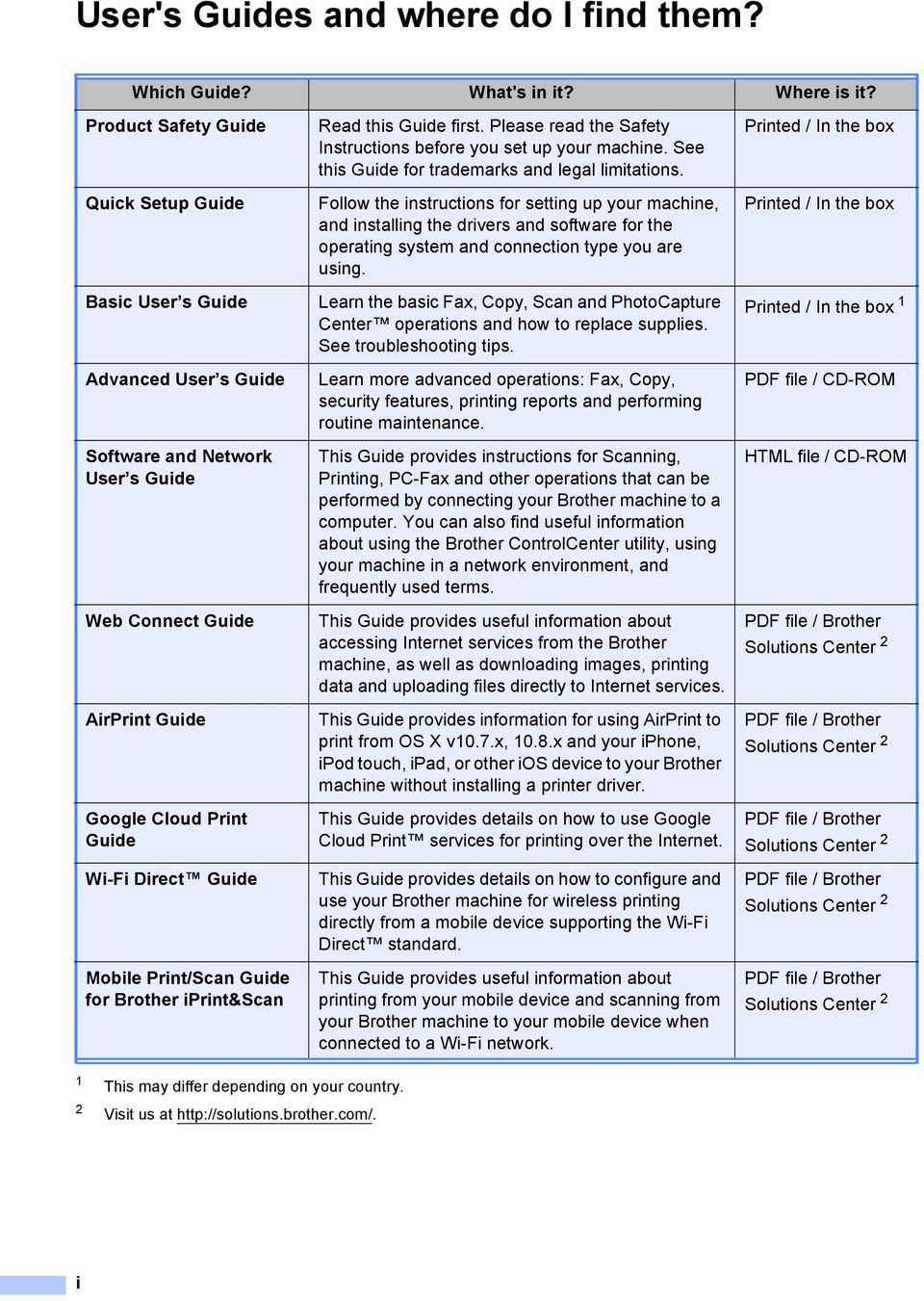
2 User's Guides and where do I find them? Which Guide? What's in it? Where is it? Product Safety Guide Quick Setup Guide Basic User s Guide Advanced User s Guide Software and Network User s Guide Web Connect Guide AirPrint Guide Google Cloud Print Guide Wi-Fi Direct Guide Mobile Print/Scan Guide for Brother iprint&scan Read this Guide first. Please read the Safety Instructions before you set up your machine. See this Guide for trademarks and legal limitations. Follow the instructions for setting up your machine, and installing the drivers and software for the operating system and connection type you are using. Learn the basic Fax, Copy, Scan and PhotoCapture Center operations and how to replace supplies. See troubleshooting tips. Learn more advanced operations: Fax, Copy, security features, printing reports and performing routine maintenance. This Guide provides instructions for Scanning, Printing, PC-Fax and other operations that can be performed by connecting your Brother machine to a computer. You can also find useful information about using the Brother ControlCenter utility, using your machine in a network environment, and frequently used terms. This Guide provides useful information about accessing Internet services from the Brother machine, as well as downloading images, printing data and uploading files directly to Internet services. This Guide provides information for using AirPrint to print from OS X v0.7.x, 0.8.x and your iphone, ipod touch, ipad, or other ios device to your Brother machine without installing a printer driver. This Guide provides details on how to use Google Cloud Print services for printing over the Internet. This Guide provides details on how to configure and use your Brother machine for wireless printing directly from a mobile device supporting the Wi-Fi Direct standard. This Guide provides useful information about printing from your mobile device and scanning from your Brother machine to your mobile device when connected to a Wi-Fi network. Printed / In the box Printed / In the box Printed / In the box PDF file / CD-ROM HTML file / CD-ROM PDF file / Brother Solutions Center 2 PDF file / Brother Solutions Center 2 PDF file / Brother Solutions Center 2 PDF file / Brother Solutions Center 2 PDF file / Brother Solutions Center 2 This may differ depending on your country. 2 Visit us at i
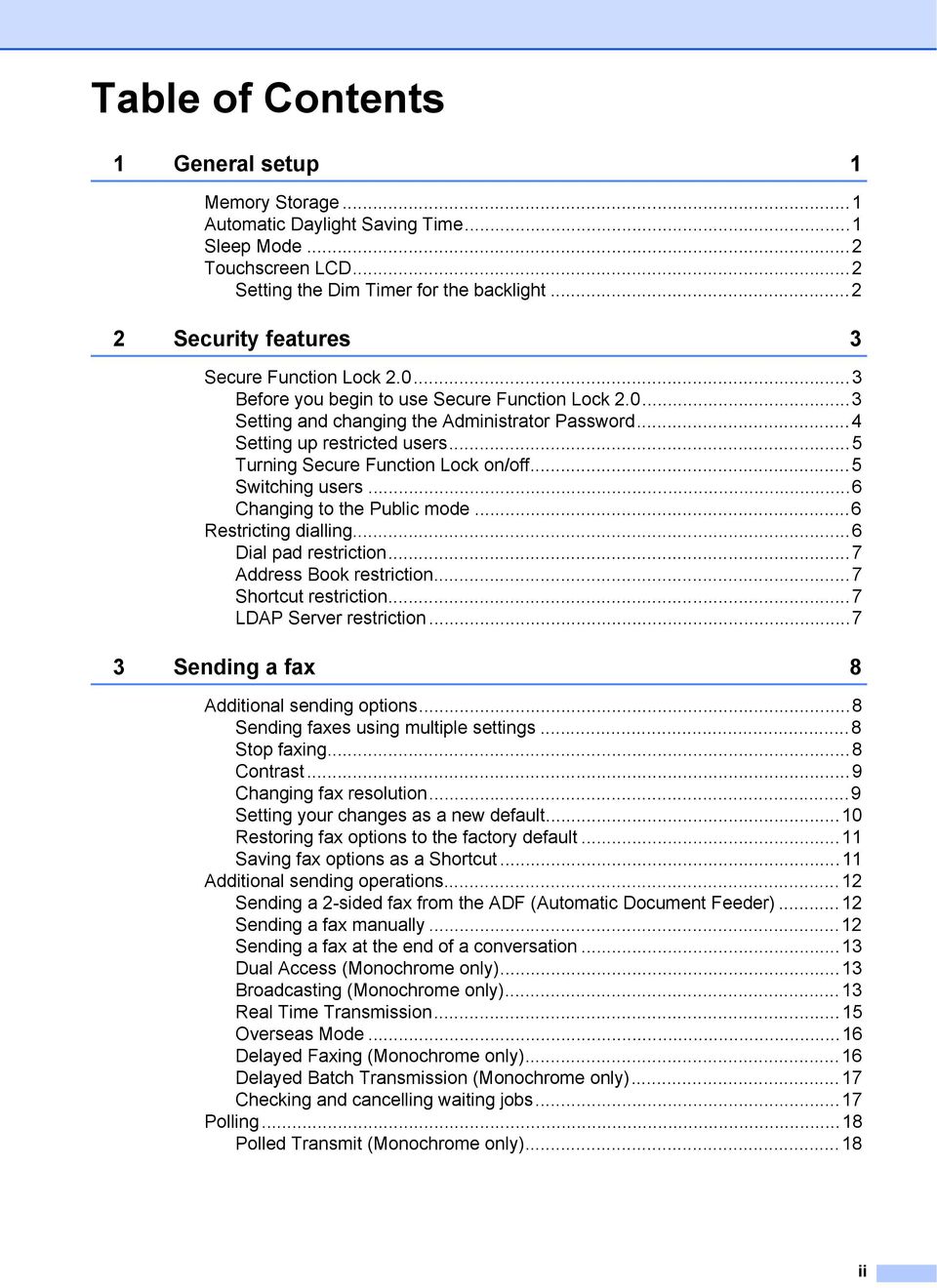
3 Table of Contents General setup Memory Storage... Automatic Daylight Saving Time... Sleep Mode...2 Touchscreen LCD...2 Setting the Dim Timer for the backlight Security features 3 Secure Function Lock Before you begin to use Secure Function Lock Setting and changing the Administrator Password...4 Setting up restricted users...5 Turning Secure Function Lock on/off...5 Switching users...6 Changing to the Public mode...6 Restricting dialling...6 Dial pad restriction...7 Address Book restriction...7 Shortcut restriction...7 LDAP Server restriction Sending a fax 8 Additional sending options...8 Sending faxes using multiple settings...8 Stop faxing...8 Contrast...9 Changing fax resolution...9 Setting your changes as a new default...0 Restoring fax options to the factory default... Saving fax options as a Shortcut... Additional sending operations...2 Sending a 2-sided fax from the ADF (Automatic Document Feeder)...2 Sending a fax manually...2 Sending a fax at the end of a conversation...3 Dual Access (Monochrome only)...3 Broadcasting (Monochrome only)...3 Real Time Transmission...5 Overseas Mode...6 Delayed Faxing (Monochrome only)...6 Delayed Batch Transmission (Monochrome only)...7 Checking and cancelling waiting jobs...7 Polling...8 Polled Transmit (Monochrome only)...8 ii
4 4 Receiving a fax 20 Memory Receive (Monochrome only)...20 Fax Forwarding...20 Fax Storage...2 Printing a fax from the memory...2 Turning off Memory Receive operations...2 Changing Memory Receive operations...22 Remote Retrieval...23 Setting a Remote Access Code...23 Using your Remote Access Code...23 Remote Fax commands...24 Retrieving fax messages...25 Changing your Fax Forwarding number...25 Additional receiving operations...26 Out of Paper Reception...26 Printing a reduced incoming fax...26 Receiving a fax at the end of a conversation...26 Polling...27 Polling receive Dialling and storing numbers 30 Voice operations...30 BT Call Sign (U.K. only)...30 Additional dialling operations...3 Combining Address Book numbers...3 Additional ways to store numbers...32 Storing Address Book numbers from the Outgoing Call history...32 Storing Address Book numbers from the Caller ID history...32 Setting up Groups for Broadcasting Printing reports 35 Fax reports...35 Transmission Verification Report...35 Fax Journal (activity report)...35 Reports...36 How to print a report...36 iii

5 7 Making copies 37 Copy options...37 Stop copying...37 Improving copy speed and quality...37 Enlarging or reducing copies...38 Making N in copies or a poster (Page Layout) in ID Copy (Page Layout)...42 Sorting copies using the ADF...43 Adjusting Density...43 Ink Save Mode...44 Thin Paper Copy...45 Auto Deskew...45 Book Copy...46 Watermark Copy...46 Remove Background Colour sided copying...48 Saving copy options as a Shortcut...50 A3 Copy Shortcuts...50 A3 Copy Shortcut Printing photos from a memory card or USB Flash drive 53 PhotoCapture Center operations...53 Memory cards, USB Flash drives and folder structures...53 Movie printing...54 Print Images...54 Print Index (Thumbnails)...54 Printing Photos...55 Enhance Photos...55 ID photo print...57 Slide Show...58 DPOF printing...59 PhotoCapture Center print settings...60 Print Quality...60 Paper options...60 Auto Correct...62 Adjusting Brightness, Contrast and Colour...62 Cropping...64 Borderless printing...65 Date Print...65 Setting your changes as a new default...66 Restoring all settings to the factory default...66 Scan to a memory card or USB Flash drive...67 Auto Crop...67 How to set a new default...68 How to reset to the factory default...69 Saving scan options as a Shortcut...69 iv

6 9 Printing photos from a camera 70 Printing photos directly from a PictBridge camera...70 PictBridge requirements...70 Setting your digital camera...70 Printing Images...7 DPOF printing...72 Printing photos directly from a digital camera (without PictBridge)...72 Printing Images...73 A Routine maintenance 74 Cleaning and checking the machine...74 Cleaning the outside of the machine...74 Cleaning the machine s printer platen...75 Cleaning the paper feed rollers...76 Cleaning the paper pick-up rollers...77 Cleaning the paper pick-up rollers for paper tray # Checking the ink volume...79 Packing and shipping the machine...79 B Glossary 82 C Index 86 v

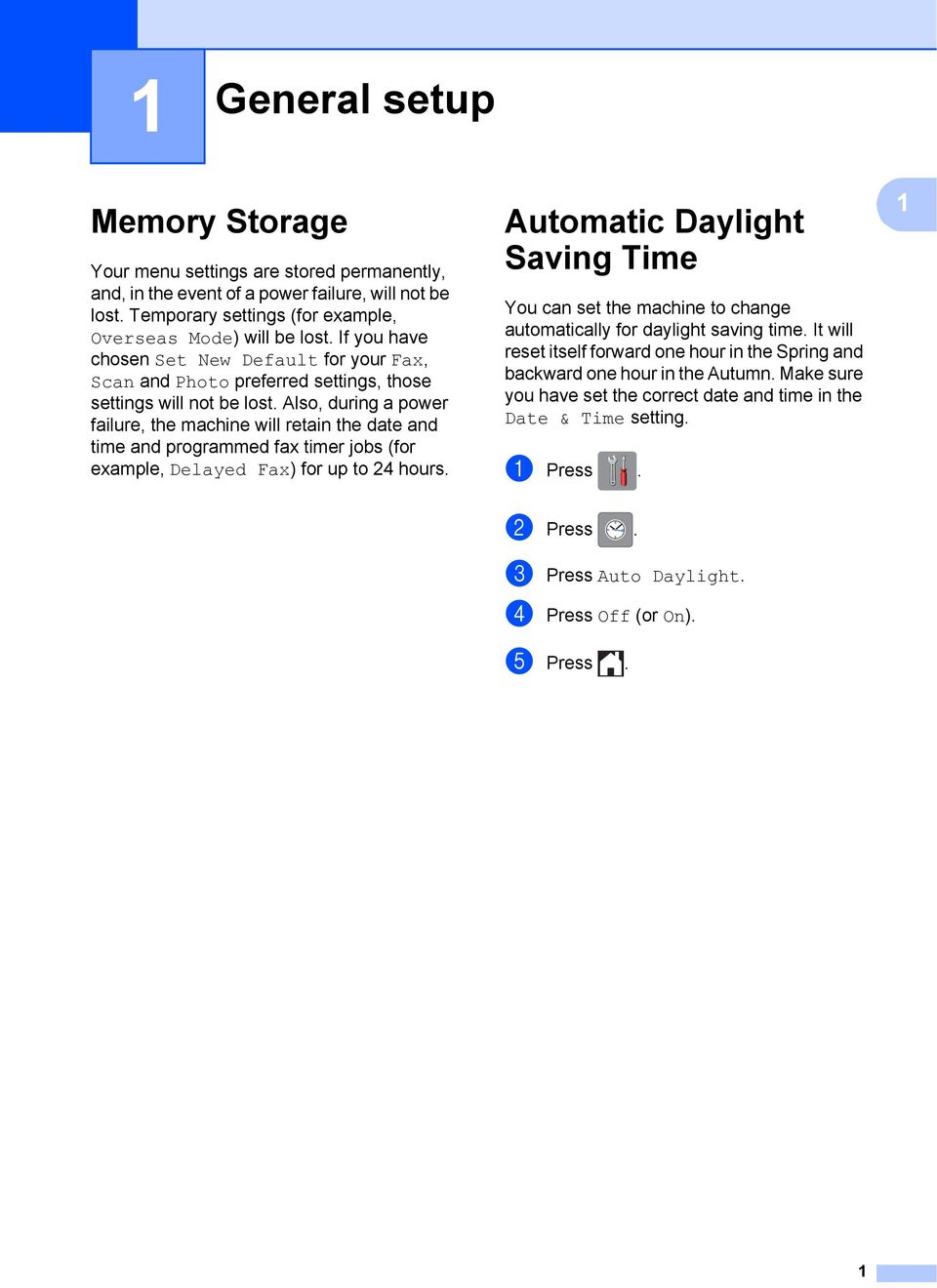
7 General setup Memory Storage Your menu settings are stored permanently, and, in the event of a power failure, will not be lost. Temporary settings (for example, Overseas Mode) will be lost. If you have chosen Set New Default for your Fax, Scan and Photo preferred settings, those settings will not be lost. Also, during a power failure, the machine will retain the date and time and programmed fax timer jobs (for example, Delayed Fax) for up to 24 hours. Automatic Daylight Saving Time You can set the machine to change automatically for daylight saving time. It will reset itself forward one hour in the Spring and backward one hour in the Autumn. Make sure you have set the correct date and time in the Date & Time setting. a Press. b Press. c Press Auto Daylight. d Press Off (or On). e Press.
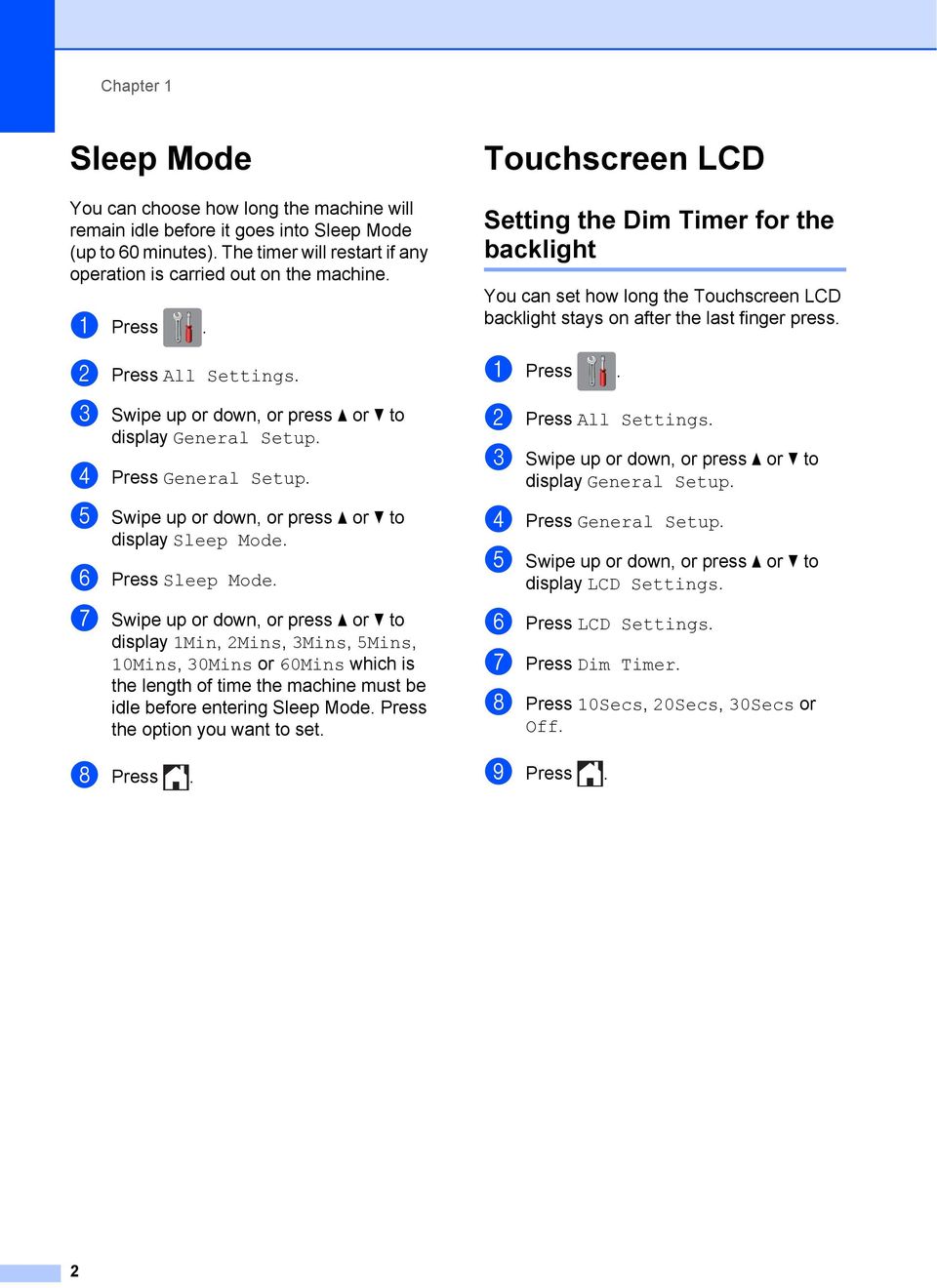
8 Chapter Sleep Mode You can choose how long the machine will remain idle before it goes into Sleep Mode (up to 60 minutes). The timer will restart if any operation is carried out on the machine. a Press. b Press All Settings. c Swipe up or down, or press a or b to display General Setup. d Press General Setup. e Swipe up or down, or press a or b to display Sleep Mode. f Press Sleep Mode. g Swipe up or down, or press a or b to display Min, 2Mins, 3Mins, 5Mins, 0Mins, 30Mins or 60Mins which is the length of time the machine must be idle before entering Sleep Mode. Press the option you want to set. h Press. Touchscreen LCD Setting the Dim Timer for the backlight You can set how long the Touchscreen LCD backlight stays on after the last finger press. a Press. b Press All Settings. c Swipe up or down, or press a or b to display General Setup. d Press General Setup. e Swipe up or down, or press a or b to display LCD Settings. f Press LCD Settings. g Press Dim Timer. h Press 0Secs, 20Secs, 30Secs or Off. i Press. 2
9 2 Security features 2 Secure Function Lock Secure Function Lock lets you restrict public access to certain machine functions: Fax Send Fax Receive Copy Scan Print from Media Scan to Media PC Print Colour Print Page Limit Web Upload Web Download This feature also prevents users from changing the default settings of the machine by limiting access to the menu settings. Before using the security features, you must first enter an administrator password. Access to restricted operations can be enabled by creating a restricted user. Restricted users must enter a password to use the machine. Make a careful note of your password. If you forget it, please contact Brother customer service for support. Only administrators can set limitations and make changes for each user. If Fax Tx is disabled, you cannot use any functions in the Fax menu. Polled Transmit and Polling Receive are enabled only when both Fax Tx and Fax Rx are enabled. You cannot edit or delete a Shortcut when Secure Function Lock is set to On. Before you begin to use Secure Function Lock You can configure Secure Function Lock 2.0 settings using a Web browser. Before configuration, the following preparations are required. a Start your Web browser. b Type vmachine s IP address/ into your browser s address bar (where machine s IP address is the Brother machine s IP address). For example: x / You can find the machine's IP address in the Network Configuration List. (See Software and Network User s Guide.) 2 3

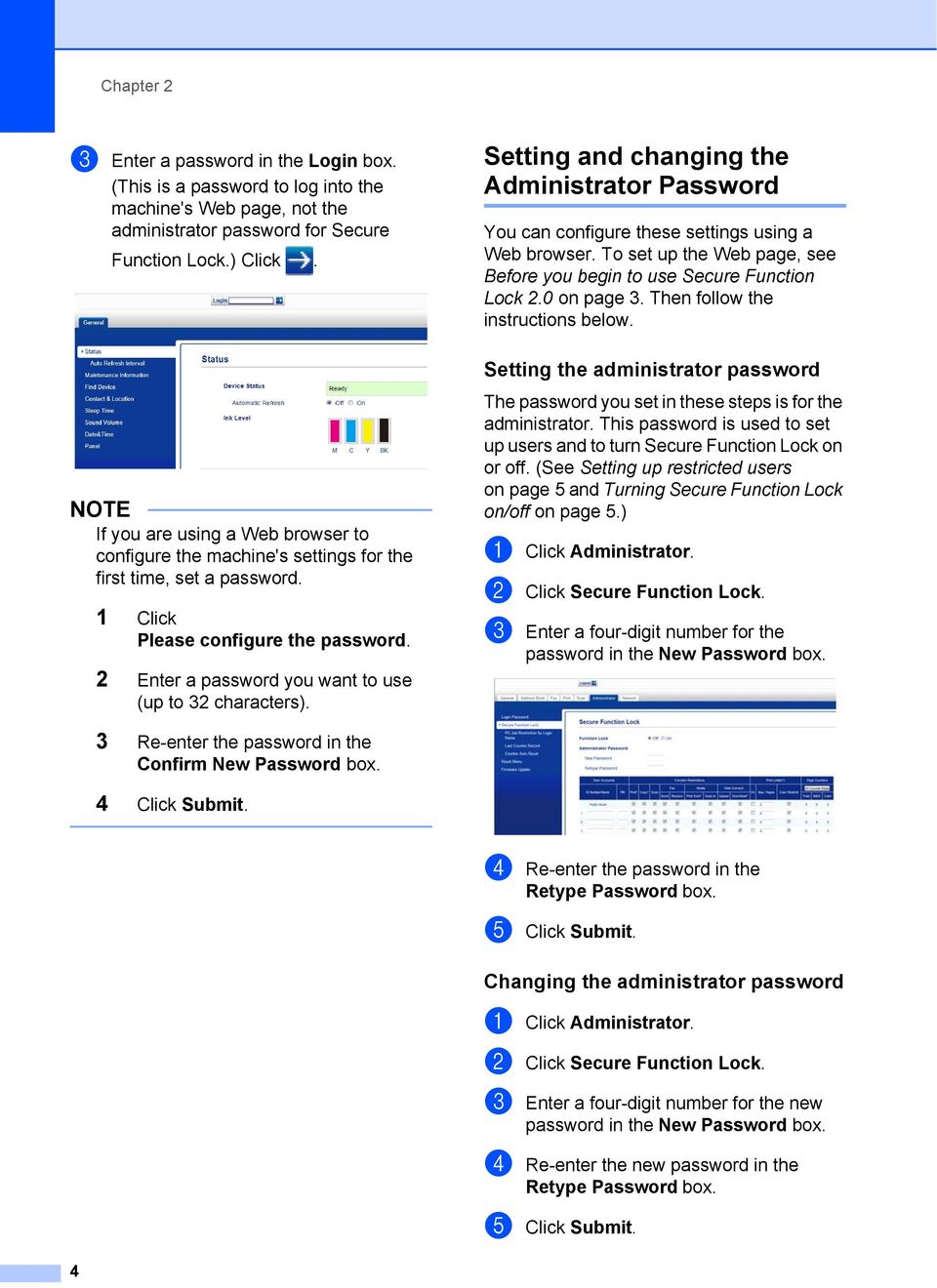
10 Chapter 2 c Enter a password in the Login box. (This is a password to log into the machine's Web page, not the administrator password for Secure Function Lock.) Click. Setting and changing the Administrator Password 2 You can configure these settings using a Web browser. To set up the Web page, see Before you begin to use Secure Function Lock 2.0 on page 3. Then follow the instructions below. Setting the administrator password 2 If you are using a Web browser to configure the machine's settings for the first time, set a password. Click Please configure the password. 2 Enter a password you want to use (up to 32 characters). The password you set in these steps is for the administrator. This password is used to set up users and to turn Secure Function Lock on or off. (See Setting up restricted users on page 5 and Turning Secure Function Lock on/off on page 5.) a Click Administrator. b Click Secure Function Lock. c Enter a four-digit number for the password in the New Password box. 3 Re-enter the password in the Confirm New Password box. 4 Click Submit. d Re-enter the password in the Retype Password box. e Click Submit. Changing the administrator password2 a Click Administrator. b Click Secure Function Lock. c Enter a four-digit number for the new password in the New Password box. d Re-enter the new password in the Retype Password box. e Click Submit. 4
11 Security features Setting up restricted users 2 You can set up users with restrictions and a password. You can set up to 0 users. You can configure these settings using a Web browser. To set up the Web page, see Before you begin to use Secure Function Lock 2.0 on page 3. Then follow the instructions below. a Click Administrator. b Click Secure Function Lock. c Enter an alphanumeric Group name or User name (up to 5 characters) in the ID Number/Name box and then enter a four-digit password in the PIN box. d Uncheck the functions that you want to restrict in the Function Restrictions boxes. If you want to configure the maximum page count, check the On box in Print Limits, and then enter the number in the Max. Pages box. Then click Submit. You cannot use the same password as another user s password. You can set up one Public user. Public users do not need to enter a password. For more information, see Software and Network User s Guide. Turning Secure Function Lock on/off 2 If you enter the wrong password, the Touchscreen will show Wrong Password. Enter the correct password. If you forget it, please contact Brother customer service for support. Turning Secure Function Lock on 2 a Press. b Press All Settings. c Swipe up or down, or press a or b to display General Setup. d Press General Setup. e Swipe up or down, or press a or b to display Function Lock. f Press Function Lock. g Press Lock OffiOn. h Enter your four-digit administrator password using the keyboard on the Touchscreen. Press OK. The Secure Function Lock icon is prominently displayed in the Home screen. 2 5

12 Chapter 2 Turning Secure Function Lock off 2 a Press XXXXX the user s name). or (where xxxxx is b Press Lock OniOff. c Enter your four-digit administrator password using the keyboard on the Touchscreen. Press OK. Switching users 2 This setting allows a restricted user to log on to the machine when the Secure Function Lock is turned on. a On the Touchscreen, press Public Public XXXXX the user s name). or (where xxxxx is b Press Change User. c Swipe up or down, or press a or b to display your user name. Restricting dialling 2 This feature prevents users from sending a fax or call to a wrong number by mistake. You can set the machine to restrict dialling when you use the dial pad, Address Book, Shortcut and LDAP search. If you choose Off, the machine does not restrict the dialling method. If you choose Enter # Twice, the machine will prompt you to re-enter the number, and will start dialling after you re-enter the same number correctly. If you re-enter the wrong number, the Touchscreen will show an error message. If you choose On, the machine will restrict all fax sending and outbound calls for that dialling method. The Enter # Twice setting will not work if you lift an external handset before entering the number. You will not be asked to re-enter the number. If you chose On or Enter # Twice, you cannot use the Broadcasting feature. d Press your user name. e Enter your four-digit user password using the keyboard on the Touchscreen. Press OK. Changing to the Public mode 2 a Press XXXXX xxxxx is the user s name). (where b Press Go to Public. 6

13 Security features Dial pad restriction 2 Shortcut restriction 2 a Press. b Press All Settings. c Swipe up or down, or press a or b to display Fax. d Press Fax. e Swipe up or down, or press a or b to display Dial Restriction. f Press Dial Restriction. g Press Dial Pad. h Press Enter # Twice, On or Off. i Press. a Press. b Press All Settings. c Swipe up or down, or press a or b to display Fax. d Press Fax. e Swipe up or down, or press a or b to display Dial Restriction. f Press Dial Restriction. g Press Shortcuts. h Press Enter # Twice, On or Off. i Press. 2 Address Book restriction 2 LDAP Server restriction 2 a Press. b Press All Settings. c Swipe up or down, or press a or b to display Fax. d Press Fax. e Swipe up or down, or press a or b to display Dial Restriction. f Press Dial Restriction. g Press Address Book. h Press Enter # Twice, On or Off. i Press. If you combine Address Book numbers when dialling, the address will be recognized as dial pad input and will not be restricted. a Press. b Press All Settings. c Swipe up or down, or press a or b to display Fax. d Press Fax. e Swipe up or down, or press a or b to display Dial Restriction. f Press Dial Restriction. g Press LDAP Server. h Press Enter # Twice, On or Off. i Press. 7

14 3 Sending a fax 3 Additional sending options 3 Sending faxes using multiple settings 3 When you send a fax, you can choose a combination of settings, such as Fax Resolution, 2-sided Fax, Contrast, Glass Scan Size, and Real Time TX. You can also choose Call History, Address Book, Broadcasting, Preview, Colour Setting, Delayed Fax, Batch TX, Polled TX, Polling RX, Overseas Mode, Set New Default, and Factory Reset. Some settings are only available when sending mono faxes. a Load your document. b Do one of the following: When Fax Preview is set to Off, press (Fax). When Fax Preview is set to On, press (Fax) and then (Sending Faxes). The Touchscreen shows: d Swipe up or down, or press a or b to display the setting you want to change. When the setting is displayed, press it. e Press the option you want to set. f Go back to step d to change additional settings. g Press OK when you have finished changing settings. h Enter the fax number. i Press Fax Start. Most settings are temporary, and the machine returns to its default settings after you send a fax. You can save some of the settings you use most often by making them the default settings. These settings will remain until you change them again. (See Setting your changes as a new default on page 0.) You can also save some of the settings you use most often by setting them as a Shortcut. (See Saving fax options as a Shortcut on page.) Stop faxing 3 To stop faxing, press. c Press Options. 8

15 Sending a fax Contrast 3 If your document is very light or very dark, you may want to change the contrast. For most documents, the factory setting Auto can be used. Auto chooses the suitable contrast for your document. Choose Light when sending a light document. Choose Dark when sending a dark document. a Load your document. b Do one of the following: When Fax Preview is set to Off, press (Fax). When Fax Preview is set to On, press (Fax) and then (Sending Faxes). c Press Options. d Swipe up or down, or press a or b to display Contrast. e Press Contrast. f Press Auto, Light or Dark. g Press OK. h Enter the fax number. i Press Fax Start. Even if you choose Light or Dark, the machine will send the fax using the Auto setting in the following conditions: When you send a colour fax. When you choose Photo as the Fax Resolution. Changing fax resolution 3 The quality of a fax can be improved by changing the fax resolution. a Load your document. b Do one of the following: When Fax Preview is set to Off, press (Fax). When Fax Preview is set to On, press (Fax) and then (Sending Faxes). c Press Options. d Swipe up or down, or press a or b to display Fax Resolution. e Press Fax Resolution. f Press Standard, Fine, S.Fine or Photo. g Press OK. h Enter the fax number. i Press Fax Start. 3 9

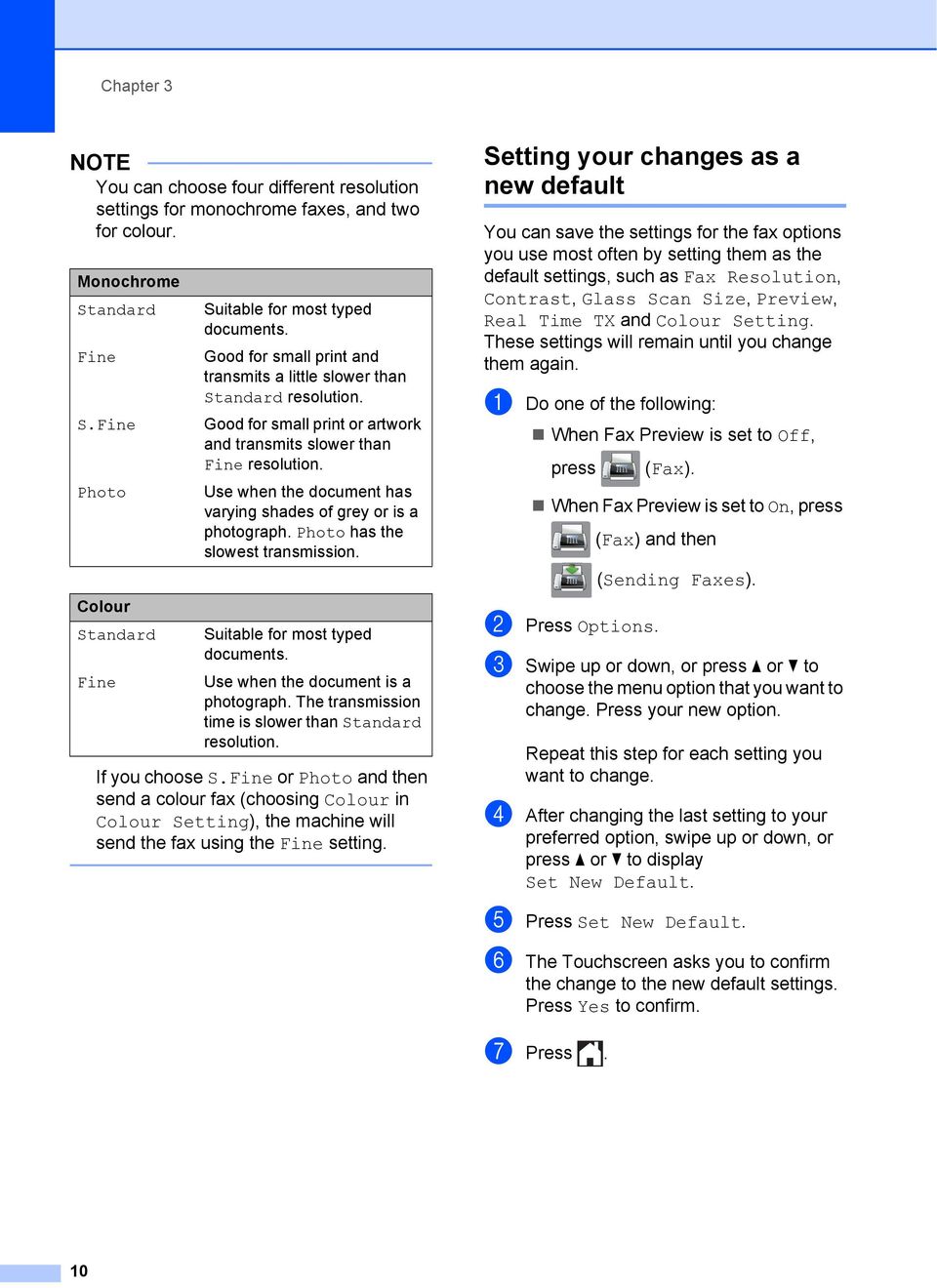
16 Chapter 3 You can choose four different resolution settings for monochrome faxes, and two for colour. Monochrome Standard Fine S.Fine Photo Colour Standard Fine Suitable for most typed documents. Good for small print and transmits a little slower than Standard resolution. Good for small print or artwork and transmits slower than Fine resolution. Use when the document has varying shades of grey or is a photograph. Photo has the slowest transmission. Suitable for most typed documents. Use when the document is a photograph. The transmission time is slower than Standard resolution. If you choose S.Fine or Photo and then send a colour fax (choosing Colour in Colour Setting), the machine will send the fax using the Fine setting. Setting your changes as a new default 3 You can save the settings for the fax options you use most often by setting them as the default settings, such as Fax Resolution, Contrast, Glass Scan Size, Preview, Real Time TX and Colour Setting. These settings will remain until you change them again. a Do one of the following: When Fax Preview is set to Off, press (Fax). When Fax Preview is set to On, press (Fax) and then (Sending Faxes). b Press Options. c Swipe up or down, or press a or b to choose the menu option that you want to change. Press your new option. Repeat this step for each setting you want to change. d After changing the last setting to your preferred option, swipe up or down, or press a or b to display Set New Default. e Press Set New Default. f The Touchscreen asks you to confirm the change to the new default settings. Press Yes to confirm. g Press. 0
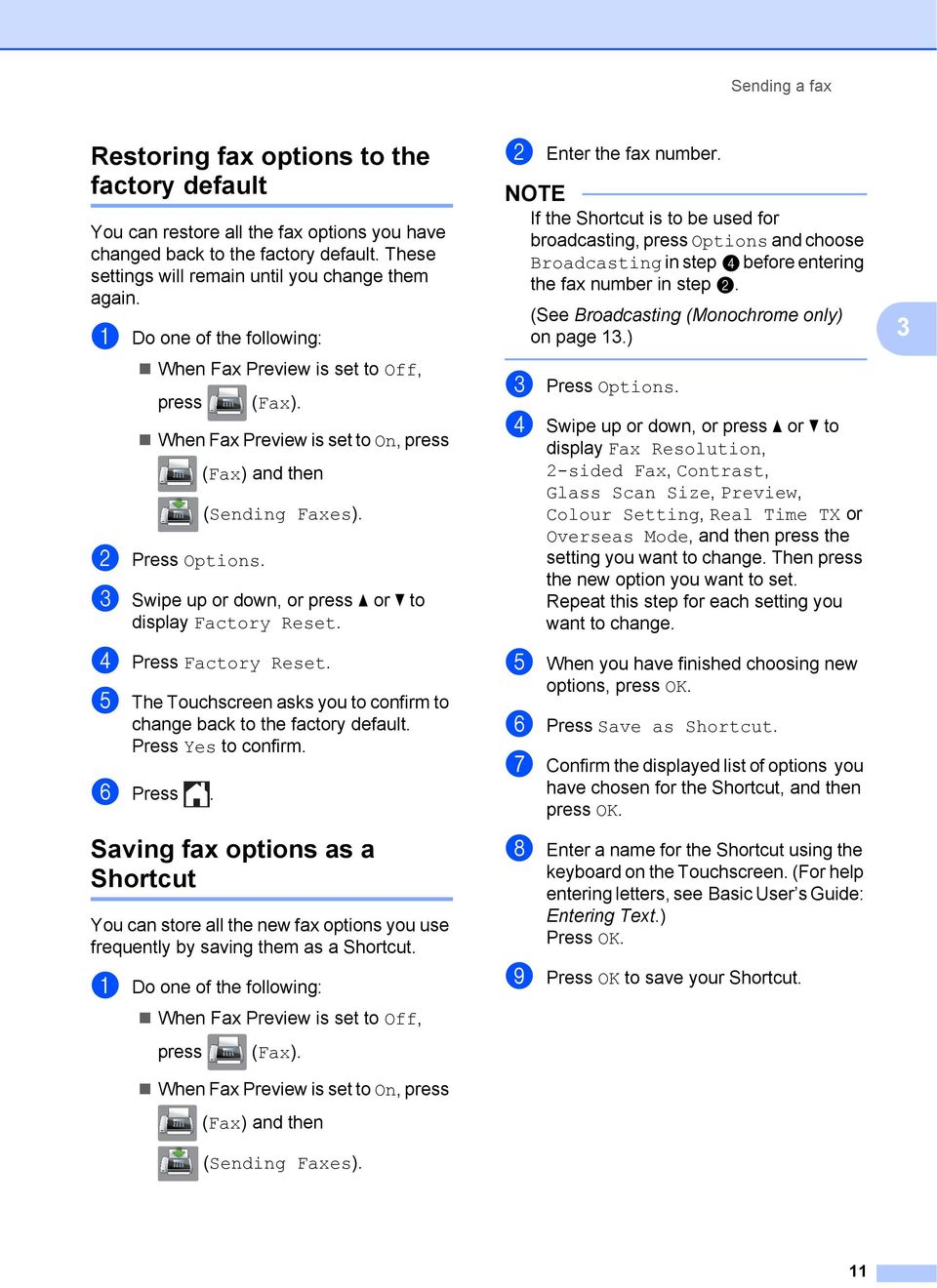
17 Sending a fax Restoring fax options to the factory default 3 You can restore all the fax options you have changed back to the factory default. These settings will remain until you change them again. a Do one of the following: When Fax Preview is set to Off, press (Fax). When Fax Preview is set to On, press (Fax) and then (Sending Faxes). b Press Options. c Swipe up or down, or press a or b to display Factory Reset. d Press Factory Reset. e The Touchscreen asks you to confirm to change back to the factory default. Press Yes to confirm. f Press. Saving fax options as a Shortcut 3 You can store all the new fax options you use frequently by saving them as a Shortcut. a Do one of the following: When Fax Preview is set to Off, b Enter the fax number. If the Shortcut is to be used for broadcasting, press Options and choose Broadcasting in step d before entering the fax number in step b. (See Broadcasting (Monochrome only) on page 3.) c Press Options. d Swipe up or down, or press a or b to display Fax Resolution, 2-sided Fax, Contrast, Glass Scan Size, Preview, Colour Setting, Real Time TX or Overseas Mode, and then press the setting you want to change. Then press the new option you want to set. Repeat this step for each setting you want to change. e When you have finished choosing new options, press OK. f Press Save as Shortcut. g Confirm the displayed list of options you have chosen for the Shortcut, and then press OK. h Enter a name for the Shortcut using the keyboard on the Touchscreen. (For help entering letters, see Basic User s Guide: Entering Text.) Press OK. i Press OK to save your Shortcut. 3 press (Fax). When Fax Preview is set to On, press (Fax) and then (Sending Faxes).
18 Chapter 3 Additional sending operations 3 If your document is flipped on the Short edge, press 2-sided Scan: Short Edge. Sending a 2-sided fax from the ADF (Automatic Document Feeder) 3 You can send 2-sided documents up to Legal size from the ADF. Short edge Portrait Landscape a Load your document in the ADF. b Do one of the following: When Fax Preview is set to Off, press (Fax). When Fax Preview is set to On, press (Fax) and then (Sending Faxes). c Press Options. d Swipe up or down, or press a or b to display 2-sided Fax. e Press 2-sided Fax. f Do one of the following: If your document is flipped on the Long edge, press 2-sided Scan: Long Edge. g Press OK. h Enter the fax number. i Press Fax Start. The machine will now scan and send your document. Sending a fax manually 3 Manual transmission lets you hear the dialling, ringing and fax-receiving tones while sending a fax. To send a multi-page fax, use the ADF. a Load your document. b To listen for a dial tone, pick up the handset of the external telephone. Long edge Portrait Landscape c Dial the fax number using the external telephone. d When you hear the fax tones, press Fax Start. If you are using the scanner glass, press Send on the Touchscreen to send the fax. e Replace the handset of the external phone. 2
19 Sending a fax Sending a fax at the end of a conversation 3 At the end of a conversation, you can send a fax to the other party before you both hang up. a Ask the other party to wait for fax tones (beeps) and then to press the Start or Send key before hanging up. b Load your document. c Press Fax Start. If you are using the scanner glass, press Send to send the fax. d Replace the handset of the external phone. Dual Access (Monochrome only) 3 You can dial a number and start scanning the fax into memory even when the machine is sending from memory, receiving faxes or printing PC data. The Touchscreen shows the new job number. The number of pages you can scan into the memory will vary depending on the data that is printed on them. If the Out of Memory message appears, press or Quit to cancel or Send Now to send the pages scanned so far. Broadcasting (Monochrome only) 3 Broadcasting is automatically sending the same fax message to more than one fax number. You can include Groups, Address Book numbers, and up to 50 manually dialled numbers in the same broadcast. After the broadcast is finished, a Broadcast Report will be printed. Before you begin the broadcast 3 Address Book numbers must be stored in the machine's memory before they can be used in a broadcast. (See Basic User s Guide: Storing Address Book numbers.) Group numbers must also be stored in the machine's memory before they can be used in a broadcast. Group numbers include many stored Address Book numbers for easier dialling. (See Setting up Groups for Broadcasting on page 33.) How to broadcast a fax 3 a Load your document. b Do one of the following: When Fax Preview is set to Off, press (Fax). When Fax Preview is set to On, press (Fax) and then (Sending Faxes). c Press Options. d Swipe up or down, or press a or b to display Broadcasting. e Press Broadcasting. f Press Add Number. 3 3

20 Chapter 3 g You can add numbers to the broadcast in the following ways: Press Add Number and enter a number using the keyboard on the Touchscreen. Press OK. If you downloaded Internet Fax: If you want to broadcast using an address, press, enter the address, and press OK. (For help entering letters, see Basic User s Guide: Entering Text.) Press Add from Address book. Swipe up or down, or press a or b to display the number you want to add to the broadcast. Press the check boxes of the numbers you want to add to the broadcast. After you have checked all the numbers you want, press OK. Press Search in Address book. Enter the first letter of the name and press OK. Press the name, and then press the number you want to add to the broadcast. h After you have entered all the fax numbers by repeating steps f and g, press OK. i Press Fax Start. Broadcasting is not available when you select Colour in Colour Setting. Faxing from the ADF The machine starts scanning the document. Faxing from the scanner glass When the Touchscreen asks you Next page?, do one of the following: To send a single page, press No. The machine starts sending the document. To send more than one page, press Yes and place the next page on the scanner glass. Press OK. The machine starts scanning the page. (Repeat this step for each page.) If you did not use up any of the numbers for Groups, you can broadcast faxes to as many as 250 different numbers. The machine s available memory will vary depending on the types of jobs in the memory and the numbers used for broadcasting. If you broadcast to the maximum amount of numbers available, you will not be able to use dual access and delayed fax. If the Out of Memory message appears, press or Quit to cancel or Send Now to send the pages scanned so far. 4
21 Sending a fax Cancelling a Broadcast in progress 3 a Press. b Do one of the following: To cancel the entire broadcast, press Entire Broadcast. Go to step c. To cancel the current job, press the name or number being dialled on the Touchscreen. Go to step d. To exit without cancelling, press. c When the Touchscreen asks if you want to cancel the entire broadcast, do one of the following: Press Yes to confirm. To exit without cancelling, press No. d Do one of the following: To cancel the current job, press Yes. To exit without cancelling, press No. Real Time Transmission 3 When you are sending a fax, the machine will scan the documents into the memory before sending. Then, as soon as the telephone line is free, the machine will start dialling and sending. Sometimes, you may want to send an important document immediately, without waiting the machine to scan it into memory. You can do this by turning on Real Time TX. a Load your document. b Do one of the following: When Fax Preview is set to Off, press (Fax). When Fax Preview is set to On, press (Fax) and then (Sending Faxes). c Press Options. d Swipe up or down, or press a or b to display Real Time TX. e Press Real Time TX. f Press On (or Off). g Press OK. h Enter the fax number. i Press Fax Start. If you are sending a colour fax or if the memory is full and you are sending a monochrome fax from the ADF, the machine will send the document in real time (even if Real Time TX is set to Off). In Real Time Transmission, the automatic redial feature does not work when you are using the scanner glass. 3 5
22 Chapter 3 Overseas Mode 3 If you are having difficulty sending a fax overseas due to possible interference on the telephone line, we recommend that you turn on Overseas Mode. After you send a fax using this feature, the feature will automatically turn itself off. a Load your document. b Do one of the following: When Fax Preview is set to Off, Delayed Faxing (Monochrome only) 3 You can store up to 50 faxes in the memory to be sent within 24 hours. These faxes will be sent at the time of day you enter in step i. a Load your document. b Do one of the following: When Fax Preview is set to Off, press (Fax). press (Fax). When Fax Preview is set to On, press When Fax Preview is set to On, press (Fax) and then (Sending Faxes). c Press Options. d Swipe up or down, or press a or b to display Overseas Mode. e Press Overseas Mode. f Press On (or Off). g Press OK. h Enter the fax number. i Press Fax Start. (Fax) and then (Sending Faxes). c Press Options. d Swipe up or down, or press a or b to display Delayed Fax. e Press Delayed Fax. f Press Delayed Fax. g Press On (or Off). h Press Set Time. i Enter the time you want the fax to be sent (in 24-hour format) using the keyboard on the Touchscreen. (For example, enter 9:45 for 7:45 PM.) Press OK. The number of pages you can scan into the memory depends on the amount of data that is printed on each page. j Press OK. k Enter the fax number. l Press Fax Start. 6
23 Sending a fax Delayed Fax is not available when you select Colour in Colour Setting. Delayed Batch Transmission (Monochrome only) 3 Before sending the delayed faxes, your machine will help you economize by sorting all the faxes in the memory by destination and scheduled time. All delayed faxes that are scheduled to be sent at the same time to the same fax number will be sent as one fax to save transmission time. a Do one of the following: When Fax Preview is set to Off, press (Fax). When Fax Preview is set to On, press (Fax) and then (Sending Faxes). b Press Options. c Swipe up or down, or press a or b to display Batch TX. d Press Batch TX. e Press On (or Off). f Press. Checking and cancelling waiting jobs 3 You can check which jobs are still waiting in the memory to be sent, or cancel a job. (If there are no jobs, the Touchscreen shows No Jobs Waiting.) a Press. b Press All Settings. c Swipe up or down, or press a or b to display Fax. d Press Fax. e Swipe up or down, or press a or b to display Remaining Jobs. f Press Remaining Jobs. Any waiting jobs appear on the Touchscreen. g Swipe up or down, or press a or b to scroll through the jobs and press the job you want to cancel. Press Cancel. h Do one of the following: To cancel, press Yes. If you want to cancel another job, go to step g. To exit without cancelling, press No. i When you have finished, press. 3 7
24 Chapter 3 Polling 3 Polling lets you set up your machine so other people can receive faxes from you, but they pay for the call. It also lets you call somebody else s fax machine and receive a fax from it, so you pay for the call. The polling feature needs to be set up on both machines for this to work. Not all fax machines support polling. Polled Transmit (Monochrome only) 3 Polled Transmit lets you set up your machine to wait with a document so another fax machine can call and retrieve it. The document will be stored and can be retrieved by any other fax machine until you delete it from the memory. (See Checking and cancelling waiting jobs on page 7.) Setup for polled transmit 3 a Load your document. b Do one of the following: When Fax Preview is set to Off, press (Fax). When Fax Preview is set to On, press (Fax) and then (Sending Faxes). c Press Options. d Swipe up or down, or press a or b to display Polled TX. e Press Polled TX. f Press Standard. g Press Fax Start. h If you are using the scanner glass, the Touchscreen will prompt you to choose one of the following options: Press Yes to scan another page. Go to step i. Press No to store the document in the memory. Other fax machines can now call your machine and retrieve the document. i Place the next page on the scanner glass and press OK. Repeat steps h and i for each page. The document will be stored in the memory and will be sent when it is polled. Setup for polled transmit with secure code 3 Secure Polling lets you restrict who can get the documents you set up to be polled. Secure Polling only works with Brother fax machines. If another person wants to retrieve a fax from your machine, they will have to enter the secure code. a Load your document. b Do one of the following: When Fax Preview is set to Off, press (Fax). When Fax Preview is set to On, press (Fax) and then (Sending Faxes). c Press Options. d Swipe up or down, or press a or b to display Polled TX. e Press Polled TX. f Press Secure. 8
25 Sending a fax g Enter a four-digit number. Press OK. h Press Fax Start. i If you are using the scanner glass, the Touchscreen will prompt you to choose one of the following options: Press Yes to scan another page. Go to step j. Press No to store the document in the memory. Other fax machines can now call your machine and retrieve the document. 3 j Place the next page on the scanner glass and press OK. k Repeat steps i and j for each additional page. The document will be stored in the memory and will be sent when it is polled. 9
26 4 Receiving a fax 4 Memory Receive (Monochrome only) 4 Memory Receive lets you receive faxes while you are away from the machine. You can only use one Memory Receive operation at a time: Fax Forwarding Fax Storage PC-Fax Receive Off You can change your selection at any time. If received faxes are still in the machine s memory when you change the Memory Receive operation, a message will appear on the Touchscreen. (See Changing Memory Receive operations on page 22.) Fax Forwarding 4 When you choose Fax Forward, your machine stores the received fax in the memory. The machine will then dial the fax number you have programmed and forward the fax message. h Press Memory Receive. i Press Fax Forward. j Enter the forwarding number (up to 20 digits) using the keyboard on the Touchscreen. Press OK. k If Fax Preview is set to Off, press Backup Print: On or Backup Print: Off. IMPORTANT If you choose Backup Print: On, the machine will also print the fax at your machine so you will have a copy. This is a safety feature in case there is a power failure before the fax is forwarded or a problem at the receiving machine. When you receive a colour fax, your machine prints the colour fax at your machine but does not forward the fax to the Fax Forwarding number you programmed. l Press. a Press. b Press All Settings. c Swipe up or down, or press a or b to display Fax. d Press Fax. e Swipe up or down, or press a or b to display Setup Receive. f Press Setup Receive. g Swipe up or down, or press a or b to display Memory Receive. 20
27 Receiving a fax Fax Storage 4 If you choose Fax Storage, your machine stores received faxes in the memory. You will be able to retrieve fax messages from another location using the Remote Retrieval commands. If you have turned on Fax Storage, a backup copy will be printed at the machine. a Press. b Press All Settings. c Swipe up or down, or press a or b to display Fax. d Press Fax. e Swipe up or down, or press a or b to display Setup Receive. f Press Setup Receive. g Swipe up or down, or press a or b to display Memory Receive. h Press Memory Receive. i Press Fax Storage. j Press. Colour faxes cannot be stored in the memory. When you receive a colour fax, your machine prints the colour fax at your machine. Printing a fax from the memory 4 If you have chosen Fax Storage, you can still print a fax from the memory when you are at your machine. a Press. b Press All Settings. c Swipe up or down, or press a or b to display Fax. d Press Fax. e Swipe up or down, or press a or b to display Print Document. f Press Print Document. g Press OK. h Press. (When Fax Preview is set to Off.) You can also print a fax from the memory by pressing Print on the Touchscreen. When you print a fax from the memory, the fax data will be erased from your machine. Turning off Memory Receive operations 4 a Press. 4 b Press All Settings. c Swipe up or down, or press a or b to display Fax. d Press Fax. e Swipe up or down, or press a or b to display Setup Receive. 2
28 Chapter 4 f Press Setup Receive. g Swipe up or down, or press a or b to display Memory Receive. h Press Memory Receive. i Press Off. j Press. The Touchscreen will show you more options if there are still received faxes in the machine s memory. (See Changing Memory Receive operations on page 22.) Changing Memory Receive operations 4 If there are received faxes in your machine s memory when you change the Memory Receive operations, the Touchscreen will ask you one of the following questions: If all the received faxes have already been printed 4 Erase all documents? If you press Yes, faxes in the memory will be erased before the setting changes. If you press No, faxes in the memory will not be erased and the setting will be unchanged. If unprinted faxes remain in the memory 4 Print all faxes? If you press Yes, faxes in the memory will be printed before the setting changes. If a backup copy has already been printed, it will not be printed again. If you press No, faxes in the memory will not be printed and the setting will be unchanged. If received faxes are left in the machine's memory when you change to PC Fax Receive from another option [Fax Forward or Fax Storage], press <USB> or the name of the PC if you are on a network. Press OK. The Touchscreen will ask you the following question: Send Fax to PC? If you press Yes, faxes in the memory will be sent to your PC before the setting changes. You will be asked if you want to turn on Backup Print. (See Basic User s Guide: PC-FAX Receiving (Windows ).) If you press No, faxes in the memory will not be erased or transferred to your PC and the setting will be unchanged. 22
29 Receiving a fax Remote Retrieval 4 You can call your machine from any touch-tone telephone or fax machine and then use the Remote Access Code and remote commands to retrieve fax messages. Setting a Remote Access Code 4 The Remote Access Code lets you access the Remote Retrieval features when you are away from your machine. Before you can use the Remote Access and Retrieval features, you have to set up your own code. The factory default code is the inactive code (--- ). a Press. b Press All Settings. c Swipe up or down, or press a or b to display Fax. d Press Fax. e Swipe up or down, or press a or b to display Remote Access. f Press Remote Access. g Enter a three-digit code using numbers 0 to 9, l, or # using the keyboard on the Touchscreen. Press OK. (The preset l cannot be changed.) Do not use the same code as your Remote Activation Code (l 5) or Remote Deactivation Code (# 5). (See Basic User s Guide: Operation from external and extension telephones.) h Press. You can change your code at any time by entering a new one. If you want to make your code inactive, press and hold in step g to restore the inactive setting (---l) and press OK. Using your Remote Access Code 4 a Dial your fax number from a touch-tone telephone or another fax machine. b When your machine answers, enter your Remote Access Code (3 digits followed by ) at once. c The machine signals if it has received messages: long beep Fax messages No beeps No messages d When the machine gives two short beeps, enter a command. The machine will hang up if you wait longer than 30 seconds to enter a command. The machine will beep three times if you enter an invalid command. e Press 90 to stop Remote Access when you have finished. f Hang up. If your machine is set to Manual mode and you want to use the Remote Retrieval features, wait for about 00 seconds after it starts ringing, and then enter the Remote Access Code within 30 seconds. In some countries this function may not be available or supported by local telephone companies. 4 23
30 Chapter 4 Remote Fax commands 4 Follow the commands in the table to access features when you are away from the machine. When you call the machine and enter your Remote Access Code (3 digits followed by ), the system will give two short beeps and you must enter a remote command. Remote commands Operation details 95 Change the Fax Forwarding or Fax Storage settings OFF You can choose Off after you have retrieved or erased all your messages. 2 Fax Forwarding One long beep means the change is accepted. If you hear 4 Fax Forwarding number three short beeps, the change was not accepted because something has not been set up (for example, a Fax 6 Fax Storage Forwarding number has not been registered). You can register your Fax Forwarding number by entering 4. (See Changing your Fax Forwarding number on page 25.) Once you have registered the number, Fax Forwarding will work. 96 Retrieve a fax 2 Retrieve all faxes Enter the number of a remote fax machine to receive stored fax messages. (See Retrieving fax messages on page 25.) 3 Erase faxes from the memory If you hear one long beep, fax messages have been erased from the memory. 97 Check the receiving status Fax You can check whether your machine has received any faxes. If yes, you will hear one long beep. If no, you will hear three short beeps. 98 Change the Receive Mode External TAD If you hear one long beep, your change has been accepted. 2 Fax/Tel 3 Fax Only 90 Exit Pressing 9 0 allows you to exit Remote Retrieval. Wait for the long beep, then replace the handset. 24
31 Receiving a fax Retrieving fax messages 4 You can call your machine from any touch-tone telephone and have your fax messages sent to another machine. Before you use this feature, you have to turn on Fax Storage or Fax Preview. (See Fax Storage on page 2 or see Basic User s Guide: Fax Preview (Monochrome faxes only).) a Dial your fax number. b When your machine answers, enter your Remote Access Code (3 digits followed by ) at once. If you hear one long beep, you have messages. c When you hear two short beeps, press 962. d Wait for a long beep, and then use the dial pad to enter the number of the remote fax machine where you want your fax messages sent, followed by ## (up to 20 digits). You cannot use l and # as dial numbers. However, press # if you want to create a pause. e Hang up after you hear your machine beep. Your machine will call the other fax machine, which will then print your fax messages. Changing your Fax Forwarding number 4 You can change the default setting of your Fax Forwarding number from another touch-tone telephone or fax machine. a Dial your fax number. b When your machine answers, enter your Remote Access Code (3 digits followed by ) at once. If you hear one long beep, you have messages. c When you hear two short beeps, press 954. d Wait for the long beep, enter the new number (up to 20 digits) of the remote fax machine you want your fax messages forwarded to using the dial pad, then enter ##. You cannot use l and # as dial numbers. However, press # if you want to create a pause. e Press 9 0 to stop Remote Access when you have finished. f Hang up after you hear your machine beep. 4 25
32 Chapter 4 Additional receiving operations 4 Out of Paper Reception 4 As soon as the paper tray becomes empty during fax reception, the Touchscreen shows No Paper Fed. Put some paper in the paper tray. (See Basic User s Guide: Loading paper and other print media.) If you don't put paper in the paper tray, the machine will continue receiving the fax. The remaining pages will be stored in the memory, if enough memory is available. Further incoming faxes will also be stored in memory until the memory is full. To print the faxes, put fresh paper in the tray. When the memory is full, the machine will stop answering calls. Printing a reduced incoming fax 4 If you choose On, the machine reduces each page of an incoming fax to fit on one sheet of Letter, Legal, Ledger, A4 or A3 size paper. The machine calculates the reduction ratio by using the page size of the fax and your Paper Size setting. (See Basic User s Guide: Paper Size and Type.) g Swipe up or down, or press a or b to display Auto Reduction. h Press Auto Reduction. i Press On (or Off). j Press. Receiving a fax at the end of a conversation 4 At the end of a conversation, you can ask the other party to fax you information before you both hang up. Make sure the ADF is empty. a Ask the other party to place the document in their machine and to press the Start or Send key. b When you hear the other machine's CNG tones (slowly repeating beeps), press Fax Start. If the Touchscreen is dark for Sleep mode, touch it to display Fax Start. c Press Receive to receive the fax. d Replace the handset of the external telephone. a Press. b Press All Settings. c Swipe up or down, or press a or b to display Fax. d Press Fax. e Swipe up or down, or press a or b to display Setup Receive. f Press Setup Receive. 26
33 Receiving a fax Polling 4 Polling lets you set up your machine so other people can receive faxes from you, but they pay for the call. It also lets you call somebody else s fax machine and receive a fax from it, so you pay for the call. The polling feature needs to be set up on both machines for this to work. Not all fax machines support polling. Polling receive 4 Polling receive lets you call another fax machine to receive a fax. Setup to receive polling 4 a Do one of the following: When Fax Preview is set to Off, press (Fax). When Fax Preview is set to On, press (Fax) and then (Sending Faxes). b Press Options. c Swipe up or down, or press a or b to display Polling RX. d Press Polling RX. e Press Standard. f Enter the fax number you are polling using Address Book or the dial pad on the Touchpanel. g Press Fax Start. Setup to receive polling with secure code 4 Secure Polling lets you restrict who can get the documents you set up to be polled. Secure Polling only works with Brother fax machines. If you want to get a fax from a secured Brother machine you have to enter the secure code. a Do one of the following: When Fax Preview is set to Off, press (Fax). When Fax Preview is set to On, press (Fax) and then (Sending Faxes). b Press Options. c Swipe up or down, or press a or b to display Polling RX. d Press Polling RX. e Press Secure. f Enter a four-digit secure code using the keyboard on the Touchscreen. This is the same as the security code of the fax machine you are polling. Press OK. g Enter the fax number you are polling by either using Address Book or the dial pad on the Touchpanel. h Press Fax Start. 4 27
34 Chapter 4 Setup to receive delayed polling 4 Delayed polling lets you set the machine to begin polling receive at a later time. You can only set up one delayed polling operation. a Do one of the following: When Fax Preview is set to Off, press (Fax). When Fax Preview is set to On, press (Fax) and then (Sending Faxes). b Press Options. c Swipe up or down, or press a or b to display Polling RX. d Press Polling RX. e Press Timer. f Enter the time (in 24-hour format) you want to start polling. For example, enter 2:45 for 9:45 PM. Press OK. g Enter the fax number you are polling by either using Address Book or the dial pad on the Touchpanel. h Press Fax Start. The machine makes the polling call at the time you entered. Sequential polling (Monochrome only) 4 Sequential polling lets you request documents from several fax machines in one operation. a Do one of the following: When Fax Preview is set to Off, press (Fax). When Fax Preview is set to On, press (Fax) and then (Sending Faxes). b Press Options. c Swipe up or down, or press a or b to display Polling RX. d Press Polling RX. e Press Standard, Secure or Timer. f Do one of the following: If you chose Standard, go to step g. If you chose Secure, enter a fourdigit number, press OK, go to step g. If you chose Timer, enter the time (24-hour format) you want to begin polling and press OK, go to step g. g Press Options. Swipe up or down, or press a or b to display Broadcasting. h Press Broadcasting. i Press Add Number. 28
35 Receiving a fax j You can add numbers to the broadcast in the following ways: Press Add Number and enter a number using the keyboard on the Touchscreen. Press OK. Press Add from Address book. Swipe up or down, or press a or b to display the number you want to add to the broadcast. Press the check boxes of the numbers you want to add to the broadcast. After you have checked all the numbers you want, press OK. Press Search in Address book. Enter the first letter of the name and press OK. Press the name, and then press the number you want to add to the broadcast. k After you have entered all the fax numbers by repeating steps i and j, press OK. l Press Fax Start. The machine polls each number or group in turn for a document. Press while the machine is dialling to cancel the polling process. To cancel all sequential polling receive jobs, see Cancelling a Sequential Polling Job on page 29. Cancelling a Sequential Polling Job 4 a Press. b Do one of the following: To cancel the entire sequential polling job, press Entire Seq. Poll. Go to step c. To cancel the current job, press the name or number being dialled on the Touchscreen. Go to step d. To exit without cancelling, press. c When the Touchscreen asks if you want to cancel the entire sequential polling job, do one of the following: Press Yes to confirm. To exit without cancelling, press No. d Do one of the following: To cancel the current job, press Yes. To exit without cancelling, press No. 4 29
36 5 Dialling and storing numbers 5 Voice operations 5 You can use your extension or external telephone to dial voice calls. BT Call Sign (U.K. only) 5 This feature of the machine lets you use the BT Call Sign subscriber service which allows you to have at least two separate telephone numbers on one telephone line. Each telephone number has its own distinctive ringing pattern, so you know which telephone number is ringing. This is one way you can have a separate telephone number for your machine. Your machine has a BT Call Sign compatible distinctive ringing function, allowing you to dedicate a second telephone number (on the same telephone line) just for receiving faxes. You can switch BT Call Sign Off temporarily, then turn it back on. When you get a new fax number, make sure you reset this function. This machine will automatically answer incoming calls that use your new fax number. To enable the machine to work with BT Call Sign (with your external telephone only) 5 a Press. b Press All Settings. c Swipe up or down, or press a or b to display Fax. d Press Fax. e Swipe up or down, or press a or b to display Miscellaneous. f Press Miscellaneous. g Press BT Call Sign. h Press On (or Off). i Press. If you turn off BT Call Sign, the receive mode stays in Manual. You will need to set the receive mode again. (See Basic User s Guide: Choose the Receive Mode.) When you set the BT Call Sign feature to On, the receive mode is set to Manual automatically. Manual mode will not respond to incoming telephone calls, since the number you use for telephone calls will use the normal ring pattern. 30
37 Dialling and storing numbers Additional dialling operations 5 Combining Address Book numbers 5 Sometimes, you may want to choose from several long-distance carriers when you send a fax. Rates may vary depending on the time and destination. To take advantage of low rates, you can store the access codes of longdistance carriers and credit card numbers as Address Book numbers. (See Basic User s Guide: Storing Address Book numbers.) You can store these long dialling sequences by dividing them and setting them up as separate Address Book numbers in any combination. You can even include manual dialling using the dial pad. For example, you might have stored 0632 on Address Book: Brother and on Address Book: Brother 2. You can use them both to dial as shown in the following example: j Press Fax Start. You will dial To temporarily change a number, you can substitute part of the number with manual dialling using the dial pad. For example, to change the number to , you could enter the number (Brother : 0632) using (Address Book), press Apply, and then press using the dial pad. If you must wait for another dial tone or signal at any point in the dialling sequence, create a pause in the number by pressing Pause. Each key press adds a 3.5 second delay. You can press Pause as many times as needed to increase the length of the pause. 5 a Press (Fax). b Press (Address Book). c Swipe up or down, or press a or b to display the number of Brother. d Press the number. e Press Apply. f Press Address Book. g Swipe up or down, or press a or b to display the number of Brother 2. h Press the number. i Press Apply. 3
38 Chapter 5 Additional ways to store numbers 5 Storing Address Book numbers from the Outgoing Call history 5 You can also store Address Book numbers from the Outgoing Call history. Storing Address Book numbers from the Caller ID history 5 If you have the Caller ID subscriber service from your telephone company, you can also store Address Book numbers from incoming calls in the Caller ID history. (See Basic User s Guide: Caller ID (U.K. and Ireland only).) a Press (Fax). a Press (Fax). b Press (Call History). b Press (Call History). c Press Outgoing Call. d Swipe up or down, or press a or b to display the number you want to store. e Press the number you want to store. f Press Edit. g Press Add to Address Book. h Press Name. i Enter the name (up to 6 characters) using the keyboard on the Touchscreen. Press OK. (For help entering letters, see Basic User s Guide: Entering Text.) j If you want to store the second fax or telephone number, press Address 2. Enter the second fax or telephone number using the keyboard on the Touchscreen (up to 20 digits). Press OK. k Press OK to confirm the fax or telephone number you want to store. l Press. c Press Caller ID history. d Swipe up or down, or press a or b to display the name or number you want to store. e Press the name or number you want to store. f Press Edit. g Press Add to Address Book. h Press Name. i Enter the name (up to 6 characters) using the keyboard on the Touchscreen. Press OK. (For help entering letters, see Basic User s Guide: Entering Text.) j If you want to store a second fax or telephone number, press Address 2. Enter the second fax or telephone number using the keyboard on the Touchscreen (up to 20 digits). Press OK. k Press OK to confirm the fax or telephone number you want to store. l Press. 32
39 Dialling and storing numbers Setting up Groups for Broadcasting 5 A Group, which is stored in the Address Book, allows you to send the same fax message to many fax numbers by pressing (Fax), (Address Book), Apply and Fax Start. (See Broadcasting (Monochrome only) on page 3.) First, you'll need to store each fax number in the Address Book. (See Basic User s Guide: Storing Address Book numbers.) Then you can include them as numbers in the Group. Each Group uses up an Address Book number. You can have up to six Groups, or you can assign up to 98 numbers to a large Group. a Press b Press (Fax). (Address Book). c Press Edit. d Press Setup Groups. e Press Name. f Enter the Group name (up to 6 characters) using the keyboard on the Touchscreen. Press OK. g Press Add/Delete. h Add Address Book numbers to the Group by pressing them to display a red check mark. Press OK. i Read and confirm the displayed list of names and numbers you have chosen, and then press OK to save your Group. j Do one of the following: To store another Group for broadcasting, repeat steps c to i. To finish storing Groups for broadcasting, press. You can print a list of all the Address Book numbers. (See Reports on page 36.) Changing a Group name 5 a Press b Press (Fax). (Address Book). c Press Edit. d Press Change. e Swipe up or down, or press a or b to display the Group you want to change. f Press the Group. g Press Name. h Enter the new name (up to 6 characters) using the keyboard on the Touchscreen. Press OK. (For example, type NEW CLIENTS.) How to change the stored name: If you want to change a character, press d or c to position the cursor to highlight the character you want to change, and then press. Enter the new character. (For help entering letters, see Basic User s Guide: Entering Text.) i Press OK. j Press. 5 33
40 Chapter 5 Deleting a Group 5 a Press b Press (Fax). (Address Book). c Press Edit. d Press Delete. e Swipe up or down, or press a or b to display the Group you want to delete. f Press the Group name to add a check mark. g Press OK. Press Yes to confirm. h Press. Adding or Deleting a number in a Group 5 a Press b Press (Fax). (Address Book). c Press Edit. d Press Change. e Swipe up or down, or press a or b to display the Group you want to change. f Press the Group. g Swipe up or down, or press a or b to display Add/Delete. h Press Add/Delete. i Swipe up or down, or press a or b to display the number you want to add or delete. j Do the following for each number you want to change: To add a number to the Group, press the check box of the number to add a check mark. To delete a number from the Group, press the check box of the number to remove the check mark. Press OK to confirm all your changes. k Press OK. l Press. 34
41 6 Printing reports 6 Fax reports 6 Press on the Touchscreen to set up the Transmission Verification Report and the Journal Period. Transmission Verification Report 6 You can use the Transmission Verification Report as proof that you sent a fax. (See Basic User s Guide: Transmission Verification Report.) Fax Journal (activity report) 6 You can set the machine to print the Fax Journal report at specific intervals (every 50 faxes, 6, 2 or 24 hours, 2 or 7 days). If you set the interval to Off, you can still print the report by following the steps in How to print a report on page 36. The factory default is Every 50 Faxes. a Press. b Press All Settings. c Swipe up or down, or press a or b to display Fax. d Press Fax. e Swipe up or down, or press a or b to display Report Setting. f Press Report Setting. g Press Journal Period. h Press Journal Period. i Swipe up or down, or press a or b to choose an interval. If you choose Every 50 Faxes, go to step m. 6, 2, 24 hours, 2 or 7 days The machine will print the report at the chosen time and then erase all jobs from its memory. If the machine's memory is filled with the maximum 200 jobs before the time you chose has passed, the machine will print the Fax Journal report early and then erase all jobs from the memory. If you want an extra report before it is due to print, you can print it without erasing the jobs from the memory. Every 50 Faxes The machine will print the Fax Journal report when the machine has stored 50 jobs. j Press Time, and then enter the time to start printing (in 24-hour format) using the keyboard on the Touchscreen. Press OK. (For example: enter 9:45 for 7:45 PM.) k If you choose Every 7 Days, press Day. l Swipe up or down, or press a or b to display Every Monday, Every Tuesday, Every Wednesday, Every Thursday, Every Friday, Every Saturday or Every Sunday, and then press the first day for the 7-day countdown. m Press. 6 35
42 Chapter 6 Reports 6 The following reports are available: XMIT Verify Prints a Transmission Verification Report for your last transmission. Address Book Prints a list of names and numbers stored in the Address Book memory, in alphabetical order. Fax Journal Prints a list of information about the last incoming and outgoing faxes. (TX: Transmit.) (RX: Receive.) User Settings Prints a list of your settings. Network Configuration Prints a list of your Network settings. WLAN Report Prints a WLAN connection report. Caller ID history Prints a list of the available Caller ID information about the last 30 received faxes and telephone calls. How to print a report 6 a Press. b Press All Settings. c Swipe up or down, or press a or b to display Print Reports. d Press Print Reports. e Press the report you want to print. f Press OK. g Press. 36
43 7 Making copies 7 Copy options 7 You can change the copy settings temporarily for the next copy. The machine returns to its default settings after being idle for minute. Press Copy, and then press Options. Swipe up or down, or press a or b to scroll through the copy settings. When the setting you want is displayed, press it and choose your preferred option. When you have finished changing the options, press OK, and then press Mono Start or Colour Start. You can save some of the options you use most often by setting them as a Shortcut. (See Saving copy options as a Shortcut on page 50.) The Ink Save Mode, Thin Paper Copy, Book Copy and Watermark Copy features are supported by technology from Reallusion, Inc. Stop copying 7 To stop copying, press. Improving copy speed and quality 7 You can choose from the speed and quality. The factory default is Normal. If you choose Normal, you can only choose Plain Paper in Paper Type. Normal Normal is the recommended mode for ordinary print outs. This produces good copy quality with good copy speed. Best Use Best mode to copy precise images, such as photographs. This provides the highest resolution and slowest speed. a Load your document. b Press (Copy). c Enter the number of copies you want. d Press Options. e Swipe up or down, or press a or b to display Quality. f Press Quality. g Press Normal or Best. h Press OK. i If you do not want to change additional settings, press Mono Start or Colour Start. 7 37
44 Chapter 7 Enlarging or reducing copies 7 You can choose an enlargement or reduction ratio. If you choose Fit to Page, your machine will adjust the size to the paper size you set. a Load your document. b Press (Copy). c Enter the number of copies you want. d Press Options. e Swipe up or down, or press a or b to display Enlarge/Reduce. f Press Enlarge/Reduce. g Swipe up or down, or press a or b to display the available options, and then press the option you want to change. 98% 0x5cm i A4 86% 0x5cm i Letter 4% A4iA3, A5iA4 00% 97% Letter i A4 93% A4 i Letter 83% Legal i A4 69% A3 i A4, A4 i A5 47% A4 i 0x5cm Fit to Page Custom(25-400%) i Read and confirm the displayed list of options you have chosen, and then press OK. j If you do not want to change additional settings, press Mono Start or Colour Start. h Do one of the following: If you chose Enlarge or Reduce, press the enlargement or reduction ratio you want to use. If you chose Custom(25-400%), press to erase the displayed percentage, or press d to move the cursor, and then enter an enlargement or reduction ratio from 25% to 400%. Press OK. If you chose 00% or Fit to Page, go to step i. 38
45 Making copies Page Layout is not available with Enlarge/Reduce. ADF High Speed Mode, Page Layout, 2-sidedi2-sided and -sidedi2-sided of 2-sided Copy, Book Copy, Sort, Thin Paper Copy, Watermark Copy and Remove Background Colour are not available with Fit to Page. Fit to Page does not work correctly when the document on the scanner glass or ADF is skewed by more than 3 degrees. (For scanner glass) Using the document guidelines on the left and top, place your document in the upper-left corner, with the document face down on the scanner glass. (For ADF) Place your document, face up, short edge first in the ADF until the Touchscreen shows ADF Ready. and you feel the pages touch the feed rollers. Adjust the paper guides so they touch the sides of the document. Fit to Page is not available for Legal size documents. Making N in copies or a poster (Page Layout) 7 The N in copy feature can help you save paper by letting you copy two or four pages onto one printed page. The to2 feature copies one A3 or Ledger size page onto two A4 or Letter size pages. If you use this setting, use the scanner glass. You can also produce a poster. When you use the poster feature, your machine divides your document into sections, then enlarges the sections so you can assemble them into a poster. If you want to print a poster, use the scanner glass. ADF High Speed Mode, Book Copy, Sort, Thin Paper Copy, Ink Save Mode, Enlarge/Reduce, Watermark Copy and Remove Background Colour are not available with Page Layout. Auto Deskew is not available with Poster and to 2 copy. 2-sided Copy is not available with Poster copy. a Load your document. 7 b Press (Copy). c Enter the number of copies you want. You can only make one copy at a time when you are using Poster layout. d Press Options. e Swipe up or down, or press a or b to display Page Layout. f Press Page Layout. 39
46 Chapter 7 g Swipe up or down, or press a or b to display Off(in), 2in(Portrait), 2in(Landscape), 2in(ID), 4in(Portrait), 4in(Landscape), to2, Poster(2x), Poster(2x2) or Poster(3x3). Press the option you want to set. For details about 2 in (ID), see 2 in ID Copy (Page Layout) on page 42. If you chose 2in or Poster(2x2) with A3 or Ledger size paper, go to step h to choose your Layout Format. If you choose another setting, go to step i. l Place the next page on the scanner glass. Press OK to scan the page. Repeat steps k and l for each page of the layout. m After all the pages have been scanned, press No to finish. Make sure the paper size is set to A4, A3, Letter or Ledger. You can only make one colour copy at a time. You can only make one Poster and to 2 copy at a time. Poster copy is not available when using transparencies. h Press Layout Format. Do one of the following: If you chose 2in(Portrait) or 2in(Landscape), press Letterx2 i Ledgerx, Ledgerx2 i Ledgerx, A4x2 i A3x, or A3x2 i A3x. If you chose Poster(2x2), press Letterx i Ledgerx4, Ledgerx i Ledgerx4, A4x i A3x4, or A3x i A3x4. i Read and confirm the displayed list of settings you have chosen, and then press OK. j If you do not want to change additional settings, press Mono Start or Colour Start to scan the page. If you placed the document in the ADF or are making a poster, the machine scans the document and starts printing. If you are using the scanner glass, go to step k. k After the machine has scanned the page, press Yes to scan the next page. 40
47 Making copies If you are copying from the ADF, insert the document face up in the direction shown below: 2in(Portrait) If you are copying from the scanner glass, place the document face down in the direction shown below: 2in(Portrait) 2in(Landscape) 2in(Landscape) 4in(Portrait) 4in(Portrait) 4in(Landscape) 4in(Landscape) 7 to2 4
48 Chapter 7 Poster(2x) 2 in ID Copy (Page Layout) 7 You can copy both sides of your identification card onto one page, keeping the original card size. Make sure the paper size is set to A4 or Letter. Poster(2x2) You can copy an identification card to the extent permitted under applicable laws. (See Product Safety Guide: Unlawful use of copying equipment.) a Place your identification card face down near the left corner of the scanner glass as shown in the illustration. Poster(3x3) mm or greater (top, left) The poster copies have overlapping portions so that you can easily paste them together mm 3 48 mm 4 scannable area b Press (Copy). c Enter the number of copies you want. d Press Options. e Swipe up or down, or press a or b to display Page Layout. f Press Page Layout. 42
49 Making copies g Swipe up or down, or press a or b to display 2in(ID). h Press 2in(ID). i Read and confirm the displayed list of settings you have chosen, and then press OK. j Press Mono Start or Colour Start. The machine starts scanning one side of the identification card. k After the machine has scanned the first side, press Yes. Turn over the identification card and press OK to scan the other side. ADF High Speed Mode, Book Copy, Sort, 2-sided Copy, Thin Paper Copy, Ink Save Mode, Enlarge/Reduce, Watermark Copy and Remove Background Colour are not available with 2in(ID). You can only make one colour copy at a time. Sorting copies using the ADF 7 You can sort multiple copies. Your copies will be in the order 23, 23, 23, and so on. a Load your document. b Press (Copy). c Enter the number of copies you want. d Press Options. e Swipe up or down, or press a or b to display Stack/Sort. f Press Stack/Sort. g Press Sort. h Read and confirm the displayed list of settings you have chosen, and then press OK. i If you do not want to change additional settings, press Mono Start or Colour Start. Fit to Page, Page Layout and Book Copy are not available with Sort. Adjusting Density 7 You can adjust the copy density to make copies darker or lighter. a Load your document. b Press (Copy). c Enter the number of copies you want. d Press Options. e Swipe up or down, or press a or b to display Density. f Press Density. g Press the level of density you want, from Light to Dark. h Read and confirm the displayed list of settings you have chosen, and then press OK. i If you do not want to change additional settings, press Mono Start or Colour Start. 7 43
50 Chapter 7 Ink Save Mode 7 Ink Save Mode can help you save ink. The machine prints the colours lighter and emphasises the outlines of the images as shown below: The amount of ink saved will vary depending on the document. Ink Save Mode: Off 7 f Press Advanced Settings. g Swipe up or down, or press a or b to display Ink Save Mode. h Press Ink Save Mode. i Read and confirm the displayed list of settings you have chosen, and then press OK. j If you do not want to change any additional settings, press Mono Start or Colour Start. ADF High Speed Mode, Book Copy, Thin Paper Copy, Auto Deskew, Page Layout, Watermark Copy and Remove Background Colour are not available with Ink Save Mode. Ink Save Mode: On 7 Ink Save Mode may make your printouts look different from your original document. (The above screens are used in ISO/IEC 2472.) a Load your document. b Press (Copy). c Enter the number of copies you want. d Press Options. e Swipe up or down, or press a or b to display Advanced Settings. 44
51 Making copies Thin Paper Copy 7 If your document is a 2-sided Copy on thin paper, choose Thin Paper Copy so the print on the other side does not bleed through. a Load your document. Auto Deskew 7 If your scanned copy is skewed, your machine can correct the data. This setting is only available when using the scanner glass. a Load your document. b Press (Copy). b Press (Copy). c Enter the number of copies you want. d Press Options. e Swipe up or down, or press a or b to display Advanced Settings. f Press Advanced Settings. g Swipe up or down, or press a or b to display Thin Paper Copy. h Press Thin Paper Copy. i Read and confirm the displayed list of settings you have chosen, and then press OK. j Press Mono Start or Colour Start. ADF High Speed Mode, Fit to Page, Page Layout, Auto Deskew, Ink Save Mode, Book Copy, Watermark Copy and Remove Background Colour are not available with Thin Paper Copy. c Enter the number of copies you want. d Press Options. e Swipe up or down, or press a or b to display Auto Deskew. f Press Auto Deskew. g Press Auto (or Off). h If you do not want to change additional settings, press OK, and then press Mono Start or Colour Start. to2, Poster, Ink Save Mode, Thin Paper Copy, Book Copy, Watermark Copy, Remove Background Colour, ADF High Speed Mode, 2-sidedi2-sided and 2+sidedi+sided of 2-sided Copy are not available with Auto Deskew. You cannot use this setting with Ledger, A3 or paper smaller than 64 mm 9 mm. This setting is only available for paper that is rectangular or square. Auto Deskew is only available if the document is skewed by less than 3 degrees. Auto Deskew may not work correctly if your document is too thick. 7 45
52 Chapter 7 Book Copy 7 Book Copy corrects dark borders and skew when copying from the scanner glass. Your machine can correct the data. a Load your document. b Press (Copy). c Enter the number of copies you want. d Press Options. e Swipe up or down, or press a or b to display Advanced Settings. f Press Advanced Settings. g Swipe up or down, or press a or b to display Book Copy. h Press Book Copy. i Read and confirm the displayed list of settings you have chosen, and then press OK. j If you do not want to change additional settings, press Mono Start or Colour Start. ADF High Speed Mode, Page Layout, Sort, 2-sided Copy, Auto Deskew, Ink Save Mode, Fit to Page, Thin Paper Copy, Watermark Copy and Remove Background Colour are not available with Book Copy. Watermark Copy 7 You can copy your document and include a watermark, select one from the list of template watermarks. ADF High Speed Mode, Fit to Page, Page Layout, Auto Deskew, Thin Paper Copy, Ink Save Mode, Book Copy and Remove Background Colour are not available with Watermark Copy. Using a template 7 a Load your document. b Press (Copy). c Enter the number of copies you want. d Press Options. e Swipe up or down, or press a or b to display Advanced Settings. f Press Advanced Settings. g Swipe up or down, or press a or b to display Watermark Copy. h Press Watermark Copy. i Change the watermark settings by pressing the options displayed on the Touchscreen as required. (For more information, see Watermark Copy Settings on page 47.) Press OK. j Press OK to confirm the watermark. k Press Mono Start or Colour Start. 46
53 Making copies Watermark Copy Settings 7 Option Option2 Option3 Watermark Copy Text Position CONFIDENTIAL* DRAFT COPY IMPORTANT URGENT A B Remove Background Colour 7 You can remove the background colour of the document when copying. This can save ink and help you read the document clearly. This function is for use only when making colour copies. The background colour is automatically removed for all monochrome copies. C D E* F G H I Pattern Size Small Medium* Large Angle * Transparency -2-0* + +2 Colour Black* Green Blue Purple Red Orange Yellow The default settings are shown in Bold with an asterisk. a Load your document. b Press (Copy). c Enter the number of copies you want. d Press Options. e Swipe up or down, or press a or b to display Advanced Settings. f Press Advanced Settings. g Swipe up or down, or press a or b to display Remove Background Colour. h Press Remove Background Colour. i Press Low, Medium or High. j Press OK. k Press Colour Start. ADF High Speed Mode, Fit to Page, Page Layout, Auto Deskew, Ink Save Mode, Thin Paper Copy, Book Copy and Watermark Copy are not available with Remove Background Colour. 7 47
54 Chapter 7 2-sided copying 7 You can reduce the amount of paper used for copies by copying on both sides of the paper. We recommend you load your document in the ADF for 2-sided copying. You can copy 2-sided documents up to A3 or Ledger size using the ADF. You can use only A4, A5, A3, Letter, Legal or Ledger size plain paper. a Load your document. If you want to copy a 2-sided document, load your document in the ADF. b Press (Copy). c Enter the number of copies you want. d Press Options. e If you want to sort multiple copies, swipe up or down, or press a or b to display Stack/Sort. f Press Stack/Sort. g Press Sort. h Swipe up or down, or press a or b to display 2-sided Copy. i Press 2-sided Copy. j Swipe up or down, or press a or b to display the 2-sided copy type you want, and press 2-sidedi2-sided, -sidedi2-sided Long Edge Flip, 2-sidedi-sided Long Edge Flip, -sidedi2-sided Short Edge Flip, 2-sidedi-sided Short Edge Flip, (or Off). (See 2-sided copying type on page 49.) l Press Mono Start or Colour Start. If you placed the document in the ADF, the machine scans the pages and starts printing. If you are using the scanner glass, go to step m. m The Touchscreen shows: Turn over the document (or Flip the book), then press [Scan]. When you finish, press [Complete]. Place the next page on the scanner glass and press Scan. Press OK. The machine starts printing. n If you pressed Sort for multiple copies, repeat step m for each page. After all the pages have been scanned, press Complete. The machine starts printing. DO NOT touch the printed page until it is ejected the second time. The machine will print the first side and eject the paper and then pull the paper in to print the second side. If you get a paper jam, press Advanced after step i, and then press one of the jam prevention settings: 2-sided or 2-sided 2. 2-sided uses a longer print time for the ink to dry. 2-sided 2 uses a longer print time and will also print in lighter colors. 2in(ID), Poster, Book Copy and Fit to Page are not available with 2-sided Copy. to2 and Auto Deskew are not available with 2-sidedi2-sided and 2+sidedi+sided. k Review your settings on the Touchscreen, and then press OK. 48
55 Making copies 2-sided copying type 7 sided i 2 sided (Long edge flip) Portrait 2 sided i 2 sided Portrait 2 2 Landscape 2 2 Landscape (Short edge flip) Portrait 2 2 sided i sided (Long edge flip) Portrait Landscape Landscape (Short edge flip) Portrait 2 Landscape
56 Chapter 7 Saving copy options as a Shortcut 7 You can store the copy options you use frequently by saving them as a Shortcut. a Press (Copy). b Press Options. c Swipe up or down, or press a or b to display ADF High Speed Mode, Quality, Paper Type, Paper Size, Tray Select, Enlarge/Reduce, Density, Stack/Sort, Page Layout, Layout Format, Auto Deskew, 2-sided Copy or Advanced Settings, and then press the setting you want to change. Then press the new option you want. Repeat this step for each setting you want to change. d When you have finished choosing new options, press Save as Shortcut. e Read and confirm the displayed list of options you have chosen for the Shortcut, and then press OK. f Enter a name for the Shortcut using the keyboard on the Touchscreen. (For help entering letters, see Basic User s Guide: Entering Text.) Press OK. A3 Copy Shortcuts 7 A3 Copy Shortcut 7 You can copy your document in A3 or Ledger size paper with a format such as Note style. Also you can make 2 in, enlarged and reduced copies. A3 A3 2in A4 + Note(L) A4 + Note(P) 2 2 g Press OK to save your Shortcut. A4 + Grid 50
57 Making copies A4 + Blank A4 Centre A4 i A3 A3 i A4 You can use only A3 or Ledger size plain paper, with the exception that you must use A4 or Letter size plain paper when choosing A3 i A4. If you are producing multiple colour copies, A3 2in, A4 + Note(L), A4 + Note(P), A4 + Grid and A4 + Blank are not available. (P) means Portrait and (L) means Landscape. You can enlarge a copy only when using A4 i A3. Also, you can reduce a copy only when using A3 i A4. a Load your document. b If the displayed screen is either Home or Shortcut, swipe left or right, or press d or c to display the More screen. c Press A3 Copy Shortcuts. d If information appears on the Touchscreen, read it and then press OK to confirm it. Load Ledger or A3 size paper according to the on-screen instructions. e Swipe left or right to display A3 2in, A3, A4 i A3, A3 i A4, A4 + Note(L), A4 + Note(P), A4 + Grid, A4 + Blank or A4 Centre, and then press the option you want. Press OK. f Enter the number of copies you want. g Do one of the following: If you want to change more settings, go to step h. If you do not want to change more settings, go to step l. h Press Options. i Press the setting you want to change. j Press your new option. Repeat steps i and j to change other settings as needed. k Press OK when you have finished changing the options. l Press Mono Start or Colour Start. If you are using the scanner glass when choosing A3 2in, go to step m. m After the machine has scanned the page, press Yes to scan the next page. 7 5
58 Chapter 7 n Place the next page on the scanner glass. Press OK to scan the page. Repeat steps m and n for each page of the layout. o After all the pages have been scanned, press No to finish. 52
59 8 Printing photos from a memory card or USB Flash drive 8 PhotoCapture Center operations 8 Memory cards, USB Flash drives and folder structures 8 Your machine is designed to be compatible with modern digital camera image files, memory cards and USB Flash drives; however, please read the bullet points to avoid errors: The image file extension must be.jpg (other image file extensions like.jpeg,.tif,.gif and so on will not be recognized). Direct PhotoCapture Center printing must be performed separately from PhotoCapture Center operations using the PC. (Simultaneous operation is not available.) The machine can read up to 999 files on a memory card or USB Flash drive. The folder inside memory cards or USB Flash drives is also counted. The DPOF file on the memory cards must be in a valid DPOF format. (See DPOF printing on page 59.) Please be aware of the following: When printing an index or image, the PhotoCapture Center will print all the valid images, even if one or more images have been corrupted. Corrupted images will not be printed. (Memory card users) Your machine is designed to read memory cards that have been formatted by a digital camera. When a digital camera formats a memory card, it creates a special folder into which it copies image data. If you need to modify the image data stored on a memory card with your PC, we recommend that you do not modify the folder structure created by the digital camera. When saving new or modified image files to the memory card, we also recommend you use the same folder your digital camera uses. If the data is not saved to the same folder, the machine may not be able to read the file or print the image. (USB Flash drive users) This machine supports USB Flash drives that have been formatted by Windows. 8 53
60 Chapter 8 Movie printing 8 You can print images from movie files that are stored on a memory card or USB Flash drive. Movie files are automatically split by duration into 9 parts, and placed in 3 rows so you can see and print the scenes. You cannot choose a particular movie scene. You can use AVI or MOV movie file formats (Motion JPEG only). However, if an AVI file size is GB or more (the shooting time is about 30 minutes) or a MOV file size is 2 GB or more (the shooting time is about 60 minutes), these files cannot be printed. If the data for a divided scene is corrupted, the part for that scene will be blank. Print Images 8 Print Index (Thumbnails) 8 The PhotoCapture Center assigns numbers for images (such as No., No.2, No.3, and so on). The PhotoCapture Center uses these numbers to identify each picture. You can print a thumbnail page to show all the pictures on the memory card or USB Flash drive. Only file names that are 20 characters or less will be printed correctly on the index sheet. a Open the media slot cover. b Put the memory card or USB Flash drive in the correct slot. c Press Photo. d Swipe left or right to display Index Print. e Press Index Print. Press OK. f Press Print Index Sheet. g Do one of the following: Press Print Settings to change the paper type or the paper size you are using. Go to step h. If you do not want to change the paper settings, press Start. h Press Paper Type. 54
61 Printing photos from a memory card or USB Flash drive i Press Plain Paper, Inkjet Paper, Brother BP7 or Other Glossy. j Press Paper Size. k Press A4 or Letter. l Press OK. m Press Start to print. Printing Photos 8 i Enter the number of copies you want by using the dial pad on the Touchpanel. j Do one of the following: Press Print Settings to change the print settings. (See PhotoCapture Center print settings on page 60.) If you do not want to change any settings, press Start to print. Before you can print an individual image, you have to know the image number. a Open the media slot cover. b Put the memory card or USB Flash drive in the correct slot. c Press Photo. d Print the Index. (See Print Index (Thumbnails) on page 54.) e Swipe left or right to display Index Print. f Press Index Print. Press OK. g Press Print Photos Using Index No. h Enter the image number that you want to print from the thumbnails printed on the Index page. After you have chosen the image numbers, press OK. You can enter the numbers at one time by using a comma or a hyphen. For example, Enter,3,6 to print images No., No.3 and No.6. Enter -5 to print images No. to No.5. You can enter up to 2 characters (including commas and hyphens) for the image numbers you want to print. Enhance Photos 8 You can edit and add effects to your photos and view them on the Touchscreen before printing. The Enhance Photos feature is supported by technology from Reallusion, Inc. a Open the media slot cover. b Put the memory card or USB Flash drive in the correct slot. c Press Photo. d Swipe left or right to display Enhance Photos. e Press Enhance Photos. Press OK. Eight thumbnails are displayed at a time with the current page number and total number of pages listed above the thumbnails. Swipe left or right, or press d or c repeatedly to select each page of photos, or hold down to scroll through all pages of photos. f Press a photo from the thumbnails. 8 55
62 Chapter 8 g Press Enhance, Crop or Enhance and Crop. h Do one of the following: If you chose Enhance or Enhance and Crop, go to step i. If you chose Crop, go to step j. i Press the effect you wish to add. Press OK. Do one of the following: If you chose Enhance in step h, go to step k. If you chose Enhance and Crop in step h, go to step j. There are ten ways you can add effects to your photo. (Auto Correct) The machine decides the suitable effect for your photo. (Enhance Skin) Best used for adjusting portrait photographs. It adjusts human skin colour. Press d or c to adjust the level of contrast. (Enhance Scenery) Best used for adjusting landscape photographs. It highlights green and blue areas in your photo. Press d or c to adjust the level of contrast. (Remove Red-Eye) The machine will attempt to remove red-eye from your photo. If red-eye detection fails, you can press Try Again to re-detect. (Night Scene) (Fill Light) Fill Light is best used for adjusting photographs against the light. Press d or c to adjust the level of contrast. (Whiteboard) Whiteboard is best used for adjusting photographs. It detects letters on a whiteboard in your photo and makes them more legible. (Monochrome) You can convert your photo to monochrome. (Sepia) You can convert the colour of your photo to sepia. (Auto Correct & Remove Red-Eye) The machine decides the suitable effects for your photo. It will also attempt to remove red-eye from your photo. There are some cases when red-eye may not be removed. When the face is too small in the image. When the face is turning too far up, down, left or right. Press Cancel to return to the list of effects. If your photo is very small or has irregular proportions, you may not be able to crop or enhance it. The Touchscreen will display Image Too Small or Image Too Long. Night Scene is best used for adjusting night view photographs to make them more vivid. Press d or c to adjust the level of contrast. 56
63 Printing photos from a memory card or USB Flash drive j Adjust the red frame around your photo. The part inside of the red frame will be printed. Press + or - to enlarge or reduce the frame size. Press a, b, d or c to move the position of the frame. ID photo print 8 You can select a photo stored in a memory card or USB Flash drive and print ID photos for your resume, passport and so on. You can print four ID photos on one sheet of paper. Press to rotate the frame. Press OK when you have finished adjusting the frame setting. Press OK to confirm. If your photo is very small or has irregular proportions, you may not be able to crop or enhance it. The Touchscreen will display Image Too Small or Image Too Long. k Enter the number of copies you want, either by pressing + or - or using the dial pad on the Touchpanel. Press OK. l Do one of the following. Press Print Settings to change the print settings. (See PhotoCapture Center print settings on page 60.) If you do not want to change any settings, press Start to print. Just one photo will be printed when you choose 2x2inch or 50x70mm (2x2.75inch) in ID Photo Size, and 0x5cm in Paper Size. a Open the media slot cover. b Put the memory card or USB Flash drive in the correct slot. c Press Photo. d Swipe left or right to display ID Photo Print. e Press ID Photo Print. Press OK. f Swipe left or right, or press d or c to display each photo. When the photo you want is displayed, press it. g Swipe up or down, or press a or b to display 25x36mm, 35x45mm, 36x5mm, 45x45mm, 45x55mm, 35x48mm, 50x70mm (2x2.75inch) or 2x2inch, and then press the option you want to set as the photo size. 8 57
64 Chapter 8 h Confirm the image displayed on the Touchscreen. Rotate the image if necessary by pressing. The trimming function is not available. i Press OK. j Do one of the following: Press Print Settings to change the print settings. Go to step k. If you do not want to change any settings, press Start to print. k Do one of the following: To change the print quality, press Print Quality. Press Normal or Photo. To change the paper type, press Paper Type. Press Plain Paper, Inkjet Paper, Brother BP7 or Other Glossy that you want to set. To change the paper size, press Paper Size. Press 0x5cm, 3x8cm, A4 or Letter that you want to set. To add enhancement effects, press Photo Enhance. Press Auto Correct, Remove Red-Eye, Auto Correct & Remove Red-Eye or Off that you want to set. Slide Show 8 You can view all your photos on the Touchscreen using Slide Show. You can also choose a photo during the operation. a Open the media slot cover. b Put the memory card or USB Flash drive in the correct slot. c Press Photo. d Swipe left or right to display Slide Show. e Press Slide Show. Press OK. f Do one of the following: If you want to change the length of time the Touchscreen shows each photo, press Show Each Photo for. Swipe up or down, or press a or b to display 3Secs, 0Secs, 30Secs, Min or 5Mins, and then press the option you want to set. g Press If you want to change the effect, press Effect. Press Slide In, Fade In, Zoom In or Off. If you do not want to change the settings, press Start. to finish Slide Show. l When you have finished changing settings, press OK. m Press Start. 58
65 Printing photos from a memory card or USB Flash drive Printing a photo during a Slide Show 8 a To print an image during a slide show, press the image when it appears on the Touchscreen. b Enter the number of copies you want using the dial pad on the Touchpanel. c Do one of the following: Press Print Settings to change the print settings. (See PhotoCapture Center print settings on page 60.) If you do not want to change any settings, press Start to print. DPOF printing 8 d Do one of the following: Press Print Settings to change the print settings. (See PhotoCapture Center print settings on page 60.) If you do not want to change any settings, press Start to print. A DPOF File error can occur if the print order that was created on the camera has been corrupted. Delete and recreate the print order using your camera to correct this problem. For instructions on how to delete or recreate the print order, refer to your camera manufacturer's support website or accompanying documentation. DPOF stands for Digital Print Order Format. Major digital camera manufacturers (Canon Inc., Eastman Kodak Company, FUJIFILM Corporation, Panasonic Corporation and Sony Corporation) created this standard to make it easier to print images from a digital camera. 8 If your digital camera supports DPOF printing, you will be able to choose the images and the number of copies you want to print on the display of the digital camera. When a memory card containing DPOF information is put into your machine, you can print the chosen image easily. a Open the media slot cover. b Put the memory card or USB Flash drive in the correct slot. c Press DPOF. 59
66 Chapter 8 PhotoCapture Center print settings 8 You can change the print settings temporarily for the next print job. The machine returns to its default settings after being idle for minute. You can save the print settings you use most often by setting them as the default settings. (See Setting your changes as a new default on page 66.) i Swipe up or down, or press a or b to display Print Quality. j Press Print Quality. k Press Normal or Photo. l If you do not want to change additional settings, press or OK. Press Start to print. If you choose Inkjet Paper in Paper Type, you can only choose Photo. Paper options 8 Paper Type 8 a Open the media slot cover. b Put the memory card or USB Flash drive in the correct slot. Print Quality 8 a Open the media slot cover. b Put the memory card or USB Flash drive in the correct slot. c Press Photo. d Swipe left or right to display View Photos. e Press View Photos. Press OK. f Swipe left or right, or press d or c to display each photo. When the photo you want is displayed, press it, and then press OK. g Press OK. h Press Print Settings. c Press Photo. d Swipe left or right to display View Photos. e Press View Photos. Press OK. f Swipe left or right, or press d or c to display each photo. When the photo you want is displayed, press it, and then press OK. g Press OK. h Press Print Settings. i Swipe up or down, or press a or b to display Paper Type. j Press Paper Type. k Press Plain Paper, Inkjet Paper, Brother BP7 or Other Glossy. 60
67 Printing photos from a memory card or USB Flash drive l If you do not want to change additional settings, press or OK. Press Start to print. Paper Size and Print Size 8 a Open the media slot cover. b Put the memory card or USB Flash drive in the correct slot. l Press Print Size. Swipe up or down, or press a or b to display the options in the following table, and then press the option you want to set. Example: Printed position for A4 size paper 8x0cm 2 9x3cm 3 0x5cm c Press Photo. d Swipe left or right to display View Photos. e Press View Photos. Press OK. 4 3x8cm 5 5x20cm 6 Max. Size f Swipe left or right, or press d or c to display each photo. When the photo you want is displayed, press it, and then press OK. 8 g Press OK. h Press Print Settings. i Swipe up or down, or press a or b to display Paper Size. m If you do not want to change additional settings, press or OK. Press Start to print. j Press Paper Size. k Swipe up or down, or press a or b to display 0x5cm, 3x8cm, A4, A3, Letter or Ledger. Press the option you want to set. Do one of the following: If you chose A4 or Letter, go to step l. If you chose 0x5cm, 3x8cm, A3 or Ledger, go to step m. 6
68 Chapter 8 Auto Correct 8 Auto Correct is available for most photos. The machine decides the suitable effect for your photo. a Open the media slot cover. b Put the memory card or USB Flash drive in the correct slot. c Press Photo. d Swipe left or right to display View Photos. e Press View Photos. Press OK. f Swipe left or right, or press d or c to display each photo. When the photo you want is displayed, press it, and then press OK. g Press OK. h Press Print Settings. i Swipe up or down, or press a or b to display Auto Correct. j Press Auto Correct. k Press On (or Off). l If you do not want to change additional settings, press or OK. Press Start to print. Adjusting Brightness, Contrast and Colour 8 Brightness 8 a Open the media slot cover. b Put the memory card or USB Flash drive in the correct slot. c Press Photo. d Swipe left or right to display View Photos. e Press View Photos. Press OK. f Swipe left or right, or press d or c to display each photo. When the photo you want is displayed, press it, and then press OK. g Press OK. h Press Print Settings. i Swipe up or down, or press a or b to display Brightness. j Press Brightness. k Adjust the level of brightness by pressing it on the Touchscreen. l If you do not want to change additional settings, press or OK. Press Start to print. 62
69 Printing photos from a memory card or USB Flash drive Contrast 8 You can choose the contrast setting. Increasing the contrast will make an image look sharper and more vivid. a Open the media slot cover. b Put the memory card or USB Flash drive in the correct slot. c Press Photo. d Swipe left or right to display View Photos. e Press View Photos. Press OK. f Swipe left or right, or press d or c to display each photo. When the photo you want is displayed, press it, and then press OK. g Press OK. h Press Print Settings. i Swipe up or down, or press a or b to display Contrast. j Press Contrast. k Adjust the level of contrast by pressing it on the Touchscreen. l If you do not want to change additional settings, press or OK. Press Start to print. Colour Enhancement 8 You can turn on the colour enhancement feature to print more vivid images. Printing time will be slower with this feature and also, depending on the image you are printing, it may use more ink. a Open the media slot cover. b Put the memory card or USB Flash drive in the correct slot. c Press Photo. d Swipe left or right to display View Photos. e Press View Photos. Press OK. f Swipe left or right, or press d or c to display each photo. When the photo you want is displayed, press it, and then press OK. g Press OK. h Press Print Settings. i Swipe up or down, or press a or b to display Colour Enhance. j Press Colour Enhance. k Do one of the following: If you want to customize the White Balance, Sharpness or Colour Density, press Colour Enhance, and then press On. Go to step l. If you do not want to customize, press Colour Enhance, and then press Off. Press. Go to step o. l Press White Balance, Sharpness or Colour Density. 8 63
70 Chapter 8 m Press d or c to adjust the degree of the setting. Press OK. n Do one of the following: If you want to customize another colour enhancement, repeat steps l and m. Press. If you want to change other settings, press to display the print setting menu and press the setting you want to change. (See PhotoCapture Center print settings on page 60.) o If you do not want to change additional settings, press or OK. Press Start to print. White Balance This setting adjusts the hue of the white areas of an image. Lighting, camera settings and other influences will affect the appearance of white. The white areas of a picture may be slightly pink, yellow or some other colour. By using this setting, you can correct that effect and bring the white areas back to pure white. Sharpness This setting enhances the detail of an image, similar to adjusting the fine focus on a camera. If the image is not in true focus and you cannot see the fine details of the picture, then adjust the sharpness. Colour Density This setting adjusts the total amount of colour in the image. You can increase or decrease the amount of colour in an image to improve a washed-out or weak picture. Cropping 8 If your photo is too long or too wide to fit the available space on your chosen layout, part of the image will be cropped. The default setting is On. If you want to print the whole image, change this setting to Off. If you set Cropping to Off, also set Borderless to Off. (See Borderless printing on page 65.) a Open the media slot cover. b Put the memory card or USB Flash drive in the correct slot. c Press Photo. d Swipe left or right to display View Photos. e Press View Photos. Press OK. f Swipe left or right, or press d or c to display each photo. When the photo you want is displayed, press it, and then press OK. g Press OK. h Press Print Settings. i Swipe up or down, or press a or b to display Cropping. j Press Cropping. k Press Off (or On). l If you do not want to change additional settings, press or OK. Press Start to print. 64
71 Printing photos from a memory card or USB Flash drive Cropping: On 8 l If you do not want to change additional settings, press or OK. Press Start to print. Date Print 8 Cropping: Off 8 You can print the date if it is already in your photo s data. The date will be printed on the lower-right corner. If the data doesn t have the date information, you cannot use this function. Borderless printing 8 This feature expands the printable area to the edges of the paper. Printing time will be slightly slower. a Open the media slot cover. b Put the memory card or USB Flash drive in the correct slot. c Press Photo. d Swipe left or right to display View Photos. e Press View Photos. Press OK. f Swipe left or right, or press d or c to display each photo. When the photo you want is displayed, press it, and then press OK. g Press OK. h Press Print Settings. i Swipe up or down, or press a or b to display Borderless. j Press Borderless. k Press Off (or On). a Open the media slot cover. b Put the memory card or USB Flash drive in the correct slot. c Press Photo. d Swipe left or right to display View Photos. e Press View Photos. Press OK. f Swipe left or right, or press d or c to display each photo. When the photo you want is displayed, press it, and then press OK. g Press OK. h Press Print Settings. i Swipe up or down, or press a or b to display Date Print. j Press Date Print. k Press On (or Off). l If you do not want to change additional settings, press or OK. Press Start to print. The DPOF setting on your camera must be turned off to use the Date Print feature. 8 65
72 Chapter 8 Setting your changes as a new default 8 You can save the print settings you use most often such as Print Quality, Paper Type, Paper Size, Print Size, Auto Correct, Brightness, Contrast, Colour Enhance, Cropping, Borderless and Date Print by setting them as the default settings. These settings will remain until you change them again. a Open the media slot cover. b Put the memory card or USB Flash drive in the correct slot. c Press Photo. d Swipe left or right to display View Photos. e Press View Photos. Press OK. f Swipe left or right, or press d or c to display each photo. When the photo you want is displayed, press it, and then press OK. g Press OK. h Press Print Settings. i Press your new setting. Repeat this step for each setting you want to change. j After changing the last setting, swipe up or down, or press a or b to display Set New Default. k Press Set New Default. l The Touchscreen asks you to confirm the change to the new default settings. Press Yes to confirm. Restoring all settings to the factory default 8 You can restore the PhotoCapture settings you have changed such as Print Quality, Paper Type, Paper Size, Print Size, Auto Correct, Brightness, Contrast, Colour Enhance, Cropping, Borderless and Date Print to the factory default. a Open the media slot cover. b Put the memory card or USB Flash drive in the correct slot. c Press Photo. d Swipe left or right to display View Photos. e Press View Photos. Press OK. f Swipe left or right, or press d or c to display each photo. When the photo you want is displayed, press it, and then press OK. g Press OK. h Press Print Settings. i Swipe up or down, or press a or b to display Factory Reset. j Press Factory Reset. k The Touchscreen asks you to confirm to change back to the factory default. Press Yes to confirm. l Press. m Press. 66
73 Printing photos from a memory card or USB Flash drive Scan to a memory card or USB Flash drive 8 Auto Crop 8 You can scan multiple documents placed on the scanner glass. An individual document can be previewed on the Touchscreen before you save it. When you choose Auto Crop, the machine will scan each document and create separate files. For example, if you place four documents on the scanner glass, the machine will scan and create four separate files. If you want to create a fourpage file, choose PDF or TIFF for File Type. (If you choose JPEG, the four documents are created as four separate files.) LGR c Press Scan to Media. d Load your document. e Press Options. f Swipe up or down, or press a or b to display Auto Crop. g Press Auto Crop. h Press On. i Press OK. j If you do not want to change additional settings, press Start to start scanning. k The number of the scanned documents appears on the Touchscreen. Press OK to confirm. l Press d or c to preview the data for each document. m Press Save All to save the data. 8 LGR mm or greater (top, left, right) 2 20 mm or greater (bottom) Auto Crop is supported by technology from Reallusion, Inc. a Open the media slot cover. b Put the memory card or USB Flash drive in the correct slot. 67
74 Chapter 8 Auto Crop is available for paper with 90-degree angles at all four corners. If one of the angles is not square, Auto Crop cannot detect the document. If your document is too long or wide, this setting does not work correctly. The document has to meet the following specification: up to mm. If the ratio between the height and width of the document is more than to 8, this setting does not work correctly. You must place the documents away from the edges of the scanner glass as shown in the illustration. You must place the documents at least 0 mm apart from each other. Auto Crop adjusts the skew of the document on the scanner glass, but if your document is skewed more than 0 degrees, this setting will not work. The ADF must be empty to use Auto Crop. The Auto Crop feature is available for up to a maximum of 32 documents, depending on the documents' sizes. ADF High Speed Mode, 2-sided Scan, Scan Long Paper and Skip Blank Page are not available with Auto Crop. IMPORTANT DO NOT take out the memory card or USB Flash drive while the machine is reading or writing to the memory card or USB Flash drive to avoid damaging the card, USB Flash drive, or the data stored on them. How to set a new default 8 You can save the Scan to Media settings (ADF High Speed Mode, Scan Type, Resolution, File Type, Scan Size, Scan Long Paper, Auto Crop, Skip Blank Page and Remove Background Colour) you use most often by setting them as the default settings. These settings will remain until you change them again. a Open the media slot cover. b Put the memory card or USB Flash drive in the correct slot. c Press Scan to Media. d Press Options. e Swipe up or down, or press a or b to display ADF High Speed Mode, Scan Type, Resolution, File Type, Scan Size, Scan Long Paper, Auto Crop, Skip Blank Page or Remove Background Colour, and then press the setting you want to change. Then press the option you want to set. Repeat this step for each setting you want to change. f After you have finished choosing your preferred settings, swipe up or down, or press a or b to display Set New Default. g Press Set New Default. h The Touchscreen asks you to confirm the change to the new default settings. Press Yes to confirm. i Press. 68
75 Printing photos from a memory card or USB Flash drive How to reset to the factory default 8 You can restore all the Scan to Media settings that you have changed such as ADF High Speed Mode, Scan Type, Resolution, File Type, Scan Size, Scan Long Paper, Auto Crop, Skip Blank Page, and Remove Background Colour back to the factory default. a Open the media slot cover. b Put the memory card or USB Flash drive in the correct slot. c Press Scan to Media. d Press Options. e Swipe up or down, or press a or b to display Factory Reset. f Press Factory Reset. g The Touchscreen asks you to confirm to change back to the factory default. Press Yes to confirm. h Press. Saving scan options as a Shortcut 8 You can store the scan options you use frequently by saving them as a Shortcut. This section introduces how to add a Shortcut for Scan to Media. a Open the media slot cover. b Put the memory card or USB Flash drive in the correct slot. c Press Scan to Media. d Press Options. e Swipe up or down, or press a or b to display ADF High Speed Mode, 2-sided Scan, Scan Type, Resolution, File Type, Scan Size, Scan Long Paper, File Name, Auto Crop, Skip Blank Page or Remove Background Colour, and then press the setting you want to change. Then press the option you want to set. Repeat this step for each setting you want to change. f When you have finished choosing new options, press OK. g Press Save as Shortcut. h Confirm the displayed list of settings you have chosen for the Shortcut, and then press OK. i Enter a name for the Shortcut using the keyboard on the Touchscreen. (For help entering letters, see Basic User s Guide: Entering Text.) Press OK. j Press OK to save your Shortcut. 8 69
76 9 Printing photos from a camera 9 Printing photos directly from a PictBridge camera 9 Your Brother machine supports the PictBridge standard, allowing you to connect to and print photos directly from any PictBridge compatible digital camera. If your camera is using the USB Mass Storage standard, you can also print photos from a digital camera without PictBridge. (See Printing photos directly from a digital camera (without PictBridge) on page 72.) PictBridge requirements 9 To avoid errors, remember the following points: The machine and the digital camera must be connected using a suitable USB cable. The image file extension must be.jpg (other image file extensions like.jpeg,.tif,.gif and so on will not be recognized). PhotoCapture Center operations are not available when using the PictBridge feature. Setting your digital camera 9 Make sure your camera is in PictBridge mode. The following PictBridge settings may be available from the LCD of your PictBridge compatible camera. Depending on your camera, some of these settings may not be available. See DPOF printing on page 72 for more details. 2 Camera Menu Selections Options Paper Size A3, A4, Ledger, Letter, 0 5 cm, Printer Settings (Default setting) 2 Paper Type Plain Paper, Glossy Paper, Inkjet Paper, Printer Settings (Default setting) 2 Layout Borderless: On, Borderless: Off, Printer Settings (Default setting) 2 DPOF Setting - Print Quality Colour Enhancement Date Print Normal, Fine, Printer Settings (Default setting) 2 On, Off, Printer Settings (Default setting) 2 On, Off, Printer Settings (Default setting) 2 If your camera is set to use the Printer Settings (Default setting), the machine will print your photo using the following settings. 70
77 Printing photos from a camera Settings Paper Size Paper Type Layout Print Quality Colour Enhancement Date Print Options 0 5 cm Glossy Paper Borderless: On Fine Off Off When your camera does not have any menu selections, these settings are also used. The name and availability of each setting depends on your camera's specifications. Please refer to the documentation supplied with your camera for more detailed information on changing PictBridge settings. Printing Images 9 Remove any memory card or USB Flash drive from the machine before connecting a digital camera. a Open the media slot cover. b Make sure that your camera is turned off. Connect your camera to the USB direct interface () on the machine using the USB cable. 9 USB direct interface c Turn on the camera. When the machine has recognized the camera, the Touchscreen shows Camera is connected. d Choose the photo you want to print following the instructions from your camera. When the machine starts printing a photo, the Touchscreen will show Printing. 7
78 Chapter 9 IMPORTANT To prevent damage to your machine, do not connect any device other than a digital camera or USB Flash drive to the USB direct interface. DPOF printing 9 DPOF stands for Digital Print Order Format. Major digital camera manufacturers (Canon Inc., Eastman Kodak Company, FUJIFILM Corporation, Panasonic Corporation and Sony Corporation) created this standard to make it easier to print images from a digital camera. If your digital camera supports DPOF printing, you can choose the images and number of copies you want to print from the camera s display. A DPOF File error can occur if the print order that was created on the camera has been corrupted. Delete and recreate the print order using your camera to correct this problem. For instructions on how to delete or recreate the print order, refer to your camera manufacturer's support website or accompanying documentation. Printing photos directly from a digital camera (without PictBridge) 9 If your camera supports the USB Mass Storage standard, you can connect your camera in storage mode. This enables you to print photos from your camera. (If you would like to print photos in PictBridge mode, see Printing photos directly from a PictBridge camera on page 70.) The name, availability and operation differ among digital cameras. Please refer to the documentation supplied with your camera for detailed information, such as how to switch from PictBridge mode to USB mass storage mode. 72
79 Printing photos from a camera Printing Images 9 Remove any memory card or USB Flash drive from the machine before connecting a digital camera. a Open the media slot cover. b Make sure that your camera is turned off. Connect your camera to the USB direct interface () on the machine using the USB cable. 9 USB direct interface c Turn on the camera. d Follow the steps in Print Images on page 54. IMPORTANT To prevent damage to your machine, do not connect any device other than a digital camera or USB Flash drive to the USB direct interface. 73
80 A Routine maintenance A Cleaning and checking the machine Cleaning the outside of the machine Clean the Touchscreen as follows: IMPORTANT Press and hold down to turn the machine off. The Touchscreen will show Shutting Down for a few seconds before the power goes off. DO NOT use any type of liquid cleaners (including ethanol). a Clean the Touchscreen with a soft, dry, lint-free cloth. A A Clean the outside of the machine as follows: IMPORTANT Use neutral detergents. Cleaning with volatile liquids, such as thinner or benzine, will damage the outside surface of the machine. DO NOT use cleaning materials that contain ammonia. DO NOT use isopropyl alcohol to remove dirt from the control panel. It may crack the panel. a Pull the paper tray # () and then tray #2 (2) completely out of the machine. 2 74
81 Routine maintenance b Wipe the outside of the machine with a soft, dry, lint-free cloth to remove dust. Cleaning the machine s printer platen A WARNING Be sure to unplug the machine from the electrical socket before cleaning the printer platen to avoid an electrical shock. c Lift the output paper tray cover and remove anything that is stuck inside the paper tray. d Wipe the inside and outside of the paper tray with a soft, dry, lint-free cloth to remove dust. a Using both hands, use the finger holds on each side of the machine to lift the scanner cover into the open position. b Clean the machine s printer platen () and the area around it, wiping off any scattered ink with a soft, dry, lint-free cloth. A e Close the output paper tray cover and put the paper tray firmly back in the machine. 2 IMPORTANT DO NOT bend or apply too much pressure on the nine tabs (2). They could be damaged. 75
82 c Gently close the scanner cover using the finger holds on each side. CAUTION Be careful not to pinch your fingers when you close the scanner cover. Always use the finger holds provided on each side of the scanner cover when opening and closing it. b Clean the front side of the Paper Feed Rollers () with a soft lint-free cloth slightly moistened with water, using a side-to-side motion. After cleaning, wipe the rollers with a soft, dry, lint-free cloth to remove all moisture. d Re-connect the power cord. Cleaning the paper feed rollers If the paper feed rollers are stained with ink, it may cause paper feed problems. a Unplug the machine from the electrical socket. Pull the paper tray () completely out of the machine. A If the paper support flap is open, close it, and then close the paper support. 76
83 Routine maintenance c Lift the green Jam Clear Flap (2), and then clean the back side of the Paper Feed Rollers () with a soft lint-free cloth slightly moistened with water. After cleaning, wipe the rollers with a soft, dry, lint-free cloth to remove all moisture. Cleaning the paper pick-up rollers a Unplug the machine from the electrical socket. b Pull the paper tray completely out of the machine. A 2 If the machine has been feeding multiple pages when there are only a few sheets of paper left in the tray, clean the Base Pad () with a soft, lint-free cloth slightly moistened with water. After cleaning, wipe the pad with a soft, dry, lint-free cloth to remove all moisture. d Put the paper tray firmly back in the machine. A e Re-connect the power cord. Do not use the machine again until the rollers are completely dry. Using the machine before the rollers are dry may cause paper feed problems. 77
84 c Lift the green Jam Clear Flap (), and then clean the Paper Pick-up Rollers (2) with a soft lint-free cloth slightly moistened with water. Slowly turn the rollers so that the whole surface is cleaned. After cleaning, wipe the rollers with a soft, dry, lint-free cloth to remove all moisture. Cleaning the paper pick-up rollers for paper tray #2 a Unplug the machine from the AC power outlet. Pull tray #2 completely out of the machine. If the paper support flap is open, close it, and then close the paper support. A b Clean the paper pick-up rollers for tray #2 () with a soft lint-free cloth moistened with water. Slowly turn the rollers so that the whole surface is cleaned. After cleaning, wipe the rollers with a soft, dry, lint-free cloth to remove all moisture. 2 d Put the paper tray firmly back in the machine. e Re-connect the power cord. c Put tray #2 firmly back in the machine. d Re-connect the power cord. 78
85 Routine maintenance Checking the ink volume Although an ink volume icon appears on the Touchscreen, you can use the ink menu to see a large graph showing the ink that is left in each cartridge. a Press. You can also press and Ink. A Packing and shipping the machine When you transport the machine, use the packing materials that came with your machine. Follow the instructions below to correctly package your machine. Damage caused to your machine during transit may not be covered by your warranty. The machine should be adequately insured with the carrier. A b Press Ink Volume. The Touchscreen shows the ink volume. IMPORTANT It is important to allow the machine to park the print head after a print job. Listen carefully to the machine before unplugging it to make sure that all mechanical noises have stopped and the print head is in the right corner as shown in the illustration. Not allowing the machine to finish this process may lead to print problems and possible damage to the print head. When the ink cartridge is near the end of its life or having a problem, one of the following icons is displayed. A The ink level is low. The ink cartridge is empty. There is a problem with the ink cartridge. c Press. You can check the ink volume from your computer. (See Software and Network User s Guide.) a Unplug the machine from the electrical socket. b Using both hands, use the finger holds on each side of the machine to lift the scanner cover into the open position. Then unplug the machine from the telephone wall socket and take the telephone line cord out of the machine. c Unplug the interface cable from the machine, if it is connected. 79
86 d Remove the orange protective part from its storage place inside right corner of the machine. f Open the ink cartridge cover. g Remove all four ink cartridges. Press the ink release lever above each cartridge to release it. (See Basic User s Guide: Replacing the ink cartridges.) h Install the orange protective part, and then close the ink cartridge cover. e Gently close the scanner cover using the finger holds on each side. IMPORTANT Make sure the plastic tab on the left side of the orange protective part () locks securely into place (2). 2 CAUTION Be careful not to pinch your fingers when you close the scanner cover. Always use the finger holds provided on each side of the scanner cover when opening and closing it. If you cannot find the orange protective part, ship the machine without it. DO NOT install the ink cartridges as an alternative before shipping. 80
87 Routine maintenance i Wrap the machine in the bag. j Pack the machine and the printed materials in the original carton with the original packing material as shown below. Do not pack the used ink cartridges in the carton A 2 k Close the carton and tape it shut. 8
88 B Glossary B This is a comprehensive list of features and terms that appear in Brother manuals. Availability of these features depends on the model you purchased. 3.7"(93.4 mm) Touchscreen LCD and Touchpanel The Touchscreen LCD (Liquid Crystal Display) on the machine shows interactive messages and prompts for using the machine. You can operate the Touchscreen by pressing or swiping on the screen. Address Book Names and numbers you have stored for easy dialling. Address Book List A listing of names and numbers stored in the Address Book memory, in alphabetical order. ADF (automatic document feeder) The document can be placed in the ADF and scanned one page at a time automatically. Auto Reduction Reduces the size of incoming faxes. Automatic fax transmission Sending a fax without picking up the handset of an external telephone. Automatic Redial A feature that enables your machine to redial the last fax number after five minutes if the fax did not go through because the line was busy. Backup Print Your machine prints a copy of every fax that is received and stored in its memory. This is a safety feature so you will not lose messages during a power failure. Batch Transmission (Monochrome faxes only) As a cost-saving feature, all delayed faxes to the same fax number can be sent as one transmission. Beep Volume Volume setting for the beep when you press the Touchscreen or Touchpanel, make an error. Brightness Changing the Brightness makes the whole image lighter or darker. Broadcasting The ability to send the same fax message to more than one location. Caller ID A service purchased from the telephone company that lets you see the number (or name) of the party calling you. CNG tones The special tones (beeps) sent by fax machines during automatic transmission to tell the receiving machine that a fax machine is calling. Coding method Method of coding the information contained in the document. All fax machines must use a minimum standard of Modified Huffman (MH). Your machine is capable of greater compression methods, Modified Read (MR), Modified Modified Read (MMR) and JPEG, if the receiving machine has the same capability. Colour Enhancement Adjusts the colour in the image for better print quality by improving sharpness, white balance and colour density. 82
89 Glossary Communication error (Comm. Error) An error during fax sending or receiving, usually caused by line noise or static. Compatibility group The ability of one fax unit to communicate with another. Compatibility is assured between ITU-T Groups. Contrast Setting to compensate for dark or light documents, by making faxes or copies of dark documents lighter and light documents darker. Delayed Fax Sends your fax at a specified time later. Density Changing the Density makes the whole image lighter or darker. Dual Access Your machine can scan outgoing faxes or scheduled jobs into the memory at the same time it is sending a fax from memory, receiving or printing an incoming fax. ECM (Error Correction Mode) Detects errors during fax transmission and resends the pages of the fax that had an error. Extension telephone A telephone using the same line as your fax but plugged into a separate wall socket. External telephone A TAD (telephone answering device) or telephone that is connected to your machine. F/T Ring Time The length of time that the Brother machine rings (when the Receive Mode setting is Fax/Tel) to notify you to pick up a voice call that it answered. Fax Detect Enables your machine to respond to CNG tones if you interrupt a fax call by answering it. Fax Forwarding Sends a fax received into the memory to another pre-programmed fax number. Fax Journal Lists information about the last 200 incoming and outgoing faxes. TX means Transmit. RX means Receive. Fax Storage You can store received faxes in memory. Fax tones The signals sent by sending and receiving fax machines while communicating information. Fax/Tel You can receive faxes and telephone calls. Do not use this mode if you are using a telephone answering device (TAD). Fine resolution Resolution is dpi. It is used for small print and graphs. Greyscale The shades of grey available for copying, scanning and faxing photographs. Group number A combination of Address Book numbers that are stored in Address Book for Broadcasting. Innobella Innobella is a range of genuine consumables offered by Brother. For best quality results, Brother recommends Innobella ink and paper. Journal Period The pre-programmed time period between automatically printed Fax Journal reports. You can print the Fax Journal report on demand without interrupting the cycle. Manual fax When you lift the handset of your external telephone you can hear the receiving fax machine answer before you press Fax Start to begin sending the fax. 83 B
90 Memory Receive Receives faxes into the machine's memory when the machine is out of paper. OCR (optical character recognition) Nuance PaperPort 2SE or Presto! PageManager software application converts an image of text to text you can edit. Overseas Mode Makes temporary changes to the fax tones to accommodate noise and static on overseas telephone lines. Pause Allows you to place a 3.5 second delay in the dialling sequence while you are dialling using the dial pad or while you are storing Address Book numbers. Press Pause on the Touchscreen as many times as needed for longer pauses. PhotoCapture Center Allows you to print digital photos from your digital camera at high resolution for photo quality printing. Photo resolution (Mono only) A resolution setting that uses varying shades of grey for the best representation of photographs. PictBridge Allows you to print photos directly from your digital camera at high resolution for photo quality printing. Polling The process of a fax machine calling another fax machine to retrieve waiting fax messages. Pulse A form of rotary dialling on a telephone line. Real Time Transmission When the memory is full, you can send faxes in real time. Remaining jobs You can check which jobs are waiting in memory and cancel jobs individually. Remote Access Code Your own four-digit code (--- ) that allows you to call and access your machine from a remote location. Remote Activation Code Press this code (l 5 ) when you answer a fax call on an extension or external telephone. Remote Deactivation Code (For Fax/Tel mode only) When the machine answers a voice call, it pseudo/double-rings. You can pick up at an extension telephone by pressing this code (# 5). Remote Retrieval Access The ability to access your machine remotely from a touch-tone telephone. Resolution The number of vertical and horizontal lines per inch. (See Standard resolution, Fine resolution, Super Fine resolution and Photo resolution.) Ring Delay The number of rings before the machine answers in Fax Only and Fax/Tel modes. Ring Volume Volume setting for the machine's ring. Scanning The process of sending an electronic image of a paper document to your computer. Scan to Media You can scan a monochrome or colour document onto a memory card or USB Flash drive. Monochrome images will be in the TIFF or PDF file format and colour images may be in the PDF or JPEG file format. Search An alphabetical electronic listing of stored Address Book and Group numbers. 84
91 Glossary Settings Tables At-a-glance instructions that show all the settings and options that are available for setting up your machine. Standard resolution dpi (monochrome) dpi (colour). It is used for regular sized text and the quickest transmission. Station ID The stored information that appears on the top of faxed pages. It includes the sender's name and fax number. Super Fine resolution (Mono only) dpi. Best for very small print and line art. TAD (telephone answering device) You can connect an external TAD to your machine. Temporary settings You can choose certain options for each fax transmission and copy without changing the default settings. Tone A form of dialling on the telephone line used for touch-tone telephones. Transmission The process of sending faxes over the phone lines from your machine to the receiving fax machine. User Settings A printed report that shows the current settings of the machine. WLAN Report A printed report that shows the result of the WLAN Connection. XMIT Report (Transmission Verification Report) A listing for each fax sent, that shows its date, time and number. B 85
92 C Index Numerics 2 in ID Copy sided copy...48 fax...2 A Access codes, storing and dialling...3 Address Book Broadcasting...3 deleting Groups...34 using Groups...3 Group dial changing...33 setting up Groups for Broadcasting...33 setting up from Caller ID history...32 setting up from outgoing calls...32 Apple Macintosh See Software and Network User s Guide. B Broadcasting...3 setting up Groups for...33 C Caller ID Caller ID History report...36 Cancelling Fax Forwarding... 2, 24 Fax Storage...2 jobs awaiting redial...7 Cleaning paper feed rollers...76 printer platen...75 ControlCenter See Software and Network User s Guide. Copy 2 in ID sided...48 A3 shortcut...50 book...46 density...43 enlarge/reduce...38 D ink save mode page layout (N in ) poster quality remove background colour sort (ADF only) thin paper using ADF Watermark using a template Dialling access codes and credit card numbers... 3 Groups (Broadcasting)... 3 restricting dialling... 6 Direct printing from a non-pictbridge camera from a PictBridge camera Dual Access... 3 F Fax codes changing Remote Access Code Fax Forwarding changing remotely... 24, 25 programming a number Fax Storage... 2 printing from memory... 2 turning off... 2 turning on... 2 Fax, from PC See Software and Network User s Guide. Fax, stand-alone receiving at end of conversation Fax Forwarding into the memory out of paper reception printing from memory... 2 reducing to fit on paper retrieving from a remote site...24, 25 86
93 sending sided...2 at end of conversation...3 Broadcasting...3 cancelling from memory...7 contrast...9 delayed batch transmission...7 delayed fax...6 from memory (Dual Access)...3 manual...2 overseas...6 Real Time Transmission...5 Resolution...9 return to factory default... set new default...0 Function Lock...3 G Groups for Broadcasting...33 I ID Copy...42 Ink cartridges checking ink volume...79 L LCD (Liquid Crystal Display) Dim Timer...2 M Macintosh See Software and Network User s Guide. Manual transmission...2 Memory Storage... Movie printing...54 N Network Printing See Software and Network User s Guide. Scanning See Software and Network User s Guide. Nuance PaperPort 2SE See Software and Network User s Guide. Also see Help in the PaperPort 2SE application. P Packing and shipping the machine PhotoCapture Center Adding Effect DPOF printing from PC See Software and Network User s Guide. ID photo Photo Effects Auto Correct... 55, 56 Crop...55, 56, 57 Enhance Scenery...55, 56 Enhance Skin... 55, 56 Fill Light... 55, 56 Monochrome...55, 56 Night Scene...55, 56 Remove Red-Eye...55, 56 Sepia... 55, 56 Whiteboard... 55, 56 Print settings Borderless Brightness Colour enhancement Contrast Cropping Date Print Paper Size and Print Size... 6 Paper Type Quality Return to factory default rotate... 57, 58 Set new default Printing index photos Scan to Media auto crop memory card USB Flash drive Slide-Show PictBridge DPOF Printing Power failure... C 87
94 Presto! PageManager See Software and Network User s Guide. Also see Help in the Presto! PageManager application. Print fax from memory...2 report...36 Printing See Software and Network User s Guide. R Reducing copies...38 incoming faxes...26 Remote Retrieval...23 commands...24 getting your faxes...25 Remote Access Code...23 Remote Setup See Software and Network User s Guide. Reports...35 Address Book...36 Caller ID...36 Caller ID History Report...36 Fax Journal...36 Journal Period...35 how to print...36 Network Configuration...36 Transmission Verification... 35, 36 User Settings...36 WLAN Report...36 Resolution setting for next fax...9 Restricted users...5 T Troubleshooting checking ink volume W Windows See Software and Network User s Guide. Wireless Network See Quick Setup Guide and Software and Network User s Guide. S Scanning See Software and Network User s Guide. Security Secure function lock administrator password...4 restricted users...5 Shipping the machine...79 Sleep Mode
95 Visit us on the World Wide Web These machines are approved for use in the country of purchase only. Local Brother companies or their dealers will only support machines purchased in their own countries.
Advanced User s Guide
 Advanced User s Guide MFC-J650DW MFC-J870DW DCP-J552DW DCP-J752DW Version 0 UK/IRE/GEN User's Guides and where do I find them? Which Guide? What's in it? Where is it? Product Safety Guide Quick Setup Guide
ADVANCED USER S GUIDE
 ADVANCED USER S GUIDE MFC-J6910DW Version 0 UK/IRE/GEN User's Guides and where do I find it? Which manual? What's in it? Where is it? Safety and Legal Quick Setup Guide Basic User's Guide Advanced User's
Advanced User s Guide
 Advanced User s Guide MFC-9130CW MFC-9330CDW MFC-9340CDW Not all models are available in all countries. Version 0 USA/CAN User s Guides and where do I find them? Which Guide? What s in it? Where is it?
Advanced User s Guide
 Advanced User s Guide FAX-2840 FAX-2845 FAX-2940 Not all models are available in all countries. Version 0 UK/IRE User s Guides and where do I find them? Which Guide? What s in it? Where is it? Product
ADVANCED USER S GUIDE
 ADVANCED USER S GUIDE MFC-9970CDW Version A USA/CAN User's Guides and where do I find it? Which manual? What's in it? Where is it? Safety and Legal Quick Setup Guide Basic User's Guide Advanced User's
Advanced User s Guide
 Advanced User s Guide MFC-8950DW MFC-8950DWT Not all models are available in all countries. Version 0 USA/CAN User's Guides and where do I find them? Which Guide? What's in it? Where is it? Product Safety
ADVANCED USER S GUIDE
 ADVANCED USER S GUIDE MFC-7360N MFC-7460DN MFC-7860DW Not all models are available in all countries. Version 0 USA/CAN User's Guides and where do I find it? Which manual? What's in it? Where is it? Safety
Advanced User s Guide
 Advanced User s Guide MFC-850DN MFC-870DW MFC-880DW MFC-890DW Not all models are available in all countries. Version A USA/CAN User's Guides and where do I find them? Which Guide? What's in it? Where is
ADVANCED USER S GUIDE
 ADVANCED USER S GUIDE MFC-9460CDN MFC-9560CDW Not all models are available in all countries. MFC-9560CDW (in USA): Please go to the Brother Solutions Center at http://solutions.brother.com/ and click Manuals
Advanced User s Guide
 Advanced User s Guide MFC-J450DW MFC-J470DW MFC-J475DW DCP-J52W Version A USA/CAN User's Guides and where do I find them? Which Guide? What's in it? Where is it? Product Safety Guide Quick Setup Guide
Advanced User s Guide
 Advanced User s Guide FAX-2840 FAX-2940 MFC-7240 Not all models are available in all countries. Version 0 USA/CAN User s Guides and where do I find them? Which Guide? What s in it? Where is it? Product
Basic User s Guide MFC-J5620DW MFC-J5625DW MFC-J5720DW. Version 0
 Basic User s Guide MFC-J5620DW MFC-J5625DW MFC-J5720DW Version 0 UK If you must contact Customer Service Please complete this information for future reference: Model Number: MFC-J5620DW, MFC-J5625DW and
Basic User s Guide MFC-J4620DW MFC-J4625DW. Version 0
 Basic User s Guide MFC-J4620DW MFC-J4625DW Version 0 UK If you must contact Customer Service Please complete this information for future reference: Model Number: MFC-J4620DW and MFC-J4625DW (Circle your
Web Connect Guide MFC-J825DW MFC-J835DW. Version 0 USA
 Web Connect Guide MFC-J825DW MFC-J835DW Version 0 USA Definitions of notes We use the following icon throughout this user s guide: s tell you how you should respond to a situation that may arise or give
USER S GUIDE MFC-250C MFC-290C. Version 0 ARL/ASA/NZ
 USER S GUIDE MFC-250C MFC-290C Version 0 ARL/ASA/NZ If you need to call Customer Service Please complete the following information for future reference: Model Number: MFC-250C and MFC-290C (Circle your
USER S GUIDE MFC-440CN MFC-660CN MFC-845CW
 USER S GUIDE MFC-440CN MFC-660CN MFC-845CW If you need to call Customer Service Please complete the following information for future reference: Model Number: MFC-440CN, MFC-660CN and MFC-845CW (Circle
Basic User s Guide MFC-J4420DW. Version 0
 Basic User s Guide MFC-J4420DW Version 0 UK If you must contact Customer Service Please complete this information for future reference: Model Number: MFC-J4420DW Serial Number: Date of Purchase: Place
WF-R5690 User's Guide
 WF-R5690 User's Guide Contents WF-R5690 User's Guide... 15 Product Basics... 16 Using the Control Panel... 16 Control Panel Buttons and Lights... 17 Status Icon Information... 18 Status Button Information...
User s Guide DCP-1600E DCP-1602(E) DCP-1610W(E) DCP-1612W MFC-1900(E) MFC-1905 MFC-1910W(E) Not all models are available in all countries.
 User s Guide DCP-1600E DCP-1602(E) DCP-1610W(E) DCP-1612W MFC-1900(E) MFC-1905 MFC-1910W(E) Not all models are available in all countries. Version 0 UK Brother numbers IMPORTANT For technical help, you
Basic User's Guide MFC-J480DW
 Basic User's Guide MFC-J480DW Online User's Guide This Basic User's Guide contains basic instructions and information for your Brother machine. For more advanced instructions and information, see the Online
Frequently Asked Questions: Cisco Jabber 9.x for Android
 Frequently Asked Questions Frequently Asked Questions: Cisco Jabber 9.x for Android Frequently Asked Questions (FAQs) 2 Setup 2 Basics 4 Connectivity 8 Calls 9 Contacts and Directory Search 14 Voicemail
Mobile Print/Scan Guide for Brother iprint&scan
 Mobile Print/Scan Guide for Brother iprint&scan Version K ENG Definitions of notes We use the following note style throughout this user s guide: specifies the operating environment, conditions for installation,
NETWORK USER S GUIDE MFC-9460CDN MFC-9465CDN MFC-9560CDW. Internet Fax and Fax to Server features
 Internet Fax and Fax to Server features NETWORK USER S GUIDE MFC-9460CDN MFC-9465CDN MFC-9560CDW To find basic information about network and advanced network features of your Brother machine, see the Network
Basic User s Guide MFC-J4620DW. Version 0 USA/CAN
 Basic User s Guide MFC-J4620DW Version 0 USA/CAN If you must contact Customer Service Please complete this information for future reference: Model Number: MFC-J4620DW Serial Number: 1 Date of Purchase:
Xerox WorkCentre 6655 Color Multifunction Printer Control Panel
 Control Panel Available services can vary on your printer setup. For details about services and settings, see the User Guide. 3 4 5 Touch screen Menus 6 6 Alphanumeric keypad 7 Job controls 7 Services
SOFTWARE USER S GUIDE
 SOFTWARE USER S GUIDE For DCP users; This documentation is for both MFC and DCP models. Where it says MFC in this user s guide, please read MFC as DCP. Version 0 Table of Contents 1 Printing 2 Scanning
Mobile Print/Scan Guide for Brother iprint&scan
 Mobile Print/Scan Guide for Brother iprint&scan Version I ENG Definitions of notes We use the following icon throughout this user s guide: Notes tell you how you should respond to a situation that may
Cisco IP Phone Models 7941 and 7945 Quick Reference Guide December 23, 2011
 Emergency Calls Dial 911 or 3 911 Cisco IP Phone Models 7941 and 7945 Quick Reference Guide December 23, 2011 Place a Call Lift handset (or press the Speaker button, the line button, or New Call soft key)
Mobile Print/Scan Guide for Brother iprint&scan
 Mobile Print/Scan Guide for Brother iprint&scan Version G ENG Definitions of notes We use the following icon throughout this user s guide: Notes tell you how you should respond to a situation that may
BASIC USER S GUIDE MFC-J825DW. Version 0 UK/IRE/GEN
 BASIC USER S GUIDE MFC-J825DW Version 0 UK/IRE/GEN If you need to call Customer Service Please complete the following information for future reference: Model Number: MFC-J825DW Serial Number: 1 Date of
BASIC USER S GUIDE MFC-J625DW. Version 0 UK/IRE/GEN
 BASIC USER S GUIDE MFC-J625DW Version 0 UK/IRE/GEN If you need to call Customer Service Please complete the following information for future reference: Model Number: MFC-J625DW Serial Number: 1 Date of
X644e, X646e. User s Guide. www.lexmark.com. January 2006
 X644e, X646e User s Guide January 2006 www.lexmark.com Lexmark and Lexmark with diamond design are trademarks of Lexmark International, Inc., registered in the United States and/or other countries. 2006
Operating Instructions
 Operating Instructions (For Facsimile and Internet Fax) Digital Color Imaging Systems Model No. DP-C406 / C306 / C266 Before operating this machine, please carefully read this manual, and keep this documentation
CISCO IP PHONE MODEL 7960 & UNITY VOICEMAIL INCLUDES CISCO CALLMANAGER ATTENDANT CONSOLE. Getting Started Manual
 CISCO IP PHONE MODEL 7960 & UNITY VOICEMAIL INCLUDES CISCO CALLMANAGER ATTENDANT CONSOLE Getting Started Manual... 3 Getting Started... 3 Using LCD Icons... 3 Using the IP Phone Configuration Utility...
www.ricoh-usa.com Ricoh Product Line Segment 2 thru 6 MP/5000/5001, MP C5000/C6000/C6501, MP7000/8000, MP6001/7001, MP8001/9001, MP907EX
 www.ricoh-usa.com Ricoh Product Line Segment 2 thru 6 MP/5000/5001, MP C5000/C6000/C6501, MP7000/8000, MP6001/7001, MP8001/9001, MP907EX Understanding Your Ricoh Control Panel To access system administrator
IP Phone System: Cisco 7960G and 7940G
 IP Phone System: Cisco 7960G and 7940G Table of Contents: IP Phone System 7940G and 7960G CISCO IP PHONE ROAD MAP...1 NAVIGATE THE PHONE SYSTEM AND USE THE LCD SCREEN...2 SOFT KEYS... 2 USE THE NAVIGATION
Basic User s Guide DCP-J4110DW. Version 0 UK/IRE/GEN
 Basic User s Guide DCP-J4110DW Version 0 UK/IRE/GEN If you need to call Customer Service Complete the following information for future reference: Model Number: DCP-J4110DW Serial Number: 1 Date of Purchase:
Web Connect Guide. Version A USA
 Web Connect Guide Version A USA Applicable models This User s Guide applies to the following models: DCP-J152W, MFC-J285DW/J450DW/J470DW/J475DW/J650DW/J870DW/J875DW Definitions of notes We use the following
Basic User's Guide DCP-L5500DN DCP-L6600DW MFC-L5700DN MFC-L5750DW MFC-L6800DW MFC-L6900DW
 Basic User's Guide DCP-L5500DN DCP-L6600DW MFC-L5700DN MFC-L5750DW MFC-L6800DW MFC-L6900DW Brother recommends keeping this guide next to your Brother machine for quick reference. Online User's Guide This
OfficeSuite Mitel IP Phone User Reference Guide Release 4.1
 OfficeSuite Mitel IP Phone User Reference Guide Release 4.1 2004-2009 Broadview Networks & Natural Convergence Inc. All rights reserved. Table of Contents TABLE OF CONTENTS...I INTRODUCTION...4 WHAT'S
Premium Digital Voice Solution. User Guide
 Premium Digital Voice Solution User Guide Table of Contents How to Log into Account Portal & Changing your Password 1 How to Download Toolbar 2 Utilizing Voice Mail 3 Feature Guide & How to Configure
Quick Reference. Store this guide next to the machine for future reference. ENG
 Quick Reference Store this guide next to the machine for future reference. ENG Contents * Screen shots used in this manual may differ from the ones you actually see. Things You Can Do with This Device...........................................................................................................
Basic User's Guide DCP-L2560DW MFC-L2720DW MFC-L2740DW
 Basic User's Guide DCP-L560DW MFC-L70DW MFC-L740DW Online User's Guide This Basic User's Guide does not contain all the information about the machine. To learn detailed information, read the Online User's
USER S GUIDE DCP-350C DCP-353C DCP-357C DCP-560CN
 USER S GUIDE DCP-350C DCP-353C DCP-357C DCP-560CN If you need to call Customer Service Please complete the following information for future reference: Model Number: DCP-350C, DCP-353C, DCP-357C and DCP-560CN
Version 1.0 09/10. Xerox ColorQube 9301/9302/9303 Administration and Accounting
 Version 1.0 09/10 Xerox ColorQube 9301/9302/9303 2010 Xerox Corporation. All Rights Reserved. Unpublished rights reserved under the copyright laws of the United States. Contents of this publication may
Plain-paper digital Fax/Copier/Printer/Scanner Scanner and Fax Guide
 Plain-paper digital Fax/Copier/Printer/Scanner Scanner and Fax Guide Please read this guide before operating this machine. After you finish reading this guide, keep it handy for easy reference. Chapter
User s Guide ADS-1100W/ADS-1600W
 User s Guide ADS-1100W/ADS-1600W ADS-1100W ADS-1600W Version B UK User s Guides and where to find them? Which manual? What s in it? Where is it? Quick Setup Guide Follow the instructions for setting up
Contents XP-860 User's Guide... 15 Product Basics... 16 Wi-Fi or Wired Networking... 37
 XP-860 User's Guide Contents XP-860 User's Guide... 15 Product Basics... 16 Using the Control Panel... 16 Control Panel Buttons and Lights... 16 Using the LCD Screen... 17 Adjusting Control Panel Position...
Learning about your All-In-One on page 9. Information about the printer parts and software. How to use your All-In-One in a network environment.
 X6100 Series User s Guide for Windows Learning about your All-In-One on page 9 Information about the printer parts and software. Networking on page 75 How to use your All-In-One in a network environment.
Mobility with Eye-Fi Scanning Guide
 Mobility with Eye-Fi Scanning Guide Scan and Transfer Images Wirelessly with Eye-Fi This document is to be used in addition to the scanner s user guide located on the installation disc. The instructions
AVAYA 9608 & 9611G IP DESKPHONE INSTRUCTIONS
 AVAYA 9608 & 9611G IP DESKPHONE INSTRUCTIONS 1 MESSAGE WAITING INDICATOR PHONE DISPLAY NAVIGATION ARROWS and the OK BUTTON PHONE BUTTON MESSAGE BUTTON CONTACTS HISTORY HOME HEADSET SPEAKER VOLUME BUTTON
USER S GUIDE MFC-8460N MFC-8860DN MFC-8870DW
 USER S GUIDE MFC-8460N MFC-8860DN MFC-8870DW If you need to call Customer Service Please complete the following information for future reference: Model Number: MFC-8460N, MFC-8860DN and MFC-8870DW (Circle
This is a guide to the Vodafone Red Network. This is how to get started
 This is a guide to the Vodafone Red Network This is how to get started Welcome to the Red Network. This uses the latest technology to help us provide your business with faster response times and an even
Printed in China. Issue 1.2 AT&T 03/07. Advanced American Telephones. AT&T and the AT&T logo are trademarks of AT&T Knowledge Ventures, licensed to
 2007 Advanced American Telephones. All rights reserved. AT&T and the AT&T logo are trademarks of AT&T Knowledge Ventures, licensed to Advanced American Telephones. Printed in China. Issue 1.2 AT&T 03/07
VoIP Handset User Manual. Digital Voice Quality Business Grade Handset Easy Plug & Play
 Digital Voice Quality Business Grade Handset Easy Plug & Play Table of Contents 1.0 Getting Started... 1 1.1 Unpacking the box... 1 1.2 Assembling the Phone... 2 2.0 Phone Button Features... 3 3.0 Phone
PRINTER / PC-FAX USER S GUIDE. Intelli FAX-2820 Intelli FAX-2920
 PRINTER / PC-FAX USER S GUIDE Intelli FAX-2820 Intelli FAX-2920 Table of Contents 1 Using the machine as a printer Using the Brother printer driver...1-1 How to print your document...1-1 Printing from
CISCO IP PHONE MODEL 7960 & UNITY VOICEMAIL. Getting Started Manual
 CISCO IP PHONE MODEL 7960 & UNITY VOICEMAIL Getting Started Manual... 3 Getting Started... 3 Using LCD Icons... 3 Using the IP Phone Configuration Utility... 3 Tips... 3 How to Use the Handset, Speakerphone,
How To Use A 9608 Phone On A Cell Phone On Sim Sims 2 (Satellite) On A Sims 3 (Cell Phone) On An Iphone Or Ipad Or Ipa 2 (Cellphone) On Sims 4
 AVAYA 9608 SIP DESKPHONE INSTRUCTIONS MESSAGE WAITING INDICATOR YOUR PHONE 9608 PHONE INSTRUCTIONS If there are messages in your Avaya Voice Mailbox, the light on the top right corner of your telephone
MFC7840W Windows Network Connection Repair Instructions
 Difficulty printing from your PC can occur for various reasons. The most common reason a networked Brother machine may stop printing, is because the connection between the computer and the Brother machine
Premium Design Phone with Smartphone Connect
 Smartphone Connect App Guide Premium Design Phone with Smartphone Connect Model No. KX-PRW130 Thank you for purchasing a Panasonic product. This document explains how to use the Smartphone Connect app.
En Wireless Mobile Utility (Android) User s Manual. D610, D600, D7100, D5300, D5200, D3300, Df 0 2 26
 1 En Wireless Mobile Utility (Android) User s Manual Install the Wireless Mobile Utility on your smart device (smartphone or tablet) to download pictures from a camera or take pictures remotely. The Wireless
Fusion Voicemail Plus User Guide For Android Devices
 Welcome to Fusion Voicemail Plus! Fusion Voicemail Plus User Guide For Android Devices Fusion Voicemail Plus (FVM+) is a replacement for the ordinary voicemail that you use with your cellular phone company.
Scanning. WorkCentre C2424 Copier-Printer
 Scanning This chapter includes: "Basic Scanning" on page 4-2 "Installing the Scan Driver" on page 4-4 "Adjusting Scanning Options" on page 4-5 "Retrieving Images" on page 4-11 "Managing Files and Controlling
SPEAK TELEPHONY MANUAL
 SPEAK TELEPHONY MANUAL telephony instruction manual contents Eftel speak has a great range of telephony options available to tailor your phone service to your needs and requirements. Eftel provides you
Mitel IP Phone User Reference Guide Release 5.0
 830 Parkview Drive North, El Segundo, CA 90245 Tel: 310 747 3232 Fax: 310 747 3233 WWW.UNIVOIP.COM OfficeConnect Mitel IP Phone User Reference Guide Release 5.0 Note: The information contained in this
Features Reference. About Unified Communication System. Before Using This Machine. Starting a Meeting. What You Can Do During the Meeting
 Features Reference About Unified Communication System Before Using This Machine Starting a Meeting What You Can Do During the Meeting Leaving a Meeting Managing Address Book Changing Network Configuration
silhouette Cloud-Based Phone System Mitel IP Phone User Reference Guide Release 5.0 Final
 silhouette Cloud-Based Phone System Mitel IP Phone User Reference Guide Release 5.0 Final Contents Introduction...1 Setting your language...1 Setting your language for the web interface...1 Setting your
User s Guide EKT-824
 User s Guide EKT-824 The Communiqué Telephone Station Table of Contents Introduction 3 About This Guide 3 The Basics Answering and Making Calls 4 Answering an External Call 4 Answering an Internal Call
User Guide for the Orchid Key Phones KP416 & KP832
 User Guide for the Orchid Key Phones KP416 & KP832 Contents Page Introduction 2 Setting Up 2 Setting Date & Time 2 Making & Answering Calls 2 Call Pick 3 Call Transfer 3 Calls On Hold 3 Caller Display
OfficeSuite Cloud-Based Phone System Mitel IP Phone User Reference Guide Release 5.0 Final
 OfficeSuite Cloud-Based Phone System Mitel IP Phone User Reference Guide Release 5.0 Final Note: The information contained in this document is the property of Broadview Networks Inc. and is disclosed to
Basic User s Guide MFC-9140CDN MFC-9330CDW MFC-9340CDW. Not all models are available in all countries. Version 0 UK/IRE
 Basic User s Guide MFC-9140CDN MFC-9330CDW MFC-9340CDW Not all models are available in all countries. Version 0 UK/IRE If you need to contact customer service Complete the following information for future
2.4 GHz Dual Handset Cordless Telephone Answering System 2255 with Caller ID/Call Waiting
 USER S MANUAL Part 2 2.4 GHz Dual Handset Cordless Telephone Answering System 2255 with Caller ID/Call Waiting Please also read Part 1 Important Product Information AT&T and the globe symbol are registered
Cisco VoIP 8941/8945 Phones Reference Guide ICIT Technology Training and Advancement [email protected]
 Cisco VoIP 8941/8945 Phones Reference Guide ICIT Technology Training and Advancement [email protected] Updated on 7/31/2014 TABLE OF CONTENTS Phone Overview... 4 Phone Terms... 5 Operating Your Phone...
" (877)MY T4 TEL " " " " " " " (877)698-4835
 Display Features The display on your phone is interactive. As you use the phone the information will change and different features and functions will appear on the display. The 8 buttons above the display
Faxing. Fax Overview
 Fax Overview Faxing is an optional printer feature providing several methods for faxing an original document. Embedded Fax: Document is scanned and sent directly to a fax machine. Server Fax: Document
VIP (Traditional) Home Phone Calling Features
 VIP (Traditional) Home Phone Calling Features This document details each calling feature and its usage. Please note that this document applies only to our VIP Home Phone service for Kitchener-Waterloo,
Motorola C12A. Digital Cordless Telephone with Digital Answering Machine. For C1211A, C1212A, C1213A and C1214A
 Digital Cordless Telephone with Digital Answering Machine Motorola C12A For C1211A, C1212A, C1213A and C1214A Warning: Charge the handset for 24 hours before use. Welcome... to your new Motorola C12A Digital
FAX-8360P OWNER S MANUAL
 FAX-8360P OWNER S MANUAL THIS EQUIPMENT IS DESIGNED TO WORK WITH A TWO WIRE ANALOGUE PSTN LINE FITTED WITH THE APPROPRIATE CONNECTOR. APPROVAL INFORMATION Brother advises that this product may not function
Wi-Fi Direct Guide. Version B ENG
 Wi-Fi Direct Guide Version B ENG Applicable models This User s Guide applies to the following models: DCP-J4110DW, MFC-J310/J510/J4310DW/J4410DW/J4510DW/J4610DW/J4710DW Definitions of notes We use the
Instruction Manual. CORTELCO 2700 Single-Line / Multi-Feature Set
 1 Instruction Manual CORTELCO 2700 Single-Line / Multi-Feature Set Table of Contents Why VoiceManager SM with Cortelco Phones?... 2 Cortelco 2700 Set Features... 3 Telephone Set Part Identification...
HTC Hotline Support: 1866-449-8358 7 days a week 8am EST to 1am EST. Your HTC Desire 601 User guide
 HTC Hotline Support: 1866-449-8358 7 days a week 8am EST to 1am EST Your HTC Desire 601 User guide 21 Phone setup and transfer Home screen Your Home screen is where you make HTC Desire 601 your own. After
Wi-Fi Direct Guide. Version 0 ENG
 Wi-Fi Direct Guide Version 0 ENG Applicable models This User s Guide applies to the following models: HL-3140CW/3150CDW/3170CDW DCP-900CDW/MFC-9130CW/9330CDW/9340CDW Definitions of notes We use the following
HPUG_1014. Shaw Home Phone. User Guide
 HPUG_1014 Shaw Home Phone. User Guide Hello. Welcome to the wonderful world of Shaw Home Phone. This tiny book tells you every detail you need to know to use all of your new phone features like a superstar.
Using Avaya Flare Experience for Windows
 Using Avaya Flare Experience for Windows Release 9.0 Issue 02.01 September 2013 Contents Chapter 1: About Flare Experience... 5 About Flare Experience... 5 Main window... 6 Button descriptions... 10 Chapter
Brother ScanViewer Guide for ios/os X
 Brother ScanViewer Guide for ios/os X Version 0 ENG Definitions of notes We use the following note style throughout this user s guide: NOTE Notes tell you how you should respond to a situation that may
Part 2. Copyright 1998 Philips Consumer Communications L.P. All rights reserved. Printed in Mexico. Issue 1AT&T 848229506
 2 User's Manual for Two-Line Digital Answering System Telephone with Speakerphone 1872 Fold open this paper for information about this telephone's installation and operation. Please read Part 1 Important
Printed in China. Issue 4 AT&T 12/11. Message Guard is a registered trademark of Advanced American Telephones.
 www.telephones.att.com 2011 Advanced American Telephones. All Rights Reserved. AT&T and the AT&T logo are trademarks of AT&T Intellectual Property licensed to Advanced American Telephones, San Antonio,
VOICE MAIL USER GUIDE NEVER MISS A MESSAGE. windstream.com 1.877.481.9463
 VOICE MAIL USER GUIDE NEVER MISS A MESSAGE windstream.com 1.877.481.9463 Windstream is a registered service mark of Windstream Corporation. 2009 Windstream Corporation WS VM-METAS 01/09 Table Of Contents
Quick Start Guide. Cisco SPA232D Mobility Enhanced ATA
 Quick Start Guide Cisco SPA232D Mobility Enhanced ATA Package Contents Analog Telephone Adapter Ethernet Cable Phone Cable Power Adapter Quick Start Guide Product CD-ROM Welcome Thank you for choosing
MITEL IP PHONE USER REFERENCE GUIDE Release 4.0
 MITEL IP PHONE USER REFERENCE GUIDE Release 4.0 Simple as your phone. Smart as the internet. NOTICE The information contained in this document is believed to be accurate in all respects but is not warranted
genie app and genie mobile app
 genie app and genie mobile app User Manual 350 East Plumeria Drive San Jose, CA 95134 USA June 2012 202-10933-02 v1.0 2012 NETGEAR, Inc. All rights reserved No part of this publication may be reproduced,
WF-3520/WF-3530 User's Guide
 WF-3520/WF-3530 User's Guide Contents WF-3520/WF-3530 User's Guide... 13 Product Basics... 14 Setting Up the Control Panel... 14 Control Panel Buttons and Lights... 14 Changing LCD Screen Language...
17 April 2014. Remote Scan
 17 April 2014 Remote Scan 2014 Electronics For Imaging. The information in this publication is covered under Legal Notices for this product. Contents 3 Contents...5 Accessing...5 Mailboxes...5 Connecting
Web Connect Guide. Version A USA
 Web Connect Guide Version A USA Applicable models This User s Guide applies to the following models: ADS-500W. Definitions of notes We use the following note style throughout this user s guide: Notes tell
Digital Voice Services User Guide
 Digital Voice Services User Guide * Feature Access Codes *72 Call Forwarding Always Activation *73 Call Forwarding Always Deactivation *90 Call Forwarding Busy Activation *91 Call Forwarding Busy Deactivation
BLU Vivo 4.3 User Manual
 BLU Vivo 4.3 User Manual 1 Table of Contents Phone Safety Information... 3 Appearance and Key Functions... 4 Installation and Charging... 5 Phone Operation... 7 Communication... 10 Camera... 11 Gallery...