
Law Firm Perspective. Global 2014
|
|
|
- Brittany Gaines
- 10 years ago
- Views:
Transcription
1 Law Firm Perspective Global 2014

2 The global economic outlook into 2015 and through 2017 will provide law firms with ample opportunity to broaden and diversify their revenue streams in traditional and emerging markets through both acquisition strategies and organic growth. 2

3 Table of contents Key themes shaping the law firm market 4 Global law firm outlook Global law firm office clock 13 Americas Atlanta 15 Boston 16 Chicago 17 Dallas 18 Houston 19 Los Angeles 20 Miami 21 Montréal 22 Europe and the Middle East Amsterdam 38 Brussels 39 Dubai & Abu Dhabi 40 Germany 41 London City 44 Madrid 45 Milan 46 Moscow 47 Paris 48 Warsaw 49 Contacts 50 New York 23 Philadelphia 24 San Francisco 25 Toronto 26 Vancouver 27 Washington, DC 28 Asia Pacific Beijing 30 Hong Kong 31 Melbourne 32 Shanghai 33 Singapore 34 Sydney 35 Tokyo 36 3

4 Key themes shaping the law firm market The future of technology and the benefit of embracing it for firms While technology causes disruption, it is also an enabler to increase productivity/efficiency and meet rising client expectations. Similarly, technology is also a key ingredient to greater employee retention and satisfaction and the recruitment of new talent, offering a firm s human capital greater flexibility, balance and increased opportunity across a firm. Technology moving forward will increasingly allow for different work environments and styles, optimizing how people and firms use space, and therefore, enhancing employee morale, while potentially reducing real estate costs. 4

5 We don t all have to sit together - firms relocating non-revenue or contract attorney functions With clients placing a greater emphasis on value and growing resistance to traditional billing and fee models, efficiency and productivity programs are clearly here to stay. The question for many law firms is what their alternative sourcing or shoring strategy should be. Options include using more contract lawyers, outsourcing or locating certain staff in lower-cost locations and/or lower-quality buildings in their headquarter city a recent trend that is playing through, particularly in costly UK and U.S. cities. It could also be a combination of all of these options, allowing clients to have a flexible menu of delivery mechanisms. One thing that is for sure is that all of these changes will have a significant and direct impact on profitability and a firm s real estate ahead. 5

6 Global law firm outlook Law firms confront an expanding, but wavering economic environment globally driven by broader expansion in North America to a variable recovery in Europe to emerging market fluctuations impacting Asia, Africa and Latin America (despite the emerging markets continuing to have the highest growth forecasts). Combine that with increasing geopolitical tensions throughout the Middle East and Eastern Europe, and at any point this already-fragile economy could be derailed across some parts of the globe. Forecasts call for more muted growth over the next six months, but as we head into 2015, momentum is expected to pick up, providing revenue growth and diversification opportunities for many firms. The hierarchy of economic performance: China Indonesia India Poland South Korea Turkey Australia Mexico United Kingdom Sweden United States Canada South Africa Germany Spain Brazil Japan Russia France Italy Americas EMEA Asia Pacific % pa GDP Change Source: Oxford Economics The law firm sector is faced with just as many business pressures as economic tensions, including fluctuating demand, intensified competition, commoditization of legal work and client demands for more flexible pricing and innovative solutions. As a result of both these macro and micro influences, many law firms have responded by placing productivity, efficiency and innovation at the top of their agenda. Real estate is not an outlier, but a key ingredient to overcoming these challenges with firms structuring, operating and using real estate to achieve their business objectives ahead. And real estate will be even more critical ahead; firms will need to focus intently on real estate strategies over the next 12 to 36 months as the global outlook only improves for the economy and landlords across the world. Firms will need to counter that momentum with creative solutions and strategies for their real estate needs. According to a JLL Research study, 77 percent of markets in the Americas expect rents to grow in the next 12 months, while 56 percent of markets in Europe and the Middle East and 43 percent of Asian markets forecast rent growth in Furthermore, only 15 percent of markets expect to see concessions, in the form of either rental abatement and/or tenant improvement allowances, to increase. Rental forecast: Law firms should expect increased rents across geographies due to a scarcity of available quality product Americas EMEA Asia Pacific Increase Stable Decrease Increase Stable Decrease Increase Stable Decrease 15% 8% 33% 11% 56% 29% 43% 77% 28% Rents will rise in most Americas markets as supply continues to diminish and construction is only about to start in many geographies. Source: JLL Research Similar dynamics are at play in Europe and the Middle East, with only Warsaw expecting to see rents for law firms fall in the short term. Asia Pacific markets are mixed; Singapore is experiencing the world s fastest rent growth, while Australia is seeing falling rents. 6

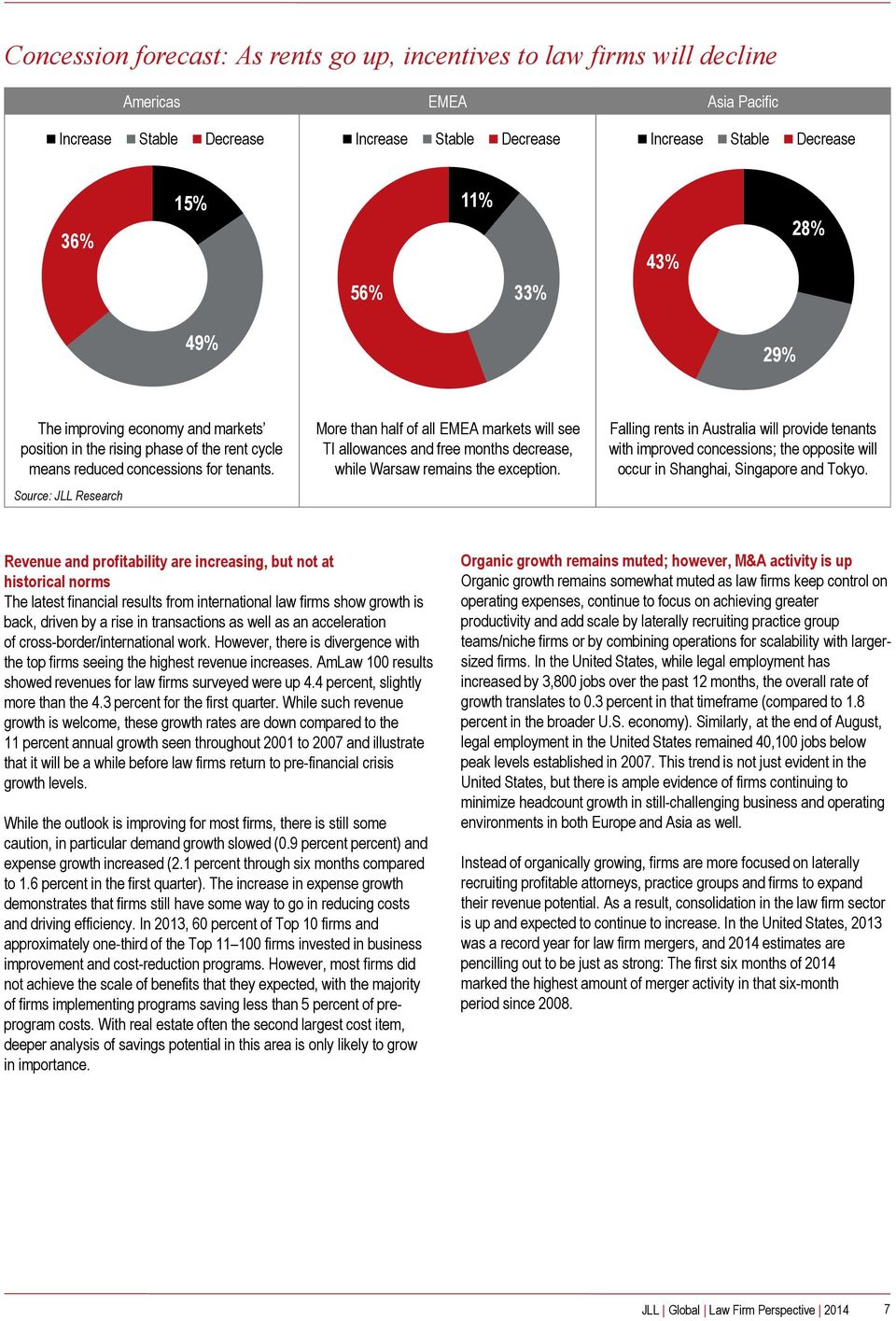
7 Concession forecast: As rents go up, incentives to law firms will decline Americas EMEA Asia Pacific Increase Stable Decrease Increase Stable Decrease Increase Stable Decrease 36% 15% 56% 11% 33% 43% 28% 49% 29% The improving economy and markets position in the rising phase of the rent cycle means reduced concessions for tenants. Source: JLL Research More than half of all EMEA markets will see TI allowances and free months decrease, while Warsaw remains the exception. Falling rents in Australia will provide tenants with improved concessions; the opposite will occur in Shanghai, Singapore and Tokyo. Revenue and profitability are increasing, but not at historical norms The latest financial results from international law firms show growth is back, driven by a rise in transactions as well as an acceleration of cross-border/international work. However, there is divergence with the top firms seeing the highest revenue increases. AmLaw 100 results showed revenues for law firms surveyed were up 4.4 percent, slightly more than the 4.3 percent for the first quarter. While such revenue growth is welcome, these growth rates are down compared to the 11 percent annual growth seen throughout 2001 to 2007 and illustrate that it will be a while before law firms return to pre-financial crisis growth levels. While the outlook is improving for most firms, there is still some caution, in particular demand growth slowed (0.9 percent percent) and expense growth increased (2.1 percent through six months compared to 1.6 percent in the first quarter). The increase in expense growth demonstrates that firms still have some way to go in reducing costs and driving efficiency. In 2013, 60 percent of Top 10 firms and approximately one-third of the Top firms invested in business improvement and cost-reduction programs. However, most firms did not achieve the scale of benefits that they expected, with the majority of firms implementing programs saving less than 5 percent of preprogram costs. With real estate often the second largest cost item, deeper analysis of savings potential in this area is only likely to grow in importance. Organic growth remains muted; however, M&A activity is up Organic growth remains somewhat muted as law firms keep control on operating, continue to focus on achieving greater productivity and add scale by laterally recruiting practice group teams/niche firms or by combining operations for scalability with largersized firms. In the United States, while legal employment has increased by 3,800 jobs over the past 12 months, the overall rate of growth translates to 0.3 percent in that timeframe (compared to 1.8 percent in the broader U.S. economy). Similarly, at the end of August, legal employment in the United States remained 40,100 jobs below peak levels established in This trend is not just evident in the United States, but there is ample evidence of firms continuing to minimize headcount growth in still-challenging business and operating environments in both Europe and Asia as well. Instead of organically growing, firms are more focused on laterally recruiting profitable attorneys, practice groups and firms to expand their revenue potential. As a result, consolidation in the law firm sector is up and expected to continue to increase. In the United States, 2013 was a record year for law firm mergers, and 2014 estimates are pencilling out to be just as strong: The first six months of 2014 marked the highest amount of merger activity in that six-month period since
8 Net new out-of-market law firms entering the market? Most Asia Pacific geographies recording net new firms; majority of Americas not seeing similar Americas EMEA Asia Pacific Yes No Yes No Yes No 36% 29% 50% 50% 64% 71% Market sentiment in the Americas leans toward no net new requirements, but a third are seeing an influx of firms. Source: JLL Research EMEA is completely split, with Amsterdam, Brussels, Germany and London all posting a net influx of firms. Only Melbourne and Tokyo saw minimal to no new out-of-market law firms entering their respective markets. Firms crossing the Atlantic for expanded opportunity Many U.S.-based and London-based firms are taking this approach to diversify exposure and gain access to new clients and markets abroad. In London, firms like Allen & Overy, Ashurst, Freshfields, Linklaters, Norton Rose Fulbright and Taylor Wessing, among others, have made more aggressive pushes to the United States in recent years to take advantage of the most profitable legal market globally. Meanwhile, U.S.-based firms Akin Gump and Sutherland, among many others, have made equally aggressive advances into Europe and the rest of the world. And this expansion and diversification is not just limited to Europe and the United States as many firms have signalled willingness to explore emerging market opportunities. Emerging markets present sizable opportunity ahead As predicted in our 2013 report, the appetite to enter new markets continues to be a prevalent tactic for the law firm sector that sees scale and geographic presence as key differentiators. Recent activity has revolved around Africa, Asia and Latin America. U.S. law firm merger activity has markedly increased since late 2012 and has surpassed previous cycle Law firm mergers Source: JLL Research, Altman Weil Routes to entry into emerging markets vary with preferred routes, including partnerships with local players, opening offices in new markets, working out of a satellite office or mergers and acquisitions with established local players. Market-entry examples: Simmons & Simmons has gained a South African presence by allying with Canadian firm Fasken Martineau's recently acquired Johannesburg operation. The office will provide a base in the region, concentrating mainly on energy and infrastructure, technology, media and telecom (TMT) and some financing work. Eversheds is formalizing a three-year cooperation agreement to launch two offices in Morocco. The firm is opening in Casablanca and Tangier through a tie-up with associated firm CWA, run by former Eversheds associate Mohamed Oulkhouir. The firm will have seven fee-earners in Casablanca and four in Tangier, within the port city's free trade zone. Dentons is tying up with South African associate firm KapdiTwala. KapdiTwala, which focuses on oil and gas, has been associated with Dentons since The merger gives Dentons an office in Cape Town, with the firm planning to open in Johannesburg in late Baker & McKenzie has established the largest global practice presence in Asia Pacific, overtaking recently merged Anglo- Australian challengers Herbert Smith Freehills (HSF) in The Lawyer's exclusive rankings. Dentons and White & Case both opened new offices in Astana late last year, a second location in Kazakhstan for both firms as they look to expand their presence in the country; Reed Smith opened its first location in the country in that city in January. Linklaters and Skadden opened offices in Seoul in May of last year and March of this year, respectively and 14 of the AmLaw 100 firms now have a presence here. 8

9 Allen & Overy is the latest firm to make a splash in Myanmar, as it becomes the first magic-circle firm to open an office in Yangon. In February, Baker & McKenzie launched an office in Yangon, and a month later Berwin Leighton Paisner entered the market via a local tie-up. Holland & Knight launched a Mexico City office in the past year, while Littler Mendelson acquired a Columbia-based firm last year as well. In addition to firms opening up ventures south of the U.S. border, they are bulking up their presence in key U.S. gateways like Miami and Houston to serve this everexpanding opportunity. Source: JLL Research, Law360, The Lawyer Efficiency agenda turns to alternative sourcing and shoring strategies With clients putting a greater emphasis on value and growing resistance to traditional billing and fee models, efficiency and productivity programs are clearly here to stay. The question for many law firms is what their alternative sourcing or shoring strategy should be. Options include using more contract lawyers, outsourcing or locating certain staff in lower-cost locations a recent trend that is impacting costly UK and U.S. regional centers. It could also be a combination of all of these options, allowing clients to have a flexible menu of delivery mechanisms. One thing that is certain is that all these changes will have a significant and direct impact on profitability and a firm s real estate. One focus is on staffing cases differently. Some firms are questioning the need to have higher-cost lawyers doing lower-level process-driven work, while sitting in expensive city centers. Routine tasks such as document management/review that full-time lawyers have done in the past can now be designated to those that can do it cheaper, but with the same level of quality. In the United States, firms have begun to explore shifting a substantial part of their contract attorney work to lower-cost cities. Orrick, for example, has shifted a substantial part of the contract attorney work to their Global Operations Center in Wheeling, WV rather than house it in more expensive cities like San Francisco, New York or Washington, DC. Pillsbury did the same more recently, deciding to shift part of their contract attorney work to Nashville, TN. With this strategy, firms are able decrease not just salary costs, but real estate costs as well. Pillsbury, for example, used to lease more than 250,000 square feet of space in Washington, DC. When the firm moves their Washington, DC headquarters a few blocks east in early 2015, the firm will occupy slightly more than 105,000 square feet due to shifting a substantial amount of lower-revenue and non-revenue functions to Nashville, TN from Washington, DC. And this is not just happening in the United States. According to a report by management consultancy OMC Partners, by 2019 every firm in the UK 100 those with a turnover of 22.3 million or above will have some form of alternative sourcing. This could take the shape of captive centers in low-cost regions, back-office functions abroad or jobs being sent out to external providers. Shoring and sourcing examples in the UK Ashurst: Created a new role of legal analyst based in Glasgow, which is an amalgamation of work done by paralegals and junior associates. The firm s low-cost support base in Scotland is expanding faster than expected; the firm is planning to more than quadruple the number of legal analysts in the next 12 months. The firm's Glasgow office currently houses 100 employees, 13 of which are 'legal analysts' and the remainder back-office staff. However, the growth of the office is gaining pace and it expects to contain 30 legal analysts by mid-summer and 60 by February The Bristol, UK office of Simmons & Simmons is a minireplica of London city and houses partners and lawyers experienced in property, finance and litigation and employment law. Work is completed in London when it has to be. Osborne Clarke outsourced much of its middle office to Integreon, which built a low-cost centralized shared service center in Bristol. Herbert Smith Freehills increased the use of its Belfast office to support overseas teams. Hogan Lovells is setting up a center in Birmingham as well as transferring a large proportion of its support network to a lowcost office in South Africa. The Legal Services Center will be an extension of the London office, meaning it will offer less complex aspects of work already instructed through the city. It differs from the South Africa center in that it focuses on legal work rather than back-office services. Berwin Leighton Paisner launched a center in Manchester as part of a new client service delivery center spanning four areas legal process improvement services, virtual transaction teams, use of third party providers and a new legal service delivery team in Manchester. Source: JLL Research, Law360, The Lawyer Shoring and Sourcing examples in the United States In the United States, more than a dozen firms have opened up global business services centers, which span from housing contract attorneys to non-revenue functions like accounting, finance, human resources, information technology, marketing and operations, among other areas. Some examples include: Bingham: Lexington, KY Fish & Richardson: Minneapolis, MN; already had office of attorneys here. Kaye Scholer: Tallahassee, FL Nixon Peabody: Rochester, NY; already has office of attorneys here Orrick: Wheeling, WV Pillsbury: Nashville, TN Sedgwick: Kansas City, MO Shearman & Sterling: Jacksonville, FL WilmerHale: Dayton, OH Source: JLL Research Real estate, technology and talent to drive productivity and performance As the operating environment evolves for law firms, real estate is increasingly under the microscope. With efficiency and productivity pressures on the rise, many law firms are analysing where their portfolio is concentrated, how their workplaces are configured and whether their real estate is meeting broader business objectives. While the structure and solutions adopted will vary according to the firm and culture, some discernible trends are emerging. 9

10 Are there firms in your market where associates are doubling up? In the Americas, only a few firms have experimented with this; opposite is true in Asia Americas EMEA Asia Pacific Single offices Doubling up Single offices Doubling up Single offices Doubling up 17% 14% 38% 62% 83% 86% Where associates have offices, the vast majority have single offices throughout the Americas besides NYC, where firms have tested this more. Source: JLL Research The single-office trend is less prominent but still the majority in EMEA. Doubling up occurring in Brussels, London and Warsaw. Tokyo is the only market where firms retain single offices for associates; the rest prefer to double up. Collaboration needs driving real estate design Increasing collaboration between teams and individuals is one of the primary drivers of many current law firm workplace strategies. Creating places where people can meet, where chance conversations can occur and where silos can be broken down is a key demand of senior management. Across the globe, communal spaces are increasing in number, quality and specification. Although law firms have been slower than other sectors in terms of reducing individual spaces JLL Research survey data shows many firms are exploring the efficiencies to be gained by collocating paralegals or associates in the same space or office particularly outside of the United States. Although such changes are commonly implemented during relocations, a growing number of firms are reshaping existing office space in order to facilitate more collaboration, interaction and movement within their office space including: Higher-quality and multi-function social and meeting space Removal or reduction of libraries and more traditional elements of space use Using high-quality catered restaurants and dining facilities to facilitate formal and informal meetings with clients and colleagues Work hubs, breakout zones, lounge areas and central atriums or additional stairwells that all encourage staff to interact Balancing space that facilitates collaboration with quiet space that facilitates concentration Traditional office locations under review Headcount in high-cost locations is under increasing focus as law firms examine their real estate portfolios in light of cost and efficiency pressures. A growing number of law firms are examining which roles, functions and teams need to be located in locations such as London, New York or Washington. The alternative sourcing and shoring trend highlighted above is leading many firms to open and expand additional office hubs in lower-cost nearshore or offshore locations. While this creates an obvious demand for additional real estate in the chosen locations, such strategies also trigger churn and change within existing real estate portfolios. Higher-cost office locations are subject to increasingly robust analysis around how much space is required for client-facing functions, the type of space required and whether higher-cost space can be justified to house back-office functions. While strategies will vary on a firm-by-firm basis, robust portfolio examination and building in greater flexibility within the portfolio and lease terms is crucial to enable adaptation to the rapidly changing business demand. Technology to serve as tool for recruitment and retention of talent Technology is also reinforcing and facilitating the collaboration trend as video conferencing, document-sharing and more effective remote/mobile team working become the norm for many firms. Australian Law firm Corrs Chambers Westgarth recently opted for a wireless office, allowing lawyers to work anywhere they choose, and all employees use VOIP, which allows for desktop video conferencing. A study by the International Legal Technology association showed that 73.0 percent of respondents agree or strongly agree that the capacity for rapid IT-enabled innovation will be a critical differentiator for law firms in the future. Key areas of impact technology can have are: Innovation: Deliver new services to clients such as secure file sharing, client relationship extranets. Efficiency: Streamline and automate processes. Data analytics to measure productivity and make required improvements. Client Relationship Management: Data analytics to gain greater insight into clients. Global expansion through mobility: Video conferencing, secure file sharing. Talent attraction, retention and employee satisfaction: Flexible working; graduates will increasingly be attracted to firms with strong IT and a better work/life balance. Collaboration: Knowledge portals. 10

11 While technology causes disruption, it is also an enabler for increasing productivity and efficiency, reducing costs over the longer term and meeting rising client expectations. Similarly, technology is also a key ingredient to greater employee retention and satisfaction and recruitment of new talent. Technology will allow for flexible working, while also optimizing space, and therefore enhancing employee morale, while potentially reducing real estate costs. Real estate market outlook Globally, the market outlook differs from city to city, but overall we believe the economic outlook in 2015 and ahead over the next three years will provide firms with ample opportunity to grow. Due to this growth, firms will have the ability to broaden and diversify their revenue streams, while also increasing profitability by focusing on efficiencies within real estate and business practices. If firms are able to do this, in addition to focusing on enhancing and promoting the work experience for their people and future employee prospects, the slow-growth performance many firms have been accustomed to in recent years will likely accelerate into a more dynamic outlook ahead. Around the world Americas Economic sentiment throughout the Americas is growing increasingly optimistic, from stable employment growth to improved consumer confidence and rising corporate profits. After years of a start-and-stop recovery, momentum in the economy across a number of industries has finally translated to expansionary activity in the office market, which has somewhat lagged other property sectors. However, law firms have yet to realize the same gains as sectors such as tech, energy, media and even finance to a degree, remaining stagnant from most perspectives except for revenue generation. This has become standard for large law firms, especially as they seek to increase efficiencies and mitigate costs; no leases larger than 100,000 square feet in the United States were expansionary in 2014 and the majority equated to rightsizing of more than 20.0 percent of tenants previous footprints. At the same time, law firms are increasingly dealing with a tightening leasing environment in nearly all U.S. and North America markets as companies from other industries gradually chip away at large block options, but fundamentals still make only below-average spec construction volumes viable in the short term. Savings from law firms drive toward efficiency are being somewhat negated by rising rents, shrinking concession packages and increased occupancy, build-out and labor costs. While many markets have plentiful second-generation space, this is of less value to an industry concentrated largely in the top tier of the office market. Law firms will likely need to be proactive about securing leases well in advance of their expiration dates in developments under construction or about to break ground and looking for an anchor tenant. There are pockets of opportunity for firms despite landlords growing leverage over the past year and into the next 12 to 24 months. Canadian markets have for the most part peaked and will remain in the falling and bottoming phases of the rent cycle throughout the short term; tenants will be able to take advantage of plentiful space options in space-constrained geographies at attractive rates compared to even one year ago. In peaking Bay Area and Texas metro areas, 3.0 million square feet of available space will hit the market over the course of the next three years in core submarkets. For the tech and energy hubs of the region, this is particularly attractive for firms with practice groups in the tech and energy industries, which remain the drivers of economic growth nationally. A burgeoning proposed pipeline could see another 16.9 million square feet of available space deliver over the next five to seven years, subject to macroeconomic conditions. With rents expected to rise outside of a few select geographies, a combination of continued efficiency measures not just better space utilization but also onshoring and tenancies in new construction will be law firms best bets to combat an increasingly competitive real estate landscape. Asia Pacific While there have been some positive developments in the financial market (e.g., the region led global IPO activity in the first half of 2014 and M&A activity reached a record high), the operating environment for the law firm industry in major Asia Pacific cities remains flat and thus similar to Large firms generally remain in a cost-saving mode and have chosen to either renew and, where possible, rightsize. Some international firms have even looked at moving to lower-cost buildings or locations. This has meant largely neutral and in certain cases even shrinking demand (e.g. Hong Kong and Sydney) from law firms over the last 12 months. The only increasing demand is stemming from domestic firms, augmented by some new out-of-market law firms providing new startups (except maybe in Tokyo and Melbourne). The anticipation is that most Asia Pacific markets will remain this way over the next 12 months, with certain markets such as Hong Kong and Sydney experiencing even further downturn. Overall leasing market conditions will likely be mixed Singapore is expected to see the fastest rental growth across the region for 2014 and rents should continue to climb in Shanghai and Tokyo, although net effective rents in Australia are still likely to decline as a result of even greater concessions. As with all occupiers, law firms will likely face continuing challenges such as rising costs of fitting-out, management, etc. There are a number of ways to mitigate these increasing real estate costs. 1. In Hong Kong and Melbourne, we are seeing the adoption of a more efficient workplace strategy, including new working styles to maximize space utilization (mobile working/conferencing facilities, hot-desking, etc.). 2. Make use of the market larger firms in Beijing, Singapore and Tokyo are moving to new construction with more efficient layouts in new buildings. 3. Firms that are in markets at the bottom of the rental cycle (e.g., Australia) should make use of current conditions to lock in longerterm deals. Europe and the Middle East Sentiment continues to improve for the law firm sector in EMEA with revenues from Europe s top law firms recording a combined turnover of 8.2 billion, up by 200 million on last year according to The Lawyer Europe Growth is expected to improve going forward helped by improved M&A and IPO activity; however, what is clear is that growth will remain below pre-recession levels for some time and there will be differing performance across EMEA markets as challenges such as pricing pressures remain and economies continue the road to recovery. 11

12 As such, the focus on driving efficiency and productivity is at the core of most law firm s real estate strategies. This is translating into muted demand in some slower growth markets; however, activity remains robust in the UK and Germany, with both seeing a net influx of new firms entering the market. Market conditions across Europe, the Middle East and Africa remain as diverse as the region itself. A number of markets, including Brussels, UAE, Warsaw, Paris, Moscow and Madrid offer favorable real estate market conditions in the near term. However the outlook is forecast to become more challenging with space options diminishing and costs increasing over the medium term. Law firms that are able to review their options and plan proactively are most likely to able to take advantage of more favorable conditions before the markets turn in landlords favor. For some key law firms markets conditions have already become more challenging. This is particularly apparent in markets such as the City of London, Milan and Amsterdam. Here, law firms are experiencing shortages of quality existing office space, increasing rents and hardening of incentives. For some, pre-leasing activity is becoming the best solution for obtaining a real estate solution that meets their needs. Law firm fit-out trends in London With greater scrutiny over the cost of real estate in high-cost locations, office fit out is increasingly in the spotlight. Faced with increasing competition and margin pressure, spending in the right areas is essential. Law firms have traditionally favored cellular layouts in London, given the need to guarantee privacy. But while there has been a gradual move toward co-locating staff, privacy and acoustics continue to drive legal fit outs. Cost savings are often cited as the main driver in moving away from the high specification cellular space most associated with legal fit outs. But the benefits include allowing firms to divert capital to enhance other areas, such as client spaces and communal areas. Fit-out costs in London are very much dependent on the firm and nature of the partnership, but across the board, there is greater focus on ensuring office fit outs are cost-effective. There has been a move away from traditional bespoke furniture, giving way to more modern, generic office furniture in common areas. There remains a tendency for more bespoke furniture in client areas although this is often influenced by the type of clients the firm services. While not universal, many UK-based firms have demonstrated mounting enthusiasm for a more collaborative, generic fit out that enables spend to be diverted toward the creation of impressive client areas. Ultimately decisions on design and cost-appetite vary by law firm practice area and firm culture; however, many international firms acquiring and fitting out space in London have begun to follow suit spurred on by the risk that they may fall behind the competition. Source: JLL Research 12

13 2014 Global law firm office clock Cologne, Moscow Shanghai, Toronto Dusseldorf, Stuttgart Berlin Frankfurt, Hamburg, Munich Amsterdam Montréal San Francisco Peaking phase Falling phase Vancouver Houston Miami London (City) Boston, New York (Midtown), Tokyo Atlanta, Philadelphia Rising phase Bottoming phase Warsaw Chicago, Singapore Beijing, Dallas, Los Angeles Melbourne Calgary, Dubai Hong Kong, New York (Downtown) Abu Dhabi, Brussels, Madrid, Milan, Paris, Sydney, Washington, DC Americas Asia Pacific EMEA Source: JLL Research based on CBD (United States and Canada) and prime office for EMEA and Asia Pacific 13

14 Americas For the U.S. and Canada - Figures reflect CBD markets only. - and rent-free periods represent an average figure for new relocation leases.. - Full-service gross represents net rent plus tax and operating. - In the U.S., vacancy rates represent CBD direct vacancy rates. 14

15 Atlanta Locational preference: The vast majority of Atlanta s law firms choose to locate within the city s urban submarkets of Buckhead, Midtown and Downtown. Central Perimeter has been urbanizing throughout the recovery. With a concentration of corporate occupiers nearby, transit options, and quality office inventory, the area often competes against Buckhead and Midtown. Proposed new towers in the area could threaten to lure firms from their traditional confines. Atlanta-based firms made significant relocation and renewal plays in months following the recession, capitalizing on tenant-favorable leasing conditions and using the opportunity to streamline operations. Since then, however, real estate movement among industry participants has proven relatively sparse in Atlanta's urban submarkets. Only a handful of active requirements for space exist, suggesting leasing may continue to be slow through early We do see opportunity on the horizon for smaller firms, which tend to serve local or regional clientele and are often highly specialized. These groups will likely see outsized benefit from continued improvement in the economy. As such, many Atlanta firms will grow quickly and find a need for more space. The question remains: Will they choose formal glass towers along the Peachtree corridor or gravitate to nontraditional converted warehouse-type product once only reserved for the city's high-tech tenants. Regardless, we anticipate these nimble practices to be in the market first. Mid- and large-sized firms are expected to eventually account for preleasing of much of the city's premium top-floor Trophy space as Atlanta's office development cycle matures. Asking rates for top elevator bank space will escalate into the low $40-per-square-foot range, drawing a sharp contrast against lease terms negotiated just following the recession.. 16% 27 Hunton & Williams 600 Peachtree Street 43,000 sq f Hollowell, Foster & Herring 260 Peachtree Street 12,500 sq f Bodker, Ramsey, Andrews, Winograd & Wildstein 3490 Piedmont Road 12,000 sq f Pricing and incentives (per sq f per year in local currency) Class A net rent Class A vacancy rate $16.50 $ % 18.8% assuming a 10-year lease > 50,000 sq f in the market $11.85 $3.40 $ $45.00 TI allowance Challenges for law firms Technology firms are beginning to drive demand in many of the Midtown Trophy towers, competing for space options. Delivery of new Class A inventory is still 12 to 18 months off and leasing conditions are brisk; availability of premium contiguous options is increasingly scarce. Moderate rental rate appreciation may impact value-conscious firms as leasing conditions in the CBD become increasingly landlord-favorable. Opportunities for law firms Planned towers are generally transit-oriented in terms of design and location, allowing for direct connectivity to the airport. Labor pool is expanding due to a robust population increase anticipated ahead. Rental rates remain discounted and attractive relative to gateway markets. 15

16 Boston Locational preference: The city's premier law firms occupy space in the most prestigious office towers in Boston's Back Bay, Financial and Seaport Districts. Legal employment in Massachusetts is still down nearly 2,600 jobs from pre-recession peaks. While Boston is the hub of the law firm market in New England, we have seen a modest decline in employment over the past year. However, Boston is experiencing stronger growth in the intellectual property and corporate law practices, spurred by the area s rise in the high-tech and life sciences fields. As area law firms are reconfiguring offices to be more in line with trends in the industries they serve, they are looking for flexible, more efficient spaces and many are considering moves from more traditional and suburban locations. As a result, the Seaport District, dubbed the Innovation District and home to a growing number of high-tech startups and the pharmaceutical giant Vertex, has attracted law firms from within and outside Boston looking to maximize proximity to potential clients. For example, Goodwin Procter signed a build-to-suit lease to occupy 360,000 square feet at Fan Pier, downsizing from 415,000 square feet in Financial District. Gunderson Dettmer, a business law firm specializing in early stage companies and venture capital firms, also signed a 27,000-square-foot lease at Joseph Fallon s One Marina Park Drive on Boston s waterfront. The result of these relocations and other similar transactions will be larger blocks of tower space on the market beginning to impact both vacancy and rents. A few of the larger contiguous availabilities being marketed early to avoid significant vacancy include spaces that will be vacated by Goodwin Procter at 53 State Street, State Street Corporation at 200 Clarendon Street and Copley Place as well as PwC and Verizon at 125 High Street. 10% 28 Skadden 500 Boylston Street 47,722 sq f Hemenway & Barnes 75 State Street 44,233 sq f Gunderson Dettmer 1 Marina Park Drive 27,692 sq f Pricing and incentives (per sq f per year in local currency) $36.61 Class A net rent $8.00 Class A vacancy rate $10.00 $47.53 $ % 9.8% assuming a 10-year lease > 50,000 sq f in the market 4 $55.00 TI allowance Challenges for law firms Strong employment growth and urbanization have created enhanced demand for CBD space. Competition for space from high-tech companies will continue to push Class A low-rise and Class B rents upward. Concession packages continue to tighten given the landlordfavorable market. Opportunities for law firms Remaining spaces within build-to-suit projects provide mid-sized law firms options to rightsize. Large blocks of space in Class A buildings in the Financial District and Back Bay will come on the market in the next few years. Firms specialized in the intellectual property and high-tech industries have ability to relocate to buildings in close proximity to high-tech companies. 16

17 Chicago Locational preference: Most of Chicago's largest law firms are located in the West Loop and Central Loop, with a few in River North. The Central Loop is also home to the largest share of the market's small-and medium-sized firms. The East Loop is still viable option for firms looking for space at competitive rates, with an abundance of large blocks available with views of Grant Park or Lake Michigan. Chicago has seen an active year with a number of law firms signing leases or entering the market for 100,000 square feet or more. Firms are rightsizing their space requirements, and this shift has triggered much of the market activity with law firms adjusting their space needs as an opportunity to brand themselves as efficient stewards of client fees and partner investment in order to reduce their footprints. Examples include Katten Muchin, renegotiating its lease early to shed 25,000 square feet, Locke Lord s sublease of 30,000 square feet to Harris Associates and Jones Day entering the market ahead of its termination option. 10% 54 > 50,000 sq f in the market Seyfarth Shaw Willis Tower 200,000 sq f DLA Piper 444 W Lake Street 175,000 sq f Taft Stettinius & Hollister 111 E Wacker Drive 63,000 sq f Beyond the rightsizing trend, law firms are also starting to adjust their operations to capture business from Chicago s growing high-tech and start-up activity. An example of this is Foley & Lardner providing 12,000 square feet and pro-bono office hours for Catapult, a coworking space for later stage start-up companies. Looking ahead, tenant concessions are expected to shrink or stabilize with the former more likely for Trophy assets and new development, a result of a limited supply of large-block Class A vacancies. Pricing and incentives (per sq f per year in local currency) $21.55 Class A net rent $7.69 $8.57 $34.41 $ $65.00 TI allowance 11.4% 12.9% Class A vacancy rate assuming a 10-year lease Challenges for law firms As the delivery of two new office towers nears, the market for high-end, high-rise Trophy space will continue to tighten and conditions will become landlord favorable. Availability of large-block spaces continues to decline, leaving fewer options for tenants of 100,000 square feet or more. Opportunities for law firms Smaller firms and those willing to consider lower-profile spaces still have adequate options. Firms that have recently downsized and those that plan to will benefit from cost savings and a more efficient, modern brand. 17

18 Dallas Locational preference: The majority of firms are located within Trophy and Class A+ properties Downtown (the Dallas CBD) and Uptown. A firm s potential move will parallel any new, high-end development delivered in these submarkets; both the CBD's and Uptown's latest spec developments are significantly occupied by law firms. Law firm leasing activity has increased over last year for the Dallas market. While some firms have renewed and rightsized in their current locations, new and pending construction has lured a few of the larger firms from their established locations. Jackson Walker followed KPMG into the new KPMG Plaza at Hall Arts project in the CBD and Gardere Wynne Sewell and Sidley Austin are the first tenants to commit to Crescent s new McKinney & Olive project in Uptown, scheduled to break ground in late Both of these projects are setting record asking rates, with full service gross rents in the $ to $51.00-persquare-foot range. These rates are 15 to 20 percent higher than previous top rates. 14% 31 > 50,000 sq f in the market Locke Lord 2200 Ross Avenue 176,057 sq f Gardere 2021 McKinney Avenue 109,000 sq f Jackson Walker 2323 Ross Avenue 104,064 sq f Competition in the sector is also increasing locally due to the growth in energy and North Texas overall economic strength. In addition to consolidations, several national firms have opened Dallas offices in recent years. In early 2014, McGuireWoods, for example, opened an office at 2000 McKinney Avenue, starting with some former Patton Boggs partners. Perkins Coie (Ross Tower) and Holland & Knight (The Crescent), among others have also entered Dallas over the past few years. Pricing and incentives (per sq f per year in local currency) $19.50 Class A net rent $1.50 $ $28.50 $39.00 $45.00 TI allowance 21.1% 20.6% Class A vacancy rate assuming a 10-year lease Challenges for law firms Uptown and the Arts District have tight vacancy and upward pressure on rates, especially in the Trophy segment. With several law firms expanding into the Dallas market, law firms are facing new competition. Opportunities for law firms Smaller firms have lots of available options, including backfilling excess space from other law firms. Two construction projects are currently under way, with a potential two or three additional developments breaking ground over the next year. Increase in institutional ownership in the CBD makes existing properties more attractive to law firms. 18

19 Houston Locational preference: Firms are found mostly in the CBD submarket. They are concentrated in Class A buildings with some of the most expensive rental rates in the city. Because of the lack of vacancy downtown, if national law firms were to move, they would consider moving to Midtown and the Galleria submarkets into new and proposed buildings. As 2014 progresses, Houston s economy and office market benefit from energy s overall economic growth as well as a STEM-based job uptick. The result of this economic and employment strength is a tightening office market, with peak rental rates especially within the CBD, Galleria, and Greenway submarkets. The above-mentioned Inner Loop areas serve as homes for the majority of Houston s major law firms. With vacancy rates in all three areas hovering around single-digits, law firms looking to renew or enter these submarkets remain focused on gaining efficiencies in their layout and maximizing their available space. While new Trophy and Class A buildings such as 609 Main, 6 Houston Center and 1885 St. James are currently under way and could offer law firms the efficiencies they desire, these new buildings (and additional spec buildings poised to being construction) in the Houston market will arrive with effective rents poised to be substantially higher than existing Class A space. With large blocks of existing Trophy and Class A space in these areas at a premium, the submarkets are expected to remain landlord favorable in nature in the near term. With concessions being tight and rental rates continuing to rise, law firms in the Houston market must continue a balancing act in terms of space, location, and rates when contemplating their lease needs. 6% 27 Gardere Wynne 1000 Louisiana Street 75,000 sq f Akin Gump 1111 Louisiana Street 69,000 sq f Arnold & Porter 700 Louisiana Street 30,000 sq f Pricing and incentives (per sq f per year in local currency) $24.97 Class A net rent $4.50 Class A vacancy rate $12.75 $27.08 $ % 12.2% assuming a 10-year lease > 50,000 sq f in the market 4 $55.00 TI allowance Challenges for law firms CBD Class A vacancy is very low and currently rests in the single digits, so options are very limited. The overall market is still very much landlord favorable, with rental rates on the rise and minimal concessions. Law firms must be, at the earliest, the second tenant into a new development due to credit status. Opportunities for law firms Large blocks of space will become available in CBD and the Galleria, with new and proposed developments coming online over the next few years. New office product could force the market toward neutrality over the next few years. 19

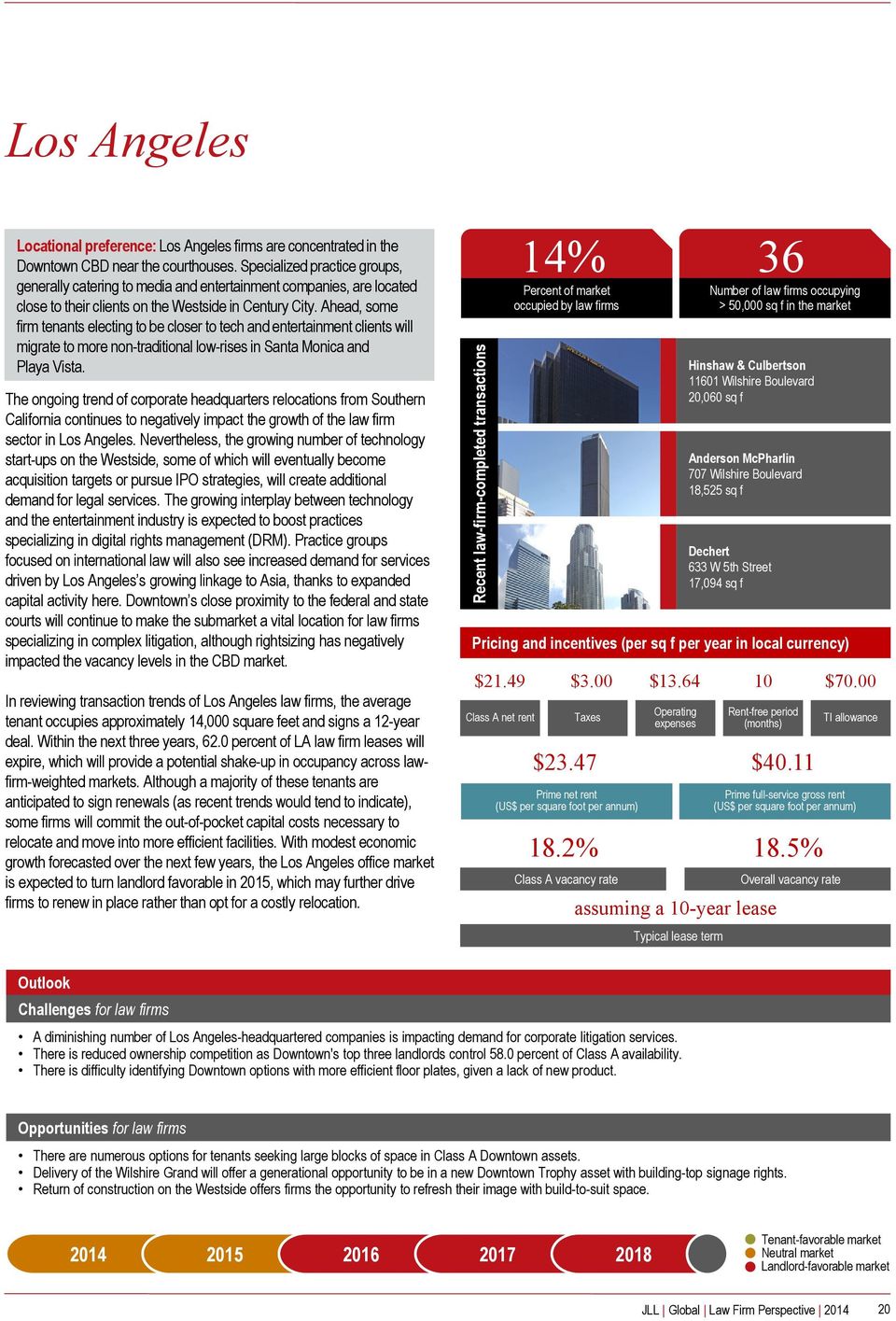
20 Los Angeles Locational preference: Los Angeles firms are concentrated in the Downtown CBD near the courthouses. Specialized practice groups, generally catering to media and entertainment companies, are located close to their clients on the Westside in Century City. Ahead, some firm tenants electing to be closer to tech and entertainment clients will migrate to more non-traditional low-rises in Santa Monica and Playa Vista. The ongoing trend of corporate headquarters relocations from Southern California continues to negatively impact the growth of the law firm sector in Los Angeles. Nevertheless, the growing number of technology start-ups on the Westside, some of which will eventually become acquisition targets or pursue IPO strategies, will create additional demand for legal services. The growing interplay between technology and the entertainment industry is expected to boost practices specializing in digital rights management (DRM). Practice groups focused on international law will also see increased demand for services driven by Los Angeles s growing linkage to Asia, thanks to expanded capital activity here. Downtown s close proximity to the federal and state courts will continue to make the submarket a vital location for law firms specializing in complex litigation, although rightsizing has negatively impacted the vacancy levels in the CBD market. In reviewing transaction trends of Los Angeles law firms, the average tenant occupies approximately 14,000 square feet and signs a 12-year deal. Within the next three years, 62.0 percent of LA law firm leases will expire, which will provide a potential shake-up in occupancy across lawfirm-weighted markets. Although a majority of these tenants are anticipated to sign renewals (as recent trends would tend to indicate), some firms will commit the out-of-pocket capital costs necessary to relocate and move into more efficient facilities. With modest economic growth forecasted over the next few years, the Los Angeles office market is expected to turn landlord favorable in 2015, which may further drive firms to renew in place rather than opt for a costly relocation. 14% 36 Hinshaw & Culbertson Wilshire Boulevard 20,060 sq f Anderson McPharlin 707 Wilshire Boulevard 18,525 sq f Dechert 633 W 5th Street 17,094 sq f Pricing and incentives (per sq f per year in local currency) $21.49 Class A net rent $3.00 Class A vacancy rate $ $23.47 $ % 18.5% assuming a 10-year lease > 50,000 sq f in the market $70.00 TI allowance Challenges for law firms A diminishing number of Los Angeles-headquartered companies is impacting demand for corporate litigation services. There is reduced ownership competition as Downtown's top three landlords control 58.0 percent of Class A availability. There is difficulty identifying Downtown options with more efficient floor plates, given a lack of new product. Opportunities for law firms There are numerous options for tenants seeking large blocks of space in Class A Downtown assets. Delivery of the Wilshire Grand will offer a generational opportunity to be in a new Downtown Trophy asset with building-top signage rights. Return of construction on the Westside offers firms the opportunity to refresh their image with build-to-suit space. 20
21 Miami Locational preference: Miami s CBD is comprised of two submarkets, Brickell and Downtown. The vast majority of firms occupy space within the Downtown sector of the urban core. Upholding its standing among the most prolific office users, CBD law firms led all industry sectors in leasing. Totaling 346,000 square feet, transactions involving law firms accounted for 41.0 percent of all CBD deals. These were among the largest occupiers, with two-thirds of this activity consisting of leases in excess of 20,000 square feet. Half of the top 10 transactions were executed by top-performing national AmLaw 100 and 200 firms. Miami s top two active requirements, Ackerman Senterfitt and Hughes Hubbard, also rank among the same national giants. CBD market conditions follow Miami s overall fundamentals: declining vacancy with marginal sublets available thanks to new occupancy gains and leasing activity. This coincides with lower unemployment and higher job gains. Miami led all major U.S. markets with more than 20,000 people employed in legal services, growing 3.7 percent over the last 12 months, employing 22,500 people. A challenge facing both tenants and landlords is that the leasing of premier CBD spaces has left relatively fewer options for high, full-floor offices with commanding, unobstructed views. Enticing tenants to lessattractive, view-challenged spaces is at the forefront of creative marketing efforts for Trophy landlords. 17% 8 Shutts & Bowen 200 S Biscayne Boulevard 69,155 sq f White & Case 200 S Biscayne Boulevard 58,400 sq f GrayRobinson 333 Avenue of the Americas 35,400 sq f Pricing and incentives (per sq f per year in local currency) $22.23 Class A net rent $3.23 $15.63 $27.57 $46.43 > 50,000 sq f in the market 5 $50.00 TI allowance 17.2% 16.9% Class A vacancy rate assuming a 10-year lease Challenges for law firms Contiguous Trophy space with prime views remains extremely limited. Space properly designed to accommodate new workplace standards is in demand, but lacking in availability. Concessions are on the decline for both new deals and renewals. Opportunities for law firms New construction is underway at Brickell City center. New assets and upgrades from existing product offer greater efficiencies, upgraded finishes and increased amenities. 21
22 Montréal Locational preference: Mid- to large-sized Canadian law firms are consolidated in buildings across the CBD s Core and South submarkets. In fact, properties owned by institutional landlord Ivanhoé Camdridge host 35.0 percent of all law firm tenancy in the CBD. The Old Montréal submarket, with its proximity to both courthouses, also attracts a mass of smaller litigating and boutique law firms. In terms of new development projects, landlords have yet to entice law firms in relocating due to the increased competition coming from existing buildings. The dissolution of Heenan Blaikie in the first quarter of 2014 intensified tenant-favorable leasing conditions for law firms. The firm unexpectedly left behind 184,400 square feet of space in Oxford Properties 1250 René-Lévesque West. In addition, there has been no real growth in the demand for office space from law firms in the last 12 months. As a result, the percentage of the CBD s Class A market has decreased by 700 basis points year-overyear to reach 7.4 percent. 7% 10 > 50,000 sq f in the market Gowlingsl Place Ville Marie 1 Place Ville Marie, CBD Core 55,916 sq f Osler, Hoskin & Harcourt 1000 de la Gauchetière West, CBD South 49,665 sq f Monette Barakett Place Ville Marie 4 Place Ville Marie, CBD Core 11,815 sq f Ivanhoé Cambridge has been able to secure the two largest renewals since last year. Gowlings will continue to occupy f55,900 square feet at 1 Place Ville Marie for another 15 years and Osler, Hoskin & Harcourt renewed its 49,600-square-foot tenancy at 1000 de la Gauchetière West. With respect to relocations, Monette Barakett has leased 11,800 square feet of space at 4 Place Ville Marie, leaving behind 14,900 square feet of Class B space at 1010 de la Gauchetière West. At the end of August, the CBD had eight active law firm requirements larger than 10,000 square feet. By year end, Blake, Cassels & Graydon and Ravinsky Ryan Lemoine will complete their transactions. The additional six requirements aggregate to 363,800 square feet and the tenants will likely make decisions between 2015 and The two largest, Stikeman Elliott and Fasken Martineau, amount to more than 120,000 square feet each and will be highly coveted by landlords and developers. Pricing and incentives (per sq f per year in local currency) C$26.00 Class A net rent C$10.50 Class A vacancy rate C$ % 8.3% $22.00 $43.00 assuming a 10-year lease 4 C$40.00 TI allowance Challenges for law firms 1. Effectively assessing the short- and long-term costs associated with retrofitting existing space or the capital expenditures needed to relocate and build out modern new space. 2. Adapting to the changing workplace environment practices in order to attract and retain a younger generation of legal practitioners. 3. Minimizing financial and personal guaranties required by landlords to protect against partnership dissolution and default on lease obligation. Opportunities for law firms 1. Potential for rental reduction and increased incentives due to a rising supply in Class A buildings across the CBD over the next 24 months. 2. Increased negotiating leverage against landlords, allowing for early right-sizing exercises in exchange for the extension of existing lease term. 3. Current and forecasted market conditions may make it financially viable for law firms located in Class B buildings to upgrade to newer buildings with more modern and efficient space. 22
23 New York Locational preference: The majority of firms in Manhattan are located in Grand Central and the Plaza District, where Grand Central Terminal and the Metro North Railroad are easily accessible. In an effort to find more efficient, lower-priced space, firms are relocating westward within Midtown to new construction and Downtown where pricing for Class A space is on par with Class B space in Midtown. Leasing activity among major law firms has slowed year-to-date, with only one firm committing to a lease greater than 100,000 square feet compared with four renewals larger than 100,000 square feet at this time last year. During the second quarter, White & Case signed the largest lease year-to-date, a 440,000-square-foot relocation four blocks north to 1221 Avenue of the Americas from 1155 Avenue of the Americas. While Grand Central Terminal remains a pull to many established firms, it has become less so in recent years as market dynamics have shifted and employee commuting patterns have changed. Partners are no longer exclusively commuting from Westchester and Connecticut, and the battle for associate-level talent has reduced the need to have offices near the Metro North Railroad terminal. Combined with a drive for efficiency, law firms have increasingly shifted office searches west and Downtown, where newer, lower or comparatively priced space is available. Some of the early pioneering law firms that moved into Times Square in the late 1990s are now opting to look farther westward or Downtown as their leases expire. 11% 119 White & Case 1221 Avenue of the Americas 440,000 sq f Duane Morris 1540 Broadway 89,074 sq f Troutman Sanders 875 Third Avenue 87,126 sq f Pricing and incentives (per sq f per year in local currency) $47.96 Class A net rent $15.00 $ $58.96 $87.97 > 50,000 sq f in the market $50.00 TI allowance 9.6% 7.6% Class A vacancy rate assuming a 10-year lease Challenges for law firms Most new construction in Midtown will not be delivered until 2018 or later, significantly limiting the supply of new, efficient space available to firms. Landlords are beginning to push back, lowering concessions and increasing rents as supply tightens. If firms want new construction, they will have to move westward; the delay of the proposed Midtown East rezoning pushes off any new construction in the Grand Central corridor for the foreseeable future. Opportunities for law firms Geographically-diverse workforce opens opportunity for relocation outside traditional submarkets. Newer, lower priced space on the west side and Downtown provide opportunities to reduce real estate footprints and costs. The Vanderbilt corridor rezoning provides the opportunity for new construction near Grand Central, including the proposed One Vanderbilt. 23
24 Philadelphia Locational preference: The majority of Philadelphia's law firms are located in the CBD's Market Street West submarket. This location provides easy access to abundant amenities and immediate proximity to the city's concentration of professional services companies. The Philadelphia CBD marketplace has continued to evolve in While tenant demand profiles have shifted from large- to mid-sized users, sub-6.0 percent Trophy vacancy has positioned Class A landlords to benefit from the Trophy rental growth experienced in Annualized Class A rent growth of 5.3 percent in Market Street West in the second quarter surpassed comparable Trophy figures, which grew at 3.3 percent year-over-year. Continued leasing momentum from midsized law firms has facilitated landlord leverage. While Pond Lehocky, Hangley Aronchick and Chartwell Law finalized Trophy deals, transactions with Schnader Harrison and Klasko Rulon were finalized at top-tier Class A assets. Now, the market faces a near-term supply-demand misalignment between quality availabilities and tenant demand. Despite this current deficiency, new deliveries, repositioned assets and pending rightsizing will bring select new availabilities for law firms seeking space. While Comcast retains an option to occupy the remainder of its new Trophy tower, FMC Tower at Cira center South will bring new Trophy product to the market, and a recent uptick in CBD investment sale activity will bring fresh capital and vision to assets on the market for sale. Given currently tight market conditions and potential near-term softening, tenants will continue to enter the market more than three years ahead of lease expiration. 15% 23 Rawle & Henderson Widener Building 69,420 sq f Schnader Harrison 1600 Market Street 67,000 sq f Pond Lehocky One Commerce Square 60,000 sq f Pricing and incentives (per sq f per year in local currency) $20.09 Class A net rent $3.00 Class A vacancy rate $6.00 $25.91 $ % 11.6% assuming a 10-year lease > 50,000 sq f in the market 8 $50.00 TI allowance Challenges for law firms Landlord leverage is diversifying, with Class A rent growth exceeding Trophy growth year-to-date. There is a lack of quality availabilities larger than a full floor. Net-new inbound demand is increasing competition for space. Opportunities for law firms New developments will spur existing and new Trophy availabilities. Investors continue to look to existing, underperforming Class A assets for repositioning projects. Availabilities for small-sized law firms (fewer than 10,000 square feet) remain abundant. 24
25 San Francisco Locational preference: The vast majority of law firm tenants prefer to office in high-profile buildings concentrated in or bordering the North Financial District, where there is a large concentration of premium Class A office product. Firms, especially within the AmLaw 100, also prefer to be located on higher floors with quality view-space. Despite an expanding economy, growth in the legal industry has been stagnant with virtually no change in employment over the last 20 years. While San Francisco remains a significant hub for AmLaw 100 firms, the competitive leasing environment that has arisen as a result of the rapidly expanding technology industry has been challenging for even the most prominent of law firms. With rental rates nearly double those in 2010, law firms are challenged to find quality space in a market where virtually all other non-technology industries are also competing for good deals. There do remain pockets of opportunity, however. As much of the competitive demand in the market is focused on new construction and space south of Market Street, the North Financial District, long the preferred area of law firms, is experiencing waning demand and thus slightly better negotiating leverage. Leases signed by law firms in 2014 were 8.0 percent lower than the overall average asking rate and nearly entirely completed in the North Financial District. Though availability of large blocks remain a challenge for law firms with leasing requirements between now and 2016, trends in workplace efficiencies are allowing law firms to revise their space needs moving forward. 7% 26 Winston & Strawn 101 California Street 52,235 sq f Munger, Tolles & Olson 560 Mission Street 37,171 sq f Dechert 1 Bush Street 17,044 sq f Pricing and incentives (per sq f per year in local currency) $40.79 Class A net rent $5.00 $17.00 $47.07 $69.07 > 50,000 sq f in the market 4 $50.00 TI allowance 9.0% 9.4% Class A vacancy rate assuming a 10-year lease Challenges for law firms There are only seven blocks of space larger than 100,000 square feet available in the market, including buildings under construction. The significant growth of the tech industry has fueled 80 percent rent growth, presenting a difficult negotiating environment for firms. Despite 4.5 million square feet of new construction in the market, 70 percent has been preleased, leaving very little new supply and asking rents that are 5 to 77 percent higher than existing Class A space. Opportunities for law firms As new developments are delivered and occupied, there will be new opportunity in second-generation space being vacated. The continued demand and shift south toward the South Financial District will present firms with greater negotiating leverage in the North Financial District, which has long been a center for firms. 25
26 Toronto Locational preference: The interdependence between the legal, accounting and financial sectors have pulled Toronto s Big Law into downtown AAA office towers. In fact, Toronto s 33 largest law firms by square footage all reside in the central business district, with the largest suburban firm at only 28,557 square feet. But as finance and accounting have begun to absorb space in new Downtown South developments, the legal sector remains rooted in traditional office complexes in the likes of TD center, First Canadian Place, and Scotia Plaza. Large firms that elected to relocate to new builds in recent years, have stayed north of the tracks in buildings such as RBC center and Bay-Adelaide center. Negotiating power is beginning to shift in favor of law firm tenants. The 12 buildings with more than 100,000 square feet of law firm tenancy have seen availability rates increase from 5.7 percent in second quarter of 2013 to 8.6 percent in the second quarter. Four of these 12 buildings have more than 100,000 square feet of contiguous blocks available, including the now vacant Heenan Blaikie space since its sudden collapse in early These blocks exist in addition to the 385,000 square feet of unaccounted-for supply coming online in the financial core in 2016 and 2017 with the completion of Brookfield s 22 Adelaide Street West and Oxford s 100 Adelaide Street West developments. Such significant supply of large block space will give Toronto s 24 50,000-square-foot law firms an edge whether they are looking to relocate to a new development or renew with their current landlord. Toronto law firms have started to follow the global trend of reducing office requirements through space optimization. But while their UK peers move toward open cultures, Toronto firms stand firm on their office cultures, similar to U.S. firms, with seniority often marked by the size of individual offices. Smaller footprints have shifted Toronto law towards a one-size-fits-all approach and the doubling up of associates in offices to conserve space, but still remain behind the curve relative to global peers. 11% 24 Pricing and incentives (per sq f per year in local currency) C$30.00 Class A net rent C$15.00 Class A vacancy rate C$15.00 Lenczner Slaght Richmond Adelaide center 130 Adelaide Street West 38,500 sq f 5.7% 6.0% assuming a 10-year lease Gardiner Roberts Bay-Adelaide East (under construction) 22 Adelaide Street West 32,500 s.f Brown & Partners Richmond Adelaide center 130 Adelaide Street West 12,500 sq f $27.50 $55.00 > 50,000 sq f in the market 3 C$40.00 TI allowance Challenges for law firms 1. There is limited space options for 100,000-square-foot firms with lease expirations in the next 12 to 18 months before new supply is delivered in the financial core. 2. There are capital constraints on partners since relocation to new buildings comes with expensive build-out costs. 3. Stronger covenants are sought by landlords since the collapse of Heenan Blaikie in 2014, including personal guarantees from partners. Opportunities for law firms 1. There are opportunities to refresh space and brand by relocating to one of several new development properties coming online from 2014 to There is enhanced productivity of real estate: space optimization to drive build-out decisions for relocating firms and tenants improving existing space. 3. There are blend-and-extend opportunities for firms who wish to open lease negotiations with landlords as availability increases in AAA office towers starting early
27 Vancouver Locational preference: The majority of Vancouver s notable law firms are centrally located within the central business district of Downtown between West Georgia Street and Canada Place. The most recent development cycle has provided an influx of new office supply to the Downtown market, opening up large block opportunities for multi-floor law firms that have been restricted by a lack of relocation or expansion options in recent years. With 2.1 million square feet of office space under construction, law firms Bull Housser & Tupper (Telus Garden), Miller Thomson (725 Granville), McCarthy Tétrault (745 Thurlow), Maclean Law (MNP Tower) and Jarvis McGee (980 Howe) have all secured office space in new developments. Except for Maclean Law in MNP Tower, the other five pre-lease commitments are all located peripherally to what has traditionally been considered the heart of Downtown. While this may suggest an expanding target zone for law firms looking to relocate, the concentration of Vancouver s prominent law firms remains in topclass buildings within a few city blocks of the intersection at Burrard and Dunsmuir Streets. Law firm activity has been relatively stagnant over the past year, with the major story being the insolvency of Heenan Blaikie resulting in its 36,900-square-foot space in Guinness Tower becoming vacant. The majority of this space was quickly taken up by Calgary-based Bennett Jones, which took advantage of the high-quality improvements and secured 24,500 square feet as it entered the Vancouver market. The most recent pre-lease transaction to take place was at 980 Howe, where Jarvis McGee committed to approximately 7,200 square feet. Although located on the periphery of the CBD, the 240,000-square-foot building is adjacent to the provincial courthouse, so there has been significant interest in the Manulife asset from the legal sector. As office standards for law firms continue to evolve, firms with relevant lease expiries are surveying the next wave of office developments that can be delivered in 2017/2018 and will offer first-class building systems and flexibility, something existing supply struggles to offer. Nearly 74.0 percent of the downtown construction due by the end of 2015 has been pre-leased, 12.3 percent of which has been taken by law firms. Challenges for law firms 14% 11 Jarvis McGee 980 Howe Street 7,200 sq f 1. Even with value engineering, office build-outs for law firms continue to rank amongst the highest of core downtown industries when considering relocation or expansion costs. Tenant improvement allowances are significantly lower than the cost of improvements, with tenants having to finance the difference. 2. Successful pre-leasing of new downtown office developments has limited future new-supply opportunities for multi-floor law firms with lease expiries. 3. Increasing office efficiencies requires reducing the size and scope of private offices in order to reduce office footprint and promote collaborative work space, a trend which may not be welcomed by all partners. Opportunities for law firms Miller Thomson 725 Granville Street 48,000 sq f Bennett Jones Guinness Tower 1055 West Hastings Street 24,500 sq f Pricing and incentives (per sq f per year in local currency) C$36.50 Class A net rent 5.9% 6.7% Class A vacancy rate 1. When the new office buildings become ready for occupancy in 2015, large Class A backfill opportunities will begin to open up in a market that presently has very few large block vacancies. 2. Creative design and the evolution of office configuration in an effort to shrink office footprints can have a positive effect on occupancy costs and office culture. 3. As vacancy and office availability continue to rise, landlords will be offering increasing tenant inducements to secure quality tenants in a market that is quickly shifting to tenant favorable. C$8.50 C$ $33.00 $52.50 assuming a 10-year lease > 50,000 sq f in the market C$30.00 TI allowance 27
28 Washington, DC Locational preference: The majority of firms are located in the CBD, East End and Capitol Hill. Given few large existing quality blocks of space in the core, many AmLaw 100 firms are considering future developments with several of these options located in fringe locations of the CBD and East End, increasingly the northern part of the CBD or the emerging Mount Vernon Triangle segment of the East End. Law firms comprise the largest segment of the tenant base in Washington, DC, occupying 45 percent of the core Class A market. Over the past five years, firms have focused on rightsizing and densifying, which has resulted in limited growth across the legal sector. Approximately 75 percent of law firms in the District have already rightsized, generally shedding 20 to 30 percent of their footprints in new transactions. Although a restrained development pipeline has increased competition for new Trophy space, a plethora of second-generation law firm space will come back to the market given the relocations of several prominent firms, including Arnold & Porter at th Street, NW and Covington at 1201 and 1275 Pennsylvania Avenue, NW and the downsizing of firms such as Hogan Lovells at th Street, NW and Morgan Lewis at 1111 Pennsylvania Avenue, NW. Despite widespread contraction activity, vacancy rates remain below 12.0 percent, making Washington, DC one of the tightest office markets in the country. The top segment of the market should continue to tighten over the next 36 months given reduced construction activity and segmented growth in other areas of the local tenant base. Longer term, a flurry of potential new groundbreakings and repositionings could provide relief to large tenants seeking modern Trophy buildings. 25% 92 Pricing and incentives (per sq f per year in local currency) $35.78 Class A net rent $13.00 Class A vacancy rate $ $47.90 $ % 11.9% assuming a 10-year lease > 50,000 sq f in the market Morgan Lewis 1111 Pennsylvania Avenue, NW Renewal with contraction 270,000 s.f. Venable 600 Massachusetts Avenue, NW Relocation 245,000 s.f. White & Case th Street, NW Renewal with contraction 135,000 s.f. $ TI allowance Challenges for law firms Quality space options are dwindling; tenants continue to enter market years in advance of their lease expirations to secure quality space. Limited new deliveries over the next 36 months as development pipeline remains suppressed and well-leased. Rents may begin to rise among high-quality assets in 2015 as the top segment of the market continues to tighten. Opportunities for law firms A plethora of second-generation law firm space will come back to the market with multiple large law firm relocations and rightsizings. Substantial amount of high-quality space is likely to deliver in 2017 to 2019 with the flurry of potential ground breakings in 2015 and Concession packages remain at an all-time high. 28
29 Asia Pacific 29
30 Beijing Locational preference: CBD buildings, including China Central Place, China World, Kerry center and Yintai, continue to be the location of choice for most foreign law firms. Although some local firms were active in the CBD, they are more dispersed and also locate in Dongcheng District and Finance Street. Despite the recent completion of Fortune Financial Center (FFC) in the CBD, overall vacancy remains below 4 percent. As such, many firms may consider decentralized spaces in the near to medium term. Projects completions in the core CBD expansion area beginning in 2017 should offer law firms with more options. Recent activity: Overall law firm activity accounted for 1.8 percent of total take-up in the Beijing office market in H1 of 2014, which is consistent with the overall take-up in the whole of One notable transactions in the year-to-date involved Pillsbury Winthrop Shaw Pittman, which entered the Beijing market and leased a total of 350 sqm at China World Trade center Tower Two. Another notable transaction involved Fangda Partners, which will see the Shanghai headquartered law firm expand to 4,000 square meters at Kerry center over the next two years. Current market conditions: Strong leasing activity in FFC in recent quarters, coupled with limited availability in the CBD, led key building owners such as China World to regain confidence and raise rents. Several other CBD buildings followed suit, causing CBD rents to increase 3.1 percent in H Tight vacancy rate city-wide has maintained landlord-favorable conditions, leading to city-wide effective rents growing 1.9 percent in H1. Due to the tight supply pipeline, we expect rents to continue to grow over the next 18 to 24 months, barring any unforeseen circumstances. Multinational law firms are more likely to renew rather than relocate or downsize in order to limit real estate costs (e.g., expenditures for reinstatement and restacking/relocation fit-outs), unless there is a need for an expansion or a significant reduction in size. 2% 5 Pillsbury China World Trade Center Tower Two 1 Jianguomenwai Avenue 350 sq m Haiwen & Partners Fortune Financial Center 5 East Third Ring Road 1,800 sq m Bird & Bird China World Trade Center Tower One 1 Jianguomenwai Avenue 700 sq m Pricing and incentives (per sq m per month in local currency) RMB 549 RMB 0 Prime Grade vacancy rate RMB 44 $99.00 $ % 3.3% assuming a 3-year lease > 5,000 sq m in the market 2 RMB 517 Net effective rent (full service) Top 3 challenges for law firms 1. There is very limited new Grade A supply. 2. CBD rents are rising. 3. Some landlords have been inflexible during rental negotiations, while others do not honour previously agreed renewal caps. Top 3 opportunities for law firms 1. Established buildings may have some spaces becoming available. 2. Landlords are showing some flexibility for tenants with the right profile. 3. Some international law firms are still looking to enter Beijing. 30
31 Hong Kong Locational preference: Law firms in Hong Kong are usually located in core Central close to their clients, predominantly within Grade A premises clustered around Hongkong Land s portfolio (Central s largest landlord). Given cost pressures, however, law firms are increasingly open to relocating from traditional locations. Recent activity: The largest new leasing transaction in the sector year-to-date was Hill Dickinson, a new set-up from the UK leasing a total of 700 square meters in a lower-cost option in fringe Central, highlighting current trends. This is consistent with Stephenson Harwood relocating from Grade A premises to a lower-cost building in Admiralty at the end of Traditional office sizing and structures are slowly changing as the legal sector engages in cost savings in tandem with strategies to reduce real estate costs. Current market conditions: Overall law firm activity has been broadly muted over the past 12 months, with a number of firms looking to take up rights to downsize or market surplus space, motivated by cost mitigation. On the other hand, PRC law firms have increased their size in Hong Kong over the same period, albeit relatively small in scale. For those firms seeking to relocate, the development pipeline remains constrained until at least However, there are opportunities among existing buildings, particularly those that traditionally have been popular with law firms, e.g., The Landmark and Pacific Place. 7% 5 Baker & McKenzie Hutchison House & Admiralty center 102,000 sq f (Consolidation) Mayer Brown JSM Prince s Building & Infinitus Plaza 97,334 sq f (Rent Review and Downsize) Stephenson Harwood United center 20,000 sq f (New Letting) Pricing and incentives (per sq f per month in local currency) HK$ HK$ 0 HK$ 8-12 > 5,000 sq m in the market 3-6 HK$ Net effective rent (full service) $120 $ $130 $ % 4.2% Prime Grade vacancy rate assuming a 3-year lease Top 3 challenges for law firms 1. There is competition among peers to retain staff and maintain/grow market share. 2. Firms must find replacement tenants for surplus space. 3. Medium-term rental prices will increase in Central. Top 3 opportunities for law firms 1. Firms will find available space and deal flexibility in traditional law firm portfolios such as Landmark. 2. Smaller law firms can benefit from some tenants looking to dispose of surplus space. 3. There are current opportunities to lock in protected long-term deals. 31
32 Melbourne Locational preference: The Premium or Grade A premises throughout the CBD is traditionally favoured by major law firms in Melbourne. However, several firms have focused on new or refurbished A grade space with large 2,000-square-meter typical floors specifically within the Courts Precinct or Western end of the CBD. Recent activity: Major new lease negotiations so far in 2014 include DLA Piper (6,895-square-meter renewal) and Hall & Wilcox (4,974- square-meter relocation). Both firms maintained a total size similar to their previous tenancies. We note Maddocks (7,000 square meters) may decide to relocate to Collins Square (737 Collins Street), a new building pre-committed by KPMG in the Docklands, which is a nontraditional location for legal firms. Maddocks will likely maintain the current tenancy size, but will consolidate over three levels compared to the current six levels. Norton Rose has also recently come to the market for a reduced area of 6,000 to 7,000 square meters compared to their current 8,900 square meters. 4% 17 > 5,000 sq m in the market DLA Piper 140 William Street 6,895 sq m (June 2016 Commencement) Hall & Wilcox Rialto, 525 Collins Street 4,974 sq m (Jan 2015 Commencement) Current market conditions: Overall tenant demand has improved slightly during 2014, but face rentals have remained steady or declined slightly with incentives increasing up to 30 to 33 percent of the net rental over the lease term. Firms needing to reset their fit-out can benefit from the availability of larger efficient floors in new developments or refurbished buildings as well as attractive leasing incentives to cover fit-outs on a 10-to 12-year lease, while firms with modern useable fit-outs prefer to renew on flexible five-to seven-year terms and use incentives to reduce rental overheads. There has been a range of firms rationalizing space and offering to sublease either whole or part floors, including near new fitouts. The subleasing market is problematic and letting up periods are protracted beyond 6 to 12 months and in most cases will involve a re-negotiation of the terms to facilitate a surrender/direct lease. Relocation by several firms from the legal precinct including, Corrs Chambers Westgarth, Hall & Wilcox and potentially Maddocks, will provide attractive backfill options into 2015 and Top 3 challenges for law firms Pricing and incentives (per sq m per year in local currency) A$ N/A (included in outgoings) 10.1% 12.6% Prime Grade vacancy rate 1. There will be limited supply of new A Grade and Premium buildings in the CBD in 2015 to In case of refitting/refurbishment, the availability of churn space can be limited and higher overall costs compared to relocation. 3. There are constant changes in headcount forecasts and thus uncertainty regarding future total requirement size. A$ $31 $38.00 $43 $52.00 assuming a 10-year lease A$ Net effective rent (full service) Top 3 opportunities for law firms 1. Opportunities exist to back-fill space in good quality buildings located in the legal precinct from 2015 to New premium quality developments planned at 82, 447, 477 Collins Street may provide good opportunities after Forward planning opportunities exist by preparing for 2018/2020 lease expirations by considering lease pre-commitment options. 32
33 Shanghai Locational preference: Law firms have traditionally preferred to office in the core CBD areas of Puxi and Pudong, which allows firms to be close to the financial sector firms and major MNCs, which are their primary clients. Small-to mid-sized law firms, particularly U.S. and international firms, tend to locate in Lujiazui in Pudong, as well as Jing an and Huangpu in Puxi. The overwhelming majority of foreign firms tend to occupy space in premium Grade A buildings. Domestic firms seeking to upgrade their images are gradually shifting to premium Grade A buildings, and this trend is expected to continue over the next 24 months. Current market conditions: Over the past 18 to 24 months, law firms have slowed down expansion plans in Shanghai as economic uncertainty has led to a slower growth environment a trend that is more pronounced among foreign/multinational firms. Increasing levels of sophistication and fee competition from domestic firms are also impacting business prospects of foreign law firms, a further impediment to growth. While overall leasing demand has been subdued, a small number of law firms, especially domestic firms, remained active in the Grade A and Premium markets. Many domestic law firms are now looking to upgrade their office space from lowerquality buildings in an effort to improve their image and focus more on their client-facing services. Space in the core Pudong CBD (Lujiazui) is very limited, although there has been a steady wave of new premium supply coming into the Puxi market a trend that will continue throughout 2014 and The next three to four quarters should be a favorable period for tenants to explore real estate opportunities in Puxi due to the supply pipeline. Given rents have risen to post-gfc highs, we do not expect international law firms to expand appreciably over the next 12 months, and renewals should remain a preferred strategy given the cost-saving environment. Domestic law firms should continue to upgrade to Grade A buildings in the CBD over the next 12 months. n/a 1 Linklaters Mirae Asset Tower Pudong - Lujiazui 2,490 sq m renewal Clifford Chance Bund Center Puxi - Huangpu 2,129 sq m renewal Skadden Kerry Center Tower 3 Puxi - Jingan 1,600 sq m relocation Pricing and incentives (per sq m per month in local currency) RMB 482 RMB 0 Prime Grade vacancy rate RMB % 11.5% $88.00 $98.00 assuming a 3-year lease > 5,000 sq m in the market 0 RMB 482 Net effective rent (full service) Top 3 challenges for law firms 1. Competition from domestic law firms, in terms of size, sophistication and corporate image is increasing. 2. Lujiazui, a major submarket for law firms, is experiencing record levels of occupancy (vacancy rate down to 0.4 percent for Premium Grade A). Limited options and market conditions generally are favorable to landlords. 3. Lujiazui rents will continue to climb for the next two to four quarters due to tight supply, although the opposite is true for Puxi, where the bulk of new CBD supply is concentrated. Top 3 opportunities for law firms 1. Enhance real estate productivity: portfolio rationalization, space utilization, benchmarking and monitoring of portfolio. 2. Many landlords/developers in Puxi will become anxious in 2015 as new supply should continue to outpace net absorption. Premium stock available on favorable terms for tenants. 3. There will be more tenant-friendly market conditions through 2017 due to new supply of premium grade CBD space. 33
34 Singapore Locational preference: The majority of the law firms in Singapore are located in the prime CBD, specifically in the Raffles Place and Marina Bay locales. Similar to tenant movements in the banking and financial sector, there has been a preference to relocate to larger and more efficient new developments. There is a general trend of law firms located in the vicinity of Raffles Place moving to newer developments in the Marina Bay area that command better views and larger floor plates. Current market conditions: The law firm sector has been relatively active with a number of multi-national law firms expanding with new offices in Singapore. Many firms start business operations in a sharedserviced office before reaching a critical mass and thereafter relocating to a more permanent office within the CBD. Over the last two years, we have seen more than a dozen international law firms enter the market. The Singapore government continues with its effort to create a strategic center for international arbitration and, as such, we are still seeing a number of international firms commencing operations. We expect the growth of law firms to continue over the next three to four years (albeit at a slower rate), with a number of international firms forming relationships with local firms through joint law ventures (JLV) or formal law alliances (FLA). With a number of large Prime Grade A office developments completing in 2016, there will be ample opportunities for law firms to expand into higher-quality buildings. In view of the tightening supply, we anticipate rents to grow in the short term before potential downward pressure in 2016 as the new supply enters the market. 4% 5 RHT Law Taylor Wessing 6 Battery Road Renewal 22,000 sq f Jones Day CapitaGreen (formerly in Samsung Hub) Relocation 12,000 sq f DLA Piper UOB Plaza I Renewal 11,000 s.f Pricing and incentives (per sq f per month in local currency) S$ 12.5 NA (included in rent) Prime Grade vacancy rate S$ % 5.8% Nil $ $ assuming a 5-year lease > 5,000 sq m in the market S$ 11.0 Net effective rent (full service) Top 3 challenges for law firms 1. Potential for rental increases due to a lack of new supply in Grade A buildings. Law firms with larger space requirements will be constrained by limited immediate supply of suitable floor plate options in traditional law firm locations. 2. Firms occupying older developments face challenges in adopting to new working styles due to design limitations. 3. Recruitment/hiring due to recent growth in the law firm sector in Singapore, there is a shortage in qualified lawyers. Top 3 opportunities for law firms 1. Legal and business communities across Asia are increasingly promoting the city-state as a one-stop venue for international commercial arbitration. 2. Alternative work place solutions offer opportunities for more mobile working/conferencing facilities, hot-desking and working from home. 3. In 2016 there will be a new wave of Grade A supply coming to the market, offering law firms opportunities for relocation. 34
35 Sydney Locational preference: The Premium-grade, high-rise premises traditionally favored by major law firms in Australia are now being reconsidered by many international firms. Major accounting firms have long adopted a more cost-driven approach to premises and this is increasingly seen as the more appropriate model for law firms in the future. Recent activity: The largest lettings in 2014 in the Sydney market have been Minter Ellison (9,500-square-meter relocation) and King & Wood Mallesons (12,000-square-meter recommitment). Both deals involved a reduction in previous premises area of around 20 percent. Current market conditions: Most significant law firms have seen a continuation of the pressure on workflow and profitability. These challenges appear two-fold: 1. Greater shopping around by clients seeking cost-effective legal services 2. Continued new entrants from overseas into the Australian legal market, many of whom create start up boutique-sized firms, by taking on senior established partners of major firms, whose clients then follow them Cost and size of premises therefore increasingly come under the spotlight. Workplace models are also typically coming under scrutiny as more firms embrace open forms of collaborative environments and a reduction in the solid-built form. Paper retention has also at last seen major reductions. For those firms with a forthcoming lease expiry, the Premium and A- Grade office markets remain very soft for landlords. Face rentals have nevertheless remained steady with incentives increasing to up to 35 percent of the gross rental over the term.. 4% 18 Minter Ellison Governor Macquarie Tower 1 Farrer Place 9,500 sq m King & Wood Mallesons Governor Phillip Tower 1 Farrer Place 12,000 sq m Pricing and incentives (per sq m per year in local currency) A$ 975 N/A (included in outgoings) Prime Grade vacancy rate A$ % 9.9% 41 $69.00 $85.00 assuming a 10-year lease > 5,000 sq m in the market A$ 469 Net effective rent (full service) Top 3 challenges for law firms 1. There is limited ability to sublet heavily-partitioned surplus premises (existing leases). 2. Firms must make a decision to fully downsize (in new leases) to reflect current workload or maintain some 'float' to anticipate an upturn. 3. Firms must decide whether to adopt global trends of more open forms of working. Top 3 opportunities for law firms 1. Make use of current market conditions to lock in good long-term deals. 2. Firms can build in very flexible expansion/contraction terms in new leases. 3. Firms can continue the trend of moving away from traditional high rent towers. 35
36 Tokyo Locational preference: The law firm sector in Tokyo favors locations surrounding major banking and financial institutions. The majority of law firms choose offices within Chiyoda and Minato-kus with popular locations being Marunouchi, Otemachi, Akasaka and Roppongi. Recent activity: Limited international law firm leasing activity has occurred over the past 12 months, with the larger firms choosing either to retain their current space, renew or in some cases right-size in order to save costs. The domestic Japanese law firm sector, in contrast, has been more active, with some firms taking advantage of rents and incentives offered at new developments ahead of anticipated rental increases. Following Anderson Mori & Tomotsune s relocation in 2013, Nishimura & Asahi upgraded to Mitsubishi s Otemachi-1A Project. There are additional rumors of another major Japanese law firm actively pursuing a relocation to a Prime property in Marunouchi. Current market conditions: The market is now landlord-favorable, supported by low vacancy in the central 3 kus (3.7 percent as of second quarter of 2014). Landlords have been able to increase rents moderately over 2014, with the first half of 2014 seeing gross rents rise by 3.5 percent to JPY32,779 per tsubo per month. The full-year growth in 2014 is expected to reach 7.0 percent, rising to over 10.0 percent in Tenants are finding relocation options to be limited as a result of low vacancy levels, and with the 2014 supply (270,000 square meters) now over 95 percent committed and much of the 2015 new supply (276,000 square meters) anticipated to be heavily pre-committed. A significant challenge to firms in Tokyo going forward is the rising cost of fitting-out, due to a shortage of labor and rising base material costs, which will particularly impact firms that favor cellular office deigns with extensive internal office fit-out costs. This may limit relocation activity over the next few years, and law firms should be mindful of their renewal strategies to avoid market risk. 2% 5 Nishimura & Asahi Otemachi1-1A project 13,200 sq m 2014 (2015 pre-lease Ropes & Gray JP Tower 250 sq m 2014 Hunton & Williams Pacific Century Place (Regus) 250 sq m 2014 Pricing and incentives (JPY per tsubo per month) JPY JPY 2,620 JPY 6, , % 6.5% Prime Grade vacancy rate $86.00 $ assuming a 10-year lease > 5,000 sq m in the market JPY 25,440 Net effective rent (full service) Top 3 challenges for law firms 1. Rising construction costs. 2. Limited space availability in the near term. 3. Rental increases in both the Grade A and B markets. Top 3 opportunities for law firms 1. Significant new supply of around 15 million square feet between 2016 and Vacancies in high-quality, older Grade A stock due to downsizing and relocations. 3. Long-term lease renewals/new leases to potentially avoid market risk. 36
37 Europe and the Middle East For EMEA - Figures reflect CBD market unless otherwise stated. and rent-free periods represent an average figure. Net effective rent for EMEA is calculated using the following standard formula: 1 minus (incentives as a percent of lease length) multiplied by prime rent. Full-service gross represents net rent plus tax and operating. Exchange rates are from the end of August. 37
38 Amsterdam Locational preference: The largest international and domestic law firms are generally located in the Zuidas district. The Zuidas district is home to law firms including Baker & McKenzie, De Brauw Blackstone Westbroek and Loyens & Loeff, among others, with exception for Allen & Overy and Lexences, which are located in the adjacent South district. The Zuidas can be characterized as a well-connected multi-functional location, where many large international corporates are located. Many smaller law firms are located in the city center of Amsterdam, especially around the canals at the Herengracht and Keizersgracht. The smaller buildings here have a modern classical image, which suits the small law firm. Law firm activity remains relatively limited in Amsterdam and competition for office space in the popular Zuidas district decreased in 2013, down 37.0 percent on Demand from law firms has been subdued over the same period. Law firms are focusing more on cost reduction, resulting in earlier renewal of their lease contracts, subleasing surplus space or restructuring their leases to increase flexibility. 17% 11 > 5,000 sq m in the market NautaDutlih Beethoven ,000 sq m Freshfields Strawinskylaan 10 6,960 sq m Lexence Amstelveenseweg 500 5,000 sq m Pricing and incentives (per sq m per year in local currency) The overall market of Amsterdam is still characterized by a large amount of oversupply, particularly in more peripheral areas, although over the last few years, the municipality agreed on several office conversions to hotels and (student) apartments outside of the city core. Due to the absence of new completions, the choice of Grade A office space decreased to 2.5 percent in the Zuidas district. Despite the overall high vacancy rate in Amsterdam, declining Grade A vacancy has led developers in the Zuidas district to pick up their ambitious plans from before the economy downturn. To that end, refurbishment of two office buildings are planned in the upcoming year, and together with the relocating of law firms Stibbe and NautaDutilh within the Zuidas to new-build offices by the end of 2015, the availability of Grade A office space might increase in the future offering greater opportunities for law firms. Top 3 challenges for law firms 1. No speculative new built offices, which will force law firms with near-term lease expiries to renew in place or consider second-generation/ renovated space. 2. Balancing workplace investments vs. cost-saving pressures. 3. Retain talent and local clients when law firms want to consolidate offices in other cities to Amsterdam. Top 3 opportunities for law firms Grade A vacancy rate 1. Willingness for landlords to facilitate early renewal of contracts to create cost savings or further flexibility. 2. Reduce real estate costs through better space optimization. 3. Capitalize on opportunities to drive efficiency and productivity in the workplace % 5.1% 14 $41.00 $47.00 Figures reflect the Zuidas district. assuming a 10-year lease Net effective rent 38
39 Brussels Locational preference: Most law firms tend to locate in the Leopold and Louise district, especially if they are doing business with European institutions and banks. The decentralized South East is attractive for large international law firms due in part to its proximity to the Justice Palace. In addition, declining vacancy and comparatively higher rents in the Leopold district are driving some law firms to look for space in the Decentralized South East where vacancy is high and rents are more affordable. In the first half of 2014, law firm activity accounted for 2.0 percent of total take-up in the Brussels inner city (excluding periphery but including decentralized). Deals were only of small to medium size, such as the letting to Buyle Legal of 1,321 square meters on the Avenue Louise. In 2013, law firm activity accounted for 6.0 percent of total take-up in the Brussels inner city, the largest being the letting to Jones Day of 4,100 square meters in the Regence IV. Activity is being driven by lease events, where occupier-favorable market conditions give tenants a strong negotiating position; examples include CMS DeBacker and Bonelli Erede Pappalardo. Smaller law firms are consolidating, creating new demand for space. Typical demand is for open space for associates and staff, and closed offices for partners, preferably in recent or new offices. Demand for the traditional town-house offices has largely disappeared. International law firms tend to optimize their occupation with less space. However, new demand is coming from Eastern European firms entering the Brussels market to serve Eastern European interests linked to the European institutions. Deals for these firms are mid-size and we expect to see such requirements going forward. 2% 12 Jones Day Regence IV Rue de la Regence 4 4,100 sq m Van Cutsem-Wittamer-Marnef The Platinum Avenue Louise 235 1,546 sq.m. Buyle Legal Louise-Legrand Avenue Louise 523 1,321 sq m Pricing and incentives (per sq m per year in local currency) Grade A vacancy rate $35.00 $ % 8.3% assuming a 10-year lease > 5,000 sq m in the market Net effective rent Top 3 challenges for law firms 1. Decreasing availability of Grade A buildings in districts favored by law firms. 2. Reduction of incentives in the Leopold and Pentagon districts, paving the way for rental increases within one to two years. 3. Increased mobility issues in some central districts due to high car traffic. Top 3 opportunities for law firms 1. in the near term: Landlords ready to negotiate lease terms to keep their existing tenants. 2. Speculative activity in most attractive districts offering high-quality office space in the near term. 3. Look for ways to optimize space through initiatives such as hot-desking. 39
40 Dubai & Abu Dhabi Locational preference: Dubai continues to be the preferred location for most international law firms. More specifically, firms are drawn to the Dubai International Financial Center (DIFC); an established free zone, and neighboring Central Business District (CBD) locations such as Emaar Square and along Sheikh Zayed Road. The lack of appropriately located Grade A office space remains an overall challenge in Dubai, with firms choosing to pay a premium for being in the DIFC and neighboring CBD. In Abu Dhabi, Sowwah Square has become the preferred location for many international law firms. However, the future of this project remains in question as the entire Al Maryah Island (including Sowwah Square) has now been designated as a financial free zone. Law firms established with local partners are not currently permitted to lease space on Al Maryah Island. Fortunately, there is an increasing supply of Grade A office space available on onshore locations within Abu Dhabi. The year 2014 saw limited demand for office space from law firms, particularly in Dubai, as many firms have previously committed to longterm leases. In addition, the shortage of Grade A office space has forced firms to renew their current leases as opposed to relocating. There remains a clear preference among international legal firms for top-quality space in both Abu Dhabi and Dubai, while smaller local practices have taken space in secondary locations. In Dubai, the large law firms continue to serve clients in the financial services and trading sectors, while firms in Abu Dhabi have continued to serve government entities and the energy sector. 5-10% 2 DLA Piper Standard Chartered Building Dubai 1,600 sq m Shearman & Sterling Ethihad Towers Abu Dhabi 1,000 sq m Pricing and incentives (per sq m per year in local currency) AED1,860 AED1,705 n/a AED28 10 / 10 AED1,540 AED1,412 Dubai / Abu Dhabi Dubai / Abu Dhabi $47.00 / $39.00 $48.00 / $40.00 Dubai / Abu Dhabi 25% 30% CBD vacancy rate Dubai OPEX Dubai / Abu Dhabi assuming a 10-year lease > 5,000 sq m in the market Rent-free Dubai / Abu Dhabi Net effective rent Dubai / Abu Dhabi Dubai / Abu Dhabi CBD vacancy rate Abu Dhabi Top 3 challenges for law firms 1. The lack of Grade A office space in Dubai has put pressure on rents. 2. Subleasing excess space can be challenging. 3. Service charge structures remain opaque. Top 3 opportunities for law firms 1. Law firms currently located in the DIFC have the opportunity to move to non-core DIFC buildings (Index Tower/Burj Daman) that offer good-quality space but at rents about 25 percent to 35 percent lower than in DIFC. 2. Increase in Grade A supply due in 2015 offers new opportunities. 3. Tenant favourable conditions in the near term. 40
41 Germany Locational preference: Law firms are located in prime CBD locations such as near the Alte Opera in Frankfurt, the city center districts of Hamburg and Munich, the CBD or Hafen in Dusseldorf and in Mitte 1A or Potsdamer Platz in Berlin. 2-7% 60 > 5,000 sq m in the market Law firm activity was less dynamic in 2014 than in 2013, with a small handful of office openings from international firms and mainly in Berlin, Munich and Dusseldorf. There were no new international firms opening offices in Germany although some existing international and domestic firms did expand into new cities on a small scale. Office closures came from K&W in Berlin and Sidley in Frankfurt. The largest deals this year were by firms that elected to remain in place and renegotiate. In most cases these firms were either in quality buildings and testing the market, or were not able to find suitable product to justify a move right now. Four of the 10 most expensive office deals in the first half of the year were by law firms; however, we are seeing increasing cost sensitivity. Firms are not easily going to pay 30 to 40 per square meter when business is increasingly competitive and staff costs are rising. Law firms continue to focus on top-end buildings in CBD locations. Some firms outside CBD locations are showing a desire to move further in. There is also an increasing focus on building efficiency and quality, particularly where they have been in legacy locations that are now in need of upgrade. Firms can often fit in 10 to 20 percent less space in new buildings with more efficient floor plates, even with no major change to workplace configuration. Changing workplace concepts continue to have a minimal effect as firms see having a more traditional private office design as a tool to attract and retain top attorneys. Going forward, we expect the second half of 2014 to rebound, albeit below 2013 levels. Our tracking of law firms in the market shows similar levels of potential transactions as six months ago, but in many cases firms are electing to stay and renegotiate. The years 2018 and 2019 will see many leases up for renewal and, as such, firms may start looking one to two years in advance to avoid competing for limited space. Top 3 challenges for law firms 1. Low vacancy in prime, city center buildings across all cities; this is particularly challenging in Munich. 2. Options for large firms (more than 5,000 square meters) are mainly limited to new developments, requiring decisions three years before lease expiration. New developments normally require significant preleasing before starting construction, plus fixed 10-year commitments. 3. Rents are projected to continue to rise in most markets as available space declines. Top 3 opportunities for law firms Bird & Bird Großer Grasbrook 9 Hamburg 2,000 sq m Schultze & Braun Augustenstraße 1 Stuttgart 1,700 sq m Kirkland & Ellis Maximilianstraße 11-15a Munich 1,300 sq m GSK Stockmann + Kollegen Marstallstraße 11 Munich 1,300 sq m Pfenning, Meinig & Partner Theresienhöhe Munich 1,100 sq m CMS Hasche Sigle Nymphenburger Straße 4-6 Munich 1,100 sq m 1. Renegotiate terms in existing leases before rents increase further. This is best done at the same time as fit-out upgrades and resolving expansion or contraction needs. Landlords are generally sticky on face rents, but there are other opportunities that can yield significant savings. 2. Relatively slow activity in the first half of 2014 means some landlords are eager to secure good tenants even in top-quality buildings. Law firms should take advantage of this opportunity, which may not stay open for very long. 3. For firms that do not have to be in the very best building, there are more options at significantly less cost in buildings below prime quality. 41
42 Germany Berlin Pricing and incentives (per sq m per month in local currency) Cologne Pricing and incentives (per sq m per month in local currency) Net effective rent Net effective rent $32.00 $45.00 $32.00 $ % 7.9% Grade A vacancy rate assuming a 7.5-year lease n/a 6.9% Grade A vacancy rate assuming a 7.5-year lease Düsseldorf Frankfurt Pricing and incentives (per sq m per month in local currency) Pricing and incentives (per sq m per month in local currency) Net effective rent Net effective rent $40.00 $55.00 $51.00 $ % 11.6% Grade A vacancy rate assuming a 5-year lease 5.2% 11.4% Grade A vacancy rate assuming a 5-year lease Figures are at city level 42
43 Germany Hamburg Pricing and incentives (per sq m per month in local currency) Munich Pricing and incentives (per sq m per month in local currency) Net effective rent Net effective rent $35.00 $48.00 $48.00 $ % 7.4% Grade A vacancy rate assuming a 5-year lease 2.6% 7.0% Grade A vacancy rate assuming a 5-year lease Stuttgart Pricing and incentives (per sq m per month in local currency) Net effective rent $28.00 $39.00 n/a 5.2% Grade A vacancy rate assuming a 5-year lease Figures are at city level 43
44 London City Locational preference: Small-to mid-sized law firms, particularly U.S. and international ones, tend to locate in core city locations, whereas established UK and large international law firms (70,000 square feet or more) favor peripheral City Fringe locations or Canary Wharf in order to benefit from lower rents and to hedge against significant rental increases at future rent reviews. Recent activity has centered on Midtown, which accounted for 58.0 percent of total legal take-up this year. Year-to-date law firm demand has been relatively stable, with 14 transactions equating to a total of 399,881 square feet of floor space and 13 percent of total city take-up. This is only a marginal decline on the same point last year where it stood at 434,155 square feet and 16 transactions. The largest transaction of this year was Mishcon de Reya s acquisition of Africa House, WC2 from Freshwater. The firm leased 118,277 square feet in a move to consolidate into one single building and take advantage of lease breaks on other buildings they occupy. Rental prices are increasingly being driven by a recovery in occupier demand combined with a constrained development pipeline from 2015 onward. Take-up where law firms are paying above 60 per square foot has increased 7 percent year on year. As a result, law firms are taking pre-lets as they act early to secure space in their preferred location. Macfarlanes and Ropes & Gray are two examples of preleasing transactions. At the end of July 2014, there were 38 active and potential law firm requirements compared to 50 requirements for the same period last year. But with 33 active requirements in the city totalling 871,000 square feet, of which 372,500 square feet is under offer, we expect law firm take-up to continue to be robust for the remainder of the year. Top 3 challenges for law firms 13% Hardening of rent free incentives and tightening of supply are driving rents upward and reducing availability of preferred space. 2. Portfolio optimization: Requirement to have all staff in a higher-cost location is being scrutinized. Firms will have to examine their real estate portfolios in light of cost and efficiency pressures and evaluate options such as lower-cost regional centers for staff doing more process-driven work. 3. Lease renewals: Older space is often incompatible with new working styles. The challenge will be to minimize capital expenditure, while embracing new working practices. Ultimately, relocation may deliver the more viable long-term solution. Top 3 opportunities for law firms Mishcon de Reya Africa House, WC2 118,277 sq ft Macfarlanes 98 Fetter Lane, EC4 48,070 sq ft Ropes & Gray 1 New Ludgate, EC4 45,210 sq ft Pricing and incentives (per sq ft per year in local currency) % 7.3% Grade A vacancy rate 1. Workplace transformation: Take advantage of pre-let activity to create space fit for the future emphasis on open, flexible and collaborative space that can deliver improved efficiency, collegiality and cost savings. 1. Forward planning: Prepare for 2019/2020 lease expirations by considering pre-let options. 2. Utilise technology: Strategic potential of technology to increase efficiency, reduce space requirements and retain talent. Examples include video conferencing, document sharing and more effective remote/mobile team working (incld. insurance costs) 24 $ $ Figures are at city level. assuming a 10-year lease > circa 50,000 sq f in the market Net effective rent 44
45 Madrid Locational preference: Law firms in Madrid tend to favor the CBD submarket, specifically Castellana Street and its borders; toward the east, the Salamanca neighborhood; and on the western side of the axis, the areas of Almagro or Zurbano. Smaller firms are frequently located in mixed-use buildings, residential/offices. Many firms look for representative buildings to support their marketing strategies and reinforce their brand. Of the top 25 law firms, 96 percent are located in or around these areas. Going forward, however, law firms with space requirements will be obliged to look for adequate solutions in lower-quality CBD buildings or move farther from the Castellana axis. Decreasing supply in the market is forcing law firms to take action now before rental prices increase, which means improving office locations and increasing square meters in many cases, without price increases by square meter. Currently, CMS Albiñana & Suárez de Lezo, and Herbert Smith are scanning the market with this purpose. No developments are foreseen in the CBD apart from a few turn-key refurbishments, which may become a good option for law firms in the coming years when there will be limited suitable available space. In the medium term, tenant conditions are going to be less favorable as a consequence of the expected improvement in the macroeconomic environment. The law firm sector in Madrid is still very traditional in terms of fit-out, requiring top-quality space and compartmentalized offices. Due to the fact that law firms look for a high-quality product, they are the first to notice rent increases. Top 3 challenges for law firms 2% 6 1. There is a hardening of incentives in the prime area and increasing rents due to scarcity of suitable product. 2. Law firms tend to look to be sole tenants at HQ locations. This reduces available options and restricts ability to reduce space if requirements change. 3. An excessive delay in the searching and decision making phase may cause a critical loss of options to relocate in a prime location. Top 3 opportunities for law firms 1. A change of culture in the sole occupier dogma will provide flexibility to increase or reduce space according to their real estate needs when a law firm locates in a big building, sharing space with other medium-sized-tenants. 2. Current market environment is driving the full or partial refurbishment of old but well-located buildings, which may increase availability of high-quality space, suitable to law firms. 3. Tenant-favorable real estate market conditions gives leverage to occupiers when negotiating rents or rental renewals. Hogan Lovells Paseo de la Castellana ,608 sq m White & Case Paseo de la Castellana 7 1,142 sq m Pricing and incentives (per sq m per year in local currency) % 12.2% Grade A vacancy rate $36.00 $46.00 Vacancy is at city level. assuming a 5-year lease > 5,000 sq m in the market Net effective rent 45
46 Milan Locational preference: Major law firms are located in the Historic Center, which comprises the very central area of Milan around Piazza Duomo, Piazza Affari, Piazza San Babila and the Fashion quarter surrounding via Montenapoleone, and the CBD. Law firms remain attracted to prime office space in locations that ensure greater proximity to their client base. The new CBD consolidating around the Porta Garibaldi area is gaining some traction, with increasing appeal to international corporates attracted by quality buildings and excellent accessibility. For the 12 months up to June 2014, law firms have taken up approximately 2,300 square meters across five deals, broadly in line with the previous year. This includes, an expansion by White & Case, that recently entered the Milan market. All the transactions have taken place in the Center and Historic Center, confirming a preference for traditional locations rather than the new CBD consolidating around the Porta Garibaldi area. More activity is expected by the end of 2014, with one major law firm possibly moving and one having already renegotiated their existing lease. This is in line with the tightening office leasing market dynamics, with a growing number of transactions and a higher take-up overall. At this stage, however, most of the largest Milan-based Italian and international law firms have already renegotiated existing leases, suggesting that leasing activity in the short term may remain subdued. With the recent wave of renegotiations, law firms have also taken the opportunity to modernize their space and have interestingly turned to a more progressive workplace model, by introducing some shared offices in order to facilitate communication and foster productivity, while also allowing some space savings. Top 3 challenges for law firms 4% 4 1. Future rental growth will pose a challenge for those firms that have not renewed their leases or identified a new location. 2. The type of office space in the historic center is not always compatable with progressive workspace models. 3. Should businesses require additional space, high-quality central options may be limited. King & Wood Mallesons SJ Berwin Via Dante, Milan 1,000 sq m White & Case Piazza Diaz, , Milan 410 sq m (in addition to 1,000 in 2013) Militerni e Associati Via Gonzaga, , Milan 330 sq m Pricing and incentives (per sq m per year in local currency) % 13.5% Grade A vacancy rate Vacancy is at city level. vary between 30 and 40 /sqm/pa and do not include private portion cleaning costs and electricity $55.00 $61.00 assuming a 6+6 years lease > 5,000 sq m in the market Net effective rent Top 3 opportunities for law firms 1. The various waves of consolidations that have characterized the Milan market have led to a release of historic office space, where landlords are increasingly keen to accommodate tenants with high-quality refurbishments. 2. Supply in the new CBD is growing as refurbishment activity increases. 3. Law firms negotiating position is being strengthened by investors appetite for law firms among their tenant lease roll. 46
47 Moscow Locational preference: The majority of law firms in Moscow are located in the city center along the Kremlin area, Boulevard Ring and Tverskaya Street. Given the limited supply of high-quality office space forecasted in the city center for the next few years, the Moscow City submarket becomes attractive for law firms in terms of the balance of high-quality office space, price and improving transportation access. The law firm sector occupies about 66,000 square meters of highquality office space in Moscow. Over the last 12 months, several transactions were completed by law firms, including the renewal of an existing lease agreement by DLA Piper in the office building on Leontyevskiy Lane and the renewal of a lease agreement by Latham & Watkins in Ducat Place III. The largest acquisition of new space in the first half of 2014 in this sector was the lease of 1,625 square meters in Naberezhnaya Tower by CMS. Prime rents have decreased from 2013 through the first half of 2014 and stand in the range of US$900 to $1,100 per square meter per year. Over the longer term, rents are forecast to increase in the CBD submarket due to low future supply and consistent demand from occupiers that prefer the submarket for its proximity to the Kremlin area and its established business location. Historically, the relocation of law firm offices has been limited to the prime segment in the city center; however, going forward law firms are likely to reevaluate their strategies and seek out opportunities in the rapidly developing Moscow City business cluster, which is becoming an attractive cost-effective location for key occupiers in Moscow. 3% 3 DLA Piper Leontyevskiy Ln., 25/10 bldg. 1 3,473 sq m CMS Naberezhnaya Tower (Block C) Presnenskaya Emb., 10 1,625 sq m Latham & Watkins Ducat III, Gasheka Ul., 6 1,400 sq m Pricing and incentives (per sq m per year in US$) $1, n/a $ $ $ > 5,000 sq m in the market $1, Net effective rent 18.0% 11.2% Grade A vacancy rate assuming a 6-year lease Top 3 challenges for law firms 1. Scarcity of large blocks of office space in prime locations: Only three high-quality buildings offer newly constructed space in the market. 2. Tenants in the prime segment can be under cost and FX pressure from recent ruble devaluation. 3. Recently imposed sanctions on several Russian banks, as well as rising inflationary risks, will lead to increased cost of capital and a potential slowdown in investment, which could negatively impact the law firm sector. Top 3 opportunities for law firms 1. An increase in supply of office space in Moscow city in 2014 provides law firms with a broader variety of good-quality office premises at affordable prices. 2. Some additional opportunities for law firms arise from the sublease of high-quality office space in the prime segment. 3. Growing vacancy rates imply more incentives for law firms seeking more affordable space. 47
48 Paris Locational preference: Law firms almost exclusively focus on the Paris CBD. There are few exceptions, but some lawyers are located in the 7th arrondissement and two large firms are located in Neuilly and La Défense. This report only references the Paris CBD. 2% 21 > 5,000 sq m in the market Persisting challenging conditions continue to impact the law firm sector, and thus, firms are closely monitoring their costs and margins. In terms of demand, fewer large transactions have occurred to date in 2014 as many firms have recently signed long-term leases and are currently bound by their lease contract. Those firms considering a move have a prudent approach: if they maintain their focus on the Paris CBD, they move to less prestigious addresses or less central locations and implement new space organization with a rising proportion of open space. The Clifford Chance transaction, the largest law firm lease in 2014 so far, is a good illustration of this trend, as the firm will vacate their current 15,000-square-meter building at Place Vendôme for a 9,750-square-meter office in rue d Astorg. Year-to-date, total demand from law firms stands at 35,200 square meters with 32 transactions, i.e., 3.0 percent of total demand. This is a 31.0 percent reduction on last year, where the two largest deals alone (CMS Francis Lefebvre for 16,500 square meters and Fidal for 13,600 square meters) were equivalent to the total take-up at the end of August this year. At the end of August, there were six active law firm requirements ranging from 5,000 to 7,000 square meters. In most cases, firms that are in the market and searching for premises are also negotiating with their landlord, meaning that some of these active requirements will end in a lease renegotiation rather than a movement. The geographical focus on the CBD, a market where good-quality supply is scarce, leads law firms to plan strategy in advance to benefit from the current favorable conditions. Top 3 challenges for law firms 1. Office stock is mainly made up of period buildings not adapted to the needs of a modern working organization without refurbishment. For firms occupying this type of property, change in space organization is difficult without potentially high fit-out costs. 2. There is a historical shortage of good-quality supply in the Paris CBD resulting in limited choice for law firms. 3. Law firms have a strong geographical constraint and are not able/ready to consider alternative locations where supply is higher and rents lower. Top 3 opportunities for law firms 1. Landlords are very keen to renegotiate with their tenants to keep them and avoid vacancies making for tenant-favorable conditions. 2. There is a low level of competition for prime product with law firms being the traditional players of this market. For firms seeking a new building, current market conditions are attractive today. 3. Greater workforce mobility and open-plan workspace gives law firms some flexibility to stay in the CBD. Clifford Chance L Astorg 1-5, rue d Astorg Paris 08 9,750 sq m DLA Piper Laffitte La Fayette 26, rue La Fayette Paris 09 5,967 sq m Etude Chevreux Haussmann - Tronchet 55, boulevard Haussmann Paris 08 5,114 sq m Pricing and incentives (per sq m per year in local currency) n/a 5.3% Grade A vacancy rate $90.00 $ All figures above reflect Paris CBD only assuming a 6-year-firm lease Net effective rent) 48
49 Warsaw Locational preference: The majority of law firms continue to favor the city center. Large law firms tend to occupy Class A skyscrapers and modern office developments and smaller firms prefer conveniently located refurbished tenement houses, which provide cellular offices. Warsaw s law firm market is constantly growing, and firms from this sector occupy approximately 2 to 3 percent of total modern office stock. It is estimated that five of the largest 50 law firms in the market employ almost 700 lawyers, a number that is steadily growing. The major law firms in Warsaw are located in central CBD and city center fringe locations. Of the top 10 firms in the market, three are located in the Rondo1 office building and two are situated in 53 Emilii Plater Street. Due to relatively strong economic growth prospects, we expect that take-up for the law firm sector to increase. For the 12-month period ending June 2014, 14 leasing transactions totaling 14,000 square meters were recorded in Warsaw, 11 of which were for buildings located in the central business district. Further, overall take-up for the law firm sector constituted more than10 percent of total activity in the central business districts. 3% 4 Kancelaria Domański Zakrzewski Palinka Rondo 1 1, ONZ Roundabout 4,000 sq m K&L Gates Plac Małachowskiego Plac Małachowskiego 2 3,600 sq m Norton Rose Fulbright Piotr Strawa and Partners Metropolitan 1-3, Piłsudskiego Square 1,230 sq m Pricing and incentives (per sq m per year in local currency) > 5,000 sq m in the market The largest transactions of the past 12 months were Kancelaria Domański Zakrzewski Palinka leasing 4,000 square meters in Rondo 1 building; K&L Gates, which involved a relocation from Atrium Tower to 3,600 square meters in Plac Małachowskiego; and Norton Rose Fulbright Piotr Strawa and Partners, which leased 1,230 square meters in Metropolitan building. Top 3 challenges for law firms 1. Some A+ developments quote rents even higher than prime headline rents in the city center. 2. There is potential for rent increases in 2017 once the current oversupply in the market is absorbed. 3. There is potential for a gap in new supply for 2017/2018 caused by increasing vacancy in 2015/2016 and expected limited number of new construction start-ups. Top 3 opportunities for law firms Grade A vacancy rate Figures reflect city center CBD and City center fringe 1. conditions will continue through New prime office developments (including towers) to be delivered in the strict CBD. 3. Number of pre-letting possibilities on the market should provide tenants with very attractive rental conditions. $35.00 $ % 13.4% assuming a 5-year lease Net effective rent 49
50 Contacts Americas Americas Brokerage Tom Doughty, International Director Elizabeth Cooper, International Director Research John Sikaitis, Managing Director Lauren Picariello, Senior Vice President Phil Ryan, Research Analyst Asia Pacific Asia Pacific Brokerage Jeremy Sheldon Head of Markets Beijing Eric Hirsch, Director Hong Kong Brian Brenner, Director Melbourne Peter Walsh, Director Shanghai James Allan, Director [email protected] Singapore Jerome Wright, Director [email protected] Sydney Paul Mead, Director [email protected] Tokyo Neil Hitchen, Director [email protected] Research Myles Huang, Director [email protected] Europe and the Middle East Amsterdam Pieter van der Peet, Director Tenant Representation [email protected] Brussels Eric Orban Director [email protected] Dubai and Abu Dhabi Dana Williamson Director [email protected] +971 (0) Germany Randall White Director [email protected] London City Alexander Low Director [email protected] +44 (0) Jeremy Attfield Director [email protected] +44 (0) Madrid Peter Kamp Tenant Representation [email protected] Milan Yannis De Francesco Director [email protected] Moscow Kate McMurtrie Director [email protected] Paris Simon Williams Director [email protected] Warsaw Jakub Sylwestrowicz Tenant Representation [email protected] Research Tom Carroll, Director [email protected] 44 (0) Jennifer Townsend, Senior Research Analyst [email protected] 44 (0)
51 While momentum in most global office markets is moving away from tenants including law firms, firms have the opportunity to increase profitability by focusing on efficiencies within real estate and business practices such as alternative sourcing and shoring strategies. 51
52 About JLL JLL (NYSE:JLL) is a professional services and investment management firm offering specialized real estate services to clients seeking increased value by owning, occupying and investing in real estate. With annual revenue of $4.0 billion, JLL operates in 70 countries from more than 1,000 locations worldwide. On behalf of its clients, the firm provides management and real estate outsourcing services to a property portfolio of 3.0 billion square feet. Its investment management business, LaSalle Investment Management, has $47.6 billion of real estate assets under management. For further information, visit About JLL Research JLL s research team delivers intelligence, analysis and insight through market-leading reports and services that illuminate today s commercial real estate dynamics and identify tomorrow s challenges and opportunities. Our more than 400 global research professionals track and analyze economic and property trends and forecast future conditions in more than 60 countries, producing unrivalled local and global perspectives. Our research and expertise, fueled by real-time information and innovative thinking around the world, creates a competitive advantage for our clients and drives successful strategies and optimal real estate decisions. This publication is the sole property of Jones Lang LaSalle IP, Inc. and must not be copied, reproduced or transmitted in any form or by any means, either in whole or in part, without prior written consent of Jones Lang LaSalle IP, Inc. COPYRIGHT JONES LANG LASALLE IP, INC. 2014
Global Real Estate Outlook
 Global Real Estate Outlook August 2014 The Hierarchy of Economic Performance, 2014-2015 China Indonesia India Poland South Korea Turkey Australia Mexico United Kingdom Sweden United States Canada South
P R E S S R E L E A S E
 P R E S S R E L E A S E Contact: Robert McGrath 212.984.8267 [email protected] Corey Mirman 212.984.6542 [email protected] LONDON IS WORLD S MOST EXPENSIVE OFFICE MARKET FOR SECOND STRAIGHT YEAR
The Data Center of the Future: Creating New Jobs in Europe
 The Data Center of the Future: Creating New Jobs in Europe New data centers will create hundreds of thousands of new jobs for Europe by 2020. But there is work to be done to capture this opportunity fully.
The JLL Global Premium Office Rent Tracker
 The JLL Global Premium Office Rent Tracker Q1 2016 Globalisation and city competition We are in a new era of city competition, where cities are fighting to secure the world s most dynamic corporations,
Conditions of the Chicago Real Estate Market
 Conditions of the Chicago Real Estate Market Downtown Office Market 2015 March 12, 2015 presented by: David J. Gelfand Executive Vice President Colliers International [email protected] Square
MENA Office Markets. and their impact on CRE function. Craig Plumb Head of Research, MENA April 2013
 MENA Office Markets and their impact on CRE function Craig Plumb Head of Research, MENA April 2013 Agenda 01 02 03 04 05 06 Regional Office Markets Dubai Market Update Summary of other MENA Markets Importance
Passive infrastructure sharing
 Passive infrastructure sharing 2 Why sharing? Passive infrastructure sharing started with mobile phone towers. Mobile network operators allowed each other to hang antennas on their mast sites, resulting
LARGE OFFICE SPACE Where to find 5,000 sq m in Europe
 EMEA Office July 2015 LARGE OFFICE SPACE Where to find 5,000 sq m in Europe HIGHLIGHTS The availability of large office premises has reduced by 12% year-on-year Choice is limited - only 19% of options
European office sector recovery continuing Divergence in speed and strength remains
 The Jones Lang LaSalle Office Property Clock Q3 2013 European office sector recovery continuing Divergence in speed and strength remains European Office Rental Index decreases q-o-q Aggregate European
WORLDWIDE RETAIL ECOMMERCE SALES: EMARKETER S UPDATED ESTIMATES AND FORECAST THROUGH 2019
 WORLDWIDE RETAIL ECOMMERCE SALES: EMARKETER S UPDATED ESTIMATES AND FORECAST THROUGH 2019 Worldwide retail sales including in-store and internet purchases will surpass $22 trillion in 2015, up 5.6% from
Opportunities for Action. Achieving Success in Business Process Outsourcing and Offshoring
 Opportunities for Action Achieving Success in Business Process Outsourcing and Offshoring Achieving Success in Business Process Outsourcing and Offshoring The list of companies that have launched efforts
Rents continue to recover. Global Office Index Q2 2014
 Rents continue to recover Global Office Index Q2 2014 2 Global Office Index, Q2 2014 JLL Global Office Index Q2 2014 Rents continue to recover Steady improvement in both leasing activity and corporate
Indian E-Retail Congress 2013
 The Retail Track The Omni Channel Retail Supply Chain Indian E-Retail Congress 2013 Subhendu Roy Principal Consumer Industries and Retail Practice 15 February, 2013 Disclaimer This document is exclusively
Global Investment Trends Survey May 2015. A study into global investment trends and saver intentions in 2015
 May 2015 A study into global investment trends and saver intentions in 2015 Global highlights Schroders at a glance Schroders at a glance At Schroders, asset management is our only business and our goals
T&E. Where Business Travelers Spend Money
 T&E Where Business Travelers Spend Money Contents Introduction 3 Key Findings 4 Top Expensive Cities for Business Travel 5 International 5 U.S. 5 Top 10 Spend Categories 6 International 6 U.S. 7 Most Visited
Rebound after a slow start
 DTZ Research PROPERTY TIMES Rebound after a slow start Europe Office Q2 2015 28 August 2015 Contents Take-up 2 New office supply 3 Vacancy ratio 4 Prime office rents 5 Outlook 6 Definitions 7 3 million
Real Estate Trends. in the Sacramento Region. Key Points
 Real Estate Trends The opening of Golden 1 Center in the fall of 2016 will certainly be one of the most significant events in recent Sacramento history. Golden 1 Center Downtown Sacramento photo credit:
European office market recovery continues but at varying speeds
 The Jones Lang LaSalle Office Property Clock Q2 2013 European office market recovery continues but at varying speeds European Prime Office Rental Index continues upward trend Aggregate European leasing
Commonwealth Bank Legal Market Pulse report
 Commonwealth Bank Legal Market Pulse report Conducted by Beaton Research + Consulting 3 Contents Confidence continues to rise as long-term outlook improves 2 Economic Update 3 Overall Business Conditions
Europe s Most Dynamic Cities. City Momentum Index March 2015
 Europe s Most Dynamic Cities City Momentum Index March 2015 Europe s most dynamic cities The combined forces of urbanisation, globalisation and technology are recasting the commercial geography of real
How CPG manufacturers and retailers can collaborate to create offers that will make a difference. Implications of the Winning with Digital Study
 Implications of the Winning with Digital Study How CPG manufacturers and retailers can collaborate to create offers that will make a difference 1 To shed light on retailers shift from traditional to digital
Digital Infrastructure and Economic Development. An Impact Assessment of Facebook s Data Center in Northern Sweden executive summary
 Digital Infrastructure and Economic Development An Impact Assessment of Facebook s Data Center in Northern Sweden executive summary The Boston Consulting Group (BCG) is a global management consulting firm
Global Talent Index Highlights
 2012 Global Talent Index Highlights Talent is critical to Boston s economic future, and to the future of metropolitan regions around the world. Of all the factors driving economic growth, none is more
West End of London Office Property Market Outlook
 September 2011 West End of London Office Property Market Outlook Mark Callender, Head of Property Research, Schroders By contrast with the pedestrian recovery of the overall UK economy, the West End of
Agents summary of business conditions
 Agents summary of business conditions April Consumer demand had continued to grow moderately. Housing market transactions had picked up modestly since the start of the year, but were lower than a year
São Paulo Office Skyline July 2014
 Office Skyline July 2014 w Office Market Overview - Global Prime Offices City Rental Clock The Jones Lang LaSalle Property Clocks SM Based on rents for Grade A space in CBD or equivalent. US positions
 01/ 02/ 03/ 04/ 05/ Beyond borders Deloitte Discovery April 23 rd 2015 Cyprus 1 Going beyond borders to move our clients ahead Deloitte Discovery Services - Deloitte Legal 2 The Deloitte
Servcorp Limited Analyst Presentation
 Servcorp Limited Analyst Presentation Alf Moufarrige, CEO Thomas Wallace, CFO Thursday 25 February, 2010 Six Months ended 31 December 2009 1 Operational Highlights H1 2010 Mature floor NPBT of $12.05 million
Stephen Worn Global CTO & Board Director DatacenterDynamics
 Infrastructure, Technology & Investment Trends: Which Global Gateways are best placed to lead into the Digital World? HKEx Eco-System Conference March 20 2014 Stephen Worn Global CTO & Board Director DatacenterDynamics
VISIONIT URBAN ONSHORE TM CENTER
 VISIONIT URBAN ONSHORE TM CENTER URBAN OUTSOURCING IN DETROIT American companies have historically turned to offshoring, the practice of outsourcing operations to foreign countries, as a way to curb operating
Global Office MarketView
 Global Office MarketView Uncertainty Abounds, Market Improves Global Research and Consulting Quick Stats CBRE Global Office Rent Index Q-o-Q % Change Y-o-Y % Change Global 0.9% 5.1% Americas 0.4% 1.5%
2015-2017 UNITED STATES OFFICE OVERVIEW & FORECAST. A Cushman & Wakefield Research Publication
 2015-2017 UNITED STATES OFFICE OVERVIEW & FORECAST A Cushman & Wakefield Research Publication OFFICE OVERVIEW & FORECAST 2015-2017 CONTENTS ECONOMIC OVERVIEW & FORECAST 4 OFFICE MARKET OVERVIEW & FORECAST
THINK Global: Risk and return
 Changing context of real estate returns in a globalised world Data generating art This document is solely for the use of professionals and is not for general public distribution. Using data from Fig.1
Manpower Employment Outlook Survey Norway
 Manpower Employment Outlook Survey Norway Q2 2015 The Manpower Employment Outlook Survey for the second quarter 2015 was conducted by interviewing a representative sample of 751 employers in Norway. All
Norton Rose Group expands across Canada, Latin America and Kazakhstan. Creating one of the world s leading energy and mining practices
 Norton Rose Group expands across Canada, Latin America and Kazakhstan Creating one of the world s leading energy and mining practices Norton Rose Group expands across Canada, Latin America and Kazakhstan
Chicago s Business Climate
 Chicago s Business Climate Home to an unrivaled economy, workforce, and quality of life, Chicago is a thriving metropolis, yet a tight-knit community for business and residents. The city s dynamic character
Accredited TOGAF 9 and ArchiMate 2 Training Course Calendar February 2016 onwards
 Course Start Date Training Provider Training Course Name Type Course Location Duration Exam Status URL Contact Email Contact Telephone 2016-02-01 2016-02-01 EA Principals, Inc. TOGAF 9 Foundation and Certified
Alvarez & Marsal Global Forensic and Dispute Services. 2015 Asia Pacific Regional Meeting (APRM) Tokyo, Japan 23-25 April 2015
 Alvarez & Marsal Global Forensic and Dispute Services 2015 Asia Pacific Regional Meeting (APRM) Tokyo, Japan 23-25 April 2015 A&M OVERVIEW GLOBAL REACH NEW YORK (GLOBAL HQ) LONDON (EUROPE HQ) HONG KONG
OFFICE REFURBISHMENT IN GLOBAL CITIES: Which city provides the highest return?
 OFFICE REFURBISHMENT IN GLOBAL CITIES: Which city provides the highest return? 1 SCOPE OF THE RESEARCH Our global cities research estimates the expected return on investment that can be generated from
Global growth rates Macroeconomic indicators CEDIGAZ Reference Scenario
 Medium and Long Term Natural Gas Outlook CEDIGAZ February 215 Global growth rates Macroeconomic indicators CEDIGAZ Reference Scenario 4 3 %/year 199-213 213-235 6 Main consuming markets - %/year (213-235)
SERVCORP LIMITED ABN 97 089 222 506 APPENDIX 4E. Preliminary Final Report for the financial year ended 30 June 2009
 SERVCORP LIMITED APPENDIX 4E Preliminary Final Report for the financial year ended The information in this document should be read in conjunction with the 2009 and any public announcements made during
Fact sheet DTZ Fair Value Index TM methodology
 Fact sheet DTZ Fair Value Index TM methodology DTZ Fair Value Index TM launched to measure investor opportunity in world s commercial property markets First ever forward-looking commercial property value
Corporate funding monitor 2015
 Corporate funding monitor 2015 The changing face of finance February 2015 2 Corporate funding monitor 2015 A global reaction to a global crisis Global corporate funding by source (USDtn) USD4tn USD3tn
CRITICAL THINKING AT THE CRITICAL TIME CONSTRUCTION SOLUTIONS
 CRITICAL THINKING AT THE CRITICAL TIME CONSTRUCTION SOLUTIONS Table of Contents 1 ABOUT FTI CONSULTING 2 CHALLENGES OVERCOME 3 OUR EXPERTISE 4 PROJECT TYPES 5 OUR TEAM ii FTI Consulting, Inc. CONSTRUCTION
Outlook for European Real Estate in 2013. Mark Charlton, Head of Research & Forecasting
 Outlook for European Real Estate in 2013 Mark Charlton, Head of Research & Forecasting Tuesday 20 th November 2012 Europe - uncertainty continues to buffet sentiment Oct 06 Oct 07 Oct 08 Oct 09 Oct 10
Lents Town Center Mixed-Use Market Study Office Market Analysis Lents, Oregon
 Lents Town Center Mixed-Use Market Study Office Market Analysis Lents, Oregon Portland Development Commission January 2008 Draft Copy 9220 SW Barbur Boulevard Portland, Oregon 97219 503.636.1659 www.marketekinc.com
EXPERTISE NEEDED EXPERTISE FOUND
 Our global capabilities EXPERTISE NEEDED EXPERTISE FOUND www.nesglobaltalent.com Our global capabilities ManagedServices We offer a range of bespoke managed services, which enable you to outsource part
DEUTSCHE ASSET & WEALTH MANAGEMENT REAL ESTATE OUTLOOK
 Research Report DEUTSCHE ASSET & WEALTH MANAGEMENT REAL ESTATE OUTLOOK Second Quarter 2013 Economic Outlook Business and consumer spending to drive recovery Quantitative easing beginning its expected unwinding
Property Times Europe Q3 2010 Short supply improves rental outlook
 1999 2000 2001 2002 2003 2004 2005 2006 2007 2011 2012 2013 2014 Property Times Europe Short supply improves rental outlook 19 October Contents Overview 1 Market Statistics 2 Office Market Overview 3 Outlook
EMEA Office MarketView
 EMEA Office MarketView 20 CBRE Global Research and Consulting EMEA PRIME YIELD 7.6 BPS EU-27 VACANCY RATE 0.11 PP EMEA PRIME RENT 0.5% EMEA CAPITAL VALUE 1.9% TAKE-UP 9.6% EMEA OFFICE MARKETS SET FOR IMPROVEMENT
Opportunities for Optimism? A New Vision for Value in Asset Management
 Opportunities for Optimism? A New Vision for Value in Asset Management Featuring the findings of the 2015 State Street Asset Manager Survey Opportunities for Optimism? A New Vision for Value in Asset Management
WORLD. Geographic Trend Report for GMAT Examinees
 2011 WORLD Geographic Trend Report for GMAT Examinees WORLD Geographic Trend Report for GMAT Examinees The World Geographic Trend Report for GMAT Examinees identifies mobility trends among GMAT examinees
The Center Cannot Hold:
 The Center Cannot Hold: Singapore to overtake Switzerland as leading Offshore Hub by 2020 April, 2013 Offshore Centers: 2012 Private Banking Handbook The global private banking industry has AuM of $19.3
Retail Industry Outlook Survey:
 Retail Industry Outlook Survey: Modest Gains Keep Cautious Optimism in Style kpmg.com KPMG s Industry Outlook Survey KPMG LLP, the audit, tax and advisory firm, surveyed C-suite and other top-level executives
Regional Strategies 82/90
 Regional Strategies 82/90 Global Operations NTT Com Group has subsidiaries and offices in 85 cities in 30 countries/regions except Japan, which connect networks to more than 150 countries around the world.
The rise of the cross-border transaction. Grant Thornton International Business Report 2013
 The rise of the cross-border transaction Grant Thornton International Business Report 2013 Foreword MIKE HUGHES GLOBAL SERVICE LINE LEADER MERGERS & ACQUISITIONS GRANT THORNTON INTERNATIONAL LTD When reflecting
Opportunities for Action in Consumer Markets. To Spend or Not to Spend: A New Approach to Advertising and Promotions
 Opportunities for Action in Consumer Markets To Spend or Not to Spend: A New Approach to Advertising and Promotions To Spend or Not to Spend: A New Approach to Advertising and Promotions Trying to outshout
Offshoring in high-tech and telecom
 High-tech and Telecom Industry Offshoring in high-tech and telecom 2010/March In this issue Contact centers, innovation services, and information technology are key offshoring activities in the high-technology
Recruitment Process Outsourcing Market Segment: Overall
 NEAT EVALUATION FOR CIELO: Recruitment Process Outsourcing Market Segment: Overall This document presents Cielo with the NelsonHall NEAT vendor evaluation for Recruitment Process Outsourcing (Overall market
Goodbye Spokesperson, Hello Steward
 Goodbye Spokesperson, Hello Steward The Transformation of Corporate Communications Once heralded as the seat held by the best storyteller in the company, corporate communications is no longer about amplifying
March 13, 2006. Hon. Scott M. Stringer Manhattan Borough President 1 Centre Street New York, NY 10007. Dear Borough President Stringer:
 THE CITY OF NEW YORK INDEPENDENT BUDGET OFFICE 110 WILLIAM STREET, 14 TH FLOOR NEW YORK, NEW YORK 10038 (212) 442-0632 FAX (212) 442-0350 EMAIL: [email protected] http://www.ibo.nyc.ny.us Hon. Scott M.
Freight Forwarders: Thinking Outside the Box
 Freight Forwarders: Thinking Outside the Box Given its size, profitability, and expected growth rates, freight forwarding is among the most attractive segments in the North American transportation services
Market Report MANHATTAN OFFICE 2Q 2015. Leasing Activity MSF. Absorption SF. Availability Rate 10.1% -0.6pp -0.9pp N/A. Average Asking Rent ($/SF/YR)
 Market Report MANHATTAN OFFICE 2Q 2015 Accelerating success. 2Q 2015 Quarter-to- Quarter Change Year-to- Year Change YTD 2015 ± % $ Leasing Activity MSF Absorption SF 8,087,659-2.8% -8.0% 16,409,154 2,890,076
Trends & Opportunities in Law Firm Outsourcing. 2014-2015 survey
 Trends & Opportunities in Law Firm Outsourcing 2014-2015 survey Trends & Opportunities In Law Firm Outsourcing 2014-2015 Copyright 2015, Sandpiper Partners LLC, All Rights Reserved. Trends & Opportunities
Insurance Market Outlook
 Munich Re Economic Research May 2014 Premium growth is again slowly gathering momentum After a rather restrained 2013 (according to partly preliminary data), we expect growth in global primary insurance
Going Global Country Career Guide and USA/Canada City Career Guide Combined Premium Collection USER S GUIDE
 Going Global Country Career Guide and USA/Canada City Career Guide Combined Premium Collection USER S GUIDE Going Global Country Career Guides are the ultimate job seeker s tool for finding employment
Global and US Trends in Management Consulting A Kennedy Information Perspective
 Global and US Trends in Management Consulting A Kennedy Information Perspective Summary There is firm evidence of significant growth in the management consulting industry in 2005 and 2006. In some markets,
Commercial Property Newsletter
 Commercial Property Newsletter November 2010 Inside: Irish Commercial Property Commentary UK Commercial Property Commentary - Irish Life UK Property Fund Information European Commercial Property Commentary
IN THIS REVIEW, WE HAVE ARRANGED OUR BUSINESSES AROUND OUR TWO DISTINCT CUSTOMER
 Review of TD s businesses REVIEW OF TD S BUSINESSES PROFILES OF TD S BUSINESSES TODAY IN THIS REVIEW, WE HAVE ARRANGED OUR BUSINESSES AROUND OUR TWO DISTINCT CUSTOMER BASES RETAIL AND WHOLESALE TO SHOW
Prescription for cutting costs
 Prescription for cutting costs By Fred Reichheld Loyal relationships In the current downturn, many companies are tightening belts. But too many are missing their biggest opportunity to keep costs down:
RPO ASIA RECRUITMENT PROCESS OUTSOURCING. Baker s Dozen. Customer Satisfaction Ratings RPO PROVIDERS 2010 Winner
 RPO ASIA RECRUITMENT PROCESS OUTSOURCING Baker s Dozen Customer Satisfaction Ratings RPO PROVIDERS 2010 Winner Hudson RPO Asia is proud to be the winner of a number of industry rated awards including:
Leasing a Data Center: U.S. Market Cost Comparison
 GLOBAL RESEARCH AND CONSULTING Leasing a Data Center: U.S. Market Cost Comparison NOVEMBER 2014 EXECUTIVE SUMMARY The data center industry is expanding along with the seemingly limitless demand for data
Opportunities for Action in Financial Services. The Business-to-Business Race Is On
 Opportunities for Action in Financial Services The Business-to-Business Race Is On The Business-to-Business Race Is On Financial institutions have the chance to play leading and profitable roles in shaping
Recruitment forecasting. Employer branding. Sourcing strategies. Selection processes. Assessment methodologies. On boarding of new hires
 hudson RPO ASIA pacific Recruitment Process Outsourcing Hudson RPO Asia Pacific is proud to be the winner of a number of industry rated awards including: HRO Today s Global Baker s Dozen List, 2010, 2011
DHL Global Energy Conference 2015 Outsourcing logistics Enhancing innovation or increasing risk?
 DHL Global Energy Conference 2015 Outsourcing logistics Enhancing innovation or increasing risk? Introduction to panel discussion Houston, October 13 th What has happened since the last DHL conference?
Going Global Country Career Guide and USA/Canada City Career Guide Combined Premium Collection USER S GUIDE
 Going Global Country Career Guide and USA/Canada City Career Guide Combined Premium Collection USER S GUIDE Going Global Country Career Guides are the ultimate jobseeker s tool for finding employment at
Human Resources Specialty Practice. www.stantonchase.com
 Human Resources Specialty Practice www.stantonchase.com Established in 1990, Stanton Chase has grown to be ranked among the leading global executive search firms as rated by all major industry market research
Market Report MANHATTAN OFFICE 1Q 2015. Leasing Activity MSF. Absorption SF. Availability Rate 10.7% 0.7pp -0.7pp N/A. Average Asking Rent ($/SF/YR)
 Market Report MANHATTAN OFFICE Accelerating success. Quarter-to- Quarter Change Year-to- Year Change YTD 2015 ± % $ MANHATTAN Leasing Activity MSF Absorption SF Manhattan posted mixed results in 1Q 2015
How international expansion is a driver of performance for insurers in uncertain times
 How international expansion is a driver of performance for insurers in uncertain times Accenture Global Multi-Country Operating Model Survey May 2009 Copyright 2009 Accenture. All rights reserved. Accenture,
Office Rents map EUROPE, MIDDLE EAST AND AFRICA. Accelerating success.
 Office Rents map EUROPE, MIDDLE EAST AND AFRICA Accelerating success. FINLAND EMEA Office Rents H2 212 NORWAY Oslo 38.3 5.4% 7.% 295, SWEDEN Stockholm 44.7 4.5% 3.% 5, Tallinn 13.4 44,2 21. 5.25% 1.% 12,
European office rental struggle amidst subdued demand
 The Jones Lang LaSalle Office Property Clock - Q2 2012 European office rental struggle amidst subdued demand The European rental index records a second successive modest fall (-0.2%) The European vacancy
Manpower Employment Outlook Survey Ireland
 Manpower Employment Outlook Survey Ireland Q1 215 Country Name Employment Outlook The Manpower Employment Outlook Survey for the first quarter 215 was conducted by interviewing a representative sample