
GEOGRAPHIC INFORMATION SYSTEMS STRATEGIC PLAN
|
|
|
- Marilyn Curtis
- 9 years ago
- Views:
Transcription
1 GEOGRAPHIC INFORMATION SYSTEMS STRATEGIC PLAN
2 Table of Contents Executive Summary...04 Introduction...03 Success to Date The Next Steps.07 Organization Needs Review..08 GIS Organization Needs..09 GIS Strategic Themes and Goals.09 GIS Mission 13 GIS Mission Statement 13 GIS Vision Statement..14 GIS Stakeholders.15 Analysis of Current GIS Environment as of GIS Organization.16 GIS Software 18 Hardware Inventory.18 GIS Data Inventory..19 GIS Map Product Inventory.19 Gap Analysis Gap Analysis Summary...25 Administrative Solutions...26 Centralized vs. Decentralized GIS Services Enterprise GIS.. 27 GIS Training 28 Software Maintenance.28 Orthophotography Standards and Update Plan 28 Proposed Database Administrators Role in Enterprise GIS 29 GIS User Group...29 Coles County and 911 Addressing Agreement 30 Outsourcing Opportunities Proposed GIS Projects ArcIMS Internet Site Orthophotography Update Plan Migrate GIS from Shapefiles to Geodatabase Format Create GIS Data Metadata Standards..33 Update Policy Manual.. 34 Address Point Layer.35 Inter-Governmental Cooperative Agreement GIS Strategic Plan Coles County - 2 -

3 Flood Plain Mapping and Management...36 Bulletin 810 Integration...37 GASB Crime Statistic Tracking and Analysis...38 Fire Software Integration into GIS..39 Zoning Layer 39 Integration with the 911 Database...40 Comprehensive Plan Land Use Updates..41 Appendices Appendix A: System Design Strategies..43 Appendix B: ArcGIS Urban Data Model.55 Appendix C: GIS Software Inventory Appendix D: GIS Hardware Inventoy..72 Appendix E: Current Map Inventory...75 Appendix F: GIS Data Standards.77 GIS Strategic Plan Coles County - 3 -

4 Executive Summary The GIS Strategic Plan is intended to set the direction of the Geographic Information System (GIS) within Coles County and the Incorporated Municipalities. Currently, the GIS staff maintains cadastral base map data, such as parcels, addresses, street centerlines, lot lines, land use, and zoning (within Charleston and Mattoon). GIS staff is currently using the existing data to produce many hard-copy map products. The GIS is very centralized, with only a few County and City employees accessing the data. With increasing demand for GIS data and services, GIS in its current capacity, cannot service each department s needs in a timely fashion. This plan will help change the way GIS staff does business, guiding them through each process. In the coming year, GIS staff will focus on building a solid foundation from which to develop an enterprise GIS (organization-wide). GIS staff has and will continue to engage other departments to identify and prioritize their needs. This plan is one of the first concrete steps toward elevating the GIS to the enterprise level. GIS currently works in a very centralized environment. The GIS is primarily accessible to the Assessment Office and the Coles County Regional Planning and Development Commission office, as well as the City of Mattoon and the City of Charleston Public Works departments. With limited GIS staff and an increasing demand for GIS data and tools, the GIS staff and the Planning and Development Committee recognize that the GIS business process needs to change. Customer service is suffering and the County is not leveraging the value of its GIS investment to its fullest potential. This Strategic Plan is one step in building the foundation for an enterprise GIS that will allow members of every County department to access GIS data and tools. An enterprise GIS will allow departments to share data sets, rather than replicate them and will assist department staff in managing resources, assets, and in serving citizens effectively and efficiently. Introduction As Coles County grows, County and Municipal government are planning for the future. Geographic Information System technology provides tools that support decision-making. It has been said that approximately 80% of all data have a spatial component. (Throughout this plan, we often refer to these data as spatial data.) That means that in an organizations data, stored in Excel spreadsheets, paper documents, and Access databases, there is usually some part of that data tied to a location through an address or coordinate. In some cases, geography is the best way to integrate data from different sources. For example, parcel data has both a geographic location and an address. If you would like to identify all parcels that fall within one-half mile of a proposed construction project, you could use the mapping component of a GIS to identify those parcels, and the associated GIS Strategic Plan Coles County - 4 -
5 parcel addresses stored in the GIS database to create mailing labels so that you can send a notification to those residents or business owners. Coles County has developed many of the building blocks of a successful GIS. Base mapping data, such as parcels and street centerlines, are consistently maintained and provide a framework on which other data have been built. Attribute data are stored in the GIS and shared with other departments and entities regularly. GIS has reached a turning point. No longer can GIS serve only as a map production shop, providing maps in response to requests. Too often, GIS resources are stretched beyond their limit in an effort to meet the needs of all County departments. As a result, some needs are left unmet or pushed to the back burner. In order to move GIS to the next level, meet the needs of all County Departments, and to leverage existing GIS data and applications, GIS will need to evaluate its priorities and define its goals for the short and long-term. That is the purpose of this Strategic Plan. With the initial establishment of the GIS, there were several audiences, internal and external, that were identified as potential users. Each group has distinct, yet sometimes overlapping needs. Generally, the groups may be defined as the public, government decision makers and GIS professionals. The challenge in implementing a GIS for a local government is to serve the users, manage and maintain the data infrastructure and build customized applications with limited resources. Successful GIS implementations have demonstrated the potential for a high return on the investment. They have also shown significant improvements in enterprise-wide business processes. Accomplishing a successful enterprise GIS implementation will rely on the ability to define, pursue, and adapt to a dynamic implementation strategy. Key assumptions used by the County for initially investing in GIS include: GIS will give all levels of decision makers access to quality and timely geospatial information for use in the decision making process. GIS will foster better communication and understanding of the County s resources to County personnel, other government agencies, and to the public. GIS will provide a powerful analytical tool that will support and/or enable effective management of the County s infrastructure, development planning, and emergency response. While a great deal of work has been completed with our GIS, much more remains. This GIS Strategic Plan sets the initial course for GIS. As is the case with any planning effort, in order to be successful, there should be a dynamic, ongoing review of goals and strategies. To facilitate this, this Strategic Plan should be revisited and updated on an annual basis. GIS Strategic Plan Coles County - 5 -
6 Success to Date In 1995, the Coles County GIS Committee was formed. In April 1998, the first public meeting on GIS took place. This was a positive meeting, and at the time, it became clear that Coles County would be one of the first Counties in East Central Illinois to implement a GIS. In March 1999, Farnsworth and Wylie was hired as a GIS consultant to develop an implementation timetable and provide a GIS implementation estimate. After the plan was completed, the GIS Committee held another public meeting to discuss the plan and to get input from the community. Again, this was a positive meeting and in November 1999, the County decided to go forth with GIS. The plan was implemented to be completed in a four to five year period at a cost of nearly $980,000. In the same year, the County was awarded the ESRI Livable Communities Grant for an ArcInfo Software Package (Estimated grant for $30,000). In June of 2000, Charleston and Mattoon were awarded the FEMA Project Impact grant for developing a GIS system with relation to floodplain mitigation. This grant included substantial seed money ($110,000) for Coles County GIS. Additional funds came from the Coles County General Fund ($404,638), Mattoon and Charleston ($20,000), and the County Highway Department ($136,500). These dedicated funds would become the foundation for the growing GIS. In 2000, the County Highway Department completed a GPS layer composed of reference points to build the GIS upon. In November 2000, Coles County sent out a Request for Qualifications seeking out the best candidate to build a parcel map. In February 2001, Surdex Corporation and The Sidwell Company were hired to fly orthophotograpy and develop a cadastral map. In November of 2001, orthophotography was received from Surdex Corporation and in July 2003, the cadastral layer was received in its entirety. From June 2003 to January 2005, GIS staff completed all parcel splits and discrepancies in the County. On October 30, 2003, GIS staff learned that the Department of Revenue had implemented Bulletin 810, a requirement of all counties to change the way they assess farmland. Bulletin 810, although nearly complete, will need to be continually updated in the future. In 2004, GIS staff learned that the General Accounting Standards Board (GASB) began requiring all Counties to track inventory. This would require that all structures in the County be identified. Using GPS to track all structures seemed feasible and staff began using GPS in 2005 to identify all bridges, signs, and culverts in the County. This is an ongoing project. The State of Illinois was one of the first states to recognize the need for GIS and in the late 1990 s. They developed a Recording Fee specifically for GIS, with a base fee of three dollars. The County immediately implemented the GIS Recorders Fee at three dollars. In December 2003, the fee was raised to ten dollars and in February 2005, the fee was raised to $15 (sunsets in the spring of 2008). The fifteen dollar fee gives GIS nearly $145,000 per year. GIS Strategic Plan Coles County - 6 -
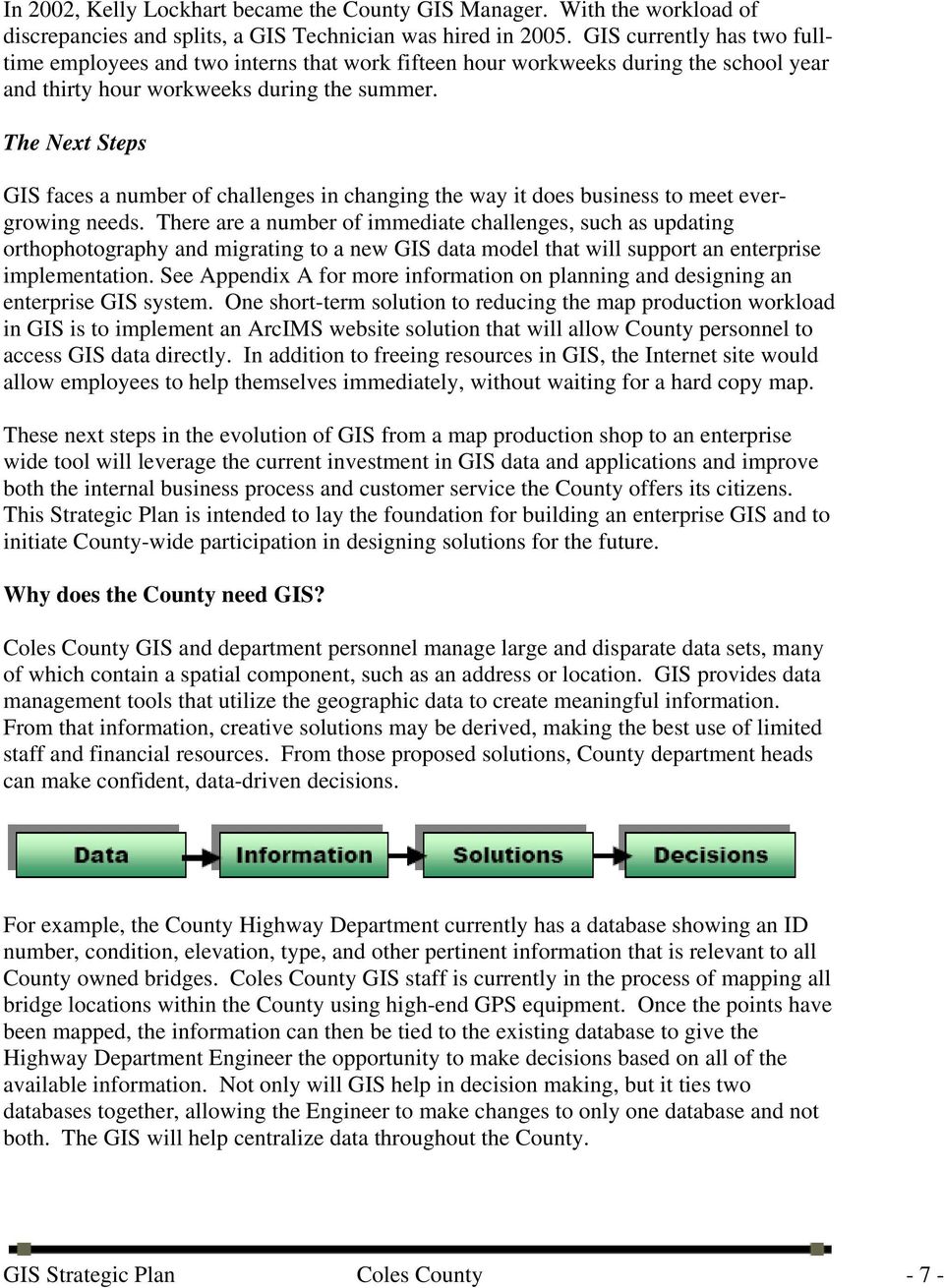
7 In 2002, Kelly Lockhart became the County GIS Manager. With the workload of discrepancies and splits, a GIS Technician was hired in GIS currently has two fulltime employees and two interns that work fifteen hour workweeks during the school year and thirty hour workweeks during the summer. The Next Steps GIS faces a number of challenges in changing the way it does business to meet evergrowing needs. There are a number of immediate challenges, such as updating orthophotography and migrating to a new GIS data model that will support an enterprise implementation. See Appendix A for more information on planning and designing an enterprise GIS system. One short-term solution to reducing the map production workload in GIS is to implement an ArcIMS website solution that will allow County personnel to access GIS data directly. In addition to freeing resources in GIS, the Internet site would allow employees to help themselves immediately, without waiting for a hard copy map. These next steps in the evolution of GIS from a map production shop to an enterprise wide tool will leverage the current investment in GIS data and applications and improve both the internal business process and customer service the County offers its citizens. This Strategic Plan is intended to lay the foundation for building an enterprise GIS and to initiate County-wide participation in designing solutions for the future. Why does the County need GIS? Coles County GIS and department personnel manage large and disparate data sets, many of which contain a spatial component, such as an address or location. GIS provides data management tools that utilize the geographic data to create meaningful information. From that information, creative solutions may be derived, making the best use of limited staff and financial resources. From those proposed solutions, County department heads can make confident, data-driven decisions. For example, the County Highway Department currently has a database showing an ID number, condition, elevation, type, and other pertinent information that is relevant to all County owned bridges. Coles County GIS staff is currently in the process of mapping all bridge locations within the County using high-end GPS equipment. Once the points have been mapped, the information can then be tied to the existing database to give the Highway Department Engineer the opportunity to make decisions based on all of the available information. Not only will GIS help in decision making, but it ties two databases together, allowing the Engineer to make changes to only one database and not both. The GIS will help centralize data throughout the County. GIS Strategic Plan Coles County - 7 -
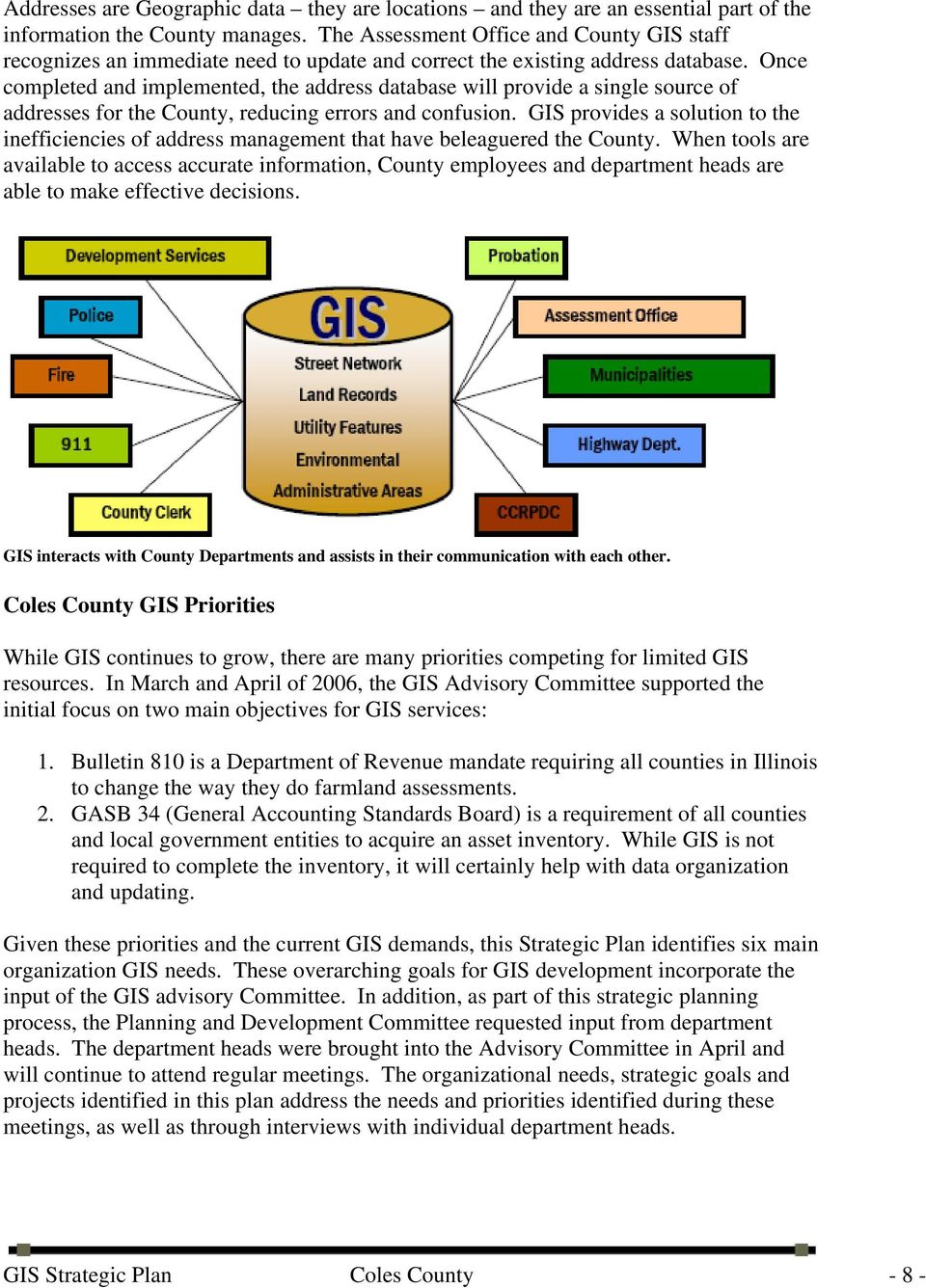
8 Addresses are Geographic data they are locations and they are an essential part of the information the County manages. The Assessment Office and County GIS staff recognizes an immediate need to update and correct the existing address database. Once completed and implemented, the address database will provide a single source of addresses for the County, reducing errors and confusion. GIS provides a solution to the inefficiencies of address management that have beleaguered the County. When tools are available to access accurate information, County employees and department heads are able to make effective decisions. GIS interacts with County Departments and assists in their communication with each other. Coles County GIS Priorities While GIS continues to grow, there are many priorities competing for limited GIS resources. In March and April of 2006, the GIS Advisory Committee supported the initial focus on two main objectives for GIS services: 1. Bulletin 810 is a Department of Revenue mandate requiring all counties in Illinois to change the way they do farmland assessments. 2. GASB 34 (General Accounting Standards Board) is a requirement of all counties and local government entities to acquire an asset inventory. While GIS is not required to complete the inventory, it will certainly help with data organization and updating. Given these priorities and the current GIS demands, this Strategic Plan identifies six main organization GIS needs. These overarching goals for GIS development incorporate the input of the GIS advisory Committee. In addition, as part of this strategic planning process, the Planning and Development Committee requested input from department heads. The department heads were brought into the Advisory Committee in April and will continue to attend regular meetings. The organizational needs, strategic goals and projects identified in this plan address the needs and priorities identified during these meetings, as well as through interviews with individual department heads. GIS Strategic Plan Coles County - 8 -
9 GIS Organizational Needs 1. Support decision makers at all levels with access to accurate information. 2. Maintain up-to-date information on assets and infrastructure. 3. Promote and support the use of technology to enable an efficient and effective business process. 4. Provide customized mapping, analysis and reporting solutions 5. Develop and implement data standards. 6. Administer program in a cost-effective and secure manner. From the Organization Needs listed above, the following GIS-specific goals were derived: GIS Strategic Themes and Goals A. Make GIS data and tools easily accessible to staff in various County departments and to users outside the County government. B. Maintain a catalog of data and information available in the GIS. GIS Strategic Plan Coles County - 9 -

10 C. Update County GIS data and implement maintenance plan to keep information in the GIS current. D. Update and enhance the GIS data model so that it supports enterprise-wide access, maintenance and solutions. E. Develop data collection, creation, submission, and storage standards to ensure GIS information is accurate and consistent. F. Improve methods for generating maps and begin creating map books to increase efficiency and timeliness of customer service. G. Develop customized GIS tools to meet Department needs. H. Improve tracking of County projects that contribute information to or require information from the GIS database to improve communication and data sharing among departments. I. Develop and maintain an enterprise-wide inventory of GIS software, data, and applications. J. Hold regular meetings with the Planning and Development Committee and the GIS Advisory Committee to ensure that GIS is on track to meet County needs and to support County projects. K. Provide GIS training to County staff on GIS data and applications. L. Monitor GIS costs and data distribution to other agencies, businesses and citizens. From these needs and goals, the GIS projects and objectives described in this Strategic Plan were derived. Enterprise GIS In order for GIS to progress to the point that it can efficiently and effectively serve the County, GIS must transition from its reliance on hard-copy map production to designing, implementing and supporting an enterprise GIS data model. This direction raises questions about how different departments will access GIS data and how they can link the data that they currently manage to GIS data. In addition, department employees may wonder how much GIS knowledge they will require in order to interact with GIS data. This Strategic Plan addresses those concerns, including ways that GIS will support department with training and technical support along the way. The progression to a more decentralized model does not mean or require that every department needs to hire a GIS expert. What it does mean is that GIS will be focused on GIS Strategic Plan Coles County

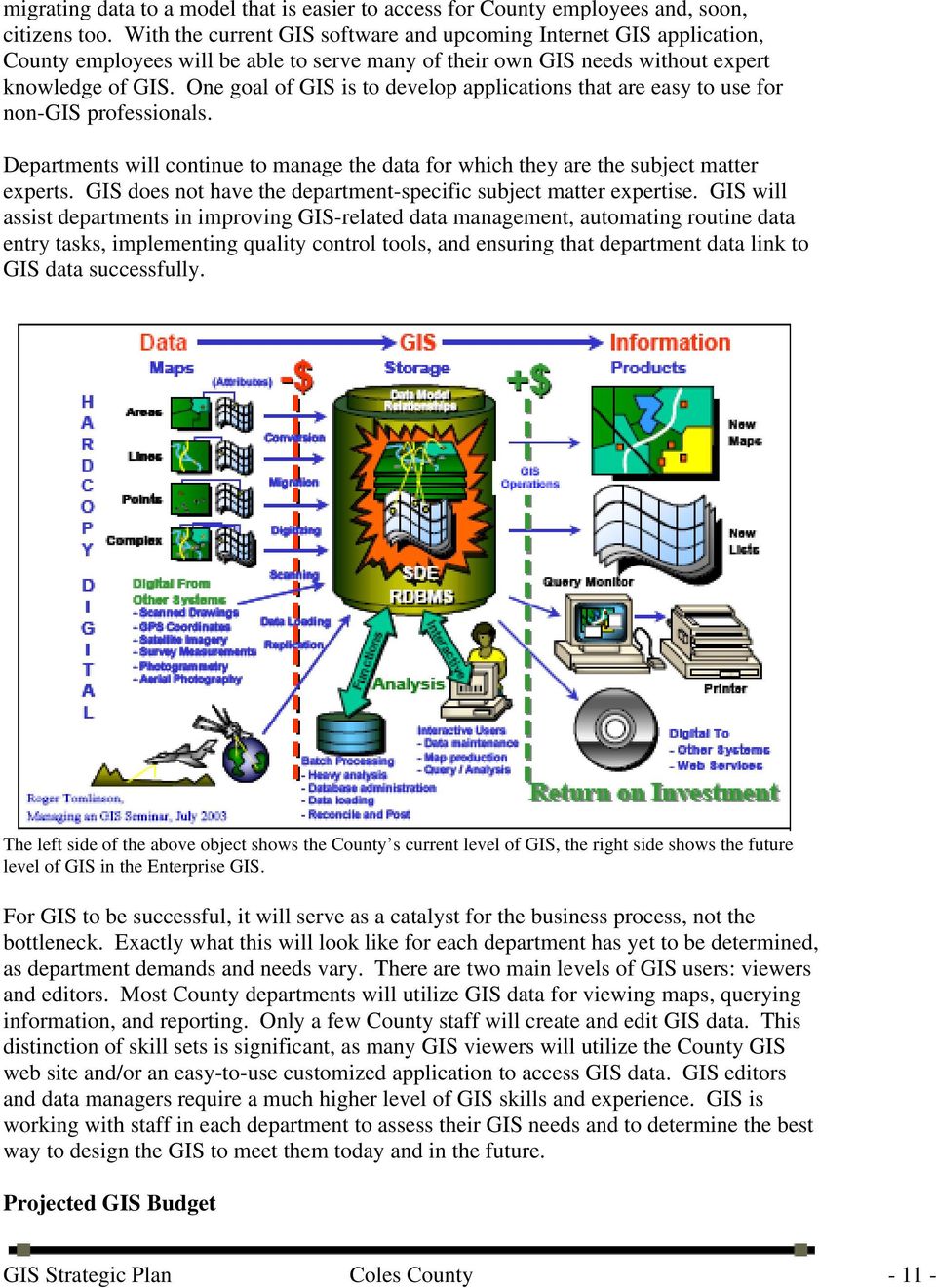
11 migrating data to a model that is easier to access for County employees and, soon, citizens too. With the current GIS software and upcoming Internet GIS application, County employees will be able to serve many of their own GIS needs without expert knowledge of GIS. One goal of GIS is to develop applications that are easy to use for non-gis professionals. Departments will continue to manage the data for which they are the subject matter experts. GIS does not have the department-specific subject matter expertise. GIS will assist departments in improving GIS-related data management, automating routine data entry tasks, implementing quality control tools, and ensuring that department data link to GIS data successfully. The left side of the above object shows the County s current level of GIS, the right side shows the future level of GIS in the Enterprise GIS. For GIS to be successful, it will serve as a catalyst for the business process, not the bottleneck. Exactly what this will look like for each department has yet to be determined, as department demands and needs vary. There are two main levels of GIS users: viewers and editors. Most County departments will utilize GIS data for viewing maps, querying information, and reporting. Only a few County staff will create and edit GIS data. This distinction of skill sets is significant, as many GIS viewers will utilize the County GIS web site and/or an easy-to-use customized application to access GIS data. GIS editors and data managers require a much higher level of GIS skills and experience. GIS is working with staff in each department to assess their GIS needs and to determine the best way to design the GIS to meet them today and in the future. Projected GIS Budget GIS Strategic Plan Coles County
12 GIS staff is currently considering the yearly budget for Coles County GIS. The following summarization provides a general expectation for the funding required to run the County GIS. Coles County GIS is currently running on a $145,000 budget that is solely reliant on the GIS Recorders Fee. Every recording in Coles County is imposed a fifteen dollar fee for GIS. Of the fifteen dollars, one dollar goes to the County Recorder for paper and other expenses. This fee ensures that the general fund will not be used for GIS purposes. The following items are being included in the 2007 budget request: 1. Software Maintenance ($17,000) 2. Hardware, including the Leica GPS unit ($12,000) 3. Professional Services to be paid to Coles County Regional Planning and Development Commission for management of the GIS ($32,000) 4. Salary of GIS Technician located in the Assessment Office ($18,000) 5. Hardware maintenance for Oce printer ($4,000) 6. Aerial orthophotography to be flown in the spring of 2007 ($50,000) Moving on to 2008, a sunset clause has been placed on the Recorders Fee. This clause will take a look at the current expenses of the GIS to determine if the fee needs to be rolled back to the $10 it was in or maintain the current $15 fee. This Strategic Plan identifies a number of additional needs in future years that are not included in this basic budget, such as orthophotography flights and new hardware, including a GIS server and new workstations. Building the Foundation The GIS Strategic Plan defines the GIS mission for Coles County, describes the current GIS environment, identifies GIS goals and objectives, and identifies the many projects aimed at meeting those goals and overcoming current gaps. The following Strategic Plan sets the course for GIS in the County Organization. The projects identified by the Plan are concrete steps that will elevate GIS to the enterprise level. GIS will move from its current state as a data maintenance and map production shop to leverage the current investment in GIS data and applications and improve both the internal business process and customer service the County offers its citizens. This Strategic Plan is intended to lay the foundation for building an enterprise GIS and to initiate County-wide participation in designing solutions for the future. GIS Strategic Plan Coles County
13 GIS Mission GIS supports Coles County in meeting its goals and offering services and solutions to citizens. GIS Mission Statement Providing Spatial Data, Information and Innovative Solutions for Coles County Coles County personnel manage large and disparate data sets, many of which contain a spatial component, such as an address or location. GIS provides data management tools that utilize the geographic data to create meaningful information. From that information, creative solutions may be derived, making the best use of limited staff and financial resources. From those proposed solutions, County Officials and Department Heads can make confident, data-driven decisions. This Strategic Plan is one step in building the foundation for an enterprise GIS that will allow members of every County department to access GIS data and tools. An enterprise GIS will allow departments to share data sets, rather than replicate them and will assist department staff in managing resources, assets and the environment and in serving citizens effectively and efficiently. GIS will implement its mission of providing spatial data, information and innovative solutions for Coles County with a focus on each of the following priorities: Data 1. Establishing Spatial Data Standards and Management Practices. GIS will elevate the efficiency and effectiveness of technology in serving County management and citizens. In order to manage and integrate large data sets from different departments, clearly defined standards and processes must be in place. GIS will develop and document metadata and maintenance standards for the data and applications it manages. In order to create information from raw data, users need to know something about the data, such as how the data were created and when they were last updated. GIS standards will provide consistent information about data so that users gain the most information from GIS. Information 2. Building, Maintaining and Supporting Spatial Data Infrastructure. GIS Strategic Plan Coles County
14 GIS creates, edits, and manages County spatial data, including parcels, streets, zoning, land use, and many other features. Data must be kept up-to-date and managed in a format that allows users to create meaningful queries and reports. GIS enables users to obtain information about the County s resources, assets and environment. Much of the information is essential to County business, making the GIS another facet of County infrastructure and an asset that must be maintained. Reports, queries, and analysis of information about the County s resources, assets, and environment allow County department heads, employees, and citizens to derive creative solutions. GIS maintains and manages data to support GIS users and to identify innovative ways to solve problems, improve services, and increase efficiency. Solutions 3. Conducting Spatial Analysis and Building GIS Applications. GIS technology enables spatial analysis to solve a wide variety of problems, such as finding the shortest driving route between two locations, defining watershed boundaries, calculating impermeable area, and many more applications. GIS performs analysis for the County supporting departments in their projects and objectives. Implementing a successful GIS requires careful analysis of organizational needs. GIS will work closely with IT and other departments to model the County business processes, as they relate to GIS applications to ensure that the GIS is built to support business needs. Once a solid enterprise GIS foundation is built, GIS will then customize applications to meet specialized needs of department staff, managers and citizens. Information derived from GIS allows users to view relationships among County departments and resources, visualize and evaluate impacts of proposed development, and improve management schedules and methods. GIS tools provide users with the ability to ask what-if questions, respond to emergencies, and plan for the future. Decisions 4. GIS Vision Statement GIS will be an easy-to-use decision-making tool available on all County computers that enables access to data and information, promotes innovative solutions, and improves customer service to residents. GIS Strategic Plan Coles County

15 GIS Stakeholders Spatial data, such as an address or location coordinates, are widely used throughout the County by the public, developers, and County managers. With a large user base, there are many stakeholders that benefit directly from the successful implementation of GIS applications that map, query, analyze and report spatial data relationships and interactions. GIS assists in the management of County resources and infrastructure and allows County employees access to up-to-date information from which to make confident, data-driven decisions. County Board As leaders in the County, the County Board members manage the business process of the County and knows their business needs. They are a valuable resource for GIS to tap for feedback on planning initiatives, prioritizing goals, and for implementing change. County Employees GIS should make County employee s jobs easier. GIS will need to provide training to staff members in each department that require access to mapping and GIS data. In addition, GIS will require input from employees in order to build a successful enterprise GIS to meet their needs and, over time, to customize the system to automate repetitive processes, make information available to the public directly, and to increase the efficiency and accuracy of GIS related business. Charleston, Mattoon, and Oakland The Cities rely on County data in a number of areas, including land base information. GIS will facilitate cooperation with the Cities and identify opportunities to increase cooperation and data sharing. GIS will cultivate opportunities for partnerships that increase and improve services to citizens. Successful partnership programs prove that cooperation can leverage resources of independent agencies to increase the return on the investment in a wide variety of projects. County Residents County residents visit and call the County Courthouse to find the answers to their questions on permitting, development, zoning, assessments, and other services. GIS regularly provides a wide variety of maps to the public. In order to serve citizens quickly and to free staff resources at the County, GIS will identify and implement systems to provide residents with GIS-related information directly through means that may include the web page or a self-serve kiosk in the Courthouse. GIS Strategic Plan Coles County
16 Analysis of Current GIS Environment (2006) GIS staff manages County GIS data, generates maps, and performs spatial analysis for County Departments. Over the last several years, GIS has built an extensive library of spatial data. Its staff produces many GIS map products regularly, ranging from general street maps of the County to detailed maps used by a number of departments. GIS receives on average, ten requests per week for maps. Some requests require five minutes of work; others require several days or more. As the GIS is more widely used, the need for accurate and timely GIS data becomes greater. To date, GIS staff has served the County and Municipalities with map production, first and foremost. GIS staff has been limited and has not been able to move beyond basic map production needs. The positive aspects of the GIS include: Staff skilled in GIS technology Staff willing to learn new technology Base map data, annotation, and map products in place County support (an need) for enterprise GIS development The areas where improvement is needed include: No service level agreements Lack of distributed desktop and Internet GIS solutions The County is dependent on GIS staff to produce GIS products with little option of self service Service and support for some departments has been minimal some of these department needs are critical GIS data model is old data modeling and migration is required Some essential services are too time and resource consuming to be maintained efficiently in the current configuration Some County systems require GIS data, but do not integrate directly with GIS (ex. Fire and Police Department mapping and dispatch systems) Lack of standards Not leveraging all technology Limited programming and database administration skills County staff are replicating data on hard drives and local servers with poor access to GIS data Lack of data agreements for data distribution Limited GIS skills, knowledge and capabilities outside of GIS office GIS Organization GIS is housed within the Coles County Regional Planning and Development Commission under the direction of the Planning and Development Committee. GIS manages the GIS Strategic Plan Coles County
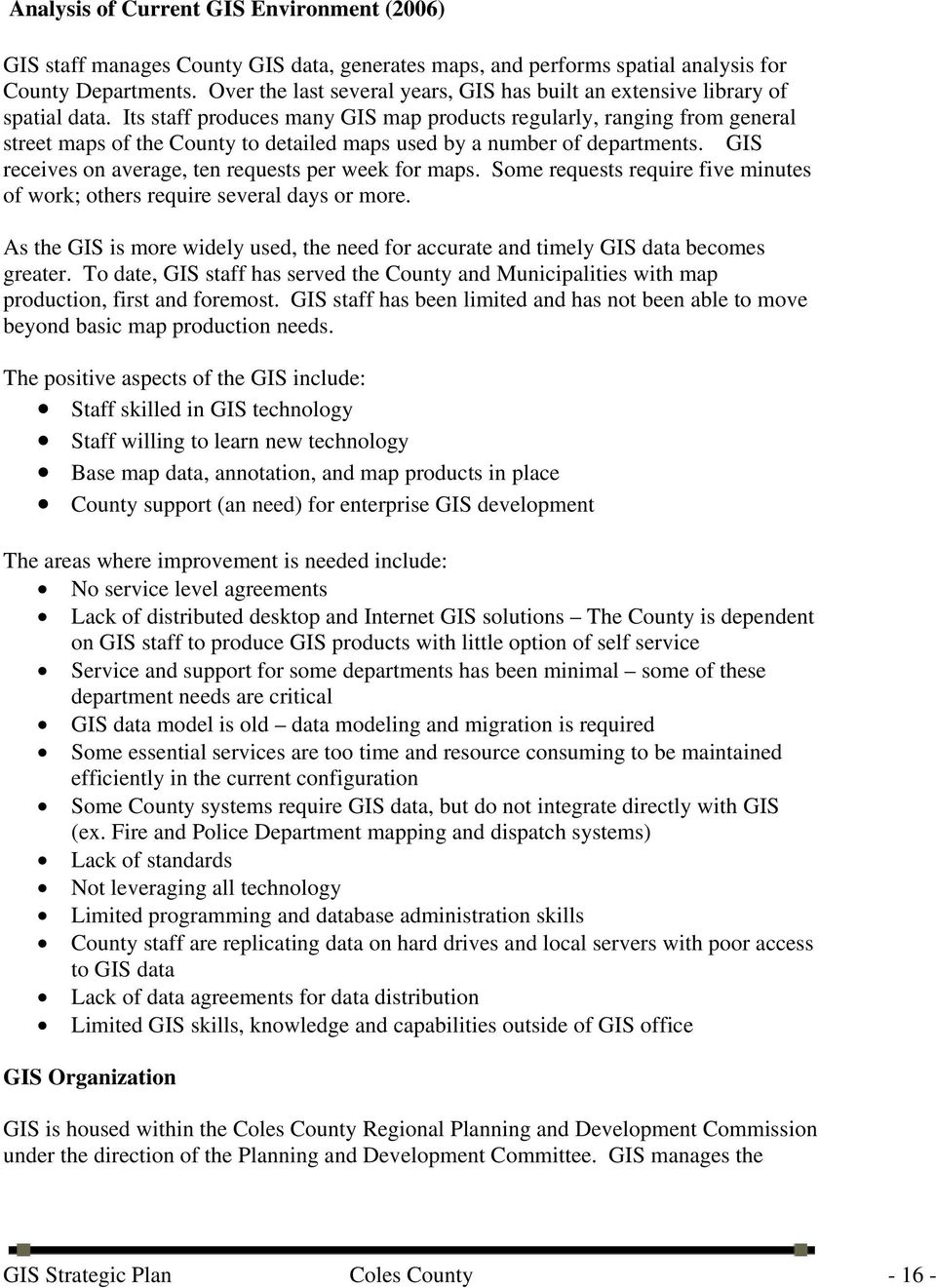
17 County data sets and applications requiring it to interact regularly with most County Departments. The GIS Manager interacts with other County departments on behalf of GIS, develops and manages the GIS Strategic Plan, and oversees larger projects and initiatives, and acts as the database administrator. The GIS Manager also serves as a technical resource, engaging in project work and training for County staff. While the GIS Technician is entirely focused on project work, the Manager maintains a higher perspective, critical for setting a course for future GIS and database development. The Manager directs the development and services provided by the County to ensure that the Division meets the goals and expectations of the Planning and Development Committee in implementing a successful enterprise-wide GIS. The GIS technician is a technical position that manages day-to-day project requests, parcel map maintenance, map production and spatial analysis projects. In addition, the Technician may manage GIS projects and coordinate work with other offices. PLANNING AND DEVELOPMENT COMMITTEE DAN LAWRENCE PDC CHAIR KELLY LOCKHART GIS MANAGER SUSAN SUMMERS GIS TECHNICIAN AS NEEDED FROM CCRPDC POSITION OPEN In order to elevate the GIS to the enterprise level, the GIS Manager would support integration of GIS with other County databases and applications, administer Oracle and ArcSDE (ESRI s Spatial Database Engine software that serves as a gateway between ArcGIS products and Oracle), and develop customized GIS applications to meet the needs of County departments. In the future, GIS will require the GIS Technician in the Coles County Regional Planning and Development Commission to alleviate the workloads of the two full time GIS positions. With a GIS webpage to be hosted by Eastern Illinois University, County Employees will be able to access GIS data and it is anticipated this will reduce the number of mapping requests to GIS. However, as GIS increases in visibility and usability, there will likely be an increased demand for more complex GIS requests for custom tools and reports. Therefore, GIS will be better able to quantify its staffing in the next year, after progressing on the projects identified in this Strategic Plan. GIS is focused currently on building a foundation, elevating the GIS to the enterprise level. This Strategic Plan is one of the first solid steps GIS is taking to communicate that vision and to define some of the initial steps required. GIS is now under the Planning and GIS Strategic Plan Coles County
18 Development Committee umbrella, in order to elevate not only the technology, but to respond to the need of all County Departments. GIS Software The County utilizes ESRI GIS software products. GIS currently has ArcInfo, ArcView, ArcSDE, and Spatial Analyst licenses. ArcInfo is the primary software tool used by the GIS staff for analysis, querying, and mapping applications. Spatial Analyst is an extension that may be used with ArcInfo for applications such as drainage and groundwater analysis. ArcView will also perform many mapping applications and limited analysis and querying. ArcSDE is the gateway software for ESRI products to work through an administration database such as Oracle. All ESRI software products are kept up-to-date through licensing and maintenance agreements with ESRI. The County is currently using version 9.1 with all ESRI software with version 9.2 to arrive later in This is important, as older versions of ESRI software will not support the geodatabase and enterprise level. The County also has GeoOffice tools, software used with the Leica GPS unit and Pathfinder Office, software used with the Trimble GPS unit. The County also has invested in the Sidwell Company s Parcel Builder software for parcel maintenance and FARMS software for Bulletin 810 calculations. A summary of GIS software is included in Appendix C. This summary includes the software type and the yearly maintenance cost of that software. Most County departments will have the need to use GIS in the near future, but that does not need they will have to purchase expensive software. The Internet web site that is currently being developed will allow all County offices to view and print data. There are also many free GIS software readers available, including ESRI s ArcExplorer and ArcReader, as well as DTI s Accuglobe software. Accuglobe is a free downloadable software for GIS viewing and allows for high quality printouts (ArcExplorer sends a low resolution photo to the printer) and is probably the better software for most County offices wishing to view the GIS on a non web-based program. Future Software Needs At this time, it is unclear if additional software will be needed throughout the County. Currently, all software needs have been addressed. Hardware Inventory A GIS hardware inventory is included in Appendix D. GIS is and should continue to be on an accelerated hardware refresh cycle. GIS is a continually changing field and requires high end computer equipment. This equipment should be replaced every two to three years with hardware and memory upgrades as needed. GIS Strategic Plan Coles County
19 The GIS server is currently in its last stages of life with the Department. We are currently in the process of adding a mirrored (saves the same data to two hard drives at once) 200 Gigabyte hard drive ($300) to get another year or two out of the current server. With server prices coming down, this will be a cost-effective way to hold off on purchasing a server with the latest technology. GIS Data Inventory GIS staff manages large base map datasets as well as project related datasets that reside on the GIS server. The following list shows the data sets that are available on the GIS server and the varying levels of completion of each data set. Some data are maintained regularly, such as the parcel layer and street centerlines layer. Other data sets have not been updated in several years. This list does not show the last date each layer was updated, but GIS would like to develop a catalog showing the data available and the last edit date. This information would also be included in the metadata standards list for each layer. Layer Status Cadastral Geodatabase (parcels, roads, water, lot lines, sections, Nearly complete etc.) Orthophotography Completed 01 Coles County, Charleston, and Mattoon Land Use Completed 06 Bulletin 810 Layers Completed 06 Enterprise Zone Completed 04 TIF Districts Complete/Ongoing Fire Protection Districts Completed 06 Critical Facilities Completed 06 GASB 34 Complete/Ongoing Precinct and Voting Districts (Older layer needs migrating) Completed 02 County Board Districts (Older layer needs migrating) Completed 02 Charleston and Mattoon Utilities Ongoing Fox Ridge Completed 06 GIS Map Product Inventory GIS has begun to develop an inventory of all map products generated on a regular basis in an effort to determine the scope of database migration efforts. Appendix E highlights the current and older projects that will need to be migrated. Once complete, GIS can develop a data and map catalog that can be updated and published to the individual departments for viewing. When a map request is given to the GIS, they can cross reference the data catalog to determine the extent of work to complete the task. GIS Strategic Plan Coles County

20 Once data migration is complete, the level of effort required to produce map products will be significantly reduced. Upon implementation of the ArcIMS Internet site, some products may not need to be generated on the same schedule, or at all, as County users will be able to access GIS data and maps directly via their Internet browser. This migration will allow users access to up-to-date information and maps when they need them, reducing wait times for GIS map production. The list of map products (Appendix E) supports the previously introduced idea that GIS has been primarily a data maintenance and map production shop. There are more than fifty maps produced for County Departments! Many of these products need to be updated frequently. This list provides support for two of the key issues identified in this plan, 1) GIS with limited staff, has not been able to progress in developing an enterprise GIS due to its demanding data maintenance (such as parcel updates) and map production responsibilities, and 2) GIS needs to provide better access to GIS data and tools to County departments to reduce the map production demand and free time for GIS analysis and application development. Making this transition will require support from County Department staff and the Planning and Development Committee. GIS Strategic Plan Coles County

21 Gap Analysis The following table summarizes gaps in the current GIS environment that must be addressed in order to achieve the GIS Strategic Themes and Goals. Below, the table summarizes the GIS Strategic Plan Themes, their benefits and gaps existing in technology, skills in the organization. Gap Analysis Table Label Strategic Plan Theme Public Value Technology Gap IT Skills Gap Organizational Gap A. Make GIS data and tools easily accessible to staff in various County departments Leverages the value and benefits of GIS to the organization Some information may be difficult for County staff to Most County Staff have had little or no experience with GIS and to users outside County Reduces wait time for GIS understand in its data and tools and Government products current format applications Reduces duplication and multiple versions of GIS data on local servers Provides users with up-todate project and infrastructure information Internet GIS tools may be accessed by all without GIS software or high level B. Maintain a catalog of data and information available in GIS C. Update County GIS data and implement a maintenance plan to keep information in the GIS current software knowledge Reference to the County and to the public for what GIS data is available Provides up-to-date information on County infrastructure Reference for field crews Advanced planning tool for many future projects Foundation for future systems and maintenance Discrepancies within Cities are incomplete Line tag layers in Cities need updated Limited GIS staff to complete project in a timely manner Limited GIS staff resources to update mapping GIS Strategic Plan Coles County
22 Label Strategic Plan Theme Public Value Technology Gap IT Skills Gap Organizational Gap D. Update and enhance the GIS data model so that it supports enterprise-wide access, maintenance and solutions Oracle and ArcSDE administration E. Develop data collection, creation, submission and storage standards to ensure GIS information is accurate and consistent. F. Improve methods for generating maps and begin producing map books to increase efficiency and timeliness of customer service. G. Develop customized GIS tools to meet Department needs Eliminate cryptic data structure and descriptions to make GIS data easier to use Data model will support organization needs for queries, analysis, and reporting Will integrate GIS data with County databases (i.e. Fike and Fike, 911) Provides consistent information to County departments Facilitates data and project tracking Reduces data entry and opportunities for error The development of map books and regular updates allows users to see what is available, reducing search and development time. Expert knowledge would not be required to utilize GIS for queries, maps, analysis, and reports Leverages the value of existing GIS data as more departments are able to use it and more information is derived from it Increases efficiency and accuracy of County management Requires migration to the Geodatabase Will require some database programming County Departments store data in disparate formats not all of which are easily integrated with databases and GIS Some County business process are not clearly defined Data submission standards should be clearly defined so data is more consistent. County business process modeling needed GIS Strategic Plan Coles County
23 Label Strategic Plan Theme Public Value Technology Gap IT Skills Gap Organizational Gap H. Improve tracking of County projects that contribute information to or require County staff will have one stop shopping for information they need. No interdepartmental project management system currently in Database programming and County business process modeling needed information from the GIS Reduced duplication of effort place administration Individual department database to improve and data skills work flows might be communication and data Improved business process changed, requiring sharing among departments for County participation and training on the part of I. Develop and maintain an enterprise inventory of GIS software, data, and applications J. Hold regular meetings with the Planning and Development Committee and the GIS Advisory Committee to ensure that GIS is on track to meet County needs and to support County projects K. Provide GIS training to County staff on GIS data and applications Reduce data replication Reduce time spent searching for data Ability to integrate data from a variety of sources to generate maps, reports, and analysis Ensure that GIS priorities are consistent with those of the Planning and Development Committee Enables communication about GIS resources available to the County Supports GIS from the top providing the opportunity for implementation of efficient business Enable County staff to utilize GIS tools directly Reduces the load on GIS staff, freeing time for projects and data maintenance Data in disparate formats Data may or may not be cataloged in departments Data in different departments Database administration staff Requires participation on the part of department staff to communicate about data, versions, and modifications County business process modeling GIS Strategic Plan Coles County
24 Label Strategic Plan Theme Public Value Technology Gap IT Skills Gap Organizational Gap L. Monitor GIS costs and data distribution to other agencies, businesses and citizens Data use agreements protect the County from misuse of data Ensure that data is not distributed for resale Allows the County to track ways that GIS data is used by the public Requires Policy Manual update GIS Strategic Plan Coles County
25 Gap Analysis Summary The Gap Analysis table above provides a summary of GIS goals and the gaps that must be addressed in order to achieve them. Through this evaluation, there are a few gaps that appear in several areas and that need to be addressed in budgets and resource prioritization, including: Additional database administration training for the GIS manager Data standards, both internal and external to the County, are essential and need to be developed and adopted by all County GIS users in order to maintain the integrity and usefulness of the GIS and to ensure a strong return on investment. Data standards for GIS-related data will be specified by GIS to support County departments. Other data sets that may require links to GIS data will need to be designed to make such integration possible. Training of GIS users is essential. County GIS data must be migrated to the geodatabase. This migration will be time and resource intensive, but ultimately will improve access to GIS data and applications. Data management is serious business. When GIS shares data externally, a data agreement process needs to be activated to protect the County s interests and to prevent commercial resale of public GIS data. Communication among departments and with the Planning and Development Committee is essential to building a successful GIS. GIS Strategic Plan Coles County
26 Administrative Solutions toward an Enterprise GIS In order for GIS to progress to the point that it can efficiently and effectively serve the needs of the County, GIS must transition from its reliance on hard-copy map production to designing, implementing and supporting an enterprise GIS model. This direction raises questions about how different departments will access GIS data and how they can link the data that they currently manage to GIS data. In addition, department members may wonder how much GIS knowledge they will require in order to interact with GIS data. This brings up the issue of centralized versus decentralized GIS. Centralized vs. Decentralized GIS Services GIS currently works in a very centralized GIS environment. In order for nearly all County employees to obtain GIS data, they must submit a request to the GIS department and wait for a hard-copy product in return. In some cases, the project is digital, in the form of a graphic image file. With limited GIS staff and an increasing demand for GIS data and tools, GIS staff and the Planning and Development Committee recognize that the GIS business process needs to change. No longer can one or two staff members support all of the County requests, maintain all the County data, and generate all of the County maps and reports within a reasonable time frame. Customer service is suffering and the County is not leveraging the value of its GIS investment to its fullest potential. The progression to a more decentralized model does not mean or require that every department needs to hire a GIS expert. What it does mean is that GIS will be focused on migrating data to a model that is easier to access for County employees and citizens too. As GIS migrates data to the geodatabase and implements an Intranet GIS application, County employees will be able to serve many of their own GIS needs without expert knowledge of GIS. One goal of GIS is to develop applications that are easy-to-use for non-gis professionals. Some departments, such as the Police and Fire Departments will benefit first from an Internet site serving the most up-to-date mapping. No longer will they have to wait for maps to be published to get the latest data. For new requests for statistical analysis, crime tracking, response, and pre-planning, the GIS staff can complete such requests as projects through a helpdesk type system. GIS will promote the selection of specialized software for the departments that integrates directly with GIS to further the direction of supporting the departments in helping themselves to GIS data, rather than waiting for results. GIS will require feedback from the Planning and Development Committee and will need to create a system with which to prioritize such requests to best serve the County needs. The same prioritization will be required within the Information Technology Department, which will be housed with the GIS. GIS Strategic Plan Coles County
27 Enterprise GIS Because so much of the data needed for the business of each County department overlaps the data required by other departments, it is critical that the County works from one base data set, rather than multiple versions of data that may be different. Essentially, an enterprise GIS centralizes common data sets, such as parcels, streets, etc. that form the foundation upon which other County data are created. The core data are available for County employees to access. The ESRI white paper, ArcGIS Urban Data Model (Initial Draft) January 2003, included as Appendix B, describes a design model for a local government GIS database. It suggests that there are six main data groups: administrative area, environmental, street network, network facilities (ex. Utilities), land records, and a base map. They are all part of the GIS, as shown in the following diagram excerpted from the white paper: While the data in the enterprise GIS are all stored in a standardized format to ensure that each department may access and integrate data and analysis from other departments into their own business, the GIS serves as a centralized repository for the data. (See Appendix F for more information on Coles County GIS Standards.) Each department may have varying levels of editing and data maintenance capabilities, but ultimately, the GIS should support their business process and make their jobs easier. Departments will continue to manage the data for which they are the Subject Matter Experts. GIS does not have that department-specific subject matter expertise. For GIS to be successful, it will serve as a catalyst for the business process, not the bottleneck. Exactly what this will look like for each department has yet to be determined, as department needs vary. There are two main levels of GIS users: viewers and editors. Most County departments will utilize GIS data for viewing, querying, and reporting. Only a few County staff will create and edit GIS data. This distinction of skill sets is GIS Strategic Plan Coles County
28 significant, as many GIS viewers will utilize the County Internet site and/or a customized application to access GIS data. GIS editors and data managers require a much higher level of GIS skills and experience. GIS and the County Clerks Office may determine that the best solution for district data maintenance is for the Department to identify a staff member that creates and edits the Precinct and County Board GIS data. That data will be a part of the County data model, fully integrated with County base map data and meeting standards derived in cooperation with GIS. This will ensure that other departments are able to utilize district data with the inability to edit the same data. This type of relationship allows the Subject Matter Experts (The County Clerk, in this case) to manage their data, but maintains the integrity of the centralized GIS data warehouse. GIS Training GIS will provide technical support for GIS software and data. As technology changes, GIS will assist users in learning new software through one-on-one training as well as workshops and user group meeting discussions. County employees that use GIS should be required to attend at least one GIS user group training session each year. In these sessions, GIS will present County data standards and data management techniques, provide software training, and/or discuss departmental access to GIS data and data sharing. Additionally, ESRI software training courses would be valuable to GIS users throughout the County. GIS will look at budgeting for training in the budget years. Any office hoping to send employees to training should notify GIS as soon as possible. Software Maintenance The County purchases GIS software from ESRI, and as part of the purchase, receives a one-year maintenance contract. Maintenance entitles the user to software upgrades (at no additional charge) and access to ESRI technical support by phone. While GIS offers technical support to County users, County departments that purchase software should budget to pay yearly maintenance fees so that they stay up-to-date on software versions. The first maintenance fee is due one year after the date of purchase and is typically significantly less expensive than purchasing new software. Upgrades are typically released in approximately nine-month cycles. As part of the GIS standard policies, departments that purchase GIS software will also need to purchase yearly maintenance subscriptions. GIS will notify departments of maintenance fees and their timing. Orthophoto Standards and Update Plan Orthophotos are valuable for many County applications. Because the Coles County landscape changes rapidly, orthophotos need to be produced frequently to reflect changes. Orthophoto acquisition is relatively expensive, but there are a number of options open to the County for reducing costs. In 2001, the County contracted independently to fly the rural areas at a 2 pixel resolution and the urban areas at a 6 pixel resolution. The County is currently looking at orthophotographs flown by the State of Illinois in March These photographs are flown at a 1 pixel resolution and will GIS Strategic Plan Coles County
29 be free of charge to the County. The County is currently considering flying the municipal areas of the County at a 6 pixel resolution in color. The County should adhere to the following standards with regard to orthophoto acquisition: new photos must be acquired every five years; the photographs should be flown with at least 6 pixel resolution in the municipal areas and 1 pixel resolution in rural areas. Proposed Database Administrator s (GIS Manager) Role in Enterprise GIS As GIS works to integrate data from different departments into GIS and to provide County-wide access to GIS data and tools, database design and management plays an increasing role in GIS. Data modeling is the process used to design a database that supports business processes. (Business processes describe the flow of information from one person or department to the next, the types of reports needed and the data required to generate them, the required products of analysis, etc.) GIS may go to a department and identify all the data they manage and how it is stored, who uses it, who edits it, who they distribute it to outside the department, what data needs to work together, and how data is included in work flows. From that investigation, a logical data organization (data model) is derived that will support the process. In order for GIS to serve the enterprise, this data modeling effort will need to take place at a relatively large scale, with many departments and many processes that will be included in the GIS. Thus, support from a database administrator is a crucial component of a strong GIS team. In addition to data modeling and database management tasks, the GIS manager will need to obtain programming skills that will enable GIS to develop customized applications for GIS users. The County has many more people that will benefit from GIS than it has GIS experts. Thus, it is important that GIS develop tools that allow non-gis experts to use GIS data, conduct queries and generate reports. Easy-to-use tools may be programmed to make GIS accessible to more users. The Internet site is one example of a tool that will allow many users to access GIS data via a Web browser (Internet Explorer). Eastern Illinois University will manage the dayto-day ArcIMS (GIS Internet software) administration and also develop customized tools that make accessing and utilizing the GIS data easier online. The skills offered by the GIS Manager support the migration of GIS from a data maintenance and map production shop to an office that supports an enterprise GIS that is integral too many County business processes. GIS User Group An enterprise GIS will serve all County departments and many GIS users. In order to address department needs and to support GIS users, GIS proposes to create a GIS User Group. This group will be comprised of representatives from each County department that currently utilize GIS. GIS has identified a list of staff members, in addition to GIS GIS Strategic Plan Coles County
30 staff, the Planning and Development Committee Chair should attend. This group will provide input into GIS development and goals, as well as be responsible for learning and implementing GIS data standards and participating in GIS training on both technical GIS skills and County data management. Each department that utilizes GIS will be required to identify a staff person to participate in this User Group. In addition to providing input and maintaining standards, the GIS User Group will be a forum to exchange software tips and tricks and to promote data and application sharing. Coles County and 911 Addressing Agreement 911 currently assigns and reviews all addressing when a new home or business is completed. GIS hopes to complete an address layer that will be approximately 98% accurate. The layer would be composed of points and an attached address. GIS is proposing that once the address layer is complete, 911 will forward all new address information to the GIS Manager for input into the County system. This will prevent duplicate work and will assure that the address point layer is up-to-date. In return, the County would provide the address layer to 911 for use with their dispatching software. Outsourcing Opportunities As described throughout this Strategic Plan, GIS will be focused on making the transition from its role as a gatekeeper of GIS data to implementing GIS access and tools for all County departments and to citizens. Because of its current data maintenance and mapping responsibilities, GIS will need to find ways to make the transition while maintaining service to customers. There may be opportunities to outsource some projects to a vendor that would otherwise be placed, for lack of resources, on the back burner. Some of the projects are of high priority, but simply exceed the time available for GIS to address them. GIS will investigate the possibility of outsourcing projects to a consultant and the budgeting that would be required to do so. Outsourcing may provide GIS an option that will assist in maintaining critical services and providing high quality customer service to the organization and to citizens. GIS Strategic Plan Coles County
31 Proposed GIS Projects The following list of projects resulted from the strategic themes development. The goal of the GIS Strategic Plan is not to determine every project that we will be working on over the next year. Organizational needs change quickly. Because of this, the Strategic Plan will provide direction. The following summary of projects resulting from these themes serves first to show, at a high level, how each project contributes to the goal of improving GIS and implementing an enterprise GIS for the County. As new projects arise or major changes occur for an existing project, this summary can be re-evaluated to help determine project priorities. This scope of the Strategic Plan does not encompass a detailed project analysis. Over the next year, there are projects that GIS must complete to lay the foundation for future GIS development. Some of the projects listed here may be general projects divided into phases, some are short-term and some are long term. For the purposes of the Strategic Plan, projects are divided into two groups. The first group includes projects that will take place in GIS, behind the scenes of County Department business processes and interactions with GIS. Even though these projects may be technically focused GIS projects, they have benefits to the County Departments, as described below. The second group of projects includes those projects that entail direct cooperation between GIS and other departments and result in direct benefits to departments as described. ArcIMS Internet/Intranet Site Description and Benefits: Group 1: GIS DIVISION PROJECTS The County is currently working to get the GIS out on the Internet. We have received proposals and have hired Eastern Illinois University to host the GIS website. Ultimately, we will have a GIS website that will allow residents and County/City employees the opportunity to view a parcel layer, aerial photograph, roads, and eventually flood and district layers. Requirements and Challenges: Continue to update information and get the latest data to EIU. Work to get additional map layers on the Internet Benefits to Departments: Provides easy access to the GIS from any computer with an Internet connection GIS Strategic Plan Coles County
32 Orthophotography Update Plan Description and Benefits: Orthophotography is very valuable to many County and Municipal applications. Because development is occurring at a rapid rate, orthophotos need to be produced frequently to reflect those changes. Orthophotography acquisition is relatively expensive, but there are a number of options open to the County for reducing costs. In 2001, the County contracted with Surdex Corporation to develop the first digital set of Orthophotography. The orthophotographs were generated at a 6 pixel resolution in the Cities and Villages throughout the County and at 2 pixel resolution in the County. The next flight is scheduled to be flown in 2007 with 6 pixel resolution, color aerial photography in the municipal areas and 1 pixel resolution, black and white photographs in the County. The total cost of this flight will be about $54,000. One cost saving measure may be to fly the rural areas once every six to eight years and the municipal areas once every five years, to accommodate most development. Requirements and Challenges: The cost of flying Orthophotography is high, but can be paid out of the GIS Recorders Fee A Request for Proposals is required to fly orthophotography Benefits to Departments: Land use updates are much easier with new photography Municipalities have a solid base for planning purposes Parcel splits become easier when other changes in the area can be seen on the aerial photography Migrate GIS from Shapefiles to Geodatabase Format Description and Benefits: Currently, much of the County s GIS data is in the ESRI coverage and shapefile data model. In order to migrate to an enterprise GIS, GIS staff will need to migrate data from coverage s and Shapefiles to the personal geodatabase. This project will require data modeling and manual conversion. The first phase of the migration process will include the conversion from coverage s to Microsoft Access based personal geodatabase. The second phase of the project will entail conversion from the personal geodatabase to a full geodatabase, stored in ArcSDE and SQL server. Using the personal geodatabase makes serving data to the internet and integration with other databases more direct and dynamic. The project will be conducted by GIS staff and may not immediately have a significant impact on County GIS users. However, the data GIS Strategic Plan Coles County
33 model will need to support County business, thus GIS staff will likely work closely with Departments to ensure that the migration successfully addresses their needs. This project will lay the foundation for future GIS application development. Data will be easier to use and better documented once converted to the personal geodatabase. Requirements and Challenges: Developing the data model to support County business needs Converting data from coverage s to the personal geodatabase Supporting ongoing County GIS demand during migration Identifying data throughout the organization that needs to be included in or linked to the GIS Migration to ArcSDE and Oracle server will require database administration Benefits to Departments: This project is required to implement an Enterprise GIS The project will eliminate multiple files and will clean up the GIS server considerably Create GIS Data Metadata Standards Description and Benefits: Metadata is data about data, or a description of a specific data set. GIS metadata usually includes information such as the coordinate system, datum, projection, field names and definitions, date of creation and last edits, owner/manager, and purpose or expected use of data. Metadata protects the investment made in data by providing users the information necessary to use the data appropriately. Metadata creation would be most efficient if included as part of the data migration from coverage format to the personal geodatabase model. As data layers are converted, metadata should be created in ArcGIS. Data standards ensure that data are consistently created and maintained. When developing submittal standards for developers, for instance, it is important that GIS has determined internal standards in order to request data from external sources appropriately. As part of developing a data standard, GIS will verify the accuracy level of existing County data. This will be an ongoing project for GIS. It is a significant step in building the foundation for an enterprise GIS. Metadata development will begin as part of the migration process to the personal Geodatabase. Standards will need to be created in order to identify what data characteristics should be included in the metadata. This will also provide a starting point for future data standard submittal requirements and data management standards. GIS Strategic Plan Coles County
34 A general document on GIS data standards is included in this Strategic Plan as Appendix F. Phase 1: Creating a metadata standard Creating metadata for currently undocumented data Developing and implementing data standards Integrating the needs of County Departments into the data standard. Benefits to Departments: Reduce confusion about versions of the County GIS data Increase the value of GIS data, making it easier to use for County employees and to share with other agencies, consultants, developers, and to the public Protects the investment made in GIS data creation and maintenance by reducing errors from inconsistent data management Supports development and maintenance of an enterprise GIS Phase II: Verify accuracy of existing data Benefits to Departments: Defining accuracy of GIS data Supporting development and maintenance of an enterprise GIS Update Policy Manual Description and Benefits: In 2001, the Coles County Regional Planning and Development Commission, with the help of the GIS Advisory Committee developed a policy manual that was meant to control how data was given to companies and residents. The Policy Manual, although complete, does not address internet access. With the GIS going onto the internet, the fee structure that was created and okayed by the County Board is outdated and needs revised. With this, many of the forms will need to be rewritten. Once rewritten, the manual can then be used to its fullest potential and, at the same time, will protect the GIS data. Requirements and Challenges: GIS Strategic Plan Coles County
35 Work with the GIS Advisory Committee, the Planning and Development Committee, and the Coles County Board to update and rewrite the existing manual Insert information about Internet access and usages Update the fee structure and all forms associated with it Benefits to Departments: Will give all entities in Coles County the benefit of using a uniform manual to use and sell data Address Point Layer Description and Benefits: With the exception of Bulletin 810 and GASB 34, the address point layer is one of the most important projects in the County GIS. Currently, all addresses are stored in a single field in the Access database. When searching address data from any office, it is nearly impossible to find the correct address. For example, when searching for an address such as 323 North Main Street, you will get returns such as 3234N County Highway 300N and 323 Maple Street. Parsing the address field into multiple fields will virtually eliminate multiple returns on a search. Although time consuming, GIS Staff has worked with the address data and have found new ways to break information out rather easily. We can currently parse about 1,000 records per hour. The second phase of the project comes with field verification. This would be completed using GPS equipment in the field. The GIS Department has two GPS units that could be used in the field checking, which would consist of loading the address point layer into the GPS unit and driving the entire County. If a mistake is found, it can be corrected in the GPS unit and dumped back into the GIS at the County. Requirements and Challenges: Benefits to Departments: Inter-Governmental Cooperative Agreement Description and Benefits: Coles County Regional Planning and Development Commission already work with the Cities of Mattoon, Oakland, and Charleston on a number of GIS related projects. Coles County is now working with Eastern Illinois University to jumpstart the GIS with a new website. Eastern Illinois University is working with the City of Charleston to develop a public works layer. That being said, an inter-governmental agreement between said GIS Strategic Plan Coles County
36 entities makes perfect sense. We can all share data and layers at no cost to each other. Each entity has something to offer to the other entity. This will not only benefit the involved entities in their endeavors, but will also benefit the residents of the County. More data means more viewing. Requirements and Challenges: Get all entities at a round table discussion to talk about the sharing possibilities Put the ideas in a legal form for the County Board and City Councils to sign off on Benefits to Departments: More data to view and use in day to day operations Sharing of maps and knowledge throughout the different entities Flood Plain Mapping and Management Description and Benefits: There are many reasons why we need a corrected digital version of our flood plain. Currently, we are using data developed in the 1930 s and updated (reprinted) in The data, when matched to our GIS is more than 400 off in many areas. It is very difficult to make a flood determination when the maps are off by this large a margin. As an example, a resident at the top of the hill on Reynolds Drive in Charleston was told she was in the flood plain. The closest flood plain to her was at the bottom of the hill more than 350 away from the home. Since she was considered to be in the flood plain, her bank required her to obtain flood insurance on the home until she could prove otherwise. It took over a year to complete documentation with FEMA and get her home out of the flood plain. The County recently joined the National Flood Insurance Program and is discouraging against new construction in the flood zone. An updated FIRM (Flood Insurance Rate Map) would assist County employees in determining flood plain location when talking with residents. Fortunately, the amount of work to get the FIRM maps updated and in a digital format will be minimal for GIS staff. FEMA is working diligently to update the maps and is scheduled to complete the map for Coles County in Requirements and Challenges: Work with FEMA to make sure all map data is accurate and in the correct coordinate system Input data into the geodatabase, once complete GIS Strategic Plan Coles County
37 Benefits to Departments: Will assist County Employees in determining actual flood locations for residents Will assist residents in determining the actual flood boundary location Will assist the Assessment Office in determining flood location for Bulletin 810 Group 2: INTERDEPARTMENTAL GIS PROJECTS Bulletin 810 Integration Description and Benefits: The Department of Revenue is requiring counties to revisit the way they assess farmland. The use of paper maps and instrument determined acreages is now highly discouraged in assessing farmland. The suggested Department of Revenue guidelines tell us that we now need digital map layers to determine acreages on the different types of farmland and that we use a computer to compute the acreages within each land use type. There are many advantages to such a setup, including digital layers of the current land use, soil type, drainage, and most importantly, parcels. Having these layers available to overlay, the Assessment Office can determine acreages within each land use and soil type quickly and accurately. The County currently has all layers completed and available to the Assessment Office. Requirements and Challenges: Purchase and install The Sidwell Company s FARMS software for calculating acreages and assessments. Train Assessment Office and GIS personnel on the use of FARMS software. Ensure all applications function properly. Complete yearly calculations based on productivity index changes and recent parcel splits. Benefits to Departments: This project is required by the Department of Revenue. Will make new calculations much more efficient. GASB 34 Description and Benefits: The General Accounting Standards Board is requiring all states, counties and municipalities to take a complete inventory of assets, including roads, bridges, culverts, signs, sign posts, equipment, pens, paper, etc. Using GIS to inventory roads, bridges, culverts, signs, and sign posts will speed up the inventory process and help township and county officials with other daily operations. GIS staff and the Highway Department have worked closely to develop a strategy to complete GASB 34. GIS staff is currently using GIS Strategic Plan Coles County
38 two GPS (global positioning system) units to accurately map all bridges, culverts, signs, and sign posts outside of the municipal boundaries within the County. As staff is mapping the structures, they are inputting information such as the size and condition. Inputting such data will allow GIS staff to assign depreciation values and will help County and Township officials in decision making. For example, if we note that a sign is damaged or in poor condition, the official can plan for replacements. Since the data is stored in the GIS, the official can enter information into a hand held GPS unit or make note of any changes on paper for GIS staff to update. With constant updates, officials can plan budgets for the next year and GIS staff can update GASB 34 efficiently and effectively. Requirements and Challenges: Continue to use existing GPS equipment to map all signs, sign posts, bridges, and culverts within the County. Convert the GIS data to Microsoft Access data to be input into the GASB 34 inventory software. Develop an inventory change sheet that can be utilized by all employees of each Township and the County Highway Department. Train Township and County Highway Department Officials on the need and importance to update the inventory accurately and consistently. Benefits to Departments: This project is required by the General Accounting Standards Board. Planning budgets and developing timelines for sign and culvert replacement becomes more efficient. Crime Statistic Tracking and Analysis Description and Benefits: GIS may be able to assist with crime statistic analysis. For instance, the City of Mattoon Police Department requested that Coles County Regional Planning and Development Commission complete a map showing all schools, daycares, and sex offenders. Sex offenders are required to be outside of 500 from any school or daycare. After mapping all data, they realized that 14 of the 54 sex offenders live within 500 of a school. The map is allowing the Department to move those 14 sex offenders outside of the 500 boundary. After police in Charleston and probation officers in Coles County saw the map, they want a similar map developed for Charleston and Ashmore. Other maps can be developed, including all homes that have been raided for methamphetamine. Maps such as this will help police determine hot spots within the Cities and the County. Requirements and Challenges: GIS Strategic Plan Coles County
39 Cooperation from police departments and the probation office Linking existing software with crime statistics to the GIS for further analysis Benefits to Departments: Improved patrolling methods Tracking of sex offenders and other felony offenders Fire Software Integration into GIS Description and Benefits: The Cities of Mattoon and Charleston both use Firehouse Software, which includes information such as business inspection data and fire hydrant pressure. This information, when incorporated into the GIS will make locating hydrants and finding important information much easier. Currently, the City of Mattoon uses paper maps to determine the location of a fire hydrant. In an emergency, firefighters will often return to the fire station to view the map of hydrants. They are looking for a hydrant that is closer or one with more pressure. Having this information on a portable laptop will provide easy access to the data, possibly saving a life or a building. Requirements and Challenges: Must develop a dynamic link to the Firehouse software (in the case of hydrants, the existing hydrant number) Benefits to Departments: Will make fighting fires efficient, knowing where and what they are dealing with Zoning Layer Description and Benefits: The City of Charleston maintains a zoning layer in AutoCAD format, the City of Mattoon maintains their zoning layer in InfoCAD (Coles County Regional Planning and Development Commission) and the City of Oakland maintains a zoning layer on paper. With intergovernmental cooperation, the County would correct and update already input zoning data into the GIS and update the data each year in March. The zoning data would not only help the three cities in their day to day operations, but would give the County a tool for future planning. GIS Strategic Plan Coles County
40 Requirements and Challenges: Use existing paper and digital maps to update the GIS Use City employees to check map work and make any additional corrections (it is pertinent that the information is correct to avoid future property disputes and lawsuits Update the maps every March to ensure the Cities meet the publishing deadlines for zoning layers Benefits to Departments: Planning tool for Coles County Regional Planning and Development Commission and the Subdivision Officer Integration with the 911 Database Description and Benefits: Coles County 911 has used a couple of different mapping companies over the past couple of years for addressing and software needs. The current company offers a wide array of services including a link to an address layer. Currently, 911 uses an address range layer comprised of County data, Census Data, and 911 Data. Although the layer was developed using the latest data, it is less than accurate. For example, when a call comes into 911, a map pops up showing the approximate address of the caller location. The location is based on a number of factors. The County address system is on a grid starting at 000N, 000E in the Southwest corner of the County. For every mile North you move from 000, the number changes by +100 (100N is one mile north of the southwest corner and 500N is five miles north of the southwest corner). For every mile East you move from 000, the number changes by +100 (100E is one mile east of the southwest corner and 500E is five miles east of the southwest corner). In between the 100 numbers, an address is estimated and a number is thrown on the end. 5563N County Road 500E is located on 500 E, 5.56 miles north of the south county boundary. In areas of heavy growth, these numbers can get skewed and if an address is not properly located on a house or driveway, the responders can end up at the wrong residence or business, wasting precious time. With integration to the County GIS and a newly developed address point layer, mistakes are almost non-existent. The Sidwell Company presented the importance of address points at a conference in 2003 that stressed the difference between address ranges and address points. Address ranges are about 78% accurate and address points that have been field verified are 99% accurate. Integration would also insure that 911 have the latest orthophotography which could, at the very least, improve communication when trying to locate an address or other location. Requirements and Challenges: GIS Strategic Plan Coles County
41 A database link using addresses would be required for integration 911 would receive a GIS server connection that would allow them to use GIS data Benefits to Departments: Police, Fire and 911 would have a much better communication line when locating an address Address searches become easier with parsed address fields Comprehensive Plan Land Use Updates Description and Benefits: We now have a complete land use layer for Coles County and the incorporated areas, with the exception on Lerna, Humboldt, and Ashmore. Completing a land use layer takes considerable time, but with GIS, regular updates will be easily done. One of the easiest ways to update a comprehensive plan (in the County) is to view and compare aerial photographs. We currently have 2001 aerial photographs, but as we fly again in 2007, we can look for areas of new development and landscape changes. We would then make the appropriate changes to the land use layer, doing a windshield survey if necessary. Within the City boundaries, the City Planner would be responsible for noting changes and getting them to GIS Staff to correct the land use layer. Requirements and Challenges: We need to hold a brief meeting with City Planners to discuss how we will go about making the appropriate changes Make timely updates in the County on a five year rotation Benefits to Departments: All entities involved will be able to view an updated existing land use map to determine if new and future development will fit into the scheme County planners will be able to easily update the Comprehensive plan with regular updates to the land use map Precinct Layers and Voting Districts Description and Benefits: Currently, the Coles County Regional Planning and Development Commission have precinct, voting district, and County Board districts in a digital format without projection. The layers will have to be redrawn to the current GIS using a projection. Once the layers GIS Strategic Plan Coles County
42 are redrawn, the data for each district can be put into the parcel layer. This will make searches for information much easier once the GIS is out on the Internet. For example, if a resident wants to determine where he needs to go to vote, he or she can simply do an address search for his residence and turn on the precinct layer to determine the polling place. Requirements and Challenges: Redraw the precinct, voting district, and County Board district layers to fit the current GIS Input data from each layer into fields in the parcel layer, making searches much easier Put the data in a map file to be placed on the Internet Benefits to Departments: Having this information on the Internet will make locating polling places much easier Elected Officials and Candidates will have a source to determine their exact boundary information The County Clerk will notice reduced foot traffic and calls to the office GIS Strategic Plan Coles County
43 APPENDIX A System Design Strategies GIS Strategic Plan Coles County
44 GIS Strategic Plan Coles County
45 GIS Strategic Plan Coles County
46 GIS Strategic Plan Coles County
47 GIS Strategic Plan Coles County
48 GIS Strategic Plan Coles County
49 GIS Strategic Plan Coles County
50 GIS Strategic Plan Coles County
51 GIS Strategic Plan Coles County
52 GIS Strategic Plan Coles County
53 GIS Strategic Plan Coles County
54 GIS Strategic Plan Coles County
55 APPENDIX B ArcGIS Urban Data Model GIS Strategic Plan Coles County
56 GIS Strategic Plan Coles County
57 GIS Strategic Plan Coles County
58 GIS Strategic Plan Coles County
59 GIS Strategic Plan Coles County
60 GIS Strategic Plan Coles County
61 GIS Strategic Plan Coles County
62 GIS Strategic Plan Coles County
63 GIS Strategic Plan Coles County
64 GIS Strategic Plan Coles County
65 GIS Strategic Plan Coles County
66 GIS Strategic Plan Coles County
67 GIS Strategic Plan Coles County
68 GIS Strategic Plan Coles County
69 GIS Strategic Plan Coles County
70 APPENDIX C GIS Software Inventory GIS Strategic Plan Coles County
71 GIS Software Inventory County GIS Software Department Software Version Qty Maintenance Fee Due Date Maintenance Fee Estimated Yearly Maintenance Fee Assessment ArcInfo February 07 $3,500 $3,500 Office County ArcView February 07 $400 $1,200 Highway Department CCRP&DC ArcInfo February 07 $3,500 $3,500 CCRP&DC ArcView February 07 $400 $800 CCRP&DC ArcSDE 1 February 07 $3,500 $3,500 CCRP&DC Oracle 1 April 07 $3,200 $3,200 The cost of yearly maintenance has remained the same over the past five years, meaning that a raise in maintenance cost is likely in the near future. The above listed costs were the 2001 through 2006 values. Paying the yearly maintenance fee is important, as upgrades and technical support is included in the price. ArcInfo 9.1 currently costs $7,500 with new releases coming out every eight to twelve months. GIS Strategic Plan Coles County
72 APPENDIX D GIS Hardware Inventory GIS Strategic Plan Coles County
73 GIS Hardware Inventory County GIS Hardware Currently, GIS hardware includes: One GIS server 1.4 GHz Zeon Processor 2 GB RAM 2 80 GB Hard Drives CD Drive Seven GIS desktop computers 1) GIS Manager Dual 2.8 GHz Processors 2 GB RAM 80 GB Hard Drive DVD R/W Dual Monitor setup 2) GIS Technician (Assessment Office) Dual 2.8 GHz Processors 2 GB RAM 80 GB Hard Drive DVD R/W Dual Monitor Setup 3) GIS Specialist (CCRP&DC) Dual 2.8 GHz Processors 2 GB RAM 80 GB Hard Drive DVD R/W Dual Monitor setup 4) GIS Technician (Highway Department) Dual 2.8 GHz Processors 2 GB RAM 80 GB Hard Drive DVD R/W Dual Monitor Setup 5) GIS Intern (CCRPDC) Pentium GHz Processors 1.3 GB RAM 60 GB Hard Drive CD Drive GIS Strategic Plan Coles County
74 6) Viewing Terminal (County Clerk) Pentium GHz Processors 512 MB RAM 60 GB Hard Drive CD Drive 7) Viewing Terminal (Sheriffs Office) Pentium GHz Processors 512 MB RAM 60 GB Hard Drive CD Drive HP Laser Jet 3500 DN Printer (CCRPCD) HP Laser Jet 5500 DN Printer (Assessment Office) HP Design Jet 1050c Plotter (Highway Department) HP Design Jet Plotter (Highway Department) Oce TDS400 Scanner/Printer (Highway Department) GIS Strategic Plan Coles County
75 APPENDIX E Current Map Inventory GIS Strategic Plan Coles County
76 Map Layers Available Parcels Lot Lines Street Centerlines Subdivision Boundaries County Boundary Township Boundaries Sections Corporate Boundaries Mattoon Fire Hydrants Illinois Counties Coles County 400' Orthophotography Douglas County Photographs TIF Districts Oakland Land Use Fire/Ambulance Districts Precinct Boundaries County Board Districts Fox Ridge Trails, Roads, etc. Charleston Land Use Mattoon Land Use Coles County Land Use FEMA Flood Maps Topographic Maps Scaled to GIS Charleston Fire Hydrants Illinois Cities Municipal 100' Photography Cumberland County Photographs Enterprise Zone Districts Critical Facilities Police Districts Maps Available Coles County Cadastral Coles County Land Use Mattoon Land Use Charleston Land Use Mattoon Utilities Coles County Flood Plain Coles County Enterprise Zone Mattoon TIF Districts Coles County Comprehensive Plan Maps Critical Facilities Location Maps Water District Maps Grant Application Maps District Maps Charleston Utilities GASB 34 Maps Bulletin 810 Maps GIS Strategic Plan Coles County
77 APPENDIX F GIS Data Standards GIS Strategic Plan Coles County
78 GIS Strategic Plan Coles County
79 GIS Strategic Plan Coles County
80 GIS Strategic Plan Coles County
81 GIS Strategic Plan Coles County
82 GIS Strategic Plan Coles County
83 GIS Strategic Plan Coles County
84 GIS Strategic Plan Coles County
85 GIS Strategic Plan Coles County
86 GIS Strategic Plan Coles County
87 GIS Strategic Plan Coles County
88 GIS Strategic Plan Coles County
89 GIS Strategic Plan Coles County
90 GIS Strategic Plan Coles County
91 GIS Strategic Plan Coles County
92 GIS Strategic Plan Coles County
SAMPLE: DO NOT COMPLETE
 EXP: EXPERIENCE POINT PROCEDURE Use the EXP-W experience worksheets, EXP-P professional profiles and EXP-S summary sheet to document your GIS professional experience. The Experience Schedule (next page)
TOWN OF WESTON,CT REQUEST FOR PROPOSALS. For. Parcel Mapping & Web-Based GIS Application
 TOWN OF WESTON,CT I. INTRODUCTION REQUEST FOR PROPOSALS For Parcel Mapping & Web-Based GIS Application The Town of Weston, Connecticut (the "Town") seeks proposals from interested GIS consultants for the
http://www.esri.com/bia
 ArcGIS for Tribal Transportation Management David Gadsden Federal Account Manager [email protected] d d 1 David Gadsden GIS Background UW Geography (1995) Peace Corps Tanzania Environmental Social Science
An ESRI White Paper December 2007 Enterprise GIS for Local Government
 An ESRI White Paper December 2007 Enterprise GIS for Local Government ESRI 380 New York St., Redlands, CA 92373-8100 USA TEL 909-793-2853 FAX 909-793-5953 E-MAIL [email protected] WEB www.esri.com Copyright
Routing on Empirical Data (RED) Project
 2011 NASCIO RECOGNITION AWARD NOMINATION Nomination Category: Cross-Boundary Collaboration and Partnerships Routing on Empirical Data (RED) Project California Technology Agency Public Safety Communications
CAPITAL REGION GIS SPATIAL DATA DEMONSTRATION PROJECT
 CAPITAL REGION GIS SPATIAL DATA DEMONSTRATION PROJECT DRAFT January 2013 Prepared by: O2 Planning + Design, Inc. The information contained in this document has been compiled by O2 Planning + Design Inc.
Challenges and Success of Migrating to an Enterprise Database in York County, PA
 Challenges and Success of Migrating to an Enterprise Database in York County, PA PA GIS Conference June 16, 2015 Wade Gobrecht York County Planning Commission Andrew Ross GeographIT Source: Can You Draw
Chapter 2 Organizational Structure and Staffing
 In This Chapter Enterprise-Wide Organizational Models Spotsylvania County GIS Organizational Structure GIS Organizational Structure Recommendations GIS Enterprise Staffing Functional Areas Coordination
GIS Architecture and Data Management Practices Boone County GIS Created and Maintained by the Boone County Planning Commission GIS Services Division
 GIS Architecture and Data Management Practices Boone County GIS Created and Maintained by the Boone County Planning Commission June 2008 Background Boone County s GIS program has been in existence for
GIS User Guide. for the. County of Calaveras
 GIS User Guide for the County of Calaveras Written by Dave Pastizzo GIS Coordinator Calaveras County San Andreas, California August 2000 Table of Contents Introduction..1 The Vision.1 Roles and Responsibilities...1
APPROACHES TO SPEND ANALYSIS AND SOURCING WITH IMMEDIATE ROI THAT NO ONE TOLD YOU ABOUT, UNTIL NOW
 APPROACHES TO SPEND ANALYSIS AND SOURCING WITH IMMEDIATE ROI THAT NO ONE TOLD YOU ABOUT, UNTIL NOW Enporion, Inc. September, 2008 www.enporion.com TABLE OF CONTENTS Introduction... 3 With benefits like
INCOG Transportation Planning Division Spatial Data Management Workflow GIS-T 2008
 INCOG Transportation Planning Division Spatial Data Management Workflow GIS-T 2008 Kevin Tartar, GISP Transportation Geodatabase Coordinator 201 West 5th Street, Suite 600 Tulsa, Oklahoma 74103 Phone:
Subdivision Mapping: Making the Pieces Fit David P. Thaler, GIS Analyst A geographit White Paper, June 2009
 Subdivision Mapping: Making the Pieces Fit P David P. Thaler, GIS Analyst A geographit White Paper, June 2009 1525 Oregon Pike, Suite 202 Lancaster, PA USA 17601-7300 Phone: 717-399-7007 Fax: 717-399-7015
GIS DESIGN AND IMPLEMENTATION SERVICES
 22-1 21 24 23 22 30 32 25 33 29 34 28 35 28 GIS DESIGN AND IMPLEMENTATION SERVICES Croswell-Schulte provides a full range of services for GIS design and implementation support. We are active in GIS industry
As noted in previous chapters, crime analysis relies heavily on computer
 07-Boba-4723.qxd 6/9/2005 3:43 PM Page 101 7 Crime Analysis Technology As noted in previous chapters, crime analysis relies heavily on computer technology, and over the past 15 years significant improvements
Creating a Business Intelligence Competency Center to Accelerate Healthcare Performance Improvement
 Creating a Business Intelligence Competency Center to Accelerate Healthcare Performance Improvement Bruce Eckert, National Practice Director, Advisory Group Ramesh Sakiri, Executive Consultant, Healthcare
What is GIS? Why Geography?
 Geographic Information System (GIS), What is GIS? contributed by the Spatial Data Management Division, secretariat of the Land Information Council of Jamaica (LICJ), Ministry of Agriculture. Contact Ms.
Halifax Regional Municipality (HRM) A Performance Review of the Administration of Training Expenditures
 Halifax Regional Municipality (HRM) A Performance Review of the Administration of Training Expenditures February 2014 P a g e 2 Halifax Regional Municipality (HRM) A Performance Review of the Administration
4.1 Identify what is working well and what needs adjustment. 4.1.1 Outline broad strategies that will help to effect these adjustments.
 (Overview) Step 1 Prepare 1.1 Identify specific issues or choices that the planning process should address. 1.2 Develop an organizational profile. 1.3 Identify any information that must be collected to
REACCH PNA Data Management Plan
 REACCH PNA Data Management Plan Regional Approaches to Climate Change (REACCH) For Pacific Northwest Agriculture 875 Perimeter Drive MS 2339 Moscow, ID 83844-2339 http://www.reacchpna.org [email protected]
Town of Somers, Connecticut Geographic Information Consulting Services Request for Proposals
 Town of Somers, Connecticut Geographic Information Consulting Services Request for Proposals The Town of Somers invites proposals for Geographic Information System consultation/ implementation services.
Monitoring Your Spatial Enterprise: How IT/GIS Managers are Improving System Reliability with XMF Alerter.
 : How IT/GIS Managers are Improving System Reliability with XMF Alerter. December, 2007 Page 1 Overview IT/GIS managers in both the public and private sector are facing everincreasing pressure to deliver
Request for Proposals. SFY 2014 Section 604(b) Water Quality Planning Pass-Through Grant Program
 Request for Proposals SFY 2014 Section 604(b) Water Quality Planning Pass-Through Grant Program State of New Jersey Department of Environmental Protection Water Resources Management Division of Water Monitoring
Unifying IT How Dell Is Using BMC
 Unifying IT Management: How Dell Is Using BMC Software to Implement ITIL ABSTRACT Companies are looking for ways to maximize the efficiency with which they plan, deliver, and manage technology services.
Geographic Information System Product Distribution Policies. Preface
 Support Services Department Information Technologies Division Geographic Information System Product Distribution Policies Preface 1. Purpose Geographic Information System (GIS) Product Distribution Policies
WHAT IS GIS - AN INRODUCTION
 WHAT IS GIS - AN INRODUCTION GIS DEFINITION GIS is an acronym for: Geographic Information Systems Geographic This term is used because GIS tend to deal primarily with geographic or spatial features. Information
CITY OF BOULDER IT GOVERNANCE AND DECISION-MAKING STRUCTURE. (Approved May 2011)
 CITY OF BOULDER IT GOVERNANCE AND DECISION-MAKING STRUCTURE (Approved May 2011) I. Citywide IT Mission, Goals and Guiding Principles The following mission, goal and principle statements are applied throughout
GIS Support RFP Questions and Answers
 GIS Support RFP Questions and Answers 4.6 Vendor Support/Training reference to standard support offerings, which is more appropriate for a software vendor than for a services provider ANSWER: This is a
Request for Proposal San Juan County, Utah
 Request for Proposal San Juan County, Utah Website Redesign, Development and Implementation Services ADMINISTRATIVE OFFICE CONTACT INFO: Kelly Pehrson, Administrator 117 South Main, #202 P. O. Box 9 Monticello,
are aimed for the investigation, planning, implementation, and decision making divisions.
 A GIS PROJECT MANAGEMENT TEMPLATE Dr. Emin BANK Surveying Engineer, Ms.Sc. ISLEM Geographic Information Systems&Engineering Co.Ltd. 13. Cad No: 14, Beysukent 06530 ANKARA, TURKEY Tel: +90 312 235 64 90
Safety Data Collection, Analysis, and Sharing
 Safety Data Collection, Analysis, and Sharing About the HSIP Noteworthy Practice Series The Highway Safety Improvement Program (HSIP) is a core Federal-aid highway program with the primary purpose of achieving
ERDAS ADE Enterprise Suite Products Overview and Position
 ERDAS ADE Enterprise Suite Products Overview and Position ERDAS ADE Suite Technical Overview Iryna Wetzel ERDAS Inc Switzerland Introduction to Products and Target Market what we will cover in this module
Windows 7 Upgrade Risk Mitigation Planning: Ensuring Windows 7 Upgrade Success
 November 2010 Windows 7 Upgrade Risk Mitigation Planning: Ensuring Windows 7 Upgrade Success By: Robert Schaper, Laplink Software Enterprise Solutions Contents Introduction 2 Risk and Cost 2 Upgrade Strategies
RFP # 2229 South Dakota Statewide GIS and Managed Services In Support of the State NG911 Written Inquiry Responses
 RFP # 2229 South Dakota Statewide GIS and Managed Services In Support of the State NG911 Written Inquiry Responses First Company: General Questions: 1. It appears that LR Kimball and Weston assisted with
URISA Salary Survey for IT/GIS Professionals
 URISA Salary Survey for IT/GIS Professionals November 2011 Published by: The Urban and Regional Information Systems Association 701 Lee Street, Suite 680 Des Plaines, IL 60016 Phone: 847/824-6300, Fax:
The Development and Implementation of a GIS System for Sunde Land Surveying, LLC.
 The Development and Implementation of a GIS System for Sunde Land Surveying, LLC. Ryan R. Bormann 1,2 1 Department of Resource Analysis, Saint Mary s University of Minnesota, Winona, MN 55987. 2 Sunde
RESPONSE TO GIS SERVICES RFP. 1. What version of ArcGIS software are you using? If it is not the latest, is there a plan to upgrade?
 RESPONSE TO GIS SERVICES RFP 1. What version of ArcGIS software are you using? If it is not the latest, is there a plan to upgrade? We are currently using ArcGIS 10.x as follows: ArcGIS for Desktop - Mixed
National Geospatial Data Asset Management Plan
 National Geospatial Data Asset Management Plan Portfolio Management Implementation Plan for the OMB Circular A 16 Supplemental Guidance as it relates to OMB Circular A 16, Coordination of Geographic Information
Looking Beyond Data Synchronization for Mission Critical GIS Data
 Looking Beyond Data Synchronization for Mission Critical GIS Data Table of Contents Preface... 2 Background Information... 3 Introduction... 4 Area of Focus #1: Locally Authoritative GIS Data Development
ESRI and Xplore Technologies 2008 Mobile Government Demonstration Project Grant Program Final Report
 ESRI and Xplore Technologies 2008 Mobile Government Demonstration Project Grant Program Final Report Introduction and Project Purpose The ESRI and Xplore Technologies Mobile Government Demonstration Project
State of California Department of Transportation. Transportation System Data Business Plan
 DRAFT Page i State of California Department of Transportation Transportation System Data Business Plan RFO# TSI DPA-0003 September 29, 2011 DRAFT Page ii Table of Contents Executive Summary... 4 Chapter
{ { { Meeting Date 08/03/10. City of Largo Agenda Item 24. Leland Dicus, P.E., City Engineer
 City of Largo Agenda Item 24 Form Revision Date: 10/19/09: Meeting Date 08/03/10 Presenter: Leland Dicus, P.E., City Engineer Department: CD Community Development TITLE: GIS PROGRAM UPDATE The implementation
An Esri White Paper June 2011 ArcGIS for INSPIRE
 An Esri White Paper June 2011 ArcGIS for INSPIRE Esri, 380 New York St., Redlands, CA 92373-8100 USA TEL 909-793-2853 FAX 909-793-5953 E-MAIL [email protected] WEB esri.com Copyright 2011 Esri All rights reserved.
ITIL V3: Making Business Services Serve the Business
 ITIL V3: Making Business Services Serve the Business An ENTERPRISE MANAGEMENT ASSOCIATES (EMA ) White Paper Prepared for ASG October 2008 IT Management Research, Industry Analysis, and Consulting Table
USE OF GIS AS A REAL TIME DECISION SUPPORT SYSTEM FOR IRRIGATION DISTRICTS. Gabriele Bonaiti, Ph.D. 1 Guy Fipps, Ph.D., P.E.
 USE OF GIS AS A REAL TIME DECISION SUPPORT SYSTEM FOR IRRIGATION DISTRICTS Gabriele Bonaiti, Ph.D. 1 Guy Fipps, Ph.D., P.E. 2 ABSTRACT GIS technology has been utilized in the past years by drainage and
GIS-Based Road Inventory Application for the USDOT FHWA. Bobby Harris Senior Manager bd Systems, Spatial Division
 GIS-Based Road Inventory Application for the USDOT FHWA Bobby Harris Senior Manager bd Systems, Spatial Division Overview of Presentation Background Objectives of Pilot Project Challenges Review of Web-Based
Qatar National Geospatial Infrastructure
 Qatar National Geospatial Infrastructure Since 1990 up to 2030 and beyond Mohammad Abd El-Wahab Hamouda GIS Consultant & Chairman of GIS Coordinators Group The Center for GIS Ministry of Municipality and
HR Transformation Update. HR Community Town Hall June 18, 2013
 HR Transformation Update HR Community Town Hall June 18, 2013 1 Today s agenda Review HR Transformation initiative Discuss results of HR Online Survey Review guiding principles and HR Vision Share leading
Federation and a CMDB
 BEST PRACTICES WHITE PAPER Client Solutions BSM e: [email protected] t: 01 620 4000 w: www.clients.ie/bsm Federation and a CMDB Table of Contents EXECUTIVE SUMMARY...1 WHAT IS FEDERATION?...2 Federation and
About As. In a team with the best. ESRI Bulgaria is the exclusive distributor of Esri Inc. for Bulgaria. Esri Inc.
 About As ESRI Bulgaria is an IT company, leader in the field of Geographic Information Systems (GIS) on the Bulgarian market. Offering the most advanced high-tech products, solutions and services, ESRI
Immunization Information System (IIS) Manager Sample Role Description
 Immunization Information System (IIS) Manager Sample Role Description March 2016 0 Note: This role description is meant to offer sample language and a comprehensive list of potential desired responsibilities
County of Hanover. Board Meeting: May 28, 2014. Presentation - Information Technology Department 2014-2019 Strategic Plan
 VI. Agenda Item County of Hanover Board Meeting: May 28, 2014 Subject: Summary of Agenda Item: Presentation - 2014-2019 Strategic Plan The IT 2014-2019 Strategic Plan defines goals, objectives, and strategies
Kingdom Of Bahrain Ministry of Works. Enterprise Asset Management System A Geocentric Approach. Presented By Hisham Y.
 Kingdom Of Bahrain Ministry of Works Enterprise Asset Management System A Geocentric Approach Presented By Hisham Y. Sater April 2012 Ministry Of Works Bahrain MOW The construction arm of the Kingdom of
URISA ESIG Application
 RECOVER Rehabilitation Capability Convergence for Ecosystem Recovery An Automated Burned Area Emergency Response Decision Support System for Postfire Rehabilitation Management Application contents: A.
MANCHESTER WATER WORKS REQUEST FOR PROPOSALS FOR WATER ASSET MANAGEMENT SOFTWARE AND SERVICES RFP #FY15-804-64
 FY15-804-64 MANCHESTER WATER WORKS REQUEST FOR PROPOSALS FOR WATER ASSET MANAGEMENT SOFTWARE AND SERVICES RFP #FY15-804-64 FY15-804-64 Invitation to Propose 2 Part 1 - Instructions to Proposers 1.1. Receipt
Oakland County Michigan Information Technology (IT) Strategic Plan
 1.0 INTRODUCTION Oakland County Michigan Information Technology (IT) Strategic Plan The Oakland County Information Technology (IT) Strategic Plan, similar to all strategic planning, is an ongoing process.
Oregon Strategic Plan for Geographic Information Management
 OGIC Oregon Geographic Information Council Oregon Strategic Plan for Geographic Information Management Oregon Geographic Information Council September 15, 2010 Table of Contents Page Executive Summary
Advanced Enterprise Work and Asset Management for Performance-Driven Utilities
 Advanced Enterprise Work and Asset Management for Performance-Driven Utilities Asset & Resource Management (ARM) 2 CGI s Asset & Resource Management (ARM) 2 suite is a solution designed to streamline the
Closing the Business Analysis Skills Gap
 RG Perspective Closing the Business Analysis Skills Gap Finding the immediate solution and preparing for the long term As the Business Analysis bar is raised, skilled BAS become harder to find. Susan Martin
Mapping Mashup/Data Integration Development Resources
 Mapping Mashup/Data Integration Development Resources David Hart GIS Specialist University of Wisconsin Sea Grant Institute October 6, 2008 Virtual Globes A virtual globe is a 3D software model or representation
Geographic Information System Tools for Management of US DOE Sites 14125
 Geographic Information System Tools for Management of US DOE Sites 14125 John Montgomery*, Cliff Carpenter*, Leonard Turton**, Steve Pawel** *US DOE, Office of Legacy Management **S.M. Stoller Corporation
2007 Follow-Up Report on the Audit of Information Technology January 2005
 2007 Follow-Up Report on the Audit of Information Technology January 2005 Natural Sciences & Engineering Research Council of Canada & Social Sciences & Humanities Research Council of Canada October 2007
Educational Level Guide. Pros
 GIS software summary This information is based on an evaluation carried out on behalf of the RGS-IBG (please see disclaimer). Category* Cost E- learnin g credits Educational Level Guide Pros Cons Summary
GIS Databases With focused on ArcSDE
 Linköpings universitet / IDA / Div. for human-centered systems GIS Databases With focused on ArcSDE Imad Abugessaisa [email protected] 20071004 1 GIS and SDBMS Geographical data is spatial data whose
A Data Library Management System for Midwest FreightView and its Data Repository
 A Data Library Management System for Midwest FreightView and its Data Repository Final Report By Peter Lindquist, Ph.D. Associate Professor Department of Geography and Planning The University of Toledo
ADDENDUM A June 1, 2016. Questions received from proposers along with answers are attached.
 Finance Department Purchasing Division Dear Proposer: REQUEST FOR PROPOSALS (RFP) Specification No. 16-11041-C FOR GIS MASTER PLAN PROPOSALS WILL NOT BE OPENED AND READ PUBLICLY ADDENDUM A June 1, 2016
Creating common operational pictures for disaster response with collaborative work
 Risk Analysis IX 393 Creating common operational pictures for disaster response with collaborative work T. Chen, G. Su & H. Yuan Institute of Public Safety Research, Department of Physics Engineering,
VA Office of Inspector General
 VA Office of Inspector General OFFICE OF AUDITS AND EVALUATIONS Department of Veterans Affairs Audit of Office of Information Technology s Strategic Human Capital Management October 29, 2012 11-00324-20
Sage ERP I White Paper. An ERP Guide to Driving Efficiency
 I White Paper An ERP Guide to Driving Efficiency Table of Contents Executive Summary... 3 Best-in-Class Organizations Look to Enhance Efficiency... 3 How ERP Improves Efficiency... 3 Results... 6 Conclusion...
SERENIC NAVIGATOR. Customizable ERP Solution for Advanced Nonprofit and Public Sector Requirements.
 SERENIC NAVIGATOR Customizable ERP Solution for Advanced Nonprofit and Public Sector Requirements. Integrated Serenic Solutions: AwardVision Advanced Grant Management Solution BudgetVision Entire Budget
Qlik UKI Consulting Services Catalogue
 Qlik UKI Consulting Services Catalogue The key to a successful Qlik project lies in the right people, the right skills, and the right activities in the right order www.qlik.co.uk Table of Contents Introduction
GIS Organizational Structure and Staffing
 An ESRI Technical Paper August 2004 ESRI 380 New York St., Redlands, CA 92373-8100, USA TEL 909-793-2853 FAX 909-793-5953 E-MAIL [email protected] WEB www.esri.com Copyright 2004 ESRI All rights reserved.