
ArubaOS 6.3.x Syslog Messages. Reference Guide
|
|
|
- Phyllis Stewart
- 10 years ago
- Views:
Transcription
1 ArubaOS 6.3.x Syslog Messages Reference Guide
2 Copyright 2013 Aruba Networks, Inc. Aruba Networks trademarks include, Aruba Networks, Aruba Wireless Networks, the registered Aruba the Mobile Edge Company logo, Aruba Mobility Management System, Mobile Edge Architecture, People Move. Networks Must Follow, RFProtect, Green Island. All rights reserved. All other trademarks are the property of their respective owners. Open Source Code Certain Aruba products include Open Source software code developed by third parties, including software code subject to the GNU General Public License (GPL), GNU Lesser General Public License (LGPL), or other Open Source Licenses. Includes software from Litech Systems Design. The IF-MAP client library copyright 2011 Infoblox, Inc. All rights reserved. This product includes software developed by Lars Fenneberg et al. The Open Source code used can be found at this site: Legal Notice The use of Aruba Networks, Inc. switching platforms and software, by all individuals or corporations, to terminate other vendors VPN client devices constitutes complete acceptance of liability by that individual or corporation for this action and indemnifies, in full, Aruba Networks, Inc. from any and all legal actions that might be taken against it with respect to infringement of copyright on behalf of those vendors. Warranty This hardware product is protected by the standard Aruba warranty of one year parts/labor. For more information, refer to the ARUBACARE SERVICE AND SUPPORT TERMS AND CONDITIONS. Altering this device (such as painting it) voids the warranty Crossman Avenue Sunnyvale, California Phone: Fax ArubaOS 6.3.x Syslog Messages Reference Guide July 2013

3 Contents Contents...3 About the Guide...5 Document Organization...5 Format of Messages...5 Message Process Generation...7 Enabling and Disabling Logging...8 Filtering Syslogs...9 Error Codes...10 Related Documents...14 Contacting Support...15 System Messages...17 Emergency Messages...17 Alert Message...17 Critical Messages...18 Error Messages...20 Warning Messages...59 Notice Messages...72 Information Messages...78 Debug Messages Security Messages Emergency Message Critical Messages Error Messages Warning Messages Notice Messages Information Messages Debug Messages Wireless Messages Error Messages Warning Messages Notice Messages Information Messages Debug Messages Network Messages Alert Message Error Messages Warning Messages ArubaOS 6.x Syslog Messages Reference Guide 3

4 Notice Messages Information Messages Debug Messages User Messages Error Messages Warning Messages Notice Messages Information Messages Debug Messages ARM Messages Error Messages Warning Messages ArubaOS 6.x Syslog Messages Reference Guide

5 Chapter 1 About the Guide This document covers syslog messages included in this ArubaOS release. O In this edition, message definition, recommended action and in some cases the cause that generated the syslog message are included. Syslog messages were prioritized for definition; this edition includes definitions for approximately 70% of ArubaOS syslog messages. For those messages yet to be defined, the phrase To be filled out appears. Document Organization This document contains the complete listings of all syslog messages generated by ArubaOS. Each of the seven chapters list the syslog messages for one of the following single categories: System Security Wireless Network User ARM Each chapter contains the severity level syslog messages in table formal (see Table 1 for the complete list of severity levels). The syslog message are the actual text displayed by ArubaOS when encountering the syslog error, and some further descriptive text, giving more information about the syslog message. The entry may also include recommended action when this syslog error is encountered. Format of Messages Take the following message as an example: Jan 23 16:26:51 sapd[148]: <404003> <WARN> AP 00:0b:86:cb:85:db@ sapd AM 00:0b:86:38:5d:b0: Interfering AP detected with SSID 06B and BSSID 00:12:0e:44:d4:2c In this case, the message elements are: <date and time stamp> = Jan 23 16:26:51 <--timestamp showing when the message was created <error location>: = sapd[148]: <--the specific module location where this syslog was generated <error number> = <404003> <--a unique number within the set of messages generated by ArubaOS <severity> = <WARN> <--Warning severity level) <process> = AP 00:0b:86:cb:85:db@ sapd <--the AP MAC and IP addresses message text = <--the remaining part of the message. The message text portion is frequently constructed from information returned with the syslog error. For example, the message text for the syslog message above is constructed as: AM <BSSID>: Interfering AP detected with SSID <SSID> and BSSID <BSSID> Where: <BSSID> = 00:0b:86:38:5d:b0 <SSID> = 06B ArubaOS 6.x Syslog Messages Reference Guide About the Guide 5

6 <BSSID> = 00:12:0e:44:d4:2c These substitutions generate message text as follows: AM 00:0b:86:38:5d:b0: Interfering AP detected with SSID 06B and BSSID 00:12:0e:44:d4:2c In the following chapters, messages are defined in generic terms with variables shown to indicate where substitutions of actual data will occur, as in the example shown above. Severity levels The Severity Levels defined for syslogs are outlined in Table 1, which orders the severity from most to least severe. Note that the syslog messages with the lowest severity level, Debug, will not be listed in this manual. Also, note that the Severity Level string (such as EMERG, or CRIT), as well as the numeric value associated with that particular Severity, is listed in the table. Table 1 Message severity levels Level Value Meaning Emergency <EMERG> 0 Panic condition that occurs when the system becomes unusable. Alert <ALERT> 1 Any condition requiring immediate attention and correction. Critical <CRIT> 2 Any critical conditions such as a hard drive error. Error <ERR> 3 Error condition. Warning <WARNING> 4 Warning message. Notification <NOTICE> 5 Significant event of a non-critical and normal nature. Informational <INFO> 6 Message of general interest to system users. Debug <DEBUG> 7 Message containing information useful for debugging. Audit Trails for Configuration Changes The controller creates sylog entries for all commands and configuration changes that alter system behavior, the user name of the user making the change, and the location of the user. This information appears in the output of the syslog, with the keyword COMMAND. This same information also appears in the output of the CLI command show audit-trail. The syslog information in the example below shows that a user with the username admin logged in to the controller through the serial port, changed logging levels, loaded new software onto partition 1, then updated the system clock. (host) #show audit-trail Jul 4 21:53:54 cli[1439]: USER:admin@serial COMMAND:<logging level warnings security > -- command executed successfully Jul 4 22:20:22 cli[1439]: USER:admin@serial COMMAND:<copy tftp: " " "ArubaOS_MMC_ _38660" system: partition 1 > -- command executed successfully Jul 4 22:31:00 fpcli: USER:admin@ COMMAND:<clock set 2013 july > -- command executed successfully By default, the controller does not generate a log entry for show commands issued using the CLI, as these commands display existing settings but do not change system behavior. To create a log entry for all commands issued, (including show commands) access the CLI in config mode and issue the command audit-trail all. 6 About the Guide ArubaOS 6.x Syslog Messages Reference Guide

7 Message Process Generation The process that generates syslog messages is detailed in Table 2. Table 2 Process generating syslog messages Process Description Categories used by this component 802.1X Network Access Control authentication security, network, system, user, wireless aaa AAA logging security, system, user ads Logging for Anomaly Detection system approc Logging for AP processes system authmgr amutil radius, main tacacs Logging for user authentication security security, network, system, user, wireless security, system, user certmgr Logging for Certificate Manager security, system cfgm Logging for Configuration Manager system crypto Logging for VPN (IKE/IPSEC) security, network, system, user cts Logging for transport service system dbsync lib Logging for Database Synchronization system dhcpd Logging for DHCP packets network esi Logging for External Services Interface system, network, user fpapps Logging for Layer 2,3 control network, system httpd Logging for Apache system, security l2tp Logging for L2TP security ldap Directory access protocols security, network, system, user, wireless licensemgr Logging for license manager system localdb Logging for local database security, network, system, user, wireless meshd Logging for Mesh daemon security, system, wireless mobileip Logging for Mobile IP security, network, system, user nanny Logging for process management system ntp Network Time Protocol network, system packetfilter Logging for packet filtering of messaging and control frames system phonehome Logging for PhoneHome network, system ArubaOS 6.x Syslog Messages Reference Guide About the Guide 7

8 Table 2 Process generating syslog messages Process Description Categories used by this component pim Logging for Protocol Independent Multicast system, network, user ppp Logging for PPP security, network, system, user pppoed Logging for PPPoE security, network, system, user pptp Logging for PPTP security, network, system processes Logging for run-time processes system profmgr Logging for Profile Manager system publisher Logging for publish subscribe service system rfd Logging for RF Management daemon (AP) system rfm Logging for RF Troubleshooting Manager system sapd Logging for Access Point Manager (AP) system sapm Logging for Access Point Manager (Controller) system, wireless snmp SNMP logging security, system stm Logging for Station Management security, network, system, user, wireless syslogdwrap Logging for System Logging daemon system traffic Logging for traffic system voip Voice over IP issues security, network, system, user, wireless vrrpd Logging for VRRP system wms Logging for Wireless Management (Master switch only) security, network, system, wireless Enabling and Disabling Logging For each message category, you can configure a logging level. The default logging level for all categories is Warning. To change the default logging level, set the severity level of the messages to be logged by category and subcategory, via the WebUI or CLI. From the CLI only, you can also set the severity level of messages you want logged by category and process. This enables you to handle individual message types differently from the standard severity level setting that determines which messages get logged. For example, if logging is operating at the Warning severity level (the default), but you only want to see messages in the System category if they are Errors or worse, set the logging level for the System category. Alternatively, you can set the standard logging level to a lower severity (for example, Error) and then set individual categories and subcategories or processes of interest to log messages at a higher severity level. In order to set the logging level by category and subcategory through the Web UI, navigate to the Configuration > Management >Logging > Levels page. If you wish to configure logging levels for individual processes, you must use the CLI. 8 About the Guide ArubaOS 6.x Syslog Messages Reference Guide

9 The standard logging level is set with using the logging console command, and, as noted above, defaults to Warning. Using the CLI to Configure Logging You can use the logging level command to set the severity level for logging by category, by category and subcategory, or by category and process. logging level <level> <category> [process <process>] [subcat <subcategory>] For example, to set the logging level of the security/firewall subcategory to Errors (so only messages at level errors or worse get logged) you would use the command: logging level errors security subcat firewall For a list of subcategories for which you can set the logging level individually, use the command: logging level <level> <category> subcat? For a list of processes for which you can set a severity level, use: logging level <level> <category> process? See the Command Reference Guide for more details on these commands. Filtering Syslogs Searching through the logs for specific events, error categories, or other information, is often quite useful. In addition, long term storage of data required for audits and other business requirements involving information kept in the system logs is important. The capabilities required for handling logs should include the following: Efficient log management Sophisticated analysis capabilities Consistent report generation Scalability Security Analyzing system logs, and extracting relevant information from them, requires an efficient pattern matching engine, where the desired patterns can be created with standard pattern matching commands, such as a regular expression engine. The ArubaOS External Service Interface (ESI) contains the ESI Syslog Parser that allows you to examine external device logs (see the ESI Chapter in the ArubaOS User Guide). The Syslog Parser is a generic parser that accepts syslog messages from external devices, processes them according to user-defined rules, and then takes configurable actions for system users. The parser uses a UNIX-style regular expression engine for parsing relevant fields in messages from thirdparty appliances such as anti-virus gateways, content filters, and intrusion detection systems. You can create a list of rules that identify the type of message, the user name to which the message pertains, and the action to be taken when there is a match on the condition. ArubaOS 6.x Syslog Messages Reference Guide About the Guide 9
![logging level <level> <category> [process <process>] [subcat <subcategory>] For example, to set the logging level of the security/firewall subcategory to Errors (so only messages at level errors or](/docs-images/40/1990686/images/page_9.jpg "worse get logged) you would use the command: logging level errors security subcat firewall For a list of subcategories for which you can set the logging level individually, use the command: logging")
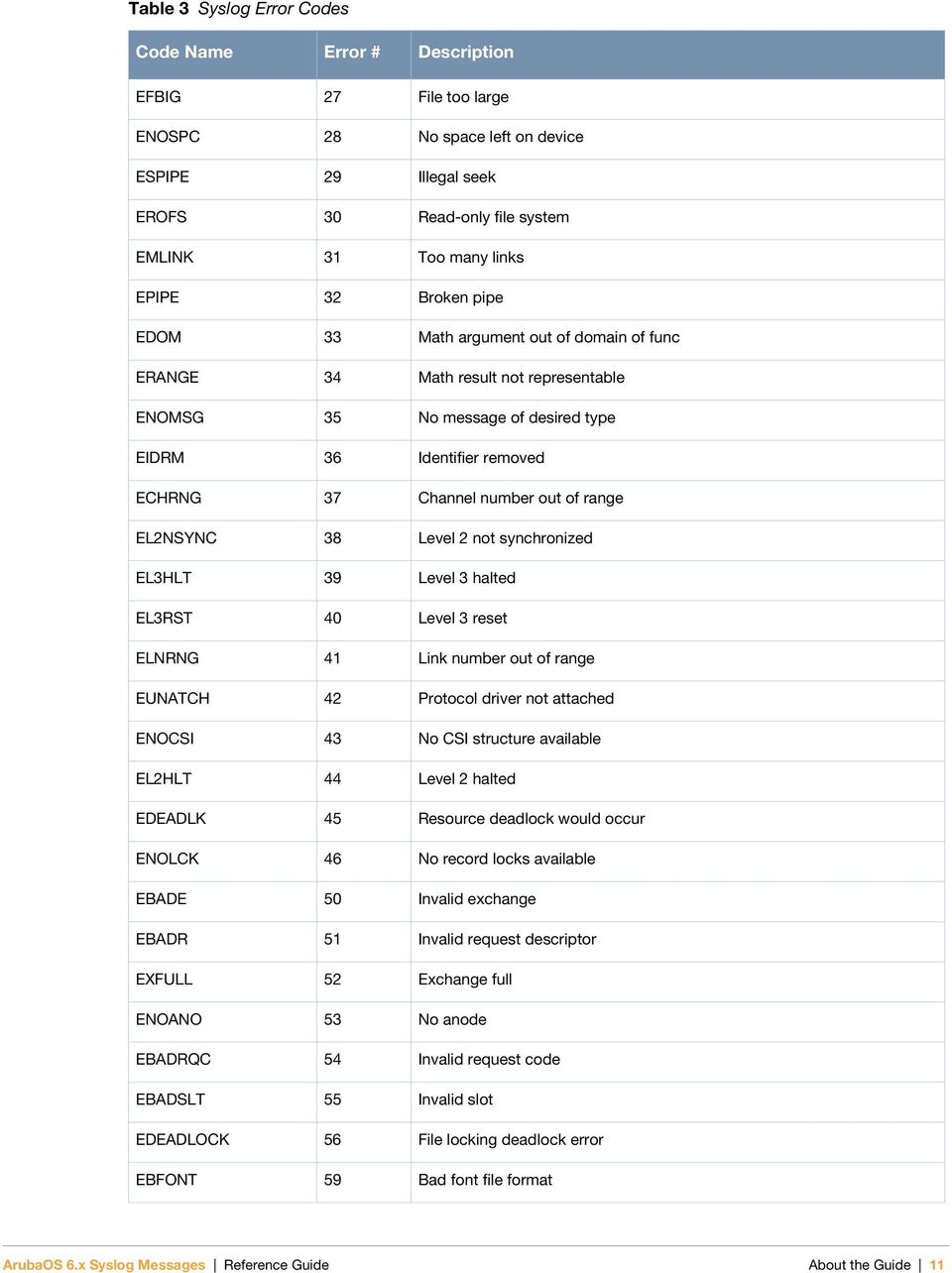
10 Error Codes The following table lists general descriptions of error codes found in log messages. Table 3 Syslog Error Codes Code Name Error # Description EPERM 1 Operation not permitted ENOENT 2 No such file or directory ESRCH 3 No such process EINTR 4 Interrupted system call EIO 5 I/O error ENXIO 6 No such device or address E2BIG 7 Argument list too long ENOEXEC 8 Exec format error EBADF 9 Bad file number ECHILD 10 No child processes EAGAIN 11 Try again ENOMEM 12 Out of memory EACCES 13 Permission denied EFAULT 14 Bad address ENOTBLK 15 Block device required EBUSY 16 Device or resource busy EEXIST 17 File exists EXDEV 18 Cross-device link ENODEV 19 No such device ENOTDIR 20 Not a directory EISDIR 21 Is a directory EINVAL 22 Invalid argument ENFILE 23 File table overflow EMFILE 24 Too many open files ENOTTY 25 Not a typewriter ETXTBSY 26 Text file busy 10 About the Guide ArubaOS 6.x Syslog Messages Reference Guide

11 Table 3 Syslog Error Codes Code Name Error # Description EFBIG 27 File too large ENOSPC 28 No space left on device ESPIPE 29 Illegal seek EROFS 30 Read-only file system EMLINK 31 Too many links EPIPE 32 Broken pipe EDOM 33 Math argument out of domain of func ERANGE 34 Math result not representable ENOMSG 35 No message of desired type EIDRM 36 Identifier removed ECHRNG 37 Channel number out of range EL2NSYNC 38 Level 2 not synchronized EL3HLT 39 Level 3 halted EL3RST 40 Level 3 reset ELNRNG 41 Link number out of range EUNATCH 42 Protocol driver not attached ENOCSI 43 No CSI structure available EL2HLT 44 Level 2 halted EDEADLK 45 Resource deadlock would occur ENOLCK 46 No record locks available EBADE 50 Invalid exchange EBADR 51 Invalid request descriptor EXFULL 52 Exchange full ENOANO 53 No anode EBADRQC 54 Invalid request code EBADSLT 55 Invalid slot EDEADLOCK 56 File locking deadlock error EBFONT 59 Bad font file format ArubaOS 6.x Syslog Messages Reference Guide About the Guide 11
12 Table 3 Syslog Error Codes Code Name Error # Description ENOSTR 60 Device not a stream ENODATA 61 No data available ETIME 62 Timer expired ENOSR 63 Out of streams resources ENONET 64 Machine is not on the network ENOPKG 65 Package not installed EREMOTE 66 Object is remote ENOLINK 67 Link has been severed EADV 68 Advertise error ESRMNT 69 Srmount error ECOMM 70 Communication error on send EPROTO 71 Protocol error EDOTDOT 73 RFS specific error EMULTIHOP 74 Multihop attempted EBADMSG 77 Not a data message ENAMETOOLONG 78 File name too long EOVERFLOW 79 Value too large for defined data type ENOTUNIQ 80 Name not unique on network EBADFD 81 File descriptor in bad state EREMCHG 82 Remote address changed ELIBACC 83 Can not access a needed shared library ELIBBAD 84 Accessing a corrupted shared library ELIBSCN 85.lib section in a.out corrupted ELIBMAX 86 Attempting to link in too many shared libraries ELIBEXEC 87 Cannot exec a shared library directly EILSEQ 88 Illegal byte sequence ENOSYS 89 Function not implemented ELOOP 90 Too many symbolic links encountered 12 About the Guide ArubaOS 6.x Syslog Messages Reference Guide

13 Table 3 Syslog Error Codes Code Name Error # Description ERESTART 91 Interrupted system call should be restarted ESTRPIPE 92 Streams pipe error ENOTEMPTY 93 Directory not empty EUSERS 94 Too many users ENOTSOCK 95 Socket operation on non-socket EDESTADDRREQ 96 Destination address required EMSGSIZE 97 Message too long EPROTOTYPE 98 Protocol wrong type for socket ENOPROTOOPT 99 Protocol not available EPROTONOSUPPORT 120 Protocol not supported ESOCKTNOSUPPORT 121 Socket type not supported EOPNOTSUPP 122 Operation not supported on transport endpoint EPFNOSUPPORT 123 Protocol family not supported EAFNOSUPPORT 124 Address family not supported by protocol EADDRINUSE 125 Address already in use EADDRNOTAVAIL 126 Cannot assign requested address ENETDOWN 127 Network is down ENETUNREACH 128 Network is unreachable ENETRESET 129 Network dropped connection because of reset ECONNABORTED 130 Software caused connection abort ECONNRESET 131 Connection reset by peer ENOBUFS 132 No buffer space available EISCONN 133 Transport endpoint is already connected ENOTCONN 134 Transport endpoint is not connected EUCLEAN 135 Structure needs cleaning ENOTNAM 137 Not a XENIX named type file ENAVAIL 138 No XENIX semaphores available EISNAM 139 Is a named type file ArubaOS 6.x Syslog Messages Reference Guide About the Guide 13
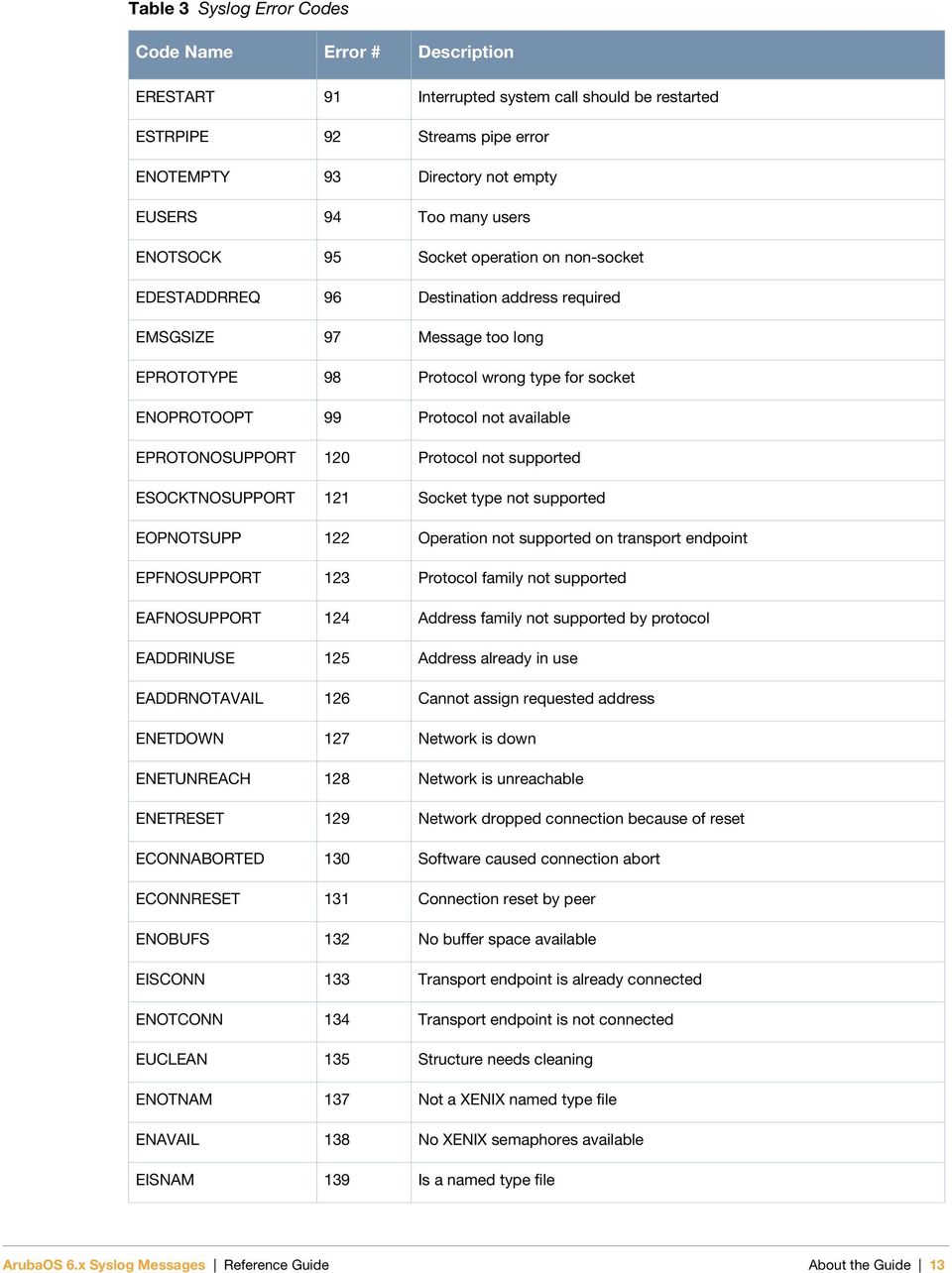
14 Table 3 Syslog Error Codes Code Name Error # Description EREMOTEIO 140 Remote I/O error EINIT 141 Reserved EREMDEV 142 Error 142 ESHUTDOWN 143 Cannot send after transport endpoint shutdown ETOOMANYREFS 144 Too many references: cannot splice ETIMEDOUT 145 Connection timed out ECONNREFUSED 146 Connection refused EHOSTDOWN 147 Host is down EHOSTUNREACH 148 No route to host EWOULDBLOCK EAGAIN Operation would block EALREADY 149 Operation already in progress EINPROGRESS 150 Operation now in progress ESTALE 151 Stale NFS file handle ECANCELED 158 AIO operation canceled Related Documents The following items are part of the complete documentation for the Aruba user-centric network, and may be useful when encountering issues that require research in this and other manuals: Aruba Controller Installation Guides Aruba Access Point Installation Guides ArubaOS Quick Start Guide ArubaOS User Guide ArubaOS Command Line Reference Guide ArubaOS MIB Reference Guide Release Notes 14 About the Guide ArubaOS 6.x Syslog Messages Reference Guide

15 Contacting Support Main Site Support Site Airheads Social Forums and Knowledge Base North American Telephone International Telephones Software Licensing Site End of Support information Wireless Security Incident Response Team (WSIRT) arubanetworks.com support.arubanetworks.com community.arubanetworks.com (Toll Free) licensing.arubanetworks.com/login.php arubanetworks.com/support-services/aruba-support-program/contactsupport/ arubanetworks.com/support/wsirt.php Support Addresses Americas and APAC EMEA WSIRT Please details of any security problem found in an Aruba product. ArubaOS 6.x Syslog Messages Reference Guide About the Guide 15
16 16 About the Guide ArubaOS 6.x Syslog Messages Reference Guide

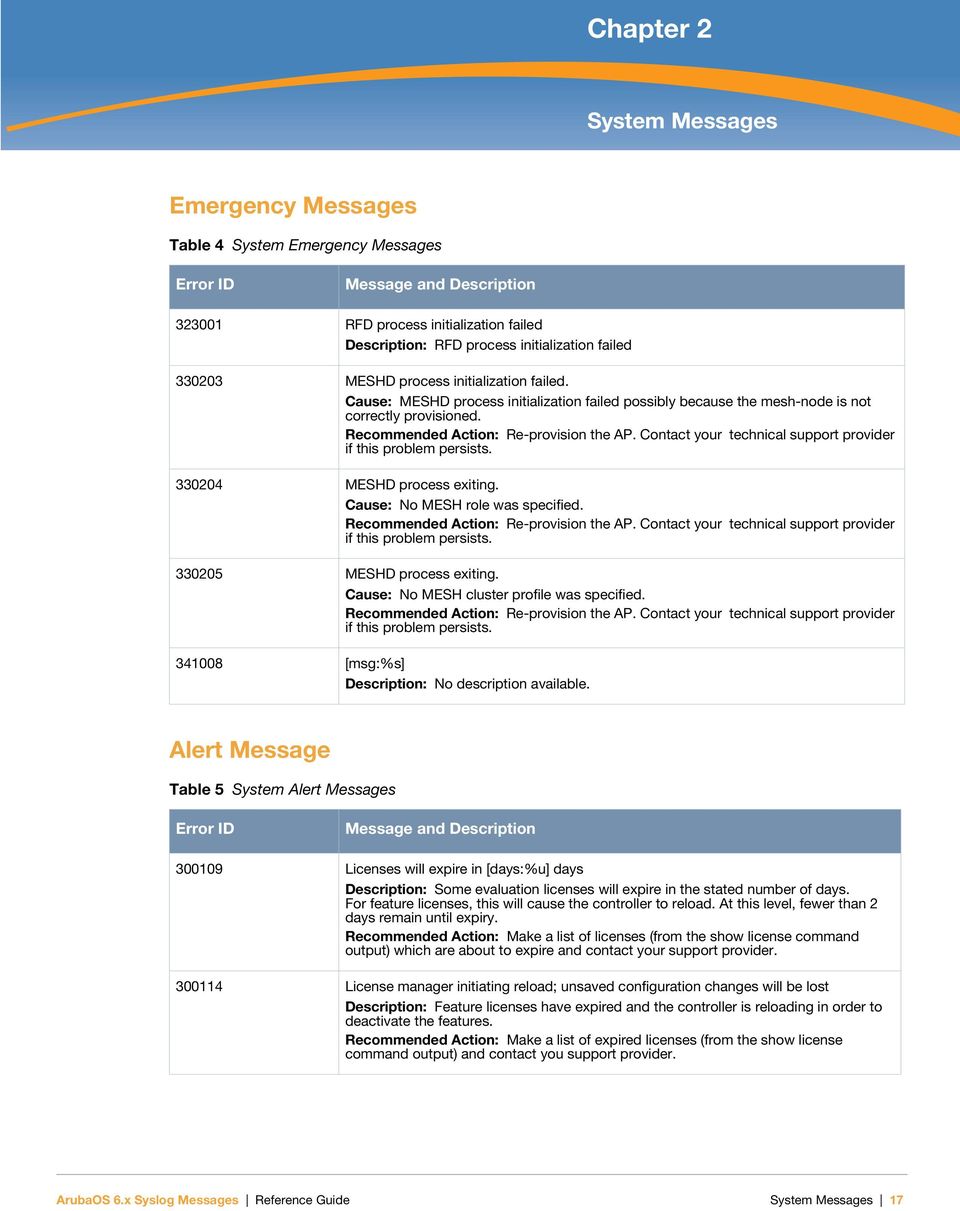
17 Chapter 2 System Messages Emergency Messages Table 4 System Emergency Messages RFD process initialization failed Description: RFD process initialization failed MESHD process initialization failed. Cause: MESHD process initialization failed possibly because the mesh-node is not correctly provisioned. Recommended Action: Re-provision the AP. Contact your technical support provider if this problem persists MESHD process exiting. Cause: No MESH role was specified. Recommended Action: Re-provision the AP. Contact your technical support provider if this problem persists MESHD process exiting. Cause: No MESH cluster profile was specified. Recommended Action: Re-provision the AP. Contact your technical support provider if this problem persists [msg:%s] Alert Message Table 5 System Alert Messages Licenses will expire in [days:%u] days Description: Some evaluation licenses will expire in the stated number of days. For feature licenses, this will cause the controller to reload. At this level, fewer than 2 days remain until expiry. Recommended Action: Make a list of licenses (from the show license command output) which are about to expire and contact your support provider License manager initiating reload; unsaved configuration changes will be lost Description: Feature licenses have expired and the controller is reloading in order to deactivate the features. Recommended Action: Make a list of expired licenses (from the show license command output) and contact you support provider. ArubaOS 6.x Syslog Messages Reference Guide System Messages 17
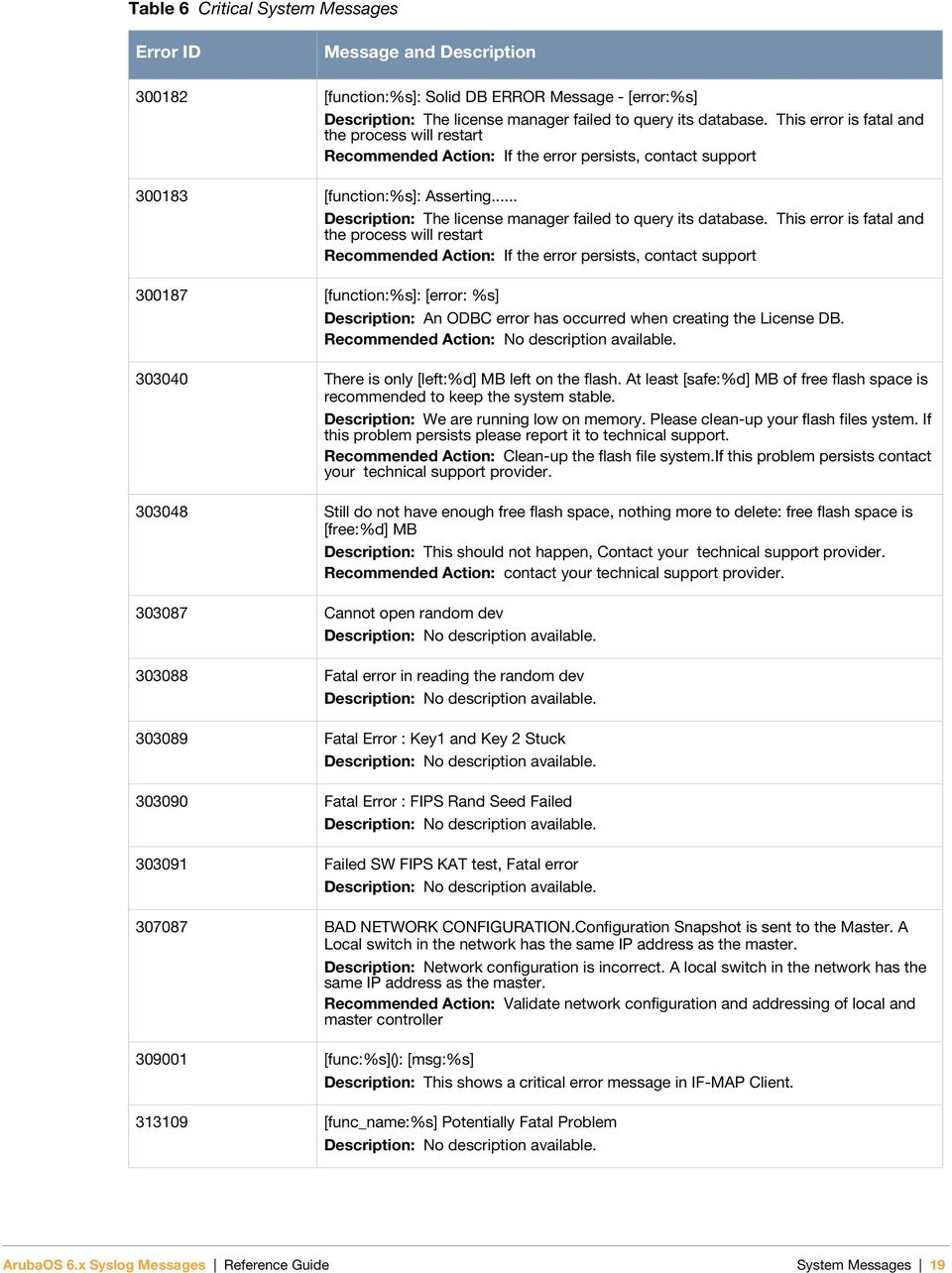
18 Table 5 System Alert Messages (Continued) Licenses sent by the server will expire in [days:%u] days Description: Licenses sent by the server will expire in the stated number of days. At this level, fewer than 5 days remain until expiry. Recommended Action: Please resolve connectivity issues with the license server Licenses contributed by the client will expire in [days:%u] days Description: Licenses contributed by the client will expire in the stated number of days. At this level, fewer than 5 days remain until expiry. Recommended Action: Please resolve connectivity issues with the license client VRRP: vrid [vrid:%d] (Master) - Received VRRP Advertisement with LOWER PRIORITY ([prio:%d]) from [ipaddr:%s], ignoring. Description: Warning indicating that the VRRP Master received Advertisement with lower priority which is ignored Failed to add Lsa to AgingObj in LsaInstall [msg:%s] Description: [func:%s]: [line:%d]: out of memory. Recommended Action: The AP is upgrading image from awc. Critical Messages Table 6 Critical System Messages Licenses will expire in [days:%u] days Description: Some evaluation licenses will expire in the stated number of days. Recommended Action: For feature licenses, this will cause the controller to reload. At this level, fewer than 15 days remain until expiry. Please make a list of licenses (from the "show license" command output) which are about to expire and contact support Failed to create the license database: [error:%s] Description: At initialization time, the license database could not be created. Recommended Action: Please reload the controller. If the problem persists, contact support Licenses sent by the server will expire in [days:%u] days Description: Licenses sent by the server will expire in the stated number of days. At this level, fewer than 15 days remain until expiry. Recommended Action: Please resolve connectivity issues with the license server icenses contributed by the client will expire in [days:%u] days Description: Licenses contributed by the client will expire in the stated number of days. At this level, fewer than 15 days remain until expiry. Recommended Action: Please resolve connectivity issues with the license client. 18 System Messages ArubaOS 6.x Syslog Messages Reference Guide
![300146 Licenses contributed by the client will expire in [days:%u] days Description: Licenses contributed by the client will expire in the stated number of days.](/docs-images/40/1990686/images/page_18.jpg "At this level, fewer than 5 days remain until expiry. Recommended Action: Please resolve connectivity issues with the license client.")
19 Table 6 Critical System Messages [function:%s]: Solid DB ERROR Message - [error:%s] Description: The license manager failed to query its database. This error is fatal and the process will restart Recommended Action: If the error persists, contact support [function:%s]: Asserting... Description: The license manager failed to query its database. This error is fatal and the process will restart Recommended Action: If the error persists, contact support [function:%s]: [error: %s] Description: An ODBC error has occurred when creating the License DB. Recommended Action: No description available There is only [left:%d] MB left on the flash. At least [safe:%d] MB of free flash space is recommended to keep the system stable. Description: We are running low on memory. Please clean-up your flash files ystem. If this problem persists please report it to technical support. Recommended Action: Clean-up the flash file system.if this problem persists contact your technical support provider Still do not have enough free flash space, nothing more to delete: free flash space is [free:%d] MB Description: This should not happen, Contact your technical support provider. Recommended Action: contact your technical support provider Cannot open random dev Fatal error in reading the random dev Fatal Error : Key1 and Key 2 Stuck Fatal Error : FIPS Rand Seed Failed Failed SW FIPS KAT test, Fatal error BAD NETWORK CONFIGURATION.Configuration Snapshot is sent to the Master. A Local switch in the network has the same IP address as the master. Description: Network configuration is incorrect. A local switch in the network has the same IP address as the master. Recommended Action: Validate network configuration and addressing of local and master controller [func:%s](): [msg:%s] Description: This shows a critical error message in IF-MAP Client [func_name:%s] Potentially Fatal Problem ArubaOS 6.x Syslog Messages Reference Guide System Messages 19
20 Table 6 Critical System Messages POE over subscribed, Turning off [slot:%d]/[port:%d] Description: Turning off the port as the POE is oversubscribed [cause:%s] Description: This syslog describes the reason the switch was rebooted Maximum [string:%s] user capacity of [count:%d] reached. Description: System has reached maximum user capacity. Recommended Action: Limit of the system has been reached Max xsec user capacity of [count:%d] reached Description: System has reached max xsec user capacity Max ACR capacity of [count:%d] reached Description: System has reached max capacity of Advanced Crypto users Unable to read regulatory domain data from hardware Description: The system reported an error while trying to read regulatory domain information from the system hardware. As a result, the country code may not be set correctly on the controller and the APs may not be able to come up without the appropriate country code. Recommended Action: Contact your technical support provider The number of OSPFv2 network routes exceeds the forwarding table limit of [num:%d] routes Failed to add OSPFv2 route because routing table is full Discarding LSA because LS database is full. LS database contains [num:%u] LSAs An overtemperature condition has been detected: [desc:%s] [data:%f] Description: A card Tempertaure is too high. Recommended Action: Assure that ambient temperture is not too high and that airflow is unrestricted around the chassis vents Communication with the Peer M3 in the Bottom slots is broken. Description: Top slot M3 is not able to talk to the bottom slot M3. Recommended Action: Please check the Bottom slot to make sure it is operational [msg:%s] Unable to initialize [operation:%s] in [function:%s], [file:%s]:[line:%d]. Description: This log indicates that the system was unable to initialize a system component. This could be a transient condition and the problem might go away Recommended Action: In case the problem persists, please contact the technical support. Error Messages 20 System Messages ArubaOS 6.x Syslog Messages Reference Guide

21 Table 7 Error System Messages Unexpected fatal mobileip runtime error in [file:%s] at [func:%s], [line:%d] Description: Unexpected condition occurred in the mobility manager (mobileip) Recommended Action: Contact your support provider Unexpected mobileip runtime error at [func:%s], [line:%d] Description: Unexpected condition occurred in the mobility manager (mobileip) Recommended Action: Contact your support provider Unexpected mobileip runtime error at [func:%s], [line:%d]: [errorstr:%s] Description: Unexpected condition occurred in the mobility manager (mobileip) Recommended Action: Contact your support provider Unexpected mobileip runtime error for station [mac:%m], [ip:%p] at [func:%s], [line:%d] Description: Unexpected condition occurred in the mobility manager (mobileip) Recommended Action: Contact your support provider Unable to initialize license manager Description: The license manager failed to initialize its database. This error is fatal and the process will restart. Recommended Action: If the error persist, contact your support provider Sibyte: PAPI_Send() failed for opcode [opcode:%4x] Description: Backplane locking failed due to an inability to communicate with the datapath for the indicated opcode. Recommended Action: If the error persist, contact your support provider Sibyte messaging failure: PAPI_Alloc() failed Description: Backplane locking failed due to an inability to allocate memory Recommended Action: If the error persist, contact your support provider Serial number does not match: key [keyval:%s]; system [system:%s]; \[key [key:%s]]; disabling Description: A serial number mismatch has been detected for the specified key, so the system disabled it Cause: This is generally due to swapping flash modules or importing a license database from another controller Recommended Action: If the error persist, contact your service provider Model number does not match: key [keyval:%s]; system [system:%s]; \[key [key:%s]]; disabling Description: A model number mismatch has been detected for the specified key, so the system disabled it. Cause: This is generally due to swapping flash modules or importing a license database from another controller. Recommended Action: If the error persist, contact your service provider Limit not valid for [os:%s] [limit:%s]\[[id:%d]]; disabling Description: An invalid limit key has been detected, so the system disabled it. Cause: This is generally due to swapping flash modules or importing a license database from another controller. Recommended Action: If the error persist, contact your service provider ArubaOS 6.x Syslog Messages Reference Guide System Messages 21
22 Table 7 Error System Messages (Continued) Feature not valid for [os:%s] [feature:%s]\[[id:%d]]; disabling Description: An invalid feature key has been detected, so the system disabled it. Cause: This is generally due to swapping flash modules or importing a license database from another controller. Recommended Action: If the error persist, contact your service provider DB command [cmd:%s] failed with error [error:%s] Description: An SQL error occurred while executing the indicated command. Recommended Action: If the error persist, contact your service provider Failed to delete the license key [key:%s] Description: The indicated license key could not be deleted. The preceding message indicates the SQL error Key creation failed [key:%s] Description: During an upgrade from an older release, creation of an evaluation key failed Deletion of all licenses failed Description: Clearing all the licenses failed. Cause: The preceding error indicates the SQL failure Activation status change failed Description: Changing the activation status of one or more keys failed. Cause: The preceding message indicated the SQL failure feature table file open failed: [error:%s]. Description: Internal communication between licensing and other applications has failed. Recommended Action: Reload the controller. If the problem persist, contact your service provider feature table write failed: [error:%s]. Description: Internal communication between licensing and other applications has failed. Reload the controller. Recommended Action: If the problem persist, contact your service provider Error reading backplane serial number Description: The software was unable to obtain the system serial number. Licensed functions will not work Recommended Action: Contact your service provider function:%s]: Encryption failed for [time:%s] Description: Encrypting the installation time for the key failed. Recommended Action: If the problem persists, contact your support provider [function:%s]: failed to decrypt time [time:%s] Description: Decrypting the installation time for a key failed. Recommended Action: If the problem persists, contact your support provider Failed to enable configuration fragment for feature [name:%s]\[[id:%d]] \[fragment [fragment:%s]]: [error:%s] Description: After adding a license that requires a configuration file update, the update failed. 22 System Messages ArubaOS 6.x Syslog Messages Reference Guide
23 Table 7 Error System Messages (Continued) [function:%s]: Serial number does not match: key [keyval:%s]; system [system:%s] key \[[key:%s]] Description: A serial number mismatch has been detected for the specified key. Cause: This is generally due to swapping flash modules or importing a license database from another controller. Recommended Action: Contact your support provider [function:%s]: Model number does not match: key [keyval:%s]; system [system:%s] key \[[key:%s]] Description: A model number mismatch has been detected for the specified key. Cause: This is generally due to swapping flash modules or importing a license database from another controller. Recommended Action: Contact your support provider [function:%s]: Serial number does not match: key [keyval:%s]; system [system:%s] Description: A serial number mismatch has been detected for the specified key. Cause: This is generally due to swapping flash modules or importing a license database from another controller [function:%s]: Model number does not match: key [keyval:%s]; system [system:%s] Description: A model number mismatch has been detected for the specified key. Cause: This is generally due to swapping flash modules or importing a license database from another controller [function:%s]: Error while retrieving the license record: [error:%s] Description: An SQL error occurred while looking up a license key [function:%s]: Failed to export the License Database to file: [file:%s] [error:%s] Description: An SQL error occurred when exporting the database [function:%s]: Failed to import the License Database from file: [file:%s] [status:%u] [error:%s] Description: An SQL error occurred when importing the database [function:%s]: Platform upgrade from [fromplt:%s] to [toplt:%s] is not supported Description: Platform upgrade is not supported to the new platform from the existing platform [function:%s]: Feature not valid for feature [feature:%s] id [id:%d] Description: This key contains a feature which is not allowed on this variant [function:%s]: Evaluation key for feature [feature:%s] id [id:%d] is older than [days:%u] days; key cannot be added Description: The keys cannot be added as the Eval key for the feature is older [function:%s]: Complete key already present, dropping the cmd Description: A complete key is already installed; only one is allowed [function:%s]: Key already present, dropping the cmd Description: Dropping the cmd to add key as key is already present [function:%s]: Key does not exist, dropping the cmd Description: Dropping the cmd to delete key as key is not present. ArubaOS 6.x Syslog Messages Reference Guide System Messages 23
24 Table 7 Error System Messages (Continued) License database creation failed Description: Failed to create a new License Database [function:%s]: License report aborted; failed to set the stdout to file [file:%s]: [error:%s] Description: License report aborted due to a failure in file open [function:%s]: License report generation failed [error:%s] Description: License report generation failed function:%s]: ODBC Init Failed [error:%s] Description: The license manager failed to initialize its database. This error is fatal and the process will restart Recommended Action: If the error persists, contact your support provider [function:%s]: Error while retrieving the license records, multiple License Entries Description: An error occurred while retrieving the license records as there are multiple License Entries [function:%s]: No license entry found for key [key:%s] Description: There is no license entry matching the particular key [function:%s]: No license entry found Description: No license entry found in the License DB Config sync failed when trying to [updn:%s] configuration [tofrom:%s] [url:%s] Description: Operation failed when trying to sync the configuration with the MMS server. Cause: This could be due to the MMS server not properly configured, server unreachable, or an internal system error. Please retry after verifying the MMS connection. Recommended Action: If the problem persists, contact your support provider Error, forwarding traps to the trap daemon. Description: The system reported an error while trying to send an internal PAPI message to the trap daemon for trap processing. As a result, a trap may not have been reported to a trap receiver Cannot bind to socket: [errno:%d]\n Description: The system reported an error while initializing the SNMP process and it s unable to bind to the SNMP port. As a result, the SNMP process will be restarted Can t open the Boot File\n Description: At startup, the SNMP process could not open a file containing the SNMP engine boots ID which is used for SNMPv3 user based security model. This is a fatal error and the SNMP process will be restarted Can t open the Boot File for reading\n Description: At startup, the SNMP process could not read a file containing the SNMP engine boots ID which is used for SNMPv3 user based security model. This is a fatal error and the SNMP process will be restarted Invalid length. Encoding Failed: [file:%s]:[line:%d] Description: The SNMP server failed to create an SNMP PDU used for SNMP response due to an invalid data length. An SNMP response will not be generated. 24 System Messages ArubaOS 6.x Syslog Messages Reference Guide
25 Table 7 Error System Messages (Continued) Error Building PDU [file:%s]:[line:%d] Description: The SNMP server failed to create an SNMP PDU used for an SNMP response. An SNMP response will not be generated Error Adding [AddOID:%s] to the Varbind [file:%s]:[line:%d] Description: The SNMP server failed to create an SNMP PDU used for an SNMP response due to a failure in creating a var bind for the PDU response. An SNMP response will not be generated line:%d] Cannot Concatenate OID, [reason:%s] Description: The SNMP server reported an error while creating a new OID from 2 OIDs SNMP PDU from [srcip:%s] action [act:%s] Description: The SNMP server reported an error while handling an SNMP PDU SNMP PDU from [srcip:%s], parse VB failed, [reason:%s] Description: The SNMP server reported an error while handling SNMP varbinds SNMP PDU from [srcip:%s], parse octet string failed, [reason:%s] Description: The SNMP server reported an error while handling an octet string varbind SNMP PDU from [srcip:%s], Parse OID failed, [reason:%s] Description: The SNMP server reported an error while handling an OID SNMP PDU from [srcip:%s], [func:%s] failed due to [reason:%s] Description: The SNMP server detected an invalid data type while parsing a PDU [file:%s] SNMP PDU from [srcip:%s], [reason:%s] Description: The SNMP server reported an error while parsing an SNMP message Error creating snmp message packet Description: The SNMP server was unable to allocate memory for an octet string [line:%d] [msg:%s] Description: The SNMP server reported an invalid SNMP engine ID algorithm request message ID [mms:%d] is out of range Description: The SNMP server reported an invalid SNMP v3 message ID Recommended Action: If the error persists, contact your support provider mms value [mms:%d] is out of range Description: The SNMP server received an SNMP v3 message that exceeds the maximum supported message size. Recommended Action: If the error persists, contact your support provider [file:%s]:[line:%d] [msg_reason:%s] Description: The SNMP server received an invalid security level while creating an SNMPv3 message Recommended Action: If the error persists, contact your support provider [line:%d] Row creation failed for table:[tbl_type:%s] [msg_reason:%s] Description: The SNMP server encountered an internal error while creating a new entry for an SNMP user or host ArubaOS 6.x Syslog Messages Reference Guide System Messages 25
26 Table 7 Error System Messages (Continued) Could not create vacmsecuritytogroupentry for [SecurityName:%s] Description: The SNMP server encountered an internal error while creating a search string while adding or modifiying a host Unable to create OctetString for name [name:%s] Description: The SNMP server encountered an internal error while creating a search string while adding or modifiying a host [line:%d] Received bad value for security [type:%s] Description: The SNMP server encountered an invalid security level or model for SNMP v3 authentication [line:%d] Error Modifying the row. Row does not exist Description: The SNMP server encountered an internal error while modifying an internal host, community, or user entry [line:%d] Error Deleting the row. Row does not exist Description: The SNMP server encountered an internal error while deleting an internal host, community, or user entry Translate name to OID: hash table lookup failed: [text_str:%s] Description: The SNMP server encountered an internal error while converting dot notation name to its OID Recommended Action: If the error persists, contact your support provider [line:%d] Make OID from Name: [msg_reason:%s] Description: The SNMP server encountered an internal error while creating an OID Recommended Action: If the error persists, contact your support provider [line:%d] Converting to name from OID: [reason:%s] Description: The SNMP server encountered an internal error while converting an OID to a dot notation string Recommended Action: If the error persists, contact your support provider Make Variable binding received a NULL object parameter Description: The SNMP server encountered an internal error while creating a varbind Recommended Action: If the error persists, contact your support provider Make Variable binding received a NULL OID parameter Description: The SNMP server encountered an internal error while creating a varbind Recommended Action: If the error persists, contact your support provider cannot make context SnmpEngineID Description: The SNMP server encountered an internal error while creating an SNMPv3 report PDU Recommended Action: If the error persists, contact your support provider cannot make context Name Description: The SNMP server encountered an internal error while creating an SNMPv3 report PDU Recommended Action: If the error persists, contact your support provider The SNMP server encountered an internal error while creating an SNMPv3 report PDU Description: Could not parse reqid in encrypted message.you may have just got an error in ParseType, but this is normal behavior. 26 System Messages ArubaOS 6.x Syslog Messages Reference Guide
27 Table 7 Error System Messages (Continued) Initializing standard MIBS failed. Continuing anyway. Description: The SNMP server encountered an internal error while initializing the standard MIB Initializing enterprise MIBS failed. Continuing anyway. Description: The SNMP server encountered an internal error while initializing the enterprise MIB Received Zero-Length packet from [tst:%s] Description: The system reported an error when the SNMP process received a zero length packet Recommended Action: If the error persists, contact your support provider Unknown Context received in the request Description: The SNMP process received a SNMP v3 request with an unknown context Recommended Action: Verify that the credentials used for the SNMP v3 request is valid Processing of GET(next) request failed Description: The SNMP process was unable to create a SNMP response Recommended Action: If the error persists, contact your support provider Cannot bind SNMP Trap transport Description: The TRAPD process is unable to bind to the SNMP trap port Recommended Action: If the error persists, contact your support provider Sendto failed, unable to send trap to manager [tst:%s]. Description: The TRAPD process is unable to send a trap to a trap host Recommended Action: If the error persists, contact your support provider [file:%s]:[line:%d] Error Destination Trap host is not found Description: The TRAPD process couldn t find the trap host receiving a generated trap Recommended Action: If the error persists, contact your support provider Could not parse response/report to InformRequest Description: The TRAPD process is unable to parse an SNMP v3 inform response Recommended Action: If the error persists, contact your support provider Processing Inform response, Cannot Parse PDU Description: The TRAPD process is unable to parse an SNMP v3 inform response Recommended Action: If the error persists, contact your support provider function:%s]: Error in setting the Security to Group Description: The TRAPD/SNMPD process is unable to edit an SNMPv3 security group entry Recommended Action: If the error persists, contact your support provider [function:%s]: Error Setting the User Description: The TRAPD/SNMPD process is unable to add an SNMPv3 security user Recommended Action: Please verify that the SNMPv3 supplied credentials are correct. If the error persists, contact your support provider ArubaOS 6.x Syslog Messages Reference Guide System Messages 27
28 Table 7 Error System Messages (Continued) Error Setting the Host Parameter ([communityname:%s]) Description: The TRAPD process was unable to add an SNMP v1 host entry Recommended Action: Verify that the supplied SNMP v1 trap host entry is valid. If the error persists, contact your support provider Error Setting Host Receiver ([communityname:%s]) Description: The TRAPD process was unable to add an SNMP v1 community target Recommended Action: Verify that the supplied SNMP v1 trap host entry is valid. If the error persists, contact your support provider Error: Cannot configure more than ([MAX_NUMBER_OF_INFORM_HOSTS:%d]) Description: The TRAPD process has reached the maximum number of SNMP v3 inform hosts Recommended Action: Remove the existing SNMP v3 inform host to add a new entry User Entry is not present [uname:%s] Error Setting V2C Host Receiver ([communityname:%s])t [line:%d] Error Setting the V2C Host Parameter ([communityname:%s])no description available Error Deleting the Trap params ([communityname:%s]) [line:%d] User should be defined, before adding to the Trap host Error deleting the Manager User Entry [line:%d] Error: deleting the Trap Host ([communityname:%s]) Error Deleting the V3 Host Parameter ([communityname:%s]) Cannot Create socket to send configuration to snmp agent Error Sending Hostname change to CLI Reached the Max Inform limit ([ARUBA_MAX_INFORM_PER_HOST:%d]) for a Host: Dropping the inform Error: Deleting the Inform Host ([secname:%s]) [file:%s]:[line:%d] Trap not found in the trap list [trapnum:%d] source [source:%s] 28 System Messages ArubaOS 6.x Syslog Messages Reference Guide
29 Table 7 Error System Messages (Continued) Type is not supported [type:%d] Error: Index Value is more than the index count [indx:%d] [cnt:%d] Received an Invalid Packet type [MessageCode:%d], Expecting Snmp Resp No OID for trap ID [id:%d] OID Length in OID is not correct for Varbind [intg:%d] Error: Finding the Varbind List length AMP:Table not supported error Error retrieving Number of Access Points Error retrieving Number of Stations SNMP agent unable to send notification response for trap [trap:%d] to the application [app:%s] Received an Invalid SNMP Request type [type:%d] in the packet from [ip:%s] [func:%s] Dropping this req - please enable stats collection first through CLI [func:%s] Dropping this req - invalid request type [func:%s] Dropping this req as a similar request is already in progress [func:%s] Dropping this req as a similar request is already queued [func:%s] Scheduling the Stats/Disc Request [index:%d] [func:%s] Recvd rsp, when no req in progress [func:%s] Recvd rsp, when req in progress is different ArubaOS 6.x Syslog Messages Reference Guide System Messages 29
30 Table 7 Error System Messages (Continued) [func:%s] Recvd rsp, when req in progress is different [func:%s] Dropping this req [req:%d] invalid category [cat:%d] [func:%s] Dropping this req [req:%d] invalid tableid [table:%d] [func:%s] [line:%d] Invalid req, Dropping the req [req:%d] catid [catid:%d] tableid [table:%d] [func:%s] [line:%d] Stats/Disc File open error fname [filename:%s] [func:%s] Cannot get the SwitchIp [func:%s] [line:%d] Stats File seek error [filename:%s] offset [offset:%d] [func:%s] Cannot open cookie file [name:%s] [func:%s] No Active MMS IP, cannot send https response [func:%s] Can t generate Cookie file, cannot send https response [func:%s] Can t send https response [func:%s] [line:%d]can t create the symbolic link for the webui [func:%s] [line:%d] Stats File write error [filename:%s] [func:%s] [line:%d] Stats Req TimeOut error [func:%s] [line:%d] MMS server [ipstr:%s] in sync request is different than the active MMS server Description: The controller only accepts config sync requests from the active MMS server. This syslog indicates the config sync was generated from a unrecognized IP address Unexpected nanny runtime error at [func:%s], [line:%d] Description: Unexpected condition occurred in the process manager (nanny) Recommended Action: Contact your support provider 30 System Messages ArubaOS 6.x Syslog Messages Reference Guide
31 Table 7 Error System Messages (Continued) Unexpected nanny runtime error at [func:%s], [line:%d], [data:%s] Description: Unexpected condition occurred in the process manager (nanny) Recommended Action: Contact your support provider Failed to open console starting [process:%s], error [err:%s] at line [line:%d] Description: Failed to open console while starting process Recommended Action: Contact your support provider Failed to exec starting [process:%s], error [err:%s] at line [line:%d] Description: Failed to exec process. Recommended Action: Contact your support provider Process [process:%s] \[pid [pid:%d]]: wait4() returned -1, error [err:%s] Description: Internal Error Recommended Action: Contact your support provider Error Sending Data to Cli Cannot Create CLI socket Failed to fork while trying to reboot AP, error [err:%s] Description: Internal Error Recommended Action: Contact your support provider Machine should reboot but the no reboot flag is set in CPBOOT! Description: No Reboot flag is set in CPBOOT. Recommended Action: Contact your support provider nanny_list parse error: Line Number [line:%d] should start with RESTART, REBOOT, ONETIME, FOREVER or CONSOLE Description: This should not happen Recommended Action: Contact you support provider Cannot open directory [dir:%s] retrieving core file, error [err:%s] Description: This should not happen Recommended Action: Contact your support provider Found core file [fname:%s], [size:%d] bytes, compressing... Description: Compressing Core file. Recommended Action: Contact your support provider Compressing core file failed with code [errcode:%d] Description: Internal System error while compressing core file Recommended Action: Contact your support provider Core file can t be saved on flash, file size: [fsize:%d]mb, available: [favail:%d]mb Description: Unable to save core file Recommended Action: Remove unused files from flash No core file found for process [pname:%s] \[pid [pid:%d]] Description: Process went down but no core file has been generated Recommended Action: If this is seen consistently, contact your support provider ArubaOS 6.x Syslog Messages Reference Guide System Messages 31
32 Table 7 Error System Messages (Continued) Process [pname:%s] \[pid [pid:%d]]: crash data saved in dir [dirname:%s] Description: Successfully generated Core file Recommended Action: Contact your support provider Attempting to transfer core of [process:%s] \[pid [pid:%d]] to server [server:%s] Description: Transferring core file to server Recommended Action: Contact your support provider Free Flash space is [free:%d] MB, removing old crash dumps Description: Removing old crash dumps Recommended Action: Just an informational message; no action required After cleaning older crash data, free flash space is [free:%d] MB Description: Information mesage Recommended Action: Just an informational message; no action required After cleaning older crash data, free flash space is [free:%d] MB Description: Information mesage Recommended Action: Just an informational message; no action required Still not enough free flash space, cleaning more core files Description: System is trying to generate more free space. Cleaning more core files Recommended Action: Just an informational message; no action required Just an information message. No action required After cleaning cores files, free flash space is [free:%d] MB Information mesage Still not enough free flash space, removing all crash data Description: Removing all crash data from flash Recommended Action: Just an informational message; no action required After cleaning ALL crash data, free flash space is [free:%d] MB Description: Information mesage Recommended Action: Just an informational message; no action required Low free space on RAM disk: [free:%d] MB, lower than [total:%d] MB, will clean up crash data Description: We are running low on memory. We will be removing old crash files to generate more free space Recommended Action: Just an informational message; no action required After cleaning cores free disk space is [free:%d] MB Description: Information mesage Recommended Action: Just an informational message; no action required Low freememory [free:%lu] ([freem:%lu] MB), total [total:%lu] ([totalm:%lu] MB), min [min:%d] MB Description: This message indicates system is running out of memory. System will reboot if the condition persists Recommended Action: Run show processes and show memory command to monitor usage Total free memory ([free:%d] KB) too low, less than [min:%d] KB, will reboot AP Description: We are running very low on memory. AP will reboot Recommended Action: Contact your support provider 32 System Messages ArubaOS 6.x Syslog Messages Reference Guide
33 Table 7 Error System Messages (Continued) Critical process [proces:%s] \[pid [pid:%d]] DIED, process marked as [restart:%s] Description: Critical process has gone done Recommended Action: Contact your support provider Critical Process died. Rebooting... Description: Critical process has died. Rebooting system Recommended Action: Contact your support provider [process:%s] old pid [opid:%d] new pid [npid:%d] Description: Process has been restarted Recommended Action: Informational message; no action required Process [process:%s] \[pid [pid:%d]] died: got signal [signal:%s] Description: Process died because of signal mentioned above Recommended Action: Congtact your support provider Process [process:%s] \[pid [pid:%d]] died: exited with [ecode:%x] Process [process:%s] \[pid [pid:%d]] died: signal [signal:%s] stopped it Non re-startable process [process:%s] \[pid [pid:%d]] has terminated Description: One Time Process has terminated Recommended Action: Informational message; no action required Restarted process [process:%s], new pid [npid:%d] Description: Restartable processes has been respawned Recommended Action: Informational message; no action required Please tar and the file crash.tar to [ %s] To tar type the following commands at the Command Line Interface: (1) tar crash (2) copy flash: crash.tar tftp: \[serverip] \[destn filename] Description: This message defines action to be taken once crash file has been generated Recommended Action: Follow the instructions in the message and contact your support provider with the tar file Please tar and the crash information to [ %s] Process [process:%s] was restarted [ntimes:%d] time(s); no more restarts. Description: Process has been restarted with in defined limits. No more restarts for this process Recommended Action: Contact your support provider Failed to restart process [process:%s] Description: Internal system error, Unable to restart process Recommended Action: Contact your support provider ArubaOS 6.x Syslog Messages Reference Guide System Messages 33
34 Table 7 Error System Messages (Continued) Process Manager (nanny) shutting down - Machine will reboot! Description: Nanny recieved SIGTERM, System will reboot Recommended Action: Contact your support provider Process Manager (nanny) shutting down - AP will reboot! Description: Nanny recieved SIGTERM, AP will reboot Recommended Action: Contact your support provider Out Of Memory handler killed process [process:%s]:[pid:%d] due to low memory. Set [set:%d] Rebooting controller due to repeated low memory events Unexpected stm (Station management) runtime error at [func:%s], [line:%d] Description: Unexpected condition occurred in the station manager (stm) Recommended Action: Contact your support provider Unexpected stm (Station management) runtime error at [func:%s], [line:%d], [data:%s] Description: Unexpected condition occurred in the station manager (stm) Recommended Action: Contact your support provider PAPI_Send failed: [error:%d]; from [sport:%d] to [toaddr:%p]:[toport:%d] len [len:%d] type [type:%d] Description: Inter-process communication message failed to reach the target VPOOL: Maximum capcity ([count:%d]) reached for Vlan Pool hash table Recommended Action: Contact your support provider VPOOL: Vlan Pool hash table ([vap:%s]) collision at [entry:%d]. Not handled! Recommended Action: Contact your support provider VPOOL: Error allocating VLAN from Virtual AP pool [name:%s] Recommended Action: Contact your support provider Connection to User DB failed Description: The application was not able to connect to the user database Creation of Client Blacklist tables in User DB failed Description: The application was not able to create the Client Blacklist tables in the user database SQL Command [command:%s] failed on User DB. Reason: [reason:%s] Description: This log indicates that an SQL command failed when it was executed on the user database Update to client blacklist database table failed. Description: This log indicates that an update to the client blacklist database table failed Client blacklist is full and caused an entry to not be added. Limit: [limit: %d]. Description: This log indicates that the client blacklist table is full and an entry that would have been added could not be added. 34 System Messages ArubaOS 6.x Syslog Messages Reference Guide
35 Table 7 Error System Messages (Continued) Contact Aruba tech-support. Unexpected stm (Station management) runtime error at [func:%s], [line:%d], [data:%s] Description: Unexpected condition occurred in the station manager (stm) PAPI_Send failed, [func:%s], [line:%d]: [error:%s]; opcode [opcode:%d] action [action:%d] Description: Aruba inter-process communication message failed to reach datapath [func:%s], [line:%d]: Sibyte reply truncated; opcode [opcode:%d] action [action:%d] Description: Datapath reply to PAPI message sent is truncated PAPI_Send failed, [func:%s], [line:%d]: [error:%s] Description: Aruba inter-process communication message failed to reach auth manager PAPI_Send failed, [func:%s], [line:%d]: [error:%s] Description: Aruba inter-process communication message failed to reach air monitor PAPI_Send failed, [func:%s], [line:%d]: [error:%s], dstport [dst:%d], msgcode [code:%d] Description: Aruba inter-process communication message failed to reach destination PAPI_Send failed, [func:%s], [line:%d]: [error:%s], dstport [dst:%d] Description: Aruba inter-process communication message failed to reach destination PAPI_Send failed: [func:%s], [line:%d]: [error:%s]; from [sport:%d] to [toaddr:%p]:[toport:%d] len [len:%d] type [type:%d] Description: Inter-process communication message failed to reach the target AP [name:%s]: [pcmd:%s] [inst:%s] is invalid. Description: The system tried to assign the specified profile to the specified AP, but the profile was invalid. This profile will not be used. Run show profile-errors to display profile problems [owner:%s]: No valid instances of required profile [prof:%s] Description: The AP s configuration must contain at least one valid instance of the given profile type, but none were found. The AP will not be configured. Recommended Action: Contact your support provider with the output from the show profile-errors command AP [name:%s]: Unable to assign virtual AP [vap:%s] : [pcmd:%s] [inst:%s] is invalid AP [name:%s] at [ip:%p] is using the wrong key AP [name:%s] has same value for native and uplink VLAN. AP will become unreachable [msg:%s] Unable to get license information Description: Application failed to get license information ArubaOS 6.x Syslog Messages Reference Guide System Messages 35
36 Table 7 Error System Messages (Continued) KE Daemon can not HashCreate()... Description: KE Daemon encounted an internal error during startup KE Daemon received unknown datai Description: KE Daemon received information it can not process Recommended Action: This message can be ignored KE Daemon received unknown service type [service:%d] Description: IKE Daemon received internal message from unknown service Recommended Action: This message can be ignored [function:%s]: Can not write sysctl(): [errno:%s] Description: Sysctl call failed IKE Daemon can not initsaveconfig()... Description: Ike Daemon could not initialize configuration data Requesting switch IP failed to send request. Description: VPN module requesting for switch IP failed Pubsub send message code [mcd:%d] source port [sr_prt:%d] to destination port [dest_prt:%d] failed, errno [err_str:%s] Description: PubSub module encountered an internal error while sending a message to the specified module. The message will be resent Module [mod:%s] failed to register as publisher for service [service:%s] Description: Failed to send pubsub publisher message to pubsub module. The message will be resent Module [mod:%s] failed to register as subscriber for service [service:%s] Description: Failed to send pubsub subscriber message to pubsub module. The message will be resent Facility [facility:%d] Not found in the list Description: This is an internal system error Recommended Action: Contact your support provider [file:%s] [func:%s] [line:%d], MyRole [role:%s], Error sending [pkt_type:%s] to [sw_ip:%s] errno [errno_str:%s], socket ID [sock:%d] Description: Controller encountered error sending data over TCP socket between master-local [file:%s] [func:%s] [line:%d], MyRole [role:%s], Error receiving data on socket [sock:%d] errno [errno_str:%s], bytes received [byte_recv:%d] Description: Controller has encountered error receiving data over TCP socket between master-local Switch ([switchip:%s]) not in the Local Switch list Description: Master received communication from local from which it never heard (exchanged heart-beat) Send Large Failed:Cannot send snapshot configuration to [switchip:%s]:[cfgmanager:%d] Description: Configuration manager is unable to push config snapshot to Application due to failure of inter-process messaging Recommended Action: Contact your support provider 36 System Messages ArubaOS 6.x Syslog Messages Reference Guide
37 Table 7 Error System Messages (Continued) Error occurred sending the configuration data to the local switch [switch_ip:%s]; error=[err_msg:%s] Description: Master failed to send configuration to Local over TCP connection Recommended Action: Contact your support provider Error sending request to L2/L3 module for switch ip registration Description: Configuration manager is unable to send switch ip request message to L2/L3 module Recommended Action: Contact your support provider Error sending request to L2/L3 module for VRRP Role Information Cause: Configuration manager is unable to send VRRP role information message to L2/ L3 module Recommended Action: Contact your support provider Cannot allocate packet for config messaging Description: Configuration manager is unable to allocate buffer, may be system is low on Memory Recommended Action: Contact your support provider Cannot allocate packet for heartbeat Description: Configuration manager is unable to allocate buffer, may be system is low on Memory Recommended Action: Contact your support provider Cannot Bind CLI socket Description: Bind socket system call failed. It will retried Recommended Action: If the problem persists, contact your support provider Configuration file read error Description: Configuration manager is unable to read configuration file Recommended Action: Contact your support provider Error opening the Master Config Socket. Configuration distribution to the locals will not work properly Description: Error opening the Master Config Socket. Configuration distribution to the locals will not work properly Error making the Config server socket NON BLOCKING Description: There was an error in making the Config server socket NON BLOCKING Error Accepting a connection to the Master Config socket:[err_str:%s] Description: Error Accepting a connection to the Master Config socket Error allocating memory for configuration packet of size [len:%d] Description: Configuration manager is unable to allocate memory for config packet, may be system is low on Memory Recommended Action: Contact your support provider Received Configuration size ([ret:%d]) is less than expected value [len:%d] :: Error is [err_msg:%s] Description: Local received config less than what master conveyed in config header. This config download will be aborted and local will retry Recommended Action: If the problem persist, contact your support provider ArubaOS 6.x Syslog Messages Reference Guide System Messages 37
38 Table 7 Error System Messages (Continued) Unexpected fatal Configuration manager runtime error in [file:%s] at [func:%s], [line:%d] Description: An unexpected condition occurred in the configuration manager Recommended Action: Contact your support provider dbsync: Did not receive a CPSEC database for synchronization. Return code [retcode:%d] dbsync: failed to receive CPSEC db sync on standby ([ func:%s]) dbsync: failed to restore cpsec db on standby ([ func:%s]) dbsync: Not enough space to receive [filename:%s] size [size:%d] on standby ([free:%d]m free) ([ func:%s]) dbsync: failed to notify userdb of userdb time change fixup event. ([ func:%s]:[ line:%d]) [func:%s](): [msg:%s] Description: This shows an error message in IF-MAP Client [func:%s](): Assert Failed ([expr:%s]). Description: This indicates an assert condition failed [func:%s](): PAPI_Init() returned failed. Description: This indicates failure in calling PAPI_Init [func:%s](): PAPI_AddLocking() returned failed. Description: This indicates failure in calling PAPI_AddLocking [func:%s](): ncfg_init() returned failed. Description: This indicates failure in calling ncfg_init [func:%s](): sapi_init() returned failed. Description: This indicates failure in calling sapi_init Image upgrade failed; details follow. Description: The AP was unable to upgrade its image. Message will follow with details about the error [line:%s] Description: This message presents detailed information about an AP image upgrade error Unable to create domain list file Description: Internal error occured while accessing domain lists file Error occured while resolving IP s for domains Description: Internal error occured while resolving the domain names Recommended Action: Contact your support provider 38 System Messages ArubaOS 6.x Syslog Messages Reference Guide
39 Table 7 Error System Messages (Continued) Unable to read domain results file Description: Internal error occured while processing the domain results file Recommended Action: Contact your support provider Unable to generate certificate signing request (CSR). AP will reboot. Description: The access point was unable to generate a certificate signing request (CSR). Recommended Action: Contact your support provider An internal system error has occurred at file [file:%s] function [function:%s] line [line:%d] error [error:%s]. Description: This log indicates that we encountered an internal system error. Recommended Action: Contact your support provider An internal system error has occurred at file [file:%s] function [function:%s] line [line:%d] error [error:%s]. Description: This log indicates that we encountered an internal system error. Recommended Action: Contact your support provider Error allocating memory at file [file:%s] function [function:%s] line [line:%d]. Allocating [bytes:%d] bytes. Description: System failed to allocate memory at the specified location Recommended Action: Use the show memory and the show process commands to monitor memory usage. If the problem persist, contact your support provider Error allocating memory at file [file:%s] function [function:%s] line [line:%d]. Allocating [bytes:%d] bytes. Description: System failed to allocate memory at the specified location Recommended Action: Use the show memory and the show process commands to monitor memory usage. If the problem persist, contact your support provider [msg:%s] Received STOP signal, exiting Description: IP multicast process was terminated unexpectedly gsm_init failed. result [rval:%d] Description: GSM initilization failed Received STOP signal, exiting Description: ESI module has terminated unexpectedly. It will be restarted Spanning Tree instance exceeded maximum allowed member Vlan [maxvl:%d] Description: STP instance exceeded maximum number of VLANs No available entries for VLAN ID [vlanid:%d] Description: VLAN creation failed as maximum capacity has been reached Attempt to create a vlan with an invalid vlan id [vlanid:%d] Description: VLAN creation failed due to invalid VLAN ID Creation of vlan [vlanid:%d] failed Description: VLAN creation failed ArubaOS 6.x Syslog Messages Reference Guide System Messages 39
40 Table 7 Error System Messages (Continued) Modification of vlan [vlanid:%d] attempted before bridge initialized Description: Cannot modify VLAN before bridge initialization is complete Problem updating data for VLAN [vlanid:%d] Description: VLAN update failed Tunnel [tunid:0x%x] add failed; cannot find Vlan Interface [vlanid:%d] Description: An error occured while adding tunnel to VLAN, specified VLAN does not exist Removing tunnel: could not determine Link Status for vlan [vlanid:%d] Description: An error occured while removing tunnel from VLAN, VLAN link status cannot be determined Vlan ([vid:%d]) is not created Description: An error occured while configuring native VLAN of port, specified VLAN does not exist [func_name:%s]: Error Trunk State bit cannot be active for vlan [vid:%d] Description: An error occured while creating VLAN, a trunk port is already member of this VLAN XSec Vlan Interface [vid:%d] not found line [ln:%d] Description: An error occured while adding/removing XSec port to/from VLAN, VLAN does not exist Unable to get iftype for interface [intifnum:%d] Description: An error occured during interface event handling, failed to get the interface type Unsupported iftype [iftype:%d] for interface [intifnum:%d] Could not find entry for LAG interface [intf:%d] line [ln:%d] Failed to add member [intifnum:%d] to LAG [lg:%d] line [ln:%d] Can t find member [intifnum:%d] in LAG [lagid:%d] line [ln:%d] Port-Channel Failed to set member [intifnum:%d] STP state line [ln:%d] Port-Channel: Failed to enable member [intifnum:%d] to LAG [lagid:%d] Port-Channel: Failed to disable member [intifnum:%d] to LAG [lagid:%d] Port-Channel: unable to set STP state for LAG [lg:%d] 40 System Messages ArubaOS 6.x Syslog Messages Reference Guide
41 Table 7 Error System Messages (Continued) Port-Channel: unable to set HW Soft Disable (1) for LAG [lg:%d] return code [rc:%d] Port-Channel: Unable to set HW Soft Disable (2) for LAG [lg:%d] return code [rc:%d] [func_name:%s]: Unable to initialize amapq [func_name:%s]: Unable create task Static ARP add failure: null MAC address for ip [ip_addr:%s] is not allowed Static ARP add failure: broadcast/multicast address [bcmc:%s] for ip [ip_addr:%s] is not allowed Cannot Delete the Old Arp Entry for [ipaddress:%s] [func_name:%s]: hapiarpcommand ADD failed, ip [ip:%s] [func_name:%s] ERROR: opening the socket [vlanid:%d] error [errstr:%s] Description: System encountered an internal error while deleting a routing interface [func_name:%s]: ERROR: ioctl failed when deleting the Vlan [vlanid:%d] error [errstr:%s] Description: System encountered an internal error while deleting a routing interface IGMP already enabled for vlan [vlanid:%d] Description: Conflict in IGMP configuration IGMP Proxy already enabled for vlan [vlanid:%d] Description: Conflict in IGMP Proxy Configuration IGMP Proxy Config conflicts with IGMP for vlan [vlanid:%d] Description: Conflict in IGMP Snooping/Proxy Configuration Duplicate address detection failure for link local address [ipv6addr:%s] on vlan [vlanid:%d] interface Description: Configured IPv6 link local interface address is duplicate and is already in use in the network Static NBR add failure: broadcast/multicast address [mac:%s] for ip [if_ip:%s] is not allowed Description: Interface IPv6 neigbor entry mac is broadcast/multicast address and hence invalid AMAP List Lock initialization failed Description: Error message to indicate that the AMAP list lock creation is failed ArubaOS 6.x Syslog Messages Reference Guide System Messages 41
42 Table 7 Error System Messages (Continued) NIM ports Lock initialization failed Description: Error message to indicate that NIM ports lock creation failed MLD Proxy config conflicts with MLD for vlan [vlanid:%d] Description: Conflict in MLD Snooping/Proxy Configuration MLD Proxy already enabled for vlan [vlanid:%d] Description: Conflict in MLD Proxy Configuration PPPoE: pppoed process has died. Process ID: [pid:%d] Description: The PPPoE session has exited unexpectedly. The connection will be reestablished PPPoE: failed to execute pppoe command Description: The command to initiate a pppoe session has failed. Recommended Action: If this error persists and the controller is unable to establish an outside link, contact your support provider PPPoE: VLAN [pppoe_client_vlan:%d] is invalid Description: The VLAN on which PPPoE has been configured for is no longer valid Recommended Action: Verify that the PPPoE vlan has been deleted, or if pppoe is no longer configured on any vlans PPPoE: Switch IP Address is Modified. Switch should be rebooted Description: The switch LOOP back address has been changed and switch rebooted to reflect this change Recommended Action: Save the current configuration and restart the controller Check all the VLAN interfaces IPs configured on the controller for duplicates PPPoE: IP Address conflicts with another Interface Description: The PPPoE IP address conflicts with another interface IP on the controller Recommended Action: Check all the VLAN interfaces IPs configured on the controller for duplicates PPPoE: Cannot Set IP Address: [ipaddr:%s] Description: An error occured when trying to set the PPPoE interface IP Recommended Action: If this error persists and the controller is unable to establish an outside link, contact your support provider PPPoE: Failed to add ARP entry for server IP: [server_ip:%s] Description: An error occured when trying to add the PPPoE ARP entry Recommended Action: If this error persists and the controller is unable to establish an outside link, contact your support provider Static ARP: too many entries ([ FUNCTION :%s]) Description: A static entry could not be added to ARP table because of internal resource limits Static ARP entry add error: [ FUNCTION :%s] failed Description: A static entry could not be added to ARP table because of an internal error Exceeded the Max Static Routes([RtoMaxRoutes:%d]) Description: A new route could not be added to the database because system exceeded the maximum route capacity 42 System Messages ArubaOS 6.x Syslog Messages Reference Guide
43 Table 7 Error System Messages (Continued) Error: Inserting Route into internal Route Table Description: Systen encountered an internal error while inserting a route entry into the database Adding a Route returning error, database corruption Description: System detected database corruption while inserting a route entry into the database Adding a Bad Route Error adding the route ([ipaddr:%s] [gateway:%s]) Route Already exists\n Description: System did not add a route because it already existed Error adding the route([ipaddr:%s] [gateway:%s]) errno [errno:%d]n Description: System encountered an internal error while adding a route Error deleting the route ([ipaddr:%s] [gateway:%s]) errno [errno:%d]n Description: System encountered an internal error while deleting a route Exceeded the max static Ipv6 routes([rtomaxroutes:%d]) Description: A new route could not be added to the database because system exceeded the maximum route capacity Error: Inserting Ipv6 route into internal route table Description: Systen encountered an internal error while inserting a route entry into the database Adding a Ipv6 route returning error, database corruption Description: System detected database corruption while inserting a route entry into the database Adding a bad Ipv6 route Error trying to get the vlan [vlan:%d]'s ip address, trying to retrieve the switch ip ([ FUNCTION :%s]) Description: An error message indicating that VRRP could not get the IP address assigned to the VLAN Failed to retrieve switch ip ([ FUNCTION :%s]) Description: An error message indicating that VRRP could not get the switch IP address Hardware interface returned an error for Command DAPI_CMD_INTF_XSEC\n Description: An internal error occured while configuring MAC address of the interface Error Cannot convert USP into Interface number slot [slot:%d] port [port:%d] Description: System failed to get internal interface number from slot/port Error reading the Interface Speed Status [intifnum:%d]\n Description: System failed to get the interface speed Failed to Configure xsec tunnel in the hardware. Description: An internal error occured while configuring Xsec tunnel in the hardware ArubaOS 6.x Syslog Messages Reference Guide System Messages 43
44 Table 7 Error System Messages (Continued) Data Rate returned error for interface [intifnum:%d]\n Description: Failed to get the interface data rate Error: Retrieving the Statistics\n Description: An internal error occured while retrieving port statistics Error Setting the port speed for interface [interface:%d] Description: An internal error occured while configuring the port speed Error setting the auto negotiation status for interface [interface:%d] Description: An internal error occured while configuring the auto negotiation state of the port Error setting the admin status for interface [interface:%d] Description: An internal error occured while configuring the admin state of the interface Error setting the address type for interface [interface:%d] Description: An internal error occured while configuring the address type of the interface Error setting the MTU for interface [interface:%d] Description: An internal error occured while configuring the MTU of the interface Converting Slot/Port [slot:%d]/[port:%d] to interface number \n Description: Failed to get internal interface number from slot/port Port-Channel, Failed to create LAG interface [id:%d] Description: This is an internal error indicating failure to create a LAG interface Port-Channel, creation notification failed [id:%d] Description: This is an internal error indicating failure in notification of LAG creation PoE: Major persistent PoE failure detected. Likely HW failure. Description: POE HW failure Unable to send messages to VRRP Description: An internal error message indicating that system is unable to add messages in VRRP message queue, probably because VRRP queue is full IP address of [vrid:%d] conflicts with [vrid2:%d] Description: This message indicates that the VRRP is disabled because of IP address conflict PPPD: pppd has died unexpectedly. pid: [pid:%d] Description: The PPPD child process for cellular/modem device have exited unexpectedly. It will be restarted as necessary PPP: execvp failed Description: The PPP operation failed when calling the service provider. The operation will be retried USB device error: [errstr:%s] Description: FPAPPS has encountered an error while processing USB device. The operation will be retried 44 System Messages ArubaOS 6.x Syslog Messages Reference Guide
45 Table 7 Error System Messages (Continued) NVRAM checksum error detected Description: The NVRAM manufacturing information is not valid, please RMA the controller Restarting CXE QE on slot [slot:%d] (possible line card malfunction) Description: System is restarting stuck queue engine Recommended Action: Contact your support provider Reconfiguring backplane SerDes IC for slot [slot:%d] Description: System has reconfigured SERDES configuration on the linecard Recommended Action: Contact your support provider Power Supply mismatch; no 200W supplies should be present, ignoring for POE Power Supplies only support 200W, disabling POE FPGA in slot [slot:%d] with id [id:%ld] is not supported Description: System is unable to detect the line card or the line card is not ready. Recommended Action: If the message persists for more than 5 minutes, please reseat the line card. Later, replace the module/line card ILLegal slot number [slot:%d] in config\n Description: This log indicates that the slot index configured exceeds the number of slots supported Interface error: unable to shutdown VLAN [vlan:%d] interface Description: Operation failed when attempting to shutdown the switch vlan interface Unable to decrypt string [key:%s] Description: An error was encountered while decrypting a key Error adding tunnel [tunnel:%d] to vlan [vlan:%d]\n Description: Operation failed when trying to add tunnel membership to specified vlan IP address conflict detected while setting the [type:%s] Ip address [ipaddr:%p]\n Description: An IP address conflict was detected while validating the ip address and netmask IP address conflict detected while setting the [type:%s] Ipv6 address [ipv6addr:%s]\n Description: An IP address conflict was detected while validating the IPv6 address No free VLAN tracking entries left\n Description: Unable to find anymore available VLAN tracking slots to add the new entry Unable to update cfgm on peer master ip change Description: The switch was unable to determine the master vrid needed to update the peer masterip info Unable to find attribute [object:%s] value in SNMP packet Description: SNMP agent was unable to find the attribute value when processing the information request ArubaOS 6.x Syslog Messages Reference Guide System Messages 45
46 Table 7 Error System Messages (Continued) Error reading the system temperature\n Description: The switch was unable to determine the current temperature Port Channel configuration retrieval encountered an internal error for channel id [id:%d] Unable to initialize module: [name:%s] Unable to initialize GSM module: [rval:%d] Description: Error in initializing GSM Unable to get license information PAPI_Send failed PAPI_Send failed to probe IP [ip:%s] from WMS Description: WMS was not able to send a message to the probe. There may be a connectivity issue Unexpected Hash Table error. At [function:%s] line [line:%d] method [method:%s] node [node:%s] MAC [mac:%m] phy-type[phy_type:%d] Unexpected Mismatch in [type:%s] val1:[str1:%s]-val2:[str2:%s] unknown attribute [attr:%d] System encountered an internal communication error. Error occurred when message is being sent from source application [src:%s] destination application [dst:%s] at file [file:%s] function [func:%s] line [line:%d] error [error:%s]. Description: This log indicates that application processes in the system encountered an error sending messages to each other. This could be a transient condition and the problem might go away. Recommended Action: If the problem persists, contact your support provider System encountered an internal communication error. Error occurred when message is being sent from source application [src:%s] destination application [dst:%s] at file [file:%s] function [func:%s] line [line:%d] error [error:%s]. Description: This log indicates that application processes in the system encountered an error sending messages to each other. This could be a transient condition and the problem might go away. Recommended Action: If the problem persists, contact your support provider Bad name length Description: This shows an internal error message Maximum number of NAT pools have been created. Description: System has the maximum allowable number of NAT pools. Recommended Action: Delete unused NAT pools to free up sapce for more pools 46 System Messages ArubaOS 6.x Syslog Messages Reference Guide
47 Table 7 Error System Messages (Continued) bad attribute length ([len:%d]) Description: This shows an internal error message Bogus VLAN ID:[vlan:%d] received. Description: The L2/L3 module sent a message referencing a bad VLAN ID. Recommended Action: Contact your support provider Internal error occurred while updating CNNAME of default factory certificate. Description: File system could be corrupted, reverting to default certificate failed Internal error occurred while reverting to default factory certificate. Description: Custom uploaded certificate could be corrupted, reverting to default certificate failed MAC auth profile not found. prof = [profile:%s] Error in sending message to RAP Send to DHCP failed Description: Sending message to DHCP Daemon failed [msg:%s] Description: Printing AUTH NVMGR Error Message PAPI_SetSendBufferSize failed[errno:%s] Description: PAPP Setting of Send Buffer Size failure Message unknown attribute [type:%d] Description: This shows an internal error message connection to devid_cache db failed Description: This shows an internal error message unable to create devid_cache db tables Description: This shows an internal error message mysql_store_result failed Description: This shows an internal error message Too many host names in firewall rules Description: This shows an internal error message value pair (0x[bptr:%x]) next ptr. (0x[bptrnext:%x]) not NULL. Description: This shows an internal error message Update from emweb of incorrect type [type:%d] (len [len:%d]) Description: This shows an internal error message Update from emweb of incorrect type [type:%d] (len [len:%d]) Description: This shows an internal error message ArubaOS 6.x Syslog Messages Reference Guide System Messages 47
48 Table 7 Error System Messages (Continued) GSM initialization failed with error '[result:%s]' Description: Internal Error: gsm_initialize failed GSM publish failed for bss-auth object [bss:%s] with error '[result:%s]' Description: Internal Error: gsm_publish failed GSM publish failed for mac-user [sta:%s] with error '[result:%s]' Description: Internal Error: gsm_publish failed GSM publish failed for ip-user [ip:%s] with error '[result:%s]' Description: Internal Error: gsm publish failed GSM publish failed for user [uuid:%#x] with error '[result:%s]' Description: Internal Error: gsm publish failed AM: read error - [recvlen:%d] AM: Received frame of size 0 from driver: Is-RX=[rx:%d] BufLen= [buf_len:%d] Channel=[ch:%d] AM: INET not configured in this system AM: Cannot retrieve ARP info AM: System encountered an internal communication error. Error occurred when message was sent from source application [src:%s] destination application [dst:%s] at file [file:%s] function [func:%s] line [line:%d] error [error:%s]. Description: This log indicates that application processes in the system encountered an error when sending messages to each other. Cause: This could be a transient condition and the problem may go away. Recommended Action: If the problem persists, contact your support provider AM: Received incorrect number of Rate Threshold Profile instances: [np:%d] AM: Can t get STA_INFO for [ifname:%s]:[rval:%d] An internal system error has occurred at file [file:%s] function [function:%s] line [line:%d]. Description: This log indicates that we encountered an internal system error Recommended Action: Contact your support provider An internal system error has occurred at file [file:%s] function [function:%s] line [line:%d] error [error:%s]. Description: This log indicates that we encountered an internal system error Recommended Action: Contact your support provider 48 System Messages ArubaOS 6.x Syslog Messages Reference Guide
49 Table 7 Error System Messages (Continued) AM: System encountered an internal communication error. Error occurred when message is being sent from source application [src:%s] destination application [dst:%s] at file [file:%s] function [func:%s] line [line:%d]. Description: This log indicates that the application processes, in the system, encountered an error while sending messages to each other. This may be a transient condition and the problem might resolve itself. Recommended Action: Contact your support provider AM: Error allocating memory at file [file:%s] function [function:%s] line [line:%d]. Allocating [bytes:%d] bytes. Description: System failed to allocate memory at the specified location Recommended Action: Execute the show memory and show process commands to view and monitor memory usage. If the problem persists, contact your support provider AM:SM: An internal system error has occurred at file [file:%s] function [function:%s] line [line:%d] error [error:%s]. Description: This log indicates that we encountered an internal system error Recommended Action: Contact your support provider System encountered an internal communication error. Error occured when message is being sent from source application [src:%s] destination application [dst:%s] at file [file:%s] function [func:%s] line [line:%d] error [error:%s]. Description: This log indicates that application processes in the system encountered an error sending messages to each other. Cause: This could be a transient condition and the problem might go away. Recommended Action: If he problem persists, contact your support provider [msg:%s] Description: This log indicates a general error other than internal/communications errors. e.g. might point to a configuration problem An internal system error has occurred at file [file:%s] function [function:%s] line [line:%d]. Description: This log indicates that we encountered an internal system error. Recommended Action: Contact your support provider An internal system error has occurred at file [file:%s] function [function:%s] line [line:%d] error [error:%s]. Description: This log indicates that we encountered an internal system error. Recommended Action: Contact your support provider Error allocating memory at file [file:%s] function [function:%s] line [line:%d]. Allocating [bytes:%d] bytes. Description: System failed to allocate memory at the specified location Recommended Action: Use the show memory and show process command to monitor memory usage. If the problem persist, contact your support provider System encountered an internal communication error. Error occurred when message is being sent from source application [src:%s] destination application [dst:%s] at file [file:%s] function [func:%s] line [line:%d]. Description: This log indicates that application processes in the system encountered an error sending messages to each other. This could be a transient condition and the problem might go away. Recommended Action: IIf the problem persist, contact your support provider ArubaOS 6.x Syslog Messages Reference Guide System Messages 49
50 Table 7 Error System Messages (Continued) Unable to open [RADVD_CONF:%s] to configure RADV parameters. Description: Unable to write to /etc/radvd.conf. Possible reason being file system is full. Recommended Action: Contact Aruba tech-support Unexpected radvdwrap runtime error at [func:%s], [line:%d] Description: Unexpected condition occurred in the radvdwrap Recommended Action: Contact technical support Unexpected fatal phonehome runtime error in [file:%s] at [func:%s], [line:%d] Description: Unexpected condition occurred in the PhoneHome manager (phonehome). Recommended Action: Contact your support provider Received unexpected message type [ty:%d] from Station Management Unexpected phonehome runtime error at [func:%s], [line:%d] Description: Unexpected condition occurred in the phonehome. Recommended Action: Contact your support provider Unexpected phonehome runtime error at [func:%s], [line:%d]: [errorstr:%s] Description: Unexpected condition occurred in the PhoneHome manager (phonehome). Recommended Action: Contact your support provider PhoneHome Transaction type [tt:%s] report type [rt:%s] received unexpected event [evt:%s], previous state [ps:%s] current state [cs:%s] Description: PhoneHome SM received unexpected Event. Recommended Action: This should not happen, contact your support provider PhoneHome processing error at [fn:%s] [ln:%d] reason [rs:%s] Description: PhoneHome hitting processing error while preparing transaction. Recommended Action: Contact your support provider [error:%s] Description: Failed to initialize SAPI [error:%s] Description: Failed to initialize NCFG time() failed [error:%s] Description: Dispatcher timer failed to get time Failed to send PAPI msg [error:%d] Description: Failed to send PAPI message [error:%s] Description: Encountered failure sending mail to SMTP server [error:%s] Description: Util Proc general errors 50 System Messages ArubaOS 6.x Syslog Messages Reference Guide
51 Table 7 Error System Messages (Continued) PAPI_Alloc() failed [ FUNCTION:%s] [ FUNCTION:%s]: Rcvd msg with opcode [opcode:0x%x] Error registering sibyte opcode [opcode:0x%x] [ FILE:%s] [ LINE:%d] [ FUNCTION:%s]: malloc failed Error registering OSPF callbacks [erc:%d] RTO Init failed [erc:%d] Management object set failed [erc:%d] Failed to create OSPF area [area:%s] Failed to create OSPF subnet [addr:%s] [mask:%s] [ FUNCTION:%s]: B_NewEx Failed [ FUNCTION:%s]: F_NewEx Failed [ FUNCTION:%s]: ARO_Id not yet set on Intf [intf:%s] Event [event:%s] OSPFv2 entering overload state. To restore OSPF to full operation, disable and reenable OSPF FlushLsa called with NULL area for LSA without AS flooding scope Virtual link [link:%s] transit area not set [ FUNCTION:%s]: No area object [ FUNCTION:%s]: Failed to allocate memory NetLsaCheckPresense called with incorrect database entry. LS type is [type:%d] ArubaOS 6.x Syslog Messages Reference Guide System Messages 51
52 Table 7 Error System Messages (Continued) IFO_Init failed for intf [intf:%s] with err [err:%d] IFO_Config failed for intf [intf:%s] with err [err:%d] IFO_MetricConfig failed for intf [intf:%s] with err [err:%d] IFO_AuthKeyConfig failed for intf [intf:%s] with err [err:%d] [ FUNCTION:%s]: RTO_Config failed with err [err:%d] Unable to decrypt string [key:%s] Socket config failed for intf [intf:%s] with err [err:%d] Fan failure detected: [data:%d] [func:%s] Description: A possible chassis fan falure has been detected. Recommended Action: Fan could need replacement Voltage failure detected: [desc:%s] [data:%f] Description: A card voltage is out of tolerance. Recommended Action: Card could need replacement Single bit ECC error detected: [row:%x] [col:%x] [ba:%x] Description: A possible memory falure has been detected Multi bit ECC error detected: [row:%x] [col:%x] [ba:%x] Description: A possible memory falure has been detected Power Supply [PSid:%d] [Status : %s]. Description: PS failure or missing.[msg:%s] Power Supply [PSid:%d] Description: Not Supported. Non Supported PS Fan Tray Removed. Description: Fan Tray Removed PAPI_Alloc() failed [ FUNCTION:%s] PAPI_Send() failed for [ FUNCTION:%s] [ FUNCTION:%s]: Failed to allocate memory 52 System Messages ArubaOS 6.x Syslog Messages Reference Guide
53 Table 7 Error System Messages (Continued) Unable to open [DHCPD_CONF:%s] to configure DHCP parameters. Description: Unable to write to /etc/dhcpd.conf. Possible reason being file system is full. Recommended Action: Contact your support provider [msg:%s] Description: Unexpected condition occurred in Spectrum process [func:%s], [msg:%s] Description: Unexpected condition occurred in Spectrum process Spectrum process server socket is stuck. Recreating it. Description: Spectrum process server socket is stuck. Recreating it [msg:%s] Description: Unexpected condition occurred in the rtpa process [func:%s], [msg:%s] Description: Unexpected condition occurred in the rtpa process [msg:%s] Error setting global LED mode at [node:%s]. Description: The AP is configuring LED mode Fail to save configuration, error-[error:%s]. Description: The AP is saving configuration Fail to initial configuration, error-[error:%s]. Description: The AP is initialing configuration Image version format invalid: [version:%s]. Description: The AP is upgrading image Compare image version fail, old version-[old_version:%s], current version- [new_version:%s]. Description: The AP is upgrading image Upgrade version fail, from version [old_version:%s] to [new_version:%s]. Description: The AP is upgrading image Retrieve image fail, retry [time:%d]. Description: The AP is loading configuration Read configuration fail, error-[error:%s]. Description: The AP is loading configuration Save configuration fail, error-[error:%s]. Description: The AP is saving configuration [func:%s]: invalid image name. Description: The AP is upgrading image. ArubaOS 6.x Syslog Messages Reference Guide System Messages 53
54 Table 7 Error System Messages (Continued) Open image-[image:%s] fail. Description: The AP is upgrading image Read image-[image:%s] header fail. Description: The AP is upgrading image AP check image-[image:%s] version fail. Description: The AP is upgrading image AP verify image-[image:%s] fail. Description: The AP is upgrading image AP basic verify image-[image:%s] fail. Description: The AP is upgrading image AP check image-[image:%s] version for mesh fail. Description: The AP is upgrading image AP can't open MTD device-[device:%s]. Description: The AP is setuping image AP regulatory domains don't match Master-[id1:%d], slave-[id2:%d]. Description: The AP is upgrading image Controller doesn't allow new AP-[mac:%s], reboot it. Description: The AP is upgrading image [func:%s]: AP malloc sync list fail. Description: The AP is upgrading image AP setup image fail, ret-[ret:%d]. Description: The AP is setuping image AP verdor name not match, Master-[name1:%s], Slave-[name2:%s]. Description: The AP is setuping image [func:%s], [line:%d]: AP class not match, Master-[class:%d], Slave-[class2:%d]. Description: The AP is setuping image [func:%s]: can't find right iurl for AP-[mac:%s], [ip:%s], class [class:%s]. Description: The AP is upgrading image [func:%s]: find right iurl for AP-[mac:%s], url [url:%s]. Description: The AP is upgrading image AP can't find image file-[file:%s]. Description: The AP is upgrading image AP download image state-[state:%d] error. Description: The AP is upgrading image Could not open socket for [dip:%x]/[mask:%x]. Description: The AP is setting kernal route. 54 System Messages ArubaOS 6.x Syslog Messages Reference Guide
55 Table 7 Error System Messages (Continued) Could not add route for [dip:%x]/[mask:%x]. Description: The AP is setting kernal route Open socket for corp fail [dip:%x]/[sip:%x]/[devname:%s]. Description: The AP is creating tunnel Get ifindex for corp fail [dip:%x]/[sip:%x]/[devname:%s]. Description: The AP is creating tunnel No space for corp tunnel [dip:%x]/[sip:%x]/[devname:%s]. Description: The AP is creating tunnel AP could not find post auth role [name:%s]. Description: The AP is creating SSID AP can't find essid-[name:%s]. Description: The AP is creating SSID No space for acl-[name:%s]. Description: The AP is configuring ACL ACL index-[index:%d] is invalid. Description: The AP is configuring ACL ACL index-[index:%d] is inuse. Description: The AP is configuring ACL [func:%s]: [line:%d]: payload empty. Description: The AP is upgrading image [func:%s]: [line:%d]: AWC login error. Description: The AP is upgrading image from awc [func:%s]: [line:%d]: could not save file. Description: The AP is upgrading image from awc [func:%s]: [line:%d]: Parse error in payload. Description: The AP is upgrading image from awc [func:%s]: [line:%d]: required class [class:%u] not found in payload. Description: The AP is upgrading image [func:%s]: no class in url. Description: The AP is upgrading image [func:%s]: url is NULL!. Description: The AP is upgrading image [func:%s]: [line:%d] Cannot get essid from datapath for client-[ip:%s] port-[port:%s]. Description: Handle papi message [func:%s]: [line:%d] invalid session client-[ip:%s] sid-[sid:%s]. Description: Handle papi message. ArubaOS 6.x Syslog Messages Reference Guide System Messages 55
56 Table 7 Error System Messages (Continued) [func:%s]: save certificate fail-[error:%s]. Description: AP is setting cert [func:%s]: delete certificate fail-[error:%s]. Description: AP is setting cert [func:%s]: save cert key fail-[error:%s]. Description: AP is setting cert [func:%s]: get gre host fail by [server:%s]. Description: AP is setting gre name [func:%s]: set gre name-[name:%s] fail. Description: AP is setting gre name [func:%s]: clr gre name-[name:%s] fail. Description: AP is setting gre name [func:%s]: create session fail for ip-[ipaddr:%s]. Description: AP is creating session [func:%s]: SID not match for IP-[ip:%s] sid-[sid:%s]. Description: Handle papi message [func:%s]: Malloc fail [num:%d]. Description: Station sync [func:%s]: [line:%d] parse token ret-[ret:%d]. Description: Station sync [func:%s], [line:%d]: ioctl fail ipaddr-[ip:%d] mac-[mac:%s] add-[add:%d]. Description: AP is configuring arp entry Check sum error for AP-[ip:%s], slave [s_sum:%u] vs master [m_sum:%u]. Description: AP is checking configuration Find AP-[ip:%s] fail. Description: AP is receiving stats sync [func:%s], [line:%d]: bid is [bid:%d], max bid is [max_bid:%d]. Description: AP parse arguments from airwave [func:%s],[line:%d]: could not get class-[class:%s] in payload. Description: AP receive upgrade message from airwave to update image [func:%s],[line:%d]: could not find file-[file:%s]. Description: AP is executing "show support-commands" Fail to add ids radio [mac:%m]. Description: Fail to add ids radio [func:%s]: ASAP to CLI socket open failed [errno:%d]. Description: ASAP to CLI socket open failed. 56 System Messages ArubaOS 6.x Syslog Messages Reference Guide
57 Table 7 Error System Messages (Continued) [func:%s]: ASAP to CLI socket ioctl failed [fd:%d] [errno:%d]. Description: ASAP to CLI socket ioctl failed [func:%s]: ASAP to CLI socket bind failed [fd:%d] [errno:%d]. Description: ASAP to CLI socket bind failed [func:%s]: ASAP to CLI socket recv failed [fd:%d] [errno:%d]. Description: ASAP to CLI socket recv failed [func:%s]: L2 Roam failed at home network [mac:%s] [ssid:%s]. Description: L2 Roam failed at home network Unexpected fatal mdns proxy runtime error in [file:%s] at [func:%s] [line:%d] Description: Unexpected condition occurred in mdns proxy Recommended Action: Contact tech-support mdns proxy runtime error at [func:%s] [line:%d] [data:%s] Description: Unexpected condition occurred in mdns proxy (mdns) Recommended Action: Contact tech-support [msg:%s] Description: Unexpected condition occurred in the GSM Manager process (gsmmgr) [func:%s], [msg:%s] Description: Unexpected condition occurred in the GSM Manager process (gsmmgr) Error configuring Apache with sygate failure URL Description: Failed to change the HTTPD sygate firewall rewrite configuration in the HTTPD configuration file Recommended Action: If error persists, contact your support provider Error determining certificate Common Name Description: Failed to verify the HTTPD certificate Recommended Action: Replace the HTTPD certificate with a valid one Error allocating memory at file [file:%s] function [function:%s] line [line:%d]. Allocating [bytes:%d] bytes. Description: System failed to allocate memory at the specified location Recommended Action: Use the show memory and show process commands to monitor memory usage. If the problem persist, contact your support provider An internal system error has occurred at file [file:%s] function [function:%s] line [line:%d]. Description: This log indicates that we encountered an internal system error. Recommended Action: Contact your support provider System encountered an internal communication error. Error occurred when message is being sent from source application [src:%s] destination application [dst:%s] at file [file:%s] function [func:%s] line [line:%d]. Description: This log indicates that application processes in the system encountered an error sending messages to each other. This could be a transient condition and the problem might go away. Recommended Action: If the problem persists, contact your support provider ArubaOS 6.x Syslog Messages Reference Guide System Messages 57
58 Table 7 Error System Messages (Continued) An internal system error has occurred at file [file:%s] function [function:%s] line [line:%d] error [error:%s]. Description: This log indicates that we encountered an internal system error. Recommended Action: Contact your support provider Operation timed out [operation:%s] in [function:%s], [file:%s]:[line:%d]. Description: This log indicates that the operation timed out while sending a data packet, or while waiting for a status acknowledgement from a peer. Cause: This may be the result of a remote host that is unreachable and the problem may be resolved once the remote host becomes available. Recommended Action: If the problem persists, contact your support provider Configuration error: [msg:%s] [code:%d] in [function:%s], [file:%s]:[line:%d]. Description: This log indicates that a configuration error has occurred System socket error detected, errno [errno:%d] in [function:%s], [file:%s]:[line:%d]. Description: This log indicates that the system encountered a problem while opening/ communicating with a system socket Internal communication error while sending a message from application [src:%s] with opcode [op:%s] to datapath at file [file:%s], function [function:%s], line [line:%d] Description: Application processes in the system encountered an error sending message to the datapath. This could be a transient condition and the problem might go away Recommended Action: If the problem persists, contact your support provider System encountered an internal communication error. Error occurred when message is being sent from source application [src:%s] to destination application [dst:%s] on ap [ip:%p][bssid:%m] at file [file:%s] function [func:%s] line [line:%d]. Description: An application processes on the controller encountered an error sending message to AP. This could be a transient condition and the problem might go away. Recommended Action: If the problem persists, contact your support provider [error:%s] Description: This is a transient error. This typically occurs if communication between master/local is lost and a new session established, the controller is awaiting the next frame in the sequence and receives an unexpected message, such as messages belonging to a new sequence. This will only happen if the communication failure occurs as heartbeat message is exchanged, and is usually the result of frame loss between the involved controllers. Recommended Action: Verify controller to controller configuration and network connectivity Unable to [actiontofrom:%s] hardware in [function:%s], [file:%s]:[line:%d]. Description: There was an error accessing the hardware data Recommended Action: If the problem persists, contact your support provider webserver [error:%s] Description: This is a webserver internal error log webserver [error:%s] Description: This is a webserver error log Error, forwarding traps to the controller. Description: This log indicates that an AP process failed to send a trap to the controller. 58 System Messages ArubaOS 6.x Syslog Messages Reference Guide
59 Table 7 Error System Messages (Continued) Unable to close system file [sys_file:%s] in [function:%s], [file:%s]:[line:%d]. Description: This log indicates that we were unable to close a system file. This indicates an internal system error, and could cause problems Environment var [var: %s] is invalid Description: This is an system error log. Warning Messages Table 8 Warning System Messages [function:%s]: failed to decrypt key [key:%s] Description: An existing key could not be decrypted License limit constrained to maximum ([max:%u]) for [limit:%s] Description: The indicated feature limit was capped at the maximum allowable value even though more licensed capacity is available Licenses sent by the server will expire in [days:%u] days Description: Licenses sent by the server will expire in the stated number of days. At this level, fewer than 30 days remain until expiry. Recommended Action: Please resolve connectivity issues with the license server Licenses contributed by the client will expire in [days:%u] days Description: Licenses contributed by the client will expire in the stated number of days. At this level, fewer than 30 days remain until expiry. Recommended Action: Please resolve connectivity issues with the license client [function:%s]: PAPI_Alloc: Failed Description: PAPI_Alloc failed when trying to send the feature table to the processes [string:%s] Description: This shows an internal error message Cannot bind to socket: [errno:%d]n Description: The system reported an error while initializing the SNMP process and it's unable to bind to the SNMP port. As a result, the SNMP process will be restarted Illegal value for first two subids Length Mismatch in OctetString. Should be [size:%d] and is [length:%d] Description: A warning message indicating comparison failed for an octet string type object [line:%d] Bad Octet String Length [length:%d] Description: A warning message indicating that string data length exceeds a supported range typically the maximum characters supported by an SNMP OctetString type object [line:%d] Unable to Make PDU: [reason:%s] ArubaOS 6.x Syslog Messages Reference Guide System Messages 59
60 Table 8 Warning System Messages (Continued) Make OID Failed, Length is too big [length:%d] Description: An OID string exceeds the maximum supported length for an OID [line:%d] Unable to Clone Variable Binding: [VarbindName:%s] Cannot bind SNMP Trap transport Description: The TRAPD process is unable to bind to the SNMP trap port Recommended Action: If the error persists, please contact technical support SNMP V3 Message parse error: [reason:%s]: Possible Privacy password mismatch. [line:%d] Reached the limit on Inform Notification queue for [addr:%s]:[port:%d] Reboot Reason: [reason:%s] Free memory [free:%d] ([freed:%d] KB), Free memory (Cached) [cached:%d] ([cachedk:%d] KB), Total free memory [total:%d] ([totalk:%d]) Description: This message indicates AP is running out of memory. AP will reboot if the condition persists Recommended Action: Contact your support provider AP [name:%s]: No response from authmgr for BSSID [bssid:%m] Description: Unexpected condition occurred in the station manager (stm). Recommended Action: Contact your support provider License Check failed, dropping request Ortronics AP support not licensed; dropping request enet_move_tunnel: Tunnel [id:%d] not found stop_signal - Why was I called... exiting tunnel_timeout: Tunnel 0x[tunnel_id:%x] not found received frame of unknown type [type:%x] (subtype [stype:%x]) handle_tunnel_info_request: Tunnel [tunnel_id:%d] not found IP [tunnel_ip:%p] MAC [mac:%m] ARP Query failed 60 System Messages ArubaOS 6.x Syslog Messages Reference Guide
61 Table 8 Warning System Messages (Continued) [func:%s]:[line:%d] Too many TCLAS. dropping [func:%s]:[line:%d] Unknown EID - [eid:%d] Unknown Category in Action Frames: [category:%d]-[action:%d]... dropping Unknown WMM Action [action:%d] in [ func :%s] dropping [func:%s]: dropped for license key enforcement [func:%s]: Response from Server for [mux_client_mac:%s]: Client has no state [func:%s]: Dropping Heartbeat from unknown mux [mac:%m]-[dest:%d] [func:%s]: Invalid S-[slot:%d] P-[port:%d] [func:%s]: New Id [new_id:%d] different than old [id:%d] VoIP Start/Stop received... VoIP hash table not created yet [func:%s]: [ip:%p] message out of order [func:%s]: too many voip clients Mesh AP support not licensed; dropping request Waiting for dbstart... Description: The application is waiting for the database to be ready for access User DB query issue in: [call: %s]. SQL command: [cmd: %s]. Description: This log indicates that there was an issue when a command was executed on the user database Client blacklist purged by Administrator. Description: This log indicates that the client blacklist was purged by the administrator AP [name:%s] wired MAC [mac:%m]: duplicate name No license for AP type [type_name:%s] ArubaOS 6.x Syslog Messages Reference Guide System Messages 61
62 Table 8 Warning System Messages (Continued) No available license for remote AP [name:%s] Switch license not present; ignoring AP request AP [name:%s]: Unable to assign bridge or split-tunnel mode virtual APs: Not remote AP Switch is backup master; ignoring AP request Waiting for dbstart Unexpected message received from [ip:%p] port [port:%d] Description: OS version may be incompatible Unexpected message received from controller at [ip:%p]; Description: OS version may be incompatible AP [name:%s] radio [radio:%d]: Unable to assign virtual AP [vap:%s] : Duplicate ESSID [essid:%s] Switch role changed; reload required (ignoring received message) AP [name:%s]: Group [group:%s] does not exist AP type [type:%s] serial [serial:%s] IP [ip:%p]: [msg:%s] Adding AP [name:%s] will push the indoor mesh AP limits over the platform limit. Description: A request to provision an indoor mesh AP failed as the platform limit has been reached Creation of mesh recovery profile failed: [reason:%s] Description: Failed to create the mesh recovery profile. No recovery-cluster is available in the event that no potential parents matching the provisioned clusters can be found AP [name:%s]: Unable to assign split-tunnel enet mode: Not remote AP No available license for Ortronics AP [name:%s] Over-temperature condition on AP [name:%s] (temp [temp:%d]); tx-power restricted to [pwr:%s] No available license for mesh. Description: No mesh licenses are available - ignoring mesh provisioning request. 62 System Messages ArubaOS 6.x Syslog Messages Reference Guide
63 Table 8 Warning System Messages (Continued) Adding the remote AP [name:%s] will push the AP limits over the platform limit No available license for AP [name:%s] Adding the Outdoor Mesh AP [name:%s] will push the AP limits over the platform limit. Description: A request to provision an outdoor mesh AP failed as the platform limit has been reached No available n license for AP [name:%s] Converting both radios to sensor mode for AP [name:%s] even though only one is in sensor mode RFprotect Server IP is not configured for AP [name:%s] AP [name:%s] (type [type:%s]) can only be used as a remote AP Unsecure AP at [ip:%p]: address not allowed Description: An unsecure AP is trying to access the controller from an IP address that is not allowed for automatic certificate provisioning Dropping unsecure SAP message type [msgname:%s] from AP at [ip:%p] (MAC address [mac:%m]) Description: An unsecure SAP message was received from a secure AP, or an unsecure non-hello SAP message was received from an unknown AP. The message will be dropped Dropping unsecure AP message code [code:%d] from AP at [ip:%p] (MAC address [mac:%m]) Description: An unsecure AP message was received. The message will be dropped Unsecure AP [name:%s] (MAC [mac:%m], IP [ip:%p]) has been denied access because Control Plane Security is enabled and the AP is not approved. Description: An unsecure AP has been denied access to the controller by the the Control Plane Security mechanism AP [name:%s] radio [rnum:%d]: Not spectrum capable; entering air monitor mode Virtual AP [vap:%s] rejected for AP [ap:%s] ; reason: [reason:%s] Description: The given virtual AP was configured for the given AP but could not be created for the given reason AP [name:%s] image preload failed: [msg:%s]; will retry Description: The AP was unable to preload the new image to flash. The preload will be retried after a delay AP [name:%s] No response from AP for [msg:%s] request for [t:%u] sec; deleting AP ArubaOS 6.x Syslog Messages Reference Guide System Messages 63
64 Table 8 Warning System Messages (Continued) Unsecure AP "[name:%s]" (MAC [mac:%m], IP [ip:%s]) has been denied access because Control Plane Security is enabled and it does not support IPV6 AP. Description: An unsecure AP has been denied access to the controller by the the Control Plane Security mechanism which does not support IPV Description: AP [name:%s]: Drop hello message from [ip:%s] with different MAC, old MAC [mac1:%s], new MAC [mac2:%s]. Recommended Action: The controller receive hello message, find AP entry by IP, but its MAC has changed, drop hello message [msg:%s] Dropping message from [sender:%d] for service [service:%s] (service not found) Description: Warning message from Pub/Sub server that a message for non-existent service was received and will be dropped Cannot heartbeat with the master. Description: Master-local cannot exchage heartbeat, possible reasons (network connectivity issues, ipsec keys mismatch etc.) Initializing the applications with the last snapshot configuration. Description: Local is unable to contact/download config from Master, local has loaded last received config from master Initializing the applications with the last snapshot configuration, enforced by administrator Description: Local is unable to download latest instance of config from master. Local after waiting for configrable time(5 min) will push last learnt config it got from Master [func:%s](): [msg:%s] Description: This shows a warning message in IF-MAP Client [func:%s](): Unable to create Dispatcher Description: This indicates IF-MAP Client daemon process is not able to create dispatcher [func:%s](): Unable to initialize PAPI Description: This indicates IF-MAP Client daemon process is not able to initialize PAPI [func:%s](): Unable to initialize SAPI Description: This indicates IF-MAP Client daemon process is not able to initialize SAPI [func:%s](): Failed in PAPI_Send() - err:[err:%d] arg:[arg:%u] Description: This indicates error in sending PAPI messsage [func:%s](): Received message with wrong length([len:%d]), Ignore it. Description: This indicates a malformed message is received [func:%s](): Broadcast IF-MAP Status: CPPM:[st:%s]. Description: This indicates current IF-MAP state is changed and is broadcasted [func:%s](): Error getting the CPPM IF-MAP profile data. Description: This indicates failure in getting CPPM Profile data. 64 System Messages ArubaOS 6.x Syslog Messages Reference Guide
65 Table 8 Warning System Messages (Continued) [func:%s](): failed in sapi_sync() on [lvl:%s]. Description: This indicates failure in calling ncfg_sync [func:%s](): Request Queue (size:[size:%lu]) is Full, Drop the request. Description: This indicates Request Queue is Full and the request can not be processed Session to IF-MAP server [svr:%s] Failed - [err:%s]:[msg:%s] Description: This indicates a failure to esatblish session to an IF-MAP server Session to IF-MAP server [svr:%s] Failed - [err:%s]:[errstr:%s] Description: This indicates a failure to esatblish session to an IF-MAP server EndSession to IF-MAP server [svr:%s] Failed - [err:%s]:[msg:%s] Description: This indicates a failure to disconnect to an IF-MAP server EndSession to IF-MAP server [svr:%s] Failed - [err:%s]:[errstr:%s] Description: This indicates a failure to disconnect to an IF-MAP server Failed to Publish Request(req[id:%lu]) to IF-MAP server [svr:%s] using Conn:[conn:%lu]-[sid:%s], Error- [err:%s]:[msg:%s] Description: This indicates a failure to publish to an IF-MAP server Failed to Publish Request(req[id:%lu]) to IF-MAP server [svr:%s] using Conn:[conn:%lu]-[sid:%s], Error- [err:%s]:[errstr:%s] Description: This indicates a failure to publish to an IF-MAP server Attempt to change LMS of remote AP ignored Rebooting: [reason:%s] AP flash image is invalid Missed [num:%d] heartbeats; rebootstrapping Broken tunnel to switch detected on radio [radio:%d] VAP [vap:%d]; rebootstrapping Broken tunnel to switch detected on wired AP interface [ifnum:%d]; rebootstrapping AP could not boot from flash -- bad checksum No Mesh Radio profile. Mesh role[role:%s] Band[band:%s] Radio[radio:%d]. ArubaOS 6.x Syslog Messages Reference Guide System Messages 65
66 Table 8 Warning System Messages (Continued) Enet [enetnum:%d]: Unsupported speed [rspeed:%s]; using [using:%s] [msg:%s] ESI pinger initialization failed Description: ESI pinger is used to monitor health of external servers by sending ICMP ECHO requests. Initialization of the pinger subsystem failed. ESI process will restart to correct this ESI server initialization failed Description: System encountered an internal error while creating queues to process notification from external servers. ESI process will restart Duplicate address detection failure for [ipv6addr:%s]/[prefix:%d] on vlan [vlanid:%d] interface Description: Configured IPv6 interface address is duplicate and is already in use in the network Route resolve returned an Error Description: A route could not be inserted because system could not find a matching interface for the gateway IP address Recommended Action: Check interface IP address configuration Ipv6 route resolve returned an error Description: A route could not be inserted because system could not find a matching interface for the gateway IP address Recommended Action: Check interface IP address configuration Error sending VRRP advertisement packet Description: A VRRP error message indicating that there was a failure while sending VRRP Advertisement Error in periodic state check Description: An VRRP error message indicating that VRRP could not transition from BACKUP TO MASTER state vrrp: vrid [vrid:%d] - VRRP state transitioned from [oldstate:%s] to [state:%s] Description: VRRP state has changed VRRP: vrid [vrid:%d] - Missed 3 Hello Advertisements from VRRP Master [ipaddr:%s] Description: Warning indicating that the VRRP Backup missed 3 Advertisements from Master VRRP: vrid [vrid:%d] (Master) - Received VRRP Advertisement with HIGHER PRIORITY ([prio:%d]) from [ipaddr:%s] Description: Warning indicating that the VRRP Master received Advertisement with higher priority Slot [slot:%d] CXE ports have [cells:%ld] cells, FFA [ffa:%ld] cells allocated Description: System is detecting if internal queue engine is stuck and needs restarting Recommended Action: Contact your support provider 66 System Messages ArubaOS 6.x Syslog Messages Reference Guide
67 Table 8 Warning System Messages (Continued) Waiting for dbstart Invalid message received of type [msg_type:%d] SQL Command [command:%s] failed. Reason: [reason:%s] Get probe list: Invalid probe [probe_mac:%s] for node [node_mac:%s] Unable to create AP context for [mac:%s] RBTree Operation Error: At [function:%s] line:[line:%d] function:[rb_tree_fn:%s] info: [info:%s] Connection to MMGRDB failed Command [command:%s] failed. Reason: MMGRDB is NULL Unable to create STA context for [mac:%s] Unknown RAP message from probe [ip:%s] on AP [bssid:%s] Database operation failed: Operation [type:%s] IP [ip:%s], User:[user:%s] Password:[password:%s] DB:[db:%s] Probe not found: PROBE BSSID [bssid:%m] Performing [operation:%s]: wms module will exit in 1 second Monitor [bssid:%s] extracted from SNMP tree not found in table Classification Server IP has changed : CT command failed at:[fn:%s] line:[line:%d] operation:[op:%s] CT command failed at:[fn:%s] line:[line:%d] operation:[op:%s] [info:%s] ArubaOS 6.x Syslog Messages Reference Guide System Messages 67
68 Table 8 Warning System Messages (Continued) ct_results() error. At:[fn:%s] line:[line:%d] type:[type:%s] info:[info:%s] Cannot find Probe. At:[fn:%s] line:[line:%d] Probe [mac:%m] Recommended Action: This log indicates that the WMS process was notified by Station Management that a probe is down, and WMS does not have that Probe in its internal state. This can happen if WMS has already aged out the probe because it has not heard from it Event DB query failed in: [call: %s]. SQL command: [cmd: %s]. Description: This log indicates that there was an issue when a command was executed on the event database Could not open file: [file: %s]. Description: This log indicates that there was an issue when a file open command was executed Controller gateway IP is not configured. Description: This log indicates that the gateway IP of the controller may not be correctly configured Controller gateway MAC could not be determined. Description: This log indicates that the MAC address of the controller s gateway could not be determined Msg to get next bridge table entry has failed. Description: This log indicates that there was an issue while processing an internal message to retrieve bridge table entries Msg response from sos has unexpected length. Description: This log indicates that there was an issue while processing an internal message to retrieve bridge table entries Controller s MAC addresses could not be determined. Description: This log indicates that the MAC addresses owned by the controller could not be determined he RAP WML table [name: %s] profile could not be found. Description: This log indicates that the RAP WML Table profile could not be found Current state indicates that WMS is reaching capacity, so it is recommended to enable WMS-offload. Description: This log indicates that current state in the WMS module shows that WMS is reaching capacity, and so it is recommended to enable WMS-Offload Reverting to default factory certificate. Description: Notification message to indicate reverting to default certificate AM: Error Adding STA [mac_addr:%s] to AP [bssid_str:%s] SSID [ssid:%s] AM: message too large:[len:%d]. Dropping! AM: [line:%d]: response too long [bl:%d] 68 System Messages ArubaOS 6.x Syslog Messages Reference Guide
69 Table 8 Warning System Messages (Continued) AM: Setting the communication path of state info to: Master switch AM: Setting the communication path of state and stats info to: Local switch AM: Setting collection of statistics to : [mode:%s] AM: message too long [bl:%d] AM: Too many Wi-Fi(s) interfaces = [wifi_index:%d] AM: MAX_SIZE = [DET_STATS_READ:%d], actual size = [det_proc_stats_size:%d] AM: Name of WIFI_INT is invalid([proc_interface:%s]) AM: Unable to find WIF for [bssid:%s] AM: Calibration already in progress for [bssid:%s] AM: Invalid Channel [channel:%d] for [bssid:%s] AM: Signature name too big: [name:%s] AM: Setting Learn Wired MACs at Controller to : [mode:%s] Description: This log indicates that the configuration has changed for the feature Learn Wired MACs at Controller Unable to create predefined profile [cmd:%s] [inst:%s] : already exists in configuration OSPF LSDB is 95% full. Number of LSAs [num:%ld] OSPF LSDB is 90% full. Number of LSAs [num:%ld] stop_signal - Why was I called... exiting stop_signal - Why was I called... exiting ArubaOS 6.x Syslog Messages Reference Guide System Messages 69
70 Table 8 Warning System Messages (Continued) [msg:%s] AP image version mismatch [vcmodel:%s] [version:%s] [url:%s] [apmodel:%s] Description: The image version on the AP is not the same as that on the virtual controller. The AP will download a new image and reboot AP downloading flash image [url:%s]. Description: The AP is downloading a new image to store in flash [role:%s] AP upgrading flash image [cmd:%s]. Description: The AP is writing a new image in flash. When this process completes, the AP will reboot Read configuration successfully, retry [time:%d], image size [size:%d]. Description: The AP is loading configuration [func:%s]: Convert AP url-[url:%s], mode-[mode:%d], master-[ip:%s]. Description: The AP is converting ap Incorrect format for message type [type:%d]:[msg_len:%d]:[recv_len:%d]:[bytes_read:%d]:[from_ip:%s]:[from_port:%d]. Description: Handle papi message Unknown version from [ipaddr:%s] in message type-[type:%d]. Description: Handle papi message Invalid version for message type-[type:%d] from [ipaddr:%s] (local [ver:%s] vs. master [m_ver:%s]). Description: Handle papi message Sending upgrade url [url:%s] to [ap_ip:%s], mode [mode:%d], ip [ip:%s]. Description: Master send upgrade url to slave Got AMP from dhcp ([org:%s]-[ip:%s]-[key:%s]) vs. mine ([org1:%s]-[ip1:%s]- [key1:%s]). Description: Learning AMP info from DHCP send ap not allowed to [ip:%s]. Description: Send not allowed msg to an AP send image match to [ip:%s]. Description: Send image match msg to an AP Get interface [ifname:%s] ip: [ip:%s]/[mask:%s]. Description: Print interface ip Uplink [type:%s], state [old:%s]->[new:%s]. Description: Uplink state changed Add uplink [type:%s] [pri:%d]. Description: Add new uplink. 70 System Messages ArubaOS 6.x Syslog Messages Reference Guide
71 Table 8 Warning System Messages (Continued) Del uplink [type:%s]. Description: Del uplink Active 3g uplink, enable [yes: %d]. Description: Active 3g uplink Find enet0 name [name: %s]. Description: Find enet0 uplink name Current uplink set to [type:%s], state [state:%s]. Description: Print current uplink No current uplink, pick the highest one - [type:%s]. Description: Pick the highest uplink Connecting with current uplink - [type:%s]. Description: Connect with current uplink Probing too long with current uplink - [type:%s]. Description: Probe too long Try next uplink because current uplink is down - [type:%s]. Description: Try next uplink Setup ip for uplink - [type:%s]. Description: Setup ip for uplink interface Setup vpn for rap conversion - [ip:%s]. Description: Setup vpn for rap conversion Downloading rap image via vpn - url [url:%s]. Description: Downloading rap image via vpn Downloading rap image via vpn timeout - count [count:%d]. Description: Downloading rap image via vpn timeout Retrieving ip address from [inf:%s], ip [ip:%s], mask [mask: %s]. Description: Retrieving ip address from an interface Loading configuration, func [func:%s], line [line:%d]. Description: loading AP configuration [func:%s]: send config to slave [ip:%s]. Description: Send ap config to slave Applying enet config : port [name:%s]. Description: Apply enet config Command syntax error: [cmd:%s]. Description: Command syntax error AP support up to [num: %d] SSID. Description: Max ssid support ArubaOS 6.x Syslog Messages Reference Guide System Messages 71
72 Table 8 Warning System Messages (Continued) Activate SSID [SSID1: %s], remove SSID [SSID2:%s]. Description: Deactive SSID stop_signal - Why was I called... exiting Error sending SIGHUP to Apache [msg:%s] Description: This is a webserver system warning log [msg:%s] Description: This is a webserver system warning log [error:%s] Description: This is an webserver system warning log. Notice Messages Table 9 Notice System Messages The [thing:%s] clock is older than the time at which key [key:%s] was installed. The key will be expired. Description: The system has determined that the clock has been set too far back, and the listed key will be expired. Recommended Action: If this is inadvertent, use license add to re-install the key Licenses will expire in [days:%u] days Description: Some evaluation licenses will expire in the stated number of days. For feature licenses, this will cause the controller to reload. At this level, fewer than 30 days remain until expiry. Recommended Action: Make a list of licenses (from the show license command output) which are about to expire and contact your support provider License manager expiring service limits Description: Evaluation licenses have expired and the controller is adjusting licensed limits as necessary Enabled configuration fragment for feature [name:%s] [id:%d] [fragment:%s] Description: After adding a license that requires a configuration file update, the update failed [line:%d] SNMP Authentication Failed for Management station [t_ipaddr:%s] [reason:%s] Inform Response, did not find Source Request 72 System Messages ArubaOS 6.x Syslog Messages Reference Guide
73 Table 9 Notice System Messages (Continued) SNMP agent timed out when sending a request to application [app:%s] for object [obj:%d]. SNMP request from [src: %s]. Description: Request from SNMP server to application timed out IGMP Drop Tx - [s_addr:%p] IGMP Join Tx - [s_addr:%p] PAPI message to [ip:%p] port [port:%d] timed out il Compatibility mode [enadis:%s] Description: NEC 902il compatibility mode was enabled or disabled Stm (Station management) notice at [func:%s], [line:%d], [data:%s] Description: This log indicates the route point is an IP tunnel VPN license [vpn:%s] VIA license [via:%s] IPsec AP license [strap:%s] Description: Notification of installed VPN, VIA and IPSec AP licenses Ageing out the local switch [switchip:%s] from the master list Description: Master waited long enough to hear again from local controller, master is purging this local from its database dbsync: Completed manual Database synchronization on the active Master Switch Wipe out AP flash Attempting to transfer panic dump to server [server:%s] Description: Transferring panic information file to server Recommended Action: Contact your support provider ESI license is [state:%s] Description: This message indicates the state of ESI license. The state is either enabled or disabled ESI [capacity:%s] limit reached [limit:%d] Description: Number of configured external servers has exceeded capacity. Review your licensing requirements Configuration download is complete Handle Config Message: is_master [is_master:%d] License Key - [name:%s]=[val:%d] ArubaOS 6.x Syslog Messages Reference Guide System Messages 73
74 Table 9 Notice System Messages (Continued) License Key - [name:%s] - [mode:%s] Length mismatch in message. At [function:%s] line [line:%d] Expected [msg_len:%d] Got [len:%d] Length mismatch in message. At [function:%s] line [line:%d] From Probe [probe:%s] Expected [msg_len:%d] Got [len:%d] Database operation complete: Operation [type:%s] IP [ip:%s], User:[user:%s] Password:[password:%s] DB:[db:%s] Network destination [action:%s] name= [name:%s] Description: A network destination was created/modified/deleted Network service [action:%s] name= [name:%s] Description: A network service was created/modified/deleted Access-list [action:%s] name= [name:%s], type= [type:%s] Description: An access-list was created/modified/deleted User Role [action:%s] name= [name:%s] Description: A User Role was created/modified/deleted Add ACL to role; acl= [acl:%s], type= [type:%s], loc= [loc:%s], role= [role:%s] Description: An access-list was configured in a role Remove access-list [name:%s] from role [role:%s] Description: An access-list was removed from role Add VLAN [vlan:%d] IP= [ipaddr:%s] mask= [mask:%s] Description: Added VLAN License key [name:%s] [mode:%s] Description: A feature is enabled or disabled based on license key License key [name:%s] limit=[limit:%d] Description: This shows the limit enforced by the licensed feature Set admin authentication mode to [mode:%s] Description: Admin authentication was enabled or disabled Set admin authentication server-group to [sg:%s] Description: New server group was assigned for admin authentication Set admin authentication default-role to [role:%s] Description: New default role was assigned for admin authentication Set user idle timeout to [time:%d] minutes Description: User idle timeout is set. If a user remains inactive for this duration it is removed and must perform L3 authentication again 74 System Messages ArubaOS 6.x Syslog Messages Reference Guide
75 Table 9 Notice System Messages (Continued) Disable user idle timeout Description: User idle timeout is disabled. L3 state will be maintained in spite of inactivity User fast aging [action:%s] Description: User fast aging was enabled or disabled. If enabled, multiple IP addresses for a MAC will trigger immediate PING test to detect inactivity. L3 state will cleared for IP address that fails to respond IPv6 Extended Header alias [action:%s] name= [name:%s] Description: An IPv6 Extender Header Alias was created/modified/deleted AM: Wi-Fi Interface Reinit called for [bssid:%s] AM: calling remove_ap [bssid:%s] AM: calling remove_pot_sta [mac_addr:%s] AM: calling remove_pot_ap [bssid:%s] AM: SAPCP-Parse called AM: SAPCP-Parse dropped AM: IP [newbury_ip:%s] Port [newbury_port:%d] Socket [newbury_sock:%d] AM: [function:%s]: length mismatch expected [bytes_read:%d], got [msg_len:%d] AM: Radio Stats: APs=[num_ap:%d] STAs=[num_assoc_sta:%d] Mon- APs=[num_mon_ap:%d] Mon-STAs=[num_mon_sta:%d] AM: length mismatch for message [msg_type:%d], expected [bytes_read:%d], got [msg_len:%d] AM: unable to find AP [bssid:%s] AM: unable to find STA [bssid:%s] PHY [phy_type:%d] AM: RSTA Type set to [rap_type:%d] for STA [bssid:%s] ArubaOS 6.x Syslog Messages Reference Guide System Messages 75
76 Table 9 Notice System Messages (Continued) AM: set_mode called for [bssid:%s] type [probe_type:%d] active [active:%d] AM: Adding new Gateway MAC: [mac:%s] AM: Adding new Router MAC: [mac:%s] AM: Adding new tagged Gateway MAC: VLAN:[vlanid:%d] MAC:[mac:%s] IP: [ip:%s] AM: [mac:%s] AM: Setting Gateway MAC to: [mac:%s] AM: Sending ARP Request for Gateway IP: [ip:%s] AM: MAC OUI: Range Entries = [ids_mac_oui_range_size:%d] Hash Entries = [IdsMacOuiHash:%d] AM: New Node Detected Node = [addr:%s] SSID = [ssid:%s] BSSID [bssid_str:%s] AM: New AP Detected Channel = [channel:%d] SSID = [ssid:%s] BSSID = [bssid:%s] AM: SSID Change #2: BSS [bssid:%s] Old SSID [from_ssid:%s] New SSID [ssid:%s] Channel [channel:%d] AM: Inactive Node Detected = [mac_addr:%s] SSID = [ssid:%s] BSSID [bssid_str:%s] AM: Inactive IBSS Detected SSID = [ssid:%s] BSSID = [bssid_str:%s] AM: Inactive AP Detected SSID = [ssid:%s] BSSID = [bssid_str:%s] AM: Setting RAP Type for AP [bssid_str:%s] to: [rap_str:%s] AM: STA [mac_addr:%s] Authenticated with AP [bssid_str:%s] [ptype:%s] [pinst:%s] : Not using invalid channel [chan:%s] 76 System Messages ArubaOS 6.x Syslog Messages Reference Guide
77 Table 9 Notice System Messages (Continued) Conversion failed at file [file:%s] function [function:%s] line [line:%d] error [error:%s] SAPI initialization done Description: A module has completed synchronization initialization set SAPI state for level [level:%d] to [state:%s] Description: A module has set internal synchronization state SAPI sync with service [svc:%d] at level [level:%d] Description: An internal module will synchronization with another SAPI sync (blocking) with service [svc:%d] at level [level:%d] Description: An internal module will synchronization with another SAPI sync done with service [svc:%d] at level [level:%d] Description: An internal module has completed synchronization with another module [msg:%s AP check image-[image:%s] successfully. Description: The AP is upgrading image Receive image upgrade successful for [ipaddr:%s]. Description: The AP is upgrading image Receive download image successful for [ipaddr:%s]. Description: The AP is upgrading image AP try version [version:%s] [number:%d] times. Description: The AP is setuping image [func:%s]: upgrade image file [file:%s], url [url:%s]. Description: The AP is upgrading image [func:%s]: mac-[mac:%s], version-[version:%s], ccode_idx-[id:%d]. Description: The AP is upgrading image Upimage: [msg:%s] Description: Upimage related messages Checking slave [ap_ip:%s] [state:%s] Description: Master check image upgrade for a slave Local AP-[ipaddr:%s] start upgrade image. Description: The AP starts to upgrade image Local AP-[ipaddr:%s] start download image. Description: The AP starts to download image Receive image err [state:%s] for [ap_ip:%s]. Description: Set AP image err state. ArubaOS 6.x Syslog Messages Reference Guide System Messages 77
78 Table 9 Notice System Messages (Continued) Sending upgrade write flash to [ap_ip:%s]. Description: Master send upgrade write flash to slave Sending upgrade success to [ap_ip:%s]. Description: Send upgrade success to Master Sending download success to [ap_ip:%s]. Description: Send download success to Master Sending image err [state:%s] to [ap_ip:%s]. Description: Send image err state to Master AP reaches count [count:%d]-[msg:%s]. Description: AP image upgrade timeout [func:%s],[line:%d]: Setup image with code [ret:%d]. Description: AP image upgrade timeout AP [name:%s] reports a spectrum alert: non-wifi device(id: [id:%d],type: [type:%s]). Description: Non-Wi-Fi device is detected AP [name:%s] removes a spectrum alert: non-wifi device(id: [id:%d],type: [type:%s]). Description: Non-Wi-Fi device is removed [func:%s] [line:%d] [msg:%s] Description: System related notice messages logged in the mdns proxy (mdns) [msg:%s] Description: This is an webserver system notice log [msg:%s] Description: This is an webserver system notice log. Information Messages Table 10 Information System Messages Mobile IP service is enabled at line [ln:%d] Description: Mobility service is enabled with the router mobile command Mobile IP service is disabled at line [ln:%d] Description: Mobility service is enabled with no router mobile command Mobile IP service initialization complete! Description: Mobile IP service has completed initialization and is ready to handle mobile clients, if enabled. This message is always logged regardless if mobility is enabled or not with the router mobile command Mobileip at [func:%s], [line:%d]: [errorstr:%s] Description: Information message mobileip prints to monitor proper Initialization 78 System Messages ArubaOS 6.x Syslog Messages Reference Guide
79 Table 10 Information System Messages (Continued) Starting license manager \[[expiry:%u] day expiry] Description: The license manager is starting. The expiry interval for evaluation licenses is displayed [function:%s]: removing key [key:%s], for feature [feature:%s] \[[id:%d]]; model is [model:%s] Description: During a model upgrade, the listed key was removed as it is not valid for the new model Successfully created the license database Description: A new license database was created successfully at system initialization time All licenses deleted successfully Description: All licenses were successfully deleted OS variant is [os:%s] Description: This message indicates the OS variant of the operating system, for informational purposes Upgrading of [name:%s] license to the new licensing scheme failed Description: This means when the controller is upgraded to the latest image, we tried to update the licenses, but failed. It will result in restricted functionality [function:%s]: Successfully exported the License Database to file: [file:%s] Description: Successfully exported the license database [function:%s]: Successfully imported the License Database from file: [file:%s] Description: Successfully imported the license database [function:%s]: Deleting key [key:%s] for [limit:%d] [lim_name:%s] Description: Deleting the key for limit license [function:%s]: Deleting key [key:%s] for [feat_name:%s] Description: Deleting the key for feature license [function:%s]: Enabling key [key:%s] for [limit:%d] [lim_name:%s] Description: Enabling the limit license key [function:%s]: Enabling key [key:%s] for [feat_name:%s] Description: Enabling the feature license key [function:%s]: Disabling key [key:%s] for [limit:%d] [lim_name:%s] Description: Disabling the limit license key [function:%s]: Disabling key [key:%s] for [feat_name:%s] Description: Disabling the feature license key License database being recreated Description: License database is being recreated License database created successfully Description: Successfully created a new License Database. ArubaOS 6.x Syslog Messages Reference Guide System Messages 79
80 Table 10 Information System Messages (Continued) [function:%s]: Creating the license database... Description: Creating the license database [function:%s]: All licenses being deleted Description: All licenses about to be deleted Starting transport service Description: The transport service is starting MMS Config sync is already in progress, new request ignored. State [state:%d] Description: The system received a request to sync its configuration with the MMS server, but a configuration sync is already being performed. The new sync request will be dropped. Recommended Action: Please wait for the current sync to finish before trying again MMS Config sync rejected per switch configuration. Description: The system received a request to sync its configuration with the MMS server, however the switch has been configured to not accept MMS configuration syncs. The sync request will be dropped SNMP Agent is initialized Agent Processing Switch IP change Del: Boot And Time doesn t have an Entry\n Description: BootTime Table entry missing Cannot process SNMP Requests: SNMP is Disabled Source address is a broadcast address ([sin_addr:%s]) Sendto failed, unable to send inform to manager [tst:%s] Received Inform response length is zero Error parsing response/report to InformRequest, Received a Not in Time Window Report Received an unknown Engine ID report, Inserting authsnmpid Received an unknown user Name report, Inserting authsnmpid 80 System Messages ArubaOS 6.x Syslog Messages Reference Guide
81 Table 10 Information System Messages (Continued) Error Making the Trap PDU Error Making the UpTime VarBind Error Making the Over Flow Trap OID Error Making the Trap OID Error Making the Time VB Error Making the Host IP OID Error Making the Host IP VB Error Making the Host Port OID Error Making the Host Port VB Authentication failure, bad community string Cannot Delete the User, User is used in Trap Host configuration. Delete the Trap Host configuration before deleting the user Trying to insert the same host twice Error Adding a Row in the Fault table Completed AMP Initialization Switch IP is not configured yet, ignoring the message Initialized SNMP Agent Switch IP Address is not configured ArubaOS 6.x Syslog Messages Reference Guide System Messages 81
82 Table 10 Information System Messages (Continued) Unable to transition to new MMS server [ipaddr:%p]: Mobility server not configured. Description: The controller was unable to transition to a new MMS server since it s not being configured. Recommended Action: Please make sure the MMS server is configured correctly under the mobility-manager command Successfully transitioned to new MMS server [ipaddr:%p] Description: The controller successfully transitioned to the new MMS master server New MMS server [ipaddr:%p] transition cancelled: Old MMS master still active Description: The transition to the new MMS master server was cancelled because the old master is still communicating with the controller. Cause: This can happen if the link between the MMS servers have been lost and both servers believe they are the master. Recommended Action: Please make sure MMS server redundancy is working correctly Transition to new MMS server [ipaddr:%p] started Description: The controller has received a communication request from a new MMS master and is in the process of transitioning to the new MMS master Restarting transition for new MMS server [ipaddr:%p] Description: While in the transition process, the controller have received a communication request from a new MMS server that isn t the old active server. The pending transition is cancelled and the controller will now try to transition to the new MMS master server Setting MMS server [ipaddr:%p] to active: [action:%s] Description: SNMP agent message for when we set a new active MMS server [func:%s] [line:%d] MMS SYNC request error [err:%s] Description: An error has occurred during the validation of the MMS config sync request Nanny is starting; reboot is [enabled:%s] Description: Process Manager is active and will start monitoring other processes. If Reboot flag is enabled, system will reboot under certain conditions such as low memory and system critical process dying Completed SW FIPS KAT test VPOOL: Initialized VLAN pool for virtual AP [name:%s] (size=[size:%d], VLAN- MAP=[addr:%x], Refcnt=[cnt:%d]) VPOOL: VLAN Pool already initialized for VLAN-MAP [addr:%x], refcnt [cnt:%d] VPOOL: Adding VLAN [vid:%d] to hash table VPOOL: Free VLAN Pool for VLAN-MAP [addr:%x], refcnt [cnt:%d] [msg:%s] AP Heartbeat Tunnel Timeout indication from Datapath 82 System Messages ArubaOS 6.x Syslog Messages Reference Guide
83 Table 10 Information System Messages (Continued) [func:%s], [line:%d]: STM restarts and notifies datapath to clean up users Description: STM restarts and notifies datapath to clean up users AP [name:%s] is down Description: The controller has lost contact with the access point Received message from unknown AP at IP [ip:%p]. Description: A message was received from an AP which was not registered with the controller. The AP will rebootstrap AP [name:%s] rebooted Description: The AP has registered with the controller after rebooting AP [name:%s] bootstrapped Description: The AP has (re)registered with the controller without rebooting AP [name:%s] redirected to [lms:%p]. Description: The AP attempted to register with this controller but was redirected to a different controller based on the configured lms-ip AP [name:%s] image version mismatch. Description: The ArubaOS image version on the AP is not the same as that on the controller. The AP will download a new image and reboot AP [name:%s] upgrading flash image. Description: The AP is downloading a new ArubaOS image to store in flash. When this process completes, the AP will reboot AP [name:%s] rebooting. Description: The AP is rebooting Creating mesh recovery profile. Description: Creating the mesh recovery profile for use when no potential parents matching the provisioned clusters can be found AP [name:%s] redirected to [lms:%s]. Description: The v6 AP attempted to register with this controller but was redirected to a different controller based on the configured lms-ipv IKE Daemon synced with cfgm... Description: IKE Daemon synced with Configuration manager IKE Daemon synced with fpapps... Description: IKE Daemon synced with L2/L3 module IP pool [pool_name:%s] config updated, range unchanged. Description: IP pool configuration updated Changing the trace level to [level:%d] Changing the logging level for [level:%d] facilities ArubaOS 6.x Syslog Messages Reference Guide System Messages 83
84 Table 10 Information System Messages (Continued) The switch ip changed. rediscovering the switch role Description: Controller switch IP is changed, most probably a reboot is required to proceed further The new switch role is [myswitchrole:%s] Description: Controller got a new role, may be due to VRRP failover or config change by Administrator Local Switch ([switchip:%s]) is still using papi for configuration download. It is incompatible with the current master controller AirOS version and needs upgrading. Description: Local Switch is still using old PAPI messaging system for configuration download. It is incompatible with the current master controller AirOS version and requires an upgrade [func:%s] [line:%d] Connection to the master failed, Will retry socket ID [sock_id:%d] state [sock_state:%s] Description: Local is unable to connect(tcp) to Master Recommended Action: Verify if there is any firewall or network connectivity issue CFGM IPSEC src_net:[srcip:%s]:[srcmask:%s] dst_net:[dstip:%s]:[dstmask:%s] vlan:[vlan:%d] mac1:[mac1:%s] mac2:[mac2:%s] cacert:[cacert:%s] servercert:[servercert:%s] suitbalgo:[suitebalgo:%d] credtype:[credtype:%d] Description: This displays cfgm-ipsec configuration Failed to connect to the Master ([switchmasterip:%s]),configuration socket will try again: [err_str:%s] Description: Local is unable to establish connection (TCP) with master Connection to the master is broken, re-initializing the connection: received bytes [ret:%d] : error [err:%s] Description: Local TCP connection to Master is down, Local will retry [func:%s](): [msg:%s] Description: This shows an informational message in IF-MAP Client [func:%s](): mapc process is initialized Description: his indiactes IF-MAP Client daemon process is initialized IF-MAP session to [svr:%s] is established, Session_id:[sid:%s] Description: This indiactes a session to an IF-MAP server is established [func:%s](): MAPC-API is intialized Description: This indiactes MAPC-API is intialized [func:%s](): CPPM-IF-MAP is UP Description: This indiactes CPPM IF-MAP is active [func:%s](): CPPM-IF-MAP is DOWN T Description: his indiactes CPPM IF-MAP is inactive LMS changed from [old_ip:%p] to [new_ip:%p] Ready Description: IP multicast process is ready to accept input 84 System Messages ArubaOS 6.x Syslog Messages Reference Guide
85 Table 10 Information System Messages (Continued) ESI is ready Description: ESI module is ready to interface with external services Initializing Dot1q Description: System is initializing 802.1Q frame handling Converting Vlan [vid:%d] from Dynamic to Static Description: System is converting a dynamically registered VLAN to static Request to create Vlan [vlanid:%d] Description: System is creating a VLAN Adding Tunnel [tunnelid:0x%x] to Vlan [vlanid:%d] Description: System is adding a tunnel to VLAN Tunnel [tunnelid:0x%x] already present in the vlan interface [vid:%d] Description: While attempted to add a tunnel to a VLAN, system detected that tunnel is already present in the VLAN interface Interface for vlan [vid:%d] is not created Description: VLAN interface does not exist Removing Tunnel [tunnelid:%d] from Vlan [vlanid:%d] Description: System is removing a tunnel from VLAN Cannot find Vlan Interface [vlanid:%d] line [ln:%d] Description: System did not find VLAN configuration Retrieving Tunnel info for Vlan [vlanid:%d] Description: System is retrieving tunnel information for a VLAN Native Vlan Id for Port [prtid:%d] is [vid:%d] Description: This is a informational message indicating native VLAN id for a port Setting the Native Vlan Id [vlanid:%d] for Port [prtid:%d] Description: System is setting native VLAN ID for a port switch mac is [swmac:%m] Description: This is an information message indicating system MAC address [func_name:%s] Added vlan: [vlan_id:%d] Description: System added a VLAN [func_name:%s] Deleted vlan: [vlan_id:%d] Description: System deleted a VLAN Interface Address Cannot be the same as loopback address [if_ip:%s] line [ln:%d] Description: Interface IP address conflicts with loopback address Loopback address cannot be part of management port subnet [ps_ip:%s] line [ln:%d] Description: Loopback address cannot be part of management port subnet Address Conflicts with Loopback Address [ipaddr:%s] Description: Interface IP address conflicts with Loopback Address ArubaOS 6.x Syslog Messages Reference Guide System Messages 85
86 Table 10 Information System Messages (Continued) Address conflicts with management port address [mp_ip:%s] Description: Interface IP address conflicts with management port address Interface address cannot be part of Management Subnet Description: Interface IP address cannot be part of Management Subnet Address [ipaddress:%s] Conflicts with Interface Address of [if_num:%d] Description: System detected a conflict in interface IP addresses Ip Address [ipaddress:%s] matches with Interface Address of [if_num:%d] Description: System detected a conflict in interface IP addresses Modifying the arp entry for [ipaddress:%s] Description: System updated an ARP entry Address Conflicts with Local Route Description: Local route already exists for a static route Route Conflicts with a Tunnel Ip Address Description: Route conflicts with a tunnel IP address Vlan [vlanid:%d] has Tunnels configured Description: VLAN state cannot be set inactive because VLAN has tunnels configured vlan [vlanid:%d] is down for IP forwarding Description: System has marked an interface as down. For this interface, system will delete all routes, delete all dynamic ARP entries and disable IP forwarding IPMAP: RTO_ADD_ROUTE: intifnum [if_num:%d], prefix [ip_net:%p] gateway [gw:%p] netmask[msk:%p] metric [met:%d] Description: A new route was added IPMAP: RTO_CHANGE_ROUTE: intifnum [if_num:%d], prefix [ip_net:%p] gateway [gw:%p] netmask[msk:%p] metric [met:%d] Description: A route was updated IPMAP: RTO_DELETE_ROUTE: intifnum [if_num:%d], prefix [ip_net:%p] gateway [gw:%p] netmask[msk:%p] metric [met:%d] Description: A route was deleted Failed to create DTL intf for router: intifnum [intifnum:%d] IPMAP: RTO_ADD_ROUTE: intifnum [if_num:%d], prefix [ip_net:%s] gateway [gw:%s] metric [met:%d] Description: A new route was added IPMAP: RTO_CHANGE_ROUTE: intifnum [if_num:%d], prefix [ip_net:%s] gateway [gw:%s] metric [met:%d] Description: A route was updated IPMAP: RTO_DELETE_ROUTE: intifnum [if_num:%d], prefix [ip_net:%s] gateway [gw:%s] metric [met:%d] Description: A route was deleted 86 System Messages ArubaOS 6.x Syslog Messages Reference Guide
87 Table 10 Information System Messages (Continued) Setting the proxy arp config to [cmd:%s] Description: Proxy ARP configuration for an interface has changed Enabling PIM for vlan [vlanid:%d] Description: Enabled PIM protocol for a VLAN Disabling PIM for vlan [vlanid:%d] Description: Disabled PIM protocol for a VLAN Enabling IGMP for vlan [vlanid:%d] Description: Enabled IGMP protocol for a VLAN Enabling IGMP Snooping for vlan [vlanid:%d] Description: Enabled IGMP protocol snooping on a VLAN Disabling IGMP for vlan [vlanid:%d] Description: Disabled IGMP protocol for a VLAN Enabling MLD for vlan [vlanid:%d] Description: Enables IPv6 multicast protocol MLD Enabling MLD Snooping for vlan [vlanid:%d] Description: Enables IPv6 multicast protocol MLD snooping Disabling MLD for vlan [vlanid:%d] Description: Disables IPv6 multicast protocol MLD Address Conflicts with Loopback Address [ipv6addr:%s] at line [ln:%d] Description: Interface IPv6 address conflicts with Loopback Address Address Conflicts with Local Route Description: Local route already exists for a static route Interface Address Cannot be the same as loopback address [if_ip:%s] line [ln:%d] Description: Interface IPv6 address conflicts with loopback address Loopback address cannot be part of management port subnet [ps_ip:%s] line [ln:%d] Description: Loopback address cannot be part of management port subnet Address [ipv6addr:%s] Conflicts with Interface Address of [if_num:%d] Description: System detected a conflict in interface IPv6 addresses Interface Address Cannot be the same as loopback address [if_ip:%s] line [ln:%d] Description: Interface IPv6 address conflicts with loopback address PPPoE: pppoed process has terminated. Process ID: [pid:%d] Description: The PPPoE session has terminated regularly PPPoE: Sending terminate request to pppoed Description: System is sending terminate request to PPPOE daemon for processing configuration changes PPPoE: started pppoed. Child pid: [pppoed_pid:%d] Description: PPPOE daemon (child) started ArubaOS 6.x Syslog Messages Reference Guide System Messages 87
88 Table 10 Information System Messages (Continued) PPPoE username changed to [uname:%s] Description: PPPoE user name updated Removed PPPoE username Description: PPPoE user name removed PPPoE password changed Description: PPPoE password updated Removed PPPoE password Description: PPPoE password removed PPPoE service name changed to [sname:%s] Description: PPPoE service name updated Removed PPPoE service name Description: PPPoE service name removed PPPoE: VLAN [pppoe_client_vlan:%d] is currently down Description: PPPoE daemon could not be restarted because PPPoE VLAN interface is down PPPoE: PPPoE client is enabled on vlan [vlan:%d] Description: PPPoE client enabled on VLAN PPPoE: pppoed is restarted Description: Dynamic IP: PPPoE restarted DHCPC: DHCP is restarted Description: Dynamic IP: DHCP restarted Dynamic IP is not enabled Description: PPPoE or DHCP process cannot be restared because Dynamic IP is not enabled Static ARP: no matching subnet for [ipaddr:%s] Description: A static entry could not be added to ARP table because there is no routing nterface registered for a subnet to which this address belongs Sending RTO_ADD_ROUTE request 0x[network:%x], 0x[netmask:%x], 0x[router:%x], 0x[metric:%x] Description: System is selecting a new best route Route Entry Successfully Inserted in Internal Route Table Description: Route entry successfully inserted in the route table Interface is Down, Not creating the route in kernel 0x[ifNum:%x] Description: System could not create route in the kernel because interface was down Deleting a Route Entry Description: A route entry was deleted (possibly because IP interface went down) Route Add Notification for network [network:%s], gateway [gateway:%s]\n Description: System is adding a route 88 System Messages ArubaOS 6.x Syslog Messages Reference Guide
89 Table 10 Information System Messages (Continued) Route Delete Notification for network [network:%s], gateway [gateway:%s]\n Description: System is deleting a route Route Change Notification for network [network:%s], gateway [gateway:%s]\n Description: System is updating a route Router Initialization is not done. \n Description: System cannot process link state change because initialization was not completed Cannot create more than [max:%d] router interfaces.\n Description: System cannot process link state change because of resource limitations IPv6 Router Initialization is not done. \n Description: System cannot process link state change because initialization was not completed Cannot create more than [max:%d] IPv6 router interfaces.\n Description: System cannot process link state change because of resource limitations Sending RTO6_ADD_ROUTE request [network:%s], [router:%s], 0x[metric:%x] Description: System is selecting a new best route Ipv6 route entry successfully Inserted in internal route table Description: Route entry successfully inserted in the route table Interface is Down, not creating the Ipv6 route in kernel 0x[ifNum:%x] Description: System could not create route in the kernel because interface was down Deleting a Ipv6 route entry Description: A route entry was deleted (possibly because IP interface went down) Sending Role change event to CFGM\n Description: VRRP is sending role change event to configuration manager Initialization of slot [slot:%d] is [state:%s]. number of ports [numports:%d] Description: This message indicates initialization state of a card along with its port count Hardware interface returned success for Command DAPI_CMD_INTF_XSEC\n Description: SEC MAC address for an interface was set successfully Received a card create event for slot [slot:%d] numports [numports:%d]\n Description: A card has been inserted Setting the XSec for Port [intifnum:%d] xsec is [xsec:%d] flag is [flag:%d]\n Description: This message displays Xsec settings for the port xsec vlan active, sending tunnel configuration to Hardware Xsec Port [i:%d] is added to Vlan [vlan:%d]\n Description: A port running Xsec protocol was added to VLAN ArubaOS 6.x Syslog Messages Reference Guide System Messages 89
90 Table 10 Information System Messages (Continued) Interface address cannot be the same as management address [ip:%s] Description: There is an IP address conflict. Check configuration Received heartbeat on tunnel [tunid:%d]. Enabling the tunnel. Description: This message indicates that the tunnel is enabled because of the arrival of a heartbeat message Keepalives exhausted on tunnel [tunid:%d] Description: This message indicates that the tunnel is disabled because of lack of keepalive responses Bringing the tunnel [xid:%d] [status:%s] because of vrrp [vid:%d] transition Description: This message indicates that the tunnel state is changed because of VRRP PPPD: pppd child [pid:%d] exited Description: The PPPD child process for cellular/modem devices have exited. It will be restarted as necessary PPPD: pppd is terminated. pid: [pid:%d] Description: The PPPD child process was successfully terminated by our request PPP: Sending terminate request to pppd unit [unit:%d] Description: The PPP subsystem have requested to stop the pppd process PPP: started child pppd: [pppd_pid:%d] Description: Child PPP Daemon was successfully started for calling the service provider User config data had been removed for interface [intifnum:%d] Description: Internal user config data had been removed for the interface probably due to a race condition Received HAPI USB profile update ([operation:%s]) for [vendor:%x]/[prod:%x] [class:%d] Description: FPAPPS has received a USB profile update describing how to classify the USB device Received HAPI USB modeswitch update ([operation:%s]) for [vendor:%x]/[prod:%x] [method:%d] Description: FPAPPS has received a modeswitch update describing how to modeswitch the USB device Modeswitching USB device [vendor:%x]/[prod:%x], method [_method:%d] Description: The USB device has been issued a mode switch command to switch into data mode USB device [vendor:%x]/[prod:%x]:[type:%d]:[sernum:%s] :: [action:%s] Description: L2/L3 module detected an USB insert/remove event PPP status: [statusstr:%s] Description: This syslog is used for tracking the progress of PPP dialing session USB device status: [statusstr:%s] Description: This syslog is used for tracking the progress of USB device detection 90 System Messages ArubaOS 6.x Syslog Messages Reference Guide
91 Table 10 Information System Messages (Continued) Uplink status: [statusstr:%s] Description: This syslog is used for tracking the progress of uplink manager Line card removed from slot [slot:%d] Description: A line card was removed from the system Optical card is [state:%s] Description: This message indicates presense or absense of optical card on select systems Line card ID [id:%ld] not recognized Description: System detected an unknown line card Line card detected in slot [slot:%d] Description: A line card was detected Capping POE in slot [slot:%d] at [cap:%d] Watts Illegal Port Number([slot:%d], [port:%d]) in the configuration\n Description: This log indicates that port configuration is not valid for this slot Invalid XSec key length [len:%d], [str:%s]\n Description: The configured XSec key isn t of correct length Xsec Point-to-Point is not configured on port ([slot:%d]:[port:%d]) Description: No Xsec PTP information to show since the feature is not enabled on this port Xsec Mac list is empty\n Description: No Xsec PTP information to show since the Xsec MAC list is empty Route will be added when the Ipsec Map ([name:%s]) is created Description: The IPSec route has been inserted into the configuration table, but the corresponding IPSec map doesn t yet exist. The route will be added to the hardware routing table when the map has been created Unknown SNMP Object Type: [objid:%d] Description: SNMP Agent received an unknown object ID to process Starting WMS Initialization Stopping WMS modules Ready Set Switch IP to [switch_ip:%s] Sending EXPORT_IMPORT_STATUS to dbsync ArubaOS 6.x Syslog Messages Reference Guide System Messages 91
92 Table 10 Information System Messages (Continued) Received mobility-manager update: IP [server_ip:%s] [rtls_port:%d] Optype [optype:%d] Marking probe [mac:%s] as wired-mac-dirty Received PROBE REGISTER from: IP [ip:%s] Type [type:%d] AP-name [ap_name:%s] Status [status:%d] Received PROBE UNREGISTER from: [mac:%s] Detected mismatch in WMS on master setting. Probe [mac:%s] Switch-value: [switch_value:%d] Probe-value: [probe_value:%d] Deleting Probe [mac:%s] Deleting Duplicate Probe [mac:%m] IP [ip:%s] Destroying AP Tree Destroying AP table Ageing AP [bssid:%s] SSID:[ssid:%s] phy-type:[phy_type:%d] Ageing AP tree node BSSID [bssid:%s] Monitor [monitor_mac:%s] Destroying STA tree STA Probe: Deleting Table Destroying STA table Ageing STA [mac:%m] Ageing STA tree node MAC [mac:%s] Monitor [monitor_mac:%s] Received response from Sysmapper for unknown RAP BSSID [bssid:%s] phytype:[phy_type:%d] rap-type:[rap_type:%d] 92 System Messages ArubaOS 6.x Syslog Messages Reference Guide
93 Table 10 Information System Messages (Continued) Received response from SysMapper for unknown STA [mac:%s] phytype:[phy_type:%d] rsta-type:[rsta_type:%d] Received response from SysMapper for AP [mac:%m] phy-type:[phy_type:%d] raptype:[rsta_type:%d] conf-level:[conf_level:%d] Adding wired MAC [wired_mac:%s] from AP: [ap_name:%s] Adding wired MAC [wired_mac:%s] for AP: [ap_name:%s] Adding router MAC [router_mac:%s] from AP: [ap_name:%s] Classification Server IP has been reset Classification Server IP set to : [ip:%s] Reinitializing Configuration Creating AP Classification Rule Name:[name:%s] ID:[id:%d] Description: An AP Classification Rule has been created Enabling AP Classification Rule Name:[name:%s] ID:[id:%d] Disabling AP Classification Rule Name:[name:%s] ID:[id:%d] Deleting AP Classification Rule [name:%s] [fn:%s] AP Rule ID [id:%d] is greater than supported range Sending New-AP Message for AP: BSSID=[bssid:%m] Phy-type=[phy_type:%d] Channel=[ch:%d] SSID=[ssid:%s] Rap-type=[rapt:%s] Sending New-STA Message for Client: MAC=[mac:%m] BSSID=[bssid:%m] Phytype=[phy_type:%d] Rsta-type=[rstat:%s] restarting ntpd process [pid:%d]\n Description: Restarting the NTP daemon as result of command process restart ntpd ArubaOS 6.x Syslog Messages Reference Guide System Messages 93
94 Table 10 Information System Messages (Continued) waitpid failed on ntpd child pid [pid:%d], errno [errno:%d]. Respawning ntpd NTP helper process received an unexpected child exit condition. Description: The NTP daemon will be restarted normally [name:%s] Description: Publish object creation/deletion message to another module Auth Manager synchronized with [module:%s] module Description: Authentication manager has completed startup synchronization with another module Snapshot processing [action:%s] Description: Authentication manager on the local controller has started or finished processing configuration snapshot AM initialized. Description: Air Monitor is starting AM: Dropping PROBE_POLL_REQUEST from Switch IP [wms_ip:%s] AM: Marking Switch [ip:%s] as Down AM [bssid:%s]: Received a PROBE_POLL_REQUEST from [ip:%s] AM: PAPI_Send failed. [msg:%s] Description: PAPI Send failed AM: Setting PPP IP to [ip:%s] for interface [iface:%s] AM: Applying [type:%s] profile config AM: Max number of Valid OUIs reached AM: Applying IDS Rate Thresholds profile config for frametype: [frametype:%d] AM: Applying IDS Signature profile config. Group: [group_num:%d] Number of Instances: [num_sign:%d] Connection failure with profile manager, [msg:%s] [VLAN:%d] does not exist 94 System Messages ArubaOS 6.x Syslog Messages Reference Guide
95 Table 10 Information System Messages (Continued) Getting out of recovery mode after [time:%d] minutes to scan. Description: Exiting recovery mode to try and find potential parents matching provisioned clusters Received association request from an already associated child [mac:%s] - clearing old state. Description: Received association request from an already associated child. Clearing old state before processing the new association request Reinitializing hardware regulatory domain information Description: The controller detected an invalid regulatory domain format in the system hardware and has reinitialized the values. This is normal behavior for an old hardware upgrading from an older release. Recommended Action: No action needs to be taken Setting restricted country code to [country:%s] Description: The controller has set the country code to the restricted value stored in the system hardware Setting country code to [country:%s] Description: The controller has set the country code to the value stored in the configuration file Writing [country:%s] country code to system hardware Description: The controller has saved country values in the system hardware. This is normal behavior when upgrading from an older release Setting restricted country code to subdomain [country:%s] Description: The controller has set the country code to a subdomain of the master ` regulatory domain stored in the system hardware Communication failure with client [client:%s], [msg:%s] Description: Communication Failure with one of profile manager's client PhoneHome service is enabled at line [ln:%d] Description: PhoneHome service is enabled with the router mobile command PhoneHome service is disabled at line [ln:%d] Description: PhoneHome service is enabled with the no router mobile command PhoneHome service initialization complete! Description: PhoneHome service has completed initialization and is ready to handle mobile clients, if enabled. Cause: This message is always logged regardless if PhoneHome is enabled or not with the router mobile command PhoneHome service is initializing... Description: PhoneHome service is starting to initialize. Cause: This message is always logged regardless if phonehome is enabled or not with the phonehome enable command Terminating PhoneHome transaction type [tt:%s] report type [rt:%s], previous state [ps:%s] current state [cs:%s] Description: PhoneHome is terminating particular transaction; this may happen to create room for new transaction ArubaOS 6.x Syslog Messages Reference Guide System Messages 95
96 Table 10 Information System Messages (Continued) Creating PhoneHome transaction type [tt:%s] report type [rt:%s], previous state [ps:%s] current state [cs:%s] after successful post Description: PhoneHome is creating new transaction Deleting PhoneHome transaction type [tt:%s] report type [rt:%s], previous state [ps:%s] current state [cs:%s] after successful post Description: PhoneHome is deleting successfully uploaded transaction PhoneHome failed to transport transaction type [tt:%s] report type [rt:%s] ID [tid:%s]; will re-try Description: PhoneHome is deleting successfully uploaded transaction PhoneHome made multiple unsuccessful attempt to transport transaction type [tt:%s] report type [rt:%s] ID [tid:%s]...terminating the transaction as it hit max retries Description: PhoneHome is unable to post transaction after multiple attempts. Recommended Action: Please check /smtp, Network Connectivity and make sure controller can talk to SMTP server PhoneHome service initializing completed Description: PhoneHome process has been successfully setup on the controller Initializing NCFG for UTILITY_PROCESS Description: Initializing NCFG for UTILITY_PROCESS [msg_log:%s] Description: Received PAPI message Received group_change_notify [function:%s] [group:%s] [instance:%s] [id:%d] [changed:%s] Description: Received group_change_notify message from NCFG Failed to retrieve ncfg_group data [function:%s] [group:%s] [instance:%s] [id:%d] [changed:%s] Description: Failed to retrieve ncfg_group Received group_delete_notify [function:%s] [group:%s] [instance:%s] Description: Received group_delete_notify message from NCFG Received profmgr_event_notify [function:%s] [event:%d] [result:%d] Description: Received profmgr_event_notify message from NCFG Socket send failed for intf [intf:%s] with err [err:%d] Received a packet on Backplane with action [action:%s] from an M3 in slot [slot:%d] Description: Received an action request on Back Plane Fan [fanid:%d] has returned to normal. Description: Fan returned to normal Power Supply [PSid:%d] is functional. Description: Power Supply is back to normal Power Supply [PSid:%d] [Status : %s]. Description: PS failure or missing. 96 System Messages ArubaOS 6.x Syslog Messages Reference Guide
97 Table 10 Information System Messages (Continued) Fan Tray Inserted. Description: Fan Tray Inserted Keepalive Received from IP [addr:%s]. Peer address is [nbraddr:%s] [msg:%s] [func:%s], [msg:%s] [msg:%s] [msg:%s] [func:%s], [msg:%s] [msg:%s] AP [name:%s] is down T Description: he virtual controller has lost contact with the access point AP [name:%s] is up Description: The AP has registered with the virtual controller AP rebooting [reason:%s]. Description: The AP is rebooting AP is operating in regulatory [domain:%s] [code:%d]. Description: The AP is in specified regulatory domain AP is operating in creating auth server-[name:%s], add-[flag:%d]. Description: The AP is configuring auth server AP is adding auth server-[ipaddr:%s], as_port-[as_port:%d], acctport-[acctport:%d]. Description: The AP is configuring auth server Auth server NAS ip-[ipaddr:%s]. Description: The AP is configuring auth server Auth server source ip-[ipaddr:%s]. Description: The AP is configuring auth server Add termination server-[ipaddr:%s]. Description: The AP is configuring termination server Add LDAP server-[ipaddr:%s], add-[flag:%d]. Description: The AP is configuring LDAP server. ArubaOS 6.x Syslog Messages Reference Guide System Messages 97
98 Table 10 Information System Messages (Continued) Set boot partition for AP: convert_ap-[convert_ap:%d], partition id-[part_id:%d]. Description: The AP is setting boot partition id [func:%s]: can't find index for role-[name:%s]. Description: The AP is setting acl [func:%s]: unknown client subnet type-[type:%d] for [ip:%x]/[mask:%x]. Description: The AP is setting acl No SSID for vlan-[vlan:%d] for [ip:%x]/[mask:%x]. Description: The AP is setting acl No space for vlan-[vlan:%d] for [ip:%x]/[mask:%x]. Description: The AP is setting acl Activated tunnel route [desk:%x]/[mask:%x] to [dip:%x]/[ifindex:%x] usecnt-[cnt:%d]. Description: The AP is setting kernal route Activated tunnel route [desk:%x]/[mask:%x] to [dip:%x]/[ifindex:%x] usecnt-[cnt:%d]. Description: The AP is setting kernal route Corp tunnel [sip:%x] to [dip:%x]/[eip:%x]/[ifindex:%d] is up. Description: The AP is creating tunnel Corp tunnel [sip:%x] to [dip:%x]/[eip:%x]/[ifindex:%d] is down. Description: The AP is creating tunnel AP derived acl for post auth role-[name:%s], idx-[idx:%u], acl-[acl:%u]. Description: The AP is creating SSID [func:%s] AP can't find default post auth acl for SSID-[name:%s]. Description: The AP is creating SSID Using default acl-[acl:%d] for SSID-[name:%s]. Description: The AP is creating SSID AP add new acl-[name:%s], idx-[id:%d]. Description: The AP is configuring ACL AP remove acl-[name:%s]. Description: The AP is configuring ACL AP flush acl-[name:%s]. Description: The AP is configuring ACL [func:%s]: can't find acl-[name:%s]. Description: The AP is configuring ACL Reset index of access rule profile [file:%s] from [old_id:%u] to [id:%u]. Description: The AP is configuring ACL [func:%s]: [line:%d]: version=[version:%s], image_url=[image:%s]. Description: The AP is upgrading image. 98 System Messages ArubaOS 6.x Syslog Messages Reference Guide
99 Table 10 Information System Messages (Continued) [func:%s]: [line:%d]: response payload=[payload:%s]. Description: The AP is upgrading image [func:%s]: [line:%d]: Html message=[msg:%s]. Description: The AP is upgrading image [func:%s]: url is [url:%s]!. Description: The AP is upgrading image [func:%s]: user-[user:%s] [type:%s] use local DB. Description: User authenticate [func:%s]: corp subnet [ipaddr:%x]/[mask:%x] updated for vlan-[vid:%d]. Description: Corp configuration Execute command-[cli:%s]. Description: Cli command [func:%s]: [line:%d] rip-[rip:%s], eip-[eip:%s], backup-[backup:%d],lip-[lip:%s], dev_name-[name:%s]. Description: Handle papi message [func:%s]: [line:%d] rip-[rip:%s], eip-[eip:%s], backup-[backup:%d],lip-[lip:%s], dev_name-[name:%s]. Description: Handle papi message [func:%s]: cert key is [psk:%s]. Description: AP is setting cert [func:%s]: set gre [ipaddr:%s] successfully. Description: AP is setting gre name [func:%s]: clear gre successfully. Description: AP is setting gre name SNMP get next mac-[mac:%s], index-[index:%d]. Description: SNMP action SNMP return [mac:%s]:[num:%d]. Description: SNMP action [func:%s], [line:%d]: index-[idx:%d] is [type:%s]. Description: AP is setting SSID [func:%s], [line:%d]: index-[idx:%d] of ssid-[ssid:%s]is set to [new_idx:%d]. Description: AP is setting SSID AP will remove alerts of client-[mac:%s]. Description: AP is removing alerts Master Changed - new [new_ip:%s] old [old_ip:%s] current swarm state [state:%d]. Description: Master in network changed. ArubaOS 6.x Syslog Messages Reference Guide System Messages 99
100 Table 10 Information System Messages (Continued) Perform image checking with master [master_ip:%s]. Description: Slave check image with master SNMP get mac-[mac:%s], index-[index:%d]. Description: SNMP action [func:%s], [line:%d]: payload is [payload:%s]. Description: Airwave upgrade image Cert type is [type:%s], format is [format:%s]. Description: AP upload certificate for radius server [func:%s]: result for CLI_EXECUTE_CERT_UPLOAD [result:%s]. Description: AP upload certificate for radius server Send reboot cmd to AP [ap:%s], reason [reason:%s]. Description: Send reboot cmd Send reboot ack to AP [ap:%s]. Description: Send reboot ack cmd Receive reboot ack from AP [ap:%s]. Description: Receive reboot ack [func:%s],[line:%d]: uplink type [type:%s], state [state:%s]. Description: Print the uplink info [func:%s],[line:%d]: send message to awc [type:%d], [username:%s], [password:%s], [device_key:%s], [label:%s]. Description: clid send papi message to awc [func:%s],[line:%d]: receive message from awc [key:%s], [state:%d], [value:%s]. Description: clid receives message from awc [func:%s],[line:%d]: send mesh cfg. Description: Send mesh cfg Find uplink fail, type [type:%d]. Description: Find uplink fail Add [mac:%m] to ap whitelist. Description: Add an AP to the whitelist Del [mac:%m] from ap whitelist. Description: Delete an AP from the whitelist [func:%s]: discover client [mac:%s] [fapip:%s] [vlan:%d]. Description: Discover client request [func:%s]: found client [mac:%s] [vlan:%d] [hapip:%s] [oldapip:%s] [vcip:%s]. Description: Found client response. 100 System Messages ArubaOS 6.x Syslog Messages Reference Guide
101 Table 10 Information System Messages (Continued) [func:%s]: hap req for [mac:%s] [fapip:%s] [vcip:%s] [oldapip:%s] [rtid:%d] [vlan:%d] [vapvlan:%d]. HAP request [func:%s]: hap ack for [mac:%s] [rtid:%d]. Description: HAP Ack [func:%s]: foreign client info [mac:%s] [type:%s] [vapvlan:%d] [vlan:%d] [ssid:%s] [vcip:%s] [hapip:%s]. Description: Foreign client info [func:%s]: clt del req for [mac:%s] [rehome:%d] [fapip:%s]. Description: Client Delete Request [func:%s]: clt del notification for [mac:%s] [hapip:%s]. Description: Client Delete Notification Send [msg:%s] to vc [ip:%s]. Description: Send register/heartbeat msg to vc [func:%s]: receive register/heartbeat from [mac:%m], [ip:%s]. Description: Receive register/heartbeat msg from slave [func:%s]: foreign client rehome [mac:%s]. Description: Foreign Client re-home [func:%s]: client subnet info [mac:%s] [subnet:%s]. Description: Foreign Client re-home [func:%s]: mip tunnel down [tid:%d]. Description: MIP tunnel down [func:%s]: L3 Subnet Update [cmd:%d] [subnet:%s] [mask:%s] [vlan:%d] [vcip:%s] [index:%d]. Description: L3 Subnet Update [func:%s]: awc logout from [ip:%s]. Description: Awc logout [func:%s]: awc connect to [ip:%s] successfully. Description: Awc connect successfully [func:%s]: awc login to [ip:%s] successfully. Description: Awc login successfully [func:%s]: awc identify [ip:%s] successfully. Description: Awc identify successfully [func:%s]: L2 Roam session requested for client [mac:%s] [ssid:%s]. Description: L2 Roam session requested [func:%s]: Foreign sta info for [mac:%s] from [vcip:%s]. Description: Foreign sta info. ArubaOS 6.x Syslog Messages Reference Guide System Messages 101
102 Table 10 Information System Messages (Continued) [func:%s]: Remote sta info for [mac:%s] from [vcip:%s]. Description: Remote sta info [func:%s] [line:%d] [msg:%s] Description: System related info messages logged in the mdns proxy (mdns) [msg:%s] [func:%s], [msg:%s] Wrapper got signal [sig:%d] from pid [pid:%d], status [ st:%d], [errno:%d], [errstr:%s] httpd exited due to [sig:%d] Switch IP not configured Description: Not configuring the switch ip can result in breaking the certificate configuration Configuration error: [msg:%s] [code:%d] in [function:%s], [file:%s]:[line:%d]. Description: This log indicates that a non-critical configuration error has occurred [error:%s] Description: This is an internal system debugging log Unsupported opcode [opcode:%d] received in [function:%s], [file:%s]:[line:%d]. Description: This log indicates that the system application received an undefined operation code. The operation will be ignored License check failed for the command, when processing the line#[line:%d]::[cmd:%s] Description: This log indicates that the License check failed when parsing the configuration file [msg:%s] Description: This is an webserver system info log [msg:%s] Description: This is an webserver system info log [function:%s], [file:%s]:[line:%d]: [info:%s] Description: This log indicates that we encountered an internal system error. Technical support should be contacted with this information. 102 System Messages ArubaOS 6.x Syslog Messages Reference Guide
103 Debug Messages Table 11 Debug System Messages Received unexpected message type [ty:%d] from Station Management Mobile IP service is initializing... Description: Mobile IP service is starting to initialize. This message is always logged regardless if mobility is enabled or not with the router mobile command [function:%s]: attempting to instantiate config fragments for [feature:%s] \[[id:%d]] Description: About to start instantiating config fragments for the feature [function:%s]: License Table already exists [function:%s]: executing cmd [cmd:%s] Description: Executing the command [function:%s]: matched key: [key:%s], flags fl [fl:%x]/[kfl:%x], ft [ftctnt:%d]/[ft:%d], val [val:%u]/[kval:%u] Description: Matched the key [function:%s]: allowing 2nd temp key since tstamp is different limit [limit:%s] / [val:%u] Description: Allowing the second temp key since timestamp is different [function:%s]: constraining: max [max:%u], key [key:%u], cur [cur:%u] Description: Constraining the license limits to max. limits as the values configured through the license key are greater the allowed maximum limits [function:%s]: permanent keys can t be installed more than once Description: This key has already been installed once [function:%s]: allowing reinstall of [feature:%s] since icount is [icount:%s] Description: Allow reinstall since icount is less than the max. limit [function:%s]: disallowing reinstall of [feature:%s] since icount is [icount:%s] Description: Disallow reinstall since icount reached the max. limit [function:%s]: not deleting key [key:%s] since it is disabled Description: Not deleting the key as it is already disabled [function:%s]: t [t:%s], ct [ct:%s], et [et:%s], force [force:%d] Description: Display time expiry [function:%s]: Continuing show at [index:%d], totlics [totlics:%d] Description: Displaying the licenses [function:%s]: Stopping show at [index:%d] Description: Stopping the display of the licenses [function:%s]: Number of licenses: [num:%s] Description: Displaying the number of licenses ArubaOS 6.x Syslog Messages Reference Guide System Messages 103
104 Table 11 Debug System Messages (Continued) [function:%s]: License DB existing version is [version:%d] Description: Displaying the License DB existing version [function:%s]: License DB already exists Description: License DB already exists [function:%s]: Command for creating the licensedb table is: [cmd:%s] Description: The command for creating the LicenseDB [function:%s]: setting activation status of all licenses to [status:%d] Description: Setting the activation status of all licenses [function:%s]: marking key [key:%s] as inactive Description: Marking the key as inactive [function:%s]: Mesh AP License Key [key:%s] Description: Displays the Mesh AP License Key [string:%s] CTS debug [msg:%s]. Description: General debug log for CTS Traps are disabled. Cannot send traps Received a trap before initialization. Initializing the traps Inform Timer expired for record ([serial_num:%d]) going to [tst:%s] Removing the Notification Record ([serial_num:%d]), Retry count is met, trapnum [trapnum:%d] Got response/report to InformRequest from [clientip:%s] Removing the Notification Record ([serial_num:%d]), Received the Response Receive Name [name:%s], ip [ip_addr:%s], version [ver:%d], port [prt:%d], isinform [notify:%d] round trip time [rtt:%d], retrycount [retcnt:%d], ismms [ismms:%d] Error: Creating the receiver [rcvname:%s] table Receive Name [rcvname:%s], ip [ipstr:%s], version [version:%d], port [port:%d] 104 System Messages ArubaOS 6.x Syslog Messages Reference Guide
105 Table 11 Debug System Messages (Continued) Error, Adding the Data to the RespBuf in trap queue Inform Entry is already present Trap Entry already present Modifying the V2C Host Receiver ([communityname:%s]) [ LINE:%d]: Modifying the V2C Host Parameters ([communityname:%s]) This is a New Trap([trapNum:%d]), Send it the switch Trap [trapnumber:%d] is Disabled too many active faults for trap [descr:%s] can t create uptime info for [descr:%s] can t clone OID info for [descr:%s] can t make trap OID info for [descr:%s] can t make trap time info for [descr:%s] can t clone notification OID info for [descr:%s] can t make date/time info for [descr:%s] Illegal CID in the request [oid_ptr:%d] from [ipaddr:%s] Processing Switch Ip Address Change Message [line:%d] Cannot send traps, Traps are disabled Could Not Retrieve the Network Processor CPU Utilization ArubaOS 6.x Syslog Messages Reference Guide System Messages 105
106 Table 11 Debug System Messages (Continued) NP CPU Processor Load is [sysxprocessorload:%d] Sent classification server [ipaddr:%p] optype [type:%d] to WMS Description: SNMP agent debug message for when we notify WMS of new active MMS server [func:%s] Stats Collection done for req [req:%d] category [cat:%d] [func:%s] Stats Collection done for req [req:%d] [func:%s] [line:%d] Stats req being sent for [req:%d] cat [ct:%d] tbl [tbl:%d] appid [modid:%d] curfilelen [lnt:%d] [func:%s] Generating https response for the stats file [name:%s] [func:%s] [line:%d] Snmp Stats Req Timer is removed Failed to write faultmgr info: [error:%s] Failed to write faultmgr info: [error:%s] Registering applications dependency: node [src:%p]:[port:%d]: is dependent on port [local:%d] Sending applications dependency notification to node [src:%p]:[port:%d], local port [local:%d] is up Applications dependency: local port [local:%d] is up New Original Cached memory [cached:%d] ([cachedmb:%d] MB) Process [process:%s] \[pid [pid:%d]] exited with [ecode:%d] [msg:%s] Description: System related debugging messages logged in the station manager (stm) [msg:%s] [func:%s]:[line:%d] Flow [flow_id:%d] not found 106 System Messages ArubaOS 6.x Syslog Messages Reference Guide
107 Table 11 Debug System Messages (Continued) License key - [f:%s] - [mode:%s] Description: This message indicates whether the specified licensed feature is enabled or disabled handle_enet_message_response: MAC [mac:%m] nothing outstanding handle_enet_message_response: IP [ip:%p] not found In-memory client blacklist table cleared. Description: This log indicates that the in-memory client blacklist was cleared Client blacklist database table cleared. Description: This log indicates that the client blacklist database table was cleared Client blacklist repopulated from database. Description: This log indicates that the in-memory client blacklist was repopulated from the database [func:%s], [line:%d]: sap_ip: [sapip:%s], tunnel_ip: [tunnelip:%s], tunnel id: [tunnelid:%x] Description: This debugging log indicates the tunnel id returned from datapath [func:%s], [line:%d]: add [add:%d] mcast_group [group:%x] dest_idx: [dest:%x] Description: This debugging log indicates the multicast group and destination index [func:%s]: [line:%d]: vlan [id:%d] has [user:%d] users Description: Count user number from a specified vlan Sending msg from STM to AMP mgmt-server [ip:%p] radios:[nradios:%d] vaps:[nvaps:%d] stas:[stas:%d] unassoc_stas:[unassoc_stas:%d] ap_info:[ap_info:%d] radio_info:[radio_info:%d] vap_info:[vap_info:%d] ap_sys_info:[ap_sys_info:%d] Description: This log displays a record of the transmission of the AMON message from STM to the amp management server. It includes statistics regarding the number of transmitted STM records Sending msg STM to HTTP mgmt-server [protocol:%s] [hostname:%s] [port:%d] [identifier:%s] radios:[nradios:%d] vaps:[nvaps:%d] stas:[stas:%d] unassoc_stas:[unassoc_stas:%d] ap_info:[ap_info:%d] radio_info:[radio_info:%d] vap_info:[vap_info:%d] ap_sys_info:[ap_sys_info:%d] Description: This log displays a record of the transmission of the AMON message from STM to the http management server. It includes statistics regarding the number of transmitted STM records Adding AP_NEIGHBORS records, count [num_records:%d] Description: This log indicates the number of ap neighbors records added to the AMON message buffer Sent a total of [num_records:%d] AP_NEIGHBORS records Description: This log indicates the total number of ap neighbors records sent to the management server Adding RADIO_STATS records, count [num_records:%d] Description: This log indicates the number of radio stats records added to the AMON message buffer. ArubaOS 6.x Syslog Messages Reference Guide System Messages 107
108 Table 11 Debug System Messages (Continued) Sent a total of [num_records:%d] RADIO_STATS records Description: This log indicates the total number of radio stats records sent to the management server Adding VAP_STATS records, count [num_records:%d] Description: This log indicates the number of vap stats records added to the AMON message buffer Sent a total of [num_records:%d] VAP_STATS records Description: This log indicates the total number of vap stats records sent to the management server Adding UNASSOCIATED_STA records, count [num_records:%d] Description: This log indicates the number of unassociated station records added to the AMON message buffer Sent a total of [num_records:%d] UNASSOCIATED_STA records Description: This log indicates the total number of unassociated station records sent to the management server Adding STATION_STATS records, count [num_records:%d] Description: This log indicates the number of station stats records added to the AMON message buffer Sent a total of [num_records:%d] STATION_STATS records Description: This log indicates the total number of station stats records sent to the management server Adding AP_INFO records, count [num_records:%d] Description: This log indicates the number of ap info records to the AMON message buffer Sent a total of [num_records:%d] AP_INFO records Description: This log indicates the total number of ap info records sent to the management server Adding RADIO_INFO records, count [num_records:%d] Description: This log indicates the number of radio info records added to the AMON message buffer Sent a total of [num_records:%d] RADIO_INFO records Description: This log indicates the total number of radio info records sent to the management server Adding VAP_INFO records, count [num_records:%d] Description: This log indicates the number of vap info records added to the AMON message buffer Sent a total of [num_records:%d] VAP_INFO records Description: This log indicates the total number of vap info records sent to the management server Adding AP_SYS_STATS records, count [num_records:%d] Description: This log indicates the number of ap system stats records added to the AMON message buffer. 108 System Messages ArubaOS 6.x Syslog Messages Reference Guide
109 Table 11 Debug System Messages (Continued) Sent a total of [num_records:%d] AP_SYS_STATS records Description: This log indicates the total number of ap system stats records sent to the management server handle_enet_message_response: IP [ip:%p] PORT [port:%d] not found Remote AP [name:%s]: LMS redirect suppressed [msg:%s] [msg:%s] [msg:%s] [msg:%s] Creating the upgrade semaphore flag CFGM cannot initialize upgrade semaphore flag Initialized upgrade flag semaphore Cannot send data to profile manager Enabled TSGW Tx\n Description: Debug message that tsgw is enabled Disabled TSGW Tx\n Description: Debug message that tsgw is disable Requesting switch IP. Description: VPN module requesting for switch IP Register to subscribe service [service:%s] Description: Message to indicate a new module registering with the pub/sub service as subscriber Register to publish service [service:%s] Description: Message to indicate a new module registering with the pub/sub service as publisher Publish service [service:%s], object len [len:%d] Description: Message to indicate a new service being published, with the length of information published by this service. The object will be published to all the subscribers of the indicated service ArubaOS 6.x Syslog Messages Reference Guide System Messages 109
110 Table 11 Debug System Messages (Continued) Publish service [service:%s], object len [len:%d] to module [module:%d] Description: Message to indicate a new private service being published to the specified module, with the length of information published by this service received subscription message from [sender:%d] for service [service:%s] Description: Message indicating reception of subscription message for a service Module \[[sender:%d]] will publish service [service:%s] Description: Publisher received a registration to publish a service Module \[[sender:%d]] will subscribe to service [service:%s] Description: Publisher received a registration to subscribe to a service Forward subscribe request from [sender:%d] to [publisher:%d] (service [service:%s] ) Description: Message from Pub/Sub server about forwarding a subscription request to publisher Module \[[sender:%d]] will unsubscribe service [service:%s] Description: Message from Pub/Sub server about a module unsubscribing from a service Module \[[sender:%d]] will not publish service [service:%s] Description: Message from Pub/Sub server about a module stopping to publish a service No subscriber exists for service [service:%s] ; message from [sender:%d] dropped Description: Warning message from Pub/Sub server that no subscriber exists for the specified service for which a message was received from specified sender Publish message from [sender:%d] to [subscriber:%d] (service [service:%s] ) Description: Message from Pub/Sub server that a message was published for the specified service to specified sender and receiver Proxy subscribe request from [sender:%d] to [publisher:%d] (service [service:%s] ) Description: When a module begins to publish a service for which subscribers already exists, a proxy subscription request is sent to publisher on behalf of the subscriber Resend pubsub message to register as publisher for service [service:%s] from Module [mod:%s] Description: Resent pubsub message to register as publisher Resend pubsub message to register as subscriber for service [service:%s] from Module [mod:%s] Description: Resent pubsub message to register as subscriber Processing the Debug Information [ FUNCTION:%s]: sending trap with new role of [role_str:%s] \[[nrole:%d]/[srole:%d]] Check function is used [ FUNCTION:%s] 110 System Messages ArubaOS 6.x Syslog Messages Reference Guide
111 Table 11 Debug System Messages (Continued) [myswitchrole:%s]:got a management message Master DNS resolution is not allowed Master DNS resolution is allowed The switch master ip is set to [switchmasteri:%s] and the switch ip is [ipstr:%s] The switch master ip is the same as my ip The switch master ip is the same as my ip( ) The switch master ip is not the same as my ip Resolving [master_switch:%s] Got a master ip of [tempip:%s] through DNS. Discovering the Role again Masterip is not set and cannot be resolved. Switch becomes master HEARTBEAT TIME INTERVAL IS [time:%d] Sending a Message of type [messagetype:%d] to [ip:%s] LmsHeartBeatResultAction: name resolution for [switchmasterhostname:%s] failed LmsHeartBeatResultAction: The new master is [masterip:%s] Sending The Old heartbeat message Sending the [type:%s] heartbeat message with active config ID [ts:%ld], state [st:%s] to [dip:%s]:[destportnum:%d] [myswitchrole:%s]:sending heartbeat message to MMS [myswitchrole:%s]: Refreshing the lms list ArubaOS 6.x Syslog Messages Reference Guide System Messages 111
112 Table 11 Debug System Messages (Continued) Checking the LMS not responding flag for local [switchip:%s] flag value is [bnotresponding:%d], missedhb [fc:%d] socketid [sock:%d] Updating LMS list due to switch going down Starting the HeartBeat Engine [myswitchrole:%s] Cannot create the [timer_type:%s] timer for the switch Stopping the HeartBeat Engine [myswitchrole:%s] In switchipchangedcallback. Got a switch ip of [ipaddr:%s] Got the switch ip for the first time Discovering the switch role The switch role is [myswitchrole:%s] Setting the cfg manager to sapi_state_up Starting the heartbeat engine Stopping the heartbeat engine Sending the Role Info to Cli Master Request : Master ip [switchmasteri:%s] local ip [str:%s] Sending Master Ip to [appid:%d] Cannot send Master Ip to application [appid:%d] Got a message from [SrcPortNum:%d]:[MessageCode:%d] Received a CFGM_PEER_AND_ROLE_REQ Message 112 System Messages ArubaOS 6.x Syslog Messages Reference Guide
113 Table 11 Debug System Messages (Continued) Received a IPSEC CFG Message Received the Role Change Message From FPAPPS Invalid magic string in configuration request packet from [SrcPortNum:%d] handleackmessage:heartbeat with master successful handleackmessage: we are MMS/SMMS, ignore ack handleackmessage:heartbeat with master not successful handleackmessage:heartbeat with master not successful ([nmasternotrespondingcounter:%d]) got sxdr_write failure on [command:%s] Local switch ([switch_ip:%s]) is yet to make a connection request to the master Cannot Process Snapshot Request. Device [switch_ip: %s] has to retry the Snapshot Request The active configuration file [szactiveconfigfilename:%s] is not valid The active snapshot is [activesnapshot_ts:%ld] Reading the configuration for sending snapshot The size of the config data to be transferred is [nsize:%d] Cannot allocate packet for sending snapshot configuration The snap shot message size is [ncount:%d]; computed size was [size:%d] Configuration sent successfully to the local [switchip:%s] ArubaOS 6.x Syslog Messages Reference Guide System Messages 113
114 Table 11 Debug System Messages (Continued) Current Version is [majorver:%d].[minorver:%d] Activating the Snapshot Activate sending [elem:%d] elements of configuration to Application [app_id:%d] Large Papi Request Already in Progress, Application [app_id:%d] has to retry the Configuration Request Sending Snap Shot to Application [appid:%d]:[elem:%d] Encrypt flag is [configencrypt:%d] Re initializing Configuration for APP [appid:%d] PAPI Send Large Failed:Cannot send SnapShot to LOCAL:[app_id:%d] received sxdr_read failure on [tbuf:%s] Saving Snapshot Configuration to Config File Preparing data for saving snapshot Done Preparing data for saving snapshot Cannot save configuration to default configuration file:[errno:%d] Saved Snapshot configuration to default configuration file Not saving snapshot configuration because there is no active configuration file reading local configuration for saving snapshot Done reading local configuration for saving snapshot ERROR: Switch [switchip:%s] thinks we are the master and is sending a heartbeat message 114 System Messages ArubaOS 6.x Syslog Messages Reference Guide
115 Table 11 Debug System Messages (Continued) [myswitchrole:%s]: My active_ts [master_ts:%ld], Received heartbeat message version [ver:%d] from a LMS [switchip:%s], pkt active_ts [pkt_ts:%ld] Creating switch status entry Setting switch entry not responding to false Updating LMS list due to switch coming up Local ([switchip:%s]) configstate [cfg_state:%s], config ID [pkt_ts:%ld] doesn t match with master config ID [ts:%ld] Timestamps are same, state is [cfgupdatestate:%s] Sending heartbeat version [ver:%d] response over [transport:%s] to [dip:%s] config state [cfg_state:%s], my config ID [myts:%ld] incoming packet cfgid [incomingts:%ld] Done sending a response to a new heartbeat [role:%s] [state:%s] received a Heart Beat Response Msg, comparing my active config ID [activesnapshot_ts:%ld] and incoming config ID [pkt_ts:%ld] requesting snapshot configuration Received the Role Change Message state [state:%d] master ip [master_ip:%s] peer ip [peer_ip:%s] CFGM Sync with FPAPPS in progress... Ignoring Cleaning up the Config List Received the Role Change Message state=[state: %d] master ip [master_ip: %s] peer ip [peer_ip: %s], going active Master Received the Role Change Message state=[state: %d] master ip [master_ip: %s] peer ip [peer_ip: %s], going backup Master No Change in Role [state:%d] or Peer Ip [peerip:%s] ArubaOS 6.x Syslog Messages Reference Guide System Messages 115
116 Table 11 Debug System Messages (Continued) Error sending Peer Response to DB Sync Task Got a message from [SrcPortNum:%d]:[MessageCode:%d] [SrcIpAddr:%s] Received HeartBeat Response Message Received the Role Change Message [myswitchrole:%s]:got a heartbeat message from a LMS Done sending a response to a heartbeat Comparing [activesnapshot_ts:%ld] and [pkt_activesnapshot_ts:%ld] [file:%s] [func:%s] [line:%d] [myswitchrole:%s]:got a snapshot request message from [switchip:%s] Processing the snapshot message. Ignoring the new snapshot message [myswitchrole:%s]:got a snapshot data message SnapShot ts [activesnapshot_ts:%ld] Locking the Configuration file Error::Cannot Sync with CLI Cannot save the snapshot configuration Unlocking the Configuration file Error: Cannot Release the Cli Semaphore Not Activating the snap shot because the global configuration is not initialized yet Setting the Sapi CFGM Level Registering for switchip 116 System Messages ArubaOS 6.x Syslog Messages Reference Guide
117 Table 11 Debug System Messages (Continued) Requesting VRRP Role Configuration Manager Done syncing up with fpapps Configuration Manager Done syncing up with license manager Request for configuration for [appid:%d] Configuration did not change, sending the previously parsed config data Parsing the Configuration file to get Snapshot data Done Parsing the Configuration file Request for configuration for [appid:%d] configuration for [appid:%d] has [configobjlist:%d] entries Reading config manager configuration The active configuration file name is [szactiveconfigfilename:%s] Failed to read the configuration file [szactiveconfigfilename:%s] Done reading config manager configuration Backing up the configuration Initialized config manager configuration Initialized Snmp Cannot Initialize sapi Initialized Sapi ArubaOS 6.x Syslog Messages Reference Guide System Messages 117
118 Table 11 Debug System Messages (Continued) Configuration Read Failed Local Configuration Read Failed Done reading local configuration Added message handlers Setting CFGM to sapi state up SAPI_LEVEL_CFGMANAGER_LOCAL Trying to sync with fpapps Trying to sync with license manager After the Sync State fpapps The active snap shot is [activesnapshot_ts:%ld] Error Sending Data to Cli Error sending LOGLEVEL_REQ to SYSLOGDWRAP task Cannot Recv from CLI socket Cannot Create CLI socket Error Reading the Cli socket options Error making the cli socket NON BLOCKING Starting CFGM task Retrieve the Software Keys Creating the config file semaphore 118 System Messages ArubaOS 6.x Syslog Messages Reference Guide
119 Table 11 Debug System Messages (Continued) CFGM Cannot Initialize the CLI Sync Flag Initialized cli semaphore Building the command tree Done building the command tree Configuration Manager starting Configuration Manager started with CFGMANAGER_LOCAL state Request the Logging Level for CFGM from CLI Error:Master ip matches with an Interface address The new master is [masterip:%s] The New Version is [majorver:%d].[minorver:%d] In executecommandobject() [objecttype:%d] App [appid:%d] already in list Inserted App [appid:%d] into the list Reading Complete Configuration Getting Configuration from Hash for [appid:%d] Large Papi Request Already in Progress, Adding Application [appid: %d] to the Retry List Processing the Configuration request for application [appid:%d] Generating Configuration Response for application [appid:%d]:[app_config:%d] ArubaOS 6.x Syslog Messages Reference Guide System Messages 119
120 Table 11 Debug System Messages (Continued) Sending Response for Configuration Request to [appid:%d] MessageCode is [code:%d] PAPI Send Large Failed:Cannot send configuration to [sip:%s]:[appid:%d] - it will retry Removing App [appid:%d] from the list - it will retry Sending Logging Level Request to application [appid:%d] Sending the Master ip to [SrcPortNum:%d] Sending the Master ip to CLI Removing App [appid:%d] from the list Processing restricted Configuration request for application [appid:%d] Sending Restricted configuration to app [appid:%d], Num Entries is [objconfig:%d] Configuration Response for restricted request returned error Cannot Allocate memory for the restricted configuration request Error sending the Restricted response to the application [sz:%d] Sending the State Change Information Sending the IPSEC Configuration Error sending IPSec config Switch ip is not configured yet, not opening the Configuration socket [file:%s] [func:%s] [line:%d] Error, setting the [option_type:%s] option for socket [sock_id:%d] errno [err_str:%s] Error Reading the Config server socket options 120 System Messages ArubaOS 6.x Syslog Messages Reference Guide
121 Table 11 Debug System Messages (Continued) Error binding the Master Config socket: [err_str:%s]:configuration distribution to the locals will not work properly Description: There was an error binding the Master Config socket. Configuration distribution to the locals will not work properly Error Listening to the Master Config socket: [err_str:%s]:configuration distribution to the locals will not work properly Received a Connection request from [s_addr:%s], socket [lsock:%d] Error, Local ([s_addr:%s]) switch requesting Connection with the master is not in the list. Ignoring the connection request Error Setting the Socket Rcv timeout for the socket Opening the Local CFGM socket, state [configsocketstate:%d] Switch ip is not configured, not opening the CFGM socket Error opening the Local Config Socket. Configuration Requests to the Master will not work properly Error binding the Local Config socket to [myip:%s]: [err_str:%s]:configuration Requests to the Master will not work properly Error Setting the Socket Send timeout for the socket Connecting the Local CFGM socket, state [configsocketstate:%d] Error opening the local cfgm socket Processing the snapshot message. Ignoring the new snapshot message Transmission of the Config socket has bad magic number [myswitchrole:%s]:got a snapshot data message SnapShot ts [activesnapshot_ts:%ld] Activating the Snapshot ArubaOS 6.x Syslog Messages Reference Guide System Messages 121
122 Table 11 Debug System Messages (Continued) Peer ip matches with an Interface address dbsync process starting dbsync: Unable to initialize dbsync module ([ func:%s]) Description: DBSYNC was unable to initialize itself upon startup. Recommended Action: Try issuing a process restart dbsync to reinitialize dbsync. If the problem persists, contact your support provider dbsync process ready dbsync: cannot initialize PAPI ([ func:%s]) Description: DBSYNC was unable to initialize the internal messaging system upon startup. Recommended Action: Try issuing a process restart dbsync to reinitialize dbsync. If the problem persists, contact your support provider bsync: PAPI length mismatch expected [msg_len:%d] received [bytes_read:%d] Description: DBSYNC encountered a length error with the internal messaging system Recommended Action: Try issuing a process restart dbsync to reinitialize dbsync. If the problem persists, contact your support provider dbsync: Received message from WMS in unexpected state ([state:%s]); Previous WMS database operation probably timed out Description: DBSYNC encountered a error when communicating with the wms process Recommended Action: Try issuing a process restart dbsync to reinitialize dbsync. If the problem persists, contact your support provide dbsync: Unhandled message received in ([ func:%s]) Description: DBSYNC encountered an unrecognized message Recommended Action: Try issuing a process restart dbsync to reinitialize dbsync. If the problem persists, contact your support provide handle_cfg_message: role= [myswitchrole:%d] dbsync: Failed to receive ack for PAPI message ([ func:%s], error=[error:%d], current state is: \ [state:%s]\ ) Description: DBSYNC encountered an error when sending internal messages Recommended Action: Try issuing a process restart dbsync to reinitialize dbsync. If problem persists, contact your support provider dbsync: PAPI_Alloc failed ([ func:%s]) dbsync: PAPI_Send failed ([ func:%s]) Description: DBSYNC encountered an error when sending internal messages Recommended Action: Try issuing a process restart dbsync to reinitialize dbsync. If problem persists, contact your support provider dbsync: timed out, failed to complete in time (state= [state:%s], timeout= [sec:%d]) 122 System Messages ArubaOS 6.x Syslog Messages Reference Guide
123 Table 11 Debug System Messages (Continued) dbsync: cleanup failure ([ func:%s]) dbsync: failed to start db sync on standby ([ func:%s]) dbsync: Failed to backup the local user database on the active MMS dbsync: Invalid sync state: [state:%d] ([ func :%s]) dbsync: Failed to backup the WMS database on the active MMS, status [status:%d] dbsync: failed to rename WMS database backup file ([filename:%s]) before sending to backup MMS (errno= [err_msg:%s]) dbsync: failed to open WMS database backup file ([filename:%s]) to send to backup MMS (errno= [err_msg:%s]) dbsync: failed to stat WMS database backup file ([filename:%s]) to send to backup MMS (errno= [err_msg:%s]) dbsync: failed to backup WMS database, backup file ([filename:%s]) size is 0, aborting dbsync: failed to receive wms db sync on standby ([ func:%s]) dbsync: failed to open local users database backup file ([DBSYNC_UDB_BACKUP_FILE:%s]) to send to backup MMS (errno= [err_msg:%s]) dbsync: failed to stat local users database backup file ([DBSYNC_UDB_BACKUP_FILE:%s]) to send to backup MMS (errno= [err_msg:%s]) dbsync: failed to receive user db sync on standby ([ func:%s]) dbsync: failed to receive db sync on standby ([ func:%s]) dbsync: failed to open file ([filename:%s]) to send to backup MMS (errno= [err_msg:%s]) dbsync: failed to stat file ([filename:%s]) to send to backup MMS (errno= [err_msg:%s]) ArubaOS 6.x Syslog Messages Reference Guide System Messages 123
124 Table 11 Debug System Messages (Continued) dbsync: failed to receive user db sync on standby ([ func:%s]) dbsync: failed to open database directory ([EXTRA_FILES_DIR:%s]) (errno= [err_msg:%s]) dbsync: failed to stat file ([fname:%s]) (errno= [err_msg:%s]) dbsync: Can not start db sync on backup Master Switch: ([state:%s]) dbsync: Can not receive file on backup Master Switch: ([state:%s]) dbsync: Can not receive db on backup Master Switch: ([state:%s]) dbsync: Failed to create db backup file. Interrupting db sync ([ func:%s], errno=[err_msg:%s]) dbsync: Failed to write db backup file. Interrupting db sync ([ func:%s], errno=[err_msg:%s]) dbsync: Can not receive user db on backup Master Switch: ([state:%s]) dbsync: Failed to create user db backup file. Interrupting db sync ([ func:%s], errno=[err_msg:%s]) dbsync: Failed to write user db backup file. Interrupting db sync ([ func:%s], errno=[err_msg:%s]) dbsync: Can not receive file on backup Master Switch: ([state:%s]) dbsync: Failed to create file. Interrupting db sync ([ func:%s], errno=[err_msg:%s]) dbsync: Failed to write file. Interrupting db sync ([ func:%s], errno=[err_msg:%s]) dbsync: Failed to chmode file [filename:%s]. Interrupting db sync ([ func:%s], errno=[err_msg:%s]) dbsync: Can not restore db on backup Master Switch: ([ func:%s], [state:%s]) 124 System Messages ArubaOS 6.x Syslog Messages Reference Guide
125 Table 11 Debug System Messages (Continued) dbsync: Failed to start database restore on the standby ([ func:%s]) dbsync: Failed to restore the WMS database on the backup MMS dbsync: Completed Database synchronization on the standby Master Switch dbsync: Failed to restore the local user database on the backup MMS dbsync: Can not restore local used db on backup Master Switch: ([ func:%s], [state:%d]) dbsync: Failed to restore local user db on the standby ([ func:%s]) Error: terminating the local switch ([ip:%s]) connection, socket id is [sock:%d] at function [func:%s], line [line:%d] Error: Deleting the local switch [ip:%s] from master switch list Error: Ageing out the local switch [ip:%s] from master switch list Error: Local switch [ip:%s] AirOS should be upgraded dbsync: Failed to backup the global AP database on the active MMS dbsync: failed to open global AP database backup file ([DBSYNC_UDB_BACKUP_FILE:%s]) to send to backup MMS (errno= [err_msg:%s]) dbsync: failed to stat global AP database backup file ([DBSYNC_UDB_BACKUP_FILE:%s]) to send to backup MMS (errno= [err_msg:%s]) dbsync: failed to receive global AP db sync on standby ([ func:%s]) dbsync: failed to receive global AP db sync on standby ([ func:%s]) dbsync: Can not receive global AP db on backup Master Switch: ([state:%d]) ArubaOS 6.x Syslog Messages Reference Guide System Messages 125
126 Table 11 Debug System Messages (Continued) dbsync: Failed to create global AP db backup file. Interrupting db sync ([ func:%s], errno=[err_msg:%s]) dbsync: Failed to write global AP db backup file. Interrupting db sync ([ func:%s], errno=[err_msg:%s]) dbsync: Failed to restore the global AP database on the backup MMS dbsync: Can not restore local used db on backup Master Switch: ([ func:%s], [state:%d]) dbsync: Failed to restore global AP db on the standby ([ func:%s]) Error occurred sending the configuration data to the local switch ([switchip:%s]): Error code is [code:%s] Sent [size:%d] bytes of configuration, remaining configuration size [rsize:%d] for switch [ip:%s] Size of configuration data is [size:%d] Config socket has insufficient data [size:%d], error is [code:%s] [file:%s] [func:%s] [line:%d] Error reading the config socket, ret value is [ret:%d]. Error code [code:%s] Received an error [code:%s], retrieving the configuration Did not receive the complete configuration yet, received [size:%d] off total [full_config:%d] bytes Received complete configuration [size:%d] Received a configuration transmission termination message from the master module [module:%s] is busy Write memory Error, command List is NULL 126 System Messages ArubaOS 6.x Syslog Messages Reference Guide
127 Table 11 Debug System Messages (Continued) Unable to get current software version [file:%s] [func:%s] [line:%d] Error, getting socket [option_type:%s] option, errno [error_str:%s] Last Snapshot timer fired on switch [swip:%s], updatestate [upd_state:%s] role [rl:%s] GlobalConfigInit [bgl:%d] active config ID [ts:%ld] Last Snapshot timer Started on switch [swip:%s], updatestate [upd_state:%s] role [rl:%s] GlobalConfigInit [bgl:%d] active config ID [ts:%ld], timerval [timer:%d] minutes Last Snapshot timer Stopped on switch [swip:%s], updatestate [upd_state:%s] role [rl:%s] GlobalConfigInit [bgl:%d] active Config ID [ts:%ld], timerval [timer:%d] minutes dbsync: from [ip:%s] port [port:%d] code [msgcode:%d]debug details of dbsync PAPI mismatch errors [func:%s] [line:%d], Deferring AOS config activation as cfgm is busy pushing config to APP(s), largepapiinprogress [largepapi:%d] pending apply_aos_cfg [applyaoscfg:%d] apply_license_cfg [applyliccfg:%d] [string:%s]debug details dbsync state transitions dbsync: failed to mmap [description:%s] ([filename:%s]) to send to backup MMS (errno= [err_msg:%s]) dbsync: failed to send [description:%s] ([filename:%s], size= [file_size:%d]) over to backup MMS (errno= [err_msg:%s]) dbsync: failed to munmap [description:%s] ([filename:%s]) to send to backup MMS (errno= [err_msg:%s]) Creating the upgrade semaphore flag CFGM cannot initialize upgrade semaphore flag Initialized upgrade flag semaphore Cannot send data to profile manager ArubaOS 6.x Syslog Messages Reference Guide System Messages 127
128 Table 11 Debug System Messages (Continued) dbsync: failed to open IAP database backup file ([DBSYNC_IAPDB_BACKUP_FILE:%s]) to send to backup MMS (errno= [err_msg:%s]) dbsync: failed to stat IAP database backup file ([DBSYNC_IAPDB_BACKUP_FILE:%s]) to send to backup MMS (errno= [err_msg:%s]) dbsync: failed to receive IAP db sync on standby ([ func:%s]) dbsync: failed to receive IAP db sync on standby ([ func:%s]) dbsync: Can not receive IAP db on backup Master Switch: ([state:%d]) dbsync: Failed to create IAP db backup file. Interrupting db sync ([ func:%s], errno=[err_msg:%s]) dbsync: Failed to write IAP db backup file. Interrupting db sync ([ func:%s], errno=[err_msg:%s]) dbsync: Failed to restore the IAP database on the backup MMS dbsync: Can not restore IAP db on backup Master Switch: ([ func:%s], [state:%d]) dbsync: Failed to restore IAP db on the standby ([ func:%s]) dbsync: Failed to backup the IAP database on the active MMS [func:%s](): [msg:%s] in IF-MAP Client [func:%s](): group:"[grp:%s]" group_num:[g_num:%d] instance:"[inst:%s]" id:[id:%d] changed; refs:[refs:%d]. Description: This is MAPC internal debugging message [func:%s](): group:"[grp:%s]" instance:"[inst:%s]" deleted. Description: This is MAPC internal debugging message [func:%s](): event:[ev:%d] result:[res:%d]. Description: This is MAPC internal debugging message [func:%s](): All config for CPPM IF-MAP profile are received - [[enstr:%s]. Description: This is MAPC internal debugging message. 128 System Messages ArubaOS 6.x Syslog Messages Reference Guide
129 Table 11 Debug System Messages (Continued) EndSession to IF-MAP server [svr:%s] successfully Description: This indicates successfull disconnect to an IF-MAP server Successfully Publish Request(req[id:%lu]) to IF-MAP server [svr:%s] using Conn:[conn:%lu]-[sid:%s] Description: This indicates a message is published to an IF-MAP server successfully Publish to IF-MAP server [svr:%s] Skipped - Session is Down Description: This indicates the skip of publishing to an IF-MAP server due to no session established [func:%s](): Starting session to IF-MAP server [[svr:%s]] Description: This indicates MAPC is trying to establish a session to an IF-MAP server [func:%s](): Stopping session to IF-MAP server [[svr:%s]] Description: This indicates MAPC is trying to tear down a session to an IF-MAP server [func:%s](req[req:%lu]@[worker:%s]): Publishing user agent string for [type:%s]-mac/ IP=[mac:%s]/[ip:%s] UA-Str="[uastr:%s]..." Description: This indicates MAPC is trying to publish http-user-agent to IF-MAP server(s) [func:%s](req[req:%lu]@[worker:%s]): No Publishing user agent string - CPPM is Down Description: This indicates publishing of http-user-agent to IF-MAP server(s) is skipped [func:%s](req[req:%lu]@[worker:%s]): Publishing mdns info for mac:[mac:%s] Description: This indicates MAPC is trying to publish mdns info to IF-MAP server(s) [func:%s](req[req:%lu]@[worker:%s]): No Publishing mdns info - CPPM is Down Description: This indicates publishing of mdns info to IF-MAP server(s) is skipped [func:%s](): [str:%s] Description: This indicates an internal debug message [msg:%s] [msg:%s] [msg:%s] Decoding ESI message [msg:%s] Processing Link State Change on [intifnum:%d] event [event:%s] Added Interface [intifnum:%d] with vlanid [vlanid:%d] to STP instance [instanceid:%d] ArubaOS 6.x Syslog Messages Reference Guide System Messages 129
130 Table 11 Debug System Messages (Continued) Created STP instance [instanceid:%d] Removed all VLANs from STP instance [instanceid:%d] Added VLAN [id:%d] to STP instance [instanceid:%d] Deleted VLAN [id:%d] from STP instance [instanceid:%d] Interface [intifnum:%d] moved from Vlan [oldvid:%d] Instance [oldinstance:%d] to new VLAN [newvid:%d] Instance [newinst:%d] Configuring Vlan [vlanid:%d]system is configuring a VLAN Request to modify Vlan [vlanid:%d] TunnelId [tunnelid:0x%x] is not Present in the Vlan Interface Changing native vlan for port [prt:%d] oldvid is [oldvid:%d] New vid is [vid:%d] Building Default Vlan Config Data Initializing the dot1q structure Initializing the Vlan Data Tree From Configuration Data Deleting the Vlan [vlanid:%d] config entry [entry:%d] Resetting the params for port [intfnum:%d] Processing VLAN change Event [event:%s] for Vlan [vlanid:%d] Interface Number is [intifnum:%d] XSec Port is added to Vlan [vid:%d] XSec Port is Removed From Vlan [vlanid:%d] 130 System Messages ArubaOS 6.x Syslog Messages Reference Guide
131 Table 11 Debug System Messages (Continued) Interface [intifnum:%d] is not a LAG member Port-channel task starts successfully Invalid AMAP advertisement received, wrong length [wlen:%d], expected length [len:%d] Unable to get Interface id for vlan [vid:%d] [func_name:%s]: Initialization successful IPMAP Received the Event [event:%s] for Interface [if_num:%d] Processing the Tunnel List for Vlan IP Add Removing Ip [ipaddress:%s] address from Sibyte for interface [if_num:%d] [func_name:%s]: Removed IP Address from OS Processing the Tunnel List for IP Delete Disabling the Routing mode for vlan Id [vlanid:%d] Creating the Vlan in Kernel [vlanid:%d]no description available PPPoE: pppoed pid=[pi:%d] died PPPoE: pppoed started: pid: [pppoed_pid:%d] Could not find [ipaddr:%s] in IP lookup table after Adding route for ip 0x[router:%x] intf 0x[intIfNum:%x] Description: System is inserting a route in the database Adding a duplicate Route Description: System ignored request to add a duplicate route Callback for RTO_ADD_ROUTE is being called ArubaOS 6.x Syslog Messages Reference Guide System Messages 131
132 Table 11 Debug System Messages (Continued) Resolved the Route to Interface number 0x[intIfNum:%x] Adding IPv6 route for ip [router:%s] intf 0x[intIfNum:%x] Description: System is inserting a route in the database Adding a duplicate Ipv6 route Description: System ignored request to add a duplicate route Callback for RTO6_ADD_ROUTE is being called Resolved the Ipv6 route to Interface number 0x[intIfNum:%x] VRRP: Sending Advertisement for vrid [vrid:%d] Description: System is sending VRRP advertisement for the specified VRID The card [slotnum:%d] is reinserted\n DTL Sending Event [event:%s] for Interface [slot:%d]/[port:%d]\n Calling dtlcardinit function for slot [slotnum:%d]\n Received a card removed event - Purge the Interface table\n Description: A card has been removed Creating the PHY Interface slot [slot:%d] port [port:%d]\n Nim Notifying Event [event:%d] for Interface [intifnum:%d]\n Sending a Notification to the NIM Layer about Event [event:%s] for interface [interface:%d] Retrieved interface Speed is [speedstatus:%d]\n Sending the Physical Port [state:%s] trap for [port:%s]n Sending the Physical Port [state:%s] trap for [slot:%d]/[port:%d]\n slot [slot:%d] port [port:%d], card is re-inserted, Ports are already created for this slot Initializing the slot [slot:%d] with cardid [cardid:%d] num of ports [numports:%d] 132 System Messages ArubaOS 6.x Syslog Messages Reference Guide
133 Table 11 Debug System Messages (Continued) Card is Re-Inserted in the slot [slot:%d] ID [cardid:%d]\n Nim Layer is processing event [event:%s] for interface [slot:%d]/[port:%d] Nim Received the event [event:%s] for interface [interface:%d] Not changing the state of the VLAN. This is a switch ip vlan Error receiving PDU. Invalid usp [slot:%d]/[port:%d] Port-Channel, State of the interface [iface:%d] changed to [state:%s] Heartbeat sent on tunnel [tunid:%d] with srcip [srcip:%s] dstip [dstip:%s] Description: This message indicates that a heartbeat message has been sent on the tunnel Heartbeat reply received on tunnel [tunid:%d] with srcip [srcip:%s] dstip [dstip:%s] Description: This message indicates that a heartbeat reply message has arrived VRRP Tracking: vr [vid:%d] vlanid [vlanid:%d] trk value is [trkval:%d] VRRP Tracking: vr [vid:%d] intfnumber [intfnum:%d] trk value is [trkval:%d] VRRP Tracking: intfnumber [intfnum:%d] event is [event:%d] PPP: pppd started for tty: [tty:%s]ppp Daemon was successfully started Route add failed on reload for [dst:%s] [gw:%s] with errno [errno:%d] Fpapps config download still in progress, restarting route add retry timer Attempting to add failed IPv4 routes on reload again to kernel Attempting to add failed IPv6 routes on reload again to kernel Error on removing IPv4 route object 0x[route:%x] from 0x[list:%x] Error on removing IPv6 route object 0x[route:%x] from 0x[list:%x] ArubaOS 6.x Syslog Messages Reference Guide System Messages 133
134 Table 11 Debug System Messages (Continued) Route(s) add failed on reload: Retry timer started for [sec:%d] seconds Started the VRRP preempt delay timer for VRID [id:%d]started the VRRP preemption delay timer VRRP Preempt delay timer expired for VRID [id:%d] Description: VRRP preemption delay timer expired USB device [usb : %s] removed. Description: Waiting for phytask to do the cleanup PPP device removed PPP process died [pid : %d] PPP device died POE for slot [slot:%d] in [state:%x]\ Acl Info message timed out for acl [name:%s] Description: Process Fpapps timed out trying to get the ACL information from Auth manager. Cause: This typically happens at initialization. Auth Manager, after its successful initialization will inform fpapps about the ACL Sending message to Sysmapper of type=[type:%d] Sending message to Probe: IP:[ip:%s] Msg-Type:[type:%s] Sending message to Probe: IP:[ip:%s] Msg-Type:[msg_type:%s] AP [bssid:%m] Type:[type:%d] Sending message to Probe: IP:[ip:%s] Msg-Type:[msg_type:%s] STA [mac:%m] Type:[type:%d] STA Probe: [op:%s] STA [mac:%m] STA Probe: [op:%s] Probe [bssid:%m] for STA [mac:%m] STA Probe: Removing Probe [bssid:%m] Adding STA state tree node Monitor [mon_mac:%m] MAC [mac:%m] phy-num [phy_num:%d] Deleting STA state tree node Monitor [mon_mac:%m] MAC [mac:%m] phy-num [phy_num:%d] 134 System Messages ArubaOS 6.x Syslog Messages Reference Guide
135 Table 11 Debug System Messages (Continued) Received New STA Message: MAC [mac:%m] Status [status:%d] AP not found for STA [mac:%s] AP [bssid:%s]no description available Config RSTA Type for STA [mac:%m] Rsta-type [rsta_type:%d] DB-Id [db_id:%d] Setting RSTA Type for STA [mac:%m] from [old_rsta_type:%d] to [new_rsta_type:%d] Sending probe-poll for Probe [mac:%m] IP [ip:%s] Set Status for Probe [mac:%s] Old [old:%d] New [new:%d] MAX Entries reached. Skipping node: [type:%s] MAC:[mac:%s] Monitor:[monitor_mac:%s] Adding AP state tree node Monitor [mon_mac:%m] BSSID [bssid:%m] phy-num [phy_num:%d] Deleting AP state tree node Monitor [mon_mac:%m] BSSID [bssid:%m] phy-num [phy_num:%d] Received New AP Message: AP [bssid:%m] Status [status:%d] Num-WM [wm:%d] SAP Register: Set Status for AP [bssid:%s] IP [ip:%s] Status [status:%d] Set Status for AP [bssid:%s] Status [status:%d] mysql: [command:%s] Could not create entry for station [mac:%m] Sending notification to MMS to update RSSI for Monitor [monitor_mac:%m] [node_type:%s] [mac:%m] Old [old_val:%d] New [new_val:%d] Dropping message [msg_name:%s] from Sysmapper ArubaOS 6.x Syslog Messages Reference Guide System Messages 135
136 Table 11 Debug System Messages (Continued) Handle SAP Down: Probe BSSID [bssid:%m] Station [mac:%m] Phy [phy_type:%d] extracted from SNMP tree for Monitor [mon:%m] not found in table AP [bssid:%m] Phy [phy_type:%d] extracted from SNMP tree for Monitor [mon:%m] not found in table Set Configuration: Key=[key:%s] Value=[value:%s] Get Configuration: Key=[key:%s] Command: Name=[name:%s] Key=[key:%s] Value=[value:%s] Show Command Received: Objtype=[type:%d] Buf: [buf:%s] SNMP Request [table:%s]: End of table condition SNMP Request GET NEXT [table:%s]: Monitor [mon_mac:%m] AP [bssid:%m] Phy-num [phy_num:%d] SNMP Request GET NEXT [table:%s]: Monitor [mon_mac:%m] STA [mac:%m] Phy-num [phy_num:%d] SNMP Request GET NEXT EventTable: Event-ID [id:%d] ct_fetch(): mac found [mac:%s] rows [row:%d] Ageing AP Stats tree node Monitor [mon_mac:%m] BSSID [bssid:%m] Phy-num [phy_num:%d] Ageing STA Stats tree node Monitor [mon_mac:%m] MAC [mac:%m] Phy-num [phy_num:%d] Ageing Channel Stats tree node Monitor [mon_mac:%m] Channel [ch:%d] 136 System Messages ArubaOS 6.x Syslog Messages Reference Guide
137 Table 11 Debug System Messages (Continued) Adding AP Stats tree node Monitor [mon_mac:%m] BSSID [bssid:%m] Phy-num [phy_num:%d] Adding STA Stats tree node Monitor [mon_mac:%m] MAC [mac:%m] Phy-num [phy_num:%d] Processing Stats-Update-Message from Probe [bssid:%m] Length [len:%d] test desc Sending msg to AMP mgmt-server [ip:%p] #wms_ap_info:[ap_info:%d] #wms_ap_stats:[ap_stats:%d] #wms_sta_info:[sta_info:%d] #wms_sta_stats:[sta_stats:%d] Description: This log displays a record of the transmission of the AMON message to the amp management server. It includes statistics regarding the number of transmitted WMS records Sending msg to HTTP mgmt-server [protocol:%s] [hostname:%s] [port:%d] [identifier:%s] #wms_ap_info:[ap_info:%d] #wms_ap_stats:[ap_stats:%d] #wms_sta_info:[sta_info:%d] #wms_sta_stats:[sta_stats:%d] Description: This log displays a record of the transmission of the AMON message to the http management server. It includes statistics regarding the number of transmitted WMS records Adding [type:%s] records, count [num_records:%d] Description: This log indicates the number of records of certain type added to the AMON message buffer Sent a total of [num_records:%d] [type:%s] records Description: This log indicates the total number of records of certain type sent to the management server MON_STA_INFO [func:%s]:[line:%d]: operation:[op:%d] sta_mac:[mac:%s] assoc_bssid:[bssid:%s] ht_type:[ht:%d] rsta_type:[rt:%d] phy_type:[pt:%d] is_ap:[ap:%d] Description: WMS AMON generic debug message for MON_STA_INFO msg to be only used for debugging/private builds MON_AP_INFO [func:%s]:[line:%d]: operation:[op:%d] ap_bssid:[mac:%s] rap_type:[rt:%u] conf_lvl:[cl:%d] chan:[ch:%d] essid:[ssid:%s] encryption:[encr:%d] ibss:[ibss:%d] phy_type:[pt:%d] ht_type:[ht:%d] pri/sec chan:[pc:%d]/[sc:%d] Description: WMS AMON generic debug message for MON_AP_INFO msg to be only used for debugging/private builds ntpdwrap got signal [sig:%d] from pid [pid:%d], status [status:%d], errno [errno:%d]\n Description: ntpwrap received child exited signal signal, dumps error code [msg:%s] [msg:%s] ArubaOS 6.x Syslog Messages Reference Guide System Messages 137
138 Table 11 Debug System Messages (Continued) Internal VLAN 4095 received aaa_profile not found. aaa_prof = [authprofile:%s] AM: [msg:%s] AM: Sending Probe Poll Response V2: NumAPs=[num_aps:%d] NumSTAs=[num_sta:%d] Len=[bl:%d] AM: Processing WMS_MODE message AM: Sending Probe Register Message to : [ip:%s] AM: Sending Probe UnRegister Message to : [ip:%s] AM: message len [node_bl:%d] AM: [line:%d]: Sending PROBE_STATS_UPDATE_MESSAGE for STAs of length [bl:%d] AM: [line:%d]: Sending STM_AP_STATS_UPDATE for STAs of length [bl:%d] AM:SM: Sending Spectrum Register Message for radio [r:%d] band [band:%s] to [ip:%s] Description: This log indicates that spectrum radio is registering with the controller AM:SM: Sending Spectrum Unregister Message for radio [r:%d] band [band:%s] to [ip:%s] Description: This log indicates that spectrum radio is un-registering with the controller AM:SM: Received Spectrum Unknown Radio Message for [bssid:%s] AM: MAC [mac:%s] matched with offset [match:%s] AM: MAC [mac:%s] matched in [config_eth:%s] wired mac table AM:SM: [msg:%s] [msg:%s] 138 System Messages ArubaOS 6.x Syslog Messages Reference Guide
139 Table 11 Debug System Messages (Continued) Error sending message to service [svc:%d] Description: An internal communication error occurred while sending a message [msg:%s] [msg:%s] [msg:%s] [msg:%s] PhoneHome Transaction type [tt:%s] report type [rt:%s] finite state machine event [event:%s]: current: [curstate:%s], next: [nextstate:%s] Description: PhoneHome state machine debugging PhoneHome successfully transported transaction type [tt:%s] report type [rt:%s], ID [tid:%s] Description: PhoneHome is deleting successfully uploaded transaction PhoneHome Child thread handling post of transaction type [tt:%s] report type [rt:%s], previous state [ps:%s] current state [cs:%s], status [st:%d] Description: PhoneHome spwaning child process to deal with transaction posting PhoneHome parent thread waiting for completion of transaction type [tt:%s] report type [rt:%s], previous state [ps:%s] current state [cs:%s], waitstatus [st:%d] Description: PhoneHome parent process waiting for completion of transaction posting by child PhoneHome creating thread to deal with transaction type [tt:%s] report type [rt:%s], previous state [ps:%s] current state [cs:%s] posting, thread creation status [st:%d] PhoneHome skipping auto-report due to invalid config filename PhoneHome skipping auto-report due to invalid config size PhoneHome debug info [fn:%s] [ln:%d] message [rs:%s] PhoneHome skipping auto-report due to invalid SMTP configuration PhoneHome skipping manual-report due to invalid SMTP configuration PAPI_Send() failed for opcode [opcode:0x%x] [ FUNCTION:%s] [ FUNCTION:%s]: TnlIntf is not there ArubaOS 6.x Syslog Messages Reference Guide System Messages 139
140 Table 11 Debug System Messages (Continued) [ FUNCTION:%s]: vlanintf is not there for vlan [vlan_id:%d] [ FUNCTION:%s]: Intf is not there for src IP [src_ip:%s] [ FUNCTION:%s]: recvfrom len is invalid [ FUNCTION:%s]: recvfrom failed with err [err:%d] Received Heart beat Response from Peer M3 slot [slot:%d], Total number of received HB [rcv:%d], total number of sent HB [sent:%d], outstanding HB [out:%d] Description: Heartbeat stats when we received the HB Received a Backplane Heartbeat Message from [slot:%d] Description: Received a HB message ECC write error,could not open file [file : %s]. Description: ECC write error [ FUNCTION:%s]: vlanintf cannot be created for vlan [vlan_id:%d] [msg:%s] [func:%s]: [msg:%s] [msg:%s] EV_LIB: [msg: %s] Description: Internal debugging message EV_LIB: [msg: %s] Description: Internal debugging message [msg:%s] [func:%s], [msg:%s] [msg:%s] AP can't retrieve data from datapath for session [ipaddr:%s] - [dipaddr:%s]. Description: The AP is configuring ACL Setting global LED mode [mode:%d]. Description: The AP is configuring LED mode. 140 System Messages ArubaOS 6.x Syslog Messages Reference Guide
141 Table 11 Debug System Messages (Continued) Setting virtual controller key [key:%s]. Description: The AP is configuring VC key [func:%s]: mac auth token client number-[num:%d]. Description: Station update [func:%s]: add reauth ctx client-[num:%d]. Station update User: [user:%s] login by [type:%s] [result:%s]. Description: User login [func:%s], [line:%d]: flushing ACL rule-[profile:%s]. Description: AP is setting SSID AP sends meshd parameters [cs_key:%s]-[key:%s]-[country_code:%d]. Description: AP is sending mesh parameters Client [mac:%s] was removed. Description: AP remove client when timeout Master received alerts message from AP [ap_ip:%s]. Description: AP receive user alert [func:%s], [line:%d]: html msg is [msg:%s]. Description: AP receives message from airwave Check session id fail: client_ip [ip:%s], string [sid:%s]. Description: Checking session id fail [func:%s] [line:%d] [msg:%s] Description: System related debugging messages logged in the mdns proxy (mdns) [func:%s] [line:%d] [msg:%s] Description: System related debugging parse messages logged in the mdns proxy (mdns) [func:%s] [line:%d] [msg:%s] Description: System related debugging configuration messages logged in the mdns proxy (mdns) [msg:%s] [func:%s], [msg:%s] \[[file:%s]:[line:%d]] [message:%s] Description: httpd wrap s module s debug message [function:%s], [file:%s]:[line:%d]: [error:%s] Description: This is an internal system debugging log. ArubaOS 6.x Syslog Messages Reference Guide System Messages 141
142 Table 11 Debug System Messages (Continued) Unable to open system file [sys_file:%s] in [function:%s], [file:%s]:[line:%d]. Description: This log indicates that we were unable to open a system file for reading/ editing. In some cases, the switch may be unaffected by the absence of non-critical files and continue to operate normally Config debug: [msg:%s] [errno:%d] in [function:%s], [file:%s]:[line:%d]. Description: This log is used for debugging configuration changes [error:%s] Description: This is an internal system debugging log Processing a Hidden command, on line#[line:%d]::[cmd:%s] Description: This log indicates a Hidden command on the line Processing a Global command, on the local, processing line#[line:%d]::[cmd:%s] Description: This log indicates a Global command is getting executed on the local Syntax error processing line#[line:%d]::[cmd:%s] Description: This log indicates that we saw a syntax error while parsing the config file [msg:%s] Description: This is an webserver system debugging log [msg:%s] Description: This is an webserver system debugging log Time taken for activation of configuration [sec:%ld] sec and [microseconds:%ld] microseconds. Description: This log defines time taken by application to active configuration once it has recieved all the configs from cfgm Command is not valid in this stacking mode, on line#[line:%d]::[cmd:%s] Description: An attempt was made to run a command that is not available in the current stacking mode Command not available on this platform, on line#[line:%d]::[cmd:%s] Description: An attempt was made to run a command that is not available due to the capabilities of the platform System encountered an internal communication error. Error occurred when message is being sent from source application [src:%s] destination application [dst:%s] at file [file:%s] function [func:%s] line [line:%d]. Reason: [error:%s]. Description: This log indicates that application processes in the system encountered an error sending messages to each other. This could be a transient condition and the problem might go away. If the problem persists, please contact technical support. 142 System Messages ArubaOS 6.x Syslog Messages Reference Guide
143 Chapter 3 Security Messages Emergency Message Table 12 Security Emergency Messager [message:%s] Description: L2TP generic emergencies. Critical Messages Table 13 Security Critical Messages Certificate [certname:%s] is expired. Description: The certificate has expired [string:%s] Description: This shows a critical error message in Cert Mgr Certificate [certname:%s] is going to expire in less than 60 days. Description: Certificate [certname:%s] is going to expire in less than 60 days Random number generator function failed. Description: The Random number generator function failed The system has reached its capacity of firewall rules. Description: The system has reached its firewall rule capacity. Recommended Action: Delete or consolidate the existing firewall rules to free up space for more rules Enabling dot1x termination for AP [mac:%m] [auth_profile:%s] before cert download Description: Termination is being enabled before certificate is downloaded AP [bssid:%m] [apname:%s] Incomplete AP configuration.check if WEP Key, WEP Transmit Key or WPA Passphrase is not configured Description: AP s configuration is not complete. Either WEP key/wep Transmit Key/ WPA Passphrase is not configured Failed to create SSL_CTX Description: System failed to create SSL Context Loading Certificate from [fname:%s] failed Description: Failed to load the Certificate for 802.1x termination ArubaOS 6.x Syslog Messages Reference Guide Security Messages 143
144 Table 13 Security Critical Messages (Continued) Private key does not match cert Description: Private key is not found in the certificate Failed to alloc BIO in Description: Failed to allocate BIO structure Failed to alloc BIO out Description: Failed to allocate BIO out structure Failed to set the cipher - ssl3_get_cipher_by_char Description: Failed to set the cipher using ssl3_get_cipher_by_char Failed to create buf - BUF_MEM_new Description: Failed to create a buffer using BUF_MEM_new ssl3_output_cert_chain returned error Description: Failed to output the certificate chain Failed to download MODEXP for dot1x-termination Description: Failed to download MODEXP to datapath for 802.1x termination Failed to download the cert for dot1x-termination Description: Failed to download the server certificate for dot1x termination BIO_read failed len [ln:%d] Description: BIO read failed ssl_get_server_send_cert faileds Description: sl_get_server_send_cert failed Failed to create the Internal User Database; [errmsg:%s] Description: System failed to create the internal user database Recommended Action: Contact your support provider Failed to update the NASIP field for User [name:%s] Description: System encountered an error while updating NASIP field in user database record. Recommended Action: Contact your support provider Failed to execute the database import command (errno = [errno:%d]) Description: System encountered the specified error while importing user database Recommended Action: Contact your support provider Failed to import the Internal User Database from file [name:%s] Description: System encountered an error while importing user database from the specifed file Recommended Action: Contact your support provider Unsupported schema version in legacy database; skipping upgrade Description: The existing version 2 database is not one that is supported for automatic upgrade [function: %s] Failed to allocate memory of [size: %d] [name: %s] Description: AUTH DB_API failed to allocate memory 144 Security Messages ArubaOS 6.x Syslog Messages Reference Guide
145 Table 13 Security Critical Messages (Continued) Random number generator function failed. Description: The Random number generator function failed [message:%s] Description: L2TP generic critical. Error Messages Table 14 Security Error Messages Cannot create IPSec map on [switch:%s] Description: Internal error if IPsec map for Master-Local or Master-Master is not created Cannot create ISAKMP PSK on [switch:%s] Description: Internal error if IKE PSK for Master-Local or Master-Master is not created VPN IKE Phase 1 failed: multiple SA or proposal payloads. Illegal client request from [IP:%s] Description: System received malformed SA transform negotiation message from client. IKE requires that only one SA with only one proposal exists. Message consisted of multiple SA or proposal payloads IKE Phase 1 failed to negotiate transform from [IP:%s] Description: Failure in negotiation of IKE SA due to misconfigured ISAKMP policy. Recommended Action: Look at output of show crypto isakmp policy and compare that to the peer/client IKE Phase 1 failed, received a malformed message from [IP:%s] Description: Failure in negotiation of IKE SA due to receipt of malformed IKE packet. Recommended Action: Look at the client/peer implementation Received incorrect IKE Phase-1 ID Description: Failure in negotiation of IKE SA due to incorrect IKE Phase 1 ID IKE Quick Mode failed: could not match with a map in Master-Local VPN Description: Failure to negotiate IPsec SA due to internal error of missing IPsec map for Master-Local or Master-Master tunnel IKE Quick Mode failed, payload malformed in first IKE quick mode packet from client [IP:%s] Description: Failure in IPsec SA negotiation due to malformed IKE Quick mode packet. Recommended Action: Please check the implementation of peer/client IKE Quick Mode failed, payload malformed from [IP:%s] Description: Failure in IPsec SA negotiation due to IKE Quick mode packet that is missing ID payload. Recommended Action: Please check the client/peer implementation ArubaOS 6.x Syslog Messages Reference Guide Security Messages 145
146 Table 14 Security Error Messages (Continued) IKE Quick Mode failed can t handle ID type [id:%d] Description: Failure in IPsec SA negotiation due to IKE Quick mode packet that has invalid ID type. Recommended Action: Please check the client/peer implementation IKE Quick Mode failed from peer [IP:%s] Description: General Failure in IPsec SA negotiation. Recommended Action: Please check the client/peer implementation and logs IKE Quick Mode failed in adding message payload for client [IP:%s] Description: Internal error due to failure in adding Payload during IPsec SA negotiation Mismatch from L2TP: [IP:%s], IPSec-SPI [spi:0x%x] I Description: nternal error where IPsec SA is not found for corresponding L2TP tunnel Unable to update datapath with L2TP/IPsec info. [IP:%s], IPSec-SPI [spi:0x%x], L2TP tunnel [tid:%d] Description: Internal error in IKE messaging to Datapath during IPsec tunnel creation Error Sending L2TP DOWN for [IP:%s] Description: Internal error in IKE messaging to L2TP during IPsec tunnel deletion NOT SUPPORTED IN THIS VERSION...L2TP down admin request for [IP:%s] (External [extip:%s]) Description: Internal error in IKE messaging to AUTHMGR for XAUTH IP down event IPSEC tunnel mode with bad inner [IP:%s], cannot add IPSEC SA to datapath Description: Internal error when IPsec SA is created without an Inner-IP assigned to the Client IKE: Too many xauth requests, throttling due to slow response from AUTH process Description: IKE has exceeded the maximum number of XAUTH VPN Authentication requests to the AAA server. Recommended Action: Please check the AAA server to see why it is not responding to the VPN authentication requests IKE: Failed to get address from L2TP Description: Failure to get an Inner IP for VPN client Recommended Action: Check the IP pool configuration using the show vpdn l2tp configuration command IKE XAuth client UP failed [IP:%s] (External [extip:%s]) Description: Internal error in IKE messaging to AUTHMGR for XAUTH IP up event IKE XAuth failed for [user:%s] Description: VPN authentication failed for XAUTH user IKE module Can not get local-master configuration Description: Internal error in messaging for Master-Local IKE configuration Failed to enable IPSec SA Description: Internal error in creating IPsec SA Failed to [action:%s] [type:%s] IPsec routes Description: Internal error in adding/deleting Routes for Master Local tunnel 146 Security Messages ArubaOS 6.x Syslog Messages Reference Guide
147 Table 14 Security Error Messages (Continued) Unable to inform datapath to delete L2TP/IPsec for [IP:%s] L2TP [tunid:%d] Description: L2TP tunnel was deleted but could not find corresponding IPsec SA for VPN client [prefix:%s] [message:%s] Description: General internal errors in IKE module IKE XAuth failed as the AP [user:%s] is not in whitelist Description: Xauth failure as the AP is not in whitelist IKE XAuth failed as the AP [user:%s] is not in approved-state in whitelist Description: Xauth failure as the AP is not in approved-state in whitelist IKE: Too many UDB requests, throttling due to slow response from UDB process Description: IKE has exceeded the maximum number of Whitelist requests to the UDB server. It appears the UDB server is busy or not responding Error Sending License Check for ACR Description: Internal error in IKE ACR License check message to AUTH during IPsec tunnel establishment IKEv2 Cert Verification failed for peer [IP:%s]:[Port:%d] Description: IKEv2 Cert Verification failed for the specified peer LDAP: Error retrieving the Distinguished Name of entry Description: System encountered an error retrieving Distinguished Name of the entry returned by the search result. Cause: This could happen if user could not be found. Recommended Action: The Key Attribute or the Base DN configured for the server may be incorrect LDAP Server [name:%s]: Error in Authenticating User [uname:%s]: key attribute not configured Description: System could not authenticate user because Key attribute was not configured for the server. Recommended Action: Check the LDAP server configuration Certificate [certname:%s] is not yet valid.please check the controller time and the cert validity period. Description: The certificate is not yet valid.please check the controller time and the cert validity period CRL [crl:%s] is expired. Description: The CRL has expired [string:%s] Description: This shows an error message in Cert Mgr OCSP URL or Responder cert not configured for CA [string:%s] Description: OCSP URL or Responder Certificate is not configured for given CA OCSP Client s cleanup timer failed to initialize. Description: OCSP Client s cleanup timer failed to initialize. ArubaOS 6.x Syslog Messages Reference Guide Security Messages 147
148 Table 14 Security Error Messages (Continued) Periodic certificate expiry check timer failed to initialize. Description: Periodic certificate expiry check timer failed to initialize Failed to calculate the HMAC-MD5 digest Description: Controller failed to calculate the HMAC-MD5 digest for RADIUS packet due to an internal error Recommended Action: If the problem persists, contact your support provider Error [errno:%d],[errstr:%s] receiving packet [packet_len:%d], fd=[fd:%d] Description: An socket error occurred while receiving RADIUS server response Recommended Action: If the problem persists, contact your support provider An error occurred while receiving RADIUS server response Description: An error occurred while receiving RADIUS server response Recommended Action: If the problem persists, contact your support provider Discarding unknown response from server Description: RADIUS Server has returned a response that does not match the request or the packet could be corrupt Recommended Action: Validate RADIUS server configuration. If the problem persists, contact your support provider An error occurred while receiving RADIUS server response on port 3799 (RFC 3576) Description: An error occurred while receiving RADIUS server response on port 3799 (RFC 3576) Recommended Action: If the problem persists, contact your support provider RADIUS: Error [errno:%d],[errstr:%s] creating client socket Description: Internal error occurred while initiating connection with the RADIUS server Recommended Action: If the problem persists, contact your support provider RADIUS: Error [errno:%d],[errstr:%s] in bind Description: Internal error occurred while connecting with the RADIUS server Recommended Action: If the problem persists, contact your support provider Error [errno:%d],[errstr:%s] sending [data_len:%d] bytes on radius socket [sockfd:%d] Description: Internal error occurred while sending data to the RADIUS server Recommended Action: If the problem persists, contact your support provider Received RADIUS server response with invalid length [len:%d] Description: The expected length of a RADIUS server response packet is between 20 and 4096 bytes. Recommended Action: Please check the length of response packet from the RADIUS server Not enough buffer space to verify RADIUS server response packet with length [totallen:%d] Description: The internal buffer is not big enough for the RADIUS response packet and RADIUS secret Recommended Action: Please check the length of the RADIUS response packet from the RADIUS server and the length of RADIUS secret. 148 Security Messages ArubaOS 6.x Syslog Messages Reference Guide
149 Table 14 Security Error Messages (Continued) Received non-matching ID in RADIUS server response [id:%d], expecting [seq_nbr:%d] Description: Received a response from the RADIUS server, but the sequence number doesn t match the request Recommended Action: Please check the RADIUS server is configured properly Received invalid reply digest from RADIUS server Description: The reply digest received from the RADIUS server doesn t match the calculated digest Recommended Action: Please check the RADIUS server is configured properly and verify shared secret configuration on the controller matches that on the RADIUS server RADIUS server [server:%s],[fqdn:%s][ipaddr:%s] is out of sequence numbers Description: The PENDING request buffer to RADIUS server is already full (256). Response from RADIUS server seems to be slower than the rate at which the users are coming in Recommended Action: Please check the RADIUS server is configured properly and the connectivity between the controller and RADIUS server is good Unknown vendor or attribute ID [vendor:%d]/[attrid:%d] in [func:%s] Description: The RADIUS vendor or the attribute ID is not known Recommended Action: Please use the show aaa radius-attributes command to check if the vendor or attribute ID is supported Unknown RADIUS attribute ID [attrid:%d] in [func:%s] Description: The RADIUS attribute is not known Recommended Action: Please use the show aaa radius-attributes command to check if the attribute ID is supported Received attribute with invalid length [attrlen:%d] in [func:%s] Description: Received RADIUS attribute with invalid length, while extracting the attribute-value pairs Recommended Action: Please check the RADIUS server is configured properly and the connectivity between controller and RADIUS server is good RADIUS attribute [name:%s] has unknown type [type:%d] in [func:%s] Description: Received unknown RADIUS attribute type, while extracting the attributevalue pairs Recommended Action: Please check the supported RADIUS attribute type Unknown RADIUS attribute name [name:%s] in [func:%s] Description: Received unknown RADIUS attribute name, while extracting the attributevalue pairs Recommended Action: Please use the show aaa radius-attributes command to check if the attribute name is supported Unknown RADIUS attribute [attr_value:%s] in [func:%s] Description: Controller received an unknown RADIUS attribute while extracting the attribute-value pairs from Radius server response Recommended Action: Please use the show aaa radius-attributes command to check if the attribute value is supported Value pair is NULL or empty attribute [id:%d] in [func:%s] Description: Internal error occurred while converting the attribute-value pairs received in RADIUS response to strings Recommended Action: If the problem persists, contact your support provider ArubaOS 6.x Syslog Messages Reference Guide Security Messages 149
150 Table 14 Security Error Messages (Continued) RADIUS: Error [errno:%d], [errstr:%s] creating rfc3576 socket Description: Internal error occurred while initiating connection with RADIUS server Recommended Action: If the problem persits, contact your support provider RADIUS: Error [errno:%d], [errstr:%s] in rfc3576 bind Description: Error occurred while connecting to RADIUS server Recommended Action: If the problem persists, contact your support provider rc_pack_list: Attribute list exceeds 8192 bytes, dropping request Description: rc_pack_list: Attribute list exceeds 8192 bytes, dropping request RADIUS: Error [errno:%d],[errstr:%s] setting client socket options Description: Internal error occurred while setting connection options with the RADIUS server Recommended Action: Please contact tech support if this problem persists Failed to add user Port ID in the Radius Accounting Pkt [pkt:%s] Unknown result type [resulttype:%d] Failed to add user Port ID in the Radius Accounting Start Pkt [portstr:%s] TACACS servers is not configured Description: TACACS server is not configured Recommended Action: Please use the aaa authentication-server tacacs command to configure TACACS server Received unexpected packet type from TACACS server. Received type [r_type:%d], expected type [e_type:%d] Description: The TACACS packet header type is not expected. The packet could be corrupt Recommended Action: Please check your TACACS server configuration and network connection to the TACACS server Received unexpected packet sequence number. Received [seq_no:%d], expect 2 Description: The TACACS packet header sequence number is not expected. The reply could be corrupt Recommended Action: Please check your TACACS server configuration and network connection to the TACACS server Received unexpected packet session ID. Received [r_session_id:%d], expect [s_session_id:%d] Description: The TACACS packet header session ID is not expected. The reply could be corrupt Recommended Action: Please check your TACACS server configuration and network connection to the TACACS server Short write on TACACS PAP body. User [ user:%s], Password [ pass:%s], TTY [ tty:%s]. Wrote [ w:%d] bytes of packet length [ pkt_len:%d] Description: Error occurred while sending body portion of the request to TACACS server, Link to TACACS server or TACACS server could be down Recommended Action: Please check network connection to the TACACS server 150 Security Messages ArubaOS 6.x Syslog Messages Reference Guide
151 Table 14 Security Error Messages (Continued) Error reading TACACS PAP authentication packet header. Received [r:%d] bytes of header length [TAC_PLUS_HDR_SIZE:%d] Description: Authentication Failed. Error occurred while receiving header portion of the reply from TACACS server, The reply could be corrupt Recommended Action: Please check your TACACS server configuration and network connection to the TACACS server Error reading TACACS PAP authentication packet body. Received [recvd:%d] bytes, expect [len_from_header:%d] bytes Description: Authentication Failed. Error occurred while receiving body portion of the reply from TACACS server. The reply could be corrupt Recommended Action: Please check your TACACS server configuration and network connection to the TACACS server The message body length mismatched. Description: Authentication Failed, Error occurred in the reply from TACACS server, The reply body length does not match with the length defined in the header Recommended Action: Please check your TACACS server configuration and network connection to the TACACS server Error sending TACACS accounting packet header. Wrote [ w:%d] bytes of header length [ TAC_PLUS_HDR_SIZE:%d] Description: Error occurred while sending header portion of the TACACS accounting request to TACACS server. Link to TACACS server or TACACS server could be down Recommended Action: Please check your TACACS server configuration and network connection to the TACACS server acct body send failed: wrote [ w:%d] of [ pkt_len:%d] Description: Error occurred while sending body portion of the TACACS accounting request to TACACS server, Cause: Link to TACACS server or TACACS server may be down received short PAP acct header, [recvd:%d] of [TAC_PLUS_HDR_SIZE:%d] Description: Accounting Failed, Error occurred while receiving header portion of the accounting reply from TACACS server, The reply could be corrupt incomplete message body, [recvd:%d] bytes, expected [len_from_header:%d] Description: Accounting Failed, Error occurred while receiving body portion of the reply from TACACS server, The reply could be corrupt invalid reply content, incorrect key? Description: Accounting Failed, Error occurred in the reply from TACACS server, The reply body length does not match with the length defined in the header accounting failed, server reply was [ret:%d], [msg:%s] Description: TACACS accounting failed Short write on TACACS authorization request body. User [ user:%s]. Wrote [ w:%d] bytes of packet length [ pkt_len:%d] Description: Error occurred while sending body portion of the request to TACACS server, Link to TACACS server or TACACS server could be down Recommended Action: Please check network connection to the TACACS server. ArubaOS 6.x Syslog Messages Reference Guide Security Messages 151
152 Table 14 Security Error Messages (Continued) Error reading TACACS authorization response packet header. Received [r:%d] bytes of header length [TAC_PLUS_HDR_SIZE:%d] Description: Authorization Failed. Error occurred while receiving header portion of the response from TACACS server, The response could be corrupt Recommended Action: Please check your TACACS server configuration and network connection to the TACACS server Error reading TACACS authorization packet body. Received [recvd:%d] bytes, expect [len_from_header:%d] bytes Description: Authorization Failed. Error occurred while receiving body portion of the response from TACACS server. The response could be corrupt Recommended Action: Please check your TACACS server configuration and network connection to the TACACS server The message body length mismatched. Description: Authorization Failed, Error occurred in the response from TACACS server, The response body length does not match with the length defined in the header Recommended Action: Please check your TACACS server configuration and network connection to the TACACS server Invalid certificate service type [type:%d]. Description: A message was received that specified an incorrect service to use for the certificate. Recommended Action: Contact your support provider Invalid certificate message type in response message [type:%d]. Description: A response message was expected, but a different message type was received. Recommended Action: Contact your support provider Certificate [cert:%s] was not found. Description: The requested certificate name was not found. Recommended Action: Upload the named certificate to the controller, or check the spelling of the certificate name The service type for the certificate in the request [req:%d] and response [rsp:%d] does not match. Description: Certificates can be used for various services. The requested certificate cannot be used for the desired service. Recommended Action: Contact your support provider Deleting a user IP=[ip:%s] from the datapath that does not exist in auth. Description: A user was deleted even though the datapath and auth are inconsistent Configuration Error: Unknown authentication [type:%s] Description: To be filled in No server group for MAC=[mac:%s] IP=[ip:%s] in authentication profile [p1:%s], method=[m:%s] AAA profile=[p2:%s] found. Description: The server group used to authenticate the user could not be found. Recommended Action: Contract your support provider Message to [ip:%s]:[port:%d]([app_name:%s]) with MsgCode [msg_code:%d], Msglen [len:%d], and Msgtype [msg_type:%d] failed with Errno [errno:%d], Errstr [errstr:%s] Description: To be filled in 152 Security Messages ArubaOS 6.x Syslog Messages Reference Guide
153 Table 14 Security Error Messages (Continued) Failed to create MAC user entry and user entry due to too many user entries [users:%d]. Description: The MAC user entry could not be created as the maximum number of user entries has been reached Failed to create [string:%s] IP user entry and user entry due to too many user entries [users:%d]. Description: The IP user entry could not be created as the maximum number of user entries has been reached Role for user [mac:%s] set to 'logon' since configured role '[role:%s]' not found Role for user [user:%s] set to 'logon' since AAA profile not found Role for user [mac:%s] set to 'logon' since existing role '[role:%s]' not found Role for user [mac:%s] set to 'logon' since configured role '[role:%s]' not found Error setting role for user [ipuser:%s]-[mac:%s]-[username:%s] {[mac:%s]-[ipaddr:%s]-[name:%s]} bogus acl=[acl:%d] (role=[role:%s]), bwm=[bwm:%d], tunl=0x[tunl:%x], PA=[pa:%d], HA=[ha:%d], RO=[ro:%d], VPN=[vpn:%d] Error in mobility update message (params [params:%d], status [status:%d]) Unknown role '[role:%s]' for mobility update for user [user:%s] {[mac:%s]-[ipaddr:%s]} Unknown role for outer=[outer:%s], count=[count:%d], auth type=[authtype:%d], subtype=[subtype:%d], server=[server:%s] {[mac:%s]-[question:%s]} Missing server in attribute list, auth=[authtype:%s], utype=[utype:%s] Internal Error : Invalid args, skipping role derivation based on user attributes Internal Error : while retriving AAA profile for IP: [ipaddr:%s], MAC: [macaddr:%s] error creating ENET entry in Mux table Description: This shows an internal error message L2 Miss on Switch MAC, dropping the packet Description: This shows an internal error message ArubaOS 6.x Syslog Messages Reference Guide Security Messages 153
154 Table 14 Security Error Messages (Continued) register failed for id = [id:%d], name = [name:%s] Description: This shows an internal error message missing default wired profile Description: This shows an internal error message stm_ap_provision_state_rsp: PAPI_Send failed. MAC: [username:%s] Description: This shows an internal error message Setting the vlan/port,unknown SAP ([ip:%s]) Description: This shows an internal error message Failed to get aaa profile [wired_or_wl:%s] station [mac:%s]:[bssid:%s][vlan:[vlan:%u] ingress:[ingress:0x%x]] Description: This shows an internal error message Failed to add [wire_or_wl:%s] station [mac:%s]:[bssid:%s] Description: This shows an internal error message Dropping Station up, no aaa profile found for user [mac:%s], bssid [bssid:%s]" Description: This shows an internal error message Station setup failed for [wired_or_wl:%s] station [mac:%s]:[bssid:%s] Description: This shows an internal error message Can't create netdestination [dst_name:%s]. Fails to add policy to acl [acl_name:%s] Description: This shows an internal error message Internal error, invalid user info Description: This shows an internal error message Datapath-User[act_str:%s]([type_str:%s]) failed: mac=[mac:%s] IP=[ip_uV4:%s], action=[action:%x] Description: This shows an internal error message [_function:%s] Send ACR license value to IKE failed Description: This shows an internal error message Msg from AUTH to Sibyte in NON_BLOCKING_W_ACK FAILED. Opcode = [opcode:%d], Len = [len:%d] Description: This shows an internal error message Failed to send [msg_type_opcode:%s] msg to SOS Description: This shows an internal error message Failed to send [msg_type_opcode:%s] msg to SOS Description: This shows an internal error message Internal Error : while retriving AAA profile for MAC: [macaddr:%s] IP address not found in Monitor. 154 Security Messages ArubaOS 6.x Syslog Messages Reference Guide
155 Table 14 Security Error Messages (Continued) AUTH User [user:%s] missing in SOS. Description: This shows an internal error message Failed to send interim statistics. Description: This shows an internal error message Internal error while creating RAP user : [user:%s], mac : [mac:%s]. Description: This shows an internal error message Role for user [user:%s]-[mac:%s]-[name:%s] set to 'logon' since configured role '[role:%s]' not found. Description: This shows an internal error message failed to get aaa-profile for client [user:%s]-[mac:%s]-[name:%s]. Description: This shows an internal error message snapshot: unknown role [role:%s], IP=[ipaddr:%s]. Description: This shows an internal error message snapshot station: unknown role [role:%s]. Description: This shows an internal error message Tunnel Update ACL failed. Description: This shows an internal error message Not creating user [user:%s] due to license failure. Description: This shows an internal error message l2role is null for mac:[mac:%s] IP:[ipaddr:%s]. Description: This shows an internal error message Blacklist failure count hit an internal maximum for the server group (auth_type [authtype:%d]). Description: This shows an internal error message Error allocating memory for blacklist hash entry for station [mac:%s] authtype [authtype:%d]. Description: This shows an internal error message AP wired users failure count hit an internal maximum for the server (auth : '[authtype:%s]'). Description: This shows an internal error message [func:%s]: PAPI_Send failed. Description: This shows an internal error message GUT :: Failed to register the session. Description: This shows an internal error message GUT :: Invalid message length. Description: This shows an internal error message GUT :: Invalid message type. Description: This shows an internal error message ArubaOS 6.x Syslog Messages Reference Guide Security Messages 155
156 Table 14 Security Error Messages (Continued) GUT :: Error allocating memory ([bytes:%d]) bytes. Description: This shows an internal error message GUT :: Failed to send GUT reply to master switch. Description: This shows an internal error message GUT :: Invalid message length. Description: This shows an internal error message GUT :: Invalid message type. Description: This shows an internal error message GUT :: no matched session. Description: This shows an internal error message GUT :: switch info not available. Description: This shows an internal error message user is NULL. Returning. Description: This shows an internal error message GUT :: large papi in progress. Drop the packet. Description: This shows an internal error message Policy not updated, http flag is not set Description: This shows an internal error message std_acl is NULL. Description: This shows an internal error message Reached maximum policy count 500 in ACL [name:%s]. Description: This shows an internal error message Internal Error Occurred, while acquiring reference. acl:[name:%s], qosprofile:[profile:%s], ErrCode :[err:%d], ErrStr:[string:%s]. Description: This shows an internal error message Internal Error Occurred, while acquiring reference. acl:[name:%s], polprofile:[profile:%s], ErrCode :[err:%d], ErrStr:[string:%s]. Description: This shows an internal error message Internal Error Occurred, while releasing reference. ACL:[name:%s], qos- Profile:[profile:%s], ErrCode :[err:%d], ErrStr:[str:%s]. Description: This shows an internal error message Internal Error Occurred, while releasing reference. ACL:[acl:%s], pol-profile:[profile:%s], ErrCode :[err:%d], ErrStr:[string:%s]. Description: This shows an internal error message VIA: Internal Error Occurred while releasing reference. Role:[role:%s], VIA_Profile:[via:%s],Errcode :[err:%d], ErrStr:[str:%s]. Description: This shows an internal error message 156 Security Messages ArubaOS 6.x Syslog Messages Reference Guide
157 Table 14 Security Error Messages (Continued) Internal Error Occurred, while releasing reference. Role:[role:%s], qos- Profile:[profile:%s], ErrCode :[err:%d], ErrStr:[str:%s]. Description: This shows an internal error message Internal Error Occurred, while acquiring reference. Role:[role:%s], qos- Profile:[profile:%s], ErrCode :[err:%d], ErrStr:[str:%s]. Description: This shows an internal error message Internal Error Occurred, while releasing reference. Role:[role:%s], Policer- Profile:[profile:%s], ErrCode :[err:%d], ErrStr:[str:%s]. Description: This shows an internal error message Internal Error Occurred, while acquiring reference. Role:[role:%s], policer- Profile:[profile:%s], ErrCode :[err:%d], ErrStr:[str:%s]. Description: This shows an internal error message Internal Error Occurred, while releasing reference. Role:[role:%s], voip- Profile:[profile:%s], ErrCode :[err:%d], ErrStr:[str:%s]. Description: This shows an internal error message Internal Error Occurred, while acquiring reference. Role:[role:%s], CP_Profile:[profile:%s], ErrCode :[err:%d], ErrStr:[str:%s]. Description: This shows an internal error message VIA: Internal Error Occurred, while acquiring reference. Role:[role:%s], VIA_Profile:[profile:%s], ErrCode :[err:%d], ErrStr:[str:%s]. Description: This shows an internal error message Internal Error Occurred, while acquiring reference. Role:[role:%s], NTLM_Profile:[profile:%s], ErrCode :[err:%d], ErrStr:[str:%s]. Description: This shows an internal error message Internal Error Occurred, while releasing reference. Role:[role:%s], NTLM_Profile:[profile:%s], ErrCode :[err:%d], ErrStr:[str:%s]. Description: This shows an internal error message Unknown stateful-ntlm profile [profile:%s]. Description: This shows an internal error message Internal Error Occurred, while releasing reference. Role:[role:%s], KERBEROS_Profile:[profile:%s], ErrCode :[err:%d], ErrStr:[str:%s]. Description: This shows an internal error message Internal Error Occurred, while acquiring reference. Role:[role:%s], KERBEROS_Profile:[profile:%s], ErrCode :[err:%d], ErrStr:[str:%s]. Description: This shows an internal error message Unknown stateful-kerberos profile [profile:%s]. Description: This shows an internal error message Internal Error Occurred, while releasing reference. Role:[role:%s], WISPR_Profile:[profile:%s], ErrCode :[err:%d], ErrStr:[str:%s]. Description: This shows an internal error message ArubaOS 6.x Syslog Messages Reference Guide Security Messages 157
158 Table 14 Security Error Messages (Continued) Internal Error Occurred, while acquiring reference. Role:[role:%s], WISPR_Profile:[profile:%s], ErrCode :[err:%d], ErrStr:[str:%s]. Description: This shows an internal error message Unknown wispr profile [profile:%s]. Description: This shows an internal error message Internal Error Occurred while releasing reference. Role:[role:%s], CP_Profile:[profile:%s], ErrCode :[err:%d],errstr:[str:%s]. Description: This shows an internal error message Internal Error Occurred, while acquiring reference. Role:[role:%s], VOIP_Profile:[profile:%s], ErrCode :[err:%d], ErrStr:[str:%s]. Description: This shows an internal error message Memory allocation failed for dhcp opt role cache. Description: This shows an internal error message Memory allocation failed for dhcp opt vlan cache. Description: This shows an internal error message Internal Error Occurred, while acquiring reference. Role:[role:%s], Acl:[acl:%s], ap_group:[profile:%s], ErrCode :[err:%d], ErrStr:[str:%s]. Description: This shows an internal error message Internal Error Occurred, while releasing reference. Role:[role:%s], Acl:[acl:%s], ap_group:[profile:%s], ErrCode :[err:%d], ErrStr:[str:%s]. Description: This shows an internal error message Failed to get SOS user entry for SNMP [mac:%s] [ipstr:%s] in [func:%s]. Description: This shows an internal error message [func:%s]: null station pointer in user node. Description: This shows an internal error message Invalid authentication protocol [proto:%d] for RADIUS. Description: This shows an internal error message [func:%s]: Radius server lookup failed. Server=[servername:%s]. Description: This shows an internal error message [func:%s]: Server [servername:%s] type [type:%d] did not match Radius. Description: This shows an internal error message IP user lookup failed for station with IP [ipaddr:%s]. Description: This shows an internal error message Station UP failed for station [mac:%s]:[bssid:%s]. Description: This shows an internal error message [function:%s]: Memory allocation failed. Description: This shows an internal error message 158 Security Messages ArubaOS 6.x Syslog Messages Reference Guide
159 Table 14 Security Error Messages (Continued) [errno:%d] - [errstr:%s], encounterd, while seting the permission for [script:%s]. Description: This shows an internal error message Cant change VLAN of user :[user:%s]. Description: This shows an internal error message Setting the user : [user:%s] from port: [port:%s] to new vlan failed, Error : [errno:%d] : [errstr:%s]. Description: This shows an internal error message AP Authentication PAPI Send failed. MAC: [mac:%s]. Description: This shows an internal error message AP Authentication failed. MAC: [mac:%s]. Description: This shows an internal error message Auth request for unknown user (name='[name:%s]' IP=[ip:%s], method=[method:%s]). Description: This shows an internal error message Error decoding mppe-send-key (code = [code:%d]). Description: This shows an internal error message Error decoding mppe-recv-key (code = [code:%d]). Description: This shows an internal error message [function :%s] failed setup_pppeapctx. Description: This shows an internal error message [function :%s] failed eap_pkt_new. Description: This shows an internal error message failed to add station [mac:%s]:[mswitch:%s]. Description: This shows an internal error message TACACS+ accounting failed result=[rs:%s]([ri:%d]), method=[m:%s] for user [user:%s] server [server:%s]. Description: This shows an internal error message Cant generate_acl, Invalid acl:[invalidacl:%d]. Description: This shows an internal error message Invalid acl [acl:%s] to generate ACL. Description: This shows an internal error message No macuser for mac [mac:%s]. Description: This shows an internal error message Intra move for unknown user [mac:%s]:[ipstr:%s]. Description: This shows an internal error message Inter move for unknown user [mac:%s]:[ipaddr:%s]. Description: This shows an internal error message ArubaOS 6.x Syslog Messages Reference Guide Security Messages 159
160 Table 14 Security Error Messages (Continued) Failed to move [mac:%s]:[ipstr:%s]. Description: This shows an internal error message /proc/stat open failed: [reason:%s]. Description: This shows an internal error message Failed to add opcode SOS_MSG_OPCODE_KERBEROS. Description: This shows an internal error message Failed to remove opcode SOS_MSG_OPCODE_KERBEROS. Description: This shows an internal error message Kerberos: Failed to create rsm_entry. Description: This shows an internal error message Kerberos: Failed to create rsm buffer. Description: This shows an internal error message Kerberos: Failed to create rsm buffer. Description: This shows an internal error message Received Kerberos packet that is too short: [msglen:%d]. Description: This shows an internal error message Unknown protocol/sibyte Opcode [proto:%x]/[opcode:%x]. Description: This shows an internal error message Received Kerberos packet on TCP that is too short: [msglen:%d], tcp doff [doff:%d]. Description: This shows an internal error message Received Kerberos packet on UDP that is too short: [msglen:%d]. Description: This shows an internal error message Invalid Kerberos port src:[srcport:%d] dst:[dstport:%d]. Description: This shows an internal error message Kerberos: Failed to create a new user entry. Description: This shows an internal error message Kerberos: Failed to create new krb ctx. Description: This shows an internal error message Kerberos: Failed to create krb ctx session table. Description: This shows an internal error message Kerberos: unknown protocol [proto:%d]. Description: This shows an internal error message krb_recv: failed to PAPI_Alloc. Description: This shows an internal error message krb_recv: failed to send to DP. Description: This shows an internal error message 160 Security Messages ArubaOS 6.x Syslog Messages Reference Guide
161 Table 14 Security Error Messages (Continued) krb_recv: Dropping the packet. Description: This shows an internal error message Kerberos: Failed to create krbdata.data. Description: This shows an internal error message Received Kerberos AS-REQ packet that is too short: [len:%d]. Description: This shows an internal error message Received Kerberos AS-REP packet that is too short: [len:%d]. Description: This shows an internal error message Received Kerberos TGS-REQ packet that is too short: [len:%d]. Description: This shows an internal error message Received Kerberos TGS-REP packet that is too short: [len:%d]. Description: This shows an internal error message Received Kerberos ERR packet that is too short: [len:%d]. Description: This shows an internal error message Kerberos: Failed to decode the krb_as_req. Description: This shows an internal error message Kerberos: Failed to decode the AS_REP. Description: This shows an internal error message Kerberos: Failed to decode the krb_tgs_req. Description: This shows an internal error message Kerberos: Failed to decode the krb_tgs_rep. Description: This shows an internal error message Kerberos: Failed to decode AS_ERR. Description: This shows an internal error message Kerberos: Trying to free NULL krb ctx. Description: This shows an internal error message Too many AP Groups. Description: This shows an internal error message Datapath-UserAction([type_str:%s]) failed, No error handling: mac=[mac:%s] IP=[ip_uV4:%s], action=[action:%x] Description: This shows an internal error message Datapath-UserAction([type_str:%s]) unknown: mac=[mac:%s] IP=[ip_uV4:%s], action=[action:%x] Description: This shows an internal error message fw_id_to_name: Invalid id [id:%d]. Description: This shows an internal error message. ArubaOS 6.x Syslog Messages Reference Guide Security Messages 161
162 Table 14 Security Error Messages (Continued) Failed to add role [role:%s] ACL [acl:%s] to AP group [apgroup:%s]. Description: The controller was unable to add the role ACL to the AP group Failed to delete role [role:%s] ACL [acl:%s] to AP group [apgroup:%s]. Description: The controller was unable to delete the role ACL to the AP group Invalid forward mode received for user : fw-mode: [fwmode:%d], [user:%s], mac : [mac:%s] RAP user-miss with disallowed MAC, potential loop detected: [user:%s], controller-mac : [controller_mac:%s] User device not found for user agent string: [useragentstring:%s]. Description: Could not find the device in the pre-defined device database Snmp tree has a node with zero mac and no ip address Description: Encountered snmp tree node with zero mac while v6 snmpwalk and no ipv6 address Error Converting Encrypted String Description: Internal error occurred while converting the encrypted string of management user Error creating file [file_name:%s] Description: Internal error when executing the command ssh disable-dsa to disable DSA. Cause: This issue could arise because there is no space on the file system Recommended Action: Delete un-needed files and try the command again Unable to delete SSH DSA Key Description: Internal error when executing the command ssh disable-dsa to disable DSA. Cause: This issue could arise because there is no space on the file system Recommended Action: Delete un-needed files and try the command again Unable to delete SSH DSA Pub Key Description: Internal error when executing the command ssh disable-dsa to disable DSA. Cause: This issue could arise because there is no space on the file system Recommended Action: Delete un-needed files and try the CLI command again Failed to create DSA keys Description: Internal error when executing the command no ssh disable-dsa to reenable DSA. Cause: This issue could arise because there is no space on the file system Recommended Action: Delete un-needed files and try the command again Failed to reconfigure SSH daemon Description: Internal error when executing the command ssh disable-dsa or the no ssh disable-dsa command. System failed to refresh the configuration. Recommended Action: Please retry the command 162 Security Messages ArubaOS 6.x Syslog Messages Reference Guide
163 Table 14 Security Error Messages (Continued) No management user exist. Description: Internal error that can occur while saving configuration indicating the internal data corruption related to mgmt-users. Recommended Action: Re-Create all the management users or execute the command process restart aaa Failed to set the status for user [user_name:%s] Description: Internal error that can occur while creating mgmt-user, indicating the failure of mgmt-user creation. Recommended Action: Re-Create the mgmt-users or execute the command process restart aaa Server Authentication Failed, Checking mgmt-user config-db. State=[state:%d] Description: Debug message to indicate that Server authentication failed, the user is now authenticated against the mgmt-user database in the configuration Can t connect to database, Error [Error:%s] Description: Internal error occurred while initializing backend database connection, this results in cert user authentication failure Recommended Action: execute the command process restart aaa Can t insert into database, Error [Error:%s] Description: Internal error occurred while creating mgmt-user for cert based authentication and saving the user information in the backend database Recommended Action: Delete mgmt-user, Re-Create the mgmt-users for certificate authentication Internal Error occurred performing file IO, Error No : [errorno:%d], Error String : [errstr:%s] Description: Internal error occurred while performing file IO Failed to update SSH configuration Description: Internal error, when executing the command ssh mgm-auth public-key, indicating the configuration was not saved Recommended Action: Undo the ssh configuration and apply the config again Failed to refresh SSH daemon Description: Internal error, when executing CLI the ssh mgm-auth public-key command, indicating the configuration did not take effect Recommended Action: Execute the no ssh mgm-auth public-key command and apply the config again Failed to refresh WebUI CA certificate bundle Description: Internal error occurred while creating mgmt-user for cert based authentication and unable to refresh the ca cert bundle used by controller WebUI. Recommended Action: Delete the mgmt-user, Re-Create the same mgmt-user for certificate authentication Failed to refresh ssh public key authorized keys filei Description: nternal Error occurred while refreshing ssh public key authorized keys file [[file:%s]:[line:%d]] [message:%s] Description: Internal error occurred while creating/deleting mgmt-users for certificated based authentication, indicating out of memory on the controller Recommended Action: Check the show memory command to check the available memory ArubaOS 6.x Syslog Messages Reference Guide Security Messages 163
164 Table 14 Security Error Messages (Continued) [[file:%s]:[line:%d]] Communication error occurred between [src:%s] and [dst:%s] Description: Internal error occurred while creating/deleting mgmt-users for certificated based authentication, indicating failure if internal messaging. Recommended Action: Check if process certmgr is running by executing the show process certmgr command. If it is running, revert the command that was executed and redo the CLI command for certificate based mgmt-user authentication Error occurred while preparing the setup for certificate conversion Description: Internal error occurred when creating cert based mgmt-users for SSH CLI access. Recommended Action: Revert the command that was executed and redo the CLI command for certificate based mgmt-user authentication Error occurred during certificate conversion to ssh keys Description: Internal error occurred when creating cert based mgmt-users for SSH CLI access Recommended Action: Revert the command that was executed and redo the CLI command for certificate based mgmt-user authentication [message:%s] Description: Internal error occurred in aaa module, the error message would provide more details, it also couples with failure of creating or removing mgmt-user [message:%s] Description: Internal error occurred in aaa module, the error message would provide more details, password validation failed Rogue AP: An AP classified an access point(bssid [IDS_EV_TARGET_AP_BSSID:%m] and SSID [IDS_EV_TARGET_AP_SSID:%s] on CHANNEL [IDS_EV_AP_CHANNEL:%d]) as rogue because it matched the MAC ([IDS_EV_MATCHED_MAC:%m]) with IP ([IDS_EV_MATCHED_IP:%p]). Description: This event indicates that an unauthorized access point is connected to the wired network. The access point is declared Rogue because it was matched to a MAC address. Recommended Action: This alert indicates an event that may affect your wireless infrastructure AP([RADIO_MAC:%m]@[NAME:%s]): Cleared Rogue AP: An AP that previously classified an access point (BSSID [IDS_EV_TARGET_AP_BSSID:%m] and SSID [IDS_EV_TARGET_AP_SSID:%s] on CHANNEL [IDS_EV_AP_CHANNEL:%d]) as rogue, no longer considers it rogue or it was removed from the network. Description: This event indicates that a previously detected access point, classified as Rogue, is no longer present in the network. Recommended Action: This alert indicates an event that may affect your wireless infrastructure Rogue AP: The system classified an access point(bssid [IDS_EV_TARGET_AP_BSSID:%m] and SSID [IDS_EV_TARGET_AP_SSID:%s] on CHANNEL [IDS_EV_AP_CHANNEL:%d]) as rogue. Additional Info: [IDS_EV_ADDITIONAL_INFO:%s]. Description: This event indicates that an unauthorized access point is connected to the wired network. The access point is classified as Rogue by the system. Recommended Action: This alert indicates an event that may affect your wireless infrastructure. 164 Security Messages ArubaOS 6.x Syslog Messages Reference Guide
165 Table 14 Security Error Messages (Continued) Cleared Rogue AP: A previously classified rogue access point (BSSID [IDS_EV_TARGET_AP_BSSID:%m] and SSID [IDS_EV_TARGET_AP_SSID:%s] on CHANNEL [IDS_EV_AP_CHANNEL:%d]) is no longer considered rogue or it was removed from the network. Additional Info: [IDS_EV_ADDITIONAL_INFO:%s]. Description: This event indicates that a previously detected access point, classified as Rogue, is either no longer present in the network or it changed its state. Recommended Action: This alert indicates an event that may affect your wireless infrastructure AP([RADIO_MAC:%m]): Rogue AP: An AP classified an access point(bssid [IDS_EV_TARGET_AP_BSSID:%m] and SSID [IDS_EV_TARGET_AP_SSID:%s] on CHANNEL [IDS_EV_AP_CHANNEL:%d]) as rogue because it matched the MAC ([IDS_EV_MATCHED_MAC:%m]) with IP ([IDS_EV_MATCHED_IP:%p]). Description: This event indicates that an unauthorized access point is connected to the wired network. The access point is declared Rogue because it was matched to a MAC address. Recommended Action: This alert indicates an event that may affect your wireless infrastructure AP([RADIO_MAC:%m]): Cleared Rogue AP: An AP that previously classified an access point (BSSID [IDS_EV_TARGET_AP_BSSID:%m] and SSID [IDS_EV_TARGET_AP_SSID:%s] on CHANNEL [IDS_EV_AP_CHANNEL:%d]) as rogue, no longer considers it rogue or it was removed from the network. Description: This event indicates that a previously detected access point, classified as Rogue, is no longer present in the network. Cause: This alert indicates an event that may affect your wireless infrastructure [msg:%s] Description: To be filled out xsec vlan not configured for [port:%s] Description: xsec vlan is not configured for the specified port Recommended Action: Configure VLAN that supports XSEC on specified port Unknown AP [mac:%m] [bssid:%m] [menc:%s] [vlan:%d] Description: Authentication process has detected an unknown AP Recommended Action: Execute the show ap database command to determine if system is aware of the Access Point. Power-cycle the unknown AP AP [mac:%m] [apname:%s] is not enabled Description: Specified AP is not enabled Recommended Action: Configure AP with a valid virtual-ap or wired profile Station Add failed [mac:%m] [bssid:%m] [apname:%s] [uenc:%s] [menc:%s] Description: Station failed to complete the security association with authentication process Recommended Action: Confirm that the SSID that the supplicant is associating to is configured to support 802.1X authentication and is configured correctly Station delete failed, does not exists in the station table Description: Failed to clear the station from the AP s station table Recommended Action: Station does not exist in authentication process tables. Confirm by running the show station command Station s dot1x context not initialized [name:%s] [mac:%m] [bssid:%m] Description: Station s internal context is not completely initialized Recommended Action: Internal error. Clear the station by running the aaa user delete command and reconnect. ArubaOS 6.x Syslog Messages Reference Guide Security Messages 165
166 Table 14 Security Error Messages (Continued) AP [bssid:%m] [apname:%s] Configuration not complete, No Transmit WEP Key set Description: AP s configuration is not complete. Check if the WEP transmit key is set Recommended Action: Check of the WEP transmit key is set in the ssid-profile Failed to Deauthenticate the station [mac:%m] [name:%s] Description: Failed to deauthenticate the specified station Recommended Action: Internal error. Clear the station and reconnect Local Database Server not available to cache the machine auth for user [name:%s] [mac:%m] Description: Internal server is not available for caching the machine authentication for the specified User. Recommended Action: Run the aaa test-server pap internal command to verify connectivity to the local database server. If unavailability of local database server persists and controller is a local-controller, verify connectivity to master-controller. If all else fails, restart the udbserver process on the master-controller by executing the process restart udbserver command and restart the AUTH process on the localcontroller by executing the process restart auth command Failed to update Machine Auth status to local DB for Station [mac:%m] [name:%s] Description: Failed to update the Machine authentication Status for the specified User because udbserver process is not responding. Recommended Action: Run the aaa test-server pap internal command to verify connectivity to the local database server. If unavailability of local database server persists and controller is a local-controller, verify connectivity to master-controller. If all else fails, restart the udbserver process on the master-controller by executing the process restart udbserver and restart the AUTH process on the local-controller by executing process restart auth Station [mac:%m] [bssid:%m] was deleted before the response from the local database server Description: Station was deleted before receiving response from the Internal Server due to high latency between local-controller s AUTH process and master-controller s UDBSERVER process. Recommended Action: Diagnose external IP-latency issues between mastercontroller and local-controller and have the client re-attempt their authenticationrequest x authentication is disabled in profile [prof:%s] Station [mac:%m] [bssid:%m] Description: 802.1x authentication is disabled for the specified profile. Recommended Action: Configure the specified aaa-profile to enable 802.1x authentication Station [mac:%m] pre-authenticating with Unknown AP [bssid:%m] vlan [vl:%d] Description: Station is trying to pre-authenticate with an AP that is not registered. This log-message is generated when we detect a race-condition between STM, SOS and AUTH. AUTH is receiving EAP packets from SOS before it received the New-AP message from STM. Execute "show ap database" to determine if STM is aware of the AP. If not, try rebooting the AP by executing apboot" or powercycling the AP. If symptoms persist, then AUTH is either not receiving or not processing New-AP messages from STM. If all else fails, restart the AUTH process by executing "process restart auth" or reload the controller Station [mac:%m] [bssid:%m] is not enabled for pre-auth Description: Preauthentication is always disabled Station [mac:%m] [bssid:%m] trying to pre-authenticate with AP that does not have WPA2 enabled Description: Station trying to preauhenticate with AP that is not WPA2 enabled. Configure the ssid-profile to enable WPA2 and reload the AP. 166 Security Messages ArubaOS 6.x Syslog Messages Reference Guide
167 Table 14 Security Error Messages (Continued) Station [mac:%m] associating to Unknown AP [bssid:%m] [menc:%d] [vl:%d] Description: Station is trying to associate with AP that is not registered. This logmessage is generated when we detect a race-condition between STM, SOS and AUTH. AUTH is receiving EAP packets from SOS before it received the New-AP message from STM. If not, try rebooting the AP by executing "apboot" or powercycling the AP. If symptoms persist, then AUTH is either not receiving or not processing New-AP messages from STM. If all else fails, restart the AUTH process by executing "process restart auth" or reload the controller Station [mac:%m] [bssid:%m] sent Unsupported EAPOL Type [type:%d] Description: Station sent an unsupported EAPOL packet. Recommended Action: Ensure the station is configured properly to perform EAP authentication. If the problem persists, check for packet-corruption by capturing sniffertraces between client, AP and controller Dropping EAPOL packet sent by Station [mac:%m] [bssid:%m] Description: Dropping the EAPOL packet sent by the specified station. Recommended Action: Check preceding log-messages to determine the reason the EAPOL packet is being dropped Invalid length in the [msg:%s] from Station [mac:%m] [bssid:%m] [len:%d] Description: Station sent the specified packet with invalid length. Recommended Action: Ensure the station is configured properly to perform EAP authentication. If problem persists, check for packet-corruption by capturing sniffertraces between client, AP and controller Invalid WPA Key Description Version [ver:%d] Station [mac:%m] Description: Station sent a WPA key message with invalid version. Recommended Action: Ensure the station is configured properly to perform EAP authentication. If problem persists, check for packet-corruption by capturing sniffertraces between client, AP and controller Invalid WPA2 Key Description Version [ver:%d] Station [mac:%m] Description: Station sent a WPA key message with invalid version. Recommended Action: Ensure the station is configured properly to perform EAP authentication. If problem persists, check for packet-corruption by capturing sniffertraces between client, AP and controller Station [mac:%m] [bssid:%m] sent Unknown EAP-Request [eaptype:%d] Description: Station send an EAP packet that is invalid. Recommended Action: Ensure the station is configured properly to perform EAP authentication. If problem persists, check for packet-corruption by capturing sniffertraces between client, AP and controller Station [mac:%m] [bssid:%m] sent username greater than [MAX_USERNAME_SIZE:%d] Description: The user name sent by the station is larger than the maximum size supported. Recommended Action: Configure station to use a shorter username and attempt authentication again Station [mac:%m] [bssid:%m] sent Unsupported EAP type [eaptype:%d] Description: Station sent an EAP packet that is not supported. Recommended Action: Ensure the station is configured correctly to perform an EAP authentication method that is supported by the controller. Ensure that the aaa-profile associated with the authentication request matches the authentication-method the client is sending to authenticate. If problem persists, check for packet-corruption by capturing sniffer-traces between client, AP and controller. ArubaOS 6.x Syslog Messages Reference Guide Security Messages 167
168 Table 14 Security Error Messages (Continued) Station [mac:%m] [bssid:%m] sent Unsupported EAP Code [eapcode:%d] Description: Station send an EAP packet with unknown EAP code. Recommended Action: Ensure the station is configured correctly to perform EAP authentication. If problem persists, check for packet-corruption by capturing sniffertraces between client, AP and controller Station [mac:%m] [bssid:%m] sent Unsupported MD5 EAP type [eaptype:%d] Station sent an EAP packet that is not supported. Description: Ensure the station is configured correctly to perform an EAP authentication method that is supported by the Aruba controller. Recommended Action: Ensure that the aaa-profile associated with the authentication request matches the authentication-method the client is sending to authenticate. If problem persists, check for packet-corruption by capturing sniffer-traces between client, AP and controller Sending empty username for user [mac:%m] - WPS is not enabled on AP [bssid:%m] [apname:%s] Description: Station sent no user name in the EAP Identity Request message. Recommended Action: Ensure the station is configured correctly to perform EAP authentication. If problem persists, check for packet-corruption by capturing sniffertraces between client, AP and controller Error remove stateful dot1x ACL Description: Failed to remove the ACLs configured for stateful dot1x authentication from the stateful_role or logon_role. Cause: This is because the stateful-dot1x ACL is not associated with the stateful_role or logon_role. Recommended Action: Since we are disabiling stateful-dot1x anyway, no further action is required Received Invalid digest from Server [srvip:%p], AP [ip:%p] Description: Received radius packet with invalid digest during stateful dot1x authentication. Cause: This error suggests a possible man-in-the-middle attack. Recommended Action: Please contact your administrator to check status of your Radius server. Radius packet will be dropped No Stateful configuration found that could verify the stateful response. [nasip:%p], [srvip:%p] Description: No server config entry was found for verifying the stateful dot1x response. Recommended Action: Verify that the Radius server in question is configured in the applicable server-group on the controller Failed to validate stateful radius response [nasip:%p] [srvip:%p] station [mac:%m] Description: Stateful dot1x authentication failed because validation failed. Recommended Action: Please refer to previous log-message. If CONFIG_NOTFOUND, verify that the Radius server in question is configured in the applicable server-group on the controller. Otherwise, this may be a potential man-inthe-middle attack. Please contact your administrator to validate the status of your Radius sever Dropping the radius packet for Station [mac:%m] [bssid:%m] doing 802.1x Description: Radius packet for the specified station is dropped. Cause: Either the station has disconnected, has already authenticated or it is busy. Recommended Action: If reauthentication is required, the station will request authentication again. 168 Security Messages ArubaOS 6.x Syslog Messages Reference Guide
169 Table 14 Security Error Messages (Continued) [ FUNCTION :%s]: missing configuration for dot1x profile \ [prof:%s]\ Description: Specified Dot1x profile is not configured or has been deleted. Recommended Action: Please validate that the controller configuration contains the specified dot1x profile [ FUNCTION :%s]: missing server-group configuration for dot1x in aaa-profile \ [prof:%s]\ for Station [mac:%m] [bssid:%m] Description: Specified server group for dot1x authentication in the aaa profile is not configured or has been deleted. Recommended Action: Please validate that the controller configuration contains the specified server-group profile Failed to send the radius request for Station [mac:%m] [bssid:%m] Description: Radius request for specified station is being dropped due to lack of system resources. Recommended Action: Please free up system memory and other resources by throttling user-authentication requests Multicast Key type of the AP [bssid:%m] [apname:%s] is not static-wep or dynamic-wep Description: Multicast key type is not static wep or dynamic wep for the specified AP. Recommended Action: Please confirm that the specified ssid-profile is configured for WEP Unknown Multicast Key-type [menc:%d] for AP [mac:%m] [apname:%s] Description: The multicast key type for the specified AP is not known. Recommended Action: Please validate the ssid-profile associated with the AP and reboot the AP AP [bssid:%m] [apname:%s] configured with aaa profile [prof:%s] does not have an associated dot1x profile Description: No dot1x profile is configured for the specified aaa profile. Recommended Action: Please configure a dot1x profile in the specified aaa profile Wrong slot configured for AP [bssid:%m] [apname:%s] Description: Invalid key slot configured for the specified AP. This should never happen. Recommended Action: If this happens, an internal error has occurred. Please reboot your controller WPA Preshared Key not configured for AP [mac:%m] Description: WPA Preshared Key is not configured for the specified AP. Recommended Action: Please configure a WPA Preshared Key for this AP WPA Passphrase not configured for AP [bssid:%m] [apname:%s] Description: WPA passphrase not configured for the specified AP. Recommended Action: Please configure a WPA Passphrase for this AP AP [mac:%m] [apname:%s] configured with invalid static-wep key length [slot:%d] [size:%d] Description: AP is configured with invalid Static WEP key length. The valid key length is 40bits or 128bits. Recommended Action: Please configure the AP with either a 40bit or 128bit key. ArubaOS 6.x Syslog Messages Reference Guide Security Messages 169
170 Table 14 Security Error Messages (Continued) No Radius server configuration with [srvip:%p] available for creating Stateful AP Configuration entry Description: While automatically creating stateful dot1x configuration entry the radius server specified was not found. Recommended Action: Please configure the specified radius server configuration and try again Wrong WPA OUI Element [oui:%d] from Station [mac:%m] [bssid:%m] [apname:%s] Description: Station sent WPA key message with invalid OUI element. Recommended Action: Please identify the station and investigate why it is sending incorrect data Version [stver:%d] does not match [apver:%d] in the [msg:%s] IE Elements from Station [mac:%m] [bssid:%m] [apname:%s] Description: Station sent WPA key message with invalid Version. Recommended Action: Please identify the station and investigate why it is sending incorrect data Multicast cipher from Station [mac:%m] [stmc:%x] does not match with AP [bssid:%m] [apmc:%x] [apname:%s] Description: Mismatch in the multicast ciphers specified by the station and AP. Recommended Action: Please identify the station and investigate why it is sending incorrect data Station [mac:%m] [bssid:%m] [apname:%s] sent invalid number of unicast ciphers [uc:%d] Description: Station sent invalid number of unicast cipher in the WPA IE element. Recommended Action: Please identify the station and investigate why it is sending incorrect data Station s [mac:%m] [stuc:%x] and AP s [bssid:%m] [apuc:%x] [apname:%s] unicast cipher suites does not match Description: Mismatch in the unicast cipher specified by the station and the AP Station [mac:%m] [bssid:%m] [apname:%s] sent invalid number of key management suite [km:%d] Description: Station sent invalid number of key management suite in the WPA IE element Station s [mac:%m] [stkm:%x] and AP s [bssid:%m] [apkm:%x] [apname:%s] key management suites does not match Description: Mismatch in the key management suite specified by the station and the AP Station [mac:%m] [bssid:%m] [apname:%s] did not specify the multicast cipher and the configured multicast cipher [mc:%x] did not match the default cipher TKIP Description: Station did not specify any multicast cipher and the multicast cipher specified by the is not TKIP Station [mac:%m] [bssid:%m] [apname:%s] did not specify the unicast cipher and the configured unicast cipher [mc:%x] did not match the default cipher TKIP Description: Station did not specify any unicast cipher and the multicast cipher specified by the AP is not TKIP 170 Security Messages ArubaOS 6.x Syslog Messages Reference Guide
171 Table 14 Security Error Messages (Continued) Station [mac:%m] [bssid:%m] [apname:%s] did not specify the key management selector and the configured key management [km:%x] did not match the default x Description: Station did not specify any key management selector and the configured key management on the AP is not 802.1x [Num:%d] TKIP Michael MIC failure was detected Description: Specified number of TKIP MIC failure was detected Two TKIP Michael MIC Failures were detected within [last_scan_time:%d] seconds.ap will be shutdown for next 60 seconds Description: Two MIC failures was received from the station within 60 secs. Recommended Action: The AP must be shutdown for 60 secs Maximum number of %s Key exchanges attempted for station [name:%s] [mac:%m] [bssid:%m] [apname:%s] Description: Maximum number of key exchanges was attempted for the station Invalid WPA [ver:%d] Key message from Station [mac:%m] [bssid:%m] [apname:%s], reason:ack bit set Description: WPA key message with ACK bit set was received from the station. This is invalid Invalid WPA [ver:%d] Key message from Station [mac:%m] [bssid:%m] [apname:%s],reason: Error flag without Request bit set Description: WPA key message with error flag without request bit set was received from the station. This is invalid Received TKIP Michael MIC Failure Report from the Station [mac:%m] [bssid:%m] [apname:%s] Description: Specified Station sent TKIP MIC failure report Wrong key type [kt:%d] in [msg:%s] from Station [mac:%m] [bssid:%m] [apname:%s] Description: Station sent wrong key type in the WPA key message Request bit set in [msg:%s] from Station [mac:%m] [bssid:%m] [apname:%s] Description: Station sent WPA key message with request bit set [msg:%s] from Station [mac:%m] [bssid:%m] [apname:%s] did not match the replay counter [stcnt1:%d][stcnt2:%d] vs [apcnt1:%d][apcnt2:%d] Description: Station and AP s replay counter does not match. The WPA key message from the station has to be dropped [msg:%s] from Station [mac:%m] [bssid:%m] [apname:%s] has invalid datalen [ln:%d]!= 0] Description: Station sent WPA key message with invalid key length Invalid character in the passphrase [ch:%c] Description: Invalid characters in the WPA passphrase Invalid password len [ln:%d] Description: Invalid WPA passphrase length Invalid ssid len [ln:%d] Description: Invalid SSID length ArubaOS 6.x Syslog Messages Reference Guide Security Messages 171
172 Table 14 Security Error Messages (Continued) Station s [mac:%m] [strsn:%x] and AP s [bssid:%m] [aprsn:%x] [apname:%s] RSN Capability does not match Description: Station and AP s RSN capability does not match Failed to add xsec station [mac:%m] to AP [bssid:%m] Description: Failed to add xsec station to AP s station table Invalid length [ln:%d] during inner eap handling Description: Station sent invalid length in the inner eap MAC User Table Lookup Failed mac=[mac:%m] bssid=[bssid:%m] Description: Specified MAC is missing in the MAC User Table while trying to process the dot1x packet Station [mac:%m] [bssid:%m] does not have 802.1x context Description: Station [mac:%m] [bssid:%m] does not have 802.1x context x termination is disabled user [mac:%m], profile [dot1x_auth_profile:%s] Description: 802.1x termination is disabled for the specified profile Station [mac:%m] [bssid:%m] sent inner EAP type [eaptype:%d] that is not supported Description: Station sent inner eap type that is not supported Station [mac:%m] [bssid:%m] sent inner EAP Start Description: Station sent inner eap start packet. This is invalid Station [mac:%m] [bssid:%m] sent inner EAP packet with more-fragments bit set Description: Station sent inner EAP packet with more fragment bit set. This is invalid Station [mac:%m] [bssid:%m] sent invalid EAP flag Description: Station sent invalid flag in the inner eap packet Station[mac:%m] [bssid:%m] sent invalid inner EAP Packet [eaplen:%d] Description: Station sent invalid len in the inner eap packet Station [mac:%m] [bssid:%m] sent Invalid TLS Record Layer Type [tlsrectype:%d] Description: Station sent invalid TLS record layer type Station [mac:%m] [bssid:%m] sent with unsupported TLS client version [ver:%x] Description: Station sent unsupported TLS client version Station[mac:%m] [bssid:%m] sent invalid MAC in the TLS Record layer Description: Station send invalid MAC in the TLS record layer Station[mac:%m] [bssid:%m] sent more than one TLS Application Data Record Layer Description: Station send more than one TLS application data record layer Verification of TLS Record Layer from Station [mac:%m] [bssid:%m] failed Description: Verification of the TLS record layer from the station failed Received EAP-NAK from Station [mac:%m] [bssid:%m], Station is configured with [eaptype:%s] Description: Station sent inner eap-nak 172 Security Messages ArubaOS 6.x Syslog Messages Reference Guide
173 Table 14 Security Error Messages (Continued) Station [mac:%m] [bssid:%m] sent client finish is that is not 3DES encrypted Description: Station send client finish that is not 3DES encrypted. This is not supported Failed to decrypt the client finish message from Station [mac:%m] [bssid:%m] Description: Station sent the client finish message that failed to decrypt Station [mac:%m] [bssid:%m] sent Unknown SSL type in the client finish header [type:%d] Description: Station sent unknown SSL type in the client finish header Verify data sent by the Station [mac:%m] [bssid:%m] is not valid Description: Verify data sent by the specified station in not valid Failed to send the server finish for Station [mac:%m] [bssid:%m] Description: Failed to send server finish for the specified station No user-name found in the inner eap id response from Station [mac:%m] [bssid:%m] Description: Station did not send any user name in the inner eap id response Invalid EAP code [code:%d] in the EAP-TLV/Phase2 response from Station [mac:%m] [bssid:%m] Description: Station sent invalid eap code in the TLV response Invalid EAP TLV-Type [tlv_type:%d] in the EAP-TLV/Phase2 response from Station [mac:%m] [bssid:%m] Description: Station sent invalid TLV type Maximum number of retries was attempted for station [name:%s] [mac:%m] [bssid:%m], deauthenticating the station Description: Maximum number of retries was attempted for station to complete the authentication phase. Recommended Action: Deauthenticating the station Failed to load the CA List File [file:%s] Description: Failed to load the specified CA List File for 802.1x termination Failed to set up SSL buffers Description: Failed to set up SSL buffers Received TLS Client Finish but the client certificate [mac:%m][bssid:%m] is not verified Description: Received TLS Client Finish but the client certificate is not verified Failed to cache EAP-GTC authentication info of Station [name:%s] [mac:%m] [bssid:%m] in the Local Database Server Description: Failed to cache eap-gtc authentication information of the station in the Internal server Station [mac:%m][bssid:%m] sent a EAP-NAK, requesting unsupported inner-eap-type [type:%d] Description: Unsupported inner-eaptype requested by station Inner eapid mismatched [id1:%d]:[id2:%d] for station [mac:%m] [bssid:%m] Description: Mismatch between the eapid station sent and what was expected ArubaOS 6.x Syslog Messages Reference Guide Security Messages 173
174 Table 14 Security Error Messages (Continued) Invalid inner-eaptype configured [eaptype:%d] Description: Configured eaptype is not supported Multiple user name attributes in response packet. Description: The RADIUS response packet is invalid because it contains multiple user name attributes RADIUS reject for station [name:%s] [mac:%m] from server [server:%s]. Description: Radius packet for the specified station was rejected by the server Station setup failed [mac:%m] [bssid:%m] [apname:%s] [uenc:%s] [menc:%s] Description: Station failed to start the security association No unicast ciphers supported by AP [bssid:%m] [apname:%s] Description: No unicast ciphers supported by AP with WPA2 opcode Error in cb msg processing, message to [ip:%s]:[port:%d]([app_name:%s]),[msg_code:%d], Msglen [len:%d], and Msgtype [msg_type:%d] failed with Errno [errno:%d], Errstr [errstr:%s] Description: Error occurred during key propagation for a client in split/bridge/d-tunnel mode for DWEP/AES/TKIP encryption. Recommended Action: The msg is corrupted, retry the authentication to resolve the issue Station [mac:%m] [bssid:%m] sent a cert from which we couldn t extract the public key Description: Station sent a cert from which we couldn t extract the public key Station [mac:%m] [bssid:%m] certificate signature verification failed Description: Station sent a cert, but the certificate signature verification failed Failed to convert cert into DER format before sending to certmgr Description: Failed to convert cert into DER format before sending to certmgr Invalid EAP type [eaptype:%d] received for station[mac:%m][bssid:%m] configured in termination mode Description: Received invalid eap type for station that is configured in termination mode Received EAP packet on the wrong BSSID for station [mac:%m][bssid:%m] Description: Received eap packet on the wrong bssid Station [mac:%m] [bssid:%m] sent Unsupported EAP code [eapcode:%d]] Description: Station sent an EAP packet that is not supported. Ensure the station is configured correctly to perform an EAP authentication method that is supported by the Aruba controller. Recommended Action: Ensure that the aaa-profile associated with the authentication request matches the authentication-method the client is sending to authenticate. If problem persists, check for packet-corruption by capturing sniffer-traces between client, AP and controller MAC Authentication was not done for station [mac:%m] [bssid:%m] Description: MAC Authentication was not done for the specific station 174 Security Messages ArubaOS 6.x Syslog Messages Reference Guide
175 Table 14 Security Error Messages (Continued) MAC Authentication was not successful and l2-fail-thru is not enabled for station [mac:%m] [bssid:%m] Description: MAC Authentication was not successful and l2 fail thru knob was not enabled for the specific station Internal Server instance not initialized, Dropping the response [msgtype:%d] from Internal User Database Server No matching request for the response from Internal User Database Server [msgid:%d] [msgtype:%d] Response from Internal User Database server failed validation User [name:%s] Failed Authentication User [name:%s] [role:%s] Failed MSChapV2 Authentication Unable to initialize Internal Database Server User [name:%s] has multiple entries in the database User [name:%s] was not found in the database User [name:%s] is disabled in the database Failed to set the standard output to file [name:%s] Failed to execute the database export command [errno:%d] Failed to export the Internal User Database to file [name:%s] Failed to set the standard input to file [name:%s] Database error [errmsg:%s] Adding User [name:%s] failed, User already present in the database Update user failed, no username specified ArubaOS 6.x Syslog Messages Reference Guide Security Messages 175
176 Table 14 Security Error Messages (Continued) Update user [name:%s] failed, user not present in the database User [name:%s] is inactive in the database Failed to delete the users from Internal User Database; [errmsg:%s] [function: %s]: Failed to send PAPI message to [DstAddr: %s]:[dstport: %d] code [msgtype: %d] error [errormsg: %s] Description: LOCALDB_SYNC failed to send PAPI message Hospitality User [name:%s] Failed Authentication Description: Failed the authentication of Hospitality user Hospitality User [name:%s] was not found in the database Description: Hospitality user not found Hospitality User [name:%s] has multiple entries in the database Description: Internal error, mulitiple hospitality user entries Internal database error, [Call:%s], Errno:[Errno:%d], Errstr:[Errstr:%s] Description: Internal error occoured while accessing hospitality database Hospitality User [name:%s] is disabled in the database Description: Hospitality user is disabled, internal error No matching request for the response from Internal Hospitality User Database Server, msgid=[msgid:%d], msgtype=[msgtype:%d] Failed to start timer that resets cpsec_whitelist entry states from approved to uncertified Description: Failed to start timer that resets cpsec_whitelist entry states from approved to uncertified Could not create database schema [table:%s] Description: Internal error occoured while creating database schema [function: %s]: Failed to send PAPI message to [DstAddr: %s]:[dstport: %d] code [msgtype: %d] error [errormsg: %s] Description: LOCALDB_SYNC failed to send PAPI message Failed to calculate the HMAC-MD5 digest Description: Controller failed to calculate the HMAC-MD5 digest for RADIUS packet due to an internal error Recommended Action: Please contact Aruba tech-support if this problem persists Error [errno:%d],[errstr:%s] receiving packet [packet_len:%d], fd=[fd:%d] Description: An socket error occurred while receiving RADIUS server response Recommended Action: Please contact Aruba tech-support if this problem persists. 176 Security Messages ArubaOS 6.x Syslog Messages Reference Guide
177 Table 14 Security Error Messages (Continued) An error occurred while receiving RADIUS server response Description: An error occurred while receiving RADIUS server response Recommended Action: Please contact Aruba tech-support if this problem persists Discarding unknown response from server Description: RADIUS Server has returned a response that does not match the request or the packet could be corrupt Recommended Action: Validate RADIUS server configuration. Please contact Aruba tech-support if this problem persists An error occurred while receiving RADIUS server response on port 3799 (RFC 3576) Description: An error occurred while receiving RADIUS server response on port 3799 (RFC 3576) Recommended Action: Please contact Aruba tech-support if this problem persists RADIUS: Error [errno:%d],[errstr:%s] creating client socket Description: Internal error occurred while initiating connection with the RADIUS server Description: Please contact Aruba tech-support if this problem persists RADIUS: Error [errno:%d],[errstr:%s] in bind Description: Internal error occurred while connecting with the RADIUS server Recommended Action: Please contact Aruba tech-support if this problem persists Error [errno:%d],[errstr:%s] sending [data_len:%d] bytes on radius socket [sockfd:%d] Description: Internal error occurred while sending data to the RADIUS server Recommended Action: Please contact Aruba tech-support if this problem persists Received RADIUS server response with invalid length [len:%d] Description: The expected length of a RADIUS server response packet is between 20 and 4096 bytes. Recommended Action: Please check the length of response packet from the RADIUS server Not enough buffer space to verify RADIUS server response packet with length [totallen:%d] Description: The internal buffer is not big enough for the RADIUS response packet and RADIUS secret Recommended Action: Please check the length of the RADIUS response packet from the RADIUS server and the length of RADIUS secret Received non-matching ID in RADIUS server response [id:%d], expecting [seq_nbr:%d] Description: Received a response from the RADIUS server, but the sequence number doesn't match the request Recommended Action: Please check the RADIUS server is configured properly Received invalid reply digest from RADIUS server Description: The reply digest received from the RADIUS server doesn't match the calculated digest Recommended Action: Please check the RADIUS server is configured properly and verify shared secret configuration on the controller matches that on the RADIUS server RADIUS server [server:%s],[fqdn:%s][ipaddr:%s] is out of sequence numbers Description: The PENDING request buffer to RADIUS server is already full (256). Response from RADIUS server seems to be slower than the rate at which the users are coming in Recommended Action: Please check the RADIUS server is configured properly and the connectivity between Aruba controller and RADIUS server is good. ArubaOS 6.x Syslog Messages Reference Guide Security Messages 177
178 Table 14 Security Error Messages (Continued) Unknown RADIUS attribute ID [attrid:%d] in [func:%s] Description: The RADIUS attribute is not known Recommended Action: Please use "show aaa radius-attributes" command to check if the attribute ID is supported Received attribute with invalid length [attrlen:%d] in [func:%s] Description: Received RADIUS attribute with invalid length, while extracting the attribute-value pairs Recommended Action: Please check the RADIUS server is configured properly and the connectivity between Aruba controller and RADIUS server is good RADIUS attribute [name:%s] has unknown type [type:%d] in [func:%s] Description: Received unknown RADIUS attribute type, while extracting the attributevalue pairs Recommended Action: Please check the supported RADIUS attribute type Unknown RADIUS attribute name [name:%s] in [func:%s] Description: Received unknown RADIUS attribute name, while extracting the attributevalue pairs Recommended Action: Please use "show aaa radius-attributes" command to check if the attribute name is supported Unknown RADIUS attribute [attr_value:%s] in [func:%s] Description: Controller received an unknown RADIUS attribute while extracting the attribute-value pairs from Radius server response Recommended Action: Please use "show aaa radius-attributes" command to check if the attribute value is supported Value pair is NULL or empty attribute [id:%d] in [func:%s] Description: Internal error occurred while converting the attribute-value pairs received in RADIUS response to strings Recommended Action: Please contact Aruba tech-support if this problem persists RADIUS: Error [errno:%d], [errstr:%s] creating rfc3576 socket Description: Internal error occurred while initiating connection with RADIUS server Recommended Action: Please contact Aruba tech-support if this problem persists RADIUS: Error [errno:%d], [errstr:%s] in rfc3576 bind Description: Error occurred while connecting to RADIUS server Recommended Action: Please contact Aruba tech-support if this problem persists rc_pack_list: Attribute list exceeds 8192 bytes, dropping request Description: rc_pack_list: Attribute list exceeds 8192 bytes, dropping request RADIUS: Error [errno:%d],[errstr:%s] setting client socket options Description: Internal error occurred while setting connection options with the RADIUS server Recommended Action: Please contact Aruba tech-support if this problem persists [message:%s] Description: L2TP generic error [function:%s], [file:%s]:[line:%d]: [error:%s] Description: This log indicates that we encountered an internal security error. Recommended Action: Contact your support provider. 178 Security Messages ArubaOS 6.x Syslog Messages Reference Guide
179 Warning Messages Table 15 Security Warning Messages N/A N/A N/A N/A N/A N/A webui[1438]: USER: [username] has logged in from [ip]. Description: A user with the specified IP address has logged in to the controller WebUI. cli[1439]: USER: [username] has logged in from [ip]. Description: A user with the specified IP address has logged in to the controller CLI. webui[1438]:user: [username] connected from [ip] has logged out. Description: A user with the specified IP address has logged out of the controller WebUI. cli[1439] USER: [username] connected from [ip] has logged out. Description: A user with the specified IP address has logged out of the controller CLI. cli[1439]: USER: [username] connected using serial has logged out. Description: A user connected to the controller s serial port has logged out. fpcli: SYSTEM: clock changed from [old_timestamp] to [new_timestamp] Description: System clock was changed Security association validation failed, HMAC-MD5 digest does not match Certificate [certname:%s] has either expired or is not yet valid. Description: The certificate chosen has either expired or is not yet valid. Recommended Action: Check the controller time settings, and check that the chosen certificate is currently valid [prefix:%s] [message:%s] Description: Crypto PowerON Self Test msgs at bootup FLAGGING AP with BSSID [bssid:%s] SSID [ssid:%s] as an Unsecure AP Description: The identified AP has been flagged as an unsecure AP FLAGGING AP with BSSID [bssid:%s] SSID [ssid:%s] as an Unsecure AP Wired MAC [match_mac:%s] IP [match_ip:%s] Description: The identified AP has been flagged as an unsecure AP FLAGGING AP with BSSID [bssid:%s] SSID [ssid:%s] as a Suspect Unsecure AP Wired MAC [match_mac:%s] Confidence Level [conf_level:%d] Description: An AP has been detected with conditions that may cause it to be classified as a rogue (unsecured) or suspected rogue. Cause: the confidence level is below the threshold for containment AM [bssid:%s]: Containment enabled on Suspect Rogue AP: BSSID [ap_bssid_str:%s], SSID [ssid:%s], Conf-Level [conf_level:%d] Description: Containment has been enabled for a suspected rogue AP because the confidence level for that AP equals or exceeds the configured value for that setting LDAP Server [name:%s]: Connectivity lost to the Server, trying to re-establish. Description: System lost connection with LDAP server. Server will be marked out-ofservice temporarily and requests will be sent to other servers in the server-group ArubaOS 6.x Syslog Messages Reference Guide Security Messages 179
180 Table 15 Security Warning Messages [string:%s] Description: This shows a warning message in Cert Mgr OCSP Response s freshness check failed. Please check if clocks of OCSP responder and this device are in sync Description: This shows a warning message indicating there can be clock skew between Responder and the Controller or the Responder is not sending fresh responses RADIUS server [name:%s]-[fqdn:%s]-[ipaddr:%s]-[sin_port:%u] timeout for client=[cbuf:%s] auth method [server:%s] Description: RADIUS Server is unreachable. The server could be down or there is connectivity problem Recommended Action: Check RADIUS server connectivity RADIUS server [name:%s]-[fqdn:%s]-[ipaddr:%s]-[sin_port:%u] timeout for client=[cbuf:%s] auth method [server:%s] Description: RADIUS Server is unreachable. The server could be down or there is connectivity problem Recommended Action: Check RADIUS server connectivity RADIUS (RFC 3576): Ignoring request from client [srv_ipaddr:%s] port([srv_port:%d]) with unknown code [code:%d] Description: A request was received on RADIUS port 3799 (RFC 3576) with unknown code. Recommended Action: Please check RADIUS server and RFC 3799 client configuration socket creation error for [addr:%s] Description: Internal Error occurred while initiating connection to TACACS server connection to [addr:%s] failed Description: Communication error occurred while initiating connection to TACACS server all possible TACACS+ servers failed Description: Connection attempt to all the configured TACACS server failed [hit:%s] Description: A firewall rule with log option was hit [string:%s] Description: This shows an internal warning message Blacklisting user [usr:%s] due to request from external XML agent [a:%s] Description: System blacklisted a user because of request from an external XML API agent XML command=[cmd:%s] ([cmdid:%d]) result= [r:%s], error= [e:%s] Description: XML command processing completed (successfully or failed). Recommended Action: If failed, the message shows the error code Invalid length [len:%d] in Radius response Description: System received attribute in radius response of length more than maximum allowed. The attribute was truncated. 180 Security Messages ArubaOS 6.x Syslog Messages Reference Guide
181 Table 15 Security Warning Messages Authentication request for admin user [usr:%s] ignored; reason= [r:%s] Description: Authentication request for admin user is ignored because admin authentication is disabled or no authentication server is configured Invalid length [len:%d] in Radius request Description: An authentication request failed because system attempted to send attribute in radius request of length more than maximum allowed No server available for AAA client type [type:%s] Validuser ACL Destination IP and Source/Destination Port values must be "any". Action should be permit or deny Created a New Role [role_name:%s] Description: New management user role created A permit entry is added to the role [role_name:%s] Description: Information indicating a permit entry has been added to the specified role Authentication failed for User [user_name:%s], connection type SERIAL Description: Management user authentication from the console port failed Authentication failed for User [user_name:%s], Logged in from [srcip:%s] port [srcport:%d], Connecting to [dstip:%s] port [dstport:%d] connection type [conn_type:%s] Description: Management user authentication failed Authentication failed for User [user_name:%s], connection type is SSH Description: Management user authentication from the console port failed Authentication failed for User [user_name:%s], Logged in from [srcip:%s] port [srcport:%d], Connecting to [dstip:%s] port [dstport:%d] connection type SSH Description: Management user authentication failed User [user_name:%s] locked out on SERIAL port Description: Management user authentication failure threshold on serial port crossed the threshold User [user_name:%s] locked out, exceeded authentication threshold, Logged in from [srcip:%s] port [srcport:%d], Connecting to [dstip:%s] port [dstport:%d] connection type [conn_type:%s] Description: Management user authentication failure (on TELNET/SSH/WebUI) crossed the threshold Interfering AP: The system classified an access point (BSSID [IDS_EV_TARGET_AP_BSSID:%m] and SSID [IDS_EV_TARGET_AP_SSID:%s] on CHANNEL [IDS_EV_AP_CHANNEL:%d]) as interfering. Additional Info: [IDS_EV_ADDITIONAL_INFO:%s]. Description: This event indicates that an access point has been classified as Interfering by the system. Cause: The access point is declared Interfering because it is not authorized, nor has it been classified as a Rogue. Recommended Action: This alert indicates an event that may affect your wireless infrastructure. ArubaOS 6.x Syslog Messages Reference Guide Security Messages 181
182 Table 15 Security Warning Messages AP Impersonation: An AP detected AP impersonation of (BSSID [IDS_EV_TARGET_AP_BSSID:%m] and SSID [IDS_EV_TARGET_AP_SSID:%s] on CHANNEL [IDS_EV_AP_CHANNEL:%d]), based of the number of beacons seen. Additional Info: [IDS_EV_ADDITIONAL_INFO:%s]. Description: This event indicates that an AP detected AP Impersonation because the number of beacons seen has exceeded the expected number by the configured percentage threshold. Cause: The expected number is calculated based on the Beacon Interval Field in the Beacon frame. Detection is enabled via the Detect AP Impersonation setting in the IDS Impersonation profile. Recommended Action: This alert indicates an event that may affect your wireless infrastructure Multi-tenancy SSID Violation: An AP detected an access point (BSSID [IDS_EV_TARGET_AP_BSSID:%m] and SSID [IDS_EV_TARGET_AP_SSID:%s] on CHANNEL [IDS_EV_AP_CHANNEL:%d]) is violating Valid SSID configuration by using a protected SSID. Description: This event indicates that an AP has detected an access point is violating Valid SSID configuration by using an SSID that is reserved for use by a valid AP only. Cause: Detection is enabled via the Detect Valid SSID Misuse setting in the IDS Unauthorized Device profile. Recommended Action: This alert indicates an event that may affect your wireless infrastructure AP([RADIO_MAC:%m]@[NAME:%s]): Valid Channel Violation: An AP detected an access point (BSSID [IDS_EV_TARGET_AP_BSSID:%m] and SSID [IDS_EV_TARGET_AP_SSID:%s] on CHANNEL [IDS_EV_AP_CHANNEL:%d]) is misconfigured because it is using a channel that is not valid. Description: This event indicates that an AP detected an access point that has a channel misconfiguration because it is using a channel that is not valid. Cause: Detection is enabled via the Detect Misconfigured AP setting and the Valid a channel for policy enforcement setting and the Valid g channel for policy enforcement setting in the IDS Unauthorized Device profile. Recommended Action: This alert indicates an event that may affect your wireless infrastructure AP([RADIO_MAC:%m]@[NAME:%s]): Valid OUI Violation: An AP detected an access point (BSSID [IDS_EV_TARGET_AP_BSSID:%m] and SSID [IDS_EV_TARGET_AP_SSID:%s] on CHANNEL [IDS_EV_AP_CHANNEL:%d]) is misconfigured because it is using an OUI that is not valid Description: This event indicates that an AP detected an access point that has an OUI misconfiguration because it is using an OUI that is not valid. Cause: Detection is enabled via the Detect Misconfigured AP setting and the Valid MAC OUIs setting in the IDS Unauthorized Device profile. Recommended Action: This alert indicates an event that may affect your wireless infrastructure AP([RADIO_MAC:%m]@[NAME:%s]): Valid SSID Violation: An AP detected an access point (BSSID [IDS_EV_TARGET_AP_BSSID:%m] and SSID [IDS_EV_TARGET_AP_SSID:%s] on CHANNEL [IDS_EV_AP_CHANNEL:%d]) is misconfigured because it is using an SSID that is not valid Description: This event indicates that an AP detected an access point that has an SSID misconfiguration because it is using an SSID that is not valid. Detection is enabled via the Detect Misconfigured AP setting and the Valid and Protected SSIDs setting in the IDS Unauthorized Device profile. Recommended Action: This alert indicates an event that may affect your wireless infrastructure. 182 Security Messages ArubaOS 6.x Syslog Messages Reference Guide
183 Table 15 Security Warning Messages Privacy Violation: An AP detected an access point (BSSID [IDS_EV_TARGET_AP_BSSID:%m] and SSID [IDS_EV_TARGET_AP_SSID:%s] on CHANNEL [IDS_EV_AP_CHANNEL:%d]) has bad WEP configuration. Description: This event indicates that an AP detected an access point that is misconfigured because it does not have Privacy enabled. Detection is enabled via the Privacy setting and the Detect Misconfigured AP setting in the IDS Unauthorized Device profile. Recommended Action: This alert indicates an event that may affect your wireless infrastructure Adhoc Containment Enforced: An AP is containing a node [IDS_EV_SOURCE_MAC:%m] that is part of the adhoc network (BSSID [IDS_EV_TARGET_AP_BSSID:%m] and SSID [IDS_EV_TARGET_AP_SSID:%s] on CHANNEL [IDS_EV_AP_CHANNEL:%d]). SNR value is [IDS_EV_SNR:%d]. Description: This event indicates that containment is being enforced on an ad hoc wireless network identified by the SRC MAC, BSSID and SSID shown. Detection is enabled via the Protect from Adhoc Networks setting in the IDS Unauthorized Device profile. Recommended Action: This alert indicates that containment is being enforced to protect your wireless infrastructure AP([RADIO_MAC:%m]@[NAME:%s]): Valid Station Protection Enforced: An AP is enforcing protection because a valid station ([IDS_EV_NODE_MAC:%m]) that is associated to access point (BSSID [IDS_EV_TARGET_AP_BSSID:%m] on CHANNEL [IDS_EV_AP_CHANNEL:%d]) is violating valid station policy. Associated WVE ID(s): WVE , WVE Description: This event indicates that Protection was enforced because a valid station s association to a non-valid access point violated Valid Station policy. Detection is enabled via the Protect Valid Stations setting in the IDS Unauthorized Device profile. Recommended Action: This alert indicates that containment is being enforced to protect one or more clients of your wireless network. For more information about this alert, look up the associated WVE ID(s) at Associated WVE ID(s): WVE , WVE AP([RADIO_MAC:%m]@[NAME:%s]): WEP Key Repeated: An AP detected an access point (BSSID [IDS_EV_TARGET_AP_BSSID:%m] and SSID [IDS_EV_TARGET_AP_SSID:%s] on CHANNEL [IDS_EV_AP_CHANNEL:%d]) with a Repeat WEP-IV violation. Additional Info: [IDS_EV_ADDITIONAL_INFO:%s]. Description: This event indicates that an AP detected that a valid access point is using the same WEP initialization vector in consecutive packets. Detection is enabled via the Detect Bad WEP setting in the IDS Unauthorized Device profile. Recommended Action: This alert indicates an event that may affect your wireless infrastructure AP([RADIO_MAC:%m]@[NAME:%s]): WEP Key Repeated: An AP detected a Repeat WEP-IV violation from a station (MAC [IDS_EV_NODE_MAC:%m]) associated to an access point (BSSID [IDS_EV_TARGET_AP_BSSID:%m] and SSID [IDS_EV_TARGET_AP_SSID:%s] on CHANNEL [IDS_EV_AP_CHANNEL:%d]). Additional Info: [IDS_EV_ADDITIONAL_INFO:%s]. Description: This event indicates that an AP detected that a valid station is using the same WEP initialization vector in consecutive packets. Detection is enabled via the Detect Bad WEP setting in the IDS Unauthorized Device profile. Recommended Action: This alert indicates an event that may affect your wireless infrastructure. ArubaOS 6.x Syslog Messages Reference Guide Security Messages 183
184 Table 15 Security Warning Messages Weak WEP Key: An AP detected an access point (BSSID [IDS_EV_TARGET_AP_BSSID:%m] and SSID [IDS_EV_TARGET_AP_SSID:%s] on CHANNEL [IDS_EV_AP_CHANNEL:%d]) with a Weak WEP-IV violation. Additional Info: [IDS_EV_ADDITIONAL_INFO:%s]. Associated WVE ID(s): WVE Description: This event indicates that an AP detected that a valid access point is using a Weak WEP initialization vector. Detection is enabled via the Detect Bad WEP setting in the IDS Unauthorized Device profile. Recommended Action: This alert indicates an event that may affect your wireless infrastructure. For more information about this alert, look up the associated WVE ID(s) at Associated WVE ID(s): WVE AP([RADIO_MAC:%m]@[NAME:%s]): Weak WEP Key: An AP detected a Weak WEP-IV violation from a station (MAC [IDS_EV_NODE_MAC:%m]) associated to an access point (BSSID [IDS_EV_TARGET_AP_BSSID:%m] and SSID [IDS_EV_TARGET_AP_SSID:%s] on CHANNEL [IDS_EV_AP_CHANNEL:%d]). Additional Info: [IDS_EV_ADDITIONAL_INFO:%s]. Description: This event indicates that an AP detected that a valid station is using a Weak WEP initialization vector. Detection is enabled via the Detect Bad WEP setting in the IDS Unauthorized Device profile. Recommended Action: This alert indicates an event that may affect your wireless infrastructure AP([RADIO_MAC:%m]@[NAME:%s]): Interference Detected: An AP detected interference for an access point (BSSID [IDS_EV_TARGET_AP_BSSID:%m] and SSID [IDS_EV_TARGET_AP_SSID:%s] on CHANNEL [IDS_EV_AP_CHANNEL:%d]). Description: This event indicates that an AP has detected interference for an access point. Detection is enabled via the Detect interference setting in the RF Optimization profile. Recommended Action: This alert indicates an event that may affect your wireless infrastructure AP([RADIO_MAC:%m]@[NAME:%s]): Cleared Interference Detected: An AP detected that interference has cleared for an access point (BSSID [IDS_EV_TARGET_AP_BSSID:%m] and SSID [IDS_EV_TARGET_AP_SSID:%s] on CHANNEL [IDS_EV_AP_CHANNEL:%d]). Description: This event indicates that the previously detected interference for an access point is no longer present. Detection is enabled via the Detect interference setting in the RF Optimization profile. Recommended Action: This alert indicates an event that may affect your wireless infrastructure AP([RADIO_MAC:%m]@[NAME:%s]): Interference Detected: An AP detected interference for a station ([IDS_EV_NODE_MAC:%m]) associated to an access point (BSSID [IDS_EV_TARGET_AP_BSSID:%m] and SSID [IDS_EV_TARGET_AP_SSID:%s] on CHANNEL [IDS_EV_AP_CHANNEL:%d]). Description: This event indicates that an AP has detected interference for a station. Detection is enabled via the Detect interference setting in the RF Optimization profile. Recommended Action: This alert indicates an event that may affect your wireless infrastructure AP([RADIO_MAC:%m]@[NAME:%s]): Cleared Interference Detected: An AP detected that interference has cleared for a station ([IDS_EV_NODE_MAC:%m]) associated to an access point (BSSID [IDS_EV_TARGET_AP_BSSID:%m] and SSID [IDS_EV_TARGET_AP_SSID:%s] on CHANNEL [IDS_EV_AP_CHANNEL:%d]). Description: This event indicates that the previously detected interference for a station is no longer present. Detection is enabled via the Detect interference setting in the RF Optimization profile. Recommended Action: This alert indicates an event that may affect your wireless infrastructure. 184 Security Messages ArubaOS 6.x Syslog Messages Reference Guide
185 Table 15 Security Warning Messages Frame Retry Rate Exceeded: An AP detected that an access point (BSSID [IDS_EV_TARGET_AP_BSSID:%m] and SSID [IDS_EV_TARGET_AP_SSID:%s] on CHANNEL [IDS_EV_AP_CHANNEL:%d]) has exceeded the configured threshold for frame retry rate. Additional Info: [IDS_EV_ADDITIONAL_INFO:%s]. Description: This event indicates that an AP detected that an access point has exceeded the configured upper threshold for Frame Retry Rate. Detection is enabled via the Detect Frame Rate Anomalies setting in the RF Event Thresholds profile. Recommended Action: This alert indicates an event that may affect your wireless infrastructure Frame Receive Error Rate Exceeded: An AP detected that an access point (BSSID [IDS_EV_TARGET_AP_BSSID:%m] and SSID [IDS_EV_TARGET_AP_SSID:%s] on CHANNEL [IDS_EV_TARGET_AP_CHANNEL:%d]) has exceeded the configured threshold for frame receive error rate. Additional Info: [IDS_EV_ADDITIONAL_INFO:%s]. Description: This event indicates that an AP detected that an access point has exceeded the configured upper threshold for Frame Receive Error Rate. Detection is enabled via the Detect Frame Rate Anomalies setting in the RF Event Thresholds profile. Recommended Action: This alert indicates an event that may affect your wireless infrastructure Frame Fragmentation Rate Exceeded: An AP detected that an access point (BSSID [IDS_EV_TARGET_AP_BSSID:%m] and SSID [IDS_EV_TARGET_AP_SSID:%s] on CHANNEL [IDS_EV_TARGET_AP_CHANNEL:%d]) has exceeded the configured threshold for frame fragmentation rate. Additional Info: [IDS_EV_ADDITIONAL_INFO:%s]. Description: This event indicates that an AP detected that an access point exceeded the configured upper threshold for Frame Fragmentation Rate. Detection is enabled via the Detect Frame Rate Anomalies setting in the RF Event Thresholds profile. Recommended Action: This alert indicates an event that may affect your wireless infrastructure Frame Bandwidth Rate Exceeded: An AP detected that a station or access point (MAC [IDS_EV_NODE_MAC:%m] with BSSID [IDS_EV_TARGET_AP_BSSID:%m] and SSID [IDS_EV_TARGET_AP_SSID:%s] on CHANNEL [IDS_EV_AP_CHANNEL:%d]) has exceeded the allocated bandwidth rate. Additional Info: [IDS_EV_ADDITIONAL_INFO:%s]. Description: This event indicates that an AP detected that a station or access point has exceeded the configured upper threshold for Bandwidth rate. Detection is enabled via the Detect Frame Rate Anomalies setting in the RF Event Thresholds profile. Recommended Action: This alert indicates an event that may affect your wireless infrastructure AP([RADIO_MAC:%m]@[NAME:%s]): Frame Low Speed Rate Exceeded: An AP detected that a station ([IDS_EV_NODE_MAC:%m]) associated to an access point (BSSID [IDS_EV_TARGET_AP_BSSID:%m] and SSID [IDS_EV_TARGET_AP_SSID:%s] on CHANNEL [IDS_EV_AP_CHANNEL:%d]) has exceeded the low speed rate. Additional Info: [IDS_EV_ADDITIONAL_INFO:%s]. Description: This event indicates that an AP detected that a station has exceeded the configured upper threshold for Low speed rate. Detection is enabled via the Detect Frame Rate Anomalies setting in the RF Event Thresholds profile. Recommended Action: This alert indicates an event that may affect your wireless infrastructure. ArubaOS 6.x Syslog Messages Reference Guide Security Messages 185
186 Table 15 Security Warning Messages Frame Non-unicast Rate Exceeded: An AP detected that a station ([IDS_EV_NODE_MAC:%m]) associated to an access point (BSSID [IDS_EV_TARGET_AP_BSSID:%m] and SSID [IDS_EV_TARGET_AP_SSID:%s] on CHANNEL [IDS_EV_AP_CHANNEL:%d]) has exceeded the unicast traffic rate. Additional Info: [IDS_EV_ADDITIONAL_INFO:%s]. Description: This event indicates that an AP detected that a station has exceeded the configured upper threshold for Non Unicast traffic rate. Detection is enabled via the Detect Frame Rate Anomalies setting in the RF Event Thresholds profile. Recommended Action: This alert indicates an event that may affect your wireless infrastructure AP([RADIO_MAC:%m]@[NAME:%s]): WPA Violation: An AP detected an access point (BSSID [IDS_EV_TARGET_AP_BSSID:%m] and SSID [IDS_EV_TARGET_AP_SSID:%s] on CHANNEL [IDS_EV_AP_CHANNEL:%d]) has bad WPA configuration. Description: This event indicates that an AP detected an access point that is misconfigured because it is not using WPA. Detection is enabled via the Require WPA setting and the Detect Misconfigured AP setting in the IDS Unauthorized Device profile. Recommended Action: This alert indicates an event that may affect your wireless infrastructure AP([RADIO_MAC:%m]@[NAME:%s]): Invalid MAC OUI: An AP detected an invalid MAC OUI ([IDS_EV_TARGET_AP_BSSID:%m]) being used as the BSSID in a frame with SSID [IDS_EV_TARGET_AP_SSID:%s]. The Address Type in which the invalid MAC is used is [IDS_EV_ADDRESS_TYPE:%s], and SNR value is [IDS_EV_SNR:%d]. Additional Info: [IDS_EV_ADDITIONAL_INFO:%s]. Description: This event indicates that an AP detected an invalid MAC OUI in the BSSID of a frame. An invalid MAC OUI suggests that the frame may be spoofed. Detection is enabled via the Detect Devices with an Invalid MAC OUI setting in the IDS Unauthorized Device profile. Recommended Action: This alert indicates an event that may affect your wireless infrastructure AP([RADIO_MAC:%m]@[NAME:%s]): Invalid MAC OUI: An AP detected an invalid MAC OUI ([IDS_EV_NODE_MAC:%m]) being used in a frame. The Address Type in which the invalid MAC is used is [IDS_EV_ADDRESS_TYPE:%s], and SNR value is [IDS_EV_SNR:%d]. Additional Info: [IDS_EV_ADDITIONAL_INFO:%s]. Description: This event indicates that an AP detected an invalid MAC OUI in the SRC or DST address of a frame. An invalid MAC OUI suggests that the frame may be spoofed. Detection is enabled via the Detect Devices with an Invalid MAC OUI setting in the IDS Unauthorized Device profile. Recommended Action: This alert indicates an event that may affect your wireless infrastructure AP([RADIO_MAC:%m]@[NAME:%s]): Signature Match: An AP detected a signature match ([IDS_EV_SIGNATURE_NAME:%s]) in a frame with BSSID [IDS_EV_TARGET_AP_BSSID:%m] on channel [IDS_EV_AP_CHANNEL:%d] from transmitter [IDS_EV_TRANSMITTER_MAC:%m] to receiver [IDS_EV_RECEIVER_MAC:%m], with SNR [IDS_EV_SNR:%d]. Additional Info: [IDS_EV_ADDITIONAL_INFO:%s]. Description: This event indicates that an AP detected a signature match in a frame. Detection is enabled via the IDS Signature setting in the IDS Signature Matching profile. Recommended Action: This alert indicates an event that may affect your wireless infrastructure. 186 Security Messages ArubaOS 6.x Syslog Messages Reference Guide
187 Table 15 Security Warning Messages EAP Rate Anomaly: An AP received EAP handshake packets on CHANNEL [IDS_EV_AP_CHANNEL:%d] at a rate which exceeds the configured IDS EAP handshake rate threshold. Additional Info: [IDS_EV_ADDITIONAL_INFO:%s]. Associated WVE ID(s): WVE Description: This event indicates that the rate of EAP Handshake packets received by an AP has exceeded the configured IDS EAP Handshake rate threshold. Detection is enabled via the Detect EAP Rate Anomaly setting and the EAP Rate Threshold setting in the IDS Denial of Service profile. Recommended Action: This alert indicates an event that affects one or more clients of your wireless network. For more information about this alert, look up the associated WVE ID(s) at Associated WVE ID(s): WVE AP([RADIO_MAC:%m]@[NAME:%s]): Adhoc Network: An AP detected an Adhoc network on CHANNEL [IDS_EV_AP_CHANNEL:%d] where station [IDS_EV_SOURCE_MAC:%m] is connected to the Ad hoc AP (BSSID [IDS_EV_TARGET_AP_BSSID:%m] and SSID [IDS_EV_TARGET_AP_SSID:%s]). SNR value is [IDS_EV_SNR:%d]. Description: This event indicates that an AP detected an ad hoc network where a station is connected to an ad hoc access point. Detection is enabled via the Detect Adhoc Networks setting in the IDS Unauthorized Device profile. Recommended Action: This alert indicates an event that may affect your wireless infrastructure AP([RADIO_MAC:%m]@[NAME:%s]): AP Flood Attack: An AP detected that the number of potential fake APs observed across all bands has exceeded the configured IDS threshold. Additional Info: [IDS_EV_ADDITIONAL_INFO:%s]. Associated WVE ID(s): WVE Description: This event indicates that the number of potential fake APs detected by an AP has exceeded the configured IDS threshold. This is the total number of fake APs observed across all bands. Detection is enabled via the Detect AP Flood Attack setting and the AP Flood Threshold setting in the IDS Denial of Service profile. Recommended Action: This alert indicates an event that may affect your wireless infrastructure. For more information about this alert, look up the associated WVE ID(s) at Associated WVE ID(s): WVE AP([RADIO_MAC:%m]@[NAME:%s]): Disconnect Station Attack: An AP detected a disconnect attack of client [IDS_EV_SOURCE_MAC:%m] and access point (BSSID [IDS_EV_TARGET_AP_BSSID:%m] and SSID [IDS_EV_TARGET_AP_SSID:%s] on CHANNEL [IDS_EV_AP_CHANNEL:%d]). SNR of client is [IDS_EV_SNR:%d]. Additional Info: [IDS_EV_ADDITIONAL_INFO:%s]. Associated WVE ID(s): WVE , WVE , WVE Description: This event indicates that an AP has determined that a client is under Disconnect Attack because the rate of Assoc/Reassoc Response packets received by that client exceeds the configured threshold. Detection is enabled via the Detect Disconnect Station Attack setting and the Disconnect STA Detection Theshold setting in the IDS Denial of Service profile. Recommended Action: This alert indicates an event that affects one or more clients of your wireless network. For more information about this alert, look up the associated WVE ID(s) at Associated WVE ID(s): WVE , WVE , WVE AP([RADIO_MAC:%m]@[NAME:%s]): Wireless Bridge: An AP detected a wireless bridge between transmitter [IDS_EV_TRANSMITTER_MAC:%m] and receiver [IDS_EV_RECEIVER_MAC:%m]. SNR value is [IDS_EV_SNR:%d]. Additional Info: [IDS_EV_ADDITIONAL_INFO:%s]. Description: This event indicates that an AP detected a Wireless Bridge when a WDS frame was seen between the transmitter and receiver addresses. Detection is enabled via the Detect Wireless Bridge setting in the IDS Unauthorized Device profile. Recommended Action: This alert indicates an event that may affect your wireless infrastructure. ArubaOS 6.x Syslog Messages Reference Guide Security Messages 187
188 Table 15 Security Warning Messages Station Associated to Rogue AP: An AP detected a client [IDS_EV_NODE_MAC:%m] associated to a rogue access point (BSSID [IDS_EV_TARGET_AP_BSSID:%m] and SSID [IDS_EV_TARGET_AP_SSID:%s] on CHANNEL [IDS_EV_AP_CHANNEL:%d]). Description: This event indicates that an AM detected a client associated with a Rogue access point. Detection is enabled via the Detect Station Association To Rogue AP setting in the IDS Unauthorized Device profile. Recommended Action: This alert indicates an event that affects one or more clients of your wireless network AP([RADIO_MAC:%m]@[NAME:%s]): Cleared Station Associated to Rogue AP: An AP is no longer detecting a client [IDS_EV_NODE_MAC:%m] associated to a rogue access point (BSSID [IDS_EV_TARGET_AP_BSSID:%m] and SSID [IDS_EV_TARGET_AP_SSID:%s] on CHANNEL [IDS_EV_AP_CHANNEL:%d]). Description: This event indicates that an AP that had previously detected a client association to a Rogue access point is no longer detecting that association. Detection is enabled via the Detect Station Association To Rogue AP setting in the IDS Unauthorized Device profile. Recommended Action: This alert indicates an event that affects one or more clients of your wireless network AP([RADIO_MAC:%m]@[NAME:%s]): Adhoc Bridge: An AP detected an adhoc network bridge on CHANNEL [IDS_EV_AP_CHANNEL:%d] with access point (BSSID [IDS_EV_TARGET_AP_BSSID:%m] and SSID [IDS_EV_TARGET_AP_SSID:%s]). SNR value is [IDS_EV_SNR:%d]. Description: This event indicates that an AP detected an ad hoc network that is bridging to a wired network. Detection is enabled via the Detect Windows Bridge setting in the IDS Unauthorized Device profile. Recommended Action: This alert indicates an event that may affect your wireless infrastructure AP([RADIO_MAC:%m]@[NAME:%s]): Adhoc Bridge: An AP detected an adhoc network bridge on CHANNEL [IDS_EV_AP_CHANNEL:%d] between an access point (BSSID [IDS_EV_TARGET_AP_BSSID:%m] and SSID [IDS_EV_TARGET_AP_SSID:%s]) and a node [IDS_EV_SOURCE_MAC:%m]. SNR value is [IDS_EV_SNR:%d]. Description: This event indicates that an AP detected an ad hoc network that is bridging to a wired network. Detection is enabled via the Detect Windows Bridge setting in the IDS Unauthorized Device profile. Recommended Action: This alert indicates an event that may affect your wireless infrastructure AP([RADIO_MAC:%m]@[NAME:%s]): Windows Bridge: An AP detected a bridge on CHANNEL [IDS_EV_AP_CHANNEL:%d] with access point (BSSID [IDS_EV_TARGET_AP_BSSID:%m], SSID [IDS_EV_TARGET_AP_SSID:%s]). Description: This event indicates that an AP is detecting an access point that is bridging from a wireless network to a wired network. Detection is enabled via the Detect Windows Bridge setting in the IDS Unauthorized Device profile. Recommended Action: This alert indicates an event that may affect your wireless infrastructure AP([RADIO_MAC:%m]@[NAME:%s]): Windows Bridge: An AP detected a bridge on CHANNEL [IDS_EV_AP_CHANNEL:%d] between access point (BSSID [IDS_EV_TARGET_AP_BSSID:%m] and SSID [IDS_EV_TARGET_AP_SSID:%s]) and a node [IDS_EV_SOURCE_MAC:%m]. Description: This event indicates that an AP is detecting a station that is bridging from a wireless network to a wired network. Detection is enabled via the Detect Windows Bridge setting in the IDS Unauthorized Device profile. Recommended Action: This alert indicates an event that may affect your wireless infrastructure. 188 Security Messages ArubaOS 6.x Syslog Messages Reference Guide
189 Table 15 Security Warning Messages Signature Match: Netstumbler: An AP detected a factory default signature match ([IDS_EV_SIGNATURE_NAME:%s]) in a frame with BSSID [IDS_EV_TARGET_AP_BSSID:%m] on channel [IDS_EV_AP_CHANNEL:%d] from transmitter [IDS_EV_TRANSMITTER_MAC:%m] to receiver [IDS_EV_RECEIVER_MAC:%m], with SNR [IDS_EV_SNR:%d]. Additional Info: [IDS_EV_ADDITIONAL_INFO:%s]. Associated WVE ID(s): WVE Description: This event indicates that an AP detected a signature match for Netstumbler in a frame. Detection is enabled by referencing the predefined Netstumber signature instance using the IDS Signature setting in the IDS Signature Matching profile. Recommended Action: This alert indicates an event that may affect your wireless infrastructure. For more information about this alert, look up the associated WVE ID(s) at Associated WVE ID(s): WVE AP([RADIO_MAC:%m]@[NAME:%s]): Signature Match: ASLEAP: An AP detected a factory default signature match ([IDS_EV_SIGNATURE_NAME:%s]) in a frame with BSSID [IDS_EV_TARGET_AP_BSSID:%m] on channel [IDS_EV_AP_CHANNEL:%d] from transmitter [IDS_EV_TRANSMITTER_MAC:%m] to receiver [IDS_EV_RECEIVER_MAC:%m], with SNR [IDS_EV_SNR:%d]. Additional Info: [IDS_EV_ADDITIONAL_INFO:%s]. Associated WVE ID(s): WVE Description: This event indicates that an AP detected a signature match for ASLEAP in a frame. Detection is enabled by referencing the predefined ASLEAP signature instance using the IDS Signature setting in the IDS Signature Matching profile. Recommended Action: This alert indicates an event that affects one or more clients of your wireless network. For more information about this alert, look up the associated WVE ID(s) at Associated WVE ID(s): WVE AP([RADIO_MAC:%m]@[NAME:%s]): Signature Match: Null Probe Response: An AP detected a factory default signature match ([IDS_EV_SIGNATURE_NAME:%s]) in a frame with BSSID [IDS_EV_TARGET_AP_BSSID:%m] on channel [IDS_EV_AP_CHANNEL:%d] from transmitter [IDS_EV_TRANSMITTER_MAC:%m] to receiver [IDS_EV_RECEIVER_MAC:%m], with SNR [IDS_EV_SNR:%d]. Additional Info: [IDS_EV_ADDITIONAL_INFO:%s]. Associated WVE ID(s): WVE Description: This event indicates that an AP detected a signature match for Null- Probe-Response in a frame. Detection is enabled by referencing the predefined Null- Probe-Response signature instance using the IDS Signature setting in the IDS Signature Matching profile. Recommended Action: This alert indicates an event that affects one or more clients of your wireless network. For more information about this alert, look up the associated WVE ID(s) at Associated WVE ID(s): WVE AP([RADIO_MAC:%m]@[NAME:%s]): Signature Match: AirJack: An AP detected a factory default signature match ([IDS_EV_SIGNATURE_NAME:%s]) in a frame with BSSID [IDS_EV_TARGET_AP_BSSID:%m] on channel [IDS_EV_AP_CHANNEL:%d] from transmitter [IDS_EV_TRANSMITTER_MAC:%m] to receiver [IDS_EV_RECEIVER_MAC:%m], with SNR [IDS_EV_SNR:%d]. Additional Info: [IDS_EV_ADDITIONAL_INFO:%s]. Associated WVE ID(s): WVE Description: This event indicates that an AP detected a signature match for Airjack in a frame. Detection is enabled by referencing the predefined AirJack signature instance using the IDS Signature setting in the IDS Signature Matching profile. Recommended Action: This alert indicates an event that affects one or more clients of your wireless network. For more information about this alert, look up the associated WVE ID(s) at Associated WVE ID(s): WVE ArubaOS 6.x Syslog Messages Reference Guide Security Messages 189
190 Table 15 Security Warning Messages Signature Match: Deauth Broadcast: An AP detected a factory default signature match ([IDS_EV_SIGNATURE_NAME:%s]) in a frame with BSSID [IDS_EV_TARGET_AP_BSSID:%m] on channel [IDS_EV_AP_CHANNEL:%d] from transmitter [IDS_EV_TRANSMITTER_MAC:%m] to receiver [IDS_EV_RECEIVER_MAC:%m], with SNR [IDS_EV_SNR:%d]. Additional Info: [IDS_EV_ADDITIONAL_INFO:%s]. Associated WVE ID(s): WVE , WVE Description: This event indicates that an AP detected a signature match for Deauth- Broadcast in a frame. Detection is enabled by referencing the predefined Deauth- Broadcast signature instance using the IDS Signature setting in the IDS Signature Matching profile. Recommended Action: This alert indicates an event that may affect your wireless infrastructure. For more information about this alert, look up the associated WVE ID(s) at Associated WVE ID(s): WVE , WVE Suspect Rogue AP: The system detected a suspected rogue access point (BSSID [IDS_EV_TARGET_AP_BSSID:%m], SSID [IDS_EV_TARGET_AP_SSID:%s] on CHANNEL [IDS_EV_AP_CHANNEL:%d]). The access point is suspected to be rogue with a confidence level of ([IDS_EV_CONF_LEVEL:%d]). Additional Info: [IDS_EV_ADDITIONAL_INFO:%s]. Description: This event indicates that an access point, classified as Suspected Rogue, is detected by the system. The AP is suspected to be rogue with the supplied confidence level. Recommended Action: This alert indicates an event that may affect your wireless infrastructure Cleared Suspect Rogue AP: A previously classified suspected rogue access point (BSSID [IDS_EV_TARGET_AP_BSSID:%m], SSID [IDS_EV_TARGET_AP_SSID:%s] on CHANNEL [IDS_EV_AP_CHANNEL:%d]) is no longer considered suspected rogue or it was removed from the network. Additional Info: [IDS_EV_ADDITIONAL_INFO:%s]. Description: This event indicates that a previously detected access point, classified as Suspected Rogue, is either no longer present in the network or has changed its state. Recommended Action: This alert indicates an event that may affect your wireless infrastructure AP([RADIO_MAC:%m]@[NAME:%s]): n 40MHZ Intolerance: An AP detected an access point (BSSID [IDS_EV_TARGET_AP_BSSID:%m] and SSID [IDS_EV_TARGET_AP_SSID:%s] on CHANNEL [IDS_EV_AP_CHANNEL:%d]) with HT 40MHz Intolerance Setting. Associated WVE ID(s): WVE Description: This event indicates that an AP is detecting an access point with the HT 40MHz intolerance setting. Detection is enabled via the Detect n 40MHz Intolerance setting in the IDS Denial of Service profile. Recommended Action: This alert indicates an event that may affect your wireless infrastructure. For more information about this alert, look up the associated WVE ID(s) at Associated WVE ID(s): WVE AP([RADIO_MAC:%m]@[NAME:%s]): n 40MHZ Intolerance: An AP detected an HT 40MHZ Intolerance setting from a station ([IDS_EV_SOURCE_MAC:%m]) on CHANNEL [IDS_EV_AP_CHANNEL:%d]. SNR is [IDS_EV_SNR:%d] and FrameType is [IDS_EV_FRAME_TYPE:%s]. Additional Info: [IDS_EV_ADDITIONAL_INFO:%s]. Associated WVE ID(s): WVE Description: This event indicates that the system is detecting an HT 40MHz Intolerance setting from a Station. Detection is enabled via the Detect n 40MHz Intolerance setting in the IDS Denial of Service profile. Recommended Action: This alert indicates an event that may affect your wireless infrastructure. For more information about this alert, look up the associated WVE ID(s) at Associated WVE ID(s): WVE Security Messages ArubaOS 6.x Syslog Messages Reference Guide
191 Table 15 Security Warning Messages n Greenfield Mode AP: An AP detected an access point (BSSID [IDS_EV_TARGET_AP_BSSID:%m] and SSID [IDS_EV_TARGET_AP_SSID:%s] on CHANNEL [IDS_EV_AP_CHANNEL:%d]) with HT Greenfield support. Associated WVE ID(s): WVE Description: This event indicates that an AP detected an access point that supports HT Greenfield mode. Detection is enabled via the Detect Active n Greenfield Mode setting in the IDS Unauthorized Device profile. Recommended Action: This alert indicates an event that may affect your wireless infrastructure. For more information about this alert, look up the associated WVE ID(s) at Associated WVE ID(s): WVE Frame Retry Rate Exceeded: An AP detected that a station [IDS_EV_NODE_MAC:%m] associated to an access point (BSSID [IDS_EV_TARGET_AP_BSSID:%m] and SSID [IDS_EV_TARGET_AP_SSID:%s] on CHANNEL [IDS_EV_AP_CHANNEL:%d]) has exceeded the configured threshold for frame retry rate. Additional Info: [IDS_EV_ADDITIONAL_INFO:%s]. Description: This event indicates that an AP has detected that a station exceeded the configured upper threshold for Frame Retry Rate. Detection is enabled via the Detect Frame Rate Anomalies setting in the RF Event Thresholds profile. Recommended Action: This alert indicates an event that may affect your wireless infrastructure AP([RADIO_MAC:%m]@[NAME:%s]): Frame Retry Rate Exceeded on Channel: An AP detected that the configured threshold for frame retry rate was exceeded on CHANNEL [IDS_EV_AP_CHANNEL:%d]. Additional Info: [IDS_EV_ADDITIONAL_INFO:%s]. Description: This event indicates that an AP has detected that the configured upper threshold for Frame Retry Rate was exceeded on a channel. Detection is enabled via the Detect Frame Rate Anomalies setting in the RF Event Thresholds profile. Recommended Action: This alert indicates an event that may affect your wireless infrastructure AP([RADIO_MAC:%m]@[NAME:%s]): Frame Receive Error Rate Exceeded: An AP detected that a station [IDS_EV_NODE_MAC:%m] associated to an access point (BSSID [IDS_EV_TARGET_AP_BSSID:%m] and SSID [IDS_EV_TARGET_AP_SSID:%s] on CHANNEL [IDS_EV_TARGET_AP_CHANNEL:%d]) has exceeded the configured threshold for frame receive error rate. Additional Info: [IDS_EV_ADDITIONAL_INFO:%s]. Description: This event indicates that an AP has detected that a station exceeded the configured upper threshold for Frame Receive Error Rate. Detection is enabled via the Detect Frame Rate Anomalies setting in the RF Event Thresholds profile. Recommended Action: This alert indicates an event that may affect your wireless infrastructure AP([RADIO_MAC:%m]@[NAME:%s]): Frame Receive Error Rate Exceeded on Channel: An AP detected that the configured threshold for frame receive error rate was exceeded on CHANNEL [IDS_EV_AP_CHANNEL:%d]. Additional Info: [IDS_EV_ADDITIONAL_INFO:%s]. Description: This event indicates that an AP has detected that the configured upper threshold for Frame Receive Error Rate was exceeded on a channel. Detection is enabled via the Detect Frame Rate Anomalies setting in the RF Event Thresholds profile. Recommended Action: This alert indicates an event that may affect your wireless infrastructure. ArubaOS 6.x Syslog Messages Reference Guide Security Messages 191
192 Table 15 Security Warning Messages Frame Fragmentation Rate Exceeded: An AP detected that a station [IDS_EV_NODE_MAC:%m] associated to an access point (BSSID [IDS_EV_TARGET_AP_BSSID:%m] and SSID [IDS_EV_TARGET_AP_SSID:%s] on CHANNEL [IDS_EV_TARGET_AP_CHANNEL:%d]) has exceeded the configured threshold for frame fragmentation rate. Additional Info: [IDS_EV_ADDITIONAL_INFO:%s]. Description: This event indicates that an AP has detected that a station exceeded the configured upper threshold for Frame Fragmentation Rate. Detection is enabled via the Detect Frame Rate Anomalies setting in the RF Event Thresholds profile. Recommended Action: This alert indicates an event that may affect your wireless infrastructure AP([RADIO_MAC:%m]@[NAME:%s]): Frame Fragmentation Rate Exceeded on Channel: An AP detected that the configured threshold for frame fragmentation rate was exceeded on CHANNEL [IDS_EV_AP_CHANNEL:%d]. Additional Info: [IDS_EV_ADDITIONAL_INFO:%s]. Description: This event indicates that an AP has detected that the configured upper threshold for Frame Fragmentation Rate was exceeded on a channel. Detection is enabled via the Detect Frame Rate Anomalies setting in the RF Event Thresholds profile. Recommended Action: This alert indicates an event that may affect your wireless infrastructure AP([RADIO_MAC:%m]@[NAME:%s]): Channel Rate Anomaly: An AP detected frames of type [IDS_EV_FRAME_TYPE:%s] on CHANNEL [IDS_EV_AP_CHANNEL:%d] which exceed the configured IDS rate Threshold for this frame type. Additional Info: [IDS_EV_ADDITIONAL_INFO:%s]. Associated WVE ID(s): WVE , WVE , WVE , WVE , WVE Description: This event indicates that an AP detected frames on a channel which exceed the configured IDS rate threshold. Detection is enabled via the Detect Rate Anomalies setting and the Rate Thresholds for [frame subtype] setting in the IDS Denial of Service profile. Recommended Action: This alert indicates an event that affects one or more clients of your wireless network. For more information about this alert, look up the associated WVE ID(s) at Associated WVE ID(s): WVE , WVE , WVE , WVE , WVE AP([RADIO_MAC:%m]@[NAME:%s]): Node Rate Anomaly: An AP detected frames of type [IDS_EV_FRAME_TYPE:%s] transmitted or received by an access point (BSSID [IDS_EV_TARGET_AP_BSSID:%m] and SSID [IDS_EV_TARGET_AP_SSID:%s]), which exceed the configured IDS rate threshold for this frame type. SNR for AP is [IDS_EV_SNR:%d]. Additional Info: [IDS_EV_ADDITIONAL_INFO:%s]. Associated WVE ID(s): WVE , WVE , WVE , WVE , WVE Description: This event indicates that an AP detected frames transmitted or received by an access point, which exceed the configured IDS rate threshold. Detection is enabled via the Detect Rate Anomalies setting and the Rate Thresholds for [frame subtype] setting in the IDS Denial of Service profile. Recommended Action: This alert indicates an event that affects one or more clients of your wireless network. For more information about this alert, look up the associated WVE ID(s) at Associated WVE ID(s): WVE , WVE , WVE , WVE , WVE Security Messages ArubaOS 6.x Syslog Messages Reference Guide
193 Table 15 Security Warning Messages Node Rate Anomaly: An AP detected frames of type [IDS_EV_FRAME_TYPE:%s] transmitted or received by a station [IDS_EV_NODE_MAC:%m], which exceed the configured IDS rate threshold for this frame type. SNR for station is [IDS_EV_SNR:%d]. Additional Info: [IDS_EV_ADDITIONAL_INFO:%s]. Description: This event indicates that an AP detected frames transmitted or received by a node, which exceed the configured IDS rate threshold. Detection is enabled via the Detect Rate Anomalies setting and the Rate Thresholds for [frame subtype] setting in the IDS Denial of Service profile. Recommended Action: This alert indicates an event that affects one or more clients of your wireless network AP([RADIO_MAC:%m]@[NAME:%s]): Client Flood Attack: An AP detected that the number of potential fake clients observed across all bands has exceeded the configured IDS threshold. Additional Info: [IDS_EV_ADDITIONAL_INFO:%s]. Associated WVE ID(s): WVE Description: This event indicates that the number of potential fake clients detected by an AP has exceeded the configured IDS threshold. This is the total number of fake clients observed across all bands. Detection is enabled via the Detect Client Flood Attack setting and the Client Flood Threshold setting in the IDS Denial of Service profile. Recommended Action: This alert indicates an event that may affect your wireless infrastructure. For more information about this alert, look up the associated WVE ID(s) at Associated WVE ID(s): WVE AP([RADIO_MAC:%m]@[NAME:%s]): Valid Client Not Using Encryption: An AP detected an unencrypted frame between a valid client ([IDS_EV_NODE_MAC:%m]) and access point (BSSID [IDS_EV_TARGET_AP_BSSID:%m]), with source [IDS_EV_SOURCE_MAC:%m] and receiver [IDS_EV_RECEIVER_MAC:%m]. SNR value is [IDS_EV_SNR:%d]. Description: This event indicates that an AP detected an unencrypted data frame between a valid client and an access point. Detection is enabled via the Detect Unencrypted Valid Clients setting in the IDS Unauthorized Device profile. Recommended Action: This alert indicates an event that affects one or more clients of your wireless network AP([RADIO_MAC:%m]@[NAME:%s]): Signature Match: Disassoc Broadcast: An AP detected a factory default signature match ([IDS_EV_SIGNATURE_NAME:%s]) in a frame with BSSID [IDS_EV_TARGET_AP_BSSID:%m] on channel [IDS_EV_AP_CHANNEL:%d] from transmitter [IDS_EV_TRANSMITTER_MAC:%m] to receiver [IDS_EV_RECEIVER_MAC:%m], with SNR [IDS_EV_SNR:%d]. Additional Info: [IDS_EV_ADDITIONAL_INFO:%s]. Associated WVE ID(s): WVE , WVE Description: This event indicates that an AP detected a signature match for Disassoc- Broadcast in a frame. Detection is enabled by referencing the predefined Disassoc- Broadcast signature instance using the IDS Signature setting in the IDS Signature Matching profile. Recommended Action: This alert indicates an event that may affect your wireless infrastructure. For more information about this alert, look up the associated WVE ID(s) at Associated WVE ID(s): WVE , WVE AP([RADIO_MAC:%m]@[NAME:%s]): Signature Match: Wellenreiter: An AP detected a factory default signature match ([IDS_EV_SIGNATURE_NAME:%s]) in a frame with BSSID [IDS_EV_TARGET_AP_BSSID:%m] on channel [IDS_EV_AP_CHANNEL:%d] from transmitter [IDS_EV_TRANSMITTER_MAC:%m] to receiver [IDS_EV_RECEIVER_MAC:%m], with SNR [IDS_EV_SNR:%d]. Additional Info: [IDS_EV_ADDITIONAL_INFO:%s]. Associated WVE ID(s): WVE Description: This event indicates that an AP detected a signature match for Wellenreiter in a frame. Detection is enabled by referencing the predefined Wellenreiter signature instance using the IDS Signature setting in the IDS Signature Matching profile. Recommended Action: This alert indicates an event that may affect your wireless infrastructure. For more information about this alert, look up the associated WVE ID(s) at Associated WVE ID(s): WVE ArubaOS 6.x Syslog Messages Reference Guide Security Messages 193
194 Table 15 Security Warning Messages Adhoc Network Using Valid SSID: An AP detected an adhoc node [IDS_EV_SOURCE_MAC:%m] (BSSID [IDS_EV_TARGET_AP_BSSID:%m] and SSID [IDS_EV_TARGET_AP_SSID:%s] on CHANNEL [IDS_EV_AP_CHANNEL:%d]) using a valid/protected SSID. SNR is [IDS_EV_SNR:%d]. Associated WVE ID(s): WVE Description: This event indicates that an AP detected an ad hoc network node using a valid/protected SSID. Detection is enabled via the Detect Adhoc Network Using Valid SSID setting in the IDS Unauthorized Device profile. Recommended Action: This alert indicates an event that may affect your wireless infrastructure. For more information about this alert, look up the associated WVE ID(s) at Associated WVE ID(s): WVE AP([RADIO_MAC:%m]@[NAME:%s]): AP Spoofing: An AP detected a frame that has a spoofed source address of [IDS_EV_SOURCE_MAC:%m], a BSSID of [IDS_EV_TARGET_AP_BSSID:%m], a destination address of [IDS_EV_RECEIVER_MAC:%m], and is on CHANNEL [IDS_EV_AP_CHANNEL:%d]. SNR is [IDS_EV_SNR:%d], and FrameType is [IDS_EV_SPOOFED_FRAME_TYPE:%s]. Additional Info: [IDS_EV_ADDITIONAL_INFO:%s]. Associated WVE ID(s): WVE Description: This event indicates that an AP detected that one of its virtual APs is being spoofed using MAC spoofing. Detection is enabled via the Detect AP Spoofing setting in the IDS Impersonation profile. Recommended Action: This alert indicates an event that may affect your wireless infrastructure. For more information about this alert, look up the associated WVE ID(s) at Associated WVE ID(s): WVE AP([RADIO_MAC:%m]@[NAME:%s]): AP Spoofing: An AP detected a frame from [IDS_EV_SOURCE_MAC:%m] addressed to one of its BSSIDs [IDS_EV_TARGET_AP_BSSID:%m] on the wrong CHANNEL [IDS_EV_AP_CHANNEL:%d]. Destination address is [IDS_EV_RECEIVER_MAC:%m], SNR is [IDS_EV_SNR:%d], and FrameType is [IDS_EV_SPOOFED_FRAME_TYPE:%s]. Additional Info: [IDS_EV_ADDITIONAL_INFO:%s]. Description: This event indicates that an AP detected a client trying to associate to one of its BSSIDs on the wrong channel. This can be a sign that the BSSID is being spoofed in order to fool the client into thinking the AP is operating on another channel. Detection is enabled via the Detect AP Spoofing setting in the IDS Impersonation profile. Recommended Action: This alert indicates an event that may affect your wireless infrastructure AP([RADIO_MAC:%m]@[NAME:%s]): Omerta Attack: An AP detected an Omerta attack on client [IDS_EV_NODE_MAC:%m] and access point (BSSID [IDS_EV_TARGET_AP_BSSID:%m] and SSID [IDS_EV_TARGET_AP_SSID:%s] on CHANNEL [IDS_EV_AP_CHANNEL:%d]). SNR of client is [IDS_EV_SNR:%d]. Additional Info: [IDS_EV_ADDITIONAL_INFO:%s]. Associated WVE ID(s): WVE Description: This event indicates that an AP detected an Omerta attack. Detection is enabled via the Detect Omerta Attack setting in the IDS Denial of Service profile. Recommended Action: This alert indicates an event that affects one or more clients of your wireless network. For more information about this alert, look up the associated WVE ID(s) at Associated WVE ID(s): WVE AP([RADIO_MAC:%m]@[NAME:%s]): FATA-Jack Attack: An AP detected a FATA-Jack attack on client [IDS_EV_NODE_MAC:%m] and access point (BSSID [IDS_EV_TARGET_AP_BSSID:%m] and SSID [IDS_EV_TARGET_AP_SSID:%s] on CHANNEL [IDS_EV_AP_CHANNEL:%d]). SNR of frame is [IDS_EV_SNR:%d]. Associated WVE ID(s): WVE Description: This event indicates that an AP detected a FATA-Jack attack. Detection is enabled via the Detect FATA-Jack Attack setting in the IDS Denial of Service profile. Recommended Action: This alert indicates an event that affects one or more clients of your wireless network. For more information about this alert, look up the associated WVE ID(s) at Associated WVE ID(s): WVE Security Messages ArubaOS 6.x Syslog Messages Reference Guide
195 Table 15 Security Warning Messages CTS Rate Anomaly: An AP received CTS packets on CHANNEL [IDS_EV_AP_CHANNEL:%d] at a rate which exceeds the configured IDS CTS rate threshold. Additional Info: [IDS_EV_ADDITIONAL_INFO:%s]. Description: This event indicates that the rate of CTS packets received by an AP exceeds the configured IDS threshold. Detection is enabled via the Detect CTS Rate Anomaly setting and the CTS Rate Threshold setting in the IDS Denial of Service profile. Recommended Action: This alert indicates an event that may affect your wireless infrastructure AP([RADIO_MAC:%m]@[NAME:%s]): RTS Rate Anomaly: An AP received RTS packets on CHANNEL [IDS_EV_AP_CHANNEL:%d] at a rate which exceeds the configured IDS RTS rate threshold. Additional Info: [IDS_EV_ADDITIONAL_INFO:%s]. Description: This event indicates that the rate of RTS packets received by an AP exceeds the configured IDS threshold. Detection is enabled via the Detect RTS Rate Anomaly setting and the RTS Rate Threshold setting in the IDS Denial of Service profile. Recommended Action: This alert indicates an event that may affect your wireless infrastructure AP([RADIO_MAC:%m]@[NAME:%s]): Valid Client Misassociation: An AP detected a misassociation between valid client [IDS_EV_NODE_MAC:%m] and access point (BSSID [IDS_EV_TARGET_AP_BSSID:%m] and SSID [IDS_EV_TARGET_AP_SSID:%s] on CHANNEL [IDS_EV_AP_CHANNEL:%d]). Association type is ([IDS_EV_ASSOCIATION_TYPE:%s]), SNR of client is [IDS_EV_SNR:%d]. Description: This event indicates that an AP detected a misassociation between a valid client and an unsafe AP. Detection is enabled via the Detect Valid Client Misassociation setting in the IDS Unauthorized Device profile. Recommended Action: This alert indicates an event that affects one or more clients of your wireless network Neighbor AP: The system classified an access point (BSSID [IDS_EV_TARGET_AP_BSSID:%m] and SSID [IDS_EV_TARGET_AP_SSID:%s] on CHANNEL [IDS_EV_AP_CHANNEL:%d]) as a neighbor. Additional Info: [IDS_EV_ADDITIONAL_INFO:%s]. Description: This event indicates that an access point has been classified as a Neighbor by the system. Recommended Action: This alert indicates an event that may affect your wireless infrastructure AP([RADIO_MAC:%m]@[NAME:%s]): TKIP Replay Attack: An AP detected a TKIP replay against station [IDS_EV_SOURCE_MAC:%m] (BSSID [IDS_EV_TARGET_AP_BSSID:%m] on CHANNEL [IDS_EV_AP_CHANNEL:%d] with SNR [IDS_EV_SNR:%d]). This may disrupt communication with [IDS_EV_RECEIVER_MAC:%m]. Associated WVE ID(s): WVE Description: This event indicates that an AP detected a TKIP replay attack. If successful this could be the precursor to more advanced attacks. Detection is enabled via the Detect TKIP Replay Attack setting in the IDS Denial of Service profile. Recommended Action: This alert indicates an event that affects one or more clients of your wireless network. For more information about this alert, look up the associated WVE ID(s) at Associated WVE ID(s): WVE AP([RADIO_MAC:%m]@[NAME:%s]): ChopChop Attack: An AP detected a ChopChop attack against station [IDS_EV_SOURCE_MAC:%m] (BSSID [IDS_EV_TARGET_AP_BSSID:%m] on CHANNEL [IDS_EV_AP_CHANNEL:%d] with SNR [IDS_EV_SNR:%d]). This could reveal the WEP key. Associated WVE ID(s): WVE Description: This event indicates that an AP detected a ChopChop attack. Detection is enabled via the Detect ChopChop Attack setting in the IDS Denial of Service profile. Recommended Action: This alert indicates an event that affects one or more clients of your wireless network. For more information about this alert, look up the associated WVE ID(s) at Associated WVE ID(s): WVE ArubaOS 6.x Syslog Messages Reference Guide Security Messages 195
196 Table 15 Security Warning Messages Invalid Address Combination: An AP detected a frame with an invalid source address [IDS_EV_SOURCE_MAC:%m]. This could be an attempt to get the receiver [IDS_EV_RECEIVER_MAC:%m] to reply with a multicast or broadcast frame. Frame received on CHANNEL [IDS_EV_AP_CHANNEL:%d] with a SNR of [IDS_EV_SNR:%d] Associated WVE ID(s): WVE Description: This event indicates that an AP detected an invalid source and destination combination. Detection is enabled via the Detect Invalid Address Combination setting in the IDS Denial of Service profile. Recommended Action: This alert indicates an event that may affect your wireless infrastructure. For more information about this alert, look up the associated WVE ID(s) at Associated WVE ID(s): WVE AP([RADIO_MAC:%m]@[NAME:%s]): Malformed Frame - Assoc Request: An AP detected that the device with MAC address [IDS_EV_SOURCE_MAC:%m] (BSSID [IDS_EV_TARGET_AP_BSSID:%m] on CHANNEL [IDS_EV_AP_CHANNEL:%d] with SNR [IDS_EV_SNR:%d]) has sent an association request containing an empty SSID. If [IDS_EV_RECEIVER_MAC:%m] uses a vulnerable wireless driver this could cause it to crash. Associated WVE ID(s): WVE Description: This event indicates that an AP detected a malformed association request with a NULL SSID. Detection is enabled via the Detect Malformed Frame - Assoc Request setting in the IDS Denial of Service profile. Recommended Action: This alert indicates an event that may affect your wireless infrastructure. For more information about this alert, look up the associated WVE ID(s) at Associated WVE ID(s): WVE AP([RADIO_MAC:%m]@[NAME:%s]): Malformed Frame - HT IE: An AP detected that the device with MAC address [IDS_EV_SOURCE_MAC:%m] (BSSID [IDS_EV_TARGET_AP_BSSID:%m] on CHANNEL [IDS_EV_AP_CHANNEL:%d] with SNR [IDS_EV_SNR:%d]) has sent a management frame containing one or more malformed HT Information Elements. This may disrupt communication with [IDS_EV_RECEIVER_MAC:%m]. Description: This event indicates that an AP detected a malformed HT Information Element. This can be the result of a misbehaving wireless driver or it may be an indication of a new wireless attack. Detection is enabled via the Detect Malformed Frame - HT IE setting in the IDS Denial of Service profile. Recommended Action: This alert indicates an event that may affect your wireless infrastructure AP([RADIO_MAC:%m]@[NAME:%s]): Overflow EAPOL Key: An AP detected that the device with MAC address [IDS_EV_SOURCE_MAC:%m] (BSSID [IDS_EV_TARGET_AP_BSSID:%m] on CHANNEL [IDS_EV_AP_CHANNEL:%d] with SNR [IDS_EV_SNR:%d]) has sent a malformed EAPOL Key message with a declared length that is too large. This could disrupt or crash the device with address [IDS_EV_RECEIVER_MAC:%m]. Associated WVE ID(s): WVE Description: This event indicates that an AP detected a key in an EAPOL Key message with a specified length greater than the length of the entire message. Detection is enabled via the Detect Overflow EAPOL Key setting in the IDS Denial of Service profile. Recommended Action: This alert indicates an event that may affect your wireless infrastructure. For more information about this alert, look up the associated WVE ID(s) at Associated WVE ID(s): WVE AP([RADIO_MAC:%m]@[NAME:%s]): Malformed Frame - Auth: An AP detected a malformed authentication frame from client [IDS_EV_NODE_MAC:%m] to access point (BSSID [IDS_EV_TARGET_AP_BSSID:%m] and SSID [IDS_EV_TARGET_AP_SSID:%s] on CHANNEL [IDS_EV_AP_CHANNEL:%d]). SNR of frame is [IDS_EV_SNR:%d]. Associated WVE ID(s): WVE Description: This event indicates that an AP detected an authentication frame with either a bad algorithm (similar to Fata-Jack) or a bad transaction. Detection is enabled via the Detect Malformed Frame - Auth setting in the IDS Denial of Service profile. Recommended Action: This alert indicates an event that may affect your wireless infrastructure. For more information about this alert, look up the associated WVE ID(s) at Associated WVE ID(s): WVE Security Messages ArubaOS 6.x Syslog Messages Reference Guide
197 Table 15 Security Warning Messages Overflow IE: An AP detected that the device with MAC address [IDS_EV_SOURCE_MAC:%m] (BSSID [IDS_EV_TARGET_AP_BSSID:%m] on CHANNEL [IDS_EV_AP_CHANNEL:%d] with SNR [IDS_EV_SNR:%d]) has sent a malformed information element with a declared length that is too large. This could disrupt or crash the device with address [IDS_EV_RECEIVER_MAC:%m]. Associated WVE ID(s): WVE Description: This event indicates that an AP detected a management frame with a malformed information element. The declared length of the element is larger than the entire frame containing the element. This may be used to corrupt or crash wireless drivers. Detection is enabled via the Detect Overflow IE setting in the IDS Denial of Service profile. Recommended Action: This alert indicates an event that may affect your wireless infrastructure. For more information about this alert, look up the associated WVE ID(s) at Associated WVE ID(s): WVE AP([RADIO_MAC:%m]@[NAME:%s]): Malformed Frame - Large Duration: An AP detected that the device with MAC address [IDS_EV_SOURCE_MAC:%m] (CHANNEL [IDS_EV_AP_CHANNEL:%d] with SNR [IDS_EV_SNR:%d]) has sent a frame with an unusually large duration. This could be an attempt to deny service to all devices on this channel. Additional Info: [IDS_EV_ADDITIONAL_INFO:%s]. Associated WVE ID(s): WVE Description: This event indicates that an AP detected an unusually large duration in a wireless frame. This may be an attempt to block other devices from transmitting. Detection is enabled via the Detect Malformed Frame - Large Duration setting in the IDS Denial of Service profile. Recommended Action: This alert indicates an event that may affect your wireless infrastructure. For more information about this alert, look up the associated WVE ID(s) at Associated WVE ID(s): WVE AP([RADIO_MAC:%m]@[NAME:%s]): Beacon Frame with Incorrect Channel: An AP detected that the Access Point with MAC [IDS_EV_SOURCE_MAC:%m] and BSSID [IDS_EV_TARGET_AP_BSSID:%m] has sent a beacon for SSID [IDS_EV_TARGET_AP_SSID:%s]. This beacon advertizes channel [IDS_EV_TARGET_AP_CHANNEL:%d] but was received on channel [IDS_EV_AP_CHANNEL:%d] with SNR [IDS_EV_SNR:%d]. Associated WVE ID(s): WVE Description: This event indicates that an AP detected a beacon on one channel advertising another channel. This could be an attempt to lure clients away from a valid AP. Detection is enabled via the Detect Beacon on Wrong Channel setting in the IDS Impersonation profile. Recommended Action: This alert indicates an event that may affect your wireless infrastructure. For more information about this alert, look up the associated WVE ID(s) at Associated WVE ID(s): WVE AP([RADIO_MAC:%m]@[NAME:%s]): Block ACK DoS Attack: An AP detected a data frame which indicates a possible Block ACK DoS Attack. The frame from [IDS_EV_SOURCE_MAC:%m] to [IDS_EV_RECEIVER_MAC:%m] (BSSID [IDS_EV_TARGET_AP_BSSID:%m] on CHANNEL [IDS_EV_AP_CHANNEL:%d] with SNR [IDS_EV_SNR:%d]) is outside the current sequence number window, and thus may be dropped. Associated WVE ID(s): WVE Description: This event indicates that an attempt has been made to deny service to the source address by spoofing a block ACK add request that sets a sequence number window outside the currently used window. Detection is enabled via the Detect Block ACK DoS setting in the IDS Denial of Service profile. Recommended Action: This alert indicates an event that affects one or more clients of your wireless network. For more information about this alert, look up the associated WVE ID(s) at Associated WVE ID(s): WVE ArubaOS 6.x Syslog Messages Reference Guide Security Messages 197
198 Table 15 Security Warning Messages Hotspotter Attack: An AP detected that the client with MAC address [IDS_EV_NODE_MAC:%m] (BSSID [IDS_EV_TARGET_AP_BSSID:%m] on CHANNEL [IDS_EV_AP_CHANNEL:%d] with SNR [IDS_EV_SNR:%d]) may be under attack from the Hotspotter tool. The probe response was sent from AP [IDS_EV_SOURCE_MAC:%m] for SSID [IDS_EV_TARGET_AP_SSID:%s]. Associated WVE ID(s): WVE Description: This event indicates that a new AP has appeared immediately following a client probe request. This is indicative of the Hotspotter tool or similar that attempts to event clients with a fake hotspot or other wireless network. Detection is enabled via the Detect Hotspotter Attack setting in the IDS Impersonation profile. Recommended Action: This alert indicates an event that affects one or more clients of your wireless network. For more information about this alert, look up the associated WVE ID(s) at Associated WVE ID(s): WVE AP([RADIO_MAC:%m]@[NAME:%s]): AP Deauth Containment: An AP attempted to contain an access point (BSSID [IDS_EV_TARGET_AP_BSSID:%m]) by disconnecting its client (MAC [IDS_EV_NODE_MAC:%m]) on channel [IDS_EV_AP_CHANNEL:%d]. Description: This event indicates that an AP has attempted to contain an access point by disconnecting its client. Detection is enabled via the Wireless Containment setting in the IDS General Profile profile. Recommended Action: This alert indicates that containment is being enforced to protect your wireless infrastructure AP([RADIO_MAC:%m]@[NAME:%s]): Client Deauth Containment: An AP attempted to contain a client (MAC [IDS_EV_NODE_MAC:%m]) that is associated to access point (BSSID [IDS_EV_TARGET_AP_BSSID:%m]) on channel [IDS_EV_AP_CHANNEL:%d]. Description: This event indicates that an AP has attempted to contain a client by disconnecting it from the AP that it is associated with. Detection is enabled via the Wireless Containment setting in the IDS General Profile profile. Recommended Action: This alert indicates that containment is being enforced to protect your wireless infrastructure AP([RADIO_MAC:%m]@[NAME:%s]): AP Wired Containment: An AP attempted to contain an access point (BSSID [IDS_EV_TARGET_AP_BSSID:%m]) by disconnecting client (MAC [IDS_EV_NODE_MAC:%m]) by disrupting device with IP [IDS_EV_DEVICE_IP:%p] and MAC [IDS_EV_DEVICE_MAC:%m]. Description: This event indicates that an AP has attempted to contain an access point by disrupting traffic to its client on the wired interface. Detection is enabled via the Wired Containment setting in the IDS General Profile profile. Recommended Action: This alert indicates that containment is being enforced to protect your wireless infrastructure AP([RADIO_MAC:%m]@[NAME:%s]): Client Wired Containment: An AP attempted to contain a client (MAC [IDS_EV_NODE_MAC:%m]) that is associated to access point (BSSID [IDS_EV_TARGET_AP_BSSID:%m]) by disrupting device with IP [IDS_EV_DEVICE_IP:%p] and MAC [IDS_EV_DEVICE_MAC:%m]. Description: This event indicates that an AP has attempted to contain a client by disrupting traffic to it on the wired interface. Detection is enabled via the Wired Containment setting in the IDS General Profile profile. Recommended Action: This alert indicates that containment is being enforced to protect your wireless infrastructure AP([RADIO_MAC:%m]@[NAME:%s]): AP Tagged Wired Containment: An AP attempted to contain an access point (BSSID [IDS_EV_TARGET_AP_BSSID:%m]) by disconnecting client (MAC [IDS_EV_NODE_MAC:%m]) by disrupting device with IP [IDS_EV_DEVICE_IP:%p] and MAC [IDS_EV_DEVICE_MAC:%m] on VLAN [IDS_EV_VLAN_ID:%d]. Description: This event indicates that an AP has attempted to contain an access point by disrupting traffic to its client on the wired interface. Detection is enabled via the Wired Containment setting in the IDS General Profile profile. Recommended Action: This alert indicates that containment is being enforced to protect your wireless infrastructure. 198 Security Messages ArubaOS 6.x Syslog Messages Reference Guide
199 Table 15 Security Warning Messages Client Tagged Wired Containment: An AP attempted to contain a client (MAC [IDS_EV_NODE_MAC:%m]) that is associated to access point (BSSID [IDS_EV_TARGET_AP_BSSID:%m]) by disrupting device with IP [IDS_EV_DEVICE_IP:%p] and MAC [IDS_EV_DEVICE_MAC:%m] on VLAN [IDS_EV_VLAN_ID:%d]. Description: This event indicates that an AP has attempted to contain a client by disrupting traffic to it on the wired interface. Detection is enabled via the Wired Containment setting in the IDS General Profile profile. Recommended Action: This alert indicates that containment is being enforced to protect your wireless infrastructure AP([RADIO_MAC:%m]@[NAME:%s]): Tarpit Containment: An AP attempted to contain an access point (BSSID [IDS_EV_TARGET_AP_BSSID:%m]) on channel [IDS_EV_AP_CHANNEL:%d] by tarpitting client (MAC [IDS_EV_NODE_MAC:%m]) by sending it tarpit on channel [IDS_EV_TARGET_AP_CHANNEL:%d] and fake BSSID [IDS_EV_SOURCE_MAC:%m]. Description: This event indicates that an AP has attempted to contain an access point by moving a client that is attempting to associate to it to a tarpit. Detection is enabled via the Wireless Containment setting in the IDS General Profile profile. Recommended Action: This alert indicates that containment is being enforced to protect your wireless infrastructure AP([RADIO_MAC:%m]@[NAME:%s]): Power Save DoS Attack: An AP detected a Power Save DoS attack on client [IDS_EV_NODE_MAC:%m] and access point (BSSID [IDS_EV_TARGET_AP_BSSID:%m] and SSID [IDS_EV_TARGET_AP_SSID:%s] on CHANNEL [IDS_EV_AP_CHANNEL:%d]). SNR of client is [IDS_EV_SNR:%d]. Additional Info: [IDS_EV_ADDITIONAL_INFO:%s]. Description: This event indicates that an AP detected a Power Save DoS attack. Detection is enabled via the Detect Power Save DoS Attack setting in the IDS Denial of Service profile. Recommended Action: This alert indicates an event that affects one or more clients of your wireless network AP([RADIO_MAC:%m]@[NAME:%s]): Wireless Hosted Network: An AP detected a wireless client [IDS_EV_NODE_MAC:%m] that is hosting an access point (BSSID [IDS_EV_TARGET_AP_BSSID:%m] and SSID [IDS_EV_TARGET_AP_SSID:%s] on CHANNEL [IDS_EV_AP_CHANNEL:%d] with SNR [IDS_EV_SNR:%d]).Classification of client is [IDS_EV_TRAP_CLIENT_CLASS:%s]. Additional Info: [IDS_EV_ADDITIONAL_INFO:%s]. Description: This event indicates that an AP detected a wireless client that is hosting a softap. The softap could be used to share the hosting client's wired or wireless network connection with other wireless users. Detection is enabled via the 'Detect Wireless Hosted Network' setting in the IDS Unauthorized Device profile. Recommended Action: This alert indicates an event that may affect your wireless infrastructure AP([RADIO_MAC:%m]@[NAME:%s]): Client Associated To Hosted Network: An AP detected a client [IDS_EV_NODE_MAC:%m] associated to a hosted access point (BSSID [IDS_EV_TARGET_AP_BSSID:%m] and SSID [IDS_EV_TARGET_AP_SSID:%s] on CHANNEL [IDS_EV_AP_CHANNEL:%d]). SNR of client is [IDS_EV_SNR:%d]. Description: This event indicates that an AP detected that a wireless client associated to an access point that is hosted by another wireless client. Detection is enabled via the 'Detect Wireless Hosted Network' setting in the IDS Unauthorized Device profile. Recommended Action: This alert indicates an event that affects one or more clients of your wireless network. ArubaOS 6.x Syslog Messages Reference Guide Security Messages 199
200 Table 15 Security Warning Messages Wireless Hosted Network Containment: An AP attempted to contain a client [IDS_EV_NODE_MAC:%m] that is associated to the hosted network (BSSID [IDS_EV_TARGET_AP_BSSID:%m] and SSID [IDS_EV_TARGET_AP_SSID:%s] on CHANNEL [IDS_EV_AP_CHANNEL:%d]). SNR of client is [IDS_EV_SNR:%d]. Description: This event indicates that containment is being enforced on a client associated to a hosted network. Detection is enabled via the 'Protect from Wireless Hosted Networks' setting in the IDS Unauthorized Device profile. Recommended Action: This alert indicates that containment is being enforced to protect your wireless infrastructure AP([RADIO_MAC:%m]@[NAME:%s]): Host of Wireless Network Containment: An AP attempted to contain a client [IDS_EV_NODE_MAC:%m] that is associated to an access point (BSSID [IDS_EV_TARGET_AP_BSSID:%m] and SSID [IDS_EV_TARGET_AP_SSID:%s] on CHANNEL [IDS_EV_AP_CHANNEL:%d]). The client is hosting the wireless hosted network [IDS_EV_TRAP_AP_BSSID:%m]. SNR of client is [IDS_EV_SNR:%d]. Description: This event indicates that containment is being enforced on a client that is hosting a wireless hosted network. Detection is enabled via the 'Protect from Wireless Hosted Networks' setting in the IDS Unauthorized Device profile. Recommended Action: This alert indicates that containment is being enforced to protect your wireless infrastructure AP([RADIO_MAC:%m]@[NAME:%s]): Enhanced Adhoc Containment: An AP attempted to contain an adhoc node [IDS_EV_NODE_MAC:%m] that is part of the adhoc network (BSSID [IDS_EV_TARGET_AP_BSSID:%m] and SSID [IDS_EV_TARGET_AP_SSID:%s] on CHANNEL [IDS_EV_AP_CHANNEL:%d]). Description: This event indicates that an AP has attempted to contain an adhoc node by disconnecting it from other members of the adhoc network. Detection is enabled via the 'Protect from Adhoc Networks - Enhanced' setting in the IDS Unauthorized Device profile. Recommended Action: This alert indicates that containment is being enforced to protect your wireless infrastructure AP([RADIO_MAC:%m]): AP Impersonation: An AP detected AP impersonation of (BSSID [IDS_EV_TARGET_AP_BSSID:%m] and SSID [IDS_EV_TARGET_AP_SSID:%s] on CHANNEL [IDS_EV_AP_CHANNEL:%d]), based of the number of beacons seen. Additional Info: [IDS_EV_ADDITIONAL_INFO:%s]. Description: This event indicates that an AP detected AP Impersonation because the number of beacons seen has exceeded the expected number by the configured percentage threshold. The expected number is calculated based on the Beacon Interval Field in the Beacon frame. Detection is enabled via the Detect AP Impersonation setting in the IDS Impersonation profile. Recommended Action: This alert indicates an event that may affect your wireless infrastructure AP([RADIO_MAC:%m]): Multi-tenancy SSID Violation: An AP detected an access point (BSSID [IDS_EV_TARGET_AP_BSSID:%m] and SSID [IDS_EV_TARGET_AP_SSID:%s] on CHANNEL [IDS_EV_AP_CHANNEL:%d]) is violating Valid SSID configuration by using a protected SSID. Description: This event indicates that an AP has detected an access point is violating Valid SSID configuration by using an SSID that is reserved for use by a valid AP only. Detection is enabled via the Detect Valid SSID Misuse setting in the IDS Unauthorized Device profile. Recommended Action: This alert indicates an event that may affect your wireless infrastructure. 200 Security Messages ArubaOS 6.x Syslog Messages Reference Guide
201 Table 15 Security Warning Messages AP([RADIO_MAC:%m]): Valid Channel Violation: An AP detected an access point (BSSID [IDS_EV_TARGET_AP_BSSID:%m] and SSID [IDS_EV_TARGET_AP_SSID:%s] on CHANNEL [IDS_EV_AP_CHANNEL:%d]) is misconfigured because it is using a channel that is not valid. Description: This event indicates that an AP detected an access point that has a channel misconfiguration because it is using a channel that is not valid. Detection is enabled via the Detect Misconfigured AP setting and the Valid a channel for policy enforcement setting and the Valid g channel for policy enforcement setting in the IDS Unauthorized Device profile. Recommended Action: This alert indicates an event that may affect your wireless infrastructure AP([RADIO_MAC:%m]): Valid OUI Violation: An AP detected an access point (BSSID [IDS_EV_TARGET_AP_BSSID:%m] and SSID [IDS_EV_TARGET_AP_SSID:%s] on CHANNEL [IDS_EV_AP_CHANNEL:%d]) is misconfigured because it is using an OUI that is not valid Description: This event indicates that an AP detected an access point that has an OUI misconfiguration because it is using an OUI that is not valid. Detection is enabled via the Detect Misconfigured AP setting and the Valid MAC OUIs setting in the IDS Unauthorized Device profile. Recommended Action: This alert indicates an event that may affect your wireless infrastructure AP([RADIO_MAC:%m]): Valid SSID Violation: An AP detected an access point (BSSID [IDS_EV_TARGET_AP_BSSID:%m] and SSID [IDS_EV_TARGET_AP_SSID:%s] on CHANNEL [IDS_EV_AP_CHANNEL:%d]) is misconfigured because it is using an SSID that is not valid Description: This event indicates that an AP detected an access point that has an SSID misconfiguration because it is using an SSID that is not valid. Detection is enabled via the Detect Misconfigured AP setting and the Valid and Protected SSIDs setting in the IDS Unauthorized Device profile. Recommended Action: This alert indicates an event that may affect your wireless infrastructure AP([RADIO_MAC:%m]): Privacy Violation: An AP detected an access point (BSSID [IDS_EV_TARGET_AP_BSSID:%m] and SSID [IDS_EV_TARGET_AP_SSID:%s] on CHANNEL [IDS_EV_AP_CHANNEL:%d]) has bad WEP configuration. Description: This event indicates that an AP detected an access point that is misconfigured because it does not have Privacy enabled. Detection is enabled via the Privacy setting and the Detect Misconfigured AP setting in the IDS Unauthorized Device profile. Recommended Action: This alert indicates an event that may affect your wireless infrastructure AP([RADIO_MAC:%m]): Adhoc Containment Enforced: An AP is containing a node [IDS_EV_SOURCE_MAC:%m] that is part of the adhoc network (BSSID [IDS_EV_TARGET_AP_BSSID:%m] and SSID [IDS_EV_TARGET_AP_SSID:%s] on CHANNEL [IDS_EV_AP_CHANNEL:%d]). SNR value is [IDS_EV_SNR:%d]. Description: This event indicates that containment is being enforced on an ad hoc wireless network identified by the SRC MAC, BSSID and SSID shown. Detection is enabled via the Protect from Adhoc Networks setting in the IDS Unauthorized Device profile. Recommended Action: This alert indicates that containment is being enforced to protect your wireless infrastructure. ArubaOS 6.x Syslog Messages Reference Guide Security Messages 201
202 Table 15 Security Warning Messages AP([RADIO_MAC:%m]): Valid Station Protection Enforced: An AP is enforcing protection because a valid station ([IDS_EV_NODE_MAC:%m]) that is associated to access point (BSSID [IDS_EV_TARGET_AP_BSSID:%m] on CHANNEL [IDS_EV_AP_CHANNEL:%d]) is violating valid station policy. Description: This event indicates that Protection was enforced because a valid station s association to a non-valid access point violated Valid Station policy. Detection is enabled via the Protect Valid Stations setting in the IDS Unauthorized Device profile. Recommended Action: This alert indicates that containment is being enforced to protect one or more clients of your wireless network. For more information about this alert, look up the associated WVE ID(s) at Associated WVE ID(s): WVE , WVE AP([RADIO_MAC:%m]): WEP Key Repeated: An AP detected an access point (BSSID [IDS_EV_TARGET_AP_BSSID:%m] and SSID [IDS_EV_TARGET_AP_SSID:%s] on CHANNEL [IDS_EV_AP_CHANNEL:%d]) with a Repeat WEP-IV violation. Additional Info: [IDS_EV_ADDITIONAL_INFO:%s]. Description: This event indicates that an AP detected that a valid access point is using the same WEP initialization vector in consecutive packets. Detection is enabled via the Detect Bad WEP setting in the IDS Unauthorized Device profile. Recommended Action: This alert indicates an event that may affect your wireless infrastructure AP([RADIO_MAC:%m]): WEP Key Repeated: An AP detected a Repeat WEP-IV violation from a station (MAC [IDS_EV_NODE_MAC:%m]) associated to an access point (BSSID [IDS_EV_TARGET_AP_BSSID:%m] and SSID [IDS_EV_TARGET_AP_SSID:%s] on CHANNEL [IDS_EV_AP_CHANNEL:%d]). Additional Info: [IDS_EV_ADDITIONAL_INFO:%s]. Description: This event indicates that an AP detected that a valid station is using the same WEP initialization vector in consecutive packets. Detection is enabled via the Detect Bad WEP setting in the IDS Unauthorized Device profile. Recommended Action: This alert indicates an event that may affect your wireless infrastructure AP([RADIO_MAC:%m]): Weak WEP Key: An AP detected an access point (BSSID [IDS_EV_TARGET_AP_BSSID:%m] and SSID [IDS_EV_TARGET_AP_SSID:%s] on CHANNEL [IDS_EV_AP_CHANNEL:%d]) with a Weak WEP-IV violation. Additional Info: [IDS_EV_ADDITIONAL_INFO:%s]. Description: This event indicates that an AP detected that a valid access point is using a Weak WEP initialization vector. Detection is enabled via the Detect Bad WEP setting in the IDS Unauthorized Device profile. Recommended Action: This alert indicates an event that may affect your wireless infrastructure. For more information about this alert, look up the associated WVE ID(s) at Associated WVE ID(s): WVE AP([RADIO_MAC:%m]): Weak WEP Key: An AP detected a Weak WEP-IV violation from a station (MAC [IDS_EV_NODE_MAC:%m]) associated to an access point (BSSID [IDS_EV_TARGET_AP_BSSID:%m] and SSID [IDS_EV_TARGET_AP_SSID:%s] on CHANNEL [IDS_EV_AP_CHANNEL:%d]). Additional Info: [IDS_EV_ADDITIONAL_INFO:%s]. Description: This event indicates that an AP detected that a valid station is using a Weak WEP initialization vector. Detection is enabled via the Detect Bad WEP setting in the IDS Unauthorized Device profile. Recommended Action: This alert indicates an event that may affect your wireless infrastructure. 202 Security Messages ArubaOS 6.x Syslog Messages Reference Guide
203 Table 15 Security Warning Messages AP([RADIO_MAC:%m]): Interference Detected: An AP detected interference for an access point (BSSID [IDS_EV_TARGET_AP_BSSID:%m] and SSID [IDS_EV_TARGET_AP_SSID:%s] on CHANNEL [IDS_EV_AP_CHANNEL:%d]). Description: This event indicates that an AP has detected interference for an access point. Detection is enabled via the Detect interference setting in the RF Optimization profile. Recommended Action: This alert indicates an event that may affect your wireless infrastructure AP([RADIO_MAC:%m]): Cleared Interference Detected: An AP detected that interference has cleared for an access point (BSSID [IDS_EV_TARGET_AP_BSSID:%m] and SSID [IDS_EV_TARGET_AP_SSID:%s] on CHANNEL [IDS_EV_AP_CHANNEL:%d]). Description: This event indicates that the previously detected interference for an access point is no longer present. Detection is enabled via the Detect interference setting in the RF Optimization profile. Recommended Action: This alert indicates an event that may affect your wireless infrastructure AP([RADIO_MAC:%m]): Interference Detected: An AP detected interference for a station ([IDS_EV_NODE_MAC:%m]) associated to an access point (BSSID [IDS_EV_TARGET_AP_BSSID:%m] and SSID [IDS_EV_TARGET_AP_SSID:%s] on CHANNEL [IDS_EV_AP_CHANNEL:%d]). Description: This event indicates that an AP has detected interference for a station. Detection is enabled via the Detect interference setting in the RF Optimization profile. Recommended Action: This alert indicates an event that may affect your wireless infrastructure AP([RADIO_MAC:%m]): Cleared Interference Detected: An AP detected that interference has cleared for a station ([IDS_EV_NODE_MAC:%m]) associated to an access point (BSSID [IDS_EV_TARGET_AP_BSSID:%m] and SSID [IDS_EV_TARGET_AP_SSID:%s] on CHANNEL [IDS_EV_AP_CHANNEL:%d]). Description: This event indicates that the previously detected interference for a station is no longer present. Detection is enabled via the Detect interference setting in the RF Optimization profile. Recommended Action: This alert indicates an event that may affect your wireless infrastructure AP([RADIO_MAC:%m]): Frame Retry Rate Exceeded: An AP detected that an access point (BSSID [IDS_EV_TARGET_AP_BSSID:%m] and SSID [IDS_EV_TARGET_AP_SSID:%s] on CHANNEL [IDS_EV_AP_CHANNEL:%d]) has exceeded the configured threshold for frame retry rate. Additional Info: [IDS_EV_ADDITIONAL_INFO:%s]. Description: This event indicates that an AP detected that an access point has exceeded the configured upper threshold for Frame Retry Rate. Detection is enabled via the Detect Frame Rate Anomalies setting in the RF Event Thresholds profile. Recommended Action: This alert indicates an event that may affect your wireless infrastructure AP([RADIO_MAC:%m]): Frame Receive Error Rate Exceeded: An AP detected that an access point (BSSID [IDS_EV_TARGET_AP_BSSID:%m] and SSID [IDS_EV_TARGET_AP_SSID:%s] on CHANNEL [IDS_EV_TARGET_AP_CHANNEL:%d]) has exceeded the configured threshold for frame receive error rate. Additional Info: [IDS_EV_ADDITIONAL_INFO:%s]. Description: This event indicates that an AP detected that an access point has exceeded the configured upper threshold for Frame Receive Error Rate. Detection is enabled via the Detect Frame Rate Anomalies setting in the RF Event Thresholds profile. Recommended Action: This alert indicates an event that may affect your wireless infrastructure. ArubaOS 6.x Syslog Messages Reference Guide Security Messages 203
204 Table 15 Security Warning Messages AP([RADIO_MAC:%m]): Frame Fragmentation Rate Exceeded: An AP detected that an access point (BSSID [IDS_EV_TARGET_AP_BSSID:%m] and SSID [IDS_EV_TARGET_AP_SSID:%s] on CHANNEL [IDS_EV_TARGET_AP_CHANNEL:%d]) has exceeded the configured threshold for frame fragmentation rate. Additional Info: [IDS_EV_ADDITIONAL_INFO:%s]. Description: This event indicates that an AP detected that an access point exceeded the configured upper threshold for Frame Fragmentation Rate. Detection is enabled via the Detect Frame Rate Anomalies setting in the RF Event Thresholds profile. Recommended Action: This alert indicates an event that may affect your wireless infrastructure AP([RADIO_MAC:%m]): Frame Bandwidth Rate Exceeded: An AP detected that a station or access point (MAC [IDS_EV_NODE_MAC:%m] with BSSID [IDS_EV_TARGET_AP_BSSID:%m] and SSID [IDS_EV_TARGET_AP_SSID:%s] on CHANNEL [IDS_EV_AP_CHANNEL:%d]) has exceeded the allocated bandwidth rate. Additional Info: [IDS_EV_ADDITIONAL_INFO:%s]. Description: This event indicates that an AP detected that a station or access point has exceeded the configured upper threshold for Bandwidth rate. Detection is enabled via the Detect Frame Rate Anomalies setting in the RF Event Thresholds profile. Recommended Action: This alert indicates an event that may affect your wireless infrastructure AP([RADIO_MAC:%m]): Frame Low Speed Rate Exceeded: An AP detected that a station ([IDS_EV_NODE_MAC:%m]) associated to an access point (BSSID [IDS_EV_TARGET_AP_BSSID:%m] and SSID [IDS_EV_TARGET_AP_SSID:%s] on CHANNEL [IDS_EV_AP_CHANNEL:%d]) has exceeded the low speed rate. Additional Info: [IDS_EV_ADDITIONAL_INFO:%s]. Description: This event indicates that an AP detected that a station has exceeded the configured upper threshold for Low speed rate. Detection is enabled via the Detect Frame Rate Anomalies setting in the RF Event Thresholds profile. Recommended Action: This alert indicates an event that may affect your wireless infrastructure AP([RADIO_MAC:%m]): Frame Non-unicast Rate Exceeded: An AP detected that a station ([IDS_EV_NODE_MAC:%m]) associated to an access point (BSSID [IDS_EV_TARGET_AP_BSSID:%m] and SSID [IDS_EV_TARGET_AP_SSID:%s] on CHANNEL [IDS_EV_AP_CHANNEL:%d]) has exceeded the unicast traffic rate. Additional Info: [IDS_EV_ADDITIONAL_INFO:%s]. Description: This event indicates that an AP detected that a station has exceeded the configured upper threshold for Non Unicast traffic rate. Detection is enabled via the Detect Frame Rate Anomalies setting in the RF Event Thresholds profile. Recommended Action: This alert indicates an event that may affect your wireless infrastructure AP([RADIO_MAC:%m]): WPA Violation: An AP detected an access point (BSSID [IDS_EV_TARGET_AP_BSSID:%m] and SSID [IDS_EV_TARGET_AP_SSID:%s] on CHANNEL [IDS_EV_AP_CHANNEL:%d]) has bad WPA configuration. Description: This event indicates that an AP detected an access point that is misconfigured because it is not using WPA. Detection is enabled via the Require WPA setting and the Detect Misconfigured AP setting in the IDS Unauthorized Device profile. Recommended Action: This alert indicates an event that may affect your wireless infrastructure AP([RADIO_MAC:%m]): Invalid MAC OUI: An AP detected an invalid MAC OUI ([IDS_EV_TARGET_AP_BSSID:%m]) being used as the BSSID in a frame with SSID [IDS_EV_TARGET_AP_SSID:%s]. The Address Type in which the invalid MAC is used is [IDS_EV_ADDRESS_TYPE:%s], and SNR value is [IDS_EV_SNR:%d]. Additional Info: [IDS_EV_ADDITIONAL_INFO:%s]. This event indicates that an AP detected an invalid MAC OUI in the BSSID of a frame. An invalid MAC OUI suggests that the frame may be spoofed. Detection is enabled via the Detect Devices with an Invalid MAC OUI setting in the IDS Unauthorized Device profile. 204 Security Messages ArubaOS 6.x Syslog Messages Reference Guide
205 Table 15 Security Warning Messages This alert indicates an event that may affect your wireless infrastructure. AP([RADIO_MAC:%m]): Invalid MAC OUI: An AP detected an invalid MAC OUI ([IDS_EV_NODE_MAC:%m]) being used in a frame. The Address Type in which the invalid MAC is used is [IDS_EV_ADDRESS_TYPE:%s], and SNR value is [IDS_EV_SNR:%d]. Additional Info: [IDS_EV_ADDITIONAL_INFO:%s]. Description: This event indicates that an AP detected an invalid MAC OUI in the SRC or DST address of a frame. An invalid MAC OUI suggests that the frame may be spoofed. Detection is enabled via the Detect Devices with an Invalid MAC OUI setting in the IDS Unauthorized Device profile. Recommended Action: This alert indicates an event that may affect your wireless infrastructure AP([RADIO_MAC:%m]): Signature Match: An AP detected a signature match ([IDS_EV_SIGNATURE_NAME:%s]) in a frame with BSSID [IDS_EV_TARGET_AP_BSSID:%m] on channel [IDS_EV_AP_CHANNEL:%d] from transmitter [IDS_EV_TRANSMITTER_MAC:%m] to receiver [IDS_EV_RECEIVER_MAC:%m], with SNR [IDS_EV_SNR:%d]. Additional Info: [IDS_EV_ADDITIONAL_INFO:%s]. Description: This event indicates that an AP detected a signature match in a frame. Detection is enabled via the IDS Signature setting in the IDS Signature Matching profile. Recommended Action: This alert indicates an event that may affect your wireless infrastructure AP([RADIO_MAC:%m]): EAP Rate Anomaly: An AP received EAP handshake packets on CHANNEL [IDS_EV_AP_CHANNEL:%d] at a rate which exceeds the configured IDS EAP handshake rate threshold. Additional Info: [IDS_EV_ADDITIONAL_INFO:%s]. Description: This event indicates that the rate of EAP Handshake packets received by an AP has exceeded the configured IDS EAP Handshake rate threshold. Detection is enabled via the Detect EAP Rate Anomaly setting and the EAP Rate Threshold setting in the IDS Denial of Service profile. Recommended Action: This alert indicates an event that affects one or more clients of your wireless network. For more information about this alert, look up the associated WVE ID(s) at Associated WVE ID(s): WVE AP([RADIO_MAC:%m]): Adhoc Network: An AP detected an Adhoc network on CHANNEL [IDS_EV_AP_CHANNEL:%d] where station [IDS_EV_SOURCE_MAC:%m] is connected to the Ad hoc AP (BSSID [IDS_EV_TARGET_AP_BSSID:%m] and SSID [IDS_EV_TARGET_AP_SSID:%s]). SNR value is [IDS_EV_SNR:%d]. Description: This event indicates that an AP detected an ad hoc network where a station is connected to an ad hoc access point. Detection is enabled via the Detect Adhoc Networks setting in the IDS Unauthorized Device profile. Recommended Action: This alert indicates an event that may affect your wireless infrastructure AP([RADIO_MAC:%m]): AP Flood Attack: An AP detected that the number of potential fake APs observed across all bands has exceeded the configured IDS threshold. Additional Info: [IDS_EV_ADDITIONAL_INFO:%s]. Description: This event indicates that the number of potential fake APs detected by an AP has exceeded the configured IDS threshold. This is the total number of fake APs observed across all bands. Detection is enabled via the Detect AP Flood Attack setting and the AP Flood Threshold setting in the IDS Denial of Service profile. Recommended Action: This alert indicates an event that may affect your wireless infrastructure. For more information about this alert, look up the associated WVE ID(s) at Associated WVE ID(s): WVE ArubaOS 6.x Syslog Messages Reference Guide Security Messages 205
206 Table 15 Security Warning Messages AP([RADIO_MAC:%m]): Disconnect Station Attack: An AP detected a disconnect attack of client [IDS_EV_SOURCE_MAC:%m] and access point (BSSID [IDS_EV_TARGET_AP_BSSID:%m] and SSID [IDS_EV_TARGET_AP_SSID:%s] on CHANNEL [IDS_EV_AP_CHANNEL:%d]). SNR of client is [IDS_EV_SNR:%d]. Additional Info: [IDS_EV_ADDITIONAL_INFO:%s]. Description: This event indicates that an AP has determined that a client is under Disconnect Attack because the rate of Assoc/Reassoc Response packets received by that client exceeds the configured threshold. Detection is enabled via the Detect Disconnect Station Attack setting and the Disconnect STA Detection Theshold setting in the IDS Denial of Service profile. Recommended Action: This alert indicates an event that affects one or more clients of your wireless network. For more information about this alert, look up the associated WVE ID(s) at Associated WVE ID(s): WVE , WVE , WVE AP([RADIO_MAC:%m]): Wireless Bridge: An AP detected a wireless bridge between transmitter [IDS_EV_TRANSMITTER_MAC:%m] and receiver [IDS_EV_RECEIVER_MAC:%m]. SNR value is [IDS_EV_SNR:%d]. Additional Info: [IDS_EV_ADDITIONAL_INFO:%s]. Description: This event indicates that an AP detected a Wireless Bridge when a WDS frame was seen between the transmitter and receiver addresses. Detection is enabled via the Detect Wireless Bridge setting in the IDS Unauthorized Device profile. Recommended Action: This alert indicates an event that may affect your wireless infrastructure AP([RADIO_MAC:%m]): Station Associated to Rogue AP: An AP detected a client [IDS_EV_NODE_MAC:%m] associated to a rogue access point (BSSID [IDS_EV_TARGET_AP_BSSID:%m] and SSID [IDS_EV_TARGET_AP_SSID:%s] on CHANNEL [IDS_EV_AP_CHANNEL:%d]). Description: This event indicates that an AM detected a client associated with a Rogue access point. Detection is enabled via the Detect Station Association To Rogue AP setting in the IDS Unauthorized Device profile. Recommended Action: This alert indicates an event that affects one or more clients of your wireless network AP([RADIO_MAC:%m]): Cleared Station Associated to Rogue AP: An AP is no longer detecting a client [IDS_EV_NODE_MAC:%m] associated to a rogue access point (BSSID [IDS_EV_TARGET_AP_BSSID:%m] and SSID [IDS_EV_TARGET_AP_SSID:%s] on CHANNEL [IDS_EV_AP_CHANNEL:%d]). Description: This event indicates that an AP that had previously detected a client association to a Rogue access point is no longer detecting that association. Detection is enabled via the Detect Station Association To Rogue AP setting in the IDS Unauthorized Device profile. Recommended Action: This alert indicates an event that affects one or more clients of your wireless network AP([RADIO_MAC:%m]): Adhoc Bridge: An AP detected an adhoc network bridge on CHANNEL [IDS_EV_AP_CHANNEL:%d] with access point (BSSID [IDS_EV_TARGET_AP_BSSID:%m] and SSID [IDS_EV_TARGET_AP_SSID:%s]). SNR value is [IDS_EV_SNR:%d]. Description: This event indicates that an AP detected an ad hoc network that is bridging to a wired network. Detection is enabled via the Detect Windows Bridge setting in the IDS Unauthorized Device profile. Recommended Action: This alert indicates an event that may affect your wireless infrastructure. 206 Security Messages ArubaOS 6.x Syslog Messages Reference Guide
207 Table 15 Security Warning Messages AP([RADIO_MAC:%m]): Adhoc Bridge: An AP detected an adhoc network bridge on CHANNEL [IDS_EV_AP_CHANNEL:%d] between an access point (BSSID [IDS_EV_TARGET_AP_BSSID:%m] and SSID [IDS_EV_TARGET_AP_SSID:%s]) and a node [IDS_EV_SOURCE_MAC:%m]. SNR value is [IDS_EV_SNR:%d]. Description: This event indicates that an AP detected an ad hoc network that is bridging to a wired network. Detection is enabled via the Detect Windows Bridge setting in the IDS Unauthorized Device profile. Recommended Action: This alert indicates an event that may affect your wireless infrastructure AP([RADIO_MAC:%m]): Windows Bridge: An AP detected a bridge on CHANNEL [IDS_EV_AP_CHANNEL:%d] with access point (BSSID [IDS_EV_TARGET_AP_BSSID:%m], SSID [IDS_EV_TARGET_AP_SSID:%s]). Description: This event indicates that an AP is detecting an access point that is bridging from a wireless network to a wired network. Detection is enabled via the Detect Windows Bridge setting in the IDS Unauthorized Device profile. Recommended Action: This alert indicates an event that may affect your wireless infrastructure AP([RADIO_MAC:%m]): Windows Bridge: An AP detected a bridge on CHANNEL [IDS_EV_AP_CHANNEL:%d] between access point (BSSID [IDS_EV_TARGET_AP_BSSID:%m] and SSID [IDS_EV_TARGET_AP_SSID:%s]) and a node [IDS_EV_SOURCE_MAC:%m]. Description: This event indicates that an AP is detecting a station that is bridging from a wireless network to a wired network. Detection is enabled via the Detect Windows Bridge setting in the IDS Unauthorized Device profile. Recommended Action: This alert indicates an event that may affect your wireless infrastructure AP([RADIO_MAC:%m]): Signature Match: Netstumbler: An AP detected a factory default signature match ([IDS_EV_SIGNATURE_NAME:%s]) in a frame with BSSID [IDS_EV_TARGET_AP_BSSID:%m] on channel [IDS_EV_AP_CHANNEL:%d] from transmitter [IDS_EV_TRANSMITTER_MAC:%m] to receiver [IDS_EV_RECEIVER_MAC:%m], with SNR [IDS_EV_SNR:%d]. Additional Info: [IDS_EV_ADDITIONAL_INFO:%s]. Description: This event indicates that an AP detected a signature match for Netstumbler in a frame. Detection is enabled by referencing the predefined Netstumber signature instance using the IDS Signature setting in the IDS Signature Matching profile. Recommended Action: This alert indicates an event that may affect your wireless infrastructure. For more information about this alert, look up the associated WVE ID(s) at Associated WVE ID(s): WVE AP([RADIO_MAC:%m]): Signature Match: ASLEAP: An AP detected a factory default signature match ([IDS_EV_SIGNATURE_NAME:%s]) in a frame with BSSID [IDS_EV_TARGET_AP_BSSID:%m] on channel [IDS_EV_AP_CHANNEL:%d] from transmitter [IDS_EV_TRANSMITTER_MAC:%m] to receiver [IDS_EV_RECEIVER_MAC:%m], with SNR [IDS_EV_SNR:%d]. Additional Info: [IDS_EV_ADDITIONAL_INFO:%s]. Description: This event indicates that an AP detected a signature match for ASLEAP in a frame. Detection is enabled by referencing the predefined ASLEAP signature instance using the IDS Signature setting in the IDS Signature Matching profile. Recommended Action: This alert indicates an event that affects one or more clients of your wireless network. For more information about this alert, look up the associated WVE ID(s) at Associated WVE ID(s): WVE ArubaOS 6.x Syslog Messages Reference Guide Security Messages 207
208 Table 15 Security Warning Messages AP([RADIO_MAC:%m]): Signature Match: Null Probe Response: An AP detected a factory default signature match ([IDS_EV_SIGNATURE_NAME:%s]) in a frame with BSSID [IDS_EV_TARGET_AP_BSSID:%m] on channel [IDS_EV_AP_CHANNEL:%d] from transmitter [IDS_EV_TRANSMITTER_MAC:%m] to receiver [IDS_EV_RECEIVER_MAC:%m], with SNR [IDS_EV_SNR:%d]. Additional Info: [IDS_EV_ADDITIONAL_INFO:%s]. Description: This event indicates that an AP detected a signature match for Null- Probe-Response in a frame. Detection is enabled by referencing the predefined Null- Probe-Response signature instance using the IDS Signature setting in the IDS Signature Matching profile. Recommended Action: This alert indicates an event that affects one or more clients of your wireless network. For more information about this alert, look up the associated WVE ID(s) at Associated WVE ID(s): WVE AP([RADIO_MAC:%m]): Signature Match: AirJack: An AP detected a factory default signature match ([IDS_EV_SIGNATURE_NAME:%s]) in a frame with BSSID [IDS_EV_TARGET_AP_BSSID:%m] on channel [IDS_EV_AP_CHANNEL:%d] from transmitter [IDS_EV_TRANSMITTER_MAC:%m] to receiver [IDS_EV_RECEIVER_MAC:%m], with SNR [IDS_EV_SNR:%d]. Additional Info: [IDS_EV_ADDITIONAL_INFO:%s]. Description: This event indicates that an AP detected a signature match for Airjack in a frame. Detection is enabled by referencing the predefined AirJack signature instance using the IDS Signature setting in the IDS Signature Matching profile. Recommended Action: This alert indicates an event that affects one or more clients of your wireless network. For more information about this alert, look up the associated WVE ID(s) at Associated WVE ID(s): WVE AP([RADIO_MAC:%m]): Signature Match: Deauth Broadcast: An AP detected a factory default signature match ([IDS_EV_SIGNATURE_NAME:%s]) in a frame with BSSID [IDS_EV_TARGET_AP_BSSID:%m] on channel [IDS_EV_AP_CHANNEL:%d] from transmitter [IDS_EV_TRANSMITTER_MAC:%m] to receiver [IDS_EV_RECEIVER_MAC:%m], with SNR [IDS_EV_SNR:%d]. Additional Info: [IDS_EV_ADDITIONAL_INFO:%s]. Description: This event indicates that an AP detected a signature match for Deauth- Broadcast in a frame. Detection is enabled by referencing the predefined Deauth- Broadcast signature instance using the IDS Signature setting in the IDS Signature Matching profile. Recommended Action: This alert indicates an event that may affect your wireless infrastructure. For more information about this alert, look up the associated WVE ID(s) at Associated WVE ID(s): WVE , WVE AP([RADIO_MAC:%m]): n 40MHZ Intolerance: An AP detected an access point (BSSID [IDS_EV_TARGET_AP_BSSID:%m] and SSID [IDS_EV_TARGET_AP_SSID:%s] on CHANNEL [IDS_EV_AP_CHANNEL:%d]) with HT 40MHz Intolerance Setting. Description: This event indicates that an AP is detecting an access point with the HT 40MHz intolerance setting. Detection is enabled via the Detect n 40MHz Intolerance setting in the IDS Denial of Service profile. Recommended Action: This alert indicates an event that may affect your wireless infrastructure. For more information about this alert, look up the associated WVE ID(s) at Associated WVE ID(s): WVE AP([RADIO_MAC:%m]): n 40MHZ Intolerance: An AP detected an HT 40MHZ Intolerance setting from a station ([IDS_EV_SOURCE_MAC:%m]) on CHANNEL [IDS_EV_AP_CHANNEL:%d]. SNR is [IDS_EV_SNR:%d] and FrameType is [IDS_EV_FRAME_TYPE:%s]. Additional Info: [IDS_EV_ADDITIONAL_INFO:%s]. Description: This event indicates that the system is detecting an HT 40MHz Intolerance setting from a Station. Detection is enabled via the Detect n 40MHz Intolerance setting in the IDS Denial of Service profile. Recommended Action: This alert indicates an event that may affect your wireless infrastructure. For more information about this alert, look up the associated WVE ID(s) at Associated WVE ID(s): WVE Security Messages ArubaOS 6.x Syslog Messages Reference Guide
209 Table 15 Security Warning Messages AP([RADIO_MAC:%m]): n Greenfield Mode AP: An AP detected an access point (BSSID [IDS_EV_TARGET_AP_BSSID:%m] and SSID [IDS_EV_TARGET_AP_SSID:%s] on CHANNEL [IDS_EV_AP_CHANNEL:%d]) with HT Greenfield support. Description: This event indicates that an AP detected an access point that supports HT Greenfield mode. Detection is enabled via the Detect Active n Greenfield Mode setting in the IDS Unauthorized Device profile. Recommended Action: This alert indicates an event that may affect your wireless infrastructure. For more information about this alert, look up the associated WVE ID(s) at Associated WVE ID(s): WVE AP([RADIO_MAC:%m]): Frame Retry Rate Exceeded: An AP detected that a station [IDS_EV_NODE_MAC:%m] associated to an access point (BSSID [IDS_EV_TARGET_AP_BSSID:%m] and SSID [IDS_EV_TARGET_AP_SSID:%s] on CHANNEL [IDS_EV_AP_CHANNEL:%d]) has exceeded the configured threshold for frame retry rate. Additional Info: [IDS_EV_ADDITIONAL_INFO:%s]. Description: This event indicates that an AP has detected that a station exceeded the configured upper threshold for Frame Retry Rate. Detection is enabled via the Detect Frame Rate Anomalies setting in the RF Event Thresholds profile. Recommended Action: This alert indicates an event that may affect your wireless infrastructure AP([RADIO_MAC:%m]): Frame Retry Rate Exceeded on Channel: An AP detected that the configured threshold for frame retry rate was exceeded on CHANNEL [IDS_EV_AP_CHANNEL:%d]. Additional Info: [IDS_EV_ADDITIONAL_INFO:%s]. Description: This event indicates that an AP has detected that the configured upper threshold for Frame Retry Rate was exceeded on a channel. Detection is enabled via the Detect Frame Rate Anomalies setting in the RF Event Thresholds profile. Recommended Action: This alert indicates an event that may affect your wireless infrastructure AP([RADIO_MAC:%m]): Frame Receive Error Rate Exceeded: An AP detected that a station [IDS_EV_NODE_MAC:%m] associated to an access point (BSSID [IDS_EV_TARGET_AP_BSSID:%m] and SSID [IDS_EV_TARGET_AP_SSID:%s] on CHANNEL [IDS_EV_TARGET_AP_CHANNEL:%d]) has exceeded the configured threshold for frame receive error rate. Additional Info: [IDS_EV_ADDITIONAL_INFO:%s]. Description: This event indicates that an AP has detected that a station exceeded the configured upper threshold for Frame Receive Error Rate. Detection is enabled via the Detect Frame Rate Anomalies setting in the RF Event Thresholds profile. Recommended Action: This alert indicates an event that may affect your wireless infrastructure AP([RADIO_MAC:%m]): Frame Receive Error Rate Exceeded on Channel: An AP detected that the configured threshold for frame receive error rate was exceeded on CHANNEL [IDS_EV_AP_CHANNEL:%d]. Additional Info: [IDS_EV_ADDITIONAL_INFO:%s]. Description: This event indicates that an AP has detected that the configured upper threshold for Frame Receive Error Rate was exceeded on a channel. Detection is enabled via the Detect Frame Rate Anomalies setting in the RF Event Thresholds profile. Recommended Action: This alert indicates an event that may affect your wireless infrastructure. ArubaOS 6.x Syslog Messages Reference Guide Security Messages 209
210 Table 15 Security Warning Messages AP([RADIO_MAC:%m]): Frame Fragmentation Rate Exceeded: An AP detected that a station [IDS_EV_NODE_MAC:%m] associated to an access point (BSSID [IDS_EV_TARGET_AP_BSSID:%m] and SSID [IDS_EV_TARGET_AP_SSID:%s] on CHANNEL [IDS_EV_TARGET_AP_CHANNEL:%d]) has exceeded the configured threshold for frame fragmentation rate. Additional Info: [IDS_EV_ADDITIONAL_INFO:%s]. Description: This event indicates that an AP has detected that a station exceeded the configured upper threshold for Frame Fragmentation Rate. Detection is enabled via the Detect Frame Rate Anomalies setting in the RF Event Thresholds profile. Recommended Action: This alert indicates an event that may affect your wireless infrastructure AP([RADIO_MAC:%m]): Frame Fragmentation Rate Exceeded on Channel: An AP detected that the configured threshold for frame fragmentation rate was exceeded on CHANNEL [IDS_EV_AP_CHANNEL:%d]. Additional Info: [IDS_EV_ADDITIONAL_INFO:%s]. Description: This event indicates that an AP has detected that the configured upper threshold for Frame Fragmentation Rate was exceeded on a channel. Detection is enabled via the Detect Frame Rate Anomalies setting in the RF Event Thresholds profile. Recommended Action: This alert indicates an event that may affect your wireless infrastructure AP([RADIO_MAC:%m]): Channel Rate Anomaly: An AP detected frames of type [IDS_EV_FRAME_TYPE:%s] on CHANNEL [IDS_EV_AP_CHANNEL:%d] which exceed the configured IDS rate Threshold for this frame type. Additional Info: [IDS_EV_ADDITIONAL_INFO:%s]. Description: This event indicates that an AP detected frames on a channel which exceed the configured IDS rate threshold. Detection is enabled via the Detect Rate Anomalies setting and the Rate Thresholds for [frame subtype] setting in the IDS Denial of Service profile. Recommended Action: This alert indicates an event that affects one or more clients of your wireless network. For more information about this alert, look up the associated WVE ID(s) at Associated WVE ID(s): WVE , WVE , WVE , WVE , WVE AP([RADIO_MAC:%m]): Node Rate Anomaly: An AP detected frames of type [IDS_EV_FRAME_TYPE:%s] transmitted or received by an access point (BSSID [IDS_EV_TARGET_AP_BSSID:%m] and SSID [IDS_EV_TARGET_AP_SSID:%s]), which exceed the configured IDS rate threshold for this frame type. SNR for AP is [IDS_EV_SNR:%d]. Additional Info: [IDS_EV_ADDITIONAL_INFO:%s]. Description: This event indicates that an AP detected frames transmitted or received by an access point, which exceed the configured IDS rate threshold. Detection is enabled via the Detect Rate Anomalies setting and the Rate Thresholds for [frame subtype] setting in the IDS Denial of Service profile. Recommended Action: This alert indicates an event that affects one or more clients of your wireless network. For more information about this alert, look up the associated WVE ID(s) at Associated WVE ID(s): WVE , WVE , WVE , WVE , WVE AP([RADIO_MAC:%m]): Node Rate Anomaly: An AP detected frames of type [IDS_EV_FRAME_TYPE:%s] transmitted or received by a station [IDS_EV_NODE_MAC:%m], which exceed the configured IDS rate threshold for this frame type. SNR for station is [IDS_EV_SNR:%d]. Additional Info: [IDS_EV_ADDITIONAL_INFO:%s]. Description: This event indicates that an AP detected frames transmitted or received by a node, which exceed the configured IDS rate threshold. Detection is enabled via the Detect Rate Anomalies setting and the Rate Thresholds for [frame subtype] setting in the IDS Denial of Service profile. Recommended Action: This alert indicates an event that affects one or more clients of your wireless network. 210 Security Messages ArubaOS 6.x Syslog Messages Reference Guide
211 Table 15 Security Warning Messages AP([RADIO_MAC:%m]): Client Flood Attack: An AP detected that the number of potential fake clients observed across all bands has exceeded the configured IDS threshold. Additional Info: [IDS_EV_ADDITIONAL_INFO:%s]. Description: This event indicates that the number of potential fake clients detected by an AP has exceeded the configured IDS threshold. This is the total number of fake clients observed across all bands. Detection is enabled via the Detect Client Flood Attack setting and the Client Flood Threshold setting in the IDS Denial of Service profile. Recommended Action: This alert indicates an event that may affect your wireless infrastructure. For more information about this alert, look up the associated WVE ID(s) at Associated WVE ID(s): WVE AP([RADIO_MAC:%m]): Valid Client Not Using Encryption: An AP detected an unencrypted frame between a valid client ([IDS_EV_NODE_MAC:%m]) and access point (BSSID [IDS_EV_TARGET_AP_BSSID:%m]), with source [IDS_EV_SOURCE_MAC:%m] and receiver [IDS_EV_RECEIVER_MAC:%m]. SNR value is [IDS_EV_SNR:%d]. Description: This event indicates that an AP detected an unencrypted data frame between a valid client and an access point. Detection is enabled via the Detect Unencrypted Valid Clients setting in the IDS Unauthorized Device profile. Recommended Action: This alert indicates an event that affects one or more clients of your wireless network AP([RADIO_MAC:%m]): Signature Match: Disassoc Broadcast: An AP detected a factory default signature match ([IDS_EV_SIGNATURE_NAME:%s]) in a frame with BSSID [IDS_EV_TARGET_AP_BSSID:%m] on channel [IDS_EV_AP_CHANNEL:%d] from transmitter [IDS_EV_TRANSMITTER_MAC:%m] to receiver [IDS_EV_RECEIVER_MAC:%m], with SNR [IDS_EV_SNR:%d]. Additional Info: [IDS_EV_ADDITIONAL_INFO:%s]. Description: This event indicates that an AP detected a signature match for Disassoc- Broadcast in a frame. Detection is enabled by referencing the predefined Disassoc- Broadcast signature instance using the IDS Signature setting in the IDS Signature Matching profile. Recommended Action: This alert indicates an event that may affect your wireless infrastructure. For more information about this alert, look up the associated WVE ID(s) at Associated WVE ID(s): WVE , WVE AP([RADIO_MAC:%m]): Signature Match: Wellenreiter: An AP detected a factory default signature match ([IDS_EV_SIGNATURE_NAME:%s]) in a frame with BSSID [IDS_EV_TARGET_AP_BSSID:%m] on channel [IDS_EV_AP_CHANNEL:%d] from transmitter [IDS_EV_TRANSMITTER_MAC:%m] to receiver [IDS_EV_RECEIVER_MAC:%m], with SNR [IDS_EV_SNR:%d]. Additional Info: [IDS_EV_ADDITIONAL_INFO:%s]. Description: This event indicates that an AP detected a signature match for Wellenreiter in a frame. Detection is enabled by referencing the predefined Wellenreiter signature instance using the IDS Signature setting in the IDS Signature Matching profile. Recommended Action: This alert indicates an event that may affect your wireless infrastructure. For more information about this alert, look up the associated WVE ID(s) at Associated WVE ID(s): WVE AP([RADIO_MAC:%m]): Adhoc Network Using Valid SSID: An AP detected an adhoc node [IDS_EV_SOURCE_MAC:%m] (BSSID [IDS_EV_TARGET_AP_BSSID:%m] and SSID [IDS_EV_TARGET_AP_SSID:%s] on CHANNEL [IDS_EV_AP_CHANNEL:%d]) using a valid/protected SSID. SNR is [IDS_EV_SNR:%d]. Description: This event indicates that an AP detected an ad hoc network node using a valid/protected SSID. Detection is enabled via the Detect Adhoc Network Using Valid SSID setting in the IDS Unauthorized Device profile. Recommended Action: This alert indicates an event that may affect your wireless infrastructure. For more information about this alert, look up the associated WVE ID(s) at Associated WVE ID(s): WVE ArubaOS 6.x Syslog Messages Reference Guide Security Messages 211
212 Table 15 Security Warning Messages AP([RADIO_MAC:%m]): AP Spoofing: An AP detected a frame that has a spoofed source address of [IDS_EV_SOURCE_MAC:%m], a BSSID of [IDS_EV_TARGET_AP_BSSID:%m], a destination address of [IDS_EV_RECEIVER_MAC:%m], and is on CHANNEL [IDS_EV_AP_CHANNEL:%d]. SNR is [IDS_EV_SNR:%d], and FrameType is [IDS_EV_SPOOFED_FRAME_TYPE:%s]. Additional Info: [IDS_EV_ADDITIONAL_INFO:%s]. Description: This event indicates that an AP detected that one of its virtual APs is being spoofed using MAC spoofing. Detection is enabled via the Detect AP Spoofing setting in the IDS Impersonation profile. Recommended Action: This alert indicates an event that may affect your wireless infrastructure. For more information about this alert, look up the associated WVE ID(s) at Associated WVE ID(s): WVE AP([RADIO_MAC:%m]): AP Spoofing: An AP detected a frame from [IDS_EV_SOURCE_MAC:%m] addressed to one of its BSSIDs [IDS_EV_TARGET_AP_BSSID:%m] on the wrong CHANNEL [IDS_EV_AP_CHANNEL:%d]. Destination address is [IDS_EV_RECEIVER_MAC:%m], SNR is [IDS_EV_SNR:%d], and FrameType is [IDS_EV_SPOOFED_FRAME_TYPE:%s]. Additional Info: [IDS_EV_ADDITIONAL_INFO:%s]. Description: This event indicates that an AP detected a client trying to associate to one of its BSSIDs on the wrong channel. This can be a sign that the BSSID is being spoofed in order to fool the client into thinking the AP is operating on another channel. Detection is enabled via the Detect AP Spoofing setting in the IDS Impersonation profile. Recommended Action: This alert indicates an event that may affect your wireless infrastructure AP([RADIO_MAC:%m]): Omerta Attack: An AP detected an Omerta attack on client [IDS_EV_NODE_MAC:%m] and access point (BSSID [IDS_EV_TARGET_AP_BSSID:%m] and SSID [IDS_EV_TARGET_AP_SSID:%s] on CHANNEL [IDS_EV_AP_CHANNEL:%d]). SNR of client is [IDS_EV_SNR:%d]. Additional Info: [IDS_EV_ADDITIONAL_INFO:%s]. Description: This event indicates that an AP detected an Omerta attack. Detection is enabled via the Detect Omerta Attack setting in the IDS Denial of Service profile. Recommended Action: This alert indicates an event that affects one or more clients of your wireless network. For more information about this alert, look up the associated WVE ID(s) at Associated WVE ID(s): WVE AP([RADIO_MAC:%m]): FATA-Jack Attack: An AP detected a FATA-Jack attack on client [IDS_EV_NODE_MAC:%m] and access point (BSSID [IDS_EV_TARGET_AP_BSSID:%m] and SSID [IDS_EV_TARGET_AP_SSID:%s] on CHANNEL [IDS_EV_AP_CHANNEL:%d]). SNR of frame is [IDS_EV_SNR:%d]. Description: This event indicates that an AP detected a FATA-Jack attack. Detection is enabled via the Detect FATA-Jack Attack setting in the IDS Denial of Service profile. Recommended Action: This alert indicates an event that affects one or more clients of your wireless network. For more information about this alert, look up the associated WVE ID(s) at Associated WVE ID(s): WVE AP([RADIO_MAC:%m]): CTS Rate Anomaly: An AP received CTS packets on CHANNEL [IDS_EV_AP_CHANNEL:%d] at a rate which exceeds the configured IDS CTS rate threshold. Additional Info: [IDS_EV_ADDITIONAL_INFO:%s]. Description: This event indicates that the rate of CTS packets received by an AP exceeds the configured IDS threshold. Detection is enabled via the Detect CTS Rate Anomaly setting and the CTS Rate Threshold setting in the IDS Denial of Service profile. Recommended Action: This alert indicates an event that may affect your wireless infrastructure. 212 Security Messages ArubaOS 6.x Syslog Messages Reference Guide
213 Table 15 Security Warning Messages AP([RADIO_MAC:%m]): RTS Rate Anomaly: An AP received RTS packets on CHANNEL [IDS_EV_AP_CHANNEL:%d] at a rate which exceeds the configured IDS RTS rate threshold. Additional Info: [IDS_EV_ADDITIONAL_INFO:%s]. Description: This event indicates that the rate of RTS packets received by an AP exceeds the configured IDS threshold. Detection is enabled via the Detect RTS Rate Anomaly setting and the RTS Rate Threshold setting in the IDS Denial of Service profile. Recommended Action: This alert indicates an event that may affect your wireless infrastructure AP([RADIO_MAC:%m]): Valid Client Misassociation: An AP detected a misassociation between valid client [IDS_EV_NODE_MAC:%m] and access point (BSSID [IDS_EV_TARGET_AP_BSSID:%m] and SSID [IDS_EV_TARGET_AP_SSID:%s] on CHANNEL [IDS_EV_AP_CHANNEL:%d]). Association type is ([IDS_EV_ASSOCIATION_TYPE:%s]), SNR of client is [IDS_EV_SNR:%d]. Description: This event indicates that an AP detected a misassociation between a valid client and an unsafe AP. Detection is enabled via the Detect Valid Client Misassociation setting in the IDS Unauthorized Device profile. Recommended Action: This alert indicates an event that affects one or more clients of your wireless network AP([RADIO_MAC:%m]): TKIP Replay Attack: An AP detected a TKIP replay against station [IDS_EV_SOURCE_MAC:%m] (BSSID [IDS_EV_TARGET_AP_BSSID:%m] on CHANNEL [IDS_EV_AP_CHANNEL:%d] with SNR [IDS_EV_SNR:%d]). This may disrupt communication with [IDS_EV_RECEIVER_MAC:%m]. Description: This event indicates that an AP detected a TKIP replay attack. If successful this could be the precursor to more advanced attacks. Detection is enabled via the Detect TKIP Replay Attack setting in the IDS Denial of Service profile. Recommended Action: This alert indicates an event that affects one or more clients of your wireless network. For more information about this alert, look up the associated WVE ID(s) at Associated WVE ID(s): WVE AP([RADIO_MAC:%m]): ChopChop Attack: An AP detected a ChopChop attack against station [IDS_EV_SOURCE_MAC:%m] (BSSID [IDS_EV_TARGET_AP_BSSID:%m] on CHANNEL [IDS_EV_AP_CHANNEL:%d] with SNR [IDS_EV_SNR:%d]). This could reveal the WEP key. Description: This event indicates that an AP detected a ChopChop attack. Detection is enabled via the Detect ChopChop Attack setting in the IDS Denial of Service profile. Recommended Action: This alert indicates an event that affects one or more clients of your wireless network. For more information about this alert, look up the associated WVE ID(s) at Associated WVE ID(s): WVE AP([RADIO_MAC:%m]): Invalid Address Combination: An AP detected a frame with an invalid source address [IDS_EV_SOURCE_MAC:%m]. This could be an attempt to get the receiver [IDS_EV_RECEIVER_MAC:%m] to reply with a multicast or broadcast frame. Frame received on CHANNEL [IDS_EV_AP_CHANNEL:%d] with a SNR of [IDS_EV_SNR:%d] Description: This event indicates that an AP detected an invalid source and destination combination. Detection is enabled via the Detect Invalid Address Combination setting in the IDS Denial of Service profile. Recommended Action: This alert indicates an event that may affect your wireless infrastructure. For more information about this alert, look up the associated WVE ID(s) at Associated WVE ID(s): WVE ArubaOS 6.x Syslog Messages Reference Guide Security Messages 213
214 Table 15 Security Warning Messages AP([RADIO_MAC:%m]): Malformed Frame - Assoc Request: An AP detected that the device with MAC address [IDS_EV_SOURCE_MAC:%m] (BSSID [IDS_EV_TARGET_AP_BSSID:%m] on CHANNEL [IDS_EV_AP_CHANNEL:%d] with SNR [IDS_EV_SNR:%d]) has sent an association request containing an empty SSID. If [IDS_EV_RECEIVER_MAC:%m] uses a vulnerable wireless driver this could cause it to crash. Description: This event indicates that an AP detected a malformed association request with a NULL SSID. Detection is enabled via the Detect Malformed Frame - Assoc Request setting in the IDS Denial of Service profile. Recommended Action: This alert indicates an event that may affect your wireless infrastructure. For more information about this alert, look up the associated WVE ID(s) at Associated WVE ID(s): WVE AP([RADIO_MAC:%m]): Malformed Frame - HT IE: An AP detected that the device with MAC address [IDS_EV_SOURCE_MAC:%m] (BSSID [IDS_EV_TARGET_AP_BSSID:%m] on CHANNEL [IDS_EV_AP_CHANNEL:%d] with SNR [IDS_EV_SNR:%d]) has sent a management frame containing one or more malformed HT Information Elements. This may disrupt communication with [IDS_EV_RECEIVER_MAC:%m]. Description: This event indicates that an AP detected a malformed HT Information Element. This can be the result of a misbehaving wireless driver or it may be an indication of a new wireless attack. Detection is enabled via the Detect Malformed Frame - HT IE setting in the IDS Denial of Service profile. Recommended Action: This alert indicates an event that may affect your wireless infrastructure AP([RADIO_MAC:%m]): Overflow EAPOL Key: An AP detected that the device with MAC address [IDS_EV_SOURCE_MAC:%m] (BSSID [IDS_EV_TARGET_AP_BSSID:%m] on CHANNEL [IDS_EV_AP_CHANNEL:%d] with SNR [IDS_EV_SNR:%d]) has sent a malformed EAPOL Key message with a declared length that is too large. This could disrupt or crash the device with address [IDS_EV_RECEIVER_MAC:%m]. Additional Info: [IDS_EV_ADDITIONAL_INFO:%s]. Description: This event indicates that an AP detected an unusually large duration in a wireless frame. This may be an attempt to block other devices from transmitting. Detection is enabled via the 'Detect Malformed Frame - Large Duration' setting in the IDS Denial of Service profile. Recommended Action: This alert indicates an event that may affect your wireless infrastructure. For more information about this alert, look up the associated WVE ID(s) at Associated WVE ID(s): WVE AP([RADIO_MAC:%m]): Malformed Frame - Auth: An AP detected a malformed authentication frame from client [IDS_EV_NODE_MAC:%m] to access point (BSSID [IDS_EV_TARGET_AP_BSSID:%m] and SSID [IDS_EV_TARGET_AP_SSID:%s] on CHANNEL [IDS_EV_AP_CHANNEL:%d]). SNR of frame is [IDS_EV_SNR:%d]. Description: This event indicates that an AP detected an authentication frame with either a bad algorithm (similar to Fata-Jack) or a bad transaction. Detection is enabled via the Detect Malformed Frame - Auth setting in the IDS Denial of Service profile. Recommended Action: This alert indicates an event that may affect your wireless infrastructure. For more information about this alert, look up the associated WVE ID(s) at Associated WVE ID(s): WVE AP([RADIO_MAC:%m]): Overflow IE: An AP detected that the device with MAC address [IDS_EV_SOURCE_MAC:%m] (BSSID [IDS_EV_TARGET_AP_BSSID:%m] on CHANNEL [IDS_EV_AP_CHANNEL:%d] with SNR [IDS_EV_SNR:%d]) has sent a malformed information element with a declared length that is too large. This could disrupt or crash the device with address [IDS_EV_RECEIVER_MAC:%m]. Description: This event indicates that an AP detected a management frame with a malformed information element. The declared length of the element is larger than the entire frame containing the element. This may be used to corrupt or crash wireless drivers. Detection is enabled via the Detect Overflow IE setting in the IDS Denial of Service profile. Recommended Action: This alert indicates an event that may affect your wireless infrastructure. For more information about this alert, look up the associated WVE ID(s) at Associated WVE ID(s): WVE Security Messages ArubaOS 6.x Syslog Messages Reference Guide
215 Table 15 Security Warning Messages AP([RADIO_MAC:%m]): Malformed Frame - Large Duration: An AP detected that the device with MAC address [IDS_EV_SOURCE_MAC:%m] (CHANNEL [IDS_EV_AP_CHANNEL:%d] with SNR [IDS_EV_SNR:%d]) has sent a frame with an unusually large duration. This could be an attempt to deny service to all devices on this channel. Description: This event indicates that an AP detected an unusually large duration in a wireless frame. This may be an attempt to block other devices from transmitting. Detection is enabled via the Detect Malformed Frame - Large Duration setting in the IDS Denial of Service profile. Recommended Action: This alert indicates an event that may affect your wireless infrastructure. For more information about this alert, look up the associated WVE ID(s) at Associated WVE ID(s): WVE AP([RADIO_MAC:%m]): Beacon Frame with Incorrect Channel: An AP detected that the Access Point with MAC [IDS_EV_SOURCE_MAC:%m] and BSSID [IDS_EV_TARGET_AP_BSSID:%m] has sent a beacon for SSID [IDS_EV_TARGET_AP_SSID:%s]. This beacon advertizes channel [IDS_EV_TARGET_AP_CHANNEL:%d] but was received on channel [IDS_EV_AP_CHANNEL:%d] with SNR [IDS_EV_SNR:%d]. Description: This event indicates that an AP detected a beacon on one channel advertising another channel. This could be an attempt to lure clients away from a valid AP. Detection is enabled via the Detect Beacon on Wrong Channel setting in the IDS Impersonation profile. Recommended Action: This alert indicates an event that may affect your wireless infrastructure. For more information about this alert, look up the associated WVE ID(s) at Associated WVE ID(s): WVE AP([RADIO_MAC:%m]): Block ACK DoS Attack: An AP detected a data frame which indicates a possible Block ACK DoS Attack. The frame from [IDS_EV_SOURCE_MAC:%m] to [IDS_EV_RECEIVER_MAC:%m] (BSSID [IDS_EV_TARGET_AP_BSSID:%m] on CHANNEL [IDS_EV_AP_CHANNEL:%d] with SNR [IDS_EV_SNR:%d]) is outside the current sequence number window, and thus may be dropped. Description: This event indicates that an attempt has been made to deny service to the source address by spoofing a block ACK add request that sets a sequence number window outside the currently used window. Detection is enabled via the Detect Block ACK DoS setting in the IDS Denial of Service profile. Recommended Action: This alert indicates an event that affects one or more clients of your wireless network. For more information about this alert, look up the associated WVE ID(s) at Associated WVE ID(s): WVE AP([RADIO_MAC:%m]): Hotspotter Attack: An AP detected that the client with MAC address [IDS_EV_NODE_MAC:%m] (BSSID [IDS_EV_TARGET_AP_BSSID:%m] on CHANNEL [IDS_EV_AP_CHANNEL:%d] with SNR [IDS_EV_SNR:%d]) may be under attack from the Hotspotter tool. The probe response was sent from AP [IDS_EV_SOURCE_MAC:%m] for SSID [IDS_EV_TARGET_AP_SSID:%s]. Description: This event indicates that a new AP has appeared immediately following a client probe request. This is indicative of the Hotspotter tool or similar that attempts to event clients with a fake hotspot or other wireless network. Detection is enabled via the Detect Hotspotter Attack setting in the IDS Impersonation profile. Recommended Action: This alert indicates an event that affects one or more clients of your wireless network. For more information about this alert, look up the associated WVE ID(s) at Associated WVE ID(s): WVE AP([RADIO_MAC:%m]): AP Deauth Containment: An AP attempted to contain an access point (BSSID [IDS_EV_TARGET_AP_BSSID:%m]) by disconnecting its client (MAC [IDS_EV_NODE_MAC:%m]) on channel [IDS_EV_AP_CHANNEL:%d]. Description: This event indicates that an AP has attempted to contain an access point by disconnecting its client. Detection is enabled via the Wireless Containment setting in the IDS General Profile profile. Recommended Action: This alert indicates that containment is being enforced to protect your wireless infrastructure. ArubaOS 6.x Syslog Messages Reference Guide Security Messages 215
216 Table 15 Security Warning Messages AP([RADIO_MAC:%m]): Client Deauth Containment: An AP attempted to contain a client (MAC [IDS_EV_NODE_MAC:%m]) that is associated to access point (BSSID [IDS_EV_TARGET_AP_BSSID:%m]) on channel [IDS_EV_AP_CHANNEL:%d]. Description: This event indicates that an AP has attempted to contain a client by disconnecting it from the AP that it is associated with. Detection is enabled via the Wireless Containment setting in the IDS General Profile profile. Recommended Action: This alert indicates that containment is being enforced to protect your wireless infrastructure AP([RADIO_MAC:%m]): AP Wired Containment: An AP attempted to contain an access point (BSSID [IDS_EV_TARGET_AP_BSSID:%m]) by disconnecting client (MAC [IDS_EV_NODE_MAC:%m]) by disrupting device with IP [IDS_EV_DEVICE_IP:%p] and MAC [IDS_EV_DEVICE_MAC:%m]. Description: This event indicates that an AP has attempted to contain an access point by disrupting traffic to its client on the wired interface. Detection is enabled via the Wired Containment setting in the IDS General Profile profile. Recommended Action: This alert indicates that containment is being enforced to protect your wireless infrastructure AP([RADIO_MAC:%m]): Client Wired Containment: An AP attempted to contain a client (MAC [IDS_EV_NODE_MAC:%m]) that is associated to access point (BSSID [IDS_EV_TARGET_AP_BSSID:%m]) by disrupting device with IP [IDS_EV_DEVICE_IP:%p] and MAC [IDS_EV_DEVICE_MAC:%m]. Description: This event indicates that an AP has attempted to contain a client by disrupting traffic to it on the wired interface. Detection is enabled via the Wired Containment setting in the IDS General Profile profile. Recommended Action: This alert indicates that containment is being enforced to protect your wireless infrastructure AP([RADIO_MAC:%m]): AP Tagged Wired Containment: An AP attempted to contain an access point (BSSID [IDS_EV_TARGET_AP_BSSID:%m]) by disconnecting client (MAC [IDS_EV_NODE_MAC:%m]) by disrupting device with IP [IDS_EV_DEVICE_IP:%p] and MAC [IDS_EV_DEVICE_MAC:%m] on VLAN [IDS_EV_VLAN_ID:%d]. Description: This event indicates that an AP has attempted to contain an access point by disrupting traffic to its client on the wired interface. Detection is enabled via the Wired Containment setting in the IDS General Profile profile. Recommended Action: This alert indicates that containment is being enforced to protect your wireless infrastructure AP([RADIO_MAC:%m]): Client Tagged Wired Containment: An AP attempted to contain a client (MAC [IDS_EV_NODE_MAC:%m]) that is associated to access point (BSSID [IDS_EV_TARGET_AP_BSSID:%m]) by disrupting device with IP [IDS_EV_DEVICE_IP:%p] and MAC [IDS_EV_DEVICE_MAC:%m] on VLAN [IDS_EV_VLAN_ID:%d]. Description: This event indicates that an AP has attempted to contain a client by disrupting traffic to it on the wired interface. Detection is enabled via the Wired Containment setting in the IDS General Profile profile. Recommended Action: This alert indicates that containment is being enforced to protect your wireless infrastructure AP([RADIO_MAC:%m]): Tarpit Containment: An AP attempted to contain an access point (BSSID [IDS_EV_TARGET_AP_BSSID:%m]) on channel [IDS_EV_AP_CHANNEL:%d] by tarpitting client (MAC [IDS_EV_NODE_MAC:%m]) by sending it tarpit on channel [IDS_EV_TARGET_AP_CHANNEL:%d] and fake BSSID [IDS_EV_SOURCE_MAC:%m]. Description: This event indicates that an AP has attempted to contain an access point by moving a client that is attempting to associate to it to a tarpit. Detection is enabled via the Wireless Containment setting in the IDS General Profile profile. Recommended Action: This alert indicates that containment is being enforced to protect your wireless infrastructure. 216 Security Messages ArubaOS 6.x Syslog Messages Reference Guide
217 Table 15 Security Warning Messages AP([RADIO_MAC:%m]): Power Save DoS Attack: An AP detected a Power Save DoS attack on client [IDS_EV_NODE_MAC:%m] and access point (BSSID [IDS_EV_TARGET_AP_BSSID:%m] and SSID [IDS_EV_TARGET_AP_SSID:%s] on CHANNEL [IDS_EV_AP_CHANNEL:%d]). SNR of client is [IDS_EV_SNR:%d]. Additional Info: [IDS_EV_ADDITIONAL_INFO:%s]. Description: This event indicates that an AP detected a Power Save DoS attack. Detection is enabled via the Detect Power Save DoS Attack setting in the IDS Denial of Service profile. Recommended Action: This alert indicates an event that affects one or more clients of your wireless network AP([RADIO_MAC:%m]): Wireless Hosted Network: An AP detected a wireless client [IDS_EV_NODE_MAC:%m] that is hosting an access point (BSSID [IDS_EV_TARGET_AP_BSSID:%m] and SSID [IDS_EV_TARGET_AP_SSID:%s] on CHANNEL [IDS_EV_AP_CHANNEL:%d] with SNR [IDS_EV_SNR:%d]).Classification of client is [IDS_EV_TRAP_CLIENT_CLASS:%s]. Additional Info: [IDS_EV_ADDITIONAL_INFO:%s]. Description: This event indicates that an AP detected a wireless client that is hosting a softap. The softap could be used to share the hosting client's wired or wireless network connection with other wireless users. Detection is enabled via the 'Detect Wireless Hosted Network' setting in the IDS Unauthorized Device profile. Recommended Action: This alert indicates an event that may affect your wireless infrastructure AP([RADIO_MAC:%m]): Client Associated To Hosted Network: An AP detected a client [IDS_EV_NODE_MAC:%m] associated to a hosted access point (BSSID [IDS_EV_TARGET_AP_BSSID:%m] and SSID [IDS_EV_TARGET_AP_SSID:%s] on CHANNEL [IDS_EV_AP_CHANNEL:%d]). SNR of client is [IDS_EV_SNR:%d]. Description: This event indicates that an AP detected that a wireless client associated to an access point that is hosted by another wireless client. Detection is enabled via the 'Detect Wireless Hosted Network' setting in the IDS Unauthorized Device profile. Recommended Action: This alert indicates an event that affects one or more clients of your wireless network AP([RADIO_MAC:%m]): Wireless Hosted Network Containment: An AP attempted to contain a client [IDS_EV_NODE_MAC:%m] that is associated to the hosted network (BSSID [IDS_EV_TARGET_AP_BSSID:%m] and SSID [IDS_EV_TARGET_AP_SSID:%s] on CHANNEL [IDS_EV_AP_CHANNEL:%d]). SNR of client is [IDS_EV_SNR:%d]. Description: This event indicates that containment is being enforced on a client associated to a hosted network. Detection is enabled via the 'Protect from Wireless Hosted Networks' setting in the IDS Unauthorized Device profile. Recommended Action: This alert indicates that containment is being enforced to protect your wireless infrastructure AP([RADIO_MAC:%m]): Host of Wireless Network Containment: An AP attempted to contain a client [IDS_EV_NODE_MAC:%m] that is associated to an access point (BSSID [IDS_EV_TARGET_AP_BSSID:%m] and SSID [IDS_EV_TARGET_AP_SSID:%s] on CHANNEL [IDS_EV_AP_CHANNEL:%d]). The client is hosting the wireless hosted network [IDS_EV_TRAP_AP_BSSID:%m]. SNR of client is [IDS_EV_SNR:%d]. Description: This event indicates that containment is being enforced on a client that is hosting a wireless hosted network. Detection is enabled via the 'Protect from Wireless Hosted Networks' setting in the IDS Unauthorized Device profile. Recommended Action: This alert indicates that containment is being enforced to protect your wireless infrastructure. ArubaOS 6.x Syslog Messages Reference Guide Security Messages 217
218 Table 15 Security Warning Messages AP([RADIO_MAC:%m]): Enhanced Adhoc Containment: An AP attempted to contain an adhoc node [IDS_EV_NODE_MAC:%m] that is part of the adhoc network (BSSID [IDS_EV_TARGET_AP_BSSID:%m] and SSID [IDS_EV_TARGET_AP_SSID:%s] on CHANNEL [IDS_EV_AP_CHANNEL:%d]). Description: This event indicates that an AP has attempted to contain an adhoc node by disconnecting it from other members of the adhoc network. Detection is enabled via the 'Protect from Adhoc Networks - Enhanced' setting in the IDS Unauthorized Device profile. Recommended Action: This alert indicates that containment is being enforced to protect your wireless infrastructure Vendor Id [vid:%d] not supported Description: Vendor ID in the radius response is not supported. Radius packet will be dropped MIC failed in [msg:%s] from Station [mac:%m] [bssid:%m] [apname:%s] Description: Station sent an WPA key message whose MIC verification failed User [name:%s] [role:%s] locked out, exceeded authentication threshold Description: Management user authentication failure (on SERIAL/TELNET/SSH/WebUI) crossed the threshold RAP whitelist upgrade failed partially. Records upgraded=[num_rec:%d] Records failed=[f_num_rec:%d] Description: This shows that RAP whitelist was partially upgraded Putting [ap_macaddr:%s] in Unapproved State - Approved State Timer ([time:%d] mins) expired. Re-approval Needed. Description: Approved state timer puts APs from Approved to Unapproved state RADIUS server [name:%s]-[fqdn:%s]-[ipaddr:%s]-[sin_port:%u] timeout Description: RADIUS Server is unreachable. The server could be down or there is connectivity problem Recommended Action: Check RADIUS server connectivity RADIUS (RFC 3576): Ignoring request from unknown client [srv_ipaddr:%s] port([srv_port:%d]) Description: A request was received on RADIUS port 3799 (RFC 3576), but the RADIUS server is not configured. I Recommended Action: f the request is expected, please configure RADIUS server using "aaa rfc-3576-server" command RADIUS (RFC 3576): Ignoring request from client [srv_ipaddr:%s] port([srv_port:%d]) with unknown code [code:%d] Description: A request was received on RADIUS port 3799 (RFC 3576) with unknown code. Recommended Action: Please check RADIUS server and RFC 3799 client configuration [message:%s] Description: L2TP generic warning. 218 Security Messages ArubaOS 6.x Syslog Messages Reference Guide
219 Notice Messages Table 16 Security Notice Messages XAuth without IKE SA. Illegal message from client [IP:%s] Description: System received a illegal XAUTH message from a client. No security association was found IPsec AP is not licensed; dropping IKE request Description: System dropped IKE request from remote AP due to missing license IPsec VPN is not licensed; dropping IKE request Description: System dropped IKE request because of missing VPN license Dropping IKE/IPsec SA because we have exceeded the VPN license-limit of [sessions:%d] Description: Dropping VPN connection because we have reached the maximum limit of VPN licenses VIA is not licensed; dropping IKE request Description: System dropped IKE request because of missing VIA license Dropping IKE/IPsec SA because we have exceeded the ACR license-limit Description: Dropping VPN connection because we have reached the maximum limit of ACR licenses External DB Wired MAC check succeeded for BSS [bssid:%s] SSID [ssid:%s] MATCH [wired_mac:%s] Description: The shown AP was successfully found in the external database of valid MAC addresses AM [bssid:%s]: Potentially rogue AP detected BSSID [bssid_str:%s] SSID [ssid:%s] MATCH MAC [mac:%s] Description: An AP has been detected with conditions that may cause it to be classified as a rogue (unsecure) or suspected rogue AM [bssid:%s]: Potentially rogue AP detected BSSID [bssid_str:%s] SSID [ssid:%s] Description: An AP has been detected with conditions that may cause it to be classified as a rogue (unsecure) or suspected rogue AM: Wireless containment: Sending type [subtype:%s] to AP [bssid:%s] from STA [mac:%s] channel [channel:%d] AM: Wireless containment: Sending type [subtype:%s] from AP [bssid:%s] to STA [mac:%s] channel [channel:%d] AM: Wireless tarpit containment: Sending Probe-Response with fake channel from AP [bssid:%m] to STA [mac:%m] on channel [channel:%d] with fake_channel [fc:%d] AM: Wireless tarpit containment: Sending Probe-Response with fake BSSID for frame from AP [bssid:%m] to STA [mac:%m] on channel [channel:%d] with fake_bssid [fbssid:%m] ArubaOS 6.x Syslog Messages Reference Guide Security Messages 219
220 Table 16 Security Notice Messages AM: Wireless tarpit containment: Sending Auth reply for frame from AP [bssid:%m] to STA [mac:%m] on channel [channel:%d] with algorithm [alg:%d] transaction [xn:%d] seq [seq:%d] AM: Wireless tarpit containment: Sending Assoc-Response for frame from AP [bssid:%m] to STA [mac:%m] on channel [channel:%d] with aid [aid:%d] seq [seq:%d] AM: Wireless tarpit containment: Client [mac:%m] is in tarpit for fake BSSID [bssid:%s] on channel [channel:%d] AM: Wireless tarpit containment: Client [mac:%m] is in tarpit for fake channel [channel:%d] for BSSID [bssid:%m] LDAP Server [name:%s]: Admin Bound successfully Description: System request to bind as admin user was successful LDAP: Truncated attribute [name:%s] to [len:%d] bytes (original [olen:%d]) Description: System truncated length of an attribute returned by the search result to Purge Request: [packet_id:%d], [srv_ipaddr:%s], [fd:%d], [timer_id:%d] Description: A new config was received (write memory on master), hence purging all the pending radius requests Purge Request: [packet_id:%d], [srv_ipaddr:%s], [fd:%d], [timer_id:%d] Description: Radius Client IP change, hence purging all the pending radius requests Blacklisting user MAC=[mac:%s] IP=[ip:%s], reason=[r:%s] Description: A user has been blacklisted Set max authentication failure count for method [mthd:%s] to [count:%d] Description: Set maximum authentication failure count for an authentication method. If unsuccessful authentication count exceeds this limit, user will be blacklisted Taking Server [s:%s] out of service for [m:%d] mins Description: A server was taken out of service temporarily. Cause: This typically happens after switch fails to reach the server after multiple retries Bringing Server [s:%s] back in service. Description: A server was brought back in service Set web server security protocol to [protocol:%s] Description: Web server security protocol was changed to include one or more from SSLv2, SSLv3 and TLSv Set web server cipher suite to [cipher:%s] Description: Web server cipher suite was changed to low, medium or high Disabling automatic redirect for captive portal Description: Disabling automatic redirect for captive portal. Recommended Action: This is to prevent captive portal on a MUX client. 220 Security Messages ArubaOS 6.x Syslog Messages Reference Guide
221 Table 16 Security Notice Messages Set sygate remediation failure role to [name:%s] Description: CIM remediation failure was reset Administrative user '[name:%s]' authenticated successfully (role=[role:%s], privileged=[priv:%d]) Description: Administrative user authenticated successfully and was assigned specified role. A privileged state indicated that user is dropped into enable mode automatically NAT pool [name:%s] deleted Description: A NAT pool was deleted NAT pool [name:%s] created; SNAT=[sip:%s]-[eip:%s], DNAT=[dip:%s] Description: A NAT pool was created TACACS accounting is [action:%s] Description: TACACS accounting is enabled or disabled due to configuration change TACACS accounting for [type:%s] commands is disabled Description: TACACS accounting for configuration, action, show or all commands is disabled due to configuration change Server [s:%s] is up. Description: A server has responded to an authentication request Administrative User result=[rs:%s]([ri:%d]), method=[m:%s], username=[name:%s] IP=[ip:%s] auth server=[sg:%s] Description: Management user authentication failed while using the specified server TACACS+ Accounting Failed: result=[rs:%s]([ri:%d]), method=[m:%s], username=[name:%s] source=[ip:%s] auth server=[sg:%s] Description: TACACS+ accounting failed while using the specified server Authentication Succeeded for User [user_name:%s], connection type SERIAL Description: Management user authentication completed successfully Authentication Succeeded for User [user_name:%s], Logged in from [srcip:%s] port [srcport:%d], Connecting to [dstip:%s] port [dstport:%d] connection type [conn_type:%s] Description: Management user authentication completed successfully Authentication Succeeded for User [user_name:%s], Logged in from [srcip:%s] port [srcport:%d], Connecting to [dstip:%s] port [dstport:%d] connection type SSH Description: Management user authentication completed successfully Since user [user_name:%s] is assigned no-access role by radius authentication, the user will not be given any access. Description: User is assigned no-access role Since user [user_name:%s] is assigned unknown role [role_name:%s] by radius authentication, the user will not be given any access. Description: User is assigned no-access role Since user [user_name:%s] is not defined in authentication server, the user will not be given any access. Description: User not defined in the server database. ArubaOS 6.x Syslog Messages Reference Guide Security Messages 221
222 Table 16 Security Notice Messages Since user [user_name:%s] authentication is rejected by authentication server, the user will not be given any access. Description: User access is rejected by the server role Interfering AP: An AP detected an interfering access point (BSSID [IDS_EV_TARGET_AP_BSSID:%m] and SSID [IDS_EV_TARGET_AP_SSID:%s] on CHANNEL [IDS_EV_AP_CHANNEL:%d]). Description: This event indicates that an AP detected an access point classified as Interfering. The access point is declared Interfering because it is neither authorized or classified as Rogue. Recommended Action: This alert indicates an event that may affect your wireless infrastructure AP([RADIO_MAC:%m]): Interfering AP: An AP detected an interfering access point (BSSID [IDS_EV_TARGET_AP_BSSID:%m] and SSID [IDS_EV_TARGET_AP_SSID:%s] on CHANNEL [IDS_EV_AP_CHANNEL:%d]). Description: This event indicates that an AP detected an access point classified as Interfering. The access point is declared Interfering because it is neither authorized or classified as Rogue. Recommended Action: This alert indicates an event that may affect your wireless infrastructure Purge Request: [packet_id:%d], [srv_ipaddr:%s], [fd:%d], [timer_id:%d] Description: A new config was received (write memory on master), hence purging all the pending radius requests Unknown vendor or attribute ID [vendor:%d]/[attrid:%d] in [func:%s] Description: The RADIUS vendor or the attribute ID is not known Recommended Action: Please use "show aaa radius-attributes" command to check if the vendor or attribute ID is supported Purge Request: [packet_id:%d], [srv_ipaddr:%s], [fd:%d], [timer_id:%d] Description: Radius Client IP change, hence purging all the pending radius requests [message:%s] Description: L2TP generic notice. Information Messages Table 17 Security Information Messages [extsrcip:%s]->[extdstip:%s]([innerip:%s]) [type:%s]:[vpntype:%s]:[direction:%s]:tid [tunid:%d]:spi [spi:%s] Failed to find matching ISAKMP PSK for Master-Local VPN No ISAKMP PSK found for peer [IP:%s]I Description: SAKMP key was not found for the specified peer. Validate configuration 222 Security Messages ArubaOS 6.x Syslog Messages Reference Guide
223 Table 17 Security Information Messages ISAKMP PSK is not defined for peer [name:%s]i Description: SAKMP key is not defined for the specified peer ISAKMP PSK is not defined for peeri Description: SAKMP key is not defined for the specified peer IKE Aggressive Mode Phase 1 succeeded for peer [IP:%s] Description: IKE Aggressive Mode Phase 1 succeeded for the specified peer IKE Main Mode Phase 1 succeeded for peer [IP:%s] Description: IKE Main Mode Phase 1 succeeded for the specified peer IKE Main Mode Phase 1 succeeded for peer [IP:%s] Description: IKE Main Mode Phase 1 succeeded for the specified peer Could not validate IKE Phase 1 ID of peer for Master-Local VPN Description: Failure in negotiation of IKE SA due to incorrect IKE Phase 1 ID IKE Phase 1 hash mismatch. Most likely because IKE pre-shared key or certificate mismatch. Description: IKE Phase 1 hash mismatch. Cause: Most likely because IKE pre-shared key or certificate mismatch IKE Quick Mode failed: selectors don t match Master-Local VPN Description: Failure to negotiate IPsec SA because selector don t match Master-Local VPN IKE Quick Mode failed: selectors don t match Site-Site VPN Description: Failure to negotiate IPsec SA because selector don t match Site-Site VPN IKE Quick Mode succeeded for peer [IP:%s] Description: IKE Quick Mode succeeded for the specified peer IKE Quick Mode failed, invalid hash from [IP:%s], possible attack. Description: Failure in IPsec SA negotiation due to invalid hash from peer IKE Quick Mode failed, peer ID is not FQDN from [IP:%s] Description: Failure in IPsec SA negotiation because peer ID is not FQDN IKE Quick mode failed, no proposal chosen from [IP:%s]. AH proposed without an algorithm IKE Quick Mode failed probably due to PFS config mismatch between client [IP:%s] and server IKE Quick Mode failed: differing group descriptions in SAs from client [IP:%s] Description: IKE Quick Mode failed due to differing group descriptions in SAs from client IKE Quick Mode succeeded internal [IP:%s], external [extip:%s] Description: IKE Quick Mode (XAuth) succeeded ArubaOS 6.x Syslog Messages Reference Guide Security Messages 223
224 Table 17 Security Information Messages IKE Quick Mode succeeded from [IP:%s] external [extip:%s] Description: IKE Quick Mode succeeded Initiator IKE Phase 2 Identity doesn t match for ipsec-map [name:%s] Description: Initiator IKE Phase 2 Identity doesn t match for specified ipsec-map IKE XAuth idle timeout for [IP:%s] (External [extip:%s]) Description: XAuth VPN connection terminated due to idle timeout IKE XAuth down admin request for [IP:%s] (External [extip:%s]) Description: XAuth VPN connection terminated due to admin request IKE XAuth succeeded for [IP:%s] (External [extip:%s]) for [role:%s] Description: VPN authentication successful for XAUTH user IKE module gets local-master configuration Description: IKE module received local-master configuration Drop message from [IP:%s] due to invalid IKE shared-secret Description: System dropped IKE request from remote AP due to misconfigured PSK or client certificate Dropping IKE message drop from [IP:%s] [port:%d] due to notification type:[notify:%s] Description: System dropped IKE message due to notification type IKE XAuth client down IP:[xauthIP:%s] External [extip:%s] [type:%s] SA is deleted due to expiryexpired IKE/IPSec Security Association was deleted Responder IKE Phase 2 Identity doesn t match for map [name:%s] [prefix:%s] [message:%s] Sending Cluster role change code [code:%d] at time [timestamp:%f] Description: Cluster-Role has changed due to configuration IKE received AP DOWN for [IP:%s] (External [extip:%s]) Description: XAuth VPN connection terminated due to AP going down or rebooting Sending Cluster role change code [code:%d] at time [timestamp:%f] to subscriber [s:%d] Description: Sending Cluster role information when process initializes IKEv2 IPsec Tunnel created for peer [IP:%s]:[Port:%d] Description: IKEv2 IPsec Tunnel created for the specified peer IKEv2 IKE_SA succeeded for peer [IP:%s]:[Port:%d] Description: IKEv2 IKE SA succeeded for the specified peer 224 Security Messages ArubaOS 6.x Syslog Messages Reference Guide
225 Table 17 Security Information Messages IKEv2 CHILD_SA successful for peer [IP:%s]:[Port:%d] Description: IKEv2 CHILD SA succeeded for the specified peer IKEv2 IKE_SA failed for peer [IP:%s]:[Port:%d] error:[err:%d] Description: IKEv2 IKE SA failed for the specified peer IKEv2 CHILD_SA failed for peer [IP:%s]:[Port:%d] error:[err:%d] Description: IKEv2 CHILD SA failed for the specified peer IKEv2 DPD detected dead peer [IP:%s]:[Port:%d] Description: IKEv2 SAs deleted for the specified peer due to Dead-Peer-Detection IKEv2 Client-Authentication succeeded for [IP:%s] (External [extip:%s]) for [role:%s] Description: IKEv2 VPN authentication successful for Client IKEv2 Client-Authentication failed for user: [u:%s] Description: IKEv2 VPN authentication failed for the specified user IKEv2 EAP-Authentication failed for peer [IP:%s]:[Port:%d] Description: IKEv2 VPN EAP authentication failed for the specified user IKEv2 EAP-Authentication succeeded for [IP:%s] (External [extip:%s]) Description: IKEv2 VPN EAP authentication successful for Client IKEv2 PSK match failed for peer [IP:%s]:[Port:%d] Description: IKEv2 PSK match failed for the specified peer IKEv2 Cert MAC match failed for peer [IP:%s]:[Port:%d] Description: IKEv2 Cert MAC match failed for the specified peer IKEv2 IKE Proposal mismatched for peer [IP:%s]:[Port:%d] error:[err:%d] Description: IKEv2 IKE SA failed due to Proposal mismatch for the specified peer IKEv2 CHILD Proposal mismatched for peer [IP:%s]:[Port:%d] error:[err:%d] Description: IKEv2 CHILD SA failed due to Proposal mismatch for the specified peer IKEv2 Digital Signature verification failed for peer [IP:%s]:[Port:%d] Description: IKEv2 Digital Signature verification failed for the specified peer IKEv2 failed to find IPsec-MAP for peer [IP:%s]:[Port:%d] Description: IKEv2 failed to find matching IPsec-MAP for the specified peer Suspected Unsecure AP with BSSID [bssid:%s] SSID [ssid:%s] has been reclassified as: [rap_type:%s] Description: A suspected unsecure AP identified by the SSID and BSSID, has been reclassified as indicated AP [bssid:%m] has matched Rule [name:%s] to classify to suspected rogue with confidence level increase of [conf:%d] AP [bssid:%m] has matched Rule [name:%s] to classify to known-interfering ArubaOS 6.x Syslog Messages Reference Guide Security Messages 225
226 Table 17 Security Information Messages PPP portion of PPTP or L2TP authentication timed out [user:%s] Description: PPP timeout during authentication. Recommended Action: Please check authentication(radius/ldap/tacacs) server Received authentication challenge during RSA/token exchange [user:%s] Description: Received authentication challenge during RSA/token exchange PPP/VPN Authentication succeeded [user:%s] [IP:%s] [type:%s] [role:%s] PPP/VPN Authentication succeeded AM: Wired Containment: MAC:[mac_addr:%s] IP:[ip:%s] AM: Wired Containment Tagged: MAC:[mac_addr:%s] IP:[ip:%s] VLAN:[vlanid:%d] GW- MAC:[gw_mac:%s] GW-IP:[gw_ip:%s] LDAP Server [name:%s]: Reinitialization server Description: A LDAP server is being reinitialized LDAP Server [name:%s]: Starting Timer to Initialize Server in [time:%d] ms Description: An internal timer is being started to kickoff LDAP server Initialization LDAP Server [name:%s]: TLS connection established successfully Description: TLS connection established successfully with a LDAP server LDAP Server [name:%s]: Admin - Using Clear Text Connection Description: Clear Text Connection will be used with LDAP server LDAP Server [name:%s]: Admin - LDAPS connection established successfully to port [port:%d] Description: LDAPS connection established successfully with a LDAP server LDAP Server [name:%s]: User - LDAPS connection established successfully to port [port:%d] Description: LDAPS connection established successfully with a LDAP server LDAP Server [name:%s]: Binding Admin to server Description: System sent bind request as admin user to authentication server LDAP Server [name:%s]: Starting Timer to rebind to server in [time:%d] ms Description: An internal timer is being started to kickoff rebinding with down LDAP server LDAP Server [name:%s]: Setting Server In Service Description: LDAP server is in service LDAP Server [name:%s]: Setting Server Out of Service Description: LDAP server is out of service LDAP Server [name:%s]: Unbinding Admin Context from the server Description: System is unbinding admin context from the server for cleanup purpose 226 Security Messages ArubaOS 6.x Syslog Messages Reference Guide
227 Table 17 Security Information Messages LDAP Server [name:%s]: Unbinding User Context from the server Description: System is unbinding user context from the server for cleanup purpose [string:%s] Description: This shows an informational message in Cert Mgr RADIUS attribute not sent: [attribute:%s] Description: Controller has a reference to a RADIUS attribute that will be dropped RADIUS type not sent: [type:%s] Description: Controller has a reference to a RADIUS type that will be dropped authentication failed, server reply was [ r:%d] ([ msg:%s]) Description: TACACS server authentication failed authorization failed, server reply was [ r:%d] ([ msg:%s]) Description: TACACS server authorization failed [action:%s] datapath service [name:%s], id=[id:%d] proto=[proto:%s], port=[port1:%d]-[port2:%d] Description: Add or Remove ALG (application layer gateway) processing for a network service on the specified procotol and ports Authentication result=[rs:%s]([ri:%d]), method=[m:%s], server=[s:%s], user=[u:%s] Description: This shows the result of an user authentication attempt along with authentication method, server and user name Health check for server=[s:%s] response= [r:%s] Description: This shows the result of a health check for a server Configured radius server [name:%s]:[fqdn:%s]:[ip:%s] Description: Configured named Radius server Test authenticating user [usr:%s]:[p:%s] using server [s:%s] Description: The system is sending PAP authentication request to named server or testing purpose Selected server=[s:%s] for method=[m:%s]; user=[u:%s], essid=[e:%s], domain=[d:%s] Description: An authentication server was selected for named user Selected fail-thru server=[s:%s] for method=[m:%s]; user=[u:%s], essid=[e:%s], domain=[d:%s] Description: A fail-thru authentication server was selected for named user LDAP server [s:%s] initialized successfully Description: The LDAP server initialized successfully Test server response: [usr:%s] Description: Test server command completed with indicated result Applying bwm contract [name:%s] (#[contract:%d], [rate:%d] bits/sec) to interface Description: A bandwidth contract was configured on an interface ArubaOS 6.x Syslog Messages Reference Guide Security Messages 227
228 Table 17 Security Information Messages Using VLAN [vlan:%d] Role [string:%s] Description: DHCP option 77 processing yielded specified role and VLAN Received XML API cmd=[cmd:%s], agent=[agent:%s] IP=[ip:%s] Description: System received an XML API command from external agent [action:%s] server [n:%s] for method=[m:%s]; user=[u:%s], essid=[e:%s], domain=[f:%s], server-group=[g:%s] Description: A server was selected for user authentication Time-range [name:%s] activated Description: A configured time-range was activated Time-range [name:%s] deactivated Description: A configured time-range was deactivated Enabled port [port:%s] for xsec, vlan [vlan:%d] Description: A port was enabled for xsec authentication Disabled port [port:%s] for xsec Description: A port was disabled for xsec authentication Adding L3 entry for AP [ip:%s]:[mac:%s] Description: An internal L3 entry was created for an access point Snapshot: update L3 role information Description: This module is updating internal L3 state as a result of configuration update Snapshot: update L2 role information Description: This module is updating internal L2 state as a result of configuration update Sending accounting stop for authenticated users Description: System is sending Radius accounting STOP record for all authenticated users Sending shutdown APs request Description: A request to shutdown APs is generated as result of WPA countermeasure Administrative User result=[rs:%s]([ri:%d]), method=[m:%s], username=[name:%s] IP=[ip:%s] auth server=[sg:%s] Description: Management user authentication Successful [func:%s](): Clear Mux Tunnel Hash Table Description: This indicates that the Mux Tunnel Hash Table is cleared User will be inactive, management [role_name:%s] is not created yet Description: Management user is created, but would remain inactive as the corresponding management role is not created Changing the User Status [user_name:%s] Description: The specified user status has been updated 228 Security Messages ArubaOS 6.x Syslog Messages Reference Guide
229 Table 17 Security Information Messages User [user_name:%s] is available only from the console Description: The specified user is a management recovery user, and can login to the system only from the console Skipping Radius authentication for user [user_name:%s] Description: The specified user is a management recovery user, authentication is performed against the local database Authentication of management users via Radius is disabled Description: Message indicating that authentication of managment users via Radius is disabled Can t delete entries from database, Error [Error:%s] Description: Internal error occurred while deleting mgmt-user for cert based authentication and the references for the certificate has reached 0, and error occurred while updating the certificate information in the backend database CA certificate may not have been loaded on the switch Description: While configuring the management user for WebUI certificate authentication, user s CA certificate must be loaded first Users Public Key may not have been loaded on the switch Description: While configuring the management user for SSH public key authentication, user s public key must be loaded first User [user_name:%s] created, with management role [role_name:%s] Description: Management user is created User [user_name:%s] removed Description: Management user is removed User [user_name:%s] created, with management role [role_name:%s], serial [serial:%s], CA cert [ca_cert:%s] Description: Management Cert user is created User [user_name:%s] removed, with serial [serial:%s], CA cert [ca_cert:%s] Description: Management Cert user is created User [user_name:%s] created, with management role [role_name:%s], client public cert [client_cert:%s] Description: Management Cert user is created User [user_name:%s] removed, with CA cert [client_cert:%s] Description: Management Cert user is created User [user_name:%s] created, with management role [role_name:%s], client public cert [client_cert:%s], revocation check point [rcp_name:%s] Description: Management Cert user is created xsec is enabled wired usersx Description: Sec is enabled for wired users xsec is disabled for wired usersx Description: Sec is disabled for wired users ArubaOS 6.x Syslog Messages Reference Guide Security Messages 229
230 Table 17 Security Information Messages Station [name:%s] [mac:%m] was Machine authenticated Description: Station successfully authenticated the machine account Station [name:%s] [mac:%m] failed Machine authentication update role [rl:%s] Description: Station failed to authenticate the machine account Station [mac:%m] [bssid:%m] entered Held state Description: Authenticator is in the held state for the specified station. In this state no response from the station is accepted till the end of quiet period. This is done to avoid DOS attacks Station [mac:%m] [bssid:%m] is not enabled for pre-auth Description: The specified station is not enabled for preauthentication. Configure the ssid-profile to enable preauthentication and reload the AP Station [mac:%m] [bssid:%m] trying to pre-authenticate with AP that does not have WPA2 enabled Description: Station trying to preauhenticate with AP that is not WPA2 enabled. Configure the ssid-profile to enable WPA2 and reload the AP Dropping EAPOL request from Station [mac:%m] reason:ap [bssid:%m] [apname:%s] only is configured for Static-WEP Description: Station is trying to send EAP packets to AP that is only configured with Static-WEP. Recommended Action: Either configure your client to support static-wep authentication or configure the ssid-profile on the controller to support an 802.1x authentication method Enabled Stateful Radius Description: Stateful Dot1x is enabled. Controller will start monitoring EAPOL frames to track authentication status Disabled Stateful Radius Stateful Dot1x is disabled. Description: Controller will stop monitoring EAPOL frames to track authentication status Station[mac:%m] [bssid:%m] [apname:%s] [vl:%d] [gretype:%d] VLAN has been updated Description: Station VLAN has been changed. Cause: This is because of VLAN derivation rules Cleaning up the Stateful AP Configuration Description: Clear all the stateful dot1x configuration entries Removing all the Stateful config entries Description: Remove all stateful dot1 configuration entries Removing trusted AP [mac:%m] Description: Remove the Trusted AP with the specified MAC address Added trusted AP [mac:%m] Description: Add the trusted AP with the specified MAC address WPA [ver:%d] Key exchange failed to complete, de-authenticating the station [mac:%m] associated with AP [bssid:%m] [apname:%s] Description: WPA key exchange failed to complete, deauthenticating the station 230 Security Messages ArubaOS 6.x Syslog Messages Reference Guide
231 Table 17 Security Information Messages FIPS mode is enabled Description: FIPS mode is enabled FIPS mode is disabled Description: FIPS mode is disabled WPA Countermeasure is enabled Description: WPA Countermeasure is enabled WPA Countermeasure is disabled Description: WPA Countermeasure is disabled Successfully downloaded the certs [rootcert:%s] [servercert:%s] for EAP termination Description: Successfully downloaded the certificates for EAP termination Skipping certificate common name check for username=[user:%s] MAC=[mac:%s] Description: Based on configuration settings, the check for the certificate common name against a AAA server was skipped MAC=[mac:%s] Local User DB lookup result for Machine auth=[r3:%s] Role=[r4:%s] Description: Local user database lookup result for Machine authentication status Response from Internal User Database Server contains Unknown Message Type [msgtype:%d] Received Authentication Request for User [name:%s] User [name:%s] [role:%s] Successfully Authenticated Received MSChapV2 Authentication request for User [name:%s] User [name:%s] [role:%s] Successfully MSChapV2 Authenticated Received request for adding User [name:%s] to the database Failed to add User [name:%s] to the database Starting Internal User Database Server Current Internal User Database Server Version is [ver:%d] Successfully created the Internal User Database ArubaOS 6.x Syslog Messages Reference Guide Security Messages 231
232 Table 17 Security Information Messages User [name:%s] entry has expired, deleting from the database Successfully exported the Internal User Database to [filename:%s] Successfully imported the Internal User Database from file [name:%s] Syncing with Config Manager... Description: Debug message indicating the start of internal syncing of configuration Retrieving Config from Config Manager... Description: Debug message indicating the start of internal receiving of configuration Done Retrieving Config from Config Manager... Description: Debug message indicating the success of internal receiving of configuration Done Syncing with Config Manager... Description: Debug message indicating the completion of internal sync of configuration Client process called auth_db_add_entry_async() [name: %s] Description: Client process executed auth_db_add_entry_async() Client process called auth_db_del_entry_async() [name: %s] Description: Client process executed auth_db_del_entry_async() Client process called auth_db_update_entry_async() [name: %s] Description: Client process executed auth_db_update_entry_async() Client process called auth_db_query_db_async() [name: %s] Description: Client process executed auth_db_query_db_async() [function: %s] [SrcAddr: %s][srcport: %d] Sending PAPI message to [DstAddr: %s][dstport: %d] [msgtype: %d] [name: %s] Description: AUTH DB_API sending PAPI message [function: %s] [SrcAddr: %s][srcport: %d] Failed to send PAPI message to [DstAddr: %s][dstport: %d] [msgtype: %d] [name: %s] Description: AUTH DB_API failed to send PAPI message [function: %s] [SrcAddr: %s][srcport: %d] Sending PAPI message to [DstAddr: %s][dstport: %d] [msgtype: %d] [name: %s] Description: LOCALDB_SYNC sending PAPI message Querying switch IP Description: LOCALDB_SYNC querying switchip [function: %s] Retrying switchip query [retries: %d] Description: LOCALDB_SYNC Retrying switchip query 232 Security Messages ArubaOS 6.x Syslog Messages Reference Guide
233 Table 17 Security Information Messages [function: %s] Received switchip response [switchip: %s] Description: LOCALDB_SYNC Received switchip response Querying master IP Description: LOCALDB_SYNC querying masterip [function: %s] Retrying masterip query [retries: %d] Description: LOCALDB_SYNC retrying masterip query Received master IP response [masterip: %s], switch role [role: %d]. Old IP [old_masterip: %s], old switch role [old_role:%d] Description: LOCALDB_SYNC Received master IP response [function: %s] UDB_SERVER SAPI state is UP Description: UDB_SERVER SAPI state is UP [function: %s] Local-switch sending UDB SYNC Request to [masterip: %s] Description: Local-switch sending UDB SYNC Request [function: %s] Local-switch resending UDB SYNC Request to [masterip: %s] Description: Local-switch resending UDB SYNC Request [function: %s] Master-switch received UDB SYNC Request from [localip: %s] Description: Master-switch received UDB SYNC Request [function: %s] Master-switch sending UDB SYNC Response to [localip: %s] Description: Master-switch sending UDB SYNC Response [function: %s] Local-switch received UDB SYNC Response from [masterip: %s] Description: Local-switch received UDB SYNC Response [function: %s] Local-switch failed to register with [masterip: %s] [result: %d] Description: Local-switch failed to register with master-switch [function: %s] Local-switch received corrupt message from [srcip: %s] Description: Local-switch received corrupt message [function: %s] Master-switch sending request to fully-sync whitelist to [localip: %s] Description: Master-switch sending request to fully-sync whitelist [function: %s] Master-switch failed to read full-sync file for sync with [localip: %s] [file: %s] Description: Master-switch failed to read full-sync file [function: %s] Local-switch received request to fully-sync whitelist from [masterip: %s] Description: Local-switch received request to fully-sync whitelist [function: %s] Local-switch failed to save full-sync request from [masterip: %s] Description: Local-switch failed to register to save full-sync request [function: %s] Local-switch sending full-sync response to [masterip: %s] Description: Local-switch sending full-sync response ArubaOS 6.x Syslog Messages Reference Guide Security Messages 233
234 Table 17 Security Information Messages [function: %s] Master-switch received full-sync response from [localip: %s] [result: %d] Description: Master-switch received full-sync response [function: %s] Master-switch syncing [msgtype: %d] element with [localip: %s] Description: Master-switch syncing element with local [function: %s] Master-switch received sync-ack for [msgtype: %d] element from [localip: %s] Description: Master-switch syncing element with local [function: %s] Upgrading database [dbname: %s] Description: Upgrading database Received Authentication Request for Hospitality User [name:%s] Description: Internal message indicating the receipt of authentication request Hospitality User [name:%s] [role:%s] Successfully Authenticated Description: Authentication of hospitality user succeeded Hospitality User [name:%s] entry has expired, deleting from the database Description: Informational message upon deletion of hospitality user Response from Internal Hospitality User Database Server contains Unknown Message Type msgtype=[msgtype:%d] Description: Internal message indicating a dissconnect among subsystems Database sync started Description: Database sync started RAP whitelist upgraded successfully. Records upgraded=[num_rec:%d] Description: This shows that RAP whitelist was successfully upgraded Initializing db_sync foreign parameters. Description: udbserver requesting db_sync parameter values from other processes Initializing db_sync internal parameters. Description: udbserver initializing db_sync internal parameters, starting timers and initiating db_sync registration if necessary Failed to initialize virtual-clock Description: Failed to initialize virtual-clock Failed to initialize virtual-clock timer Description: Failed to initialize virtual-clock timer Failed to initialize master-switch-list timer Description: Failed to initialize master-switch-list timer Failed to initialize local-switch-list timer Description: Failed to initialize local-switch-list timer Failed to initialize standalone timer Description: Failed to initialize standalone timer. 234 Security Messages ArubaOS 6.x Syslog Messages Reference Guide
235 Table 17 Security Information Messages Failed to initialize sync-state hash table Description: Failed to initialize sync-state hash table Sending db_sync registration request to [ipaddr:%p] for db=[db_type:%s] Description: Sending db_sync registration request to remote switch Received db_sync registration request from [ipaddr:%p] mac [macaddr:%s] Description: Received db_sync registration request from remote switch Sending db_sync registration response to [ipaddr:%p] Description: Sending db_sync registration response to remote switch Received db_sync registration response from [ipaddr:%p] mac [macaddr:%s] Description: Received db_sync registration response from remote switch Cluster role changing from [old_cluster_role:%s] to [new_cluster_role: %s] time [timestamp: %f] Description: Cluster role change Received unknown cluster-role change request [new_cluster_role: %d] Description: Cluster role change Received reg-response error [error: %d] from [ipaddr:%p] Description: Cluster role change Ignoring retransmitted role change message [old_cluster_role:%s] to [new_cluster_role: %s] last ts [last_ts: %f] new ts [new_ts: %f] Description: Cluster role change Received invalid role change message magic header 0x[magic: %x] Description: Cluster role change Received cluster role change magic 0x[magic: %x] role [new_cluster_role: %s] time [timestamp: %f] Description: Cluster role change RADIUS attribute not sent: [attribute:%s] Description: Controller has a reference to a RADIUS attribute that will be dropped RADIUS type not sent: [type:%s] Description: Controller has a reference to a RADIUS type that will be dropped Creating L2TP Tunnel from [outip:%s](innerip=[inip:%s]) Description: An L2TP tunnel has been created Deleting L2TP Tunnel from [outip:%s](innerip=[inip:%s]) Description: An L2TP tunnel has been deleted L2TP Tunnel from [outip:%s] timed out due to missed L2TP hellos) Description: L2TP tunnel timed out [message:%s] Description: L2TP generic info. ArubaOS 6.x Syslog Messages Reference Guide Security Messages 235
236 Debug Messages Table 18 Security Debug Messages Unable to find L2TP/IPsec for deletion. [IP:%s], IPSec-SPI [spi:0x%x], L2TP tunnel [tid:%d] IKE: Too many xauth requests, throttling due to pending responses from AUTH process Description: IKE has exceeded the maximum number of XAUTH VPN Authentication requests to the AAA server. Please check the AAA server to see if it is not responding to the VPN authentication requests Although this does not affect operations, the Switch is not [action:%s] IP routes for IPSec map due to absence of VPN license IKE module Can not get local-master configuration [prefix:%s] [file:%s]:[function:%s]:[line:%d] [message:%s] [prefix:%s] [message:%s] IKE: Too many UDB requests, throttling due to pending response from UDB process Description: IKE has exceeded the maximum number of Whitelist requests to the UDB server. It appears the UDB server is busy or not responding IKE: Too many Certificate Revocation requests, throttling due to delayed response from Certmanager process Description: IKE has exceeded the maximum number of Certificate Revocation requests to the Certmanager process. Please check the CERTMGR process to see why it is not responding [msg:%s] Description: This is an internal LDAP debug log LDAP Server [name:%s]: Initialization completed successfully Description: Initialization completed successfully for a LDAP server [string:%s] in Cert Mgr Serial=[serial:%s], Revocation Status=[status:%s] Description: This prints a DEBUG-level log message with certificate serial number and revocation status \[[file:%s]:[line:%d]] [message:%s] Description: aaa module s debug message [func:%s]: sta_add_rad_class_attr failed. 236 Security Messages ArubaOS 6.x Syslog Messages Reference Guide
237 Table 18 Security Debug Messages Save Class in station for MAC [mac:%s] [func:%s]: sta_update_last_authserver failed [func:%s]: last_authserver [authserver:%s] User [user:%s] MAC=[mac:%s] not found [func:%s]: Server FQDN is '[server:%s]', IP Address is '[ipaddr:%s]' [func:%s]: Server FQDN '[fqdn:%s]' not found in hash Radius authenticate user ([user:%s]) PAP query using server [server:%s] [func:%s]: sta_update_last_srv_grp failed [func:%s]: last_srv_grp [last_srv_grp:%s] \[[file:%s]:[line:%d]] [message:%s] Description: aaa module s debug message \[[file:%s]:[line:%d]] [message:%s] Description: aaa module s debug message Regenerate ACL for policy [name:%s] tunnel [id1:%d]/[id2:%d] Description: Regenerate firewall rules due to tunnel up or down event Regenerate ACL for policy [name:%s] ESI Group [group:%s]/[id:%d] Description: Regenerate firewall rules due to ESI group add or del event [string:%s] VLAN derivation. New rule position=[newrule:%d], Old rule position=[oldrule:%d] VLAN derived from DHCP will be enforced. New VLAN = [newvlan:%d] avpair_assign: MAC string is [strvalue:%s] ([macstr:%s]) Description: This shows an internal error message vp -> [name:%s] [lvalue:%d] [value:%s] Description: This shows an internal error message ArubaOS 6.x Syslog Messages Reference Guide Security Messages 237
238 Table 18 Security Debug Messages vp -> [name:%s] [value:%s] Description: This shows an internal error message [string:%s] Description: This shows Kerberos debug message [string:%s] Description: This shows NTLM debug message VLAN derivation. New rule position=[newrule:%d], Old rule position=[oldrule:%d]. T Description: his shows an internal debug message VLAN derived from DHCP will be enforced. New VLAN = [newvlan:%d] TACACS+ Accounting Successful: result=[rs:%s]([ri:%d]), method=[m:%s], username=[name:%s] source=[ip:%s] auth server=[sg:%s] Description: TACACS+ accounting successful Deriving role from user attributes. MAC=[mac:%m] AAA role derivation. New rule position=[newrule:%d], Old rule position=[oldrule:%d] No PEF-NG license, and user defined role '[role:%s]' can be applied only to VPN/VIA users User [user:%s]: AUTH acl [auth:%d] SOS acl [sos:%d] User [user:%s]: AUTH upstream contract [auth:%d] SOS upstream contract [sos:%d]. Description: User [user:%s]: AUTH downstream contract [auth:%d] SOS downstream contract [sos:%d] Invalid message length for MsgCode : DHCP_AUTH_ANYIP_RESP IP lookup failed for IP=[ip:%s], MAC=[mac:%s], action=[act:%d] IP=[ipaddr:%s], MAC=[mac:%s], Invalid action=[act:%d] Configuring IP=[ipaddr:%s] as ANYIP, MAC=[mac:%s] Sibyte UA message: mac=[mac:%s ip=[ipaddr:%s], ua_str=[ua_str:%s]. 238 Security Messages ArubaOS 6.x Syslog Messages Reference Guide
239 Table 18 Security Debug Messages Dropping user miss for [mac:%s]/[ipaddr:%s] due to lack of layer 2 user (etype 0x[etype:%x] proto 0x[proto:%x] ingress 0x[ingress:%x] vlan [vlan:%d]) Dropping dhcp packet for [mac:%s] vlan derivation Dropping RAP user miss for [mac:%s]/[ipaddr:%s] due to lack of layer 2 user (ingress 0x[ingress:%x] vlan [vlan:%d]) Bandwidth contract changed for [users:%d] users with role [role:%s] Bandwidth contract modified for [users:%d] users with role [role:%s] Not updating user [user:%s]'s mac address to special mac address [mac:%s] Create macuser 0x[macuser:%x] and user 0x[user:%x] mac_station_free Null mac_user mac_station_free: mac [mac:%s] not found or inconsistent, passed 0x[passedmac:%x], derived 0x[derivedmac:%x] mac_station_free Null user for [mac:%s] Free macuser 0x[macuser:%x] and user 0x[user:%x] for mac [mac:%s] [function:%s]: mac [mac:%s] encr-algo:[encr:%d] [function:%s]: delete ACR station Called mac_station_new() for mac [mac:%s] DEBUG :: Assign user to vlan [vlan:%d] ([vlanname:%s]) based on role [role:%s] MAC: [mac:%s], No L2 auth configured, L2 Deauthenticate skipped for station Sending blacklist message; station=[mac:%s]/[mactdot1x:%s]. ArubaOS 6.x Syslog Messages Reference Guide Security Messages 239
240 Table 18 Security Debug Messages Setting authserver '[authserver:%s]' for user [user:%s], client [client:%s] Setting authstate '[authstate:%s]' for user [user:%s], client [client:%s] Setting auth type '[authtype:%s]' for user [user:%s], client [client:%s] Setting auth subtype '[subtype:%s]' for user [user:%s], client [client:%s] Trying to set aaa profile to NULL user, reason: [reason:%s] Trying to set NULL aaa profile to user, reason: [reason:%s] Setting user [mac:%s] aaa profile to [name:%s], reason: [reason:%s] ifmap-ua: mac=[mac:%s], ip=[ip:%s] MM: mac=[mac:%s], state=[state:%d], name=[name:%s], role=[role:%s], dev_type=[dev:%s], ipv4=[ipv4:%s], ipv6=[ipv6:%s], new_rec=[new_rec:%d] GUT :: ************************************** GUT :: master ip [masterip:%s], switch ip [switchip:%s] GUT :: display the results GUT :: continue show ([startnum:%d])th GUT :: display query status GUT :: register a session for the new query GUT :: number of LMS [numlms:%d] GUT :: Send GUT request to local switch [lms:%s] GUT :: Failed to send GUT request to master switch [masterip:%s]. 240 Security Messages ArubaOS 6.x Syslog Messages Reference Guide
241 Table 18 Security Debug Messages GUT :: Failed to send GUT request to local switch [localip:%s] GUT :: the num of user exceeds maximum ([maxuser:%d]) GUT :: handle gut request. send packet ([user:%d] user entries) GUT :: handle gut request. total num of matched users ([user:%d]) GUT :: a([phya:%d]) b([phyb:%d]) g([phyg:%d]) GUT :: receive GUT response from ([ipstr:%s]), msglen ([msglen:%d]) GUT :: rsp is related to session ([session:%d]) GUT :: switch([switch:%s]) return ([user:%d]) user GUT :: a([phya:%d]) b([phyb:%d]) g([phyg:%d]) GUT :: session status : status ([status:%d]), total user ([users:%d]), buffered user-entry ([userentry:%d]) GUT :: release session ([sessionid:%d]) GUT :: num of buffered user ([numbufuser:%d]) GUT :: user([user:%d]) : [ipstr:%s] GUT :: Starting show at ([num:%d])th user GUT :: build user row GUT :: Stopping show at ([nth:%d])th user GUT :: all user entries have been displayed GUT :: display complete results ([globaluser:%d] users). ArubaOS 6.x Syslog Messages Reference Guide Security Messages 241
242 Table 18 Security Debug Messages GUT :: display partial results ([globaluser:%d] users) GUT :: session ([sessionid:%d]) timeout GUT :: take an available session ([session:%d]) GUT :: no available session. expire the oldest session ([session:%d]) GUT :: current session id ([session:%d]), concurrent sessions ([numsession:%d]) GUT :: same as a previous query whose results have been retrieved GUT :: same as a previous query which has got all info GUT :: same as a previous query with expired timer GUT :: same as a previous query which is still waiting for info GUT :: query related session ([session:%d]) GUT :: TX: msgtype [msgtype:%d], datalen [datalen:%d] GUT :: set the flag largepapiinprogress GUT :: PAPI_SendLarge [count:%d]th try failed GUT :: Error in sending large PAPI message GUT :: reset the flag largepapiinprogress Create ipuser [userip:%s] for user [mac:%s] Create ipuser and user [user:%s] Replace ipuser 0x[ipuser:%x] with 0x[user:%x] due to too many IPv4 address. 242 Security Messages ArubaOS 6.x Syslog Messages Reference Guide
243 Table 18 Security Debug Messages Delete ipuser [ipuser:%s] due to too many IPv6 address Free ipuser 0x[ipuser:%x] ([ipstr:%s]) for user 0x[user:%x] Free user 0x[user:%x] No macuser for ip [ipaddr:%s], mac [mac:%s] Called ip_user_new() for ip [ipaddr:%s] [function:%s]: user not found [function:%s]: delete user [user:%s] [function:%s]: Aborted sending Radius Accounting Stop for user=[user:%s] as user has more than one active IP addresses [function:%s]: calling derive_role Replace ipuser [ipuser:%s] with [user:%s] due to too many IPv6 address Enforcing L2 check for mac [mac:%s] download-l3: ip=[ipuser:%s] acl=[acl1:%d]/[acl2:%d] role=[role:%s], Ubwm=[up:%d], Dbwm=[down:%d] tunl=0x[tunl:%x], PA=[proxyarp:%d], HA=[homeagent:%d], RO=[roaming:%d], VPN=[outerip:%d], MAC=[mac:%m] Remote UA message: mac=[mac:%s] ip=[ipaddr:%s], ua_str=[ua_str:%s] {ACL} Downloading Bulk BWM Msg {[bulkbwmsglen:%d] len} {[bwms:%d] bwcontracts} and {[users:%d] users} to sibyte Deleting sessions for users with role [rolename:%s] Show user with authtype [authstr:%s] ([authtype:%d]) Show mobile user [user:%s]. ArubaOS 6.x Syslog Messages Reference Guide Security Messages 243
244 Table 18 Security Debug Messages Show user name [user:%s] Show user role [user:%s] Show user devtype [devtype:%s] Show user rows between [start:%d] and [end:%d] Continuing show at [i:%d], [j:%d], [numusers:%d] [l:%d], unique [unique:%d] show_user: skipping [a:%d] entries Stopping show at [i:%d], [j:%d], [numusers:%d], [l:%d] show_user: [user:%s] Continuing show at [i:%d], totstations [stations:%d] Stopping show at [i:%d] cleared counter for [mac:%s] [func:%s]: ip=[ipaddr:%s], delete bridge: [delbridge:%s], MAC [mac:%s], VLAN [vlan:%u] [func:%s]: ip=[ipaddr:%s] {[ipaddr:%s]} role [role:%s] for outer=[extip:%s], count=[outerip:%d], auth type=[authtype:%d]->[vpnauthtype:%d], subtype=[authsubtype:%d], server=[vpnauthserver:%s] {[utype:%s]} Authenticating Server is [servername:%s]. Description: [func:%s] line:[line:%d] rolename:[rolename:%s] Create user with authtype [authstr:%s] ([authtype:%d]). 244 Security Messages ArubaOS 6.x Syslog Messages Reference Guide
245 Table 18 Security Debug Messages All XAUTH VPN client users deleted from Auth Deleting all users from datapath AP [ap_name:%s],: BSSID [bssid:%s] ESSID [essid:%s] aaa profile [aaa_prof_name:%s] Detected AP (f/l [first_or_last:%d]) with ip [ip:%s] slotport [slotport:%d] status [status:%d] txkey [tx_wkey:%d] ENET msg: ENET Tunnel UP, (f/l [fast_or_last:%d]) ip: [ip:%s], dp_slotport:[slotport:%d] tunid:0x[t_id:%x], slot/port: [enet_slot:%u]/[enet_port:%u], ap_type [enet_ap_type:%d], ap_name [enet_ap_name:%s] Adding to Mux table - ip: [ip:%s], tunid:[t_id:%d], slot/port:[enet_slot:%u]/ [enet_port:%u] ENET msg: ENET Tunnel DOWN, (f/l [fast_or_last:%d]) ip: [ip:%s], dp_slotport:[slotport:%d] tunid:0x[t_id:%x], slot/port: [enet_slot:%u]/[enet_port:%u], ap_type [enet_ap_type:%d], ap_name [enet_ap_name:%s]" Removing from Mux table - ip: [ip:%s], tunid:[t_id:%d], slot/port:[enet_slot:%u]/ [enet_port:%u] [_functon_:%s]: Processing attribute [myvp_name:%s] Updating AP authentication status, mac: [username:%s] by: [authen_username:%s] status: [status:%s] [_function_:%s]:[_line_:%d] Updating vlan usage for MAC=[mac:%s] with vlan [vlan:%d] apname [apname:%s] DEBUG :: Assign user to vlan [assigned_vlan:%d] ([vlanname:%s]) based on role [name:%s] receive ([unumsta:%d]) bridge users seq_num=[seq_num:%u] stm_rap_bridge_sta_message: receive action [buser_action:%d] for users [buser_mac:%s] ArubaOS 6.x Syslog Messages Reference Guide Security Messages 245
246 Table 18 Security Debug Messages FT([_function_:%s]) auth received r0 key [pmk_r0:%s] for sta [sta_mac:%s] mob_domain_id [mob_dmn_id:%d] FT([_function_:%s]) auth r0kh_id=[r0kh_id:%s], snonce=[snonce:%s] pmk-r0- name=[pmk_r0_name:%s] FT([_function_:%s]) auth resp status=[status:%d], anonce=[anonce:%s] FT([_function_:%s]) assoc_req s0kh-id=[s0khid:%s], snonce=[snonce:%s], anonce=[anonce:%s] "FT([_funciton:%s]): mac=[mac:%s], mic=[mic:%s], pmk-r1-name=[pmk_r1_name:%s]", FT([_function_:%s]) assoc_req ric=[ric:%s] FT([_function_:_%s]) assoc-rsp len=[bl:%d], status=[fn_status:%d], mic_control=[mic_control:%d], mic=[mic:%s], GTK=[gtk:%s] stm_message_handler : msg_type [msg_type:%d] stm_message_handler : msg_type [msg_type:%d] ENET msg: ENET Tunnel UP, ip: [ip:%s], tunid:0x[t_id:%x], slot/port: [enet_slot:%u]/ [enet_port:%u], ap_type [enet_ap_type:%d] ap_name [enet_ap_name:%s] AP State msg: ENET Tunnel UP, ip: [ip:%s], tunid:0x[t_id:%x], slot/port: [enet_slot:%u]/ [enet_port:%u], ap_type [enet_ap_type:%d] ap_name [enet_ap_name:%s] Updating Mux table - ip: [ip:%s], tunid:[t_id:%d], slot/port:[enet_slot:%u]/[enet_port:%u] [_function_:%s] Sending STM wired vlan info: vlan [vlan:%d], status [status:%s] Internal Error : User not on system with IP:[user_ip:%s],mac:[user_mac:%s] Internal Error : No aaa profile found for IP:[user_ip:%s],mac:[user_mac:%s] Internal action:[action:%d] received for IP:[user_ip:%s],mac:[user_mac:%s] 246 Security Messages ArubaOS 6.x Syslog Messages Reference Guide
247 Table 18 Security Debug Messages [_function_:%s] Tunid [tunid:%x] vlan [vlan:%d] avlan [avlan:%d] Rx message [messagecode:%d]/[msgtype:%d], length [msglen:%d] from [SrcIpAddr:%s]:[SrcPortNum:%d] Ignore message [msgtype:%d] from [SrcIpAddr:%s]:[SrcPortNum:%d] len [msglen:%d] Invalid message [msgtype:%d] from [SrcIpAddr:%s]:[SrcPortNum:%d] len [msglen:%d] Tx message to Sibyte, flag [flag:%d]. Opcode = [opcode:%d], msglen = [msglen:%d] [action_str:%s] Tx message to Sibyte, blocking with ack, Opcode = [opcode:%d], msglen = [totlen:%d] [action_str:%s] Tx message to Sibyte, blocking with reply, Opcode = [opcode:%d], msglen = [totlen:%d] [action_str:%s] Rx Packet Length [bufferlen:%d] bytes Opcode [opcode:%d] Rx Packet Length [bufferlen:%d] bytes Deleting station [mac:%s] from machine auth cache as the local-userdb entry is deleted [msg:%s] Received subcribed info : FIPS mode [fips_mode:%s] [_function_:%s]:[_line_:%d] VLAN_POOL_ASSIGNMENT_TYPE_EVEN not supported for bridge. Performing hash to retrieve vlan-id Check IPsec Suite-B ACR license cookie:[cookie:%d] code:[suiteb_msgtype:%d] vers:[ike_version:%d] ip:[ipaddr:%s] port:[port:%d] Deny IPsec Suite-B ACR license cookei:[cookie:%d] Allow IPsec Suite-B ACR license cookei:[cookie:%d] ArubaOS 6.x Syslog Messages Reference Guide Security Messages 247
248 Table 18 Security Debug Messages Decrement IPsec Suite-B ACR license cookei:[cookie:%d] Sending auth up message to IKE daemon [_function_:%s]: publish ACL download finish message [_function:%s]: NULL acl for acl ref msg [_function:%s]: Error sending acl [accname:%s], ref msg rsp_len [replylen:%d] Tx message to Sibyte, NON_BLOCKKING_W_ACK, Opcode = [opcode:%d], msglen = [totlen:%d] [action_str:%s] GUT :: total number of users exceeds maximum ([maxuser:%d]) GUT :: copy only ([some:%d]) user entries [function:%s] VLAN [vlan:%d] is removed [function:%s] Named VLAN [vlan:%s] is removed [function:%s] Named VLAN [vlan:%s] not mapped [function:%s]: user role [role:%s] update validity from [current:%d] to [new:%d] sacl not found, acl not updated for profile [name:%s] [function:%s] - publisher: Reset netservice table [function:%s] - publisher: Add netservice [name:%s] [function:%s] - publisher: sending netservice message - [total:%d] [function:%s] - publisher: netservice [name:%s] - [action:%d] Add service: [name:%s] [proto:%d] [fport:%d] [lport:%d] [alg:%s] 248 Security Messages ArubaOS 6.x Syslog Messages Reference Guide
249 Table 18 Security Debug Messages Service [name:%s] unchanged New port(s) addition to netservice [name:%s] used [aces:%d] ace add destination6 [name:%s] host [address:%s] invert not set Destination6 [name:%s] unchanged Add destination: [name:%s] [address:%s] [mask:%s] invert [invert:%d] [function:%s] Add destination: [name:%s] hostname: [host:%s] [function:%s] new entry addition to netdestination [name:%s] used [refcount:%d] aces [function:%s] Add destination: [name:%s] [addess:%s] [mask:%s] Setting tunnel destination to [idx:0x%x] for tunnel [tunnel:%d] Converting tunnel [tunnel:%d] redirect to DENY rule Setting SLB destination to [idx:%d] for group [group:%s] Ignoring firewall rule with unknown SLB group [group:%s] Converting policy to filters for session acl [name:%s] Converting policy to filters for role [name:%s] Adding [entries:%d] filters for access-list [name:%s] type [type:%s] to role [role:%s] curcnt [count:%d] generating ACE entries for role [name:%s], ACL [num:%d] Generating ACE entries for session-acl [name:%s], ACL# [num:%d] New policy used [count:%d] aces ArubaOS 6.x Syslog Messages Reference Guide Security Messages 249
250 Table 18 Security Debug Messages Add rule in policy [name:%s] with action [action:%d] Config destination [name:%s] [address:%s] netmask: [mask:%s] [invert:%s] Removing std_acl : [num:%d], from Role: [name:%s] Applying session acl [name:%s] to role [role:%s] used [count:%d] aces Invalid service or destination bw-contracts unchthis shows an internal debug messageaged. Description: [function:%s]: role-name [role:%s] vlanstr [vlan:%s] [functions:%s] : isvlannameorid : [nameorid:%d] [functions:%s](role:[name:%s]): Remove VLAN-Id:[id:%d] valid:[valid:%d] [function:%s](role:[name:%s]): VLAN-Id:[vlan:%d] is not configured [function:%s](role:[name:%s]): Config VLAN-Id:[vlan:%d] valid:[valid:%d] [function:%s](role:[name:%s]): Remove Named VLAN:"[vlan:%s]" valid:[valid:%d] [function:%s](role:[name:%s]): Named VLAN:"[vlan:%s]" does not exist [function:%s](role:[name:%s]): Config Named VLAN:"[vlan:%s]", valid:[valid:%d] [function:%s]: sacl_add failed Adding authserver [server:%s]-[policy:%s] to stateful ntlm policy [function:%s]: role_del_sacl failed Adding authserver [server:%s]-[policy:%s] to stateful kerberos policy 250 Security Messages ArubaOS 6.x Syslog Messages Reference Guide
251 Table 18 Security Debug Messages mask [mask:%x], daymask [daymask:%x], curtime [time:%d] start [start:%d], end [end:%d] curtime [current:%d], start [start:%d], end [end:%d] TR: ABS start [time: %ld] TR timeout: day [day:%d], hhmm [time:%d] Delete service: [service:%s] Delete destination: [name:%s] invalid delete policy, matched: source [src:%d], dest [dest:%d], service [service:%d] service [service:%s] and policy added in sys-ap-acl service [service:%s] and policy deleted from sys-ap-acl SNMP user entry request key 0x[key:%x], ipaddr [ipaddr:%s] SNMP user [user:%s] not found SNMP user entry request key 0x[key:%x], ipaddr [ipaddr:%s] Found stale user entry in SNMP tree: [mac:%s] [ipaddr:%s] SNMP station table request, MAC [mac:%s], BSSID [bssid:%s] SNMP station [mac:%s], [bssid:%s] not found SNMP Essid table request, Essid [essid:%s] [msg:%s] cached vpn role is [role:%s] ArubaOS 6.x Syslog Messages Reference Guide Security Messages 251
252 Table 18 Security Debug Messages fork failed, Cant change VLAN of user :[user:%s] VIA: Failed to set default role for VIA Authentication Profile [profile:%s] VIA: Next pin mode for user [user:%s] VIA: Sending state attribute (len [len:%d]) in PAP response VIA: Sending reply attribute (len [len:%d]) in PAP response [function:%s]: user name [user:%s], check_cp_single_session ret [value:%d] AP Authentication success. MAC: [mac:%s] [function:%s]: vpnflags:[flags:%d] Next pin mode for user [user:%s] Sending state attribute (len [len:%d]) in PAP response Sending reply attribute (len [len:%d]) in PAP response auth_eap_resp_raw: sending resp ip:[ip:%d] cookie:[cookie:%d] len:[len:%d] result:[result:%d] radcode:[code:%d] mschap2: found chap2 success attribute [function:%s]: user name [user:%s], check_vpn_cp_single_session ret [result:%d] VIA Authentication Profile is [profile:%s] [function:%s]: Add user [user:%s] failed [function:%s]: user [user:%s] not found mschapv2 = [use:%u] 252 Security Messages ArubaOS 6.x Syslog Messages Reference Guide
253 Table 18 Security Debug Messages auth_eap_raw: recvd request ip:[address:%d] cookie:[cookie:%d] eaplen:[len:%d] [function:%s]: response user:[user:%s] ip:[address:%s] cookie:[cookie:%d] [function:%s]: recvd request user:[user:%s] ip:[address:%s] cookie:[cookie:%d] [function:%s]: response result [result:%d], role [role:%s], user [user:%s] [function:%s]: derive svr grp [group:%s], vp [attribute:%p] [function:%s]: server grp [name:%s] IP UP int: [address:%s], ext:[externalip:%s] flags [flags:%x] IP DN int: [internalip:%s], ext:[externalip:%s] [function:%s] No Radius Code... ignoring pkt [function:%s]:invalid Radius Code [code:%d]... ignoring pkt [function:%s]: no valid radius secret [function:%s]: no valid radius authenticator [function:%s]: Got send key of len [len:%d] [function:%s]: Got recv key of len [len:%d] [function:%s]: Got chap key of len [len:%d] Framed IP: found 0x[ip:%x] (mask 0x[mask:%x]) [enabledisable:%s] Rx DHCP for client: [mask:%d], sos-enable: [sosenable:%d] No AAA profile found, [file:%s]:[line:%d]. ArubaOS 6.x Syslog Messages Reference Guide Security Messages 253
254 Table 18 Security Debug Messages dhcp_process_opt_77: Cannot find option 77 rule for client: [mac:%s]. ingress vlan is [vlan:%d] DHCP OPT77: vlan=[vlan:%d] curvlan=[currvlan:%d] ingress_vlan=[ingressvlan:%d] native_vlan=[native:%d] assigned_vlan=[assigned:%d] [func:%s]: Unable to lookup user [user:%s] [func:%s]: Ignored the DHCP Fingerprint UDR for the user [mac:%s] DHCP pkt received of len=[len:%d] Error receiving packet from datapath, len=[len:%d] Ignoring DHCP packet from trusted port: [portindex:%d] ifmap modify:dhcp from user [mac:%s], op=[op:%d], len=[len:%d] packet=[dhcpone:%x]/[dhcptwo:%x] rx_dhcp: DHCPRELEASE received [func:%s]: radius server '[name:%s]' host set to IP address '[radhost:%s]' [func:%s]: radius server '[name:%s]' host set to FQDN '[radhost:%s]' Select server for method=[method:%s], user=[user:%s], essid=[essid:%s] matching FQDN '[fqdn:%s]' Server=[serverip:%s], ena=[enable:%d], ins=[ins:%d] type=[type:%s] essid_list:[essidlist:%s] fqdn_list:[fqdnlist:%s] Select fail-thru server for method=[method:%s], user=[user:%s], essid=[essid:%s], cur server=[server:%s]. 254 Security Messages ArubaOS 6.x Syslog Messages Reference Guide
255 Table 18 Security Debug Messages skip server=[server:%s], ena=[enable:%d], ins=[ins:%d] type=[type:%s] Unknown Server type ([type:%d]) in Server List: [serverlist:%s] Adding authserver [name:%s]-[ipaddr:%s]:[authport:%d] to stateful dot1x policy Removing authserver [name:%s]-[ipaddr:%s]:[authport:%d] from stateful dot1x policy Bring all servers in server group [grpname:%s] back in service TACACS+ accounting successful result=[rs:%s]([ri:%d]), method=[m:%s] for user [user:%s] server [This shows an internal debug messageserver:%s]. Description: Timed Out to [timeout:%s] Fail-thru to [servername:%s] [func:%s] user:[username:%s] vpnflags:[vpnflags:%d] [func:%s] server_group:[grpname:%s] Invalid server type in : "[srvgrp:%s]", Skipping TACACS+ accounting init_acl: publish ACl download start message {ACL} Generate [count:%d] ace entries for acl [aclindex:%d] {ACL} GENACL([aclname:%s]:[aclnum:%d]): need [count:%d], available [avail:%d], free [aclfree:%d] Reinitializing ACL table Reinitialize: Auth Config Time: [tvsec:%ld].[tvusec:%ld] sec Reinitialize: Downloads to SOS :: ACL: [acl:%d] ACE: [ace:%d]. ArubaOS 6.x Syslog Messages Reference Guide Security Messages 255
256 Table 18 Security Debug Messages {ACL} Free ace entries: (acl [acl:%d]) aces index [index:%d], next [next:%d] {ACL} Generating ACE for access-list [aclname:%s] (ACL [aclnum:%d]) {ACL} [acebuf:%s] {ACL} Downloading ACL number/ace(s) [acl:%d]/[entries:%d] -> index [index:%d] to sibyte acl_num [aclnum:%d] {ACL} Downloading Bulk ACL Msg {[msglen:%d] len} {[acls:%d] acls} and {[aces:%d] aces} to sibyte acl [acl:%d] ace [ace:%d] ACLHIT: acl([acl:%s])=[aclnum:%d] (type [acltype:%s]), index=[index:%d], TableId=[tableid:%d], index0=[index0:%d] hits{[index:%d]}=[hits:%d] ACLHIT: acl([acl:%s])=[aclnum:%d] (type [acltype:%s]), index=[index:%d], TableId=[tableid:%d], index0=[index0:%d], hits=[hit:%d] Port ACLHIT: acl([acl:%s])=[aclnum:%d] (type [acltype:%s]), index=[index:%d], TableId=[tableid:%d], index0=[index0:%d], hits=[hit:%d] [insert:%s] standard ACL [aclname:%s] ACL [name:%s] (#[aclnum:%d]) [insert:%s] [insertdelete:%s] Extended ACL [aclname:%s] Source Port [sport:%d]-[sport16:%d], Op [srcop:%d] ACE count [srcace:%d] Destination Port [dport:%d]-[dport16:%d], Op [dstop:%d] ACE count [dstace:%d] Source IP [sip:%s], Wildcard bits [wildbits:%s]. 256 Security Messages ArubaOS 6.x Syslog Messages Reference Guide
257 Table 18 Security Debug Messages Destination IP [dip:%s], Wildcard bits [wildbits:%s] ICMP config type [icmptype:%s] code [icmpcode:%s] ICMP config msg [msg:%s] (index=[index:%d]) ICMP type [icmptype:%d], code [icmpfcode:%d]-[lcode:%d] IGMP config type [igmptype:%s] IGMP config msg [msg:%s] (index [index:%d]) IGMP type [type:%d] action flag [action:%d] Generating [ace:%d] ace entries ACL [num:%s] (#[no:%d]) [insdel:%s] [insdel:%s] MAC ACL [acl:%s] Source MAC [mac:%s] mask [mask:%s] [insdel:%s] ETHERTYPE ACL [aclname:%s] Ethertype 0x[ether:%x], Wildcard bits 0x[wildbits:%x] [insdel:%s] QINQ ACL [name:%s] acl [accname:%s], [insdel:%s]: outer-vlan [outermin:%d]-[outermax:%d], inner-vlan [innermin:%d]-[innermax:%d], action1 [outeract:%d]([outervlan:%d]), action2 [inneract:%d]([innervlan:%d]) Sending remove acl [name:%s]:[aclnum:%d] to fpapps. ArubaOS 6.x Syslog Messages Reference Guide Security Messages 257
258 Table 18 Security Debug Messages Sending insert acl [name:%s]:[aclnum:%d] to fpapps {ACL} Sending pkt trace ACL [acl:%d] -> [index:%d] to sibyte tmask 0x[tmask0:%x] 0x[tmask1:%x] Configuring pkttrace ACL for tracing packets "matching the ACL '[name:%s]' [trace:%s] {ACL} Sending packet trace info [acl:%d] -> [index:%d] to sibyte tmask [tmask0:%x] [tmask1:%x] RAP Packet-trace Disable: AP: [apip:%x] RAP Packet-trace Enable: Type: [type:%u], AP: [apip:%x], ACL-Id: [val:%u], Ingress: [devname:%s], TraceMask: 0x[mask:%x] No Fail-thru because it is dot1x without termination Sending auth up message to web server Description: This shows an auth security internal debug message Sending acl download complete message to fastpath server Description: This shows an auth security internal debug message Send update message to emweb (type [type:%d], len [len:%d]) Description: This shows an auth security internal debug message Updating acl to redirect captive portal request for profile:[prof_name:%s] Description: This shows an auth security internal debug message Updating acl to redirect captive portal request for profile:[prof_name:%s] to mswitch Description: This shows an auth security internal debug message Updating V6 acl to redirect captive portal request for profile:[prof_name:%s] Description: This shows an auth security internal debug message Updating V6 acl to redirect captive portal request for profile:[prof_name:%s] to mswitch6 Description: This shows an auth security internal debug message Opened CP customization file [line:%s] Description: This shows an auth security internal debug message theme=[msg_theme:%d], logo=[logo:%s], logintext=[logintext:%s], policytext=[policytext:%s] Description: This shows an auth security internal debug message 258 Security Messages ArubaOS 6.x Syslog Messages Reference Guide
259 Table 18 Security Debug Messages custom color=[custom_color:%s], background=[background:%s] login_page=[login_page:%s] welcome_page=[welcome_page:%s] Description: This shows an auth security internal debug message Received CP/WISPr cfg request from station:[station:%s] ip:[ip:%s] cpdns:[cpdns:%s] Description: This shows an auth security internal debug message "Received CP/WISPr cfg with userip NULL station:[station:%s] Description: This shows an auth security internal debug message [cp:%s] Description: This shows an auth security internal debug message Station :[mac:%s] Remove user :[user_ip:%s] from datapath because it is not found in AUTH Description: This shows an auth security internal debug message Missing WISPr profile [wispr_prof_name:%s] for station:[mac:%s] ip:[ip:%s] Description: This shows an auth security internal debug message Missing CP profile [cp_prof:%s] for station:[mac:%s], ip:[userip:%s] Description: This shows an auth security internal debug message Internal Error occurred while showing web-server protocol configuration Description: This shows an auth security internal debug message Internal Error occurred while saving web-server protocol configuration Description: This shows an auth security internal debug message Internal Error occurred while saving cpdns configuration Description: This shows an auth security internal debug message Missing user entry for IP address "[ip:%s]" Description: This shows an auth security internal debug message Internal Error occurred while saving sygate configuration Description: This shows an auth security internal debug message AAA restarted {CFG} Sending mgmt-auth [mgmtmode:%s] message to fpapps AP-GROUP:[groupid:%d] Group Name: [grpname:%s] released AP-GROUP:[groupid:%d] Name: [grpapname:%s] AP-Name: [apname:%s] added AP-GROUP:[apgroupid:%d] Name: [groupname:%s] AP-Name: [apname:%s] freed. ArubaOS 6.x Syslog Messages Reference Guide Security Messages 259
260 Table 18 Security Debug Messages Couldn't create/find bandwidth-contract for [contractname:%s] ap-group [apgroup:%s] role [role:%s] return-code [retcode:%d] AP-GROUP:[apgroup:%d] Name: [apname:%s] Role Name: [rolename:%s] BW-ID: [bwid:%d] allocated, Caller:[caller:%x] AP-GROUP:[apgroup:%d] Name: [groupname:%s] Role Name: [rolename:%s] BW-ID: [bwid:%d] incremented, Caller:[caller:%x] AP-GROUP:[apgroup:%d] Name: [apgroupname:%s] BW-ID: [bwid:%d] decremented, Caller:[caller:%x] AP-GROUP:[apgroup:%d] AP-Name:[apgroupname:%s] released BW Contract:[bwcontract:%d] AP-GROUP:[apgroup:%d] released role :[role:%s] AP-GROUP:[apgroup:%d] BW Contract:[bwcontract:%d] freed cfg_netdst: user can not modify netdestination vrrp_ip User can't modify pre-defined netdestination [netdestname:%s] cfg_netdst: insert=[insert:%d], addr=[address:%x], mask=[mask:%x], type=[type:%d] cfg_netdst([line:%d]): Config destination [name:%s] host/network/range [addr:%x] [mask:%x] [invertstr:%s] New entry addition to netdestination '[name:%s]' used [ace:%d] aces Continuing show_netdst from [start:%s] setup_pppeapctx: creating pppeapctx cookie:[cookie:%d] free_pppeapctx: deleting pppeapctx cookie:[cookie:%d] VIA: auth_profile '[auth:%s]' is NULL. 260 Security Messages ArubaOS 6.x Syslog Messages Reference Guide
261 Table 18 Security Debug Messages VIA: ssid_profile '[ssid:%s]' is NULL VIA: wlan_profile '[wlan:%s]' is NULL VIA: Error sending message MSG_VIA_IPsec_CONFIG_REQ to IKE_DAEMON fw_add_name: i'[name:%s]' found; reusing ID [id:%d]) Assign hostname id [id:%d] to name '[name:%s]' fw_del_name: invalid ID [id:%d] for deletion Delete hostname id [host:%d] from name '[name:%s]' Downloading DNS name {action=[action:%d], id=[id:%d], name=[name:%s]} to sibyte [string:%s] IAP subnet add: [address:%s], [mask:%s] IAP subnet del: [address:%s], [mask:%s] [_function_:%s] Sending STM deauth: AP [bssid:%s] [mac:%s] Null sacl or policy received by policy_uncfg T Description: his shows an internal debug message Null sacl or acl received by generate_acl_sacl T Description: his shows an internal debug message Invalid: [authtype:%d] OR [msgtype:%d] Notify auth: [operation:%s] mgmt-role [role_name:%s] Description: Debug message notification on add/delete of management user \[callback] Notify auth: mgmt-role [role_name:%s] added Description: Internal message subscription request on adding of management user Checking for Radius Authentication Description: Debug message to indicate that a check is being performed for radius authentication ArubaOS 6.x Syslog Messages Reference Guide Security Messages 261
262 Table 18 Security Debug Messages Radius Authentication is enabled Description: Debug Message indicating that the radius authentication is enabled mgmt-auth: [user_name:%s], [result:%s], [role_name:%s], [priv_mode:%d] Description: Debug Message displaying management user details Radius Authentication is [mode:%s] Description: Debug Message indicating the state of radius authentication Checking for Radius Authentication Description: Debug Message indication the call flow that a check for radius authentication is being made Starting AAA... Description: Debug message indicating the initiation of AAA Syncing with Config Manager... Description: Debug message indicating the start of internal initiation of AAA Retrieving Config from Config Manager... Description: Debug message indicating the start of internal receiving of configuration Done Retrieving Config from Config Manager... Description: Debug message indicating the success of internal receiving of configuration Done Syncing with Config Manager... Description: Debug message indicating the completion of internal sync of configuration AAA task is initialized Description: Debug message indicating AAA is ready \[[file:%s]:[line:%d]] [message:%s] Description: aaa module s debug message [msg:%s] Description: To be filled outy Clearing Station state on AP [bssid:%m] Description: Station is forced to be cleared from the AP s stations table Station [mac:%m] [bssid:%m] sent 802.1x packet before association/l2 miss - dropping packet Description: Received an EAP packet from the station before receiving an association/ l2 miss message. Cause: This log-message is generated when we detect a race-condition between STM, SOS and AUTH. AUTH is receiving association-request messages from STM before it received the L2-Miss message from SOS. Recommended Action: If symptoms persist, then AUTH is either not receiving or not processing L2-Miss messages from SOS. Restart the AUTH process by executing process restart auth or reload the controller Disabling Stateful 802.1x - removing all Stateful Config entries Description: Removing all the stateful dot1x config entries that was created 262 Security Messages ArubaOS 6.x Syslog Messages Reference Guide
263 Table 18 Security Debug Messages Failed to perform revocation check for client cert Description: Auth failed to contact certmgr to perform revocation check for client cert Client certificate for mac [mac:%m] and bssid [bssid:%m] has been revoked Description: Client certificate has been revoked Client certificate for mac [mac:%m] and bssid [bssid:%m] has NOT been revoked Description: Client certificate has not been revoked Revocation check request for mac [mac:%m] and bssid [bssid:%m] sent to certmgr Description: Auth sent a revocation check request to certmgr process Debug Log Description: Debug Log EAP-ID mismatched [id1:%d]:[id2:%d] for station [mac:%m] [bssid:%m] Description: Mismatch between the eapid station sent and what was expected EAPOL-Logoff ignored for station [mac:%m] [bssid:%m] Description: EAPOL-Logff ignored for the specific station Client process called auth_db_response_handler [msgtype: %d] [name: %s] Description: Client process executed auth_db_query_db_async() [function: %s] Received unknown [msgtype: %d] [name: %s] Description: AUTH DB_API cannot process unknow message-type [function: %s] Cannot process unknown [datatype: %d] [name: %s] Description: AUTH DB_API cannot process unknown data type [function: %s] Cannot create hash table [msgtype: %d] [name: %s] Description: AUTH DB_API failed to create hash table [function: %s] Failed to insert entry into hash table [msgtype: %d] [name: %s] Description: AUTH DB_API failed to insert entry into hash table [function: %s] Name too long [name: %s] Description: AUTH DB_API primary key too long [function: %s] Failed to create tracking state [name: %s] Description: AUTH DB_API failed to create tracking state [function: %s] Failed to find valid tracking state [name: %s][msgtype: %d] Description: AUTH DB_API failed to find valid tracking state [function: %s] Failed to find tracking state [name: %s][msgtype: %d] Description: AUTH DB_API failed to find tracking state [function: %s] Failed [name: %s] Description: AUTH DB_API call failed [function: %s] Received invalid msg from [SrcAddr: %s] [SrcPort: %d] [code: %d]. Bad Magic number. Description: AUTH DB_API received invalid msg. Bad Magic number ArubaOS 6.x Syslog Messages Reference Guide Security Messages 263
264 Table 18 Security Debug Messages [function: %s] Querying for highest sequence number [table: %s] [seqnum: %d] Description: LOCALDB_SYNC querying for highest sequence number [function: %s] Sending AP_DOWN msg to SAPM [mac: %s] Description: Sending AP_DOWN msg to SAPM [function: %s] Failed to parse CLI request Description: Failed to parse CLI request [function: %s] Processing ADD request [name: %s] Description: Processing ADD request [function: %s] Processing DEL request [name: %s] Description: Processing DEL request [function: %s] Processing UPDATE request [name: %s] Description: Processing UPDATE request [function: %s] Processing QUERY request [name: %s] Description: Processing QUERY request [function: %s] UDB API process failure. [name: %s] [error: %d] [dp: %d] Description: Upgrading database [string:%s] [string:%s] Description: This shows an internal database transaction debug message Querying local switch list Description: LOCALDB_SYNC querying local switch list Setting [switch_list_tbl:%s] [macaddr:%s] [ipaddr:%p] seq_num=[seq_num:%d] r_seq_num=[remote_seq_num:%d] r_last_seq=[r_last_seq:%d] null_count=[null_count:%d] Description: Create/Update switch-list-entry Purging sequence-numbers in [switch_list_tbl:%s] Description: Purging sequence-numbers in switch-list-tbl Sending db_sync msg msg_type=[msg_type:%d] to [ipaddr:%p] msg_size=[msg_len:%d] Description: Sending message to remote switch Received db_sync msg msg_type=[msg_type:%d] from [ipaddr:%p] msg_size=[msg_len:%d] Description: Received db_sync message from remote switch Permanently deleting entries in [db_tbl:%s] seq_num less than or equal to [seq_num:%d] Description: Delete entries in db_tbl marked for deletion 264 Security Messages ArubaOS 6.x Syslog Messages Reference Guide
265 Table 18 Security Debug Messages Syncronizing virtual-clock with system clock [ti_delta:%d] Description: Syncronizing virtual-clock with system clock Scan [db_type:%s] for [entry:%s] and begin db_sync time=[time:%d] Description: Start db_sync scan Send sync_req message to [ipaddr:%p] [db_type:%s] [switch_db_type: %s] prev_seq=[prev_seq:%d] seq_num=[seq_num:%d] num_rec=[num_recs:%d] t_i=[ti:%d] t_c=[time:%d] Description: Send db_sync request Received sync_req message from [ipaddr:%p] [db_type:%s] [switch_db_type: %s] prev_seq=[prev_seq:%d] seq_num=[seq_num:%d] num_rec=[num_recs:%d] r_t_i=[ti:%d] r_t_c=[time:%d] Description: Receive db_sync request Send sync_rsp message to [ipaddr:%p] [db_type:%s] [switch_db_type: %s] seq_num=[seq_num:%d] t_c=[time:%d] result=[result:%d] Description: Send db_sync response Received sync_rsp message from [ipaddr:%p] [db_type:%s] [switch_db_type: %s] seq_num=[seq_num:%d] r_t_c=[time:%d] result=[result:%d] Description: Receive db_sync response Skipping db_sync for [ipaddr:%p] [macaddr:%s] Description: Skipping db_sync for a switch [string:%s] Description: This shows an internal CPSEC debug message [string:%s] Description: This shows an internal WL Sync debug message [[file:%s]:[line:%d]] [message:%s] Description: RADIUS module's debug message [message:%s] Description: L2TP generic debug [function:%s], [file:%s]:[line:%d]: [error:%s] Description: This is an internal security debugging log. ArubaOS 6.x Syslog Messages Reference Guide Security Messages 265
266 266 Security Messages ArubaOS 6.x Syslog Messages Reference Guide
267 Chapter 4 Wireless Messages Error Messages Table 19 Wireless Error Messages AP [name:%s]: ESSID mismatch index [ndx:%d]. expected [e1:%s] got [e2:%s] Description: An internal error has occurred. Recommended Action: Contact your support provider AP [name:%s]: Station [sta:%m] not found while clearing association Description: An internal error has occurred. Recommended Action: Contact your support provider Unexpected Spectrum process runtime error at [func:%s], [line:%d] Description: Unexpected condition occurred in Spectrum process. Recommended Action: Contact your support provider Unexpected Spectrum process runtime error at [func:%s], [line:%d], [data:%s] Description: Unexpected condition occurred in Spectrum process. Recommended Action: Contact your support provider. Warning Messages Table 20 Wireless Warning Messages AP [name:%s]: SAPCP payload shorter than minimum bssid [bss:%m]; minimuum length [len:%d], actual [alen:%d] AP [name:%s]: SAPCP: Unknown frame type [type:%d] AP [name:%s]: No virtual AP defined AP [name:%s]: VLAN [vlan:%d] not found AP [name:%s]: Remote AP support not licensed; dropping request AP [name:%s]: number of VLANs limit exceeded [nvlan:%d] ArubaOS 6.x Syslog Messages Reference Guide Wireless Messages 267
268 Table 20 Wireless Warning Messages AP [name:%s]: GRE tunnel setup failed for bssid [bss:%m] AP [name:%s]: Too many virtual APs [nvap:%d] configured wifi_mgmt_del_sap: sap_list for [bssid:%m]-[ip:%p] not found AP - [bssid:%m], max_clients [max_clients:%d] too big wifi_sap_down:unknown SAP IP [ip:%p] BSS [bssid:%m] wifi_load_balance:unknown SAP IP [ip:%p] BSS [bssid:%m] wifi_update_sta_vlan: AP [bssid:%m] not found wifi_update_sta_vlan: Too Many VLANs on [bssid:%m] wifi_bss_counter_measures_enable: AP [bssid:%m] not found wifi_handle_vlan_message: AP [bssid:%m]: Too Many VLANs Association Flood DoS attack detected - AP [bssid:%m] handle_ap_message_response: BSS [bssid:%m] not found handle_ap_message_response: BSS [bssid:%m] nothing outstanding handle_clear_ap_state: Unknown AP [bssid:%m] stat_update: IP Addr Mismatch SAP [bssid:%m] Wrong IP [ip:%p] [func:%s]:unknown SAP [bssid:%m] [func:%s]:unknown SAP [bssid:%m] Mode [fw_mode:%d] Dropping association request from [sta:%m]: too many STM_STA_MESSAGE outstanding 268 Wireless Messages ArubaOS 6.x Syslog Messages Reference Guide
269 Table 20 Wireless Warning Messages AP [name:%s] radio [rnum:%d]: No valid channels; entering air monitor mode. Description: The regulatory domain profile contains no channels that can be used on this radio. Recommended Action: The radio will run as an air monitor AP [name:%s] radio [rnum:%d]: Unable to assign virtual AP [vap_name:%s] AP [name:%s] radio [rnum:%d]: No gain set; using internal antenna AP [name:%s] radio [rnum:%d]: Too many VAPs in config ([nvaps:%d]); maximum is [maxvaps:%d] AP [name:%s] radio [rnum:%d]: b protection disabled; may cause interoperability issues Cannot set rap_type to [type:%d] for AP:[bssid:%s] AM [bssid:%s]: Unexpected channel [channel:%d] change by AM for RFprotect Sensor radio AM [bssid:%s]: Low RSSI [rssi:%d] detected for STA [mac_str:%s] BSS [bssid_str:%s] ESS [essid:%s] Deauthing STA Description: Handoff assist feature has detected a station below the configured signal threshold and is deauthing the station AM [bssid:%s]: ARM Channel [channel:%d] Physical_Error_Rate [per:%d] MAC_Error_Rate [mer:%d] Frame_Retry_Rate [frr:%d] arm_error_rate_threshold [arm_error_rate_threshold:%d] arm_error_rate_wait_time [arm_error_rate_wait_time:%d] Description: The channel's error rate exceeds the arm_error_rate_threshold, and it lasted more than the arm_error_rate_wait_time AM [bssid:%s]: [message:%s] AM [bssid:%s]: ARM Band Request - GC [g_covered_channels:%d] AC [a_covered_channels:%d] AM [bssid:%s]: ARM Band Request - AC [a_covered_channels:%d] GC [g_covered_channels:%d] AM [bssid:%s]: ARM Channel Band Trigger new [channel:%d]-[arm_ii_arm_ccii:%d]/ [arm_nii_arm_nccii:%d] old [ap_amc_channel:%d]-[arm_ccii_arm_ii:%d]/ [arm_nccii_arm_nii:%d] new_rra [min_amc_channel:%d]/[new_tx_power:%d] AM [bssid:%s]: ARM Radar Detected Trigger Current Channel [ap_amc_channel:%d] new_rra [min_amc_channel:%d]/[new_tx_power:%d] ArubaOS 6.x Syslog Messages Reference Guide Wireless Messages 269
270 Table 20 Wireless Warning Messages AM [bssid:%s]: ARM Error Threshold Trigger Current Channel [ap_amc_channel:%d] new_rra [min_amc_channel:%d]/[new_tx_power:%d] AM [bssid:%s]: ARM Invalid Channel Trigger Current Channel [ap_amc_channel:%d] new_rra [min_amc_channel:%d]/[new_tx_power:%d] AM [bssid:%s]: ARM Active Rogue Trigger new [rogue_channel:%d] old [ap_channel:%d] new_rra [channel:%d]/[new_tx_power:%d] TCI [arm_tci:%d] AM [bssid:%s]: ARM Noise Threshold Trigger Current Channel [ap_channel:%d] new_rra [zero_ci_channel:%d]/[new_tx_power:%d] AM [bssid:%s]: ARM Channel Interference Trigger new [min_amc_channel:%d]- [arm_nii_arm_nccii:%d] old [ap_amc_channel:%d]-[arm_nccii_arm_nii:%d] new_rra [channel:%d]/[new_tx_power:%d] TCI [arm_tci:%d] AM [bssid:%s]: ARM Empty Channel Trigger new [empty_amc_channel:%d]- [empty_amc_arm_ii:%d]/[empty_amc_arm_nii:%d] old [ap_amc_channel:%d]- [ap_amc_arm_ii:%d]/[ap_amc_arm_nii:%d] new_rra [channel:%d]/[new_tx_power:%d] AM [bssid:%s]: ARM Empty Co Channel Trigger new [empty_amc_channel:%d]- [empty_amc_arm_ii:%d]/[empty_amc_arm_nii:%d] old [ap_amc_channel:%d]- [ap_amc_arm_ii:%d]/[ap_amc_arm_nii:%d] new_rra [channel:%d]/[new_tx_power:%d] AM [bssid:%s]: ARM - too much power decreasing... cov-index [arm_ci:%d]/ [arm_nci:%d] tx-power [current_tx_power:%d] new_rra [current_channel:%d]/ [arm_max_tx_power:%d] AM [bssid:%s]: ARM - too little power increasing... cov-index [arm_ci:%d]/[arm_nci:%d] tx-power [current_tx_power:%d] new_rra [current_channel:%d]/ [arm_min_tx_power:%d] AM [bssid:%s]: ARM - increasing power cov-index [arm_ci:%d]/[arm_nci:%d] tx-power [current_tx_power:%d] new_rra [current_channel:%d]/[current_tx_power_1:%d] AM [bssid:%s]: ARM - decreasing power cov-index [arm_ci:%d]/[arm_nci:%d] tx-power [current_tx_power:%d] new_rra [current_channel:%d]/[current_tx_power_2:%d] AM [bssid:%s]: Radar detected on interface [interface:%s], channel [channel:%d], typeid [typeid:%d] AM [bssid:%s]: ARM Channel Quality Threshold Trigger Current Channel [ap_channel:%d] new_rra [zero_ci_channel:%d]/[new_tx_power:%d] T 270 Wireless Messages ArubaOS 6.x Syslog Messages Reference Guide
271 Table 20 Wireless Warning Messages AM [bssid:%s]: ARM HT Channel Interference Trigger new [min_amc_channel:%d]- [min_amc_channel_sec:%s]/[arm_pii:%d] old [ap_amc_channel:%d]/ [ap_amc_channel_sec:%s]-[old_arm_pii:%d] new_rra [channel:%d]/[secondary:%s]- [new_tx_power:%d] TCI [arm_tci:%d] AM [bssid:%s]: ARM HT Noise Threshold Trigger Current Channel [ap_channel:%d][ap_sec_channel:%s] new_rra [zero_ci_channel:%d][zero_ci_channel_sec:%s]/[new_tx_power:%d Description: AM [bssid:%s]: ARM Invalid HT Channel Trigger Current Channel old [ap_amc_channel:%d][ap_amc_sec_channel:%s] new [min_amc_channel:%d][min_sec_channel:%s]/[new_tx_power:%d] Recommended Action: No description available AM [bssid:%s]: ARM HT Radar Detected Trigger Current Channel old [ap_amc_channel:%d][ap_amc_sec_channel:%s] new [min_amc_channel:%d][min_sec_channel:%s]/[new_tx_power:%d] AM [bssid:%s]: ARM HT Error Threshold Trigger Current Channel old [ap_amc_channel:%d][ap_amc_sec_channel:%s] new [min_amc_channel:%d][min_sec_channel:%s]/[new_tx_power:%d AM [bssid:%s]: ARM HT Channel Quality Threshold Trigger Current Channel [ap_channel:%d][ap_sec_channel:%s] new_rra [zero_ci_channel:%d][zero_ci_channel_sec:%s]/[new_tx_power:%d] AM [bssid:%s]: ARM HT Channel Band Trigger new [channel:%d][sec_channel:%s]/ [arm_ii_arm_ccii:%d]/[arm_nii_arm_nccii:%d] old [ap_amc_channel:%d][ap_amc_channel_sec:%s]/[arm_ccii_arm_ii:%d]/ [arm_nccii_arm_nii:%d] new_rra [min_amc_channel_pri:%d][min_amc_channel_sec:%s]/[new_tx_power:%d] AM [bssid:%s]: ARM HT Empty Channel Trigger new [empty_amc_channel:%d][empty_amc_channel_sec:%s]/[empty_amc_arm_ii:%d]/ [empty_amc_arm_nii:%d] old [ap_amc_channel:%d][ap_amc_channel_sec:%s]/ [ap_amc_arm_ii:%d]/[ap_amc_arm_nii:%d] new_rra [channel:%d][channel_sec:%s]/ [new_tx_power:%d] AM [bssid:%s]: ARM HT Empty Co Channel Trigger new [empty_amc_channel:%d]- [empty_amc_channel_sec:%s]/[empty_amc_arm_ii:%d]/[empty_amc_arm_nii:%d] old [ap_amc_channel:%d]-[ap_amc_channel_sec:%s]/[ap_amc_arm_ii:%d]/ [ap_amc_arm_nii:%d] new_rra [channel:%d]-[channel_sec:%s]/[new_tx_power:%d] AM [bssid:%s]: ARM - HT too much power decreasing... cov-index [arm_ci:%d]/ [arm_nci:%d] tx-power [current_tx_power:%d] new_rra [current_channel:%d]- [sec_channel:%s]/[arm_max_tx_power:%d] ArubaOS 6.x Syslog Messages Reference Guide Wireless Messages 271
272 Table 20 Wireless Warning Messages AM [bssid:%s]: ARM - HT too little power increasing... cov-index [arm_ci:%d]/ [arm_nci:%d] tx-power [current_tx_power:%d] new_rra [current_channel:%d]- [sec_channel:%s]/[arm_min_tx_power:%d] AM [bssid:%s]: ARM - HT increasing power cov-index [arm_ci:%d]/[arm_nci:%d] txpower [current_tx_power:%d] new_rra [current_channel:%d]-[sec_channel:%s]/ [current_tx_power_1:%d] AM [bssid:%s]: ARM - HT decreasing power cov-index [arm_ci:%d]/[arm_nci:%d] txpower [current_tx_power:%d] new_rra [current_channel:%d]-[sec_channel:%s]/ [current_tx_power_2:%d] AM [bssid:%s]: Tx Hang: Driver reset radio to 20 MHz mode [current_channel:%d]- [current_sec_channel:%s] AM [bssid:%s]: Tx Hang cleared: Set radio back to 40 MHz mode [current_channel:%d]- [current_sec_channel:%s] AM [bssid:%s]: ARM - Radar event cleared on channel [radar_channel:%d] AM [bssid:%s]: AP to APM : Too much coverage on channel [channel:%d] coverage [arm_ci:%d] tx-power [current_tx_power:%d] AM [bssid:%s]: Coverage hole: APM converting to AP on channel [channel:%d] coverage [amc_coverage:%d] [tx_power:%d] AM [bssid:%s]:sm: Unexpected channel [channel:%d] change by AM for Spectrum Monitor radio Notice Messages Table 21 Wireless Notice Message AP [name:%s]: probe request: dropped entry in ip table for [ip:%p] AP [name:%s]: Starting to configure AP at [ap:%p] 272 Wireless Messages ArubaOS 6.x Syslog Messages Reference Guide
273 Table 21 Wireless Notice Message AP [name:%s]: Registering AP: IP [apip:%p], BSS [bss:%m], [phy:%s] band, [T:%s] mode, max clients [MC:%d], [CV:%d%] virtual APs Added AP [bssid:%m]-[name:%s] AP Radio Attributes Changed - BSSID [bssid:%m] Name [name:%s] IP [ip:%p] Channel [channel:%d] Tx Power [tx_power:%s] [func:%s]:[bssid:%m] High Capacity Threshold Enabled [func:%s]:[bssid:%m] High Capacity Threshold Disabled [func:%s]:[bssid:%m] Call Handoff Reservation Enabled [func:%s]:[bssid:%m] Call Handoff Reservation Disabled Station EDCA parameters configured: AC=[ac:%s] params=[af:%d] [cmin:%d] [cmax:%d] [t:%d] [acm:%d] AP EDCA parameters configured: AC=[ac:%s] params=[af:%d] [cmin:%d] [cmax:%d] [t:%d] [acm:%d] STA [mac: %m] at AP [ip:%p]-[bssid:%m]-[name: %s] 5GHz capable AM: Tag ([MAC:%s]) detected on channel [channel:%d], battery = [battery:%d], txpower = [tx_pwr:%d] and notification is sent to [to:%s] Description: Tag chirp packet is detected and sent to rtls servers AM:SM: Spectrum: new Wi-Fi device found = [addr:%s] SSID = [ssid:%s] BSSID [bssid_str:%s] DEVICE ID [did:%d] Description: This log indicates a new Wi-Fi device is detected by the spectrum radio AM:SM: Spectrum: deleting Wi-Fi device = [addr:%s] SSID = [ssid:%s] BSSID [bssid_str:%s] DEVICE ID [did:%d] Description: This log indicates a previously detected Wi-Fi device is being deleted due to inactivity AM:SM: Spectrum: new non-wi-fi device found = DEVICE ID [did:%u] Type [dytpe:%s] Signal [sig:%u] Freq [freq:%u]khz Bandwidth [bw:%u]khz Description: This log indicates a new non-wi-fi device is detected by the spectrum radio AM:SM: Spectrum: deleting non-wi-fi device = DEVICE ID [did:%d] Type [dtype:%s] Description: This log indicates a previously detected non-wi-fi device is being deleted due to inactivity ArubaOS 6.x Syslog Messages Reference Guide Wireless Messages 273
274 Information Messages Table 22 Wireless Information Messages Station EDCA parameters configured: AC=[ac:%s] params=[af:%d] [cmin:%d] [cmax:%d] [t:%d] [acm:%d] VPOOL: STA [mac:%m] at AP [ip:%p]-[bssid:%m]-[name: %s] assigned vlan [vid:%d] Description: This message indicates VLAN assigned to a new station SSID change detected by Probe:[ap_name:%s] for AP:[ap_bssid:%s]: New- SSID:[new_ssid:%s] Old-SSID:[old_ssid:%s] Poll-resp:[poll_resp:%d] [msg:%s] [func:%s], [msg:%s] Debug Messages Table 23 Wireless Debug Messages AP [name:%s]: LED state [state:%x] AP [name:%s]: Unidentified rate [val1:%x] [val2:%x] AP [name:%s]: Delete AP state for bssid [bss:%m]; Deauth [deauth:%d] Clear [clear:%d] AP [name:%s]: SAPCP Received SAPCP Probe - [band:%s]- [bssis:%m] AP [name:%s]: SAPCP Sending SAPCP Probe Response AP [name:%s]: SAPCP Probe from unknown bssid [bss:%m], dropping AP [name:%s]: SAPCP: Unknown sap AP [name:%s]: Registering AP, new virtual ap for ESSID [ess:%s], deny broadcast [db:%d] 274 Wireless Messages ArubaOS 6.x Syslog Messages Reference Guide
275 Table 23 Wireless Debug Messages [msg:%s] BSSID [bssid:%m]: STA [sta:%m] AID [aid:%d]: Duplicate AID on STA [osta:%m] AM: [msg:%s] AM: ARM Channel [channel:%d] Current Noise Level [noise:%d] ARM Noise threshold [arm_noise_threshold:%d] ARM Noise wait time [arm_noise_wait_time:%d] AM: ARM Channel [channel:%d] Current Channel Quality Level [ch_quality:%d] ARM Channel Quality threshold [arm_channel_quality_threshold:%d] ARM Channel Quality wait time [arm_channel_quality_wait_time:%d] T AM: ARM Defer scan [channel:%d][sec_offset:%s] because of DFS non-occupancy Description: Avoid scanning when in DFS non-occupancy duration [msg:%s] [func:%s]: [msg:%s] [msg:%s] Description: Wireless BSSID debug messages for mdns proxy (mdns) [function:%s], [file:%s]:[line:%d]: [error:%s] Description: This is an internal wireless debugging log. ArubaOS 6.x Syslog Messages Reference Guide Wireless Messages 275
276 276 Wireless Messages ArubaOS 6.x Syslog Messages Reference Guide
277 Chapter 5 Network Messages Alert Message Table 24 Network Alert Message Vlan [vlanid:%u] couldn t be added to database Error Messages Table 25 Network Error Messages Failed to Add L2-GRE Tunnel for local IP address [lcl:%p] to remote IP address [rip:%p] Description: Mobility failed to add HA-FA L2-GRE tunnel Failed to receive frame on socket [rfdesc:%d], errno [errno:%s], addr [s_addr:%x]h\n Description: Error while receiving DHCP packet from socket Error in sending PAPI message Description: Error message indicating the internal transport, PAPI, has failed getcommandobjects failed line=[ line: %d] Description: Error message indicating that an error occured while reading DHCP configuration Unable to find relay [addr:%s] for vlan [vlanid:%d] to delete\n Description: An error message indicating the relay IP address is not found in the internal database key size is [key_size: %d] instead of 2 Description: Mismatch in key during configuration deleterelay key size is [key_size: %d] instead of 2 Description: Mismatch in key during configuration Could not find pool to turn on authoritative. Description: Error in DHCP pool configuration DHCPD/CFGM messaging error during show command. Description: Error message indication that an internal communication error occured during show command ArubaOS 6.x Syslog Messages Reference Guide Network Messages 277
278 Table 25 Network Error Messages Could not find pool to turn off authoritative. Description: Error in DHCP pool configuration Unable to enable datapath DHCP debug Description: Error message indicating the internal transport, PAPI, has failed Unable to bind to UDP port 53 for DNS during AP provisioning. Description: An internal socket error occured when enabling DNS Server DNS Server got handledns error. Description: An internal socket error occured while initializing packet handler for DNS DNS reply, ioctl SIOCGIFFLAGS failed Description: Error message indicating that an internal error occured while getting interface information using IOCTL omapi_init failed\n Description: Error message indicating that an error occured while initialzing OMAPI RelayToClient ERROR: [str:%s] dest=[dest_addr:%s] client=[client_addr:%s] MAC=[chaddr:%s] Description: Error message indicating that an internal error occured while sending packet from relay to client Relay ERROR: [str1:%s] [str2:%s] server=[server_addr:%s] giaddr=[gi_addr:%s] MAC=[chaddr:%s] Description: Error message indicating that an internal error occured while sending packet from relay [str:%s] Could not find pool to turn off upsell. Description: Error in DHCP pool configuration Could not find pool to turn on upsell. Description: Error in DHCP pool configuration Failed to add pool [pool_name:%s] which has [num_leases_str:%s] addresses. Description: Maximum addresses configurable is [g_dhcp_max_leases:%d]. Currently configured are [current_total_leases:%d] addresses. You may want to exclude unused address ranges. DHCP maximum addresses reached More DHCP addresses included and maximum address limit of [g_dhcp_max_leases:%d] exceeded. 1 or more active pools will be disabled. You may want to exclude unused address ranges. Description: DHCP maximum addresses reached DHCP is oversubscribed. Maximum address limit is [g_dhcp_max_leases:%d]. Currently configured are [current_total_leases:%d] addresses. You may want to exclude unused address ranges. Description: DHCP maximum addresses reached. 278 Network Messages ArubaOS 6.x Syslog Messages Reference Guide
279 Table 25 Network Error Messages [error_msg:%s] Description: PPPoE server doesn t understand the configured service name during discovery [error_msg:%s] Description: PPPoE server returned a system error during discovery. Cause: This may be due to incorrectly configured PPPoE parameters [error_msg:%s] Description: PPPoE server returned a generic error during discovery. Cause: This may be due to incorrectly configured PPPoE parameters [error_msg:%s] Description: PPPoE server doesn t understand the configured service name during session confirmation [error_msg:%s] Description: PPPoE server returned a system error during session confirmation [error_msg:%s] Description: PPPoE server returned a generic error during session confirmation Bogus PPPoE length field ([length:%u]) Description: Received invalid PADO (PPPoE Active Discovery Offer) packet from server with invalid PPPoE length Access concentrator used a session value of [session:%x] -- the AC is violating RFC 2516 Description: PPPoE server is violating RFC 2516 with invalid session values Invalid ether type 0x[type:%x] in discovery Description: Received a non DISCOVERY packet in discovery mode Max LCP ECHO failures reached. Exiting Description: PPPoED is exiting because there is no response from server for LCP echo messages PADT received from peer. Exiting Description: Remote PPPoE server has ended the session by sending a terminate request. Cause: These are initiated by the ISP and could be caused by poor line signal or suspension of service Received IPCP TERMREQ. Connection Terminated Description: Remote PPPoE sever sent an IPCP terminate request. Cause: This is typically caused by an invalid authentication method or credentials Received LCP TERMREQ. Connection Terminated Description: Remote PPPoE sever sent an LCP terminate request. Cause: This is typically caused by an invalid authentication method or credentials Cannot initialize PAPI ([func_name:%s]) Description: An error message indicating the internal transport, PAPI, has failed to initialize ArubaOS 6.x Syslog Messages Reference Guide Network Messages 279
280 Table 25 Network Error Messages Invalid PPPoE version ([ve:%d]) Description: PPPoE server sent a packet with version number other than 1, the only version supported Invalid PPPoE type ([typ:%d]) Description: PPPoE server sent a packet with type other than 1, the only type supported Invalid PPPoE packet length ([len:%u]) Description: PPPoE server sent a packet with invalid length Invalid PPPoE tag length ([taglen:%u]) Description: PPPoE server sent a packet with invalid tag length PPPoE application error [str:%s] Description: PPPoE generic process error Service name mismatch [err_msg:%s] Description: An error message indicating there is a service name mismatch [err_msg:%s] Description: An error message indicating there is a system error [err_msg:%s] Description: An error message indicating there is a generic error Packet too big! Check MTU on PPP interface Description: PPP packet is too big. Recommended Action: If the problem persist, contact your support provider Could not add IP multicast group member [ip:%p] to group [group:%p] Could not add Mobile IP IGMP group member [ip:%p] Could not allocate IP multicast group [group:%s], out of memory Could not allocate IP multicast group member, out of memory Could not allocate PIM group [group:%s] Could not add PIM neighbor [ip:%p] Could not add PIM member [ip:%p] to group [group:%s] Could not copy PIM members to group [group:%s] 280 Network Messages ArubaOS 6.x Syslog Messages Reference Guide
281 Table 25 Network Error Messages Could not add RP [ip:%p] to PIM group Not enough space in PIM JOIN/PRUNE for source [ip:%p] Received CPFW port info: invalid data, protocol/port cannot be zero Received CPFW port info: invalid data, start port cannot be greater than end port Received CPFW port info: Could not allocate bw contract bw_contract_count [count:%d] Received CPFW port info: Could not allocate bw contract [name:%s] Received CPFW bwm info: invalid contract [index:%d] Received CPFW bwm info: can t remove contract [index:%d], invalid value Received CPFW bwm info: invalid contract [index:%d] with usecount Received CPFW port info: Could not allocate bw contract Received CPFW port info: bw contract already present name [contract:%s] Could not add member [mac:%m] to IP multicast group [group:%s], limit of [num:%d] per group reached Error in sending PAPI message getcommandobjects failed line=[ line: %d] DHCPC: Error adding the option: option: [name:%s] code: [code:%x] reason: [reason:%s] Description: Error message indicating dhcp option could not be added to the DHCP message due to size constraints DHCPC: Switch IP Address is Modified. Switch should be rebooted now Description: The switch IP address has been changed and switch rebooted to reflect this change ArubaOS 6.x Syslog Messages Reference Guide Network Messages 281
282 Table 25 Network Error Messages DHCPC: IP Address conflicts with another Interface Description: The DHCP client IP address conflicts with another interface IP on the controller DHCPC: Cannot Set IP Address: [ipaddr:%s] Description: An error occured when trying to set the DHCP Client interface IP DHCPC: VLAN [dhcp_client_vlan:%d] is invalid Description: The VLAN on which DHCP client has been configured for is not valid DHCPC: Server failed to respond. Retrying Description: DHCP Server failed to respond to DHCP Client message. The operation will be retried DHCPC: couldnt get option from packet -- ignoring Description: DHCP Client could not parse the one of the options in the packet, and that option would be ignored DHCPC: No lease time with ACK, using 1 hour lease Description: Lease option was missing in the received packet. Client will use a default value DHCPC:Server failed to respond. Stopping the wizard Out of Packet Memory buffers Description: This is an internal error indicating system is out of packet memory buffers VRID [id:%d] failed to transition to master on [reason:%s] Description: Backup failed to transition to master for the specified reason Invalid VRRP Advertisement length [len:%d] received, expected [elen:%d] Description: System received a short VRRP advertisement message. The message was ignored VRID [id:%d] failed to transition to backup Description: Master recieved a failed to transition to backup Invalid advertisement received for VRID [id:%d], [str:%s] Description: System dropped VRRP message due to invalid header content (such as TTL, type length, checksum, interval of authentication type) Invalid version received for VRID [id:%d] Description: System dropped VRRP message due to invalid version in the header VLAN [vlan:%d] is not configured. Description: An non-existent VLAN was derived from DHCP option 77 processing DHCP packet too small: len=[len1:%d] expected=[len2:%d]. Description: DHCP option 77 processing was aborted because the received packet was too small On interface [intf:%s] cannot include all neighbors in Hello 282 Network Messages ArubaOS 6.x Syslog Messages Reference Guide
283 Table 25 Network Error Messages Virtual link [intf:%s] transit area [area:%s] is an invalid transit area type [areatype:%s] Failed to add all link information to area [area:%s] router LSA. Router LSA full Failed to add all link information to area [area:%s] network LSA. Network LSA full LSA Checksum error detected for LSID [lsid:%s] checksum [chksum:%x]. OSPF Database may be corrupted Max allowed OSPF pkt len on Intf [intf:%s] is zero OSPFv2 attempted to install a zero length LSA [ FUNCTION:%s]: LSA length [len:%d] less than LSA header length [hd_len:%d] Max allowed OSPF buf len is zero for LSA type [type:%d] Route prefix [r_pre:%s] mask [r_mask:%s] not contained in T7 range addr [ra_addr:%s] mask [ra_mask:%s] Dropping OSPFv2 DD packet received on [intf :%s]. DD MTU is [d_mtu:%u]. Local MTU is [l_mtu:%u] LSA Checksum error in LsUpdate, dropping LSID [id:%s] checksum [cksum0x:%0x] Dropping [pkttype:%s] received on intf [intf:%s]. OSPF payload length [len:%d] is big [log_msg:%s] Description: Wrapper for opensource pppd syslogs Warning Messages Table 26 Network Warning Messages Bad length for ethernet frame received from datapath: [len:%d]; Dropping Description: Mobility received bad length ethernet frame from datapath, packet will be Dropped ArubaOS 6.x Syslog Messages Reference Guide Network Messages 283
284 Table 26 Network Warning Messages [str:%s] Description: DHCP generic warning message PAPI_Send failed. Dest: [DestPortNum:%d] Description: A warning message indicating PAPI is unable deliver the message. Recommended Action: The message will be resent Received IGMP message with invalid Length [length:%d] Description: And invalid IGMP packet was received Could not find IGMP interface for VLAN [vlan:%d] Description: VLAN interface state is out of sync for the specific VLAN Could not allocate IP multicast group [group:%s], limit of [num:%d] reached Could not allocate IP multicast group member, limit of [num:%d] reached PIM JOIN/PRUNE [str:%s] not supported RPS do not match for group [ip:%p] Received fragmented PIM BOOTSTRAP message Received PIM fragment Received unknown PIM message type [type:%d] Ping health check failed for ESI server [ip:%p] Description: ESI server failed to respond to ping request after retries. Server will be marked down Could not send ping request to ESI server [ip:%p], error [err:%d] Description: System encountered an internal error while sending ping request to specified ESI server. Recommended Action: The request will be retried DHCPC:Bogus packet. Option fields too long Description: A warning message indicating that DHCP option field in the incoming packet was not correct Physical link down: port [port:%s] Description: Link has been lost on the port Description: Check that the LDAP server is reachable and in working order.unable to bring LDAP server [s:%s] into service.an error occurred when attempting to bring a LDAP server into service. 284 Network Messages ArubaOS 6.x Syslog Messages Reference Guide
285 Table 26 Network Warning Messages Error in connecting to LDAP server [s:%s]. Description: An error occurred in connecting to LDAP server. Recommended Action: Check that the LDAP server is reachable and in working order Bad length for ethernet frame received from datapath: [len:%d]; Dropping A [LsdbType:%s] range for [prefix:%s] [mask:%s] already exists on area [area:%s] [log_msg:%s] Description: Wrapper for opensource pppd syslogs Notice Messages Table 27 Network Notice Messages Firewall: [config:%s] is [state:%s] Firewall: [config:%s] is enabled and threshold is [cnt:%d] Rehashing PIM RPs IPv6 packet processing is [state:%s] Information Messages Table 28 Network Information Messages Interface change detected Description: An informational message indicating DHCP has detected a change in one or more interfaces Backing up lease file to flash. Description: An informational message indicating backup of lease file is happening Using lease file from flash. Description: An informational message indicating lease file from flash is currently being used. ArubaOS 6.x Syslog Messages Reference Guide Network Messages 285
286 Table 28 Network Information Messages Deleting DHCP relay IP [addr:%s] from vlan [vlanid:%d]\n Description: An informational message indicating DHCP relay IP address is being deleted Adding DHCP relay IP [addr:%s] for vlan [vlanid:%d]\n Description: An informational message indicating DHCP relay is enabled on VLAN set domain to [domain:%s] Description: An informational message indicating the internal value stored for the domain setting DNS import Description: An informational message indicating that DNS is being imported set dns to [dns:%s]... Description: An informational message indicating the internal value stored for DNS unsetting DNS import Description: An informational message indicating that import DNS is being unset deleted dns entry [dns_ip:%s] Description: An informational message indicating that DNS entry is deleted setting netbios import Description: An informational message indicating that netbios entry is being imported set netbios to [netbios:%s]... Description: An informational message indicating the internal value stored for netbios unsetting netbios import Description: An informational message indicating that import netbios is being unset deleted netbios entry [netbios_ns:%s] Description: An informational message indicating that the netbios entry is deleted set router to [router:%s]... Description: An informational message indicating the internal value stored for defaultrouter deleted router entry [router_ip:%s] Description: An informational message indicating that the router entry is deleted added new option. code: [code:%d] option: [value:%s] Description: An informational message indicating the DHCP option being added deleted option. code: [code:%d] Description: An informational message indicating the DHCP option is deleted set lease to [lease_day:%d] [lease_hr:%d] [lease_min:%d] [lease_sec:%d] Description: An informational message indicating the internal value stored for lease ip=[ip:%s], mask=[mask:%s] Description: An informational message indicating the internal value stored for network 286 Network Messages ArubaOS 6.x Syslog Messages Reference Guide
287 Table 28 Network Information Messages Cmd exclude [s:%s] [e:%s] Description: An informational message indicating the network value excluded Clearing IP DHCPD Leases and bindings Description: An informational message indicating that DHCP leases and bindings are cleared deleted domain-name Description: An informational message indicating that domain name entry is deleted deleted lease Description: An informational message indicating that dhcp lease entry is deleted Initialized DHCPD PAPI Messaging. Description: An informational message indicating that PAPI is initialzed Enabled DNS Server Enabled DHCP Server for AP provisioning Disabled DHCP Server for AP provisioning DNS Server replied to IP [s_addr:%s] during AP provisioning with answer [g_provip:%s] Vlan [vlanid:%u] entry already present [str:%s] pppoed started. pid: [pid:%d] Description: Informational message indicating PPPoE daemon has completed initialization Sending PADI Description: Informational message indicating a PPPoE Active Discovery Initiation (PADI) packet has been sent PPPoE session id is [session:%d] Description: Information indicating the PPPoE session ID No response for LCP ECHO Request. Retrying Description: Informational message indicating an LCP ECHO response has not arrived Sending connection params to FPAPPS Description: Informational message indicating PPPoE daemon is sending session parameters to enable the connection Terminate request received from FPAPPS. Exiting Description: An informational message indicating PPPoE daemon has been terminated due to change in PPPoE parameters. ArubaOS 6.x Syslog Messages Reference Guide Network Messages 287
288 Table 28 Network Information Messages Invalid Ether Type: 0x[h_proto:%x] Description: An informational message indicating a packet has arrived that has an ether type of neither DISCOVERY or SESSION. Recommended Action: If the problem persist, contact your support provider PPPoED: invalid ppp proto: 0x[payloa:%0]4x\n Description: An informational message indicating a PPP packet that is neither LCP or IPCP has arrived Sent PADT Description: An informational message indicating session terminate request has been sent [buf:%s] Description: An informational message that displays PPPoE packet received end-of-file in syncreadfromppp Description: An error occurred while reading PPP packet Recommended Action: If the problem persist, contact your support provider end-of-file in asyncreadfromppp Description: An error occurred while reading PPP packet Recommended Action: If the problem persist, contact your support provider [str:%s] Added IP multicast group [group:%s] Deleted IP multicast group [group:%s] Added IP multicast [type:%s] member [ip:%p] to group [group:%s] Removed IP multicast member [ip:%p] from group [group:%s] Added IP multicast interface with VLAN [id:%d] and address [ip:%p] Removed IP multicast interface with VLAN [id:%d] and address [ip:%p] Added IPv6 multicast [type:%s] member [ip:%s] to group [group:%s] ESI server [server:%s] added to group [group:%s] Description: ESI server was added to specified group ESI server [server:%s] removed from group [group:%s] Description: ESI server was removed from specified group 288 Network Messages ArubaOS 6.x Syslog Messages Reference Guide
289 Table 28 Network Information Messages Initialized RADVD PAPI Messaging. Description: An informational message indicating that PAPI is initialzed Ping response timed out for [type:%s] ESI server [ip:%p] Description: ESI server failed to respond to ping request. Recommended Action: The request will be retried up to configured limit Spanning Tree Topology Changed. Port [type:%s] [port:%s] oldstate [olds:%s] newstate [ns:%s] Description: Spanning Tree topology has changed for the specified port [type:%s] Bad BPDU Packet size [datalen:%d], Dropping it Description: A BPDU of invalid size was detected and dropped Spanning Tree Topology Change. Switch is the new root of the Spanning tree Description: System is the new root of the spanning tree Vlan interface [vlanid:%d] state is [state:%s] Description: VLAN interface state is currently up or down as indicated No change in the Vlan Interface [vlanid:%d] state [state:%s] [reason:%s] Description: VLAN interface change request could not be processed due to specified reason Switch IP VLAN interface ([vlanid:%d]) state is changed to [state:%s] Description: Switch IP VLAN interface state changed to up or down as indicated DHCPC: Unicasting a release of [ipaddr:%s] to [server_ip:%s] Description: DHCP client released an IP address to the specified DHCP server DHCPC: Removed DHCP client from vlan [vlan:%d] Description: DHCP client disabled on the specified VLAN DHCPC: VLAN [vlan:%d] current vlan state is [state:%s] Description: This messages indicates current state of VLAN where DHCP client is active DHCPC: DHCP client is enabled on vlan [vlan:%d] Description: DHCP client was enabled on specified VLAN DHCPC: Ignoring XID [xi:%x] (our xid is [xid:%x]) Description: DHCP client will ignore received DHCP packet due to mismatch in transaction ID DHCPC: DUPLICATE XID 0x[xid:%x] chosen by switch [switch_mac:%s] and mac [mac:%s] Description: DHCP client will ignore received DHCP packet due to mismatch in MAC address. Recommended Action: The DHCP operation will be reset and retried DHCPC: No server ID in message DHCPC: Lease of [yiaddr:%s] obtained, lease time [lease:%d] Description: DHCP client is setting lease time to value derived from obtained lease time from the server ArubaOS 6.x Syslog Messages Reference Guide Network Messages 289
290 Table 28 Network Information Messages DHCPC: Indefinite lease Description: DHCP client lease time is set to indefinite period DHCPC: Received DHCP NAK for other server, ignoring Description: DHCP client received DHCP NAK from another server. It will be ignored DHCPC: Received DHCP NAK Description: DHCP client received NAK. Recommended Action: Client state will be reset and operation retried DHCPC: Received DHCPFORCERENEW Description: DHCP client received FORCERENEW packet from server. Recommended Action: Client state will be reset DHCP operation restarted PPPoE: VLAN [vlan:%d] state is [state:%s] Description: This message shows PPPoE client VLAN state (Up or Down) PPPoE: Connection established. IP [ipaddr:%s] netmask [nm:%s] Router [rtr:%s] DNS [dn:%s] Description: PPPoE connection was established with server successfully PPPoE: Setting the TCP MSS to [mss:%d] Description: PPPoE TCP MSS is set to specified value PPPoE: Removed TCP MSS Description: PPPoE TCP MSS override was cleared PPP: Connection established. IP [ipaddr:%s] netmask [netmask:%s] Router [router:%s] DNS [dns:%s] Unit [unit:%d] Description: A PPP connection has been established with the remote server Spanning Tree Topology Changed. Port-Channel [pc_id:%d] oldstate [olds:%s] newstate [ns:%s] Description: This information message indicates change in spanning tree topology for the specified port-channel LACP is enabled on port [port:%s] Description: Link Aggregation Control Protocol is enabled on the specified port LACP is disabled on port [port:%s] Description: Link Aggregation Control Protocol is disabled on the specified port Port [port:%s] is attached to LAG [pc_id:%d] Description: Specifed port was attached to LAG aggregator Port [port:%s] is detached from LAG [pc_id:%d] Description: Specified port was detached from LAG aggregator Collection and distribution is enabled on port [port:%s] Description: Specified port was enabled to receive and transmit frames Collection and distribution is disabled on port [port:%s] Description: Specified port was disabled to receive and transmit frames 290 Network Messages ArubaOS 6.x Syslog Messages Reference Guide
291 Table 28 Network Information Messages LACPDU received on invalid port [port:%s] intifnum [num:%d] Description: System received a LACPDU frame on an invalid port Illegal LACPDU received on port [port:%s] Description: System received an LACPDU frame of illegal type Unknown LACPDU received on port [port:%s] Description: System received an LACPDU frame of unknown type PPPoE: Client doesn t exist for vlan [vlan:%d] Physical link up: port [port:%s], [duplex:%s] duplex, speed [speed:%s] Description: Successful link-level communication has been established for the port Dropping [pkttype:%s] on intf [intf:%s] from router [rtr:%s] at IP [addr:%s]. Neighbor address is [nbraddr:%s] Dropping hello on intf [intf:%s] for router [rtr:%s] from IP [addr:%s]. Neighbor address is [nbraddr:%s] OSPF is enabled on interface [intf:%s] OSPF is disabled on interface [intf:%s] Neighbor [neigh:%s] is up on interface [intf:%s] Neighbor [neigh:%s] is down on interface [intf:%s] [log_msg:%s] Description: Wrapper for opensource pppd syslogs Debug Messages Table 29 Network Debug Messages Received frame src mac [smac:%s] type [etype:%x] from datapath/auth: opcode [op:%s], ingress port [ing:%s] egress port [ep:%s], incoming vlan [vl:%d], length [len:%d] flags [fl:%x] Sending frame src mac [smac:%s] back to datapath: opcode [op:%s], ingress port [ing:%s] egress port [ep:%s], packet vlan(home) [vl:%d], length [len:%d], packet flags [pfl:%x] ArubaOS 6.x Syslog Messages Reference Guide Network Messages 291
292 Table 29 Network Debug Messages Error creating or obtaining tunnel ID from [lcl:%p] to [rmt:%p] Added L2-GRE Tunnel for local IP address [lcl:%p] to remote IP address [rip:%p] L2-GRE Tunnel for local IP address [lcl:%p] to remote IP address [rip:%p] already exists Received invalid DHCP packet Ethernet header too short, dropping Received invalid DHCP packet from remote switch L2-GRE Tunnel with start [st:%s] endpoint [ter:%s] is down Received dnat msg from ipsakmpd master switch ip [swip:%p] mapped to masterip [mip:%p] constructor, ip=0x[ip:%0]8x, lease_min=[lease_min:%d]\n Description: A debug message indicating a DHCP pool has been created Killing DHCPD daemon Description: A debug message indicating DHCP wrapper is terminating DHCPD. DHCPD will be restarted if necessary backuplease stat flash returned [errno:%d]\n Description: A debug message indicating an error occurred while measuring the size of the backup lease file backuplease memsize=[mem_st_siz:%d], flashsize=[flash_st_siz:%d]\n Description: A debug message notifying the size of the backup lease file restorelease stat flash returned [errno:%d]\n Description: A debug message notifying DHCPD is unable to determine the size of lease file restorelease memsize=[msm_st_siz:%d], flashsize=[flash_st_siz:%d]\n Description: A debug message notifying the size of the lease file Starting DHPCD daemon Description: A debug message indicating DHCP wrapper is starting DHCPD. At dawn or when configuration changes Child process DONE. Description: A debug message indicating DHCPD has completed its execution. It will be restarted if necessary Daemon child id = [g_chil:%d]\n Description: A debug message notifying the process id of DHCPD. 292 Network Messages ArubaOS 6.x Syslog Messages Reference Guide
293 Table 29 Network Debug Messages Daemon DHCPD [g_child:%d] is being restarted Description: A debug message notifying that DHCPD was killed and is being restarted Dhcpdwrap got vlan change message Dhcpdwrap got switch ip change message Description: A debug message indicating switch s IP address has changed Dhcpdwrap got vrrp ip change message Description: A debug message indicating a virtual router s IP address has changed Found relay to delete, [s_size:%d] left\n Description: A debug message indicating the relay IP address is found in the internal database Received provap enable packet, ip=[ipaddr:%s] Received provap disable packet Dhcpdwrap got switch add dhcpc options message Dhcpdwrap got switch delete dhcpc options message parsenetwork: range val=[val:%d] Got AMAPI_SET type=[objecttype:%d], [key:%s]: [value:%s] continue async show command Got Show DHCP Database Got Show DHCP bindings Got Show DHCP pool Got AMAPI_DELETE type=[objecttype:%d], [key:%s]: [value:%s] Deleting pool [key:%s]: [value:%s] Disabling DHCP service ArubaOS 6.x Syslog Messages Reference Guide Network Messages 293
294 Table 29 Network Debug Messages Got [key:%s]: [value:%s]\n DNS Server for AP provisioning dropping DNS request debugdhcp packet too small [len:%d]([my_dhcp_packet:%d]). srcip: [src_ip: %s] dstip: [dst_ip: %s] srcport: [src_port: %d] dstport: [dst_port: %d] Description: Debug message indicating small size DHCP packet (may be DHCP informs) was received Vlan [vlanid:%u] couldn t be found in database, [line:%u] Vlan [vlanid:%u] has no IP address Description: Debug message to indicate that action couldn t be performed since Vlan had no IP address [str:%s] Description: DHCP generic debug message Packet vlan unknown for DHCP packet from host mac [str:%s] Description: Debug message to report a malformed header address is [s_addr:%s], vlanid is [vlanid:%d]\n interface [g_ifips:%s] Reinitializing DHCP RELAY mappings CLI ip-helper vlan=[vlan:%s], addr=[addr:%s] vlan=[vlan:%s], addr=[addr:%s] Found relay to delete, [sz:%d] left\n Could not find interface and/or vlan for ip=[ip:%s], could be reply to mobility message done with relayinit\n In relayscan\n readfd=[readfd:%x], inner=[inner:%x], desc=[desc:%d]\n 294 Network Messages ArubaOS 6.x Syslog Messages Reference Guide
295 Table 29 Network Debug Messages relayscan Removing giaddr [s_addr:%s], name=[name:%s] relayscan added descriptor [desc:%d] to Dispatcher, return=[r:%d]\n relayscan readfd=[readfd:%x], inner=[inner:%x], desc=[desc:%d]\n relayscan Adding giaddr [s_addr:%s], name=[name:%s], vlan=[vlanid:%d] relayscan done\n In readevent\n [func:%s]: dev=[name:%s], length=[length:%d], from_port=[from_port:%d], op=[op:%d], giaddr=[s_addr:%s] Discarding packet with invalid hlen no relay servers. dropping packet Error while stripping relay agent options from packet with CHADDR=[chaddr:%s] Packet Len=[length:%d], dropping RelayToClient: [str:%s] dest=[dest_addr:%s] client yiaddr=[client_addr:%s] MAC=[chaddr:%s] Relay got packet from lo\n Out VLAN ID = 0. dhcprelay dropping dropping packet without our giaddr=[giaddr:%s] Error while adding relay options for packet with CHADDR=[chaddr:%s] Dropping packet got [cnt:%d] relay servers Relayed: [str:%s] server=[server_addr:%s] giaddr=[gi_addr:%s] MAC=[chaddr:%s] ArubaOS 6.x Syslog Messages Reference Guide Network Messages 295
296 Table 29 Network Debug Messages [hdr:%s]: DISCOVER [chaddr:%s] Transaction ID:[xid:%x] [tlr:%s] [hdr:%s]: REQUEST [chaddr:%s] Transaction ID:[xid:%x] reqip=[reqip:%s] [tlr:%s] [hdr:%s]: RELEASE [chaddr:%s] Transaction ID:[xid:%x] clientip=[s_addr:%s] [hdr:%s]: DECLINE [chaddr:%s] Transaction ID:[xid:%x] reqip=[s_addr:%s] Received DHCP packet from Datpath, sos msg hdr flags [msg_flg:%x] opcode [op:%x] ingress [ing:%x] vlan [vlan:%d] egress [eg:%x] src mac [smac:%s] [hdr:%s]: INFORM [chaddr:%s] Transaction ID:[xid:%x] clientip=[s_addr:%s] [hdr:%s]: ACK [chaddr:%s] Transaction ID:[xid:%x] clientip=[s_addr:%s] [hdr:%s]: OFFER [chaddr:%s] Transaction ID:[xid:%x] clientip=[s_addr:%s] [hdr:%s]: NAK [chaddr:%s] Transaction ID:[xid:%x] clientip=[s_addr:%s] Pool info sip[start:%x] eip[end:%x] ptype[pool:%d] Description: DHCP pool configuration publish [ame:%s] Description: Debug message indicating service name being used to contact the server Begin discovery Description: Debug message indicating discovery process has begun Unable to get switch MAC address: [errno:%s]\n Description: PPPoE cannot get switch MAC address. Recommended Action: Contact your support provider Sending LCP ECHOREQ Description: Debug message indicating switch is sending an LCP ECHO request Ignoring packet with PPPoE Code: 0x[code:%x] Description: A debug message indicating an unknown PPPoE packet has arrived. Recommended Action: If the problem persists, contact your support provider Received IPCP CONFREQ. Sending CONFACK Description: A debug message indicating an IPCP configuration request has arrived Received LCP ECHOREQ. Sending ECHOREP Description: A debug message indicating the server sent an LCP ECHO request. 296 Network Messages ArubaOS 6.x Syslog Messages Reference Guide
297 Table 29 Network Debug Messages Received LCP ECHOREP Description: A debug message indicating PPPoE server has sent LCP ECHO reply Received IGMP QUERY from [ip:%p] on VLAN [vlan:%d] Received IGMP REPORT from [ip:%p] on VLAN [vlan:%d] Received IGMP LEAVE from [ip:%p] on VLAN [vlan:%d] Received unknown IGMP message type [type:%d] from [ip:%p] on VLAN [vlan:%d] Sending IGMP QUERY to group [ip:%p] out VLAN [vlan:%d] and dest [dest:%x] Received Mobile IP message [msg:%s] from mobile client [ip:%p] Received Mobile IP add group [group:%s] for address [ip:%p] Received Mobile IP remove group [group:%s] for address [ip:%p] Received unknown Mobile IP message [id:%d] Sending Mobile IP message type [type:%d] for client [ip:%p] Clearing IP multicast group members in VLAN [vlan:%d] from group [group:%s] Received IP multicast interface message [type:%d] Received IP multicast interface VLAN [type:%s] message for VLAN [id:%d], IGMP [igmp:%d], and PIM [pim:%d] Received IP multicast interface VLAN [type:%s] message for VLAN [id:%d] Received PIM [type:%s] from [ip:%p] No PIM RPF[id:%d] path for [ip:%p] Received an IP multicast packet that needs an [type:%s] for [source:%s] [str:%s] ArubaOS 6.x Syslog Messages Reference Guide Network Messages 297
298 Table 29 Network Debug Messages Adding [type:%s] [ip:%p] to PIM prune list Adding [type:%s] [ip:%p] to PIM join list Forwarding PIM BOOTSTRAP to new neighbor [ip:%p] Received PIM REGISTER STOP for unknown group [group:%s] Delete (S,G)RTP group [group:%s] Received PIM JOIN/PRUNE address to [ip:%p] PIM JOIN/PRUNE contains [num:%d] group PIM JOIN/PRUNE group [ip:%p] contains [joins:%d] joins and [prunes:%d] prunes PIM JOIN/PRUNE join [ip:%p] with flags [flags:%x] PIM JOIN/PRUNE prune [ip:%p] with flags [flags:%x] Received PIM BOOTSTRAP from non-rpf path [ip:%p] Forwarding PIM BOOTSTRAP message to VLAN [id:%d] Received a data timeout from datapath for PIM group [group:%s] Deleting idle PIM group [group:%s] Sending PIM HELLO to VLAN [id:%d] Sending PIM JOIN/PRUNE for group [group:%s] to [ip:%p] Sending PIM periodic JOIN/PRUNE to [ip:%p] Sending PIM triggered JOIN/PRUNE for [group:%s] 298 Network Messages ArubaOS 6.x Syslog Messages Reference Guide
299 Table 29 Network Debug Messages Adding IGMP memory to PIM group [group:%s] Removing IGMP memory from PIM group [group:%s] Sending PIM ICMP ECHO request to [ip:%p] Clearing PIM VLAN [id:%d] Deleting PIM neighbor [ip:%p] NEW IGMP MEMBER [ip:%p] ADDED GROUP [maddr:%p] EXISTING IGMP MEMBER [ip:%p] UPDATED GROUP [maddr:%p] RECEIVED QUERY UPSTREAM IP [ip:%p] VLAN [vlan:%d] [str:%s] Description: Generic network debug message RECEIVED LEAVE DELETE MEMBER [ip:%p], GROUP [maddr:%p] INTERFACE TIMER DELETE TIME OUT MEMBER [ip:%p], GROUP [maddr:%p] STOPPING REPORT TO UPSTREAM GROUP [ip:%p] INTERFACE TIMER DELETE NOT LAST MEMBER [ip:%p], GROUP [maddr:%p] PROXY SENDING REPORT GROUP [maddr:%p] VLAN [vlan:%d] UPDATING DATAPATH CONFIG VLAN [vlan:%d], IGMP [igmp:%d], PIM[pim:%d], PROXY[proxy:%d], DEST[dest:%d] PROXY: ADDED NEW GROUP [maddr:%p] VLAN [vlan:%d] PROXY: STARTING JOIN TIMER GROUP [maddr:%p] PROXY: SENDING LEAVE GROUP [maddr:%p] VLAN [vlan:%d] ArubaOS 6.x Syslog Messages Reference Guide Network Messages 299
300 Table 29 Network Debug Messages PROXY: FREEING GROUP [maddr:%p] RECEIVED REPORT UPSTREAM GROUP [maddr:%p] Received CPFW port info proto [proto:%d] sp [sp:%d] lp [lp:%d] action [add:%d] Adding group [maddr:%p] to mobileip message for [ip:%p] Publishing ESI group [group:%s] with id [id:%d] ([type:%d] Received ping response from ESI server [ip:%p] Killing RADVD daemon Daemon RADVD [g_child:%d] is being restarted radvdwrap got vlan change message radvd: vlan [vlan:%d] - operational state changed - [old:%s] to [new:%s] Starting RADVDD daemon Disabling RADV service radvd: vlan [vlan:%d] - [msg:%s] Description: Debug message indicating L2 vlan add delete modify Recommended Action: Please contact Aruba tech-support if this problem persists Dot1q Change Call back is called [intifnum:%d] event [event:%s] ([eventid:%d]) Changing the vlan [vlan:%d] state to [state:%s] from [oldstate:%s] Description: VLAN state has changed to up or down as indicated Link state of the XSec Vlan Interface [vlan:%d] has changed to [state:%s] DHCPC: Entering released state 300 Network Messages ArubaOS 6.x Syslog Messages Reference Guide
301 Table 29 Network Debug Messages DHCPC: adding option [code:%2x] DHCPC: payload length is [payload_length:%d] bytes DHCPC: Sending discover DHCPC: Sending select for [requested:%s] DHCPC: Sending renew DHCPC: Sending release DHCPC: transitioning the client state to [state:%s]:[reason:%s] Nim received event [event:%s] for interface [intifnum:%d] linkstate [linkstate:%d] Nim Interface [intifnum:%d] state change notification, new state [state:%s] Received event [event:%d] for Interface [intfnum:%d] VRID [id:%d] is not configured Description: System dropped VRRP advertisement due to incorrect configuration Port [type:%s] [port:%s] oldstate [olds:%s] newstate [ns:%s] Port-Channel [pc_id:%d] oldstate [olds:%s] newstate [ns:%s] LACPDU received on port [port:%s] PPPoE: Message received for client SrcPortNum [port:%d] ospf_rtchanged [Action:%s] [addr:%s] [mask:%s] [cost:%ld] [nexthop:%s] Pkt RX - Intf [intf:%s] src_ip [src_ip:%s] dst_ip [dst_ip:%s] area [area:%s] type [type:%s] Pkt TX - Intf [intf:%s] src_ip [src_ip:%s] dst_ip [dst_ip:%s] area [area:%s] type [type:%s] ArubaOS 6.x Syslog Messages Reference Guide Network Messages 301
302 Table 29 Network Debug Messages Dropping DD packet from neighbor [neig:%s]. flags [flag:%s] DD Length [len:%d] Unable to retransmit last DD to neighbor [neig:%s] after receiving duplicate DD in EXCHANGE state Master discarding duplicate DD in [st:%s] state Discarding invalid DD [str:%s] [str:%s] [function:%s], [file:%s]:[line:%d]: [error:%s] Description: This is an internal network debugging log [str:%s] Description: This is an generic network debugging log. 302 Network Messages ArubaOS 6.x Syslog Messages Reference Guide
303 Chapter 6 User Messages Error Messages Table 30 User Error Messages Station [mac:%m], [ip:%s]: Mobile IP PROXY FSM received unexpected event [event:%s]: previous state: [cs:%s], current state: [ns:%s] Description: Proxy Mobile IP state machine for a particular user received an expected event Recommended Action: Contact your support representative Station [mac:%m], [ip:%s]: Received error from data path adding bridge entry, error code [sibyte_error:%d] Description: An unexpected error happened updating the port or tunnel for a station in the data path Recommended Action: Contact your support representative Station [mac:%m], [ip:%s]: Received error from data path adding home bridge entry, error code [sibyte_error:%d] Description: An unexpected error happened updating the home bridge entry for a station in the data path Recommended Action: Contact your support representative Station [mac:%m], [ip:%s]: Received error from data path updating bridge entry, error code [sibyte_error:%d] Description: An unexpected error happened updating the port or tunnel for a station in the data path Recommended Action: Contact your support representative Station [mac:%m], [ip:%s]: Received error from data path updating home bridge entry, error code [sibyte_error:%d] Description: An unexpected error happened updating the home bridge entry for a station in the data path Recommended Action: Contact your support representative [line:%d] Station [mac:%m], [ip:%s]: Received error from the data path deleting bridge entry for local station on vlan [vlan:%d], error code [sibyte_error:%d] Description: An unexpected error happened deleting the bridge entry for a station inthe data path Recommended Action: Contact your support representative [line:%d] Station [mac:%m], [ip:%s]: Received error while deleting home bridge entry for local station on vlan [vlan:%d], error code [sibyte_error:%d] Description: An unexpected error happened deleting the home bridge entry for a station in the data path Recommended Action: Contact your support representative Station: [mac:%m], [ip:%s]: mobility state machine/type/event: [ty:%s] Previous State: [pst:%s] Current State: [cst:%s] at function [fn:%s] line [ln:%d] Description: Mobile client state machine dump in event mobility hit corner case ArubaOS 6.x Syslog Messages Reference Guide User Messages 303
304 Table 30 User Error Messages [func:%s] [line:%d] Station [mac:%m], [ip:%s]: Mobileip failed to synchronize auth about user state, error [papi_error:%d] Description: Mobile IP failed to synchronize its state with the Authentication module Description: Contact your support representative Station [mac:%m], [ip:%p]: mismatches with home addr [sta_home_addr:%s] found in Registration Request/Discovery received from COA [coa:%s] at line [ln:%d] Description: Mobile client IP at HA does not match incoming registration request IP address from FA, it implies client IP is changed and HA was not aware. HA will delete this client Station [mac:%m], [ip:%s]: FA FSM receive event: [evt:%s] previous: [cur:%s], current: [nxt:%s]!!! NO STATE!!! Description: Visitor FA state machine reached bad state which state machine cannot handle Recommended Action: Contact your support representative Station [mac:%m], [ip:%s]: Failed to create or update auth state for new visitor [hwaddr:%m] [staip:%p], error [er:%d] Description: Mobility failed to update/create client state in auth Recommended Action: Contact your support representative Station [mac:%m], [ip:%s]: FAILED to create tunnel from local address [la:%p] to remote HA address [rha:%p] Description: Mobility failed to create L2-GRE tunnel between HA-FA Recommended Action: Contact your support representative Station [mac:%m], [ip:%s]: Received error while creating bridge entry for visitor, error [er:%d] Description: Mobility failed to create bridge entry for visitor in data plane Recommended Action: Contact your support representative Station [mac:%m], [ip:%s]: Failed to create or update auth state for visitor [hwaddr:%m] [staip:%p] at line [ln:%d], error [er:%d] Description: Mobility is unable to update/create state in auth. Recommended Action: This should not happen, contact technical support Station [mac:%m], [ip:%s]: Error deleting bridge entry for visitor Description: Error deleting bridge entry for visitor in Data plane Recommended Action: Contact your support representative Station [mac:%m], [ip:%s]: Received error while deleting bridge entry for visitor, error [er:%d] Description: Error deleting bridge entry for visitor in Data plane Recommended Action: Contact your support representative Station [mac:%m], [ip:%s]: HA FSM recv event: [evt:%s] previous: [cur:%s], current: [nxt:%s]!!! NO STATE!!! Description: Binding HA state machine reached bad state which state machine cannot handle. Recommended Action: This should not happen, contact technical support Station [mac:%m], [ip:%s]: Failed to create auth state for binding [hwaddr:%m] [staip:%p], error [er:%d] Description: HA Mobility failed to update/create client state in authentication module Description: Contact your support representative 304 User Messages ArubaOS 6.x Syslog Messages Reference Guide
305 Table 30 User Error Messages Station [mac:%m], [ip:%s]: FAILED to create tunnel from local address [addr:%p] to remote COA address [coa:%p] Description: Mobility failed to create L2-GRE tunnel between HA-FA Recommended Action: Contact your support representative Station [mac:%m], [ip:%s]: Received error from sibyte for bridge add/update for binding on vlan [vl:%d], error [er:%d] Description: HA received error updating bridge entry for Binding in data path Recommended Action: Contact your support representative Station [mac:%m], [ip:%s]: Failed to update auth state for binding [hwaddr:%m] [ipaddr:%p], error [er:%d] Description: HA Mobility failed to update/create client state in auth Recommended Action: Contact your support representative Station [mac:%m], [ip:%s]: FAILED to create tunnel from local address [addr:%p] to remote COA address [coa:%p] Description: Mobility failed to create L2-GRE tunnel between HA-FA Recommended Action: Contact your support representative Station [mac:%m], [ip:%s]: Received error while deleting bridge entry for binding on vlan [vl:%d], error [er:%d] Description: HA mobility received error while deleting bridge entry in data path Recommended Action: Contact your support representative Station [mac:%m], [ip:%s]: Failed to delete auth state for binding [hwaddr:%m] [staip:%p], error [er:%d] Description: HA Mobility failed to delete client authentication state Recommended Action: Contact your support representative Station [mac:%m], [ip:%s]: action [act:%s] message type [mtype:%s] send to Auth failed at line [line:%d] Description: Mobility failed to send user create/update/delete message to authentication module Recommended Action: Contact your support representative Station [mac:%m], [ip:%s]: Cannot add bridge entry for binding Description: Mobility failed to add Bridge entry for Binding in data plane Recommended Action: Contact your support representative Station [mac:%m], [ip:%s]: Cannot add bridge entry for visitor line [ln:%d] Description: Mobility failed to add Bridge entry for visitor in data plane Recommended Action: Contact your support representative Station [mac:%m], [ip:%s]: Cannot add bridge entry for local station Description: Mobility failed to add Bridge entry for client Recommended Action: Contact your support representative Station [mac:%m], [ip:%s]: Cannot add home VLAN bridge entry for local station Description: Mobility failed to add Bridge entry on home vlan Recommended Action: Contact your support representative ArubaOS 6.x Syslog Messages Reference Guide User Messages 305
306 Table 30 User Error Messages Station [mac:%m], [ip:%s]: Cannot delete datapath bridge entry for station on vlan [vl:%d] Description: Mobility failed to delete data plane Bridge entry Recommended Action: Contact your support representative Tunnel [addr:%p] for VRRP [vrrp:%p]: Can't add tunnel entry, maximum tunnel limit reached Description: Can not add any more tunnel, max limit reached Failed to add active domain [dom:%s], HAT/Tunnel count exceeds [ent:%d] Description: Failed to add active domain HAT [addr:%p] Failed to add hat entry, HAT/Tunnel count exceeds [ent:%d] Description: Failed to add HAT entry User mac [mac:%m] ip [ip:%s] Opcode [opc:%d] Action [act:%d] transaction status failed Description: L2 or L3 User entry add/del failed, Please check if Layer 3 interface IP/ subnet conflicts with IKE local pool or S2S map etc VM: [fn: %s] [line: %d]: Memory allocation failure Description: System failed to allocate memory at the specified location Recommended Action: Use "show memory", "show memory stm" and "show process" commands to monitor memory usage. Contact customer support if problem persists VM: [fn: %s] [line: %d]: null free Description: An internal error has occured at the specified location. Attempt was made to free a null pointer. Recommended Action: Contact customer support VM: [fn: %s] [line: %d]: Attempt to free a node from empty list for [client: %s] Description: Internal Error occured while deleting session Recommended Action: Contact your support representative MAC=[mac:%s] IP=[ip:%s] Derived unknown VPN role '[r:%s]' from server rules. Server=[s:%s], authentication=[auth:%s] Description: System derived an unknown role from server derivation rules. User will be assigned default role for authentication Recommended Action: Please check if all the derived roles are configured in configuration file User age timer add failed for user MAC [mac: %s]. Description: This shows an error happened during timer creation Invalid action :[file:%s],[func:%s],[line:%d],[action:%d] Description: This shows internal debug messages [file:%s], [func:%s],[line:%d],cur=0x[cur:%x],end=0x[end:%x] Description: This shows internal debug messages [file:%s], [func:%s],[line:%d], realloc size invalid, tot=:[tot:%d],certlen=:[len:%d] Description: This shows internal debug messages [file:%s], [func:%s],[line:%d], offset should be zero but is =[offset:%d] Description: This shows internal debug messages. 306 User Messages ArubaOS 6.x Syslog Messages Reference Guide
307 Table 30 User Error Messages [file:%s], [func:%s],[line:%d] Sanity check for first/only cert chunk failed. Ignoring cert chunk. Description: This shows internal debug messages [file:%s], [func:%s],[line:%d] malloc size:=[total:%d] failed Description: This shows internal debug messages Invalid MPPE recv-key length:[len:%d] Description: This shows internal debug messages Unknown protocol/opcode [proto:%2x] [opcode:%2x] from the Datapath Description: This shows internal debug messages [string:%s] Description: This shows internal debug messages Radius Shared secret is NULL, NASIP = [nasip:%s], Radius Server [srvip:%s] Description: This shows internal debug messages Error decoding LEAP key (code=[code:%d]) Description: This shows internal debug messages Error decoding MPPE recv-key (code = [code:%d]) Description: This shows internal debug messages Could not create the stateful config entry, dropping the request. NASIP=:[nasip:%s],[srvip:%s] Description: This shows internal debug messages Dropping the radius request to=:[srvip:%s] Description: This shows internal debug messages Error decoding MPPE send-key (code = [code:%d]) Description: This shows internal debug messages Invalid MPPE send-key length:[len:%d] Description: This shows internal debug messages Invalid Radius Code [radcode:%d] Description: This shows internal debug messages [string:%s]: FT mic=[string1:%s] Description: This shows internal debug messages AES-GCM key size should be either [key1:%d] or [key2:%d] Description: This shows internal debug messages Station UP failed for station [str:%s] [str1:%s] Description: This shows internal debug messages Invalid radius code Description: This shows internal debug messages. ArubaOS 6.x Syslog Messages Reference Guide User Messages 307
308 Table 30 User Error Messages Dropping the radius packet for stateful dot1x processing Description: This shows internal debug messages No Valid NAS IP dropping the request Description: This shows internal debug messages NAS IP address didn't match the NASIP attribute Description: This shows internal debug messages No Valid Calling Station ID dropping the request Description: This shows internal debug messages Could not create a new user entry Description: This shows internal debug messages Failed to add to the radius request list Description: This shows internal debug messages Dropping radius response to AP Description: This shows internal debug messages No matching request fot the response..dropping the pkt Description: This shows internal debug messages User was deleted before the response came in Description: This shows internal debug messages No dot1xctx for this response Description: This shows internal debug messages Failed to process EAP packet from backend Description: This shows internal debug messages AES-GCM key setting is allowed only for Tunnel mode VAP's Description: This shows internal debug messages [func:%s]: [line:%d]: find client-[mac:%m] fail. Description: Station sync [func:%s]: parse tlv ret-[ret:%d] mac-[mac:%m] fail. Description: Station sync [func:%s],[line:%d]: could not find client-[mac:%m]. Description: AP is looking up station sta [mac:%m] - fail to find wlan profile for ssid-[ssid:%s]. Description: Station sync [func:%s],[line:%d]: could not get stm ip for client-[client:%m], essid-[essid:%s]. Description: AP send portal auth acl to STM. 308 User Messages ArubaOS 6.x Syslog Messages Reference Guide
309 Warning Messages Table 31 User Warning Messages Station [mac:%m], [ip:%p]: IP address change [nip:%p] detected, mobility service will be aborted Description: Mobile client IP address is changed henceforth its mobility services will be terminated Race noticed for Station: [mac:%m], [ip:%p]: HomeVlan: [hv:%d] Current Vlan: [cv:%d] roaming status: [rs:%d] Proxy state: [ps:%d] at [fn:%s] [ln:%d] Description: Proxy State machine detected race for particular mobile client Station [mac:%m], [ip:%p]: local VLAN not matching HAT Description: The station IP address seems to belong to a different VLAN that the one matching its IP address in the HAT. Cause: This probably means that the HAT for the mobility domain is misconfigured Station [mac:%m], [ip:%p]: Maximum number of visitors is reached, station will be rejected. Please increase the limit (ip mobile foreign-agent max-visitors) if more visitors are to be allowed. Description: FA has rechaed maximum number of configurable visitor. Recommended Action: Please increase the limit if more visitors need to be entertained Station [mac:%m], [ip:%p]: Maximum number of bindings is reached, station will be rejected. Please increase the limit (ip mobile home-agent max-bindings) if more visitor bindings are to be allowed. Description: HA reached configurable Max number of binding. Recommended Action: Please increase the limit in order to accomodate new bindings Race noticed for binding: [mac:%m], [ip:%p]: Previous: [ps:%d] Current State: [cs:%d] Previous COA: [pfa:%s] Current COA: [ccoa:%s] HomeVlan: [hv:%d] Current FA Vlan: [cv:%d] at [fn:%s][ln:%d] Description: HA state machine detected Race condition for particular binding HAT [addr:%p] Failed to add datapath hat entry Description: Mobility failed to add Hat entry in datapath HAT [addr:%p]: Failed to delete datapath hat entry Description: Mobility failed to delete Hat entry in datapath Station [mac:%m], [vlan:%d], [ip:%s]: Failed to start ha discovery in datapath Description: Mobility failed to start ha discovery in datapath Station [mac:%m]: Received invalid ha discovery packet Description: Received invalid ha discovery packet from datapath HAT failed to add datapath hat entry in bulk Description: Mobility failed to add Hat entry in bulk Station [sta:%m]: too many vlan ([num:%d]) trying to associate to BSSID [bss:%m] on AP [name:%s] ArubaOS 6.x Syslog Messages Reference Guide User Messages 309
310 Table 31 User Warning Messages Station [sta:%m]: authentication payload shorter than min, length [len:%d], expected [elen:%d] trying to associate to BSSID [bss:%m] on AP [name:%s] Station [sta:%m]: Packet too short, length [len:%d], expected [elen:%d] trying to disassociate to BSSID [bss:%m] on AP [name:%s] Description: An Disassociation frame was received that was too short. Recommended Action: It will be ignored Station [sta:%m]: Packet too short, length [len:%d], expected [elen:%d] trying to deauthenticate to BSSID [bss:%m] on AP [name:%s] Station [sta:%m]: Ignored Association response to BSSID [bss:%m] on AP [name:%s] Station [sta:%m]: Ignored Re-Association response to BSSID [bss:%m] on AP [name:%s] Station [sta:%m]: Ignored ATIM to BSSID [bss:%m] on AP [name:%s] Station [sta:%m]: Ignored unknown management frame subtype [stype:%x]h to BSSID [bss:%m] on AP [name:%s] Source: [sa:%m] Failed AP [ip:%p]-[bssid:%m]-[name:%s] Rates Mismatch STA 0x[rates:%x] AP 0x[tx_rates:%x] Source: [sa:%m] Failed AP [ip:%p]-[bssid:%m]-[name:%s] Multicast Encryption Mismatch Source: [sa:%m] Failed AP [ip:%p]-[bssid:%m]-[name:%s] Unicast Encryption Mismatch STA [mac:%m] not found in sta_hash_table wifi_update_sta_vlan: STA [mac:%m] not found wifi_update_sta_vlan: STA [mac:%m] not associated with SAP [bssid:%m] STA [mac:%m] not found in sta_hash_table wifi_deauth_sta: bad data, dropping. mac: [mac:%m] bssid: [bssid:%m] 310 User Messages ArubaOS 6.x Syslog Messages Reference Guide
311 Table 31 User Warning Messages wifi_counter_measures_enable: STA [mac:%m] not found wifi_bss_counter_measures_enable: STA [mac:%m] not found wifi_update_sta_vlan: AP [bssid:%m] STA [mac:%m]: VAP Not found. ageout wifi_update_sta_vlan: AP [bssid:%m] STA [mac:%m]: VLAN [vlan_id:%d] not found. ageout handle_sta_stat_req: Unknown STA [mac:%m] Probe request: [mac:%m]: Invalid Station MAC address from AP [ip:%p]-[bssid:%m]- [name:%s] Probe request: [mac:%m]: Invalid Station MAC address from AP [ip:%p]-[bssid:%m]- [name:%s] SSID [essid:%s] Auth request: [mac:%m]: Invalid Station MAC address from AP [ip:%p]-[bssid:%m]- [name:%s] Auth request: [mac:%m]: Dropped AP [ip:%p]-[bssid:%m]-[name:%s] for STA DoS protection Assoc request: [mac:%m]: Invalid Station MAC address from AP [ip:%p]-[bssid:%m]- [name:%s] Assoc request: [mac:%m]: Dropped AP [ip:%p]-[bssid:%m]-[name:%s] for STA DoS protection Blacklist add: [mac:%m]: Reason: [reason:%s] Disassoc from sta: [mac:%m]: AP [ip:%p]-[bssid:%m]-[name:%s] Disassoc Flood DoS Attack Detected Blacklist del: [mac:%m]: by administrator Blacklist del: [mac:%m]: timeout Addts req: [mac:%m]: AP [ip:%p]-[bssid:%m]-[name:%s] refused. STA Not Found ArubaOS 6.x Syslog Messages Reference Guide User Messages 311
312 Table 31 User Warning Messages Addts req: [mac:%m]: AP [ip:%p]-[bssid:%m]-[name:%s] refused. STA Not Associated Addts req: [mac:%m]: AP [ip:%p]-[bssid:%m]-[name:%s] refused. SIP client not on-call Addts req: [mac:%m]: AP [ip:%p]-[bssid:%m]-[name:%s] refused. Invalid TCLAS count/ type ([num_tclas:%d]/[type:%d]) Addts req: [mac:%m]: AP [ip:%p]-[bssid:%m]-[name:%s] refused. TCLAS/SDP mismatch ([tbuf:%s]/[sdpbuf:%s]) Addts req: [mac:%m]: AP [ip:%p]-[bssid:%m]-[name:%s] refused. TSPEC does t match codec characteristics ([rv:%d]) Addts req: [mac:%m]: AP [ip:%p]-[bssid:%m]-[name:%s] refused. Voice Capacities Reached Addts req: [mac:%m]: AP [ip:%p]-[bssid:%m]-[name:%s] refused. Flow Setup Failed Delts: [mac:%m]: AP [ip:%p]-[bssid:%m]-[name:%s] STA Not found Delts: [mac:%m]: AP [ip:%p]-[bssid:%m]-[name:%s] STA Not Associated Delts: [mac:%m]: AP [ip:%p]-[bssid:%m]-[name:%s] Flow Not Found [func:%s]:[line:%d] STA [mac:%m] not found Source: [sa:%m] Failed AP [ip:%p]-[bssid:%m]-[name:%s] WEP and TKIP encryption not valid with high throughput Blacklist client: [mac:%m] removed during repopulation from db. Reason: [reason:%s] Description: This log indicates that a client blacklist entry was removed during repopulation from db Contact technical support VM: [fn: %s] [line: %d]: Too many VOIP clients ([count:%d]) already, [ip_addr:%s] not added. Description: System has reached the limit of VOIP clients. New VOIP clients cannot be admitted VM: Session capacity reached for client [ip_addr:%s] role [client_server:%s] Description: SIP session capacity limit has been reached for the client Recommended Action: Turn off the client till existing sessions have been cleared. If the problem persist, contact your support provider. 312 User Messages ArubaOS 6.x Syslog Messages Reference Guide
313 Table 31 User Warning Messages VOCERA: [ip: %s] [fn: %s] [ln: %d] null param Description: Display null pass-in pointer Recommended Action: Contact your support provider VOCERA: [ip: %s] [fn: %s] [line: %d] Call init failed Description: Display Vocera Call Init failure Recommended Action: Contact your support provider [func:%s](mac/ip=[macstr:%s]/[ipstr:%s]): PAPI_Alloc() Failed while communicating to MAPC. Description: This indicates an error in PAPI_Alloc() [func:%s](mac/ip=[macstr:%s]/[ipstr:%s]): PAPI_Send() Failed while communicating to MAPC. Description: This indicates an error in PAPI_Send() [func:%s](mac=[macstr:%s]): PAPI_Alloc() Failed while communicating to MAPC. Description: This indicates an error in PAPI_Alloc() [func:%s](mac=[macstr:%s]): PAPI_Send() Failed while communicating to MAPC. T Description: his indicates an error in PAPI_Send() DIGITMAP: [fn: %s] profile [name: %s] not found Description: Cannot find the specified profile Recommended Action: Contact your support provider DIGITMAP: [fn: %s] [line: %d]: Null param Description: Lack of pass-in parameters Recommended Action: Contact your support provider MAC=[mac:%s] IP=[ip:%s] Derived unknown role [r:%s] from server rules: servergroup=[sg:%s], authentication=[auth:%s] Description: System derived an unknown role from server derivation rules. Recommended Action: User will be assigned default role for authentication MAC=[mac:%s] IP=[ip:%s] IP Spoof from MAC=[m:%s] role=[ur:%s]/[sr:%s] Description: System detected IP spoofing. Frame was dropped MAC=[mac:%s] Assigned VLAN [v1:%d] is not configured, using default VLAN [v2:%d] Configured Session limit reached for client IP=[ip:%s] Description: Configured Session limit has been reached for the client Recommended Action: Turn off the client till existing sessions have been cleared. Contact your support provider if the problem persist [string:%s] Description: User state between mobility and auth is out of sync; datapath detected IPIP loop. Preventive action is being taken to fix user state. Recommended Action: Contact your support provider immediately string:%s] Description: Potential out of sync of user information between AUTH / SOS ArubaOS 6.x Syslog Messages Reference Guide User Messages 313
314 Table 31 User Warning Messages User state between auth-mobileip is NOT in sync. User details: MAC=[mac:%s] IP=[ipaddr:%s] homeagent [home:%d] roaming [roam:%d] tunid [tunid:%x] tunacl [tunacl:%d] apname [apname:%s] MM flags 0x[mmflags:%x] Born [born:%s] Failed to create dynamic role [role:%s] for user [mac:%s]:[ipstr:%s] with tunnel id [tunid:%d] [func:%s](): FT-Bridge Client-MAC:[mac:%s] Could not find in K-Cache. Description: This shows internal debug messages Update [data:%s] Description: Hostname and IP address update from mdns proxy (mdns) MAC [mac:%s] Host [host:%s], service [service:%s], TXT [txt:%s] Description: Service information update from mdns proxy (mdns) [func:%s] [line:%d] [msg:%s] Description: User debug messages for mdns proxy (mdns) Client [mac:%s] is failed to authenticate, failure count is [count:%d]. Description: client authentication failure [func:%s]: receive station msg, mac-[mac:%m] bssid-[bssid:%m] ssid-[ssid:%s]. Description: AP receive station online/offline [func:%s],[line:%d]: add client [mac:%m], client count [num:%d]. Description: add a new client [func:%s],[line:%d]: del client [mac:%m], client count [num:%d]. Description: put a client to remove list [func:%s],[line:%d]:get sync message for client [mac:%m], from [from_ap:%s] Description: station ip updated. 314 User Messages ArubaOS 6.x Syslog Messages Reference Guide
315 Notice Messages Table 32 User Notice Messages Station [mac:%m], [ip:%s]: received [nevent:%d] mobility events within 1 sec, threshold exceeded Description: Mobile IP handles all the frames from a station until it gets assigned a mobility state. This message means that we have exceeded the number of received frames threshold before assigning a mobility state. This threshold is configurable with the ip mobile proxy event-threshold command. Cause: This means that either there is an unexpected problem with mobility state for this station or that this station generates a lot of upstream frames at a high rate shortly after association. Recommended Action: Since client exceeded threshold it will be penalized for 60 seconds during which mobility will not process any event from client. During this period client will experience connectivity issues Station [mac:%m], [ip:%s]: Mobility trail, on switch [switchip:%p], VLAN [vl:%d], AP [apname:%s], [essid:%s]/[bssid:%s]/[phy:%s] Description: This is the Mobility trail message, it is generated every time a station moves to a new BSSID. This allows to track a specific station movement in the network over time Station [mac:%m], [ip:%s]: added to Mobility BlackList table on [hafa:%s] Station [mac:%m], [ip:%s]: deleted from Mobility BlackList table on [hafa:%s] Description: The station marked Blacklisted by ESI server will be deleted Station [mac:%m] : Update Mobility Mcast-Group table, bssid [bssid:%m], home vlan:[home_vlan:%d], Lkup Tunnel:[lkup_tun_id:%x], Dest Tunnel:[dst_tun_id:%x], action [action:%s] [dbg_str:%s] Description: Updating (add/del) MMG DB entry when client moves Station [mac:%m] : Mobility Mcast-Group table [action:%s] FAILED, bssid [bssid:%m], home vlan:[home_vlan:%d], Lkup Tunnel:[lkup_tun_id:%x], Dest Tunnel:[dst_tun_id:%x], error:[ret:%d] [dbg_str:%s] Description: Updating (add/del) MMG DB entry when client moves failed Station [sta:%m]: Trying to associate to BSSID [bss:%m] on AP [name:%s] before authentication Station [sta:%m]: ESSID length error trying to associate to BSSID [bss:%m] on AP [name:%s], length [len:%d] Station [sta:%m]: Supported rates length trying to associate to BSSID [bss:%m] on AP [name:%s], length [len:%d], actual [alen:%d] Station [sta:%m]: WPA too Many Ucast ([num:%d]) trying to associate to BSSID [bss:%m] on AP [name:%s] ArubaOS 6.x Syslog Messages Reference Guide User Messages 315
316 Table 32 User Notice Messages Station [sta:%m]: WPA2 too Many Ucast ([num:%d]) trying to associate to BSSID [bss:%m] on AP [name:%s] Station [sta:%m]: Ucast ([ucast:%d]) cannot be non WPA trying to associate to BSSID [bss:%m] on AP [name:%s] Station [sta:%m]: Ucast ([ucast:%d]) cannot be non AES trying to associate to BSSID [bss:%m] on AP [name:%s] Station [sta:%m]: WPA too Many auth ([num:%d]) trying to associate to BSSID [bss:%m] on AP [name:%s] Station [sta:%m]: WPA2 too Many auth ([num:%d]) trying to associate to BSSID [bss:%m] on AP [name:%s] Station [sta:%m]: WPA2 too Many PMKID ([num:%d]) trying to associate to BSSID [bss:%m] on AP [name:%s] Station [sta:%m]: no association found trying to disassociate to BSSID [bss:%m] on AP [name:%s] Station [sta:%m]: No authentication found trying to de-authenticate to BSSID [bss:%m] on AP [name:%s] Description: Station is already removed from station manager when receiving the deauthentication from the station Deauth to sta: [mac:%m]: Ageout AP [ip:%p]-[bssid:%m]-[name:%s] [reason:%s] Deauth to sta: [mac:%m]: Ageout AP [ip:%p]-[bssid:%m]-[name:%s] [reason:%d] Probe request: [mac:%m]: Dropped AP [ip:%p]-[bssid:%m]-[name:%s] for STA DoS protection Probe request: [mac:%m]: Dropped AP [ip:%p]-[bssid:%m]-[name:%s] for STA DoS protection SSID [essid:%s] Probe request: [mac:%m]: Dropped AP [ip:%p]-[bssid:%m]-[name:%s] for Rates Mismatch STA 0x[rates:%x] AP 0x[tx_rates:%x] SSID [essid:%s] Probe request: [mac:%m]: Dropped AP [ip:%p]-[bssid:%m]-[name:%s] for Load Balancing SSID [essid:%s] 316 User Messages ArubaOS 6.x Syslog Messages Reference Guide
317 Table 32 User Notice Messages Auth success: [mac:%m]: AP [ip:%p]-[bssid:%m]-[name:%s] Auth failure: [mac:%m]: AP [ip:%p]-[bssid:%m]-[name:%s] Reason [resp:%s] Assoc [tstr:%s]: [mac:%m] (SN [sn:%d]): AP [ip:%p]-[bssid:%m]-[name:%s] Deauth to sta: [mac:%m]: Moved out from AP [ip:%p]-[bssid:%m]-[name:%s] to new AP Deauth to sta: [mac:%m]: AP [ip:%p]-[bssid:%m]-[name:%s] Reason [resp:%s] Assoc [tstr:%s]: [mac:%m]: AP [ip:%p]-[bssid:%m]-[name:%s] Assoc failure: [mac:%m]: AP [ip:%p]-[bssid:%m]-[name:%s] Reason [resp:%s] Disassoc from sta: [mac:%m]: AP [ip:%p]-[bssid:%m]-[name:%s] Reason [reason_code:%s] Deauth from sta: [mac:%m]: AP [ip:%p]-[bssid:%m]-[name:%s] Reason [reason_code:%s] Deauth to sta: [mac:%m]: Ageout AP [ip:%p]-[bssid:%m]-[name:%s] [func:%s] Deauth to sta: [mac:%m]: AP [ip:%p]-[bssid:%m]-[name:%s] AP going down Deauth to sta: [mac:%m]: AP [ip:%p]-[bssid:%m]-[name:%s] Configuration Change Auth request: [mac:%m]: AP [ip:%p]-[bssid:%m]-[name:%s] auth_alg [auth_alg:%d] Auth failure: [mac:%m]: AP [ip:%p]-[bssid:%m]-[name:%s] Reason [resp:%d] Deauth to sta: [mac:%m]: AP [ip:%p]-[bssid:%m]-[name:%s] Reason [resp:%d] Assoc failure: [mac:%m]: AP [ip:%p]-[bssid:%m]-[name:%s] Reason [resp:%d] Disassoc from sta: [mac:%m]: AP [ip:%p]-[bssid:%m]-[name:%s] Reason [reason_code:%d] ArubaOS 6.x Syslog Messages Reference Guide User Messages 317
318 Table 32 User Notice Messages Deauth from sta: [mac:%m]: AP [ip:%p]-[bssid:%m]-[name:%s] Reason [reason_code:%d] Addts req: [mac:%m]: AP [ip:%p]-[bssid:%m]-[name:%s] Addts resp: [mac:%m]: AP [ip:%p]-[bssid:%m]-[name:%s] accept flow - [flow:%s] Delts: [mac:%m]: AP [ip:%p]-[bssid:%m]-[name:%s] Flow - [flow:%s] [ip:%p]:[mac:%m] - kick off idle VoIP STA [func:%s]:[line:%d] Extra call admitted [mac:%m]-[ip:%p] STA [mac:%m]: HT Capabilities element too short ([len:%d]); ignoring Source: [sa:%m] Failed AP [ip:%p]-[bssid:%m]-[name:%s] Legacy stations not allowed STA [mac:%m]: required MFP but SSID [bssid:%s] not capable; ignoring STA [mac:%m]: not MFP capable but SSID [bssid:%s] requires MFP; reject STA [mac:%m]: sent illegal MFP params [bssid:%s] ; reject STA [mac:%m]: MFPC 0 but MFPR 1 [bssid:%s] ; reject STA [mac:%m]: VHT Capabilities element too short ([len:%d]); ignoring No available vlan in sta_vlan_id. Cannot take [mac:%m] association request Description: Station manager does not have available configured vlan to accept association request Vlan assignment algorithm not set. Cannot take [mac:%m] association request Description: Vlan assignment algorithm is not specified in virtual-ap profile STM fails to assign a vlan to sta [mac:%m] on association request Description: Station manager fails to assign a vlan to a station on association request User Authentication Successful: username=[name:%s] MAC=[mac:%s] IP=[ip:%s] role=[r:%s] VLAN=[vlan:%d] AP=[ap:%s] SSID=[ssid:%s] AAA profile=[aaa:%s] auth method=[am:%s] auth server=[as:%s] Description: User authenticated 318 User Messages ArubaOS 6.x Syslog Messages Reference Guide
319 Table 32 User Notice Messages MAC=[mac:%s] IP=[ip:%s] CIM Remediation failed: user role reset to [role:%s] Description: User role was reset due to remediation failure MAC=[mac:%s] IP=[ip:%s] User de-authenticated: name=[n:%s], cause=[c:%s] Description: User deauthenticated MAC=[mac:%s] IP=[ip:%s] RFC 3576 Disconnect user: role=[r:%s] Description: System received a RFC 3576 disconnect message. Recommended Action: All user entries matching MAC, IP and name in the message will be removed MAC=[mac:%s] IP=[ip:%s] RFC 3576 CoA: Change role from [r1:%s] to [r2:%s] Description: System received a RFC 3576 Change-of-Authorization message. Recommended Action: All user entries matching MAC, IP and name in the message will user role updated MAC=[mac:%s] IP=[ip:%s] Blacklist user: reason=[r:%s] Description: User was blacklisted for violation of a firewall rule User Authentication Failed: username=[name:%s] MAC=[mac:%s] IP=[ip:%s] auth method=[m:%s] auth server=[sg:%s] Description: User authentication failed while using the specified method and server [func:%s] [line:%d] [msg:%s] Description: User debug messages for mdns proxy (mdns) ArubaOS 6.x Syslog Messages Reference Guide User Messages 319
320 Information Messages Table 33 User Information Messages Station [mac:%m], [ip:%p]: Created mobility state for new station Description: Created mobility state for the station. This state will be kept as long as the station will be active on this switch or roaming. This state holds the station mobility state Station [mac:%m], [ip:%p]: No Mobility timeout, Mobility (only) station state will be deleted Description: When a station cannot be provided with mobility service, we add a temporary bridge entry in the data path for this station so that it can get service without mobility. This message means that this entry will be deleted. Recommended Action: The mobility status of this station will be evaluated again on the frame we receive from it and it may either get mobility service if the situation was corrected of another temporary bridge entry Station [mac:%m], [ip:%p]: Mobility stale entry timeout, station state will be deleted Description: When a station enter stale state (due to Disassociation, HA went down etc) a configurable timer is started which deletes the client upon its expiry. This is an intermediate state used to hold client until we hear from it again Station [mac:%m], [ip:%p]: De-Auth timeout, STM will de-auth client to force renew its DHCP IP Description: When a station uses Stale IP address (that may happen due to network topology change e.g. HA went down and FA does not have access to client Home network or a AP failover happened client s IP address is no longer valid in new environment) it goes to No mobility service state where it gets add a temporary bridge entry in the data path. Recommended Action: As soon as mobility detects station is using stale IP it starts De-auth timer and before its expiry if client didn t recovered on its own(get new IP) it is De-authenticated to force renew its IP address that fits in new environment Station [mac:%m], [ip:%p]: MIP message timeout, current state [cs:%s], mobility will terminate stale state of the user Description: When mobility state machine does not receive ack from auth module; this timer fires which terminates mobility service of user in an effort to start a brand new state machine Station [mac:%m], [ip:%p]: No association information was received Description: No association information was received by Mobile IP prior to processing a mobility event Recommended Action: Contact your support provider Station [mac:%m]: Unexpected Disassociation message from bssid [bssid:%m] line [ln:%d] Description: Received a de-association message from station management but the bssid does not correspond to the last known location for this station Visitor: [mac:%m], [ip:%p]: Sibyte Session Table Update to Destination Tunnel-id [tunn:%d] failed Description: Visitor session table update failed, Recommended Action: This should not happen; contact your support provider. 320 User Messages ArubaOS 6.x Syslog Messages Reference Guide
321 Table 33 User Information Messages Station [mac:%m], [ip:%p]: Cannot find a local home vlan for station, check VLAN assignment and HAT line [ln:%d] Description: No VLAN can be found matching the IP address that the station is currently using. Cause: This may be because the station was previously in another network or because the Home Agent Table for the mobility domain is not properly configured Station [mac:%m], [ip:%p]: local VLAN not matching HAT Description: The station IP address seems to belong to any VLAN or match any HAT entry. Cause: This may mean that the HAT for the mobility domain is misconfigured or that the station previously joined another network Station [mac:%m], [ip:%p]: HA discovery did not find a remote session: THIS will be the home switch Description: When a new station associates to a switch, we perform HA discovery to find out if this station has an ongoing session on any of the switches that matches the station IP in the HAT. This means that no remote switch had a session, so this switch will become the home switch for the station Station [mac:%m], [ip:%p]: HA discovery failed ===> [reason:%s] Description: The station IP Address does not match any entry in the HAT or any VLAN. The station will not get service until it renews its IP address Station [mac:%m], [ip:%p]: Home Agent not known, start HA discovery Description: Proxy DHCP might require to handle DHCP packets from the client before mobility state is set for the station. Recommended Action: When this happens, HA discovery has to be started Station [mac:%m], [ip:%p]: Home Agent discovery still in progress Description: Proxy DHCP might require to handle DHCP packets from the client before mobility state is set for the station. Recommended Action: This message meant that HA discovery is in progress and until HA is located all frames will be dropped Station [mac:%m], [ip:%p]: Cannot find Home Agent; Mobility domain is misconfigured or station has an unexpected IP address Description: When a station associates with a switch and we have no prior mobility state for this station, we look at the station IP address to locate its HA. The lookup is performed in the active HAT (Home Agent Table), which is the aggregation of all the HATs of the active mobility domains on a switch. This message means that no matching entry was found in the HAT for this station. Cause: This maybe because the station has recently joined another network and is requesting an address from that network in DHCP. Or if this address is part of the Enterprise WLAN, it may mean that a subnet is missing from the HAT configuration Station [mac:%m], [ip:%p]: Associated on a new ESSID [ness:%s], previous ESSID [pess:%s] at line number [ln:%d] Description: Mobile client ESSID is changed, moblity services will be terminated Station [mac:%m], [ip:%p]: State current [cs:%s] Previous [ps:%s] Roaming [rs:%s] roamed to No Mobility ESS [essid:%s], service will be terminated or updated based on roaming from mobile to non-mobile ESS and vice versa Description: Mobile client is associated to ESSID on which mobile ip service is Disabled Station [mac:%m], [ip:%p]: Received a registration reply with lifetime 0 Description: FA received registration reply with lifetime of 0 seconds for visitor. Recommended Action: This should not happen, contact your support provider ArubaOS 6.x Syslog Messages Reference Guide User Messages 321
322 Table 33 User Information Messages Station [mac:%m], [ip:%p]: Received HA discovery replies from all potential HA; Aborting discovery; will assigning a HA Description: FA is unable to locate HA who owns this client. FA now will try to assign HA by itself Station [mac:%m], [ip:%p]: Cannot find a Home Agent address in Home Agent Table (HAT) Description: Possibly a misconfiguration of mobility domian/hat, mobility is unable to locate candidate HA(s) for this client Station [mac:%m], [ip:%p]: Error sending Registration Revocation Acknowledgement for visitor Description: FA is unable to send registration revocation ack to HA. Check HA-FA network conectivity. Recommended Action: This should not happen; contact your support provider Visitor: [mac:%m], [ip:%p] Previous: [ps:%s] Current State: [cs:%s] Proxy MN: [prxip:%s] Home agent: [ha:%s] HomeVlan: [hv:%d] Current Vlan: [cv:%d] event: [evt:%s] at line [ln:%d] Description: FA state machine information dump to track visitor moves Visitor: [mac:%m], [ip:%p]: Failed to assign HA Description: FA is unable to assign HA for this visitor. Probably due to misconfiguration or network connectivity issues. Recommended Action: This should not happen; contact your support provider Race noticed for visitor: [mac:%m], [ip:%p] Previous: [ps:%d] Current State: [cs:%d] Proxy MN: [prxip:%s] Home agent: [ha:%s] HomeVlan: [hv:%d] Current Vlan: [cv:%d] at [fn:%s] [ln:%d] Description: FA state machine detected race condition for particular visitor Station [mac:%m], [ip:%p]: Binding will be revoked due to VRRP ID [vrid:%d] failover Description: VRRP fail over happened, all binding will be revoked and deleted. Client(s) might experience connecitivty loss until new HA is selected Binding: [mac:%m], [ip:%p]: Previous: [ps:%s] Current State: [cs:%s] Previous COA: [pfa:%s] Current COA: [ccoa:%s] HomeVlan: [hv:%d] Current FA Vlan: [cv:%d] event: [evt:%s] at line [ln:%d] Description: HA state machine information dump to track binding moves Station [mac:%m], [ip:%p]: Received invalid DHCP packet from client; unknown bootp code [cd:%d] dropping Description: Mobility received invalid(unknown bootp code) DHCP packet from client; dropping Station [mac:%m], [ip:%p]: Received BOOTP frame, not a DHCP frame or problems with parsing DHCP options, dropping Description: Mobility received BOOTP frame, not a DHCP frame or problems with parsing DHCP options, dropping Station [mac:%m], [ip:%p]: Visiting VLAN [favl:%d], home VLAN [hsvl:%d]; station is NOT authenticated, DHCP will NOT proxy Description: Unauthenticated Client is trying to acquire IP from foreign VLAN, mobility will deny this operation 322 User Messages ArubaOS 6.x Syslog Messages Reference Guide
323 Table 33 User Information Messages Station [mac:%m], [ip:%p]: BOOTP reply received locally on visited switch (FA), dropping Description: Mobility proxy DHCP received Bootp reply for visitor from direct network instead of HA, most probably same home is extended between HA-FA and DHCP response from server reaching FA instead of HA first. Recommended Action: Looks like betwork topology issue, contact your support provider Station [mac:%m], [ip:%p]: No Proxy DHCP as Station is on No Mobility Service ESS [essid:%s] at line [ln:%d] Description: Mobility will not do Proxy DHCP as client belongs to No mobility service ESSID Station [mac:%m], [ip:%p]: Terminating current DHCP State machine transaction ID [tid:%x], as station moved from port [oldport:%s] to [newport:%s] Station [mac:%m], [ip:%p]: Terminating current DHCP State machine transaction ID [tid:%x], as station moved from coa [oldcoa:%s] to [newcoa:%s] Station [mac:%m], [ip:%p]: Receive Delete User from Auth, no state for this user Description: Mobility received delete user from Auth, mobile client will be deleted Station [mac:%m], [ip:%p]: Manual delete trigerred; Current State [cs:%s], Previous state [ps:%s] del pending [dp:%x] events per second [eps:%d] Description: Mobile client stale entry delete trigger manually; mobility services for this client will be Terminated Station [sta:%m]: DA [da:%m] not found trying to disassociate to BSSID [bss:%m] on AP [name:%s] Source: [sa:%m] Disabled aggregation on AP [ip:%p]-[bssid:%m]-[name:%s]; WEP or TKIP encryption in use Description: VPOOL: [sa:%m] Assign Vlan [vlan:%d] on BSSID [bssid:%s] (remain=[remain:%d], reason=[res:%s]) Recommended Action: This message indicates that a VLAN was assigned to a client from the Pool Description: VPOOL: [sa:%m] Release Vlan [vlan:%d] for BSSID [bssid:%s] (remain=[remain:%d], reason=[res:%s]) Recommended Action: This message indicates that a VLAN was released to VLAN pool for future reuse Description: VM: Client [ip_addr: %s] is registered Recommended Action: VoIP client has registered with PBX VM: Client [ip_addr: %s] de-authenticated due to extra call Description: Client was de-authenticated as extra call could not be admitted because call capacity has been reached Recommended Action: Increase the call capacity by adding more AP and/or increasing call capacity limit in CAC profile. Disable disconnect extra call if configured in CAC profile. ArubaOS 6.x Syslog Messages Reference Guide User Messages 323
324 Table 33 User Information Messages VM: VoIP call terminated for client [ip_addr: %s] Description: Voice call to/from the client has ended VM: VoIP call started for client [client: %s] Description: Voice call to or from client started VM: Unexpected end of SIP message Description: This message is logged when system encounters a truncated SIP message NOE: [ip: %s]: [fn: %s] [line: %d]: Illegal event [evt: %s] on state [st: %s] Description: NOE FSM receives illegal event NOE: [ip: %s]: [fn: %s] [line: %d]: call FSM failed Description: NOE call FSM failed NOE: [fn: %s] [line: %d]: cannot locate or create vc Description: NOE failed to locate or create vc NOE: [ip: %s]: [fn: %s] [line: %d]: Too many unack keepalives Description: NOE client exceeds unacknowledged keepalive threshold NOE: [ip: %s]: [fn: %s] [line: %d]: NULL seq_qlist Description: NOE sequence queue not initialized NOE: [ip: %s]: [fn: %s] [line: %d]: Cannot get valid call Description: NOE failed to get a valid call NOE: [ip: %s]: [fn: %s] [line: %d]: Null call_list pointer Description: NOE log for NULL call list pointer NOE: [ip: %s]: [fn: %s] [line: %d]: Multiple calls [num: %d] in call_list Description: NOE log for multiple calls when there should be only one call NOE: [ip: %s]: [fn: %s] [line: %d]: Failed to malloc a call Description: NOE failed to create a call NOE: [ip: %s]: [fn: %s] [line: %d]: RTCP local IP [lip: %s] not equal to vc IP Description: NOE RTCP local IP mismatch NOE: [ip: %s]: [fn: %s] [line: %d]: RTCP local port [lport: %d] not equal to media rx port [rxport: %d] plus 1 Description: NOE RTCP local port mismatch NOE: [ip: %s]: [fn: %s] [line: %d]: RTCP remote IP [rip: %s] not equal to media tx IP [txip: %s] Description: NOE RTCP remote IP mismatch NOE: [ip: %s]: [fn: %s] [line: %d]: RTCP remote port [rport: %d] not equal to media tx port [txport: %d] plus 1 Description: NOE RTCP remote port mismatch NOE: [ip: %s]: [fn: %s] [line: %d]: empty call_list Description: NOE log for empty call list 324 User Messages ArubaOS 6.x Syslog Messages Reference Guide
325 Table 33 User Information Messages NOE: [ip: %s]: [fn: %s] [line: %d]: Keepalive failure Description: Info log for NOE keepalive failure VM: CDR started for client [name: %s], protocol [alg: %s] Description: Call data record created for a new call VM: CDR generated for client IP:[ip: %s] Name:[name: %s] ALG:[alg: %s] Dir:[dir: %s] Peer Party:[peer: %s] Status:[status: %s] Dur:[time: %d] Orig time:[orig: %s] R-value:[r: %d] Reason:[reason: %s] Codec:[codec: %s] Band:[band: %s] Setup Time:[setup: %d] Re-Assoc:[reassoc: %d] Initial-BSSID:[initbss: %s] Initial-ESSID:[initess: %s] Initial-AP Name:[initap: %s] Description: Call data record ended for a call VM: CDR AP Event: Timestamp:[time: %s] BSSID:[bss: %s] Event:[evt: %s] Description: AP Event kept with CDR VM: CDR AP Stat: Timestamp:[time: %s] BSSID:[bss: %s] RSSI:[rssi: %d] Tx:[tx: %d] Tx_Drop:[tx_d: %d] Tx_Data:[tx_data: %d] Tx_Data_Retry:[tx_data_retry: %d] Tx_Data_Bytes:[tx_data_byte: %ld] Tx_Data_Time:[tx_data_time: %ld] Rx:[rx: %d] Rx_Retry:[rx_r: %d] Description: AP Stat kept with CDR [string:%s] Description: This shows an information message in Cert Mgr in user logs Changing user [user:%s] to role [role:%s] Description: Auth received an ESI request to move the user to a new role MAC=[mac:%s] IP=[ip:%s] User entry deleted: reason=[r:%s] Description: L3 user entry deleted MAC=[mac:%s] IP=[ip:%s] User entry added: reason=[r:%s] Description: L3 user entry created MAC=[mac:%s] IP=[ip:%s] Session time set to [tout:%d] seconds from server attribute Description: Session time derived from server attribute MAC=[mac:%s] IP=[ip:%s] User idle timeout ignored: reason=[r:%s] Description: User idle timeout was ignored due to specified reason MAC=[mac:%s] IP=[ip:%s] IP UP: outerip=[ip2:%s] tunnels=[n:%d] Description: L3 entry created for tunnelled user MAC=[mac:%s] IP=[ip:%s] IP DN: outerip=[ip2:%s] tunnels=[n:%d] Description: L3 entry deleted for tunnelled user MAC=[mac:%s] IP=[ip:%s] Remove Bridge Entry Description: User Bridge Entry was removed MAC=[mac:%s] IP=[ip:%s] Derived role [r:%s] from Aruba VSA Description: User was assigned a role derived from Vendor Specific Attributes returned by authentication server ArubaOS 6.x Syslog Messages Reference Guide User Messages 325
326 Table 33 User Information Messages MAC=[mac:%s] IP=[ip:%s] Derived role [r:%s] from server rules: servergroup=[sg:%s], authentication=[auth:%s] Description: User role was derived from server derivation rules and attributes returned by authentication server MAC=[mac:%s] IP=[ip:%s] Derived role [r:%s] from user rules: utype=[ut:%s] Description: System derived a role from user derivation rules MAC=[mac:%s] IP=[ip:%s] Derived unknown role [r:%s] from user rules: utype=[ut:%s] System derived an unknown role from user derivation rules. Description: User will be assigned default role for AAA profile MAC=[mac:%s] Derived VLAN [v:%d] from Aruba VSA Description: User VLAN was derived from Vendor Specific Attributes returned by authentication server MAC=[mac:%s] Derived VLAN [v:%d] from Tunnel attributes Description: User VLAN was derived from Tunnel attributes returned by authentication server MAC=[mac:%s] Derived VLAN [v:%d] from server rules: server-group=[sg:%s] Description: User VLAN was derived from server derivation rules and attributes returned by authentication server MAC=[mac:%s] IP=[ip:%s] Derived VLAN [v:%d] from user rules Description: System derived a VLAN from user derivation rules MAC=[mac:%s] IP=[ip:%s] MAC spoof from MAC=[m:%s] Description: System detected MAC spoofing. Frame was dropped MAC=[mac:%s] IP=[ip:%s] User miss: ingress=[i:%x], VLAN=[v:%d] Description: System detected first IP frame the user. L3 entry will be created MAC=[mac:%s] Station authenticate: method=[m:%s], role=[r1:%s]/[r2:%s]/[r3:%s], VLAN=[v1:%d]/[v2:%d]/[v3:%d]/[v4:%d]/[v5:%d], Derivation=[d1:%d]/[d2:%d], Value Pair=[p:%d] Description: Station completed successful authentication and was admitted into the system MAC=[mac:%s] Station deauthenticated: BSSID=[b:%s], ESSID=[e:%s] Description: Station was De-authenticated MAC=[mac:%s] IP=[ip:%s] SIP authenticate: Set role to [r:%s] Description: User was authenticated and assigned new role after completing SIP registration with PBX MAC=[mac:%s] IP=[ip:%s] Fast age: role=[r:%s] Description: Fast ageout triggered because multiple IP detected for a MAC. System will send ICMP echo messages to detect inactive stations without waiting for expiry of inactivity period MAC=[mac:%s] Station UP: BSSID=[b:%s] ESSID=[e:%s] VLAN=[v:%d] APname=[n:%s] Description: System detected a new wireless station 326 User Messages ArubaOS 6.x Syslog Messages Reference Guide
327 Table 33 User Information Messages MAC=[mac:%s] Station DN: BSSID=[b:%s] ESSID=[e:%s] VLAN=[v:%d] APname=[n:%s] Description: System is reporting departure of a wireless station MAC=[mac:%s] IP=[ip:%s] Assign VLAN [v:%d], Default=[d:%d] Current=[c:%d] BSSID=[b:%s] Description: User VLAN was changed username=[user:%s] MAC=[mac:%s] IP=[ip:%s] Authentication result=[r:%s] method=[m:%s] server=[sg:%s] Description: User authentication was completed using the specified method and server MAC=[mac:%s] IP=[ip:%s] Derived AAA Profile [aaaprof:%s] from user rules: utype=[ut:%s], vlan=[vlan:%d] MAC=[mac:%s] Station authenticate(start): method=[m:%s], role=[r1:%s]/[r2:%s]/ [r3:%s], VLAN=[v1:%d]/[v2:%d]/[v3:%d]/[v4:%d]/[v5:%d], Derivation=[d1:%d]/[d2:%d], Value Pair=[p:%d] Description: Station authentication is in progress [string:%s] Description: Internal message to track user state Skipping certificate common name check for username=[user:%s] MAC=[mac:%s] Description: Based on configuration settings, the check for the certificate common name against a AAA server was skipped MAC=[mac:%s],IP=[ip:%s] User role updated, existing Role=[r1:%s]/[r2:%s], new Role=[r3:%s]/[r4:%s], reason=[r5:%s] Description: Internal message to track role update for a user. For "RAP New user with no l3 auth or authenticated station", the role was updated for a new RAP user that has not been L3 authenticated. For "User not authenticated for inheriting attributes", the role was updated for an un-authenticated user through the station inheritance scheme MAC=[mac:%s],IP=[ip:%s] User data downloaded to datapath, new Role=[r3:%s]/ [r4:%d], bw Contract=[r5:%d]/[r6:%d],reason=[r7:%s] Description: Internal message to track Role update for a User MAC=[mac:%s] Clear Bridge Entry Description: User Bridge Entry was cleared MAC=[mac:%s] IP=[ipaddr:%s] MOBILITY AUTH UPDATE: no mac user found MAC=[mac:%s] IP=[ipaddr:%s] INTRA MOVE: no mac user found MAC=[mac:%s] IP=[ipaddr:%s] INTRA MOVE: default_vlan=[defvlan:%d],port=[port:%d],flag=[flag:%x],tunid=[tunid:%d],apname=[ap name:%s], User mac [usermac:%s] flags [flags:%x] homeagent [homeagent:%d] tunacl 0x[tunacl:%x] mac-mismatch [macmismatch:%d]. ArubaOS 6.x Syslog Messages Reference Guide User Messages 327
328 Table 33 User Information Messages MAC=[mac:%s] IP=[ipaddr:%s] INTER MOVE: no mac user found MAC=[mac:%s] IP=[ipaddr:%s] INTER MOVE: default_vlan=[defvlan:%d],port=[portid:%d],flag=[flag:%x],tunid=[tunid:%x],apname=[a pname:%s], User mac [usermac:%s] flags [flags:%x] homeagent [ha:%d] user tunid [usertunid:%x] mac-mismatch [macmismatch:%d] Cannot move non-existent user [mac:%s]:[ipstr:%s] on [ha:%s] Agent Cannot delete non-existent user [mac:%s]:[ipstr:%s] on [ha:%s] Agent. Debug Messages Table 34 User Debug Messages Station [mac:%m], [ip:%s]: Mobile IP PROXY finite state machine event [event:%s]: current: [curstate:%s], next: [nextstate:%s] Description: Mobile IP state machine debugging Station [mac:%m], [ip:%s]: Event threshold exceeded timer started Station [mac:%m], [ip:%s]: Event threshold exceeded timer expired, mobile current state [cs:%s] prev state [ps:%s] Proxy mobile [mac:%m], [ip:%s]: call status [cs:%s] clientip [cip:%p], action ==> [act:%s] Station [mac:%m], [ip:%s]: Added bridge entry for local station on vlan [vlan:%d] to [interface:%s] data path flags [flags:%s] Description: Indicates the port or tunnel that mobility has for a station location, this destination is downloaded in the data path Station [mac:%m], [ip:%s]: Added home bridge entry for local station on home vlan [vlan:%d], data path flags [flags:%s] Description: On inter-vlan roaming, the data path implementation requires a dummy bridge entry to be installed on the station s home VLAN, This message should be issues with the station home vlan and should be paired with a message id on the currently visited VLAN Station [mac:%m], [ip:%s]: Updated home bridge entry for local station on vlan [vlan:%d] to [interface:%s] data path flags [flags:%s] Description: Indicates the port or tunnel that mobility has for a station location has changed, the new destination is downloaded in the data path 328 User Messages ArubaOS 6.x Syslog Messages Reference Guide
329 Table 34 User Debug Messages Station [mac:%m], [ip:%s]: Updated home bridge entry for local station on home vlan [vlan:%d], data path flags [flags:%s] Recommended Action: On inter-vlan roaming, the data path implementation requires a dummy bridge entry to be installed on the station's home VLAN, This message should be issues with the station home vlan and should be paired with a message id on the currently visited VLAN Station [mac:%m], [ip:%s]: Removed bridge entry for local station on vlan [vlan:%d]; ingress interface: [if:%s] Description: Mobility state is being deleted for station, removing the bridge entry for a station in the data path Station [mac:%m], [ip:%s]: Removed home VLAN bridge entry for local station on VLAN [vlan:%d] Description: Mobility state is being deleted for station, removing the home bridge entry for a station in the data path Station: [mac:%m], [ip:%s]: HomeVlan: [hv:%d] Current Vlan: [cv:%d] roaming status: Description: [rs:%s] Proxy state: [ps:%s] at line [ln:%d] No description available Station: [mac:%m], [ip:%s]: Home VLAN [hv:%d] will be De-Authenticated as it is using a stale IP address that cannot be served locally Station [mac:%m]: Re-Added bridge entry for station on vlan [vlan:%d] assigned vlan [avlan:%d] to [interface:%s] data path flags [flags:%s] roam case [roam:%s] Description: Indicates that mobility has reprogrammed station bridge entry due to station re-assoc without disassoc Station [mac:%m]: [ip:%p] IP address change to [pip:%p] on vlan [vlan:%d] etype [etype:%x] protocol [proto:%d] Description: Mobility detected an IPv4 address change in the packet received from datapath Station [mac:%m]: Info for local station current vlan [cvlan:%d]; previous vlan [pvlan:%d]; station home vlan [svlan:%d]; delete vlan [dvlan:%d]; current ingress interface: [if:%s]; previous ingress interface: [iif:%s] at [fn:%s] [ln:%d] Description: Debug information for a local mobility station Station [mac:%m], [ip:%s]: Initiating Proxy mobile (current state [cs:%s], prev state [ps:%s]) delete reason [rs:%s] Roaming Status: [stu:%s] Station [mac:%m], [ip:%s]: Station is not authenticated and tries to use and IP address not matching incoming VLAN, station will be assign to incoming VLAN [vlan:%d] at line [lin:%d] Station [mac:%m], [ip:%s]: FA FSM recv event [evt:%s] current: [cur:%s] next: [nxt:%s] Station [mac:%m], [ip:%s]: Cannot find a proper HA Security Association to send discovery Registration Request to Home Agent at [ha:%p] ArubaOS 6.x Syslog Messages Reference Guide User Messages 329
330 Table 34 User Debug Messages Station [mac:%m], [ip:%s]: Received a Registration Reply without the expected Vendor session extension while performing Home agent discovery; Ignoring Station [mac:%m], [ip:%s]: Received a Registration Reply without the expected Home Agent address while performing Home agent discovery; Ignoring Station [mac:%m], [ip:%s]: Received HA discovery reply from candidate HA [ha:%p]; [session:%s] have a session line [ln:%d] Station [mac:%m], [ip:%s]: HA discovery failed; assigned local switch as HA, station is at home Station [mac:%m], [ip:%s]: Found Home Agent address [ha:%p] in Home Agent Table (HAT) Station [mac:%m], [ip:%s]: Found [hacnt:%d] possible(s) Home Agent(s) in HAT [halist:%s], will perform HA discovery Station [mac:%m], [ip:%s]: Cannot find a proper Visitor Security Association to send Registration Registration Request to Home Agent at [ha:%p] Station [mac:%m], [ip:%s]: Added route entry for visitor on vlan [vl:%d] to tunnel [tun:%d], datapath flags [flg:%s] Station [mac:%m], [ip:%s]: Added/Updated bridge entry for visitor on vlan [vl:%d], datapath flags [flg:%s] Station [mac:%m], [ip:%s]: Visitor entry timeout expired and entry is not in active state Active Visitor s [mac:%m], [ip:%s]: entry will be deleted; station proxy state: [prxst:%s] IP [sta_ip:%s] Pending Visitor s [mac:%m], [ip:%s]: entry will be deleted; station proxy state: [prxst:%s] IP [sta_ip:%s] Station [mac:%m], [ip:%s]: (RRV, FA): I bit support has not been negotiated. Setting I bit to 0 in message Station [mac:%m], [ip:%s]: Setting Revocation Retransmit after [tm:%d] millisecs. Number of retransmits [rtrns:%d] 330 User Messages ArubaOS 6.x Syslog Messages Reference Guide
331 Table 34 User Debug Messages Station [mac:%m], [ip:%s]: Deleting Auth entry for visitor, reason [cd:%x] Station [mac:%m], [ip:%s]: Error deleting Auth state for visitor Station [mac:%m], [ip:%s]: Deleted bridge entry for visitor on vlan [vl:%d] Station [mac:%m], [ip:%s]: FA Received dissassociation from proxy for visitor; starting stale timeout Station [mac:%m], [ip:%s]: Stopping stale timeout Station [mac:%m], [ip:%s]: FA Mobility stale entry timeout, visitor state will be deleted Station [mac:%m], [ip:%s]: Pending visitor s entry found for Registration Reply received from [srcip:%p], home-agent-addr [ha:%p], HAT HA [hat_ha:%p] Station [mac:%m], [ip:%s]: Active visitor s entry found for Registration Reply received from [srcip:%p], home-agent-addr [ha:%p], HAT HA [hat_ha:%p] Station [mac:%m], [ip:%s]: (FA): Pending visitor s entry found for Registration Revocation received from [ha:%p] for visitor [vistype:%s] Station [mac:%m], [ip:%s]: (RRV FA): Active visitor s entry found for Registration Revocation received from [ha:%p] for visitor [vistype:%s] Station [mac:%m], [ip:%s]: (RRV FA): Home Agent Address mismatch in Revocation Message. Visitor Entry: [ve:%p] Revocation Message: [ha:%p] Station [mac:%m], [ip:%s]: (RRV FA): COA Address mismatch in Revocation Message. Visitor Entry: [ve:%p] Revocation Message: [fa:%p] Station [mac:%m], [ip:%s]: (RRV FA): Previous Registration Reply Reg ID [rrid:%d] greater than Revocation Reg ID [rrvid:%d] Station [mac:%m], [ip:%s]: (FFV FA): Active visitor s entry NOT found for Registration Revocation received from [ha:%p] for visitor, ignore Station [mac:%m], [ip:%s]: (RRV FA): Visitor entry found for Registration Revocation ACK received from [agt:%p] for visitor ArubaOS 6.x Syslog Messages Reference Guide User Messages 331
332 Table 34 User Debug Messages Station [mac:%m], [ip:%s]: Could not match Registration ID [regh:%x]h:[regl:%x]h on Registration Reply received from [agt:%p] for visitor Station [mac:%m], [ip:%s]: MIP message: Agent Discovery Reply [rp:%s] received from [agt:%p], user [us:%s], Regid [regh:%x]h:[regl:%x]h, [sess:%s] have active session Station [mac:%m], [ip:%s]: MIP message: Registration Reply [rp:%s] received from [agt:%p] for visitor, user [us:%s], Regid [regh:%x]:[regl:%x]h Station [mac:%m], [ip:%s]: Registration Reply Details: from [agt:%p]:[port:%d] [rp:%s], lifetime [lft:%d] seconds, Home Address [ha:%p], Home Agent Address [hagt:%p], Vendor Extensions: [ext:%s] Station [mac:%m], [ip:%s]: MIP message: [typ:%s] Request sent to [agt:%p], user [us:%s], Regid [regh:%x]h:[regl:%x]h Station [mac:%m], [ip:%s]: Registration Request Details: to [agt:%p]:[port:%d], lifetime [lft:%d] seconds, Home Address [ha:%p], Home Agent Address [hagt:%p], care-of Address [coa:%p], Vendor Extensions: [aext:%s] Station [mac:%m], [ip:%s]: Cannot find a proper HA Security Association to send Registration Registration Request to Home Agent at [haip:%p] Station [mac:%m], [ip:%s]: Visitor Entry will go down as FA-HA L2-GRE Tunnel with Start IP [sip:%s] End Point IP [eip:%s] is detected DOWN Station [mac:%m], [ip:%s]: Visitor Entry created with proxy state [st:%s] Visitor: [mac:%m], [ip:%s]: Received RRV message as mobile client is deleted due to ESI Blacklisting on HA [homeaddr:%p] User: [mac:%m], [ip:%s]: [msg:%s] Visitor: [mac:%m], [ip:%s]: Session Table entries update for Tunnel-id [tun:%d] [status:%s] Station [mac:%m], [ip:%s]: Ignoring HA discovery reply as source [ha_reply:%p] does not match with visitor cached home agent addr [vha:%p] 332 User Messages ArubaOS 6.x Syslog Messages Reference Guide
333 Table 34 User Debug Messages Station [mac:%m]: Derived Vlan update: proxy current vlan [cvlan:%d], proxy home vlan [hvlan:%d], visitor received derived vlan [dvlan:%d], visitor home vlan [vhvlan:%d], visitor station vlan [vsvlan:%d], visitor previous station vlan [vpsvlan:%d], data ready vlan [drvlan:%d] [ln:%d] Description: NA Station [mac:%m]: Visitor bridge info: visitor station vlan [vsvlan:%d], visitor previous station vlan [vpsvlan:%d] NA Station [mac:%m]: Updating MIP with STM Assoc info, BSSID [bssid:%m] NA Station [mac:%m], [ip:%s]: HA FSM recv event: [evt:%s] current: [cur:%s], next: [nxt:%s] Station [mac:%m], [ip:%s]: Registration Request from [agt:%p] rejected because of registration ID mismatch Station [mac:%m], [ip:%s]: Cannot obtain Home VLAN for binding Station [mac:%m], [ip:%s]: Registration Request from [agt:%p] rejected because the station HAT HA address was not received in Vendor extension Station [mac:%m], [ip:%s]: Updating binding authentication state from proxy; name [nm:%s], type [ty:%d], role [rl:%s] Station [mac:%m], [ip:%s]: Creating binding authentication state from Registration request name [nm:%s], type [ty:%d], role [rl:%s] Station [mac:%m], [ip:%s]: Added route entry for binding on vlan [vl:%d] to tunnel [tun:%d], datapath flags: [fl:%s] Station [mac:%m], [ip:%s]: Added/Updated bridge entry for binding on vlan [vl:%d], datapath flags [fl:%s] Station [mac:%m], [ip:%s]: Error sending Registration Revocation Acknowledgement for binding Station [mac:%m], [ip:%s]: Home Agent binding expired for station Station [mac:%m], [ip:%s]: Registration Request from [agt:%p] rejected because of registration ID mismatch Station [mac:%m], [ip:%s]: Station moved; creating/using new tunnel from local address [addr:%p] to remote COA address [coa:%p] ArubaOS 6.x Syslog Messages Reference Guide User Messages 333
334 Table 34 User Debug Messages Station [mac:%m], [ip:%s]: Updating route for binding through tunnel [tun:%d] Station [mac:%m], [ip:%s]: Binding handoff from previous COA [coa:%p] to new COA [nwcoa:%p], will send revocation to previous FA Station [mac:%m], [ip:%s]: Binding handoff from previous COA [coa:%p] to new COA [nwcoa:%p], Update failed, but will send revocation to previous FA regardless Station [mac:%m], [ip:%s]: Deleted bridge entry for binding on vlan [vl:%d] Station [mac:%m], [ip:%s]: Notify AAA binding entry deleted Station [mac:%m], [ip:%s]: Binding entry can t be removed from active list Station [mac:%m], [ip:%s]: Binding entry is deleted Station [mac:%m], [ip:%s]: (HA): I bit support has not been negotiated Station [mac:%m], [ip:%s]: (HA): Interrupting revocation retransmission for COA [coa:%p] lifetime expired Station [mac:%m], [ip:%s]: (HA): Interrupting revocation retransmission for COA [coa:%p]; maximum number of retransmissions reached Station [mac:%m], [ip:%s]: (HA): Binding entry found for Registration Revocation ACK received from [agt:%p] for station [stm:%p] Station [mac:%m], [ip:%s]: (HA): Active binding entry found for Registration Revocation received from [agt:%p] for station [stm:%p] Station [mac:%m], [ip:%s]: (HA): Home Agent Address mismatch in Revocation Message. Binding Entry: [ha:%p] Revocation Message: [dom:%p] Station [mac:%m], [ip:%s]: (HA): COA Address mismatch in Revocation Message. Binding Entry: [ha:%p] Revocation Message: [dom:%p] Station [mac:%m], [ip:%s]: (HA): Previous Registration Reply Reg ID [gid:%d] greater than Revocation Reg ID [rgid:%d] 334 User Messages ArubaOS 6.x Syslog Messages Reference Guide
335 Table 34 User Debug Messages Station [mac:%m], [ip:%s]: Mobile IP message from [ha:%p] rejected: RegId high is out of range, received=[rcv:%x]h, local=[lcl:%x]h, allowed difference=[diff:%x] (timestamps) Station [mac:%m], [ip:%s]: Mobile IP message from [ha:%p] rejected: RegID is lower than last received RegId (timestamps) Station [mac:%m], [ip:%s]: Received deregistration; we have no binding, ignoring Station [mac:%m], [ip:%s]: Received deregistration; lifetime is 0), ignoring Station [mac:%m], [ip:%s]: Received an RRQ while already processing an event for binding Station [mac:%m], [ip:%s]: Received an RRQ for existing binding with a new SPI Station [mac:%m], [ip:%s]: MIP message: Agent Discovery Reply sent to [agt:%p], user [usr:%s] Regid [gid:%x]h:[gidl:%x]h, [sess:%s] have active session Station [mac:%m], [ip:%s]: MIP message: Registration Reply [code:%s] sent to [agt:%p] for binding, user [usr:%s], Regid [gid:%x]h:[gidl:%x]h Station [mac:%m], [ip:%s]: Registration Reply Details to [agt:%p]:[prt:%d] [stm:%s], lifetime [lft:%d] seconds, Home Address [ha:%p], Home Agent Address [haa:%p], Vendor Extensions: [ext:%s] Station [mac:%m], [ip:%s]: Received an RRQ with a too small lifetime Station [mac:%m], [ip:%s]: MIP message: [typ:%s] received from [agt:%p] for binding, user [usr:%s], Regid [gid:%x]h:[gidl:%x]h Station [mac:%m], [ip:%s]: Registration Request Details: from [agt:%p]:[prt:%d], lifetime [lft:%d] seconds, Home Address [ha:%p], Home Agent Address [haa:%p], careof Address [coa:%p] Vendor Extensions: [ext:%s] Binding: [mac:%m], [ip:%s]: Received RRV message as mobile client is deleted due to ESI Blacklisting on FA [coa:%p] Station [mac:%m], [ip:%s]: Registration Request from [agt:%p] rejected because the station MAC address was not received in Vendor extension ArubaOS 6.x Syslog Messages Reference Guide User Messages 335
336 Table 34 User Debug Messages Station [mac:%m], [ip:%s]: not yet data ready OR its a wired/3rd-party-ap user off untrusted port and Standalone AP is disabled (ip mobile proxy stand-alone-ap)...dropping packet -- line [ln:%d] Station [mac:%m], [ip:%s]: Received AUTH_DONE msg from Auth Station [mac:%m], [ip:%s]: Receive Delete User from Auth, proxy mobile prev state [ps:%s] current state [cs:%s] delete reason [drs:%s] Station [mac:%m], [ip:%s]: Sending MSG_INTERMS_MOVE to AAA, Vlan [vl:%d], port [pt:%s], tunnel id [tun:%d], flag [fl:%s] Station [mac:%m], [ip:%s]: Sending User Update, User name [us:%s], Role [rl:%s], Auth type [ty:%d], Auth status [st:%d], ESSID [ess:%s], AP: Name [ap:%s] Group [apgrp:%s] Station [mac:%m], [ip:%s]: Sending MSG_MOVE_USER to Auth Station [mac:%m], [ip:%s]: Sending User Update, User name: [us:%s], Role: [rl:%s], Auth type: [ty:%d], Auth status: [sts:%d], ESSID: [ess:%s], AP: Name [ap:%s] Group [apgrp:%s] Station [mac:%m], [ip:%s]: Received User Update from Auth, User name [us:%s], Role [rl:%s], Auth type [ty:%d], Auth status [as:%d], ESSID [ess:%s], AP: Name [ap:%s] Group [apgrp:%s] Station [mac:%m], [ip:%s]: Data ready message from auth default vlan [dvl:%d] assigned vlan [avl:%d], mobile assigned vlan [mavl_id:%d] Station [mac:%m], [ip:%p]: does not match with AuthMsg Ip [aip:%s], proxy mobile prev state [ps:%s] current state [cs:%s] delete reason [drs:%s], ignoring auth message Station [mac:%m], [ip:%p]: Derived vlan [dvl:%d] added to mobility data ready database Station [mac:%m], [ip:%p]: Derived vlan [dvl:%d] deleted from mobility data ready database Station [mac:%m], [ip:%p]: Sending MIP_AUTH_MSG_MSMOVE to Auth, mobile state [st:%s] Station [mac:%m], [ip:%p]: Sending MSG_DELETE_USER to Auth, mobile state [st:%s] 336 User Messages ArubaOS 6.x Syslog Messages Reference Guide
337 Table 34 User Debug Messages Station [mac:%m], [ip:%p]: binding will be deleted, updating Auth Station [mac:%m], [ip:%p]: Sending IGMP membership query message to pim Station [mac:%m], [ip:%p]: Received IGMP host membership for [mip:%p], MCG details [mcg:%s] Station [mac:%m], [ip:%p]: Sending notification [msgtype:%s] flags [flg:%s], roaming state [rms:%s], current vlan [cv:%d] ingress [cing:%s] to pim Station [mac:%m], [ip:%p]: Sending notification [msgtype:%s] flags [flg:%s], roaming state [rms:%s], current vlan [cv:%d] ingress [cing:%s], MCG: [mcgs:%s] to pim Station [mac:%m], [ip:%p]: Received L2 miss opcode [op:%s] from Auth Station [mac:%m], [ip:%p]: Receive Unknown IP [aip:%s] from Auth, proxy mobile prev state [ps:%s] current state [cs:%s], ignoring Station [mac:%m], [ip:%p]: Receive Unknown IP from Auth, proxy mobile no state, ignoring Station [mac:%m], [ip:%p]: Receive Unknown IP [aip:%s] from Auth, proxy mobile prev state [ps:%s] current state [cs:%s] delete reason [drs:%s] Station [mac:%m], [ip:%p]: Receive Unknown IP from Auth, proxy mobile no state, notify auth to delete user Station [mac:%m], [ip:%p]: Receive Unknown IP [aip:%s] from Auth, proxy mobile prev state [ps:%s] current state [cs:%s], notify auth to delete user Station [mac:%m], [ip:%s]: User miss message from auth Station [mac:%m]: User miss station IPv4 address updated from [oip:%s] to [nip:%s] Station [mac:%m]: User miss station IPv6 address added [ip6:%s] count [count:%d] idx [idx:%d] Station [mac:%m]: User delete station IPv6 address deleted [ip6:%s] count [count:%d] idx [idx:%d] ArubaOS 6.x Syslog Messages Reference Guide User Messages 337
338 Table 34 User Debug Messages Station [mac:%m]: Requesting data ready from Auth Station [mac:%m], [ip:%p]: Received frame with source IP on Automatic Private IP Addressing (APIPA) subnet, Dropping Station [mac:%m], [ip:%p]: Error sending Gratuitous ARP to datapath on VLAN [vl:%d] Station [mac:%m], [ip:%p]: Sent Gratuitous ARP on VLAN [vl:%d] with mac [mc:%m] for IP address [sta:%p] Station [mac:%m], [ip:%p]: Added RRV entry for station to match replies Station [mac:%m], [ip:%p]: Removed RRV entry Station [mac:%m], [ip:%p]: MIP message: Registration Revocation sent to switch [sw:%p] Station [mac:%m], [ip:%p]: MIP message: Registration Revocation ACK sent to switch [sw:%p] Station [mac:%m], [ip:%p]: Received Reflection of sent Registration Revocation Message from [sw:%p], discarding Station [mac:%m], [ip:%p]: Received Registration Revocation Message from peer at [sw:%p] for RRV pending station Station [mac:%m], [ip:%p]: RRV entry found for Registration Revocation ACK received from [sw:%p] Station [mac:%m], [ip:%p]: Could not match Registration ID ([reg:%x]) on Revocation ACK received from [sw:%p] Station [mac:%m], [ip:%p]: MIP message: Registration Revocation received from agent [agt:%p] Station [mac:%m], [ip:%p]: MIP message: Registration Revocation ACK received from [sw:%p] Station [mac:%m], [vlan:%d], [ip:%s]: Started ha discovery in datapath Description: Mobility started ha discovery in datapath 338 User Messages ArubaOS 6.x Syslog Messages Reference Guide
339 Table 34 User Debug Messages Station [mac:%m]: Received ha discovery NACK from datapath Description: Received HA discovery NACK from datapath Station [mac:%m] HA [ip:%s]: Received HA discovery ACK from datapath Description: Received ha discovery ACK from datapath HAT bulk download response received with [entries:%d] entries Description: Mobility failed to add HAT entry in bulk Station [mac:%m], [ip:%p]: Received [typ:%s] on ESSID: [ess:%s] Mobility service [ms:%s], HA Discovery on Association [ha_disc:%s], Fastroaming [frs:%s], AP: Name [ap:%s] Group [apgrp:%s] BSSID [bss:%m], phy [ph:%s], VLAN [vl:%d] Downloading HAT to datapath Description: Downloading HAT to datapath HAT download to datapath failed Description: HAT download to datapath failed Could not download HAT to datapath Description: Could not download HAT to datapath Failed to create tunnel: [local:%p] to [remote:%p] [id:%d] Description: Failed to create tunnel Could not tunnel: [local:%p] to [remote:%p] Description: Could not find tunnel Registration has different ip: [rrpip:%p] [proxyip:%p] Description: Could not find tunnel Station [mac:%m] : Station Update with mobility data bssid [bssid:%m], home vlan:[home_vlan:%d], Mobility GRE Tunnel:[lkup_tun_id:%x], action [action:%s] [dbg_str:%s] Description: Updating (add/del) Station entry with Mobility info - home-vlan and gretunnel VRRP [vr:%p] configured, Delete dynamic tunnel [tun:%p] Description: Delete dynamic tunnel VRRP [vr:%p] configured, Delete HAT tunnel [tun:%p] Description: Delete HAT tunnel Station [mac:%m], [ip:%p]: proxy mobile node deleted code [dc:%x] reason [r_str:%s] Description: Mobile IP Proxy State Machine debugging Station [mac:%m]: Clearing state Station [sta:%m]: DA [da:%m] not found trying to de-authenticate to BSSID [bss:%m] on AP [name:%s] ArubaOS 6.x Syslog Messages Reference Guide User Messages 339
340 Table 34 User Debug Messages Station [sta:%m]: No bssid found for management frame type [type:%d], subtype [stype:%d] to BSSID [bss:%m] Station [sta:%m]: Dropping management frame type [type:%d], subtype [stype:%d], bss [bss:%m] [msg:%s] Source: [sa:%m] Failed AP [ip:%p]-[bssid:%m]-[name:%s] SSID Mismatch Probe request: [mac:%m]: AP [ip:%p]-[bssid:%m]-[name:%s] Probe request: [mac:%m]: AP [ip:%p]-[bssid:%m]-[name:%s] SSID [essid:%s] Probe response: [mac:%m]: AP [ip:%p]-[bssid:%m]-[name:%s] SSID [essid:%s] Blacklist client added from db: [mac:%m]. Reason: [reason:%s] Description: This log indicates that a client blacklist entry was added from the database at startup Derive user vlan: [mac:%m] Derive user Vlan [vlan:%d] from [reason:%s] Description: This log indicates that user vlan derivation information Derive user vlan: [mac:%m] Can't derive user Vlan from [vlan1:%d] to [vlan2:%d] through [reason:%s]. Description: This log indicates that user vlan derivation error information stm_user_dhcp_role_msg: [reason:%s]. Description: This log indicates dhcp role debug information DHCP option signature: DHCP option [option:%d] signature [reason:%s] Description: This log indicates dhcp option signature information Derive user role: [mac:%m] Match user role [role:%s] acl [acl:%d] rule_index [index:%x] Description: This log indicates that matched user role information Update user role: [mac:%m] Update user role [role:%d] rule_index [index:%x] from master msg Description: This log indicates that update user role information from master Receive portal auth acl: [mac:%m] ip str [ip:%s] port [port:%s] essid [essid:%s] user [usr:%s] Description: This log indicates that we received portal auth acl msg from cli Send radius auth info: authtime [time:%s] timeouts [to:%u], authdone [true:%u] Description: This log indicates that we are sending RADIUS auth information to cli User Messages ArubaOS 6.x Syslog Messages Reference Guide
341 Table 34 User Debug Messages Derive user role: [mac:%m] Derive user role [role:%s] acl [acl:%d] rule_index [index:%x] Description: This log indicates that derive user role information user-agent signature: signature [reason:%s] Description: This log indicates user-agent signature information Dot1x-auth-type signature: signature [reason:%s] Description: This log indicates dot1x-auth-type signature information Station [sta:%m]: Unexpected SA-Query Response bss [bss:%m] Station [sta:%m]: SA-Query Request from non-mfp STA to bss [bss:%m] [msg:%s] Client Match Received probe report: AP [ap:%s] ESSID [essid:%s] Assoc ESSID [a_essid:%s] for client [mac:%s] with signal [sig:%d] Client Match: Unsteerable STA [mac:%m] consec_fails [fails:%d], giving up Client Match: Adding new unsteerable client [mac:%m] reason [reason:%d] Client Match: Found 11v Capable STA [mac:%m] Client Match: Skip steer for client [mac:%m], Assoc SAP [assoc_sap:%m] not found in VBR Client Match: Skip steer for client [mac:%m] from [src_ap:%m] to [dst_ap:%m], Stale entry for dst or src: Src [sts:%ld] dst [dst_ts:%ld] now [now:%ld] Client Match: Blacklist STA [mac:%m] on AP [ap:%s] [bss:%m] Reason [reason:%s] Timeout [timeout:%d] Client Match: Invalid trigger from AP [ap:%m] for client [client:%m] Client Match: Client trigger [reason:%s] for client [client:%m] from AP [name:%s] [bss:%m] to AP [d_name:%s] [d_bss:%m] Client Match: LoadBal Band mismatch Skipping match for Client [mac:%m] Dest AP [name:%s] [bss:%m] ArubaOS 6.x Syslog Messages Reference Guide User Messages 341
342 Table 34 User Debug Messages Client Match: LoadBal Found match for Client [mac:%m] Dest AP [name:%s] [bss:%m] signal [signal:%d] snr thresh [thresh:%d] Client Match: LoadBal Not found match for Client [mac:%m] Dest AP [name:%s] [bss:%m] signal [signal:%d] snr thresh [thresh:%d] Client Match: LoadBal Adding pot sta [mac:%m] for move from AP [name:%s] [bss:%m] Current SNR [snr:%d] Client Match: Deleting BSS [bss:%m] from client [mac:%m] AP may be down or AM Client Match: Deleting STA [mac:%m] from VBR table Client Match: For client [mac:%m] Not found SAP [bss:%m] Client Match: For client [mac:%m] No weaker AP found, ignoring new AP %s [bss:%m] Client Match: Client [mac:%m] Adding AP [bss:%m] by replacing weakest AP idx [idx:%d] [w_bss:%m] Client Match: Client [mac:%m] Adding AP [name:%s] [bss:%m] at idx [idx:%d] Client Match: Unknown Assoc AP: skipping update from AP [name:%s] [bss:%m] for client [mac:%m] Client Match: Mismatched ESSID: skipping update from AP [name:%s] [bss:%m] ESSID [essid:%s] Assoc ESSID [a_essid:%s] for client [mac:%m] Client Match: Blacklist STA [mac:%m] on AP [bss:%m] Timeout [timeout:%d] Mode [mode:%d] Client Match: Deauth STA [mac:%m] on AP [bss:%m] Client Match: Successful move for client [mac:%m] Source AP [s_name:%s] [s_bss:%m] Signal [s_sig:%d] to Target AP [name:%s] [bss:%m] Signal [t_sig:%d] Time diff [diff:%d] Reason [rsn:%s] Client Match: Unsuccessful move for client [mac:%m] from Source AP [s_name:%s] [s_bss:%m] Signal [s_sig:%d] to Target AP [name:%s] [bss:%m] Signal [t_sig:%d] Actual AP [a_name:%s] [a_bss:%m] Time diff [diff:%d] Reason [rsn:%s] 342 User Messages ArubaOS 6.x Syslog Messages Reference Guide
343 Table 34 User Debug Messages Client Match: Tracking unsuccessful failure for client [mac:%m] num fails [numfails: %d] Description: Client Match: Skip stale entry [mac:%m] for client [cl:%m] Description: Client Match: Replacing stale entry [mac:%m] for client [cl:%m] at index [idx:%d] signal -[sig:%d] dbm Client Match: Potentially unsteerable STA [mac:%m] [device_type:%s], throttling steers Client Match rate limits steering when detecting devices that have trouble with receiving multiple deauths Client Match: Clearing potentially unsteerable client [mac:%m] IGMP station [mac:%m] associated with VLAN [vlan:%d] and dest [dest:%x] Received IGMP REPORT from user [ip:%p] for group [group:%p] Received IGMP LEAVE from user [ip:%p] for group [group:%p] Adding User mac [mac:%m] ip [ip:%s] Opcode [opc:%d] Action [act:%d] L2 check enforced [l2chk:%d Deleting User mac [mac:%m] ip [ip:%s] Opcode [opc:%d] Action [act:%d] NA Sending user event change message to auth for user [user:%s] VM: [fn: %s] [line: %d] Message parsing error at VoIP Manager VM: [fn: %s] [line: %d] Error in handling SIP message opcode [opcode: %d] VM: [fn: %s] [line: %d]: Error in handling RTCP message VM: [fn: %s] [line: %d]: Misc. Message opcode [opcode: %d] exthdr [exthdr: %s] VM: [fn: %s] [line: %d]: Error in handling SIP TCP message. ArubaOS 6.x Syslog Messages Reference Guide User Messages 343
344 Table 34 User Debug Messages VM: [fn: %s] [line: %d]: The pid [pid: %u] of ethernet frame recvd not IP. Processing Stopped VM: [fn: %s] [line: %d]: The Tx protocol [protocol: %u] is neither UDP nor TCP. Processing Stopped VM: [fn: %s] [line: %d]: RTCP packet parsing error VM: [fn: %s] [line: %d]: SIP TCP MSG [From: %s] ---> [To: %s] VM: [fn: %s] [line: %d]: protocol message length [length: %d] not sufficient for further parsing VM: [fn: %s] [line: %d]: RTCP packet recv not valid, may be malformed VM: [fn: %s] [line: %d]: STM didn t initialize voip hash tables yet VM: [fn: %s] [line: %d]: RTCP Source [src: %s] entry not found VM: [fn: %s] [line: %d]: RTCP Destination [dest: %s] entry not found VM: [fn: %s] [line: %d]: Connected Session Entry Not found for client [client: %s] VM: [fn: %s] [line: %d]: [client: %s] Session Stats Jitter avg [jitteravg: %f] min [jittermin: %f] max [jittermax: %f] PktLoss avg [plavg: %f] min [plmin: %f] max [plmax: %f] rvalue [plrvalue: %f] VM: [fn: %s] [line: %d]: Src IP [srcip: %s] Dest IP [destip: %s] Dest LSR [destlsr: %x] Dest DLSR [destdlsr: %x] Dest Prev Lsr [destprevlsr: %x] Dest Prev DLSR [destprevdlsr: %x] VM: [fn: %s] [line: %d]: Src IP [srcip: %s] Dest IP [dest: %s] curr_ntp [cntp: %x] prev_ntp [pntp: %x] VM: [fn: %s] [line: %d]: One way delay through method 1 is [delay: %f] ms VM: [fn: %s] [line: %d]: One way delay through method 2 is [delay: %f] ms VM: [fn: %s] [line: %d]: One way delay through method 3 is [delay: %f] ms 344 User Messages ArubaOS 6.x Syslog Messages Reference Guide
345 Table 34 User Debug Messages VM: [fn: %s] [line: %d]: [client: %s] not associated VM: [fn: %s] [line: %d] [client: %s] ---> REGISTER VM: Client [client: %s] is deregistering. Description: VoIP client has de-registered with PBX VM: [fn: %s] [line: %d]: Session Creation Failed for [client: %s] VM: [fn: %s] [line: %d]: [client: %s] ReTxing same REGISTER VM: [fn: %s] [line: %d]: [client: %s] ---> INVITE VM: [fn: %s] [line: %d]: The call can t be admitted for [client: %s] because of CAC VM: [fn: %s] [line: %d]: Responding with [status: %d] to [client: %s] VM: [fn: %s] [line: %d]: SIP error response not sent for [client: %s] VM: [fn: %s] [line: %d]: Dummy [code:%d] Session Created for [client: %s] VM: [fn: %s] [line: %d]: SIP Message 100 Trying couldn t be sent for [client: %s] VM: [fn: %s] [line: %d]: SIP Message 100 Trying sent for [client: %s] VM: [fn: %s] [line: %d]: ReTxing same INVITE for [client: %s] VM: [fn: %s] [line: %d]: [client: %s] sending Re-Invite VM: [fn: %s] [line: %d]: [client: %s] ---> 100 Trying VM: [fn: %s] [line: %d]: Session not found for [client: %s] while processing 100 Trying VM: [fn: %s] [line: %d]: [client: %s] ---> 180 Ringing VM: [fn: %s] [line: %d]: Session not found for [client: %s] while processing 180 Ringing ArubaOS 6.x Syslog Messages Reference Guide User Messages 345
346 Table 34 User Debug Messages VM: [fn: %s] [line: %d]: [client: %s] ---> 183 Session Progress VM: [fn: %s] [line: %d]: Session not found for [client: %s] while processing 183 Session Progress VM: [fn: %s] [line: %d]: [client: %s] ---> PRACK VM: [fn: %s] [line: %d]: Session not found for [client: %s] while processing PRACK VM: [fn: %s] [line: %d]: [client: %s] ---> UPDATE VM: [fn: %s] [line: %d]: Session not found for [client: %s] while processing UPDATE VM: [fn: %s] [line: %d]: [client: %s] ---> 200 OK VM: [fn: %s] [line: %d]: Session not found for [client: %s] while processing 200 OK VM: [fn: %s] [line: %d]: Authentication successful sent to auth for [client: %s] VM: [fn: %s] [line: %d]: 200 OK for Invite for [client: %s] VM: [fn: %s] [line: %d]: 200OK for Cancel received for [client: %s] VM: [fn: %s] [line: %d]: [client: %s] ---> 401 UnAuthorized VM: [fn: %s] [line: %d]: Not able to find the session for [client: %s] while processing 401 UnAuth VM: [fn: %s] [line: %d]: [client: %s] ---> 487 Request Terminated VM: [fn: %s] [line: %d]: Not able to find the session for [client: %s] while processing 487 ReqTerm VM: [fn: %s] [line: %d]: [client: %s] ---> ACK VM: [fn: %s] [line: %d]: Not able to find the session for [client: %s] while processing ACK 346 User Messages ArubaOS 6.x Syslog Messages Reference Guide
347 Table 34 User Debug Messages VM: [fn: %s] [line: %d]: Dummy Session Removed for [client: %s] while processing ACK VM: [fn: %s] [line: %d]: [client: %s] ---> BYE VM: [fn: %s] [line: %d]: Session not found for [client: %s] while processing BYE VM: [fn: %s] [line: %d]: [client: %s] ---> CANCEL VM: [fn: %s] [line: %d]: Session not found for [client: %s] while processing CANCEL VM: [fn: %s] [line: %d]: [client: %s] ---> 4xx VM: [fn: %s] [line: %d]: [client: %s] ---> 5xxT Description: VM: [fn: %s] [line: %d]: [client: %s] ---> 6xx Recommended Action: No description available VM: [fn: %s] [line: %d]: Session not found for [client: %s] while processing 4xx/5xx/6xx messages VM: [fn: %s] [line: %d]: [client: %s] ---> MISC VM: [fn: %s] [line: %d]: Sending message to SiByte VM: [fn: %s] [line: %d]: Invalid Parameters Passed VM: [fn: %s] [line: %d]: [ip: %s] [mac: %s] Associated SAP Not found VM: [fn: %s] [line: %d]: AP not found VM: [fn: %s] [line: %d]: # of current active SIP calls [num: %d], Sip Call Capacity [cap: %d] VM: [fn: %s] [line: %d]: SIP Message is malformed VM: [fn: %s] [line: %d]: SDP length is [sdplen: %d] ArubaOS 6.x Syslog Messages Reference Guide User Messages 347
348 Table 34 User Debug Messages VM: [fn: %s] [line: %d]: SIP message is malformed, remaining length [remlength: %d] VM: [fn: %s] [line: %d]: SIP SDP IP address is [ip: %s] VM: [fn: %s] [line: %d]: SDP Info found VM: [fn: %s] [line: %d]: codec info is [codec: %s] VM: [fn: %s] [line: %d]: RTCP SR VM: [fn: %s] [line: %d]: RTCP RR VM: [fn: %s] [line: %d]: RTCP SDES VM: [fn: %s] [line: %d]: RTCP BYE VM: [fn: %s] [line: %d]: RTCP APP VM: [fn: %s] [line: %d]: RTCP XR VM: [fn: %s] [line: %d]: SIP Hdr [hdr: %d] not found in message control block VM: [fn: %s] [line: %d]: No session list for [client: %s] VM: [fn: %s] [line: %d]: Session not found for [client: %s] VM: [fn: %s] [line: %d]: Flushing inactive calls for [client: %s] VM: [fn: %s] [line: %d]: Unable to create session list for [client: %s] VM: [fn: %s] [line: %d]: Unable to create session for [client: %s] VM: [fn: %s] [line: %d]: Session created and inserted successfully for call id [cid: %s], [client: %s] VM: [fn: %s] [line: %d]: Recognizable contact not found for [client: %s] 348 User Messages ArubaOS 6.x Syslog Messages Reference Guide
349 Table 34 User Debug Messages VM: [fn: %s] [line: %d]: Codec is G VM: [fn: %s] [line: %d]: Codec is Not G VM: [fn: %s] [line: %d]: Message buffer received is Not valid. Buffer Pointer [ptr: %x] Buffer Length [len: %d] VM: [fn: %s] [line: %d]: Associated SAP Not found for Client [mac: %s] VM: [fn: %s] [line: %d]: Tx params didn t change VM: [fn: %s] [line: %d]: Tx params changed VM: [fn: %s] [line: %d]: Storage pointer for SDP Info. is Not Valid for [client: %s], returning VM: [fn: %s] [line: %d]: VoIP Client Info. of client [client: %s] No description available VM: [fn: %s] [line: %d]: No Session of [client: %s] in established state yet VM: [fn: %s] [line: %d]: Rx IP [rxip: %s] Rx Port [rxport: %d] Tx IP [txip: %s] Tx Port [txport: %d] VM: [fn: %s] [line: %d]: Assembling of Message of length [length: %d] begins VM: [fn: %s] [line: %d]: Upstream: [client: %s], Buffer copied at [ptr: %x] Current Length [len: %d] VM: [fn: %s] [line: %d]: Upstream: [client: %s]: Segmented Message Found, moving to message buffer from [addr: %x]. The length of message is [len: %d] VM: [fn: %s] [line: %d]: Upstream: [client: %s]: Shifting the buffer from [addr1: %x] to [addr2: %x] bytes moved [count: %d] VM: [fn: %s] [line: %d]: Upstream: [client: %s]: Buffer length after shift [len: %d] VM: [fn: %s] [line: %d]: Downstream Segmented Message Found, moving to message buffer. The length of message is [len: %d] ArubaOS 6.x Syslog Messages Reference Guide User Messages 349
350 Table 34 User Debug Messages VM: [fn: %s] [line: %d]: SDP Length is [sdplen: %d] VM: [fn: %s] [line: %d]: Framing of Segmented Message Starts VM: [fn: %s] [line: %d] Error in handling H.323 message from [ip: %s] VM: [fn: %s] [line: %d]: Error in handling H.323 TCP message VM: [fn: %s] [line: %d]: Not able to find the VC entry for [client: %s] VM: [fn: %s] [line: %d]: H.323 TCP MSG [From: %s] ---> [To: %s] VM: [fn: %s] [line: %d]: Direction is UpStream VM: [fn: %s] [line: %d]: Direction is DownStream [msg:%s] VM: Clearing state for [client:%s] SCCP: [fn: %s] [line: %d]: TCP MSG [From: %s] ---> [To: %s] Description: Internal Error occured while assembling a message SCCP: [fn: %s] [line: %d]: Handle [msg: %s] message Description: Debugging log for handling SCCP message SCCP: [fn: %s] [line: %d]: Cannot handle [msg_id: %d] message Description: Debugging log for unknown SCCP message SCCP: [fn: %s] [line: %d]: Client State: [vc: %s]-[contact: %s] [state: %s] Description: Debugging log for SCCP client state SCCP: [fn: %s] [line: %d]: session doesn t exist Description: Debugging log for SCCP session SCCP: [fn: %s] [line: %d]: session list doesn t exist Description: Debugging log for SCCP session list SCCP: [fn: %s] [line: %d]: session list [state: %s] [ip: %s], id [id: %d] Description: Debugging log for SCCP session state SCCP: [fn: %s] [line: %d]: session state [ip: %s] ports [state: %s]: [rip: %s]:[rport: %d] - [tip: %s]:[tport: %d] Description: Debugging log for detail SCCP session state 350 User Messages ArubaOS 6.x Syslog Messages Reference Guide
351 Table 34 User Debug Messages SCCP: [fn: %s] [line: %d]: Keepalive interval set to [time: %d] Description: Debugging log for SCCP keepalive interval SCCP: [fn: %s] [line: %d]: Alarm message received for in-call client Description: Debugging log for SCCP alarm message for in-call client SCCP: [fn: %s] [line: %d]: Unregister message received while session is active. Not clearing session Description: Debugging log for SCCP unregister message received while session is active SCCP: [fn: %s] [line: %d]: Client [ip: %s] extension set [contact: %s] Description: Debugging log for SCCP extension set SCCP: [fn: %s] [line: %d]: Cannot create session list Description: Debugging log for SCCP session list creation failure SCCP: [fn: %s] [line: %d]: Cannot create session Description: Debugging log for SCCP session creation failure SCCP: [fn: %s] [line: %d]: Call State: [ip: %s]-[ext: %s] {[from: %s]==>[to: %s]} Description: Debugging log for SCCP valid call state SCCP: [fn: %s] [line: %d]: Call State: [ip: %s]-[ext: %s] {[from: %s]==>[to: %s]} {Invalid} Description: Debugging log for SCCP invalid call state SCCP: [fn: %s] [line: %d]: Keepalive for [ip: %s]-[ext: %s], count [no: %d] Description: Debugging log for SCCP keepalive count SCCP: [fn: %s] [line: %d]: Media info incomplete. Cannot open port Description: Debugging log for SCCP media info incomplete failure SCCP: [fn: %s] [line: %d]: [ip: %s]-[ext: %s] [st: %s] Description: Debugging log for SCCP CAC state SCCP: [fn: %s] [line: %d]: Message incomplete Description: Debugging log for SCCP message incomplete SCCP: [fn: %s] [line: %d]: Cannot allocate message info buffer Description: Debugging log for SCCP message allocation failure NOE: [ip: %s]: [fn: %s] [line: %d]: Event [evt: %s] not applicable on state [st: %s] Description: NOE FSM receives not-applicable event NOE: [ip: %s]: [fn: %s] [line: %d]: Call [vcall: %x], event [evt: %s], from state [st1: %s] to state [st2: %s] Description: NOE call state update NOE: [ip: %s]: [fn: %s] [line: %d]: event [evt: %s], state [st: %s] Description: NOE event invokes on a call NOE: [fn: %s] [line: %d]: Incorrect message length Description: NOE incorrect message length ArubaOS 6.x Syslog Messages Reference Guide User Messages 351
352 Table 34 User Debug Messages NOE: [ip: %s]: [fn: %s] [line: %d]: Keepalive interval set to [time: %d] Description: NOE set keepalive interval NOE: DBGRTRN [ip: %s]: [pkt: %s]: exp_seq [exp: %d], sent_seq [sent: %d], from [from: %d], size [len: %d] Description: NOE debug logs for retransmissions NOE: [ip: %s]: [fn: %s] [line: %d]: Set contact to [name: %s] Description: NOE log for setting contact NOE: [ip: %s]: [fn: %s] [line: %d]: Set caller to [name: %s] Description: NOE log for setting caller NOE: [ip: %s]: [fn: %s] [line: %d]: Update peer to [name: %s] Description: NOE log for updating peer NOE: [ip: %s]: [fn: %s] [line: %d]: Call [vcall: %x] Description: NOE identify a call pointer NOE: [ip: %s]: set role [r1: %s] to [r2: %s] Description: NOE set client role for supplementary service NOE: [ip: %s]: client RESET, cleanup seq_list Description: NOE client resets and cleans up sequence queue NOE: [ip: %s]: Accumulated dialed string [no: %s] Description: NOE log for accumulated dialed string NOE: [ip: %s]: [fn: %s] [line: %d]: call [vcall: %x]: [from: %s] -> [to: %s] Description: NOE identify call parties for a call NOE: [ip: %s]: [fn: %s] [line: %d]: [key: %s] Description: NOE function key is pressed NOE: [ip: %s]: [fn: %s] [line: %d]: Keepalive, count [no: %d] Description: Debugging log for NOE keepalive count VM: [fn: %s] Message received for visitor client, forwarding back Description: Mobility, visitor client message handling VOCERA: [ip: %s] [fn: %s] [ln: %d]: current active calls: [no: %d] Description: Display current Vocera active call number on a badge VOCERA: [ip: %s] [fn: %s] [ln: %d] [state: %s] [dir: %d] Description: Display call state and direction for a to-be-disconnected call VOCERA: [ip: %s] [fn: %s] [ln: %d] active call idx [idx: %d] Description: Display current active call index of a badge VOCERA: [ip: %s] [fn: %s] [ln: %d] call [idx: %d] event [evt: %s] on state [state: %s] Description: Display event and call state change on a call VOCERA: [ip: %s] [fn: %s] [ln: %d] call [idx: %d] from [st1: %s] to [st2: %s] Description: Display prior and current state of a call 352 User Messages ArubaOS 6.x Syslog Messages Reference Guide
353 Table 34 User Debug Messages VOCERA: [ip: %s] [fn: %s] [ln: %d] Closing upgrading session Description: Display Vocera ALG removing upgrading session VOCERA: [ip: %s] [fn: %s] [ln: %d]: Incoming message [msg: %s] Description: Display incoming messages (other than ACK and PING) for Vocera ALG VOCERA: [ip: %s] [fn: %s] [ln: %d] registering [name: %s] Description: Display Vocera Ping (Register) message with client name VOCERA: [ip: %s] [fn: %s] [ln: %d] button touched [btn: %d] Description: Display Vocera Button message VOCERA: [ip: %s] [fn: %s] [ln: %d]: current active calls: [call: %d], party no [party: %d] Description: Display active call number and party number in CallStart message VOCERA: [ip: %s] [fn: %s] [ln: %d] partyid [name: %s] Description: Display Vocera PartyID VOCERA: [ip: %s] [fn: %s] [ln: %d] hold state [hold: %d], idx [idx: %d], call_count [call: %d] Description: Display Vocera Call Hold state, call idx and call count VOCERA: [ip: %s] [fn: %s] [ln: %d] registered [name: %s] Description: Display Vocera Ack for Ping (Register) message DIGITMAP: [fn: %s] [line: %d]: Final action: [action: %s] Description: Display the final action after digitmap matching DIGITMAP: [fn: %s] [line: %d]: No rule matched. Description: There is no matching rule DIGITMAP: [fn: %s] [line: %d]: Rule matched, action [act: %s] Description: Display the action of a matching rule DIGITMAP: [fn: %s]: Pattern compiled [str: %s] Description: Digitmap pattern compiled DIGITMAP: [fn: %s]: Input has plus: [input: %s], Rule has plus: [rule: %s] Description: Input string and rule do not match on plus sign DIGITMAP: [fn: %s]: profile [name: %s] Description: Digitmap is cleaned up DIGITMAP: [fn: %s]: seq=[no: %d] pattern=[pat: %s] action=[act: %s] Description: Print each digitmap string DIGITMAP: [fn: %s] [line: %d]: Mismatch: Input string=[str: %s] type=[no: %d] Description: Rule mismatch DIGITMAP: [fn: %s] Original=[orig: %s] Updated=[update: %s] Description: Remove illegal character from input string VM: CFG [fn: %s] [line: %d] NULL profile [name: %s] Description: Cannot get the configuration profile. ArubaOS 6.x Syslog Messages Reference Guide User Messages 353
354 Table 34 User Debug Messages [User-Agent] [type:%s]-[[macstr:%s]/[ipstr:%s]]-"[uastr:%s]..." ==> [num:%d] CPPM Server(s) [mdns-info] [[macstr:%s]]-"[info:%s]..." ==> [num:%d] CPPM Server(s) [func:%s](mac/ip=[macstr:%s]/[ipstr:%s]): delivers to MAPC successfully. Description: This indicates request is delivered to MAPC successfully [func:%s](mac/ip=[macstr:%s]/[ipstr:%s]): Skip the request due to CPPM is inactive. Description: This indicates request is not delivered to MAPC [func:%s](mac=[macstr:%s]): delivers to MAPC successfully. Description: This indicates request is delivered to MAPC successfully [func:%s](mac=[macstr:%s]): Skip the request due to CPPM is inactive. Description: This indicates request is not delivered to MAPC [msg:%s] Client Match: No other radio Client Match: Other radio [bss:%m] not strong enough: Min Signal [ms:%d] Sticky thresh [st:%d], cur signal [cs:%d] new signal [ns:%d] (-dbm) Client Match: Found 5G radio [bss:%m] with signal -[sig:%d] dbm Client Match: No other radio or other radio not much stronger cur signal [sig:%d] other signal [o_sig:%d] (-dbm) Client Match: For client [mac:%m] Trigger [tr:%s] No better candidate AP Client Match: For client [mac:%m] Trigger [tr:%s] Better candidate [bss:%m] with signal -[sig:%d] dbm Channel [ch:%d] Current Signal -[cs:%d] dbm Client Match: For client [mac:%m] No steering 5G in DFS non-occupancy Client Match: For client [mac:%m] No steering Single radio AP Client Match: For client [mac:%m] No steering Band Balance A Clients [a_cl:%d] G Clients [g_cl:%d] 354 User Messages ArubaOS 6.x Syslog Messages Reference Guide
355 Table 34 User Debug Messages Client Match: Unsteerable client [mac:%m] Reason [rsn:%s] Client Match: Detected client [mac:%m] Assoc BSSID [bss:%m] channel [ch:%d] with low RSSI [rssi:%d] db Client Match: End of steer backoff for client [mac:%m] now [now:%d] last moved [moved:%d] Client Match: Active voice client, defer client match steer [mac:%m] Client Match: Skip [reason:%s] move, missing assoc BSS in VBR for client [mac:%m] \[[file:%s]:[line:%d]] [message:%s] Description: aaa module s debug message Unable to perform ESI action on user [user:%s] : User not found Description: Auth received a user blacklist/role change request from ESI, but was unable to lookup the user to perform the action on. Recommended Action: The request is ignored Unable to derive user [user:%s] to role [role:%s] : Role not found Description: Auth received a user role change request from ESI, but was unable to find the role to move the user to. Recommended Action: The request is ignored Received Changing user [user:%s] to role [role:%s] Description: Auth received an ESI request to move the user to a new role [string:%s] MAC=[mac:%s] IP=[ip:%s] Notify IKE (IP DN): outerip=[ip2:%s] Reason=[r:%d] Send IP DN MAC=[mac:%s] IP=[ip:%s] Notify IKE (IP DN): outerip=[ip2:%s] Reason=[r:%d] Description: Send IP DN AP-Group is present in the Radius server for username=[user:%s] Description: If ap-group is set in Radius server the the AP will take it; else AP will take ap-group as provisioned PMK Cache getting updated for [mac:%s], (def, cur, vhow) = ([def:%d], [cur:%d], [vhow:%d]) with vlan=[vlan:%d] vlanhow=[how:%d] essid=[essid:%s] role=[role:%s] rhow=[rhow:%d] Description: PMK cached info for the user getting added/updated [_funtion_:%s]:user might have switched to NON-bridge port user->fw_mode =[fw_mode:%d],so will drop this ArubaOS 6.x Syslog Messages Reference Guide User Messages 355
356 Table 34 User Debug Messages AP-Bridge-Wired user ([mac:%s]) from AP : [apip:%s] exists, continue to updating Removing existing AP-Bridge-Wired user [ip:%s] on AP: [apname:%s] Wired port:[port_str:%s] adding AP-Bridge-Wired station ([mac:%s]) failed to add AP-Bridge-Wired station ([mac:%s]) AP-Bridge-Wired station ([mac:%s],[bssid:%s]) not found, skipping update (no operation) AP-Bridge station ([mac:%s]) invalid ACL num:[aclnum:%d] AP-Bridge-Wired User: mac:[mac:%s] dot1x-enabled:[dot1x:%d] Adding AP-Bridge-Wired User [mac:%s] to STM stats tree AP-Bridge-Wireless User: mac:[mac:%s] dot1x:[dot1x:%d], keytype:[keytype:%d]([encr_alg:%s]) AP-Bridge station: mac:[mac:%s] DeviceType Classification is set in aaa-profile AP-Bridge station: mac:[mac:%s] DeviceType from cache: [devid_cache_str:%s] AP-Bridge-Wired User: current-l2acl:[l2acl:%d], current-role:[l2role:%s] AP-Bridge-Wired User: updated-l2acl:[l2acl:%d], updated-l2role:[l2role:%s] AP-Bridge-Wireless User: mac:[mac:%s] IP:[ip:%s] apip:[apip:%s] AP-Bridge-Wireless user: Removing IP:[userip:%s] (not station) for apip:[apip:%s] AP-Bridge-Wired station: Removing mac:([mac:%s]) AP-Bridge user: station ([mac:%s]) not found, no-operation 356 User Messages ArubaOS 6.x Syslog Messages Reference Guide
357 Table 34 User Debug Messages No user to cleanup user has not changed essid, skipping cleanup Skipping deletion of L3 entries, no change in ap/port-ingress/fw_mode removing existing L2 station ([mac:%s]) associated to AP:[apname:%s],user- >apip:[userapip:%s]([apip:%s]),[port_str:%s], user->fw->mode : [user_fw_mode:%d] ([fw_mode:%d]) This shows an internal user debug message Description: MAC=[mac:%s] ingress 0x[ingres:%x] ([usr_dest:%s]), u_encr [u_encr:%d], m_encr [m_encr:%d], slotport 0x[slot:%x] [port:%s], type: [type:%s], FW mode: [fw_mode:%u], AP IP: [apip:%s] is invalid MAC=[mac:%s] ingress 0x[ingres:%x] ([usr_dest:%s]), u_encr [u_encr:%d], m_encr [m_encr:%d], slotport 0x[slot:%x] [port:%s], type: [type:%s], FW mode: [fw_mode:%u], AP IP: [apip:%s] mdie [mdie:%d] ft_complete [ft_complete:%d] MAC=[mac:%s], wired: [wired:%d], vlan:[vlan:%d] ingress:0x[ingess:%x] ([dst:%s]), ingress:0x[ingress:%x] new_aaa_prof: [aaa_prof:%s], stored profile: [stored_prof:%s] stored wired: [stored_wired:%d] stored essid: [stored_essid:%s], stored-ingress: 0x[stored_ingress:%x] MAC=[mac:%s] (vlan:[vlan:%d]) Detecting [wuser:%s] AAA-Profile mismatch [extra:%s] "MAC=[mac:%s], detected a wired to wireless move ESSID [essid:%s] " MAC=[mac:%s], VLAN:[vlan:%d] - Anchor(VLAN:[user_vlan:%d]) exists. Do nothing for wired Non-clubbed User Skip User-Derivation, mba:[mba:%d] udr_exist:[user:%d],default_role:[default_role:%s],pdefrole:0x[pdefrole:%x] MAC=[mac:%s], no user_download on FA Validate client ip[ip: %s] mac [mac:%s] user [resp:%d] apname [apname:%s] Cannot find a user with mac [mac:%s] Cannot get user role for user with mac [mac:%s] ArubaOS 6.x Syslog Messages Reference Guide User Messages 357
358 Table 34 User Debug Messages (mac,"mac([mac:%s]), role([role_name:%s]) Cannot create dynamic ACE for ip([ip:%s]), role([role_name:%s]). Capacity reached Dynamic H323 ACL for [ip:%s]:[port:%d] already present in role [name:%s] adding h323 service and policy for port [port:%d] mac([mac:%s]), acl([acl_name:%s]) present in role([name:%s]) mac([mac:%s]), ADD acl([acl_name:%s]) to role([name:%s]) [mac:%s]: Sending STM station data-ready: AP [bssid:%s] [mac:%s]: Sending STM new vlan info: vlan [vlan:%d], AP [bssid:%s] caller [callfunc:%s] This shows an internal user debug message Description: [mac:%s]: Sending STM new Role ACL : [acl:%d], and Vlan info: [vlan:%d], action : [action:%d], AP IP: [apip:%s], flags : [flags:%d] idle-timeout: [idle_tmo:%d Communication error occurred between Auth and AP:[apip:%s] (AP stm), ip:[ipuser:%s], mac:[mac:%s], acl:[acl:%d], vlan:[vlan:%d], action:[action:%d], flags:[flags:%d] [_function_:%s]: clearing bridge entries for MAC [mac:%s] Profile not found for [userip:%s] No user attached to station [mac:%s] ip [userip:%s] User [userip:%s] not found Missing CP profile for [userip:%s] SAP lookup failed for MAC=[mac:%s] in dot1x station down SAP lookup failed for MAC=[mac:%s] during lookup for UDR 358 User Messages ArubaOS 6.x Syslog Messages Reference Guide
359 Table 34 User Debug Messages mobility: port=0x[port:%x] ([portstr:%s]), flags=0x[flags:%x], apname=[apname:%s] Adding AP Wired User (mobility) (tunnel) [mac:%s] to STM stats tree AU[authenticated:%d]([authtype:%d]), HA[homeagent:%d], TAP[trustedAP:%d], PARP[proxyarp:%d] OIP[oip:%d] IIP[iip:%d] INT[internal:%d] WD[wired:%d] FW[fwMode:%d] DT[destTunnel:%d] Mark rap users for ageout, Reason - AP down Deleting AP Wired User (tunnel) [mac:%s]/[ipstr:%s] from STM stats tree Delete [updownstream:%s] bandwidth contract role=[role:%s], contract=[contract:%s] (#[contracttype:%d]/[contractid:%d]) User idle ip=[ipaddr:%s], role=[role:%s] [macmismatch:%s] User moved ip=[ipaddr:%s], role=[role:%s] user_authenticate : Ignoring Duplicate Authetication message. User already in authenticated role [role:%s] user_authenticate : Sending SOS_USER_ACTION_ADD for updation to RAP [rapip:%s]: IP=[userip:%s], Role: [role:%s], ACL:[acl:%d], authtype:[authtype:%d] Idle-timeout: [idle_tmo:%d] Reauthentication timer restarted ([reauth:%d] seconds, type [type:%s]) XML API : Delete [updownstream:%s] BWM contract: contract=[contract:%s] (#[contracttype:%d]/[contractid:%d]) XML API : Adding [updownstream:%s] BWM contract: contract=[contract:%s] (#[contracttype:%d]/[contractid:%d]) for IP: [ipaddr:%s], mac : [mac:%s] Reset BWM contract: IP=[ipaddr:%s] role=[role:%s], contract=[contract:%s] ([contracttype:%d]/[contractid:%d]), type=[type:%s] Delete [updownstream:%s] BWM contract: role=[role:%s], contract=[contract:%s] (#[contracttype:%d]/[contractid:%d]). ArubaOS 6.x Syslog Messages Reference Guide User Messages 359
360 Table 34 User Debug Messages Unknown BWM contract type [bwmperuser:%d] Could not create/find bandwidth-contract for user, return code ([user_bwm:%d]) Add [updownstream:%s] BWM contract: role=[role:%s], contract=[contract:%s] (#[contracttype:%d]/[contractid:%d]) type=[type:%s] {[l2orl3:%s]} Update role from [role:%s] to [name:%s] for IP=[ip:%s] download-l2: acl=[acl:%d]/[std_acl:%d] role=[role:%s], tunl=0x[tunl:%x], PA=[pa:%d], HA=[ha:%d], RO=[ro:%d], VPN=[vpn:%d] L3MOB=[l3mob:%d] download: ip=[ipaddr:%s] acl=[acl:%d]/[stdacl:%d] role=[role:%s], Ubwm=[ubwm:%d], Dbwm=[dbwm:%d] tunl=0x[tunl:%x], PA=[pa:%d], HA=[ha:%d], RO=[ro:%d], VPN=[vpn:%d] {[ipuser:%s]} datapath entry deleted User update: {[ipuser:%s]} HA recv "[tmpbuf:%s]" User update: curr name=[name:%s] role=[role:%s] meth=[meth:%d] state=[state:%d] essid=[essid:%s] loc=[apname:%s]/[apgroupname:%s] bssid=[bssid:%s] phy=[phy:%d]. Recommended Action: This shows an internal user debug message {[ipaddr:%s]}: [debugbuf:%s] [func:%s]: deleting bridge entry for vlan [vlan:%d] assigned_vlan [assignedvlan:%d] {[utype:%s]} [name:%s] from profile "[aaa_profile:%s]" [where:%s]-[mac:%s]/[ipaddr:%s]: User-Agent: [useragent:%s] [where:%s]-[mac:%s]/[ipaddr:%s]: User-Agent: [useragent:%s], ret=[ret:%d], index=[index:%d] Deleting AP Wired User (tunnel) [mac:%s] from STM stats tree pkt from mac [mac:%s] : src ip [ipaddr:%s] unknown to mobility. 360 User Messages ArubaOS 6.x Syslog Messages Reference Guide
361 Table 34 User Debug Messages [mac:%s] IP [userip:%s]: drop pkt as ip not assigned through dhcp user_miss from RAP:[rap:%s], ([wired:%s]) user IP:[userip:%s], VLAN:[vlan:%d], BSSID:[mac:%s]:AP:[apname:%s], flags=[f:%x] L2 entry updated from RAP:[rapip:%s], [wired:%s] user IP:[userip:%s], MAC : [mac:%s], VLAN:[vlan:%d], BSSID:[bssid:%s] [[func:%s](): Entered. MAC:[mac:%s], IP:[ip:%s], apname:[apname:%s] action:[act:%d] aclnum:[acl:%d] Adding AP Wired User (split) [mac:%s] to STM stats tree rap user : Sending SOS_USER_ACTION_ADD to RAP [rap:%s]: IP=[ipaddr:%s], Role: [role:%s], ACL:[acl:%d], authtype:[authtype:%d] idle-timeout:[idle_tmo:%d] Update L3 entry role to [rolename:%s]: IP=?? Reauthentication timer cancelled for IP=[ipaddr:%s] Reauthentication timer restarted ([seconds:%d] seconds, type [type:%s]) Adding AP Wired User (tunnel) [mac:%s] to STM stats tree station free: tunnel #[tunid:%d], acl #[aclnum:%d] Deleting AP Wired User (fw_mode [fwmode:%d]) [mac:%s] from STM stats tree [func:%s]: sta_ap Deleting AP Wired User (split/bridge) [mac:%s] from STM stats tree Valid Dot1xct, remote:[remote:%d], assigned:[assigned:%d], default:[default:%d], current:[current:%d],termstate:[termstate:%d], wired:[wired:%d], dot1x enabled:[dot1x:%d], psk:[psk:%d] static:[static:%d] bssid=[bssid:%s]. ArubaOS 6.x Syslog Messages Reference Guide User Messages 361
362 Table 34 User Debug Messages No dot1xctx, remote:[remote:%d], assigned:[assigned:%d], default:[default:%d], current:[current:%d],termstate:[termstate:%d], wired:[wired:%d], dot1x enabled:[dot1x:%d], psk:[psk:%d] static:[static:%d] bssid=[bssid:%s] Station authentication is deferring Vlan assignment station_authenticate : Sending SOS_USER_ACTION_SETACL for updation to RAP [rap:%s]: IP=??, Role: [role:%s], ACL:[acl:%d], authtype:[authtype:%d], ingress:[ingress:%d] idle-timeout:[idle_tmo:%d] [func:%s]: deleting bridge entry for vlan [vlan:%d] assigned_vlan [assignedvlan:%d] [func:%s]: adding bridge entry for vlan [vlan:%d] assigned_vlan [assignedvlan:%d] Station is l2 authenticated, retain the l2 role : [l2role:%s] Station inherit: IP=[ipaddr:%s] start bssid:[bssid:%s] essid: [essid:%s] port:0x[userport:%x] (0x[port:%x]) SKIP bssid:[bssid:%s] essid:[essid:%s] port:0x[port:%x] station inherit IP=[ipaddr:%s] bssid:[bssid:%s] essid: [essid:%s] auth:[auth:%d] type:[type:%s] role:[role:%s] port:0x[portid:%x] [func:%s]: SKIP bssid:[bssid:%s] essid:[essid:%s] port:0x[portid:%x] Station inherit FA: IP=[ipaddr:%s] bssid:[bssid:%s] essid: [essid:%s] auth:[auth:%d] type:[type:%s] role:[role:%s] name:[name:%s] port:0x[portid:%x] {[userip:%s], type [type:%s]} Reauthentication timer expired skipping mac : [mac:%s], from AP : [ap:%s], with authtype : [authtype:%s] dot1x threshold has not exceeded for mac : [mac:%s], from AP : [ap:%s] tunnel not found for mac : [mac:%s], port : 0x[portid:%x], from AP : [ap:%s] failed to map enet, [enet:%s], ap wired port: [wiredport:%d] APHW_MAX_ENETS: [maxenets:%d]. 362 User Messages ArubaOS 6.x Syslog Messages Reference Guide
363 Table 34 User Debug Messages Bridge role is not configured/applied in ap wired port profile of AP : [apip:%s] Invalid Bridge role : [role:%s] Dot1x profile : [dot1xprofile:%s] configured, skipping sending bridge role : [bridgerole:%s] Setting SOS_USER_ACTION_SETACL_ON_AUTH_FAIL, RAP:[rapip:%s], MAC:[mac:%s] updating fw :[fw:%d] to [tofw:%d], ACL :[acl:%d] to [toacl:%d] ([authtype:%s]) Authtype: '[none:%s]' to NONE Blacklist state cp:[cp:%d] [cpgrp:%d] mac:[mac:%d] [macgrp:%d] vpn:[vpn:%d] [vpngrp:%d] 1x:[dot1x:%d] [dot1xgrp:%d] ([wispr:%d] [wisprgrp:%d]) wispr:[one:%d] [two:%d] sid:[sid:%d] [sidgrp:%d] Sending blacklist message; Authentication=[auth:%s], Failures=[failure:%d] Auth failure [fcount:%d] of [maxf:%d], method=[auth_type:%s] blacklist fail state cp:[cp:%d] mac:[mac:%d] vpn:[vpn:%d] 1x:[dot1x:%d] ([dot1xserver:%d]) sid:[sid:%d] Removing user from blacklist table Creating controller entry with IP:[cntrip:%s],mac:[mac:%s],ACL:[acl:%d],Vlan:[vlan:%d], on AP:[ap:%s] Changing RAP split user IP: [rapip:%s], ACL : [acl:%d] MAC=[mac:%s] IP=[ipaddr:%s]: MAC auth [macauth:%s]: entry-type=[entrytype:%s], bssid=[bssid:%s] Mac Auth failed wired [wired:%d] currvlan [currvlan:%d], UDR vlan [udrvlan:%d] Mac Auth failed, continuing with dot1x Changing RAP split user IP: [ip:%s], ACL : [acl:%d] Sending pool l2tp [l2tppool:%s], pptp [pptppool:%s] in auth PAP response ArubaOS 6.x Syslog Messages Reference Guide User Messages 363
364 Table 34 User Debug Messages Sending pool l2tp [l2tppool:%s], pptp [pptppool:%s] in auth CPAP response Sending pool l2tp [l2tppool:%s], pptp [pptppool:%s] in auth MSCHAP response Sending pool l2tp [l2tppool:%s], pptp [pptppool:%s] in auth EAP response Sending pool l2tp [l2tppool:%s], pptp [pptppool:%s] in auth MSCHAPV2 response Sent dialer response ([dialer:%d]) for user [user:%s] Got dialer validate request for user [user:%s] PAP authenticate user (PAPI) [user:%s] VPN authenticate user (SOCKET) [user:%s] PAP authenticate user (SOCKET) [user:%s] CHAP authenticate user [user:%s] MS_CHAP authenticate user [user:%s] EAP authenticate user [user:%s] MS-CHAPV2 authenticate user [user:%s] PAP authenticate user (GTC)[user:%s] query user [user:%s] authorize user [user:%s] MAC=[mac:%s] IP=[ipaddr:%s]: MAC auth start: entry-type=[accesstype:%s], bssid=[bssid:%s], essid=[essid:%s] sg=[sgname:%s] Mac Auth failed, wired [wired:%d] curvlan [currvlan:%d], UDR vlan [udrvlan:%d]. 364 User Messages ArubaOS 6.x Syslog Messages Reference Guide
365 Table 34 User Debug Messages User is in CP Authenticated role: [l3rolename:%s],ignore the DHCP UDR if client renews the ip-address RELEASE received MAC [mac:%s], dhcp option [dhcp:%d], signature [signature:%s] MAC=[mac:%s] IP=[ip:%s] Mobility prev state: default_vlan=[vlan:%d],port=0x[port:%x],flags=[flags:%d],tunid=[tunid:%d],apname=[a pname:%s] mac [mac:%s] : ip [ipaddr:%s] unknown to mobility {[l2l3:%s]} Update role from [role:%s] to [dynrole:%s] for visitor with IP=[ipstr:%s] MAC=[mac:%s] IP=[ipaddr:%s] Create tunnel [tunid:%d], and role acl [roleacl:%d]/ [stdacl:%d] for visitor MAC=[mac:%s] IP=[ipaddr:%s] MOVED AWAY: default_vlan=[defvlan:%d],port=[portid:%d],flag=[flag:%d],tunid=[tunid:%d],apname=[a pname:%s] MAC=[mac:%s] IP=[ipstr:%s] Delete user on [ha:%s]: role=[role:%s],age=[age:%s],default_vlan=[defvlan:%d],port=[port:%d],flag=[flags:%d],t unid=[tunid:%d],apname=[apname:%s] MAC=[mac:%s] IP=[ipstr:%s] User delete: Send mobility delete message, flags=0x[flags:%x] MAC=[mac:%s] Send Station delete message to mobility Data ready: MAC=[mac:%s] def_vlan [defvlan:%d] derive vlan: [derivevlan:%d] auth_type [authtype:%d] auth_subtype [authsubtype:%d] DHCP ACK seen for [mac:%s] Setting idle timer for user [mac: %s] to [time: %d] seconds (idle timeout: [idle: %d] ageout: [ageout: %d]) user_age_handler() called for user [mac: %s]. ArubaOS 6.x Syslog Messages Reference Guide User Messages 365
366 Table 34 User Debug Messages user_age_byip() called for MAC [mac:%s] IP [ip: %s] ageout [ageout:%d] flags [flags:%x] Using cached dhcp option to derive role [dhcpopt:%s] Using cached dhcp option to derive vlan [dhcpopt:%s] {[ipuser:%s]} skip datapath entry deletion - Not downloaded yet Setting fallback idle timer for user [mac: %s] to [time: %d] seconds Setting idle timer for outer VPN user [mac: %s] to [time: %d] seconds MAC=[mac:%s] Station Created Update MMS: BSSID=[b:%s] ESSID=[e:%s] VLAN=[v:%d] AP-name=[n:%s] MAC=[mac:%s] Station Updated Update MMS: BSSID=[b:%s] ESSID=[e:%s] VLAN=[v:%d] AP-name=[n:%s] MAC=[mac:%s] Station Deleted Update MMS user_age() called for MAC [mac: %s] IP [ip:%s] Idle timeout should be driven by STM for MAC [mac: %s] User idle timer removed for user with MAC [mac: %s] VDR - mac [mac:%s] derivation_type [type:%s] derived vlan [vlan:%d] VDR - mac [mac:%s] rolename [rn:%s] fwdmode [fwdm:%d] derivation_type [type:%s] vp [vp:%s] "VDR - set vlan in user for [mac:%s] vlan [vlan:%d] fwdmode [fwdm:%d] derivation_type [type:%s] VDR - Getting highest non-auth vlan for [mac:%s] which is vlan [vlan:%d]. " 366 User Messages ArubaOS 6.x Syslog Messages Reference Guide
367 Table 34 User Debug Messages "VDR - send current vlan for user [mac:%s] vlan [vlan:%d] derivation_type [type:%s] trace [trc:%s] VDR - Add to history of user user [mac:%s] vlan [vlan:%d] derivation_type [type:%s] index [index:%d]. " "VDR - Do Role Based VLAN Derivation user [mac:%s] role [role:%s] authtype [type:%d] rolehow [rolehow:%s] VDR - Cur VLAN updated [mac:%s] mob [m:%d] inform [i:%d] remote [r:%d] wired [w:%d] defvlan [d:%d] exportedvlan [e:%d] curvlan [c:%d]. " "User MAC:[mac:%s]: purge IP:[ip:%s] User MAC:[mac:%s]: Total users purged = [count:%d]. " "MAC:[mac:%s]: User-Agent: [str:%s] MAC:[mac:%s]: Allocating UUID: [uuid:%d]. " "MAC:[mac:%s]: Deallocating UUID: [uuid:%d] During User miss marking the user [mac:%s] with ingress [i:%x], connection-type [c:%d] as [w:%s], muxtunnel = [m:%s] MAC=[mac:%s], detected a wireless to wired move ESSID [essid:%s] "" " AP-Group is present in the Internal Database or provisioning profile for username=[user:%s] Description: Ap-group is set in internal database or provisioning profile Skipping disable operation, opcode:0x[address:%x] not registered cert id [certid:%d] tun id [tuneid:%d] Download was skipped Dot1x- Default profile cert id:[certid:%d]. ArubaOS 6.x Syslog Messages Reference Guide User Messages 367
368 Table 34 User Debug Messages Dot1x- Download time ID :[certid:%d],[certname:%s],[caname:%s] Src ip:[src:%s],dst ip:[dst:%s],offset= [offset:%d] flags:=[flags:%d] Fragmented Packet Fragment Length [fraglen:%d] Forwarding the Radius packet after stateful dot1x processing code=:[code:%d], smac=:[smac:%s],sport=:[sport:%d],dport[dport:%d] radius request timeout, unauthenticating station name:[name:%s], mac=:[mac:%s] Forwarding the Radius Response to AP:[ipstr:%s],[len:%d] radius response timeout, unauthenticating station name=:[name:%s],mac=:[mac:%s] User name:[name:%s],has moved from SAP mac:[mac:%s] to SAPmac:[smac:%s] Forwarding to the Radius Server[srvip:%s],len:[len:%d] FT([string:%s]): sap=[string1:%s] mdie=[mdie:%d], ft_cap=0x[ft_cap:%x] ucast 0x[ucast:%x] Continuing show at [i:%d] [instance:%d] For kcache table [i:%x], got pcache [pcache:%d] for mac [mac:%s] bssid [mac1:%s] Breaking the show at [i:%d] [pcache:%x] ie for mac [mac:%s] bssid [bssid:%s] [string:%s]: begins=> [i:%2x] [j:%2x] [k:%2x] [l:%2x] [m:%2x] [n:%2x] [o:%2x] [p:%2x] [string:%s]: ends=> [string:%s]: [mac:%s] sending key1 11r ([ft:%d]) xsec([xsec:%d]) 368 User Messages ArubaOS 6.x Syslog Messages Reference Guide
369 Table 34 User Debug Messages [string:%s]: FT sending key [string:%s]: MFP sending Key Desc Ver 3 in key [string:%s]: rsn len ([len:%d]) [string:%s] :FT mesg3 copied gtk, len=[len:%d] data len=[len1:%d] [string:%s]: FT mic=[string1:%s] FT ([func:%s]): sap=[bssid:%s] mdie=[mdie:%d] ft_cap=0x[cap:%x] ucast=0x[ucast:%x] mcast 0x[mcast:%x] USERNAME NAP_IP_ADDRESS CALLING_STATION_ID CALLED_STATION_ID EAP MESSAGE NAS_IDENTIFIER_ID NAS_IDENTIFIER_ID NAS_IP is set to , Using source ip as the NAS_IP Received Valid Radius Response FT [str:%s] input: pmk_r0=[str1:%s], pmk_r0_name=[str2:%s] r1kh_id=[id:%s] FT [str:%s] Derived pmk_r1=[str1:%s], pmk_r1_name=[str2:%s] FT ([str:%s]): bssid=[bssid:%s] ArubaOS 6.x Syslog Messages Reference Guide User Messages 369
370 Table 34 User Debug Messages FT ([str:%s]): input pmk_r1 =[str1:%s] FT ([str:%s]): input pmk_r1_name =[str1:%s] FT ([str:%s]): snonce=[str1:%s] FT ([str:%s]): anonce=[str1:%s] FT ([str:%s]): Derived ptk [ptk:%s] FT ([str:%s]): Derived ptk_name [ptk:%s] FT ([str:%s]): essid:[essid:%s], bssid:[bssid:%s] ukey:0[ukey:%x], mkey:[mkey:%x], psk:[psk:%s],tkip:[tkip:%s] FT: cannot allocate FT key info entry [str:%s]: kcache [cache:%p] for sta [sta:%s] added [str:%s]: Error adding pcache [str:%s]: pcache [pcahe:%x] for sta [sta:%s] added FT: xxxkey([xxx:%d])=[str:%s], mdid=[mdid:%d], ssid=[ssid:%s], r0kh_id=[id:%s] FT[str:%s]: pmk_r0:[pmk:%s], pmk_r0_name [name:%s] FT[str:%s]: ptk[ptk:%s] FT[str:%s]: input: sta [sta:%s], sap_mac[sap:%s] [str:%s]: kcache [cache:%p] found for sta [sta:%s] [str:%s]: Error adding kcache and r0_data [str:%s]: Copy new pmk_r1 = [pmk:%s], pmk_r1_name = [str1:%s] 370 User Messages ArubaOS 6.x Syslog Messages Reference Guide
371 Table 34 User Debug Messages [str:%s]: Missing kcache entry! [str:%s]: kcache found FT([str:%s]) r0kh:[r0kh:%s], r0_name:[str1:%s] Missing kcachthis shows an internal user debug message e entry! Description: PMKR0-Name mismatch! cached=[str:%s] Generated anonce:[str:%s] [str:%s]: Derived gtk=[str1:%s] [str:%s]: Encrypted gtk=[str1:%s] FT([str:%s]): Calculating MIC MIC buf(60)=[str:%s], mic_buf_len [len:%d] MIC buf([mic:%d])=[str:%s], mic_buf_len [len:%d] MIC =[str:%s] FT:Failed to calculate MIC FT([str:%s]): buf_len ([len:%d]) = 2*ETH_ALEN mdie_len ([mdie:%d]) + ftie_len([ftie:%d]) + rsnie_len([rsnie:%d]) + ric_len([ric:%d]), buf [buf:%x] FT association request [str:%s]: Error adding kcache [str:%s]: missing sap entry for bssid [bssid:%s], encr 0x[encr:%x] Mismatch PMKR1-Name! ArubaOS 6.x Syslog Messages Reference Guide User Messages 371
372 Table 34 User Debug Messages [str:%s]: missing sap entry for bssid [bssid:%s] [func:%s]: kcache essid ([kcacheessid:%s]), essid ([essid:%s]) auth done called from ncfg_dot1x_validatepmkid_enabled MAC auth failed, skipping dot1x Auth done called from Authenticated state DHCP UDR defined vlan. Got response from STM VLAN UPDATED Auth done called from Key Challenge [func:%s] cached entry [buf:%s] [func:%s] Failed to lookup user/dot1xctx [func:%s] Failed to lookup user Derived VLAN for the user is [vlan:%d] ACL/Key propagation failed, Msgtype:[msgtype:%d], keytype:[keytype:%d], mac:[mac:%s], bssid:[bssid:%s], error:[errstr:%s]([errid:%d]), station doesnt exist currently ACL/Key propagation failed, Msgtype:[msgtype:%d], keytype:[keytype:%d], mac:[mac:%s], bssid:[bssid:%s], error:[errstr:%s]([errid:%d]), sending deauth to station [func:%s](): MAC:[mac:%s], pmkid_present:[pmkid_present:%s], pmkid:[pmkid:%s] MAC=[mac:%s] IP=[ip:%s] Notify IKE (IP DN): outerip=[ip2:%s] Reason=[r:%d] Description: Send IP DN [func:%s](): FT-Bridge Client-MAC:[mac:%s] Recover from K-cache- VLAN:[vlan:%d] ROLE:[role:%s] Description: This shows internal debug messages [func:%s] [line:%d] [msg:%s] Description: User debug messages for mdns proxy (mdns) 372 User Messages ArubaOS 6.x Syslog Messages Reference Guide
373 Table 34 User Debug Messages CPPM [func:%s] [line:%d] [msg:%s] Description: CPPM information update from mdns proxy (mdns) [func:%s]: accounting session, client mac-[mac:%m], time-[time:%u]. Description: AP update client from STM [func:%s]: auth state, Station [mac:%m] essid [essid:%s] authenticated [true:%d]. Description: Station authenticated state [func:%s]: persist client mac-[mac:%m], bssid-[bssid:%m], essid-[essid:%s]. Description: AP sync persist client to STM [func:%s]: client mac-[mac:%m], bssid-[bssid:%m], essid-[essid:%s], session- [name:%s] [time:%u]. Description: AP sync client to STM [func:%s]: machine auth token, mac-[mac:%m], bssid-[bssid:%m], ssid-[ssid:%s]. Description: AP configure machine auth [func:%s]: apip-[ap_ip:%s], clientip-[client_ip:%s], mac-[mac:%m], bssid-[bssid:%m]. Description: AP sent reauth [func:%s]: sta look up req to apip-[ap_ip:%s], mac-[mac:%m]. Description: AP sent/receive station request [func:%s]: sta lkup response to apip-[ap_ip:%s], mac-[mac:%m]. Description: AP sent/receive station response [func:%s]: Add mac auth token for sta-[sta:%m]. Description: Station update [func:%s]: add reauth ctx for client-[mac:%m]. Description: Station update [func:%s]: session timeout, sta [mac:%m], reauth-[session_time:%d], current- [current:%d]. Description: Station update [func:%s]: sta [mac:%m] reauth disable in ssid-[ssid:%s]. Description: Station update [func:%s]: send sta-[mac:%m] update to master-[master:%s], ssid-[ssid:%s]. Description: Station update [func:%s]: check client [mac:%m] [ip:%s] on AP [ap_ip:%s], timeout [timeout:%d] auth time [time:%d]. Description: Debug client reauth info [func:%s]: send disconnect user, AP ip: [ap_ip:%s], client ip [clent_ip:%s]. Description: AP disconnect client Locate client response for [mac:%m], AP-ip: [ap_ip:%s]. Description: AP locate client. ArubaOS 6.x Syslog Messages Reference Guide User Messages 373
374 Table 34 User Debug Messages Receive stat publish for client - [mac:%m], from ap [ip:%s]. Description: Receive stat publish msg [func:%s]: User role, Station [mac:%m] essid [essid:%s] role [num:%d] rule_index [index:%x]. Description: Station user role update [func: %s]: L3 mobility updates user [mac:%m] [action:%s] [type:%s] with [peerip:%s] [vcip:%s]. Description: Marking or clearing the client as foreign or remote [function:%s], [file:%s]:[line:%d]: [error:%s] Description: This is an internal user debugging log. 374 User Messages ArubaOS 6.x Syslog Messages Reference Guide
375 Chapter 7 ARM Messages Error Messages Table 35 ARM Error Messages [msg:%s] msg:%s] Description: This log indicates that we encountered an internal system error Recommended Action: Contact your support provider Warning Messages Table 36 ARM Warning Messages [msg:%s] ArubaOS 6.x Syslog Messages Reference Guide ARM Messages 375
376 376 ARM Messages ArubaOS 6.x Syslog Messages Reference Guide
ClearPass Policy manager Cisco Switch Setup with CPPM. Technical Note
 ClearPass Policy manager Cisco Switch Setup with CPPM Technical Note Copyright 2012 Aruba Networks, Inc. Aruba Networks trademarks include, Aruba Networks, Aruba Wireless Networks, the registered Aruba
ARUBA WIRELESS AND CLEARPASS 6 INTEGRATION GUIDE. Technical Note
 ARUBA WIRELESS AND CLEARPASS 6 INTEGRATION GUIDE Technical Note Copyright 2013 Aruba Networks, Inc. Aruba Networks trademarks include, Aruba Networks, Aruba Wireless Networks, the registered Aruba the
Configuring System Message Logging
 CHAPTER 1 This chapter describes how to configure system message logging on the Cisco 4700 Series Application Control Engine (ACE) appliance. Each ACE contains a number of log files that retain records
SonicOS 5.9 / 6.0.5 / 6.2 Log Events Reference Guide with Enhanced Logging
 SonicOS 5.9 / 6.0.5 / 6.2 Log Events Reference Guide with Enhanced Logging 1 Notes, Cautions, and Warnings NOTE: A NOTE indicates important information that helps you make better use of your system. CAUTION:
Useful CLI Commands. Contents. Enable Logging
 Useful CLI Commands Contents Enable Logging... 1 Interface... 3 AP... 4 ARM... 9 User... 11 Client Troubleshooting Typical... 16 Radio Tests (rft)... 16 Windows Client data... 18 Enable Logging (Aruba3200)
Appendix. Web Command Error Codes. Web Command Error Codes
 Appendix Web Command s Error codes marked with * are received in responses from the FTP server, and then returned as the result of FTP command execution. -501 Incorrect parameter type -502 Error getting
Client Error Messages
 Junos Pulse Client Error Messages Release 5.0 Juniper Networks, Inc. 1194 North Mathilda Avenue Sunnyvale, CA 94089 USA 408 745 2000 or 888 JUNIPER www.juniper.net December 2013 Juniper Networks, Junos,
Installing, Uninstalling, and Upgrading Service Monitor
 CHAPTER 2 Installing, Uninstalling, and Upgrading Service Monitor This section contains the following topics: Preparing to Install Service Monitor, page 2-1 Installing Cisco Unified Service Monitor, page
AirWave 7.7. Server Sizing Guide
 AirWave 7.7 Server Sizing Guide Copyright 2013 Aruba Networks, Inc. Aruba Networks trademarks include, Aruba Networks, Aruba Wireless Networks, the registered Aruba the Mobile Edge Company logo, Aruba
Error Codes for F-Secure Anti-Virus for Firewalls, Windows 6.20
 Error Codes for F-Secure Anti-Virus for Firewalls, Windows 6.20 The two tables described here list the error codes sent by F-Secure Content Scanner Server and F-Secure Anti-Virus for Firewalls. Error codes
ClearPass Policy Manager 6.1
 ClearPass Policy Manager 6.1 Quick Start Guide Copyright Information Copyright 2013 Aruba Networks, Inc. Aruba Networks trademarks include the Aruba Networks logo, Aruba Networks, Aruba Wireless Networks,
Connecting to the Firewall Services Module and Managing the Configuration
 CHAPTER 3 Connecting to the Firewall Services Module and This chapter describes how to access the command-line interface and work with the configuration. This chapter includes the following sections: Connecting
SonicWALL PCI 1.1 Implementation Guide
 Compliance SonicWALL PCI 1.1 Implementation Guide A PCI Implementation Guide for SonicWALL SonicOS Standard In conjunction with ControlCase, LLC (PCI Council Approved Auditor) SonicWall SonicOS Standard
ACS 5.x and later: Integration with Microsoft Active Directory Configuration Example
 ACS 5.x and later: Integration with Microsoft Active Directory Configuration Example Document ID: 113571 Contents Introduction Prerequisites Requirements Components Used Conventions Background Information
Palo Alto Networks User-ID Services. Unified Visitor Management
 Palo Alto Networks User-ID Services Unified Visitor Management Copyright 2011 Aruba Networks, Inc. Aruba Networks trademarks include Airwave, Aruba Networks, Aruba Wireless Networks, the registered Aruba
Simple Network Management Protocol
 CHAPTER 4 This chapter gives an overview of (SNMP). It contains the following sections: Overview, page 4-1 SNMP Versioning, page 4-2 SNMP and Cisco Unified CM Basics, page 4-3 SNMP Basic Commands, page
Managing Software and Configurations
 55 CHAPTER This chapter describes how to manage the ASASM software and configurations and includes the following sections: Saving the Running Configuration to a TFTP Server, page 55-1 Managing Files, page
Configuring Logging. Information About Logging CHAPTER
 52 CHAPTER This chapter describes how to configure and manage logs for the ASASM/ASASM and includes the following sections: Information About Logging, page 52-1 Licensing Requirements for Logging, page
BlackBerry Enterprise Service 10. Secure Work Space for ios and Android Version: 10.1.1. Security Note
 BlackBerry Enterprise Service 10 Secure Work Space for ios and Android Version: 10.1.1 Security Note Published: 2013-06-21 SWD-20130621110651069 Contents 1 About this guide...4 2 What is BlackBerry Enterprise
EMC RepliStor for Microsoft Windows ERROR MESSAGE AND CODE GUIDE P/N 300-002-826 REV A02
 EMC RepliStor for Microsoft Windows ERROR MESSAGE AND CODE GUIDE P/N 300-002-826 REV A02 EMC Corporation Corporate Headquarters: Hopkinton, MA 01748-9103 1-508-435-1000 www.emc.com Copyright 2003-2005
Managing ACE Software Licenses
 CHAPTER 2 This chapter describes how to manage the software licenses for your Cisco 4700 Series Application Control Engine (ACE) appliance. It contains the following major sections: Information about ACE
Workflow Templates Library
 Workflow s Library Table of Contents Intro... 2 Active Directory... 3 Application... 5 Cisco... 7 Database... 8 Excel Automation... 9 Files and Folders... 10 FTP Tasks... 13 Incident Management... 14 Security
7750 SR OS System Management Guide
 7750 SR OS System Management Guide Software Version: 7750 SR OS 10.0 R4 July 2012 Document Part Number: 93-0071-09-02 *93-0071-09-02* This document is protected by copyright. Except as specifically permitted
Gaia Syslog Messages. Technical Reference Guide. 25 February 2014. Classification: [Protected]
![Gaia Syslog Messages. Technical Reference Guide. 25 February 2014. Classification: [Protected]](/thumbs/25/6278767.jpg "Gaia Syslog Messages. Technical Reference Guide. 25 February 2014. Classification: [Protected]") Gaia s Technical Reference Guide 25 February 2014 Classification: [Protected] 2014 Check Point Software Technologies Ltd. All rights reserved. This product and related documentation are protected by copyright
Gaia s Technical Reference Guide 25 February 2014 Classification: [Protected] 2014 Check Point Software Technologies Ltd. All rights reserved. This product and related documentation are protected by copyright
McAfee Web Gateway 7.4.1
 Release Notes Revision B McAfee Web Gateway 7.4.1 Contents About this release New features and enhancements Resolved issues Installation instructions Known issues Find product documentation About this
Fifty Critical Alerts for Monitoring Windows Servers Best practices
 Fifty Critical Alerts for Monitoring Windows Servers Best practices The importance of consolidation, correlation, and detection Enterprise Security Series White Paper 6990 Columbia Gateway Drive, Suite
HP A-IMC Firewall Manager
 HP A-IMC Firewall Manager Configuration Guide Part number: 5998-2267 Document version: 6PW101-20110805 Legal and notice information Copyright 2011 Hewlett-Packard Development Company, L.P. No part of this
Read all the information in this chapter before upgrading your controllers.
 Chapter 4 Upgrade Procedures This chapter details software and hardware upgrade procedures. Aruba best practices recommend that you schedule a maintenance window when upgrading your controllers.! CAUTION
GlobalSCAPE DMZ Gateway, v1. User Guide
 GlobalSCAPE DMZ Gateway, v1 User Guide GlobalSCAPE, Inc. (GSB) Address: 4500 Lockhill-Selma Road, Suite 150 San Antonio, TX (USA) 78249 Sales: (210) 308-8267 Sales (Toll Free): (800) 290-5054 Technical
How To Install Cisco Asr 9000 Series Router Software On A Mini Mini Mini (Cisco Ios) Router
 This chapter describes the router recovery methods in ROM Monitor (ROMMON) mode of the router. Table 1: Feature History for Router Recovery with the ROM Monitor Release Modification Release 4.2.0 A new
LogLogic Microsoft Domain Name System (DNS) Log Configuration Guide
 LogLogic Microsoft Domain Name System (DNS) Log Configuration Guide Document Release: September 2011 Part Number: LL600027-00ELS090000 This manual supports LogLogic Microsoft DNS Release 1.0 and later,
Management Software. Web Browser User s Guide AT-S106. For the AT-GS950/48 Gigabit Ethernet Smart Switch. Version 1.0.0. 613-001339 Rev.
 Management Software AT-S106 Web Browser User s Guide For the AT-GS950/48 Gigabit Ethernet Smart Switch Version 1.0.0 613-001339 Rev. A Copyright 2010 Allied Telesis, Inc. All rights reserved. No part of
HP IMC Firewall Manager
 HP IMC Firewall Manager Configuration Guide Part number: 5998-2267 Document version: 6PW102-20120420 Legal and notice information Copyright 2012 Hewlett-Packard Development Company, L.P. No part of this
User Manual. Onsight Management Suite Version 5.1. Another Innovation by Librestream
 User Manual Onsight Management Suite Version 5.1 Another Innovation by Librestream Doc #: 400075-06 May 2012 Information in this document is subject to change without notice. Reproduction in any manner
SOA Software: Troubleshooting Guide for Agents
 SOA Software: Troubleshooting Guide for Agents SOA Software Troubleshooting Guide for Agents 1.1 October, 2013 Copyright Copyright 2013 SOA Software, Inc. All rights reserved. Trademarks SOA Software,
Testing and Restoring the Nasuni Filer in a Disaster Recovery Scenario
 Testing and Restoring the Nasuni Filer in a Disaster Recovery Scenario Version 7.2 November 2015 Last modified: November 3, 2015 2015 Nasuni Corporation All Rights Reserved Document Information Testing
SyncThru TM Web Admin Service Administrator Manual
 SyncThru TM Web Admin Service Administrator Manual 2007 Samsung Electronics Co., Ltd. All rights reserved. This administrator's guide is provided for information purposes only. All information included
WebAccelerator Administration Guide
 WebAccelerator version 5.1 MAN-0206-00 Service and Support Information Product Version This manual applies to product version 5.1 of the WebAccelerator. Legal Notices Copyright Copyright 2005, F5 Networks,
Backing Up and Restoring Data
 Backing Up and Restoring Data Cisco Unity Express backup and restore functions use an FTP server to store and retrieve data. The backup function copies the files from the Cisco Unity Express application
Architecture and Data Flow Overview. BlackBerry Enterprise Service 10 721-08877-123 Version: 10.2. Quick Reference
 Architecture and Data Flow Overview BlackBerry Enterprise Service 10 721-08877-123 Version: Quick Reference Published: 2013-11-28 SWD-20131128130321045 Contents Key components of BlackBerry Enterprise
Introduction to the Junos Operating System
 Introduction to the Junos Operating System Chapter 5: Secondary System Configuration 2012 Juniper Networks, Inc. All rights reserved. www.juniper.net Worldwide Education Services Chapter Objectives After
HA OVERVIEW. FortiGate FortiOS v3.0 MR5. www.fortinet.com
 HA OVERVIEW FortiGate FortiOS v3.0 MR5 www.fortinet.com FortiGate HA Overview FortiOS v3.0 MR5 1 October 2007 01-30005-0351-20071001 Copyright 2007 Fortinet, Inc. All rights reserved. No part of this publication
OnCommand Performance Manager 1.1
 OnCommand Performance Manager 1.1 Installation and Setup Guide For Red Hat Enterprise Linux NetApp, Inc. 495 East Java Drive Sunnyvale, CA 94089 U.S. Telephone: +1 (408) 822-6000 Fax: +1 (408) 822-4501
Database Replication Error in Cisco Unified Communication Manager
 Database Replication Error in Cisco Unified Communication Manager Document ID: 100781 Contents Introduction Prerequisites Requirements Components Used Conventions Use Unifed Reports to Debug Replication
Router Recovery with ROM Monitor
 CHAPTER 2 This chapter describes the router recovery methods in ROM Monitor mode (ROMMON) of the router. This chapter contains the following sections: Overview, page 2-19 About ROMMON Installation Files,
Chapter 4 Management. Viewing the Activity Log
 Chapter 4 Management This chapter describes how to use the management features of your NETGEAR WG102 ProSafe 802.11g Wireless Access Point. To get to these features, connect to the WG102 as described in
IBM Security QRadar Version 7.1.0 (MR1) WinCollect User Guide
 IBM Security QRadar Version 7.1.0 (MR1) WinCollect User Guide Note: Before using this information and the product that it supports, read the information in Notices and Trademarks on page 59. Copyright
Backup and Recovery Procedures
 CHAPTER 10 This chapter provides Content Distribution Manager database backup and ACNS software recovery procedures. This chapter contains the following sections: Performing Backup and Restore Operations
Table of Contents. Overview...2. System Requirements...3. Hardware...3. Software...3. Loading and Unloading MIB's...3. Settings...
 Table of Contents Overview...2 System Requirements...3 Hardware...3 Software...3 Loading and Unloading MIB's...3 Settings...3 SNMP Operations...4 Multi-Varbind Request...5 Trap Browser...6 Trap Parser...6
Configuration Information
 This chapter describes some basic Email Security Gateway configuration settings, some of which can be set in the first-time Configuration Wizard. Other topics covered include Email Security interface navigation,
Basic System. Vyatta System. REFERENCE GUIDE Using the CLI Working with Configuration System Management User Management Logging VYATTA, INC.
 VYATTA, INC. Vyatta System Basic System REFERENCE GUIDE Using the CLI Working with Configuration System Management User Management Logging Vyatta Suite 200 1301 Shoreway Road Belmont, CA 94002 vyatta.com
990-4584. APC by Schneider Electric www.apc.com Release Notes AP9537 Network Management Card. APC part number: 990-4584. Released: 26 October 2012
 APC by Schneider Electric www.apc.com Release Notes AP9537 Network Management Card 990-4584 APC part number: 990-4584 Released: 26 October 2012 Affected Revision Levels: apc_hw05_aos_519.bin apc_hw05_x84p_510.bin
Command Line Interface User Guide for Intel Server Management Software
 Command Line Interface User Guide for Intel Server Management Software Legal Information Information in this document is provided in connection with Intel products. No license, express or implied, by estoppel
RuggedCom Solutions for
 RuggedCom Solutions for NERC CIP Compliance Rev 20080401 Copyright RuggedCom Inc. 1 RuggedCom Solutions Hardware Ethernet Switches Routers Serial Server Media Converters Wireless Embedded Software Application
ArubaOS 6.3.1.2. Release Notes
 ArubaOS 6.3.1.2 Release Notes Copyright Information 2013 Aruba Networks, Inc. Aruba Networks trademarks include, Aruba Networks, Aruba Wireless Networks, the registered Aruba the Mobile Edge Company logo,
Acronis Backup & Recovery: Events in Application Event Log of Windows http://kb.acronis.com/content/38327
 Acronis Backup & Recovery: Events in Application Event Log of Windows http://kb.acronis.com/content/38327 Mod ule_i D Error _Cod e Error Description 1 1 PROCESSOR_NULLREF_ERROR 1 100 ERROR_PARSE_PAIR Failed
Configuration Information
 Configuration Information Email Security Gateway Version 7.7 This chapter describes some basic Email Security Gateway configuration settings, some of which can be set in the first-time Configuration Wizard.
GroundWork Monitor Open Source 5.1.0 Readme
 Copyright 2004-2007 GroundWork Open Source, Inc. ("GroundWork"). All rights reserved. Use is subject to GroundWork commercial license terms. For information on licensing and open source elements comprising
Chapter 8 Router and Network Management
 Chapter 8 Router and Network Management This chapter describes how to use the network management features of your ProSafe Dual WAN Gigabit Firewall with SSL & IPsec VPN. These features can be found by
Chapter 8 Monitoring and Logging
 Chapter 8 Monitoring and Logging This chapter describes the SSL VPN Concentrator status information, logging, alerting and reporting features. It describes: SSL VPN Concentrator Status Active Users Event
Using SolarWinds Orion for Cisco Assessments
 Using SolarWinds Orion for Cisco Assessments Cisco Network Assessments Registering Your Assessment... 1 Installing SolarWinds Orion Network Performance Monitor... 1 Discovering Your Network... 1 Polling
CentreWare for Microsoft Operations Manager. User Guide
 CentreWare for Microsoft Operations Manager User Guide Copyright 2006 by Xerox Corporation. All rights reserved. Copyright protection claimed includes all forms and matters of copyright material and information
LifeSize Networker Installation Guide
 LifeSize Networker Installation Guide November 2008 Copyright Notice 2006-2008 LifeSize Communications Inc, and its licensors. All rights reserved. LifeSize Communications has made every effort to ensure
Lab 8.3.1.2 Configure Basic AP Security through IOS CLI
 Lab 8.3.1.2 Configure Basic AP Security through IOS CLI Estimated Time: 30 minutes Number of Team Members: Students will work in teams of two. Objective In this lab, the student will learn the following
642 523 Securing Networks with PIX and ASA
 642 523 Securing Networks with PIX and ASA Course Number: 642 523 Length: 1 Day(s) Course Overview This course is part of the training for the Cisco Certified Security Professional and the Cisco Firewall
Configuring System Message Logging
 CHAPTER 25 This chapter describes how to configure system message logging on the Catalyst 2960 switch. Note For complete syntax and usage information for the commands used in this chapter, see the Cisco
Error and Event Log Messages
 APPENDIXA and Event Log Messages Client Messages Login Failed Clean Access Server is not properly configured, please report to your administrator. A login page must be added and present in the system in
Packet Capture. Document Scope. SonicOS Enhanced Packet Capture
 Packet Capture Document Scope This solutions document describes how to configure and use the packet capture feature in SonicOS Enhanced. This document contains the following sections: Feature Overview
Configuring and Monitoring Hitachi SAN Servers
 Configuring and Monitoring Hitachi SAN Servers eg Enterprise v5.6 Restricted Rights Legend The information contained in this document is confidential and subject to change without notice. No part of this
Cisco AnyConnect Secure Mobility Client VPN User Messages, Release 3.1
 Cisco AnyConnect Secure Mobility Client VPN User Messages, Release 3.1 October 15, 2012 The following user messages appear on the AnyConnect client GUI. A description follows each message, along with recommended
Virtual Data Centre. User Guide
 Virtual Data Centre User Guide 2 P age Table of Contents Getting Started with vcloud Director... 8 1. Understanding vcloud Director... 8 2. Log In to the Web Console... 9 3. Using vcloud Director... 10
File Transfers. Contents
 A File Transfers Contents Overview..................................................... A-2................................... A-2 General Switch Software Download Rules..................... A-3 Using
BlackBerry Enterprise Server for Microsoft Exchange Version: 5.0 Service Pack: 2. Feature and Technical Overview
 BlackBerry Enterprise Server for Microsoft Exchange Version: 5.0 Service Pack: 2 Feature and Technical Overview Published: 2010-06-16 SWDT305802-1108946-0615123042-001 Contents 1 Overview: BlackBerry Enterprise
Monitoring System Status
 CHAPTER 14 This chapter describes how to monitor the health and activities of the system. It covers these topics: About Logged Information, page 14-121 Event Logging, page 14-122 Monitoring Performance,
Gigabyte Management Console User s Guide (For ASPEED AST 2400 Chipset)
 Gigabyte Management Console User s Guide (For ASPEED AST 2400 Chipset) Version: 1.4 Table of Contents Using Your Gigabyte Management Console... 3 Gigabyte Management Console Key Features and Functions...
LogLogic Microsoft Dynamic Host Configuration Protocol (DHCP) Log Configuration Guide
 LogLogic Microsoft Dynamic Host Configuration Protocol (DHCP) Log Configuration Guide Document Release: September 2011 Part Number: LL600026-00ELS090000 This manual supports LogLogic Microsoft DHCP Release
XMS Quick Start Guide
 812-0055-002D XMS Quick Start Guide Overview of Quick Start Steps This guide will quickly get you up and running with the Xirrus Management System (XMS). It includes instructions for setting up the XMS
Application Notes for Configuring Dorado Software Redcell Enterprise Bundle using SNMP with Avaya Communication Manager - Issue 1.
 Avaya Solution & Interoperability Test Lab Application Notes for Configuring Dorado Software Redcell Enterprise Bundle using SNMP with Avaya Communication Manager - Issue 1.0 Abstract These Application
NAT TCP SIP ALG Support
 The feature allows embedded messages of the Session Initiation Protocol (SIP) passing through a device that is configured with Network Address Translation (NAT) to be translated and encoded back to the
7450 ESS OS System Management Guide. Software Version: 7450 ESS OS 10.0 R1 February 2012 Document Part Number: 93-0101-09-01 *93-0101-09-01*
 7450 ESS OS System Management Guide Software Version: 7450 ESS OS 10.0 R1 February 2012 Document Part Number: 93-0101-09-01 *93-0101-09-01* This document is protected by copyright. Except as specifically
Comprehensive List of XenDesktop Event Log Entries
 Comprehensive List of XenDesktop Event Log Entries VDA Events 1200 Error Exception '%1' of type '%2' while starting the service. The service will now stop. When VDA fails to initialise or start. Renaming
Virtual Fragmentation Reassembly
 Virtual Fragmentation Reassembly Currently, the Cisco IOS Firewall specifically context-based access control (CBAC) and the intrusion detection system (IDS) cannot identify the contents of the IP fragments
Websense Support Webinar: Questions and Answers
 Websense Support Webinar: Questions and Answers Configuring Websense Web Security v7 with Your Directory Service Can updating to Native Mode from Active Directory (AD) Mixed Mode affect transparent user
Chapter 3 Management. Remote Management
 Chapter 3 Management This chapter describes how to use the management features of your ProSafe 802.11a/g Dual Band Wireless Access Point WAG102. To access these features, connect to the WAG102 as described
Encrypted Preshared Key
 Encrypted Preshared Key The Encrypted Preshared Key feature allows you to securely store plain text passwords in type 6 (encrypted) format in NVRAM. Feature History for Encrypted Preshared Key Release
Security Provider Integration RADIUS Server
 Security Provider Integration RADIUS Server 2015 Bomgar Corporation. All rights reserved worldwide. BOMGAR and the BOMGAR logo are trademarks of Bomgar Corporation; other trademarks shown are the property
NMS300 Network Management System
 NMS300 Network Management System User Manual June 2013 202-11289-01 350 East Plumeria Drive San Jose, CA 95134 USA Support Thank you for purchasing this NETGEAR product. After installing your device, locate
Chapter 6 Updating Software Images and Configuration Files
 Chapter 6 Updating Software Images and Configuration Files This chapter describes how to copy and save configuration files and software image files. Downloading and Uploading a Software Image on a TFTP
Hillstone StoneOS User Manual Hillstone Unified Intelligence Firewall Installation Manual
 Hillstone StoneOS User Manual Hillstone Unified Intelligence Firewall Installation Manual www.hillstonenet.com Preface Conventions Content This document follows the conventions below: CLI Tip: provides
Dell OpenManage Mobile Version 1.4 User s Guide (Android)
 Dell OpenManage Mobile Version 1.4 User s Guide (Android) Notes, cautions, and warnings NOTE: A NOTE indicates important information that helps you make better use of your computer. CAUTION: A CAUTION
FortiOS Handbook - Hardening your FortiGate VERSION 5.2.3
 FortiOS Handbook - Hardening your FortiGate VERSION 5.2.3 FORTINET DOCUMENT LIBRARY http://docs.fortinet.com FORTINET VIDEO GUIDE http://video.fortinet.com FORTINET BLOG https://blog.fortinet.com CUSTOMER
Monitoring QNAP NAS system
 Monitoring QNAP NAS system eg Enterprise v6 Restricted Rights Legend The information contained in this document is confidential and subject to change without notice. No part of this document may be reproduced
Citrix EdgeSight Administrator s Guide. Citrix EdgeSight for Endpoints 5.3 Citrix EdgeSight for XenApp 5.3
 Citrix EdgeSight Administrator s Guide Citrix EdgeSight for Endpoints 5.3 Citrix EdgeSight for enapp 5.3 Copyright and Trademark Notice Use of the product documented in this guide is subject to your prior
Administering the Network Analysis Module. Cisco IOS Software. Logging In to the NAM with Cisco IOS Software CHAPTER
 CHAPTER 4 How you administer the NAM on your Catalyst 6500 series switch or Cisco 7600 series router depends on whether you are using the Cisco IOS software or the Catalyst operating system software. Several
Configuring CSS Remote Access Methods
 CHAPTER 11 Configuring CSS Remote Access Methods This chapter describes how to configure the Secure Shell Daemon (SSH), Remote Authentication Dial-In User Service (RADIUS), and the Terminal Access Controller
Testing and Restoring the Nasuni Filer in a Disaster Recovery Scenario
 Testing and Restoring the Nasuni Filer in a Disaster Recovery Scenario Version 7.0 July 2015 2015 Nasuni Corporation All Rights Reserved Document Information Testing Disaster Recovery Version 7.0 July
Exploring the Remote Access Configuration Utility
 Exploring the Remote Access Configuration Utility in Ninth-Generation Dell PowerEdge Servers The Remote Access Configuration Utility supports local and remote server management in ninth-generation Dell
Log Server Error Reference for Web Protection Solutions
 Log Server Error Reference for Web Protection Solutions Topic 51260 TRITON AP-WEB and Web Filter & Security, v8.0.x Updated 02-Feb-2015 When Websense Log Server experiences logging problems, the service
IMM2 Configurations User's Guide Version 1.0 (Jan 2013)
 Integrated Management Module II IMM2 Configurations User's Guide Version 1.0 (Jan 2013) Table of Contents Table of Contents... I 1 Introduction... 1 1.1 Definitions... 1 1.2 Related Documents... 1 2 Help
NetFlow Aggregation. Feature Overview. Aggregation Cache Schemes
 NetFlow Aggregation This document describes the Cisco IOS NetFlow Aggregation feature, which allows Cisco NetFlow users to summarize NetFlow export data on an IOS router before the data is exported to