
This page left blank intentionally
|
|
|
- Jane White
- 10 years ago
- Views:
Transcription
1 NOVEMBER 2014
2 This page left blank intentionally

3 FORECAST HIGHLIGHTS Higher Revenues, Lower Spending Generate FY Forecast Balance Actual revenue and expenditures for FY 2014, combined with revised forecasts for FY 2015, increased the projected balance for the current biennium from $32 to $556 million. Forecast revenues increased $279 million (0.7 percent), while projected spending is $250 million (0.6 percent) lower. A $5 million increase in estimated stadium reserves offsets part of the gain. New Law Directs $183 Million to Budget Reserve, Leaving $373 Million Budgetary Balance Significant changes were made to the statute governing general fund budget reserves in Thirty-three percent of any forecast balance for the current biennium, determined each November, is to be deposited to the budget reserve until recommended levels are reached. The $183 million deposit increases general fund reserves to $1.344 billion. FY Forecast Shows a Total of $1.037 Billion Available for Upcoming Budget FY revenues are now forecast to be $ billion, a 6.4 percent increase over the current biennium. Forecast current law spending is $ billion, 4.8 percent above FY Both are lower than previous projections. The $373 million ending balance for FY 2015 now adds to the beginning resources for the next biennium resulting in a $1.037 billion balance now expected for FY , up from $603 million projected at the end of the 2014 session. U.S. Economic Outlook Has Weakened Slower labor force growth and household formation contribute to a weaker U.S. economic outlook. IHS Economics (formerly Global Insight) now expects real GDP growth of 2.2 percent in 2014, 2.6 percent in 2015, and 2.8 percent in February s baseline forecast had called for 2.7 percent growth in 2014, followed by 3.3 percent and 3.4 percent growth in 2015 and 2016 respectively. The IHS forecast for U.S. growth depends on productivity gains and wage growth acceleration. Income Tax Receipts Improve FY Forecast, Contribute to Growth in FY Income tax receipts ended FY 2014 ahead of the February forecast, contributing $194 million of the $279 million increase in FY forecast revenues. Higher than previously expected increases in nonwage income more than offset lower wage growth for the remainder of the biennium. Income and sales tax receipts supply almost all of the tax revenue growth in FY over FY Corporate and other tax revenues are expected to remain fairly flat. i
4 Statutory Provisions In accordance with Minnesota Statutes, section 16A.103, subdivision 1, the commissioner of Minnesota Management and Budget (MMB) must prepare a forecast of state revenue and expenditures in February and November of each year. This forecast must assume the continuation of current laws and reasonable estimates of projected growth in the national and state economies and affected populations. Revenue must be estimated for all sources provided for in current law. Expenditures must be estimated for all obligations imposed by law and those projected to occur as a result of variables outside the control of the legislature. A forecast prepared during the first fiscal year of a biennium must cover that biennium and the next biennium. A forecast prepared during the second fiscal year of a biennium must cover that biennium as well as the next two bienniums. While wage and price inflation is included in revenue estimates, expenditure estimates must not include an allowance for inflation. Notes Numbers in the text and tables may not add to the totals due to rounding. Unless otherwise noted, years used to describe the budget outlook are state fiscal years (FY), from July 1 to June 30, and years used to describe the economic outlook are calendar years (CY). ii

5 TABLE OF CONTENTS FORECAST HIGHLIGHTS i EXECUTIVE SUMMARY 1 ECONOMIC OUTLOOK 11 U.S. Economic Outlook 11 Minnesota Economic Outlook 28 Council of Economic Advisors Statement 38 BUDGET OUTLOOK 40 Current Biennium 40 Next Biennium 42 Planning Estimates 44 REVENUE OUTLOOK 46 Current Biennium 46 Next Biennium 49 Planning Estimates 51 EXPENDITURE OUTLOOK 53 Current Biennium 53 Next Biennium 57 Planning Estimates 61 APPENDIX 63 iii

6 EXECUTIVE SUMMARY Minnesota s budget outlook has improved from previous estimates despite a weaker U.S. economic outlook. Strong income growth in 2013 contributed to higher than expected income tax revenues in FY 2014; while increases in non-wage income more than offset lower wage growth for FY When combined with $249 million savings from lower than expected heath care spending, these changes produce a forecast balance of $556 million for FY However, new statutory provisions allocate 33 percent ($183 million) of the forecast balance to the budget reserve, leaving a projected budgetary balance of $373 million for the current biennium. The balance between revenues and spending in the next biennium has changed minimally. General fund revenues in FY are expected to grow to $41.9 billion, while projected current law spending is projected to be just under $41.3 billion. The $373 million ending balance forecast for current biennium adds to the resources available for the next biennium. As a result, $1.037 billion is expected to be available for the upcoming FY biennial budget. U.S. Economic Outlook. The outlook for U.S. economic growth has weakened since Minnesota s Budget and Economic Forecast was last prepared in February The economy came to a standstill at the start of the year as unusually harsh winter weather temporarily sapped consumer spending, factory production, and housing. Furthermore, a more protracted slowdown in the housing recovery is a direct reflection of surprisingly slow, recession-like household formation over the past year. Causes of the unexpected downshift include a less mobile population, slower immigration, and an increasing share of young adults not forming households for economic reasons, like poor wage growth and onerous student loan debts. The demographic trends affecting household formation are similarly affecting the supply of labor. Growth in the labor force has all but ceased this year and participation continues to wane. Those factors, combined with ongoing labor underutilization, the composition of new jobs, and disappointing productivity growth, are weighing on compensation gains and imply a lower potential growth rate for incomes, profits, and living standards. Encouragingly, economic fundamentals support an upturn in productivity, and thereby an acceleration in wage growth. Consumers and businesses are feeling more confident, profit margins remain near all-time highs, producers hold strong cash positions, and borrowing costs remain low, making business investments in hiring and productivity more attractive. Already, labor market slack is being steadily absorbed by improving demand, as employment growth has averaged 229,000 net new jobs a month thus far in 2014 and the jobless rate has edged down to 5.8 percent, a post-recession low. A 1

7 tightening labor market closer to the natural rate of unemployment should also begin to put upward pressure on wages. However, if businesses investment in equipment and intellectual property remain soft, productivity and wages could disappoint over the next several years. Minnesota Management and Budget s macroeconomic consultant IHS Economics (formerly IHS Global Insight) expects real GDP growth to rise at a 2.0 percent annualized rate in the fourth quarter before moderately accelerating through at least late 2016, with modest improvements in confidence, labor supply, and productivity. IHS Economics (IHS) November 2014 baseline forecast calls for annual real GDP growth to pick up from 2.2 percent in 2014, to 2.6 percent in 2015 and 2.8 percent in The February 2014 baseline forecast expected stronger growth of 2.7 percent in 2014, followed by increases of 3.3 percent in 2015 and 3.4 percent in The IHS November baseline forecast for 2015 and 2016 calls for slightly less growth than the Blue Chip Consensus, the median of 50 business and academic forecasts. The Blue Chip forecast is for 3.0 percent growth in 2015, followed by 2.9 percent in Inflation continues to be of little concern. November s baseline anticipates CPI increases of 1.7 percent in 2014, 1.0 percent in 2015, and 1.6 percent in February s inflation outlook was similarly subdued Real Gross Domestic Product Annual Percent Change February November F 2015F 2016F 2017F Source: U.S. Bureau of Economic Analysis (BEA), IHS Economics (IHS) The outlook for U.S. economic growth has weakened since Minnesota s Budget and Economic Forecast was last prepared in February There are several key dependencies to the IHS November economic outlook. First, stronger labor market conditions must begin to translate into improvements in household formation and labor force growth. Higher household formation rates boost housing demand, and labor force growth is an important component for overall economic growth. Second, productivity growth rebounds to long term trend, thereby higher living standards and stronger potential economic growth. Third, the Federal Reserve s actions to tighten monetary policy next year must go smoothly. In the November baseline, IHS assumes that the Fed begins to raise the federal funds rate in June Fourth, federal fiscal policy remains in what IHS calls benign neglect, where lawmakers simply do no more 2

8 harm, through at least early Finally, international economic and political risk must not cause undue harm. The events in Ukraine and the Middle East, as well as the slowing economies in Europe, Japan, and Brazil, heighten the forecast risk from the international trade sector. Minnesota Economic Outlook. Minnesota s expansion continues to make steady progress. The Bureau of Economic Analysis (BEA) reports the state s real GDP rose 2.8 percent in 2013, a full percentage point faster than the nation, and most indicators suggest the labor market tightened up considerably in Minnesota s jobless rate dropped to 3.9 percent in October, the fifth lowest among states and matching the low point of the previous economic expansion. Unemployment has fallen across age, gender, and racial cohorts. The number of officially long-term unemployed (6 months or longer) is less than half what it was in mid-2010, and the rate of involuntary part-time employment has fallen sharply as well. However, Minnesota s labor force growth remains very weak and wage pressures have yet to emerge. Moreover, the state s housing recovery has stalled in part due to unexpectedly slow household formation. As a result, MMB s Minnesota economic outlook has weakened since it was last prepared in February. MMB s November 2014 economic forecast calls for Minnesota s expansion to continue to accelerate over the next several years, but at a slower pace than the national average. Employment is expected to remain modest in 2015 and 2016, as the pace of wage growth steadily picks up. This reflects improvements in household formation and labor force growth, a rebound in productivity, and stronger consumer and business fundamentals in the broader U.S. economy. 12% 10% 8% 6% 4% 2% Unemployment Rate Monthly, Seasonally Adjusted U.S. Minnesota = U.S. Recession 0% Source: Minnesota Department of Employment and Economic Development (DEED) Minnesota s jobless rate dropped to 3.9 percent in October, the fifth lowest among states and matching the low point of the previous economic expansion. 3

9 Budget Outlook: Current Biennium. Minnesota s budget outlook for the current biennium has improved since last February s forecast. The February 2014 forecast projected a $1.2 billion balance available for FY Budget changes enacted in the 2014 legislative session included tax reductions, supplemental spending, capital projects funding, and an increase to the state s budget reserve. After these actions a projected $32 million balance remained. This forecast now reflects final actual revenue and expenditure data for FY 2014 and revised estimates for FY 2015 with seven months remaining in the current biennium. Forecast revenues are now expected to be $ billion, up $279 million from the endof-session estimates. Forecast spending is now expected to be $ billion, a $249 million reduction from previous estimates. These forecast changes, offset by a small $5 million increase in stadium reserves, generated a forecast balance of $556 million. New law, however, directs $183 million of November s forecast balance to the general fund budget reserve account. This action results in a budgetary balance of $373 million for the current biennium. If unchanged in the next forecast or by 2015 session actions, this budgetary balance will carry forward into the next biennium, adding to the available resources projected for FY FY General Fund Forecast ($ in millions) blank End of Session November Forecast $ Change Beginning Balance $1,712 $1,712 $ 0 Forecast Revenues 39,092 39, Forecast Expenditures 39,587 39,338 (249) Cash Flow & Budget Reserves 1,161 1,161 0 Stadium Reserve Forecast Balance $32 $556 $523 33% to Budget Reserve Revised Forecast Balance $32 $373 $340 Nearly 70 percent of the $523 million forecast improvement in the current biennium reflects gains from closing the books for FY Forecast revenues for the biennium are up $279 million. Most of this increase, or $185 million, occurred in FY 2014 as reported in MMB s October 2014 Revenue and Economic Update. The gain was primarily driven by higher income tax receipts. Forecast spending for the biennium is down $249 million. More than half of the savings, or $150 million, reflects lower actual spending for FY 2014, net of appropriations carried forward to FY Reductions in the forecast of human services health care spending accounts for most of the savings. The $556 million forecast balance in the current biennium triggers an automatic deposit to the budget reserve resulting from law changes in the 2014 legislative session. This increases the budget reserve from $811 million to $994 million, and total cash flow and 4

10 budget reserve accounts to $1.344 billion. Minnesota Statute 16A.152, which governs general fund reserves, automatically allocates 33 percent of any forecast balances for the current biennium, based on yearly November forecasts, to the budget reserve until a recommended level is reached. The recommended level is established by an annual evaluation of the adequacy of the budget reserve by the commissioner of MMB. The current report, released in January 2014 prior to the most recent change in the reserves statute, recommends a budget reserve policy of 4.9 percent of general fund non-dedicated revenues, or total cash flow and budget reserves of $1.929 billion for the current biennium. Revenues. Higher-than-anticipated revenues at the close of FY 2014 helped increase forecast revenues for the current biennium. Total revenues for FY are now forecast to be $ billion, $279 million (0.7 percent) more than the February forecast adjusted for 2014 session law changes. Total tax revenues for FY are forecast to be $ billion, exceeding the end-of-session estimate by $268 million (0.7 percent). Actual tax receipts for FY 2014 were $189 million above expectations, accounting for 70 percent of the forecast change in FY tax revenues. Blank FY General Fund Revenues Change From End-of-Session Estimates ($ in millions) November Forecast $ Change % Change Individual Income Tax $19,615 $ General Sales Tax 10, Corporate Franchise Tax 2,637 (72) (2.7) Statewide Property Tax 1, Other Tax Revenue 3,460 (5) (0.1) Total Tax Revenues 37, Non-Tax Revenues 1,430 (15) (1.1) Other Resources Total Revenue $39,371 $ The individual income tax shows the largest dollar amount change, $289 million (1.5 percent). Of that change, $194 million is due to higher-than-forecast income tax revenues at the close of FY The forecast for FY 2015 income tax revenues has also been raised, due in part to an increase in MMB s estimate of tax liability for 2013, the base year for this forecast. In addition, higher expected growth in non-wage income more than offsets a lower wage income forecast. Sales tax revenues are now expected to exceed the end-of session estimate for the current biennium by $46 million. Larger forecast gross tax receipts more than offset an increase in expected sales tax refunds. The corporate income tax is now forecast to bring in $72 million less in FY than the prior estimate. This change reflects both lower projected corporate profit growth and higher forecast growth in refunds. 5

11 Expenditures. Forecast spending for the current biennium has been reduced. General fund expenditures for FY are now forecast to be $ billion, down $249 million (0.6 percent) from end-of-session estimates. A reduction in health and human services is the primary factor contributing to the net savings. The $249 million savings shown below is primarily the result of savings in Medical Assistance (MA) health care payments. FY General Fund Expenditures Change From End-of-Session Estimates ($ in millions) Blank November Forecast $ Change % Change K-12 Education $16,629 $(50) (0.3) Property Tax Aids & Credits 2,964 (6) (0.2) Health & Human Services 11,205 (248) (2.2) Debt Service 1,243 (11) (0.9) All Other 7, Total Expenditures $39,338 $(249) (0.6) K-12 education estimates were reduced $50 million due to small downward revisions in enrollment projections. Small savings in property tax aid costs reflect reduced estimates for homeowners homestead credit refunds, partially offset by an increase in renters refunds. Debt service savings accrue from slightly smaller bond sales than anticipated in 2014 and the continued benefit of low interest rates. The $65 million increase shown for all other spending is largely due to one item. In FY 2015, $61.3 million was transferred to the closed landfill investment fund as required by law, to begin repayment of monies previously borrowed from that fund, an increase of $51 million over end-of-session estimates. Repayment will be completed with annual payments of approximately $14 million a year over the next three years. Budget Outlook: Next Biennium. A $1.037 billion balance is now projected for the FY biennium. However, that projected balance does not represent an enacted budget, but provides the framework for developing the budget for the next two years. The resources available for FY have been increased by the $373 million budgetary balance for the current biennium that will carry forward into FY When compared to the revised estimates for the current biennium, FY revenues are now projected to increase by $2.509 billion (6.4 percent), while current law base spending is projected to increase $1.905 billion (4.8 percent). This positive revenueexpenditure balance, combined with the expected $373 million balance that will carry forward from FY 2015, results in a projected $1.037 billion balance available for FY budget planning. 6

12 FY Budget Forecast Biennial Comparison ($ in millions) Blank FY FY $ Change % Change Beginning Balance $1,712 $1,745 $ Revenues Blank Blank Blank Blank Taxes 37,585 40,253 2, Non-Tax Revenues 1,430 1,400 (30) (2.0) Transfers, Other Resources (129) (36.2) Total Revenues 39,371 41,880 2, Expenditures Blank Blank Blank Blank K-12 Education 16,629 16, Property Tax Aids & Credits 2,964 3, Health & Human Services 11,205 12,757 1, Debt Service 1,243 1, All Other 7,297 7,015 (282) (3.9) Total Spending $39,338 $41,243 $1, Reserves 1,344 1, Stadium Reserve 28 1 (27) - Budget Balance $373 $1,037 Blank Blank These estimates are, however, only the starting point for budget development. It is important to recognize that forecast spending for FY is based largely on the extension of current law and appropriations. Even though state tax revenues are expected to continue to grow at a moderate rate, forecast spending also will continue to grow - driven primarily by growth in human services spending. Major forecast spending areas highlighted above are adjusted only for expected changes in enrollment and caseload. FY current law base spending estimates, excluding human services health care spending, do not include general inflation or reflect other spending pressures. Revenues. Total general fund revenues for FY are now forecast to be $ billion, $2.509 billion (6.4 percent) above forecast FY revenues. Tax revenues for FY are expected to grow to $ billion, a 7.1 percent increase over FY forecast tax collections. Together, the individual income and general sales taxes account for almost all of the projected biennial growth in total tax revenues. The individual income tax shows the largest increase, growing by $2.049 billion (10.4 percent), and contributing 77 percent of the forecast tax revenue growth over the current biennium. The general sales tax is expected to grow to $ billion, $598 million (5.9 percent) over the current biennium, accounting for 22 percent of the biennial increase in tax revenues. 7

13 FY Revenues Summary Biennial Comparison ($ in millions) Blank November FY November FY $ Change % Change Individual Income Tax $19,615 $21,664 2, General Sales Tax 10,198 10, Corporate Franchise Tax 2,637 2,607 (30) (1.1) Statewide Property Tax 1,675 1, Other Tax Revenue 3,460 3, Total Tax Revenues 37,585 40,253 2, Non-Tax Revenues 1,430 1,400 (29) (2.0) Other Resources (129) (36.2) Total Revenues $39,371 $41,880 $2, Gross corporate franchise tax receipts are forecast to grow by $96 million in FY This increase is more than offset by a $126 million increase in forecast corporate tax refunds, netting to a $30 million decline in the corporate tax for FY The larger refund forecast primarily reflects growth in the Historic Structure Rehabilitation Credit. Expenditures. Total spending for FY is now forecast to be $ billion, $1.905 billion (4.8 percent) more than the current forecast for the FY biennium. Health and human services spending is the single largest component of biennial growth in general fund spending. Despite reductions in forecast spending in both the current and next biennium, health and human services costs continue to grow year over year. Biennial spending is expected to increase $1.552 billion (13.9 percent) from FY to FY Of this growth, about 90 percent is a result of increasing costs for Medical Assistance, which is expected to grow $1.4 billion. Enrollment growth in health care programs for families and children as well as the elderly and disabled, along with projected increases in health care costs, are driving the growth in spending. On an appropriations basis, the biennial growth for E-12 education is small, $190 million (1.1 percent). But, the growth in E-12 spending is distorted by a one-time buyback of payment shifts, over $800 million in FY If the buyback is excluded, E-12 education spending actually grows by 6.3 percent over the current biennium. This growth is due primarily to enacted changes that begin in FY 2015, the second year of the current biennium, which effectively double in the next. Changes included a 1.5 percent increase on the basic formula and implementing all-day kindergarten. Additionally there is underlying growth in pupil units and special education spending is expected to grow by 11 percent over FY levels. Property tax aids and credits are expected to grow by $411 million (13.9 percent) over the current biennium. While the underlying forecast variables are largely unchanged from previous estimates, statutory changes act to increase costs in FY over the current 8

14 biennium. Increases to the tax refund and local aid programs effective for FY 2015 reflect one year of costs in the current biennium, but two years in the next biennium. Debt service spending will increase by $34 million (2.8 percent) based on forecasted increases in interest rates and a slight increase in the assumed level of annual debt authorization. All other spending areas actually decline, reflecting one-time capital project and other costs in FY that do not recur in the next biennium. FY Expenditures Summary Biennial Comparison ($ in millions) Blank November FY November FY $ Change % Change K-12 Education $16,629 $16,819 $ Property Tax Aids & Credits 2,964 3, Health & Human Services 11,205 12,757 1, Debt Service 1,243 1, All Other 7,297 7,015 (282) (3.9) Total Expenditures 39,338 41,243 1, Budget Outlook: Planning Estimates. This report provides the first budget planning estimates for FY These longer term planning estimates are materially different than the short term forecasts for FY The longer term projections have a higher degree of uncertainty and a significantly higher potential range of error. Projected revenue growth exceeds expenditure growth through the forecast horizon, indicating structural balances for FY But, these balances can be misleading. Forecast revenues for FY are matched against projected current law spending that assumes no changes will occur over the four-year period beyond those incorporated in current law. Increases are largely limited to enrollment, caseload and formula driven costs in education aids, human services and property tax aid and credit programs; while all other areas generally represent FY 2015 appropriated levels continuing unchanged. Budget Planning Estimates ($ in millions) FY 2016 FY 2017 FY 2018 FY 2019 Forecast Revenues $20,432 $21,448 $22,392 $23,409 Projected Spending 20,443 20,800 21,286 21,764 Difference $(11) $648 $1,106 $1,645 Estimated Inflation (CPI) $266 $650 $1,170 $1,724 9

15 Projected spending for FY does not include a general adjustment for inflation; nor does it necessarily reflect the actual cost of continuing current services. Projected inflation based on the consumer price index is forecast to be 1.3 and 1.8 percent for FY 2016 and FY 2017; followed by 2.3 percent annual increases in FY These inflationary pressures, compounded over the four-year period, would add roughly $350 million per year to spending. The planning estimates are not meant to predict balanced or unbalanced budgets in the future. Their purpose is to assist in determining how well projected state revenues will match ongoing spending over a longer term. The FY projections provide a current law framework to analyze the impacts of FY budget proposals and legislative actions. 10

16 ECONOMIC OUTLOOK U.S. Economic Outlook The outlook for U.S. economic growth has weakened since Minnesota s Budget and Economic Forecast was last prepared in February The economy came to a standstill at the start of the year as unusually harsh winter weather temporarily sapped consumer spending, factory production, and housing. Furthermore, a more protracted slowdown in the housing recovery is a direct reflection of surprisingly slow, recessionlike household formation over the past year. Causes of the unexpected downshift include a less mobile population, slower immigration, and an increasing share of young adults not forming households for economic reasons, like poor wage growth and onerous student loan debts. The demographic trends affecting household formation are similarly affecting the supply of labor. Growth in the labor force has all but ceased this year, and participation continues to wane. Those factors, combined with ongoing labor underutilization, the composition of new jobs, and disappointing productivity growth, are weighing on compensation gains and imply a lower potential growth rate for incomes, profits, and living standards U.S. Household Formation Millions of Households, Annual Change Year Ending in March '70 '75 '80 '85 '90 '95 '00 '05 '10 4% 3% 2% 1% 0% -1% U.S. Civilian Labor Force Average Annual Percent Change '70 '75 '80 '85 '90 '95 '00 '05 '10 Source: U.S. Census Bureau; IHS Economics (IHS) Source: U.S. Bureau of Labor Statistics. (BLS) Household formation unexpectedly slowed to a recession-like pace over the past year. The demographic trends affecting household formation are also affecting the supply of labor. Growth in the labor force has all but ceased and participation continues to wane. 11

17 Encouragingly, economic fundamentals support an upturn in productivity, and thereby an acceleration in wage growth. Consumers and businesses are feeling more confident, profit margins remain near all-time highs, producers hold strong cash positions, and borrowing costs remain low, making business investments in hiring and productivity more attractive. Already, labor market slack is being steadily absorbed by improving demand, as employment growth has averaged 229,000 net new jobs a month thus far in 2014, and the jobless rate has edged down to 5.8 percent, a post-recession low. A tightening labor market closer to the natural rate of unemployment should also begin to put upward pressure on wages. However, if businesses investment in equipment and intellectual property remain soft, productivity and wages may continue to disappoint. The U.S. economy bounced back sharply from its winter slump in the early part of the year. After contacting 2.1 percent in the first quarter of 2014, the Bureau of Economic Analysis (BEA) estimates real GDP expanded at an annual rate of 4.6 percent in the second quarter, followed by a revised jump of 3.9 percent in the third quarter. The rebound was driven by a mid-summer surge in fixed investment and exports, some rebuilding of depleted business inventories, an anticipated uptick in health care spending, and a surprise bounce in federal defense spending. Improved underlying performance also reflects the lagged effects from lower gasoline prices, stronger job creation, easing of federal fiscal drag, reduced household debt service burdens, and a pickup in vehicle sales and spending for other consumer durable goods. 4% 3% 2% 1% Average Hourly Earnings Year-Over-Year Percent Change 4% 3% 2% 1% Employment Cost Index Year-Over-Year Percent Change 0% '07 '08 '09 '10 '11 '12 '13 '14 Source: U.S. Bureau of Labor Statistics. (BLS) 0% '05 '06 '07 '08 '09 '10 '11 '12 '13 '14 The employment cost index, a broad measure of nominal wage and benefits compensation, has averaged only about 2 percent annual growth since the recession ended more than five years ago. Average hourly earnings growth is also basically keeping up with inflation. Collectively these changes support the case for more modest economic growth at the end of Minnesota Management and Budget s macroeconomic consultant IHS Economics (formerly IHS Global Insight) sees real GDP growth slowing to a 2.0 percent annualized rate in the fourth quarter. Slower export growth and reversal of an end-offiscal-year anomaly in federal defense spending more than account for this slowdown between the third and fourth quarters. Counterbalancing those factors is a consumer dividend from lower gasoline prices, which have fallen from $3.78 per gallon last June to 12

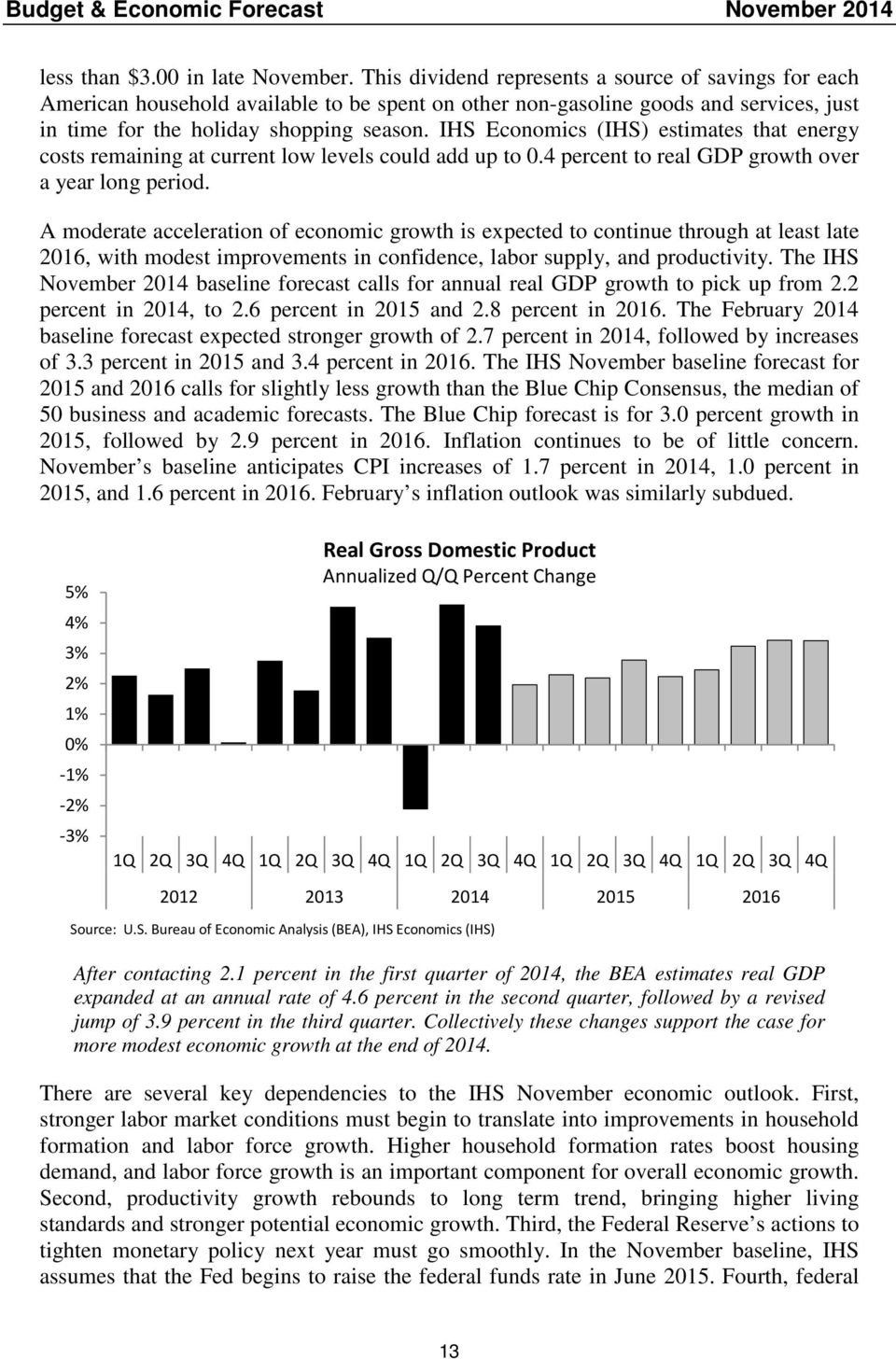
18 less than $3.00 in late November. This dividend represents a source of savings for each American household available to be spent on other non-gasoline goods and services, just in time for the holiday shopping season. IHS Economics (IHS) estimates that energy costs remaining at current low levels could add up to 0.4 percent to real GDP growth over a year long period. A moderate acceleration of economic growth is expected to continue through at least late 2016, with modest improvements in confidence, labor supply, and productivity. The IHS November 2014 baseline forecast calls for annual real GDP growth to pick up from 2.2 percent in 2014, to 2.6 percent in 2015 and 2.8 percent in The February 2014 baseline forecast expected stronger growth of 2.7 percent in 2014, followed by increases of 3.3 percent in 2015 and 3.4 percent in The IHS November baseline forecast for 2015 and 2016 calls for slightly less growth than the Blue Chip Consensus, the median of 50 business and academic forecasts. The Blue Chip forecast is for 3.0 percent growth in 2015, followed by 2.9 percent in Inflation continues to be of little concern. November s baseline anticipates CPI increases of 1.7 percent in 2014, 1.0 percent in 2015, and 1.6 percent in February s inflation outlook was similarly subdued. 5% 4% 3% 2% 1% 0% -1% -2% -3% Real Gross Domestic Product Nov'14 IHS Economics Baseline Annualized Q/Q Percent Change 1Q 2Q 3Q 4Q 1Q 2Q 3Q 4Q 1Q 2Q 3Q 4Q 1Q 2Q 3Q 4Q 1Q 2Q 3Q 4Q Source: U.S. Bureau of Economic Analysis (BEA), IHS Economics (IHS) After contacting 2.1 percent in the first quarter of 2014, the BEA estimates real GDP expanded at an annual rate of 4.6 percent in the second quarter, followed by a revised jump of 3.9 percent in the third quarter. Collectively these changes support the case for more modest economic growth at the end of There are several key dependencies to the IHS November economic outlook. First, stronger labor market conditions must begin to translate into improvements in household formation and labor force growth. Higher household formation rates boost housing demand, and labor force growth is an important component for overall economic growth. Second, productivity growth rebounds to long term trend, bringing higher living standards and stronger potential economic growth. Third, the Federal Reserve s actions to tighten monetary policy next year must go smoothly. In the November baseline, IHS assumes that the Fed begins to raise the federal funds rate in June Fourth, federal 13
19 fiscal policy remains in what IHS calls benign neglect, where lawmakers simply do no more harm, through at least early Finally, international economic and political risk must not cause undue damage. The events in Ukraine and the Middle East, as well as the slowing economies in Europe, Japan, and Brazil, heighten the forecast risk from the international trade sector. IHS assigns a 70 percent probability to February s baseline and 15 percent probabilities to more pessimistic and optimistic alternative scenarios, up from 60 percent and 20 percent respectively in February. In the pessimistic scenario, the U.S. economy stalls in late 2014 due to stagnant household formation and a weaker-than-expected housing market, just avoiding recession. In the optimistic scenario, oil prices decline more than in the baseline, while higher-than-expected foreign growth and associated depreciation of the dollar deliver a boost to the U.S. economy later this year. Consumer Spending. Stronger economic fundamentals for the consumer have provided welcome momentum in First, households have rebuilt a large share of the wealth lost during the recession, as home prices have increased rapidly and equities soared over the past few years. The Dow Jones industrial average and S&P 500, for example, set record highs in the past few months, and the Nasdaq surged to its highest level since Second, consumers have significantly reduced debt burdens. Third, average U.S. gasoline prices have continued to slide, dipping below $3 per gallon last month for the first time in four years. Lower gas prices provide an especially big bonus heading into the holiday shopping season. Finally, the job market is improving, which is boosting consumer confidence. Separate measures released by the Conference Board and the Reuters/University of Michigan show that confidence among U.S. consumers as at postrecession highs. These factors highlight a recovery that has accelerated since the weak beginning of the year. Looking ahead, the key to stronger consumer spending will be stronger average wage growth Reuters/University of Michigan Index of Consumer Sentiment Not Seasonally Adjusted, Index: 1966= '06 '08 '10 '12 '14 Source: Reuters/University of Michigan The Conference Board Consumer Confidence Index Index: 1985= '06 '08 '10 '12 '14 Source: The Conference Board The job market is improving, which is boosting consumer confidence. Separate measures released by the Conference Board and the Reuters/University of Michigan show that confidence among U.S. consumers as at post-recession highs. 14

20 Households have made significant progress toward rebuilding the wealth lost during the recession. The Federal Reserve s flow of funds report shows that household net worth (the value of assets such as homes, bank accounts and stocks, minus debts such as mortgages and credit cards) surpassed its precession peak in late 2012, thanks in large part to strong gains in the value of real estate and equity assets. However, after adjusting for inflation and population growth, real net worth per capita is only now returning to what it was just before nationwide home prices began to unravel in early Looking forward, the improving economy should continue to put upward pressure on asset prices. Gains in wealth will have a positive impact on spending growth. The national housing market is becoming a bit more balanced. Investor demand is waning, more home inventories are coming up for sale, and market fundamentals are beginning to drive price appreciation, which has decelerated from near double-digit percentage increases in The Federal Housing Finance Agency (FHFA) purchaseonly home price index rose 4.3 percent in the third quarter of 2014 from a year earlier, the slowest year-over-year pace since late IHS expects home prices to grow around 5 percent this year, before slowing in This improves affordability and boosts home sales. Over the forecast horizon, accelerating jobs gains, more inventory growth, and easing lending standards should help maintain more modest price gains of between 2 and 3 percent, which will help support consumer spending. Mortgage & Non-Mortgage Debt Percent of Disposable Income Household Financial Obligations Ratio Percent of Disposable Income 140% 120% 100% 80% '98 '00 '02 '04 '06 '08 '10 '12 '14 Source: Federal Reserve 19% 18% 17% 16% 15% 14% '80 '85 '90 '95 '00 '05 '10 Household debt burdens have fallen dramatically as income growth has outpaced payment growth. IHS Economics believes households are not as comfortable taking on as much debt as before, one factor cited as impeding the housing recovery. Record low debt service burdens also offer evidence of improving household finances. Consumers are taking on more non-mortgage debt, mainly in the form of lower-interest big-ticket items such as auto and student loans, but are still reluctant to take on more mortgage debt or run up large credit card bills for smaller discretionary purchases. The Federal Reserve reports that revolving credit outstanding, mostly credit card loans, was about $880 billion in the third quarter 2014, down nearly $140 billion (14 percent) from its mid-2008 peak and increasing little since Household debt burdens have fallen dramatically as income growth has outpaced payment growth. The Federal Reserve's 15

21 financial obligations ratio, which measures the share of monthly household financial commitments to disposable income, is at the lowest level since the early 1980s. Similarly, mortgage and non-mortgage consumer debt has fallen to the lowest share of disposable income since mid IHS believes households are not as comfortable taking on as much debt as before, one factor cited as impeding the housing recovery. Nonetheless, households stronger financial positions are expected to have a positive impact on consumer spending in The labor market continues to make steady progress. The U.S. economy has added an average of 229,000 jobs per month thus far in 2014, well above the 193,000 average gains recorded in Strong job gains this year have helped push the U.S. unemployment rate down to a new post-recession low of 5.8 percent in October, nearly 1- ½ percentage points less than the same month a year earlier. Unemployment has fallen across age and racial cohorts, and the number of long-term unemployed has declined sharply. However, the rate of involuntary part-time employment and the labor force participation rate remain very weak. The U.S. labor force participation rate has fallen steadily since the end of the recession and is now as low as it was in the late 1970s. Wage growth also remains modest relative to the growth in employment. The employment cost index, a broad measure of nominal wage and benefits compensation, has averaged only about 2 percent annual growth since the recession ended more than five years ago, while real compensation growth has remained flat. Average hourly earnings growth is also just basically keeping up with inflation. Employed Part Time for Economic Reasons Monthly, Seasonally Adjusted, Percent of Working-Age Population 5% 4% 3% 2% 1% 0% '78 '82 '86 '90 '94 '98 '02 '06 '10 '14 68% 66% 64% U.S. Labor Force Participation Rate Monthly, Seasonally Adjusted 62% '78 '82 '86 '90 '94 '98 '02 '06 '10 '14 Source: U.S. Bureau of Labor Statistics. (BLS) Ongoing slack in the labor market and the weak pace of wage growth have been the biggest constraints on consumer spending during the recovery. Ongoing slack in the labor market and the weak pace of wage growth have been the biggest constraints on consumer spending during the recovery. Real consumer spending grew at a 2.2 percent average annualized rate in the third quarter of 2014, near the 2.3 percent average rate since early 2010, but still well below the 3.0 percent average during the last expansion. IHS believes it will be difficult for consumer spending to gain more traction without strong and sustainable increases in average wages. Job growth in the next two years is not expected to match this year s gains, with 2015 more like 2013 than
22 But further tightening of labor market conditions begins to put upward pressure on wage growth. Total compensation is forecast to accelerate from 2.2 percent in 2014, to 2.8 percent in 2015 and 2.9 percent in Thus with average wage growth picking up, real consumer spending growth is expected to accelerate from 2.3 percent in 2014, to 2.8 percent in 2015 and 3.0 percent in 2016, led by autos and other big-ticket durable items. Business Investment. In the aftermath of the Great Recession, businesses responded to a sharp decline in demand by cutting back payrolls and boosting productivity. That quickly helped companies accumulate huge cash reserves, restore balance sheets, and boost profits to all-time highs. But as the recovery progressed, instead of investing those earnings in productivity-enhancing equipment, some companies have chosen to spend cash on share buybacks and dividends to improve shareholder income. As a result, business investment has not yet rebounded to its pre-recession share of the economy and labor productivity has stalled in the past few years. IHS estimates spending on capital equipment will represent 5.8 percent of GDP in 2014, up from a 4.5 percent low in 2009, but still well below the 6.5 percent average in the 20 years prior to the recession. Productivity growth in the U.S. has averaged less than 1 percent per year since 2011, compared to a 2.2 percent average over the past quarter-century. Non-Residential Investment in Equipment Share of Nominal GDP 8% 7% 6% 5% 5% 4% 3% 2% 1% Non-Farm Productivity Annual Percent Change 4% '86 '90 '94 '98 '02 '06 '10 '14 Source: U.S. Bureau of Economic Analysis (BEA) 0% '86 '90 '94 '98 '02 '06 '10 '14 Source: U.S. Bureau of Labor Statistics. (BLS) During the recovery, some companies have chosen to spend cash on share buybacks and dividends to improve shareholder income. As a result, business investment has not yet rebounded to its pre-recession share of the economy and labor productivity has stalled. Nonetheless, there are reasons to be optimistic about a pickup in business investment. Borrowing costs remain low, the nation s capital stock is aging, and factories are running closer to full capacity. Moreover, fiscal policy uncertainty has diminished, business confidence is trending higher, and the job market is improving, making new equipment spending more attractive. IHS Economics expects investment in equipment to pick up from 4.6 percent growth in 2013, to 6.3 percent growth in 2014, and advance near 6 percent through Real investment in intellectual property is similarly forecast to accelerate from 3.4 percent growth in 2013, to 4.0 percent growth in 2014, and maintain modest gains between 4 and 5 percent over the forecast horizon. Finally, rising capital 17
23 expenditures boost productivity, which is expected to accelerate from 0.7 percent growth in 2014, to 1.5 percent in 2015 and over 2 percent in 2016 and Industrial Production. Stronger business investment should give a boost to steadily improving manufacturing output. Recent survey results from the Institute of Supply Management (ISM) strongly suggest that the manufacturing sector remains in an expansionary phase. In the third quarter of this this year, ISM s manufacturing index was at its highest level since early 2011, with the new orders, production, and employment subcomponents all well above neutral. Other measures of manufacturing conditions such as factory orders and industrial production have showed similar strength. The Commerce Department reports that factory orders have continued a steady path of recovery since September Manufacturers new orders for core capital goods (nondefense capital goods excluding aircraft), a leading indicator for future capital expenditure growth, posted double-digit annualized growth in the second and third quarter of And the Federal Reserve s manufacturing output index has expanded at a 3.9 percent average annual pace during first 9 months of 2014, up from a 2.9 percent average rate in IHS Economics expects factory production to accelerate through the remainder of the year and into Overall, manufacturing output is expected rise 3.3 percent in 2014, before growing 2.7 percent in 2015 and 3.9 percent in Non-Defense Capital Goods Orders Excluding Aircraft Billions of Dollars, Seasonally Adjusted Source: U.S. Department of Commerce Manufacturers new orders for core capital goods (nondefense capital goods excluding aircraft), a leading indicator for future capital expenditure growth, posted double-digit annualized growth in the second and third quarter of Housing and Construction. The nation s housing recovery has remained persistently weak over the past year. Severe winter weather took a toll on housing markets at the start of 2014, and recent data show the pace of household formation has surprisingly slowed, despite an improving labor market. Household formation is a key driver of demand for housing. According to the latest data from the Census Bureau, the number of households in the U.S. rose by just 493,000 in the year ending in March 2014, far below the 1.2 million averaged in the three years before and the long-term trend of 1.1 million households. 18
24 IHS believes less household formation is related to the population aging into more stable and less mobile conditions, slower immigration, poor wage growth, and onerous student loan debts. In the November baseline, IHS expects annual household formation to rise to 696,000 in the first quarter of 2015 and to 1.09 million in the first quarter of Housing starts are estimated to increase by just 7.5 percent in 2014 (to 999,000), then by 19.8 percent in 2015 (to 1.20 million), and by 12.9 percent in 2016 (to 1.35 million). With the slowdown in housing starts this year, IHS estimates that real investment in residential construction will rise only 1.4 percent in 2014, down from 11.9 percent in 2013, before picking up speed, increasing 10.3 percent in 2015 and Growth in real spending on business structures, which contracted 0.5 percent in 2013, is expected to rebound by 7.7 percent in 2014, before rising 0.7 percent in 2015 and a modest 3.1 percent in U.S. Single-Family Housing Starts Millions of Units, Annual Rate 8 U.S. Sales of Existing Homes Millions of Units, Annual Rate '98 '00 '02 '04 '06 '08 '10 '12 '14 Source: U.S. Census Bureau 3 '98 '00 '02 '04 '06 '08 '10 '12 '14 Source: National Association of Realtors A recent slowdown in home sales and single-family housing starts is a direct reflection of surprisingly slow, recession-like household formation over the past year. Causes of the unexpected downshift include slower immigration, weak income growth, onerous student loan burdens, and an older and less mobile population. Fiscal Policy. Fiscal policy headwinds that have been holding back economic growth for much of the recovery are beginning to subside. Late last year, federal policymakers approved the Bipartisan Budget Act of 2013, a deal that established discretionary funding levels for two years, provided some temporary relief from the sequester, and avoided further cuts to defense spending. This agreement has helped stabilize the economic impact of tax and spending policy in 2014, as fading fiscal austerity from recent years is starting to support growth. Nevertheless, lawmakers again face a wide range of near-term fiscal deadlines and have yet to reach agreement on a sustainable and comprehensive solution to the nation s long-term debt challenges. Thus short and long-term fiscal risk factors remain. State, local, and federal fiscal policy has been a net drag on economic growth since the beginning of the recovery, through the withdrawal of massive amounts of fiscal stimulus, recent tax increases, and government spending reductions, including across-the-board 19
25 spending cuts from budget sequestration. Moody s Analytics estimates government spending cuts have shaved a full percentage point from annual economic growth since the end of In other words, if not for fiscal tightening, real GDP would have grown closer to 3 percent over the past three years, instead of averaging just over 2 percent annual growth. Nonetheless, the federal government s fiscal situation is improving, and austerity has been winding down in This should provide an additional boost to economic growth in 2015 and % 2% 0% -2% -4% Composition of U.S. Real GDP Year-Over-Year Percent Change -6% -8% Total Private Sector Government 1Q 2Q 3Q 4Q 1Q 2Q 3Q 4Q 1Q 2Q 3Q 4Q 1Q 2Q 3Q 4Q 1Q 2Q 3Q 4Q 1Q 2Q 3Q Source: U.S. Bureau of Economic Analysis (BEA) State, local, and federal fiscal policy has been a net drag on economic growth since the beginning of the recovery. However, the federal government s fiscal situation is improving, and austerity has been winding down in This should provide an additional boost to economic growth in 2015 and The short term fiscal risk factors are familiar. With the mid-term elections over, Washington lawmakers face a host of fiscal issues that need to be addressed in coming months. First, as of the time of this writing, the federal government is operating under a short-term Continuing Resolution (CR) that expires on December 11. The lame-duck Congress will need to pass another CR before that time or again risk shutting down the government. Second, in addition to passing a funding bill, time is running out for Congress to retroactively extend a bundle of tax credits and deductions that expired at the end of December 2013, including popular business tax breaks like accelerated depreciation, small business expensing, and the research and development tax credit. Third, sometime next spring the new Republican-controlled Congress will likely need to raise the statutory borrowing limit. While extension of the debt ceiling seems assured, failure to do so would lead to a massive fiscal contraction since the federal government could only spend as much as it collects in tax revenues. Fourth, the federal government injected $11 billion into the nearly empty Highway Trust Fund last August to keep road and mass transit spending going until May The Fund will need to be reauthorized before that time to prevent state and local governments from cutting back. Finally, lawmakers will soon need to decide whether to keep in place congressionally mandated spending caps, known as sequestration, which are set to return next October. Automatic 20
26 cuts to defense and domestic discretionary spending will take effect if appropriators allocate more money than allowed for by the caps. Washington lawmakers also still face serious long-term fiscal challenges. The federal government s near-term fiscal outlook has improved, largely due to an improving economy and a mix of fiscal tightening. The U.S. Treasury Department concludes that the federal government deficit shrank to $483 billion in fiscal year 2014, nearly $200 billion less than the shortfall from 2013, and now just 2.8 percent of nominal GDP. Last year s deficit represents a meaningful improvement from recent years, which reached almost 10 percent of GDP in But the Congressional Budget Office (CBO) projects that the budget gap between spending and revenues will begin to steadily widen again after 2015, as rising healthcare costs, an aging population, an expansion of federal subsidies for health insurance, and growing interest payments increase budgetary pressures in coming decades. Without broad-based structural changes to the tax code and entitlement programs, CBO projects higher annual deficits will lead to large and growing federal debt relative to the size of the economy. CBO warns that such high and rising debt could have serious negative economic consequences, eventually increasing the risk of a fiscal crisis. 120% Federal Debt Held by the Public Percentage of Gross Domestic Product 100% 80% 60% 40% 20% Actual Projected 0% Source: Congressional Budget Office (CBO) CBO projects that the federal deficit will stabilize over the next few years. But rising healthcare costs, an aging population, an expansion of federal subsidies for health insurance, and growing interest payments are expected to increase budgetary pressures in coming decades. IHS Economics has incorporated the discretionary spending levels from the Bipartisan Budget Act and assumes that no future government shutdowns will occur as a result of either budget or debt ceiling stalemates. The biggest cuts in federal government have passed, but the legacy of sequestration and budget caps persist. Partly as a result, government spending contributions to real GDP growth are slightly negative in 2014, though much smaller than in Going forward, IHS views federal fiscal policy as neutral, with nominal spending increases that are less than the general inflation rate through at least the end of There are no major changes expected to the Affordable Care Act. IHS continues to assume a grand bargain on tax and entitlement reform to 21
27 occur in 2017, after the 2016 presidential election. With federal government spending largely under control and tax revenues rising along with economic growth, IHS expects the federal deficit to hold steady at about $490 billion in fiscal year 2015 (2.7 percent of GDP) and fall to $428 billion in fiscal year 2016 (2.3 percent of GDP). Government spending is expected to start contributing to annual real GDP growth in 2015 for the time since 2010, as small negative contributions from federal government spending are offset by modest increases in state and local spending. Monetary Policy. Speaking at a news conference following a two-day Federal Open Market Committee (FOMC) meeting in mid-september, Federal Reserve Board Chairwoman Janet Yellen stated that the economy continues to make progress toward the Fed s goal of maximum employment and price stability. The economy has generated 10 million jobs since early 2010 and employment now exceeds its pre-recession peak by over 1.3 million. The unemployment rate has fallen nearly 1-½ percentage points over the past year and dipped below 6 percent in September for the first time since mid-2008, shortly before the 2008 financial crisis. 400 U.S. Non-Farm Payroll Employment Seasonally Adjusted Monthly Change, Thousands 3-Month Average Jan'11 July'11 Jan'12 July'12 Jan'13 July'13 Jan'14 July'14 Source: U.S. Bureau of Labor Statistics. (BLS) The economy continues to make progress toward the Fed s goal of maximum employment and price stability. Job gains have averaged a solid 229,000 per month so far this year, up from the 185,000 per month pace the preceding two years. These developments are encouraging, but Chairwoman Yellen has argued consistently throughout the summer that the sharp drop in the unemployment rate over the past year is only masking deeper problems in the labor market. Falling labor force participation, historically high levels of long-term unemployment, and elevated measures of underemployment, including those in part-time jobs who want full-time work, show there remains considerable slack in the labor market. That underutilization of labor is thought to be putting downward pressure on wages and prices. Total private average hourly earnings has risen only about 2 percent a year since the recession ended five years ago, while inflation-adjusted wages have been flat since early The Fed s preferred measure of inflation, the price index for core personal consumption expenditures, or PCE, rose just 1.5 percent over the last 12 months, and has been below the Fed s long-term objective of 2 percent inflation for more than two years. 22
28 5% 4% 3% 2% 1% U.S. Long-Term Unemployment Rate* Monthly, Seasonally Adjusted = U.S. Recession 0% * Percent of the labor force that has been unemployed for 27 weeks or more. Source: U.S. Bureau of Labor Statistics. (BLS) Falling labor force participation, historically high levels of long-term unemployment, and elevated measures of underemployment, including those in part-time jobs who want full-time work, show there remains considerable slack in the labor market. The combination of low inflationary pressures and weak labor market conditions has allowed the Fed to maintain highly accommodative monetary policies. Since late 2008, the FOMC has kept its benchmark interest rate close to zero and has sought to put downward pressure on long-term interest rates by purchasing and holding long-term securities, known as quantitative easing (QE), until there was substantial improvement in the job market. But in December 2013, FOMC policymakers judged that ongoing improvement in labor market conditions had warranted a modest reduction in the pace of its latest bond-buying program, also known as QE3. The Fed subsequently reduced its monthly assets purchases during each of the next seven consecutive meetings, before completely ending QE3 in October. In exchange for less bond buying, the Fed has strengthened its forward guidance on interest rates. At its meeting last March, the FOMC dropped the 6.5 percent unemployment rate threshold for raising interest rates, removing reliance on any one or two indicators in favor of a more comprehensive range of information, including measures of labor market conditions, indicators of inflation pressures and inflation expectations, and readings on financial developments. The new forward rate guidance pledges to keep interest rates low for a considerable time after the bond-buying program ends. In July, the FOMC changed its policy statement to note that a range of labor market indicators suggests there remains a significant underutilization of labor resources. And, in October, the Fed offered a more upbeat assessment of the labor market, striking its characterization of labor underutilization as significant and replacing it with gradually diminishing. IHS Economics believes the Fed is likely to keep its forward guidance vague so long as market and committee expectations remain in line. In the November baseline, the Federal Reserve begins to raise the federal funds rate in June 2015, consistent with FOMC 23
29 members assessment of the appropriate timing of policy firming. IHS believes that the tone of the Fed s latest policy statements has been decidedly dovish, and that the pace of interest rate hikes will be slow in 2015 and Global Economy. Global economic activity is slowly strengthening, but the outlook is diverging between major economies. Among advanced economies, the U.S., the United Kingdom, and Canada continue to improve at a healthy pace. But growth in Japan and the Eurozone this year has been weak. In emerging market economies, slower growth is the dominating factor. The Chinese economy is undergoing a structural adjustment that is expected to result in slower economic growth rates in the medium term. In other emerging market economies, like Brazil and Russia, weaker investment and currency values are weighing on growth. In Europe, the economic recovery remains disappointing. Growth has weakened, most notably among the largest countries: Germany, France, and Italy. Unemployment across the Eurozone is still stubbornly high, with the jobless rate among youth near 25 percent on average. The region is also experiencing a sustained period of excessively low inflation. The CPI inflation in the euro zone increased a mere 0.3 percent in the 12 months ending in September, the lowest since 2009 and well below the European Central Bank s (ECB) target of just below 2 percent. Excessively low inflation makes it more difficult for troubled nations on the Eurozone's periphery, such as Greece and Portugal, to achieve the relative price adjustments needed to regain competitiveness without having to withstand a protracted period of weak growth and high unemployment. Inflation near zero also raises the risk of slipping into outright deflation, which could cause consumers and businesses to delay purchases, destabilize already high debt burdens, and prolong economic stagnation. 5% 4% 3% 2% 1% 0% Eurozone Consumer Price Index (CPI) Year-over-Year Percent Change, Harmonized Indices (HICPs) -1% '05 '06 '07 '08 '09 '10 '11 '12 '13 '14 Source: Eurostat, European Commision The Eurozone is experiencing a sustained period of excessively low inflation. The CPI inflation in the euro zone increased a mere 0.3 percent in the 12 months ending in September, the lowest since With the Eurozone economy on the cusp of a third recession in six years, tensions between European leaders appear to be only deepening. Europe's strongest economy, Germany, continues to insist that austerity policies are a pre-condition to financial stability. But critics of austerity, including France and Italy, contend that the fiscal 24
30 discipline meant to curb deficits and restore growth is instead suppressing demand and stifling the recovery. Thus, progress toward dealing with the financial and structural challenges that face the Eurozone has remained limited, placing added pressure on the ECB to act more aggressively. In September, the ECB cut its key interest rates to new alltime lows and introduced new stimulus plans to keep low inflation from derailing the Eurozone s weak economy. In November, ECB President Mario Draghi said the central bank would be open to more drastic measures to prevent the Eurozone from sliding into deflation, including large-scale purchases of sovereign bonds. IHS expects Europe s recovery to be slow and bumpy. In the November baseline, real GDP growth in the Eurozone is projected to rise just 0.8 percent in 2014 and 1.4 percent in In Japan, a nationwide sales tax increase that took effect in April has tripped the country back into recession, the country s fourth since Prime Minister Shinzo Abe's new economic strategy, known as Abenomics, promises to embrace a bold policy mix of aggressive monetary easing, massive fiscal stimulus, and growth-oriented structural reforms in an attempt to reverse more than a decade of economic stagnation and chronic deflation. The Bank of Japan s (BOJ) highly simulative policies since early 2013 temporarily helped weaken the Japanese yen, strengthen exports, revive business sentiment, and boost demand and prices. Inflation rose in 2013 for the first time since 2008, the unemployment rate hit a 16-year low earlier this year, and Japan s real GDP grew 1.5 percent in 2013, up slightly from 1.4 percent in However, the adverse impacts of a consumption tax hike earlier this year meant to rein in public debt were more severe than expected. Japan s real gross domestic product fell at an annual rate of 7.3 percent in the second quarter of 2014 following, followed by 1.6 percent contraction in the next quarter. Price weakness this year is also causing problems for the BOJ, which unexpectedly announced that it would buy larger quantities of government debt in late October. 15% 10% 5% 0% -5% -10% -15% -20% Japan Real Gross Domestic Product Annualized Q/Q Percent Change 1Q 2Q 3Q 4Q 1Q 2Q 3Q 4Q 1Q 2Q 3Q 4Q 1Q 2Q 3Q 4Q 1Q 2Q 3Q 4Q 1Q 2Q 3Q 4Q 1Q 2Q 3Q 4Q 1Q 2Q 3Q Source: Economic and Social Research Institute, Cabinet Office, Government of Japan A nationwide sales tax increase that took effect in April has tripped Japan back into recession, the country s fourth since
31 The Abe government has postponed a second and final phase of the sales tax hike that was set for the fall of 2015 by 18 months, until April 2017, and called a snap election for December. In the November baseline, IHS Economics expects real GDP in Japan to rise 1.0 percent in 2014 and 1.1 percent in The longer-term outlook will depend on progress with the government s growth-oriented structural reforms, mainly deregulation of the labor market. The initiative is intended to stoke inflation and keep borrowing costs low and encourage spending. In China and other major emerging market economies, the pace of economic growth has cooled. China s real GDP rose 7.7 percent in 2013, much faster than any advanced economy, but the weakest performance for the world's second largest economy in 14 years. In 2014, the Chinese government has set an official economic growth target of 7.5 percent. Chinese policymakers are attempting to reduce the risk of a sharp and prolonged slowdown, or hard landing, by deliberately steering the economy away from its heavy reliance on exports and credit-fueled investment toward more balanced and sustainable consumer-led growth. The International Monetary Fund (IMF) believes this shift will continue to require structural reforms to the financial sector, state-owned enterprise, and local government, as well as a more market-based exchange rate system. This tradeoff is likely to result in slower economic growth rates in the medium term. IHS Economics expects real GDP growth in China to moderate to a more sustainable pace of 7.0 percent in % 14% 12% 10% 8% 6% 4% 2% 0% China Real Gross Domestic Product Annual Percent Change '92 '94 '96 '98 '00 '02 '04 '06 '08 '10 '12 '14* * Chinese Government 's official growth target: 7.5% Source: The World Bank; International Monetary Fund (IMF) Chinese policymakers are attempting to reduce the risk of a sharp and prolonged slowdown, or hard landing, by deliberately steering the economy away from its heavy reliance on exports and credit-fueled investment toward more balanced and sustainable consumer-led growth. Meanwhile, other major emerging market economies, such as India and Mexico, are experiencing a slight improvement in 2014, as optimism about economic reforms and progress to control inflation are contributing to better growth. In Russia and Brazil, however, a major slowdown is reflected by weak investment, high inflation, and currency devaluation. Russia s economy is balancing on the edge of a fresh recession, further affected by tighter Western sanctions due to the political situation in Ukraine and sagging 26
32 oil prices. And Brazil fell into recession in the first half 2014, as weak competitiveness, low confidence, and uncertainty about this year s presidential elections have also constrained growth. IHS Economics expects economic growth of the United States major-currency trading partners to pick up slightly in 2015 and 2016, with stronger growth in the Canada and Europe. The economies of other important trading partners, such as Mexico, Brazil and India, are also expected to grow faster over the next two years. IHS assumes world real GDP will increase 2.7 percent in 2014, before accelerating to 3.1 percent growth in 2015 and 3.6 percent growth in Likewise, U.S. export growth is expected to rise 3.3 percent in 2014, 2.9 percent in 2015 and 4.3 percent in Net trade, however, will remain a drag on growth as imports pickup from an improving U.S. economy. Inflation. The Bureau of Labor Statistics (BLS) reports its headline inflation measure, the Consumer Price Index (CPI), has risen 1.8 percent thus far in 2014 (measured thirdquarter to third quarter), up from just 1.5 percent during the same period in Weaker prices for energy commodities, such as gasoline, have helped offset rising prices for rent and food. Sluggish global demand and increasing supplies in the U.S. have put downward pressure on crude oil prices, as retail gasoline prices in particular are about $0.32/gallon lower than last year and $0.52/gallon below two years ago. Food prices are on the rise, as disease and ongoing drought conditions are driving up prices for many agricultural goods. Pork prices have jumped sharply this year, hurt by a viral epidemic that has been killing off piglets. And, according to the U.S. Department of Agriculture (USDA), the ongoing drought in states such as Texas, Oklahoma, and California has helped reduce the overall U.S. cattle herd to its smallest size in over 60 years. As a result, the USDA estimates that the CPI for meat prices will rise as much as 7 percent in 2014, with higher increases projected for beef and pork. Overall grocery prices are estimated to rise up to 3.5 percent this year. Over the past 10 years, food prices have risen by an average of 2.7 percent, compared to 2.2 percent for all goods and services Retail Gasoline Prices All Grades, All Formulations, Dollars per Gallon 2.00 July-09 Jan-10 July-10 Jan-11 July-11 Jan-12 Jul-12 Jan-13 Jul-13 Jan-14 Jul-14 Source: U.S. Department of Energy Sluggish global demand and increasing supplies in the U.S. have put downward pressure on crude oil prices, as retail gasoline prices in particular are about $0.32/gallon lower than last year and $0.52/gallon below two years ago. 27
33 Underlying inflation pressures remain cool. Excluding more volatile prices of food and energy, the core CPI is up 1.8 percent in 2014 (third-quarter to third quarter), a slight increase from 1.7 percent the year before. Rents have continued to climb at a strong pace. The cost of shelter, which includes rents, has extended its steady ascent, rising 2.9 in 2014, compared to 2.4 percent in But an easing of other services, such as medical care, and goods prices have helped more than offset the acceleration in rents. The CPI for medical care services has eased to 2.1 percent in 2014, after increasing 2.9 percent in The CPI for apparel is up 0.3 percent in 2014, compared to 1.4 percent in And finally, the BLS index for new and used vehicles has been virtually flat for the last three years. Overall, the near-term outlook for consumer prices remains quiet. IHS Economics believes the prospects for stabilizing meat prices are good, but it will take time to rebuild herds. In the meantime, their forecast of headline prices is little different from the experience of the last two years, other than that going to the meat department has become as traumatic as going to the gas station used to be. In the November baseline, IHS expects the headline CPI to increase 1.4 percent (measured fourth-quarter to fourthquarter) in 2014, 1.3 percent in 2015, and 1.7 percent in IHS expects Core CPI inflation to accelerate slightly from 1.8 percent in 2014, to 1.9 percent in 2015 and 2016, or nearer the Federal Reserve s 2 percent longer run objective. 6% 4% 2% 0% Consumer Price Inflation Indexes Year-Over-Year Percent Change Actual Projected -2% -4% CPI Core CPI (excludes food & energy) '05 '06 '07 '08 '09 '10 '11 '12 '13 '14 '15 '16 Source: U.S. Bureau of Labor Statistics (BLS), IHS Economics (IHS) Weaker prices for energy commodities, such as gasoline, have helped offset rising prices for rent and food. The near-term outlook for consumer prices remains quiet. 28
34 Minnesota Economic Outlook Minnesota s expansion continues to make steady progress. The Bureau of Economic Analysis (BEA) reports the state s real GDP rose 2.8 percent in 2013, a full percentage point faster than the nation, and most indicators suggest the labor market has tightened up considerably in Minnesota s jobless rate dropped to 3.9 percent in October, the fifth lowest among states and matching the low point of the previous economic expansion. Unemployment has fallen across age, gender, and racial cohorts. The number of long-term unemployed and the rate of involuntary part-time employment have fallen sharply as well. However, Minnesota s labor force growth remains very weak and wage pressures have yet to emerge. Moreover, the state s housing recovery has stalled in part due to unexpectedly slow household formation. As a result, MMB s Minnesota economic outlook has weakened since it was last prepared in February. Forecasts for state employment and wages have been revised based on recent Minnesota specific information and IHS Economics November 2014 baseline. The November baseline informed a newly re-estimated Minnesota Management and Budget (MMB) model of the Minnesota economy. That model has incorporated preliminary information on revisions to Minnesota s non-farm payroll employment and income tax withholding collections. MMB s November 2014 economic forecast calls for Minnesota s expansion to continue to accelerate over the next several years, but at a slower pace than the national average. Employment growth is expected to remain modest in 2015 and 2016, and the pace of wage growth is projected to steadily pick up steam. This reflects improvements in household formation and labor force growth, a rebound in labor productivity, and stronger consumer and business fundamentals in the broader U.S. economy. 4% 3% 2% 1% 0% -1% Minnesota Labor Force Growth Annual, Percent Change '78 '82 '86 '90 '94 '98 '02 '06 '10 '14 Minnesota Labor Force Participation Rate Monthly, Seasonally Adjusted 78% 76% 74% 72% 70% 68% 66% '78 '82 '86 '90 '94 '98 '02 '06 '10 '14 Source: Minnesota Department of Employment and Economic Development (DEED) Minnesota s labor force growth remains very weak and the labor force participation rate continues to wane. As a result, MMB s Minnesota economic outlook has weakened since it was last prepared in February. 29
35 Minnesota total non-farm employment rose a more modest 1.4 percent in 2014, following a 1.7 percent increase in In MMB s November 2014 economic forecast, Minnesota employment growth is forecast to maintain a similar pace of 1.7 percent in 2015 and 1.5 percent growth in In February 2014, MMB s forecast called for similar job growth of 1.6 percent in 2014, followed up by stronger gains of 2.2 percent in 2015 and 2.1 percent in MMB s employment forecast for 2015 and 2016 is similar to IHS Economics November 2014 baseline forecast for U.S. job growth, which calls for 1.4 percent growth in 2014, followed by 1.9 percent growth in 2015 and 1.5 percent growth in Nominal wage income grew 3.1 percent in 2013, dampened by what appears to be an accelerated payout of bonuses and exercising of options in late 2012 ahead of anticipated federal tax increases. Information from the BEA, Quarterly Census of Employment and Wages (QCEW) and income tax withholding collections suggests wage growth rebounded to 3.9 percent in 2014, weaker than the 5.0 percent growth expected in February. Wage income is now expected to accelerate to 4.4 percent growth in 2015 and 4.6 percent growth in In February, MMB s forecast called for stronger growth of 5.3 percent in 2015 and 5.2 percent in IHS Economics November 2014 baseline forecast for U.S. wage income calls for growth of 4.9 percent in 2014, followed by 4.8 percent growth in 2015 and MMB s Minnesota economic forecast assumes that IHS Economics November 2014 baseline forecast of the U.S. economy materializes. Any unanticipated adverse developments in the U.S. economy, such as a longer than expected downshift in U.S. productivity, labor force growth, or household formation, will have unfavorable effects on the Minnesota economy. Minnesota Average Nominal Wage and Salary Disbursement Annual Percent Change, Ratio of Total Wage and Salaries to Total Employment 6% 4% MMB Nov'14 Forecast Inflation (CPI) 2% 0% -2% '96 '98 '00 '02 '04 '06 '08 '10 '12 '14 '16 '18 Source: Buearu of Economic Analysis (BEA); Minnesota Department of Employment and Economic Development (DEED); Minnesota Management & Budget (MMB) Minnesota s jobless rate dropped to 3.9 percent in October, matching the low point of the previous economic expansion. However, Minnesota s labor force growth remains very weak and wage pressures have yet to emerge. 30
36 Forecast Comparison: Minnesota & U.S. Forecast 2014 to 2019, Calendar Years Blank Total Non-Farm Payroll Employment (Thousands) Minnesota Blank Blank Blank Blank Blank Blank Blank Blank November ,731 2,778 2,818 2,864 2,908 2,941 2,967 2,989 %Chg February , , , , , , , ,047.7 %Chg U.S. Blank Blank Blank Blank Blank Blank Blank Blank November , , , , , , , ,651 %Chg February , , , , , , , ,458 %Chg Wage and Salary Disbursements (Billions of Current Dollars) Minnesota Blank Blank Blank Blank Blank Blank Blank Blank November %Chg February %Chg U.S. Blank Blank Blank Blank Blank Blank Blank Blank November ,932 7,125 7,476 7,831 8,210 8,631 9,058 9,504 %Chg February ,927 7,138 7,435 7,837 8,254 8,666 9,060 9,449 %Chg Non-Wage Personal Income (Billions of Current Dollars) Minnesota Blank Blank Blank Blank Blank Blank Blank Blank November %Chg February %Chg U.S. Blank Blank Blank Blank Blank Blank Blank Blank November ,956 7,042 7,290 7,573 7,960 8,448 8,884 9,323 %Chg February ,817 6,996 7,261 7,609 8,025 8,507 8,979 9,441 %Chg Total Personal Income (Billions of Current Dollars) Minnesota Blank Blank Blank Blank Blank Blank Blank Blank November %Chg February %Chg U.S. Blank Blank Blank Blank Blank Blank Blank Blank November ,888 14,167 14,766 15,404 16,170 17,079 17,943 18,827 %Chg February ,744 14,133 14,696 15,446 16,278 17,173 18,039 18,889 %Chg Source: IHS Economics and Minnesota Management and Budget (MMB) 31
37 Employment. The latest employment news remains positive. According to October s employer survey released by the Minnesota Department of Employment and Economic Development (DEED), the state added almost 50,000 net new jobs, or 1.8 percent, in the past year, slightly less than the national rate of 2.0 percent. The private sector has added 46,000 jobs, or 1.9 percent, short of the national rate of 2.3 percent. Those employment gains continue to be broad based, particularly in the goods-producing sector. Minnesota has benefitted from the oil and gas boom in neighboring North Dakota, which has helped boost parts of construction, mining, and manufacturing activity. Strength in Minnesota factories has been led by fabricated metal products and transportation equipment. The state s overall improved performance, however, is largely a reflection of its welleducated workforce, a diverse economic base, and the presence of several large corporate headquarters. +3.3% +3.4% +1.9% Minnesota Employment Change by Industry October 2013 to October ,000 5, % +2.0% +0.9% +1.1% +1.3% +0.3% +1.7% +8.6% +0.5% 0 0.0% -5, % Source: Minnesota Department of Employment and Economic Development (DEED) Minnesota s employment gains continue to be broad based, particularly in the goodproducing sector. Minnesota has benefitted from the oil and gas boom in neighboring North Dakota, which has helped boost parts of construction, mining, and manufacturing. Each year DEED realigns Minnesota s monthly, sample-based employment estimates with state unemployment insurance (UI) tax records filed by nearly all employers, a process referred to as benchmarking. Based on UI records for the first quarter of 2014, MMB estimates that currently published total nonfarm employment through March 2014 will be revised downward by about by 0.3 percent, or about 7,000 jobs, when annual benchmark revisions are released in the spring. For comparison, the Bureau of Labor Statistics (BLS) preliminary estimate of the upcoming annual benchmark revision indicates an upward adjustment to March 2014 total nonfarm employment of less than 0.05 percent. Once incorporated, these benchmark revisions are likely to demonstrate that Minnesota employment will to have grown at about the same pace as the U.S. on an annual basis in 2013 and about 0.4 percent slower than the national average in
38 Economists at MMB believe this relative underperformance to be consistent with the state returning to full employment before the U.S. Minnesota Management and Budget s November 2014 economic forecast calls for revised employment growth of 40,900 in 2014 (measured fourth quarter to fourth quarter), down from 45,600 in 2013 and 44,200 in The prospects for 2015 are somewhat stronger, with job gains rising to 47,200, led by construction, healthcare, and professional and business services. Employment growth slows again in 2016 and 2017 due to accelerating labor productivity gains, which hold down job growth. Labor Market Slack. Minnesota s labor market has tightened up considerably in Steady job growth has helped push Minnesota s unemployment rate down almost a full percentage point in the past year, to 3.9 percent in October. This matches the low point of the previous economic expansion and resembles what MMB economists consider healthy. DEED reports unemployment has fallen across age, gender, and racial cohorts. The number of officially long-term unemployed (6 months or longer) is less than half what it was in mid-2010, and the rate of involuntary part-time employment has fallen sharply as well. Fewer people being laid off also suggest that labor market conditions are tightening. According to DEED, the number of Minnesotans filing new claims for unemployment benefits, generally barometer of short-term labor market trends, has averaged about 18,000 (seasonally adjusted) per month since May, down from a recessionary peak of nearly 44,000 during the summer of 2009 and back to levels not seen since the late 1990s, after adjusting for population growth. 50 Minnesota Initial Claims for Unemployment Insurance Thousands, Seasonally Adjusted '95 '97 '99 '01 '03 '05 '07 '09 '11 '13 Source: Minnesota Department of Employment and Economic Development (DEED) Fewer people being laid off also suggest that labor market conditions are tightening. The number of Minnesotans filing new claims for unemployment benefits has dropped to levels not seen since the late 1990s, after adjusting for population growth. 33
39 Other leading indicators, such average hours worked, temporary help employment, and job vacancies are also at levels consistent with a firming labor market. The average workweek in the private sector, for instance, has risen to all-time highs (dating back to 2008) in Temporary help jobs, often a bellwether of employment growth, have settled in to healthy growth path. Finally, in early October, DEED reported that the number of job vacancies in Minnesota reached a 13-year high during the second quarter of Employers registered about 85,000 openings, up almost 17 percent from a year earlier. That worked out to about 1.6 unemployed people for each vacancy last spring, down from 2.1 a year earlier and the lowest ratio observed since late Minnesota Leading Indicators 40% 20% -40% Jan-08 Jan-10 Jan-12 Jan-14 Job Vacancies Thousands % -20% Temporary Help Employment Year-Over-Year Percent Change Private Workweek Average Hours Worked Jan-08 Jan-10 Jan-12 Jan Unemployment Thousands '05 '06 '07 '08 '09 '10 '11 '12 '13 '14 Jan-07 Jan-09 Jan-11 Jan-13 Source: Minnesota Department of Employment and Economic Development (DEED) Minnesota s leading employment indicators, such average hours worked, temporary help employment, and job vacancies are at levels consistent with a firming labor market. Despite recent momentum, wage growth remains modest. The average hourly wage rate for all private sector employees in Minnesota has averaged only about 2 percent annual growth since the recession ended more than five years ago, while real hourly compensation growth has been flat. The state s labor force participation rate also remains very weak. The portion of working-age Minnesotans who have or are looking for a job has dropped from about 72 percent near the start of the recession in December 2007, to just below 70 percent this past October, a 34-year low. People generally leave the labor force for two reasons: because they have retired or grown increasingly discouraged with employment prospects and stopped looking for work. DEED figures show that the number of discouraged workers in Minnesota has fallen close to normal, pre-recession 34
40 levels this year, and remains below 10,000, suggesting much of the drop in labor force participation is more likely a result of demographic forces related to Minnesota s aging population. Indeed, between 2007 and 2013, the number of retired Minnesotans age 65 and older drawing social security benefits rose by about 114,000, a labor force exodus that could account for about a 1.5 percentage point drop in the state s labor force participation rate compared to previous trends. In addition, it appears teens and young adults have increasingly chosen to stay in or return to school rather than face the difficult job market, a trend that predates the Great Recession. In the November 2014 economic forecast, Minnesota s labor market inches closer to its full potential over the next few years. The state s unemployment rate is likely to decline further in coming months as more slack in the job market is taken up by an improving economy. Better economic fundamentals nationally and in Minnesota also support an upturn in productivity, and thereby an acceleration in wage growth. Improved job prospects and faster wage growth encourage some people to reenter the labor force, thus slowing the decline in Minnesota s labor force participation rate throughout much of the forecast horizon. As a result, annual labor force growth is assumed to pick up steadily, from an average of just 0.2 percent between 2010 and 2013, to 0.5 percent in 2014, to an average of about 0.8 percent between 2015 and Beyond that, Minnesota s labor market settles into full employment, and job growth becomes increasingly constrained to the market supply of labor. Thus, barring sizeable increases in domestic and international migration or an unexpected pick up in labor force participation, MMB economists believe annual job growth in the medium-term may be constrained to increases of only 10,000 to 25,000 jobs. By comparison, actual employment has increased an average of about 45,000 in the past three years. Economists at MMB believe that without sustainable, short-term improvements in supply of labor, such as notable deceleration in falling participation rates, Minnesota s economy is unlikely to perform as forecast. Minnesota Total Non-Farm Employment Seasonally Adjusted Thousands of Jobs 3,000 Feb'14 MMB Forecast 2,900 Nov'14 MMB Forecast 2,800 2,700 2,600 2, F 16F Source: Minnesota Department of Employment and Economic Development (DEED), Minnesota Management & Budget (MMB) MMB s Minnesota economic outlook has weakened since it was last prepared in February, reflecting weaker than expected labor force growth and household formation. 35
41 Housing. Minnesota s housing recovery appears to have stalled. Housing activity lost some momentum at the start of the year, in part due to severe winter weather and waning investor demand. But MMB economists believe persistently weak home sales and singlefamily permits in Minnesota over the past 18-months may be a direct reflection of surprisingly low household formation. Last September, the U.S. Census Bureau released the American Community Survey s (ACS) 2013 estimate of the number of households in Minnesota. Measuring the number of households is difficult and full of uncertainties, especially at the state-level, but the 1- year ACS estimate found only 8,000 net new households were added in the 12-months ending on July 1, 2013, far fewer than the 15,000 the year before and the long-term annual trend of 24,000 households. The causes appear to be attributable to a less mobile and more stable aging population, slower immigration, and more young adults sharing homes due to a sluggish job market and heavy student loan debts. Household formation is a key driver of demand for housing. Slower formation restrains housing sales and starts. Thus the sharp slowdown in the past year helps explain why Minnesota s housing recovery has recently been sluggish, despite an improving labor market. In the Twin Cities area, for instance, the Minneapolis Area Association of Realtors (MAAR) reports closed sales have unexpectedly declined 7.1 percent during the first 10 months of 2014 relative to the same period last year. Likewise, the Census Bureau reports the total number of authorized residential building permits in Minnesota is on pace to improve only marginally in 2014, to 17,300, compared to 2013, when housing permits totaled 16,800 and the long-term annual trend of 30,000 permits. This small improvement is dominated by the multifamily sector. Single-family permitting is actually on pace to fall to 10,400 this year, from 10,600 last year. Minnesota Single-Family Housing Permits Monthly, Seasonally Adjusted, 3 Thousands of Permits ,000 60,000 50,000 40,000 Twin Cities Closed Sales 12-Month Moving Sum 0 30,000 Source: U.S. Census Bureau Source: Minneapolis Area Association of Realtors (MAAR) MMB economists believe persistently weak home sales and single-family permits in Minnesota over the past 18-months may be a direct reflection of surprisingly low household formation. 36
42 In MMB s November 2014 forecast, annual household formation is expected to rise to 16,000 in the third quarter of 2014, to 27,000 in the third quarter of 2015, and to 33,000 in the third quarter of 2016, consistent with improving economic fundamentals nationally and in Minnesota. In February 2014, household formation was forecast to rise at a much faster pace, to 32,000 in the third quarter of 2014, to 30,000 in the third quarter of 2015, and to 28,000 in the third quarter of With inventories at historic lows and demand for new home construction steadily improving, permits are similarly expected to continue strengthening. Total housing permits are estimated to increase by just 3.1 percent in 2014 (to 17,300), then by 17.5 percent in 2015 (to 20,400) and 10.8 percent in 2016 (to 26,400). In February 2014, housing permits were forecast to rise at a faster pace to 23,000 in 2014, followed by 28,000 in 2015 and 30,000 in The employment rebound in construction generally lags the recovery in building permits by between 6 and 9 months, thus a partial catch up period is assumed in the forecast. In the November 2014 forecast, construction employment growth is forecast add 6,300 jobs (or 6.3 percent) measured fourth quarter to fourth quarter in 2014, 5,800 jobs (5.3 percent) in 2015, and 3,200 jobs (2.8 percent) in In February 2014, construction employment growth was forecast to be slightly stronger, rising 5.9 percent in 2014, 6.4 percent in 2015, and 3.0 percent in Economists at MMB believe that if the housing recovery stalls during the first half of 2014 or household formation rates slow during the year as a result of weaker labor market conditions, Minnesota s economy is unlikely to perform as forecast Minnesota Household Formation and Total Housing Permits History and MMB Forecast, Thousands of Units/Permits MN Total Housing Permits Authorized (Single+Multi) MN Household Formation '92 '94 '96 '98 '00 '02 '04 '06 '08 '10 '12 '14F '16F '18F Source: U.S. Census Bureau; Minnesota Management and Budget (MMB) The sharp slowdown in household formation in 2013 helps explain why Minnesota s housing recovery has recently been sluggish. Causes appear to be attributable to a less mobile and more stable aging population, slower immigration, and more young adults sharing homes due to a sluggish job market and heavy student loan burdens. 37
43 Council of Economic Advisors Statement Minnesota s Council of Economic Advisors (CEA) met on November 10, 2014 to review the IHS Economics (IHS) projections for U.S. economic growth, and thereby underlying assumptions on which Minnesota s November 2014 Budget and Economic Forecast is based. They noted that since February, IHS has lowered their growth expectations for each year from 2014 to The largest changes occur in the earlier years, with the forecasts for 2014 to 2016 reduced about half a percentage point per year. In February, IHS expected real GDP to grow at an annualized rate of 1.9 percent in the first quarter of 2014, in what they described as a distinct slowdown from growth in the second half of In fact, the Bureau of Economic Analysis (BEA) now reports that GDP contracted at a 2.1 percent annual rate at the beginning of In addition to the unexpected first quarter contraction, IHS attributes their lower growth expectations in 2014 and 2015 to surprisingly weak household formation that has dampened their housing market outlook. IHS s November 2014 baseline is similar to that of other macroeconomic forecasters. The November Blue Chip Consensus forecast of 2.2 percent growth in 2014 matches IHS s forecast. For 2015, IHS expects slower growth than the consensus: 2.6 percent compared to 3.0 percent for Blue Chip. In October Blue Chip reported long-range consensus forecasts for For each year in the remainder of the forecast horizon, the IHS growth forecast is in the middle range of the forecasts making up the consensus U.S. Real GDP Forecast Scenarios Annual Percent Change Optimistic Baseline Pessimistic Source: U.S. Bureau of Economic Analysis (BEA), IHS Economics (IHS) Minnesota s Council of Economic Advisors agreed that IHS Economics baseline expectations for U.S. economic growth serve as a reasonable starting point for producing MMB s November 2014 Budget and Economic Forecast. 38
44 Council members agreed that the contraction in the first quarter of 2014 was primarily due to one-time factors, such as inventory adjustments and bad weather, which have since resolved. For example, they noted that recent job growth has been solid, with the economy adding a monthly average of 227,000 jobs since the start of the year, compared to 194,000 per month over Council members acknowledged risks to U.S. growth over the forecast period. A persistently weak European economy, international political disruptions, and continued sluggish U.S. wage growth can all lead to lower-than-forecast economic performance. On the other hand, sustained low energy prices and a stronger housing market could bring about faster growth than IHS expects. All members agreed that IHS s baseline expectations for U.S. growth are reasonable. Regarding forecast risks, they believe that for , the potential for faster growth exceeds the threat of the economy growing more slowly than IHS predicts. They also think that the difficulty of projecting long range economic conditions warrants caution when using forecasts for 2018 and As it has done every year since 2003, the CEA recommends that budget planning estimates for the next biennium include expected inflation in both the spending and revenue projections. The CEA noted that Minnesota s current practice of excluding inflation from the spending estimate is fundamentally misleading. It is inconsistent with both sound business practices and CBO methods and potentially encourages legislators and the public to regard the state s financial position more optimistically than the facts warrant. The omission of inflation in the spending estimates in the February 2014 Budget and Economic Forecast understated projected spending for FY by more than $1 billion, and thus made the difference between projected revenues and spending appear to be larger than it actually is. This distortion will increase if and when inflation accelerates from current historically low levels. Council members noted that actions taken during the 2014 legislative session and signed into law by the governor significantly strengthen Minnesota s budget reserve policy. Nevertheless, the state s funded budget reserve remains well below the level bond rating agencies expect from AAA-rated credits. State bond ratings depend on a number of factors, but both Standard and Poor s and Moody s specifically include a measure of the adequacy of statutory budget reserves in their credit analyses. In Standard and Poor s analytical framework, states with statutory reserve levels of 8 percent or more of annual general fund revenue or spending receive top marks. Moody s ratings guidelines indicate that Aaa-rated states should have statutory reserves of at least 10 percent of current revenue. Minnesota s current $811 million budget reserve is about 4.0 percent of projected fiscal year 2015 revenues. If the cash flow account ($350 million) is included, reserves are about 5.9 percent of annual revenues. 1 1 These figures reflect the levels of reserves and projected revenues at the time of the Council meeting on November 10, With the subsequent release of the November 2014 Budget and Economic Forecast, the values have been updated. 39
45 BUDGET OUTLOOK Current Biennium The last Budget & Economic Forecast was released in February It projected a $1.233 billion forecast balance in the current biennium. Actions in the 2014 legislative session included tax reductions, spending changes, capital project funding and a transfer to the budget reserve that left a projected $32 million balance at the end of the biennium and $1.161 billion in the state s cash flow and budget reserve accounts. November s forecast shows a slight improvement in the state s financial position with seven months remaining in the biennium. Forecast revenues are now expected to be $ billion, up $279 million (0.7 percent) from estimates at the end of the 2014 legislative session in May. Biennial spending is now projected to be $ billion, a decline of $249 million (0.6 percent) from prior estimates. A small increase in the stadium reserve of $5 million offsets the spending and revenue changes leaving a forecast balance of $556 million. However, statute automatically allocates 33 percent of a positive budgetary balance in the current biennium to the budget reserve account. After $183 million is transferred to the budget reserve, the available balance at the end of the current biennium is projected to be $373 million. FY 2014 Close. In August, the books were officially closed for the fiscal year that ended June 30, FY 2014 ended with a general fund balance of $656 million, $367 million above previous estimates. This gain, representing money in the bank, accounts for about two thirds of the change in the forecast for the current biennium. FY 2014 total revenues, transfers and other resources were $219 million higher than previously forecast. Final non-dedicated revenues, both taxes and non-tax revenue, were $185 million higher. Much of the increase in the revenue for FY 2014 is due to higher income tax collections and slightly higher than expected net sales tax receipts. These increases were offset by lower than expected FY 2014 corporate tax receipts. Forecast changes for other resources, including transfers from other funds and prior year adjustments, added $33 million to the bottom line. Prior year adjustments totaled $59 million, $34 million over estimates. Prior year adjustments reflect savings occurring from cancellation of encumbrances (contracts, grants, or purchase orders) or revenues deposited after the close of the fiscal year attributable to prior fiscal years. These are reflected as adjustments in the most recent fiscal year in this case, FY A small reduction in transfers from other funds partially offset the gain from prior year adjustments. 40
46 FY 2014 spending was $329 million below 2014 end of session estimates. Of that amount, $179 million of unspent appropriations were carried forward and are reflected as an increase in FY 2015 spending. After carry forward is considered, the net spending decrease for the biennium attributable to FY 2014 close is $150 million. Lower spending in health and human services accounted for most of the savings. Blank FY Budget Forecast Change From End-of-Session Estimates ($ in millions) End-of- Session November Forecast $ Change % Change Beginning Balance $1,712 $1, Revenues Blank Blank Blank Blank Taxes 37,317 37, Non-Tax Revenues 1,445 1,430 (15) (1.1) Transfers, Other Resources Total Revenues 39,092 39, % Expenditures Blank Blank Blank Blank K-12 Education $16,679 $16,629 (50) (0.3) Property Tax Aids 2,969 2,964 (5) (0.2) Health & Human Services 11,453 11,205 (248) (2.2) Debt Service 1,254 1,243 (11) (0.9) All Other 7,232 7, Total Expenditures $39,587 $39,338 $(249) (0.6) Reserves 1,161 1, Blank Stadium Reserve Blank Budgetary Balance $32 $373 $340 Blank Budget Reserve. Legislation passed in the 2014 legislative session included multiple changes to the budget reserve level and policy established in M.S. 16A.152. On July 1, $150 million was transferred to the budget reserve increasing the account from $661 million to $811 million. The law also established a target level for the budget reserve. The level was previously set in statute at $653 million. The new recommended level is to be established as a percentage of current biennium general fund revenues based on an annual analysis by MMB. Statute requires MMB to review the adequacy of the budget reserve level based on the volatility of the general fund tax structure and estimate the percentage of the current biennium s general fund revenues needed to manage the volatility. The current report, released in January 2014 prior to the most recent change in the reserve statute, recommends a budget reserve policy of 4.9 percent of general fund non-dedicated revenues, or a total reserve, including cash-flow, of $1.929 billion for the current biennium. 41
47 The new state law established a deposit rule to meet the desired level of the budget reserve; however, three conditions must be met before the deposit rule is triggered. First, the state must have a forecast balance for the current biennium. With this forecast, the FY projected forecast balance is $556 million. Second, the existing statutory provisions that allocated forecast balances must be met. These provisions were established to restore reserves and repay accounting shifts from prior budget actions. These were completed with a final repayment of the K-12 school shifts and repayment of the money borrowed from the state airport fund occurred with the November 2013 forecast. In five successive forecasts, over $3.7 billion was allocated to restoring reserves and buying back accounting shifts enacted in the legislative session Third, the state s reserve levels must be below the level recommended to adequately manage the volatility of the general fund tax structure. The state s budget reserve level is $811 million, below the amount recommended. Since all three conditions were met in this forecast, the new law triggers a deposit of 33 percent of the forecast balance to the budget reserve. Of the total $556 million projected forecast balance for FY , $183 million is transferred to the budget reserve, increasing the level to $994 million in FY With the increase, the budget reserve is approximately 2.5 percent of general fund revenue in FY Including the cash flow account, total general fund reserves are 3.4 percent of biennial revenues. Next Biennium A balance of $1.037 billion is now projected for the FY biennium, an increase of $434 million over the end-of-session estimates of $603 million. Over three quarters of the projected balance increase is due to the increase in the ending balance for the current biennium that will add to the beginning resources for the FY biennium. Spending in the next biennium is now estimated to be $ billion, a decrease of $502 million (1.2 percent) compared to prior estimates. Forecast revenue is expected to be $41.880, a decline of $412 million (1.0 percent) from planning estimates. This $90 million net change in forecast revenue and spending accounts for the remainder of the bottom line increase from end of session estimates. When compared to revised forecast estimates for the current biennium, FY revenues are projected to increase $2.509 billion (6.4 percent) while expenditures are expected to increase $1.905 billion (4.8 percent). 42
48 FY Budget Forecast Change From End-of-Session Estimates ($ in millions) End-of- November Blank Session Forecast Difference Beginning Balance $1,217 $1,745 $528 Forecast Revenues 42,292 41,880 (412) Projected Spending 41,745 41,243 (502) Balance Before Reserve 1,764 2, Reserves 1,161 1, Stadium Reserve Budgetary Balance $603 $1,037 $434 General fund revenues for FY are expected to total $ billion, $2.509 billion (6.4 percent) more than FY Individual income tax receipts are expected to be $2.049 billion (10.4 percent) higher and general sales tax receipts are expected to be $598 million (5.9 percent) higher in FY than in the current biennium. Biennial growth in other major state taxes includes the insurance gross earnings tax ($59 million), the deed transfer tax ($21 million) and the statewide property tax ($34 million). Reductions to the corporate franchise tax ($30 million) and medical assistance surcharges ($60 million) partially offset the biennial revenue growth in the next biennium. General fund expenditures are now expected to reach $ billion in FY , an increase of $1.905 billion (4.8 percent) over spending estimates for the current biennium. Driving the biennial expenditure growth is an expected increase of $1.552 billion (13.9 percent) in health and human services spending due to growth in Medical Assistance (MA) expenditures and a $411 million (13.9 percent) increase in aids and credits due to full phase in of local aid increases and property tax refund payment increases. Biennial growth in other major spending areas includes $190 million in K-12 education, $50 million in higher education and $34 million in debt service. Partially offsetting this growth is a $282 million reduction in all other spending, largely due to one-time spending for capital projects and one-time appropriations in the current biennium that do not continue into the next biennium. 43
49 FY Budget Forecast Biennial Comparison ($ in millions) Blank FY FY $ Change % Change Beginning Balance $1,712 $1, Tax Revenues 37,585 40,253 2, Non-Tax Revenues 1,430 1,400 (30) (2.0) Other Resources (129) (36.2) Current Resources 39,371 41,880 2, K-12 Education 16,629 16, Property Tax Aids & Credits 2,964 3, Health and Human Services 11,205 12,757 1, Debt Service 1,243 1, All Other 7,297 7,015 (282) (3.9) Total Expenditures 39,338 41,243 1, Balance Before Reserve 1,745 2,382 Blank Blank Cash and Budget Reserves 1,344 1,344 - Blank Stadium Reserve 28 1 (27) Blank Budgetary Balance $373 1,037 Blank Blank Planning Estimates This forecast provides the first planning estimates for the biennium. These estimates carry a higher degree of uncertainty and an inherently larger potential range of error compared to the short-term forecast for the current and next biennium. Planning estimates for FY are presented to assist longer-term financial planning. Revenue projections are based on IHS Economics November baseline forecast for 2018 and Expenditure projections assume that current funding levels and policies continue unchanged, adjusted only for caseload and enrollment changes as well as specific formula driven items. Planning Horizon: Revenues and Expenditures ($ in millions) FY FY FY Forecast Revenues $39,371 $41,880 $45,801 Projected Spending 39,338 41,243 43,050 Difference (Gap) $33 $637 $2,751 Inflation CPI ,894 44
50 The table shows forecast revenues and projected spending while excluding the impact of balances from prior years and reserves in order to highlight the structural balance or imbalance. FY spending is expected to be $637 million less than forecast revenues and in FY revenues are expected to exceed projected spending by $2.751 billion. Projected inflation based on the Consumer Price Index (CPI) is now expected to be 1.3 percent and 1.8 percent for FY 2016 and FY 2017 followed by 2.3 percent annual increases in FY Applying the annual inflation rate, compounded over the four year period, to current law projected spending base would add approximately $350 million per year to preceding year s adjusted base. The planning estimates are not intended to predict surpluses or deficits three or more years into the future. Rather their purpose is to assist in determining how well ongoing expenditures are likely to match future revenues based on trends in Minnesota s economy, and the level of spending that is needed to maintain current programs. The FY planning estimates provide an important baseline against which the longer-term impacts and affordability of proposed FY budget solutions and decisions in the 2015 legislative session can be measured. 45
51 REVENUE OUTLOOK Current Biennium Higher-than-anticipated revenues at the close of FY 2014 helped increase forecast revenues for the current biennium. Total revenues for FY are now forecast to be $ billion, $279 million (0.7 percent) more than the February forecast adjusted for law changes. Total tax revenues for FY are forecast to be $ billion, exceeding the end-of-session estimate by $268 million (0.7 percent). Actual tax revenues at the close of FY 2014 were $189 million above the February forecast adjusted for law changes, accounting for 70 percent of the forecast change in tax revenues for the biennium. FY Revenue Summary Change From End-of-Session Estimates ($ in millions) Blank End of Session Estimate November Forecast $ Change % Change Individual Income Tax $19,326 $19, General Sales Tax 10,152 10, Corporate Franchise Tax 2,709 2,637 (72) (2.7) Statewide Property Tax 1,665 1, Other Tax Revenue 3,465 3,460 (5) (0.1) Total Tax Revenues 37,317 37, Non-Tax Revenues 1,445 1,430 (15) (1.1) Other Resources Total Revenues $39,092 $39,371 $ Individual Income Tax. The individual income tax shows the largest dollar amount change. Income tax revenues are now forecast to be $ billion in FY , $289 million (1.5 percent) more than the end-of-session estimate. Of that change, $194 million is due to higher-than-forecast income tax revenues at the close of FY This forecast builds from MMB s estimate of final 2013 income tax liability. Final income tax liability for 2013 is not yet known. Using information about returns filed to date, revenues in the state accounting system, returns in process and returns expected to be received by December 31, MMB economists estimate final 2013 liability will be $8,842 billion, $158 million more than projected in February, adjusted for law changes. 46
52 Calibrating the individual income tax model to produce MMB s projected tax year 2013 final liability required making assumptions about growth rates for particular income types. Net capital gains reported by Minnesota residents in 2013 are now assumed to have decreased 31.9 percent from the high levels of 2012, a year in which taxpayers accelerated income in anticipation of higher federal income tax rates. In contrast, February s forecast projected a 45.0 percent decline in Assumed growth in Minnesota business income was raised from 3.4 percent in the February forecast to 4.0 percent. The increased tax year 2013 growth rates in capital gains and business income are partially offset by reductions in several other income types. Minnesota s wage and salary income grew more slowly than expected in 2013, growing 3.1 percent compared to the February forecast assumption of 3.5 percent. Preliminary information about 2013 U.S. growth rates in certain income items lowers assumed growth rates for Minnesota taxpayers. Consequently, relative to the February forecast, this forecast assumes a lower growth rate in taxable Individual Retirement Account distributions, a larger decline in taxable interest income (from -6.4 percent to percent), and a switch in dividend income from growth of 7.8 percent to a decline of 9.6 percent Minnesota Nominal Wage and Salary Disbursements Annual Percent Change Feb'14 MMB Forecast Nov'14 MMB Forecast Source: U.S. Bureau of Economic Analysis; IHS Economics; Minnesota Management and Budget (MMB) Minnesota s growth in wage and salary income has been lower than expected, and that weaker wage growth is projected to continue. Annual wage growth in 2014 and 2015 is now assumed to be 3.9 and 4.4 percent, respectively, compared to 5.0 and 5.3 percent assumed in February. In addition to higher tax year 2013 liability and the related FY 2014 receipts in excess of forecast, new assumptions about income growth in tax years 2014 and 2015 affected the income tax forecast for FY Information from the Bureau of Economic Analysis (BEA), Quarterly Census of Employment and Wages (QCEW), and income tax withholding collections during the first 10 months of 2014 suggest that Minnesota s growth in wage and salary income has been lower than expected, and that weaker wage growth is projected to continue. Annual wage growth in 2014 and 2015 is now assumed to be 3.9 and 4.4 percent, respectively, compared to 5.0 and 5.3 percent assumed in 47
53 February. Assumed growth in Minnesota business income was also lowered from 5.5 to 4.9 in 2014 and from 6.1 to 5.4 percent in Higher expectations for capital gains income, however, helps offset the wage growth reductions. From 2013 to 2015, net capital gains reported by Minnesota residents are now assumed to grow a cumulative 9.7 percentage points faster than had been forecast in February. In addition, the higher capital gains growth combine with a higher base level of receipts and a large one-time payment to increase forecast income tax receipts from fiduciaries and partnerships, adding about $37 million in revenue in FY The income tax forecast includes an off-model adjustment to taxes on business income that is related to the impact of federal depreciation provisions. Higher estimates of bonus depreciation and Section 179 expensing taken in base years and higher marginal tax rates for taxpayers who use these provisions increase this adjustment, adding about $24 million to the current biennium forecast. Finally, an adjustment related to the timing of the revenue impact of Minnesota conforming to the federal standard deduction produces a one-time revenue loss in FY 2015 of about $30 million. General Sales Tax. Sales tax revenues now are now forecast to exceed the end-of session estimate for the current biennium by $46 million (0.5 percent). Higher forecast gross tax receipts more than offset an increase in expected sales tax refunds. Gross sales tax receipts for FY are now forecast to be $125 million (1.2 percent) higher than the end-of-session estimate. During the first 15 months of the biennium, gross sales tax receipts exceeded the prior estimate by about $67 million, accounting for more than half of the forecast change. The higher growth rates implied by these tax collections are assumed to carry forward, despite slightly slower than forecast growth in the Minnesota proxy sales tax base relative to February. In addition, higher projected taxes paid by Minnesotans on online sales help increase forecast sales tax revenue for FY Corporate Franchise Tax. The corporate income tax is now forecast to bring in $72 million (2.7 percent) less in FY than the end-of-session estimate. This change reflects both lower projected corporate profits growth and higher forecast growth in refunds. In February, IHS had forecast 7.4 percent growth in U.S. corporate profits (with inventory valuation and capital consumption adjustments) in FY 2014 and 4.7 percent growth in FY The November IHS forecast calls for profits to rise by 1.2 percent in FY 2014, followed by 5.2 percent growth in FY Minnesota s gross corporate tax receipts are now forecast to be $41 million (1.4 percent) less than the prior estimate. Corporate refunds are now forecast to exceed the prior estimate by $31 million (10.0 percent), accounting for the remainder of the net corporate tax forecast change. 48
54 Other Tax Revenue, Non-Tax Revenue, Other Resources. Offsetting changes in several tax items slightly reduce the current biennium forecast for other taxes. Driven by reduced expectations for home sales and mortgage refinances, the deed transfer and mortgage registry taxes are together forecast to bring in $18 million less than prior estimates. Revenues from the cigarette and tobacco products tax is now expected to exceed the prior estimate by $24 million. Next Biennium Total revenues for FY are now forecast to be $ billion, $2.509 billion (6.4 percent) more than the current FY revenue forecast and $412 million (1.0 percent) less than the February planning estimate adjusted for law changes. Total tax revenues for FY are forecast to be $ billion, a 7.1 percent increase over FY forecast revenues. FY Revenues Summary Biennial Comparison ($ in millions) Blank November FY November FY $ Change % Change Individual Income Tax $19,615 $21,664 2, General Sales Tax 10,198 10, Corporate Franchise Tax 2,637 2,607 (30) (1.1) Statewide Property Tax 1,675 1, Other Tax Revenue 3,460 3, Total Tax Revenues 37,585 40,253 2, Non-Tax Revenues 1,430 1,400 (30) (2.0) Other Resources (129) (36.2) Total Revenues $39,371 $41,880 $2, Individual Income Tax. The individual income tax shows the largest dollar amount growth, accounting for 77 percent of the total tax revenue biennial change. Income tax revenues for FY are forecast to be $ billion, $2.049 billion (10.4 percent) more than the current forecast for FY and $167 million (0.8 percent) less than the end-of-session estimate. Growth in income tax revenues in FY over FY is primarily the result of income growth in tax years 2015 and Minnesota wage and salary income is now forecast to grow 4.4 percent in 2015 and 4.6 percent in The February 2014 Budget and Economic Forecast reported rates of 5.3 percent in 2015 and 5.2 percent in Capital gains realizations by Minnesota residents are forecast to grow 10.6 percent in 2015 and 8.7 percent in 2016, a deceleration from the forecast 2014 growth rate of 22.6 percent. 49
55 General Sales Tax. General sales tax receipts for FY are expected to exceed FY forecast levels by $598 million (5.9 percent), accounting for 22 percent of the increase in tax revenues. Both higher forecast gross tax receipts and lower refunds contribute to the growth. Gross sales tax receipts in FY are forecast to exceed FY levels by $326 million (3.0 percent). The Minnesota synthetic sales tax base, a proxy for the actual tax base, is expected to accelerate from 4.4 and 4.5 percent per year in FY 2014 and FY 2015 to 4.5 and 4.7 percent per year in FY 2016 and FY The conversion of Minnesota s capital equipment exemption from a post-purchase refund to an up-front exemption causes forecast gross sales tax receipts to grow more slowly than the synthetic tax base. Sales tax refunds in FY are forecast to be $289 million (44.7 percent) lower than the current forecast for FY This is also an effect of the change in the capital equipment exemption. On net, the conversion results in a revenue loss for the biennium of $145 million compared to a forecast that retains the exemption by refund. 8% Minnesota Synthetic Sales Tax Base Forecast Comparison Year-Over-Year Percent Change 6% 4% 2% 0% February 2014 November Q 2Q 3Q 4Q 1Q 2Q 3Q 4Q 1Q 2Q 3Q 4Q 1Q 2Q 3Q 4Q 1Q 2Q '13 '14 '15 '16 '17 Source: U.S. Bureau of Economic Analysis; IHS Economics; Minnesota Management & Budget (MMB) The Minnesota synthetic sales tax base, a proxy for the actual tax base, is now forecast to grow 4.5 percent in FY 2016 and 4.7 percent in FY 2017, compared to 5.3 and 4.9 percent, respectively, in the February forecast. Slower consumer durable spending contributes to the lower tax base growth. Net sales tax revenues for FY are now forecast to be $83 million (0.8 percent) less than the end-of-session estimate. This reflects reduced expectations for growth in the Minnesota synthetic sales tax base for FY 2016 and FY The tax base is now expected to grow 4.5 percent in FY 2016 and 4.7 percent in FY 2017, compared to 5.3 and 4.9 percent, respectively, in the February forecast. Slower spending on consumer durable goods contributes to the lower tax base growth. Corporate Franchise Tax. The corporate franchise tax is forecast to generate $2.607 billion in FY , $30 million (1.1 percent) less than the current FY forecast. IHS expects U.S. corporate profits (with inventory valuation and capital consumption adjustments) to grow 6.1 percent in FY 2016 and 1.1 percent in FY In 50
56 February, IHS had forecast 4.3 percent growth in FY 2016 and 1.8 percent growth in FY Minnesota s gross corporate franchise tax receipts are forecast to grow by $96 million (3.2 percent) in FY This increase is offset by a $126 million forecast increase in corporate tax refunds, generating the decline in the corporate tax for FY The larger refund forecast primarily reflects growth in the Historic Structure Rehabilitation Credit. MMB s practice is to report the full revenue impact of the credit in corporate refunds, even though some credits accrue to non-corporate taxpayers, and some credits reduce tax liability, rather than increase refunds. In FY , the credit is expected exceed FY levels by $75 million, and accounting for 60 percent of the forecast growth in corporate refunds. 3,000 2,500 2,000 U.S. Corporate Profits Before Tax* Billions of Dollars, Annual Rate Feb'14 Baseline Forecast Nov'14 Baseline Forecast 1,500 1, *With Inventory Valuation and Capital Consumption Adjustments '98 '00 '02 '04 '06 '08 '10 '12 '14 '16 Source: U.S. Bureau of Economic Analysis (BEA) IHS expects U.S. corporate profits (with inventory valuation and capital consumption adjustments) to grow 6.1 percent in FY 2016 and 1.1 percent in FY Minnesota s gross corporate franchise tax receipts are forecast to grow by $96 million (3.2 percent) in FY Other Tax Revenue, Non-Tax Revenue, Other Resources. Among other taxes, the insurance gross earnings tax shows the largest biennial change, growing $59 million (8.3 percent) over the current forecast for FY Planning Estimates This is the first reporting of revenue planning estimates for FY Total revenues for the biennium are estimated to be $ billion, an increase of $3.921 billion (9.4 percent) over the current forecast for FY revenues. Total tax revenues for FY are estimated to be $ billion, a 10.0 percent increase over FY forecast revenues. Together, the individual income and general sales taxes account for almost all of the projected biennial tax revenue growth. The individual income tax shows the largest increase, growing by $2.900 billion (13.4 percent), and contributing 72 percent of the 51
57 total tax revenue biennial change. The general sales tax is expected to exceed FY forecast levels by $916 million (8.5 percent), accounting for 23 percent of the increase in tax revenues. The corporate franchise tax, statewide property tax, and other taxes together contribute $226 million to the biennial tax revenue change. The revenue planning estimates are based on the IHS baseline forecast, which assumes that U.S. real GDP will grow 3.0 percent in calendar year 2017, followed by somewhat slower growth of 2.6 percent per year in both 2018 and FY Planning Estimate Revenues Biennial Comparison ($ in millions) Blank Forecast FY Projected FY $ Change % Change Individual Income Tax $21,664 $24,564 $2, General Sales Tax 10,796 11, Corporate Franchise Tax 2,607 2, Statewide Property Tax 1,709 1, Other Tax Revenue 3,477 3, Total Tax Revenues 40,253 44,295 4, Non-Tax Revenues 1,400 1,384 (16) (1.2) Other Resources (105) (46.0) Total Revenues $41,880 $45,801 $3, In a change from prior years, the planning estimates for FY were prepared using identical methodologies as the forecasts for FY and FY The planning estimates for should be used with caution. Even small deviations from assumed growth rates for factors affecting revenue will compound and produce sizable changes in revenues. In addition, changes in the base level of revenues for FY 2015 through FY 2017 will change the revenue planning estimates for FY Other things equal, stronger than anticipated revenue growth through FY 2017 will carry forward and add significantly to revenues in FY Should the economy grow more slowly than forecast, or should some volatile income item, such as capital gains or corporate profits, fall well below forecast, the revenue outlook for FY will deteriorate. Additionally, Minnesota s Council of Economic Advisors warn that the difficulty of projecting long range economic conditions warrants caution when using economic forecasts for 2018 and
58 EXPENDITURE OUTLOOK Current Biennium Spending estimates for FY are lower than prior estimates for the biennium. Expenditures in the current biennium are now expected to be $ billion, a reduction of $249 million (0.6 percent) from end of session estimates. Over sixty percent of the total reduction was $151 million in lower than expected spending in the first fiscal year of the biennium, which ended June 30, The table below shows forecast change in spending for the current biennium. FY Expenditure Summary Change From End-of-Session Estimates ($ in millions) Blank End of Session Estimate November Forecast $ Change % Change K-12 Education $16,679 $16,629 (50) (0.3) Property Tax Aids & Credits 2,969 2,964 (5) (0.2) Health & Human Services 11,453 11,205 (248) (2.2) Debt Service 1,254 1,243 (11) (0.9) All Other 7,232 7, Total Expenditures 39,587 39,338 (249) (0.6) A $248 million reduction (2.2 percent) in estimated spending for health and human services is the primary factor in the overall reduction in spending in FY Lower Medical Assistance (MA) spending accounts for the vast majority of the savings due to lower than projected program enrollment patterns and lower than expected managed care rates for families with children, elderly basic care, and special needs basic care. Changes for the current biennium for other spending areas were modest. E-12 expenditures are expected to be $50 million lower (0.3 percent) than prior estimates due to changes in estimated pupil counts. Debt service expenditures are $11 million lower (0.9 percent) than projections due to better than expected market conditions at the time of the August bond sale. Property tax aids and credits spending is $5 million (0.2 percent) lower than expected. Partially offsetting the overall reduction in the current biennium is $65 million (0.9 percent) increase in the all other category. This increase is primarily $51 million higher than expected repayment from the general fund to the closed landfill trust fund due to significantly higher than forecast investment earnings that would have 53
59 accrued to the trust fund had the money not been loaned to the general fund to help address a budget shortfall in E-12 Education. Education finance is the largest category of state general fund spending. It consists of aid programs for general education, special education, early childhood and family education, charter schools, nonpublic pupil programs, and integration programs among others. In the current biennium the state is projected to spend $ billion on education aid. E-12 aids can be divided into two major funding streams: 1) general education, the primary source of basic operating funds for schools, and 2) categorical aid, tied to specific activities or categories of funding. E-12 expenditures are expected to be reduced by $50 million (0.3 percent) for FY compared to end of session estimates. Spending for general education is expected to be $42.9 less (0.3 percent) than at end of session, largely due to a change in total estimated pupils. MDE has made an adjustment in the methodology used previously for estimating the underreporting by districts in the current year, which has reduced total pupil units as a result. Additionally, extended time revenue dropped significantly, $21.5 million compared to previous estimates, due to district behavior in response to changes in the law. Charter schools no longer qualify for extended time revenue and previously it was assumed these students would be included in programming offered by regular school districts. So far this has not been seen in pupil counts submitted by school districts. Categorical expenditures are forecast to decline by $7.3 million (0.2 percent) for FY Literacy Incentive Aid is adjusted downward by $2.6 million (2.7 percent). This change is primarily due to a correction of an overpayment made in FY 2013, which accounts for $2.244 million of the change. The FY 2013 overpayment will be recovered in FY 2015, reducing the appropriation. In addition, there is a slight decrease due to lower than previously estimated proficiency and growth ratings. Alternative Compensation, or Q Comp, is also adjusted downward for this forecast. Spending is anticipated to be $1.7 million less (2.4 percent) than at end of session. This change is largely driven by the decision of three school districts to delay implementation of alternative teacher pay systems until FY The School Breakfast program offsets a portion of these decreases. Expenditures are forecast to increase $3.2 million (28 percent) compared to end of session. The change is driven by revised estimates for providing free breakfast to kindergarteners statewide, a change enacted in the 2014 legislative session. There is evidence that a number of school districts are changing the delivery method for breakfasts for kindergarteners, serving breakfasts to kindergarteners directly in classrooms during the regular school day instead of before school. This change makes it likely that the number of school breakfasts served will increase at a higher rate than anticipated at end of session. Health & Human Services. Health and human services is one-third of total state general fund spending. The majority of these expenditures (85 percent) are forecast programs 54
60 including MA, Chemical Dependency (CD), the Minnesota Family Investment Program (MFIP), MFIP Child Care, General Assistance, Group Residential Housing, and Minnesota Supplemental Aid. General fund forecast changes are generally driven by changes to the MA forecast, since it accounts for the largest portion of forecasted program expenditures. MA is a statefederal, means-tested entitlement program for low-income individuals and families, persons with physical or developmental disabilities, and the low-income elderly. MA costs are split between the state and federal government, though only the state share of expenditures is reflected as part of the general fund forecast. In FY14-15, HHS general fund spending is down $248 million (2.2 percent) relative to 2014 end of session estimates. MA accounts for $243 million of the reduction (2.8 percent change from end of session). The largest driver ($127m) of this reduction is a change in the forecasted pattern of enrollment in MA. This forecast uses actual experience to update assumptions about enrollment following state eligibility expansions and program realignments. The total health care program enrollment forecast across funds decreased 1.9 percent for This forecast incorporates lower enrollment of families and children (2.9 percent), disabled adults (4.1 percent), and in MinnesotaCare (27.0 percent). One eligibility group, adults without kids, increased by 25.2 percent, though there was no state expenditure impact associated with that increase since payments are fully reimbursed by the federal government until calendar year Change in 2015 Minnesota Health Care Program Enrollment from 2014 end of session estimates. At end of session 2014, 2015 total program enrollment was projected to be 1,159,713. This forecast projects 2015 total enrollment will be 1,137,829, 1.9% fewer enrollees from end of session. Lower managed care rates for families with children, elderly basic care, and special needs basic care are driving a $77 million (1.4 percent) reduction in spending in FY With respect to families and children, much of this reduction may be due to greater 55
61 enrollment of individuals who use less health care, such as children, after 2014 eligibility changes. Lower health care use translates to lower payments to health plans for MA coverage. State law requires that any reductions in expenditures from the original cost projections of eligibility changes in the 2013 session law be attributed to the Health Care Access Fund. This drives a forecast adjustment that decreases costs in the Health Care Access Fund and increases costs in the General Fund. The increased cost to the General Fund in this forecast is $45 million in FY Corresponding savings are attributed to the Health Care Access Fund. Spending across all non-health care programs decreased $5 million (0.2 percent) in FY One area of forecast growth is in MFIP child care assistance which increased $8 million in FY due to rapid growth in average monthly payments to participating families. Average monthly child care payments increase when families move their children from in-home settings to centers and other more costly forms of child care. Forecasted spending in other non-health care programs offset the cost growth in the MFIP child care program due to lower enrollment expectations, increased revenue collections, and higher federal cost sharing. Property Tax, Aids, and Credits. Property tax aids and credits are approximately seven percent of general fund spending. They are paid to local governments, including cities, counties, towns, public schools, and special taxing districts. These aids and credits help offset costs of service delivery, defray costs of state mandates, and reduce local property taxes by substituting state funds for revenues that would otherwise need to be raised locally. Direct payments to individuals, like property tax refunds for homeowners and renters, are also included in this category because they reduce property tax burdens. In the current biennium tax aids and credit spending is now expected to be $2.96 billion, a decrease of $5.5 million (0.2 percent) from end of session estimates. Driving the overall reduction is a decrease of $8.1 million in property tax refunds (0.7 percent) due to slightly lower than expected actual program participation and refund amounts in FY 2014 offset by a small increase in the agricultural market value homestead credit. Debt Service and All Other Spending. Debt service spending in the current biennium is now expected to be $1.243 billion, down $11 million (0.9 percent) from prior estimates. Market conditions at the time of the August 2014 bond sale resulted in a lower interest rate and a higher bond premium than estimated thus lowering the size of the bond issue and the debt service payments. The actual interest rate on the August 2014 bonds of 2.8% was less than the 4.3% estimated from the February 2014 forecast. Outside of the forecast programs, other state spending is expected to be $65 million higher in FY compared to end of session estimates. This increase is due to an upward revision to the total repayment of a 2011 loan from the closed landfill investment fund to the general fund that was used to balance the general fund budget. Repayment of the original $48 million loan is required to begin in fiscal year 2015 and must include interest and other earnings that would have accrued to the investment fund had the money 56
62 not been transferred. Previous estimates included $100,000 per year in investment earnings; actual earnings over the time period have averaged 18.4 percent resulting in $51.4 million in earnings that would have accrued to the closed landfill investment fund. The 2015 repayment from the general fund to the investment fund has been made, reflecting the growth rate had the funds remained in the investment fund. Next Biennium Forecast expenditures in the next biennium are expected to reach $ billion, an increase of $1.905 billion (4.8 percent) over current estimates for the FY biennium. Driving the overall increase is growth of $1.552 billion (13.9 percent) in health and human services spending primarily due to higher spending for MA. Property tax aids and credits is expected to be $411 million (13.9 percent) higher in the next biennium due full implementation of expanded property tax refunds and aid to local units of government. Spending for E-12 education is expected to be $190 million (1.1 percent) higher and debt service is expected to be $34 million (2.8 percent) higher. Offsetting the overall growth is $282 million (3.9 percent) lower spending in the other areas of state government primarily due to the discontinuation of one-time payments in the current biennium. FY Expenditures Summary Biennial Comparison ($ in millions) Blank November FY November FY $ Change % Change K-12 Education $16,629 $16,819 $ Property Tax Aids & Credits 2,964 3, Health & Human Services 11,205 12,757 1, Debt Service 1,243 1, All Other 7,297 7,015 (282) (3.9) Total Expenditures 39,338 41,243 1, Compared to prior estimates for the biennium, overall spending in the next biennium is expected to be down $502 million (1.2 percent). Reduced projections for health and human services spending accounts for $443 million (3.4 percent) of this change due to lower than expected MA enrollment and managed care rates. Spending for E-12 education is down $60 million (0.4) percent primarily as a result of pupil count changes. Outside of health and human services and E-12 education, other areas of the state budget remain largely unchanged compared to prior estimates for FY
63 FY Expenditure Summary Change From End-of- Session Estimates ($ in millions) Blank End of Session Estimate November Forecast $ Change % Change K-12 Education $16,879 $16,819 $(60) (0.4) Property Tax Aids & Credits 3,371 3, Health & Human Services 13,200 12,757 (443) (3.4) Debt Service 1,278 1,277 (1) 0.0 All Other 7,017 7,015 (2) 0.0 Total Expenditures 41,745 41,243 (502) (1.2) E-12 Education. E-12 expenditures for FY are expected to decrease $60.3 million (0.4 percent) from end of session estimates and overall E-12 aids spending is anticipated to grow by $190 million (1.1 percent) over the current biennium. General education spending is forecast to decline by $85.4 million (0.6 percent) in FY compared to end of session. This decrease is attributed to the changes in pupil count methodology previously described, as well as to a decrease in the growth of referendum revenue, a calculation within the general education formula. Growth expectations for referendum revenue have been lowered for FY as a result of fewer than expected voter-approved referendum increases. An increase in categorical expenditures somewhat offsets the downward adjustments in general education. Categorical education aids are forecast to increase $25.1 million (0.7 percent) in FY compared to end of session. Most of the increase comes in special education, which is anticipated to increase $17.1 million (0.7 percent). This adjustment is due to corrections in the model which projects special education costs and calculates special education aid. The revised model accounts for additional costs eligible for special education aid under the new special education formula. Some of these costs, most significantly fringe benefits, were inadvertently excluded in the 2014 February forecast. A correction to the FY appropriations tracking for statewide testing causes an increase of $4.6 million (12.3 percent) compared to previous estimates. Additionally, the previously described adjustments to the school breakfast program estimates also contribute to the change. Expenditures are anticipated to increase $6.2 million (46 percent) for FY compared to end of session projections. Offsetting these increases is a decrease in the regular debt service equalization program. Debt service aid is forecast to decline by $5.5 million (11.5 percent) in FY compared to end of session estimates. This is due to a higher portion of debt service being paid from levy, as a result of higher property tax values than previously forecast. On an appropriations basis, the biennial growth in E-12 education between FY and FY is relatively small, just $190 million (1.1 percent). This change is artificially deflated due to the one-time buyback of funding shifts in FY 2014 totaling 58
64 over $800 million. In FY 2014, school districts received 90 percent of their current year aid entitlement and 13.6 percent of their prior year aid entitlement, due to the repayment of a previous aid payment shift. Fiscal year 2014 spending was also increased due to the buyback of a property tax recognition shift. In FY 2015 and beyond, schools return to a regular payment schedule: 90 percent of their current year entitlement and 10 percent of their prior year entitlement. Removing the impact of the shift buybacks, E-12 education would be growing by 6.3 percent. This is due in part to legislative changes enacted beginning in the second year of the biennium, including a 1.5 percent increase on the basic formula and the implementation of all-day kindergarten. Additionally, total pupil counts are rising and special education funding is growing at approximately 11 percent between the biennia due to inflationary factors built into the formula and to a new formula beginning in FY Health & Human Services. In FY , overall general fund health and human services spending is down $443 million (3.4 percent) compared to end of session estimates. As in the previous biennium, changes to MA drive the majority of the reduction ($442 million, a 4.3 percent change from end of session). Many of the trends impacting FY spending in health and human services continue to impact spending estimates in FY Managed care rates and basic care enrollment patterns are again the primary factors. In FY MA enrollment changes resulted in a $91 million reduction (1.3 percent) from the end of session forecast. Enrollment of families and children is expected to reach previous estimates by Lower managed care rates led to a $273 million (4.0 percent) reduction in spending in FY State spending for long-term care (LTC) waivers is expected to be $82 million (2.6 percent) lower than end of session forecasts in FY This is driven by a moderation in both expected waiver enrollment growth and expected payment growth. Spending across non-health care programs decreased $1 million (0.05 percent) in FY compared to end of session estimates. MFIP child care assistance spending grew $30 million from end of session estimates, consistent with changes in FY Forested spending on other non-health care programs was revised downward, largely due to lower enrollment expectations. Though spending estimates are reduced in both the current and next biennium relative to previously forecasted amounts, health and human services spending continues to grow year over year. Health and human services general fund spending is expected to grow by $1.55 billion (13.9 percent) from the current biennium to the next. Ninety percent of this growth is a result of increased spending for MA, which is expected to grow $1.4 billion. Families and kids basic care costs will increase by $857 million from the current biennium, due primarily to 16% higher average biennial enrollment resulting from expansion of MA eligibility and the individual mandate requirement of the Affordable Care Act, the effects of which began in January Elderly and disabled basic care 59
65 will increase by $456 million from the current biennium to the next. This change is due to a growth in average payments (15 percent from FY 2015 to FY 2017), and a steady growth in enrollment over time. LTC waivers are also expected to grow by $409 million from FY to FY as increased demand for long term care services continues. Non-health care spending is expected to grow $118 million (4.4 percent) from FY to FY The biggest driver of this change is MFIP child care assistance, which is forecasted to increase by $56 million (38 percent) in the next biennium. Health and human services expenditures are expected to grow 13.9 percent from FY to FY , and 11.2 percent into FY Property Tax, Aids, and Credits. Expenditures for tax aids and credits spending are expected to be $3.38 billion in FY , an increase of $411.2 million (13.9 percent) over estimated spending in the current biennium. Driving this increase is full implementation of policy and aid payment changes made in the 2013 and 2014 legislative sessions. Included in the biennial increase is $181.8 million in higher spending for property tax refunds due to expanded program eligibility and higher maximum refunds and a $148.5 million increase in general aid to cities and counties. In addition to these program expansions in property tax aids and credits, new programs were also added in the 2013 and 2014 legislative sessions that contribute to the biennial growth including township aid, aquatic invasive species prevention aid, debt service aid for the Lewis and Clark water project in southwest Minnesota and new payments to Bloomington and Minneapolis. Property tax aids and credits spending is expected to be $3.8 million higher (0.1 percent) than prior planning estimates for the FY biennium. Debt Service and All Other Spending. Debt service expenditures are expected to be $1.277 billion in the next biennium, $34 million (2.8 percent) higher than the current biennium. This estimate reflects slightly higher interest rate assumptions on future bond 60
66 sales compared to recent bond sales, an increase in the size of projected bond sales, and the continued growth of long term financing costs based on projected legislative actions on capital budgets and an increase in debt outstanding. Expenditures in all other areas of the state budget are expected to be $282 million (3.9 percent) lower in FY , compared to the current biennium. This change is largely due one-time expenditures in the current biennium not continuing into the next budget period including cash payments for capital projects in FY Partially offsetting the overall biennial decrease is $5.6 million in added state aid for the Destination Medical Center project in Rochester that was not previously projected for FY Planning Estimates The growth in state expenditures shown from the current biennium into FY is expected to be similar into the FY biennium. Total projected spending in the planning years is expected to reach $ billion, an increase of $1.807 billion (4.4 percent) over estimates for FY The growth trends in the major forecast programs remain the same as described for FY with growth in health and human services spending accounting for a majority of the increase ($1.430 billion, 11.2 percent) due to continued MA growth. E-12 education spending is expected to increase $351 million, largely due to increased special education payments. Property tax aids and credits is expected to be up $91 million from growth in property tax refunds. Offsetting the overall increase is a reduction in forecasted debt service due to bonds maturing. FY Planning Estimates Biennial Comparison ($ in millions) Blank FY FY $ Change % Change K-12 Education $16,819 $17,169 $ Property Tax Aids & Credits 3,375 3, Health & Human Services 12,757 14,187 1, Debt Service 1,277 1,222 (55) (4.3) All Other 7,015 7,005 (10) (0.1) Total Expenditures 41,243 43,050 1, E-12 Education. Total spending for education aids is anticipated to grow by $351 million between FY and FY The long-term growth in this forecast is largely the result of projected increases in special education aid. Special education is assumed to grow by $291 million between FY and FY This is driven by increases built into the special education formula, which recognize both growth in special education costs and growth in the number of qualifying students. Health & Human Services. General fund health and human services spending is expected to grow by another $1.43 billion from FY to FY Growth trends discussed above will continue to drive spending increases in FY The exception is in the service category of adults without kids, where spending will increase 61
67 by $207 million (343 percent) in the FY biennium. The costs for this group will rise as the federal cost share steps down from 100 percent to 95 percent in calendar year This rate will continue to fall until reaching 90 percent federal share in Property Tax, Aids, and Credits. Tax aids and credits spending is expected to reach $3.47 billion in the biennium, a $91 million increase (2.7 percent) over forecast expenditures for FY This growth is primarily due to growth in the property tax refund programs which, in total, are expected to reach $1.37 billion in the planning years, an increase of $52.5 million (4.0 percent) over FY The Payments in Lieu of Taxes (PILT) program is forecast to reach $78.6 million in the out biennium, an increase of $15.1 million (23.7 percent) resulting from increased assessment value of PILT land. Finally police state aid is expected to be up $16.3 million (8.2 percent) due to forecast increases in insurance premium tax receipts. 62
68 APPENDIX SELECTIVE STATUTORY PROVISIONS Minnesota Statutes 16A.152 Budget Reserve and Cash Flow Accounts...64 ECONOMIC DATA Selective Economic Charts...66 Minnesota Economic Forecast Summary...74 U.S. Economic Forecast Summary...75 Alternative Economic Forecasts Comparison...76 IHS Baseline Economic Forecasts Comparison...76 Economic Forecasts Comparison: Minnesota and U.S Economic Factors Affecting Tax Revenue...78 REVENUE EXPERIENCE FY Close: End-of-Session vs. Actual Comparison...81 Current Fiscal Year-to-Date: End-of-Session vs. Actual Comparison...82 GENERAL FUND BALANCE SHEETS Current Biennium: End-of-Session vs. Forecast Comparison...83 Current Biennium: By Fiscal Year...84 Next Biennium: End-of-Session vs. Forecast Comparison...85 Next Biennium: By Fiscal Year...86 Biennial Comparison: Current vs. Next...87 Planning Horizon: By Biennium...88 OTHER DATA Historical and Projected Revenue Growth...89 Historical and Projected Expenditure Growth
69 MINNESOTA STATUTES A A.152 BUDGET RESERVE AND CASH FLOW ACCOUNTS. Subdivision 1. Cash flow account established. A cash flow account is created in the general fund in the state treasury. Amounts in the cash flow account shall remain in the account until drawn down and used to meet cash flow deficiencies resulting from uneven distribution of revenue collections and required expenditures during a fiscal year. Subd. 1a. Budget reserve. A budget reserve account is created in the general fund in the state treasury. The commissioner of management and budget shall transfer to the budget reserve account on July 1 of each odd-numbered year any amounts specifically appropriated by law to the budget reserve. Subd. 1b. Budget reserve level. (a) The commissioner of management and budget shall calculate the budget reserve level by multiplying the current biennium's general fund non-dedicated revenues and the most recent budget reserve percentage under subdivision 8. (b) If, on the basis of a November forecast of general fund revenues and expenditures, the commissioner of management and budget determines that there will be a positive unrestricted general fund balance at the close of the biennium and that the provisions of subdivision 2, clauses (1), (2), (3), and (4), are satisfied, the commissioner shall transfer to the budget reserve account in the general fund the amount necessary to increase the budget reserve to the budget reserve level determined under paragraph (a). The amount of the transfer authorized in this paragraph shall not exceed 33 percent of the positive unrestricted general fund balance determined in the forecast. Subd. 2. Additional revenues; priority. (a) If on the basis of a forecast of general fund revenues and expenditures, the commissioner of management and budget determines that there will be a positive unrestricted budgetary general fund balance at the close of the biennium, the commissioner of management and budget must allocate money to the following accounts and purposes in priority order: (1) the cash flow account established in subdivision 1 until that account reaches $350,000,000; (2) the budget reserve account established in subdivision 1a until that account reaches $810,992,000; (3) the amount necessary to increase the aid payment schedule for school district aids and credits payments in section 127A.45 to not more than 90 percent rounded to the nearest tenth of a percent without exceeding the amount available and with any remaining funds deposited in the budget reserve; and (4) the amount necessary to restore all or a portion of the net aid reductions under section 127A.441and to reduce the property tax revenue recognition shift under section 123B.75, subdivision 5, by the same amount. 64
70 (b) The amounts necessary to meet the requirements of this section are appropriated from the general fund within two weeks after the forecast is released or, in the case of transfers under paragraph (a), clauses(3) and (4), as necessary to meet the appropriations schedules otherwise established in statute. (c) The commissioner of management and budget shall certify the total dollar amount of the reductions under paragraph (a), clauses (3) and (4), to the commissioner of education. The commissioner of education shall increase the aid payment percentage and reduce the property tax shift percentage by these amounts and apply those reductions to the current fiscal year and thereafter. Subd. 8. Report on budget reserve percentage. (a) The commissioner of management and budget shall develop and annually review a methodology for evaluating the adequacy of the budget reserve based on the volatility of Minnesota's general fund tax structure. The review must take into consideration relevant statistical and economic literature. After completing the review, the commissioner may revise the methodology if necessary. The commissioner must use the methodology to annually estimate the percentage of the current biennium's general fund no dedicated revenues recommended as a budget reserve. (b) By January 15 of each year, the commissioner shall report the percentage of the current biennium's general fund non-dedicated revenue that is recommended as a budget reserve to the chairs and ranking minority members of the legislative committees with jurisdiction over the Department of Management and Budget. The report must also specify: (1) whether the commissioner revised the recommendation as a result of significant changes in the mix of general fund taxes or the base of one or more general fund taxes; (2) whether the commissioner revised the recommendation as a result of a revision to the methodology; and (3) any additional appropriate information. 65
71 10% 8% 6% 4% 2% 0% -2% -4% -6% -8% -10% Real Gross Domestic Product Percent Change Annual Rate Forecast Source: Bureau of Economic Analysis, National Bureau of Economic Research, and IHS Economics The U.S. economy bounced back sharply from its winter slump in the early part of the year. IHS Economics (IHS) expects real GDP growth to accelerate from 2.2 percent in 2014, to 2.6 percent in 2015 and 2.8 percent in 2016, as consumer spending slowly accelerates. 8% Percent Change vs. Year Ago Consumer Price Indexes Forecast 6% 4% 2% 0% -2% -4% Consumer Price Index Core Consumer Price Index (Excludes Food & Energy) Source: Bureau of Labor Statistics, National Bureau of Economic Research, and IHS Economics Inflation remains quiet, as weaker prices for energy commodities, such as gasoline, have helped offset rising prices for rent and food. Overall, IHS expects growth in consumer prices to decelerate from 1.7 percent in 2014, to 1.0 percent in 2015 and 1.6 percent in
72 14% 12% 10% Percent 3 Month T-Bill 10 Year T-Note 30-Year Fixed Mortgage Interest Rates Forecast 8% 6% 4% 2% 0% -2% Source: Federal Reserve Board, Freddie Mac, National Bureau of Economic Research, and IHS Economics The combination of low inflationary pressures and weak labor market conditions has allowed the Fed to maintain highly accommodative monetary policies. In the November baseline, the Federal Reserve begins to raise the federal funds rate in June % 6% Real Final Sales & Consumption Percent Change vs. Year Ago Forecast 4% 2% 0% -2% Real Final Sales of Domestic Product Real Personal Consumption Expenditures -4% Source: Bureau of Economic Analysis, National Bureau of Economic Research, and IHS Economics Stronger economic fundamentals for the consumer will provide welcome momentum next year. IHS expects real consumer spending growth to accelerate from 2.3 percent in 2014, to 2.8 percent in 2015 and 3.0 percent in 2016, led by autos and other big-ticket durable items. 67
73 Consumer Sentiment and Unemployment Rate Diffusion Index Unemployment Rate (Right Axis) U of Michigan Consumer Sentiment Index (Left Axis) Percent Forecast Source: University of Michigan, Bureau of Labor Statistics, National Bureau of Economic Research, and IHS Economics 12% 10% 8% 6% 4% 2% 0% The job market is improving, which is boosting consumer confidence. Separate measures released by the Conference Board and the Reuters/University of Michigan show that confidence among U.S. consumers is at post-recession highs Light Vehicle Sales and Oil Prices Millions of Units, Seasonally Adjusted Annual Rate Average Price of Oil - Brent Crude (Right Axis) Light Vehicle Sales (Left Axis) $ Per Barrel Forecast $ $ $80 12 $ Source: Bureau of Economic Analysis, Investors Business Daily, National Bureau of Economic Research, and IHS Economics $0 Brent oil prices have fallen from a 2014 high of $112/barrel in June to less than $79/barrel in mid-november, helping to drive down the price of gasoline from $3.70/gallon to below $3.00/gallon. 68
74 2.5 Millions, Annual Rate Housing Starts Forecast Total Single Family Source: U.S. Census Bureau, National Bureau of Economic Research, and IHS Economics The nation s housing recovery has remained persistently weak over the past year. Severe winter weather took a toll on housing markets at the start of 2014, and recent data show the pace of household formation has surprisingly slowed, despite an improving labor market. 60% 40% S&P 500 Stock Index and Pre-Tax Corporate Profits Percent Change vs. Year Ago Forecast 20% 0% -20% -40% S&P 500 Stock Index Pre-Tax Corporate Profits -60% Source: Standard and Poor s, National Bureau of Economic Analysis, National Bureau of Economic Research, and IHS Economics During the recovery, companies have largely chosen to spend record profits on nonproductive activities, such as share buybacks and dividends. As a result, business investment has not yet rebounded to its pre-recession share of the economy and productivity has stalled in recent years. 69
75 40% Percent Change vs. Year Ago Real Private Investment Forecast 20% 0% -20% -40% Real Non-Residential Equipment Real Non-Residential Construction Real Residential Construction Source: Bureau of Economic Analysis, National Bureau of Economic Research, and IHS Economics Borrowing costs remain low, fiscal policy uncertainty has diminished, and the job market is improving, making new equipment spending more attractive. IHS Economics expects investment in equipment to advance around 6 through % 10% 8% 6% 4% 2% 0% -2% -4% Total Non-Farm Productivity Percent Change Annual Rate Forecast -6% Source: Bureau of Labor Statistics, National Bureau of Economic Research, and IHS Economics Nonfarm productivity has been subdued this year as the labor market gains momentum. IHS expects productivity to grow just 0.7 percent in 2014, before drifting up toward 2.1 percent growth by Productivity growth will be critical to support growth in both the short and long terms. 70
76 Federal Budget Deficit (NIPA Basis) $400 $200 $ Billions, Annual Rate Percent Forecast 2% $0 0% -$200 -$400 -$600-2% -4% -$800-6% -$1,000 -$1,200 -$1,400 Federal Budget Deficit Relative to Gross Domestic Product -8% -10% -$1, % Source: Bureau of Economic Analysis, National Bureau of Economic Research, and IHS Economics The U.S. Treasury Department concludes that the federal government deficit shrank to $483 billion in fiscal year 2014, or 2.8 percent of GDP. This year s deficit represents a meaningful improvement from recent years, which reached almost 10 percent of GDP in Balance of Trade (Net Exports) $0 $ Billions, Annual Rate Percent 0% -$100-1% -$200 -$300-2% -$400-3% -$500 -$600 -$700 -$800 -$900 Net Exports Relative to Gross Domestic Product Forecast % -5% -6% -7% Source: Bureau of Economic Analysis, National Bureau of Economic Research, and IHS Economics Global growth is slowly strengthening, led by the United States. IHS expects world real GDP to increase 2.7 percent in 2014, before growth accelerates to 3.2 percent in 2015 and 3.5 percent in Net trade, however, remains a drag as imports pickup from an improving U.S. economy. 71
77 20% 15% 10% 5% 0% -5% -10% -15% -20% -25% Industrial Production and Factory Operating Rate Percent Change Annual Rate Industrial Production (Left Axis) Capacity Utilization (Right Axis) Percent Forecast % 85% 80% 75% 70% 65% 60% Source: Federal Reserve Board, National Bureau of Economic Research, and IHS Economics Recent survey results from the Institute of Supply Management (ISM) strongly suggest that the manufacturing sector remains in an expansionary phase. Other measures of manufacturing conditions such as capacity utilization and industrial production have showed similar strength. 6% Percent Change vs. Year Ago Employment Cost Index Forecast 4% 2% Total Private Compensation Private Wages and Salaries 0% Source: Bureau of Labor Statistics, National Bureau of Economic Research, and IHS Economics Wage growth has remained modest relative to the growth in employment. The employment cost index, a broad measure of nominal wage and benefits compensation, has averaged only about 2 percent annual growth since the recession ended more than five years ago. 72
78 8% Total Non-Farm Employment Percent Change Annual Rate Forecast 4% 0% -4% U.S. Minnesota -8% Source: Bureau of Labor Statistics, National Bureau of Economic Research, IHS Economics, and MN Management & Budget The November 2014 forecast for Minnesota s economy expects job growth to remain modest. Minnesota employment is forecast to grow between 1.4 and 1.6 percent though 2016, before faster productivity gains result in slower job growth for the remainder of the forecast horizon 12% Wage and Salary Disbursements Percent Change vs. Year Ago Forecast 8% 4% 0% -4% U.S. Minnesota -8% Source: Bureau of Economic Analysis, National Bureau of Economic Research, IHS Economics, and MN Management & Budget Preliminary labor market data and income tax withholding collections suggests Minnesota s nominal wage and salary income rose 3.9 percent in 2014, up from 3.1 percent growth in MMB forecasts Minnesota wage income to rise 4.4 percent in 2015 and 4.6 percent in
79 Minnesota Economic Forecast Summary Forecast 2014 to Calendar Years blank Current Dollar Income (Billions of Dollars) Personal Income %Chg Wage & Salary Disbursements %Chg Non-Wage Personal Income %Chg Supplements to Wages & Salaries %Chg Dividends, Interest, & Rent Income %Chg Farm Proprietors Income %Chg Non-Farm Proprietors Income %Chg Personal Current Transfer Receipts %Chg Less: Contrib. for Gov. Social Ins %Chg Real Income (Billions of 2009 Dollars) Real Personal Income %Chg Real Wage & Salary Disbursements %Chg Employment (Thousands) Employment - Total Non-Farm Payrolls 2, , , , , , ,989.1 %Chg Construction %Chg Manufacturing %Chg Private Service-Providing 1, , , , , , ,097.7 %Chg Government %Chg Minnesota Civilian Labor Force 2, , , , , , ,098.8 Employment - Household Survey 2, , , , , , ,980.6 Unemployment Rate (%) Demographic Indicators (Millions) Total Population %Chg Total Population Age 16 & Over %Chg Total Population Age 65 & Over %Chg Total Households %Chg Housing Indicators (Thousands) Total Housing Permits (Authorized) %Chg Single-Family %Chg Source: Minnesota Management & Budget (MMB) November 2014 Forecast 74
80 U.S. Economic Forecast Summary Forecast 2014 to 2019, Calendar Years blank Real National Income Accounts (Billions of 2009 Dollars) Real Gross Domestic Product (GDP) 15, , , , , , ,350.9 %Chg Real Consumption 10, , , , , , ,559.0 %Chg Real Nonresidential Fixed Investment 1, , , , , , ,675.0 %Chg Real Residential Investment %Chg Real Personal Income 13, , , , , , ,955.7 %Chg Current Dollar National Income Accounts (Billions of Dollars) Gross Domestic Product (GDP) 16, , , , , , ,849.6 %Chg Personal Income 14, , , , , , ,827.1 %Chg Wage & Salary Disbursements 7, , , , , , ,504.5 %Chg Non-Wage Personal Income 7, , , , , , ,322.7 %Chg Price and Wage Indexes U.S. GDP Deflator (2005=1.0) %Chg U.S. Consumer Price Index ( =1.0) %Chg Employment Cost Index (Dec 2005=1.0) %Chg Employment (Thousands) Employment - Total Non-Farm Payrolls %Chg Construction %Chg Manufacturing %Chg Private Service-Providing %Chg Government %Chg U.S. Civilian Labor Force Employment - Household Survey Unemployment Rate (%) Other Key Measures Non-Farm Productivity (index, 2005=1.0) %Chg Total Ind. Production (index, 2007=100) %Chg Manhours in Private Non-Farm Estab. Billions of Hours %Chg Average Weekly Hours Manufacturing Workweek Source: IHS Economics (IHS); November 2014 Baseline 75
81 Alternative Forecast Comparison Calendar Years blank 14Q1 14Q2 14Q3 14Q4 15Q1 15Q Real Gross Domestic Product (GDP), Percent Change, Seasonally Adjusted at Annual Rate IHS Economics Baseline (11-14) Blue Chip Consensus (11-14) Moody's Analytics (11-14) Standard & Poors (11-14) Wells Fargo (11-14) UBS (11-14) Consumer Price Index (CPI), Percent Change, Seasonally Adjusted at Annual Rate (except where noted) IHS Economics Baseline (11-14) Blue Chip Consensus (11-14) Moody's Analytics (11-14) Standard & Poors (11-14) Wells Fargo (11-14)* UBS (11-14) * Year-over-Year Percent Change IHS Economics Baseline Forecast Comparison Calendar Years blank Real Gross Domestic Product (GDP), Annual Percent Change February November February November February November February November February November February November Consumer Price Index (CPI), Annual Percent Change February November February November February November February November February November February November Source: IHS Economics (IHS) 76
82 Forecast Comparison: Minnesota & U.S. Forecast 2014 to 2019, Calendar Years blank Personal Income (Billions of Current Dollars) Minnesota blank blank blank blank blank blank blank blank November %Chg February %Chg U.S. blank blank blank blank blank blank blank blank November , , , , , , , ,827.1 %Chg February , , , , , , , ,889.3 %Chg Wage and Salary Disbursements (Billions of Current Dollars) Minnesota blank blank blank blank blank blank blank blank November %Chg February %Chg U.S. blank blank blank blank blank blank blank blank November , , , , , , , ,504.5 %Chg February , , , , , , , ,448.6 %Chg Total Non-Farm Payroll Employment (Thousands) Minnesota blank blank blank blank blank blank blank blank November , , , , , , , ,989.1 %Chg February , , , , , , , ,047.7 %Chg U.S. blank blank blank blank blank blank blank blank November , , , , , , , ,651 %Chg February , , , , , , , ,458 %Chg Average Annual Non-Farm Wage (Current Dollars) Minnesota blank blank blank blank blank blank blank blank November ,641 50,299 51,513 52,915 54,510 56,401 58,451 60,605 %Chg February ,593 50,467 52,168 53,777 55,381 57,055 58,825 60,721 %Chg U.S. blank blank blank blank blank blank blank blank November ,694 52,248 53,844 55,377 57,226 59,399 61,807 64,371 %Chg February ,794 52,512 53,809 55,500 57,239 59,084 61,072 63,219 %Chg Source: IHS Economics (IHS) and Minnesota Management and Budget (MMB) 77
83 Factors Affecting Tax Revenue Billions of Current Dollars blank Individual Income Tax (Calendar Years) Minnesota Non-Farm Tax Base February %Chg Blank Blank Blank Blank November %Chg Blank Blank February %Chg Blank Blank November %Chg Blank Blank February %Chg Blank Blank November %Chg Minnesota Wage and Salary Disbursements February %Chg Blank Blank Blank Blank November %Chg Blank Blank February %Chg Blank Blank November %Chg Blank Blank February %Chg Blank Blank November %Chg Minnesota Dividends, Interest, & Rental Income February %Chg Blank Blank Blank Blank November %Chg Blank Blank February %Chg Blank Blank November %Chg Blank Blank February %Chg Blank Blank November %Chg Minnesota Non-Farm Proprietors' Income February %Chg Blank Blank Blank Blank November %Chg Blank Blank February %Chg Blank Blank November %Chg Blank Blank February %Chg Blank Blank November %Chg
84 Factors Affecting Tax Revenue (Continued) Billions of Current Dollars blank General Sales Tax (Fiscal Year) Minnesota Synthetic Sales Tax Base (Fiscal Year) February %Chg Blank Blank Blank Blank Blank Blank November %Chg Blank Blank February %Chg Blank Blank November %Chg Blank Blank February %Chg Blank Blank November %Chg Minnesota's Proxy Share of U.S. Consumer Durable Spending (Excluding Autos) February %Chg Blank Blank Blank Blank Blank Blank November %Chg Blank Blank February %Chg Blank Blank November %Chg Blank Blank February %Chg Blank Blank November %Chg Minnesota's Proxy Share of U.S. Capital Equipment Spending February %Chg Blank Blank Blank Blank Blank Blank November %Chg Blank Blank February %Chg Blank Blank November %Chg Blank Blank February %Chg Blank Blank November %Chg Minnesota's Proxy Share of U.S. Construction Spending February %Chg Blank Blank Blank Blank Blank Blank November %Chg Blank Blank Blank Blank February %Chg Blank Blank Blank Blank November %Chg Blank Blank February %Chg Blank Blank November %Chg
85 Factors Affecting Tax Revenue (Continued) Billions of Current Dollars blank Corporate Franchise Tax (Calendar Year) U.S. Corporate Profits (w/ IVA and capital consumption adjustment, less profits from Federal Reserve) February , , , , %Chg Blank Blank Blank Blank November , , , , , , %Chg Blank Blank February , , , , , , %Chg Blank Blank November 2013* 1, , , , , , %Chg Blank Blank February , , , , , , %Chg Blank Blank November , , , , , , , ,427.9 %Chg Insurance Gross Premiums Tax (Calendar Year) Minnesota Direct Premiums Written: Property and Life (Index: 2003=100.0) February %Chg Blank Blank Blank Blank Blank Blank Blank Blank November %Chg Blank Blank Blank Blank Blank Blank Blank Blank February %Chg Blank Blank Blank Blank Blank Blank Blank Blank November %Chg Blank Blank Blank Blank Blank Blank Blank Blank February %Chg Blank Blank Blank Blank Blank Blank Blank Blank November 2014** %Chg Deed & Mortgage Tax (Fiscal Year) U.S. New and Existing Home Sales (Current $ Value) February %Chg Blank Blank Blank Blank Blank Blank Blank Blank November %Chg Blank Blank Blank Blank Blank Blank Blank Blank February , , , , , %Chg Blank Blank November , , , , , %Chg Blank Blank February , , , , , %Chg Blank Blank November , , , , , , ,600.0 %Chg * Beginning November 2013 includes rest-of-world profits to account for change in the Minnesota tax base. ** Beginning November 2014 primary factor became Minnesota Direct Premiums Written: Property and Life. 80
86 FY Close End of Session vs. Actual Comparison (FY 2014, $ in thousands) Blank 5-14 Enacted FY 2014 Actual FY 2014 $ Change % Change Actual & Estimated Resources Blank Blank Blank Blank Balance Forward From Prior Year 1,711,915 1,711, % Current Resources: Blank Blank Blank Blank Tax Revenues 18,365,033 18,553, , % Non-Tax Revenues 725, ,298 (3,795) -0.5% Subtotal - Non-Dedicated Revenue 19,090,126 19,275, , % Dedicated Revenue % Transfers In 188, ,906 (536) -0.3% Prior Year Adjustments 25,000 58,702 33, % Subtotal - Other Revenue 213, ,113 33, % Subtotal-Current Resources 19,303,757 19,522, , % Total Resources Available 21,015,672 21,234, , % Actual & Estimated Spending Blank Blank Blank Blank K-12 Education 7,660,326 7,626,951 (33,375) -0.4% K-12 Ptx Rec Shift/Aid Payment Shift 812, , % K-12 Education 8,472,900 8,439,525 (33,375) -0.4% Higher Education 1,392,346 1,381,461 (10,885) -0.8% Property Tax Aids & Credits 1,326,697 1,320,534 (6,163) -0.5% Health & Human Services 5,573,973 5,429,890 (144,083) -2.6% Public Safety & Judiciary 974, ,905 (30,375) -3.1% Transportation 150, ,201 (1,994) -1.3% Environment & Agriculture 154, ,703 (2,225) -1.4% Jobs, Economic Development, Housing & Commerce 232, ,367 (38,366) -16.5% State Government & Veterans 502, ,873 (66,891) -13.3% Debt Service 619, , % Capital Projects & Grants 281, ,913 (10) 0.0% Estimated Cancellations (5,110) 0 5,110 n/m Subtotal Expenditures & Transfers 19,677,564 19,348,307 (329,257) -39.9% Dedicated Expenditures (189) % Total Expenditures & Transfers 19,677,753 19,348,307 (329,446) -1.7% Balance Before Reserves 1,337,919 1,885, , % Cash Flow Account 350, ,000 0 Blank Budget Reserve 660, ,992 0 Blank Stadium Reserve 37,444 39,780 2,336 Blank Appropriations Carried Forward 0 178, ,751 Blank Budgetary Balance 289, , ,860 Blank 81
87 ($ in Thousands) Current Fiscal Year-to-Date End-of-Session vs. Actual Revenue Comparison Fiscal Year-to-Date 2015 (July-October, 2014) End-of-Session FY 2015 Actual FY 2015 Difference Act-Est. Individual Income Tax blank blank blank Withholding 2,511,300 2,478,627 (32,673) Declarations 441, ,174 (10,158) Miscellaneous 177, ,158 33,203 Gross 3,130,587 3,120,959 (9,628) Refunds 73,162 67,922 (5,241) Net 3,057,425 3,053,037 (4,388) Corporate & Bank Excise blank blank blank Declarations 355, ,851 47,488 Miscellaneous 85, ,650 23,164 Gross 440, ,501 70,652 Refunds 21,991 18,585 (3,406) Net 418, ,915 74,058 Sales Tax blank blank Blank Gross 1,690,646 1,684,962 (5,684) Refunds (including Indian Refunds) 65,040 64,255 (784) Net 1,625,606 1,620,707 (4,899) Other Revenues: blank blank blank Estate 60,155 48,722 (11,433) Liquor/Wine/Beer 22,768 24,507 1,739 Cigarette/Tobacco/Cont Sub 174, ,698 (6,128) Deed and Mortgage 56,531 59,796 3,265 Insurance Gross Earnings 83,003 86,041 3,038 Lawful Gambling 14,066 11,604 (2,462) Health Care Surcharge 96,847 61,013 (35,834) Other Taxes Statewide Property Tax 190, ,463 3,474 DHS SOS Collections 19,150 36,521 17,371 Income Tax Reciprocity Investment Income 1,300 3,647 2,347 Tobacco Settlement Departmental Earnings 65,080 57,054 (8,026) Fines and Surcharges 22,851 21,241 (1,610) Lottery Revenues 12,951 14,613 1,662 Revenues yet to be allocated Residual Revenues 31,935 28,129 (3,806) County Nursing Home, Pub Hosp IGT 948 2,264 1,316 Other Subtotal 853, ,807 (34,936) Other Refunds 1,198 1, Other Net 852, ,242 (35,303) Total Gross 6,115,826 6,136,229 20,404 Total Refunds 161, ,328 (9,064) Total Net 5,954,434 5,983,902 29,468 82
88 Current Biennium Comparison: FY General Fund Budget End of Session vs. November 2014 Forecast ($ in thousands) blank 5-14 Enacted FY Fcst FY $ Change Actual & Estimated Resources blank blank Blank Balance Forward From Prior Year 1,711,915 1,711,915 0 Current Resources: blank blank blank Tax Revenues 37,316,822 37,584, ,153 Non-Tax Revenues 1,444,965 1,429,663 (15,302) Subtotal - Non-Dedicated Revenue 38,761,787 39,014, ,851 Dedicated Revenue 190 1, Transfers In 280, ,635 (23,502) Prior Year Adjustments 50,000 98,702 48,702 Subtotal - Other Revenue 330, ,342 26,015 Subtotal-Current Resources 39,092,114 39,370, ,866 Total Resources Available 40,804,029 41,082, ,866 Actual & Estimated Spending blank blank blank K-12 Education 15,866,744 15,816,577 (50,167) K-12 Ptx Rec Shift/Aid Payment Shift 812, ,574 0 K-12 Education 16,679,318 16,629,151 (50,167) Higher Education 2,840,411 2,842,782 2,371 Property Tax Aids & Credits 2,969,438 2,963,896 (5,542) Health & Human Services 11,452,909 11,205,276 (247,633) Public Safety & Judiciary 1,985,099 1,979,800 (5,299) Transportation 269, ,401 5,161 Environment & Agriculture 325, ,683 59,441 Jobs, Economic Development, Housing & Commerce 438, , State Government & Veterans 982, ,912 (3,281) Debt Service 1,253,992 1,242,995 (10,997) Capital Projects & Grants 411, , Estimated Cancellations (20,110) (15,000) 5,110 Subtotal Expenditures & Transfers 39,587,192 39,337,671 (249,521) Dedicated Expenditures (190) Total Expenditures & Transfers 39,587,382 39,337,671 (249,711) Balance Before Reserves 1,216,647 1,745, ,577 Cash Flow Account 350, ,000 0 Budget Reserve 810, , ,347 Stadium Reserve 23,392 28,227 4,835 Budgetary Balance 32, , ,395 83
89 blank Current Biennium: FY by Fiscal Year November 2014 General Fund Forecast ($ in thousands) Actual FY Fcst FY 2015 Biennial Total FY Actual & Estimated Resources blank blank blank Balance Forward From Prior Year 1,711,915 1,885,866 1,711,915 Current Resources: Tax Revenues 18,553,847 19,031,128 37,584,975 Non-Tax Revenues 721, ,365 1,429,663 Subtotal - Non-Dedicated Revenue 19,275,145 19,739,493 39,014,638 Dedicated Revenue ,005 Transfers In 187,906 68, ,635 Prior Year Adjustments 58,702 40,000 98,702 Subtotal - Other Revenue 247, , ,342 Subtotal-Current Resources 19,522,258 19,848,722 39,370,980 Total Resources Available 21,234,173 21,734,588 41,082,895 Actual & Estimated Spending blank blank blank K-12 Education 7,626,951 8,189,626 15,816,577 K-12 Ptx Rec Shift/Aid Payment Shift 812, ,574 K-12 Education 8,439,525 8,189,626 16,629,151 Higher Education 1,381,461 1,461,321 2,842,782 Property Tax Aids & Credits 1,320,534 1,643,362 2,963,896 Health & Human Services 5,429,890 5,775,386 11,205,276 Public Safety & Judiciary 943,905 1,035,895 1,979,800 Transportation 148, , ,401 Environment & Agriculture 152, , ,683 Jobs, Economic Development, Housing & Commerce 194, , ,935 State Government & Veterans 435, , ,912 Debt Service 619, ,060 1,242,995 Capital Projects & Grants 281, , ,840 Estimated Cancellations 0 (15,000) (15,000) Total Expenditures & Transfers 19,348,307 19,989,364 39,337,671 Balance Before Reserves 1,885,866 1,745,224 1,745,224 Cash Flow Account 350, , ,000 Budget Reserve 660, , ,339 Stadium Reserve 39,780 28,227 28,227 Appropriations Carried Forward 178, Budgetary Balance 656, , ,658 84
90 Next Biennium: FY General Fund Budget End of Session vs. November 2014 Forecast ($ in thousands) blank 5-14 Enacted FY Fcst FY $ Change Actual & Estimated Resources blank blank blank Balance Forward From Prior Year 1,216,647 1,745, ,577 Current Resources: blank blank blank Tax Revenues 40,633,918 40,252,578 (381,340) Non-Tax Revenues 1,412,598 1,400,411 (12,187) Subtotal - Non-Dedicated Revenue 42,046,516 41,652,989 (393,527) Dedicated Revenue 2 1, Transfers In 196, ,314 (39,748) Prior Year Adjustments 50,000 70,000 20,000 Subtotal - Other Revenue 246, ,314 (18,750) Subtotal-Current Resources 42,292,580 41,880,303 (412,277) Total Resources Available 43,509,227 43,625, ,300 Actual & Estimated Spending blank blank blank K-12 Education 16,879,132 16,818,839 (60,293) Higher Education 2,899,030 2,892,530 (6,500) Property Tax Aids & Credits 3,371,266 3,375,110 3,844 Health & Human Services 13,200,416 12,757,252 (443,164) Public Safety & Judiciary 2,025,402 2,006,509 (18,893) Transportation 211, ,072 1,550 Environment & Agriculture 333, ,738 4,461 Jobs, Economic Development, Housing & Commerce 352, ,594 5,864 State Government & Veterans 941, ,371 16,255 Debt Service 1,278,082 1,277,493 (589) Capital Projects & Grants 272, ,401 (4,401) Estimated Cancellations (20,000) (20,000) 0 Subtotal Expenditures & Transfers 41,744,775 41,242,909 (501,866) Dedicated Expenditures 2 0 (2) Total Expenditures & Transfers 41,744,777 41,242,909 (501,868) Balance Before Reserves 1,764,450 2,382, ,168 Cash Flow Account 350, ,000 0 Budget Reserve 810, , ,347 Stadium Reserve 0 1,390 1,390 Budgetary Balance 603,458 1,036, ,431 85
91 Next Biennium: FY by Fiscal Year November 2014 General Fund Forecast ($ in thousands) blank Fcst FY Fcst FY 2017 Biennial Total FY Actual & Estimated Resources blank blank blank Balance Forward From Prior Year 1,745,224 1,734,982 1,745,224 Current Resources: Tax Revenues 19,623,908 20,628,670 40,252,578 Non-Tax Revenues 701, ,542 1,400,411 Subtotal - Non-Dedicated Revenue 20,325,777 21,327,212 41,652,989 Dedicated Revenue ,000 Transfers In 71,181 85, ,314 Prior Year Adjustments 35,000 35,000 70,000 Subtotal - Other Revenue 106, , ,314 Subtotal-Current Resources 20,432,458 21,447,845 41,880,303 Total Resources Available 22,177,682 23,182,827 43,625,527 Actual & Estimated Spending blank blank blank K-12 Education 8,355,352 8,463,487 16,818,839 Higher Education 1,446,265 1,446,265 2,892,530 Property Tax Aids & Credits 1,674,747 1,700,363 3,375,110 Health & Human Services 6,264,883 6,492,369 12,757,252 Public Safety & Judiciary 1,005,371 1,001,138 2,006,509 Transportation 106, , ,072 Environment & Agriculture 169, , ,738 Jobs, Economic Development, Housing & Commerce 177, , ,594 State Government & Veterans 478, , ,371 Debt Service 636, ,203 1,277,493 Capital Projects & Grants 133, , ,401 Estimated Cancellations (5,000) (15,000) (20,000) Total Expenditures & Transfers 20,442,700 20,800,209 41,242,909 Balance Before Reserves 1,734,982 2,382,618 2,382,618 Cash Flow Account 350, , ,000 Budget Reserve 994, , ,339 Stadium Reserve 10,323 1,390 1,390 Budgetary Balance 380,320 1,036,889 1,036,889 86
92 Biennial Comparison: FY vs. FY General Fund Budget November 2014 General Fund Forecast ($ in thousands) blank Fcst FY Fcst FY $ Difference % Difference Actual & Estimated Resources blank blank blank blank Balance Forward From Prior Year 1,711,915 1,745,224 33, % Current Resources: blank blank blank blank Tax Revenues 37,584,975 40,252,578 2,667, % Non-Tax Revenues 1,429,663 1,400,411 (29,252) -2.0% Subtotal - Non-Dedicated Revenue 39,014,638 41,652,989 2,638, % Dedicated Revenue 1,005 1,000 (5) -0.5% Transfers In 256, ,314 (100,321) -39.1% Prior Year Adjustments 98,702 70,000 (28,702) -29.1% Subtotal - Other Revenue 356, ,314 (129,028) -36.2% Subtotal-Current Resources 39,370,980 41,880,303 2,509, % Total Resources Available 41,082,895 43,625,527 2,542, % Actual & Estimated Spending blank blank blank blank K-12 Education 15,816,577 16,818,839 1,002, % K-12 Ptx Rec Shift/Aid Payment Shift 812,574 0 (812,574) % K-12 Education 16,629,151 16,818, , % Higher Education 2,842,782 2,892,530 49, % Property Tax Aids & Credits 2,963,896 3,375, , % Health & Human Services 11,205,276 12,757,252 1,551, % Public Safety & Judiciary 1,979,800 2,006,509 26, % Transportation 274, ,072 (61,329) -22.4% Environment & Agriculture 384, ,738 (46,945) -12.2% Jobs, Economic Development, Housing & Commerce 438, ,594 (80,341) -18.3% State Government & Veterans 978, ,371 (21,541) -2.2% Debt Service 1,242,995 1,277,493 34, % Capital Projects & Grants 411, ,401 (143,439) -34.8% Estimated Cancellations (15,000) (20,000) (5,000) n/m Total Expenditures & Transfers 39,337,671 41,242,909 1,905, % Balance Before Reserves 1,745,224 2,382, , % Cash Flow Account 350, ,000 0 Blank Budget Reserve 994, ,339 0 Blank Stadium Reserve 28,227 1,390 (26,837) Blank Budgetary Balance 372,658 1,036, ,231 blank 87
93 Blank Planning Horizon: By Biennium, FY November 2014 General Fund Forecast ($ in thousands) Fcst FY Fcst FY Plng Est FY Actual & Estimated Resources Blank Blank Blank Balance Forward From Prior Year 1,711,915 1,745,224 2,382,618 Current Resources: Blank Blank Blank Tax Revenues 37,584,975 40,252,578 44,294,629 Non-Tax Revenues 1,429,663 1,400,411 1,383,762 Subtotal - Non-Dedicated Revenue 39,014,638 41,652,989 45,678,391 Dedicated Revenue 1,005 1,000 1,000 Transfers In 256, ,314 51,716 Prior Year Adjustments 98,702 70,000 70,000 Subtotal - Other Revenue 356, , ,716 Subtotal-Current Resources 39,370,980 41,880,303 45,801,107 Total Resources Available 41,082,895 43,625,527 48,183,725 Actual & Estimated Spending Blank Blank Blank K-12 Education 15,816,577 16,818,839 17,169,369 K-12 Ptx Rec Shift/Aid Payment Shift 812, K-12 Education 16,629,151 16,818,839 17,169,369 Higher Education 2,842,782 2,892,530 2,892,530 Property Tax Aids & Credits 2,963,896 3,375,110 3,466,548 Health & Human Services 11,205,276 12,757,252 14,187,425 Public Safety & Judiciary 1,979,800 2,006,509 2,006,193 Transportation 274, , ,072 Environment & Agriculture 384, , ,080 Jobs, Economic Development, Housing & Commerce 438, , ,892 State Government & Veterans 978, , ,521 Debt Service 1,242,995 1,277,493 1,222,471 Capital Projects & Grants 411, , ,110 Estimated Cancellations (15,000) (20,000) (20,000) Total Expenditures & Transfers 39,337,671 41,242,909 43,050,211 Balance Before Reserves 1,745,224 2,382,618 5,133,514 Cash Flow Account 350, , ,000 Budget Reserve 994, , ,339 Stadium Reserve 28,227 1,390 0 Budgetary Balance 372,658 1,036,889 3,789,175 88
94 Historical and Projected Revenue Growth November 2014 General Fund Forecast ($ in millions) Blank Actual FY 2012 Actual FY 2013 Actual FY 2014 Estimated FY 2015 Estimated FY 2016 Estimated FY 2017 Average Annual Individual Income Tax $ 7,972 $ 9,013 $ 9,660 $ 9,955 $ 10,502 $ 11,163 Blank $ change 443 1, Blank % change 5.9% 13.1% 7.2% 3.1% 5.5% 6.3% 6.8% Sales Tax 4,678 4,774 5,043 5,155 5,269 5,527 Blank $ change Blank % change 6.2% 2.1% 5.6% 2.2% 2.2% 4.9% 3.9% Corporate Tax 1,044 1,281 1,278 1,359 1,280 1,327 Blank $ change (3) 81 (79) 47 Blank % change 12.9% 22.7% -0.2% 6.3% -5.8% 3.7% 6.6% Statewide Property Tax Blank $ change Blank % change 4.2% 1.5% 3.1% 0.5% 0.7% 2.0% 2.0% Other Tax Revenue 1,158 1,268 1,737 1,722 1,727 1,749 Blank $ change (73) (15) 5 22 Blank % change -5.9% 9.5% 37.0% -0.9% 0.3% 1.3% 6.9% Total Tax Revenue $ 15,651 $ 17,147 $ 18,554 $ 19,031 $ 19,624 $ 20,629 Blank $ change 796 1,496 1, ,005 Blank % change 5.4% 9.6% 8.2% 2.6% 3.1% 5.1% 5.7% Non-Tax Revenues Blank $ change (34) 24 (76) (13) (7) (2) Blank % change -4.2% 3.1% -9.5% -1.8% -1.0% -0.3% -2.3% Transfers, All Other Blank $ change (465) (137) (3) 13 Blank % change 26.9% 7.6% -65.4% -55.7% -2.8% 12.3% -12.9% Total Revenue $ 17,086 $ 18,656 $ 19,522 $ 19,849 $ 20,432 $ 21,448 Blank $ change 902 1, ,016 Blank % change 5.6% 9.2% 4.6% 1.7% 2.9% 5.0% 4.8% 89
95 Historical and Projected Spending Growth November 2014 General Fund Forecast ($ in millions) Blank Actual FY 2012 Actual FY 2013 Actual FY 2014 Estimated FY 2015 Estimated FY 2016 Estimated FY 2017 Average Annual K-12 Education $ 6,616 $ 8,870 $ 8,440 $ 8,190 $ 8,355 $ 8,463 Blank $ change 538 2,254 (430) (249) Blank % change 8.9% 34.1% -4.8% -3.0% 2.0% 1.3% 6.4% Higher Education 1,275 1,295 1,381 1,461 1,446 1,446 Blank $ change (82) (15) - Blank % change -6.0% 1.6% 6.6% 5.8% -1.0% 0.0% 1.2% Prop. Tax Aids & Credits 1,457 1,320 1,321 1,643 1,675 1,700 Blank $ change 56 (137) Blank % change 4.0% -9.4% 0.1% 24.4% 1.9% 1.5% 3.7% Health & Human Services 5,385 5,208 5,430 5,775 6,265 6,492 Blank $ change 1,062 (177) Blank % change 24.6% -3.3% 4.3% 6.4% 8.5% 3.6% 7.3% Public Safety ,036 1,005 1,001 Blank $ change (63) 75 (14) 92 (31) (4) Blank % change -6.7% 8.5% -1.5% 9.7% -3.0% -0.4% 1.1% Debt Service Blank $ change (209) Blank % change -52.1% 16.1% 178.0% 0.5% 2.1% 0.8% 24.2% All Other ,212 1,261 1,061 1,057 Blank $ change (57) (200) (4) Blank % change -6.9% 12.0% 40.1% 4.0% -15.9% -0.4% 5.5% Total Spending $ 16,580 $ 18,739 $ 19,348 $ 19,989 $ 20,443 $ 20,800 Blank $ change 1,245 2, Blank % change 8.1% 13.0% 3.2% 3.3% 2.3% 1.7% 5.3% 90
The President s Report to the Board of Directors
 The President s Report to the Board of Directors May 5, 2015 CURRENT ECONOMIC DEVELOPMENTS - May 5, 2015 Data released since your last Directors' meeting show that economic growth continued to slow in
REPORT OF THE MAINE STATE REVENUE FORECASTING COMMITTEE
 REPORT OF THE MAINE STATE REVENUE FORECASTING COMMITTEE December 2013 Michael Allen, Chair Associate Commissioner for Tax Policy James Breece University of Maine System Melissa Gott State Budget Officer
Statement by. Janet L. Yellen. Chair. Board of Governors of the Federal Reserve System. before the. Committee on Financial Services
 For release at 8:30 a.m. EST February 10, 2016 Statement by Janet L. Yellen Chair Board of Governors of the Federal Reserve System before the Committee on Financial Services U.S. House of Representatives
THE STATE OF THE ECONOMY
 THE STATE OF THE ECONOMY CARLY HARRISON Portland State University Following data revisions, the economy continues to grow steadily, but slowly, in line with expectations. Gross domestic product has increased,
Monthly Economic Dashboard
 RETIREMENT INSTITUTE SM Economic perspective Monthly Economic Dashboard Modest acceleration in economic growth appears in store for 2016 as the inventory-caused soft patch ends, while monetary policy moves
Massachusetts Department of Revenue. Briefing Book FY2015 Consensus Revenue Estimate Hearing. December 11, 2013. Presented by: Amy Pitter COMMISSIONER
 Massachusetts Department of Revenue Briefing Book FY2015 Consensus Revenue Estimate Hearing December 11, 2013 Presented by: Amy Pitter COMMISSIONER Kazim P. Ozyurt DIRECTOR OFFICE OF TAX POLICY ANALYSIS
LEE BUSI N ESS SCHOOL UNITED STATES QUARTERLY ECONOMIC FORECAST. U.S. Economic Growth to Accelerate. Chart 1. Growth Rate of U.S.
 CENTER FOR BUSINESS & ECONOMIC RESEARCH LEE BUSI N ESS SCHOOL UNITED STATES QUARTERLY ECONOMIC FORECAST O U.S. Economic Growth to Accelerate ver the past few years, U.S. economic activity has remained
MBA Forecast Commentary Joel Kan, [email protected]
 Jun 20, 2014 MBA Forecast Commentary Joel Kan, [email protected] Improving Job Market, Weak Housing Market, Lower Mortgage Originations MBA Economic and Mortgage Finance Commentary: June 2014 Key highlights
MBA Forecast Commentary Joel Kan, [email protected]
 MBA Forecast Commentary Joel Kan, [email protected] Weak First Quarter, But Growth Expected to Recover MBA Economic and Mortgage Finance Commentary: May 2015 Broad economic growth in the US got off to a slow
The U.S. Economy after September 11. 1. pushing us from sluggish growth to an outright contraction. b and there s a lot of uncertainty.
 Presentation to the University of Washington Business School For delivery November 15, 2001 at approximately 8:05 AM Pacific Standard Time (11:05 AM Eastern) By Robert T. Parry, President and CEO of the
EUROSYSTEM STAFF MACROECONOMIC PROJECTIONS FOR THE EURO AREA
 EUROSYSTEM STAFF MACROECONOMIC PROJECTIONS FOR THE EURO AREA On the basis of the information available up to 22 May 2009, Eurosystem staff have prepared projections for macroeconomic developments in the
CONGRESS OF THE UNITED STATES CONGRESSIONAL BUDGET OFFICE CBO. An Update to the Budget and Economic Outlook: 2015 to 2025. Defense 2.7 3.3 2.2 2.
 CONGRESS OF THE UNITED STATES CONGRESSIONAL BUDGET OFFICE An Update to the Budget and Economic Outlook: 2015 to 2025 Percentage of GDP Major Health Care Programs Mandatory Spending Social Security Other
CANADA AND U.S. AUTO SALES: ROOM FOR FUR- THER GROWTH? October 2014. Factors supporting the U.S. sales outlook: Employment Growth
 93619 CANADA AND U.S. AUTO SALES: ROOM FOR FUR- THER GROWTH? October 2014 Canadian and U.S. auto sales have strengthened significantly from recession lows. Canadian new motor vehicle sales have surprised
A Strong Housing Recovery Fuels Growth
 Chapman University A. Gary Anderson Center for Economic Research FOR RELEASE: ONLINE: June 12, 2013; 10:00 a.m. PRINT: June 13, 2013 CONTACT: James Doti, President and Donald Bren Distinguished Chair of
DEUTSCHE ASSET & WEALTH MANAGEMENT REAL ESTATE OUTLOOK
 Research Report DEUTSCHE ASSET & WEALTH MANAGEMENT REAL ESTATE OUTLOOK Second Quarter 2013 Economic Outlook Business and consumer spending to drive recovery Quantitative easing beginning its expected unwinding
Underutilization in U.S. Labor Markets
 EMBARGOED UNTIL Thursday, February 6, 2014 at 5:45 PM Eastern Time OR UPON DELIVERY Underutilization in U.S. Labor Markets Eric S. Rosengren President & Chief Executive Officer Federal Reserve Bank of
X. INTERNATIONAL ECONOMIC DEVELOPMENT 1/
 1/ X. INTERNATIONAL ECONOMIC DEVELOPMENT 1/ 10.1 Overview of World Economy Latest indicators are increasingly suggesting that the significant contraction in economic activity has come to an end, notably
UK Economic Forecast Q3 2014
 UK Economic Forecast Q3 2014 David Kern, Chief Economist at the BCC The main purpose of the BCC Economic Forecast is to articulate a BCC view on economic topics that are relevant to our members, and to
THE POTENTIAL MACROECONOMIC EFFECT OF DEBT CEILING BRINKMANSHIP
 OCTOBER 2013 THE POTENTIAL MACROECONOMIC EFFECT OF DEBT CEILING BRINKMANSHIP Introduction The United States has never defaulted on its obligations, and the U. S. dollar and Treasury securities are at the
CONGRESS OF THE UNITED STATES CONGRESSIONAL BUDGET OFFICE CBO. The Distribution of Household Income and Federal Taxes, 2008 and 2009
 CONGRESS OF THE UNITED STATES CONGRESSIONAL BUDGET OFFICE Percent 70 The Distribution of Household Income and Federal Taxes, 2008 and 2009 60 50 Before-Tax Income Federal Taxes Top 1 Percent 40 30 20 81st
From Widening Deficits to Paying Down the Debt: Benefits for the American People
 From Widening Deficits to Paying Down the Debt: Benefits for the American People August 4, 1999 Office of Economic Policy U.S. Department of Treasury From Widening Deficits to Paying Down the Debt: Benefits
Project LINK Meeting New York, 20-22 October 2010. Country Report: Australia
 Project LINK Meeting New York, - October 1 Country Report: Australia Prepared by Peter Brain: National Institute of Economic and Industry Research, and Duncan Ironmonger: Department of Economics, University
may 2014 Improved Household Spending & Global Environment Expected to Accelerate Economic Growth A Cushman & Wakefield Research Publication
 United States economic update A Cushman & Wakefield Research Publication may 2014 The Thaw is Here Improved Household Spending & Global Environment Expected to Accelerate Economic Growth Summary & Conclusions
UK Economic Forecast Q1 2015
 UK Economic Forecast Q1 2015 David Kern, Chief Economist at the BCC The main purpose of the BCC Economic Forecast is to articulate a BCC view on economic topics that are relevant to our members, and to
Economic Effects of Reducing the Fiscal Restraint That Is Scheduled to Occur in 2013
 MAY 2012 Economic Effects of Reducing the Fiscal Restraint That Is Scheduled to Occur in 2013 If the fiscal policies currently in place are continued in coming years, the revenues collected by the federal
Economic Snapshot for February 2013
 Economic Snapshot for February 2013 Christian E. Weller on the State of the Economy Christian E. Weller, associate professor, Department of Public Policy and Public Affairs, University of Massachusetts
Executive Summary. Model Structure. General Economic Environment and Assumptions
 Executive Summary The (LTFP) report is an update from the preliminary report presented in January 2009 and reflects the Mayor s Proposed Budget for Fiscal Year 2010 and Fiscal Year 2011. Details of the
INFLATION REPORT PRESS CONFERENCE. Thursday 4 th February 2016. Opening remarks by the Governor
 INFLATION REPORT PRESS CONFERENCE Thursday 4 th February 2016 Opening remarks by the Governor Good afternoon. At its meeting yesterday, the Monetary Policy Committee (MPC) voted 9-0 to maintain Bank Rate
Preparing for 2015 Housing Market Opportunities
 January U.S. Economic & Housing Market Outlook Preparing for 2015 Housing Market Opportunities As we enter 2015, the U.S. economy and housing markets are prepared for a robust start. Unlike one year ago,
Logo and tagline. 2014 Investment Shareholders Update. meridiancu.ca 1-866-592-2226. Dear Shareholder,
 2014 Investment Shareholders Update Dear Shareholder, As we look back on the first half of 2014, I m happy to report that Meridian s continued focus on serving and meeting the needs of our Members while
Forecasts of Macroeconomic Developments, State Revenues from Taxes and Revenue from Other Sources, 2013-2014
 Ministry of Finance Chief Economist - Research, State Revenue and International Affairs June 2013 Forecasts of Macroeconomic Developments, State Revenues from Taxes and Revenue from Other Sources, 2013-2014
VIEWPOINT. Real Economic Growth in America. A Stephens Inc. Economic and Financial Commentary. October 1, 2014
 by Thomas Goho, Ph.D., Chief Economic Consultant October 1, 2014 The economy experienced solid growth in the second quarter. Second quarter Gross Domestic Product (real GDP) rebounded robustly with real
US Economic Outlook. How long will the ride last? IHS ECONOMICS. US Outlook
 IHS ECONOMICS US Outlook US Economic Outlook How long will the ride last? December 2014 ihs.com Douglas Handler, IHS Chief US Economist, +1 781 301 9283, [email protected] US Economic Overview 2 Executive
CREDIT UNION TRENDS REPORT
 CREDIT UNION TRENDS REPORT CUNA Mutual Group Economics May 216 (March 216 Data) Highlights During March, credit unions picked-up 577, in new memberships, loan and savings balances grew at a % and 7.6%
MACROECONOMIC AND INDUSTRY ANALYSIS VALUATION PROCESS
 MACROECONOMIC AND INDUSTRY ANALYSIS VALUATION PROCESS BUSINESS ANALYSIS INTRODUCTION To determine a proper price for a firm s stock, security analyst must forecast the dividend & earnings that can be expected
MBA Forecast Commentary Joel Kan
 MBA Forecast Commentary Joel Kan Mortgage Originations Estimates Revised Higher MBA Economic and Mortgage Finance Commentary: February 2016 In our most recent forecast, we presented revisions to our mortgage
Gauging Current Conditions: The Economic Outlook and Its Impact on Workers Compensation
 Gauging Current Conditions: The Economic Outlook and Its Impact on Workers Compensation October 2006 The gauges below indicate the economic outlook for the current year and for 2007 for factors that typically
Meeting with Analysts
 CNB s New Forecast (Inflation Report II/2015) Meeting with Analysts Petr Král Prague, 11 May, 2015 1 Outline Assumptions of the forecast The new macroeconomic forecast Comparison with the previous forecast
Legislative Fiscal Bureau
 Legislative Fiscal Bureau Robert Wm. Lang, Director One East Main, Suite 301 Madison, WI 53703 Email: [email protected] Telephone: (608) 266-3847 Fax: (608) 267-6873 State of Wisconsin
percentage points to the overall CPI outcome. Goods price inflation increased to 4,6
 South African Reserve Bank Press Statement Embargo on Delivery 28 January 2016 Statement of the Monetary Policy Committee Issued by Lesetja Kganyago, Governor of the South African Reserve Bank Since the
Joint Economic Forecast Spring 2013. German Economy Recovering Long-Term Approach Needed to Economic Policy
 Joint Economic Forecast Spring 2013 German Economy Recovering Long-Term Approach Needed to Economic Policy Press version Embargo until: Thursday, 18 April 2013, 11.00 a.m. CEST Joint Economic Forecast
THE RETURN OF CAPITAL EXPENDITURE OR CAPEX CYCLE IN MALAYSIA
 PUBLIC BANK BERHAD ECONOMICS DIVISION MENARA PUBLIC BANK 146 JALAN AMPANG 50450 KUALA LUMPUR TEL : 03 2176 6000/666 FAX : 03 2163 9929 Public Bank Economic Review is published bi monthly by Economics Division,
Report to the public on the Bank of Israel s discussions prior to deciding on. the interest rate for January 2015
 BANK OF ISRAEL Office of the Spokesperson and Economic Information January 12, 2015 Report to the public on the Bank of Israel s discussions prior to deciding on General the interest rate for January 2015
MACROECONOMIC ANALYSIS OF VARIOUS PROPOSALS TO PROVIDE $500 BILLION IN TAX RELIEF
 MACROECONOMIC ANALYSIS OF VARIOUS PROPOSALS TO PROVIDE $500 BILLION IN TAX RELIEF Prepared by the Staff of the JOINT COMMITTEE ON TAXATION March 1, 2005 JCX-4-05 CONTENTS INTRODUCTION... 1 EXECUTIVE SUMMARY...
Facts and Figures on the Middle-Class Squeeze in Idaho
 Facts and Figures on the Middle-Class Squeeze in Idaho For hard-working, middle-class families all over the country, life during the Bush presidency has grown less affordable and less secure. President
Forecasting Chinese Economy for the Years 2013-2014
 Forecasting Chinese Economy for the Years 2013-2014 Xuesong Li Professor of Economics Deputy Director of Institute of Quantitative & Technical Economics Chinese Academy of Social Sciences Email: [email protected]
Supplemental Unit 5: Fiscal Policy and Budget Deficits
 1 Supplemental Unit 5: Fiscal Policy and Budget Deficits Fiscal and monetary policies are the two major tools available to policy makers to alter total demand, output, and employment. This feature will
The Recession of 2007 2009
 The Recession of 2007 2009 February 2012 A general slowdown in economic activity, a downturn in the business cycle, a reduction in the amount of goods and services produced and sold these are all characteristics
Weekly Economic Commentary
 Weekly Economic Commentary March 21, 2015 by Carl Tannenbaum of Northern Trust What Is Full Employment, and Are We There Yet? March 20, 2015 One of my favorite jokes is the one about an economics graduate
Euro Zone s Economic Outlook and What it Means for the United States
 WELCOME TO THE WEBINAR WEBINAR LINK: HTTP://FRBATL.ADOBECONNECT.COM/ECONOMY/ DIAL-IN NUMBER (MUST USE FOR AUDIO): 855-377-2663 ACCESS CODE: 71032685 Euro Zone s Economic Outlook and What it Means for the
FRBSF ECONOMIC LETTER
 FRBSF ECONOMIC LETTER 15-16 May 18, 15 The Puzzle of Weak First-Quarter GDP Growth BY GLENN D. RUDEBUSCH, DANIEL WILSON, AND TIM MAHEDY The official estimate of real GDP growth for the first three months
Recent U.S. Economic Growth In Charts MAY 2012
 Recent U.S. Economic Growth In Charts MAY 212 GROWTH SINCE 29 The Growth Story Since 29 Despite the worst financial crisis since the Great Depression and a series of shocks in its aftermath, the economy
PERSONAL RETIREMENT SAVINGS ACCOUNT INVESTMENT REPORT
 PENSIONS INVESTMENTS LIFE INSURANCE PERSONAL RETIREMENT SAVINGS ACCOUNT INVESTMENT REPORT FOR PERSONAL RETIREMENT SAVINGS ACCOUNT () PRODUCTS WITH AN ANNUAL FUND MANAGEMENT CHARGE OF 1% - JULY 201 Thank
Fiscal Year 2015 Integrated Financial Plan. 2015 Operating Plan 2015 Capital Plan 2015 Financing Plan
 Fiscal Year Integrated Financial Operating Capital Financing EXECUTIVE SUMMARY Despite the ongoing efforts A Deep Financial Hole (as of September 30, ) of the Postal Service to Liabilities exceed assets
The U.S. Housing Crisis and the Risk of Recession. 1. Recent Developments in the U.S. Housing Market Falling Housing Prices
 Economic Spotlight ALBERTA FINANCE Budget and Fiscal Planning March 4, 2008 The U.S. Housing Crisis and the Risk of Recession Summary The worsening U.S. housing slump is spreading to the broader economy
Q&A on tax relief for individuals & families
 Q&A on tax relief for individuals & families A. Tax cuts individuals What are the new tax rates? The table below shows the new tax rates being rolled out from 1 October 2008, 1 April 2010 and 1 April 2011,
General fund revenues expected to show moderate growth over the forecast horizon
 A-13 REVENUE FORECAST The Commonwealth's total revenue consists of two types of resources: the general fund and nongeneral funds. About half of state revenues are "nongeneral funds," or funds earmarked
Q1 1990 Q1 1996 Q1 2002 Q1 2008 Q1
 August 2015 Canada s debt burden By Richard J. Wylie, CFA Vice-President, Investment Strategy, Assante Wealth Management Much ink has been spilled over the past several years regarding the extent of the
Washington State Economic and Revenue Forecast
 Washington State Economic and Revenue Forecast November 2014 Volume XXXVII, No. 4 Economic and Revenue Forecast Council Members Representative Ross Hunter, Chair Representative Terry Nealey Treasurer Jim
Economic Outlook 2009/2010
 Economic Outlook 29/21 s Twenty-Eighth Annual Forecast Luncheon Paul R. Portney Dean, Professor of Economics, and Halle Chair in Leadership Marshall J. Vest Director Economic and Business Research Center
Statement to Parliamentary Committee
 Statement to Parliamentary Committee Opening Remarks by Mr Glenn Stevens, Governor, in testimony to the House of Representatives Standing Committee on Economics, Sydney, 14 August 2009. The Bank s Statement
Perspective. Economic and Market. Does a 2% 10-year U.S. Bond Yield Make Sense When...
 James W. Paulsen, Ph.D. Perspective Bringing you national and global economic trends for more than 30 years Economic and Market January 27, 2015 Does a 2% 10-year U.S. Bond Yield Make Sense When... For
Monetary policy assessment of 13 September 2007 SNB aiming to calm the money market
 Communications P.O. Box, CH-8022 Zurich Telephone +41 44 631 31 11 Fax +41 44 631 39 10 Zurich, 13 September 2007 Monetary policy assessment of 13 September 2007 SNB aiming to calm the money market The
FEDERAL RESERVE BULLETIN
 FEDERAL RESERVE BULLETIN VOLUME 38 May 1952 NUMBER 5 Business expenditures for new plant and equipment and for inventory reached a new record level in 1951 together, they exceeded the previous year's total
Fiscal Year 2015 Integrated Financial Plan
 Fiscal Year Integrated Financial Operating Capital Financing Integrated Financial EXECUTIVE SUMMARY Unaudited - A Deep Financial Hole (as of September 30, 2014) Liabilities exceed assets by approximately
2013 global economic outlook: Are promising growth trends sustainable? Timothy Hopper, Ph.D., Chief Economist, TIAA-CREF January 24, 2013
 2013 global economic outlook: Are promising growth trends sustainable? Timothy Hopper, Ph.D., Chief Economist, TIAA-CREF January 24, 2013 U.S. stock market performance in 2012 * +12.59% total return +6.35%
 The Credit Card Report May 4 The Credit Card Report May 4 Contents Visa makes no representations or warranties about the accuracy or suitability of the information or advice provided. You use the information
The following text represents the notes on which Mr. Parry based his remarks. 1998: Issues in Monetary Policymaking
 Phoenix Society of Financial Analysts and Arizona State University Business School ASU, Memorial Union - Ventana Room April 24, 1998, 12:30 PM Robert T. Parry, President, FRBSF The following text represents
STATE OF ARKANSAS Department of Finance and Administration
 STATE OF ARKANSAS Department of Finance and Administration OFFICE OF THE DIRECTOR 1509 West Seventh Street, Suite 401 Post Office Box 3278 Little Rock, Arkansas 72203-3278 Phone: (501) 682-2242 Fax: (501)
Is there a revolution in American saving?
 MPRA Munich Personal RePEc Archive Is there a revolution in American saving? John Tatom Networks Financial institute at Indiana State University May 2009 Online at http://mpra.ub.uni-muenchen.de/16139/
STATE REVENUE FORECASTING PROJECT 2010 TECHNICAL MEMORANDUM December 2, 2010 By Paul Shinn, Consultant. Introduction
 STATE REVENUE FORECASTING PROJECT 2010 TECHNICAL MEMORANDUM December 2, 2010 By Paul Shinn, Consultant Introduction This memorandum provides technical details and historical background for Oklahoma Policy
U.S. Fixed Income: Potential Interest Rate Shock Scenario
 U.S. Fixed Income: Potential Interest Rate Shock Scenario Executive Summary Income-oriented investors have become accustomed to an environment of consistently low interest rates. Yields on the benchmark
Nonfarm Payrolls Jump 321K in November
 Economic Analysis Nonfarm Payrolls Jump 321K in November Kim Fraser Chase Employment growth was a jaw-dropper in November, up an astounding 321K following a revised 243K gain in October. This marks the
Adjusting to a Changing Economic World. Good afternoon, ladies and gentlemen. It s a pleasure to be with you here in Montréal today.
 Remarks by David Dodge Governor of the Bank of Canada to the Board of Trade of Metropolitan Montreal Montréal, Quebec 11 February 2004 Adjusting to a Changing Economic World Good afternoon, ladies and
BAHAMAS. 1. General trends
 Economic Survey of Latin America and the Caribbean 2014 1 BAHAMAS 1. General trends Growth in the Bahamian economy slowed in 2013 to 0.7%, down from 1.0% in 2012, dampened by a decline in stopover tourism,
Growth and volatility will define global economy in 2016, says PineBridge Investments
 Growth and volatility will define global economy in 2016, says PineBridge Investments PineBridge Investments forecasts 2.7% GDP growth in the United States Eurozone growth projected to slightly improve
Personal debt ON LABOUR AND INCOME
 ON LABOUR AND INCOME Personal debt Although the economy and population are almost times the size of s, the two countries show several similarities. Both have relatively high per-capita income and living