
Catawba Valley Community College
|
|
|
- Gary Jennings
- 10 years ago
- Views:
Transcription
1 Catawba Valley Community College 2550 Hwy 70 SE Hickory, North Carolina GENERAL CATALOG Volume 43 Number Main Campus Telephone Number: College Website: Catawba Valley Community College is accredited the Southern Association of Colleges and Schools Commission on Colleges to award Diplomas and Associate Degrees. Contact the Commission on Colleges at 1866 Southern Lane, Decatur, Georgia or call for questions about the accreditation of Catawba Valley Community College. Accredited by the Commission on Accreditation of Allied Health Education Programs, ( upon the recommendation of the Committee on Accreditation of Educational Programs for the Emergency Medical Services Professions (CoAEMSP) 1361 Park Street, Clearwater, FL, 33756, (727) , Accredited by the Commission on Accreditation of Allied Health Education Programs in collaboration with the Accreditation Review Committee on Education in Surgical Technology Accredited by the Commission on Accreditation for Health Informatics and Information Management Education: Health Information Technology Accredited by the Commission on Accreditation of Allied Health Education Programs in collaboration with the Committee on Accreditation for Polysomnography The Respiratory Therapy Program is accredited by the Commission on Accreditation for Respiratory Care ( Commission on Accrediation for Respiratory Care, 1248 Harwood Road, Bedford, Texas (817) Accredited by the Commission on Dental Accreditation for Dental Hygiene The Automotive Systems Technology Program is accredited by the National Institute of Automotive Service Excellence (ASE) upon the recommendation of the National Automotive Technician Education Foundation (NATEF) The Computer-Integrated Machining Program is a Member of the Haas Technical Education Center Network The Cosmetology program is accredited by the NC State Board of Cosmetic Arts Accredited by the Accreditation Commission for Education in Nursing, Inc.,: Associate Degree Nursing Program [Accreditation Commission for Education in Nursing, Inc., 3343 Peachtree Road NE, Suite 850, Atlanta, GA, 30326, ( ) The Radiography program is accredited by the Joint Review Committee on Education in Radiologic Technology 20 North Wacker Drive, Suite 2850 Chicago, IL , (312) [email protected] Accredited by the Commission on Accreditation of Allied Health Education Programs in collaboration with the Committee on Accreditation for Electroneurodiagnostic Technology Approved by North Carolina State Board of Nursing The Welding Technology Program is an Educational Institution Member designated by the American Welding Society The Learning Assistance Center Peer Tutoring Program certified Level 1 and Level 2 Advanced Certified Tutor by the College Reading and Learning Association International Tutor Program The Fire Protection Technology program is recognized as a Fire and Emergency Services Higher Educaion (FESHE) Associate Degree program by the National Fire Academy Approved for Veteran Enrollment by North Carolina State Approving Agency for Veterans Education Member of North Carolina Community College System American Association of Community Colleges Southern Association of Colleges and Schools Charlotte Area Educational Consortium League for Innovation North Carolina Citizens for Business and Industry Charlotte Regional Workforce Development Partnership Catawba Valley Community College publishes this catalog for the purpose of providing students and other interested persons with information about the College and its programs. The provisions of the catalog are not to be regarded as an irrevocable contract between students and Catawba Valley Community College. The College reserves the right to change any provisions, policies, requirements, or schedules at any time or to add or withdraw course or program offerings. Every effort will be made to minimize the inconvenience such changes might create for students. Revisions are available on the CVCC website at Since opening its doors to students in 1960, Catawba Valley Community College has existed as an open-door institution to persons of both sexes and all racial and ethnic groups. This admissions policy has been followed in all other spheres of student life ranging from activities to placement. Similarly, Catawba Valley Community College has made all personnel decisions including hiring, compensation, benefits and promotion on a nondiscriminatory basis. The Board of Trustees of Catawba Valley Community College does hereby reaffirm this past stance by making a formal commitment to provide equal opportunity for employees and students. Catawba Valley Community does not discriminate on the basis of race, color, national orgin, sex/gender, religion, creed, age, or disability in its programs and activities. We recognize this obligation to be a moral as well as legal responsibility because of its intrinsic worth in a country in which all should have an equal chance to let their ability guide their life choices. An Equal Opportunity/Affirmative Action Institution CVCC College Catalog 1

2 CVCC College Catalog 2

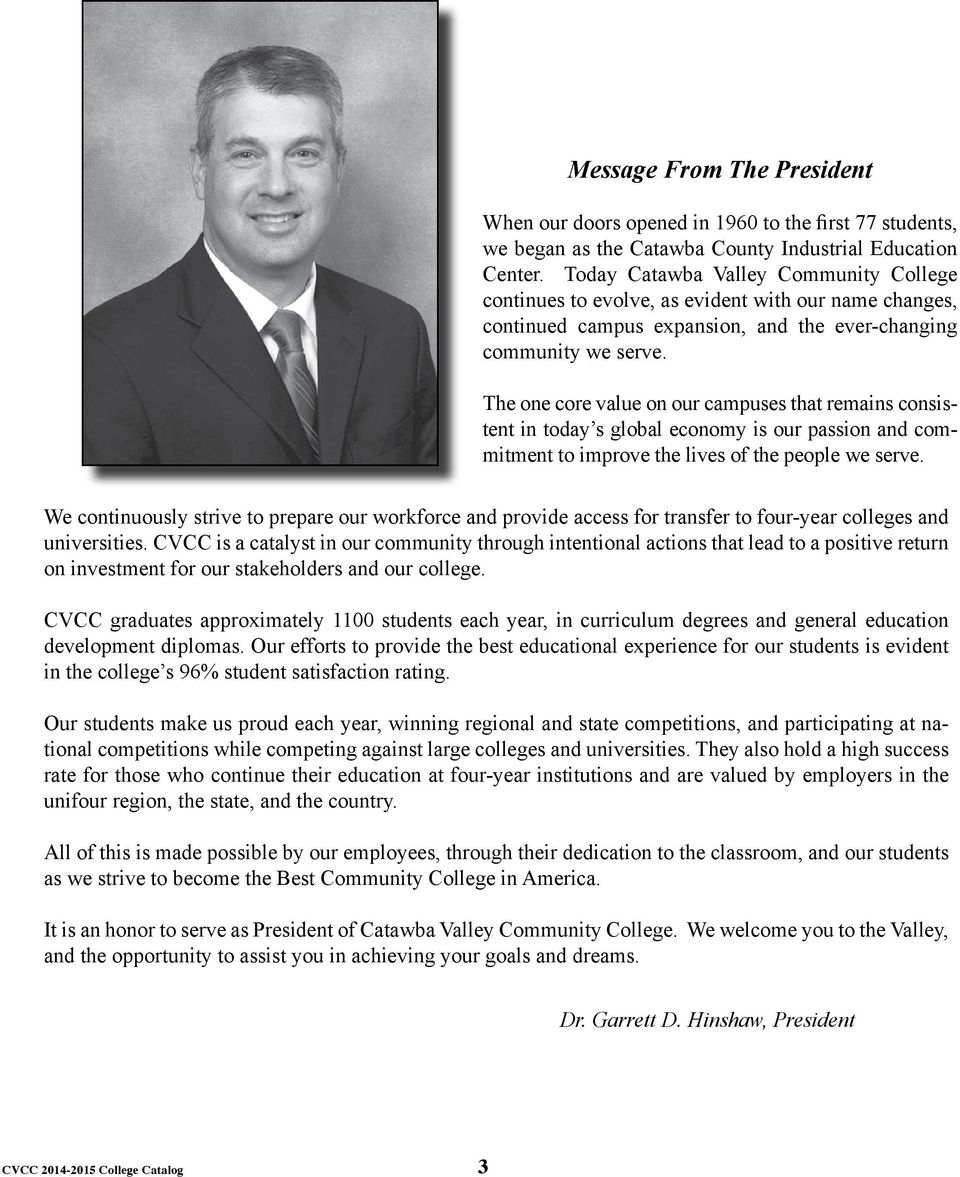
3 Message From The President When our doors opened in 1960 to the first 77 students, we began as the Catawba County Industrial Education Center. Today Catawba Valley Community College continues to evolve, as evident with our name changes, continued campus expansion, and the ever-changing community we serve. The one core value on our campuses that remains consistent in today s global economy is our passion and commitment to improve the lives of the people we serve. We continuously strive to prepare our workforce and provide access for transfer to four-year colleges and universities. CVCC is a catalyst in our community through intentional actions that lead to a positive return on investment for our stakeholders and our college. CVCC graduates approximately 1100 students each year, in curriculum degrees and general education development diplomas. Our efforts to provide the best educational experience for our students is evident in the college s 96% student satisfaction rating. Our students make us proud each year, winning regional and state competitions, and participating at national competitions while competing against large colleges and universities. They also hold a high success rate for those who continue their education at four-year institutions and are valued by employers in the unifour region, the state, and the country. All of this is made possible by our employees, through their dedication to the classroom, and our students as we strive to become the Best Community College in America. It is an honor to serve as President of Catawba Valley Community College. We welcome you to the Valley, and the opportunity to assist you in achieving your goals and dreams. Dr. Garrett D. Hinshaw, President CVCC College Catalog 3
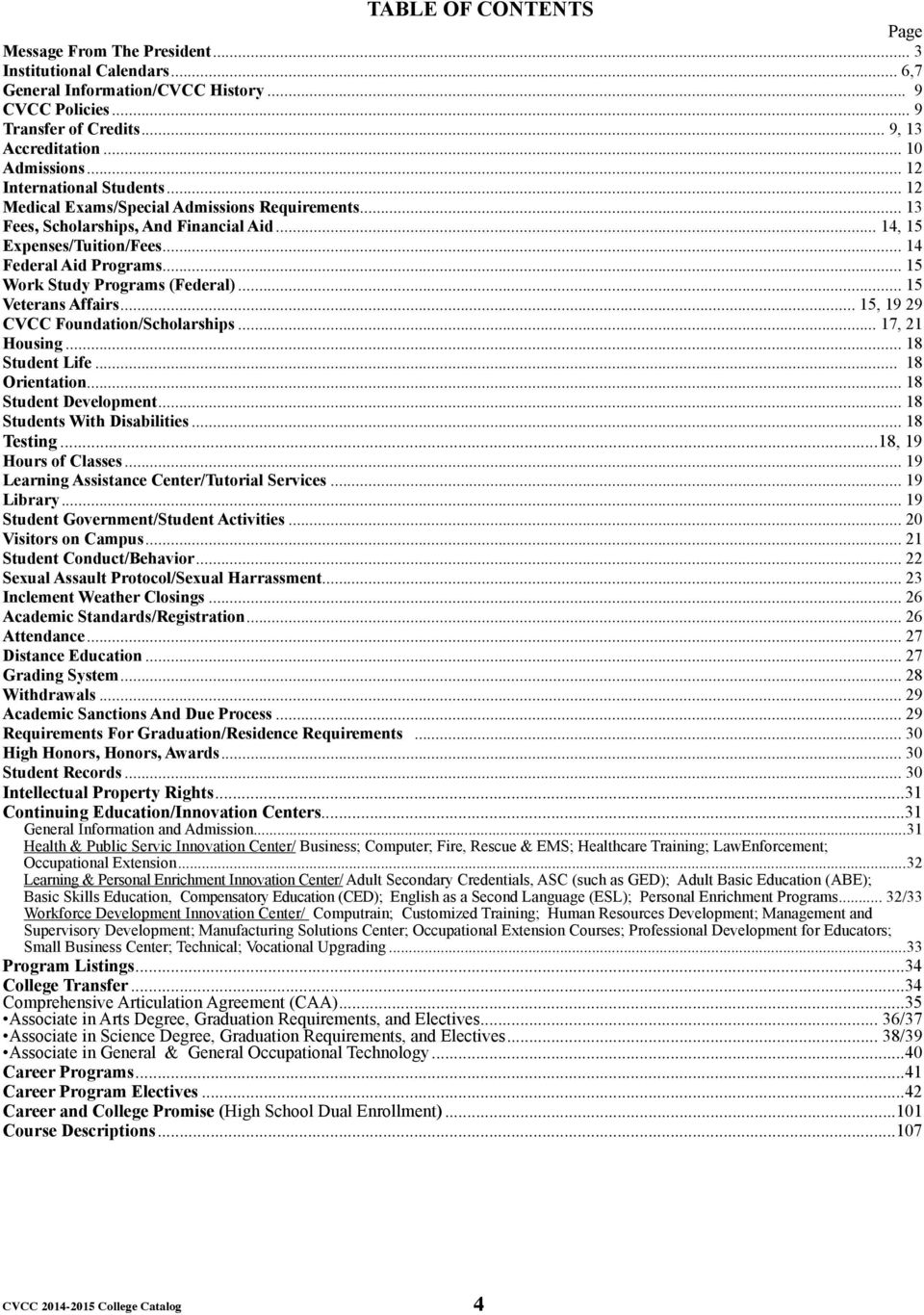
4 TABLE OF CONTENTS Page Message From The President... 3 Institutional Calendars... 6,7 General Information/CVCC History... 9 CVCC Policies... 9 Transfer of Credits... 9, 13 Accreditation Admissions International Students Medical Exams/Special Admissions Requirements Fees, Scholarships, And Financial Aid... 14, 15 Expenses/Tuition/Fees Federal Aid Programs Work Study Programs (Federal) Veterans Affairs... 15, CVCC Foundation/Scholarships... 17, 21 Housing Student Life Orientation Student Development Students With Disabilities Testing...18, 19 Hours of Classes Learning Assistance Center/Tutorial Services Library Student Government/Student Activities Visitors on Campus Student Conduct/Behavior Sexual Assault Protocol/Sexual Harrassment Inclement Weather Closings Academic Standards/Registration Attendance Distance Education Grading System Withdrawals Academic Sanctions And Due Process Requirements For Graduation/Residence Requirements High Honors, Honors, Awards Student Records Intellectual Property Rights...31 Continuing Education/Innovation Centers...31 General Information and Admission...31 Health & Public Servic Innovation Center/ Business; Computer; Fire, Rescue & EMS; Healthcare Training; LawEnforcement; Occupational Extension...32 Learning & Personal Enrichment Innovation Center/ Adult Secondary Credentials, ASC (such as GED); Adult Basic Education (ABE); Basic Skills Education, Compensatory Education (CED); English as a Second Language (ESL); Personal Enrichment Programs... 32/33 Workforce Development Innovation Center/ Computrain; Customized Training; Human Resources Development; Management and Supervisory Development; Manufacturing Solutions Center; Occupational Extension Courses; Professional Development for Educators; Small Business Center; Technical; Vocational Upgrading...33 Program Listings...34 College Transfer...34 Comprehensive Articulation Agreement (CAA)...35 Associate in Arts Degree, Graduation Requirements, and Electives... 36/37 Associate in Science Degree, Graduation Requirements, and Electives... 38/39 Associate in General & General Occupational Technology...40 Career Programs...41 Career Program Electives...42 Career and College Promise (High School Dual Enrollment) Course Descriptions CVCC College Catalog 4
5 TABLE OF CONTENTS (Cont.) Page Accounting Advertising and Graphic Design Air Conditioning, Heating, and Refrigeration Technology Associate Degree Nursing Associate Degree Nursing (RIBN Program) Automotive Systems Technology Basic Law Enforcement Training Business Administration Computer Engineering Technology Computer Information Technology Computer-Integrated Machining Technology Computer Programming Cosmetology Criminal Justice Technology Criminal Justice Technology--Latent Evidence Dental Hygiene Early Childhood Education Infant/Toddler Care Electrical Systems Technology Electroneurodiagnostic Technology Electronics Engineering Technology Emergency Medical Science Entrepreneurship Fire Protection Technology Health and Fitness Science Health Information Technology Healthcare Management Technology Horticulture Technology Industrial Systems Technology Information Systems Security Mechanical Engineering Technology Mechatronics Engineering Technology Medical Office Administration Networking Technology Office Administration Photographic Technology Polysomnography Radiography Respiratory Therapy Surgical Technology Turfgrass Management Technology Web Technologies Welding Technology Special Programs (Collaborative) Funeral Service Education Program, NC Funeral Director Program Career and College Promise Course Descriptions (Alphabetical) Board of Trustees Faculty and Staff Index (Please see the Index for a complete lisitng of Degrees, Diplomas, and Certificates CVCC College Catalog 5

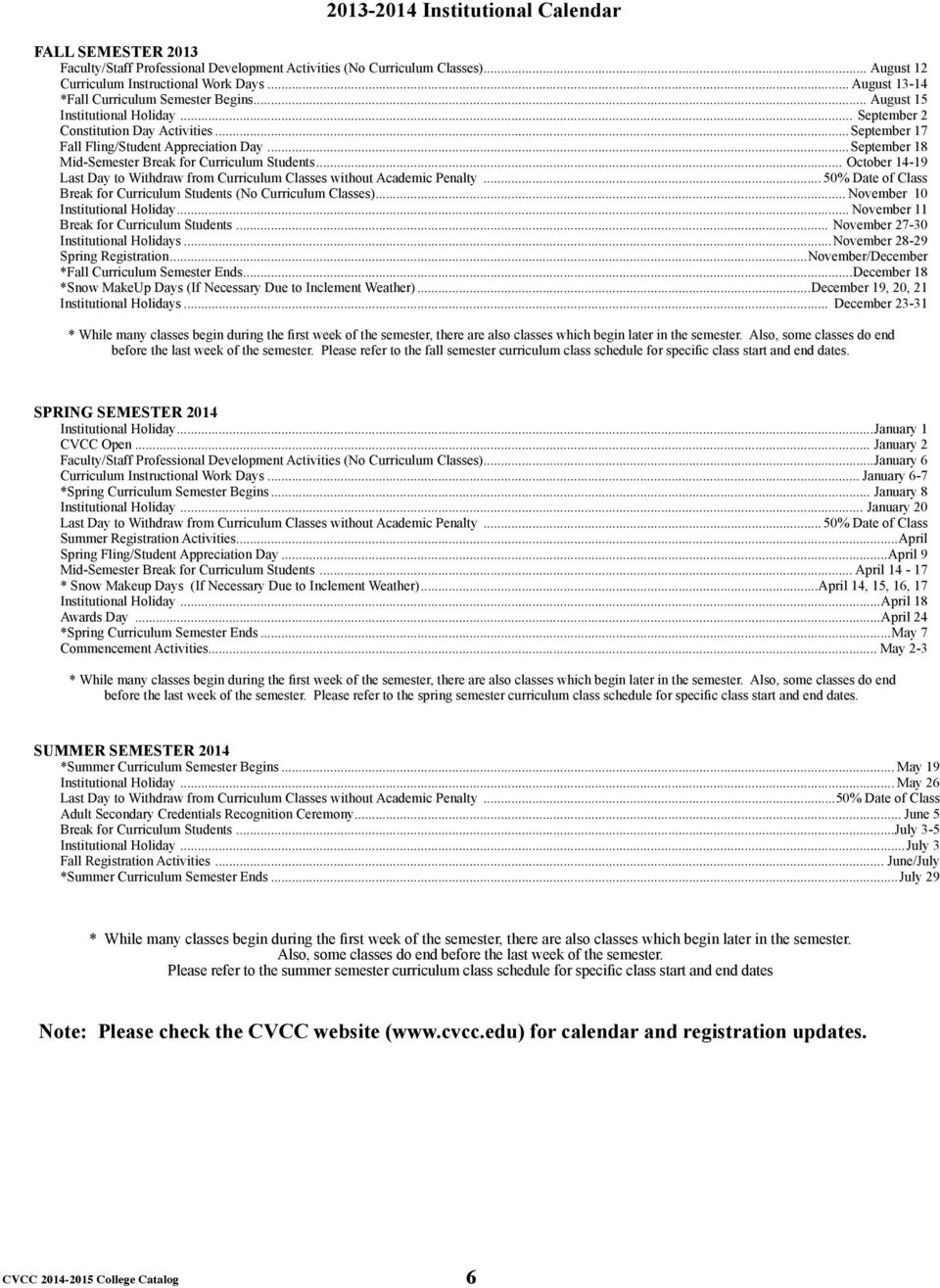
6 Institutional Calendar FALL SEMESTER 2013 Faculty/Staff Professional Development Activities (No Curriculum Classes)... August 12 Curriculum Instructional Work Days... August *Fall Curriculum Semester Begins... August 15 Institutional Holiday... September 2 Constitution Day Activities...September 17 Fall Fling/Student Appreciation Day...September 18 Mid-Semester Break for Curriculum Students... October Last Day to Withdraw from Curriculum Classes without Academic Penalty... 50% Date of Class Break for Curriculum Students (No Curriculum Classes)... November 10 Institutional Holiday... November 11 Break for Curriculum Students... November Institutional Holidays...November Spring Registration...November/December *Fall Curriculum Semester Ends...December 18 *Snow MakeUp Days (If Necessary Due to Inclement Weather)...December 19, 20, 21 Institutional Holidays... December * While many classes begin during the first week of the semester, there are also classes which begin later in the semester. Also, some classes do end before the last week of the semester. Please refer to the fall semester curriculum class schedule for specific class start and end dates. SPRING SEMESTER 2014 Institutional Holiday...January 1 CVCC Open... January 2 Faculty/Staff Professional Development Activities (No Curriculum Classes)...January 6 Curriculum Instructional Work Days... January 6-7 *Spring Curriculum Semester Begins... January 8 Institutional Holiday... January 20 Last Day to Withdraw from Curriculum Classes without Academic Penalty... 50% Date of Class Summer Registration Activities...April Spring Fling/Student Appreciation Day...April 9 Mid-Semester Break for Curriculum Students... April * Snow Makeup Days (If Necessary Due to Inclement Weather)...April 14, 15, 16, 17 Institutional Holiday...April 18 Awards Day...April 24 *Spring Curriculum Semester Ends...May 7 Commencement Activities... May 2-3 * While many classes begin during the first week of the semester, there are also classes which begin later in the semester. Also, some classes do end before the last week of the semester. Please refer to the spring semester curriculum class schedule for specific class start and end dates. SUMMER SEMESTER 2014 *Summer Curriculum Semester Begins... May 19 Institutional Holiday... May 26 Last Day to Withdraw from Curriculum Classes without Academic Penalty...50% Date of Class Adult Secondary Credentials Recognition Ceremony... June 5 Break for Curriculum Students...July 3-5 Institutional Holiday...July 3 Fall Registration Activities... June/July *Summer Curriculum Semester Ends...July 29 * While many classes begin during the first week of the semester, there are also classes which begin later in the semester. Also, some classes do end before the last week of the semester. Please refer to the summer semester curriculum class schedule for specific class start and end dates Note: Please check the CVCC website ( for calendar and registration updates. CVCC College Catalog 6
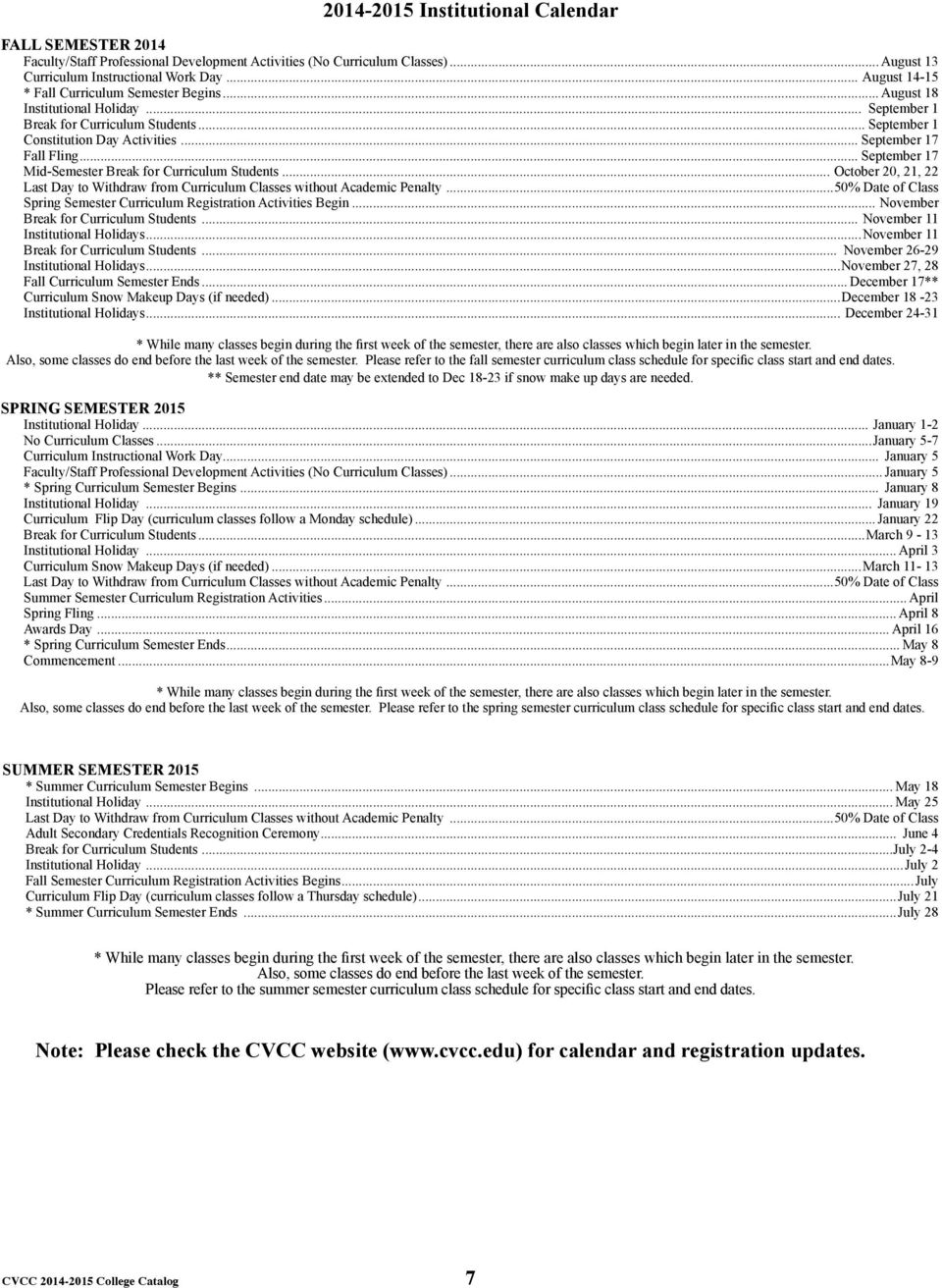
7 Institutional Calendar FALL SEMESTER 2014 Faculty/Staff Professional Development Activities (No Curriculum Classes)...August 13 Curriculum Instructional Work Day... August * Fall Curriculum Semester Begins...August 18 Institutional Holiday... September 1 Break for Curriculum Students... September 1 Constitution Day Activities... September 17 Fall Fling... September 17 Mid-Semester Break for Curriculum Students... October 20, 21, 22 Last Day to Withdraw from Curriculum Classes without Academic Penalty...50% Date of Class Spring Semester Curriculum Registration Activities Begin... November Break for Curriculum Students... November 11 Institutional Holidays...November 11 Break for Curriculum Students... November Institutional Holidays...November 27, 28 Fall Curriculum Semester Ends... December 17** Curriculum Snow Makeup Days (if needed)...december Institutional Holidays... December * While many classes begin during the first week of the semester, there are also classes which begin later in the semester. Also, some classes do end before the last week of the semester. Please refer to the fall semester curriculum class schedule for specific class start and end dates. ** Semester end date may be extended to Dec if snow make up days are needed. SPRING SEMESTER 2015 Institutional Holiday... January 1-2 No Curriculum Classes...January 5-7 Curriculum Instructional Work Day... January 5 Faculty/Staff Professional Development Activities (No Curriculum Classes)... January 5 * Spring Curriculum Semester Begins... January 8 Institutional Holiday... January 19 Curriculum Flip Day (curriculum classes follow a Monday schedule)... January 22 Break for Curriculum Students...March 9-13 Institutional Holiday... April 3 Curriculum Snow Makeup Days (if needed)...march Last Day to Withdraw from Curriculum Classes without Academic Penalty...50% Date of Class Summer Semester Curriculum Registration Activities... April Spring Fling... April 8 Awards Day... April 16 * Spring Curriculum Semester Ends... May 8 Commencement...May 8-9 * While many classes begin during the first week of the semester, there are also classes which begin later in the semester. Also, some classes do end before the last week of the semester. Please refer to the spring semester curriculum class schedule for specific class start and end dates. SUMMER SEMESTER 2015 * Summer Curriculum Semester Begins... May 18 Institutional Holiday... May 25 Last Day to Withdraw from Curriculum Classes without Academic Penalty...50% Date of Class Adult Secondary Credentials Recognition Ceremony... June 4 Break for Curriculum Students...July 2-4 Institutional Holiday...July 2 Fall Semester Curriculum Registration Activities Begins...July Curriculum Flip Day (curriculum classes follow a Thursday schedule)...july 21 * Summer Curriculum Semester Ends...July 28 * While many classes begin during the first week of the semester, there are also classes which begin later in the semester. Also, some classes do end before the last week of the semester. Please refer to the summer semester curriculum class schedule for specific class start and end dates. Note: Please check the CVCC website ( for calendar and registration updates. CVCC College Catalog 7
8 General Information CVCC Main Campus CVCC Alexander Center for Education CVCC Newton Center CVCC East Campus CVCC College Catalog 8

9 General Information Mission Statement Catawba Valley Community College is an innovative, comprehensive community college that fosters and promotes a multitude of learning experiences, enabling and empowering its students, faculty, staff, and stakeholders to identify and to serve higher purposes in their lives and in their communities. Vision Statement The vision of Catawba Valley Community College is to be validated and recognized in the achievement of its mission as the statewide, regional, and national standard of excellence for programs, services, and facilities. History Through the concerted efforts of concerned and united Catawba County citizens and North Carolina educational leaders, on April 3, 1958, Catawba Valley Community College was established by the North Carolina Department of Public Instruction as the ninth school of its kind in the state. Construction of the original facilities began in The 40,000 square foot building costing approximately $500,000 was completed in August An initial enrollment of seventy-seven (77) students began classes in September of the same year. From 1960 to 1963, the College operated under the jurisdiction of the Catawba County Board of Education. During this time the College was known as the Catawba County Industrial Education Center. In July 1963, the General Assembly of North Carolina enacted into law G.S. 115A which provided for the establishment of the present North Carolina System of Community Colleges. On January 9, 1964, Catawba Valley Technical Institute was among the original seven institutes chartered by the Department. At that time, CVTI established its own Board of Trustees and began operation as a member of the Department of Community Colleges. Thus, it was in August 1964, that the College awarded its first Associate Degree in Applied Science. It was during the transition from an Industrial Education Center to Technical Institute that great strides began in expanding educational programs, increasing student enrollment, developing quality instruction, adding facilities, and increasing community acceptance and service. On September 1, 1979, the name of the institution was changed to Catawba Valley Technical College by the Trustees and commissioners of Catawba County. On December 1, 1987, the State Board of Community Colleges officially approved CVTC to become Catawba Valley Community College and the College Transfer program was approved. The College continues as a publicly supported coeducational institution. Location Catawba Valley Community College, is located in Hickory on Highways 70 and 321-B, in Catawba County, North Carolina. Situated in the heart of the Piedmont some 1,175 feet above sea level, CVCC is easily accessible over Interstate 40, Highways 321, 70, 16 and 127. It is within seven miles of a commercial airport and approximately 50 miles from metropolitan Charlotte. The campus covers approximately 162 acres and includes 17 buildings for an approximate total of 600,000 square feet of floor space. In addition, there is the CVCC East Campus, the Corporate Development Center, the Manufacturing Solutions Center, and the Cosmetology Center at the CVCC Newton Center in downtown Newton. The Alexander Center for Education, a 15,000 square foot building situated on 4.72 acres at 345 Industrial Boulevard in Taylorsville was purchased by Alexander County in 2000 as an off-site center, which opened for classes March 28, The facilities consist of modern brick buildings. Included is a 30,000 volume library for the use of both students and public, a student center and food service area for leisure relaxation and entertainment, and numerous classrooms and laboratories. CVCC POLICIES AND PROCEDURES CVCC policies and procedures regarding students are available for reference on the CVCC website ( under the About Us Link. Following are the direct links, CVCC Policies - Policies/ and CVCC Procedures - These web pages include, but are not limited to, information regarding admissions, course grading, student conduct, student due process, privacy of students, visitors on campus, sexual offense/assault protocol, campus safety and security, and reporting a crime. Printed copies of a policy/policies, or procedure/procedures are available upon request to Student Services. Transfer Of CVCC Credits To Other Colleges Technical, vocational, and certificate programs of study at Catawba Valley Community College have been established primarily to prepare individuals for employment upon completion of studies. The College Transfer program has been developed at CVCC to provide opportunities for students to transfer two years of academic credit to senior colleges and universities. Numerous differences exist in the transfer policies of senior institutions. Therefore, details regarding a specific institution should be obtained from the senior institution to which transfer is being considered. Educational Consortium Catawba Valley Community College is a member of the Charlotte Area Educational Consortium (CAEC). This organization is composed of 24 colleges and universities working toward attaining the highest level of collegiate and university education for the Charlotte Metrolina region. Consortium members encourage the sharing of resources and energies among institutions and seek to generate creative ideas for the most effective use of human and other resources available among institutions. Foremost among the goals of the Consortium is to afford students access to broader educational experiences, both curricular and extra-curricular. Full-time students at regular member colleges and universities are eligible to participate in the inter-institutional student exchange program of the Consortium. This enables them under certain circumstances to enroll in some courses at other CAEC schools without paying additional fees. For additional information on the CAEC and member institutions, please contact the Director of Student Records. Air Force ROTC Program To prepare themselves to serve as commissioned officers in the Air Force, students in college transfer programs to pursue a bachelor s degree may participate in the Air Force Reserve Officer Training Corps (ROTC) offered by the UNC-Charlotte Department of Aerospace Studies. Information is available in Student Services or on the UNCC webpage at the following address: Appalachian Center AT Hickory The Appalachian State University Center in Hickory is an educational consortium of colleges and universities that offer community college students and other adults opportunities to finish their bachelors degrees from one of the participating colleges and universities. Graduate degrees are also available. A wide variety of degree programs are offered with flexible part-time and full-time schedules and face-to-face and on-line formats to meet the needs of adult learners with busy schedules, families, and work commitments. For more information on degree programs available through the Appalachian State University Center in Hickory, call Challenger Early College High School Challenger Early College High School is a Cooperative Innovative High School approved under Part 9 of Article 16 of Chapter 115C of the General Statutes, and is an application-based, selected enrollment high school and joint oversight project of the Catawba Valley Education Consortium. It is not a traditional, comprehensive high school. Enrollment is limited to no more than 400 students who must enter as high school freshmen only. Note: there are minors enrolled at CECH on CVCC s campus. Challenger students graduate with a university prep curriculum high school diploma and college credit up to an Associates degree from CVCC. Supported by the NC Dept of Public Instruction, NC Community College System, and NC New Schools Project, the early college is a national school reform model designed through research from the Bill and Melinda Gates Foundation, Stanford University, Harvard University, and Jobs for the Future. CVCC College Catalog 9

10 Accreditation Catawba Valley Community College is accredited by the Southern Association of Colleges and Schools Commission on Colleges to award diplomas and associate degrees. Contact the Commission on Colleges at 1866 Southern Lane, Decatur, Georgia , or call for questions about the accreditation of Catawba Valley Community College. Most curriculum programs offered have been approved by the North Carolina State Approving Agency for Veteran s Education; however, students should contact the VA certifying official in Student Services for verification. The College is also a member of the American Association of Community Colleges. The Associate Degree Nursing Program is approved by the North Carolina State Board of Nursing and accredited by the Accreditation Commission for Education in Nursing, Inc., 3343 Peachtree Road NE, Suite 850, Atlanta, GA, 30326, ( ). The program in Dental Hygiene is accredited by the Commission on Dental Accreditation and has been granted the accreditation status of approval without reporting requirements. The Commission is a specialized accrediting body recognized by the United States Department of Education. The Commission on Dental Accreditation can be contacted at (312) or at 211 East Chicago Avenue, Chicago, IL The Emergency Medical Science program is Accredited by the Commission on Accreditation of Allied Health Education Programs, (www. caahep.org) upon the recommendation of the Committee on Accreditation of Educational Programs for the Emergency Medical Services Professions (CoAEMSP) 1361 Park Street, Clearwater, FL, 33756, (727) , The Health Information Technology program is accredited by the Commission on Accreditation for Health Informatics and Information Management Education. The Polysomnography program is accredited by the Commission on Accreditation of Allied Health Education Programs in collaboration with the Committee on Accreditation for Polysomnography. The Radiography program is accredited by the Joint Review Committee on Education in Radiologic Technology 20 North Wacker Drive, Suite 2850 Chicago, IL , (312) , [email protected]. The Respiratory Therapy Program is accredited by the Commission on Accreditation for Respiratory Care ( Commission on Accreditation for Respiratory Care, 1248 Harwood Road, Bedford, Texas (817) The Surgical Technology program is accredited by the Commission on Accreditation of Allied Health Education Programs in collaboration with the Accreditation Review Committee on Education in Surgical Technology and the commission s Council on Accreditation and Unit Recognition. The Cosmetology program is accredited by the NC State Board of Cosmetic Arts. The Automotive Systems Technology program is accredited by the National Institute of Automotive Service Excellence (ASE). The Learning Assistance Center Peer Tutoring Program is Level 1 and Level 2 Tutor Certified by the College Reading and Learning Association International Tutor Program. The Electroneurodiagnostic Technology Program is accredited by the Commission on Accreditation of Allied Health Education Programs in collaboration with the Committee on Accreditation for Electroneurodiagnostic Technology The Welding Technology Program is an Educational Institution Member designated by the American Welding Society CVCC is a member of: North Carolina Community College System; American Association of Community Colleges; Southern Association of Colleges and Schools; Charlotte Area Educational Consortium ; League for Innovation; North Carolina Citizens for Business and Industry; Charlotte Regional Workforce Development Partnership Critical Success Factors In 1993, the State Board of Community Colleges began monitoring performance data on specific measures to ensure public accountability for programs and services. In 1998, the General Assembly directed the State Board to review past performance measures and define standards to ensure programs and services offered by community colleges in North Carolina were of sufficient quality (North Carolina Community College System, 2012 Critical Success Factors Report, July 2012). Through the 2012 reporting year, the annual NCCCS Critical Success Factors Report was the means by which the community college system reported on performance measures referred to as Critical Success Factors. In February 1999, the North Carolina State Board of Community Colleges originally adopted twelve (12) performance measures to ensure that programs and services offered by community colleges were of sufficient quality. During the reporting year, the number of measures was dropped to seven (7). These performance standards focused primarily on student success and served as the System s major public accountability tool. For the 2013 reporting the North Carolina Community College system adopted the 2013 Performance Measures for Student Success. The measures include basic skills progress, GED pass rates, developmental English students performance in subsequent curricular courses, developmental mathematics students performance in subsequent curricular courses, one-year progress, curricular completion rates, licensure pass rates, and transfer student performance. Performance funding is based on these measures (basic skills progress and GED pass rates are included in the 2013 report, but have not yet been implemented as performance funding data). Notice of Non-discrimination Catawba Valley Community College does not discriminate on the basis of race, color, national origin, sex/gender, religion, creed, age, or disability in its programs and activities. The following persons have been designated to handle inquiries regarding the non-discrimination policies. Dean of the School of Student Access, Development, and Success 2550 Highway 70 SE Hickory, NC Telephone (828) Director of Human Resources 2550 Highway 70 SE Hickory, NC Telephone (828) CVCC College Catalog 10

11 Catawba Valley Community College Performance Measures For Student Success (North Carolina Community College System) 2013 NCCCS Performance Measure for Student Success 2013 NCCCS Goal and Baseline 2013 System Institutional Average 2013 CVCC Measure Basic Skills Progress Goal = 51.2% Baseline = 20.6% 41% 36.9% GED Pass Rate Goal = 82% Baseline = 49.3% 71.1% 67.6% Developmental English Subsequent Success Goal = 74.9 Base = 45.2% 63.7% 75.0% Developmental Mathematics Subsequent Success Goal = 75.4% Baseline = 47.5% 64.8% 56.3% Year One Progress Goal = 74.6% Baseline = 53.2% 67.8% 69.7% Curriculum Completion Rate Goal = 45.6% Baseline = 28.6% 41.6% 40.0% Licensure Pass Rate Goal = 91.7% Baseline = 71.0% 85.2% 84.9% Transfer Performance Goal = 93.8% Baseline=71.2% 87.6% 93.7% For further explanation and information, please visit the NCCCS Performance Measures for Student Success: North Carolina Community College College Creating Success webpage at %20Performance% 20Measures%20Report.pdf. CVCC College Catalog 11

12 Admissions General ADMISSION TO CVCC CVCC follows open door admissions policies as established by the North Carolina Community College System. Admission is open to persons who are legal residents of the United States and who are either high school graduates; High School Equivalency graduates such as GED; or Adult High School Diploma Program graduates; or who are at least 18 years of age. Minors are admitted under provisions and rules established by the State Board of Community Colleges. A person is classified as a student when admission requirements are met and registration for classes has occurred that cause (1) tuition and fees to be paid (or encumbered by waiver, financial aid, third party payment, etc.) and (2) the person enters and attends the class(es). A person continues to be a student by attending class and making progress toward completion of the course objectives. A person is no longer a student in a particular class when s/he has exceeded the number of absences allowed in the class or is graded with a WP or a WF. If this occurs in all classes during a particular semester, the person is no longer a student for that semester at the point in time when the last transaction has occurred. A person is a visitor when not a student. Students are entitled to due process. Visitors are not afforded due process. Transfer Students. Transfer students may be admitted provided they meet all admission requirements. Catawba Valley Community College will accept credits from college/ universities accredited by any one of the following eight regional accrediting bodies authorized by the United States Department of Education: Middle States Commission on Higher Education Middle States Association of Colleges and Schools New England Association of Schools and Colleges North Central Association of Colleges and Schools Northwest Commission on Colleges and Universities Southern Association of Colleges and Schools Western Association of Schools and Colleges WASC Senior College and University Commission Courses with grades of C- or better will be accepted provided such courses parallel the content of CVCC courses and are relevant to the student s program of study. Transfer students are notified about transfer credit to CVCC from other institutions via student . Transfer credit is awarded only for those courses that apply to the student s program of study. Grades for transferred courses are not included in a student s GPA at CVCC, although the credit hours are applied toward graduation. See also Residency Requirements for graduation. International Students. CVCC is authorized by the U.S. Department of Naturalization and Immigration to admit international students with a valid F-1 Visa or valid Permanent Resident Card. Work authorization cards are not permanent resident cards. The following items are required for admission and must be submitted as a complete package by the published deadline on the CVCC website ( 1. a completed Application for Admission, 2. all financial statements as outlined on the CVCC website, 3. official transcripts from high school and secondary schools translated and evaluated by any agency associated with NACES, 4. a photograph, 5. verification of home country address, 6. an official TOEFL (Test of English as a Foreign Language) test score less than five (5) years old, and 7. a VISA clearance form if student is transferring from another United States institution of higher learning. Upon receipt of and verification of ALL application materials, a Certificate of Eligibility (I-20) may be prepared and issued to the student. International students may need to take placement tests administered at the CVCC Testing Center and are charged the applicable out of state tuition rates. Students are required to obey federal, state, and local laws. Commission or conviction of certain crimes may impact the student s ability to maintain F-1 status. CVCC College Catalog 12 High School students CAREER AND COLLEGE PROMISE Session Law , the Appropriations Act of 2011, authorized the State Board of Education and the State Board of Community Colleges to establish the Career and College Promise program, effective January 1, Career and College Promise provides seamless dual enrollment educational opportunities for eligible North Carolina high school students in order to accelerate completion of college certificates, diplomas, and associate degrees that lead to college transfer or provide entry-level job skills. North Carolina community colleges may offer the following Career and College Promise pathways aligned with the K-12 curriculum and career and college ready standards adopted by the State Board of Education: 1. A College Transfer Pathway leading to a minimum of 30 hours of college transfer credit; 2. A Career and Technical Education Pathway leading to a certificate, diploma or degree; 3. A Cooperative Innovative High School Pathway approved under Part 9 of Article 16 of Chapter 115C of the General Statues. Challenger Early College High School Challenger Early College High School is a Cooperative Innovative High School approved under Part 9 of Article 16 of Chapter 115C of the General Statutes, and is an application-based, selected enrollment high school and joint oversight project of the Catawba Valley Education Consortium. It is not a traditional, comprehensive high school. Enrollment is limited to no more than 400 students who must enter as high school freshmen only. Note: there are minors enrolled at CECH on CVCC s campus. Challenger students graduate with a university prep curriculum high school diploma and college credit up to an Associates degree from CVCC. Supported by the NC Dept of Public Instruction, NC Community College System, and NC New Schools Project, the early college is a national school reform model designed through research from the Bill and Melinda Gates Foundation, Stanford University, Harvard University, and Jobs for the Future. Undocumented immigrants CVCC may admit undocumented immigrant applicants consistent with provisions of federal and state laws and regulations in the State Board of Community Colleges code 1DSBCCC400.2 (b). Under current State law, undocumented immigrant applicants do not qualify for federal or state financial aid, in-state residency for tuition and shall be charged at the outof state tuition rate for curriculum programs. Safety Exception CVCC may refuse admission to any applicant in accordance with the following conditions as specified in State Board of Community Colleges Code 1DSBCCC400.2 (e) and (f) entitled Admission to Colleges. 23 NCAC 02C.0301 A. CVCC may refuse admission to an applicant when there is an articulable, imminent, and significant safety threat to the applicant or other individuals. Admission to Curriculum programs Admission to the College does not necessarily mean admission to the curriculum or program desired by the applicant. A student must satisfy the admissions requirements for his/her program of study. Applicants will be admitted to programs as admissions requirements are completed except for programs with limited enrollment (discussed further below). Applicants may be admitted to certain programs on a provisional basis until all admissions requirements are completed. Documentation/program requirements for specific healthcare programs in the School of Health and Public Services are published on the CVCC website. Due to the nature of healthcare accrediations, this information is subject to change without notice. Enrollment to certain programs is limited, and admission to these programs is highly competitive. The most highly qualified applicants are selected each year based upon completion of minimum admission requirements. Applicants to healthcare programs must complete program requirements as established by the program director to be considered for selection. These admissions requirements may include, but are not necessarily limited to, attendance at specialized Information Sessions, completion of standardized aptitude tests, submission of letters of recommendations, vaccinations, and/or health examination. Graduation from a public high school, private high school - including home schools, High School Equivalency graduates such as GED, Adult High School Diploma graduates, or a correspondence school is required

13 for admission to all associate degree programs and certain diploma and certificate programs. If graduation from high school or equivalent is a requirement for the intended program, applicants must provide official transcripts (from high school, state GED Office/GED Administrator, or Adult High School) evidencing graduation. The high school transcript requirement is waived for associate degree program applicants who have graduated from a regionally accredited two-year or four-year college, except for applicants to certain programs in the School of Health and Public Services, students receiving VA education benefits, and students who are applying for federal/state financial aid. Applicants to curriculum programs of study must provide official transcripts from all regionally accredited colleges/universities previously attended. To fulfill the college s general admission requirements, students who have attended foreign schools at the secondary level (high school) must submit transcripts that are written in or translated into the English language. Translated secondary level transcripts must be literal (word for word) and the translator must sign the translated copy and include contact information. The name the student is currently using should appear on the transcript as well as the date of birth. NOTE: If the official translation does not indicate US high school equivalency, the student will be required to obtain translation through a current member of National Association of Credential Evaluation Services (NACES). To fulfill the college s general admission requirements, students who have attended foreign schools at the post-secondary level (college/university) must submit transcripts that have been translated into the English language. Translated transcripts must be literal (word for word) and the translator must sign the translated copy and include contact information. (The name the student is currently using should appear on the transcript as well as the date of birth). Students desiring transfer credit must submit transcripts that have been evaluated by a current member of NACES at Note: The evaluating agency for post-secondary transcripts (college/ university) or translator for secondary transcripts (high school) must send the evaluation report directly to Catawba Valley Community College s Student Records Office. Student copies of evaluations will not be accepted. No veteran may be certified for Veterans Educational Assistance Benefits (G.I. Bill) until all admissions requirements have been met and an unconditional acceptance has been granted. ADmission Procedures The application and enrollment process at CVCC may take 1-3 weeks, depending on the applicant s program of study. Many programs require that you be a high school graduate, have a High School Equivalency such as GED, or an Adult High School Diploma before you enroll. Some programs of study are LIMITED ENROLLMENT; some have additional admissions requirements that must be completed earlier in the academic year(s). Following are the general procedures to apply for admission to a curriculum program of study: 1. Individuals who have never attended college or former CVCC students who have not been enrolled for one year should attend a Starting Points Information Session. This 45 minute session is an opportunity to aid future students in understanding the admission, placement test and financial aid processes. Sessions are offered on various days at various times; schedules are posted on the CVCC homepage. 2. Determine a Program of Study. Contact Career Services for guidance, at (828) , ext Send official high school, Adult High School, or High School Equivalency (such as GED) transcripts to CVCC. In addition, send official college transcripts from every institution applicant has attended, SAT scores, ACT scores or placement test scores from another institution. Contact the College Registrar or College Records of all previous schools/ colleges to request official transcripts. There may be fees for transcripts. Send all official documents to CVCC Student Records, 2550 Highway 70 SE, Hickory, NC Applicants for health care programs of study must secure all official transcripts and bring them to the college when activating an application. High school and college transcripts must be presented along with the application already on file in the Student Records Office before an application can be processed. 4. Complete the paper Application to the College using blue or black ink or apply online. ALL applicants must bring a photo ID and meet with admissions staff to activate the application. 5. Prepare for and take any necessary placement tests as determined by Admissions Staff. There is no fee for placement testing, but it is offered by appointment only. Admissions Staff will assist applicants with an appointment day and time. (A valid photo ID is required) 6. Apply for financial aid by completing the Free Application for Federal Student Aid (FAFSA). Complete the online version of the FAFSA at there are semester deadlines for filing the FAFSA. The FAFSA code for CVCC is Students cannot become eligible for Financial Aid until they successfully complete the FAFSA on-line. Financial Aid is not final until a student has received an award letter via their CVCC from the CVCC Financial Aid Office. If a student is going to use Veteran s Administration benefits, visit their website at If a student is using TAA or WIA benefits, complete the FAFSA. Not all educational programs at CVCC are eligible for TAA/WIA benefit coverage. Special Admissions Requirements For Health Programs. In addition to the general procedures to apply for admission to a curriculum program of study, applicants for the health programs must complete other procedures. Applicants for health care programs of study must secure all official transcripts and bring them to the college when activating an application. High school and college transcripts must be presented along with the application or already on file in the Student Records Office before an application can be processed. All applicants for health programs must attain the established minimum placement test scores determined by their department of interest. All placement test scores, depending upon the testing agency, must be less than three, or five years old. See Testing Services on page 18. Certain health programs require completion of educational experiences in clinical/lab facilities. These clinical/lab facilities may require students to undergo criminal background checks and/or drug testing. If a student is excluded from clinical/lab facilities as a result of a background check and/or drug testing, the student may be asked to withdraw from the program. Some facilities may also require additional vaccinations and/or health examinations. Admission into any health program will be contingent upon receipt of a CVCC medical form documenting that the applicant possesses satisfactory physical and mental health. Facilities for providing health care services are not available on campus. Effective for fall 2015, students may apply to no more than ONE health care program within the School of Health and Public Services. Special Admissions Requirements For Early Childhood education Programs. In addition to the general procedures to apply for admission to a curriculum program of study, applicants for the Early Childhood Education program must complete other procedures. CVCC s Early Childhood Education program requires completion of educational experiences in childcare facilities and/or public school settings. These settings require students to undergo criminal background checks. If a student is excluded from an educational setting as a result of a background check, the student may be asked to withdraw from the program. Some settings may also require additional vaccinations and/or health examinations. Admission into CVCC s Early Childhood Education program may be contingent upon receipt of a CVCC medical form documenting that the applicant possesses satisfactory physical and mental health. Facilities for providing health care services are not available on campus. Special Credit Students. Individuals may enroll in classes without pursuing a certificate, diploma, or degree. Persons enrolling under these circumstances are considered SPECIAL CREDIT STUDENTS. Placement tests may be required depending upon the student s educational background and the prerequisites/corequisites of the courses in which the student wishes to register. Special Credit Students are not eligible to receive federal/state financial aid and must meet all course prerequisites. A military veteran can not receive Veterans Educational Assistance Benefits (G.I. Bill) as a special credit student. CVCC College Catalog 13
14 Fees, Financial Aid, AND Scholarships CVCC charges tuition in accordance with policies established by the North Carolina Community College System. Tuition rates are subject to change. Certain fees have been established in accordance with guidelines and ranges established by the North Carolina Community College System. Fees are subject to change. Due dates for tuition and fees are established by the Chief Financial Officer or designee. Students will forfeit their seat in a class if they fail to pay the applicable tuition/fees by the established due date. Tuition (Subject to change depending on action of General Assembly.) Tuition Per Semester: North Carolina Residents 16 hrs. or more...$1, hrs. or less (per semester hr.)...$71.50 Out-of-State Residents 16 hrs. or more...$4, hrs. or less (per semester hr.)...$ Determinations of North Carolina Residency for tuition purposes are made by the Director of Admissions or designee in accordance with laws and regulations established by the North Carolina General Assembly. North Carolina residency is not a factor in the tuition charged for non-credit courses. A student initially classified as an out-of-state resident for tuition purposes may request a change of residency classification upon meeting the resident for tuition purposes requirements. Detailed information regarding residency requirements and procedures for requesting a change in residency classification is available in Student Services. It is the student s responsibility, whether classified as a resident or non-resident, to report any information to Student Services which may indicate a need for reclassification. Tuition for students enrolling in Occupational Extension courses vary per course. However, fees may be established for self-supporting seminars and courses according to the schedule below in which more than normal expenses to the College are incurred. Such charges may cover the cost of instructional materials and/or textbooks required in such classes. Continuing Education Occupational Extension (per course) 0-24 hours...$ hours...$ hours...$ Students who take an Occupational Extension course more than twice within a five-year period; unless required for certification, recertification, or licensure; are required to pay a different formula rate per contact hour. FEES AND INSURANCE Student Activity Fee 7 or more credit hours...$32.00 Less than 7 credit hours (per semester hour)...$5.00 Student Accident Insurance (per semester)...$1.25 Computer Use and Technology Fee (Curriculum Students per semester)...$16.00 Computer Use and Technology Fee (Continuing Education Students per designated technology-related course)...$5.00 Graduation Fee...$25.00 Certificate Fee...$10.00 Liability/Malpractice (ADN, Surgical Technology, Respiratory Therapy, EMS, Dental Hygiene, Polysomnography, and Electroneurodiagnostic Students)...$27.50 Liability/Malpractice (CNA and Phlebotomy Students)...$14.50 Service Charge for Returned Checks...$25.00 Lab Fees...TBA Replacement Fee for Library/Data Card...$10.00 Transcript Fee...$5.00 To view a copy of CVCC s Student Accident Insurance Brochure visit ( Students enrolled in certain health programs/courses are required to purchase liability/malpractice insurance. The premium for this insurance is paid once annually through the business office. Certain fees have been approved for testing services. These include fees for Microsoft Office User Specialist (MOUS) certification testing, test proctoring for non-cvcc students, or other special circumstances. FEE WAIVERS. In compliance with North Carolina Statutes and regulations of the North Carolina Community College System, tuition and fees may be waived under the following circumstances: (1) no extension registration fee shall be charged of individuals enrolling in special extension training programs for emergency telecommunication personnel, fire department personnel, volunteer rescue and life saving personnel, local law enforcement officers, or members of auxiliaries of such groups, providing the individual is a member of the group for which training is being provided; and (2) no extension registration fee will be charged to patients of state alcoholic rehabilitation centers. High School students taking college credit classes through the Career and College Promise program are exempt from applicable tuition for fall and spring semesters. Applicable fees will be charged. OTHER EXPENSES. The cost of books, supplies, and equipment varies from one program of study to another. COLLECTION NOTICE. The College reserves the right to use all means necessary to collect any outstanding balances. This may include but is not limited to the use of NC Set-off Debt. OTHER ACTIONS REGARDING PAST DUE ACCOUNTS. All previously incurred expenses and accounts, including library and payments made to Nelnet (a third party company) for tuition, generally must be fully paid before a student may re-enter at the beginning of any semester and before transcript, diploma, or certificate will be furnished. REFUNDS CURRICULUM CLASSES The College follows the refund policies established by the North Carolina Community College System. A copy of the current refund policies may be obtained from the Business Office. Specific guidelines and processes to ensure compliance with these policies shall be established by the Chief Financial Officer or designee. The following are specific guidelines which have been established in accordance with these policies. Refunds for less than $5.00 will not be made. A full (100 %) tuition refund shall be made if the student officially withdraws prior to the start date of the class. Example If the start date of the class as indicated on the student s schedule is September 1, the student must withdraw from that class on or before August 31 to receive a full (100%) tuition refund. A 75% tuition refund shall be made if the student withdraws on or before the census date of the class. The census date for a class is the 10% point of the class. No tuition refund shall be made if the student withdraws from a class after the census date of that class. The census date for a class is the 10% point of the class. The student fees, accident insurance premium, and some program specific fees (i.e., mal-practice insurance fees, processing fees, etc.) are not refundable unless the student officially withdraws prior to the start of his/her classes, a student s class is cancelled, or the College determines an institutional error has occurred. CONTINUING EDUCATION CLASSES This policy includes occupational extension classes. A full refund will be given if the student officially withdraws from class prior to the first class meeting. Allow a minimum of two (2) weeks for processing of refund requests. Refunds for less than $5.00 will not be made. After the class begins, a 75% refund of registration only will be made if the student officially withdraws from the class prior to or on the 10% point of scheduled hours. Accident insurance must be purchased by students registering for curriculum classes. The premium must be paid at the time of registration at the beginning of each semester. CVCC College Catalog 14

15 FINANCIAL AID Students who wish to enroll but face financial difficulties are encouraged to apply for assistance through the Financial Aid Office. Financial assistance for educational expenses may be available in the form of grants, scholarships, loans, or work programs. Financial need is determined through analysis of an application completed by the student and parents. To apply for aid, the student must complete the Free Application for Federal Student Aid (FAFSA) available at and submit an official high school transcript, Adult High School Diploma, or High School Equivalency diploma such as GED, official transcripts from all colleges previously attended and placement test scores if applicable. Financial assistance is granted on a yearly basis. Students must be accepted in an approved curriculum program and demonstrate satisfactory academic progress to be eligible for financial aid. Students are encouraged to apply by deadline dates located on the CVCC website. A student must have a high school diploma or a High School Equivalency (such as GED) certificate before receiving any federal aid. The major student financial aid programs require that the student: (a) have financial need, except for some loan programs, (b) have a high school diploma or High School Equivalency diploma (such as GED, (c) be enrolled as a regular student working toward a degree, diploma, or certificate in an eligible program, (d) be a U.S. Citizen or eligible noncitizen, (e) have a valid Social Security Number, (f) make satisfactory academic progress, and (g) register with the Selective Service, if required. The satisfactory progress standards for Financial Aid are available for reference on the CVCC website ( under the Admissions link and are available upon request to Student Services. I. FEDERAL AID PROGRAMS FEDERAL PELL GRANT. This grant is a source of federal student financial aid which provides eligible students with a floor of financial aid to help defray the cost of postsecondary education. Student eligibility is primarily based on financial need. FEDERAL SUPPLEMENTAL EDUCATIONAL OPPORTUNITY GRANT. This is a federal grant which is a supplement to the Pell Grant for students demonstrating the greatest financial need. FEDERAL WORK STUDY. This federal program provides jobs at the College for students who have financial need. The number of hours worked is based on financial need and on how the combination of work and study hours will affect the student s academic progress. VA EDUCATIONAL BENEFITS. Special needs and information about policies and procedures for veteran students and dependents using VA benefits are provided by the Veteran Certifying Official in Student Services, and the local county VA offices. Students desiring to use VA Educational benefits should contact Student Services for CVCC program information and admissions requirements. Students must be accepted in a VA approved program of study and meet all institutional and VA requirements before certification can be made to the Veterans Administration. The specific application for benefits can be made on line at va.gov or with a VA Certifying Official in Student Services. Additional information regarding benefits, eligibility, policies, and procedures may be obtained from these offices. (See Veterans Affairs page 19.) DIRECT LOAN PROGRAM A. SUBSIDIZED LOAN. This type of loan is awarded on the basis of financial need. The federal government pays the interest on the loan ( subsidizes the loan) until repayment begins and during authorized periods of deferment. B. UNSUBSIDIZED LOAN. This type of loan is not awarded on the basis of need. Interest will be charged from the time the loan is disbursed until it is paid in full. A student must be an independent undergraduate or a dependent student whose parents are unable to get a PLUS loan. C. PLUS LOAN. This type of loan is for the parent of a student who qualifies as a dependent student. The parent does not have to demonstrate need but must not have an adverse credit history. II. STATE SUPPORTED AID PROGRAMS NORTH CAROLINA COMMUNITY COLLEGE GRANT. This is a need based grant established by the NC Legislature to provide funds to help meet the educational costs of NC residents attending community colleges. To apply, the student must complete the Free Application for Federal Student Aid (FAFSA). Eligibility is based on the student being a NC resident, enrolled at least half time in an eligible curriculum program, maintaining satisfactory progress, meeting the Pell Grant eligibility requirements, and demonstrating financial need. Possible recipients are selected by the College Foundation of North Carolina, with each community college certifying that the student meets all eligibility requirements. NORTH CAROLINA EDUCATION LOTTERY SCHOLARSHIP. The Education Lottery Scholarship was created by the 2005 General Assembly to provide financial assistance to needy North Carolina residents. To apply, the student must complete the FAFSA. Eligibility is based on the student being a NC resident, enrolled at least half time in an eligible curriculum program, maintaining satisfactory progress, meeting the Federal Pell Grant requirements, and demonstrating financial need. Possible recipients are selected by College Foundation of North Carolina, with each community college certifying that the student meets all eligibility requirements. DREAM, BELIEVE, ACHIEVE (DBA) SCHOLARSHIP. The Dream-Believe-Achieve Scholarship Program is available to all curriculum and continuing educational students at Catawba Valley Community College. This program provides gap scholarship coverage. Gap scholarship is defined as, funding up to payment-in-full for tuition expense after the Free Application for Federal Student Aid (FAFSA) is filed, disbursed and all financial aid or additional scholarships have been utilized. Book stipends are available and this program can also assist with the most dire emergency needs. No cash refunds will ever be distributed from this scholarship. Students interested in applying must complete a scholarship application, write an essay and provide all requested documentation. To receive an application, please contact [email protected]. STATE EMPLOYEE CREDIT UNION FOUNDATION SCHOLARSHIP. The SECU Foundation established this two year scholarship program to assist North Carolina Community College students achieve academic success. Preference will be given to students whose parents or guardians and family members are public sector employees who live and work in North Carolina. To apply, students must have completed the FAFSA. In addition, the student must be full time, a U.S. citizen, have demonstrated leadership and excellence of character, and maintain a 2.5 or higher GPA. Scholarship amounts are $5,000 per year. Recipients are selected by the Financial Aid Office. Information for the scholarship is available through the CVCC Financial Aid Office. VETERANS CHILDREN SCHOLARSHIP. Children of certain veterans who were either killed in action, disabled while in the armed forces, a prisoner of war or missing in action for a certain period of time may be entitled to financial aid from the North Carolina Division of Veterans Affairs to attend CVCC. Students may apply through the local N.C. Division of Veterans Affairs Office. VOCATIONAL REHABILITATION AID. By action of the United States Congress, any physically, mentally, or emotionally disabled student may be eligible for financial aid and for scholarship assistance. If a prospective student has any of these limitations, the nearest office of the North Carolina Department of Vocational Rehabilitation should be contacted. If the student prefers, the CVCC Financial Aid Office may be contacted. WELLS FARGO TECHNICAL SCHOLARSHIP. Through a grant to the North Carolina Department of Community Colleges by Wells Fargo Bank, one scholarship is available annually to students in the second year of a two-year technical program. Selection is based upon need and scholastic performance during the first year of studies. OTHER AID. In addition to the above programs, various companies and civic organizations provide scholarships to deserving students. CVCC College Catalog 15
16 III. Satisfactory Academic Progress Standards for Financial Aid Satisfactory Academic Progress (SAP) is a set of standards for financial aid progress to insure that all students receiving federal (Title IV) or state aid are making progress toward completion of a degree. The policy requires the measurement of satisfactory academic progress to include all periods of enrollment at the institution, including those periods for which the student did not receive any financial aid. New federal regulations effective July 1, 2011, affect Satisfactory Academic Progress policies and procedures. The rules limit the length of time that students not making progress can continue to receive Title IV aid and require a more structured, comprehensive, and consistent approach to the development and implementation of institutional financial aid satisfactory academic progress policies. Purpose, Procedures, Monitoring, Warning & Suspension, Appeals Purpose Institutions of higher education are required by federal regulations to establish minimum standards of satisfactory academic progress for students receiving financial aid. It is the expectation that students are to achieve minimum levels of progress toward completion of a degree. The progress is measured both qualitatively and quantitatively. The maximum time frame for an academic program is divided into increments to ensure that the student is making sufficient progress toward completion of the degree. The institution will determine at the end of each increment (semester) if the student has completed a minimum of percentage of work toward completion of the degree. All semesters attempted at the institution will calculate in this determination, regardless of whether or not the student has received financial aid in the past. The Standards will apply to all students applying for or receiving federal or state aid. The student is responsible for understanding the policy regarding Satisfactory Academic Progress and for being in compliance. The student is also responsible for understanding the consequences for noncompliance. Procedures To be eligible for financial aid, students must meet the following minimum guidelines: Qualitative Standard - The student must maintain a minimum cumulative GPA of Grades for developmental courses are not included in the semester GPA or cumulative GPA. Quantitative Standard - The student must complete 67% (two-thirds) of all credit hours attempted from the beginning date of enrollment at the college. Developmental course hours are included in this measurement. Cumulative credit hours attempted will include all hours for which the student was enrolled as of the census date of the class (10% point of the class). Credit hours otherwise marked as forgiven under the previous Academic Forgiveness policy are included in hours attempted and hours completed if appropriate based on the grades received. Transfer credit hours that are accepted toward the student s educational program will count as both attempted and completed hours Maximum Time Frame - The student must successfully complete the program of study within the maximum time frame. Federal regulations specify that the time frame may not exceed 150% of the published length of the program as measured in credit hours. (If the academic program length is 65 hours the maximum time frame for the program cannot exceed 97 credit hours attempted). Credit hours for developmental courses required by placement testing will be excluded (up to 30 credit hours) from the 150% calculation of hours. Transfer credits accepted from other schools that apply toward the student s program of study are included in the maximum time frame. Monitoring The Financial Aid Office will monitor satisfactory academic progress for all students receiving or applying for federal or state aid to ensure that they are making progress toward program completion. The progress for CVCC College Catalog 16 all students receiving federal or state aid will be reviewed at the end of each semester. Students will be notified by regarding the status. Failure to receive notification will not change the student s status. Not enrolling for one or more terms does not change the student s status. Cumulative Credit Hours Attempted Cumulative credit hours attempted are defined as all credit hours attempted at CVCC, and all credit hours transferred from other institutions. Attempted credits include courses with grades of A, B, C, D, F, or P (pass). Credit hours for which a grade of WP (withdraw passing), WF (withdraw failing), CS (continued study), or I (incomplete) or R (repeat) count as attempted hours. Repeated Courses - will be counted as hours attempted, hours completed, and also toward maximum credits allowable for each type of program for financial aid. Only one repetition of a previously passed course may be counted in the enrollment status. A course that has not been passed may count in the enrollment status until the course has been successfully completed. Cumulative Credit Hours Completed - Credit hours successfully completed are defined as grades of A, B, C, D or P (pass). Credit hours with a grade of F, WP, WF, CS, I, or R do not count as successfully completed credit hours. Audited Courses - Credit hours taken for a grade of audit do not apply toward a degree program. The grade of audit is not included in determining status for financial aid and does not count in the calculation of satisfactory academic progress. Incomplete Grades - Courses with grades of I (Incomplete) will be considered as credit hours attempted and not completed. Students who have made arrangements with the instructor to complete required course work are not required to re-register for the same class during a subsequent semester to complete the work. If the incomplete grade resulted in a student being placed on financial aid probation or suspension, once completed, the student must notify the Financial Aid Office to have progress reevaluated. Cumulative Grade Point Average - The minimum cumulative GPA for graduation at CVCC is The student receiving financial aid must meet the minimum standard of the school. Course Withdrawals - Any student who withdraws from a class, either officially or unofficially should know how the withdrawal could affect the eligibility for financial aid as determined by the Satisfactory Academic Progress Standards. A withdrawal will count as attempted, but not completed credit hours. A grade of WP will affect the quantitative measure, but not the qualitative measure, as it will not count in the GPA calculation. A grade of WF will affect both the quantitative and qualitative measure, as it will count in the GPA. Financial Aid recipients should discuss the consequences of withdrawing from a class with the Financial Aid Office before doing so. Developmental Courses - Federal regulations allow financial aid recipients to take a maximum of 30 credit hours of developmental coursework. Developmental courses are included in the calculation of satisfactory progress in the quantitative measure (hours attempted versus completed). The grade received for the developmental class, however, is not included in the GPA. To remain in good standing, students enrolled in developmental courses must receive grades of A, B, C, or P. Transfer Students - All transfer credit hours granted to the student will be included in the measurement of maximum time frame. Transfer credit hours that are accepted toward the student s educational program will count as both attempted and completed hours. Change of Majors - Students who change majors without graduating from a program will assume the time frame of the new major and all hours previously attempted will count toward the maximum time frame of the new major. Frequent changing of programs without graduating could result in the loss of federal or state eligibility. If a student graduates from a program of study and desires to pursue another program, the student will assume the maximum time frame of the new program less any attempted hours related to courses not required in the program previously completed. A student is allowed to receive financial aid for the completion of only two academic programs.

17 Double Majors - Students who choose to double major (pursue multiple programs at the same time) will assume the maximum time frame of only one academic program. Summer Session - Credit hours attempted and earned during the summer session are included in the calculation of Satisfactory Academic Progress. Full-time status is the same for summer session as it is for the fall and spring semesters (12 credit hours). Enrollment Status - Full time (12 credit hours or more), 3/4 time (9-11 credit hours), 1/2 time (6-8 credit hours), less than 1/2 time (less than 6 credit hours) Warning and Suspension Warning - The minimum credit hour completion requirement (quantitative measure) and the minimum GPA academic standards (qualitative measure) are assessed at the end of each term. If a student does not have a 2.0 cumulative grade point average (GPA) AND pass at least 67% of the credit hours on a cumulative basis, the student is placed on WARNING for the next term attended. (Remember this calculation is done on all classes attempted from the beginning date of enrollment at CVCC). The student will be notified by at the end of the semester if he/she is in the WARNING status. Financial aid may be received during this WARNING term. For students in clock hour programs, the review of progress will be done at the point the scheduled clock hours for that payment period are successfully completed. In order for the student to be eligible for the next payment period, the student must have successfully completed both the clock hours and the weeks of instructional time for the required period. Suspension - At the end of the WARNING period, students whose term completion rate and GPA do not meet SAP standards (67% completion of all hours attempted and a 2.0 cumulative GPA) will be on SUSPENSION. Students who are suspended will no longer be eligible to receive financial aid. At this time, the student must pay for college expenses each semester until the SAP standards are met or submit an Appeal if documentation can be provided to indicate extenuating circumstances that impacted academic performance. After Suspension - Other than when an Appeal is granted, a student can reestablish eligibility of financial aid only by taking action that brings the student in compliance with the qualitative and quantitative components of the Satisfactory Academic Progress Policy, including the maximum time frame. It may be in the best interest of the student to consider taking fewer credit hours, which will allow the student to focus on achieving a higher GPA and completion rate. The student may, at any time, request to have eligibility reevaluated by the Financial Aid Office. It is the student s responsibility to be aware of the Satisfactory Academic Progress Standards for financial aid eligibility. When placed on Warning or Suspension, the student is notified by the CVCC account. If the necessary action is taken by the student to bring the student back in compliance with the qualitative and quantitative components of the Standards, financial aid (depending on the availability of funds) is reinstated at the beginning of the next term of attendance, if otherwise eligible. APPEALS SAP Appeals - A student may appeal the Suspension of financial aid by obtaining a Satisfactory Progress Appeal Request form online at and indicating in writing: a) reasons why he or she did not achieve minimum standards, b) reasons why his or her eligibility should not be terminated, but reinstated. Appeals must be submitted in writing with supporting documentation explaining any unusual circumstances that caused the student s academic progress to be less than required. Federal regulations give some examples where allowances might be made for mitigating circumstances. Mitigating circumstances are defined as (1) death of a relative of the student, (2) an injury or illness of the student, (3) other special circumstances causing undue hardship to the student and beyond reasonable control of the student. An Appeal cannot be based on the student s lack of knowledge regarding the policy or simply the need for financial aid. An Appeal will be automatically rejected if no documentation is provided. CVCC College Catalog 17 A student suspended for exceeding the maximum hours allowed for degree completion should complete the Financial Aid Satisfactory Progress Appeal Request form and have an academic advisor submit in writing the remaining hours required for degree completion if extenuating circumstances require the student to exceed the maximum hours limit. The Financial Aid Satisfactory Progress Appeal Request form should be submitted to the Director of Financial Aid by the first day of the next semester of enrollment, to ensure a timely decision as it relates to payment of tuition and books. Once the Financial Aid Satisfactory Progress Appeal Request is received, the Director may have 14 days from the beginning of the current semester date to make an eligibility determination. Students on financial aid Suspension who are seeking to regain eligibility for financial aid through the Appeal process will remain ineligible for assistance until the Appeal process is completed and an affirmative decision has been made. Students on financial aid Suspension should not depend on financial aid to pay for costs of registration, but should be prepared to pay from their own resources pending the outcome of their financial aid Appeal. The student will be reimbursed if the Appeal is approved. Probation on Appeal - If an Appeal is approved, the student will be placed on Probation by Appeal. This status will hold the student to a higher term-based standard for SAP evaluation. Probation on Appeal students must earn a minimum term-based GPA of 2.50 (or equivalent if course is repeated) and complete 100% of hours attempted for the term. Those meeting the standard will continue in this status until they regain full satisfactory SAP status (67% completion and 2.0 cumulative GPA). Failure to meet the Probation on Appeal conditions each semester will result in Suspension of aid. Students may want to consider reducing the number of attempted hours per semester in order to maintain satisfactory progress. Appealing the 150% Time frame Rule - Students who wish to appeal the 150% time frame rule are required to complete the Financial Aid Satisfactory Progress Appeal Request form and have an academic advisor complete the Academic Plan form to determine how many courses remain toward graduation. The advisor must provide the student with an educational plan that will allow the student to complete the degree. The student must successfully complete 100% of everything attempted from that point forward to complete the degree (no withdrawals, no incompletes, and no grades lower than a C). If the student fails in these requirements, the aid will be permanently suspended. It is your responsibility to understand this policy. If, at any time, you have questions regarding the policy, please see the Financial Aid Office. IV. LOCAL SCHOLARSHIPS AND FINANCIAL AID A. CVCC FOUNDATION SCHOLARSHIPS The Catawba Valley Community College Foundation, Inc., is a nonprofit organization that provides the community a vehicle through which investments may be made in the education of CVCC students through scholarship funds. These scholarship funds provide an opportunity for each student to compete for funds to pay for his/her education. Scholarships are provided through tax-deductible gifts from individuals, businesses, community organizations, and CVCC alumni. All CVCC students are invited to submit a scholarship application. One scholarship application initiates the application/ eligibility process for all Foundation scholarships. When the CVCC student enrollment form is activated, an invitation to apply for a CVCC Foundation Scholarship is sent via the address or home address found on the enrollment form. The CVCC Foundation Scholarship selection is a continuous process. Each student is encouraged to return the scholarship application as soon as possible for access to the scholarship process.

18 STUDENT LIFE STUDENT DEVELOPMENT Student Services provides entry, support, and transition services to curriculum students. A definitive program of services is offered to assist a student in satisfactorily selecting, entering, progressing within, and completing a program of study. In addition, a student is provided with numerous opportunities for personal development and social growth through a variety of planned activities. ACADEMIC ADVISING. Each curriculum student enrolled in a degree, diploma or certificate program will have access to academic advising through an assigned advisor or through the Advising Center. This determination is made during the Admissions interview and will be communicated to the student as appropriate for the program of study. The purpose of academic advising is to assist the student with planning a course schedule, registration, program sequence and completion, academic probation, graduation review, and general academic advising. ADVISING CENTER. The Center is currently located in the lower level of the Student Services Building. Hours are posted at the Center. The phone number is (828) , ext CAREER CENTER. (828) , ext Career Counseling. Individual career counseling is available to all students who are interested in discussing their career interests, choice of program, and career goals. Career assessments and career reference information are used to assist students in examining their interests, values, and skills to explore career options. Assessments available include: Self Directed Search, Myers-Briggs Personality Type Indicator, Focus 2, and CFNC Planning Tools. Job Placement. Students have access to jobs listed by employers who call the Career Center for assistance. The office has listings for full-time, part-time and temporary jobs. Current students, former students, and graduates of curriculum programs are eligible for placement services. Other services available include: personal assistance with resume preparation, forwarding resumes, job fairs, workshops, and on-campus interviews. Work Based Learning (WBL). WBL is a curriculum (credit) course that can provide on-the-job work experience for students enrolled in eligible programs. Students work in jobs related to their program of study and receive course credit for the learning that takes place on the job. Not all programs have WBL as an option and there are requirements that students must meet prior to enrolling in a WBL course. WBL options for eligible programs are listed in each program of study. Interested students may contact the Career Center at (828) , ext. 4812, or their advisor. COUNSELING. CVCC does not offer mental health/personal counseling services. Admission staff members are available to assist students with academic or vocational issues. Also, the CVCC Career Center may offer career/vocational assistance to students. If at any point an admissions representative determines a student s ability to benefit from campus services is limited, the staff member will recommend appropriate resources and suggest alternatives to the student. ACCOUNTS. CVCC creates a college address for students within five business days of the application processing visit in the Student Development office. Students are expected to read the CVCC daily. The College shares critical information regarding financial aid, New Student Orientation, academic issues, grades, registration, campus safety alerts, and general news through . It is the preferred method of communication with students to ensure timeliness of information, safety, and security. It is the student s responsibility to learn how to log in and read CVCC and follow specialized requests from various campus departments. FINANCIAL ASSISTANCE SERVICES. Consistent with the open door admissions policy, it is the intent of the college administration that no person be denied the opportunity to pursue financial assistance. Therefore, scholarship and financial assistance information is available during the admissions counseling process. The Director of Scholarships and Financial Aid is available to assist students and potential students in planning for the financial support of their education. HIGH SCHOOL EQUIVALENCY TESTING. The Adult Secondary Credentials (ASC) tests, (such as GED) are administered on a regularly scheduled basis. Contact the Testing Center at ext for the GED testing schedule. HEALTH SERVICES/INFORMATION. There is no formal health care program/clinic available for students. The Student Government Association shall include various health related activities/information in its general college programming. These may include presentations by college personnel or outside health care agencies on substance abuse, HIV, wellness, nutrition, and/or other vital health care topics. Any student, faculty or staff health related emergencies are referred to area health care providers/agencies. CVCC has a policy designed to protect all employees and students in the workplace from exposure to bloodborne pathogens. A copy of the policy is on file in the office of the Dean, School of Access, Development, & Success located in Student Services. HOUSING. Catawba Valley Community College primarily serves students within commuting distance of the campus. CVCC has no dormitory or housing facilities. ORIENTATION. New Student Orientation is required of all new students. Upon completion individuals will be allowed to register for courses. New Student Orientation is offered in a face-to-face session prior to the Fall semester and in an on-line format for Spring and Summer semesters. This orientation introduces individuals to information about how to navigate on campus, explore career options, and register for upcoming courses. Participants will also be instructed on how to access on-line classes, student accounts, grade information, and payment options through CVCC s student software. PROGRAM FOR STUDENTS WITH DISABILITIES. A program of services is provided for students with disabilities. Individuals with disabilities (as defined in the Americans with Disabilities Act (ADA) of 1990, and the ADA Amended Act 2008) wishing to make a request for reasonable accommodation or wishing to file a complaint of alleged discrimination on the basis of disability should contact the Counselor for the Program for Students with Disabilities by phone at , extension 4222 or by mail at 2550 Highway 70 SE, Hickory, NC It is the student s responsibility to request these services. Current documentation of the disability by an appropriate professional may be required. All information is kept confidential. Students will be required to sign a release of information form before any special contact is made to arrange accommodations. Requests for reasonable accommodation should be made several weeks in advance to allow sufficient time for accommodations to be arranged. Student Resource Guide 2014/2015 College policies and procedures are applicable to all students enrolled at CVCC, whether full time, part time, auditing, special credit, non-credit, or Career & College Promise. Information contained in this document is subject to change without notice. CVCC is an equal opportunity/affirmative action institution. These policies and procedures are outlined on our web site at and edu/about_us/procedures/. SPECIAL PROGRAMS. Students needing assistance with childcare funding or other supportive services such as temporary funding of tuition, books, supplies or transportation should contact the Director for Special Programs in the Learning Assistance Center (LAC). Each year special grant applications are made, and there may be funds for financial assistance. Applications are available in the Learning Assistance Center (LAC) and Student Services and are distributed to the most in need as long as funds last. Most in need is determined by information submitted on the Free Application for Federal Student Aid (FAFSA). TESTING SERVICES. Students applying for degree, diploma, and certificate programs may be required to complete certain placement tests. CVCC utilizes the COMPASS/NCDAP to assess reading, writing, and numerical/algebra skills. The OPAC software program is utilized to assess computer literacy skills. Test results are used by academic advisors to place students in appropriate courses and thereby maximize their opportunities for success. Placement test scores are not used for determining admission to the College, but may be required to satisfy certain program of study requirements. Students are provided appropriate information on placement testing during the admissions process. COMPASS test scores are valid for three years. NCDAP test scores are valid for five years. If the test scores expire before required courses are taken, the student must retest. CVCC College Catalog 18
19 Re-testing Procedure CVCC uses the NC DAP placement test battery and every student is provided the opportunity to complete placement testing as one of the requirements to be admitted to CVCC. There is no fee for this first-time placement testing. Placement test scores using NC DAP are valid for 5 years. Generally, re-testing on NC DAP is not considered to be productive. However, re-testing may occur if one of the following conditions is met: 1. NC DAP scores are older than 5 years and have expired. There is no fee to re-test if test scores have expired. 2. The original test score is believed to be invalid due to illness, interruption, or other problems during test administration as determined by the Testing Center staff. Should any of these issues occur, the student must alert the Testing Center staff about the issue upon completion of the placement test and before exiting from the Testing Center. Testing Center staff will discuss the issue with the student and assist the student to schedule a re-test if appropriate. Testing Center staff will determine whether the student must pay a re-testing fee. 3. The student completes an intervention/remediation to provide appropriate skill development for the student. The student must discuss this option with the appropriate Department Head (Mathematics or English/ Developmental Studies) and re-testing will be approved by the Department Head if appropriate. The student will be charged a $10.00 fee to re-test in Mathematics and a $10.00 fee to re-test in Reading/English. 4. The Department Head for Mathematics or English/Developmental Studies determines that the student may benefit from a re-test. The Department Head will discuss options with the student to determine the best course of action. The student will be charged a $10.00 fee to re-test in Mathematics and a $10.00 fee to re-test in Reading/English. 5. Testing Center staff are not authorized to grant re-testing except in the case of #2 listed above. Students who are approved to re-test will receive a form from the appropriate Department Head that indicates the specific NC DAP re-test. The student will take this form to the Business Office and pay the required fee(s). The Business Office will give the student a receipt. The student will take both the Re-test Form and the receipt to the Testing Center to schedule a re-test appointment. VETERANS AFFAIRS. Special needs and information about policies and procedures for veteran students and dependents using VA benefits are provided by the Veteran Certifying Official in Student Services, and the local county VA offices. Students desiring to use VA Educational benefits should come to Student Services for CVCC program information and admissions requirements. Students must be accepted in a VA approved program of study and meet all institutional and VA requirements before certification can be made to the Veterans Administration. The specific application for benefits can be made on line at Additional information regarding benefits, eligibility, policies, and procedures may be obtained from these offices. VA students are responsible for the payment of all tuition, fees, and books at registration. VA payments are made directly to the student after classes have begun, and may take sixty days or more for initial enrollment. V.A. benefits will reimburse only for courses required in one specific program of study. The Veteran Certifying Officials in Student Services are responsible for (1) maintaining the appropriate records regarding veteran enrollment and progress within an educational program, and (2) notifying the Veterans Administration of any change affecting the recipients enrollment status. Students receiving VA benefits must immediately notify the VA representative in Student Services of any change in their status to include dropping or adding classes, program changes, or new names and addresses. CVCC Student Services representatives are NOT employees of the Veterans Administration and are not responsible for VA policies, rules, or public laws which determine eligibility or payments. This includes, but is not limited to, the requirement that only required classes which specifically meet a graduation requirement for the approved program can be certified to the VA for the payment of benefits. Failure to comply with requests for documentation from the VA Certifying official(s) at CVCC may result in processing delays for benefits. Students using VA benefits must comply CVCC College Catalog 19 with all college satisfactory academic process guidelines and remain in good academic standing to continue receiving benefits. For additional information see the VA web page at: FinancialAid/va.htm. HOURS OF CLASSES Students may attend Catawba Valley Community College on either a full-time or part-time basis. Day classes are normally scheduled between 8:00 a.m. and 5:00 p.m., Monday through Friday. Evening classes are normally scheduled between 5:00 p.m. and 10:00 p.m., Monday through Thursday. Some classes are also scheduled on weekends, Friday evening and Saturday daytime. LEARNING ASSISTANCE CENTER (LAC) The Learning Assistance Center is an academic support center offering walk-in tutorial assistance to Catawba Valley Community College students who are experiencing academic difficulties or wanting to improve their academic performance. Individual assistance is available in all levels of mathematics, writing, and study skills. Computer-assisted instruction, video instruction and Internet access are also available. In addition, students who are making grades of 80 or below or who are retaking a class are eligible for free tutorial help. Students interested in either using the Learning Assistance Center or receiving a tutor should contact the Learning Assistance Center for additional information. Also available is the Peer Mentoring Program. The program is designed for new students who are nervous about going to college, need to learn or improve study skills, and/or need a little extra help and guidance. The Program provides academic and personal support to new students experiencing the challenges associated with the first semester college experience. LIBRARY The Library is located on the second floor of the Cuyler A. Dunbar Building. Its primary function is to support instruction and provide necessary resources to the students in each of the curricula areas. Library patrons consist of both students and the public. The Library has a capacity of 201 students with a collection of 30,000 volumes. Eight individual study rooms and two group study rooms are available for use. OFFICE OF MULTICULTURAL AFFAIRS The Office of Multicultural Affairs is located on the first floor of the Cuylar A. Dunbar building. Its function is for all students, staff, and faculty to embrace and value diversity. This office promotes a creative climate offering a series of Multicultural Days on CVCC s campuses for a positive educational experience for all students. STUDENT CENTER The Student Center, a place to meet and eat, is one of the focal points of campus social life. A cafeteria-style snack bar, dining area, outdoor patio, and television help fill leisure moments and relieve study pressures. The Student Center is also available to provide a relatively quiet but relaxed atmosphere in which students may constructively use time for academic preparation. TROVE COLLEGE STORE (Bookstore) The College operates a well-stocked, walk-in, self-service college store, the Trove, at which most required books, supplies, and tools are available. In addition, other items of student interest may be purchased. While operating primarily for the students, the Trove is open to the general public and is located in the Student Center. WRITING CENTER Learning Skills Specialists are available in the Writing Center located in the Cuyler A. Dunbar Building, Room 234, to assist students with sentence structure, paragraph development, grammar problems, and organization. Computers are available for student use for composing or revising papers. The resources for research are conveniently located nearby in the library. Also, the Writing Center offers an online writing assistance program called E-Help. This service provides students the opportunity to submit written assignments for review by an online tutor Monday through Friday.

20 STUDENT ACTIVITIES CVCC encourages student co-curricular activities and student organizations that promote student growth. Organizations and activities shall be open to all students regardless of race, color, national origin, sex/gender, religion, creed, age, or disability. STUDENT GOVERNMENT. Each curriculum student enrolled at CVCC is automatically a member of the Student Government Association (SGA). SGA is intended to be a vehicle through which students have input into CVCC decisions and into the general welfare of students. The goals of this organization are to encourage student-faculty cooperation; provide democratic action in school activities; coordinate student activities; and maintain high standards for the school by upholding high personal standards of conduct. The SGA President is a nonvoting member of the Board of Trustees. All on and off campus fund-raising activities and other on-campus solicitation activities by students and/or student groups must be approved in advance in accordance with guidelines established by the President s Executive Council. Procedures for organizing student activities and for establishing student organizations shall be established by the Executive Chief Student Services Officer or designee. CVCC does not support campus organizations typically known as social fraternities and sororities. Ambassadors for Christ provide regular chances to study and discuss the Bible, worship and pray in a group setting. Advisor: Kenneth Mann, [email protected], ext American Chemical Society s Student Affiliate Society of CVCC gives chemical science students practice in professional areas, including preparing and presenting technical material before chemical professionals. Advisor: Kim Browning, [email protected], ext Association of Respiratory Therapy Students promotes professionalism in respiratory care students. Members are involved in promoting healthy lifestyles and providing assistance at an asthma camp for children. Advisor: Cathy Bitsche, [email protected], ext and Advisor: Jason Elder, [email protected], ext Automotive Systems Technology Club includes all automotive systems technology students. Members tour assembly plants, go to races and volunteer with many campus events. Advisor: Shawn Mull, [email protected], ext Biology Club members promote community service, service learning and outdoor recreation. Activities include wetlands restoration, biodiversity surveys, and waterfall hikes. Advisors: Emily Whiteley, [email protected], ext Business Leaders of Tomorrow provides out-of-the-classroom learning and experience to office administration, business, accounting and entrepreneurship students. Opportunities abound to build business and community relationships. Members are often able to attend conferences, seminars, and participate in educational trips. Advisor: Brenda DeLee, [email protected], ext and Advisor: Selena Maxie, [email protected], ext Certifiable members work on campus computer projects and prepare for industry certifications. Advisor: Tonya Stephens, tstephens@cvcc. edu, ext Chess Club members get together to enjoy playing chess! Advisor: Kenneth Mann, [email protected], ext Christians United For Israel (CUFI) is open to all students. Their purpose is to educate and advocate for the State of Israel. Advisor: Brian Bergman, [email protected], ext CKI (Circle K, affiliated with Kiwanis International) is the largest collegiate community service, leadership development and friendship organization in the world. Members work on campus and community service projects throughout the year. Advisor: Annis Shields, ashields@cvcc. edu, ext Collegiate Music Educators Club helps students become aware of employment in music education and performance. Members are exposed to professional learning opportunities in music and receive material about continuing music education at four-year institutions. Advisor: Amalie Hinson, [email protected], ext Cosmetology Club (The Cutting Edge) fosters the development of skills necessary to become successful cosmetologists. Members have a variety of activities and field trips. Advisor: Tammy Muller, [email protected], (828) ext CVANS gives nursing students an opportunity to complete service projects in the community. Advisor: Robin Caldwell, [email protected], , ext. 4299; Pam Pinkerton, [email protected], ext CVCC Campus Crusade for Christ (CRU) is an international organization that seeks to develop tomorrow s leaders by embracing the purpose, love and forgiveness that God offers them in a relationship with Jesus Christ. Advisor: Ari Sigal, [email protected], ext CVCC Lesbian, Gay, Bi-sexual, Transgender (LGBT) and Allies Club is open to all students. The purpose is to create a safe zone where all students can find help and support while promoting school spirit and equality. Advisor: Brian Bergman, [email protected], , ext Electroneurodiagnostic Club members help market the END professions. Fundraising activities throughout the year mean club members can attend statewide seminars and workshops. Advisor: Sarah Hoffman Shelton, [email protected], ext Emergency Medical Science (EMS) Club gives members exposure to EMS activities not generally found in the classroom. The club actively promotes participation in the EMS curriculum as well as in college-wide activities. Advisor: Tonja Poole, [email protected], ext. 4167; Kevin Lyford, [email protected], ext Entrepreneur Club fosters the use of entrepreneurial thinking and helps develop the skills necessary to become successful business owners or managers. Members have a variety of activities during the school year, including speakers forums, field trips and special projects. Advisor: Gary Muller, [email protected], ext Epsilon Sigma Pi-EMS Club encourages awareness, concern, and interest in the emergency medical care profession. The society shall promote services and fellowship through community improvement and awareness. Advisor: Tonja Poole, [email protected], ext. 4167; Kevin Lyford, [email protected], ext Geology Club provides students with access to field trips and research opportunities in geology and environmental science. Volunteering, community service and stewardship are all practiced by the club. Advisor: Ron Teseneer, [email protected], ext Information Systems Security Club keeps members current on the latest security issues and fixes, promotes the CVCC information security program to high schools and in the community, and provides a scholarship for a student in the curriculum program. Advisor: Rick Barnes, [email protected], ext Minority Males on the Move encourages minority males to attend and graduate from CVCC. Members explore employment opportunities and seek to prepare minority males with the right college courses. Advisor: Steve Hunt, [email protected], ext Phi Theta Kappa is an international honor society that recognizes and encourages scholarship, leadership, service and fellowship. Membership invitations are extended to students who excel academically and in their service. Members participate in campus and community projects. Advisor: Krysten Buchanan, [email protected], ext Polysomnography Club members are often found participating in community events promoting improved health care and good sleep hygiene. They actively promote the Polysom program throughout the area to ensure a continued pipeline of quality applicants. Advisor: Sarah Shelton Hoffman, [email protected], ext CVCC College Catalog 20

21 Radiography Club promotes communication among radiography students. Members attend a conference each year where they network with radiography professionals. Advisor: Robin Cornett, [email protected], ext Rotaract (affiliated with Rotary International) is a service club that gives members an opportunity to work on campus and community projects. Advisor: Teresa Biggs, [email protected], ext. 4288; Advisor: Steve Hunt, [email protected], ext. 4570; Advisor: Mary Beth Sjaardema, [email protected], ext Skills USA unites students in industrial, technical, health occupations and vocational trades. Club members acquire leadership skills, learn about and promote high professional standards and share in establishing career goals. Advisor: Randy Caudill, [email protected], ext Student American Dental Hygiene Association gives dental hygiene students a chance to volunteer for and participate in community events. Guest speakers regularly present lively topics. Club members attend statewide scientific meetings. Advisor: Debbie LeFevers, dlefever@ cvcc.edu, ext and Advisor: Connie Preiser, cpreiser@ cvcc.edu, ext Student Government Association (SGA) sponsors activities open to all currently enrolled curriculum students. SGA activities promote cultural, social, physical, and academic growth. Programs sponsored include Fall and Spring Fling, N4C SGA conferences, co-curricular activities, and much more! Advisor: Bo Glenn, [email protected], ext. 4388; Advisor: Debra Cook, [email protected], ext Student Photographic Society is a chapter of the national group sponsored by Professional Photographers of America. The club is involved in loads of campus and community events photographing and displaying their works. Advisor: Clayton Joe Young, [email protected], ext Surgical Technology Club members participate in campus blood drives, walk in community walk-a-thons and raise funds for surg tech extras, like a very special pinning ceremony. Advisor: Carol Harrison, [email protected], ext Theater Arts Club gives all students a chance to be involved in theatrical events like dramatic readings, one-act plays and storytelling. Follow on Facebook: Advisor: Kim Stinson, [email protected], ext CVCC FOUNDATION The Catawba Valley Community College Foundation, Inc., is an autonomous non-profit organization created to foster and promote growth, progress, and the general welfare of Catawba Valley Community College. Since its incorporation in July 1984, the CVCC Foundation Board of Directors and staff have worked to develop and extend private financial support to CVCC and its programs and services, and to aid the college in various other ways. One of the avenues of assistance being developed by the CVCC Foundation is a student-centered endowment that will provide funding for unrestricted scholarships, student support, professional development, academic support, and college environment enhancements. VISITORS ON CAMPUS Visitors/Children on Campus/Solicitors/Free Speech, Public Assembly, and Distribution/Petitioning Visitors are defined as anyone other than CVCC personnel, officially enrolled students, members of the Board of Trustees, and members of the CVCC Foundation Board. Visitors are permitted (and welcomed) on CVCC property for participation in or attendance at CVCC sponsored or approved activities/events and for use of the CVCC library facility. Employers wishing to recruit on campus must coordinate their visit with the Director of Career Services or the Director of the Alexander Center for Education. Media representatives are encouraged to inquire with the Public Information Officer prior to interviewing, photographing or videotaping employees or students on the various CVCC campuses. See also CVCC policy 4.2 (Authorized Spokesperson). Visitors must comply with all other CVCC policies including the CVCC policy on free speech, public assembly, distribution/petitioning, and the CVCC policy on solicitation. Visitors may be required to provide personal identification to CVCC officials or campus security. Visitors who do not comply with requests for identification, or who interfere with the normal operations, functions, or learning environment of CVCC, will be asked to leave. Individuals who refuse to leave will be considered trespassing and will be subject to arrest. CVCC shall not be held responsible for accidents or injuries to visitors who are in violation of CVCC policies. Children on Campus For the purposes of this policy, a child is defined as any youth under the age of 16 who is not officially registered in a CVCC class or Challenger High School class. Children accompanying employees, students, or visitors of CVCC must be under the constant supervision of a responsible adult while on CVCC property, or on the site of any approved off-campus class or other CVCC event. Employees of CVCC have assigned duties and cannot take supervisory responsibility for any unattended children of employees, students, or visitors. Children should not be unattended in any CVCC facility at any time. CVCC assumes no responsibility or liability for children, or for any accidents or injuries to children. Students, faculty, and staff are expected to arrange for their personal childcare away from the work site. An employee must have the approval of his/her supervisor to bring a child to the workplace during working hours due to an emergency situation at home. Sick children should not be brought to campus. Children accompanying employees, students, or visitors are not permitted in classes, labs, or other learning environments. Persons receiving CVCC services may be refused service if accompanied by a child who will be unattended during the time the patron is receiving services, or if accompanied by a child who is disruptive to CVCC operations. CVCC personnel are not expected to provide supervision of such children. If children are left unattended, CVCC may notify law enforcement personnel and/or the Department of Social Services. Solicitation For purposes of this policy, solicitation is an oral or written request/notice for, or effort to achieve, a contribution, a donation, or a sale/purchase of goods or services on any property owned, leased, or under the jurisdiction of CVCC. Solicitation for commercial (for profit) purposes that is not a routine and necessary part of CVCC s normal operations, activities, or functions is restricted as to time, place, and manner and must be approved in accordance with procedures established by the President (or designee). Such solicitation may not utilize state property. Such solicitation must not interfere or disrupt the normal operating and learning environment at CVCC. Fees for use of building or grounds space may be assessed. Specifically prohibited is the distribution of printed solicitation material on parked vehicles and on CVCC bulletin boards. CVCC students and employees may utilize certain bulletin boards designated by the President (or designee) to advertise the sale of used personal items. The President (or designee) shall establish procedures and guidelines for such usage. Solicitation for charitable, community service, not-for-profit, or civic purposes must be approved in accordance with procedures and guidelines established by the President (or designee). Such solicitation must not interfere or disrupt the normal operating and learning environment at CVCC. CVCC College Catalog 21
22 Free Speech, Public Assembly, and Distribution/Petitioning Consistent with its educational mission, CVCC encourages the free exchange of ideas on campus, while assuring that other important CVCC interests and activities are not infringed upon or disrupted. CVCC recognizes the value of providing students, faculty, staff and others the opportunity to assemble and communicate with one another, as well as to distribute informative printed material to members of the CVCC community. CVCC is committed to protecting First Amendment rights of individuals and supports reasonable opportunity for people to distribute printed materials and to engage in other forms of expression and assembly on campus (collectively termed expression activities for purposes of this policy). Except with respect to commercial expression, and expression (e.g., obscenity, defamation, fighting words, harassment) which the Supreme Court has held constitutes content which can be proscribed, CVCC will not make decisions or take actions based on the content of expressive activities on campus. However, the President shall establish restrictions, unrelated to the content of noncommercial expression, on the time, place and manner of use of CVCC facilities for expression activities so that other important CVCC interests and activities are not infringed upon or disrupted. Such restrictions shall be published as part of the procedures for obtaining authorization to use CVCC facilities for expression activities. All persons engaging in expression activities must observe such restrictions. Failure to comply with established restrictions may result in sanctions including, but not limited to, charges of trespass and forfeit of the right to use CVCC facilities for further expression activities. Unlawful conduct is not permitted. Unlawful conduct is conduct that is prohibited by Federal, State, or local law or regulation, or that violates one or more rights of a person or entity under the common law of North Carolina. In order to provide opportunity for access to multiple and diverse persons/groups, the President (or designee) may establish procedures and/or guidelines to regulate use by a single person/group. Individuals have the right to dissent to the expression activities of another. However, such right to dissent shall not interfere with the authorized expression activities of another and need not occupy the same forum at the same time. Use of public address systems or amplified sound is not permitted. Duly authorized persons/groups may distribute printed materials by hand within designated areas on the condition that such material is for informational (not commercial) purposes. Such persons/groups shall be responsible for any clean-up costs associated with the distribution of such materials. Printed materials may not be distributed through CVCC s internal mail system. Persons/groups utilizing CVCC facilities must comply with CVCC Policy 6.2 (Use of CVCC Facilities, Approval, Fees, Appropriate Use). CVCC reserves the right to immediately terminate any expression activities otherwise permitted by this policy if in the judgment of CVCC officials, continuation of such activities will result in: (a) danger to participants or others; (b) unlawful conduct by participants or others; or (c) interference with disruption or disturbance of the CVCC s educational mission, operations, business, or functions. STUDENT CONDUCT POLICY Students are expected to conduct themselves appropriately. The following conduct is considered inappropriate and may result in disciplinary action, including suspension or expulsion from CVCC: a) Interruption or in any manner interfering with normal CVCC operations; b) Destruction, damage, or misuse of CVCC equipment, facilities, or property; c) Physical abuse of another person in the CVCC community; d) Theft of property belonging to another in the CVCC community; e) Participation in hazing; f) Plagiarism and other forms of academic cheating (see also the Academic Dishonesty Policy); g) Harassment, including harassment of a sexual nature and harassment of a student with disabilities; CVCC College Catalog 22 h) Violation of CVCC policies including those regarding the use and/ or possession of firearms or other weapons, alcoholic beverages, illegal drugs or controlled substances, and tobacco products; i) Making a threat to the safety of the CVCC community; or j) Commission of any other offense which, in the opinion of the administration or faculty, may be contrary to the best interest of the CVCC community. Disciplinary action may include the following: (1) warning, (2) probation, (3) suspension, or (4) expulsion. The Dean, School of Access, Development, & Success may include campus service as a condition of probation provided that the service required is designed to educate and enlighten the student regarding the policy violated. A faculty member may impose disciplinary action on a student in his/her classes and on a student who is participating in school activities under his/her supervision. The disciplinary action imposed by a faculty member may include a warning, probation, or dismissal from the applicable class or activity. Only the President, Vice Presidents, and the Dean, School of Access, Development, & Success have the authority to suspend a student from CVCC. Permanent expulsion of a student from CVCC must be authorized by the President. Suspensions and expulsions for disciplinary reasons shall be recorded in the student s permanent record (on the transcript). Students are entitled to appeal any disciplinary action in accordance with CVCC s student due process policy. Student Advocate. Students may contact the Director of Admissions for assistance regarding academic problems and/or concerns. The Director of Admissions (or designee) will work with the student, instructors, academic supervisors, and other College resources to identify and implement the best available solution to academic problems and/or concerns. Student Due Process Procedures. Upon request by a student, the Dean, School of Access, Development, and Success will provide assistance with this process. Students who have a grievance with CVCC may have their grievance reviewed in accordance with this student due process policy. A grievance for purposes of this policy is a dispute regarding a final course grade received, a dispute regarding a disciplinary action imposed, other allegation of unjust treatment, or discrimination on the basis of race, color, national origin, sex/gender, religion, creed, age, or disability. The event date for purposes of this policy is as follows: For a grievance regarding a final course grade received, the date on which the grade was mailed to the student, made available to the student through an online portal or other electronic means, or otherwise made available to the student; for a grievance regarding disciplinary action, the date on which written notice of the disciplinary action was mailed or otherwise provided to the student; or for other grievances, the date on which the alleged unjust or discriminatory treatment occurred. Steps that students must take to have their grievance reviewed. The student is not required in any step to confront alone the person he/she claims is responsible for the unjust or discriminatory treatment. Step 1 - As soon as possible but no later than the 14th calendar day (excluding CVCC institutional holidays) following the event date, the student is encouraged to initiate a discussion of the grievance with the CVCC employee who is allegedly responsible for the unjust or discriminatory treatment and/or with that employee s immediate supervisor (the Step 1 Supervisor for purposes of this policy). This discussion should include an attempt to resolve the grievance. Step 2 - If the grievance is not resolved in Step 1, the student may initiate a Step 2 grievance review by completing the student portion of the CVCC Student Grievance Form ( the Form ) and submitting the Form to the following CVCC official (the Step 2 Supervisor for purposes of this policy): If the Step 1 Supervisor is other than an executive director, dean, or vice-president, the Step 2 Supervisor shall be the dean for the school in which the grievance originated; or If the Step 1 Supervisor is an executive director, dean, or vice-president, the Step 2 Supervisor shall be the immediate supervisor of the Step 1 supervisor.
23 The student must submit the Form as soon as possible after completion of Step 1 but no later than the 21st calendar day (excluding CVCC institutional holidays) following the event date. Students may obtain the Form from the Step 2 Supervisor or from the Chief Student Services Officer. The Step 2 Supervisor shall review the grievance and provide the student with a Step 2 written decision within 7 calendar days (excluding institutional holidays) following receipt of the Form. The Step 2 Supervisor shall also complete the supervisor portion of the Form and submit a copy to the Office of the President. Step 3 - If the grievance is not resolved in Step 2, the student may initiate a Student Grievance Committee review by completing the student portion of the CVCC Student Grievance Committee Review Form (the Committee Review Form ) and submitting that Committee Review Form to the Office of the President as soon as possible but no later than the 7th calendar day (excluding CVCC institutional holidays) following receipt of the Step 2 written decision. Students may obtain a Committee Review Form from the Office of the President or from the Dean, School of Access, Development, & Success. Following receipt of a Committee Review Form, a Student Grievance Committee ( the Committee ) shall be selected. The Committee membership (5 voting members and a non-voting chair) shall be as follows and shall not include any members who have had any involvement in the grievance to date: Committee Chair (a non-voting member) - A Vice President selected by the President; 2 voting representatives selected by the Committee Chair from a group of 9 faculty or non-credit professional staff representatives (3 from each academic school) appointed by the President; 1 voting representative selected by the Committee Chair from a group of 2 Student Services counselors or admissions representatives appointed by the President; and 2 voting student representatives selected by the Committee Chair from the group of 5 current SGA officers. The Committee Chair shall schedule a review/hearing by the Committee within 7 calendar days (excluding CVCC institutional holidays) following the receipt of the Committee Review Form by the Office of the President. Following the review/hearing, the Committee must decide if the student has been treated unjustly and if so, must recommend corrective action. Committee decisions shall be determined by a majority vote of the Committee members and are final. Decisions made by the Committee shall be provided in writing to the student by the Committee Chair within 3 calendar days following the completion of the review and hearing. Copies of the written decision shall be provided to the Dean, School of Access, Development, & Success, to the Office of the President, and to the CVCC employees involved in Steps 1 and 2 of the grievance process. The following exception applies if the CVCC employee who is allegedly responsible for the unjust treatment is a Vice President. The Step 1 Supervisor shall be another Vice President appointed by the President. PROHIBITION OF SEXUAL HARASSMENT CVCC is committed to providing its students, faculty, and staff with an educational and work environment in which all people are treated with respect and dignity. CVCC maintains a strict policy prohibiting sexual harassment, discrimination, and harassment on the basis of race, color, religion, gender, national or ethnic origin, age, disability, veteran or active military status, genetic characteristics, or any other category protected by law. This policy is applicable to all employees and students and applies to the workplace, the classroom, or in any other setting where students, faculty, and staff may find themselves in connection with their education or employment. Such conduct is unlawful and will not be tolerated by CVCC. While this policy sets forth CVCC s goal of promoting an educational and work environment that is free of harassment, it is not designed or intended to limit our authority to discipline or take remedial action for conduct which is deemed unacceptable, regardless of whether that conduct satisfies the legal definition of harassment. Sexual Harrasment In the employment context, sexual harassment refers to sexual advances, requests for sexual favors, and/or verbal or physical conduct of a sexual nature, which when: submission to or rejection of such advances, requests, or conduct is made either explicitly or implicitly a term or condition of employment, or as a basis for employment decisions or; such advances, requests or conduct have the purpose or effect of unreasonably interfering with an individual s work performance by creating an intimidating, hostile, humiliating, or sexually offensive work environment. Under these definitions, direct or implied requests by a supervisor for sexual favors in exchange for actual or promised job benefits, such as favorable reviews, salary increases, promotions, increased benefits, or continued employment constitutes sexual harassment. Likewise, direct or implied requests for sexual favors by one who has the power or authority to influence a student s academic record or to compromise one s full and unfettered participation in the CVCC community, academically, and otherwise, constitutes harassment. Similarly, harassment consists of sexual advances, requests, or conduct that has the purpose or effect of unreasonably interfering with one s freedom by creating an intimidating, hostile, humiliating, or sexually offensive academic environment. While in some cases individuals may make sexual comments or jokes or personal advances without intending harm, such actions can be unwanted, threatening, and perceived as harassment. Stopping sexual harassment in its many forms requires an increased awareness by everyone at the College of the impact that such actions may have on others. The following is a partial list of unwelcome, unwanted behavior, which may be considered sexual harassment: Unwelcome sexual advances or propositions whether they involve physical touching or not; Written or verbal sexual epithets, jokes, or references to sexual conduct, gossip regarding one s sex life; Written or verbal abuse of a sexual nature, use of sexually degrading, or vulgar words to describe an individual; Leering, whistling, brushing against another s body, sexual gestures; The display of sexually suggestive objects, pictures, posters, cartoons, websites, and any form of electronic communication; Comments about an individual s body or appearance, or regarding one s sex life, experience, sexual prowess, or sexual deficiencies; Asking questions about sexual conduct or probing in to one s sex life or relationships; and Harassment consistently targeted at only one sex, even if the content of the verbal abuse is not of a sexual nature. Discriminatory Harassment Discriminatory harassment in the employment context refers to any verbal or physical conduct that denigrates, threatens, intimidates, or shows hostility or aversion to an individual because of that person s race, color, religion, gender, national, or ethnic origin, age, disability, veteran or active military status, genetic characteristics when such conduct has the purpose or effect of unreasonably interfering with an individual s work performance by creating an intimidating, hostile, humiliating, or offensive work environment. Likewise, discriminatory harassment in the educational context refers to verbal or physical conduct of a similar nature directed at a student, which has the purpose or effect of unreasonably interfering with one s freedom by creating an intimidating, hostile, humiliating, or sexually offensive academic environment. The following is a partial list of unwelcome, unwanted behavior, which when based upon one s race, color, religion, gender, national, or ethnic origin, sexual orientation, age, disability, veteran or active military status, or genetic characteristics, may be considered discriminatory harassment: Verbal or physical conduct that denigrates or shows hostility or aversion toward an individual or group; Epithets, slurs, negative stereotyping, or threatening, intimidating, or hostile acts; Written or graphic material that denigrates or shows hostility or aversion toward an individual or group, including the display of objects, pictures, posters, cartoons, websites, and any form of electronic communication. CVCC College Catalog 23
24 Unprofessional Relationships and Abuse of Authority Amorous relationships that might be appropriate in other circumstances have inherent dangers when they occur between supervisor and employee, or between any member of the faculty, administration or staff, and students of the College. Such relationships are fundamentally asymmetric, and unprofessional and they raise serious concerns about the validity of the consent, conflict of interest, and unfair treatment of others. CVCC faculty, administrators, managers, and officers should be aware that any romantic involvement with any student or employees over whom they serve in a supervisory capacity could expose them to disciplinary action under this policy and individual liability under the law. Even when both parties have initially consented to such a relationship, it is the administrator, manager, or faculty member who, by virtue of his or her status, may be held accountable for the unprofessional relationship or abuse of authority. In addition, such relationships are to be avoided because they may create an impression on the part of colleagues of inappropriate or inequitable academic or professional advantage or favoritism that is destructive to the working and learning environment that the College seeks to foster and may raise doubts about the integrity of the work performed. Reporting A Complaint of Harassment or Discrimination Employees who believe that they are being harassed or discriminated against, or have taken measure to stop the harassment or discrimination but have been unsuccessful, may report a complaint to any of the following persons: The employee s immediate supervisor; Any CVCC administrator; CVCC s personnel office; or The CVCC President. Students who believe that they are being sexually harassed, or who have taken measures to stop the harassment but have been unsuccessful, may report a complaint to any of the following College representatives: The Dean, School of Access, Development, & Success; Any School Dean; Any Vice President; or The CVCC President. If individuals decide they want to make a report, contact should be made with the CVCC representative (in list above) with whom they feel the most comfortable. As with any job-related or student complaint, CVCC encourages following the chain of command where possible. However, due to the personal nature of harassment and discrimination and CVCC s strong opposition to sexual harassment, any employee/student who feels he or she is being subject to harassment or discrimination can complain to any one of the persons listed previously, orally or in writing. When making a complaint of harassment or discrimination, the employee/student should be prepared to provide the following information: Name; The name of the person or persons committing the harassment or discrimination; The specific nature of the harassment or discrimination; or Whether the employee/student has previously reported such harassment or discrimination and, if so, when and to whom. The appropriate Vice President is the person designated by the President to be investigator of complaints of harassment or discrimination which involve only employees. The Vice President may delegate the investigation to another College employee, under his or her supervision. In the event the harassment or discrimination complaint is against the Vice President, the investigator shall be a CVCC employee appointed by the President. The Dean, School of Access, Development, & Success is the person designated by the President to be investigator of complaints of harassment or discrimination which involve students only or students and employees. The Dean, School of Access, Development, & Success may delegate the investigation to another CVCC employee under his or her supervision. In the event the harassment or discrimination complaint is against the Chief Student Services Officer, the investigator shall be a CVCC employee appointed by the Vice President with primary responsibility for student services or the President. The College s complaint procedure provides for an immediate, thorough and objective investigation of the harassment or discrimination. All actions taken to investigate and resolve complaints through this process will be conducted in a matter that preserves confidentiality to the greatest extent possible under the circumstances, without compromising the thoroughness of the investigation. The investigation will be completed and a determination made and communicated to the person filing the harassment complaint as soon as practical. CVCC College Catalog 24 If CVCC determines that a violation of this policy has occurred, it will take appropriate remedial action against a person found to have engaged in prohibited conduct. The discipline will be commensurate with the severity of the offense. Any person who is found to be in violation of this policy is subject to disciplinary action up to and including discharge from employment or expulsion. Protection Against Retaliation Retaliation is a very serious violation of this policy and should be reported immediately using the complaint process described above. Retaliation, whether by the alleged wrongdoer or other individuals, can take any of many forms. Retaliation is defined as any materially adverse action that might well have dissuaded a reasonable person from making or supporting a complaint of discrimination or harassment. Examples of tangible, adverse actions may include a transfer to an undesirable location, a reduction in work hours, a serious loss in responsibility, the denial of an earned benefit, or termination of employment. Retaliation against any individual for reporting discrimination or harassment or against one who participates in an investigation will not be tolerated. In responding to reports of retaliation, the College will follow the same process, outlined above, including conducting a prompt, thorough and impartial investigation and taking appropriate remedial measures. False Accusation CVCC recognizes that the question of whether a particular course of conduct constitutes discrimination or harassment requires a factual determination. The College also recognizes that false accusations can have serious effects on innocent persons. If, after investigation, it is clear that a person who has accused another of discrimination or harassment has maliciously or recklessly made a false accusation, the accuser will be subject to appropriate disciplinary action, up to and including termination or, in the case of a student, expulsion. In such an event, the College will also take appropriate action to restore the reputation of the accused. SEXUAL ASSAULT PROTOCOL Catawba Valley Community College is committed to the maintenance of an environment that is supportive of its primary educational mission and free from all exploitation and intimidation. CVCC will not tolerate rape, sexual assault, or other forcible and non-forcible sex offenses and supports this policy for students, faculty and staff by sponsoring prevention, intervention and education programs specifically addressing these offenses. Information and awareness programs are offered at various times by way of a variety of events throughout the year. CVCC recognizes the importance of assisting individuals who are victims of sexual assault and helping them to regain a sense of personal control over their lives and decisions. The protocol for reporting of and responding to sex offenses is available on the CVCC website, in Student Services, and in the Personnel Office. Definition of Sex Offenses Sex Offenses (Forcible) Any sexual act directed against another person, forcibly and/or against that person s will; or not forcibly or against the person s will where the victim is incapable of giving consent. Forcible Rape The carnal knowledge of a person, forcibly and/ or against that person s will; or not forcibly or against the person s will where the victim is incapable of giving consent because of temporary or permanent mental or physical incapacity (or because of youth). Forcible Sodomy Oral or anal sexual intercourse with another person, forcibly and/or against that person s will; or not forcibly against the person s will where the victim is incapable of giving consent because of youth or because of temporary or permanent mental or physical incapacity. Sexual Assault With An Object The use of an object or instrument to unlawfully penetrate, however slightly, the genital or anal opening of the body of another person, forcibly and/or against that person s will; or not forcibly or against the person s will where the victim is incapable of giving consent because of youth or because of temporary or permanent mental or physical incapacity. Forcible Fondling The touching of the private body parts of another person for the purpose of sexual gratification, forcibly and/or against that person s will; or not forcibly or against the person s will where the victim is incapable of giving consent because of youth or because of temporary or permanent mental incapacity. Sex Offenses (Non-forcible) - Unlawful, non-forcible sexual intercourse. Incest Non-forcible sexual intercourse between persons who are related to each other within the degrees wherein marriage is prohibited by law. Statutory Rape Non-forcible sexual intercourse with a person who is under the statutory age of consent.
25 There are many instances when children and adolescents are present on the campuses of Catawba Valley Community College. Campus Safety and Security personnel work togther with local law enforcement to inform, educate and maintain the safety and security of students, employees and visitors on the various College campuses. Reporting Sexual Assault If you are sexually assaulted, you should do the following: Go to a safe place. Do not shower or bathe. Do not urinate, if possible. Do not eat, drink, smoke or brush your teeth if oral contact took place. Do not destroy or wash the clothes you were wearing. If you change, place your clothes in a paper bag. Contact Campus Security, local law enforcement (Catawba County Sheriff s Department, Hickory Police Department, Newton Police Department, Alexander County Sheriff s Department, or Taylorsville Police Department) or the Dean, School of Access, Development, & Success. Seek medical treatment immediately (preferably within 72 hours). Following the above suggestions will ensure the preservation of evidence. Victims of sexual assault are encouraged to contact campus security, local law enforcement or Student Services immediately following an incident. A report may be filed with campus security and/or local law enforcement. The filing of a report does not obligate the victim to pursue charges, but does make filing of charges easier at a later date. Options available to sexual assault victims are resolution through the College s Policies and Procedures Manual and/or the judicial system (criminal and/or civil). Catawba Valley Community College will assist in pursuing option(s) elected by the victim. The College and the courts are independent systems; charges may be filed in either or both systems. If an assault victim does not wish to pursue action with the College or the judicial system, the victim may make an anonymous report. With the victim s permission, the College can file a report on the details of the incident without revealing the victim s identity. This type of anonymous report helps to ensure the future safety of the victim and others. With such information, the College can keep accurate records about the number of incidents involving students, determine where there is a pattern of assaults with regard to a particular location, method, or assailant, and alert the campus community to potential danger. Victim s Rights To have all incidents and medical records kept confidential To be treated without prejudice based upon race, class, lifestyle, sex, age, occupation, or religious beliefs To receive private and confidential examination/treatment for personal injuries, sexually transmittable disease, and pregnancy. To be considered as credible as a person reporting any other crime\ To be made aware of the options available through the College and the judicial system To receive emotional and psychological support and advocacy To prosecute or not to prosecute To receive current information on community and campus resources To answer only those questions relevant to the crime To freedom from harassment To feasible class schedule adjustments (without academic or financial penalty) as necessary to minimize the potential for contact with the alleged perpetrator or those associated with the alleged perpetrator. Taking Action for a Sexual Violation To begin a college action where both the victim and the alleged perpetrator are students, the victim should file a complaint for sexual assault with the Dean, School of Access, Development, & Success. An immediate investigation shall follow. Due process procedures as outlined in the Policy and Procedure Manual, Section 4.62 and will apply except as follows: (a) the composition of the Appeals Committee shall have at least one (1) member that is the same gender as the victim, (b) a decision should be made within thirty (30) days on a complaint for sexual assault, and (c) an attempt will be made to communicate due process outcomes in person (to both the victim and the alleged perpetrator), (d) an appropriate treatment program may be a condition of a probation or suspension. To begin a college action where the victim is a student and the alleged perpetrator is a College employee, the victim should file a complaint for sexual assault with the Dean, School of Access, Development, & Success (if a curriculum student) or the Dean of the appropriate School (if a continuing education student). An immediate investigation shall follow. Due process procedures as outlined in the Policy and Procedure Manual, Sections 6.73, 6.731, and 6.8 will apply except as follows: (a) the composition of the Hearing Committee shall have at least one (1) member of the same gender as the victim, (b) a decision should be made within thirty (30) days on a complaint for sexual assault, and (c) an attempt will be made to communicate due process outcomes in person (to both the victim and the alleged perpetrator). CVCC College Catalog 25 There are many instances when children and adolescents are present on the campuses of Catawba Valley Community College. Campus Safety and Security personnel work together with local law enforcement to inform, educate and maintain the safety and security of students, employees and visitors on the various College campuses. North Carolina Law [NC General Statute 7B-301 and 115C-400] requires reporting of any known or suspected case of child abuse or neglect (a child is an unmarried victim under age 18) by a parent, guardian, custodian or caretaker to the local Department of Social Services within 24 hours. Resources for Victims of Sexual Assault Emergency CVCC Campus Emergency Campus Security ext Dean of Student Services ext Student Services ext Rape Crisis Center Catawba County Alexander County Catawba County Sheriff s Department Hickory Police Department Hickory Police Department, Victim s Services Newton Police Department Taylorsville Police Department Alexander County Sheriff s Department Catawba Valley Medical Center Emergency Frye Regional Medical Center Emergency Victim s Compensation Fund NC SAVAN (Statewide Automated Victim Assistance & Notification) RAINN (Rape, Abuse & Incest National Network) HOPE NC Coalition Against Sexual Assault NC Coalition Against Domestic Violence Because of the traumatic nature of sexual assault, victims are encouraged to seek immediate counseling. The Rape Crisis Center provides counseling and group services free of charge. Student Services will assist victims with any academic concerns or change in class schedule requests that are feasible. Response to Sexual Assault College personnel will observe the following guidelines when responding to a sexual assault report: Assess the victim s well being, render aid, and express concern and assurance. Notify the Director of Campus Security and/or the Dean, School of Access, Development, & Success. Identify the assailant if possible. Do not question the victim about the details of the incident; other trained personnel will do this. Make sure the victim is in a secure place. Identify the location of the crime. Do not touch, move or collect any evidence unless that evidence may be lost if you do not. If you have to collect evidence, record the following information: 1. Item seized, 2. Time seized, and 3. Location seized. If evidence is given to you, record the following information: 1. The person s name, address, telephone number and date of birth, 2. The item given to you, 3. The time and location where the person seized the item, 4. The time you received the item, and 5. Document chain of custody of the evidence. Encourage the victim to seek medical treatment (preferably within 72 hrs.) Assist law enforcement or medical personnel responding to the incident as needed.
26 STUDENT TRANSPORTATION Students are requested to be especially alert and careful in entering and leaving the school grounds. The maximum on- campus speed is 10 miles per hour. Employees, students, and visitors are expected to park in designated parking spaces only. Handicapped parking spaces are designated and are regulated by NC General Statutes. Vehicles parked in areas not designated for parking may be ticketed and/or towed at vehicle owner expense. CVCC will not be responsible for vehicles damaged while parked on the school premises, during towage, or while being stored. In order to maintain open fire lanes and clear roadways in case of emergency, the Board of Trustees of CVCC has established parking regulations. Student and visitor parking shall be in the lots so designated. Students, faculty and staff parking will be unreserved and will require a parking hang tag which will be issued during registration. INCLEMENT WEATHER CLOSINGS Catawba Valley Community College will cancel classes only when the weather is considered too hazardous for safe travel to and from the college. The decision will be made as soon as possible by the President or designee, in order to inform students and staff. An official announcement stating that classes are delayed or the College is closed will be made by the automated attendant (updated college closing information option), on the telephone system (828) , CVCC s web page ( edu), or by CVCC s text alert option, will also provide the announcement concerning class delays or cancellations. CVCC College Catalog 26 ACADEMIC STANDARDS DEGREES, DIPLOMAS, AND CERTIFICATES Catawba Valley Community College awards the ASSOCIATE in AP- PLIED SCIENCE DEGREE (AAS) upon the successful completion of a two-year program of study in the School of Academics, Education, and Fine Arts; the School of Business, Industry, and Technology; the School of Health and Public Services. The Associate in ArtS, and Associate in Science degree is awarded graduates of college transfer curriculums. The College also awards the ASSOCIATE in GENERAL EDUCATION (A.G.E.) degree. Upon completion of a vocational program of study one or more years in length, CVCC grants a DIPLOMA in the major area of training. Program CERTIFICATES are awarded in curricula where the curriculum provides for skill-training subjects only. Certificates of course completion are also awarded for non- credit short courses and special programs. HIGH SCHOOL EQUIVALENCY DIPLOMAS are awarded by the North Carolina Department of Community Colleges to individuals who make satisfactory scores on the General Educational Development (known as GED) or the Adult Basic High School Diploma. REGISTRATION The Dean, School of Access, Development, & Success or designee is responsible for establishing and communicating the dates, times, locations, and processes for registration in curriculum courses. Registration is generally not permitted in a class on or after the start date of the class unless the registration is a course section switch. Approval for registration in a class on or after the start date of the class must be based on extenuating circumstances and be educationally sound as determined by the Executive Vice President or designees. Registration in certain courses may be restricted to students meeting certain criteria established by the North Carolina Community College System or the Executive Vice President. Students enrolling in credit courses are expected to register for course work during the registration periods specified for each semester. Registration for non-credit classes is usually held at the first class meeting for the course. Course additions will not be approved after the ten (10) percent point of the class. Section changes are allowable under departmental jurisdiction with the approval of the department head. Veterans and other eligible persons certified by the Veterans Administration for Education Payments (G.I. Bill) cannot receive such benefits for any course not required for graduation in their approved educational program of study. Such individuals may register for other than required courses, but such courses will not be considered in determining the enrollment status of the recipient of educational benefits. COURSE LOAD Unless required by suggested curriculum sequence, students are strongly encouraged not to enroll for more than 18 credit hours per semester. Should you choose to do so, you need to meet with the Dean, School of Access, Development, & Success or designee prior to enrolling for classes. COURSE PREREQUISITES AND CO-REQUISITES CVCC and each student are responsible for ensuring that prerequisite and co-requisite requirements have been satisfied. If requisite competencies are not documented in the student s CVCC transcript but are evidenced by completion of academic experiences at other regionally accredited institutions or completion of certain testing administered by other institutions, then satisfaction of the requisite shall be documented in the student s record on the student database following processes specified by the Dean, School of Student Access, Development, and Success or designee. If requisite competencies are not documented in the student s CVCC transcript and are not evidenced by academic experiences completed elsewhere as outlined above, the academic supervisor (department head, dean, etc.) for the course may authorize enrollment in the course if the requisite
27 competencies are evidenced by other life experiences such as work (for example, the department head for math could make this determination for a math course). Such authorization shall be documented in the student s record on the student database following processes specified by the Dean, School of Access, Development, & Success or designee. Waiver of Developmental Courses may be waived based upon coursework successfully completed (grade of C or better) at a regionally accredited college using the following guidelines: Completion of the appropriate developmental coursework at another college. Completion of a college-level course, which has a developmental prerequisite/corequisite as indicated in the current CVCC college catalog, may permit waiving the prerequisite. This includes a course taken at a regionally accredited college other than CVCC if the course is equivalent in content to a course in the current CVCC catalog. CLASSIFICATION/ENROLLMENT STATUS Catawba Valley Community College classifies students in several categories for various administrative purposes. Those classifications and their definitions are as follows: Full-time student. A full-time student is any student enrolled for at least 12 credit hours in the fall and spring semesters and 9 credit hours in the summer semester. Full-time student for tuition payment. For the purpose of tuition and fee payment, a full-time student is any student enrolled in at least 16 credit hours in any semester. Part-time student. A part-time student is any student enrolled for fewer than 12 credit hours in the fall and spring semesters and 9 credit hours in the summer semester. Part-time student for tuition payment. For the purpose of tuition and fee payment, a part-time student is any student enrolled for less than 16 credit hours in any semester. Freshman student. A freshman student is any student who has earned fewer than 32 semester hours of credit. Sophomore student. A sophomore student is any student who has earned a minimum of 32 semester hours of credit. Special credit student. Individuals may enroll in classes without pursuing a diploma or degree. Persons enrolling under these circumstances are considered SPECIAL CREDIT STUDENTS. Placement tests may be required depending upon the student s educational background and the prerequisites/corequisites of the courses in which the student wishes to register. Special credit students who plan to enter a program of study, but are undecided about a program of study are classified as undeclared special credit students. Undeclared special credit students may complete up to 18 credit hours (other than developmental credit hours). At this point, the undeclared special credit student should see a Student Services Admissions counselor to discuss declaration of a major. Auditing A course. Students may attempt a course as an audit student one time. Students may not audit a class for which they have received credit unless justified by a clear benefit connected to a current program of study at CVCC. A change from an auditing status to a credit status (or vice versa) on or after the start date of the class must be approved by the instructor of the class and the Dean, School of Access, Development, & Success. Students wishing to audit a course must satisfy all requisite requirements for the course just as do students taking a course for credit. Students who audit a course will not receive a grade (other than AU) or credit for the course. Credit will not be granted under advanced placement procedures after enrolling in a course as an audit student. Tuition and fees for auditing a course are the same as those for enrolling in a course for credit. Students who audit are required to comply with class attendance policies, complete assignments, and participate in class activities. They are not required to take examinations unless specified by the academic department. Students should be aware that audited credit hours do not qualify for federal financial aid, VA Benefits, and certain other grants and/ or scholarships. CVCC College Catalog 27 ATTENDANCE (MEMBERSHIP) Instructors are required to establish attendance requirements and maintain accurate records of membership/attendance for their classes in accordance with the North Carolina Community College System and other regulatory guidelines. The attendance requirements for a class shall be included in the syllabus for the class. Students shall be permitted excused absences from all classes two days per academic year for religious observances required by the faith of a student. Students shall be provided reasonable opportunity to make up any tests or other work missed due to an excused absence for a religious observance. Specific procedures that students must follow to obtain authorization for an excused absence for a religious observance shall be established by the Chief Academic Officer. These procedures shall, at a minimum, require the student to submit a written request for the absence sufficiently in advance to permit the instructor and student to develop a sound plan for making up any missed class work. All students must plan absences from a class so that their total absences, including any absences authorized in accordance with this policy, do not exceed the total absences otherwise permitted by the instructor, a certifying board, or an accrediting agency. For purposes of this policy, an academic year begins on the first day of the fall semester and ends on the last day of the summer semester in the following calendar year. Additionally, instructors are required to maintain and submit accurate attendance and/or membership reports according to instructions provided by the Dean, School of Access, Development, & Success or designee. Attendance and/or membership records shall comply with all federal and state guidelines related to the disbursement of financial aid. Procedures to ensure the recording and reporting of membership/attendance in accordance with the above policies shall be established by the Chief Financial Officer. If an instructor fails to meet his/her class within 15 minutes of its scheduled beginning time, the students may leave without attendance penalty. ELECTIVE COURSES In selected curricula, students may take elective courses to meet graduation requirements. Where provisions have been made and approved, students may elect to take work-based learning in place of electives. DISTANCE EDUCATION Catawba Valley Community College strives to meet the needs of all students by utilizing technologies effectively to provide affordable, accessible, and quality learning opportunities for those students who, because of time, geographic, or other constraints, choose not to attend traditional, seated classes. CVCC offers a variety of distance education courses. North Carolina Information Highway (NCIH) courses utilize a statewide network to deliver instruction to and from remote sites. Hybrid courses combine both face-to-face meetings on the CVCC campuses with online course work. Fully online courses are entirely on the Internet with no, or very little face-to-face interaction with the instructor. CVCC ensures that all distance education courses meet the high standard of quality that students expect. The college has developed a list of standards that all online courses must meet. All online instructors must complete CVCC s Excellence in Online Instruction class and all online classes are subject to evaluation.
28 ACADEMIC CREDIT The Dean, School of Access, Development, and Success, or designee will ensure appropriate procedures and guidelines exist for the granting and recording of academic credit. CVCC shall award credit for all curriculum courses completed at CVCC with a final grade of D or higher. Additionally, credit may be awarded as a result of the following processes: (credits awarded through these processes shall not exceed sixty-five (65) percent of the total credit hours required for graduation in a student s program of study) a. CVCC will grant transfer credit for a course completed at a regionally accredited institution provided the coursework is relevant to the student s program of study, the competencies required for successful completion are at least equivalent to those required for successful completion of the equivalent CVCC course, and the final grade received as evidenced by an official transcript was a C-minus or higher; b. CVCC will grant transfer credit for a course completed at a foreign (outside the United States) institution provided that the coursework is relevant to the student s program of study, the competencies required for successful completion are at least equivalent to those required for successful completion of the equivalent CVCC course, and the final grade received was a C-minus or higher. The Chief Academic Officer or designees will determine relevance to the program of study and equivalence of competencies. Students desiring transfer credit must submit transcripts that have been evaluated by a current member of NACES (National Association of Credential Evaluation Services) at (The name the student is currently using should appear on the transcript as well as the date of birth.) The evaluating agency for post-secondary transcripts (college/university) must send the evaluation report directly to CVCC s Student Records Office. Student copies of evaluations will not be accepted; c. Articulation agreements may be established with high schools whereby high school students may receive transfer credit for courses completed at their high school; d. Students enrolled in degree, diploma, or certificate programs and special credit students may petition for credit to be granted through an advanced placement assessment. To be eligible for an advanced placement assessment, the student must provide evidence of prior education and/or experience which would likely have provided skills, knowledge, and/or abilities similar to those provided in the CVCC course. The Dean for the school in which the course is offered will determine the credit to be allowed, if any. Credit will be based upon the minimum attainment of a grade of B on oral, written, and/or manipulative tests and the credit hours indicated for the appropriate course in the current catalog; or e. Students may earn credit by successfully completing (score of 3 or better) Advanced Placement (AP) exams sponsored by the College Entrance Examination Board and/or by successfully completing (scores per ACE guide) College Level Examination Program (CLEP) exams. Transfer credits, credits granted based on advanced placement assessments, and credits earned by successful completion of AP/CLEP exams may be used to satisfy program of study requirements but will not be included in the calculation of semester or cumulative grade point averages (GPAs). Transfer credits, credits granted based on advanced placement assessments, and credits earned by successful completion of AP/CLEP exams may not be used to obtain VA educational benefits or federal financial aid. At this time no fee or tuition charge is imposed for advanced placement assessment for curriculum course credit. Some charges may apply for certain non-credit course assessments. If a Workforce Development/Corporate and Continuing Education advance placement exam is requested to certify course competency, a flat rate of $30 for each testing session will apply. An additional $10 will be charged for each additional person tested. COURSE SUBSTITUTION Courses may be substituted in a curriculum for a student only under exceptional circumstances and only if the substitution is within the NCCCS Curriculum Standards. Course substitutions must be recommended by the student s academic advisor. Course substitutions must be approved by the Department Head or Director of the requesting curriculum, by the Department Head or Director responsible for the course to be substituted, and by the Director of Student Records. CURRICULUM COURSE REPEAT POLICY A student may attempt a course a maximum of three times. A course is considered attempted when any one of the following grades is received A, B, C, D, F, WP, WF, CS, P, R, AU. The highest grade received will be used in the computation of the student s grade point average. An academic program may have a more restrictive policy regarding the number of permissible attempts to fulfill a program requirement. Students should be CVCC College Catalog 28 aware that satisfactory academic progress requirements exist for students applying for or receiving financial aid and that repeated attempts of a course may have an undesirable effect on these satisfactory progress measures. Exception to the 3-attempt maximum may be granted if the student has not completed the course with a grade of A, B, or C and if the student provides documented evidence of mitigating circumstances, academic intervention which increases the likelihood of success in the course, or three year break in enrollment. Petition for exceptions should be directed to the Dean, School of Access, Development, & Success or designee. GRADING SYSTEM CURRICULUM/CREDIT COURSES. The measure of a student s overall academic performance for courses attempted at the College and with a course number greater than or equal to 100 shall be a grade point average (GPA) based on a 4.0 scale. Students enrolled in the Associate Degree Nursing (ADN) program are required to achieve a numerical grade of 80 or above in NUR classes to progress to subsequent Associate Degree Nursing program courses. Credits received for successful completion of developmental courses (courses with a course number less than 100) are included in the computation of attempted credits and earned credits but shall be excluded from all GPA computations. Transfer credits and credits granted based on advanced placement processes shall also be excluded from all GPA computations. The Dean, School of Access, Development, & Success or designee will ensure that the grade system and the processes used for record keeping purposes comply with college policy. Grades listed below are calculated into all grade point average (GPA) computations. Developmental grades (courses below 100 level) are not calculated in computing the grade point average (GPA). Grade Description Grading System Grade Points per Credit Hour A Excellent 4 Numerical grade of B Above Average 3 Numerical grade of C Average 2 Numerical grade of D Below Average 1 Numerical grade of F Failed 0 Numerical grade below 60 WF Withdrew Failing 0 Numerical grade below 60 Grades listed below are not calculated into grade point average (GPA) computations. AP AU CS I NC NG P R Grade R/Grade (i.e. RA) TR WP Grading System Description Credit by Exam/Other Proficiency Assessment Audit Continued Study Incomplete *Non-Course Credit by Exam/Other Proficiency Exam No Grade Passed Re-enroll Repeat (see note below) Transfer Credit Withdraw Passing *Non-course credits awarded prior to may be recorded as AP. NOTE: Repeated courses are graded with the letter grade actually earned for the course preceded by an R.
29 GRADE POINT AVERAGE. How To Calculate GPA. The measure of a student s overall academic performance at the college shall be a grade point average (GPA) based on a 4.0 scale. The computation of GPA includes only those courses completed at CVCC numbered 100 or higher and for which a grade of A, B, C, D, F, or WF is received. (See also Repeat Policy). The GPA may be calculated in the following manner: 1. Determine Total Hours Attempted. (Hours attempted are equal to the number of credit hours assigned to a course as shown on your CVCC transcript.) 2. Determine Total Grade Points Earned. The grade point value for a course is multiplied by the number of attempted credit hours for the course. For Example: A grade of A is earned in ENG 111. A grade of A carries a value of 4 credit hours. ENG 111 is a 3 credit hour course: 4 x 3 = 12. In this example, 12 grade points were earned for ENG Divide the Total Grade Points Earned by the Total Hours attempted to determine Cumulative GPA. Example: Course Hours Attempted Grade Earned Grade Points Earned BIO A 16 (4 x 4 = 16) ART C 6 (3 x 2 = 6) ACA B 3 (1 x 3 = 3) Total Grade Point Earned = 25 Total Hours Attempted = 8 25 divided by 8 =3.125 INCOMPLETES. A grade of I (Incomplete) may be given under extenuating circumstances to be determined by the instructor of the course. A grade of I must be replaced with the final course grade by the end of the subsequent semester unless approval is granted by the Executive Vice President for continuation of the incomplete course for one additional semester. Otherwise, the grade of I changes to an F. A grade of WP or WF cannot be used to replace a grade of I. DEVELOPMENTAL COURSES. Developmental courses are curriculum courses with a course number less than 100. Students who successfully complete developmental courses will earn grades of A, B, C, or P depending upon the level of acquired competence. Students who fail to complete developmental course requirements by the end of the grading period for the course will be assigned a grade of CS or R. Students who receive a CS or R must register for the developmental course again and pay tuition and fees again. Developmental course credit does not count toward graduation requirements. In addition, developmental course grades are excluded from GPA calculations. WITHDRAWALS. When a student is unable to maintain regular attendance as defined by the syllabus for a class, either the student or instructor may initiate the process to withdraw the student from class membership. If such action occurs on or before the 50% point of the class, the student s grade shall be WP (Withdrawal Passing) unless the instructor issues a grade of WF (Withdrawal Failing) based on extenuating circumstances. If such action occurs after the 50% point of the class, the student s grade shall be a WF (Withdrawal Failing) unless the instructor authorizes a WP based upon appropriate circumstances. The student s grade is recorded on the student s permanent record. To withdraw from class membership, the student should meet with Advising Center staff to begin this process. Instructors may submit an add/withdrawal form to the Student Records Office. CONTINUING EDUCATION COURSE GRADE. For continuing education courses, a grade of S signifies satisfactory progress and a grade of U designates unsatisfactory progress. Grades earned in continuing education courses are not included in GPA calculations. CVCC College Catalog 29 ACADEMIC SANCTIONS AND DUE PROCESS Student Advocate. Students may contact the Director of Admissions for assistance regarding academic problems and/or concerns. The Director of Admissions (or designee) will work with the student, instructors, academic supervisors, and other College resources to identify and implement the best available solution to academic problems and/or concerns. ACADEMIC SANCTIONS. When a student s cumulative grade point average is based upon 12 or more credit hours and is less than a 2.0, the student shall be placed on academic probation. The Dean, School of Access, Development, & Success or designee shall be responsible for notifying the student and for establishing procedures to ensure the student receives academic counseling. A student who remains on academic probation for two consecutive semesters may be suspended from CVCC for one semester. Certain programs may establish additional academic progress requirements and impose sanctions for failure to meet those requirements. The Executive Vice President shall ensure any additional academic requirements and potential sanctions for failure to meet those requirements are communicated to students in those programs. Students may appeal their academic suspension to The Dean, School of Access, Development, & Success. In the appeals process, students must present justification for appealing their suspensions. The appeals process may result in a reduced course load, and/or other appropriate action, or suspension for one (1) semester. In addition to academic probation, other academic sanctions may be imposed on students enrolled in certain health sciences programs. Students applying for or admitted to these programs should contact their faculty advisor for further information. ACADEMIC HONESTY. Students at CVCC are expected to be honest in all academic pursuits, whether class, lab, shop, or clinical. Acts of academic dishonesty are considered unethical and subject to behavior sanctions. Examples of academic dishonesty include, but are not limited to the following: a. Sharing information about the content of quizzes, exams, classroom/lab/shop/clinical assignments (scheduled or make-up) without approval of the instructor including but not limited to unauthorized copying, collaboration, or use of notes, books, or other materials when preparing for or completing examinations or other academic assignments (scheduled or make-up). b. Buying, selling, or otherwise obtaining a copy of a quiz, exam, project, term paper, or like document, without approval of the instructor. c. Plagiarism, which is defined as the intentional representation of another person s work, words, thoughts, or ideas (from any source) as one s own. d. Failing to follow approved test taking procedures by performing such acts as the following: Looking on another student s test Use of unauthorized notes; written, electronic, or otherwise Changing answers after exam is scored Verbal, non-verbal, or electronic communication with another student during an exam. Instructors have the authority to impose either a warning, probation, or dismissal from the class for acts of academic dishonesty relative to classes under their supervision. Students have an obligation to report any acts of academic dishonesty to the instructor or appropriate campus authority when reasonable grounds exist for such a report. Students also have a responsibility to cooperate in the investigation of any alleged acts of academic dishonesty. Failure to report acts of academic dishonesty could result in a behavior sanction. ATTENDANCE SANCTIONS. Instructors have the responsibility and authority to establish and enforce attendance requirements for their classes. An instructor may withdraw a student from class when the instructor believes that the student s absences are excessive or that the student does not intend to pursue the learning activities of the class. In justifiable cases, instructors have the prerogative to re-admit a student to class membership when the withdrawal process was initiated by the instructor. VETERANS BENEFITS AND STUDENT FINANCIAL AID. The College complies with the Standards of Progress for Veterans certified for education benefits. Under such standards students will no longer be certified for benefits or aid if placed on academic probation for two successive semesters. Eligibility may be reestablished after one semester of satisfactory progress on a minimum of six or more credit hours.
30 REQUIREMENTS FOR GRADUATION GENERAL REQUIREMENTS. The student is responsible for officially applying to Student Services for his/her degree, diploma, or certificate according to guidelines established by the Dean, School of Access, Development, & Success. Graduation applications and specific deadlines are available in Student Services and on the web-site at cvcc. edu/student_services/student_records/graduation.cfm. A graduation fee is due when the application for graduation is submitted. (See Fees and Insurance.) This fee applies regardless of any election by the student not to participate in commencement. Students who apply for graduation and then fail to meet graduation criteria must reapply for graduation, and may be required to resubmit the fee. The student is responsible for determining and fulfilling all requirements for the program of study from which he/she expects to graduate. Minimum credit hours and the required courses for each program have been established and are listed in the Program Listings section of the CVCC General Catalog. A minimum graduation requirement of all curriculum programs is a cumulative grade point average of 2.00 or a program grade point average of Certain programs may have additional requirements. Students should consult the Advising Center or their advisor for information on program and graduation requirements. The catalog of record is the catalog that is current at the time a student enrolls at CVCC in his/her program of study. If a student changes his/her program of study, then the catalog of record becomes the catalog that is current at the time of that change of program. To graduate under a program of study, a student must meet the requirements of his/her catalog of record or any catalog in effect within the next five years as long as the student has been continuously enrolled. If a student breaks enrollment for one academic year (fall and spring consecutively), the catalog of record will become the catalog that is current at the time of re-entry. From that point of reentry, the rule of continuous enrollment will apply. The program faculty or the registrar have/has the authority to choose a catalog, within a five year period of continuous enrollment, that best suits the student s needs for his/her particular program of study at the time of graduation. Exceptions to this policy must be approved by ExecutiveVice President or designee(s). To be eligible for graduation, the applicant must also fulfill all financial obligations to the College. RESIDENCE REQUIREMENTS. Students graduating from Catawba Valley Community College must enroll in and complete at CVCC a minimum of 35% of the semester hours required for their program of study (credits granted through transfer credit and advanced placement credit processes may not be used to satisfy this requirement). The final fifteen credit hours of study prior to graduation must be completed at CVCC unless special permission is obtained through the Dean, School of Access, Development, & Success or designee. As a Servicemembers Opportunity College (SOC) institution, CVCC recognizes the following for active-duty service-members: An SOC institution limits academic residency requirements for active-duty servicemembers to no more than 25 percent of the undergraduate degree program; recognizes all credit course work offered by the institution as applicable in satisfying academic residency requirements; and allows service-members to satisfy academic residency requirements with courses taken from the institution at any time during their program of study, specifically avoiding any final year or final semester residency requirement, subject to stated requirements in specific course areas such as majors. EXIT INTERVIEW. Graduates are required to complete an online exit interview prior to receipt of diploma. GRADUATING WITH HONORS AND HIGH HONORS. Students graduating from a degree or diploma program of study with a final cumulative GPA greater than or equal to 3.80 will receive recognition in their permanent student record as graduating with high honors. Students graduating from a degree or diploma program of study with a final cumulative GPA greater than or equal to 3.50 and less than 3.80 will receive recognition in their permanent student record as graduating with honors. The student s cumulative GPA at the end of the most recent fall semester and the GPA ranges noted above will be used to determine which graduates will be recognized as graduating with high honors or honors during the May commencement ceremony. High honors and honors designation on the student s diploma will be based on their final term of enrollment at the time of graduation and the GPA at the end of that term. (For example, a student who is enrolled in the spring semester may be recognized as a graduate with either honors or high honors during the ceremony.) The actual determination of honors will be evaluated at the end of the spring semester and will be based on their cumulative GPA. This may differ from the GPA that was used to recognize their status during the ceremony. SEMESTER HONORS AND HIGH HONORS At the conclusion of the fall and spring semesters, the CVCC President shall recognize those students who meet the following requirements for semester honors and high honors. Semester high honors: students who complete 6 or more credit hours (included in the computation of GPA) during the completed semester while earning a semester GPA greater than or equal to 3.80 on a 4.0 scale. Semester honors: students who complete 6 or more credit hours (included in the computation of GPA) during the completed semester while earning a semester GPA greater than or equal to 3.50 and less than 3.80 on a 4.0 scale. STUDENT RECORDS AND TRANSCRIPTS PRIVACY OF STUDENTS. The College protects the privacy of students in accordance with the Family Educational Rights and Privacy Act (FERPA) of 1974 (the Act ), as amended, enacted as section 444 of the General Education Provisions Act. A copy of the Federal Regulations setting out the requirements for the protection of the privacy of students under the act is available at Federal FERPA Regulations or in Student Services. Under this Act, students have the right to: Inspect and review their education records. Seek amendment of their education records that they believe to be inaccurate, misleading, or otherwise in violation of their privacy rights. Consent to disclosures of personally identifiable information contained in their record, except to the extent that the Act (and in particular section 99.31) authorizes disclosure without consent. File with the U.S. Department of Education a complaint under Sections and concerning alleged failures by the College to comply with the requirements of the Act. A student may exercise the right to inspect and review his/her education record by making written application to the Director of Student Records. A student may request amendment(s) to his/her record under section of the Act by contacting the Director of Student Records. The Director of Student Records will attempt to resolve the issue. If the student is not satisfied with the resolution offered by the Director of Student Records, then the student may commence formal student due process procedures. The College does disclose education records to College officials, including faculty, who are determined to have a legitimate educational interest. Faculty/staff are considered to have a legitimate educational interest if they might reasonably need to access information to academically advise a student or assist the student in a transaction with the College. All full time faculty have access to the student database. Upon request, the College may disclose directory information. Directory information means information contained in the education record of a CVCC College Catalog 30
31 student which would not generally be considered harmful or an invasion of privacy if disclosed. The College has designated directory information to be the student s name, student ID photo, student ID number, address, institutionally assigned electronic mail address, telephone listing, date of birth, major field of study, participation in officially recognized activities and sports, weight and height of members of athletic teams, dates of attendance, enrollment status (full-time or part-time), degrees and awards received, and the most recent previous educational agency or institution attended. A student has the right to refuse to let the College designate any or all types of information about him/her as directory information. The student must notify the Director of Student Records in writing that he/she does not want any or all types of information about him/her designated as directory information prior to the first day of the semester. Under the Act, the College may not disclose personally identifiable information to the parents of an eligible student without the written consent of the student unless the disclosure is to parents of a dependent student as defined in Internal Revenue Code. An eligible student means a student who is 18 years of age or is attending an institution of postsecondary education. Parents must provide appropriate tax return information documenting the dependent status of the student before disclosure will be made without the student s written consent. COPIES OF ACADEMIC RECORD. The College will provide students with official copies of their CVCC transcripts. There is a fee of $5 for each CVCC transcript. Complete the Transcript Request form and submit it to the Business Office along with payment. The college will provide students with personal and/or official copies of placement testing results and other testing administered by CVCC Testing Services. At this time there is no cost for this service. (TEAS and PSB Exam results may not be available through CVCC. Students receive a copy of this result at the time of their exam). Student access to transcripts from other educational institutions is generally limited to visual access. CVCC does not provide students with file copies or photocopies of transcripts and/or test reports from other institutions. Proof of identity is required to obtain a transcript and/or test score report. STUDENT RECORD RETENTION. CVCC maintains student records in accordance with the Records Retention and Disposition schedule approved for colleges in the North Carolina Community College System. This schedule was approved for colleges in the North Carolina Community College system in accordance with provisions of the General Statutes of North Carolina. INTELLECTUAL PROPERTY RIGHTS OWNERSHIP OF MATERIALS. The College retains the right to use student work produced as a part of class assignments for non-profit educational purposes. CONTINUING EDUCATION GENERAL INFORMATION An important function of the College is to provide quality courses of continuing education for adults. The development of these courses is based upon community needs and interests. Continuing Education provides life-long learning experiences that will help adults fulfill occupational, social and personal needs. It allows adults to achieve their fullest potential and effectiveness in a rapidly changing world of increasing knowledge, skill and understanding. Courses offered are helpful in achieving occupational goals, as well as increasing the quality of life. The diversity of these programs range from basic reading and writing skills to vocational and technical upgrading to cultural and personal enrichment. CVCC also offers specialized services to the business, corporate, and industrial community. ADMISSION Admission to classes in the division is open to individuals 18 years of age or older. Individuals less than 18 years old who are high school graduates or whose high school class has graduated may also enroll in continuing education courses. High school juniors and seniors, sixteen years of age and older, may enroll with permission from high school officials. See general college admissions requirements for further details. ATTENDANCE Students are expected to attend class regularly. Individual attendance records are maintained and retained. Students must meet attendance requirements to receive recognition for the course. Some classes are offered in accordance with state guidelines which may require stricter attendance policies. This policy also applies to continuing education courses for which CEUs or certifications are issued. Minimum attendance requirements are communicated to students. Failure to meet these requirements will result in a grade of U (unsatisfactory). Make-up of missed class time is not guaranteed but may be permitted, within a specified timeline, in documented emergency situations with approval of the faculty, program director and within state auditing guidelines. CLASS LOCATIONS While a number of classes are held on CVCC East and Main campuses, as well as the Alexander Center for Education in Taylorsville, others are conducted at various locations in surrounding communities or within a particular business or industry throughout the area served by CVCC. CLASS SCHEDULE Classes are scheduled continuously throughout each semester. Special business seminars and industrial courses may be scheduled to begin at any time period appropriate to a company and CVCC. For specific announcements of course offerings, registration dates, and locations check the website: CONTINUING EDUCATION UNITS (C.E.U.) The Southern Association of Colleges and Schools, of which CVCC is an accredited member, has recommended that the Continuing Education Unit (C.E.U.) be used as the basic instrument of measurement for a student s participation in an institution s offering of non-credit classes, courses, and programs. The C.E.U. is a unit measure. One C.E.U. is defined as ten contact hours of participation in an organized continuing education experience under responsible sponsorship, capable direction, and qualified instruction. Continuing Education Units may be offered for CVCC courses that are applicable to professional certification or license renewal. COURSE COMPLETION Certificates are given for the satisfactory completion. Requests for enrollment verification or course transcript should be directed to the Continuing Education Business Office located at the East Campus. FEES Occupational Extension course fees are on a graduated scale as outlined in the fee schedule on page 14. Other Self-Supporting course fees vary. Fees may be waived in compliance with North Carolina Statutes, as specified under fee waivers. There are no registration fees for enrollees in Basic Skills Education. Other costs in continuing education classes may include textbooks, equipment, tools, or other specific fees. CVCC College Catalog 31
32 INTELLECTUAL PROPERTY RIGHTS OWNERSHIP OF MATERIALS. The College retains the right to use student work produced as a part of class assignments for non-profit educational purposes. MINIMUM ENROLLMENT REQUIRED Normally, a course may be offered when a minimum of persons enroll for the subject. The College reserves the right to cancel any course when an insufficient number of people register. TO ENROLL Individuals interested in enrolling must register and prepay by mail, telephone, fax, or visiting the CVCC East Campus or Alexander Center for Education. Applicants are registered on a first-come, first-served basis. continuing Education (Program Offerings/CENTERS) HEALTH & PUBLIC SERVICE INNOVATION CENTER OCCUPATIONAL EXTENSION COURSES The College offers many vocational, technical, and business courses. The primary objectives of these courses are to (1) provide adults additional skills and/or knowledge applicable to the present occupation; (2) provide training for occupations in which skill and knowledge requirements are undergoing transition due to technological advances in equipment, materials, and machines; and (3) provide area businesses and industries assistance in meeting manpower needs through other specialized courses. Occupational upgrading courses are available in each of the following areas: BUSINESS courses are available to a wide variety of business organizations, administration, management, sales, and secretarial occupations. COMPUTER courses are also available in popular software applications currently used by local employers. Courses are also available to prepare students to take certification exams in networking such as PC Repair A+. FIRE, RESCUE, & EMS training is offered for members of municipal, volunteer, industrial fire brigades, and rescue squads. EMT courses are available to the public. Entrance tests are required for certain courses. HEALTHCARE TRAINING Healthcare Occupation programs have been established for persons seeking initial or additional training in the medical field. All level courses from entry level to para-professional to professional are offered. Entrance tests are required for certain classes. Electronic Health Record Specialist Training programs have been established for persons seeking additional training in the medical field. CVCC offers the Health Systems Trainer Track and the Health Information Technology Technical/Software Support Specialist Track. LAW ENFORCEMENT courses have been designed for law enforcement personnel in cooperation with training departments of agencies. Additional information regarding occupational upgrading courses may be obtained by contacting the Continuing Education Office at the CVCC East Campus. CVCC College Catalog 32 Learning & personal Enrichment INNOVATION CENTER BASIC SKILLS EDUCATION PROGRAMS Basic Skills Education covers the four main program areas: Adult Basic Skills, Compensatory Education, English as a Second Language, and Adult Secondary Credentials. Basic Skills Education is an instructional program designed to assist adults 16 years of age or older who need academic remediation. Emphasis is placed on assisting the adult in obtaining a higher education level. Classes are organized and designed to assist individual student s efforts of reaching a level where individualized study is possible. As the student gains competency in subject areas, a greater scope of subjects is introduced. Each person receives assistance in selecting the correct level from which to begin his/her studies. After gaining competency in subject areas, the adult will be encouraged to enroll in the Adult Secondary Credential Program. This includes the Adult High School Diploma and High School Equivalency such as GED. Currently, Basic Skills Education classes are available on campus and at various locations throughout Catawba and Alexander counties. Additional information may be obtained by contacting the Basic Skills office at , ext Math Sense is a six-week intensive basic skills review for students whose placement tests indicate this is the appropriate math level in which to begin their curriculum studies. Topics include: operations with whole numbers, decimals, and fractions; data analysis and measurement; statistics and probability; basic geometry; order of operations; and a very brief introduction to algebraic expressions and integers. Contact the Basic Skills office for registration information (828) , ext ENGLISH FOUNDATIONS is an eight-week intensive basic skills review for students whose placement tests indicate this is the appropriate reading and writing level at which to begin their curriculum studies. Topics include vocabulary review, comprehension development, grammar review, basic sentence and paragraph construction, and the writing process. Contact the Basic Skills office for registration information (828) , ext ADULT BASIC EDUCATION (ABE) The Adult Basic Education program teaches basic skills to help adults survive in an adult world. Instruction is designed to assist individuals with learning to read, improving reading skills, math, and writing skills. Classes are available both on campus and at a number of off-campus locations for all program areas. Please call the Basic Skills office for further information at , ext COMPENSATORY EDUCATION (CED) Instruction designed for adults who have intellectual disabilities or who have suffered a brain injury. These classes assist students in learning basic functional and literacy skills as a means to improve their level of daily independent living. Classes are available at both the East Campus ( , ext. 4268) and the Alexander Center for Education ( , ext. 304). ENGLISH AS A SECOND LANGUAGE (ESL) English as a Second Language is a program of instruction designed for adults with limited English skills. Information covered throughout the course will include survival language, health and safety information, dealing with cultural differences, occupational language, U.S. history and legal information, and citizenship requirements. Emphasis is placed on conversational skills. Additional information may be obtained by contacting the Basic Skills Office at (828) , extension Classes are offered on and off campus. ADULT SECONDARY CREDENTIAL PROGRAM The Adult Secondary Credential Program allows students two options to complete a secondary credential: the Adult High School Diploma Program or the High School Equivalency Program (such as GED). Adult High School Diploma classes offer students the opportunity to earn a high school diploma sanctioned by the Board of Education of Catawba and Alexander Counties. Students are given full credit for any units they have completed in high school. Classes are free. Please contact
33 the Basic Skills office at (828) , ext for more information. The High School Equivalency Program (such as GED) focuses on the areas of mathematics, literature, writing, social studies, and science. Catawba Valley Community College offers classes in a variety of locations and online. Classes are free; however there is a cost for the GED exam. Please contact the Basic Skills office at (828) , ext. 4353, if you are in need of financial assistance for the GED exam fee and would like to apply for a scholarship. PERSONAL ENRICHMENT PROGRAMS These programs are offered to individuals 16 years of age and older. These are short-term courses for self-improvement, cultural enrichment, and academic achievement. The program is intended to meet the growing needs and interests of the community. The purpose is to give an individual a chance to pursue special interests and to fill his/her leisure time with worthwhile educational projects. Some of these include conversational foreign languages, economics, government, consumer education, cake decorating, sign language, guitar, needlepoint, quilting, landscaping, dancing and personal development. Normally, a course may be offered when a minimum of individuals indicate interest. Additional information regarding these classes may be obtained by contacting the Continuing Education Office at (828) WORKFORCE DEVELOPMENT INNOVATION CENTER COMPUTRAIN CVCC s Corporate Computer Training Center provides professional development courses in the most current versions of software applications used by area businesses. These short, one-day, six-hour-per-day courses are designed for employees who need to become more productive in the shortest time possible with practical hands-on experience in a Windows and LAN environment. COMPUTRAIN will also design short courses to meet a company s specific personal computer application needs, to be held on CVCC s campuses or at a company s computer lab. For more information, contact the Director of COMPUTRAIN at , Ext or [email protected]. CORPORATE DEVELOPMENT CENTER The Corporate Development Center at CVCC includes the Small Business Center, Advanced Manufacturing Labs, flexible corporate training rooms, a computer lab and a tele conferencing meeting room. Courses/Training offered at the Center include Mechatronics/Robotics, SolidWorks, Lean/ ISO, Professional in Human Resources/PHR, Senior Professional in Human Resources/SPHR Certifications, Project Management Certification, Certified Production Technician, Certified Logistics Technician, Six Sigma Green & Black Belt and the Catawba Valley Furniture Academy. For more information, call , ext Or visit the Workforce Development Innovation Center website: http// CUSTOMIZED TRAINING The Customized Training Program supports the economic development efforts of North Carolina by providing education and training services to ensure the presence of a well-trained workforce for new and existing business and industry to remain productive and profitable within the State. This Customized Training assistance supports full-time production and direct customer service positions created in the State of North Carolina, thereby enhancing the growth potential of companies located in the state while simultaneously preparing North Carolina s workforce with the skills essential to successful employment in emerging industries. Call , ext HUMAN RESOURCES DEVELOPMENT The Human Resources Development Program (HRD) is designed to provide skill assessment services, employability skills training, and career development counseling to unemployed and underemployed adults. The courses shall address six core components as follows: Assessment of an individual s assets and limitations, positive self-concept, employability skills, communication skills, problem-solving skills and an awareness of the impact on information technology in the workplace. Students enrolling in HRD classes may be eligible for a fee waiver if they meet any of the following criteria: Unemployed, Received notice of lay-off, Working and eligible for Federal Earned Income Tax Credit (EITC), or Working and earning at or below 200% of federal poverty guidelines. For information about the HRD program call , ext or Or visit the HRD website: MANAGEMENT AND SUPERVISORY DEVELOPMENT courses are offered to improve supervisory and management techniques for experienced as well as beginning personnel. MANUFACTURING SOLUTIONS CENTER The mission of the Manufacturing Solutions Center (MSC) is to help US Manufacturer s increase sales, improve quality and improve efficiency to create or retain jobs. This is accomplished by: Enchancing and improving products through research and development Assisting in creating prototypes for new, innovative offerings Analyzing new materials to enhance structure and programs Testing products for reliable content and quality Training personnel for lean manufacturing processes and supply chain efficiences Providing a forum for rollout of new 21st century technologies Providing hands-on guidance for international marketing and sales and military procurement Industry advocacy PROFESSIONAL DEVELOPMENT FOR EDUCATORS courses are offered to assist teachers in meeting recertification requirements. SMALL BUSINESS CENTER The Small Business Center (SBC) is dedicated to increasing the success rate of all businesses in Alexander and Catawba counties. The Small Business Center offers Start-It seminars for budding entrepreneurs, as well as Grow-It seminars for more seasoned business owners. Seminar topics range from feasibility to product/service analysis to marketing, operations, management, and business finances. For help with business planning, the SBC director is available by appointment for one-on-one, confidential counseling. The SBC also maintains a resource library of print and electronic media for use in exploring business ownership. In keeping with its economic development mission, many services are delivered in conjunction with chambers of commerce, economic development offices, local business and merchant associations. The SBC also works closely with CVCC career instructors to help students learn how to start and operate a business once they have mastered the subject matter of their trade. To register for a seminar, contact the SBC Support Team at [email protected] or call , extension For a counseling appointment, contact the SBC Director at [email protected] or call , extension Funded annually by grant with tax dollars, the SBC is one of 58 centers comprising the North Carolina Community College Small Business Center Network (SBCN). CVCC College Catalog 33
Catawba Valley Community College
 Catawba Valley Community College 2550 Hwy 70 SE Hickory, North Carolina 28602 GENERAL CATALOG Volume 43 Number 1 2014-2015 Main Campus Telephone Number: 828-327-7000 College Website: www.cvcc.edu Catawba
Catawba Valley Community College
 Catawba Valley Community College 2550 Hwy 70 SE Hickory, North Carolina 28602 GENERAL CATALOG Volume 41 Number 1 2012-2013 Main Campus Telephone Number: 828-327-7000 College Website: www.cvcc.edu Catawba
Coastal Carolina University Catalog 2004/2005 ADMISSIONS
 ADMISSIONS 25 ADMISSION INFORMATION The Office of Admissions is committed to marketing the University and attracting students who seek to attend a comprehensive liberal arts institution. As a team, we
Admission to the College
 Admission to the College Admission of Curriculum Students College of The Albemarle follows the open door admissions policy of the State Board of Community Colleges. This policy provides for the admission
Admissions 13 ADMISSIONS
 Admissions 13 South Piedmont Community College subscribes to the open door policy established by the North Carolina Community College System. The College will admit all applicants who: Are 18 years old
Laralee Davenport. Students who do not meet one or more of the above requirements may be admitted as non-degree seeking.
 Dixie State University 1 Admissions Assistant Director: Office: Laralee Davenport Phone: (435) 652-7777 FAX: (435) 879-4060 Email: Website: Hours: Level 1, Holland Centennial Commons [email protected]
1. A Core 44 College Transfer Pathway leading to a minimum of 30 hours of college transfer credit, for qualifying high school juniors and seniors
 35 ADMISSIONS will be formulated by the dean of curriculum programs and approved by the president. The administration of the selective administrative rules and regulations adopted by the College becomes
POLICY FOR APPLICANTS FOR UNDERGRADUATE ADMISSION: Degree and Non-Degree 11/16/2015. Policy Statement
 OFFICIAL POLICY 12.1.6 POLICY FOR APPLICANTS FOR UNDERGRADUATE ADMISSION: Degree and Non-Degree 11/16/2015 Policy Statement Undergraduate Admissions Policy Statement: In support of the statement of institutional
CREDIT NURSING PROGRAMS
 COLLEGE of SOUTHERN MARYLAND CREDIT NURSING PROGRAMS ADMISSIONS BOOKLET TABLE OF CONTENTS General Information 3 Accreditation 4 Required Courses 5 Admission Requirements for 8 PN and ADN Clinical Programs
ADMISSION POLICIES ENROLLMENT MANAGEMENT
 ADMISSION POLICIES ENROLLMENT MANAGEMENT The Division of Enrollment Management exists to identify, enroll, and retain motivated and qualified students who are committed to leadership, the liberal arts,
Cluster Templates for Students & Parents
 1 The Career Clusters icons are being used with the permission of the States Career Clusters Initiative, 2007. Updated December 2009 www.careerclusters.org Spartanburg Community College does not discriminate
Regulation of Florida A&M University
 Regulation of Florida A&M University 2.015 Admissions. (1) General Policies. (a) Florida A&M University (FAMU) uses the common application form for undergraduate admission to any one of the state universities.
ADMISSION POLICY. Documents required to start the admission process are:
 ADMISSION POLICY The UAA welcomes applications from students who choose to combine intellectual integrity with spiritual goals in their efforts to obtain a profession. The Admission Committee reviews applications
As set forth in its Southern Regional Technical College Catalog and Student Handbook, Southern Regional Technical College (SRTC) does not
 As set forth in its Southern Regional Technical College Catalog and Student Handbook, Southern Regional Technical College (SRTC) does not discriminate on the basis of race, color, creed, national or ethnic
PENSACOLA STATE COLLEGE
 PENSACOLA STATE COLLEGE EKG Technician (EKG-VC) Admission Packet Contact Information: Wilma Duncans-Burnett, Program Director 850-484-2216 [email protected] Health Programs Admissions
Dear Parents, We wish your student much success here at Bergen Community College and trust this information is helpful. Sincerely,
 Dear Parents, Making the transition from high school to college may be challenging and sometimes difficult. Students must adjust to new academic standards, make new friends, and make appropriate decisions
Admissions. Campus Visits and Admission Application
 Admissions Campus Visits and Admission Application Several opportunities are available for prospective students to gain a personal view of life on the Hannibal-LaGrange University campus. Tours, entertainment,
Transfer Dictionary Academic Advisor Academic Affairs Academic Program Admissions Advanced Placement Courses (AP) Application Applied Degree
 Transfer Dictionary Academic Advisor Academic advisors assist students in defining and reaching their academic and career goals. All degree-seeking, undergraduate students are assigned to an academic advisor.
Medical Assisting Admissions Requirements
 Medical Assisting Admissions Requirements 2014-2015 2 HEALTH PROGRAMS ADMISSIONS REQUIREMENTS Below are the general admissions requirements for all health programs followed by the program specific requirements.
Glossary of College Terms
 Glossary of College Terms Academic Advisor: Member of student services who helps and advises students on what classes to take, what major to pursue, etc. He or she also assists students during the registration
Undergraduate Admissions Policy
 Undergraduate Admissions Policy STATEMENT OF POLICY: Winston-Salem State University (WSSU) is committed to equality of educational opportunity. Admission to the university is based on merit and there is
Admissions and Placement Chapter 3
 Admissions and Placement Chapter 3 Arkansas State University Mid-South 2015-2016 Catalog Page 26 Open Admissions Policy ASU Mid-South admits students without regard to race, color, religion, gender, national
El Camino College ADN Nursing Program
 El Camino College ADN Nursing Program Upward Mobility Program (LVN-RN and Transfer Applicants) FILING PERIOD: The El Camino College Nursing Program accepts applications twice a year beginning the third
STUDENT FINANCIAL SERVICES
 STUDENT FINANCIAL SERVICES Jacksonville State University offers a broad program of financial aid to assist as many qualified students as possible. Since the University cannot meet the financial needs of
ADMISSION REQUIREMENTS AND PROCEDURES
 ADMISSION REQUIREMENTS AND PROCEDURES Changes to some admission requirements have occurred, edits are indicated below in red. Santa Fe University of Art and Design is an academically challenging institution
Discover Chattahoochee. you DISCOVER. ChattahoocheeTech.edu
 Discover Chattahoochee DISCOVER you ChattahoocheeTech.edu a step in the right DIRECTION Chattahoochee Technical College s programs of study mirror many of the labor market predictions for fast growing
This packet contains the following information for your review:
 Health Sciences (HS) Applicant Information Packet for Degree Programs Dear Prospective Student: This packet contains the following information for your review: 1. Information on Limited Enrollment/Restricted
Health Sciences Programs (General Procedures)
 Health Sciences Programs (General Procedures) Associate Degree and Diploma Health Science Programs (Clinical Laboratory Technology, Dental Hygiene, Radiologic Technology, Registered Nursing, Medical Assisting,
ST. JOHNS RIVER STATE COLLEGE ADMINISTRATIVE SALARY SCHEDULE 2015-2016
 ADMINISTRATIVE SALARY SCHEDULE ADMINISTRATIVE - 12 MONTH CONTRACT Twelve (12) month administrative salaries are determined by formal education, teaching or administrative experience, job responsibilities,
MEDICAL ASSISTING APPLICATION. DEADLINE: April 15, 2016 PROGRAM INFORMATION. Summer May Entry 2016 Full time days
 MEDICAL ASSISTING APPLICATION Summer May Entry 2016 Full time days DEADLINE: April 15, 2016 Submit completed application to the Admissions Office: Palm Beach State College at LAKE WORTH Admissions Office
Admission to Keystone College
 Admission to Keystone College Keystone College accepts applicants on a rolling admissions basis; however, priority is given to applications received by May 1 for fall semester applications and December
FOR INFORMATION ONLY. Blue Ridge Community College Associate Degree Nursing Program Admission Procedures Packet for Fall 2016 Applicants
 FOR INFORMATION ONLY Applicants for the Blue Ridge Community College Associate Degree Nursing Program must obtain an official application packet from Student Services at either Blue Ridge Campus. For more
REGISTRATION AND FINANCIAL INFORMATION
 Registration and Financial Information (Section III) III-1 REGISTRATION AND FINANCIAL INFORMATION REGISTRATION Once you have completed the admissions process, you are ready to register for classes during
Application. for Admission. Apply Online. W e s t c h e s t e r C o m m u n i t y C o l l e g e. at www.sunywcc.edu/apply
 Apply Online at www.sunywcc.edu/apply W e s t c h e s t e r C o m m u n i t y C o l l e g e Application for Admission to an Associate Degree or Certificate program This application is for Matriculated
Building Blocks to a Baccalaureate Degree
 Building Blocks to a Baccalaureate Degree Smart Start The University of Delaware s Associate in Arts Program offers Delawareans all the strengths of a traditional Liberal Arts education and the prestige
RADIOLOGIC TECHNOLOGY PROGRAM
 RADIOLOGIC TECHNOLOGY PROGRAM CENTRAL GEORGIA TECHNICAL COLLEGE Warner Robins Campus 80 Cohen Walker Drive, Warner Robins, GA 31088 (478)218-3216 Macon Campus 3300 Macon Tech Drive, Macon, GA 31206 478-757-3552
Steps for Getting Started Online
 Why Choose The University of West Alabama Online? Division of Online Programs Convenience No residency requirement. You work at your chosen time of the day. Five terms per year in eight-week blocks. Graduates
Is it for me? Career & College Promise
 Is it for me? Career & College Promise Time to register for next year! Have you thought about options at Community Colleges? Did you know... You can take classes at Durham Tech or Alamance Community College
How To Get A Criminal Justice Degree At Westfield State College
 THE DIVISION OF GRADUATE AND CONTINUING EDUCATION GRADUATE CERTIFICATE IN HOMELAND SECURITY STUDIES - - Social Security Number WESTFIELD STATE COLLEGE Division of Graduate & Continuing Education GRADUATE
300. CONTINUING EDUCATION CONTINUING EDUCATION DEFINITIONS. Reserved for Future Codification. Reserved for Future Codification
 300. CONTINUING EDUCATION 1D SBCCC 300.1 Reserved for Future Codification CONTINUING EDUCATION DEFINITIONS 1D SBCCC 300.2 Reserved for Future Codification ENROLLMENT/REGISTRATION PROCESS 1D SBCCC 300.3
PENSACOLA STATE COLLEGE
 PENSACOLA STATE COLLEGE Surgical Technology (SURG-VC) Admission Packet Contact Information: Health Programs Admissions Office 850-484-2210 [email protected] Pensacola State College does
ALLIANCE CAREER CENTRE ADULT EDUCATION RTW SCHOOL OF PRACTICAL NURSING CATALOG MAY 2013 MAY 2014
 ALLIANCE CAREER CENTRE ADULT EDUCATION RTW SCHOOL OF PRACTICAL NURSING CATALOG MAY 2013 MAY 2014 530 N. Lincoln Avenue Alliance, Ohio 44601 Telephone: 330-829-2267 Table of Contents Adult Education Mission
REID STATE TECHNICAL COLLEGE
 REID STATE TECHNICAL COLLEGE / MAIN CAMPUS ATMORE CAMPUS P. O. Box 588 501 Pensacola Ave.-Room 220 Evergreen, AL 36401 Atmore, AL 36504 Phone: 251-578-1313 Phone: 251-368-4490 Fax: 251-578-5355 Fax: 251-366-0754
Cypress College Heath Science Division Psychiatric Technician Program
 Program Objectives Heath Science Division This program aims to prepare students to meet the requirements for licensure as a Psychiatric Technician in the State of California. A Psychiatric Technician is
Admissions Information and Requirements
 Admissions Information and Requirements Admission to Prairie View A&M University is open to qualified individuals, regardless of race, color, religion, gender, national origin, or educationally unrelated
APPLICATION FOR ADMISSION & SCHOLARSHIP APPLICATION WHO WILL YOU BE?
 APPLICATION FOR ADMISSION & SCHOLARSHIP APPLICATION WHO WILL YOU BE? We look forward to having you as a student at Wallace State. There are just a few steps that you need to complete in order to enroll
Medical Laboratory Assistant Admissions Requirements
 Medical Laboratory Assistant Admissions Requirements 2014-2015 1 2 HEALTH PROGRAMS ADMISSIONS REQUIREMENTS Below are the general admissions requirements for all health programs followed by the program
Central Alabama Community College Frequently Asked Questions
 Central Alabama Community College Frequently Asked Questions 1. Can I attend CACC without a high school diploma or GED? All degree seeking candidates must possess a high school diploma or GED. Individuals
GULF COAST UNIVERSITY AGREEMENT AND ARTICULATED ACCELERATION PLAN FOR COLLEGE-LEVEL INSTRUCTION FOR HIGH SCHOOL STUDENTS
 DISTRICT SCHOOL BOARD OF LEE COUNTY, FLORIDA and FLORIDA GULF COAST UNIVERSITY AGREEMENT AND ARTICULATED ACCELERATION PLAN FOR COLLEGE-LEVEL INSTRUCTION FOR HIGH SCHOOL STUDENTS SECTION I - INTRODUCTION
Admissions. Admissions Application Procedures. Visiting Campus. English Language Competency Requirement for All Applicants
 University of Illinois at Chicago 1 Admissions Mailing Address: Office of Undergraduate Admissions (MC 018) University of Illinois at Chicago Suite 1100 Student Services Building 1200 West Harrison Street
Inver Hills Community College Policies. Effective Date: August 2011
 Inver Hills Community College Policies Policy Name: Admission Policy Policy Number: 3.4 Author: Landon K. Pirius Authority: MnSCU Board Policy 3.4 and Procedure 3.4.1 Policy Custodian: Management Team
Central Alabama Community College. Frequently Asked Questions
 Central Alabama Community College Frequently Asked Questions 1. Can I attend CACC without a high school diploma or GED? All degree seeking candidates must possess a high school diploma or GED. Individuals
Practical Nursing Admissions Requirements
 Practical Nursing Admissions Requirements Entry Fall 2016 2 HEALTH PROGRAMS ADMISSIONS REQUIREMENTS Below are the general admissions requirements for all health programs followed by the program specific
UNIVERSITY OF NORTH DAKOTA COLLEGE OF NURSING INFORMATION AND APPLICATION TO THE COLLEGE OF NURSING DISTANCE DELIVERY RN TO BSN PROGRAM
 UNIVERSITY OF NORTH DAKOTA COLLEGE OF NURSING INFORMATION AND APPLICATION TO THE COLLEGE OF NURSING DISTANCE DELIVERY RN TO BSN PROGRAM INTRODUCTION The RN/BSN Option is an upper division completion program
Practical Nursing Admissions Requirements
 Practical Nursing Admissions Requirements 2014-2015 HEALTH PROGRAMS ADMISSIONS REQUIREMENTS Below are the general admissions requirements for all health programs followed by the program specific requirements.
Application for Admission
 Application for Admission admission requirements Grand View University has a personalized admission and enrollment policy. Consideration may be given to: class rank and test scores; quality of high school
SURGICAL TECHNOLOGY PROGRAM
 SURGICAL TECHNOLOGY PROGRAM Admission Packet Criteria A GUIDED PATHWAY TO SUCCESS CENTRAL GEORGIA TECHNICAL COLLEGE Warner Robins Campus 80 Cohen Walker Drive, Warner Robins, GA 31088 (478)988-6850 Macon
CENTRAL GEORGIA TECHNICAL COLLEGE Macon Campus 3300 Macon Tech Drive, Macon, GA 31206 478-757-3403
 DENTAL ASSISTING CENTRAL GEORGIA TECHNICAL COLLEGE Macon Campus 3300 Macon Tech Drive, Macon, GA 31206 478-757-3403 www.centralgatech.edu DENTAL ASSISTING PROGRAM SELECTION Admission to the college and
ihealth@necc CHECKLIST FOR HEALTH INFORMATION TECHNOLOGY PROGRAM APPLICANTS For September 2015 Admission
 COLLEGE APPLICANTS ihealth@necc CHECKLIST FOR HEALTH INFORMATION TECHNOLOGY PROGRAM APPLICANTS For September 2015 Admission Dear Student: You may wish to use this checklist to create a personal record
05-071 MAINE STATE BOARD OF EDUCATION Chapter 115: CERTIFICATION, AUTHORIZATION, AND APPROVAL OF EDUCATION PERSONNEL
 05-071 MAINE STATE BOARD OF EDUCATION Chapter 115: CERTIFICATION, AUTHORIZATION, AND APPROVAL OF EDUCATION PERSONNEL SUMMARY: This rule contains the requirements for certification, authorization, and approval
X I. Welding Technology. Career and College Promise Program (CCP) for High School Students LEARNING COMES TO LIFE IN PURSUIT OF EXCELLENCE
 HA MUNITY CO LL E GE COM X FA I L Welding Technology Career and College Promise Program (CCP) for High School Students LEARNING COMES TO LIFE IN PURSUIT OF EXCELLENCE Table of Contents Letter to the Parents..............................................................
Benefits of a Bachelor's Degree
 1 Benefits of a Bachelor's Degree Increase your qualifications for higher pay Gain the knowledge and skills you need for career advancement Build a financially secure future Benefit from the respect of
How To Get A College Degree In North Carolina
 HIGH SCHOOL OPTIONS FAQ s High School Options - Quick Glance: pg 1 International Baccalaureate Program: pg 2 Health Sciences Academy: pg 3 Phoenix STEM Academy: pg 4 Rockingham Early College High: pg 5
Educational Costs. Student Classification Students are classified according to the following classifications for the purpose of registration:
 3 Admission, Registration & Educational Costs Admissions: Becoming a Rio Hondo Student Students who are high school graduates or individuals 18 years of age or over who show evidence that they can benefit
SOUTH PIEDMONT COMMUNITY COLLEGE
 Volume 11 An Equal Opportunity College 2011-2012 SOUTH PIEDMONT COMMUNITY COLLEGE Serving Anson and Union Counties 2011-2012 Catalog L. L. Polk Campus 680 Highway 74 West, PO Box 126 Polkton, NC 28135
Admissions ADMISSION REQUIREMENTS
 Admissions Admission to Northwest University is granted to applicants meeting the University admissions requirements without regard to sex, race, color, age, national or ethnic origin, or physical disability.
Medical Sonography Admissions Requirements
 Medical Sonography Admissions Requirements 2014-2015 SOUTH PIEDMONT COMMUNITY COLLEGE HEALTH PROGRAMS ADMISSIONS REQUIREMENTS Below are the general admissions requirements for all health programs followed
ADN INFORMATION SHEET
 RIVERSIDE CITY COLLEGE ASSOCIATE IN SCIENCE DEGREE PROGRAM FOR REGISTERED NURSING 4800 Magnolia Avenue, Riverside, CA 92506-1299 Phone: (951) 222-8000 School of Nursing Program Information & Workshop Schedule:
DEGREE-SEEKING APPLICANTS Designed for those persons who wish to earn an undergraduate degree from the University of Memphis.
 Instructions for completing the Application and Procedures for Undergraduate Admission U ALL APPLICANTS The application form should be completed carefully by all applicants (except international applicants
Administration and Professional Index Staff INDEX
 Administration and Professional Index Staff A ABOUT THE COLLEGE 5 ACADEMIC HONESTY 29 ACADEMIC RENEWAL (FORMER STUDENTS) 29 ACADEMIC SCHOOLS AND CONTINUING EDUCATION 27 ACADEMIC STANDING 29 ACCOUNTING
Medical Assisting Program 2015 Application Packet
 Medical Assisting Program 2015 Application Packet The goal of the medical assisting program is to prepare competent, entry-level medical assistants in the cognitive (knowledge), psychomotor (skills), and
INTRODUCTION [email protected]
 INTRODUCTION The nursing program at Allegany College of Maryland began in 1970 and has become a major component within the college. The program enjoys a positive reputation in the community, which has
OUTDATED. 1. A completed University of Utah admission application and processing fee.
 Policy 9-6 Rev 12 Date October 14, 2002 Subject: FACULTY REGULATIONS - Chapter VI UNDERGRADUATE ADMISSION SECTION 1. APPLICATION FOR ADMISSION All prospective undergraduate students must apply through
D VISION. OCtech. focus university transfer. engage. empower. transform. orangeburg-calhoun technical college
 orangeburg-calhoun technical college D VISION focus university transfer OCtech engage. empower. transform. focus university transfer orangeburg-calhoun technical college Pathways that Start at OCtech end
ACCELERATED RECOMMENDATION FORM
 ACCELERATED RECOMMENDATION FORM Admissions Office 1900 U S Highway 31 South Bay Minette, Alabama 36507 (251) 580-2111 or (800) 231-3752 ext. 2111 Student s Name Social Security Number: - - High School
FINANCIAL INFORMATION
 FINANCIAL INFORMATION Section Five A. FEES AND COSTS All fees are payable before the beginning of each semester, and registration is not complete until these fees have been paid. Payment must be made by
INFORMATION PACKET AND APPLICATION. to the PARALEGAL PROGRAM. Certificate Program. Associate of Arts Degree Program. Fall 2015
 INFORMATION PACKET AND APPLICATION to the PARALEGAL PROGRAM Certificate Program Associate of Arts Degree Program Fall 2015 PLEASE READ THIS MATERIAL CAREFULLY NOTICE OF NONDISCRIMINATION Johnson County
NGTC Catalog / Student Handbook 2013-2014. Tuition and Fees. Fall Semester, 2013. Fees Due Each Term Upon Registration
 NGTC Catalog / Student Handbook 2013-2014 Tuition and Fees Tuition and Fees Fall Semester, 2013 Tuition Due Each Term Upon Registration $85 per credit hour For Georgia residents $170 per credit hour For
RIVERSIDE CITY COLLEGE SCHOOL OF NURSING ASSOCIATE DEGREE PROGRAM FOR REGISTERED NURSING 4800 Magnolia Avenue, Riverside, CA 92506-1299
 RIVERSIDE CITY COLLEGE SCHOOL OF NURSING ASSOCIATE DEGREE PROGRAM FOR REGISTERED NURSING 4800 Magnolia Avenue, Riverside, CA 92506-1299 ADN (RN) INFORMATION SHEET General Information The Associate Degree
RADIOGRAPHY PROGRAM ADMISSIONS INFORMATION. Caldwell Community College & Technical Institute 2855 Hickory Boulevard Hudson, North Carolina 28638
 RADIOGRAPHY PROGRAM ADMISSIONS INFORMATION Caldwell Community College & Technical Institute 2855 Hickory Boulevard Hudson, North Carolina 28638 Caldwell Community College and Technical Institute Radiography
Admission of Freshmen or First-Time University Students
 Saint Peter's University 1 Admissions Saint Peter s University admits qualified students regardless of race, color, religion, sex, marital status, national origin, age, physical handicap, sexual orientation,
of Eastern Shore Community College.
 Public and Private School Division Partners and Contact Information For questions regarding dual enrollment, your first point of contact is your high school guidance counselor. Accomack County Public Schools
a l l e g a n y c o l l e g e o f m a r y l a n d Physical assistant P r o g r a m academic year
 a l l e g a n y c o l l e g e o f m a r y l a n d Physical TheraPisT assistant P r o g r a m academic year 2010-2011 about The Profession Physical Therapy is a profession with a long history, an exciting
Catawba RN to BSN Cohort Program
 Catawba RN to BSN Cohort Program Bachelor of Science in Nursing (BSN) Distance Education Program Appalachian Center at Hickory 2760 Highway 70 SE Hickory, NC 28602 Beginning Spring Semester 2010 THIS AFTERNOON
Higher Education in Cumberland County
 Higher Education in Cumberland County Cumberland County is home to a wide range of educational, vocational and business training schools. Our county can proudly say that it offers unique educational opportunities
Program Goal. Outcomes Objectives
 The Dental Hygiene Program is accredited by the Commission on Dental Accreditation, and has been granted the accreditation status of approval without reporting. The Commission is a specialized accrediting
Nursing Certificate Programs
 Nursing Certificate Programs UAB offers two certificate programs designed to provide registered nurses with a bachelor s degree or higher with additional training in the specialty areas of education or