
Installing BIRT iserver for Windows
|
|
|
- Franklin Foster
- 9 years ago
- Views:
Transcription
1 Installing BIRT iserver for Windows

2 Information in this document is subject to change without notice. Examples provided are fictitious. No part of this document may be reproduced or transmitted in any form, or by any means, electronic or mechanical, for any purpose, in whole or in part, without the express written permission of Actuate Corporation by Actuate Corporation. All rights reserved. Printed in the United States of America. Contains information proprietary to: Actuate Corporation, 2207 Bridgepointe Parkway, San Mateo, CA The software described in this manual is provided by Actuate Corporation under an Actuate License agreement. The software may be used only in accordance with the terms of the agreement. Actuate software products are protected by U.S. and International patents and patents pending. For a current list of patents, please see Actuate Corporation trademarks and registered trademarks include: Actuate, ActuateOne, the Actuate logo, BIRT, Collaborative Reporting Architecture, e.analysis, e.report, e.reporting, e.spreadsheet, Encyclopedia, Interactive Viewing, OnPerformance, Performancesoft, Performancesoft Track, Performancesoft Views, Report Encyclopedia, Reportlet, The people behind BIRT, and XML reports. Actuate products may contain third-party products or technologies. Third-party trademarks or registered trademarks of their respective owners, companies, or organizations include: Adobe Systems Incorporated: Flash Player. Apache Software Foundation ( Axis, Axis2, Batik, Batik SVG library, Commons Command Line Interface (CLI), Commons Codec, Derby, Shindig, Struts, Tomcat, Xerces, Xerces2 Java Parser, and Xerces-C++ XML Parser. Bits Per Second, Ltd. and Graphics Server Technologies, L.P.: Graphics Server. Bruno Lowagie and Paulo Soares: itext, licensed under the Mozilla Public License (MPL). Castor ( ExoLab Project ( and Intalio, Inc. ( Castor. Codejock Software: Xtreme Toolkit Pro. DataDirect Technologies Corporation: DataDirect JDBC, DataDirect ODBC. Eclipse Foundation, Inc. ( Babel, Data Tools Platform (DTP) ODA, Eclipse SDK, Graphics Editor Framework (GEF), Eclipse Modeling Framework (EMF), and Eclipse Web Tools Platform (WTP), licensed under the Eclipse Public License (EPL). Jason Hsueth and Kenton Varda (code.google.com): Protocole Buffer. ImageMagick Studio LLC.: ImageMagick. InfoSoft Global (P) Ltd.: FusionCharts, FusionMaps, FusionWidgets, PowerCharts. Mark Adler and Jean-loup Gailly ( zlib. Matt Ingenthron, Eric D. Lambert, and Dustin Sallings (code.google.com): Spymemcached, licensed under the MIT OSI License. International Components for Unicode (ICU): ICU library. KL Group, Inc.: XRT Graph, licensed under XRT for Motif Binary License Agreement. LEAD Technologies, Inc.: LEADTOOLS. Microsoft Corporation (Microsoft Developer Network): CompoundDocument Library. Mozilla: Mozilla XML Parser, licensed under the Mozilla Public License (MPL). MySQL Americas, Inc.: MySQL Connector. Netscape Communications Corporation, Inc.: Rhino, licensed under the Netscape Public License (NPL). Oracle Corporation: Berkeley DB. PostgreSQL Global Development Group: pgadmin, PostgreSQL, PostgreSQL JDBC driver. Rogue Wave Software, Inc.: Rogue Wave Library SourcePro Core, tools.h++. Sam Stephenson (prototype.conio.net): prototype.js, licensed under the MIT license. Sencha Inc.: Ext JS. Sun Microsystems, Inc.: JAXB, JDK, Jstl. ThimbleWare, Inc.: JMemcached, licensed under the Apache Public License (APL). World Wide Web Consortium (W3C)(MIT, ERCIM, Keio): Flute, JTidy, Simple API for CSS. XFree86 Project, Inc.: ( xvfb. All other brand or product names are trademarks or registered trademarks of their respective owners, companies, or organizations. Document No March 1, 2011

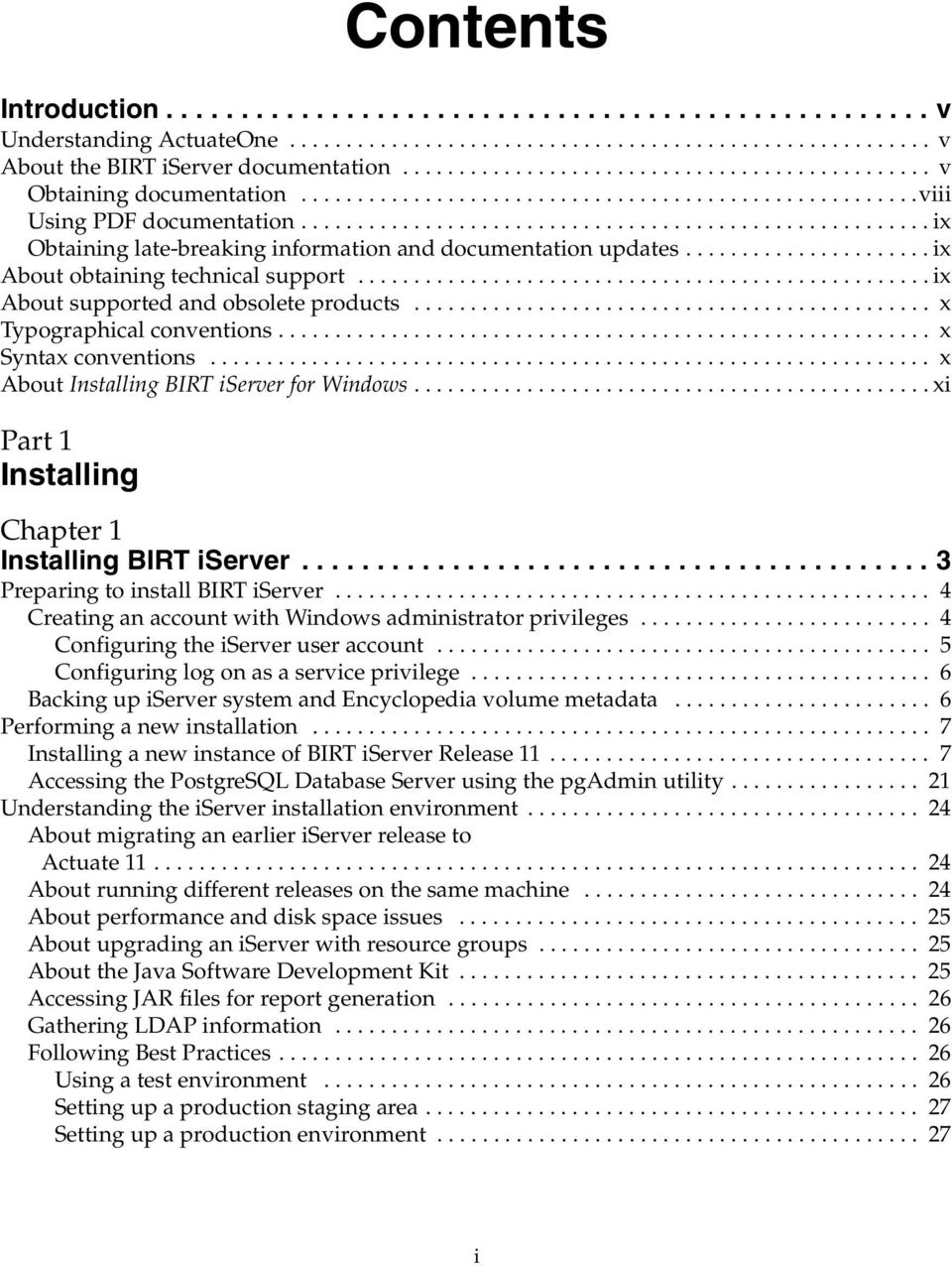
3 Contents Introduction v Understanding ActuateOne v About the BIRT iserver documentation v Obtaining documentation viii Using PDF documentation ix Obtaining late-breaking information and documentation updates ix About obtaining technical support ix About supported and obsolete products x Typographical conventions x Syntax conventions x About Installing BIRT iserver for Windows xi Part 1 Installing Chapter 1 Installing BIRT iserver Preparing to install BIRT iserver Creating an account with Windows administrator privileges Configuring the iserver user account Configuring log on as a service privilege Backing up iserver system and Encyclopedia volume metadata Performing a new installation Installing a new instance of BIRT iserver Release Accessing the PostgreSQL Database Server using the pgadmin utility Understanding the iserver installation environment About migrating an earlier iserver release to Actuate About running different releases on the same machine About performance and disk space issues About upgrading an iserver with resource groups About the Java Software Development Kit Accessing JAR files for report generation Gathering LDAP information Following Best Practices Using a test environment Setting up a production staging area Setting up a production environment i
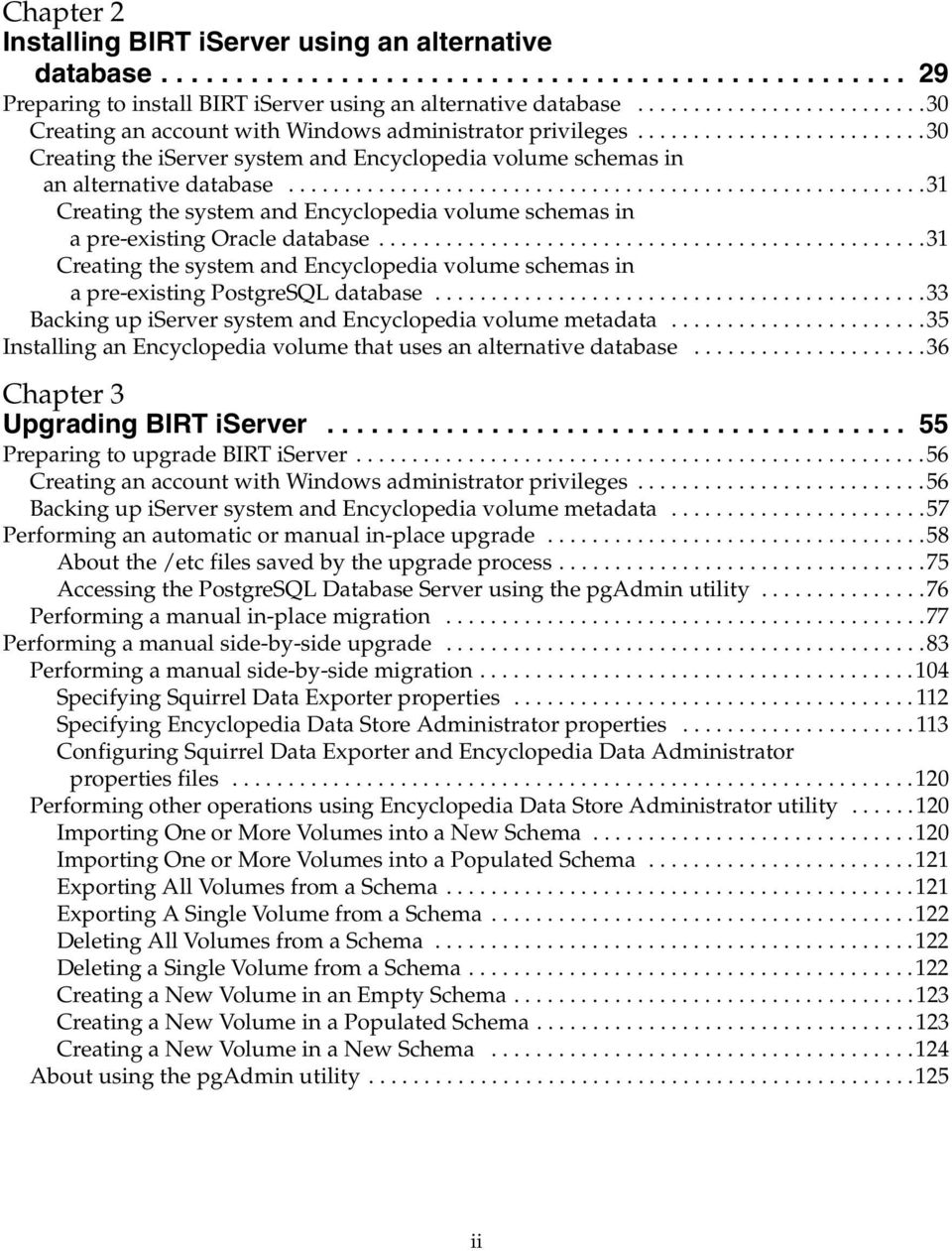
4 Chapter 2 Installing BIRT iserver using an alternative database Preparing to install BIRT iserver using an alternative database Creating an account with Windows administrator privileges Creating the iserver system and Encyclopedia volume schemas in an alternative database Creating the system and Encyclopedia volume schemas in a pre-existing Oracle database Creating the system and Encyclopedia volume schemas in a pre-existing PostgreSQL database Backing up iserver system and Encyclopedia volume metadata Installing an Encyclopedia volume that uses an alternative database Chapter 3 Upgrading BIRT iserver Preparing to upgrade BIRT iserver Creating an account with Windows administrator privileges Backing up iserver system and Encyclopedia volume metadata Performing an automatic or manual in-place upgrade About the /etc files saved by the upgrade process Accessing the PostgreSQL Database Server using the pgadmin utility Performing a manual in-place migration Performing a manual side-by-side upgrade Performing a manual side-by-side migration Specifying Squirrel Data Exporter properties Specifying Encyclopedia Data Store Administrator properties Configuring Squirrel Data Exporter and Encyclopedia Data Administrator properties files Performing other operations using Encyclopedia Data Store Administrator utility Importing One or More Volumes into a New Schema Importing One or More Volumes into a Populated Schema Exporting All Volumes from a Schema Exporting A Single Volume from a Schema Deleting All Volumes from a Schema Deleting a Single Volume from a Schema Creating a New Volume in an Empty Schema Creating a New Volume in a Populated Schema Creating a New Volume in a New Schema About using the pgadmin utility ii
5 Chapter 4 Installing a BIRT iserver cluster Installing a BIRT iserver cluster node Adding a node to a cluster Chapter 5 Installing Information Console Preparing to install Information Console About installing from an FTP download About performing a full installation Installing Information Console on Windows Using the installation wizard Using the WAR file to install General deployment tasks Preparing the server Preparing the WAR file About clusters of servers Avoiding cache conflicts after installing Testing the installation Chapter 6 Installing iserver Integration Technology and Documentation Installing iserver Integration Technology Installing the localization and documentation files About accessing online help Part 2 Licensing Chapter 7 Licensing BIRT iserver Working with licensing Understanding the licensing options About license files About CPU binding Understanding node-key licensing Obtaining the installation license key file Collecting machine information for a node-key license Installing the license key Understanding CPU binding iii

6 Binding an Actuate BIRT iserver to processors on a Windows machine Binding to specific CPUs Binding to multiple-core CPUs Binding an Actuate process to a processor About processors and hyperthreading Binding Actuate BIRT iserver to processors on a Sun Solaris machine Binding to specific CPUs Binding to multiple CPUs Binding to multiple-core CPUs Binding Actuate BIRT iserver to processors on an HP-UX 11i machine Checking Actuate BIRT iserver bound processors Determining the number of processors an iserver System uses Understanding CPU binding validation while iserver is running Understanding CPU binding validation when an Encyclopedia volume comes online Understanding CPU binding validation when running iserver processes Configuring for CPU license problems Index iv

7 Introduction Understanding ActuateOne ActuateOne includes Release 11 of Actuate Corporation s value-added products for the Eclipse BIRT open source project. ActuateOne institutes a paradigm shift in Business Intelligence technology from individualized tools to a suite of integrated capabilities within a single environment. ActuateOne is one designer, one server, one integrated environment providing a single unified user experience. A common architecture is precisely what today s information-rich global environment requires for development and deployment. This unified Actuate technology continues to enable information management and delivery while supporting advanced security, massive scalability, flexibility through programming, and reuse. ActuateOne realizes our corporate vision of a single user experience by providing extended new analytics capabilities reaching a broader spectrum of users. The new dashboard functionality supports building gadgets to enhance the visual presentation of information. Export to Excel and other formats integrates Actuate output with other tools on the end-user desktop. Actuate s cloud-ready server supports elastic clustering for dynamic provision of uninterrupted efficient service. Information, live demos, and endorsements about this release are available from birt-exchange.com and actuate.com. The Actuate site also makes The Forrester Wave : Open Source Business Intelligence (BI), Q report freely available. The report recognizes Actuate and its value-added offerings for BIRT as a leader in Open Source Business Intelligence. About the BIRT iserver documentation The printed and online documentation includes the materials described in Table I-1. You can obtain HTML and PDF files from the BIRT Exchange or Actuate Customer Support site. Introduction v

8 Documentation updates are created in response to customer requirements and are available at both sites. Table I-1 BIRT iserver documentation For information about this topic Installing BIRT iserver for Linux and UNIX See the following resource Installing BIRT iserver for Linux and UNIX Installing BIRT iserver for Windows Installing BIRT iserver for Windows Late-breaking information and documentation updates Configuring BIRT iserver Use Configuration Console to: Add additional Encyclopedia volumes Configure clusters of iservers Tune iserver services and processes Configure notification Review and update license options Open ports for iserver use Manage iserver printers and resources Configure diagnostic logging Release notes and updated localization, HTML help, and PDF files posted on birt-exchange.com and Actuate Support Configuring BIRT iserver vi Installing BIRT iserver for Windows

9 Table I-1 BIRT iserver documentation (continued) For information about this topic Managing an Encyclopedia Volume Use Management Console to: Set up user accounts Set up channels and notification groups Assign security roles Manage files and folders Schedule, run, and manage reports Back up the Encyclopedia volume Use Actuate Open Security Information Console Developer Guide Overview of Deployment Kit concepts and web applications Using, customizing, and configuring the Deployment Kit Using code components for JSPs, URL parameters, JavaScript files, Java servlets, Java Beans, and security facilities Using BIRT iserver Integration Technology Overview of Actuate web services and SOAP messaging Managing an Encyclopedia volume Developing API applications using Java or.net Using Java Report Server Security Extension (RSSE) APIs Using logging, performance monitoring, and archiving features Customizing the Actuate software installation process Actuate Information Delivery API operations and data types reference See the following resource Managing an Encyclopedia Volume Information Console Developer Guide Using BIRT iserver Integration Technology (continues) Introduction vii

10 Table I-1 BIRT iserver documentation (continued) For information about this topic Using Information Console Overview of the Deployment Kit concepts and online reporting Accessing and managing files and folders; running reports See the following resource Using Information Console Using Actuate JavaScript API Overview of programming with Actuate JavaScript Creating custom pages using Actuate JavaScript Reference for Actuate JavaScript classes and methods Deploying to a BIRT iserver System Describes how to deploy designs and information objects to iserver Using Actuate JavaScript API Deploying to a BIRT iserver System Actuate Glossary Definitions of product terminology Actuate Glossary Adobe Acrobat Catalog A utility that can search all the documents in the Actuate manuals directory Adobe Acrobat Catalog Obtaining documentation Actuate provides technical documentation in PDF, HTML, and print formats. You can download PDF or view HTML versions of the documentation from viii Installing BIRT iserver for Windows
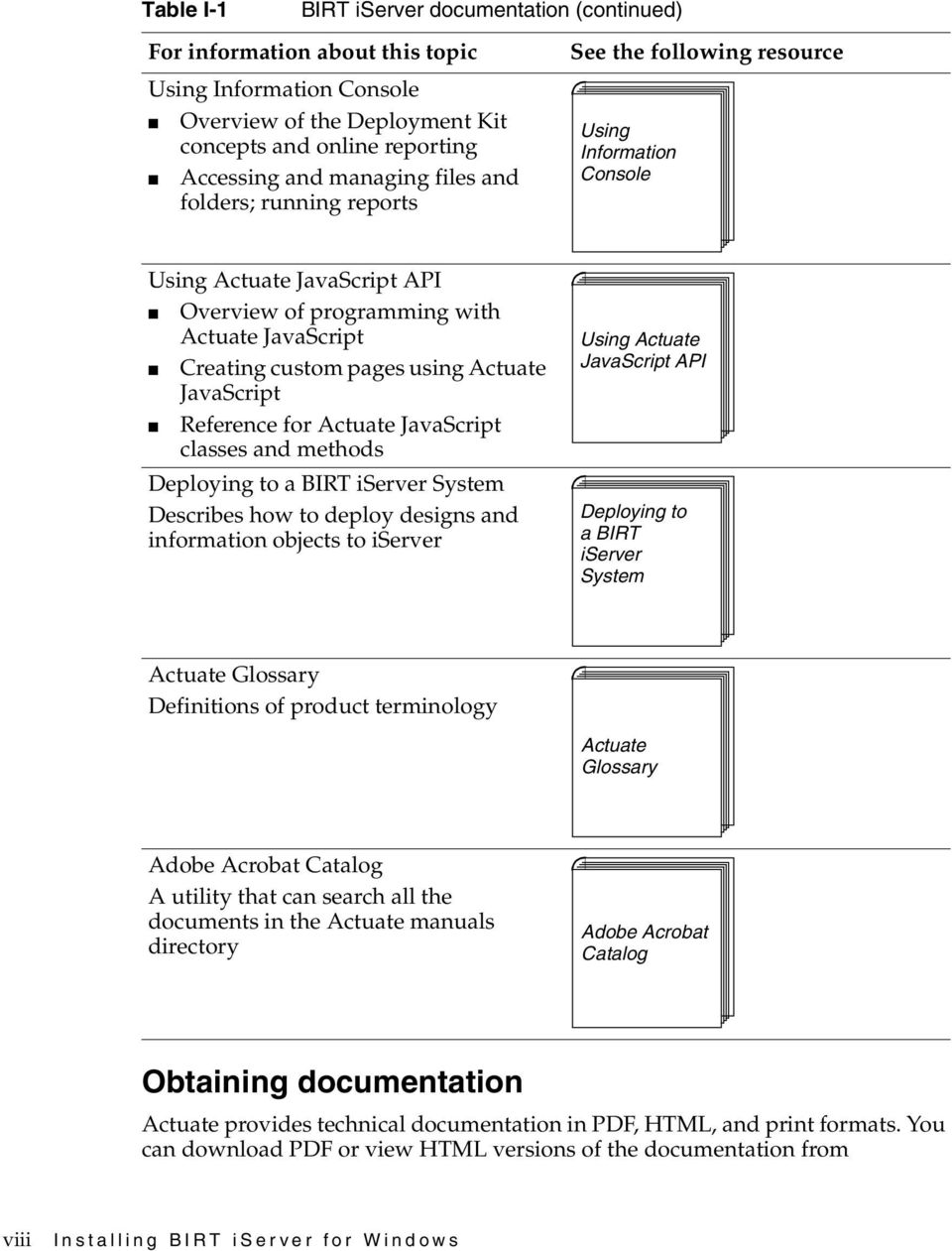
11 birt-exchange.com. If you purchase the product, you can also download documentation using ftp as instructed in the from Actuate Distribution. If you request a physical package, install the files using the Online Documentation and Localization Resource Files DVD, which ships as part of your Actuate software package. If you select the typical setup when you install from the DVD, the installation creates the Actuate11\Manuals directory. Using PDF documentation In each PDF version of a book, the table of contents and the index page numbers contain links to the corresponding topics in the text. In the table of contents, you access the link by positioning the pointer over the topic. In the index, you access the link by positioning the pointer over the page number. The Actuate11\Manuals directory contains a file, master-index.pdx, which is an Adobe Acrobat Catalog utility that can search all the documents in the Actuate Manuals directory. This tool provides a convenient way to find information on a particular topic in Actuate documentation. Obtaining late-breaking information and documentation updates The release notes contain late-breaking news about Actuate products and features. The release notes are available on the Actuate Support site at the following URL: Updates to documentation in PDF form are available at the following URL: If you are a new user, you must first register on the site and log in to view the release notes. Birt-exchange.com and actuate.com also provide product update information. About obtaining technical support You can contact Customer Support by or telephone. For contact information, go to the following URL: Introduction ix

12 About supported and obsolete products The Actuate Support Lifecycle Policy and Supported Products Matrix are available on the Actuate Support web site at the following URL: Typographical conventions Table I-2 describes the typographical conventions in this document. Table I-2 Typographical conventions Item Convention Example Code examples Monospace Dim Text1 As String File names Initial capital letter, except where file names are case-sensitive Detail.roi Key combination A + sign between keys means to press both keys at the same time Ctrl+Shift Menu items Capitalized, no bold File Submenu items Separated from the main menu item with a small arrow File New User input or user response User input in XML and Java code Monospace Monospace italics M*16* chkjava.exe cab_name.cab Syntax conventions Table I-3 describes the symbols used to present syntax. Table I-3 Syntax conventions Symbol Description Example [ ] Optional item [Alias<alias name>] Array subscript matrix[ ] x Installing BIRT iserver for Windows

13 Table I-3 Syntax conventions Symbol Description Example { } Groups two or more mutually exclusive options or arguments when used with a pipe Separates mutually exclusive options or arguments in a group {While Until} Defines array contents {0, 1, 2, 3} Delimiter of code block public ACJDesigner( ){ } Exit {Do For Function Sub} Java OR operator int length 4 <> Argument you must <expression to format> supply Delimiter in XML <xsd:sequence> About Installing BIRT iserver for Windows Installing BIRT iserver for Windows includes the following chapters: Introduction. Provides an overview of this guide, BIRT iserver documentation, and the typographical conventions in this book. Part 1. Installing. Describes how to install BIRT iserver. Chapter 1. Installing BIRT iserver. Describes how to install BIRT iserver using the out-of-the-box (OOTB) PostgreSQL relational database management system (RDBMS) in a Windows environment. Chapter 2. Installing BIRT iserver using an alternative database. Describes how to install BIRT iserver using an alternative RDBMS, such as a pre-existing PostgreSQL or Oracle RDBMS, in a Windows environment. Chapter 3. Upgrading BIRT iserver. Describes how to upgrade BIRT iserver in a Windows environment. Chapter 4. Installing a BIRT iserver cluster. Describes how to install an BIRT iserver cluster node in a Windows environment. Chapter 5. Installing Information Console. Describes how to install Actuate Information Console in Windows. Chapter 6. Installing iserver Integration Technology and Documentation. Describes how to install Actuate iserver Integration Technology and Documentation in a Windows environment. Introduction xi

14 Part 2. Licensing. Describes how to license BIRT iserver. Chapter 7. Licensing BIRT iserver. Describes licensing options, license key installation, and CPU binding policies for BIRT iserver. xii Installing BIRT iserver for Windows

15 PartOne1 Part 1Installing

16

17 Chapter 1 1Installing BIRT iserver Chapter This chapter discusses the following topics: Preparing to install BIRT iserver Performing a new installation Understanding the iserver installation environment Chapter 1, Installing BIRT iserver 3

18 Preparing to install BIRT iserver When installing BIRT iserver Release 11, the administrator must choose to use the out-of-the-box (OOTB) PostgreSQL relational database management system (RDBMS) or another data store, such as Oracle, or a pre-existing PostgreSQL instance to store Encyclopedia volume metadata. This chapter describes how to install a new instance of BIRT iserver Release 11, using the out-of-the-box (OOTB) PostgreSQL RDBMS. For more information about installing BIRT iserver using an alternative data store, such as Oracle or a pre-existing PostgreSQL database, see Chapter 2, Installing BIRT iserver using an alternative database, later in this book. For more information about upgrading an existing BIRT iserver installation, see Chapter 3, Upgrading BIRT iserver, later in this book. For information about the new Release 11 BIRT iserver System architecture, see Chapter 1, Understanding Actuate BIRT iserver architecture, in Configuring BIRT iserver. Creating an account with Windows administrator privileges Before installing iserver, create a Windows user account that is a member of the Administrators group. Use this account when installing and running iserver. The iserver user account must meet the following requirements: Be a member of the Windows Administrators group. The account must have privileges to access the required software and hardware, such as database servers, printers, and iserver files and folders. Have log on as a service privilege. If the account does not meet this requirement, the iserver installation program prompts you to configure the privilege to run the Windows Actuate iserver service. On a new Windows Vista installation, the initial user account is not a member of the Administrators group. You must configure this user account to be a member of this group. When installing iserver in Windows 2003, create a Windows user account that is a member of the Power Users not the Administrators group. Make sure that the Account has permission to access any printers required for printing. Perform the installation using an account that has Administrator privileges. During the installation, when prompted to specify the user account to run the iserver service, specify the Power User account. How to create a Power User account To create a Power User account, perform the following tasks: 4 Installing BIRT iserver for Windows

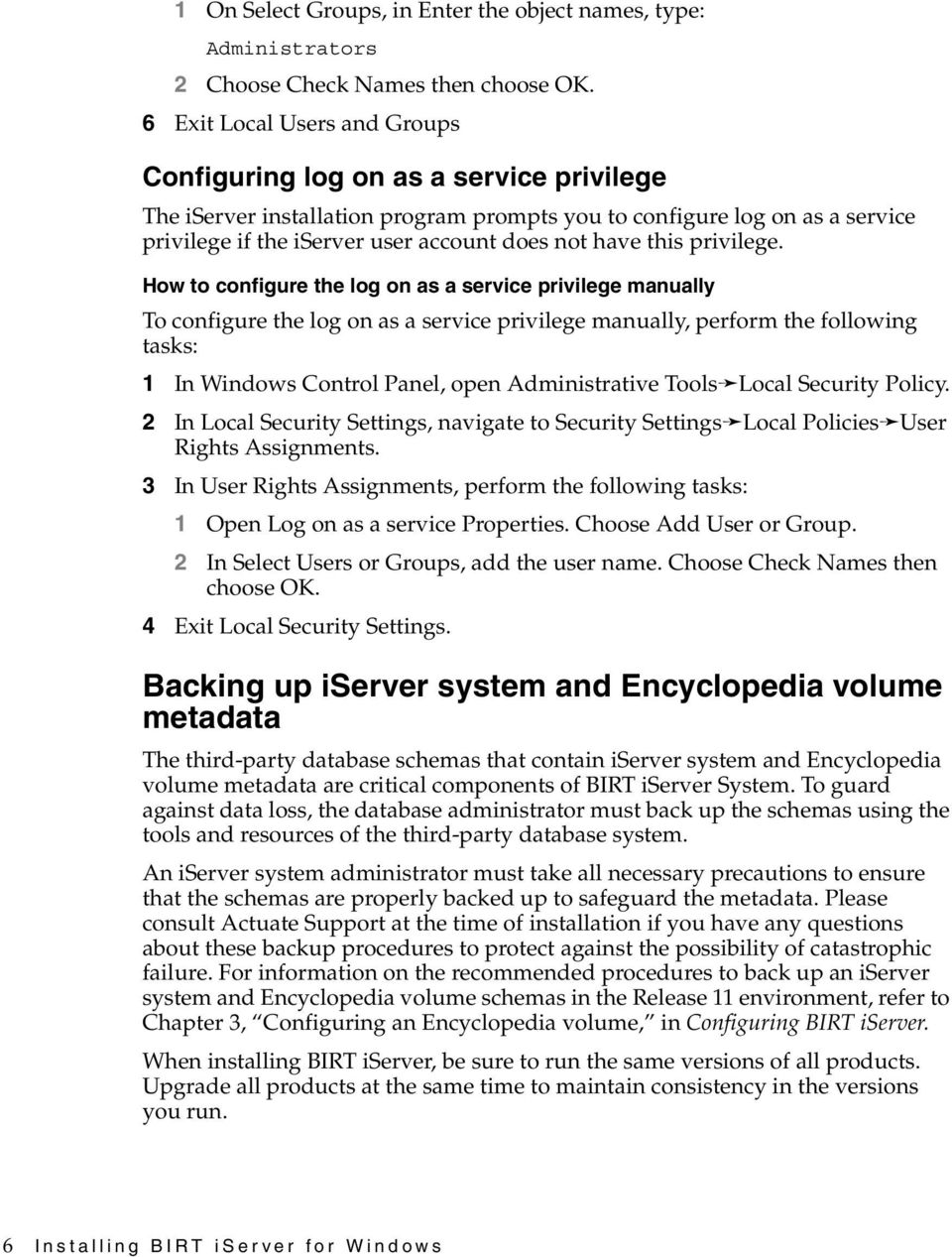
19 1 In Windows, open the Command Prompt and type: lusrmgr.msc 2 In Local Users and Groups, choose Users to display the list of users. 3 Double-click the user to display the properties. 4 In Properties General, deselect Account is disabled, if necessary. 5 In Properties Member Of, choose Add and perform the following tasks: 1 On Select Groups, in Enter the object names, type: Power user 2 Choose Check Names then choose OK. 6 Exit Local Users and Groups In a Windows installation, verify that the ICU_DATA environment variable is set to the location of the Actuate ICU library. The Actuate installation process sets ICU_DATA to the location of the library on the iserver machine. Change this setting, if necessary, to the location of the library. The following example shows the default path set by the iserver installation process: ICU_DATA= C:\WINNT\system32\ If you plan to install iserver processes on a machine controlled by a domain server, install iserver while logged into a user account controlled by the local machine, not the domain server. When you create an iserver cluster, all iserver nodes in the cluster must be installed and run under the same user account. Configuring the iserver user account Actuate recommends creating a dedicated user account for installing and running iserver. Having a dedicated user account isolates iserver-specific issues and events on a machine, making it easier to administer the environment. How to configure a user account with administrator privileges To configure a user account with administrator privileges for installing and running iserver, perform the following tasks: 1 In Windows, open the Command Prompt and type: lusrmgr.msc 2 In Local Users and Groups, choose Users to display the list of users. 3 Double-click the user to display the properties. 4 In Properties General, deselect Account is disabled, if necessary. 5 In Properties Member Of, choose Add and perform the following tasks: Chapter 1, Installing BIRT iserver 5

20 1 On Select Groups, in Enter the object names, type: Administrators 2 Choose Check Names then choose OK. 6 Exit Local Users and Groups Configuring log on as a service privilege The iserver installation program prompts you to configure log on as a service privilege if the iserver user account does not have this privilege. How to configure the log on as a service privilege manually To configure the log on as a service privilege manually, perform the following tasks: 1 In Windows Control Panel, open Administrative Tools Local Security Policy. 2 In Local Security Settings, navigate to Security Settings Local Policies User Rights Assignments. 3 In User Rights Assignments, perform the following tasks: 1 Open Log on as a service Properties. Choose Add User or Group. 2 In Select Users or Groups, add the user name. Choose Check Names then choose OK. 4 Exit Local Security Settings. Backing up iserver system and Encyclopedia volume metadata The third-party database schemas that contain iserver system and Encyclopedia volume metadata are critical components of BIRT iserver System. To guard against data loss, the database administrator must back up the schemas using the tools and resources of the third-party database system. An iserver system administrator must take all necessary precautions to ensure that the schemas are properly backed up to safeguard the metadata. Please consult Actuate Support at the time of installation if you have any questions about these backup procedures to protect against the possibility of catastrophic failure. For information on the recommended procedures to back up an iserver system and Encyclopedia volume schemas in the Release 11 environment, refer to Chapter 3, Configuring an Encyclopedia volume, in Configuring BIRT iserver. When installing BIRT iserver, be sure to run the same versions of all products. Upgrade all products at the same time to maintain consistency in the versions you run. 6 Installing BIRT iserver for Windows
21 If you are a purchasing customer, you can download iserver from an Actuate ftp site or install from a product DVD. If you are evaluating BIRT iserver, you can download iserver from BIRT Exchange at the following location: Actuate also supports the cloud deployment of BIRT iserver using a ready-tolaunch iserver image. For more information about this installation option, see Chapter 9, Installing Actuate BIRT iserver in a cloud deployment, in Configuring BIRT iserver. The following sections describe how to install a new BIRT iserver Release 11 using the available installation options. Performing a new installation Installing a new Release 11 BIRT iserver creates a default Encyclopedia volume without migrating data from a pre-existing volume. The default installation program performs the following operations: Installs and initializes iserver and the PostgreSQL relational database management system (RDBMS). Creates a database in the PostgreSQL RDBMS containing Encyclopedia volume data. Creates the iserver user in the PostgreSQL RDBMS to access the system. Creates the system and volume schema, initializing these schema with basic configuration information. Creates the iserver configuration file, specifying system, volume, and connection information for the default installation The default installation program also initializes the iserver, system, and volume user passwords to the PostgreSQL superuser password. Installing a new instance of BIRT iserver Release 11 The following section describes how to install a new instance of BIRT iserver Release 11 in the Windows operating system. How to perform a new installation of BIRT iserver Release 11 in Windows To install iserver, perform the following tasks: 1 If you downloaded iserver, run ActuateBIRTiServerEnterprise.exe. If you have a DVD or ftp distribution, run setup.exe. The welcome message appears, as shown in Figure 1-1. Choose Next. Chapter 1, Installing BIRT iserver 7
22 Figure 1-1 Viewing the welcome message 2 Read and accept the license agreement, as shown in Figure 1-2. Choose Next. Figure 1-2 Accepting the license agreement 3 The setup installs the prerequisite components that BIRT iserver requires, as shown in Figure 1-3. Choose Next. 8 Installing BIRT iserver for Windows
23 Figure 1-3 Installing Prerequisites 4 In Setup Type, select Typical to install the default configuration for a standalone iserver, as shown in Figure 1-4. Alternatively, choose Custom for one of the following reasons: To install individual iserver components To install a cluster node To install a custom configuration for a stand-alone iserver and a supported relational database management system (RDBMS), such as Oracle, or a preexisting PostgreSQL instance for the Encyclopedia volume metadata database To use an optional Open Security application to control access to iserver using an external system, such as an LDAP server In Destination Folder, accept the default or choose a new destination folder for the Binary and Data locations. iserver uses the Binary location to resolve the paths to all the binaries that it launches. The environment variable, AC_SERVER_HOME, points to the location of the iserver binaries. The default path for the Binary location is C:/Program Files/Actuate11/iServer. iserver uses the Data location to store the iserver logs, iserver Encyclopedia, including the PostgreSQL data, and all other run-time data. The environment variable, AC_DATA_HOME, points to the location of the iserver data. The default path for the data location is C:/Actuate11/iServer/data. Chapter 1, Installing BIRT iserver 9
24 Choose Next. Figure 1-4 Specifying typical or custom setup type 5 In Please choose database information, select the type of Encyclopedia volume metadata database to install, as shown in Figure 1-5. This installation example demonstrates installing the bundled PostgreSQL database. Choose Next. Figure 1-5 Selecting the Encyclopedia volume metadata database to install 10 Installing BIRT iserver for Windows
25 6 In License File Details, select Use the license that you purchased. Choose Browse then navigate to and choose the license file, as shown in Figure 1-6. Alternatively, choose Try out the product using the included evaluation license if you do not have a purchased license. Choose Next. Figure 1-6 Specifying the license file If installing using a named-user license, a prompt appears advising you to check that the volume does not exceed the number of registered users authorized by the license, as shown in Figure 1-7. Figure 1-7 Viewing the named-user license question Choose Yes to continue the installation. 7 In Locale Information, choose Next to accept the default language and time zone, as shown in Figure 1-8. Alternatively, choose the language and locale settings for your region. Chapter 1, Installing BIRT iserver 11
26 Figure 1-8 Specifying locale information 8 In Specify Profiles, type the user name, password, and confirm the password for the account used to start the Actuate iserver 11 service, as shown in Figure 1-9. The account must be a member of the Administrators group, except in Windows 2003, where you must create a Windows user account that is a member of the Power Users group. Accept Automatically start the Actuate BIRT iserver 11 service when Windows boots, as shown in Figure 1-9. If you deselect this option, you must start the service manually from Windows Services. Choose Next. 9 On PostgreSQL Database Information, in Database Credentials, type and confirm a password, as shown in Figure iserver creates the following accounts automatically, using this password for each account: postgres The PostgreSQL database superuser The database superuser administers the PostgreSQL relational database management system (RDBMS). ac_<machine name>_system The System schema owner. iserver creates the System database schema and gives it this name. The installation program substitutes <machine name> with the hostname of the machine on which you are installing iserver. ac_<machine name> The Encyclopedia schema owner. iserver creates the Encyclopedia Database schema and gives it this name. 12 Installing BIRT iserver for Windows
27 Figure 1-9 Specifying the account for running the iserver service In PostgreSQL Database Connection Information, accept the default port 8432 or type a new port number. Choose Next. Figure 1-10 Specifying PostgreSQL database information If prompted to add Log on as a service privilege, choose Yes, as shown in Figure Chapter 1, Installing BIRT iserver 13
28 Figure 1-11 Setting the Windows local security policy 10 In System Configuration Password, type and confirm a password for Configuration Console, as shown in Figure For both Configuration Console and Management Console, the default user name is Administrator. The Administrator account for Management Console has no initial password. You can log in to these consoles and change the password settings after installing iserver. Choose Next. Figure 1-12 Specifying the password for using Configuration Console 11 In Start Copying Files, review the settings shown in Figure Choose Next. Setup Status displays an indicator showing how the installation is progressing, as shown in Figure Installing BIRT iserver for Windows
29 Figure 1-13 Reviewing settings before copying files Figure 1-14 Viewing setup status During installation, a command prompt appears, displaying the run-time commands and messages from the initialization process of the PostgreSQL RDBMS and Encyclopedia volume schema, as shown in Figure Chapter 1, Installing BIRT iserver 15
30 Figure 1-15 Initializing the PostgreSQL RDBMS A prompt appears, asking if you want to install the pgadmin database administration tool for the PostgreSQL RDBMS, as shown in Figure Choose Yes. Figure 1-16 Choosing to install the pgadmin tool Actuate BIRT iserver Setup appears, then pgadmin III Setup appears, as shown in Figure Figure 1-17 Viewing Actuate BIRT iserver and pgadmin III Setup 16 Installing BIRT iserver for Windows
31 12 In pgadmin III Setup, perform the following tasks: 1 In Welcome, shown in Figure 1-17, choose Next. 2 In End-User License Agreement, select I accept the terms in the License Agreement, as shown in Figure Choose Next. Figure 1-18 Accepting the license agreement 3 In Custom Setup, review the features to be installed, as shown in Figure Choose Next. Figure 1-19 Viewing the features to be installed 4 In Ready to Install pgadmin III, shown in Figure 1-20, choose Install. Chapter 1, Installing BIRT iserver 17
32 Figure 1-20 Choosing to install pgadmin II Installing pgadmin III appears, as shown in Figure Figure 1-21 Installing pgadmin III 5 When Completed the pgadmin III Setup Wizard appears, as shown in Figure 1-22, choose Finish to exit the wizard. 13 If you are installing iserver for the first time, you must restart your computer before using iserver. Select whether to restart your computer now or later, as shown in Figure Choose Finish to exit the wizard. 18 Installing BIRT iserver for Windows
33 Figure 1-22 Choosing Finish Figure 1-23 Choosing whether to restart your computer now or later If you are not installing iserver for the first time, you are not prompted to restart your computer. Choose Finish to exit the wizard, as shown in Figure Chapter 1, Installing BIRT iserver 19
34 Figure 1-24 Exiting the installation wizard 14 The installation program prompts you to install the online help from the following location: Alternatively, you can install the online help and manuals in PDF format using the Actuate Localization and Online Documentation media. Figure 1-25 shows the prompt. Figure 1-25 Viewing the install online help and manuals prompt The installation program installs shortcuts on the desktop, as shown in Figure Figure 1-26 Viewing BIRT iserver shortcuts on the desktop These shortcuts provide access to the following iserver components: iserver Management Console Launches Management Console to set up user accounts and run reports. 20 Installing BIRT iserver for Windows
35 BIRT iserver 11 Opens Welcome to Actuate BIRT iserver from which you can log in to Information Console to perform tasks, such as accessing folders and viewing reports. Accessing the PostgreSQL Database Server using the pgadmin utility After migrating the Encyclopedia volume to Release 11, you can optionally open the pgadmin III utility and access the PostgreSQL Database Server to browse the Encyclopedia volume database. Actuate does not support modifying the BIRT iserver PostgreSQL Database schema. Any changes to the schema made by the customer, such as the addition of an index on a table, must be recreated again manually in any future upgrade. How to access the PostgreSQL Database Server using the pgadmin utility To access the PostgreSQL server, choose Start Programs pgadmin III 1.10 pgadmin III. pgadmin III appears, showing the PostgreSQL Database Server 8.4 in the Object browser, as shown in Figure Figure 1-27 Viewing pgadmin III If the PostgreSQL Database Server 8.4 does not appear in the Object browser, you can add the server manually by performing the following tasks: Chapter 1, Installing BIRT iserver 21
36 1 In pgadmin III, choose File Add Server. In New Server Registration Properties, type or select the following property values, as listed in Table 1-1. Table 1-1 New Server Properties Property Value Name PostgreSQL Database Server 8.4 Host <computer name> Port 8432 Maintenance DB postgres Username postgres Password <your superuser password> Store password Not selected Restore env Selected Service PostgreSQL for Actuate iserver 11 Connect now Selected New Server Registration Properties appears, as shown in Figure Figure 1-28 Registering a new server Choose OK. On pgadmin III, expand PostgreSQL Database Server 8.4, as shown in Figure Installing BIRT iserver for Windows
37 Figure 1-29 Viewing PostgreSQL Database Server 8.4 properties 2 In Object browser, expand Databases iserver, iserver Schemas, Tablespaces, and Login Roles to review the server and database installation, as shown in Figure Figure 1-30 Browsing the PostgreSQL Database Server 8.4 installation Chapter 1, Installing BIRT iserver 23
38 The BIRT iserver uninstall process can optionally remove the iserver installation directory containing the encyc folder, which by default contains the postgres database directory. The uninstall process does not uninstall the pgadmin III administration tool, a PostgreSQL database not residing in the AC_DATA_HOME/encyc directory, or another third-party database used to store the Encyclopedia volume data. You must uninstall these components separately. Understanding the iserver installation environment The following sections provide supplementary information about the iserver installation environment that is useful for an administrator to know. About migrating an earlier iserver release to Actuate 11 To upgrade an iserver earlier than Release 8 Service Pack 1, you must first migrate to Release 8 Service Pack 1, 9, or 10 then upgrade to Release 11. To migrate from an earlier release to Actuate 11 by replacing the older version, install Release 11 in the same directory as the earlier release or perform a side-by-side installation as described in Chapter 3, Upgrading BIRT iserver. The upgrade program preserves any previous iserver configuration information and reuses the earlier settings. The installation program resolves any differences in default values between releases, ignoring old configuration defaults in favor of new default values. For example, the installation does not prompt the user for port information and machine name. The installation detects the current port numbers and machine name and keeps those settings. About running different releases on the same machine A BIRT iserver Release 11 can coexist on the same machine with an earlier major release, such as Release 10, and any associated minor release, such as Release 10 Service Pack 1. Actuate does not support running multiple releases from the same version on a machine. For example, you cannot run Release 10 and Release 10 Service Pack 1 on the same machine. To run different iserver major releases on the same machine, install the releases in separate directories. Change the default port settings for one release to enable running both versions at the same time. 24 Installing BIRT iserver for Windows
39 About performance and disk space issues During an upgrade installation, the following operations can consume more disk space and take longer than a fresh installation: File comparison The copy operation to back up original files During an upgrade, disk space requirements typically double. The installation routine copies files to the local machine for comparison between the original files and the new files. If you perform multiple upgrade installations, the installation routine consumes even more disk space for the backup files you need to restore previous installations. About upgrading an iserver with resource groups When you upgrade BIRT iserver System, iserver creates a resource group on an iserver node that has the Factory service and the View service enabled. If no node has the Factory service and the View service enabled, iserver creates resource groups with zero Factory processes. About the Java Software Development Kit The iserver installation routine installs the JDK files in: /Program Files/Common Files/Actuate/11.0/JDK160 To use a different JDK with iserver, change the files in the installation directory or change the values of the following environment variables: AC_JAVA_HOME AC_JVM_HOME AC_JRE_HOME AC_JRE64_HOME Using an earlier release of JDK can cause some Actuate features to fail or to work improperly. For example, using an earlier release of JDK can cause Actuate products to display charts incorrectly. The following types of Actuate report object executable files use AC_JRE_HOME and AC_JVM_HOME: Files containing charts use AC_JVM_HOME to locate the java.exe to generate the chart. Files using the Actuate Java Object Interface use AC_JVM_HOME to locate the JVM DLL or library. Chapter 1, Installing BIRT iserver 25
40 Accessing JAR files for report generation To generate some documents, iserver requires access to jar files in the Jar directory of the iserver installation files. In Windows, include the location of the jar file in the CLASSPATH. Gathering LDAP information An optional Open Security application ships with Actuate iserver Integration Technology. This application uses a Lightweight Directory Access Protocol (LDAP) security database to control access to the Encyclopedia volume. To use the Open Security application, you need to perform a custom installation and specify the following additional information: Name of the LDAP server and the port on which the LDAP server listens LDAP account and password used to query the LDAP server LDAP server organization that contains the Actuate users, roles, and groups LDAP base domain names and object classes that contain Actuate user, role, and group information LDAP group name assigned as the Actuate Encyclopedia volume administrator role Actuate Open Security uses an LDAP configuration file to map the Encyclopedia volume user information to LDAP object attributes. For more information on Actuate Open Security, see the reference implementations available in Actuate Server Integration Technology. Following Best Practices Before deploying a new release in a production environment, Actuate recommends testing it. Using a test environment Set up a test environment then migrate to Actuate 11 when the testing is complete. Earlier Actuate releases and Actuate 11 can coexist on the same machine. You must install products at different release levels in different folders. You cannot mix Actuate products from different release levels. For example, you can not use Actuate 10 design tools with BIRT iserver Release 11. How and when you upgrade to Actuate 11 depends on your site configuration and requirements. Complete the following general tasks in this order to determine how to upgrade your site to Actuate 11: Create a test environment for Actuate 11. The test environment can be on the same machine that hosts the earlier Actuate installation or on a separate machine. 26 Installing BIRT iserver for Windows
41 Install the software in the test environment and upgrade earlier versions of designs and files. Also update any custom applications that you built using Actuate iserver Integration Technology. Verify that your applications work properly in the test environment. Ask application developers and a few users to perform some typical tasks in the test environment. Create a production staging area. Install the remaining Actuate 11 desktop products, if required, in production environments on the user workstations. Verify that the desktop products function properly. Schedule a low-impact time to switch to Actuate 11 to complete the transition. Setting up a production staging area A production staging area is one that you can use for testing and also configure as the live production system. The production staging area can be a separate configuration on the live production machine or a separate machine. You can install all Actuate 11 products or the Actuate 11 server products and a subset of the desktop products. If you plan to test Actuate 11 desktop products, identify which users to include in the final testing. Developers and users can then confirm that applications perform as expected in the Actuate 11 production staging environment. Complete the following general tasks to test Actuate 11: Install BIRT iserver Release 11 software in a production staging area. Install Actuate 11 desktop software on the test user machines. Using separate folders, you can install Actuate 11 desktop software in conjunction with the earlier desktop software. Users can continue to use the existing Actuate software in production while testing the Actuate 11 desktop software. Verify that the Actuate 11 production staging environment works correctly. Install the remaining Actuate 11 desktop products, if you installed a subset earlier. Verify that all the Actuate 11 desktop products work correctly. Begin setting up a production environment, described in the following section. Setting up a production environment When testing is complete, confirm that your applications work as expected in the Actuate 11 environment. Set up the production environment and schedule a date and time to switch from earlier versions to Actuate 11. Chapter 1, Installing BIRT iserver 27
42 When you switch to Actuate 11, use the following procedure list as a general guideline: Shut down all Actuate servers. Back up earlier Actuate Encyclopedia volumes. Upgrade existing Encyclopedia volumes and archive volumes. Install upgraded design and document files. To upgrade from Actuate 10, for example, perform one of the following operations: If you are replacing your Actuate 10 system, upgrade Encyclopedia volumes by installing Actuate 11 in the same directory, overwriting Actuate 10. Uninstall BIRT iserver Release 11 from your production staging area and reinstall it in place of your existing Actuate 10 installation. The installer upgrades the Encyclopedia volumes when it starts. If you are running both Actuate 10 and Actuate 11, you can migrate volumes to the Actuate 11 location. Use the Actuate 11 Squirrel Data Exporter and Encyclopedia Data Store Administrator utilities to migrate an Actuate 10 Encyclopedia volume to the Actuate 11 Encyclopedia location. Confirm that all partitions for Actuate 11 are in the active state before you use these utilities. Install upgraded design and document files. Encyclopedia volume data is located separately from iserver binaries in Release 11. Start BIRT iserver Release 11. Inform users that they can start using Actuate 11 design tool products. 28 Installing BIRT iserver for Windows
43 Chapter 2 2Installing BIRT iserver Chapter using an alternative database This chapter discusses the following topics: Preparing to install BIRT iserver using an alternative database Installing an Encyclopedia volume that uses an alternative database Chapter 2, Installing BIRT iserver using an alternative database 29
44 Preparing to install BIRT iserver using an alternative database When installing BIRT iserver Release 11, the administrator must choose to use the out-of-the-box (OOTB) PostgreSQL database or another data store, such as Oracle or a pre-existing PostgreSQL instance to store Encyclopedia volume metadata. This chapter describes how to install a new instance of BIRT iserver Release 11, using an alternative data store, such as Oracle or a pre-existing PostgreSQL instance. For all database systems other than the OOTB PostgreSQL, the database administrator must create the system and Encyclopedia volume schemas and an iserver application user before installing BIRT iserver. During the iserver installation, the administrator provides the Encyclopedia volume schema owner and iserver application user credentials. The iserver installation program creates the necessary volume database structures, then loads the metadata. Creating an account with Windows administrator privileges Before installing iserver, create a Windows user account that is a member of the Administrators group. Use this account when installing and running iserver. The iserver user account must meet the following requirements: Be a member of the Windows Administrators group. The account must have privileges to access the required software and hardware, such as database servers, printers, and iserver files and folders. Have log on as a service privilege. If the account does not meet this requirement, the iserver installation program prompts you to configure the privilege to run the Windows Actuate iserver service. On a new Windows Vista installation, the initial user account is not a member of the Administrators group. You must configure this user account to be a member of this group. When installing iserver in Windows 2003, create a Windows user account that is a member of the Power Users not the Administrators group. Make sure that the Account has permission to access any printers required for printing. Perform the installation using an account that has Administrator privileges. During the installation, when prompted to specify the user account to run the iserver service, specify the Power User account. 30 Installing BIRT iserver for Windows
45 For more information about configuring a Power User and iserver account and log on as a service privilege, see Creating an account with Windows administrator privileges, in Chapter 1, Installing BIRT iserver. Creating the iserver system and Encyclopedia volume schemas in an alternative database Before installing BIRT iserver to use a pre-existing RDBMS, the database administrator must first run SQL scripts that contain the appropriate Data Definition Language (DDL) statements to create the following schema owner and application user accounts with appropriate privileges: iserver system schema owner Encyclopedia volume schema owner iserver application user Restrict schema and the iserver application user names to alphanumeric and underscore characters with an initial alphabetic character in the pattern [a-z][a-z 0-9]*. Do not use a hyphen. In an environment containing multiple Encyclopedia volume schemas, Actuate recommends using one iserver application user with privileges on all the schemas. This configuration allows iserver to maximize connection pooling and minimize the number of connections to the RDBMS. Creating the system and Encyclopedia volume schemas in a pre-existing Oracle database In Oracle, there is a one-to-one relationship between a user and a schema. A schema is not a separate entity. The iserver system schema owner has the same name as the system schema. The Encyclopedia volume schema owner also has the same name as the Encyclopedia volume schema. The following SQL scripts provide an example of DDL statements that create the schema owner and grant privileges in a pre-existing Oracle database. These steps are not necessary when adding an Encyclopedia volume to an existing schema. The Oracle database administrator may need to modify these SQL command examples for the specific Oracle installation. In the commands, substitute system and schema names appropriate to your environment. Creating the system schema owner The iserver system schema owner has all privileges on the schema used for the system data store and can grant privileges to other users. The system schema owner must be able to create database objects, such as tables and indexes. Chapter 2, Installing BIRT iserver using an alternative database 31
46 The following SQL script provides an example of DDL statements that create the iserver system schema owner and grant privileges in a pre-existing Oracle database: DROP USER ac_urup_system CASCADE; CREATE USER ac_urup_system IDENTIFIED BY password DEFAULT TABLESPACE USERS TEMPORARY TABLESPACE TEMP; GRANT CREATE TABLE TO ac_urup_system; GRANT CREATE VIEW TO ac_urup_system; GRANT CREATE SEQUENCE TO ac_urup_system; GRANT CREATE ANY TYPE TO ac_urup_system; GRANT CREATE PROCEDURE TO ac_urup_system; GRANT CREATE OPERATOR TO ac_urup_system; GRANT CREATE TRIGGER TO ac_urup_system; GRANT CREATE SESSION TO ac_urup_system; ALTER USER ac_urup_system QUOTA UNLIMITED ON USERS; COMMIT; Creating the Encyclopedia schema owner The Encyclopedia volume schema owner has all privileges on the schema used for the volume data store and can grant privileges to other users. The Encyclopedia schema owner must be able to create database objects, such as tables and indexes. TThe following SQL script provides an example of DDL statements that create the Encyclopedia volume schema owner and grant privileges in a pre-existing Oracle database: CREATE USER ac_urup IDENTIFIED BY password DEFAULT TABLESPACE USERS TEMPORARY TABLESPACE TEMP; GRANT CREATE TABLE TO ac_urup; GRANT CREATE VIEW TO ac_urup; GRANT CREATE SEQUENCE TO ac_urup; GRANT CREATE ANY TYPE TO ac_urup; GRANT CREATE PROCEDURE TO ac_urup; GRANT CREATE OPERATOR TO ac_urup; GRANT CREATE TRIGGER TO ac_urup; GRANT CREATE SESSION TO ac_urup; ALTER USER ac_urup QUOTA UNLIMITED ON USERS; COMMIT; 32 Installing BIRT iserver for Windows
47 Creating the iserver application user iserver connects to the database as an application user. The application user requires only the privileges necessary to perform basic SQL data manipulation operations, such as SELECT, INSERT, UPDATE, and DELETE. This user does not require privileges to create or modify the structure of the database. The iserver installation process automatically grants the schema privileges required by the application user. The RDBMS database administrator does not have to configure these privileges manually. The following SQL script provides an example of DDL statements that create the iserver user in a pre-existing Oracle database: DROP USER iserver CASCADE; CREATE USER iserver IDENTIFIED BY password DEFAULT TABLESPACE USERS TEMPORARY TABLESPACE TEMP; GRANT CREATE SESSION TO iserver; ALTER USER iserver QUOTA UNLIMITED ON USERS; COMMIT; Creating the system and Encyclopedia volume schemas in a pre-existing PostgreSQL database The following SQL scripts provide an example of DDL statements that create the schema owner and grant privileges in a pre-existing PostgreSQL database. These steps are not necessary when adding an Encyclopedia volume to an existing schema. The PostgreSQL database administrator may need to modify these SQL command examples for the specific PostgreSQL installation. In the commands, substitute system and schema names appropriate to your environment. Creating a database Connect to the PostgreSQL system database, typically named postgres, as a user with full administrator privileges and execute the following SQL commands to create a database named iserver: CREATE DATABASE iserver WITH OWNER = "postgres" TEMPLATE = template0 ENCODING = 'UTF-8'; REVOKE ALL ON DATABASE iserver FROM PUBLIC; Connect to the iserver application database, not the system database, as a user with full administrator privileges, and execute the following SQL command: CREATE LANGUAGE plpgsql; Chapter 2, Installing BIRT iserver using an alternative database 33
48 If the language is already installed, an error message appears. If so, ignore the message. Creating the system schema owner In an iserver installation, the system schema owner must have the same name as the system schema. The system schema owner has all privileges on the schema used for the system data store and can grant privileges to other users. The system schema owner must be able to create database objects, such as tables and indexes. The following commands create a system schema owner named ac_urup_system, with appropriate privileges to connect to the previously created database named iserver. Connect to the PostgreSQL system database, typically named postgres, as a user with full administrator privileges and execute the following SQL commands: CREATE ROLE ac_urup_system LOGIN PASSWORD 'password'; GRANT CONNECT ON DATABASE iserver TO ac_urup_system; Creating the Encyclopedia schema owner In an iserver installation, the Encyclopedia schema owner must have the same name as the Encyclopedia schema. The Encyclopedia schema owner has all privileges on the schema used for the Encyclopedia data store and can grant privileges to other users. The Encyclopedia schema owner must be able to create database objects, such as tables and indexes. The following commands create an Encyclopedia schema owner named ac_urup with appropriate privileges to connect to a database named iserver. Connect to the PostgreSQL system database, typically named postgres, as a user with full administrator privileges and execute the following SQL commands: CREATE ROLE ac_urup LOGIN PASSWORD 'password'; GRANT CONNECT ON DATABASE iserver TO ac_urup; Creating the iserver application user iserver connects to the database as an application user. The application user requires only the privileges necessary to perform basic SQL data manipulation operations, such as SELECT, INSERT, UPDATE, and DELETE. This user does not require privileges to create or modify the structure of the database. The following SQL script provides an example of DDL statements that create the iserver user in a pre-existing PostgreSQL database. Connect to the PostgreSQL system database as a user with full administrator privileges and execute the following SQL commands: CREATE ROLE iserver LOGIN PASSWORD 'password'; GRANT CONNECT ON DATABASE iserver TO iserver; 34 Installing BIRT iserver for Windows
49 Creating the system schema The system schema must have the same name as the system schema owner. The following commands create a system schema named ac_urup_system and grant privileges to use that schema to the application user named iserver. Connect to the application database, not the system database, as a user with full administrator privileges and execute the following commands: CREATE SCHEMA ac_urup_system AUTHORIZATION ac_urup_system; GRANT USAGE ON SCHEMA ac_urup_system TO iserver; Creating the Encyclopedia Schema In an iserver installation, the Encyclopedia schema must have the same name as the Encyclopedia schema owner. The following commands create an Encyclopedia schema named ac_urup and grant privileges to use the schema to the application user named iserver. Connect to the application database, not the system database, as a user with full administrator privileges and execute the following commands: CREATE SCHEMA sales AUTHORIZATION ac_urup; GRANT USAGE ON SCHEMA ac_urup TO iserver; Backing up iserver system and Encyclopedia volume metadata The third-party database schemas that contain iserver system and Encyclopedia volume metadata are critical components of BIRT iserver System. To guard against data loss, the database administrator must back up the schemas using the tools and resources of the third-party database system. An iserver system administrator must take all necessary precautions to ensure that the schemas are properly backed up to safeguard the metadata. Please consult Actuate Support at the time of installation if you have any questions about these backup procedures to protect against the possibility of catastrophic failure. For information on the recommended procedures to back up an iserver system and Encyclopedia volume schemas in the Release 11 environment, refer to Chapter 3, Configuring an Encyclopedia volume, in Configuring BIRT iserver. When installing BIRT iserver, be sure to run the same versions of all products. Upgrade all products at the same time to maintain consistency in the versions you run. If you are a purchasing customer, you can download iserver from an Actuate ftp site or install from a product DVD. If you are evaluating BIRT iserver, you can download iserver from BIRT Exchange at the following location: Chapter 2, Installing BIRT iserver using an alternative database 35
50 Actuate also supports the cloud deployment of BIRT iserver using a ready-tolaunch iserver image. For more information about this installation option, see Chapter 9, Installing BIRT iserver in a cloud deployment, in Configuring BIRT iserver. For information about the new Release 11 BIRT iserver System architecture, see Chapter 1, Understanding Actuate BIRT iserver architecture, in Configuring BIRT iserver. The following section describes how to install BIRT iserver Release 11 using an alternative data store. Installing an Encyclopedia volume that uses an alternative database The following procedures use a pre-existing Oracle database and schema as an example. In Oracle, there is a one-to-one relationship between a user and a schema. A schema is not a separate entity. The following example creates a schema owner named urup and a database user named iserver. During the iserver installation, the administrator provides the schema owner and database user credentials. The iserver installation program creates the necessary volume database structures, then loads the metadata. How to install an Encyclopedia volume that uses an alternative database To install iserver, perform the following tasks: 1 If you downloaded iserver, run the ActuateBIRTiServer.exe file. If you have a DVD or ftp distribution, run setup.exe in the iserver directory. The welcome message appears, as shown in Figure 2-1. Choose Next. 36 Installing BIRT iserver for Windows
51 Figure 2-1 Viewing the welcome message 2 Read and accept the license agreement, as shown in Figure 2-2. Choose Next. Figure 2-2 Accepting the license agreement 3 The setup installs the prerequisite components that BIRT iserver requires, as shown in Figure 2-3. Choose Next. Chapter 2, Installing BIRT iserver using an alternative database 37
52 Figure 2-3 Installing Prerequisites 4 In Setup Type, as shown in Figure 2-4, choose Typical to install a supported relational database management system (RDBMS) for the Encyclopedia volume, such as OOTB PostgreSQL or a pre-existing Oracle or PostgreSQL RDBMS. In Destination Folder, accept the default or choose a new destination folder for the Binary and Data locations. iserver uses the Binary location to resolve the paths to all the binaries that it launches. The environment variable, AC_SERVER_HOME, points to the location of the iserver binaries. The default path for the Binary location is C:/ Program Files/Actuate11/iServer. iserver uses the Data location to store the iserver logs, iserver encyclopedia, including the PostgreSQL data, MC logs, IC logs, and all other run-time data. The environment variable, AC_DATA_HOME, points to the location of the iserver data. The default path for the data location is C:/Actuate11/iServer/ data. Choose Next. 38 Installing BIRT iserver for Windows
53 Figure 2-4 Specifying custom setup type 5 In Select Features, select the features to install Core products, AFC files from previous releases, Management Console, and Examples, as shown in Figure 2-5. Choose Next. Figure 2-5 Selecting features to install Chapter 2, Installing BIRT iserver using an alternative database 39
54 6 In iserver Installation Option, select Stand-alone to install iserver as a standalone server, as shown in Figure 2-6. Choose Next. Figure 2-6 Choosing the option to install a Stand-alone iserver 7 In Encyclopedia Metadata Storage, select PostgreSQL or Oracle to install on a pre-existing third-party database. This example demonstrates installing to an Oracle RDBMS, as shown in Figure Installing BIRT iserver for Windows
55 Figure 2-7 Choosing a 3rd Party Database 8 If you chose PostgreSQL or Oracle in the previous step, 3rd Party Database Information appears. Depending on which database you selected, provide the following database information: PostgreSQL For a pre-existing PostgreSQL installation, type the server hostname, port. By default, the port is In Database, specify the name of the database, such as iserver. In Database User credentials, specify the iserver application user, as shown in Figure 2-8. Oracle For a pre-existing Oracle installation, type the server hostname and port. By default, the port is In Service Name, type a valid service name, such as orcl.actuate.com, that identifies the Oracle database server on which you want to install the Encyclopedia volume metadata. Do not use just the system identifier (SID). Provide the complete reference to the server including the domain. When using a Transparent Network Substrate (TNS) service, leave service name blank. Specify the iserver application user in Database User credentials, as shown in Figure 2-9. Choose Next. Chapter 2, Installing BIRT iserver using an alternative database 41
56 Figure 2-8 Specifying third-party database information for PostgreSQL Figure 2-9 Specifying third-party database information for Oracle 9 In Database Schema Information, type the system schema owner, password, and confirm the password in System Database Schema Credentials. Type the Encyclopedia database schema owner, password, and confirm the password in Encyclopedia Database Schema Credentials, as shown in Figure Installing BIRT iserver for Windows
57 Figure 2-10 Specifying System and Encyclopedia schema passwords 10 In License File Details, select Use the license that you purchased. Choose Browse then navigate to and choose the license file, as shown in Figure Choose Next. Figure 2-11 Specifying the license file Chapter 2, Installing BIRT iserver using an alternative database 43
58 When installing using a named user license, a prompt appears advising you to check that the volume does not exceed the number of registered users authorized by the license, as shown in Figure Figure 2-12 Viewing the named user license question Choose Yes to continue the installation. 11 In Locale Information, choose Next to accept the default language and time zone, as shown in Figure Alternatively, choose the language and locale settings for your region. Figure 2-13 Specifying locale information 12 In Specify Profiles, type the user name, password, and confirm the password for the account used to start the Actuate BIRT iserver 11 service, as shown in Figure The account must be a member of the Administrators group. Accept Automatically start the BIRT iserver 11 service when Windows boots, as shown in Figure If you deselect this option, you must start the service manually from Windows Services. Choose Next. 44 Installing BIRT iserver for Windows
59 Figure 2-14 Specifying the account for running the iserver service 13 In iserver Configuration, specify the host names and port numbers where the PMD and iserver should bind to listen for requests, as shown in Figure Choose Next. Figure 2-15 Specifying the iserver configuration Chapter 2, Installing BIRT iserver using an alternative database 45
60 14 In System Configuration Password, type and confirm a password for Configuration Console, as shown in Figure For both Configuration Console and Management Console, the default user name is Administrator. The Administrator account for Management Console has no password initially. You can log in to these consoles and change the password settings after installing iserver. Choose Next. Figure 2-16 Specifying the password for using Configuration Console 15 In Volume Information, select Use the default volume to use C:/Actuate11 /iserver/data/encyc, as shown in Figure Alternatively, choose Do not use the default volume. Choose Next. 46 Installing BIRT iserver for Windows
61 Figure 2-17 Choosing whether to create the default volume 16 In Select Security Source, choose Use the Encyclopedia volume to have iserver system manage security and define users, roles, and notification groups, as shown in Figure Alternatively, choose Use an LDAP Directory Server to allow this external system to manage security. Choose Next. Figure 2-18 Selecting a security source Chapter 2, Installing BIRT iserver using an alternative database 47
62 17 In Management Console Configuration, specify the host names and port numbers for the PMD and iserver configurations, as shown in Figure Choose Next. Figure 2-19 Specifying the Management Console configuration 18 In Actuate iserver Application Container, type the port number that the iserver Application Container uses, or accept the default port number, 8900, as shown in Figure Choose Next. 48 Installing BIRT iserver for Windows
63 Figure 2-20 Specify the port number for iserver Application Container 19 In Context Path, type the context path for Management Console or accept the default path, /acadmin, as shown in Figure Choose Next. Figure 2-21 Specifying the context path Chapter 2, Installing BIRT iserver using an alternative database 49
64 20 In Select Program Folder, specify a folder name containing the iserver icons that are used to launch the consoles, or accept the default name, Actuate11, as shown in Figure Choose Next. Figure 2-22 Specifying a program folder 21 In Start Copying Files, review the settings shown in Figure Choose Next. Figure 2-23 Reviewing settings before copying files 50 Installing BIRT iserver for Windows
65 Setup Status displays an indicator showing how the installation is progressing, as shown in Figure Figure 2-24 Viewing setup status 22 If you are installing iserver for the first time, you must restart your computer before using iserver. Select whether to restart your computer now or later, as shown in Figure Choose Finish to exit the wizard. Chapter 2, Installing BIRT iserver using an alternative database 51
66 Figure 2-25 Choosing whether to restart your computer now or later If you are not installing iserver for the first time, you are not prompted to restart your computer. Choose Finish to exit the wizard, as shown in Figure Figure 2-26 Exiting the installation wizard 52 Installing BIRT iserver for Windows
67 23 The installation program prompts you to install the online help and manuals using the Actuate Localization and Online Documentation media, as shown in Figure Figure 2-27 Viewing the install online help and manuals prompt The installation program installs shortcuts on the desktop, as shown in Figure Figure 2-28 Viewing iserver shortcuts on the desktop These shortcuts provide access to the following iserver components: iserver Management Console Launches Management Console to set up user accounts and run reports. iserver 11 Opens Welcome to Actuate iserver from which you can log in to Information Console to perform tasks, such as accessing folders and viewing reports. Chapter 2, Installing BIRT iserver using an alternative database 53
68 54 Installing BIRT iserver for Windows
69 Chapter 3 3Upgrading BIRT iserver Chapter This chapter discusses the following topics: Preparing to upgrade BIRT iserver Performing an automatic or manual in-place upgrade Performing a manual side-by-side upgrade Chapter 3, Upgrading BIRT iserver 55
70 Preparing to upgrade BIRT iserver When upgrading to BIRT iserver Release 11, the administrator must choose to use the out-of-the-box (OOTB) PostgreSQL database or another data store, such as Oracle, or a pre-existing PostgreSQL instance to store Encyclopedia volume metadata. The administrator upgrades iserver and the Encyclopedia volume database using one of the following options: Automatic in-place upgrade Upgrades an earlier iserver system in place, such as Release 10 Service Pack 1, automatically migrating one or more existing Encyclopedia volumes during the installation process. Manual in-place upgrade Upgrades an earlier iserver system in place, such as Release 10 Service Pack 1, without automatically migrating any Encyclopedia volumes. During installation, the administrator chooses to migrate the volumes manually. After installation, the administrator uses the Squirrel Data Exporter and Encyclopedia Data Store Administrator utilities to migrate the volume. Manual side-by-side upgrade Upgrades a new Release 11 iserver system in the environment side-by-side with an earlier iserver System, such as Release 10 Service Pack 1. During installation, the administrator chooses whether to install the default volume with sample designs and documents. After installation, the administrator uses the Squirrel Data Exporter and Encyclopedia Data Store Administrator utilities to migrate the volumes manually from the older system to the Release 11 iserver. Creating an account with Windows administrator privileges Before installing iserver, create a Windows user account that is a member of the Administrators group. Use this account when installing and running iserver. The iserver user account must meet the following requirements: Be a member of the Windows Administrators group. The account must have privileges to access the required software and hardware, such as database servers, printers, and iserver files and folders. Have log on as a service privilege. If the account does not meet this requirement, the iserver installation program prompts you to configure the privilege to run the Windows Actuate iserver service. 56 Installing BIRT iserver for Windows
71 On a new Windows Vista installation, the initial user account is not a member of the Administrators group. You must configure this user account to be a member of this group. When installing iserver in Windows 2003, create a Windows user account that is a member of the Power Users not the Administrators group. Make sure that the Account has permission to access any printers required for printing. Perform the installation using an account that has Administrator privileges. During the installation, when prompted to specify the user account to run the iserver service, specify the Power User account. For more information about configuring a Power User and iserver account and log on as a service privilege, see Creating an account with Windows administrator privileges, in Chapter 1, Installing BIRT iserver. Backing up iserver system and Encyclopedia volume metadata The third-party database schemas that contain iserver system and Encyclopedia volume metadata are critical components of BIRT iserver System. To guard against data loss, the database administrator must back up the schemas using the tools and resources of the third-party database system. An iserver system administrator must take all necessary precautions to ensure that the schemas are properly backed up to safeguard the metadata. Please consult Actuate Support at the time of installation if you have any questions about these backup procedures to protect against the possibility of catastrophic failure. For information on the recommended procedures to back up an iserver system and Encyclopedia volume schemas in the Release 11 environment, refer to Chapter 3, Configuring an Encyclopedia volume, in Configuring BIRT iserver. When installing BIRT iserver, be sure to run the same versions of all products. Upgrade all products at the same time to maintain consistency in the versions you run. To upgrade an iserver earlier than Release 8 Service Pack 1, you must first migrate to Release 8 Service Pack 1, 9, or 10, then upgrade to Release 11. If you are a purchasing customer, you can download iserver from an Actuate ftp site or install from a product DVD. If you are evaluating BIRT iserver, you can download iserver from BIRT Exchange at the following location: Actuate also supports the cloud deployment of BIRT iserver using a ready-tolaunch iserver image. For more information about this installation option, see Chapter 9, Installing BIRT iserver in a cloud deployment, in Configuring BIRT iserver. For information about the new Release 11 BIRT iserver System architecture, see Chapter 1, Understanding Actuate BIRT iserver architecture, in Configuring BIRT iserver. Chapter 3, Upgrading BIRT iserver 57
72 The following sections describe how to install BIRT iserver Release 11 as an upgrade using the available installation options. Performing an automatic or manual in-place upgrade In an automatic or manual in-place upgrade, the installation program performs the following operations: Installs and initializes iserver and the OOTB PostgreSQL relational database management system (RDBMS). Creates the iserver user in the OOTB PostgreSQL RDBMS to access the system, initializing the iserver user password to the PostgreSQL superuser password. Updates the iserver configuration file, specifying the volume, database, and connection information for the default volume. The automatic option also performs the following operations during installation: Creates the system and volume schema, initializing these schema with basic configuration information. Creates the iserver configuration file, specifying system, volume, and connection information for the default installation The manual option requires the system administrator to export the volume metadata and data from the earlier iserver volume to a temporary workspace, then import these resources into the new Release 11 installation. Actuate provides the Squirrel Data Exporter and Encyclopedia Data Store Administrator utilities to perform these tasks. Alternatively, iserver supports a manual, side-by-side upgrade to a new Release 11 iserver in a path separate from the earlier release. For more information, see Performing a manual side-by-side migration, later in this chapter. The installation program can encounter a problem over-writing a file linked with a running process. Be sure to stop iserver and NobleNet Portmapper processes before proceeding with the upgrade. How to shut down iserver 1 Shut down your earlier iserver release by performing the following tasks: 1 Choose Start Programs <iserver version> iserver Configuration Console. Log in to Configuration Console as Administrator. 2 Choose Advanced view. 3 From the side menu, choose System. In System Status, choose Stop to shut down iserver. 58 Installing BIRT iserver for Windows
73 Make sure the earlier iserver is offline before performing the next operations, as shown in Figure 3-1. Figure 3-1 iserver is offline How to shut down the NobleNet Portmapper Stop NobleNet Portmapper by performing the following tasks: 1 Choose Start Programs Administrative Tools Services. 2 In Services, select NobleNet Portmapper for TCP then choose Stop. Alternatively, open a command prompt and run the following command: net stop "NobleNet Portmapper for TCP The following procedure describes step-by-step how to perform an automatic or manual upgrade in place of an earlier version of iserver to BIRT Release 11. How to perform an automatic or manual in-place upgrade to iserver Release 11 1 Although the install program saves these files during an upgrade, Actuate recommends that you make a backup copy of the following files before installing: encyc directories from all nodes acserverconfig.xml in the /etc directory acpmdconfig.xml in the /etc directory RSSE code and associated files if you use the Open Security option 2 If you downloaded iserver, run the ActuateBIRTiServer.exe file. If you have a DVD or ftp distribution, run setup.exe in the iserver directory. The welcome message appears, as shown in Figure 3-2. Choose Next. Chapter 3, Upgrading BIRT iserver 59
74 Figure 3-2 Viewing the welcome message 3 Read and accept the license agreement, as shown in Figure 3-3. Choose Next. Figure 3-3 Viewing the license agreement 4 The setup installs the prerequisite components that BIRT iserver requires, as shown in Figure 3-4. Choose Next. 60 Installing BIRT iserver for Windows
75 Figure 3-4 Installing Prerequisites 5 In Setup Type, select Typical Installation, and check that the default directory in Program location matches the location of the old files that you are upgrading, as shown in Figure 3-5. Choose Next. The name of the installation directory does not change when you upgrade. For example, the name of the program directory continues to be C:/Program Files/Actuate10/iServer after upgrading from Actuate 10 to Actuate 11. In addition, the installation creates a new directory for data at C:/Actuate11/ iserver/data by default. Unlike a new BIRT iserver 11 installation where all run-time data is in a dedicated data location, the following files and folders remain in their original directories under AC_SERVER_HOME after the upgrade: iserver configuration Encyclopedia volume folders iserver log files iserver temporary folder Chapter 3, Upgrading BIRT iserver 61
76 Figure 3-5 Choosing the pre-existing installation directory 6 Choose Yes to upgrade your existing release, as shown in Figure 3-6. Figure 3-6 Confirming an upgrade from Actuate 10 to Actuate 11 7 In Encyclopedia Metadata Storage, select the type of Encyclopedia volume metadata database to install, as shown in Figure 3-7. This installation example demonstrates installing the bundled PostgreSQL database. Choose Next. 62 Installing BIRT iserver for Windows
77 Figure 3-7 Selecting metadata database type 8 Choose Yes to update your license, as shown in Figure 3-8. Figure 3-8 Updating licensing 9 In License File Details, browse to and choose the license file, as shown in Figure 3-9. Choose Next. Chapter 3, Upgrading BIRT iserver 63
78 Figure 3-9 Specifying the license file If installing using a named user license, a prompt appears advising you to check that the volume does not exceed the number of registered users authorized by the license, as shown in Figure Choose Yes to continue, then choose Next. Figure 3-10 Viewing the named user license question 10 In Locale Information, choose Next to accept the default language and time zone, as shown in Figure Alternatively, choose the language and locale settings for your region. 64 Installing BIRT iserver for Windows
79 Figure 3-11 Specifying locale information 11 In Specify Profiles, type the user name and password for the account used to start the Actuate BIRT iserver 11 service. The account must be a member of the Administrators group. Accept Automatically start the Actuate BIRT iserver 11 service when Windows boots, as shown in Figure If you deselect this option, you must start the service manually from Windows Services. Choose Next. Chapter 3, Upgrading BIRT iserver 65
80 Figure 3-12 Specifying the account for running the iserver service 12 In PostgreSQL Database Information, type and confirm the password for the PostgreSQL Database Superuser, as shown in Figure The database superuser, postgres, administers the PostgreSQL relational database management system (RDBMS). In PostgreSQL Database Connection Information, accept the default port 8432 or type a new port number. Choose Next. 66 Installing BIRT iserver for Windows
81 Figure 3-13 Specifying PostgreSQL database information 13 Choose Yes to share the database schema for all encyclopedia volumes, as shown in Figure Alternatively choose No. If you choose No, you must manually set up a schema for each Encyclopedia volume using Configuration Console, then manually migrate the volume using the migration tools. Figure 3-14 Choosing to use a shared database schema 14 In System Configuration Password, type a password for Configuration Console, as shown in Figure For both Configuration Console and Management Console, the default user name is Administrator. The Administrator account for Management Console has no password initially. You can log in to these consoles and change the password settings after installing iserver. Choose Next. Chapter 3, Upgrading BIRT iserver 67
82 Figure 3-15 Specifying the password for using Configuration Console 15 In Start Copying Files, review the settings shown in Figure Choose Next. Figure 3-16 Reviewing settings before copying files 16 If you chose Yes when asked if you want all Encyclopedia volumes to share the same schema, as shown in Figure 3-14, a prompt appears, asking whether 68 Installing BIRT iserver for Windows
83 to run the upgrade utility to automatically migrate the Encyclopedia volume, as shown in Figure Choose Yes to have the installation program automatically migrate the Encyclopedia volume. Choose No to manually migrate the volume after the installation process completes. Figure 3-17 Choosing to run the upgrade utility 17 Choose Yes to remove the old service, as shown in Figure Figure 3-18 Removing the old service Setup Status displays an indicator showing how the installation is progressing, as shown in Figure Figure 3-19 Viewing setup status Chapter 3, Upgrading BIRT iserver 69
84 During installation, a command prompt appears, displaying the run-time commands and messages from the initialization process of the PostgreSQL database system, as shown in Figure Figure 3-20 Initializing the PostgreSQL database system A prompt appears, asking whether to install pgadmin, the administration tool for the PostgreSQL RDBMS, as shown in Figure If you do not have pgadmin installed, choose Yes. Figure 3-21 Choosing to install the pgadmin tool Actuate BIRT iserver Setup appears with pgadmin III Setup appearing immediately afterward, as shown in Figure Installing BIRT iserver for Windows
85 Figure 3-22 Viewing Actuate BIRT iserver and pgadmin III Setup 18 In pgadmin III Setup, perform the following tasks: 1 In Welcome, shown in Figure 3-23, choose Next. Figure 3-23 Viewing Welcome 2 In License Agreement, select I accept the terms in the License Agreement, as shown in Figure Choose Next. Chapter 3, Upgrading BIRT iserver 71
86 Figure 3-24 Accepting the license agreement 3 In Custom Setup, review the features to be installed, as shown infigure Choose Next. Figure 3-25 Viewing the features to be installed 4 In Ready to Install pgadmin III, shown in Figure 3-26, choose Install. 72 Installing BIRT iserver for Windows
87 Figure 3-26 Choosing to install pgadmin II Installing pgadmin III appears, as shown in Figure Figure 3-27 Installing pgadmin III 5 When Completed, the pgadmin III Setup Wizard appears, as shown in Figure 3-28, choose Finish to exit the pgadmin III Setup Wizard. Chapter 3, Upgrading BIRT iserver 73
88 Figure 3-28 Choosing Finish 19 When the Actuate BIRT iserver 11 setup success message appears, as shown in Figure 3-29, choose Finish to exit this wizard. Figure 3-29 Exiting the installation wizard 20 The installation program prompts you to install the online help and manuals using the Actuate Localization and Online Documentation media, as shown in Figure Installing BIRT iserver for Windows
89 Figure 3-30 Viewing the install online help and manuals prompt The installation program installs shortcuts on the desktop, as shown in Figure Figure 3-31 iserver shortcuts installed on the desktop These shortcuts provide access to the following iserver components: iserver Management Console Launches Management Console to set up user accounts and run reports. iserver 11 Opens Welcome to Actuate iserver from which you can log in to Information Console to perform tasks, such as accessing folders and viewing reports. About the /etc files saved by the upgrade process Figure 3-32 shows the date-stamped /etc directory that contains files saved during an upgrade from iserver Release 10 to Release 11, including the following files: acserverconfig.xml in the /etc directory acpmdconfig.xml in the /etc directory Chapter 3, Upgrading BIRT iserver 75
90 Original iserver directory name Copy of original etc directory iserver files upgraded to Release 11 Figure 3-32 Viewing the file system after upgrade to iserver Release 11 Accessing the PostgreSQL Database Server using the pgadmin utility After migrating the Encyclopedia volume to Release 11, you can optionally open the pgadmin III utility and access the PostgreSQL Database Server to browse the Encyclopedia volume database. Actuate does not support modifying the BIRT iserver PostgreSQL Database schema. Any changes to the schema made by the customer, such as the addition of an index on a table, must be recreated again manually in any future upgrade. For more information about using the pgadmin III utility to access the PostgreSQL Database Server to browse the Encyclopedia volume database, see Accessing the PostgreSQL Database Server using the pgadmin utility, in Chapter 1, Installing BIRT iserver. The BIRT iserver uninstall process can optionally remove the iserver installation directory containing the encyc folder, which by default contains the postgres database directory. The uninstall process does not uninstall the pgadmin III administration tool, a PostgreSQL database not residing in the AC_DATA_HOME/encyc directory, or another third-party database used to store the Encyclopedia volume data. You must uninstall these components separately. 76 Installing BIRT iserver for Windows
91 Performing a manual in-place migration After installing BIRT iserver, if you choose to perform a manual upgrade of an Encyclopedia volume, you must perform additional operations to complete the installation. using the Squirrel Data Exporter and Encyclopedia Data Store Administrator utilities. The following section describes how to perform a manual upgrade to an in-place installation, which, for example, an OEM vendor who embeds BIRT iserver in products can choose to do or a customer upgrading from an earlier iserver release with special requirements who cannot do an automatic upgrade. How to perform a manual upgrade of an Encyclopedia volume in an in-place installation 1 Shut down your earlier iserver release by performing the following tasks: 1 Choose Start Programs <iserver version> iserver Configuration Console. Log in to Configuration Console as Administrator. 2 Choose Advanced view. 3 From the side menu, choose System. In System Status, choose Stop to shut down iserver. Make sure the earlier iserver is offline before performing the next operation, as shown in Figure Figure 3-33 iserver is offline 2 Run the Squirrel Data Exporter by performing the following tasks: 1 Create a properties file named SquirrelDataExporter.properties. You pass this file to the Squirrel Data Exporter utility when you execute it. Use the following example to create SquirrelDataExporter.properties: AC_SERVER_HOME = C:/Program Files/Actuate10/iServer AC_DATA_HOME = C:/Actuate11/iServer/data SQUIRREL_DATA_HOME = C:/Program Files/Actuate10/iServer/encyc SQUIRREL_EXPORT_FOLDER = C:/Actuate11/SquirrelData/ac_urup SQUIRREL_EXPORT_FORMAT = PostgreSQL NEW_SCHEMA_NAME = ac_urup NEW_VOLUME_NAME = urup See Table 3-1 for descriptions of the required Squirrel Data Exporter properties later in this chapter. See Table 3-2 for descriptions of the optional Squirrel Data Exporter properties. See Configuring Squirrel Data Exporter and Encyclopedia Data Administrator properties files for additional notes Chapter 3, Upgrading BIRT iserver 77
92 on property files. Restrict the schema name to alphanumeric and underscore characters with an initial alphabetic character in the pattern [az][a-z 0-9]*. Do not use a hyphen. 2 Create a batch file to run the following commands. Adjust the location of AC_SERVER_HOME if the location is different in your environment: SET JAVA_HOME= C:\Program Files\Common Files\Actuate\11.0\JDK160 SET PATH=%JAVA_HOME%\bin;%PATH% SET AC_SERVER_HOME=C:\Program Files\Actuate10\iServer SET CLASSPATH= %AC_SERVER_HOME%\Jar\AcCommon.jar; %AC_SERVER_HOME%\Jar\JDBCDrivers.jar; %AC_SERVER_HOME%\Jar\com.actuate.common-server.jar; %AC_SERVER_HOME%\Jar\ServerAdminTools.jar SET SQUIRREL_DATA_EXPORTER= com.actuate.iserver.encyclopedia.datastore.admin.squirreldataexporter java %SQUIRREL_DATA_EXPORTER% SquirrelDataExporter.properties 3 Open a command prompt and run the Squirrel Data Exporter.bat file. 3 In the Advanced view of Configuration Console, on System Status, choose Start system to restart iserver. 4 In this step, you create a new schema that you assign to the existing volume. In the Advanced view of Configuration Console, from the side menu, choose Volumes. On Volumes, point to the icon next to Default ActuatePostgreSQL MetadataDatabase and choose Add volume schema, as shown in Figure Figure 3-34 Choosing to add a new schema On Volumes New Schema, perform the following tasks: 78 Installing BIRT iserver for Windows
93 1 In Schema name, type a name for the schema. Restrict the schema name to alphanumeric and underscore characters with an initial alphabetic character in the pattern [a-z][a-z 0-9]*. Do not use a hyphen. 2 In Database schema name, type a name for the Database schema. The name must be less than 30 characters. Observe the same naming restrictions for this schema as the volume schema name. 3 In Database schema password, type a new password. 4 In Database schema password confirm, re-type the new password. 5 In Database superuser, type the database superuser name. For the PostgreSQL RDBMS that installs with iserver by default, the PostgreSQL superuser name is postgres. 6 In Database superuser password, type the superuser password. This password is the same password that the installer provides when installing iserver, as shown in Figure Choose OK. Volumes New Schema appears as shown in Figure Figure 3-35 Creating a new schema The new schema appears in the list of schemas on Volumes, as shown in Figure Chapter 3, Upgrading BIRT iserver 79
94 Figure 3-36 Viewing the new schema 5 Point to the icon next to the volume name and choose Properties, as shown in Figure Figure 3-37 Choosing volume properties 6 On Properties General, in Metadata database and schema, select the Database schema name from the list of available schemas, as shown in Figure Choose OK. Figure 3-38 Choosing the database schema name 80 Installing BIRT iserver for Windows
95 On Volumes, the Database schema name you chose for the volume appears on the same line as the volume, as shown in Figure Figure 3-39 Viewing Volumes after binding the schema to the volume 7 Run the Encyclopedia Data Store Administrator utility by performing the following operations: 1 To create the Encyclopedia volume schema, perform the following tasks: 1 Create a properties file named VolumeImport.properties. You pass this file to the Encyclopedia Data Store Administrator utility when you execute it. Use the following example to create VolumeImport.properties: Chapter 3 AC_SERVER_HOME = C:/Program Files/Actuate10/iServer AC_DATA_HOME = C:/Actuate11/iServer/data DATABASE_TYPE = PostgreSQL DATABASE_NAME = iserver DATABASE_HOST = localhost DATABASE_PORT = 8432 SUPERUSER = postgres SUPERUSER_PASSWORD = <your superuser password> SCHEMA_NAME = ac_urup SCHEMA_PASSWORD = <provide a password> IMPORT_DATA = true DATA_IMPORT_FOLDER = C:/Actuate11/SquirrelData/ac_urup See Table 3-3 for descriptions of the required Encyclopedia Data Store Administrator properties later in this chapter. See Table 3-4 for descriptions of the optional Encyclopedia Data Store Administrator properties. See Configuring Squirrel Data Exporter and Encyclopedia Data Administrator properties files for additional notes on property files. 2 Create a batch file to run the following commands. Adjust the location of AC_SERVER_HOME if the location is different in your environment: SET JAVA_HOME= C:\Program Files\Common Files\Actuate\11.0\JDK160 SET PATH=%JAVA_HOME%\bin;%PATH% SET AC_SERVER_HOME=C:\Program Files\Actuate10\iServer SET CLASSPATH= %AC_SERVER_HOME%\Jar\AcCommon.jar; Chapter 3, Upgrading BIRT iserver 81
96 %AC_SERVER_HOME%\Jar\JDBCDrivers.jar; %AC_SERVER_HOME%\Jar\com.actuate.common-server.jar; %AC_SERVER_HOME%\Jar\ServerAdminTools.jar SET ENCYCLOPEDIA_DATASTORE_ADMINISTRATOR= com.actuate.iserver.encyclopedia.datastore.admin. EncyclopediaDataStoreAdministrator java %ENCYCLOPEDIA_DATASTORE_ADMINISTRATOR% VolumeImport.properties 3 Run the Encyclopedia Data Store Administrator.bat file from the command prompt. 8 On Volumes, point to the icon next to the new volume name and choose Take online, as shown in Figure Figure 3-40 Viewing the new volume The new volume comes online, as shown in Figure Figure 3-41 Viewing the new volume after it comes online 9 Log in to Management Console. In Files and Folders, the data from the previous release appears. After migrating the Encyclopedia volume to BIRT iserver Release 11, you can optionally open the pgadmin III utility and register the PostgreSQL server to browse the Encyclopedia volume database. For more information on this procedure, see How to access the PostgreSQL Database Server using the pgadmin utility, in Chapter 1, Installing BIRT iserver. 82 Installing BIRT iserver for Windows
97 Performing a manual side-by-side upgrade In a manual side-by-side upgrade, the administrator installs a new Release 11 iserver in a path separate from the earlier release. The installation program performs the following operations using a PostgreSQL relational database management system (RDBMS) as the example: Installs and initializes iserver and the PostgreSQL relational database management system (RDBMS). Creates the iserver user in the PostgreSQL RDBMS to access the system, initializing the iserver user password to the PostgreSQL superuser password. Creates the system and volume schema, initializing these schema with basic configuration information. Creates the iserver configuration file, specifying system, volume, and connection information for the default installation This manual option requires the system administrator to export the volume metadata and data from the earlier iserver volume to a temporary workspace, then import these resources into the new Release 11 installation. Actuate provides the Squirrel Data Exporter and Encyclopedia Data Store Administrator utilities to perform these tasks. The following procedure describes how to perform a manual side-by-side upgrade of an earlier iserver version to BIRT iserver Release 11. How to perform a manual side-by-side upgrade to iserver Release 11 The installation program can encounter a problem over-writing a file linked with a running process. Be sure to shut down iserver System and stop all iserver processes, such as the Windows Actuate iserver Service, before proceeding with the upgrade. 1 If you downloaded iserver, run the ActuateBIRTiServer.exe file. If you have a DVD or ftp distribution, run setup.exe in the iserver directory. The welcome message appears, as shown in Figure Choose Next. Chapter 3, Upgrading BIRT iserver 83
98 Figure 3-42 Viewing the welcome message 2 Read and accept the license agreement, as shown in Figure Choose Next. Figure 3-43 Viewing the license agreement 3 The setup installs the prerequisite components that BIRT iserver requires, as shown in Figure Choose Next. 84 Installing BIRT iserver for Windows
99 Figure 3-44 Installing Prerequisites 4 In Setup Type, select Custom, as shown in Figure 3-45, to install a supported relational database management system (RDBMS) for the Encyclopedia volume, such as Oracle or PostgreSQL. In Destination Folder, accept the default or choose a new destination folder for the Binary and Data locations. iserver uses the Binary location to resolve the paths to all the binaries that it launches. The environment variable, AC_SERVER_HOME, points to the location of the iserver binaries. Initially the default path for the Binary location appears as C:/Program Files/ Actuate10/iServer if the installation program detects an earlier iserver release in the environment. It is not necessary to change this setting. After choosing Next, the program asks if you want to upgrade to BIRT iserver Release 11. The installer automatically changes the location of the binaries for the Release 11 iserver installation to C:/Program Files/Actuate11/iServer. iserver uses the Data location to store the iserver logs, iserver Encyclopedia, including the PostgreSQL data, and all other run-time data. The environment variable, AC_DATA_HOME, points to the location of the iserver data. The default path for the data location is C:/Actuate11/iServer/data. After reviewing this information, choose Next. Chapter 3, Upgrading BIRT iserver 85
100 Figure 3-45 Selecting custom setup type The installation program detects the earlier iserver release in the environment and a message appears, asking if you want to upgrade to BIRT iserver Release 11, as shown in Figure Choose No. You do not want the install program to delete your earlier iserver release. When you choose No, the default Program location in Destination Folders on Setup Type changes from C:\Program Files\Actuate10\iServer to C:\ Program Files\Actuate11\iServer. Choose Next. Figure 3-46 Asking whether you want to overwrite previous version 5 In Select Features, accept the default, all features selected, as shown in Figure The installation program installs all features. Choose Next. 86 Installing BIRT iserver for Windows
101 Figure 3-47 Selecting features to install 6 In iserver Installation Option, accept the default, Stand-alone, to install iserver as a stand-alone server, as shown in Figure Choose Next. Figure 3-48 Selecting the option to install a Stand-alone iserver Chapter 3, Upgrading BIRT iserver 87
102 7 In Please choose the database information, accept the default, Bundled database (PostgresSQL), as shown in Figure Choose Next. Figure 3-49 Selecting the option to install the default PostgreSQL database 8 In License File Details, select Use the license that you purchased. Choose Browse, then navigate to and choose the license file, as shown in Figure Alternatively, choose Try out the product using the included evaluation software license if you do not have a purchased license. Choose Next. 88 Installing BIRT iserver for Windows
103 Figure 3-50 Specifying the license file When installing using a named-user license, a prompt appears advising you to check that the volume does not exceed the number of registered users authorized by the license, as shown in Figure Figure 3-51 Viewing the named-user license question Choose Yes to continue the installation. 9 In Locale Information, choose Next to accept the default language and time zone, as shown in Figure Alternatively, choose the language and locale settings for your region. Chapter 3, Upgrading BIRT iserver 89
104 Figure 3-52 Specifying locale information 10 In Specify Profiles, type the user name, password, and confirm the password for the account used to start the Actuate iserver 11 service, as shown in Figure The account must be a member of the Administrators group, except in Windows 2003, where you must create a Windows user account that is a member of the Power Users group. Accept Automatically start the Actuate BIRT iserver 11 service when Windows boots, as shown in Figure If you deselect this option, you must start the service manually from Windows Services. Choose Next. 90 Installing BIRT iserver for Windows
105 Figure 3-53 Specifying the account for running the iserver service 11 In PostgresSQL Database Information, type and confirm the password for the PostgreSQL Database Superuser, as shown in Figure The database superuser, postgres, administers the PostgreSQL relational database management system (RDBMS). In Database Connection Information, accept the default port 8432 or type a new port number. Choose Next. Figure 3-54 Specifying the database superuser and connection information Chapter 3, Upgrading BIRT iserver 91
106 12 In iserver Configuration, specify the host names and port numbers where the PMD and iserver should bind to listen for requests, as shown in Figure Choose Next. Figure 3-55 Specifying iserver configuration information 13 In System Configuration Password, type and confirm a password for Configuration Console, as shown in Figure For both Configuration Console and Management Console, the default user name is Administrator. The Administrator account for Management Console has no initial password. You can log in to these consoles and change the password settings after installing iserver. Choose Next. 92 Installing BIRT iserver for Windows
107 Figure 3-56 Specifying the password for using Configuration Console 14 In Volume Information, select Do not use the default volume, as shown in Figure The installation process does not create the default Encyclopedia volume. Choose Next. Figure 3-57 Selecting not to install the default volume Chapter 3, Upgrading BIRT iserver 93
108 15 In Management Console Configuration, accept the default values. Alternatively, specify the host names and port numbers where the PMD and iserver bind to listen for requests. For default volume name, accept the default value, as shown in Figure Choose Next. Figure 3-58 Specifying Management Console configuration information 16 In Actuate iserver Application Container, type the port number that the iserver Application Container uses, or accept the default port number, 8910, as shown in Figure Choose Next. 94 Installing BIRT iserver for Windows
109 Figure 3-59 Specifying the application container port number 17 In Context Path, type the context path for Management Console or accept the default path, /acadmin, as shown in Figure Choose Next. Figure 3-60 Specifying the context path Chapter 3, Upgrading BIRT iserver 95
110 18 In Select Program Folder, specify a folder name containing the iserver icons that are used to launch the consoles, or accept the default name, Actuate11, as shown in Figure Choose Next. Figure 3-61 Specifying a program folder 19 In Start Copying Files, review the settings shown in Figure Choose Next. 96 Installing BIRT iserver for Windows
111 Figure 3-62 Reviewing settings before copying files 20 In Start Copying Files, review the settings shown in Figure Choose Next. Figure 3-63 Viewing setup status Chapter 3, Upgrading BIRT iserver 97
112 During installation, a command prompt appears, displaying the run-time commands and messages from the initialization process of the PostgreSQL RDBMS and Encyclopedia volume schema, as shown in Figure Figure 3-64 Initializing the PostgreSQL RDBMS A prompt appears, asking if you want to install the pgadmin database administration tool for the PostgreSQL RDBMS, as shown in Figure Choose Yes. Figure 3-65 Choosing to install the pgadmin tool Actuate BIRT iserver Setup appears, then pgadmin III Setup appears, as shown in Figure Installing BIRT iserver for Windows
113 Figure 3-66 Viewing Actuate BIRT iserver and pgadmin III Setup 21 In pgadmin III Setup, perform the following tasks: 1 In Welcome, shown in Figure 3-67, choose Next. Figure 3-67 Viewing Welcome 2 In End-User License Agreement, select I accept the terms in the License Agreement, as shown in Figure Choose Next. Chapter 3, Upgrading BIRT iserver 99
114 Figure 3-68 Accepting the license agreement 3 In Custom Setup, review the features to be installed, as shown in Figure Choose Next. Figure 3-69 Viewing the features to be installed 4 In Ready to Install pgadmin III, shown in Figure 3-70, choose Install. 100 Installing BIRT iserver for Windows
115 Figure 3-70 Choosing to install pgadmin II Installing pgadmin III appears, as shown in Figure Figure 3-71 Installing pgadmin III 5 When Completed the pgadmin III Setup Wizard appears, as shown in Figure 3-72, choose Finish to exit the wizard. 22 If you are installing iserver for the first time, you must restart your computer before using iserver. Select whether to restart your computer now or later, as shown in Figure Choose Finish to exit the wizard. Chapter 3, Upgrading BIRT iserver 101
116 Figure 3-72 Choosing Finish Figure 3-73 Choosing whether to restart your computer now or later If you are not installing iserver for the first time, you are not prompted to restart your computer. Choose Finish to exit the wizard, as shown in Figure Installing BIRT iserver for Windows
117 Figure 3-74 Exiting the installation wizard 23 The installation program prompts you to install the online help from the following location: Alternatively, you can install the online help and manuals in PDF format using the Actuate Localization and Online Documentation media. Figure 3-75 shows the prompt. Figure 3-75 Viewing the install online help and manuals prompt The installation program installs shortcuts on the desktop, as shown in Figure Figure 3-76 Viewing BIRT iserver shortcuts on the desktop These shortcuts provide access to the following iserver components: iserver Management Console Launches Management Console to set up user accounts and run reports. Chapter 3, Upgrading BIRT iserver 103
118 BIRT iserver 11 Opens Welcome to Actuate BIRT iserver from which you can log in to Information Console to perform tasks, such as accessing folders and viewing reports. The following procedure describes step-by-step how to perform an automatic or manual upgrade in place of an earlier version of iserver to Actuate Release 11. Performing a manual side-by-side migration The following section describes how to perform a manual migration of a single Encyclopedia volume in a side-by-side installation. In a side-by-side installation, the administrator installs a new BIRT iserver Release 11 in a path separate from the earlier release. The administrator manually copies the contents of the old encyc directory, containing the Encyclopedia volume data, to a new BIRT iserver Release 11 Encyclopedia volume folder. Next, the administrator migrates the Encyclopedia volume schema and metadata from the earlier release to the new BIRT iserver Release 11 in two steps, using the Squirrel Data Exporter and Encyclopedia Data Store Administrator utilities. The administrator then creates a new volume in Configuration Console for the migrated volume. Alternatively, iserver supports a manual upgrade to an Oracle RDBMS for storing Encyclopedia volume metadata. For more information on installing an iserver that uses an Oracle RDMBS, see Installing an Encyclopedia volume that uses an alternative database, in Chapter 2, Installing BIRT iserver using an alternative database. The following procedure describes how to migrate an Encyclopedia volume to BIRT iserver Release 11 in a side-by-side installation. How to perform a manual export of an Encyclopedia volume in a side-by-side installation To migrate an Encyclopedia volume from an earlier iserver release to BIRT iserver Release 11, you must first export this release to a staging area using the Squirrel Data Exporter utility. To export the earlier release, perform the following tasks: 1 In a web browser, type: is the port number that the installer specified for the iserver Application Container to use, as shown in Figure Log into Configuration Console as Administrator. 3 When you migrate a volume from an earlier release to BIRT iserver Release 11 the install program creates a default partition. You must delete it. If you have 104 Installing BIRT iserver for Windows
119 already performed this step, skip to Step 4. Otherwise, perform the following tasks: 1 Choose Advanced view. 2 From the side menu, choose Partitions. On Partitions, point to the arrow next to DefaultPartition and choose Delete, as shown in Figure Figure 3-77 Deleting DefaultPartition 4 Create a partition on BIRT iserver Release 11 for the volume that you are going to migrate from the previous iserver release. To create a new partition, perform the following tasks: 1 In the operating system, create a folder for a new partition in AC_DATA_HOME, which points to the location of the iserver data specified during the BIRT iserver Release 11 installation. 2 Log in to Configuration Console. 3 Choose Advanced view. 4 From the side menu, choose Partitions, then choose Add Partition. 5 In Partition name, type the name of the earlier iserver release partition that specifies the path to the volume that you want to migrate. For example, if the name of the Encyclopedia volume partition on the earlier iserver release is ac_urup_partition, type that name in Partition name. 6 In Partition Path, type the path to the iserver Release 11 Encyclopedia volume folder, as shown in Figure This path does not need to match the partition path to the same volume on the earlier iserver release. Choose OK. Chapter 3, Upgrading BIRT iserver 105
120 Figure 3-78 Creating a partition for a migrated volume 5 Copy the file, filetype, and status folders from the old Encyclopedia volume folder to the iserver Release 11 Encyclopedia volume folder. For example, if you want to migrate the default volume from release 10SP1, the location of these folders is AC_SERVER_HOME/encyc. The default AC_SERVER_HOME path in release 10SP1 is /Program Files/Actuate10/iServer. 6 In this step, you create a new schema that you use to create a new volume. In the Advanced view of Configuration Console, from the side menu, choose Volumes. On Volumes, point to the icon next to Default ActuatePostgreSQL MetadataDatabase and choose Add volume schema, as shown in Figure Figure 3-79 Choosing to add a new schema On Volumes New Schema, perform the following tasks: 1 In Schema name, type a name for the schema. Restrict the schema name to alphanumeric and underscore characters with an initial alphabetic character in the pattern [a-z][a-z 0-9]*. Do not use a hyphen. 2 In Database schema name, type a name for the Database schema. The name must be less than 30 characters. Observe the same naming restrictions for this schema as the volume schema name. 106 Installing BIRT iserver for Windows
121 3 In Database schema password, type a new password. 4 In Database schema password confirm, re-type the new password. 5 In Database superuser, type the database superuser name. For the PostgreSQL RDBMS that installs with iserver by default, the PostgreSQL superuser name is postgres. 6 In Database superuser password, type the superuser password. This password is the same password that the installer provides when installing iserver, as shown in Figure Choose OK. Volumes New Schema appears as shown in Figure Figure 3-80 Creating a new schema The new schema appears in the list of schemas on Volumes, as shown in Figure Figure 3-81 Viewing the new schema 7 Shut down the earlier iserver release by performing the following tasks: 1 Choose Start Programs <earlier iserver version> iserver Configuration Console. Log in to Configuration Console as Administrator. Chapter 3, Upgrading BIRT iserver 107
122 2 Choose Advanced view. 3 From the side menu, choose System. In System Status, choose Stop to shut down iserver. Make sure the earlier iserver is offline before performing the next operation, as shown in Figure Figure 3-82 iserver is offline 8 Run the Squirrel Data Exporter by performing the following tasks: 1 Create a properties file named SquirrelDataExporter.properties. You pass this file to the Squirrel Data Exporter utility when you execute it. Use the following example to create SquirrelDataExporter.properties: AC_SERVER_HOME = C:/Program Files/Actuate11/iServer AC_DATA_HOME = C:/Actuate11/iServer/data SQUIRREL_DATA_HOME = C:/Program Files/Actuate10/iServer/ac_urup_partition SQUIRREL_EXPORT_FOLDER = C:/Actuate11/SquirrelData/ac_urup SQUIRREL_EXPORT_FORMAT = PostgreSQL NEW_SCHEMA_NAME = ac_urup NEW_VOLUME_NAME = urup See Table 3-1 for descriptions of the required Squirrel Data Exporter properties. See Table 3-2 for descriptions of the optional Squirrel Data Exporter properties. See Configuring Squirrel Data Exporter and Encyclopedia Data Administrator properties files for additional notes on property files. 2 Create a batch file to run the following commands. Adjust the location of AC_SERVER_HOME if the location is different in your environment: SET JAVA_HOME= C:\Program Files\Common Files\Actuate\11.0\JDK160 SET PATH=%JAVA_HOME%\bin;%PATH% SET AC_SERVER_HOME=C:\Program Files\Actuate11\iServer SET CLASSPATH= %AC_SERVER_HOME%\Jar\AcCommon.jar; %AC_SERVER_HOME%\Jar\JDBCDrivers.jar; %AC_SERVER_HOME%\Jar\com.actuate.common-server.jar; %AC_SERVER_HOME%\Jar\ServerAdminTools.jar SET SQUIRREL_DATA_EXPORTER= com.actuate.iserver.encyclopedia.datastore.admin.squirreldataexporter 108 Installing BIRT iserver for Windows
123 java %SQUIRREL_DATA_EXPORTER% SquirrelDataExporter.properties 3 Open a command prompt and run the Squirrel Data Exporter.bat file. How to import an Encyclopedia volume in a side-by-side installation To import an Encyclopedia volume from an earlier iserver release to BIRT iserver Release 11 from the staging area, you use the Encyclopedia Data Store Administrator utility. To import the volume, perform the following tasks: 1 Run the Encyclopedia Data Store Administrator by performing the following tasks: 1 Create a properties file named VolumeImport.properties. You pass this file to the Encyclopedia Data Store Administrator utility when you execute it. Use the following example to create VolumeImport.properties: AC_SERVER_HOME = C:/Program Files/Actuate11/iServer AC_DATA_HOME = C:/Actuate11/iServer/data DATABASE_TYPE = PostgreSQL DATABASE_NAME = iserver DATABASE_HOST = localhost DATABASE_PORT = 8432 SUPERUSER = postgres SUPERUSER_PASSWORD = <your superuser password> SCHEMA_NAME = ac_urup SCHEMA_PASSWORD = <your schema password> IMPORT_DATA = true DATA_IMPORT_FOLDER = C:/Actuate11/SquirrelData/ac_urup See Table 3-3 for descriptions of the required Encyclopedia Data Store Administrator properties. See Table 3-4 for descriptions of the optional Encyclopedia Data Store Administrator properties. See Configuring Squirrel Data Exporter and Encyclopedia Data Administrator properties files for additional notes on property files. 2 Create a batch file to run the following commands. Adjust the location of AC_SERVER_HOME if the location is different in your environment: SET JAVA_HOME= C:\Program Files\Common Files\Actuate\11.0\JDK160 SET PATH=%JAVA_HOME%\bin;%PATH% SET AC_SERVER_HOME=C:\Program Files\Actuate11\iServer SET CLASSPATH= %AC_SERVER_HOME%\Jar\AcCommon.jar; %AC_SERVER_HOME%\Jar\JDBCDrivers.jar; %AC_SERVER_HOME%\Jar\com.actuate.common-server.jar; %AC_SERVER_HOME%\Jar\ServerAdminTools.jar SET ENCYCLOPEDIA_DATASTORE_ADMINISTRATOR= com.actuate.iserver.encyclopedia.datastore.admin.encyclopediadatastoreadministrator Chapter 3, Upgrading BIRT iserver 109
124 java %ENCYCLOPEDIA_DATASTORE_ADMINISTRATOR% VolumeImport.properties 3 Run the Encyclopedia Data Store Administrator.bat file from the command prompt. 2 Create a new volume for the migrated volume by performing the following tasks: 1 Log in to Configuration Console and choose Advanced view. 2 From the side menu, choose Volumes. 3 On Volumes, point to the icon next to a schema and choose Add Volume, as shown in Figure Figure 3-83 Choosing to add a volume 4 On New Volume General, perform the following tasks: 1 In Volume name, type the name you specified for NEW_VOLUME_NAME in SquirrelDataExporter.properties. 2 In Primary partition, specify the partition you created previously, as shown in Figure Figure 3-84 Specifying volume and partition name Choose Partitions. 5 On New Volume Partitions, perform the following tasks: 1 In Available partitions, select the partition that you specified in the previous step, then move it to Selected by choosing the right arrow. 110 Installing BIRT iserver for Windows
125 2 In Selected partitions, select the partition. Choose Start, as shown in Figure Figure 3-85 Assigning a partition Choose OK. 3 On Volumes, point to the icon next to the new volume name and choose Take online, as shown in Figure Figure 3-86 Viewing the new volume The new volume comes online, as shown in Figure Figure 3-87 Viewing the new volume after it comes online Chapter 3, Upgrading BIRT iserver 111
126 4 Log in to Management Console. In Files and Folders, the data from the previous release appears. 5 If you are satisfied that the contents of the migrated volume are correct and complete, delete the folder specified in SQUIRREL_EXPORT_FOLDER property in the SquirrelDataExporter.properties file. Specifying Squirrel Data Exporter properties Table 3-1 describes the required Squirrel Data Exporter properties used to configure the environment for a manual export operation. Table 3-1 Required Squirrel Data Exporter properties Parameter AC_SERVER_HOME AC_DATA_HOME SQUIRREL_DATA_ HOME SQUIRREL_EXPORT_ FOLDER SQUIRREL_EXPORT_ FORMAT NEW_SCHEMA_NAME NEW_VOLUME_NAME Description Points to the location of the iserver binaries, which you specify during the BIRT iserver Release 11 installation, as shown in Figure Points to the location of the iserver data, which you specify during the BIRT iserver Release 11 installation, as shown in Figure Absolute path to the folder on your earlier iserver release containing the Encyclopedia volume you want to migrate. Absolute path to the folder that Squirrel Data Exporter creates, containing the volume data from SQUIRREL_DATA_HOME, which Encyclopedia Data Store Administrator loads into the new volume on BIRT iserver Release 11. Format of exported data. Specify Oracle or PostgreSQL. The name of the target schema into which the Squirrel Data Exporter loads data. Restrict the schema name to alphanumeric and underscore characters with an initial alphabetic character in the pattern [a-z][a-z 0-9]*. Do not use a hyphen. The name of the migrated volume on BIRT iserver Release 11. This name does not need to match the name this volume had on your earlier iserver release. 112 Installing BIRT iserver for Windows
127 Table 3-2 describes the optional Squirrel Data Exporter properties to specify in a SquirrelDataExporter.properties file for performing logging. Table 3-2 Optional Squirrel Data Exporter properties Property Value Default Value FILE_LOG_LEVEL The minimum logging level for messages sent to the log file. This parameter only works for AcLogger. Supported values are CONFIG, FINE, FINER, and FINEST. CONFIG LOG_FILE_COUNT LOG_FILE_SIZE Maximum number of log files to create before starting to overwrite previous log files. Must be a valid integer. Data Store Administrator tools do not generate large logs. Approximate maximum size of log files, in byte, before a new log file starts. Must be a valid integer. Data Store Administrator tools do not generate large logs. Specifying Encyclopedia Data Store Administrator properties Table 3-3 describes the required Encyclopedia Data Store Administrator properties used to configure the environment for a manual migration operation. 5 10,000,000 LOG_FOLDER Absolute path to the log folder. AC_DATA_ HOME/ server/log. Table 3-3 Required Encyclopedia Data Store Administrator properties Parameter DATABASE_TYPE LOG_FOLDER SCHEMA_FILE_NAME SCHEMA_PASSWORD Description Type of supported RDBMS that contains the data store: PostgreSQL or Oracle Absolute path to the log folder Base name of the file without the extension that contains the meta-schema definition Schema owner password (continues) Chapter 3, Upgrading BIRT iserver 113
128 Table 3-3 Required Encyclopedia Data Store Administrator properties Parameter SCRIPT_HOME Description Absolute path to the root of the folder hierarchy that contains the scripts and the meta-schema definition Table 3-4 describes optional Encyclopedia Data Store Administrator properties. The properties used depend on the type of operation performed and the installation environment. Table 3-4 Optional Encyclopedia Data Store Administrator properties Parameter Description Default Value APPLICATION_USER_ NAME APPLICATION_USER_ PASSWORD CONSOLE_LOG_ LEVEL Application user ID for connecting to the database for normal operations. Must be a legal SQL identifier. Typically iserver. This parameter is required when creating or populating a schema. Restrict the iserver application user name to alphanumeric and underscore characters with an initial alphabetic character in the pattern [a-z][a-z 0-9]*. Do not use a hyphen. Application user password for connecting to the database for normal operations. Required when creating a schema. The password is not encrypted. The minimum logging level for messages sent to the console (stderr). Supported values are INFO, CONFIG, FINE, FINER, and FINEST. INFO Supported Databases All All 114 Installing BIRT iserver for Windows
129 Table 3-4 Optional Encyclopedia Data Store Administrator properties (continued) Parameter Description Default Value CREATE_SCHEMA DATA_EXPORT_ FOLDER DATA_EXPORT_ FORMAT DATA_IMPORT_ FOLDER DATA_IMPORT_ FORMAT DATA_ INITIALIZATION_ SCRIPT DATABASE_HOST Set to true to create a new schema, false to use an existing schema. Specifies whether to create a new Encyclopedia schema. PostgreSQL only, not supported for Oracle. Creating a schema automatically creates the schema owner and application user if necessary. Absolute path to the folder to which data is exported. This parameter is required if EXPORT_DATA is true. Folder is on the database machine. Format of exported data. Specify 'Oracle' or 'PostgreSQL'. Absolute path to the folder from which data is imported. This parameter is required if IMPORT_DATA is true. For PostgreSQL, the data must be on the database server. Format of imported data. Specify 'Oracle' or 'PostgreSQL. Base name of the file without the extension that contains the data initialization script. This parameter is required if INITIALIZE_DATA is true. Hostname or IP address of the machine hosting the database. This value is required for PostgreSQL. Required for Oracle if not using TNS. False {DATABASE_ TYPE} {DATABASE_ TYPE} Supported Databases PostgreSQL All All PostgreSQL PostgreSQL All All (continues) Chapter 3, Upgrading BIRT iserver 115
130 Table 3-4 Optional Encyclopedia Data Store Administrator properties (continued) Parameter Description Default Value DATABASE_NAME DATABASE_PORT DELETE_ALL_DATA DELETE_DATA DEPOPULATE_ SCHEMA Database name for PostgreSQL. For Oracle not using TNS, the database service name. For Oracle using TNS, the TNS net service name. The port that the database server uses. This value is required for PostgreSQL. Required for Oracle if not using TNS. Set to true to delete all data from the data store. Does not delete data from other tables in the schema. Set to true to delete filtered data from the data store. This parameter only works when a filter value is available. Set to true to delete data store elements such as tables, views, stored functions, and procedures from the schema. Does not remove any other objects in the schema. False False False DROP_SCHEMA Set to true to delete the schema. False PostgreSQL EXPORT_ALL_DATA Set to true to export all data from False All the data store. EXPORT_DATA Set to true to export filtered data from the data store. This parameter only works when a filter value is available. False All FILE_LOG_LEVEL The minimum logging level for messages sent to the log file. This parameter only works for AcLogger, and is a standard JUL Level name. Supported values are CONFIG, FINE, FINER, and FINEST. CONFIG Supported Databases All All All All All All 116 Installing BIRT iserver for Windows
131 Table 3-4 Optional Encyclopedia Data Store Administrator properties (continued) Parameter Description Default Value GENERATE_SCRIPTS IMPORT_DATA INITIALIZE_DATA LOG_FILE_COUNT LOG_FILE_NAME LOG_FILE_SIZE LOG_FOLDER NEW_SCHEMA_NAME Set to true to generate scripts for performing the operations instead of performing the operations directly. Set to true to import data into the data store. Set to true to initialize the data in the data store, using the data initialization script. Maximum number of log files to create before starting to overwrite previous log files. Must be a valid integer. Data Store Administrator tools do not generate large logs. The name of the log file. Do not add a file extension. The extension is set to.log. A unique number is appended automatically to the file name to prevent overwriting previous logs. Approximate maximum size of log files, in byte, before a new log file starts. Must be a valid integer. Data Store Administrator tools do not generate large logs. The full path of folder to write logs. Name of the new schema to be created, or the name of the target schema for data export. This name is required if {SCHEMA_NAME} is not present. Restrict schema name to alphanumeric and underscore characters with an initial alphabetic character in the pattern [a-z][a-z 0-9]*. Do not use a hyphen. False False False All All All 5 All Encyclopedia DataStore Administrator <number>.log 10,000,000 All AC_DATA_ HOME/ server/log. {NEW_ SCHEMA_ NAME} Supported Databases All (continues) Chapter 3, Upgrading BIRT iserver 117
132 Table 3-4 Optional Encyclopedia Data Store Administrator properties (continued) Parameter Description Default Value NEW_SCHEMA_ PASSWWORD NEW_ VOLUME_NAME ORACLE_TNS_ NAMES_FILE POPULATE_SCHEMA POPULATE_SCHEMA_ PHASE_ONE POPULATE_SCHEMA_ PHASE_TWO Password of the database superuser. This parameter is required if {NEW_SCHEMA_ NAME} is present. Name of the new volume to be created, or the name of the target schema for data export. Do not use a hyphen in a volume name. Absolute path to the Oracle TNS names file. This path can be used instead of {DATABASE_HOST} and {DATABASE_PORT} to generate a JDBC URL. Set to true to populate the schema with data store elements such as tables, views, stored functions, and procedures. Set to false if the data store elements already exist. Use Configuration Console to populate schema when possible. Schema automatically populates when defined in Configuration Console. Set to true to create the schema objects necessary for data to be loaded. Set to false to prevent this schema object creation. Imports data without building indexes for fast load. Set to true to create schema objects phase one does not create. Set to false to prevent this schema object creation. Builds indexes and other ancillary structures in database. {NEW_ SCHEMA_ PASSWWORD} {NEW_ VOLUME_ NAME} {CREATE_ SCHEMA} {POPULATE_ SCHEMA} {POPULATE_ SCHEMA} Supported Databases All All Oracle All All All 118 Installing BIRT iserver for Windows
133 Table 3-4 Optional Encyclopedia Data Store Administrator properties (continued) Parameter Description Default Value SCHEMA_NAME SCHEMA_PASSWORD SUPERUSER SUPERUSER_ PASSWORD SYSTEM_DATABASE_ NAME TABLESPACE_NAME TABLESPACE_ LOCATION Name of the existing schema. Must be a legal SQL identifier. This parameter is required when performing operations on an existing schema. Restrict schema name to alphanumeric and underscore characters with an initial alphabetic character in the pattern [a-z][a-z 0-9]*. Do not use a hyphen. Name of the existing schema. Must be a legal SQL identifier. This parameter is required when performing operations on an existing schema. User ID of the database superuser. This parameter is required if CREATE_SCHEMA is true or when importing data into PostgreSQL Typically postgres in a PostgreSQL database. Password of the database superuser. This parameter is required if CREATE_SCHEMA is true or when importing data into PostgreSQL Name of the system database. Name of the application tablespace. Absolute path to the application tablespace folder. {SCHEMA_ NAME} {SCHEMA_ NAME} TIME_ZONE Local time zone for installation. All VOLUME_NAME Name of the volume or target {VOLUME_ All schema for data import. NAME} Supported Databases All All PostgreSQL PostgreSQL PostgreSQL PostgreSQL PostgreSQL Chapter 3, Upgrading BIRT iserver 119
134 Configuring Squirrel Data Exporter and Encyclopedia Data Administrator properties files When configuring Squirrel Data Exporter and Encyclopedia Data Administrator properties files, observe the following rules: Use / in path settings. \ is an escape character. Use Unicode property values. Save the property file in UTF-8 format, including the UTF-8 byte order mark (BOM). Use # at the start of a line to add a comment or selectively comment out properties. When reading the property files, the utilities remove leading and trailing whitespace automatically, but preserve embedded whitespace. Performing other operations using Encyclopedia Data Store Administrator utility The Encyclopedia Data Store Administrator utility supports a wide range of import and export operations in the BIRT iserver environment. The following sections describe a mix of operational scenarios that an administrator can perform using this utility. Importing One or More Volumes into a New Schema This operation is only supported for PostgreSQL. NEW_SCHEMA_NAME does not need to match the schema name from which the Squirrel Data Exporter utility exported the data. Do not change the volume names, since these names are defined in the exported data. Creating a schema requires superuser privileges. The Encyclopedia Data Store Administrator utility creates the database and users if these items do not already exist. Configure these properties as shown in the following example: AC_SERVER_HOME = C:/Program Files/Actuate11/iServer AC_DATA_HOME = C:/Actuate11/iServer/data DATABASE_TYPE = PostgreSQL SYSTEM_DATABASE_NAME = postgres SUPERUSER = postgres SUPERUSER_PASSWORD = <your superuser password> DATABASE_NAME = iserver DATABASE_HOST = localhost DATABASE_PORT = 8432 CREATE_SCHEMA = true NEW_SCHEMA_NAME = <provide a name> SCHEMA_PASSWORD = <provide a password> 120 Installing BIRT iserver for Windows
135 APPLICATION_USER = iserver APPLICATION_USER_PASSWORD = <provide a password> IMPORT_DATA = true DATA_IMPORT_FOLDER = {SQUIRREL_EXPORT_FOLDER} Importing One or More Volumes into a Populated Schema This operation is only supported for PostgreSQL. Typically, you perform this operation to import an additional volume into a shared schema that already contains one or more volumes. SCHEMA_NAME does not need to match the schema name from which the Squirrel Data Exporter utility exported the data. Do not change the volume names, because these names are defined in the exported data. Importing data into PostgreSQL requires superuser privileges. Configure these properties as shown in the following example: AC_SERVER_HOME = C:/Program Files/Actuate11/iServer AC_DATA_HOME = C:/Actuate11/iServer/data DATABASE_TYPE = PostgreSQL SUPERUSER = postgres SUPERUSER_PASSWORD = <your superuser password> DATABASE_NAME = iserver DATABASE_HOST = localhost DATABASE_PORT = 8432 SCHEMA_NAME = <provide a name> SCHEMA_PASSWORD = <provide a password> IMPORT_DATA = true DATA_IMPORT_FOLDER = {SQUIRREL_EXPORT_FOLDER} Exporting All Volumes from a Schema Squirrel Data Exporter generates bulk load script files in the same folder as the exported data. You can omit NEW_SCHEMA_NAME if it is the same as SCHEMA_NAME. Configure these properties as shown in the following example: AC_SERVER_HOME = C:/Program Files/Actuate11/iServer AC_DATA_HOME = C:/Actuate11/iServer/data DATABASE_TYPE = PostgreSQL DATABASE_NAME = iserver DATABASE_HOST = localhost DATABASE_PORT = 8432 SCHEMA_NAME = <provide a name> SCHEMA_PASSWORD = <provide a password> EXPORT_ALL_DATA = true (continues) Chapter 3, Upgrading BIRT iserver 121
136 NEW_SCHEMA_NAME = <provide a name> DATA_EXPORT_FOLDER = C:/Projects/DataStores/Data DATA_EXPORT_FORMAT = Oracle Exporting A Single Volume from a Schema Squirrel Data Exporter generates bulk load script files in the same folder as the exported data. You can omit NEW_SCHEMA_NAME if it is the same as SCHEMA_NAME. You can omit NEW_VOLUME_NAME if it is the same as VOLUME_NAME. Configure these properties as shown in the following example: AC_SERVER_HOME = C:/Program Files/Actuate11/iServer AC_DATA_HOME = C:/Actuate11/iServer/data DATABASE_TYPE = PostgreSQL DATABASE_NAME = iserver DATABASE_HOST = localhost DATABASE_PORT = 8432 SCHEMA_NAME = <provide a name> SCHEMA_PASSWORD = <provide a password> EXPORT_DATA = true VOLUME_NAME = <provide a name> NEW_SCHEMA_NAME = <provide a name> NEW VOLUME_NAME = <provide a name> DATA_EXPORT_FOLDER = D:/Projects/DataStores/Data DATA_EXPORT_FORMAT = Oracle Deleting All Volumes from a Schema Perform this operation to remove all volumes from the schema that SCHEMA_NAME specifies. Configure these properties as shown in the following example: AC_SERVER_HOME = C:/Program Files/Actuate11/iServer AC_DATA_HOME = C:/Actuate11/iServer/data DATABASE_TYPE = PostgreSQL DATABASE_NAME = iserver DATABASE_HOST = localhost DATABASE_PORT = 8432 SCHEMA_NAME = <provide a name> SCHEMA_PASSWORD = <provide a password> DELETE_ALL_DATA = true Deleting a Single Volume from a Schema Perform this operation to remove the volume that VOLUME_NAME specifies from the schema that SCHEMA_NAME specifies. 122 Installing BIRT iserver for Windows
137 Configure these properties as shown in the following example: AC_SERVER_HOME = C:/Program Files/Actuate11/iServer AC_DATA_HOME = C:/Actuate11/iServer/data DATABASE_TYPE = PostgreSQL DATABASE_NAME = iserver DATABASE_HOST = localhost DATABASE_PORT = 8432 SCHEMA_NAME = <provide a name> SCHEMA_PASSWORD = <provide a password> DELETE_DATA = true VOLUME_NAME = <provide a name> Creating a New Volume in an Empty Schema iserver performs this operation when you create a new volume in Configuration Console and bring the volume online. When creating a new volume using Encyclopedia Data Store Administrator, set INITIALIZE_DATA to true and specify a name for NEW_VOLUME_NAME. Setting POPULATE_SCHEMA to true to have Encyclopedia Data Store Administrator create schema elements, such as tables and indexes in an empty schema. The schema owner and application user must already exist and have appropriate privileges. Configure these properties as shown in the following example: AC_SERVER_HOME = C:/Program Files/Actuate11/iServer AC_DATA_HOME = C:/Actuate11/iServer/data DATABASE_TYPE = Oracle DATABASE_NAME = xe DATABASE_HOST = localhost DATABASE_PORT = 1521 SCHEMA_NAME = <provide a name> SCHEMA_PASSWORD = <provide a password> APPLICATION_USER = iserver POPULATE_SCHEMA = true INITIALIZE_DATA = true NEW_VOLUME_NAME = <provide a name> TIME_ZONE = America/Los_Angeles Creating a New Volume in a Populated Schema iserver performs this operation when you create a new volume in Configuration Console and bring the volume online. Typically, you perform this operation to add a volume to a shared schema that already contains one or more volumes. When creating a new volume using Encyclopedia Data Store Administrator, set INITIALIZE_DATA to true and specify a name for NEW_VOLUME_NAME. The Chapter 3, Upgrading BIRT iserver 123
138 schema owner and application user must already exist and have appropriate privileges. Configure these properties as shown in the following example: AC_SERVER_HOME = C:/Program Files/Actuate11/iServer AC_DATA_HOME = C:/Actuate11/iServer/data DATABASE_TYPE = Oracle DATABASE_NAME = xe DATABASE_HOST = localhost DATABASE_PORT = 1521 SCHEMA_NAME = <provide a name> SCHEMA_PASSWORD = <provide a password> APPLICATION_USER = iserver INITIALIZE_DATA = true NEW_VOLUME_NAME = <provide a name> TIME_ZONE = America/Los_Angeles Creating a New Volume in a New Schema This operation is only supported for PostgreSQL. iserver typically performs this operation when you create a new volume in Configuration Console and bring the volume online. Creating a schema requires superuser privileges. Encyclopedia Data Store Administrator creates the database and users if these items do not already exist. Configure these properties as shown in the following example: AC_SERVER_HOME = C:/Program Files/Actuate11/iServer AC_DATA_HOME = C:/Actuate11/iServer/data DATABASE_TYPE = PostgreSQL SYSTEM_DATABASE_NAME = postgres SUPERUSER = postgres SUPERUSER_PASSWORD = <your superuser password> DATABASE_NAME = iserver DATABASE_HOST = localhost DATABASE_PORT = 8432 CREATE_SCHEMA = true NEW_SCHEMA_NAME = <provide a name> SCHEMA_PASSWORD = <provide a password> APPLICATION_USER = iserver APPLICATION_USER_PASSWORD = <provide a password> INITIALIZE_DATA = true NEW_VOLUME_NAME = <provide a name> TIME_ZONE = America/Los_Angeles 124 Installing BIRT iserver for Windows
139 About using the pgadmin utility After migrating the Encyclopedia volume to Release 11, you can optionally open the pgadmin III utility and register the PostgreSQL server to use this utility for browsing the Encyclopedia volume database. For more information on this procedure, see How to access the PostgreSQL Database Server using the pgadmin utility, in Chapter 1, Installing BIRT iserver. Chapter 3, Upgrading BIRT iserver 125
140 126 Installing BIRT iserver for Windows
141 Chapter 4 4Installing a Chapter BIRT iserver cluster This chapter discusses the following topics: Installing a BIRT iserver cluster node Adding a node to a cluster Chapter 4, Installing a BIRT iserver cluster 127
142 Installing a BIRT iserver cluster node When you create a BIRT iserver cluster, you must install and run all cluster nodes using the same administrative user account. The following section describes how to install an iserver Release 11 cluster node in the Windows operating system. How to install a cluster node in Windows 1 If you downloaded iserver, run ActuateBIRTiServerEnterprise.exe. If you have a DVD or ftp distribution, run setup.exe. The welcome message appears, as shown in Figure 4-1. Choose Next. Figure 4-1 Viewing the welcome message 2 Read and accept the license agreement, as shown in Figure 4-2. Choose Next. 128 Installing BIRT iserver for Windows
143 Figure 4-2 Accepting the license agreement 3 The setup installs the prerequisite components that BIRT iserver requires, as shown in Figure 4-3. Choose Next. Figure 4-3 Installing Prerequisites 4 In Setup Type, select Custom, as shown in Figure 4-4. Chapter 4, Installing a BIRT iserver cluster 129
144 In Destination Folder, accept the default or choose a new destination folder for the Binary and Data locations. iserver uses the Binary location to resolve the paths to all the binaries that it launches. The environment variable, AC_SERVER_HOME, points to the location of the iserver binaries. The default path for the Binary location is C:/ Program Files/Actuate11/iServer. iserver uses the Data location to store the iserver logs, iserver encyclopedia, including the PostgreSQL data, and all other run-time data. The environment variable, AC_DATA_HOME, points to the location of the iserver data. The default path for the data location is C:/Actuate11/iServer/data. Figure 4-4 Selecting the Custom installation 5 In Select Features, select the features to install Core products, AFC files from previous releases, and Examples. Typically you do not install Management Console and PostgreSQL on a cluster node, as shown in Figure 4-5. Choose Next. 130 Installing BIRT iserver for Windows
145 Figure 4-5 Selecting features to install 6 In iserver Installation Option, select Cluster node to install iserver as a cluster node. Then specify the configuration home location, as shown in Figure 4-6. The configuration home location is the shared directory containing the cluster s acserverconfig.xml, acserverlicence.xml, and acconfigowner.lock files. The administrator should specify the location using the Universal Naming Convention (UNC) Format. If the shared configuration folder is config, located on a server named urup, then the administrator should specify \\urup\config as its path. Choose Next. Chapter 4, Installing a BIRT iserver cluster 131
146 Figure 4-6 Choosing the option to install a node 7 In License File Details, select Use the license that you purchased. Choose Browse then navigate to and choose the license file, as shown in Figure 4-7. Choose Next. Alternatively, choose Try out the product using the included evaluation software license if you do not have a purchased license. Figure 4-7 Specifying the license file 132 Installing BIRT iserver for Windows
147 If installing using a named user license, a prompt appears advising you to check that the volume does not exceed the number of registered users authorized by the license, as shown in Figure 4-8. Figure 4-8 Viewing the named user license question Choose Yes to continue the installation. 8 In Locale Information, choose Next to accept the default language, as shown in Figure 4-9. Alternatively, choose another language. Choose Next. Figure 4-9 Specifying a language 9 In Specify Profiles, type the user name, password, and confirm the password for the account used to start the Actuate iserver 11 service, as shown in Figure The account must be a member of the Administrators group. Accept Automatically start the Actuate BIRT iserver 11 service when Windows boots, as shown in Figure If you deselect this option, you must start the service manually from Windows Services. Choose Next. Chapter 4, Installing a BIRT iserver cluster 133
148 Figure 4-10 Specifying the account for running the iserver service Actuate recommends that you limit access to this account for security reasons. 10 If in step 5 you chose to install PostgreSQL, then in the PostgreSQL Database Information, type and confirm the password for the PostgreSQL Database Profile and Database Schema Owner, as shown in Figure The database superuser, postgres, administers the PostgreSQL relational database management system (RDBMS). The schema owner owns all objects inside the schema, and can grant CREATE privilege on his schema to others. In PostgreSQL Database Profile Port, accept the default port 8432 or type a new port number. Choose Next. 134 Installing BIRT iserver for Windows
149 Figure 4-11 Specifying PostgreSQL database information If prompted to add Log on as a service privilege, choose Yes, as shown in Figure Figure 4-12 Setting the Windows local security policy 11 In iserver Configuration, shown in Figure 4-13, type the cluster node name or IP address for the node. Type a port number or accept the default port number, The Actuate BIRT iserver 11 service on Windows binds to this port number to listen for requests. Choose Next. Chapter 4, Installing a BIRT iserver cluster 135
150 Figure 4-13 Identifying the cluster node and port to bind iserver service 12 In System Configuration Password, type a Configuration Console password, as shown in Figure Alternatively, accept the default no password configuration. Choose Next. Figure 4-14 Specifying the password for using Configuration Console 136 Installing BIRT iserver for Windows
151 13 If you chose to install Management Console in step 5, complete the following steps: 1 Specify the host names and port numbers where the Actuate BIRT iserver 11 service, also called the PMD, and the iserver cluster node are running, as shown in Figure Choose Next. Figure 4-15 Specifying the Management Console Configuration 2 In Actuate iserver Application Container, type the port number that the iserver Application Container uses, or accept the default port number, 8900, as shown in Figure Choose Next. Chapter 4, Installing a BIRT iserver cluster 137
152 Figure 4-16 Specify the port number for iserver Application Container 3 In Context Path, type the context path for Management Console or accept the default path, /acadmin, as shown in Figure Choose Next. Figure 4-17 Specifying the context path 138 Installing BIRT iserver for Windows
153 4 In Select Program Folder, specify a folder name containing the iserver icons that are used to launch the consoles, or accept the default name, Actuate11, as shown in Figure Choose Next. Figure 4-18 Specifying a program folder 14 In Start Copying Files, review the settings shown in Figure If you chose to install Management Console in step 4, Management Console appears in the Install Components list. Choose Next to start copying files. Chapter 4, Installing a BIRT iserver cluster 139
154 Figure 4-19 Reviewing settings before copying files Setup Status displays an indicator showing how the installation is progressing, as shown in Figure Figure 4-20 Viewing setup status 140 Installing BIRT iserver for Windows
155 During installation, a command prompt appears, displaying the run-time commands and messages from the initialization process of the PostgreSQL RDBMS and Encyclopedia volume schema, as shown in Figure Figure 4-21 Initializing the PostgreSQL RDBMS 15 If you chose to install pgadmin database administration tool for the PostgreSQL RDBMS in step 15, complete the following steps: 1 A prompt appears, asking if you want to install the pgadmin database administration tool for the PostgreSQL RDBMS, as shown in Figure Typically you do not install pgadmin tool on a cluster node. Figure 4-22 Choosing to install the pgadmin tool 2 In Welcome, shown in Figure 4-23, choose Next. Chapter 4, Installing a BIRT iserver cluster 141
156 Figure 4-23 Viewing Welcome 3 In End-User License Agreement, select I accept the terms in the License Agreement, as shown in Figure Choose Next. Figure 4-24 Accepting the license agreement 4 In Custom Setup, review the features to be installed, as shown in Figure Choose Next. 142 Installing BIRT iserver for Windows
157 Figure 4-25 Viewing the features to be installed 5 In Ready to Install pgadmin III, shown in Figure 4-26, choose Install. Figure 4-26 Choosing to install pgadmin III Installing pgadmin III appears, as shown in Figure Chapter 4, Installing a BIRT iserver cluster 143
158 Figure 4-27 Installing pgadmin III 6 When Completed, the pgadmin III Setup Wizard appears, as shown in Figure 4-28, choose Finish to exit the wizard. Figure 4-28 Choosing Finish 16 When the setup success message appears, as shown in Figure 4-29, choose Finish to exit the wizard. 144 Installing BIRT iserver for Windows
159 Figure 4-29 Exiting the installation wizard 17 The installation program prompts you to install the online help from the following location: Alternatively, you can install the online help and manuals in PDF format using the Actuate Localization and Online Documentation media. Figure 4-30 shows the prompt. Figure 4-30 Viewing the install online help and manuals prompt 18 If you chose to install Management Console in step 4, the installation program installs shortcuts on the desktop, as shown in Figure Figure 4-31 Viewing BIRT iserver shortcuts on the desktop These shortcuts provide access to the following iserver components: iserver Management Console Launches Management Console to set up user accounts and run reports. Chapter 4, Installing a BIRT iserver cluster 145
160 BIRT iserver 11 Opens Welcome to Actuate BIRT iserver from which you can log in to Information Console to perform tasks, such as accessing folders and viewing reports. Adding a node to a cluster The Actuate BIRT iserver 11 service on Windows must be running on all cluster nodes. The nodes must communicate with each other over TCP/IP. If necessary, reconfigure your firewall to allow communication between the nodes. Figure 4-32 shows an example of a pre-existing cluster. Figure 4-32 Viewing the cluster configuration before adding a node After installing a node as an iserver instance on the system, you still must manually add the node to the cluster. The following section describes how to add a newly installed node to a cluster. How to add a newly installed node to a cluster To add the newly installed node to a cluster, perform the following tasks: 1 Stop the Actuate BIRT iserver 11 service running on the node. 2 Open acpmdconfig.xml, by default located in AC_SERVER_HOME/etc. 3 Verify that <ConfigHomeDirectory> points to the shared configuration home directory for the cluster. This location is the path you specify for the configuration home directory during the install procedure, as shown in Figure Modify <AC_TEMPLATE_NAME> to use the server template name from the available server templates in the shared acserverconfig.xml. 146 Installing BIRT iserver for Windows
161 5 Save acpmdconfig.xml. 6 Start the Actuate BIRT iserver 11 service on the node. The new cluster node will automatically read the settings in acserverconfig.xml in the shared configuration home directory to access its template, and then join the cluster, as shown in Figure Figure 4-33 Viewing the cluster configuration after adding a node 7 To test data sharing between the cluster nodes, add a shared partition and create an Encyclopedia volume. Chapter 4, Installing a BIRT iserver cluster 147
162 148 Installing BIRT iserver for Windows
163 Chapter 5 5Installing Information Chapter Console This chapter discusses the following topics: Preparing to install Information Console Installing Information Console on Windows Chapter 5, Installing Information Console 149
164 Preparing to install Information Console Before installing Information Console, you must prepare the operating system environment to ensure that you have all the necessary software and configuration resources in place. This section describes how to prepare the environment before starting the Information Console installation process. About installing from an FTP download If you download an Actuate product from the Actuate FTP site, keep all the files together in their original relative locations when you extract them. The installation program verifies that all necessary files are present before installing Information Console. If any files are missing, the installation program exits. Files can be missing if you download the DVD image, extract the files, move only some of the files to a new location, and attempt to install from that location. About performing a full installation In Actuate 11, perform installations of Actuate iserver System products in the following order: Actuate iserver Actuate Information Console Actuate iserver Integration Technology Actuate iserver installs Configuration, Management, and Information Console automatically on the machine where it resides. Typically, a manual Information Console installation is done to provide network access to iserver from a remote machine. To access online documentation, such as the online help and PDF files of the product manuals, you must install the documentation files, which are on the documentation DVD that ships with your Actuate Software. Installing Information Console on Windows This section describes how to install Actuate Information Console Release 11 for Windows. Before you begin the installation process, ensure that you have Actuate administrator, system administrator, and web administrator privileges. 150 Installing BIRT iserver for Windows
165 Information Console installation requires the following information: The application server and port to use. The default settings are the Apache Tomcat for Actuate Information Console 11 service and port 8700, which the installation program configures. You must configure any other application server. If you are using a firewall, ensure that the firewall allows access to the port number you select. The installation wizard installs a Java Development Kit (JDK) distribution and a Java Runtime Environment (JRE) that the Apache Tomcat for Actuate Information Console 11 service uses. The name of the Encyclopedia volume that Information Console accesses. The default is the current machine. You can install Information Console in two ways: Using an installation wizard The installation wizard configures Information Console, creates shortcuts, and extracts and installs all necessary files. The installation wizard configures Apache Tomcat for Actuate Information Console 11 service. Deploying a WAR (web archive) file Deploying directly requires that you configure for the application server. Use this option if your application server supports configuration of an application from a WAR file. Using the installation wizard The following section describes how to install Information Console using the installation wizard. How to install using the wizard 1 If you downloaded iserver, run the ActuateInformationConsole.exe file. If you have a DVD or ftp distribution, run setup.exe in the Information Console directory. The welcome message appears, as shown in Figure 5-1. Choose Next. Chapter 5, Installing Information Console 151
166 Figure 5-1 Viewing the welcome message 2 Read and accept the license agreement, as shown in Figure 5-2. Choose Next. Figure 5-2 Accepting the license agreement 3 In Setup Type, select Typical, as shown in Figure 5-3. Choose Next. 152 Installing BIRT iserver for Windows
167 Figure 5-3 Specifying the typical or custom setup type 4 In Locale Information, choose Next to accept the default language and time zone, as shown in Figure 5-4, or specify these settings for your region. Figure 5-4 Specifying locale information 5 In Apache Tomcat for Actuate Information Console Service, accept the default port, 8700, and context path, /iportal, as shown in Figure 5-5. Choose Next. Chapter 5, Installing Information Console 153
168 Figure 5-5 Specifying the port number and context path 6 In Specify Windows Account Information, type the user name and password for the account used to run the Apache Tomcat for Information Console 11 service, as shown in Figure 5-6. Choose Next. Figure 5-6 Specifying the account running the Information Console service 7 In Start Copying Files, review the settings shown in Figure 5-7. Choose Next. 154 Installing BIRT iserver for Windows
169 Figure 5-7 Reviewing settings before copying files Setup Status displays an indicator showing how the installation is progressing, as shown in Figure 5-8. Figure 5-8 Setup Status 8 Select I would like to view the ReadMe file, as shown in Figure 5-9, if you want to review this documentation. Choose Finish to exit the wizard. Chapter 5, Installing Information Console 155
170 Figure 5-9 Exiting the installation wizard If you chose to view the ReadMe file, the installation program opens the document, as shown in Figure Figure 5-10 The ReadMe file 156 Installing BIRT iserver for Windows
171 Using the WAR file to install If Actuate supports your application server, you can deploy Information Console as a WAR file. See your application server documentation about how to deploy a WAR file. For information about application servers on which Actuate supports deployment of Information Console, see the Supported Products Matrix for this release on the Actuate Support site at the following URL: Customize Information Console for your local environment, if necessary, before beginning deployment. To customize the application for your local environment, follow the steps in Preparing the WAR file, later in this section. Deploy the customized Information Console WAR file to the application server instead of ActuateInformationConsole.war on the installation DVD. General deployment tasks You must configure the Information Console WAR and application server for integration. You must also verify that you have a standard J2EE installation. To integrate your application server with Actuate, complete the following tasks: Configure the application server to operate with Actuate products. Configure the Information Console WAR to integrate with the application server as described in Preparing the WAR file. Deploy Information Console to the application server. If the application server has deployment tools, use those tools to integrate the application server with Actuate products. For more information about deployment tools, see your application server s documentation. If your application server does not have deployment tools, add the Actuate context root to your application server, typically by modifying the application server's configuration file. Preparing the server Actuate recommends the following configuration for best performance: Use at least a two-cpu machine for Information Console. If Actuate iserver System uses more than four CPUs, configure one CPU for Information Console for every two CPUs that iserver uses. Set the following configuration values on the application or web server: On a machine with 1 GB of physical memory, set the Java heap size to a value between 256 MB and 512 MB. Set the number of threads to a value between 50 and 75. Chapter 5, Installing Information Console 157
172 Preparing the WAR file You can use a WAR (web archive) file to deploy Information Console to many supported servers. Table 5-1 describes the Information Console configuration parameters to review and update before deployment. Table 5-1 Information Console configuration parameters Parameter name Description Action BIRT_ RESOURCE_ PATH DEFAULT_ LOCALE DEFAULT_ TIMEZONE SERVER_ DEFAULT DEFAULT_ VOLUME BIRT_VIEWER_ LOG_DIR LOG_FILE_ LOCATION TEMP_FOLDER_ LOCATION TRANSIENT_ STORE_PATH The location of the standard templates and properties files that BIRT Studio uses. This location can be in a WAR file or on a disk. The default locale is en_us. You can leave this value unchanged. A user can select a locale at login. The default time zone is Pacific Standard Time (PST). You can leave this value unchanged. A user can select a time zone at login. This value specifies the iserver URL to which the Information Console application connects if you do not specify a server URL. The default value is This value specifies the default Encyclopedia volume for Information Console. If you do not specify a volume in an Information Console URL, the JSP application attempts to log in to this volume. The default value is localhost. The location of the files that log Actuate BIRT viewer activity. The location of the files that log Information Console activity. The location where Information Console creates temporary files. The location where Information Console creates temporary files. If you specify a location on disk, copy the contents of the Information Console resources folder to this physical location on the file system. If you change the locale, select the new locale from the locales in /WEB-INF/Localemap.xml. If you change the time zone, select the new time zone from the time zones in the TimeZones.xml file, in the WEB-INF directory. Update this value to the machine and port of the server. Change localhost to the iserver machine name or IP address. Change 8000 to the iserver port number. Update this value to the name of an Encyclopedia volume. You must create this physical location on the file system. You must create this physical location on the file system. You must create this physical location on the file system. You must create this physical location on the file system. 158 Installing BIRT iserver for Windows
173 How to customize the WAR file The following steps describe the general procedure for customizing an Information Console WAR file: 1 Insert the iserver System installation DVD. 2 Create a temporary directory, such as C:/Temp/ic. If you use an existing directory, ensure that this directory is empty. 3 Open a command window and type the following commands, replacing the X: DVD drive letter with a drive letter appropriate to your system: 1 Copy the WAR file to the temporary directory, as shown in the following example: cd C:/Temp/ic copy X:/ActuateInformationConsole.war. 2 Decompress the file, as shown in the following example: jar -xf ActuateInformationConsole.war The Information Console files appear in the temporary directory. Leave the Command window open. 4 Using a text editor that accepts UTF-8 encoding, edit web.xml to configure Information Console for the application server. If you used the temporary path in Step 3, the file location is C:/Temp/ic /WEB-INF/Web.xml. Refer to Table 5-1 for a list of entries to modify in web.xml. 5 Save and close web.xml. 6 Type the following command: jar -cf../newinformationconsole.war * This command creates newinformationconsole.war in the /temp directory. This new WAR file for Information Console contains the modified configuration values. Use newinformationconsole.war to deploy Information Console to your application server. About clusters of servers If the application server supports clustering, see the application server documentation for more information about setting up clusters and deploying web applications such as Information Console. Chapter 5, Installing Information Console 159
174 Avoiding cache conflicts after installing Information Console uses Java Server Page (JSP) technology. Application servers and browsers cache pages. A browser can use a cached copy of a page instead of the new page. After you install, using a cached copy of some pages can lead to errors or missing functionality. To avoid this problem, clear the application server cache after you install Information Console. With some application servers, you must restart the application server. For more information about the necessary steps for clearing the cache, see the application server documentation. If possible, also clear the browser cache to ensure that the browser does not use an old copy of the page from its cache. Alternatively, you can refresh recently visited pages or clear the browser cache if a problem occurs. For more information about clearing the browser s cache and refreshing a page, see the browser documentation. Testing the installation Complete the steps in the following section to test the Information Console installation. How to test the installation 1 Start the Apache Tomcat for Actuate Information Console 11 service or the application server and web server, if necessary. 2 Start Information Console: If you used the wizard installation, Choose Start All Programs Actuate 11 Information Console. If you used the deployment installation, type a URL in your web browser. For example, type a URL similar to the following example: where Actuate1:8900 is the name of your computer and the port you use to access Information Console. iportal is the context root for Information Console.? indicates the beginning of a parameter that indicates where to access Information Console files. getfolderitems.do is the call to the default Information Console home page. 160 Installing BIRT iserver for Windows
175 repositorytype=enterprise indicates that this Information Console connects to iserver. &volume=volume1&serverurl= specifies the Encyclopedia volume and the URL to the BIRT iserver. The Information Console login page appears. 3 On the Information Console login page, type a user name and password. Accept the default settings in Encyclopedia Volume, Language, and Time zone. 4 Choose Log In. Chapter 5, Installing Information Console 161
176 162 Installing BIRT iserver for Windows
177 Chapter 6 6Installing iserver Chapter Integration Technology and Documentation This chapter discusses the following topics: Installing iserver Integration Technology Installing the localization and documentation files Chapter 6, Installing iserver Integration Technology and Documentation 163
178 Installing iserver Integration Technology This section describes how to install iserver Integration Technology for Windows. In a default installation, iserver Integration Technology installs in C:\ Program Files\Actuate11\ServIntTech. How to install To install iserver Integration Technology, perform the following tasks: 1 If you downloaded iserver Integration Technology, run the ActuateiServerIntegrationTechnology.exe file. If you have a DVD or ftp distribution, run setup.exe in the iserver directory. The welcome message appears, as shown in Figure 6-1. Choose Next. Figure 6-1 Viewing the welcome message 2 Read and accept the license agreement, as shown in Figure 6-2. Choose Next. 164 Installing BIRT iserver for Windows
179 Figure 6-2 Accepting the license agreement 3 In Setup Type, shown in Figure 6-3, select Typical. Choose Next. Figure 6-3 Selecting a typical installation 4 In Start Copying Files, review the settings shown in Figure 6-4. Choose Next. Chapter 6, Installing iserver Integration Technology and Documentation 165
180 Figure 6-4 Reviewing settings before copying files Setup Status displays an indicator showing how the installation is progressing, as shown in Figure 6-5. Figure 6-5 Viewing setup status 166 Installing BIRT iserver for Windows
181 5 When the setup success message appears, select I would like to view the ReadMe file, as shown in Figure 6-6, if you want to review this documentation. Choose Finish to exit the wizard. Figure 6-6 Exiting the installation wizard If you chose to view the ReadMe file, the installation process opens the document, as shown in Figure 6-7. Figure 6-7 Viewing the ReadMe file 6 The installation program prompts you to install the online help and manuals using the Actuate Localization and Online Documentation media, as shown in Figure 6-8. Chapter 6, Installing iserver Integration Technology and Documentation 167
182 Figure 6-8 Viewing the install online help and manuals prompt Installing the localization and documentation files The information in the printed manuals is available as Adobe Acrobat PDF files and as a context-sensitive help system for Actuate products. After installing Actuate products, install the localization and documentation files. Both localization and documentation resource file updates can become available between releases. The Actuate Localization and Online Documentation Update tool provides replacements and additional files for PDF documentation, contextsensitive help, and localization of installed Actuate products. The tool is available from the following Actuate web site: Updates to documentation in PDF form are available from the following Actuate web sites: If you do not see an update tool for your release on the Support site, no updates exist for the release. How to install the localization and documentation files To install the iserver localization and documentation files, perform the following tasks: 1 If you downloaded Actuate Localization and Documentation, run the ActuateLocalizationandOnlineDocumentation.exe file. If you have a DVD or ftp distribution, run setup.exe. The welcome message appears, as shown in Figure 6-9. Choose Next. 168 Installing BIRT iserver for Windows
183 Figure 6-9 Viewing the welcome message 2 Read and accept the license agreement, as shown in Figure Choose Next. Figure 6-10 Accepting the license agreement 3 In Setup Type, select Typical, as shown in Figure 6-11, or select Custom to specify a limited set of localization and documentation files. Choose Next. Chapter 6, Installing iserver Integration Technology and Documentation 169
184 Figure 6-11 Specifying typical or custom setup type 4 In Start Copying Files, review the settings shown in Figure Choose Next. Figure 6-12 Reviewing settings before copying files Setup Status displays an indicator showing how the installation is progressing, as shown in Figure Installing BIRT iserver for Windows
185 Figure 6-13 Viewing setup status Setup completed successfully message appears, as shown in Figure Choose OK. Figure 6-14 Viewing successful setup message About accessing online help iserver supports accessing online help in following ways: Online from Use this option to ensure that you always have the latest documentation. Locally from the installed online localization and documentation files. Use this option if you do not have an internet connection. How to switch between online help and local help 1 Choose Start Programs Actuate 11 Switch Help Location. 2 On docupdate, select either Use online help, or Use local help, as shown in Figure Chapter 6, Installing iserver Integration Technology and Documentation 171
186 Figure 6-15 Selecting online or local help 172 Installing BIRT iserver for Windows
187 Part Two2 Part 2Licensing
188
189 Chapter 7 7Licensing BIRT iserver Chapter This chapter discusses the following topics: Working with licensing Understanding the licensing options About license files Understanding node-key licensing Obtaining the installation license key file Collecting machine information for a node-key license Installing the license key Understanding CPU binding Chapter 7, Licensing BIRT iserver 175
190 Working with licensing BIRT iserver System licensing supports running BIRT iserver with sets of features grouped as license options. You enable BIRT iserver System options using either a Named User, Platform, or Work Unit License. The following list describes the types of licenses: Named User License Specifies the maximum number of named users that can use an BIRT iserver System. A named user is a distinct individual who receives content and value from BIRT iserver. In Release 11, a BIRT iserver administrator must specify the options that a user can access in an Encyclopedia volume. The administrator makes this specification by configuring the user Licensed Options properties in Management Console. When you license an option, such as BIRT Option, e.report Option, or BIRT Spreadsheet Option, the license entitles the user to access a single volume in BIRT iserver System. If the user needs additional Encyclopedia volumes for multiple applications, archiving, or other purposes, you must license the Multi-Tenant Option for each additional Encyclopedia volume the user needs to access. Platform License Specifies a hybrid model that supports combining Named User Licenses with CPU Licenses for Actuate end-user components and the BIRT iserver System infrastructure. In a multiple-cpu environment, Actuate typically uses the Standard Performance Evaluation Corporation (SPEC) standard benchmark, for measuring machine capacity based on CPU, memory, disk, and network capacity. Work Unit (WU) License Specifies iserver features and functionality using an aggregate model. This plan defines each iserver System resource as a work unit. Understanding the licensing options Table 7-1 lists and describes BIRT iserver System license options. BIRT iserver System options are separately licensed products. Some license options require 176 Installing BIRT iserver for Windows
191 other options to be licensed before their functionality is available to users. Table 7-1 also describes these prerequisites. Table 7-1 BIRT iserver System license options Option Actuate Analytics Actuate Query BIRT Description Allows building a cube and displaying a cube report for the purpose of multidimensional analysis. The Analytic Option enables BIRT iserver to extract data from a database and build a compressed OLAP file. When you analyze the cube, you can aggregate or categorize data, summarize data, and create graphs based on data. You can save and share views of the analysis you perform in the Encyclopedia volume. Supports retrieving information using an information object. Allows a user to publish and run a BIRT design using BIRT iserver. This option is a requirement for BIRT Page Level Security Option. BIRT 360 Allows a user to create, execute, and view dashboard files. 11 BIRT Data Allows a user to create, view, and modify cubeview files. 11 Analyzer BIRT Interactive Viewer BIRT Page Level Security BIRT SmartSheet Security BIRT Spreadsheet BIRT Studio Allows a user who has the BIRT Option to use BIRT Interactive Viewer to view and interact with a BIRT document. Controls access to structured content available on the web. This option works for reports created using BIRT Designer Professional and requires the BIRT Option. Access privileges are based on user name or security role. Controls access to structured content available on the web. This option works for reports created using Actuate BIRT Spreadsheet Designer and requires BIRT Spreadsheet Option. Access privileges are based on user name or security role. Allows a user to deploy and run a spreadsheet built using BIRT Spreadsheet Designer. This tool enables customers to save reports as richly formatted Excel spreadsheets and manage them in an Encyclopedia volume. Allows a user to create a BIRT design and to run it in BIRT iserver. BIRT Studio Option supports access to an information object on BIRT iserver System. Supported releases 10, 11 10, 11 10, 11 10, 11 10, 11 10, 11 10, 11 10, 11 (continues) Chapter 7, Licensing BIRT iserver 177
192 Table 7-1 BIRT iserver System license options (continued) Option e.analysis e.report (Actuate Basic Report) e.report Page Level Security Information Object Caching Multi-Tenant Description Supports analysis of search results from an Actuate Basic report written in dynamic hypertext markup language (DHTML). This tool is available as an additional purchase with BIRT iserver and requires the e.report (Actuate Basic Report) Option. Allows a user to deploy and run an e.report built using Actuate e.report Designer Professional on an Encyclopedia volume. This option is a requirement for e.analysis Option and e.report Page Level Security Option. Controls access to structured content available on the web. This option works for reports created using Actuate e.report Designer Professional and requires the e.report (Actuate Basic Report) Option. Access privileges are based on user name or security role. Provides the ability to cache data from an information object in a third-party database. This option requires separate licensing of a third party database server for data storage. This option is not available for an information object based on Actuate Basic technology. Allows a BIRT iserver System user to access more than one Encyclopedia volume. This option is available with a Unlimited User CPU License. Supported releases 10, 11 10, 11 10, 11 10, 11 10, 11 To determine the license options installed on iserver, log in to Configuration Console, and choose Show License. The license options appear, as shown in Figure Installing BIRT iserver for Windows
193 Figure 7-1 iserver License options About license files Actuate provides a temporary BIRT iserver license key file to use for the initial installation. The temporary BIRT iserver System license key expires 45 days after installation. A design o r document run using a temporary license appears with a watermark when viewed. After installing BIRT iserver System, the customer must collect information about the system in which BIRT iserver is running and transmit the information to Actuate Licensing. After receiving this information, Actuate Licensing issues a new BIRT iserver System license key file. This license key file specifies the available iserver license options and node-key information for the cluster nodes. This license file must be in a shared location, specified by the ConfigHomeDirectory variable in the acpmdconfig.xml file of each node, and accessible to all nodes in the cluster. A node key associates an iserver node with the machine ID. The node-key licensing mechanism restricts the iserver node installation to that machine. On startup, each node in the cluster checks the shared license file, verifies the installed options, and determines whether its node key, which is generated at runtime, matches the license information. If the node key matches, the node joins the cluster. Otherwise, it shuts down with an error if the node lock violation grace period has been exceeded. Chapter 7, Licensing BIRT iserver 179
194 When upgrading a cluster node or installing iserver on a new machine, the customer must request a new node-key file and supply the machine ID of the new machine. About CPU binding BIRT iserver System supports CPU-binding on a machine with an appropriate CPU-based license. CPU-binding restricts a process or processes to run on a subset of CPUs. If you bind the BIRT iserver System to a subset of CPUs, only those CPUs count toward the total number of licensed CPUs. The CPU limit in the license file applies to all CPUs for all machines in the cluster. The following sections provide a detailed description of how the license key process works in Actuate Release 11. Understanding node-key licensing Actuate license enforcement for Release 11 requires a single, shared license key for all nodes in a cluster. You receive a temporary license key from Actuate Licensing when you purchase the product. The name for the Actuate BIRT iserver license key file uses the following format: Actuate_iServer_key_xxxxx.xml XXXXX is a unique five-digit number generated by Actuate Licensing when it creates the license key file. The following sections describe the BIRT iserver System license installation process. Obtaining the installation license key file New customers receive an that contains the license key file information when Actuate processes the order. If you have a problem with a license key file, contact Actuate Licensing at [email protected]. To obtain a new file for licensed products, visit the Support web site at: A maintenance customer should have login information for the Actuate Support web site. If you do not have access, please contact Actuate Support at [email protected] If you are not a direct Actuate customer, the partner or distributor who provides the product arranges for your license key file. If you have a problem obtaining 180 Installing BIRT iserver for Windows
195 your license key file from this source, please contact Actuate Licensing at A license key file can be an expiring file that is valid until a specific date. If your license key file is an expiring file, you are reminded that the file expires on a certain date when you log in to the Configuration or Management Consoles. Reminders also appear in the system log file. To arrange for a permanent license key file, or if you have a problem with an expiring file, please contact Actuate Licensing at [email protected]. You can easily modify your decisions about Actuate license options by contacting Actuate Licensing. If you are an Actuate international customer, please be aware that the message sent to Actuate goes to Actuate headquarters, and we route your request to a team in the appropriate country. Collecting machine information for a node-key license After installing BIRT iserver System using the temporary license key file, you must collect information about the machine running this Actuate software and send it to Actuate Licensing. During the installation process, the InstallShield Wizard prompts you to provide the location of the Actuate_iServer_key_xxxxx.xml file. After providing the location of the license key, the InstallShield Wizard issues a prompt similar to the following message. The iserver system license file is locked to the machines that are used in the iserver system. The following machine id must be used to request a node key license file from Actuate e-3a-8e a-2b-27-0fe0-16-ce-ec Please contact Actuate Licensing ([email protected] or or your representative, and request a node key file. The machine id required for the node key file can also be generated by using the acmachineid utility that can be found in the ACTUATE_HOME\iServer\bin folder. Press Enter to continue. The format of the alphanumeric string for the machine ID and location of the node-key file are different depending on the operating system. On a Windows system, the unique identifier for the network card is the source of the machine ID. You must have the network card enabled on the BIRT iserver machine to obtain the machine ID. Make a note of the machine ID in the installation prompt and send it to Actuate Licensing. Actuate Licensing processes your request and sends the new license key for BIRT iserver System. Chapter 7, Licensing BIRT iserver 181
196 You can also run the BIRT iserver utility, acmachineid, from the command line to generate the machine ID information as shown in the following Windows-based example. STATUS: OK GEN_VERSION: 11 GEN_BUILD: 10C MACHINEID: e-3a-8e a-2b-27-0fe0-16-ce-ec The acmachineid utility is located in the bin folder of the Actuate BIRT iserver installation. Installing the license key After installing BIRT iserver System using the temporary license key, the login screen displays two messages. The following message about expiration of the initial license key always appears on the login screen regardless of the node-key license status: Reminder Your BIRT iserver license expires in [the number of days] days, on [the specified date]. When the current license expires, the iserver will shut down and require a new license to restart. Please contact Actuate to purchase a new license. The following message about how to obtain the second set of license keys from Actuate Licensing appears until you install the new license keys issued by Actuate Licensing. Reminder One or more iservers in your BIRT iserver System are in violation of the node locked BIRT iserver license. After the grace period expires, the iservers that violate the node locked BIRT iserver license cannot be restarted. Please contact Actuate Licensing ([email protected] or or your representative, and request a new license file for the iserver nodes that are in violation. Please restart the iservers on the nodes after updating the license key file. You have 45 days to apply for and install the node-key license after you install BIRT iserver System. How to install the license key file To update the license key file, perform the following tasks: 1 Verify that the format of the Actuate_iServer_key_XXXXX.xml license file name is correct. 182 Installing BIRT iserver for Windows
197 An Actuate license key is an XML file. Actuate Licensing sends this XML file to you with an appended.txt file extension because transmitting a file with an.xml extension can cause problems in an system. You must remove the.txt extension from the file name before installing the license key file in the BIRT iserver System. Make sure that the file name contains the unique five-digit number generated by Actuate Licensing. 2 Copy the Actuate_iServer_key_XXXXX.xml license file to the shared location specified by the ConfigHomeDirectory variable in the acpmdconfig.xml file of each node in the cluster. 3 Log in to Configuration Console. For example, type /acadmin/config/ in Address of a browser, and use the system configuration password you specified during installation. 4 Choose Update License. 5 Navigate to the location of the new license key file and select the file. Choose OK. 6 Restart any node where the node-key configuration changed. If you change the machine for a node in a BIRT iserver cluster, you must reapply to Actuate Licensing for a new license file. If you replace the network card on a machine, such as a Windows system, you may be required to obtain a new license file, since the unique identifier for the network card is the source of the machine ID. Use the acmachineid utility to obtain the machine ID information and transmit the new information to Actuate Licensing. Understanding CPU binding CPU binding can work only on a machine with an appropriate CPU-based license. CPU binding restricts a process or processes to run on a subset of CPUs. If you bind the Actuate BIRT iserver System to a subset of CPUs, only those CPUs count toward the total number of licensed CPUs. Depending on the operating system and specific system command, you can restrict other processes from running on the processor to which you bind a process. You can bind Actuate BIRT iserver processes to a specific set of processors on a machine that runs a Windows, Sun Solaris, or HP-UX 11i operating system. The default configuration does not bind Actuate BIRT iserver to a set of processors. In the default configuration, all processors on an Actuate BIRT iserver machine count toward the maximum number of licensed CPUs. To bind Actuate BIRT iserver to a set of processors, bind the Actuate Process Management Daemon (PMD) to the processors. The Actuate PMD starts all Actuate BIRT iserver processes. The processes inherit the binding from the Actuate PMD. Chapter 7, Licensing BIRT iserver 183
198 In a cluster, Actuate BIRT iserver counts only the processors on nodes that join the cluster and run the encycsrvr11 process. An encycsrvr11 process runs when a node is online. Actuate BIRT iserver counts the number of processors on a machine when the first encycsrvr11 process starts. When deploying Actuate BIRT iserver on a machine with multi-threaded CPUs that use logical processors, the customer receives a license based on the number of physical processors in the system. To accommodate the use of logical processors, the customer receives a license key that specifies two or four times the number of physical processors. This section contains information on the following topics: Binding an Actuate BIRT iserver to processors on a Windows machine Binding Actuate BIRT iserver to processors on a Sun Solaris machine Binding Actuate BIRT iserver to processors on an HP-UX 11i machine Checking Actuate BIRT iserver bound processors Configuring for CPU license problems Binding an Actuate BIRT iserver to processors on a Windows machine You can perform the following types of CPU binding on Windows: Binding to specific CPUs Binding to multiple-core CPUs Binding an Actuate process to a processor The following sections describe these features. Binding to specific CPUs On a multiple-cpu machine running the Windows operating system, the server operating system assigns an ID number to each processor. Windows Task Manager lists the IDs of the available processors. The numbering starts at 0. How to bind Actuate BIRT iserver to a set of processors To bind Actuate BIRT iserver to a set of processors, perform the following steps: 1 Create the following registry key: HKEY_LOCAL_MACHINE\SOFTWARE\ACTUATE\Actuate iserver\11 2 Assign the following string value to the registry key: AC_PMD_WINDOWS_CPUS 184 Installing BIRT iserver for Windows
199 3 To specify the processors to which to bind Actuate BIRT iserver, type a comma-separated list of integers. For example, to bind Actuate BIRT iserver to CPU 0, CPU 3, and CPU 4, set AC_PMD_WINDOWS_CPUS to the following list: 0,3,4 You can verify the CPU binding by checking the Processor Affinity of the Actuate BIRT iserver process using Task Manager. Binding to multiple-core CPUs You can also perform multiple-core CPU binding, similar to the way you bind to a single CPU, using the AC_PMD_WINDOWS_CPUS registry key. To Actuate BIRT iserver, each core appears as a logical CPU. For example, on a dual-core, 2-CPU system, setting the key value to 0,1 binds Actuate BIRT iserver to both cores on the first CPU. Setting the key value to 0,2 binds Actuate BIRT iserver to one core on each CPU. Setting the key value to 0 binds Actuate BIRT iserver to one core on the first CPU. Actuate does not recommend restricting Actuate BIRT iserver processing on a multiple-core CPU machine to one core for licensing purposes. Actuate BIRT iserver System achieves significant performance gains on a multiple-core CPU machine. For example, Actuate BIRT iserver scales nearly perfectly from 1 to 2 cores and gets 50% better throughput on a dual-core system than on a 2-CPU system. Binding an Actuate process to a processor If you bind the Actuate BIRT iserver PMD to a subset of CPUs on a machine, you can also bind the Encyclopedia, Factory, and View processes to a specific CPU. Under some conditions, binding an Actuate process to a specific CPU can enhance performance. Binding an Actuate process to a CPU has no affect on the CPU calculations Actuate BIRT iserver performs to determine the maximum number of licensed CPUs. If you bind a process to a CPU, you must bind the CPU to both the Actuate BIRT iserver PMD and the process. Actuate BIRT iserver writes to the error log and stops the process if you bind a process to a CPU that you do not bind to the PMD. To bind an Actuate BIRT iserver process to CPU processors, use the ProcessorAffinity element in the acserverconfig.xml file for Actuate BIRT iserver. List the IDs for the CPUs to which to bind a process as Item subelements in the following ProcessorAffinity elements: To bind Encyclopedia processes, specify the CPU IDs in the ProcessorAffinity element within the Server element. Chapter 7, Licensing BIRT iserver 185
200 To bind View processes, specify the CPU IDs in the ProcessorAffinity element within the ViewingService element. To bind Factory processes, specify the CPU IDs in the ProcessorAffinity element within the ReportingService element. You must also ensure that you bind the specified CPUs to the PMD for the Actuate BIRT iserver machine. For example, on a 4-CPU machine, the following ProcessorAffinity example binds View processes to CPU IDs 0 and 2: <ViewingService EnableViewingService="true" <ProcessorAffinity> <Item>0</Item> <Item>2</Item> </ProcessorAffinity> /> About processors and hyperthreading Some Intel processors use hyperthreading, a technology that counts each physical processor as a specific number of logical processors. The operating system and any programs running on the machine see the number of logical processors, not the number of physical processors. When a machine uses hyperthreading, Windows Task Manager lists the logical processors, not the physical ones. You specify the number of logical processors in the registry entry. When a machine uses hyperthreading, Actuate BIRT iserver calculates the number of bound processors by dividing the number of bound logical processors by the number of logical processors for each physical processor. If the result contains a decimal component, Actuate BIRT iserver uses the next highest integer. For example, it rounds 4.3 to 5. In the following example, a machine has four physical processors. With hyperthreading enabled, each physical processor corresponds to two logical processors. The machine has the following logical processors available: Physical processor 0 corresponds to logical processors 0 and 1. Physical processor 1 corresponds to logical processors 2 and 3. Physical processor 2 corresponds to logical processors 4 and 5. Physical processor 3 corresponds to logical processors 6 and 7. If you bind Actuate BIRT iserver to the five logical processors 0, 2, 3, 6, and 7, it calculates the number of bound processors as: 5/2 = 2.5 Actuate BIRT iserver rounds this number up to determine that you have three bound processors. 186 Installing BIRT iserver for Windows
201 Binding Actuate BIRT iserver to processors on a Sun Solaris machine You can perform single processor binding and processor set binding on a Solaris machine with the following types of binding: With single processor binding, you bind a process to a single processor using the processor_bind( ) system call or the pbind command. With processor set binding, you bind a process to a group of processors on a Solaris machine. If you bind a process to multiple processor sets, the sets must not overlap. To create a processor set, use the pset_create( ) system call or psrset command. Then, you can bind a process to the set using the pset_bind( ) system call or the psrset command. The psrset command restricts other processes from running on the processors to which you bind an Actuate BIRT iserver process. For more information about processor binding and the processor binding commands, refer to your Solaris documentation. Binding to specific CPUs On Solaris, you bind a CPU to Actuate BIRT iserver using one of the following commands: pbind Binds the Actuate BIRT iserver to a single CPU. Does not prevent other applications from using the CPU. For example, in an 8-CPU Solaris server, you can use pbind to bind the Actuate BIRT iserver to CPU 2. An Oracle database running on the same server that is not bound to a CPU can impact Actuate BIRT iserver performance. While Actuate BIRT iserver can use only the processing power of CPU 2, the Oracle database can use all CPUs, including CPU 2. Actuate BIRT iserver cannot fully utilize CPU 2 if the Oracle database obstructs access. psrset Binds the Actuate BIRT iserver to one or more CPUs or cores. Prevents other applications from using the CPUs or cores. For example, in a 4-CPU Solaris server, you can use psrset to bind the Actuate BIRT iserver to CPUs 1 and 2. WebLogic Application Server runs on the same server and is restricted to run on CPUs 3 and 4. Actuate BIRT iserver and WebLogic cannot obstruct access to the CPUs assigned to the other process. To bind to a single CPU, shut down Actuate BIRT iserver and determine the process ID of the Actuate Process Management Daemon (PMD) using the ps -e Chapter 7, Licensing BIRT iserver 187
202 command. Type the pbind command to bind the PMD process to a subset of CPUs using the following syntax: pbind -b processor Actuate_pid Actuate_pid is the process ID of the PMD, as reported by ps -e processor is the processor number as reported by /usr/sbin/psrinfo. The following example shows binding to a specific CPU on Solaris: pbind -b # Binds process 8209 to CPU 0 Binding to multiple CPUs You use Solaris processor sets to bind Actuate BIRT iserver to multiple CPUs. Solaris processor sets are non-overlapping groups of processors. To bind to multiple CPUs, shut down Actuate BIRT iserver and determine the process ID of the PMD using the ps -e command. Create a processor set using the psrset command, and display its ID as follows: psrset -c [processor_id...] processor_id is the individual or multiple processor numbers. Bind a processor set to Actuate BIRT iserver as follows: psrset -b processor_set_id Actuate_pid processor_set_id is the ID returned by the psrset -c command. Actuate_pid is the process ID of the PMD, as reported by ps -e. Binding to multiple-core CPUs CPU binding is done at the operating system level, which means that Actuate BIRT iserver can bind to any logical CPU. For example, the UltraSPARC T1 processor has eight cores and four threads per core, which is a total of 32 logical CPUs to the operating system. Actuate BIRT iserver System can bind to any logical CPU to the granularity of a thread, not just to the core on a T1 system, which is the same as binding to one physical CPU on a 32-CPU system. The commands to bind to a thread or logical CPU on a T1 system are the same as binding to a physical CPU as shown in the previous examples. Binding on different logical CPUs can have different effects in terms of Actuate system throughput due to scalability factors across cores and threads. For example, on a T1 system, binding to logical CPU 0, 4, 8, and 12, which belong to four separate cores, has better overall throughput than binding to logical CPU 0, 1, 2, and 3, which belong to same core. 188 Installing BIRT iserver for Windows
203 Binding Actuate BIRT iserver to processors on an HP-UX 11i machine You can perform processor set binding on an HP-UX 11i machine. The software for creating a processor set runs only on HP-UX 11i or later. Before you use processor sets, you must install the HP-UX 11i June 2004 or later Quality Pack and download the software to create processor sets from the HP web site. The software to create processor sets is not installed with HP-UX 11i. To create a processor set, use the pset_create( ) system call or psrset command. Then, you can bind a process to the set using the pset_bind( ) system call or the psrset command. Like Solaris processor sets, HP-UX 11i processor sets are non-overlapping groups of processors. You can download HP-UX 11i processor sets at no charge from the following location: The HP UX 11i psrset utility controls the management of processor sets. Processor sets allow you to isolate a subset of processors for use by specific threads and processes. Processes in a set have equal access to CPU cycles on their cores through the HP-UX standard scheduler. To bind to a single or multiple CPU, use the pbind or psrset commands, as described for Solaris. For more information about processor binding and the processor binding commands, see your HP-UX 11i documentation. Checking Actuate BIRT iserver bound processors Actuate BIRT iserver performs the following bound processor checks: The number of processors a cluster uses The set of bound processors Determining the number of processors an iserver System uses When the PMD starts the first encycsrvr11 process on a machine, the PMD determines the number of processors to which Actuate BIRT iserver is bound and stores the list of bound processors. If you change the processor binding, Actuate BIRT iserver does not recognize the changes until you shut down all encycsrvr11 processes on the machine and restart one of the encycsrvr11 processes. For example, a cluster that has a maximum licensed CPU limit of nine processors consists of two nodes, machine A and machine B. Chapter 7, Licensing BIRT iserver 189
204 The machines have the following configuration: Machine A has four processors with no processor binding. All the processors can run Actuate processes. Actuate BIRT iserver manages an Encyclopedia volume. Machine B has eight processors with Actuate BIRT iserver bound to five processors. There is no encycsrvr11 process running on the machine, only the PMD. The cluster counts four processors, the processors on machine A. If you start an encycsrvr11 process on machine B, Actuate BIRT iserver on machine A counts the five bound processors on the machine and increases the cluster processor count to nine, four on machine A and five on machine B. If you bind the PMD on machine B to six processors, the change has no effect until you shut down all the running encycsrvr11 processes on machine B and restart an encycsrvr11 process on machine B. After you stop the encycsrvr11 processes and restart an encycsrvr11 process on machine B, Actuate BIRT iserver System detects that the number of processors in the cluster is ten, which is greater than the maximum number of nine licensed processors. When the number of CPUs exceeds the number of CPUs your license permits, Actuate BIRT iserver does not start and returns an error message to Configuration Console. Understanding CPU binding validation while iserver is running When Actuate BIRT iserver is running, each encycsrvr11 process periodically compares the list of processors to which it is bound with the list to which it was bound when it started. If the lists differ: Actuate BIRT iserver writes a message with the processor information to the log file. The message contains the maximum number of processors the Actuate BIRT iserver license file permits and the following information: Current and original number of bound processors Current and original list of bound processors If configured, Actuate BIRT iserver sends an message to the administrator. The message states that the Actuate BIRT iserver System will shut down in one hour if the list of bound processors is not corrected. The e- mail message contains the information that Actuate BIRT iserver sends to the log file. You must rebind the encycsrvr11 process to the same processors to which it was originally bound. During the next hour, any attempt to use the encycsrvr11 services fails and a message is written to the appropriate log file. If the list of processors is not 190 Installing BIRT iserver for Windows
205 restored after an hour, each Actuate BIRT iserver in the cluster shuts down and writes an error to its log file. Understanding CPU binding validation when an Encyclopedia volume comes online Actuate BIRT iserver uses a separate encycsrvr11 process to manage each Encyclopedia volume on a machine. When you take an Encyclopedia volume online, the PMD starts an encycsrvr11 process. When the PMD starts an encycsrvr11 process, the PMD compares the list of processors to which the encycsrvr11 process is bound to the original list of processors to which the PMD is bound. If the lists differ: The encycsrvr11 process writes an error to its log file and shuts down. Actuate BIRT iserver does not take the volume online. A message in the configuration states that the binding of the new process differs from the original binding of the parent process. Understanding CPU binding validation when running iserver processes Each Factory and View process periodically compares its list of bound processors with the list of processors to which it was bound at startup. If the lists differ, the process writes an error to its log file and shuts down. Configuring for CPU license problems Actuate BIRT iserver System can send messages to an administrator if a change in processor binding violates the maximum number of licensed CPUs for Actuate BIRT iserver System. To send about a CPU license problem, set up Actuate BIRT iserver System by completing the following tasks in this order: 1 Configure every Actuate BIRT iserver node to send . 2 Specify the administrator address for Actuate BIRT iserver System. Specify an administrator address as the value for the Account to receive administrative parameter. Set the value by logging into Configuration Console, and choosing System Properties Advanced Cluster Operation Administrative. For example, the following address sends to a user named admin at a company for which the domain is mycompany: [email protected] 3 Restart Actuate BIRT iserver System. Restarting applies the changes after you set or change the address. Chapter 7, Licensing BIRT iserver 191
206 192 Installing BIRT iserver for Windows
207 Index A AC_DATA_HOME variable 9, 85 AC_JAVA_HOME variable 25 AC_JRE_HOME variable 25 AC_JRE64_HOME variable 25 AC_JVM_HOME variable 25 AC_PMD_WINDOWS_CPUS registry key 185 AC_SERVER_HOME variable 9, 85 AC_TEMPLATE_NAME variable 146 accessing Encyclopedia volumes 26, 176, 178 help topics ix iserver components 20, 103 iserver features 176 machine ID information 182 metadata 4, 30, 56 online documentation 150 pgadmin administration tool 21, 76 resources 158 web-based content 177, 178 accounts 4, 5, 14, 30, 56, 92, 134, 191 acmachineid utility 182 Acrobat Catalog. See Adobe Acrobat Catalog activity logs 158 Actuate Analytics Option 177 Actuate Basic reports 178 Actuate Foundation Classes 39 Actuate iserver Application Container page 48, 94 Actuate licensing options 176, 181 Actuate product information x Actuate Query Option 177 Actuate support ix actuate.com v ActuateBIRTiServerEnterprise.exe 7 ActuateInformationConsole.exe 151 ActuateiServerEnterprise.exe 59, 83 ActuateiServerIntegrationTechnology.exe 16 4 ActuateLocalizationandOnlineDocumentatio n.exe 168 ActuateOne technology v adding administrator accounts 4, 30, 56 cluster nodes 146 desktop shortcuts 20, 103, 151 accounts 191 Encyclopedia volume schemas 31, 81 Encyclopedia volumes 7, 178 licensing options 181 PostgreSQL servers 21 processor sets 187, 188, 189 user accounts 5 administrator accounts 4, 14, 30, 56, 92, 134 administrators 12, 24, 91, 176 Adobe Acrobat Catalog ix aggregation 177 analyzing data 177 analyzing search results 178 Apache Tomcat service 151, 153 application container port 48, 94 application pages. See web pages application servers 151, 157, 160 See also servers applications See also specific iserver application creating production environment for 27 creating test environments for 27 downloading 7, 35, 57, 150 installing. See installation restricting processes for 183, 187 upgrading and 24, 26 automatic upgrade 58, 83 B backing up databases 6, 35, 57 backing up files 59 Basic reports 178 binary files 9, 85 BIRT 360 Option 177 BIRT Data Analyzer Option 177 BIRT Designer Professional 177 BIRT Exchange 7, 35, 57 BIRT Interactive Viewer Option 177 Index 193
208 BIRT iserver. See iserver BIRT Option 177 BIRT Page Level Security option 177 BIRT reports 177 BIRT Spreadsheet Designer 177 BIRT Spreadsheet Option 177 BIRT Studio 158 BIRT Studio Option 177 BIRT Viewer 158 BIRT_RESOURCE_PATH parameter 158 BIRT_VIEWER_LOG_DIR parameter 158 birt-exchange.com v browsers. See web browsers browsing Encyclopedia volume database 21, 76 Business Intelligence technology v C cache 160 caching data 178 caching web pages 160 changing cluster machines 183 CPU binding 189, 191 database schemas 21, 76 default locales 158 licensing options 181 network cards 183 passwords 14, 92 time zones 158 charts 25, 177 class files 39 CLASSPATH variable 26 clearing web browser cache 160 cloud deployments 7, 36, 57 cluster nodes 128, 147 clusters adding nodes to 146 associating with machine IDs 179, 181 binding iserver processes to 184, 190 changing machines for 183 configuring 159 deploying to 159 determining number of processors for 189 exceeding CPU licenses for 191 installing iserver for 9, licensing 179, 180, 181, 182 setting port numbers for 135 setting up accounts for 5 testing data sharing among 147 upgrading iserver and 25, 59, 180 communications protocols 146 ConfigHomeDirectory variable 146, 179, 183 Configuration Console sending notifications and 191 setting up administrator accounts for 14, 92 shutting down iserver from 58, 77 updating license keys and 183 viewing licensing information and 178 configuration files 59 configuration home locations 131, 146 configurations binding iserver processes and 183, 185 creating user accounts and 5, 6 deploying WAR files and 151, 157, 158, 159 installing cluster nodes and 131, 146 installing Information Console and 151, 157 installing Open Security application and 26 licensing iserver and 179, 183 overwriting previous installations and 24 specifying licensing options and 176 upgrading and 59, 75, 81 connections configuring Information Console 158 Context Path page 49, 95 context paths 153, 157 context-sensitive help 168 CPU binding 180, CPU binding validation 190, 191 CPU-based licenses 183, 185, 190, 191 CPUs deploying iserver over multithreaded 184 determining number of 189 hyperthreading and 186 licensing and 183 measuring machine capacity for 176 restricting processes for 183, 187 running Information Console and Installing BIRT iserver for Windows
209 viewing maximum number of 190 viewing processor IDs for 184, 186 creating administrator accounts 4, 30, 56 cluster nodes 146 data cubes 177 desktop shortcuts 20, 103, 151 accounts 191 Encyclopedia volume schemas 31, 81 Encyclopedia volumes 7 processor sets 187, 188, 189 production environments 27 production staging areas 27 report designs 177 test environments 26 user accounts 5 cube reports 177 cubes 177 cubeview files 177 custom installations 9, 38 Customer Support ix customizing WAR files 159 D dashboards v, 177 data 6, 9, 35, 57, 85, 177 data cache 178 data cubes. See cubes data definition language statements 31, 32, 33 data store 158 database administration tool 16, 98 database schema names 30 database schemas 21, 30, 31, 76, 81 database server 21, 76 databases accessing Encyclopedia and 26 analyzing data and 177 backing up 6, 35, 57 caching information objects and 178 CPU binding and 187 installing iserver and 4, 9, 30, 56 installing system 17, 99 uninstalling system 24, 76 DDL statements 31, 32, 33 default directories. See directories default locales 11, 89, 158 default time zones 158 default values 24 DEFAULT_LOCALE parameter 158 DEFAULT_TIMEZONE parameter 158 DEFAULT_VOLUME parameter 158 deleting installation directories 24, 76 deploying Information Console 157, 158, 159 iserver 7, 36, 57, 184 iserver System 26 spreadsheets 177 deployment tools 157 designs 27, 177 desktop products 27 desktop shortcuts 20, 103, 151 destination folder locations 9 DHTML formats 178 directories customizing WAR files and 159 extracting product files to 150 installing cluster nodes and 131 installing documentation files and ix installing iserver and 9 installing iserver Integration Technology and 164 installing JDK files and 25 removing installation 24, 76 running multiple releases and 24 upgrading and 24, 59, 75 directory paths 9, 85, 158 disk space 25 displaying cube reports 177 licensing information 178, 182 machine ID information 182 process IDs 187, 188 processor IDs 184, 186 ReadMe files 156, 167 reports 177 documentation v ix, 20, 103, 150, 168 documentation conventions x documentation updates vi, ix, 168 domain servers 5 downloading documentation files viii HP-UX processor sets 189 Index 195
210 downloading (continued) product files 7, 35, 57, 150 dual-core CPUs 185 E e.analysis Option 178 e.report Designer Professional 178 e.report Option 178 e.reporting server. See iserver e.reports 178 Eclipse BIRT open source projects v editors See notifications Encyclopedia processes 185 See also encycsrvr11 processes Encyclopedia volume schemas 30, 31, 81 Encyclopedia volumes accessing metadata for 4, 30, 56 accessing multiple 178 accessing objects in 176 binding to CPUs 185 browsing 21, 76 controlling access to 26 CPU binding and 191 creating 7 importing 28 installing database for 17, 99 installing Information Console and 151 installing named user licenses for 11, 89 specifying default 158 upgrading 28, 56, 77, 108 EncyclopediaUpgrader utility 56, 78 encycsrvr11 processes 184, 189, 190, 191 environment variables 25 error messages 190 errors 160 evaluation copies 7, 11, 35, 57, 88 example files 39 Excel spreadsheets 177 executable files 25 external security systems 9, 47 extracting application files 7, 150 F Factory processes 186, 191 Factory service 25 features 25, 176 files backing up 59 downloading 7, 35, 57, 150 extracting 7 installing example 39 installing online help 20, 103, 168 setting destination locations for 9, 85 transmitting license keys and 183 updating vi, 168 upgrading and 27, 59, 75 firewalls 146, 151 Flash gadgets v folders 9, 50, 96, 131, 158 Forrester Wave Open Source Business Intelligence report v ftp distributions Information Console 150 iserver 7, 59, 83 iserver Integration Technology 164 online help and documentation 168 G gadgets v generating charts 25 machine ID information 182 reports 26 graphs. See charts H heap size 157 help 20, 103, 150, 168 See also documentation help topics ix host names 45, 48, 92 hosts 158 HP-UX servers 189 HTML documentation files v, viii hyperthreading 186 I icons 50, 96 importing Encyclopedia volumes 28 Information Console assigning CPUs to Installing BIRT iserver for Windows
211 caching web pages for 160 configuring 159 connecting to 158 deploying 157, 158, 159 installing logging activities for 158 logging in to 21, 104, 161 preventing cache conflicts for 160 setting context paths for 153, 157 setting default Encyclopedia for 158 starting 160 testing installations for 160 Information Object Caching Option 178 information objects 177 installation alternative databases and 30, 36 cache conflicts and 160 cluster nodes desktop products 27 disk space and 25 domain servers and 5 Information Console iserver 4, 7 21, 30, 38, 56, iserver Integration Technology iserver System 150 Java Runtime Environment 151 Java Software Development Kit 25, 151 license keys 182 online help and documentation ix, 20, 103, 168 Open Security application 26 pgadmin administration tool 16, 98 previous releases and 24, 26 testing 26, 160 upgrades and 24, 56, 58 75, installation directories 24, 76 installation guide xi installation options 4, 9, 56 installation prerequisites 4, 30, 56, 150 installation wizard 151 Interactive Viewer 177 international customer licensing 181 iportal context path 153 iserver accessing functionality 176 assigning CPUs to 157 binding to processors 184 changing CPU binding and 189, 191 checking bound processors for deploying 7, 36, 57, 184 downloading files for 7, 35, 57 getting machine ID for 181 installing 4, 7 21, 30, 38, 56, installing as cluster node , 180 running 5 setting up user accounts for 4, 5, 30, 56 testing new releases for upgrading 24, 58, 83 viewing licensing information for 178, 182 iserver components 20, 39, 103 iserver Configuration page 45, 92 iserver Installation Option page 40 iserver Integration Technology iserver processes binding to CPUs 180, creating resource groups and 25 installing 5 upgrading and 58, 83 iserver service 4, 12, 30, 56, 90 iserver System deploying new releases and 26 installation options for 4, 9, 56, 150 licensing options for 176, 181 running multiple releases and 24 upgrading 6, 35, 57 J J2EE installations 157 JAR files 26 Java heap size 157 Java Object Interface 25 Java Runtime Environment (JRE) software 151 Java Server Pages. See JSPs Java Software Development Kit (JDK) software 25, 151 JSPs 160 K keys. See license keys L language settings 11, 89 Index 197
212 LDAP configuration file 26 LDAP security database 26 LDAP servers 9, 47 License File Details page 11, 43, 88 license key file names 180, 183 license key files 180, 181, 182 license keys 179, 180, 182, 183, 184 licensed CPUs 183, 185, 190, 191 licenses 11, 88, 179, 180, 181 licensing information 178 licensing options 176, 181 links ix Local Security Settings dialog 6 Local Users and Groups dialog 5 Locale Information page 11, 89 Localemap.xml 158 locales obtaining licenses for 181 selecting 11, 89 setting default 11, 89, 158 updating resource files for 168 localhost parameter 158 Localization and Online Documentation Update tool 168 log files 158, 190 Log on as a service privilege message 13 LOG_FILE_LOCATION parameter 158 logging in to Information Console 21, 104, 161 losing data 6, 35, 57 M machine IDs 179, 181 maintenance licenses 180 Management Console 14, 20, 39, 92, 103, 130, 176 Management Console Configuration page 48 Management Console context path 49, 95 manual upgrade 58, 83 Manuals directory ix manuals. See documentation master index file ix metadata 4, 30, 56 Microsoft Excel spreadsheets 177 migration 24, 26, 28 migration utilities 28 missing functionality 160 missing product files 150 multidimensional data analysis 177 multiple Encyclopedia volumes 178 multiple-core CPU binding 185, 188 Multi-Tenant Option 178 multi-threaded CPUs 184 N named user licenses 11, 89, 176 naming database schemas 30 network cards 181, 183 New Server Registration dialog 22 newinformationconsole.war 159 node keys 179 node-key license files 181 node-key licensing 179, 180, 181, 182 notifications 190, 191 O obsolete product information x online documentation v ix, 20, 103, 150, 168 online documentation conventions x online help. See online documentation Open Security applications 9, 26, 59 open source projects v opening Information Console 21, 104, 160 Management Console 20, 103 pgadmin administration tool 21, 76 operating systems 183, 184 options (installation) 4, 9, 56 options (licensing) 176, 181 Oracle databases 4, 30, 40, 56, 187 overwriting previous installations 24 P Page Level Security Option 178 page-level security 177, 178 passwords 12, 14, 90, 92 paths 9, 85, 158 pbind command 187, 189 PDF documentation v, viii, ix, 150, 168 performance 25, 185 permissions 4, 6, 30, 31, 56, Installing BIRT iserver for Windows
213 pgadmin database administration tool 16, 21, 24, 76, 98 platform licenses 176 PMD port 45, 48, 92 See also Process Management Daemon ports application container 48, 94 Information Console 151, 158 multiple product releases 24 PMD configurations 48 PMD listening 45, 92 PostgreSQL servers 13 PostgreSQL Database Information page 12 PostgreSQL database server 21, 76 PostgreSQL databases 4, 21, 24, 30, 56, 76 PostgreSQL servers 125 PostgreSQL superuser names 79, 107 Power Users accounts 4, 30, 57 prerequisites (installation) 4, 30, 56 privileges 4, 6, 30, 31, 56, 150 process IDs 187, 188 Process Management Daemon configuring 45, 92 CPU binding and 183, 185 starting encycsrvr processes and 189, 191 Process Management Daemon processes 187, 188 processor IDs 184, 185 processor set binding 187, 189 processor sets 187, 188, 189 processor_bind method 187 ProcessorAffinity element 185 processors. See CPUs product files 7, 35, 57, 59, 150 product information x product releases 24, 26 product updates ix, 168 production environments 27 production staging areas 27 profiles 12, 90 properties files 158 Properties page (New Server Registration) 22 pset_bind method 187, 189 pset_create method 187, 189 psrset command 187, 188, 189 psrset utility 189 publishing reports 177 Q Query Option 177 R ReadMe files 156, 167 rebinding encycsrvr11 processes 190 refreshes 160 relational databases. See databases release notes ix removing installation directories 24, 76 report designs 27, 177 report files 27 report object executable files 25 report templates 158 report viewers 177 reporting applications. See applications reporting server. See iserver reporting services. See specific iserver service ReportingService element 186 reports displaying 177 generating 26 publishing 177 saving 177 resource folders 158 resource groups 25 resources 168, 176 restarting Windows systems 18, 101 RSSE code 59 running EncyclopediaUpgrader utility 78, 125 iserver 5, 176 iserver processes 5, 180, 183 multiple product releases 24 pgadmin administration tool 21, 76 report designs 177 spreadsheet reports 177 SQL scripts 31 running processes 58, 83 S sample files 39 saving previous releases 59 saving reports 177 schema names 30 Index 199
214 schemas 21, 30, 31, 76, 81 search results 178 searching online documentation ix security database 26 security systems 9, 47 Select Program Folder page 50, 96 Select Security Source page 47 sending notifications 191 Server element 185 SERVER_DEFAULT parameter 158 servers See also iserver accessing PostgreSQL 21, 76 binding iserver processes to 187, 189 caching web pages and 160 changing cluster machines and 183 deploying Information Console to 157, 158, 159 exceeding CPU licenses for 190 installing iserver for external 9, 47 installing stand-alone 40 integrating Actuate products with 157 preventing cache conflicts for 160 running as clusters 131 running iserver processes and 5 setting up clusters for 159 upgrading Encyclopedia volumes and 125 service privileges 6 services. See specific iserver service Setup Type page 9 setup.exe 7, 59, 83, 151, 164, 168 shared licenses 179, 180 shortcuts 20, 103, 151 side-by-side installations 28, 56, 104 single processor binding 187 SmartSheet Security Option 177 Solaris servers Specify Profiles page 12, 90 Specify Windows Account Information page 154 spreadsheet reports 177 SQL scripts 31 stand-alone iserver installations 40 Start New Server page 147 starting Information Console 21, 104, 160 iserver processes 183 iserver services 12, 90 Management Console 20, 103 pgadmin administration tool 21, 76 stopping iserver processes 58, 83 superuser password 7, 12, 91 supported products x syntax conventions (documentation) x system administrators 12, 24, 91, 176 System Configuration Password page 14, 92 system databases 17, 24, 76, 99 See also PostgreSQL database T table of contents (documentation) ix technical support ix TEMP_FOLDER_LOCATION parameter 158 templates 158 temporary directories 159 temporary files 158 temporary licenses 179, 181 testing data sharing 147 desktop products 27 Information Console installations 160 new releases text editors 159 text files 183 3rd-Party Database Information page 41 third-party databases 6, 24, 35, 40, 57, 76, 178 third-party deployment tools 157 threads 157 time zones 11, 89, 158 TimeZones.xml 158 Tomcat service 151, 153 transient files 158 TRANSIENT_STORE_PATH parameter 158 typographic conventions (documentation) x U uninstalling pgadmin administration tool 24, 76 system databases 24, 76 updates vi, ix, 168 updating license key files 182 Upgrader utility 56 upgrades 200 Installing BIRT iserver for Windows
215 disk space and 25 in-place installations and 77 installing 24, 56, 58 75, 83?? licensing options and 180 running iserver processes and 58, 83 side-by-side installations and 108 testing 26, 27 URLs Actuate product information x Actuate technical support ix evaluation copies 7, 35, 57 Information Console 158, 160 Localization and Online Documentation Update tool 168 PDF documentation 168 user accounts 4, 5, 30, 56 user names 12, 14, 90, 92 user profiles 12, 90 User Rights Assignments dialog 6 users 11, 89, 176 V View processes 186, 191 View service 25 viewers 177 viewing cube reports 177 licensing information 178, 182 machine ID information 182 process IDs 187, 188 processor IDs 184, 186 ReadMe files 156, 167 reports 177 ViewingService element 186 Vista operating systems 4, 30, 57 See also Windows systems Volume Information page 46 volume names 151 VolumeImport.properties 125 volumes. See Encyclopedia volumes W WAR files 151, 157, 158, 159 watermarks 179 web browsers 160 web pages 160, 177, 178 web servers 157 See also servers Windows systems binding iserver processes to collecting licensing information for 181 configuring firewalls for 146, 151 generating reports and 26 installation prerequisites for 4, 30, 56 installing help system for 168 installing Information Console for 150, 151, 157 installing iserver for 7, 36 installing iserver Integration Technology for 164 installing JDK files for 25, 151 installing JRE files for 151 restarting 18, 101 running iserver processes on 5, 58, 83 setting default locale for 11, 89 setting up user accounts for 4, 5, 30, 56 starting iserver service for 12, 90 testing new releases for upgrading Encyclopedia volumes for 77, 108 upgrading iserver for 24, 58, 83 Work Unit Licenses 176 X XML files 183 Index 201
216 202 Installing BIRT iserver for Windows
Installing BIRT iserver for Linux and UNIX
 Installing BIRT iserver for Linux and UNIX Information in this document is subject to change without notice. Examples provided are fictitious. No part of this document may be reproduced or transmitted
Installing BIRT Spreadsheet Designer
 Installing BIRT Spreadsheet Designer Information in this document is subject to change without notice. Examples provided are fictitious. No part of this document may be reproduced or transmitted in any
Building BIRT Dashboards
 Building BIRT Dashboards Information in this document is subject to change without notice. Examples provided are fictitious. No part of this document may be reproduced or transmitted in any form, or by
Building BIRT Dashboards
 Building BIRT Dashboards Information in this document is subject to change without notice. Examples provided are fictitious. No part of this document may be reproduced or transmitted in any form, or by
Installing BIRT iserver for Linux and UNIX
 Installing BIRT iserver for Linux and UNIX Information in this document is subject to change without notice. Examples provided are fictitious. No part of this document may be reproduced or transmitted
Using BIRT Data Analyzer
 Using BIRT Data Analyzer Information in this document is subject to change without notice. Examples provided are fictitious. No part of this document may be reproduced or transmitted in any form, or by
Installing BIRT ihub for Linux
 Installing BIRT ihub for Linux Information in this document is subject to change without notice. Examples provided are fictitious. No part of this document may be reproduced or transmitted in any form,
Configuring BIRT ihub
 Configuring BIRT ihub Information in this document is subject to change without notice. Examples provided are fictitious. No part of this document may be reproduced or transmitted in any form, or by any
Information Console Developer Guide
 Information Console Developer Guide Information in this document is subject to change without notice. Examples provided are fictitious. No part of this document may be reproduced or transmitted in any
Configuring BIRT iserver
 Configuring BIRT iserver Information in this document is subject to change without notice. Examples provided are fictitious. No part of this document may be reproduced or transmitted in any form, or by
Building BIRT Dashboards
 Building BIRT Dashboards Information in this document is subject to change without notice. Examples provided are fictitious. No part of this document may be reproduced or transmitted in any form, or by
Installing Metrics Management
 Installing Metrics Management Information in this document is subject to change without notice. Examples provided are fictitious. No part of this document may be reproduced or transmitted in any form,
1995-2011 by Actuate Corporation. All rights reserved. Printed in the United States of America.
 Actuate Glossary Information in this document is subject to change without notice. Examples provided are fictitious. No part of this document may be reproduced or transmitted in any form, or by any means,
Designing BIRT Dashboards
 Designing BIRT Dashboards Information in this document is subject to change without notice. Examples provided are fictitious. No part of this document may be reproduced or transmitted in any form, or by
Using Actuate BIRT Java Components
 Using Actuate BIRT Java Components Information in this document is subject to change without notice. Examples provided are fictitious. No part of this document may be reproduced or transmitted in any form,
Using Actuate JavaScript API
 Using Actuate JavaScript API Information in this document is subject to change without notice. s provided are fictitious. No part of this document may be reproduced or transmitted in any form, or by any
Installing BIRT Analytics
 Installing BIRT Analytics Information in this document is subject to change without notice. Examples provided are fictitious. No part of this document may be reproduced or transmitted in any form, or by
Installing Visualization Platform
 Installing Visualization Platform Information in this document is subject to change without notice. Examples provided are fictitious. No part of this document may be reproduced or transmitted in any form,
Using BIRT Analytics Loader
 Using BIRT Analytics Loader Information in this document is subject to change without notice. Examples provided are fictitious. No part of this document may be reproduced or transmitted in any form, or
Kony MobileFabric. Sync Windows Installation Manual - WebSphere. On-Premises. Release 6.5. Document Relevance and Accuracy
 Kony MobileFabric Sync Windows Installation Manual - WebSphere On-Premises Release 6.5 Document Relevance and Accuracy This document is considered relevant to the Release stated on this title page and
FileMaker 14. ODBC and JDBC Guide
 FileMaker 14 ODBC and JDBC Guide 2004 2015 FileMaker, Inc. All Rights Reserved. FileMaker, Inc. 5201 Patrick Henry Drive Santa Clara, California 95054 FileMaker and FileMaker Go are trademarks of FileMaker,
Reconfiguring VMware vsphere Update Manager
 Reconfiguring VMware vsphere Update Manager vsphere Update Manager 5.5 This document supports the version of each product listed and supports all subsequent versions until the document is replaced by a
SC-T35/SC-T45/SC-T46/SC-T47 ViewSonic Device Manager User Guide
 SC-T35/SC-T45/SC-T46/SC-T47 ViewSonic Device Manager User Guide Copyright and Trademark Statements 2014 ViewSonic Computer Corp. All rights reserved. This document contains proprietary information that
DocuShare Installation Guide
 DocuShare Installation Guide Publication date: May 2009 This document supports DocuShare Release 6.5/DocuShare CPX Release 6.5 Prepared by: Xerox Corporation DocuShare Business Unit 3400 Hillview Avenue
Embarcadero Performance Center 2.7 Installation Guide
 Embarcadero Performance Center 2.7 Installation Guide Copyright 1994-2009 Embarcadero Technologies, Inc. Embarcadero Technologies, Inc. 100 California Street, 12th Floor San Francisco, CA 94111 U.S.A.
1995-2015 by Actuate Corporation. All rights reserved. Printed in the United States of America.
 Provisioning Data Information in this document is subject to change without notice. Examples provided are fictitious. No part of this document may be reproduced or transmitted in any form, or by any means,
Configuring and Integrating Oracle
 Configuring and Integrating Oracle The Basics of Oracle 3 Configuring SAM to Monitor an Oracle Database Server 4 This document includes basic information about Oracle and its role with SolarWinds SAM Adding
http://docs.trendmicro.com
 Trend Micro Incorporated reserves the right to make changes to this document and to the products described herein without notice. Before installing and using the product, please review the readme files,
Oracle Endeca Information Discovery
 Oracle Endeca Information Discovery Quick Start Guide Copyright and disclaimer Copyright 2003, 2012, Oracle and/or its affiliates. All rights reserved. Oracle and Java are registered trademarks of Oracle
VERITAS Backup Exec TM 10.0 for Windows Servers
 VERITAS Backup Exec TM 10.0 for Windows Servers Quick Installation Guide N134418 July 2004 Disclaimer The information contained in this publication is subject to change without notice. VERITAS Software
Deploying to a BIRT iserver System
 Deploying to a BIRT iserver System Information in this document is subject to change without notice. Examples provided are fictitious. No part of this document may be reproduced or transmitted in any form,
Witango Application Server 6. Installation Guide for Windows
 Witango Application Server 6 Installation Guide for Windows December 2010 Tronics Software LLC 503 Mountain Ave. Gillette, NJ 07933 USA Telephone: (570) 647 4370 Email: [email protected] Web: www.witango.com
The cloud server setup program installs the cloud server application, Apache Tomcat, Java Runtime Environment, and PostgreSQL.
 GO-Global Cloud 4.1 QUICK START SETTING UP A WINDOWS CLOUD SERVER AND HOST This guide provides instructions for setting up a cloud server and configuring a host so it can be accessed from the cloud server.
Sage Intelligence Financial Reporting for Sage ERP X3 Version 6.5 Installation Guide
 Sage Intelligence Financial Reporting for Sage ERP X3 Version 6.5 Installation Guide Table of Contents TABLE OF CONTENTS... 3 1.0 INTRODUCTION... 1 1.1 HOW TO USE THIS GUIDE... 1 1.2 TOPIC SUMMARY...
Deploying Oracle Business Intelligence Publisher in J2EE Application Servers Release 10.1.3.2.0
 Oracle Business Intelligence Publisher Deploying Oracle Business Intelligence Publisher in J2EE Application Servers Release 10.1.3.2.0 Part No. B32481-01 December 2006 Introduction Oracle BI Publisher
SMART Vantage. Installation guide
 SMART Vantage Installation guide Product registration If you register your SMART product, we ll notify you of new features and software upgrades. Register online at smarttech.com/registration. Keep the
StreamServe Persuasion SP4
 StreamServe Persuasion SP4 Installation Guide Rev B StreamServe Persuasion SP4 Installation Guide Rev B 2001-2009 STREAMSERVE, INC. ALL RIGHTS RESERVED United States patent #7,127,520 No part of this document
STATISTICA VERSION 10 STATISTICA ENTERPRISE SERVER INSTALLATION INSTRUCTIONS
 Notes: STATISTICA VERSION 10 STATISTICA ENTERPRISE SERVER INSTALLATION INSTRUCTIONS 1. The installation of the STATISTICA Enterprise Server entails two parts: a) a server installation, and b) workstation
NetIQ Identity Manager Setup Guide
 NetIQ Identity Manager Setup Guide July 2015 www.netiq.com/documentation Legal Notice THIS DOCUMENT AND THE SOFTWARE DESCRIBED IN THIS DOCUMENT ARE FURNISHED UNDER AND ARE SUBJECT TO THE TERMS OF A LICENSE
FileMaker 11. ODBC and JDBC Guide
 FileMaker 11 ODBC and JDBC Guide 2004 2010 FileMaker, Inc. All Rights Reserved. FileMaker, Inc. 5201 Patrick Henry Drive Santa Clara, California 95054 FileMaker is a trademark of FileMaker, Inc. registered
SAP BusinessObjects Business Intelligence Suite Document Version: 4.1 Support Package 3-2014-05-07. Patch 3.x Update Guide
 SAP BusinessObjects Business Intelligence Suite Document Version: 4.1 Support Package 3-2014-05-07 Table of Contents 1 Document History....3 2 Introduction....4 2.1 About this Document....4 2.1.1 Constraints....4
24x7 Scheduler Multi-platform Edition 5.2
 24x7 Scheduler Multi-platform Edition 5.2 Installing and Using 24x7 Web-Based Management Console with Apache Tomcat web server Copyright SoftTree Technologies, Inc. 2004-2014 All rights reserved Table
Crystal Reports Installation Guide
 Crystal Reports Installation Guide Version XI Infor Global Solutions, Inc. Copyright 2006 Infor IP Holdings C.V. and/or its affiliates or licensors. All rights reserved. The Infor word and design marks
TOSHIBA GA-1310. Printing from Windows
 TOSHIBA GA-1310 Printing from Windows 2009 Electronics for Imaging, Inc. The information in this publication is covered under Legal Notices for this product. 45081979 04 February 2009 CONTENTS 3 CONTENTS
McAfee SMC Installation Guide 5.7. Security Management Center
 McAfee SMC Installation Guide 5.7 Security Management Center Legal Information The use of the products described in these materials is subject to the then current end-user license agreement, which can
Information Console Developer Guide
 Information Console Developer Guide Information in this document is subject to change without notice. Examples provided are fictitious. No part of this document may be reproduced or transmitted in any
StreamServe Persuasion SP5 Control Center
 StreamServe Persuasion SP5 Control Center User Guide Rev C StreamServe Persuasion SP5 Control Center User Guide Rev C OPEN TEXT CORPORATION ALL RIGHTS RESERVED United States and other international patents
Vector Asset Management User Manual
 Vector Asset Management User Manual This manual describes how to set up Vector Asset Management 6.0. It describes how to use the: Vector AM Console Vector AM Client Hardware Inventory Software Inventory
DocuShare Installation Guide
 DocuShare Installation Guide Publication date: February 2011 This document supports DocuShare Release 6.6.1 Prepared by: Xerox Corporation DocuShare Business Unit 3400 Hillview Avenue Palo Alto, California
Novell ZENworks Asset Management 7.5
 Novell ZENworks Asset Management 7.5 w w w. n o v e l l. c o m October 2006 INSTALLATION GUIDE Table Of Contents 1. Installation Overview... 1 If you are upgrading... 1 Installation Choices... 1 ZENworks
Installation Guide. Release 3.1
 Installation Guide Release 3.1 Publication number: 613P10303; September 2003 Copyright 2002-2003 Xerox Corporation. All Rights Reserverved. Xerox, The Document Company, the digital X and DocuShare are
http://docs.trendmicro.com
 Trend Micro Incorporated reserves the right to make changes to this document and to the products described herein without notice. Before installing and using the product, please review the readme files,
Portions of this product were created using LEADTOOLS 1991-2009 LEAD Technologies, Inc. ALL RIGHTS RESERVED.
 Installation Guide Lenel OnGuard 2009 Installation Guide, product version 6.3. This guide is item number DOC-110, revision 1.038, May 2009 Copyright 1992-2009 Lenel Systems International, Inc. Information
Installation Guide. Version 10.2
 Installation Guide Version 10.2 The software supplied with this document is the property of RadView Software and is furnished under a licensing agreement. Neither the software nor this document may be
Oracle Fusion Middleware
 Oracle Fusion Middleware Installation Guide for Oracle Business Intelligence 11g Release 1 (11.1.1) E10539-05 February 2013 Explains how to install and deinstall Oracle Business Intelligence products (including
Management Center. Installation and Upgrade Guide. Version 8 FR4
 Management Center Installation and Upgrade Guide Version 8 FR4 APPSENSE MANAGEMENT CENTER INSTALLATION AND UPGRADE GUIDE ii AppSense Limited, 2012 All rights reserved. part of this document may be produced
STATISTICA VERSION 12 STATISTICA ENTERPRISE SMALL BUSINESS INSTALLATION INSTRUCTIONS
 STATISTICA VERSION 12 STATISTICA ENTERPRISE SMALL BUSINESS INSTALLATION INSTRUCTIONS Notes 1. The installation of STATISTICA Enterprise Small Business entails two parts: a) a server installation, and b)
Crystal Server Upgrade Guide SAP Crystal Server 2013
 Crystal Server Upgrade Guide SAP Crystal Server 2013 Copyright 2013 SAP AG or an SAP affiliate company. All rights reserved. No part of this publication may be reproduced or transmitted in any form or
Tivoli Access Manager Agent for Windows Installation Guide
 IBM Tivoli Identity Manager Tivoli Access Manager Agent for Windows Installation Guide Version 4.5.0 SC32-1165-03 IBM Tivoli Identity Manager Tivoli Access Manager Agent for Windows Installation Guide
Table of Contents. FleetSoft Installation Guide
 FleetSoft Installation Guide Table of Contents FleetSoft Installation Guide... 1 Minimum System Requirements... 2 Installation Notes... 3 Frequently Asked Questions... 4 Deployment Overview... 6 Automating
Legal Notes. Regarding Trademarks. 2013 KYOCERA Document Solutions Inc.
 Legal Notes Unauthorized reproduction of all or part of this guide is prohibited. The information in this guide is subject to change without notice. We cannot be held liable for any problems arising from
SAP Business Intelligence Suite Patch 10.x Update Guide
 SAP BusinessObjects Business Intelligence Suite Document Version: 4.0 Support Package 10-2014-07-25 SAP Business Intelligence Suite Patch 10.x Update Guide Table of Contents 1 Introduction.... 3 1.1 About
Getting Started with ESXi Embedded
 ESXi 4.1 Embedded vcenter Server 4.1 This document supports the version of each product listed and supports all subsequent versions until the document is replaced by a new edition. To check for more recent
Oracle Fusion Middleware
 Oracle Fusion Middleware Installation Guide for Oracle Business Intelligence 11g Release 1 (11.1.1) E10539-04 April 2012 Explains how to install and deinstall Oracle Business Intelligence products (including
EVALUATION ONLY. WA2088 WebSphere Application Server 8.5 Administration on Windows. Student Labs. Web Age Solutions Inc.
 WA2088 WebSphere Application Server 8.5 Administration on Windows Student Labs Web Age Solutions Inc. Copyright 2013 Web Age Solutions Inc. 1 Table of Contents Directory Paths Used in Labs...3 Lab Notes...4
Installation Instruction STATISTICA Enterprise Small Business
 Installation Instruction STATISTICA Enterprise Small Business Notes: ❶ The installation of STATISTICA Enterprise Small Business entails two parts: a) a server installation, and b) workstation installations
Installing The SysAidTM Server Locally
 Installing The SysAidTM Server Locally Document Updated: 17 October 2010 Introduction SysAid is available in two editions: a fully on-demand ASP solution and an installed, in-house solution for your server.
FileMaker 8. Installing FileMaker 8 ODBC and JDBC Client Drivers
 FileMaker 8 Installing FileMaker 8 ODBC and JDBC Client Drivers 2004-2005 FileMaker, Inc. All Rights Reserved. FileMaker, Inc. 5201 Patrick Henry Drive Santa Clara, California 95054 FileMaker is a trademark
Reconfiguring VMware vsphere Update Manager
 Reconfiguring VMware vsphere Update Manager vsphere Update Manager 6.0 This document supports the version of each product listed and supports all subsequent versions until the document is replaced by a
Symantec Backup Exec TM 11d for Windows Servers. Quick Installation Guide
 Symantec Backup Exec TM 11d for Windows Servers Quick Installation Guide September 2006 Symantec Legal Notice Copyright 2006 Symantec Corporation. All rights reserved. Symantec, Backup Exec, and the Symantec
LifeSize Control Installation Guide
 LifeSize Control Installation Guide April 2005 Part Number 132-00001-001, Version 1.0 Copyright Notice Copyright 2005 LifeSize Communications. All rights reserved. LifeSize Communications has made every
FileMaker 13. ODBC and JDBC Guide
 FileMaker 13 ODBC and JDBC Guide 2004 2013 FileMaker, Inc. All Rights Reserved. FileMaker, Inc. 5201 Patrick Henry Drive Santa Clara, California 95054 FileMaker and Bento are trademarks of FileMaker, Inc.
IUCLID 5 Guidance and support. Installation Guide Distributed Version. Linux - Apache Tomcat - PostgreSQL
 IUCLID 5 Guidance and support Installation Guide Distributed Version Linux - Apache Tomcat - PostgreSQL June 2009 Legal Notice Neither the European Chemicals Agency nor any person acting on behalf of the
Enterprise Server. Application Sentinel for SQL Server Installation and Configuration Guide. Application Sentinel 2.0 and Higher
 Enterprise Server Application Sentinel for SQL Server Installation and Configuration Guide Application Sentinel 2.0 and Higher August 2004 Printed in USA 3832 1097 000 . Enterprise Server Application Sentinel
XenClient Enterprise Synchronizer Installation Guide
 XenClient Enterprise Synchronizer Installation Guide Version 5.1.0 March 26, 2014 Table of Contents About this Guide...3 Hardware, Software and Browser Requirements...3 BIOS Settings...4 Adding Hyper-V
HYPERION SYSTEM 9 N-TIER INSTALLATION GUIDE MASTER DATA MANAGEMENT RELEASE 9.2
 HYPERION SYSTEM 9 MASTER DATA MANAGEMENT RELEASE 9.2 N-TIER INSTALLATION GUIDE P/N: DM90192000 Copyright 2005-2006 Hyperion Solutions Corporation. All rights reserved. Hyperion, the Hyperion logo, and
InfoView User s Guide. BusinessObjects Enterprise XI Release 2
 BusinessObjects Enterprise XI Release 2 InfoView User s Guide BusinessObjects Enterprise XI Release 2 Patents Trademarks Copyright Third-party contributors Business Objects owns the following U.S. patents,
WebSphere Business Monitor V7.0: Clustering Single cluster deployment environment pattern
 Copyright IBM Corporation 2010 All rights reserved WebSphere Business Monitor V7.0: Clustering Single cluster deployment environment pattern What this exercise is about... 2 Exercise requirements... 2
How To Install An Aneka Cloud On A Windows 7 Computer (For Free)
 MANJRASOFT PTY LTD Aneka 3.0 Manjrasoft 5/13/2013 This document describes in detail the steps involved in installing and configuring an Aneka Cloud. It covers the prerequisites for the installation, the
Trend Micro Incorporated reserves the right to make changes to this document and to the products described herein without notice.
 Trend Micro Incorporated reserves the right to make changes to this document and to the products described herein without notice. Before installing and using the software, please review the readme files,
Archive Attender Version 3.5
 Archive Attender Version 3.5 Getting Started Guide Sherpa Software (800) 255-5155 www.sherpasoftware.com Page 1 Under the copyright laws, neither the documentation nor the software can be copied, photocopied,
insync Installation Guide
 insync Installation Guide 5.2 Private Cloud Druva Software June 21, 13 Copyright 2007-2013 Druva Inc. All Rights Reserved. Table of Contents Deploying insync Private Cloud... 4 Installing insync Private
Using EMC Documentum with Adobe LiveCycle ES
 Technical Guide Using EMC Documentum with Adobe LiveCycle ES Table of contents 1 Deployment 3 Managing LiveCycle ES development assets in Documentum 5 Developing LiveCycle applications with contents in
Sophos for Microsoft SharePoint startup guide
 Sophos for Microsoft SharePoint startup guide Product version: 2.0 Document date: March 2011 Contents 1 About this guide...3 2 About Sophos for Microsoft SharePoint...3 3 System requirements...3 4 Planning
FileMaker 12. ODBC and JDBC Guide
 FileMaker 12 ODBC and JDBC Guide 2004 2012 FileMaker, Inc. All Rights Reserved. FileMaker, Inc. 5201 Patrick Henry Drive Santa Clara, California 95054 FileMaker and Bento are trademarks of FileMaker, Inc.
Identikey Server Windows Installation Guide 3.1
 Identikey Server Windows Installation Guide 3.1 Disclaimer of Warranties and Limitations of Liabilities Disclaimer of Warranties and Limitations of Liabilities The Product is provided on an 'as is' basis,
vcenter Chargeback User s Guide vcenter Chargeback 1.0 EN-000186-00
 vcenter Chargeback 1.0 EN-000186-00 You can find the most up-to-date technical documentation on the VMware Web site at: http://www.vmware.com/support/ The VMware Web site also provides the latest product
TIBCO Hawk SNMP Adapter Installation
 TIBCO Hawk SNMP Adapter Installation Software Release 4.9.0 November 2012 Two-Second Advantage Important Information SOME TIBCO SOFTWARE EMBEDS OR BUNDLES OTHER TIBCO SOFTWARE. USE OF SUCH EMBEDDED OR
MAS 90. Installation and System Administrator's Guide 4WIN1010-02/04
 MAS 90 Installation and System Administrator's Guide 4WIN1010-02/04 Copyright 1998-2004 Best Software, Inc. All rights reserved. Rev 02 Contents Chapter 1 Introduction 1 How to Use This Manual 1 Graphic
TIBCO Spotfire Web Player 6.0. Installation and Configuration Manual
 TIBCO Spotfire Web Player 6.0 Installation and Configuration Manual Revision date: 12 November 2013 Important Information SOME TIBCO SOFTWARE EMBEDS OR BUNDLES OTHER TIBCO SOFTWARE. USE OF SUCH EMBEDDED
Upgrading to Document Manager 2.7
 Upgrading to Document Manager 2.7 22 July 2013 Trademarks Document Manager and Document Manager Administration are trademarks of Document Logistix Ltd. TokOpen, TokAdmin, TokImport and TokExRef are registered
WhatsUp Gold v16.1 Installation and Configuration Guide
 WhatsUp Gold v16.1 Installation and Configuration Guide Contents Installing and Configuring Ipswitch WhatsUp Gold v16.1 using WhatsUp Setup Installing WhatsUp Gold using WhatsUp Setup... 1 Security guidelines
bbc Installing and Deploying LiveCycle ES2 Using JBoss Turnkey Adobe LiveCycle ES2 November 30, 2011 Version 9
 bbc Installing and Deploying LiveCycle ES2 Using JBoss Turnkey Adobe LiveCycle ES2 November 30, 2011 Version 9 2011 Adobe Systems Incorporated and its licensors. All rights reserved. Installing and Deploying
Xerox EX Print Server, Powered by Fiery, for the Xerox 700 Digital Color Press. Printing from Windows
 Xerox EX Print Server, Powered by Fiery, for the Xerox 700 Digital Color Press Printing from Windows 2008 Electronics for Imaging, Inc. The information in this publication is covered under Legal Notices
EMC Documentum Composer
 EMC Documentum Composer Version 6.5 User Guide P/N 300 007 217 A02 EMC Corporation Corporate Headquarters: Hopkinton, MA 01748 9103 1 508 435 1000 www.emc.com Copyright 2008 EMC Corporation. All rights
Avaya Video Conferencing Manager Deployment Guide
 Avaya Video Conferencing Manager Deployment Guide August 2011 Avaya Video Conferencing Manager Deployment Guide 2 Avaya Video Conferencing Manager This guide is for network administrators who use Avaya