
Real Estate Settlement Procedures Act 1
|
|
|
- Noah Andrews
- 9 years ago
- Views:
Transcription
1 Real Estate Settlement Procedures Act 1 Examination Objectives To determine if the financial institution has established policies and procedures to ensure compliance with the Real Estate Settlement Procedures Act (RESPA) and Regulation X. To determine whether the financial institution engages in any practices prohibited by RESPA or Regulation X, such as kickbacks, payment or receipt of referral fees or unearned fees, or excessive escrow assessments. To determine if the Special Information Booklet, Good Faith Estimate, Uniform Settlement Statement (Form HUD-1 or HUD 1A), mortgage servicing transfer disclosures, and other required disclosures are in a form that complies with Regulation X, are properly completed, and provided to borrowers, as applicable, within prescribed time periods. To determine if the institution is submitting the required initial and annual escrow account statements to borrowers as applicable, properly administrating escrow accounts, and otherwise complying with requirements and limitations on escrow account arrangements. To determine whether the institution is responding to borrower error notices relating to the servicing of their mortgage loans in compliance with the provisions of Regulation X. To determine whether the institution is responding to borrower inquiries for information relating to the servicing of their mortgage loans in compliance with the provisions of Regulation X. To determine whether the institution is providing proper notices to borrowers of mortgage loans before assessing charges or fees for force-placed insurance and refunding charges and fees in appropriate cases as RESPA and Regulation X require. To determine whether the institution complies with Regulation X s record management requirements. To determine whether the institution is following Regulation X s early intervention and continuity of contact requirements, as applicable. To determine whether the institution is complying with Regulation X s loss mitigation procedures, as applicable. 1 These reflect FFIEC-approved procedures. 1

2 Examination Procedures Each examination should be risk-based and may not require an examiner to address all of the procedures below. In addition, each supervising agency may have its own supervisory strategy that will dictate which examination procedures are required to be completed. If the financial institution has loans covered by RESPA, determine whether the institution s policies, practices, and procedures ensure compliance with RESPA and Regulation X. General Procedures 1. Review the types of loans covered by RESPA, applicable exemptions, loan policies, and operating procedures in connection with federally related mortgage loans. 12 CFR provides RESPA s general coverage and applicable exemptions, though other RESPA and Regulation X provisions include additional exemptions. 2. Assess whether mortgage personnel are knowledgeable about the requirements of RESPA and Regulation X. 3. Determine whether the loan disclosure and timing requirements of Regulation X (rather than Regulation Z, 12 CFR (e) and (f)) apply to the loans being reviewed (generally for closed-end reverse mortgages). 4. Review the Special Information Booklet, good faith estimate (GFE) form, Uniform Settlement Statement form (HUD-1 or HUD-1A), and mortgage servicing transfer disclosure forms for compliance with the requirements of Regulation X. Review standardized and model forms and clauses in the appendices to the regulation. 5. Review the affiliated business arrangement disclosure form for compliance with the requirements of Regulation X. Review standardized and model forms and clauses in the appendices to the regulation. 6. If electronic disclosures are provided, determine whether the institution has policies and procedures to provide electronic delivery in accordance with the Electronic Signatures in Global and National Commerce Act (E-Sign). 7. Through reviewing written loan policies and operating procedures in connection with federally related mortgage loans that are not partially exempt under 12 CFR (d) (i.e., reverse mortgages) and by discussing them with institution personnel, or through other appropriate methods, determine whether the financial institution has policies and procedures that address the following: The information that will be collected from applicants in connection with issuing a GFE, and what information will be relied on to issue a GFE. Provision of a revised GFE in the event of changed circumstances, both in the course of a new home purchase and in other kinds of transactions. To cure a tolerance violation by reimbursing the borrower the amount by which the 2
3 tolerance was exceeded within 30 calendar days from date of settlement. To cure a technical or inadvertent error on the HUD-1/1A by providing a revised settlement statement to the borrower within 30 calendar days of settlement. 8. Through interviews with mortgage lending personnel or other appropriate methods, determine: The identity of persons or entities referring federally related mortgage loan business; The nature of services provided by referral sources, if any; Settlement service providers used by the institution; and Any providers whose services are required by the institution. 9. Through interviews with mortgage lending personnel or other appropriate methods, assess how the institution complies with the general servicing policies and procedures required by Regulation X, as applicable, including: How and for how long the institution maintains documentation and information related to a mortgage loan account and the institution s process for aggregating such information into a servicing file within five days; How the institution determines whether to engage third-party service providers, including the criteria the institution considers to evaluate potential service providers; How the institution monitors the performance of third-party service providers; How the institution ensures that it receives all necessary documentation and information concerning mortgage loan files that are transferred to it by another institution; and How the institution ensures that it sends all necessary documentation and information concerning mortgage loan files to another institution when it transfers files to that institution. Subpart B Mortgage Settlement and Escrow Accounts Special Information Booklet 12 CFR For mortgages that are not subject to the TILA RESPA Disclosure Rule under 12 CFR (e) and (f), other than reverse mortgages, determine through appropriate methods such as discussions with management and reviewing credit files whether the Special Information Booklet, if required, is provided within three business days after the financial institution or broker receives a written application for a loan (12 CFR (a)(1)). NOTE: The Special Information Booklet may be required under 12 CFR (g) for closed-end mortgage loans subject to the TILA-RESPA Integrated Disclosure rule. Good Faith Estimate 12 CFR For closed-end reverse mortgages (see 12 CFR (d)), determine whether the financial institution provides a good faith estimate of charges for settlement services, if required, within three business days after receipt of a written application (12 CFR (a)). 3

4 12. Review the Good Faith Estimate to determine if it appears exactly as set forth in Appendix C to Part Review a sample of loan files that include GFEs to determine the following: Whether the financial institution followed GFE application requirements. Whether the institution provided revised GFEs to applicants when warranted due to changed circumstances. If the institution provided a revised GFE to the applicant due to changed circumstances, determine whether the institution followed regulatory requirements for issuing a revised GFE due to changed circumstances. Whether the GFE was completed as required in the regulations and instructions (12 CFR and Appendix C to 12 CFR Part 1024) and whether it included the following information: o Interest rate expiration date; o Settlement charges expiration date; o Rate lock period; o Number of days before settlement the interest rate must be locked, if applicable; o Summary of loan information; o Escrow account information; o Estimates for settlement charges; and o Left hand column on trade-off table completed for loan in the GFE. Whether, for no cost loans, all third-party fees paid by the financial institution are itemized and listed in the appropriate blocks on the second page of the GFE. Whether a separate sheet was provided with the GFE that identifies the settlement service providers for the services listed on the GFE. Uniform Settlement Statement Form (HUD-1 and HUD-1A) 12 CFR Using the same sample of loan files as used for the review of the GFE (i.e., for reverse mortgages), review the Uniform Settlement Statement (HUD-1 or HUD-1A, as appropriate) (12 CFR and Appendix A to 12 CFR Part 1024) to determine whether: Charges are properly itemized in accordance with the instructions for completion of the HUD-1 or HUD-1A (Appendix A to 12 CFR Part 1024); All charges paid by the borrower and the seller are itemized and include the name of the recipient (12 CFR (b), Appendix A); Average charges for settlement services are calculated in accordance with 12 CFR (b)(2); and Charges required by the financial institution but paid outside of closing are itemized on the settlement statement, marked as paid outside of closing or P.O.C., but not included in cost totals (12 CFR (b); Appendix A). 4

5 15. If the financial institution conducts the settlement, determine whether: The borrower, upon request, is allowed to inspect the HUD-1 or HUD-1A at least one business day prior to settlement (12 CFR (a)); The HUD-1 or HUD-1A is provided to the borrower and seller at or before settlement (except where the borrower has waived the right to delivery and in the case of exempt transactions) (12 CFR (b)); or In cases where the right to delivery is waived or the transaction is exempt, the HUD- 1/1A is mailed as soon as practicable after settlement (12 CFR (b), (c), and (d)). 16. Determine whether, in the case of an inadvertent or technical error on the HUD-1/1A, the financial institution provides a revised HUD-1/1A to the borrower within 30 calendar days after settlement (12 CFR (c)). 17. Review the HUD-1 or HUD-1A form prepared in connection with each GFE reviewed to determine if the amount stated for any itemized service exceeds the amount shown on the GFE for that service. If the amount stated on the HUD-1 exceeds the amount shown on the GFE and such overcharge violates the tolerance for that category of settlement services, determine whether the financial institution cured the tolerance violation by reimbursing to the borrower the amount by which the tolerance was exceeded, at settlement or within 30 calendar days from date of settlement (12 CFR (i)). 18. Determine whether HUD-1 and HUD-1A forms are retained for five years after settlement if the institution retains its interest in the mortgage and/or services. If the financial institution disposes of its interest in the mortgage and does not service the loan, determine whether the HUD-1 or HUD-1A form is transferred to the new asset owner with the loan file (12 CFR (e)). Homeownership Counseling Organization List 12 CFR Determine whether the lender (or a mortgage broker or dealer) provided a clear and conspicuous written list of homeownership counseling services in the applicant s location no later than three business days after the lender, mortgage broker or dealer received the application or information sufficient to complete an application (for RESPA-covered loans except for reverse mortgages or timeshare loans) (12 CFR (a) and (c)). The written list does not need to be provided if, within the threebusiness-day period, the lender denies the application or the applicant withdraws it (12 CFR (a)(5)). 20. Determine whether the lender obtained the list from either the website maintained by the CFPB or data made available by the CFPB or HUD for lenders complying with this requirement, no earlier than 30 days prior to the time it was provided to the applicant (12 CFR (a)). 5

6 No Fees for RESPA Disclosures 12 CFR Determine whether the financial institution charges a fee specifically for preparing and distributing the HUD-1 forms, escrow statements or documents required under the Truth in Lending Act (12 CFR ). 22. If any fee is charged before providing a GFE in a reverse mortgage transaction, determine whether such fee is limited to the cost of a credit report (12 CFR (a)(4)). Purchase of Title Insurance 12 CFR When the financial institution owns the property being sold, determine whether it requires that title insurance be purchased from a particular company (12 CFR ). Payment or Receipt of Referral or Unearned Fees 12 CFR Through interviews with institution management and reviews of audits, policies, and procedures or other appropriate methods, determine if management is aware of the prohibition against payment and receipt of any fee, kickback, or thing of value in return for the referral of settlement services business. (12 CFR ). 25. Through interviews with institution management and reviews of audits, policies, and procedures or other appropriate methods, determine if management is aware of the prohibition against unearned fees where a charge for settlement services is divided between two or more parties. 26. Through interviews with institution management and personnel, file reviews, review of: good faith estimates and HUD-1 or HUD-1A (for closed-end reverse mortgages), the TILA-RESPA Integrated Disclosures (for other closed-end mortgages secured by a dwelling), or other appropriate methods, determine if federally related mortgage loan transactions are referred to the institution by brokers, affiliates, or other parties. Also, identify persons or entities to which the institution refers settlement services business in connection with a federally related mortgage transaction. Identify the types of services rendered by the broker, affiliate, or service provider. By a review of the institution s general ledger or otherwise determine if fees were paid to the institution or any parties identified. Determine whether any fees paid or received by the institution are for goods or facilities actually furnished or services actually performed and are not kickbacks or referral fees (12 CFR (b)). This includes payments by the institution to an affiliate or the affiliate s employees in connection with real estate settlements. In cases where a fee is split between the institution and one or more other parties, determine whether each party actually performed services for that fee (12 CFR (c)). This includes payments by the institution to an affiliate or the affiliate s 6
7 employees in connection with real estate settlements. Affiliated Business Arrangements 12 CFR Determine from the TILA-RESPA Integrated Disclosures (or the HUD-1 or HUD-1A for reverse mortgages) and from interviews with institution management, or through other appropriate methods, if the institution referred a borrower to a settlement service provider with which the institution was affiliated or in which the institution had a direct or beneficial ownership interest of more than 1 percent (hereinafter, an affiliated business arrangement ). 28. If the financial institution had an affiliated business arrangement, determine whether the affiliated business arrangement disclosure statement (Appendix D to Part 1024) was provided as required by 12 CFR (b)(1). 29. Other than an attorney, credit reporting agency, or appraiser representing the lender, if the financial institution referred a borrower to a settlement service provider, determine whether the institution required the use of the provider (12 CFR (b)(2)). 30. Determine if compensation received by the lender in connection with an affiliated business arrangement is limited to a return on an ownership interest or other amounts permissible under RESPA (12 CFR (b)(3)). Escrow Accounts 12 CFR If the institution maintains escrow accounts in connection with a federally related mortgage loan, complete the following procedures. 31. Determine whether the institution performed an initial escrow analysis (12 CFR (c)(2)) and provided the initial escrow statement required by 12 CFR (g). The statement must contain the following: Amount of monthly payment; Portion of the monthly payment being placed in escrow; Charges to be paid from the escrow account during the first 12 months; Disbursement dates; and Amount of cushion. 32. Determine if the statement was given to the borrower at settlement or within 45 days after the escrow account was established. This statement may be incorporated into the HUD-1 statement (12 CFR (g)(1) and (2)). 33. Determine whether the institution performs an annual analysis of the escrow account (12 CFR (c)(3) and (7), and (i)). 34. Determine whether the annual escrow account statement is provided to the borrower within 30 days of the end of the computation year (12 CFR (i)). 35. Determine if the annual escrow statement contains the following: 7

8 Amount of monthly mortgage payment and portion placed in escrow; Amount of past year s monthly mortgage payment and portion that went into escrow; Total amount paid into escrow during the past computation year; Total amount paid out of escrow account during same period for taxes, insurance, and other charges; Balance in the escrow account at the end of the period; How a surplus, shortage, or deficiency is to be paid/handled; and If applicable, the reason why the estimated low monthly balance was not reached (12 CFR (i)(1)). 36. Determine whether monthly escrow payments following settlement are within the limits of 12 CFR (c). Force-Placed Insurance 12 CFR (k)(5) includes requirements with respect to borrowers who had established an escrow account for the payment of hazard insurance. The provision contains a limited exception for small servicers. 12 CFR (e)(4)(ii) provides that an institution qualifies as a small servicer if it either (a) services, together with any affiliates, 5,000 or fewer mortgage loans, as that term is used in 12 CFR (a)(1), for all of which the institution (or an affiliate) is the creditor or assignee, (b) is a Housing Finance Agency, as defined in 24 CFR ( (e)(4)(ii)), or (c) is a nonprofit entity (defined in (e)(4)(ii)(C)(1)) that services 5,000 or fewer mortgage loans, including any mortgage loans serviced on behalf of associated nonprofit entities (defined in (e)(4)(ii)(C)(2)), for all of which the servicer or an associated nonprofit entity is the creditor. To determine whether a servicer is a small servicer, generally, a servicer should be evaluated based on the mortgage loans serviced by the servicer and any affiliate as of January 1 for the remainder of the calendar year. However, to determine small servicer status under the nonprofit small servicer definition, a nonprofit servicer should be evaluated based on the mortgage loans serviced by the servicer (and not those serviced by associated nonprofit entities) as of January 1 for the remainder of the calendar year. A servicer that ceases to qualify as a small servicer has the later of six months from the time it ceases to qualify or until the next January 1 to come into compliance with the requirements of 12 CFR The following mortgage loans are not considered in determining whether a servicer qualifies as a small servicer: (a) mortgage loans voluntarily serviced by the servicer for a creditor or assignee that is not an affiliate of the servicer and for which the servicer does not receive any compensation or fees; (b) reverse mortgage transactions; and (c) mortgage loans secured by consumers interests in timeshare plans (12 CFR (e)(4)(iii)). The procedures related to 12 CFR discuss the definition of smaller servicer in greater detail. In addition, the procedures related to 12 CFR and may be applicable to escrow accounts and fees or charges for force-placed insurance. 37. If the institution purchased force-placed insurance for a borrower who had established an 8

9 escrow account for the payment of hazard insurance, determine whether the institution was permitted to do so under 12 CFR (k)(5). Under that provision, an institution may not purchase force-placed insurance unless (i) the borrower was more than 30 days delinquent, and (ii) the institution was unable to disburse funds from the escrow account to ensure that the borrower s hazard insurance premium charges were paid in a timely manner. An institution is unable to disburse funds if it has a reasonable basis to believe that either (a) the borrower s property is vacant, or (b) the borrower s hazard insurance has terminated for reasons other than non-payment of the premium charges. An institution is not unable to disburse funds from the borrower s escrow account solely because the account has insufficient funds for paying hazard insurance premium charges (12 CFR (k)(5)(ii)). 38. Small servicer exception. Notwithstanding the above, a small servicer may charge borrowers for force-placed insurance. If the institution is a small servicer and charged borrowers for force-placed insurance, determine whether the cost to each borrower of the force-placed insurance was less than the amount the institution would have needed to disburse from the borrower s escrow account to ensure that hazard insurance charges were paid in a timely manner (12 CFR (k)(5)(iii)). Subpart C Mortgage Servicing Applicability: Except as otherwise noted below, the provisions of Subpart C Mortgage Servicing, 12 CFR , apply to any mortgage loan, as that term is defined in 12 CFR Mortgage Servicing Transfer Disclosures 12 CFR Reverse Mortgage Disclosure Statement Complete the following if the institution received an application for a reverse mortgage loan, as defined in 12 CFR Determine whether the lender, mortgage broker who anticipates using table funding, or dealer in a first-lien dealer loan provided a proper servicing disclosure statement to the borrower within three days (excluding legal public holidays, Saturdays, and Sundays) after receipt of the application. The disclosure statement must advise whether the servicing of the mortgage loan may be assigned, sold, or transferred to any other person at any time. A model disclosure statement is set forth in Appendix MS-1 (12 CFR (a)). Additionally, the disclosure statement is not required if the institution denied the application within the three-day period. Transfers of Mortgage Servicing Rights Disclosures Complete the following if the institution has transferred or received mortgage servicing rights. The following are generally not considered transfers: (1) transfers between affiliates; (2) transfers resulting from mergers or acquisitions of servicers or 9
10 subservicers; and (3) transfers between master servicers, when the subservicer remains the same. Additionally, the Federal Housing Administration (FHA) is not required to provide a notice of transfer to the borrower where a mortgage insured under the National Housing Act is assigned to FHA (12 CFR (b)). 40. If the institution has transferred mortgage servicing rights, determine whether notice to the borrower was given at least 15 days prior to the transfer (12 CFR (b)(3)). This notice may be combined with the transferee s notice (discussed below) into one notice if delivered to the borrower at least 15 days before the effective date of the transfer. Notices provided at the time of settlement satisfy the timing requirements. 41. If the institution has received mortgage servicing rights, determine whether notice was given to the borrower within 15 days after the transfer (12 CFR (b)(3)). This notice may be combined with the transferor s notice (discussed above) into one notice if delivered to the borrower at least 15 days before the effective date of the transfer. Notices provided at the time of settlement satisfy the timing requirements. 42. Determine whether the notice sent by the institution includes the following information (12 CFR (b)(4)). Sample language for the notice of transfer is contained in Appendix MS-2 to 12 CFR Part The effective date of the transfer; The name, address, and toll-free or collect-call telephone number for an employee or department of the transferee servicer that can be contacted by the borrower to obtain answers to servicing transfer inquiries; The name, address, and toll-free or collect-call telephone number for an employee or department of the transferor servicer that can be contacted by the borrower to obtain answers to servicing transfer inquiries; The date on which the transferor servicer will cease accepting payments relating to the loan and the date on which the transferee servicer will begin to accept such payments. The dates must either be the same or consecutive dates; Whether the transfer will affect the terms or the availability of optional insurance and any action the borrower must take to maintain such coverage; and A statement that the transfer does not affect the terms or conditions of the mortgage (except as directly related to servicing) (Appendix MS-2 to 12 CFR Part 1024). 43. Determine whether the notice by the transferor and transferee was sent to the borrower s address listed in the mortgage loan documents, unless the borrower notified the institution of a new address pursuant to the institution s requirements (12 CFR Part 1024, Supp. I., Comment (b)(3)-1). Transfers of Mortgage Servicing Rights Treatment of Post-Transfer Payments Complete the following if the institution has transferred or received mortgage servicing rights. 10
11 44. If the borrower sent any payments to the transferor servicer within the 60 days following a transfer of servicing rights, determine whether the institution imposed late fees or otherwise treated such payments as late (12 CFR (c)(1)). 45. If the borrower sent any payments to the transferor servicer within the 60 days following a transfer of servicing rights, determine whether the transferor servicer either (a) forwarded the payment to the transferee servicer, or (b) returned the payment and informed the payor of the proper recipient of the payment (12 CFR (c)(2)). Timely Escrow Payments and Treatment of Escrow Account Balances 12 CFR Complete the following if the terms of a borrower s mortgage loan, as defined in 12 CFR , require the borrower to make payments to the institution for deposit into an escrow account to pay taxes, insurance premiums, and other charges for the mortgaged property. 46. Determine whether the institution made payments from the escrow account in a timely manner (12 CFR ). A timely manner means on or before the deadline to avoid a penalty, as governed by the requirements in 12 CFR (k). 47. Determine whether the institution returned amounts remaining in escrow within 20 days (excluding legal public holidays, Saturdays, and Sundays) after the borrower paid the mortgage loan in full (12 CFR (b)). The institution does not need to return this amount if it and the borrower agree to credit the remaining funds towards an escrow account for certain new mortgage loans. Error Resolution Procedures 12 CFR Complete the following based upon a review of a sample of mortgage loan (as defined in 12 CFR ) files that included error notices from borrowers or through other appropriate methods. Address for Error Notices 48. If the institution designates an address or addresses to which borrowers must send error notices, complete the following: Determine whether the institution provided written notice of the address to the borrower, along with a statement that the borrower must use that address to assert errors (12 CFR (c)). Determine whether the institution also provided that address to the borrower in each of the following three types of communications: o Any periodic statement or coupon book required under 12 CFR ; o Any website the institution maintains in connection with the servicing of the loan; and o Any notice required pursuant to 12 CFR (early intervention) or.41 (loss mitigation) that includes contact information for assistance (12 CFR Part 1024, 11

12 Supp. I., Comment (c)-2). Determine whether the institution designated the same address for receiving information requests pursuant to 12 CFR (b) (12 CFR (c)). If the institution establishes an electronic method for submitting error notices that is its exclusive online intake process, determine whether this electronic process was in addition to, and not in lieu of, any process for receiving error notices by mail (12 CFR Part 1024, Supp. I., Comment (c)-4). 49. If the institution does not establish a specific address to which to send error notices, determine whether the institution responds to error notices sent to any of its offices (12 CFR Part 1024, Supp. I., Comment (c)-1). Acknowledgement of Error Notices 50. Determine whether: The institution properly acknowledged the error notice by providing written acknowledgement of the error notice to the borrower within five days (excluding legal public holidays, Saturdays, and Sundays) after receiving an error notice (12 CFR (d)); or Acknowledgment was not required because: o The institution corrected the errors asserted and notified the borrower in writing within five days (excluding legal public holidays, Saturdays, and Sundays) of receiving the error notice (12 CFR (f)); o The institution determined that it was not required to respond and provided written notice, with the basis for its decision not to take any action, to the borrower within five days (excluding legal public holidays, Saturdays, and Sundays) after making that determination (12 CFR (g)); or o The error notice related to violations of certain loss mitigation procedures under 12 CFR (b)(9) or (10) and was received by the institution seven or fewer days before a foreclosure sale. With respect to such error notices, the institution must make a good faith attempt to respond orally or in writing to the borrower and either correct the error or state the reason the institution determined that no error occurred (12 CFR (f)(2)). Response to Error Notices 51. Determine whether: The institution properly responded to a borrower s written error notice by: o Correcting the errors identified by the borrower as well as any different or additional errors that were discovered during the investigation and providing written notice to the borrower of the corrections, the date the corrections took effect, and contact information for further assistance; or o Conducting a reasonable investigation and providing the borrower with a written notice stating that the institution has determined that no error occurred, the reasons for its determination, the borrower s right to request documents relied upon by the 12
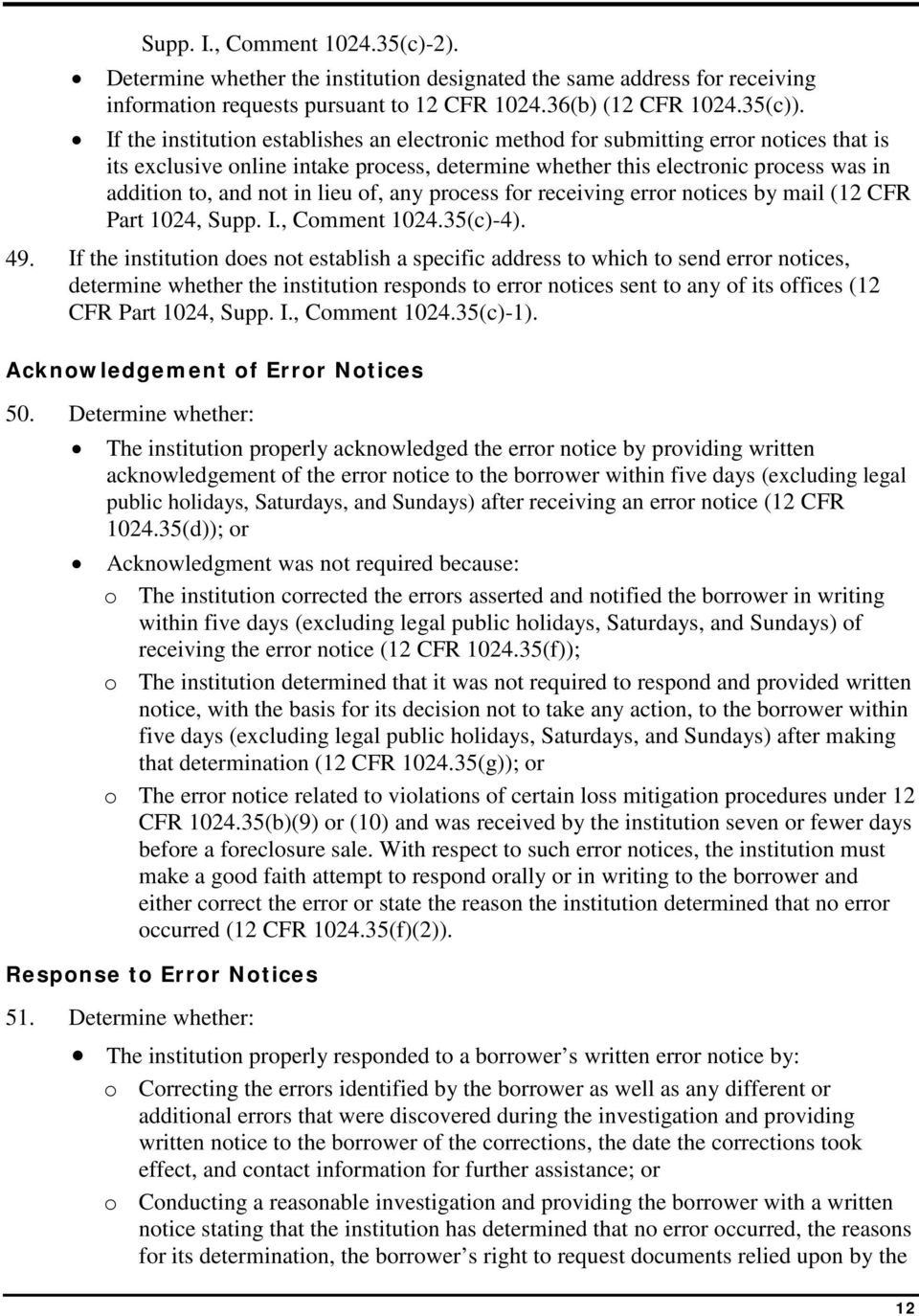
13 institution in reaching its determination and how to do so, and contact information for further assistance (12 CFR (e)); AND o Undertaking one of the above within the following time frames: If the alleged error was a failure to provide an accurate payoff balance amount, the institution responded within seven days (excluding legal public holidays, Saturdays, and Sundays) (12 CFR (e)(3)(A)); If the alleged error was either (1) making the first notice or filing for a judicial or non-judicial foreclosure process in violation of 12 CFR (f) or (j), or (2) moving for foreclosure judgment or order of sale or conducting a foreclosure sale in violation of 12 CFR (g) or (j), the institution responded by the earlier of 30 days (excluding legal public holidays, Saturdays, and Sundays) or the date of a foreclosure sale (12 CFR (e)(3)(B)). However, if the institution received the error notice seven or fewer days before a foreclosure sale, the institution is not required to respond in writing, but must nevertheless make a good faith attempt to respond orally or in writing to the borrower and either correct the error or state the reason the institution determined that no error occurred (12 CFR (f)(2)); For all other alleged errors, the institution responded within 30 days (excluding legal public holidays, Saturdays, and Sundays) unless, prior to the expiration of that 30-day period, the institution extended the time for responding by an additional 15 days (excluding legal public holidays, Saturdays, and Sundays) by notifying the borrower in writing of the extension and the reasons for it (12 CFR (e)(3)); OR The above responses were not required because: o The institution corrected the errors asserted and notified the borrower in writing within five days (excluding legal public holidays, Saturdays, and Sundays) of receiving the error notice (12 CFR (f)); o The institution determined that it was not required to respond and provided written notice, with the basis for its decision not to take any action, to the borrower within five days (excluding legal public holidays, Saturdays, and Sundays) after making that determination (12 CFR (g)); or o The error notice related to violations of certain loss mitigation procedures under 12 CFR (b)(9) or (10) and was received by the institution seven or fewer days before a foreclosure sale. With respect to such error notices, the institution must make a good faith attempt to respond orally or in writing to the borrower and either correct the error or state the reason the institution determined that no error occurred (12 CFR (f)(2)). Determination that No Error Occurred 52. If the institution stated that no error occurred and the borrower requested supporting documentation, determine whether the institution provided the documents that it relied upon to determine that no error occurred within 15 days (excluding legal public holidays, Saturdays, and Sundays) (12 CFR (e)(4)). If the institution withheld documents 13

14 that constituted confidential, proprietary, or privileged information, determine whether it provided written notification to the borrower within 15 days (excluding legal public holidays, Saturdays, and Sundays) (12 CFR (e)(4)). Determination that No Response was Required 53. If the institution determined that it was exempt from the requirement to respond, determine whether the institution reasonably determined that one of the following three exemptions applied: The error asserted is substantially the same as an error previously asserted by the borrower for which the institution complied with 12 CFR (d) and (e), unless the borrower provides new and material information to support the error; The error notice was overbroad. An error notice is overbroad if the institution cannot reasonably determine from the error notice the specific error that has occurred on a borrower s account; or The error notice was untimely. An error notice is untimely if it is delivered to the institution more than one year after either (i) the institution transferred servicing responsibility to another institution, or (ii) the mortgage loan was discharged (12 CFR (g)(1)). A mortgage loan is discharged when both the debt and all corresponding liens have been extinguished or released, as applicable. Asserted Errors Related to Non-Bona Fide Fees 54. If the borrower asserted that the institution charged a fee without a reasonable basis to do so, determine whether the institution in fact had a reasonable basis to impose the fee (12 CFR (b)(5)). An institution lacks a reasonable basis to impose fees that are not bona fide, such as (i) a late fee for a payment that was not late, (ii) a charge for a service that a service provider did not actually provide, (iii) a default management fee for borrowers who are not delinquent, or (iv) a charge for force-placed insurance that is not permitted by 12 CFR (12 CFR Part 1024, Supp. I., Comment (b)-2). Impermissible Fees and Conditions and Other Restrictions 55. Determine whether the institution conditioned its investigation of the asserted error on the borrower providing supporting documentation (12 CFR (e)(2)(i)). 56. Determine whether the institution determined that no error occurred because the borrower failed to provide any requested information without conducting a reasonable investigation (12 CFR (e)(2)(ii)). 57. Determine whether the institution charged a fee or required the borrower to make any payments as a condition to responding to an error notice (12 CFR (h)). 58. Determine whether the institution furnished adverse information to any consumer reporting agency regarding a payment that was the subject of an error notice within 60 days after receiving the notice (12 CFR (i)). 14

15 Requests for Information 12 CFR Complete the following based upon a review of a sample of mortgage loan (as defined in 12 CFR ) files that included information requests from borrowers or other appropriate methods. Address for Information Requests 59. If the institution designates an address or addresses to which borrowers must send information requests, complete the following: Determine whether the institution provided written notice of the address to the borrower, along with a statement that the borrower must use that address to request information (12 CFR (b)). Determine whether the institution also provided that address to the borrower in each of the following three communications: o Any periodic statement or coupon book required under 12 CFR ; o Any website the institution maintains in connection with the servicing of the loan; and o Any notice required pursuant to 12 CFR (early intervention) or.41 (loss mitigation) that includes contact information for assistance (12 CFR Part 1024, Supp. I., Comment (c)-2). Determine whether the institution designated the same address for receiving information requests pursuant to 12 CFR (c) (12 CFR (b)). If the institution establishes an electronic method for submitting information requests that is its exclusive online intake process, determine whether this electronic process was in addition to, and not in lieu of, any process for receiving information requests by mail (12 CFR Part 1024, Supp. I., Comment (c)-4). 60. If the institution does not establish a specific address to which to send information requests, determine whether the institution responds to information requests sent to any of its offices (12 CFR Part 1024, Supp. I., Comment (b)-1). Acknowledgement of Information Requests 61. Determine whether: The institution properly acknowledged the information request by providing written acknowledgement to the borrower within five days (excluding legal public holidays, Saturdays, and Sundays) after receiving the information request (12 CFR (c)); or Acknowledgement was not required because: o The institution provided the borrower with the information requested and contact information (including telephone number) for further assistance within five days (excluding legal public holidays, Saturdays, and Sundays) (12 CFR (e)); or o The institution determined that it was not required to respond and provided written notice with the basis for its determination not to respond to the request to the borrower within five days (excluding legal public holidays, Saturdays, and 15
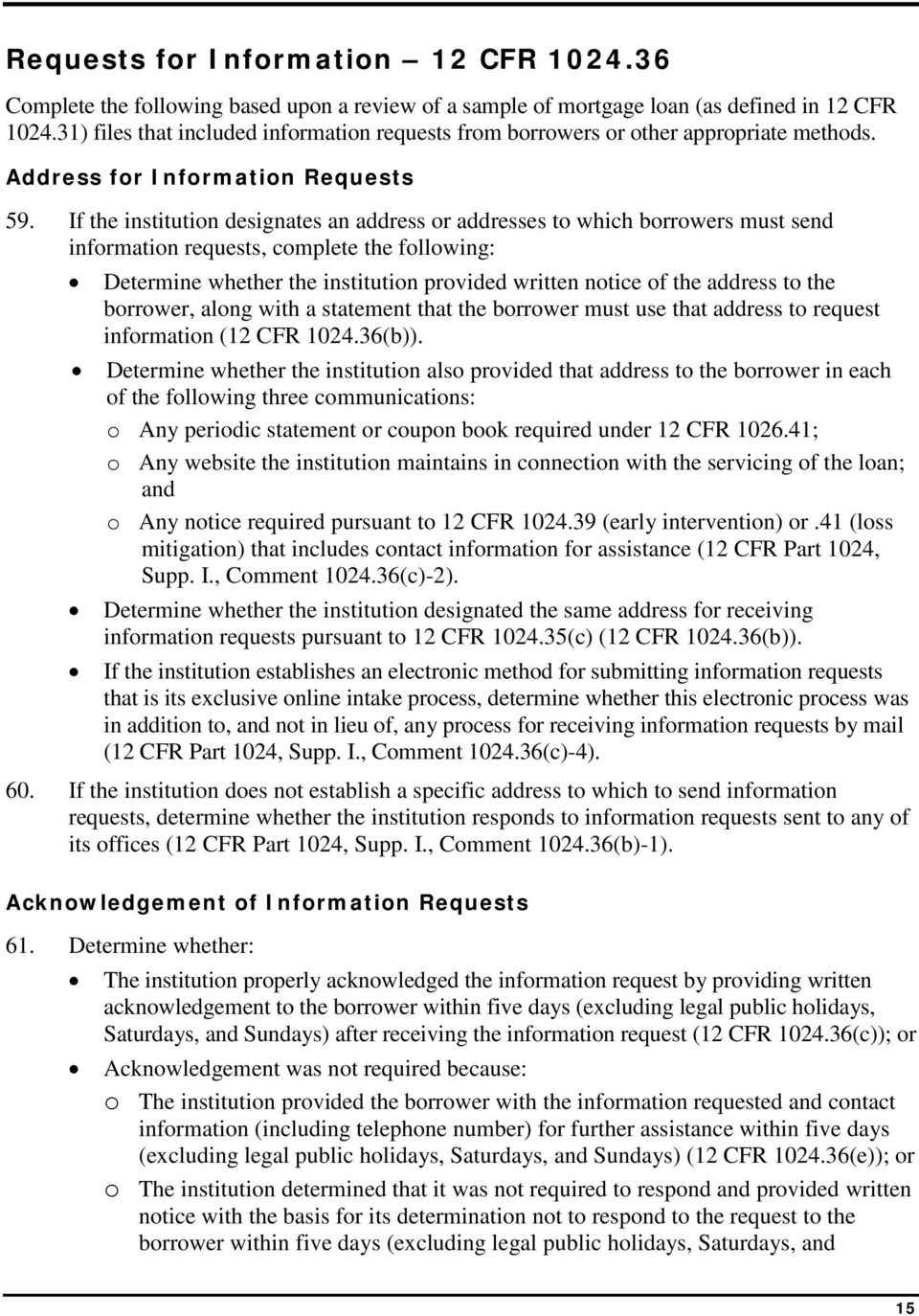
16 Sundays) after making that determination (12 CFR (f)). Response to Information Requests 62. Determine whether: The institution properly responded to the information request by: o Providing the requested information and contact information for further assistance (12 CFR (d)(1)(i)); or o Conducting a reasonable search for the requested information and providing the borrower with a written notice advising the borrower that the institution has determined that the requested information is not available to it, the basis for the institution s determination, and contact information for further assistance (12 CFR (d)(1)(ii)). Information is not available to the institution if the information is not in the institution s control or possession or if it cannot be retrieved in the ordinary course of business through reasonable efforts such as, for example, if electronic backup media is not normally accessible to the institution s personnel and would take an extraordinary effort to identify and restore. Information stored offsite but which personnel can access upon request is available to the institution; AND o Undertaking one of the above within the following time frames: If the borrower requested the identity of or contact information for the owner or assignee of a mortgage loan, responding within 10 days (excluding legal public holidays, Saturdays, and Sundays); For all other information requests, responding within 30 days (excluding legal public holidays, Saturdays, and Sundays) unless, prior to the expiration of that 30-day period, the institution extended the time for responding by an additional 15 days (excluding legal public holidays, Saturdays, and Sundays) by notifying the borrower in writing of the extension and the reasons for it (12 CFR (d)); OR The above responses were not required because: o The institution provided the borrower with the information requested and contact information (including telephone number) for further assistance within five days (excluding legal public holidays, Saturdays, and Sundays) (12 CFR (e)); or o The institution determined that it was not required to respond and provided written notice with the basis for its determination not to respond to the request to the borrower within five days (excluding legal public holidays, Saturdays, and Sundays) after making that determination (12 CFR (f)(2)). Information Requests Regarding the Identity or Contact Information of the Owner or Assignee of a Mortgage Loan 63. If the information requested is the identity or contact information of the owner or assignee of a mortgage loan, determine whether the institution complied by identifying the person on whose behalf the institution receives payments (12 CFR Part 1024, Supp. I., Comment (a)-2). For example, if the owner is a trust, then the institution should identify the trust as the owner and provide the trustee s contact information. 16

17 Determination that No Response was Required 64. If the institution determined that it was exempt from the requirement to respond, determine whether the institution reasonably determined that one of the following five exemptions applied: The information requested is substantially the same as information the borrower previously requested for which the institution has already complied with the requirements for responding to written information requests (12 CFR (f)(1)(i)); The information requested is confidential, proprietary, or privileged (12 CFR (f)(1)(ii)); The information requested is not directly related to the borrower s mortgage loan account (12 CFR (f)(1)(iii)); The information request is overbroad or unduly burdensome. A request is overbroad if the borrower requests that the institution provide an unreasonable volume of documents or information. A request is unduly burdensome if a diligent institution could not respond within the time periods set forth in 12 CFR (d)(2) or would incur costs (or have to dedicate resources) that would be unreasonable in light of the circumstances (12 CFR (f)(1)(iv)); or The information request is sent more than one year after either the mortgage loan balance was discharged or the institution transferred the mortgage loan to another servicer (12 CFR (f)(1)(v)). A mortgage loan is discharged when both the debt and all corresponding liens have been extinguished or released, as applicable. Determination that Information Request was Overbroad 65. If the institution determined that a submitted request was overbroad or unduly burdensome, determine whether the institution could reasonably have identified a valid information request in the submission and whether the institution did so (12 CFR (f)(1)(iv)). Impermissible Fees and Conditions 66. Determine whether the institution charged a fee, or required a borrower to make any payment that was owed on the borrower s account, as a condition of responding to an information request (12 CFR (g)). Force-Placed Insurance 12 CFR Applicability: Servicers must comply with restrictions on purchasing, renewing, and assessing fees for force-placed insurance, which is defined as hazard insurance that a servicer obtains on behalf of the owner or assignee to insure the property securing the mortgage loan (but does not include (i) flood insurance required by the Flood Disaster Protection Act of 1973; (ii) hazard insurance obtained by a borrower but renewed by the borrower s servicer in accordance with 12 CFR (k)(1), (2), or (5); or (iii) hazard insurance obtained by a borrower but renewed by the borrower s servicer at its discretion with the borrower s agreement). The provisions of 12 CFR define when an institution may assess fees on borrowers related to force-placed insurance. These provisions apply to any mortgage loan, as that term is 17

18 defined in 12 CFR Assessing Charges or Fees Related to Force-Placed Insurance Complete the following if the institution assessed a charge or fee on a borrower related to forceplaced insurance. Reasonable Basis 67. Determine whether the institution had a reasonable basis to believe that the borrower has failed to comply with the mortgage loan contract s requirement to maintain hazard insurance (12 CFR (b)). An institution s reasonable basis may be based upon information about a borrower s hazard insurance which the institution receives from the borrower, the borrower s insurance provider, or the borrower s insurance agent. If the institution receives no such information, the institution may satisfy the reasonable basis standard if it acts with reasonable diligence to ascertain the borrower s hazard insurance status and does not receive evidence of hazard insurance. A servicer that complies with the initial and reminder notice requirements (below) has acted with reasonable diligence (12 CFR Part 1024, Supp. I, Comment (b)-1). Initial Notice 68. Determine whether the institution provided the initial written notice to the borrower at least 45 days before assessing a fee or charge (12 CFR (c)). 69. Determine whether the initial notice included the following information (12 CFR (c)). Sample language for the initial notice is contained in Appendix MS-3(A) to 12 CFR Part The date of the notice; The institution s name and mailing address; The borrower s name and mailing address; A statement that requests the borrower provide hazard insurance information for the borrower s property and that identifies the property by its physical address; A statement that the borrower s hazard insurance has expired or is expiring (as applicable), that the institution lacks evidence that the borrower has hazard insurance coverage past the expiration date, and (if applicable) that identifies the type of hazard insurance lacking; A statement that hazard insurance is required on the borrower s property and that the institution has purchased or will purchase insurance at the borrower s expense; A request that the borrower promptly provide the institution with insurance information; A description of the requested insurance information, how the borrower may provide such information, and (if applicable) that the requested information must be in writing; A statement that the insurance coverage the institution has purchased or will purchase may cost significantly more than, and provide less coverage than, hazard insurance purchased by the borrower; 18

19 The institution s phone number for borrower inquiries; and A statement advising that the borrower review additional information provided in the same transmittal (if applicable). 70. Determine whether the initial notice was in the correct form. The notice must provide certain information in bold text and, other than the specific statements listed above, the institution cannot provide any information on the initial notice (though the institution can provide additional information on separate pages of paper contained in the same transmittal) (12 CFR (c)(3)-(4)). A sample notice is contained in Appendix MS- 3(A) to 12 CFR Part Reminder Notice 71. If the institution received no hazard insurance information or did not receive evidence of continuous coverage, determine whether the institution provided a reminder notice (i) at least 30 days after mailing or delivering the initial notice, and (ii) at least 15 days before assessing any charges or fees for force-placed insurance (12 CFR (d)(1)). 72. For borrowers who did not provide hazard insurance information, determine whether the reminder notice (i) contains the date of the reminder notice and all of the other information provided in the initial notice; (ii) advises that it is a second and final notice; and (iii) identifies the annual cost of force-placed insurance or, if unknown, a reasonable estimate (12 CFR (d)(2)(i)). Sample language for the reminder notice is contained in Appendix MS-3(B) to 12 CFR Part When the institution receives hazard insurance information but does not receive evidence of continuous coverage, determine whether the reminder notice includes the following information (12 CFR (d)(2)(ii)). Sample language for the reminder notice is contained in Appendix MS-3(C) to 12 CFR Part The date of the reminder notice; The institution s name and mailing address; The borrower s name and mailing address; A statement requesting that the borrower provide hazard insurance information for the borrower s property and that identifies the property by its physical address; The institution s phone number for borrower inquiries; A statement advising that the borrower review additional information provided in the same transmittal (if applicable); A statement that it is the second and final notice; The annual cost of force-placed insurance, or if unknown, a reasonable estimate; A statement that the institution has received the hazard insurance information that the borrower provided; 19

20 A request that the borrower provide the missing information; and A statement that the borrower will be charged for insurance the institution purchases for the time period in which the institution cannot verify coverage. 74. Determine whether the reminder notice was in the correct form. The notice must provide certain information in bold text and, other than the specific statements listed above, the institution cannot provide any information on the reminder notice (though the institution can provide additional information on separate pages of paper contained in the same transmittal) (12 CFR (d)(3)-(4)). Sample notices are contained in Appendix MS- 3(B) and (C) to 12 CFR Part Determine whether, by the end of the 15-day period after the institution sent the reminder notice, the borrower provided evidence that it has had hazard insurance that complies with the loan contract continuously in place. As evidence, the institution may require a copy of the borrower s hazard insurance policy declaration page, the borrower s insurance certificate, the borrower s insurance policy, or other similar forms of written confirmation (12 CFR (c)(1)(iii) and 12 CFR Part 1024, Supp. I, Comment (c)(1)(iii)-2). Assessing Charges or Fees for Renewing or Replacing Force-Placed Insurance If the institution assessed a charge or fee on a borrower for renewing or replacing force-placed insurance, complete the following. 76. Determine whether the institution provided a written renewal notice to the borrower at least 45 days before assessing any fee or charge (12 CFR (e)(1)(i)). 77. Determine whether the renewal notice includes the following information (12 CFR (e)(2)). Sample language for the renewal of force-placed insurance notice is contained in Appendix MS-3(D) to 12 CFR Part The date of the renewal notice; The institution s name and mailing address; The borrower s name and mailing address; A statement that requests the borrower to update the hazard insurance information for the borrower s property and that identifies the property by its physical address; A statement that the institution previously purchased force-placed insurance at the borrower s expense because the institution did not have evidence that the borrower had hazard insurance coverage; A statement that the force-placed insurance has expired or is expiring, as applicable, and that the institution intends to renew or replace it because hazard insurance is required on the property; A statement that the insurance coverage the institution has purchased or will purchase may cost significantly more than, and provide less coverage than, insurance purchased by the borrower, and identifying the annual premium cost of force-placed insurance or a reasonable estimate; 20

21 A statement that if the borrower purchases hazard insurance, the borrower should promptly provide the institution with insurance information; A description of the requested insurance information and how the borrower may provide such information, and if applicable, that the requested information must be in writing; The institution s telephone number for borrower inquiries; and A statement advising the borrower to review additional information provided in the same mailing (if applicable). 78. Determine whether the renewal notice was in the correct form. The notice must provide certain information in bold text and, other than the specific statements listed above, the institution cannot provide any information on the renewal notice (though the institution can provide additional information on separate pages of paper contained in the same transmittal) (12 CFR (e)(3)-(4)). A sample notice is contained in Appendix MS- 3(D) to 12 CFR Part Determine whether in the 45 days after sending the renewal notice the institution received evidence demonstrating that the borrower had purchased hazard insurance coverage (12 CFR (e)(1)(ii)). As evidence, the institution may require a copy of the borrower s hazard insurance policy declaration page, the borrower s insurance certificate, the borrower s insurance policy, or other similar forms of written confirmation. General Mailing Requirements, Canceling Force-Placed Insurance, and Bona Fide and Reasonable Fee Requirements 80. If the institution mailed any of the written initial, reminder, or renewal notices (12 CFR (c)(1)(i), (c)(1)(ii), or (e)(1)), determine whether the servicer used a class of mail not less than first-class mail (12 CFR (f)). 81. If the institution received evidence that the borrower had required hazard insurance coverage in place, determine whether the institution did the following within 15 days: Canceled the force-placed insurance; Refunded force-placed insurance premiums charges and fees for the period of overlapping coverage; and Removed all force-placed charges and fees from the borrower s account for the period of overlapping coverage (12 CFR (g)). 82. Determine whether all fees or charges assessed on the borrower related to force-placed insurance are bona fide and reasonable (except for charges subject to State regulation and charges authorized by the Flood Disaster Protection Act of 1973). A bona fide and reasonable charge is one that is reasonably related to the institution s cost of providing the service and is not otherwise prohibited by law (12 CFR (h)). 21
22 General Servicing Policies, Procedures, and Requirements 12 CFR Applicability: The general servicing policies, procedures, and requirements apply to all mortgage loans, as that term is defined in 12 CFR , except that the requirements do not apply to (i) small servicers, as that term is defined in 12 CFR (e); 2 (ii) reverse mortgage transactions, as that term is defined in 12 CFR (a); and (iii) qualified lenders, as defined under the Farm Credit Act of 1971 and accompanying regulations. Policies and Procedures Accessing and Providing Timely and Accurate Information 83. Determine whether the institution has policies and procedures that are reasonably designed to ensure that it has access to and provides timely and accurate information (12 CFR (a) and (b)(1)). This includes policies and procedures that are reasonably designed to ensure the following: Providing accurate and timely disclosures to the borrower; Investigating, responding to, and making corrections in response to borrowers complaints, including promptly obtaining information from service providers to investigate and if applicable correct errors resulting from actions of service providers; Providing borrowers with accurate and timely information and documents in response to borrower requests for information with respect to the borrower s mortgage loan; Providing owners and assignees of mortgage loans with accurate and current information and documents about all the mortgage loans they own, including information about the institution s evaluations of borrowers for loss mitigation options and loss mitigation agreements with borrowers; Submitting accurate and current information and documents that comply with applicable law during the foreclosure process; and Upon learning of a borrower s death, promptly communicating with the borrower s successor in interest concerning the secured property. Policies and Procedures Proper Evaluation of Loss Mitigation Applications 84. Determine whether the institution has policies and procedures that are reasonably designed to ensure that its personnel properly evaluate loss mitigation applications (12 CFR (a) and (b)(2)). This includes policies and procedures that are reasonably 2 An institution qualifies as a small servicer if it either (a) services, together with any affiliates, 5,000 or fewer mortgage loans, as that term is used in 12 CFR (a)(1), for all of which the institution (or an affiliate) is the creditor or assignee, (b) is a Housing Finance Agency, as defined in 24 CFR ( (e)(4)(ii)), or (c) is a nonprofit entity (defined in (e)(4)(ii)(C)(1)) that services 5,000 or fewer mortgage loans, including any mortgage loans serviced on behalf of associated nonprofit entities (defined in (e)(4)(ii)(C)(2)), for all of which the servicer or an associated nonprofit entity is the creditor. The following mortgage loans are not considered in determining whether a servicer qualifies as a small servicer: (a) mortgage loans voluntarily serviced by the servicer for a creditor or assignee that is not an affiliate of the servicer and for which the servicer does not receive any compensation or fees; (b) reverse mortgage transactions; and (c) mortgage loans secured by consumers interests in timeshare plans (12 CFR (e)(4)(iii)). 22
23 designed to ensure the following: Providing accurate information regarding available loss mitigation options from the owner or assignee of the borrower s loan; Identifying with specificity all loss mitigation options for which a borrower may be eligible, including identifying, with respect to each owner or assignee, all of the loss mitigation options the institution may consider when evaluating a borrower, as well as the criteria the institution should apply for each option; Providing the loss mitigation personnel assigned to the borrower s mortgage loan pursuant to 12 CFR with prompt access to all of the documents and information that the borrower submitted in connection with a loss mitigation option; Identifying the documents and information a borrower must submit to complete a loss mitigation application; and In response to a complete loss mitigation application, properly evaluating the borrower for all eligible loss mitigation options pursuant to any requirements established by the owner or assignee of the mortgage loan, even if those requirements are otherwise beyond the requirements of 12 CFR Policies and Procedures Oversight of Servicer Providers 85. Determine whether the institution has policies and procedures that are reasonably designed to facilitate oversight of, and compliance by, service providers (12 CFR (a) and (b)(3)). This includes policies and procedures that are reasonably designed to ensure the following: Providing appropriate personnel with access to accurate and current documents and information concerning the service providers actions; Facilitating periodic reviews of service providers; and Facilitating the sharing of accurate and current information regarding the status of a borrower s loss mitigation application and any foreclosure proceeding among appropriate institution personnel, including the loss mitigation personnel assigned to the borrower s mortgage loan, and appropriate service provider personnel, including service provider personnel responsible for handling foreclosure proceedings. Policies and Procedures Transfer of Information 86. Determine whether the institution has policies and procedures that are reasonably designed to facilitate the transfer of information during servicing transfers (12 CFR (a) and (b)(4)). This includes policies and procedures that are reasonably designed to ensure the following: For a transferor servicer, the timely and accurate transfer of all information and documents in its possession and control related to a transferred mortgage loan to the transferee servicer in a manner that ensures its accuracy and that allows the transferee to comply with the terms of the mortgage loan and applicable law, including any information about the status of any loss mitigation agreements or discussions with the borrower and any analysis performed with respect to potential recovery from nonperforming mortgage loans; and 23
24 For a transferee servicer, identifying necessary documents or information that may not have been transferred, obtaining such missing documentation or information from the transferor servicer (for documents and information related to loss mitigation, the transferee s policies and procedures must address obtaining missing documents from the transferor servicer before attempting to obtain such documents from the borrower). Policies and Procedures Notifying Borrowers of Error Notice and Information Request Procedures 87. Determine whether the institution has policies and procedures that are reasonably designed to inform borrowers of procedures for submitting written error notices and written information requests (12 CFR (a) and (b)(5)). This includes policies and procedures reasonably designed to ensure that the institution informs borrowers who are dissatisfied with the institution s response to oral complaints or information requests of the procedures for submitting written error notices under 12 CFR and written information requests under 12 CFR Records Maintenance Accurate Records 88. For any mortgage loan, determine if the institution is retaining accurate records that document actions with respect to the mortgage loan account (which includes any mortgage loan that has been transferred or paid in full). The institution must retain these records until one year after the loan is discharged or the institution transfers servicing for the mortgage loan to a transferee servicer. (12 CFR (c)(1)). Records Maintenance Facilitating Aggregation of Information 89. For documents or information created on or after January 10, 2014, determine whether the institution maintains the following five items for each mortgage loan file in a manner that allows the institution to aggregate these items into a servicing file within five days: A schedule of all credits and debits to the account (including escrow accounts and suspense accounts); A copy of the security instrument that establishes the lien securing the mortgage loan; Any notes created by institution personnel reflecting communications with the borrower concerning the account; A report of the data fields relating to the borrower s account created by the institution s electronic systems (if applicable); and Copies of any information or documents provided by the borrower to the institution in connection with written error notices or loss mitigation (12 CFR (c)(2)). Early Intervention Requirements for Certain Borrowers 12 CFR Applicability: The early intervention requirements apply to only those mortgage loans, as that term is defined in 12 CFR , that are secured by the borrower s principal residence (12 CFR (c)(2)). The requirements do not apply to (i) small servicers, as that term is defined 24
25 in 12 CFR (e), 3 (ii) reverse mortgage transactions, as that term is defined in 12 CFR (a), and (iii) qualified lenders, as defined under the Farm Credit Act of 1971 and accompanying regulations (12 CFR (b)). Additionally, institutions are not required to comply with the live contact and written notice requirements if doing so would violate applicable law (12 CFR (c)). Finally, institutions are exempted from the early intervention requirements (i) as to borrowers who are in bankruptcy, 4 and (ii) if the institution is subject to the Fair Debt Collection Practices Act (FDCPA) and the borrower has sent an FDCPA cease communication notification with respect to the mortgage loan (12 CFR (d)). Complete the following for any delinquent borrowers (which, for purposes of 12 CFR , do not include borrowers performing as agreed under a loss mitigation agreement). Live Contact 90. Determine whether the institution made good faith efforts to establish live contact with the borrower within 36 days after each time the borrower became delinquent (12 CFR (a)). A delinquency begins each time a borrower fails to make a payment sufficient to cover principal, interest, and (if applicable) escrow for a given billing cycle. 91. After the institution established live contact, determine whether the institution promptly informed the borrower of loss mitigation options, if appropriate (as determined based on the institution s reasonable discretion) (12 CFR (a)). Written Notice 92. Determine whether the institution sent a written notice to the borrower within 45 days 3 An institution qualifies as a small servicer if it either (a) services, together with any affiliates, 5,000 or fewer mortgage loans, as that term is used in 12 CFR (a)(1), for all of which the institution (or an affiliate) is the creditor or assignee, (b) is a Housing Finance Agency, as defined in 24 CFR ( (e)(4)(ii)), or (c) is a nonprofit entity (defined in (e)(4)(ii)(C)(1)) that services 5,000 or fewer mortgage loans, including any mortgage loans serviced on behalf of associated nonprofit entities (defined in (e)(4)(ii)(C)(2)), for all of which the servicer or an associated nonprofit entity is the creditor. The following mortgage loans are not considered in determining whether a servicer qualifies as a small servicer: (a) mortgage loans voluntarily serviced by the servicer for a creditor or assignee that is not an affiliate of the servicer and for which the servicer does not receive any compensation or fees; (b) reverse mortgage transactions; and (c) mortgage loans secured by consumers interests in timeshare plans (12 CFR (e)(4)(iii)). 4 With respect to any portion of the mortgage debt that is not discharged through bankruptcy, a servicer must resume compliance with the early intervention requirement after the first delinquency that follows the earliest of the following: (i) the borrower s bankruptcy case is dismissed; (ii) the borrower s bankruptcy case is closed; or (iii) the borrower receives a general discharge of debts under the Bankruptcy Code (11 U.S.C. 101 et seq.). However, a servicer is not required to communicate with a borrower in any way that would violate applicable bankruptcy law or a court order in a bankruptcy case, and a servicer may adapt the early intervention requirement in any manner believed necessary. A servicer also is not required to comply with the early intervention requirement for any portion of the mortgage debt that was discharged under the Bankruptcy Code or if a bankruptcy case is revived (12 CFR (d)), The bankruptcy exception applies if two or more borrowers are joint obligors with primary liability on a mortgage loan and any one of the borrowers is in bankruptcy. For example, if a husband and wife jointly own a home and the husband files for bankruptcy, the servicer is exempt from the early intervention requirements as to both the husband and wife (12 CFR Part 1024, Supp. I., Comment (d)(1)-3). 25
26 after the borrower became delinquent (12 CFR (b)(1)). The institution does not need to send the notice to a borrower more than once in a 180-day period. 93. Determine whether the notice included the following items (12 CFR (b)(2)). Sample language for the notice is contained in Appendix MS-4(A), MS-4(B), and MS- 4(C) to 12 CFR Part A statement encouraging the borrower to contact the institution; The telephone number to access assigned loss mitigation personnel; A brief description of examples of loss mitigation options that may be available to the borrower (if applicable); Loss mitigation application instructions or instructions as to how to obtain more information about loss mitigation options (such as by contacting the institution), if applicable; and Either the CFPB s or HUD s website to access homeownership counselors or counseling organizations list and HUD s toll-free number to access homeownership counselors or counseling organizations. Continuity of Contact 12 CFR Applicability: The continuity of contact requirements apply to only those mortgage loans, as that term is defined in 12 CFR , that are secured by the borrower s principal residence (12 CFR (c)(2)). The requirements do not apply to (i) small servicers, as that term is defined in 12 CFR (e), 5 (ii) reverse mortgage transactions, as that term is defined in 12 CFR (a), and (iii) qualified lenders, as defined under the Farm Credit Act of 1971 and accompanying regulations (12 CFR (b)). 94. Determine whether the institution had policies and procedures reasonably designed to assign personnel to a delinquent borrower by the time the written early intervention notice was provided, and in any event, within 45 days after the borrower became delinquent (12 CFR (a)). 95. Determine whether the institution had policies and procedures reasonably designed to ensure that the assigned personnel were available, via telephone, to answer the borrower s questions and (as applicable) assist the borrower with available loss mitigation options until the borrower has made, without incurring a late charge, two consecutive mortgage 5 An institution qualifies as a small servicer if it either (a) services, together with any affiliates, 5,000 or fewer mortgage loans, as that term is used in 12 CFR (a)(1), for all of which the institution (or an affiliate) is the creditor or assignee, (b) is a Housing Finance Agency, as defined in 24 CFR ( (e)(4)(ii)), or (c) is a nonprofit entity (defined in (e)(4)(ii)(C)(1)) that services 5,000 or fewer mortgage loans, including any mortgage loans serviced on behalf of associated nonprofit entities (defined in (e)(4)(ii)(C)(2)), for all of which the servicer or an associated nonprofit entity is the creditor. The following mortgage loans are not considered in determining whether a servicer qualifies as a small servicer: (a) mortgage loans voluntarily serviced by the servicer for a creditor or assignee that is not an affiliate of the servicer and for which the servicer does not receive any compensation or fees; (b) reverse mortgage transactions; and (c) mortgage loans secured by consumers interests in timeshare plans (12 CFR (e)(4)(iii)). 26
27 payments in accordance with the terms of a permanent loss mitigation agreement (12 CFR (a)(2)). 96. Determine whether the institution had policies and procedures reasonably designed to ensure that, if a borrower contacts the assigned personnel and does not immediately receive a live response, the institution can provide a live response in a timely manner (12 CFR (a)(3)). 97. Determine whether the institution maintains policies and procedures reasonably designed to ensure that the assigned personnel can perform, among others, the following tasks: Provide the borrower with accurate information about available loss mitigation options, including the steps the borrower must take to be evaluated for such options, including how to complete a loss mitigation application or appeal a denial of a loan modification option (if applicable); Provide the borrower with accurate information about the status of any loss mitigation application submitted; Provide the borrower with accurate information about the circumstances under which the institution may refer the account to foreclosure; Provide the borrower with accurate information about applicable loss mitigation deadlines; Timely retrieve a complete record of the borrower s payment history and all written information the borrower has provided to the institution (or the institution s predecessors) in connection with a loss mitigation application, and provide these documents to other persons required to evaluate the borrower for available loss mitigation options; and Provide the borrower with information about submitting a written error notice or written request for information (12 CFR (b)). Loss Mitigation Procedures 12 CFR Applicability: The loss mitigation procedure requirements apply to only those mortgage loans, as that term is defined in 12 CFR , that are secured by the borrower s principal residence (12 CFR (c)(2)). Except for the requirements of (j), the loss mitigation procedure requirements do not apply to (i) small servicers, as that term is defined in 12 CFR (e), 6 (ii) reverse mortgage transactions, as that term is defined in 12 CFR (a), and (iii) 6 An institution qualifies as a small servicer if it either (a) services, together with any affiliates, 5,000 or fewer mortgage loans, as that term is used in 12 CFR (a)(1), for all of which the institution (or an affiliate) is the creditor or assignee, (b) is a Housing Finance Agency, as defined in 24 CFR ( (e)(4)(ii)), or (c) is a nonprofit entity (defined in (e)(4)(ii)(C)(1)) that services 5,000 or fewer mortgage loans, including any mortgage loans serviced on behalf of associated nonprofit entities (defined in (e)(4)(ii)(C)(2)), for all of which the servicer or an associated nonprofit entity is the creditor. The following mortgage loans are not considered in determining whether a servicer qualifies as a small servicer: (a) mortgage loans voluntarily serviced by the servicer for a creditor or assignee that is not an affiliate of the servicer and for which the servicer does not receive any compensation or fees; (b) reverse mortgage transactions; and (c) mortgage loans secured by consumers interests in timeshare plans (12 CFR (e)(4)(iii)). 27
28 qualified lenders, as defined under the Farm Credit Act of 1971 and accompanying regulations (12 CFR (b)). Calculating Time Periods: 12 CFR provides borrowers certain protections depending on whether the institution receives a complete loss mitigation application at least a specified number of days before a foreclosure sale. See, e.g., 12 CFR (c)(1) (37 days), and 12 CFR (e) and (h) (90 days). These time periods are calculated as of the date the servicer receives a complete loss mitigation application. Thus, scheduling or rescheduling a foreclosure sale after the servicer receives the complete loss mitigation application will not affect the borrower s protections (12 CFR Part 1024, Supp. I., Comment (b)(3)-2). If no foreclosure sale is scheduled as of the date the servicer receives a complete loss mitigation application, the application is considered received more than 90 days before a foreclosure sale (12 CFR Part 1024, Supp. I., Comment (b)(3)-1). Definition of First Notice or Filing: 12 CFR includes certain prohibitions on making the first notice or filing for a judicial or non-judicial foreclosure, and provides borrowers certain protections depending on whether such a notice or filing has been made. Whether a particular document qualifies as the first notice or filing depends on the foreclosure process under the applicable State law at issue: Judicial foreclosure. Where foreclosure procedure requires a court action or proceeding, the first notice or filing is the earliest document required to be filed with a court or other judicial body to commence the action or proceeding. Depending on the particular foreclosure process, examples of these documents could be a complaint, petition, order to docket, or notice of hearing; Non-judicial foreclosure recording or publication requirement. Where foreclosure procedure does not require an action or court proceeding (such as under a power of sale), the first notice or filing is the earliest document required to be recorded or published to initiate the foreclosure process; or Non-judicial foreclosure no recording or publication requirement. Where foreclosure procedure does not require an action or court proceeding, and also does not require any document to be recorded or published, the first notice or filing is the earliest document that establishes, sets, or schedules a date for the foreclosure sale. Note that a document provided to the borrower but not initially required to be filed, recorded, or published is not considered the first notice or filing on the sole basis that the documents must later be included as an attachment accompanying another document that is required to be filed, recorded, or published to carry out a foreclosure (12 CFR Part 1024, Supp. I., Comment (f)-1). Applications Received at Least 45 Days Before a Foreclosure Sale (Review for Completeness) Complete the following for any loss mitigation application that the institution received at least 45 days before a foreclosure sale. 28
29 98. Determine whether the institution promptly determined whether the application was complete (12 CFR (b)(1)). A loss mitigation application is viewed expansively and includes oral inquiries by the borrower where the borrower also provides information the institution would use to evaluate loss mitigation applications, or where a borrower requests that the institution determines whether the borrower is prequalified for a loss mitigation application by evaluating the borrower against preliminary criteria (12 CFR Part 1024, Supp. I., Comment (b)(1)-2). An institution is required to comply with the loss mitigation procedures for only a single complete loss mitigation application for a borrower s mortgage loan account (12 CFR (i)). Complete Applications Written Acknowledgement Complete the following if the application was complete. 99. Determine whether the institution provided written acknowledgement to the borrower within five days (excluding legal public holidays, Saturdays, and Sundays) after receiving the loss mitigation application. The acknowledgement must state that the application was complete and include a statement that the borrower should consider contacting servicers of any other mortgage loans secured by the same property to discuss available loss mitigation options (12 CFR (b)(2)(1)(B)). Facially Complete Applications Additional Information or Corrected Documents Required Complete the following if the application was facially complete and the institution later discovered that additional information or corrections to a previously submitted document were required to complete the application. A loss mitigation application is facially complete if either (i) the institution s initial notice under 12 CFR (b) advised the borrower that the application was complete, or (ii) the institution s initial notice under 12 CFR (b) requested additional information from the borrower to complete the application and the borrower submitted such additional information Determine whether, upon discovering that additional information or corrected documents were required to complete the application, the institution (i) promptly requested the missing information or corrected documents, and (ii) gave the borrower a reasonable opportunity to complete the application (12 CFR (c)(2)(iv)). A reasonable opportunity depends on the particular facts and circumstances, but must provide the borrower sufficient time to gather the necessary information and documents (12 CFR Part 1024, Supp. I., Comment (c)(2)(iv)-1) Determine whether the institution treated the borrower s application as complete for purposes of 12 CFR (f)(2) ( Application received before foreclosure referral ) and 12 CFR 1024(g) ( Prohibition on foreclosure sale ) until the borrower is given a reasonable opportunity to submit additional information or corrected documents (12 CFR (c)(2)(iv)). Incomplete Applications Written Acknowledgement, Reasonable Diligence, and 29
30 Short-Term Forbearance Complete the following if the application was incomplete Determine whether the institution provided written acknowledgement to the borrower within five days (excluding legal public holidays, Saturdays, and Sundays) after receiving the loss mitigation application. The acknowledgement must (1) state that the application was incomplete, (2) identify the additional information needed to complete the application, (3) identify a reasonable date by which the borrower must submit the additional information, and (4) include a statement that the borrower should consider contacting servicers of any other mortgage loans secured by the same property to discuss available loss mitigation options (12 CFR (b)(2)). Except when doing so would be impracticable (such as requesting a borrower to submit documentation in less than seven days), a reasonable deadline is generally one of the following that maximizes the borrower s loss mitigation protections: (a) the date by which any document or information submitted by the borrower will be stale or invalid, (b) the 120th day of the borrower s delinquency, (c) 90 days before a foreclosure sale; or (d) 38 days before a foreclosure sale (12 CFR Part 1024, Supp. I., Comment (b)(2)(ii)-1) Determine whether the institution exercised reasonable diligence in obtaining documents and information to complete the application (12 CFR (b)(1)). Examples of reasonable diligence include: (a) where the institution requires additional information from the borrower (such as an address or telephone number to verify employment), promptly contacting the borrower to obtain the information; and (b) where the borrower s loan is transferred to the institution from another servicer, reviewing documents the institution received from the prior servicer to determine if the required information is contained in those documents. Additionally, if the institution offered the borrower a shortterm forbearance plan based upon information contained in an incomplete loss mitigation application, reasonable diligence would involve notifying the borrower that they are being offered a payment forbearance program based on an evaluation of an incomplete loss mitigation application, and that the borrower has the option of completing the application to receive a full evaluation for all loss mitigation options available to the borrower (12 CFR Part 1024, Supp. I., Comment (b)(1)-4.iii) If the institution offered the borrower a short-term forbearance plan based upon information contained in an incomplete loss mitigation application, determine whether the institution either (a) made the first notice or filing for any judicial or non-judicial foreclosure process, (b) moved for foreclosure judgment or an order of sale, or (c) conducted a foreclosure sale while the borrower was performing under such plan (12 CFR (c)(2)(iii)). A short-term forbearance program allows a borrower to forgo making certain payments or portions of payments due over a period of no more than six months (12 CFR Part 1024, Supp. I., Comment 41(c)(2)(iii)-1). Complete Applications Received More Than 37 Days Before a Foreclosure Sale (Evaluation of Application) Complete the following for any complete loss mitigation application that the institution received 30
31 more than 37 days before a foreclosure sale Determine whether, within 30 days, the institution (i) evaluated the borrower for all available loss mitigation options, and (ii) provided the borrower with a notice stating (a) which loss mitigation options (if any) the institution would offer the borrower, (b) the amount of time the borrower has to accept or reject an offered loss mitigation option pursuant to 12 CFR (e), and (c) if applicable, that the borrower has the right to appeal a denial of a loan modification option and the time period for making any appeal pursuant to 12 CFR (h) (12 CFR (c)) If the institution denied the application, determine whether the notice also stated the specific reason or reasons for denying each such option, and, if applicable, that the borrower was not evaluated on other criteria (12 CFR (d)). Denial of Loan Modification Option Based Upon Investor Criteria; Use of a Waterfall Complete the following if the institution denied an application for a loan modification option due to a failure to meet investor guidelines Determine whether the institution identified in its notice to the borrower (i) the owner or assignee of the mortgage loan, and (ii) the specific criteria the borrower failed to meet (12 CFR (d), 12 CFR Part 1024, Supp. I., Comment 41(d)-1). (NOTE: if the borrower s application was evaluated under an investor s waterfall and the borrower qualified for a particular option, it is sufficient for the institution to inform the borrower that the investor s requirements include a ranking of options and that an offer of a loan modification option necessarily results in a denial of any other options ranked below the option for which the borrower is eligible (12 CFR Part 1024, Supp. I., Comment 41(d)-1). Denial Based Upon Net Present Value Calculation Complete the following if the institution denied the application due to a net present value calculation Determine whether the institution disclosed the inputs used in that calculation (12 CFR Part 1024, Supp. I., Comment 41(d)-2). Denial Using Hierarchy of Eligibility Criteria Complete the following if the institution established a hierarchy of eligibility criteria and, after reaching the first criterion that causes a denial, did not evaluate whether the borrower would have satisfied the remaining criteria Determine whether the institution identified in the notice: (i) the specific reason or reasons why the borrower was actually rejected, and (ii) that the borrower was not evaluated on other criteria. An institution is not required to determine or disclose whether a borrower would have been denied based on other criteria if the servicer did not actually evaluate these additional criteria (12 CFR Part 1024, Supp. I., Comment 41(d)-4). 31
32 Time for Acceptance of an Offered Loss Mitigation Option Complete the following if the institution offered the borrower a loss mitigation option. Complete Applications Received at Least 90 Days Before a Foreclosure Sale Complete the following if institution offered a loss mitigation option and had received the complete application at least 90 days before a foreclosure sale Determine whether the institution provided the borrower with at least 14 days to accept or reject any offered loan modification option after the servicer provided notice of the offer to the borrower (12 CFR (e)). This acceptance period can be extended if, within 14 days, the borrower makes an appeal of a denial of any loan modification option (12 CFR (e)(2)(iii)). In the event of an appeal, the borrower s time for acceptance is extended to 14 days after the institution provides a notice of its determination of the appeal under 12 CFR (e)(iii). Complete Applications Received Between 37 and 90 days Before a Foreclosure Sale Complete the following if institution offered a loss mitigation option and had received the complete application fewer than 90 days before a foreclosure sale but more than 37 days before the sale Determine whether the institution provided the borrower with at least seven days to accept or reject any offered loss mitigation options after the servicer provided notice of the offer to the borrower (12 CFR (e)(1)). No Borrower Response to Offered Trial Loan Modification Plan Complete the following if the institution offered a borrower a trial loan modification plan and the borrower did not respond within seven or 14 days (as applicable under 12 CFR (e)(1)) Determine (i) whether the borrower submitted payments in accordance with the offered plan, and (ii) if so, whether the institution gave the borrower a reasonable period of time to fulfill any remaining requirements to accept the plan (12 CFR (e)(2)(ii)). Prohibitions on Commencing Foreclosure Proceedings and Dual Tracking Complete the following for any borrower Determine whether the institution made any first judicial or non-judicial foreclosure notices or filings without meeting one of the following conditions: (i) the borrower was more than 120 days delinquent; (ii) the foreclosure is based on a borrower s violation of a due-on-sale clause; or (iii) the institution is joining the foreclosure action of a subordinate lienholder (12 CFR (f)(1)). (Note that this requirement as applicable to small servicers is addressed below.) Complete Applications Received During the Pre-foreclosure Period 32
33 Complete the following if the institution received a complete loss mitigation application either within the first 120 days of delinquency or before the institution made the first judicial or nonjudicial foreclosure notice or filing. Note that the following does not apply if the foreclosure is based on a borrower s violation of a due-on-sale clause, or if the institution is joining the foreclosure action of a subordinate lienholder Determine whether the institution made the first foreclosure notice or filing only after one of the following occurred: (i) the institution notified the borrower that the borrower is ineligible for any loss mitigation option and if an appeal is available, either the appeal period expired or the appeal had been denied; (ii) the borrower rejected all the offered loss mitigation options; or (iii) the borrower failed to perform under a loss mitigation agreement (12 CFR (f)(2)). Complete Applications Received More Than 37 Days Before a Foreclosure Sale Complete the following if the institution received a complete loss mitigation application after the institution initiated foreclosure but more than 37 days before a foreclosure sale Determine whether the institution improperly conducted a foreclosure sale or moved for foreclosure judgment or sale before one of the following occurred: (i) the institution notified the borrower that it had denied the loss mitigation application for any loss mitigation option and if an appeal is available, either the appeal period had expired or the appeal had been denied; (ii) the borrower rejected all the offered loss mitigation options; or (iii) the borrower fails to perform under a loss mitigation agreement (12 CFR (g)). Appeal Process Complete the following if (a) the institution denied a complete loss mitigation application for any trial or permanent loan modification option, and (b) the institution received that complete application (i) before the borrower was more than 120 days delinquent, (ii) before the institution made the first judicial or non-judicial foreclosure notice or filing, or (iii) at least 90 days before a foreclosure sale For any borrower who timely appealed a denial of an available loan modification option, determine whether the institution provided a notice to the borrower within 30 days stating (i) whether it will offer the borrower a loss mitigation option based on the appeal, and (ii) if applicable, how long the borrower has to accept or reject this loss mitigation option or a previously offered loss mitigation option. (12 CFR (h)(4)) For any appeal that the institution granted, determine whether the institution afforded the borrower 14 days to accept or reject any offered loan modification option (12 CFR (h)(4)) Determine whether the institution used different personnel to evaluate the appeal than the personnel who had evaluated the borrower s loss mitigation application (12 CFR (h)(3)). 33
34 Small Servicers Complete the following if the institution is a small servicer as that term is defined in 12 CFR (e) If the institution is a small servicer, determine whether the institution made the first foreclosure notice or filing before (i) the borrower was more than 120 days delinquent, (ii) the foreclosure is based on a borrower s violation of a due-on-sale clause, or (iii) the institution is joining a subordinate lienholder s foreclosure action (12 CFR (j)) If the institution is a small servicer and the borrower is performing according to the terms of a loss mitigation agreement, determine whether the institution (i) made the first foreclosure notice or filing, (ii) moved for a foreclosure judgment or order of sale, or (iii) conducted a foreclosure sale (12 CFR (j)). 34
Real Estate Settlement Procedures Act
 Background The Real Estate Settlement Procedures Act of 1974 (RESPA) (12 USC 2601-17), which is implemented by the Department of Housing and Urban Development s Regulation X (24 CFR 3500), became effective
CFPB Proposes Comprehensive Mortgage Servicing Regulations
 August 2012 CFPB Proposes Comprehensive Mortgage Servicing Regulations On August 9, 2012, the Consumer Financial Protection Bureau (CFPB) issued two notices of proposed rulemaking (NPRs) 1 implementing
Regulation X Real Estate Settlement Procedures Act
 Regulation X Real Estate Settlement Procedures Act The Real Estate Settlement Procedures Act of 1974 (RESPA) (12 U.S.C. 2601 et seq.) (the Act) became effective on June 20, 1975. The Act requires lenders,
22. Supplement I to part 1024 is added to the end thereof to read as follows:
 22. Supplement I to part 1024 is added to the end thereof to read as follows: Supplement I to Part 1024 Official Bureau Interpretations Introduction 1. Official status. This commentary is the primary vehicle
The CFPB Finalizes New Mortgage Servicing Rules
 A DV I S O RY April 2013 The CFPB Finalizes New Mortgage Servicing Rules On January 17, 2013, the Consumer Financial Protection Bureau (CFPB) finalized rules implementing the mortgage loan servicing requirements
TILA-RESPA Integrated Disclosure Rule * January 21, 2015
 TILA-RESPA Integrated Disclosure Rule * January 21, 2015 Presented by David Kantor Stinson Leonard Street LLP [email protected] 612-335-1620 1. Effective Date. The new Integrated Disclosures
Regulatory Practice Letter September 2012 RPL 12-17
 Regulatory Practice Letter September 2012 RPL 12-17 Mortgage Servicing Standards - CFPB Proposed Rule Executive Summary The Bureau of Consumer Financial Protection ( CFBP or Bureau ) released two proposed
CFPB Consumer Laws and Regulations
 Real Estate Settlement Procedures Act 1 The Real Estate Settlement Procedures Act of 1974 () (12 U.S.C. 2601 et seq.) (the Act) became effective on June 20, 1975. The Act requires lenders, mortgage brokers,
FRESH. Agenda. Credit Union Integrated Mortgage Disclosures Are you Prepared?
 MCUL & Affiliates 2015 Annual Convention and Exposition Credit Union Integrated Mortgage Disclosures Are you Prepared? Glory LeDu Thursday, June 4, 2015 2:00 p.m. Sponsored by: FRESH Ideas to Reinvent
Mortgage Servicing Rules (RESPA) Proprietary (non-hamp) Loss Mitigation
 Mortgage Servicing Rules (RESPA) Proprietary (non-hamp) Loss Mitigation Generally Regulation X does not require a servicer to provide any specific loss mitigation option, including the opportunity to apply
CFPB Integrated Mortgage Disclosures
 CFPB Integrated Mortgage Disclosures Today s Goal To help you not only understand the rule changes, but make sure you have the tools, resources and support to take action to implement in your credit union
Regulation X Real Estate Settlement Procedures Act
 Regulation X Real Estate Settlement Procedures Act The Real Estate Settlement Procedures Act of 1974 (RESPA) (12 U.S.C. 2601 et seq.) (the act) became effective on June 20, 1975. The act requires lenders,
CCE Consumer Compliance Examination. Real Estate Settlement Procedures. Comptroller s Handbook. August 1996. CCE-Respa
 CCE-Respa Comptroller of the Currency Administrator of National Banks Real Estate Settlement Procedures Comptroller s Handbook August 1996 CCE Consumer Compliance Examination Real Estate Settlement Procedures
CFPB Consumer Laws and Regulations
 Regulation X Real Estate Settlement Procedures Act The Real Estate Settlement Procedures Act of 1974 () (12 U.S.C. 2601 et seq.) (the Act) became effective on June 20, 1975. The Act requires lenders, mortgage
2013 Real Estate Settlement Procedures Act (Regulation X) and Truth in Lending Act (Regulation Z) Mortgage Servicing Final Rules
 JANUARY 8, 2014 2013 Real Estate Settlement Procedures Act (Regulation X) and Truth in Lending Act (Regulation Z) Mortgage Servicing Final Rules SMALL ENTITY COMPLIANCE GUIDE 1 Version Log The Bureau updates
Help For Struggling Borrowers
 DECEMBER 18, 2013 Help For Struggling Borrowers A guide to the mortgage servicing rules effective on January 10, 2014 Table of contents Introduction... 7 1. Applying for loss mitigation... 10 1.1 Introduction...
How To Serve A Mortgage In The United States
 Break Out Session: Mortgage Loan Servicing and Administration 2 Agenda Mortgage Servicing Rules (Real Estate Settlement Procedures Act [RESPA] and Truth in Lending Act [TILA]) Effective Date: Applications
Compliance Bulletin and Policy Guidance: Mortgage Servicing Transfers
 1700 G Street, N.W., Washington, DC 20552 Bulletin 2014-01 Date: August 19, 2014 Subject: Compliance Bulletin and Policy Guidance: Mortgage Servicing Transfers The Bureau of Consumer Financial Protection
Mortgage Servicing: Loss Mitigation (12 CFR 1024.41)
 Mortgage Servicing: Loss Mitigation (12 CFR 1024.41) The Consumer Financial Protection Bureau s (CFPB) new mortgage servicing rule includes requirements and restrictions relating to communicating with
CFPB s New Force-Placed Insurance Procedures
 CFPB s New Force-Placed Insurance Procedures The Dodd-Frank Act amended Section 6 of the Real Estate Settlement Procedures Act of 1974 ( RESPA ) to provide that a servicer of a federally related mortgage
TILA-RESPA Integrated Disclosure rule. Small entity compliance guide
 TILA-RESPA Integrated Disclosure rule Small entity compliance guide September 2014 Version Log The Bureau updates this guide on a periodic basis to reflect finalized clarifications to the rule which impacts
2013 Real Estate Settlement Procedures Act (Regulation X) and Truth in Lending Act (Regulation Z) Mortgage Servicing Final Rules
 JUNE 7, 2013 2013 Real Estate Settlement Procedures Act (Regulation X) and Truth in Lending Act (Regulation Z) Mortgage Servicing Final Rules SMALL ENTITY COMPLIANCE GUIDE 1 Please refer to our proposed
FAQs About RESPA for Industry
 FAQs About RESPA for Industry Scope of RESPA 1. What kinds of transactions are covered under RESPA? Transactions involving a federally related mortgage loan, which includes most loans secured by a lien
PROPOSED REGULATION OF THE COMISSIONER OF MORTGAGE LENDING. LCB File No. R091-10
 PROPOSED REGULATION OF THE COMISSIONER OF MORTGAGE LENDING LCB File No. R091-10 NRS 645B MORTGAGE BROKERS EXPLANATION Matter in italics is new; matter in brackets [omitted material] is material to be omitted.
FAQs About RESPA for Industry
 FAQs About RESPA for Industry 1. What kinds of transactions are covered under RESPA? Transactions involving a federally related mortgage loan, which includes most loans secured by a lien (first or subordinate
Summary of Mortgage Servicing Rules
 February 12, 2013 Summary of Mortgage Servicing Rules The Consumer Financial Protection Bureau (CFPB) released its final rules on mortgage loan servicing on January 17, 2013. These new national standards
REGULATORY ALERT NATIONAL CREDIT UNION ADMINISTRATION 1775 DUKE STREET, ALEXANDRIA, VA 22314. DATE: January 2014 NO.: 14-RA-03
 REGULATORY ALERT NATIONAL CREDIT UNION ADMINISTRATION 1775 DUKE STREET, ALEXANDRIA, VA 22314 DATE: January 2014 NO.: 14-RA-03 TO: SUBJECT: ENCL: ACTION: Federally Insured Credit Unions Mortgage Servicing
CUNA s SUMMARY OF THE CFPB s MORTGAGE LENDING RULES Spring 2013
 MANDATORY ESCROW ACCOUNTS Effective: June 1, 2013 REGULATION Requires escrow accounts be maintained for five years (rather than the current one year) for higher-priced mortgage loans. A higher-priced mortgage
When do I have to start following the TILA-RESPA rule and using the new Integrated Disclosures?
 ............................................................................................. Overview of the TILA-RESPA Rule.............................................................................................
TILA-RESPA Integrated Disclosure (TRID) Correspondent Division. Overview. Loan Estimate (LE) Key points. Topic The Regulation
 Overview The Regulation The Consumer Financial Protection Bureau (CFPB) issued a final rule amending Regulation Z (Truth in Lending Act) and Regulation X (Real Estate Settlement Procedures Act) to integrate
New Mortgage Rules Update
 New Mortgage Rules Update 1 OBJECTIVES To provide information regarding the new mortgage rules, in particular: Ability-to-Repay/Qualified Mortgages; Mortgage Loan Origination Compensation; High-Cost Loans
CFPB Proposes New Mortgage Disclosure Rules
 A DV I S O RY July 2012 On July 9, 2012, the Bureau of Consumer Financial Protection (CFPB) issued a proposed rule on mortgage disclosures (Proposed Rule) implementing requirements of the Dodd-Frank Wall
How To Write A Disclosure Form
 Office of Consumer Protection Truth-In-Lending Real Estate Settlement Procedures Act Integrated Disclosures Webinar February 11, 2015 The information contained in this presentation is for informational
TILA-RESPA Integrated Disclosure Rule
 TILA-RESPA Integrated Disclosure Rule May 13, 2015 Joseph J. Reilly Partner Benjamin K. Olson Partner 1 Key Changes Effective for applications received by the creditor or mortgage broker on or after August
NEW CFPB RULES FOR HIGH COST MORTGAGES AND HOMEOWNERSHIP COUNSELING February 3, 2013
 NEW CFPB RULES FOR HIGH COST MORTGAGES AND HOMEOWNERSHIP COUNSELING February 3, 2013 On January 10, 2013, the Consumer Financial Protection Bureau ( CFPB ) issued a final rule that carries out changes
TRID FAQ TILA/RESPA Integrated Disclosure Frequently Asked Questions
 TRID FAQ TILA/RESPA Integrated Disclosure Frequently Asked Questions 242 W. SUNSET, STE.201 SAN ANTONIO, TX 78209 210-828-5844 [email protected] Table of Contents GENERAL QUESTIONS... 3 1. What is TRID?...
New RESPA Rule FAQs. (New items are in bold)
 New RESPA Rule FAQs (New items are in bold) Table of Contents General... 3 GFE... 5 GFE General... 5 GFE Seller paid items... 11 GFE Expiration... 12 GFE Denial... 12 GFE Written list of providers... 12
CFPB Mortgage Amendments. Get Caught Up!
 CFPB Mortgage Amendments Get Caught Up! Agenda HPML Appraisal Requirements High Cost Mortgage QM Points and Fees QM Cure Provision HPML Escrow Requirements HMDA Revisions Loan Estimate Form Closing Disclosure
CUNA s COMPLIANCE HIGHLIGHTS
 CUNA s COMPLIANCE HIGHLIGHTS TILA/RESPA INTEGRATED MORTGAGE DISCLOSURES For more than 30 years, Federal law has required lenders to provide two different disclosure forms to consumers applying for a mortgage.
TILA/RESPA Integrated Disclosures. BRIAN A. NETTLEINGHAM Attorney/Shareholder Regulatory Compliance Group
 TILA/RESPA Integrated Disclosures BRIAN A. NETTLEINGHAM Attorney/Shareholder Regulatory Compliance Group BACKGROUND Dodd-Frank Wall Street Reform Act Created the Consumer Financial Protection Bureau National
INTEGRATED MORTGAGE DISCLOSURES CLOSING DISCLOSURE
 INTEGRATED MORTGAGE DISCLOSURES TILA RESPA RULE CLOSING DISCLOSURE Financial Solutions Patti Blenden October 2014 1 September 2014 Guide The Loan Estimate and Closing Disclosure must be used for most closed
CFPB Loan Disclosure Rules: Know Before You Owe Mortgage Forms The New Requirements and Their Impact on Financial Institutions
 CFPB Loan Disclosure Rules: Know Before You Owe Mortgage Forms The New Requirements and Their Impact on Financial Institutions David A. Elliott Partner Richard C. Keller Partner OUTLINE Section 1032(f)
New CFPB mortgage servicing rules present significant challenges for mortgage servicers
 New CFPB mortgage servicing rules present significant challenges for mortgage servicers Prepared by: Jose Vivar, Director, McGladrey LLP 312-634-4394, [email protected] Michael Sher, Partner, McGladrey
General Resources CFPB Resources ALTA Best Practices Closing Insight Notaries Business & Commercial Loans Foreign Consumers
 Remember, a knowing or reckless violation of TRID, even if done under instructions from the lender, may result in penalties of up to $1 million a day per violation against the individual settlement agent.
TILA RESPA Procedural Impacts Are You Ready? Presenters. CUNA Mutual Group 2015 All rights reserved. 1. July 7, 2015
 Presented by: TILA RESPA Procedural Impacts Presenters Jon Bundy Regulatory Compliance Manager CUNA Mutual Group 608-665-7101 [email protected] Theresa Reinke LOANLINER Compliance Consultant
ESCROW REQUIREMENTS UNDER TILA
 Overview Escrow Requirements Reg. Z High Cost Mortgage and Counseling - Reg. Z & X Ability to Repay & Qualified Mortgages Reg. Z & X Mortgage Servicing Reg. Z & X Loan Originator Compensation Reg. Z Copies
Bankruptcy - What is a CFPB Mortgage Servicer and How Does it Work?
 Impact of the CFPB Mortgage Servicing Rules on Your Bankruptcy Practice Thomas E. Hoffman John Rao National Consumer Law Center 2013 CFPB Mortgage Servicing Rules Dodd-Frank Act of 2010 amended RESPA and
Summary of the CFPB s Force-Placed Insurance Proposed Rules
 TO: FROM : RE: ABIA Government Relations Committee Barnett, Sivon & Natter, P.C. McIntyre & Lemon, PLLC Summary of the CFPB s Force-Placed Insurance Proposed Rules Date: August 16, 2012 Overview The Bureau
Overview The Regulation The Loan Estimate (LE) The Closing Disclosure (CD) Loan Estimate (LE) Application Date LE Responsibility
 To support your preparation efforts when implementing the TILA-RESPA Integrated Disclosure (TRID) rule effective for applications dated on or after October 3, 2015, we have created this Helpful Tips for
Summary of the proposed changes to the Mortgage Servicing Rules. The Consumer Financial Protection Bureau is proposing several amendments to the
 Summary of the proposed changes to the Mortgage Servicing Rules The Consumer Financial Protection Bureau is proposing several amendments to the Bureau s Mortgage Servicing Rules under Regulation X, which
CFPB Mortgage Servicing Standards
 www.pwc.com/consumerfinance www.pwcregulatory.com CFPB Mortgage Servicing Standards An analysis of the Consumer Financial Protection Bureau s Real Estate Settlement Procedures Act (Regulation X) and Truth
New RESPA Rule FAQs. (New items are in bold)
 New RESPA Rule FAQs (New items are in bold) The following FAQs were revised to provide further clarification: GFE General, #33 GFE Important dates, #5 GFE - Block 1, #7 and #8 Sections 4 and 5 Right to
January 20, 2015 Updated Changes:
 Get Ready! Get Set! August 1, 2015 is Around the Corner THE COMBINED TILA AND RESPA MORTGAGE DISCLOSURES (Memo Updated on 1/27/15 to include the changes below) As most of you are probably aware, a major
Summary of RESPA Rules... 1 Summary of Changes... 2 Required Use... 2 Average Cost Pricing... 3 Calculating the Average Charge...
 Summary of RESPA Rules... 1 Summary of Changes... 2 Required Use... 2 Average Cost Pricing... 3 Calculating the Average Charge... 4 Good Faith Estimate... 5 Curing Tolerance Violations... 9 Lenders Disclosure
The New RESPA Closing Process
 The New RESPA Closing Process Presented by Thomas G. Cullen Managing Attorney Wisconsin Operations Attorneys Title Guaranty Fund, Inc. Roman Reynolds Member Services Representative Member Sales and Support
EXPLANATION OF THE HUD-1 Settlement Statement
 EXPLANATION OF THE HUD-1 Settlement Statement The Settlement Statement is the financial picture of the closing. All money deposited into the escrow account and the disbursals out of the escrow account
John Rao, Staff Attorney, National Consumer Law Center Diane Thompson, of counsel, National Consumer Law Center
 RESPA 101 John Rao, Staff Attorney, National Consumer Law Center Diane Thompson, of counsel, National Consumer Law Center Jessica Hiemenz National Consumer Law Center September 9, 2013 This Webinar is
APPENDIX A TO PART 3500 INSTRUCTIONS FOR COMPLETING HUD-1 AND HUD-1A SETTLEMENT STATEMENTS; SAMPLE HUD-1 AND HUD-1A STATEMENTS
 APPENDIX A TO PART 3500 INSTRUCTIONS FOR COMPLETING HUD-1 AND HUD-1A SETTLEMENT STATEMENTS; SAMPLE HUD-1 AND HUD-1A STATEMENTS The following are instructions for completing the HUD-1 settlement statement,
(1) a description and explanation of the nature and purpose of each cost incident to a real estate settlement;
 Page 1 United States Code Annotated Currentness Title 12. Banks and Banking Chapter 27. Real Estate Settlement Procedures (Refs & Annos) 2601. Congressional findings and purpose (a) The Congress finds
HUD s New RESPA Rules for HUD-1: With Q & A
 HUD s New RESPA Rules for HUD-1: With Q & A Presented by: Paul McNutt, Jr. General Counsel Title Resources Guaranty Company The Secretary of HUD announced on Nov. 12, 2008, that effective on January 1,
40 Technology Parkway South, Suite 202 Norcross, Georgia 30092-2906 www.franzen-salzano.com. November 12, 2008
 Jennifer L. Dozier Telephone: 770-248-2885, ext. 241 Facsimile: 770-248-2883 e-mail: [email protected] 40 Technology Parkway South, Suite 202 Norcross, Georgia 30092-2906 www.franzen-salzano.com
Regulation Z Appraisals for Higher Priced Mortgage Loans
 Regulation Z Appraisals for Higher Priced Mortgage Loans (12 CFR 1026.35 (c)) October 31, 201 3 In January 2013, the Consumer Financial Protection Bureau and the federal financial institution regulators
Key Components of TRID. Presented by: Benjamin K. Olson
 Key Components of TRID Presented by: Benjamin K. Olson 1 TRID Effective Date and Enforcement June 17, 2015: CFPB Press Release CFPB Director announces proposal to delay effective date until October 1:
HUD'S RESPONSE TO HUD SETTLEMENT STATEMENT QUESTIONS RESPA AND HUD-1/1A QUESTIONS
 HUD'S RESPONSE TO HUD SETTLEMENT STATEMENT QUESTIONS RESPA AND HUD-1/1A QUESTIONS Question 1: The bank offers several loan programs (rates, term etc.). A GFE is given within three days to match the product
Title 9-A: MAINE CONSUMER CREDIT CODE
 Title 9-A: MAINE CONSUMER CREDIT CODE Article 10: LOAN BROKERS Table of Contents Part 1. GENERAL PROVISIONS... 3 Section 10-101. SHORT TITLE... 3 Section 10-102. DEFINITIONS... 3 Part 2. REGISTRATION AND
First Mortgage Documents User Guide 139
 HUD 1 Settlement Statement Line instructions General Instructions Information and amounts may be filled in by typewriter, hand printing, computer printing, or any other method producing clear and legible
Summary of Content Changes 2015.2 Update June 2015
 Summary of Content Changes 2015.2 Update June 2015 General Notes In this policy release, we are moving forward with the policy revisions associated with the Truth in Lending Act (TILA) and Real Estate
CFPB s RESPA TILA Integrated Disclosure. Finley P. Maxson NAR Senior Counsel [email protected] (312) 329-8381
 CFPB s RESPA TILA Integrated Disclosure Finley P. Maxson NAR Senior Counsel [email protected] (312) 329-8381 RESPA-TILA Integrated Disclosure A. Background I. Impetus for change a. Dodd-Frank directed
BEXIL AMERICAN MORTGAGE INC./AMERICAN MORTGAGE NETWORK BROKER GUIDE
 BEXIL AMERICAN MORTGAGE INC./AMERICAN MORTGAGE NETWORK BROKER GUIDE This Broker Guide ( Guide ), as supplemented and amended from time to time by Bexil American Mortgage Inc./American Mortgage Network
Introduction. The new rules and forms take effect October 3 rd, 2015 for all loan applications submitted on or after that date.
 Introduction The new rules and forms take effect October 3 rd, 2015 for all loan applications submitted on or after that date. Phased-in approach: Continue to close out loans in the lender s pipeline using
RESPA Training Good Faith Estimate (GFE) & Settlement Statement HUD-1
 RESPA Training Good Faith Estimate (GFE) & Settlement Statement HUD-1 2013 Rushmore Loan Management Services LLC. All Rights Reserved. 1 REAL ESTATE SETTLEMENT PROCEDURES ACT RESPA NEW RULE TIMELINE NOVEMBER
CFPB-TRID Frequently Asked Questions April 29, 2015
 CFPB-TRID Frequently Asked Questions April 29, 2015 Contents TILA-RESPA Integrated Disclosure Rule... 2 Effective Date(s)... 2 Impacted People, Property & Transaction Types... 2 Financing Type... 4 Seller
Regulatory Practice Letter February 2013 RPL 13-07
 Regulatory Practice Letter February 2013 RPL 13-07 High Cost Mortgages and Homeownership Counseling; Escrow Requirements - CFPB Final Rules Executive Summary The Bureau of Consumer Financial Protection
CUNA s HOEPA (Home Ownership and Equity Protection Act) CHART (revised 10/22/2013)
 What: CFPB s new HOEPA requirements, 12 CFR 1026 Subpart E. HOEPA was initially enacted in 1994 as an amendment to Truth in Lending to address abusive practices in refinancing and home equity mortgage
TILA RESPA Integrated Disclosures. On October 3 rd, life as we know it will change forever. One of the new forms is.
 TILA RESPA Integrated Disclosures The Loan Estimate and Miscellaneous Requirements Lynne Murphy Breen, Esquire Sue Ellen Rogal, Esquire September 16, 2015 On October 3 rd, life as we know it will change
QUICK REFERENCE GUIDE TO DISCLOSURES TRUTH IN LENDING ACT AND REGULATION Z (1) (CLOSED-END HOME MORTGAGE TRANSACTIONS)
 QUICK REFERENCE GUIDE TO DISCLOSURES TRUTH IN LENDING ACT AND REGULATION Z (1) (CLOSED-END HOME MORTGAGE TRANSACTIONS) Type of (2) Contents of Truth in Lending Statements 226.17 226.36 Early s 226.19(a)(1)
CFPB Issues Much Anticipated Final Rules: Ability to Repay, Qualified Mortgages, Escrow Requirements and Homeownership Counseling
 CFPB Issues Much Anticipated Final Rules: Ability to Repay, Qualified Mortgages, Escrow Requirements and Homeownership Counseling The Consumer Financial Protection Bureau ( CFPB ) issued their much anticipated
Important Information Regarding TILA-RESPA Integrated Disclosure (TRID) Rule
 Important Information Regarding TILA-RESPA Integrated Disclosure (TRID) Rule Notice to students: If your course contains information on the Truth in Lending Act (TILA) and the Real Estate Settlement Procedure
24 CFR Ch. XX (4 1 10 Edition) APPENDIX C TO PART 3500 INSTRUCTIONS FOR COMPLETING HUD 1 AND HUD 1A SETTLEMENT STATEMENTS; SAMPLE HUD 1 AND
 3288.300 24 CFR Ch. XX (4 1 10 Edition) HUD s Manufactured Home Dispute Resolution Program established under subpart B of this part 3288. A state dispute resolution program, even if it is an accepted dispute
The Good Faith Estimate
 Module 3 Module 3 The Good Faith Estimate Explanation: This pdf is only a copy of the module slides. To proceed through the course, you must read and click through each slide. The Good Faith Estimates
SAMPLE MASTER RESPA QUALIFIED WRITTEN REQUEST; COMPLAINT; DISPUTE OF DEBT; AND VALIDATION OF DEBT
 SAMPLE MASTER RESPA QUALIFIED WRITTEN REQUEST; COMPLAINT; DISPUTE OF DEBT; AND VALIDATION OF DEBT This letter contains a sampling of the requests that could be made to a lender. It is unlikely that all
Record Retention Schedule for Banks. Feb 19, 2014
 Record Retention Schedule for Banks Feb 19, 2014 This Record Retention Schedule created by AdvisX was designed to provide a summary of record retention requirements of various regulations. Where specific
8 Hour MA SAFE Comprehensive: Key Topics for MLO s. Syllabus. Course Provider
 8 Hour MA SAFE Comprehensive: Key for MLO s Course Provider Host Group Real Estate Academy 236 Huntington Avenue Suite #312 Boston, MA 02115 800-918-5240 www.hostgroup.us / www.hostgroupboston.com [email protected]