
Seoul National University
|
|
|
- Martina Carson
- 10 years ago
- Views:
Transcription
1 Seoul National University

2

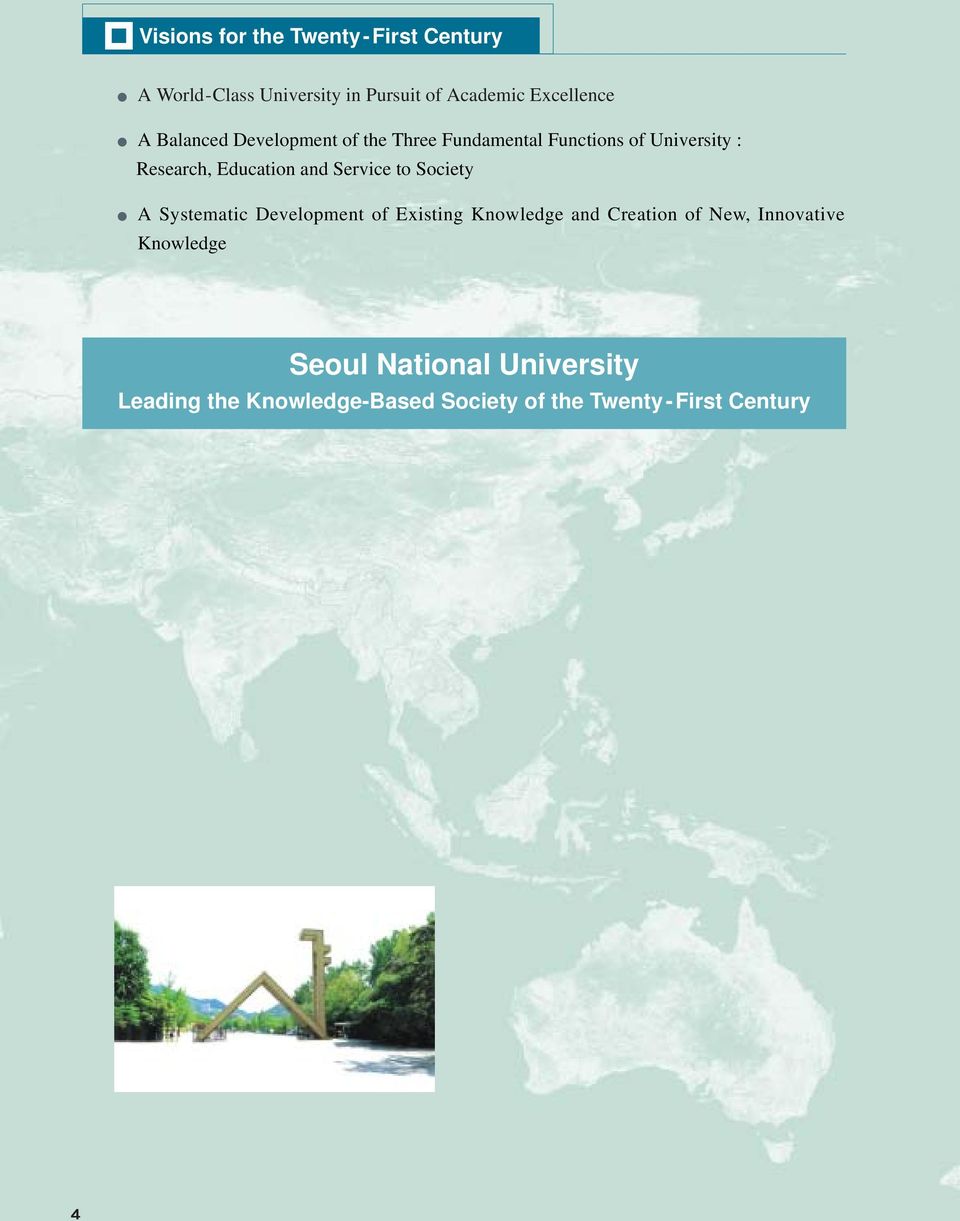
3 Visions for the Twenty- First Century A World-Class University in Pursuit of Academic Excellence A Balanced Development of the Three Fundamental Functions of University : Research, Education and Service to Society A Systematic Development of Existing Knowledge and Creation of New, Innovative Knowledge Seoul National University Leading the Knowledge-Based Society of the Twenty- First Century
4 Education and Research Education Seoul National University trains the most outstanding students in Korea in a wide array of areas in the undergraduate, master s and Ph.D programs. The undergraduate program consists of 16 colleges and 84 departments. The master s programs are offered in 5 schools, 71 departments and 27 interdisciplinary programs, and the doctoral programs in 72 department and 27 interdisciplinary programs. Furthermore, five professional graduate schools offer 8 different fields of concentration in 7 departments. The curriculum is designed for students to have a wide variety of selection. The undergraduate program offers 488 electives and 3,445 major requirement courses. The graduate program offers 6,512 listed courses. The courses in the curriculum are subject to change as the academic trend varies. Research To enhance the quality of education and to help produce research of the highest quality, the University operates 63 research institutes including The Institute of Humanities, Research Institute for Basic Sciences, and Medical Research Center. The annual expenditure on research ran as high as $204 million during the year 2002, about $240 million during the year 2003 and about $270 million during the year 2004, showing an increase of 12% every year. In step with this increasing support, the number of academic papers published by SNU faculty members increased as well: 9,387 in 2002, 9,108 in 2003, 10,461 in It is especially notable that the number of academic papers published in international academic journals listed in SCI in the field of science and technology sharply rose to 2,713 in 2002 (ranked 34th), 3,062 in 2003 (ranked 35th) and 3,119 in 2004 (ranked 32th). With this rapid increase of outstanding research accomplishments, Seoul National University ranked 30th among the universities world-wide. Support for Education and Research There are about 30,000 students and a total of about 2,000 full-time faculty members on three SNU campus sites. Supporting these students and faculty members are about 1,000 administrative staff members. The university s facilities include the following: the Main Library, Museum, Archives, Education/Research Center, Center for Teaching & Learning, Laboratory Animal Center, Health Service Center, Computer Center, General Science and Machinery Center, Inter-University Center for Natural Science Research Facilities, Faculty Apartment, Hoam Faculty House, student dormitories (undergraduate students), and housing for students with family (graduate students). Included among other institutions operated by SNU are the University Hospital, Development Foundation, University Press, and University Newspaper. The university s Visiting Faculty Housing, Graduate Research Building, Multimedia Lecture Halls, and Electronic Library all help to promote an environment for productive learning and research. Campuses Seoul National University (SNU) comprises two main campuses: the Gwanak and Yeongeon campuses. The Gwanak campus is located in the southern area of Seoul in which the majority of university s educational and research facilities, including the administrative office, are located. On the Yeongeon campus, situated in central Seoul, are the Colleges of Medicine, Dentistry, and Nursing. The Graduate School of Public Health and Seoul National University Hospital are also conveniently located on the Yeongeon campus. The Suwon campus (located in the Kyonggi province to the south of the city of Seoul) which had mainly housed Agricultural and Life Science Studies closed down in 2003, and Agricultural and Life Science Studies all relocated to the Gwanak campus in the same year. Faculty Members and Students As of July 2005, SNU has 1,760 tenured professors, 161 visiting professors (funded by Development Funds), 415 teaching assistants, 193 faculty members in affiliated schools, 60 foreign faculty members and 976 administrative staff members. Recently, SNU implemented the system of recruiting professors on tenure track as well as visiting professors funded by Development Funds to increase the number of faculty members who can contribute to the improvement of SNU s education and research initiatives. The most recent enrollment statistics indicate that there are 19,162 undergraduate students and 10,092 in master s and doctoral programs. There are 986 foreign students enrolled in visiting and exchange programs. International Academic Exchange SNU is actively promoting academic exchange with world-renowned universities and research institutes around the globe. As of December 2005, the University has signed academic exchange agreements with 92 universities and research institutes in 29 countries including UCLA (the US), University of Tokyo (Japan), Peking University (China), Oxford University (the UK), Ecole des Hautes Etudes en Sciences Sociales (France), Humdbolt-University of Bonn (Germany), and St. Petersburg Scientific Centre (Russia). Individual colleges and research institutes within the university have also been participating in academic exchanges with 230 academic institutions worldwide. SNU students and faculty members alike will benefit tremendously from opportunities for faculty training abroad, exchange programs for undergraduate students, and post-doctoral programs abroad. Promoting Information-Oriented University Seoul National University strives to become a world-renowned university that leads the knowledge and information based society of the 21st century. In compliance with our mission, Office of Information Systems & Technology was established in order to provide the university with campus-wide information technology. A 3-year Development Plan for 2004~ 2006, which was drawn up in 2004, will accelerate the proliferation of computing and technology services on campus. In 2001, the campus network service was reinforced by implementing high-speed gigabyte backbone network. There are 54 Computer Rooms in 22 campus organizations within a 5-minute walking distance on campus, enabling easy access to the Internet. A Super Computer facility has been established on campus in 2004, providing high performance computing for various research groups. Plus, industry-university partnership has made it possible to set the goal of Ubiquitous Campus, aiming for a top-notch education and research online interaction. To this end, wireless LAN has been introduced and installed on campus to provide anytime, anywhere computing service beyond the physical boundaries of campus. In 2003, integrated security control system & service was designed to offer convenient high quality secure access to information. Additional IT services will be continuously updated to provide the University with computing and technology resources.

5 A Brief History Aug Oct Government ordinance for the establishment of Seoul National University promulgated. Seoul National University established (the Colleges of Agriculture, Commerce, Dentistry, Education, Engineering, Arts, Law, Liberal Arts and Sciences, Medicine, Graduate Division). Sep Apr Jan Seoul College of Pharmacy, a private college, incorporated into the University as the College of Pharmacy. College of Veterinary Medicine established. Colleges of Fine Arts and Colleges of Music separately established. The Graduate Schools of Public Administration and Public Health established. Dec College of Veterinary Medicine incorporated into the College of Agriculture. Feb Graduate School of Private Law established. Jul Graduate School of Education established. Nov Graduate School of Business Administration established. Dec Graduate School of Journalism and the Division of General Education established. Dec Graduate School of Home Economics established. Apr Office of Campus Construction established as part of the University s 10-Year Plan for Campus Integration. Jun Graduate School of Private Law dissolved. Mar Korean Radio and Correspondence College established as an affiliated institution. Jan Graduate School of Environmental Studies established. Jan College of Veterinary Medicine established. Feb The Graduate Schools of Business Administration, Education, Journalism, Colleges of Liberal Arts and Sciences, Commerce, Division of General Education dissolved. The Colleges of Humanities, Social Sciences, Natural Sciences, and Business Administration newly established. Mar The first stage of campus integration at Kwanak completed. Aug The hospitals connected to the Colleges of Medicine and Dentistry established as a special corporate body and named as the Seoul National University Hospitals. Dec Campus relocation of College of Engineering at Kwanak completed. Feb Korean Radio and Correspondence College separated from the University. Jan Proclamation of a long-term plan for the development of Seoul National University ( ) May Mar SNU Development Foundation established. College of Nursing established. College of Agriculture renamed as College of Agriculture and Life Sciences. Jan Proclamation of Seoul National University s visions for the 21st century. Oct th anniversary of the founding of Seoul National University observed. Mar College of Home Economics renamed as College of Human Ecology. Sep Department of Veterinary Science incorporated into College of Natural Sciences. Nov Academic Information Center established. Sep Office of Admissions, Office of International Affairs established. Jun Center of General Education established. Mar Graduate School of International Studies established. Sep Campus relocation of College of Agriculture and Life Sciences. Nov Board of Trustees established. Mar Graduate School of Dentistry established. Oct th anniversary of the founding of Seoul National University observed.

6 Organization President Vice President Advisory Bodies SNU Council, Council of Deans, Steering Committee, Finance Committee, Graduate Studies Committee, Promotion and Tenure Committee, Center for General Education, Academic Program Committee, Research Committee, Information Technology Committee, Research Audit and Inspection Committee Educational Units Colleges College of Humanities, College of Social Sciences, College of Natural Sciences, College of Nursing, College of Business Administration, College of Engineering, College of Agriculture and Life Sciences, College of Fine Arts, College of Law, College of Education, College of Human Ecology, College of Veterinary Medicine, College of Pharmacy, College of Music, College of Medicine, College of Dentistry Graduate Schools Graduate School of Public Health, Graduate School of Public Administration, Graduate School of Environmental Studies, Graduate School of International Studies, School of Dentistry Administrative Units Office of Academic Affairs, Office of Student Affairs, Office of Research Affairs, Office of Planning and Development, Bureau of General Administration, Bureau of Facilities Management Supporting Facilities Office of Admissions, Office of International Affairs, Office of Academic Information(Computing Center), SNU Library(Social Sciences Library, Business Library, Agriculture Library, Law Library, Medical Library, Dental Library), Center for General Education Research Institutes Supporting Organizations Other Institutions SNU Foundation, SNU Press, University Newspaper, SNU Cooperative, SNU Hospital, POSCO Sports Center, Seoul National University Institution-Industry Cooperation Foundation SUN Dental Hospital

7

8 Colleges College of Humanities College of Social Sciences College of Natural Sciences College of Nursing College of Business Administration College of Engineering College of Agriculture and Life Sciences College of Fine Arts College of Law College of Education College of Human Ecology College of Veterinary Medicine College of Pharmacy College of Music College of Medicine College of Dentistry School of Dentistry

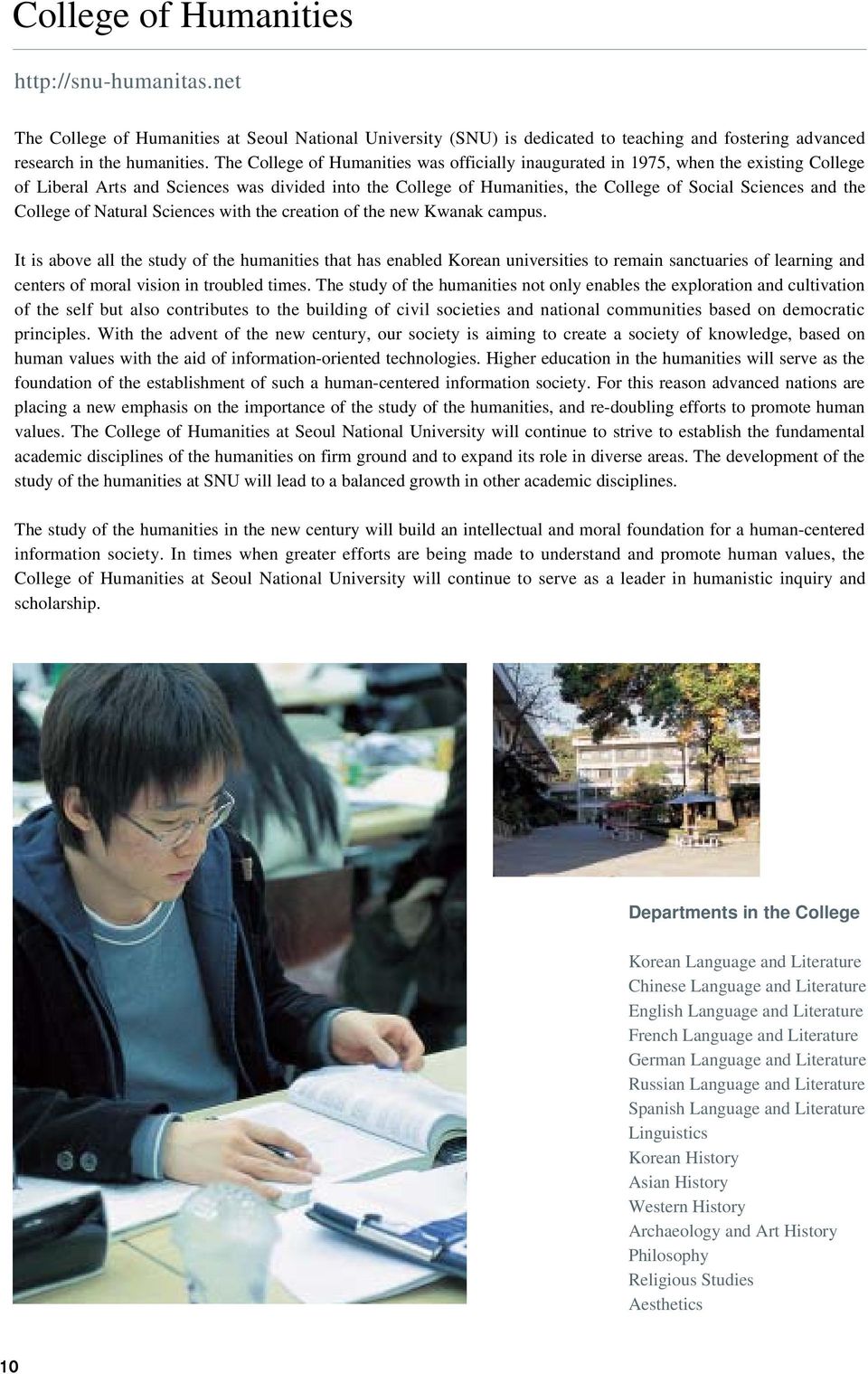
9 College of Humanities The College of Humanities at Seoul National University (SNU) is dedicated to teaching and fostering advanced research in the humanities. The College of Humanities was officially inaugurated in 1975, when the existing College of Liberal Arts and Sciences was divided into the College of Humanities, the College of Social Sciences and the College of Natural Sciences with the creation of the new Kwanak campus. It is above all the study of the humanities that has enabled Korean universities to remain sanctuaries of learning and centers of moral vision in troubled times. The study of the humanities not only enables the exploration and cultivation of the self but also contributes to the building of civil societies and national communities based on democratic principles. With the advent of the new century, our society is aiming to create a society of knowledge, based on human values with the aid of information-oriented technologies. Higher education in the humanities will serve as the foundation of the establishment of such a human-centered information society. For this reason advanced nations are placing a new emphasis on the importance of the study of the humanities, and re-doubling efforts to promote human values. The College of Humanities at Seoul National University will continue to strive to establish the fundamental academic disciplines of the humanities on firm ground and to expand its role in diverse areas. The development of the study of the humanities at SNU will lead to a balanced growth in other academic disciplines. The study of the humanities in the new century will build an intellectual and moral foundation for a human-centered information society. In times when greater efforts are being made to understand and promote human values, the College of Humanities at Seoul National University will continue to serve as a leader in humanistic inquiry and scholarship. Departments in the College Korean Language and Literature Chinese Language and Literature English Language and Literature French Language and Literature German Language and Literature Russian Language and Literature Spanish Language and Literature Linguistics Korean History Asian History Western History Archaeology and Art History Philosophy Religious Studies Aesthetics
10 College of Social Sciences The College of Social Sciences offers basic courses concerning various aspects of human life such as politics, economy, society, and culture. The general aim of the College is to train its students to cultivate the basic knowledge necessary for the diagnosing and prescribing of problems confronting human society and to provide leadership in such diverse fields as politics, journalism, NGOs and business. The College, an outcome of the University s Plan for College Integration in 1975, was the first social sciences college to be founded in the nation and is responsible for creating and disseminating knowledge in social sciences while developing and fortifying old and new relationships with domestic and international institutes. It stands at the vanguard of Korean society. The eight departments and one division of the College moved into the new Social Sciences building upon its completion in The College, along with the College of Humanities, is responsible for the general education of undergraduate students. The College runs the Social Science Information Center, with all the latest cutting-edge facilities. Research Institutes affiliated with the College of Social Sciences include the following: Center for Social Sciences, Institute of Economic Research, Institute of Communication Research, Center for International Studies, Institute of Psychological Science, Institute for Social Development and Policy Research, Institution for Korean Regional Studies, and Institute for Gender Research. Within the Center for Social Sciences are the Institute of Social Welfare, the Institute of World Economy, the Institute of Korean Political Studies and Institute of Chinese Studies. Departments in the College Political Science International Relations School of Economics Sociology Anthropology Psychology Geography Social Welfare Communication

11 College of Natural Sciences Natural science is a discipline which explores various theories about our material world, from the origin of universe and substances to the biology of living creatures. After the founding of SNU in 1945, the College was originally a part of College of Liberal Arts and Sciences and came into its own as the College of Natural Sciences. The undergraduate program consists of six majors including Mathematical Science, Statistics, Physics, Chemistry, Life Science, Earth and Environment Sciences as well as Division of Medicine and Division of Veterinary Medicine. College of Natural Sciences also provides the fundamental scientific knowledge involved in science education for the College of Engineering, College of Bio-Agricultural Sciences, College of Education, and College of Pharmacy. The graduate program has received a strong support from the Ministry of Education which generously subsidized student tuitions and provided a better environment for research. Also, since 2000, the so-called Brain Korea Project (BK-21) has been offering support for graduate programs; with substantial financial support graduate students have been able to concentrate on their research. The alumni of College of Natural Sciences continue to make a name for themselves and SNU with ongoing research in academic settings or state-run as well as private research institutes. They are also contributing to Korean society not only in innovative fields of industry as technicians or executive officers but also in the fields of civil service, journalism, and law. Currently, the College has 200 faculty members and 1500 graduate students, and they are working hard to produce research results of very high calibre. The level of research support and facilities exceeds that of most universities worldwide, and many faculty members have made scientific contributions on a global level and are being recognized for the excellence of their research worldwide. Departments in the College Department of Mathematical Sciences Department of Statistics Department of Physics Department of Chemistry Department of Biological Sciences Department of Earth and Environmental Sciences Pre-Medical Program Pre-Veterinary Medicine Program

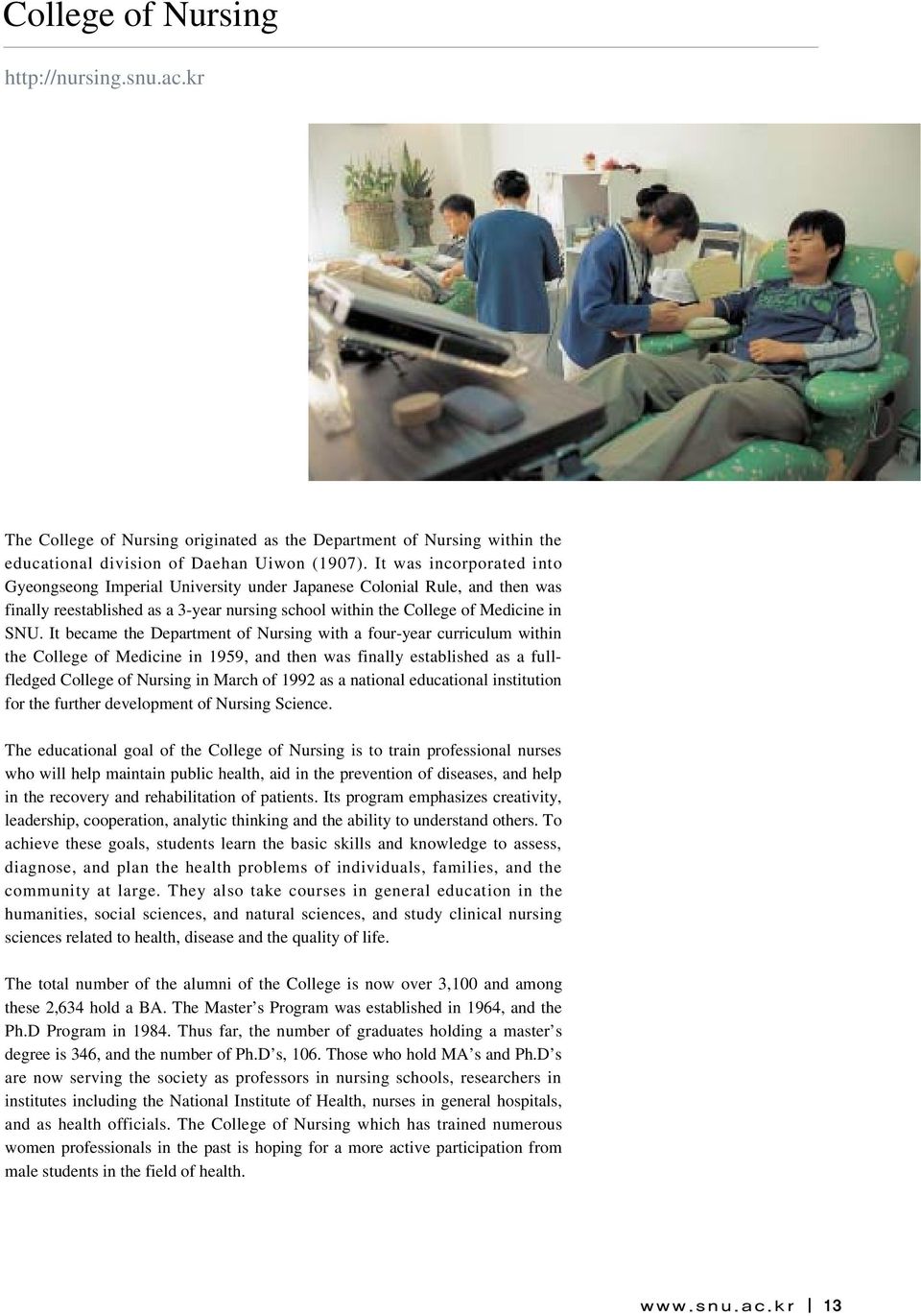
12 College of Nursing The College of Nursing originated as the Department of Nursing within the educational division of Daehan Uiwon (1907). It was incorporated into Gyeongseong Imperial University under Japanese Colonial Rule, and then was finally reestablished as a 3-year nursing school within the College of Medicine in SNU. It became the Department of Nursing with a four-year curriculum within the College of Medicine in 1959, and then was finally established as a fullfledged College of Nursing in March of 1992 as a national educational institution for the further development of Nursing Science. The educational goal of the College of Nursing is to train professional nurses who will help maintain public health, aid in the prevention of diseases, and help in the recovery and rehabilitation of patients. Its program emphasizes creativity, leadership, cooperation, analytic thinking and the ability to understand others. To achieve these goals, students learn the basic skills and knowledge to assess, diagnose, and plan the health problems of individuals, families, and the community at large. They also take courses in general education in the humanities, social sciences, and natural sciences, and study clinical nursing sciences related to health, disease and the quality of life. The total number of the alumni of the College is now over 3,100 and among these 2,634 hold a BA. The Master s Program was established in 1964, and the Ph.D Program in Thus far, the number of graduates holding a master s degree is 346, and the number of Ph.D s, 106. Those who hold MA s and Ph.D s are now serving the society as professors in nursing schools, researchers in institutes including the National Institute of Health, nurses in general hospitals, and as health officials. The College of Nursing which has trained numerous women professionals in the past is hoping for a more active participation from male students in the field of health.
13 College of Business Administration The aim of the College of Business Administration is to educate students to become competent and professional business administrators with the ability to make efficient decisions. Towards this end, the College focuses on the systematic study of management principles and techniques that are applicable to all types of businesses. Business theory and principles are bolstered by practical managerial techniques applicable to real-life businesses. Moreover, since innovative thinking and clear insight into the social role of business are essential for competent executives, students are encouraged to develop the ability to think critically and assess various situations accurately at all stages of their education. The College started as the College of Commerce in At the time, the College of Commerce consisted of the Department of Commerce and the Department of Economics. The Department of Business Administration was created in 1962 to join the two departments, and the Department of Commerce merged with the Department of Business Administration in December After going through these changes, the College established itself as the premier educational and research center for business in Korea. Entering students first take basic courses including behavioral science, managerial econometric science and accounting, and then go on to receive professional education covering a wide array of courses such as production management, marketing management, personnel management, financial management, accounting, international business management and management information systems. The College trains students to understand the political, economic and social context surrounding the development of Korean companies holistically, and also provides education on the character and effects of important public policy decisions in order to raise student consciousness about the social and moral responsibilities of business executives. The College actively fosters and participates in cooperative work with various industries, centered around the offices of three buildings: the SK Business Hall, the LG Management Hall, and the Management Development Hall. As of December 2004, 1,159 students are enrolled in the undergraduate program, 532 students in the master s program and 57 students in the doctoral program. 5,606 B.A. 3,740 M.A. and 186 Ph.D s have been conferred thus far, totaling 9,532 graduates. The alumni are taking a leading role in the industrial and financial sectors in Korea. Many become public officials after taking the national qualification exams, while quite a few alumni of the graduate school go on to become professors of business administration in various universities throughout Korea. The College of Business Administration is fulfilling its duty to dedicate itself to the development of Korean economy.

14 College of Engineering Schools in the College Mechanical and Aerospace Engineering Materials Science and Engineering Electrical Engineering Civil and Geosystem Engineering Computer Science and Engineering Chemical and Biological Engineering Architecture (ArchitectureArchitectural Engineering) Industrial Engineering Nuclear Engineering Naval Architecture and Ocean Engineering To fulfill the needs of a rapidly developing technological society, the College of Engineering seeks to produce students rigorously trained in the studies of science and technology. In the undergraduate program, the emphasis is on training engineers who will be instrumental in introducing new technologies and in improving productivity. The graduate program, on the other hand, focuses primarily on training the next generation of engineering professors and researchers. Faculty members and students all work hard to maintain the College s leading role in research and development of technology. The College of Engineering, based within 17 buildings, carries out a balanced education between theory and laboratory work. Special equipments for general research are managed by the supporting labs such as the Construction Lab, Precision Measurement Lab, Machine Analysis Lab, Material Analysis Lab, and Electronic Calculation Lab. As a part of the expansion of the College which started in 1992, the Basic Courses Hall and the Power Plant completed their construction in In January of 1996, Building 1 of the New Engineering Hall was completed, which now houses the School of Electrical Engineering, the School of Mechanical and Aerospace Engineering and the School of Computer Engineering. Building 2, which has 168 lecture rooms, was completed in November of 2001, and now houses the entire School of Applied Chemistry, and part of the School of Electrical and Computer Engineering, and the School of Mechanical and Aerospace Engineering. The College also offers a premier industrial strategy course which provides continuous education for managers working in industrial fields. There are 12 research institutes affiliated with the College of Engineering, including the Research Institute of Engineering Science, the Institute of New Media and Communications, and the Research Institute of Advanced Materials.

15 College of Agriculture and Life Sciences cals.snu.ac.kr As the cradle of Korean agricultural science, the College of Agriculture and Life Sciences studies food, natural resources for cloth and medicine, biotechnology and environments which are the fundamentals of human survival. The College carries an important mission to become the leader in these fields by continuous scientific and informational development. To this end, the College seeks to continuously advance the studies in agriculture and life sciences as well as train elite professionals who are quipped not only with in-depth knowledge in these fields but also with the ability to become the leaders of Korean society. The history of the College goes back as far as 1904 when the Department of Agriculture in the College of Agriculture, Commerce and Engineering (Seoul) was founded and became the parent school for the present College of Agriculture and Life Sciences. In 1906, the Department of Agriculture became independent and opened as the College of Agriculture and Forestry. In 1907, it moved to a new building in Suwon campus, and changed its name to Suwon College of Agriculture and Forestry. The name went through several changes from the Suwon College of Agriculture and Forestry in 1918, the Suwon High School of Agriculture and Forestry in 1922 and then again back to the Suwon College of Agriculture and Forestry in With the end of Japanese Colonial Rule, the school was renamed the College of Agriculture in 1946 and incorporated into Seoul National University, and renamed again as the College of Agriculture and Life Sciences in Based on the integration plan for Seoul National University campuses in 1996, all research and education facilities relocated to Kwanak campus in In 1997, the 14 department/6 major system was restructured into 4 schools and 5 departments. From the year 2005 onwards, the curriculum will be revised to include 7 departments in the undergraduate program, 6 departments and 1 division in the master s and doctoral programs for which 110 professors and over 79 administrative staff members are on duty. The maximum number of students to enter each year are 296 in the undergraduate program and 350 in the graduate program. Currently, there are 2,350 undergraduate students and 650 graduate students in the College. Thus far, 19,500 students have been conferred degrees and are serving the society in various areas. For an efficient system of education and research, ready are the annexed facilities including University Farm, University Forest, University Animal Farm, University Arboretum, National Instrumentation Center for Environmental Management, Center for Secondary Vocational Education Development as well as supporting institutions such as Agricultural Library, Information Center for Agricultural and Life Sciences. Moreover, cutting edge research related to bio-engineering and environmental science is being made possible through various institutes including Research Institute for Agriculture and life Sciences, Center for Agricultural Biomaterials, Center for Plant Molecular Genetics and Breeding Research, The Crop Functional Genomics Center. The College also has exchange programs with 20 foreign universities and institutes including Tokyo University, Japan, Cornell University, USA and Science Academy, Russia. Departments in the College Department of Plant Science Department of Forest Science Department of Biosystems & Biomaterials Science and Engineering Department of Landscape Architecture and Rural System Engineering Department of Food & Animal Biotechnology Department of Applied Biology & Chemistry Department of Agricultural Economics & Rural Development

16 College of Fine Arts Cultivation of emotions is important for both an individual s well-being and the development of society, and is essential for productive interpersonal relations, rich spiritual life and happiness in general. As such, a systematic education encompassing both the universal and particular is necessary. The College of Fine Arts offers education for the development of creativity and practical training in all formative arts. It places a special emphasis on the inheritance of Korean and oriental traditional arts and has produced formative artists and professionals in these fields. The College of Fine Arts also offers general courses for students wanting to sharpen their appreciation of life and nature through the study of fine arts. Departments in the College Oriental Painting Painting Sculpture and the Faculty of Crafts and Design

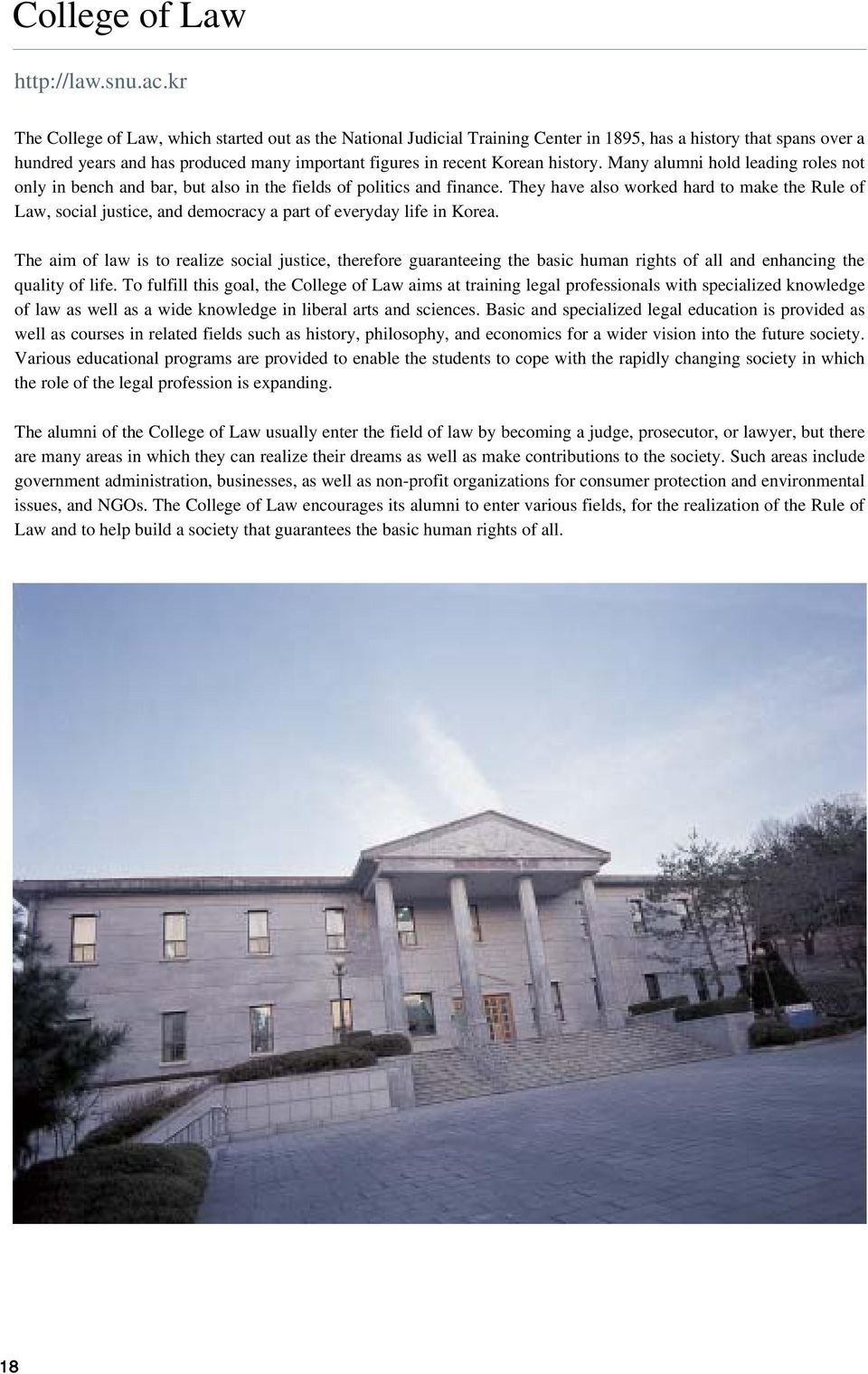
17 College of Law The College of Law, which started out as the National Judicial Training Center in 1895, has a history that spans over a hundred years and has produced many important figures in recent Korean history. Many alumni hold leading roles not only in bench and bar, but also in the fields of politics and finance. They have also worked hard to make the Rule of Law, social justice, and democracy a part of everyday life in Korea. The aim of law is to realize social justice, therefore guaranteeing the basic human rights of all and enhancing the quality of life. To fulfill this goal, the College of Law aims at training legal professionals with specialized knowledge of law as well as a wide knowledge in liberal arts and sciences. Basic and specialized legal education is provided as well as courses in related fields such as history, philosophy, and economics for a wider vision into the future society. Various educational programs are provided to enable the students to cope with the rapidly changing society in which the role of the legal profession is expanding. The alumni of the College of Law usually enter the field of law by becoming a judge, prosecutor, or lawyer, but there are many areas in which they can realize their dreams as well as make contributions to the society. Such areas include government administration, businesses, as well as non-profit organizations for consumer protection and environmental issues, and NGOs. The College of Law encourages its alumni to enter various fields, for the realization of the Rule of Law and to help build a society that guarantees the basic human rights of all.
18 College of Education Departments in the College Education Korean Language Education English Language Education French Language Education German Language Education Social Studies History Geography National Ethics Mathematics Physics Chemistry Biology Earth Science Physical Education The College of Education offers three major fields in its undergraduate program: general education, which focuses on the general theories of education and principles of educational activity; curriculum and instruction, which deals with the principles of education and methodology, and specialized content within each field of study. Interdisciplinary programs offered in the graduate school are: Music Education, Art Education, Home Economics Education, Management Education, Special Education, Environmental Education, and Child Education. The undergraduate program of the College of Education is composed of required courses and electives like other colleges. However, as a teacher training institution, it differs from other colleges in that the required courses include three different areas, one based on the theories of general education and educational activities, another based on the knowledge and theories of each major, and the last based on the knowledge of a specific field. The configuration of the Master s and Doctoral programs is similar as well, but the ratio of the courses required in three areas differs from the undergraduate program. The majority of the alumni of the College of Education work as teachers in middle schools and high schools, researchers or officials in the Ministry of Education and Human Resources Development and other affiliated institutes, and as researchers in various institutes based in universities across the country.

19 College of Human Ecology The changes in the social values and beliefs and the rapid development of scientific technology have transformed the traditional notions of the family as well as its role in society. Because of these changes, the demand for scholars of Human Ecology is high. Human Ecology takes a scientific approach to the studies of culture, environment, and industries affecting human life, as well as domestic issues including children, women and the elderly. Departments in the College Consumer and Child Studies Food and Nutrition Clothing and Textiles The College of Human Ecology has a long history and originally started out as the Department of Home Economics Education in the College of Education. It separated from the College of Education in 1968 and later was renamed as the College of Human Ecology in The Department of Agricultural Home Economics was incorporated into the present college in the same year. In response to the rapid changes in society, the College has worked hard to develop new curricula, acquired new research equipments and widened the areas of research. By producing highly trained specialists in the fields of Consumer Studies & Resource Management, Child Development & Family Studies, Clothing & Textiles, and Food & Nutrition, the College has contributed to continuously improving the quality of life of individuals and families in Korean society from many different angles. Annexed institutions include the Research Institute of Human Ecology and Child Educare & Research Center. Open seminars entitled Fashion Industry CEO Program are being offered to contribute to practical research and to provide extended services to the community. The College also offers courses for training business managers in the fashion industry. At present, the College is divided into three departments, and each major has both undergraduate and graduate programs.

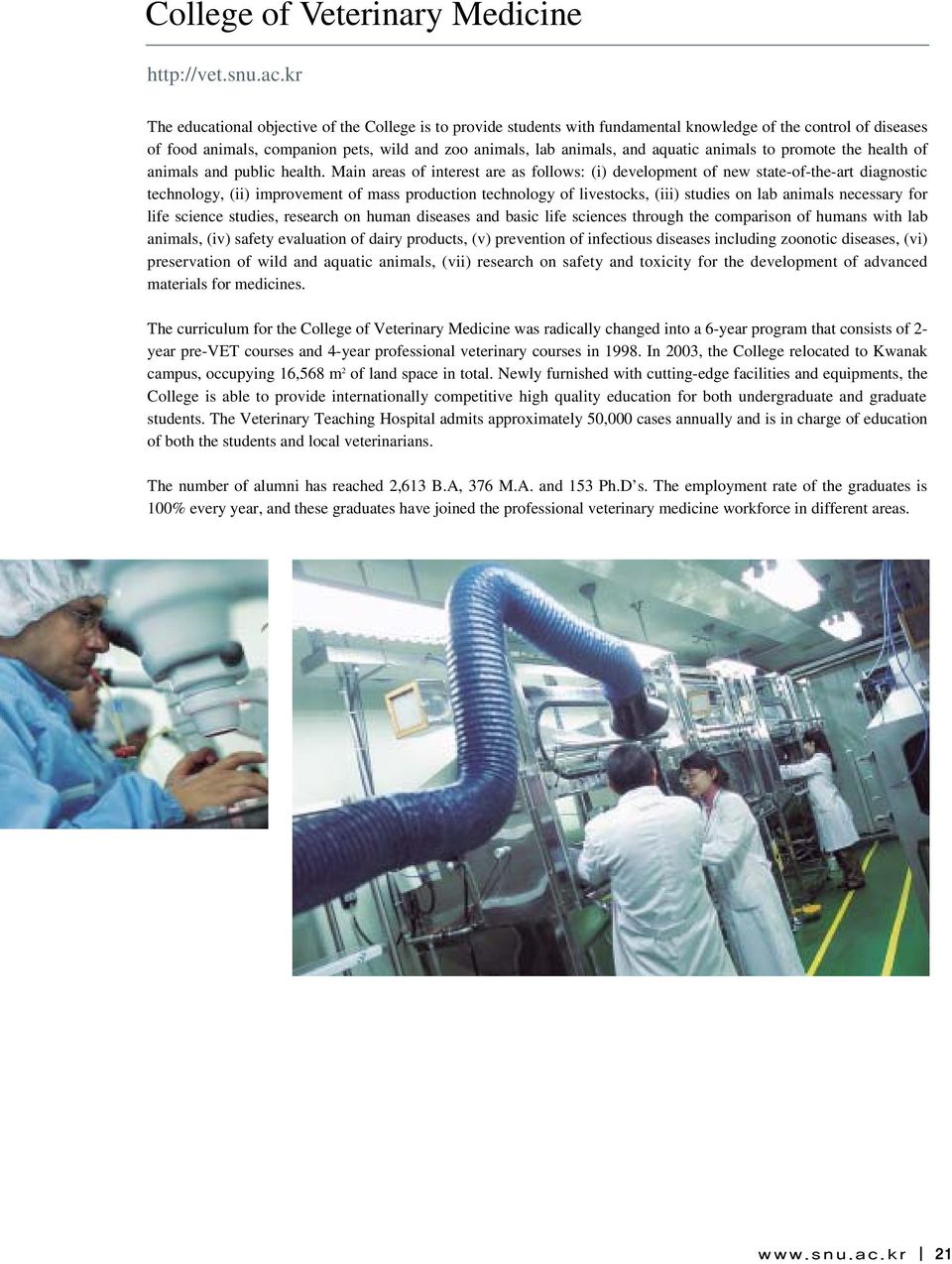
20 College of Veterinary Medicine The educational objective of the College is to provide students with fundamental knowledge of the control of diseases of food animals, companion pets, wild and zoo animals, lab animals, and aquatic animals to promote the health of animals and public health. Main areas of interest are as follows: (i) development of new state-of-the-art diagnostic technology, (ii) improvement of mass production technology of livestocks, (iii) studies on lab animals necessary for life science studies, research on human diseases and basic life sciences through the comparison of humans with lab animals, (iv) safety evaluation of dairy products, (v) prevention of infectious diseases including zoonotic diseases, (vi) preservation of wild and aquatic animals, (vii) research on safety and toxicity for the development of advanced materials for medicines. The curriculum for the College of Veterinary Medicine was radically changed into a 6-year program that consists of 2- year pre-vet courses and 4-year professional veterinary courses in In 2003, the College relocated to Kwanak campus, occupying 16,568 m 2 of land space in total. Newly furnished with cutting-edge facilities and equipments, the College is able to provide internationally competitive high quality education for both undergraduate and graduate students. The Veterinary Teaching Hospital admits approximately 50,000 cases annually and is in charge of education of both the students and local veterinarians. The number of alumni has reached 2,613 B.A, 376 M.A. and 153 Ph.D s. The employment rate of the graduates is 100% every year, and these graduates have joined the professional veterinary medicine workforce in different areas.
21 College of Pharmacy The goals of the College of Pharmacy are: to produce professionals capable of developing pharmaceuticals for the prevention and treatment of human diseases; to develop new drugs; to research and develop new raw materials for pharmaceuticals; and to develop new theories and techniques for the manufacture of pharmaceuticals. To this end, the College has focused on producing professionals through a systematic academic program offering courses in basic pharmaceutical science and clinical pharmacy. It also aims at training professionals to do research and discover candidate materials for new drugs by using new technologies in chemistry and life sciences. The College of Pharmacy consists of two departments: The Department of Pharmacy studies the effects of pharmaceuticals within the human body, the properties of pharmaceuticals, its manufacture and dosage, etiology, and the effects on the environment and health; the Department of Manufacturing Pharmacy aims at developing new pharmaceuticals, managing developmental information, combining raw materials and candidate materials for new drugs, searching for new candidate materials among natural and genetically engineered materials, managing manufacturing plants, and quality control of pharmaceuticals. Approximately 60% of the graduates of the College of Pharmacy go on to graduate school, while the other 40% find employment. Those who go on to graduate school usually enter into the doctoral program and become professionals. They now fulfill pivotal roles as pioneers in the field of pharmacy in Korea, and such trend is sure to continue. In the area of research, the College has the best research facilities in Korea and preeminent researchers and faculty members who publish approximately 200 internationally recognized papers and bring in 7 million dollars of research funds every year. Its annual research fund is ranked within the top l0% among the colleges of pharmacy in both Korea and the United States. The Research Institute of Pharmaceutical Sciences was founded within the College in 1981, the first research institute in Korea devoted to developing new pharmaceuticals and studying their effects on public hygiene and the environment. The Institute contributes to the growth of the Korean pharmaceutical industry and was named Outstanding Research Institute in 1991, setting the foundation for cooperation between the industries and the academia. SNU s College of Pharmacy Educational Research Foundation, founded in 1981, has been working hard to improve the research environment for faculty members and provide scholarship opportunities for graduate students. The Continuing Education Center for Advanced Pharmacy, founded in 1988, oversees the education of pharmacists, as well as the training of students. In 1996, the medicinal herb garden was relocated and reopened in Koyang city, Kyunggi province, serving the needs for pharmaceutical education, community service, and education of the public who are interested in medicinal plants.
22 College of Music The College of Music was first founded by the late Dr. Hyeon Je-Myeong in December of 1945 as Kyeong-seong Music School which became the Department of Music within the College of Arts in August of the following year and then became the College of Music in The College consisted of the Departments of Vocal Music, Composition, and Instrumental Music. The Department of Korean Music was added in 1959, offering courses in Korean Instrumental Music, Theory, and Composition of Korean Music. In 1981, the Department of Composition started admitting majors in Composition and Theory, and in 1982, the Department of Instrumental Music expanded the number of majors into Piano, String Instrument, and Wind Instrument. In 1984, a major in Vocal Music was added to the Department of Korean Music, which now admits majors in Instrumental Music, Composition, Theory, and Vocal Music. The College of Music which oversees comprehensive musical education has an outstanding faculty in each major, under whose tutelage talented students develop into professional musicians. Apart from the courses on theory and performance, the student orchestra in the College gives three public performances every semester, and an opera performance is jointly sponsored by the Department of Vocal Music and Instrumental Music every two years. In total, the College of Music offers about 250 recitals annually. Apart from these, there are also concerts and recitals in which the faculty members perform, and chamber music recitals. The alumni of the College now approximate 6,400 in number, and they lead the Korean musical community. By training professional musicians who combine both theory and performance skills, the College of Music continues to maintain its reputation as a world-class musical institution. Departments in the College Vocal Music Composition (CompositionTheory) Instrumental Music (PianoString InstrumentWind Instrument) Korean Music
23 College of Medicine The primary goal of the College of Medicine is to train students to a level of professionalism that allows them to function confidently as medical professionals and enables them to contribute to the advancement of medical science. The College of Medicine is the oldest of the 16 SNU Colleges, and remains at the Yon-gon Campus, its place of origin. The College teaches basic and clinical sciences by providing clinical clerkships, small group tutorials, and practical experience, and promotes the concept of student-centered education in addition to conventional lecture-based learning. The curriculum of the College is designed to encourage students to develop their abilities and to resolve problems for themselves. Much of the clinical education is centered on bedside teaching. For this purpose, the Seoul National University Hospital functions as a primary 1,320-bed teaching hospital, and a Children s Hospital (263 beds) supports pediatric clinical training. Two affiliated hospitals, the Boramae Hospital (529 beds) and the Bundang Seoul National University Hospital (909 beds), also contribute substantially as educational centers for local community and geriatric medicine. Recent addition is the National Cancer Center Hospital, also designated as a clinical education hospital. The College is responsible for the management of the Cancer Research Institute, the Institute for Liver Research, the Center for Animal Resource Development (a division of Biomax Institute) and the Medical Research Center. The Medical Research Center comprises the Institute of Reproductive Medicine and Population, and fifteen other specific research institutes, which are all leading contributors at the highest levels of medical research. In addition, a range of research units supported by government funding have been established, and these include the Creative Research Project for Alzheimer Disease, the Genome Research Center for Diabetes and Endocrine Disorders, Frontier Research Units for Stem Cell Research and others. Furthermore, the National Teacher Training Center for Health Personnel, operated under the auspices of the College of Medicine, runs various training programs for medical school professors with the aim of raising the standards of medical education with a focus on developing the curriculum and teaching and evaluation methods.
24 College of Dentistry/School of Dentistry The College of Dentistry was established by the Seoul National University Act on August 22, The College originated as Kyungsung Dental School in 1922 and became the Gyungsung Dental Professional School in On January 13, 1959, 2 year pre-dental program was added, but in 2003 it was decided that a graduate school system would be implemented instead. The College has played a central role in dentistry in Korea. The mission of the College is to nurture dentists who can perform basic research and practice in dentistry equipped with the spirit of service to the community. Another aim is to train high-quality professionals who can undertake research as well as education in basic and /or clinical dentistry and associated fields. In accordance, the program in Graduate School of Dentistry focuses on motivating students to study, and think for themselves and actively apply their knowledge through close interactions between professors and students and one-on-one instruction. In addition, students who complete the graduate program are encouraged to fill their principal roles as the leading clinicians in Korea.
25
26 Graduate School The Graduate School provides students with the opportunity to develop the academic skills necessary to engage in and conduct focused and original research. The Graduate School oversees the graduate programs of individual colleges, ensuring continuity and consistency between the undergraduate and graduate programs. Lectures and research activities at the graduate level are conducted in the classrooms and laboratories of each department. The Graduate School Committee makes the decisions involved in the management and operation of the Graduate School, and the Graduate Academic Affairs Committee in each college makes decisions relevant to each area of specialization. The master s program in the 71 departments of five colleges offers 27 interdisciplinary courses to 3,283 students. The doctoral program in the 72 departments of five colleges offers 27 interdisciplinary courses to 1,332 students. As of February 24, 2006, the Graduate School has conferred 16,884 Ph.D and 64,804 Master s degrees, making significant contributions to the Korean academia, and SNU has also awarded honorary doctoral degrees to 102 distinguished persons since The following departments offer doctoral programs: Literature, Sociology, Anthropology, Psychology, Geography, Social Welfare, Communication, Philosophy, Political Science, International Relations, Economics, Physical Science, Human Ecology, Business Administration, Engineering, Architecture, Education, Physical Education, Law, Pharmacy, Medical School, Nursing, Dentistry, Agriculture, Veterinary Science, Public Health, Public Administration, and Urban Planning. The following departments offer Master s programs: Literature, Sociology, Anthropology, Psychology, Geography, Social Welfare, Communication, Political Science, International Relations, Economics, Physical Science, Business Administration, Education, Physical Education, Engineering, Architecture, Law, Pharmacy, Medical School, Nursing, Dentistry, Human Ecology, Painting, Crafts and Design, Music, Agriculture, Veterinary Science, Public Health, Public Administration, Urban Planning, Landscape Architecture and International Studies. Master s and Doctoral Programs Humanities and Social Sciences Korean (Linguistics and Literature), Chinese, English, French, German, Russian, Spanish, Linguistics, Korean history, Asian History, Western History, Philosophy, Religion, Aesthetics, Archeology and and Art History, Education, Korean and Foreign Languages Education, Social Education, Physical Education, National Ethics Education, Law, Political Science, International Relations, Economics, Business Administration, Agricultural Economics, Sociology, Anthropology, Psychology, Geography, Social Welfare, Communication, Consumer Studies and Resource Management, Child Development and Family Studies, Public Administration, Environmental Planning Natural Sciences Mathematics, Statistics, Physics, Chemistry, Biology, Geological Science, Mathematics Education, Science Education, Plant Production Science, Forestry Science, Agricultural Biotechnology, Biosystems & Biomaterial Science and Engineering, Landscape Architecture and Rural System Engineering, Agriculture & Vocational Education, Food and Nutrition, Clothing and Textiles, Nursing, Pharmacy, Manufacturing Pharmacy, Public Health Engineering Architecture, Industrial Engineering, Nuclear Engineering, Naval Architecture and Ocean Engineering, Inorganic Engineering, Aerospace Engineering, Earth Environment Systems Engineering, Electrical Engineering and Computer Engineering, Chemical Engineering Medical Science Medicine, Dentistry, Veterinary Science Interdisciplinary Programs Cognitive Science, Classical Studies, Comparative Literature, Performing Arts major, History and Philosophy of Science, Genetic Engineering, Brain Science, Medicine and Biological Engineering, Bio-information major, Nano Science Technology major, Calculative Science major, Technological Policy, Technological Administration, Urban Planning, Biochemical Engineering and Biotechnology, Bioagricultural Engineering, Music and Fine Arts, Music Education major, Art Education major, Home Economics Education, Xray Applied Life Science major, Cancer Biology, Clinical Pharmacology & Therapeutics, Gender Studies, Special Education, Environmental Education Masters Programs Only Natural Sciences Arts Interdisciplinary Programs Landscape Architecture, Environmental Health, Environmental Architecture Asian Painting, Painting, Sculpture Archival Science, Early Childhood Education Doctoral Program Only Arts Interdisciplinary Course Fine Arts Musicology (Western Musicology, Korean Musicology), Landscape Architecture
27 Professional Graduate Schools The Graduate School of Public Health SEOUL NATIONAL UNIVERSITY The Graduate School of Public Health was established in 1959 as one of the first professional graduate schools of Seoul National University. The founding objective of the School was to become the mecca for research on the health determinants of not just individuals with illnesses but the whole community and its application in the training and education of health professionals. The society or the public is more than the collection of individuals, and promoting the health of a society means to promote the overall health of its constituents, including physical, mental, social, emotional, spiritual, and sexual well-being. This takes active sociocultural, institutional and technical intervention. The School seeks to incorporate various multi-disciplinary approaches, including basic natural sciences and social sciences as well as medicine and other health sciences, and to promote the total health of cells and organs, bodies and minds, and groups and society. These interactive multi-disciplinary approaches overcome the shortcomings of the classic biomedical approach which separates physical well-being and mental well-being. The reductionist approach of the classic biomedical approach does not take into account the fact the major health determinants have shifted and that ecological environments have changed. There are two departments, Department of Health Science and Services and Department of Environmental Health, in the School of Public Health. The Department of Health Science and Services has two separate programs, one concentrating on the basic sciences in public health, and the other concentrating on health management and policy. The Department of Environmental Health has one program. There are also two subsidiary institutes the Institute of Health and Environment and Health Service Demonstration Center in Chungcheon, Gangwon Province. The Institute of Health and Environment carries out projects, implements and monitors programs, and develops policies related to the national health. Dissemination of information is an important mandate of the Institute, and monthly seminars have been held for the researchers. Chuncheon Health Service Demonstration Center provides a demonstration program for the community, and it also serves as an on-site training center for students.
28 The Graduate School of Public Administration The Graduate School of Public Administration, founded on January 13, 1959, was established for the in-depth study of public administration and for the training of future or present public officials in various government posts. The School, with a history of over 30 years, was the first graduate school of its kind to be founded in Korea. The School produced not only a large number of public officials but also served the purpose of producing specialists to teach Public Policy and Administration in various universities across the nation. As of July 2004, the Graduate School has produced 3,328 Master s and 25 Ph.D s. The master s program offers two majors: Public Administration and Public Policy. The master s program focuses on the general methodologies of social sciences, theories of administration, and public policies for national development, all of which are fundamental to the understanding of the workings of administration. The doctoral program covers a more in-depth study of public administration through a systematic approach towards the ideologies and theories of public administration, policy, and methodology. Special programs include the Advanced Center for Administrative Development, and the Advanced Program for Information, Communication & Broadcasting Policy. Research Institutes include the Korean Institute of Public Affairs and the Public Policy Information Center. The Advanced Center for Administrative Development is a 6-month-long program provided mainly for high-ranking public officials and executives of public enterprises, focusing on the teaching of a more effective policy management and leadership. The program seeks to provide new insight into the policy-making process and enhance the leadership of senior administrators by conducting seminars, group meetings, and leadership-forums. The Advanced Program for Information, Communication & Broadcasting Policy, supported by the cutting-edge communications system of the Research Institute of Public Management, aims at producing experts in the information and communication sectors, and serves as a cooperative site of research for both the industrial sector and the academia.
29 The Graduate School of Environmental Studies SEOUL NATIONAL UNIVERSITY The Graduate School of Environmental Studies is the first research and educational institution to be established in Korea which trains experts in environmental studies. It was founded with a specific goal of training professionals to conduct studies on creating a rational composition of residential spaces and conservation of natural environment, involving the study of urban planning and designing, traffic control, regional development, environment control, landscaping, environment planning and designing. The Graduate School of Environmental Studies opened on January 25, 1973, after the merging of the Department of Urban and Regional Planning, formerly part of the Graduate School of Public Administration and the Landscaping Department. On Jaunary 1, 1975, the Department of Urban and Regional Planning was renamed as the Department of Environmental Planning, and the Department of Landscaping as the Department of Environmental Landscaping. In 1995, a program entitled High Policy Process of City and Environmentwas launched, mainly for executives and CEOs. In 2001 the program was renamed as CEO Environment Management Forumand Chief Expert Course for UrbanEnvironment Design, enabling a more specialized education. Urban and Regional Planning majors in Environment Planning carry out education and research related to urban planning, regional planning and regional policy. Environment Management majors study environment engineering and environment control policies. Traffic Control majors study the analysis of urban traffic problems, drawing up of measures, understanding of microscopic characteristics and control. Landscaping major and Urban Planning major in Environment Landscaping receive planning-studio-centered education to develop planning practice skills in regard to sustainable human environment. In addition, the School provides an in-depth academic exploration of subjects such as cultural science and environment planning, urban environment and urban architecture, GIS and multimedia application, and landscaping engineering.
30 The Graduate School of International Studies The Graduate School of International Studies (GSIS), officially established in 2003, began as the School of International Area Studies in Since its founding, the School has evolved to become one of the most dynamic and rapidly growing academic programs offered by the Seoul National University. GSIS Seoul aims to be the center of academic training and research in the field of Northeast Asia, Korean Studies, as well as broader global issues. As both a professional and academic institution, it seeks to prepare its students to assume leading roles in multinational corporations, government and non-government organizations, media, as well as in major think-tanks and universities. The curriculum is based on an integrated, multidisciplinary approach, which combines theory with practice. GSIS Seoul emphasizes intellectual integrity, while training its students in the field of decision making and policy formation. With the nation s largest and most prominent faculty body specializing in international commerce, international cooperation, international area studies and Korean Studies, GSIS Seoul also provides a stimulating research environment. The student body boasts of highly qualified graduate students from around the globe, including Asia-Pacific, the Americas, and Europe. As a member of the Association of Professional Schools in International Affairs (APSIA), GSIS Seoul is widely acknowledged as a leading institution of international studies. It reaches out internationally through its cooperative ties with other prestigious brother organizations around the world and seeks to promote mutual understanding, peace, and prosperity, both regionally and globally. Field of Studies: International Commerce / International Cooperation / International Area Studies / Korean Studies Majority of classes taught in English
31 S N U Supporting Facilities Office of Admissions Office of International Affairs Office of Information Systems & Technology University Computer Center SNU Library University Library Social Sciences Library Business Library Agriculture Library Law Library Medical Library Dental Library Center for General Education Research Institutes Inst. of Humanities American Studies Inst. Inst. for Cognitive Science Inst. of Philosophy Inst. of Historical Research Center for Social Sciences Inst. of Economic Research Inst. of Communication Research Center for International Studies Inst. of Psychological Science Inst. for Social Development and Policy Research Inst. for Korean Regional Studies Inst. for Gender Research Research Inst. for Basic Sciences Inst. for Molecular Biology and Genetics Research Inst. of Oceanography Center for Theoretical Physics Inst. of Microbiology Research Inst. of Mathematics Korea Bio-MAX Center Research Inst. of Nursing Science Inst. of Management Research Inst. of Industrial Relations Inst. of Information and Operations Management Inst. of Finance and Banking Inter-university Semiconductor Research Center Research Inst. of Engineering Science Center for Advanced Materials Research Automation and Systems Research Inst. Research Inst. of Advanced Computer Technology Inst. of Advanced Machinery and Design Inst. of New Media and Communications Research Inst. of Energy and Resources Research Inst. of Marine Systems Engineering Inst. of Chemical Processes Inst. of Advanced Aerospace Technology Advanced Institute of Convergence Technology Research Inst. for Agriculture and Life Sciences Research Center for New Bio-Materials in Agriculture Visual Arts Inst. Law Research Inst. Center for Education Research Education Research Inst. Sports Science Research Institute Korean Language Education Research Inst. Research Inst. of Human Ecology Research Inst. of Veterinary Science Natural Products Research Inst.
32 Research Inst. of Pharmaceutical Science Asian Music Research Inst. Western Music Research Inst. Opera Research Inst. Medical Research Center Cancer Research Inst. Liver Research Inst. Inst. of Health and Environment Sciences Korea Inst. of Public Affairs Research Inst. of Public Information Management Environmental Planning Inst. Institute of International Affairs Institute for Japanese studies Dental Research Inst. Supporting Organizations Seoul National University Museum Art Museum Kyujanggak Institute for Korean Studies Dormitories Health Service Center Center for Teaching and Learning Laboratory Animal Center Inter-university Center for Natural Science Research Facilities Language Education Inst. Center for Campus Life and Culture School of International and Area Studies Counseling Center for Sexual Harassment SNU Archives Inst. of Environmental Protection and Safety Research Support Center Crop Experiment Farm Experiment Grove Laboratory Animal Center Arboretum National Instrumentation Center for Environmental Management In-Service Training Center for Secondary Education National Academy for Educational Administrators KSSI Academy for Administrative Public Officials SNU Child Educare Research Center Veterinary Medicine Teaching Hospital Medicinal Plant of College of Pharmacy of SNU Continuing Education Center for Advanced Pharmacy National Teacher Training Center for Health Personnel College of Dentistry Education and Training Center Corporate Bodies and Other Organizations SNU Foundation SNU Press University Newspaper SNU Cooperative POSCO Sports Center Seoul National University Institution-Industry Cooperation Foundation SNU Hospital SNU Dental Hospital
33 Supporting Facilities SEOUL NATIONAL UNIVERSITY Office of Admissions The educational objective of Seoul National University is to contribute to society and to scholarship by cultivating capable leaders for the 21st century. The Office of Admissions exists to develop admissions policies and select creative and original thinkers who can contribute to realizing the objectives set forth by the University. Among the tasks of the Office are the establishment of admissions policies, the amendment of selection processes, and the implementation of student admissions. The Office annually manages undergraduate admissions for freshman and transfer students, and graduate admissions for master s and doctoral programs. Special admissions for residents from rural areas, disabled students, Koreans residing abroad, and foreign students are also managed. The Office provides consultation as well as other public services through publications and online materials. In addition, interactions between educators, students, and parents are enabled through admissions seminars and school visitations by admissions officers. Office of International Affairs Founded as the International Exchange Center in 1996 to facilitate academic exchange with foreign universities and research institutes, the Office of International Affairs was inaugurated in Its purpose is to arrange international scholastic exchange, manage foreign students, recommend visa applications, supply materials on studying abroad, and provide counseling for students wishing to study abroad.
34 Office of Information Systems & Technology Seoul National University established the Office of Information Systems & Technology to provide information technology support for the university to ensure it remains a leading university in a knowledge and information based society. The Office of Information Systems & Technology maintains the effective use of computers and information technology for students, faculty and staff and works to improve the efficiency of the university s administrative processes. The Office consists of the Division of Information Technology Planning and the University Computer Center. The Division of Information Technology Planning is responsible for planning, monitoring and evaluating information and computing resources. The University Computer Center is responsible for system-level administration and support of the campus-wide network infrastructure. It also offers computer courses so that students, faculty and staff can acquire or improve their computer skills. The Office establishes and manages PC labs and Information Access Labs on campus to ensure that students, faculty and staff have optimum access to information resources. Its Super Computer facility at SNU provides advanced computing support for high level research activities throughout the nation. Also, a Korean Education Network Center was established to assist over 300 of the nation s colleges and universities with internet services. Division of Information Technology Planning - Planning development, appraisal and maintenance of campus-wide computing systems and communications infrastructure - Founding IT Policy - Founding Plans for Information Technology - Planning IT Services - Planning Support of educational and academic research information - Planning Support of administrative information - Promoting IT industry-university partnerships - Carrying out duties as Korean Education Network Center - Operating IT Committee University Computer Center - Establishing and operating Computing functionality - Establishing and maintaining Campus computer networks - Establishing and operating Internet networks - Establishing and operating PC Labs and Information Access Labs - Implementing administrative information system - Creating and running a Web site - Establishing and operating Information Communication Security System - Conducting IT Training and Help Desk services - Managing the Yon-gon Branch Office at the College of Medicine Seoul National University Library The University Library collects, catalogues, and maintains books and resources needed for academic research and makes them available in a timely manner. As well as providing systemic instruction for its users and supporting the University s educational courses, the Library cooperates and exchanges information with other libraries and performs other core functions within Korean university networks. With its relocation to Kwanak campus in 1975, the Library became the largest university library in Korea. Besides the Main Library, the library system includes a Social Sciences Library, an Agricultural Library, a Law Library, a Medical Library, and a Dental Library. The Library boasts a total area of 43,894m 2, some 6,160 seats, 2,420,000 books, 9,923 periodicals, web-based indices/abstract databases, electronic journals, and microfilm data. SOLARS was made available in February 1995 so that students and faculty members could access information on the Library s collections from each department and research institute. Since July 1997, information related to the Library has been available on the web through the Library s homepage ( The electronic library system was completed in June 1999, thus making the Library s entire catalogue accessible on the Internet. Office of General Education The Office of General Education is in charge of the development, management, and evaluation of general education courses at Seoul National University. General education covers basic courses required by students before they proceed to their majors. It aims to provide in-depth general education that widens students intellectual perspectives, to develop general education at the undergraduate level, and to revise and oversee the general education curriculum. Through general education students are expected to acquire the basic knowledge and skills for critical thinking that will help them adapt to diverse disciplines. The curriculum of general education extends beyond specific disciplines to offer interdisciplinary education through which students can develop leadership and keep abreast of international trends. The major duties of Office of General Education are as follows. 1. Planning for general education courses 2. Development and program evaluation of new general education courses 3. Managing general education curriculum and academic affairs 4. Teaching evaluation and monitoring performance 5. Hiring instructors 6. Selecting TA for general education courses 7. Placement testing and education of admitted students 8. Counseling on general education courses 9. Management of general education management board and general education committee 10. Managing Gwanak colloquium 11. Managing special programs for general education: Freshman Seminars, Self Development and Leadership Training 12. Conducting education on commission
35 Research Institutes Institute of Humanities The objective of the Institute of Humanities is to contribute to the comprehensive and systematic development of the humanities by nurturing primary research as well as research conducted through cooperation with other disciplines. To this end, it assists with research tasks by publishing monographs, completing research papers, translating papers written in foreign languages, and holding academic events. Through interdisciplinary research, it has completed over 150 research projects to date. The humanities journalen titled Humanities is published biannually, and Seoul National University Institute of Humanities Classics Series is regularly published as part of an education development scheme and presently numbers 31 issues. Humanities academic research monographs are supported and the result is published in Seoul National University Institute of Humanities Research Series. Over 100 academic activities are held yearly including conferences, lectures, and debates that involve distinguished scholars invited from around the nation and overseas. SEOUL NATIONAL UNIVERSITY Institute of Philosophical Thought The Institute of Philosophical Thought was established to conduct research on the philosophical thought of Asia and the West. Interdisciplinary research into the methodologies and systems of all sciences is one of the Institute s goals. Its first colloquium was held in September 1989, but the Institute has also been inviting various eminent scholars for gatherings from within and outside of the country in the fields of philosophy, humanities, social science, and natural science on a monthly basis. It has held numerous symposiums including the 1990 International Symposium of Philosophy and ECAI in Korea in Research projects such as An Understanding of Nature and Human Life, The Point of Modern Philosophy, and Logic Game Software Development have been successfully completed. From the year 2002, the project entitled Systematic Analysis of Classic Philosophy Texts Based on Topic Map and the Establishment of a Digital Philosophy Knowledge Map has been undertaken with support from the Korea Research Foundation. Achievements and results of research activities are published twice a year in the journal, Philosophical Thoughts. Center for Social Sciences The Center for Social Sciences conducts research in the social sciences, pursues a comprehensive approach to policies, and supports the growth of social sciences in Korea. In the course of its operations it promotes global academic exchange and holds international symposia and seminars with renowned foreign scholars in attendance. The Center publishes single-volume works in the Korean Studies Series, International Studies Series, Seoul National University Social Sciences Series, and Social Welfare Studies Series. In addition, its affiliated research institutes publish the quarterly Korean Social Science Review as well as Korean Political Studies, Cross-Cultural Studies, and Social Welfare Studies. Institute of Economic Research Established in 1961 as the first professional economic research institute in Korea, the Institute of Economic Research contributes to the stabilization and development of the national economy through theoretical and practical research on various economic problems. It publishes the quarterly Korean Economic Journal in Korean and the quarterly Seoul Journal of Economics in English, holds the SJE-KIF International Symposium, and supports research. Since March 2001, the Institute has organized the Advanced Strategy Program (ASP) for a Global Economy for economic policy makers and entrepreneurs. In addition, it exchanges information and data with various research institutes in Korea and abroad.
36 Institute of Communication Research The Institute of Communication Research, since its foundation in March 25th, 1963, has carried out theoretical/empirical research regarding communication phenomenon, has worked with a wide range of communication professors in academia and industry, and has maintained its reputation as the central academic research facility for communications in Korea through cooperation with various other academic institutions. The Institute publishes the Journal of Communication Research and the Abstract of Communication Masters/Ph.D. Degree Theses of Korean Universities, and hosts an annual seminar together with the Interfaculty Initiative in Information Studies of the University of Tokyo to promote academic exchange between Korea and Japan. Along with its academic achievements at home and abroad, the Institute is creating an information data base related to communications. With a view to providing community service, the Institute administers a re-education program for journalists in and out of the country. It has hosted the Seoul Fellowship Program in 1995 with the Press Center, and co-hosts the SNU-LG Fellowship Program in cooperation with the LG Sangnam Press Foundation, an education program in which the leading journalists from around the world participate. Institute of Psychological Science The Institute of Psychological Science promotes human orientated research based on the latest scientific knowledge. At the same time, it seeks to better establish the discipline of psychological science as a practical science in Korea. It aims to collect knowledge in a systematic manner, define the origins of problems relating to individuals, groups, and society and arrive at resolutions accordingly. As a part of its theoretical research program, it concentrates on developing indigenous theories with regard to the psychology and behavior patterns of Koreans. Applied research includes program development to encourage better relationships, better organization, and a better society; practical studies focus on government policies and systems in order to find ways to improve the quality of life. While theoretical and applied research is undertaken, interdisciplinary research is pursued to give rise to new knowledge. Professional researchers also offer additional services such as counseling, therapy, consultation, and other services. An academic symposium is held twice a year, and the academic journal Psychological Science is published biannually, in which research monographs by scholars of domestic and foreign origins are included. The changes in Korean society over the last three decades after the Institute s opening has widened the scope of its research focus. New areas of interest include problems in industry, labor, business, the state, democratization and regionalization, and so on. In order to reflect these wider concerns and to commemorate its 30th anniversary, the Institute was renamed the Institute for Social Development and Policy Research in Research Institute for Basic Sciences Supported by the Ministry of Education and the Korea Research Foundation, the Research Institute for Basic Sciences conducts and publishes research on basic science, manages and disburses research funds, and supplies research materials to other institutions in Korea. In addition, it manages services needed to implement government policies and conducts collaborative research with various industries. As the organizer of a coalition of basic sciences research institutes at 71 universities around the nation, the Institute holds symposia on the importance of basic sciences and is responsible for the promotion of basic sciences for the government. Institute of Molecular Biology and Genetics The present research building of the Institute of Molecular Biology and Genetics was established in 1991, with support from the Ministry of Education and Human Resources Development of Korea, to conduct research and share the results with industries based on genetic engineering technologies. IMBG now hosts 12 professors and over 170 graduate students and research scientists. The Institute aims to play a central role in the development of life sciences and related fields in Korea. In 1996, IMBG initiated a program to support university professors in endeavors with research-oriented companies. It is also now part of a national campaign to encourage venture type companies; IMBG has a satellite research building serving as a Bio-venture incubation center that houses 13 companies. Institute for the Social Development and Policy Research The Institute for the Social Development and Policy Research (originally named Institute for Population Research) was first established in 1965 as part of the College of Social Sciences at Seoul National University. It focuses on population-related data collection and surveys and provides statistical data from various public and private sources. The regional statistical records archived in the ISDPR database are especially unique due to their rarity. ISDPR has made its research publicly accessible by publishing books, working papers, and issuing a biannual English journal called Development and Society.
37 Research Institutes SEOUL NATIONAL UNIVERSITY Center for Theoretical Physics The Center for Theoretical Physics was established to promote research activities in theoretical physics in Korea. It is a multidisciplinary community consisting of faculty, scientists, and students of Seoul National University, as well as collaborating members from other institutions in Korea. The ultimate aim of CTP is to contribute to the enhancement of our understanding of the natural world and to conduct cutting edge research into physical phenomena. CTP hosts a lecture series involving internationally established scientists and runs workshops, symposia, and seminars; it also dispatches its members to various international conferences. CTP is at present involved in research exchange programs with several foreign institutions. Homepage < Research Institute of Nursing Science The Research Institute of Nursing Science was established to develop theories and technologies for the improvement of human health, to study policies and systems for public health management, and to promote nursing researchers professional development as well as international academic exchange. The Institute has the following objectives: 1) Research concerning the development of basic nursing science; 2) Research on the effect of clinically applying state-of-the-art medical technologies on patients; 3) Development and study of the effects of nursing interventions according to patients needs; 4) Development and studies in the use of systems of nursing informatics and nursing-related policies; 5) Research concerning the promotion of the effectiveness and efficiency of public health management; 6) Research concerning the development of curricula and institutions for nursing education; 7) Provision of training for researchers and the promotion of their research potential; and, 8) Organization of international academic conferences and the promotion of international collaborative research projects. Institute of Management Research The College of Business Administration Institute of Management Research was established within the College of Commerce in April 1963 as the Institute of Management Research of Korea before being renamed in The Institute conducts research on and analysis of managerial problems faced by Korean companies and searches for ways to solve these problems more efficiently, thus contributing to the development of more robust businesses. It publishes the quarterly Management Journal, the biannual Management Case Study, and the biannual English Journal. In addition, the Institute publishes the monthly Seoul Business Letter (SBL), which focuses on the latest news in business administration studies. Currently available copies of SBL have been collectively published in a single volume titled, Hyoksinhanun Kyongyong, Silloehanun Kiop [Innovative Business Management, Trusted Corporations]. Institute of Industrial Relations The Institute of Industrial Relations was founded with the objective of developing theories on industrial relations and human resources that will be of practical use to concerns in corporate management. As industrial relations and human resources are subject to research in other faculties, the institute conducts joint research into areas such as labor economy, labor law, industrial society, and industrial psychology. Annually, the institute publishes an academic journal called Studies on Industrial Relations and holds symposiums and seminars. Management of industrial relations, investigation, research, and training are also areas of research and study at the Institute. Institute of Business Management Information The Institute of Business Management Information develops systematic approaches to management problems and the effective use of management information. The Institute employs experts in management information systems and production control. For technical analysis, it employs professors from the College of Engineering or from IT related divisions of other universities. It conducts monthly workshops on subjects that are becoming issues in the digital era to facilitate the exchange of ideas and information among professors, domestic and foreign. The institute invites scholars from abroad to present research results at annual international symposiums and offers opportunities for SNU professors to prove the legitimacy of their research achievements. All research activities and accomplishments of the institute are listed in the annually published journal Business Management Information Institute of Finance and Banking The Institute of Finance and Banking was established to contribute to the academic development of finance management in Korea as well as to help improve the banking industry. Integration of international banking markets and opening markets have increased overall competition in the world s financial sector. In the banking industry, there is a need to increase competitiveness and boost stable development with a solid foundation of theory and practice for efficient management. To provide this foundation, the Institute develops and designs models and theories based on the situation in Korea and examines potential capital market policies through research and exchange. It resolves managerial problems faced by the banking industry and investigates and plans future directions. In addition, it widely distributes its banking related research findings, holds seminars and conferences, and plans educational and academic programs.
38 Inter-university Semiconductor Research Center The Inter-university Semiconductor Research Center was established in October 1988 with government support in order to do basic collaborative research on semiconductors, to technically train undergraduate and graduate students nationwide, to reeducate corporate engineers, and to perform joint research with industry and other universities and research institutes. A Design Research Building was also completed in November The Center is the only collaborative university research institute in Korea with stateof-the-art super precision semiconductor processing technology. It also shares technologies developed and created through collaborative research with other universities and industries. Using the super precision processing technology it has accumulated over the past 15 years, it will develop new disciplines and technologies such as: nano CMOS technology below semiconductor electrons and photonic elements; memory devices and materials using nanotechnology; new planar display devices; multimedia chip design for telecommunications and computers; and new hardware and software integration designs. Affiliated and subsidiary research institutes include the Embedded Systems Research Center, the Center for Display Technologies, the Microsystem Technology Center, the Center for Science in Nanomatter Scale, and the Nano Bio-Electronics and Systems Research Center. In addition, the Center fosters 4 semiconductor and nano-related venture companies including IC-MEMS, Inc. and Nanotron, Inc. Research Institute of Engineering Science The Research Institute of Engineering Science was established to conduct research into theories of engineering and production technology and their application. It utilizes outstanding staff and research teams at the College of Engineering for educational activities and technology in order to contribute to development of domestic industries. Research is commissioned by government, national corporations, research institutes, and private corporations, and conducted independently or collaboratively with the appropriate research divisions and research centers. The research results are then published in academic papers or in Korean and foreign journals, presented at domestic and international conferences and symposiums, developed into patents at home and abroad, and used for productivity improvement and product development. In addition, Seoul National University Technology Incubation Network Center actively supports venture companies based on new technologies. The Institute is comprised of a Research Center for Engineering Education, a Research Center for Disaster Prevention & Safety Management Technology, a Research Center for the Development of Architectural Construction Technology, a Research Center for Advanced Cement and Concrete Structures, a Research Center for Biochemical Engineering, a Laser Measurement and Diagnosis Center, a Technology Incubation Network, a Center for Environmental Noise Vibration Research, a Research Center for Innovative Bridge Technology, a Geo-Environmental Research Center, a Construction Research Information Center, a Rainwater Research Center, an Urban Research Center, a Center for Spatial Informatics and a Research Center for Environmental Technology in Extreme Spaces. Center for Advanced Materials Research Through the construction of a collaborative research network among industries, universities, and research institutes, the Center for Advanced Materials Research seeks to develop and conduct research on new materials and to educate and train professionals. The Center consists of a Materials Research Division and a Facilities Division. The Materials Research Division consists of 3 laboratories: its Structural Materials Laboratory studies metal and ceramic materials, which are the basis for all industrial development; its Electronic Materials Laboratory studies the basic materials related to information technology (IT) and nanotechnology (NT) including semiconductors; and its Fiber and Polymer Materials Laboratory studies organic materials, which, as new functional materials, are receiving more and more attention. Equipped with state-of-the-art equipment including electronic microscopes, X-ray analysis equipment, Auger, EBSD, and Instron - all available as well to researchers outside of the University, the Facilities Division analyzes the structural and mechanical properties of various materials, which leads to the development of new materials. It also holds domestic and international seminars and conferences. Automation and Systems Research Institute The Automation and Systems Research Institute was established for research by faculty and students from Electrical Engineering, Computer Engineering, School of Mechanical and Aerospace Engineering, Industrial Engineering, and Applied Chemistry. Major research areas include manufacturing and goods automation, CNC control devices, robotics, image recognition technology, artificial intelligence, RFID based systems, real time software technology, and communications for industries. The Institute s Advanced Technologies Division conducts research into and development of automation technologies and trains professionals to work in industry. It operates research departments involved with the following areas: control information systems, navigation inducement control, computer vision, robotic intelligence, real-time high capacity DB, intelligent control operations, system electronics, real-time operation systems, graphics and media, visual information processing, control and power dynamics. The Industrial Applications Division is responsible for developing the Advanced Technologies Division for the purpose of industrial use. The research departments for nonlinear systems, micro/nano systems and controls, VMS, CIM, plant control, artificial intelligence engineering, and the Optimal Robust Controls Laboratory are also operated for this purpose. The Institute continues to allow technology exchange and provides revolutionary education, both of which are needed for domestic corporations and enterprises to secure a superior position in the global market. As a center of cooperation among industry, other institutions, and government, the Institute plans to become a global leader in the development of automated system technology.
39 Research Institutes SEOUL NATIONAL UNIVERSITY Institute of Computer Technology Established in October 1989 with support from the Samsung Group, the purpose of the Institute of Computer Technology is to enhance Korean computer technologies and to secure national competitiveness. It now plays a central role in the research and development of state-of-the-art computer technologies and in facilitating collaborative research among universities, industries, and research institutes. It further contributes to the technological advancement of the domestic computer industry by providing continuing information technology (IT) education and training professionals. The Institute adopts advanced foreign technologies for the development of next-generation computer technologies in Korea and conducts research on computers, computer engineering, and computer science. Key research areas include distributed/parallel system composition technologies, real-time and embedded computing, biotechnology, and next-generation networking technologies. Institute of Advanced Machinery and Design The Institute of Advanced Machinery and Design conducts research on mechanical engineering, advanced machinery, and machine design technologies. Its major functions are as follows: 1) Collaborative research for the advancement of machinery and design technology and the provision of creative and experienced researchers for industry. 2) Development of technology through collaborative research with the industrial sector. 3) Sharing expensive equipment, information, and technologies. 4) Improvement of engineering education to accommodate rapid technological changes, the retraining of industrial engineers, and research on relevant policies. Institute of Energy Resources technology The supply of energy and resources in Korea is limited and therefore efficiency should be maximized with the development of recycling technology. Measures also need to be taken to deal with damage that occurs - such as air pollution, water pollution, and soil pollution - while developing and exploring energy resources. In order to deal with these issues, the Institute of Energy Resources Technology was created as a core technology collective that helps to improve the level of education and research in the field of energy and resources. The objective of the institute is also to foster elite personnel and resources, re-educate industry technicians, update research equipment and machinery, and develop cooperative programs between industrial bodies and research units. At the time the institute was founded, there were four departments consisting of the Energy and Resources R&D Department, the Energy and Resources Processing Research Department, the New Energy Research Department, and the Environmental Wastes Research Department; however, as the scope and demands of research expanded this structure needed amending in accordance with the foundation s objectives. In other words, along with Central Management and Advisory Committees, it was re-organized to consist of a Resources R&D Department, a New Energy Research Department, an Environmental Technology Research Department, and a Society Base Technology Research Department. Through the activities of these research departments, cooperation with industry, and international academic exchange, the Institute continues to expand the base of energy resources technology and activate technological development. It is also reducing technology import expenditure with the localization of energy technology and creating economic benefits with research into energy import alternatives and recycling. Its efforts are also directed towards the reduction or elimination of environmental damage due to pollution. Institute of Chemical Processes The Institute of Chemical Processes is centered around SNU professors working in the field of chemical process technology within the College of Engineering. The Institute endeavors to, 1) research, develop, and propagate of chemical process technology, 2) cultivate a high calibre, specialized workforce, and 3) conduct businesses necessary for the development of chemical industry. The Institute consists of five research departments, six centers and a management office.
40 Institute of Advanced Aerospace Technology The Institute of Advanced Aerospace Technology has five departments devoted to Aeronautical Technology, Space Technology, Production Technology, Aerospace Traffic Operation, and Aerospace Safety Research. The Institute s focus is on strengthening the competitive power of local aerospace industries and their technology. Research carried out through cooperative efforts between the Institute and industry advance aerospace other projects that are part of a national research initiative. The institute has also established a Digital Aeronautical Technology Innovation Center which aims to assist and foster national aerospace industries and put them at the cutting edge of 21st century aerospace industrial enterprise. In addition, while conducting core aerospace research, the Institute concerns itself with cultivating and producing a steady stream of highly qualified personnel who are able to work on and contribute to R & D projects. Recently, a Flight Vehicle Research Center designated/supported by Ministry of Defense was established to promote core technologies and educate experienced engineers in design skills necessary for working on next generation aerospace projects in line with long term national objectives. Research Institute for Agriculture and Life Sciences By September 2001, the numerous research institutes at the College of Agriculture and Life Sciences were finally integrated into the central Research Institute for Agricultural Development comprising of 7 subsidiary research institutes and 2 supporting organizations. The Institute conducts agricultural and life sciences research concerning the provision and use of agrobiological resources, the protection of the environment, and the development of agricultural communities. The Institute also manages administrative issues such as the organization of interdisciplinary research and the provision of funds and support for academic activities, patents, and industrial applications. The Institute started to publish the biannual Journal of Agricultural Science in 1967 and, since 1997, has published the annual Journal of Agriculture and Life Sciences. In addition, it produces general and academic publications to promote and inspire interest in agriculture. For active research and academic exchange, the Institute annually holds symposiums and seminars and conducts research in collaboration with industry and other universities and research institutes. Center for Agricultural Biomaterials The Center for Agricultural Biomaterials focuses on agricultural production and value-added agricultural products of the future and aims to advance Korean agriculture through the development of bio-materials and applied technology. The mission of the Center is to seek valuable materials that might be found in living entities, and pursue avenues of industrial production and agricultural use through various techniques related to genetic engineering, enzyme technology, and biotechnology. In 1991, the Center was nominated as an Outstanding Research Center by the Korea Science and Engineering Foundation. The primary agricultural biomaterials areas of research interest are as follows: 1) genetic materials related to plant disease resistance, 2) functional biomaterials, 3) value-added food biomaterials. Various fundamental and applied research projects are being undertaken through cooperative research, including the exploration and separation of new biomaterials, the analysis of structure determination, the examination of biosynthesis mechanisms, and the control of metabolism. Each year, an international symposium on subjects related to agricultural biotechnology is held to promote in-depth discussions, and research results are compiled and published as annals then distributed to numerous agricultural organizations. The purchase of cutting edge research equipment, which is also utilized by outside institutes and industries, has made it possible to better support research. Law Research Institute The origin of the Law Research Institute can be traced back to the Comparative Law Research Institute, which was established in April 1961 as a subsidiary of Seoul National University s College of Law. The Comparative Law Research Institute was reorganized as the Korean Legal Research Institute in March 1964, and was renamed again as the Seoul National University Legal Research Institute in The Institute has subsequently become a legally independent national research institute. The Law Research Institute is designed to support and develop the nation s legal education and culture. Subisdiary research centers have been set up to accomplish these missions: the Center for Financial Law, the Center for Law and Technology, and the Center for Rule of Law. These centers research major legal issues, collaborate with domestic and foreign research institutes, and initiate various research projects. Also, the Institute operates the Office of Legal Advice, where legal advice and suggestions for the Seoul National University community have been provided since The Institute also publishes academic journals. The Seoul Law Journal, a quarterly publication, and the Business, Finance & Law, a bimonthly publication, are regarded as highly respectable law journals both domestically and internationally. Center for Educational Research Established in 1997, the Center for Educational Research (CER) at Seoul National University conducts interdisciplinary research on curriculum and instruction and develops educational programs in Korea. CER is composed of the Foreign Language Education Research Institute, the Social Studies Education Research Institute, the Science Education Research Institute, the Research Institute for Information, Research Institute for Special Education, the SNU Science-gifted Education Center, and the Research Coordination Division. CER regularly holds Education Forums on current issues affecting Korean education. CER also publishes the SNU Journal of Education Research annually. CER researchers maintain a commitment to improving Korean education by studying educational policy, school education, teacher training, and material development. CER staff are also involved in publishing journals, collecting theses, and organizing academic seminars. SNU Science-Gifted Education Center, in particular, offers an effective education program for middle school students in Seoul to inspire talented individuals and foster academic research.
41 Research Institutes SEOUL NATIONAL UNIVERSITY Sports Science Research Institute The Sports Science Research Institute focuses on issues related to physical education theory and practice and the science of human movement. In encouraging the development of physical education training and sport, it also strives to promote physical fitness. As well as running academic research projects, the Institute holds symposiums, conferences and also publishes Physical Education Institute Biannual and other academic journals regularly to help disseminate research information on physical education. Korean Language Education Research Institute Since its founding in 1993, the Korean Language Education Research Institute has been the only organization that exclusively deals with Korean language education and the teaching of Korean as a foreign language. It has been actively engaged in theoretical and practical research projects: conducting research projects for Korean language education, holding academic conferences, developing curriculums and textbooks for secondary school, doing research on language-use in mass media, researching the national education of language and literature in Korea, and proof-reading news scripts for the Korean Broadcasting System. In the area of teaching Korean as a foreign language, it has held an international conference annually since 1998 and develops Korean language textbooks and materials for foreign learners. The Institute s efforts have contributed to consolidating and systemizing the teaching of Korean as a foreign language. Research Institute for Veterinary Science The Research Institute for Veterinary Science is primarily concerned with improving the health and well-being of animals, with public health and food safety, and with the preservation of wild animals and their environments. It pursues collaborative activities with researchers in industry, other institutes and other academic organizations. The institute offers continuing education for veterinarians who are in practice and support for faculty research and academic activities at home and abroad. The Institute invites distinguished scholars of domestic and foreign origin to attend its symposiums, seminars, and workshops, thus making a valuable contribution to the practical application of veterinary science. Every year, ERD Day (Education, Research and Development) is held to allow faculty and students to present research findings and to give awards to faculty, students, and staff who have achieved remarkable success in education, research, or in service to the Institute s administration. Ever since the institute was founded in November of 1982, it has strengthened the bonds between academia and industry by completing a total of 475 research projects and contributing to the development of veterinary education and research by holding 263 seminar and conference events. collaborative graduate program in natural resource product science in 1998 and has trained individuals who are now experts in the field of drugs derived from natural products. Currently, the Institute belongs to the organization of College of Pharmacy. Institute of Asian Music The Institute of Asian Music was founded on May 22, 1976 to preserve, study, and disseminate the traditional music of Korea as well as to collect and study materials on the ethnic melodies of Asia and other parts of the world. It educates those interested in Asian music to become instructors and music professionals, and provides the community service of open education at the university. Every year, it publishes the academic journal entitled Tongyang Umak (Asian Music Annual) and Seoul National University Asian Music Research which each contain the latest research on Asian music. The Institute also organizes conferences, lectures, and performances involving prominent scholars in Korea and from overseas, all of which contribute to exchange and discussion among music professionals, and it holds open seminars for the public. Opera Research Institute College opera is an excellent opportunity for students to directly experience the painstaking process of creating large scale, all encompassing performing arts productions. This is because opera is a highly integrated art form, consisting of musical components - such as solo, choir, and orchestra, design components - such as stage, costumes, props, makeup, and dramatic components - such as libretto, performers, stage, and performance planning. The objective of the Institute is to introduce students to all aspects of opera in a university setting so they might study and develop opera in a professional and systematic manner. The Institute has successfully staged opera performances every two years, which have been equal to opera performances performed by seasoned professionals. The Opera Research Institute also puts on other performances 10 times a year and has taken 100 different productions on the road to remote regions. Natural Products Research Institute Through investigating the uses of natural resources, the Natural Products Research Institute seeks to discover, expand, and produce high value-added natural products such as new drugs, colors, fertilizers, and fragrances. It develops and studies chemical techniques for the synthesis of natural products and documents its accomplishments and findings. The Institute established a
42 Korea Institute of Public Affairs Through research, the Korea Institute of Public Affairs seeks to develop and apply theories on public administration and to contribute to the rationalization of public administration. As a key branch of the Graduate School of Public Administration, its purpose lies in conducting research on the administration of public offices and government agencies, offering advice on public policies, analyzing and evaluating public policies, conducting basic research on public problems and education administration, providing materials on public administration, conducting research commissioned by government and private offices, and conducting collaborative research and academic exchange with administrative organizations and research institutes overseas. Since 1962, it has published the Journal of Public Administration, which is distributed nationwide. Cancer Research Institute Established in 1963, the Cancer Research Institute takes after the model of Dana-Farber Cancer Institute, School of Medicine, Harvard University, in order to become a top cancer research institute. Its objectives have been as follows: developing and executing effective methods for the early prevention of cancer, early diagnosis and cure through cancer research; establishing a research and management system for cancer on a national scale; improving the quality of health of Korean nationals; and securing and fostering an elite research force. The Institutes new 10-story building occupies an area of 14,014m 2 and was donated by the CEO of Samsung Electronics in It houses 430 devoted researchers including 40 members of the College of Medicine faculty who are the leading figures in the field of cancer research. The Institute has over 820 cutting edge precision machines to aid research including Nuclear Magnetic Resonance (NMR), a Confocal Laser Microscope, and FCAS. In addition, the Institute runs a cooperative program concentrating on Tumor Biology which cultivates outstanding cancer researchers studying for their master s and doctoral degrees. Participating in the cooperative program are students from the College of Medicine, the College of Dentistry, the College of Pharmacy, and the College of Natural Sciences, who will eventually become researchers in the field of tumor biology. Institute of Health and Environmental Sciences The Institute of Health and Environmental Sciences was established in 1966 to contribute to national health through research, information exchange, and education and training in relation to health and environmental science. Initially named the Graduate School of Public Health Institute of National Health, it was promoted to the Seoul National University Institute of Health and Environmental Sciences in 2001 to reflect the increasing importance of environmental science. The Institute consists of a Health Management Division, a Health Information Development Division, and an Environmental Health Division. It holds public lectures and academic seminars at home and abroad and also publishes academic journals such as the annual Health Science and the biannual Research Papers. In addition, the Institute provides health education in Chunchon as a part of its social service program and applies its expertise in dynamics, statistics, health policy management, environmental science to help the local community. Research Institute of Public Information Management The Research Institute of Public Information Management (RIPIM) was founded in 1992 to advance the study of information & communications administration and policy. It runs an Advanced Program for Information, Communication and Broadcasting Policy (AIC) which was established for the study of information & communications administration and policy and to train professionals working in the IT sector. The Institute contributes to the realization of an informatized society through relevant research on the informatization of public administration and policy. It also conducts research on policy development for IT related industries and on strategies for setting up IT related corporations. Environmental Planning Institute The Environmental Planning Institute (EPI) was established to develop the theory and practice of urban and environmental planning, design, and management. It was founded to promote the improvement of human living environments and to conduct research to help central and regional governments establish rational urban and environmental policies. The institute began as the Urban and Regional Planning Institute in 1971, and was attached to the Graduate School of Environmental Studies (GSES) as the Environmental Planning Institute in It became an organization affiliated with Seoul National University in accordance with policy changes at the University. EPI plays a key role in enhancing the education and practical research abilities of students linked to the Graduate School of Environmental Studies and helps to promote environmental studies by publishing specialized journals and holding academic events. The Institute has had numerous collaborated research successes involving other research organizations and private companies with regard to the comprehensive and integrated planning, design, and management of urban and rural environments.
43 Supporting Organizations SEOUL NATIONAL UNIVERSITY Seoul National University Museum Established as an exhibition hall at Kyongsong Imperial University in 1941, the University Museum was reorganized and attached to Seoul National University when it was founded in The Museum seeks to enhance the understanding of Korean culture among university students and staff and the general public by collecting, preserving, and exhibiting items related to Korean archeological history, traditional art, anthropological folklore, contemporary art, and natural history. In addition to more than 20,000 excavated items, it holds some 7,000 rare paintings, calligraphic works, china, and porcelain as well as materials excavated from the site of the ancient kingdom of Balhae in eastern Manchuria. The Museum conducts archeological excavations and has made notable contributions to research on Korean archeology and ancient history. In addition, it holds highquality special exhibitions such as The Rising State of the East, Balhae, Landscape Prints of Dokdo island, Scenes from Early Modern Korea, Through the Looking Glass and Artists on a Journey As a result, the Museum was selected as the most outstanding university museum in Korea by the Ministry of Culture and Tourism in Art Museum The Art Museum s objective is to promote and develop culture and arts within educational, regional, and national communities. It was founded in 2003 in connection with the Contemporary Art Department of Seoul National University. With a collection of over 300 modern art works, the museum is constantly engaged in collecting works by Korean and foreign artists of note. Various shows and research projects are exhibited and an academic presentation on modern and contemporary art history is available for viewers. The art museum is also preparing an education program with art production courses. In addition, with the completion of a new building in 2005, a special opening exhibition will precede quality exhibits and educational programs. Kyujanggak Institute for Korean Studies The Kyujanggak Archives at Seoul National University is a repository as well as a library of old books and documents mostly inherited from the collections of the royal institute, Kyujanggak, and other government offices, and the national archives of the Chosun dynasty (AD ). The Kyujanggak has many distinct holdings inherited from the Chosun dynasty. In the Confucian state of Chosun, references on how to govern people were sought in examples from the past. Thus a good portion of the holdings are books collected by government offices as references for ruling and governance. They include histories, various editions of the Confucian classics, encyclopedias, dictionaries, maps, and collected works (munjip) by kings and eminent scholars (published either in Korea or in China). Under another category of the Kyujanggak s holdings are the official records produced in the course of ruling. In Confucian tradition, the recording of issues of governance was regarded as important as they could be consulted as references in the future. All significant events and court discussions were accurately recorded daily, or even hourly. Kyujanggak is especially proud of its huge, voluminous official records handed down from the Chosun government. The Veritable Records (Annals) of the Kingdom of Chosun consists of 1,229 volumes covering 471 years from 1392 until The Diary of the Office of Royal Seretariat, 3,243 books are in existence covering 272 years, recorded almost every word and movement of the King, all the daily national events and even natural phenomena. In the Records of Border Defence Council, with conference records of 276 years present in 273 existing books, we read the details of the discussions of the council members on important national issues. The Records of Daily Reflections was initially a personal diary of the Heir Apparent Grandson, who later became King Jeongjo, and it was later continued in the same name by the officials at Kyujanggak until one day before the final day of the Chosun dyansty. This work contains the court diaries of 150 years in 2,329 books. All these voluminous official records of the Chosun dynasty have been designated as National Treasures by the Korean government.
44 The Kyujanggak also boasts a collection of some 6,000 old maps. Included in the collection are maps of Korea produced in the different historical periods, maps of the national and provincial capitals, and maps of local prefectures. There are also a few interesting world maps. Also, there are 17,000 printing woodblocks, about 50,000 old documents, and 76 old paintings. The independent Kyujanggak building was constructed on SNU campus in 1989 and a new building connected to this was completed in December With the expansion of the space, the Kyujanggak extended its function to enhance Korean Studies at SNU. The new building provides a reading room, micro-film services, and computers and photo-copiers. It has an auditorium and a large display room where there are samples of original pieces from the Kyujanggak collection. The rest of the new building is occupied by repositories and administration offices. The older building has been remodeled to cater to researchers of Korean Studies. On the fourth floor are the offices for research staff and visiting scholars. On the second and the third floors there will soon be open stacks for modern works on Korean Studies and a high-ceiling study hall for graduate students in Korean Studies. The other floors are planned to be the repositories of old books and wood-blocks. Seoul National University Health Service Center Located on Kwanak campus, the Seoul National University Health Service Center provides health care to members of the University by preventing, detecting, and treating diseases. It consists of four divisions: the Division of Health Management; the Division of Environmental Sanitation; the Division of Medical Examination and Treatment; and the Division of Pharmacy and Administration. The Center provides Internal medicine care, Surgery, Dentistry, Dermatology, Ophthalmology, ENT, Psychiatry, Orthopedic Surgery, Gynecology and a Telecare Clinic. It also provides regular medical checkups for students, immunization, and sanitation checks of facilities on campus. Examination hours differ for each department: the internal medicine, surgery, dentistry, and telecare offices are open daily and other departments twice a week from 9:30 AM to 5:30 PM. In the telecare clinic patients can have an internet based digital remote visual and stethoscopic examination in conjunction with Seoul National University Hospital. The Center provides additional care through its Health Improvement Center and long-term health care support. Center for Teaching and Learning The Center for Teaching and Learning at Seoul National University was established in 2001 as an institute designed to support SNU faculties and students in their teaching and learning activities. The CTL offers lectures or workshops on effective teaching methods and on the utilization of educational multi-media for faculty staff and lecturers. The Center also carries out studies on ways to improve lectures and methods of evaluation. In addition, various programs to support the voluntary learning activities of students are conducted and there is an Academic Writing Center within the center that provides workshops and consultation in order to improve the writing ability of students. The CTL also provides information on the latest teaching methods, educational multi-media, and writing education in other countries through a seasonal journal called Teaching and Learning, an online database and web magazines. By developing and conducting various educational programs, the CTL plays the pivotal role in the improvement of higher education. Laboratory Animal Center Established in 1975, and expanded in 1998 with the construction of new facilities and the purchase of new equipment, the Center s role is to breed laboratory animals for research in the life sciences. It has received new breeding stock (SD, Wistar, ICR, BALB/c, C57BL/6, C3H/He) from the United Kingdom s B & K and raises animals under an SPF (specific pathogen free) barrier system. The Center maintains and breeds high-quality animals that are genetically pure and free of micro-organisms. It raises four kinds of mice (ICR, RALB/c, C57BL/6, and C3H/He) and two types of rats (SD and Wistar). The Center plans to introduce other animals such as SHR, F344, C57, and ddy in an endeavor to meet the researchers requests. To support research and experiments, it is run on an open system. Seoul National University Dormitories Kwanaksa, the dormitory on Kwanak campus has 18 halls for undergraduate and graduate students and accommodates 3,680 peoples in 1,986 rooms and 5 halls. It has 200 units set aside for married graduate students. At the Yongon campus, the Yongon dormitory accommodates 582 people, Hamchunsa accommodates 120 people and International Hall accommodates 51 people. The accommodation capacity of the campuses combined is over 4,600, exceeding that of any other school in the nation. The dormitories provide residents with the opportunity to enjoy extracurricular activities such as sports events, study groups, and cultural events. In addition, the residents learn to be responsible citizens by learning to abide by regulations and participating in selfgovernment.
45 Supporting Organizations SEOUL NATIONAL UNIVERSITY Inter-university Center for Natural Science Research Facilities The Center was established to solve the insufficiency of state-ofthe-art research facilities among universities and to prevent dispersed and overlapping investment in expensive equipments. It is open to researchers in the field of natural sciences from public and private institutions throughout the nation. The Center relocated to a new building in 1993 and has acquired 52 research equipments with OECF educational loans. In addition, it supports basic research and workshops with expensive precision equipments, analyzes the composition of expensive research materials, repairs and adjusts basic research equipments, trains the operators of superprecision equipments, and manages a mobile laboratory for earth science research. Language Education Institute The Language Education Institute was established to conduct research on linguistics and language education, to disseminate the results and apply them in practice, and to test language proficiency. The Language Education Institute consists of the Korean Language Education Center, the Language Education Research Center, the Foreign Language Education Center, the Language Proficiency Testing Center and an Administrative Office. Students from 70 different countries around the world come to learn at the Institute and the number of students who have completed studies now stands at over 10,000. The Institute offers courses taught by nativespeaking staff that range from conversational English to foreign languages (seven different languages, in total). At the Korean Language Education Center, courses on Korean language and culture are offered to foreigners and Korean expatriates who are interested in learning the Korean language and studying Korean culture. The Language Education Research Center conducts research on linguistics theory and applied linguistics and publishes the academic journal, Language Studies. At the Center s annual seminar of the Language Research Society, renowned domestic and foreign linguistic scholars present research findings and discuss the latest developments and issues in the field of linguistics. In addition, the Center conducts a Monthly Language Seminar, which provides the opportunity for scholars to discuss the latest theories in applied linguistics. The Language Proficiency Testing Center is responsible for tasks related to language proficiency testing and administers various tests of linguistic assessment, some of which serve as a valuable part of the government s selection process to find personnel qualified for overseas appointments. It is also utilized in various corporations hiring processes and as an assessment tool by various human resources and education departments. In particular, the Center s administration of TEPS (Test of English Proficiency developed at Seoul National University) since 1999, has grown to such an extent that it is now replacing TOEFL and TOEIC as the primary means by which English proficiency is tested in Korea. Designed in Korea for Koreans, TEPS is a better standard for English studies in Korea. It has achieved a reputation superior to that of other language assessment exams in terms of validity, authority, and credibility, and helps to reduce the outflow of domestic currency to foreign testing services. In addition to TEPS, the Center also administers TOP (Test of Oral Proficiency in English) and TWP (Test of Written Proficiency in English). Center for Campus Life and Culture The Center for Campus Life and Culture was established to understand and resolve the personal, interpersonal, and vocational problems of members of the University and to help students adjust to campus life. It consists of 5 divisions: a Counseling Division; a Career Development Center Division; a Leadership Development Division; a Cultural Project Division; and a Research and Investigation Division. Professional counselors in the Counseling Division provide counseling to members of the University who may have psychological, academic, or interpersonal problems. In addition, the Division conducts psychological tests centered around such issues as personality and vocation. To develop and enhance students interpersonal skills, the Leadership Development Division provides group counseling each semester. It also provides programs to train students to become leaders in not only student clubs and study groups but also in society. The Cultural Project Division plans and organizes volunteer services, art appreciation programs, and cultural activities to provide students with a variety of experiences and to help in their social and emotional growth. Neighborly Love, the Volunteer Service Center under the Division, provides students with opportunities for volunteer service and social participation. The Division also holds monthly screenings of critically acclaimed movies at the Cultural Center and public lectures with notable figures as guest speakers. The Research and Investigation Division conducts research on students psychological and social characteristics and provides basic materials for understanding and improving the lives of University members through publications such as Haksaeng Yon gu [Research on Students], Taehak Saenghwar-ui Kiljabi [A Guide to College Life], and Hakkwa Sontaeg-ui Kiljabi [A Guide to Choosing Your Major]. The Career Development Center serves to help currently enrolled students and graduates with career decisions and employment. It conducts surveys based on the needs of SNU students and offers related programs and information. The services of Career Development Center are as follows: 1) creating connections between students and prospective employers; 2) hosting workshops on various subjects related to career planning and employment preparation; 3) inviting SNU graduates from diverse professions to hold discussions with current students; and, 4) holding an annual job fair with representatives from major corporations and enterprises attending. Through those services, the Center offers students an opportunity to prepare themselves for the future and to obtain referrals for employment.
46 Counseling Center for Sexual Harassment The Counseling Center for Sexual Harassment was established in December 2000 to protect the members of the University from sexual harassment and violence and to provide a healthy and safe environment for education, research, and administration. It consists of a Planning Committee and an Investigation Committee, and provides individual counseling and investigates and settles reported instances of sexual harassment. The Center annually publishes and distributes a guideline on the prevention of sexual violence to members of the University and holds educational programs and public lectures. Its 2001 lecture on sexual communication and violence, in particular, was enthusiastically received by students and widely covered in the media. Thus the Center not only concentrates on counseling and case investigation but also strives to educate people in order to prevent sexual violence. Seoul National University Archives Seoul National University Archives was founded in September of 2001 as a unit under the control of the office of the SNU president. Its objectives are to satisfy the need for systematic and unified control of university records which culminated in the publication of Seoul National University 50-year History and to conform to Public Records Management Acts (1999) legislation, which came into effect as of January The University Archives is responsible for accession, collecting, discovering and utilizing administrative records and other materials related to university affairs. Moreover, it collects and keeps numerous documents donated by faculty, staff, and graduates. The Archives maintains a university history exhibit and holds academic conferences in order to inform university constituents of the importance of document preservation. On the website, one can browse through the list of collection materials, and, as part of the electronic library project, digital copies of original documents are available for viewing. Institute of Environmental Protection and Safety The Institute of Environmental Protection and Safety is responsible for the safety of everyone on campus. It is in charge of maintaining a clean and pleasant campus environment, which includes the prevention of radiation and environment pollution. Its functions are as follows: to prevent laboratory accidents with general safety and damage minimization controls; to ensure that radioactive wastes are being stored and disposed of correctly by the university; to conduct environment safety training so that all the laboratory workers are fully aware of safety procedures and regulations; and to perform regular laboratory safety inspections. As a leader of education and research in the area of environment and safety, the Institute holds an International Environment Safety Symposium and organizes various research and international exchange events.
47 Corporate Bodies and Other Organizations SEOUL NATIONAL UNIVERSITY Seoul National University Development Foundation Established in 1990, the Seoul National University Development Foundation contributes to the development of the University by providing scholarships to students and teaching and research support to faculty members. To raise funds needed to support projects and secure additional assets, it has established the Committee for the Promotion of Seoul National University Development Funds, which solicits contributions from parents, alumni, individuals, businesses, and organizations. The Foundation itself is administered independently of the University by a council and corporate account law offices. The Foundation expands services and support facilities on campus, procures research equipment and sponsors academic exchanges and seminars. It also sponsors sports and cultural events. Seoul National University Press The Seoul National University Press was established in 1961 to serve the purpose of extending support for university education and academic research conducted by professors as well as improve and develop the culture of the publishing industry. With ICA funds and support from Special Accounting for Economy Revival, the Press was able to install printing facilities within Seoul National University. When it was first founded, it functioned as an in-house press office, but in 1975 it also became a publishing house. Due to structural reform in 1981, the business of publishing academic texts became its primary concern with the press delegated as an ancillary facility. In the 1990s, the introduction of a computer editing and computer typesetting system and the employment of personnel in editing, typesetting, and press departments enhanced publishing capabilities. As of December 2004, the Seoul National University Press has published 1,500 books including academics books written in Korean and other languages, the Exploration of Korea series, the Korean Culture Research series, the Social Science series, the Pedagogy series, Jurisprudence Encyclopedia, the Korean Studies Series, the Area Studies series, the Classic Humanities series, the Humanities Studies series, Faculty Essays, the University Culture series, the College Life series, the Korean Language Studies series, the Chinese-Chosun Ethnics series, university textbooks, and others. To meet the demands of a wider readership, the Press is actively seeking to publish a wider variety of culturally significant books. To date, 208 of the Press s publications have been selected as outstanding books and it has received the academic book award presented by the National Academy of Sciences and Ministry of Culture and Tourism. Moreover, to present its remarkable accomplishments to the world, the Press donated books to research institutes related to Korean Studies at Hokkaido University, the University of Berlin, The Central University for Nationalities, Kanda University of International Studies, the Far Eastern National University and libraries of different schools. A collaboration project with the East-West Center, University of Hawaii, is also currently under way. Seoul National University Cooperative The University Cooperative supports academic and research activities and creates an atmosphere conducive to education by catering to the needs of the members of the University. Established as Seoul National University Consumers Cooperative in 1975, it directly managed facilities on campus. In 1990, the Cooperative
48 was reorganized as a welfare organization to enhance efficiency. In the same year, it expanded to assume direct management of the Student Union Building bookshop and the remodeling of cafeterias and canteens. In 2000, the Cooperative was renamed the Seoul National University Cooperative and, in accordance with the Consumers Cooperative Act, serves as an independent corporate body. To manage campus facilities, the Cooperative has a Board of Representatives, a Board of Directors, and a Planning Committee. All members of the University are eligible to join. Currently, the Cooperative s services include cafeterias, a stationery store, a souvenir shop, a bookshop, a canteen, a traditional teashop, a travel agency, a jewelry shop, a flower shop and photocopying rooms. The Cooperative meets the cultural and economic demands of the members of the University by providing improved facilities, services, and products, thus playing a key role in the enhancement of university life and welfare. Seoul National University Newspaper Established on February 4, 1952, the Seoul National University Newspaper had 1633 issues to its credit by July 20, The number of copies published for each issue is approximately 20,000 and these are read by enrolled students, alumni, faculty, staff and the general public. The SNU Newspaper has always been the focus of effective communication amongst SNU constituents and plays a unique role in university life. It offers new perspectives on college education by providing information on research and news items relevant to the university community and society. In 2002, it marked its 50th anniversary and endeavored to update its format while providing academic views on a variety of contemporary issues, both in society and in the university community, embracing a new motto, Critical Paper for Intellectuals. The University Newspaper holds the College Monograph Award, which is designed to promote critical insights into current affairs and academic excellence. Furthermore, the College Literature Award for creative work is run as an open entry event for poetry, fiction, play, criticism. The Newspaper also takes an active role in numerous activities on campus as a sponsor or co-organizer. Readers of the paper have always provided a great many welcome contributions to the SNU Newspaper, and from August 2001 an internet service ( made it possible for these to be made online. Any undergraduate or graduate student can work as a student reporter once they pass the entrance exam and undergo a training period. Seoul National University Hospital Reestablished in 1978 as a special corporate body, the Seoul National University Hospital leads in the development of medical science in Korea by conducting research, providing education, and treating critically ill patients from around the country. The University Hospital opened new horizons in clinical medical science in Korea when it opened its world class Clinical Research Institute and Clinical Trial Center in May The affiliated Seoul National University Children s Hospital, the first centrally located health service center for children in Korea, opened in October Equipped with 300 beds, it contributes to the improvement of children s health by educating and training pediatricians, developing and conducting research on treatments for children s diseases, and examining and treating children. To meet the increasing number of patients suffering from geriatric diseases, Seoul National University Bundang Hospital was constructed on the outskirts of the nation s capital and opened in early Equipped with 800 beds, the Bundang Hospital specializes in geriatric diseases and maintains close relations with the main hospital. It strives for international standards in not only medical examination and treatment but also in education and research. The Seoul National University Hospital will continue to fulfill its role as the nation s central hospital and to grow as a world-class hospital. S.N.U. / POSCO Sports Center Founded to contribute to the research and education of members of the University through the promotion of a healthy lifestyle, construction on the Seoul National University/POSCO Sports Center was begun by POSCO in July 1999 and completed in February After a trial period from July to August 2001, the Center officially opened in September With a floor area of 6,179and 5 floors (1 underground), it is equipped with a weight room, a swimming pool, squash/racquetball courts, golf ranges, a multipurpose fitness room, locker rooms, and shower rooms. Professional instructors provide lessons. Seoul National University Industry Foundation Seoul National University Industry Foundation(SNUIF) was established in 2003 for the purpose of supporting the Seoul National University to adequately cope with the rapidly changing demands of the 21st century s knowledge-based society. Since 1990s, the focus of science and technology development policy of advanced countries around the world has shifted from funding research and development efforts to reaping economic benefits of the R&D efforts by turning research results into business opportunities. The foundation, therefore, aims to help the University keep up with the changes in global trends by fulfilling the following three objectives: (i) to contribute to the economic development of Korea through dissemination of the University s research accomplishments; (ii) to secure budget for the University s educational and research needs through optimal technology transfer to businesses and enterprises; and (iii) to encourage research and development through adequate rewards for the research accomplishments, further accelerating technological development. The amendment of technology transfer promotion law of Ministry of Commerce, Industry, and Energy of Korea in December 2001 promulgated the legitimacy of the foundation. The organization consists of four departments: Business Management Department, Technology Business Department, Technology Management Evaluation Department, and Venture Support Department. One of the major roles of the foundation is to protect and to manage the intellectual property rights on behalf of the members of the University, including faculty members, students, and research staffs. The foundation claims and maintains the rights to the accomplishments of the University members. Other duties include: Establishing rewards system for research accomplishments Facilitating technology transfer - Negotiating the terms and conditions of the contracts - Assisting in taking legal action - Establishing the University-wide technology database based on the members and patented technologies Operating the venture incubating center
49 Facts and Figures Number of Faculty Members Professor Associate Professor Assistant Professor Full-time Instructor Endowed Invitation Professor Professor etc. as of 7/1/2005 Total Humanities Social Sciences Natural Sciences Nursing Business Administration Engineering Agriculture and Life Sciences Fine Arts Law Education Human Ecology Veterinary Medicine Pharmacy Music Medicine Dentistry Grad. School of Public Health Grad. School of Public Adm Grad. School of Environmental Studies Grad. School of International Studies Center for General Education etc Total 1, Faculty Research Members and Training Abroad as of 7/1/ Total U.S.A Japan Germany France China Taiwan Switzerland Austria Canada Australia Others Total Faculty Research and Training Abroad President 1 Vice President 1 Professor 1,028 Associate Professor 405 Assistant Professor 250 Full-time Instructor 35 Assistant 415 Endowed Professor 161 Invitation Professor etc. 100 Total 2,396 as of 7/1/2005 Teachers at att. schools 193 Administrative staff members 315 Librarians 83 Educational specialist staff members 7 Technical servicemen 331 Staff members hired by the University 226 Policemen on special guard assignment 14 Total 1,169 Total: 3,565
50 Enrollment as of 7/1/2005 Ph.D. Program Master s Program Bachelor s Program Total Humanities ,607 2,157 Social Sciences ,131 2,676 Natural Sciences ,586 2,643 Nursing Business Administration ,474 Engineering 673 1,749 4,280 6,702 Agriculture and Life Sciences ,609 2,179 Fine Arts Law ,331 1,696 Education ,819 2,644 Human Ecology Veterinary Medicine Pharmacy Music Medicine ,519 Dentistry Grad. School of Public Health Grad. School of Public Adm Grad. School of Environmental Studies Grad. School of International Studies School of Dentistry Total 2,917 7,175 19,162 29,254 Number of Students in Different Campuses as of 7/1/2005 Ph.D. Master s Bachelor s Total Kwanak 2,350 6,228 17,776 26,354 Yongon ,386 2,900 Total 2,917 7,175 19,162 29,254 Number of Degrees Conferred as of 7/1/2005 Honorary Doctorate Doctorate Master s Bachelor s Total ,910 62, , ,541
51 Vital Statistics Number of Foreign Students Per College as of 7/1/2005 Ph.D. Program Master s Program Bachelor s Program Total Humanities Social Sciences Natural Sciences Nursing Business Administration Engineering Agriculture and Life Sciences Fine Arts Law Education Human Ecology Veterinary Medicine Pharmacy Music Medicine Dentistry Grad. School of Public Health Grad. School of Public Adm Grad. School of Environmental Studies Grad. School of International Studies Total Statistics on Faculty Research Authored 503 Books Articles Others Translated 93 Edited 69 Total 665 Journals 7,571 Edited Volumes 874 Conference Proceedings 2,016 Total 10,461 Commentaries Articles Book Reviews Dictionaries 333 Invited Conference Presentaions 8,297 Exhibitions and Creative Activities 437 Intellectual Property Rights 406 Research Reports 144 Total 9,617
52 Foreign Faculty Members and Students by Country of Origin as of 7/1/2005 Foreign Faculty Ph.D. Program Master s Program Bachelor s Program Total Ghana Nepal Netherlands Taiwan Germany Russia Rumania Malaysia Mexico Mongolia U.S.A Myanmar Bangladesh Vietnam Belgie Bolivia Bulgaria Brazil Saudi Arabia Sudan Surinam Sweden Spain England Uzbekistan Ukraine Isral India Indonesia Japan China Canada Colombian Kyrgyzstan Thailand Turkey Paraguay Pakistan France Philippines Australia etc Overseas Koreans Total ,046
53 Vital Statistics Scholarships Issued as of 7/1/2005 Dormitories as of 7/1/2005 Student Organizations as of 7/1/2005 Media Interest Societal Interest Arts Academic Interest Leisure/ Hobby Religious Interest Sports Martial Arts Total Group Members , ,372 Library Facilities and Materials Total Space Number of Seats Capacity Facilities 43,183m 2 5,939 2,100,000 Types of Materials Book Article Antiquarian Documents CD-ROM Video Tape DVD Microfilm E-Journal E- Reference E-Book Microfiche
54 Exchange Universities U.S.A. Russia Japan China France Australia New Zealand U.K Finland Mongolia Canada Taiwan Sweden Germany Hungary Mexico Singapore Thailand Egypt Indonesia Malaysia Vietnam Spain Chile Netherlands Austria Hong Kong Denmark Philippiness U.C.L.A., The State Univ. of New York-Stony Brook, Univ. of Washington (Seattle), The Univ. of Minnesota, Colorado State Univ., Washingon State Univ., Univ. of Missouri, Univ. of Pittsburgh., George Washington Univ., North Carolina State Univ., Vanderbilit Univ., Yale Univ. Rice Univ., Univ. of Northern Iowa Leningrand Scientific Center. M.V.Lomonosov Moscow State Univ., Far Eastern National Univ. Saint- Petersburg State Univ. The Univ. of Tokyo, Kyoto Univ., Hitotsubashi Univ., Tokyo Univ. of Foreign Studies, Ritsumeikan Univ., Hokkaido Univ., Waseda Univ., Tohoku Univ., Keio Univ., Osaka Univ. Kyushu Univ., Shonan Institute of Technology. Aoyama Gakuin Univ. Yanbian Univ., Peking Univ., Fudan Univ., Shanghai Jiao Tong Univ., Central Univ. for Nationalities, Yanbian Univ. of Science & Technology, Renmin Univ. L Ecole des Hautes Etudes en Sciences Sociales, L Universite de Paris-Sorbonne (Paris IV), L Ecole Nationale Superieure des Mines de Saint-Etienne (ENSMSE), Ecole Polytechnique The Univ. of Sydney, The Australian National Univ., Griffith Univ., The Univ. of New South Wales, The Univ. of Melbourne The Univ. of Auckland, Victoria Univ. of Wellington The Univ. of Newcastle upon Tyne, The Univ. of Oxford, The Univ. of Sheffield, Univ. of Manchester, The City Univ. London Univ. of Helsink Univ. of Malaya Univ. of British Columbia, Simon Fraser Univ., Univ. of Alberta, Univ. of Toronto National Taiwan Univ., National Cheng Kung Univ. Stockholm Univ., Uppsala Univ. Freie Universitat Berlin, Univ. of Bonn, Humdbolt-Universotat zu Berlin, Ludwig Maximilians Univ. of Mannheim The Technical Univ. of Budapest Univ. of Guadalajara, ITESM National Univ. of Singapore Chulalongkgkorn Univ., Sripatum Univ., Thammasat Univ. Cairo Univ. Univ. of Indonesia Univ. of Malaya Vietnam National Univ. Hanoi, Vietnam National Univ. Ho chi minh Universitat Autonoma de Barcelona Chile Univ. Universiteit Leiden Univ. of Vienna, Johannes Kepler Univ. of Linz Chinese Univ. of Hong Kong, Univ. of Hong Kong Technical Univ. of Denmark Ateneo De Manila Univ., Uinv. of Santo Tomas, Univ. of the Philippines Diliman Total University-level exchange 92 institutions in 29 countries(december, 2005)
55 Gwanak Campus Map Sub Gate Gymnasium Museum Adm.Building University Lib University Hall Main Stadium Kyujanggak Archives Art Museum Main Gate 60 Adm. Building 152 CJ International Center 18-20,22-28 College of Natural Science 65 Faculty Club 100 Amphitheater 45 Astronomical Observatory 200 College of Agriculture & Life Sciences 56 College of Natural Science 25-1 College of Natural Science 122 Faculty Apartment 310 Engineer House 151 Art Museum 133 Automation Research Inst 201 College of Agriculture & Life Sciences(NICEM Building) 21,29 College of Pharmacy College of Pharmacy 44 Fluid Engineering Lab. (wind tunnel) 130 Basic Electric Power Engineering Research Inst. 74 Cafeterias(II) 75 Cafeterias(III) 76 Cafeterias(VI) 109 Cafeteria & Bank 131 Center for Advanced Materials Research 61 Center for Teaching & Learning College of Business Adm College of Education College of Engineering College of Engineering College of Fine Arts 1-8,14 College of Humanities 13 College of Human Ecology 15, 17 College of Law College of Music 16 College of Social Sciences 85 College of Veterinary Medicine 150 Combined Professors Research Building Convention Center Grad. Dormitory 113 Dongwon House 102 University Computing Center 10-1 Education & Information Building 140 Grad. School of International Studies 82 Grad. School of Environmental Studies 57 Grad. School of Public Adm. 918 Grad. Students Dormitory 39 Grad. School of Education & Research Building(I) 210 Grad. School of Education & Research Building(II)
56 rary Grad. School of Education & Research Building(III) 105 Inst. of Molecular Biology & Genetics 942 LG Management Hall 331 Motor Pool 943 SK Business Hall SK Guest House 944 KEPCO Research Center 64 Green House 132 Inst. of New Media & Communication 43-1 Multimedia Lecture Building(I) 83 Multimedia Lecture Building(II) 66 SNU Press 941 SNU Child Educare Research Center 103 Kyujanggak Archives 950 International Vaccine Inst. 70 Museum 936 Staff Apartment 71 Gymnasium Kwanaksa Dormitory 104 Inter-University Semiconductor Research Center 139 National Center for Inter-University Research Facilities 67 Student Art Center 101 Student Union Annex 125 Hoam Faculty House 97 Radioactive Waste Storage 71-2 POSCO Sports Center 63 Student Union Building 313 Inst. of Advanced Machinery & Design 312 Inst. of Advanced Machinery Design Lab Building 68-2 Refit Workshop 138 Research Inst. of Advanced Computer Technology 69 Laboratory Animal Center 68 Power Plant(I) 330 Power Plant(II) 121 Presidential Residence 44-1 Sinyang Information Building 144 Sub Gate 73 University Hall 62 University Library 80 Veterinary Medical Teaching Hospital 311 Inst. of Chemical Processes 137,137-1 Language Education Inst. 940 SNU Research Main Center Inst. of Environmental Protection & Safety 72 Law Library 66 R.O.T.C.
57 Yeongeon Campus Map Main Gate Main Building, College of Medicine Research Building I Main Gate Medical Library/Multi-Disciplinary Laboratory Student Hall Graduate School of Public Health Warehouse Research Building II Medical Science Research Building College of Nursing Annex Main Building, College of Nursing Natural Products Research Institute (Old) Natural Products Research Institute (New) Liver Research Institute Natural Products Research Building Nursing Domitory Main Building, School of Dentistry Dental Biomaterials Research Building College of Dentistry Annex Medical Building Annex/International Domitory Yeongeon Domitory Graduate Domitory II Cancer Research Institute Tennis Court Locker Hamchoon Alumni Building Center for Animal resource Development Main Hospital Children s Hospital Children s Hospital Annex Deahan Hospital Main Building Dental Hospital Clinical Research Institute Funeral Hall Hospital Main Gate Domitory Service Building III Warehouse General Parking area Parking Service Building II Dental Hospital Reseach Building Funeral Parking Area Hamchoon Park Hospital, Main Gate Clinical Research Institute Annex
58 San 56-1 Sillim 9-dong Gwanak-Gu, Seoul , Korea Tel: Fax: Yeongeon-dong, Jhongno-gu, Seoul , Korea Tel: Fax:
59 Seoul National University
60 Contents Visions for the Twenty-- First Century 4 Education and Research 5 A Brief History 6 Organization 7 Colleges 9 Graduate School 27 Professional Graduate Schools 28 Supporting Facilities 34 Research Institutes 36 Supporting Organizations 44 Corporate Bodies and Other Organizations 48 Facts and Figures 50 Vital Statistics 52 Exchange Universities 55 Gwanak Campus Map 56 Yeongeon Campus Map 58
Kyungpook National University
 Kyungpook National University Address: Office of International Affairs, 80 Daehak-ro, Bukgu, Daegu 702-701, Korea Website: www.knu.ac.kr, gp.knu.ac.kr Korean Government Scholarship Program (Graduate Program)
Food and Agricultural Business General Option (no concentration) Agricultural Equipment Systems CONCENTRATION:
 Undergraduate Majors, s, Concentrations and Degrees Department/Unit Major Concentration Degree Available COLLEGE OF AGRICULTURAL SCIENCES AND NATURAL RESOURCES Agriculture and Natural Resources (Interdepartmental)
Food and Agricultural Business General Option (no concentration) Agricultural Equipment Systems CONCENTRATION:
 Undergraduate Majors, s, Concentrations, and Degrees Department/Unit Major Concentration Degree Available COLLEGE OF AGRICULTURAL SCIENCES AND NATURAL RESOURCES Agriculture and Natural Resources (Interdepartmental)
University Campus (Location) College Unit Department Remarks
 Kangwon National University Chuncheon Business Administration Department of Business Administration Business Administration Kangwon National University Chuncheon Business Administration Department of Tourism
Food and Agricultural Business General Option (no concentration) Agricultural Equipment Systems CONCENTRATION:
 Undergraduate Majors, s, Concentrations, and Degrees Department/Unit Major Concentration Degree Available COLLEGE OF AGRICULTURAL SCIENCES AND NATURAL RESOURCES Agriculture and Natural Resources (Interdepartmental)
Kyungpook National University
 Kyungpook National University Address: Office of International Affairs (GP 608), 80 Daehak-ro, Buk-gu, Daegu 702-701, Korea (41566) Website: http://knu.ac.kr, en.knu.ac.kr Korean Government Scholarship
2013-2014 UW-Madison All Degrees Awarded (Source: https://registrar.wisc.edu/documents/stats_degcntsbydeglvlandgenderwndegmjrandfy.
 2013-2014 UW-Madison All Degrees Awarded (Source: https://registrar.wisc.edu/documents/stats_degcntsbydeglvlandgenderwndegmjrandfy.pdf) Program Baccalaureate Masters Doctorate Professional Total Consumer
UNIVERSITY OF MICHIGAN - ANN ARBOR UNDERGRADUATE ACADEMIC PROGRAM RANKINGS
 UNIVERSITY OF MICHIGAN - ANN ARBOR UNDERGRADUATE ACADEMIC PROGRAM RANKINGS Most of the information in the table below is from sources that use surveys of university administrators and / or faculty as the
School of Architecture Architecture Bachelor of Architecture Interior Design (Program) Interior Design BS in Interior Design
 Undergraduate Majors, Minors, Concentrations, and Degrees The University of Tennessee, Knoxville 2006-2007 Academic Year/Listed by College and Department DEPARTMENT (UNIT) MAJOR MINOR MINOR ONLY DEGREE
Food and Agricultural Business General Option (no concentration) Agricultural Equipment Systems
 Undergraduate Majors, s, Concentrations and Degrees Department/Unit Major Concentration Degree Available COLLEGE OF AGRICULTURAL SCIENCES AND NATURAL RESOURCES Agriculture and Natural Resources (Interdepartmental)
Food and Agricultural Business General Option (no concentration) Agricultural Equipment Systems
 Undergraduate Majors, s, Concentrations and Degrees Department/Unit Major Concentration Degree Available COLLEGE OF AGRICULTURAL SCIENCES AND NATURAL RESOURCES Agriculture and Natural Resources (Interdepartmental)
VI - Academic Degree Programs of the University
 VI - Academic Degree Programs of the University The University s academic degree programs and student enrollment within these programs generates the primary demand for facilities. The Florida Board of
Chonnam National University
 Chonnam National University Address: 77 Yongbong-ro, Buk-gu, Gwangju, Chonnam National University (500-757) Website: http://international.chonnam.ac.kr Ⅰ. Academic Programs Applicants for English Language
Gyeongsang National University
 Gyeongsang National University Address: 501 Jinju-daero, Jinju-si, S. Korea Website: http://www.gnu.ac.kr/ Ⅰ. Academic Programs (Graduate) Division Department Field of Study Humanities & Social Sciences
University of the Philippines Courses in the University of the Philippines are all generally taught in English Agricultural Sciences
 University of the Philippines National University of the Philippines The University of the Philippines has eight constituent units-, UP Los Baños, UP Manila, UP Baguio, UP Visayas (with campuses in Iloilo/Miagao
Graduate Degree Granting Units and Programs at Michigan State University Accounting - Master of Science Advertising - Master of Arts African American
 Accounting - Master of Science Advertising - Master of Arts African American and African Studies - Doctor of Philosophy African American and African Studies - Master of Arts Agricultural, Food and Resource
Dalhousie University 2009-2013 Degrees Awarded by Faculty, Level and Major
 Dalhousie University 2009-2013 Degrees Awarded by Faculty, Level and Major Faculty Level Major 2009 2010 2011 2012 2013 Fac of Architecture & Planning Undergraduate Architecture 52 60 59 56 59 Community
2399: Miscellaneous Education 401,993 1.4% 0.3% 2400: General Engineering 735,038 3.0% 1.2% 2401: Aerospace Engineering 122,317 3.5% 0.
 Total Degree Field % Who Are One-Percenters Share of All One-Percenters 1100: General Agriculture 164,511 2.3% 0.2% 1101: Agriculture Production and Management 109,130 1.9% 0.1% 1102: Agricultural Economics
COLLEGE OF ARTS AND SCIENCES
 COLLEGE OF ARTS AND SCIENCES 77 COLLEGE OF ARTS AND SCIENCES 217 VARNER HALL (248) 370-2140 Fax: (248) 370-4280 Dean: David J. Downing Office of the Dean: William A. Macauley, associate dean; Mary A. Papazian,
Part-time Graduate Programs in Arts and Sciences and Engineering
 Johns Hopkins University - 2013-2014 1 Degree Programs Degree Programs in Arts and Sciences and See program descriptions for the specific degrees offered. Arts and Sciences Program Major Bachelors Combined
The University of Vermont: Degrees Awarded by Degree Program, 2007-8
 Degree Programs: Bachelor's Degrees Degree College or School # 2007-08 Degrees AIS: Asian Studies BA College of Arts and Sciences 10 AIS: European Studies BA College of Arts and Sciences 3 AIS: Latin America
Degrees Offered with Enrollment and Degrees Awarded - 2012-13 All plans, programs, and degrees 2012-13
 Offered with and - 2012-13 All plans, programs, and degrees 2012-13 2012-13 AAS Agribusiness Management Associate of Applied Science 20 166 64 AAS Field Crops Technology Associate of Applied Science 9
More information regarding Academics may be viewed at the following link:http://www.csufresno.edu/academics/index.shtml
 Academics consists of the policies, procedures, and programs that fulfill the educational mission of the University, particularly those focusing on academic programs for both undergraduate and graduate
Dalhousie University 2014/2015 Enrolment Statistics - Enrolment by Faculty 1 and Field of Study as of December 1 (Headcounts) December 1, 2014
 Dalhousie Agriculture Agricultural Business 45 4 49 49 40 9 49 49 Agricultural Economics 13 3 16 16 7 4 11 11 Agriculture 1 3 4 22 23 45 53 11 64 113 33 13 46 55 10 65 111 Animal Science 139 5 144 144
EXISTING DEGREES, CERTIFICATES, AND AREAS OF STUDY
 EXISTING DEGREES, CERTIFICATES, AND AREAS OF STUDY EXISTING DEGREES Associate of Applied Science (available only at the Agricultural Technical Institute) Associate of Arts (available only at the Lima,
GUIZHOU UNIVERSITY. Degree Programs
 GUIZHOU UNIVERSITY GZU is a key "211 Project" university co-built by the Ministry of Education of the People s Republic of China and the People s Government of Guizhou Province; in 2012, it was listed
University of Michigan - Ann Arbor. Recent Rankings for Undergraduate Academic Programs
 University of Michigan - Ann Arbor Recent Rankings for Undergraduate Academic Programs Most of the information in the table below is from sources that use surveys of university administrators and/or faculty
Student Loan Game Plan Your Choices. Your Success.
 Student Loan Game Plan Your Choices. Your Success. All About Your Success Student s Guide to Borrowing Levels by Major When you re reviewing your financial aid award letter and applying for a loan, think
History & Fast Facts. Academic Programs. Research & Innovation. Education
 History & Fast Facts Academic Programs Faculty Student & Education Research & Innovation Established in 1898, Peking University was originally named the Imperial University of Peking. It was the first
Student Loan Game Plan Your Choices. Your Success.
 Student Loan Game Plan Your Choices. Your Success. Student s Guide to Borrowing Levels by Major When you re reviewing your financial aid award letter and applying for a loan, it s easy to focus only on
National Research Council (NRC) Assessment of Doctoral Programs
 National Research Council (NRC) Assessment of Doctoral Programs NRC Assessment What Is It? A study of the quality and characteristics of doctoral programs in the U.S. o Only programs in the Arts and Sciences
Business Bachelor of Arts. Education. Earth Science Education Earth Science/ Teaching Master of Arts, Master of Science, Doctor of Philosophy
 Miami University 1 Undergraduate and Graduate Majors and Degrees The following charts list all majors and degrees, minors, and certificate programs offered by Miami University. Descriptions appear elsewhere
2015 Spring Semester
 Graduate Admissions Guide for International Students and Overseas Koreans 2015 Spring Semester 1. Admission Timetable 2. Eligibility 3. Admission Criteria 4. Departments/Majors 5. Tuition 6. Scholarships
College of Arts and Sciences http://www.slu.edu/x12557.xml
 College of Arts and Sciences http://www.slu.edu/x12557.xml Michael D. Barber, S.J. Interim Dean Reinhard G. Andress, Ph.D. Associate Dean for Graduate Education Stephen J. Dina, Ph.D. Associate Dean for
Introduction. Beijing Normal University
 Beijing Normal University Introduction Beijing Normal University (BNU), founded in 1902, is one of the universities that receive key supports from the state in Beijing. In recent years, with the support
Academic Advising Centers
 Academic Advising Centers The College of Community and Public Service Phone: 616-331-6890 Address: 401 West Fulton, Suite 202C Grand Rapids, MI 49504 Website: http://www.gvsu.edu/ccps/ Undergraduate and
Graduate School of Ajou University. Graduate School's programmes in English
 Graduate School of Ajou University Graduate School's programmes in English The Graduate School of Ajou University is striving to become a world-class institution that practices respect for humanity, practicality,
Saint Mary s University
 Saint Mary s University - Located in downtown Halifax, Saint Mary s University (SMU) is within walking distance or a short bus ride away from ALCC - SMU offers a wide range of graduate, undergraduate and
Federal University of Parana. International Affairs Office
 Federal University of Parana International Affairs Office International Affairs Office International Affairs Office (ARI) is attached to Rector s Office at Federal University of Parana (the UFPR). Its
Erasmus Subject Code --> ISCED Code (EN)
 Erasmus Subject Code --> ISCED Code (EN) Subj Code SC Text Isced Description 01.0 Agricultural Sciences 62 Agriculture, forestry and fishery ERA-01.0 01.1 Agriculture 620 Agriculture, forestry and fishery
Academic Programs. C CNC Machine Welding - CAS (http://catalog.montana.edu/ undergraduate/gallatin-college/workforce-programs/cnc-machinetechnology)
 Montana State University 1 Academic Programs A Accountancy (Professional) - M (http://catalog.montana.edu/graduate/ business) Accounting - BS option in Business; minor (http:// catalog.montana.edu/undergraduate/business/business-minors/
Florida A&M University Revised New Degree Programs for Strategic Plan (Revision approved June 2013) 2010-2020
 Florida A&M University Revised New Degree Programs for Strategic Plan (Revision approved June 2013) 2010-2020 Appendix B CIP Code School of Business and Industry 52.0801 BS Finance 52.1401 BS Marketing
Langara s University Quality Alliance (UQA) program. is designed to help students access Canada s top universities.
 Langara s University Quality Alliance (UQA) program is designed to help students access Canada s top universities. Through UQA, students have the opportunity to study two years at Langara followed by two
The University of Texas at Austin
 Academic Year Fall 2012 - Summer 2013 05/31/2013 BIOCHEMISTRY Masters 260202 05/31/2013 BIOCHEMISTRY Doctorate 260202 05/31/2013 CHEMISTRY Masters 400501 05/31/2013 CHEMISTRY Doctorate 400501 05/31/2013
2009-2010 Changes to the American Community Survey Field of Degree Data The American Community Survey s (ACS) field of degree coding system assigned
 2009-2010 Changes to the American Community Survey Field of Degree Data The American Community Survey s (ACS) field of degree coding system assigned is based on the coding system used in the National Center
Degrees, Options, Minors, Certificates, and
 Degrees, Options, Minors, s, and Credentials Program Title Type of Program Catalog Reference 3-D Media Option, BFA in Art Art Accountancy Option, BS in Business Accountancy Acting Option, MFA in Theatre
Saint Mary s University
 Saint Mary s University - Located in downtown Halifax, Saint Mary s University (SMU) is within walking distance or a short bus ride away from ALCC - SMU offers a wide range of graduate, undergraduate and
Subject Erasmus Description Subject codes Isced Code Subject ISCED Description
 Subject Erasmus Description Subject codes Isced Code Subject ISCED Description Agricultural Sciences 01.0 62 Agriculture, forestry and fishery Agriculture 01.1 620 Agriculture, forestry and fishery (broad
KOREA UNIVERSITY Graduate School of International Studies
 KOREA UNIVERSITY Graduate School of International Studies KOREA UNIVERSITY Korea University, founded in 1905, is widely acknowledged as one of the oldest, largest and top-ranked universities in Korea.
Global pathways progression degrees
 Global pathways progression degrees 2 Global Pathways Progression degrees Global Pathways Find the right degree for you Our impressive selection of bachelor s and master s degrees ensures there is a Global
Florida A&M University Revised New Degree Programs for Strategic Plan (Revised 1-27-09; 10:03 a.m.) 2009-2014
 Florida A&M University Revised New Degree Programs for Strategic Plan (Revised 1-27-09; 10:03 a.m.) 2009-2014 Appendix B School of Business and Industry 52.0801 BS Finance 52.1400 BS Marketing 52.1101
www.usc.es/en/centros/cptf/ Biomedical Sciences and Health Technologies Social and Legal Science and Humanities Experimental and Technical Science
 53 Biomedical PhD PROGRAMS Sciences and Health Technologies Advances and New Strategies in Forensic Sciences Advances in Microbial an Parasitic Biology Basic and Applied Research in Veterinary Science
Undergraduate Catalog
 Undergraduate Catalog Contents This is the Introduction, Degree Program/Majors Directory, General Information, and Policies sections of the 2002-2004 Undergraduate Catalog for the University of Minnesota,
COMMENCING MUFY IN 2016 UNDERGRADUATE DESTINATION DEGREE ENTRY REQUIREMENTS
 COMMENCING MUFY IN 2016 UNDERGRADUATE DESTINATION DEGREE ENTRY REQUIREMENTS The destination degree entry requirements listed apply to Monash University Foundation Year students who commence their Monash
Apparel Design and Merchandising (bulletin.sfsu.edu/colleges/health-social-sciences/consumer-family-studies-dietetics): Bachelor s Degree
 1 Academic Programs A (p. 1) B (p. 1) C (p. 2) D (p. 3) E (p. 3) F (p. 4) G (p. 4) H (p. 5) I (p. 5) J (p. 5) K (p. 5) L (p. 5) M (p. 6) N (p. 6) O (p. 6) P (p. 6) R (p. 7) S (p. 7) T (p. 8) U (p. 8) V
Section 4 GRADUATION AND DEGREE REqUIREMENTS
 Section 4 GRADUATION and DEGREE Requirements 42 Catalog Rights marin.edu Catalog Rights The catalog sets forth graduation requirements for achieving an associate degree, and these requirements may change
Miami University Degrees Awarded By College/School, Major Field of Study and Type of Degree
 Miami University Degrees Awarded By College/School, Major Field of Study and Type of Degree CAMPUS = OXFORD College/School = College of Arts and Science American Studies Bachelor of Arts 16 Anthropology
Programma LLP/ERASMUS - codici ISCED (ex Aree Disciplinari ERASMUS)
 0 General Programmes 01 Basic/broad, general programmes 010 Basic/broad, general programmes 1010 Basic programmes 1011 Broad, general programmes 1012 Arts and Crafts 1013 Music 1014 History 1015 Religion/Ethics
Introduction. South China Normal University
 South China Normal University Introduction South China Normal University (SCNU) was established in 1933, a prestigious university in Guangdong Province and a member of Project 211. It is a comprehensive
FACULTIES UNDERGRADUATE GRADUATE DOCTORATE
 Program Friday, 03 August 2012 FACULTIES UNDERGRADUATE GRADUATE DOCTORATE Agriculture Agriculture Food Science & AGRICULTURAL TECHNOLOGY Food & Agricultural Product Agro-Industrial Plant Product Food Agriculture
Equivalente ISCED. Ex Aree disciplinari ERASMUS. Descrizione aree disciplinari ERASMUS. Descrizione ISCED97
 Ex Aree disciplinari Descrizione 97 01.0 Agricultural Sciences 62 Agriculture, forestry and fishery 01.1 Agriculture 620 Agriculture, forestry and fishery (broad programmes) 01.2 Agricultural Economics
College of Arts and Sciences
 Stetson University College of Arts and Sciences From its founding in 883, the College of Arts and Sciences has offered an energetic and imaginative approach to education in the liberal arts and sciences.
Kazan (Volga region) Federal University, Kazan, Russia Institute of Fundamental Medicine and Biology. Master s program.
 Kazan (Volga region) Federal University, Kazan, Russia Institute of Fundamental Medicine and Biology Master s program Bioinformatics I. THEORETICAL BASIS The development of effective technologies of theoretical
Associate of Arts and Sciences Degree in Business Administration
 Associate of Arts and Sciences Degree in Business Administration AREA: Business Administration DEGREE: Associate of Arts and Sciences Degree LENGTH: Four semesters (two- year) program PURPOSE: There is
Degrees, Options, Minors, Certificates, and
 Degrees, Options, s, s, and s Program Title Type of Program Catalog Reference 3-D Media Option, BFA in Art Art Accountancy Option, BS in Business Accountancy Acting Option, MFA in Theatre Arts Theatre
SUBJECT CONTENT KNOWLEDGE REQUIREMENTS (ABRIDGED)
 SUBJECT CONTENT KNOWLEDGE REQUIREMENTS (ABRIDGED) ACADEMIC REQUIREMENTS FOR ADMISSION TO GRADUATE ENTRY PROGRAMS Primary programs For admission to a graduate entry primary program your bachelor degree
School of Nursing: Irene Riddle Endowed Chair in Pediatric Nursing Research
 School of Nursing: Irene Riddle Endowed Chair in Pediatric Nursing Research THE SEARCH The Irene Riddle Endowed Chair in Pediatric Nursing Research in the Saint Louis University School of Nursing is designed
13.1302 Visual Arts Education BAE MA
 2007-2012 Schedule for Program Review, based on OIRP Program Inventory University of Kansas Lawrence Campus By School College of Liberal Arts and Sciences School of the Arts CIP Program (by Reporting Unit)
Doctoral Scholarships for Chinese Students Université de Montréal and China Scholarship Council 2011 2012
 Doctoral Scholarships for Chinese Students Université de Montréal and China Scholarship Council 2011 2012 China Scholarship Council The China Scholarship Council (CSC) is a non profit institution with
PhD PROGRAMS. www.usc.es/doutoramentos/en
 54 ARTS PhD PROGRAMS www.usc.es/doutoramentos/en AND HUMANITIES Advanced English Studies: Linguistic, Literature and Culture Contemporary History Cultural Studies: Memory, Identity, Territory and Language
NSW INSTITUTE OF TEACHERS
 NSW INSTITUTE OF TEACHERS SUBJECT CONTENT REQUIREMENTS FOR TEACHING IN A NSW PRIMARY OR SECONDARY SCHOOL (ABRIDGED) October 2011 Eligibility for Accreditation to Teach You are eligible for accreditation
U.S. College Admissions INTRODUCTION TO THE U.S. COLLEGE SEARCH PROCESS
 U.S. College Admissions INTRODUCTION TO THE U.S. COLLEGE SEARCH PROCESS BY NANCY MACHLES ROT HSCHILD, A SSOCIATE DEA N SYRACUSE UNIVERSITY Why Study in the U.S.? The advantages of attending school in the
Degrees, Options, Minors, Certificates, and
 Degrees, Options, Minors, Certificates, and s Program Title Type of Program Catalog Reference 3-D Media Option, BFA in Art Art Accountancy Option, BS in Business /MS Accountancy Acting Option, MFA in Theatre
Policy for the Organization of Curricula for Undergraduate Degrees. Policy for the Management of Curricula for Undergraduate Degrees
 Nishikyushu University Policy for the Organization of Curricula for Undergraduate Degrees 1. In order to achieve the educational objectives of its faculties and departments, Nishikyushu University shall
Graduate Degrees, Majors, and Certificate Programs The University of Tennessee, Knoxville 2009-2010 Academic Year/Listed by College and Department
 Graduate Degrees, Majors, and Certificate Programs The University of Tennessee, Knoxville 2009-2010 Academic Year/Listed by College and Department Below is a list of all graduate degree programs offered
MASTER LIST OF CURRICULA OFFERED UNIVERSITY OF HAWAI I FALL 2002
 STER LIST OF CURRICULA OFFERED UNIVERSITY OF HAWAI I FALL 2002 Institutional Research Office University of Hawai i May 2003 File Reference: Management and Planning Support Folder, Curriculum Reports available
UNIVERSITY OF BELGRADE FACULTY OF PHILOSOPHY. Part two: INFORMATION ON DEGREE PROGRAMS
 Part two: INFORMATION ON DEGREE PROGRAMS Part two: Information on Degree Programs Philosophy Bachelor s Degree Philosophy Master s Degree Philosophy Doctoral Degree Sociology Bachelor s Degree Sociology
College Transfer Two-Year Degree Programs
 College Transfer Two-Year Degree Programs Fairfax Community College http://www.lfcc.edu 55 Associate of Arts and Sciences Degree in Business Administration AREA: Business Administration PURPOSE: There
The University of Melbourne tuition fees 2016
 The University of Melbourne tuition fees Tuition fee tables for Effective as at 1 January The tuition fee tables form part of the tuition fee terms and conditions for and should be read in conjunction
Tokyo Tech Education Reform
 Tokyo Tech Education Reform For prospective graduate s Program Overview Main points of education reform Q & A 1 Goal of Education Reform 国 立 大 学 法 人 東 京 工 業 大 学 教 育 改 革 のお 知 らせ We will cultivate s with
The 10 Best Graduate Programs In Urban And Regional Planning
 Page 1 of 8 About Contact Home Degrees Colleges Rankings The 10 Best Graduate Programs In Urban And Regional Planning Select a Degree Select a Category Select a Subject Top College Rankings The 25 Best
Curriculum Handbook. 7. General Education Requirements
 Curriculum Handbook 7. General Education Requirements Overview This section outlines the standards for courses proposed to meet General Education Requirements for: Napa Valley College General Education
2-Year Colleges Total Annual Graduates (2013) Program
 Fine and Applied Arts Associate in Arts for Transfer (A.A.-T) Degree Dramatic Arts 1 Humanities (Letters) Psychology Social Sciences Speech Communication 21 Psychology, General 98 Sociology 1 Associate
An Invitation to Apply: UNIVERSITY of CALIFORNIA IRVINE DIRECTOR, PROGRAM IN NURSING SCIENCE
 An Invitation to Apply: UNIVERSITY of CALIFORNIA IRVINE DIRECTOR, PROGRAM IN NURSING SCIENCE THE SEARCH The University of California, Irvine (UCI) invites applications and nominations for the position
Admission Requirements for Degree, Diploma, and Certificate Programmes
 KENYATTA UNIVERSITY Admission Requirements for Degree, Diploma, and Certificate Programmes Brochure 2008 VISION The vision of Kenyatta University is to be a dynamic, inclusive and competitive Centre of
Professional Programs in the Arts Degree Requirements for Students Fulfilling the REVISED General Education Curriculum
 Your Responsibility as a Student Professional Programs in the Arts Degree Requirements for Students Fulfilling the REVISED General Education Curriculum The following lists semester courses. For quarter
Appendix A. Educational Policy and Accreditation Standards
 Appendix A Educational Policy and Accreditation Standards A new Educational Policy and Accreditation Standards has been approved by the CSWE Board of Directors in April 2008. Preamble Social work practice
Start your Engines! MAPPING YOUR WAY THROUGH THE MAJORS
 Start your Engines! MAPPING YOUR WAY THROUGH THE MAJORS Read the descriptions of each major to find out whether the major is really a good match for your interests, abilities, values, personality, and
DEAN, COLLEGE OF ENGINEERING AND APPLIED SCIENCES
 DEAN, COLLEGE OF ENGINEERING AND APPLIED SCIENCES Western Michigan University seeks nominations and applications for the position of Dean for the College of Engineering and Applied Sciences. Western Michigan
Appendix 1: Proposed Eligibility Criteria for Each Type of Graduate Program (As of November 10, 2015)
 Appendix 1: Proposed Eligibility Criteria for Each Type of Graduate Program (As of November 10, 2015) Note: The criteria set forth below are provisional and indicative, subject to change pending public
The University of Melbourne tuition fees 2016
 The University of Melbourne tuition fees Tuition fee tables for Effective as at 1 January The tuition fee tables form part of the tuition fee terms and conditions for and should be read in conjunction
UNIUYO postgraduate programmes - ------ Uploaded Online by www.myschoolgist.com.ng
 UNIVERSITY OF UYO P.M.B. 1017, UYO, NIGERIA POSTGRADUATE SCHOOL ADMISSION INTO THE POSTGRADUATE SCHOOL PROGRAMMES FOR 2016/2017 ACADEMIC SESSION Applications are invited from suitably qualified candidates