
DC Public Schools Course Catalog
|
|
|
- Carmel Freeman
- 9 years ago
- Views:
Transcription
1 S DC Public Schools Course Catalog Updated 7/9/ First Street, E Washington, DC T F dcps.dc.gov

2 DCPS Course Catalog Contents Graduation Requirements... iii Minimum Requirements... iii Requirements for Students Who Started 9th Grade in Fall 2007 or Later... iii Specialty School and Program Requirements... iv How to Read the Course Catalog... v DCPS Course Codes... vi Administrative Codes... Art Courses... 3 Business, Finance and Marketing Courses Family, Career & Consumer Education Courses Hospitality and Tourism Courses English Courses... 4 English as a Second Language/Bilingual Education Courses Transportation Courses... 9 History and Social Studies Courses Construction and Design Courses... 8 Law, Public Safety and Security Courses Human Services, Education and Training Courses World Language Courses... 4 Mathematics Courses Special Education Courses Healthcare and Medical Science Courses Physical Education and Health Courses Arts, Media & Communications Courses Junior Reserve Officer Training Corps (JROTC) Courses Science Courses Engineering and Biotechnology Courses Theatre Arts Courses Music Courses Information Technology Courses Internship Courses International Baccalaureate (IB) Courses External Diploma Program, College Prep, and Dual Enrollment Courses District of Columbia Public Schools June 205 Page ii

3 DCPS Course Catalog Graduation Requirements Minimum Requirements There are currently two standard types of minimum diploma requirements. In the school year, most students in ninth through twelfth grade are required to complete 24 credits. Students who began ninth grade prior to Fall 2007 are required to complete 23.5 credits (these students are years old). Requirements are based on a student s first ninth grade year. The student Letter of Understanding (LOU) calculates a student s progress toward graduation based on the diploma type that is coded in DC STARS for each student. It is therefore imperative that each student s diploma type be correct. If a student s diploma type is incorrect, it can impact his/her grade level, DC CAS cohort status and graduation status. ** Beginning with students starting ninth grade in the school year, all students must take and pass Biology. Students who started ninth grade in or must take and pass four (4.0) science credits, including at least three lab sciences, but Biology is not a mandatory lab science for students within these cohorts. Requirements for Students Who Started 9th Grade in Fall 2007 or Later Subject Credit Code Art Credits A Electives 3.5 Credits English 4.0 Credits E Health and Physical Education.5 Credits P Mathematics (including Algebra I, Geometry, Algebra II or equivalent and 4.0 Credits M Upper Level Math) Music Credits U Science (including Biology, 2 lab sciences and other science)** 4.0 Credits S Social Studies (including World History I and II, US History, US Government, 4.0 Credits H and DC History) World Languages 2.0 Credits L Credit Total 24 Credits Additional Requirements: Students must perform a minimum of 00 hours of community service. Students must pass at least two credits that are College Level or Career Prep (AP, IB,, or dual enrollment). District of Columbia Public Schools June 205 Page iii
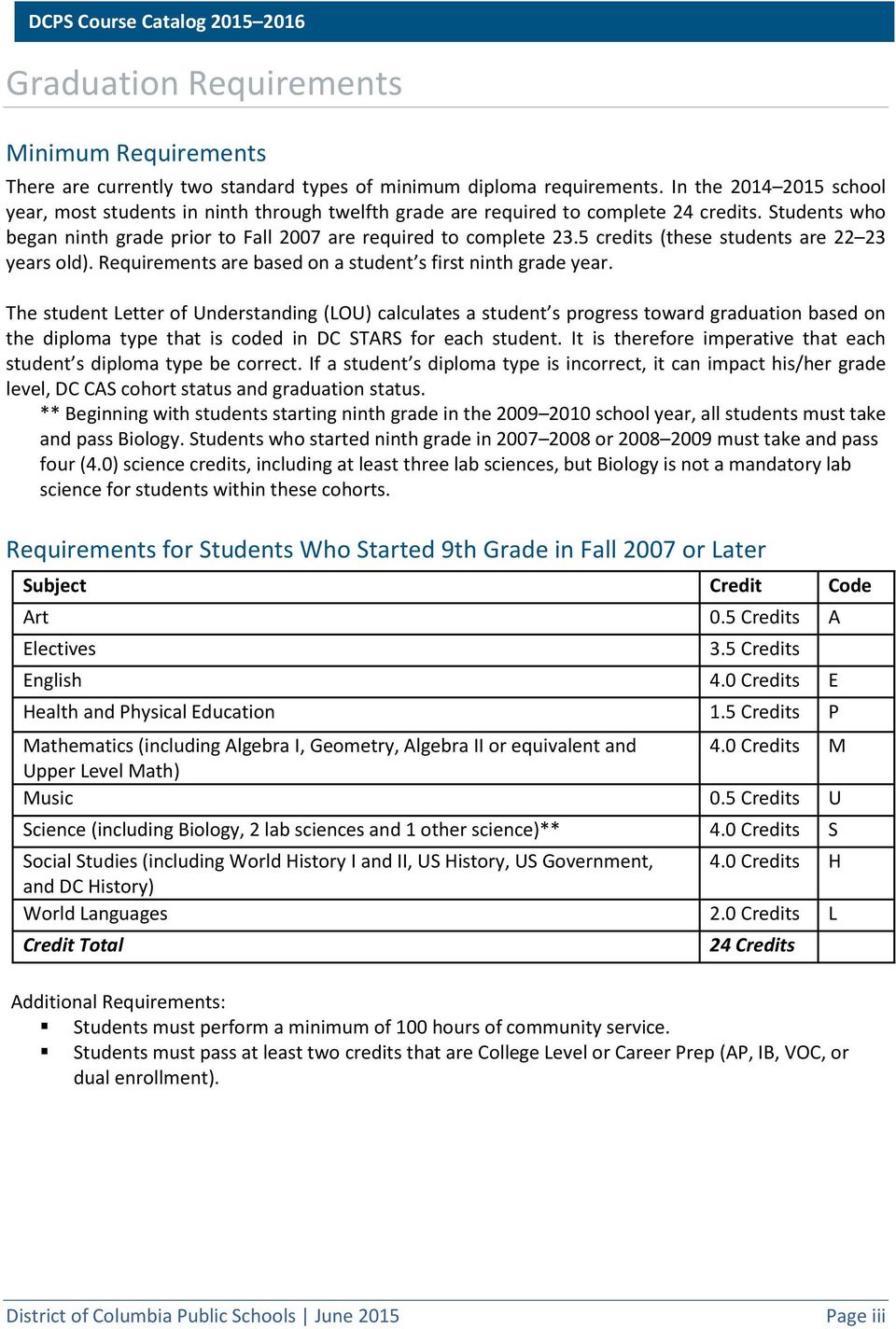
4 Banneker IB II Banneker CP II Columbia Heights Ellington McKinley II Phelps ACE School Without Walls DCPS Course Catalog Specialty School and Program Requirements Students at specialty schools or programs with additional graduation requirements MUST complete all of the school or program s requirements to receive a diploma from that school or program. If a student has completed the minimum DCPS requirements listed above but does not complete the specialty school s additional requirements, he or she can:. attend summer school to complete the remaining requirements and graduate in August with a diploma from the specialty school, or 2. transfer back to their neighborhood school within DCSTARS in the week before graduation and receive a diploma and final transcript from that school. If you have additional questions, please contact your school counselor or the Office of Academic Planning and Support at Subject Area English Algebra Geometry Math 2 Lab Science Science 0 World History U.S. History D. C. History U. S. Government World Language Music Art Health & Physical Education Career & Technical Education Community Lab Theory of Knowledge Capstone Internship Latin Senior Project Other Total Credits Required College Level / Career Preparatory District of Columbia Public Schools June 205 Page iv
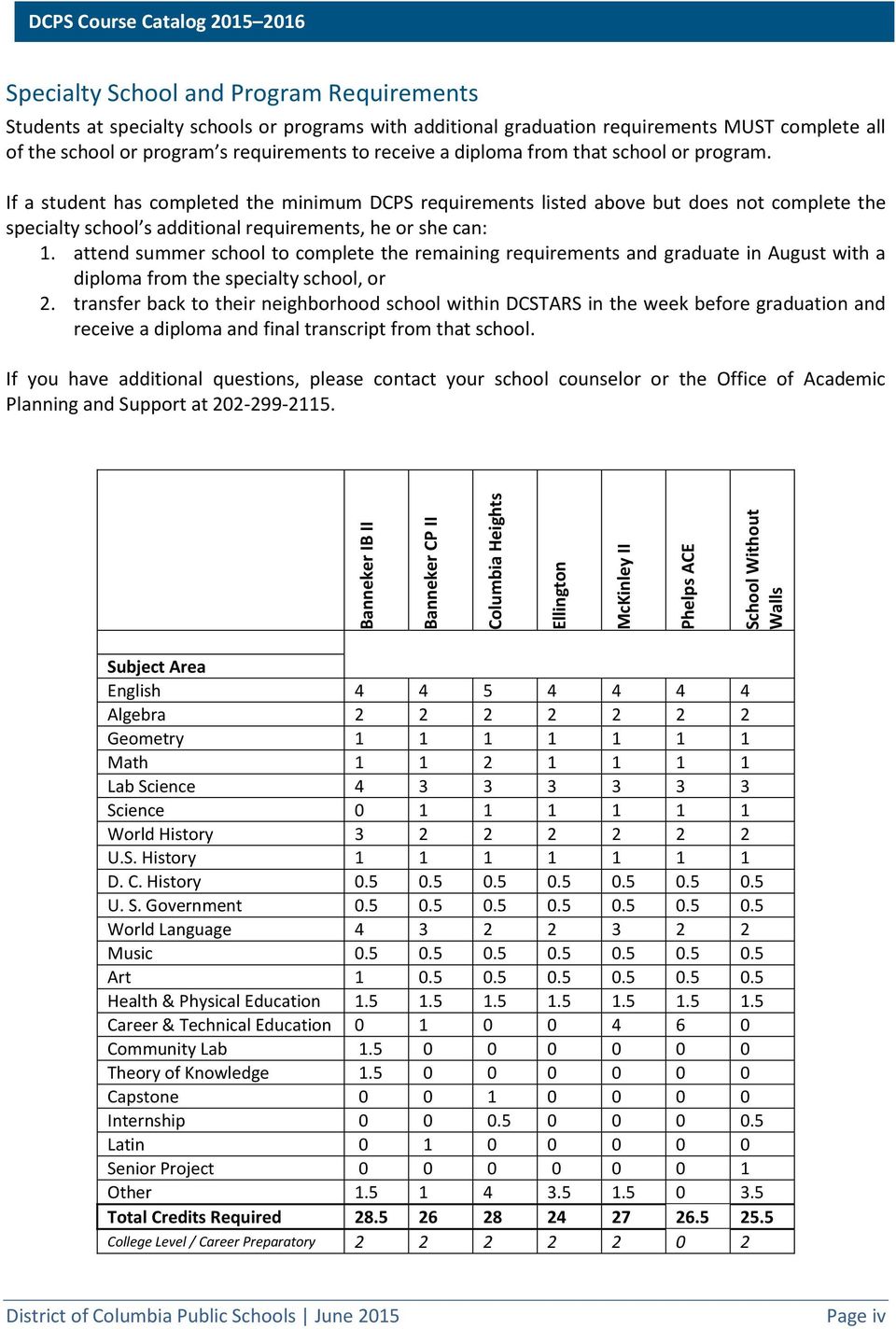
5 DCPS Course Catalog How to Read the Course Catalog All course codes begin with the appropriate subject area letter course code. This course begins with an A, so it is an art course. The academic level tells you whether this course is Regular (), Honors (H), Advanced Placement (AP), International Baccalaureate (IB), or o Credit (C). The course description provides you with an overview of course goals, projects, and expected outcomes and topics. A09 Graduation Requirement*: (see pg. for graduation requirements) ART Art I This art course is designed to provide students with the tools needed to interpret and create the language of visual images and artifacts. The students will apply the use of media to create products. They will also learn about the structure and function of design, multicultural art history, aesthetics and critical assessment and making connections. The students will study a variety of processes including design, drawing, painting, computer art, advertising art, printmaking and career awareness, leading to the development of a portfolio. The prerequisites tell you which course, if any, you need to take before this class. The Credits section notes how many credits you will earn by passing this course. The Graduation Requirement box notes whether this course fulfills a graduation requirement. The College Level/Career Prep section notes whether this course is eligible for CLCP credit (2 CLCP credits are required for graduation). District of Columbia Public Schools June 205 Page v
6 DCPS Course Catalog DCPS Course Codes Course Codes provide direction when examining the course offerings below. All course codes begin with the appropriate subject area letter (from the categories listed below). Core Academic Subject Areas: A Art E H L M P S T U English Social Studies World Languages Mathematics Physical Education & Health Science Theatre Music Supplementary Academic Subject Areas: X International Baccalaureate Additional Educational Services: F ESL/Bilingual Education R W Remedial Education/Special Education/Intervention Military Science/ROTC Cooperative Education/WBL & Short-Term/Specialty Programs External Diploma Program, Dual Enrollment Career & Technical Education Academies: Q Arts, Media & Communications B I T C D V J O Z K G Business, Finance & Entrepreneurship Construction & Design Engineering & Manufacturing Family & Consumer Education Hospitality & Tourism Information Technology Law, Public Safety & Security Health & Medical Sciences Biotechnology & Environmental Science Human Services, Education & Training Transportation District of Columbia Public Schools June 205 Page vi

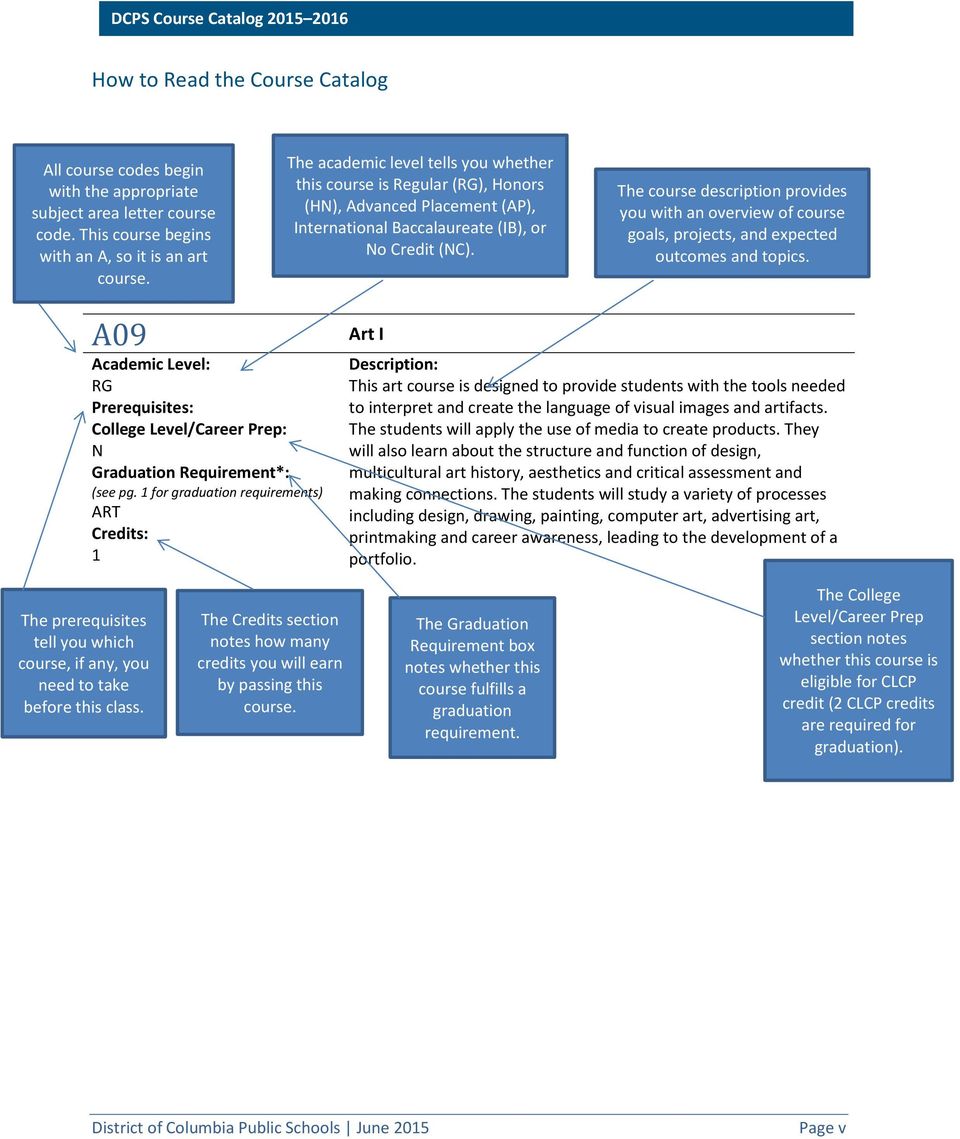
7 DCPS Course Catalog Administrative Codes AA4 C 0 AA5 0 AA6 C 0 Advisory HS High School uncredited version. Advisory is a time when students are assigned to an adult advisor in the school for the purpose of building relationships--between the teacher and student and among students--focusing on the following five primary themes: community building; student success skills (e.g. organizational and study-skill development); self-awareness; high school and college readiness; and career exploration. Advisory is the primary vehicle for ensuring students complete high quality individual graduation portfolios (IGP) at every grade level. Authorized AM Off Campus Late Entry Requires permission and is only available for students who have an approved alternative activity: work, an internship, or dual enrollment/college course. Authorized PM Off Campus Early Dismissal Requires permission and is only available for students who have an approved alternative activity: work, an internship, or dual enrollment/college course. District of Columbia Public Schools June 205 Page
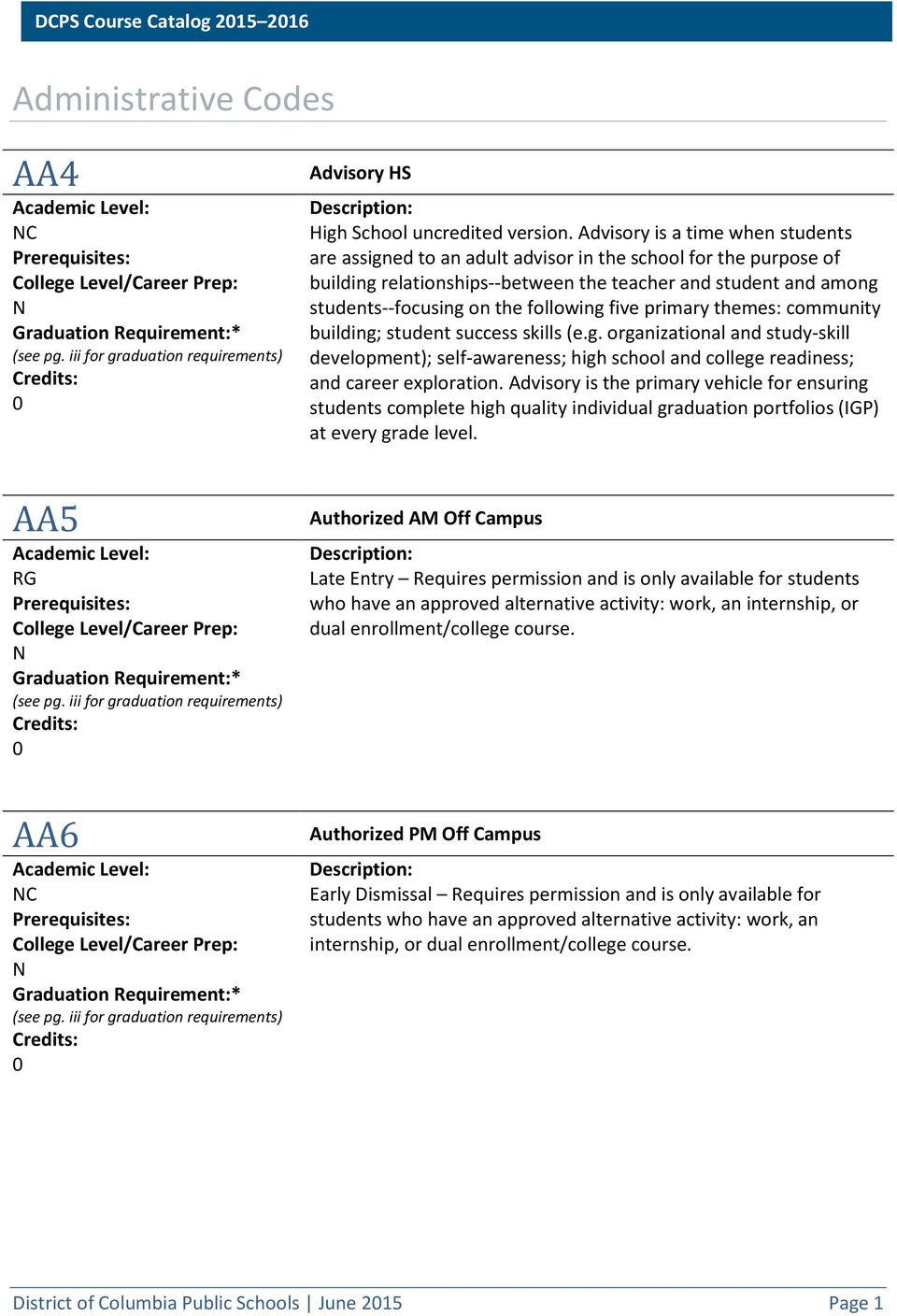
8 DCPS Course Catalog AA7 C 0 AA8 C 0 Lunch Lunch Citizenship Citizenship District of Columbia Public Schools June 205 Page 2

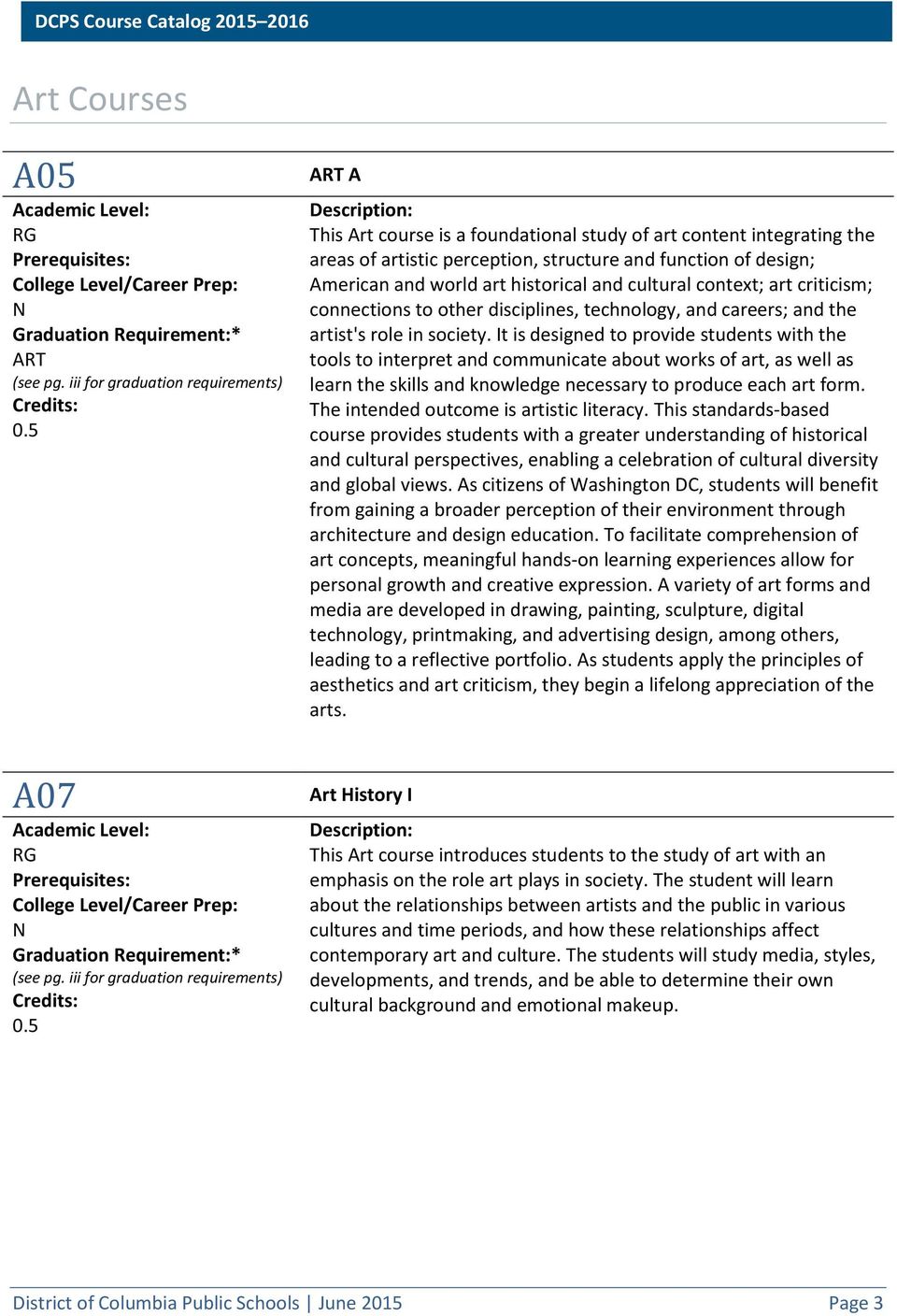
9 DCPS Course Catalog Art Courses A05 ART A07 ART A This Art course is a foundational study of art content integrating the areas of artistic perception, structure and function of design; American and world art historical and cultural context; art criticism; connections to other disciplines, technology, and careers; and the artist's role in society. It is designed to provide students with the tools to interpret and communicate about works of art, as well as learn the skills and knowledge necessary to produce each art form. The intended outcome is artistic literacy. This standards-based course provides students with a greater understanding of historical and cultural perspectives, enabling a celebration of cultural diversity and global views. As citizens of Washington DC, students will benefit from gaining a broader perception of their environment through architecture and design education. To facilitate comprehension of art concepts, meaningful hands-on learning experiences allow for personal growth and creative expression. A variety of art forms and media are developed in drawing, painting, sculpture, digital technology, printmaking, and advertising design, among others, leading to a reflective portfolio. As students apply the principles of aesthetics and art criticism, they begin a lifelong appreciation of the arts. Art History I This Art course introduces students to the study of art with an emphasis on the role art plays in society. The student will learn about the relationships between artists and the public in various cultures and time periods, and how these relationships affect contemporary art and culture. The students will study media, styles, developments, and trends, and be able to determine their own cultural background and emotional makeup. District of Columbia Public Schools June 205 Page 3
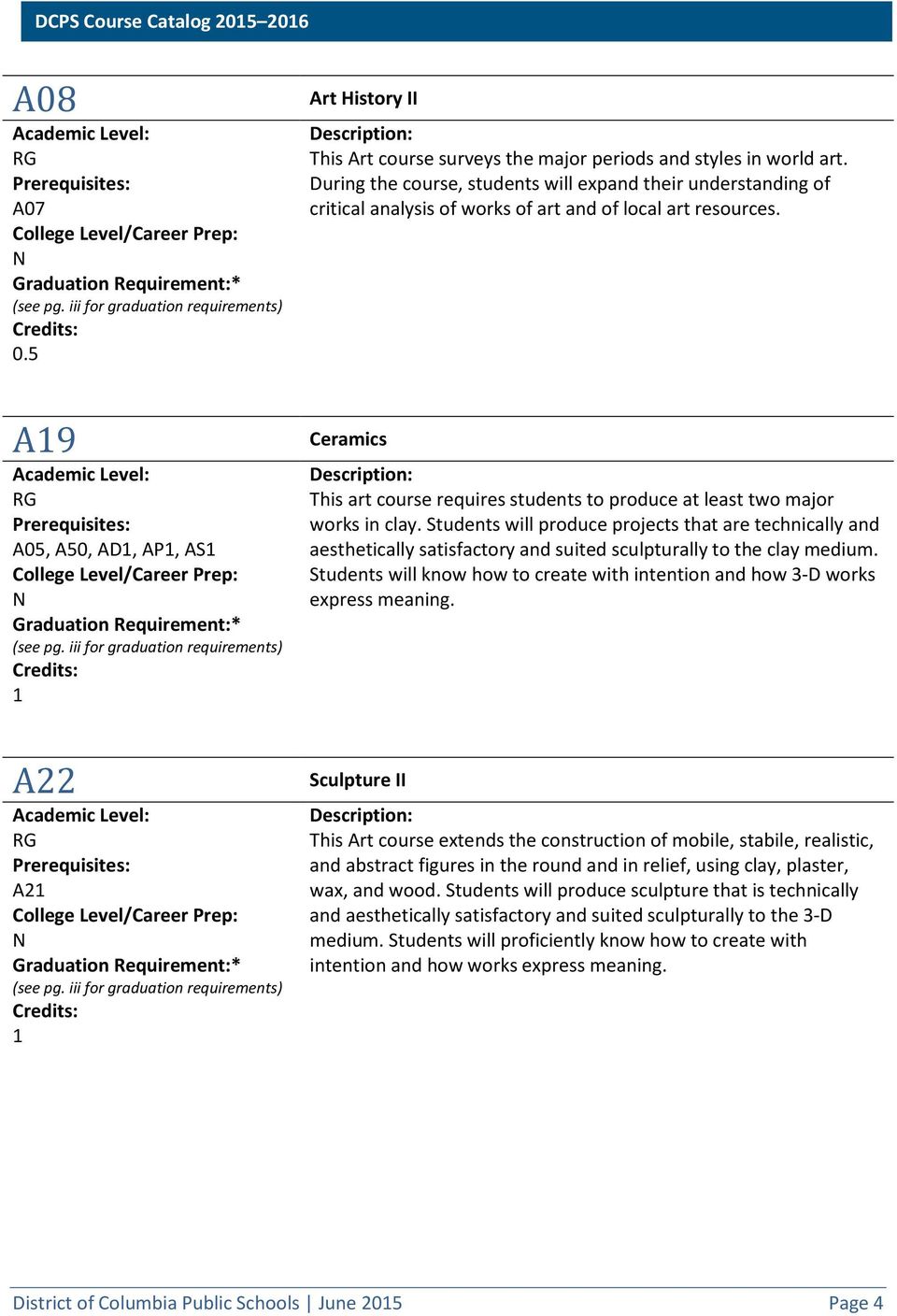
10 DCPS Course Catalog A08 A07 A9 A05, A50, AD, AP, AS A22 A2 Art History II This Art course surveys the major periods and styles in world art. During the course, students will expand their understanding of critical analysis of works of art and of local art resources. Ceramics This art course requires students to produce at least two major works in clay. Students will produce projects that are technically and aesthetically satisfactory and suited sculpturally to the clay medium. Students will know how to create with intention and how 3-D works express meaning. Sculpture II This Art course extends the construction of mobile, stabile, realistic, and abstract figures in the round and in relief, using clay, plaster, wax, and wood. Students will produce sculpture that is technically and aesthetically satisfactory and suited sculpturally to the 3-D medium. Students will proficiently know how to create with intention and how works express meaning. District of Columbia Public Schools June 205 Page 4
11 DCPS Course Catalog A23 A22 A24 A23 A26 A25 Sculpture III This Art course introduces techniques commonly employed by sculptors in the exploration of three-dimensional interaction with actual space. The student will learn and be able to produce the main sculptural techniques of modeling, casting, and construction. Two major projects are required. Students will produce sculpture that is technically and aesthetically well constructed and suited sculpturally to the 3-D medium. Sculpture IV This Art course is designed as a continuation of third year sculpture students' application of three-dimensional thinking, construction, and development of the sculptural elements of design. Students will exhibit the knowledge of concepts and skills appropriate to the fourth year sculptural execution through the production of at least two highly developed examples of sculptural form. These are longterm projects that must demonstrate the student's ability to work on the university level. Drawing I This Art course develops the student's skills in duplicating actual visual phenomena using line and tone on various grades of papers utilizing a diverse number of graphic media. Students will increase awareness of two-dimensional organizational skills. Students will render visual points of view, perspective, and representation. It is the first course of a mandatory three-year program in drawing. District of Columbia Public Schools June 205 Page 5

12 DCPS Course Catalog A27 A26 A28 A27 A29 A28 Drawing II This Art course provides students with an opportunity to render specific visual phenomena. Students will learn the development of drawing from its primitive beginnings to its contemporary manifestations, identifying major influences. Students will represent image and form through the use of color, develop anatomically accurate figure drawings, and evaluate and organize various graphic elements. Drawing III This Art course provides students with an opportunity to advance in their drawing skills through assignments that will at the same time enrich their portfolio. Students will be given assignments (individually, if necessary) to explore a variety of media as they relate to the rendering of specific subject matter. Students will address issues of light and shade, line quality, rendering of form, composition, surface manipulation, and illusion of depth. Drawing IV This Art course continues opportunities and skill development of students' previous experiences in advanced drawing. Students will be able to render with communicated intention, meaning, and purpose. Students will expand explorations of media as they relate to the rendering of specific subject matter. District of Columbia Public Schools June 205 Page 6

13 DCPS Course Catalog A30 A3 A30 A32 A3 Painting I This Art course introduces students to the many basic materials and tools used in rendering a painting. Students will be able to use the techniques and processes of basic methods of media such as water colors, acrylics, and oils. Students will study and resolve painting problems of composition and color theory. Painting II This Art course presents a study of composition through watercolor, acrylics, and oils. Students will enhance their composition skills in still life painting, landscape painting, portrait painting, and figure painting. Students will become familiar with various artistic methods and styles as they relate to painting assignments by visiting local galleries and libraries. Painting III This Art course is designed for students with a high level of interest in painting as self-expression. Students will continue skill development through independent perceptual and conceptual painting. Students will research subject matter, techniques, media, and art history in order to develop a comprehensive portfolio. When possible, students will intern with a local professional artist. District of Columbia Public Schools June 205 Page 7

14 DCPS Course Catalog A33 A32 A35 A36 A35 Painting IV This Art course continues the skill development of students with a high level of interest in painting as self-expression. Students continue to research subject matter, techniques, and media. Students will develop a comprehensive portfolio. Drawing & Painting II This Art course provides expanded and in-depth drawing and painting experiences for serious art students. Students will develop mastery in one or more of the media previously explored. Students will prepare completed work for exhibition and a portfolio. Drawing & Painting III This Art course is designed for students with a high level of interest in painting as self-expression. Students will continue their skill development through independent perceptual and conceptual painting. Students will research subject matter, techniques, media, and art history in order to develop a comprehensive portfolio of work. When possible, students will intern with a local professional artist. District of Columbia Public Schools June 205 Page 8

15 DCPS Course Catalog A37 A36 A40 A4 A40 Drawing & Painting IV This Art course builds upon the skills and experiences mastered in Drawing and Painting III. Students will continue their skill development through independent perceptual and conceptual painting. Students will research subject matter, techniques, media, and art history in order to develop a comprehensive portfolio of work. When possible, students will intern with a local professional artist. Printmaking I This Art course stresses printmaking as a creative art form. The students will pursue in-depth study of woodcuts, linoleum block, serigraphy, aquatint etching, offset, and letter press lithography according to availability of materials. The students will produce innovative and imaginative uses of materials and techniques. Printmaking II This Art course concentrates on two of the four areas of study required in printmaking. Students will learn the history and styles of printmaking. Students will produce visual examples in two of the following areas of printmaking: line cut or relief; monotype or monoprint; intaglio; or embossment or inkless/dimensional. Students must produce a portfolio of 0 prints. District of Columbia Public Schools June 205 Page 9

16 DCPS Course Catalog A43 A42, A92, AP2 A44 A43 A50 ART Imaging II This Art course expands the on basic skills covered in Photography I. Students will explore the technical components of photography such as ISO, shutter speed, aperture, depth of field, exposure modes, white balance, resolution, and other camera functions. Imaging III This Art course focuses on the creation of a cohesive body of work and development of a portfolio. Students will create photo essays and investigate how to express themselves through photography. Printing, framing, and the displaying photographs will be taught. Cinematic Arts Production A This Art course covers the history, development, theory, and criticism of video production. Students will communicate dramatic information, ideas, and emotions in a cultural system through the making and producing of videos. Students will learn video technology and equipment operation; video production; video directing; editing audio; and the planning and managing of video operations. District of Columbia Public Schools June 205 Page 0

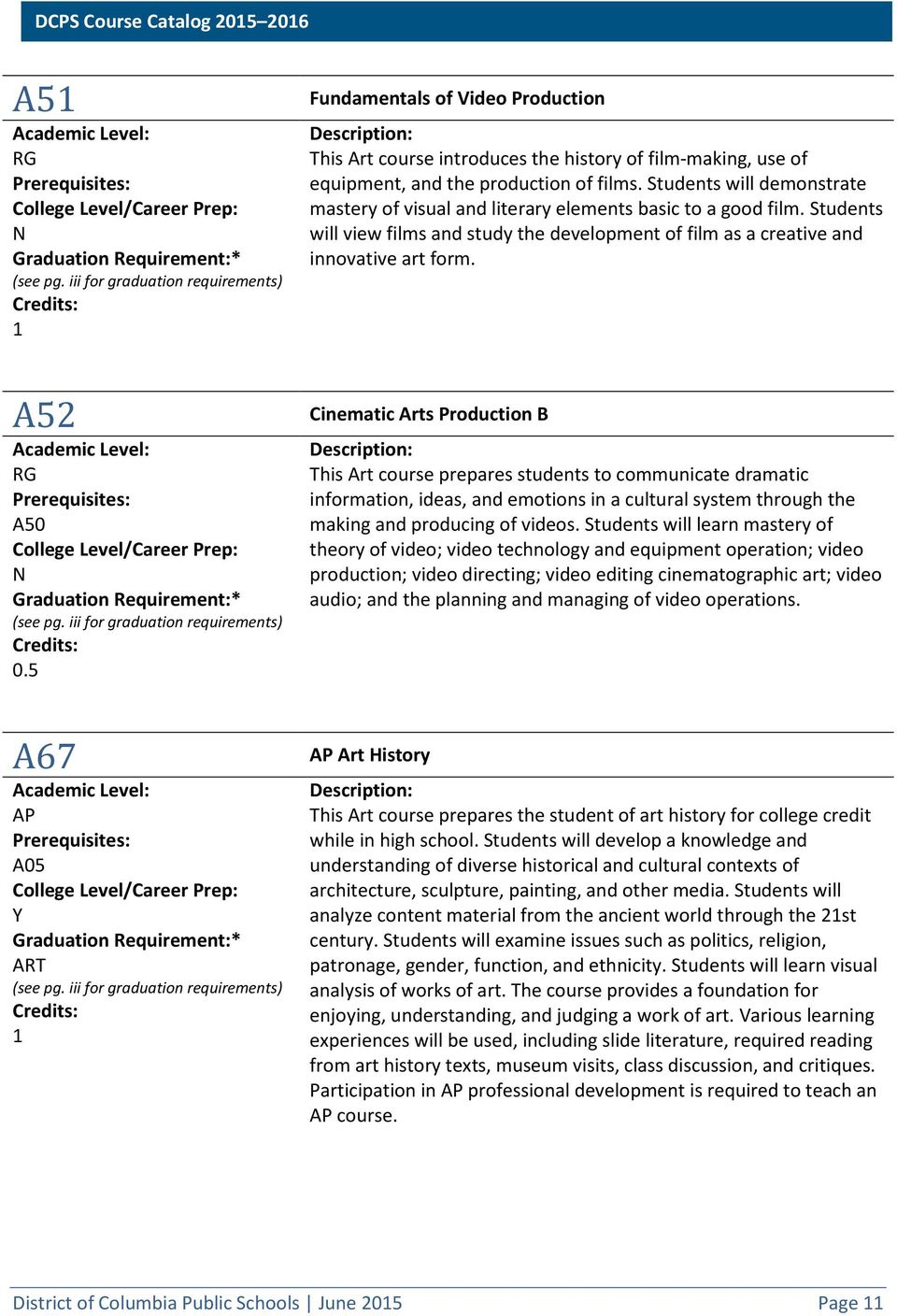
17 DCPS Course Catalog A5 A52 A50 A67 AP A05 ART Fundamentals of Video Production This Art course introduces the history of film-making, use of equipment, and the production of films. Students will demonstrate mastery of visual and literary elements basic to a good film. Students will view films and study the development of film as a creative and innovative art form. Cinematic Arts Production B This Art course prepares students to communicate dramatic information, ideas, and emotions in a cultural system through the making and producing of videos. Students will learn mastery of theory of video; video technology and equipment operation; video production; video directing; video editing cinematographic art; video audio; and the planning and managing of video operations. AP Art History This Art course prepares the student of art history for college credit while in high school. Students will develop a knowledge and understanding of diverse historical and cultural contexts of architecture, sculpture, painting, and other media. Students will analyze content material from the ancient world through the 2st century. Students will examine issues such as politics, religion, patronage, gender, function, and ethnicity. Students will learn visual analysis of works of art. The course provides a foundation for enjoying, understanding, and judging a work of art. Various learning experiences will be used, including slide literature, required reading from art history texts, museum visits, class discussion, and critiques. Participation in AP professional development is required to teach an AP course. District of Columbia Public Schools June 205 Page
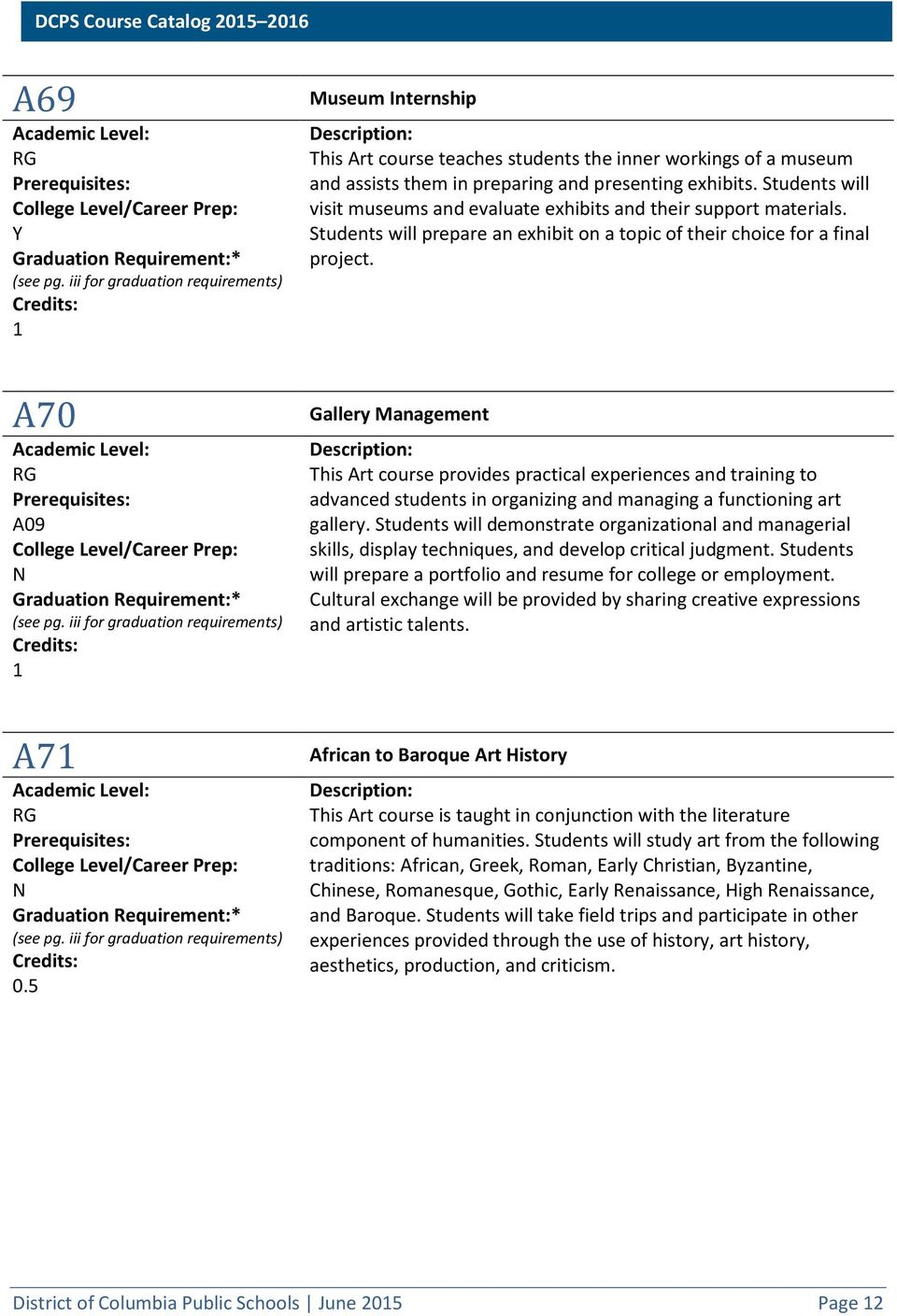
18 DCPS Course Catalog A69 A70 A09 A7 Museum Internship This Art course teaches students the inner workings of a museum and assists them in preparing and presenting exhibits. Students will visit museums and evaluate exhibits and their support materials. Students will prepare an exhibit on a topic of their choice for a final project. Gallery Management This Art course provides practical experiences and training to advanced students in organizing and managing a functioning art gallery. Students will demonstrate organizational and managerial skills, display techniques, and develop critical judgment. Students will prepare a portfolio and resume for college or employment. Cultural exchange will be provided by sharing creative expressions and artistic talents. African to Baroque Art History This Art course is taught in conjunction with the literature component of humanities. Students will study art from the following traditions: African, Greek, Roman, Early Christian, Byzantine, Chinese, Romanesque, Gothic, Early Renaissance, High Renaissance, and Baroque. Students will take field trips and participate in other experiences provided through the use of history, art history, aesthetics, production, and criticism. District of Columbia Public Schools June 205 Page 2
19 DCPS Course Catalog A72 A74 A94 A75 A74 Contemporary Art History & Studio This Art course is taught in conjunction with the literature component of humanities. Students will analyze the characteristics and historical significance of painting and sculpture from the following artistic styles: Impressionism, Post-Impressionism, Pointillism, Fauvism, Symbolism, Cubism, Constructivism, De-Stijl, Surrealism, and 20th Century. Students will produce original artwork inspired by and/or related to these styles. Satisfactory completion of this course will fulfill the art graduation requirement. Design II This Art course presents a study of two-dimensional design elements. Student will analyze color theory, composition, graphic layout, and design techniques. Students will study studio work and design of camera-ready artwork used by the print media to create posters, illustrations, and advertising art. Students will be proficient in communication design, product design, environmental design, and interactive design. The course introduces lettering styles, typography, and digital techniques. Design III This Art course teaches the student to think, design, and successfully render two- and three-dimensional design projects. Students will master the concepts of communication design, product design, environmental design, and interactive design. Students will demonstrate graphics and communication skills. District of Columbia Public Schools June 205 Page 3

20 DCPS Course Catalog A82 A86 A88 AP ART Curatorial Skills This Art course is a requirement for graduation within the Museum Studies program at the Duke Ellington School of the Arts. Students will learn the practices of museum curators, as well as the theories and trends that govern the exhibits that curators mount. Art Portfolio This Art course assists and influences materials selection and assembly of the senior portfolio, which will represent the student's best 20 examples of learned curriculum skills. Students will demonstrate substantial and significant development of visual knowledge and techniques. Students will reflect their knowledge of formal qualities and concepts of original work. AP Studio Art/Drawing This intensive and in-depth AP Art course prepares the studio art student for college credit while in high school. Students must have developed their art talent through previous study and practice. The course provides a foundation for creating a work of art to a mastery level and addresses a broad interpretation of drawing issues and media. Participation in AP professional development is required to teach an AP course. District of Columbia Public Schools June 205 Page 4

21 DCPS Course Catalog A89 AP ART A90 AP A05 ART A9 ART AP Studio Art/2-D Design This AP Art course develops a mastery of design in concept, composition, and execution. The student will produce works that demonstrate a variety of concepts and approaches in 2-D design. Participation in AP professional development is required to teach an AP course. AP Studio Art/3-D Design This AP Art course focuses on structural spatial and organizational problems centered around three-dimensional materials. The student will produce works that demonstrate a variety of concepts and approaches in 3-D design. Participation in AP professional development is required to teach an AP course. Intro to 3-D Design This Art course is intended to introduce students to factors unique to three-dimensional design. Students will learn vocabulary, composition of form and space, critical evaluation, and 3-D materials and techniques. District of Columbia Public Schools June 205 Page 5
22 DCPS Course Catalog A92 A05 Art B This Art course further investigates the study of art content integrating the areas of artistic perception, structure and function of design; American and world art historical and cultural context; art criticism; connections to other disciplines, technology, and careers; and the artist's role in society. It is designed to provide students with the tools to deconstruct and critique works of art, as well as learn the skills and knowledge necessary to produce each art form. The intended outcome is to deepen the artistic literacy skills introduced in Art A. This standards-based course provides students with a greater understanding of historical and cultural perspectives, enabling a celebration of cultural diversity and global views. Students will benefit from gaining a broader perception of their environment through architecture and design education. To facilitate comprehension of art concepts, meaningful hands-on learning experiences allow for personal growth and creative expression. A variety of art forms and media are developed in drawing, painting, sculpture, digital technology, printmaking, and advertising design, among others, leading to a reflective portfolio. As students apply the principles of aesthetics and art criticism, they begin a lifelong appreciation of the arts. A93 A4 Printmaking III This Art course expands on the course of study in Printmaking II. Students in this advanced course will focus on conceptually-driven bodies of work, completing at least 4 bodies of work during the course, each in an edition. Students will be encouraged to develop their own aesthetics, based on their work in the second semester of Printmaking II. Students will complete the course with a print portfolio. Students will continue their examination of the historical and contemporary role of printmaking. District of Columbia Public Schools June 205 Page 6
23 DCPS Course Catalog A94 Design (.0) This Art course engages students in digital design. Student will learn principles of design layout, color theory and composition. Students A05 will examine the historical and contemporary role of design in both media and the fine arts. Students will learn to use digital design as a tool of mass communication as well as a tool of the visual arts, engaging in a range of project-based investigations. Students will learn applications from the Adobe Creative Suite including Photoshop, Illustrator and InDesign among others based on the project demands. AC2 A9, A92 AC3 AC2 Ceramics II This Art course requires students to produce at least two major works in clay that explores a major artistic theme or concept. Students will produce projects that are technically and aesthetically satisfactory and suited sculpturally to the clay medium. Students will know how to create with intention and how 3-D works express meaning.. Ceramics III This Art course requires students to produce at least two major works in clay that explores a major artistic theme or concept. Students will produce projects that are technically and aesthetically satisfactory and suited sculpturally to the clay medium. Students will know how to create with intention and how 3-D works express meaning. District of Columbia Public Schools June 205 Page 7
24 DCPS Course Catalog AD ART AD2 AD AF2 A52, A92 Drawing and Painting A This Art course focuses on drawing and painting experiences for serious art students. Students will develop mastery in one or more of the media previously explored. Students will prepare completed work for exhibition and a portfolio. Drawing and Painting B This Art course provides expanded and in-depth drawing and painting experiences for serious art students. Students will develop mastery in one or more of the media previously explored. Students will prepare completed work for exhibition and a portfolio.developments, and trends, and be able to determine their own cultural background and emotional makeup. Cinematic Arts Production II This Art course explores cinematic production and self-expression. Students will communicate personal dramatic information, ideas, and emotions within a cultural system through the making and producing of videos. Students will learn video technology and equipment operation; video production; video directing; editing audio; and the planning and managing of video operations. District of Columbia Public Schools June 205 Page 8
25 DCPS Course Catalog AF3 AF2 AF4 AF3 AM0 Cinematic Arts Production III This Art course explores cinematic production and self-expression. Students will communicate personal dramatic information, ideas, and emotions in a cultural system through the making and producing of short narrative or documentary video/film. Students will learn video technology and equipment operation; video production; video directing; editing audio; and the planning and managing of video operations. Cinematic Arts Production IV This Art course explores cinematic production and self-expression through the moving moving image. Students will communicate their artistic ideas within a broader cultural-context including dramatic information, ideas, and emotions. They will create a short narrative, documentary, or experimental piece. Students have the opportunity to work collaboratively on a video and choose a technical focus such as video technology and equipment operation; video production; video directing; editing audio; and the planning and managing of video operations. Introduction To Museum Studies This Museum Studies course is a requirement for graduation at Ellington SFA. The focus is an overview of the theory and practices in museums. Students will learn about the professional work that takes place in museums. District of Columbia Public Schools June 205 Page 9
26 DCPS Course Catalog AM AM2 AM AM3 Exhibition Design I This Museum Studies course is a requirement for graduation in the Museum Studies Department at Ellington SFA. The course is designed to introduce the student to the fundamental concepts and skills needed to develop and construct an exhibition. Using designated tools, students will learn about and have practical experiences that explore the principles of design. Exhibition Design II This Museum Studies course builds upon the concepts and skills needed to develop and construct an exhibition. Students will use designated tools, as well as learn about and have practical experiences that explore the principles of design. Museum Communications I This Museum Studies course is designed to introduce students to the professional world of museums, as well as to supplement their art history knowledge using TV, video, and film. The focus will be on three museums: the Louvre, the J. Paul Getty Center, and the Guggenheim Bilbao Museo. In addition to offering a thorough review of their collections and architectural structures, the museums will act as the muse for student-designed museums. District of Columbia Public Schools June 205 Page 20
27 DCPS Course Catalog AM4 AM3 AM5 AM4 AM6 Museum Communications II This Museum Studies course will emphasize an introduction to video production, while also fully engaging mixed media methods. It will deal equally with matters of form and content. Conventional works will be analyzed, as well as those that push the boundaries of the art. Video production will be learned for the purpose of art documentation and exhibition. Museum Communications III This Museum Studies course extends the concepts of Museum Communications II. Students will examine the technical and artistic possibilities of film and video. Students will examine both genres from an art history perspective and apply artistic capabilities to the video medium, for the purpose of museum documentation and exhibition. Museum Education & Interpretation This Museum Studies course is a requirement for graduation at Ellington SFA in the Museum Studies Program. The focus of the course is an overview of the educational responsibility of the museum athis Museum Studies course is a requirement for graduation at Ellington SFA in the Museum Studies Program. The focus of the course is an overview of the educational responsibility of the museum and the role of the museum educator. Students will also have opportunities to put theory into practice through the development of educational tools that would be utilized in a museum setting. District of Columbia Public Schools June 205 Page 2
28 DCPS Course Catalog AM7 AM8 AP ART Cultural Studies This Museum Studies course is designed to survey world cultures from ancient times to postmodern and the present. Using a variety of instructional methods, students will explore the way cultures have expressed their beliefs and philosophies through art. Museum Registration In this Museum Studies course, students will learn about registration, accession, common numbering systems, and how to craft a mission statement for their museum. The course will review the importance of having and using a registration manual and what it should contain. Students will learn how to process a collection. Imaging A This art course is a foundational study of photography. Students will explore the basic rules of composition including the rule of thirds, balancing elements, leading lines, viewpoint, patterns, depth, and framing. Students will also explore the basic technical components of photography such as ISO, shutter speed, aperture, and depth of field. Resources permitting, students will utilize Photoshop to manipulate and edit images. District of Columbia Public Schools June 205 Page 22
29 DCPS Course Catalog AP2 AP AP3 A44 Imaging B This Art course further explores the foundational study of photography. Students will more deeply experiment with the basic rules of composition and the technical functionality of the camera. Students will create at least one conceptually-drive photo series that explores a specific theme and subject matter. Resources permitting, students will utilize Photoshop to manipulate and edit images. Imaging IV This Art course expands on basic skills covered in Imaging III. Students will create at least two conceptually-drive photo series that explores a theme or subject matter focusing on the expression and exploration of their personal narrative. Students will critique and analyze photographs created by their peers and professional photographers. Meaningful, hands-on learning experiences allow for personal growth and creative expression. Resources permitting, students will utilize Photoshop to manipulate and edit images. AS ART Sculpture A This Art course focuses on the construction of mobile, stabile, realistic, and abstract figures in the round and in relief, using clay, plaster, wax, and wood. Students will produce sculpture that is technically and aesthetically satisfactory and suited sculpturally to the 3-D medium. Students will proficiently know how to create with intention and how works express meaning. District of Columbia Public Schools June 205 Page 23
30 DCPS Course Catalog AS2 AS AT9 Sculpture B This Art course further investigates the construction of mobile, stabile, realistic, and abstract figures in the round and in relief, using clay, plaster, wax, and wood. Students will produce sculpture that is technically and aesthetically satisfactory and suited sculpturally to the 3-D medium. Students will proficiently know how to create with intention and how works express meaning. Harlem Renaissance This Art course covers the period from 92 through the mid-930s. The students will examine the images and themes that characterized an arts and literary aesthetic that was simultaneously American and African-American. Students will study the visual arts that represented and encompassed the decolonization of the image of Africa and solthis Art course covers the period from 92 through the mid-930s. The students will examine the images and themes that characterized an arts and literary aesthetic that was simultaneously American and African-American. Students will study the visual arts that represented and encompassed the decolonization of the image of Africa and solidified integrationist and nationalist schools of thought. District of Columbia Public Schools June 205 Page 24
31 DCPS Course Catalog Business, Finance and Marketing Courses B23 BA0 BA BA3 BUILD Students in this course will acquire the basic skills, knowledge and information needed to start their own small business such as how to write a business plan, technology and team building skills and critical thinking skills. Students will compete in a business plan competition and work with mentors from the local business community. BUILD is a four-year program, beginning with this 9th grade course and progressing to an afterschool program in the 0th to 2th grades. Wkbased Learning Acct This CTE course is the fifth course in the Accounting and Finance career pathway. Work-based learning comprises a range of activities and instructional strategies designed to assist students in developing or fulfilling their individual career and educational plans. Students work directly with business and industry professionals in a career of their choice while developing skills to successfully meet career and post secondary educational goals. Entrepreneurship This half credit course may be selected to complete the first full credit in the Business Administration (BA) career pathway, or the second full credit in the Finance pathway. Students will be exposed to many aspects of business ownership, including cost analysis, business planning, purchasing, and marketing. Students will write a business plan and will enter a local competition sponsored by the etwork for Teaching Entrepreneurship. District of Columbia Public Schools June 205 Page 25
32 DCPS Course Catalog BA4 BA8 BA8 BA9 BA8 Business Communications This is the final course in the Business Administration career pathway. This course instills the essential principles involved in preparing standard types of business communications: letters, reports, memoranda, resumes, cover letters, etc. Students will demonstrate command of sentence structure, grammar and word usage as it relates to written and verbal business communications. This course is articulated with UDC-CC and upon successful completion and matriculation to UDC-CC students will earn three college credits. MS Office This course in the Business Administration career pathway teaches students basic to advanced skills in Microsoft (MS) Office Applications specifically MS Word. Students will think analytically, manipulate information, and use the computer to produce documents through integrated application programs. Students develop expertise in MS Word through their participation in concept reviews and critical thinking activities. Students will work in teams and individually as they participate in case projects. Students will test their competencies through the Expert Level MOS certification exam. Sr. Prj Accounting This CTE course is the final course in the Accounting and Finance career pathway. The Senior Project course is a challenging studentdriven, teacher-guided culminating program. This course requires seniors and their instructors to agree on a project that incorporates a research paper, a product, a portfolio, and a presentation. District of Columbia Public Schools June 205 Page 26
33 DCPS Course Catalog BE Principles of Finance (Level I) This is the first course students take in the Academy of Finance and introduces students to the financial world. Students develop financial literacy as they learn about the function of finance in society. They study income and wealth; examine financial institutions; learn how businesses raise capital; and study key investment-related terms and concepts. They also research how innovations have changed the financial services field. Finally, students explore careers that exist in finance today. BE2 Financial Services (Level I) This course gives students an overview of banks and other financial services companies. It introduces students to the origins of money and banking and examines the early history of banking in the United States. Students study the financial services industry and the types of companies it includes in depth. They learn about the services offered by such companies and analyze the ways these companies earn profits. Finally, students examine careers in financial services. BE3 BE, BE2 Business Economics (Level II) Business Economics introduces students to the key concepts of economics as they pertain to business. This course discusses the American economy and the factors that influence the success of businesses and products. It describes forms of business ownership, discusses the relationship of labor and business, and provides a broad overview of the global economy. Students also examine careers in business, both as employees and as business owners. District of Columbia Public Schools June 205 Page 27
34 DCPS Course Catalog BE4 BE, BE2 BE5 Business in a Global Economy (Level II) Business in a Global Economy provides students with an understanding of how and why businesses choose to expand their operations into other countries. This course exposes students to the unique challenges facing firms doing business internationally, and to the potential opportunities available to those businesses. Ethics in Business This course introduces the importance of ethics in business. Students focus on the significance of ethics to stakeholders; examine who bears responsibility for monitoring ethics; and explore ethical situations common in organizations. Students examine how ethics affects various business disciplines and consider the impact of organizational culture. Students also explore ethics as social responsibility, the evolution of ethics in international business, and how the free market and ethics can coexist. BF Economics and the World of Finance This half credit course may be selected to complete the second full credit in the Finance career pathway. The course provides students with an understanding of how our market economy functions in a global setting. Students learn about economic concepts, including the 22 basic principles recommended by the ational Council on Economic Education. Students will be acquainted with capital markets, and the role markets and securities play in our overall economic framework. District of Columbia Public Schools June 205 Page 28
35 DCPS Course Catalog BF2 BF7 BF3 BE, BE2, BE3 BF5 BF2 Banking & Credit This is the second course in the Finance career pathway. This course presents an overview of the principles and practices of banking and credit in the United States. Students learn about the major functions of banks and other depository institutions, the Federal Reserve System, and modern trends in the banking industry. Students also explore the credit reporting institutions, the function of credit, how credit scores are calculated, loan creation, and debt collection. Students enrolled in this course will have the opportunity to participate in the ational Financial Capability Challenge sponsored through the U.S. Department of Treasury, in which high school-aged students from across the country test their knowledge about personal finance. Accounting (Level III) This is the third course in the Finance career pathway. It provides students with the basic principles of accounting, including the double-entry system, the accounting cycle, merchandise transactions, treatment of inventories, cash, internal control, receivables, payables, plant assets, and corporation accounting. The course takes students through the complete accounting cycle for a sole proprietorship, partnership, and corporation. This course is articulated with UDC-CC and upon successful completion and matriculation to UDC-CC students will earn three college credits. Insurance This half credit course may be selected to complete the second full credit in the Finance career pathway. This course introduces students to various elements of the insurance industry, including insurance needs and products for businesses and individuals. Students learn about insurance sales, rate-setting, home, automobile and life insurance. Students will explore insurance regulations, and careers in the insurance industry. District of Columbia Public Schools June 205 Page 29
36 DCPS Course Catalog BF6 BF3 BF7 BM Advanced Accounting This CTE course is designed for students who plan to continue studying accounting at the college level. The course includes a review of accounting for corporations, long-term debt, statement of cash flow, financial statement analysis, cost accounting, activitybased costing, cost/volume/profit analysis, incremental analysis, operations, and capital budgeting. Financial Planning This CTE course is the first course in the Finance career pathway. The course introduces students to the financial planning process and the components of a comprehensive financial plan. Students learn how to prepare a financial plan that includes saving, investing, borrowing, risk management (insurance), and retirement and estate planning. Intro to Business This CTE course is the introductory course for the Business Administration career pathway. The course introduces students to the world of business. Students probe into business and finance topics with a hands-on approach. Topics covered include the economic environment, business operations, small-business management, the global economy, financial institutions, concerns of credit, consumer rights and responsibilities and business law and ethics. District of Columbia Public Schools June 205 Page 30
37 DCPS Course Catalog BM3 Entrepreneurship This course may be selected as the first course in the Business Administration career pathway, or the second course in the Finance career pathway. Students will be exposed to many aspects of business ownership, including cost analysis, business planning, purchasing, and marketing. Students will write a business plan and present it before a panel of industry experts. Students will enter local, regional, and national competitions sponsored by the etwork for Teaching Entrepreneurship. Students will be encouraged to start their own businesses and enter the FTE Showcase. District of Columbia Public Schools June 205 Page 3
38 DCPS Course Catalog Family, Career & Consumer Education Courses C02 JAG-DC 9- This CTE course is the multi-year application of the JAG national program model and curriculum appropriate for high school students in grades 9. It offers comprehensive, intensive, and individualized dropout prevention activities and services provided by a Job Specialist. Services include classroom instruction; academic acceleration; school/career/college counseling; employability development, work-based learning and community service; and membership in a student leadership organization, DC Career Association. This course is for use only by the JAG-DC program. C03 JAG-DC 2 This CTE course is the application of the JAG national program model and curriculum appropriate for high school students in grades 2. It offers comprehensive, intensive, and individualized dropout prevention activities and services provided by a Job Specialist. Services include classroom instruction; academic acceleration; school/career/college counseling; employability development, internships and community service; membership in a student leadership organization, DC Career Association; one-on-one college and employment placement, retention assistance, and coaching; and at least 2 months of follow-up services after graduation. This course is for use only by the JAG-DC program. District of Columbia Public Schools June 205 Page 32
39 DCPS Course Catalog C04 C05 C06 JAG-DC: Steps to SucJAG-DC: Steps to Success This CTE course is the application of the JAG national program model and curriculum appropriate for recent high school dropouts and youth correctional inmates. It offers comprehensive, intensive, and individualized dropout prevention activities and services provided by a Job Specialist. Services include classroom instruction; academic acceleration; school/career/college counseling; employability development, work-based learning and community service; and membership in a student leadership organization, DC Career Association; one-on-one college and employment placement, retention assistance, and coaching; and at least 2 months of followup services after achievement of a GED or adult diploma. This course is for use only by the JAG-DC program. Employability Skills This CTE course builds a foundation of skills important for academic and workplace success, including problem-solving, communications, information gathering and analysis, teamwork, and self management skills. Students will learn why these skills are important for their success in the future, and they will learn and apply those skills through team projects. Career Exploration This CTE course teaches students how to identify and evaluate personal goals, priorities, aptitudes, and interests. Students will be able to make informed decisions about their careers. This course exposes students to various sources of information on career and training options and will also assist them in developing job search and employability skills. District of Columbia Public Schools June 205 Page 33
40 DCPS Course Catalog C4 C28 C29 C28 Exploring Food & utrition This CTE course teaches students the importance of an adequate diet for teenagers and family members. Students will learn to plan, purchase, prepare, and serve basic nutritious family meals. Meal patterns of other cultures, vegetarianism, fad diets, and health foods are also introduced. Career opportunities, employability skills, and leadership training are also explored. Clothing & Textiles I This CTE course teaches students about standards of quality in hand and commercially made clothing, art in relation to clothing and personal appearance, wardrobe budgeting, costume history, fashion study, and clothing construction. Students will learn to use commercial patterns in understanding garments, purchasing textile fabrics, and understanding the storage and seasonal care of clothing. Students will become intelligent shoppers through the study of labels, commercial construction techniques, and textile merchandise. Clothing & Textiles II This CTE course presents a comprehensive theoretical and skills approach to textiles. Students will be prepared to enter into undergraduate study in textiles, clothing, and the fashion industry. Job opportunities, higher education placement, and consumer skills will be stressed. District of Columbia Public Schools June 205 Page 34
41 DCPS Course Catalog Hospitality and Tourism Courses DC0 DC DC2 Wrkbsd Lrng - Culinary This CTE course is the fourth course in the Culinary Arts career pathway. Work-based learning comprises a range of activities and instructional strategies designed to assist students in developing or fulfilling their individual career and educational plans. Students work directly with business and industry professionals in a career of their choice while developing skills to successfully meet career and postsecondary educational goals. Culinary Arts I This CTE course is the first course in the Culinary Arts career pathway. The course introduces students to the fundamentals of culinary arts, beginning with preparatory steps for becoming successful restaurant and food service professionals. Students learn kitchen basics, business math, and how to work effectively with others, including developing successful customer relations. Training is provided in all aspects of food handling safety to prepare students for ServSafe certification. Culinary Arts II This CTE course is the second course in the Culinary Arts career pathway. The course provides training focusing on nutritional guidelines and menus, as well as processes for preparing breakfast foods, sandwiches, fruits and vegetables, salads and garnishes, potatoes and grains, desserts and baked goods, meat, poultry, seafood, stocks, soups, and sauces. The function and maintenance of food service equipment is also included. District of Columbia Public Schools June 205 Page 35
42 DCPS Course Catalog DC3 DC, DC2 DC9 Culinary Arts III This CTE course is the third course in the Culinary Arts career pathway. The course instructs students in the history of food service and the art of service. Students further develop skills for communicating with customers and learn about the relationships between menu composition, marketing, and catering. The course includes extensive review and practice of culinary techniques required to prepare students for competition in local and national industry-sponsored culinary arts competitions. Sr Project Culinary This CTE course is the final course in the Culinary Arts career pathway. It can be used to replace DC4: Culinary, Entrepreneurship, Marketing and Senior Project. The Senior Project course is a challenging student-driven, teacher-guided culminating program. This course requires seniors and their instructors to agree on a project that incorporates a research paper, a product, a portfolio, and a presentation. DG Principles of Hospitality & Tourism (Level I) This is the first course students take in the Hospitality Management career pathway. The course provides an overview of the hospitality and tourism industry. Students learn about the history of the industry, explore traveler motivation and consumer needs, the industry s economic and environmental impacts, domestic and international travel, and sales in tourism. Finally, students explore careers in the hospitality and tourism industry. District of Columbia Public Schools June 205 Page 36
43 DCPS Course Catalog DG2 Customer Service (Level I) This second course in the Hospitality Management career pathway introduces students to the concept of service as a critical component of a hospitality or tourism business. Students analyze both good and poor customer service in a variety of contexts and through various methods. Students explore communication skills and strategies, and they use a problem-solving perspective to understand barriers to communication and good service. They learn various means of measuring the quality of service and explore careers that focus on customer service. Students will have the opportunity to earn a customer service certification through the ational Retail Federation. DG3 DG2 DG4 DH7, DS2 START This is the introductory course to the American Hotel and Lodging Association s curriculum. The START curriculum includes classroom instruction covering all aspects of hotel operations, skills-based instruction in 2 line-level hospitality positions, and instruction in guest service, professionalism and safety. Upon successful completion of this course, students may earn an industry recognized certification. Hospitality & Tourism Management Program (Level III) This fourth course in the Hospitality Management career pathway is the American Hotel and Lodging Association s (AHLA) new high school curriculum. It was developed by industry experts and AHLA s Education Institute as the official industry-recognized curriculum to prepare students for roles in the hotel industry and beyond. This course provides students with broad-based learning on the tasks, knowledge, and skills required by anyone wishing to build a career within the hospitality and tourism industry. The content deals specifically with information required for operational level employee positions and responsibilities. Students have the opportunity to earn industry recognized certifications. District of Columbia Public Schools June 205 Page 37
44 DCPS Course Catalog DH0 DH DH4 DH Wrkbsd Lrng-Hospitality This CTE course is the fifth course in the Hospitality Management career pathway. The course comprises a range of activities and instructional strategies designed to assist students in developing or fulfilling their individual career and educational plans. Students work directly with business and industry professionals in a career of their choice while developing skills to successfully meet career and postsecondary educational goals. Hospitality I This CTE course is the first course in the Hospitality Management career pathway. The course focuses on the back-of-the-house functions in the hospitality industry. Students will study marketing and sales in the industry. They will review marketing plans, banquet and meeting room sales, and the hotel's connection with the food service industry. Students will learn how to plan menus for banquets and catered events and study restaurant themes. Room service will also be addressed. Hospitality II This CTE course is the This CTE course is the second course in the Hospitality Management career pathway. Students will study the structure and organization of the hospitality industry with emphasis on providing guest service and the operations connected with guests. A thorough study of the front-of-the-house operations will acquaint students with the guest cycle, reservation and registration systems, and the night audit process. Students will learn checkout procedures and the various methods of account settlement. The curriculum also stresses the importance of telecommunications in the industry. District of Columbia Public Schools June 205 Page 38
45 DCPS Course Catalog DH7 DG, DG2 DH8 DH4 DH9 Sports Entertainment & Event Planning (Level II) This CTE course introduces students to the skills and knowledge required in the event-planning profession. Students will examine and learn the unique requirements of event planning in the sports, entertainment, and performing-arts fields. Students will examine careers in the field of event planning and gain valuable experience in project management that can be applied to any career path. This course is to be taken in the 2th grade. The prerequisites are Hospitality I and Hospitality II. Intro Hotel Management This is a fundamental course that identifies and illustrates the various components of Hospitality and Tourism Management. It details the various segments of the Hospitality Industry and the forces that influence the management of Lodging and Tourism operations. Sr Project Hospitality This CTE course is the final course in the Hospitality Management career pathway. The Senior Project course is a challenging studentdriven, teacher-guided culminating program. This course requires seniors and their instructors to agree on a project that incorporates a research paper, a product, a portfolio, and a presentation. District of Columbia Public Schools June 205 Page 39
46 DCPS Course Catalog DS2 DG, DG2 DT8 Intro. to Hospitality Marketing (Level II) Hospitality Marketing introduces students to the objectives, strategies, and tools that are important to marketing in the hospitality industry, expanding on topics introduced in Principles of Hospitality and Tourism. Students learn about each phase of marketing and the wide range of options that all marketing managers and business owners consider as they create, or revise, marketing plans. Students also explore career opportunities in the field of hospitality marketing. Intro to Hospitality Marketing This course enables students to understand the marketing techniques of the various segments of the hospitality industry. Students will study the forces and trends that influence hospitality marketing and realize the various job opportunities and entrepreneurial nature of the hospitality industry. Students will also be involved in practical communications skills through classroom lectures, industry academic/trade journals and practical simulations. Technology, leadership, creativity and decision making will also be reviewed through case analysis and guest presentations. This course is articulated with UDC-CC and upon successful completion and matriculation to UDC-CC students will earn three college credits. District of Columbia Public Schools June 205 Page 40
47 DCPS Course Catalog English Courses E03 EG E04 E03 EG E05 E04 EG English I This English course builds upon the literary knowledge and language skills covered in English 8. Students will learn the elements of analytical reading and literary analysis. Students will be able to write structured paragraphs, short compositions, letters, narratives, and at least one research project using appropriate technology. English II This English course builds upon the literary knowledge and language skills covered in English I. Students will learn literary genre, critical reading, and literary analysis. Based on readings and research, students will be able to write arguments, informative/explanatory works and narratives. English III This English course builds upon the literary knowledge and language skills covered in English II. Students will learn classical and contemporary literature with an emphasis on American works. Students will be able to write arguments, informative/explanatory works and narratives in response to readings and research. District of Columbia Public Schools June 205 Page 4
48 DCPS Course Catalog E06 EG E07 AP E05 EG E08 AP E05 EG English IV This English course builds upon the literary knowledge and language skills covered in English III. Students will study multicultural and world classical and contemporary works with an emphasis on British literature. Students will be able to write well-developed arguments, informative/explanatory works, book and media reviews, and a documented paper, using appropriate technology. AP English Literature & Composition This AP English course prepares students for the Advanced Placement Literature and Composition Examination through extensive reading and analysis of advanced classical and modern literature. Students will learn tone, diction, style, structure, and other literary devices. Students will be able to produce a wide range of writing pieces, including argumentative, expository, and creative essays. Students will also review journals, essay exams, and essays of literary analysis. Participation in AP professional development is required to teach an AP course. AP English Language & Composition This AP English course prepares students for the Advanced Placement Language and Composition Examination through comprehensive analysis of the structure and style of written and spoken English. Students will learn rhetorical devices and how to analyze and use them. Students will be able to write critical essays, compositions, book reviews, and documented papers using varied syntax, appropriate diction, logical thinking, clarity, and a concise, direct writing style. Participation in AP professional development is required to teach an AP course. District of Columbia Public Schools June 205 Page 42
49 DCPS Course Catalog E09 H EG E0 E E03 Honors English I This Honors English course serves as preparation for Advanced Placement courses and focuses on close reading of poetry, novels, plays, stories, and essays, both classical and modern. Students will learn rhetorical devices and concepts needed for writing close literary analysis. Students will be able to write literary analysis, as well as argumentative, expository, and creative writing with increasing sophistication. Intro Communications Skills This English course is an introduction to a wide range of practical communication skills. Students will learn skills relevant to speech/debate, group facilitation, counseling, college/career interviews, sales presentations, motivation, humor, film/drama, and use of technology. Students will be able to engage in the above types of communications. Creative Writing This English writing course is designed for students who are competent in writing skills and mechanics but are interested in enhancing their writing creativity. Students will exercise their observation skills and sharpen their sensitivity to language as they write poetry, short stories, essays, biographies, and autobiographies. Students will be able to express themselves in an artistic manner using sound writing techniques and standard American English. District of Columbia Public Schools June 205 Page 43
50 DCPS Course Catalog E3 E32 E33 Speech I This English course introduces communication theory, voice, and diction. Students will learn the fundamentals of developing an effective speaking voice for the theater. Speech II This English course builds upon the fundamentals discussed in Speech I with a new emphasis on public speaking. Students will learn skills for speaking extemporaneously, and will be able to present speeches that inform, inspire, persuade, express a personal experience, and demonstrate effectively with visual aides. Speech III This English course builds upon the information discussed in Speech II and addresses voice development for the legitimate stage. Students will be able to role-play, convey their characters' precise thoughts and feelings to an audience of peers, and use appropriate vocabulary for spontaneous response. District of Columbia Public Schools June 205 Page 44
51 DCPS Course Catalog E34 E35 E36 H EG Speech IV This English course builds upon Speech III and is designed primarily for the advanced student actor. Students will work on communicating to an audience in a variety of roles, while developing their talent for performing in electronic media. Public Speaking This English course provides students with a broad range of experiences in oral communication. Students will learn group discussion techniques and parliamentary procedures. Students will be able to give increasingly demanding speeches and express their abstract ideas in concrete form. Honors English II This Honors English course builds upon the content covered in Honors English I and serves as an Advanced Placement feeder course. Students will learn rhetorical devices, symbolism, alternative writing styles, and the development of the modern novel. Students will be able to produce close literary analyses, as well as argumentative, expository, and creative writing with increasing clarity and sophistication. Students in this course can expect a significantly greater number of reading and writing assignments. District of Columbia Public Schools June 205 Page 45
52 DCPS Course Catalog E37 H EG E38 E39 Honors English III This Honors English course builds upon the content covered in Honors English II and serves as an Advanced Placement feeder course. Students will learn rhetorical devices and advanced literary techniques. Students will be able to produce close literary analyses, as well as argumentative, expository, and creative writing with increasing clarity and sophistication. Students in this course can expect a significantly greater number of reading and writing assignments. Debate I This English course introduces skills necessary for students to become in-depth researchers, technical and persuasive writers, effective communicators, and perceptive listeners. Students will learn argumentation and persuasion theories and public speaking techniques. Students will research topics, organize findings, and write persuasive cases. Debate II This English course builds on the skills developed in Debate I. Students will learn argumentation and persuasion theories, logic, and analysis. Students will research topics, organize their research, write persuasive cases, and deliver their arguments orally. District of Columbia Public Schools June 205 Page 46
53 DCPS Course Catalog E40 H EG Honors English IV This Honors English course builds upon the content covered in Honors English III. Students will learn rhetorical devices and advanced literary techniques. Students will be able to produce close literary analyses, as well as argumentative, expository, and creative writing with increasing clarity and sophistication. Students in this course can expect a significantly greater number of reading and writing assignments. E42 E43 E42 Journalism I This journalism course exposes students to techniques of writing for a newspaper or magazine. Students will study theories and procedures of journalism and examine all aspects of newspaper publication (gathering, writing, editing, displaying the news, and using technology) and other mass media. Journalism II This journalism course builds upon the skills learned in Journalism I, with a focus on advanced skills such as using the latest technology to produce a high school newspaper. Students will assign and produce all publishing tasks: writing stories, editing copy, designing ads, writing headlines, and making layout designs. This course is recommended for students interested in related careers. District of Columbia Public Schools June 205 Page 47
54 DCPS Course Catalog E44 E45 E50 E02, E49 EG Journalism III This journalism course builds upon the skills learned in Journalism II. Students will apply all aspects of the writing process (i.e., prewriting, drafting, editing, and proofreading) to written work. Students will be introduced to the skills necessary to produce a variety of mass communication documents. Students will demonstrate knowledge of organization and management techniques relating to mass communications, including leadership and business skills, time management, and use of personnel and task organization. This course is recommended for students interested in related careers. earbook This English course focuses on skills needed for production of the school yearbook. Students will cover techniques of advertising, journalistic writing, photo selection, and layout design. Students learn about possible careers in printing, costs of printing, and printing techniques. English & Humanities I This course provides ninth grade students with the opportunity to explore the formative periods of civilization on several continents. Representative readings are drawn from drama, epics, historical writing, philosophy, and more. Primary focus is placed on the study of mythology and the oral tradition. District of Columbia Public Schools June 205 Page 48
55 DCPS Course Catalog E5 E03, E50 EG E52 E04, E5 EG E53 E05, E52 EG English & Humanities II Students study the relationship of the American literature to the other arts, history, religion, science, technology, and architecture of the United States from European contact to Post-Reconstruction. English & Humanities III This course is designed to develop knowledge and appreciation of the cultural diversity of the United States. Students will study the history, art, literature, dance, and music of a variety of ethnic groups, including ative American, African American, Irish American, Jewish American, Latin American, and Asian American. English & Humanities IV In this final year of the program, the graduating seniors will be engaged in literature, art, music, and dance which have developed during the rapidly changing social, political, and technological conditions of the twentieth century. Students will examine the impact of technology on consciousness and culture as they prepare themselves for the challenges of the 2st century. District of Columbia Public Schools June 205 Page 49
56 DCPS Course Catalog E54 E55 E58 Multicultural Lit I This English course surveys the historical development of ethnic American literature from its origins to modern times. Students will read, discuss, and write on African American, Hispanic American, Asian American, and ative American literature, seeking commonalities and an understanding of the different contributions of each ethnic group. Students will analyze a variety of genres, including the novel, drama, poetry, short story, nonfiction, and others. Completion of several short papers and one longer documented paper of words is also required. Multicultural Lit II This English course, which builds upon Multicultural Literature I, focuses on 20th century literature from around the world. Students will read, discuss, write about, and give presentations on a variety of literature from Africa, Latin America, India, China, Asia, and other areas. Emphasis will be on student discussions and contributions. Students will also write evaluations of texts and take quizzes and exams. African-American Literature This English course introduces the history of the literary and cultural heritage of African Americans, beginning with the African oral tradition and progressing to modern African American literature. Students will read and analyze the oral tradition, spirituals, essays, short stories, poetry, narratives, and drama. Completion of a wellconstructed word analytical or documented paper is also required. District of Columbia Public Schools June 205 Page 50
57 DCPS Course Catalog E60 African-American Experience in American Lit This English course explores the literary and cultural heritage and experience of African Americans through the interdisciplinary study of American literature, art, and music frthis English course explores the literary and cultural heritage and experience of African Americans through the interdisciplinary study of American literature, art, and music from 789 to the present. Students will learn about the various eras and genres of related literature and construct a major analytical or documented research paper of words. E64 E65 Technical Writing This English course provides instruction and practice in the processes and conventions of effective technical writing communication. This course will expect students to use a process approach to writing, including strategies for the following: audience analysis, prewriting, drafting, peer sharing, revising, editing, and formatting. Other important processes discussed in this course include gathering, using, and documenting data from primary and secondary sources; adapting technical information to both technical and non-technical audiences; and recording and reporting technical information clearly and accurately. Students will produce technical reports of varying lengths and complexities that follow accepted conventions of language, style, mechanics, and format. Oral presentations on different topics based on individual occupational interests will be required. Writing Research Skills This writing course covers basic writing and research techniques necessary for mass media communication. Students will analyze the enhancement of literary analysis and critical thinking will be discussed in the context of this genre through a variety of oral and written projects. District of Columbia Public Schools June 205 Page 5
58 DCPS Course Catalog E66 E69 E70 Writing for Media This writing course involves simulated mass communications writing experiences, such as writing for newspapers, magazines, radio, television, public relations, and advertising. Experts from the communications community will conduct seminars, hold discussions with students, and design projects that will engage students in writing activities. Literacy Across Continents Students read literature about countries where there are established peer-exchange relationships (e.g. orway, England, Germany, Ghana and igeria). Students will correspond via teleconferences, mail and to discuss the literature. Students will study the literature and peer dialogue through the context of the history of each participating country. Dramatics This Drama course involves simulated mass communications writing experiences such as writing for newspapers, magazines, radio, television, public relations, and advertising. Students will engage with experts from the communications community will conduct seminars and design projects that will engage students in writing activities. District of Columbia Public Schools June 205 Page 52
59 DCPS Course Catalog E7 E72 E7 E73 E72 Acting I This Drama course introduces the first-year student to acting. Students will develop sensory exercises, concentration, stage vocabulary, emotion memories, and monologues. Students will also participate in contemporary scene study. Acting II This Drama course builds upon skills attained in Acting I by extending analysis of scene and monologue study. Students will address associated vocabulary and techniques needed to develop competence. Emphasis will be placed on elementary blocking. Acting III This Drama course builds upon skills attained in Acting II by extending analysis of scene and monologue study. Students will be expected to associate vocabulary with techniques needed to develop competence. Emphasis will be placed on elementary blocking. District of Columbia Public Schools June 205 Page 53
60 DCPS Course Catalog E74 E73 E76 E77 Acting IV This Drama course builds upon skills attained in Acting III by extending analysis of scene and monologue study. Students will address associated vocabulary and techniques needed to develop competence. Emphasis will be placed on elementary blocking. Audition Practice Performance Techniques This Drama course provides students with the opportunity to prepare and perfect audition materials with which to enter the professional theater. Students will be exposed to various techniques and specific types of theatrical production. Students will be able to prepare a resume; select photographers for portfolio pictures; make appropriate choices for a wide range of auditions; and be prepared to perform at least six pieces from classical to contemporary theater. Intro to Acting This Drama course provides students an opportunity to prepare and perfect audition materials with which to enter the professional theater. Students will be exposed to, and responsible for mastering various techniques and types of theatrical production. Students will prepare a resume; select photographers for portfolio pictures; make appropriate choices for a wide range of auditions; and be prepared to perform at least six pieces from classical to contemporary theater. District of Columbia Public Schools June 205 Page 54
61 DCPS Course Catalog E78 E80 E85 Creative Drama This Drama course traces contemporary drama's remarkable history of experiments with new and powerful techniques of dramatizing and analyzing human behavior. Students will place particular emphasis on groundbreaking works from provocative contemporary playwrights, such as Harold Pinter, Samuel Beckett, Edward Albee, Eugene Ionesco, Bertolt Brecht, Tom Stoppard, Joe Orton, and Sam Shepard. Students will be required to evaluate their own work and the work of others and to read and discuss five plays. Students will further participate in lectures and discussion on craft issues including voice, structure, format, submission techniques, and the play development process. Directing This Drama course traces contemporary drama's remarkable history of experiments with new and powerful techniques of dramatizing and analyzing human behavior. Students will analyze groundbreaking works from provocative contemporary playwrights, such as Harold Pinter, Samuel Beckett, Edward Albee, Eugene Ionesco, Bertolt Brecht, Tom Stoppard, Joe Orton, and Sam Shepard. Students will be required to evaluate their own work and the work of others and to read and discuss five plays. Students will further participate in lectures and discussion on craft issues will include voice, structure, format, submission techniques and the play development process. District of Columbia Public Schools June 205 Page 55
62 DCPS Course Catalog E8 Theater Organization & Management This Drama course traces contemporary drama's remarkable history of experiments with new and powerful techniques of dramatizing and analyzing human behavior. Students will analyze groundbreaking works from provocative contemporary playwrights, such as Harold Pinter, Samuel Beckett, Edward Albee, Eugene Ionesco, Bertolt Brecht, Tom Stoppard, Joe Orton, and Sam Shepard. Students will be required to evaluate their own work and the work of others and to read and discuss five plays. Students will further participate in lectures and discussion on craft issues will include voice, structure, format, submission techniques and the play development process. E82 E83 E82 Theater History I This Drama course traces the development and growth of the theater from its earliest beginnings to present day. Students will be exposed to lectures, discussions, and selected plays from the various periods of the theater's development. Students will further be exposed to those elements, movements, and persons important to the development of the theater. Theater History II This Drama course provides information about the history and literature of theater from the 7th century to the present. Students will read and write about historical and cultural perspectives, theater and literary terminology, types and forms of theater literature, major playwrights and contributors, dramatic structure, critical analysis, acting styles and techniques, stagecraft, impact of theater, and theater architecture. District of Columbia Public Schools June 205 Page 56
63 DCPS Course Catalog E85 E86 E90 Theater Styles This Drama course exposes students to skills necessary for identifying, creating, and projecting elements that bring visual and presentational accuracy to the stage. Improvisation I This Drama course identifies the actor's personal identification with the factors of space and environment. Students will be required to identify their personal characteristics related to improvisation, as well as work on ensemble work, sharing, and final blending. Special emphasis is placed on creativity and movement. Students will further be asked to master elementary techniques of pantomime, slow motion, sound projection, and simple staging. French Film This film course provides an overview of the relationship between cinema and contemporary society in France. Students will discuss, read, and write about French films as a specific art form while analyzing them in sociological terms (i.e., relation to society, politics, and culture in general). Students will begin with the ew Wave (i.e., 960s) and trace French cinema to the present, with particular emphasis placed on the new generation of filmmakers of the 990s. District of Columbia Public Schools June 205 Page 57
64 DCPS Course Catalog E9 EA0 EA4 Film Studies This film course introduces film as a literary art from. Students will discuss as well as read and write about film background, film techniques, and film creators using literary analysis and critical thinking skills. Media Analysis This Senior Project course is a challenging student driven, teacher guided culminating program. This Senior Project course requires seniors and their instructors to agree on a project that incorporates a research paper, a product, a portfolio, and a presentation. Media I This media course covers fundamental skills in the production of various mass media. Students will discuss as well as read and write about various types and purposes of mass media; ethics and responsibilities in mass media; philosophy and impact of various programs; production of mass media; analysis of mass media; and the impact of mass media on history, culture, and politics. District of Columbia Public Schools June 205 Page 58
65 DCPS Course Catalog EA5 EA6 EA7 Media II This media course builds upon the fundamental skills developed in Media I. Students will discuss as well as read and write about the author's purpose and point of view, the laws that control the delivery and use of media, devices of persuasion, and research skills necessary for obtaining key information. Media III This media course develops intermediate-level skills in the production of various mass media, with emphasis on critical analysis. Students will discuss as well as read and write about current mass media as models for production; ethics and responsibilities in mass media; production of mass media; analysis and evaluation of various mass media; analysis of programming; marketing; careers and entrepreneurship in mass media; and trends and innovations. Media IV/Internship This media course addresses advanced skills in the production of various mass media, with emphasis on critical analysis. Students will discuss as well as read and write about current mass media as models for production; ethics and responsibilities in mass media; production of mass media; analysis and evaluation of various mass media; analysis of programming; marketing; careers and entrepreneurship in mass media; and trends and innovations. Students will complete an internship during a portion of the second half of the course. District of Columbia Public Schools June 205 Page 59
66 DCPS Course Catalog EA8 EA9 EB7 Play Analysis This drama course provides an overview of characteristics of a script through play analysis. Students will discuss as well as read and write about the characteristics of major types of drama, the cultural and historical influences on dramatic forms (e.g., theater, film, and television), and the allegoric and symbolic references in plays. Play Writing This course covers the principles and techniques employed in dramatic writing for the stage. Students will discuss as well as read and write about analysis of selected plays; writing for theatrical performance; monologues, dialogues, scenes, and plays; production considerations; critical analysis of form and content; and manuscripts for publication or performance. History Of Film This drama course covers the study of film with an emphasis on film writing and production. Students will study the history of silent films, early sound films, and modern techniques of filming. Students are expected to read and use resource books and materials in these areas. Many of the required projects must be completed outside of class. District of Columbia Public Schools June 205 Page 60
67 DCPS Course Catalog EI EI2 Reading Workshop I This course is designed to provide differentiated reading intervention to students needing literacy support. Students may take this one-credit elective course twice and are expected to hone foundational literacy skills. Reading Workshop II This English course is designed to provide differentiated reading intervention to students needing literacy support. Students may take this one-credit elective course twice and are expected to hone fundamental literacy skills. o prerequisite. EI4 Reading Workshop () This course is designed to provide differentiated reading intervention to students needing literacy support. Students are expected to hone foundational literacy skills in this course. This course should only be scheduled for students identified for intervention half-way through the school year, or as a transfer should students improve half-way through the year. District of Columbia Public Schools June 205 Page 6
68 DCPS Course Catalog EP7 EP8 ER ER2 Eng Lit & Comp Extension This is a companion course for E07 A.P. Engl Lit & Comp. Eng Lang & Comp Extension This is a companion course for E08 A.P. Engl Language & Composition. Reading Foundations I The Wilson Reading Program is an Orton-Gillingham based reading curriculum for decoding and spelling that will provide an intensive reading intervention to students needing literacy support. Students will systematically learn the rules of the English language and improve their foundational literacy skills. Reading Foundations II The Wilson Reading Program is an Orton-Gillingham based reading curriculum for decoding and spelling that will provide an intensive reading intervention to students needing literacy support. Students will systematically learn the rules of the English language and improve their foundational literacy skills. District of Columbia Public Schools June 205 Page 62
69 DCPS Course Catalog ER5 ER6 ER7 ES4 Reading Support I Just Words is an explicit, multisensory decoding and spelling program for students who have mild to moderate gaps in their decoding and spelling proficiency but do not require intensive intervention. Reading Support II Just Words is an explicit, multisensory decoding and spelling program for students who have mild to moderate gaps in their decoding and spelling proficiency but do not require intensive intervention. Reading Lab Phonics and Fluency reading intervention program that utilizes technology to help students master decoding the English language (e.g. System 44). System 44 uses adaptive software to deliver phonics instruction. System 44 helps students understand that the English language is a finite system of 44 sounds and 26 letters. Senior English Seminar This English course is designed to help high school seniors in their transition from secondary to post-secondary life. Approval by the Director of Scheduling is required for a school to schedule this course. District of Columbia Public Schools June 205 Page 63
70 DCPS Course Catalog ET0 EW EW2 EW Intro to Theater This Theater course will provide an overview of the development and synthesis of fundamental elements of theater arts into final production using varied media, techniques, and processes. Students will discuss as well as read and write about acting and characterization; pantomime and improvisation; theater terminology; historical, cultural, and societal influences; analysis of dramatic literature; technical theater and design; playwriting skill; theater arts personnel; publicity; artistic discipline; audience etiquette; and roles and careers. Writing Workshop I-A This writing course is designed as an elective for incoming 9th grade students who are struggling with producing clear, coherent and well developed writing. This writing course addresses the development and use of fundamental writing and language skills for written expression in a variety of literary forms. Students will analyze literary models; discuss, read, and write about the impact of audience, purpose, and writing mode; employ writing process strategies; develop a personal writing style; engage in various creative writing experiences; use peer review techniques; and publish their final writing products. Writing Workshop I-B This writing course addresses the development and use of fundamental writing and language skills for written expression in a variety of literary forms. Students will analyze literary models; discuss, read, and write about the impact of audience, purpose, and writing mode; employ writing process strategies; develop a personal writing style; engage in various creative writing experiences; use peer review techniques; and publish their final writing products. This is a credit course and is partnered with EW. District of Columbia Public Schools June 205 Page 64
71 DCPS Course Catalog EW3 E67, EW2 EW4 EW3 EW5 Writing Workshop II-A This writing course addresses the development and use of intermediate-level writing and language skills for written expression in a variety of literary forms. Students will analyze literary models; discuss, read, and write about the impact of audience, purpose, and writing mode; employ writing process strategies; develop a personal writing style; engage in various creative writing experiences; use peer review techniques; and publish their final writing products. This is a credit course and is partnered with EW4. Writing Workshop II-B This writing course addresses the development and use of intermediate-level writing and language skills for written expression in a variety of literary forms. Students will analyze literary models; discuss, read, and write about the impact of audience, purpose, and writing mode; employ writing process strategies; develop a personal writing style; engage in various creative writing experiences; use peer review techniques; and publish their final writing products. This is a credit course and is to be partnered with EW3. Argument Writing In this course, students will read and analyze literary and informational complex texts to examine and convey complex ideas and information clearly and accurately. Focus on effective selection, organization, and analysis of content leads to writing well-developed arguments to support claims using valid reasoning and effective rhetoric. District of Columbia Public Schools June 205 Page 65
72 DCPS Course Catalog EW6 Adv. Argument Writing Students read, analyze and synthesize multiple authoritative sources that examine or convey complex ideas or information. Sources include textual, visual, graphic, primary and/or secondary sources on the subject under investigation. Argument writing uses relevant and sufficient evidence, sophisticated reasoning and a wide range of rhetorical devices to support claims. EX Extended Literacy 9 This English course is designed as an elective for incoming 9th grade students who are struggling with literacy. Students will develop comprehensive literacy skills, including vocabulary skills, comprehension skills, advanced reading skills, and reading for study. Vocabulary skills include dictionary use, word components and etymology, context clues, and multiple meanings of words. Comprehension skills include main ideas and support words signaling key concepts. Advanced reading skills include critical reading and reading efficiency. Reading for study includes effective textbook study methods, outlining, study mapping, summarizing, and textbook graphics. Student enrollment in the course should be based on teacher recommendation and reading assessment scores. EX2 Extended Literacy 0 This English course is designed as an elective for 0th grade students who are struggling with literacy. Students will develop comprehensive literacy-analysis skills, vocabulary skills, and reading comprehension based on content-area readings. Students will be able to apply "reading to learn" strategies to complex academic texts. Student enrollment in the course should be based on teacher recommendation and reading assessment scores. District of Columbia Public Schools June 205 Page 66
73 DCPS Course Catalog English as a Second Language/Bilingual Education Courses F0 F02 F04 ewc Oral LangDevt I This ESL course teaches the English language with an emphasis on the development of basic interpersonal communicative skills and life-skills. Designed for entering English language learners (WIDA language proficiency level ) who have little to no prior knowledge of the English language, the students will build their understanding and use of basic social and academic language. The course will be aligned to the WIDA English Language Proficiency Standards, as appropriate to the students levels. ewc Oral LangDevt II This ESL course builds on students experience in F0, continuing an emphasis on the development of basic interpersonal communicative skills and life-skills. Designed for entering English language learners (WIDA language proficiency level ) who have limited prior knowledge of the English language, the students will build their understanding and use of basic social and academic language. The course will be aligned to the WIDA English Language Proficiency Standards, as appropriate to the students levels. ewc Engl Lit Devt I This ESL course teaches the English language with an emphasis on the development of beginning reading and writing skills. Designed for entering English language learners (WIDA language proficiency level ) who have little to no prior knowledge of the written English language, students will study basic social and academic vocabulary. Students will explore fictional and informational texts that are adapted and/or modified so as to approach engaging students in grade level analysis as they continue through the early stages of developing English language literacy. The course will be aligned to the WIDA English Language Proficiency Standards, as appropriate to the students levels. District of Columbia Public Schools June 205 Page 67
74 DCPS Course Catalog F05 F04 F07 FLA ewc Engl Lit Devt II This ESL course builds on students experience in F04, continuing an emphasis on the development of beginning reading and writing skills. Designed for entering English language learners (WIDA language proficiency level ) who have limited prior knowledge of the written English language, students will study basic social and academic vocabulary. Students will explore fictional and informational texts that are adapted and/or modified so as to approach engaging students in grade level analysis as they continue through the early stages of developing English language literacy. The course will be aligned to the WIDA English Language Proficiency Standards, as appropriate to the students levels. English as a Second Language I This ESL course teaches the English language with an emphasis on continuing the development of basic interpersonal communicative skills and building academic vocabulary as students build upon their listening, speaking, reading, and writing skills. Designed for enteringbeginning English language learners (WIDA language proficiency levels -2), this course includes content from both social and academic contexts, as aligned to CCSS standards, curriculum, and instruction in English language arts, mathematics, science, and social studies. The course will also be aligned to the WIDA English Language Proficiency Standards, as appropriate to the students levels. District of Columbia Public Schools June 205 Page 68
75 DCPS Course Catalog F09 FLA F2 FLA English as a Second Language II This ESL course continues the process of developing English language listening, speaking, reading, and writing skills. Designed for beginning-developing English language learners (WIDA language proficiency levels 2-3), the students acquire more cognitive academic language as well as expanded interpersonal communication skills. This course includes content from both social and academic contexts, as aligned to CCSS standards, curriculum, and instruction in English language arts, mathematics, science, and social studies. The course will also be aligned to the WIDA English Language Proficiency Standards, as appropriate to the students levels. Students will engage in the exploration of and use of language structures with increasing linguistic complexity, vocabulary that includes more technical language related to the content areas, and communication that is increasingly comprehensible and fluent. English as a Second Language III This ESL course provides language support for developing-expanding English language learners (WIDA language proficiency levels 3-4) enrolled simultaneously in English I (E03L/ E03). Students will continue to build their understanding of cognitive academic language as well as interpersonal communication skills. This course is aligned to CCSS standards, curriculum, and instruction, with specific focus on the literary elements, technical vocabulary, and genres of text explored through the English I course. The course will also be aligned to the WIDA English Language Proficiency Standards, as appropriate to the students levels. Students will engage in the exploration of and use of language structures with increasing linguistic complexity, vocabulary that includes more technical language related to the content areas, and communication that is increasingly comprehensible and fluent. District of Columbia Public Schools June 205 Page 69
76 DCPS Course Catalog F4 F5 F4 F7 ESL Mathematics I This ESL course teaches the English language and basic mathematics operations and skills needed by English language learners with limited prior academic experience. The students will learn the English language skills and build the mathematical foundation necessary to prepare students for study in a beginning level math course. Designed for entering-beginning English language learners (WIDA language proficiency levels -2), there is a high focus on the technical language related to the study of math. The course will also be aligned to the WIDA English Language Proficiency Standards, as appropriate to the students levels. ESL Mathematics II This ESL course builds on the students experience in F4, emphasizing the English language and basic mathematics operations and skills needed by English language learners with limited prior academic experience. The students will learn the English language skills and build the mathematical foundation necessary to prepare students for study in a beginning level math course. Designed for entering-beginning English language learners (WIDA language proficiency levels -2), there is a high focus on the technical language related to the study of math. The course will also be aligned to the WIDA English Language Proficiency Standards, as appropriate to the students levels. ESL Science I This ESL course teaches the English language, with a focus on the technical language related to science and the basic scientific thinking skills needed to be successful in mainstream biology classes. The students will learn about nutrition, food chemistry, the digestive system, and cells. Designed for entering-beginning English language learners (WIDA language proficiency levels -2), there is a high focus on scaffolding the academic language, building background knowledge, and developing students reading/writing strategies so as to prepare students for study in biology classes. The course will also be aligned to the WIDA English Language Proficiency Standards, as appropriate to the students levels. District of Columbia Public Schools June 205 Page 70
77 DCPS Course Catalog F8 F7 F20 ESL Science II This ESL builds on the students experience in F7, emphasizing the English language, with a focus on the technical language related to science and the basic scientific thinking skills needed to be successful in mainstream biology classes. The students will continue to learn about nutrition, food chemistry, the digestive system, and cells. Designed for entering-beginning English language learners (WIDA language proficiency levels -2), there is a high focus on scaffolding the academic language, building background knowledge, and developing students reading/writing strategies so as to prepare students for study in mainstream biology classes. The course will also be aligned to the WIDA English Language Proficiency Standards, as appropriate to the students levels. ESL Social Studies I This ESL course teaches the English language, with a focus on the technical language related to social studies, basic social studies skills and concepts to be successful in mainstream social studies classes. The students will learn the basics of U.S. history, the structure of U.S. government and customs in the United States. Designed for entering-beginning English language learners (WIDA language proficiency levels -2), there is a high focus on scaffolding the academic language, building background knowledge, and developing students reading/writing strategies so as to prepare students for study in mainstream social studies classes; there will be a focus on interpreting maps, charts and other tools for recording data. The course will also be aligned to the WIDA English Language Proficiency Standards, as appropriate to the students' levels. District of Columbia Public Schools June 205 Page 7
78 DCPS Course Catalog F2 F20 F23 F24 F23 ESL Social Studies II This ESL course builds on the students experience in F20, emphasizing the English language, with a focus on the technical language related to social studies, basic social studies skills and concepts to be successful in mainstream social studies classes. The students will continue to learn the basics of U.S. history, the structure of U.S. government and customs in the United States. Designed for entering-beginning English language learners (WIDA language proficiency levels -2), there is a high focus on scaffolding the academic language, building background knowledge, and developing students reading/writing strategies so as to prepare students for study in mainstream social studies classes; there will be a focus on interpreting maps, charts and other tools for recording data. The course will also be aligned to the WIDA English Language Proficiency Standards, as appropriate to the students levels. ative Language Literacy I This ative Language Literacy (Spanish) course builds students Spanish literacy, with an emphasis on the development of beginning reading and writing skills. Designed for entering-beginning English language learners (WIDA language proficiency levels -2), who are Spanish speakers with interrupted formal education, this course provides students with a foundation from which they can build an understanding of their instruction in the second language (English). Building students native language literacy is a critical piece in the transfer of literacy skills. ative Language Literacy II This ative Language Literacy (Spanish) course builds on students experience in F23. Students continue to develop their Spanish literacy, with an emphasis on the beginning reading and writing skills. Designed for entering-beginning English language learners (WIDA language proficiency levels -2), who are Spanish speakers with interrupted formal education, this course provides students with a foundation from which they can build an understanding of their instruction in the second language (English). Building students native language literacy is a critical piece in the transfer of literacy skills. District of Columbia Public Schools June 205 Page 72
79 DCPS Course Catalog F26 F27 F28 ESL Math Support I This ESL course provides language support to students enrolled simultaneously in a mainstream math class. Collaboration between the two teachers (or teams of teachers) is ongoing. Designed for developing-expanding English language learners (WIDA language proficiency levels 3-4), this course supports the students understanding of the language and language structures associated with the content study. This course can provide additional language support for students who have been struggling with the content due to the linguistic challenge. ESL Math Support II This ESL course provides language support to students enrolled simultaneously in a mainstream math class. Collaboration between the two teachers (or teams of teachers) is ongoing. Designed for developing-expanding English language learners (WIDA language proficiency levels 3-4), this course supports the students understanding of the language and language structures associated with the content study. This course can provide additional language support for students who have been struggling with the content due to the linguistic challenge. ESL English III Support This ESL course provides language support for developing-expanding English language learners (WIDA language proficiency levels 3-4) enrolled simultaneously in English III (E05L/ E05). Students will continue to build their understanding of cognitive academic language as well as interpersonal communication skills. This course is aligned to CCSS standards, curriculum, and instruction, with specific focus on the literary elements, technical vocabulary, and genres of text explored through the English III course. The course will also be aligned to the WIDA English Language Proficiency Standards, as appropriate to the students levels. Students will engage in the exploration of and use of language structures with increasing linguistic complexity, vocabulary that includes more technical language related to the content areas, and communication that is increasingly comprehensible and fluent; approaching that of English-dominant peers. District of Columbia Public Schools June 205 Page 73
80 DCPS Course Catalog F29 F30 ESL English IV Support This ESL course provides language support for expanding-bridging English language learners (WIDA language proficiency levels 4-5) enrolled simultaneously in English IV (E06L/ E06). Students will continue to build their understanding of cognitive academic language as well as interpersonal communication skills. This course is aligned to CCSS standards, curriculum, and instruction, with specific focus on the literary elements, technical vocabulary, and genres of text explored through the English IV course. The course will also be aligned to the WIDA English Language Proficiency Standards, as appropriate to the students levels. Students will engage in the exploration of and use of language structures with increasing linguistic complexity, vocabulary that includes more technical language related to the content areas, and communication that is increasingly comprehensible and fluent; approaching that of English-dominant peers. Research & Study Skills Support This ESL course provides language support for developing-expanding English language learners (WIDA language proficiency levels 3-4) enrolled simultaneously in English II (E04L/ E04). Students will continue to build their understanding of cognitive academic language as well as interpersonal communication skills. This course is aligned to CCSS standards, curriculum, and instruction, with specific focus on the literary elements, technical vocabulary, and genres of text explored through the English II course. The course will also be aligned to the WIDA English Language Proficiency Standards, as appropriate to the students levels. Students will engage in the exploration of and use of language structures with increasing linguistic complexity, vocabulary that includes more technical language related to the content areas, and communication that is increasingly comprehensible and fluent. District of Columbia Public Schools June 205 Page 74
81 DCPS Course Catalog F32 F33 ESL College Prep This ESL course teaches students unfamiliar with American culture about the culture of American college. Students will learn information about the college admissions process, how to apply to universities, and how to apply for college financial aid. Students will also engage in work that will build their familiarity with high frequency vocabulary and skills as they prepare for admissions tests. College Speaking & Writing This course will create the opportunity for long-term ELLs to engage with high level academic tasks in a way that provides students with both comprehensible input and comprehensible output. Students will receive instruction around complex vocabulary and language structures by engaging in meaningful speaking and writing contexts. Students will develop a deep understanding of the vocabulary and language structures required for post-secondary work. F34 Itinerant English as a Second Language () This ESL course emphasizes the development of English language listening speaking, reading and writing skills. The students continue to build basic interpersonal communicative skills as well as cognitive academic language proficiency. This second language acquisition course is tailored to students' individual level of English language proficiency and is designed to support students as they build English language development by utilizing content from both social and academic contexts, as aligned to standards, curriculum and instruction in English language arts, mathematics, science and social studies. District of Columbia Public Schools June 205 Page 75
82 DCPS Course Catalog F35 Itinerant English as a Second Language (.0) This ESL course emphasizes the development of English language listening speaking, reading and writing skills in an extended version of F34. The students continue to build basic interpersonal communicative skills as well as cognitive academic language proficiency. This second language acquisition course is tailored to students' individual level of English language proficiency and is designed to support students as they build English language development by utilizing content from both social and academic contexts, as aligned to standards, curriculum and instruction in English language arts, mathematics, science and social studies. F36 F37 ative Language Literacy I This ative Language Literacy (Spanish) course is an intensive course designed for students who have experienced interrupted formal schooling. The course teaches academic Spanish through content that will prepare ELLs for content-based ESL instruction. Students will engage in focused work around the development of beginning reading and writing skills in Spanish. Students will be able to read and write simple paragraphs for the purpose of social communication and academic work. ative Language Literacy II This ative Language Literacy (Spanish) course is an intensive course designed for students who have experienced interrupted formal schooling. The course teaches academic Spanish through content that will prepare ELLs for content-based ESL instruction. Students will engage in focused work around the development of beginningintermediate reading and writing skills in Spanish. Students will be able to read and write semi-complex paragraphs for the purpose of social communication and academic work, and engage in CCSS literacy activities using Spanish language texts and assessments. District of Columbia Public Schools June 205 Page 76
83 DCPS Course Catalog F38 F39 F40 English Literacy Development This ESL course is an intensive English language course designed for students who have experienced interrupted formal schooling. The course will focus on the development of beginning reading and writing skills. Students will continue their study of basic social and academic vocabulary and by the end of the school year will be able to read and write using simple sentences and paragraphs. Oral Language Development This ESL course is an intensive English language course designed for students who have experienced interrupted formal schooling. Students will study the phonemic sound system in English. Students will also develop greater understanding and use of basic interpersonal communicative skills and basic school/academic language. Students will be able to communicate using simple sentences and will be able to pose simple WH- questions relating to experiences both within and outside of the school setting. Math Skills and Fluency I This ESL Math course is an intensive course designed for students who have experienced interrupted formal schooling. The course teaches students the academic language and language structures, in both English and Spanish, needed to understand content and be successful in a math class. Students will develop a strong foundation in basic number sense and the four operations as they apply to real world situations and contextualized problems. Students will be able to engage in problem solving around time, measurement and money. District of Columbia Public Schools June 205 Page 77
84 DCPS Course Catalog F4 F48 Math Skills and Fluency II This ESL Math course is an intensive course designed for students who have experienced interrupted formal schooling and will build on the skills developed in Math Skills and Fluency I. The course teaches students the academic language and language structures, in both English and Spanish, needed to understand content and be successful in a math class. Students will develop a deeper foundation in basic number sense and the four operations as they apply to real world situations and contextualized problems. Students will be able to engage in problem solving around time, measurement and money, and pre-algebraic concepts will be introduced. EAP World History I Pt. A This course must be taken concurrently with HC5 World History I. English for Academic Purpose courses (EAP) are English language development classes designed specifically for English language learners and run side by side with core content courses. In EAP classes students receive direct language instruction to aid them in acquiring content knowledge, in producing and understanding texts in various genres within the content area, and in becoming proficient in the areas of the five college competencies. Students only take an EAP class if they are enrolled in the matching core content class and it is determined that they need additional support based on examining a body of evidence (for example, school history, grades, teacher recommendation, ACCESS for ELLs level, SRI/SPI score, writing samples). District of Columbia Public Schools June 205 Page 78
85 DCPS Course Catalog F49 F50 EAP World History I Pt. B This course must be taken concurrently with HC5 World History I. English for Academic Purpose courses (EAP) are English language development classes designed specifically for English language learners and run side by side with core content courses. In EAP classes students receive direct language instruction to aid them in acquiring content knowledge, in producing and understanding texts in various genres within the content area, and in becoming proficient in the areas of the five college competencies. Students only take an EAP class if they are enrolled in the matching core content class and it is determined that they need additional support based on examining a body of evidence (for example, school history, grades, teacher recommendation, ACCESS for ELLs level, SRI/SPI score, writing samples). EAP World History II Pt. A This course must be taken concurrently with HC6 World History II. English for Academic Purpose courses (EAP) are English language development classes designed specifically for English language learners and run side by side with core content courses. In EAP classes students receive direct language instruction to aid them in acquiring content knowledge, in producing and understanding texts in various genres within the content area, and in becoming proficient in the areas of the five college competencies. Students only take an EAP class if they are enrolled in the matching core content class and it is determined that they need additional support based on examining a body of evidence (for example, school history, grades, teacher recommendation, ACCESS for ELLs level, SRI/SPI score, writing samples). District of Columbia Public Schools June 205 Page 79
86 DCPS Course Catalog F5 F52 EAP World History II Pt. B This course must be taken concurrently with HC6 World History II. English for Academic Purpose courses (EAP) are English language development classes designed specifically for English language learners and run side by side with core content courses. In EAP classes students receive direct language instruction to aid them in acquiring content knowledge, in producing and understanding texts in various genres within the content area, and in becoming proficient in the areas of the five college competencies. Students only take an EAP class if they are enrolled in the matching core content class and it is determined that they need additional support based on examining a body of evidence (for example, school history, grades, teacher recommendation, ACCESS for ELLs level, SRI/SPI score, writing samples). EAP US History Pt. A This course must be taken concurrently with HC7 US History. English for Academic Purpose courses (EAP) are English language development classes designed specifically for English language learners and run side by side with core content courses. In EAP classes students receive direct language instruction to aid them in acquiring content knowledge, in producing and understanding texts in various genres within the content area, and in becoming proficient in the areas of the five college competencies. Students only take an EAP class if they are enrolled in the matching core content class and it is determined that they need additional support based on examining a body of evidence (for example, school history, grades, teacher recommendation, ACCESS for ELLs level, SRI/SPI score, writing samples). District of Columbia Public Schools June 205 Page 80
87 DCPS Course Catalog F53 F54 EAP US History Pt. B This course must be taken concurrently with HC7 US History. English for Academic Purpose courses (EAP) are English language development classes designed specifically for English language learners and run side by side with core content courses. In EAP classes students receive direct language instruction to aid them in acquiring content knowledge, in producing and understanding texts in various genres within the content area, and in becoming proficient in the areas of the five college competencies. Students only take an EAP class if they are enrolled in the matching core content class and it is determined that they need additional support based on examining a body of evidence (for example, school history, grades, teacher recommendation, ACCESS for ELLs level, SRI/SPI score, writing samples). EAP US Government This course must be taken concurrently with HC8 US Government. English for Academic Purpose courses (EAP) are English language development classes designed specifically for English language learners and run side by side with core content courses. In EAP classes students receive direct language instruction to aid them in acquiring content knowledge, in producing and understanding texts in various genres within the content area, and in becoming proficient in the areas of the five college competencies. Students only take an EAP class if they are enrolled in the matching core content class and it is determined that they need additional support based on examining a body of evidence (for example, school history, grades, teacher recommendation, ACCESS for ELLs level, SRI/SPI score, writing samples). District of Columbia Public Schools June 205 Page 8
88 DCPS Course Catalog F55 F56 EAP DC History This course must be taken concurrently with HC9 DC History. English for Academic Purpose courses (EAP) are English language development classes designed specifically for English language learners and run side by side with core content courses. In EAP classes students receive direct language instruction to aid them in acquiring content knowledge, in producing and understanding texts in various genres within the content area, and in becoming proficient in the areas of the five college competencies. Students only take an EAP class if they are enrolled in the matching core content class and it is determined that they need additional support based on examining a body of evidence (for example, school history, grades, teacher recommendation, ACCESS for ELLs level, SRI/SPI score, writing samples). EAP Earth Science Pt. A This course must be taken concurrently with S45 Earth Science. English for Academic Purpose courses (EAP) are English language development classes designed specifically for English language learners and run side by side with core content courses. In EAP classes students receive direct language instruction to aid them in acquiring content knowledge, in producing and understanding texts in various genres within the content area, and in becoming proficient in the areas of the five college competencies. Students only take an EAP class if they are enrolled in the matching core content class and it is determined that they need additional support based on examining a body of evidence (for example, school history, grades, teacher recommendation, ACCESS for ELLs level, SRI/SPI score, writing samples). District of Columbia Public Schools June 205 Page 82
89 DCPS Course Catalog F57 F58 EAP Earth Science Pt. B This course must be taken concurrently with S45 Earth Science. English for Academic Purpose courses (EAP) are English language development classes designed specifically for English language learners and run side by side with core content courses. In EAP classes students receive direct language instruction to aid them in acquiring content knowledge, in producing and understanding texts in various genres within the content area, and in becoming proficient in the areas of the five college competencies. Students only take an EAP class if they are enrolled in the matching core content class and it is determined that they need additional support based on examining a body of evidence (for example, school history, grades, teacher recommendation, ACCESS for ELLs level, SRI/SPI score, writing samples). EAP Biology Pt. A This course must be taken concurrently with S2 Biology I. English for Academic Purpose courses (EAP) are English language development classes designed specifically for English language learners and run side by side with core content courses. In EAP classes students receive direct language instruction to aid them in acquiring content knowledge, in producing and understanding texts in various genres within the content area, and in becoming proficient in the areas of the five college competencies. Students only take an EAP class if they are enrolled in the matching core content class and it is determined that they need additional support based on examining a body of evidence (for example, school history, grades, teacher recommendation, ACCESS for ELLs level, SRI/SPI score, writing samples). District of Columbia Public Schools June 205 Page 83
90 DCPS Course Catalog F59 F60 EAP Biology Pt. B This course must be taken concurrently with S2 Biology. English for Academic Purpose courses (EAP) are English language development classes designed specifically for English language learners and run side by side with core content courses. In EAP classes students receive direct language instruction to aid them in acquiring content knowledge, in producing and understanding texts in various genres within the content area, and in becoming proficient in the areas of the five college competencies. Students only take an EAP class if they are enrolled in the matching core content class and it is determined that they need additional support based on examining a body of evidence (for example, school history, grades, teacher recommendation, ACCESS for ELLs level, SRI/SPI score, writing samples). EAP Environmental Science Pt. A This course must be taken concurrently with S03 Environmental Science. English for Academic Purpose courses (EAP) are English language development classes designed specifically for English language learners and run side by side with core content courses. In EAP classes students receive direct language instruction to aid them in acquiring content knowledge, in producing and understanding texts in various genres within the content area, and in becoming proficient in the areas of the five college competencies. Students only take an EAP class if they are enrolled in the matching core content class and it is determined that they need additional support based on examining a body of evidence (for example, school history, grades, teacher recommendation, ACCESS for ELLs level, SRI/SPI score, writing samples). District of Columbia Public Schools June 205 Page 84
91 DCPS Course Catalog F6 F62 EAP Environmental Science Pt. B This course must be taken concurrently with S03 Environmental Science. English for Academic Purpose courses (EAP) are English language development classes designed specifically for English language learners and run side by side with core content courses. In EAP classes students receive direct language instruction to aid them in acquiring content knowledge, in producing and understanding texts in various genres within the content area, and in becoming proficient in the areas of the five college competencies. Students only take an EAP class if they are enrolled in the matching core content class and it is determined that they need additional support based on examining a body of evidence (for example, school history, grades, teacher recommendation, ACCESS for ELLs level, SRI/SPI score, writing samples). EAP English I Pt. A This course must be taken concurrently with E03 English I. English for Academic Purpose courses (EAP) are English language development classes designed specifically for English language learners and run side by side with core content courses. In EAP classes students receive direct language instruction to aid them in acquiring content knowledge, in producing and understanding texts in various genres within the content area, and in becoming proficient in the areas of the five college competencies. Students only take an EAP class if they are enrolled in the matching core content class and it is determined that they need additional support based on examining a body of evidence (for example, school history, grades, teacher recommendation, ACCESS for ELLs level, SRI/SPI score, writing samples). District of Columbia Public Schools June 205 Page 85
92 DCPS Course Catalog F63 F64 EAP English I Pt. B This course must be taken concurrently with E03 English I. English for Academic Purpose courses (EAP) are English language development classes designed specifically for English language learners and run side by side with core content courses. In EAP classes students receive direct language instruction to aid them in acquiring content knowledge, in producing and understanding texts in various genres within the content area, and in becoming proficient in the areas of the five college competencies. Students only take an EAP class if they are enrolled in the matching core content class and it is determined that they need additional support based on examining a body of evidence (for example, school history, grades, teacher recommendation, ACCESS for ELLs level, SRI/SPI score, writing samples). EAP English II Pt. A This course must be taken concurrently with E04 English II. English for Academic Purpose courses (EAP) are English language development classes designed specifically for English language learners and run side by side with core content courses. In EAP classes students receive direct language instruction to aid them in acquiring content knowledge, in producing and understanding texts in various genres within the content area, and in becoming proficient in the areas of the five college competencies. Students only take an EAP class if they are enrolled in the matching core content class and it is determined that they need additional support based on examining a body of evidence (for example, school history, grades, teacher recommendation, ACCESS for ELLs level, SRI/SPI score, writing samples). District of Columbia Public Schools June 205 Page 86
93 DCPS Course Catalog F65 F66 EAP English II Pt. B This course must be taken concurrently with E04 English II. English for Academic Purpose courses (EAP) are English language development classes designed specifically for English language learners and run side by side with core content courses. In EAP classes students receive direct language instruction to aid them in acquiring content knowledge, in producing and understanding texts in various genres within the content area, and in becoming proficient in the areas of the five college competencies. Students only take an EAP class if they are enrolled in the matching core content class and it is determined that they need additional support based on examining a body of evidence (for example, school history, grades, teacher recommendation, ACCESS for ELLs level, SRI/SPI score, writing samples). EAP English III Pt. A This course must be taken concurrently with E05 English III. English for Academic Purpose courses (EAP) are English language development classes designed specifically for English language learners and run side by side with core content courses. In EAP classes students receive direct language instruction to aid them in acquiring content knowledge, in producing and understanding texts in various genres within the content area, and in becoming proficient in the areas of the five college competencies. Students only take an EAP class if they are enrolled in the matching core content class and it is determined that they need additional support based on examining a body of evidence (for example, school history, grades, teacher recommendation, ACCESS for ELLs level, SRI/SPI score, writing samples). District of Columbia Public Schools June 205 Page 87
94 DCPS Course Catalog F67 F68 EAP English III Pt. B This course must be taken concurrently with E05 English III. English for Academic Purpose courses (EAP) are English language development classes designed specifically for English language learners and run side by side with core content courses. In EAP classes students receive direct language instruction to aid them in acquiring content knowledge, in producing and understanding texts in various genres within the content area, and in becoming proficient in the areas of the five college competencies. Students only take an EAP class if they are enrolled in the matching core content class and it is determined that they need additional support based on examining a body of evidence (for example, school history, grades, teacher recommendation, ACCESS for ELLs level, SRI/SPI score, writing samples). EAP English IV Pt. A This course must be taken concurrently with E06 English IV. English for Academic Purpose courses (EAP) are English language development classes designed specifically for English language learners and run side by side with core content courses. In EAP classes students receive direct language instruction to aid them in acquiring content knowledge, in producing and understanding texts in various genres within the content area, and in becoming proficient in the areas of the five college competencies. Students only take an EAP class if they are enrolled in the matching core content class and it is determined that they need additional support based on examining a body of evidence (for example, school history, grades, teacher recommendation, ACCESS for ELLs level, SRI/SPI score, writing samples). District of Columbia Public Schools June 205 Page 88
95 DCPS Course Catalog F69 F70 EAP English IV Pt. B This course must be taken concurrently with E06 English IV. English for Academic Purpose courses (EAP) are English language development classes designed specifically for English language learners and run side by side with core content courses. In EAP classes students receive direct language instruction to aid them in acquiring content knowledge, in producing and understanding texts in various genres within the content area, and in becoming proficient in the areas of the five college competencies. Students only take an EAP class if they are enrolled in the matching core content class and it is determined that they need additional support based on examining a body of evidence (for example, school history, grades, teacher recommendation, ACCESS for ELLs level, SRI/SPI score, writing samples). EAP Algebra II/Trig Pt. A This course must be taken concurrently with M4Algebra II/Trigonometry. English for Academic Purpose courses (EAP) are English language development classes designed specifically for English language learners and run side by side with core content courses. In EAP classes students receive direct language instruction to aid them in acquiring content knowledge, in producing and understanding texts in various genres within the content area, and in becoming proficient in the areas of the five college competencies. Students only take an EAP class if they are enrolled in the matching core content class and it is determined that they need additional support based on examining a body of evidence (for example, school history, grades, teacher recommendation, ACCESS for ELLs level, SRI/SPI score, writing samples). District of Columbia Public Schools June 205 Page 89
96 DCPS Course Catalog F7 EAP Algebra II/Trig Pt. B This course must be taken concurrently with M4Algebra II/Trigonometry. English for Academic Purpose courses (EAP) are English language development classes designed specifically for English language learners and run side by side with core content courses. In EAP classes students receive direct language instruction to aid them in acquiring content knowledge, in producing and understanding texts in various genres within the content area, and in becoming proficient in the areas of the five college competencies. Students only take an EAP class if they are enrolled in the matching core content class and it is determined that they need additional support based on examining a body of evidence (for example, school history, grades, teacher recommendation, ACCESS for ELLs level, SRI/SPI score, writing samples). District of Columbia Public Schools June 205 Page 90
97 DCPS Course Catalog Transportation Courses GC GC2 GC Automotive Technology I This CTE course is the first course in the Automotive Technology career pathway, and introduces students to the operating systems of the modern automobile. It begins by focusing on safety associated with servicing a standard or hybrid vehicle, while presenting Occupational Safety and Health Act Standards for greater individual and environmental safety. The safe use of hand, pneumatic, and electrical tools and operating procedures of shop equipment are explained. Students will also cover inspection and light maintenance and repair on Engine Systems, Manual and Automatic transaxles/transmissions and Differentials. This class is to be only offered at Ballou or Ballou STA. Automotive Technology II This CTE course is the second course in the Automotive Technology career pathway that focuses on basic electrical concepts applicable to automotive components, circuits and systems. Common failures, diagnostic techniques and repair procedures are analyzed. Selection, use and maintenance of specialized service tools are emphasized. Use of wiring diagrams and service information to diagnose and repair faults is included. The purpose, parts, operation and failure diagnosis of automotive batteries, cranking systems, charging systems, interior/exterior lighting systems and brake systems; gauge warning and driver operation is also covered. Special emphasis will highlight on-vehicle and simulated application of theory, tools and technique. This class is to be only offered at Ballou or Ballou STA. District of Columbia Public Schools June 205 Page 9
98 DCPS Course Catalog GC3 GC, GC2 GC4 GC, GC2, GC3 Automotive Technology III This CTE course is the third course in the Automotive Technology career pathway continues focus on brake systems with special emphasis on inspection, diagnostic and repair; Traction control and vehicle stability control system components are also examined. The purpose, parts, operation and failure diagnosis of tires will be covered as well as their inspection, diagnostic and repair. This course will conclude with inspection, diagnostic and repair of A/C & heater systems Automotive Technology IV This CTE course is the fourth course in the Automotive Technology career pathway. This course is needed to attain ASE Suspension & Steering certification. This course provides focus on the purpose, parts, operation and failure diagnosis of automotive suspension and steering systems. Topics to be covered included inspection, service, repair and replacement of suspension links, control arms, ball joints, bushings, shocks, struts and springs. Steering columns, linkages, gearboxes, rack and pinion assemblies, pumps, lines and hoses, tires and four-wheel alignment are covered. Exercises emphasize current service and diagnostic procedures. GC5 GC, GC2, GC3, GC4 Automotive Technology V This CTE course is the fifth course in the Automotive Technology career pathway. Concentration is centered on engine mechanical evaluation and electronic engine control. This course provides focus on the purpose, parts, operation and failure diagnosis associated with engine related services, powertrain control modules, scanners, diagnostic trouble codes, and open versus closed loop modes. This course also covers fuel delivery and ignition systems; inspecting, testing, service and repair of induction, fuel supply and exhaust systems. District of Columbia Public Schools June 205 Page 92
99 DCPS Course Catalog GC6 GC, GC2, GC3, GC4 GC7 GC, GC2, GC3, GC4 GC8 GC, GC2, GC3, GC4 Automotive Tech VI - Engine A This CTE course is the optional sixth course in the Automotive Technology career pathway. It is next in sequence after GC5 and is needed to attain ASE Brakes certification. This course concentrates on engine mechanical evaluation and electronic engine control. First half of the class discusses engine related service (i.e. fluid leaks, engine noises, engine vibration, exhaust smoke, lubrication, induction and cooling system). Second half of the class discusses Powertrain Control Modules (PCMs), scanners, Diagnostic Trouble Codes (DTCs), and open-versus closed-loop mode. Sensor types, operation, diagnosis and replacement are covered. This course also covers fuel delivery and ignition systems; inspecting, testing, service and repair of induction, fuel supply, and exhaust systems. Laboratory exercises emphasize current service and diagnostic procedures. This class is to be only offered at Ballou or Ballou STA. Auto Tech VII - Engine B This CTE course is the optional seventh course in the Automotive Technology career pathway. It is a continuation of GC6 and completes the two-course sequence needed to attain ASE Engine Performance certification. This course focuses on emission controls and drivability. The class discusses current Onboard Diagnostic (OBD) formats in detail including interpretation of Diagnostic Trouble Codes (DTCs) freeze-frame data, serial data and readiness monitors. Exhaust gas analysis is covered. Laboratory exercises emphasize current service and diagnostic procedures. This class is to be only offered at Ballou or Ballou STA HS. Auto Tech Internship This CTE course is an optional capstone course in the Auto Tech program of study. Work-based learning comprises a range of activities and instructional strategies designed to assist students in developing or fulfilling their individual career and educational plans. Students work directly with business and industry professionals in a career of their choice while developing skills to successfully meet career and post-secondary educational goals. District of Columbia Public Schools June 205 Page 93
100 DCPS Course Catalog GD Collision Repair I This CTE course is the first in the Automotive Body Collision Repair career pathway. This sequence of courses prepares students for a career in the automotive body collision industry. Students will be introduced to auto body construction, service, and repair through step-by-step instruction. They will receive technical skill training in areas such as disassembly, frame repair and alignment, welding, fiberglass and plastic repair, metal refinishing, painting, and inspection. Students will be able to demonstrate knowledge in shop tool maintenance, customer relations, safety and estimating job costs. GD2 GD GD3 GD2 Collision Repair II This CTE course is the second in the Automotive Body Collision Repair career pathway. This sequence of courses prepares students for a career in the automotive body collision industry. Students will be build on the skills they developed in the first course and tackle more difficult problems in each of the areas of: auto body construction, service, repair, disassembly, frame repair and alignment, welding, fiberglass and plastic repair, metal refinishing, painting, and inspection. Students will be able to demonstrate expanded knowledge in shop tool maintenance, customer relations, safety and estimating job costs. Collision Repair III This CTE course is the third in the Automotive Body Collision Repair career pathway. This sequence of courses prepares students for a career in the automotive body collision industry. This course will prepare students to work independently on increasing technical problems in the areas of: auto body construction, service, repair, disassembly, frame repair and alignment, welding, fiberglass and plastic repair, metal refinishing, painting, and inspection. District of Columbia Public Schools June 205 Page 94
101 DCPS Course Catalog GD4 GD3 GD5 GD4 GD6 GD5 Collision Repair IV This CTE course is the optional fourth in the Automotive Body Collision Repair career pathway and a continuation of GD3. This sequence of courses prepares students for a career in the automotive body collision industry. Students will be given large project work in order to pull together all the concepts covered in the course pathway. Projects will vary in scope, but will involve several of the concepts in greater depth and require the student to analyze the problem and prepare a solution based on the skills and knowledge mastered to date. Collision Repair V This CTE course is the optional fifth course in the Automotive Body Collision Repair career pathway. This course is needed for industry certification. This sequence of courses prepares students for a career in the automotive body collision industry. Students will be introduced to an in-depth continuation of knowledge and skill areas covered in Collision Repair I - IV, with an added emphasis on employer expectations relating to work habits and job attitude. Students will be able to analyze, estimate, and document damage. Collision Repair VI This CTE course is the optional sixth course in the Automotive Body Collision Repair career pathway. It is needed for industry certification. This sequence of courses prepares students for a career in the automotive body collision industry. Students in-depth knowledge and skills covered in Collision Repair I - V, will be tested with large scale project work. There will be an added emphasis on employer expectations relating to work habits and job attitude. Students will be able to analyze, estimate, and document damage. District of Columbia Public Schools June 205 Page 95
102 DCPS Course Catalog GE Electro-Mechanical I - DC Electro-Mechanical I Direct Current (DC) is designed to introduce students to the breadth of the field of direct current within electricity through an exploration of engaging and accessible topics including; resistors, ohm s law, series and parallel circuits, multimeters, and network theorems. The course covers the concepts outlined in the Basic Electricity & Electronics (BEE) standards 3. Students will be able to construct, analyze, test, troubleshoot and repair various direct current circuits using appropriate safety precautions, tools and test equipment, procedures and technical documentation. The course prepares the student for the Electronic Systems Associate (ESA) certification test through International Society of Certified Electronics Technicians (ISCET). GE2 GE Electro-Mechanical II - AC Electro-Mechanical II Alternating Current (AC) is designed to introduce students to the breadth of the field of alternating current within electricity through an exploration of engaging and accessible topics including; magnetism, electromagnetism, voltage and current, capacitance, inductance, AC circuits, complex numbers, resonance and filters. The course covers the concepts outlined in the Basic Electricity & Electronics (BEE) standards Students will be able to construct, analyze, test, troubleshoot and repair various analog current circuits using appropriate safety precautions, tools and test equipment, procedures and technical documentation. The course prepares the student for the ESA-2 certification test through ISCET. District of Columbia Public Schools June 205 Page 96
103 DCPS Course Catalog GE3 GE, GE2 GE5 GE, GE2, GE3, ST3 GE6 GE, GE2 Electro-Mechanical III - SC Electro-Mechanical III Semiconductors (SC) is designed to introduce students to the breadth of the field of semiconductors through an exploration of engaging and accessible topics including; diodes, bipolar junction transistors, amplifiers, field effect transistors, thyristors and operational amplifiers. The course covers the concepts outlined in the Basic Electricity & Electronics (BEE) standards Students will be able to construct, analyze, test, troubleshoot and repair various semiconductor devices current circuits using appropriate safety precautions, tools and test equipment, procedures and technical documentation. The course prepares the student for the ESA-3 certification test through ISCET. Electro-Mechanical V - MC Electro-Mechanical V Motor Controls (MC) is designed to introduce students to the breadth of the field of industrial motor controls through an exploration of engaging and accessible topics including; principles of motor control, DC motors, AC motors, basic control circuits, speed/directional control, sensors and switches, automatic controls, and Programmable Logic Controllers (PLCs). The course covers the concepts outlined in the International Motor Control (IMC) standards 5. Students will be able to construct, analyze, test, troubleshoot and repair various industrial motor controls using appropriate safety precautions, tools and test equipment, procedures and technical documentation. This optional course prepares the student for the Industrial Controls certification test through ISCET. Electro-Mechanical - Senior Project/Internship Senior Project/Internship is an advanced full credit course that will help the student to understand and explore the professional realm of a working electromechanical repair shop. The student will put into practice the tools and procedures learned in their EMTTP courses for actual clients. In addition, the student will develop communication skills to fulfill the needs of the client and will learn and understand the importance of time lines and meeting professional deadlines. Concurrently, students may participate in a professional internship program. District of Columbia Public Schools June 205 Page 97
104 DCPS Course Catalog GTO Expl. World Transportation This course is intended to be an introductory course for ninth graders in order to bring about awareness of the scope of transportation as it relate to science, technology, engineering and mathematics (STEM) The world of transportation is evolving technologically at an astounding speed: automotive, rail, air, sea, and space. The opportunities for students to enter the world of transportation, earning a livable wage are boundless. The course supports the various pathways within TransSTEM and enables students to make informed decisions on which pathway they would like to take. District of Columbia Public Schools June 205 Page 98
105 DCPS Course Catalog History and Social Studies Courses H23 H39 H7 World Geography This Social Studies course examines the features of the earth and their locations. This course investigates the never-ending process that helps create patterns of land surfaces and distribution of resources. It introduces students to the main cultural regions of the world. This course also examines the relationship between people and their environment. Global Perspectives This Social Studies course enables students to develop a global world view through their own study of different perspectives on the issues of our time. World Problems and Contemporary Issues This Social Studies course provides an opportunity for discussion of national and international issues that have an impact on contemporary American society. The course uses community resources (guest speakers, field trips, and interest groups) and independent projects to develop selected issues and to present various sides of the selected issues. District of Columbia Public Schools June 205 Page 99
106 DCPS Course Catalog H72 H H74 H72 HA2 Honors Real World History This two-part social studies course focuses on the nature of historical thinking as well as the "doing" of history. In the first semester of the course, students will study historical interpretation and public history.. By the end of the course, students will demonstrate mastery of Common Core Reading, Writing, Speaking, and Listening competencies as they relate to history. Schools must receive permission from the Social Studies Specialist to offer this course. Real World History Internship In this two-part social studies course, students will practice their emerging academic and workplace skills by completing internships at a variety of museums, archives, and historic sites. By the end of the course, students will demonstrate mastery of reading, writing, speaking, and listening competencies as they relate to history, and they will make end-of-course presentations to members of the community about their learning. Advanced American Studies This Social Studies course integrates a study of American History with the American Literary Traditions. Students will learn about the relationships among historical trends, and how authors reacted, or were a catalyst, to trends and phenomena. This class if often paired with AP U.S. History to allow for more in-depth reading and contextualizing history. District of Columbia Public Schools June 205 Page 00
107 DCPS Course Catalog HC5 HIS World History and Geography I: Middle Ages This Social Studies course introduces ninth graders to world history and geography during the medieval and early modern eras. Students will study the development and changes of complex civilizations, identify and explore the similarities and patterns of these civilizations, and analyze ways that concurrently developing civilizations affected each other. Major eras and trends of study include: developments during the Middle Ages of the Islamic, Chinese, Japanese, sub-saharan, European, Andean, and Mesoamerican civilizations; the Golden Age of the Ottoman Empire; the Renaissance and Reformation; colonialism; Scientific Revolution; the Age of Political Revolutions; and the trans-atlantic slave trade. Student learning will be shaped by an understanding of the historic and contemporary phenomena through the categorical lenses of social, political, religious, intellectual, technological, economic, and environmental thought. Projects and activities throughout this course will reflect the skills expectations of rote, reasoning, reflection, and research. Additionally, the five themes of geography (location, movement, region, place, and human-environmental interaction) will be integrated so that students better understand the relationship between geography and the development of civilizations. HC6 HIS World History and Geography II: Modern World This Social Studies course introduces tenth graders to world history and geography during the modern era. Students will study the development and changes of complex civilizations from approximately 750 to the present. Students will be able to apply their understanding of the historic as well as the contemporary geographic, social, political, and economic consequences of the various areas and problems they review as they relate to the French Revolution, the Industrial Revolution, the Rise of Imperialism and Colonialism, World War I, Totalitarianism, World War II, and ationalism. District of Columbia Public Schools June 205 Page 0
108 DCPS Course Catalog HC7 USH HC8 USG HC9 DCH U.S. History and Geography: Gilded Age to Present This Social Studies course reviews the settlement of the colonies and the American Revolution, westward expansion, the Civil War, and Reconstruction. Students will examine the major turning points in American history from the Industrial Revolution through the 20th century. Students will evaluate the effect on major national developments of the expanding role of the federal government and the federal courts; the balance of power between the right of the individual and states' rights; the continuing struggle between minority rights and majority power; the emergence of a modern corporate economy; the impact of technology; and the role of the United States as a major world power. Principles Of U.S. Government This Social Studies course applies knowledge gained in previous years of study to a deeper understanding of the institutions of American Government. In addition, students draw on their studies of world and American history and geography and other societies to compare differences and similarities in world governmental systems today. This course is the culmination of the social science classes designed to prepare students to address society's problems, to understand and participate in the governmental process, and to be a responsible citizen of the United States and the world. District of Columbia History and Government This social science course examines the major events in Washington, DC's history, particularly in relationship to the students' past learning of American history. Students will study the creation of Washington, DC and the subsequent historical developments of the capital city of the United States. Students will also study major influences, including slavery, war, emancipation, Reconstruction, urbanization, civil rights, and home rule. District of Columbia Public Schools June 205 Page 02
109 DCPS Course Catalog HE HE2 HE3 African American History This Social Studies course examines African Americans, their history, and their culture in order to develop an understanding and an appreciation of the role played by the African Americans in the history of America. Students will be able to trace African American history and culture back to the kingdoms of ancient Africa. African American History Through Literature This Social Studies course examines African American history, from Pianki to the present, through the social sciences and literature. Students will make connections among historical trends, developments, and literature. African Studies This Social Studies course examines the political, cultural, and economic inter-relatedness of Africa and the United States, including the contributions of Africa to American society. This course also explores the socio-economic, geographic, and political structures of various African countries and the current political and economic relationships between Africa and the United States. District of Columbia Public Schools June 205 Page 03
110 DCPS Course Catalog HE6 HE7 HE9 Asian Studies This Social Studies course examines a variety of topics related to Asia, including the physical and political geography, history, languages, literature, philosophy, culture, fine arts, ecology, economics, and politics of its various countries. Comparative Religion This Social Studies course surveys world religions, with an emphasis on their differences and similarities. Students will learn about and be able to appreciate what the major religions of the world are, their specific characteristics, the beliefs and practices of their followers, their major leaders, and the influence each has had on the history and culture of mankind. Economics This Social Studies course examines the basic principles of consumption, production, exchange, and distribution. An emphasis on labor relations and free enterprise is also included. Students will be able to make comparisons between the U.S. economic system with those of other societies. District of Columbia Public Schools June 205 Page 04
111 DCPS Course Catalog HF HF2 HF4 Humanities Through Art History This Social Studies course combines the study of visual art history with great works of literature. Students should know two of the following four units of study: Western, Asian, African, and architecture in Washington, DC Students will be able to relate the themes of the literature with those in the arts, as both reflect and push societal trends. Latin American Studies Students will participate in an Organization of American State model assembly. Thereby, students represent a country through in-depth study of country's position on topics they will be advocating on behalf during committee sessions. Topics may include political and economic stability, environmental protection, drug trafficking, human rights, refugees and repatriation, economic development and trade, the status of women and indigenous populations, education and scientific training, and the inter-american system. Law and Public Policy This Social Studies course examines the framework of perceptions associated with the symbols of enforcement. Students will consider the law-making process and learn about the parties and organizations responsible for law enforcement. District of Columbia Public Schools June 205 Page 05
112 DCPS Course Catalog HF5 HF6 HF8 Middle Eastern Studies This Social Studies course examines the history, politics, culture, religion, economics, and current events of three major regions of the Middle East, including the ear East, orth Africa, and the Arabian Gulf. Students will be able to understand and appreciate the distinct historical and cultural traditions that developed in each region. Model United ations amd International Diplomacy This Social Studies course develops an understanding of international issues from the perspective of people in other countries. It examines the political, social, and economic systems of various nations and regions of the world. This course will require students to demonstrate an appreciation of various ethnicities and international cultural groups. Peer Mediation This Social Studies course is an experiential course that helps students learn how to effectively mediate student conflicts. Students will understand the dynamics of conflict and communication, learn to communicate with various parties in conflict, and guide disputants to resolutions of conflicts. Upon completion of the course, all successful students will be certified to become Peer Mediators. District of Columbia Public Schools June 205 Page 06
113 DCPS Course Catalog HF9 HG HG2 Psychology This Social Studies course examines the basic principles of behavior. Special emphasis is placed upon the development of the personal and social adjustment of students, as well as the acquisition of human relations skills. This course is designed to equip students to understand themselves and others. Personality development, motivation of individuals, morality of individuals and groups, attitudes towards work, and personal habits are among the topics included. Emphasis is also placed on understanding the behavior of peoples with diverse traditions and customs. Philosophy This Social Studies course examines the history of ideas and ways of thinking that shape beliefs, attitudes, and perspectives. The course will highlight contributions of the great thinkers from the Mediterranean region, to Asia, to 20th century philosophers. Senior Thesis: Social Studies This Social Studies course enables graduating WISP students to participate in a culminating activity where they apply their communication and writing skills, as well as their area of studies knowledge, to prepare a 20-page written thesis on an international topic agreed upon between student and teacher. At the end of the course, students will be able to defend their thesis orally before their peers and a panel of experts. District of Columbia Public Schools June 205 Page 07
114 DCPS Course Catalog HG3 HG4 HG6 Social Issues This Social Studies course explores, through discussion and writing, skills and techniques of non-violent living. Students will learn and connect studies in comparative cultures, world religions, human relationships, and other social issues. Expression through the arts and daily writing is required. Sociology This Social Studies course examines important social problems of American life and determine how the problems relate to themselves and their immediate environments. The course is a survey of elementary principles of sociology--such as the social institutions of the family, social trends as they relate to old and new institutions in society, and a comparison of different types of societies--with emphasis on personal application. Student Government Association This Social Studies course enables students to identify issues of concern for themselves and their peers both within their school and their surrounding community. Students will be able to organize themselves under the organizational structure of SGA, to empower themselves to work for change that is in the best interest of themselves and their peers. Students will learn through reflection on their work together how to be resourceful, how to come together for a common purpose, and how to create change. District of Columbia Public Schools June 205 Page 08
115 DCPS Course Catalog HG7 HJ Topics in Government This Social Studies course examines the basic principles and nature of government. Students will learn the roles, rights, and limitations of citizens and government. Students will be able to compare and contrast these basic principles of government in various countries. Constitutional Law ( Credit) This Social Studies elective course will introduce students to the U.S. Constitution and the role of the U.S. Supreme Court in interpreting the Constitution. Students will read excerpts of important cases in constitutional law (including, but not limited to, Tinker v. Des Moines Independent School District, Brown v. Board of Education, and Goss v. Lopez) and study how the Constitution affects their lives as young people and society at large. The course also involves experiential learning, including: developing a class constitution; participating in moot court competitions; engaging in voter education and registration efforts; visiting the Constitution-in-Action Lab at the ational Archives; observing oral arguments at the Supreme Court; and participating in workshops at the ewseum. -credit. Offered in collaboration with American University's Washington College of Law. District of Columbia Public Schools June 205 Page 09
116 DCPS Course Catalog HJ2 HJ3 Constitutional Law (.0 Credit) This Social Studies elective course will introduce students to the U.S. Constitution and the role of the U.S. Supreme Court in interpreting the Constitution. Students will read excerpts of important cases in constitutional law (including, but not limited to, Tinker v. Des Moines Independent School District, Brown v. Board of Education, and Goss v. Lopez) and study how the Constitution affects their lives as young people and society at large. The course also involves experiential learning, including: developing a class constitution; participating in moot court competitions; engaging in voter education and registration efforts; visiting the Constitution-in-Action Lab at the ational Archives; observing oral arguments at the Supreme Court; and participating in workshops at the ewseum..0 credit. Offered in collaboration with American University's Washington College of Law. outh Justice ( Credit) This Social Studies elective course introduces students to theories of crime and punishment, the U.S. Constitution, and U.S. Supreme Court cases interpreting the Fourth, Fifth, Sixth, and Eighth Amendments to the Constitution, and criminal justice policy. Students will read excerpts of important cases in criminal constitutional law and study how the Constitution affects their lives as young people and society at large. Cases covered include ew Jersey v. T.L.O., Safford Unified School District v. Redding, Miranda v. Arizona, Gideon v. Wainwright, and Graham v. Florida. The course also involves experiential learning, including: developing a class constitution; participating in moot court competitions; engaging in voter education and registration efforts; visiting the Constitution-in- Action Lab at the ational Archives; observing oral arguments at the Supreme Court; and participating in workshops at the ewseum. credit. Offered in collaboration with American University's Washington College of Law. District of Columbia Public Schools June 205 Page 0
117 DCPS Course Catalog HJ4 outh Justice (.0 Credit) This Social Studies elective course introduces students to theories of crime and punishment, the U.S. Constitution, and U.S. Supreme Court cases interpreting the Fourth, Fifth, Sixth, and Eighth Amendments to the Constitution, and criminal justice policy. Students will read excerpts of important cases in criminal constitutional law and study how the Constitution affects their lives as young people and society at large. Cases covered include ew Jersey v. T.L.O., Safford Unified School District v. Redding, Miranda v. Arizona, Gideon v. Wainwright, and Graham v. Florida. The course also involves experiential learning, including: developing a class constitution; participating in moot court competitions; engaging in voter education and registration efforts; visiting the Constitution-in- Action Lab at the ational Archives; observing oral arguments at the Supreme Court; and participating in workshops at the ewseum..0 credit. Offered in collaboration with American University's Washington College of Law. HJ5 Law And Justice Advocacy ( Credit) This Social Studies elective course is a hybrid of outh Justice and Constitutional Law Survey and combines concepts from both courses. Because of the overlap in content, the course is intended as an alternative to the combination of outh Justice and Constitutional Law. Constitutional Law Topics will introduce students to the U.S. Constitution, American criminal justice system, and the role of the U.S. Supreme Court in interpreting the Constitution. Students will read excerpts of important cases in constitutional law (including, but not limited to, Tinker v. Des Moines Independent School District, ew Jersey v. T.L.O., Brown v. Board of Education, and Miranda v. Arizona). Through the study of these landmark cases, students will analyze how the Constitution affects their lives as young people and society at large. The course also involves experiential learning, including: developing a class constitution; participating in moot court competitions; engaging in voter education and registration efforts; visiting the Constitution-in-Action Lab at the ational Archives; observing oral arguments at the Supreme Court; and participating in workshops at the ewseum. credit. Offered in collaboration with American University's Washington College of Law. District of Columbia Public Schools June 205 Page
118 DCPS Course Catalog HJ6 HJA Law And Justice Advocacy (.0 Credit) This Social Studies elective course is a hybrid of outh Justice and Constitutional Law and combines concepts from both courses. Because of the overlap in content, the course is intended as an alternative to the combination of outh Justice and Constitutional Law. Law and Justice Advocacy will introduce students to the U.S. Constitution, American criminal justice system, and the role of the U.S. Supreme Court in interpreting the Constitution. Students will read excerpts of important cases in constitutional law (including, but not limited to, Tinker v. Des Moines Independent School District, ew Jersey v. T.L.O., Brown v. Board of Education, and Miranda v. Arizona). Through the study of these landmark cases, students will analyze how the Constitution affects their lives as young people and society at large. The course also involves experiential learning, including: developing a class constitution; participating in moot court competitions; engaging in voter education and registration efforts; visiting the Constitution-in-Action Lab at the ational Archives; observing oral arguments at the Supreme Court; and participating in workshops at the ewseum..0 credit. Offered in collaboration with American University's Washington College of Law. Introduction to Street Law ( Credit) This Social Studies elective is the first part in the two-part Street Law program. The course introduces students to foundational legal concepts relating to individual rights and responsibilities and the U.S. legal system. Students will learn about U.S. court systems and processes, criminal law, criminal procedure, and constitutional and human rights, among other topics. -credit version. For use in first semester in year-long schedule-format schools only. District of Columbia Public Schools June 205 Page 2
119 DCPS Course Catalog HJB Introduction to Street Law.0 This Social Studies elective is the first part in the two-part Street Law program. The course introduces students to foundational legal concepts relating to individual rights and responsibilities and the U.S. legal system. Students will learn about U.S. court systems and processes, criminal law, criminal procedure, and constitutional and human rights, among other topics..0-credit version. For use in first semester in 4x4 schedule-format schools only. HJC HJD Street Law Trial Advocacy ( Credit) This Social Studies elective is the second part of the two-part Street Law program. The course builds upon the legal concepts and activities in HJA/HJB. Students will learn about U.S. consumer law, housing law, family law, and legislation and lobbying. Students will prepare for and participate in a mock trial. -credit version. For use in second semester in year-long schedule-format schools only. Street Law Trial Advocacy (.0 Credit) This Social Studies elective is the second part of the two-part Street Law program. The course builds upon the legal concepts and activities in HJA/HJB. Students will learn about U.S. consumer law, housing law, family law, and legislation and lobbying. Students will prepare for and participate in a mock trial..0-credit version. For use in second semester in 4x4 schedule-format schools only. District of Columbia Public Schools June 205 Page 3
120 DCPS Course Catalog HP AP USH HP4 AP HIS AP U.S. History This Social Studies course prepares students for intermediate and advanced college social studies courses. It is taught with collegelevel texts, and preparation for the A.P. test will be an integral part of the course. Students will learn to assess historical materials--their relevance to a given interpretive problem, their reliability, and their importance--and to weigh the evidence and interpretations presented in historical scholarship. The course will develop the skills necessary to arrive at conclusions on the basis of an informed judgment and to present reasons and evidence clearly and persuasively in essay format. Participation in AP professional development is required to teach an AP course. AP World History This Social Studies course is designed to help students develop a greater understanding of the evolution of global processes and contacts in different types of human societies. The course highlights the nature of changes in global systems, their causes and consequences, and comparisons among major societies. It emphasizes relevant factual knowledge, leading interpretive issues, and skills in analyzing types of historical evidence. Preparation for the A.P. test will be an integral part of the course. Students will learn to assess historical materials--their relevance to a given interpretive problem, their reliability, and their importance; and to weigh the evidence and interpretations presented in historical scholarship. This course will develop the skills necessary to arrive at conclusions on the basis of an informed judgment and to present reasons and evidence clearly and persuasively in essay format. This program prepares students for intermediate and advanced college social studies courses. Participation in AP professional development is required to teach an AP course. District of Columbia Public Schools June 205 Page 4
121 DCPS Course Catalog HP6 AP HP8 AP AP Macroeconomics This Social Studies course is designed to provide students with a thorough understanding of the principles of economics that apply to an economic system as a whole. The course places particular emphasis on the study of national income and price-level determination, and also develops students' familiarity with economic performance measures, the financial sector, stabilization policies, economic growth, and international economics. The course is taught with college-level texts, and preparation for the A.P. test will be an integral part of the course. This program of study prepares students for intermediate and advanced college social studies courses. Participation in AP professional development is required to teach an AP course. AP European History This Social Studies course is designed to develop an understanding of some of the principal themes in modern European history; an ability to analyze historical evidence and historical interpretation; and an ability to express historical understanding in writing. The study of European history since 450 introduces students to cultural, economic, political, and social developments that played a fundamental role in shaping the world in which we live. The course is taught with college-level texts, and preparation for the A.P. test will be an integral part of the course. This program of study prepares students for intermediate and advanced college social studies courses. Participation in AP professional development is required to teach an AP course. District of Columbia Public Schools June 205 Page 5
122 DCPS Course Catalog HP9 AP HQ AP AP Microeconomics This Social Studies course is designed to give students a thorough understanding of principles of economics that apply to the functions of individual decision makers, both consumers and producers, within the economic system. It places primary emphasis on the nature and functions of product markets, and includes the study of factor markets and of the role of government in promoting greater efficiency and equity in the economy. The course is taught with college-level texts, and preparation for the A.P. test will be an integral part of the course. This program of study prepares students for intermediate and advanced college social studies courses. Participation in AP professional development is required to teach an AP course. AP Human Geography This Social Studies course is designed for systemic study of patterns and processes that have shaped human understanding, use, and alteration of the Earth's surface. Students employ spatial concepts and landscape analysis to examine human and social organization and its environmental consequence. They also learn about the methods and tools geographers use in their science and practice. The particular topics in this course should be judged in light of the following five college-level goals that build on the ational Geographic Standards developed in 994 and revised in 202. The student should be able to: ) Interpret maps and analyze geospatial data; 2) Understand and explain the implications of associations and networks among phenomena in places; 3) Recognize and interpret the relationships among patterns and processes at different scales of analysis; 4) Define regions and evaluate the regionalization process; 5) Characterize and analyze changing interconnections among places. This course is taught with college-level texts, and preparation for the AP test will be a goal of the course. Participation in AP professional development is required to teach an AP course. District of Columbia Public Schools June 205 Page 6
123 DCPS Course Catalog HQ2 AP HQ3 AP USG HQ4 AP AP Psychology This Social Studies course is designed to introduce students to the systematic and scientific study of the behavior and mental processes of human beings and other animals. Students are exposed to the psychological facts, principles, and phenomena associated with each of the major subfields within psychology. They also learn about ethics and methods psychologists use in their science and practice. The course is taught with college-level texts, and preparation for the A.P. test will be an integral part of the course. This program of study prepares students for intermediate and advanced college social studies courses. Participation in AP professional development is required to teach an AP course. AP U.S. Government Study includes general concepts used to interpret United States politics, as well as an examination of the various institutions, groups, beliefs, and ideas that make up American politics. Focus is given to analysis of historical materials--their relevance to a given interpretive problem, their reliability, and their importance. Students will develop the skills necessary to arrive at conclusions on the basis of an informed judgment and to present reasons and evidence clearly and persuasively in essay format. This course prepares students for intermediate and advanced college social studies courses. Participation in AP professional development is required to teach an AP course. AP Comparative Government This Social Studies course gives students a critical perspective on politics and government. It is taught with college-level texts, and preparation for the AP test will be an integral part of the course. Students will learn to assess historical materials--their relevance to a given interpretive problem, their reliability, and their importance-- and to weigh the evidence and interpretations presented in historical scholarship. The course will develop the skills necessary to arrive at conclusions on the basis of an informed judgment and to present reasons and evidence clearly and persuasively in essay format. This course prepares students for intermediate and advanced college social studies courses. Participation in AP professional development is required to teach an AP course. District of Columbia Public Schools June 205 Page 7
124 DCPS Course Catalog Construction and Design Courses I99 IA0 IA Intro to ACE Careers This is an introductory course that provides information and handson exposure to careers in the architecture, construction and engineering career fields. Wrk Bsd Lrn-Design Work Based Learning comprises a range of activities and instructional strategies designed to assist students in developing or fulfilling their individual career and educational plans. Students work directly with business and industry professionals in a career of their choice while developing skills to successfully meet career and postsecondary educational goals. Architecture & Design I This is the first course in the Architecture and Design career pathway sequence. This sequence of courses prepares students for a career in the architecture and design professions. Students will learn to draw plans for foundations, wall sections, elevations, electrical and plumbing installation, roof structures, etc. Students will develop competencies and manipulative skills essential for developing construction drawings for residential/commercial structures. District of Columbia Public Schools June 205 Page 8
125 DCPS Course Catalog IA2 IA IA3 IA, IA2 IA4 IA, IA2, IA3 Architecture & Design II This is the second course in the Architecture and Design career pathway sequence. This sequence of courses prepares students for a career in the architecture and design professions. Students will explore graphical representations of major Computer Aided Design (CAD) tasks in engineering, architecture, and other technologies related to drafting. Students will examine computer-aided drafting, types of computer-aided drafting equipment, and ways computeraided drafting is used. Architecture & Design III This is the third course in the Architecture and Design career pathway sequence. This sequence of courses prepares students for a career in the architecture and design professions. Students learn the graphic skills needed to design, present their ideas on paper, and install and maintain the human living environments that result in the creation of new physical spaces. Students learn the history of architecture and are able to name, identify, select, and use the tools needed for the profession. Architecture & Design IV This is the fourth course in the Architecture and Design career pathway sequence. This sequence of courses prepares students for a career in the architecture and design professions. Students develop, expand, and improve analytical and designing abilities and skills. District of Columbia Public Schools June 205 Page 9
126 DCPS Course Catalog IA9 IC0 IC Sr. Project Architecture & Design The Senior Project course is a challenging student-driven, teacherguided culminating program. It requires seniors and their instructors to agree on a project that incorporates a research paper, a product, a portfolio, and a presentation. Wrk Bsd Lrn-Carpentry Work Based Learning comprises a range of activities and instructional strategies designed to assist students in developing or fulfilling their individual career and educational plans. Students work directly with business and industry professionals in a career of their choice while developing skills to successfully meet career and postsecondary educational goals. Carpentry I This is the first course in the Carpentry career pathway sequence. This sequence of courses prepares students for a career in the carpentry trade. Students will be introduced to basic carpentry concepts, and will be able to safely use basic carpentry hand and power tools. District of Columbia Public Schools June 205 Page 20
127 DCPS Course Catalog IC2 IC IC3 IC, IC2 IC4 IC, IC2, IC3 Carpentry II This is the second course in the Carpentry career pathway sequence. This sequence of courses prepares students for a career in the carpentry trade. Students will study floor and wall systems, including framing basics. Students will be able to safely apply and reinforce the basic carpentry concepts. Carpentry III This is the third course in the Carpentry career pathway sequence. This sequence of courses prepares students for a career in the carpentry trade. Students will continue to learn carpentry concepts and their applications in the building environment. Students will be able to safely apply and reinforce this next level of skill. Carpentry IV This is the fourth course in the Carpentry career pathway sequence. This sequence of courses prepares students for a career in the carpentry trade. Students will continue to learn carpentry concepts and their applications in the building environment. District of Columbia Public Schools June 205 Page 2
128 DCPS Course Catalog IC5 IC9 IE0 Expl. Construction Careers This is an introductory course that provides information and handson exposure to careers in the construction trades. Sr. Project Carpentry The Senior Project course is a challenging, student-driven, teacherguided culminating program. It requires seniors and their instructors to agree on a project that incorporates a research paper, a product, a portfolio, and a presentation. Wrk Bsd Lrn-Electrical Work Based Learning comprises a range of activities and instructional strategies designed to assist students in developing or fulfilling their individual career and educational plans. Students work directly with business and industry professionals in a career of their choice while developing skills to successfully meet career and postsecondary educational goals. District of Columbia Public Schools June 205 Page 22
129 DCPS Course Catalog IE IE2 IE IE3 IE, IE2 Electricity I This is the first course in the Electricity career pathway sequence. This sequence of courses prepares students for a career in the electrical trade. Students will learn competencies in the safe use and care of electrician's tools, equipment, and materials. Students will be able to use electrical measuring devices and determine electrical measurements. Electricity II This is the second course in the Electricity career pathway sequence. This sequence of courses prepares students for a career in the electrical trade. Students will learn the theoretical and manipulative aspects of the electrical trade. Students will be able to read and interpret electrical wiring plans. Electricity III This is the third course in the Electricity career pathway sequence. This sequence of courses prepares students for a career in the electrical trade. Students will study the application of Ohm's law and AC circuits. Students will apply this knowledge to motors, circuits, and other electrical connections. District of Columbia Public Schools June 205 Page 23
130 DCPS Course Catalog IE4 IE, IE2, IE3 IE9 IH0 Electricity IV This is the fourth course in the Electricity career pathway sequence. This sequence of courses prepares students for a career in the electrical trade. Students will learn the basic installation of electric services including techniques for both single and three-phase. Students will be able to install circuit breakers, fuses, and relays. Sr. Project Electricity The Senior Project course is a challenging student-driven, teacherguided culminating program. The Senior Project requires seniors and their instructors to agree on a project that incorporates a research paper, a product, a portfolio, and a presentation. Wrk Bsd Lrn-HVACR Work Based Learning comprises a range of activities and instructional strategies designed to assist students in developing or fulfilling their individual career and educational plans. Students work directly with business and industry professionals in a career of their choice while developing skills to successfully meet career and postsecondary educational goals. District of Columbia Public Schools June 205 Page 24
131 DCPS Course Catalog IH IH2 IH3 HVACR I This is the first course in the Heating, Ventilation, Air-Conditioning and Refrigeration (HVACR) career pathway sequence. This sequence of courses prepares students for a career in the HVACR trade. Students will learn and apply this knowledge to the operating characteristics of climate control systems, including condensers, compressors, evaporators, and refrigerants. HVACR II This is the second course in the Heating, Ventilation, Air- Conditioning and Refrigeration (HVACR) career pathway sequence. This sequence of courses prepares students for a career in the HVACR trade. Students will continue to study topics in cooling, hearting, and basic electricity. Students will apply the basic principles of heat transfer, refrigeration, and pressure temperature relationships. HVACR III This is the third course in the Heating, Ventilation, Air-Conditioning and Refrigeration (HVACR) career pathway sequence. This sequence of courses prepares students for a career in the HVACR trade. Students will learn about air distribution systems, their components, and the use of instruments for measuring temperature, humidity, pressure, and velocity. District of Columbia Public Schools June 205 Page 25
132 DCPS Course Catalog IH4 IH9 IL0 HVACR IV This is the fourth course in the Heating, Ventilation, Air-Conditioning and Refrigeration (HVACR) career pathway sequence. This sequence of courses prepares students for a career in the HVACR trade. Students will learn about electric heating, control troubleshooting, metering devices, heat pumps, and compressors. Students will learn how to service HVACR systems. Sr. Project HVACR The Senior Project course is a challenging, student-driven, teacherguided culminating program. It requires seniors and their instructors to agree on a project that incorporates a research paper, a product, a portfolio, and a presentation. Wrk Bsd Lrn- Lndsc Arc Work Based Learning comprises a range of activities and instructional strategies designed to assist students in developing or fulfilling their individual career and educational plans. Students work directly with business and industry professionals in a career of their choice while developing skills to successfully meet career and postsecondary educational goals. District of Columbia Public Schools June 205 Page 26
133 DCPS Course Catalog IL IM3 IM2 IM4 IM3 Landscape Architecture I This is an optional course in the Architecture and Design career pathway sequence. This course prepares students for a career in the landscape architecture industry. Students will be introduced to the landscape architecture profession and provided with basic information about the industry. Students will engage in horticulture and general greenhouse projects and maintenance of hand and power tools used by the profession are developed in classroom/laboratory settings. Masonry III This is the third course in the Masonry career pathway sequence. This sequence of courses prepares students for a career in the masonry trade. Students will build on the skills learned in Masonry II. Students will safely engage in cement, brick, and block masonry projects. Masonry IV This is the fourth course in the Masonry career pathway sequence. This sequence of courses prepares students for a career in the masonry trade. Students will build on skills learned in Masonry III. Students will continue to safely engage in cement, brick, and block masonry projects. District of Columbia Public Schools June 205 Page 27
134 DCPS Course Catalog IM9 IP0 IP Sr. Project Masonry The Senior Project course is a challenging, student-driven, teacherguided, culminating program. Senior Project requires seniors and their instructors to agree on a project that incorporates a research paper, a product, a portfolio, and a presentation. Wrk Bsd Lrn-Plumbing Work Based Learning comprises a range of activities and instructional strategies designed to assist students in developing or fulfilling their individual career and educational plans. Students work directly with business and industry professionals in a career of their choice while developing skills to successfully meet career and postsecondary educational goals. Plumbing I This is the first course in the Plumbing career pathway sequence. This sequence of courses prepares students for a career in the plumbing trade. Students learn general and specific safety practices related to the plumbing trade. Students safely use, care for, and maintain hand and power tools while cutting, threading, bending, soldering, welding, fitting, installing, and supporting pipe. District of Columbia Public Schools June 205 Page 28
135 DCPS Course Catalog IP2 IP IP3 IP, IP2 IP4 IP, IP2, IP3 Plumbing II This is the second course in the Plumbing career pathway sequence. This sequence of courses prepares students for a career in the plumbing trade. Students will learn local plumbing codes and regulations. Students are exposed to principles and procedures for the layout of plumbing projects. Plumbing III This is the third course in the Plumbing career pathway sequence. This sequence of courses prepares students for a career in the plumbing trade. Students will learn how to interpret a variety of plumbing schematics. Students will install and test water supply, piping, and drains. Plumbing IV This is the fourth course in the Plumbing career pathway sequence. This sequence of courses prepares students for a career in the plumbing trade. Students will continue their study of plumbing regulations, gas systems, and safety testing. Students will have the opportunity to apply this knowledge in class projects. District of Columbia Public Schools June 205 Page 29
136 DCPS Course Catalog IP9 IW0 IW Sr. Project Plumbing The Senior Project course is a challenging student-driven, teacherguided culminating program. Senior Project requires seniors and their instructors to agree on a project that incorporates a research paper, a product, a portfolio, and a presentation. Wk-bsd Lrng-Wldg & SM Work Based Learning comprises a range of activities and instructional strategies designed to assist students in developing or fulfilling their individual career and educational plans. Students work directly with business and industry professionals in a career of their choice while developing skills to successfully meet career and postsecondary educational goals. Welding & Sheet Metal I This is the first course in the Welding and Sheet Metal career pathway sequence. This sequence of courses prepares students for a career in the welding and sheet metal trades. Students will be introduced to the types and trades of the welding and sheet metal industry. Students will safely apply the use, care, and maintenance of the hand and power tools used in the welding and sheet metal industry. District of Columbia Public Schools June 205 Page 30
137 DCPS Course Catalog IW2 IW IW3 IW, IW2 IW4 IW, IW2, IW3 Welding & Sheet Metal II This is the second course in the Welding and Sheet Metal career pathway sequence. This sequence of courses prepares students for a career in the welding and sheet metal trades. Students will refine their skills in welding and sheet metal manufacturing. Students will continue to operate basic equipment pertaining to shielded metal arc welding, oxy-fuel welding, and cutting. Welding & Sheet Metal III This is the third course in the Welding and Sheet Metal career pathway sequence. This sequence of courses prepares students for a career in the welding and sheet metal trades. Students will continue their learning in metallurgy, shop safety, and welding theory. Students will be able to continue to perfect their welding and sheet metal skills. Welding & Sheet Metal IV This is the fourth course in the Welding and Sheet Metal career pathway sequence. This sequence of courses prepares students for a career in the welding and sheet metal trades. In addition to codes and standards, students will explore the principles of carbon arc and plasma arc cutting; welding of carbon steels, alloys of aluminum, and stainless steel using shielded metal arc welding; flux core arc welding; gas metal arc welding; and gas tungsten arc welding. Students will be able to apply each of these cutting and welding skills. District of Columbia Public Schools June 205 Page 3
138 DCPS Course Catalog IW9 Sr. Project Wldg & SM The Senior Project course is a challenging, student-driven, teacherguided, culminating program. Senior Project requires seniors and their instructors to agree on a project that incorporates a research paper, a product, a portfolio, and a presentation. District of Columbia Public Schools June 205 Page 32
139 DCPS Course Catalog Law, Public Safety and Security Courses JK Intro Law, Public Safety, Security (Level I) This CTE course is the first course in the Law, Public Safety, & Security Career Pathway for the Law Enforcement Pathway. Students will develop an understanding of law and public safety careers through research and hands-on student projects. Students will explore the wide variety of everyday implications of the law and ethical issues in their own lives. JK2 JK JK3 JK, JK2 Foundations in Law & Justice (Level II) This CTE course is the second course in the Law Enforcement Program of Study. Students will become familiar with the U.S. legal and law-enforcement systems, their philosophical and historical foundations, issues of power and fairness, and mechanisms for advocacy and policy; and will explore related careers. Criminal Justice System (Level III) This is the third course in the Law Enforcement Program of Study. Students will be provided the opportunity to earned dual credit from CCDC. Students will learn about the U.S. Constitution and the role of the U.S. Supreme Court in interpreting the Constitution. Students will read important cases in constitutional law and study how the Constitution affects their lives as young people and society at large. Students will strengthen their knowledge of basic constitutional principles, U.S. Supreme Court opinions, think critically about different sides of controversial issues, and formulate an effective legal argument. District of Columbia Public Schools June 205 Page 33
140 DCPS Course Catalog JK4 JK, JK2, JK3 Investigations (Level IV) This is the fourth course in the Law Enforcement pathway. Students will have the opportunity to earned dual credit from CCDC. This course introduces students to the study of crime and criminal investigators. Students will be introduced to the steps and considerations involved in an actual criminal investigation as well as other factors that affect the manner in which investigations are performed. District of Columbia Public Schools June 205 Page 34
141 DCPS Course Catalog Human Services, Education and Training Courses K35 K36 KB2 KB4, KB5 2 Shoe & Leather I This course is the first of two courses in Shoe and Leatherwork repair. The course enables students to develop and apply manipulative skills essential to the repair and maintenance of shoes and other leather goods. Students name, select, maintain, and utilize tools, materials, and machines used in the shoe repair trade. Shop safety and proper attitudes toward work are emphasized. Shoe & Leather II This course is the second course in Shoe and Leatherwork Repair. The course provides students with experiences in the use of hammers, awls, nippers, cutters, and power tools. Students sharpen their manipulative skills by repairing a variety of consumer goods made of leather, rubber, canvas, plastic, or composition materials. Barbering II This course is the second course in the Barbering career pathway. Students expand their knowledge of the principles and procedures of barbering and develop skills in the techniques of mustache and beard design, hairstyling, shaving, and hair coloring. Basic chemistry, anatomy and physiology, and the treatment of hair and scalp are emphasized. Students also learn techniques and procedures for permanent waving, chemical hair relaxing, and soft curl permanents. District of Columbia Public Schools June 205 Page 35
142 DCPS Course Catalog KB3 2 KB4 Barbering III This course is the third course in the Barbering career pathway. Students continue to refine their skills in all areas of barbering. They focus on preparation for the D.C. Barbering Licensing Board Exam. Additional learning and experience are provided for job search techniques and composing an employment portfolio. Barbering I A This course is part one of a two-part introductory course in the Barbering career pathway. This first-semester course may be taken by students wishing to explore the barbering career pathway or by students intending to enroll in the entire three-year sequence of courses. This course provides students with the basic theoretical and practical procedures of This course is part one of a two-part introductory course in the Barbering career pathway. This firstsemester course may be taken by students wishing to explore the barbering career pathway or by students intending to enroll in the entire three-year sequence of courses. This course provides students with the basic theoretical and practical procedures of barbering. Areas of exploration and learning include the history of barbering; professional image and ethics; scalp and hair structure; bacteriology, sterilization, and sanitation; tools, equipment, and safety; disorders and treatments of hair and skin; massage and facial treatments; and haircutting. District of Columbia Public Schools June 205 Page 36
143 DCPS Course Catalog KB5 KB4 KB6 C 0 KC2 KC4, KC5 2 Barbering I B This course is part two of the introductory course in the Barbering career pathway. This second-semester course is to be taken by students intending to continue in the barbering sequence of courses. This course provides students with the basic theoretical and practical procedures of barbering. Areas of exploration and learning include the history of barbering; professional image and ethics; scalp and hair structure; bacteriology, sterilization, and sanitation; tools, equipment, and safety; disorders and treatments of hair and skin; massage and facial treatments; and haircutting. Barbering Lab (0cr) This course is for students pursuing licensure thru the Barbering career pathway. This course does OT provide High School credit toward graduation; it is for the accumulation of hours toward licensure. This course provides students with the basic theoretical and substantial practical procedures of barbering. Areas of exploration and learning include the history of barbering; professional image and ethics; scalp and hair structure; bacteriology, sterilization, and sanitation; tools, equipment, and safety; disorders and treatments of hair and skin; massage and facial treatments; and haircutting. Cosmetology II This course is the second course in the Cosmetology career pathway. Students continue to strengthen their knowledge of the principles and procedures of cosmetology. They learn about cosmetic chemistry and further develop skills in the techniques of hair design, cutting, shampooing, rinsing, and conditioning. Skin care--including facials, make-up, and hair removal--is emphasized. Students will also acquire knowledge related to wigs and hair enhancements. District of Columbia Public Schools June 205 Page 37
144 DCPS Course Catalog KC3 KC2 2 KC4 Cosmetology III This course is the third course in the Cosmetology career pathway. Students review all theory and application covered in Cosmetology I and II as they prepare for the D.C. Cosmetology Licensing Board Exam. Students develop knowledge of the anatomical areas and physiological functions of the human body. Knowledge of chemical and electrical procedures, hair coloring, and permanent weaving are expanded. Salon business, employment seeking, and job success skills are emphasized. Cosmetology I A This course is part one of a two-part introductory course in the Cosmetology career pathway. This first-semester course may be taken by students wishing to explore the cosmetology career pathway or by students intending to enroll in the entire three-year sequence of courses. In this course, students are introduced to the history of cosmetology and explore the opportunities for related careers. Students learn about the characteristics of hair, product selection, and basic elements that determine hair growth, health, and appearance. Principles and practices of sanitation and infection control are introduced. Through classroom instruction and hands-on application, students learn techniques in hair styling and braiding as well as manicures and pedicures. This course also promotes the development of a professional image through appearance, poise, human relations, punctuality, dependability, and business ethics. District of Columbia Public Schools June 205 Page 38
145 DCPS Course Catalog KC5 KC4 KC6 C 0 KE Cosmetology I-B This course is part two of a two-part introductory course in the Cosmetology career pathway. This second-semester course may be taken by students wishing to explore the cosmetology career pathway or by students intending to enroll in the entire three-year sequence of courses. In this course, students are introduced to the history of cosmetology and explore the opportunities for related careers. Students learn about the characteristics of hair, product selection, and basic elements that determine hair growth, health, and appearance. Principles and practices of sanitation and infection control are introduced. Through classroom instruction and hands-on application, students learn techniques in hair styling and braiding as well as manicures and pedicures. This course also promotes the development of a professional image through appearance, poise, human relations, punctuality, dependability, and business ethics. Cosmetology Lab (0 cr) This course is for students pursuing licensure through the cosmetology career pathway. This course does OT provide High School credit toward graduation; it is for the accumulation of hours toward licensure. This course provides students with the basic theoretical and substantial practical procedures of cosmetology. Students prepare for the DC Cosmetology Licensing Board Exam. Students develop knowledge of the anatomical areas and physiological functions of the human body. Knowledge of chemical and electrical procedures, hair coloring, and permanent weaving are expanded. Salon business, employment seeking, and job success skills are emphasized. Early Childhood I This course is the first course in the Early Childhood Education career pathway. The course examines the growth and development of children and the influence of development on effective childcare and early education. Content emphasizes social, emotional, cognitive, and physical development and the application of theories of child development to early care and education. Course work is aligned with the Council for Professional Recognition s national Child Development Associates competencies. District of Columbia Public Schools June 205 Page 39
146 DCPS Course Catalog KE2 KE KE3 KE, KE2 Early Childhood II This course is the second course in the Early Childhood Education career pathway. This course is designed for students who may be interested in working with young children as caregivers or teachers in child development centers, daycare homes, kindergartens, Head Start, pre-schools, or school-age care programs. Coursework is aligned with the Council for Professional Recognition s national Child Development Associate (CDA) Competencies. Child Development This is the final course in the Early Childhood Education pathway. It is an overview of human development from pre-natal to age 8 with an emphasis on both typical and atypical development processes. Students will explore interdisciplinary and multicultural theories and research related to the physical, social, emotional, cognitive, and communicative development. Students will have the opportunity to test their competencies through the national Child Development Associate (CDA) Credential Competencies and Functional Areas and earn their CDA certification. This course is articulated with UDC-CC and upon successful completion and matriculation to UDC-CC, students will earn three credits. District of Columbia Public Schools June 205 Page 40
147 DCPS Course Catalog World Language Courses L0 FLA L02 L0 FLA Sign Language I This American Sign Language (ASL) course introduces the fundamentals of ASL used by the deaf community, including basic vocabulary, syntax, finger spelling, and grammatical non-manual signals. Learners develop the ability to communicate about themselves and their immediate environment using simple sentences and basic language structures. They begin to study the following themes and topics: student life, social life, family life, community life, and the culture of the deaf world. This communication is evidenced in signing, receiving signs and nonmanual gestures, and reading. The expected proficiency level is at the Beginning stage as described in the American Council on the Teaching of Foreign Languages (ACTFL) Proficiency Guidelines. Sign Language II This American Sign Language (ASL) course continues to develop beginner learners proficiency. Learners practice communication skills to function in real-life situations by using complex language structures and a wider range of vocabulary. They gain a deep understanding of the world around them as they study the following themes: personal history, healthy living, travel, destinations, and the culture of the deaf world. The expected proficiency level is at the Beginning described in the American Council on the Teaching of Foreign Languages (ACTFL) Proficiency Guidelines. District of Columbia Public Schools June 205 Page 4
148 DCPS Course Catalog L03 L02 FLA L04 L03 FLA L FLA Sign Language III This American Sign Language (ASL) course continues to develop and refine students proficiency. Learners communicate with increasingly complex language structures about a variety of topics, progressing from concrete to abstract concepts. At this level, they expand their vocabulary and command of idiomatic expressions in the context of everyday interactions and social relationships. Learners gain a deeper understanding of the world around them as they study the following themes: planning for the future, freedom and responsibility, change and expansion, global communities, and the culture of the deaf world. The expected proficiency level is at the Developing stage, as described in the American Council on the Teaching of Foreign Languages (ACTFL) Proficiency Guidelines. Sign Language IV This American Sign Language (ASL) course continues to refine and increase learner proficiency. Learners communicate using sophisticated language structures to discuss diverse topics and abstract concepts. At this level, students gain a deeper understanding of global issues as they study the following themes: educational issues, human rights, interdependence, the environment, and the culture of the deaf world. The expected proficiency level is at the Expanding stage as described in the American Council on the Teaching of Foreign Languages (ACTFL) Proficiency Guidelines. French I This French course develops learners ability to communicate about themselves and their immediate environment in all four language skills (listening, speaking, reading, and writing). The course emphasizes listening comprehension skills so that learners can function in a variety of real-world situations. Learners study the following themes: student life, social life, family life, community life, geography, history, and the cultures of the French-speaking world. The expected proficiency level is ovice Low-Mid, as described in the American Council on the Teaching of Foreign Languages (ACTFL) Proficiency Guidelines. District of Columbia Public Schools June 205 Page 42
149 DCPS Course Catalog L2 L FLA L3 L2 FLA L4 L3 FLA French II This French course continues to develop learners listening and comprehension skills. It emphasizes students ability to communicate orally and in writing, and interpret aurally. Learners practice communication skills in order to function in real-life situations, using simple language structures and a range of vocabulary. Learners study the following themes: school life, healthy living, personal history, travel, geography, history, and the cultures of the French-speaking world. The expected proficiency level is ovice Low-Mid, as described in the American Council on the Teaching of Foreign Languages (ACTFL) Proficiency Guidelines. French III This French course continues to develop and refine learners proficiency in all four language skills (listening, speaking, reading, and writing). At this level, learners expand vocabulary and idiomatic expressions in the context of everyday interactions and social relationships. Learners gain a deeper understanding of the world around them as they study the following themes: future plans, freedom and responsibility, change and expansion, global communities, geography, history, and cultures of the Frenchspeaking world. The expected proficiency level is ovice High- Intermediate Low, as described in the American Council on the Teaching of Foreign Languages (ACTFL) Proficiency Guidelines. French IV This French course continues to refine and increase learners proficiency in all four language skills (listening, speaking, reading, and writing). Learners communicate about diverse topics and abstract concepts using sophisticated language structures. At this level, learners gain a deeper understanding of global issues as they study the following themes: educational issues, human rights, interdependence, environment, geography, history, and cultures of the French-speaking world. The expected proficiency level is Intermediate Low-Mid, as described in the American Council on the Teaching of Foreign Languages (ACTFL) Proficiency Guidelines. District of Columbia Public Schools June 205 Page 43
150 DCPS Course Catalog L5 AP L3 FLA AP French Language & Culture The AP French Language and Culture course takes a holistic approach to language proficiency and recognizes the complex interrelatedness of comprehension, vocabulary usage, language control, communication strategies, and cultural awareness. The AP French Language and Culture course promotes both fluency and accuracy in language use, and teaches students to not overemphasize grammatical accuracy at the expense of communication. Learners engage in cultural exploration of both contemporary and historical contexts. The course develops learners awareness and appreciation of tangible cultural products (e.g., tools, books, music); intangible cultural products (e.g., laws, conventions, institutions); practices (patterns of social interactions within a culture); and perspectives (values, attitudes, and assumptions that underlie both practices and products). The coursework provides learners with opportunities to perform Intermediate to Advanced level tasks, as described in the ACTFL Proficiency Guidelines. L3 FLA Italian I This Italian course develops learners ability to communicate about themselves and their immediate environment in all four language skills (listening, speaking, reading, and writing). It emphasizes listening comprehension skills so that learners can function in a variety of real-world situations. Learners study the following themes: student life, social life, family life, community life, geography, history, and the cultures of the Italian-speaking world. The expected proficiency level is ovice Low-Mid, as described in the American Council on the Teaching of Foreign Languages (ACTFL) Proficiency Guidelines. District of Columbia Public Schools June 205 Page 44
151 DCPS Course Catalog L32 L3 FLA Italian II This Italian course continues to develop learners listening and comprehension skills. It emphasizes the oral and written communication, as well as aural interpretation. Learners practice communication skills in order to function in real-life situations using simple language structures and a range of vocabulary. Learners study the following themes: school life, healthy living, personal history, geography, history, and cultures of the Italian-speaking world. The expected proficiency level is ovice Low-Mid, as described in the American Council on the Teaching of Foreign Languages (ACTFL) Proficiency Guidelines. L33 L32 FLA L34 L33 FLA Italian III This Italian course continues to develop and refine learners proficiency in all four language skills (listening, speaking, reading, and writing). At this level, learners expand their vocabulary and command of idiomatic expressions in the context of everyday interactions and social relationships. Learners gain a deeper understanding of the world around them as they study the following themes: future plans, freedom and responsibility, change and expansion, global communities, geography, history, and the cultures of the Italian-speaking world. The expected proficiency level is ovice High-Intermediate Low, as described in the American Council on the Teaching of Foreign Languages (ACTFL) Proficiency Guidelines. Italian IV This Italian course continues to refine and increase students proficiency in all four language skills (listening, speaking, reading, and writing). Learners communicate about diverse topics and abstract concepts using sophisticated language structures. At this level, learners gain a deeper understanding of global issues as they study the following themes: educational issues, human rights, interdependence, environment, geography, history, and the cultures of the Italian-speaking world. The expected proficiency level is Intermediate Low-Mid, as described in the American Council on the Teaching of Foreign Languages (ACTFL) Proficiency Guidelines. District of Columbia Public Schools June 205 Page 45
152 DCPS Course Catalog L36 AP L34 FLA L4 FLA AP Italian Language & Culture The AP Italian Language and Culture course takes a holistic approach to language proficiency and recognizes the complex interrelatedness of comprehension, vocabulary usage, language control, communication strategies, and cultural awareness. The AP Italian Language and Culture course promotes both fluency and accuracy in language use, and teaches students to not overemphasize grammatical accuracy at the expense of communication. Learners engage in cultural exploration of both contemporary and historical contexts. The course develops learners awareness and appreciation of tangible cultural products (e.g., tools, books, music); intangible cultural products (e.g., laws, conventions, institutions); practices (patterns of social interactions within a culture); and perspectives (values, attitudes, and assumptions that underlie both practices and products). The course work provides learners with opportunities to perform Intermediate to Advanced level tasks, as described in the ACTFL Proficiency Guidelines. Latin I This Latin course develops learners ability to read simple passages in Latin through basic language structures. Learners also study essential elements of Latin pronunciation using simple literary passages. Learners study about the relationship between English and Latin vocabulary through word derivation, prefixes and suffixes. Learners begin to study the geography, history, government and cultures of the Ancient Roman Empire through the following themes related to Roman life: student life, social life, family, and community. The expected proficiency level is at the Beginning stage, as described in the American Council on the Teaching of Foreign Languages (ACTFL) Proficiency Guidelines for Classical Languages. District of Columbia Public Schools June 205 Page 46
153 DCPS Course Catalog L42 L4 FLA L43 L42 FLA L44 L43 FLA Latin II This Latin course reinforces the objectives of Latin. Learners are introduced to additional vocabulary, complex language structures and syntax in order to read more challenging passages in Latin. Learners study the following themes related to the Ancient Roman world: schools, healthy living, personal history, travel, history, myths, and legends. The expected proficiency level is at the Developing stage, as described in the American Council on the Teaching of Foreign Languages (ACTFL) Proficiency Guidelines for Classical Languages. Latin III This Latin course continues to develop and refine students reading skills through the study of Latin literature. It increases knowledge of more complex language structures including the Ciceronian vocabulary, idioms, and figures of speech. Learners study the orations of Cicero, prose selections by other authors, the poetry of Ovid, and develop a panoramic view of Roman life, culture, history, and institutions as described in the Golden Age of Roman literature. Learners gain a deeper understanding of the Ancient Roman world as they explore the following themes: daily life, public policy, change and expansion, and communities within the Empire. The expected proficiency level is at the Developing stage, as described in the American Council on the Teaching of Foreign Languages (ACTFL) Proficiency Guidelines for Classical Languages. Latin IV This Latin course concentrates on a variety of prose and poetry from authors such as Virgil, Cicero, Pliny, Catullus, Ovid, and Horace. Learners will continue to expand their knowledge of figures of speech, accuracy in translation, and their knowledge of Greco- Roman history and culture. At this level, students gain a greater understanding of the foundation of Western government and civilization as they study the following themes: working life, rights, interdependence, communities beyond the Roman Empire. The expected proficiency level is at the Expanding stage, as described in the American Council on the Teaching of Foreign Languages (ACTFL) Proficiency Guidelines for Classical Languages. District of Columbia Public Schools June 205 Page 47
154 DCPS Course Catalog L45 AP L43 FLA L56 AP FLA AP Latin This Latin course is aligned to the College Board standards and objectives for AP Latin. Learners explore a variety of prose and poetry from authors such as Virgil, Cicero, Pliny, Catullus, Ovid, and Horace. Students continue to expand on their knowledge idioms, accuracy in translation, their understanding of Greco-Roman history and culture. At this level, students practice reading and comprehension, translation, and contextualization skills through the study of the following themes: literary genre and style, Roman values, war and empire, history and memory, and human beings and the Roman gods. The expected proficiency level is at the Expanding stage, as described in the American Council on the Teaching of Foreign Languages (ACTFL) Proficiency Guidelines for Classical Languages. AP Spanish Literature & Culture The AP Spanish Literature and Culture course is designed to introduce learners to the formal study of a representative body of literature, written in Spanish, from Spain, Latin America and the United States. The course provides learners with ongoing and varied opportunities to develop proficiency in Spanish across a full range of skills, with an emphasis on critical reading and analytical writing. It also encourages learners to reflect on the many voices and cultures included in a diverse body of literature written in Spanish. The coursework allows students to perform Intermediate to Advanced level tasks and beyond, as described in the ACTFL Proficiency Guidelines. District of Columbia Public Schools June 205 Page 48
155 DCPS Course Catalog L57 FLA L58 FLA Spanish Heritage Language I This Spanish Heritage I Language course is designed for high school heritage language learners (HLL). Learners develop their Spanish proficiency across three communicative modes: interpersonal (interactive communication); interpretive (receptive communication), and presentational (productive communication). Learners apply communication skills in order to function in real-life situations, using complex language structures and a wide range of vocabulary. They gain a deeper understanding of the world around them as they study the principal theme of my world (mi mundo), and the following subthemes: my identity, my past time, my rich culture, and the richness of my community (mi identidad, mi tiempo de ocio, mi riqueza cultural y la riqueza de mi communidad). Learners explore the cultures of target regions of Spanish-speaking countries. The expected proficiency level is Intermediate, as described in the American Council on the Teaching of Foreign Languages (ACTFL) Proficiency Guidelines. Spanish Heritage Language II This Spanish Heritage Language II course is designed for heritage language Learners (HLL). Learners refine their Spanish proficiency across three communicative modes: interpersonal (interactive communication); interpretive (receptive communication), and presentational (productive communication). Learners continue to learn how to function in real-life situations by using complex language structures and expanded vocabulary, idiomatic expressions, and colloquialisms in the context of everyday interactions and social relationships. Learners deepen their understanding of the world around them as they study the principal theme of our world (nuestro mundo) and the following subthemes: our identity, our past time, our heritage, and our artistic world (nuestra identidad, nuestro ocio, nuestra herencia y nuestro mundo creativo). Learners explore the cultures of targeted regions of Spanish-speaking countries. The expected proficiency level is Intermediate, as described in the American Council on the Teaching of Foreign Languages (ACTFL) Proficiency Guidelines. District of Columbia Public Schools June 205 Page 49
156 DCPS Course Catalog L59 FLA L6 FLA L62 L6 FLA Spanish Heritage Language III This Spanish Heritage course is designed for Spanish heritage language learners (HLL). They refine and increase their Spanish proficiency across three communicative modes: interpersonal (interactive communication); interpretive (receptive communication), and presentational (productive communication). Learners communicate by applying sophisticated language structures to diverse topics and abstract concepts. At this level, learners gain a deeper understanding of global issues as they study the following themes: changes, the environment, advances, and the world of work (cambios, el medio ambiente, avances y el mundo laboral). The expected proficiency level is Intermediate-Pre- Advanced range, as described in the American Council on the Teaching of Foreign Languages (ACTFL) Proficiency Guidelines. Spanish I This Spanish course develops learners ability to communicate about themselves and their immediate environment in all four language skills (listening, speaking, reading, and writing). It emphasizes listening comprehension skills in order to function in a variety of real-world situations. Learners study the following themes: student life, social life, family life, community life, geography, history, and the cultures of the Spanish-speaking world. The expected proficiency level is ovice Low-Mid, as described in the American Council on the Teaching of Foreign Languages (ACTFL) Proficiency Guidelines. Spanish II This Spanish course continues to develop learners listening and comprehension skills. It emphasizes the ability to communicate orally and in writing, and interpret aurally. Learners practice communication skills in order to function in real-life situations using simple language structures and a wider range of vocabulary. They study the following themes: school life, healthy living, personal history, travel, geography, history, and the cultures of the Spanishspeaking world. The expected proficiency level is ovice Low-Mid as described in the American Council on the Teaching of Foreign Languages (ACTFL) Proficiency Guidelines. District of Columbia Public Schools June 205 Page 50
157 DCPS Course Catalog L63 L62 FLA L64 L63 FLA Spanish III This Spanish course continues to develop and refine learners proficiency in all four language skills (listening, speaking, reading, and writing). At this level, learners expand vocabulary and idiomatic expressions in the context of everyday interactions and social relationships. Learners gain a deeper understanding of the world around them as they study the following themes: future plans, freedom and responsibility, change and expansion, global communities, geography, history, and the cultures of the Spanishspeaking world. The expected proficiency level is ovice High- Intermediate Low, as described in the American Council on the Teaching of Foreign Languages (ACTFL) Proficiency Guidelines. Spanish IV This Spanish course continues to refine and increase learners proficiency in all four language skills (listening, speaking, reading, and writing). They communicate on diverse topics and abstract concepts using sophisticated language structures. At this level, learners gain a deeper understanding of global issues as they study the following themes: educational issues, human rights, interdependence, environment, geography, history, and the cultures of the Spanish-speaking world. The expected proficiency level is Intermediate Low-Mid, as described in the American Council on the Teaching of Foreign Languages (ACTFL) Proficiency Guidelines. District of Columbia Public Schools June 205 Page 5
158 DCPS Course Catalog L65 AP L63 FLA L70 FLA AP Spanish Language & Culture The AP Spanish Language and Culture course takes a holistic approach to language proficiency, recognizing the complex interrelatedness of comprehension, vocabulary usage, language control, communication strategies, and cultural awareness. The AP Spanish Language and Culture course promotes both fluency and accuracy in language use, and it teaches students to not overemphasize grammatical accuracy at the expense of communication. Learners explore culture in both contemporary and historical contexts. The course develops learners awareness and appreciation of tangible cultural products (e.g., tools, books, music); intangible cultural products (e.g., laws, conventions, institutions); practices (patterns of social interactions within a culture); and perspectives (values, attitudes, and assumptions that underlie both practices and products). The course work provides learners with opportunities to perform Intermediate to Advanced level tasks, as described in the ACTFL Proficiency Guidelines. Spanish Interpretation This Spanish course introduces learners to the basic principles of interpretation from Spanish to English and vice versa. Learners develop basic interpretation skills, including analyzing, summarizing, paraphrasing, shadowing, closure, and note-taking. At this level, learners apply their proficiency skills in the context of everyday interactions and social relationships in the following settings: education, work, local community, and international community. The expected proficiency level ranges from Intermediate to Advanced, as described by ACTFL Proficiency Guidelines. District of Columbia Public Schools June 205 Page 52
159 DCPS Course Catalog L7 FLA L73 FLA L74 L73 FLA Spanish Translation This Spanish course introduces learners to the basic principles of translation from Spanish to English and vice versa. Learners study the basic techniques and the process of translation, including a practical review of English writing, editing, and proofreading skills. At this level, learners apply their proficiency skills in the context of everyday interactions and social relationships through the following settings: education, work, local community, and international community. The expected proficiency level ranges from Intermediate to Advanced, as described by ACTFL Proficiency Guidelines. Chinese I This Mandarin Chinese course develops learners ability to communicate about themselves and their immediate environment through all four language skills (listening, speaking, reading, and writing). It emphasizes listening-comprehension as well as oral use of basic language structures and vocabulary within the context of real-world situations. Learners study the following themes: student life, social life, family life, community life, and the cultures of the Mandarin Chinese-speaking world. The expected proficiency level is ovice Low to Mid, as described in the American Council on the Teaching of Foreign Languages (ACTFL) Proficiency Guidelines. Chinese II This Mandarin Chinese course continues to develop learners proficiency through all four language skills (listening, speaking, reading, and writing). Learners practice skills to function in real-life situations using simple language structures and a range of vocabulary. Students study the following themes: school life, healthy living, personal history, travel and the cultures of the Mandarin Chinese-speaking world. The expected proficiency level is ovice Mid, as described in the American Council on the Teaching of Foreign Languages (ACTFL) Proficiency Guidelines. District of Columbia Public Schools June 205 Page 53
160 DCPS Course Catalog L76 FLA L77 L76 FLA L78 L74 FLA Hebrew I This Hebrew course develops learners ability to communicate about themselves and their immediate environment in all four language skills (listening, speaking, reading, and writing). It emphasizes listening comprehension skills in order to function in a variety of real-world situations. They study the following themes: student life, social life, family life, community life, geography, history, and the cultures of the Hebrew-speaking world. The expected proficiency level is ovice Low-Mid as described in the American Council on the Teaching of Foreign Languages (ACTFL) Proficiency Guidelines. Hebrew II This Hebrew course continues to develop learners listening and comprehension skills. It focuses on learners ability to communicate orally and in writing, and interpret aurally. Learners practice communication skills in order to function in real-life situations using simple language structures and a wider range of vocabulary. They study the following themes: school life, healthy living, personal history, travel, geography, history, and the cultures of the Hebrewspeaking world. The expected proficiency level is ovice Low-Mid as described in the American Council on the Teaching of Foreign Languages (ACTFL) Proficiency Guidelines. Chinese III This Mandarin Chinese course further develops and refines learners proficiency through all four language skills (listening, speaking, reading, and writing). At this level, learners expand their vocabulary and knowledge of idiomatic expressions in the context of everyday interactions and social relationships. Learners gain a deeper understanding of the world around them, progressing from concrete to abstract concepts as they study the following themes: future plans, freedom and responsibility, growth, change and expansion, global communities, and the cultures of the Mandarin Chinesespeaking world. The expected proficiency level is ovice Mid to High to Intermediate Low, as described in the American Council on the Teaching of Foreign Languages (ACTFL) Proficiency Guidelines. District of Columbia Public Schools June 205 Page 54
161 DCPS Course Catalog L79 AP L78 FLA L7A L78 FLA AP Chinese Language & Culture The AP Chinese Language and Culture course takes a holistic approach to language proficiency and recognizes the complex interrelatedness of comprehension, vocabulary, language control, communication strategies, and cultural awareness. The AP Chinese Language and Culture course promotes both fluency and accuracy in language use, and teaches students to not overemphasize grammatical accuracy at the expense of communication. This course engages learners in an exploration of culture in both contemporary and historical contexts. It develops learner s awareness and appreciation of tangible cultural products (e.g., tools, books, music); intangible cultural products (e.g., laws, conventions, institutions); practices (patterns of social interactions within a culture); and perspectives (values, attitudes, and assumptions that underlie both practices and products). The coursework provides learners with opportunities to perform Intermediate to Advanced level tasks, as described in the ACTFL Proficiency Guidelines. Chinese IV This Mandarin Chinese course refines and increases learners proficiency in all four language skills (listening, speaking, reading, and writing). Learners communicate diverse topics and abstract concepts using sophisticated language structures. At this level, learners explore global issues as they study the following themes: educational issues, human rights, interdependence, environment, and the cultures of the Mandarin Chinese-speaking world. The expected proficiency level is Intermediate Low to Mid, as described in the American Council on the Teaching of Foreign Languages (ACTFL) Proficiency Guidelines. District of Columbia Public Schools June 205 Page 55
162 DCPS Course Catalog L8 FLA L82 L8 FLA L85 FLA Russian I This Russian course develops learners ability to communicate about themselves and their immediate environment in all four language skills (listening, speaking, reading, and writing). It emphasizes listening comprehension skills in order to function in a variety of real-world situations. They study the following themes: student life, social life, family life, community life, geography, history, and the cultures of the Russian-speaking world. The expected proficiency level is ovice Low-Mid as described in the American Council on the Teaching of Foreign Languages (ACTFL) Proficiency Guidelines. Russian II This Russian course continues to develop learners listening and comprehension skills. It emphasizes the ability to communicate orally and in writing, and interpret aurally. Learners practice communication skills in order to function in real-life situations using simple language structures and a wider range of vocabulary. They study the following themes: school life, healthy living, personal history, and travel in addition to the geography, history, and cultures of the Russian-speaking world. The expected proficiency level is ovice Low-Mid as described in the American Council on the Teaching of Foreign Languages (ACTFL) Proficiency Guidelines. Japanese I This Japanese course develops learners ability to communicate about themselves and their immediate environment in all four language skills (listening, speaking, reading, and writing). It emphasizes listening comprehension skills in order to function in a variety of real-world situations. They study the following themes: student life, social life, family life, community life, geography, history, and the cultures of the Japanese-speaking world. The expected proficiency level is ovice Low-Mid as described in the American Council on the Teaching of Foreign Languages (ACTFL) Proficiency Guidelines. District of Columbia Public Schools June 205 Page 56
163 DCPS Course Catalog L86 L85 FLA Japanese II This Japanese course continues to develop learners listening and comprehension skills. It emphasizes the ability to communicate orally and in writing, and interpret aurally. Learners practice communication skills in order to function in real-life situations using simple language structures and a wider range of vocabulary. They study the following themes: school life, healthy living, personal history, and travel in addition to the geography, history, and cultures of the Japanese-speaking world. The expected proficiency level is ovice Low-Mid as described in the American Council on the Teaching of Foreign Languages (ACTFL) Proficiency Guidelines. L9 FLA Arabic I This Arabic course develops learners ability to communicate about themselves and their immediate environment in all four language skills (listening, speaking, reading, and writing). It emphasizes listening comprehension skills in order to function in a variety of real-world situations. Students study the following themes: student life, social life, family life, community life, geography, history, and the cultures of the Arabic-speaking world. The expected proficiency level is ovice Low-Mid, as described in the American Council on the Teaching of Foreign Languages (ACTFL) Proficiency Guidelines. L92 L9 FLA Arabic II This Arabic course continues to develop learners listening and comprehension skills. It emphasizes the learners oral and written communication skills, as well as their aural interpretation abilities. Learners practice communication skills in order to function in reallife situations using simple language structures and a range of vocabulary. Learners study the following themes: school life, healthy living, personal history, and travel in addition to the geography, history, and cultures of the Arabic-speaking world. The expected proficiency level is ovice Low-Mid, as described in the American Council on the Teaching of Foreign Languages (ACTFL) Proficiency Guidelines. District of Columbia Public Schools June 205 Page 57
164 DCPS Course Catalog L95 L92 FLA Arabic III This Arabic course continues to develop and refine learners proficiency in all four language skills (listening, speaking, reading, and writing). At this level, they expand vocabulary and idiomatic expressions in the context of everyday interactions and social relationships. Learners gain a deeper understanding of the world around them as they study the following themes: future plans, freedom and responsibility, change and expansion, global communities, geography, history, and cultures of the Arabic speaking world. The expected proficiency level is ovice High- Intermediate Low, as described in the American Council on the Teaching of Foreign Languages (ACTFL) Proficiency Guidelines. District of Columbia Public Schools June 205 Page 58
165 DCPS Course Catalog Mathematics Courses M2 ALG M22 H ALG Algebra I This Math course focuses on the understanding of the real number system as a basic structure of algebra and to acquire facility in applying algebraic concepts to problem solving. Students will do operations with real numbers, solving equations and inequalities in one variable, lines and graphing, polynomials and algebraic fractions, factoring, solving systems of equations, and the quadratic formula. Honors Algebra I This Math course is designed to challenge gifted math students. All of the topics in Algebra I are taught along with the following additional topics: rational functions, radical equations, and trigonometric ratios. M23 Algebra I-A.0 This Algebra I course is broken into semester compliments. Algebra I-A is the first segment of a traditional course broken into a two-part M07 yearlong course. The concept of a function is emphasized throughout the course. Topics include: () operations with real numbers, (2) linear equations and inequalities, (3) relations and functions, (4) polynomials, (5) algebraic fractions, and (6) nonlinear equations. District of Columbia Public Schools June 205 Page 59
166 DCPS Course Catalog M24 Algebra I-B.0 This course is the required Algebra I-A compliment for course completion and credit. Algebra I-B is the second segment of a M23 traditional course broken into a two-part yearlong course. Students will continue to build upon their conceptual knowledge from Algebra I-A through the study of quadratic functions and equations; and exponential functions and expressions. Students will know how to ALG multiply and factor polynomials; to solve polynomial equations, radical expressions and their equations; and work with rational expressions and equations. In addition, students will study trigonometric ratios. M25 M3 M2, M22, M24 GMT Fund. of HS Math The standards-based Fundamentals of High School Mathematics elective course focuses on the development and understanding of the real number system and on algebraic thinking. Students acquire skills such as adding, subtracting, multiplying, and dividing signed numbers including integers. Students solve multi-step equations involving real numbers. Problem solving in the course includes applications of ratio, proportion, and percent. It continues to develop other important mathematics topics including patterns, functions, geometry, measurement, probability, and statistics. It provides remediation for students who are below grade level. There is a strong emphasis on applications of mathematics concepts and skills to real-world situation. The course will not fulfill any Mathematics graduation requirement. Geometry This Math course studies Euclid's postulates and theorems as the basis for an axiomatic system. Students will explore geometry through inductive and deductive processes using proofs and making algebraic connections where appropriate. Students will do investigations that include logic, angle and line relationships, triangles and other polygons, congruence, similarity, and coordinate geometry. District of Columbia Public Schools June 205 Page 60
167 DCPS Course Catalog M32 H M2, M22, M24, MMX GMT Honors Geometry This Math course teaches students complex geometric concepts from algebraic and inductive reasoning perspectives. Students will do challenging activities that require them to identify, analyze, and solve problems involving the following topics: segments, angles, triangles, quadrilaterals, polyhedra, circles, spheres, transformations, if-then statements, and proofs. There is a heavy emphasis on proofs in the honors course. Students will also learn the abstract and symbolic nature of geometry, as well as the application, analysis, and synthesis levels of understanding. M33 Geometry Part A.0 This Geometry course is broken into semester compliments. Geometry A is the first segment of a traditional course broken into a M2, M22, M24 two-part yearlong course. Transformations including rotations, reflections, translations, and glide reflections and coordinate geometry will be used to establish and verify geometric relationships. Students will be introduced to the study of points, segments, triangles, polygons, circles, and solid figures. Emphasis will be placed on the description and use of inductive, deductive, and intuitive reasoning skills. M34 Geometry Part B.0 This course is the required Geometry Part A compliment for course completion and credit. Geometry-B is the second segment of a M33 traditional course broken into a two-part yearlong course. Students will continue their comprehensive look at the study of geometric concepts including proofs, parallel and perpendicular lines, the coordinate plane, triangles, quadrilaterals, polygons, circles, GMT trigonometry, congruence and similarity, surface area, volume and transformations. District of Columbia Public Schools June 205 Page 6
168 DCPS Course Catalog M36 M4 ULM M37 M36 ULM Probability & Stats I This Math course covers probability, including applications of the counting theory. Students will learn and be able to perform activities including simulation of probability models using current technology, analysis of games of chance, reliability theory, decision theory, applications of Bayes theorem, and distribution theory. Probability & Stats II This Math course introduces statistics topics that include many realworld applications. Students will learn techniques necessary to run a statistical test for a final project. Students will also gather and organize data, and then analyze and interpret this data incorporating skills learned throughout the semester. M38 Probability & Statistics (.0) Prob/Stat part : This Math course covers probability, including applications of the counting theory. Students will learn and be able M4 to perform activities including simulation of probability models using current technology, analysis of games of chance, reliability theory, decision theory, applications of Bayes theorem, and distribution theory. ULM Prob/Stat Part II: This Math course introduces statistics topics that include many real-world applications. Students will learn techniques necessary to run a statistical test for a final project. Students will also gather and organize data, and then analyze and interpret this data incorporating skills learned throughout the semester. This course combines the two half credit Prob/Stat courses I & II. District of Columbia Public Schools June 205 Page 62
169 DCPS Course Catalog M4 M3, MM ALG M42 H M2, M3, M32, M34, MM ALG Algebra II & Trigonometry This Math course explores functions algebraically, as well as numerically and graphically, using technology and manipulatives. The student will know the concepts of complex numbers, matrices, systems of equations and inequalities, sequences and series, probability using permutations and combinations, and trigonometry. Honors Algebra II This Math course is an intensive, accelerated course intended to prepare students for advanced mathematics courses. Students will focus on the use of technology and data analysis to develop reasoning, thinking, problem-solving, and communication skills. Students will learn about families of functions, systems of equations, matrix applications, combinatorics, sequences and series, complex numbers, and trigonometry. M43 Algebra II-A + Trig.0 This Math course is designed for students who require extra time to master the District of Columbia standards that are addressed in this M3, M32, M34 course. It expands on the mathematics content of Algebra I and Geometry. Students will learn how to solve problems involving equations and inequalities, linear equations and matrices, quadratic functions and factoring, polynomials and polynomial functions, rational exponents and functions, and exponential and logarithmic functions. District of Columbia Public Schools June 205 Page 63
170 DCPS Course Catalog M44 Algebra II-B + Trig.0 This Math course is for students who are continuing their studies in intermediate algebra (which they began in Algebra II with M43 Trigonometry Part A). Students will learn know how to solve problems involving rational functions, complex numbers, conic sections, probability, data analysis and statistics, sequences and series, and trigonometry. ALG M49 M4, M42, M44 ULM M5 M4, M42 ULM Plane Trigonometry This course extends topics and concepts of Algebra II. Students must have a thorough knowledge of Algebra and Geometry. Emphasis is placed on applications and is a pre-requisite for Calculus. Topics include: right triangle trigonometry, trigonometric functions and identities, radian measure and the unit circle, graphing trigonometric functions, triangles and vectors, polar coordinates, complex numbers, and parametric equations Pre-Calculus This Pre-Calculus course will include exponential, power, polynomial, rational, logarithmic, and piece-wise functions, along with trigonometric functions and their inverses. Students investigate and explore mathematical ideas using methods that help them gain a deep understanding of fundamental concethis Pre-Calculus course will include exponential, power, polynomial, rational, logarithmic, and piece-wise functions, along with trigonometric functions and their inverses. Students investigate and explore mathematical ideas using methods that help them gain a deep understanding of fundamental concepts, develop multiple strategies for analyzing complex situations, and acquire appropriate technological skills. Students analyze situations verbally, numerically, graphically, and symbolically. District of Columbia Public Schools June 205 Page 64
171 DCPS Course Catalog M52 M4, M42, M44, MA4 ULM M54 M5 ULM M56 H M4, M42, M44 ULM Elementary Functions & Analytical Geometry This Math course further develops and integrates the major math strands of algebra, geometry, and trigonometry. It includes advanced units of study in elementary algebraic and transcendental functions; circle and triangle trigonometry; two- and threedimensional vectors; matrices, determinants and fractals; polar coordinates and complex numbers; sequences and series; and an introduction to the calculus concepts of limits and derivatives. Concepts & Context of Calculus This Math course builds on students' experience with functions and introduces the basic concepts and skills of calculus. Students will investigate and apply the properties of polynomial, exponential, and logarithmic functions; broaden their understanding of the mathematics associated with rates of change; and develop facility with the concepts and skills of differential calculus as applied to polynomial, rational, exponential, and logarithmic functions. Honors Precalculus This Math course further develops and integrates the major math strands of algebra, geometry, and trigonometry. Students will learn and complete advanced units of study in elementary algebraic and transcendental functions; circle and triangle trigonometry; statistics and probability; two- and three- dimensional vectors; matrices, determinants and fractals; polar coordinates and complex numbers; sequences and series; and an introduction to the calculus concepts of limits and derivatives. District of Columbia Public Schools June 205 Page 65
172 DCPS Course Catalog M6 AP M5 ULM M62 AP M5 ULM M64 AP M4, M42 ULM AP Calculus AB This is a college level Math class with college level expectations. Students will learn limits, continuity, derivatives of functions, the definite integral, and their real-world applications. Topics will include products, quotients, parametric functions, the calculus of exponential and logarithmic functions, the calculus of growth and decay, algebraic calculus techniques for the elementary functions, and the calculus of average, extreme, and vector motion. Students investigate and explore situations graphically, numerically, and symbolically. Participation in AP professional development is required to teach an AP course. AP Calculus BC This is a college level Math class with college level expectations. Students will learn limits, continuity, derivatives of functions, the definite integral, and their real-world applications. Topics will include products, quotients, parametric functions, the calculus of exponential and logarithmic functions, the calculus of growth and decay, algebraic calculus techniques for the elementary functions, and the calculus of average, extreme, and vector motion. Students investigate and explore situations graphically, numerically, and symbolically. Participation in AP professional development is required to teach an AP course. AP Statistics This Math course introduces students to the major concepts and tools for collecting, analyzing, and drawing conclusions from data. Students will study four broad conceptual themes: exploring data; sampling and experimentation; anticipating patterns; and statistical inference. Participation in AP professional development is required to teach an AP course. District of Columbia Public Schools June 205 Page 66
173 DCPS Course Catalog M67 AP M4, M42 ULM M70 AP ULM Computer Science This Advanced Placement course is expected to prepare students for the advanced placement test in computer science. AP Computer science emphasizes object-oriented programming methodology with an emphasis on problem solving (including sorting, searching, and recursion) and algorithm development. It also includes the study of data structures (stacks, queues, trees, pointers, linked lists) and abstraction. The course has a strong emphasis on mathematical computations related to computer programming. This course counts for Upper Level Math credit, and should not be confused AP Computer Science (V4) in the Career and Technical Education field. Participation in AP professional development is required to teach an AP course. Chess This math elective uses chess as the vehicle for teaching students to distinguish well-formed, logical plans from impulsive actions that will be less successful in the long run. Students learn to think in multiple dimensions (space, time, force) to visualize how a board might change and how to turn those changes to their advantage. Students will improve their creativity, imagination, focus and concentration-- the skills that are rewarded in chess. District of Columbia Public Schools June 205 Page 67
174 DCPS Course Catalog Special Education Courses Computer Skills SC The course is for CE students only, with a focus on typing skills and word processing. It is an elective credit course. SC courses are selfcontained courses for students taking the DCCAS-alt and/or who are on a certificate pathway. Vision Support HS This class will prepare high school students who are blind/visually impaired for long-term independence. Students with these disabilities need a body of knowledge and skills in addition to the core academic curriculum to meet their unique needs. This class focuses on helping blind/visually impaired students build confidence in themselves and proficiency in most aspects of daily living; apply compensatory and functional academic skills; gain familiarity with assistive technology and adaptive devices; access the community and its available resources; access public transportation and paratransit; acquire recreation and leisure skills; participate in career and vocational education; develop sensory efficiency skills; develop social interaction skills; develop orientation and mobility skills; develop literary Braille skills and emeth Math Code skills; become familiar with the history of the education of the blind/visually impaired in America; identify resources and organizations that provide support and assistance to citizens with visual impairment; acquire disability awareness; and practice self-advocacy skills. District of Columbia Public Schools June 205 Page 68
175 DCPS Course Catalog Hearing Support HS This class will prepare high school students who are deaf or hard of hearing for long-term independence. Students with these disabilities need a body of knowledge and skills in addition to the core academic curriculum to meet their unique needs. This class focuses on helping deaf/hard of hearing students build confidence in themselves and most aspects of daily living; apply compensatory and functional academic skills, gain familiarity with assistive technology; access the community and its available resources; access public transportation and para-transit; acquire a range of communication skills to facilitate effective communication with Deaf and hearing individuals; develop social interaction skills; develop independent living skills; develop recreation and leisure skills; participate in career and vocational education; develop sensory efficiency skills; develop familiarity with the history of Deaf education in America; develop basic American Sign Language (ASL) skills; identify resources and organizations that provide support and assistance to deaf/hard of hearing individuals; acquire disability awareness; and practice self-advocacy skills. A4 A5 Foundational Art This class will give students the opportunity to begin to broadly examine art work and respond and reflect to works of art. Students will continue to utilize mixed media including printmaking, digital arts, sculpture, design and develop a portfolio with their work. This course is designed for students with disabilities who are on a certificate track. This is an elective course. World Art This course is intended to provide students with broad exposure to American and world art and its importance in different cultures. Students should be able to participate in hands-on experiences with art and media to create their own pieces. Students will use a wide selection of art media to create works of art reflective of cultures around the world. This course is designed for students with disabilities who are on a certificate track and is an elective credit course. District of Columbia Public Schools June 205 Page 69
176 DCPS Course Catalog A6 A7 Digital Arts, Media And Technology This course will focus on the digital aspects of arts and technology. Students will design and edit images using computer programs and produce brochures, presentations, and flyers. Students will be introduced to broad visual concepts and the elements of design. This course is designed for students with disabilities who are on a certificate track and is an elective course. Drawing And Painting This course is designed to enhance students skills in the areas of drawing and painting. Students will be exposed to artists who have mastered drawing and painting. Students will also work to create their own sketches and paintings and compile a portfolio as a culmination of their classwork. This course is designed for students with disabilities who are on a certificate track and is an elective course. C4 C3 Computer Skills C This purpose of this course is to explicitly teach students enhanced keyboarding and word processing skills. Students should spend a portion of their class time working on increasing their speed and accuracy when typing. Students will also continue to build on middle school skills learned and enhance their word processing skills in relation to formatting text, page layout, and mail merges. Students will also be exposed to tracking and reviewing word processing documents. This course is for students with disabilities who are on a certificate track and will count as an elective credit. District of Columbia Public Schools June 205 Page 70
177 DCPS Course Catalog C5 C4 Computer Skills C2 This course is designed to assist students with special needs to learn how to integrate computer and presentation skills into other core content areas. Students will be introduced to basic computer presentation programs and templates. They will utilize storyboarding and visual organizers to help outline presentations. Students will also learn how to use appropriate tone, voice, and diction when presenting their work. This course is for students with disabilities who are on a certificate track and will count as an elective credit. C6 C5 Computer Skills C3 This course continues to build on presentation skills learned in C5 by enhancing students presentation, typing, and word processing skills to produce more professional looking documents. Students will insert and edit pictures into their presentations. Students will learn about broad concepts related to charts, tables, and graphs. Hyperlinks will be introduced to students and their purposes for inclusion in a presentation. This course is intended for students with disabilities who are on a certificate track and can count as an elective credit course. C7 C6 Computer Skills C4 This course will introduce students to basic concepts of databases and spreadsheets. Students will learn about the basic functions and importance of databases and spreadsheets, including entering and searching for data and adding graphics as necessary. Students should be exposed to very basic skills related to operating these programs. This course is intended for students with disabilities on a certificate track and is an elective credit class. District of Columbia Public Schools June 205 Page 7
178 DCPS Course Catalog D4 Character Development C This course is designed to assist students with special needs to learn how to integrate character development into all areas of their lives. Students will be introduced to the concepts of self-advocacy and self-determination. Tasks and learning activities should teach students how to acquire, evaluate, interpret, and apply the information learned into postsecondary educational experiences, or a chosen postsecondary career option. This is a non-general education, self-contained high school course focused on character development for first year high school students with disabilities. D5 D4 D6 D5 Character Development C2 This course gives students an understanding of trust, respect, responsibility, fairness and justice. Students will learn about taking responsibility for their actions and choices and understand the repercussions of those choices. Students will learn how to make good choices when faced with difficult situations. This course is for certificate-track students only. It is an elective credit course. Character Development C3 This self-contained course focuses on character development. Students will learn how to enhance his/her self-esteem. Students will learn how to incorporate self-advocacy when it involves understanding the concept of their abilities and limitations. They will also learn about the value of caring for others and self. Students will also learn the importance of honesty and citizenship. The course is for certificate track students only. It is an elective credit course. District of Columbia Public Schools June 205 Page 72
179 DCPS Course Catalog D7 D6 E4 Character Development C4 This course continues to build on the foundational skills learned in earlier character development classes. Students will continue to learn about core values such as courage, integrity, diligence, and perseverance. This course is for students who are on a certificate track and counts as an elective credit course. English C This course focuses on functional life skills related to concepts in ELA. Students will be able to determine the main idea in a text they have read and define the meanings of the words and phrases in the text. Students will identify the point of view of the author and determine the author's purpose for writing the text. This course is intended for students with disabilities who are on a certificate track and should count as an elective credit. This class should be taken during the C year. This course can be taken in the C2 year, if student has not mastered content based on their IEP goals. E5 English C2 This course focuses on functional life skills related to concepts in ELA. This course will expose students to literary genres and students will access modified texts. Students will use many sources of media in order to solve a problem or answer a question. Students will be able to discern and evaluate an argument made by an author to determine if the argument is false or invalid based on reasoning. This course is intended for certificate-track students only and counts as an elective credit class. This course is intended for students with disabilities who are on a certificate track and should count as an elective credit. This class should be taken during the C2 year. This course can be taken in the C3 year, if student has not mastered content based on their IEP goals. District of Columbia Public Schools June 205 Page 73
180 DCPS Course Catalog E6 English C3 This course focuses on functional life skills related to concepts in ELA. Students will identify two or more central themes in a text and how those themes build on one another. Students will be able to provide a modified summary of texts they have read. Students will explore important documents in US History and how they are related to ideas and themes that were happening at the time of publication. This course is intended for students who are on a certificate track and counts as an elective credit class. This class should be taken during the C3 year. This course can be taken in the C4 year, if student has not mastered content based on their IEP goals. E7 English C4 This course focuses on functional life skills related to concepts in ELA. Students will read important US texts and determine the author's purpose and reasoning for writing a text. Students will also evaluate an author's purpose in a text and be able to define if that author is being persuasive in his/her writing. This course is intended for certificate-track students only and counts as an elective credit class. This class should be taken during the C4 year. This course can be taken in the C5 through C8 years, if student has not mastered content based on their IEP goals. District of Columbia Public Schools June 205 Page 74
181 DCPS Course Catalog F4 Developmental Reading I This course covers the development of word perception, comprehension, and study/locational skills. Students will be encouraged to build upon their oral language abilities and to react to information read in spoken and written formats. Students will decode and analyze vocabulary; apply the writing process to generate a variety of written communication; interpret and apply library, research, and study skills; summarize, analyze, and evaluate various texts; construct, examine, and extend meaning of information from reading materials; and organize, analyze, and synthesize oral and written communication. This course is intended for students with disabilities who are reading two or more years below grade level. F5 F4 Develomental Reading II This course focuses on vocabulary instruction related to course content areas; critical and evaluative skills; study and higher order thinking skills; and application of reading skills to real life situations. Students will decode and analyze vocabulary; construct, examine, and extend meaning of information from reading materials; summarize, analyze, and evaluate various texts; express ideas clearly in a variety of oral and written contexts; interpret and apply library, research, and study skills; organize, analyze, and synthesize oral and written communication; and interpret the role of spoken language in communication. This course follows Developmental Reading I and is intended for diploma track students with disabilities reading at or above grade level. District of Columbia Public Schools June 205 Page 75
182 DCPS Course Catalog F6 Vocabulary Development This course focuses on developing vocabulary that will facilitate reading comprehension. Students will decode and analyze vocabulary; construct, examine, and extend meaning of information gleaned from reading materials; and express ideas clearly and concisely in a variety of oral and written contexts. Students will also be taught how to use critical and analytical reading skills. This course is intended for diploma track students with disabilities who are reading below grade level. F7 Comprehension Development This course reinforces, extends, and develops concepts necessary for understanding materials read. Students will decode and analyze vocabulary; construct, examine, and extend meaning of information gleaned from reading materials; summarize, analyze, and evaluate various texts; express ideas clearly and concisely in a variety of oral and written communications; interpret the role of language in communication; react in oral and written response formats to material read. This course is intended for students with disabilities at or above grade level on a diploma track. F8 Remedial Corrective Reading This course addresses emotional and motivational (i.e., self-esteem, positive attitude) as well as technical (i.e., decoding, comprehending, retrieving information read) aspects related to reading for students who are reading two or more years below grade level. Students will decode and analyze vocabulary; organize, analyze, and synthesize oral and written communication; interpret and apply library, research, and study skills; summarize, analyze, and evaluate various texts; apply reading comprehension skills to real life situations; construct, examine and extend meaning of information gathered from reading materials; and use writing skills to explore connections between their personal experiences and the messages within the authors' works. This course is intended for students with disabilities only who are on a diploma track. District of Columbia Public Schools June 205 Page 76
183 DCPS Course Catalog G0 G7 G3 Whole-Language Reading: Verbal Master The Verbal Master Series (I, II, III, IV) of Failure-Free Reading ranges from a 4th 2th grade reading level (Lexile of 700 to 250), including 7th grade content vocabulary through SAT preparation. Verbal Master explicitly teaches correct pronunciations and definitions of vocabulary words, synonyms, comprehension, word identification and spelling. Through a rotational model involving teacher-led instruction, computer-led instruction and print reinforcement activities, students complete comprehension exercises in multiple contexts in addition to correlated creative writing development activities. A recommended prerequisite for this program is the completion of the Failure-Free Secondary Solution. Functional Word HS This course can be taken at the high school level. Restrictions for the program are as follows: To enter the program, the student must have a Lexile score less than 300. When students obtain a Level of 300, they will move to the Functional Word Series 2 class (Level 2 of Edmark). The Edmark Reading Program is based on a functional word series, and utilizes a whole-word approach to literacy instruction. The comprehensive Functional Word Series course explicitly teaches students 400 basic functional words that are helpful for independent living. Students will learn sight words from each of the four categories: Signs Around ou, Fast Food/Restaurant Words, Grocery Words, and Job/Work Words. In each lesson, students will practice sight recognition, reinforce that recognition, and associate the word with its meanings through illustrations. To reinforce retention, sight words are presented in several, multisensory formats following short steps. Students using the program are able to retain the learned skill sets overtime, as the program follows a series of carefully-sequenced, repetitive instruction with errorless learning. District of Columbia Public Schools June 205 Page 77
184 DCPS Course Catalog G4 G7 Functional Word II HS This course can be taken at the high school level. Students will enter this program at a Lexile of 300. The EdMark Reading Program is based on a functional word series, and utilizes a whole-word approach to literacy instruction. The comprehensive Functional Word Series 2 class reviews and explicitly teaches new functional words that are helpful for independent living. Students using the program are able to retain the learned skill sets overtime, as the program follows a series of carefully-sequenced, repetitive instruction with errorless learning. To exit the program, and move to Failure-Free Reading instruction, the student must obtain a Lexile score of about 450. Once students obtain a Lexile of 075 to 00 (grade level equivalent of 8.6 to 9.), they will be expected to move into an inclusion classroom for the Literacy Block. Sec. Solutions Sec. III, HS This course can be taken at the high school level. Restrictions for the program are as follows: Edmark Level and Level 2 are prerequisites for this program. However, students may enter the Failure-Free series if they obtain a (2.5 grade level equivalent) range for Lexile scores. This course, following the Failure-Free Reading Program, is a highly-structured language development program that directly teaches reading comprehension, vocabulary, word recognition, and fluency. The three key dimensions of the program are repeated exposure to text, predictable sentence structures, and story concepts that require minimal prior knowledge. Students will participate in systematic, teacher instruction in small groups, individualized software exercises, and independent reading/ workbook activities. Students will interact with many literary genres using selections that are relevant to their lives and their studies in other content areas. The Secondary Solutions course is more of an intensive curriculum than the Life Skills Solution. Once students obtain a Lexile of 700 (4th grade), students can advance into the Life Skills Solutions in order to access new content. However, students are recommended to remain in the Secondary Solution class if they do not progress to the final level of the program. Once students obtain a Lexile of 075 to 00 (grade level equivalent of 8.6 to 9.), they will be expected to move into an inclusion classroom for the Literacy Block. District of Columbia Public Schools June 205 Page 78
185 DCPS Course Catalog G8 Life Skills Solutions HS This course can be taken at the high school level. Once students obtain a Lexile of 700 (4th grade), students can advance into the Life Skills Solutions in order to access new content. This course, following the Failure-Free Reading Program, is a highly-structured language development program that directly teaches reading comprehension, vocabulary, word recognition, and fluency. The three key dimensions of the program are repeated exposure to text, predictable sentence structures, and story concepts that require minimal prior knowledge. The content of the Life Skills Solution readers are focused in functional, independent living skills. Once students obtain a Lexile of 075 to 00 (grade level equivalent of 8.6 to 9.), they will be expected to move into an inclusion classroom for the Literacy Block. G9 Whole-Language Reading: Elem. Soluntion Sec. The Elementary Solution of Failure-Free Reading (Joseph s Readers) ranges from a Lexile of 350 to 40. Students with disabilities G3, G4 participate in a rotational model of instruction involving a Teacher- Led Oral Language Development Lesson, Computer-Led Talking Software, and Independent Print Reinforcement activities. Each component explicitly teaches essential vocabulary words (including sight words), word identification skills, spelling, reading comprehension, oral reading fluency, and written expression. Recommended prerequisites for this program are completion of Level and Level 2 of Edmark (Functional Word I and II Courses). H4 Concepts Of World History & Geo I-A C This course is designed to expose students to broad concepts related to world geography and cultures. Students will work toward communicating and narrating ideas learned about world geography and cultures concepts. This course is for certificate-track students in their first year of HS only, with a focus on social studies content. It is an elective credit course. This class should be taken during the C year. This course can be taken in the C2 year, if student has not mastered content based on their IEP goals. District of Columbia Public Schools June 205 Page 79
186 DCPS Course Catalog H5 Concepts Of World History & Geo I-B C This course is designed to introduce students to broad concepts related to world history. Students will narrate ideas learned about world history concepts in writing compositions and graphic representations. This course is for certificate-track students in their second year of HS only, with a focus on social studies content. It is an elective credit course. This class should be taken during the C2 year. This course can also be taken in the C3 year, if student has not mastered content based on their IEP goals. H6 Concepts Of United States His/Geo C3 This course focuses on exposing students to broad concepts related to U.S. history and geography. Students will narrate ideas about U.S. history and U.S. geography concepts. This course is for certificatetrack students in their third year of HS only, with a focus on social studies content. It is an elective credit course. This class should be taken during the C3 year. This course can be taken in the C4 year, if student has not mastered content based on their IEP goals. H7 Concepts Of US & DC Government C4 This course gives students exposure to broad concepts in U.S. and DC government. Students will be able to retell and communicate ideas and events related to US and DC government. This course is intended for certificate-track students in their 4th year of HS only with a focus on social studies concepts. This is an elective credit course. This class should be taken during the C4 year. This course can be taken in the C5 year, if student has not mastered content based on their IEP goals. District of Columbia Public Schools June 205 Page 80
187 DCPS Course Catalog I0 I9 Reading Foundations II-B This course is intended for students who have been unable to learn to read with other teaching strategies, or who may require multisensory language instruction. Schools who have access to the Wilson Reading System can assign this course to their students. The Wilson Reading System is a research-based reading and writing program. It is a complete curriculum for teaching decoding and encoding (spelling) beginning with phoneme segmentation. Students in the fourth semester of WRS focus on sub-steps 0 and 2. This course is appropriate for students whose Lexile on the SRI is less than 600 and whose score on the spelling portion of the WIST is between 0-5% percentiles. WRS is usually delivered as a pull-out, often one on one. This course is intended for students with disabilities in grades 9-2 who require pull-out instruction for reading as determined by their IEPs. Student may be either Diploma or Certificate I2 Reading Workshop HS Read 80 is a reading intervention course that combines direct reading instruction, independent reading, and adaptive software. This course targets students reading 2 or more grade levels below. This course is not ideal for non-fluent readers (below 3rd grade reading level). This course should be scheduled as a reading intervention course for students with disabilities in grades 9-2, in addition to required grade level English/ELA courses. This course is intended for students who require pull-out instruction for reading as determined by their IEPs. District of Columbia Public Schools June 205 Page 8
188 DCPS Course Catalog I7 Reading Foundations I-A This course is intended for students who have been unable to learn to read with other teaching strategies, or who may require multisensory language instruction. Schools who have access to the Wilson Reading System can assign this course to their students. The Wilson Reading System is a research-based reading and writing program. It is a complete curriculum for teaching decoding and encoding (spelling) beginning with phoneme segmentation. Students in this first course of WRS focus on sub-steps -3. This course is appropriate for students whose Lexile on the SRI is less than 600 and whose score on the spelling portion of the WIST is between 0-5% percentiles. WRS is usually delivered as a pull-out, often one on one. This course is intended for students with disabilities in grades 9-2 who require pull-out instruction for reading as determined by their IEPs. Students may be either Diploma or Certificate. I8 Reading Foundations I-B This course is intended for students who have been unable to learn to read with other teaching strategies, or who may require multisensory language instruction. Schools who have access to the Wilson Reading System can assign this course to their students. The Wilson Reading System is a research-based reading and writing program. It is a complete curriculum for teaching decoding and encoding (spelling) beginning with phoneme segmentation. Students in the first course of WRS focus on sub-steps -3. This course is appropriate for students whose Lexile on the SRI is less than 600 and whose score on the spelling portion of the WIST is between 0-5% percentiles. WRS is usually delivered as a pull-out, often one on one. This course is intended for students with disabilities in grades 9-2 who require pull-out instruction for reading as determined by their IEPs. Students may be either Diploma or Certificate. District of Columbia Public Schools June 205 Page 82
189 DCPS Course Catalog I9 I8 Reading Foundations II-A X6 is the pre-requisite to this course and students enrolled in this course should have taken and passed X6 before enrolling in this class. This course is the third part for the Wilson Reading System designed for students who have been unable to learn to read with other teaching strategies, or who may require multisensory language instruction. Schools who have access to the Wilson Reading System can assign this course to their students. The Wilson Reading System is a research-based reading and writing program. It is a complete curriculum for teaching decoding and encoding (spelling) beginning with phoneme segmentation. Students in the third cycle of WRS focus on sub-steps 7-9. WRS is usually delivered as a pull-out, often one on one. This course is intended for students with disabilities in grades 9-2 who require pull-out instruction for reading as determined by their IEPs. Student may be Diploma or Certificate. L LL: Real World App I This course focuses on exploring, understanding, and preparing for life after high school, including educational and career-related options and skills. This course will incorporate the concepts of selfadvocacy and self-determination skills as it relates to goal-setting for students. Students will be introduced to concepts related to college and/or independent living, maintaining a job, and managing finances. Students will also explore career options that are available to them as an independent adult. This course is intended for students with disabilities who are on a certificate track and serves as an elective course. District of Columbia Public Schools June 205 Page 83
190 DCPS Course Catalog L2 LL: Real World App II This course focuses on exploring, understanding, and preparing for life after high school, including educational and career-related options and skills. This course builds on skills learned in LL: Real World App I, and incorporates those skills into more in-depth career exploration for students to pursue beyond high school. This course should have a focus on project based learning where students are prompted to develop and answer questions related to careers of interest. Students will be prepared to apply for jobs and guest speaker should be invited to speak to students about career options within a given area. This course is intended for students with disabilities on a certificate track and is an elective course. L3 LL: Real World App III This course is designed to provide students with an opportunity to explore post-secondary educational options upon graduation. Students will have the opportunity to explore career training programs and colleges and universities available to them after obtaining their diploma. Students should be able to articulate the entrance and graduation requirements for attending post-secondary institutions. This course is designed for students with disabilities on a certificate track to aid in transition planning and addresses transition goals. L4 LL: Real World App IV This course focuses on exploring, understanding, and preparing for life after high school, including educational and career-related options and skills. Students will continue to examine career and independent living options and build on skills learned in LL: Real World App IV. Students will be able to articulate and practice the importance of interviewing and applying this knowledge to situational experiences. This course is intended for students with disabilities who are on a certificate track and can help aid in the transition planning process. District of Columbia Public Schools June 205 Page 84
191 DCPS Course Catalog L6 Independent Living Skills C This course is designed to instruct students in vocational and home living skills. In order to best approach self-determination skills, such as working or living alone, students will understand the law and how it relates to their goals. In order be effective in society, students will learn what resources are available to them through the law to help transition to an independent life. Students taking this course should be presented with a comprehensive list of resources to help ensure self-determination goals are met. Students will also explore independent living arrangements and learn the value and importance of being a productive and a contributing member of their community. This course is for students with disabilities on a certificate track, with a focus on functional living skills content. It is an elective credit course. L7 Independent Living Skills C2 The purpose of this course is for students to learn appropriate social skills and behaviors related to health. Students will learn about different types of relationships and the roles and responsibilities of persons in relationships. Students will also learn about sexual behavior and information related to sexually transmitted diseases and contraceptives. Students will also learn about physical health and well-being. This course is intended for certificate track students. L8 L7 Independent Living Skills C3 This course will prepare students for independent living by focusing on nutrition and sustenance for the body. This course will focus on personal well-being skills, such as making and attending doctors' appointment, buying groceries, paying rent, and potentially driving. Students will learn about identifying foods and which foods sustain a healthy diet. Students will learn proper etiquette for dining in a restaurant and restaurant vocabulary. Students will learn how to read nutrition labels, prepare foods, and follow recipes for making meals. This course is intended for certificate track students with a focus on independent living skills content. District of Columbia Public Schools June 205 Page 85
192 DCPS Course Catalog L9 L8 Independent Living Skills C4 This course will focus on students navigating community resources and understanding how to participate in their community. Students will learn about the different government agencies available to support adults with disabilities. Students will be given disability specific resources in order to find out what programs and supports are available to them beyond high school. Students will learn how to identify and utilize the features of community services such as the post office, library, and recreational facilities. This course is intended for students with disabilities who are on a certificate track with a focus on functional independent living skills content. MD ME LL: Algebra I This purpose of this course is to support students who are also enrolled in a credit-bearing general education mathematics course at the high school level, and who need daily re-teaching of concepts and homework support related to Algebra I concepts. This learning lab should support 9th grade diploma-track students with disabilities taking a math class for graduation requirements. LL: Geometry This course is designed to students who are also enrolled in Geometry, and who need daily re-teaching of concepts and homework support for concepts and skills respective to the course. This learning lab should support 0th grade diploma-track students with disabilities taking Geometry for graduation requirements. District of Columbia Public Schools June 205 Page 86
193 DCPS Course Catalog MF MG LL: Algebra II This purpose of this course is to support students who are also enrolled in Algebra II, and who need daily re-teaching of concepts skills respective to this course. This learning lab will diploma-track students with disabilities taking Algebra II for graduation requirements. LL: Upper Level Math This course is designed for students who are also enrolled in a credit-bearing Upper Level Math course, and who need daily reteaching of concepts and skills respective to the course. This learning lab should support 2th grade diploma-track students with disabilities taking an Uppler Level Math course for graduation requirements. Foundational Math C The purpose of this course is to give students a strong foundation in basic number sense and the four operations as they apply to realworld application. There is particular emphasis on problem solving involving time, money, and measurement. This course is intended for students with disabilities who are on a certificate track and counts as an elective credit. This class should be taken during the C year. This course can be taken in the C2 year, if student has not mastered content based on their IEP goals. District of Columbia Public Schools June 205 Page 87
194 DCPS Course Catalog Algebra I-A C2 This course will help students gain exposure to basic algebraic principles. Students will use these principles and apply them to solve real world problems. Students increase their awareness of simple algebraic concepts. This course is intended for certificate track students only and counts as an elective credit course. This class should be taken during the C2 year. This course can be taken in the C3 year, if student has not mastered content based on their IEP goals. 3 Algebra I-B C2 This course will expose students to a basic understanding of such concepts as rational numbers, proportionality, probability, and build on basic algebraic concepts learned in Algebra Part A. Students will also be exposed to the connections between fractions, percents, and decimals. This course is intended for certificate-track students only and counts as an elective credit course. This class should be taken during the C3 year. This course can be taken in the C4 year, if student has not mastered content based on their IEP goals. 4 Real World Math In this course, students will use foundational math skills learned in previous classes to solve mathematical problems. Students will apply this cumulative knowledge to real world and career based work problems to ensure they are prepared to solve basic mathematical problems on-the-job. This course is for students who are on a certificate track and counts as an elective credit. This class should be taken during the C4 year. This course can be taken in the C5 year, if student has not mastered content based on their IEP goals. District of Columbia Public Schools June 205 Page 88
195 DCPS Course Catalog P4 Physical Ed: Team Sports Desription: This course is designed to have students perform more complex motor movements. Students will continue to participate in physical activity following a schedule for at least four times a week. Students will explore sports and physical activities that they find interesting and would continue to pursue into adulthood. If appropriate, this course is intended for students with disabilities who attend selfcontained classes, otherwise it is expected that the students will attend physical education classes with their non-disabled peers. P5 P4 Personal Fitness This course focuses on physical education and gives students the opportunity to improve their fitness levels and maintain a level of fitness that is indicative of a healthy lifestyle. Students will begin to develop personal goals for improving their fitness and work to achieve those goals by having the appropriate modifications and adaptations as necessary. If appropriate, this course is intended for students with disabilities who attend self-contain emphasize personal goal setting in this course. This course will highlight wellbeing and individualized goals to better prepare students for contributions to their IEP/504 meetings related to adaptive PE goals. If appropriate, this course is intended for students with disabilities who attend self-contained classes, otherwise it is expected that the students will attend physical education classes with their nondisabled peers. District of Columbia Public Schools June 205 Page 89
196 DCPS Course Catalog P6 P5 Physical Ed: Individual Sports This is a physical education course that continues to fine tune students' motor movements and physical tasks. Students will engage in solo physical activities including tumbling and/or gymnastic moves. Students will continue to increase their level of fitness by following a pre-determined fitness routine. Students will also learn and appreciate that physical activities can be for enjoyment as well. If appropriate, this course is intended for students with disabilities who attend self-contained classes, otherwise it is expected that the students will attend physical education classes with their nondisabled peers. P7 P6 Outdoor Sports & Activities This course introduces students to outdoor and adventure activities. Students will participate in outdoor activities to the greatest extent possible and learn to appreciate the outdoors and nature. Students will articulate the risks associated with outdoor and adventure sports. If appropriate, this course is intended for students with disabilities who attend self-contained classes, otherwise it is expected that students will attend physical education classes with their non-disabled peers. Q4 Q3 Self-Advocacy I In this first year high-school self-advocacy course, students will learn leadership techniques as it relates to participating in their IEP team meetings. This course gives students instruction on skills necessary to become a successful self-advocate within a school setting and in post-secondary activities. The course focuses on teaching students about their disability, their limitations, and their abilities as it relates to accommodations. The course also prepares students to take a more active role in IEP/504 development, particularly for goal setting. This course is designed for students with disabilities who require a self-contained setting, who are either on a diploma or certificate-track. This course counts as an other elective credit course. District of Columbia Public Schools June 205 Page 90
197 DCPS Course Catalog Q5 Q4 Self-Advocacy II In the second year of this high-school self-advocacy course, students will explore postsecondary activities and begin to set goals to prepare for those activities. This course gives students instruction on skills necessary to become a successful self-advocate within a school setting and in post-secondary activities. The course focuses on teaching students about their disability, their limitations, and their abilities as it relates to accommodations. The course also prepares students to take a more active role in IEP/504 development, particularly for goal setting. This course is designed for students with disabilities who require a self-contained setting, who are either on a diploma or certificate-track. This course counts as an other elective credit course. Q6 Q5 Self-Advocacy III In the third year of this high-school self-advocacy course, students with disabilities will explore the laws that protect them in postsecondary settings such as the Americans with Disabilities Act and the Rehabilitation Act. This course gives students instruction on skills necessary to become a successful self-advocate within a school setting and in post-secondary activities. The course focuses on teaching students about their disability, their limitations, and their abilities as it relates to accommodations. The course also prepares students to take a more active role in IEP/504 development, particularly for goal setting. This course is designed for students with disabilities who require a self-contained setting, who are either on a diploma or certificate-track. This course counts as an other elective credit course. District of Columbia Public Schools June 205 Page 9
198 DCPS Course Catalog Q7 Q6 Self-Advocacy IV In the fourth year of this high school self-advocacy course, students will apply self-advocacy techniques to creating a personal transition plan for post-secondary interests. This course gives students instruction on skills necessary to become a successful self-advocate within a school setting and in post-secondary activities. The course focuses on teaching students about their disability, their limitations, and their abilities as it relates to accommodations. The course also prepares students to take a more active role in IEP/504 development, particularly for goal setting. This course is designed for students with disabilities who require a self-contained setting, who are either on a diploma or certificate-track. This course counts as an other elective credit course. R2 Reading Support I This course is effective for students with gaps in their decoding and spelling and performing below grade level (6-50th percentile). Schools with access to Wilson Just Words should use that intervention when scheduling this course. This course is appropriate for students whose Lexile on the SRI is between 200 and 600 and whose spelling portion of the WIST is between the 5th-50th percentiles. Schools who have access to the Just Words intervention should schedule students in this course. The Just Words curriculum is a highly explicit, multisensory decoding and spelling program. Includes study of Latin and Greek roots, building vocabulary, fluency and comprehension. This course is intended for students with disabilities in grades 9 to 2 who require pull-out instruction as determined by their IEPs. Student may be either Diploma or Certificate. District of Columbia Public Schools June 205 Page 92
199 DCPS Course Catalog R3 Extended Literacy 9alt This course is an extension of 9th grade level ELA, general academic literacy, or grade-level history material, designed to give students additional time and support on reading demands. This course is for students with disabilities who might benefit from additional time or scaffolding with the demands of their ELA or history course. This course should be scheduled as a class, in addition to English/ELA or history course at the 9th grade level. This course is intended for students with disabilities who are on a diploma track. R4 Extended Literacy 0alt This course is an extension of 0th grade level ELA or history material; or general academic literacy course designed to give students additional time and support on reading demands. This course is for special education students who might benefit from additional time or scaffolding with the demands of their ELA or history course. This course should be scheduled as a class, in addition to English/ELA or history. This course is intended for students with disabilities who are on a diploma track. R6 Intensive Reading HS This course is designed for the most challenged, struggling readers in Grades 9 2 (below 3rd grade reading level). Schools who have access to System 44 can assign this course to their students. System 44 uses adaptive software to delivers phonics instruction. System 44 helps students understand that the English language is a finite system of 44 sounds and 26 letters. Schedule as a course, in addition to ELA, the goal is to have students transition out after completing the program (ranges from 9 weeks to a year). This course is intended for students with disabilities who require pull-out instruction for reading as determined by their IEPs. District of Columbia Public Schools June 205 Page 93
200 DCPS Course Catalog S4 S5 S6 S7 Concepts of Environmental Science CE This Science course exposes students to broad concepts related to environmental science and the natural world. Students will study issues related to the environment and learn how they impact their own environment. This course is for certificate track students. Concepts of Biology CE The purpose of this Science course is to expose students to broad concepts related to Biology. Students will know and understand evolution, reproduction and development, biotechnology and ecological relationships in the environment. This course is intended for certificate-track students. Concepts of Earth Science CE This science course teaches earth science concepts. Students will be able to demonstrate an understanding of geology, meteorology, oceanography, and space science. This course is intended for certificate-track students Concepts of Physical Science CE This Science class exposes students to broad concepts in physics. Students will explore the laws of the physical universe. This course is intended for students on a certificate track. District of Columbia Public Schools June 205 Page 94
201 DCPS Course Catalog T0 LL: General Exploration III This course is designed to assist students in broadening their understanding of literacy and numeracy skills as they prepare for post high school endeavors. This course is centered on project-based learning by students demonstrating their understanding of concepts related to budgeting, payroll, career interests, choices, and consumer choices learned in Learning Lab: Strategizing, and Learning Lab: Career Exploration. Students with disabilities on a diploma track should take this course for elective credit. T4 Study Skills Development I This course should be taken in conjunction with Transition Study Skills I. Students will build on core study skills and continue to practice note taking skills. This course will help students understand the importance and value of studying and explicitly teach students what it means to study. Students will learn how to successfully outline, make notecards, and review for exams. This course is intended for students with disabilities who are on a diploma track. T5 Study Skills Development II This course should be taken in conjunction with Transition Study Skills II. This course builds on basic and intermediate study skills. Students will become aware of factors that increase study effectiveness such as finding the right hours to study, awareness of their surroundings, the importance of good lighting, frequent breaks, etc. Students will utilize goal-setting skills in order to achieve necessary outcomes for success in studying or completion of assignments/homework. Students will also learn how to draft and implement effective study schedules. This course is for students with disabilities who are on a diploma track. District of Columbia Public Schools June 205 Page 95
202 DCPS Course Catalog T6 Transition Study Skills I Students will learn how to set goals, take notes, and time management skills. They will more efficiently read textbooks, be organized, manage stress, and master other study skills. Students will also develop an understanding of the interview process. Career and life management education prepares students to integrate the demands of six life roles (i.e. individual, learner, producer, consumer, family member, and citizen) into family, community, and workplace settings. Students will also learn about self-advocacy and how it applies to the six life roles. This course is intended for students with disabilities who are in an inclusive setting. This course should be taken in conjunction with Study Skills Development I. T7 Transition Study Skills II Students will learn how their personal work values are related to career success and job satisfaction. Students will prepare for college including researching colleges, completing college essays and applications, and visiting college campuses if available. Students will integrate self-advocacy skills into the six life roles and apply those roles to the workplace. This course is intended for students with disabilities who are in an inclusive setting, and should be taken along with Study Skills Development II. T8 LL: General Exploration I This course is designed to assist students in broadening their understanding of literacy and numeracy skills as they prepare for post high school endeavors. This course should provide students with hands on lifestyle and budgeting experiences similar to those they will face as adults. Students will learn about how choosing an occupation is related to income, how to understand payroll deductions, and understanding how money applies to real life. Students will understand income and how it affects a household budget. This course is intended for students with disabilities who are on a diploma track. District of Columbia Public Schools June 205 Page 96
203 DCPS Course Catalog T9 LL: General Exploration II This course is designed to assist students in broadening their exposure to possible outcomes for postsecondary success. Students are guided through steps for career considerations as they discover what their interest are, explore careers that are supported by those interests, map out a plan toward their career choices, and ultimately facilitate their plan. This course is intended for students with disabilities who are on a diploma track. TA LL: Character Exploration This course will provide students with the opportunity to strengthen their conflict resolution skills, self esteem, and positive attitude toward postsecondary activities. The goal is to improve character while creating a solid base in critical thinking, literacy, and numeracy. Activities will include peer mediation, discussions, and teacher-created materials and transition curriculum. Students will use peer mediation in a more practical matter and they will be trained to be peer-mediators for their fellow students. This course is intended for students with disabilities who are on a diploma track. TB LL: Strategizing This course aims at developing competence and confidence in basic literacy and numeracy skills. Students will practice and explore strategies in problem solving, comprehension, application, and analysis at different worksites. Students will employ character development skills learned in LL: Charcacter Exploration, and apply those skills to real work situations. Students will learn how to resolve conflict on the job and manage stress in the workplace. Students will learn about conflict resolution skills such as problem solving models which will allow them to follow a step by step process to apply to conflict situations. This course is intended for students with disabilities who are on a diploma track. District of Columbia Public Schools June 205 Page 97
204 DCPS Course Catalog TC LL: Career Exploration I The purpose of this course is to prepare students for participation in the workplace. Students will broaden their understanding of occupations through job shadowing, mentoring, researching, and resume building. Students will develop occupational and/or professional core knowledge necessary for successful transition into the world of work. This course is designed for students with disabilities to assist in transition planning. TD LL: Career Exploration II The purpose of this course is to assist students in actively pursuing an occupation. Students will identify areas of interest and compose plans to achieve the goal of employment. Students will complete job applications, develop resumes, and engage in mock interviews. Instructional strategies should be utilized to help students develop an understanding of the interview process; receive information and advice on various types of interviews; learn traditional interview questions; and develop a repertoire of key interview questions to ask. Career and life role education helps students connect the personal side of their lives to educational growth and career development. This course is intended for students with disabilities to assist in the transition planning process. TE LL: Career Management I This course is designed to provide students with job related skills for entering the workforce. Instructional strategies will be utilized to help students develop an understanding of the interview process; receive information and advice on various types of interviews; learn traditional interview questions; and develop a repertoire of key interview questions to ask. Students will continue to utilize their public speaking skills as part of this course. Students will learn a variety of techniques for preparing for and having a successful interview. This course is intended for students with disabilities to aid in the transition planning process. District of Columbia Public Schools June 205 Page 98
205 DCPS Course Catalog TF LL: Career Management II This course is designed to continue to provide students with job related skills for entering the workforce and build on skills learned in LL: Career Management I. Students should continue to focus on how to be successful on a job including all the aspects of getting and maintaining a position. Students will also learn how to advance and be successful in careers. This course is designed for students with disabilities to assist in the transition planning process. TG LL: Applied Life Skills The purpose of this course is to prepare students for various components of independent living. Students learn basic personal finance, strategies for maintaining a healthy lifestyle, how to use public transportation, and community resources available to support them upon graduation. Students actively work with their teachers to develop a comprehensive post-secondary plan. This course teaches students about disability specific resources (example: RSA) so that students are more aware when preparing for transition to postsecondary outcomes. This course is designed for students with disabilities to aid in the transition planning process. TH LL: Daily Independence The purpose of this course is to provide students with hands-on activities in independent daily living. Students will learn how to complete applications for employment, housing, and medical services and will design a personal budget. Students will apply techniques learned in this class to demonstrate problem-solving and decision-making skills relating to interpersonal relationships. This course will also increase students awareness of various modes, traveling expenses, available accommodations and services, purchasing and financing a car, and auto insurance. Students will be given strategies for maintaining a healthy lifestyle. This course is intended for students with disabilities to address transition planning. District of Columbia Public Schools June 205 Page 99
206 DCPS Course Catalog U4 Music Expression This course is intended to have students study musical expression and structures. Students will learn how to use instruments and give performances with their instruments. Students will be taught selfadvocacy skills as a means of expression through music. The concept will reinforce expression in students when discussing their emotions. They will continue to study eras and genres of music. This course is designed for students with disabilities who are on a certificate-track and counts as an elective class. U5 Elements Of Music This course is designed to help students understand and value the importance of music and its elements. Students will be exposed to music starting with contemporary music including hip/hop and rap and working backwards in time to the classical music periods. Students will be able to make connections and see the progression of movement in music through time. Students will also have a chance to perform music from a genre they have studied. This course is for students with disabilities who are on a certificate track and counts as an elective credit class. U6 U5 History Of Music This purpose of this course is for students to learn about broad ideas related to the history of music dating back to early civilizations continuing through the classical periods. Students should be exposed to music and its importance to humans throughout the course of history. Students will also get to produce music from historical periods using either real instruments or computer based production software. Students will have an opportunity to make meaningful connections to historical music periods and how these influence their lives today. This course is for students who are on a certificate track and is an elective credit course. District of Columbia Public Schools June 205 Page 200
207 DCPS Course Catalog U7 U6 W Contemporary Music The purpose of this course is for students to be exposed to broad contemporary and modern musical periods and genres. Students will be exposed to the music of the 20th century and how music was influenced by events happening in history. Students will also read and learn about important and influential musicians of the 20th century. This course is for students who are on a certificate track and is an elective credit class. Writing C In this writing course, students will write modified claims and counterclaims for arguments and support their claims with evidence from various texts. Students will introduce a topic in their writing and organize intricate ideas and pay attention to how their writing is formatted. This course is intended for students who are on a certificate track and is an elective credit class. This class should be taken during the C year. This course can be taken in the C2 year, if student has not mastered content based on their IEP goals. W2 Writing C2 This course will introduce students to basic ideas surrounding different types of texts and the purpose of those texts. Students will use specific language and vocabulary when writing modified informative or expository texts. Students will incorporate appropriate transition phrases and sentences to link major ideas to one another. This course is for students who are on a certificate track and will count as an elective credit. This class should be taken during the C2 year. This course can be taken in the C3 year, if student has not mastered content based on their IEP goals. District of Columbia Public Schools June 205 Page 20
208 DCPS Course Catalog W3 Writing C3 This course assists students in further developing the writing process by enhancing sentence structure and organizing writing tasks through outlines and organizational charts. Students will continue to write modified arguments to support a topic or point of view. Students will write narrative texts based on real or imagined scenarios and sequence these events appropriately. Students taking this course should be on a certificate track and this course will count as an elective credit. This class should be taken during the C3 year. This course can be taken in the C4 year, if student has not mastered content based on their IEP goals. W4 Writing C4 This course is designed to assist students with special needs to learn how to integrate information skills instruction and utilize these skills in a library setting. Tasks and learning activities should teach students how to acquire, evaluate, interpret, and apply the information learned into postsecondary educational experiences, or a chosen postsecondary career option. Students will use these critical thinking skills for better interpretation and analysis different components of their IEPs or 504 plans and apply that knowledge to post-secondary outcomes. Students will recognize and utilize both print and electronic media efficiently to reinforce reading comprehension, appreciation, and information skills. If appropriate, this course is intended for students with disabilities who attend selfcontained classes, otherwise it is expected that the students will attend library class with their non-disabled peers. District of Columbia Public Schools June 205 Page 202
209 DCPS Course Catalog Healthcare and Medical Science Courses OC0 Health Careers Exploration (Level I) This is the first course in the Emergency Medical Services and in the ursing program of study sequences. This sequence of courses prepares students for a career in the health field. Students will be introduced to core knowledge and skills common to all health occupations. Students will be able to gain insight through field trips, resource personnel, portfolios and projects, interviewing, job shadowing, and mentoring. Topics of discussion include health occupations; establishing the basis for wellness; ethics in health care; universal precautions (protection from diseases); health issues (medical care access and coverage, delivery systems, and financing); and some medical terminology. OC OC0, O, S7 Clinical Exper ursing (Level IV) This is a fourth level course in the ursing program of study sequence. This course prepares students for a career in the health field, with special reference to nursing. Students will be introduced to the core knowledge and skills common in the field of nursing. Students will apply practical application of previously studied theory in their specialized field of study within a health facility and conducted under the supervision of a health professional. District of Columbia Public Schools June 205 Page 203
210 DCPS Course Catalog OC3 OC0, OE OE OC0, S7 Clinical Exper EMS (Level IV) This is a fourth course in the Emergency Medical Services program of study sequence. This sequence of courses prepares students for a career in the health field, with special reference to emergency medical services. Students will be introduced to the core knowledge and skills common in the field of emergency medical services. Students will apply practical application of previously studied theory in their specialized field of study within a health facility and conducted under the supervision of a health professional. Emergency Medical Svcs (Level III) This is the third level course in the Emergency Medical Services program of study sequence. This course prepares students for a career in the health field, with special reference to emergency medical services. Students will be introduced to the core knowledge and skills common in the field of emergency medical services. Students will be able to develop the competencies students need to become nationally certified Emergency Medical Technicians. OH3 Honors Principles of Biomed Sciences (Level I) H This course is the first course in the Biomedical Sciences pathway sequence. This sequence of courses prepares students for a career in the health care field. Students will be introduced to the concepts of human medicine and are introduced to research processes and bioinformatics. Students will be able to develop the foundation necessary for student success in subsequent courses. This course carries science, lab, CTE, CLCP and honors credit. District of Columbia Public Schools June 205 Page 204
211 DCPS Course Catalog OH4 H OH3 OH5 H OH3, OH4 OH6 H OH3, OH4, OH5 Honors Human Body Systems (Level II) This course is the second course in the Biomedical Sciences pathway sequence. This sequence of courses prepares students for a career in the health care field. Students will examine the processes, structures, and interactions of the human body systems to learn how they work together to maintain homeostasis and good health. Students, using real world cases, will take the role of biomedical professionals and work together to solve medical mysteries. This course carries science, lab, CTE, CLCP and honors credit. Honors Medical Interventions (Level III) This course is the third course in the Biomedical Sciences pathway sequence. This sequence of courses prepares students for a career in the health care field. Students will be introduced to various medical interventions that extend and improve quality of life, including gene therapy, pharmacology, surgery, prosthetics, rehabilitation, and supportive care. Students will be able to design a product that can be used as a medical intervention using 3D imaging, data acquisition software, and current scientific literature. This course carries science, lab, CTE, CLCP and honors credit. Honors Biomed Sci Capstone (Level IV) This course is the fourth course in the Biomedical Sciences pathway sequence. This sequence of courses prepares students for a career in the health care field. Students will be introduced to the concepts of scientific research under the guidance of a professional mentor, while identifying a research project, conducting research, writing a research paper, and defend team conclusions and recommendations to a panel of outside reviewers. Students will be able to develop the foundation necessary for student success in health care related fields. This course carries science, lab, CTE, CLCP and honors credit. District of Columbia Public Schools June 205 Page 205
212 DCPS Course Catalog O OC0, S7 ursing (Level III) This is the third course in the ursing program of study sequence. Students will be introduced to the core knowledge and skills common in the field of nursing. Students will be able to demonstrate knowledge in the basic principles of nursing, including the role of the certified nurse assistant on a health care team. Students extend their knowledge of human anatomy and physiology, medical terminology, cardiac pulmonary resuscitation, nutrition and diet therapy, topography, legal and safety requirements, equipment use, and basic patient care skills. District of Columbia Public Schools June 205 Page 206
213 DCPS Course Catalog Physical Education and Health Courses P07 P08 P07 Sports Mgmt I This Sports Management I course will provide a foundation in the principles of sports management. Students will learn the basic organizational and business structure of the sport, fitness, and leisure industries, and explore future trends and career opportunities for sport management personnel within various segments of the sports industry. Students will be able to describe managerial concepts and processes as they relate to the sport management industry. Sports Mgmt II This Sports Management II course is designed to introduce the methods and materials available for the promotion of athletic and recreational events. Students will learn about the diverse and expanding field of sports and recreation, and will take a comprehensive look at the basic organizational structures found in the sports industry. Students will be able to describe applications of managerial concepts and processes, and the ways in which organizations interact with each other and with the government. Prerequisite: Sports Management I P7 HPE Adaptive Health & Phys Ed This adaptive health and physical education course presents a specific program of health concepts and safety practices to improve or maintain body functions and appearance. Student will learn about coping with life situations, human sexuality (socio-psychological and physiological aspects), simulated substances, environmental and consumer concerns, personal health appraisal, and CPR certification. Students will participate in individual/dual sports, rhythmics, and/or recreational lifetime activities as prescribed to meet the individual needs of identified students. This is a required course for identified Adaptive Health and Physical Education students who have physiological, developmental, and/or other special disabling needs. DCPS documentation or assessment is required. District of Columbia Public Schools June 205 Page 207
214 DCPS Course Catalog P8 P9 P2 Hlth Probs of Urban Society This Health Problems of Urban Society course explores health problems and health needs of the urban society as they affect and relate to the lifestyles of individuals and their culture. Students will learn how to investigate programmatic activities of health care systems, agencies, and/or organizations for health maintenance. Students will be able to analyze health disparities facing urban districts and make recommendations for improvement through the implementation of systems and policies. Intro to Sports Medicine This Introduction to Sports Medicine course introduces students to select topics in the field of sports medicine. Students will learn sportspecific training techniques for performance enhancement. The student will be able to identify how to evaluate and treat a variety of injuries commonly associated with athletics, describe and demonstrate how they would implement such programs, and participate in hands-on learning with the constant supervision of a Certified Athletic Trainer (ATC), and a Certified Strength and Conditioning Specialist (CSCS). Substance Abuse Awareness This Substance Abuse Awareness course examines effects of drugs on the human body and their social impact on the D.C. area. Students will learn about alcohol and drug use and abuse and intervention strategies currently used to assist drug abusers in the recovery process. Students will be able to identify signs and symptoms of addiction, steps in the recovery process, and resources for addicts, and will also analyze the long term impact of drug abuse on the community. District of Columbia Public Schools June 205 Page 208
215 DCPS Course Catalog P22 P24 P5 P25 Exploring Careers in Health/Physical Education This Exploring Careers in Health and Physical Education course investigates career choices in health and physical education. Students will learn about the skills demanded, training activities, benefits, administration, and organizational and career ladder structure of careers in health and physical education. Students will be able to identify careers associated with health and physical education outside of the teaching profession and compare and contrast the requirements of those careers. Personal Fitness This Personal Fitness course exposes current, fundamental topics in health-related physical fitness, nutrition, and stress reduction. Students will learn how to develop an individual, optimum level of physical fitness, acquire knowledge of physical fitness concepts, and understand the significance of lifestyle on one's health and fitness. Students will be able to develop a personal fitness program based upon regular fitness assessments and related goals. Humankind & Environment This Humankind and Environment course studies the lifestyles, cultural trends, and history of disease/disorders that affect the physical and socio-psychological development of people. Students will explore environmental conditions, responsible groups/agencies, and legal aspects. Students will be able to describe environmental influences and/or conditions related to the cause and prevention of illness and disease. District of Columbia Public Schools June 205 Page 209
216 DCPS Course Catalog P26 HPE P3 P32 P3 Health Education This Health Education course provides learning experiences related to health concepts and safety practices in the maintenance and improvement of body efficiency, including: health skills in coping with life situations; sexual behaviors that result in HIV, AIDS, or other STDs; consumer concerns; environmental health; family life; mental and emotional health; injury prevention and safety; nutrition and personal health; prevention and control of disease; alcohol, drugs, and tobacco; and an introduction to cardiopulmonary resuscitation (CPR) skills. Students will be able to analyze their own eating habits and make recommendations for improvement, explicate the impact of drug use and abuse on the body, create a plan for home safety, and investigate issues related to human sexuality. Swimming (Beginning) This Beginning Swimming course develops competency in basic swimming skills, and prepares for survival swimming performance and for Red Cross Lifesaving certification. Students will learn how swimming and other water sports contribute to leisure and lifetime fitness. Students will be able to demonstrate proficiency in basic swimming strokes and water safety. CPR certification is mandatory. Swimming II This Swimming II course develops competency in intermediate to advanced swimming skills. Students will learn intermediate strokes, survival swimming, and lifesaving skills. CPR training is mandatory. District of Columbia Public Schools June 205 Page 20
217 DCPS Course Catalog P33 P32 P35 P36 Swimming III The Swimming III course focuses on proficiency in advanced lifesaving and water safety techniques necessary for Red Cross certification. Students will learn rescue techniques in and around water. Students will be able to complete requirements for Red Cross certification in Lifesaving. Resuscitation and advanced first-aid certification are required. Combative Sports This course in Combative Sports focuses on weight training and conditioning as they relate to karate, judo, and/or wrestling. Students will learn about the appropriate use of fitness equipment, as well as specific skills related to karate, judo, and wrestling. Students will demonstrate the safe use of exercise equipment, knowledge of sport-specific principles of conditioning, and take down, break down, reverses and escapes, and pinning combinations specific for achievement in combative sports, self sufficiency, and enjoyment. Art of Self Defense This course in the Art of Self Defense examines historical information on the forms of self defense structured as an art sport. Students will know a series of fundamental self defense techniques appropriate for female and male response to attackers or situations of unexpected stress. Students will be able to demonstrate tai chi, judo, and karate skills. District of Columbia Public Schools June 205 Page 2
218 DCPS Course Catalog P40 P4 P40 P42 P4A Individual Sports I This Individual Sports I course offers instructional activities designed to develop levels of psycho-motor, affective, and cognitive skill proficiency in lifetime sports including: racquet/net gthis Individual Sports I course offers instructional activities designed to develop levels of psycho-motor, affective, and cognitive skill proficiency in lifetime sports including: racquet/net games, paddle tennis, tennis, badminton, deck tennis, pickle ball, Frisbee, and low impact aerobics. Students will be able to demonstrate advanced knowledge and skills in two or more individual sports, participate in game situations, apply rules and playing strategies, and recognize the future leisure time potential of a variety of individual sports. Individual Sports II This Individual Sports II course provides instructional activities in lifetime sports: archery, camping, golf, bowling, running/jogging, skiing, cycling, handball, racquet ball, and other recreation/leisure activities. Students will learn game strategies, rules, scoring, and officiating; create related games; and learn about the purchase and care of equipment. Students will be able to demonstrate advanced knowledge and skills in two or more individual sports, and describe the value of participating in leisure time activities for physical and social health maintenance. Movement for Actors II This Movement for Actors III course is designed to develop the student's ability to demonstrate knowledge of physical theater, dance, stage combat, and character development into short performances and skits. These performances can focus on dance, mime, comedy, improv, portraying a character, or working in costume. Students will also incorporate the basic skills of listening, honesty, and accepting offers into final shorts performances and skits. District of Columbia Public Schools June 205 Page 22
219 DCPS Course Catalog P43 P42 P44 P43 P45 P40 Movement for Actors III This Movement for Actors III course is designed to develop the student's ability to demonstrate knowledge of physical theater, dance, stage combat, and character development into short performances and skits. These performances can focus on dance, mime, comedy, improv, portraying a character, or working in costume. Students will also incorporate the basic skills of listening, honesty, and accepting offers into final shorts performances and skits. Movement for Actors IV This Movement for Actors IV course is designed to develop the student's ability demonstrate knowledge of physical theater, dance, stage combat, and character development into a final performance of a play or theatrical work. These performances can focus on dance, mime, comedy, improv, portraying a character, or working in costume. Students will also incorporate the basic skills of listening, honesty, and accepting offers into final performances and skits. Students will develop the ability to critique their own and each other s work constructively. Gymnastics This Gymnastics course provides an instructional program in fundamental, beginning, intermediate, and advanced movement skills of gymnastics. Students will learn to use exploration and creative gymnastic routines with several compulsory requirements. Students will be able to demonstrate knowledge of appropriate gymnastics sports safety rules, levels of fitness/maintenance, and tournament/meet organization. District of Columbia Public Schools June 205 Page 23
220 DCPS Course Catalog P46 P4A P5 Ballet Technique I This Ballet Technique I course introduces students to the appropriate approach to taking a ballet class and identifying the components of the class. Students will be able to demonstrate verbally and physically the 60 basic steps taught at this level. Movement For Actors I This Movement for Actors course familiarizes beginning students with the physical areas of the stage, the use of the body in characterization, and the language (vocabulary) used to describe the same. Students will be given some elementary dance technique warm-ups to achieve effective movement and dance vocabulary to effectively describe movement. Body Conditioning & Fitness I This Body Conditioning and Fitness I course presents a program of developmental fitness exercises; theories of conditioning and training; information on cardiovascular and cardio respiratory efficiency; weight training; and performance of selected physical fitness assessment batteries. Students will learn how neuromuscular skills, speed, agility, flexibility, balance, posture, and relaxation are all necessary to improve and/or maintain appropriate levels of conditioning for body fitness. Students will be able to utilize fitness/wellness equipment. Charting progress and demonstration of a fitness plan will be required. District of Columbia Public Schools June 205 Page 24
221 DCPS Course Catalog P52 P5 P54 P55 Body Conditioning & Fitness II This Body Conditioning II course focuses on principles of exercise as they relate to body building, strength training programs, and overall fitness. Students will learn how theories are applied to high intensity conditioning programs that are individualized for the student. Students will demonstrate knowledge of principles of exercise and conditioning on an advanced level. Body Conditioning II is the second half of the Body Conditioning Series and should only be taken following completion of Body Conditioning I. Dance Orientation This Dance Orientation course introduces students to material that will directly impact their status as new and continuing dance students. This course is designed for all entry-level 9th and 0th graders. Dance Potpourri The Dance Potpourri course focuses on various dance forms: social, tap and clog, ethnic and folk, ballet, and modern dance. Students will create and perform techniques and routines to supportive art forms: music (vocal and instrumental), sounds, spoken words, and other media. Students will be able to perform fundamental dance skills and compare and contrast styles of the past and today. District of Columbia Public Schools June 205 Page 25
222 DCPS Course Catalog P57 P46, P56 P58 P57 P59 Ballet II & Pointe I-Lev II This Ballet II and Pointe I, Level II course reviews the exercises and routines taught in Level I in an increased number, stressing the development of strength in the legs and feet through exercises on half-toe and on points, and the coordination between movements. Ballet III & Pointe II-Lev III The Ballet Level II and Point II, Level III course continues the former exercises of Level II in an increased number, stressing the development of strength in the legs and feet through exercises on half-toe on points. Students will also increase stability in various turns, allegro (petit and grand), and grand adagio. Students will demonstrate the synthesis and coordination of movements between the arms and body. Dance History This Dance History course provides a chronological survey of dance. This class will trace the cultural, social, and political role of dance utalizing texts, photos, and videos. Students will be able to explain the importance of dance within societies and across cultures. District of Columbia Public Schools June 205 Page 26
223 DCPS Course Catalog P60 P6 P62 P6 Tap Dance This Tap Dance course is designed to give students the opportunity to learn the skills of tap dance while improving their technique, poise, self-confidence, and creative ability. Students learn beginning tap skills, vocabulary, and variations from some of the traditional tap steps. Students will be able to choreograph and dance in class and school presentations. Modern Dance I This Modern Dance I course provides instruction in fundamental modern dance techniques, locomotors, and sustained and percussion body movements. Students will learn about the muscle groups for appropriate body alignment and execution of basic ballet for body conditioning. Students will also research and discuss dance as an aesthetic art form. Students will be able to create and perform dance improvisation or compositions appropriate to their level. Modern Dance II This Modern Dance II course presents a program of intermediate dance skills appropriate for the acquisition of a vocabulary of body movements. Students will explore: sound, line, pattern, form, space, shape, rhythm, time, and creative choreography. Students will study and review selected choreographers and movement styles. Muscle conditions, care, and prevention of dance injuries will be discussed. ote: With approval of instructors, students may be exempted from Modern Dance I. Level of dance proficiency and performance must be demonstrated. District of Columbia Public Schools June 205 Page 27
224 DCPS Course Catalog P63 P62 P64 P65 Modern Dance III This Modern Dance III course is the advanced level of modern dance based on the Horton Technique, an intensive approach toward specific movement skills designed by Lester Horton to fortify, stretch, lengthen, and reshape the body while enhancing concentration, competency of placement, and dynamics. Students will be able to apply an emotional and social consciousness to their work as dancers. Modern Dance IV This Modern Dance IV course is the advanced level of modern dance based on the Horton Technique, an intensive approach toward specific movement skills designed by Lester Horton to fortify, stretch, lengthen, and reshape the body while enhancing concentration, competency of placement, and dynamics. Students will be able to execute performance level choreography. Team Sports This Team Sports course presents an instructional program to develop skill proficiency in team sports such as: basketball, volleyball, hockey, baseball, softball, football, soccer, rugby, and lacrosse. Students will participate in lifetime team lead-up game activities, application of regular and coed rules to interclass tournament/game situations, and aerobic and other types of fitness conditioning for appropriate motor performance. Students will be able to demonstrate competency in playing a variety of games, establishing player statistics, creating related games, scoring and officiating techniques, and care and purchasing of athletic equipment. District of Columbia Public Schools June 205 Page 28
225 DCPS Course Catalog P66 P67 P66 P68 Ethnic Dance I This Ethnic Dance I course teaches and develops in the students a sense of rhythmic nuances using African drumming and dancing. Students will be able to demonstrate movements used from the regions of West Africa, the Caribbean, and Haiti Ethnic Dance II This Ethnic Dance II course extends the work of Ethnic Dance I with more complicated and intense kinetic movements. Students will demonstrate advanced skills and foot patterns using African drumming and dancing techniques. Basic Combination This Basic Combination course provides students with the opportunity to combine their dance training and techniques with their own creativity in developing choreography. Students will learn how to transfer skills from one type of dance to another. Students will develop and perform an original composition. District of Columbia Public Schools June 205 Page 29
226 DCPS Course Catalog P70 P7 P72 Motor Learning This Motor Learning course focuses on the development, acquisition, and control of motor skills. Both normal and abnormal movement is studied from an integrative approach that includes the studies of neuroscience, biomechanics, and experimental psychology. Students will explore current motor control theories and the scientific techniques used to investigate them. The students will extrapolate information from these theories to improve movement proficiency and skill performance. Sport Psychology This Sport Psychology course explores the scientific study of the psychological factors associated with participation and performance in sports, exercise, and other physical activities. Students will learn how to investigate the theories, methods, and experimental literature concerning psychological factors and processes relevant to performance in competitive sports. Students will be able to draw conclusions about the factors that influence participation in sport and exercise. Exercise Physiology This Exercise Physiology course scientifically examines the functions of the human body under physical and mental stress. Students will learn how to explore the regulatory systems and their interrelationships; the control measures of the human body under stress; and the reaction of various organ systems to exercise. Students will be able to determine external and internal factors that influence performance. District of Columbia Public Schools June 205 Page 220
227 DCPS Course Catalog P85 P86 P87 P86 Human Sexuality & Reproduction This Human Sexuality course presents a comprehensive study of human sexuality and reproduction. Students investigate the sociological, psychological, and physiological factors that affect personality, personal choices, and relationships; explore development and need value factors; integrate communication skills; demonstrate problem-solving techniques; and apply decisionmaking "skills" to function effectively as well-adjusted human beings. Dance Technique I This Dance Technique I course helps students learn the beginning skills of dance while improving their technique, poise, selfconfidence, and creative ability. Students will choreograph and dance in class presentations. Dance Technique II This Dance Technique II course helps students learn the beginning skills of dance while improving their technique, poise, selfconfidence, and creative ability. Students will choreograph and dance in school productions. It extends the work of Dance Technique I with more complicated and intense kinetic movements. District of Columbia Public Schools June 205 Page 22
228 DCPS Course Catalog P88 P87 P9 P88 P93 P58 Dance Technique III This Dance Technique III course is designed to educate Theater students in the art of movement through engagement of the whole self. Students will build their knowledge of movement through various dance techniques and styles, improvisation, storytelling, character analysis, visual arts, script reading assignments, and self expressed written monologues. Students will apply creative and critical thinking skills toward movement and its elements of time, space, force, and energy. Students will compare and contrast dance, other art forms, and academic disciplines. Dance Technique IV This Dance Technique IV course is designed to further develop the student s mastery of dance and theatrical performance. The student will utilize story and character development, improvisation, and critical analysis to create a full choreographic piece. This dance and theatrical piece will allow the student to express the personal narrative developed by and specific to the student. Ballet IV & Pointe III L IV This Ballet IV Pointe III, Level IV course continues the former exercises of Level III in an increased number, stressing the development of strength in the legs and feet through exercises on half-toe on points. Students will increase stability in various turns, allegro (petit and grand), and grand adagio. District of Columbia Public Schools June 205 Page 222
229 DCPS Course Catalog P94 P96 P98 P60 Sr Dance Project This Senior Dance Project course is designed to foster individual and group experiences in planning, developing, and implementing assignments. Students learn how to establish interpersonal relationships that can facilitate productivity. Students are also exposed to alternative careers in the area of dance. The students will be able to mount a display, visit a dance studio, and have hands-on exposure to theater operations. This course is a Dance department course. Dance Composition This Dance Improvisation/Composition course is designed to develop imagination and to help the students explore and expand artistic creativity. Students will compose a final piece based on their writings, improvisations, and explorations in class. Tap Dance II This Level II Tap Class is designed as a tap workshop experience in which the student will continue to review and build skills, expand vocabulary, and explore variation from traditional tap steps. This course is a continuation of Tap I (P60). District of Columbia Public Schools June 205 Page 223
230 DCPS Course Catalog PE HPE PE2 PE HPE Physical Education I By the end of this course, the learner will demonstrate the ability to plan and implement different types of personal fitness programs, demonstrate competency in two or more lifetime activities (outdoor pursuits, individual performance activities, net/wall games, etc.), describe key concepts associated with successful participation in physical activity, model responsible behavior while engaged in physical activity and engage in physical activities that meet the need for self-expression, challenge, social interaction and enjoyment Physical Education II This course will build upon level competencies by allowing students to refine specific movement skills in lifetime activities, build on their understanding of fitness and physical activity by analyzing and investigating the relationships among physical activity, nutrition and body composition and designing strength and conditioning, fitness and nutrition plans for personal and community usage. District of Columbia Public Schools June 205 Page 224
231 DCPS Course Catalog Arts, Media & Communications Courses QA9 QAA QD9 Sr Project-Acting I The Senior Project course is a challenging, student-driven, teacherguided culminating program. It requires seniors and their instructors to agree on a project that incorporates a research paper, a product, a portfolio, and a presentation. Sr Project-Acting II The Senior Project course is a challenging, student-driven, teacherguided culminating program. It requires seniors and their instructors to agree on a project that incorporates a research paper, a product, a portfolio, and a presentation. Sr Project-Dance I The Senior Project course is a challenging, student-driven, teacherguided culminating program. It requires seniors and their instructors to agree on a project that incorporates a research paper, a product, a portfolio, and a presentation. District of Columbia Public Schools June 205 Page 225
232 DCPS Course Catalog QDA QI9 QIA Sr Project-Dance II The Senior Project course is a challenging, student-driven, teacherguided culminating program. It requires seniors and their instructors to agree on a project that incorporates a research paper, a product, a portfolio, and a presentation. Sr. Project Instrumental Music I The Senior Project course is a challenging, student-driven, teacherguided culminating program. Senior Project requires seniors and their instructors to agree on a project that incorporates a research paper, a product, a portfolio, and a presentation. Sr. Project Instrumental Music II The Senior Project course is a challenging, student-driven, teacherguided culminating program. Senior Project requires seniors and their instructors to agree on a project that incorporates a research paper, a product, a portfolio, and a presentation. District of Columbia Public Schools June 205 Page 226
233 DCPS Course Catalog QM0 QM QM2 Wrk Bsd Lrng- Mass MC Work Based Learning comprises a range of activities and instructional strategies designed to assist students in developing or fulfilling their individual career and educational plans. Students work directly with business and industry professionals in a career of their choice while developing skills to successfully meet career and postsecondary educational goals. Mass Media & Communications I This is the first course in the Mass Media and Communications career pathway. This sequence of courses prepares students for a career in the mass media and communication industry. Course One introduces a number of technology skills in audio and video production which are addressed more extensively in later courses. Students are introduced to the various forms of media and the history of mass media in American society. They will also explore the multitude of careers in mass media. Mass Media & Communications II The second course in the Mass Media and Communications career pathway concentrates more heavily on writing skills. Audio production is deeply explored with an emphasis on advanced video production. Students will learn in-depth news writing and reporting while investigating various news genres and online media. Students will use media technology to produce 3 to 5 minute audio shows. Students will also explore ethical and legal considerations in audio media. District of Columbia Public Schools June 205 Page 227
234 DCPS Course Catalog QM3 QM4 QM9 Mass Media & Communications III Course Three in the Mass Media and Communications career pathway delves in much more detail into video productions. Students work as part of a team to produce advanced video productions. Various jobs are identified within the industry and students are assigned those responsibilities. Each team member will understand the various roles played by the production staff from writing the script to operating the video cameras. Students will also use the journalistic skills learned in earlier courses to produce video news programming. All productions will be evaluated based on team and individual performance. Mass Media & Communications IV The fourth Course in the Mass Media and Communications career pathway is the equivalent of an introductory journalism course at the college level. The course is articulated with the School of Mass Media and Public Affairs at the George Washington University (GWU). A student who successfully completes the first three courses with a B average or better will be eligible to take Course Four. Upon successful completion of the fourth course students will earn three college credits upon enrollment in GWU. Students will be able to differentiate fact from opinion to determine what is news. Students will be able to produce quality news and feature scripts for audio and video productions. Sr. Project Mass Media Communications The Senior Project course is a challenging, student-driven, teacherguided culminating project. Students demonstrate independence in planning, writing, producing, and performing high quality audio and video productions. Students utilize all of the previously taught skills to produce professional news and feature productions. Students will prepare a portfolio for presentation to industry experts. Eligible students may have an opportunity to intern with industry professionals. District of Columbia Public Schools June 205 Page 228
235 DCPS Course Catalog QS9 QSA QT0 Sr. Project Visual Arts I The Senior Project course is a challenging, student-driven, teacherguided culminating program. It requires seniors and their instructors to agree on a project that incorporates a research paper, a product, a portfolio, and a presentation. Sr. Project Visual Arts II The Senior Project course is a challenging, student-driven, teacherguided culminating program. It requires seniors and their instructors to agree on a project that incorporates a research paper, a product, a portfolio, and a presentation. Wrk Bsd Lrn Technical Theater Work Based Learning comprises a range of activities and instructional strategies designed to assist students in developing or fulfilling their individual career and educational plans. Students work directly with business and industry professionals in a career of their choice while developing skills to successfully meet career and postsecondary educational goals. District of Columbia Public Schools June 205 Page 229
236 DCPS Course Catalog QT QT2 QT QT3 QT2 Stagecraft I This is the first course in the Technical Theater career pathway. This sequence of courses prepares students for a career in the technical theater industry. Students are introduced to the process by which scenery, lighting, and audio are planned, coordinated, and built to support the playwright's and director's visions and concepts. Students will create scenic design models. Stagecraft II This is the second course in the Technical Theater career pathway. This sequence of courses prepares students for a career in the technical theater industry. Students will expand their general understanding of basic stagecraft and practices. Lighting Technology This is the third course in the Technical Theater career pathway. This sequence of courses prepares students for a career in the technical theater industry. Students will learn the significant role of lighting in the performing arts. Students will read lighting plots, hang shows, and learn to program semi-manual and computerized lighting boards. District of Columbia Public Schools June 205 Page 230
237 DCPS Course Catalog QT4 QT3 QT5 QT4 QT6 QT5 Scenic Technology This is the fourth course in the Technical Theater career pathway sequence. This sequence of courses prepares students for a career in the technical theater industry. Students will learn stage rigging and machinery, as well as advanced carpentry, painting, and safety techniques used in theatrical productions. Students will be able to read blueprints and technically apply them. Scenic Design I This is an optional course in the Technical Theater career pathway. This sequence of courses prepares students for a career for scenic design in the technical theater industry. Students will learn how to analyze a play for production design. Scenic Design II This is an optional course in the Technical Theater career pathway. This sequence of courses prepares students for a career for scenic design in the technical theater industry. Students will learn and apply how to analyze a play for production design. District of Columbia Public Schools June 205 Page 23
238 DCPS Course Catalog QT7 QT3 QT8 QT7 QT9 QT8 Audio Visual Technology This is an optional course in the Technical Theater career pathway. This sequence of courses prepares students for a career in audio visual technology in the technical theater industry. Students explore tasks and operational procedures directly related to sound and light in theatrical productions. Lighting Design I This is an optional course in the Technical Theater career pathway. This sequence of courses prepares students for a career in lighting design in the technical theater industry. Students explore and learn the specific roles and skills of the lighting director. Lighting Design II This is an optional course in the Technical Theater career pathway. This sequence of courses prepares students for a career lighting design in the technical theater industry. Students will learn how to produce a complete lighting design for different types of shows. Students will be able to produce moods and feelings that complement the various parts of a production. District of Columbia Public Schools June 205 Page 232
239 DCPS Course Catalog QTA QT3 QTB QTA QTC QTB Costume Technology This is an optional course in the Technical Theater career pathway. This sequence of courses prepares students for a career in costume technology in the technical theater industry. Students will learn about stage costuming and experience the role of a theatrical costumer. Stage Management This is an optional course in the Technical Theater career pathway. This sequence of courses prepares students for a career in stage management in the technical theater industry. Students will learn about the role, responsibilities, and characteristics of a stage manager as the central figure in theater production. Theater Production This is an optional course in the Technical Theater career pathway. This sequence of courses prepares students for a career in theater production in the technical theater industry. Students will learn components necessary to be an effective theater producer. Students will be able to complete a portfolio that expands upon the training and skills learned in theater production. District of Columbia Public Schools June 205 Page 233
240 DCPS Course Catalog QTD QT3 QTE QTD QTF QTE Audio Visual Technology This is an optional course in the Technical Theater career pathway. This sequence of courses prepares students for a career in audio visual technology in the technical theater industry. Students will learn the vernacular and equipment of sound and video engineering. Students also explore tasks and operational procedures in all aspects of leading a production. Audio Visual Design This is an optional course in the Technical Theater career pathway. This sequence of courses prepares students for a career audio visual design in the technical theater industry. Students will learn to apply design to audio visual elements. Theater Operations This is an optional course in the Technical Theater career pathway sequence. This sequence of courses prepares students for a career in theater operations in the technical theater industry. Students will complete a professional portfolio that includes scenic design, lighting, and audio visual design. District of Columbia Public Schools June 205 Page 234
241 DCPS Course Catalog QTG QTH QU9 Sr Project Technical Theater I The Senior Project course is a challenging, student-driven, teacherguided culminating program. It requires seniors and their instructors to agree on a project that incorporates a research paper, a product, a portfolio, and a presentation. Sr Project Technical Theater II The Senior Project course is a challenging, student-driven, teacherguided culminating program. It requires seniors and their instructors to agree on a project that incorporates a research paper, a product, a portfolio, and a presentation. Sr. Project Vocal Music I The Senior Project course is a challenging, student-driven, teacherguided culminating program. It requires seniors and their instructors to agree on a project that incorporates a research paper, a product, a portfolio, and a presentation. District of Columbia Public Schools June 205 Page 235
242 DCPS Course Catalog QUA Sr. Project Vocal Music II The Senior Project course is a challenging, student-driven, teacherguided culminating program. It requires seniors and their instructors to agree on a project that incorporates a research paper, a product, a portfolio, and a presentation. District of Columbia Public Schools June 205 Page 236
243 DCPS Course Catalog Junior Reserve Officer Training Corps (JROTC) Courses R05 R06 R0, R05, R09, R22, R32, R42, RA2 R07 R02, R06, R0, R24, R34, R44, RA4 avy JROTC I This first-year aval Science course introduces new cadets to leadership training, the avy, naval history, seamanship, and navigation. Students will become better informed citizens on matters of national security and the challenges of today's modern avy. avy JROTC II In this second-year aval Science course, students will study such topics as oceanography, meteorology, navigation, piloting, and rules of the nautical road. Students develop leadership skills through direction of first-year cadets. avy JROTC III In this third-year aval Science course, students apply leadership training while participating in advanced study in topics such as astronomy, relative motion, celestial navigation, electronics in the modern avy, communications, and the principles of radar and sonar. District of Columbia Public Schools June 205 Page 237
244 DCPS Course Catalog R08 R03, R07, R, R26, R36, R46, RA6 avy JROTC IV In this fourth-year aval Science course, students demonstrate their abilities to present and critique classroom material, prepare lesson plans as an assistant instructor, and prepare, conduct, and evaluate drill training as a cadet leader or staff officer. Additionally, students may coordinate, plan, and supervise service-learning requirements for their respective cadet units. R3 avy JROTC I-A.0 This first half of the first-year aval Science course introduces new cadets to leadership training, the avy, naval history, seamanship, and navigation. Students will become better informed citizens on matters of national security and the challenges of today's modern avy. R32 avy JROTC I-B.0 This second half of the first-year aval Science course introduces new cadets to leadership training, the avy, naval history, R2, R3, R4, RA seamanship, and navigation. Students will become better informed citizens on matters of national security and the challenges of today's modern avy. District of Columbia Public Schools June 205 Page 238
245 DCPS Course Catalog R33 avy JROTC II-A.0 In this first half of the second-year aval Science course, students will study such topics as oceanography, meteorology, navigation, R0, R05, R09, R22, R32, R42, piloting, and rules of the nautical road. Students develop leadership RA2 skills through direction of first-year cadets. R34 avy JROTC II-B.0 In this second half of the second-year aval ScIn this second half of the second-year aval Science course, students will study such R23, R33, R43, RA3 topics as oceanography, meteorology, navigation, piloting, and rules of the nautical road. Students develop leadership skills through direction of first-year cadets. R35 avy JROTC III-A.0 In this first half of the third-year aval Science course, students apply leadership training while participating in advanced study in R02, R06, R0, R24, R34, R44, topics such as astronomy, relative motion, celestial navigation, RA4 electronics in the modern avy, communications, and the principles of radar and sonar. District of Columbia Public Schools June 205 Page 239
246 DCPS Course Catalog R36 avy JROTC III-B.0 In this second half of the third-year aval Science course, students apply leadership training while participating in advanced study in R25, R35, R45, RA5 topics such as astronomy, relative motion, celestial navigation, electronics in the modern avy, communications, and the principles of radar and sonar. R37 avy JROTC IV-A.0 In this first half of the fourth-year aval Science course, students demonstrate their abilities to present and critique classroom R03, R07, R, R26, R36, R46, material, prepare lesson plans as an assistant instructor, and RA6 prepare, conduct, and evaluate drill training as a cadet leader or staff officer. Additionally, students may coordinate, plan, and supervise service-learning requirements for their respective cadet units. R38 avy JROTC IV-B.0 In this second half of the fourth-year aval Science course, students demonstrate their abilities to present and critique classroom R27, R37, R47, RA7 material, prepare lesson plans as an assistant instructor, and prepare, conduct, and evaluate drill training as a cadet leader or staff officer. Additionally, students may coordinate, plan, and supervise service-learning requirements for their respective cadet units. District of Columbia Public Schools June 205 Page 240
247 DCPS Course Catalog RT RT2 R0, R22, RT RT3 R02, R24, RT2 Army JROTC - LET I This course includes classroom and laboratory instruction in history, customs, traditions, and purpose of Army JROTC. It contains the development of basic leadership skills, communication skills, and conflict management and resolution skills. Emphasis is placed on writing skills and oral communication techniques. Financial planning is introduced. Physical fitness, healthy lifestyles, and basic first aid measures are discussed. An overview of geography and the globe are incorporated into this course. Also included is a study of the U.S. Constitution, Bill of Rights, responsibilities of U.S. citizens, and the Federal Justice System. Students will participate in drill and ceremonies activities. Army JROTC - LET II This course includes classroom and laboratory instruction on skills taught in LET I. The course introduces equal opportunity and prevention of sexual harassment. It provides instruction in leadership styles and practical time to exercise leadership theories as well as the basic principles of management. The course provides self-assessments to help students determine their skill sets and opportunities to teach using accepted principles and methods of instruction. Students will participate in drill and ceremonies activities. Army JROTC - LET III This course includes classroom and laboratory instruction. Leadership and decision-making skills are emphasized throughout the course. Topics addressed and discussed include: services available in the military, financial management, United States history, career exploration and development of a career portfolio, preparing to teach, teaching, and motivating others. The research, identification, planning, and execution of a Service Learning Activity are also included. Students will participate in and provide instruction to underclass Cadets in drill and ceremonies. District of Columbia Public Schools June 205 Page 24
248 DCPS Course Catalog RT4 R26, RT3 RT5 R04, RT4 RT6 RT5 Army JROTC - LET IV This course includes classroom and laboratory instruction. LET IV includes requirements for the practical application of leadership duties and responsibilities. Emphasis is placed on exercises including writing and oral communication skills. Teaching and Maintaining Physical Fitness is also included as an integral part of the course. Other topics that are included are: Geography, Environmental Issues, the U.S. Judicial System, the U.S. Constitution, and Local Government. Students will participate in and lead drill and ceremonies. Army JROTC - LET V The Advanced Curriculum LET V course includes both classroom and laboratory instruction. It builds on leadership and management skills Cadets learned during the first four (4) previous LET levels of JROTC. Emphasis is placed on Study Skills, Thinking Skills, Communication Skills, and Personnel and Unit Management Skills to enable Cadets to develop their maximum potential. Cadets will use Self-Assessment and Peer Counseling tools and techniques to determine the current status of the Unit, develop plans and schedules for the Unit s improvement and growth, and continue to make strides toward Graduation. Cadets will continue to participate in and lead drill and ceremonies, physical fitness, and leadership development activities. Army JROTC - LET VI This course includes and expands on Unit organization and management skills Cadets developed during previous LET levels of JROTC. Topics explore and expanded in the course include Conflict Resolution, Teaching Skills, Making a Difference With Service- Learning, Career Knowledge and Preparing for the Future, Planning Skills and Social Responsibility, and the High School Financial Planning Program. Cadets will use a hands-on approach to assist Instructors with developing better U.S. Citizens of their fellow Cadets, assist with instruction in the classroom, during drills, at physical fitness sessions, and assist with extracurricular Team Activities to include Color Guard, Drill Team, and Cadet Raider Challenge Team. Cadets will participate in Unit Activities. District of Columbia Public Schools June 205 Page 242
249 DCPS Course Catalog RT7 RT6 RT8 RT7 Army JROTC - LET VII This course gives senior level JROTC cadets the opportunity to provide direct assistance to lower level cadets through classroom assisted instruction, on the field drill instruction and inspections, and conduct of leadership lab. Cadets will demonstrate to fellow cadetsthrough their conduct-the importance of maintaining a physical fitness regimen, healthy lifestyle and diet, and proficiency in basic first aid/life-saving skills. Continued emphasis will be placed on the importance of continuing the quest of completing high school. Likewise, continued emphasis is placed on drug awareness and substance abuse, substance abuse-intervention and prevention, and improving your surroundings and environment through personal involvement. Cadets will receive instruction in citizenship and leadership development. Army JROTC - LET VIII This final section / course of JROTC includes enabling Seniors to employ the leadership, management, and citizenship skills they have developed in the classroom, leadership laboratory, and at Summer Camp to prepare for Graduation. Cadets will assume leadership positions in the Unit, serve as Advisors to fellow Cadets, oversee Unit Activities, help prepare fellow Cadets for JCLC Annual Summer Leadership Camp, and provide advice and assistance to Instructors for strategies to improve the JROTC Program. Emphasis is placed on Exploring the World, our Job as an American Citizen, Sources of Power, the Federal Judicial System, and Growth as a ation. Senior Cadets will oversee, assist, and direct Service-Learning Projects and Activities of fellow Cadets. Cadets will also assist with the overall operation of the JROTC Program while continuing to prepare for Graduation. District of Columbia Public Schools June 205 Page 243
250 DCPS Course Catalog Science Courses S03 LAB S04 H LAB S05 AP S03 LAB Environmental Science This Environmental Science course teaches a scientific approach to the study of environmental issues. Students will learn their role in environmental management through hands-on activities based on topics such as ecosystems, biochemical cycles, and natural resources. Honors Environmental Science This honors lab science course is an advanced study of environmental issues and management, focusing on in-depth analysis on the impacts that we as humans have on our environment. Students will investigate such topics as the structure and function of ecosystems and various environmental issues such as pollution, overpopulation, and species extinction. AP Environmental Science This A.P. Environmental Science course provides students with the scientific principles, concepts, and methodologies required to understand the interrelationships of the natural world, to identify and analyze environmental problems both natural and humanmade, to evaluate the relative risks associated with these problems, and to examine alternative solutions for resolving and/or preventing them. This course should be scheduled with Advanced Environmental Lab (S66). Participation in AP professional development is required to teach an AP course. District of Columbia Public Schools June 205 Page 244
251 DCPS Course Catalog S06 S2 SCI S6 S2, S3 SCI S7 S2, S3 SCI Principles of Zoology This science elective provides an in-depth examination of the structure and physiology of animals in the context of evolution of adaptations and ecology. Students will study the animal kingdom, emphasizing diversity, evolutionary adaptations, mutations, and organismal change through laboratory and field experiences. Intro Anatomy & Physiology This science elective gives students an in-depth look at the anatomy and physiology of humans. Students will learn about the structure and functions of the human body systems and how they relate to one another. Anatomy & Physiology This science elective gives students an in-depth look at the anatomy and physiology of man. Students will learn about the structure and function of the human body systems. Students will be able to understand the relationship between the structure and function of the body and how homeostasis is maintained within it. District of Columbia Public Schools June 205 Page 245
252 DCPS Course Catalog S20 S2 SCI S2 BIO S22 M2, S2, S3 LAB Ecology This science elective introduces ecological terminology and concepts. Students will study the relationship between living organisms and their non-living environment. Students will be able to use observation and field studies to demonstrate an understanding of human influence on the environment. Biology This science lab course is designed to develop and enhance students' comprehension and appreciation of life. Students will study evolution, reproduction, development, biotechnology, and ecological relationships in the environment. Students will be able to demonstrate an understanding of the study of life through the completion of an individual or group project. Microbiology This science elective is designed for students to explore microbiology in depth. Through primarily laboratory activities, students will gain an understanding of how to grow, handle, and experiment with microorganisms. Students will be able to demonstrate an understanding of the historical advances in microbiology and how these advances have led to our understanding of the biochemistry and genetics of microorganisms, especially pathogenic microorganisms. District of Columbia Public Schools June 205 Page 246
253 DCPS Course Catalog S23 AP M4, S2, S3 BIO S3 LAB S32 S3, LAB AP Biology This A.P. science course is designed to be the equivalent of freshman college biology. Students will study biochemistry, genetics, information coding and transfer, organism behavior, and evolutionary ecology. This course should be scheduled with Advanced Biology Lab (S63). Participation in AP professional development is required to teach an AP course. Chemistry This science lab course emphasizes the study of chemistry and the skills necessary to investigate properties of matter and energy. Students will learn how to apply these skills in order to demonstrate an understanding of the relationship between matter and energy. Students will be able to use and interpret the periodic chart, apply gas laws, use stoichiometry, and prepare solutions. Biochemistry This science course provides a bridge between Chemistry I and AP Chemistry. Students will be able to demonstrate an understanding of organic chemistry through structure, properties, and reactions of biomolecules. District of Columbia Public Schools June 205 Page 247
254 DCPS Course Catalog S33 AP S3, LAB S36 H LAB S4 LAB AP Chemistry This A.P. science course is designed to be the equivalent of freshman college chemistry. Students will demonstrate an understanding of such topics as the quantum mechanical atom, periodic relationships, and bonding forces. This should be scheduled with Advanced Chemistry Lab (S65). Participation in AP professional development is required to teach an AP course. Honors Chemistry This honors lab science course is an advanced study of chemistry, which includes an in-depth emphasis on the application of these skills to prepare students for careers in science, technology, engineering, or mathematics. Students will investigate such topics as the properties of matter and energy, stoichiometry, and the periodic table of the elements. Physics I This science lab course provides an introduction to physics. Students will be able to demonstrate an understanding of the physical universe by exploring the laws of nature through hands-on activities and laboratory exercises. District of Columbia Public Schools June 205 Page 248
255 DCPS Course Catalog S45 SCI S46 SCI S47 S57 SCI Earth Science This science course teaches earth science concepts. Students will be able to demonstrate an understanding of geology, meteorology, oceanography, and space science. Marine Science This science elective surveys interdisciplinary relationships between the biological, chemical, physical, and meteorological aspects of marine science and oceanography. Students will be able to master the scientific requirements necessary fro entry into careers in the marine sciences. Intro to Physical Oceanography This science elective introduces properties of the ocean and its cause and effect relationships. Students will be able to demonstrate an understanding of topics such as hydrologic cycles, thermal properties, energy transport, fluid dynamics, light and sound transmission, and applications in hydraulics. District of Columbia Public Schools June 205 Page 249
256 DCPS Course Catalog S48 S57 SCI S49 H LAB S50 Physical Oceanography This science elective continues the study of physical oceanography. Students complete a study of hydrologic cycles, thermal properties, energy transport, fluid dynamics, light and sound transmission, currents, and applications in hydraulics. Honors Physics B This honors science course is designed to be the equivalent to a freshman college physics course. Students will be able to demonstrate an understanding of mechanics, electricity, magnetism, thermodynamics, kinetic theory, and electronics. Pre-Engineering Science This science elective teaches laboratory procedures, matter and energy, measurement, electricity, magnetism, electronics, and other topics to prepare pre-engineering students for advanced science courses. This course is required for students in the Dunbar School of Pre-Engineering. District of Columbia Public Schools June 205 Page 250
257 DCPS Course Catalog S5 S53 S56 LAB Engineering Concepts This science course develops technical literacy and decision-making skills in engineering. Students will be able to demonstrate an understanding of engineering principles by proposing possible solutions to problems inherent in such endeavors as bridge building, traffic control, population planning, and environmental control. Robotics This science course challenges students to construct a robot. Students will demonstrate an understanding of components, interpreting diagrammatic, mechanical, and electrical systems and programming a computer to simulate specific robot functions. Lab Techniques This science elective trains students for health careers in medicine, dentistry, veterinary medicine, and related fields. Students will be able to demonstrate an understanding of theoretical and practical laboratory experiences related to these fields. District of Columbia Public Schools June 205 Page 25
258 DCPS Course Catalog S57 LAB S58 H LAB S63 Concepts of Physical Science This science lab course teaches essential concepts of physics. Students will be able to demonstrate an understanding of mechanics, electricity and magnetism, sound, and light. Honors Physics C This honors science course is only for students enrolled in A.P. Physics C where the instructor has not yet been approved by the College Board. Adv Biology Lab This science course is designed to be a companion course to be taken along with A.P. Biology and allows for the additional time necessary to cover all of the material in an A.P. course. District of Columbia Public Schools June 205 Page 252
259 DCPS Course Catalog S64 H BIO Honors Biology This honors lab course is an advanced study of biology, with special emphasis on scientific thinking as a method of problem solving. Students will be able to demonstrate the ability to apply this concept to an in-depth study of evolutionary biology, reproduction, and biotechnology. S65 S66 Adv Chemistry Lab This science course is designed to be a companion course to be taken along with A.P. Chemistry and allows for the additional time necessary to cover all of the material in an A.P. course. Adv Environmental Lab This science course is designed to be a companion cthis science course is designed to be a companion course to be taken along with A.P. Environmental Science and allows for the additional time necessary to cover all of the material in an A.P. course. District of Columbia Public Schools June 205 Page 253
260 DCPS Course Catalog S67 S68 M2, M24, S2, S45, SR2 SCI S70 AP S4 LAB Adv Physics Lab This science course is designed to be a companion course to be taken along with A.P. Physics and allows for the additional time necessary to cover all of the material in an A.P. course. Forensic Science This course will explore topics related to the field of Forensic Science. Students will use the scientific method and an understanding of basic biology and chemistry principles to explore cases and analyze evidence using current techniques. Major topics of study and techniques will include toxicology, soil examination, fingerprint analysis, fiber analysis, blood analysis, DA analysis, and more. Prerequisite: Successful completion of Earth Science, Biology and Algebra. AP Physics C: Mechanics This advanced placement course serves as the equivalent to the first half of the first year of college physics for students majoring in the physical sciences or engineering, with a focus on mechanics. This course is an in-depth study of kinematics; ewton s laws of motion; work, energy, and power; systems of particles and linear momentum; circular motion and rotation; and oscillations and gravitation. The use of Calculus in problem solving will be emphasized. This course is a pre-requisite for AP Physics C: Electricity and Magnetism. Students are expected to take the AP exam in AP Physics C: Mechanics at the end of the course. This course should be scheduled with Advanced Physics Lab (S67). Participation in AP professional development is required to teach an AP course. District of Columbia Public Schools June 205 Page 254
261 DCPS Course Catalog S7 AP S4 LAB S72 AP M3 LAB AP Physics C: Electricity And Magnetism This advanced placement course serves as the equivalent to the second half of the first year of college physics for students majoring in the physical sciences or engineering, with a focus on electricity and magnetism. This course is an in-depth study of electrostatics; conductors, capacitors, and dielectrics; electric circuits; magnetic fields; and electromagnetism. The use of Calculus in problem solving will be emphasized. AP Physics C: Mechanics is a pre-requisite or corequisite for this course. Students are expected to take the AP exam in AP Physics C: Electricity and Magnetism at the end of the course. This course should be scheduled with Advanced Physics Lab (S67). Participation in AP professional development is required to teach an AP course. AP Physics : Algebra-Based This AP level Physics course is equivalent to a first-semester college course in algebra-based physics. Students will know concepts related to ewtonian mechanics (including rotational dynamics and angular momentum); work, energy, and power; and mechanical waves and sound. Students will also be introduced to electric circuits. The ability to develop and use physics knowledge by applying it to the practice of scientific inquiry and reasoning is at the heart of the new physics courses and exams. The amount of instructional time devoted to laboratory investigations has increased from 20 to 25 percent. This course should be scheduled with Advanced Physics Lab (S67). Participation in AP professional development is required to teach an AP course. District of Columbia Public Schools June 205 Page 255
262 DCPS Course Catalog S73 AP M4, S4, S72 LAB AP Physics 2: Algebra Based This AP level Physics course is equivalent to a second-semester college course in algebra-based physics. Students will learn about concepts in fluid mechanics, thermodynamics, electricity and magnetism, optics, and atomic and nuclear physics. The ability to develop and use physics knowledge by applying it to the practice of scientific inquiry and reasoning is at the heart of the new physics courses and exams. The amount of instructional time devoted to laboratory investigations has increased from 20 to 25 percent. This course should be scheduled with Advanced Physics Lab (S67). Participation in AP professional development is required to teach an AP course. SB Biology I-A.0 This science lab course is designed to develop and enhance students' comprehension and appreciation of life. Students will be able to demonstrate knowledge of evolution, reproduction, development, biotechnology, and ecological relationships in the environment. This course should be followed by Biology I Part B. SB2 Biology I-B.0 This science lab course is a continuation of Biology I Part A. Students will be able to demonstrate knowledge of evolution, reproduction, SB development, biotechnology, and ecological relationships in the environment. BIO District of Columbia Public Schools June 205 Page 256
263 DCPS Course Catalog SBA BIO Spanish Language Biology I This science lab course is taught entirely in Spanish, and is designed to further develop and enhance students' academic language and enhance their comprehension and appreciation of biological life. Students will study evolution, reproduction, development, biotechnology, and ecological relationships in the environment. Students will be able to demonstrate an understanding of the study of life through the completion of an individual or group project. This course is intended for Spanish Heritage Speakers or students from a middle school dual-language program. Other students wishing to take this course should pass the STAMP exam with a 4 or higher, or be concurrently enrolled in AP Spanish or Spanish IV. Schools must receive approval from the World Languages Specialist to offer this course. SC Chemistry IA -.0 This science lab course is the first half of Chemistry I and emphasizes the study of chemistry and the skills necessary to investigate properties of matter and energy. Students will learn how to apply these skills in order to demonstrate an understanding of the relationship between matter and energy. Students will be able to use and interpret the periodic chart, apply gas laws, use stoichiometry, and prepare solutions. Must be followed by SC2. SC2 Chemistry IB -.0 This science lab course is the second half of Chemistry I and emphasizes the study of chemistry and the skills necessary to SC investigate properties of matter and energy. Students will learn how to apply these skills in order to demonstrate an understanding of the relationship between matter and energy. Students will be able to use and interpret the periodic chart, apply gas laws, use LAB stoichiometry, and prepare solutions. The course follows SC. District of Columbia Public Schools June 205 Page 257
264 DCPS Course Catalog SE Environmental Science I-A.0 This science lab course provides a scientific approach for the study of environmental issues. Students will be able to demonstrate knowledge of ecosystems, biochemical cycles, interdependence, adaptation, succession, natural resources, and waste management. SE2 Environmental Science I-B.0 This science lab course is a continuation of Environmental Science Part. Students will be able to demonstrate knowledge of SE ecosystems, biochemical cycles, interdependence, adaptation, succession, natural resources, and waste management. LAB SP Concepts of Physical Science A.0 This science lab course teaches students essential concepts of physics. Students will be able to demonstrate knowledge of mechanics, electricity and magnetism, sound, and light. District of Columbia Public Schools June 205 Page 258
265 DCPS Course Catalog SP2 Concepts of Physical Science B.0 This science lab course is a continuation of Concepts of Physical Science Part A. Students will be able to demonstrate knowledge of SP mechanics, electricity and magnetism, sound, and light. LAB District of Columbia Public Schools June 205 Page 259
266 DCPS Course Catalog Engineering and Biotechnology Courses ST0 Wrk Bsd Learning Engineering Work Based Learning comprises a range of activities and instructional strategies designed to assist students in developing or fulfilling their individual career and educational plans. Students work directly with business and industry professionals in a career of their choice while developing skills to successfully meet career and postsecondary educational goals. ST Honors Intro to Engineering Design (Level I) H This honors course is the first course in the Engineering and Electro- Mechanical career pathways. This sequence of courses prepares students for a career in the engineering profession. This course uses the "Project Lead The Way" curriculum, and is focused on design techniques. The students use computer-aided design software, perform research and analysis, as they work in teams on problems with global and human impact. Students will learn problem-solving skills using a design development process. ST2 H ST Honors Principles of Engineering (Level II) This honors course is the second course in the Engineering and Electro-Mechanical career pathways. This sequence of courses prepares students for a career in the engineering profession. This course uses the "Project Lead The Way" curriculum. Students will continue their exploration of design with a focus on using physical principles, beginning with simple machines and culminating with ballistics. District of Columbia Public Schools June 205 Page 260
267 DCPS Course Catalog ST3 H ST, ST2 ST4 H ST3 ST5 H ST3 Honors Digital Electronics This honors course is the 3rd course in the Engineering career pathway and the 4th course in the Electro-mechanical pathway. This course uses the Project Lead The Way curriculum. Students will explore smart circuits found in calculators, video games and computers. The course prepares the student for the ESA-4 certification test through ISCET. Students passing all 4 ESA certification tests achieve the level of Associate Certified Electronics Technician (ACET). Honors Aerospace Engineering This honors course is an optional course in the Engineering career pathway. This sequence of courses prepares students for a career in the engineering profession. This course uses the "Project Lead The Way" curriculum. Students will engage in projects developed with ASA-aerodynamics, astronautics, space-life sciences, and systems engineering. Honors Biotech Engineering This honors course is an optional course in the Engineering career pathway. This sequence of courses prepares students for a career in the engineering profession. This course uses the "Project Lead The Way" curriculum. This course hones more advanced skills in biology, physics, technology, and mathematics and applies them to realworld biotech fields. District of Columbia Public Schools June 205 Page 26
268 DCPS Course Catalog ST6 H ST3 ST7 H ST3 ST8 H ST3 Honors Civil Engineering & Architecture This honors course is an optional course in the Engineering career pathway. This course uses the "Project Lead The Way" curriculum. The course focuses on the long term development of property sites. Students learn about various aspects of civil engineering and architecture and apply what they learn to the design and development of a property. Honors Computer Integration Manufacturing This honors course is an optional course in the Engineering career pathway. This course uses the "Project Lead The Way" curriculum. The course focuses on answering the question How are things made. Students investigate manufacturing processes such as assembly lines, Computer umeric Control (CC) equipment and Computer Aided Manufacturing (CAM) software, robotics and flexible manufacturing. Honors Engineering Design & Development This Senior level honors course completes the pathway sequence in Engineering. This sequence of courses prepares students for a career in the engineering profession. This course uses the "Project Lead The Way" curriculum. Students will work in teams to research, design, and construct a solution to an open-ended engineering problem. District of Columbia Public Schools June 205 Page 262
269 DCPS Course Catalog ST9 ST3 Sr. Project- Engineering The Senior Project course is a challenging, student-driven, teacherguided, culminating program. Senior Project requires seniors and their instructors to agree on a project that incorporates a research paper, a product, a portfolio, and a presentation. STP Sr. Project- Engineering () The Senior Project course is a challenging, student-driven, teacherguided, culminating program. It requires seniors and their instructors to agree on a project that incorporates a research paper, a product, a portfolio, and a presentation. SZ0 Wrk-bsd Lrng-Biotech Work-based Learning comprises a range of activities and instructional strategies designed to assist students in developing or fulfilling their individual career and educational plans. Students Work-based Learning comprises a range of activities and instructional strategies designed to assist students in developing or fulfilling their individual career and educational plans. Students work directly with business and industry professionals in a career of their choice while developing skills to successfully meet career and postsecondary educational goals. District of Columbia Public Schools June 205 Page 263
270 DCPS Course Catalog SZ M3 SZ2 S3, SZ SZ3 SZ, SZ2 Biotechnology I This course is the first course in the Biotechnology career pathway. This sequence of courses prepares students for a career in the biotechnology industry. Students will be introduced to laboratory safety and the understanding of biological concepts. Methods and skills essential to biotechnology are emphasized, including microbiological techniques, aseptic handling, plant propagation by cloning, and working with macromolecules and animal cell culture. Biotechnology II This course is the second course in the Biotechnology career pathway. This sequence of courses prepares students for a career in the biotechnology industry. Students will continue to be introduced to laboratory safety and the understanding of biological concepts. Methods and skills essential to biotechnology are emphasized, including microbiological techniques, aseptic handling, plant propagation by cloning, and working with macromolecules and animal cell culture. Biotechnology III This course is the third course in the Biotechnology career pathway. This sequence of courses prepares students for a career in the biotechnology industry. Students will continue to be introduced to laboratory safety and the understanding of biological concepts. Students will be able to work with the molecules of biotechnology, nucleic acids, and proteins, as well as plant biotechnology, including tissue culture and other methods of vegetative propagation. Students will learn advanced techniques for gene expression, purifying, characterizing, testing, and quantitating these important molecules. Students will also become adept at following standard operating procedures of the workplace, including the rigorous documentation needed in forensics and the manufacture of medicines. District of Columbia Public Schools June 205 Page 264
271 DCPS Course Catalog SZ6 SZ, SZ2 SZ7 Issues in Biotechnology This is a fourth level course in the Biotechnology career pathway. This sequence prepares students for a career in the field of biotechnology. Students will be introduced to seminars on current topics on the ethical, legal, and societal impacts of biotechnology. Students will conduct literature searches and interview professionals, becoming knowledgeable in their field of interest, and make presentations to their classmates and outside experts on policy and practices. Sr. Project -Biotechnology The Senior Project course is a fourth level course offering challenging, student-driven, teacher-guided culminating program. Senior Project requires seniors and their instructors to agree on a project that incorporates a research paper, a product, a portfolio, and a presentation. TG2 Generating Clean Electrons (Level I) This is the first course in the Renewable Energy program of study. The Clean Electron Generation curriculum provides students an introductory hands-on interactive experience with the three leading sources of alternative energy generation technologies: solar, wind and smart grid technology. District of Columbia Public Schools June 205 Page 265
272 DCPS Course Catalog TG3 TG2 TG4 TG2, TG3 TG5 TG2, TG3 Sustainable Conversion (Level II) This is the second course in the Renewable Energy Program of Study. The Sustainable Conservation Technology course provides students an introductory hands-on interactive experience with multiple energy design, monitoring and auditing processes and technologies. Green Tech Program (Level III) This course is an upper level course for college track students. The new Green Industry is dedicated to managing the world s natural resources and energy in a more efficient manner while allowing for an acceptable standard of living for its inhabitants. This movement, composed of many different people and organizations, has been deemed the green movement. Around the world, this movement has taken hold and is growing as it becomes apparent that key natural resources are becoming much less abundant and the demand for them is growing rapidly. Solar Photo Voltaic (Level III) This is an upper level course offering certification in Solar Photo Voltaic (PV) installation. Students will evaluate, design, configure and install PV systems. This course prepares students for Electronics Technicians Association (ETA) Certification and portions of the orth American Board of Certified Energy Practitioners (ABCEP) Certification test. District of Columbia Public Schools June 205 Page 266
273 DCPS Course Catalog TG6 TG2, TG3 TG7 TG2, TG3 TR3 M2 Wind Power (Level III) This is an upper level course offering certification in Wind Turbine installation. Students will evaluate, design, configure and install wind turbines. This course prepares students for ETA Certification and portions of the ABCEP Certification test. Energy Auditing (Level III) This is an upper level course offering certification in Energy Auditing. Students will establish working knowledge of Standard Energy Auditing practices and Leadership in Energy and Environmental Design (LEED) certification standards. This is a self-contained certification that prepares students for the energy auditing portions of the Residential Energy Services etwork (RESET) Certification. Robotics Technology I This is an introductory course to the field of Robotics. Students will explore basic robotic theory and design. This course explores how robotics and automation are utilized in industry. Hardware component selection, assembly and software programming of various types of robotic assemblies are performed and analyzed. The principles of electronics, physics, and engineering as applied to robotic design are presented. District of Columbia Public Schools June 205 Page 267
274 DCPS Course Catalog Theatre Arts Courses TD TD2 TD Theatre Design I Students will begin a concentrated study of theater design in one or more of the following areas; costume, sound, scenic, and lighting. In these areas students will discover the functions of design, placing the action, establishing mood, reinforcing mood, reinforcing theme, and staging the story or event. Students will learn how to verbalize and visualize their design ideas in the form of research photographs, sketches, CAD drawings and other computer software. From this process students will begin the development of their design portfolio. Theatre Design II In this course students will begin to realize their designs, bringing their design to life by merging the artistic with technical production. Students enrolled in the technical production and theatre operations courses will execute the designs of the design students. Design students will begin engaging in professional workshops with industry professionals in all areas of theatrical design. With departmental approval, design students will assist professional designers on projects inside and outside of school. TD3 TD2 Theatre Design III A course designed to focus on the creation of the student's design portfolio. Students will continue to develop their design skills in the areas of lighting, sound, costumes and scenic design. District of Columbia Public Schools June 205 Page 268
275 DCPS Course Catalog TD4 TD3 TD5 TD6 TD5 Entertainment Careers I This final course teaches the young artist how to showcase their learned skills to universities, and employers. Artist will complete the development of their professional resume and design portfolio started in earlier courses. Artist will assist working professionals in various areas of design and technical entertainment. Artist must complete three professional internships in their perspective areas in design. This course is limited to Ellington only. Theatre Management I This course is primarily a lecture course where students will gather an understanding of the management and administrative structure of professional theater and arts organizations. Students will study areas of general management, arts administration, accounting, budgeting, marketing, publicity, box office management and front of house operations, company management, and production management. Theatre Management II In this intermediate course, students will study the organizational and managerial structures of non-profit regional theatres, commercial theatres, dance organizations, performing arts centers and presenting organizations. Students will be introduced to various entertainment labor unions and their work rules. Students will create a performing arts company in class where they will manage a production from start to finish. District of Columbia Public Schools June 205 Page 269
276 DCPS Course Catalog TD7 TD6 TF Theatre Managment III Students will take on management roles in the Ellington Theatre. Students will manage every school performance event, utilizing the skills formed during their work in Theatre Operations and Theatre Management courses. Theatre Fundamentals I This course is the student s first formal introduction to theatre. The student will be exposed to theatre history, play analysis, and aesthetics. Fundamentals will trace the development and growth of the theater from its earliest beginnings to present day. Through lectures, discussions, and selected plays from the various periods of the theater's development. Students will study the art of theatre and how this art form relates to the world. TF2 Theatre Fundamentals II This course provides information about the history and literature of theatre from the 7th century to the present. Students will read and write about,historical and cultural perspectives, theater and literary terminology, types and forms of theatre literature, major playwrights and contributors, dramatic structure, critical analysis, acting styles, techniques, impact of theatre, and theater architecture. District of Columbia Public Schools June 205 Page 270
277 DCPS Course Catalog TO Theatre Operations I A lab performance course, students will work hands-on in all areas of technical theatre scenic, lighting, sound, and costumes. Students will work on pre-production, running crew, and load out of various school productions, special programs, and outside rentals. Students will rely heavily on their personal tools (see departmental handbook) and the skills learned in the technical theatre courses. All subsequent Theatre Operations courses will continue to build on the foundation of skills taught in this course, and students will be given increased responsibility with each production. TO2 Theatre Operations II A lab performance course, students will work hands-on in all areas of technical theatre scenic, lighting, sound, costumes, and management. Front of house operations will be introduced and performed. Students will work on pre-production, running crew, and load out of various school productions, special programs, and outside rentals. Students will rely heavily on their personal tools (see departmental handbook) and the skills learned in the technical theatre courses. All subsequent Theatre Operations courses will continue to build on the foundation of skills taught in this course, and students will be given increased responsibility with each production. TO3 TO2 Theatre Operations III A lab performance course, students will work hands on in all areas of technical theatre scenic, lighting, sound, costumes, and management. Front of house operations will be introduced and performed. Students will work on pre-production, running crew, and load out of various school productions, special programs, and outside rentals. Students will rely heavily on their personal tools (see departmental handbook) and the skills learned in the technical theatre courses. District of Columbia Public Schools June 205 Page 27
278 DCPS Course Catalog TP Technical Production I In this course students will be introduced to the terms, tools and materials needed to work safely in the highly specialized world of technical production. Students will also be introduced to the areas of scenic, lighting, sound, and costume construction. Students will learn how these areas relate to the various theatrical forms and venues, learning the history of early technical practices and how they relate to modern techniques. Students can expect to acquire a general understanding of basic technical production practices. TP2 TP3 Technical Production II Designed to focus on merging technical skills with the design aesthetic of theatre. Students will develop sensitivity to the creative and collaborative process of technical production. Students will begin engaging in professional workshops with industry professionals in all areas of theatrical design & production. Technical Production III In this hands-on course, students apply learned skills in the construction of scenery, properties, and costumes. Students will be taught the maintenance, setup and operation of sound, lighting, costume, rigging, projection, and theatre equipment. With departmental approval, students will be given the opportunity to choose an area of concentrated study. District of Columbia Public Schools June 205 Page 272
279 DCPS Course Catalog TP4 Technical Production IV Leadership is the focus of this section. Students will be taught techniques of leadership in their respective concentrations of study; costumes, lighting, sound, and scenic design. Students will be graded on their ability to lead a group of their classmates and peers on projects and shows. District of Columbia Public Schools June 205 Page 273
280 DCPS Course Catalog Music Courses U3 MUS U4 MUS U7 MUS General Music This music course provides a condensed study of musical structure and explores a variety of sensory experiences related to musical expression. In-depth opportunities are provided to develop skills in performing, responding to, and creating music as well as comparing and contrasting music of various periods. Students who demonstrate special interest and talent may be identified and encouraged to seek additional study. This course may be used to satisfy graduation requirements. From Bach to Rap This music course is designed to enhance and encourage the aesthetic appreciation of music in students. With emphasis on the affective elements of music, students will develop competencies in discriminatory listening, form analysis, and cross/cultural comparisons. It will begin with music from the period of Bach and continue up to the present contemporary trends, including rap music. This course may be used to satisfy graduation requirements. Music History/Lit I This music course encompasses a detailed study of the historical development of music from primitive humans to the late 9th century. Relationships will be made between the important stylistic characteristics of various historical periods and major musical events. The lives and works of notable musicians and composers will be identified and analyzed by the student. This course may be used to satisfy graduation requirements. District of Columbia Public Schools June 205 Page 274
281 DCPS Course Catalog U8 MUS U9 MUS U25 MUS Music History/Lit II This music course follows a detailed study of the historical development of music from the beginning of the 20th century to contemporary times. Relationships between the important stylistic characteristics of various historical periods and major musical events will be analyzed. The lives and works of major musicians and composers will be analyzed and identified by the student. This course may be used to satisfy graduation requirements. Music Theory This music course will have students developing skills for decoding music symbols as well as basic aural training. Students are expected to use concepts of tonality and metrical organization with melodic and rhythmic patterns, and to sing, play, and respond to music from the printed page. Concert Band I This music course is designed to provide the student with skill development and ensemble performance opportunities on band instruments. Skills developed will include listening skills, intonation, balance, tuning, interpreting the gestures of a conductor, and development of concert band repertoire. The course focuses on repertoire expansion and involves the use of easy to intermediate level music. Students may perform at the city-wide adjudicated concert band festival. District of Columbia Public Schools June 205 Page 275
282 DCPS Course Catalog U26 U27 U28 Concert Band II This music course is designed to introduce new skills and provide the student with ensemble techniques and listening skills, and help the student develop concert band music repertoire at the intermediate level. Students may perform during concerts and at the city-wide adjudicated concert band festival. Concert Band III This music course is designed to introduce new skills and provide the student with ensemble techniques and listening skills, and help the student develop concert band music repertoire at the intermediate to proficient level. Students may perform during concerts and at the city-wide adjudicated concert band festival. Concert Band IV This music course introduces new skills and refines those learned in Concert Band I, II, and III. Students are provided with ensemble techniques and listening skills, and develop concert band repertoire at the proficient to advanced level. Students may perform during cothis music course introduces new skills and refines those learned in Concert Band I, II, and III. Students are provided with ensemble techniques and listening skills, and develop concert band repertoire at the proficient to advanced level. Students may perform during concerts and at the city-wide adjudicated concert band festival. District of Columbia Public Schools June 205 Page 276
283 DCPS Course Catalog U35 MUS U36 U37 Orchestra I This music course provides the student with ensemble opportunities and skill development on orchestral instruments through the development of orchestral repertoire. Skills developed include listening skills, appropriate bowing techniques, interpreting the gestures of a conductor, tuning, balance, and development of standard orchestral literature. The course focuses on repertoire expansion and involves the use of easy level and 2 music. Orchestra II This music course introduces new skills and provides the student with ensemble techniques and listening skills, and develops orchestral music repertoire at the easy to intermediate level. Students may perform grade 2 or 3 level orchestral music during concerts and at the city-wide adjudicated string festival. Orchestra III This music course introduces new skills and provides the student with ensemble techniques and listening skills, and develops orchestral music repertoire at the proficient level. Students may perform grade 3 or 4 level orchestral music during concerts and at the city-wide adjudicated string festival. District of Columbia Public Schools June 205 Page 277
284 DCPS Course Catalog U38 U40 U50 Orchestra IV This music course introduces new skills and provides the student with ensemble techniques and listening skills, and develops orchestral music repertoire at the advanced level. Students may perform grade 4 or better level orchestral music during concerts and at the city-wide adjudicated string festival. Music Theatre This music course provides performance opportunities for students who have shown outstanding singing and/or acting ability. Students will learn basic techniques for effective solo and ensemble singing. Acting techniques involved in pantomime, public speaking, and scene interpretation will also be introduced. Students will be given varied opportunities to create and direct performance materials. Music Seminar This music course reviews functional harmony rules, symbolization, and advanced techniques of modulation. Students read and analyze selected scores of extended works. Score analysis includes identifying instrumental form, range, and transposition. Individual projects and research papers are prepared for class presentation and discussion. District of Columbia Public Schools June 205 Page 278
285 DCPS Course Catalog U5 MUS U52 U5 U53 U52 Concert Choir I This music course offers students an opportunity to acquire a fundamental choral experience. Students are trained to demonstrate correct breathing, tone quality, voice blending diction, and interpretation of music notation. Aural recognition of basic voice categories is developed and three- and four-part harmonies are emphasized; using appropriate choral techniques for artistic performance is stressed. Students may participate in the city-wide adjudicated choral festival. Concert Choir II This music course provides a choral ensemble experience through which students continue to develop skills identified in the Concert Choir I course description. Through listening and performing experiences, effective techniques will be demonstrated in phrasing, dynamics, choral diction, and other aspects of choral interpretation. Concert Choir III This music course further develops skills learned in Concert Choir I and II. It is expected that students will increase their proficiency in choral performance. Students will demonstrate intonation, harmonic independence, and harmonic balance through the singing of a cappella music, madrigals, and other advanced literature. Students may participate in the city-wide adjudicated choral festival. District of Columbia Public Schools June 205 Page 279
286 DCPS Course Catalog U54 U53 U57 MUS U58 U57 MUS Concert Choir IV This music course continues intensive training in advanced choral music performance and presents a study of diverse choral lthis music course continues intensive training in advanced choral music performance and presents a study of diverse choral literature that includes a cappella music, madrigals, modern 20th century music, and other specific selections. Through performance, students demonstrate effective mastery of intonation, harmonic independence, phrasing, dynamics, choral diction, and other aspects of choral interpretation. Students may participate in the city-wide adjudicated choral festival. Mus Theory/Ear Trng I This music course develops student skills for decoding music symbols as well as basic aural training. Students are expected to develop the ability to use concepts of tonality and metrical organization with melodic and rhythmic patterns. Students will also sing, play, and respond to music from the printed page. Activities will also include: distinguishing the timbre of individual instruments and families of instruments, including the human voice; sight reading music using solfege symbols or numbers; and analyzing and comparing examples of polytonality and tonality. This course may be used to satisfy graduation requirements. Mus Theory/Ear Trng II This music course focuses on understanding music as written or heard. Students completing this course will develop a conceptual understanding of sight reading, rhythmic and melodic notation, principles of composition, constructing major scales, and chords and intervals. Exercises and drills are used to support student learning and students are required to complete an original composition with notation for rhythm and melody. This course may be used to satisfy graduation requirements. District of Columbia Public Schools June 205 Page 280
287 DCPS Course Catalog U59 U58 MUS U60 U59 U6 Mus Theory/Ear Trng III This music course uses exercises and drills to support student learning in the application of rhythmic, melodic, and harmonic notation and the principles of composition. Students completing this course will demonstrate knowledge of sight reading; rhythmic and melodic dictation; harmony using the I, IV, and V chords; writing and singing major and relative minor scales; major, minor, and dominant chord construction; and identifying intervals aurally and visually. Additionally, students will analyze compositions and selections of larger works. Students are required to complete an original composition according to guidelines given by the instructor. Mus Theory/Ear Trng IV This music course develops progressive knowledge of skills learned in previous theory/ear training classes and the elements of music are studied in relation to the principles of composition. Activities focus on: sight singing; rhythmic, melodic, and harmonic dictation; transposition; keyboard sight reading; harmony; and continued work with scales, chords, meters, and intervals. Students will use more comprehensive criteria in their analysis of compositions and large musical works, and are required to complete an original composition according to guidelines given by the instructor. Recommended for all students anticipating a career in music. Jazz Theory This music course helps student develop the ability to decode music written in the jazz style. Other activities incorporate: interpretive and expressive approaches; knowledge of melodic and harmonic improvisational techniques; use of altered chords (augmented, diminished, half-diminished, flatted, fifth, etc.); use of motifs and riffs; use of major, minor, blues, dominant, diminished, and halfdiminished scales; chord construction in all major keys; interval relationships; and transposing and transcribing music. Additionally, students will analyze (aurally and visually) jazz and popular compositions and selections as they relate to the principles of composition. Students are required to complete a jazz arrangement of a standard popular tune, or to write an original jazz composition. District of Columbia Public Schools June 205 Page 28
288 DCPS Course Catalog U62 AP MUS AP Music Theory This A.P. music course provides advanced study of music theory, composition, and harmony. Students demonstrate proficiency in their knowledge of melodic and chordal construction and progressions, scales, and arpeggios (major/minor), rhythm and meter, modes, and compositional principles. Activities include: sight singing; rhythmic, melodic, and harmonic analysis and dictation; transcription; transposition; keyboard sight-reading; and some study of harmony and counterpoint in the style of Johann Sebastian Bach. Students are required to complete an original composition in 8th century fugue or chorale style according to specific guidelines given by the instructor. Participation in AP professional development is required to teach an AP course. U63 Accelerated Piano I & Music Theory This music course is designed to introduce students to basic piano fundamentals in conjunction with providing skills for decoding music symbols and basic aural training. The content of both UF8 and U57 are covered in this accelerated class. Students learn familiarization with the keyboard, left and right hand coordination, note reading MUS skills, scales, and basic piano literature. Students are expected to develop the ability to use concepts of tonality and metrical organization with melodic and rhythmic patterns. Students will also sing, play, and respond to music from the printed page. Activities will also include sight reading music using solfege symbols, and analyzing and comparing examples of polytonality and tonality. This course is for use only at Ellington School of the Arts. U64 Accelerated Piano & Music Theory 2 This course is a continuation of Accelerated Piano I & Music Theory I. Students will develop a conceptual understanding of sight reading, U63 rhythmic and melodic notation, principles of composition, constructing major scales, and chords and intervals. Students continue to combine training in Music Theory as it relates to the MUS piano keyboard. Exercises and drills are used to support student learning and students are required to complete an original composition. This course may be used to satisfy graduation requirements. District of Columbia Public Schools June 205 Page 282
289 DCPS Course Catalog U88 MUS U89 U88 U90 U89 Marching Band I This music course provides opportunities to study and perform marches and military/corps music. It prepares students to participate in parades, competitive drills, and ceremonies. Easy to intermediate level marching band repertoire and marching techniques will be used. Students will apply the fundamentals of instrumental music, articulate standard band literature, and execute basic marching band techniques and maneuvers in traditional 8 to 5 Corps Style. Marching Band II This music course introduces new skills in the study and performance of marches and military/corps music. It prepares students to participate in parades, competitive drills, and ceremonies. Intermediate level marching band repertoire and marching techniques will be used. Students will apply the fundamentals of instrumental music, articulate standard band literature, and execute basic marching band techniques and maneuvers in traditional 8 to 5 Corps Style. Marching Band III This music course introduces new skills in the study/performance of marches and military/corps music. It prepares students to participate in parades, competitive drills, and ceremonies. Intermediate to proficient level marching band repertoire and marching techniques will be used. Students will apply the fundamentals of instrumental music, articulate standard band literature, and execute basic marching band techniques and maneuvers in traditional 8 to 5 Corps Style. District of Columbia Public Schools June 205 Page 283
290 DCPS Course Catalog U9 U90 UB MUS UB2 UB MUS Marching Band IV This music course introduces new skills in the study/performance of marches and military/corps music. It prepares students to participate in parades, competitive drills, and ceremonies. Proficient to advanced level marching band repthis music course introduces new skills in the study/performance of marches and military/corps music. It prepares students to participate in parades, competitive drills, and ceremonies. Proficient to advanced level marching band repertoire and marching techniques will be used. Students will apply the fundamentals of instrumental music, articulate standard band literature, and execute basic marching band techniques and maneuvers in traditional 8 to 5 Corps Style. Marching Band I A This music course provides opportunities to study/perform marches and military/corps music. It prepares students to participate in parades, competitive drills, and ceremonies. Easy to intermediate level marching band repertoire and marching techniques will be used. Students will apply the fundamentals of instrumental music, articulate standard band literature, and execute basic marching band techniques and maneuvers in traditional 8 to 5 Corps Style. This is a credit course and is partnered with UB2. Approval by the Director of Music is needed for a school to schedule. Marching Band I B This music course provides opportunities to study/perform marches, military, and other primarily corps style music. It prepares students to participate in parades, competitive drills, and ceremonies. Easy to intermediate level marching band repertoire and marching techniques will be used. Students will apply the fundamentals of instrumental music, articulate standard band literature, and execute basic marching band techniques and maneuvers in traditional 8 to 5 Corps Style. This is a credit course and is partnered with UB. Approval by the Director of Music is needed for a school to schedule. District of Columbia Public Schools June 205 Page 284
291 DCPS Course Catalog UB3 UB4 UD3 Marching Band II A This music course introduces new skills in the study/performance of marches and military/corps music. It prepares students to participate in parades, competitive drills, and ceremonies. Intermediate level marching band repertoire and marching techniques will be used. Students will apply the fundamentals of instrumental music, articulate standard band literature, and execute basic marching band techniques and maneuvers in traditional 8 to 5 Corps Style. This is a credit course and is partnered with UB4. Approval is needed by the Director of Music for a school to schedule. Marching Band II B This music course introduces new skills in the study/performance of marches and military/corps music. It prepares students to participate in parades, competitive drills, and ceremonies. Intermediate level marching band repertoire and marching techniques will be used. Students will apply the fundamentals of instrumental music, articulate standard band literature, and execute basic marching band techniques and maneuvers in traditional 8 to 5 Corps Style. This is a credit course and is partnered with UB3. Approval is needed by the Director of Music for a school to schedule. Band I This music course teaches fundamentals of band technique to students with limited formal playing experience, or to students learning a secondary performance instrument. Emphasis is on training in instrumental technique, reading music symbols, rhythm, intonation, dynamics, interpretation, articulation, ensemble playing, and aural cognition. Easy level music literature is used. District of Columbia Public Schools June 205 Page 285
292 DCPS Course Catalog UD4 UD5 MUS UD6 Band II This music course reinforces skills such as articulation, instrumental techniques, and rhythmic studies to strengthen and increasingly develop music reading skills. Music literature used is from easy to low intermediate level. Jazz Band/Orchestra I This music course provides the opportunity for students who demonstrate good technical and improvisational talent to play music in a jazz/popular ensemble. Easy to low intermediate level standard and original jazz and popular literature is introduced. Activities include the study of scales and chords, and various approaches are used to instill improvisational techniques. Students participate in field trips, in-house performances, and public performances. Students may perform at the citywide jazz festival. Jazz Band/Orchestra II This music course provides progression of the jazz experience in the exploration of standard and original jazz and popular literature. Students continue to enrich skills through increasing study of scales, arpeggios, chords, chord progressions, and motifs. A variety of methods and practices are used to instill and enhance improvisation, technique, and ensemble passages. Students participate in field trips, in-house performances, and public performances. Students may perform at the citywide jazz festival. District of Columbia Public Schools June 205 Page 286
293 DCPS Course Catalog UD7 UD8 UE MUS Jazz Band/Orchestra III This music course provides the opportunity for students to perform standard and original jazz and popular literature. Students reinforce and enhance skills and techniques learned in the first two courses. Repertoire is increased, and a variety of jazz styles suitable for stage band are performed, including originals by Ellington, Kenton, Oliver, and elson. Students may perform at the citywide jazz festival. Jazz Band/Orchestra IV This music course reinforces and refines techniques and skills learned previously. The focus remains on modeling, interpreting, and expressing the music and styles of the great jazz artists. In performing and studying that literature, students begin to develop their own characteristic style of playing. Students strengthen technical skills, improve musicianship, and expand repertoire. Students may perform at the citywide jazz festival. Wind Ens/Sym Band I This music course provides instruction for students with previous training and ensemble ability on wind instruments as well as students who play instruments not included in concert/marching band (e.g., French horn, oboe, bassoon, English horn). The primary focus is on listening skills, intonation, balance, tuning, interpreting the gestures of a conductor, sight reading, and the development of easy to low intermediate level symphonic band music. Students may perform at the citywide adjudicated concert band festival. District of Columbia Public Schools June 205 Page 287
294 DCPS Course Catalog UE2 UE3 UE4 Wind Ens/Sym Band II This music course enhances sight reading ability, ensemble techniques, and listening skills. The course focuses on expansion of symphonic band repertoire and involves the use of intermediate level music. Students may perform during concerts and at the citywide adjudicated concert band festival. Wind Ens/Sym Band III This music course provides students with the symphonic band experience. The course develops sight reading and musicianship skills, emphasizing the musical "expressive" rhetoric of music. Tone, dynamics, articulation, balance, and phrasing are studied via a masterpiece work (at least two during the year). Examples of such literature include the utcracker Suite and Brahms' Symphony o.. Students may perform at the citywide adjudicated concert band festival. Wind Ens/Sym Band IV This music course provides students with the opportunity to perform standard symphonic band literature. Students continue to reinforce, refine, and enhance skills and techniques learned previously and perform advanced level music from masterpiece works. Students may perform at the citywide adjudicated concert band festival. District of Columbia Public Schools June 205 Page 288
295 DCPS Course Catalog UE5 MUS UE6 UE7 Show Choir I This music course focuses primarily on show music and jazz with movement. The course establishes a choral performing ensemble that may sing music in any style, but usually the first year includes basic training in choral singing and movement. Students may participate in the adjudicated city-wide choral festival. Show Choir II This music course provides the choral performing ensemble the opportunity to sing music in any style, but usually focuses on show music and jazz with movement. The second year includes vocal music and dance training at a more advanced level. Students may participate in the adjudicated city-wide choral festival. Show Choir III This music course affords the choral performing ensemble the opportunity to sing music in any style, but usually focuses on show music and jazz with movement. ear three includes more advanced studies of vocal music and dance with solo opportunities. Students may participate in the adjudicated city-wide choral festival. District of Columbia Public Schools June 205 Page 289
296 DCPS Course Catalog UE8 UF UF2 Show Choir IV This music course teaches the choral performing ensemble to sing music in any style, but usually focuses on show music and jazz with movement. This music course teaches the choral performing ensemble to sing music in any style, but usually focuses on show music and jazz with movement. ear four includes the most advanced study with solo opportunities. Students may participate in the adjudicated city-wide choral festival. Opera Workshop This music course involves students in the study of history, styles, and interpretation of opera, resulting in the performance of an opera or opera scenes. Jazz Vocal Styles This music course provides the study and performance of vocal jazz with an emphasis on appropriate techniques of interpretation, improvisation, jazz scales, harmonies, and structures. Recommended for students anticipating a career in music. An important aspect of this course is listening to great jazz singers of the past and present. District of Columbia Public Schools June 205 Page 290
297 DCPS Course Catalog UF4 UF6 MUS UF7 MUS Conducting This music course involves fundamentals of choral and/or instrumental conducting techniques and is recommended for students anticipating a career in music. The course focuses on hand positions, posture, beat patterns, conducting techniques, expressive gestures, score reading/interpretation, listening skills, and rehearsal organization. Students are required to demonstrate their conducting abilities by preparing and conducting a small ensemble performing a vocal or instrumental selection. Guitar Lab I This music course is designed to introduce students to basic music fundamentals and history through guitar skill development. Students learn familiarization with the fret-board, left and right hand coordination, note reading skills, scales, basic guitar literature, and the history of music through the guitar. Guitar Lab II This music course continues with basic fret-board skills and requires students to complete the literature and techniques required by the textbook. Students are also introduced to various guitar skills (i.e. ensemble, harmonization, and transposition) and a more in depth history of music through the guitar. District of Columbia Public Schools June 205 Page 29
298 DCPS Course Catalog UF8 MUS UF9 Piano Lab I This music course is designed to introduce a group students to basic music fundamentals and history through piano skill development. Students learn familiarization with the keyboard, left and right hand coordination, note reading skills, scales, basic piano literature, and the history of music through the piano. Piano Lab II This music course continues with basic keyboard skills and requires students to complete the literature and techniques required by the textbook. Students are also introduced to various piano skills (i.e. ensemble, harmonization, and transposition) and a more in depth history of music through the piano. UG Computer MusicTech This music course explores introductory and beginning integration of music performance, improvisation, composition, and notation technology applications. Students explore internet basics and the use of multimedia/music software and equipment. Music fundamentals are reinforced through the use of software designed MUS for learning to read, write, perform, and interpret music. District of Columbia Public Schools June 205 Page 292
299 DCPS Course Catalog UG2 Computer MusicTech 2 This music course explores more advanced music software, such as Finale or CuBase to enable activities in sequencing/recording and notating/printing music through computer applications and equipment. Students extend their skills in computer music to include technology integration in analysis and evaluation. UG3 UH Sound Production & Engineering This music course emphasizes microphone techniques, use of analog and digital recording equipment, sound mixing boards, computer techniques, generating audio, and working in the music industry. This is a course in sound engineering for all music styles. Opera Workshop I This music course involves students in the study of history, styles, and interpretation of opera. Students will apply this background knowledge to produce and perform an opera or opera scenes that reflect the time period studied. District of Columbia Public Schools June 205 Page 293
300 DCPS Course Catalog UH2 UH Opera Workshop II This music course involves students in the study of history, styles, and interpretation of opera, resulting in the performance of an opera or opera scenes. The second year focuses on continuing to build on the skills learned in Opera Workshop I through more intricate and nuanced repertoire. District of Columbia Public Schools June 205 Page 294
301 DCPS Course Catalog UJ Ensemble I This music course teaches students to perform on their instruments at the beginning level. Students will care for and maintain instruments properly, apply techniques for good tone production, and execute correct playing posture. Students will also execute diaphragmatic breathing, interpret symbols for standard notation of music, perform the B flat concert scale and arpeggio, tune instruments to concert pitch, and perform exercises and music from beginner methods books. Students may possibly participate in the city-wide adjudicated solo and ensemble festival. A specific section must be specified: A--Vocal B--Piano C--Flute D--Oboe E--Clarinet F--Bassoon G--Saxophone H--Trumpet J--French Horn K--Trombone L--Tuba M--Euphonium --Violin P--Viola Q--Cello R--String Bass S--Guitar T--Brass U--Woodwind V--Percussion X--String --Jazz --Female Vocal 2--Male Vocal 3--Harp 4--Pipe Organ District of Columbia Public Schools June 205 Page 295
302 DCPS Course Catalog UJ UJ2 UJ3 Female Vocal Ensemble I This female vocal music course teaches students to perform on their instruments at the beginning level. Students will care for and maintain instruments properly, apply techniques for good tone production, and execute correct playing posture. Students will also execute diaphragmatic breathing, interpret symbols for standard notation of music, and perform scales, arpeggios, exercises and music from beginner repertoire. Students may possibly participate in the city-wide adjudicated solo and ensemble festival. Male Vocal Ensemble I This male vocal music course teaches students to perform on their instruments at the beginning level. Students will care for and maintain instruments properly, apply techniques for good tone production, and execute correct playing posture. Students will also execute diaphragmatic breathing, interpret symbols for standard notation of music, and perform scales, arpeggios, exercises and music from beginner repertoire. Students may possibly participate in the city-wide adjudicated solo and ensemble festival. Harp Ensemble I This harp music course teaches students to perform on their instruments at the beginning level. Students will care for and maintain instruments properly, apply techniques for good tone production, and execute correct playing posture. Students will also execute diaphragmatic breathing, interpret symbols for standard notation of music, perform scales and arpeggios, tune instruments to concert pitch, and perform exercises and music from beginner methods books. Students may possibly participate in the city-wide adjudicated solo and ensemble festival. District of Columbia Public Schools June 205 Page 296
303 DCPS Course Catalog UJ4 UJA UJB Pipe Organ Ensemble I This pipe organ music course teaches students to perform on their instruments at the beginning level. Students will care for and maintain instruments properly, apply techniques for good tone production, and execute correct playing posture. Students will also execute diaphragmatic breathing, interpret symbols for standard notation of music, perform scales and arpeggios, tune instruments to concert pitch, and perform exercises and music from beginner methods books. Students may possibly participate in the city-wide adjudicated solo and ensemble festival. Vocal Ensemble I This vocal music course teaches students to perform on their instruments at the beginning level. Students will care for and maintain instruments properly, apply techniques for good tone production, and execute correct playing posture. Students will also execute diaphragmatic breathing, interpret symbols for standard notation of music, perform the B flat concert scale and arpeggio, tune instruments to concert pitch, and perform exercises and music from beginner methods books. Students may possibly participate in the city-wide adjudicated solo and ensemble festival. Piano Ensemble I This piano music course teaches students to perform on their instruments at the beginning level. Students will care for and maintain instruments properly, apply techniques for good tone production, and execute correct playing posture. Students will also interpret symbols for standard notation of music, perform the B flat concert scale and arpeggio, and perform exercises and music from beginner methods books. Students may possibly participate in the city-wide adjudicated solo and ensemble festival. District of Columbia Public Schools June 205 Page 297
304 DCPS Course Catalog UJE UJG UJH Woodwind Ensemble I This woodwind music course teaches students to perform on their instruments at the beginning level. Students will care for and maintain instruments properly, apply techniques for good tone production, and execute correct playing posture. Students will also execute diaphragmatic breathing, interpret symbols for standard notation of music, perform the B flat concert scale and arpeggio, tune instruments to concert pitch, and perform exercises and music from beginner methods books. Students may possibly participate in the city-wide adjudicated solo and ensemble festival. String Ensemble I This string music course teaches students to perform on their instruments at the beginning level. Students will care for and maintain instruments properly, apply techniques for good tone production, and execute correct playing posture. Students will also interpret symbols for standard notation of music, perform the B flat concert scale and arpeggio, tune instruments to concert pitch, and perform exercises and music from beginner methods books. Students may possibly participate in the city-wide adjudicated solo and ensemble festival. Brass Ensemble I This brass music course teaches students to perform on their instruments at the beginning level. Students will care for and maintain instruments properly, apply techniques for good tone production, and execute correct playing posture. Students will also execute diaphragmatic breathing, interpret symbols for standard notation of music, perform the B flat concert scale and arpeggio, tune instruments to concert pitch, and perform exercises and music from beginner methods books. Students may possibly participate in the city-wide adjudicated solo and ensemble festival. District of Columbia Public Schools June 205 Page 298
305 DCPS Course Catalog UJT UJV UJ Guitar Ensemble I This guitar music course teaches students to perform on their instruments at the beginning level. Students will care for and maintain instruments properly, apply techniques for good tone production, and execute correct playing posture. Students will also interpret symbols for standard notation of music, perform the B flat concert scale and arpeggio, tune instruments to concert pitch, and perform exercises and music from beginner methods books. Students may possibly participate in the city-wide adjudicated solo and ensemble festival. Percussion Ensembl I This percussion music course teaches students to perform on their instruments at the beginning level. Students will care for and maintain instruments properly, apply techniques for good tone production, and execute correct playing posture. Students will also interpret symbols for standard notation of music, perform the B flat concert scale and arpeggio, tune instruments to concert pitch, and perform exercises and music from beginner methods books. Students may possibly participate in the city-wide adjudicated solo and ensemble festival. Jazz Ensemble This jazz music course teaches students to perform on their instruments at the beginning level. Students will care for and maintain instruments properly, apply techniques for good tone production, and execute correct playing posture. Students will also execute diaphragmatic breathing, interpret symbols for standard notation of music, perform scales and arpeggios, tune instruments to concert pitch, and develop jazz vocabulary through listening, practicing and performing. Students may possibly participate in the city-wide adjudicated solo and ensemble festival. District of Columbia Public Schools June 205 Page 299
306 DCPS Course Catalog UJ2 Ensemble II This music course introduces new skills and reinforces skills learned in Ensemble I at the easy to intermediate level. Students will perform articulations and phrasing; play major scales and arpeggios; sight read music at the easy to intermediate level; perform exercises, music, and solos from intermediate methods books; and participate in the city-wide adjudicated solo and ensemble festival. A specific section must be selected: A--Vocal B--Piano C--Flute D--Oboe E--Clarinet F--Bassoon G--Saxophone H--Trumpet J--French Horn K--Trombone L--Tuba M--Euphonium --Violin P--Viola Q--Cello R--String Bass S--Guitar T--Brass U--Woodwind V--Percussion X--String --Jazz --Female Vocal 2--Male Vocal 3--Harp 4--Pipe Organ District of Columbia Public Schools June 205 Page 300
307 DCPS Course Catalog UJ2 UJ22 UJ23 UJ24 Female Vocal Ensemble II This female vocal music course introduces new skills and reinforces skills learned in Ensemble I at the easy to intermediate level. Students will: perform articulations and phrasing; play and sing major scales and arpeggios; sight read music at the easy to intermediate level; perform exercises, music, and solos from intermediate repertoire, and participate in the city-wide adjudicated solo and ensemble festival. Male Vocal Ensemble II This male vocal music course introduces new skills and reinforces skills learned in Ensemble I at the easy to intermediate level. Students will: perform articulations and phrasing; play and sing major scales and arpeggios; sight read music at the easy to intermediate level; perform exercises, music, and solos from intermediate repertoire, and participate in the city-wide adjudicated solo and ensemble festival Harp Ensemble II This harp music course introduces new skills and reinforces skills learned in Ensemble I at the easy to intermediate level. Students will: perform articulations and phrasing; play and sing major scales and arpeggios; sight read music at the easy to intermediate level; perform exercises, music, and solos from intermediate methods books, and participate in the city-wide adjudicated solo and ensemble festival Pipe Organ Ensemble II This pipe organ music course introduces new skills and reinforces skills learned in Ensemble I at the easy to intermediate level. Students will: perform articulations and phrasing; play and sing major scales and arpeggios; sight read music at the easy to intermediate level; perform exercises, music, and solos from intermediate methods books, and participate in the city-wide adjudicated solo and ensemble festival District of Columbia Public Schools June 205 Page 30
308 DCPS Course Catalog UJ2A UJ2B UJ2E Vocal Ensemble II This vocal music course introduces new skills and reinforces skills learned in Ensemble I at the easy to intermediate level. Students will perform articulations and phrasing; sing major scales and arpeggios; sight read music at the easy to intermediate level; perform exercises, music, and solos from intermediate methods books; and participate in the city-wide adjudicated solo and ensemble festival. Piano Ensemble II This piano music course introduces new skills and reinforces skills learned in Ensemble I at the easy to intermediate level. Students will perform articulations and phrasing; play major scales and arpeggios; sight read music at the easy to intermediate level; perform exercises, music, and solos from intermediate methods books; and participate in the city-wide adjudicated solo and ensemble festival. Woodwind Ensemb II This woodwind music course introduces new skills and reinforces skills learned in Ensemble I at the easy to intermediate level. Students will perform articulations and phrasing; play major scales and arpeggios; sight read music at the easy to intermediate level; perform exercises, music, and solos from intermediate methods books; and participate in the city-wide adjudicated solo and ensemble festival. District of Columbia Public Schools June 205 Page 302
309 DCPS Course Catalog UJ2G UJ2H UJ2T String Ensemble II This string music course introduces new skills and reinforces skills learned in Ensemble I at the easy to intermediate level. Students will perform articulations and phrasing; play major scales and arpeggios; sight read music at the easy to intermediate level; perform exercises, music, and solos from intermediate methods books; and participate in the city-wide adjudicated solo and ensemble festival. Brass Ensemble II This brass music course introduces new skills and reinforces skills learned in Ensemble I at the easy to intermediate level. Students will perform articulations and phrasing; play major scales and arpeggios; sight read music at the easy to intermediate level; perform exercises, music, and solos from intermediate methods books; and participate in the city-wide adjudicated solo and ensemble festival. Guitar Ensemble II This guitar music course introduces new skills and reinforces skills learned in Ensemble I at the easy to intermediate level. Students will perform articulations and phrasing; play major scales and arpeggios; sight read music at the easy to intermediate level; perform exercises, music, and solos from intermediate methods books; and participate in the city-wide adjudicated solo and ensemble festival. District of Columbia Public Schools June 205 Page 303
310 DCPS Course Catalog UJ2V UJ2 Percussion Ensemb II This percussion music course introduces new skills and reinforces skills learned in Ensemble I at the easy to intermediate level. Students will perform articulations and phrasing; play major scales and arpeggios; sight read music at the easy to intermediate level; perform exercises, music, and solos from intermediate methods books; and participate in the city-wide adjudicated solo and ensemble festival. Jazz Ensemble II This jazz music course introduces new skills and reinforces skills learned in Ensemble I at the easy to intermediate level. Students will: perform articulations and phrasing; play and sing major scales and arpeggios; sight read music at the easy to intermediate level; perform exercises, music, and solos from intermediate methods books; continue to develop jazz vocabulary through listening, practicing and performing and participate in the city-wide adjudicated solo and ensemble festival. District of Columbia Public Schools June 205 Page 304
311 DCPS Course Catalog UJ3 Ensemble III This music course introduces new skills and enforces skills learned in Ensemble I and II at the intermediate to proficient level. Students will diagnose and report major and minor problems; play all major scales and arpeggios; sight read music on grade 2 level; perform exercises, music, and solos from intermediate/advanced methods books; and participate in the city-wide adjudicated solo and ensemble festival. A specific section must be selected: A--Vocal B--Piano C--Flute D--Oboe E--Clarinet F--Bassoon G--Saxophone H--Trumpet J--French Horn K--Trombone L--Tuba M--Euphonium --Violin P--Viola Q--Cello R--String Bass S--Guitar T--Brass U--Woodwind V--Percussion X--String --Jazz --Female Vocal 2--Male Vocal 3--Harp 4--Pipe Organ District of Columbia Public Schools June 205 Page 305
312 DCPS Course Catalog UJ3 UJ32 UJ33 UJ34 Female Vocal Ensemble III This female vocal music course introduces new skills and enforces skills learned in Ensemble I and II at the intermediate to proficient level. Students will: diagnose and report major and minor problems; play all major scales and arpeggios; sight read music on grade 2-3 level; perform exercises, music, and solos from intermediate/advanced repertoire, and participate in the city-wide adjudicated solo and ensemble festival. Male Vocal Ensemble III This male vocal music course introduces new skills and enforces skills learned in Ensemble I and II at the intermediate to proficient level. Students will: diagnose and report major and minor problems; play all major scales and arpeggios; sight read music on grade 2-3 level; perform exercises, music, and solos from intermediate/advanced repertoire, and participate in the city-wide adjudicated solo and ensemble festival. Harp Ensemble III This harp music course introduces new skills and enforces skills learned in Ensemble I and II at the intermediate to proficient level. Students will: diagnose and report major and minor problems; play all major scales and arpeggios; sight read music on grade 2-3 level; perform exercises, music, and solos from intermediate/advanced methods books, and participate in the city-wide adjudicated solo and ensemble festival. Pipe Organ Ensemble III This pipe organ music course introduces new skills and enforces skills learned in Ensemble I and II at the intermediate to proficient level. Students will: diagnose and report major and minor problems; play all major scales and arpeggios; sight read music on grade 2-3 level; perform exercises, music, and solos from intermediate/advanced methods books, and participate in the citywide adjudicated solo and ensemble festival. District of Columbia Public Schools June 205 Page 306
313 DCPS Course Catalog UJ3A UJ3B UJ3E Vocal Ensemble III This vocal music course introduces new skills and ethis vocal music course introduces new skills and enforces skills learned in Ensemble I and II at the intermediate to proficient level. Students will diagnose and report major and minor problems; sing all major scales and arpeggios; sight read music on grade 2 level; perform exercises, music, and solos from intermediate/advanced methods books; and participate in the city-wide adjudicated solo and ensemble festival. Piano Ensemble III This piano music course introduces new skills and enforces skills learned in Ensemble I and II at the intermediate to proficient level. Students will diagnose and report major and minor problems; play all major scales and arpeggios; sight read music on grade 2 level; perform exercises, music, and solos from intermediate/advanced methods books; and participate in the city-wide adjudicated solo and ensemble festival. Woodwind Ensemb III This woodwind music course introduces new skills and enforces skills learned in Ensemble I and II at the intermediate to proficient level. Students will diagnose and report major and minor problems; play all major scales and arpeggios; sight read music on grade 2 level; perform exercises, music, and solos from intermediate/advanced methods books; and participate in the city-wide adjudicated solo and ensemble festival. District of Columbia Public Schools June 205 Page 307
314 DCPS Course Catalog UJ3G UJ3H UJ3T String Ensemble III This string music course introduces new skills and enforces skills learned in Ensemble I and II at the intermediate to proficient level. Students will diagnose and report major and minor problems; play all major scales and arpeggios; sight read music on grade 2 level; perform exercises, music, and solos from intermediate/advanced methods books; and participate in the city-wide adjudicated solo and ensemble festival. Brass Ensemble III This brass music course introduces new skills and enforces skills learned in Ensemble I and II at the intermediate to proficient level. Students will diagnose and report major and minor problems; play all major scales and arpeggios; sight read music on grade 2 level; perform exercises, music, and solos from intermediate/advanced methods books; and participate in the city-wide adjudicated solo and ensemble festival. Guitar Ensemble III This guitar music course introduces new skills and enforces skills learned in Ensemble I and II at the intermediate to proficient level. Students will diagnose and report major and minor problems; play all major scales and arpeggios; sight read music on grade 2 level; perform exercises, music, and solos from intermediate/advanced methods books; and participate in the city-wide adjudicated solo and ensemble festival. District of Columbia Public Schools June 205 Page 308
315 DCPS Course Catalog UJ3V UJ3 Percussion Ensem III This percussion music course introduces new skills and enforces skills learned in Ensemble I and II at the intermediate to proficient level. Students will diagnose and report major and minor problems; play all major scales and arpeggios; sight read music on grade 2 level; perform exercises, music, and solos from intermediate/advanced methods books; and participate in the citywide adjudicated solo and ensemble festival. Jazz Ensemble III This jazz music course introduces new skills and enforces skills learned in Ensemble I and II at the intermediate to proficient level. Students will: diagnose and report major and minor problems; play all major scales and arpeggios; sight read music on grade 2-3 level; perform exercises, music, and solos from intermediate/advanced methods books, continue to develop jazz vocabulary through listening, practicing and performing and participate in the city-wide adjudicated solo and ensemble festival. District of Columbia Public Schools June 205 Page 309
316 DCPS Course Catalog UJ4 Ensemble IV This music course is designed to introduce new skills and refine the skills learned in Ensemble I, II, and III at the advanced level. Students will diagnose and report major and minor problems; play major/minor scales in two to three octaves; play major/minor arpeggios and complex rhythms; interpret music while performing; sight read music on grade 3 or better level; perform exercises, music, and solos from advanced method books; and participate in the city-wide adjudicated solo and ensemble festival. A specific section must be selected: A--Vocal B--Piano C--Flute D--Oboe E--Clarinet F--Bassoon G--Saxophone H--Trumpet J--French Horn K--Trombone L--Tuba M--Euphonium --Violin P--Viola Q--Cello R--String Bass S--Guitar T--Brass U--Woodwind V--Percussion X--String = Jazz = Female Vocal 2 = Male Vocal 3 = Harp 4 = Pipe Organ District of Columbia Public Schools June 205 Page 30
317 DCPS Course Catalog UJ4 UJ42 UJ43 Female Vocal Ensemble IV This female vocal music course is designed to introduce new skills and refine the skills learned in Ensemble I, II, and III at the advanced level. Students will: diagnose and report major and minor problems; play major/minor scales 2 to 3 octaves; play major/minor arpeggios and complex rhythms; interpret music while performing; sight read music on grade 3 or better level; perform exercises, music, and solos from advanced repertoire, and participate in the city-wide adjudicated solo and ensemble festival. Male Vocal Ensemble IV This male vocal music course is designed to introduce new skills and refine the skills learned in Ensemble I, II, and III at the advanced level. Students will: diagnose and report major and minor problems; play major/minor scales 2 to 3 octaves; play major/minor arpeggios and complex rhythms; interpret music while performing; sight read music on grade 3 or better level; perform exercises, music, and solos from advanced repertoire, and participate in the city-wide adjudicated solo and ensemble festival. Harp Ensemble IV This harp music course is designed to introduce new skills and refine the skills learned in Ensemble I, II, and III at the advanced level. Students will: diagnose and report major and minor problems; play major/minor scales 2 to 3 octaves; play major/minor arpeggios and complex rhythms; interpret music while performing; sight read music on grade 3 or better level; perform exercises, music, and solos from advanced method books, and participate in the city-wide adjudicated solo and ensemble festival. District of Columbia Public Schools June 205 Page 3
318 DCPS Course Catalog UJ44 UJ4A UJ4B Pipe Organ Ensemble IV This pipe organ music course is designed to introduce new skills and refine the skills learned in Ensemble I, II, and III at the advanced level. Students will: diagnose and report major and minor problems; play major/minor scales 2 to 3 octaves; play major/minor arpeggios and complex rhythms; interpret music while performing; sight read music on grade 3 or better level; perform exercises, music, and solos from advanced method books, and participate in the city-wide adjudicated solo and ensemble festival. Vocal Ensemble IV This vocal music course is designed to introduce new skills and refine the skills learned in Ensemble I, II, and III at the advanced level. Students will diagnose and report major and minor problems; sing major/minor scales in two to three octaves; sing major/minor arpeggios and complex rhythms; interpret music while performing; sight read music on grade 3 or better level; perform exercises, music, and solos from advanced method books; and participate in the city-wide adjudicated solo and ensemble festival. Piano Ensemble IV This piano music course is designed to introduce new skills and refine the skills learned in Ensemble I, II, and III at the advanced level. Students will diagnose and report major and minor problems; play major/minor scales; play major/minor arpeggios and complex rhythms; interpret music while performing; sight read music on grade 3 or better level; perform exercises, music, and solos from advanced method books; and participate in the city-wide adjudicated solo and ensemble festival. District of Columbia Public Schools June 205 Page 32
319 DCPS Course Catalog UJ4E UJ4F UJ4G Woodwind Ensemb IV This woodwind music course is designed to introduce new skills and refine the skills learned in Ensemble I, II, and III at the advanced level. Students will diagnose and report major and minor problems; play major/minor scales in two to three octaves; play major/minor arpeggios and complex rhythms; interpret music while performing; sight read music on grade 3 or better level; perform exercises, music, and solos from advanced method books; and participate in the city-wide adjudicated solo and ensemble festival. Bassoon Ensemble IV This bassoon music course is designed to introduce new skills and refine the skills learned in Ensemble I, II, and III at the advanced level. Students will diagnose and report major and minor problems; play major/minor scales in two to three octaves; play major/minor arpeggios and complex rhythms; interpret music while performing; sight read music on grade 3 or better level; perform exercises, music, and solos from advanced method books; and participate in the city-wide adjudicated solo and ensemble festival. String Ensemble IV This string music course is designed to introduce new skills and refine the skills learned in Ensemble I, II, and III at the advanced level. Students will diagnose and report major and minor problems; play major/minor scales in two to three octaves; play major/minor arpeggios and complex rhythms; interpret music while performing; sight read music on grade 3 or better level; perform exercises, music, and solos from advanced method books; and participate in the city-wide adjudicated solo and ensemble festival. District of Columbia Public Schools June 205 Page 33
320 DCPS Course Catalog UJ4H UJ4T UJ4V Brass Ensemble IV This brass music course is designed to introduce new skills and refine the skills learned in Ensemble I, II, and III at the advanced level. Students will diagnose and report major and minor problems; play major/minor scales in two to three octaves; play major/minor arpeggios and complex rhythms; interpret music while performing; sight read music on grade 3 or better level; perform exercises, music, and solos from advanced method books; and participate in the city-wide adjudicated solo and ensemble festival. Guitar Ensemble IV This guitar music course is designed to introduce new skills and refine the skills learned in Ensemble I, II, and III at the advanced level. Students will diagnose and report major and minor problems; play major/minor scales in two to three octaves; play major/minor arpeggios and cothis guitar music course is designed to introduce new skills and refine the skills learned in Ensemble I, II, and III at the advanced level. Students will diagnose and report major and minor problems; play major/minor scales in two to three octaves; play major/minor arpeggios and complex rhythms; interpret music while performing; sight read music on grade 3 or better level; perform exercises, music, and solos from advanced method books; and participate in the city-wide adjudicated solo and ensemble festival. Percussion Ensemble IV This percussion music course is designed to introduce new skills and refine the skills learned in Ensemble I, II, and III at the advanced level. Students will diagnose and report major and minor problems; play major/minor arpeggios and complex rhythms; interpret music while performing; sight read music on grade 3 or better level; perform exercises, music, and solos from advanced method books; and participate in the city-wide adjudicated solo and ensemble festival. District of Columbia Public Schools June 205 Page 34
321 DCPS Course Catalog UJ4 Jazz Ensemble IV This jazz music course is designed to introduce new skills and refine the skills learned in Ensemble I, II, and III at the advanced level. Students will: diagnose and report major and minor problems; play major/minor scales 2 to 3 octaves; play major/minor arpeggios and complex rhythms; interpret music while performing; sight read music on grade 3 or better level; perform exercises, music, and solos from advanced method books, continue to develop jazz vocabulary and participate in the city-wide adjudicated solo and ensemble festival. District of Columbia Public Schools June 205 Page 35
322 DCPS Course Catalog UJ6 Applied Technique I This music course provides individual or very small group instruction on an identified instrument, including voice. Students review correct instrument position; correct standing and/or sitting position; identified playing positions; tuning; and major scales played in one octave. Additional studies are included as identified by the instructor. Easy level and 2 method books are used. A specific section must be specified: A--Vocal B--Piano C--Flute D--Oboe E--Clarinet F--Bassoon G--Saxophone H--Trumpet J--French Horn K--Trombone L--Tuba M--Euphonium --Violin P--Viola Q--Cello R--String Bass S--Guitar T--Brass U--Woodwind V--Percussion X--String = Jazz = Female Vocal 2 = Male Vocal 3 = Harp 4 = Pipe Organ District of Columbia Public Schools June 205 Page 36
323 DCPS Course Catalog UJ6 UJ62 UJ63 UJ64 Female Vocal Technique I This female vocal music course provides individual or very small group instruction in vocal techniques. Students review: correct instrument position; correct standing and/or sitting position; identified playing positions; tuning, and identified major scales played one octave. Additional studies are included as identified by the instructor. Easy level and 2 method books are used. Male Vocal Technique I This male vocal music course provides individual or very small group instruction in vocal techniques. Students review: correct instrument position; correct standing and/or sitting position; identified playing positions; tuning, and identified major scales played one octave. Additional studies are included as identified by the instructor. Easy level and 2 method books are used. Harp Technique I This music course provides individual or very small group instruction on harp. Students review: correct instrument position; correct standing and/or sitting position; identified playing positions; tuning, and identified major scales played one octave. Additional studies are included as identified by the instructor. Easy level and 2 method books are used. Pipe Organ Technique I This music course provides individual or very small group instruction on pipe organ. Students review: correct instrument position; correct standing and/or sitting position; identified playing positions; tuning, and identified major scales played one octave. Additional studies are included as identified by the instructor. Easy level and 2 method books are used. District of Columbia Public Schools June 205 Page 37
324 DCPS Course Catalog UJ6A UJ6B UJ6C Vocal Technique I This music course provides individual or very small group instruction in vocal techniques. Students review correct standing and/or sitting positions and vocal techniques. Additional studies are included as identified by the instructor. Easy level and 2 method books are used. Piano Technique I This music course provides individual or very small group instruction on piano. Students review correct instrument position; correct standing and/or sitting position; identified playing positions; tuning; and major scales. Additional studies are included as identified by the instructor. Easy level and 2 method books are used. Flute Technique I This music course provides individual or very small group instruction on flute. Students review correct instrument position; correct standing and/or sitting position; identified playing positions; tuning; and major scales in one octave. Additional studies are included as identified by the instructor. Easy level and 2 method books are used. District of Columbia Public Schools June 205 Page 38
325 DCPS Course Catalog UJ6D UJ6E UJ6F Oboe Technique I This music course provides individual or very small group instruction on oboe. Students review correct instrument position; correct standing and/or sitting position; identified playing positions; tuning; and major scales in one octave. Additional studies are included as identified by the instructor. Easy level and 2 method books are used. Clarinet Technique I This music course provides individual or very small group instruction on clarinet. Students review correct instrument position; correct standing and/or sitting position; identified playing positions; tuning; and major scales in one octave. Additional studies are included as identified by the instructor. Easy level and 2 method books are used. Bassoon Technique I This music course provides individual or very small group instruction on bassoon. Students review correct instrument position; correct standing and/or sitting position; identified playing positions; tuning; and major scales in one octave. Additional studies are included as identified by the instructor. Easy level and 2 method books are used. District of Columbia Public Schools June 205 Page 39
326 DCPS Course Catalog UJ6G UJ6H UJ6J Saxophone Technique I This music course provides individual or very small group instruction on saxophone. Students review correct instrument position; correct standing and/or sitting position; identified playing positions; tuning; and major scales in one octave. Additional studies are included as identified by the instructor. Easy level and 2 method books are used. Trumpet Technique I This music course provides individual or very small group instruction on trumpet. Students review correct instrument position; correct standing and/or sitting position; identified playing positions; tuning; and major scales in one octave. Additional studies are included as identified by the instructor. Easy level and 2 method books are used. French Horn Technique I This music course provides individual or very small group instruction on French horn. Students review correct instrument position; correct standing and/or sitting position; identified playing positions; tuning; and major scales in one octave. Additional studies are included as identified by the instructor. Easy level and 2 method books are used. District of Columbia Public Schools June 205 Page 320
327 DCPS Course Catalog UJ6K UJ6L UJ6M Trombone Technique I This music course provides individual or very small group instruction on trombone. Students review correct instrument position; correct standing and/or sitting position; identified playing positions; tuning; and major scales in one octave. Additional studies are included as identified by the instructor. Easy level and 2 method books are used. Tuba Technique I This music course provides individual or very small group instruction on tuba. Students review correct instrument position; correct standing and/or sitting position; identified playing positions; tuning; and major scales in one octave. Additional studies are included as identified by the instructor. Easy level and 2 method books are used. Euphonium TechniqueI This music course provides individual or very small group instruction on euphonium. Students review correct instrument position; correct standing and/or sitting position; identified playing positions; tuning; and major scales in one octave. Additional studies are included as identified by the instructor. Easy level and 2 method books are used. District of Columbia Public Schools June 205 Page 32
328 DCPS Course Catalog UJ6 UJ6P UJ6R Violin Technique I This music course provides individual or very small group instruction on violin. Students review correct instrument position; correct standing and/or sitting position; identified playing positions; tuning; and major scales in one octave. Additional studies are included as identified by the instructor. Easy level and 2 method books are used. Viola Technique I This music course provides individual or very small group instruction on viola. Students review correct instrument position; correct standing and/or sitting position; identified playing positions; tuning; and major scales in one octave. Additional studies are included as identified by the instructor. Easy level and 2 method books are used. Cello Technique I This music course provides individual or very small group instruction on cello. Students review correct instrument position; correct standing and/or sitting position; identified playing positions; tuning; and major scales in one octave. Additional studies are included as identified by the instructor. Easy level and 2 method books are used. District of Columbia Public Schools June 205 Page 322
329 DCPS Course Catalog UJ6S UJ6T UJ6U String Bass Technique I This music course provides individual or very small group instruction on string bass. Students review correct instrument position; correct standing and/or sitting position; identified playing positions; tuning; and major scales in one octave. Additional studies are included as identified by the instructor. Easy level and 2 method books are used. Guitar Technique I This music course provides individual or very small group instruction on guitar. Students review correct instrument position; correct standing and/or sitting position; identified playing positions; tuning; and major scales in one octave. Additional studies are included as identified by the instructor. Easy level and 2 method books are used. Bass Guitar Technique I This music course provides individual or very small group instruction on bass guitar. Students review correct instrument position; correct standing and/or sitting position; identified playing positions; tuning; and major scales in one octave. Additional studies are included as identified by the instructor. Easy level and 2 method books are used. District of Columbia Public Schools June 205 Page 323
330 DCPS Course Catalog UJ6V UJ6 Percussion Technique I This music course provides individual or very small group instruction on percussion instruments. Students review correct instrument position; correct standing and/or sitting position; identified playing positions; tuning; and major scales in one octave. Additional studies are included as identified by the instructor. Easy level and 2 method books are used. Jazz Technique I This jazz music course provides individual or very small group instruction in jazz techniques. Students review: correct instrument position; correct standing and/or sitting position; identified playing positions; tuning, and identified major scales played one octave along with jazz vocabulary. Additional studies are included as identified by the instructor. Easy level method books and materials are used. District of Columbia Public Schools June 205 Page 324
331 DCPS Course Catalog UJ7 Applied Technique II This music course provides individual or very small group instruction on an identified instrument, including voice. Students review correct instrument position; correct standing and/or sitting position; identified playing positions; tuning; and major scales in one octave. Additional studies are included as identified by the instructor. Intermediate level 2 and 3 method books are used. A specific section must be selected: A--Vocal B--Piano C--Flute D--Oboe E--Clarinet F--Bassoon G--Saxophone H--Trumpet J--French Horn K--Trombone L--Tuba M--Euphonium --Violin P--Viola Q--Cello R--String Bass S--Guitar T--Brass U--Woodwind V--Percussion X--String = Jazz = Female Vocal 2 = Male Vocal 3 = Harp 4 = Pipe Organ District of Columbia Public Schools June 205 Page 325
332 DCPS Course Catalog UJ7 UJ72 UJ73 UJ74 Female Vocal Technique II This music course provides individual or very small group instruction on female vocal technique. Students review: correct instrument position; correct standing and/or sitting position; identified playing positions; tuning, and identified major scales played one octave. Additional studies are included as identified by the instructor. Intermediate level 2 and 3 method books are used. Male Vocal Technique II This music course provides individual or very small group instruction on male vocal technique. Students review: correct instrument position; correct standing and/or sitting position; identified playing positions; tuning, and identified major scales played one octave. Additional studies are included as identified by the instructor. Intermediate level 2 and 3 method books are used. Harp Technique II This music course provides individual or very small group instruction on harp. Students review: correct instrument position; correct standing and/or sitting position; identified playing positions; tuning, and identified major scales played one octave. Additional studies are included as identified by the instructor. Intermediate level 2 and 3 method books are used Pipe Organ Technique II This music course provides individual or very small group instruction on pipe organ. Students review: correct instrument position; correct standing and/or sitting position; identified playing positions; tuning, and identified major scales played one octave. Additional studies are included as identified by the instructor. Intermediate level 2 and 3 method books are used. District of Columbia Public Schools June 205 Page 326
333 DCPS Course Catalog UJ7A UJ7B UJ7C Vocal Technique II This music course provides individual or very small group instruction on voice. Students review correct standing and/or sitting position and vocal techniques. Additional studies are included as identified by the instructor. Intermediate level 2 and 3 method books are used. Piano Technique II This music course provides individual or very small group instruction on piano. Students review correct instrument position; correct standing and/or sitting position; identified playing positions; tuning; and major scales in one octave. Additional studies are included as identified by the instructor. Intermediate level 2 and 3 method books are used. Flute Technique II This music course provides individual or very small group instruction on flute. Students review correct instrument position; correct standing and/or sitting position; identified playing positions; tuning; and major scales in one octave. Additional studies are included as identified by the instructor. Intermediate level 2 and 3 method books are used. District of Columbia Public Schools June 205 Page 327
334 DCPS Course Catalog UJ7D UJ7E UJ7F Oboe Technique II This music course provides individual or very small group instruction on oboe. Students review correct instrument position; correct standing and/or sitting position; identified playing positions; tuning; and major scales in one octave. Additional studies are included as identified by the instructor. Intermediate level 2 and 3 method books are used. Clarinet Technique II This music course provides individual or very small group instruction on clarinet. Students review correct instrument position; correct standing and/or sitting position; identified playing positions; tuning; and major scales in one octave. Additional studies are included as identified by the instructor. Intermediate level 2 and 3 method books are used. Bassoon Technique II This music course provides individual or very small group instruction on bassoon. Students review correct instrument position; correct standing and/or sitting position; identified playing positions; tuning; and major scales in one octave. Additional studies are included as identified by the instructor. Intermediate level 2 and 3 method books are used. District of Columbia Public Schools June 205 Page 328
335 DCPS Course Catalog UJ7G UJ7H UJ7J Saxophone TechniqueII This music course provides individual or very small group instruction on saxophone. Students review correct instrument position; correct standing and/or sitting position; identified playing positions; tuning; and major scales in one octave. Additional studies are included as identified by the instructor. Intermediate level 2 and 3 method books are used. Trumpet Technique II This music course provides individual or very small group instruction on trumpet. Students review correct instrument position; correct standing and/or sitting position; identified playing positions; tuning; and major scales in one octave. Additional studies are included as identified by the instructor. Intermediate level 2 and 3 method books are used. French Horn Technique II This music course provides individual or very small group instruction on French horn. Students review correct instrument position; correct standing and/or sitting position; identified playing positions; tuning; and major scales in one octave. Additional studies are included as identhis music course provides individual or very small group instruction on French horn. Students review correct instrument position; correct standing and/or sitting position; identified playing positions; tuning; and major scales in one octave. Additional studies are included as identified by the instructor. Intermediate level 2 and 3 method books are used. District of Columbia Public Schools June 205 Page 329
336 DCPS Course Catalog UJ7K UJ7L UJ7M Trombone Technique II This music course provides individual or very small group instruction on trombone. Students review correct instrument position; correct standing and/or sitting position; identified playing positions; tuning; and major scales in one octave. Additional studies are included as identified by the instructor. Intermediate level 2 and 3 method books are used. Tuba Technique II This music course provides individual or very small group instruction on tuba. Students review correct instrument position; correct standing and/or sitting position; identified playing positions; tuning; and major scales in one octave. Additional studies are included as identified by the instructor. Intermediate level 2 and 3 method books are used. Euphonium Technique II This music course provides individual or very small group instruction on euphonium. Students review correct instrument position; correct standing and/or sitting position; identified playing positions; tuning; and major scales in one octave. Additional studies are included as identified by the instructor. Intermediate level 2 and 3 method books are used. District of Columbia Public Schools June 205 Page 330
337 DCPS Course Catalog UJ7 UJ7P UJ7R Violin Technique II This music course provides individual or very small group instruction on violin. Students review correct instrument position; correct standing and/or sitting position; identified playing positions; tuning; and major scales in one octave. Additional studies are included as identified by the instructor. Intermediate level 2 and 3 method books are used. Viola Technique II This music course provides individual or very small group instruction on viola. Students review correct instrument position; correct standing and/or sitting position; identified playing positions; tuning; and major scales in one octave. Additional studies are included as identified by the instructor. Intermediate level 2 and 3 method books are used. Cello Technique II This music course provides individual or very small group instruction on cello. Students review correct instrument position; correct standing and/or sitting position; identified playing positions; tuning; and major scales in one octave. Additional studies are included as identified by the instructor. Intermediate level 2 and 3 method books are used. District of Columbia Public Schools June 205 Page 33
338 DCPS Course Catalog UJ7S UJ7T UJ7U String Bass Technique II This music course provides individual or very small group instruction on string bass. Students review correct instrument position; correct standing and/or sitting position; identified playing positions; tuning; and major scales in one octave. Additional studies are included as identified by the instructor. Intermediate level 2 and 3 method books are used. Guitar Technique II This music course provides individual or very small group instruction on guitar. Students review correct instrument position; correct standing and/or sitting position; identified playing positions; tuning; and major scales in one octave. Additional studies are included as identified by the instructor. Intermediate level 2 and 3 method books are used. Bass Guitar Technique II This music course provides individual or very small group instruction on bass guitar. Students review correct instrument position; correct standing and/or sitting position; identified playing positions; tuning; and major scales in one octave. Additional studies are included as identified by the instructor. Intermediate level 2 and 3 method books are used. District of Columbia Public Schools June 205 Page 332
339 DCPS Course Catalog UJ7V UJ7 Percussion Technique II This music course provides individual or very small group instruction on percussion. Students review correct instrument position; correct standing and/or sitting position; identified playing positions; tuning; and major scales in one octave. Additional studies are included as identified by the instructor. Intermediate level 2 and 3 method books are used. Jazz Technique II This music course provides individual or very small group instruction on jazz technique. Students review: correct instrument position; correct standing and/or sitting position; identified playing positions; tuning, and identified major scales played one octave along with jazz vocabulary. Additional studies are included as identified by the instructor. Intermediate level 2 and 3 method books are used. District of Columbia Public Schools June 205 Page 333
340 DCPS Course Catalog UJ8 Applied Technique III This music course continues individual or very small group instruction on an identified instrument, including voice. Students review correct instrument position; correct standing and/or sitting position; identified playing positions; tuning; and major scales. Additional studies are included as identified by the instructor. Proficient level 3 and 4 method books are used. A specific section must be selected: A--Vocal B--Piano C--Flute D--Oboe E--Clarinet F--Bassoon G--Saxophone H--Trumpet J--French Horn K--Trombone L--Tuba M--Euphonium --Violin P--Viola Q--Cello R--String Bass S--Guitar T--Brass U--Woodwind V--Percussion X--String = Jazz = Female Vocal 2 = Male Vocal 3 = Harp 4 = Pipe Organ District of Columbia Public Schools June 205 Page 334
341 DCPS Course Catalog UJ8 UJ82 UJ83 Female Vocal Technique III This music course continues individual or very small group instruction on female vocal technique. Students review: correct instrument position; correct standing and/or sitting position; identified playing positions; tuning, and identified major scales played one octave. Additional studies are included as identified by the instructor. Proficient level 3 and 4 method books are used. Male Vocal Technique III This music course continues individual or very small group instruction on male vocal technique. Students review: correct instrument position; correct standing and/or sitting position; identified playing positions; tuning, and identified major scales played one octave. Additional studies are included as identified by the instructor. Proficient level 3 and 4 method books are used. Harp Technique III This music course continues individual or very small group instruction on harp. Students review: correct instrument position; correct standing and/or sitting position; identified playing positions; tuning, and identified major scales played one octave. Additional studies are included as identified by the instructor. Proficient level 3 and 4 method books are used. District of Columbia Public Schools June 205 Page 335
342 DCPS Course Catalog UJ84 UJ8A UJ8B Pipe Organ Technique III This music course continues individual or very small group instruction on pipe organ. Students review: correct instrument position; correct standing and/or sitting position; identified playing positions; tuning, and identified major scales played one octave. Additional studies are included as identified by the instructor. Proficient level 3 and 4 method books are used Vocal Technique III This music course continues individual or very small group instruction on voice. Students review correct standing and/or sitting position and vocal techniques. Additional studies are included as identified by the instructor. Proficient level 3 and 4 method books are used. Piano Technique III This music course continues individual or very small group instruction on piano. Students review correct instrument position; correct standing and/or sithis music course continues individual or very small group instruction on piano. Students review correct instrument position; correct standing and/or sitting position; identified playing positions; tuning; and major scales. Additional studies are included as identified by the instructor. Proficient level 3 and 4 method books are used. District of Columbia Public Schools June 205 Page 336
343 DCPS Course Catalog UJ8C UJ8D UJ8E Flute Technique III This music course continues individual or very small group instruction on flute. Students review correct instrument position; correct standing and/or sitting position; identified playing positions; tuning; and major scales. Additional studies are included as identified by the instructor. Proficient level 3 and 4 method books are used. Oboe Technique III This music course continues individual or very small group instruction on oboe. Students review correct instrument position; correct standing and/or sitting position; identified playing positions; tuning; and major scales. Additional studies are included as identified by the instructor. Proficient level 3 and 4 method books are used. Clarinet Technique III This music course continues individual or very small group instruction on clarinet. Students review correct instrument position; correct standing and/or sitting position; identified playing positions; tuning; and major scales. Additional studies are included as identified by the instructor. Proficient level 3 and 4 method books are used. District of Columbia Public Schools June 205 Page 337
344 DCPS Course Catalog UJ8F UJ8G UJ8H Bassoon Technique III This music course continues individual or very small group instruction on bassoon. Students review correct instrument position; correct standing and/or sitting position; identified playing positions; tuning; and major scales. Additional studies are included as identified by the instructor. Proficient level 3 and 4 method books are used. Saxophone Technique III This music course continues individual or very small group instruction on saxophone. Students review correct instrument position; correct standing and/or sitting position; identified playing positions; tuning; and major scales. Additional studies are included as identified by the instructor. Proficient level 3 and 4 method books are used. Trumpet Technique III This music course continues individual or very small group instruction on trumpet. Students review correct instrument position; correct standing and/or sitting position; identified playing positions; tuning; and major scales. Additional studies are included as identified by the instructor. Proficient level 3 and 4 method books are used. District of Columbia Public Schools June 205 Page 338
345 DCPS Course Catalog UJ8J UJ8K UJ8L French Horn Technique III This music course continues individual or very small group instruction on French horn. Students review correct instrument position; correct standing and/or sitting position; identified playing positions; tuning; and major scales. Additional studies are included as identified by the instructor. Proficient level 3 and 4 method books are used. Trombone Technique III This music course continues individual or very small group instruction on trombone. Students review correct instrument position; correct standing and/or sitting position; identified playing positions; tuning; and major scales. Additional studies are included as identified by the instructor. Proficient level 3 and 4 method books are used. Tuba Technique III This music course continues individual or very small group instruction on tuba. Students review correct instrument position; correct standing and/or sitting position; identified playing positions; tuning; and major scales. Additional studies are included as identified by the instructor. Proficient level 3 and 4 method books are used. District of Columbia Public Schools June 205 Page 339
346 DCPS Course Catalog UJ8M UJ8 UJ8P Euphonium Technique III This music course continues individual or very small group instruction on euphonium. Students review correct instrument position; correct standing and/or sitting position; identified playing positions; tuning; and major scales. Additional studies are included as identified by the instructor. Proficient level 3 and 4 method books are used. Violin Technique III This music course continues individual or very small group instruction on violin. Students review correct instrument position; correct standing and/or sitting position; identified playing positions; tuning; and major scales. Additional studies are included as identified by the instructor. Proficient level 3 and 4 method books are used. Viola Technique III This music course continues individual or very small group instruction on viola. Students review correct instrument position; correct standing and/or sitting position; identified playing positions; tuning; and major scales. Additional studies are included as identified by the instructor. Proficient level 3 and 4 method books are used. District of Columbia Public Schools June 205 Page 340
347 DCPS Course Catalog UJ8R UJ8S UJ8T Cello Technique III This music course continues individual or very small group instruction on cello. Students review correct instrument position; correct standing and/or sitting position; identified playing positions; tuning; and major scales. Additional studies are included as identified by the instructor. Proficient level 3 and 4 method books are used. String Bass Technique III This music course continues individual or very small group instruction on string bass. Students review correct instrument position; correct standing and/or sitting position; identified playing positions; tuning; and major scales. Additional studies are included as identified by the instructor. Proficient level 3 and 4 method books are used. Guitar Technique III This music course continues individual or very small group instruction on guitar. Students review correct instrument position; correct standing and/or sitting position; identified playing positions; tuning; and major scales. Additional studies are included as identified by the instructor. Proficient level 3 and 4 method books are used. District of Columbia Public Schools June 205 Page 34
348 DCPS Course Catalog UJ8U UJ8V UJ8 Bass Guitar Technique III This music course continues individual or very small group instruction on bass guitar. Students review correct instrument position; correct standing and/or sitting position; identified playing positions; tuning; and major scales. Additional studies are included as identified by the instructor. Proficient level 3 and 4 method books are used. Percussion Technique III This music course continues individual or very small group instruction on percussion instruments. Students review correct instrument position; correct standing and/or sitting position; identified playing positions; tuning; and major scales. Additional studies are included as identified by the instructor. Proficient level 3 and 4 method books are used. Jazz Technique III This music course continues individual or very small group instruction on jazz technique. Students review: correct instrument position; correct standing and/or sitting position; identified playing positions; tuning, and identified major scales played one octave along with jazz vocabulary. Additional studies are included as identified by the instructor. Proficient level 3 and 4 method books are used. District of Columbia Public Schools June 205 Page 342
349 DCPS Course Catalog UJ9 Applied Technique IV This music course continues individual or very small group instruction on an identified instrument, including voice. Students review correct instrument position; correct standing and/or sitting position; identified playing positions; tuning; and major scales. Additional studies are included as identified by the instructor. Advanced level 4 and higher method books are used. A specific section must be selected: A--Vocal B--Piano C--Flute D--Oboe E--Clarinet F--Bassoon G--Saxophone H--Trumpet J--French Horn K--Trombone L--Tuba M--Euphonium --Violin P--Viola Q--Cello R--String Bass S--Guitar T--Brass U--Woodwind V--Percussion X--String = Jazz = Female Vocal 2 = Male Vocal 3 = Harp 4 = Pipe Organ District of Columbia Public Schools June 205 Page 343
350 DCPS Course Catalog UJ9 UJ92 UJ93 Female Vocal Technique IV This music course continues individual or very small group instruction on female vocal technique. Students review: correct instrument position; correct standing and/or sitting position; identified playing positions; tuning, and identified major and minor scales played one octave. Additional studies are included as identified by the instructor. Advanced level 4 and higher method books are used. Male Vocal Technique IV This music course continues individual or very small group instruction on male vocal technique. Students review: correct instrument position; correct standing and/or sitting position; identified playing positions; tuning, and identified major and minor scales played one octave. Additional studies are included as identified by the instructor. Advanced level 4 and higher method books are used. Harp Technique IV This music course continues individual or very small group instruction on harp. Students review: correct instrument position; correct standing and/or sitting position; identified playing positions; tuning, and identified major and minor scales played one octave. Additional studies are included as identified by the instructor. Advanced level 4 and higher method books are used. District of Columbia Public Schools June 205 Page 344
351 DCPS Course Catalog UJ94 UJ9A UJ9B Pipe Organ Technique IV This music course continues individual or very small group instruction on pipe organ. Students review: correct instrument position; correct standing and/or sitting position; identified playing positions; tuning, and identified major and minor scales played one octave. Additional studies are included as identified by the instructor. Advanced level 4 and higher method books are used. Vocal Technique IV This music course continues individual or very small group instruction on voice. Students review vocal techniques. Additional studies are included as identified by the instructor. Advanced level 4 and higher method books are used. Piano Technique IV This music course continues individual or very small group instruction on piano. Students review correct instrument position; correct standing and/or sitting position; identified playing positions; tuning; and major scales. Additional studies are included as identified by the instructor. Advanced level 4 and higher method books are used. District of Columbia Public Schools June 205 Page 345
352 DCPS Course Catalog UJ9C UJ9D UJ9E Flute Technique IV This music course continues individual or very small group instruction on flute. Students review correct instrument position; correct standing and/or sitting position; identified playing positions; tuning; and major scales. Additional studies are included as identified by the instructor. Advanced level 4 and higher method books are used. Oboe Technique IV This music course continues individual or very small group instruction on oboe. Students review correct instrument position; correct standing and/or sitting position; identified playing positions; tuning; and major scales. Additional studies are included as identified by the instructor. Advanced level 4 and higher method books are used. Clarinet Technique IV This music course continues individual or very small group instruction on clarinet. Students review correct instrument position; correct standing and/or sitting position; identified playing positions; tuning; and major scales. Additional studies are included as identified by the instructor. Advanced level 4 and higher method books are used. District of Columbia Public Schools June 205 Page 346
353 DCPS Course Catalog UJ9F UJ9G UJ9H Bassoon Technique IV This music course continues individual or very small group instruction on bassoon. Students review correct instrument position; correct standing and/or sitting position; identified playing positions; tuning; and major scales. Additional studies are included as identified by the instructor. Advanced level 4 and higher method books are used. Saxophone Technique IV This music course continues individual or very small group instruction on saxophone. Students review correct instrument position; correct standing and/or sitting position; identified playing positions; tuning; and major scales. Additional studies are included as identified by the instructor. Advanced level 4 and higher method books are used. Trumpet Technique IV This music course continues individual or very small group instruction on trumpet. Students review correct instrument position; correct standing and/or sitting position; identified playing positions; tuning; and major scales. Additional studies are included as identified by the instructor. Advanced level 4 and higher method books are used. District of Columbia Public Schools June 205 Page 347
354 DCPS Course Catalog UJ9J UJ9K UJ9L FrenchHorn Technique IV This music course continues individual or very small group instruction on French horn. Students review correct instrument position; correct standing and/or sitting position; identified playing positions; tuning; and major scales. Additional studies are included as identified by the instructor. Advanced level 4 and higher method books are used. Trombone Technique IV This music course continues individual or very small group instruction on trombone. Students review correct instrument position; correct standing and/or sitting position; identified playing positions; tuning; and major scales. Additional studies are included as identified by the instructor. Advanced level 4 and higher method books are used. Tuba Technique IV This music course continues individual or very small group instruction on tuba. Students review correct instrument position; correct standing and/or sitting position; identified playing positions; tuning; and major scales. Additional studies are included as identified by the instructor. Advanced level 4 and higher method books are used. District of Columbia Public Schools June 205 Page 348
355 DCPS Course Catalog UJ9M UJ9 UJ9P Euphonium Technique IV This music course continues individual or very small group instruction on euphonium. Students review correct instrument position; correct standing and/or sitting position; identified playing positions; tuning; and major scales. Additional studies are included as identified by the instructor. Advanced level 4 and higher method books are used. Violin Technique IV This music course continues individual or very small group instruction on violin. Students review correct instrument position; correct standing and/or sitting position; identified playing positions; tuning; and major scales. Additional studies are included as identified by the instructor. Advanced level 4 and higher method books are used. Viola Technique IV This music course continues individual or very small group instruction on viola. Students review correct instrument position; correct standing and/or sitting position; identified playing positions; tuning; and major scales. Additional studies are included as identified by the instructor. Advanced This music course continues individual or very small group instruction on viola. Students review correct instrument position; correct standing and/or sitting position; identified playing positions; tuning; and major scales. Additional studies are included as identified by the instructor. Advanced level 4 and higher method books are used. District of Columbia Public Schools June 205 Page 349
356 DCPS Course Catalog UJ9R UJ9S UJ9T Cello Technique IV This music course continues individual or very small group instruction on cello. Students review correct instrument position; correct standing and/or sitting position; identified playing positions; tuning; and major scales. Additional studies are included as identified by the instructor. Advanced level 4 and higher method books are used. String Bass Technique IV This music course continues individual or very small group instruction on string bass. Students review correct instrument position; correct standing and/or sitting position; identified playing positions; tuning; and major scales. Additional studies are included as identified by the instructor. Advanced level 4 and higher method books are used. Guitar Technique IV This music course continues individual or very small group instruction on guitar. Students review correct instrument position; correct standing and/or sitting position; identified playing positions; tuning; and major scales. Additional studies are included as identified by the instructor. Advanced level 4 and higher method books are used. District of Columbia Public Schools June 205 Page 350
357 DCPS Course Catalog UJ9U UJ9V UJ9 BassGuitar Technique IV This music course continues individual or very small group instruction on bass guitar. Students review correct instrument position; correct standing and/or sitting position; identified playing positions; tuning; and major scales. Additional studies are included as identified by the instructor. Advanced level 4 and higher method books are used. Percussion Technique IV This music course continues individual or very small group instruction on percussion instruments. Students review correct instrument position; correct standing and/or sitting position; identified playing positions; tuning; and major scales. Additional studies are included as identified by the instructor. Advanced level 4 and higher method books are used. Jazz Technique IV This music course continues individual or very small group instruction on jazz technique. Students review: correct instrument position; correct standing and/or sitting position; identified playing positions; tuning, and identified major and minor scales along with jazz vocabulary development. Additional studies are included as identified by the instructor. Advanced level 4 and higher method books are used. District of Columbia Public Schools June 205 Page 35
358 DCPS Course Catalog UK UK2 UK UK6 Sight Singing I This music course develops student skills for decoding music symbols as well as basic aural training. Students are expected to develop the ability to use concepts of tonality and metrical organization with melodic and rhythmic patterns. Students will also sing, play, and respond to music from the printed page. Activities will also include sight reading music using solfege symbols or numbers, and analyzing and comparing examples of polytonality and tonality. Sight Singing II This music course develops student skills for decoding music symbols as well as basic aural training. Students are expected to develop the ability to use concepts of tonality and metrical organization with melodic and rhythmic patterns. Students will also sing, play, and respond to music from the printed page. Activities will also include sight reading music using solfege symbols or numbers, and analyzing and comparing examples of polytonality and tonality. Music Composition I This music course explores the fundamentals of music composition and is recommended for students anticipating a career in music. Study includes analysis of existing works as models to understand how principles of composition and the elements of music interrelate to affect and create a unique composition. As the basis for more advanced compositions, the principles of composition (unity, balance, repetition, tension, transition) are incorporated with one another and with musical elements of rhythm, melody, and harmony. District of Columbia Public Schools June 205 Page 352
359 DCPS Course Catalog UK7 UK6 UK8 UK7 UK9 UK8 Music Composition II This music course continues to develop the fundamentals of music composition and is recommended for students anticipating a career in music. Study includes analysis of existing works as models to understand how principles of composition and the elements of music interrelate to affect and create a unique composition. As the basis for more advanced compositions, the principles of composition (unity, balance, repetition, tension, transition) are incorporated with one another and with musical elements of rhythm, melody, and harmony. Music Composition III This music course continues to develop music composition skills on the intermediate level and is recommended for students anticipating a career in music. Study includes analysis of existing works as models to understand how principles of composition and the elements of music interrelate to affect and create a unique composition. As the basis for more advanced compositions, the principles of composition (unity, balance, repetition, tension, transition) are incorporated with one another and with musical elements of rhythm, melody, and harmony. Music Composition IV This music course continues to develop music composition skills on the advanced level and is recommended for students anticipating a career in music. Study includes analysis of existing works as models to understand how principles of composition and the elements of music interrelate to affect and create a unique composition. As the basis for more advanced compositions, the principles of composition (unity, balance, repetition, tension, transition) are incorporated with one another and with musical elements of rhythm, melody, and harmony. District of Columbia Public Schools June 205 Page 353
360 DCPS Course Catalog Information Technology Courses V02 V03 V38 Computer Applications I This elective course introduces students to business computer programs. These programs may include word processing, database, and spreadsheets. Computer Applications II This elective course is a continuation of Computer Applications I. It continues the introduction to students to business computer programs. These programs may include word processing, database, and spreadsheets. Computer Science Concepts This course is designed to introduce students to computer science in a condensed introductory course. The course does not focus on learning a particular software tool or programming language, but rather focuses on the conceptual ideas of computing so students understand why certain tools or languages might be utilized to solve particular problems. Students will be introduced to topics such as interface design, robotics, computers' strengths and limitations, as well as societal and ethical issues. District of Columbia Public Schools June 205 Page 354
361 DCPS Course Catalog V39 Explore Computer Science (Level I) This is the first course in the Computer Science pathway, designed to introduce students to the breadth of computer science. The course does not focus on learning a particular software tool or programming language, but rather focuses on the conceptual ideas of computing so students understand why certain tools or languages might be utilized to solve particular problems. Students will be introduced to topics such as interface design, robotics, computers' strenghts and limitations, as well as societal and ethical issues. V4 AP V42 AP Computer Science (Level III) This Advanced Placement course is expected to prepare the student for the advanced placement test in computer science. AP Computer science emphasizes object-oriented programming methodology with an emphasis on problem solving (including sorting, searching, and recursion) and algorithm development. It also includes the study of data structures (stacks, queues, trees, pointers, linked lists) and abstraction. This course counts for only since it does not require a certified math teacher, and is not to be confused with AP ULM Computer Science (M67). Participation in AP professional development is required to teach an AP course. Cybersecurity (Level III) This is an optional fourth course in the etworking pathway, or the fourth course in the Computer Science pathway. It is designed to introduce students to the skills and concepts for this specialty within hardware security. Topics include: network security, compliance and operational security, threats and vulnerabilities, access control, identity management, and cryptography. Upon completion of course students will be prepared, and will complete the CompTIA Security+ exam. District of Columbia Public Schools June 205 Page 355
362 DCPS Course Catalog V43 V4 V44 V4 Artificial Intelligence This is the final course in the Computer Science pathway, where students study artificial intelligence (AI) techniques in a variety of contexts with an emphasis on generalizing search algorithms. Topics include graphs, heuristics, optimization, recursion, pruning, and games. Programming assignments include word ladders, navigating across Romania, sliding-tile puzzles, -queens and other local search, GHOST, Tic-Tac-Toe and Reversi. The programming language is Python. Video Game Design This course will provide insight into the techniques and processes used in professional computer game development, and survey the common education-oriented and professional software tools used in this field. Students will become familiar with game development management topics including; specification, team management, market analysis and testing. The course will culminate with the completion of a fully specified and implemented game or the completion of a number of prototype and proof-of-concept software demonstrations of various advanced components of computer games (i.e. AI behaviors, animation, morphing storylines, realistic physics engines, etc.). This course is an optional capstone course in the Computer Science program of study within the IT career cluster within CTE. District of Columbia Public Schools June 205 Page 356
363 DCPS Course Catalog V45 H V39 Honors Computer Science Principles (Level II) This course will focus on creativity, the use of technology to solve computational problems and the impact of computing on people and society. The CS Principles course will treat programming as one of the seven big ideas of computer science, which are: Computing is a creative activity; Abstraction reduces information and detail to facilitate focus on relevant concepts; Data and information facilitate the creation of knowledge; Algorithms are used to develop and express solutions to computational problems; Programming enables problem solving, human expression, and creation of knowledge.; The Internet pervades modern computing; Computing has global impacts. This course is intended to become an AP course by 206-7, pending release of an exam by The College Board. Only authorized schools with a trained instructor may offer this course. VC0 Wrk Bsd Lrn-Comp. Sci. Work Based Learning comprises a range of activities and instructional strategies designed to assist students in developing or fulfilling their individual career and educational plans. Students work directly with business and industry professionals in a career of their choice while developing skills to successfully meet career and postsecondary educational goals. VC Cisco I (CCET I) This is the second course in the etworking career pathway. This sequence of courses prepares students for a career in the computer VS4 networking industry. Students will learn to plan, install and troubleshoot small networks and troubleshoot internet connectivity. Students will be able to configure wireless access points and wireless clients, apply recognition and mitigation of security threats to a home network and share resources such as files and printers among computers. District of Columbia Public Schools June 205 Page 357
364 DCPS Course Catalog VC2 VC, VS4 VC5 VC, VC2 VC6 VC, VC2 Cisco 2 (CCET II) This is the third course in the etworking career pathway. This sequence of courses prepares students for a career in the computer networking industry. Students will learn to install, configure, and troubleshoot devices and plan a basic wired infrastructure to support network activity. Students will be able to configure a server, implement basic WA connectivity, demonstrate proper disasterrecovery procedures, and perform server backups. Intro Routing & Switching This course will encourage students to develop the skills necessary to use protocols to maximize enterprise LA and WA performance. The course provides more advanced configurations of switching and routing protocols, configuration of access control lists, and basic implementation of WA links. It also provides detailed troubleshooting guidance for LA, WA, and VLA implementations. This course prepares students with the skills required for entry-level etwork Technician, Help Desk Technician and Computer Technician jobs. Designing & Supporting Computer etworks This course will help students to develop the skills necessary to design small Enterprise LAs and WAs. The course provides an introduction to collecting customer requirements, translating those requirements into equipment and protocol needs, and creating a network topology which addresses the needs of the customer. The course will familiarize the student with how to create and implement a design proposal for a customer and provides the skills required for entry-level Pre-Sales Support and entry-level etwork Design jobs. District of Columbia Public Schools June 205 Page 358
365 DCPS Course Catalog VC9 VD0 VD9 Sr. Project Computer Science The Senior Project course is a challenging, student-driven, teacherguided, culminating program. It requires seniors and their instructors to agree on a project that incorporates a research paper, a product, a portfolio, and a presentation. Wrk Bsd Lrn-etworking Work Based Learning comprises a range of activities and instructional strategies designed to assist students in developing or fulfilling their individual career and educational plans. Students work directly with business and industry professionals in a career of their choice while developing skills to successfully meet career and postsecondary educational goals. Sr. Project Comp. etworking The Senior Project course is a challenging, student-driven, teacherguided culminating program. Senior Project requires seniors and their instructors to agree on a project that incorporates a research paper, a product, a portfolio, and a presentation. District of Columbia Public Schools June 205 Page 359
366 DCPS Course Catalog VI0 V9 Wrk Bsd Lrn- Interactive Media Students participate in a school approved work-based learning experience directly related to their career major. The student works directly with business and industry professionals in a work-world setting that connects, reinforces, and expands upon training and skills learned in the classroom. The experience assists students in developing or clarifying their post-secondary career and educational plans. Senior Project-etworking The Senior Project course is a challenging, student-driven, teacherguided culminating program. Senior Project requires seniors and their instructors to agree on a project that incorporates a research paper, a product, a portfolio, and a presentation. VS4 IT Essentials: PC Hardware & Software (Level ) This is the first course in the etworking career pathway. This sequence of courses prepares students for a career in the IT industry. Students will learn the fundamentals of computer hardware and software. Students will be able to describe the internal components of a computer, assemble a computer system, install an operating system, and troubleshoot using system tools and diagnostic software. District of Columbia Public Schools June 205 Page 360
367 DCPS Course Catalog VT VT2 VT VT3 VT2 Communication Technology I The first course in the Communications Technology program of study introduces students to the many facets of the telecommunications industry. The course introduces students to the mediums of transmission, topologies and the function of systems used in the telecom industry. Students assemble, test and troubleshoot audio, visual, IR (infrared), wired and wireless connectivity systems to explore these principles. Students will be taught to apply skills through hands-on applications to copper and fiber optics wiring and various cable installation techniques. Restricted to Ballou STA & Roosevelt STA. Communication Technology II This is the second course in the Communications Technology program of study. This course is a continuation of Communications Technology I where students are further exposed to work in the Telecom industry. The course integrates employability skills that teach students how to search for careers in the telecom industry, interviewing techniques, how to set short and long-term goals, and resume preparation. The course also incorporates employability skills and green technology training which introduces energy saving and renewable energy sources. This course is restricted to Ballou STA & Roosevelt STA. Communication Technology III This is the third and final course in the Communications Technology program of study. The prerequisites for this course are Communications Technology I and II. This final course continues to teach hands-on applications to assist students with the further development of their knowledge and skills. Students will be placed at work-based learning sites where they will experience actual onthe-job training with contractors in the telecom industry. Students will have the opportunity to earn the industry recognized certification, etwork Cabling Specialist. Career placement services will be available to assist students locate opportunities in the industry. This course is restricted to Ballou STA & Roosevelt STA. District of Columbia Public Schools June 205 Page 36
368 DCPS Course Catalog DM Intro Digital Media (Level I) This foundational course to the Digital Media Pathway, engages students through design of real world projects utilizing the Adobe Creative Suite software such as Photoshop, Illustrator and InDesign. These projects encourage students to use the elements and principles of design, strengthen conceptual skills and foster a strong understanding of typography. Course curriculum aligns to the International Society of Technology Education (ISTE) and learning objectives of Adobe Certification Experts. As a culminating activity, students are to complete the Adobe Certified Associate examination using Adobe Photoshop. DM2 DM DM3 DM Web Design (Level II/III) This level two or three course in the Digital Media pathway teaches graphic design principles and their application to more complex and comprehensive interactive media design. Experimentation, research, conceptual thinking are emphansized as a design process that address both functionality and aesthetics. Interface design and production tools are applied to the basic concepts and principles of user experience. Production tools like HTML, CSS, and relevant software will be employed. 3D Model & Animation (Level II/III) This level two or three course in the Digital Media pathway introduces the manipulation and relationships of Polygon primitives. In design-reflection, shapes and forms are created and analyzed for characteristics and relationships through animation techniques like coloring, key framing, graphing, and the study of the physics of motion. According to professional standards, processes like procedural mapping are employed to render animation images and then movies. District of Columbia Public Schools June 205 Page 362
369 DCPS Course Catalog DM4 DM DM5 DM DM6 DM, DM2, DM3, DM4, DM5 Interactive Media (Level II/III) This level two or three course in the Digital Media pathway extends interactive design possibilities through research, creation and reflection on the interaction of media, technology and the human experience. Concepts, techniques and software are intergrated by students in the drafting of simple scripts for interactive media projects. Story, design and interactivity will be synthesized by students into rich, time-bound, media elements through the use of graphics, buttons, sound, text, properties and program controls. Graphic Effects (Level II/III) This level two or three course in the Digital Media pathway provides a foundation for effective communication through use of video content. Students will be engaged in capturing, editing, and sequencing video clips, then using software to enhance and add elements, effects, and audio. Proper planning for a shoot, story and design considerations when shooting, skillful use of video editing software and professional post-production practices will be emphasized. Production tools may include still and video equipmenat as well as editing software. Senior Project Digital Media Senior Project/Internship is an advanced half credit course where the student will explore the professional environment of a working graphic design studio. The student will produce and design graphics, including: logos, posters, illustrations, and print collateral. In meeting the needs of the client, the student will practice and reflect on skills related to communication, time management, design, and technical application. Concurrently, students may participate in a professional internship program. District of Columbia Public Schools June 205 Page 363
370 DCPS Course Catalog DM7 DM, DM2, DM3, DM4, DM5 Digital Media Capstone Senior level course in which the students will create and compile their work into a professional Digital Portfolio with the intention of including portfolio in a post-secondary application. Emphasis is placed on a reflection of growth in the Digital Media program of study, and a demonstration of the range of experience and skills of the student. This course is limited to schools offering the complete Digital Media CTE pathway. DM8 Digital Portfolio () Senior level course in which the students will create and compile their work into a professional Digital Portfolio with the intention of DM, DM2, DM4, DM5 including portfolio in a postsecondary application. Emphasis is placed on a reflection of growth in the Digital Media program of study, and a demonstration of the range of experience and skills of the student. DM9 Survey of Digital Media This course is an optional preview course that supports the Interactive Media program of study within the IT career cluster within CTE. Students will be exposed to a variety of digital media concepts and techniques. This will enable students to make informed decisions about future course selections within the Interactive Media academic pathway. District of Columbia Public Schools June 205 Page 364
371 DCPS Course Catalog Internship Courses W6 Internship This course provides career preparation within specific occupational areas in cooperation with area business, industry, and government/community agencies. Students will attend scheduled seminars and experience on-the-job training under actual working conditions. CU is provided for a minimum of 60 hours of seminar and training time. W7 Internship.0 This course provides career preparation within specific occupational areas in cooperation with area business, industry, and government/community agencies. Students will attend scheduled seminars and experience on-the-job training under actual working conditions..0 CU is provided for a minimum of 20 hours of seminar and training time. W8 C 0 Internship C This course provides career preparation within specific occupational areas in cooperation with area business, industry, and government/community agencies. Students will attend scheduled seminars and experience on-the-job training under actual working conditions. o academic credit is granted. May be used for internships that provide community-service hours or for paid internships. District of Columbia Public Schools June 205 Page 365
372 DCPS Course Catalog International Baccalaureate (IB) Courses X0 IB EG X02 IB EG X05 IB FLA IB English A HL Part I This IB English course is primarily a pre-university course in literature. It is aimed at students who intend to pursue literature or related studies at university. Students will examine conceptions, interpretations, and experiences of the world. The course will explore all of the complex pursuits, anxieties, joys, and fears to which human beings are exposed in the daily business of living. Students will see literary works as products of art and their authors as craftsmen whose methods of production can be analyzed in a variety of ways and on a number of levels. IB English A HL Part II This IB English course is the continuation of IB English A and is primarily a pre-university course in literature. It is aimed at students who intend to pursue literature or related studies at university. Students will examine conceptions, interpretations, and experiences of the world. The course will explore all of the complex pursuits, anxieties, joys, and fears to which human beings are exposed in the daily business of living. Students will see literary works as products of art and their authors as craftsmen whose methods of production can be analyzed in a variety of ways and on a number of levels. IB Spanish SL I This IB SL course in Spanish Language B gives students the opportunity to reach a high degree of competence in a language and explore the culture(s) using the language. Students will learn the range of purposes and situations in which the language is used, extending well beyond those at ab initio, to the domains of work, social relationships, and the discussion of abstract ideas. Spanish B SL is for students who may not intend to continue studying Spanish beyond the Diploma Programme and who have 2-5 years of experience in the target language. District of Columbia Public Schools June 205 Page 366
373 DCPS Course Catalog X06 IB FLA X07 IB FLA X08 IB FLA IB Spanish SL II This IB SL course continues the work done in IB Spanish SL Part I and gives students the opportunity to reach a high degree of competence in a language and explore the culture(s) using the language. Students will learn the range of purposes and situations in which the language is used, extending well beyond those at ab initio, to the domains of work, social relationships, and the discussion of abstract ideas. Spanish B SL is for students who may not intend to continue studying Spanish beyond the Diploma Programme and who have 2-5 years of experience in the target language. IB Spanish HL I This IB HL course in Spanish is designed for students who intend to pursue a more advanced study of the language and cultures of the Spanish speaking world. Strong emphasis will be placed on proficiency in listening, speaking, reading, and writing in combination with grammatical accuracy. Students will learn the skills necessary to communicate in a variety of real-world contexts. They will explore contemporary social, political,and economic issues in both everyday life and cultures of the Spanish-speaking world. Spanish B HL is for students who intend to study the language at this level for a future career and who have 4-5 years experience in the target language. IB Spanish HL II This IB HL course in Spanish is the continuation of IB HL Spanish I, and is designed for students who intend to pursue a more advanced study of the language and cultures of the Spanish speaking world. Strong emphasis will be placed on proficiency in listening, speaking, reading, and writing in combination with grammatical accuracy. Students will learn the skills necessary to communicate in a variety of real-world contexts. They will explore contemporary social, political, and economic issues in both everyday life and cultures of the Spanish-speaking world. Spanish B HL is for students who intend to study the language at this level for a future career and who have 4-5 years experience in the target language. District of Columbia Public Schools June 205 Page 367
374 DCPS Course Catalog X3 IB FLA X4 IB FLA X9 IB FLA IB French HL I This IB HL course in French is designed for students who intend to pursue a more advanced study of the language and cultures of the French speaking world. Strong emphasis will be placed on proficiency in listening, speaking, reading, and writhis IB HL course in French is designed for students who intend to pursue a more advanced study of the language and cultures of the French speaking world. Strong emphasis will be placed on proficiency in listening, speaking, reading, and writing in combination with grammatical accuracy. Students will learn the skills necessary to communicate in a variety of real-world contexts. They will explore contemporary social, political, and economic issues in both everyday life and cultures of the French-speaking world. French B HL is for students who intend to study the language at this level for a future career and who have 4-5 years experience in the target language. IB French HL II This IB HL course in French is the continuation of IB HL Spanish I, and is designed for students who intend to pursue a more advanced study of the language and cultures of the French-speaking world. Strong emphasis will be placed on proficiency in listening, speaking, reading, and writing in combination with grammatical accuracy. Students will learn the skills necessary to communicate in a variety of real-world contexts. They will explore contemporary social, political, and economic issues in both everyday life and cultures of the French-speaking world. French B HL is for students who intend to study the language at this level for a future career and who have 4-5 years experience in the target language. IB French SL I This IB SL course in French Language B gives students the opportunity to reach a high degree of competence in a language and explore the culture(s) using the language. Students will learn the range of purposes and situations in which the language is used, extending well beyond those at ab initio, to the domains of work, social relationships, and the discussion of abstract ideas. French B SL is for students who may not intend to continue studying French beyond the Diploma Programme and who have 2-5 years of experience in the target language. District of Columbia Public Schools June 205 Page 368
375 DCPS Course Catalog XC IB FLA XD IB FLA X20 IB FLA IB French Ab Initio I This IB course is for beginners, designed to be followed over two years by students who have no previous experience with the target language. The main focus of the course is on the acquisition of language required for purposes and situations usual in everyday social interaction. IB French Ab Initio II This IB course is the continuation of IB ab initio French Part I and is a course for language learning for beginners, designed to be followed over two years by students who have no previous experience with the target language. The main focus of the courses is on the acquisition of language required for purposes and situations usual in everyday social interaction. IB French SL II This IB SL course continues the work done in IB French SL Part I and gives students the opportunity to reach a high degree of competence in a language and explore the culture(s) using the language. Students will learn the range of purposes and situations in which the language is used, extending well beyond those at ab initio, to the domains of work, social relationships, and the discussion of abstract ideas. French B SL is for students who may not intend to continue study of French beyond the Diploma Programme and who have 2-5 years of experience in the target language. District of Columbia Public Schools June 205 Page 369
376 DCPS Course Catalog X23 IB USH X24 IB HIS X27 IB LAB IB History Of The Americas HL This IB course explores the history of the Americas, and is the higher level extension for history. Students will learn the complex and rich history of the Americas, and will develop the skills of a historian. This IB course fulfills the Group 3 requirements for the IB Diploma when taken with History of the 20th Century. IB 20th Century World History HL The IB course explores the history of the world in the 20th century. Students will learn about the complex and rich history of the world, and develop historiography skills. This IB course fulfills the Group 3 requirement for the IB Diploma. IB Biology SL I This IB course explores topics in biology. Students will learn about cells, the chemistry of life, genetics, ecology and evolution, human health and physiology, nucleic acids, cell respiration and photo synthesis, plant science, genetics, and human health and physiology. Students will be able to use statistical modeling in conducting lab experiments and learn to express scientific thinking through writing and speaking. District of Columbia Public Schools June 205 Page 370
377 DCPS Course Catalog X28 IB LAB X29 IB LAB X30 IB LAB IB Biology SL II This IB course is the continuation of IB Biology SL I. Students will learn about cells, the chemistry of life, genetics, ecology and evolution, human health and physiology, nucleic acids, cell respiration and photo synthesis, plant science, genetics, and human health and physiology. Students will be able to use statistical modeling in conducting lab experiments and learn to express scientific thinking through writing and speaking. Completion of IB Biology SL I and II fulfills the group 4 requirement for the IB Diploma. IB Biology HL I This IB course explores topics in biology. Students will learn about cells, the chemistry of life, genetics, ecology and evolution, human health and physiology, nucleic acids, cell respiration and photo synthesis, plant science, genetics, and human health and physiology. HL also requires study in further human physiology. Students will be able to use statistical modeling in conducting lab experiments and learn to express scientific thinking through writing and speaking. IB Biology HL II This IB course is the continuation of IB Biology HL Part I. Students will learn about cells, the chemistry of life, genetics, ecology and evolution, human health and physiology, nucleic acids, cell respiration and photo synthesis, plant science, genetics, and human health and physiology. HL also requires study in further human physiology. Students will be able to use statistical modeling in conducting lab experiments and learn to express scientific thinking through writing and speaking. District of Columbia Public Schools June 205 Page 37
378 DCPS Course Catalog X37 IB LAB X40 IB LAB X4 IB ULM Physics High Level Part I The HL course requires 240 teaching hours and covers up to 50% additional topics than the SL course. IB Sports Science The course incorporates the traditional disciplines of anatomy and physiology, biomechanics, psychology and nutrition, which are studied in the context of sport, exercise and health. Students will cover a range of core and option topics and carry out practical (experimental) investigations in both laboratory and field settings. This will provide an opportunity to acquire the knowledge and understanding necessary to apply scientific principles and critically analyse human performance. Where relevant, the course will address issues of international dimension and ethics by considering sport, exercise and health relative to the individual and in a global context. IB Math Methods SL I This IB course caters to students who already possess knowledge of basic mathematical concepts, and who are equipped with the skills needed to apply simple mathematical techniques correctly. The majority of these students will expect to need a sound mathematical background as they prepare for future studies in subjects such as chemistry, economics, psychology, and business administration. District of Columbia Public Schools June 205 Page 372
379 DCPS Course Catalog X42 IB ULM X43 IB ULM X44 IB ULM IB Math Methods SL II This IB course is the continuation of IB Mathematics SL Part I, and caters to students who already possess knowledge of basic mathematical concepts, and who are equipped with the skills needed to apply simple mathematical techniques correctly. The majority of these students will expect to need a sound mathematical background as they prepare for future studies in subjects such as chemistry, economics, psychology, and business administration. IB Math Studies SL I This IB course caters to students with varied backgrounds and abilities. It is designed to build confidence and encourage an appreciation of mathematics in students who do not anticipate a need for mathematics in their future studies. Students taking this course need to be already equipped with fundamental skills and a rudimentary knowledge of basic processes. IB Math Studies SL II This IB course is the continuation of IB Mathematical Studies SL Part I and caters to students with varied backgrounds and abilities. It is designed to build confidence and encourage an appreciation of mathematics in students who do not anticipate a need for mathematics in their future studies. Students taking this course need to be already equipped with fundamental skills and a rudimentary knowledge of basic processes. District of Columbia Public Schools June 205 Page 373
380 DCPS Course Catalog X50 IB ART X5 IB X50 ART X52 IB ART IB Visual Arts HL I This IB HL I visual arts course enables students to engage in both practical exploration and artistic production, and in independent contextual, visual and critical investigation. The course is designed to enable students to study visual arts in higher education and also welcomes those students who seek life enrichment through visual arts. The course content for HL and SL may be the same. However, due to the different amount of time available for each, students at HL have the opportunity to develop ideas and skills, to produce a larger body of work and work of greater depth. IB Visual Arts HL II This IB visual arts course is a continuation of IB Visual Arts HL I. It enables students to engage in both practical exploration and artistic production, and in independent contextual, visual and critical investigation. The course is designed to enable students to study visual arts in higher education and also welcomes those students who seek life enrichment through visual arts. The course content for HL and SL may be the same. However, due to the different amount of time available for each, students at HL have the opportunity to develop ideas and skills, to produce a larger body of work and work of greater depth. IB Visual Arts SL I The IB Visual Arts course enables students to engage in both practical exploration and artistic production, and in independent contextual, visual, and critical investigation, with option A students focusing more on the former and option B students on the latter. The course is designed to enable students to study visual arts in higher education and also welcomes those students who seek life enrichment through visual arts. District of Columbia Public Schools June 205 Page 374
381 DCPS Course Catalog X53 IB ART X62 IB X63 IB IB Visual Arts SL II The IB Visual Arts SL Part II cothe IB Visual Arts SL Part II course is the continuation of Part I. It enables students to engage in both practical exploration and artistic production, and in independent contextual, visual, and critical investigation, with option A students focusing more on the former and option B students on the latter. The course is designed to enable students to study visual arts in higher education and also welcomes those students who seek life enrichment through visual arts. IB Theory of Knowledge I This IB course encourages critical thinking about knowledge itself in order to help young people make sense of what they encounter both in the classroom and in the outside world. Students will examine the world by answering questions such as: What counts as knowledge? How does it grow? What are its limits? Who owns knowledge? What is the value of knowledge? What are the implications of having or not having knowledge? Students will discover and express their views on knowledge issues, share ideas with others, and listen and learn from what others think. IB Theory of Knowledge II This IB course is the continuation of IB Theory of Knowledge Part I and encourages critical thinking about knowledge itself in order to help young people make sense of what they encounter both in the classroom and in the outside world. Students will examine the world by answering questions such as: What counts as knowledge? How does it grow? What are its limits? Who owns knowledge? What is the value of knowledge? What are the implications of having or not having knowledge? Students will discover and express their views on knowledge issues, share ideas with others, and listen and learn from what others think. District of Columbia Public Schools June 205 Page 375
382 DCPS Course Catalog X75 IB X40 LAB X76 IB IB Sports Science Part II This IB course continues the work begun in IB Sports Sceince I and incorporates the traditional disciplines of anatomy and physiology, biomechanics, psychology and nutrition, which are studied in the context of sport, exercise and health. Students will cover a range of core and option topics and carry out practical (experimental) investigations in both laboratory and field settings. This will provide an opportunity to acquire the knowledge and understanding necessary to apply scientific principles and critically analyse human performance. Where relevant, the course will address issues of international dimension and ethics by considering sport, exercise and health relative to the individual and in a global context. IB Film HL I This IB course exposes students to film as both a powerful communication medium and an art form. The creation, presentation and study of film requires courage, passion and curiosity: courage to create individually and as part of a team, to explore ideas through action and harness the imagination, and to experiment; passion to communicate and to act communally, and to research and formulate ideas eloquently; curiosity about self and others and the world, about different traditions, techniques and knowledge, about the past and the future, and about the limitless possibilities of human expression through the art form. At the core of the IB film course lies a concern with clarity of understanding, critical thinking, reflective analysis, effective involvement and imaginative synthesis that is achieved through practical engagement in the art and craft of film. District of Columbia Public Schools June 205 Page 376
383 DCPS Course Catalog X77 IB X76 X78 IB X79 IB X78 IB Film HL II This second-level IB course continues to expose students to film as both a powerful communication medium and an art form. The creation, presentation and study of film requires courage, passion and curiosity: courage to create individually and as part of a team, to explore ideas through action and harness the imagination, and to experiment; passion to communicate and to act communally, and to research and formulate ideas eloquently; curiosity about self and others and the world, about different traditions, techniques and knowledge, about the past and the future, and about the limitless possibilities of human expression through the art form. At the core of the IB film course lies a concern with clarity of understanding, critical thinking, reflective analysis, effective involvement and imaginative synthesis that is achieved through practical engagement in the art and craft of film. IB Theatre HL I In this IB course,theatre is about transformation. It is the application, through play, of energy and imagination to frame, reflect, expose, critique and speculate. This may be achieved through a critical study of the theory, history and culture of theatre, and will find expression through workshopping, devised work or scripted performance. Students will come to understand that the act of imagining, creating, presenting and critically reflecting on theatre in its past and present contexts embodies the individual and social need to investigate and find explanations for the world around us. IB Theatre HL II In this second level IB course,theatre students continue to learn about transformation. It is the application, through play, of energy and imagination to frame, reflect, expose, critique and speculate. This may be achieved through a critical study of the theory, history and culture of theatre, and will find expression through workshopping, devised work or scripted performance. Students will come to understand that the act of imagining, creating, presenting and critically reflecting on theatre in its past and present contexts embodies the individual and social need to investigate and find explanations for the world around us. District of Columbia Public Schools June 205 Page 377
384 DCPS Course Catalog External Diploma Program, College Prep, and Dual Enrollment Courses EDP Advisor Meetings This is the weekly meeting time for External Diploma Program Students and their Advisors. EDP General Competencies This course code represents one stage of the External Diploma Program sequence. Students must complete each of the EDP stages to complete the program. EDP 2 Individual Competencies This course code represents one stage of the External Diploma Program sequence. Students must complete each of the EDP stages to complete the program. District of Columbia Public Schools June 205 Page 378
385 DCPS Course Catalog A EDP 3 Post Task Assessment This course code represents one stage of the External Diploma Program sequence. Students must complete each of the EDP stages to complete the program. EDP 4 Portfolio Review This course code represents one stage of the External Diploma Program sequence. Students must complete each of the EDP stages to complete the program. EDP Skill Building This course is for students participating in the ational External Diploma Program at STA schools. During this phase students take the pre-assessments for the EDP program. Students will be placed based on these assessments. Students needing to work on basic skills prior to beginning the comppetencies will continue in the skill building course. Studnets in this course will acquire basic skills that they need and practice for the competency tests. District of Columbia Public Schools June 205 Page 379
386 DCPS Course Catalog C DESA Practice Period This code is for use in scheduling practice periods for arts students at Duke Ellington School of the Arts only. This code is non-credit bearing and requires a teacher of record for attendance-entry purposes. For use only upon approval of the principal or designee. Community Lab I This course is part of the Banneker 270-hour community-service program. is taken in both 9th and 0th grades, for 0.25-CU each time. Both.25-CU entries count in the Community Lab (COM) diploma category. Community Lab II This course is part of the Banneker 270-hour community service program. 2 is taken in both th and 2th grades, for -CU each time. For College Prep I and II and IB II diploma students, both half credits count in the COM diploma category. For IB I diploma students, per the Chief Accountability Officer (9/2/2005 memo), the first CU counts in the COM diploma category and the second CU counts as work-based learning in the diploma category. District of Columbia Public Schools June 205 Page 380
387 DCPS Course Catalog Advisory.0 Advisory is a time when students are assigned to an adult advisor in the school for the purpose of building relationships -- between the teacher and student and among students -- focusing on the following five primary themes: community building; student success skills (e.g. organizational and study-skill development); selfawareness; high school and college readiness; and career exploration. Advisory is the primary vehicle for ensuring students complete high quality individual graduation portfolios (IGP) at every grade level. High School.0 -CU version. Can be taken four times for credit. 5 Advisory Advisory is a time when students are assigned to an adult advisor in the school for the purpose of building relationships -- between the teacher and student and among students -- focusing on the following five primary themes: community building; student success skills (e.g. organizational and study-skill development); selfawareness; high school and college readiness; and career exploration. Advisory is the primary vehicle for ensuring students complete high quality individual graduation portfolios (IGP) at every grade level. High School -CU version. Can be taken four times for credit. 7 C 0 Early College Seminar & Tutorial C This is a flexible seminar designed to provide guidance and support to high school students participating in early-college/dualenrollment courses at local colleges and universities. The course covers life skills and study skills necessary for success in the postsecondary environment. The instructor provides tutorial support to students as they work on their early-college course assignments and study for exams. on-credit. District of Columbia Public Schools June 205 Page 38
388 DCPS Course Catalog Learning for Life 2 This course is part of the Learning for Life program. For use by Duke Ellington School of the Arts. 9 College Summit 2 This college- and career-readiness course is part of the College Summit program. For use as authorized by the Office of Teaching and Learning. A AVID 9-A Advancement Via Individual Determination (AVID) is an elective class that provides support for students in the AVID program through curricular and mentoring activities. This course is designed to enable students to develop basic skills aligned with current curriculum. 9th grade, -CU st-semester version. (see pg. iv for graduation requirements) District of Columbia Public Schools June 205 Page 382
389 DCPS Course Catalog B AVID 9-B Advancement Via Individual Determination (AVID) is an elective class that provides support for students in the AVID program through curricular and mentoring activities. This course is designed to enable students to develop basic skills aligned with current curriculum. 9th grade, -CU 2nd-semester version. (see pg. iv for graduation requirements) (see pg. iv for graduation requirements) AVID 9 L Advancement Via Individual Determination (AVID) is an elective class that provides support for students in the AVID program through curricular and mentoring activities. This course is designed to enable students to develop basic skills aligned with current curriculum. 9th grade, one-cu version. 2A AVID 0-A Advancement Via Individual Determination (AVID) is an elective class that provides support for students in the AVID program through curricular and mentoring activities. This course is designed to enable students to develop basic skills aligned with current curriculum. 0th grade, -CU st-semester version. District of Columbia Public Schools June 205 Page 383
390 DCPS Course Catalog B AVID 0-B Advancement Via Individual Determination (AVID) is an elective class that provides support for students in the AVID program through curricular and mentoring activities. This course is designed to enable students to develop basic skills aligned with current curriculum. 0th grade, -CU 2nd-semester version. 2 AVID 0 L Advancement Via Individual Determination (AVID) is an elective class that provides support for students in the AVID program through curricular and mentoring actadvancement Via Individual Determination (AVID) is an elective class that provides support for students in the AVID program through curricular and mentoring activities. This course is designed to enable students to develop basic skills aligned with current curriculum. 0th-grade, one-cu, year-long version. 3A AVID -A Advancement Via Individual Determination (AVID) is an elective class that provides support for students in the AVID program through curricular and mentoring activities. This course is designed to enable students to develop basic skills aligned with current curriculum. th-grade, -CU, first-semester version. District of Columbia Public Schools June 205 Page 384
391 DCPS Course Catalog B AVID -B Advancement Via Individual Determination (AVID) is an elective class that provides support for students in the AVID program through curricular and mentoring activities. This course is designed to enable students to develop basic skills aligned with current curriculum. th-grade, -CU, second semester version. 3 AVID L Advancement Via Individual Determination (AVID) is an elective class that provides support for students in the AVID program through curricular and mentoring activities. This course is designed to enable students to develop basic skills aligned with current curriculum. th-grade, one-cu, year-long version. 4A AVID 2-A Advancement Via Individual Determination (AVID) is an elective class that provides support for students in the AVID program through curricular and mentoring activities. This course is designed to enable students to develop basic skills aligned with current curriculum. 2th-grade, -CU, first-semester version. District of Columbia Public Schools June 205 Page 385
392 DCPS Course Catalog B AVID 2-B Advancement Via Individual Determination (AVID) is an elective class that provides support for students in the AVID program through curricular and mentoring activities. This course is designed to enable students to develop basic skills aligned with current curriculum. 2th-grade, -CU, second-semester version AVID 2 L Advancement Via Individual Determination (AVID) is an elective class that provides support for students in the AVID program through curricular and mentoring activities. This course is designed to enable students to develop basic skills aligned with current curriculum. 2th-grade, one-cu, year-long version. Senior Project The Senior Project course is a challenging, student-driven, teacher guided culminating program. The Senior Project course requires seniors and their instructors to agree on a project that incorporates a research paper, a product, a portfolio, and a presentation. District of Columbia Public Schools June 205 Page 386
393 DCPS Course Catalog Capstone This th-grade college- and career-readiness course assists students in identifying interests, aptitudes, and college and career options. Students will learn about college-level academic and social expectations and the steps required to prepare for post-secondary education. Students will examine applications, learn interview procedures, be exposed to real-world professions, and create a secondary/post-secondary plan to be presented at the end of the course. This course is designed for Columbia Heights EC. 72 Capstone 2 This 2th-grade college- and career-readiness course guides students in creating and implementing a project to solve a problem that affects their community. Students will learn research, goalsetting, time-management, organization, and communication skills. Students will create a project plan, marshal needed resources, implement the project, report on progress on a weekly basis, and present the results of the project to a judging panel and the community at the end of the course. This course is designed for Columbia Heights EC 75 Senior Seminar This college- and career-readiness course helps to prepare seniors for college and career experiences. Students learn about the college-admissions process and develop job-attainment skills including how to create an effective résumé, complete online and other job applications, interview for a job, conduct networking, and develop a career portfolio. This course also gives students the opportunity to develop professional soft skills including communicating, leading a team (leadership), coaching, decision making, motivating others, listening actively, defusing conflicts, establishing rapport, and being proactive. Students will be evaluated on the basis of performance assessments and the level of activity in their electronic portfolios. This course is designed to be followed by an internship course or program. District of Columbia Public Schools June 205 Page 387
394 DCPS Course Catalog Transition to College Transition to College is a support class for students in 2th grade as they prepare for college. Course components may include academic supports, targeted interventions, college-preparatory activities, coaching, and mentoring. elective credit. Available only to authorized high schools Projects & Problem Solving This course provides high school students with teacher-supported, student-driven learning opportunities encompassing the DCPS standards from multiple subject areas. The main objective is to ensure that students are developing the critical problem-solving skills that are vital to success in the global economy. Students choose and complete problem-solving projects that require investigation, information-gathering, analysis, and presentation/communication of results. Anti-rape Peer Leadership This course gives students an understanding of contemporary issues surrounding sexual assault as well as training to become peer educators in DCPS schools in collaboration with the DC Rape Crisis Center. Students will learn about historical and sociological perspectives on sexual assault as a phenomenon in American society; racism and sexual assault; gender roles; and sexual harassment. Students will provide presentations that help individuals, particularly youth, reduce their risk of being sexually assaulted and contribute to ending sexual violence in our society. District of Columbia Public Schools June 205 Page 388
395 DCPS Course Catalog Academic Support HS This is an elective course in which learning strategies to enhance performance in a variety of classes will be discussed and implemented. Students will know how to manage and organize themselves for successful course participation, studying, and testtaking. Students will be able to incorporate their new skills into their daily routines to improve their course and test performance. This course is for high school students. 93 TestTaking Strategies.0 This credit elective course is to help students prepare for high school standardized exams. Students will practice test-taking techniques necessary for success on standardized exams such as the DCCAS, SAT, and PSAT. Students will know how to deconstruct, attack, and answer a variety of test questions. 94 Test Taking Strategie This.5 credit elective course is to help students prepare for high school standardized exams. Students will practice test-taking techniques necessary for success on standardized exams such as the DCCAS, SAT, and PSAT. Students will know how to deconstruct, attack, and answer a variety of test questions. District of Columbia Public Schools June 205 Page 389
396 DCPS Course Catalog GA G EG GB G EG SAT Preparation This course provides intensive instruction in strategies and skills essential to success on the SAT. College English Lit GWU - EGL 330/330W: Myths of Britain GWU - EGL 50: Intro to American Literature I GWU - EGL 5: Intro to American Literature GWU - EGL 40: Intro to English Literature I GWU - EGL 4: Intro to English Literature HOWARD - EGL 054: Afro American Lit to 940 HOWARD - EGL 055: Afro American Lit from 940 to the Present College Humanities GWU - EGL 320W: Literature of the Americas HOWARD - EGL 04: Intro to Humanities I HOWARD - CLAS 04: Intro to Humanities I HOWARD - SPA 04: Intro to Humanities I HOWARD - GERM 04: Intro to Humanities I HOWARD - FRE 04: Intro to Humanities I HOWARD - EGL 05: Intro to Humanities II HOWARD - CLAS 05: Intro to Humanities II HOWARD - SPA 05: Intro to Humanities II HOWARD - GERM 05: Intro to Humanities II HOWARD - FRE 05: Intro to Humanities II District of Columbia Public Schools June 205 Page 390
397 DCPS Course Catalog GC G DCH GD G USH GE G USG College DC History & Government GW History/American Studies 50: DC Hist, Cul, Pol College US History & Geography GWU - HIST 3: U.S. History 876 to the Present GWU - HIST 0: World History 500-Present HOWARD - HIST 00: US History Since 877 College Political Science GWU - POL SCI 002: American Government & Politics HOWARD - POLS 00: Intro to Political Science District of Columbia Public Schools June 205 Page 39
398 DCPS Course Catalog GF G ULM GG G LAB GH G LAB College Calculus B GWU - MATH 22: Calculus with Precalculus II HOWARD - Math 57: Calculus II UDC-CC - MATH 52C & 56C (Lab): Calculus II College Biology GWU - BISC 005: Biology of utrition Health GWU - BISC : Intro Biology: Cells and Molecules GWU - BISC 2: Intro Biology: The Biology of Organisms for Sci Majors HOWARD - BIOL 0: General Biology I Lec/Lab HOWARD - BIOL 02: General Biology II Lec/Lab HOWARD - BIOL 200: Genetics HOWARD - BIOL 220: General Microbiology UDC-CC - BIOL 0C and BIOL 03C (lab): Biological Sciences I UDC-CC - BIOL 02C and BIOL 04C (lab): Biological Sciences II College Biology-Science Majors GW Biology : Biology for Sci Majors District of Columbia Public Schools June 205 Page 392
399 DCPS Course Catalog GJ G LAB GK G LAB GL G College Chemistry GWU - CHEM 003/004: Contemporary Science for on-sci Majors GWU - CHEM : Gen Chemistry for Sci Majors HOWARD - CHEM 00: General & Applied Chemistry HOWARD - CHEM 003: General Chemistry I Lec HOWARD - CHEM 005: General Chemistry I Lab College Physics GWU - PHS 0: General Physics I HOWARD - PHS 00: General Physics I Lec/Lab College Fine Arts HOWARD - ARTH 6: Art Appreciation District of Columbia Public Schools June 205 Page 393
400 DCPS Course Catalog GM G College Calculus A GWU - MATH 220: Calculus with Precalculus I HOWARD - Math 56: Calculus I UDC-CC - MATH 5C & 55C (Lab): Calculus I G College Writing G GWU - EGL UW05: University Writing Seminar HOWARD - EGL 002: Freshman Composition I UDC-CC - EGL C: English Composition I GO College Writing 2 G GWU - EGL UW020: University Writing HOWARD - EGL 003: Freshman Composition II UDC-CC - EGL 2C: English Composition II District of Columbia Public Schools June 205 Page 394
401 DCPS Course Catalog GP G MUS GQ G GR G LAB College Music GWU - MUS 0: Elements of Music Theory College Elective GWU - MUS 03: Music in the Western World HOWARD - PSC 050: Intro to Psychology HOWARD - SOCI 00: Intro to Sociology UDC-CC PHIL 05C: Introduction to Logic (Intro to Philosophy) UDC-CC PSC 20C: Principles of Psychology College Lab Science GWU - ASTRO 00: Stars, Planets, Life in the Universe GWU - BISC 006: Ecology & Evolution of Organisms GWU - GEOL 00: Intro Physical Geology GWU - GEOG 002: Intro to Physical Geography HOWARD - COMP 00: Life Sciences Lec/Lab HOWARD - COMP 002: Planetary Science Lec/Lab HOWARD - COMP 003: Physical Science Lec/Lab UDC-CC - BIOL C & BIOL 3C (lab): Fundamentals of Anatomy & Physiology I UDC-CC - BIOL 2C & BIOL 4C (lab): Fundamentals of Anatomy & Physiology II District of Columbia Public Schools June 205 Page 395
402 DCPS Course Catalog GS G FLA GT G ULM GU G HPE College World Language GWU - French 00 GWU - French 002 GWU - Chinese 00 GWU - Chinese 002 GWU - Spanish 00 GWU - Spanish 002 HOWARD - ARAB 00: Arabic I JAP 00: Japanese I RUSS: 00: Russian I CHI 00: Chinese I SWAH 00: Swahili I HACR 00: Haitian I College Mathematics GERM 00: German I FRE 00: French I KORE 00: Korean I PORT 00: Portuguese I SPA 00: Spanish I WOLO 00: Wolof I GWU - MATH 009: Mathematical Ideas I GWU - MATH 00: Mathematical Ideas II GWU - STAT 05: Intro to Statistics for Business & Economics GWU - STAT 053: Intro to Statistics for Social Science GWU - STAT 0: Statistics for Business & Economics HOWARD - MATH 009: Introduction to Statistics HOWARD - MATH 007: Pre-calculus HOWARD - MATH 02: Patterns in Math HOWARD - MATH 026: Applied Calculus UDC-CC - MATH 6C: Finite Mathematics UDC-CC - MATH 25C: Calculus for Business, Sociology, and Life Sciences College Health GWU - HLWL 4: Personal Health and Wellness District of Columbia Public Schools June 205 Page 396
403 DCPS Course Catalog GV G GW G GX G College World History HOWARD - HIST 0: World Geography. College Engineering HOWARD - CIEG 207 Intro to Environmental Engineering HOWARD - ARCH-003: Environment and Architecture UDC-CC AETC 0C: Architectural Drawing and Design I (Architecture) College Computer Science HOWARD - SCA-35 Computer Science HOWARD - SCS Intro to Cybersecurity District of Columbia Public Schools June 205 Page 397
404 DCPS Course Catalog J J2 J3 J4 Adult Basic Ed. Reading I This course addresses students that score between grade level. Students will master skills prerequisite to reading such as phonemic awareness, syllabication, site word identification, and the development of a basic paragraph. Students will be assessed after 9 weeks to determine if they are eligible to move to the next course. This course is limited to STA schools only. Adult Basic Ed. Reading II This course addresses students that score between 5th and 8.9 grade level. Students will master skills related to reading fluency, comprehension, vocabulary, and reading strategies. Students will be assessed after 9 weeks to determine if they are eligible to move to the next course. This course is limited to STA schools only. Adult Basic Ed. Math I This course will address students that score between grade level. Students will master the ability to perform the following basic math functions: identify place value, compare and round whole numbers, add and subtract three digit whole numbers, master basic multiplication facts up through 2, divide by two digit numbers, find the average of whole numbers, and identify key words to determine operations in a word problem. Students will be assessed after 9 weeks to determine if they are eligible to move to the next course. This course is limited to STA schools only. Adult Basic Ed. Math II This course will address students that score between 5th 8.9 grade level. Students will master the ability to perform the following math functions: fractions, decimals, and percent interchangeably; calculate simple interest; apply formulas for perimeter, area, and volume appropriately; write a ratio of two quantities and solve proportional equations. This course is limited to STA schools only. District of Columbia Public Schools June 205 Page 398
405 DCPS Course Catalog P P2 Public Service Issues This interactive course introduces students to the excitement and importance of active citizenship that leads people to public service careers in government, nonprofit agencies, or the public sector. Students learn basic issues and features of American government and politics, why and how they evolved, and how they impact individuals and society. Students are introduced to career options in public service. Intro to Public Policy This course explores the role of public policy: how laws, regulations, programs, and procedures affect the lives of individuals in society. Students examine American government and the political process (e.g. how laws are passed and enforced), the need for public policy and how it is established to serve the public good. Students explore the careers of those who work to implement, influence, and improve public policy. District of Columbia Public Schools June 205 Page 399
Envision Visual Arts (EVA) Classes. Drawing and Design is the foundation course for all other Digital and Fine Art courses,
 Envision Visual Arts (EVA) Classes Drawing and Design is the foundation course for all other Digital and Fine Art courses, and is a wonderful class for those just getting starting in arts classes or for
WWHS Visual Arts Program Tips
 WWHS Visual Arts Program Tips Visualize a school that has a passion for the arts and the academics and you will see Walt Whitman HS. We offer a wide range of visual art experiences and the Art Department
VAPA (Visual Arts) VISUAL ARTS
 VISUAL ARTS VAPA (Visual Arts) ART 1-2 This course will introduce the student to the various ways of producing artistic pieces in the areas of drawing, design, color, painting, three-dimensional, and printmaking.
DIABLO VALLEY COLLEGE CATALOG 2015-2016
 ART ART Michael Almaguer, Dean Applied and Fine Arts Division Business and Foreign Language Building, Room 204 Possible career opportunities Career options include professions engaged in creating works
FINE ARTS: ART, DRAMA, MUSIC
 FINE ARTS: ART, DRAMA, MUSIC ART F56150 Introduction to 2-Dimensional Art (1 st Semester Only) 9, 10, 11, 12 F56160 Introduction to 2-Dimensional Art (Any Semester) 9, 10, 11, 12 F56000 Ceramics I 9, 10,
Fine Arts at Collin College
 Associate of Arts Degree in Art - 60 Credit Hours Department Chair: Carter Scaggs SCC-A249 972.881.5867 Academic Advisors: John Ciccia SCC-G148 972.881.5563 Torrey West PRC-F132 972.377.1513 The Visual
Faculty Dr. Arafat Al-Naim, Dr. Rania Fawzi, Dr. Mohamed Galib, Dr. Majed Kamal Eldeen, Dr. Mohamed Sedeeq, Moh d Musa (M.A.)
 Graphic Design Department The Graphic Design Department at Zarqa University is committed to provide a high quality Design education and teaching new media skills. The Department offers a four-year bachelor
Master of Arts and Master of Fine Arts Art: M.A., M.F.A.
 Master of Arts and Master of Fine Arts Art: M.A., M.F.A. Program Description The Division of Fine and Performing Arts offers the Master of Arts and Master of Fine Arts degrees in Studio Art. The Master
Corrections - 3130 Art and Design GSU Online and PDF Catalogue Art and Design Section Page: 1
 Page: 1 3130 Art and Design Programs Offered: 1. Bachelor of Arts in Art o Concentration in Studio o Concentration in Art History 2. Bachelor of Fine Arts in Art Education 3. Bachelor of Fine Arts in Studio
2012 VISUAL ART STANDARDS GRADES K-1-2
 COGNITIVE & K Critical and Creative Thinking: Students combine and apply artistic and reasoning skills to imagine, create, realize and refine artworks in conventional and innovative ways. The student will
Chapter 117. Texas Essential Knowledge and Skills for Fine Arts. Subchapter C. High School, Adopted 2013
 High School, Adopted 2013 117.C. Chapter 117. Texas Essential Knowledge and Skills for Fine Arts Subchapter C. High School, Adopted 2013 Statutory Authority: The provisions of this Subchapter C issued
Visual and Performing Arts
 126 Visual and Performing Arts Students interested in art and design, dance, music, photography, theatre, and other visual and performing arts have a rich selection of degree programs and one certificate
ART/VCDMA PORTFOLIO TIPS
 ART/VCDMA PORTFOLIO TIPS What is a portfolio? A portfolio represents your skills as an artist, including craftsmanship, technique, creativity, and the ability to communicate visual ideas. High school seniors
ADVANCED PLACEMENT ART HISTORY 1: PREHISTORIC GOTHIC
 ART DEPARTMENT Arts & Business, Management Health Engineering/Manufacturing Human Natural Resources Communications Marketing & Technology Science & Industrial Technology Services & Agriscience VPAA Meets
Art-ART (ART) Courses. Colorado State University 1
 Colorado State University 1 Art-ART (ART) Courses ART 100 Introduction to the Visual Arts (GT-AH1) Credits: Exploration of the development of visual arts. Additional Information: Arts & Humanities 3B,
Glendale Unified School District Course Catalog
 Glendale Unified School District Course Catalog PLEASE NOTE: NOT ALL CLASSES ARE TAUGHT IN EVERY SCHOOL, EVERY SEMESTER. CHECK WITH COUNSELOR FOR CURRENT OFFERINGS. ADULT EDUCATION or COLLEGE CLASS Prerequisite:
ART. Real. Amazing. Program Level Outcomes. Requirements for the Art Major (48-69 credits) Department Overview RITA/CART 285 262-595-2594
 ART UW-PARKSIDE 2015-17 CATALOG RITA/CART 285 262-595-2594 College: Arts and Humanities Degree and Programs Offered: Bachelor of Arts Majors - Art, Graphic Design Minors - Studio Art, Graphic Design Certificates-
Davis Publications Communicating Through Graphic Design 2010 correlated to Oklahoma s Visual Art Standards High School with Media Arts
 with Media Arts VISUAL ART Standard 1: Language of Visual Art: Presenting The student will identify and communicate using a variety of visual art terms. 1. Compare and contrast works which are similar
ART ART BACHELOR OF ARTS (BA) College of Arts, Letters & Education STUDIO ART MAJOR (75 CREDITS) Student Learning Outcomes students will:
 College of Arts, Letters & Education Greg DuMonthier, Chair 140 Art Bldg. 509.359.2494 BA BAE BFA Minor Faculty: T. Askman, N. Hathaway, B. Miller, E. Nappa, G. DuMonthier. UNDERGRADUATE PROGRAMS The Department
Course Description Graphic Design Department
 Course Description Graphic Design Department Free drawing : 1021705 / 3 Credit Hours This course introduces the student to basic drawing skills and techniques. The emphasis is on traditional approaches
Art & Graphic Design Minor
 Art & Graphic Design Minor Prof. Donna Proper, Chair Visual Communications Dept. [email protected] 631-420-2181 School of Business The Art & Graphic Design Minor is an 18-21 credit adjustable minor
TAMALPAIS UNION HIGH SCHOOL DISTRICT Larkspur, California. GRAPHIC DESIGN (Beginning)
 TAMALPAIS UNION HIGH SCHOOL DISTRICT Larkspur, California Course of Study GRAPHIC DESIGN (Beginning) I. INTRODUCTION Beginning Graphic Design is a one-semester Fine Arts elective course intended for students
Garfield Public Schools Fine & Practical Arts Curriculum Intro to Digital Photography and Computer Art
 Garfield Public Schools Fine & Practical Arts Curriculum Intro to Digital Photography and Computer Art (Half-Year) 2.5 Credits Course This is an introductory-level course for the use of digital cameras
The Art Institute of Philadelphia Catalog Addendum GAME ART & DESIGN
 The Art Institute of Philadelphia Catalog Addendum GAME ART & DESIGN See AiPrograms.info for program duration, tuition, fees, and other costs, median debt, federal salary data, alumni success, and other
2015-2016 Articulation Manual
 2015-2016 Articulation Manual Ringling College of Art and Design For more information please visit: www.ringling.edu Mission Ringling College of Art and Design recognizes that artists and designers play
College Of Arts And. Creative Enterprises COLLEGE OF ARTS AND CREATIVE ENTERPRISES
 College Of Arts And Creative Enterprises COLLEGE OF ARTS AND CREATIVE ENTERPRISES Contact Us 00971-2-5993111 (Abu Dhabi) 00971-4-4021111 (Dubai) @Zayed_U www.facebook.com/zayeduniversity www.zu.ac.ae Introduction
INTERIOR DESIGN. Total Credits: 70 Studio Credits: 46 Academic Credits: 24. SEMESTER I Credits: 18 Studio Credits: 12 Academic Credits: 6
 DELAWARE COLLEGE OF ART AND DESIGN 600 N MARKET ST WILMINGTON DELAWARE 19801 302.622.8000 INTERIOR DESIGN Total Credits: 70 Studio Credits: 46 Academic Credits: 24 SEMESTER I Drawing I 3 2D Design I: Black
ART. Art. Art Computer Graphic Art Photography
 Art Art Computer Graphic Art Photography 93 CERTIFICATE OF ACHIEVEMENT Computer Graphic Art Certificate of Achievement The program is designed to prepare students for entry level positions in various graphic
ART PROGRAM ART 82 2013-2014 CATALOG DIXIE STATE UNIVERSITY
 ART PROGRAM North Plaza (435) 652-7790 http://www.dixie.edu/finearts/art2.php To find faculty & staff phone numbers and email addresses, please consult the University Directory http://www.dixie.edu/directory/directory.php.
DRAFT Proposed Revisions Texas Essential Knowledge and Skills (TEKS) Fine Arts, High School Art
 Proposed Revisions Texas Essential Knowledge and Skills (TEKS) Fine Arts, High School Art Prepared by the State Board of Education (SBOE) TEKS Review Committees First Draft, These draft proposed revisions
International Baccalaureate
 Preparation for International Baccalaureate Camdenton High School 2007-2008 Frequently Asked Questions Who should attempt to earn the IB Diploma? Students seeking the International Baccalaureate should
The B.F.A. degree may also serve as a preparation for graduate studies-usually the Master of Fine Arts degree in studio art or design.
 Mississippi State University 1 Department of Art Department Head: Jamie Mixon Office: 102 Freeman Mission The Department of Art s primary undergraduate responsibilities include educating professional artists
THE VISUAL ARTS Head of Department: Dawn Clarke
 THE VISUAL ARTS Head of Department: Dawn Clarke Year 7 VISUAL ARTS - Core Subject One Term This is a general art program where students will explore aspects from the following practical areas; painting,
The 2016 Monash University Handbook will be available from October 2015. This document contains interim 2016 course requirements information.
 Bachelor of Fine Art Detailed Course Requirements The 2016 Monash University Handbook will be available from October 2015. This document contains interim 2016 course requirements information. Description
VISUAL AND PERFORMING ARTS
 VISUAL AND PERFORMING ARTS Visual Arts In Visual Arts a wide range of coursework is designed to develop an understanding of art, art history, art production, and creative problem solving. The courses are
Diploma of Graphic Design
 Diploma of Graphic Design Program Description The BHCK Diploma of Graphic Design reflects the role of graphic designers at the beginning of their professional careers. It combines technical, creative and
PROGRAM FOR LICENSING ASSESSMENTS FOR COLORADO EDUCATORS (PLACE ) OBJECTIVES FIELD 028: ART
 PROGRAM FOR LICENSING ASSESSMENTS FOR COLORADO EDUCATORS (PLACE ) OBJECTIVES Subareas Art Materials and Processes Composition and Unity Art and Culture ART MATERIALS AND PROCESSES Identify techniques,
CAREER AND TECHNICAL EDUCATION PROGRAM
 The Career and Technical Education Program includes: Business, Drafting, Family Living, and Consumer Science. The courses in this program offer opportunities for career exploration, as well as college-bound
Art Advanced Placement Studio Art Ceramics 1, 2 & 3 Design 1, 2 & 3 Drawing and Painting 1, 2, 3, & 4 Glass Art 1, 2 & 3 History of Art
 Art Advanced Placement Studio Art Ceramics 1, 2 & 3 Design 1, 2 & 3 Drawing and Painting 1, 2, 3, & 4 Glass Art 1, 2 & 3 History of Art IGSS Art: History, Theory and Practice Photography 1, 2, 3 & 4 Sculpture
DEPARTMENT OF CONTEMPORARY ART AND THEATER
 www.shepherd.edu/artweb Fine Art Core (in addition to Concentration Requirements) Visual Thinking Skills I Visual Thinking Skills II Intro to Visual Art Survey of Western Art Contemporary Art ST: Art History
ACALANES UNION HIGH SCHOOL DISTRICT Adopted: 3/2/05 Visual and Performing Arts Subject Area COURSE TITLE: Digital Design 1
 ACALANES UNION HIGH SCHOOL DISTRICT Adopted: 3/2/05 Visual and Performing Arts Subject Area COURSE TITLE: Digital Design 1 COURSE CODE: V0981e GRADE LEVEL: Grades 9-12 COURSE LENGTH: PREREQUISITE: CREDIT:
TExES Art EC 12 (178) Test at a Glance
 TExES Art EC 12 (178) Test at a Glance See the test preparation manual for complete information about the test along with sample questions, study tips and preparation resources. Test Name Art EC 12 Test
Effective term F15 (use format 04F, 05W) Proposed change leads to the degree of: BFA-VC (Example: BA, BACH, BACJ, HBA, EDD, MA, MBA, etc.
 UNIVERSITY FACULTY SENATE FORMS Academic Program Approval This form is a routing document for the approval of new and revised academic programs. Proposing department should complete this form. For more
A-H 106 RENAISSANCE THROUGH MODERN ART. (3) Historical development of Western art and architecture from the fourteenth century through the present.
 # 101 INTRODUCTION TO VISUAL STUDIES. (3) The course introduces students to the concepts and techniques of visual literacy. It explores a full spectrum of man-made visual forms encountered by contemporary
Art (ART) Contact the Art Department for further information. (760) 744-1150, ext. 2302 Office: D-14
 Architecture-Art ARCH 202 Introduction to Revit Architecture (3) Preparation of basic 3D architectural information models and (BIM). Manipulation for preparation of individual architectural working drawings,
Arts, Media and Entertainment Pathway Courses
 CBEDS Code Course Title 5751 RCOE Creative Digital Media Course Hours Primary Pathway 180 Design, Visual and Media Arts, and / Production and Managerial Arts 5751 Digital Imaging 360 Design, Visual and
COURSE TITLE: PHOTOGRAPHY 2 GRADES 9-12 LENGTH: ONE SEMESTER SCHOOLS: RUTHERFORD HIGH SCHOOL RUTHERFORD, NEW JERSEY DATE:
 COURSE TITLE: PHOTOGRAPHY 2 GRADES 9-12 LENGTH: ONE SEMESTER SCHOOLS: RUTHERFORD HIGH SCHOOL RUTHERFORD, NEW JERSEY DATE: SPRING 2015 PHOTOGRAPHY 2 2 Rutherford High School Rutherford, NJ Photography 2
TENNESSEE STATE BOARD OF EDUCATION
 TENNESSEE STATE BOARD OF EDUCATION HIGH SCHOOL POLICY 2.103 ELEMENTS OF SCHOOL-WIDE REFORM The following policy will be effective beginning with the ninth grade class entering high school during the 2009-2010
University of Alaska Board of Regents Program Approval Summary Form
 University of Alaska Board of Regents Program Approval Summary Form Title and Brief Description Associate of Applied Science Degree in Digital Art. University of Alaska Anchorage - Kenai Peninsula College
Art History ARTH ART HISTORY. 2015-16 Sacramento City College Catalog. Degree: A.A. Art History AA-T Art History for Transfer
 Art History ARTH Degree: A.A. Art History AA-T Art History for Transfer Division of Humanities and Fine Arts Chris Iwata, Dean Performing Arts Center 137 916-558-2551 Art History Associate in Arts Degree
Photography PHOTOGRAPHY. 344 2015-16 Sacramento City College Catalog. Division of Advanced Technology Donnetta Webb, Dean Technology 106 916-558-2491
 PHOTO Degree: A.A. Certificates of Achievement: Commercial and Magazine Portrait and Wedding Visual Journalism Commercial and Magazine The Commercial and Magazine certificate prepares students for careers
HACKETTSTOWN, NEW JERSEY. Computer Animation Grades 10-12 CURRICULUM GUIDE FINAL DRAFT. July 2014
 HACKETTSTOWN, NEW JERSEY Computer Animation Grades 10-12 CURRICULUM GUIDE FINAL DRAFT July 2014 Mr. David C. Mango, Superintendent Ms. Nadia Inskeep, Director of Curriculum & Instruction Developed by:
The following courses are required for all seventh grade students.
 7TH GRADE REGISTRATION SHEET PORTAGE JUNIOR HIGH SCHOOL STUDENT'S NAME The following courses are required for all seventh grade students. Full year courses: Semester courses: Nine Week Class: English,
Butte County Regional Occupational Program
 Butte County Regional Occupational Program COURSE DESCRIPTION COURSE TITLE CBEDS TITLE CBEDS NO. Digital Photography Commercial Photography 5755 JOB TITLES DOT NO. Photographer 143.457.010 News photographer
Academic Programs ARTS & HUMANITIES
 Academic Programs ARTS & HUMANITIES ARTS & HUMANITIES The Arts and Humanities programs at Tidewater Community College engage students in a full spectrum of artistic and expressive studies utilizing the
COURSE TITLE: Elementary Art (Grades 1 5) PREREQUISITE:
 Elementary Art (Grades 1 5) The Loudoun County Public Schools Elementary Art Education Program is a sequential curriculum, developing interaction between each student s creative expressions and their appreciation
BAA Yearbook 11. Coquitlam. District Name: District Number: SD #43. Developed by: Aryn Gunn. Date Developed: April 2004. Gleneagle Secondary
 BAA Yearbook 11 District Name: Coquitlam District Number: SD #43 Developed by: Aryn Gunn Date Developed: April 2004 School Name: PrincipaPsName: Gleneagle Secondary Dave Matheson Board/Authority Approval
Spring 2014: Graphic Design
 Spring 2014: Graphic Design Graphic design is a large and growing profession in demand in the global communications world. In addition to an emphasis on traditional skills and production methods, the program
DRAWING, PAINTING, 2-D ART CURRICULUM GUIDE
 DRAWING, PAINTING, 2-D ART CURRICULUM GUIDE Seminole County Public Schools Curriculum Services Department 2003 SEMINOLE COUNTY PUBLIC SCHOOLS 400 East Lake Mary Boulevard Sanford, Florida 32773-7127 THE
A R T D E P A R T M E N T: VISUAL ARTS AND THEATRE
 A R T D E P A R T M E N T: VISUAL ARTS AND THEATRE Welcome to the Monroe-Woodbury High School Visual Arts and Theatre Department. Our program is designed to awaken and unleash creativity. The diverse coursework
Degree Type Bachelor of Art (BA) Degree Title Art
 Degree Type Bachelor of Art (BA) Degree Title Art Focus: Visual Art A Bachelor of Arts in Art will provide students with an opportunity to express themselves using a variety of creative disciplines and
DIABLO VALLEY COLLEGE CATALOG 2015-2016
 ART DIGITAL MEDIA ARTDM Michael Almaguer, Dean Applied and Fine Arts Division Business and Foreign Language Building, Room 204 Possible career opportunities Digital media or graphic design jobs cover all
Degree Type Bachelor of Fine Arts (BFA) Degree Title Art
 Degree Type Bachelor of Fine Arts (BFA) Degree Title Art Focus: Graphic Design A Bachelor of Fine Arts with Graphic Design Concentration at UTRGV prepares students for serious professional work in the
DIABLO VALLEY COLLEGE CATALOG 2014-2015
 ART DIGITAL MEDIA ARTDM Michael Almaguer, Dean Applied and Fine Arts Division Business and Foreign Language Building, Room 204 Possible career opportunities Digital media or graphic design jobs cover all
Art (ART) Contact the Art Department for further information. (760) 744-1150, ext. 2302 Office: D-14
 Art Art (ART) Contact the Art Department for further information. (760) 744-1150, ext. 2302 Office: D-14 Associate in Science Degrees - AS Degree requirements are listed in Section 6 (green pages). Graphic
Performing & Visual Arts Magnet High School Program
 Performing & Visual Arts Magnet High School Program Welcome to PVA High School! Designed to provide a high quality education in and through the arts, the AACPS Performing and Visual Arts High School (PVA)
MA in Visual Arts Education (VAE) Degree Program
 MA in Visual Arts Education (VAE) Degree Program Mission Statement: The Master of Arts in Visual Arts Education (MA-VAE) program is designed for persons currently teaching art or who have earned a teaching
Associate Degrees Graphic Design Career Path Photography Career Path Animation Career Path Digital Media Career Path
 Associate Degrees Graphic Design Career Path Photography Career Path Animation Career Path Digital Media Career Path s Computer Animation Advanced Computer Animation Computer Graphics Illustration Photography
Total Credits for Diploma of Interior Design and Decoration 63
 Diploma of Interior Design and Decoration programme Code: MSF50213 Program Description The BHCK Diploma of Interior design and Decoration provides the skills and knowledge required to perform design and
art new media Graphic Design Certificate Art New Media Degree Illustration Certificate
 Area: Fine & Applied Arts Dean: Dr. David Newnham Phone: (916) 484-8433 Counseling: (916) 484-8572 Art New Media Degree The Art New Media program emphasizes visual arts produced in a digital environment.
ART, STUDIO (ARS) - COURSES Spring 2016
 ARS Art, Studio ARS 105: Art, Art History and the Creative Process An introduction to the creative process in art making and conceptual tools for understanding the visual arts. Students learn various methods
MONROE TOWNSHIP PUBLIC SCHOOLS
 MONROE TOWNSHIP PUBLIC SCHOOLS CURRICULUM MAP Grades 9-12 Graphics Design I 2010-2011 School Year New Jersey Core Curriculum Content Standards for Visual and Performing Arts Arts Education in the 21 st
School of Art and Art History
 College of Visual and Performing Arts: School of Art and Art History 139 School of Art and Art History Leslie Bellavance, Director Phone: (540) 568-6216 E-mail: [email protected] Location: Duke Hall,
Graduate Courses in the Department of Art and Design
 M.F.A. CORE 3 courses required 6 credit hours, minimum A&D 601 MFA Orientation, 0 credit hours Required for and open only to A&D M.F.A. graduate students. An introduction to the M.F.A. graduate degree
College Of Arts And. Creative Enterprises
 College Of Arts And Creative Enterprises Contact Us 00971-2-5993111 (Abu Dhabi) 00971-4-4021111 (Dubai) @Zayed_U www.facebook.com/zayeduniversity www.zu.ac.ae Credit: Dana Sultan Khalifa Al Nehayan Introduction
Campbellsport School District Art and Design Performance Standards and Benchmarks
 CSD Performance Standards for Art and Design describe what Campbellsport School District students will know and be able to do within this subject area. Each CSD performance standard is aligned to one or
Art. Brigham Young University Idaho 2015-2016. Department of Art
 Department of Art 7. Students studying Art History are required to take a foreign language cluster. Student may choose any of the clusters offered through the Foreign Language Department. However, for
Graduation Requirements
 Graduation Requirements PROGRAMS OF INSTRUCTION The Lone Star College System offers courses and programs to suit the needs of individual students. In keeping with the mission of a community college, the
appalachian state university bfa graphic design Candidacy Portfolio Review
 portfolio materials» intro. to graphic design all projects & process book» typography i all projects & process book» three drawings» two works from non-graphic design courses (one of which must be 3d)»
Digital Photography and Imaging
 Digital Photography and Imaging Section B.93 12/16/2015 Ontario College Diploma (2 Years - 4 Semesters ) (1093) 705.759.6700 : 1.800.461.2260 : www.saultcollege.ca : Sault Ste. Marie, ON, Canada PROGRAM
Shoreline Virtual Learning Course Catalog Revised March 2015. Computer
 Shoreline Virtual Learning Course Catalog Revised March 2015 Computer Applications Computer Open: Fall and Spring Semesters Credit: Occupational; CTE pending Length: Semester Grade Levels: 9-12 OSPI approval
COMM - Communication Arts
 COMM - Communication Arts COMM 1100 - Orientation to Communication Arts This course gives students a foundation for beginning studies in the Department of Communication Arts. It will focus on the history
PROPOSAL: ART AND DESIGN MAJORS AND MINORS DEPARTMENT OF COMMUNICATION AND THE ARTS
 PROPOSAL: ART AND DESIGN MAJORS AND MINORS DEPARTMENT OF COMMUNICATION AND THE ARTS The Department of Communication and the Arts proposes the revision and merger of existing majors, minors and certificates
2013-2014 Career and Technical Education Gold Seal
 2013-2014 Career and Technical Education Gold Seal FLORIDA GOLD SEAL VOCATIONAL SCHOLARS AWARD http://www.floridastudentfinancialaid.org/ssfad/bf/gsvrequire.htm The Florida Gold Seal Vocational Scholars
The Department of Art offers a curriculum leading to the Bachelor of Arts degree. This curriculum is designed for students who wish:
 California State University, Northridge Art Department The Department of Art offers a curriculum leading to the Bachelor of Arts degree. This curriculum is designed for students who wish: (818) 677-2242
Arts High & Arts Middle School Programs
 MIDDLESEX COUNTY 2014-2015 Class Catalogue & Applications Arts High & Arts Middle School Programs The Award-Winning Arts Education Programs for Gifted and Talented Students Open to Public, Private & Home
Mount Laurel Township Schools Visual & Performing Arts Curriculum Grades Pre-K-8. Adopted by the Mount Laurel Board of Education on August 25, 2009
 Mount Laurel Township Schools Visual & Performing Arts Curriculum Grades Pre-K-8 Adopted by the Mount Laurel Board of Education on August 25, 2009 Contents in this Curriculum (Art) Pre-K Curriculum Kindergarten
VISUAL ART & DESIGN: GRAPHIC DESIGN EMPHASIS ASSOCIATE OF APPLIED SCIENCE CTE (AAS) 69 credits minimum
 VISUAL ART & DESIGN: GRAPHIC DESIGN EMPHASIS ASSOCIATE OF APPLIED SCIENCE CTE (AAS) 69 credits minimum Visual Art & Design Department South City Campus General Information: (801) 957-4073 Program Information:
Course Number Course Title Hours & Type No. of Units. FA 11 MATERIALS I 3 hrs (Lecture & Studio) 3 units
 Bachelor of Fine Arts Major in Painting. COURSE DESCRIPTION & PRE-REQUISITES Course Number Course Title Hours & Type No. of Units FA 11 MATERIALS I 3 hrs (Lecture & Studio) 3 units An introductory course
2015-2016 Academic Catalog
 2015-2016 Academic Catalog Communication Studies Associate Professors: Parry (Chair) Assistant Professors: Knight, Lyons, Hammer, Sullivan Visiting Assistant Professors: Famiglietti The BA in Communication
Standard 1: Learn and develop skills and meet technical demands unique to dance, music, theatre/drama and visual arts.
 ART CONTENT STANDARDS FOR VISUAL ARTS Grades K-5 Note: Each standard requires the application of the elements of art and principles of design. Strand: Visual Arts Standard 1: Learn and develop skills and
Interior Design. Master of Interior Design. Graduate Catalog 2011-2012 College of Architecture and The Arts 79. Ownership of Student Work
 Graduate Catalog 2011-2012 College of Architecture and The Arts 79 Interior Design Janine King, Associate Professor and Chair Philip Abbott, Associate in Design Katie Rothfield, Associate in Design Sarah
The major in Journalism or Mass Communications
 Journalism and Mass Communications The major in Journalism or Mass Communications is designed to prepare students for entry-level positions in reporting, digital media, public relations, photography, web
Art Programs. Art Associate in Arts Degree*
 Art Programs The Art Department offers both an Associate in Arts Degree and Certificates of Achievement programs. Various required and elective courses focus on individual creative development and provide