
Model Checking based Software Verification
|
|
|
- Ginger Carroll
- 9 years ago
- Views:
Transcription
1 Model Checking based Software Verification Keijo Heljanko Department of Computer Science and Engineering Helsinki University of Technology 1/24

2 Software failures Software is used widely in many applications where a bug in the system can cause large damage: Safety critical systems: airplane control systems, medical care, train signalling systems, air traffic control, etc. Economically critical systems: ecommerce systems, microprocessors, Internet, etc. 2/24

3 Cost of Software Bugs Three software bugs: Intel Pentium FDIV bug (1994, approx $500 million). Ariane 5 floating point overflow (1996, approx $500 million). Mars Pathfinder priority inversion problem (fixable) 3/24
4 The Cost of Software Defects The national economic impacts of software defects are significant. In the USA the cost of software defects has been estimated to be $59 billion, that is 0.6% of the gross domestic product. Source: National Institute of Standards & Technology (NIST): The Economic Impacts of Inadequate Infrastructure for Software Testing According to NIST, 1/3 of the costs could be avoided by using better software development methods. 4/24
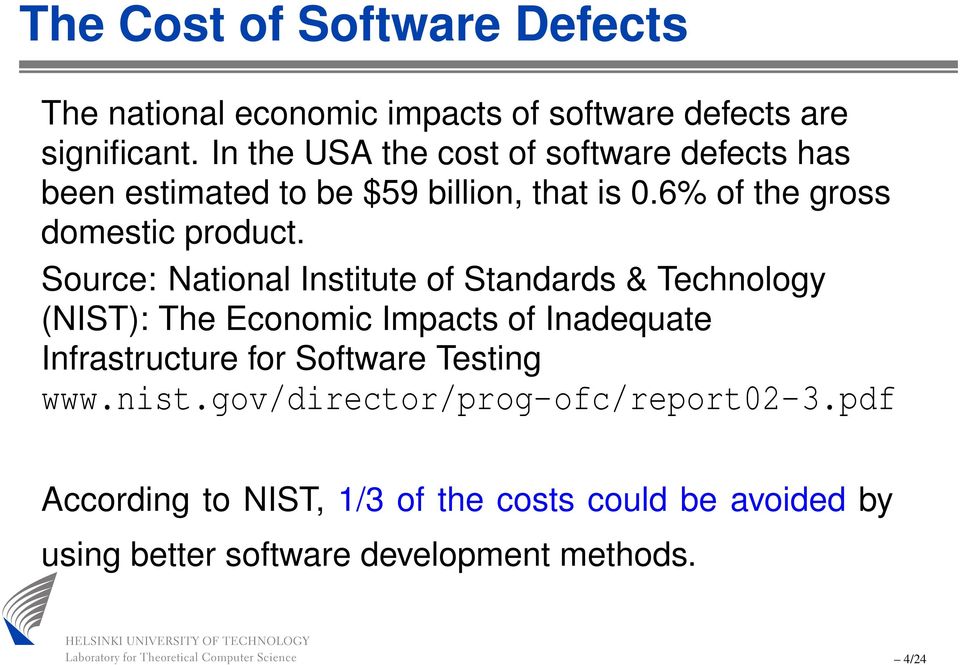
5 Pentium FDIV bug (( / ) * ) = 256 The floating point division algorithm uses a table of constants with 1066 rows. A bug in the initialization of the table caused only 1061 rows to be correctly initialized. Cost: $500 million 5/24
6 Ariane 5 Self destructed 37 seconds after takeoff - the cause was an overflow in the conversion from a 64 bit floating point number to a 16 bit integer. Cost: $500 million 6/24

7 Mars Pathfinder A priority inversion problem in the Pathfinder space craft made the system lock up and reboot every once in a while. The bug consisted of a low priority thread holding a mutex lock and not being able to obtain any CPU time to release the lock needed for higher priority threads to make progress. A watchdog timer then rebooted the system. 7/24

8 More Software Bugs Prof. Thomas Huckle, TU München: Collection of Software Bugs 8/24
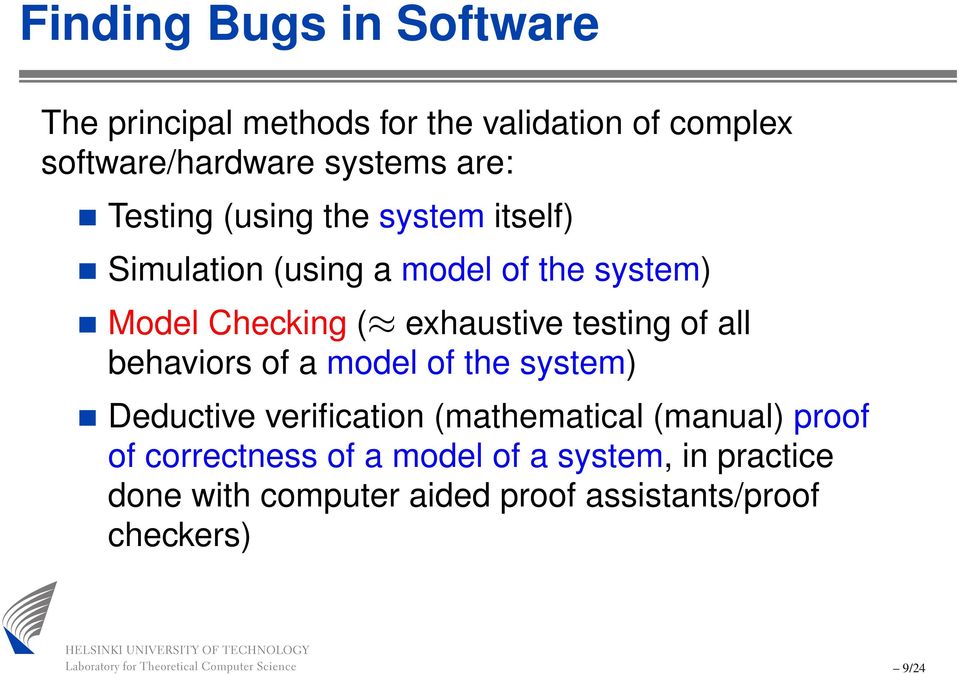
9 Finding Bugs in Software The principal methods for the validation of complex software/hardware systems are: Testing (using the system itself) Simulation (using a model of the system) Model Checking ( exhaustive testing of all behaviors of a model of the system) Deductive verification (mathematical (manual) proof of correctness of a model of a system, in practice done with computer aided proof assistants/proof checkers) 9/24
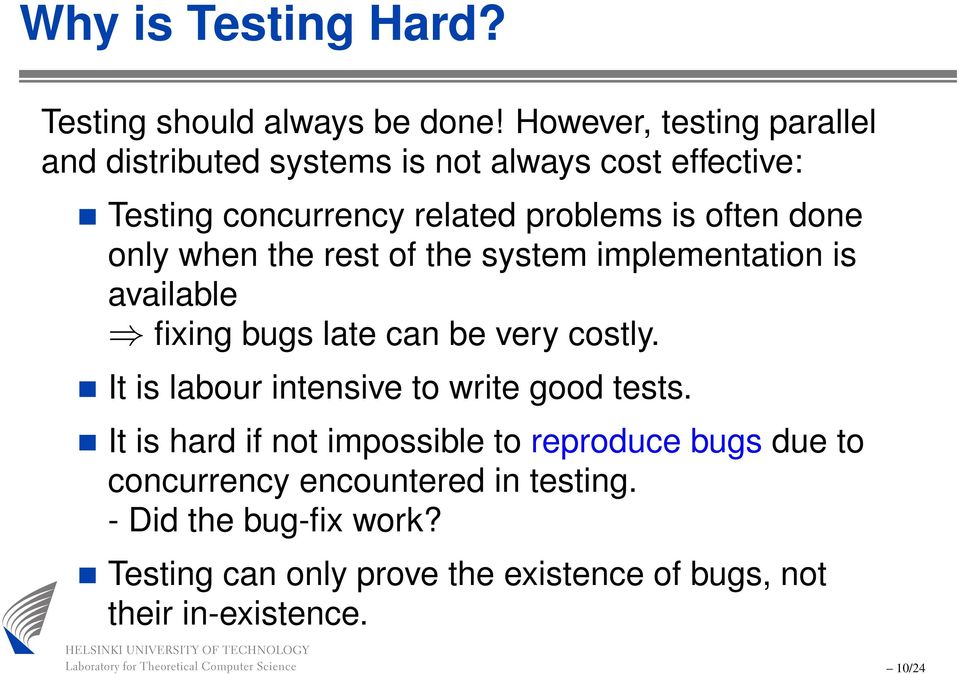
10 Why is Testing Hard? Testing should always be done! However, testing parallel and distributed systems is not always cost effective: Testing concurrency related problems is often done only when the rest of the system implementation is available fixing bugs late can be very costly. It is labour intensive to write good tests. It is hard if not impossible to reproduce bugs due to concurrency encountered in testing. - Did the bug-fix work? Testing can only prove the existence of bugs, not their in-existence. 10/24
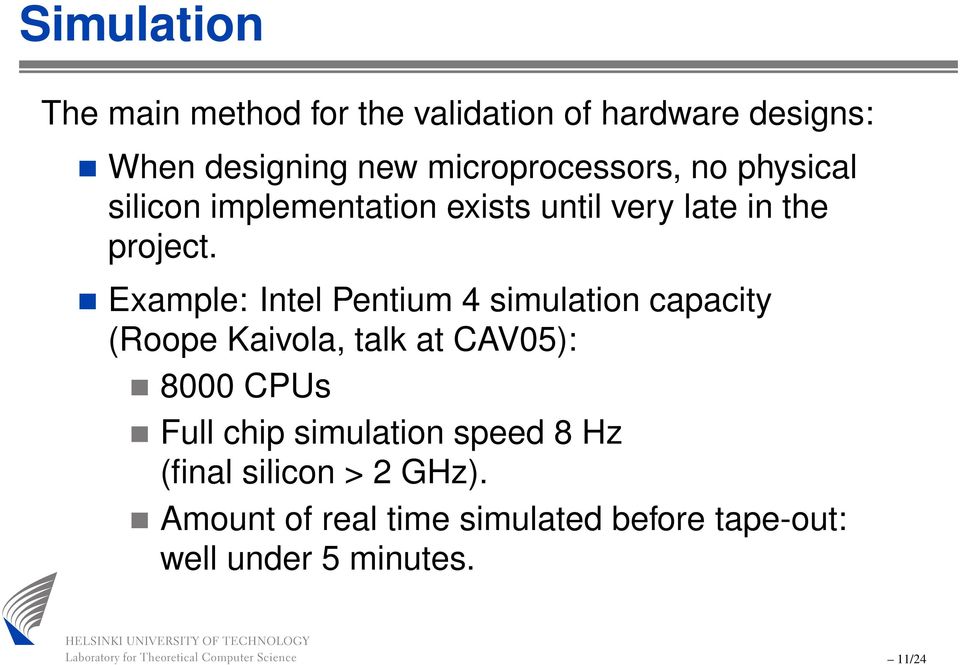
11 Simulation The main method for the validation of hardware designs: When designing new microprocessors, no physical silicon implementation exists until very late in the project. Example: Intel Pentium 4 simulation capacity (Roope Kaivola, talk at CAV05): 8000 CPUs Full chip simulation speed 8 Hz (final silicon > 2 GHz). Amount of real time simulated before tape-out: well under 5 minutes. 11/24
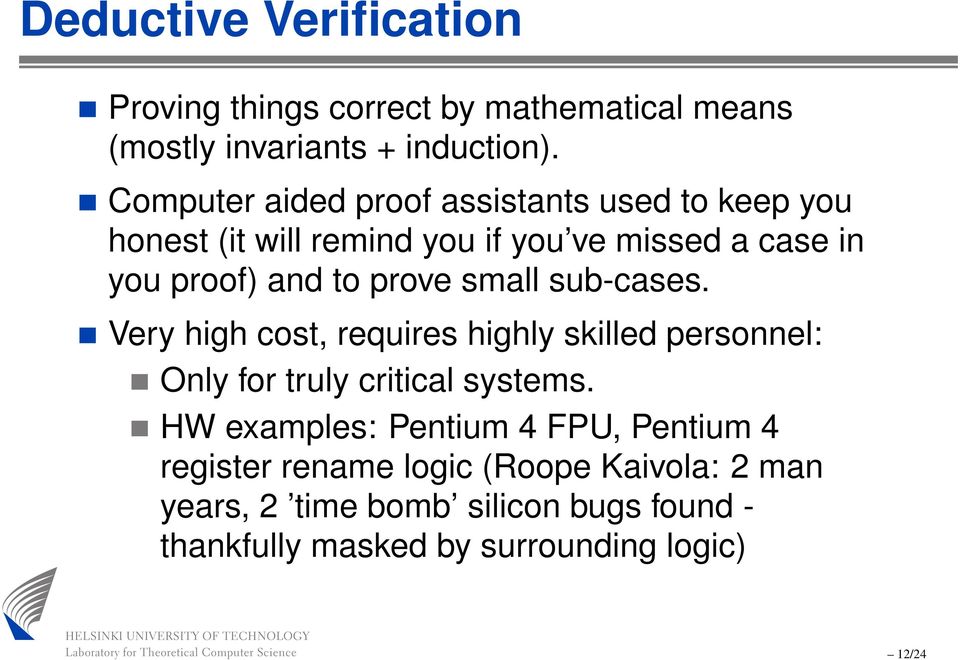
12 Deductive Verification Proving things correct by mathematical means (mostly invariants + induction). Computer aided proof assistants used to keep you honest (it will remind you if you ve missed a case in you proof) and to prove small sub-cases. Very high cost, requires highly skilled personnel: Only for truly critical systems. HW examples: Pentium 4 FPU, Pentium 4 register rename logic (Roope Kaivola: 2 man years, 2 time bomb silicon bugs found - thankfully masked by surrounding logic) 12/24
13 Model Checking In model checking every execution of the model of the system is simulated obtaining a Kripke structure M describing all its behaviours. M is then checked against a system property ϕ: Yes: The system functions according to the specified property (denoted M = ϕ). The symbol = is pronounced models, hence the term model checking. No: The system is incorrect (denoted M = ϕ), a counterexample is returned: an execution of the system which does not satisfy the property. 13/24
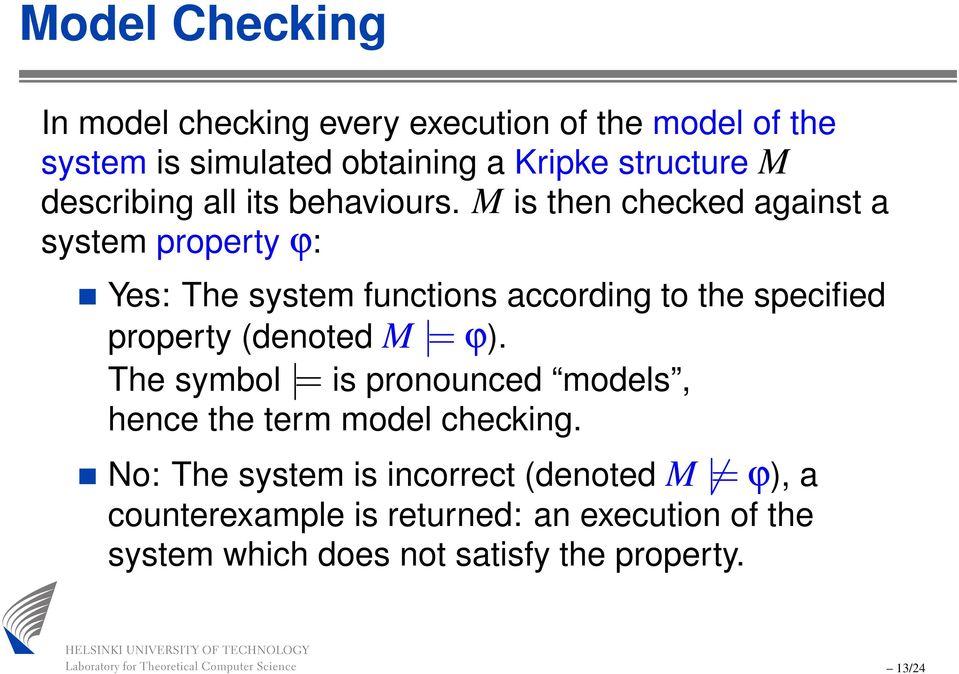
14 Models and Properties System Property Modelling System model Formalization of property Executing the model Kripke structure M Model checking M = ϕ? Formalized property ϕ 14/24

15 Modelling Languages As a language describing system models we can for example use: Java programs, UML (unified modelling language) state machines, SDL (specification and description language), Promela language (input language of the Spin model checker), Petri nets process algebras, and VHDL,Verilog, or SMV languages (mostly for HW design). 15/24

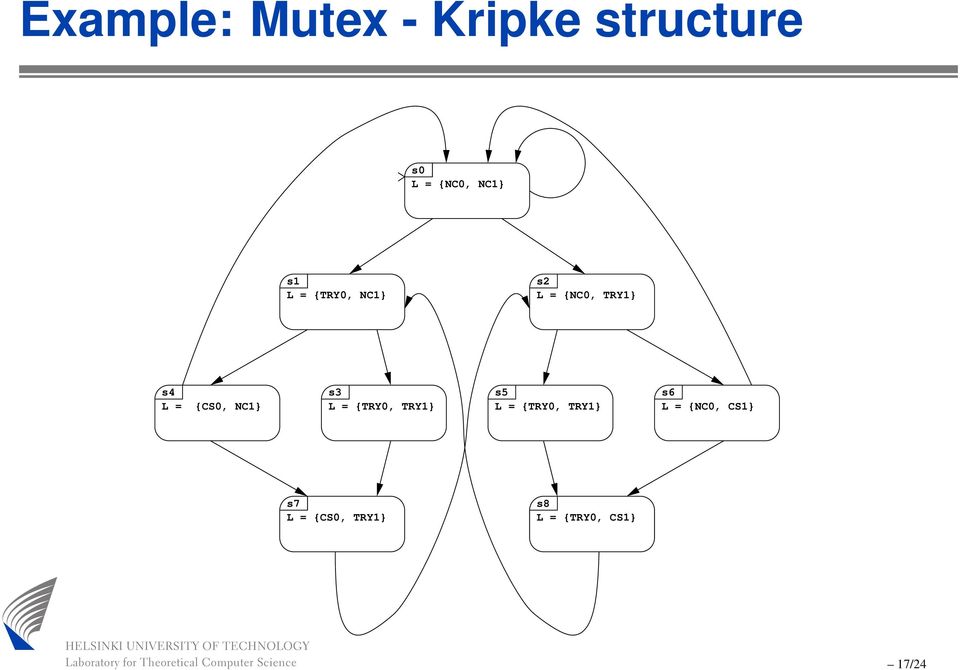
16 Kripke Structures Kripke structure is a fully modelling language independent way of representing the behaviour of parallel and distributed system. Kripke structures are graphs which describe all the possible executions of the system, where all internal state information has been hidden, except for some interesting atomic propositions. Kripke structures analyzed by model checkers can contain tens of millions of states of the system. It is not always possible to store all of them explicitly. 16/24

17 Example: Mutex - Kripke structure s0 L = {NC0, NC1} s1 L = {TRY0, NC1} s2 L = {NC0, TRY1} s4 L = {CS0, NC1} s3 L = {TRY0, TRY1} s5 L = {TRY0, TRY1} s6 L = {NC0, CS1} s7 L = {CS0, TRY1} s8 L = {TRY0, CS1} 17/24
18 Specification Formalisms Temporal logics such as the linear temporal logic LTL are usually used as the specification formalism. Also finite state automata or regular expressions can be used. The (hardware) industry standard property specification language IEEE PSL combines temporal logics with regular expressions. 18/24

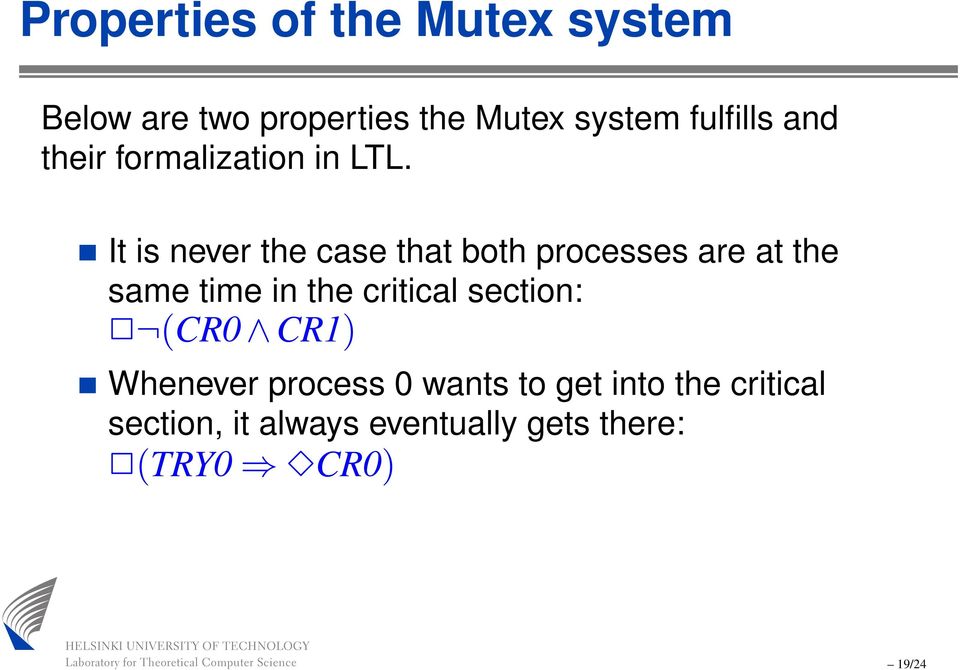
19 Properties of the Mutex system Below are two properties the Mutex system fulfills and their formalization in LTL. It is never the case that both processes are at the same time in the critical section: (CR0 CR1) Whenever process 0 wants to get into the critical section, it always eventually gets there: (TRY0 CR0) 19/24
20 Benefits of Model Checking In principle automated: Given a system model and a property, the model checking algorithm is fully automatic. Counterexamples are valuable for debugging. Already the process of modelling catches a large percentage of the bugs: rapid prototyping of concurrency related features. 20/24

21 Drawbacks of Model Checking State explosion problem: Capacity limits of model checkers can be often exceeded. Nice research problems for researchers creating new model checking algorithms. Manual modelling often needed: Model checker used might not support all features of the implementation language. Abstraction needed to overcome capacity problems. Reverse engineering of existing already implemented systems to obtain models often futile. Early stage specifications are the most fruitful target. 21/24
22 Model Checking in the Industry Microprocessor design: All major microprocessor manufacturers use model checking methods as a part of their design process Design of Data-Communications Protocol Software: Model checkers have been used as rapid prototyping systems for validating new data-communications protocols under standardization. Critical Software: NASA space program is model checking code used by the space program. Operating Systems: Microsoft is using model checking to verify the correct functioning of new Windows device drivers. 22/24
23 Model Checking Research at HUT Main research topics: Bounded model checking (BMC): A variant of model checking where all the executions of the system are investigated only upto a fixed number of time steps (the bound). Use of highly efficient propositional satisfiability (SAT) solvers to implement bounded model checking. BMC encodings of property specification languages such as LTL and PSL. Optimizing BMC for analyzing systems that contain concurrency. 23/24
24 Conclusions Model checking is a systematic way of checking whether all behaviours of a model of a system fullfil its specification. The approach is at its best in early stages of protocol development: E.g., as a rapid prototyping system to ease protocol standardization work. Model checking is in use in the industry in several different areas. Highly optimized model checking algorithms and tools exist, however, there is still much work to be done in the area. 24/24
T-79.186 Reactive Systems: Introduction and Finite State Automata
 T-79.186 Reactive Systems: Introduction and Finite State Automata Timo Latvala 14.1.2004 Reactive Systems: Introduction and Finite State Automata 1-1 Reactive Systems Reactive systems are a class of software
The Course. http://www.cse.unsw.edu.au/~cs3153/
 The Course http://www.cse.unsw.edu.au/~cs3153/ Lecturers Dr Peter Höfner NICTA L5 building Prof Rob van Glabbeek NICTA L5 building Dr Ralf Huuck NICTA ATP building 2 Plan/Schedule (1) Where and When Tuesday,
Formal Verification and Linear-time Model Checking
 Formal Verification and Linear-time Model Checking Paul Jackson University of Edinburgh Automated Reasoning 21st and 24th October 2013 Why Automated Reasoning? Intellectually stimulating and challenging
Testing LTL Formula Translation into Büchi Automata
 Testing LTL Formula Translation into Büchi Automata Heikki Tauriainen and Keijo Heljanko Helsinki University of Technology, Laboratory for Theoretical Computer Science, P. O. Box 5400, FIN-02015 HUT, Finland
Model Checking: An Introduction
 Announcements Model Checking: An Introduction Meeting 2 Office hours M 1:30pm-2:30pm W 5:30pm-6:30pm (after class) and by appointment ECOT 621 Moodle problems? Fundamentals of Programming Languages CSCI
tutorial: hardware and software model checking
 tutorial: hardware and software model checking gerard holzmann and anuj puri { gerard anuj } @research.bell-labs.com Bell Labs, USA outline introduction (15 mins) theory and algorithms system modeling
Formal Verification of Software
 Formal Verification of Software Sabine Broda Department of Computer Science/FCUP 12 de Novembro de 2014 Sabine Broda (DCC-FCUP) Formal Verification of Software 12 de Novembro de 2014 1 / 26 Formal Verification
The Model Checker SPIN
 The Model Checker SPIN Author: Gerard J. Holzmann Presented By: Maulik Patel Outline Introduction Structure Foundation Algorithms Memory management Example/Demo SPIN-Introduction Introduction SPIN (Simple(
Model Checking of Software
 Model Checking of Software Patrice Godefroid Bell Laboratories, Lucent Technologies SpecNCheck Page 1 August 2001 A Brief History of Model Checking Prehistory: transformational programs and theorem proving
Formal verification of contracts for synchronous software components using NuSMV
 Formal verification of contracts for synchronous software components using NuSMV Tobias Polzer Lehrstuhl für Informatik 8 Bachelorarbeit 13.05.2014 1 / 19 Problem description and goals Problem description
Slides based in part on previous lectures by Mahesh Vishwanathan, and by Gul Agha January 21, 2014 1
 Contact Information CS477 Formal Software Development Methods Elsa L Gunter 2112 SC, UIUC [email protected] http://courses.engr.illinois.edu/cs477 Office: 2112 SC Office Hours: Wednesdays 11:00am -
Formal Verification by Model Checking
 Formal Verification by Model Checking Natasha Sharygina Carnegie Mellon University Guest Lectures at the Analysis of Software Artifacts Class, Spring 2005 1 Outline Lecture 1: Overview of Model Checking
INF5140: Specification and Verification of Parallel Systems
 Motivation INF5140: Specification and Verification of Parallel Systems Lecture 1 Introduction: Formal Methods Gerardo Schneider Department of Informatics University of Oslo INF5140, Spring 2009 Outline
Specification and Analysis of Contracts Lecture 1 Introduction
 Specification and Analysis of Contracts Lecture 1 Introduction Gerardo Schneider [email protected] http://folk.uio.no/gerardo/ Department of Informatics, University of Oslo SEFM School, Oct. 27 - Nov.
Software Modeling and Verification
 Software Modeling and Verification Alessandro Aldini DiSBeF - Sezione STI University of Urbino Carlo Bo Italy 3-4 February 2015 Algorithmic verification Correctness problem Is the software/hardware system
TEACHING MODEL CHECKING TO UNDERGRADUATES
 STUDIA UNIV. BABEŞ BOLYAI, INFORMATICA, Volume LV, Number 3, 2010 TEACHING MODEL CHECKING TO UNDERGRADUATES A.VESCAN AND M. FRENŢIU Abstract. The way program verification is taught in our faculty is firstly
School of Computer Science
 School of Computer Science Computer Science - Honours Level - 2014/15 October 2014 General degree students wishing to enter 3000- level modules and non- graduating students wishing to enter 3000- level
Lecture 9 verifying temporal logic
 Basics of advanced software systems Lecture 9 verifying temporal logic formulae with SPIN 21/01/2013 1 Outline for today 1. Introduction: motivations for formal methods, use in industry 2. Developing models
MODEL CHECKING CONCURRENT AND REAL-TIME SYSTEMS: THE PAT APPROACH. LIU YANG (B.Sc. (Hons.), NUS)
 MODEL CHECKING CONCURRENT AND REAL-TIME SYSTEMS: THE PAT APPROACH LIU YANG (B.Sc. (Hons.), NUS) A THESIS SUBMITTED FOR THE DEGREE OF DOCTOR OF PHILOSOPHY DEPARTMENT OF COMPUTER SCIENCE NATIONAL UNIVERSITY
Fundamentals of Software Engineering
 Fundamentals of Software Engineering Model Checking with Temporal Logic Ina Schaefer Institute for Software Systems Engineering TU Braunschweig, Germany Slides by Wolfgang Ahrendt, Richard Bubel, Reiner
Automata-based Verification - I
 CS3172: Advanced Algorithms Automata-based Verification - I Howard Barringer Room KB2.20: email: [email protected] March 2006 Supporting and Background Material Copies of key slides (already
A Comprehensive Safety Engineering Approach for Software Intensive Systems based on STPA
 www.uni-stuttgart.de A Comprehensive Safety Engineering Approach for Software Intensive Systems based on STPA STPA-based Approach STPA Safety Analysis Asim Abdulkhaleq, Ph.D Candidate Institute of Software
System modeling. Budapest University of Technology and Economics Department of Measurement and Information Systems
 System modeling Business process modeling how to do it right Partially based on Process Anti-Patterns: How to Avoid the Common Traps of Business Process Modeling, J Koehler, J Vanhatalo, IBM Zürich, 2007.
Using Patterns and Composite Propositions to Automate the Generation of Complex LTL
 University of Texas at El Paso DigitalCommons@UTEP Departmental Technical Reports (CS) Department of Computer Science 8-1-2007 Using Patterns and Composite Propositions to Automate the Generation of Complex
Static Program Transformations for Efficient Software Model Checking
 Static Program Transformations for Efficient Software Model Checking Shobha Vasudevan Jacob Abraham The University of Texas at Austin Dependable Systems Large and complex systems Software faults are major
Today s Agenda. Automata and Logic. Quiz 4 Temporal Logic. Introduction Buchi Automata Linear Time Logic Summary
 Today s Agenda Quiz 4 Temporal Logic Formal Methods in Software Engineering 1 Automata and Logic Introduction Buchi Automata Linear Time Logic Summary Formal Methods in Software Engineering 2 1 Buchi Automata
Datavetenskapligt Program (kandidat) Computer Science Programme (master)
 Datavetenskapligt Program (kandidat) Computer Science Programme (master) Wolfgang Ahrendt Director Datavetenskap (BSc), Computer Science (MSc) D&IT Göteborg University, 30/01/2009 Part I D&IT: Computer
Model Checking II Temporal Logic Model Checking
 1/32 Model Checking II Temporal Logic Model Checking Edmund M Clarke, Jr School of Computer Science Carnegie Mellon University Pittsburgh, PA 15213 2/32 Temporal Logic Model Checking Specification Language:
logic language, static/dynamic models SAT solvers Verified Software Systems 1 How can we model check of a program or system?
 5. LTL, CTL Last part: Alloy logic language, static/dynamic models SAT solvers Today: Temporal Logic (LTL, CTL) Verified Software Systems 1 Overview How can we model check of a program or system? Modeling
Formal Methods at Intel An Overview
 Formal Methods at Intel An Overview John Harrison Intel Corporation Second NASA Formal Methods Symposium NASA HQ, Washington DC 14th April 2010 (09:00 10:00) 0 Table of contents Intel s diverse verification
Overview Motivating Examples Interleaving Model Semantics of Correctness Testing, Debugging, and Verification
 Introduction Overview Motivating Examples Interleaving Model Semantics of Correctness Testing, Debugging, and Verification Advanced Topics in Software Engineering 1 Concurrent Programs Characterized by
Introduction to Formal Methods. Các Phương Pháp Hình Thức Cho Phát Triển Phần Mềm
 Introduction to Formal Methods Các Phương Pháp Hình Thức Cho Phát Triển Phần Mềm Outline Introduction Formal Specification Formal Verification Model Checking Theorem Proving Introduction Good papers to
Numerical Matrix Analysis
 Numerical Matrix Analysis Lecture Notes #10 Conditioning and / Peter Blomgren, [email protected] Department of Mathematics and Statistics Dynamical Systems Group Computational Sciences Research
Verifying Real-Time Embedded Software by Means of Automated State-based Online Testing and the SPIN Model Checker Application to RTEdge Models
 Verifying Real-Time Embedded Software by Means of Automated State-based Online Testing and the SPIN Model Checker Application to RTEdge Models A thesis submitted to the Faculty of Graduate and Postdoctoral
http://aejm.ca Journal of Mathematics http://rema.ca Volume 1, Number 1, Summer 2006 pp. 69 86
 Atlantic Electronic http://aejm.ca Journal of Mathematics http://rema.ca Volume 1, Number 1, Summer 2006 pp. 69 86 AUTOMATED RECOGNITION OF STUTTER INVARIANCE OF LTL FORMULAS Jeffrey Dallien 1 and Wendy
A Classification of Model Checking-based Verification Approaches for Software Models
 A Classification of Model Checking-based Verification Approaches for Software Models Petra Brosch, Sebastian Gabmeyer, Martina Seidl Sebastian Gabmeyer Business Informatics Group Institute of Software
System-on-Chip Design Verification: Challenges and State-of-the-art
 System-on-Chip Design Verification: Challenges and State-of-the-art Prof. Sofiène Tahar Hardware Verification Group Concordia University Montréal, QC, CANADA MCSOC 12 Aizu-Wakamatsu, Fukushima, Japan September
Rigorous Software Development CSCI-GA 3033-009
 Rigorous Software Development CSCI-GA 3033-009 Instructor: Thomas Wies Spring 2013 Lecture 1 Important Facts Office Hours: Thu 3-4pm, or by appointment Office: CIWW 407 Course web site: http://cs.nyu.edu/wies/teaching/rsd-13
Eingebettete Systeme. 4: Entwurfsmethodik, HW/SW Co-Design. Technische Informatik T T T
 Eingebettete Systeme 4: Entwurfsmethodik, HW/SW Co-Design echnische Informatik System Level Design: ools and Flow Refinement of HW/SW Systems ools for HW/SW Co-Design C-based design of HW/SW Systems echnische
School of Computer Science
 School of Computer Science Computer Science - Honours Level - 2015/6 - August 2015 General degree students wishing to enter 3000- level modules and non- graduating students wishing to enter 3000- level
Software safety - DEF-STAN 00-55
 Software safety - DEF-STAN 00-55 Where safety is dependent on the safety related software (SRS) fully meeting its requirements, demonstrating safety is equivalent to demonstrating correctness with respect
Handout #1: Mathematical Reasoning
 Math 101 Rumbos Spring 2010 1 Handout #1: Mathematical Reasoning 1 Propositional Logic A proposition is a mathematical statement that it is either true or false; that is, a statement whose certainty or
WRITING PROOFS. Christopher Heil Georgia Institute of Technology
 WRITING PROOFS Christopher Heil Georgia Institute of Technology A theorem is just a statement of fact A proof of the theorem is a logical explanation of why the theorem is true Many theorems have this
Digital Circuit Design
 Test and Diagnosis of of ICs Fault coverage (%) 95 9 85 8 75 7 65 97.92 SSL 4,246 Shawn Blanton Professor Department of ECE Center for Silicon System Implementation CMU Laboratory for Integrated Systems
Automated Theorem Proving - summary of lecture 1
 Automated Theorem Proving - summary of lecture 1 1 Introduction Automated Theorem Proving (ATP) deals with the development of computer programs that show that some statement is a logical consequence of
Software Engineering using Formal Methods
 Software Engineering using Formal Methods Model Checking with Temporal Logic Wolfgang Ahrendt 24th September 2013 SEFM: Model Checking with Temporal Logic /GU 130924 1 / 33 Model Checking with Spin model
School of Computer Science
 Computer Science Honours Level 2013/14 August 2013 School of Computer Science Computer Science (CS) Modules CS3051 Software Engineering SCOTCAT Credits: 15 SCQF Level 9 Semester: 1 This module gives a
Algorithmic Software Verification
 Algorithmic Software Verification (LTL Model Checking) Azadeh Farzan What is Verification Anyway? Proving (in a formal way) that program satisfies a specification written in a logical language. Formal
CAs and Turing Machines. The Basis for Universal Computation
 CAs and Turing Machines The Basis for Universal Computation What We Mean By Universal When we claim universal computation we mean that the CA is capable of calculating anything that could possibly be calculated*.
Digital Design Verification
 Digital Design Verification Course Instructor: Debdeep Mukhopadhyay Dept of Computer Sc. and Engg. Indian Institute of Technology Madras, Even Semester Course No: CS 676 1 Verification??? What is meant
Software Verification: Infinite-State Model Checking and Static Program
 Software Verification: Infinite-State Model Checking and Static Program Analysis Dagstuhl Seminar 06081 February 19 24, 2006 Parosh Abdulla 1, Ahmed Bouajjani 2, and Markus Müller-Olm 3 1 Uppsala Universitet,
Formal Verification Coverage: Computing the Coverage Gap between Temporal Specifications
 Formal Verification Coverage: Computing the Coverage Gap between Temporal Specifications Sayantan Das Prasenjit Basu Ansuman Banerjee Pallab Dasgupta P.P. Chakrabarti Department of Computer Science & Engineering
2 Temporal Logic Model Checking
 Bounded Model Checking Using Satisfiability Solving Edmund Clarke 1, Armin Biere 2, Richard Raimi 3, and Yunshan Zhu 4 1 Computer Science Department, CMU, 5000 Forbes Avenue Pittsburgh, PA 15213, USA,
Model checking test models. Author: Kevin de Berk Supervisors: Prof. dr. Wan Fokkink, dr. ir. Machiel van der Bijl
 Model checking test models Author: Kevin de Berk Supervisors: Prof. dr. Wan Fokkink, dr. ir. Machiel van der Bijl February 14, 2014 Abstract This thesis is about model checking testing models. These testing
Assertion Synthesis Enabling Assertion-Based Verification For Simulation, Formal and Emulation Flows
 Assertion Synthesis Enabling Assertion-Based Verification For Simulation, Formal and Emulation Flows Manual Assertion Creation is ABV Bottleneck Assertion-Based Verification adopted by leading design companies
Eastern Washington University Department of Computer Science. Questionnaire for Prospective Masters in Computer Science Students
 Eastern Washington University Department of Computer Science Questionnaire for Prospective Masters in Computer Science Students I. Personal Information Name: Last First M.I. Mailing Address: Permanent
Structure of Presentation. Stages in Teaching Formal Methods. Motivation (1) Motivation (2) The Scope of Formal Methods (1)
 Stages in Teaching Formal Methods A. J. Cowling Structure of Presentation Introduction to Issues Motivation for this work. Analysis of the Role of Formal Methods Define their scope; Review their treatment
Formal Languages and Automata Theory - Regular Expressions and Finite Automata -
 Formal Languages and Automata Theory - Regular Expressions and Finite Automata - Samarjit Chakraborty Computer Engineering and Networks Laboratory Swiss Federal Institute of Technology (ETH) Zürich March
CS 3719 (Theory of Computation and Algorithms) Lecture 4
 CS 3719 (Theory of Computation and Algorithms) Lecture 4 Antonina Kolokolova January 18, 2012 1 Undecidable languages 1.1 Church-Turing thesis Let s recap how it all started. In 1990, Hilbert stated a
Motivation and Contents Overview
 Motivation and Contents Overview Software Engineering Winter Semester 2011/2012 Department of Computer Science cs.uni-salzburg.at Dr. Stefan Resmerita 2 Course Contents Goals Learning about commonly used
System requirements for ICS Skills ATS
 System requirements for ICS Skills ATS A system requirements check verifies that the computer fulfils the requirements to run ICS Skills Automated tests. There are 4 possible checks that can be made prior
Safety Verification of the Small Aircraft Transportation System Concept of Operations
 Safety Verification of the Small Aircraft Transportation System Concept of Operations Victor Carreño 1 NASA Langley Research Center, Hampton, Virginia, 23681 César Muñoz 2 National Institute of Aerospace,
Principles of Software Engineering: Course Outline. Ethan Jackson And Wolfram Schulte, Research in Software Engineering (RiSE) Microsoft Research
 Principles of Software Engineering: Course Outline Ethan Jackson And Wolfram Schulte, Research in Software Engineering (RiSE) Microsoft Research Overview Motivation and Focus Syllabus Projects i. Motivation
SCADE Suite in Space Applications
 SCADE Suite in Space Applications at EADS David Lesens 09/10/2008 Overview Introduction Historical use of SCADE at EADS Astrium ST Why using SCADE? The Automatic Transfer Vehicle (ATV) M51 and Vega R&T
Smart Cards a(s) Safety Critical Systems
 Smart Cards a(s) Safety Critical Systems Gemplus Labs Pierre.Paradinas [email protected] Agenda Smart Card Technologies Java Card TM Smart Card a specific domain Card Life cycle Our Technical and Business
Model-based Quality Assurance of Automotive Software
 Model-based Quality Assurance of Automotive Software Jan Jürjens 1, Daniel Reiss 2, David Trachtenherz 3 1 Open University (GB) and Microsoft Research (Cambridge) 2 Elektrobit (Germany) 3 TU Munich (Germany)
Bounded LTL Model Checking with Stable Models
 Under consideration for publication in Theory and Practice of Logic Programming 1 Bounded LTL Model Checking with Stable Models KEIJO HELJANKO and ILKKA NIEMELÄ Helsinki University of Technology Department
1. Give the 16 bit signed (twos complement) representation of the following decimal numbers, and convert to hexadecimal:
 Exercises 1 - number representations Questions 1. Give the 16 bit signed (twos complement) representation of the following decimal numbers, and convert to hexadecimal: (a) 3012 (b) - 435 2. For each of
Validated Templates for Specification of Complex LTL Formulas
 Validated Templates for Specification of Complex LTL Formulas Salamah Salamah Department of Electrical, computer, Software, and Systems Engineering Embry Riddle Aeronautical University 600 S. Clyde Morris
Solutions Q1, Q3, Q4.(a), Q5, Q6 to INTLOGS16 Test 1
 Solutions Q1, Q3, Q4.(a), Q5, Q6 to INTLOGS16 Test 1 Prof S Bringsjord 0317161200NY Contents I Problems 1 II Solutions 3 Solution to Q1 3 Solutions to Q3 4 Solutions to Q4.(a) (i) 4 Solution to Q4.(a)........................................
Testing and Inspecting to Ensure High Quality
 Testing and Inspecting to Ensure High Quality Basic definitions A failure is an unacceptable behaviour exhibited by a system The frequency of failures measures the reliability An important design objective
6.080/6.089 GITCS Feb 12, 2008. Lecture 3
 6.8/6.89 GITCS Feb 2, 28 Lecturer: Scott Aaronson Lecture 3 Scribe: Adam Rogal Administrivia. Scribe notes The purpose of scribe notes is to transcribe our lectures. Although I have formal notes of my
Random Testing: The Best Coverage Technique - An Empirical Proof
 , pp. 115-122 http://dx.doi.org/10.14257/ijseia.2015.9.12.10 Random Testing: The Best Coverage Technique - An Empirical Proof K Koteswara Rao 1 and Prof GSVP Raju 2 1 Asst prof, (PhD) @JNTUK, CSE Department,
Informatique Fondamentale IMA S8
 Informatique Fondamentale IMA S8 Cours 1 - Intro + schedule + finite state machines Laure Gonnord http://laure.gonnord.org/pro/teaching/ [email protected] Université Lille 1 - Polytech Lille
Squashing the Bugs: Tools for Building Better Software
 Squashing the Bugs: Tools for Building Better Software Stephen Freund Williams College The Blue Screen of Death (BSOD) USS Yorktown Smart Ship 27 Pentium-based PCs Windows NT 4.0 September 21, 1997: data
Choosing a Computer for Running SLX, P3D, and P5
 Choosing a Computer for Running SLX, P3D, and P5 This paper is based on my experience purchasing a new laptop in January, 2010. I ll lead you through my selection criteria and point you to some on-line
Division of Mathematical Sciences
 Division of Mathematical Sciences Chair: Mohammad Ladan, Ph.D. The Division of Mathematical Sciences at Haigazian University includes Computer Science and Mathematics. The Bachelor of Science (B.S.) degree
Stylianos Basagiannis
 Interlocking control by Distributed Signal Boxes Technical Report (TR) 4 Stylianos Basagiannis Supervisors: Dr Andrew Pombortsis, Dr Panagiotis Katsaros Aristotle University of Thessaloniki Department
Performance Evaluation and Optimization of A Custom Native Linux Threads Library
 Center for Embedded Computer Systems University of California, Irvine Performance Evaluation and Optimization of A Custom Native Linux Threads Library Guantao Liu and Rainer Dömer Technical Report CECS-12-11
Oracle Turing machines faced with the verification problem
 Oracle Turing machines faced with the verification problem 1 Introduction Alan Turing is widely known in logic and computer science to have devised the computing model today named Turing machine. In computer
Five High Order Thinking Skills
 Five High Order Introduction The high technology like computers and calculators has profoundly changed the world of mathematics education. It is not only what aspects of mathematics are essential for learning,
Full System Emulation:
 Full System Emulation: Achieving Successful Automated Dynamic Analysis of Evasive Malware Christopher Kruegel Lastline, Inc. [email protected] 1 Introduction Automated malware analysis systems (or sandboxes)
Automata and Formal Languages
 Automata and Formal Languages Winter 2009-2010 Yacov Hel-Or 1 What this course is all about This course is about mathematical models of computation We ll study different machine models (finite automata,
Testing Introduction. IEEE Definitions
 Testing Introduction IEEE Definitions Software testing is the process of analyzing a software item to detect the differences between existing and required conditions (that is, bugs) and to evaluate the
Agenda. Michele Taliercio, Il circuito Integrato, Novembre 2001
 Agenda Introduzione Il mercato Dal circuito integrato al System on a Chip (SoC) La progettazione di un SoC La tecnologia Una fabbrica di circuiti integrati 28 How to handle complexity G The engineering
Program Synthesis is a Game
 Program Synthesis is a Game Barbara Jobstmann CNRS/Verimag, Grenoble, France Outline Synthesis using automata- based game theory. MoBvaBon, comparison with MC and LTL. Basics Terminology Reachability/Safety