
1-800-DIG-RITE or 811. mo1call.com
|
|
|
- Victoria Bennett
- 9 years ago
- Views:
Transcription
1 Excavator Manual DIG-RITE or mo1call.com

2 This manual is designed to serve as a guide to assist excavators with the process of placing a locate request. It does not take the place of the Missouri State Law Underground Facility Safety and Damage Prevention RSMO Chapter A full copy of this section of the law is included in the back of this booklet. We will be pleased to send you as many manuals as you need, and we encourage you to distribute them to anyone associated with the damage prevention process. This manual and other information can be downloaded from the MOCS website You can get additional manuals by one of the following ways: Go to the MOCS web site at click on the Excavator Information tab then Order MOCS Materials. All items on the form are free and are usually shipped UPS next day. Or contact the administrative office at: Missouri One Call System 824 Weathered Rock Road Jefferson City, MO Phone: Fax: To view and/or print this manual or the Spanish version, access our website at If at anytime the DIG-RITE number fails to work, call A recording will give you another 800 number you can use to report the problem. May 2016

3 Table of Contents About Missouri One Call... 2 What s on the MOCS Website... 2 Who Needs to Place a Locate Request and When... 4 How to Place a Locate Request... 4 How the One Call System Works... 6 Confirming Utility Response... 6 Required Locate Request Information... 7 Locate Status System... 8 About Ticket Types and Response Times... 9 What Happens after the Utilities are Notified Responsibilities of the Excavator Responsibilities of the Facility Owner Extended Start Date and Time Request Process Color Codes Timeline Chart No Response Records Ticket Remarks Importance of Accurate Information White Lining or White Flags Design Tickets Holidays Depth of Facilities Privately Owned Facilities Emergency Required Utility Participation Trenchless Excavation: Horizontal Boring and Directional Drilling How Large of an Area Can Be Placed On One Ticket Enforcement and Penalties Approximate Location Missouri Marking Standards Missouri State Law Free Educational Packets

4 About the Missouri One Call System The Missouri Underground Facility Safety and Damage Prevention statute (RSMo Chapter 319) provides for a notification center to be used by utilities to receive locate requests. Missouri One Call System, Inc., was established in 1986 and operates as a non-profit Missouri corporation. MOCS is the statewide notification center that provides a single-point of contact for the receipt and transmission of dig site information from the excavator to the utilities, allowing each to comply with their legal responsibilities. MOCS is funded by its member utilities and provides this service free of charge to the excavator. MOCS has a board of 15 directors representing different utility types and three advisory members. MOCS is required by law to provide a toll-free telephone number ( ) 24 hours a day, seven days a week. What s on the MOCS Website Reference the MOCS website for: Free Educational Materials Locate Status Ticket Search Newsletters Reviewing and Editing Member Contact Information Internet Ticketing Utility Reports IMAP Training and Educational Programs Enforcement Contacts Utility Member List FAQ s MOCS Contact Information Meeting Information Videos 2
5

6 Who Needs To Place a Locate Request and When Missouri law requires that any person making or beginning any excavation must notify MOCS at least three but not more than ten working days in advance except in the case of an emergency. (See chart page 16) How To Place a Locate Request There are two ways to place a locate request. 1. INTERNET TICKETING ITIC ITIC is a fast and efficient way for excavators to process their locate request online 24 hours a day. By using ITIC, you can: Process all types of tickets View, Search and Print existing tickets Draw, View and/or Provide maps of the dig site Create profiles to auto-fill ticket information Get assistance from the call center by using Live Chat To use ITIC, go on-line to the MOCS website and click on the icon labeled Internet Ticketing to start the process. After processing the ticket, you will receive an confirmation including a map link, a list of utilities at the dig site and a ticket number. This confirmation gives you access to additional ticket actions and the ability to search for previous tickets. Homeowners ITIC Lite Homeowners can use an abbreviated version called ITIC LITE which can be accessed from the MOCS homepage 4

7 ITIC Mobile ITIC Mobile works on all devices, browsers and does not require a download. It offers the same features as regular Internet Ticketing and can be accessed from any mobile device, smartphone or tablet. Over 50% of all MOCS locate requests are processed using ITIC. Most excavators who try ITIC never go back to calling in their locate requests. For any questions about ITIC, contact the ITIC administrator by [email protected] or call at TELEPHONE Excavators may call MOCS to place a locate request 24 hours a day 7 days a week. Simply call DIG-RITE ( ) or 811 and give the operator information allowing the utility locators to find and mark the dig site. Here are some simple steps you can take to speed up the calling process: Call during off-peak hours. Call center volume is low before 8 am or after 5 pm on weekdays. Review the questions and assemble the facts before you call Missouri One Call. The operator will ask for the information shown on page 7. Be as specific as you can. The excavator who has all the information on hand can complete the notification request in an average of three or four minutes. If the necessary information is not available, your call could take considerably longer, and you may be required to call back to complete the notice. 5

8 6 How the One Call System Works Using the MOCS system correctly is easy, if you are prepared. Accurate information eliminates many of the reasons damage occurs. Preparation is the key. 1. When placing your locate request on-line or when calling in, you are required to supply certain information about the planned excavation in order to complete the ticket. MOCS is required by state law to obtain specific information on all locate requests. 2. The information from each locate request is entered into our computer system. The order of questions asked are preset, and most questions are specifically required by law. 3. Once all the information has been obtained, MOCS determines which utilities are present using both the dig site information supplied by the excavator and facility maps supplied by the utilities. The excavator is then given a ticket number and list of utilities that will be notified. 4. MOCS then transmits this locate request to all member utilities with facilities in the dig site area. 5. After the utility has been notified of the planned excavation, they are required by law to either: 1. Mark the approximate location of their underground lines. 2. Request additional information if necessary. 3. Advise the excavator that they have no facilities at the excavation site. 6. After receiving and confirming utility response, the excavator can now proceed with the excavation using the marks to avoid damage. Confirming Utility Response The excavator must always confirm utility response in the field by comparing the marks at the dig site and the No Facilities notifications received to the list of utilities named on the ticket. If any of the utilities listed on the locate request fail to respond by the start date and time, the excavator is required to place a No Response ticket. Utility response can also be determined by use of the MOCS Locate Status System. (See page 8)

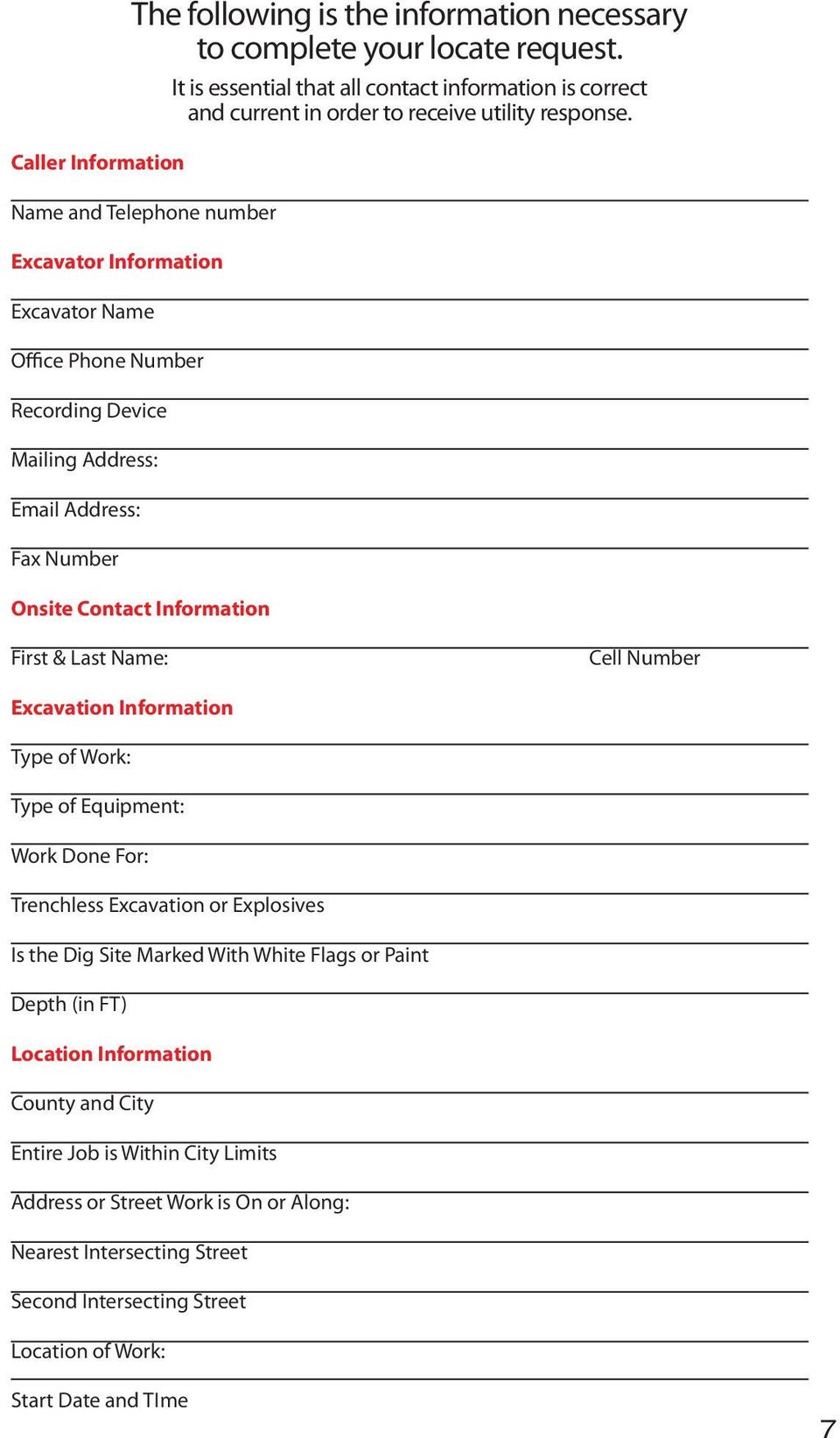
9 Caller Information The following is the information necessary to complete your locate request. It is essential that all contact information is correct and current in order to receive utility response. Name and Telephone number Excavator Information Excavator Name Office Phone Number Recording Device Mailing Address: Address: Fax Number Onsite Contact Information First & Last Name: Cell Number Excavation Information Type of Work: Type of Equipment: Work Done For: Trenchless Excavation or Explosives Is the Dig Site Marked With White Flags or Paint Depth (in FT) Location Information County and City Entire job is Within City Limits Address or Street Work is on or along: Nearest Intersecting Street Second Intersecting Street Location of Work: Start date and time 7
10 Locate Status System Ticket Check Missouri law requires all utilities to status their response to every locate request received. ( ) Ticket Check is an application that allows a utility to send a documented response on each locate request they receive to the excavator. Using Ticket Check, each utility will have the ability to designate their response on each locate as: Marked Clear/No Conflict Area of Excavation Cannot Be Determined No Locate Unable to Gain Access Work in Progress No Locate Work Completed Maps or Documents Provided Once a ticket has been responded to, the utility selects the correct designation and their response is ed or faxed to the excavator at the start date and time designated on the ticket. If all the utilities listed on the locate request have not been statused by the start date and time, the excavator is required to place a No Response ticket for those specific utilities. To Use Ticket Check: Go to Click on the blue Ticket Search button on the home page. Enter the number of your locate request and click Search. Scroll down to the List of Utilities to view their statuses. 8 About is the nationwide Call Before You Dig Number. 811 offers excavators another dialing option along with the 800-DIG-RITE number. When dialed, the 811 number routes into the call center and is handled as any other call.

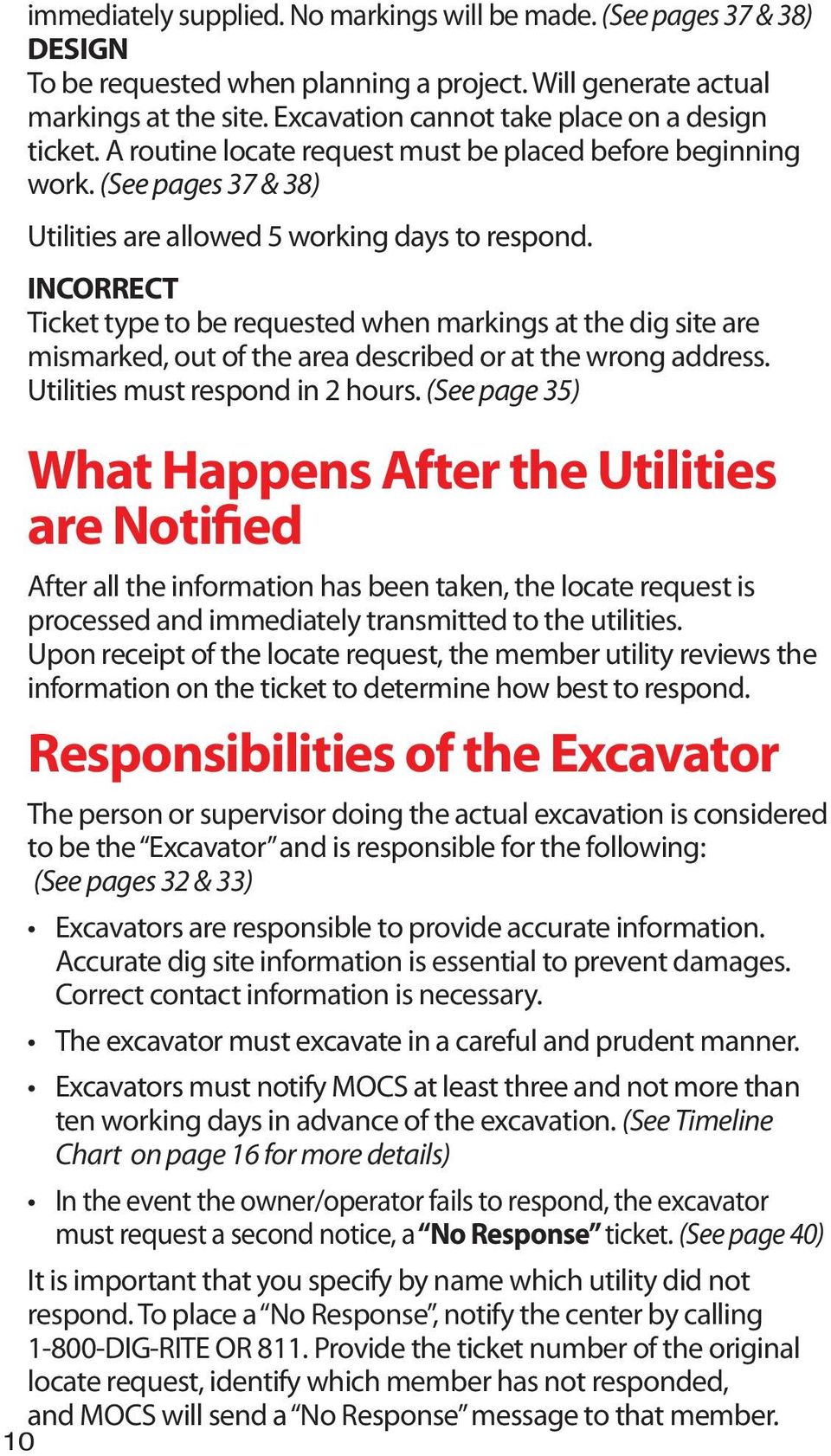
11 There are several different types of tickets that the excavator can submit. Utilities sort and respond to tickets according to type. Requesting the correct type of ticket is important. Ticket Types and Utility Response Times ROUTINE This is a regular locate request. Utilities must respond within 2 working days starting at midnight the day the ticket was called in. (See page 38) NO RESPONSE To be requested when one or more utilities fail to respond to the original locate request or when the markings are incomplete. (See page 40) If notification is made before 2 pm, the marking shall be completed that working day. If the notification is made after 2 pm, the marking is to be completed no later than 10 am the next working day. (See page 40) EMERGENCY Only to be requested when the situation meets the legal definition of an emergency. (See pages 27, 45 & 46) Utilities must respond in 2 hours. DIG UP Excavator legally required to only notify MOCS when damage to facilities has occurred. If damage involves pipeline or natural gas facilities, both 911 and the affected utility must also be notified. (See page 36) REMARKS To be used when previous marks are not visible and need to be remarked due to weather, construction or work not starting. (See pages 35 & 36) Utilities must respond within 2 working days starting at midnight the day the ticket was called in. PRELIMINARY DESIGN To be requested to determine what facilities are present when planning a project. Contact names and phone numbers will be 9

12 immediately supplied. No markings will be made. (See pages 37 & 38) DESIGN To be requested when planning a project. Will generate actual markings at the site. Excavation cannot take place on a design ticket. A routine locate request must be placed before beginning work. (See pages 37 & 38) Utilities are allowed 5 working days to respond. INCORRECT Ticket type to be requested when markings at the dig site are mismarked, out of the area described or at the wrong address. Utilities must respond in 2 hours. (See page 35) What Happens After the Utilities are Notified After all the information has been taken, the locate request is processed and immediately transmitted to the utilities. Upon receipt of the locate request, the member utility reviews the information on the ticket to determine how best to respond. Responsibilities of the Excavator The person or supervisor doing the actual excavation is considered to be the Excavator and is responsible for the following: (See pages 32 & 33) Excavators are responsible to provide accurate information. Accurate dig site information is essential to prevent damages. Correct contact information is necessary. The excavator must excavate in a careful and prudent manner. Excavators must notify MOCS at least three and not more than ten working days in advance of the excavation. (See Timeline Chart on page 16 for more details) In the event the owner/operator fails to respond, the excavator must request a second notice, a No Response ticket. (See page 40) It is important that you specify by name which utility did not respond. To place a No Response, notify the center by calling DIG-RITE OR 811. Provide the ticket number of the original locate request, identify which member has not responded, and MOCS will send a No Response message to that member. 10
13 Upon receiving the No Response, utilities are required to respond by marking or making contact with the excavator within two hours. If the No Response notification is made before 2 pm, the marking shall be completed that working day. If the notification is made after 2 pm, the marking is to be completed no later than 10 am the next working day. (See page 40) If work has not started within 10 days of the locate request start date and time, a Remark must be submitted. (See pages 35 & 36) If the excavator discovers the facility was incorrectly located, the excavator must notify the call center and request an Incorrect ticket. If an underground facility is damaged or dislocated, the excavator must notify MOCS and request a Dig Up notification. (See page 36) If the damage involves pipeline or natural gas facilities that results in a release of hazardous liquid or gas, both 911 and the MOCS call center must be notified. (See page 36) lt is illegal for the excavator to conceal or attempt to conceal damage or to make repairs unless authorized by the owner. Emergency temporary repairs may be made only to sewer lines, without prior authorization. (See page 36) Excavators shall exercise reasonable care not to unnecessarily disturb or obliterate markings provided for location of underground facilities. Excavators must hand dig within the Approximate Location when best practices and circumstances permit. (See page 27) Must call 911 when damage occurs to facilities resulting in a release of hazardous liquids. (See page 36) Must use the extended start date and time process only through MOCS and only when the process is initiated by the utilities. Excavators shall not make repeated unnecessary requests for remarking. If determined to be unnecessary, the excavator may be liable for the cost of those remarks. (See page 36) Excavator must confirm utility response before starting any excavation. 11

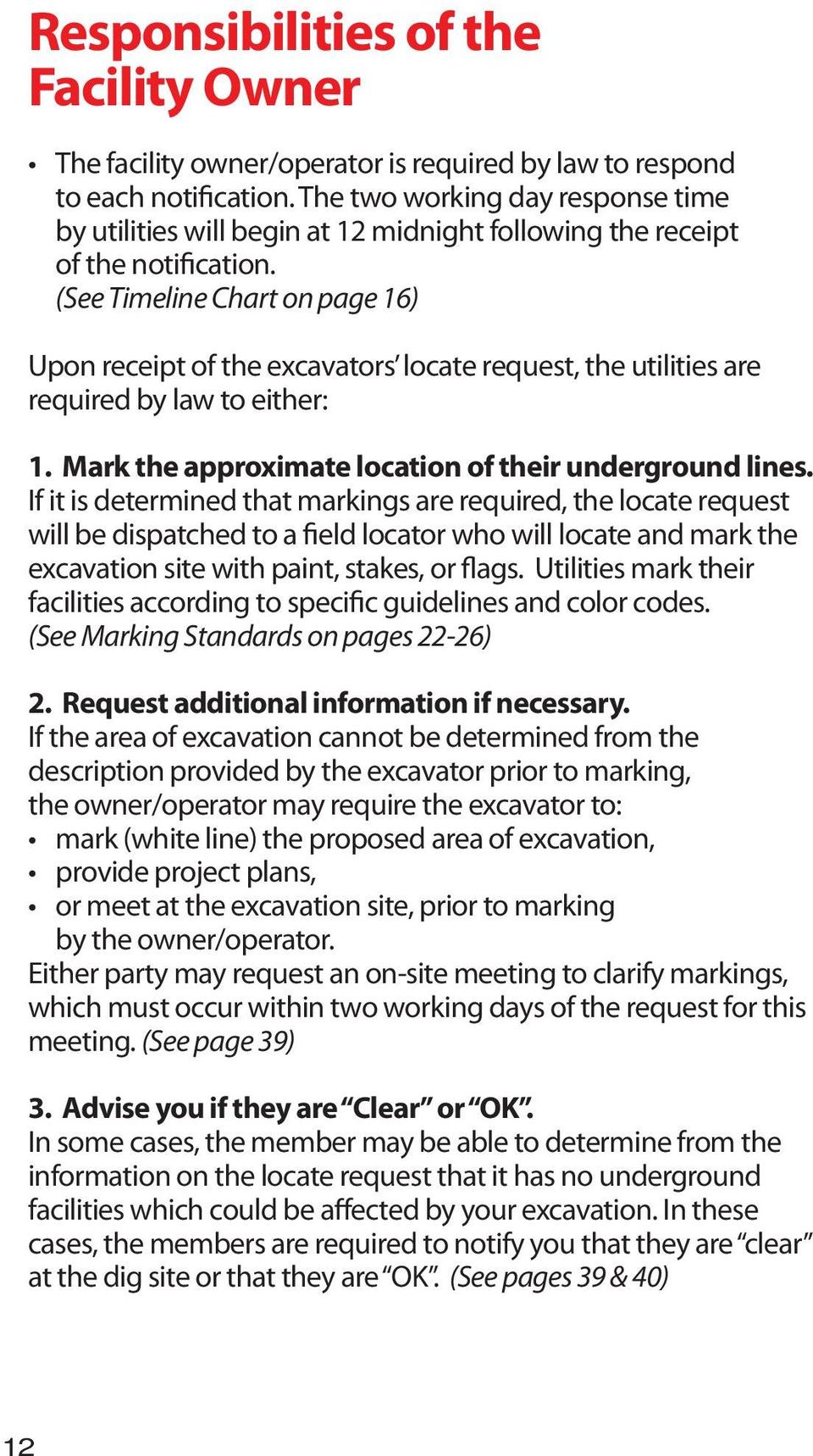
14 Responsibilities of the Facility Owner The facility owner/operator is required by law to respond to each notification. The two working day response time by utilities will begin at 12 midnight following the receipt of the notification. (See Timeline Chart on page 16) Upon receipt of the excavators locate request, the utilities are required by law to either: 1. Mark the approximate location of their underground lines. If it is determined that markings are required, the locate request will be dispatched to a field locator who will locate and mark the excavation site with paint, stakes, or flags. Utilities mark their facilities according to specific guidelines and color codes. (See Marking Standards on pages 22-26) 2. Request additional information if necessary. If the area of excavation cannot be determined from the description provided by the excavator prior to marking, the owner/operator may require the excavator to: mark (white line) the proposed area of excavation, provide project plans, or meet at the excavation site, prior to marking by the owner/operator. Either party may request an on-site meeting to clarify markings, which must occur within two working days of the request for this meeting. (See page 39) 3. Advise you if they are Clear or OK. In some cases, the member may be able to determine from the information on the locate request that it has no underground facilities which could be affected by your excavation. In these cases, the members are required to notify you that they are clear at the dig site or that they are OK. (See pages 39 & 40) 12
15 Methods of advising the excavator that they have no facilities at the dig site include: 1. Calling the telephone number of the excavator or supervisor managing the excavation. 2. Leaving a message on a recording device. 3. Calling the cell phone of the excavator or supervisor of the excavation. 4. Notifying the excavator by facsimile or by Marking Clear or OK at the site. 6. By verbally informing the excavator in person. 7. By use of a locate status system. Following their response to the locate request, the utilities are also required to: 4. Status their response to the excavators locate request. Starting Jan. 1, 2015, if receiving locate request by , utilities are required to status their response to the locate request by using the MOCS Ticket Check program. If a utility is unable to receive the locate request by , they will be required to use an alternative system starting Jan. 1, Initiate any request for extended start date and time through the MOCS call center. Sewer and Water Utilities Verbiage in the law addressing additional responsibilities of sewer and water utilities may be viewed on pages 41 &

16 Extended Start Date and Time Request Process 1. Utility initiates the request to extend the start date and time through the MOCS call center. Request must be made either by or by phone prior to the original locate request start date and time, stating a proposed start date and time Only Routine and Renewal tickets can be extended 2. Call center will contact the excavator with the proposed extension. 3. If excavator accepts the extension, the call center will send a revised ticket to the utilities. If the excavator declines the request or fails to respond, the requested extended start date and time is not valid. Color Codes 14

17 The Most Common Causes Of Damages 1. Failure to exercise due care while digging, blind boring or directional drilling in the approximate location of underground facilities. 2. Working without a locate request. 3. Failing to confirm the response of all utilities before beginning excavation. 4. Assuming that the Approximate Location marks are exactly accurate and mechanically digging right up to the marks. 5. Beginning excavation before the start date and time. 6. Working outside the area described on the locate request. 7. Beginning work before all utilities at the site have marked or responded. 8. Neglecting to place a No Response ticket. 9. Assuming the depth of a facility. 15

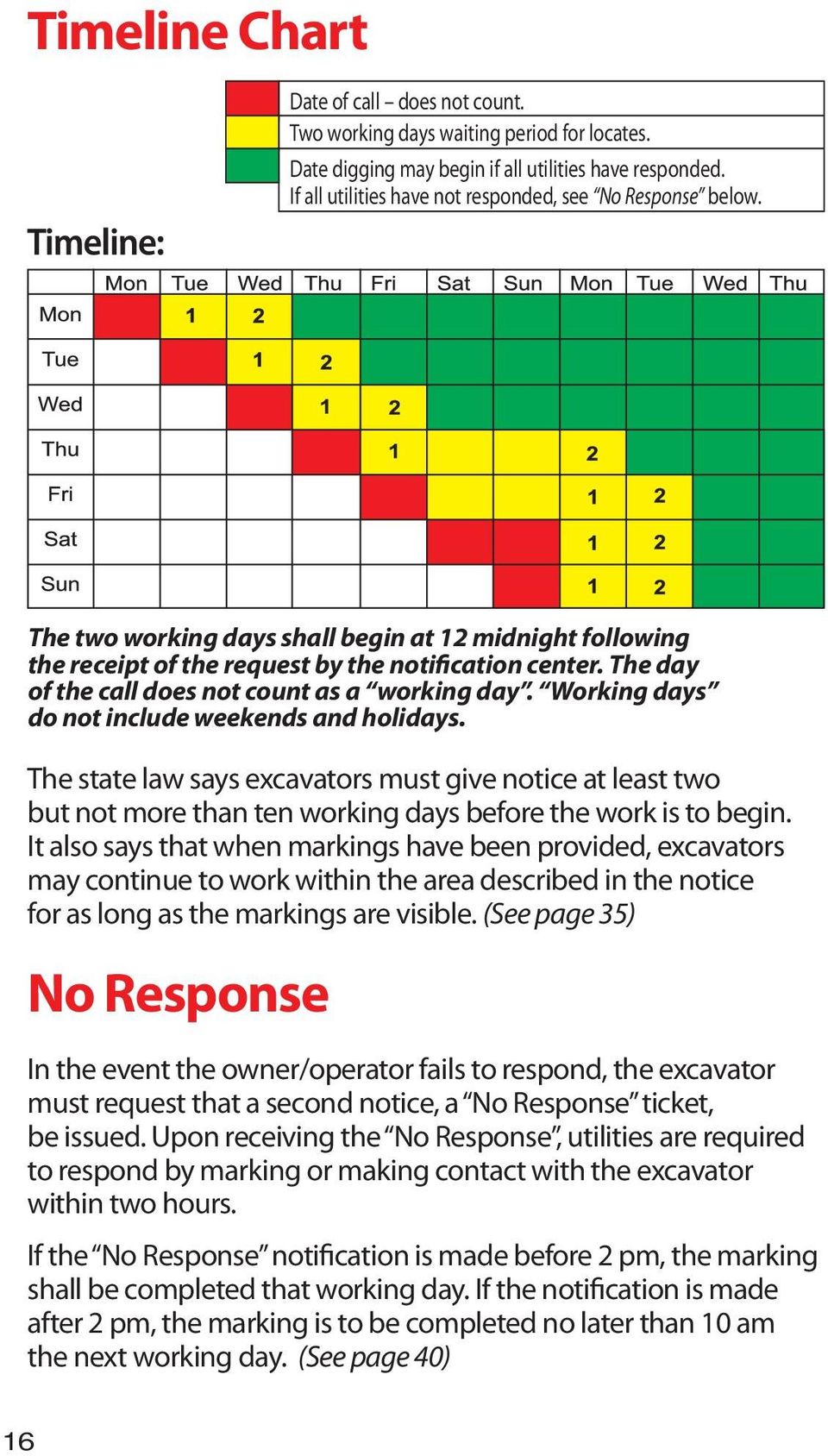
18 Timeline Chart Date of call does not count. Two working days waiting period for locates. Date digging may begin if all utilities have responded. If all utilities have not responded, see No Response below. The two working days shall begin at 12 midnight following the receipt of the request by the notification center. The day of the call does not count as a working day. Working days do not include weekends and holidays. The state law says excavators must give notice at least two but not more than ten working days before the work is to begin. It also says that when markings have been provided, excavators may continue to work within the area described in the notice for as long as the markings are visible. (See page 35) No Response In the event the owner/operator fails to respond, the excavator must request that a second notice, a No Response ticket, be issued. Upon receiving the No Response, utilities are required to respond by marking or making contact with the excavator within two hours. If the No Response notification is made before 2 pm, the marking shall be completed that working day. If the notification is made after 2 pm, the marking is to be completed no later than 10 am the next working day. (See page 40) 16
19 Records Utilities are required to keep accurate records and act responsibly. The utility must correct its installation records to show the actual location when informed by the excavator the facilities were incorrectly located. Utilities are required to keep their member contact information up-to-date with MOCS. Ticket Remarks If markings become unusable due to weather, construction, or other causes, a remark request should be made using the original locate request serial number. (See page 36) A remark request is handled in the same manner, within the same time frame, as required in an original notice. (See Timeline Chart on page 16) The excavator may be charged for remarking if the excavator fails to exercise reasonable care to preserve the marks or makes repeated unnecessary requests for remarking. Importance of Accurate Information In order to insure proper notification and correct facility markings, it is essential that accurate information about the location of the excavation site is provided by the caller. Accurate, detailed location information will help eliminate unnecessary notifications and will help locators find the excavation site quickly and mark accurately. 17

20 White Lining or White Flags Marking the dig site with white flags or paint is strongly recommended. White lines or flags improve the utilities ability to do a fast and accurate locate, directly benefiting the excavator. MOCS supplies free white flags from its web site mo1call.com. Design Tickets Knowing what utilities are involved in the planning stages of a project is an important aspect of damage prevention. Individuals involved in planning a project should use one of the two types of Design tickets available. The Preliminary Design ticket identifies all members within the given area. A list of contacts and phone numbers will be faxed or ed to the caller. No locate request will be transmitted to member companies. The second type of Design ticket will generate an actual locate request allowing a (5) five working day response time by the notified utilities. (See pages 37 & 38) Excavation is not allowed on a design ticket. A routine locate request must be made before excavation begins. 18

21 Holidays State holidays are not considered a working day. The start date of your excavation will be extended when a holiday falls within the utility response time. (See page 30) To view a list of legally declared state holidays, go to the MOCS web site Click on FAQ s to view the calendar dates associated with the following state holidays. New Years Martin Luther King Jr Day Lincoln s Birthday Presidents Day Truman s Birthday Memorial Day Independence Day Labor Day Columbus Day Veterans Day Thanksgiving Christmas Day Depth of Facilities Utilities are not responsible for the depth of their facilities under Missouri law. Factors such as erosion or landscaping can change the depth of an installed facility. It is recommended that the excavator never assume that any facility is at a given depth. Farmers are required to submit a locate request whenever working at a depth greater than 16 inches. 19
22 Privately Owned Facilities Utilities are required to mark only the facilities that they own or operate. Markings are usually made up to the meter. Facilities past the meter are usually privately owned. Prior to digging, the excavator should work with the homeowner/ landowner to try and determine the location of any private facilities. Emergency An Emergency is defined as a situation resulting from a sudden unexpected occurrence and presenting a clear and imminent danger demanding immediate action to prevent or mitigate loss or damage to life, health, property or essential public services. (See pages 45 & 46) The excavator may be liable for the cost of locating an Emergency ticket that does not meet the legal definition. (See page 46) Required Utility Participation RSMo 319 requires all owners and operators in the state of Missouri with underground facilities in public right-of-way to participate in the Missouri One Call System. This requirement became effective January 1, If you encounter a utility at your excavation site which is not a member of MOCS: 1. Contact them directly about your excavation. 2. Advise them of their requirement to belong to MOCS. 3. Call the MOCS office at with their contact information. Trenchless Excavation: Horizontal Boring and Directional Drilling Specific requirements apply when horizontal boring or directional drilling activities occur within the marked approximate location of an underground facility. (See pages 43 & 44) 20
23 How Large of an Area Can Be Placed on One Ticket? To ensure that your tickets are done accurately and on time, MOCS policy limits the size of a ticket to: One mile in the county, on the same road. 1/2 mile within city limits, on the same road. Ten individual addresses per 100 block, all having the same marking instructions. Enforcement and Penalties Enforcement of the Underground Safety and Damage Prevention law is administered by the Missouri Attorney General and can be up to $10,000 per violation per day (See pages 44 & 45). Recent actions by the AG s office have resulted in warning letters and fines to both utilities and excavators that have failed to comply with the law. To make a complaint to the Attorney General about a utility or excavator, view the MOCS website ( under Manuals and Laws for contact information or call the MOCS office at Approximate Location An Approximate Location is defined by Missouri law as a strip of land not wider than the width of the underground facility, plus two feet on either side thereof. Excavation within this area should be done in a safe and prudent manner. Hand digging is recommended. (See page 27) 21
24 Missouri Marking Standards Missouri has adapted the CGA Best Practices Version 10.0 Marking Standards. To view the full set of guidelines, go to Color Codes/Marking Specs on the MOCS website look under Locating and Marking Best Practices. Guidelines for Excavation Delineation 60/ The following marking illustrations are examples of how excavators may choose to mark their area of proposed excavation. The use of white marking products (e.g., paint, flags, stakes, whiskers, or a combination of these) may be used to identify the excavation site. 1. Single Point Excavation Markings 2. Single Stake Marking Center Point of Excavation Site 22
25 3. Trenching, Boring, or Other Continuous-Type Excavations 4. Continuous Excavation Marking Mark in white paint the proposed centerline of planned excavation using 6 in. to 12 in. 1 in. arrows approximately 4 ft. to 50 ft. apart to show direction of excavation. Reduce the separation of excavation marks to a length that can reasonably be seen by the operator s locators when the terrain at an excavation site warrants. Mark lateral excavations with occasional arrows showing excavation direction from centerline with marks at curb or property line if crossed. Dots may be used for curves and closer interval marking. 5. Stake, Flag, or Whisker Excavation Markers 23
26 Guidelines for Operator s Facility Field Delineation 61/ Operator markings of facilities include the following: The appropriate color for their facility type. Their company identifier (name, initials, or abbreviation) when other companies are using the same color. The total number of facilities and the width of each facility. A description of the facility (HP, FO, STL, etc). Use paint, flags, stakes, whiskers, or a combination to identify the operator s facility(s) at or near an excavation site. 1. Marks in the appropriate color are approximately 12 in. to 18 in. long and 1 in. wide, spaced approximately 4 ft. to 50 ft. apart. 2. Mark the subsurface installations: A. Single Facility Marking: C. Conduit Marking: D. Corridor Marking: B. Multiple Facility Marking: 24
27 3. Changes in direction and lateral connections: A. Radius: C. Painted Offset (off): B. Lateral Connection: D. Staked Offset (off): 4. Operator s Identifier (name, abbreviation, or initials) is placed at the beginning and at the end of the proposed work. In addition, subsequent operators using the same color, mark their company identifier at all points where their facility crosses another operator s facility using the same color. Reduce the separation of excavation marks to a length that can reasonably be seen by the operator s locators when the terrain at an excavation site warrants. CITYCO ELECO TELCO 5. Information regarding the size and composition of the facility is marked at an appropriate frequency. Examples: the number of ducts in a multi-duct structure, width of a pipeline, and whether it is steel, plastic, cable, etc. TELCO GASCO WATERCO 9/4 CAB 4 PLA 12 STL 6. Facilities installed in a casing are identified as such. Examples: 6 in. plastic in 12 in. steel and fiber optic in 4 in. steel GASCO TELCO 6 PLA/12 STL FO (4 STL) 25
28 7. Structures such as vaults, inlets, and lift stations that are physically larger than obvious surface indications are marked so as to define the parameters of the structure. 8. Termination points or dead ends are indicated as such. 9. When there is No Conflict with the excavation, complete one or more of the following: Operators of a single type of facility (e.g., TELCO) mark the area NO followed by the appropriate company identifier in the matching APWA color code for that facility. Example: NO TELCO Operators of multiple facilities mark the area NO followed by the appropriate company identifier in the matching APWA color code for that facility with a slash and the abbreviation for the type of facility for which there is No Conflict. Example: NO GASCO/G/D illustrates that GASCO has no gas distribution facilities at this excavation site. The following abbreviations are used when appropriate: /G/D (gas distribution); /G/T (gas transmission); /E/D (electric distribution); /E/T (electric transmission). Place a clear plastic (translucent) flag that states No Conflict in lettering matching the APWA color code of the facility that is not in conflict. Include on the flag the operator s identifier, phone number, a place to write the locate ticket number, and date. Operators of multiple facilities indicate on the flag which facilities are in No Conflict with the excavation (see the previous example). If it can be determined through maps or records that the proposed excavation is obviously not in conflict with their facility, the locator or operator of the facility may notify the excavator of No Conflict by phone, fax, or , or through the one call center, where electronic positive response is used. Operators of multiple facilities indicate a No Conflict for each facility (see the previous examples). Place No Conflict markings or flags in a location that can be observed by the excavator and/or notify the excavator by phone, fax, or that there is No Conflict with your facilities. When the excavation is delineated by the use of white markings, place No Conflict markings or flags in or as near as practicable to the delineated area. Caution: Allow adequate space for all facility mark-outs. No Conflict indicates that the operator verifying the No Conflict has no facilities within the scope of the delineation; or when there is no delineation, there are no facilities within the work area as described on the locate ticket. 26
29 Following is a copy of the Missouri Statute. It is recommended that you read it thoroughly for a better understanding of underground damage prevention. Missouri Revised Statutes Chapter 319 General Safety Requirements Short title Sections through shall be known as the Underground Facility Safety and Damage Prevention Act. Definitions For the purposes of sections to , the following terms mean: (1) Approximate location, a strip of land not wider than the width of the underground facility plus two feet on either side thereof. In situations where reinforced concrete, multiplicity of adjacent facilities or other unusual specified conditions interfere with location attempts, the owner or operator shall designate to the best of his or her ability an approximate location of greater width; (2) Design request, a request from any person for facility location information for design purposes only; (3) Emergency, a sudden, unexpected occurrence, presenting a clear and imminent danger demanding immediate action to prevent or mitigate loss or damage to life, health, property, or essential public services. Unexpected occurrence includes, but is not limited to, thunderstorms, high winds, ice or snow storms, fires, floods, earthquakes, or other soil or geologic movements, riots, accidents, water or wastewater pipe breaks, vandalism, or sabotage; (4) Excavation, any operation in which earth, rock or other material in or on the ground is moved, removed or otherwise displaced by means of any tools, equipment or explosives and includes, without limitation, backfilling, grading, trenching, digging, ditching, pulling material from a ditch but not including 27 DEFINITIONS
30 DEFINITIONS routine road maintenance, drilling, well-drilling, augering, boring, tunneling, scraping, cable or pipe plowing, plowing-in, pulling-in, ripping, driving, and demolition of structures, except that, the use of mechanized tools and equipment to break and remove pavement and masonry down only to the depth of such pavement or masonry on roads dedicated to the public use for vehicular traffic, the tilling of soil for agricultural purposes when such excavation does not exceed sixteen inches in depth, the installation of marking flags and stakes and the use of pressurized air to disintegrate and suction to remove earth, rock, or other materials for the location of underground facilities shall not be deemed excavation. Backfilling or moving earth on the ground in connection with other excavation operations at the same site shall not be deemed separate instances of excavation. For railroads regulated by the Federal Railroad Administration, excavation shall not include any excavating done by a railroad when such excavating is done entirely on land that the railroad owns or on which the railroad operates, or in the event of an emergency, excavating done by a railroad on adjacent land; (5) Excavator, any person making one or more excavations who is required to make notices of excavation under the requirements of sections to ; (6) Locate status, the underground facility owner s designation of the status of the locate request to the notification center which then makes that information available to the person making the locate request through electronic or other means; (7) Marking, the use of paint, flags, stakes, or other clearly identifiable materials to show the field location of underground facilities, or the area of proposed excavation, in accordance with the marking standards for underground facilities as designated by the Common Ground Alliance Best Practices Version 10.0 except that approximate location shall comply with the requirements as set forth in subdivision (1) of this section; (8) Notification center, a statewide organization operating twenty-four hours a day, three hundred sixty-five days a year on a not-for-profit basis, supported by a majority of the underground facility owners in the state of Missouri; 28
31 (9) Notification center participant, an underground facility owner who is a member and participant in the notification center; (10) Permitted project, a project for which a permit for the work to be performed is required to be issued by a local, state or federal agency and, as a prerequisite to receiving such permit, the applicant is required to notify all underground facility owners in the area of the work for purposes of identifying the location of existing underground facilities; (11) Person, any individual, firm, joint venture, partnership, corporation, association, cooperative, municipality, political subdivision, governmental unit, department or agency and shall include a notification center and any trustee, receiver, assignee or personal representative thereof; (12) Pipeline facility includes all parts of a facility through which a hazardous liquid or gas moves in transportation including, but not limited to, pipe, valves and other appurtenances connected to pipe, pumping units, fabricated assemblies associated with pumping units, metering and delivery stations and fabricated assemblies therein, and breakout tanks; DEFINITIONS (13) State plane coordinates, a system of locating a point on a flat plane developed by the National Oceanic and Atmospheric Administration and utilized by state agencies, local governments, and other persons to designate the site of a construction project; (14) Trenchless excavation, horizontal excavation parallel to the surface of the earth which does not use trenching or vertical digging as the primary means of excavation, including but not limited to directional boring, tunneling, or augering; (15) Underground facility, any item of personal property which shall be buried or placed below ground for use in connection with the storage or conveyance of water, storm drainage, sewage, telecommunications service, cable television service, electricity, oil, gas, hazardous liquids or other substances, and shall include but not be limited to pipes, sewers, conduits, cables, valves, vaults, lines, wires, manholes, attachments, or appurtenances, and those portions of pylons or other supports below ground that are 29
32 DEFINITIONS within any public or private street, road or alley, right-of-way dedicated to the public use or utility easement of record, or prescriptive easement. If gas distribution lines or electric lines, telecommunications facilities, cable television facilities, water service lines, water system, storm drainage or sewer system lines, other than those used for vehicular traffic control, lighting of streets and highways and communications for emergency response, are located on private property and are owned solely by the owner or owners of such private property, such lines or facilities receiving service shall not be considered underground facilities for purposes of this chapter, except at locations where they cross or lie within an easement or right-of-way dedicated to public use or owned by a person other than the owner of the private property. Water and sanitary sewer lines providing service to private property that are owned solely by the owner of such property shall not be considered underground facilities at any location. A structure that transports only storm water drainage under roadways, driveways, or railways shall not be considered an underground facility; REQUIRED UTILITY PARTICIPATION (16) Underground facility owner, any person who owns or operates underground facilities; (17) Working day, every day, except Saturday, Sunday or a legally declared state or federal holiday. Notification centers, participation requirements and eligibility--names of owners and operators made available, when Any person, except a railroad regulated by the Federal Railroad Administration, who installs or otherwise owns or operates an underground facility shall become a participant in a notification center upon first acquiring or owning or operating such underground facility. All underground facility owners within the state shall maintain participation in a notification center for the duration of owning and operating such underground facility. Such notification center shall be governed by a board of directors elected by the membership and composed of representatives from the general membership group. 2. The notification center shall maintain in its offices and make available to any notification center participant or excavator upon request a current list of the names and addresses of each 30
33 notification center participant, including the county or counties wherein each participant has underground facilities. The notification center may charge a reasonable fee to notification center participants or excavators requesting such list as is necessary to recover the actual costs of printing and mailing. 3. Excavators shall be informed of the availability of the list of notification center participants. 4. An annual audit or review of the notification center shall be performed by a certified public accountant and a report of the findings submitted to the speaker of the house of representatives and the president pro tem of the senate. Public notice of excavations, duties of owner and operator Every person owning or operating an underground facility shall assist excavators and the general public in determining the location of underground facilities before excavation activities are begun or as may be required by subsection 6 of section or subsection 1 of section after an excavation has commenced. Methods of informing the public and excavators of the means of obtaining such information may, but need not, include advertising, including advertising in periodicals of general circulation or trade publications, information provided to professional or trade associations which routinely provide information to excavators or design professionals, or sponsoring meetings of excavators and design professionals for such purposes. Information provided by the notification center on behalf of persons owning or operating an underground facility shall be deemed in compliance with this section by such persons. UTILITY RESPONSIBILITIES 2. Every person owning or operating underground pipeline facilities shall, in addition to the requirements of subsection 1 of this section: (1) Identify on a current basis persons who normally engage in excavation activities in the area in which the pipeline is located. Every such person who is a participant in a notification center shall be deemed to comply with this subdivision if such notification center maintains and updates a list of the names and addresses of all excavators who have given notice of intent to excavate to such notification center during the previous year and provided 31
34 UTILITY RESPONSIBILITIES the notification center shall, not less frequently than annually, provide public notification and actual notification to all excavators on such list of the existence and purpose of the notification center, and procedures for obtaining information from the notification center; (2) Either directly or through the notification center, notify excavators and the public in the vicinity of his or her underground pipeline facility of the availability of the notification center by including the information set out in subsection 1 of section in notifications required by the safety rules of the Missouri public service commission relating to its damage prevention program; (3) Notify excavators annually who give notice of their intent to excavate of the type of marking to be provided and how to identify the markings. EXCAVATOR RESPONSIBILITIES Excavator must give notice and obtain information, when, how notice to notification center, when--clarification of markings, response--permit for highway excavation required Except as provided in subsection 4 of section and in section , a person shall not make or begin any excavation in any public street, road or alley, right-of-way dedicated to the public use or utility easement of record or within any private street or private property without first giving notice to the notification center and obtaining information concerning the possible location of any underground facilities which may be affected by said excavation from underground facility owners whose names appear on the current list of participants in the notification center and who were communicated to the excavator as notification center participants who would be informed of the excavation notice. Notice to the notification center of proposed excavation shall be deemed notice to all owners and operators of underground facilities. The notice referred to in this section shall comply with the provisions of section An excavator s notice to owners and operators of underground facilities participating in the notification center pursuant to section is ineffective for purposes of subsection 1 of this section unless given to such notification center. 32
35 3. Notification center participants shall be relieved of the responsibility to respond to a notice of intent to excavate received directly from the person intending to commence an excavation, except for requests for clarification of markings through on-site meetings as provided in subsection 1 of section and requests for locations at the time of an emergency as provided by section Notwithstanding the provisions of this section to the contrary, a person shall not make or begin any excavation in any state highway, or on the right-of-way of any state highway, without first obtaining a permit from the state highways and transportation commission pursuant to section , provided however, the provisions of this subsection shall not apply to railroad right-of-way owned or operated by a railroad. Notice of excavator, form of--written record maintained incorrect location of facility, duty of excavator--visible markings necessary to continue work--damage, dislocation, or disturbance, notification and reporting requirements-- annual report of damages required, by whom An excavator shall serve notice of intent to excavate to the notification center by toll-free telephone number operated on a twenty-four hour per-day, seven day per-week basis or by facsimile or by completing notice via the internet at least two working days, but not more than ten working days, before the expected date of commencing the excavation activity. The notification center receiving such notice shall inform the excavator of all notification center participants to whom such notice will be transmitted and shall promptly transmit all details of such notice provided under subsection 2 of this section to every notification center participant in the area of excavation. 2. Notices of intent to excavate given pursuant to this section shall contain the following information: (1) The name and telephone number of the person filing the notice of excavation, if the telephone number is different than that of the excavator, and the name, address, telephone number of the excavator and whether the excavator s telephone is equipped with a recording device; EXCAVATOR RESPONSIBILITIES CALL CENTER RESPONSIBILITIES REQUIRED LOCATE REQUEST INFO 33
36 (2) The date the excavation activity is expected to commence, the depth of planned excavation and, if applicable, that the use of explosives is anticipated on the excavation site, and the type of excavation being planned, including whether the excavation involves trenchless excavation; (3) The facsimile number, address, and cellular telephone number of the excavator, if any; (4) The name of the person primarily responsible for conducting the excavation or managing the excavation process, and if any of the information stated in subdivision (1) or (3) of this subsection is different for the person primarily responsible for the excavation, the notice shall also state the same information for that person; REQUIRED LOCATE REQUEST INFO (5) A detailed description accepted by the notification center sufficient for the location of the excavation by any one or more of the following means: by reference to a specific street address, or by description of location in relation to the nearest numbered, lettered, or named state or county road or city street for which a road sign is posted, or by latitude and longitude including the appropriate description in degrees, minutes, and seconds, or by state plane coordinates; (6) A description of the site of excavation by approximate distance and direction from the nearest state or county road or city street or intersection of such roads or streets unless previously provided under subdivision (5) of this subsection, and the proximity of the site to any prominent landmarks; (7) A description of the location or locations of the excavation at the site described by direction and approximate distance in relation to prominent features of the site, such as existing buildings or roadways; (8) Directions as to how to reach the site of the excavation from the nearest such road, if the excavation is not on or near a posted numbered, lettered, or named state or county road or city street. 3. The notification center receiving such notice shall solicit all information required by subsection 2 of this section and shall 34
37 require the excavator to provide all such information before notice by the excavator is deemed to be completed pursuant to sections to The notification center shall transmit all details of such notice as required by this section. 4. A record of each notice of intent to excavate shall be maintained by the notification center for a period of five years. The record shall include the date the notice was received and all information required by subsection 2 of this section which was provided by the excavator and a record of the underground facility owners notified by the notification center. If the notification center creates a record of the notice by telephonic recording, such record of the original notice shall be maintained for one year from the date of receipt. Records of notices to excavate maintained by the notification center in electronic form shall be deemed to be records under this subsection. Persons holding records of notices of intent to excavate and records of information provided to the excavator by the notification center or owner or operator of the facility shall make copies of such records available for a reasonable copying fee upon the request of the owner or operator of the underground facilities or the excavator filing the notice. 5. If in the course of excavation the person responsible for the excavation operations discovers that the owner or operator of the underground facility who is a participant in a notification center has incorrectly located the underground facility, he or she shall notify the notification center which shall inform the underground facility owner. The underground facility owner shall respond to the incorrect locate notification within two hours of receipt of the notification by contacting the person responsible for the excavation or by correctly locating their underground facility. The person responsible for maintaining records of the location of underground facilities for the notification center participant shall correct such records to show the actual location of such facilities, if current records are incorrect. 6. When markings have been provided in response to a notice of intent to excavate, excavators may commence or continue to work within the area described in the notice for so long as the markings are visible. If an excavator is unable to begin the excavation within ten working days as described in the request, the excavator INCORRECT LOCATE REMARKS 35
38 REMARKS DAMAGES CONFIRMING FACILITY LOCATION - HAND DIGGING shall make a relocate request before beginning the excavation. If markings become unusable due to weather, construction or other cause, the excavator shall contact the notification center to request remarking. Such notice shall be given in the same manner as original notice of intent to excavate, and the owner or operator shall remark the site in the same manner, within the same time, as required in response to an original notice of intent to excavate. Each excavator shall exercise reasonable care not to unnecessarily disturb or obliterate markings provided for location of underground facilities. If remarking is required due to the excavator s failure to exercise reasonable care, or if repeated unnecessary requests for remarking are made by an excavator even though the markings are visible and usable, the excavator may be liable to the owner or operator for the reasonable cost of such remarking. Nothing in this section shall allow any person other than the facility owner or their representative to mark or relocate any underground facility. 7. Before commencing excavation, the excavator shall determine best practices for confirming the horizontal and vertical location of facilities at the site of excavation considering conditions at the site including geology, access to the site, and the presence of paved surfaces. Hand digging or soft digging shall be used as a best practice when possible. 8. In the event of any damage, dislocation, or disturbance of any underground facility in connection with any excavation, the person responsible for the excavation operations shall notify the notification center. This subsection shall be deemed to require reporting of any damage, dislocation, or disturbance to trace wires, encasements, cathode protection, permanent aboveground stakes, or other such items utilized for protection of the underground facility. The excavator shall immediately contact 911 when any damage or contact with a pipeline results in a release from the pipeline of hazardous liquid or gas to occur. 9. In the event of any damage, dislocation, or disturbance to any underground facility or any protective devices required to be reported by the excavator under subsection 8 of this section in advance of or during the excavation work, the person responsible for the excavation operations shall not conceal or attempt to conceal such damage, dislocation, or disturbance, nor shall that 36
39 person attempt to make repairs to the facility unless authorized by the underground facility owner. In the case of sewer lines or facilities, emergency temporary repairs may be made by the excavator after notification without the owners or operators authorization to prevent further damage to the facilities. Such emergency repairs shall not relieve the excavator of responsibility to make notification as required by subsection 8 of this section. 10. No later than April 1, 2015, and each year thereafter, each underground facility owner who owns or operates electric, gas, or pipeline facilities shall submit to a central repository designated by the notification center a report of damages experienced by its facilities for the prior calendar year. The notification center shall determine the minimum information to be reported. All data submitted shall be aggregated and anonymous. Information provided by the underground facility owner specific to damage data submitted shall be accessible only to the underground facility owner unless otherwise designated by the underground facility owner. Design requests, how made--marking location required Any person may make design requests by contacting the notification center. Such design requests shall include all information deemed necessary by the notification center to complete the notice, including the identification of the person and a description of the location of the project being designed and other information similar to that required of excavators under section Design requests shall be made to the notification center at least five working days, but not more than ten working days, before the date the person has requested receiving the information from the underground facility owner. Upon receipt of a design request, the notification center shall inform the person of the name of all notification center participants to whom the notice will be transmitted and shall promptly transmit such notice to the appropriate underground facility owners. DAMAGE REPORTING DESIGN REQUREST 3. Every underground facility owner who receives a design request shall mark the location of the facility, or contact the person making the request, within five working days after the date the notice was 37
40 DESIGN REQUEST UTILITY RESPONSIBILITIES received from the notification center. If the person making the request was contacted as an alternative to marking location, the person and the underground facility owner shall mutually agree on a schedule and method for providing the information, provided that the facility shall be marked within five working days if the facility owner and the person making the request are unable to agree. 4. No excavation may be commenced based upon information received through a design request. Obtaining information through a design request shall not excuse any person commencing an excavation from making notice and obtaining information under sections and concerning the possible location of any underground facilities which may be affected. Notification of location of underground facility, when, how failure to provide notice of location, effect Every person owning or operating an underground facility to whom notice of intent to excavate is required to be given shall, upon receipt of such notice as provided in this section from a person intending to commence an excavation, inform the excavator as promptly as practical, but not in excess of two working days, unless the excavator agrees to extend the start date and time provided in the locate request through methods established by the notification center, of the approximate location of underground facilities in or near the area of the excavation so as to enable the person engaged in the excavation work to locate the facilities in advance of and during the excavation work, provided that no excavation shall begin earlier than the scheduled excavation date provided on the locate request unless the excavator has confirmed that all underground facilities have been located. The two working days provided for notice in this subsection and subsection 1 of section shall begin at 12:00 a.m. following the receipt of the request by the notification center. Each underground facility owner receiving notifications from the notification center by use of the internet shall, after December 31, 2014, use the locate status system provided by the notification center. Those underground facility owners that do not receive notifications by use of the internet shall, no later than January 1, 2016, provide locate status to the notification 38
41 center by an alternate method provided by the notification center. If the excavator states in the notice of intent to excavate that the excavation will involve trenchless technology, the owner or operator shall inform the excavator of the depth, to the best of his or her knowledge or ability, of the facility according to the records of the owner or operator. The owner or operator shall provide the approximate location of underground facilities by use of markings as designated in section Persons representing the excavator and the owner or operator shall meet on the site of excavation within two working days of a request by either person for such meeting for the purpose of clarifying markings, or upon agreement of the excavator and owner or operator, such meeting may be an alternate means of providing the location of facilities by originally marking the approximate location of the facility at the time of the meeting. If upon receipt of a notice of intent to excavate, an owner or operator determines that he or she neither owns or operates underground facilities in or near the area of excavation, the owner or operator shall within two working days after receipt of the notice, inform the excavator that the owner or operator has no facilities located in the area of the proposed excavation. The owner or operator of the underground facility shall make notice to the excavator that no facilities are located in the area of excavation by contacting the excavator by any of the following methods: ON-SITE MEETINGS NO FACILITIES (1) By calling the primary number of the excavator or by calling the telephone number of the responsible person as provided by the excavator under subdivision (4) of subsection 2 of section ; (2) By leaving a message on the recording device for such numbers; (3) By calling the cellular telephone number of the excavator or responsible person; (4) By notifying the excavator by facsimile or electronic mail at numbers or addresses stated by the excavator in the notice of excavation made under subsection 2 of section ; (5) By marking clear or OK at the site of excavation; 39
42 NO RESPONSE (6) By verbally informing the excavator in person. If the only means of contacting the excavator is one or more telephone numbers provided by the excavator in the notice of excavation under section , then two attempts by the underground facility owner to contact the excavator at one of the telephone numbers provided shall constitute compliance with this subsection; or (7) By use of a locate status system. 2. A record of the date and means of informing the excavator that no facilities were located by the owner or operator shall be included in the written records of the underground facility owner regarding each specific notice of excavation and shall be retained for a period of five years. 3. If the owner or operator notifies the excavator that the area of excavation cannot be determined from the description provided by the excavator through the notice required by this section, the excavator shall provide clarification of the area of excavation by marking the area with white flags or white paint, or by providing project plans to the owner or operator, or by meeting on the site of the excavation with representatives of the owner or operator as provided for in this section. 4. In the event that a person owning or operating an underground facility fails to comply with the provisions of subsection 1 of this section after notice given by an excavator in compliance with section , the excavator, prior to commencing the excavation, shall give a second notice to the notification center as required by section stating that there has been no response to the original notice given under section After the receipt of the notice stating there has been no response, the owner or operator of an underground facility shall, within two hours of the receipt of such notice, mark its facilities or contact and inform the excavator of when the facilities will be marked; provided, however, that for no response notices made to the notification center by 2:00 p.m., the markings shall be completed on the working day the notice is made to the notification center, and provided that for no response notices made to the notification center after 2:00 p.m., the markings shall be completed no later than 10:00 a.m. on the next working day. 40
43 If an underground facility owner fails to mark its facilities or contact the excavator as required by this subsection, the excavator may commence the excavation. Nothing in this subsection shall excuse the excavator from exercising the degree of care in making the excavation as is otherwise required by law. 5. For purposes of this section, a period of two working days begins at 12:00 a.m. following when the request is made. Sewer system owner duties upon notification of intent to excavate In addition to the other requirements of section , the response to a notice of intent to excavate received by a sewer system owner, when such owner has underground facilities located in the area of excavation identified in the notice and when the notice indicates that trenchless excavation methods will be used, shall include a determination of whether sewer service connections exist in the area of the excavation. 2. If the sewer system owner determines that sewer service connections exist in the area of the excavation identified in a notice of intent to excavate, the owner shall provide his or her best available information, or notice that the information does not exist, regarding the location of such connections to the excavator by any of the following methods: (1) Placing a triangular green mark at the approximate location of the sewer service connection pointing in the direction of the customer structure serviced; (2) Providing electronic copies of the information to the excavator; (3) Delivering copies of the information to the excavator by facsimile or by other agreed upon means; or (4) Arranging to meet the excavator at the site of the excavation to provide the information. 3. Providing the best available information, or notice that the information does not exist, regarding the location of sewer service connections that exist in the area of excavation identified in a notice of intent to excavate shall constitute full compliance with this section, and a sewer system owner shall not be liable to any party for damages or injuries resulting from an excavation if they are in compliance with this section. 41 SEWER SYSTEM RESPONSIBILITIES
44 4. Providing the best available information regarding the location of sewer service connections that exist in the area of excavation identified in a notice of intent to excavate shall not in and of itself constitute ownership, operation, control, or management of sewer service lines by a sewer system owner. WATER & SEWER FACILITIES RESPONSIBILITIES Public right-of-way, installation within, requirements By January 1, 2016, if new lateral sewer pipes or water service lines are installed and connected to an underground facility within the public right-of-way, as defined in section , or if such infrastructure is fully replaced by excavation within the public right-of-way, the facility owner shall be required to place tracer wire or other utility location technology and an access point within a protective enclosure over water lines and cleanouts for gravity sewer laterals. For sewer laterals operating under pressure or vacuum, the facility owner shall be required to place an access point within a protective enclosure and shall not be required to place a cleanout. All protective enclosures and cleanouts shall be extended to grade and installed so that it is easily accessible. For water service lines and sewer laterals operating under pressure or vacuum, tracer wire, or other utility location technology, shall be placed within the protective enclosure to provide approximate location of the underground facilities in these areas that are located within a public right-of-way. An underground facility owner shall not be liable to any party for damages or injuries resulting from an excavation if they are in compliance with this section. This section shall apply to all installations of water service lines and sewer laterals without regard to their status as underground facilities under section Nothing in this section shall require any owner of underground facilities who is not otherwise required under sections to to become a notification center participant. Compliance with law still requires excavation to be made in careful and prudent manner failure to give notice or mark facilities, rebuttable presumption of negligence Obtaining information as required by sections to does not excuse any person making any excavation from doing so in a careful and prudent manner. 42
45 2. Nothing in sections to shall relieve an excavator from the obligation to excavate in a safe and prudent manner, nor shall it absolve an excavator from liability for damage to underground facilities. 3. The failure of any excavator to give notice of proposed excavation activities as required by this chapter shall be a rebuttable presumption of negligence on his or her part in the event that such failure shall cause injury, loss, or damage. In addition to any penalties provided herein, liability under common law may apply. 4. The failure of an underground facility owner to mark his or her facilities that are located in an area of excavation described in a notice of intent to excavate received by the underground facility owner, as required by section , or the failure of an underground facility owner to be a notification center participant, consistent with the provisions of section , shall be a rebuttable presumption of negligence on the part of such owner in the event that such failure shall cause injury, loss, or damage. In addition to any penalties provided herein, liability under common law may apply. Excavation sites included in requirements--equipment prohibited at such sites Notwithstanding any other provision of law to the contrary, the procedures and requirements set forth in this section shall apply on the site of any excavation involving trenchless excavation, including directional drilling, where the approximate location of underground facilities has been marked in compliance with section and where any part of the walls of the intended bore are within the marked approximate location of the underground facility. 2. The excavator shall not use power-driven equipment for trenchless excavation, including directional drilling, within the marked approximate location of such underground facilities until the excavator has made careful and prudent efforts to confirm the horizontal and vertical location thereof in the vicinity of the proposed excavation through methods appropriate to the geologic and weather conditions, and the nature of the facility, EXCAVATOR LIABILITIES DIRECTIONAL BORING 43
46 DIRECTIONAL BORING PENALTIES such as the use of electronic locating devices, hand digging, pot holing when practical, soft digging, vacuum methods, use of pressurized air or water, pneumatic hand tools or other noninvasive methods as such methods are developed. Such methods of confirming location shall not violate established safety practices. Nothing in this subsection shall authorize any person other than the owner or operator of a facility to attach an electronic locating device to any underground facility. For excavations paralleling the underground facility, such efforts to confirm the location of the facility shall be made at careful and prudent intervals. The excavator shall also make careful and prudent efforts by such means as are appropriate to the geologic and weather conditions and the nature of the facility, to confirm the horizontal and vertical location of the boring device during boring operations. Notwithstanding the foregoing, the excavator shall not be required to confirm the horizontal or vertical location of the underground facilities if the excavator, using the methods described in this section, excavates a hole over the underground facilities to a depth two feet or more below the planned boring path and then carefully and prudently monitors the horizontal and vertical location of the boring device in a manner calculated to enable the device to be visually observed by the excavator as it crosses the entire width of the marked approximate location of the underground facilities. No abrogation of contractual obligations with railroads Notwithstanding any provision of law to the contrary, nothing in this chapter shall abrogate any contractual provisions entered into between any railroad and any other party owning or operating an underground facility within the railroad s right-ofway. For railroads regulated by the Federal Railroad Administration, sections to shall not include any underground facility owned or operated by a railroad on land which the railroad owns or any excavation done by a railroad when such excavation is done entirely on land which the railroad owns. Civil penalties--attorney general may bring action and shall make public number of enforcement actions Any person who violates in any material respect the provisions of section , , , , , or this section or who willfully damages an underground facility shall be liable to the state of Missouri for a civil penalty 44
47 of up to ten thousand dollars for each violation for each day such violation persists, except that the maximum penalty for violation of the provisions of sections to shall not exceed five hundred thousand dollars for any related series of violations. An action to recover such civil penalty may be brought by the attorney general or a prosecuting attorney on behalf of the state of Missouri in any appropriate circuit court of this state. Trial thereof shall be before the court, which shall consider the nature, circumstances and gravity of the violation, and with respect to the person found to have committed the violation, the degree of culpability, the absence or existence of prior violations, whether the violation was a willful act, the effect on ability to continue to do business, any good faith in attempting to achieve compliance, ability to pay the penalty, and such other matters as justice may require in determining the amount of penalty imposed. 2. The attorney general may bring an action in any appropriate circuit court of this state for equitable relief to redress or restrain a violation by any person of any provision of sections to The court may grant such relief as is necessary or appropriate, including mandatory or prohibitive injunctive relief, temporary or permanent. 3. The attorney general shall make public the aggregate number of enforcement actions for the previously completed calendar year prior to March thirty-first of the current year. Arbitration of disputes, when Parties with a dispute related to the provisions of sections to may request arbitration for disputes of less than five thousand dollars. Exemptions from requirement to obtain information The provisions of sections and shall not apply to any excavation when necessary due to an emergency as defined in section An excavation may proceed regarding such emergency, provided all reasonable precautions have been taken to protect the underground facilities. In any such case, the excavator shall give notification, substantially in compliance with section , as soon as practical, and upon PENALTIES DISPUTES EMERGENCIES 45
48 being notified that an emergency exists, each underground facility owner in the area shall, within two hours after receiving such notice, provide markings or contact the excavator with any information immediately available to assist the excavator and shall inform the excavator if not able to mark within the two hours of when the underground facility will be marked at the site of the emergency. EMERGENCIES 2. For a request submitted as an emergency request that does not meet the definition of an emergency as defined in section , the facility owner shall notify the excavator within two hours that the request does not meet the requirements of an emergency, and the locate request will be marked within two working days under subsection 1 of section The excavator may be liable to the owner or operator for costs directly associated with the locating of any such underground facility relating to a notification of an emergency that does not meet the definition of emergency as stated in section
49 Notes: NOTES MOCS employees routinely make educational/safety presentations to groups of all types and sizes. If you would like to schedule a presentation for your employees, contact us at
50 Free Educational Packets Free educational packets are available on the MOCS website. Each packet contains the MOCS Excavator Manual, a Locate Request pad, Quick Reference card, Color Code card, sticker and a pen. Keep the packet in your truck for field reference. To order the packets, go to the MOCS website Click on Excavator Information then Order MOCS Materials to submit your order. 48
51 If you are interested in having a voice in damage prevention, please consider participating in the Common Ground effort. The mission of Missouri Common Ground is to promote communication among responsible parties to identify and encourage the use of Best Practices for damage prevention for public safety and welfare. Missouri Common Ground is an alliance between the people who are responsible for protecting underground facilities from excavation damage. Everyone who participates in the excavation process shares this responsibility. By working together, underground facility owners, excavators, contractors, contract locators, design professionals, Missouri One Call, regulators and other responsible parties can improve damage prevention, which affects: Public Safety Worker Safety Excavation Downtime Community prosperity Service Reliability Facility Repair Cost Environmental Protection
52 Excavator Manual Weathered Rock Road Jefferson City, MO DIG-RITE or 811 mo1call.com
Appendix B: Uniform Color Code & Marking Guidelines
 Appendix B: Uniform Color Code & Marking Guidelines The information contained in Appendix B is intended to be supplemental information for existing practices found within CGA Best Practices Version 2.0.
Effective July 1, 2010 WYOMING STATE LAW Title 37 Public Utilities Chapter 12 Article 3. DAMAGE TO UNDERGROUND PUBLIC UTILITY FACILITIES
 Effective July 1, 2010 WYOMING STATE LAW Title 37 Public Utilities Chapter 12 Article 3. DAMAGE TO UNDERGROUND PUBLIC UTILITY FACILITIES 37-12-301. Short title; definitions. (a) This act may be known and
APPLICATION PROCEDURES FOR PLACEMENT OF UNDERGROUND WATER AND SEWER PIPELINES IN THE VICINITY OF TRANSPORTATION FACILITIES UNDER THE
 APPLICATION PROCEDURES FOR PLACEMENT OF UNDERGROUND WATER AND SEWER PIPELINES IN THE VICINITY OF TRANSPORTATION FACILITIES UNDER THE JURISDICTION OF ALBERTA TRANSPORTATION 1.0 Application Procedures 2.0
California Excavation Law
 California Excavation Law 1 Table of Contents California Gov. Code 4216 - Page 3 CalOSHA Title 8, Section 1541 - Page 23 2 California Government Code 4216 3 4216. As used in this article the following
NEW HAMPSHIRE CODE OF ADMINISTRATIVE RULES. CHAPTER Puc 800 UNDERGROUND UTILITY DAMAGE PREVENTION PROGRAM
 CHAPTER Puc 800 UNDERGROUND UTILITY DAMAGE PREVENTION PROGRAM Statutory Authority: RSA 374:50 PART Puc 801 APPLICATION OF RULES Puc 801.01 Purpose. (a) The purpose of Puc 800 is to protect the public,
Guidelines for Excavations
 O c t o b e r 2 0 0 1 Guidelines for Excavations in the vicinity of gas lines Technical Standards & Safety Authority Putting Public Safety First Guidelines for Excavations in the Vicinity of Gas Lines
SECTION 5 DRAFTING STANDARDS
 SECTION 5 DRAFTING STANDARDS 1 SECTION FIVE TABLE OF CONTENTS Description Page TABLE OF CONTENTS... 5-2 GENERAL... 5-3 DRAFTING STANDARDS... 5-5 DRAFTING MINIMUM REQUIREMENTS HANDOUT... 5-8 2 GENERAL 1.
1. It would create hazardous effects of storm water run-off. 3. It would increase hazardous driving conditions on the public road.
 SECTION 6: REQUIREMENTS FOR A DRIVEWAY CONNECTION A. Required information. The application shall be accompanied by a sketch of the proposed driveway which at a minimum shall indicate: 1. Geometric information
APPLICATION FOR DEMOLITION & RIGHT-OF OF-WAY PERMIT
 APPLICATION FOR DEMOLITION & RIGHT-OF OF-WAY PERMIT City of Swartz Creek 8083 Civic Drive Swartz Creek, MI 48473 810-635-4464 Fee Received: $ Date: / / Receipt No: Demolition Permit (including Right of
FIBER-OPTIC CABLE PLAN CHECK
 Engineering Division 201 North Broadway, Escondido, CA 92025 (760) 839-4651, FAX (760) 839-4597 FIBER-OPTIC CABLE PLAN CHECK To: Date: Project: Project No. Address: Check No. Attn: Via: The attached plans
DESCRIPTION OF WORK:
 DEPARTMENT OF PUBLIC WORKS COUNTY OF HENRICO P.O. BOX 27032 RICHMOND, VIRGINIA 23273 PERMIT NO. One (1) copy of application and four (4) copies of plans are hereby made to the Director of Public Works
Call 811 - OR - 800.795.0555 NDONECALL.com
 Call 811 - OR - 800.795.0555 NDONECALL.com HA ND Au gus t2 BO 01 5- Au OK gus t2 01 7E dit ion North Dakota One Call PO Box 1015 Bismarck, ND 58502 Call 811 - or - (800) 795-0555 Ryan Schmaltz - Director
The checklist utilized by the Authority will be similar to that which is shown below. Project Name: Location: Consulting Engineering Firm:
 Page 1 of 6 Section 1. PURPOSE This policy is an Engineering checklist of the Local Review Program for sanitary sewer improvement projects by the Bedford Regional Water Authority ( Authority ). Section
Guidelines for Fiber Optic Cable Permits
 Guidelines for Fiber Optic Cable Permits NOVA District (Fairfax/Arlington) Permits www.virginiadot.org/business/fairfax-permits-main.asp Email: [email protected] 14685 Avion Parkway
DAMAGE PREVENTION LEGISLATION ELEMENTS REQUIRED FOR CANADA
 DAMAGE PREVENTION LEGISLATION ELEMENTS REQUIRED FOR CANADA Ensuring the Highest Level of Public, Worker and Community Safety with Effective Legislation for Damage Prevention / Protection of Buried Infrastructure
Electric Engineering Division FIBER CONDUIT RULES AND REGULATIONS
 Electric Engineering Division FIBER CONDUIT RULES AND REGULATIONS TABLE OF CONTENTS I. RULES AND REGULATIONS A. TABLE OF CONTENTS... 2 B. TERMS AND DEFINITIONS... 3 C. DEVELOPER S/CONTRACTOR S RESPONSIBILITIES...
The Pipelines Regulations, 2000
 PIPELINES, 2000 P-12.1 REG 1 1 The Pipelines Regulations, 2000 being Chapter P-12.1 Reg 1 (effective April 1, 2000) as amended by the Statutes of Saskatchewan, 2014, c.21. NOTE: This consolidation is not
CHAPTER 8 CIVIL DESIGN
 CHAPTER 8 CIVIL DESIGN A. GENERAL This Chapter includes standards and design considerations for other civil engineering design in structural, drainage and utilities. Design considerations for electrical
Underground Commercial Electric Service
 Underground Commercial Electric Service SCANA Corporation 2013 Revised: June 2013 Table of Contents SECTION PAGE I. Specification and Requirements 2 A. General B. Definition of Terms C. Company and Developer
Negotiating Pipeline Easements
 FACT SHEET Ohio State University Extension, 2120 Fyffe Road, Columbus, OH 43210 Introduction Shale Oil and Gas Development Fact Sheet Series Negotiating Pipeline Easements Peggy Kirk Hall Director, OSU
Permit No. Permit Fee: $295.00. Permit Expires (D+90 days): Business Name: Applicants Name: Telephone Number: E-mail Address:
 City of Woodland Park Internet Service Provider (IPS) Permit for Installation of Telecommunication Infrastructure within City Owned Rights-of-Way (up to five locations per single permit) Permit No. Permit
Quick-Ticket Guidelines for PC
 Quick-Ticket Guidelines for PC Welcome to Online and Remote Ticket Entry! Quick-Ticket is a free program allows you the convenience of applying for Dig Safe tickets using our PC without the aid of a Customer
Damage Information Reporting Tool (DIRT) USER S GUIDE
 Damage Information Reporting Tool (DIRT) USER S GUIDE In order to comply with the Reporting & Evaluation best practices, identified in Chapter 9 of the 1999 Common Ground Study of One-Call Systems & Damage
DALLAS COUNTY, IOWA CHAPTER 48 SMALL WIND ENERGY CONVERSION SYSTEMS ORDINANCE FOR THE UNINCOPORATED AREA OF DALLAS COUNTY, IOWA
 TITLE V PROPERTY AND LAND USE SMALL WIND ENERGY CONVERSION SYSTEMS ORDINANCE FOR THE UNINCOPORATED AREA OF DALLAS COUNTY, IOWA 48.01 INTENT 48.05 APPLICATION REQUIRED 48.02 DEFINITIONS 48.06 APPEALS 48.03
Gas Meter Clearances and Service Installation Requirements
 March 2016 Gas Meter Clearances and Service Installation Requirements Builder/Owner/Developer Requirements Call PSE's Customer Construction Services 1 888 321 7779 or visit PSE.com/CustomerConstruction
Trenching and Excavation Safety
 1.0 ACTIVITY DESCRIPTION 1.1 This document provides basic safety guidelines related to excavation and trenching in pipeline construction activities. These guidelines are applicable to the locating, marking
Credit Report Protection Act Chapter 8, Article 26 8-2601 to 8-2615
 Credit Report Protection Act Chapter 8, Article 26 8-2601 to 8-2615 8-2601 Act, how cited. Sections 8-2601 to 8-2615 shall be known and may be cited as the Credit Report Protection Act. Laws 2007, LB674,
2.0 DESIGN CRITERIA FOR WATER DISTRIBUTION SYSTEMS
 2.0 DESIGN CRITERIA FOR WATER DISTRIBUTION SYSTEMS Water system improvements proposed for inclusion into Western s service area shall be designed in accordance with all appropriate AWWA standards, include
ENGINEERING DESIGN GUIDELINES. for SUBDIVISIONS OR COMMERCIAL DEVELOPMENTS
 ENGINEERING DESIGN GUIDELINES for SUBDIVISIONS OR COMMERCIAL DEVELOPMENTS City of Birmingham Department of Planning, Engineering and Permits Engineering Division Office of the City Engineer 2008 TABLE
MOBILE HOME LAW. Revised November 2001
 MOBILE HOME LAW Revised November 2001 TABLE OF CONTENTS: SECTION 1: SECTION 2: SECTION 3: SECTION 4: SECTION 5: SECTION 6: SECTION 7: SECTION 8: SECTION 9: SECTION 10: SECTION 11: SECTION 12: INTENT DEFINITIONS
TABLE OF CONTENTS. Manhole, Frame, and Cover Installation (includes Drop Manhole) Additional Manhole Depth
 TABLE OF CONTENTS NO. MP-1 MP-2 MP-3 MP-4 MP-4.01 MP-4.02 MP-4.03 MP-5 MP-5.01 MP-5.02 MP-5.03 MP-5.04 MP-5.05 MP-5.06 MP-5.07 MP-5.08 MP-5.11 MP-5.12 MP-5.13 MP-5.14 MP-5.15 MP-5.16 MP-5.18 MP-5.19 MP-5.20
San Antonio Water System Standard Specifications for Construction ITEM 866 SEWER MAIN TELEVISION INSPECTION
 ITEM 866 SEWER MAIN TELEVISION INSPECTION 866.1 DESCRIPTION: The Contractor shall furnish all labor, materials, equipment, and incidentals to provide the televising and a NASSCO-(PACP) standard video,
SECTION 02150 REMOVAL OR ABANDONMENT OF EXISTING UTILITIES AND UNDERGROUND STRUCTURES. 1. Trench excavation, backfill, and compaction; Section 02250.
 02150-1 of 6 SECTION 02150 REMOVAL OR ABANDONMENT OF EXISTING 02150.01 GENERAL A. Description Removal or abandonment of existing utilities and underground structures shall include, but not necessarily
ON-SITE WASTEWATER TREATMENT SYSTEMS ACT
 ON-SITE WASTEWATER TREATMENT SYSTEMS ACT Revised and reproduced by the Colorado Department of Public Health and Environment June, 2012 (PLEASE NOTE: This is an unofficial copy of this statute. The official
CITY OF PINOLE SEWER LATERAL ADMINISTRATIVE GUIDELINES
 CITY OF PINOLE SEWER LATERAL ADMINISTRATIVE GUIDELINES Adopted by Resolution No. 2012-132 Dated December 18, 2012 1 TABLE OF CONTENTS PURPOSE... 3 I. WHEN INSPECTION IS REQUIRED (PMC 13.20.050, 13.20.060,
Frequently Asked Transmission Pipeline Questions
 Frequently Asked Transmission Pipeline Questions Who is PennEast, LLC? PennEast was formed by the partnership of AGL Resources, NJR Pipeline Company, South Jersey Industries and UGI Energy Services (UGIES).
Right-of-Way Permit Application Process (Plans that affect District owned or maintained right-of-way)
 Flood Control District of Maricopa County (District) 2801 W. Durango Street Phoenix, AZ 85009 Telephone: 602-506-4583 or 602-506-5476 Fax: 602-506-1663 Right-of-Way Permit Application Process (Plans that
GUIDELINES FOR UTILITY INSTALLATIONS Part 1 - Wire Lines and Communications Cables
 Engineering Department SEPTEMBER, 2007 GUIDELINES FOR UTILITY INSTALLATIONS Part 1 - Wire Lines and Communications Cables General Requirements This section applies to all public and private utilities,
A. In this chapter, the following terms have the meanings indicated.
 08.07.02.01 Title 08 DEPARTMENT OF NATURAL RESOURCES Subtitle 07 FORESTS AND PARKS Chapter 02 Roadside Tree Care Authority: Natural Resources Article, 5-209 and 5-406, Annotated Code of Maryland.01 Purpose.
New Commercial Service Application
 Please submit with this form an application fee of $500.00 and an Electronic CAD file of your preliminary plat. CAD file can be emailed to [email protected]. Member Information Work Order Number:
COMMERCIAL CONDUIT RULES AND REGULATION
 Electric Engineering Division COMMERCIAL CONDUIT RULES AND REGULATION S:\COO_ACM_US_Electric_Telecommunications\COO_ET_Engineering\Conduit Policies\Residential 1805 NE 30th Ave., Bldg. 400 Ocala, FL 34470-4875
USA North s. California Excavation Manual
 USA North s California Excavation Manual Overview: Page 1-6 Ticket Format: Page 6-7 Five Steps to a Safe Excavation: Page 7-8 No Response Follow-up Messages: Page 8-9 Damage and Emergency Notification:
CALL FOR A FREE MARKOUT!
 Underground Damage Prevention Guidelines New Jersey Underground Damage Prevention Program A Guide to Safe Excavation Practices in New Jersey CALL FOR A FREE! Published January 2011 Table of Contents Preface...
REGULATIONS FOR CELLULAR ANTENNA TOWERS AND CELLULAR TELECOMMUNICATIONS SERVICES
 REGULATIONS FOR CELLULAR ANTENNA TOWERS AND CELLULAR TELECOMMUNICATIONS SERVICES Joint City-County Planning Commission of Barren County, Kentucky 126 East Public Square City Hall Glasgow, KY 42141 A. PURPOSE:
SECTION 31 20 00 EARTH MOVING
 SECTION 31 20 00 PART 1 - GENERAL 1.01 DESCRIPTION A. This Section describes the requirements for excavating, filling, and grading for earthwork at Parking Structure, new exit stair and as required to
Section 801 Driveway Access Onto Public Right-of-Ways
 Section 801:00 Section 801 Driveway Access Onto Public Right-of-Ways Section 801:00. Definitions. The following words and terms, when used in this Article, shall have the following meanings, unless the
City of Bakersfield Public Works Department Sewer System Management Plan December 2014
 City of Bakersfield Public Works Department Sewer System Management Plan December 2014 C:\Users\hmayberry\Desktop\SEWER SYSTEM MANAGEMENT PLAN 2014.doc 1 Sewer System Management Plan Index: Section 1 Goals
Sanitary Sewer Overflow Response Plan Working Committee SANITARY SEWER OVERFLOW RESPONSE PLAN
 Sanitary Sewer Overflow Response Plan Working Committee SANITARY SEWER OVERFLOW RESPONSE PLAN I. PURPOSE The Municipality / Authority has structured this Sanitary Sewer Overflow Response Plan to satisfy
PIPELINE ROUTING PERMIT. For A NATURAL GAS PIPELINE DAKOTA AND RAMSEY COUNTIES ISSUED TO NORTHERN STATES POWER COMPANY D/B/A XCEL ENERGY
 PIPELINE ROUTING PERMIT For A NATURAL GAS PIPELINE IN DAKOTA AND RAMSEY COUNTIES ISSUED TO NORTHERN STATES POWER COMPANY D/B/A XCEL ENERGY PUC DOCKET No. G002/GP-05-1706 In accordance with the requirements
Highway 23 Paynesville Richmond Soils Borings, Soils Tests, and Reporting
 Highway 23 Paynesville Richmond Soils Borings, Soils Tests, and Reporting MnDOT Contract No. 1003249 General Project Overview This work is located along Trunk Highway (TH) 23, for State Project (SP) 7305-124.
APPLICATION PROCEDURES FOR PLACEMENT OF UNDERGROUND TELECOMMUNICATION CABLES IN THE VICINITY OF TRANSPORTATION FACILITIES
 APPLICATION PROCEDURES FOR PLACEMENT OF UNDERGROUND TELECOMMUNICATION CABLES IN THE VICINITY OF TRANSPORTATION FACILITIES UNDER THE JURISDICTION OF ALBERTA TRANSPORTATION 1.0 Application Procedures 2.0
ARTICLE IV. DRIVEWAYS
 ARTICLE IV. DRIVEWAYS 10-20-390 Definitions. For purposes of this article, the following definitions shall apply: Commercial driveway means any Class B driveway as specified in section 10-20- 420 of this
3. Contractor shall ensure that all permits are obtained prior to any construction. Contractor shall be responsible for all utility fees.
 The following shall serve as the minimum requirements for contractors performing work in relation to the Authority s potable water and sanitary sewer system(s), appurtenances and service connections. General:
One-Call Notification Screening
 Purpose Reference The purpose of this document is to share learnings with pipeline operators related to the process of receiving, analyzing, and managing notifications from the State One-call Center to
There is no water, surface tension cracks, nor other environmental conditions present that reduce the stability of the excavation.
 Part 1926 Subpart P Introduction The Occupational Safety and Health Administration (OSHA) issued its first Excavation and Trenching Standard in 1971 to protect workers from excavation hazards. Since then,
CITY OF ST. CA THARINE S. cn- Olc.4 BY-LAW NO. WHEREAS the Council of the Corporation of the City of St. Catharines, is
 ~: ~,,' " CITY OF ST. CA THARINE S BY-LAW NO. cn- Olc.4 A By-law to regulate sanitary and storm drainage. WHEREAS the Council of the Corporation of the City of St. Catharines, is authorized by the provisions
(1) General Regulations for Oversize/Overweight Permits. (A) In the design and fabrication of all vehicles, machinery, equipment, structures,
 (1) General Regulations for Oversize/Overweight Permits. (A) In the design and fabrication of all vehicles, machinery, equipment, structures, buildings, or other units or components, careful consideration
Case 1:01-cv-00286-BLW Document 202-2 Filed 01/18/11 Page 111 of 152 EXHIBIT H TELECOMMUNICATIONS CABLE SYSTEM EASEMENT DEED
 Case 1:01-cv-00286-BLW Document 202-2 Filed 01/18/11 Page 111 of 152 EXHIBIT H TELECOMMUNICATIONS CABLE SYSTEM EASEMENT DEED For and in consideration of Ten Dollars ($10.00) and other valuable consideration,
ARTICLE II (2) ARTICLE II - REQUIRED USE OF PUBLIC SEWERS. PARAGRAPH 020001 Purpose and Application.
 ARTICLE II - REQUIRED USE OF PUBLIC SEWERS. PARAGRAPH 020001 Purpose and Application. Article II provides rules governing the allowable connection to the City POTW and the construction and inspection of
CHAPTER 32 PLUMBING CODE
 CHAPTER 32 PLUMBING CODE 32.01 DEFINITION Plumbing for the purpose of this chapter is hereby defined as follows: (a) As is stated in Section 145.01 (1), (a), (c), (d), and (e) of the Wisconsin Statutes.
PWC SCHEDULE OF DEPOSITS, FEES AND CHARGES. Table of Contents
 PWC SCHEDULE OF DEPOSITS, FEES AND CHARGES Table of Contents I. DEFINITIONS... 2 II. DEPOSITS... 3 A. Establishment of Credit:... 3 B. Deposit Refunds:... 4 III. CUSTOMER SERVICE FEES AND CHARGES... 4
Close-Out Documents... 9
 Water and Sanitary Sewer Service Connection Requirements Service Connection Requirements... 1 Application for Services... 2 Water Meter Application... 2 Wet Tap/Tie-in Connection Requirements... 3 Meter
Sec. 26-88-120. - Vacation Rentals.
 Sec. 26-88-120. - Vacation Rentals. (a) Purpose. This section provides requirements and standards for the operation of vacation rentals. These standards are intended to ensure that vacation rentals are
Building Permit Application Packet. BUILDING CODES Adopted by La Plata County For Enforcement In The Unincorporated Areas Of La Plata County
 Building Permit Application Packet The purpose of Building Codes is to establish the minimum requirements to safe guard the public health, safety and general welfare through structural strength, means
Gas Meter Clearances and Service Installation Requirements
 March 2015 Gas Meter Clearances and Service Installation Requirements Builder/Owner/Developer Requirements Call PSE s Customer Construction Services 1-888-321-7779 or visit PSE.com/CustomerConstruction
WESTFIELD-WASHINGTON ADVISORY PLAN COMMISSION December 7, 2015 1512-SPP-24 & 1512-ODP-24
 Petition Number: Subject Site Address: Petitioner: Request: East side of Oak Road, north of 151 st Street Langston Development Co. Primary Plat and Overall Development Plan amendment review for Mapleridge
SOCALGAS APROACH TO PIPELINE INTEGRITY
 SUMMER 2011 SOCALGAS APROACH TO PIPELINE INTEGRITY Southern California Gas Company (SoCalGas ) is committed to providing clean, safe and reliable natural gas to its customers and takes important steps
How To Get A Notice From A Utility To Dig Underground In Martha M.D.C.A.
 Call 1-866-821-4226 to check the status of your ticket. Call before you dig! 1-800-257-7777 or 811 missutility.net MIS-2011-11623_Excavator engl.indd 1 Maryland & Washington, D.C. Damage Prevention Guide
APPENDIX "F' TREE REMOVAL F-1
 APPENDIX "F' TREE REMOVAL F-1 TABLE OF CONTENTS Page 1.0 Purpose...3 2.0 Objectives...3 3.0 Definitions...3 4.0 Statutory Authority...5 5.0 Responsibility...5 6.0 Tree Removal Criteria...6 7.0 The Tree
Reference Guide for Obtaining Permits and Utility Services For New Construction
 Reference Guide for Obtaining Permits and Utility Services For New Construction (Revised 04-2012) Table of Contents City Offices Telephone Numbers...1 Application for Utilities...2 Building Permits New
19. 00 02 04 06 08 10 12 14 16 18 G.
 CITY OF LAS VEGAS Sign Ordinance: Illustrations & Graphics Figure 18 - Political Signs Maximum total area of 128 Square Feet For all Political Signs Figure 19 - Subdivision Development Sale Signs 19. 00
TABLE OF CONTENTS CHAPTER 6 CABLE COMMUNICATIONS SYSTEMS/GAS COMPANY FACILITIES
 TABLE OF CONTENTS CHAPTER 6 CABLE COMMUNICATIONS SYSTEMS/GAS COMPANY FACILITIES Articles: I. Cable Communications Systems Sec. 6-1 Operation requirements; nonexclusivity of franchise Sec. 6-2 Franchise
Los Angeles County Department Of Public Works. Land Development Division. Bond Calculation Sheets
 Los Angeles County Department Of Public Works Land Development Division Bond Calculation Sheets Effective July 1, 2015 COUNTY OF LOS ANGELES DEPARTMENT OF PUBLIC WORKS LAND DEVELOPMENT DIVISION ROADS COST
TOPOGRAPHICAL SURVEY REPORT - PART OF L.R No. 7413/11 Done on February 2015 at International Union for Conservation of Nature (IUCN) Eastern African
 TOPOGRAPHICAL SURVEY REPORT - PART OF L.R No. 7413/11 Done on February 2015 at International Union for Conservation of Nature (IUCN) Eastern African Regional Office 01 CHAPTER ONE Checklist Page 2 of 8
Pipeline Safety Division Investigation Report
 Pipeline Safety Division Investigation Report Investigation regarding: Crosby Excavating Incorporated UPPAC Database Record ID: 4873 Report Date: 9/23/2013 Investigator: Mike Orr Damage Date: 5/29/2013
SECTION 7 UNDERDRAIN SERVICE
 SECTION 7 UNDERDRAIN SERVICE ARTICLE I USE OF THE PUBLIC UNDERDRAIN SYSTEM 7.100 The purpose of the District s underdrain system is to provide a method for conveying ground water from around building foundations
G-00-02: The Federal Hours of Service Law and Signal Service
 G-00-02: The Federal Hours of Service Law and Signal Service STANDARD NUMBER: N/A SUBJECT: The Federal Hours of Service Law and Signal Service INFORMATION DATE: Date Unknown Date: Subject: From: To: Technical
SECTION 02221 SELECTIVE DEMOLITION
 SECTION 02221 PART 1 -GENERAL 1.01 DESCRIPTION This section includes all material, labor, machinery and supervision required to demolish and remove the following items where applicable and as noted on
SERVICES THAT MAY ONLY BE PERFORMED BY A NEW JERSEY PROFESSIONAL LAND SURVEYOR
 SERVICES THAT MAY ONLY BE PERFORMED BY A NEW JERSEY PROFESSIONAL LAND SURVEYOR 1. ANY MAP OR PLAN THAT SHOWS: Property Lines. NJSA 45:8-28(e), NJAC 13:40-1.3, 13:40-5.1 Locations of Existing Buildings
How To Prepare A Geotechnical Study For A Trunk Sewer Project In Lincoln, Nebraska
 APPENDIX B Geotechnical Engineering Report GEOTECHNICAL ENGINEERING REPORT Preliminary Geotechnical Study Upper Southeast Salt Creek Sanitary Trunk Sewer Lincoln Wastewater System Lincoln, Nebraska PREPARED
CONSTRUCTION STORMWATER POLLUTION PREVENTION PLAN TEMPLATE
 CONSTRUCTION STORMWATER POLLUTION PREVENTION PLAN TEMPLATE The following template may be used as a general guide for development of a Stormwater Pollution Prevention Plan (SWPPP) for construction activities.
Section 402. STORM SEWERS
 402.02 Section 402. STORM SEWERS 402.01. Description. This work consists of constructing storm sewers of the size and class required, including excavation, bedding, and backfill. 402.02. Materials. Provide
How To Safely Dig For Natural Gas
 PNG DIAL B4-U-DIG book_final_nu 5/1/05 3:24 PM Page 2 Phoenix Natural Gas,197 Airport Road West, Belfast BT3 9ED. Tel. 08454 55 55 55. www.phoenix-natural-gas.com PNG DIAL B4-U-DIG book_final_nu 5/1/05
Emerging Technologies in Wastewater Collection Systems
 Keville Enterprises Emerging Technologies in Wastewater Collection Systems Douglas McCutchen, CCM Brian Karmasin, P.E., BCEE CMAA Annual Conference Oct 2008 San Francisco, California Today s s Presentation
How To Safely Dig
 EXCAVATOR DAMAGE PREVENTION GUIDE NATURAL GAS PIPELINE SAFETY INSIDE: Public Act 174 of 2013 Call 8-1-1 An Important Message About Digging Safely CONSUMERS ENERGY is providing this handbook to excavation
SECTION 1 PURPOSE AND POLICIES
 SECTION 1 PURPOSE AND POLICIES These Rules and Regulations have been enacted to serve the public in securing the health, safety, and general welfare of the inhabitants of the Southwest Suburban Denver
Swalley Fees, Fines, & Assessment Policy 2016
 Swalley Fees, Fines, & Assessment Policy 2016 2016 Water Assessment Rates Admin & Operations $332.75 / Acct Capital Projects $33.82 / Acct Environmental Requirements $37.48 / Acct Debt Service $181.95
Drainage By-law. WM-4 Consolidated April 18, 2011. This by-law is printed under and by authority of the Council of the City of London, Ontario, Canada
 Drainage By-law WM-4 Consolidated April 18, 2011 This by-law is printed under and by authority of the Council of the City of London, Ontario, Canada Disclaimer: The following consolidation is an electronic
SEWER SERVICE LINE REPLACEMENT PROGRAM PROCEDURE Revision No. 1 - Effective January 4, 2016
 11 Clearwater Drive Little Rock, AR 72204 SEWER SERVICE LINE REPLACEMENT PROGRAM PROCEDURE Revision No. 1 - Effective January 4, 2016 Section 1 Procedure Background information At the recommendation of
CITY UTILITIES DESIGN STANDARDS MANUAL
 CITY UTILITIES DESIGN STANDARDS MANUAL Book 2 (SW) SW9 June 2015 SW9.01 Purpose This Chapter provides information for the design of open channels for the conveyance of stormwater in the City of Fort Wayne.