
Post - Graduate Studies
|
|
|
- Byron Gardner
- 10 years ago
- Views:
Transcription
1 (Established under Section 3 of the UGC Act, 1956 vide notification No.F 9-12/2001-U 3 of the Government of India) Accredited by NAAC with A grade Post - Graduate Studies
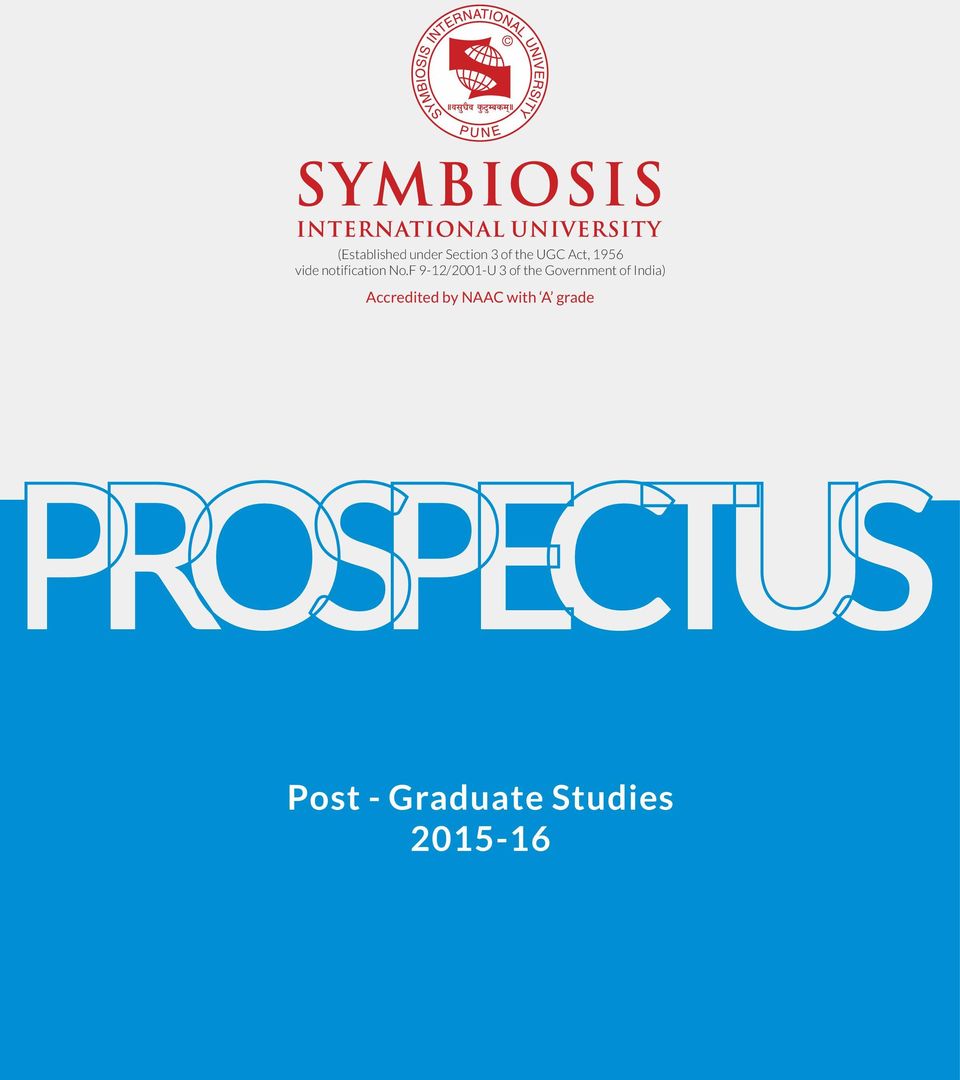
2 Vision Symbiosis International University will be the preferred destination for all who aspire to excel. Mission Lead value-based pioneering efforts to: a. Facilitate intellectual stimulation to generate, maintain and disseminate knowledge. b. Empower participants to meet the challenges of a collaborative and competitive globalized environment. c. Synergize excellence amongst aspirants through world- class ambience. d. Institute a culture of inclusiveness and provide wide access to higher education opportunities. e. Foster sustainable environmental attitude. f. Develop a unique university where the branches provide sustenance to the tree and bear fruits for all. g. Initiate trends which impact global higher education policies and practices.
3 Symbiosis International University (SIU)

4

5 Content A Foreign Affair that Founded Symbiosis Chancellor's Message Principal Director's Message Vice Chancellor's Message Symbiosis Family Authorities Global Representation at Symbiosis About SIU Academic Programmes of the University Symbiosis Centre for International Education Admission Process for International Students Eligibility and Reservation of Seats Admission Process for Indian Students Examination and Evaluation Code of Conduct Health Care, Recreation & Sports Hostels Institutes / Departments offering PG Programmes Symbiosis Institute of Business, Pune (SIBM) Symbiosis Institute of International Business, Pune (SIIB) Symbiosis Centre for & Human Resource Development, Pune (SCMHRD) Symbiosis Institute of Studies, Pune (SIMS) Symbiosis Institute of Telecom, Pune (SITM) Symbiosis Institute of Operations, Nashik (SIOM) Symbiosis Institute of Business, Bengaluru (SIBM) Symbiosis Institute of Banking and Finance (SSBF). 115 Symbiosis Institute for Computer Studies and Research (SICSR) Symbiosis Centre for Information Technology (SCIT) Symbiosis Institute of Health Sciences (SIHS) Symbiosis Institute ofmedia & Communication, Pune (SIMC) Symbiosis Institute of Media and Communication, Bengaluru (SIMC - B) Symbiosis Law School Pune (SLS - Pune) Symbiosis College of Nursing (SCON) Symbiosis School of Biomedical Sciences (SSBS) Symbiosis School of Economics (SSE) Symbiosis Institute of Technology (SIT) Symbiosis Institute of Geoinformatics (SIG)

6 004 A Foreign Affair that Founded Symbiosis The journey of a thousand miles begins with a single step. But, it is the first step that involves deliberation and much hesitation. The Symbiosis journey however began with a surge of enthusiasm spurred on by an incident that, in itself, makes a poignant tale. It was an afternoon on a hot day. I was standing near the window of my house overlooking the first hostel block, of which I was the rector. A strange thing happened. A girl walked up to the window of the boys' hostel room, quickly handed over something and disappeared. My curiosity was aroused and I kept watching the girl walking up to the window day after day and suspected, like any other rector would, that an affair was afoot. So one day, I made up my mind and walked up to the door and knocked. When the door opened, I saw a Mauritian student lying in bed. His face was pale and his eyes seemed to have sunken low. I was puzzled. When I turned to the boy for an explanation, he said, ' Sir, I have an attack of jaundice & I'm feeling extremely weak. I cannot stand up, nor walk a few steps. A girl from my country brings me food. However, since ladies are not allowed to enter the boys' hostel, she hands over the tiffin box through the window.' I was stunned. After all, it wasn't the type of 'affair' I had expected. I was very much pained & decided something had to be done about this. That was the instance, the golden moment that Symbiosis was born. Symbiosis is a term in life science, meaning 'living together of two different organisms, for the benefit of each other'. Dr. Mujumdar, himself a professor of botany, thought this name apt for the institution. Thus the institution was founded to alleviate the problems faced by foreign students coming to India. At the time, these problems included - accommodation, meals, medical care, guidance, coaching, information about the city, etc. Symbiosis has come a long way since then. Today it is a home to students from more than 80 different countries. These students are offered the best learning resources, industry exposure, a strong international students' alumni network, a global recognition, and above all, a truly enriching Indian experience.

7 005 Message by Chancellor I extend a warm welcome to all of you as you join the Symbiosis family. The University is part of the larger Symbiosis family, which is built on the core ideals of Vasudhaiv Kutumbakam - the world is one family. You will find a wealth of opportunities as you begin your journey of higher education, which is about academics, of course, but also a lot more. It is our goal that we succeed in shaping our students to be responsible members of the global citizenry. Symbiosis is appreciative of the enormous responsibility that befalls higher education institutions. I encourage you to avail of all the wonderful teaching-learning and research possibilities that are offered. We, at Symbiosis, believe that play belongs to education as much as studies; therefore, we offer a whole range of first-rate choices that contribute to personal capacity building, such as those in career enhancement, extracurricular activities and recreational facilities. You will find wonderful prospects to share this journey with students from over eighty-five countries and from all over India. We also pride on having with us an amazing pool of talent in our teaching staff, many of whom are noted academics, with substantial international experience. All in all, the educational experience at Symbiosis is designed to be wholesome and one that is authentically international. I hope that your experience at Symbiosis will afford you the opportunities to apply your talents and inspirations to the best use. May God bless you! Padma Bhushan Dr. S. B. Mujumdar Chancellor
8 From the Principal Director's Desk It is my pleasure to welcome you to the new academic year at Symbiosis. I am delighted that you have come to us as you begin or continue your journey of higher education. It is our striving that you find with us an enriching experience - one that fulfils your expectations with respect to all the aspects that comprise education, academicand otherwise. As strong as our reputation for academic excellence is, it does not set the limits for us. In your time spent with us, you will see Symbiosis for what it is a spectrum of opportunities for all round development. The common thread that passes through all our endeavours is internationalization. Indeed, internationalization is an institutional mission anchored securely in our founding principles and in our vision statements. Symbiosis is one of the very few institutions in India and abroad that could be said to be born of an individual's appreciation of and crusading for international education. We pride in a flourishing interface between academics and industry, while keeping a keen eye at the demands of the employment marketplace. It is our steady resolve to ensure that the students who come to us are armed with work-readiness competencies and are connected to career networks all over the world. You will find evidence of international competitiveness all across your experience with us - classrooms, career centres, health care system, sports grounds and extracurricular and recreational amenities. You will also find for yourself that our infrastructural facilities, all the way from campus premises to the labs, stand at the forefront of technology and innovation. Symbiosis would have achieved its goals if it arms you with a repertoire that will take you anywhere you want to go in the world and mould you into responsible global citizens. 006 Dr. Vidya Yeravdekar Principal Director, Symbiosis Society Executive Director, Centre for International Education Symbiosis International University

9 Vice Chancellor's Message 007 I am delighted to welcome you to the Symbiosis International University. It is the University's commitment to serve you in your journey of higher education. In the service of this goal, we have taken every care to present to you the most progressive academic choices. The University is proud to offer certificates and degrees at the undergraduate, postgraduate and doctoral levels in streams as wide-ranging as law, management, engineering, media and communication, humanities and social sciences, computer studies, and health sciences. You will find in the teaching faculty a wonderful blend of enthusiasm and talent. Many of our teachers are internationally renowned experts and scholars. We believe that research is at the pinnacle of academic excellence, and in view of this, we have an institute dedicated to promoting research capabilities amongst staff and students. We are also appreciative of the important place of career readiness in the overall scheme of higher education. You will find yourself equipped with all the knowledge and know-how that you would need to thrive in the global employment marketplace when you leave us. The idea of internationalization is embedded deep into the institution. The strong presence of international students is one of our most prized feats. These students come from as many as eighty-five countries. Internationalization also means that we set our standards of academic excellence and differentiation at the international level, and no less. We achieve this mainly by bringing in international advances into our pedagogical practices and instructional technology, and by initiating collaborations with foreign universities. The teaching-learning processes are positively forward-looking and centred on the student. Our students avail the most advanced infrastructure both within and outside the classroom. The University campus premises in Pune, Nashik, Bengaluru, NOIDA, and Hyderabad are amongst some of the most impressive campuses you will find in India and elsewhere. As proud as we are of our focus on academics, we believe that there is a lot more that goes into making for a wholesome educational experience. Thus, a whole gamut of extra-curricular and recreational amenities completes the circle of education at the University. That being said, all the opportunities at the University are only as good as what you do with them. I encourage you to put your best efforts into reaping all that you can during your time here. We consider ourselves custodians of the trust that you have placed in us as you take on your journey of higher education. I wish you all the best! Dr. Rajani Gupte Vice Chancellor

10 Symbiosis Family SYMBIOSIS SOCIETY * Of ice of the President & Chancellor Of ice of the Principal Director Initiatives Symbiosis International Cultural Centre Symbiosis Society s Dr. Babasaheb Ambedkar Museum & Memorial. Symbiosis SPA Symbiosis Centre of Health Care Symbiosis Society s Afro Asian Cultural Museum Institutes Symbiosis College of Arts & Commerce# Symbiosis Nursery School Symbiosis Primary School Symbiosis Secondary School Symbiosis School, Harali, Dist. Kolhapur Symbiosis Kindergarten, Nashik Symbiosis School, Nashik Symbiosis Institute of Teacher Education Symbiosis International School Symbiosis Open School 008 * Established: 26th January, Registered under the Societies Registration Act. XXI of 1860 (Regd. No. MAH-679-PN) on and the Bombay Public Trusts Act of 1950 (No.F/481 Pune) on # An Autonomous College (Af iliated to University of Pune)

11 SYMBIOSIS SOCIETY * 009 Of ice of the President & Chancellor Symbiosis International University* Of ice of the Vice Chancellor Faculty / Institutes / Departments Faculty of Law Symbiosis Law School, Pune Symbiosis Law School, NOIDA Faculty of Faculty of Computer Studies Faculty of Health & Biomedical Sciences Faculty of Humanities & Social Sciences Faculty of Media, Communication & Design Faculty of Engineering Symbiosis Institute of Business, Pune Symbiosis Centre for & Human Resource Development Symbiosis Institute of International Business Symbiosis Institute of Studies Symbiosis Institute of Telecom Symbiosis Institute of Operations, Nashik Symbiosis Institute of Business, Bengaluru Symbiosis Centre for Studies, Pune Symbiosis School for Banking & Finance Symbiosis Centre for Studies, NOIDA Symbiosis Institute of Computer Studies & Research Symbiosis Centre for Information Technology Symbiosis Institute of Health Sciences Symbiosis College of Nursing Symbiosis School of Biomedical Sciences English Language Teaching Institute of Symbiosis and Symbiosis Institute of Foreign & Indian Languages Symbiosis School of Economics Symbiosis School for Liberal Arts Symbiosis Institute of International Studies Symbiosis Institute of Media & Communication, Pune Symbiosis Institute of Media & Communication - UG Symbiosis Institute of Media & Communication, Bengaluru Symbiosis Institute of Design Symbiosis School of Photography Symbiosis Institute of Technology Symbiosis Institute of Geoinformatics * Established under section 3 of the UGC Act 1956, vide noti ication No. F.9-12/2001-U.3 of the Government of India Accredited by NAAC with A grade

12 Authorities Symbiosis Managing Committee Ÿ Dr. S.B. Mujumdar - President & Founder Member Ÿ Dr. Vidya Yeravdekar - Principal Director Ÿ Mrs. S. S. Mujumdar - Founder Member Ÿ Dr. Swati Mujumdar - Member Ÿ Dr. Satish Ghali - Member Ÿ Dr. C. R. Patil - Member Ÿ Mrs. Sanjeevani Patil - Member Ÿ Dr. A. V. Sangamnerkar - Member Ÿ Dr. Nitin Unkule - Member Ÿ Dr. Rajiv Yeravdekar - Member Ÿ Mr. Abhijit V Walimbe - Member Board of Ÿ Dr. Rajani Gupte, Vice Chancellor - Chairperson Ÿ Dr. Rajiv Yeravdekar, Dean, Faculty of Health & Biomedical Sciences - Member Ÿ Mr. Chandan Chatterjee, Dean, Faculty of Media, Communication and Design - Member Ÿ Dr. Jyoti Chandiramani, Dean, Faculty of Humanities & Social Sciences - Member Ÿ Dr. Dileep Padgaonkar, Eminent Journalist - Member Ÿ Dr. Sanjay Dhande, Former Director, IIT, Kanpur - Member Ÿ Mr. Sunil Shirole, MD & CEO, Yen Capital Advisors Pvt. Ltd., - Member Ÿ Shri Ramamurthy Bhamidipati, Chairman, APCC IT Cell, Secunderabad - Member Ÿ Dr. Swati Mujumdar, Director, SCDL, Pune - Member Ÿ Dr. Shashikala Gurpur, Professor, SLS,Pune - Member Ÿ Dr. T. P. Singh, Associate Professor, SIG - Member Ÿ Dr. Netra Ganesh Neelam,, SCMHRD - Member Ÿ Dr. Vidya Yeravdekar, Principal Director, Symbiosis - Member Ÿ Dr. S.C. Nerkar, Registrar, SIU - Non Member Secretary Academic Council Ÿ Dr. Rajani Gupte, Vice Chancellor - Chairperson Ÿ Dr. Shashikala Gurpur, Dean Faculty of Law - Member Ÿ Dr. Bhama Venkataramani, Dean, Faulty of - Member Ÿ Dr. R. Raman, Dean Faculty of Computer Studies - Member Ÿ Dr. Rajiv Yeravdekar, Dean, Faculty of Health and Biomedical Sciences - Member Ÿ Mr. Chandan Chatterjee, Dean, Faculty of Media, Communication & Design - Member Ÿ Dr. Jyoti Chandiramani, Dean, Faculty of Humanities & Social Sciences - Member 010

13 011 Ÿ Dr. T. P. Singh, Dean, Faculty of Engineering - Member Ÿ Dr. Narayan R. Pisharoty, Professor, SIT - Member Ÿ Dr. V. Eshwar Anand, Professor, SIMC - Member Ÿ Dr. Kaushik Mukerjee, Professor, SIBM - Member Ÿ Dr. Sammita Jadhav, Associate Professor, SIHS - Member Ÿ Dr. Bindu Ronald, Associate Professor, SLS - Member Ÿ Mr. Vijaykumar Bharati, Associate Professor, SCIT - Member Ÿ Ms. Sanjeevani Ayachit, Associate Professor, SID - Member Ÿ Dr. Akshay Malhotra, Associate Professor, SIT - Member Ÿ Mr. Manoj Hudnurkar, Associate Professor, SCMHRD - Member Ÿ Dr. S. S. Thigale, Director, Symbiosis SPA, Pune - Member Ÿ Dr. Bharat Bhushan, Dean (Academic), YASHADA, Pune - Member Ÿ Dr. D. N. Reddy, Chairman, RAC, DRDO, New Delhi - Member Ÿ Dr. S. P. Thyagarajan, Professor of Eminence & Dean (Research), Sri Ramchandra University, Chennai - Member Ÿ Lt. Gen. (Retd.) Dr. M. A. Tutakne, Former Vice- Chancellor, Symbiosis International University. - Member Ÿ Dr. S. V. Bhave, Vice President HR, Bharat Forge Ltd. - Member Ÿ Dr. S.C. Nerkar, Registrar, SIU - Non - Member Secretary Finance Committee Ÿ Dr. Rajani Gupte, Vice Chancellor - Chairperson Ÿ Dr. Vidya Yeravdekar, Principal Director, Symbiosis - Member Ÿ Shri. Deepak Gogate, Consultant, Foreign Exchange - Member Ÿ Mr. Sunil Shirole, MD & CEO, Yen Capital Advisors Pvt. Ltd., Mumbai - Member Ÿ Shri. Krishna N, Fellow Member, The ICAI Chennai - Member Ÿ Ms. Aakanksha Deshpande, Finance Officer SIU - Secretary Planning & Monitoring Board Ÿ Dr. Rajani Gupte, Vice Chancellor - Chairperson Ÿ Dr. Vidya Yeravdekar, Principal Director, Symbiosis - Member Ÿ Dr. Bhama Venkatramani, Dean, Faulty of - Member Ÿ Dr. Shashikala Gurpur, Dean, Faculty of Law - Member Ÿ Dr. Rajiv Yeravdekar, Dean, Faculty of Health and Biomedical Sciences - Member Ÿ Dr. R. Raman, Dean Faculty of Computer Studies - Member Ÿ Dr. T. P. Singh, Dean, Faculty of Engineering - Member Ÿ Dr. M. A. Tutakne, Former Vice Chancellor, SIU - Member Ÿ Mr. Pradeep Bhargava, Managing Director, Cummins Generator Technologies India Ltd., Pune - Member Ÿ Dr. S. C. Nerkar, Registrar, SIU - Secretary
14 SYMBIOSIS INTERNATIONAL UNIVERSITY P UN E Global Representation at Symbiosis Afghanistan Angola Aruba Australia Austria Bahrain Bangladesh Belgium Eritrea Ethiopia Fiji Island Finland France Gabon Germany Ghana Italy Ivory Coast Jamaica Japan Kazakhstan Kenya Kingdom of Spain Korea Nepal Netherlands New Zealand Niger Nigeria Oman Pakistan Palestine South Africa South Korea Sri Lanka Sudan South Sudan Syria Tanzania Thailand Yemen Zimbabwe Zambia 012

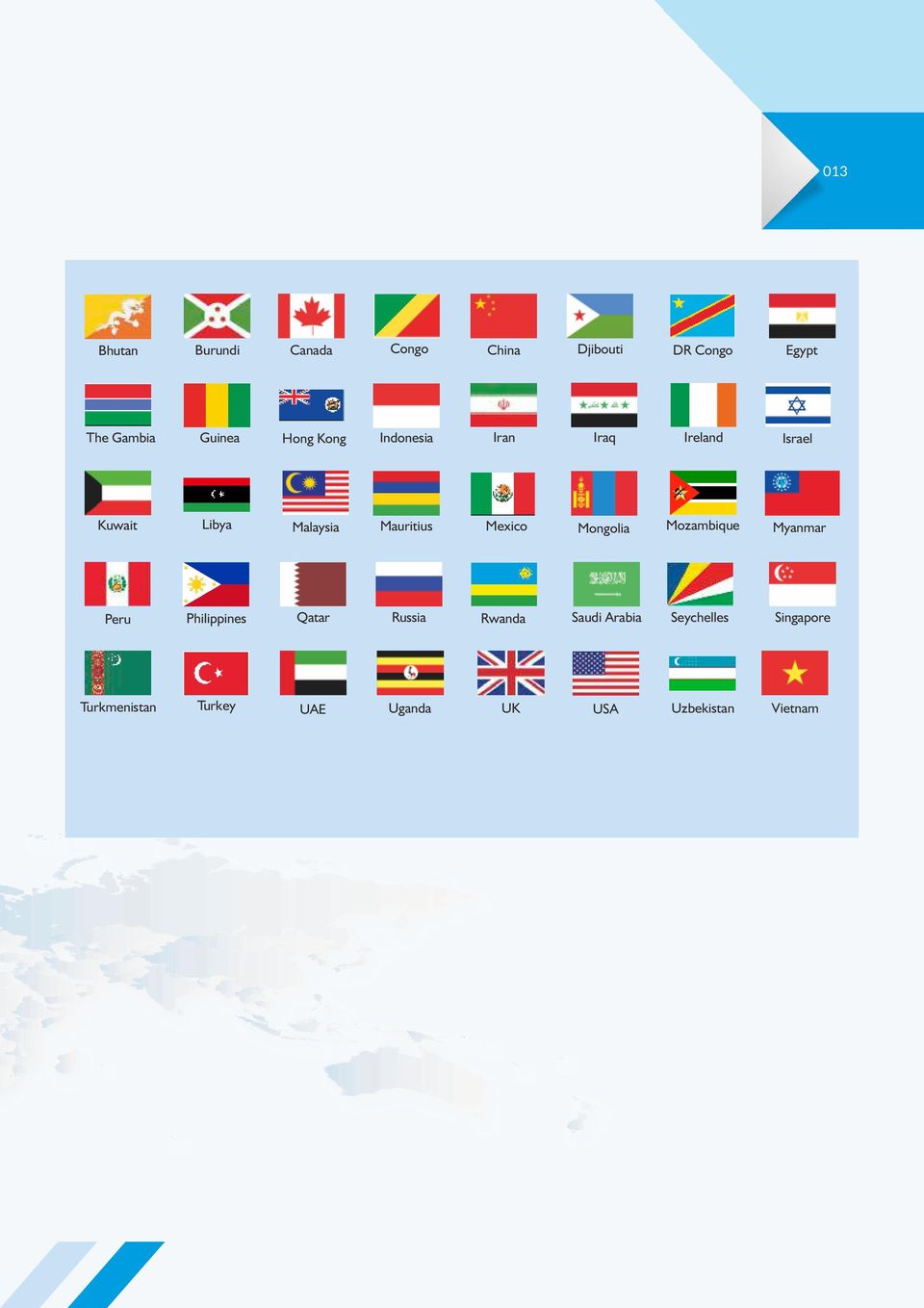
15 013 Bhutan Burundi Canada Congo China Djibouti DR Congo Egypt The Gambia Guinea Hong Kong Indonesia Iran Iraq Ireland Israel Kuwait Libya Malaysia Mauritius Mexico Mongolia Mozambique Myanmar Peru Philippines Qatar Russia Rwanda Saudi Arabia Seychelles Singapore Turkmenistan Turkey UAE Uganda UK USA Uzbekistan Vietnam
16 The University Padma Bhushan Dr. S. B. Mujumdar established Symbiosis in 1971 on the principles of the Vedic thought of Vasudhaiva Kuttumbakam, i.e. the world is one family. Symbiosis International University was given Deemed to be University status by the Ministry of Human Resource Development in The University has been accredited by NAAC with Grade 'A' and CGPA of 3.35 in Today, the University has 28 Institutes / Departments distributed in campuses at Pune, Nasik, Bengaluru and NOIDA. Symbiosis has a rich heritage of cutting-edge innovation and enterprise, and of quality through pursuit of Educational excellence. The University offers various programmes at Doctoral, Postgraduate, Under graduate and Diploma levels under the faculties of Law, M a n a g e m e n t, C o m p u t e r S t u d i e s, H e a l t h a n d Biomedical Sciences, Media, Communication and D e s i g n, H u m a n i t i e s a n d S o c i a l S c i e n c e s a n d Engineering. Access to several learning resources via the library, availability of housing facilities on several campuses, scholarship programmes to promote academic excellence, a health centre to promote preventive and curative care and events organised by the University Sports Board have facilitated well rounded overall development of students. Symbiosis has academic collaborations with reputed foreign universities like Nanyang Technological University in Singapore, University of Houston in USA, Berlin School of Economics and Law in Germany and others. The Symbiosis Centre for International Education (SCIE) promotes internationalization and invites international students to the University for a Semester Abroad Programme. The University is actively i n v o l v e d w i t h s t u d e n t a n d f a c u l t y exc h a n g e programmes and has also introduced the Scholar-in- Residence Programme. SCIE conducts intensive 'Study India' programme for the benefit of international students from over 75 countries that study here. Health and wellness are vital issues relevant to the academic success of students at Symbiosis. Symbiosis Centre of Health Care (SCHC), the in houses health care centre for the entire Symbiosis family makes conscientious efforts for the overall development of its staff &students by providing preventive, curative and health promotion programs to enhance optimal health, reduce risk of disease and injury and promote healthy lifestyle choices. In addition to this, Symbiosis Institute of Research and Innovation (SIRI) at the University is promoting high quality research and encouraging the faculty to undertake more research activities. The University has the following Professor Emeritus and Chair Professors in various Faculties: Professor Emeritus Shri Amitabh Bachchan Faculty of Media, Communication & Design Chair Professor Dr. Dileep Padgaonkar Journalism Shri R. K. Laxman Chair collaborates creativity and scholarly efforts and recognises the contribution of renowned cartoonist R. K. Laxman. Advocate Ram Jethmalani Faculty of Law Shri Sudhir Devare International Studies Ram Sathe Chair in International Studies in honour of Shri Ram Sathe, a Foreign Secretary with the Government of India. Symbiosis is an inclusive Institution, staying true to its vision of being the preferred destination for all who aspire to excel. 014
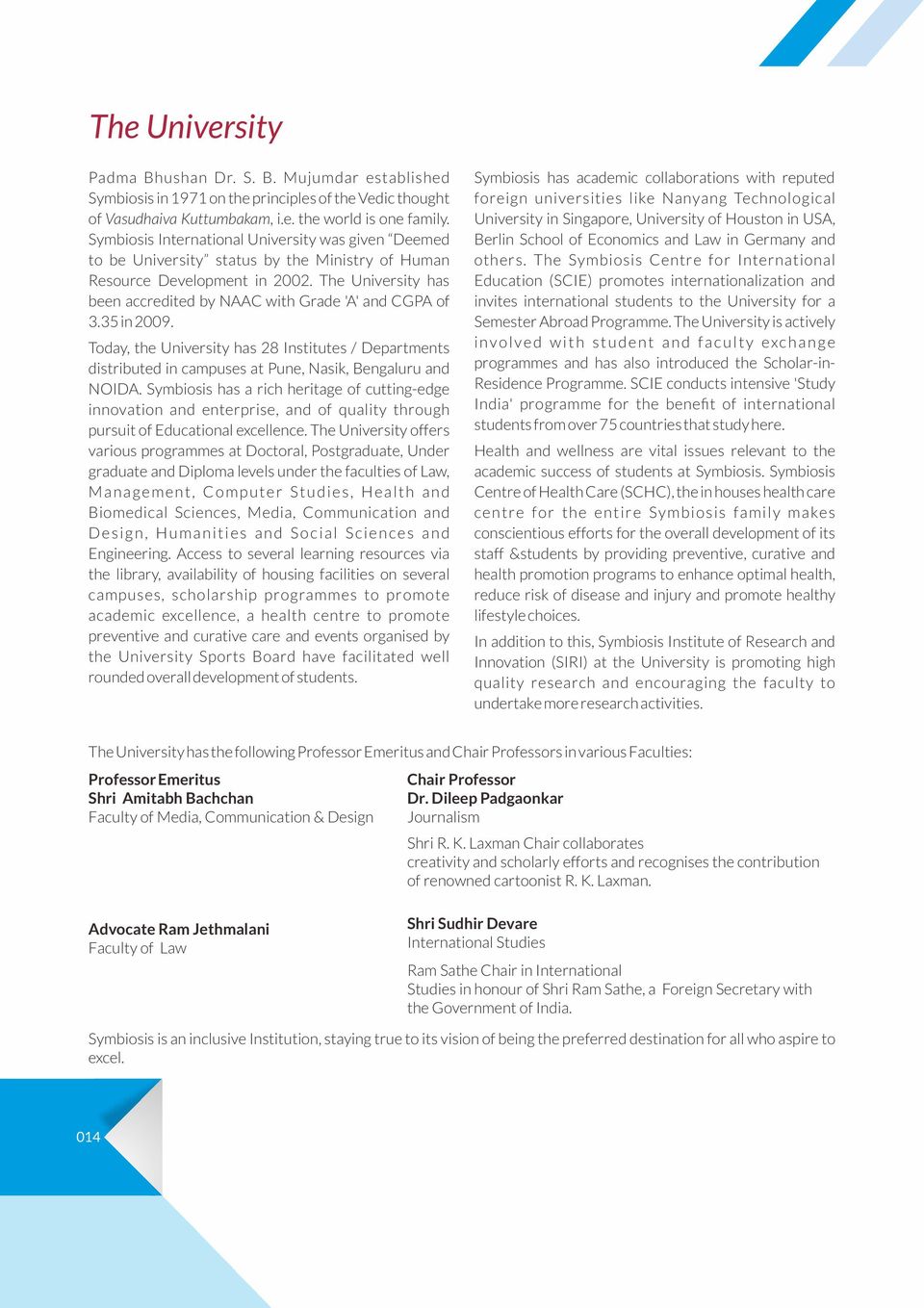
17 Academic Programmes of the University The University offers academic programmes in seven faculties at both undergraduate and postgraduate levels. The programmes are conducted in 28 Institutes / Departments across campuses at Pune, Nasik, Bengaluru and NOIDA. The doctoral programme is offered in all the faculties. The medium of instruction for all programmes is English. The undergraduate and postgraduate programmes conducted by the University are given in the table: 015 Faculty Institute/ Department Post Graduate Under Graduate Law Symbiosis Law School, Pune (SLS, Pune) Symbiosis Law School, NOIDA (SLS-NOIDA) Symbiosis Institute of Business, Pune (SIBM-Pune) Symbiosis Centre for Studies, Pune (SCMS-Pune) Symbiosis School of Banking and Finance (SSBF) Symbiosis Centre for and Human Resource Development (SCMHRD) Symbiosis Institute of International Business (SIIB) Master of Laws (LLM) Master of Business Administration (MBA) Bachelor of Laws (LLB) Bachelor of Arts and Bachelor of Laws (Honors) (BA LL.B. (Hons)) Bachelor of Business Administration and Bachelor of Laws (Honors) (BBA LL.B. (Hons)) Bachelor of Arts and Bachelor of Laws (BA. LLB ) Bachelor of Business Administration and Bachelor of Laws (BBA. LLB) Master of Business Administration (Innovation and Intrapreneurship) (MBA-I&I) Master of Business Administration (Banking & Finance) (MBA-B&F) Master of Business Administration (MBA) Bachelor of Business Administration (BBA) Master of Business Administration (Infrastructure ) (MBA-IM) Master of Business Administration (International Business) (MBA-IB) Master of Business Administration (Agribusiness) (MBA-AB) Master of Business Administration (Energy and Environment) (MBA -EE)
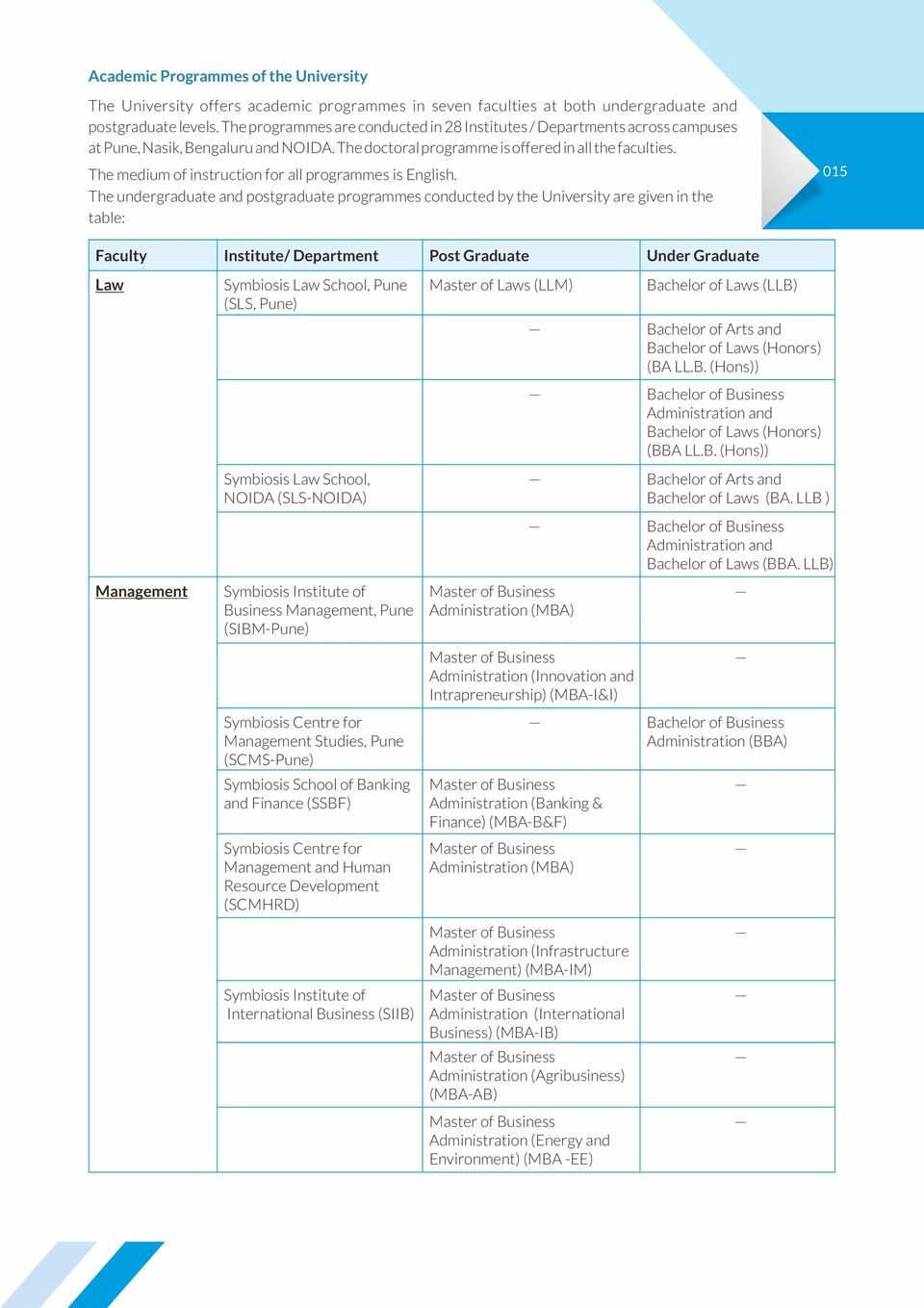
18 Faculty Institute/ Department Post Graduate Under Graduate Symbiosis Institute of Telecom (SITM) Symbiosis Institute of Studies (SIMS) Symbiosis Institute of Operations (SIOM) Symbiosis Institute of Business, Bengaluru (SIBM, Bengaluru) Master of Business Administration (Telecom ) (MBA-TM) Master of Business Administration (MBA) Master of Business Administration (Operations ) (MBA-OM ) Master of Business Administration (MBA) Computer Studies Symbiosis Centre for Studies, NOIDA (SCMS-NOIDA) Symbiosis Institute of Computer Studies and Research (SICSR) Master of Business Administration (Information Technology) (MBA-IT) Master of Science (Computer Applications) (M.Sc.-CA) Bachelor of Business Administration (BBA) Bachelor of Business Administration (Information Technology) (BBA-IT) Bachelor of Computer Applications (BCA) Health & Biomedical Sciences Symbiosis Centre for Information Technology (SCIT) Symbiosis Institute of Health Sciences (SIHS) Symbiosis College of Nursing (SCON) Symbiosis School of Biomedical Sciences (SSBS) Master of Business Administration (Information Technology Business ) (MBA -ITBM) Master of Business Administration (Hospital and Healthcare ) (MBA-HHM) Master of Science (Medical Technology) (M.Sc.- MT) Master of Science (Nursing) (M.Sc.- Nursing) Master of Science ( Biotechnology) (M.Sc. -BT) Bachelor of Science (Medical Technology) (B.Sc. - MT) Bachelor of Science (Nursing) (B.Sc. -Nursing) Post Basic Bachelor of Science (Nursing) (PB B.Sc. -Nursing) Master of Science (Nutrition & Dietetics) (M. Sc. -ND) Master of Science (Biomedical Sciences -Drug Discovery and Development) (M. Sc. -BMS- DD&D) 016

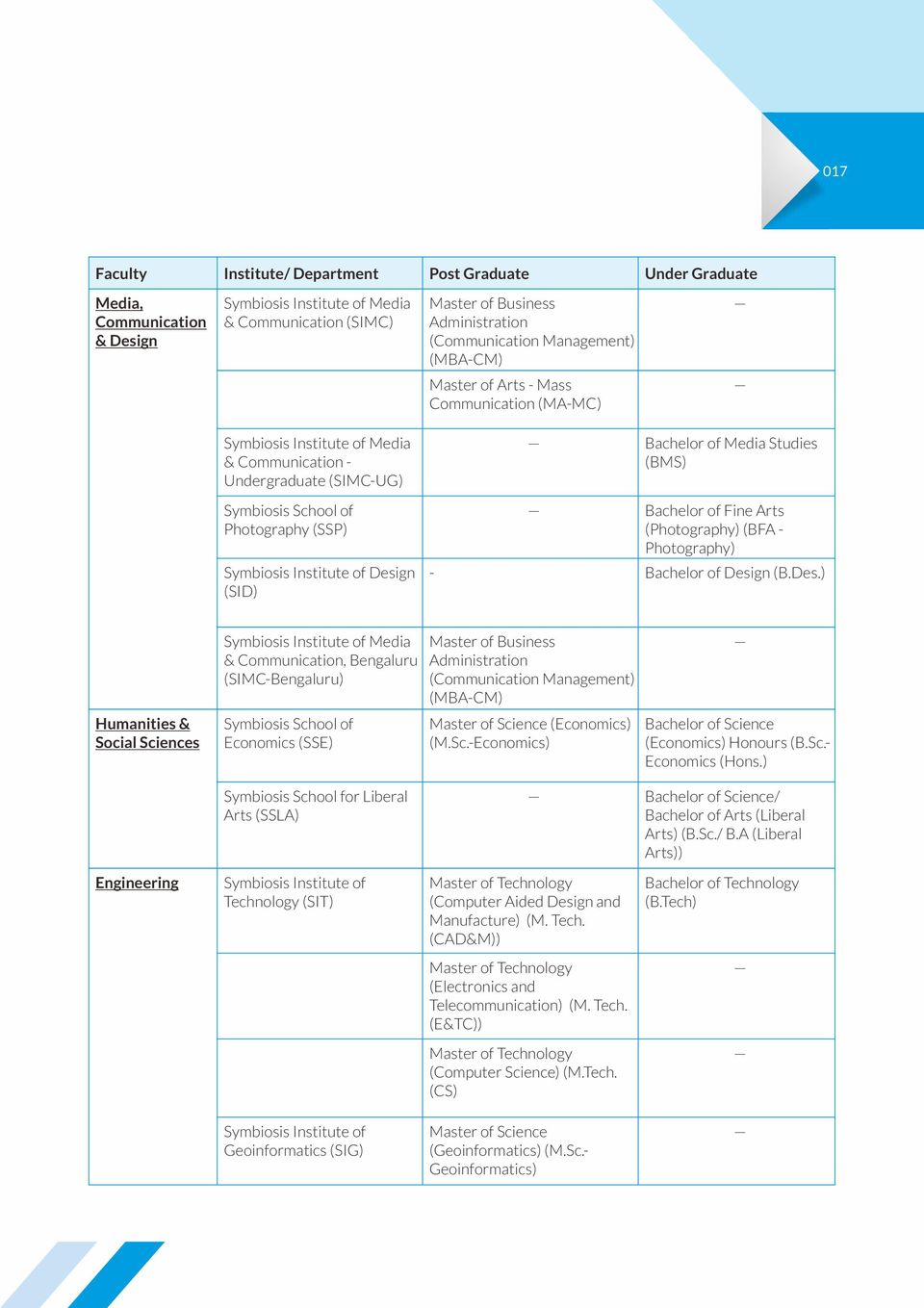
19 017 Faculty Institute/ Department Post Graduate Under Graduate Media, Communication & Design Symbiosis Institute of Media & Communication (SIMC) Master of Business Administration (Communication ) (MBA-CM) Master of Arts - Mass Communication (MA-MC) Symbiosis Institute of Media & Communication - Undergraduate (SIMC-UG) Symbiosis School of Photography (SSP) Symbiosis Institute of Design (SID) Bachelor of Media Studies (BMS) Bachelor of Fine Arts (Photography) (BFA - Photography) - Bachelor of Design (B.Des.) Humanities & Social Sciences Symbiosis Institute of Media & Communication, Bengaluru (SIMC-Bengaluru) Symbiosis School of Economics (SSE) Master of Business Administration (Communication ) (MBA-CM) Master of Science (Economics) (M.Sc.-Economics) Bachelor of Science (Economics) Honours (B.Sc.- Economics (Hons.) Symbiosis School for Liberal Arts (SSLA) Bachelor of Science/ Bachelor of Arts (Liberal Arts) (B.Sc./ B.A (Liberal Arts)) Engineering Symbiosis Institute of Technology (SIT) Master of Technology (Computer Aided Design and Manufacture) (M. Tech. (CAD&M)) Bachelor of Technology (B.Tech) Master of Technology (Electronics and Telecommunication) (M. Tech. (E&TC)) Master of Technology (Computer Science) (M.Tech. (CS) Symbiosis Institute of Geoinformatics (SIG) Master of Science (Geoinformatics) (M.Sc.- Geoinformatics)
20 Symbiosis Institute of Research and Innovation (SIRI) Established in 2011, the Symbiosis Institute of Research and Innovation (SIRI) aims to foster a culture of research in the University. Its foundation lies on the firm belief that fundamental responsibility of any organization is to stay connected with the community by the way of understanding its major issues and problems and suggest means to resolve them. Realizing the significance of quality research, SIU gives prime importance to promote, enhance and facilitate high impact research and related scholarly activities. The core areas of action is to raise an intellectual culture, to encourage scholarship and upgrade the quality of research for making meaningful contributions to dialogue around development of policies that impact the society. SIU conducts research programmes in various faculties namely Law,, Computer Studies, Health and Biomedical Sciences, Media, Communication & Design, Humanities and Social Sciences and Engineering. A few selected meritorious scholars are being awarded Junior Research Fellowships from SIU to encourage quality research culture in the University. Research skill is aimed to improve by provision of internal funding for Minor Research Projects up to Rs 1.5 lakh after thorough reviewing of proposals to regular faculty members. Another innovative experimentation is started for linking teaching and research among students with self-funding. This aims to upscale researching skills among students under leadership of faculty members. Some national repute research centres are also recognized as SIU's recognized research centres for research collaborations. These include the Indian Council for Medical Research(ICMR), Larsen and Toubro Centre, Vaikunth Mehta National Institute of Co-operative, Chest Research Foundation, National Aids Research Institute among others. Main focus of SIRI Development of institutional research agenda and formulation of policy to reflect a conscious effort for creating a congenial climate to nurture a research culture in the University. Setting up a systematic procedure for administration of research programmes. Research capacity building and mentoring to translate our efforts into high quality research outcome. 018 Teaching Learning Resource Centre (TLRC) The Teaching Learning Resource Centre (TLRC) of the University is a catalyst to inspire and mentor the faculty in their roles as teachers, researchers and more so as educational parents. TLRC strives to complement the academic mission of the University by improving the teaching effectiveness and enhancing research ability of the faculty. It contributes towards the enhancement of faculty members in the areas of teaching and learning, research and evaluation. The prime agenda of the centre includes taking care of all the faculty development initiatives that advance educational excellence. TLRC in a way is a strategic support system working dedicatedly for all the faculty members of the University. The centre provides opportunities to faculty members to contribute innovatively in the field of training, which in turn gets reflected in their teaching and thus the students' achievements. The spectrum of programmes offered by TLRC includes workshops, seminars, focused group discussions, panel discussions and others. TLRC has a rich repository of resource people of both international and national repute in the chosen fields of study. Research, Innovations in Teaching - Learning, Integrity and the use of Technology remain the driving forces of TLRC, and attaining excellence is the ultimate goal.

21 019 Learning Resources Symbiosis International University is one of the leading Universities in the country and an educational hub of 28 institutions / Departments, promoting higher education in, Information Technology, Bio-medical Sciences, Engineering, Media & Communication, Liberal Arts, Health Sciences and Legal education. These institutes are spread over various campuses and each campus has a well equipped library, serving and catering to the needs of students and faculty members as a creative and innovative partner in supporting the teaching, learning, scholarship and research activities. There is a rapid increase in the library's collection of books and journals/periodicals in both, print and digital form, using state of the art facilities. SIU boasts of libraries which has more than two lac books, more than 1000 journals, 10,000 plus CDs / DVDs, Online Journals and 120,000 e-books accessible (On subscription basis) The Central Library at Lavale campus alone has an excellent collection of 39,940 books, 53 Ph.D. theses, 1,426 CDs/DVDs with 64 national, 12 International print journals, 76 magazines and more than 30,000 e-journals. SIU has KOHA integrated library software for all its institutes. Through OPAC (Online Public Access Catalogue) books and other reading material are accessible from any location. SIU subscribes to a total of 35 online databases as per the requirements of the institutes. EBSCO, Emerald, Scopus, JSTOR, Frost and Sullivan, Kluwer- and other online Databases are accessible to all students and faculty members of the campus. Central Library at Lavale
22 Symbiosis Centre for International Education (SCIE) The Symbiosis Centre for International Education (SCIE) is an integral part of the University, providing leadership and support to internationalize the campus and the curricula. International students from over 85 countries pursue their undergraduate and postgraduate studies at Symbiosis. Students and faculty are provided with opportunities to pursue their international academic interests to the fullest, be it through academic exchanges, or exposure to international conferences, seminars, workshops and other resources. Internationalization at Symbiosis works on multiple tracks, for which the Symbiosis Centre for International Education has three departments: International Student Admissions & Student Events International Initiatives and Collaborations International Promotions and International Student Relations International Student Admissions & Student Events Admissions of international students are centralized for all the constituent institutes of Symbiosis International University and routed through the SCIE. The procedure for applying for admissions at SCIE is designed taking into consideration the requirements and difficulties faced by international students. The online admission procedure has made it accessible to each and every student to apply from different parts of the world and in the comfort of their homes. The student needs to come to India only when the applicant is shortlisted for a particular program chosen by the student. Software has been tailor-made to suit the admission procedure. The admission procedure is simplified in easy steps starting from the basic eligibility, checking of important documents to be submitted until the final payment, and confirming the admission. Through the system of online admissions, students are also able to make all their payments online and check the admission status online. International Student Events Apart from all admission related activities, SCIE organizes a variety of activities where international students of Pune city are able to meet on a common platform and display their many talents. As a part of enriching students' international experience, SCIE organizes the Food Festival, the Flag Hoisting Ceremony, NGO visits, Blood Donation Camps, Tree Plantation ceremonies, Iftar Party, Christmas Party, Diwali Party, Dance Competition and Sports activities like football tournament and many more. SCIE also organizes the International Students' Convocation Ceremony. The convocation ceremony is an important landmark in a student's life. It is normally organized by universities in India during the month of December. But since most foreign students have already left India by this time, they are deprived of this wonderful memory. SCIE aims to fulfil a students' dream of walking down the aisle with a robe and cap by organizing the International Students Convocation Ceremony. SCIE strives to provide international students' with assistance, support and guidance to solve all their problems and make their international experience a fruitful one. SCIE is assisted in such activities by the International Students' Council. The International Students' Council is an elected body for the smooth functioning of the activities and events of international students. The International Students' Council consists of the posts like President, Vice President, General Secretary, Sports C o o r d i n a t o r, C u l t u ra l C o o r d i n a t o r, F i n a n c e Coordinator, Public Relations Coordinator, Student Care Coordinator and Administrative Coordinator. International Initiatives and Collaborations Symbiosis International University (SIU) has partnered with International Universities to promote various forms of academic Collaborations. The University has collaborations with Universities in France, Germany, UK, USA, Canada, Japan, Singapore, Australia, and New Zealand. 020
23 021 At Symbiosis International University, our every endeavor is to look at ways to promote international understanding through quality education, which is why we have designed a series of unique programs of interest to our international partners. Some of these programs include: Student Programs: Study India Program SCIE offers two to four weeks customized program imparting international students and NRI/PIO children a n u n p a ra l l e l e d o p p o r t u n i t y t o ex p e r i e n c e a combination of academics with diverse cultural activities. Semester Abroad Program The Symbiosis International University students have the opportunity to study at the host university with mutual recognition of the credit hours arising there from. The University follows the Cumulative Grade Point system which gives flexibility for transfer of credits. Global Immersion Program Under this initiative the SIU students get an opportunity to study abroad for a semester at the University of their Choice. The students are encouraged to study abroad for a semester, attend summer schools, internships, Dual Degree programs with our international partners. environment, meetings with business executives, global issues, any other topics, understand the culture of the respective countries and visits to various industrial and business establishments in the host country. Internships: Symbiosis also gives internships to foreign students ranging from 4 6 weeks, at our campus. This gives the students an opportunity to understand the work culture, inter - cultural communication. In today's globalized world, this gives leverage and an advantage in terms of wider choices of employment opportunities. Faculty Programs: Scholar-In-Residence This program was developed to share best academic practices, developing in house global competencies and international links. Some of the activities that could be undertaken could be conducting Guest lecturers / workshops / Symposia, Participation in teaching, review and internationalizing the Curriculum, Development and evaluation of research, Faculty development p r o g ra m / f a c u l t y S e m i n a r, C o n c e p t u a l i z i n g - contributing and editing research journals, joint paper presentations in international conferences are some of the activities envisaged under this program. SIU also has semester exchange program with international partners. The students from these collaborating universities come to attend a semester at Symbiosis and students from Symbiosis go to these universities for attending a semester under this program. Summer Schools: The SIU students attend summer schools which usually last for two to four weeks in duration and are normally held in spring or summer. The program facilitate visits by students and faculty to learn about the business International Faculty during FDP
24 Distinguished Visiting Professor This is an initiative taken to attract distinguished academicians/personalities to Symbiosis International University for short term period to teach course in their area of expertise, Foster multiculturalism, diversity and academic excellence. They are also expected to undertake: development and evaluation of research, faculty development program / Seminar, conducting special course / expert workshops, developing grant projects. Faculty Exchange SIU is actively involved in sending Faculty to foreign Universities on short term. This encourages the Faculty to get an opportunity to teach or conduct joint research, conducting lectures, focusing on the Indian or comparative perspective. Lecture Series SCIE organizes lectures by eminent faculties of International repute at different institutes of Symbiosis. International Promotions and International Student Relations This department has the dual goal of ensuring student comfort while at Symbiosis International University and also communicating with foreign students in their home countries. SCIE has undertaken the exercise of planning promotional campaigns in Africa and Asia. This includes participating in Educational Exhibitions / fairs and also visiting schools and educational counsellors. Understanding the importance of ensuring a fulfilling experience, both academic and social, this department will focus totally on assisting foreign students to adapt to their new home. The students are encouraged to contact this department when faced with problems academic, administrative, and even issues that are not directly related to the University, such as dealing with formalities at the Foreigners' Registration Office (FRO). The department has initiated the buddy system, which refers to the practice of assigning a mentor to each international student. The buddy will be a domestic Indian student, who is familiar with the city of Pune. The buddy will be encouraged to help the student overcome challenges big and small that are related to the institute and the University, as well as everyday problems related to settling down in India. 022 The department will conduct periodic meetings with international students in their individual institutes. The informal meetings are aimed at providing an opportunity to the students to share their experiences, both good and bad, giving an opportunity to solve these by initiating changes either in policy or regular activities. FOREIGNERS' REGISTRATION OFFICE Please find below the relevant rules and regulations regarding Foreigners Registration in India. This i n f o r m a t i o n h a s b e e n i s s u e d b y t h e P o l i c e Commissioner's Office, Pune. General Instructions: Every foreigner coming to India must have valid a Passport and Visa to enter and to continue his /her stay in India. The foreigner should always carry identification documents, namely: 1. Passport with an endorsed visa 2. Certificate of Residence issued by the concerned Police Station 3. Residential Permit issued by FRRO/FRO The foreigner is under obligation to produce the above documents to any Police Officer on demand for inspection. Registration of Foreigners: Foreigners entering India on a long term visa i.e. for a period more than 180 days, on a Student Visa, Employment Visa, Research Visa, Medical Visa and Missionary Visa are required to get themselves registered within 14 days of their arrival with the concerned FRRO/FRO. Students arriving on short term Provisional Student Visa (Valid for 180 days or less) must also register and confirm their admission within the stipulated visa period to avoid deportation. Upon confirmation of admissions, the students on short term Provisional Student Visa should approach the concerned FRRO/FRO for registration and extension. The above rules will not be applicable to Pakistani, Bangladeshi and Afghani nationals. Pakistani Nationals must report within 24 hours of their arrival Afghan Nationals must report within 7 days of their arrival Bangladesh Nationals on Student Visa must report within 7 days of their arrival, and within 24 hours of their arrival for other visas Documents Required for Registration: Form A Passport copy and Visa copy along with the arrival stamp page Proof of Residence (Leave & License agreement/ C- Form from the owner is required to be submitted within 24 hours to FRO 'C' window
25 023 Bonafide Certificate and Letter of Provisional Admission from the University/ College/ Institution in case of a Student Visa. Extension of Student Visa: Extension of a Student Visa is done locally by the FRO. As long as the foreigner is a bonafide student and is studying in a recognized University / Institute, extension is provided up to five years or for the duration of the programme, whichever is less on a year to year basis. Documents Required for Visa Extension: Application Form containing Telephone/Mobile numbers Passport Copy Visa Copy Residential Permit Copy Bonafide Certificate from the College/Institute (Year to Year) Address Proof Bank Statement (Showing Financial Transactions) All Mark Sheets Students with failing grades are allowed an extension until the University/College/Institute allows them, provided a Bonafide certificate states their intention to continue their studies Return Visa: Return Visa is a facility to be granted to foreign nationals who have completed a one year stay and are likely to be permitted to continue their stay for another year in India. It is not to be granted in a routine manner or while their stay is under consideration. Return visas are: Granted to a student to visit his/her country Granted once in a year (In an emergency, a second return visa may be granted) Granted up to 90 days (Subject to the validity of the passport and visa) Not Granted for tourism Return Visa Fees are as per Government Circulars Return Visa is not issued on a Provisional Visa Documents required for Return Visa: Application Form Passport copy Visa copy and Residential Permit copy Bonafide Certificate No Objection Certificate issued by the University/ Institute/ College on an official letter head For more details, visit Admission Process for International Students: To assist students with their application to Symbiosis International University, a detailed stepwise procedure is available on the official website at where students can avail the user friendly online application software. Your application will be considered and authenticated only after SCIE receives full payment towards application fee. Fees remitted must be exclusive of bank charges. Category Foreign National (FN): A student is eligible to apply as a Foreign National (FN) if he/she is a citizen of any country other than India and holds a foreign passport. Person of Indian Origin (PIO): A student is eligible to apply as a Person of Indian Origin (PIO) if he/she has a PIO card, and is a citizen of a country other than India. Overseas Citizenship of India (OCI): A student is eligible to apply as OCI if he/she is granted with Overseas Citizenship of India and has an OCI card. English Proficiency Test is mandatory for the foreign nationals / OCI / PIO students. Student has an option to
26 either appear for IELTS (conducted by British Council) or IELA (conducted by Symbiosis) Non Resident Indian (NRI): 024 A student is eligible to apply as a Non Resident Indian (NRI) if he/she has appeared for the 12 examination (equivalent to the Indian 12th) or Graduation outside India. It is mandatory for one of the two qualifying examinations to be given outside India. It is mandatory for NRI students who have appeared for their 12th outside India and graduation from India to appear for the SNAP TEST. Kindly refer for details on SNAP Registration. Recognition of Board and University Admissions are in conformity with the guidelines set by the Association of Indian Universities and the Statutory Bodies of India like the Indian Nursing Council, All India Council for Technical Education, Bar Council of India, etc. Only candidates who have the requisite qualification from foreign universities or Boards of Higher Education accredited and recognized by the Association of Indian Universities (AIU), Govt. of India, New Delhi are eligible to apply at Symbiosis institutes for admission. If required, candidates will be asked to obtain the 'eligibility certificate/equivalency certificate' from the Equivalence branch, Association of Indian Universities (AIU), New Delhi on the given below address. Association of Indian Universities AIU House, 16 Kotla Marg, New Delhi Tel No: Fax No: [email protected] Website: Eligibility Prospective students must have completed full time 3 year Bachelor Degree program from any statutory University with minimum 50% marks at graduate level. In case of Engineering Stream the prospective students must have completed full time 4 year Bachelor Degree program from any statutory University with minimum 50% marks at graduate level. Students appearing for their final year can apply but their admission will be subject to obtaining a m i n i m u m o f 5 0 % m a r k s a t t h e q u a l i f y i n g examination. Each program has specific eligibility criteria; please check the respective institute information for the same. Documents to upload at the time of online application 10+2 or equivalent Mark sheet. Bachelor Degree Mark sheets (Semester wise / Year wise). Photocopy of Valid Passport CV (Curriculum Vitae) Statement of Purpose 2 Letters of Recommendations in original English Proficiency Test (IELTS-Organized by British Council OR IELA-Organized by English Language Teaching Institute of Symbiosis) Payment Proof of Application Fee Documents Submission Applicants have to submit the hard copy of the filled-in application form along with necessary documents. Make sure that you attach the proof of payment along with other documents. Send the print copy of your application along with the original attested photo copies of all uploaded documents to: Symbiosis Centre for International Education (SCIE), SenapatiBapat Road, Pune , Maharashtra, India Tel Documents Verification & Evaluation When online application reaches SCIE along with the payment of Application fee and all the required documents; SCIE will verify uploaded documents and check the requisite qualifications for admission. Application will be forwarded to the Admission Committee for Evaluation. The Admission Committee will shortlist the applications based on the previous academic track record, SNAP score (if applicable), English Proficiency Test (if applicable), Statement of Purpose, Letters of Recommendation, CV (Curriculum Vitae). Merit List After evaluation by Admission Committee, SCIE will send an informing about the status of your admission. You will receive an offer letter through depending on evaluations done on your application. Administrative and Part Payment of Academic Fee If you receive an offer letter through , you need to confirm your intention of joining the said program by making a payment of administrative fee and part payment of annual academic fee within stipulated period mentioned in the offer letter.
27 Administrative & Part Payment of Annual Academic Fee = USD equivalent to INR 1,05,000 The break-up of USD equivalent to INR 1,05,000 is mentioned below: 1. U S D e q u i v a l e n t t o I N R 4 0, t o w a r d s administrative fee (Non-refundable). This includes eligibility, medical, insurance and admin charges. 2. USD equivalent to INR 65,000 towards part payment of annual academic fee. This includes pre induction charges (non-refundable) and institute deposit (refundable) (if any) To make this payment, you will have to log in to your 'Online Application' with your 'SCIE ID' and 'Password'. Then follow Payment instructions mentioned on the link. Kindly ensure that this payment is to be made within the stipulated date mentioned in the offer letter. The balance payment of annual academic fee is to be paid on or before the date of reporting. Applicants who fail to make the payment within stipulated date will not be able to secure a provisional admission to 'Symbiosis International University' and their seat will be offered to the next applicant in the Waitlist. Provisional Admission Letter SCIE will issue a Provisional Admission Letter to the foreign national students who require the Student Visa only after receipt of administrative and part payment of academic fee. Applicant can use this letter as a supporting document while applying for his/her students' visa at the Indian Mission in his/her country. Note: The Visa should be student's Visa and should mention the name of "Symbiosis International University". Any other type of visa is invalid and final admission will not be granted to students who do not have a valid visa. For the interview at the Indian Embassy make sure that you carry relevant documents to prove how you intend to finance your education in India. Reporting Mail On confirmation of the receipt of USD equivalent to INR 1,05,000/-, applicant will be considered as 'Provisionally Admitted' to Symbiosis International University. Subsequently, SCIE will send you the letter regarding the formalities to be completed at the time of reporting. Before the commencement of the academic program you will have to report at SCIE to complete reporting formalities. Students provisionally admitted to out of Pune campus will have to report to their respective institute to complete the reporting formalities. Kindly check your respective institute information in the prospectus or SCIE website for specific reporting date to SCIE and the respective institute. Reporting Formalities 1. Medical Test: 025 International students will have to undergo a medical examination. Medical check-up will be conducted at Symbiosis Centre for Health Care (SCHC) within the Campus. Collect the Medical Test Form for Medical Check-up. After undergoing medical test submit the counterfoil of the Medical Test form. 2. Accounts Department Take the confirmation of Fee details from Accounts Department. Pay the balance amount or short fall if any. 3. Eligibility Formalities: The clearance of the Eligibility is an essential factor for admission to any program of Symbiosis International University (SIU). The admission will be provisional till the clearance of the same. The student is liable to submit all the necessary documents mentioned above as per the category. Few documents which were not possible to be submitted at the time of reporting must reach at Symbiosis Centre for International Education (SCIE) by 31st August. Students who fail to submit the documents within the stipulated date will not be allowed to appear for the semester I examination. They may have to forfeit the academic fee and may lose an academic year. Students need to fill the online Application Form for Eligibility and take printout. 4. Submission & Verification of all the required documents with Originals The students are advised to carry all original d o c u m e n t s a l o n g w i t h 2 s e t s o f a t t e s t e d photocopies. Documents required from Foreign Nationals/ PIO/ OCI: Mark sheet of 12th Std./ Equivalent Semester wise/ Year wise Bachelor Degree Mark sheet Passing Certificate, Provisional Certificate or Degree Certificate of the University English Proficiency Test Result Gap certificate (applicable for students with the gap of one year or more) Migration certificate in Original (in case graduation from an Indian University)
28 Transfer certificate in Original (in case graduation from an Indian University) Passport PIO card (only for PIO students) OCI Card (only for OCI students) Citizenship card (only in case of Nepali nationals) Valid VISA (not applicable for Nepal & Bhutan students) Valid Residential Permit (not applicable for Nepal & Bhutan students) Documents required from NRI: Mark sheet of 12th Std./Equivalent Semester wise/ Year wise Bachelor Degree Mark sheet Passing Certificate, Provisional Certificate or Degree Certificate of the University Gap certificate (applicable for students with the gap of one year or more) Migration certificate in Original (in case graduation from an Indian University) Transfer certificate in Original (in case graduation from an Indian University) Passport Please ensure you carry all original documents for verification including passport. 5. Joining Letter to respective institutes Before you proceed to your respective institutes ensure that you have collected the Joining Letter duly signed and stamped. Submit your 'Joining Letter' to the International Students Coordinator of your respective institute and complete the remaining formalities at institute like payment of hostel fee, mess fee, uniform fee, etc. which are not included in annual academic fee. PAYMENT INSTRUCTIONS: Except Students from Nepal and Bhutan it is mandatory for all the students to make all the transactions in USD currency. The payment has to be made in USD equivalent of the amount published in INR value. Authentication of all the payments will be made by t h e a c c o u n t a n t a t S C I E. Pa y m e n t w i l l b e authenticated only after its realization in SIU account. Incomplete payments (either through telegraphic transfer/cash) will not be entertained. Kindly note that currency exchange rate for all the transactions will be at actual and student will have to bear all applicable transaction charges or card payment charges. Update the SWIFT/NEFT/RTGS Transfer details in SWIFT/NEFT/RTGS Transfer windows and send scan of the transaction on [email protected] For More information, you can contact us on or (Ext. 266). Application Fee US Dollars equivalent to INR 9,000/- (Non Refundable) Students applying to Symbiosis International University will have to pay an 'Application fee' along with their application. Once you complete your Online Application; system will prompt you to make a payment of your 'Application Fee'. International English Language Assessment (IELA) Examination US Dollars equivalent to INR 3,575/- (Non Refundable) Students enrolling for the 'International English Language Assessment' exam will have to pay the ' I E L A ex a m i n a t i o n f e e'. D u r i n g t h e O n l i n e Application, the system will prompt you about IELA details and accordingly, at the time of payment this fee will be added along with your 'Application fee'. Note - Your application will be considered and authenticated only after SCIE receives full payment. Administrative and part payment of Academic fee US Dollars equivalent to INR 1,05,000/- These charges include INR 40,000/- towards the Administrative fees and INR 65,000/- towards the Part Payment of Annual Academic fee which includes pre induction charges (non-refundable) and institute deposit (refundable) (if any). After assessing and evaluating the application, SCIE 026
29 will send an offer letter to selected candidates. Once the candidate receives the offer letter, he/she will need to confirm his/her intention of joining the said program by making a payment of USD equivalent to INR 1,05,000. In case of Foreign National/PIO/OCI students, SCIE will issue a Provisional Admission Letter (PAL) only after receiving this payment to enable candidates to apply for a Visa. Note Pre-Induction Charges (If any) and USD equivalent to INR 40,000 towards 'Administrative fee' are non- refundable Modes of payment: Once you complete your Online Application, the system will prompt you to select the mode of payment and accordingly it will guide you through the procedure. Online Payment: You can make your payment by using an International Credit / Debit Card. Offline Payment: Cash payment at Axis Bank: (Only For Nepalese and Bhutanese Students) You can deposit cash at Axis Bank with the help of a Pay in Slip. After payment, the student must mention the Axis Bank's branch name and date of payment on the Pay in Slip (Challan Copy) and then submit the copy of the Pay in Slip copy to SCIE Office by hand or by Courier. NEFT/RTGS Transfer: (Only For Nepalese and Bhutanese Students) Students who wish to make any of their payments through NEFT/RTGS transfer must approach a bank and request for a NEFT/RTGS transfer. Please mention Your Name and SCIE ID while making the transaction. Details for transaction are mentioned below: For NEFT/ RTGS Transfer: Account Number : Account Name : Symbiosis International University - International Office (SIU-NB) Bank Name : AXIS Bank Ltd. Sai Capital, S. B. Road Branch, Pune India IFSC Code : UTIB Swift Code : AXISINBB Swift Transfer: (Applicable to All Students, Except Nepalese and Bhutanese) Students who wish to make any of their payments through Swift transfer must approach a bank in their home country and request for a Swift transfer. Please mention Your Name and SCIE ID while making the transaction. Details for transaction are mentioned below: To ensure credits favouring Axis Bank Limited are correctly & promptly credited to the accounts held with Chase Manhattan Bank, we recommend that remitters route funds electronically in the following formats: For Swift Transfer: Beneficiary Name & Address Beneficiary Bank Name & Address Beneficiary Bank Account No. Beneficiary Bank Swift Code Intermediary Bank Name & Address Intermediary Bank Account No. Intermediary Bank Swift Code Symbiosis International University S.B. Road, Pune, Post Box No Axis Bank Ltd., Mumbai, India AXISINBB315 J. P. MORGAN Chase Bank New York CHASUS33 IBAN No. FED ABA For admissions of International Students and Events: write to [email protected] For Student Exchange and Semester Abroad: write to [email protected] Fo r I n t e r n a t i o n a l S t u d e n t S u p p o r t : w r i t e t o [email protected] For payment query: write to [email protected]
30 Eligibility and Reservation of Seats Ø Eligibility Graduate from any recognized / statutory University or Institute with a minimum of 50% marks (45% for SC/ST). Programmes which require specific discipline/ subject specialisation need to be checked for eligibility as given by the respective Institute. A candidate who has completed qualifying degree from any Foreign University must obtain an equivalence certificate from the Association of Indian Universities (AIU). All foreign degrees/ qualifications need to be verified from AIU by the candidate before seeking admission to any programme of SIU. Evaluation Division of the Association of Indian Universities (AIU)issues equivalence certificate for foreign degrees/qualifications. The contact details are as below: Association of Indian Universities AIU House, 16 Comrade Indrajit Gupta Marg (Kotla Marg), Landmark: Opposite National Bal Bhawan, Near I.T.O., New Delhi , India Tel. No ; ; Fax No [email protected] Website: Note: It is the responsibility of the candidates to ascertain whether they possess the requisite qualifications / eligibility for admission. Having been admitted provisionally does not mean acceptance of eligibility. Final eligibility of admission will be decided by Symbiosis International University. Reservation Policy: As per the UGC Regulations, following will be the reservation policy for admission to any program of Institutes of SIU (Except Symbiosis Institutes of Studies, which has separate policy #) 028 a. Within Sanctioned Intake Scheduled Caste (SC) : 15% Scheduled Tribes (ST) : 7.5% Differently Abled * : 3% b. Over &Above Intake Kashmiri Migrants : 2 seats per program International : 15% Candidates Candidates applying from categories other than Open Category are required to submit valid supporting document (s) at the time of GE-PIWAT (if shortlisted). * Differently Abled Category (DAC) at SIU In compliance to Govt. Directives on disability guidelines issued by the office of the Chief Commissioner for persons with disabilities vide Ministry of Social Justice and Empowerment New Delhi notification no /97 s t on dated 01 June 2001 and University Grants Commission Notification No. F.6-1/2006 (CPP-II/SCT) dated 30/09/2009, SIU has made provision of reserving 3% seats for Differently Abled Category (DAC) students in all the Constituent Institutes of SIU. The types of disabilities covered are:- a) Vision Impairment b) Hearing Impairment c) Locomotors Disabilities d) Mental Retardation e) Multiple Disabilities f) Dyslexia All candidates claiming admission under DAC will be provisionally admitted under the said category. Thereafter, the candidate will be required to obtain an 'Authentication Certificate' from Symbiosis Centre of H e a l t h C a r e ( S C H C ) w i t h i n o n e m o n t h o f commencement of the program. SCHC will check validity of documents produced by the candidates and verify the continued existence and extent of the disability. # For Symbiosis Institute of Studies (SIMS): As permou with Ministry of Defence clause no. 13 sub clause (d) The term Defence Personnel would mean only those serving / retired Defence Personnel from the Army, Navy and Air Force who fall in the category of ex-serviceman as laid down vide Ministry of Defence Letter no /5/85 - th Estt (SCT) dated 14 April, Reservation of Seats within the intake is: Ø Defence Category- General: 80% seats for dependents (Children/Ward) of Defence personnel. (as per merit) Ø Defence category- Special: 10% seats for dependents of Defence personnel killed in action (war, Counter Insurgency or war like operation), disabled in action (war, Counter Insurgency or war like operation), with more than 50% disability, next of kin of service personnel who have died while in service, death being attributable to military service. (as per merit) Ø Open Category: 10% seats are in open category to civilian candidates sponsored/ recommended by the Industry (as per merit). Reservation of Seats over and above intake: Officers of Armed Forces on Study Leave as authorized by respective Services HQs are granted automatic admission subject to meeting eligibility criteria
31 Admission Process for Indian Students Since 2007, candidates aspiring to join MBA programs offered by constituent institutes of Symbiosis International University have to take the common, mandatory Symbiosis National Aptitude (SNAP) Test. A candidate has to register for SNAP Test & then register with the institutes offering his/ her choice of program by paying separate institution registration fees. If shortlisted, he/she would then attend the GE-PIWAT process conducted by each of these institutes. 029 Candidates should also note that SNAP Test is NOT applicable for : Sr. Name of the Institute Name of the Program 1 Symbiosis Law School (SLS-Pune) LL.M. 2 Symbiosis Institute of Health Sciences (SIHS) M.Sc. (Medical Technology) 3 Symbiosis College of Nursing (SCON) M.Sc. (Nursing) 4 Symbiosis School of Biomedical Sciences (SSBS) M.Sc. (Biomedical Sciences) M.Sc. (Biotechnology) M.Sc. (Nutrition & Dietetics) 5 Symbiosis Institute of Media & Communication, Pune (SIMC- Pune) M.A. (Mass Communication) 6 Symbiosis School of Economics (SSE) M.Sc. (Economics) 7 Symbiosis Institute of Technology (SIT) M.Tech. (CAD & CAM) M.Tech. (E&TC) M.Tech. (Computer Science) 8 Symbiosis Institute of Geoinformatics (SIG) M.Sc. (Geoinformatics) A candidate aspiring to do higher studies at Symbiosis International University needs to do the following: Stage- I: SNAP Test Register online on snaptest.org Upload the latest scanned photograph of yourself at the time of SNAP Online Registration. Follow the instructions for payment for Test fee of Rs. 1500/- on the above website. Any changes in the online application form may be made only upto the closing date of Registration i.e, Wednesday, November 26, No changes are permitted after this under any circumstances. All disputes between candidate and the Symbiosis Test Secretariat shall be subject to exclusive jurisdiction of Pune City and by Arbitrator only. Download and print SNAP Test Admit Card through SNAP website [snaptest.org] which will be available from Monday, December 06, 2014, till Sunday, December 21, Admit Card along with Photo Identity proof should be carried to the Test Centre at the time of the test. (Candidates should note that an authenticated Admit Card is an important document without which the candidate will not be permitted to appear for further selection processes of institutes. If the Admit card is lost, a duplicate Admit Card will not be issued. It should be retained till the admission process is over and the programme commences.) SNAP Score will be valid only for admission to all MBA institutes of Symbiosis International University for the academic year of (Note: - SNAP Result will be declared on January 10, 2015 on snaptest.org and will be available for a month upto February 11, 2015.) Stage- 2: Submission of Application fee to the desired constituent institute of Symbiosis International University. Before applying to an institute a candidate must register for SNAP Visit desired institute (s) website for institute (s) registration and institute (s) application fees.
32 Pay the fee of Rs. 1000/- to each institute as Institute Application Fee to the institute (s) in which candidate seeking to take admission. The SNAP website allows a facility for online payment for application fee for many of its constituent PG institutes along with online payment of SNAP fee. Candidate can also make payment from the institute (s) website. Candidate can apply for more than one institute. How to Register for SNAP 2014? Step- 1 Register for SNAP Test at snaptest.org The Candidate is required to upload the latest scanned photograph of self at the time of online registration. This will generate your SNAP ID. To pay the fees different 'Payment Advice' formats are created. Choose a payment mode and print a 'Payment Advice' form accordingly. Step- 2 Pay a non- refundable fee of Rs. 1500/- according to the payment mode. The 4 payment modes are as follows: Ø ONLINE PAYMENT THROUGH CREDIT CARD: 030 The candidate may pay directly through Master or Visa card online by following the instructions on the SNAP website after the registration. Ø ONLINE PAYMENT THROUGH NET BANKING: The candidate may transfer SNAP test fee to Symbiosis Test Secretariat account using Net Banking option after the registration. Ø PAYMENT THROUGH CASH: After online SNAP 2014 registration print 'Axis Bank or Indian Bank Challan' from the SNAP website. It is in 3 parts. Pay Rs. 1500/- in cash at any Axis Bank or Indian Bank branch in your city. Refer to the list of branches on the website. The bank will return two stamped parts of the 'Axis Bank or Indian Bank Challan' to the candidate. Candidates need to keep the Candidate copy as payment receipt. Sign the stamped 'Symbiosis copy' of the 'Axis Bank or Indian Bank Challan' and send it to the Symbiosis Test Secretariat at the address given in this page. Ø PAYMENT THROUGH DEMAND DRAFT: Obtain a Demand Draft (DD) of Rs. 1500/- from any Nationalized Bank in favour of Symbiosis Test Secretariat payable at Pune. Fill DD details in the DD payment option in SNAP website and take a print out of 'Payment Advice' form for DD and send it along with the DD to the Symbiosis Test Secretariat only at the following Address. The photocopy of the Demand Draft should be retained for future reference. SYMBIOSIS TEST SECRETARIAT Symbiosis International University Gram: Lavale, Tal: Mulshi, Dist:Pune Tel : /27 Telefax: Step-3 1. SNAP Test Admit Card should be printed from the SNAP website [snaptest.org] which will be available from, Monday, December 06, 2014, till Sunday, December 21, Admit Card along with Photo Identity proof should be carried to the Test Centre at the time of the test. An acceptable photo identity is any one of the following, Passport. Driving license. College/ Institute Identity Card. Credit card with photograph. Voter ID Card. Pan Card AADHAR Card (UID) 3. Please ensure that your latest passport size, colour photograph is pasted on the Admit Card at the place provided for and duly attested by Gazetted Officer before appearing for test. 4. An authorized person from Symbiosis International University will verify and authenticate your Admit Card against the photo-id. Please preserve this authenticated Admit Card for further GE-PIWAT processes. 5. Candidates should note that an authenticated Admit Card is an important document without which the candidate will not be permitted to appear for further selection processes of SIU. If the Admit card is lost, a duplicate Admit Card will not be issued. It should be retained till the admission process is over. Note: International Or NRI candidates are requested to check the eligibility at scie.ac.in before SNAP Test online registration.
33 031 Symbiosis Test Secretariat will not hold information about the institutes shortlist policies/ process and declaration of lists and GE-PIWAT process. Candidates should contact the respective institute for same. Symbiosis Test Secretariat will not be held responsible for non-delivery or any delay on the part of Courier/ Postal services. At the time of filling online application form or while a p p e a r i n g f o r S N A P t e s t, A n y a t t e m p t t o impersonate or indulge in any malpractice, identified at any stage of the admission process would disqualify the candidate from the admission processes to all MBA programs of Symbiosis International University and may also lead to appropriate legal action as deemed fit. SNAP Test Structure SNAP Test duration is 120 minutes. (Date: 21st December 2014, Time: 2.00 p.m. to 4.00 p.m) SNAP Test is an objective test. Each question has 4 responses. Candidate should choose an appropriate response. Each wrong answer attracts 25% negative marks. Candidate must use Blue or Black ball point pen only. SNAP Test Structure Sr. Total Sections No. Marks 1 General English: Reading Comprehension, Verbal Reasoning, 40 Verbal Ability 2 Quantitative, Data Interpretation & Data Sufficiency 40 3 General Awareness: General Knowledge, Current Affairs, Business 40 Scenario 4 Analytical & Logical Reasoning 60 Total 180 Stage -3: Selection Process A) Shortlisting for Group Exercise, Personal Interaction and Writing Ability Test: Candidates will be shortlisted for GE-PIWAT based on their overall SNAP Percentile. Category-wise cut off will be published on the website of the respective institute. B) Merit List: Merit list will be based on the following parameters: Weights for Final Merit List SNAP Score out of 180 scaled down to 50 Group Exercise (GE) Personal Interactio n (PI) Writing Ability Test (WAT) Total Category-wise cut off for Merit List and Wait List will be displayed on the website of the respective institute. All admissions are provisional, subject to confirmation of eligibility by the University. Scholarship Scholarships are awarded to meritorious students joining Symbiosis Institutes for Undergraduate and Postgraduate programmes by the Symbiosis Society Foundation. For further details visit
34 Examination and Evaluation Pattern of the University GRADING / MARKING SCHEME, STANDARD OF PA S S I N G, AWA R D O F D E G R E E, AT K T A N D VALIDITY OF TERMS 1.1 General terms and Definitions A programme means Degree or Diploma e.g. Master of Business Administration. The programmes conducted by the University follow Semester/Annual pattern. A course means individual subject e.g. Marketing A term in semester pattern means one semester & in annual pattern means one year. A semester consists of a minimum of 90 days of teaching-learning and requires approximately six months to complete. Any programme of 1 year will have 2 semesters, 2 years duration will have 4 semesters, 3 years duration will have 6 semesters, 4 years duration will have 8 semesters and a programme of 5 years duration will have 10 semesters. The evaluation includes internal / continuous / formative and external / term-end / summative evaluation. Term-end examination is conducted at the completion of each semester / year by the University. Internal evaluation is continuous and carried out by the respective institute. Internal evaluation should be targeted to multi-level assessment and should have a variety of components like class room/online test, open book test, research essay, assignments, quizzes, case studies, practical, presentations, viva and others. All the components of evaluation should be spread across the term. The following table is indicative of marks and the minimum number of components: 032 Marks for Internal Evaluation Components for Internal Evaluation Less than to to 5 Above to 9 A panel from the University will audit the continuous evaluation at the institutes. Completion of the programme means passing all the prescribed examinations conducted by the University and fulfilling other prescribed requirements of the programme. 1.2 Examination and Evaluation Credit Point System for Postgraduate Degree Programmes PG programmes will be conducted on semester pattern over a period of one / two years consisting of two / four semesters. All PG programmes of the University shall have a total 100 credits. However LL.M. programme will have 26 credits. There shall be 90 credits evaluated through both, continuous and term-end assessment, and 10 credits shall be evaluated only through continuous assessment. However for the Faculty of and Faculty of Health Sciences, 70 credits shall be evaluated through both continuous and term-end assessment and 30 credits shall be evaluated only through continuous assessment. Over and above, 1 credit is allotted to Integrated Disaster course. A credit is defined as 15 contact hours or 30 hours of lab work or project. Each credit is assessed for 50 marks. For all courses having term-end examination, the continuous assessment will be for 60% and termend assessment will be for 40%. Methodology with components and timeline for continuous assessment will be submitted as part of the programme structure, which shall be approved by respective BOS. Marking Scheme for the Symbiosis College of Nursing (SCON) As per the requirement of the Nursing Council, the following rules shall apply:- A student must have a minimum of 80% attendance (irrespective of the kind of absence) in theory and practical in each subject for appearing for any University examination. A student must have 100% attendance in each of the practical areas before the award of a degree. A student has to pass the theory and practical exam separately in each of the papers. If a student fails in either the theory or the practical paper, he/she has to re-appear for both the papers (theory and practical). The maximum number of attempts permitted for each paper is 3 including the first attempt. A student failing in more than two subjects will not be promoted to the next year. A student shall not be admitted to the subsequent higher examination unless the candidate has passed the previous examination.
35 The maximum period to complete the course successfully should not exceed 8 years for a 4 years programme and 4 years for 2 years program. The maximum number of students for practical examination should not exceed 20 per day. All practical examinations must be held in the respective clinical areas. Internal and external assessment ratio is 25:75. Transcript in the format prescribed by the Nursing Council shall be provided by the institute. Credit Point System for MBA (Executive), Diploma & Post Graduate Diploma programmes: MBA (Executive) programmes shall be conducted on CGPA system and shall have 100 credits. For MBA (Executive) programme, the duration shall be 5 semesters. D i p l o m a a n d P o s t - G r a d u a t e D i p l o m a programmes may follow CGPA or Marking System. Calculation of Grade point The grade points corresponding to nine grades will be as follows: Letter Grade Proportion Grade Point A+ Top 6% A 10% B+ 15% B 19% C+ 19% C 15% D+ 10% D Bottom 6% F - 0 Relative grading: The grading of students will be done based on the relative performance of the students compared to the class. Continuous Assessment, Term-end examination and Practical (if any) will be separate heads of passing. Passing in a course means securing 40% Separate grade points will be calculated for continuous and term-end examinations and the weighted average of both will be the grade point for the course. Revaluation: In case of revaluation, the scores obtained will be fitted as per original range of marks of the grades. Calculation of GPA for Semester and Overall CGPA The Grade Point Average for the semester will be calculated by taking the weighted average of the course Grade points. The weights will be defined as per the credit points they carry. Similarly, the CGPA for the 033 programme will be calculated by taking the weighted average of the semester grade points where the total credit for the semester will act as the weight. The formula is as follows: CGPA = { (GPA of Sem. I) (Credit Points of Sem. I) + (GPA of Sem. II) (Credit Points of Sem. II) + (GPA of Sem. III) (Credit Points of Sem. III) + (GPA of Sem. IV) (Credit Points of Sem. IV) } / { Total Credit Points } Standard of passing: A student has to pass both, the internal and the external exam separately, i.e. obtain a minimum GP of 2. A GP less than 2 will be treated as grade F (fail). A student will be awarded the degree only if she/he has a minimum CGPA of 2.00 on the completion of programme. The conversion of the CGPA to percentage marks is calculated as :Percentage = CGPA/ 4* 100 Credit equivalence policy SCIE will convert the grades of a foreign University as detailed below: US Grade British Grade ECTS Grade GRADE SIU GRADE A A A A A B B B B C B C D C C E C D+ D D D 2 F 0-39 F,FX F 0 Allowed To Keep Terms (ATKT) Rules ATKT Rule for a 2 and 2 and 1/2 year programme: He/she cannot appear for end Semester - 3 exams if he/she has CGPA less than upto Semester 1 irrespective of number of backlogs. He/she cannot appear for end Semester - 4 exams if he/she has CGPA less than upto Semester 2 irrespective of number of backlogs. He/she cannot appear for end Semester - 5 exams if he/she has CGPA less than upto Semester 3 irrespective of number of backlogs.
36 Validity of Terms for Programmes For Post Graduate programmes: The students admitted to all post graduate programmes of the University will be allowed to keep terms for a period of one year from the date of admission beyond the normal period of the programme, i.e. the students joining a two year programme must complete the programme in three years from the date of admission. For Diploma, post Graduate Diploma and PG Executive Education programmes: The students admitted to any of the above programmes will be allowed to keep terms for a period of one year after the stipulated duration of the programme. Expiry of Validity The students who are not able to complete the programme within the stipulated period will have to take fresh admission to the programme as per the prevalent rules and his/ her performance at the examinations, and the terms earlier kept will be treated as null and void. Time slot for university examinations: External Marks Duration of Exam Excess time in case of Writers utilised less than 40 1 hour 15 min less than 60 1 hour and 30 minutes 20 min less than 80 2 hour and 30 minutes 25 min. 80 & above 3 hours 30 min. There is no provision to appear in an exam to improve marks or grades. There is no provision of Grace Marks in an examination conducted under the CGPA Scheme. Term Not Granted (TNG) Minimum 75% attendance in aggregate is mandatory for all the students of the University. Institutes declare a list of students as Terms Not Granted (TNG) who do not fulfill minimum attendance requirements as specified by the concerned institute. Such students are not permitted to take that particular semester end university examination. Institutes should announce the cut-off date for calculation of the attendance of students and should declare the list of TNG students at least one week prior to the commencement of semester end examination. If the student does not have 75% attendance in a course/s in the term, but has 75% aggregate attendance, he/she will be given back log/s in the course/s. All students who are granted TNG will be allowed to appear for their backlog examinations in next semester. Please note: It is the responsibility of the student to go through the examination rule book and take note of any amendments made to rules from time to time. 034
37 Code Of Conduct Article I : PREAMBLE: The student code of conduct [Code] is established to foster and protect the core missions of the Symbiosis International University, Pune [University], to foster the scholarly and civic development of the University's students in a safe and secure learning environment, and to protect the people, properties and processes that support the University and its missions. However, the establishment and maintenance of a community where there is freedom to teach and to learn is dependent on maintaining an appropriate sense of order that allows for the pursuit of these objectives in an environment that is both safe and free of invidious disruption. Rules and regulations are necessary to mark the boundaries of this needed order. Article 2: APPLICABILITY: The Code is applicable to all students, which includes all persons taking programmes at various constituent institutes of the University, either fulltime or part-time, pursuing undergraduate, graduate, professional studies. Persons who withdraw after allegedly violating the Code, who are not officially enrolled for a particular semester or term, but have a continuing relationship with the University, or who have been notified of their acceptance for admission are considered as "students". The Code applies to all locations of the University. Article 3: JURISDICTION: The Code applies to the on-campus conduct of all students at all the location / campus of the University. The code also applies to the off-campus conduct of students in direct connection with: A. Academic course requirements or any credit-bearing experiences, such as internships, field trips, study abroad / student exchange; B. Any activity supporting pursuit of a degree, such as research at another institution or a professional practice assignment; C. Any activity sponsored, conducted, or authorized by the university or by registered student organizations; D. Any activity that causes substantial destruction of property belonging to the university or members of the university community or causes serious harm to the health or safety of members of the university community; or E. Any activity in which a police report has been filed, a summons or indictment has been issued, or an arrest has occurred for any act or omission. Students continue to be subject to the laws of the land while at the university, and violations of those laws may also constitute violations of the code. In such instances, the university may proceed with university disciplinary action under the code independently of any criminal 035 proceeding involving the same conduct and may impose sanctions for violation of the code even if such criminal proceeding is not yet resolved. Article 4: RESPONSIBILITIES OF STUDENTS: Students are members of the University community and citizens of the state. As citizens, students are responsible to the community of which they are a part, and, as students, they are responsible to the academic community of the University. Admission to the university carries with it the presumption that students will conduct themselves as responsible members of the academic community. As a condition of enrollment, all students assume responsibility to observe standards of conduct that will contribute to the pursuit of academic goals and to the welfare of the academic community. They are expected to practice high standards of academic and professional honesty and integrity and also to respect the rights, privileges, and property of other members of the academic community and the Society. They should refrain from any conduct that would interfere with university functions or endanger the health, welfare, or safety of other persons. As a citizen of State, a student should not discriminate on the basis of race, color, creed, age, religion, gender, national or ethnic origin, marital status, sexual preference, physical disability, or any other legally protected status. They should at all times conduct themselves in a manner, which is not prejudicial to any law of the land. Their conduct should aim to achieve the meaning, mandate and manifestation as enshrined in the Constitution of India. Article 5: DISCIPLINARY MISCONDUCT (DMC): Any student found to have committed or to have attempted to commit the following misconduct is subject to appropriate disciplinary action under this Code. The instances of misconduct are not to be interpreted as all inclusive of situations in which disciplinary action will be invoked. These instances are illustrative, and the University reserves the right to take disciplinary action in appropriate circumstances not set out in this article. The illustrative list of misconduct is as follows (Not exhaustive): DMC I : Academic Misconduct: Academic Misconduct means plagiarizing; cheating on assignments or examinations. DMC I [a]: Cheating: The act of obtaining or attempting to obtain credit for work by use of dishonest, deceptive, or fraudulent means.
38 DMC I [b]: Plagiarism: The act of taking ideas, words, or specific substances of another and offering them as one's own. DMC 2: Disruptive Conduct: Conduct that intentionally and substantially obstructs or disrupts teaching or freedom of movement or other lawful activities on university premises or in connection with any universitysponsored event or activity. DMC 3: Discrimination: Engaging in verbal or physical behaviour directed at an individual or group based on origin, race, creed, gender, religious beliefs, or sexual orientation that, according to a person of reasonable sensibilities, is likely to create an intimidating or demeaning environment that impedes the access of other students, faculty and staff to the educational benefits available to them. It also includes wearing a r t i c l e s o f c l o t h i n g w i t h d e r o g a t o r y, ra c i s t, discriminatory, patently offensive, profane, sexually explicit, or graphic messages either in words or pictures, which demonstrate bias or discrimination against any individual or group within the University. DMC. 4: Forgery / Concealment: Falsification means willfully providing University offices or officials with false, misleading, or incomplete information; forging or altering official University records or documents or conspiring with or inducing others to forge or alter University records or documents. DMC 5: Refusal to Identify: Refusal to identify or falsely identifying one's self when requested by an authorized University official. DMC 6: Illegal or Unauthorized Possession or Use of Weapons: Illegal or unauthorized possession or use of weapons means possessing or using weapons or articles or substances usable as weapons, including, but not limited to, firearms, incendiary devices, explosives, and dangerous biological or chemical agents. DMC 7: Illegal or Unauthorized Possession or Use of Drugs or Alcohol, Smoking: Symbiosis strongly supports the goals of "Drug Free Campuses". It is policy of Symbiosis that no student shall distribute, possess, or use illegal drugs, a controlled substance, on its premises. Possession of paraphernalia associated with the illegal use, possession, or manufacture of a controlled substance is also prohibited. It is also the Policy of University that smoking is prohibited in all the campuses of Symbiosis. DMC 8: Unauthorized Access and Use: Unauthorized access means accessing without authorization University property, facilities, services, or information 036 systems, or obtaining or providing to another person the means of such unauthorized access, including, but not limited to, using or providing without authorization keys, access cards, or access codes. DMC 9: Act of Violence, Threatening, Harassing, or Assaultive Conduct: Act of Violence, Threatening, harassing, or assaultive conduct means engaging in conduct that has caused injury to other residents of the campus, endangers or threatens to endanger the health, safety, or welfare of another person, including, but not limited to, threatening, harassing, or assaultive behaviour. DMC 10: Theft, Property Damage, and Vandalism: Theft, property damage, and vandalism include theft or e m b e z z l e m e n t o f, d a m a g e t o, d e s t r u c t i o n o f, unauthorized possession of, or wrongful sale or gift of property. DMC 11: Recording of Images without Knowledge : Using electronic or other means to make a video or photographic record of any person in a location where there is a reasonable expectation of privacy without the person's prior knowledge, when such a recording is likely to cause injury, distress, or damage to reputation. This includes, but is not limited to, taking video or photographic images in shower/locker rooms, residence hall rooms, and restrooms. The storing, sharing, and/or distributing of such unauthorized records by any means is also prohibited. DMC 12: Causing Disrepute to other students: Engaging or inciting other students to engage by any means whatsoever and performing or attempting to perform an act, which bring disrepute to other students / faculty of the University. DMC 13: Failure to comply with university or any other authority: Failure to comply with legitimate directives of authorized university officials, law enforcement agency in the performance of their duties or violation of the terms of a disciplinary sanction. DMC 14: Ragging: Any act which amounts to ragging in any form as defined under the Maharashtra Prohibition of Ragging Act, 1999 and also under the UGC Prohibition of Ragging Regulations, DMC 15: Contracts: Students are prohibited from entering into verbal or written agreements or contracts that purport to bind, obligate, or create liability of any kind for University. The University will hold all such students individually liable for any financial or legal consequences or damages that may result from such unauthorized actions. DMC 16: Abuse of Electronic Communication: Using University or personal telecommunications, data communication networks for illegal or improper purposes or in violation of University regulations and policies, or related laws. DMC 17: Media Contact: Students are expressly prohibited from speaking on behalf of, or for, University with any media organization or publication, or from inviting the same to any University-owned or operated
39 property, facility, or event without the express written permission of the Office of University Communications DMC 18: Organization and Event Registration: A Student or group of Students shall not form any organization, society or organize any event or collect any fund or subscription without the specific written permission of the University. DMC 19: Presenting False Testimony : Knowingly making false statements regarding a disciplinary matter before, during or after the disciplinary adjudication process. DMC 20: Violation of University rules : Violation of other published university regulations, policies, or rules, or violations of law. These university regulations, policies, or rules include, but are not limited to, those rules, which regulate dress code, which regulate s u b m i s s i o n o f a s s i g n m e n t s, w h i c h r e g u l a t e examinations, which prohibit the misuse of library, misuse of computing resources, misues of laboratory, which regulate acts which amounts to sexual harassment, rules for student and hostel rules and regulations. Article 6: GRIEVANCE CELL OF EVERY INSTITUTE Every institute shall form a Grievance Committee to address grievances of students. The students should be informed about the existence of such a committee, the members and the procedure of submitting grievances. Constitution of Grievance Committee: i) Director/Deputy Director. ii) Senior Faculty nominated by the Director. iii) One member of teaching faculty who will necessarily be a female member. iv) Administrative Officer/Office Superintendent (convener of the meetings) Procedure The aggrieved student would submit in writing his/her grievance to the Administrative Officer / Office Superintendent. T h e A d m i n i s t r a t i v e O f fi c e r / O f fi c e Superintendent would convene a meeting of members within ten days of receiving the complaint. Where the Director is not a member of the committee, the report of the committee must be submitted to him / her within 5 working days of the meeting. The decision taken would be communicated to the student within the subsequent 3 working days. Further, the student can appeal to the University Grievance Committee (appellate authorities) within 5 working days. Article 7: HEARING AND APPEALS 037 Any student charged with violation of the Code shall have the opportunity to receive a fair hearing. To safeguard the rights of students, the Vice Chancellor shall ensure that there is an appeal procedure to govern the alleged violations of this policy. The appeals procedure shall provide both substantive and procedural fairness for the student alleged to have violated the Code and shall provide for resolution of cases within a reasonable period of time. Composition: The Vice Chancellor-Chairman The Pro Vice Chancellor The Associate Dean -Student Affairs The Registrar The Faculty Member (Female) other than the institute from where the student submits grievance The Campus Administrator - Lavale Campus Article 8: PUNISHMENT AND PENALTIES One or more of the following programmes of action may be taken when a student has been found to have violated the student code of conduct: 1. Warning: A written letter of reprimand resulting from a student's misconduct. 2. Suspension: Suspension is a sanction that terminates the student's enrollment at the university for a specified period of time. 3. Monetary Fines: Monetary Fines is a sanction in which a student is required to deposit an amount as penalty or any amount deposited by him is forfeited or adjusted, resulting from misconduct. It also includes Restitution, which means making compensation for loss, injury or damage. 4. Confiscation: Confiscation means confiscation of goods used or possessed in violation of University regulations. 5. Restriction of Privileges: Restriction of privileges means the denial or restriction of specified privileges including but not limited to access to student facilities, placement programmes and university events for a defined period of time. 6. Withholding of Diploma or Degree. Withholding of a diploma or degree means the withholding of a diploma or degree otherwise earned for a defined period of time or until the completion of assigned sanctions.
40 7. D i s m i s s a l : D i s m i s s a l i s a s a n c t i o n, w h i c h permanently separates a student from the University without opportunity to re-enroll in the future. 8. Other sanctions: Other appropriate sanctions may be imposed by the Competent Authority of the University singularly or in combination with any of the above-listed sanctions. Anti-Ragging Measures at Symbiosis International University R a g g i n g i s t o t a l l y p r o h i b i t e d a t S y m b i o s i s International University and at its Constituent Institutes and anyone found guilty of ragging and /or abetting ragging whether actively or passively, or being a part of conspiracy to promote ragging, is liable to be punished in accordance with UGC Regulations 2009 as well as under the provisions of any penal law for the time being in force. As per UGC Regulations on curbing the menace of ragging in Higher Educational Institutions, 2009, ragging constitutes one or more of any of the following acts: I. Any conduct by any student or students whether by words spoken or written or by any act which has the effect of teasing, treating or handling with rudeness a fresher or any other student. II. Indulging in rowdy or in disciplined activities by any student or students, which causes or is likely to cause annoyance, hardship, physical or psychological harm or to raise fear or apprehension thereof in any fresher or any other student. III. Asking any student to do any act, which such student will not in the ordinary course do and which has the effect of causing or generating a sense of shame or torment or embarrassment so as to adversely affect the physique or psyche of such fresher or any other student. IV. Any act by a senior student that prevents, disrupts or disturbs the regular academic activity of any other student or a fresher. V. Exploiting the service of a fresher or any other student for completing the academic tasks assigned to an individual or a group of students. VI. Any act of financial extortion or forceful expenditure burden put on a fresher or any other student by students. VII. Any act of physical abuse including all variants of it: sexual abuse, homosexual assaults, stripping, forcing 038 obscene and lewd acts, gestures, causing bodily harm or any other danger to the health or a person. VIII. Any act or abuse by spoken words, , post, public insults which would also include deriving perverted pleasure, vicarious or sadistic thrill from an activity or passively participating in the discomfiture of a fresher or any other student. IX. Any act that affects the mental health and selfconfidence of a fresher or any other student with or without an intent to derive sadistic pleasure or showing off power, authority or superiority by a student over any fresher or any other student. Symbiosis International University ensures that a congenial and welcoming environment is given to the freshers in all its constituent institutes. To achieve this objective the following committees have been formed by the University as per UGC Regulations 2009: I. University Anti Ragging Committee II. Anti-Ragging Squad at Institute level III. University Monitoring Cell IV. Mentoring Cells are constituted by all the constituent institutes of the University at the end of each academic year. Administrative Actions in the event of Ragging The Anti-Ragging Committee may punish a student found guilty of ragging by one or more of the following punishments: I. Suspension from attending classes and academic privileges II. W i t h h o l d i n g / w i t h d rawing s c h o l a r s h i p / fellowship and other benefits III. Debarring him/ her from appearing in any test/examination or other evaluation process IV. Withholding results V. Debarring him/ her from representing the i n s t i t u t i o n i n a ny r e g i o n a l, n a t i o n a l o r international meet, tournament, youth festival, etc. VI. Suspension/expulsion from the hostel VII. Cancellation of admission VIII. Rustication from the institution for a period ranging from one to four semesters IX. Expulsion from the institution and consequently debarring him/her from admission to any other institution fora specified period Provided that where the persons committing or abetting the act of ragging are not identified, the institution shall resort to collective punishment. Anti-Ragging Helpline of the University:
41 039 Health Care, Recreation & Sports Health and wellness are vital issues relevant to the academic success of students at Symbiosis International University. Symbiosis Centre of Health Care (SCHC), the in-house health care centre for the entire Symbiosis family makes conscientious efforts for the overall development of its staff and students by providing preventive, curative and health promotion programmes to enhance optimal health, reduce risk of disease and injury, and promote healthy lifestyle choices. The following primary health care services are provided by SCHC: Preventive & Promotive Healthcare Programmes: Annual Health Check-up: SCHC conducts annual health check-ups and maintains a detailed record on individual health cards and Paper Tracer software. More than 35 consultants from different specialities such as Medicine, Paediatrics', ENT, Ophthalmology, Dentistry, Pathology and Radiology provide their expertise to the comprehensive health check up programme as follows: Consultation Basic laboratory investigations viz. Haemogram, Urine, Blood group Chest X-Ray HIV testing Policy: All international students are required to undergo HIV testing at SCHC at the time of admission as per UGC norms. Health Education: Health education is an integral part of the activities of SCHC. The health education programme implemented at the school, college and post-graduate levels is based on internationally accepted modules designed by UNESCO but suited to the Indian scenario. SCHC organizes numerous seminars, camps and workshops on various aspects of students' health, particularly focusing on the preventive aspects of disease and ailments. Curative Health Care Programmes: Out Patient Department (OPD) services: SCHC offers OPD services by medical officers at all campuses of Symbiosis It also provides the following facilities at concessional rates:- Consultation at SCHC with prior appointment Consultation by specialists in private clinics/ hospitals Specialized blood, urine and other laboratory investigations Medical Insurance: Symbiosis introduced a pioneering medical insurance scheme in 2002 for the benefits of its staff and students. Salient features of Insurance Scheme Medical Insurance under the Group Insurance Scheme The student is covered for hospitalization upto Rs. 50, 000/- in case of non-accidental emergencies (as per the Mediclaim Insurance Policy) and Rs. 1, 00,000/-in case of Rail / Road traffic accidents (Copy of FIR, M LC & panchanama is required). The institute identity card serves as the "Insurance Card". In case of hospitalization, the medical officer of SCHC personally visits the student to enquire about his/her wellness and progress. A copy of the medical insurance policy document is available with the Registrar and on For further details regarding the benefits of the policy, the student may contact the Medical Officer Insurance cell All terms and conditions are as per the policy document. Please read the document carefully!
42 Hospitalizations for any medical reasons (other than emergencies) require the reference of the Medical Officer or Consultant, SCHC. Promotive Health Care Programmes: Recreation and Wellness programmes: All campuses of Symbiosis have ultra-modern, stateof- the-art recreational and wellness facilities which include a Gymnasium, Aerobics studio, Yogashala with Meditation Hall and a Swimming Pool. Designed by doctors, the innovative fitness programmes are a blend of the finest of Eastern and Western techniques. Physiotherapy services are also provided on campus. Community Oriented Outreach Services: A number of community oriented outreach services are undertaken by SCHC. These include health education lectures, blood donation camps, wellness programmes, awareness programmes disaster prevention and management programmes and community sensitization towards important social issues. Besides this, community based research projects on global issues such as School-based Interventional Strategies for Childhood Obesity, Anthropometric Indices correlated with pulmonary function tests, immunizing adolescent girl students against rubella and others are also implemented. A Family Doctor Clinic at Susgaon and a Medical Mobile Unit: It provides healthcare facilities at the doorstep of 35 villages in Mulshi Taluka are additional community initiatives. The aim is to provide comprehensive health care facilities to communities in remote areas. Campus Health Advisory Committee (CHAC): SIU has set up Campus Health Advisory Committees (CHAC) at all its campuses with the following objectives. To establish and review the student communication strategy for health care services To review all health care policies and make recommendations accordingly To advise the management on aspects relating to student and staff health care facilities. Medical Leave Guidelines Applicable To Students The Student shall report to SCHC and his/ her parent institute on the first day of illness by Phone/ SMS/ E m a i l / F a x / i n p e r s o n o r t h r o u g h h i s / h e r parent/guardian. A student is entitled to medical leave only from the date of communication to the SCHC Medical Officer at his/her concerned campus. Retrospective i.e. un-notified medical leave in any of the circumstances shall not be considered. OPD Timings & Emergency Help-line Numbers: Campus Emergency no. SCHC Timings S. B. Road am to 8 pm Atur Centre Pune to 4.30 pm Lavale, Hill Top Pune Lavale Base (SIT) Pune am to 8 pm am to 6 pm Vimannagar, Pune am to 5 pm Kirkee, Pune :30 pm to 2:30 pm Hinjewadi, Pune am to 6 pm Nasik am to 6 pm Bengaluru am to 5 pm Noida am to 5 pm Emergency Helpline The emergency medical numbers are displayed on the notice board of the respective institutes and in the canteen/food Court/Mess. The medical officer can be contacted at the emergency helpline number 24 X 7. Validation of "differently abled category" SIU admits the students under the differently abled category as follows. 040
43 041 The candidate applying for admission should produce a certificate issued by a competent authority. Students are required to check the government document regarding Differently Abled Individuals and Right to Education Act, The Persons with Disabilities (Equal Opportunities, Protection of Rights and Full Participation) Act, 1995' regarding his / her eligibility in the category as per UGC norms. Student are required to visit SCHC between 9.00 am and 4.00 pm at (SCHC), S.B. Road, Pune with all relevant medical documents / certificates / reports. Please note: Admission of all students admitted under the above category will be provisional until authenticated by Symbiosis Centre of Health Care (SCHC). Students are required to pay the professional consultation fees for the authentication of medical condition. SPORTS Every human being has a fundamental right of access to physical education and Sports, which are essential for the full development of his/herpersonality. The freedom to develop physical, intellectual and moral powers through physical education and sports must be guaranteed both within the educational system and in other aspects of social life. Symbiosis today is already known for itsexcellence in education and sports. Sports & Games are essential components of human resource development, helping to promote good health, comradeship & spirit of healthy Competition, which in turn has positive impact on holistic development of personality of the Youth, who is the potential source of energy, enthusiasm and inspiration for development, progress and prosperity of a nation. With this in view, Symbiosis International University has developed its Sports Policy. Our vision is Think sport Think Symbiosis One Student (at least) One Sport. The vision propagates that each student should participate in health promotional, fitness; recreational and sporting activities and the elite sportsmen should take part in National and International sports competitions. UNIVERSITY SPORTS BOARD (SIU) The University Sports Board (SIU) is the principal sports p r o m o t i o n B o d y f o r d e v e l o p m e n t o f s p o r t s infrastructure, participation in sports at grass-root levels as well as excelling at national / International Sports Tournaments. The objectives of the SIU Sports Board are as follows:- To annually organize Symbiosis International University / Inter institute competitions in specified games and sports for the students &staff. To advice on providing equal opportunities & encouragement to all its students and staff for participation in sports at all levels.
44 To offer sports scholarship, prizes and other awards to outstanding athletes and sportsmen and women To review the progress on developing, maintaining and optimally utilizing sports infrastructure. To advice on promoting excellence in sports by e n c o u ra g i n g p a r t i c i p a t i o n i n N a t i o n a l a n d International championships in large numbers. To advice on creating a culture of sports by imbibing h i g h e r m o ra l a n d E t h i c a l v a l u e s, s p i r i t o f comradeship and the desire to excel. To recognize talent in sports and reward young women and men, who achieve excellence in sports? To organize workshops, seminars on sports related matters To make efforts to encourage adventure sports in SIU. To get associated and affiliated to recognize sports associations Development of Recreation & Wellness Centres With the motto of Healthy mind lives in the healthy body, a massive drive was initiated in to develop state-of-the-art Recreation & Wellness Centres with facilities of Gymnasium, Aerobics and Yoga. Every student is expected to attend these activities and adequate incentives are given so that students take part in these activities voluntarily. Today Symbiosis has facilities at following campuses: Bengaluru Nashik Hinjewadi, Pune Viman nagar, Pune New Viman nagar,pune SB Road, Pune Kirkee, Pune Lavale, Hill top Campus Pune Lavale, Hill base campus Pune Noida Infrastructure and Facilities University Sports Board has developed state of art Sports and Recreation infrastructure at Lavale campus which includes indoor wooden floor badminton hall, Squash, Basketball, Swimming Pool and scenic multipurpose football& Cricket ground. Every Campus of Symbiosis is provided with state of Art Recreation Facilities which includes fully equipped gymnasium with cardio sections managed by the Qualified Fitness trainers. Whom to Contact : Dr. Ashish Phulkar Dy. Director- Physical Education Symbiosis International University Tel: Telefax: [email protected] 042
45 043 Symbiosis Hostel It is mandatory for the student admitted for residential programs to stay in the campus hostel. Several institutes of Symbiosis offer hostel facilities even to students admitted to non-residential programmes. The hostel accommodation for these students is not guaranteed. It is only available against vacancies, wherein the decision of the Director/Principal of the institute is final and binding. Pune Symbiosis S. B. Road & Model Colony Symbiosis Vishwabhavan Hostel for females and males is located at Symbiosis Society Campus at Senapati Bapat Road, Pune. The capacity of the Vishwabhavan for male students hostel is 110 and Vishwabhavan for female students hostel is 120. The Vishwabhavan hostel facility is available to students who are admitted to Symbiosis Institute of Health Sciences (SIHS), Symbiosis College of Arts and Commerce (SCAC), Symbiosis School of Economics(SSE) and Symbiosis College of Nursing (SCON) only. Symbiosis has a hostel at Model Colony, next to Atur Centre, Gokhale Cross Road, Pune. This is located one and half kilometres away from the Symbiosis Society Campus, Senapati Bapat Road, Pune. The capacity of this hostel is 132 and is meant only for female students. This Hostel at Model Colony is available to students who are admitted to the English Language Teaching Institute of Symbiosis (ELTIS), Symbiosis Institute of Computer Studies and Research (SICSR), Symbiosis Institute of Geo-Informatics (SIG) Symbiosis Institute of Health Science (SIHS) and the Symbiosis College of Arts and Commerce (SCAC) only. For all details regarding the Symbiosis Vishwabhavan Hostel please contact: Telephone: (270) [email protected] Lavale Hill Base Campus Symbiosis has a non-residential campus at Symbiosis Knowledge Village located at Lavale Hill Base. The hostel has a total of 96 semi furnished rooms for female students as well as 128 similar rooms for male students; where 288 female students and 384 male students can be accommodated. For more details regarding Symbiosis Lavale Hill Base Hostel, please contact:- Col. N. K. Kadam (Retd) Campus Administrator, Lavale Hill Base Telephone: / 40 or [email protected] Hostel Facility at Lavale Hill Top Campus Symbiosis has a residential campus at Symbiosis Knowledge Village located at Lavale Hill Top. The hostel has a total 256 spacious; semi furnished rooms for female students as well as 345 similar rooms for male students; where 616 female students and 919 male students can be accommodated. Hostel facility at the Lavale Hill Top campus is available to students who have been admitted to post graduate courses at Symbiosis Institute of Business, Symbiosis Institute of Telecom, Symbiosis Institute of Media and Communication, Symbiosis School of Banking and Finance and Symbiosis School of Photography (Under Graduate). Single occupancy rooms at the main Girls' and main Boys' Hostel are allotted to deserving differently abled students only. For all details regarding Symbiosis Lavale Hill Top Hostel, please contact: Col (Retd) S Atholi Campus Administrator, Lavale Hill Top Telephone: [email protected]
46 Hinjewadi Campus Male and female student residential campus are available at Symbiosis InfoTech Campus located at Hinjewadi. The hostels have a total of 429 rooms with a capacity to accommodate 795 male students and 399 female students. A well-furnished hostel is made available very close to the main campus for additional influx of male students only. All rooms have three beds except the rooms in one of the female students' hostel where the rooms have 1 or 2 beds for accommodating 72 female students. Hostel facility at Hinjewadi campus is available to students who are undertaking post graduate courses at the Symbiosis C e n t r e f o r M a n a g e m e n t & H u m a n R e s o u r c e Development (SCMHRD), Symbiosis Institute of Information Technology (SCIT) and Symbiosis Institute of International Business (SIIB). One more hostel with the capacity for 150 students approximately will be available shortly. For more details regarding Symbiosis Hinjewadi Hostel, kindly contact:- Lt. Col. P. L. Kadam, (Retd). Campus Administrator, Symbiosis Infotech Campus, Hinjewadi. Telephone: [email protected] Khadki Campus Symbiosis has a residential campus located at Range Hills, Khadki. This campus has four hostels of total capacity 184 spacious and well furnished rooms. Out of 184 rooms, 88 rooms are for female students and 96 rooms are for male students. In total 600 males and females can be accommodated. Hostel facility is provided to the post graduate students of Symbiosis Institute of Studies (For Defence Personnel and their Dependents only). For all details regarding the Symbiosis Khadki Campus Hostel, please contact: Lt Col. Patil BRG (Retd) Campus Administrator, Khadki Campus, Telephone: [email protected] Viman Nagar Campus Symbiosis has a residential campus at Symbiosis Viman Nagar adjoining the New Airport Road. There are two hostels for female students and one for the male students. The hostels have semi furnished rooms. These can accommodate 180 males and 775 females. Hostel facility at the Viman Nagar campus is available to students who have applied for Under Graduate courses at Symbiosis Center for Studies (SCMS), Symbiosis Institute of Design (SID), Symbiosis Institute of Media and Communication Undergraduate (SIMC- UG). For all details regarding the Symbiosis Viman Nagar Campus Hostels, please contact: Col. C V Mohan(Retd) Senior Campus Administrator, Ground Floor, SID Building, Symbiosis Viman Nagar Campus, New Airport Road Telephone: , , [email protected] Nashik Symbiosis has a residential campus at the Symbiosis Institute of Operations (SIOM) at Nashik. The hostel has a total 18 semi furnished rooms for female students and 66 similar rooms for male students; where 54 female students and 198 male students can be accommodated presently. Hostel facility at the SIOM campus is available to students who are admitted to the postgraduate course at SIOM for an MBA in Operations. As the course is residential, it is mandatory for the students seeking admission to SIOM to stay at the campus hostel. For more details regarding the SIOM, Nashik Hostel, please contact:- Mr. V. R.Kumar Campus Administrator, SIOM, Nashik Telephone: [email protected] 044
47 045 Bengaluru Symbiosis Bengaluru has a male and female student residential campus located at Electronic City, Bengaluru. Both hostels are located on the same campus in different buildings near the academic block. Total rooms in the hostel for male students' are 107 (capacity of 251 in two sharing and three sharing rooms) and the total rooms in the hostel for female students are 84 (capacity of 202 in two sharing and three sharing rooms). Hostel facility at the Bengaluru Campus is available to the students who are pursuing post graduate courses at Symbiosis Institute of Business (SIBM Bengaluru) and Symbiosis Institute of Media and Communication (SIMC Bengaluru). For more details regarding the Symbiosis Bengaluru Campus, kindly contact: Mr. T Sunil Jacob, Campus Administrator, Telephone: / [email protected] [email protected] Note: Each room of a Symbiosis hostel is equipped with a bed, a mattress, a table, a chair, a book rack, a cupboard and a soft board with an attached bathroom. The rooms in the male hostel are of double occupancy, whereas the female hostels have double and triple occupancy. All Symbiosis c ampuses are " N o Smoking" Campuses. Students shall not bring, take and drink any alcohol / intoxicating drink, drug or any similar thing of any kind whatsoever, and/or smoke in the room and / or in any part of the premises. The same shall also apply to visitors. In case of a violation, strict disciplinary action amounting to rustication from the hostel / institute will be taken as per the rules and the code of conduct. There is a strict code of conduct practised at all Symbiosis Hostels. Students wishing to stay at any Symbiosis Hostel will have to abide by the code of conduct. Ragging in any form is strictly prohibited in all Symbiosis campuses as well as hostels.
48 Refund Rules of the University PART A A If admission is cancelled before commencement of the academic programme Deduct Rs.1000/- and refund the balance academic / tuition fees paid by the student B If the admission is cancelled after joining the programme and if the seat consequently falling vacant has been filled by another candidate by the last date of admission (i.e. one month from the date of commencement of the programme) i) Deposit ii) Academic, Hostel & Mess Fees To be refunded 100% To be refunded after pro-rata deductions C If the admission is cancelled after joining the programme and if the seat consequently falling vacant has not been filled by another candidate by the last date of admission (i.e. one month from the date of commencement of the programme) i) Deposit ii) Academic, Hostel & Mess Fees a) To be refunded 100% b) No Refund D If the admission is cancelled by the students after 30 days of the commencement of the programme No Refund of Fees PART B Refundable In case of non-fulfillment of eligibility criteria: a. 10% of the Academic fees (excluding deposit) will be deducted as administrative charges. b. Proportionate / pro-rata amount will be deducted from Academic fees for period from admission till the cancellation of admission. After deducting the above amount (a & b), remaining amount will be refunded to the students. PART C Non-refundable fees a. Application Fee b. Pre Induction/Foundation Module/Bridge Course Fee c. Medical Insurance Fee d. I ELA Fee (Applicable to Foreign Nationals only) e. Administrative Fee (Applicable to International Students) 046
49 Symbiosis Institute of Business - Pune (SIBM, Pune)
50 Contact details: Symbiosis Institute of Business - Pune Gram: Lavale, Tal: Mulshi, Pune Telephone: / 08 / 09 Fax: [email protected]; [email protected] Website: /
51 049 Dr. R Raman Director Introduction : Dr. R Raman has a blend of corporate and academic experience. He started his career with Godrej and Boyce and then ventured into the area of consultancy with - The Leading Edge Consulting Services. His Passion for academics led him into teaching assignment at Vellore Institute of Technology. Carleton University's Sprott School of Business, Canada gave him the platform for global exposure in teaching Information Technology while he was handling the teaching assignment with Kohinoor Business School along with the consulting assignment as an Information Technology Architect with the Kohinoor group of companies for the various verticals including Real Estate, Hotels, Hospitals, Education and Power Generation. He also taught at S. P. Jain Institute of and Research Mumbai. Dr. Raman is a Computer Science and Engineering graduate with an MBA in Information Systems from Madras University. He furthercompleted his Postgraduate Diploma in Software Marketing, M.Phil () and Ph.D in Information Technology Enabled Services Strategy. He is a Six Sigma Green Belt and Six Sigma Black Belt Certified by RABQSA (Registrar Accreditation Board Quality Society of Australasia). He is also an Accredited Teacher (a prestigious national recognition conferred by AIMA) and Green IT certified by ISEB. His teaching and research area include Information Systems, Six Sigma for Business, IT Infrastructure, Market Research, IT Project, of Information Technology Enabled Services and Green IT. He has published his research finding in several refereed journals and also has presented several papers in Indian and International conferences. About Institute: Established in 1978, Symbiosis Institute of Business (SIBM Pune) is the flagship institute under the faculty of management of the Symbiosis International University (SIU). Like the proverbial sapling that grows into a huge tree, SIBM Pune started out in a humble manner 3 years ago and has come a long way to become one of India's leading B-Schools consistently ranked among the top ten. Today, SIBM Pune boasts of a sprawling, green campus in a picturesque setting atop a hill in Lavale, Pune. The institute operates through a student driven council consisting of teams. All major activities at SIBM Pune are designed and implemented by the students themselves resulting in immense opportunities to learn not just about business but also about social issue and concerns. SIBM Pune over the years has been known for its holistic development of students. The institute believes in constantly seeking inputs from the corporate world and its dynamic course structure is updated regularly to ensure that the students match corporate requirements. The students of SIBM Pune have the unique privilege to choose their specialization within 45 days of the commencement of the course. The specialization classes commence long before the summer placements so that students have necessary knowledge which would be useful during their summer internships.
52 The institute has a most outstanding placement record for several years. Numerous SIBM Pune alumni have proved their credentials as business leaders in organizations around the world. SIBM's multi-disciplinary faculties are drawn from the cream of academia as well as the industry. Their diverse backgrounds and immense experience provides valuable insights in to the many facets of the world of business. Equipped with first class infrastructure, SIBM Pune offers all the audio video aids required by a student today. The amphitheater style classrooms are equipped with LCD projectors and inbuilt audio systems. SIBM Pune also provides ample opportunities for students wishing to participate in sports. Its in-house cricket ground, swimming pool, basketball court, gym, yoga/fitness center and indoor badminton courts give students a chance to pursue sport. Programme Profile Ø Name of the Programme(s): i) Master of Business Administration (MBA) 2 ii) MBA in Innovation & Intrapreneurship (MBA- I ) Intake Ø Eligibility Any graduate from any statutory / recognised university with a minimum of 50% marks (45% for SC/ST). Student appearing for final year examinations can also apply, but their admission will be subject to obtaining a minimum of 50% marks (45% for SC / ST) at qualifying examination. Programme Name Intake MBA I MBA 40 Reservation of seats : As per University norms Important dates Last date of Online Line registration For SIBM Pune & I2 MBA Last Date of payment of Registration fees For SIBM Pune & I2 MBA SNAP Test SNAP Result December 18, 2014 Thursday December 20, 2014 Saturday December 21, 2014 Sunday January 10, 2015 Saturday Shortlist Declaration of SIBM Pune for PIWAT and Group Interaction January 21, 2015 PIWAT and Group Interaction February 6 to 8, 2015 and February 13 to 15, 2015 Final Merit list display February 23, 2015 Last date for payment of fees March 10, 2015 Pre induction course begins March 11, 2015 Course Commencement June 4,
53 051 Winner of HUL CARPE DIEM 2014(L to R) Mr. Ashish Todi, Ms. Vineela& Ms. Priya K Orientation & Pedagogy SIBM Pune conducts its Orientation Programme in a novel way. The very first day of the programme is made special for the students. After the ceremonial address by the Director, the students are divided into teams of twenty. Each team is handed over to a team of two faculty members. The faculty members take their teams of twenty students through a series of interesting ice-breaking sessions and team building exercises for the rest of the day. The day ends with a group task for the next day. On the second day, teams of twenty have to perform on stage. The stage performance is divided into three parts. One is a purely social skit which students have to conceive, write and enact. Second part consists of a business/academic issue which students have to enact. Third and last part is a cultural performance which may include singing, dance, mimickery etc. Next two days are generally devoted to outbound activities leading to development of team building and problem solving skills. The last two days are generally devoted to experience sharing sessions by corporate executives as well as entrepreneurs, preferably from the alumni pool. Pedagogy at SIBM Pune is a mix of many methodologies. Apart from the usual chalk-n-talk, there is a conscious effort to make the sessions interactive by using case studies and references of latest developments in the relevant field. In addition, students are encouraged to undertake multiple projects to hone their research and analytical skills. Latest tools and techniques like Business Simulations are used wherever possible. Ample amount of guest lectures are organized by inviting leading corporate executives, especially from the alumni pool. In fact, SIBM Pune has consistently received Awards for excellent industry interaction. Students are also encouraged to write success stories of illustrious alumni, which the college publishes in the form of books. Field visits are also a regular feature. National Finalists at Mahindra War Room 2013 SIBM Team- (L tor) Mr. Madhav Malhotra, Ms. PurnimaSethi, Mr. Vishal Sharma, Mr. Prasanna Kumar Case Study Competition SIBM Team (L to R)Ms.Mitali Malhotra, Mr. Ashish Unadkat, Ms.MalvikaVakil
54 Fee Structure Programme Fees For MBA (Indian Students) Amount in Academic Fees (Per Annum) 5,50,000 Institute Deposit (Refundable) 20,000 ## Pre Induction Course fees (Non Refundable) (This Fee is to be paid only once prior to the commencement of the Programme) 35,000 2 Programme Fees For MBA - I (Indian Students) Amount in Academic Fees (Per Annum) 5,00,000 Institute Deposit (Refundable) 20,000 ## Pre Induction Course fees (Non Refundable) (This Fee is to be paid only once prior to the commencement of the Programme) 35,000 Discretionary Quota Fees: Few Seats are reserved as Discretionary Quota Seats. Only students with high academic record and with good entrance test scores are considered for Discretionary Quota Seats. The fees for Discretionary Quota Seats will be double the Academic fees of open category (Indian Students) to be paid to the Institute by way of wire transfer. Programme Fees For MBA (International Students) USD equivalent to INR Academic Fees (Per Annum) 8,25,000 Institute Deposit (Refundable) 20,000 Administrative Fees (Non Refundable) 40,000 ## Pre Induction Course fees (Non Refundable) (This Fee is to be paid only once prior to the commencement of the Programme) 35,000 2 Programme Fees For MBA I (International Students) USD equivalent to INR Academic Fees (Per Annum) 7,50,000 Institute Deposit (Refundable) 20,000 Administrative Fees (Non Refundable) 40,000 ## Pre Induction Course fees (Non Refundable) (This Fee is to be paid only once prior to the commencement of the Programme) 35,000 Pre Induction Course: Pre Induction Course work is designed to bring students from different disciplines to a level playing field. This provides the Faculty an opportunity to introduce the students to the rudimentary aspects of the course and familiarise them to some of the terms used in the course. The Pre Induction modules are designed in areas like Economics, Accounts, Banking, Finance, Marketing, etc. **Hostel and Mess Fees for Indian & International Students. (Subject to change campus and accommodation type wise, e.g. Single Sharing, Twin Sharing, Triple Sharing, Four Sharing, Dormitory) Amount in (For Indian Students) USD equivalent to INR (For International Students) 052 Mess Fees (Per Annum) 45,000 45,000 Hostel Deposit (Refundable) 15,000 15,000 Hostel Fees (Different, subject to Sharing, Per Annum) Single (Only for differently abled students.) 75,000 75,000 Twin Sharing 75,000 75,000 Three Sharing 63,000 63,000 Four Sharing 50,000 50,000 Dormitory 38,000 38,000
55 Instalments for MBA 1st Year (Amount in ) 2nd Year (Amount in ) (Indian Students) 1st Instalment 2nd Instalment 3rd Instalment 4th Instalment Academic Fees (Per Annum) 4,00,000 1,50,000 4,00,000 1,50,000 Institute Deposit (Refundable) 20,000 Pre Induction Course Fees 35,000 (Non refundable) Hostel Deposit (Refundable) 15,000 **Hostel Fees (Per Annum) 63,000 63,000 **Mess Fees (Per Annum) 45,000 45,000 Instalments 5,78,000 1,50,000 5,08,000 1,50,000 Instalments pay by date At the time ofadmission 2 Instalments for MBA - I (Indian Students) 30-Nov Jul Nov st Year (Amount in ) 2nd Year (Amount in ) 1st Instalment 2nd Instalment 3rd Instalment 4th Instalment Academic Fees (Per Annum) 3,50,000 1,50,000 3,50,000 1,50,000 Institute Deposit (Refundable) 20,000 Pre Induction Course Fees (Non refundable) 35,000 Hostel Deposit (Refundable) 15,000 **Hostel Fees (Per Annum) 63,000 63,000 **Mess Fees (Per Annum) 45,000 45,000 Instalments 5,28,000 1,50,000 4,58,000 1,50,000 Instalments pay by date At the thme of Admission 30-Nov Jul Nov-2016 Instalments for MBA (International Students) At the time of acceptance of Offer Letter (USD equivalent to INR) 1st Year (USD equivalent to INR) 1st Instalment 2nd Instalment 2nd Year (USD equivalent to INR) 3rd Instalment 4th Instalment Administrative Fees (Non Refundable) 40,000 Academic Fees (Per Annum) 10,000 4,90,000 3,25,000 4,95,000 3,30,000 Institute Deposit (Refundable) 20,000 PreInduction Course Fees (Non 35,000 Refundable) Hostel Deposit (Refundable) 15,000 - **Hostel Fees (Per Annum) 63,000 63,000 **Mess Fees (Per Annum) 45,000 45,000 Instalments 1,05,000 6,13,000 3,25,000 6,03,000 3,30,000 Instalment Pay by Date 2 Instalments for MBA - I (International Students) At the time of acceptance of Offer Letter (USD equivalent to INR) At the time of Reporting to SCIE 30-Nov st Year (USD equivalent to INR) 1st Instalment 2nd Instalment 31-Jul Nov nd Year (USD equivalent to INR) 3rd Instalment 4th Instalment Administrative Fees (Non Refundable) 40,000 Academic Fees (Per Annum) 10,000 4,45,000 2,95,000 4,50,000 3,00,000 Institute Deposit (Refundable) 20,000 PreInduction Course Fees (Non 35,000 Refundable) Hostel Deposit (Refundable) 15,000 **Hostel Fees (Per Annum) 63,000 63,000 **Mess Fees (Per Annum) 45,000 45,000 Instalments 1,05,000 5,68,000 2,95,000 5,58,000 3,00,000 Instalment Pay by Date At the time of Reporting to SCIE 30-Nov Jul Nov
56 Master of Business Administration (MBA) Ø Objective of the Programme: To preparestudents for an excellent corporate career, combining theory with practical business, classroom teaching with Development. Ø Duration of the programme: 2 Years Residential Full time Ø Specializations Offered Marketing Finance Operations Human Resource Programme Structure Master of Business Administration (MBA) Semester I Core Courses (External) Marketing Human Resource Operations Financial Legal Aspects of Business Business Statistics Micro Economics Specialization: Marketing Marketing Research Specialization: HR Labour Laws Specialization: Operations Logistics Specialization: Finance Financial Modeling Select Maximum One Lesson from GITA Indian Film Industry: A Business Perspective Doing Business in India Core Courses (Internal) Business Computing using Spread Sheets Financial Accounting Introduction to Case based Learning Financial Statement Analysis 054 Fundamentals of Statistics Moral Re-Armament Programme Information Systems Semester II Core Courses (External) Operations Research Business Ethics and Corporate Governance Accounting Macroeconomics OrganisationalBehaviour Specialization: Marketing (Select Max. 4) Services Marketing Digital Marketing Product Brand Social Media Marketing Sales Force and Channel Specialization: HR (Select Max. 4) Talent Industrial Relations Compensation and Reward Performance System Conflict and Negotiation Learning & Development Specialization: Operations (Select Max. 4) Materials Sectorial Studies in Supply Chain Lean Six Sigma Project Introduction to ERP MM Quality Specialization: Finance (Select Max. 4) Introduction to Financial Markets and Institutions Advanced Corporate Finance Fixed Income Markets Derivative Markets Mergers and Acquisitions Financial Services Core Courses (Internal) Research Methodology Managing New Business Initiatives Integrated Disaster Semester III Core Courses (External) Summer Internships Specialization: Marketing (Select Max. 6) Integrated Marketing communication Consumer Behaviour Customer Relationship Retail Marketing Business Analytics for Marketing Rural Marketing Marketing Strategy Specialization: HR (Select Max. 6) Organizational Development and Change High Performing Teams Business Transformation & Organizational Turnaround Power and Politics in Organization International Human Resource Leadership & Capacity Building Cross Cultural
57 055 West Zone Runners Up of GlaxoSmithKline Consumer Healthcare StratEdge 2013.SIBM Team Mantrana (L to R)Mr. Venkataraman R, Mr. UditMukhija, Ms.HarshitaTugnawat SIBM Team (L to R)Mr. Rajat Vohra, Mr. Aadhar Agarwal and Ms.SakshiDhingra Winner Godrej Loud - Live out your dream. SIBM Pune Mr.Amrit Karan Singh (2nd from left) National Winners at the 2nd Season of Deloitte Maverick winning against over 14,000 students from all the Top B-Schools in the country Specialization: Operations (Select Max. 6) Service Operations Supply Chain Business Intelligence and Data Mining Procurement Warehouse Supply Chain Modelling & Design Global IT Delivery Models Specialization: Finance (Select Max. 6) International Finance Legal and Taxation Aspects Corporate Valuation Project & Infrastructure Finance Security Analysis and Portfolio Investment Banking Business Analysis and Valuation Core Courses (Internal) Current Trends in (Learning from Arcturus,Blue Print, E Summit) Control Systems Business Simulation Strategic Semester IV Core Courses (External) Specialization: Marketing (Select any one) ERP-CRM International Marketing Specialization: HR (Select any one) Basic Sociology HR Analytics Specialization: Operations (Select any one) Theory of Constraints ERP-SCM Specialization: Finance (Select any one) ERP-FICO Fixed Income Security & Treasury Core Courses (Internal) Capstone Project & Defence Consulting 2 I MBA (Master of Business Administration in Innovation & Intrepreneurship) Ø Objective of the Programme: To prepare students for India's decade of Innovation, combining concepts with practice and classroom with field. Ø Duration of the programme: 2 Years (Residential full Time) Ø Programme Structure 2 ( I MBA) Semester I Core Courses Fundamentals of Innovation Creativity and Problem Solving Global and Indian Mega Trends Innovation and Entrepreneurship in India Fundamentals of Entrepreneurship and Intrapreneurship
58 Fundamentals of -I Fundamentals of -II Fundamentals of Economics Project I Project II Semester II Core Courses Design Thinking Sectoral Innovation-I Sectoral Innovation-II Strategic Introduction to Social Entrepreneurship Innovative Marketing Communication Human Resource Financial Winter Internship Project III Integrated Disaster Semester III Core Courses Product Design Basics of Intellectual Property and Business Law Venture and Private Equity Funding Lean Start-up Project Marketing Strategy Operations Strategy Finance Strategy Summer Internship Project IV Semester IV Core Courses Innovation Lab-I Innovation Lab- II (New Venture Planning) Project V Faculty Prof. Dr. R. Raman Director & Professor Ph.D., M.Phil., MBA, BE Mr. Vinod Shastri Deputy Director & Assistant Professor MBA, M.Com., B.Com., NET Prof. Dr. Kaushik Mukerjee Professor Ph.D., MMS, BE, B.Sc. Prof. Dr. Arvind Chinchure Professor Ph.D, M.Sc, Dr. V. V. Ravi Kumar Associate Professor Ph.D., NET, MBA, B.Sc. Dr. Shubra Anand Associate Professor Ph.D., MBA., B.Sc, Dr. Mallika Srivastava Ph.D., MMS, B.A.Sc. Dr. Madhura Bedarkar Ph.D., M.P.M., M.A., B.A. Dr. Sonal Shree Ph.D., PGDBM, MA, BA, NET Ms. Deepika Pandita MMS, M.Com, BMS, NET Ms. Mahima Mishra MA, PGDBM, B.Ed., NET Ms. Lavina Sharma PGHRM, Dip.Trai & Dev., B.Sc., NET Mr. Santosh Gopalkrishnan CS, MBA, BBA, NET Mrs. Preetha Menon MMS, PGD, B.Com, NET Mr. Muazzam Khan NET, MBA, M.Sc., B.Sc. Mr. Anindya Chakrabarty Teaching Associate MBA, B.E. Mr. Suryakant Narayan Lele Adjunct Faculty B.Sc., Dip in Mgt, Dip. in Labour Law Mr. Ashish Karnavat Adjunct Faculty DITC (ICAI), MA, FCA, B.Com Winner Godrej Loud - Live out your dream. SIBM Pune Mr.Amrit Karan Singh (2nd from left) InterB-School Case Study Competition (L to R)Mr. YashSanghvi, Ms. MalvikaVakil,Ms.HarshitaTugnawat, Mr. Ashish Unadkat 056
59 Symbiosis Institute of International Business (SIIB)
60 Contact details: Symbiosis Institute of International Business Symbiosis Infotech Campus, Plot No. 15, Rajiv Gandhi Infotech Park, Phase-1 MIDC Hinjewadi, Pune Telephone: / 17 / 18 / 19 Fax: [email protected] Website:
61 059 Manisha Ketkar Deputy Director Introduction : Mrs. Manisha Ketkar has Scholarly Interests and Expertise in Cost and Accounting, Supply Chain and Business Accounting. She has pursued MBS in Production and Materials from University Of Pune, PGDBM from University Of Pune, ICWA from University Of Calcutta, B.Com from University of Bombay and is currently pursuing her Ph.D. at SIU on Study of Supply Risk management Practices in India. Mrs. Manisha Ketkar is a Fellow member ICWAI, Core Team member of SAP Implementation MM module at Novartis India Ltd - Animal Health Business Unit. She has worked in Novartis India Ltd. as Manager Operations, Hindustan Ciba Geigy Ltd. as Commercial Executive, Trends Pharma Pvt. Ltd. as Cost Accountant cum Purchase Manager, Deputy Director and HOD SCM at SIIB. She also has a few publications at her credit. About Institute: The Symbiosis Institute of International Business (SIIB) was established as SIFT in 1992 as an autonomous Institute. Today SIIB is a constituent of Symbiosis International University and is one of the highly acclaimed business schools in the country. It has been recognized as a B- School that combines an excellent academic foundation with a strong leadership perspective. In an increasingly globalized world, SIIB is ahead of the curve. The pioneering work in commencing focused MBA programs in International Business (1992), Agri-business (2004), and Energy & Environment (2009) has been lauded by industry. This foresight has proved very valuable for organizations that seek global managers in diverse functional areas. SIIB has a strong track record of excellent placements. The diversity of programs, with the pivotal fulcrum of international business has helped to create a unique synergy in the curriculum, besides bringing to the campus young vibrant minds from diverse disciplines and fostering healthy exchange of ideas. Therefore, SIIB has a unique advantage to train young professionals, to take on the challenges of global commerce in the domestic as well as the international arena. SIIB has International collaborations such as: Dual degree Programme with Berlin School of Economics & Law [BSEL], Germany Semester Exchange Programme with Sheffield Hallam University [SHU], UK Summer School with Hochschule Bremen, Germany Reutlingan Erasmus Mundas collaboration between SIIB & Reutlingan University Semester exchange Programme of Flensburg University, Germany SIIB has been rated A+ by "Crisil" for Best B-School in India, and has been ranked 8th for Pedagogy in India by "Business Today"
62 Programme Profile Ø Name of the Programme(s): MBA International Business (IB) MBA Agri Business (AB) MBA Energy & Environment (E & E) Ø Eligibility MBA International Business (IB) Candidate must hold a Bachelor's Degree with minimum 50% (for SC / ST Categories: 45%) aggregate marks at the graduate level from a statutory / recognised University. MBA Agri Business (AB) Candidate must hold a Bachelor's Degree with minimum 50% (for SC / ST Categories: 45%) aggregate marks at the graduate level from a statutory / recognised University in Agri Sciences or Agri related disciplines like Agri Engineering, Dairy Technology, Fisheries, Bio technology, Botany, Bio chemistry, Veterinary Sciences, Horticulture, Food Technology. Other graduates with full time work experience of more than one year after graduation in Agri sector only are eligible. MBA Energy & Environment (E&E) Candidate must hold a Bachelor's Degree with minimum 50% (for SC / ST Categories: 45%) aggregate marks at the graduate level from a statutory / recognised University in Engineering / Geology / Economics / Petroleum / Energy & Environment Science / Bio-Chemistry / Architecture. Other graduates with full time work experience of more than one year after graduation in Energy & Environment sector only are eligible. Note: Students who are in the final year of their bachelor's degree education in the above mentioned streams may also apply, but their admission will be subject to obtaining a minimum of 50% marks (45% for SC/ST) at qualifying examination. Admission of such candidate will be provisional and will be cancelled in the event of non-fulfillment of the above stated criteria. Intake Programme Name Intake MBA (IB) 120 MBA (AB) 50 MBA (E & E) 30 Reservation of seats : As per University norms German Day Celebration at SIIB Lighting of the lamp by His Excellency, Mr. Ernest Rwamucyo, High Commissioner of Rwanda, 060
63 061 Musical Performance by Pt. Arvind Kumar Azad, Mr. Aashish Kulkarni, Mr. Shubhash Dassakar, Mr Sangeet Mishra SIIB Outbound Session of New Batch Important dates Start of application for SIIB Last date of Online Line registration For SIIB Last Date of payment of Registration fees For SIIB SNAP Test SNAP Result rd 3 September 2014, Wednesday th 20 December 2014, Saturday (23:59p.m.) th 20 December 2014, Saturday (23:59p.m.) December 21, 2014 Sunday January 10, 2015 Saturday GE-PIWAT February 6, 7, 8, 2015 and February 13, 14, 15, 2015 Final Merit list display February 28, 2015 Course Commencement June 8, 2015 Ø Orientation & Pedagogy MBA at SIIB gives the students a competitive edge in this shrinking world with global opportunities. The different programs offered here provide a fresh insight into the corporate world developing the ability of the students to not only become good managers but also good entrepreneurs.
64 Fee Structure Programme Fees For MBA IB (Indian Students) Amount in Academic Fees (Per Annum) 5,00,000 Institute Deposit (Refundable) 20,000 ## Pre Induction Course fees (Non Refundable) (This Fee is to be paid only once prior to the commencement of the Programme) 35,000 Programme Fees For MBA- AB / E & E (Indian Students) Amount in Academic Fees (Per Annum) 4,00,000 Institute Deposit (Refundable) 20,000 ## Pre Induction Course fees (Non Refundable) (This Fee is to be paid only once prior to the commencement of the Programme) 35,000 Discretionary Quota Fees: Few Seats are reserved as Discretionary Quota Seats. Only students with high academic record and with good entrance test scores are considered for Discretionary Quota Seats. The fees for Discretionary Quota Seats will be double the Academic fees of open category (Indian Students) to be paid to the Institute by way of Demand Draft payable at Pune. Programme Fees For MBA IB (International Students) USD equivalent to INR Academic Fees (Per Annum) 7,50,000 Institute Deposit (Refundable) 20,000 Administrative Fees (Non Refundable) 40,000 ## Pre Induction Course fees (Non Refundable) (This Fee is to be paid only once prior to the commencement of the Programme) 35,000 Programme Fees For MBA- AB / E & E (International Students) USD equivalent to INR Academic Fees (Per Annum) 6,00,000 Institute Deposit (Refundable) 20,000 Administrative Fees (Non Refundable) 40,000 ## Pre Induction Course fees (Non Refundable) (This Fee is to be paid only once prior to the commencement of the Programme) Pre Induction Course: 35,000 Pre Induction Course work is designed to bring students from different disciplines to a level playing field. This provides the Faculty an opportunity to introduce the students to the rudimentary aspects of the course and familiarise them to some of the terms used in the course. The Pre Induction modules are designed in areas like Economics, Accounts, Banking, Finance, Marketing, etc. **Hostel and Mess Fees for Indian & Interna onal Students. (Subject to change campus and accommoda on type wise, e.g. Single Sharing, Twin Sharing, Triple Sharing, Four Sharing, Dormitory) Amount in (For Indian Students) USD equivalent to INR (For International Students) Mess Fees (Per Annum) 45,000 45,000 Hostel Deposit (Refundable) 15,000 15,000 Hostel Fees (Different, subject to Sharing, Per Annum)) Three Sharing 45,000 45,
65 Instalments for MBA IB (Indian Students) 1st Year (Amount in ) 2nd Year (Amount in ) 1st Instalment 2nd Instalment 3rd Instalment 4th Instalment Academic Fees (Per Annum) 3,50,000 1,50,000 3,50,000 1,50,000 Institute Deposit (Refundable) 20,000 Pre Induction Course Fees 35,000 (Non refundable) Hostel Deposit (Refundable) 15,000 **Hostel Fees (Per Annum) 45,000 45,000 **Mess Fees (Per Annum) 45,000 45,000 Instalments 5,10,000 1,50,000 4,40,000 1,50,000 Instalments pay by date At the time of Admission 30-Nov Jul Nov-2016 Instalments for MBA AB / MBA E & E (Indian Students) 1st Year (Amount in ) 2nd Year (Amount in ) 1st Instalment 2nd Instalment 3rd Instalment 4th Instalment Academic Fees (Per Annum) 2,50,000 1,50,000 2,50,000 1,50,000 Institute Deposit (Refundable) 20,000 Pre Induction Course Fees (Non refundable) 35,000 Hostel Deposit (Refundable) 15,000 **Hostel Fees (Per Annum) 45,000 45,000 **Mess Fees (Per Annum) 45,000 45,000 Instalments 4,10,000 1,50,000 3,40,000 1,50,000 Instalments pay by date Instalments for MBA IB (International Students) At the time ofadmission At the time of acceptance of Offer Letter (USD equivalent to INR) 30-Nov Jul Nov st Year (USD equivalent to INR) 1st Instalment 2nd Instalment 2nd Year (USD equivalent to INR) 3rd Instalment 063 4th Instalment Administrative Fees (Non Refundable) 40,000 Academic Fees (Per Annum) 10,000 4,45,000 2,95,000 4,50,000 3,00,000 Institute Deposit (Refundable) 20,000 PreInduction Course Fees (Non Refundable) 35,000 Hostel Deposit (Refundable) 15,000 **Hostel Fees (Per Annum) 45,000 45,000 **Mess Fees (Per Annum) 45,000 45,000 Instalments 1,05,000 5,50,000 2,95,000 5,40,000 3,00,000 Instalment Pay by Date Instalments For MBA AB / MBA E & E (International Students) At the time of acceptance of Offer Letter (USD equivalent to INR) At the time of Reporting to SCIE 30-Nov st Year (USD equivalent to INR) 1st Instalment 2nd Instalment 31-Jul Nov nd Year (USD equivalent to INR) 3rd Instalment 4th Instalment Administrative Fees (Non Refundable) 40,000 Academic Fees (Per Annum) 10,000 3,55,000 2,35,000 3,60,000 2,40,000 Institute Deposit (Refundable) 20,000 PreInduction Course Fees (Non Refundable) 35,000 Hostel Deposit (Refundable) 15,000 **Hostel Fees (Per Annum) 45,000 45,000 **Mess Fees (Per Annum) 45,000 45,000 Instalments 1,05,000 4,60,000 2,35,000 4,50,000 2,40,000 Instalment Pay by Date At the time of Reporting to SCIE 30-Nov Jul Nov- 2016
66 MBA International Business(IB) Objective of the Programme: An intensive Programme designed to impart an international perspective of business, facilitating careers of increased responsibility with focus on diversity and multi-cultural concerns. The courses such as foreign languages, trade, finance & forex risk management, foreign trade policy and export management, make this Programme truly unique, imparting an international flavour to a conventional MBA. Ø Duration of the programme: 2 Years (Full time) Residential Programme Structure Semester I Business Statistics Economics for Managers Essentials of Marketing Financial Accounting Basics of Financial Fundamentals of Supply Chain Human Resource Data Driven Decision Making Export Import Basic French I Basic Chinese I Basic Spanish I Basic German I Corporate Governance and Ethics Business, Government and the Global Political Economy International Commercial Law Foreign Trade Policy WTO & International Trade Policy Semester II Operations Research Sales Force & Channel Cost Accounting Financial Organizational Behavior 064 ERP-Business Process Integration Global Strategic Basic French II Basic Chinese II Basic Spanish II Basic German II International Logistics Trade Finance and FOREX Marketing Research International Studies Indirect Taxation Advanced Data driven decision making Project suite *Integrated Disaster Optional Courses Offered Select any one credit International Business and Global Strategy Introduction to Entrepreneurship Corporate Social Responsibility Specialisation Core - Marketing Integrated Marketing communication Services Marketing Core - Finance Security Analysis and Portfolio Retail Banking Core - Supply Chain Materials Advanced Supply Chain Core HR Talent Acquisition Industrial Relations Semester III Summer Internship Six Sigma Strategic Operations and Diversity Specialization Marketing Core Brand Consumer Behavior Electives Business to Business Marketing International Marketing Marketing Models Product Pricing Retail Marketing Digital Marketing Customer Relationship Marketing of Financial Services Marketing Strategy Business Intelligence I Finance Core Wealth Advanced Project Finance Structuring Electives Corporate Governance and Ethics Advanced International Finance Option Trading Strategies Mergers and Acquisitions Financial Modeling Commercial Banking Corporate Valuation Financial Econometrics Fixed Income Markets Business Analysis-I Investment Banking Business Intelligence - I
67 Supply Chain Supply Chain Strategy Operations Electives World Class Manufacturing Retail Distribution and logistics Quality Supply Chain Modeling and Design Warehouse Supply Chain Performance Measurement Service Operations Advanced Operations Research Supply Chain Risk & Reliability Procurement Business Intelligence - I HR Employment Related Laws Compensation and Reward Electives Learning and Development Organizational Development and Change International Human Resource HRD Instruments HR Analytics Technology in HR /SAP HR/ People Soft Organizational Theory, Design and Structure Coaching, Counseling and Mentoring Business Intelligence - I Talent OR Dual Degree with Reutlingen ESB University Summer Internship Six Sigma Operations and Diversity Strategic *Dual Degree at Reutlingen ESB Semester IV Dissertation : Marketing Dissertation : Finance Dissertation: Supply Chain Dissertation: HR Specialisation Marketing Marketing in Emerging Economies Marketing of Financial Services Sustainable Marketing Finance Behavioral Finance Direct Taxation Financial Engineering and Analytics Supply Chain Sectorial studies in supply chain Technology in Supply Chain Operations Planning and Scheduling HR Leadership and Capacity Building HRD Audit and Scorecard Social Media in Human Resource 065 MBA (Agri Business) Objective of the Programme: Agriculture has long been seen as a sector with tremendous potential in India. In the last few years the sector has seen an unprecedented growth with several government and private sector initiatives. This, coupled with changing global norms such as the WTO rulings and increased global competitiveness, creates a tremendous need for professional courses in Agribusiness, and makes it one of the most challenging and exciting sectors to be in, either as a professional or as an entrepreneur. The MBA-Agribusiness Programme is a response to this growing need for professionals, who can contribute to, and engineer the agribusiness revolution. Ø Duration of the programme: 2 Years (Full time) Residential Programme Structure Semester I Agri Economics Foreign Trade Policy for Agriculture and WTO Data Driven Decision Making Marketing Financial Accounting Introduction to Financial Markets and Institutions Agri Supply Chain Human Resource Business Statistics Managerial Economics Business Communication Micro Finance & Social Entrepreneurship Agri Laws Semester II Core Courses Rural Marketing Commercial Banking Advanced Data Driven Decision Making Sales Force & Channel Marketing Research Cost Accounting Organizational Behavior Operations Research
68 Agri Project Risk Agri Import & Export Agri Procurement Agri Finance Basics of Financial Project Suite Agri sector Studies *Integrated Disaster International Logistics Optional Courses (Select 1 credit) International Studies Entrepreneurship Venture Corporate Social Responsibility Semester III Agri Input Marketing Agri Retail Agri Commodity Markets of International Operations Strategic SCM in Agriculture ERP-Business Process Integration New Product Development in Agriculture Quality for Agri Products Export Potential Analysis for Agri Products Climate change and Energy in Agriculture Strategic Summer Internship Six sigma Cold Chain Agri and Allied products Semester IV Processing and Value Chain in Agriculture Sector Specific Projects in Agricultural SCM Business Analysis I Indirect Taxation Dissertation Courses are subject to change. MBA(Energy & Environment) Objective of the Programme:Energy, the essential resource behind every economic activity is intrinsically linked with nature in satisfying the world's basic needs. Keeping in mind the complex relationship of the energyenvironment sector and the global challenges, the institute has taken the initiative to develop a well-focused system to create young professionals who can be assets to organizations in this crucial domain, to provide the crucial link between technology, business and sustainable development. Ø Duration of the programme:2 Years (Full time) Residential Programme Structure Semester I Non-Renewable Energy Sources Renewable Energy Sources Climate Change, Carbon Markets & Financing Business to Business Marketing Environment Impact Assessment Business Statistics Managerial Economics Introduction to Financial Markets and Institutions Data Driven Decision Making Human Resource Financial Accounting Water & Sustainable Development Business Communication Governance and Corporate Sustainability Semester II Energy Audits & Energy Sustainable Supply Chain Environment Systems Global Business Environment Financial Cost Accounting Public Private Partnerships Marketing Research Organizational Behavior Operations Research Export Import Project Suite Environmental Economics Sustainability Standards - Application, Analysis & Reporting 066
69 Business and Social Impact Advanced Data Driven Decision Making Sectoral Studies in Energy & Environment Optional Courses International Studies Introduction to Entrepreneurship Communication Theories Corporate Social Responsibility Semester III Green buildings and Rating Systems Renewable Energy Project Development and Finance ERP- Business Process Integration Environmental Modelling & GIS Electricity Regulatory Issues and Mechanisms Six Sigma Introduction to Operations Infrastructure Policies and Reforms Power Trading & Energy Markets Strategic ISO and EnMS Certification Summer Internship Contracting in Energy Sector Semester IV Global Strategic Oil & Gas Economies Environmental Law and Governance Dissertation 067 *Integrated Disaster is mandatory for the award of Degree Courses are subject to change. Faculty Ms. Manisha Ketkar Dy. Director & ICWAI., B.Com Prof. Dr. Shubhashish B. Professor Ph.D., PGDBM Dr. Prakash Rao Associate Professor Ph.D., M.Sc., B.Sc Dr. Gaganpreet Ahluwalia Associate Professor Ph.D., MBA., MA., BBA Mrs. Asmita Chitnis Associate Professor M.Sc., B.Sc Dr. Smita Iyer Ph.D., MA, BA Mrs. Viraja Bhat MBS., PGDBM., BE Mrs. Ketaki Barve M.Tech., B.Tech Ms. Nisha Bharti FPRM (Ph.D), M.Sc., B.Sc Mr. Dipen Paul M.Tech., BE Mrs. Smita Santoki Full Time Faculty MBA., CFA., M.Com., PGDEIM., PGDFT Ms. Suchita Jha Adjunct Faculty MBA, B.Sc Mr. Jeevan Nagarkar Teaching Associate M.Phil., MA., MBS., PGDBM., BA Mr. Rajesh Jawajala Teaching Associate MBA, MA, PGDIT, B.Sc Dr. R. Sunitha Raman Adjunct Faculty Interdisiplinary PhD fellow, PGCBM, MBS (HR), MD, MBBS Ms. Pali Gaur Adjunct Faculty MBA, B.Com.
70 068 Performance by Students of Rwanda at the Leadership Series
71 Symbiosis Centre for and Human Resource Development (SCMHRD)
72 Contact details: Symbiosis Centre for & Human Resource Development Infotech Park, MIDC, Hinjewadi, Pune Telephone: / / 05 (Extn. 324) Mobile: / Fax: [email protected] Website:
73 071 Dr. Pratima Sheorey Director Introduction : Dr. Pratima Sheorey has a MBA in Marketing from the University of Pune and a PhD degree from Symbiosis International University. She has more than 18 years of experience in the academic and corporate sector. She has worked with ORG-MARG (now ACNielsen), the Hero Group and others in the corporate sector and has been a faculty at various Institutes of Symbiosis International University (SIU). She has worked in the area of Market Research, Training & Consulting and Business Development. Pratima has trained executives in many organisations in India and abroad in various behavioral and functional programmes like Service Orientation, Selling Skills, Creativity and Innovation etc. across all levels. She has been instrumental in guiding her students in various national and international student competitions where they have won accolades for the institution. Pratima has organized many corporate events to enable interaction among the students and professional organisations. She has published many papers in reputed journals and participated in Indian and International conferences. Pratima is an editor and reviewer with many journals and publications like Pearson Education. She is currently involved in government and private consulting assignments on market strategy, potential and volume estimation, branding, service experience etc. Her research interests are Customer Engagement, Experiential Marketing, Consumer Behavior, Value Creation, Co-creation of value by customer. About Institute: SCMHRD, stands as an example for rigor and perfection, which prepares the students for tomorrow's unpredictable events. We believe in inculcating in the students an attitude to constantly adapt to change, watch out for opportunities to grab and hurdles to overcome and to be able to survive in the fast-paced globalized economy. We believe that is an applied art and also science and can be best learned and inculcated if live and real time exposure is facilitated. To enable real and live learning we are engaging with various corporates to do live projects on problems that are of immediate concern to the students. The students at SCMHRD not only get a good understanding of the Indian rural heartland but also the international market that they will have to perform in. They get sufficient understanding about what to do as responsible citizens of India and also of the commercial and ethical viability of the strategies that they will propose and implement. We truly believe that SCMHRD is helping to create leaders and entrepreneurs who are in tune with the world around them. They are sensitive of their surroundings, are functionally competent and attitudinally positive and most importantly 'those who will sincerely persevere to the best of their ability'
74 Programme Profile Ø Name of the Programme(s): i) Master of Business Administration (MBA) ii) Master of Business Administration - Infrastructure ( MBA IM) Ø Eligibility MBA Any graduate from any statutory university with a minimum of 50% marks (45% for SC/ST) at graduation level. MBA IM Intake Engineering Graduate (B.E. / B. Tech in Civil, Mechanical, Electrical, Oil and Gas, Power, Infrastructure, Power Engineering and Construction Technology discipline) from any statutory university with a minimum of 50% aggregate marks. (45% marks for SC/ST candidates). Note : (For both programs) Students in the final year of graduation can apply, however he/she should not have any backlog at the time of admission for the programme. In case there is backlog in the last semester, the admission shall be automatically cancelled. Admission of a candidate will be provisional and will be cancelled in the event of non-fulfillment of the above stated criteria. Programme Name Intake MBA 180 MBA IM 40 Reservation of seats : As per University norms Important dates Start of application for SCMHRD Last date of Online Line registration For SCMHRD Last Date of payment of Registration fees For SCMHRD SNAP Test SNAP Result Shortlist of SCMHRD Pune for GE- PIWAT GE-PIWAT of SCMHRD First Merit list display Programme Commencement Orientation & Pedagogy rd 3 September 2014, Wednesday th a) 20 December 2014 for MBA th b) 20 December 2014 for MBA- Infrastructure. th a) 20 December 2014 for MBA th b) 20 December 2014 for MBA- Infrastructure December 21, 2014 Sunday January 10, 2015 Saturday January 19, 2015 Monday February 6,7 & ,14 & Subject to change* March 2, 2015 Monday June 2, 2015 Tuesday th th th th th th Indian Economy is now poised for another dose of liberalization. After insurance, the retail business will also be thrown open to overseas companies. Thus supply chain, value chain optimization can make a difference. With hardly any scope of product differentiation, organization will compete on the basis of their supply chain management and optimization competency. To meet this growing need this course explores new research potentials and provides the students with a technology based learning approach to efficiently manage the important verticals of industries - manufacturing, supply chain & logistics. Infrablaze Event Seen are Prof. Pratima Sheorey, (Director, SCMHRD, 2nd from left) Dr. Vidya Yeravdekar (Principal Director, Symbiosis, 3rd from left) and others. Infrablaze Event 2013-Fromleft to right 072
75 Fee Structure Programme Fees For MBA (Indian Students) Amount in Academic Fees (Per Annum) 5,10,000 Institute Deposit (Refundable) 20,000 ## Pre Induction Course fees (Non Refundable) (This Fee is to be paid only once prior to the commencement of the programme) 35, Programme Fees For MBA - Infrastructure (Indian Students) Amount in Academic Fees (Per Annum) 4,10,000 Institute Deposit (Refundable) 20,000 ## Pre Induction Course fees (Non Refundable) (This Fee is to be paid only once prior to the commencement of the programme) Discretionary Quota Fees: 35,000 Few Seats are reserved as Discretionary Quota Seats. Only students with high academic record and with good entrance test scores are considered for Discretionary Quota Seats. The fees for Discretionary Quota Seats will be double the Academic fees of open category (Indian Students) to be paid to the Institute by way of Demand Draft payable at Pune. Programme Fees For MBA (International Students) USD equivalent to INR Academic Fees (Per Annum) 7,65,000 Institute Deposit (Refundable) 20,000 Administrative Fees (Non Refundable) 40,000 ## Pre Induction Course fees (Non Refundable) (This Fee is to be paid only once prior to the commencement of the programme) 35,000 Program Fees For MBA - Infrastructure (International Students) USD equivalent to INR Academic Fees (Per Annum) 6,15,000 Institute Deposit (Refundable) 20,000 Administrative Fees (Non Refundable) 40,000 ## Pre Induction Course fees (Non Refundable) (This Fee is to be paid only once prior to the commencement of the programme) ## Pre Induction Course: 35,000 Pre Induction Course work is designed to bring students from different disciplines to a level playing field. This provides the Faculty an opportunity to introduce the students to the rudimentary aspects of the course and familiarise them to some of the terms used in the course. The Pre Induction modules are designed in areas like Economics, Accounts, Banking, Finance, Marketing, etc. **Hostel and Mess Fees for Indian & Interna onal Students. (Subject to change campus and accommoda on type wise, e.g. Single Sharing, Twin Sharing, Triple Sharing, Four Sharing, Dormitory) Amount in (For Indian Students) USD equivalent to INR (For International Students) Mess Fees (Per Annum) 45,000 45,000 Hostel Deposit (Refundable) 15,000 15,000 Hostel Fees (Different, subject to Sharing, Per Annum) **Three Sharing 45,000 45,000
76 Instalments for MBA (Indian Students) 1st Year (Amount in ) 2nd Year (Amount in ) 1st Instalment 2nd Instalment 3rd Instalment 4th Instalment Academic Fees (Per Annum) 3,60,000 1,50,000 3,60,000 1,50,000 Institute Deposit (Refundable) 20,000 Pre Induction Course Fees 35,000 (Non refundable) Hostel Deposit (Refundable) 15,000 **Hostel Fees (Per Annum) 45,000 45,000 **Mess Fees (Per Annum) 45,000 45,000 Instalments 5,20,000 1,50,000 4,50,000 1,50,000 Instalments pay by date At the time ofadmission 30-Nov Jul Nov-2016 Instalments for MBA - Infrastructure 1st Year (Amount in ) 2nd Year (Amount in ) (Indian Students) 1st Instalment 2nd Instalment 3rd Instalment 4th Instalment Academic Fees (Per Annum) 2,60,000 1,50,000 2,60,000 1,50,000 Institute Deposit (Refundable) 20,000 Pre Induction Course Fees (Non refundable) 35,000 Hostel Deposit (Refundable) 15,000 **Hostel Fees (Per Annum) 45,000 45,000 **Mess Fees (Per Annum) 45,000 45,000 Instalments 4,20,000 1,50,000 3,50,000 1,50,000 Instalments pay by date At the time of Admission 30-Nov Jul Nov-2016 Instalments for MBA (International Students) At the time of acceptance of Offer Letter (USD equivalent to INR) 1st Year (USD equivalent to INR) 1st Instalment 2nd Instalment 2nd Year (USD equivalent to INR) 3rd Instalment 4th Instalment Administrative Fees (Non Refundable) 40,000 Academic Fees (Per Annum) 10,000 4,55,000 3,00,000 4,60,000 3,05,000 Institute Deposit (Refundable) 20,000 PreInduction Course Fees (Non Refundable) 35,000 Hostel Deposit (Refundable) 15,000 **Hostel Fees (Per Annum) 45,000 45,000 **Mess Fees (Per Annum) 45,000 45,000 Instalments 1,05,000 5,60,000 3,00,000 5,50,000 3,05,000 Instalment Pay by Date At the time of Reporting to SCIE 30-Nov Jul Nov Instalments for MBA - Infrastructure (Interna onal Students) At the time of acceptance of Offer Letter (USD equivalent to INR) 1st Year (USD equivalent to INR) 1st Instalment 2nd Instalment 2nd Year (USD equivalent to INR) 3rd Instalment 4th Instalment Administrative Fees (Non Refundable) 40,000 Academic Fees (Per Annum) 10,000 3,65,000 2,40,000 3,70,000 2,45,000 Institute Deposit (Refundable) 20,000 PreInduction Course Fees 35,000 (Non Refundable) Hostel Deposit (Refundable) 15,000 **Hostel Fees (Per Annum) 45,000 45,000 **Mess Fees (Per Annum) 45,000 45,000 Instalments 1,05,000 4,70,000 2,40,000 4,60,000 2,45,000 Instalment Pay by Date At the time 30-Nov- 31-Jul- 30-Novof Reporting to SCIE
77 Master of Business Administration (MBA) Ø Objective of the Programme: The objective of the programme is to provide sustained knowledge in various aspects of Business to create global leaders and entrepreneurs. The programme aims to achieve its objective in an experiential learning platform through continuous experimentation, active research and analysis. 075 Duration of the Programme: 2 years full-time residential programme Programme Structure Semester I Core Courses Business Statistics Research Methodology Mathematical Pre- Requisites Operations Research Introduction to Entrepreneurship Resource Planning Managerial Economics Organizational Behaviour Essentials of Marketing Human Resource Introduction to Operations Financial Accounting Accounting Legal Aspects of Business Business Communication Concepts and Application in Sustainability Business Environment Integrated Disaster Semester II Core Courses Marketing Research Macro Economics Financial Entrepreneurship Supply Chain Corporate Governance and Ethics Business Analytics Business Process Integration Business Simulation Elective Courses General Basic Econometrics Marketing Sales Force & Channel Digital Marketing Brand Integrated Marketing communication Sustainable Marketing Finance Commercial Banking Derivative Markets Financial Markets and Institutions Insurance International Finance E- Business suite Financials Operations Advanced Operations Research Project Quality Logistics Procurement and Materials Project suite Sustainable Supply Chain HR Talent Acquisition Learning and Development Compensation and Reward Performance Systems HRD Instruments HRAnalytics Consulting Skills in HR Semester III Core Research Project - Finance Research Project - Marketing Research Project- HRM Research Project - Operations Summer Project Marketing Summer Project- Human Resources Summer Project - Operations Summer Project - Finance Strategic Six Sigma Elective Courses General Innovation Social Entrepreneurship Marketing ERP - CRM CRM systems Consumer Behaviour International Marketing Services Marketing Retail Marketing Business to Business Marketing Marketing Simulation Sports & Entertainment Marketing Finance Financial Statement Analysis Fixed Income Markets Security Analysis and Portfolio
78 Financial Modelling Financial Risk Advanced Topics in Corporate Finance Mergers &Acquisitions E- Business suite Treasury Operations ERP - Procurement Operations Planning &Scheduling Warehouse Service Operations Supply Chain Modelling and Design World Class Manufacturing Supply Chain Strategy International Logistics Introduction to Business Intelligence Business Forecasting HR ERP-HRMS ERP - HCM Organization Theory Design and Structure Leadership and Capacity Building Employment Related Laws HRD Audit and Scorecard Conflict & Negotiation Organizational Development and Change Empirical Research in Human Resource Industrial Relations Semester IV Core Advanced Strategic Dissertation Marketing Dissertation Finance Dissertation HR Dissertation Operations Game Theory for Strategic Thinking Elective Courses Marketing ERP in Retail Industry Emerging trend in marketing Marketing of Financial Services Marketing Strategy Rural Marketing Marketing Models Finance Advanced Taxation Behavioural Finance Activity Based Costing Financial Econometrics Operations Operations Strategy and Control ERP - Project Systems Business Process Supply Chain Risk & Reliability HR HRAuditand Score card Talent International HRM Social Media in Human Resource Strategic HRM Emotional Intelligence at Workplace Masters in Business Administration Infrastructure (MBA IM): Ø Objective of the Programme: To prepare students for India's decade of Innovation, combining concepts with practice and classroom with field. Ø Duration of the programme: 2 Years Semester I Core Business Statistics Project Managerial Economics Organizational Behavior Human Resource Financial Accounting Essentials of Marketing Introduction to Operations Legal aspects of Business Operations Research Infrastructure Planning and Tendering, Bidding and Contracting Accounting Semester II Core Public Private Partnerships Project Suite Business Analytics Telecom Infrastructure Roads, Highways and Bridges Infrastructure Policy, Regulations and Laws Project Feasibility and Financing Contracts and Claims Introduction to Power Sector International Projects and Marketing Project Business Development CSR Conclave- Seen are Mrs. Shaina NC Indian fashion Designer,Mrs.Usha Kakade President, USK Foundation and Prof. Pratima Sheorey,Director, SCMHRD Students of Shapath team 076
79 077 Street play organized by the Students of SCMHRD at SIC Campus Studenrts of Sambhav team Urban Infrastructure Financial Field / Industry Project Semester III Core Environment Impact Assessment Aviation and Port Project Risk Oil and Gas Economies Project Cost and Social Cost Benefit Analysis Field / Industry Project Land Acquisition and Rehabilitation Advanced Contract Water Resource Summer Internship Elective Courses Project Feasibility and Finance Specialization Cases in Project Business Strategy Governance and Corporate Sustainability Field / Industry Project Taxation for Infrastructure Projects Project Execution Specialization Safety and Quality Project Execution Planning and Control EPC Project Procurement and Commissioning of Technology, Equipment and Materials Project Site Semester IV Core Cases in Project Business Strategy Governance and Corporate Sustainability Field / Industry Project Taxation for Infrastructure Project Elective Courses Transportation Sector Specialization Transportation Economics Urban Transportation Railways Urban, Real Estate and Social Sector Specialization Urban & Industrial Waste City Housing, Townships and Mass Housing Social and Commercial Energy Sector Specialization Renewable Energy Sources Transmission and Distribution Oil and Gas Processing and Distribution Faculty Dr. Pratima Sheorey Director & Associate Professor Ph.D., MBA, B.Sc. Mr. Manoj Hudnurkar Deputy Director & Associate Professor MCM, BE Prof. Dr. Ravi Kulkarni Professor Ph.D. Dr. Sonali Bhattacharya Associate Professor Ph.D., NET, M.Phil., M.Sc., B.Sc. Dr. Vaishali Mahajan Associate Professor Ph.D., MBA, BA Dr. Netra Neelam Associate Professor Ph.D, M.Phil., M.Com, B.Com., NET Mr. Manish Sinha Associate Professor M.Phil., M.Com., M.A., B.A., NET Mrs. Priya Gupta Associate Professor MBA, B.Com. Mrs. Aradhana Gandhi Associate Professor MMS, BMS
80 Dr. Rahul Hiremath Ph.D., ME., BE. Dr. Jyoti Joshi Ph.D., M.A., MJMC, BA Dr. Vinita Sinha Ph.D., MA, BA Ms. Dipali Krishnakumar MBA, B.Com Mr. Shagun Thukral CFA, CA, M.Com, B.Com, NET Mr. Shantanu Prasad MBA, B.Sc., NET Mr. Raji Ajwani MBA, B.Com, CPA Mr. Abhijit Bhagwat MBA., B.E. Ms. Gauri Joshi Academic Associate MBA, B.Sc (Computer Science) Ms. Richa Priya Teaching Assistant BE (Com. Sc.) Ms. Monica Kunte Teaching Assistant MBA, B.Sc., Ms. Ulka Dudhal Research Assistant M.Sc., B.Sc. Dr. Philip V Coelho Adjunct Faculty Ph.D., MA, MA, BA Dr. Kedar Bhagwat Adjunct Faculty Ph.D, MA, BA Dr. Ajit Patwardhan Adjunct Faculty M.Tech., Ph.D Mr. Jeevan Patwa Adjunct Faculty CFA, M.Tech., B.E. Ms. Vasundhara Sen Adjunct Faculty MA, BA Mr. Gurudas Nulkar Adjunct Faculty MBA, B.E. Mr. Vivek Date Adjunct Faculty CAIIB, LL. B., Mr. Prakash Waknis Adjunct Faculty BE, PGDBM Commencement Day-Staff and Students of Senior Batch 078
81 Symbiosis Institute of Studies (SIMS)
82 Contact details: Symbiosis Institute of Studies Range Hills Road, Kirkee Cantt Pune Telephone: / 250 / 239 Fax: [email protected] Website:
83 081 Brig. Rajiv Divekar (Retd) Director Introduction : Brig Rajiv Divekar (Retd) is a B. E. Civil (Gold Medalist) with an MBA specializing in Human Resource and he has rich experience of Strategy, Planning, Logistics and Human Resource. He has rich experiences of strategy, planning, logistics and Human resource management based on his service with multinational team of United Nations Forces in Somalia and Lebanon. He has completed his M.Sc. from Madras University and has done M.Phil. from D. A. V. V. University. He was the Head of Faculty 'Strategic and Operational Studies' at Army War College, faculty member in Defence Strategic Studies at Defence Services Staff College, Wellington. He is a charter member of "All India Association" and currently pursuing PhD in HRM. About Institute: Symbiosis Institute of Studies (SIMS) was established by the nationally renowned Symbiosis Society in Under a MoU with Ministry of Defence, Govt. of India, admission to its full time MBA programmes is primarily for dependents of Armed Forces personnel and those sponsored by industry. SIMS is a constituent of the prestigious Symbiosis International University. The institute is ISO 9001:2008 certified and a top-tier provider of business education across the spectrum. The course design and pedagogy equips SIMS students to lead complex organizations in a cross- continental environment. Innovative teaching methodology, experienced faculty, a wellstructured industry interface, a fully integrated contemporary campus all contribute to the making of the futureready manager graduating from SIMS. Barcode 2013, an All India B-School event, themed Labyrinth was the best one yet with a kaleidoscope of varied events from brainstorming business plans to crazy face paintings.
84 Programme Profile Ø Name of the Programme: MBA (Full-time residential) Ø Eligibility A Candidate should be a graduate or a post graduate from a statutory / recognised university with a minimum of 50% aggregate marks. Students appearing in their final year degree examination can apply, but their admission will be subject to obtaining a minimum of 50% marks overall at qualifying exam before August, 2015 Defence category candidate should be ward of Defence Personnel as mentioned below :- (As per MoU with Ministry of Defence and as per the University norms) Category Defence Category- General Open Category Defence category- Special Percentage Reservation of Seats 80% seats for dependents (Children/Ward) of Defence personnel (as per merit). 10% seats are in open category to civilian candidates sponsored / recommended from the Industry (as per merit). 10% seats for dependents of Defence personnel killed in action (war, Counter Insurgency or war like operation), or disabled in action (war, Counter Insurgency or war like operation), with more than 50% disability, or next of kin of service personnel who have died while in service, death being attributable to military service.(as per merit) Intake Programme Name Intake MBA 300 Reservation of seats : As given above Mr Hemant Joshi Book Release Success at your doorstep: Its Knocking Mr. Cyrus Bharucha delivered a guest lecture Ms. Shahin Mistri (CEO, Teach for India) delivered a talk in the campus Tushar Gandhi, delivered a talk on Gandhism: A Lost Vision 082
85 083 The Field Marshal SHFJ Manekshaw Memorial Lecture. SIMSARC was organised on 13th and 14th December, 2013 Colosseum - HR- A Strategist? Womancipation: Breaking through the Pink Collar Ghetto & Corporate role in women's career enhancement Important dates Online SNAP Registration for SNAP Test and SIMS SNAP Examination Last date for online registration for SIMS SNAP Result List of candidates shortlisted for PIWAT Time Period for filling the choice of date for PIWAT for SIMS Dates of PIWAT Merit list of selected candidates for SIMS st Last date for payment of 1 instalment Pre-induction Programme (online) commences Course commences * Subject to changes rd 3 September, 2014/Wednesday * st 21 December, 2014 / Sunday * th 9 January, 2015/Friday (till 11.00pm) th 10 January, 2015/Saturday th 14 January, 2015 * /Wednesday th th 15 January, January, 2015 (Thursday to Monday) th th th 7, 8 and 15 February, 2015 */Saturday, Sunday & Sunday th 25 February, 2015/Wednesday th 19 March, 2015 /Thursday th 24 March, 2015/Tuesday 2nd June, 2015/Tuesday Orientation & Pedagogy SIMS conducts approximately two and half months (March-May) pre-induction and orientation programme. A study material consisting of tutorials on Economics, Statistics, Accounting and Case Study methodology is sent to a student on taking admission. Faculty members are available to guide and clarify and explain in case of any doubts. Online exams (minimum two) in each subject are held to assess the level of assimilation. Prizes are given to the two students scoring the highest marks. Visit to Maher - an orphanage. Forethought Reaching out to Rural India: Way forward to CSR
86 Fee Structure Programme Fees For MBA (Indian Students) Amount in Academic Fees (Per Annum) 2,33,000 Institute Deposit (Refundable) 20,000 ## Pre Induction Course fees (Non Refundable) (This Fee is to be paid only once prior to the commencement of the Programme) 35,000 Programme Fees for MBA - Industry Sponsored (Indian Students) Amount in Academic Fees (Per Annum) 4,77,875 Institute Deposit (Refundable) 20,000 ## Pre Induction Course fees (Non Refundable) (This Fee is to be paid only once prior to the commencement of the Programme) Programme Fees For MBA - Study Leave Officer (Indian Students) Amount in 35,000 Academic Fees (Per Annum) 1,68,200 Institute Deposit (Refundable) 20,000 ## Pre Induction Course fees (Non Refundable) (This Fee is to be paid only once prior to the commencement of the Programme) Discretionary Quota Fees: 35,000 Few Seats are reserved as Discretionary Quota Seats. Only students with high academic record and with good entrance test scores are considered for Discretionary Quota Seats. The fees for Discretionary Quota Seats will be double the Academic fees of open category (Indian Students) to be paid to the Institute by way of Demand Draft payable at Pune. Programme Fees For MBA - Industry Sponsored (International Students) USD equivalent to INR Academic Fees (Per Annum) 7,17,000 Institute Deposit (Refundable) 20,000 Administrative Fees (Non Refundable) 40,000 ## Pre Induction Course fees (Non Refundable) (This Fee is to be paid only once prior to the commencement of the Programme) 35,000 Pre Induction Course: Pre Induction Course work is designed to bring students from different disciplines to a level playing field. This provides the Faculty an opportunity to introduce the students to the rudimentary aspects of the course and familiarise them to some of the terms used in the course. The Pre Induction modules are designed in areas like Economics, Accounts, Banking, Finance, Marketing, etc. **Hostel and Mess Fees for Indian & Interna onal Students. (Subject to change campus and accommoda on type wise, e.g. Single Sharing, Twin Sharing, Triple Sharing, Four Sharing, Dormitory) Amount in (For Indian Students) USD equivalent to INR (For International Students) Mess Fees (Per Annum) 45,000 45,000 Hostel Deposit (Refundable) 15,000 15,000 Hostel Fees (Different, subject to Sharing, Per Annum) **Twin Sharing 45,000 45, **Three Sharing 45,000 45,000
87 Instalments for MBA 1st Year (Amount in ) 2nd Year (Amount in ) (Indian Students) 1st Instalment 2nd Instalment 3rd Instalment 4th Instalment Academic Fees (Per Annum) 1,73,000 60,000 1,73,000 60,000 Institute Deposit (Refundable) 20,000 Pre Induction Course fees 35,000 (Non Refundable) Hostel Deposit (Refundable) 15,000 **Hostel Fees (Per Annum) 45,000 45,000 **Mess Fees (Per Annum) 45,000 45,000 Instalments 3,33,000 60,000 2,63,000 60,000 Instalments pay by date At the time ofadmission 30-Nov Jul Nov Instalments for MBA - Industry Sponsored (Indian Students) 1st Year (Amount in ) 2nd Year (Amount in ) 1st Instalment 2nd Instalment 3rd Instalment 4th Instalment Academic Fees (Per Annum) 3,27,875 1,50,000 3,27,875 1,50,000 Institute Deposit (Refundable) 20,000 Pre Induction Course fees (Non Refundable) 35,000 Hostel Deposit (Refundable) 15,000 **Hostel Fees (Per Annum) 45,000 45,000 **Mess Fees (Per Annum) 45,000 45,000 Instalments 4,87,875 1,50,000 4,17,875 1,50,000 Instalments pay by date At the time ofadmission 30-Nov Jul Nov-2016 Instalments for MBA - Study Leave Officer (Indian Students) Instalments for MBA - Industry Sponsored (International Students) At the time of acceptance of Offer Letter (USD equivalent to INR) 1st Year (USD equivalent to INR) 1st Instalment 2nd Instalment 2nd Year (USD equivalent to INR) 3rd Instalment 4th Instalment Administrative Fees (Non Refundable) 40,000 Academic Fees (Per Annum) 10,000 4,25,000 2,82,000 4,30,000 2,87,000 Institute Deposit (Refundable) 20,000 PreInduction Course Fees (Non 35,000 Refundable) Hostel Deposit (Refundable) 15,000 **Hostel Fees (Per Annum) 45,000 45,000 **Mess Fees (Per Annum) 45,000 45,000 Instalments 1,05,000 5,30,000 2,82,000 5,20,000 2,87,000 Instalment Pay by Date 1st Year (Amount in ) 2nd Year (Amount in ) 1st Instalment At the time of Reporting to SCIE 30-Nov nd Instalment Academic Fees (Per Annum) 1,68,200 1,68,200 Institute Deposit (Refundable) 20,000 Pre Induction Course fees (Non Refundable) 35,000 Hostel Deposit (Refundable) 15,000 **Hostel Fees (Per Annum) 45,000 45,000 **Mess Fees (Per Annum) 45,000 45,000 Instalments 3,28,200 2,58,200 Instalments pay by date At the time ofadmission 31-Jul Jul Nov- 2016
88 Master of Business Administration (MBA) Objective of the Programme Our aim is to provide quality management education to students. The student managers who graduate from SIMS are leaders in an exceptionally broad gamut of organizations from entrepreneurial companies to established firms, government and non-profit organizations. Duration of the programme: 2 Years full time Programme Structure Semester I Organizational Behaviour Business Statistics Operations Research Managerial Economics Essentials of Marketing Introduction to Operations Human Resource Contemporary Practices in Business Financial Accounting Legal Aspects of Business Advanced Excel Business Communication Business Environment Basics of Financial Research Methodology Semester II Compulsory Courses Advance Statistics Information Technology & Intellectual Property Knowledge Macroeconomics for Manager Information Systems Accounting In addition to the compulsory courses, students have to learn specialisation course from semester-ii onwards. A particular specialisation will be offered subject to minimum 20 students opting for it. Semester III Strategic Summer Internship Introduction to Business Intelligence Creativity and Innovation Integrated Disaster Summer internship is of 8 weeks duration in a company / industry. Students get an exposure of industry and can put, their knowledge to practice. It also helps them to get a PPO (Pre-Placement Offer) from the company. Semester IV Corporate Governance and Ethics Entrepreneurship Environment System Advanced Strategic Business Intelligence- I Dissertation Project (Corporate Social Responsibility) International Development and International Business SIMS' Centre for Corporate Governance organized a seminar Best Practices in SMEs and Their Relevance to Corporate Governance Issues on 14th December Blood donation camp - "Mission liquid love". Dr Dileep Padgaonkar : delivered a guest lecture on Storm in Political Ocean Finance club, Infinite organises Strategm on the theme: Rupee depreciation and its repercussions. 086
89 087 SIMS Team- Champions SIU Volley Ball Tournament Relevance of Independence in Corporate Governance: The role of Independent Directors Issues and Challenges SIMS Team -Winners SIU Basket Ball Orion2014 conceptualized and executed by the Student Managers of SIMS. Faculty Brig. Rajiv Divekar Director & Associate Professor M.Phil., MBA, MSc, BE Dr. Bhausaheb R Londhe Deputy Director & Professor Ph.D., MBA, MMM, B.Sc. Prof. Dr. Asha Nagendra Professor Ph.D., M.Sc., B.Sc., B.Ed. Dr. Pradyna Chitrao Associate Professor Ph.D., MA, BA Dr. Mita Mehta Associate Professor Ph.D., M.Com. BBA, SLET Dr. Shubhada Sabade Associate Professor Ph.D., MPM, MA, BA Dr. Swati Nalawade Associate Professor Ph.D, M.Sc., B.Sc. Dr. Suruchi Pandey Associate Professor Ph.D., MPM, M.Com. NET Dr. Pravin Kumar Associate Professor Ph.D., MBA, BE Dr. Ravinder Kaur Associate Professor Ph.D, MBA, HDSE Ms. Arti Chandani M.Phil., MBA, M.Com, B.Com., NET Ms. Vanishree Pabalkar MBA, MBS, B.Sc. Mr. Komal Chopra MBA, BE Mr. Srinivasan Radhakrishnan Academic Research Associate MS, BE Ms. Sanchari Debgupta Research Assistant B.Sc Mr. Vivek Divekar Adjunct Faculty A.C.S., B.Com.
90 088 Forethought a Marketing seminar the theme of the seminar was Global Indian Thought Process: How Indian Organizations and Movements are changing the World - The eminent speakers for the program were:- Mr. Neeraj Singh, GM (Sales), Vodafone, Mr. Pankaj Joshi, GM Aviation and Chief Pilot, Bajaj Group of Industries Mr. Ajay Bhandari, AVP- Practice Head Infosys, Mr. Nymphea Batra, VP- Treaty Reinsurance Marsh, Mr. Jaywant Khanzode, Head Tata Docomo
91 Symbiosis Institute of Telecom (SITM)
92 Contact details: Symbiosis Institute of Telecom Gram: Lavale, Tal: Mulshi, Pune Telephone: / 80 Fax: [email protected] Website:
93 091 Introduction : Prof. Sunil Patil Director Prof. Sunil Patil is the Director of Symbiosis Institute of Telecom (SITM), which is a Constituent of Symbiosis International University (SIU). Prof. Patil is a highly experienced professional and brings almost 30 years of combined experience from industry and academics in the domain of IT and Telecom. He has worked for 20 years in Telecom R&D with AT&T Bell Labs and Lucent Technologies in the US. He was the key member in Bell Labs in designing and developing 2G and 3G wireless communications systems for Global markets. He has held several key positions in technology developments and technology management. His last assignment with the Bell Labs was as Director for Global Business Development in the Wireless Networks Group. He has briefly worked as the Head of R&D at T-Systems India, and as Senior Manager for India Operations for BMC Software. His current areas of interest are in Strategic Outsourcing, Wireless Communications, Rural Telephony and Entrepreneurship. He has earned an MBA from the Miller School of Business, Ball State University, Indiana, USA. He earned an MSEE in Electrical Engineering with a specialization in System Engineering from Charles Schaefer School of Engineering and Sciences, Stevens Institute of Technology, New Jersey, USA. He earned an MASc in Electrical Engineering with a specialization in Digital Signal Processing from the University of Windsor, Ontario, Canada. He earned an ME in Electrical Engineering with a specialization in Power Electronics from Victoria Jubilee Technical Institute (VJTI), Mumbai after his graduation as an Electrical Engineering graduate from Nagpur University. He is a member of IEEE Communications society and of SIG for Telecom created by NASSCOM. He is also a member of several groups in CII, Presently he is actively engaged in research in Strategic Outsourcing in Telecom. About Institute: Symbiosis Institute of Telecom (SITM) is a constituent of Symbiosis International University, founded in 1996 as the first institute offering education in telecom management in the country and in the entire SAARC region. SITM offers a post graduate degree, Master of Business Administration (MBA) in Telecom. This programme offers dual specialization in Systems and Marketing with a strong focus on Finance. The institute also offers an Executive Education programme leading to an MBA in Telecom for working professionals on weekends. Development Programs (MDPs) are also offered to a wide spectrum of companies. The institute has number of collaborations with renowned companies for offering most industry relevant course contents. Recently IBM has set up the Center for Business Analytics at the institute. There are over 1800 alumni of SITM who are making their mark in the Industry as Business and Technology Consultants, Network Managers, Project Leaders, Business Development Managers just to name a few. Many SITM alumni from senior batches are holding senior management positions such as Vice-President, Director, Country Head, Functional Head and others. Over the years, SITM has evolved and made a difference in the corporate world by transforming and developing students into business leaders of tomorrow who can manage both business and technology with ease. This is achieved by focusing on telecom management, financial knowledge and IT.
94 SITM offers students the most conducive environment for studying and research. Seminars, workshops, summer projects and industry visits are incorporated as part of academics. Although placements are important and the institute enjoys excellent traction with the industry, strong academics is the cornerstone at SITM. SITM focuses on the personality development of the students and grooms them for future challenges in life. Adaptability, business ethics and social responsibility are emphasised to develop students into becoming leaders as well as responsible citizens. Programme Profile Ø Name of the Programme: MBA (Telecom ) Ø Eligibility Graduate from any recognized / statutory University or Institute with a minimum of 50% marks (45% for SC/ST). Programmes which require specific discipline/ subject specialisation need to be checked for eligibility as given by the respective Institute. A candidate who has completed qualifying degree from any Foreign University must obtain an equivalence certificate from the Association of Indian Universities (AIU). All foreign degrees/ qualifications need to be verified from AIU by the candidate before seeking admission to any programme of SIU. Evaluation Division of the Association of Indian Universities (AIU)issues equivalence certificate for foreign degrees/qualifications. The contact details are as below: Association of Indian Universities AIU House, 16 Comrade Indrajit Gupta Marg (Kotla Marg), Landmark: Opposite National Bal Bhawan, Near I.T.O., New Delhi India Tel. No ; ; Fax No [email protected] Website: Note It is the responsibility of the candidates to ascertain whether they possess the requisite qualifications/eligibility for admission. Having been admitted provisionally does not mean acceptance of eligibility. Final eligibility of admission will be decided by Symbiosis International University. Intake Programme Name Intake MBA (Telecom ) 120 Reservation of seats : As per University norms Inauguration of Communique'14 Conexion1@SITM 092
95 093 Performance by students at Aarambh Mr. TEDx Important dates Activity Start of application for SITM SNAP Test Last date of Online Line registration For SITM Last Date of payment of Registration fees For SITM SNAP Result Shortlist of SITM Pune for GE- PIWAT GE-PIWAT of SITM First Merit list display Programme Commencement Date for the Institute including date of Commencement of the Programme rd 3 September 2014, Wednesday st 21 December 2014, Sunday th 9 January 2015, Friday th 9 January 2015, Friday th 10 January 2015, Saturday th 20 January 2015, Tuesday th th th th th 6,7 8, 14 & 15 Feb 2015, Friday to Sunday th 28 February 2015, Saturday 1st June 2015, Monday Ø Orientation & Pedagogy Classroom Training at SITM extends its traditional boundaries into the world of interactive learning through case studies, assignments, quizzes and mock presentations by the students. Group Learning - The students are grouped into syndicates, which encourage a free exchange of ideas. We strongly believe that syndicate learning is vital for creativity. This activity encourages students to understand group dynamics and then perform in groups. Guest Lecture - Guest Lectures offer students a chance to interact with professionals not only from the IT and Telecom industry but also from various other fields. Their inputs enable our students to get insights into the corporate world. Industry Training - The institute gives special importance to understand the practical aspects of technology. To achieve this aim, Industrial visits are organized on a regular basis. These industrial visits are instrumental in enabling the students to have hands on experience of telecom and it also encourages interaction between students and the industry. Workshops - The inputs from the speakers in the Guest Lectures are contributed by the industry leaders on a wide range of topics involving managerial, technical and personality development which expands the horizon of knowledge. This process yields the much needed inputs for adding a value proposition to the portfolio of a student at SITM. In the Summer Internship students prepare a detailed project report which describes the entire gamut of activities covered during their internship with the industry as well as the skills that they acquire while working with them. Research Projects - To inspire thought and initiate in-depth study in various areas of business and technology, a research project is allotted to each syndicate. The research project primarily relates to telecom and IT. It involves studying the technical aspects along with the business issues and commercial viability. The institute also shares these research projects with the industry.
96 Fee Structure Programme Fees For MBA (Indian Students) Amount in Academic Fees (Per Annum) 4,00,000 Institute Deposit (Refundable) 20,000 ## Pre Induction Course fees (Non Refundable) (This Fee is to be paid only once prior to the commencement of the Programme) 35,000 Discretionary Quota Fees: Few Seats are reserved as Discretionary Quota Seats. Only students with high academic record and with good entrance test scores are considered for Discretionary Quota Seats. The fees for Discretionary Quota Seats will be double the Academic fees of open category (Indian Students) to be paid to the Institute by way of Demand Draft payable at Pune. Programme Fees For MBA (International Students) USD equivalent to INR Academic Fees (Per Annum) 6,00,000 Institute Deposit (Refundable) 20,000 Administrative Fees (Non Refundable) 40,000 ## Pre Induction Course fees (Non Refundable) (This Fee is to be paid only once prior to the commencement of the Programme) 35,000 Pre Induction Course: Pre Induction Course work is designed to bring students from different disciplines to a level playing field. This provides the Faculty an opportunity to introduce the students to the rudimentary aspects of the course and familiarise them to some of the terms used in the course. The Pre Induction modules are designed in areas like Economics, Accounts, Banking, Finance, Marketing, etc. **Hostel and Mess Fees for Indian & Interna onal Students. (Subject to change campus and accommoda on type wise, e.g. Single Sharing, Twin Sharing, Triple Sharing, Four Sharing, Dormitory) Amount in (For Indian Students) USD equivalent to INR (For International Students) Mess Fees (Per Annum) 45,000 45,000 Hostel Deposit (Refundable) 15,000 15,000 Hostel Fees (Different, subject to Sharing, Per Annum) Single (Only for differently abled students.) 75,000 75,000 **Twin Sharing 75,000 75,000 **Three Sharing 63,000 63,000 **Four Sharing 50,000 50,000 **Dormitory 38,000 38, Instalments for MBA (Indian Students) 1st Year (Amount in ) 2nd Year (Amount in ) 1st Instalment 2nd Instalment 3rd Instalment 4th Instalment Academic Fees (Per Annum) 2,50,000 1,50,000 2,50,000 1,50,000 Institute Deposit (Refundable) 20,000 Pre Induction Course fees (Non Refundable) 35,000 Hostel Deposit (Refundable) 15,000 **Hostel Fees (Per Annum) 63,000 63,000 **Mess Fees (Per Annum) 45,000 45,000 Instalments 4,28,000 1,50,000 3,58,000 1,50,000 Instalments pay by date At the time ofadmission 30-Nov Jul Nov-2016
97 095 TEDx Instalments for MBA (International Students) At the time of acceptance of Offer Letter (USD equivalent to INR) 1st Year (USD equivalent to INR) 1st Instalment 2nd Instalment 2nd Year (USD equivalent to INR) 3rd Instalment 4th Instalment Administrative Fees (Non Refundable) 40,000 Academic Fees (Per Annum) 10,000 3,55,000 2,35,000 3,60,000 2,40,000 Institute Deposit (Refundable) 20,000 PreInduction Course Fees (Non Refundable) 35,000 Hostel Deposit (Refundable) 15,000 **Hostel Fees (Per Annum) 63,000 63,000 **Mess Fees (Per Annum) 45,000 45,000 Instalments 1,05,000 4,78,000 2,35,000 4,68,000 2,40,000 Instalment Pay by Date MBA - Telecom At the time of Reporting to SCIE 30-Nov Jul Nov Ø Duration of the programme: 2 years full time residential Post Graduate Degree with Dual Specializations in Marketing & Finance and Systems & Finance Programme Structure Semester I Core Subjects: Essentials of Marketing Principles and Practices of Business Communication Business Statistics Operation Research Research Methodology Introduction to Telecom Technologies Information Systems for Telecom Business Managerial Economics Business Awareness Test -I ISO BCP Implementer OR Descriptive Business Analytics in Telecom Integrated Disaster Finance Specialisation: Financial Accounting Cost Accounting Basics of Financial System Specialization Networking Concepts and Components Marketing Specialization Consumer Behaviour Training for Descriptive Business Analytics in Telecom will be offered for selected 30 students, while other students will get training & certification for ISO BCP Implementer. Semester II Core Subjects: Strategic Product Advanced Business Communication Project Entrepreneurship Wireless Technologies Information Storage IT Governance Business Analytics Macroeconomics for Managers ITIL Foundation OR Predictive Business Analytics in Telecom Finance Specialisation: Accounting Financial System Specialization Routing Protocols Telecom Networks Convergence of Telecom Networks Marketing Specialization Brand Sales Force & Channel Customer Relationship Training for Predictive Business Analytics in Telecom will be offered for selected 30 students, while other s t u d e n t s w i l l g e t t r a i n i n g & certification for ITIL Foundation.
98 Semester III Core Subjects: Services Marketing Telecom Process Services & Technology Trends in Telecom Regulatory Aspects of Telecom Operation Support Systems & Business Support Systems Frameworx (OSS/BSS) Introduction to Business Intelligence Business Awareness Test-II BPF (Business Process Frameworx) - etom (L2) Project Finance Specialisation: Taxation Business Modelling & Planning System Specialization Network Design Mobile Operating Systems and Applications Marketing Specialization Integrated Marketing communication Marketing Simulation Training for BPF (Business Process Frameworx) - etom(l2) will be offered to all the students. Semester IV Core Subjects: Integrated Telecom Assurance Services Cloud Business Transformation Research Project Information Security System OR SSCC Analytics (SSME, SOA, Cloud Computing & Collaboration) Finance Specialization Advanced Topics in Corporate Finance System Specialization IT Service Marketing Specialization Supply Chain Integrated Disaster is compulsory for award of degree. Training for IBM SSCC Analytics (SSME, SOA, and Cloud Computing & Collaboration) will be offered for selected 30 students, while other s t u d e n t s w i l l g e t t r a i n i n g & certification for Information Security System (Note: Students can opt for Systems and Finance or Marketing and Finance. Core Courses and Finance Specialization courses will be common for all the students, whereas Systems Specialization courses and Marketing S p e c i a l i z a t i o n c o u r s e s w i l l b e applicable to respective course specialization. Faculty Mr. Sunil Patil Director & Associate Professor MSEE, ME, MBA, M.A.Sc., B.S.E.E. Mr. Prasanna Kulkarni Deputy Director & Associate Professor ICWAI, B.Com. Prof. Dr. Pramod Damle Professor Ph.D., MCM, M.Com., LLB., B.Sc., PGDCM Mr. Avinash Aslekar Associate Professor NET, MCM, M.M.M., B.Com. Dr. Sujata Joshi Associate Professor Ph.D., M.Com., MBA, B.Com., SET Dr. Tripti Dhote Ph.D., MBA, BMC, B.Sc. Dr. Jasmeet Kaur Ph.D., M.Phil., MA, B.Com., NET Mr. Sandeep Prabhu MBA,MBA, B.E., NET Mr. Abhijeet Chirputkar CA, M.Com., SET, B.Com Mr. Giri Hallur M.Sc., M.M.M., B.Sc., PGDTM, NET Mr. Yatin Jog M.Sc., MCM, B.Sc. Ms. Prajakta Kanegaonkar MBA, BA Mrs. Vijayalakshmi Chetlapalli Adjunct Faculty M.S. in Commu., B.Tech(ECE) Dr. K.S.S. Iyer Adjunct Faculty Ph.D. Unveiling Prevision 14 Outbound Activity 096
99 Symbiosis Institute of Operations, Nashik (SIOM, Nashik)
100 Contact details: Symbiosis Institute of Operations A-23, Shravan Sector, Cidco, Nashik, Maharashtra, India Telephone: I 750, 2376 I 07/08 Fax: [email protected] Website:
101 099 Dr. Vandana Sonwaney Director Introduction : Dr. Vandana Sonwaney, Director & Professor (marketing) at Symbiosis Institute of Operations, Nashik turned to the world of academics after successful career in the marketing domain. A Gold medalist at high school, graduation and post-graduation, she has worked for various brands like Proline, Nestle and TNT earlier. Her work profile consisted of creating integrated strategies to develop new/existing marketing operations & brand activation. Key foci at TNT included maximizing returns through logistics & operations efficiency, devising strategies for new branch openings and overall branch management. She also had a stint with an electrical manufacturing company in S&OP, Exports & Commercial areas. After a decade in the industry, she started her own consulting firm with the objective of fostering corporate research. She has completed various assignments for Asian paints, DHL, Ingersoll- Rand, Bajaj Alliance, Indian postal services and the like. Her PhD in management contributed to insights on competency profiling in the light of changing markets, customers & competitors during the early LPG era. Dr. Vandana braved into academic field with the objectives of contributing to research and application oriented learning systems. Her exemplary work in curriculum development and orchestrating them with competency requirements of corporate has contributed to conceiving and shaping SIOM as of today. She was empanelled as judge for the M&M Innovation Awards during She was also awarded the best professor in Marketing by the 2nd Asia's Best B- School award She has also been felicitated by AIMS international for her contribution to fostering management research About Institute: SIOM, exclusively for engineers, is India's only institute dedicated to Operations. Constituted with a vision of empowering and leading operations excellence, with the understanding that the industry hires talent with a vision for world class excellence. SIOM is born out of the conviction that engineers, if forged and chiseled in an exclusive B-School environment can be outstanding 'Techno-Business' leaders. The MBA Operations Programme at SIOM arms each engineer with the vital skills and knowledge necessary to design, manage, analyze and improve the operations system in any industry. The MBA Operations management curriculum includes SAP-ERP training, Six Sigma Certification by KPMG, and facilitates CPIM, CSCP Certification. This industry orientation has attracted companies like Deloitte, PWC, Amazon, 3M, UTC, IBM, Bosch, P&G, Cummins, Tata motors, GE, and other leading corporates from 10 different sectors like Manufacturing, Consulting, BFSI, IT/ITes, FMCG, Retail, Logistics, Retail, Mining, Pharmaceuticals and Infrastructure to participate in the placement process.siom has been awarded the title of the 'Institute with Best Industry Related Curriculum in Operations ' by the Dewang Mehta B-School Awards (2009),
102 DainikBhaskar B-School Awards (2010) and Star News B-School Awards (2011) ABP news National School awards (2012) and ET Now Awards (2013). SIOM bagged prestigious awards at the 2nd Asia's Best Emerging B School Awards held in Singapore, as the B-School with Best Industry interface. The campus set in the scenic surroundings of Nashik bustles with seminars, industry visits, sports, social activities and cultural events. Programme Profile Ø Name of the Programme(s): MBA (Operations ) Ø Eligibility Graduate Engineers BE/ B Tech of any stream from as statutory / recognised University with 50% aggregate marks (45% for SC/ST candidates) Intake Programme Name Intake MBA Operation 120 Reservation of seats : As per University norms Important dates Start of application Last date of Online Line registration Last Date of payment of Registration fees SNAP Test SNAP Result Shortlist for GE- PIWAT rd 3 September 2014, Wednesday January 20, 2015 Tuesday January 20, 2015 Tuesday December 21, 2014 Sunday January 10, 2015 Saturday February 02, 2015 Monday GE-PIWAT February 7, 8,14,15 & 21, First Merit list display Programme Commencement March 12, 2015 Thursday June 03, 2015 Wednesday B-School with Excellent Industry Interface and B-School with Industry Related Curriculum in Operations by Dainik Bhaskar National Education Leadership Awards
103 HR Summit PANEL discussions on Blending Business Intelligence with HR Analytics Gen 101
104 Fee Structure Programme Fees For MBA (Indian Students) Amount in Academic Fees (Per Annum) 4,00,000 Institute Deposit (Refundable) 10,000 ## Pre Induction Course fees (Non Refundable) (This Fee is to be paid only once prior to the commencement of the Programme) 35,000 Discretionary Quota Fees: Few Seats are reserved as Discretionary Quota Seats. Only students with high academic record and with good entrance test scores are considered for Discretionary Quota Seats. The fees for Discretionary Quota Seats will be double the Academic fees of open category (Indian Students) to be paid to the Institute by way of Demand Draft payable at Nashik. Programme Fees For MBA (International Students) USD equivalent to INR Academic Fees (Per Annum) 6,00,000 Institute Deposit (Refundable) 10,000 Administrative Fees (Non Refundable) 40,000 ##Pre Induction Course fees (Non Refundable) (This Fee is to be paid only once prior to the commencement of the Programme) 35,000 Pre Induction Course: Pre Induction Course work is designed to bring students from different disciplines to a level playing field. This provides the Faculty an opportunity to introduce the students to the rudimentary aspects of the course and familiarise them to some of the terms used in the course. The Pre Induction modules are designed in areas like Economics, Accounts, Banking, Finance, Marketing, etc. **Hostel and Mess Fees for Indian & International Students. (Subject to change campus and accommodation type wise, e.g. Single Sharing, Twin Sharing, Triple Sharing, Four Sharing, Dormitory) Amount in (For Indian Students) USD equivalent to INR (For International Students) Mess Fees (Per Annum) 45,000 45,000 Hostel Deposit (Refundable) 15,000 15,000 Hostel Fees (Different, subject to Sharing, Per Annum) **Three Sharing 45,000 45, Instalments for MBA (OM) (Indian Students) 1st Year (Amount in ) 2nd Year (Amount in ) 1st Instalment 2nd Instalment 3rd Instalment 4th Instalment Academic Fees (Per Annum) 2,00,000 2,00,000 2,00,000 2,00,000 Institute Deposit (Refundable) 10,000 Pre Induction Course Fees (Non refundable) 35,000 Hostel Deposit (Refundable) 15,000 **Hostel Fees (Per Annum) 45,000 45,000 **Mess Fees (Per Annum) 45,000 45,000 Instalments 3,50,000 2,00,000 2,90,000 2,00,000 Instalments pay by date At the time ofadmission 30-Nov Jul Nov-2016
105 103 Inauguration of the HR Summit by the hands of Dr. Vandana Sonwaney, Director, SIOM on Aug 23, 2014 Instalments for MBA (International Students) At the time of acceptance of Offer Letter (USD equivalent to INR) 1st Year (USD equivalent to INR) 1st Instalment 2nd Instalment 2nd Year (USD equivalent to INR) 3rd Instalment 4th Instalment Administrative Fees (Non Refundable) 40,000 Academic Fees (Per Annum) 20,000 3,50,000 2,30,000 3,60,000 2,40,000 Institute Deposit (Refundable) 10,000 Pre Induction Course Fees (Non refundable) 35,000 Hostel Deposit (Refundable) 15,000 **Hostel Fees (Per Annum) 45,000 45,000 **Mess Fees (Per Annum) 45,000 45,000 Instalments 1,05,000 4,55,000 2,30,000 4,50,000 2,40,000 Instalment Pay by Date At the time of Admission 30-Nov Jul Nov MBA (Operation ) Objective of the Programme - MBA (Operations ) is designed exclusively for Engineers to meet the needs of diverse sectors of economy viz. manufacturing, service, IT and consulting. Students develop in-depth strategic understanding of operations systems, their components, contributions and interactions with other functional areas and the analytical and computer tools necessary to address both strategic and tactical issues. The objective is to develop amongst the students' crystal clear, strategic understanding of Operations systems, their vital components, contributions, interactions with other functional areas and the analytical tools necessary to address practical and strategic issues in operations management. The curriculum motivates the students to understand the business environment holistically and tries to impart problem solving skills with respect to the core values and changing times of the market. Duration of the Programme: 2 Years Full time
106 Programme Structure Semester I Core Operations Operations Research Business Statistics Materials Quality Project Economics for Managers Organizational Behavior Cost Accounting Data Driven Decision Making Project Suite Introduction to Enterprise Resource Planning Financial Accounting Research Methodology Advanced Business Communication Integrated Disaster Semester II Core Advanced Statistics Advanced Operations Research Supply Chain Operations Planning and Scheduling World Class Manufacturing Service Operations Marketing Human Resource Financial Global Business Environment Six Sigma Advanced Data Driven Decision Making Introduction to ERP MM Introduction to ERP PP Emotional Intelligence at Work Place Semester III Core Technology Innovation International Logistics SCM Minor (Select Any One) Supply Chain Strategy Supply Chain Modeling and Design Procurement Warehouse Project Minor (Select Any One) Advanced Project Project Quality Project Procurement Project Cost IT Minor (Select Any One) Introduction to Software Project and Quality Business Analytics Social Media & Web Analytics SAP - BI Marketing Minor (Select Any One) Marketing Research Retail Marketing Channel Marketing Models Finance Minor (Select Any One) Project & Infrastructure Finance Financial Engineering and Analytics Introduction to Trade Finance& Forex Intro to SAPM HRM Minor (Select Any One) Conflict and Negotiation Coaching Counseling and Mentoring HRD Audit and Score Card HR Analytics Internal Courses Introduction to ERP -SD Introduction to ERP FI Legal Aspects of Business Summer Internship Strategic Mr. Debashis Sarkar, Global Head, Standard Chatered at 8th National Summit- Tattv Bank Winners (SIOM) at the 2nd Annual CPO Forum India & Awards th July
107 105 Adyaant-2014 Fashion Show by the students at the B-School event- Dristi 2014 on Jan 12 Semester IV Core Operations Strategy and Control E-Business Operations SCM Minor (Select Any One) Supply Chain Risk and Reliability Sectorial Studies in Supply Chain Sustainable Supply Chain SC Performance Measurement Project Minor ((Select Any One) Project Communication and HR Technology Project Infrastructure Project Project Risk IT Minor (Select Any One) ERP-CRM Emerging Technology and Applications IT consulting Governance, Risk and Compliance Marketing Minor (Select Any One) Brand ERP CRM Sustainable Marketing Marketing Strategy and Implementation Finance Minor (Select Any One) Taxation Advanced Accounting Advanced Corporate Finance Introduction to Operations in Financial Services HRM Minor (Select Any One) Compensation and Reward Talent of Diverse Workforce Organization Theory Design and Structure Internal Courses ERP-SCM Project Authentic Leadership Faculty Institute Faculty Prof. Dr. Vandana Sonwaney Director & Professor Ph.D., MBA, B.Com. Prof. Dr. Padmanabha Aital Deputy Director & Professor Ph.D., M.E., B.E. Dr. Shilpa Parkhi Associate Professor Ph.D., CS, ICWA, M.Com. Dr. Ratna Paluri Associate Professor Ph.D., MBA, BBM, SLET Dr. Rameshwar Dubey Associate Professor Ph.D., MMS., AMIE Dr. Aditi Mishal Associate Professor Ph.D., MBA, MBA, B.Pharm. Mr. Bibhuti Tripathy M.Sc., MMS, B.Sc. Mr. Prashant Barge MBA, BE Ms. Yashomandira Kharde MBA, B.Sc. Mr. Shreekrishna Patil M.B.A., PGDCM, B.Sc., NET Mrs. Aasha Sharma Teaching Associate MBA, B.Com. Dr. Satish Bagal Adjunct Faculty Ph.D, MBA Mr. Subasish Roy Adjunct Faculty FCA, CS, B.Com. Mr. Hemant Tambade Adjunct Faculty MBA, BE Mrs. Mrunalini Dodkey Adjunct Faculty MBA, BE
108 106 Drishti 2014
109 Symbiosis Institute of Business, Bengaluru (SIBM Bengaluru)
110 Contact details: Symbiosis Institute of Business, Bengaluru 95/1, 95/2, Electronics City, Phase-1, Hosur Road, Bengaluru Telephone: / Fax: [email protected] Website:
111 109 Introduction : Dr. Rajesh Panda Director Dr. Rajesh Panda is an IIM, Ahmedabad graduate with a Ph.D. degree in Retailing. His areas of research include shopper buying behavior, online retailing, social impact of economic growth, globalization etc. He has been awarded the 'Best Professor in Marketing ' by LOKMAT National Education Leadership Awards in the year A case study coauthored by Dr. Panda on 'Economics of Gold 2013: A Case of India' has been selected as one of the top 10 cases in the ISB-Ivey Global Case Competition Dr. Panda has served as member of Board of Examinations - SIU and Academic councils of SIU and SCDL in the past. He has vast experience in corporate training, research and consulting with companies like Godrej, HUL, ITC, IBM, Amdocs, Zensar, BMC Software, Mphasis, Wipro, CapGemini, WNS, BACS, John Deere, Avaya, McDonalds, Praj Industries, Taco, Tyco, M&M, All scripts, Eclerx etc. Dr. Panda is a reviewer of marketing books with Pearson Education and Tata McGraw-Hill education private limited. About Institute: SIBM Bengaluru in its 7th year of existence is truly the birthplace of business leaders and ignites in its students a fire to reach great heights of success. The Institute aims at providing outstanding academic exposure to students by bringing in rich industry expertise and research experience of eminent faculty members. Along with academic rigour, special attention is paid to the all-round development of students through various extracurricular activities in which the students are given an opportunity to display theirtalents outside the customary classroom learning. As a responsible human being of the world today, every individual is expected to be socially inclined. This is one of the key aspects on which SIBM - Bengaluru imposes special emphasis and drives students towards community service. Giving back to society and achieving the heights of glory is ingrained in every student at SIBM Bengaluru; and this spirit is reflected in practically every step that an SIBM-Bengaluru student takes in the challenging corporate world. The institute's holistic model of academic excellence was well recognised by The Times of India B - School Survey 2012, which rated SIBM-Bengaluru as the 23rd Best B-School in India.
112 Programme Profile Ø Name of the Programme(s): Master of Business Administration (MBA) Ø Eligibility Graduate from any statutory/recognized university with a minimum of 50% marks (45% for SC/ST) at graduation level. Final year students can apply, but their admission will be subject to obtaining a minimum of 50% marks (45% for SC/ST) at the qualifying examination. Note Intake It is the responsibility of the candidates to ascertain whether they possess the requisite qualifications/eligibility for admission. Having been admitted provisionally does not mean acceptance of eligibility. Final eligibility of admission will be decided by Symbiosis International University. Programme Name Intake MBA 150 Reservation of seats : As per University norms Important dates Start of application for SIBM - Bengaluru Last date of Online Line registration For SIBM - Bengaluru Last Date of payment of Registration fees For SIBM - Bengaluru SNAP Test SNAP Result Shortlist of SIBM - Bengaluru Pune for GE- PIWAT GE-PIWAT of SIBM - Bengaluru First Merit list display Programme Commencement September 05, 2014 Friday December 16, 2014 Tuesday December 19, 2014 Friday December 21, 2014 Sunday January 10, 2015 Saturday January 23, 2015 Friday February 6to 13, 2015 Friday - Friday th February 27, 2015 Friday June 8,2015 Monday ALCHEMY- The Conclave
113 111 Orientation & Pedagogy SIBM Bengaluru follows an Innovative Teaching Pedagogy comprising of Harvard Online Pre Induction programme Use of Harvard Cases and Simulations Industrial visits ALCHEMY- The Conclave Use of Technology for Teaching and Learning using OLT(Online Learning and Teaching) software Use of technology for evaluation through Moodle LMS( Learning System) Pre induction Course : Pre Induction Course work is designed to bring students from different disciplines to a level playing field. SIBM - Bengaluru has a site licence agreement with Harvard Business School Publishing. Under this agreement, online pre-induction courses are offered to students who have enrolled for an MBA course with the institute. The courses offer a comprehensive introduction to each subject area and allow students to build a solid foundation for business education. These courses give the students a distinct edge when starting on the MBA programme. UTTHAAN- NGO & CSR Meet TEDx-SIBM Bengaluru
114 Fee Structure Programme Fees For MBA (Indian Students) Amount in Academic Fees (Per Annum) 5,00,000 Institute Deposit (Refundable) 20,000 ## Pre Induction Course fees (Non Refundable) (This Fee is to be paid only once prior to the commencement of the programme) Programme Fees For MBA (International Students) USD equivalent to INR Academic Fees (Per Annum) 7,50,000 Institute Deposit (Refundable) 20,000 Administrative Fees (Non Refundable) 40,000 ## Pre Induction Course fees (Non Refundable) (This Fee is to be paid only once prior to the commencement of the programme) Pre Induction Course: 35,000 Discretionary Quota Fees: Few Seats are reserved as Discretionary Quota Seats. Only students with high academic record and with good entrance test scores are considered for Discretionary Quota Seats. The fees for Discretionary Quota Seats will be double the Academic fees of open category (Indian Students) to be paid to the Institute by way of Demand Draft payable at Bengaluru. 35,000 Pre Induction Course work is designed to bring students from different disciplines to a level playing field. This provides the Faculty an opportunity to introduce the students to the rudimentary aspects of the course and familiarise them to some of the terms used in the course. The Pre Induction modules are designed in areas like Economics, Accounts, Banking, Finance, Marketing, etc. **Hostel and Mess Fees for Indian & International Students. (Subject to change campus and accommodation type wise, e.g. Single Sharing, Twin Sharing, Triple Sharing, Four Sharing, Dormitory) Amount in (For Indian Students) USD equivalent to INR (For International Students) Mess Fees (Per Annum) 45,000 45,000 Hostel Deposit (Refundable) 15,000 15,000 Hostel Fees (Different, subject to Sharing, Per Annum) Twin Sharing 75,000 75,000 Three Sharing 75,000 75, Instalments for MBA (Indian Students) 1st Year (Amount in ) 2nd Year (Amount in ) 1st Instalment 2nd Instalment 3rd Instalment 4th Instalment Academic Fees (Per Annum) 3,00,000 2,00,000 3,00,000 2,00,000 Institute Deposit (Refundable) 20,000 Pre Induction Course Fees (Non refundable) 35,000 Hostel Deposit (Refundable) 15,000 **Hostel Fees (Per Annum) 75,000 75,000 **Mess Fees (Per Annum) 45,000 45,000 Instalments 4,90,000 2,00,000 4,20,000 2,00,000 Instalments pay by date At the time ofadmission 30-Nov Jul Nov-2016
115 Instalments for MBA (International Students) At the time of acceptance of Offer Letter (USD equivalent to INR) 1st Year (USD equivalent to INR) 1st Instalment 2nd Instalment 2nd Year (USD equivalent to INR) 3rd Instalment 4th Instalment Administrative Fees (Non Refundable) 40,000 Academic Fees (Per Annum) 10,000 4,45,000 2,95,000 4,50,000 3,00,000 Institute Deposit (Refundable) 20,000 PreInduction Course Fees 35,000 (Non Refundable) Hostel Deposit (Refundable) 15,000 **Hostel Fees (Per Annum) 75,000 75,000 **Mess Fees (Per Annum) 45,000 45,000 Instalments 1,05,000 5,80,000 2,95,000 5,70,000 3,00,000 Instalment Pay by Date At the time of Admission 30-Nov Jul Nov Master of Business Administration (MBA) Ø Objective of the Programme - The Master of Business Administration (MBA) Programme at Symbiosis Institute of Business Bengaluru aims to mould and groom future business leaders by providing them with: A world-class academic environment Dynamic and contemporary course content that is constantly benchmarked against the course contents of top-rated institutes Appropriate levels of industry interface and social sensitization Regular Workshops, Industry Interactions, CEO meets and Corporate events Ø Duration of the programme: 2 Years full time Residential Ø Specializations Offered Marketing Finance Operations Human Resource Programme Structure Semester I External Courses Business Statistics Micro Economics Basics of Financial Financial Accounting Marketing Organizational Behaviour Operations Legal Aspects of Business Integrated Disaster Internal Courses Corporate Social Responsibility Creativity and Innovation Business Communication Data Driven Decision Making Business Environment Semester II External Courses Strategic Financial Human Resources Research Methodology Macroeconomics Cost Accounting Operations Research Global Business Environment Internal Courses Emerging Trends in Marketing Corporate Governance& Ethics Entrepreneurship Business Analytics Concepts and Applications in Sustainability Enterprise Resource Planning Semester III Marketing Consumer Behaviour & Insights Brand & Communication Marketing Research Business to Business Marketing Sales & Distribution Customer Relationship Services Marketing Finance Corporate Valuation Financial Statement Analysis Commercial Banking Mergers &Acquisitions Derivative Markets SecurityAnalysis & Portfolio HRM Talent Acquisition Organizational Development and Change Industrial Relations Compensation and Reward Employment Related Laws HR Analytics Performance System
116 Competency Based HRM Operations World Class Manufacturing Quality Supply Chain Procurement and Materials Service Operations Operations Planning and Scheduling Project Lean Internal Courses Electives (Select Any 4) Taxation Behavioural Finance Marketing of Financial Services International Marketing Business, Government and the Global Political Economy Indian Kaleidoscope-Culture & Communication Pricing Conflict & Negotiation Project Cost HR Challenges in Mergers and Acquisitions Semester IV Marketing Marketing Strategy and Implementation Digital Marketing Retail Rural Marketing Integrated Marketing Communication Finance Financial Risk International Finance Fixed Income Markets Advanced Corporate Finance Investment Banking HRM Strategic Human Resource International Human Resource HRD Audit and Scorecard Leadership & Capacity Building Learning & Development Talent Operations International Logistics Supply Chain Modelling and Design Technology & Innovation Operations Strategy and Control Warehouse Six Sigma Institute Faculty Dr. Rajesh Panda Director & Associate Professor Ph.D., MA, PGDABM (IIM-Ahd.), B.Sc. Dr. Ajith Kumar Vadakki Deputy Director & Associate Professor Ph.D.,MBA, B.Ed., B.Sc. Dr. Madhvi Sethi Associate Professor Ph.D., MBA, B.Com. Dr. Biranchi N Swar Associate Professor Ph.D, MBA, M.A., B.A. Dr. Neelima Watve Ph.D., MPM, M.Sc. Mr. D. Subramaniam M.Phil, MBA, B.SC., NET Ms. Semila Fenelly Fernandes M.Phil, MBA, B.Sc. Mr. V G Venkatesh M.S.,M.B.A., M.Sc., NET Ms. Pooja Gupta PGDBA, B.A., NET Ms. Saina Baby M.Phil., M.A., B.A. Ms. Aarti Mehta Sharma M.Phil., M.Sc., B.Sc. Mr. Alur Vidyasagar PGDM, B.Tech Mr. Atish Ratan Dasgupta Senior Faculty M.B.A., B.Tech. SIBM-B Students receiving IBS Bangalore for Operations Event Tarkash 114
117 Symbiosis School of Banking and Finance (SSBF)
118 Contact details: Symbiosis School of Banking & Finance Gram: Lavale, Tal: Mulshi, Pune Telephone: Fax: Website:
119 117 Dr. Bhama Venkataramani Director Introduction : Dr. Bhama Venkataramani has more than 25 years of teaching experience, teaching subjects of Financial Accounting, Accounting and Financial. She is the founder director of Symbiosis Centre of Studies (then more popularly known as Symbiosis BBA). She established Symbiosis School of Banking and Finance in 2010 and has been the Director since then. She has now taken charge of Symbiosis Centre of Studies, Pune She has to her credit a monograph on Factoring service published by Think line publishers, Nashik. She has coauthored three text books in Accountancy for B.Com course for the syllabus prescribed by University of Pune, a Std XI text book in Book keeping & Accountancy for Maharashtra State Board for Higher Secondary Education prescribed syllabus and a book on Business Organization and Systems for BBA for the syllabus prescribed by the University of Pune. She is currently supervising four PhD students. Her research interests are in the areas of financial inclusion and inclusive Education and she has published papers in topics relating to these areas. Dr. Bhama Venkataramani is the Dean, Faculty of, Symbiosis International University and as such, is the Chairperson of the Board of Studies, SIU. She is also a member of the Board of Studies for the Department of Banking of Symbiosis College of Arts and Commerce, University of Pune. As one of the senior professors of SIU, she is a member of the Academic Council, Board of University Development and the Planning and Monitoring Board of SIU and brings to the table her rich experience in teaching and administration. About Institute: Symbiosis School of Banking & Finance (formerly Symbiosis School of Banking ) was established to address the growing demand for trained workforce in the Banking and Financial Services Sector. SSBF is committed to providing an environment that facilitates learning and development of well-rounded personalities such that they leave the portals of the institute as industry-ready professionals. SSBF has received 6th DNA and stars of the industry group innovation award for Education and Leadership. The award is in recognition of leadership, development, innovation and industry interface of business school.
120 Programme Profile Ø Name of the Programme: Masters of Business Administration (Banking & Finance) Ø Eligibility Graduate from any recognized / statutory University or Institute with a minimum of 50% marks (45% for SC/ST). Programmes which require specific discipline/ subject specialisation need to be checked for eligibility as given by the respective Institute. A candidate who has completed qualifying degree from any Foreign University must obtain an equivalence certificate from the Association of Indian Universities (AIU). All foreign degrees/ qualifications need to be verified from AIU by the candidate before seeking admission to any programme of SIU. Evaluation Division of the Association of Indian Universities (AIU)issues equivalence certificate for foreign degrees/qualifications. The contact details are as below: Association of Indian Universities AIU House, 16 Comrade Indrajit Gupta Marg (Kotla Marg), Landmark: Opposite National Bal Bhawan, Near I.T.O., New Delhi India Tel. No ; ; Fax No [email protected] Website: Note: It is the responsibility of the candidates to ascertain whether they possess the requisite qualifications/eligibility for admission. Having been admitted provisionally does not mean acceptance of eligibility. Final eligibility of admission will be decided by Symbiosis International University. Intake Programme Name Intake MBA (Banking & Finance) 50 Reservation of seats : As per University norms IWQF Workshop 118
121 119 Training Prog. BoM 1 Workhop by Dr. Markus Loecher Training Prog. BoM Guest Lecture by Mr. Damian Dunn Important dates Start of application SNAP Test Last date of Online Line registration Last Date of payment of Registration fees SNAP Result Shortlist for GE- PIWAT GE-PIWAT First Merit list display Programme Commencement September 05, 2014 Friday December 21, 2014 Sunday December 31, 2014 Wednesday January 6, 2015 Tuesday January 10, 2015 Saturday January 20, 2015 Tuesday February 5 to 8, 2015 Thursday to Sunday February 26, 2015 Thursday June 1, 2015 Monday Ø Orientation & Pedagogy This programme - MBA (Banking ) has been designed to provide the necessary education and skill-sets to equip students to innovate, manage, lead and take on the challenges of this increasingly complex and dynamic sector.
122 Fee Structure Programme Fees For MBA - Banking & Finance (Indian Students) Amount in Academic Fees (Per Annum) 4,00,000 Institute Deposit (Refundable) 20,000 ## Pre Induction Course fees (Non Refundable) (This Fee is to be paid only once prior to the commencement of the Programme) Discretionary Quota Fees: 35,000 Few Seats are reserved as Discretionary Quota Seats. Only students with high academic record and with good entrance test scores are considered for Discretionary Quota Seats. The fees for Discretionary Quota Seats will be double the Academic fees of open category (Indian Students) to be paid to the Institute by way of Demand Draft payable at Pune. Programme Fees For MBA - Banking & Finance (International Students) USD equivalent to INR Academic Fees (Per Annum) 6,00,000 Institute Deposit (Refundable) 20,000 Administrative Fees (Non Refundable) 40,000 ## Pre Induction Course fees (Non Refundable) (This Fee is to be paid only once prior to the commencement of the Programme) Pre Induction Course: 35,000 Pre Induction Course work is designed to bring students from different disciplines to a level playing field. This provides the Faculty an opportunity to introduce the students to the rudimentary aspects of the course and familiarise them to some of the terms used in the course. The Pre Induction modules are designed in areas like Economics, Accounts, Banking, Finance, Marketing, etc. **Hostel and Mess Fees for Indian & Interna onal Students. (Subject to change campus and accommoda on type wise, e.g. Single Sharing, Twin Sharing, Triple Sharing, Four Sharing, Dormitory) Amount in (For Indian Students) USD equivalent to INR (For International Students) Mess Fees (Per Annum) 45,000 45,000 Hostel Deposit (Refundable) 15,000 15,000 Hostel Fees (Different, Subject to Sharing, Per Annum) Single (Only for differently abled students.) 75,000 75,000 **Twin Sharing 75,000 75,000 **Three Sharing 63,000 63,000 **Four Sharing 50,000 50,000 **Dormitory 38,000 38, Installments for MBA - Banking & Finance (Indian Students) 1st Year (Amount in ) 2nd Year (Amount in ) 1st Instalment 2nd Instalment 3rd Instalment 4th Instalment Academic Fees (Per Annum) 2,50,000 1,50,000 2,50,000 1,50,000 Institute Deposit (Refundable) 20,000 Pre Induction Course fees (Non Refundable) 35,000 Hostel Deposit (Refundable) 15,000 **Hostel Fees (Per Annum) 63,000 63,000 **Mess Fees (Per Annum) 45,000 45,000 Instalments 4,28,000 1,50,000 3,58,000 1,50,000 Instalments pay by date At the time of Admission 30-Nov Jul Nov-2016
123 121 Minor Project Visit at School Installments for MBA - Banking & Finance (International Students) At the time of acceptance of Offer Letter (USD equivalent to INR) 1st Year (USD equivalent to INR) 1st Installment 2nd Installment 2nd Year (USD equivalent to INR) 3rd Installment 4th Installment Administrative Fees (Non Refundable) 40,000 Academic Fees (Per Annum) 10,000 3,55,000 2,35,000 3,60,000 2,40,000 Institute Deposit (Refundable) 20,000 PreInduction Course Fees (Non Refundable) 35,000 Hostel Deposit (Refundable) 15,000 **Hostel Fees (Per Annum) 63,000 63,000 **Mess Fees (Per Annum) 45,000 45,000 Installments 1,05,000 4,78,000 2,35,000 4,68,000 2,40,000 Installment Pay by Date Masters in Business Administration (Banking & Finance) At the time of Reporting to SCIE 30-Nov Jul Ø Objective of the Programme: The programme will disseminate relevant knowledge and provide skills to function effectively in the challenging environment of the banking & finance sector Duration of the Programme: 2 years 30-Nov Programme Structure Semester I Business Studies Business Statistics Financial Financial Markets & Institutions Introduction to Banking Operations Organisational Behaviour Legal Aspects of Business Accounting Managerial Economics Strategic Financial Accounting Integrated Disaster Semester II Insurance Macro Economics Investment Banking Project & Infrastructure Finance International Finance Securities Analysis & Portfolio Mgt Legal aspects of Banking Marketing of Financial Services Taxation Introduction to Financial Modelling Semester III Corporate Valuation Derivatives Markets Fixed Income Markets FOREX & Treasury Retail Banking Risk I Financial Engineering & Analytics Sales Force & Channel Internship Field Project Semester IV Development Banking & Rural Finance Mergers & Acquisitions Risk II Wealth Innovation Services Operations Major Project
124 Faculty Prof. Dr. Bhama Venkataramani Officiating Director & Professor Ph.D., M.Com., B.Ed.,B.Com SET Dr. Deepa Gupta Deputy Director & Associate Professor Ph.D., M.A., B.Com. NET Dr. Bindya Kohli Associate Professor Ph.D., MBA, NET, MFC Dr. Dilip Ambarkhane Associate Professor Ph.D., MBA., M.Sc., B.Sc Ms. Swati Khatkale M.B.A., BBM, NET Ms. Trupti Bhosale M.B.A., B.Sc., NET Mr. Ardhendu Shekhar Singh MBA, B.Sc, IRMA (Fellow) Mr. Dipayan Roy M.Sc., B.Sc., IIM (Fellow) Ms. Srividhya Raju Sridharan ACA, ACS, B.Com Mr. Debajyoti Ghosh Roy Adjunct Faculty CA, M.Sc, B.Sc Synopia 122
125 Symbiosis Institute of Computer Studies and Research (SICSR)
126 Contact details: Symbiosis Institute of Computer Studies and Research Atur Centre, Gokhale Cross Road, Model Colony, Pune Telephone: / 02 Fax: [email protected] Website:
127 125 Lalit Kathpalia Director Introduction : Lalit Kathpalia is an IT professional with 27 years of experience both in India and abroad in software development, education, training, program management over varied platforms and in diverse software. He is the first Symbiosis faculty to win the prestigious IBM Faculty Award of Mr. Kathpalia is currently doing research in the area of the relative success of the Indian IT software product Industry Vis a Vis the Indian IT services Industry. Mr. Kathpalia is a board member of SDS (System Dynamic Society), India. Mr. Kathpalia heads the Symbiosis Test Secretariat which conducts the SNAP Test for admissions to Postgraduate Institutions of SIU and SET for admissions to undergraduate institutes of SIU. He has been instrumental in building up faster and flexible online enrollment processes and online payments for STS. Mr. Kathpalia is an Electronics Engineer from Bombay University with a Master's in Business Studies (MBS) with a specialization in Operations from Pune University. He also has a Post-Graduate Diploma in Operations Research for from Bombay University. Mr. Kathpalia has been working with his team to take SICSR to the next level in the delivery of academics via the use of Educational Technology. SICSR has been a pioneer in the implementation of technologies like LMS-Learning System, MOODLE (Modular Object Oriented development learning environment), Desktop Virtualization, Cloud Technologies and Video Conferencing. This has made SICSR a leader in technology assisted learning. About Institute: SICSR aims at building future leaders for the IT industry by imparting world class IT education. The institute offers state-of-art information technology education for building cutting-edge and innovative IT applications. The fundamental principles of imparting education use IT so that they are technology savvy and practice what they learn. Information Technology (IT) is a rapidly changing field where new concepts and technologies are constantly emerging, and are leading to the development of new products and innovative applications. IT also plays a vital role in development of next generation technologies in other disciplines. IT has become a critical tool for economic, business and social development and will play a pivotal and catalytic role in a Nation's progress. SICSR, located in the heart of Pune City is used as both a classroom and a laboratory for learning. The location, the broad portfolio of academic IT programs, the talented and diverse student body, and the dedicated faculty members work together to create an educational experience that is relevant, enriching and unique. All of SICSR's internal exams are paper free and conducted online.
128 Programme Profile Ø Name of the Programme: i. Master of Business Administration (Information Technology) (MBA-IT) ii. Master of Science (Computer Application) MSc (CA) Ø Eligibility Graduate in any discipline from any statutory/recognised University with minimum 50% marks for general (Open) category and 45% marks for SC/ST category. Note : Graduates from Open Universities or Students having a degree through a correspondence course are not eligible. Intake Programme Name Intake MBA (IT) 90 MSc (CA) 90 Reservation of seats : As per University norms Important dates Start of application SNAP Test SNAP Result Last date of Online Line registratio Last Date of payment of Registration fees Shortlist for GE- PIWAT GE-PIWAT will be conducted at Pune First Merit list display Programme commencement: September 03, 2014 (Wednesday) December 21, 2014 (Sunday) January 10, 2015 (Saturday) January 15, 2015 (Thursday) January 19, 2015 (Monday) January 27, 2015 (Tuesday) February 21& 22,2015 (Saturday &Sunday) March 5,2015 (Thursday) MBA(IT) & MSc(CA): June 1, 2015 (Monday) Arsh - Panel Discussion (100 Entrepreneurs) 126
129 127 gnunify 2014 Sharing Care Initiative -Bal Dhamaal Unify 2014 Unify 2014 Ø Orientation SICSR offers a complete portfolio of IT education programs, including undergraduate programmes BBA (IT) and BCA, full-time post-graduate programs MBA (IT) and MSc (CA) programmes, Executive MBA programmes that meet the particular needs of working professionals. If you are considering IT education, we invite you to explore Symbiosis Institute of Computer Studies and Research (SICSR).
130 Symbiosis Institute of Computer Studies And Research Approved Fee Structure for the Academic year Programme Fees For MBA IT (Indian Students) Amount in ` AcademicFees(PerAnnum) 2,97,000 InstituteDeposit(Refundable) 20,000 ## PreInductionCoursefees(NonRefundable) (ThisFeeistobepaidonlyoncepriortothecommencementoftheprogramme) 35,000 Programme Fees For M. Sc CA (Indian Students) Amount in ` Academic Fees (Per Annum) 2,70,000 Institute Deposit (Refundable) 20,000 Pre Induction Course fees (Non Refundable) (This Fee is to be paid only once prior to the commencement of the programme) 35,000 Discretionary Quota Fees: Few Seats are reserved as Discretionary Quota Seats. Only students with high academic record and with good entrance test scores are considered for Discretionary Quota Seats. The fees for Discretionary Quota Seats will be double the Academic fees of open category (Indian Students) to be paid to the Institute by way of Demand Draft payable at Pune. Programme Fees For MBA IT (International Students) USD equivalent to INR Academic Fees (Per Annum) 4,45,500 Institute Deposit (Refundable) 20,000 Administrative Fees (Non Refundable) 40,000 Pre Induction Course fees (Non Refundable) (This Fee is to be paid only once prior to the commencement of the programme) 35,000 Programme Fees For M. Sc CA (International Students) USD equivalent to INR Academic Fees (Per Annum) 4,05,000 Institute Deposit (Refundable) 20,000 Administrative Fees (Non Refundable) 40,000 Pre Induction Course fees (Non Refundable) (This Fee is to be paid only once prior to the commencement of the programme) Pre Induction Course: 35,000 Pre Induction Course work is designed to bring students from different disciplines to a level playing field. This provides the Faculty an opportunity to introduce the students to the rudimentary aspects of the course and familiarise them to some of the terms used in the course. The Pre Induction modules are designed in areas like Economics, Accounts, Banking, Finance, Marketing, etc. **Hostel and Mess Fees for Indian & International Students. (Subject to change campus and accommodation type wise, e.g. Single Sharing, Twin Sharing, Triple Sharing, Four Sharing, Dormitory) Amount in (For Indian Students) USD equivalent to INR (For International Students) 128 Mess Fees (Per Annum) 45,000 45,000 Hostel Deposit (Refundable) 15,000 15,000 Hostel Fees (Different, Subject to Sharing, Per Annum) **Three Sharing 55,000 55,000
131 Installments for MBA IT 1st Year (Amount in `) 2nd Year (Amount in `) (Indian Students) 1st Instalment 2nd Instalment 3rd Instalment 4th Instalment Academic Fees (Per Annum) 1,97,000 1,00,000 1,97,000 1,00,000 Institute Deposit (Refundable) 20,000 Pre Induction Course fees (Non Refundable) 35,000 Hostel Deposit (Refundable) 15,000 **Hostel Fees (Per Annum) 55,000 55,000 **Mess Fees (Per Annum) 45,000 45,000 Instalments 3,67,000 1,00,000 2,97,000 1,00,000 Instalments pay by date At the time ofadmission 30-Nov Jul Nov Instalments for M. Sc CA (Indian Students) 1st Year (Amount in `) 2nd Year (Amount in `) 1st Instalment 2nd Instalment 3rd Instalment 4th Instalment Academic Fees (Per Annum) 1,70,000 1,00,000 1,70,000 1,00,000 Institute Deposit (Refundable) 20,000 Pre Induction Course fees (Non Refundable) 35,000 Hostel Deposit (Refundable) 15,000 **Hostel Fees (Per Annum) 55,000 55,000 **Mess Fees (Per Annum) 45,000 45,000 Instalments 3,40,000 1,00,000 2,70,000 1,00,000 Instalments pay by date At the time ofadmission 30-Nov Jul Nov-2016 Instalments for MBA IT (International Students) At the time of acceptance of Offer Letter (USD equivalent to INR) 1st Year (USD equivalent to INR) 1st Instalment 2nd Instalment 2nd Year (USD equivalent to INR) 3rd Instalment 4th Instalment Administrative Fees (Non Refundable) 40,000 Academic Fees (Per Annum) 10,000 2,61,500 1,74,000 2,67,500 1,78,000 Institute Deposit (Refundable) 20,000 PreInduction Course Fees (Non Refundable) 35,000 Hostel Deposit (Refundable) 15,000 **Hostel Fees (Per Annum) 55,000 55,000 **Mess Fees (Per Annum) 45,000 45,000 Instalments 1,05,000 3,76,500 1,74,000 3,67,500 1,78,000 Instalment Pay by Date Instalments for M. Sc CA (International Students) At the time of acceptance of Offer Letter (USD equivalent to INR) At the time of Reporting to SCIE 30-Nov st Year (USD equivalent to INR) 1st Instalment 2nd Instalment 31-Jul Nov nd Year (USD equivalent to INR) 3rd Instalment 4th Instalment Administrative Fees (Non Refundable) 40,000 Academic Fees (Per Annum) 10,000 2,40,000 1,55,000 2,45,000 1,60,000 Institute Deposit (Refundable) 20,000 PreInduction Course Fees (Non Refundable) 35,000 Hostel Deposit (Refundable) 15,000 **Hostel Fees (Per Annum) 55,000 55,000 **Mess Fees (Per Annum) 45,000 45,000 Instalments 1,05,000 3,55,000 1,55,000 3,45,000 1,60,000 Instalment Pay by Date At the time of Reporting to SCIE 30-Nov Jul Nov- 2016
132 Masters of Business Administration (Information Technology) Ø Objective of the Programme: To prepare students in the application of information technologies to deliver software solutions Ø Duration: 2 years full time Programme Structure Semester I Course Name Java SE Relational Database System Software Engineering PHP JavaScript Basic Business Statistics for Data Analysis Principles & Practice of IT Enabled Analysis of Business Cases using Spreadsheets Talent Acquisition Networking and Infrastructure Essentials Integrated Disaster Semester II Object Oriented Analysis Design Software Project Software Verification And Validation XML Technologies Business Process Advanced Business Statistics for Decision Making OR Information System Audit Financial Accounting Business Analysis and Modeling Web Content Select any one Group from below Group-A Software Process (SPM) - Part I Software Quality Standards I Software Quality Process and Assurance I Group-B Data Warehousing and Business Intelligence Part I Data Warehousing Architecture and Operations Business Intelligence I Group-C Banking and Financial Markets Part I Semester III IT Solutions to Banking and Financial Markets I IT for Financial Information Security OR BCM, DR and Crisis Response Enterprise Resource Planning IT Strategy E-business and Strategy IT Governance Software Architectures Requirements OR System Dynamics Simulation OR Computer Forensics - Detection & Prevention of IT Frauds Entrepreneurship Innovation OR Digital Marketing Continue with the Group from Sem II Group-A Software Process (SPM) - Part II Software Quality Standards II Software Quality Process and Assurance II Group-B Data Warehousing and Business Intelligence Part II Data Warehousing Applications and Data Analysis Business Intelligence II Group-C Banking and Financial Markets Part II Semester IV Industry Internship IT Solutions for Banking and Financial Markets II Financial Services and *IDM is mandatory for the award of degree. 130
133 Master of Science (Computer Application) MSc (CA) Ø Objective of the Programme: This programme will equip students with knowledge highly relevant to emerging technologies. The programme aims to provide a comprehensive framework for understanding by integrating theoretical foundations with extensive practical work. 131 Ø Duration: 2 year full time programme. Semester I Best Programming Practices Java SE JavaScript Python Programming Data Structures and Algorithms Linux Scripting Relational Database Systems Software Engineering Computational Mathematics Semester II Dissertation Advanced Operating System and Kernel Architecture Integrated Disaster SD Web UI Technologies Object Oriented Analysis & Design Software Project SA/SS Internetworking Network Infrastructure Network Operating Systems IT Infrastructure Library Network Security OPT1 C# Programming R Programming ANN Models ABAP Programming I Java EE - I Evolutionary Computation OPT2 Android Technologies XML technologies Cryptography Software Verification & Validation Database Administration I Development (SD) specialization will have to take all courses from category SD and will have to select any 4 courses from categories OPT 1 and OPT 2 together. Students opting for System Administration (SA) / Systems Security (SS) will have to take all courses under the category SA/SS and will have to take any 3 courses from category OPT 2. Semester III SD Web Content Systems Software Architectures Pilot Project SA/SS Essentials of System Administration Server Security & Hardening Vulnerability Assessment and Penetration Testing OPT1 ASP.Net Programming Cloud Programming using Web Services Soft Computing Algorithms & Applications ios Technologies Data Mining& algorithms Software Quality Models ABAP Programming - II Java EE - II Applications of Neural Networks System Programming Data Warehousing OPT2 Computer Forensics- Detection & Prevention of Frauds Administration of Cloud IS Risk Analysis & System Audit Wireless Networks Data Centre Infrastructure Network Operations, Design, Optimization and OPT3 Network Programming Distributed Systems Applied Cryptography Database Administration II Compulsory Green IT Note: Students opting for Software Development (SD) specialization will have to take all courses from category SD and will have to select any 4 courses (based on prerequisites) from categories OPT 1 and OPT 3 together. Students opting for System Administration (SA) / Systems Security (SS) will have to take all courses under the category SA/SS and will have to take any 4 courses (based on prerequisites) from category OPT 2 and OPT 3 together. Semester IV Industry Internship *IDM is mandatory for the award of degree
134 Faculty Mr. Lalit Kathpalia Director-Associate Professor PGDORM, B.E., MBS Mr. Harshad Gune Deputy Director & Associate Professor MCM, BE Dr. Pravin Matkewar Associate Professor Ph.D., M.Sc., B.Sc. Mr. Shirish C.Joshi Associate Professor M.C.M., B.C.S. Dr. Rajashree Jain Associate Professor Ph.D., M.Phil., M.Sc., B.Sc. Mrs. Shilpa Mujumdar M.Phil., M.Sc., B.Sc. Ms. Samaya Iyengar M.Phil., MCM, MCA, B.Sc. Ms. Gayatri Venugopal MCA, BCA, NET Mr. Shrikant Mapari M.Sc., B.Sc., SET Mrs. Shubhashree Waghmare M.Sc., B.Sc. Mrs. Priti Kulkarni M.Tech, B.E. Mr. Sachin Naik M.Sc., B.Sc. Ms. Vidya Kumbhar MCM, B.Sc., MCA Mrs. Anuja Bokhare M.Phil., M.C.S., B.C.S. Mrs. Prafulla Bafna M.Phil., M.C.S., B.C.S. Mrs. Hema Gaikwad MCA, B.Sc. Mrs. Anagha Vaidya MCA, MCM, BCS Mrs. Minal Abhyankar Teaching Associate MCS, BCS Ms. Janhavi Pednekar Teaching Assistant MCA, BE, DCA Mrs. Shraddha Dubey Teaching Assistant MCA, BCS, Diploma InSoftwareTesting Mrs. Mayuri Suchak Teaching Assistant MCA, PGDCA, B.Com, Certificate In Computing Dr. Anupam Saraph Adjunct Professor Ph.D., M.Sc., B.Sc Mr. Ashok Kotwal Adjunct Faculty MS, B.Tech SICSR Alumni Meet
135 Symbiosis Centre for Information Technology (SCIT)
136 Contact details: Symbiosis Centre for Information Technology Symbiosis Infotech Campus, Plot No. 15, Rajiv Gandhi Infotech Park, Phase-1 MIDC Hinjewadi, Pune Telephone: / 09 / 10 Fax: [email protected] Website:
137 135 Dr. Dhanya Pramod Director Introduction : Dr. Dhanya Pramod is a post graduate in Computer Science from Pondicherry central university and PhD from Symbiosis International University. She has a strong academic foundation and was First Rank holder of University at undergraduate level and a Gold medalist at post graduate level. Dr. Dhanya also holds Masters degree in Business Administration. She has over 14 years of experience including industry, research, academics and administration. The experience with Wipro technologies R&D division gave her good exposure to research in the areas of network protocols and security. Her interest in networks, application security and aspect oriented programming further lead to award of the doctoral degree for her thesis in web application security. She has published papers in several refereed/indexed journals including SCOPUS and conferences of international repute. She is also editorial board member and reviewer of reputed journals. Currently her focus is multidisciplinary research in the areas of Science and Information Technology. Her passion for teaching made her to venture into academics. Her expertise includes Data Communication and networks, IT platforms and Information Security. She has worked with Indira Institute of as a faculty and entered into academic administration as Head of Computer Applications division. During her tenure at Indira Group she got good exposure to international students training, which has taken new dimensions after joining Symbiosis. She has worked as the Deputy Director of Symbiosis Centre for Information Technology prior to her current role as Director-SCIT. Dr. Dhanya believes that collaboration and team work has a great role in academia too. She has Co-authored and published case studies in IT and in Case Centre (ECCH) and PMI. She has also received research grants from Pune University, Symbiosis International University and PMI. She was a member of PMI and her current professional association includes ISACA (Academic Advocate-Student chapter) and IACSIT Singapore (senior member). About Institute: SCIT is the place where participants are groomed to become future leaders in the Information Technology arena. SCIT gives opportunities to those participants who are willing to take on challenges and are ready to transform themselves into proactive professionals. The institute supports their transformation with innovative teaching-learning methodology, state-of-the-art computer labs, platform for peer learning, and opportunities to learn management in real time. The success of the institute alumni is proof to the claim that - SCIT ensures overall professional development of students who are transformed into industry-ready IT professionals.
138 Programme Profile Ø Name of the Programme : MBA Information Technology Business (ITBM) Ø Eligibility Graduate from any recognized / statutory University or Institute with a minimum of 50% marks (45% for SC/ST). Programmes which require specific discipline/ subject specialisation need to be checked for eligibility as given by the respective Institute. A candidate who has completed qualifying degree from any Foreign University must obtain an equivalence certificate from the Association of Indian Universities (AIU). All foreign degrees/ qualifications need to be verified from AIU by the candidate before seeking admission to any programme of SIU. Association of Indian Universities AIU House, 16 Comrade Indrajit Gupta Marg (Kotla Marg), Landmark: Opposite National Bal Bhawan, Near I.T.O., New Delhi , India Tel. No ; ; Fax No [email protected] Website: Note : It is the responsibility of the candidates to ascertain whether they possess the requisite qualifications/eligibility for admission. Having been admitted provisionally does not mean acceptance of eligibility. Final eligibility of admission will be decided by Symbiosis International University. Intake Programme Name Intake MBA - ITBM 180 Reservation of seats : As per University norms Important dates Start of application Last date of Online Line registration Last Date of payment of Registration fees SNAP Test SNAP Result Shortlist for GE- PIWAT th 10 September 2014, Wednesday December 20, 2014 Saturday December 20, 2014 Saturday December 21, 2014 Sunday January 10, 2015 Saturday January 21, 2015 Wednesday GE-PIWAT February 13, 14, 15, 2015 First Merit list display Programme Commencement National Seminar-2013 th February Saturday June 5, 2015 Friday 136
139 137 Samarambh 2013 Graffiti-2014 Samarambh 2013 Guest-Awards Ceremony-Validation 2013 Ø Orientation & Pedagogy SCIT strives to make a paradigm shift from exam orientation to knowledge orientation. SCIT believes in the practice of consolidation wherein the core elements of academic rigor and academic discipline are closely knitted by research, student orientation, brand-building, corporate interface and process automation. To realize this shift SCIT has taken several steps on curricula review and development, student and faculty orientation. Faculty members are oriented towards creating evaluation methodologies from concept-building through application development and not necessarily just elaboration on theory. SCIT emphasizes that academics should trigger research and research should drive academics. Student Prog- Samarambha 2013
140 Fee Structure Programme Fees For MBA - ITBM (Indian Students) Amount in Academic Fees (Per Annum) 3,75,000 Institute Deposit (Refundable) 20,000 ## Pre Induction Course fees (Non Refundable) (This Fee is to be paid only once prior to the commencement of the Programme) 35,000 Discretionary Quota Fees: Few Seats are reserved as Discretionary Quota Seats. Only students with high academic record and with good entrance test scores are considered for Discretionary Quota Seats. The fees for Discretionary Quota Seats will be double the Academic fees of open category (Indian Students) to be paid to the Institute by way of Demand Draft payable at Pune. Programme Fees For MBA - ITBM (International Students) USD equivalent to INR Academic Fees (Per Annum) 5,62,500 Institute Deposit (Refundable) 20,000 Administrative Fees (Non Refundable) 40,000 ## Pre Induction Course fees (Non Refundable) (This Fee is to be paid only once prior to the commencement of the Programme) 35,000 Pre Induction Course: Pre Induction Course work is designed to bring students from different disciplines to a level playing field. This provides the Faculty an opportunity to introduce the students to the rudimentary aspects of the course and familiarise them to some of the terms used in the course. The Pre Induction modules are designed in areas like Economics, Accounts, Banking, Finance, Marketing, etc. **Hostel and Mess Fees for Indian & Interna onal Students. (Subject to change campus and accommoda on type wise, e.g. Single Sharing, Twin Sharing, Triple Sharing, Four Sharing, Dormitory) Amount in (For Indian Students) USD equivalent to INR (For International Students) Mess Fees (Per Annum) 45,000 45,000 Hostel Deposit (Refundable) 15,000 15,000 Hostel Fees (Different, Subject to Sharing, Per Annum) **Three Sharing 45,000 45,000 Instalments for MBA - ITBM (Indian Students) 1st Year (Amount in ) 2nd Year (Amount in ) 1st Instalment 2nd Instalment 3rd Instalment 4th Instalment Academic Fees (Per Annum) 2,75,000 1,00,000 2,75,000 1,00,000 Institute Deposit (Refundable) 20,000 Pre Induction Course fees 35,000 (Non Refundable) Hostel Deposit (Refundable) 15,000 **Hostel Fees (Per Annum) 45,000 45,000 **Mess Fees (Per Annum) 45,000 45, Instalments 4,35,000 1,00,000 3,65,000 1,00,000 Instalments pay by date At the time ofadmission 30-Nov Jul Nov-2016
141 Instalments for MBA - ITBM (International Students) At the time of acceptance of Offer Letter (USD equivalent to INR) 1st Year (USD equivalent to INR) 1st Installment 2nd Year (USD equivalent to INR) 2nd 3rd 4th Installment Installment Installment Administrative Fees (Non Refundable) 40,000 Academic Fees (Per Annum) 10,000 3,31,500 2,21,000 3,37,500 2,25,000 Institute Deposit (Refundable) 20,000 PreInduction Course Fees 35,000 (Non Refundable) Hostel Deposit (Refundable) 15,000 **Hostel Fees (Per Annum) 45, **Mess Fees (Per Annum) 45, Instalments 1,05,000 4,36,500 2,21,000 4,27,500 2,25,000 Instalment Pay by Date At the time 30-Nov- 31-Jul- 30-Novof Reporting to SCIE 139 MBA in Information Technology Business (ITBM) Ø Objective of the Programme:The MBA in Information Technology Business (ITBM) aims at developing professionals for IT Businesses and its specialized streams. The programme enables students to gain in depth knowledge in any one of the niche areas such as Information Security (ISM), IT Infrastructure (ITIM), Software Solutions (SSM) and Systems (SYS). The ISM stream addresses designing, developing & evaluating security solutions towards an information-secure and compliant organization. The ITIM specialization aims at proposing, managing contemporary and integrated IT infrastructure solutions adhering to standards and compliances. SSM's main focus is on proposing, designing and delivering quality software solutions in a changing technical and business environment. SYS looks at mapping client's expectation with project deliverables towards managing and delivering quality compliant and innovative IT products and services. Duration of the Programme: 2 Years Full time - Residential Programme Structure Semester I Information Risk IT Infrastructure Essentials Requirements Business Process Principles and practices of Financial Accounting Essentials of Marketing Business statistics Managerial Economics IT for Manufacturing and Logistics Domain Semester I Core Course Credit Total Integrated Disaster Elective Courses Category I : Information Security Principles and practices of Security IT Platforms and Security Category II : IT Infrastructure Advanced Network Protocols Network Security Category III : Software Solutions Software Development Methodologies Quality Solution Design Advanced Software Engineering Category IV : Systems ERP-FICO Configuration Science Approach to decision Making Software Quality Note: Some of elective courses may have a pre-requisite Semester II Information Systems Business Intelligence I Project IT Audit Computing Tools IT for BFSI Domain Research Methodology Financial Strategic Human Resource Strategic Accounting IT Infrastructure Library Elective Courses Category I : Information Security Database and Application Security
142 Access Control and VAPT Category II : IT Infrastructure Open Source IP Services and QoS Internet Routing Protocols and Architectures Global Information Infrastructure policy and challenges Category III : Software Solutions Advance Solution Design Software Estimation and Costing Application Portfolio Category IV : Systems ERP MM-SD Configuration System Dynamics Simulation Semester III Industry Internship Managing Presales Corporate Governance & Ethics Business Analytics Consumer Behavior Services Marketing Six Sigma Elective Courses Category I : Information Security Computer Forensics - Detection and Prevention of IT Frauds GRC and Industry Standards Category II : IT Infrastructure Network Operations, Design, Optimization and Pervasive and Ubiquitous Computing Mobile and Broadband Networks & Applications Category III : Software Solutions Enterprise Architecture IT Products Business Solutions Development (Design Case Studies) Category IV : Systems IT Strategy ERP-CRM and In-memory Analytics Big Data Analytics Semester IV Legal aspects of IT Business IT Sales Dissertation IT Consulting Entrepreneurship Elective Courses Category I : Information Security Resilience, BCP and CRM Cyber Security-A Case Study Approach Category II : IT Infrastructure Data Centre Infrastructure Server Configuration Category III : Software Solutions Technology Software Quality Service Oriented Computing Category IV : Systems Social Media & Web Analytics Global IT Delivery Models Note: Core Courses are mandatory in every semester. Every semester electives courses across four categories will be offered under the following areas Information Security IT Infrastructure Software Solutions Systems An elective course may have a prerequisite. While choosing a course a student must ensure that prerequisite is satisfied. Total 6 credits should be chosen f r o m t h e e l e c t i v e s i n e v e r y semester Faculty 140 Mr. Vijaykumar Bharati Deputy Director & Professor M.Com., MBA, ICWA, SLET Prof. Dr. Urvashi Rathod Professor Ph.D., M.Sc., B.Sc. Prof. Dr. Sudhir Sharan Professor Ph.D., M.Sc., B.Sc.(Zoology), B.Sc.(Ag. & AH), PGDM, IIM(A) Dr. Ajey Kumar Ph.D., M.E., B.E. Mr. Shaji Joseph MA, BA, NET Ms. Anuradha Goswami M.Tech, MCA, B.Sc. Mr. Suneel Kumar Prasad M.Tech., B.Tech Ms. Suprika Shrivastava M.E., B.E. Ms. Apoorva Kulkarni MBA, BCS Ms. Pradnya Purandare MCM, B.Sc. Mr. Saravan Krishnamurthy M.S., B.E. Ms. Sonal Joglekar CA, ICAI, M.Com Ms. Angelina Gokhale Teaching Associate M.Sc., B.Sc., PGDBM Mr. Vishal Pradhan Teaching Associate M.Sc., MBA, B.Sc., B.Ed. Ms. Vidyavati Ramteke Teaching Assistant MCA, PGBBM, MBS, B. Com Dr. Prasenjit Sen Adjunct Faculty Ph.D, MSc
143 Symbiosis Institute of Health Sciences (SIHS)
144 Contact details: Symbiosis Institute of Health Sciences Senapati Bapat Road, Pune , Maharashtra, India Telephone: / / 05 (Extn. 324) Mobile: / 509 / 510 / 511 Fax: [email protected] Website:
145 143 Dr. Rajiv Yeravdekar Director Dean, Faculty of Health & Biomedical Sciences, SIU Introduction : Dr. Rajiv Yeravdekar, Director, SIHS has been a merited student throughout. Recipient of the National Merit Scholarship, he graduated from the prestigious B. J. Medical College, Pune in 1985, securing top honours in General Surgery, Obstetrics & Gynaecology. He completed his Masters in Obstetrics & Gynaecology in 1989 & was awarded the Gold Medal by Pune University for his outstanding academic performance. He has completed his Ph.D. from University of Pune. Dr. Rajiv topped the list of successful candidates of the Maharashtra Public Service Commission and joined the B. J. Medical College & Sassoon General Hospitals, Pune as faculty in the Department of Obstetrics, Gynaecology and Family Welfare. He was invited by the Ministry of Health, Sultanate of Oman from , where his work was highly appreciated. On completion of this assignment, Dr. Rajiv conceptualized & set up the Symbiosis Centre of Health Care (SCHC), the healthcare unit for the staff & students of the Symbiosis family. Besides ensuring delivery of quality health care services, the Symbiosis Institute of Health Sciences (SIHS), offers a number of unique, innovative, need based and career oriented academic programmes pertinent to the health care sector. In addition to being a member of the Academic Council and Board of of the Symbiosis International University & Managing Committee, Symbiosis Society, Dr. Rajiv is an Ex. Member of Board of Governors Medical Council of India (MCI), Member, Governing Council of Consultancy Development Centre (CDC), DSIR, Ministry of Science & Technology, Central Supervisory Board-PCPNDT, Govt. of India, Maharashtra Medical Council (MMC) & Maharashtra Nursing Council (MNC) Govt. of Maharashtra. Dr. Rajiv is associated with various other professional organizations like FICCI, CII, IMA, FOGSI, ISCCM, SEMI, IHCQF, MCCIA, UGC etc. He has presented a number of original research articles both at the National and International level. Dr. Rajiv has also contributed a number of articles in many of the leading newspapers and magazines. Extensively travelled to the Middle East, South East Asia, USA and Europe, Dr. Rajiv is proficient in English, Hindi, Marathi, German & Arabic. About Institute: The Symbiosis Institute of Health Sciences (SIHS) is a constituent of the prestigious Symbiosis International University (SIU). SIHS has conceptualized and implemented a group of professional programmes meant to equip the healthcare professional with the appropriate tools in order to survive this age of fierce competition and specialization. SIHS encourages a symbiosis of thought, word and action of all such professionals who would address the all-important issue of health in its totality. Through its unique, innovative, career oriented programmes, SIHS plans to raise a cadre of professionals who would ensure delivery of optimum health care services.
146 Programme Profile Ø Name of the Programme(s): Master of Business Administration-Hospital & Healthcare (MBA-HHM) Master of Science - Medical Technology Intake Programme Name Intake MBA - HHM 77 M.Sc. MEDICAL TECHNOLOGY 30 Reservation of seats : As per University norms Important dates Start of application for SIHS Last date of Online Line registration For SIHS Last Date of payment of Registration fees For SIHS SNAP Test SNAP Result Shortlist of SIHS Pune for GE- PIWAT GE-PIWAT of SIHS (At Pune) First Merit list display Programme Commencement September 05, 2014 Friday November 26, 2014 Wednesday November 29, 2014 Saturday December 21, 2014 Sunday January 10, 2015 Saturday January 30, 2015,Friday February 17 and ,Tuesday and Wednesday February 28, 2015, Saturday June 02,2015, Tuesday *Dates subject to change Ø Orientation & Pedagogy The programme is formatted such that apart from the classroom didactic lectures, students spend a substantial amount of their learning time in various healthcare delivery related set ups where they are exposed to actual "handson" practical training. During the period of study, students are required to complete a number of case studies as also complete a project pertaining to Hospital/Healthcare management under the supervision of a guide. The students participate actively in number of extracurricular activities in developing self-confidence and ability to realize his/her full potential. Eminent guest faculty further enrich the course content. Innovative teaching methods and sessions contribute to all round personality development in addition to academic excellence and practical competencies. Induction Program 2014 M. Sc. Medical technology program Blood Donation Camp Blood Donation Drive 144
147 Fee Structure Programme Fees For MBA - Hospital & healthcare (Indian Students) Amount in ` Academic Fees (Per Annum) 2,60, Institute Deposit (Refundable) 20,000 Pre Induction Course fees (Non Refundable) (This Fee is to be paid only once prior to the commencement of the programme) 35,000 Programme Fees For M. Sc - Medical Technology (Indian Students) Amount in ` Academic Fees (Per Annum) 1,20,000 Institute Deposit (Refundable) 20,000 Discretionary Quota Fees: Few Seats are reserved as Discretionary Quota Seats. Only students with high academic record and with good entrance test scores are considered for Discretionary Quota Seats. The fees for Discretionary Quota Seats will be double the Academic fees of open category (Indian Students) to be paid to the Institute by way of Demand Draft payable at Pune. Programme Fees For MBA - Hospital & healthcare (International Students) USD equivalent to INR Academic Fees (Per Annum) 3,90,000 Institute Deposit (Refundable) 20,000 Administrative Fees (Non Refundable) 40,000 Pre Induction Course fees (Non Refundable) (This Fee is to be paid only once prior to the commencement of the programme) 35,000 Programme Fees For M. Sc - Medical Technology (International Students) USD equivalent to INR Academic Fees (Per Annum) 1,80,000 Administrative Fees (Non Refundable) 40,000 Institute Deposit (Refundable) 20,000 Pre Induction Course: Pre Induction Course work is designed to bring students from different disciplines to a level playing field. This provides the Faculty an opportunity to introduce the students to the rudimentary aspects of the course and familiarise them to some of the terms used in the course. The Pre Induction modules are designed in areas like Economics, Accounts, Banking, Finance, Marketing, etc. **Hostel and Mess Fees for Indian & International Students. (Subject to change campus and accommodation type wise, e.g. Single Sharing, Twin Sharing, Triple Sharing, Four Sharing, Dormitory) Amount in ` (For Indian Students) USD equivalent to INR (For International Students) Mess Fees (Per Annum) 45,000 45,000 Hostel Deposit (Refundable) 15,000 15,000 Hostel Fees (Different, Subject to Sharing, Per Annum) **Twin Sharing 80,000 80,000 **Three Sharing 55,000 55,000
148 Instalments for MBA - Hospital & healthcare (Indian Students) 1st Year (Amount in `) 2nd Year (Amount in `) 1st Instalment 2nd Instalment 3rd Instalment 4th Instalment Academic Fees (Per Annum) 1,60,000 1,00,000 1,60,000 1,00,000 Institute Deposit (Refundable) 20,000 Hostel Deposit (Refundable) 15,000 Pre Induction Course fees (Non 35,000 Refundable) **Hostel Fees (Per Annum) 55,000 55,000 **Mess Fees (Per Annum) 45,000 45,000 Instalments 3,30,000 1,00,000 2,60,000 1,00,000 Instalments pay by date At the time ofadmission 30-Nov Jul Nov-2016 Instalments for M. Sc - Medical Technology 1st Year (Amount in `) 2nd Year (Amount in `) (Indian Students) 1st Instalment 2nd Instalment 3rd Instalment 4th Instalment Academic Fees (Per Annum) 55,000 65,000 55,000 65,000 Institute Deposit (Refundable) 20,000 Hostel Deposit (Refundable) 15,000 **Hostel Fees (Per Annum) 55,000 55,000 **Mess Fees (Per Annum) 45,000 45,000 Instalments 1,90,000 65,000 1,55,000 65,000 Instalments pay by date At the time of Admission 30-Nov Jul Nov-2016 Instalments for MBA - Hospital & healthcare (International Students) At the time of acceptance of Offer Letter (USD equivalent to INR) 1st Year (USD equivalent to INR) 1st Instalment 2nd Instalment 2nd Year (USD equivalent to INR) 3rd Instalment 4th Instalment Administrative Fees (Non Refundable) 40,000 Academic Fees (Per Annum) 10,000 2,30,000 1,50,000 2,35,000 1,55,000 Institute Deposit (Refundable) 20,000 PreInduction Course Fees (Non Refundable) 35,000 Hostel Deposit (Refundable) 15,000 **Hostel Fees (Per Annum) 55,000 55,000 **Mess Fees (Per Annum) 45,000 45,000 Instalments 1,05,000 3,45,000 1,50,000 3,35,000 1,55,000 Instalment Pay by Date At the time of Reporting to SCIE 30-Nov Jul Nov Instalments for M. Sc - Medical Technology (International Students) At the time of acceptance of Offer Letter (USD equivalent to INR) 1st Year (USD equivalent to INR) 1st Instalment 2nd Year (USD equivalent to INR) 2nd Instalment 3rd Instalment Administrative Fees (Non Refundable) 40,000 Academic Fees (Per Annum) 45,000 1,35,000 1,10,000 70,000 Institute Deposit (Refundable) 20,000 Hostel Deposit (Refundable) 15,000 **Hostel Fees (Per Annum) 55,000 55,000 **Mess Fees (Per Annum) 45,000 45,000 Instalments 1,05,000 2,50,000 2,10,000 70,000 At the time of Instalment Pay by Date Reporting to 31-Jul-2016 SCIE 30-Nov-2016
149 Master of Business Administration-Hospital & Healthcare (MBA-HHM) Ø Objective of the Programme: To develop and groom top class management professionals with indepth knowledge and competencies suited to the various organizations in the healthcare field globally. The two-year full time Master's degree in Hospital and Healthcare focuses on equipping students with the knowledge and skills required for the management of healthcare organizations, be it Hospitals, Pharmaceuticals, IT, Insurance, Clinical research, Medical devices, Public healthcare establishment, Consultancies, NGOs, Wellness industry and others. The program aims at adopting a synergistic blend of academic knowledge and practical intricacies of the field to create professionals adept at identifying problems and using time tested and emerging managerial techniques to arrive at the most appropriate solution. Ø Duration of the Programme: 2 Years, Full Time Ø Eligibility: Graduate of any Statutory University with 50% marks (45% for SC/ST) at graduation level. Candidates passing degree examination by part-time / correspondence / external course / distance learning or in one sitting are not eligible. Note: Candidates appearing for final year bachelor's degree examinations may apply but their admission will be subject to obtaining a minimum of 50% marks in qualifying examination. (45% for SC/ST) 147 Programme Structure Semester I External course Organizational behavior Human Resource Accounting Materials Business Communication Fundamentals of Hospital Planning & Engineering Issues Planning & of Hospital Clinical Services Planning & of Hospital Supportive Services Principles & Practices of Internal Courses Research Methodology Biostatistics & Basic Epidemiology IT Applications for Healthcare Community Project Presentation Skills Integrated Disaster Semester II External courses Essentials of Marketing Introduction to Financial An Overview of Pharmaceutical Sector An Overview of Health Insurance Health Regulatory Environment MIS for Hospitals Business Statistics Internal Courses Operational Research An Overview of Clinical Research Non Profit Sector in Health Care Study Report : Public health Sector Undertakings / Healthcare Govt. Agencies Study Report : An Insight into Private Healthcare Industry Conceptualization & of Events I Semester III External Courses Strategic Financial Operation Research Health Economics Organization & Administration of Super Specialty Hospitals Project Internal Courses Community Health National Health Programme Comparative Health Systems Conceptualization and of Events II Case Study Semester IV External Courses Quality & Accreditation in Healthcare Sector Industrial Regulatory Environment Corporate Governance & Business Ethics Project Dissertation Internal Courses Entrepreneurship Emerging Trends in Healthcare Sector Risk I On Job Training
150 Name of the Programme: M.Sc. - Medical Technology Objective of the Programme To provide in- depth knowledge in the specific modality of Medical Technology and prepare the students for leadership roles in hospitals, diagnostic labs, research centres and the healthcare industry and to provide professional growth to the students in various specializations. Innovations and rapid developments in the field of Medical Technology have increased the need for specialized and skilled professionals. The Master's program in Medical Technology will help the students to develop high level of expertise and technical skills. This will ensure that these professionals are best suited for the dynamic ever medical field. Duration of the Programme: 2 years full time. Programme Pattern Semester Specializations Offered. Cardiac Care Technology The Cardiac Care Technologist is responsible for direct and indirect patient care, haemo-dynamic monitoring, equipment set up and operation. He/she assists the physician during cardiac procedures and assumes responsibility for completion of other cardiac lab functions. Respiratory Therapy The Respiratory Therapist is a key member of the medical team specializing in diagnostics, treatments and procedures in the care of patients with respiratory problems. He/she evaluates, treats, and cares for patients with breathing disorders. Medical Imaging Technology Imaging Sciences Technologists are health professionals who facilitate diagnosis and management through the creation of images using medical imaging modalities like X-ray, Ultrasound, Magnetic Resonance and Computed Tomography. Clinical Laboratory Technology Clinical Laboratory Technologists are responsible for laboratory based tasks which include sampling, testing, measuring, recording andanalyzing results in biological, chemical, physical and life sciences. These tests assist in the advancement and development of modern medicine and science. Dialysis & Renal Technology Dialysis Technologists operate machines that remove waste and excess fluids from the blood of patients whose kidneys can no longer carry out those functions satisfactorily. The programme is designed to provide competencies & technical skills necessary in the field of dialysis. OT &Anaesthesia Technology The Operation Theatre and Anaesthesia Technologist is responsible for direct and indirect patient care, equipment set up and Pre, Intra and Post-operative procedures. Ø Eligibility: Cardiac Care B.Sc. Degree in Medical Technology with Cardiac Technology as specialization or equivalent from a statutory/recognized university. OR Bachelors in Life Sciences from a statutory/recognized University or equivalent and diploma / certificate program in Cardiac Technology /minimum one year of work experience in the department of Cardiology from a reputed institute/ related field. OR Bachelors in Medicine / Ayurveda / Homeopathy / Unani / Physiotherapy / Nursing from a statutory/recognized University or equivalent. 148 Respiratory Therapy B.Sc. Degree in Medical Technology in Respiratory Therapy as specialization or equivalent from a statutory/recognized university. OR Bachelors in Life Sciences from a statutory/recognized University or equivalent and diploma/ certificate program in Respiratory Therapy / Technology /minimum one year of work experience in the department of Respiratory Care from a reputed institute/ related field.
151 149 Induction Program 2014 M. Sc. Medical technology program PANACHE an outbound activity OR Bachelors in Medicine / Ayurveda / Homeopathy / Unani / Physiotherapy / Nursing from a statutory/ recognized University or equivalent. Medical Imaging B.Sc. Degree in Medical Technology in Imaging Sciences as specialization or equivalent from a statutory/ recognized university. Or Bachelors in Physics or Life Sciences as major or equivalent from a statutory/ recognized university with diploma/ certificate program in Medical Imaging /minimum one year of work experience in the department of Radiology from a reputed institute / related field. Or Bachelors in Medicine / Ayurveda / Homeopathy / Unani from a statutory/ recognized University or equivalent. Clinical Laboratory B.Sc. degree in Medical Technology with Clinical Laboratory Technology as specialization / Clinical Laboratory Science or equivalent from a recognized university Or Bachelors in Life Sciences or equivalent from a recognized university with diploma / certificate program in Clinical Laboratory /minimum one year of work experience in the department of Clinical laboratory from a reputed institute/ related field. Or Bachelors in Medicine / Ayurveda / Homeopathy / Unani from a statutory/ recognized University or equivalent. Dialysis & Renal Technology B.Sc. degree in Medical Technology with Dialysis as specialization or equivalent from a statutory/ recognized university. Or Bachelors in Life Sciences or equivalent from a statutory/ recognized university with diploma/ certificate program in Dialysis/Renal Technology / minimum one year of work experience in the department of Dialysis / Renal Sciences from a reputed institute / related field. Or Bachelors in Medicine / Ayurveda / Homeopathy / Unani / Physiotherapy / Nursing from a statutory/ recognized University or equivalent. OT & Anaesthesia Technology B.Sc. degree in Medical Technology with OT & / Anaesthesia as specialization or equivalent from a statutory/ recognized university. Or Bachelors in Life Sciences or equivalent from a recognized university with diploma/ certificate program in OT/Anesthesia Technology/ minimum one year of work experience in the department of OT / from a reputed institute / related field. Or Bachelors in Medicine / Ayurveda / Homeopathy / Unani / Physiotherapy / Nursing from a recognized University or equivalent.
152 Program Structure Semester I - Cardiac Care Development of Cardiovascular System Etiology of Heart Disease Electro-Physiology Echocardiography and Peripheral Doppler I Pathology & Case Presentation-I Teaching Methodology I Semester II - Cardiac Care Foetal and Neonatal Circulation Clinical Cardiology Echocardiography and Peripheral Doppler-II Business Statistics Review of Literature -I Research Methodology Teaching Methodology II *Integrated Disaster Semester III - Cardiac Care Cardiology Basics and Chest Roentgenogram Cardiac Pacemakers and Cardioverter Defibrillators Cardiac Catheterization Pathology & Case Presentations-II Review of Literature-II Teaching Methodology III Semester IV - Cardiac Care Peripheral Catheterization Recent Advances in Cardiology Intensive Cardiac Care Unit (ICCU) & Cardiopulmonary resuscitation (CPR) Pathology & Case Presentations-III Dissertation Applied in Cardiac Care Unit Teaching Methodology IV SEMESTER I - Respiratory Therapy Basic Sciences (Anatomy & Physiology) Cardiopulmonary Diseases Cardiopulmonary Pharmacology Advanced Respiratory Therapy-I Pathology & Case Presentations-I Teaching Methodology I SEMESTER II - Respiratory Therapy Advanced Respiratory Therapy-II Critical Care Medicine-I Business Statistics Review of Literature -I Research Methodology Teaching Methodology II *Integrated Disaster SEMESTER III - Respiratory Therapy Advanced Respiratory Therapy-III Critical Care Medicine-II Emergency Medical Services-I Cardiopulmonary Rehabilitation Pathology & Case Presentations-II Review of Literature -II Teaching Methodology III SEMESTER IV - Respiratory Therapy Neonatal &Paediatric Respiratory Care Critical Care Medicine-III Emergency Medical Services-II Pathology & Case Presentations-III Dissertation Applied in Respiratory Therapy Unit Teaching Methodology IV Semester I - Medical Imaging Applied Physics in Medical Imaging Radiation Physics & Protection Radiographic Photography Introduction to Newer Modalities Pathology & Case Presentations-I Teaching Methodology I Semester II - Medical Imaging Imaging Equipment (I) -X- Ray & Ultrasonography (USG) Techniques in X-Ray & Mammography Techniques in Ultrasonography (USG) Imaging Equipment (II)- Computed Tomography (CT) Business Statistics Review of Literature -I Research Methodology 150 Participation of MBA(HHM) batch students in Pandharpur Wari
153 Participation of students of MBA(HHM) batch in Poster Presentation based on theme Innovation enabling Access at FICCI Heal 2014, on Sep 01 and 02 at New Delhi 151 Teaching Methodology II *Integrated Disaster Semester III - Medical Imaging Techniques in Computed Tomography (CT) Imaging Equipment (III)- Magnetic Resonance Imaging (MRI) Techniques in Magnetic Resonance Imaging (MRI) Pathology & Case Presentations-II Review of Literature-II Teaching Methodology III Semester IV - Medical Imaging Calibration & Quality Control in Computerized Tomography (CT) Calibration & Quality Control in Magnetic Resonance Imaging (MRI) Special Investigations & Techniques Pathology & Case Presentations-III Dissertation Picture Archiving and Communications System (PACS) & Radiology Information System (RIS) Applied in Radiology Unit Teaching Methodology IV Semester I - Clinical Laboratory Biochemistry Parasitology Systemic Bacteriology Clinical Pathology Pathology & Case Presentations-I Teaching Methodology I Semester II - Clinical Laboratory Instrumentation in Clinical Laboratory Clinical Haematology Diagnostic Microbiology Business Statistics Review of Literature -I Research Methodology Teaching Methodology II *Integrated Disaster Semester III- Clinical Laboratory Clinical Biochemistry Virology & Mycology Blood Banking Pathology & Case Presentations-II Review of Literature-II Teaching Methodology III Semester IV - Clinical Laboratory Immunology Cytology Histopathology Pathology & Case Presentations-III Dissertation Newer Diagnostic Techniques Applied in Clinical Laboratory Unit Teaching Methodology IV Semester I - Dialysis & Renal Technology Renal Anatomy & Physiology Aetio-Pathology of Renal Disease Renal Pharmacology Water Treatment & Quality Assurance in Dialysis Pathology & Case Presentations-I Teaching Methodology I Semester II - Dialysis & Renal Technology Theory & Principles of Haemodialysis Clinical Nephrology Dialysis Equipment Business Statistics Review of Literature -I Research Methodology Teaching Methodology II *Integrated Disaster Semester III - Dialysis & Renal Technology Theory & Principles of Peritoneal Dialysis Investigations in Renal Diseases Patient Care in Renal Technology Pathology & Case Presentations-II Review of Literature -II Teaching Methodology III Semester IV- Dialysis & Renal Technology Theory & Principles of other Renal procedures Quality Assurance in Renal Technology Recent Advances in Renal Technology Pathology & Case Presentations-III Dissertation Applied in Renal Care Unit Teaching Methodology IV Semester I - OT & Anaesthesia Pre-Anesthetic Patient Assessment Pre-operative Patient Investigation
154 Patient Preparation Anesthetic Fitness Criteria & Pre Surgery Checklist Infection Control in Operation Theatre Pathology & Case Presentations-I Teaching Methodology I Semester II - OT & Anaesthesia Instruments in OT &Anaesthesia Anesthetic Agents Techniques in Anesthesia Safety Measures in Operation Theatre Business Statistics Review of Literature -I Research Methodology Teaching Methodology II *Integrated Disaster Semester III - OT & Anaesthesia Procedures in Thoracic & Cardiac OT Procedures in Neuro OT Procedures in Abdomen, Obstetric, Gynaecology & Urology (OBGY & URO) OT Procedures in Ear, Nose, Throat (ENT), Ophthalmic & Paediatric OT Pathology & Case Presentations-II Review of Literature -II Teaching Methodology III Semester IV - OT & Anaesthesia Procedures in Orthopaedic& Trauma Care Critical Care Services Transfusion & IV Therapy Recovery Room & Day Care Pathology & Case Presentations-III Dissertation Applied in OT & Anaesthesia Unit Teaching Methodology IV *Note: Integrated Disaster (IDM) is mandatory for the award of the degree. Faculty Dr. Rajiv Yeravdekar Director-Professor Ph.D., M.D., M.B.B.S. Dr. Sammita Jadhav Deputy Director & Professor M.D., M.B.B.S. Dr. Anil Pandit Professor MD, MBBS, DNB, DPH, DCA, FCGP Dr. Vijay Deshpande Associate Professor MD, MBBS, AWS Dr. Kasturi Shukla Ph.D., Master in Hospital Admin Ms. Sanjivani Maral M.Sc., B.Sc. Mrs. Neha Bhagatkar Master in Hosp.Admin., B.Physiotherapy, NET Dr. Pushpalata Mule Teaching Associate BAMS, MBA Mr. Abdus Farooqui Teaching Associate MBA, B.Sc, Ms. Meenal Kulkarni Teaching Associate MBA, BHA Dr. Vijay Tilak Adjunct Faculty MD, MBBS, DPH, DIH Dr. Dnyaneshwar Shelke Adjunct Faculty BHMS, M.Sc., PG Dip. In EMS Dr. Prasad Rajhans Adjunct Faculty MBBS, MD, Dr. Shital Wadkar Adjunct Faculty BAMS, PGDEMS Dr. Manjiri Gokhale Adjunct Faculty MD, MBBS 152
155 Symbiosis Institute of Media and Communication (SIMC - Pune)
156 Contact details: Symbiosis Institute of Media And Communication Address: Gram: Lavale, Tal: Mulshi, Pune Telephone: Cell: Fax: Website:
157 155 Introduction : Prof. Chandan Chatterjee Director Prof. Chandan Chatterjee, an alumnus of IIT Kharagpurand IIM Bangalore has over 29 years experience across multiple business roles as well as in senior academic profiles. He was awarded the Glaxo Marketing Scholar Awards and ITI (Systems) Gold medal for scholastic achievements apart from Merit scholarships at IIM Bangalore. Prof. Chatterjee has held senior management roles in reputed Indian and MNC organisations and has worked in India and abroad. He has also received various recognitions for achievements over the years in business and academics. Prior to joining as Director, SIMC at Lavale, he held the position of Dean and Professor (Marketing) at MICA, Ahmedabad. Since joining SIMC in 2010, he has worked actively to transform SIMC's, MBA (Communication and Media ) as a highly sought after programme. Over the past three years this has been achieved through industry-ready curriculum, pedagogy, research, faculty and industry interactions. SIMC's ranking has improved steadily, and today SIMC is acknowledged as the leading educational institute both in the Communication specialisation and among the Mass Communication institutes, in terms of Curriculum Innovation, Depth of Delivery and Assessment and Innovative Practices. Prof. Chatterjee also holds the position of Dean of Faculty of Media, Communication and Design at SIU. He has served on several key committees constituted by SIU on academic changes and reform initiatives since About Institute: The Symbiosis Institute of Media and Communication is a leading national institution in the Communications domain, focusing on fulfilling Content, Creativity and Managerial talent required by the Media and Communication industry. Its strong academic programmes are driven by rigour, scholarship and a healthy integration of theory and practice that translate abstract ideas into tangible deliverables by its post-graduate students during their careers. The team of experienced advisors, faculty, researchers and practitioners contribute towards the learning and development of the students. The combined mode (theory and experiential) learning is complemented by the institute s cutting edge facilities and infrastructure. Students discover prevalent industry practices during their internship(s). The aim is not to merely train students to fit in with the industry requirements of trained professionals, but also to extend complete support in helping them realise their true potential - be it as writers, directors, managers, business leaders or entrepreneurs. SIMC (PG), Pune have won many accolades over the recent past. Most recently, SIMC won the IMC Gold Award 2014: at MBA Universes' Indian Conclave 2014 in 'Increasing Applicant Pool' category. SIMC (PG), Pune have also received various awards such as the Edutainment Award 2014 for # 2 Best Media School (West Zone), # 2 Best Advertising School, # 2 Best PR and Events School, # 3 Best Media School. In 2013, the college also won the ABP NEWS National B-School Award, for the best curriculum of MBA (Communication ) programme. The Outlook MDRA Survey on India's Best Professional Colleges in 2014 ranked SIMC, Pune, #2 among the top 10 Colleges in Mass Communication in India. Apart from that, the institution has also received the Edutainment Award 2014 for # 7 Best Journalism School, # 4 Best Film and Television Institute. SIMC Pune is also ranked #7 in the 'IMPACT Careers 360 M-School Rankings 2013'
158 Programme Profile Ø Name of the Programme(s): MBA (Communication ) MA (Mass Communication) Ø Eligibility Graduate from any recognized / statutory University or Institute with a minimum of 50% marks (45% for SC/ST). Programmes which require specific discipline/ subject specialisation need to be checked for eligibility as given by the respective Institute. A candidate who has completed qualifying degree from any Foreign University must obtain an equivalence certificate from the Association of Indian Universities (AIU). All foreign degrees/ qualifications need to be verified from AIU by the candidate before seeking admission to any programme of SIU. Evaluation Division of the Association of Indian Universities (AIU) issues equivalence certificate for foreign degrees/qualifications. The contact details are as below: Association of Indian Universities AIU House, 16 Comrade Indrajit Gupta Marg (Kotla Marg), Landmark: Opposite National Bal Bhawan, Near I.T.O., New Delhi , India Tel. No ; ; Fax No [email protected] Website: Note: It is the responsibility of the candidates to ascertain whether they possess the requisite qualifications/eligibility for admission. Having been admitted provisionally does not mean acceptance of eligibility. Final eligibility of admission will be decided by Symbiosis International University. Intake Programme Name Intake MBA (Communication ) 120 MA (Mass Communication) 60 Reservation of seats : As per University norms SIMCinema Rewind: Mr. Amitabh Bachhan giving signature at SIMCinema Rewind event at SIMC along with Dr. Vidya Yeravdekar. 156
159 157 At SIMCatalyst with Prasanna. Hulikavi, Sharmistha Gupta, SiddharthRavindran, Ekalavya Bhattacharya, Karan Baikampadi,Disha Parekh and Colleen Thomas at Symbiosis Institute of Media and Communication (PG). SIMClairvoyance: Velerie Pinto, CEO Perfect Relations addressing students at SIMClairvoyance event at SIMC Important dates Start of application Last date of Online Line registration SNAP Test Last Date of payment of Registration fees SNAP Result September 09, 2014 Tuesday December 20, 2014 Saturday December 21, 2014 Sunday December 23, 2014 Tuesday January 10, 2015 Saturday Shortlist for GE- PIWAT January 19,2015 Monday GE-PIWAT February 6 to February 15, 2015 First Merit list display February 27, 2015 Friday Programme commencement: st 1 week of June 2015 Ø Orientation & Pedagogy. SIMC, Pune has been pioneering and breaking through the conventional, stereotyped, traditional curriculum and has been innovating curriculum design and contents through multi stage academic inputs from students, alumni and Board of Studies validated by industry experts. This has resulted in the most industry relevant curriculum which has received UTV Bloomberg best media industry related curriculum 2012 award, since the academic session SIMC, Pune has introduced electives in each specialisation area. The MBA (CM) programme offers specializations in Brand Communication, Public Relations& Media. Research and Digital aspects of communication management are given special attention across all these specializations. The MA (MC) programme offers specializations in Journalism & Audio Visual Communication. SIMC focuses on Academic Delivery, Higher students' satisfaction with superior faculty pool and focus on learning / pedagogy that seamlessly integrates the classroom sessions, group learning using social media and selflearning.
160 Fee Structure Programme Fees For MBA - CM (Indian Students) Amount in Academic Fees (Per Annum) 3,50,000 Institute Deposit (Refundable) 35,000 ## Pre Induction Course fees (Non Refundable) (This Fee is to be paid only once prior to the commencement of the Programme) 35,000 Programme Fees For MA (MC) - Journalism (Indian Students) Amount in Academic Fees (Per Annum) 3,00,000 Institute Deposit (Refundable) 35,000 Programme Fees For MA (MC) - Audio Visual (Indian Students) Amount in Academic Fees (Per Annum) 3,50,000 Institute Deposit (Refundable) 35,000 Pre Induction Course: Pre Induction Course work is designed to bring students from different disciplines to a level playing field. This provides the Faculty an opportunity to introduce the students to the rudimentary aspects of the course and familiarise them to some of the terms used in the course. The Pre Induction modules are designed in areas like Economics, Accounts, Banking, Finance, Marketing, etc. Discretionary Quota Fees: Few Seats are reserved as Discretionary Quota Seats. Only students with high academic record and with good entrance test scores are considered for Discretionary Quota Seats. The fees for Discretionary Quota Seats will be double the Academic fees of open category (Indian Students) to be paid to the Institute by way of Demand Draft payable at Pune. Programme Fees For MBA - CM (International Students) USD equivalent to INR Academic Fees (Per Annum) 5,25,000 Institute Deposit (Refundable) 35,000 Administrative Fees (Non Refundable) 40,000 ## Pre Induction Course fees (Non Refundable) (This Fee is to be paid only once prior to the commencement of the Programme) 35,000 Programme Fees For MA (MC) - Journalism (International Students) USD equivalent to INR Academic Fees (Per Annum) 4,50,000 Institute Deposit (Refundable) 35,000 Administrative Fees (Non Refundable) 40,000 Programme Fees For MA (MC) - Audio Visual (International Students) USD equivalent to INR Academic Fees (Per Annum) 5,25,000 Institute Deposit (Refundable) 35,000 Administrative Fees (Non Refundable) 40,000 **Hostel and Mess Fees for Indian & Interna onal Students. (Subject to change campus and accommoda on type wise, e.g. Single Sharing, Twin Sharing, Triple Sharing, Four Sharing, Dormitory) Amount in (For Indian Students) USD equivalent to INR (For International Students) 158 Mess Fees (Per Annum) 45,000 45,000 Hostel Deposit (Refundable) 15,000 15,000 Hostel Fees (Different, Subject to Sharing, Per Annum) Single (Only for differently abled students.) 75,000 75,000 **Twin Sharing 75,000 75,000 **Three Sharing 63,000 63,000 **Four Sharing 50,000 50,000 **Dormitory 38,000 38,000
161 159 Instalments for MBA - CM (Indian Students) 1st Year (Amount in ) 2nd Year (Amount in ) 1st Instalment 2nd Instalment 3rd Instalment 4th Instalment Academic Fees (Per Annum) 2,00,000 1,50,000 2,00,000 1,50,000 Institute Deposit (Refundable) 35,000 Pre Induction Course fees (Non Refundable) 35,000 Hostel Deposit (Refundable) 15,000 **Hostel Fees (Per Annum) 63,000 63,000 **Mess Fees (Per Annum) 45,000 45,000 Instalments 3,93,000 1,50,000 3,08,000 1,50,000 Instalments pay by date At the time ofadmission 30-Nov Jul Nov-2016 Instalments for MA (MC) - Journalism (Indian Students) 1st Year (Amount in ) 2nd Year (Amount in ) 1st Instalment 2nd Instalment 3rd Instalment 4th Instalment Academic Fees (Per Annum) 1,60,000 1,40,000 1,60,000 1,40,000 Institute Deposit (Refundable) 35,000 Hostel Deposit (Refundable) 15,000 **Hostel Fees (Per Annum) 30,000 33,000 30,000 33,000 **Mess Fees (Per Annum) 23,000 22,000 23,000 22,000 Instalments 2,63,000 1,95,000 2,13,000 1,95,000 Instalments pay by date At the time ofadmission 30-Nov Jul Nov-2016 Instalments for MA (MC) - Audio Visual (Indian Students) 1st Year (Amount in ) 2nd Year (Amount in ) 1st Instalment 2nd Instalment 3rd Instalment 4th Instalment Academic Fees (Per Annum) 2,05,000 1,45,000 2,05,000 1,45,000 Institute Deposit (Refundable) 35,000 Hostel Deposit (Refundable) 15,000 **Hostel Fees (Per Annum) 30,000 33,000 30,000 33,000 **Mess Fees (Per Annum) 23,000 22,000 23,000 22,000 Instalments 3,08,000 2,00,000 2,58,000 2,00,000 Instalments pay by date At the time ofadmission 30-Nov Jul Nov-2016
162 Instalments for MBA - CM (International Students) At the time of acceptance of Offer Letter (USD equivalent to INR) 1st Year (USD equivalent to INR) 1st Instalment 2nd Instalment 2nd Year (USD equivalent to INR) 3rd Instalment 4th Instalment Administrative Fees (Non Refundable) 40,000 Academic Fees (Per Annum) 30,000 2,85,000 2,10,000 3,15,000 2,10,000 Institute Deposit (Refundable) 35,000 Pre Induction Course fees (Non Refundable) 35,000 Hostel Deposit (Refundable) 15,000 **Hostel Fees (Per Annum) 63,000 63,000 **Mess Fees (Per Annum) 45,000 45,000 Instalments 1,05,000 4,43,000 2,10,000 4,23,000 2,10,000 Instalment Pay by Date At the time of Reporting to SCIE 30-Nov Jul Nov Instalments for MA (MC) - Journalism (International Students) At the time of acceptance of Offer Letter (USD equivalent to INR) 1st Year (USD equivalent to INR) 1st Instalment 2nd Instalment 2nd Year (USD equivalent to INR) 3rd Instalment 4th Instalment Administrative Fees (Non Refundable) 40,000 Academic Fees (Per Annum) 30,000 2,55,000 1,65,000 2,70,000 1,80,000 Institute Deposit (Refundable) 35,000 Hostel Deposit (Refundable) 15,000 **Hostel Fees (Per Annum) 63,000 63,000 **Mess Fees (Per Annum) 45,000 45,000 Instalments 1,05,000 3,78,000 1,65,000 3,78,000 1,80,000 Instalment Pay by Date At the time of Reporting to SCIE 30-Nov Jul Nov Instalments for MA (MC) - Audio Visual (International Students) At the time of acceptance of Offer Letter (USD equivalent to INR) 1st Year (USD equivalent to INR) 1st Instalment 2nd Instalment 2nd Year (USD equivalent to INR) 3rd Instalment 4th Instalment Administrative Fees (Non Refundable) 40,000 Academic Fees (Per Annum) 30,000 3,00,000 1,95,000 3,15,000 2,10,000 Institute Deposit (Refundable) 35,000 Hostel Deposit (Refundable) 15,000 **Hostel Fees (Per Annum) 63,000 63,000 **Mess Fees (Per Annum) 45,000 45,000 Instalments 1,05,000 4,23,000 1,95,000 4,23,000 2,10,000 Instalment Pay by Date At the time of Reporting to SCIE 30-Nov Jul Nov
163 MBA (Communication ) Ø Objective of the Programme: Providing the industry with skilled and trained media professionals adept in all fields of communication driven Businesses viz. Brand Communication (earlier called Advertising), Public Relations and Media. 161 Ø Duration of the programme: 2 Years Full-time Programme Structure Semester I Brand Communication, Public Relations, Media Business Statistics Communication for Creative Industries Essentials of Marketing Perspective in Media and Communication Businesses Managerial Economics Overview of Media and Entertainment Industry Indian Kaleidoscope Communication Theories Organizational Behaviour Design Technology and Photography Workshop Industry Project I *Integrated Disaster Semester II Brand Communication Research Methodology Marketing Research Integrated Marketing Communications Consumer Behavior and Insights Brand Ecology Project : Communication Industries Digital Ecosystem Innovation, Creativity and Visual Literacy Introduction to Advertising Industry and Advertising Project- Social Responsibility Introduction to Syndicated Database andanalysis with Workshop Public Relations Research Methodology Marketing Research Integrated Marketing Communications Consumer Behaviour & Insights Brand Ecology Project : Communication Industries Digital Eco system Advanced PR Writing Skills Introduction to Public Relation Industry Project- Social Responsibility Introduction to Syndicated Database and Analysis with workshop Media Research Methodology Marketing Research Integrated Marketing Communications Consumer Behaviour and Insights Brand Ecology Project : Communication Industries Digital Ecosystem Strategic Media Planning Evolution of Media, Media Ethics and Laws Media Industry Project I Project- Social Responsibility Introduction to Syndicated Database and Analysis with Workshop Semester III Brand Communication Marketing Analytics and CRM OR Marketing Strategies for Brand Communication Service Process for Agency Businesses Digital Communication Solutions Rural Marketing Sports and Entertainment Marketing Specialized Advertising Research Advertising Theory and Strategy Account Planning Model and Practices Communication Design and Evaluation Campaign Planning Industry Project II Public Relation Marketing Analytics and CRM OR Marketing Strategies for Brand Communication Service Process for Agency Businesses Digital Communication Solutions Rural Marketing Sports and Entertainment Marketing Specialized PR and PR Research Event Strategic PR and Reputation Corporate Communication Campaign Planning Industry Project II Media Marketing Analytics and CRM OR Marketing Strategies for Brand Communication
164 Service Process for Agency Businesses Digital Communication Solutions Rural Marketing Sports and Entertainment Marketing Media Research and Applications Introduction to Business and Economics of Media Media Investment Advance Media Planning and Media Innovation Campaign Planning Industry Project II Semester IV Brand Communication Creativity in Business Business Planning for Communication Industries Innovative Approaches to Marketing and Marketing Simulations Corporate Citizenship Retail Marketing Communications + Industry Project III OR Brand Valuation and Return on Marketing Investments (ROMI) OR Innovative Communication Solutions OR Advanced Communication Research Methods Business Model for Digital Future Managing Creative Enterprises Dissertation Public Relations Creativity in Business Business Planning for Communication Industries Innovative Approaches to Marketing and Marketing Simulations Corporate Citizenship Retail Marketing Communications + Industry Project III OR Brand Valuation and Return on Marketing Investments (ROMI) OR Innovative Communication Solutions (Elective) OR Advanced Communication Research Methods Business Model for Digital Future Managing Public Affairs and PR Agencies Dissertation Media Creativity in Business Business Planning for Communication Industries Innovative Approaches to Marketing and Marketing Simulations Corporate Citizenship Retail Marketing Communications + Industry Project III Brand Valuation OR Return on Marketing Investments (ROMI) OR Innovative Communication Solutions OR Advanced Communication Research Methods Business Model for Digital Future Managing Media Business Dissertation MA (Mass Communication) Ø Objective of the Programme: Providing industry with skilled and trained media professionals adept in all fields of communication (specially in Journalism & Audio Visual) Ø Duration of the programme: 2 Years Full-time Programme Structure 162 Semester I Journalism & Audio-Visual Mass Communication Theory in the Digital Era Digital Photography Concepts Film and Television Appreciation Audio-Visual Communication Perspectives on Indian Media The Craft of Writing for Media Digital Multimedia in Communication Technologies Project I Integrated Disaster Courses Semester II Journalism Media and Culture Studies
165 163 SIU Inter Institute Football Tournament: SIMC women's team won Bronze during SIU inter Institute Championship News Reporting and Editing Contemporary India and the World Television News Basic Online & Social Media Tools in Journalism Advanced Journalistic Writing Community Radio The Business of Media Basic Media Research Social Responsibility Project Project II Audio-Visual Media and Culture Studies Television Genres and Formats Advanced Photography - Lighting and Editing Basic Video Editing Screen writing Camera and Lighting Radio Production Basic Media Research Digital & Multimedia Platforms Social Responsibility Project Project II Semester III Journalism Specialized Reporting Current Affairs & Newsroom Television News Advanced Basics of Finance, Economics & Business Journalism Designing Digital Interface Journalism Elective I (Choose any two from a, b and c) a) Democracy and Political Parties b) Regional Journalism c) Entertainment and Lifestyle Journalism Journalism Elective II (Choose any one from a b, and c) a) Advanced Research Methodology b) Photojournalism & Travel Photography c) Radio programming Documentary Film- Making Project III Audio-Visual Television Programming and Channel Audio Visual Production Direction Multi-Camera Techniques Editing AV Elective I (Choose any two from a, b and c) a) Advanced Camera & Lighting b) Advanced Film Criticism c) Production Design AV Elective II (Choose any one from a and b) a) Advanced Research Methodology b) Sound Design c) Radio Programming Entertainment Media Marketing Documentary Film-Making Project III Semester IV Journalism Media laws, Ethics and Policies Development Communication & Development Journalism Dissertation/Digital/ Multimedia Project J o u r n a l i s m E l e c t i v e I I I (Choose any one from and b) a) Constitutional Affairs and Elections b) Sports Journalism Journalism Elective IV (any one from a and b) a) Advanced Business Journalism b) Health, Environment, Science and Technology Reporting Audio-Visual AV Post Production Advanced Editing Auteur Studies AV Elective III (Choose any one from a and b) a) Advanced Screenplay Writing and Direction b) Advanced Television Programming AV Elective IV (Choose any one from and b) a) Graphics and Visual Special Effects b) Specialized Photography Dissertation/ Digital/ Multimedia Project
166 Faculty Mr. Chandan Chatterjee Director-Associate Professor PGDM, B.Tech. Ms. Prasanna Hulikavi Deputy Director & Assistant Professor MA., PGDCM, BA., SET Dr. V. Eshwar Anand Professor Ph.D., M.Phil., MA., BA. Dr. Ashwani Kumar Upadhyay Associate Professor Ph.D, MBA, B.Sc Dr. Darryl D'souza Associate Professor Ph.D, MS (Communication), B.Sc, Bachelor of Philosophy Dr. Raj kishore Patra Ph.D., MA., BA. Dr. Mun Mun Ghosh Ph.D., M.Sc., B.Sc. Ms. Ruchi Jaggi MMC, B.Sc., NET, Ms. Radhika Ingale MCmS, B.Sc., PGDA&PR, NET Ms. Anurupa Ghatge M.B.A., MA., BA. Mr. Gagan Prakash M.S.(Communication), MA., BA. Dr. Vikas Pathak Ph.D, NET, PGDJ, M.Phil, MA., BA. Mr. Sushobhan Patankar Master of Communication, B.Sc, NET Mr. Ziegler Colaco Teaching Assoicate MBA, BCS, BPh Ms. Sonal Radia - Tyagi Faculty -In-charge of Studios MA., BA., Appl Certified for Training for Final Cut Pro., PGD in Brodcasting, Dip. In Cinema (FTI) Dr. Sabyasachi Dasgupta Teaching Associate Ph.D. (Fellow), MBM (Marketing), BA. Ms. Pooja Valecha Teaching Associate PGD in Communication, BA. Mr. Indrani Sen Adjunct Faculty MA., BA. (HONS.) Mr. Dharmendra Chavan Adjunct Faculty MMC, BE. Mr. C. D. Mitra Mentor Professor MBA SIMColloquium: Prof. Chandan Chatterjee welcoming Mr. Nagesh Kukunoor, eminent director at SIMColloquium event at SIMC. SIMCandid: TreshaGuha, Brand Manager, Doollaly Brewing addressing the Students at SIMCandid event at SIMC Edutainment award 2014: Prof. Chandan Chatterjee receiving awards from Mr. SubhashGhai (Producer & Director) at Edutainment award 2014 at Mumbai SIMCinema Rewind: Mr. Vikramjit Roy, Mkt Head & GM NFDC India Addressing the students at SIMCinema Rewind enent 164
167 Symbiosis Institute of Media and Communication Bengaluru (SIMC - B)
168 Contact details: Symbiosis Institute of Media & Communication - Bengaluru #95/1, 95/2, Electronics City, Phase-1, Hosur Road, Bengaluru Telephone: Fax: / [email protected] Website:
169 167 Introduction : Prof {Mrs} Maya Chakravarti V Director Prof. Maya Chakravarti V, Director, Symbiosis Institute of Media & Communication, Bengaluru, has a Masters in English Literature with diplomas in Public Relations as well as Journalism and is currently completing her doctoral studies in Public Relations. She is a Corporate Communication and Public Relations professional with 36 years'work experience in diverse work environment both Indian and Foreign. She has worked with the Indian Institute of Science, Indian Telephone Industries, Subhash Projects, Hyder Consulting, UK, Indian Business Academy, Image PR, Conergy-German RE Company, CREMA, Suryadatta Group, besides running her own Consultancy-IKON PR. Some of her prestigious clients include IFC-World Bank, Biwater UK, Techno Park Trivandrum and the Industry & IT Departments of Kerala Government, Greg Chappel led Griffith Institute of Sports, Institution of Engineers, Electro Steel Castings Ltd and Citigate Dewe Rogerson. She has been the preferred PR Consultant for several Foreign Trade Missions. She has over 25 years of teaching experience both full time and part time,. She has academic experience of seven years as Director. Prof. Chakravarti has been a speaker at several International Conferences and has presented papers in International Journals. Prof Maya Chakravarti has been unanimously elected as the Chairperson - Karnataka & Kerala Chapter of the Association of Indian Schools, AIMS. She has been co-opted as a Member of the Bangalore Association, Education - B Schools Committee by invitation, as Member of the Expert team of the Vivekananda Institute of Studies, Coimbatore. She is the Adviser of the Literature Club, Symbiosis Law School, Noida and was a Member of the Academic Council of the Symbiosis International University. She was bestowed upon with the 2013 Chanakya Award in recognition of her contributions to the field of PR education by the Public Relations Council of India. She received the Gold Medal for her presentation on Innovation in Education at the All India AIMS Summit in Prof. Chakravarti is a voracious reader, avid movie buff, keen on fine arts and the performing arts, she loves travelling and has travelled extensively in Europe. She is a State Gold medallist in Hindustani Classical Music-Sitar. She loves to take on job challenges and thrives in a dynamic work environment, constantly re-inventing herself to be on the cutting edge of the profession. She believes that we are the architect of our own lives and in the power of affirmation; her ethos is "If you want something very badly, the entire universe conspires to get it for you." About Institute: At SIMC-B, learning is a participative and interactive activity. The Curriculum is contemporary, fluid, dynamic and totally industry driven. The state of the art, expansive, inviting ambience of SIMC-B has all the facilities that a topnotch Media and Communication Professional Institute needs. SIMC-B aims to serve the multi-faceted needs of the Media and Communication Industry in particular, and the society in general, through education, training, research and advocacy. It seeks to develop competent, responsible and innovative professionals in the practice, development and management of Media and Communication. The Academic Programme is holistic - involving group discussions, case studies, seminars, workshops, live projects, NGO Internships, besides summer and winter Internships. Equal emphasis is laid upon curricular, co-curricular and extra-curricular activities.
170 SIMC-B was awarded the 4th Best Advertising School - National and the 4th Best Media Communication School - South India, at the Edutainment Awards in India's first ever comprehensive Media, Communication and Design Education rating, ranking and awards at the National level". Some of the modules taught include Advertising, Brand, Public Relations, Corporate Communication, Event, Audio Visual, Photography, Design Technology, Market Research, Economics, Budget Planning, Financial, HR-OB besides Foreign Languages including French, German and Spanish. Graduates of our MBA in Communication, specializing in Advertising and Public Relations, ideally fit into the areas of Advertising, Advertising Creatives, Client Servicing, Brand, Brand Development, Marketing, Marketing Communication, Market Research, Media Planning, Media Buying & Selling, Public Relations, Internal Communication, Employee Relations, Corporate Communication, Business Development, Event, Print, Broadcast, Electronic and Digital Media and associated fields. Programme Profile Ø Name of the Programme: MBA - Communication Ø Eligibility: Graduation in any discipline from a statutory / recognised University with a minimum of 50% (Open) and 45% (for SC/ST) marks. Correspondence / Part Time Degree holders are not eligible. Intake Programme Name Intake MBA - Communication 80 Reservation of seats : As per University norms Dr Vidya Yeravadekar, Principal Director, Symbiosis with Director & Team SIMC-B Prof. Alex Gibson, Dublin Institute of Media & Communication, DIT, Ireland with Director SIMC- B Dr Rajani Gupte, Vice Chancellor, SIU, inaugurates the SIMC B Batch of Director SIMC-B (2nd from Right) at the PINKATHON 2014 Press Meet 168
171 169 ELCIA Industrial Expo With Bollywood Actress Rani Mukherjee & Bangalore Literature Festival Director Mr Vikram Sampath Director SIMC-B with Mr Arun Shourie, the noted journalist, author & former Minister ELCIA Industrial Expo Important dates Start of application Last date of Online Line registration Last Date of payment of Registration fees SNAP Test SNAP Result Shortlist of SIMC - Bengaluru Pune for GE- PIWAT GE-PIWAT will be conducted at NOIDA Campus GE-PIWAT will be conducted at Pune GE-PIWAT will be conducted at Bengaluru Campus First Merit list display Possible 2nd round of GE/PI at Bengaluru Campus Programme Commencement September 03, 2014 Wednesday November 26, 2014 Wednesday November 29, 2014 Saturday December 21, 2014 Sunday January 10, 2015 Saturday February 21, 22 Saturday & Sunday February 28, March 01 Saturday & Sunday March 7 & 8 Saturday & Sunday March 27, 28 & 29 Friday, Saturday & Sunday June 8, 2015 Monday Orientation & Pedagogy It assures a holistic curtain-raiser to the two year Programme through sessions with experts from the entire gamut of the Communication Industry including Theatre, Films, Photography, Literature, Fine Arts and the Performing Arts, apart from the Yes Plus programme of the Art of Living, personality grooming and a city - tour culminating in individual Innovative Presentations on the learnings gleaned.
172 Fee Structure Programme Fees For MBA - CM (Indian Students) Amount in Academic Fees (Per Annum) 3,50,000 Institute Deposit (Refundable) 35,000 ## Pre Induction Course fees (Non Refundable) (This Fee is to be paid only once prior to the commencement of the Programme) Discretionary Quota Fees: 35,000 Few Seats are reserved as Discretionary Quota Seats. Only students with high academic record and with good entrance test scores are considered for Discretionary Quota Seats. The fees for Discretionary Quota Seats will be double the Academic fees of open category (Indian Students) to be paid to the Institute by way of Demand Draft payable at Bengaluru. Programme Fees For MBA - CM (International Students) USD equivalent to INR Academic Fees (Per Annum) 5,25,000 Institute Deposit (Refundable) 35,000 Administrative Fees (Non Refundable) 40,000 ## Pre Induction Course fees (Non Refundable) (This Fee is to be paid only once prior to the commencement of the Programme) Pre Induction Course: 35,000 Pre Induction Course work is designed to bring students from different disciplines to a level playing field. This provides the Faculty an opportunity to introduce the students to the rudimentary aspects of the course and familiarise them to some of the terms used in the course. The Pre Induction modules are designed in areas like Economics, Accounts, Banking, Finance, Marketing, etc. **Hostel and Mess Fees for Indian & Interna onal Students. (Subject to change campus and accommoda on type wise, e.g. Single Sharing, Twin Sharing, Triple Sharing, Four Sharing, Dormitory) Amount in (For Indian Students) USD equivalent to INR (For International Students) Mess Fees (Per Annum) 45,000 45,000 Hostel Deposit (Refundable) 15,000 15,000 Hostel Fees (Different, Subject to Sharing, Per Annum) **Twin Sharing 75,000 75,000 **Three Sharing 75,000 75, Instalments for MBA - CM (Indian Students) 1st Year (Amount in ) 2nd Year (Amount in ) 1st Instalment 2nd Instalment 3rd Instalment 4th Instalment Academic Fees (Per Annum) 2,00,000 1,50,000 2,00,000 1,50,000 Institute Deposit (Refundable) 35,000 Pre Induction Course fees 35,000 (Non Refundable) Hostel Deposit (Refundable) 15,000 **Hostel Fees (Per Annum) 75,000 75,000 **Mess Fees (Per Annum) 45,000 45,000 Instalments 4,05,000 1,50,000 3,20,000 1,50,000 Instalments pay by date At the time ofadmission 30-Nov Jul Nov-2016
173 SIMC-B Director receiving the 4th Best Advertising School National and the 4th Best Media Communication School - South India from the Showman-Ace film Director Mr Subhash Ghai, at Edutainment Awards Instalments for MBA - CM (International Students) At the time of acceptance of Offer Letter (USD equivalent to INR) Administrative Fees (Non Refundable) 40,000 1st Year (USD equivalent to INR) 1st Instalment 2nd Instalment 2nd Year (USD equivalent to INR) 3rd Instalment 4th Instalment Academic Fees (Per Annum) 30,000 2,85,000 2,10,000 3,15,000 2,10,000 Institute Deposit (Refundable) 35,000 PreInduction Course Fees (Non Refundable) 35,000 Hostel Deposit (Refundable) 15,000 **Hostel Fees (Per Annum) 75,000 75,000 **Mess Fees (Per Annum) 45,000 45,000 Instalments 1,05,000 4,55,000 2,10,000 4,35,000 2,10,000 Instalment Pay by Date At the time of Admission 30-Nov Jul Nov MBA - Communication Ø Objective of the Programme: Providing the industry with skilled and trained Communication professionals adept in all fields of communication driven businesses with specific reference to Advertising and Public Relations. Ø Duration of the programme: 2 Years Full-time Programme Structure MBA (Communication ) Semester I Business Statistics Managerial Economics Marketing Media and Communication Industry Overview Business Communication Communication Theories Design Technology and Photography workshop Principles and Practices of Corporate Citizenship Choose any one Basic French 1 Basic German 1 Basic Spanish 1 Semester II Research Methodology Media and Culture Studies Consumer Behaviour & Insights Brand Ecology Integrated Marketing communication Digital Ecosystem Introduction to Advertising Industry & Advertising Introduction to Public Relations Industry Case study writing and Analysis Method Advanced Film Criticism Social Responsibility Project Industry Project-I Industry Project -II Integrated Disaster
174 Semester III -Advertising Marketing Strategies for Brand Communication Retail Communication Sports & Entertainment Marketing Campaign Planning Advance Media Planning and Media Innovation Digital Communication Solutions Advertising Theory & Strategy Account Planning Models & Practices Communication Design & Evaluation Business Planning for Communication Industries Industry Project III Industry Project IV Public Relations Marketing Strategies for Brand Communication Retail Communication Sports & Entertainment Marketing Campaign Planning Advance Media Planning and Media Innovation Digital Communication Solutions Event Strategic PR & Reputation Corporate Communication Business Planning for Communication Industries Industry Project III Industry Project IV Semester IV- Advertising Leadership and Capacity Building Media Law, Ethics and Policies Talent Managing Creative Enterprises Dissertation Public Relations Leadership and Capacity Building Media Law, Ethics and Policies Talent Managing Public Affairs & PR Agencies Dissertation Faculty Prof {Mrs} Maya Chakravarti V Director & Associate Professor MA, Dip in Pub. Relations, Diploma in Journalism, B.Sc. Mr. Sunil B. Deputy Director M.Phil., MCJ, BCJ, B.Com., NET Dr. Shashikala Patil Ph.D., MA, BA Mr. N. Sriganeshvarun M.Mass.Comm.,M.Phil, BA, NET Ms. Sabhista Booshan MBA, PGDPR, BA Mr. Ravi Kumar Adjunct Faculty Degree in Life Sciences Mr. G. Ullaganathan Adjunct Faculty M.A. Dr. Khushbu Pandya Adjunct Faculty Ph.D, MBA, BBA With Justice Leila Seth With Jnanpith Awardee & Actor Dr Girish Karnad Yakshaghana Puppet show at SIMC-B1 175th World Photography Day 172
175 Symbiosis Law School - Pune (SLS - Pune)
176 Contact details: Symbiosis Law School Survey No. 227, Plot-11, Opposite Pune International Airport, VIP Road, Viman Nagar Pune , Maharashtra, India Telephone: / 5 Mobile: / 77 / 78 / 79 / 80 [email protected] Website: [email protected]
177 175 Dr. (Mrs.) Shashikala Gurpur Director Introduction : Dr. (Mrs.) Shashikala Gurpur, is a distinguished academician and orator. She has had an outstanding career and vast experience in teaching, research and industry. Dr. Gurpur holds a Ph.D. in 'International Law' and was the topper and Gold medalist in LL.M. She has worked in an MNC in Abu Dhabi, UAE from 2004 to She has taught in various institutes for 20 years including NLSIU - Bangalore, SDM Law College - Mangalore, Manipal Institute of Communication -Manipal and University College - Cork, Ireland. At Symbiosis Law School, Pune she teaches a wide range of courses including Jurisprudence, Media Laws, International Law, Teaching and Research Methodology, Biotechnology Law, Law and Social Transformation, besides guiding research with LL.M. and Ph.D. students. She has around 40 articles/research papers and five book chapters published to her credit. Dr. Gurpur, is a recipient of Fulbright-Nehru International Education Scholarship She has been honoured with Legal Education Innovation Award 2011 conferred by SILF and MILAT. She was Part time member of the 19th Law Commission of India and is currently a member of the Legal Education Committee of the Bar Council of India. She was nominated as the member of the General Council of NALSAR University of Law, Hyderabad and member of the International Advisory Board of Irish Journal - Irish Review of CED Law & Policy, North side Community Law Centre, Dublin, Ireland (2011) & IALS, International Legal Education, USA. She attained visitor status to teach in Foreign Service Institute, Ministry of External Affairs, New Delhi. She is an M. Phil and Ph.D. referee at Jawaharlal Nehru University, New Delhi. She is also a Ph.D. referee at NLU, Jodhpur, Nagpur, Delhi and Mumbai University and an Examiner at NUJS, Kolkata. She is a member of the Research & Recognition Committee of Faculty of Law and nominated in Academic Council of B. P. S. Mahila Vishwavidyalaya, Sonepat, Haryana. She has been on the Advisory of All India Radio, Mangalore and on the advisory to several NGOs on Gender, Development and Human Rights and Asian Network of Women in Communication. She has been a resource person at the Maharashtra Judicial Academy and many other distinguished fora. She is the recipient of the Award for Excellence in Legal Sector by Vijay Foundation at Akluj, District - Solapur, Maharashtra for her special contribution towards empowerment of women & children. She was recently awarded a Certificate of Recognition - "My Choice for Equality" by the Global Ethics Forum, Geneva in association with IIM Bangalore in the Global Ethics Forum 2014 Conference at IIM Bangalore. She was among the 10 nominees from 50 countries for taking action towards establishing a more equal, impartial and fair world. About Institute: Symbiosis Law School, Pune stands for excellence in legal education and is nestled in the city of Pune (popularly described as the Oxford of the East, with the glorious heritage of being the capital of the Peshwas). Symbiosis Law School (SLS) Pune, piloted and enriched by the vision of Padma Bhushan, Dr. S.B. Mujumdar, was established in 1977 under the illustrious banner of Symbiosis Society. Since 2002, it has been a constituent of Symbiosis International University, which is accredited by 'NAAC' with 'A' grade. SLS Pune has been continuously ranked amongst top 10 Law Schools in India by the India Today-Nielsen and The Week survey, It was conferred with the prestigious Gold Star Award by the Bar Council of India in February, This stature is attained through its various programmes.it offers 5-year integrated Undergraduate Programmes like Bachelor of Arts and Bachelor of Laws [B.A., LL.B(Hons)],
178 Bachelor of Business Administration and Bachelor of Laws [B.B.A., LL.B(Hons)], 3 year LL.B and One year LL.M Programme. SLS, Pune also successfully administers 16 different Diploma Programs and 19 Certificate Programs. The curriculum and pedagogy are designed around the latest quality initiatives in legal education including recommendations of the Carnegie Report, USA combining skill, knowledge and values. These are imparted through multitalented, qualified, competent and enthusiastic faculty. Those efforts are reciprocated by the participation of all the stakeholders including the members of the Bar and Bench, corporate sector and international experts. Impressive international collaborations across UK, US and Europe have brought in the membership of International Association of Law Schools, USA and the Asian Law Institute, Singapore. SLS, Pune is the only Indian partner with the Erasmus Mundus Global Consortium of Law Schools. Since 2008, DAAD, Germany has been funding faculty and students of SLS Pune for research and exchange programs through the 'New Passage to India' Programme with Leibniz University, Hanover and Brunswick European Law School, Ostfalia University of Applied Sciences, Wolfenbuttel, Germany. Since 2012, Symbiosis Law School, Pune has also been a part of Ontario Maharashtra Goa (OMG) Exchange Programme. SLS, Pune endeavors to secure all-round contributions to the betterment in the field of Law, to create world class professionals, to produce committed academicians and law reformers, to train justice dispensers, to invigorate community crusaders and to create a strong watershed of new and upcoming expertise in law relating to business and corporate context. Students can avail scholarships such as the SC/ST Top Class Education Scholarships, Ministry of Social Welfare, Govt. of India, State Merit Scholarship. They obtain support, attention and motivation through the mentor system. SLS, Pune secured the 5th place in the Mooting Premier League (MPL), sponsored by Herbert Smith Freehills, ahead of NALSAR Hyderabad, GNLU, Gandhinagar, RMLNLU, Lucknow, HNLU, Raipur and ILS, Pune in Ø ORIENTATION AND PEDAGOGY The methodology is essentially learner centered and research oriented, strengthening students in reflective and critical thinking skills along with value-orientation. Modern teaching methods are used in a convergent manner, along with the lecture method. These include the Class Room Presentations, Group Discussions, Seminars, Case Studies, Socratic Method, Project Based Method, Computer Assisted Learning and Experiential Learning. The curriculum and pedagogy are designed around the latest quality initiatives in legal education. These efforts are reciprocated by the participation of all the stakeholders including the members of the bar and bench, corporate sector and international experts. MASTER'S Programme IN LAW ( LL.M) Ø Eligibility of the Programme: Three Years/ Five Years LL.B. Degree from any Indian or Foreign University recognized by University Grants Commission with at least 50% marks or equivalent grade. (45% for SC/ST) Intake Programme Name Intake LLM 70 Reservation of seats : As per University norms L to R: Dr. Vidya Yervadekar, Principal Director, Symbiosis, Dr.Rajani Gupte, Vice-Chancellor, Adv. Ram Jethmalani, Professor Emeritus SIU, Justice Sikri, Judge Supreme Court of India, Padma Bhushan Dr. S. B. Mujumdar, Chancellor SIU, Justice S. B. Sinha, Former Judge, Supreme Court of India, Dr. Shashikala Gurpur, Director SLS Pune 176 Prof. UpendraBaxi, Professor Emeritus, Warwick University, delivering Justice Y. V. Chandrachud Memorial Public Lecture at the Law Day & Justice Y. V. Chandrachud Memorial Public Lecture 2014
179 177 Winners with the Trophy at of the 6th B. Krishna Memorial National Moot Court Competition 2014 Important Dates Particulars Online application Starts Institution Online application Closes Payment of Registration Fee (through -D.D. or Cash) Closes (Scanned copy of the D.D. should reach SLS, Pune by 17th May 2015 & and the D.D. should reach to SLS, Pune office on or before 23rd May 2015) List of candidates shortlisted for PI-WS Personal Interaction & Writing Sample test will be on First Merit List Second Merit List Third Merit List Fourth Merit List ( if required) Commencement of Classes Date th 9 April 2015 rd 23 May, 2015 rd 23 May, 2015 th 27 May 2015 by 05:00 pm th 6 June 2015 th Opens: 13 June 2015 (5:00pm) th Closes: 20 June 2015 (5:00pm) rd Opens: 23 June 2013 (5:00pm) th Closes: 29 June 2013 (5:00pm) nd Opens: 2 July 2015 (5:00pm) th Closes: 8 July 2015 (5:00pm) th Opens: 14 July 2015 (5:00pm) th Closes: 16 July 2015 (5:00pm) st 1 July 2015
180 Fee Structure Programme Fees For LLM (Indian Students) Amount in Academic Fees (Per Annum) 80,000 Institute Deposit (Refundable) 10,000 Discretionary Quota Fees: Few Seats are reserved as Discretionary Quota Seats. Only students with high academic record and with good entrance test scores are considered for Discretionary Quota Seats. The fees for Discretionary Quota Seats will be double the Academic fees of open category (Indian Students) to be paid to the Institute by way of Demand Draft payable at Pune. Programme Fees For LLM (International Students) USD equivalent to INR Academic Fees (Per Annum) 1,20,000 Administrative Fees (Non Refundable) 40,000 Institute Deposit (Refundable) 10,000 Instalments for LLM (Indian Students) 1st Year (Amount in ) 1st Instalment Academic Fees (Per Annum) 80,000 Institute Deposit (Refundable) 10,000 Hostel Deposit (Refundable) **Hostel Fees (Per Annum) **Mess Fees (Per Annum) Instalments 90,000 Instalments pay by date At the time of Admission Instalments for LLM (International Students) At the time of acceptance of Offer Letter (USD equivalent to INR) 1st Year (USD equivalent to INR) 1st Instalment Administrative Fees (Non Refundable) 40,000 Academic Fees (Per Annum) 55,000 65,000 Institute Deposit (Refundable) 10,000 Hostel Deposit (Refundable) - **Hostel Fees (Per Annum) - **Mess Fees (Per Annum) - Instalments 1,05,000 65,000 Instalments pay by date At the time of Reporting to SCIE 178
181 A performance by the Japanese students' delegation, Chuo University, Japan, at SLS, Pune 179 Programme Structure 7 specializations - Business & Corporate Law - Constitutional Law & Administrative Law - Innovation, Technology & Intellectual Property Law - Legal Pedagogy, Legal Practice & Research - Criminal Law & Security Law - Human Rights Law - Legal Practice & Court A specialization will be offered subject to minimum 6 admissions in the Specialization Group Semester I Compulsory Courses Research Methods and Legal Writing Comparative Public Law Specialization: Business & Corporate Law (Choose Any Three) Corporate Law International Trade Law Banking and Insurance Law Carriage of Goods by Sea and Multimodal transport Specialization: Constitutional & Administrative Law (Choose Any Three) Fundamental Rights & Directive Principles Administrative Law Police and Security Administration Education Law Specialization: Innovation, Technology and Intellectual Property Law (Choose Any Three) Science, Technology, Innovation and IPR Copyright & Industrial Designs - Law & Practice Trademarks & Geographical Indications Patent law - Practice & Procedure Business, IPR & Global Perspectives Specialization: Legal Pedagogy, Legal Practice & Research (Choose Any three) Ideas of Justice & Justice Education Legal Clinics & Clinical Methodology Educational Psychology & Adult Learning Education Law Principles and Practices of Court Specialization: Criminal & Security Law (Choose Any Three) Criminology & Criminal Justice Administration Crime Justice & Human Rights International Criminal Law Comparative Criminal law Specialization: Human Rights Law (Choose Any Three) Concept & Development of Human Rights Human Rights & International Order Science, Technology & Human Rights Human Rights of Women and Children Specialization: Legal Practice and Court (Choose Any Three) Principles and Practices of Court Legal Clinics and Clinical Methodology Advanced Drafting, Pleading and Conveyancing Dispute Resolution: Judicial & ADR Professional Ethics *Integrated Disaster Semester II Compulsory Courses Law and Justice in a Globalizing World Dissertation Specialization: Business & Corporate Law (Choose Any Three) Competition Law Investment Law Corporate Governance & Human Rights Taxation Laws Specialization: Constitutional & Administrative Law (Choose Any Three) Centre-State relations and Constitutional Governance Media Law Housing and Urban Development Telecommunication Laws
182 Specialization: Innovation, Technology and Intellectual Property Law (Choose Any Three) Intellectual Property Asset Bio-Technology & Legal Regulation Information Technology & Intellectual Property Nuclear Technology: Dilemmas of Legal Controls Specialization: Legal Pedagogy, Legal Practice & Research (Choose Any three) Legal Research & Writing Curriculum Planning & Teaching Plans Development Supervision & Evaluation of Student Performance Co-curricular Programs & Law School Specialization: Criminal & Security Law(Choose Any Three) Police Law and Administration Sentences & Sentencing White Collar Crimes Victimology Specialization: Human Rights Law (Choose Any Three) Criminal Justice and Human Rights Specialization: Legal Practice and Court (Choose Any Three) Skills and Competencies of Legal Practice Judging and Judgment Writing Mooting and Trial Advocacy Principles and Practices of Law Practice Human Rights of Disadvantageous Groups International Humanitarian Law & Refugee Law Protection & Enforcement of Human Rights in India Business and Human Rights Faculty Prof. Dr. Shashikala Gurpur Director & Professor Ph.D., LLM, LLB, B.Sc. Prof. Dr. Bindu Ronald Deputy Director &Professor Ph.D., LLM, BSL - LLB, NET Dr. Shashikant C Hajare Associate Professor Ph.D., LLM, LLB, B.Sc., NET, Dr. Aparajita Mohanty Associate Professor Ph.D., M.Phil., MA, B.A., B.Ed. Dr. Rupal Rautdesai Associate Professor Ph.D, LLM, LLB, NET Dr. Surya Rashmi Rawat Associate Professor M.B.A., LLB, B.Sc., NET Mrs. Asawari Abhyankar LLM, B.A.LLB., NET Mr. Swapnil Bangali LLM, LLB, B.Com., NET Mr. Abhijit Vasmatkar LLM, LLB, B.Sc., NET Ms. Aradhana Nair LLM, BSL - LLB, NET, SLET Ms. Sujata Arya LLM, LLB, B.Com., NET Mr. Santosh H Aghav LLM, B.S.L. LLB Mr. Girish Abhyankar LLM, MPM, LLB. B.Com. Mr. Atmaram Shelke LLM, LLB, B.A., B.G.L. Mr. Shirish D Kulkarni LLM, LLB Mr. Ashish Deshpande LLM, B.S.L. LLB Dr. Yuvraj Patil LLM, BSL - LLB Mr. Nagesh Sawant LL.M, LL.B, B.A., NET SLS Pune at 'Spiritus', Bangalore Common Commencement Programme
183 181 The Nani A Palkiwala Memorial Elocution Competition A Cultural Extravaganza: A Students Performance Law Theater: A scene from 'Nanavati Trial' at Symbhav 2014 Ms. Asha Soman LL.M., PGDHR, LL.B., BA, NET Ms. Pranita Deshpande LLM, BSL LLB, NET Mr. Sachin Sharma LLM, BA.LLB, AIBE, NET Ms. Garima Pal M.Sc, B.Sc, NET Ms. Tokmem Doming LLM, LLB, NET Ms. Vanishree Ramanathan PGDHRL, MA, BA, NET Ms. Jinamoni Baruah Academic Associate LLM Mr. Vivek Nemane Academic Associate LLM, MA Mr. Amol Sapatnekar Teaching Associate LLM, LLB, BCS Ms. Trupti Babhale (Rahti) Teaching Assistant LLM, LLB, BA, Mr. Munnazzar Ahmed Research Assistant BALLB Mr. Ujwal Nandekar Research Assistant LLM, BA, LLB Ms. Satiksha Singh Research Assistant LLB, Ms. Shweta Singh Research Assistant (Research Assistant cum Placement Coordinator) LLB, Dr. Arvind Chinchure Adjunct Professor Ph.D, M.Sc, Mr. M. G. Bapat Adjunct faculty MLL, LLM, LW Mrs. Shubhada S Pednekar Adjunct faculty LLM, MA, LLB Mr. Milind Hartalkar Adjunct faculty B.Sc., LLM
184 182 Students at the Learning Resource Centre.
185 Symbiosis College of Nursing (SCON)
186 Contact Details: Symbiosis College of Nursing Senapati Bapat Road, Pune , Maharashtra (INDIA) Telephone: , (Ext.186) Fax: [email protected] Website :
187 185 Col. Jayalakhsmi N. (Retd) Director Introduction : Col (Ms) Jayalakshmi Namasivayam Pillai (Retd), an Honours degree holder in Nursing from Rajkumari Amrit Kaur College of Nursing, University of Delhi and a Post graduate from the same University with specialization in Psychiatric Nursing is presently heading the institution. An Ex-Army officer and a Postgraduate diploma holder in Hospital and Health Care from Symbiosis International University. Col (Ms) Jayalakshmi Namasivayam Pillai (Retd) has headed Armed Forces Medical College, College of Nursing, Pune, for four years and School of Nursing at Army Hospital Research and Referral, Delhi Cantonment, for three years. On 3rd Oct 2012 she has been elected as the President of Trained Nurses' Association of India, Pune City Branch. She has established Post Graduate Programme with three specializations, initiated Institute of Medicine, Washington DC Project through PHFI, and bagged GFATM through Indian Nursing Council. With good work progress she has sanction for the next phase also. Col (Ms) Jayalakshmi Namasivayam Pillai (Retd) is with Symbiosis College of Nursing from the time of its inception. About Institute: Symbiosis College of Nursing was established in the year 2007 with an aim to create leaders in the nursing profession by providing unique, innovative programmes that are responsive to the market needs. Symbiosis College of Nursing is a constituent Institution of Symbiosis International University which is recognized by Indian Nursing Council & Maharashtra Nursing Council. The Programmes offered by SCON ensures numerous career avenues for a graduate and post graduate nurse in the healthcare industry across the world. SCON is associated with major hospitals of Pune city to provide the "hands- on" clinical and para-clinical experience necessary for the students pursuing these hospital based academic programmes. Global Fund to fight for AIDS, Tuberculosis and Malaria (GFATM) was started at SCON on 06 April SCON is a sub- sub recipient of this project. The project aims to strengthen the nursing fraternity and thereby the hospitals to provide better quality care to its clients. The overall goal of GFATM is to strengthen human and institutional capacities of the National Health System for an accelerated growth of the National AIDS Control Programme.
188 Programme Profile Ø Name of the Programme: Master of Science (Nursing) Ø Eligibility : (As per Indian Nursing Council requirements) The candidate should be a Registered Nurse and Registered Midwife or equivalent with any State Nursing Registration Council. The minimum educational qualification shall be the B.Sc. Nursing / B.Sc. (Hons.)Nursing / Post Basic B.Sc. Nursing with minimum of 55% aggregate marks from an institution which is recognized by Indian Nursing Council. Minimum one year of work experience after completing B.Sc. Nursing. Minimum one year of work experience before or after Post Basic B.Sc. Nursing. Candidate should be medically fit. 5% relaxation of marks for SC/ST candidates. Documents required at the time of Admission 1. Certificate of passing the qualifying examination. th th 2. Mark list of 10, 12 standard and qualifying examination. 3. Original Migration Certificate. 4. Requisite Caste certificate issued by the competent authority, if applying for admission against reserved category. 5. Gap' Certificate, if applicable. 6. Certificate of change of name, if applicable, supported by documentary evidence like Government Gazette Notification. 7. Character Certificate. 8. Transfer Certificate or School Leaving Certificate. 9. Experience Certificate Intake Programme Name Intake M.Sc. (Nursing) 20 S.No Specialization Seats 1 Medical Surgical Nursing 5 2 Mental Health Nursing 10 3 Community Health Nursing 5 4 Obstetrics & Gynaecological Nursing # 5 Child Health ( Paediatric) Nursing # # Seats will be declared after approval from Indian Nursing Council & Maharashtra Nursing Council Reservation of seats : As per University norms Saraswati Oxfam Trailwalker
189 187 M.Sc Nursing student- PANACHE Important Dates Written test 18June 2015 Interview 19 June June 2015 Programme commencement 01st August 2015 International Nurses day celebration at Dhanvantari Auditorium, AFMC National conference on 'Task Shifting to Independent Midwifery Practice Fostering Safe Motherhood -Feb 2014
190 Fee Structure Programme Fees For M. Sc - Nursing (Indian Students) Amount in ` Academic Fees (Per Annum) 1,04,500 Institute Deposit (Refundable) 3,000 Discretionary Quota Fees: Few Seats are reserved as Discretionary Quota Seats. Only students with high academic record and with good entrance test scores are considered for Quota Seats. The fees for Quota Seats will be double the Academic fees of open category (Indian Students) to be paid to the Institute by way of Demand Draft payable at Pune. Programme Fees For M. Sc - Nursing (International Students) USD equivalent to INR Academic Fees (Per Annum) 1,57,000 Administrative Fees (Non Refundable) 40,000 Institute Deposit (Refundable) 3,000 **Hostel and Mess Fees for Indian & International Students. (Subject to change campus and accommodation type wise, e.g. Single Sharing, Twin Sharing, Triple Sharing, Four Sharing, Dormitory) Amount in ` (For Indian Students) USD equivalent to INR (For International Students) Mess Fees (Per Annum) 45,000 45,000 Hostel Deposit (Refundable) 15,000 15,000 Hostel Fees (Different, Subject to Sharing, Per Annum) **Twin Sharing 80,000 80,000 **Three Sharing 55,000 55,000 Instalments for M. Sc - Nursing (Indian Students) 1st Year (Amount in `) 2nd Year (Amount in `) 1st Instalment 2nd Instalment 1st Instalment 2nd Instalment Academic Fees (Per Annum) 54,500 50,000 54,500 50,000 Institute Deposit (Refundable) 3,000 Hostel Deposit (Refundable) 15,000 **Hostel Fees (Per Annum) 55,000 55,000 **Mess Fees (Per Annum) 45,000 45,000 Instalments 1,72,500 50,000 1,54,500 50,000 Instalment Pay by Date At the time of Admission 30-Nov Jul Nov-2016 Instalments for M. Sc - Nursing (International Students) At the time of acceptance of Offer Letter (USD equivalent to INR) 1st Year (USD equivalent to INR) 1st Instalment 2nd Year (USD equivalent to INR) 1st Instalment 188 Administrative Fees (Non Refundable) 40,000 Academic Fees (Per Annum) 62,000 95,000 1,57,000 Institute Deposit (Refundable) 3,000 Hostel Deposit (Refundable) 15,000 **Hostel Fees (Per Annum) 55,000 55,000 **Mess Fees (Per Annum) 45,000 45,000 Instalments 1,05,000 2,10,000 2,57,000 Instalment Pay by Date At the time of Reporting to SCIE 31-Jul-2016
191 Master of Science - Nursing : Objective of the Programme: On completion of M.Sc. Nursing degree programme the graduates will be able to: Apply knowledge from physical, biological and behavioral sciences, medicine, including alternative systems and nursing in providing nursing care to individuals, families and communities. Provide nursing care based on steps of nursing process in collaboration with the individuals and groups Demonstrate understanding of life style and other factors, which affect health of individuals and groups. Practice as a Clinical nurse specialist. Demonstrate leadership qualities and function effectively as nurse educator and manager. Demonstrate skill in conducting nursing research, interpreting and utilizing the findings from health related research. Demonstrate the ability to plan and effect change in nursing practice and in the health care delivery system. Establish collaborative relationship with members of other disciplines Demonstrate interest in continued learning for personal and professional advancement Utilize the latest trends and technology in providing health care. Participate effectively as members of the health team in health care delivery system. Conduct need based research studies in various settings and utilize the research findings to improve the quality of care. Demonstrate awareness, interest and contribute towards self advancement and advancement of the profession. 189 Programme Structure Year I- Master of Science in Medical Surgical Nursing Nursing education Advance nursing practice Nursing Research and statistics *Medical Surgical Nursing-I Integrated Disaster Year II - Master of Science in Medical Surgical Nursing Nursing Nursing Research(Dissertation) *Medical Surgical Nursing-II Educational visit 2 weeks *Clinical Specialty Medical Surgical Nursing Note: Students have to maintain log book for each activity during the course of study Year I- Master of Science in Mental Health (Psychiatric) Nursing Nursing education Advance nursing practice Nursing Research and statistics *Mental Health (Psychiatric) Nursing- I Integrated Disaster Year II - Master of Science in Mental Health (Psychiatric) Nursing Nursing Nursing Research(Dissertation) *Mental Health (Psychiatric) Nursing - II Educational visit 2 weeks *Clinical Specialty Mental Health (Psychiatric) Nursing Note: Students have to maintain log book for each activity during the course of study Year I- Master of Science in Community Health Nursing Nursing education Advance nursing practice Nursing Research and statistics *Community Health Nursing-I Integrated Disaster Year II - Master of Science in Community Health Nursing Nursing Nursing Research(Dissertation) *Community Health Nursing-II Educational visit 2 weeks *Clinical Specialty Community Health Nursing Note: Students have to maintain log book for each activity during the course of study Year I- Master of Science in Medical Surgical Nursing Nursing Education Advance Nursing practice Nursing Research and statistics Medical Surgical Nursing-I Integrated Disaster # Year II - Master of Science in Medical Surgical Nursing Nursing Nursing Research(Dissertation)
192 Medical Surgical Nursing-II * Nursing Research = 50 and statistics=25 ** Nursing Research = 15 and statistics =10 Note - A supplementary examination may be conducted after 3 months for unsuccessful candidates. Year I Master of Science in Mental Health(Psychiatric) Nursing, Nursing Education Advance Nursing practice Nursing Research and statistics Mental Health(Psychiatric) Nursing I Integrated Disaster # Year II - Master of Science in Mental Health ( psychiatric) Nursing Nursing Nursing Research(Dissertation) Mental Health(Psychiatric) Nursing II * Nursing Research = 50 and statistics=25 ** Nursing Research = 15 and statistics=10 Note - A supplementary examination may be conducted after 3 months for unsuccessful candidates. Year I Master of Science in Community Health Nursing Nursing Education Advance Nursing practice Nursing Research and statistics Community Health Nursing-I Integrated Disaster # Year II - Master of Science in Community Health Nursing Nursing Nursing Research (Dissertation) Community Health Nursing-II * Nursing Research = 50 and statistics=25 ** Nursing Research = 15 and statistics=10 Note - A supplementary examination may be conducted after 3 months for unsuccessful candidates. *Integrated Disaster management Course is mandatory for the award of degree. Faculty Col. (Ms) Jayalakshmi N. (Retd) Director-Professor PGDHHCM, M.Sc. Ms. Shobha Naidu Deputy Director & Associate Professor MBA, M.Sc., MA Dip. In Nursing Admin. Mrs. Sheela Upendra Associate Professor M.Sc., M.A. Mrs. Seeta Devi M.Sc. Ms. Shital Waghmare M.Sc. Ms. Sheetal Barde M.Sc. Ms. Sonu George M.Sc. Ms. Kalpana Sawane M.Sc., PGDHA Ms. Manu Acha Roy Tutor M.Sc. Mr. Sanish Sebastian Tutor M.Sc. Ms. Ranjana Chavan Clinical Instructor M.Sc. 190 National conference on 'Task Shifting to Independent Midwifery Practice Fostering Safe Motherhood -Feb 2014
193 Symbiosis School of Biomedical Sciences (SSBS)
194 Contact details: Symbiosis School of Biomedical Sciences Gram: Lavale, Tal: Mulshi, Pune Telephone: / 6489 Fax: [email protected] Website:
195 193 Prof. Dr. Vinaykumar Rale Director Introduction : Dr. Vinay Rale M.Sc. Ph.D. (Microbiology, University of Poona, Pune) Post Doctoral (Institute fur Mikrobiologie, Georg August Universitat, Goettingen, Germany DAAD Fellow), FIIM. Starting with initial work on Single Cell Proteins, Yeast Diversity and Systematics (Doctoral), Dr. Rale shifted to anaerobic world during his first PDF at Goettingen working on intricacies of acetone-butanol fermentation using whey as afeedstock. Upon his return to Abasaheb Garware College, Pune, he was invited by University of Pune to an initial assignment as Reader and eventually as Professor and Head of Microbiology. In a short time span of 10 years his humongous contributions elevated the Department from an incipient stage to world-renowned status. Dr. Rale subsequently enjoyed several major and minor postdoctoral stints abroad in Germany and United Kingdom in diverse fields including indigenization of biotechnologies. Subsequently,Dr. Vinay Rale started his own enterprises in the core Microbiology (Consultancy, Production of Microbial Biomass, Technology Development and Knowledge Transfers,etc) and Food Sciences (Fruit yoghurts, Spreads, Fruit Preserves, etc., first-time import substitutes in India) arenas which achieved prominence and recognition in the industrial fields. Continuing his interests in the' practicing' world, Dr. Rale reentered into research and academics with stints at Deccan Education Society, Pune, as Research Director with multiple responsibilities and later shifted to Vidya Pratishthan's School of Biotechnology, Baramati, before joining SSBS. Dr. Rale delivered ably in both the organizations. With versatile and rich experience spanning over 40 years - in teaching, research, administration, marketing, and techno-entrepreneurship and an excellent interface with premier teaching and research institutes and diverse industries, Dr. Vinay Rale is back again in a new challenging role as Director of nascent Symbiosis School of Biomedical Sciences (SSBS) since November About Institute: Symbiosis School of Biomedical Sciences (SSBS) was started under the Faculty of Health Sciences (FOHBS) in June The school was formally inaugurated on 2nd August Presently, the School offers academic programs (M.Sc. and Ph.D.) in three disciplines: Biomedical Sciences (Drug Discovery and Development), Biotechnology, and Nutrition and Dietetics. The academic activities of the school initiated on 10th August 2011 with the induction of the first batch of M. Sc. students. The teaching pattern is based on the key 'Do-It-Yourself' philosophy. Apart from didactic teaching methodology, the faculty adopts innovative methods like hands-on training approach, journal club, critical review and debates to hone the true potential of every student. As a part of the field work, the students visit villages where they get sensitized to real life health challenges of the community which motivates them to not only work just for science but also for the improvement of the community. Research forms a very important part of the curriculum and hence the fourth semester is completely dedicated to research projects. The objective is to provide every student the opportunity to strategize, implement and analyze high quality research work in the field of biomedical sciences. Academic activities are complimented by invited talks from renowned experts from India and abroad, notably experts from Universities like John Hopkins, Leeds Metropolitan University and Royal Melbourne Institute of Technology to name a few. SSBS has received fundingfrom ICMR, DST and Intel to carry out research projects. Reputed research institutes and R&D industries that are approved as research centres by SIU participate in SSBS Ph.D. Programme. In January 2012,
196 Symbiosis International University signed a Memorandum of Understanding (MOU) with Indian Council of Medical Research (ICMR). As a special case under MOU, all ICMR institutes are considered as SIU recognized research centres. Programme Profile Ø Name of the Programme (s): i. M.Sc. Biotechnology ii. M.Sc.- Nutrition and Dietetics iii. M.Sc. Biomedical Sciences (Drug Discovery and Development) Ø Eligibility Graduate in Life sciences from any recognized / statutory University or Institute with a minimum of 50% marks (45% for SC/ST). Programmes which require specific discipline/ subject specialisation need to be checked for eligibility as given by the respective Institute. A candidate who has completed qualifying degree from any Foreign University must obtain an equivalence certificate from the Association of Indian Universities (AIU). All foreign degrees/ qualifications need to be verified from AIU by the candidate before seeking admission to any programme of SIU. Evaluation Division of the Association of Indian Universities (AIU)issues equivalence certificate for foreign degrees/qualifications. The contact details are as below: Association of Indian Universities AIU House, 16 Comrade Indrajit Gupta Marg (Kotla Marg), Landmark: Opposite National Bal Bhawan, Near I.T.O., New Delhi , India Tel. No ; ; Fax No [email protected] Website: Note It is the responsibility of the candidates to ascertain whether they possess the requisite qualifications/ eligibility for admission. Having been admitted provisionally does not mean acceptance of eligibility. Final eligibility of admission will be decided by Symbiosis International University. Intake Programme Name Intake M.Sc. Biotechnology 30 M.Sc.- Nutrition and Dietetics 30 M.Sc. Biomedical Sciences (Drug Discovery and Development) 30 Reservation of seats : As per University norms Important dates: Programme Commencement 15th June 2015 Orientation & Pedagogy Grooming budding scientists by way of intensive theoretical and practical research training is important for the future of biomedical research in India. Each hand-picked student is encouraged to think of an out-of-the-box research dream which they may pursue while getting trained in state-of-the-art laboratories. Students are introduced to the concept of re-search and research culture right from the first semester in frontier areas like stem cell biology, cancer biology, bioengineering, microbiology, immunology and vaccinology. 194 Industry Visit to Suhana Masala
197 Fee Structure Programme Fees For M. Sc - Biotechnology / Drug Discovery & Development (Indian Students) Amount in Academic Fees (Per Annum) 1,50,000 Institute Deposit (Refundable) 20, Programme Fees For M. Sc - Nutrition & Dietetics (Indian Students) Amount in Academic Fees (Per Annum) 1,00,000 Institute Deposit (Refundable) 20,000 Discretionary Quota Fees: Few Seats are reserved as Discretionary Quota Seats. Only students with high academic record and with good entrance test scores are considered for Discretionary Quota Seats. The fees for Discretionary Quota Seats will be double the Academic fees of open category (Indian Students) to be paid to the Institute by way of Demand Draft payable at Pune. Programme Fees For M. Sc - Biotechnology / Drug Discovery & Development (International Students) USD equivalent to INR Academic Fees (Per Annum) 2,25,000 Administrative Fees (Non Refundable) 40,000 Institute Deposit (Refundable) 20,000 Programme Fees For M. Sc - Nutrition & Dietetics (International Students) USD equivalent to INR Academic Fees (Per Annum) 1,50,000 Administrative Fees (Non Refundable) 40,000 Institute Deposit (Refundable) 20,000 **Hostel and Mess Fees for Indian & Interna onal Students. (Subject to change campus and accommoda on type wise, e.g. Single Sharing, Twin Sharing, Triple Sharing, Four Sharing, Dormitory) Amount in (For Indian Students) USD equivalent to INR (For International Students) Mess Fees (Per Annum) 45,000 45,000 Hostel Deposit (Refundable) 15,000 15,000 Hostel Fees (Different, Subject to Sharing, Per Annum) **Three Sharing 70,000 70,000 Instalments for M. Sc - Biotechnology / Drug Discovery & Development (Indian Students) 1st Year (Amount in ) 2nd Year (Amount in ) 1st Instalment 2nd Instalment 3rd Instalment 4th Instalment Academic Fees (Per Annum) 1,00,000 50,000 1,00,000 50,000 Institute Deposit (Refundable) 20,000 Hostel Deposit (Refundable) 15,000 **Hostel Fees (Per Annum) 70,000 70,000 **Mess Fees (Per Annum) 45,000 45,000 Instalments 2,50,000 50,000 2,15,000 50,000 Instalments pay by date At the time ofadmission 30-Nov Jul Nov-2016
198 Instalments for M. Sc - Nutrition & 1st Year (Amount in ) 2nd Year (Amount in ) Dietetics (Indian Students) 1st Instalment 2nd Instalment 3rd Instalment 4th Instalment Academic Fees (Per Annum) 75,000 25,000 75,000 25,000 Institute Deposit (Refundable) 20,000 Hostel Deposit (Refundable) 15,000 **Hostel Fees (Per Annum) 70,000 70,000 **Mess Fees (Per Annum) 45,000 45,000 Instalments 2,25,000 25,000 1,90,000 25,000 Installments pay by date At the time ofadmission 30-Nov Jul Nov-2016 Instalments for M. Sc - Biotechnology / Drug Discovery & Development (International Students) At the time of acceptance of Offer Letter (USD equivalent to INR) 1st Year (USD equivalent to INR) 1st Instalment 2nd Instalment 2nd Year (USD equivalent to INR) 3rd Instalment 4th Instalment Administrative Fees (Non Refundable) 40,000 Academic Fees (Per Annum) 45,000 1,10,000 70,000 1,35,000 90,000 Institute Deposit (Refundable) 20,000 Hostel Deposit (Refundable) 15,000 **Hostel Fees (Per Annum) 70,000 70,000 **Mess Fees (Per Annum) 45,000 45,000 Instalments 1,05,000 2,40,000 70,000 2,50,000 90,000 Instalment Pay by Date Instalments for M. Sc - Nutrition & Dietetics (International Students) At the time of acceptance of Offer Letter (USD equivalent to INR) At the time of Reporting to SCIE 30-Nov st Year (USD equivalent to INR) 1st Instalment 2nd Instalment 31-Jul Nov nd Year (USD equivalent to INR) 3rd Instalment 4th Instalment Administrative Fees (Non Refundable) 40,000 Academic Fees (Per Annum) 45,000 65,000 40,000 90,000 60,000 Institute Deposit (Refundable) 20,000 Hostel Deposit (Refundable) 15,000 **Hostel Fees (Per Annum) 70,000 70,000 **Mess Fees (Per Annum) 45,000 45,000 Instalments 1,05,000 1,95,000 40,000 2,05,000 60,000 Instalment Pay by Date At the time of Reporting to SCIE 30-Nov Jul Nov Nutrition Week Celebrations
199 197 Programme Structure Aarambh 2014 Ø Objective of the Programme (s): To train the next generation of world-class biomedical scientists, create ecosystem for innovation and develop key enabling technologies of social relevance Duration of the Programme (s): 2 Years Full Time M.Sc.(Biotechnology) Semester I Microbiology Practical: Microbiology, Biochemistry and Immunodiagnostics Genetics and Molecular Biology Practical: Molecular Biology Biochemistry Semester II Recombinant DNA Technology and Bioinformatics Practical: Recombinant DNA Technology Cell Biology Practical: Animal Tissue Culture Biostatistics, Research Methodology and Scientific Writing Integrated Disaster Semester III Virology and Vaccinology Intellectual Property Rights Practical: Advanced Technology *Clinical Biochemistry Molecular Immunology Semester IV Project M.Sc.Biomedical Sciences (Drug Discovery and Development) Semester I Human Physiology Biochemistry General Pharmacology and Toxicology Practical: General Pharmacology and Toxicology Microbiology Semester II Drug Discovery Quality Assurance, Audits Inspections and Quality Systems Diseases and Treatment Clinical Trials Method, Ethics and Regulations Biostatistics, Research Methodology and Scientific Writing Integrated Disaster Semester III *Clinical Biochemistry Intellectual Property Rights Practical: Advanced Technology Virology and Vaccinology Molecular Immunology Semester IV Project M.Sc. - (Nutrition and Dietetics) Semester I Human Physiology Biochemistry Principles of Nutrition and Nutrition Through the Life- Cycle Food Science Practical: Food Science and Meal Semester II Medical Nutrition Therapy-I Practical: Medical Nutrition Therapy-I Hospital Food Service and Food Microbiology Sports Nutrition Biostatistics, Research Methodology and Scientific Writing *Integrated Disaster Semester III Medical Nutrition Therapy-II Practical: Medical Nutrition Therapy-II Nutrition Education and Patient Counselling Nutrition for Special Population and Nutraceuticals, Nutrigenomics Community Nutrition and Nutrition Policies Semester IV Internship Research Project
200 Faculty Dr. Anuradha Ajay Vaidya Deputy Director & Ph.D., M.Sc., B.Sc., PET (University of Pune) Dr. Neetu Mishra Associate Professor Ph.D., M.Sc., B.Sc. Dr. Neeti Sharma Ph.D., M.Sc., B.Sc. Dr. Anand Khandwekar Ph.D., M.Sc., B.Sc., NET Dr. Ram Kulkarni Ph.D, M.Sc, B.Sc, CSIR - NET Dr. Kejal Joshi Reddy Ph.D, M.Sc, B.Sc Dr. Santosh Koratkar M.V.Sc. (Vet Micro Biology), B.V. Sc. & AH. Ms. Devaki Gokhale M.Sc., B.Sc. NET Mrs. Radhika Hedaoo Teaching Associate M.Sc., B.Sc., NET. Ms. Lasya Vitthal Rao Teaching Assistant M.Sc., B.Sc Achievements Academic: Mrs. Asawari Badve won second prize in elocution competition organized by Nutrition Society of India, Mumbai Chapter. Student conference on emerging technologies and innovations(stucon-2014) Winners First Prize: Dhairya Patel and Anagha Gardane Topic: Oxidative stress in animals due to radiations. Second Prize: Bilen Lemma Topic: Cell phone radiation controversy: negative or positive? Third Prize: Jeel Koradiya and Manjiri Bhat Topic: Melatonin-dietary supplement to alleviate radiation induced diseases. Sports: Ms. Anagha Gardane represented SIU and participated in the West Zone Inter varsity Table Tennis competition Mr. Ashwin Wadaskar stood second in Men's group in the Fitness for Freedom Run organized by the University Sports Board for consecutive two years (2013 and 2014) Panache 2013 winner talent round 198 B i o s a f e t y W e e k C e l e b r a t i o n s
201 Symbiosis School of Economics (SSE)
202 Contact details: Symbiosis School of Economics Senapati Bapat Road, Pune Telephone: / Extension: 249 Fax: [email protected] Website:
203 201 Introduction : Dr. Jyoti Chandiramani Director Dr.Jyoti Chandiramani has more than 28 years of experience, teaching a wide range of subjects such as International Economics, International Organisation and Regional Cooperation, Trade Policy, and Indian Banking and Financial System. She has completed her Ph.D. from Pune University on "Foreign Direct Investment & Corporate Response: An Empirical Study With Reference To Structure & Growth of a Select Sample of Firms in India" Dr. Chandiramani has conducted a large number of Development Programs for corporates such as WIPRO, AZTEC, HP, Intel, Godrej, ZensarTechnologies, WNS, Cognizant, EXL, Deloitte, Deutsche Bank, Continum Solutions, Dr. Reddy's and others. She has also presented papers at conferences and seminars in India, besides writing several books which includes a text book on International Economics, a book on International Trade and Rural & Cooperative Banking for Symbiosis Centre for Distance Learning (SCDL) and has been a co-editor with Ramanath Jha for a book titled 'Perspectives in Urban Development: 'Issues in Infrastructure, Planning and Governance'. In 2007, Dr Chandiramani was awarded a short-term scholarship at the University of DePauw, Indianapolis to study Liberal Arts Education and she has been a Core Committee Member of the Symbiosis Centre for Liberal Arts. About Institute: The Symbiosis School of Economics (SSE) was established in the year 2008, aspiring to create its mark as a leading institution in Economics and related interdisciplinary research. SSE was set in motion with the introduction of the undergraduate programme B.Sc. (Economics) with the first batch graduating in June 2011, and them.sc.(economics) programme was introduced in the same year. Presently SSE offers specializations in International Trade and Development Studies at Masters level as well as Certificate courses in the field of Quantitative Economics and Capital Markets. Ø Programme Structure Master of Science (Economics) Ø Objective of the Programme To provide a strong grounding in theory and techniques of economics To equip students with research and analytical skills To prepare the students to critically and objectively examine issues related to the economy, business, public policy and society. To create a class of students who would contribute as development practitioners, economic diplomats, corporate strategist, research and policy analyst among other endeavors Ø Duration of the Programme: Two Years Full Time
204 Intake Programme Name Intake Master of Science (Economics) 40 Reservation of seats : As per University norms Important dates Registration starts Last date for Online Registration Last date for receiving Demand Drafts List of students for PI-WAT Date for PI-WAT First Merit List Second Merit List Commencement of the M.Sc. Programme December 1, Monday May 29, Friday June 1, Monday June 6, Saturday June 16-17, 2015 Tuesday - Wednesday June 22, Monday June 29, Monday July 7, Tuesday Ø Orientation & Pedagogy At SSE we have adopted a multi-pedagogical approach.other than the standard discourse method, case study and colloquium oriented methods are also employed as pedagogical methodology. Apart from this, various workshops, conferences and guest lectures are organized on a regular basis to enhance the student's understanding and sharpening of the required academic and industrial skill-sets. Outbound programmes, presentations and research orientation are also key aspects of the teaching practice at SSE. The students at this level are expected to read related matter and come to class so that each session becomes more interactive. The aim is to create a dynamic learning environment and enhancing the analytical and application capability of the students. Water Rafting 2013 Treks organised by SSE Rangers Guest lecture by Prof. Partha Mukhopadhyay In conversation with Dr. Rathin Roy, Director, NIPFP, New Delhi 202 Republic Day Celebration 2014, hosted by SSE
205 Fee Structure Programme Fees For M. Sc Economics (Indian Students) Amount in Academic Fees (Per Annum) 1,40,000 Institute Deposit (Refundable) 10, Discretionary Quota Fees: Few Seats are reserved as Discretionary Quota Seats. Only students with high academic record and with good entrance test scores are considered for Discretionary Quota Seats. The fees for Discretionary Quota Seats will be double the Academic fees of open category (Indian Students) to be paid to the Institute by way of Demand Draft payable at Pune. Programme Fees For M. Sc Economics (International Students) USD equivalent to INR Academic Fees (Per Annum) 2,10,000 Administrative Fees (Non Refundable) 40,000 Institute Deposit (Refundable) 10,000 **Hostel and Mess Fees for Indian & Interna onal Students. (Subject to change campus and accommoda on type wise, e.g. Single Sharing, Twin Sharing, Triple Sharing, Four Sharing, Dormitory) Amount in (For Indian Students) USD equivalent to INR (For International Students) Mess Fees (Per Annum) 45,000 45,000 Hostel Deposit (Refundable) 15,000 15,000 Hostel Fees (Different, Subject to Sharing, Per Annum) **Twin Sharing 80,000 80,000 **Three Sharing 55,000 55,000 Instalments for M. Sc Economics (Indian Students) Instalments for M. Sc Economics (International Students) At the time of acceptance of Offer Letter (USD equivalent to INR) 1st Year (USD equivalent to INR) 1st Instalment 2nd Year (USD equivalent to INR) 2nd Instalment Administrative Fees (Non Refundable) 40,000 Academic Fees (Per Annum) 55,000 1,55,000 2,10,000 Institute Deposit (Refundable) 10,000 Hostel Deposit (Refundable) 15,000 **Hostel Fees (Per Annum) 55,000 55,000 **Mess Fees (Per Annum) 45,000 45,000 Instalments 1,05,000 2,70,000 3,10,000 Instalment Pay by Date 1st Year (Amount in ) 2nd Year (Amount in ) 1st Instalment At the time of Reporting to SCIE 2nd Instalment Academic Fees (Per Annum) 1,40,000 1,40,000 Institute Deposit (Refundable) 10,000 Hostel Deposit (Refundable) 15,000 **Hostel Fees (Per Annum) 55,000 55,000 **Mess Fees (Per Annum) 45,000 45,000 Instalments 2,65,000 2,40,000 Instalments pay by date At the time ofadmission 31-Jul Jul-2016
206 Programme Profile Ø Name of the Programme: Master of Science (Economics) Ø Eligibility of the Programme: Any graduate with exposure to Economics/ Mathematics/ Statistics/ Physics. B.Tech/ B.E. graduates may also apply. Graduates from any statutory / recognised University with a minimum of 50% marks (45% for SC/ST) Students appearing for final year examination can apply but their admission will be subject to obtaining a minimum of 50% marks (45% for SC/ST) at qualifying examination. Programme Structure Semester I Advance Microeconomics I Advance Macroeconomics I Mathematical Economics Advance Econometrics-I Economic Growth Theory Semester II Advance Microeconomics II Advance Macroeconomics II Advance Econometrics-II Public Economics Research Methodology and Software Package *Integrated Disaster Semester III Specialization: Development Studies Theories, Models of Development and Distribution Market and Institutional Framework of Development Trade, Aid and Development Urban Economic Development Internship Specialization: International Trade Pure Theory of Trade International Trade Policy Foreign Capital, Labor Market and Development Choose any one from 309 and 310 Trade and Environment International Political Economy and Trade Internship Semester IV Specialization: Development Studies Development Experience Rural Development Human Development Dissertation, Seminar and Viva Specialization: International Trade Multinational Trade: Procedures and Laws International Organizations and Regional Cooperation in Trade International Capital Market and Finance Dissertation, Seminar and Viva Faculty Prof Dr. Jyoti Chandiramani Director - Professor Ph.D., MA, BA, DHE Dr. Sukalpa Chakrabarti Deputy Director & Associate Professor Ph.D., MA, BA, NET Mr. Krishna Kanta Roy MA, B.Sc., NET Ms. Khushbu Thadani M.A., B.A., NET Ms. Ishita Ghoshal M.A., B.Sc, SET Dr. Anusree Paul Ph.D., M.Phil., M.Sc., B.Sc., NET, SLET Ms. Ashlesha Swaminathan Adjunct Faculty MBA, B.Com Ms. Shreya Bhattacharya M.Phil., MA,BA, NET Ms. Madhubanti Dutta Teaching Assistant BA 204 Ms. Ishita Ghosh M.A., B.A., NET Dr. Rachana Shah Ph.D., M.Phil., M.A., B.Sc., B.Ed. Ms. Shuchi Misra Teaching Associate MA Mr. Abhinav Pal Assistant Profssor, MA,BA(Honours) NET.
207 Symbiosis Institute of Technology (SIT)
208 Contact details: Symbiosis Institute of Technology Gram: Lavale, Tal: Mulshi, Pune Telephone: Fax: Website:
209 207 Dr. Tejinder Paul Singh Director, SIT Dean, Faculty of Engineering Introduction : Dr. T. P. Singh, Director Symbiosis Institute of Technology completed his B.E., Mechanical Engineering in 1978, M.E. Industrial Engineering in 1989 and PhD. Engineering in 1994, all from prestigious Thapar University, Patiala. He has more than 25 years of teaching and research experience and about 10 years of industrial experience. He occupied positions of Professor & Head Mechanical Engineering; Dean Academic Affairs; Dean Resource Planning and Generation; Director, CII-TDB-TNET and Acting Director at Thapar University, Patiala. Dr. Singh has guided 8 Ph.D. and 45 M.Tech students. He has a large number of publications in peer reviewed International and National journals. He has presented papers in conferences both at International and National levels. He has also been engaged in consultancy and sponsored R & D projects. About Institute: Symbiosis Institute of Technology, being the flagship institute of the prestigious Symbiosis International University has set high standards for itself. The institute endeavours to provide quality education in line with the requirements of today's competitive industry and rapid developments in technology. The institute provides an environment conducive for harnessing the potential of faculty and students through systematic and effective learning, both within and outside the classrooms. The roadmap developed for the institute envisions it to acquire the status of a prestigious Institute of Technology at National level. The initiatives taken to make SIT one of the most sought after institutes of technical education in the country are; recruitment of highly qualified and experienced faculty and their continual professional growth through attending conferences and publications of research papers; regular revision of curriculum in line with fast changing need of industry; employing innovative methods of teaching and providing ample opportunities for learning outside the classroom through projects, technical fests and cultural programs.
210 Programme Profile Ø Name of the Programme(s) 1. Master of Technology (M.Tech) in the following disciplines i) Computer Aided Design & Manufacture (CAD&M) ii) Computer Science & Engineering (CS&E) iii) Electronics & Telecommunication Engineering (E&TC) Ø Objective of the Programme(s) Master of Technology(M.Tech) Programme i) To generate competent manpower in the emerging areas of CAD&M/ CS&E/ E&TC ii) To promote skills related to analysis, design, application and research and to inculcate in the students an aptitude for lifelong learning. Ø Duration of the Programme (s) All M.Tech programmes are full time programmes of 2 years duration. Ø Eligibility Computer Aided Design and Manufacture (M.Tech.): B.Tech/B.E in Mechanical, Production, Industrial, Automobile, Aeronautical or Metallurgical with at least 50% marks. (45% for SC/ST candidates) Computer Science and Engineering (M.Tech.): B.Tech/B.E in Computer Science Engineering or Information Technology with at least 50% marks. (45% for SC/ST candidates) Electronics and Tele-Communication Engineering (M.Tech.): B.Tech/B.E in Electrical, Electronics, Communication Engineering, Electronics and Tele-communication, or Instrumentation with at least 50% marks. (45% for SC/ST candidates) Ø Intake Programme Name Intake M.Tech (CAD&M) 24 M.Tech(CS&E) 24 M.Tech(E&TC) 18 Ø Reservation of seats: As per University norms Important dates: Admission/Counselling Start of Semester June 21, 2015 Sunday July 20, 2015 Monday Stu Con-2014: A Student Conference 208
211 209 Fee Structure Programme Fees For M. Tech (Indian Students) Amount in Academic Fees (Per Annum) 1,50,000 Institute Deposit (Refundable) 20,000 Discretionary Quota Fees: Few Seats are reserved as Discretionary Quota Seats. Only students with high academic record and with good entrance test scores are considered for Discretionary Quota Seats. The fees for Discretionary Quota Seats will be double the Academic fees of open category (Indian Students) to be paid to the Institute by way of Demand Draft payable at Pune. Programme Fees For M. Tech (International Students) USD equivalent to INR Academic Fees (Per Annum) 2,25,000 Administrative Fees (Non Refundable) 40,000 Institute Deposit (Refundable) 20,000 **Hostel and Mess Fees for Indian & Interna onal Students. (Subject to change campus and accommoda on type wise, e.g. Single Sharing, Twin Sharing, Triple Sharing, Four Sharing, Dormitory) Amount in (For Indian Students) USD equivalent to INR (For International Students) Mess Fees (Per Annum) 45,000 45,000 Hostel Deposit (Refundable) 15,000 15,000 Hostel Fees (Different, Subject to Sharing, Per Annum) **Three Sharing 70,000 70,000
212 Instalments for M. Tech (Indian Students) 1st Year (Amount in ) 2nd Year (Amount in ) 1st Instalment 2nd Instalment 3rd Instalment 4th Instalment Academic Fees (Per Annum) 1,10,000 40,000 1,10,000 40,000 Institute Deposit (Refundable) 20,000 Hostel Deposit (Refundable) 15,000 **Hostel Fees (Per Annum) 70,000 70,000 **Mess Fees (Per Annum) 45,000 45,000 Instalments 2,60,000 40,000 2,25,000 40,000 Instalments pay by date At the time ofadmission 30-Nov Jul Nov-2016 Instalments for M. Tech (International Students) At the time of acceptance of Offer Letter (USD equivalent to INR) 1st Year (USD equivalent to INR) 1st Instalment 2nd Instalment 2nd Year (USD equivalent to INR) 3rd Instalment 4th Instalment Administrative Fees (Non Refundable) 40,000 Academic Fees (Per Annum) 45,000 1,10,000 70,000 1,35,000 90,000 Institute Deposit (Refundable) 20,000 Hostel Deposit (Refundable) 15,000 **Hostel Fees (Per Annum) 70,000 70,000 **Mess Fees (Per Annum) 45,000 45,000 Instalments 1,05,000 2,40,000 70,000 2,50,000 90,000 Instalment Pay by Date At the time of Reporting to SCIE 30-Nov Jul Nov
213 211 Inauguration of the IEEE Student Chapter. Orientation and Pedagogy: M.Tech programmes have been designed to transform the students into competent professionals. The students would be given hands on experience by working on real life projects both in industry and in the institute. Normal classes involve learning in the labs with simultaneous study of theory. The curriculum includes subjects related to analytical skills, simulation skills and cross functional involvement like mechatronics. A large number of seminars and presentations will make the students confident and proficient in soft skills too. Programme Structure M. Tech (Computer Aided Design and Manufacture) Semester I Core Computer Graphics and Data Structure Mechatronics Advanced Numerical Methods in Engineering Computer Aided Production Planning and Control Computer Aided Design Computer Graphics and Data Structure Lab Mechatronics Lab Advanced Numerical Method in Engineering Lab Computer Aided Design Lab Cyber Security Electives (Any one) Advanced Mechanical System Design Engineering Optimization Techniques Product Design and Development Semester II Core Computer Aided Manufacturing Research Methodology in Engineering Advanced Finite Element Method Advanced Industrial Automation and Robotics Advanced Computational Fluid Dynamics Emerging Concepts and Techniques in Manufacturing Computer Aided Manufacturing Lab Advanced Finite Element Method Lab Advanced Computational Fluid Dynamics Lab Integrated Disaster Elective Advanced Materials Artificial Intelligence and Neural Networks Fracture and Failure Analysis Semester III M.Tech Project Review of Literature Technical Writing and Seminars Semester IV Thesis M.Tech (Computer Science and Engineering) Semester I Core Applied Algorithms Advanced Computing
214 Advanced Numerical Methods in Engineering Network Computing Advanced Databases Applied Algorithms Lab Advanced Computing Lab Advanced Numerical Methods in Engineering Lab Network Computing Lab Advanced Databases Lab Cyber Security Elective (Anyone) Information Systems: Tools and Techniques Data Mining Big Data Semester II Core Wireless Communications and Mobile Computing Research Methodology in Engineering Digital Image Processing Design Patterns Intelligent Systems Software Testing and Quality Assurance Wireless Communication and Mobile Computing Lab Digital Image Processing Lab Intelligent Systems Lab Software Testing and Quality Assurance Lab Integrated Disaster Elective (Any one) Enterprise Resource Planning Software Product Line Artificial Intelligence and Neural Networks Semester III M.Tech Project Review of Literature Technical Writing and Seminars Semester IV Thesis M.Tech (Electronics and Telecommunication Engineering) Core Advanced Digital Signal Processing Mechatronics Random Variable and Stochastic Processes Non Linear Systems Advanced Engineering Electromagnetics and Radiation Systems Cyber Security Advanced Digital Signal Processing Lab Non Linear Systems Lab Mechatronics Lab Elective (Any one) Advanced FPGA Design Embedded Automotive System Lasers and Optical Electronics Semester II Core Research Methodology in Engineering Wireless Communication and Mobile Computing Alternate Energy Radar and Remote Sensing Digital Image Processing Digital Image Processing Lab Wireless Communication and Mobile Computing Lab Integrated Disaster Elective I (Any one) Mobile ad hoc Networks Embedded and Real Time System VLSI Digital Signal Processing System Elective II Lab (Any one) Mobile ad hoc Networks Lab Embedded and Real Time System Lab VLSI EDA Tool Lab Semester III M.Tech Project Review of Literature Technical Writing and Seminars Semester IV Thesis Stu Con-2014: A Student Conference 212
215 213 Faculty Prof Dr. Tejinder Paul Singh Director Ph.D., M.E., B.E. Dr. Akshay Malhotra Deputy Director - Associate Professor Ph.D., M.S., B.E. Prof Dr. Narayan Pisharoty Professor Ph.D., M.Tech, B.Tech, Prof Dr. Kanchan Khare Professor Ph.D., M.E., B.E. Prof Dr. Neela Rayavarapu Professor Ph.D., M.S., B.E. Prof Mr. Laxman Bharagva Professor M.Tech., B.E. Prof Dr. Arundhati Warke Professor Ph.D., M.Sc., B.Sc Dr. Brajesh Pandey Associate Professor Ph.D., M.Sc., B.Sc Dr. Meena Laad Associate Professor Ph.D., M.Phil, MBA, M.Sc, B.Sc., B.Ed. Dr. Himanshu Kumar Agrawal Associate Professor Ph.D., M.Tech.B.E. Dr. Neeru Bhagat Associate Professor Ph.D., M.Sc., B.Sc. Dr. Ranjith Maniyeri Associate Professor Ph.D., M.Tech.,B.Tech. Dr. DipikaJaspal Associate Professor Ph.D., M.Sc., B.Sc Mr. Nitin Khedkar Associate Professor ME, BE Dr. Anindita Ghosh Ph.D., M.Tech, B.Tech, B.Sc. Dr.Rupali Ruchir Nagar-Jha Ph.D., M.Sc., B.Sc Dr. Preeti Yadav Ph.D., M.Sc., B.Sc. Dr. Shekhar Bhame Ph.D., M.Sc., B.Sc Dr. Preeti Mulay Ph.D, MS, M.Tech, B.E. Ms. Neha Divekar Ph.D, MA Ms. Nilisha Itankar M.Sc., B.Sc. Ms. Sushma Parihar B.E. Mr. Abhijeet Auti M.E., B.E. Mrs. SmitaKhole M.Tech, B.E. Mr. Rajesh Kherde M.E., B.E. Mrs. Shraddha Phansalkar M.E., B.E. Mrs. Ambika Pawar M.E., B.E. Ms. Gauri Mantri B.E. Mrs. Priti Shahane M.E, B.E. Mrs. Swati Kadlag M.E, B.E. Mrs. Nishtha Vijra M.E., B.E. Mrs. Maya Shelke M.E., B.E.
216 Mrs. Priyanka Tupe - Waghmare MTE, PGDBM, B.E. Mr. Praveen Gubbala M.Tech, B.Tech Mr. Gaurav Bansod M.Tech, B.E. Mr. Rahul Joshi M.Tech, B.E.(IT) Ms. Shilpa Malge M.Sc., B.Sc., SET Mr. Ashok Chavan M.Sc., B.E. Mr. Amol Ubale M.E., B.E. Mr. Pankaj Paliwal M.Tech, B.Sc. Ms. Anuradha Salunke M.Tech, B.E. Ms. Dhanya N M.Tech, B.Tech Mr. Amol Dalavi M.E., B.E. Mrs. Mugdha shirsagar M.Tech, B.E. (Civil) Mr. Sarfaraj Shaikh M.Tech, B.Tech Mr. Ravi Sekhar M.Tech.,B.Tech Ms. Ankita Wanchoo M.E., B.E. Ms. Humera Khanum M.Tech, B.E. Ms. Parul Garg M.Tech, B.E. Ms. Sayali Sandbhor M.Tech, B.E. Ms. Pooja Kamat M.E., B.E. Mrs. Shilpa Gite B.E., M.Tech Ms. Poorva Agrawal M.E., MCS, BCS Ms. Meeta Kumar M.E., B.E. Mrs. Seema Patil B.E., DAC Mrs. Swati Ahirrao M.E, B.E. Col. Nitin S. Solke M.E., B.E., PGDPM, PGDBM Mr. Rishikesh Kulkarni M.E., B.E. Ms. Manisha Tijare M.S., B.E. Mr. Yash Parkhi M.Tech., B.E. Mr. Vijaykumar S Jatti M.Tech, B.E. Mrs. Nisha Auti M.E., B.E. Ms. Shruti Patil M.E., B.E. Mr. Avadhut Chaudhari M.S., B.E. Mr. Priteshkumar Shah M.Tech, B.E. Ms. Shikha Jain M.Tech, B.E. Mr. Praveen V Naidu M.Tech, B.Tech Mr. Ismail Akbani M.Tech, B.E. Core Committee- EPIC 214
217 215 Winning Football Team of SIT - posing for a Photograph Students with their haptic robotic arm prototype at the Indo-US Robo League Workshop Series Student perform during Annual Cultural festival Reverb-14' Annual Cultural festival Reverb-14' Mr. Abhaya Pal Singh M.Tech, B.Tech Mr. Vinod Koli M.Tech, B.Sc. Mrs. Beleyur Sreenivasa Veena M.Phil, M.Sc., B.Sc. Ms. Suman Tanwar B.E., M.Tech Ms. Prerna Arote M.Tech, B.E. Mr. Sanjeev Kumar M.E., B.E., PGDBA Ms. Aparna Ranjith M.E., B.Tech. Mr. Debashis Adhikari M.E., B.Tech., B.Sc. Mr. Shahid Tamboli M.Tech, AMIE Mr. Apurv Choubey M.Tech., B.E. Mr. Sagar Kolekar M.Tech.,B.Tech. Mr. Maneesh Gunjal M.Tech., B.E. Mr. Atul Magikar M.Tech., B.E. Mrs. Vaishnavi Dabir M.Tech., B.E. Mr. Mandar S. Sapre M.Tech, BE Mr. Sandeep Chinke Teaching Associate B.E., D.M.E. Ms. Shilpa Pawar Teaching Associate B.E., D.M.E. Ms. Sneha Gajbhiye Teaching Associate M.Tech., B.Sc., B.Ed Mr. Vinaykumar Jatti Teaching Associate BE Ms. Kalyani Kadam Teaching Assistant B.T.E., Dip. in Computer Tech. Mr. Mohammed Khalandar Khan Adjunct Faculty M.E., B.T.E.
218 216 SIT student, Akshat Gandhi, winner at the Contest 'Elevation 2014' by Times of India
219 Symbiosis Institute of Geoinformatics (SIG)
220 Contact details: Symbiosis Institute of Geoinformatics th th 5 & 6 Floor, Atur Centre, Gokhale Cross Road, Model Colony, Pune Telephone: / 42 / 43 Fax: [email protected] Website:
221 219 Dr. G. S. Rao Director Introduction : Dr. Rao has graduated from the University of Mumbai, followed by Post-Graduation at IIT-Mumbai and has obtained a PhD from the University of Manitoba. He has been the Director of Symbiosis Institute of Geoinformatics since April He has 30 years of experience in the field of Geoinformatics. Dr. Rao began his career with the CSRE, IIT-B where he worked on an ONGC-sponsored project, developed GIS-based techniques for oil exploration. He then worked with the training cell where he was responsible for conducting training programs for government and semigovernment organizations in the field of GIS and Remote Sensing. He worked at the University of Manitoba with the Department of Computers as a technical consultant. Upon his return, he joined Larsen & Toubro Infotech Limited as the head of the GIS services division. He led the team that developed customized GIS applications for customers across the globe. He also helped establish the RFID Research Laboratory, which provided services in GIS-RFID integration. He worked with Lavasa Corporation Ltd. as Vice President - GIS. Here he was responsible for developing the enterprise-wide web-based GIS solutions being used by Lavasa since its inception. ESRI, USA has recognized Lavasa GIS as one of the best industry practices across the globe. Dr Rao is empanelled as an external examiner for the M.Tech Programme in IIT-Mumbai. During his long corporate career, he has guided several students for their final year project and has been a co-guide for four PhD candidates. About Institute: SIG was launched in 2004 as an autonomous institute with a vision to create a trained human resource to meet the demands of the industry and society. Personalities from academia such as Dr. P S. Roy, Dean of Indian Institute of Remote Sensing, Dehradun and industry representatives such as Shri A. Ramnathan of Reliance Industries, Shri Rajesh Mathur of ESRI India, and Dr. SatishThigale of the University of Pune assisted with a vision to formulate the Programme. In the past ten years, milestones achieved include recognition by the AICTE, UGCand numerous accolades at national and international meets. It is noteworthy that Dr. S. B. Mujumdar launched an institute in this niche' field in 2004 with a futuristic vision, while the Planning Commission of India launched the Indian National GIS Organization (INGO) in 2009 to explore the full potential of this new technological tool. This indicates the long term vision of the Founder and President of Symbiosis to emerging technologies in the interest of society. At SIG, the two year programme is well defined and involves a step-by-step introduction to the curriculum, sufficient practice to give confidence to students, assignments and project for continuous evaluation of progress of the students and industry interaction to expose students to the corporate world. Apart from achieving competency in the technical field, the soft skills and human relations based programmes alter the mindset and change the attitude of the individuals to achieve goals desired by the industry. These attributes have been much appreciated by the industry.
222 Programme Profile Ø Name of the Programme: M.Sc. (Geoinformatics) Ø Eligibility of the Programme Graduate in Engineering / IT / Science / Computer Science / Agriculture / Geography / Commerce or from any statutory / recognised University with minimum 50% marks (45% for SC/ST) Note: Post-Graduates / Graduates from Open Universities or students having a degree through a correspondence courses are NOT eligible. Intake Programme Name Intake M.Sc. (Geoinformatics) 80 Reservation of seats: As per University norms Important dates Online registration opens Last date of Online Line registration Written Ability Test and Personal Interview First merit list Last date for payment of first instalment of academic fees. Admission registration process starts Classes commence th 07 Oct 2014 Tuesday 12 Feb 2015 Thursday 21 and 22 February 2015 Saturday & Sunday 03 March 2015 Tuesday 18 March 2015 Wednesday th 5 June 2015 Friday 08 June 2015 Monday 220
223 Fee Structure Programme Fees For M. Sc - Geoinformatics (Indian Students) Amount in Academic Fees (Per Annum) 1,65, Institute Deposit (Refundable) 20,000 Discretionary Quota Fees: Few Seats are reserved as Discretionary Quota Seats. Only students with high academic record and with good entrance test scores are considered for Discretionary Quota Seats. The fees for Discretionary Quota Seats will be double the Academic fees of open category (Indian Students) to be paid to the Institute by way of Demand Draft payable at Pune. Programme Fees For M. Sc - Geoinformatics (International Students) USD equivalent to INR Academic Fees (Per Annum) 2,47,500 Institute Deposit (Refundable) 20,000 Administrative Fees (Non Refundable) 40,000 **Hostel and Mess Fees for Indian & Interna onal Students. (Subject to change campus and accommoda on type wise, e.g. Single Sharing, Twin Sharing, Triple Sharing, Four Sharing, Dormitory) Amount in (For Indian Students) USD equivalent to INR (For International Students) Mess Fees (Per Annum) 45,000 45,000 Hostel Deposit (Refundable) 15,000 15,000 Hostel Fees (Different, Subject to Sharing, Per Annum) **Three Sharing 55,000 55,000 Instalments for M. Sc - Geoinformatics 1st Year (Amount in ) 2nd Year (Amount in ) (Indian Students) 1st Instalment 2nd Instalment 3rd Instalment 4th Instalment Academic Fees (Per Annum) 1,00,000 65,000 1,00,000 65,000 Institute Deposit (Refundable) 20,000 Hostel Deposit (Refundable) 15,000 **Hostel Fees (Per Annum) 55,000 55,000 **Mess Fees (Per Annum) 45,000 45,000 Instalments 2,35,000 65,000 2,00,000 65,000 Instalments pay by date At the time ofadmission 30-Nov Jul Nov-2016 Instalments for M. Sc - Geoinformatics (International Students) At the time of acceptance of Offer Letter (USD equivalent to INR) Administrative Fees (Non Refundable) 40,000 1st Year (USD equivalent to INR) 1st Instalment 2nd Instalment 2nd Year (USD equivalent to INR) 3rd Instalment 4th Instalment Academic Fees (Per Annum) 45,000 1,22,500 80,000 1,48,500 99,000 Institute Deposit (Refundable) 20,000 Hostel Deposit (Refundable) 15,000 **Hostel Fees (Per Annum) 55,000 55,000 **Mess Fees (Per Annum) 45,000 45,000 Instalments 1,05,000 2,37,500 80,000 2,48,500 99,000 Instalment Pay by Date At the time of Reporting to SCIE 30-Nov Jul Nov- 2016
224 M.Sc. (Geoinformatics) Ø Objective of the Programme: To create a professional human resource in the field of Geo spatial Technology; equipped with IT and information management skills to cater to the global Geo informatics industry requirements. Duration of the programme: 2 Years Full Time Programme Structure Semester I Business Communication Organizational Behaviour Fundamentals of Geographic Information Systems Principles of Remote Sensing Fundamentals of Mapping *Programming Language - I Natural Resources Applied Statistics Urban Planning and Rural Development Disaster Scenario Mapping Computer Fundamental and Cyber security Integrated Disaster Semester II Advanced Remote Sensing Digital Image processing Digital Image Classification Global Navigation Satellite System Photogrammetry Elective : Programming Language II Elective : Programming Language III Principles of database System GIS Application Development Introduction to Web Technologies Spatial Analysis Semester III Summer Project GIS Application Design Spatial Database System Remote Sensing Applications Digital Photogrammetry Software Testing Methodologies Spatial Modeling GIS Project Electives: Mobile GIS Electives: Health GIS Electives: Geoinformatics Applications in Natural Resource Electives: Geoinformatics Applications in Facility and Utility Enterprise Architecture Quality Concepts Semester IV Industry Project Faculty Prof Dr. G. S. Rao Director Ph.D., M.Sc., B.Sc., P.G.Dip in Remote Sensing Mrs. Ashwini Mohgaonkar Deputy Director & Associate Professor MCM Prof Dr. Tarun P Singh Professor Ph.D.,M.Phil., M.Sc., M.S., B.Sc. Dr. Navendu Chaudhary Associate Professor Ph.D., M.Sc., M.S., B.Sc. Ms. Niyatee Deshmukh Teaching Assistant BCS, GIS Software Mr. Bejoy Kumar Pradhan Adjunct Faculty BE Fitness for Freedom Convocatin batch
225
226 SYMBIOSIS INTERNATIONAL UNIVERSITY P UN E Published by: The Registrar Symbiosis International University (SIU) Gram: Lavale, Taluka: Mulshi, District: Pune Phone Number: / / Fax: [email protected] Website: Design by - Sigma Advertising Vikram Printers Pvt. Ltd.
SYMBIOSIS INTERNATIONAL UNIVERSITY
 SYMBIOSIS INTERNATIONAL UNIVERSITY (Established under Section 3 of the UGC Act, 1956 vide notification No.F 9-12/2001-U 3 of the Government of India) Re-accredited by NAAC with A grade Undergraduate Studies
SIU Vision Promoting international understanding through quality education
 SIU Vision Promoting international understanding through quality education SIU Mission to inculcate the spirit of Vasudhaiva Kutumbakam (the world is one family) to contribute towards knowledge generation
Application Guideline for International Students
 Application Guideline for International Students CONTENTS 1. Admissions Overview 2. Admissions Schedule 3. Program Information 4. Qualifications 5. Requirements - Application Documents - Important Notices
INFORMATION BULLETIN RECOGNITION OF QUALIFICATIONS & EQUIVALENCE OF DEGREES
 INFORMATION BULLETIN 2009 RECOGNITION OF QUALIFICATIONS & EQUIVALENCE OF DEGREES ASSOCIATION OF INDIAN UNIVERSITIES 16 COMRADE INDRAJIT GUPTA MARG NEW DELHI 110 002 0 AN INTRODUCTION : The Inter University
Bangladesh Visa fees for foreign nationals
 Bangladesh Visa fees for foreign nationals No. All fees in US $ 1. Afghanistan 5.00 5.00 10.00 2. Albania 2.00 2.00 3.00 3. Algeria 1.00 1.00 2.00 4. Angola 11.00 11.00 22.00 5. Argentina 21.00 21.00 42.00
NOIDA INTERNATIONAL UNIVERSITY Plot 1, Sector-17 A, Yamuna Expressway, Gautam Budh Nagar, UP, India POLICY ON INTERNATIONAL ADMISSIONS
 NOIDA INTERNATIONAL UNIVERSITY Plot 1, Sector-17 A, Yamuna Expressway, Gautam Budh Nagar, UP, India POLICY ON INTERNATIONAL ADMISSIONS Noida International University agrees in principle to admit Foreign
INFORMATION ABOUT ADMISSION REQUIREMENTS AND APPLICATION PROCEDURES INTERNATIONAL APPLICANTS MSC IN ENGINEERING LOGISTICS
 INFORMATION ABOUT ADMISSION REQUIREMENTS AND APPLICATION PROCEDURES INTERNATIONAL APPLICANTS MSC IN ENGINEERING LOGISTICS Application deadline: 1 February 2015 1 Content 1. Introduction... 3 2. Program
Application Guideline. for International Students. Fall 2015. Master of Public Policy ( MPP) Master of Development Policy ( MDP)
 Application Guideline for International Students Fall 2015 Master of Public Policy ( MPP) Master of Development Policy ( MDP) - Contents - 1. Admissions Schedule 2. Program Information 3. Qualifications
INFORMATION ABOUT ADMISSION REQUIREMENTS AND APPLICATION PROCEDURES
 INFORMATION ABOUT ADMISSION REQUIREMENTS AND APPLICATION PROCEDURES INTERNATIONAL APPLICANTS MSC IN EVENT MANAGEMENT Application deadline: 1 February 2016 Announcement for admission in 2016 will first
Global Education Office University of New Mexico MSC06 3850, Mesa Vista Hall, Rm. 2120 Tel. 505 277 4032, Fax 505 277 1867, geo@unm.
 Global Education Office University of New Mexico MSC06 3850, Mesa Vista Hall, Rm. 220 Tel. 505 277 4032, Fax 505 277 867, [email protected] Report on International Students, Scholars and Study Abroad Programs
UNIVERSITI SCIENCE MALAYSIA (USM) 2012-2013 SPONSORED BY: UNIVERSITY SAINS MALAYSIA THE COLOMBO PLAN
 MASTER OF PUBLIC ADMINISTRATION (MPA) MASTER OF SOCIAL WORK (MSW) MASTER OF ECONOMIC MANAGEMENT (MEM) MASTER OF SOCIAL SCIENCE (ASIAN STUDIES) MASTER OF SOCIAL SCIENCE (ISLAMIC DEVELOPMENT MANAGEMENT)
INFORMATION ABOUT ADMISSION REQUIREMENTS AND APPLICATION PROCEDURES
 INFORMATION ABOUT ADMISSION REQUIREMENTS AND APPLICATION PROCEDURES INTERNATIONAL APPLICANTS MSC IN SPORT MANAGEMENT Application deadline: 1 March 2014 1 2 Content 1. Introduction... 4 2. Program description
Application Guideline. for Korea-LAC Scholarship Program (KLSP)
 Application Guideline for Korea-LAC Scholarship Program (KLSP) CONTENTS 1. Admissions Overview 2. Admissions Schedule 3. Program Information 5. Requirements - Application Documents - Important Notices
FOREIGN STUDENTS REGISTRY (UNIVERSITY OF DELHI)
 FOREIGN STUDENTS REGISTRY (UNIVERSITY OF DELHI) GUIDELINES FOR ADMISSION TO VARIOUS COURSES IN UNIVERSITY OF DELHI Introduction Foreign Students Registry office is the single window for all the foreign
Central University of Rajasthan Programme of Study and Eligibility Requirements for Foreign nationals seeking admission
 Central University of Rajasthan Programme of Study and Eligibility Requirements for Foreign nationals seeking admission Applications of Foreign Nationals nominated by the Govt. of India under scholarship
SET 2016 Notification Symbiosis Entrance Test 2016 Dates
 SET 2016 Notification Symbiosis Entrance Test 2016 Dates www.siu.edu.in Symbiosis Entrance Test SET 2016 is a common written test for the admission processes of undergraduateinstitutes of Symbiosis International
JAPANESE GOVERNMENT (MONBUKAGAKUSHO: MEXT) SCHOLARSHIP FOR 2016 YOUNG LEADERS PROGRAM (YLP) STUDENT (SCHOOL OF LOCAL GOVERNANCE)
 I OUTLINE JAPANESE GOVERNMENT (MONBUKAGAKUSHO: MEXT) SCHOLARSHIP FOR 2016 YOUNG LEADERS PROGRAM (YLP) STUDENT (SCHOOL OF LOCAL GOVERNANCE) 1. Objectives The Young Leaders' Program (YLP) aims to cultivate
Call for Applicants (Non-Greek Nationals) PROGRAMME 2014-2015 DOCTORAL/POSTDOCTORAL RESEARCH IN GREECE
 HELLENIC REPUBLIC MINISTRY OF EDUCATION & RELIGIOUS AFFAIRS ------ STATE SCHOLARSHIPS FOUNDATION (Ι.Κ.Υ.) DIRECTORATE FOR SPECIAL PROGRAMMES, INTERNATIONAL SCHOLARSHIPS UNIT FOR FOREIGNERS AND CULTURAL
Mineral Industry Surveys
 4 Mineral Industry Surveys For information contact: Robert L. Virta, Asbestos Commodity Specialist U.S. Geological Survey 989 National Center Reston, VA 20192 Telephone: 703-648-7726, Fax: (703) 648-7757
REVISED MANAGEMENT PROGRAMS ADMISSION INFORMATION HANDOUT FOR INTERNATIONAL CANDIDATES (BATCH 2016)
 REVISED MANAGEMENT PROGRAMS ADMISSION INFORMATION HANDOUT FOR INTERNATIONAL CANDIDATES (BATCH 2016) 1. Introduction 1.1 This booklet gives information about the Admission Procedure for following full time
/ & Postal address: 37, Andreas Papandreou St., 151 80, Marousi, GREECE. Telephone and Fax number: (+30210) 344 2469 E-mail: des-a@ypepth.
 PROJECT FINANCED BY THE HELLENIC AID MINISTRY OF FOREIGN AFFAIRS REPUBLIC OF GREECE & HELLENIC REPUBLIC MINISTRY OF NATIONAL EDUCATION AND RELIGIOUS AFFAIRS GENERAL DIRECTORATE OF EUROPEAN & INTERNATIONAL
Student visa and temporary graduate visa programme trends
 Student visa and temporary graduate visa programme trends 2008-09 to 2014-15 This page is left blank intentionally. Table of Contents Page About this report 1 Enquiries 1 Definition of terms 2 Background
How To Get A Social Work Degree In Hku.Hku.Hk
 FACULTY OF SOCIAL 93 SOCIAL DEGREES OFFERED Website: http://www.hku.hk/socsc/ Title Abbreviation to be used JUPAS Code in the application form Bachelor of Social Sciences BSS 6717 BSocSc Bachelor of Social
2013 2014 The J. N. Tata Endowment Scholarships for Indian Students in Abroad
 2013 2014 The J. N. Tata Endowment Scholarships for Indian Students in Abroad The Dorabji Tata Trust and the Allied Trust offer J. N. Tata Endowment Scholarships for Indian students. The Scholarship is
Doctoral (FPM/EFPM) Programme
 INFORMATION BULLETIN Doctoral (FPM/EFPM) Programme Fellow Program in Management (FPM) Executive Fellow Programme in Management (EFPM) (Approved by AICTE, Ministry of HRD Govt. of India) 1 P a g e About
Consolidated International Banking Statistics in Japan
 Total (Transfer Consolidated cross-border claims in all currencies and local claims in non-local currencies Up to and including one year Maturities Over one year up to two years Over two years Public Sector
INTERNATIONAL STUDENTS ARE WELCOME
 INTERNATIONAL STUDENTS ARE WELCOME Mumbai Film Academy is rated as one of the Best Film Schools all over the world as per students feedback. We have students coming in from all over the globe, from countries
SCHOLARSHIPS AND STUDENT SUPPORT The Saudi Model in Canada
 SCHOLARSHIPS AND STUDENT SUPPORT The Saudi Model in Canada CBIE S 45 TH ANNUAL CONFERENCE ON INTERNATIONAL EDUCATION FAISAL AL-MOHANNA ABAALKHAIL Saudi Arabian Cultural Attaché in Canada Ottawa, Ontario
To Be A Leader and A Premier Educational Hub in the Promotion of Afforable and Quality E-Learning in Asia
 Executive Master of Business ( General Management ) To Be A Leader and A Premier Educational Hub in the Promotion of Afforable and Quality E-Learning in Asia THE 1 UNIVERSITY 1 st ASIAN 33 COUNTRIES MULTINATIONAL
JAPANESE GOVERNMENT (MONBUKAGAKUSHO: MEXT) SCHOLARSHIP FOR 2014 YOUNG LEADERS PROGRAM (YLP) STUDENT (SCHOOL OF GOVERNMENT)
 I OUTLINE JAPANESE GOVERNMENT (MONBUKAGAKUSHO: MEXT) SCHOLARSHIP FOR 2014 YOUNG LEADERS PROGRAM (YLP) STUDENT (SCHOOL OF GOVERNMENT) 1. Objectives The Young Leaders' Program (YLP) aims to cultivate national
Guide of the national scholarship programme for international students, researchers and academic staff
 Page 1/9 Guide of the national scholarship programme for international students, researchers and academic staff PURPOSE, SCOPE, RESPONSIBILITY Valid from 1 January 2015 The purpose of this programme guide
PROJECT FINANCED BY THE HELLENIC AID MINISTRY OF FOREIGN AFFAIRS REPUBLIC OF GREECE
 PROJECT FINANCED BY THE HELLENIC AID MINISTRY OF FOREIGN AFFAIRS REPUBLIC OF GREECE & HELLENIC REPUBLIC MINISTRY OF NATIONAL EDUCATION AND RELIGIOUS AFFAIRS GENERAL DIRECTORATE OF EUROPEAN & INTERNATIONAL
INFORMATION ABOUT ADMISSION REQUIREMENTS AND APPLICATION PROCEDURES INTERNATIONAL APPLICANTS MSC IN PETROLEUM LOGISTICS
 INFORMATION ABOUT ADMISSION REQUIREMENTS AND APPLICATION PROCEDURES INTERNATIONAL APPLICANTS MSC IN PETROLEUM LOGISTICS Application deadline: 1 February 2016 1 Content 1. Introduction 3 2. Programme description
REGULATIONS RELATING TO Ph.D. PROGRAMME
 REGULATIONS RELATING TO Ph.D. PROGRAMME 1. GENERAL 1.1 The Institute provides facilities for research leading to the Degree of Doctor of Philosophy (Ph.D.). 1.2 The award of the Ph.D. degree is made on
B.Sc. in Business & Management Studies. Frequently Asked Questions
 B.Sc. in Business & Management Studies Frequently Asked Questions Que 1 : What is the relationship between IILM College and the University of Bradford? IILM is an Associate Institute of the University
Indian Council for Cultural Relations
 Embassy of India Jakarta Indian Council for Cultural Relations New Delhi Scholarships for pursuing University education in India Applications for the 2015 academic year for the Government of India scholarships
Government of Ireland International Education Scholar & Ambassador Programme 2015/2016
 Government of Ireland International Education Scholar & Ambassador Programme 2015/2016 Call for Applications from Brazilian Undergraduate & Postgraduate Students Mary Immaculate College is delighted to
CHETANA COLLEGE OF SPECIAL EDUCATION
 Serial No. : APPLICATION FORM AND PROSPECTUS MASTER IN EDUCATION SPECIAL EDUCATION (MENTAL RETARDATION) (One Academic Year P.G. Course) Recognized by : Rehabilitation Council of India, New Delhi and W.
TRANSFERS FROM AN OVERSEAS PENSION SCHEME
 PENSIONS PROFILE DECEMBER 2011 TRANSFERS FROM AN OVERSEAS PENSION SCHEME = Summary A simplified guide to the process: 1. Individual requests transfer from their overseas pension scheme to their UK registered
National Research University Higher School of Economics London Metropolitan University. Dual Degree Master of Public Administration
 National Research University Higher School of Economics London Metropolitan University Dual Degree Master of Public Administration This joint master s degree is an excellent example of what can be achieved
Applying to Medical School
 Applying to Medical School Most applicants find applying to any Medical School quite daunting. We have offered information here which will help you through the process. Before you apply Think clearly about
89% 96% 94% 100% 54% Williams 93% financial aid at Williams. completion statistics $44,753 76% class of 2013 average four-year debt: $12,749
 financial aid at Average - $, financial aid is comprehensive, covering books, health insurance, study abroad costs, travel, and personal expenses % % % % cost met by average % of with demonstrated need
12 LB BLOCK, SALT LAKE CITY, KOLKATA 700098, INDIA
 Ph.D. REGULATIONS 2012 [Adopted under the WB National University of Juridical Sciences Act 1999 and following the guidelines of the University Grants Commission (Minimum Standards and Procedure for award
ADMISSION OF FOREIGN/N.R.I. CANDIDATES UNDER SUPERNUMERARY SEATS/ICCR
 ADMISSION OF FOREIGN/N.R.I. CANDIDATES UNDER SUPERNUMERARY SEATS/ICCR SPONSORED APPLICANTS Jamia Millia Islamia offers admission to ICCR sponsored and Foreign/NRI candidates in various programs except
To Be A Leader and A Premier Educational Hub in the Promotion of Afforable and Quality E-Learning in Asia
 Executive Bachelor of Business (General Management) To Be A Leader and A Premier Educational Hub in the Promotion of Afforable and Quality E-Learning in Asia THE 1 UNIVERSITY 1 st ASIAN 31 COUNTRIES MULTINATIONAL
Proforma Cost for international UN Volunteers for UN Partner Agencies for 2016. International UN Volunteers (12 months)
 Proforma Cost for international UN Volunteers for UN Partner Agencies for 2016 Country Of Assignment International UN Volunteers (12 months) International UN Youth Volunteers (12 months) University Volunteers
Contents MBA (INTERNATIONAL BUSINESS)
 Contents Message from the Pro Vice Chancellor...1 The University of Greenwich...2 The Business School...3 The Hong Kong Management Association...4 Why the University of Greenwich MBA (International Business)
MAUVE GROUP GLOBAL EMPLOYMENT SOLUTIONS PORTFOLIO
 MAUVE GROUP GLOBAL SOLUTIONS PORTFOLIO At Mauve Group, we offer a variety of complete employee management services such as Global Employment Solutions (GES), Professional Employment Outsourcing (PEO),
POST GRADUATE CERTIFICATE IN MANAGEMENT - INTERNATIONAL BUSINESS
 INDIAN INSTITUTE OF PLANTATION MANAGEMENT BANGALORE (An Autonomous Organization Promoted by the Ministry of Commerce & Industry, GOI) BACKGROUND Offers a uniquely designed POST GRADUATE CERTIFICATE IN
Post Graduate Diploma in Management (Pharma and Healthcare Management)
 Admission Brochure 2016-2018 Post Graduate Diploma in Management Post Graduate Diploma in Management (Pharma and Healthcare Management) Indian Education Society s Management College and Research Centre
EDUCATIONAL STATISTICS AT A GLANCE
 EDUCATIONAL STATISTICS AT A GLANCE GOVERNMENT OF INDIA MINISTRY OF HUMAN RESOUCE DEVELOPMENT BUREAU OF PLANNING, MONITORING & STATISTICS NEW DELHI 2014 Preface Educational Statistics at a Glance is a
PROJECT FINANCED BY THE HELLENIC AID MINISTRY OF FOREIGN AFFAIRS REPUBLIC OF GREECE
 PROJECT FINANCED BY THE HELLENIC AID MINISTRY OF FOREIGN AFFAIRS REPUBLIC OF GREECE & HELLENIC REPUBLIC MINISTRY OF NATIONAL EDUCATION AND RELIGIOUS AFFAIRS GENERAL DIRECTORATE OF EUROPEAN & INTERNATIONAL
FINANCIAL AID. www.ie.edu/financial-aid
 FINANCIAL AID www.ie.edu/financial-aid 2 3 WELCOME TO IE The IE Financial Aid office appreciates the opportunity to assist all applicants putting together the best financial plan possible to cover the
360 o View of. Global Immigration
 360 o View of Global Immigration In a fast moving global economy, remaining compliant with immigration laws, being informed and in control is more challenging than ever before. We are a globally linked
B.E./ B.TECH. (PART TIME) PROGRAMMES
 ANNA UNIVERSITY : : CHENNAI - 600 025 REGULATIONS 2013 CREDIT SYSTEM UNIVERSITY DEPARTMENTS B.E./ B.TECH. (PART TIME) PROGRAMMES This Regulation is applicable to the students admitted to all B.E. / B.Tech.
Eligibility Criteria to Enrol for Undergraduate & Masters Degree Programmes
 Eligibility Criteria to Enrol for Undergraduate & Masters Degree Programmes B.E./B.Tech. Degree (Four years): 10 + 2 of Indian System or its equivalent 12 years of school education. Must have studied in
NOIDA INTERNATIONAL UNIVERSITY INTERNATIONAL FEE STRUCTURE 2011-2012 SCHOOL OF BUSINESS MANAGMENT UG/PG. 2 Years PG 3500 7000 14000
 S. NO. PROGRAMME DURATION MBA (Dual Specialisation), Marketing, Finance, HR, Production & Operations Management, International Business NOIDA INTERNATIONAL UNIVERSITY INTERNATIONAL FEE STRUCTURE 0-0 SCHOOL
Information Sheet 2014 / 2015
 Information Sheet 2014 / 2015 About Singapore Management University Academic Calendar A premier university in Asia, the Singapore Management University (SMU) is internationally recognised for its world-class
JAPANESE GOVERNMENT (MONBUKAGAKUSHO: MEXT) SCHOLARSHIP: Academic Year 2015-2016 YOUNG LEADERS PROGRAM (YLP) in HEALTHCARE ADMINISTRATION
 JAPANESE GOVERNMENT (MONBUKAGAKUSHO: MEXT) SCHOLARSHIP: Academic Year 2015-2016 YOUNG LEADERS PROGRAM (YLP) in HEALTHCARE ADMINISTRATION Ⅰ. OUTLINE 1. Objectives The Young Leaders' Program (YLP) aims to
Carnegie Mellon University Office of International Education Admissions Statistics for Summer and Fall 2013
 Carnegie Mellon University Admissions Statistics for and Fall 2013 New International Students and Fall 2012 Undergraduate 270 14.3% Master's 1301 68.7% Doctorate 192 10.1% Exchange 99 5.2% 31 1.6% Total
HEREBY DECREES: Art. 1 (Establishment)
 I The Rector Decree Index no. 1757 Prot. no. 21241 Date 16 th April 2015 Title III Class 6 UOR SDR Published on the website of the Politecnico di Milano, the website of the Ministry and on Euraxess CLOSING
Williams PROFILE: CLASS OF 2015
 Williams PROFILE: CLASS OF 2015 The Class of 2015 is one of the brightest and most diverse classes ever to attend Williams College. We base this statement upon not only the very high grades, average class
Open Doors 2011 Report on International Educational Exchange
 Open Doors 2011 Report on International Educational Exchange Produced by the Institute of International Education with support from the Bureau of Educational and Cultural Affairs of the U.S. Department
Executive Master in Marketing, Management, Communication and Media
 Contact us TEL + 971 (0)2 656 9555/666/330 FAX + 971 (0)2 650 1204 EMAIL [email protected] WEB www.sorbonne.ae Paris-Sorbonne University, Abu Dhabi PO Box 38044 Abu Dhabi United Arab Emirates
Carnegie Mellon University Office of International Education Admissions Statistics for Summer and Fall 2010
 Carnegie Mellon University Admissions Statistics for and Fall 2010 New International Students and Fall 2010 Undergraduate 208 16.1% Master's 799 61.7% Doctorate 177 13.7% Exchange 80 6.2% 31 2.4% Total
Chinese students and the higher education market in Australia and New Zealand.
 Chinese students and the higher education market in Australia and New Zealand. by Ma Xiaoying English Department North China Electric University, Beijing, China and Malcolm Abbott Centre for Research in
Applying to Medical School
 Applying to Medical School Most applicants find applying to any Medical School quite daunting. We have offered information here which will help you through the process. Before you apply Think clearly about
South Asia Best Entry and Recruitment Strategies for International Universities
 South Asia Best Entry and Recruitment Strategies for International Universities By : Abhijit Zaveri Managing Director Career Mosaic Pvt Ltd ( An AIRC Certified Company ) Focus points: Recruitment strategies
Kyoto University Graduate School of Management International Project Management Course. 2016 Academic Year (MBA Program) Admission Guidelines
 Kyoto University Graduate School of Management International Project Management Course 2016 Academic Year (MBA Program) Admission Guidelines The Kyoto University Graduate School of Management has started
Carnegie Mellon University Office of International Education Admissions Statistics for Summer and Fall 2015
 Carnegie Mellon University Admissions Statistics for and Fall 2015 New International Students and Fall 2015 Undergraduate 344 15.2% Master's 1599 70.6% Doctorate 167 7.4% Exchange 73 3.2% 81 3.6% Total
GIRNE AMERICAN UNIVERSITY TEACHING AND EXAMINATION BY LAW FOR ASSOCIATE AND BACHELOR S DEGREES
 GIRNE AMERICAN UNIVERSITY TEACHING AND EXAMINATION BY LAW FOR ASSOCIATE AND BACHELOR S DEGREES Name 1. This by law is referred to as the Girne American University Teaching and Examination By law for Associate
Cloud Readiness Consulting Services
 Cloud Readiness Consulting Services Globalisation and economic pressures are changing the business landscape, increasing the pressure to expedite time-to-market with new products and services, while keeping
CHETANA COLLEGE OF SPECIAL EDUCATION
 CHETANA COLLEGE OF SPECIAL EDUCATION 1. Introduction Jewels International has established Chetana College of Special Education. The main objective of the college is to undertake manpower development and
EMEA BENEFITS BENCHMARKING OFFERING
 EMEA BENEFITS BENCHMARKING OFFERING COVERED COUNTRIES SWEDEN FINLAND NORWAY ESTONIA R U S S I A DENMARK LITHUANIA LATVIA IRELAND PORTUGAL U. K. NETHERLANDS POLAND BELARUS GERMANY BELGIUM CZECH REP. UKRAINE
International Business. Faculty of Business and Economics. Postgraduate Courses International Business 2014. Master of International Business
 Faculty of Business and Economics Postgraduate Courses International Business 2014 International Business Master of International Business AUSTRALIA CHINA INDIA ITALY MALAYSIA SOUTH AFRICA www.monash.edu/business-economics
MONTREUX UNIVERSITY MSB - MONTREUX SCHOOL OF BUSINESS. Switzerland Business Education with a Difference BACHELOR DEGREES
 MONTREUX UNIVERSITY MSB - MONTREUX SCHOOL OF BUSINESS Switzerland Business Education with a Difference BACHELOR DEGREES INNOVATION CHANGE LEADERSHIP STUDENT-CENTERED SUCCESS WHO are our programs designed
JAPANESE GOVERNMENT (MONBUKAGAKUSHO: MEXT) SCHOLARSHIP: Academic Year 2017 YOUNG LEADERS PROGRAM (YLP) in HEALTHCARE ADMINISTRATION
 JAPANESE GOVERNMENT (MONBUKAGAKUSHO: MEXT) SCHOLARSHIP: Academic Year 2017 YOUNG LEADERS PROGRAM (YLP) in HEALTHCARE ADMINISTRATION Ⅰ. OUTLINE 1. Objectives The Young Leaders' Program (YLP) aims to contribute
Brandeis University. International Student & Scholar Statistics
 1 Brandeis University International Student & Scholar Statistics 2014 2 TABLE OF CONTENTS OVERVIEW OF INTERNATIONAL STUDENT & SCHOLAR POPULATION 3 DETAILED INFORMATION ON INTERNATIONAL STUDENT POPULATION
Institute of Technology Tallaght www.ittdublin.ie
 Institute of Technology Tallaght www.ittdublin.ie International Prospectus RIGHT PLACE,, Welcome About Dublin Quick Facts Location - Launch Google Maps RIGHT TIME Open video gallery Institute of Technology
JAPANESE GOVERNMENT (MONBUKAGAKUSHO: MEXT) SCHOLARSHIP FOR 2015 YOUNG LEADERS' PROGRAM (YLP) IN BUSINESS ADMINISTRATION
 I OUTLINE JAPANESE GOVERNMENT (MONBUKAGAKUSHO: MEXT) SCHOLARSHIP FOR 2015 YOUNG LEADERS' PROGRAM (YLP) IN BUSINESS ADMINISTRATION 1. Objectives The Young Leaders' Program (YLP) aims to contribute to the
GUIDELINES ON RESEARCH PROGRAMMES AT VTU (Based on Regulations (Amended) Governing the Degree of Doctor of Philosophy (Ph.D.
 GUIDELINES ON RESEARCH PROGRAMMES AT VTU (Based on Regulations (Amended) Governing the Degree of Doctor of Philosophy (Ph.D.)-2011) HANDBOOK ON REGISTRATION *DOCTOR OF PHILOSOPHY (Ph.D.) *MASTER OF SCIENCE
DOCTOR OF PHILOSOPHY (PhD)
 DOCTOR OF PHILOSOPHY (PhD) A WORK APPLIED PROFESSIONAL DOCTORATE The Australian Institute of Business is an institution of higher learning in Australia that is accredited by the Australian higher education
JSPS RONPAKU (DISSERTATION PhD) PROGRAM APPLICATION GUIDELINES FOR FY 2015
 JSPS RONPAKU (DISSERTATION PhD) PROGRAM APPLICATION GUIDELINES FOR FY 2015 April, 2014 Japan Society for the Promotion of Science 1. Outline of JSPS RONPAKU Program The Japan Society for the Promotion
4. A personal statement (please aim for a maximum of 400-500 words).
 Applying to Australian Catholic University How to apply Print this form and complete it. Send the completed form to Study Options, 83 Alma Road, Clifton, Bristol, BS8 2DP, with your supporting documents.
Master Programme in International Human Rights Law 2015-2017. Paññasastra University of Cambodia
 Master Programme in International Human Rights Law 2015-2017 Paññasastra University of Cambodia 1 About the Program The Master Programme in International Human Rights Law is offered by the Faculty of Law
DAAD Ghana Newsletter, 13 th February 2009
 DAAD Ghana Newsletter, 13 th February 2009 Today s topics: DAAD PROGRAMMES (1) GERMAN IAESTE OFFICE HONOURED FOR ITS WORK DAAD IC ACCRA / IN-COUNTRY-EVENTS (2) DAAD SYMPOSIUM ON STUDY AND RESEARCH WELL
GLOBAL. 2014 Country Well-Being Rankings. D Social (% thriving) E Financial (% thriving) F Community (% thriving) G Physical (% thriving)
 0 0 GLOBAL 0 Country Rankings 0 0 0 0 0 0 0 0 0 0 0 0 0 0 0 0 0 : >0.0% 0.% 0.0% 0.% 0.0% 0.% 0.0% 0.0% A Country s global rank B in three or more elements of well-being C (% thriving) D (% thriving) E
An introduction to the World Federation of Occupational Therapists (WFOT)
 An introduction to the World Federation of Occupational Therapists (WFOT) WHAT IS THE WORLD FEDERATION OF OCCUPATIONAL THERAPISTS? The key international representative for occupational therapists and occupational
PRESENTATION OF THE UCY MBA PROGRAM
 PRESENTATION OF THE UCY MBA PROGRAM 1 Table of Contents 1. The Republic of Cyprus 2. The University of Cyprus 3. The School of Economics and Management 4. The MBA Program 2 Where is Cyprus? 3 Cyprus Cyprus
CENTRE FOR INTERNATIONAL AFFAIRS
 Office Reference No. CENTRE FOR INTERNATIONAL AFFAIRS ANNA UNIVERSITY : : CHENNAI - 600 025, INDIA APPLICATION FOR ADMISSION TO RESEARCH PROGRAMMES UNDER FOREIGN NATIONALS CATEGORY Ph.D. M.S. (By Research)
SCHOOL OF BUSINESS STATE UNIVERSITY OF NEW YORK AT NEW PALTZ
 SCHOOL OF BUSINESS STATE UNIVERSITY OF NEW YORK AT NEW PALTZ Five-Year Strategic Plan Revised June 1, 2008 by Chih-Yang Tsai, Associate Dean This strategic plan for the School of Business is the result
EQUIVALENCE OF DEGREES ASSOCIATION OF INDIAN UNIVERSITIES 16 COMRADE INDRAJIT GUPTA MARG NEW DELHI 110 002
 EQUIVALENCE OF DEGREES ASSOCIATION OF INDIAN UNIVERSITIES 16 COMRADE INDRAJIT GUPTA MARG NEW DELHI 110 002 0 AN INTRODUCTION : The Inter University Board (IUB) was established in 1925 and was renamed as
Commonwealth Scholarships for PhD, Split PhD & Post Doctoral
 Introduction: Commonwealth Scholarships for PhD, Split PhD & Post Doctoral The Commonwealth Scholarship and Fellowship Plan (CSFP) is one of the oldest and most prestigious schemes of its kind in the world.
ANNA UNIVERSITY, CHENNAI DEGREE OF BACHELOR OF SCIENCE / BACHELOR OF COMPUTER APPLICATIONS CREDIT SYSTEM AFFILIATED COLLEGES REGULATIONS 2010
 ANNA UNIVERSITY, CHENNAI DEGREE OF BACHELOR OF SCIENCE / BACHELOR OF COMPUTER APPLICATIONS CREDIT SYSTEM AFFILIATED COLLEGES REGULATIONS 2010 (Common to all Bachelor of Science (B.Sc.) and Bachelor of
Your Essential Guide To NCC Education
 Your Essential Guide To NCC Education 02 03 04 05 06 Bringing British Education To You A first class ticket to A brighter future 07 08 MODULES: English Language Framework Level 1: Elementary English Language
IE Business School s. www.ie.edu/mbas
 IE Business School s s www.ie.edu/mbas WHY AN MBA AT IE BUSINESS SCHOOL? Recognized as one of the world s top business schools by international rankings, IE Business School offers a number of renowned
INDIAN INSTITUTE OF TECHNOLOGY MADRAS CHENNAI 600 036. Advertisement No. IITM/R/1/2014 Dated February 17, 2014
 INDIAN INSTITUTE OF TECHNOLOGY MADRAS CHENNAI 600 036 Advertisement No. IITM/R/1/2014 Dated February 17, 2014 IIT Madras invites applications from individuals with an established record of independent,
Thank you for your interest in applying to The University of the Ozarks
 Thank you for your interest in applying to The University of the Ozarks We are very happy that you are considering joining University of the Ozarks. We believe Ozarks is a unique institution, and a wonderful