
PEARL RIVER COMMUNITY COLLEGE Catalog
|
|
|
- Oscar Oswald Hunt
- 9 years ago
- Views:
Transcription
1 PEARL RIVER COMMUNITY COLLEGE Catalog The Pearl River Community College district includes six counties: Jefferson Davis, Forrest, Marion, Lamar, Pearl River, and Hancock. This catalog presents information which is accurate at the time of preparation for printing. It is a guide for the convenience of students; it is not a contract. The regulations published in the Catalog are a digest of the rules of the institution. Changes may be made in the regulations at any time to promote the best interests of the College and its students. Pearl River Community College reserves the right to alter or change any statement contained herein without prior notice. The college maintains an updated online catalog which may be seen at Pearl River Community College offers equal education and employment opportunities. We do not discriminate on the basis of race, religion, color, sex, age, national origin, veteran status, or disability. For inquiries regarding the non-discrimination policies or to request accommodations, special assistance, or alternate format publication please contact Tonia Moody, ADA/Civil Rights Coordinator, at P.O. Box 5118, Poplarville, Mississippi or (601) Pearl River Community College will comply with state and federal laws. 101 Highway 11 North Poplarville, Mississippi (601) Highway 49 South Hattiesburg, Mississippi (601) Highway 90 Waveland, Mississippi (228)
2 2

3 Table of Contents GENERAL INFORMATION 9 Whom to Contact at PRCC about: 10 Board of Trustees 11 Administrative Council 12 Administrators 13 Mission Statement 15 Strategic Goals 15 Accreditation 15 History 16 Faculty 16 Location 16 Facilities 16 ADMISSIONS 20 Admission to PRCC 21 General Admissions Procedures 21 High School Completion 21 Admission Testing 21 Notification of Admission Status 22 Early Admission 22 Dual Enrollment 22 Readmission 22 Admission of a Transfer Student 22 Special Admission 22 Contractual Agreements 22 Students Who Have Not Completed High School/GED 23 Students Who Wish To Audit Classes 23 Continuing Education Admission 23 Admission/Readmission Appeals 23 Resident Status of Students 23 Honor s Institute 24 Admission Requirements for Specific Programs of Study at PRCC 25 Associate Degree Nursing 25 Barbering 26 Barbering Instructor Training 26 Commercial Truck Driving 27 Cosmetology 27 Cosmetology Teacher Training 27 Dental Assisting Technology 27 Dental Hygiene Technology 28 Early Childhood Education Technology 29 Medical Laboratory Technology 29 3

4 Occupational Therapy Assistant Technology 29 Physical Therapist Assistant Technology 30 Medical Radiologic Technology 30 Respiratory Care Technology 30 Practical Nursing 31 Surgical Technology 32 Utility Lineman Technology 33 EXPENSES AND FINANCIAL AID 34 Expenses 35 Refund Policy 35 Financial Assistance 35 Federal Financial Aid Programs 35 Federal Pell Grant 35 Federal Supplemental Educational Opportunity Grant (FSEOG) 35 Federal Work-Study Program (FWS) 36 William D. Ford Federal Direct Program (Direct Loan) 36 Direct Stafford Loans 36 How to Apply for Federal Financial Assistance 36 Application 36 Financial Statement 36 Student Aid Report (SAR) 36 Documentation of Income 36 Admission 36 Required Enrollment Status-Federal Financial Aid Recipients 36 Required Refund Distribution 36 Satisfactory Progress 37 Scholarships 38 Academic Scholarships 38 Academic Scholarship Policies 38 Development Foundation Scholarships 39 STUDENT SERVICES 45 Adult Educational Services 46 Campus Book and Supply Stores 46 Campus Publications 46 Counseling and Career Planning Services 46 Food Service 46 Health Service 46 Identification Card 46 Mail 47 Orientation 47 Student Activities 47 Student Complaints and Grievances 47 Student Conduct 48 Student Housing 48 4
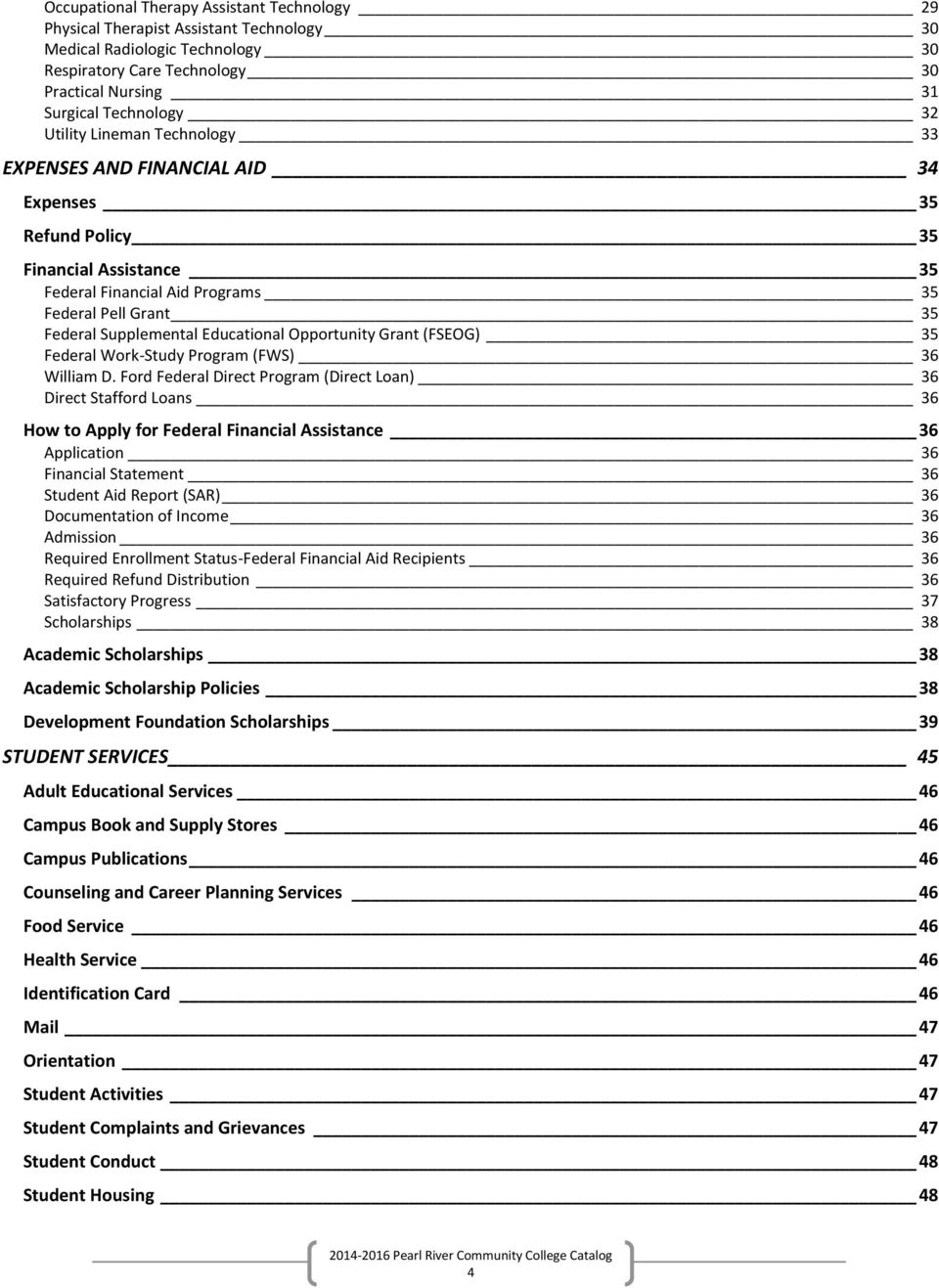
5 Student Support Services 48 Disability Services 48 Testing 49 Student Organizations 49 Poplarville Campus: 49 Hancock Center: 49 Forrest County Center: 49 INSTRUCTIONAL INFORMATION 50 Programs of Study 51 Attending Class 51 Absences 51 Attendance 51 Student Classification 52 Student Course Load 52 Distance Learning 52 Grades 52 Grade Appeal 53 Grade Point Average (GPA) 53 Quality Points 53 Transfer Students to PRCC 54 Grade Changes or Corrections 54 Repeated Courses 54 Probation and Suspension 54 President s List and Dean s List 54 Change of Schedule 54 Withdrawal from a Class 54 Withdrawal from College 54 Credit by Examination 55 Credit by Examination 55 College Level Examination Program (CLEP) 55 CLEP Subject-Area Examinations 55 Advanced Placement (AP) Credit 55 Continuing Education Units 56 Veteran s Benefits 56 Developmental Courses 56 Developmental Course Procedures 56 Requirements for Graduation 57 Honors and Special Honors 58 Transferring to a Senior College or University 58 Transcript Information 58 Technical Advance Placement (TAP) 58 Department of Workforce Education 58 ACADEMIC TRANSFER DEGREE PROGRAMS 59 5

6 University Bachelor s Degree Transfer Programs 60 Mississippi Community College Board Articulation Agreement 60 Academic Basic Core 64 Suggested Academic Courses for Undecided Major 64 General Electives 65 Humanities Electives 65 Science Electives (Lecture and Lab Must Match) 65 Social Science Electives 65 Fine Arts Electives 66 List of Academic Programs of Study with Specific Course Recommendations 67 Accounting 67 Art 67 Health, Physical Education, and Human Performance; Physical Education 67 Biology (for Pre-Dental, Pre-Medical, Pre-Pharmacy, Pre-Physical Therapy, and Pre-Veterinary) 67 Business Administration 67 Chemistry/Polymer Science 67 Computer Science 67 Criminal Justice 68 Elementary Education/Special Education 68 General Studies/Undecided 68 History and Political Science 68 Liberal Arts 68 Mathematics 68 Music Education and Applied Music (piano, voice, guitar, woodwinds, brass, or percussion) 68 Pre-Law 68 Pre-Nursing (B.S. Degree) 68 Psychology 69 Secondary Education 69 Social Work/Sociology 69 Associate Degree Nursing (ADN) 70 Academic Course Descriptions 71 Index of Instructional Areas with Prefixes 71 Accounting (ACC) 71 Art (ART) 71 Associate Degree Nursing (NUR) 72 Biology (BIO) 74 Business Administration (BAD) 77 Chemistry (CHE) 78 Computer Science (CSC) 79 Criminal Justice (CRJ) 79 Economics (ECO) 81 Education (EDU) 81 Educational Psychology (EPY) 81 Engineering (EGR) 82 English (ENG) 82 Family & Consumer Science (FCS) 83 (Modern) Foreign Language (MFL) 83 Forensic Science (FSC) 83 Geography (GEO) 83 Health, Physical Education, & Recreation (HPR) 84 History (HIS) 85 Honors (HON) 86 6

7 Journalism (JOU) 86 Leadership (LEA) 86 Learning & Life Skills (LLS) 87 Mathematics (MAT) 87 Music, Applied (MUA) 88 Music Foundations (MUS) 89 Music Organizations (MUO) 90 Philosophy & Bible (PHI) 91 Physics (PHY) 91 Political Science (PSC) 92 Psychology (PSY) 92 Reading (REA) 93 Social Work (SWK) 93 Sociology (SOC) 93 Speech & Theatre (SPT) 93 CAREER AND TECHNICAL EDUCATION PROGRAMS 95 Career and Technical Education Programs 96 Career Programs (Certificate) 96 Technical Programs (Associate in Applied Science (A.A.S.)) 96 List of Programs 96 Poplarville 96 Forrest County Center 97 Hancock Center 97 Program Profiles 98 Advanced Construction Technology 99 Automotive Mechanics Technology 100 Barbering 101 Barbering: Barbering Instructor Training Option 101 Brick, Block and Stonemasonry 102 Business and Office and Related Technology 103 Commercial Truck Driving 104 Computer Networking Technology 105 Construction Equipment Operation 106 Cosmetology 107 Cosmetology: Cosmetology Teacher Training Option 107 Criminal Justice: Certificate of Proficiency 108 Criminal Justice: Associate in Applied Science 109 Dental Assisting 110 Dental Hygiene Technology 111 Drafting and Design Technology 112 Early Childhood Education Technology 113 Electrical Technology 114 Electronics Technology 115 Electronics Technology: Biomedical Equipment Repair Technology 116 Health Care Data Technology 117 Health Information Technology 118 Heating, Air Conditioning, Ventilation, And Refrigeration Maintenance Technology 119 Instrumentation Technology 120 Marketing Management Technology 121 Medical Laboratory Technology 122 Medical Radiologic Technology 123 Occupational Therapy Assistant Technology 124 Physical Therapist Assistant Technology 125 Practical Nursing 126 Precision Manufacturing and Machining Technology 127 7

8 Respiratory Care Technology 128 Surgical Technology 129 Utility Line Worker Technology 130 Welding and Cutting 131 Career and Technical Course Descriptions 132 Index of Instructional Areas with Prefixes 132 Advanced Construction Technology (CAV) 133 Automotive Mechanics Technology (ATT) 133 Barbering (BAV) 135 Barbering Instructor Training (BAV) 135 Brick, Block & Stonemasonry (BBV) 136 Business & Office Technology (BOT) 136 Career & Technical Education (CTE) 138 Commercial Truck Driving (DTV) 138 Computer Networking Technology (CNT) 138 Computer Programming Technology (CPT) 139 Computer Servicing Technology (CST) 139 Construction Equipment Operation (CEV) 139 Construction Engineering Technology (CON) 140 Cosmetology (COV) 141 Cosmetology Teacher Training (COV) 142 Criminal Justice (CRJ) 143 Dental Assisting (DAT) 144 Dental Hygiene Technology (DHT) 145 Drafting & Design Technology (DDT) 146 Early Childhood Education Technology (CDT) 147 Electrical Technology (ELT) 149 Electronics Technology (EET) 150 Heating, Air Conditioning, Ventilation, & Refrigeration Maintenance Technology (ACT) 152 Health Information Technology (HIT) 153 Industrial Maintenance (IMM) 154 Information Systems Technology (IST) 154 Instrumentation Technology (INT) 155 Instrumentation Technology (MFT) 155 Marketing Management Technology (MMT) 156 Medical Laboratory Technology (MLT) 157 Medical Radiologic Technology (RGT) 158 Medical Terminology (AHT) 159 Occupational Therapy Assistant Technology (OTA) 159 Physical Therapist Assistant Technology (PTA) 161 Practical Nursing (PNV) 163 Precision Manufacturing & Machining Technology (MST) 163 Related Studies Mathematics (VOM) 164 Related Studies Reading (VOR) 164 Respiratory Care Technology (RCT) 165 Surgical Technology (SUT) 166 Utility Lineman Technology (ULT) 166 Welding And Cutting (WLV) 168 EMPLOYEE LISTING 169 Faculty and Professional Staff 170 Support Staff 178 8

9 GENERAL INFORMATION 9

10 Whom to Contact at PRCC about: Academic and Career-Technical Counseling and Advisement (601) ACT Assessment Testing (601) ADA/Civil Rights Coordinator (601) Admissions (601) Allied Health Programs (601) Associate Degree Nursing (601) Athletics (601) Business Office (601) Poplarville Campus Police (601) Forrest County Center Police (601) elearning (601) Financial Aid and Scholarships (601) Graduation: Academic Poplarville Campus (601) Academic Forrest County Center (601) Career and Technical Poplarville Campus (601) Career and Technical Forrest County Center (601) Recruitment and Orientation (601) Registration (601) Student Affairs (601) Student Nurse (601) Student Records (601) Student Support Services (601) Veterans Affairs (601) Workforce Education Forrest County (601) Poplarville (601) Hancock Center (228) Career and Technical Programs Poplarville (601) Career and Technical Programs Forrest County Center (601)
11 Board of Trustees Mr. Dale Purvis, Chairman Mr. Mitchell Brian Freeman, Vice-Chairman Mr. M. L. Sonny Knight, Secretary FORREST COUNTY Mr. Mitchell Brian Freeman 01/12-12/15 Mr. Herbert Ray Nobles 01/94-12/18 HANCOCK COUNTY Mr. Alan Dedeaux, Superintendent of Education 01/08-12/15 Mr. Frank Ladner 04/92-12/16 JEFFERSON DAVIS COUNTY Mr. Ike Haynes, Superintendent of Education 01/08-12/15 Mr. Anthony Charles Tony Waits 08/07-12/18 LAMAR COUNTY Dr. Ben Burnett, Superintendent of Education 01/08-12/15 Mr. Dale Purvis 03/07-12/15 MARION COUNTY Mr. Craig Robbins, Superintendent of Education 01/12-12/15 Mr. Al Brooks 08/00-12/17 PEARL RIVER COUNTY Mr. Alan Lumpkin, Superintendent of Education 1/12-12/15 Mr. M.L. Sonny Knight 11/95-12/14 Dr. Gale Harris 01/04-12/18 Mr. Don Welsh 10/11-12/15 Mr. P.W. Polk, Jr. 01/09-12/18 Ms. Teresa Lynn Stafford 01/12-12/16 11
12 Administrative Council President Vice President for Poplarville Campus and Hancock Center Vice President for Forrest County Operations Vice President for General Education and Technology Services Vice President for Business and Administrative Services Vice President for Enrollment Management Vice President for Planning and Institutional Research Vice President for Economic and Community Development Chief Technology Officer Director of Counseling Center/Placement Director (Poplarville) Director of Career and Technical Education Programs (Poplarville) Director of Development Foundation and Alumni Association Director of Financial Aid Assistant Vice President of Hancock Center Director of Physical Plant Director of Public Relations Director of Institutional Effectiveness Title III Director Director of Recruitment and Orientation Faculty Association President (Poplarville Campus & Hancock Center) Faculty Association President (Forrest County Center) Dr. William A. Lewis Dr. Adam Breerwood Dr. Cecil Burt Dr. Martha Lou Smith Mr. Roger Knight Mr. Dow Ford Dr. Becky Askew Dr. Scott Alsobrooks Mr. Steve Howard Dr. Ann Moore Ms. Gwen Smith Mr. Ernie Lovell Ms. Valerie Horne Mr. Raymunda Barnes Mr. Craig Tynes Mr. Charles F. Abadie, III Dr. Jennifer Seal Dr. Amy Townsend Ms. Casey Rawls Dr. Justin Williamson Dr. Tim Crowe 12

13 Administrators Athletics Director (601) Mr. Jason Francis Bookstore Manager (601) Ms. Frances Rawls Business Services, Vice President (601) Mr. Roger Knight College Libraries, Director (601) Ms. Tracy Smith Counseling Center, Director (601) Dr. Ann Moore elearning, Director (601) Ms. Michele Mitchell Economic and Community Development, Vice President (601) Dr. Scott Alsobrooks Enrollment Management, Vice President (601) Mr. J. Dow Ford Financial Aid, Director (601) Ms. Valerie Horne Forrest County Operations, Vice President (601) Dr. Cecil Burt Forrest County Operations, Assistant Vice President (601) Ms. Jana Causey General Education and Technology Services, Vice President (601) Dr. Martha Lou Smith Hancock Center, Dean (228) Mr. Raymunda Barnes Information Technology, Chief (601) Mr. Steve Howard Physical Plant, Director (601) Mr. Craig Tynes Planning and Institutional Research, Vice President (601) Dr. Becky Askew Poplarville Campus and Hancock Center, Vice President (601) Dr. Adam Breerwood Public Relations, Director (601) Mr. Charles F. Abadie, III Recruitment and Orientation, Director (601) Ms. Casey Rawls Student Support Services, Director (601) Dr. Robert Escudero 13

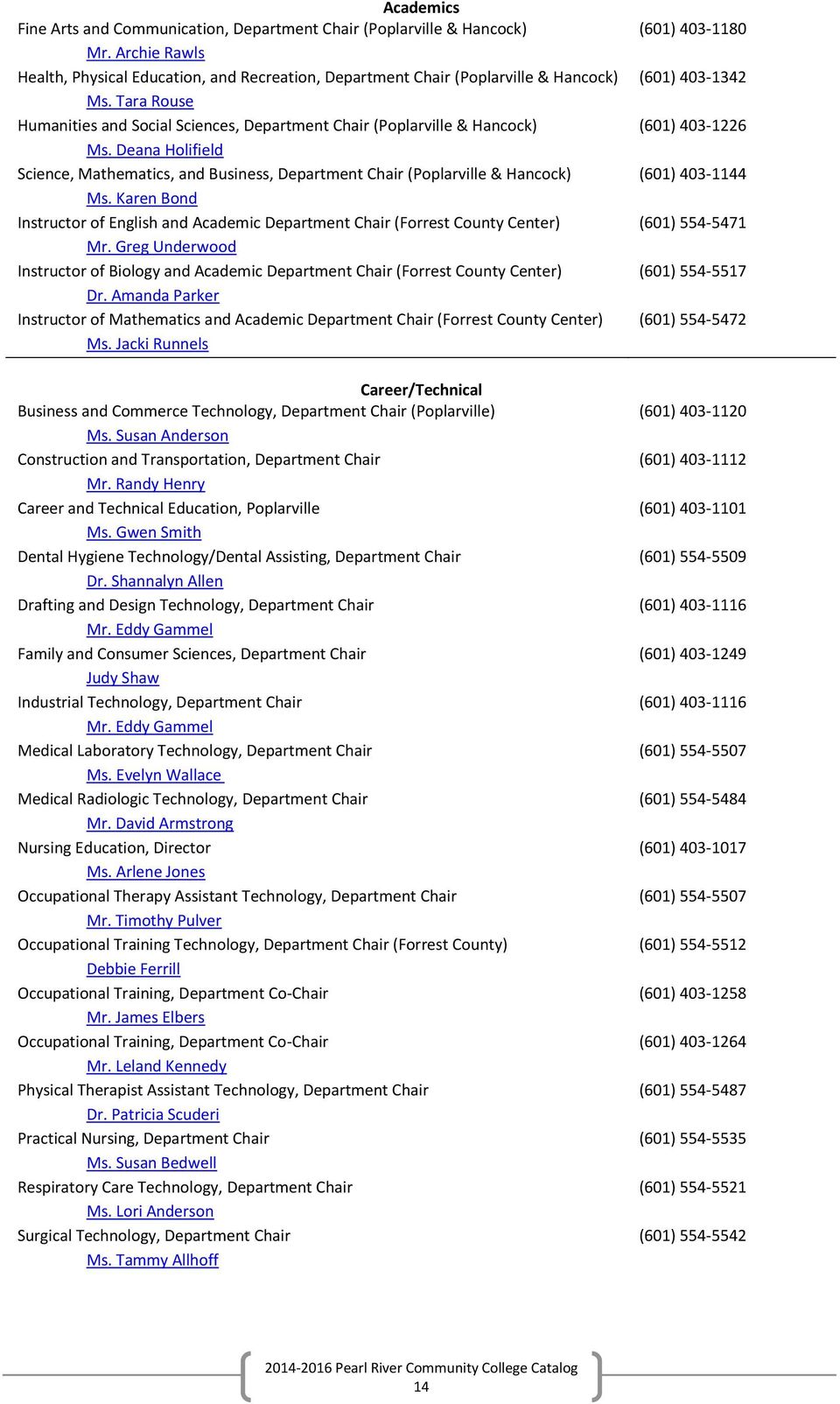
14 Academics Fine Arts and Communication, Department Chair (Poplarville & Hancock) (601) Mr. Archie Rawls Health, Physical Education, and Recreation, Department Chair (Poplarville & Hancock) (601) Ms. Tara Rouse Humanities and Social Sciences, Department Chair (Poplarville & Hancock) (601) Ms. Deana Holifield Science, Mathematics, and Business, Department Chair (Poplarville & Hancock) (601) Ms. Karen Bond Instructor of English and Academic Department Chair (Forrest County Center) (601) Mr. Greg Underwood Instructor of Biology and Academic Department Chair (Forrest County Center) (601) Dr. Amanda Parker Instructor of Mathematics and Academic Department Chair (Forrest County Center) (601) Ms. Jacki Runnels Career/Technical Business and Commerce Technology, Department Chair (Poplarville) (601) Ms. Susan Anderson Construction and Transportation, Department Chair (601) Mr. Randy Henry Career and Technical Education, Poplarville (601) Ms. Gwen Smith Dental Hygiene Technology/Dental Assisting, Department Chair (601) Dr. Shannalyn Allen Drafting and Design Technology, Department Chair (601) Mr. Eddy Gammel Family and Consumer Sciences, Department Chair (601) Judy Shaw Industrial Technology, Department Chair (601) Mr. Eddy Gammel Medical Laboratory Technology, Department Chair (601) Ms. Evelyn Wallace Medical Radiologic Technology, Department Chair (601) Mr. David Armstrong Nursing Education, Director (601) Ms. Arlene Jones Occupational Therapy Assistant Technology, Department Chair (601) Mr. Timothy Pulver Occupational Training Technology, Department Chair (Forrest County) (601) Debbie Ferrill Occupational Training, Department Co-Chair (601) Mr. James Elbers Occupational Training, Department Co-Chair (601) Mr. Leland Kennedy Physical Therapist Assistant Technology, Department Chair (601) Dr. Patricia Scuderi Practical Nursing, Department Chair (601) Ms. Susan Bedwell Respiratory Care Technology, Department Chair (601) Ms. Lori Anderson Surgical Technology, Department Chair (601) Ms. Tammy Allhoff 14
15 Mission Statement Pearl River Community College is a public institution committed to providing quality educational and service opportunities for all who seek them. Strategic Goals 1. To prepare students to complete a degree or certificate program and to be successful in careers for which they have been prepared. 2. To provide quality student services. 3. To provide access to college courses and programs using various instructional methods, including distance education and Dual Enrollment/Credit courses. 4. To employ qualified faculty and staff, compensate them well, and provide opportunities for their professional development. 5. To provide facilities, technology, and support staff in order to improve student learning, enhance faculty and staff performance, augment community services, and make college services available via the Internet. 6. To improve communication among campus personnel and community members regarding the College goals, objectives, and activities. 7. To recruit and retain students from a diverse population. 8. To provide workforce training programs that meet requirements of business, industry, educational, and public service agencies for basic skills, specific job skills, and technical skills training. Accreditation Southern Association of Colleges and Schools Commission on Colleges Pearl River Community College is accredited by the Southern Association of Colleges and Schools Commission on Colleges to award associate degrees. Contact the Commission on Colleges at 1866 Southern Lane, Decatur, Georgia , telephone , or at for questions about the accreditation of Pearl River Community College. The Commission is only to be contacted to learn about the accreditation status of the College, to file a third-party comment at the time of the College s decennial review, or to file a complaint against the College with evidence that appears to support non-compliance with a standard or requirement. All normal inquiries about the institution, such as admission requirements, financial aid, educational programs, etc., should be addressed directly to Pearl River Community College and not to the Commission s office. Other Accreditation Organizations Pearl River Community College is a member of the American Association of Community and Junior Colleges and the Mississippi Association of Colleges and Universities. Additional accreditation and reaffirmation information follows: In 2013 the College s Medical Radiologic Technology Program accreditation was reaffirmed by The Joint Review Committee on Education in Radiologic Technology for an eight year term. In 2012 the College s Medical Laboratory Technology Program accreditation was reaffirmed by the National Accrediting Agency for Clinical Laboratory Sciences, 5600 N. River Road, Suite 720, Rosemont, Illinois , (847) , (773) , Fax -- (773) , [email protected], In 2011 the College s Associate Degree Nursing Program received accreditation with conditions by the Accreditation Commission for Education in Nursing, Inc., 3343 Peachtree Road NE, Suite 500, Atlanta, Georgia This program is also accredited annually by the Mississippi Board of Trustees of State Institutions of Higher Learning. In 2010 the College s Practical Nursing Program accreditation was reaffirmed by the Mississippi State Board for Community and Junior Colleges. In 2009 the College s Physical Therapist Assistant Technology Program accreditation was reaffirmed by the Commission on Accreditation of Physical Therapy Education. In 2009 the College s Occupational Therapy Assistant Technology Program accreditation was reaffirmed by the Accreditation Council for Occupational Therapy Education, (ACOTE) of the American Occupational Therapy Association AOTA), Montgomery Lane, Post Office Box 31220, Bethesda, Maryland In 2008 the College s Surgical Technology Program accreditation was reaffirmed by the Accreditation Review Committee on Education in Surgical Technology. The Surgical Technology Program is accredited by the commission on Accreditation of Allied Health Education Programs (CAAHEP) Park Street Clearwater, FL Phone: In 2008 the College s Dental Hygiene Technology and Dental Assisting Technology Programs accreditations were reaffirmed by the Commission on Dental Accreditation. American Dental Association 211 E. Chicago Avenue Chicago, IL

16 In 2008 the College s Early Childhood Education Technology Program accreditation was reaffirmed by the National Academy of Early Childhood Programs. In 2006 the accreditation of Pearl River Community College was reaffirmed by the Commission on Colleges of the Southern Association of Colleges and Schools to award associate degrees. In 2006 the College s Respiratory Care Technology Program, Associate in Applied Science Degree at the Forrest County Center in Hattiesburg, Mississippi, accreditation was reaffirmed until 2013 by the Commission on Accreditation for Respiratory Care ( Harwood Road, Bedford, Texas , (817) History Pearl River Community College (PRCC) is among the oldest colleges of its kind in the South and is the pioneer junior college in Mississippi. PRCC began its journey as the State s first county agricultural high school in the first decade of the twentieth century and has since been a pathfinder for advanced education in South Mississippi. Pearl River County Agricultural High School (PRCAHS), the first in the State, opened its doors in For the first eleven years, the school was devoted solely to educating high school age students in academic studies and in agricultural and home sciences. In 1921, PRCAHS became the first agricultural high school to offer freshman college courses, and was soon renamed Pearl River Junior College. The institution s name was changed to Pearl River Community College on July 1, The name change reflects the comprehensive academic, career, technical, and community services programs that are offered through the College. The College operates multi-instructional sites. A post-secondary vocational-technical center was built in 1969 in Hattiesburg and developed into the Pearl River Community College Forrest County Center. This facility has been expanded several times, with the most recent addition being a new library and classroom building that opened in the Spring of The Hancock Center opened in Waveland in January 2005, only to be destroyed by Hurricane Katrina on August 29, The Hancock Center reopened in late The Lowery A. Woodall Advanced Technology Center opened in Hattiesburg in October Faculty The faculty of Pearl River Community College are professionally competent and successful educators, whose fitness is certified not only by their scholarly gifts and attainments, but also by their experience in helping students overcome difficulties and perplexities. Faculty members are encouraged to expect a high standard of conduct from students and to develop a profitable association with them. Location The main campus of Pearl River Community College is located on U.S. Highway 11 in Poplarville, Mississippi, and is served by Interstate 59 and State Highways 26 and 53. The Forrest County Center is located in Hattiesburg, Mississippi, on U. S. Highway 49. allied health programs, and academic transfer courses. It is a comprehensive center providing career, technical and The Hancock Center is located in Waveland, Mississippi, on U.S. Highway 90. Facilities The two-floor, 22,000 square foot Alexander Administration Building was renovated and expanded in 1999 from a one-floor, 7,735 square foot structure built in The newly redesigned structure houses the offices of the President, Vice President for the Poplarville Campus and Hancock Center, Vice President for General Education and Technology Services, Vice President for Planning and Effectiveness, Vice President for Enrollment Management, Vice President for Business Services, Director of elearning, Director of Financial Aid, Director of Recruitment and Orientation, Institutional Research Specialist, and ADA/Civil Rights Coordinator. Located at the south entrance of the campus, the Alumni House was erected in 1924 and served as the President s home for 53 years. The structure was renovated in 1987 to house the offices of the Development Foundation and Alumni Association. Constructed in 1978 and expanded in 2008, the Center for Career Education, contains shops, instructors offices, and classrooms. The Choral Music Hall was constructed in 1973 and is a one-story brick masonry building with 7,200 square feet of space. It contains a band 16
17 rehearsal area, a choir rehearsal room, storage rooms for band, choir, and musical equipment, and a band and choral library. The Physical Plant Building, a one-story, 47,216 square foot concrete and masonry building completed in 1966, contains offices and shops for the Physical Plant Department. It continues to house Career and Technical programs and effective in 2010 a newly renovated band hall. The Huey Stockstill Construction Equipment and Truck Driving Center is a 3000 square foot building located in the north west corner of PRCC s main campus in Poplarville. This building was completed in the spring of 2008 and contains office space, classrooms, and storage space. Crosby Hall was built as a two-story brick structure in Extensively remodeled and extended in 1995 and 2004, it houses the bookstore, grill, Counseling Advisement, and Placement Center, nurse s office, student lounge, meeting rooms, the Olivia Bender Cafeteria, and the Student Success Center. Five faculty and staff housing units of brick veneer construction were completed in 1968, providing housing for ten faculty/staff members and their families. Each unit, a duplex with the same floor plan, contains a three-bedroom apartment and a two-bedroom apartment. The Field House was constructed by expanding and renovating a structure built in 1969 that previously housed The Physical Plant offices and shops. The Forrest County Center was constructed in 1970 on a 12-acre campus located in Hattiesburg on Highway 49 South. In 1987, the Tatum Land Management Limited of Hattiesburg donated 36 acres of land adjacent to the present site for future expansion of Pearl River Community College - Forrest County Center. Including the Tatum land acquisition, the present campus now consists of 48 acres. The center is composed of seven buildings. Building 1 is a one-story brick structure of 11,702 square feet housing classrooms, laboratories, and the Counselor s offices. Building 2 is a one-story, brick veneer structure of 16,320 square feet containing classrooms. Building 3 is a one-story brick structure of 14,343 square feet with shops and classrooms. Building 4 is an annex to Building 3. It is a one-story brick veneer structure of 3,000 square feet housing maintenance and receiving. Building 5 is a one-story brick veneer structure of 20,000 square feet built in 1985 to house electronics, practical nursing, business and office technology, and a large meeting room. The Allied Health Center is a 38,000 square foot, two-story, brick facility, which houses a variety of allied health programs and administrative offices. Housed in this building are medical, dental, and science laboratories as well as several classrooms for technical and academic instruction. A 5,000 square foot, two-story addition was completed in 1996, which provides for the Occupational Therapy Assistant program, two classrooms, and a student lounge. Another 5000 square foot, two-story addition was completed in 2002 providing a Medical Radiologic Technology Laboratory and four additional classrooms. The Career Education Building at the Forrest County Center was completed in The Dobie Holden Stadium was constructed in 1966 with a seating capacity of 5000, a press box, and a storage area for equipment. The stadium was renovated and expanded in Earlora Chapman Holden and Kathryn Bass Moody Student Resident Halls, built side-by-side, house 60 female students each. Completed in 1990, each of these 11,533 square foot buildings provides 15 apartments on each floor. An apartment for a head resident, a residence hall office, and a utility room are located on the first floor of each building. In addition, each floor contains a lobby. The Forrest County Center Library, with approximately 5,000 square feet including the Learning Lab and Online Proctored Testing, was constructed in The library s collection contains more than 7,000 print books, 100,000 electronic books, 700 audio books, and 950 AV items. The library also subscribes to 23 current print magazines/journals and 1 print newspaper. Forrest Hall is a two story brick structure of 65,068 square feet completed in 2006 with 133 rooms to house 266 students. with personal bath facilities. This modern facility has two head resident apartments. All rooms are equipped The Garvin H. Johnston Library was constructed in 1968 with additions in 1973 and The Pearl River Community College Library was named by the Board of Trustees to honor former President Dr. Garvin H. Johnston in It provides a variety of learning resources, including the Curriculum Enhancement Center (CEC), and Media Services. The library holds a collection of over 56,000 titles which include print books, and microform, and bound periodicals; and the audiovisual collection totals 4, 243. The library also subscribes to 48 current print magazines/journals and 3 print newspapers. All library patrons also have access to thousands of full text online articles through numerous online databases provided by the library. The articles can be accessed through the Library webpage or RiverGuide accounts. The Hancock Center is located in newly renovated leased property on U.S. Highway 90 in Waveland, Mississippi. It opened in Fall Semester It contains classrooms, a conference room, offices, and a library. Hancock Hall, a two story brick veneer dormitory, contains 59 rooms for 118 students. The building was completed in 2006 and has 31,000 square feet. The dormitory also contains an apartment for a head resident and family. 17
18 The Hayfield Observatory, constructed in 2000, houses a 14 inch Schmidt-Cassegrain telescope, a 13 inch reflector, and several smaller instruments. The Holden Brownstone Center for the Performing Arts was completed in Huff Hall, built in 1919, is a three-story brick residence hall of 10,145 square feet, providing living space for 87 men and an apartment for a head resident and family. This structure was completely renovated in The Information Technology Building, located in the center of the campus, was built in 1970 and renovated in foot structure houses the offices of the Department of Information Technology. This one-story, 6,534 square Jefferson Davis Hall, a brick veneer, 9,016 square foot, two-story building, houses the Department of Student Support Services. 1947, the building consists of four classrooms, one business laboratory, and offices for instructors. Constructed in The Larry L. Stanford Communications Center, built in 1953 with 7,471 square feet of space, houses the Print Shop and the PRCC Museum. The Lowery A. Woodall Advanced Technology Center, constructed in 2004, is a 35,000 square-foot two-story facility located on 12 acres in the Hattiesburg-Forrest County Industrial Park and is part of the Forrest County Operations. The building includes the PRCC Workforce Development staff offices, two computer labs, a business incubator, and equipment and facilities for a variety of training programs. Malone Chapel, a non-denominational structure, was constructed with private funds in Sidney Malone, PRCC alumnus, in memory of his son, Kelly, made the lead gift for the Chapel Campaign. It has 4,000 square feet of floor space and seats 200. Moody Hall, a three-story brick structure of 22,359 square feet built in 1926 and extensively renovated following Hurricane Katrina in 2005, houses the Department of Fine Arts and Communication. The facility was severely damaged during Hurricane Katrina. A major portion of the building that formerly housed the auditorium was rebuilt and opened in the fall of The new addition now houses the Visual Arts Department, Speech Communication, and Music classrooms. Space for an Art Gallery is included on the first floor. The Nursing/Wellness Center, completed in 1997, functions as a training facility for faculty, students and community to enhance total well-being. The building houses classrooms, laboratories, faculty offices and a fully equipped wellness center with an indoor walking track. The associate degree and Poplarville practical nursing programs are located in the facility, and participate in activities common to nursing and wellness. Pearl River Hall, a two-story, brick veneer dormitory of 8,178 square feet, was built in 1933 with 31 rooms to house 62 students and one apartment to house the head resident and family. This structure was completely renovated in the year The President s Home, built in 1987, is a two-story, 5,100 square foot French Acadian structure designed with an open plan allowing adequate space for the President and his family and for entertaining special guests to the campus. The Public Relations Building was completed in 1957 and completely renovated in 1983 and again in The split-level, brick veneer, 4,290 square foot structure houses the Public Relations Department. Marion Hall was completed in It is a men s dormitory and was rebuilt after the original structure was heavily damaged by Hurricane Katrina. Lamar Hall was completed in It is a men s dormitory and was rebuilt after the original structure was destroyed by Hurricane Katrina. The Science Building, constructed of reinforced concrete and masonry in 1966, was doubled in size in classrooms and laboratories for instruction of science and mathematics. The 30,100 square foot building has Seal Hall was constructed in In 1986, the Pearl River Community College Board of Trustees named this building in honor of Enoch Seal, Jr., who served the College with distinction from 1951 to 1986 as Instructor, Registrar, Dean of the College, and Dean of Academic Affairs. It houses classrooms and offices for faculty in the Department of Humanities and Social Sciences. Shivers Gymnasium was built in 1948 and renovated following Hurricane Katrina. It contains the office of the Director of Athletics and is the temporary home of Wildcat Basketball teams pending the reconstruction of M.R. White Coliseum. The Technology Center, a 44,046 square foot structure completed in 1989 and fully utilized during the Spring 1990 semester, houses the office of the Director of Career and Technical Education Programs for the Poplarville campus, and office and classroom space for technical programs. The Transportation Building consists of 13,657 square foot of space and houses the mechanics shop for the College s extensive motor pool. Warehouse is a 6,607 square foot facility and is the central receiving location for PRCC. White Coliseum was destroyed by Hurricane Katrina in 2005 and rebuilt in

19 White Hall, built in 1926, is a two-story brick building of 12,600 square feet, containing classrooms and office space for computer science, business, and accounting. In 2014, the second floor of White Hall was converted into the home of the PRCC Honors Institute. 19
20 ADMISSIONS 20

21 Admission to PRCC Educational opportunities are provided for students attending Pearl River Community College. Pearl River Community College offers equal education and employment opportunities. The College does not discriminate on the basis of race, religion, color, sex, age, national origin, veteran status, or disability. For inquiries regarding the non-discrimination policies or to request accommodations, special assistance, or alternate format publication please contact Ms. Tonia Moody, ADA/Civil Rights Coordinator, at P.O. Box 5118, Poplarville, MS or (601) General Admissions Procedures The Admissions Office at Pearl River Community College is located in the Administration Building on the campus in Poplarville. Applications for admission and other forms and information are available in the Admissions Office from 8:00 A.M. until 4:00 P.M. on weekdays. This office receives and processes all applications, high school transcripts, transfer college transcripts, GED certificates, and other documents related to admission to Pearl River Community College. Information may be requested from or documents may be mailed to: OFFICE OF ADMISSIONS PEARL RIVER COMMUNITY COLLEGE 101 HIGHWAY 11 NORTH BOX 5120 POPLARVILLE, MS Students who wish to enroll in a career or technical program at the Forrest County Center in Hattiesburg should direct inquiries to and mail documents to: PEARL RIVER COMMUNITY COLLEGE FORREST COUNTY CENTER 5448 U.S. HIGHWAY 49 SOUTH HATTIESBURG, MS In order to be admitted as an academic, technical, or career student, the following documents must be submitted: PRCC Application for Admission; Official transcript from an accredited high school indicating date of graduation or GED test transcript indicating passing; Official transcript from every college attended; ACT scores for academic or technical students (See Admission Testing below). Students taking classes at Pearl River Community College are classified in one of the following areas of instruction with regard to their educational goals. ACADEMIC STUDENTS are students who are taking classes that lead to the Associate in Arts degree (AA). The Associate in Arts degree program is designed to provide a variety of educational experiences which acquaint the student with the liberal arts disciplines of writing, mathematics, humanities and fine arts, science, social science, communication, and physical education. In general, academic students intend to transfer their work completed at PRCC to a college or university and have the work apply toward a Bachelor of Arts or a Bachelor of Science degree. TECHNICAL AND CAREER STUDENTS: o Technical Associate in Applied Science degree (AAS) students are taking classes that lead to a diploma. The Associate in Applied Science degree combines a foundation of basic academic courses with intensive training in a specific area of instruction, and technical course work designed to provide the graduate with the specific technical training needed for employment after completion of the degree. o Technical Certificate students are taking approximately 45 hours of technical classes that are specific to the technical training needed for employment after completion of the certificate. o Career Certificate students are taking classes that lead to a Career Certificate. These total approximately 30 hours. High School Completion Students entering Pearl River Community College must have graduated from high school with a regular high school diploma or must have successfully completed the GED. Students who complete high school with an Occupational Diploma or a Certificate of Attendance will need to successfully complete the GED before admission to Academic or Technical Programs at Pearl River Community College. An online or private GED will not be accepted, nor will diplomas from online high schools not holding regional accreditation. Admission Testing Students who are admitted to Pearl River Community College must furnish results of the American College Test (ACT). All references to the ACT refer to the Enhanced version of the test. The Enhanced version of the ACT was administered beginning in October of Students who completed the ACT prior to October 1989 may still use their results for admission purposes. ACT scores are used for placement in classes and for 21
22 academic and technical counseling. (See Developmental Course Placement.) There is no minimum score for general admission to the college; however, specific programs may require minimum scores for admission. Notification of Admission Status After a completed application is received, PRCC develops an admission file on the student and begins correspondence indicating receipt of documents and/or deficiencies. All students, regardless of full or part-time status, must meet admission requirements prior to registration for classes. A letter of acceptance or denial will be mailed to all applicants after all admission criteria have been met. All students who have met admission requirements will be considered for admission to the College. However, admission to the college does not guarantee admission to a specific program. Students must determine the requirements for admission to a specific program to see if they are eligible to enroll in that program. Specific questions concerning admission to the College or to a specific program of study should be directed to the Office of Admissions. Early Admission In order to qualify for early admission to the College, an applicant must have completed a minimum of 14 core high school units; a 3.0 grade point average on a 4.0 point scale, or better, on all high school courses, as documented by an official high school transcript; a home-schooled student must submit a transcript prepared by a parent, guardian or custodian with a signed, sworn affidavit to meet the requirements of this paragraph; a minimum ACT composite score of twenty-six (26) or the equivalent SAT score; and, a written statement from his/her principal or guidance counselor that this (Early Admission) is in the best educational interest of the student. Grades and college credits earned by a student admitted to the early admission program shall be recorded on the college transcript at the community or junior college where the student attends classes, and may be released to another institution or used for college graduation requirements only after the student has successfully completed one (1) full semester of course work. Dual Enrollment A high school student may enroll at Pearl River Community College while still attending high school, provided the student has earned a minimum of 14 core high school units and has a 3.0 or better grade point average as documented by an official high school transcript, and provides a letter of approval from the high school principal or counselor. A high school student who is Dually Enrolled in courses at Pearl River Community College is not eligible for PRCC institutional scholarships, state, or federal student aid. For more information regarding Dual Enrollment at Pearl River Community College, visit the PRCC website at Readmission A student who has attended PRCC in any semester other than the most recent semester must apply for readmission to the college. A student seeking readmission should complete a new application and provide transcripts from all other colleges attended, if any, since last attending PRCC. Students are readmitted based on their performance at PRCC and other colleges attended. PRCC honors the performance policies (honors, suspension, and probation) of transfer colleges. Admission of a Transfer Student Any student may transfer from an accredited institution and expect to have consideration of previous academic experiences, provided that the admission requirements of PRCC are met as stated under the General Admission section of this catalog. The following practices with regard to transfer work will apply: 1. Credit earned from an institution that is not regionally accredited may not be accepted. 2. Official copies of AP or CLEP scores must be provided by the student for evaluation. 3. Acceptance of transfer work toward a degree is subject to the following considerations: a. Courses must be equivalent to PRCC courses in content, description, and length. b. The grade in the transfer course must be a C or better. If the student s overall transfer average is above 2.00, a grade of D may be considered. c. Technical or Career transfer work is subject to the approval of the program faculty and the Director of the Career and Technical Education center where the student wishes to enroll. A transfer student seeking admission to the Associate Degree Nursing program should review the Associate Degree Nursing procedure under Admission Requirements for Specific Programs of Study at PRCC regarding transfer from another nursing program. Special Admission Contractual Agreements Pearl River Community College occasionally enters into contractual agreements with agencies or organizations. In such cases, special admission may be granted to individuals participating in educational experiences as covered in the agreement. College credit will be awarded, however, only 22
23 to participants who meet admission criteria. Students Who Have Not Completed High School/GED Students who have never graduated from high school and who have not completed the GED may be admitted to selected career programs by special waiver provided they are over the age of 18 and demonstrate through admission testing an ability to benefit from educational experiences. Students Who Wish To Audit Classes Students may audit courses by submitting a completed application to audit to the Director of Admissions who will, after the application has been evaluated, inform the student if his/her application to audit has been approved or denied. No credit hours are earned. Tuition for audit or credit is the same. Financial aid is not available for auditing classes. Once enrolled in a class, a student may not change from audit to credit status, or vice-versa. Completed audit courses are listed on the student s transcript. Continuing Education Admission Students who wish to participate in Continuing Education classes must complete an Application for Admission. awarded as Continuing Education Units (CEU). Continuing Education credit is Admission/Readmission Appeals The Director of Admissions is authorized to admit any student to the college who meets admission requirements. However, in cases where doubt exists the Admission Committee makes a determination on admission. The Admission/Readmission Committee is composed of The Director of Admissions (Chairperson), an Academic Counselor, and a Career -Technical Counselor. The decision of the Admission Committee may be appealed to the Dean of Student Services. A ruling from the Dean of Student Services may be appealed to the President of Pearl River Community College. The ruling of the President is final. The Readmission Committee is organized to hear appeals from students who have been suspended from the college because they have not maintained the minimum grade point average required for continued enrollment. Appeals will be heard only for those students who submit a request for an appeal in writing two weeks or more prior to the beginning of the semester for which they wish to re-enroll. Resident Status of Students Students at Pearl River Community College are classified in regard to residency as IN-DISTRICT, OUT-OF-DISTRICT, or OUT-OF-STATE. The following methods are used to determine student resident status: 1. An IN-DISTRICT student is one who, on the first day of registration of a given term, is twenty-one (21) years of age or older and is a legal resident of Forrest, Hancock, Jefferson Davis, Lamar, Marion, or Pearl River County in the State of Mississippi. The legal residence of a student under the age of twenty-one (21) is the residence of either parent. 2. An OUT-OF-DISTRICT student is one who resides in the State of Mississippi but is not a resident of Forrest, Hancock, Jefferson Davis, Lamar, Marion, or Pearl River County. 3. An OUT-OF-STATE student is one who does not reside within the boundaries of the State of Mississippi. In determining residence, the burden of proof is on the student. A student can change his status from OUT-OF-STATE only by physically moving to a location within the boundaries of the State of Mississippi with the intention of residing within the state indefinitely and establishing a physical presence and place in the state which the student considers to be the true, fixed, and permanent place of habitation. The Office of Admissions of Pearl River Community College determines residence status. The decision of the Admissions Office may be appealed. In requesting a change of residence status, the student will be responsible for presenting competent, written evidence in support of the request. A student may apply in writing for reclassification prior to any registration. In determining residence, the following test for qualification will be applied: 1. Students who are not yet 21 years of age and are not married - Residency for a student who is not yet 21 years of age is based solely on the residence of the parents. Students who are not yet 21 years of age are considered residents of Mississippi only if one or both parents reside in the State of Mississippi. Parent(s) must have their fixed and permanent residence within the boundaries of the state. It is not possible for tuition purposes to be a resident of more than one state. The law allows no exceptions for students below the age of 21 who are independent from their parents. 2. Students who are 21 years of age or older or students who are married - Residency for a student who is over 21 years of age does not depend on parental residence. In order to prove residency the student must prove that they have a fixed and permanent residence within the boundaries of the state. It is not possible for tuition purposes to be a resident of more than one state. Students who are not yet 21 years of age must provide the following documents to prove that their parent(s) are Mississippi residents. Students who are 21 years of age or older or are married must provide the following documents to prove that they are Mississippi residents: a. Proof of filing or payment of Mississippi income tax. b. Proof of filing of Homestead exemption (if a home is owned). c. Proof of home ownership or rent receipts. d. Copies of utility bills for electric and phone service. e. Mississippi Driver License. f. Registration of Automobile in Mississippi (Car Tag). g. Voter registration by Mississippi County. 23
24 h. Marriage license for students below the age of 21 who are married. The above factors are not the sole factors that PRCC may look to in establishing residence, but they are important in establishing intent to reside and physical presence within the state, and they may be used as guidelines by the student in collecting documentation for a reclassification of residence status. Honor s Institute The PRCC Honors Institute aims to provide the College s intellectually gifted students with an enriched and challenging curriculum, to foster individual scholarship and research, and to extend this spirit of academic enrichment beyond the campus into the community at large. The Goals of the Honors Institute are: 1. To enhance the intellectual climate of the College and its leadership in the academic community. 2. To enrich Honors coursework with research, service, and other experiential opportunities in order to broaden students perspectives and to challenge them to achieve their full potential as learners, leaders, and citizens. 3. To provide Honors Institute students with a broad interdisciplinary foundation and to allow students the opportunity to complete a Capstone Project based on individual research and collaborative faculty and staff mentoring. 4. To enhance the academic spirit of the community by promoting intellectual engagement in all its forms among students, faculty, staff, and the public. Students interested in the Honor s Institute should contact Dr. Stephen Black ([email protected]), Honor s Institute Director. 24
25 Admission Requirements for Specific Programs of Study at PRCC Full-time students are defined in accordance with Pearl River Community College s policy as students enrolled in a minimum of twelve semester hours in a regular term. Students enrolled in Barbering, Early Childhood Education Technology, and all Health Related Programs are subject to testing for controlled substances. Associate Degree Nursing The Associate Degree Nursing (ADN) program begins each fall and spring semester on the PRCC Poplarville campus. Once accepted into the ADN program, the program is four semesters in length. After completion of this program, graduates receive the Associate in Applied Science Degree and are eligible to write the National Council Licensure Examination (NCLEX) for licensure as a registered nurse (RN). Licensing of registered nurses is regulated by the Mississippi Board of Nursing, and conviction of a misdemeanor or felony offense may be grounds for refusal by the board to issue a license. In addition to all Pearl River Community College s admission requirements, the ADN program has specific program requirements as listed below: I. Critical Elements for Performance requirements: An applicant seeking admission to the ADN program must meet physical and psychological requirements essential to provide nursing care. An explanation of the critical elements for performance is included in the ADN application packet. II. III. IV. An ADN applicant must have the following documents on file by March 1 for consideration for the Fall semester or by October 1 for the Spring semester. An LPN to ADN Bridge applicant must have the following on file by February 1. A. PRCC application B. ADN application C. Official transcript(s) of all colleges previously attended D. Official high school transcript from an accredited high school or GED test score E. Test score for the National League for Nursing (NLN) Pre-Admission Exam-RN (PAX-RN) F. ACT score, if applicable G. A letter from the dean or director of any ADN or BSN program attended stating date of eligibility to return Note: If not eligible for immediate return, the waiting period is 5 years from exit date to apply H. If applicable, a current non-restricted Licensed Practical Nurse (LPN) licensure copy and a completed LPN Employer Verification Form ACT requirements: A. A composite score of 18 (or equivalent) on the ACT B. If the ACT is below 18, the applicant must have 12 college semester hours of the ADN general education courses completed (must include College Algebra and Anatomy & Physiology I with Lab) with a minimum grade point average of 2.5 (Mississippi IHL Admission Standard). C. An applicant who has previously earned a baccalaureate or higher degree may enter without an ACT by completing all the required ADN general education courses with grades of C or better and having an overall 2.5 grade point average (Mississippi IHL Admission Standard). GPA & ADN General Education Course requirements: A. An applicant must have completed, be enrolled in, or be eligible to take College Algebra and Anatomy & Physiology I with Lab. B. A grade of C or better is required on all ADN general education courses taken. C. An applicant, who has attended another nursing program, will also have their nursing course grades included in the GPA. D. Anatomy & Physiology I and II and Microbiology with Labs must have been completed within the last five years. Sociology and Human Growth and Development must have been completed within the last ten years. A currently working Licensed Practical Nurse, who submits an LPN Employer Verification Form and a copy of a current non-restrictive license, will have no time restrictions on ADN general education courses. V. Transferring Nursing Credits from Another Nursing Program (ADN or BSN) requirements: A. The application deadline for transferring applicants is February 1 for Fall consideration and September 1 for Spring. Applicants will be admitted subject to space availability. B. Transferring applicants must meet all PRCC Admission and ADN program requirements. C. The applicant must submit a syllabus for each completed nursing course (including course description, course objectives, credit hours, and daily objectives) for review by the deadline. Upon review, the applicant may be required to take additional nursing course work in order to meet PRCC and ADN program/graduation requirements. D. In order to receive the PRCC Associate in Applied Science degree, a minimum of twenty-five percent (25%) of the required ADN curriculum hours must be completed at PRCC. VI. Selection of applicants: Selection of applications is made by the ADN admission committee using a competitive selection process based on the nursing program admission requirements and residency. Applicants are ranked according to ACT composite score, GPA on degree-required courses, NLN PAX-RN score and residency. Preferential consideration is given to in-district residents (Forrest, Hancock, Jeff Davis, Lamar, Marion and Pearl 25
26 River counties), followed by out-of-district residents, then out-of-state residents. A letter of acceptance/declination will be sent after class selection has been made. VII. Licensed Practical Nurse (LPN) to ADN Bridge Course: The LPN to ADN Bridge Course is designed to enhance the knowledge learned in a Practical Nursing program and make the transition into Level III & IV of the ADN program. This course focuses on the fundamentals, the theory and practice of medical-surgical nursing, and the role of the nurse as provider of care, manager of care, and a member within the discipline of nursing. The LPN to ADN Bridge Course is a summer course held in the Nursing Building on the PRCC Poplarville campus. Students successfully completing the Bridge Course ( B or higher) will be awarded seven (7) semester hours credit. The remaining required nursing course hours of Level I & II will be waived after successful completion of: NUR 2104, NUR 2115, NUR 2203, and NUR A. In addition to meeting all PRCC admission and ADN requirements, the LPN to ADN Bridge Course has specific program admission requirements as listed below: B. A copy of a current non-restricted LPN license. C. A minimum of 2.5 GPA on required ADN general education courses taken. D. A minimum of one-year experience as an LPN (See LPN to ADN Application packet for additional information if less than one-year experience). E. An NLN PAX-RN score of 50% or higher. F. A completed LPN Employer Verification Form. G. An ACT score of 18 or equivalent. LPN to ADN Bridge Course Prerequisites include: PSY 1513, BIO 2511, and BIO The following prerequisites and/or co-requisites must be completed prior to beginning Level III: ENG 1113, MAT 1313, BIO 2521, BIO 2523, EPY Selection of applicants is made by the ADN admission committee using a competitive selection process based on which includes College GPA, ACT score, and PAX-RN score. Preferential consideration is given to in-district residents (Forrest, Hancock, Jeff Davis, Lamar, Marion and Pearl River counties), followed by out-of-district residents, then out-of-state residents. The LPN to ADN Bridge Course begins at the end of May. All admission requirements are due by February 1. Letters of acceptance/declination will be sent after class selection has been made. VIII. Graduation requirements: A. Complete all required Nursing (NUR) courses with a grade of B or better. B. Complete all required General Education courses with a grade of C or better. C. Meet all PRCC graduation requirements. Barbering 1. The applicant must meet general admission requirements of Pearl River Community College (See General Admission Procedures). 2. The applicant must be at least eighteen (18) years of age by program completion. 3. The applicant must submit a completed Barbering Program Application packet to the Career Technical Office on the Poplarville campus by June 1 to be considered for admission for the Fall semester. Incomplete application packets will not be accepted. Each packet must include: a. A Barbering Program Application b. A complete current immunization record. c. An official high school transcript indicating date of graduation or an official GED equivalency transcript. d. A copy of the high school diploma. 4. Applicants will be notified of dates for the Test of Adult Basic Education (TABE). Applicants must achieve minimum or higher grade equivalency scores of 9.0 on Mathematics and 10.0 on Reading to meet the entrance requirements for Barbering. 5. Acceptable results on examinations for tuberculosis and drugs are required of all applicants who are selected for the Barbering program. Examinations must be conducted and submitted to Pearl River Community College by a certifying laboratory before class registration. A College Approved Health Screen Form with instructions is provided for the selected applicant. 6. The Barbering Program is limited to a maximum of 20 students. Applicants will be selected on criteria involving rankings on college admission, high school or GED performance, and scores on the Test of Adult Education (TABE). Alternate selection lists are maintained to fill vacancies that may occur before classes begin. 7. Random drug testing is required of all students enrolled in the Barbering program. Each student must sign the Pearl River Community College Form agreeing to be randomly tested for drugs. Barbering Instructor Training 1. The applicant must meet general admission requirements of Pearl River Community College (See General Admission Procedures). 2. The applicant must be twenty-one years of age or older. 3. The applicant must have successfully completed not less than fifteen hundred (1500) hours at a barbering school approved by the State Board of Barber Examiners. 4. The applicant must have a high school education for the equivalent. 5. The applicant must hold a current valid certificate of registration to practice barbering (Barbering License). 26
27 6. The applicant must have at least two years active practical experience as a registered barber. Commercial Truck Driving 1. The applicant must submit an application to Pearl River Community College. 2. The applicant must be at least 21 years of age. We do make exceptions to this rule on a case-by-case basis, depending on current employment in the field. Students underage must sign a written acknowledgement that they cannot drive out of state until after the age of The applicant must have a High School Diploma or a GED. If the applicant does not have a diploma or a GED, they must pass all portions of the Ability to Benefit Test. 4. Any applicant requiring Financial Aid must have their aid package in place prior to the start of class. 5. The student must pass a Department of Transportation (D.O.T.) Physical for Commercial Truck Drivers and the D.O.T. drug test. The examinations must be conducted and submitted to the college by a certified laboratory prior to the start of class. 6. The applicant must have a satisfactory diver s history from the state of residence for the past three years. An MVR will be run on all applicants prior to placement into a class. 7. The applicant must hold a current valid regular license and a Commercial Driver s Permit from the state of residence prior to class. Cosmetology 1. The applicant must meet general admission requirements of Pearl River Community College (See General Admission Procedures). 2. The applicant must be eighteen (18) years of age or older by completion of the program 3. The applicant must submit a completed Cosmetology Program Application packet to the Career Technical Office on the Poplarville campus by June 1 to be considered for the Fall semester. Incomplete application packets will no be accepted. Each packet must include: a. A Cosmetology Program Application. b. A complete current immunization record. c. An official high school transcript indicating date of graduation or an official GED equivalency transcript. 4. Applicants will be notified of dates for the Test of Adult Basic Education (TABE). Applicants must achieve minimum or higher grade equivalency scores of 9.0 on Mathematics and 10.0 on Reading to meet the entrance requirements for Cosmetology. 5. Each applicant accepted into the Cosmetology program must receive a negative test result on a drug screening conducted by a certified laboratory and a negative result on a tuberculosis skin test and have results sent directly to the college before class registration. Each selected applicant will receive an acceptance information packet containing a College Approved Health Screen Form with instructions for the drug screen and tuberculosis skin test. 6. The Cosmetology Program is limited to a minimum of 20 students. Applicants will be selected on criteria involving rankings on college admission, high school or GED performance, and scores on the Test of Adult Education (TABE). Alternate selection lists are maintained to fill vacancies that may occur before classes begin. 7. All students enrolled in the Cosmetology program must sign the Drug Consent Form agreeing to be randomly tested for drugs. Pearl River Community College will bear the expense of random drug testing. Cosmetology Teacher Training 1. The applicant must meet general admission requirements of Pearl River Community College (See General Admissions Procedures). 2. The applicant must be at least twenty-one years of age. 3. The applicant must be a graduate of an accredited beauty school. 4. The applicant must have a high school education or the equivalent. 5. The applicant must hold a current Mississippi Cosmetology license. 6. The applicant must have proof of at least two years active practical experience as a licensed cosmetologist. 7. The applicant must submit the following documents to the Poplarville campus Career-Technical Office to be considered for admission: 8. A Cosmetology Program Application. 9. An official high school transcript indicating date of graduation or an official GED equivalency transcript. 10. A copy of cosmetology license. 11. The applicant must have completed twelve (12) semester hours of college level education as approved by the Mississippi State Board of Cosmetology. It should be noted that only one instructor trainee can be accepted into the program at a time. Dental Assisting Technology 1. The applicant must be at least 18 years of age by date of program completion. 2. The applicant must complete a Pearl River Community College application and a program application to the program for which they are applying. 3. The applicant must provide an official high school transcript indicating the date of graduation or official results of the GED, with a score of 40 on each part or an average score of 45 on all parts. 4. If an applicant has NOT graduated from an accredited high school but has graduated from a non-accredited high school, the applicant must have 17 acceptable Carnegie units and a minimum composite score of 18 on the ACT. 5. All applicants must have an ACT score on file. Students must have an ACT composite score of 16 with a 12 in mathematics and reading, or 12 composite if taken before October 1989 with a 12 in mathematics and reading. 6. Applicants must furnish official transcripts from any colleges attended. 27
28 7. Selected applicants will be invited for a personal interview by the interview committee. The basis for this selection will be the scores of GPAs on the criteria listed in number six. This committee will be composed of a PRCC faculty member (from the respective area), a Career-Technical counselor, and a designated representative from the primary clinical affiliates. 8. Applicants will be selected on the following basis: 9. Admission requirements ranking; High school transcript or GED ranking; Personal Interview. 10. For those applicants selected for admission, a physical is required. The applicant must submit a college approved health form completed and signed by a physician of the applicant s choice confirming that the applicant is in good health and possesses the required physical abilities to function satisfactorily within the program and the occupation. This must be in the student s program file prior to registration. 11. Priority in student admission will be given to (1) district applicants, (2) out-of-district applicants, (3) out-of-state applicants. 12. Those applicants who are selected for admission must have evidence of being currently certified in American Heart Association CPR-C (Health Provider Course) before the first day of clinical instruction. 13. Qualified applicants who are admitted to the class as alternates will be placed on a waiting list and may be selected to fill any vacancies that occur prior to the end of late registration. 14. All documents must be on file in the dental department by April 30. Dental Hygiene Technology In addition to all of Pearl River Community College s general admission requirements for a technical student, the Dental Hygiene program has specific additional program admission requirements as listed below: I. Applicants must have the following documents on file at the Forrest County Center by February 28 to be considered for admission to the Dental Hygiene program: A. A Pearl River Community College application for admission and an application to the program. B. An official high school transcript from an approved high school or GED equivalency score and official college transcript(s) if college work has been completed. Only Dental Hygiene (DHT) courses and the academic core courses listed below will be included when computing the student s grade point average (GPA). 1. The Dental Hygiene academic core courses used in computing grade point averages are listed below: ENG 1113 English Composition I 3 ENG 1123 English Composition II 3 *BIO 2923 Microbiology 3 *BIO 2921 Microbiology Laboratory 1 *BIO 1513 (or higher) Principles of Anatomy and Physiology I Lecture 3 *BIO 1511 (or higher) Principles of Anatomy and Physiology I Laboratory 1 *BIO 1523 (or higher) Principles of Anatomy and Physiology II Lecture 3 *BIO 1521 (or higher) Principles of Anatomy and Physiology II Laboratory 1 *Chemistry Elective 3 *Chemistry Laboratory Elective 1 PSY 1513 General Psychology I 3 SOC 2113 Introduction to Sociology 3 SPT 1113 Public Speaking I 3 *FCS 1253 Nutrition 3 MAT 1313 College Algebra 3 TOTAL HOURS 37 Student must pass all academic core courses with a grade of C or higher. * These courses must have been completed within the last five (5) years. II. III. 2. Academic standing of probation or suspension at other institutions is considered in the evaluation of the applicants. 3. Completion of the Dental Hygiene academic core curriculum does not guarantee an interview or admission to the Dental Hygiene program. C. Students must furnish ACT scores 1. ACT score may be from the national administration of the test or the residual. 2. Applicants who took the ACT prior to October 1989 will have their results converted to the Enhanced ACT scores. (A score of 15 prior to October 1989 converts to an 18 on the Enhanced ACT.) Selection of students: A. Students having completed the majority of prerequisites will receive preference. Students are selected based on the number of prerequisite courses successfully completed, ACT, GPA and an interview. B. Selected applicants will be invited for a personal interview by the Dental Hygiene Admission Committee. C. Meeting the minimum requirements listed above does not guarantee any applicant an interview or admission to the Dental Hygiene program. D. STUDENTS NOT SELECTED FOR ADMISSION MUST REAPPLY BEFORE FEBRUARY 28TH OF THE NEXT YEAR. Transfer Students: A. Must meet all of the requirements for general admission and special Dental Hygiene admission criteria. B. Must be eligible for immediate readmission to the college last attended. 28
29 All statements related to admission criteria or announcements of the present policies are subject to revisions. Early Childhood Education Technology 1. The applicant must meet general admission requirements for Pearl River Community College (See General Admissions Procedures). 2. The student must score a minimum composite score of 12 on the ACT. 3. The student must submit a current Mississippi State Department of Health Immunization Form # Students must complete a Criminal Records Check Form and the fingerprinting background check. (To be completed when student reaches Sophomore standing.) 5. All required developmental courses must be successfully completed before entering sophomore course work. 6. Random drug testing is required of all students enrolled in the Early Childhood Education program. Each student must sign the Pearl River Community College Drug Consent Form agreeing to be randomly tested for drugs. Medical Laboratory Technology In addition to all of Pearl River Community College s general admission requirements for a technical student, the Medical Laboratory Technology (MLT) program has specific additional program admission requirements as listed below: I. Program Application - Applicants must have the following documents on file at the Forrest County Center MLT program office by May 1 to be considered for admission into the MLT program: A. A completed Pearl River Community College application. B. A completed MLT Program application. C. A high school transcript from an approved high school or GED test transcript with passing score and an official copy of all college transcripts. D. American College Test (ACT) scores: (1, 2, or 3) E. Composite score of 18 or 15 (prior to October 1989) with no need for developmental courses, OR F. Attain a 16 or higher ACT composite (since October 1989) with no need for developmental courses, OR G. ACT of 16 or higher with the need for developmental courses provided some academic courses from the MLT curriculum have been taken to allow scheduling time for these developmental courses. H. The applicant must also submit the required forms, documents, etc.: I. Autobiographical Essay J. A course list: Any course work completed after the MLT application has been submitted by the May 1 deadline. Example: College Algebra is being taken during the summer before beginning the MLT Program in August. II. Selection of students: Admission to the MLT program is competitive based on ACT scores, overall GPA, core GPA course work and interview. All MLT program applicants will be ranked according to the Admission Point Scale. The Admission Point Scale will identify students who have potential for success in the MLT program. Points granted at the interview will be based on: A. Verbal and nonverbal communication skills including writing skills. B. Knowledge of the field of MLT and the role of MLT. Preference will be given to full-time students. After notification of acceptance, a college health form must be submitted before final acceptance. Occupational Therapy Assistant Technology In addition to all of Pearl River Community College s general admission requirements for a technical student, the Occupational Therapy Assistant program has specific additional requirements. I. Applicants must have the following documents on file at the Forrest County Center by May 1 to be considered for admission to the Occupational Therapy Assistant program. A. An application for admission to Pearl River Community College. B. An application for admission to the Occupational Therapy Assistant Program. C. An official high school transcript from an approved high school or GED equivalency score. D. Official college transcripts of all colleges previously attended. E. ACT score from national or residual test. (Please note that ACT scores taken before October 1989 will be converted to Enhanced ACT scores.) F. Documentation confirming at least 8 hours of occupational therapy observation. II. Admission to the OTA program is competitive and based on ACT scores, previous academic coursework, and a personal interview. Interviews will be granted based upon ACT score and previous academic achievement. Points at personal interviews will be based upon verbal/oral communications, knowledge of the field of OT, and assessment of attitudes/previous experiences that would make the candidate likely to excel in and enjoy the field of Occupational Therapy. III. The OTA program strongly encourages students to complete coursework in Anatomy and Physiology prior to beginning OTA coursework. Students may accept admission into the OTA program in May of a given year and complete their A & P requirements in the summer semester before the first OTA semester course sequence which starts in the fall semester. Required courses are BIO 1514/1524 (Principles of Anatomy and Physiology I & II with Lab) or 2514/2524 (Anatomy and Physiology I & II with Lab). These science electives will be accepted as the mathematics/science elective toward meeting academic coursework graduation requirements. Please note that A & P I & II are transferable to other institutions should the student seek a future graduate degree, such as a Master s of Science in Occupational Therapy (bridge program). 29
30 Principles of A & P is generally not accepted in graduate programs. Physical Therapist Assistant Technology In addition to all of Pearl River Community College s general admission requirements for a technical student, the Physical Therapist Assistant Technology Program has specific additional program admission requirements as listed below: I. Applicants must have the following documents on file in the Physical Therapist Assistant (PTA) Program at the Forrest County Center by April 14, 2014 (April 13, 2015) to be considered for admission to the PTA program. A. A Pearl River Community College application for admission (submitted online only). B. A Physical Therapist Assistant Program application for admission. C. An official high school transcript from an approved high school or GED test transcript. D. Official college transcripts(s) of all colleges attended if college work has been completed. E. An acceptable ACT score (1 or 2). 1. Composite score of 18, an 18 or above on the mathematics subtest (or have completed College Algebra with a C or better by the deadline of May 1), and 16 or above on the English subtest (or have completed English Composition I with a C or better by the deadline of May 1), are allowed on the ACT administrations to meet ACT minimum standards for consideration to the PTA program. The minimum composite score for ACT administrations prior to October 1989 is 15, a 15 or above on the mathematics subtest (or have completed College Algebra with a C or better by the deadline of May 1), and 13 or above on the English subtest (or have completed English Composition I with a C or better by the deadline of May 1), OR 2. Attain a 16 or higher ACT composite (since October 1989), an 18 or above on the mathematics subtest (or have completed College Algebra with a C or better by the deadline of May 1) and a 16 or above on the English subtest (or have completed English Composition I with a C or better by the deadline of May 1), and achieve at least 12 semester hours of the general education course work in the PTA program curriculum, with a grade of C or better from an accredited college or university. If A&P I and II have been taken, they must have been completed within three years prior to admission into the PTA program. If A&P I and II were taken longer than three years prior to admission into the PTA program, the student must retake these two courses once admitted to the program. F. Observation form (if applicant is electing to observe - recommended) G. Authorization for Medication Treatment form H. The applicant must have documentation of attendance at an Information Session. II. Selection of students: Admission to the PTA program is competitive based on ACT scores, overall GPA, and core GPA course work. All PTA program applicants will be ranked according to the Admission Point Scale. The Admission Point Scale will identify students who have potential for success in the PTA program. The selection committee submits a list of candidates according to the rank on the point scale for a personal interview. Interview points will be the final determining factor for admission. Points granted at the interview will be based on: (1) Verbal and Nonverbal communication skills including writing skills; (2) Knowledge of the field of Physical Therapy and the role of the PTA in the field; as well as (3) Basic interview skills. NOTE: Courses taken in the Spring semester of the year of application cannot be used to calculate GPA s or rank due to the fact that the deadline precedes the end of the semester. Medical Radiologic Technology In addition to all PRCC regular admission requirements, the following must be in the Program Director s office and complete by March 1 st of the year that the application is being submitted. 1. Radiologic Technology Application form completed and returned. 2. Official High School Transcript. 3. Official College Transcripts (ALL). 4. Handwritten autobiography. 5. ACT scores - minimum composite score of 18. Close attention will be paid to sectional scores or additional coursework must be accomplished to meet PRCC standards. 6. Personal interview with the Program Director. 7. Documented tour of a clinical radiology facility (signed statement by Chief Technologist) 8. High School Graduate or the equivalent. Selection of students will be done by a committee which is composed of representatives from PRCC and Clinical Education Centers. Selection for these positions is competitive and based upon grades, ACT scores, and personal presentation. Students selected must provide a satisfactory physical exam form to include immunization records must be completed prior to beginning class. Respiratory Care Technology In addition to all of Pearl River Community College s general admission requirements for a technical student, the Respiratory Care Technology program has specific program admission requirements as listed below. The Respiratory Care Technology Program is housed in the Allied Health Building on the Forrest County Center. I. Applicants must have the following documents on file at the Forrest County Center by May 1 of each year to be considered for admission to the Respiratory Care Technology program: A. A Pearl River Community College application for admission, as well as an application for the Respiratory Care Technology program. 30
31 B. An official high school transcript from an approved high school or GED equivalency score. C. Official college transcript(s) from all institutions previously attended (current through May 1 for the year that admission is being requested). D. Students must furnish ACT scores - minimum ACT score accepted is 16, preferred ACT score is 18 or higher. 1. ACT score may be from the national administration of the test or the residual. 2. Applicants who took the ACT prior to October 1989 will their results converted to the enhanced scores. (A score of 16 prior to October 1989 coverts to an 18 on the Enhanced ACT). E. Students are required to complete the following courses (with a C or better) before admission to the Respiratory Care Technology program. Courses can be in progress when applying but must be completed prior to the start of the respiratory program: ENG 1113 English Composition I 3 BIO 1513 Principles of Anatomy and Physiology I (or higher) Lecture 3 BIO 1511 Principles of Anatomy and Physiology I (or higher) Lab 1 BIO 1523 Principles of Anatomy and Physiology II (or higher) Lecture 3 BIO 1521 Principles of Anatomy and Physiology II (or higher) Lab 1 SPT 1113 Public Speaking I 3 MAT 1313 College Algebra 3 Behavioral/Social Sciences Elective 3 Humanities/Fine Arts Elective 3 TOTAL HOURS for Prerequisite courses 23 Additional Recommended Courses: Medical Terminology Elective (3hrs), Microbiology with lab (4hrs) II. III. IV. F. The applicant s grade point average for the prerequisite courses must be at least 2.50, minimum preferred is 3.0. G. Applicant must include a current photo. Photo must be no larger than 3X5. Photo may be with a digital camera, professional photography or passport photo. H. All applicants must attend an Information session for the Respiratory Care Technology program. Dates to be posted yearly. Selection of students: A. Admission to the Respiratory Care Technology program is based on ACT score, GPA (Only courses required for admission to the program will be considered when computing grade point averages) and an interview. B. Selected applicants will be invited for a personal interview by the Respiratory Care Technology Admissions Committee. C. Please note, meeting the minimum requirements listed above does not guarantee any applicant admission the Respiratory Care Technology program. D. For those students accepted into the Respiratory Care Technology program, the following will be required: 1. Physical (that includes TB skin test and Drug screen) 2. Immunization records - Complete for college admission (Form 121), including DTAP, MMR, & Varicella (or history of disease) 3. FBI Criminal history background check 4. Office of Inspector General Background Check 5. Health Insurance card verification 6. Vehicle insurance card verification 7. Hepatitis B series completed or begun or signed declination form 8. Drug screen E. Students not selected for admission to the program must reapply prior to May 1 of the next year if they want to be reconsidered. Transfer students: A. Must meet all of the requirements for general admission and special Respiratory Care Technology admission criteria. B. Must be eligible for immediate readmission to the college last attended. All statements related to admission criteria or announcements of the present policies are subject to revisions. Practical Nursing 1. The applicant must complete a Pearl River Community College application and a program application to the Practical Nursing program. 2. Submit an acceptable ACT score. An acceptable ACT score is a composite of 16 with a 14 in mathematics and 14 in reading. If the applicant took the ACT prior to October 1989 an acceptable score is a Composite of 13, with a 12 in mathematics and 12 in reading. 3. Submit an official high school transcript from an accredited high school indicating date of graduation or official GED Report indicating passed. 4. Submit an official transcript(s) from every college attended. 5. Applicants will be selected on the following basis: ACT ranking; utilizing this point system: Points ACT Prior to 10/1/89 Enhanced ACT 25 or higher 27 or higher
32 Ranking of college GPA based on a minimum of 12 semester hours applicable to a degree. G.P.A. Range High school Allied Health classes utilizing this point system: Two years completed 2 One year completed 1 Verifiable Health Care Employment (1 year or longer) 2 6. For those applicants selected for admission as determined by this point system, these items are required: a physical including TB testing and a drug screen. The applicant must submit a college approved health form completed and signed by a licensed physician or nurse practitioner of the applicant s choice confirming that the applicant is in good health and possesses the required physical abilities to function satisfactorily within the program and the occupation. Drug screening will be a part of this examination and must render a negative result. This must be in the student s program file prior to registration. The TB testing must render a negative result or have documented clearance from the Mississippi Department of Public Health. 7. For those applicants selected for admission, a criminal background check will be conducted by the Mississippi State Department of Health. If a disqualifying event is revealed, it may prohibit the applicant from participating in clinical. All PN students are required to participate in clinical. Instructions for obtaining this will be given during orientation and a fee will be assessed. 8. Priority in student admission will be given to (1) in-district candidates, (2) out-of-district candidates, and (3) out-of-state candidates. 9. Those applicants, who are elected for admission, must have evidence of being currently certified in either American Red Cross Professional Rescuer Course OR American Heart Association CPR-C (Health Provider Course) by the day of registration. CPR Certification must not expire prior to date of graduation from the PN Program. 10. Qualified alternates will be placed on a waiting list and may be selected to fill any vacancies that occur prior to the end of late registration. 11. Maintain a grade of 80 or higher in each PNV course to progress in the program. Upon graduation, the practical nursing student will receive a Certificate of Proficiency and may be eligible to write the National Council Licensure Exam (NCLEX) for practical nurses. Licensing of practical nursing is regulated by the Mississippi Board of Nursing. The MBON requires a separate fingerprinting and background check conducted by their criminal investigations department prior to registering for the NCLEX. This will be the second Criminal Background check you will have completed while in the program. You will be assessed a fee for this service by the Mississippi Board of Nursing. Conviction of a misdemeanor or felony offense may be a disqualifying event and may be grounds for refusal by the board to issue a license. Surgical Technology 1. Twenty students are admitted to the program in January. Students that are not selected for admission to the program must complete the entire application process if they want to re-apply the next year. 2. The applicant must be 18 years of age. 3. The applicant must have a minimum ACT score of 16 with an 18 preferred. Before OCT or above After OCT or above 4. The applicant must have the following documents turned into the Surgical Technology Department prior to the October 1 st deadline. Applicant s file must be complete. PRCC application SUT application ACT scores (call or go to if ACT score is not on transcript High School transcript (including PRCC) College transcript (including PRCC) 5. All applicants with completed files will be ranked using total from ACT score and GPA from high school or college. The highest ranking applicants will be invited for an interview by the Selection Committee. The interview committee may be composed of PRCC faculty, representative from clinical affiliate, and a current student. 6. For those applicants offered a position in the upcoming class, the following is required. ** Physical (that includes TB skin test and 10 panel Drug Screen with negative results) CPR (Healthcare Provider) 32
33 Background check Copy of valid Driver s License Proof of current Medical and Auto Insurance Immunizations Tetanus shot within the past 10 years Copy of SS Card Hep B immunization series or declination 2 Current letters of recommendation **Details and requirements will be discussed in a mandatory Orientation session. Applicants will be advised of the date and time Depending on the number of qualified applicants and positions available, some students may be placed on an Alternate list to possibly fill any vacancies. This Alternate list will void on or near the late registration date. Any student on the Alternate list will have to complete the entire application process to be considered for the next year. Utility Lineman Technology 1. The applicant must meet general admission requirements for Pearl River Community College (see General Admission requirements). 2. Set up registration appointment with the Utility Lineman instructor. Appointments for new students will begin on June 1 st. Enrollment is limited. Appointment will be on Mondays Thursdays. Registration will be handled by appointment only no walk-in registration. 3. Once your schedule has been created, you have been conditionally accepted for the fall class. You MUST attend an orientation meeting for new students in July. The meeting details will be given to the applicant during their registration meeting. All required paperwork must be turned in at the orientation meeting. If you do not attend this meeting or do not submit your required paperwork, you will be dropped from all of your classes. 4. You must successfully complete all courses scheduled for the semester with a C or better in order to continue in the program. If you do not maintain a C average, you will be dropped from the next semester s classes. Required Paperwork: Complete a Utility Lineman application due at registration. Submit a copy of your current driver s license due at registration. You must have a clean driving record for the past 3 years. Complete the MVR Information sheet due at registration. Obtain a Mississippi Class A Commercial Driver s Permit (or License). Out-of-State Residents must be 21 years old and obtain a valid state Class A Commercial Driver s Permit (or License) due at orientation meeting. Class A permit will consist of the following tests: o General Knowledge, Air Brakes, Combination Vehicles - Study Sections 1, 2, 3, 5, 6 o Cost is $25.00 to take the three tests. Payable one time if you keep your receipt o Class A permit Cost is $13.00 Class A License Cost is $41.00 o Online Driver's License Manual - Click Driver's License Manual. Obtain a MDOT (MS Department of Transportation) card. Drug Test results must be submitted to the instructor one week before the beginning of the fall semester. Physical & Drug Test must be taken at the following location: Poplarville Family Medical Clinic Call for Appointment: S Main Street Poplarville, MS Approximate Cost is $ Signed Drug Testing Policy form. 33
34 EXPENSES AND FINANCIAL AID 34
35 Expenses Tuition and fees are due and payable at the start of each term. Pearl River Community College requires students with out of pocket balances to enroll their balances with the Nelnet Payment Plan. The Plan provides an interest free monthly payment plan for those students who either do not have financial aid, or do not have enough financial aid to cover the full cost of attendance. Simply go to River Guide, enter user id and pin number, go to Student Tab, click on Payment Plan button. Here the student will enroll only the out of pocket portion of their student account. The PRCC Business Office will receive notification of the enrollment within 24 hours. The account enrollment in the Payment Plan will satisfy the financial requirements for registration. Those students who wish to pay in full up front may do so at the PRCC Business Office. Statements will be ed each month to the student s PRCC address. Payments can be mailed to the Business Office, or can be made at the Business Office located in the Administration Building. On- line payments can be made by visiting the college s web site at Business Office hours are Monday-Friday, 8:00 a.m. to 4:00 p.m. A schedule of current fees may be obtained online at or from the Business Office, or by calling (601) , 1205 or Student fees for living in residence halls include room and board (meals) without exception. basis. Each Identification Card is validated on a semester *No student may register for classes if a prior term has not been paid in full. Refund Policy Students who officially withdraw or cut-out of all classes during a semester will have their financial accounts reviewed to determine if adjustments to institutional fees should be made. (A student must withdraw from all classes in order to receive credit on tuition.) The institutional refund policy is applied to all students, without regard to academic classification or eligibility of Title IV student assistance. The policy is in compliance with the Federal Refund and Federal Pro-Rata guidelines. Appeals for refunds due to extenuating circumstances may be made in writing to the Vice President for Business and Administrative Services, Pearl River Community College, P.O. Box 5060, 101 Highway 11 North, Poplarville, MS Any refund will be mailed to the student at the address of his/her record. TUITION Fall & Spring Semesters Percentage Refund Summer Terms 1 st Week 100% 100% End of 2 nd Week 75% 50% End of 3 rd Week 50% 0 End of 4 th Week 25% 0 NO REFUND AFTER 4 TH WEEK ROOM AND BOARD Fall & Spring Semesters Withdrawn By: Percentage Refund Before Classes Begin 100% 1 st Week 75% 2 nd Week 50% 3 rd Week 25% 4 th Week 25% SUMMER SEMESTER: NO ROOM & BOARD REFUNDS Financial Assistance Federal Financial Aid Programs A student must be seeking a degree or certificate from Pearl River Community College and must meet minimum Satisfactory Academic Progress requirements in order to qualify for the federal student aid programs listed below. Federal Pell Grant Based on financial need and enrollment status (Eligibility adjusted if enrolled less than full-time). Current yearly awards range from $605 to $5645. (Maximum awards are determined annually by Congress). Federal Supplemental Educational Opportunity Grant (FSEOG) Eligibility is based on financial need, other aid awarded, and availability of funds. Priority is given to full-time students. 35
36 Federal Work-Study Program (FWS) Eligibility is based on financial need, other aid awarded, and availability of funds. Eligible students are employed in offices and departments on campus and are paid on a monthly basis. Students are allowed to work only during the first two years of enrollment (four semesters) and the summer terms before and after the freshman year. After receiving Work-Study awards, students are expected to maintain a minimum GPA of 2.0 each semester, in order to remain eligible. A separate application is required from the financial aid office to apply for this program. William D. Ford Federal Direct Program (Direct Loan) Loans made through this program are referred to as Direct Loans, because eligible students and parents borrow directly from the U.S. Department of Education at participating schools. You must be enrolled as at least a half-time student to be eligible for a direct loan. Direct Loans include the following: Direct Stafford Loans Direct Subsidized Loans you must have financial need to receive a subsidized loan. The U.S. Department of Education will pay (subsidize) the interest that accrues on your Direct Subsidized Loan during certain periods. Direct Unsubsidized Loans financial need is not a requirement to obtain an unsubsidized loan. You are responsible for paying the interest that accrues on your Direct Unsubsidized Loan. Direct PLUS Loans (PLUS Loans) are loans parents can obtain to help pay the cost of education for their dependent undergraduate children. A PLUS Loan applicant must not have an adverse credit history, since a credit check will be conducted. How to Apply for Federal Financial Assistance Application Financial aid is awarded on an academic year basis (August to August) and students must reapply for financial aid each year. Financial Statement The college requires students to complete the Free Application for Federal Student Aid (FAFSA) to determine eligibility for financial assistance. Students should read the instructions carefully before completing the application and answer all applicable questions. This application can be completed via the internet website: or by paper application. Paper applications may be obtained only by calling You need to allow 3-7 business days for delivery. When this form is completed by the student/parent and mailed to the federal processor, it will take 4-6 weeks for Pearl River to receive an electronic student aid report. Student Aid Report (SAR) The Pell Grant Student Aid Report is mailed directly to the student s home address or an response is sent to those who provide an address on the FAFSA. An electronic version is received by the school that the student lists on the Free Application for Federal Student Aid. The report is required for determination of eligibility for all federal assistance programs. Documentation of Income Each year the U.S. Department of Education selects a percentage of financial aid applicants for a process called verification. In addition, the Office of Financial Aid is required to review and to resolve any conflicting data provided on the Free Application for Federal Student Aid. This gives the Office of Financial Aid the authority to request certain documents such as parent and student IRS tax transcripts, w-2 forms from employers, verification of untaxed income, proof of marital status, verification of number in household and in college, and other documentation as needed. Applicants selected for the verification process should provide documentation in a timely manner as to expedite the awarding process. Admission All financial aid applicants must be regularly enrolled students to receive any financial assistance. contact the Admissions Office. Entering freshmen and transfer students should Required Enrollment Status-Federal Financial Aid Recipients PROGRAM REQUIRED ENROLLMENT Federal Pell Grant One (1) Semester Hours Federal Supplemental Educational Opportunity Grant (SEOG) Priority given to Twelve (12) Semester Hours Federal Work-Study (FWS) Twelve (12) Semester Hours William D. Ford Federal Direct Loan Program Six (6) Semester Hours Required Refund Distribution Federal law requires that unused funds paid to the college must be returned to the following sources in the order indicated below: 1. William D. Ford Federal Direct Loan Program 36
37 2. Federal Pell Grant Program 3. Federal SEOG Program 4. Student Satisfactory Progress Policy Students receiving any form of Title IV Financial Assistance (Pell Grant, State Grant, Supplemental Grant, College Work-Study or Student Loan) must demonstrate satisfactory progress towards completion of their degree or certificate program. Satisfactory Progress Satisfactory progress will be measured according to the following scale: Number of Hours Attempted & above Required Cumulative GPA Incremental Measure Requirement All PRCC students must successfully complete 67% of credit hours attempted each semester. This is the number of hours successfully completed compared to the number of hours attempted. This quantitative or incremental measurement will be a completion of two-thirds of all cumulative attempted credit hours. Time Frame Suspension Eligibility for federal student aid is suspended if a student has attempted ninety (96) semester hours of coursework without completing a certificate or degree, regardless of whether financial assistance was utilized during the student s entire enrollment history. This includes both transfer and Pearl River Community College instructional records. Financial Aid Warning A student is placed on warning if the minimum required cumulative grade point average is not met for one semester. semester the student is eligible for assistance. During the warning Financial Aid Suspension A student is placed on suspension if the minimum required cumulative grade point average is not met for two consecutive semesters or if the incremental measure requirement is not met for a term in which financial assistance is received. Eligibility is re-established when minimum standards on the satisfactory progress scale are met. Instructional Record A student s entire instruction record, all attempted transfer and Pearl River Community College coursework, will be evaluated to determine eligibility for financial aid regardless of whether or not the student has received financial assistance during prior enrollment periods. Remedial courses are included in the determination of Satisfactory Academic Progress. Repeated courses are counted in the determination of the number of semester hours attempted, but do not affect overall GPA. All withdrawals (W) will be counted as attempted hours; however, W grades will not affect GPA. The number of hours attempted will be considered the number of hours in which a student is enrolled at the close of registration. Reinstatement and Appeal Students may re-establish their eligibility for financial aid, after being placed on suspension, by attending Pearl River Community College at their own expense and meeting the minimum requirements. Students suspended as full-time students must re-establish their eligibility as full-time, and students suspended as part-time students must establish their eligibility by enrolling in at least the same number of hours in which they were enrolled when suspended. A student who wishes to appeal a financial aid suspension should submit a written request to the PRCC Office of Financial Aid. circumstances or an improved academic record will be considered. Only exceptional Students who have already borrowed $23,000 in subsidized and/or unsubsidized loans (or combination of) will not be certified for any Direct Loan(s) at Pearl River Community College and may not be eligible to receive any Title IV aid assistance. These students may wish to seek outside sources of grants and alternative loans. 37
38 Scholarships Pearl River Community College provides a variety of scholarship opportunities for students from institutional and private sources. Scholarship recipients must be enrolled on a full-time basis and in some instances, are required to maintain specific academic standards. ACADEMIC: Eligibility is based on composite ACT score, scholastic average in high school, or leadership activities in high school. SERVICE: FOUNDATION: Awarded to students involved in athletic and service endeavors while in college. Made available through gifts from individuals, corporations, and organizations. Applications are available from the PRCC financial aid website at (click on Current Students, then PRCC Financial Aid), from the PRCC Office of Financial Aid or from high school counselors. The deadline to apply for Foundation Scholarships is the first Monday in April of each year. Academic Scholarships The academic scholarships at Pearl River Community College are designed to recognize and award outstanding high school graduates who attend PRCC. ACADEMIC SCHOLARSHIPS AWARD (2 YEARS) ELIGIBILITY CRITERIA Presidential Scholarship Valedictorian/ Salutatorian Scholarship Vice Presidential Scholarship Career-Technical Scholarship (Full) Honors Scholarship Career-Technical Scholarship (Half) Scholastic Excellence Scholarship Leadership Scholarship Scholarship value Full Tuition, Room and Board Scholarship value Full Tuition, Room and Board Scholarship value up to Full Tuition. Scholarship value up to Full Tuition Scholarship value up to Half Tuition Scholarship value up to Half Tuition Scholarship value up to $ Scholarship value up to $ ACT Score. This scholarship recipient must be a graduate of a high school in the PRCC district ACT Score This competitive scholarship is awarded to as student who has completed a two year Career-Technical program at a high school within the state of Mississippi. The student must have an overall grade point average of 3.5 or higher on a 4 point scale or 90 or higher on a 100 point scale upon high school graduation. To qualify for this scholarship a student must be accepted into any Career-Technical program at PRCC within one calendar year following high school graduation. Also, once accepted into the program, the student must be enrolled in a minimum of 9 credit hours per semester in the program s core curriculum. Additionally, all other academic scholarship policies apply ACT Score This competitive scholarship is awarded to a student who has completed a two year Career-Technical program at a high school within the state of Mississippi. The student must have an overall grade point average of 3.0 or higher on a 4 point scale or 80 or higher on a 100 point scale upon high school graduation. To qualify for this scholarship a student must be accepted into any Career-Technical program at PRCC within on calendar year following high school graduation. Also, once accepted into the program, the student must be enrolled in a minimum of 9 credit hours per semester in the program s core curriculum. Additionally, all other academic scholarship policies apply. These competitive scholarships are awarded to students based on a combination of ACT score and 90 or higher high school grade point average. A minimum ACT score of 18 is required. These competitive scholarships are offered to high school graduates who have been officers in student organizations while in their senior year. Letters of recommendation from faculty sponsors of student organizations are required. A minimum ACT score of 17 is required. Academic scholarships are awarded for a maximum of 4 semesters and students must maintain a 3.0 GPA. Scholarships are awarded to Mississippi residents only. Scholarship values are subject to change based on changes in tuition and fees. Students are not eligible for both ACT and Career-Technical Scholarships. Academic Scholarship Policies Must be a legal resident of Mississippi to qualify for Presidential or Vice Presidential Scholarships, Career-Technical Scholarships, Honors, Scholastic Excellence Scholarships or Leadership Scholarships. Must have graduated from a high school, accredited by the state of Mississippi, in the Pearl River Community College district to qualify for Valedictorian/Salutatorian Scholarships. Scholarship eligibility is limited to a maximum of four (4) semesters (excluding summer term) during the first two (2) years beyond high school graduation. Students forfeit any semester(s) of eligibility during that time period if not enrolled at PRCC on a full-time basis. Eligibility for an academic scholarship is canceled if the recipient attends another college prior to enrollment at PRCC. Only one academic scholarship or only one career technical scholarship, being of the highest value, is awarded to a student. For scholarship purposes, ACT must be taken prior to enrollment at PRCC. Recipients are required to maintain a 3.0 GPA each semester at Pearl River Community College. One probationary semester will be allowed, provided the GPA is 2.0 or above. Eligibility for an academic scholarship is permanently suspended if the GPA is below 2.0 for any semester or if the student does not pass at least 12 hours. Must enroll full-time at PRCC the first semester after high school graduation (excluding the summer term) and maintain full-time status each semester. An academic scholarship is forfeited for the remainder of any year in which a student withdraws from school, does not maintain full-time status, or fails to meet GPA standards required for retaining academic scholarships at PRCC.* 38
39 Development Foundation Scholarships SCHOLARSHIP NAME Abbot, Samuel Memorial Scholarship Alexander, Ted J. Endowed Leadership Scholarship Allen-Howse Scholarship American Business Women s Association American Legion Post 77, Waveland, Mississippi Scholarship American Legion Post 139, Bay St. Louis, Mississippi Scholarship Anderson Paint and Carpet One Construction and Design Scholarship The Asbury Foundation Scholarship Askew, Dr. and Mrs. John W., Jr. Dental Hygiene Scholarship ANNUAL AMOUNT One-half tuition each semester or available interest $1000 One-half tuition each semester or available interest NUMBER AWARDED 1 Determined annually, based on earnings TERMS AWARDED Fall & Spring 2.5 Fall & Spring REQUIRED GPA MAJOR 3.0 N/A Preference given to Business Majors OTHER CRITERIA Full time student/ Graduate of a high school in the PRCC six county district/ Preference given to financial need Full time student/ Preference given to Freshman in the PRCC six county district/ Application available in January from guidance counselors of district high schools 1 Fall & Spring 2.0 Nursing or Music Financial need/full time student $500 2 Fall & Spring 2.5 $1000 $ 500 Determined Annually Determined Annually Fall & Spring 2.0 N/A Fall & Spring 2.0 N/A $ Fall & Spring 2.5 Full Tuition 3 Fall & Spring 2.50 $ Fall 3.0 Must be enrolled in a degree seeking program Drafting and Design or Construction Technology Allied Health or Nursing Dental Hygiene Must be a resident of Forrest or Lamar County Financial need/full time student/hancock County resident Financial need/full time student/hancock County resident/ Preference will be given to applicants who are relatives of American Legion Post 139 members Financial need considered/full time student/ Graduate and resident within PRCC district Allied Health or Nursing majors are preferred; however, consideration for scholarship recipients is also open to other majors Financial need/full time student/ Freshman/ Recommendation made by Dental Hygiene staff Bales, Cody Memorial Athletic Scholarship $ Fall & Spring 2.0 Not Applicable Presented to one male and one female athlete/graduate of Picayune High School. Cannot be eligible for a pell grant. Preference given to vocational student/full time Ball Family Scholarship Tuition Each Semester 4 Fall & Spring 2.5 Not Applicable Graduates of Pearl River Central High School; Must demonstrate financial need Barnes, Mr. & Mrs. Raymunda D. Scholarship $250 1 Fall & Spring Not Applicable Preference given to a student who does not qualify for any federal assistance. Barr, Ronald T., Scholarship Memorial Batson (Ella Mae Moody) Scholarship Tuition each semester or available interest Tuition or available interest 2 Fall & spring Fall 2.0 Bellsouth Scholarship $ Fall & Spring 2.0 Broom, Vernon Memorial Scholarship Byrd, Hollis and Elaine Mathematics Education Scholarship Camp, Dewey W. and Quay Webb Scholarship Classes of Scholarship Clearman, John Baptist Student Union Scholarship Tuition each semester or available interest 1 Fall & Spring 2.0 N/A First preference given to a student majoring in Nursing (ADN or LPN) Second preference given to a student majoring in Education Music Education Business or Education $ Fall & Spring 3.0 Mathematics Full Tuition 1 Fall & Spring 3.0 Athletics or Music $ 800 or Available interest Full time student/preference given to a Financial need/first preference given to a Purvis High School graduate, second preference given to any Lamar County High School graduate Financial need/full time student Financial need/full time student Financial Need/Full time student/marion County resident Preference given to Poplarville High School graduate Financial need/full time student/merit and Leadership skills/ Mississippi resident 1 Fall & Spring 2.0 N/A Financial need/full time student $ Fall & Spring 2.0 Preference given to a church related Major Financial need/full time student/active member of the Baptist Student Union/ Preference given to 39
40 SCHOLARSHIP NAME Coast Electric Power Association Cole, Verlene Scholarship Cole, Verlene Forrest/Lamar County Alumni Association Scholarship Columbia Lions Club Scholarship Comsouth, Inc. Public Safety/Law Enforcement Scholarship Dale, Sebe Family Scholarship Daniels/ Castleberry Scholarship Daniels, Keith Memorial Scholarship Dantagnan, Edith D. Nursing Scholarship Davis, Hollie N. and William M., Jr. Scholarship Delta Kappa Gamma-Sigma Chapter Scholarship Dossett, Jason Stone Memorial Scholarship Dr. Wes and Dora Mae Eagle Scout Scholarship ANNUAL AMOUNT NUMBER AWARDED TERMS AWARDED REQUIRED GPA $ Fall & Spring 2.0 N/A MAJOR Full Tuition 1 Fall & Spring 2.0 Not Applicable 4 Full Tuition each semester; 1 available interest 5 Fall & Spring 2.5 N/A $ Fall & Spring 2.0 N/A $ Fall & Spring 3.0 Criminal Justice $ Fall & Spring 2.5 One-half tuition each semester or available interest Available interest each semester One-half tuition each semester or available interest Tuition each semester or available interest N/A 1 Fall & Spring 2.0 N/A 1 Fall & Spring 2.0 N/A 1 Fall & Spring 2.0 Nursing 1 Fall & Spring 2.0 N/A $ Fall & Spring 3.0 Education One-half Tuition Each semester $250 Per semester 1 Fall & Spring 1 Fall & Spring 2.5 or Higher 2.00 Nursing N/A OTHER CRITERIA Forrest or Lamar County resident Financial need/full time student; Preference given to Coast Electric Power Association customers or to members of their families; Awarded alternately between Pearl River and Hancock Counties Resident of Lamar County; Preference given to a graduate of Oak Grove High School Resident of Forrest or Lamar County; Graduate of a High School in Forrest or Lamar County or have a High School Equivalency Financial need/full time student/must be a current graduate of a high school in Marion County, in good standing with PRCC Full time student/current graduate/one each from Pearl River County, Marion County, Jeff Davis County, Forrest-Lamar County/Must possess high morals, integrity, and leadership qualities/preference given to students involved in community and/or campus organizations related to public safety Financial need/full time student/must be a Marion, Lamar or Pearl River County resident Full time student/must be of high moral standards and a member of a Christian Church Full time student/member of the Wildcat football team/resident of PRCC district/must possess traits exemplified by Coach Keith Daniels of honesty, integrity, initiative, dedication, pride, and high moral character/ Must not receive more than $ 900 above published cost of college fees Full time student/must be a graduate of a Bay St. Louis High School Financial need/full time student/graduate of a High School or have obtained a GED within the PRCC district with preference given to a Marion or Jefferson Davis County resident Financial need/full time student/female resident of Pearl River or Lamar County/ Active in school and community service with preference given to those that have received Academic and Civic honors and awards Full time student/ Male/Freshman/Nursing Field/ Graduate of Hancock High School/ Must maintain a 2.5 gpa or higher Full time student/ Must have reached the distinction of Eagle Scout with the Boy Scouts of America, Inc. Fortenberry, Frank Scholarship Galmiche, Mae Moody Memorial Scholarship Gandy, Arthur Moore and Jessie Mae Smith Scholarship $ Fall & Spring 2.5 N/A Tuition each semester or available interest Tuition Each Semester 1 Fall & Spring 2.0 N/A 1 Fall & Spring 2.00 Business or Education Financial need/full time student/marion County resident Financial need/full time student/pearl River County resident Recipient must have graduated from a Pearl River County High School Haley, Rita Memorial $ 200 Scholarship Books 1 Fall & Spring 2.0 N/A Single parent with Financial need/full time student Hancock County Alumni Tuition each Financial need/full time student/ 2 Fall & Spring 2.5 N/A Association Scholarship semester Graduate of a high school in Hancock County Hancock/Pearl River county Determined Available interest Full time student/hancock or Pearl River County 40/8 Voiture and Le Femme annually, based Fall & Spring 2.0 Nursing each semester resident/preference given to a sophomore Cabane 432 Scholarship on earnings Hankins, Bruce Scholarship Full Tuition 1 Fall & Spring 2.5 Vocational Graduate of Purvis Vocational Center Harden, John C. Scholarship $ 500 or available interest 1 Fall & Spring 2.0 N/A Financial need/full time student Financial Need/Full time student/u.s. Citizen/Minimum Hartwig, Lynn Cook Health ACT Score of 16/Proven Leadership $ Fall & Spring 2.5 Scholarship Related Field qualities/consideration will be given to applicants who are employees of or who are children of employees at 40
41 SCHOLARSHIP NAME ANNUAL AMOUNT NUMBER AWARDED TERMS AWARDED REQUIRED GPA MAJOR OTHER CRITERIA Hattiesburg Clinic Hattiesburg School of Radiologic Financial need will be considered/full time Available interest Radiologic Technology 1 Fall & Spring 3.0 Technology (2 nd year student/recommendation made to the Scholarship each semester Scholarship of program) Committee by the Radiologic Technology Director Full time student/graduate from a PRCC district Hearn, Dr. Heather $ Fall 3.75 Pre-Pharmacy school/preference given to student involved in at least Pharmacy Scholarship two extra-curricular activities One-half tuition Financial need will be considered/full time Herrin, Frances and Joyce each semester or 1 Fall & Spring 2.5 N/A student/preference given to a Scholarship available interest Jefferson Davis County resident Hestian Society Scholarship $ Fall 2.0 Respiratory Therapy Full time student/passing average in all subject areas Hill, Dr. & Mrs. Stanley Hill Dental Hygiene Scholarship $ Fall 2.5 Dental Hygiene Program Full time student that does not receive pell/must be in second year of Dental Hygiene Program/Must be a Mississippi Resident Hinton, Debbie Memorial Scholarship $250 1 Fall 2.50 Surgical Technology Full time surgical technology student/ Minimum gpa of 2.50/ Letter of recommendation from SUT Program Director /Letter of recommendation from SUT instructor Hoda, Desmond, Dr. Chiropractic Scholarship Holden, Dobie Memorial Scholarship Holden, Warren and Virginia Rawls Memorial Scholarship One-half tuition each semester Tuition each semester or available interest 1 Fall & Spring 2.0 N/A 1 Fall & Spring 2.5 N/A Financial need/full time student/hancock High School graduate Full time student/member of Wildcat Football team/resident of PRCC district/preference given to a child or grandchild of a former Dobie Holden player/must not receive more than $ 900 above published cost of college fees $ Fall & Spring 2.0 N/A Financial need/full time student Hope Haven Scholarship Full Tuition To Be Determined Fall & Spring 2.5 N/A Application must be approved by Hope Haven of Hancock County/Must have been in Foster Care System for one year or longer/financial need Hornsby, Benny and June Vocational/ Technical Student Scholarship Hough, Mary D. Memorial Scholarship House, Jessica Victoria Memorial Scholarship Tuition each Semester One-half tuition each semester or available interest ½ Tuition Each Semester 1 Fall & spring Fall & Spring 3.0 N/A 1 Fall & Spring 2.00 Vocational/ Technical Allied Health or Nursing Financial need/sophomore Financial need/full time student/member of a Christian church/should reflect excellent character and moral standards by displaying high regard and a positive attitude toward his/her church, school, community and nation/must be a graduate of a Pearl River County High school Attends Forrest County Center/ Cannot receive Pell or Government Assistance/ Must show financial need Houston, John Family Scholarship Hudson, Betty Lou Courtney Memorial Scholarship Hurst, L.A., Jr. Endowed Scholarship Jacobs Facility Operating Service Scholarship James, Eric Poncho Wildcat Scholarship Kendrick, Naomi Memorial Scholarship Tuition each semester 1 Fall & Spring 2.0 N/A Financial need/full time student/ Resident of PRCC six-county district/ Preference given to non-traditional student $ Fall & Spring 2.0 N/A Graduate of Prentiss Christian School Full Tuition or available interest Determined Annually, based on earnings Fall & Spring 2.0 N/A $ Fall & Spring 2.5 $625 per semester One-half tuition or available interest 2 Fall & Spring 2.00 N/A 1 Fall & Spring 2.00 N/A Career Technical Financial need/full time student/high moral character and proven leadership abilities Financial need/full time student/proven Leadership abilities while in high school Scholarship awarded to one Wildcat Cheerleader and to the Wildcat Mascot Full time student/ Must retain a 2.00 gpa each semester/ Any remaining balance on scholarship must be returned to the Donor s Fund Financial need/full time student/lamar County Lamar County Scholarship $ Fall & Spring 2.0 N/A resident Financial need/full time student/ Langnecker, Ken $ 600 or available 1 Fall & Spring 2.5 N/A Poplarville High school graduate/must possess high Scholarship interest moral character Lee, Berlon Scholarship $ 500 or available 1 Fall & Spring 2.0 N/A Financial need/full time student/resident from Marion 41
42 SCHOLARSHIP NAME ANNUAL AMOUNT interest NUMBER AWARDED TERMS AWARDED REQUIRED GPA MAJOR Lee, Fred N. Memorial $ Fall & Spring 2.0 Athletics Lossett, Amy Probst Scholarship Lowe, Virginia Mauldin Memorial Marion County Retired Teachers Marion/Jefferson Davis County Alumni Association Scholarship McArthur, Robert A., Sr. Memorial Scholarship McGill, Pamela M. Memorial Scholarship Mississippi Association of Supervisors Scholarship Moody, J.S. and Kathryn Nursing Scholarship Morgan, Rosa Lee Memorial Scholarship Navoy, Angelina Barbieri Memorial Scholarship Nicholson, Arthur B. Memorial Scholarship Parish, Garland Memorial Scholarship Patten, Ray Memorial Scholarship Pearl River County Alumni Scholarship Pearl River County Homebuilders Scholarship Pearl River Kennel Club Scholarship Picayune Kiwanis Club/ Alvin Stewart Memorial Scholarship Picayune Lions Club Scholarship Pigott, James Horris and Minnie Rae Scholarship Polk, Alma Stringer Memorial Scholarship Poplarville First United Methodist Etheridge Memorial Scholarship Tuition each semester or available interest 1 Fall & Spring 2.0 $ Fall & Spring 2.0 $100 4 Fall & Spring N/A One-half tuition each semester or available interest Tuition each semester or available interest One-half tuition each semester or available interest 2 Fall & Spring 2.0 N/A 1 Fall & Spring Fall & Spring 2.5 $ Fall 2.5 N/A Tuition each semester or available interest First Preference given to a Religious Major/Second given to Journalism or Secondary Education Art or Education Preference given to Education Majors Drafting and Design Technology Journalism, Communication or Education OTHER CRITERIA or Hancock County Member of Wildcat Basketball eam/academic eligible with NJCCA & MJCAA Full time student/female/sophomore/ Must have been a resident of Pearl River County for at least (5) years Financial need/ Poplarville High school graduate Awarded to graduates of East Marion High School, West Marion High School, Columbia High School, and Columbia Academy (One Each) Financial need/full time student/must be a graduate of Marion or a Jefferson Davis County High school Financial need/full time student/preference given to a resident of Hancock County Financial need/full time student/ Poplarville High school graduate Financial need/full time student/must be a first time freshman/must show strong potential for success in college/ Scholarship awarded to three recipients from each of the six PRCC district counties 1 Fall & Spring 2.0 Nursing Financial need/full time student $ Fall 2.0 N/A $1000 or available interest (whichever is less) Tuition/Room/ Board each semester or available interest One-half tuition per semester $ 500 or available interest One-half tuition per semester 1 Fall & Spring 2.5 N/A 1 Fall & Spring 2.0 Education Financial need/full time student/marion County resident Financial need/full time student/ Graduate of a Pearl River County High School or have a GED equivalency Financial need/full time student/active involvement in community and school activities 1 Fall & Spring 2.0 General Studies Financial need/graduate of Marion County high school 1 Fall & Spring 2.0 Music Education 3 Fall & Spring 2.0 N/A $ Fall & Spring One-half tuition each semester or available interest 1 Fall & Spring in Career Technical Course work $500 2 Fall & Spring 2.00 N/A $ Fall & Spring 2.0 N/A $1000 or available interest (whichever is less) Tuition each Semester or available interest $ 300 or available interest 1 Fall & Spring 2.5 N/A 1 Fall & Spring 2.5 N/A 1 Fall 3.0 N/A Building Trades Program Pre-Veterinarian Medicine Financial need/full time student/ Sophomore One recipient each from Pearl River Central High School, Poplarville High School, and Picayune High School Graduate of a Pearl River County High School Financial need/full time student/preference given to Pearl River County High School graduate Financial need/ Presented to one graduate from Picayune High School and to one graduate from Pearl River Central High School Financial need/full time student/must register for the first fall semester following high school graduation and attend for four consecutive semesters/must be of sound and good moral character/must be a graduate of Pearl River Central High School or of Picayune High School Full time student/graduate of Picayune Memorial High School/May be retained for four consecutive semesters Financial need/full time student/ Preference given to students of single parents/preference given to a Marion County High School graduate Financial need/full time student/member of a Christian church and should reflect excellent character and moral standards Posey, Buford Scholarship $ Fall & Spring 2.0 N/A Full time Student Practical Nursing Faculty $ Fall 3.5 Practical Nursing Financial need/full time student/absences not to 42
43 SCHOLARSHIP NAME Scholarship PRC Homemaker Volunteers Association Hudnall, Lori Penton Scholarship PRCC Board of Trustees Scholarship PRCC Unrestricted Donors Scholarship Raanes, Duane Family Scholarship ANNUAL AMOUNT NUMBER AWARDED TERMS AWARDED REQUIRED GPA $ Fall 2.5 N/A Tuition each semester Determined Annually, based on earnings 1 Fall & Spring Determined Annually, based on earnings 3.0 for PRCC Student B average for incoming freshman MAJOR Program at the Forrest County Center N/A Fall & Spring 2.5 N/A OTHER CRITERIA exceed 18 hours during the semester Full time student/must be a graduate of Pearl River County High School Financial need/full time student/must be a resident within the PRCC six county district Financial need, but ineligible for other federally funded grants/full time student/must be in good standing with the college $ Fall & Spring 2.5 N/A Financial need/full time student Robertson, Clark and Lucy Memorial Scholarship Tuition each semester or available interest 1 Fall & Spring 2.0 for a Career and Technical program; 2.5 for an Academic program N/A Recipient can be receiving only a minimum of other financial aid/full time student/must be a resident of Marion County Rogers. Margaret Fairley Memorial Nursing Scholarship Tuition Each Semester 1 Fall & Spring 2.50 PRCC ADN Nursing Program Preference given to Out of State students, but in state students will also be considered Rotary Club of Hattiesburg Dr. Milam S. Cotton Vocational Scholarship One-half tuition each semester or available interest 1 Fall & Spring 3.0 Vocational Program Financial need/full time student Rotary Club of Poplarville One-half tuition each semester 1 Fall & Spring 2.5 N/A Financial need/full time student/poplarville High School/Open for four semesters if the student maintains GPA minimum Rouse, Norman Memorial Scholarship Saucier, Raymond & Annelle Scholarship Saulters, LaRue and Mary Jean Scholarship Seal, Leo W., Jr. Memorial Scholarship SESH Scholarship Smith, David R., Endowed Scholarship Smith, Dolores Thomas & Martin T. Scholarship Sprinkell, Michael Memorial Band Scholarship St. Michaels Foundation Academic Scholarship St. Michaels Foundation Career-Technology Scholarship Tuition each semester or available interest One-half tuition each semester One-Half tuition each semester or available interest $2000 or available interest each semester Full Tuition 2 One-half tuition each semester or available interest 1 Fall & Spring 2.0 N/A 1 Fall & Spring 2.5 General Studies 1 Fall & Spring 2.75 N/A 3 Fall & Spring 2.5 Fall & Spring Fall & Spring 2.0 $ Fall & Spring 2.0 N/A Available interest 1 Fall & Spring 2.0 N/A Tuition Each Semester Tuition Each Semester Pursing a Degree in Banking, Engineering, Forestry, or Nursing, respectively Vocational/ Technical/ Industrial Skills Preference Pre-Law 2 Fall & Spring 2.00 Academic 4 Fall & Spring 2.00 Career/ Technical Financial need/full time student/pearl River County High School graduate Financial need/resident of Marion County/ Preference given to a student who was home schooled, or who is a graduate of Columbia Academy/Student must submit an essay concerning past, present, and future life goals Financial Need/Full time student/ Preference given to Jefferson Davis, Lamar, Marion County Resident, but is open to all students Financial need/full time student/must be residents of Hancock or Pearl River Counties Full time student/preference given to students entering programs in Civil Engineering Technology, Drafting and Design, Surveying, Welding, and Construction Management Financial need/full time student/may pursue General Studies coursework Financial need/full time student/ Graduate of Poplarville High School Financial need/member of the PRCC Band/ Preference given to a low brass player/ Preference given to Gulfport area resident Financial Need/ Full time student/traditional Student/ Preference given to Pearl River County students, but not required Financial Need/ Full time student/ Two Traditional Student and two Non-Traditional student/ Preference given to Pearl River County students, but not required 43
44 SCHOLARSHIP NAME ANNUAL AMOUNT NUMBER AWARDED TERMS AWARDED REQUIRED GPA MAJOR OTHER CRITERIA St. Michaels Foundation / Jacobs Well Ministries Scholarship Tuition Each Semester 1 Fall & Spring 2.00 N/A Student must be associated with Jacobs Well Ministries St. Michaels Foundation /Ted and Naomi Kiern Scholarship Tuition Each Semester 2 Fall & Spring 2.00 N/A Two full time, non- traditional students within the six county district service area who have been out of school or the educational pipeline for the last (5) years St. Michaels Foundation / The Reverend Victor A. Menard & Family Scholarship Tuition Each Semester 2 Fall & Spring 2.00 Active Member of Student Support Services Financial need/ Full time students within the six county district service area/ Eligible and active member of Student Support Services program. Steele, Annelle Memorial Scholarship Stockstill, Troy Memorial Scholarship Stuckey, Dewayne Scholarship Sutherland, R.E.L. Memorial Scholarship Tate, Daphne Delphine Memorial Scholarship Templeton, Jean Baughman Wessel Scholarship Thomas, Carolyn Smith Memorial Scholarship White, Hugh and Juanita Scholarship White, Marjorie Lenora Scholarship White, Dr. Marvin (Presidential) Scholarship Wildcat Trace Disc Golf Scholarship Tuition each semester 4 Fall & Spring 2.0 $ Fall & Spring 3.0 N/A $ Fall & Spring 2.5 N/A One-half tuition each semester or available interest $1000 or available interest N/A 1 Fall & Spring 3.0 N/A 1 Fall & Spring 2.5 Service Profession preferred such as Nurse, Teacher, or Social Worker Available interest 1 Fall & Spring 2.0 N/A Full time student Tuition and ½ the cost of books each semester Tuition each semester or available interest 1 Fall & Spring Fall & Spring 2.75 Education or study toward a B.S. Degree in Nursing Preference given to One LPN student and one ADN student Consideration given to financial and family situation/full time student/ Member of a Christian church/current graduate of Purvis High School/May be retained for four consecutive semesters Financial need/full time student/ Graduate of Pearl River Central High School/ Preference given to a student involved in extra-curricular activities Financial Need/Full time student/marion County resident/active in community service Full time student/ Recipient must be of high moral character Financial need/graduate of Picayune High School/ Scholarship for two (2) semesters only Financial need, but must not qualify for Federally funded Pell Grant/Full time student/ Freshman/ Graduate of a Pearl River County High School/May be retained for four semesters Full time student/ Graduate of a Marion County High School $ Fall & Spring 2.0 Education Financial need/1 Male recipient/1 Female recipient $ Fall & Spring 2.0 General Studies Determined Annually, with a minimum of $200 per semester 1 Fall & Spring 2.5 N/A Williams, Cary and Ann $ Fall & Spring 2.0 N/A The Williams Foundation Scholarship Tuition Each Semester 1 Fall & Spring 2.50 Majoring in Field of Automation and Control Technology Financial need/sophomore/must be an active member of PRCC athletics: one(1) male recipient and one(1) female recipient Preference given to a resident of PRCC six county district/must participate in two disc golf tournaments per semester/may be retained for four consecutive semesters Financial need/ Full time student/ Priority to student from Marion County Full time student/ Applicants from diverse and/or underrepresented student populations are encouraged to apply/student could become eligible for Internship Program with Williams Companies Additional requirement: TO RETAIN FOUNDATION SCHOLARSHIPS EACH SEMESTER, ALL RECIPIENTS MUST ATTEND THE SCHOLARSHIP DONOR-RECIPIENT DINNER. 44
45 STUDENT SERVICES 45
46 Adult Educational Services The Adult Basic Education Department of Pearl River Community College offers the opportunity for individuals to enhance their basic skills so they may prepare to take the General Education Development (GED) test or become better qualified for the workforce. Services include GED classes and GED testing. The main office for Adult Education is located on the Hattiesburg campus. Additional information may be obtained by calling GED classes are held in all six counties served by PRCC. There is no tuition for the GED classes. Others who hold a GED or high school diploma may attend these classes to improve their skills in mathematics, reading, and writing. To enroll in GED classes, individuals must be at least 17 years of age and not be covered under compulsory school law. A list of classes offered in each county may be obtained by calling the main Adult Education office at GED practice tests are administered at no charge to individuals to assist with determining if they are ready for the official GED test. testing fee for the official GED test. There is a Campus Book and Supply Stores The Textbook and Supply stores at Pearl River Community College offer a full range of textbooks, workbooks, review books and study guides. Textbooks are available for all PRCC courses which require books. Purchase textbooks may be sold back to the bookstore in many cases at the end of the Fall and Spring semesters. The Supply Store offers a complete selection of school supplies, calculators, tape recorders, backpacks, scrubs, and the like. In addition, a vast selection of PRCC collegiate wear and other gift items are available. Those students with excess financial aid credit on their business office accounts may charge their purchases of textbooks and educational materials and supplies to those accounts during the first six weeks of the semester. The full range of services are available on the Poplarville and Hattiesburg campuses as well as the Hancock Center location. Campus Publications The Drawl, the official newspaper of the college, is produced and edited by the students under the direction of the Director of Public Relations. Students are urged to make contributions to this publication which affords opportunity for the development of talent in writing and newspaper work. Other campus publications include the quarterly RiverSide alumni magazine and the annual Wildcat yeardisk, in place of the yearbook. Counseling and Career Planning Services Services provided by the staff of the Counseling, Advisement, and Placement Center play an important role in the overall educational program of Pearl River Community College. Those services include advisement, testing, tutorial services, career planning, personal counseling, and job placement. Services are provided on the Poplarville campus, at the Forrest County Center, at the Hancock Center, and in Jefferson Davis County. Services are free, and confidentiality is assured. Food Service A sincere effort is made at all times to serve well-prepared food in attractive surroundings at the lowest possible cost. The meals are catered by Valley Foods. Meals are served in the cafeteria at regular, scheduled hours; however, the cafeteria will be closed during official school holidays. Cafeteria patrons without meal cards are required to pay for their meals. Vending machines are located throughout the campus for the benefit of students and are operated by Valley Foods. All dorm students must be in possession of a valid PRCC student ID card to have access to meal services. A commuter meal plan is also available for the non-boarding student that allows the student to enjoy cafeteria meals, or food items served by the college s grill. The plan may be purchased with financial aid funds as available. Please visit the Business Office or Cafeteria for details. Health Service The college offers every advantage possible to preserve and promote physical well-being. A registered nurse is employed full time by the college during the regular school year. A modern health clinic is located in the Crosby Hall on the main campus. In cases of serious illness an effort will be made to contact the parent or guardian, but in cases of emergency, action will be taken on the advice of the attending physician, with the understanding that the cost of the special services and medicines will be borne by the student or person responsible for the student s expenses. Special medicines, x-rays, and medical services, other than those rendered by the school nurse, are not provided at college expense. Identification Card An identification card is issued by the Business Office to each student when he or she registers. This card entitles the student admittance to most regularly scheduled activities and must be presented each time he; she attends such activities. It will be used for the entire time of attendance and will be validated each semester. A new card will not be issued each semester. A fee of $15.00 is charged by the Business Office for issuing a duplicate identification card. The card must be given to the Business Office when a student withdraws. It is not transferable under any 46
47 circumstances. The Business Office should be notified of any lost or stolen cards immediately. All students must wear their identification card inside the lanyard provided. The identification card must be visible, and must be worn around the neck or on the outside of the clothes. It must be visible at all times. The only times the Lanyard is not worn visible is when the student is participating in a sporting event or is in a uniform such as band. The penalty for not having the Identification card visible is: 1 st offense - $ nd offense -$ rd offense - Meet with the Director of Public Safety for Disciplinary Action Post office boxes may be rented in the campus post office. Mail is delivered to the campus daily except Saturday and Sunday. Mail should be addressed Pearl River Community College, 101 Hwy 11 North, Poplarville, MS Mail Orientation New students entering Pearl River Community College are encouraged to participate in orientation programs. Students are given an overview of the educational opportunities and services available to them at PRCC. Additional information regarding orientation may be received by calling (601) , ing [email protected], or writing to the Office of Recruitment and Orientation, 101 Highway 11 North, Box 5096, Poplarville, Mississippi Student Activities Students are urged to participate in athletic activities, which include intercollegiate and; or intramural contests in baseball, basketball, football, golf, soccer, softball, tennis and volleyball. A primary objective of the program is to encourage students, including those with disabilities, to develop their mental and physical alertness by participating. The student activity and intramural program at PRCC provides a variety of programs which includes the major areas of informal sports (self-directed), intramural sports (structured), and special events. A full-time director of student activities has the responsibility of coordinating, supervising, and directing activities. Student Complaints and Grievances All students enrolled in Pearl River Community College are expected to conform to the ordinary rules of society, the laws of the state of Mississippi, and the Code of Student Conduct as stated in the Student Handbook, the Cat Country Guide. The College reserves the right to apply appropriate sanctions to any and all violations of these standards as necessary. While the burden of being familiar with institutional regulations lies on the student, the College affords the following procedures in order to insure that every student s rights are protected. 1. When an infraction is committed that requires disciplinary action, the student will receive notice that specific action has been taken against them. 2. Students have the right to appeal any disciplinary action taken against them within three college working days of the incident. Appeals may be submitted to the Campus Police Department of the Office of Student Services. 3. Depending on the infraction, the appeal will be assigned to the appropriate division of the PRCC Judicial System. 4. The President of Pearl River Community College is charged with the responsibility of maintaining an environment which is conducive to learning. The President has delegated the responsibility of student due process to the Office of Student Services. The Dean of Student Services governs three levels of student due process hearing bodies. These levels include: a. PRCC Campus Court - This level of the PRCC Judicial System handles all traffic tickets and college fines that are not drug or violence related. The PRCC Campus Court is comprised of student members and is presided over by the Chief of Police or his; her designee. b. PRCC Appeals Court - This level of the PRCC Judicial System handles all appeals that involve dismissal from school and; or campus housing, or any case appealed from Campus Court. The PRCC Appeals Court is comprised of two members of the faculty; staff, two members of the Student Government Association, and is presided over by the Assistant Dean of Student Services or his; her designee. c. PRCC Supreme Court - This level of the PRCC Judicial System handles all major violations, including all appeals involving Allied Health programs such as ADN Nursing. The PRCC Supreme Court is comprised of four members of the faculty; staff and is presided over by the Dean of Student Services or his; her designee. In cases involving Allied Health programs, two members of the Court will be drawn from faculty or other Allied Health programs. 5. The Chair of the appropriate branch will receive an appeal and determine if a hearing is in order. 6. If a hearing is deemed necessary, the student will receive notice of a hearing date within five (5) college working days of the appeal filing date. 7. The student will receive notice of the hearing findings within five (5) college working days of the hearing date. 8. Details of hearing procedures are available at the Campus Police Department and; or the Office of Student Services and is included in the student handbook, the Cat Country Guide. 47
48 Student Conduct Students attending Pearl River Community College are expected to respect the rights of others; to respect state and college property, as well as the property of others; and to conform to all other stated rules and regulations of the institution. Specific rules of conduct are stated in the Cat Country Guide (student handbook). Pearl River Community College affords due process to all students in accordance with the law. Students will have their rights and actions affecting their rights protected. Any actions affecting their rights and responsibilities will be subject to due process in accordance with the law. Procedure for student disciplinary hearings will be published in institutional documents including the Cat Country Guide. Student Housing Pearl River Community College provides housing accommodations on the campus for full-time students. All rooms are furnished with single beds, chest, desk and chairs. All residence hall students should be classified as full time or have special permission from the Dean of Student Services to reside in college housing. The expenses for a student living in the residence halls are listed under Boarding Student Expenses in this catalog. Students desiring to reserve living facilities on the campus must make application to reserve dormitory space by completing the application for housing. Pearl River Community College reserves the right to inspect the living quarters of any student residing on Pearl River Community College property at any time that the administration officials deem necessary in the best interest of the school. Occupants are responsible for the conditions and contents of their rooms and the hall on which they live. Damage to school property must be paid for by the perpetrator. Specific housing regulations will be stated in the Student Handbook and; or posted on the dormitory bulletin boards. Student Support Services Student Support Services (SSS) at Pearl River Community College is one of the TRIO Programs ( funded by the US Department of Education. SSS is currently available at PRCC Poplarville Campus for all students enrolled in PRCC who meet eligibility criteria. It has been in existence since The program is designed to provide academic support services to improve academic performance and increase retention and graduation rates of PRCC students. SSS provides opportunities for participation of eligible students in study skills development, tutoring, educational planning, educational counseling or advising, personal counseling, financial aid resource advising and assistance in completing applications (FASFA, scholarships), career; major exploration and guidance, test preparation, transfer assistance, cultural; social enrichment activities, resource assistance and advocacy for students with disabilities. SSS serves to motivate and support students as they make the transition from one level of education to the next while working toward the successful completion of their post-secondary education. A student must be a US Citizen or permanent resident and should qualify under one or more of the following categories: be a first generation college student (neither parent has a four-year college degree) be low-income (according to guidelines established by the US Department of Education) have a documented disability (physical, learning, etc.) To apply for services, please contact the Student Support Services Office at (601) or (601) Jefferson Davis Hall, Room #109 and; or (601) For more information regarding Student Support Services, please visit the PRCC website at Disability Services Pearl River Community College will follow the guidelines as set forth in the Pearl River Community College Disability Services Guidebook and Procedural Standards. A copy of this document may be obtained in the office of the ADA; Civil Rights Coordinator, in the Office of Student Services, in all College Libraries, and at other locations. The document is also available online at The Americans with Disabilities Act and Section 504 of the Rehabilitation Act afford certain rights to qualified individuals with disabilities. Individuals with disabilities taking classes on the Poplarville campus, online, or at an off-campus site desiring accommodations should contact Ms. Tonia Moody in Jefferson Davis Hall, Room 109 at (601) Students attending the Forrest County Center should contact Ms. Deborah Hewitt at (601) Students attending the Hancock Center should contact Mr. Raymunda Barnes at (228) Students with documented disabilities may request modifications, accommodations or auxiliary aids, which will ensure the postsecondary education program is accessible to them to the greatest extent possible. Under the law, students requesting accommodations must provide the college with up-to-date and valid documentation of a disability. Documentation should be within a certain time period, usually within 3-5 years, depending upon the disability. The appropriate counselor will communicate in writing with the student and the instructors regarding the reasonable accommodations and services to be provided after the student s application has been processed and approved. 48
49 For more information regarding Disability Services at Pearl River Community College, please visit the PRCC website at Testing PRCC is a participating institution in the American College Testing (ACT) Program and serves as a testing center on the six national testing dates. The residual ACT is administered on other designated dates for students who seek admission to the college but were unable to test on a national date. ACT results are used for admission and course placement. PRCC also administers the General Education Development (GED) at locations in Poplarville, Hattiesburg, Waveland, Picayune, Petal, and Columbia. A 30 day Mississippi residency is required, and the legal age for testing is 18. Information is available at the Counseling, Advisement, and Placement Center on the Poplarville campus and at the Adult Education Program at the Forrest County Center. Student Organizations Student organizations afford opportunities to develop leadership, responsibility, and cooperation, and to provide experience in social, recreational, and cultural activities. Student organizations include the following: Poplarville Campus: African American Cultural Society Alpha Omega Society Association for Computing Machinery PRCC ACM) Band Baptist Student Union (BSU) Catholic Student Association (CSA) Cheerleaders Concerned About Children s Education (CACE) Cosmo Sorority Criminal Justice Association (CJA) Delta Psi Omega Distributive Education Club of America (DECA) Drawl Mississippi Association of Educators (MAE) Pearl River Singers Phi Beta Lambda (PBL) Phi Theta Kappa (PTK) River Navigators RiverRoad Skills USA Spanish Club String of Pearls Student Art Society Student Government Association (SGA) Student Nurses Association Students Offering Support (SOS) Technical Society Wesley Foundation Wildcat Yearbook Staff Hancock Center: Baptist Student Union (BSU) Catholic Student Association (CSA) Phi Theta Kappa (PTK) Student Government Association (SGA) Forrest County Center: American Association for Respiratory Care (AARC) Association of Surgical Technologists (AST) Baptist Student Union (BSU) Health Occupation Students of America (HOSA) History and Humanities Club Medical Laboratory Technology Club Mu Alpha Theta Occupational Therapy Club Phi Theta Kappa Physical Therapist Assistant Club (PTAC) Science Club Sigma Kappa Delta Skills USA Student American Dental Hygiene Association (SADHA) Student Government Association 49
50 INSTRUCTIONAL INFORMATION 50
51 Programs of Study A student at Pearl River Community College may choose the University Transfer Program, a Technical Program, or a Career Program. 1. The University Transfer or Academic Program is recommended for a student who intends to transfer to a college or university to earn a bachelor s degree. This program is designed to meet the requirements of the first two years of a college or university program leading to a bachelor s degree. A student completing the university transfer program of study may be awarded the Associate in Arts (AA) Degree. 2. A Technical Program is recommended for a student seeking preparation for employment in a field that does not require a bachelor s degree. Each of these programs has specific requirements that a student must meet to earn the Associate in Applied Science Degree. 3. A Career Program is recommended for a student seeking training in the skills necessary for employment in a specific occupational field. Career courses are not transferable. Attending Class Regular and punctual attendance is required of all students enrolled in classes. attendance required for a student to receive credit for courses. Pearl River Community College has a specified number of days of Absences A. Regular semester day and all night classes Academic and technical students missing a class more than twice the number of times it meets in a week during a semester will be dismissed from that class due to excessive absences. Career students enrolled in a shop class will be allowed a maximum of six absences during a semester. B. Summer day classes Academic and technical students are allowed only two absences during any four week term. Career students enrolled in an eight week shop course are allowed only four absences. C. Weekend classes A student should not be absent from any part of a weekend class. Only in extreme circumstances may a student be excused by the instructor for missing any portion of a weekend class session. D. Other classes A student may not be absent more than twice as many times as the number of semester hours of credit conveyed by a course. An absence is defined in this case as missing fifty (50) minutes of a lecture (or equivalent) class, or missing one hundred (100) minutes of a laboratory, shop, activity, or field type of class. E. An instructor may propose a stricter rule for absences from a class if approved by the instructor s immediate supervisor and by the next level of administration. F. The absence rule for any class must be included in the course syllabus provided to all students at the first meeting of the class. Attendance A. To pass a course a student is required to take all tests scheduled by the instructor and satisfactorily fulfill the performance objectives of each course. B. If a student has to miss class, on the day the student returns to class, he or she has the responsibility, of contacting the instructor in order to schedule any make-up work. C. A student may make up work missed if valid reasons for missing, such as illness, accident, or other extenuating circumstances are accepted by the instructor. A student has one week after returning to class to schedule make-up work unless circumstances indicate that extra time is needed. Regular scheduled tests and examinations missed without a valid reason will be recorded as a grade of zero. D. Students will be informed of those programs which may have special attendance requirements mandated by external agencies and/or program guidelines. E. After a student cuts out of a class, he or she cannot be readmitted to that class without permission from the instructor. 1. A request for a hearing with the instructor must be made one (1) day after the student has been informed by the instructor that he/she has been dropped from class due to excessive absences. 2. Readmission to class will be determined based on reasonable evidence presented to the instructor. Therefore, students requesting a hearing should be prepared to show proof to support their argument for excessive absences, i.e. a doctor s excuse, etc. F. School business will not be counted as an absence from class. It is the responsibility of the instructor/coach/sponsor to contact instructors of the students to be excused through GradesFirst prior to the absence. G. A record of class attendance will be kept beginning with the date of the first class meeting. H. Instructors should turn in cut-out forms to the admissions office no later than Thursday at 3:00 p.m. of the following week. I. Three tardies will count as one absence. A tardy of fifteen minutes or more will be considered an absence. A student leaving any class without official dismissal will be counted absent. J. An instructor of a distance education course will record attendance in manner prescribed by the Office of elearning. A distance education student is classified as active, dropped, or withdrawn with the last date of attendance recorded. These categories are defined as follows: 1. Active Contact is being made on a regular basis and student is current in all assignments. However, active can also mean that the student is behind on submitting assignments, but is in contact with the instructor and has not exceeded the allowed number of absences. 2. Dropped Student was dropped from the course by the instructor because the student has exceeded the maximum allowed absences. 3. Withdrawn Student dropped the course and documentation submitted by student is confirmed. The last date of attendance (LDA) for a student whether dropped or withdrawn will be the last date the student submitted work in the course. The student s attendance status is determined by the instructor and supported by the student s participation in coursework. Attendance is measured weekly and should be based upon documentable engagement with course content. 51
52 Student Classification A college student who has earned less than 27 semester hours is classified as a freshman. A student who has earned 27 semester hours or more is considered to be a sophomore. A full-time student is one who is enrolled in 12 or more semester hours in a regular term. Semester hours taken during a summer term (day or night sessions) will be combined to determine the enrollment status for the summer semester. Student Course Load The normal course load for academic and technical students is 16 semester hours. An academic or technical student enrolled in one or more developmental courses may register for no more than 14 semester hours without the approval of the appropriate administrator. An academic or technical student who is not taking a developmental course may register for no more than 18 semester hours without the approval of the appropriate administrator. A career student in a program requiring the student to enroll in 19 or more semester hours may do so with the approval of the director of that program. A full-time student must maintain a minimum course load of 12 semester hours, of which at least 9 must be other than activity courses. That is, a student must be enrolled in at least 9 semester hours that are either developmental courses or courses that may be applied toward an associate degree. (No more than 4 semester hours of activity courses may be applied toward an associate degree.) Distance Learning Since 1994, Pearl River Community College has been actively involved in distance learning through the Mississippi Virtual Community College (MSVCC). MSVCC is a cooperative for distance learning of Mississippi s community colleges. Through the MSVCC, students may take courses on-line from a community college anywhere in Mississippi while getting support services from the college nearest them. The local college awards credit and provides support including advisement, counseling, financial aid and learning resources. The remote college provides the course instruction. It is designed for people who want to attend college, but need a flexible alternative to classroom instruction. In order to take an on-line class, you must first be accepted for admission to Pearl River Community College. The admission procedure for a virtual course is the same as for day and night courses. No registration for on-line classes will be processed until you have been cleared for admission to the college. For additional information, visit are listed in the current PRCC catalog. Students may register only for those classes that have been approved and that Grades The instructional programs at PRCC operate on an academic calendar year which is divided into two sixteen week semesters and two four week summer terms. Instructors at PRCC are responsible for maintaining a record of student performance and assigning a final grade at the end of each semester for the students enrolled in their classes. Grades earned by students may be based on class recitation, oral and written reports, oral examinations, themes, written examinations, and laboratory performance. Instructors will schedule and administer quizzes and examinations with appropriate frequency and suitable to the subject matter to ensure an adequate measure of the student s progress throughout the duration of each course. Students will be informed of those programs which may have special grading requirements mandated by external agencies and; or program guidelines. The student s progress and final grades earned will be expressed according to the following letter system: A (90-100) Excellent B (80-89) Good C (70-79) Average D (60-69) Poor F (Below 60) Failure Additional letters used by the college to record a student s status in courses at the end of a semester are: W Withdrawn P Passed AP AP Credit Z CLEP AU Audit I Incomplete A student who withdraws or drops a course(s) on or before the published date on which the term is 75% completed will receive a W as a reported grade regardless of the individual s class average. A student who completes the forms necessary to withdraw from a course after that date will receive a W or F based upon the individual s grade average in the course. 52
53 A student who is dropped from a course due to excessive absences will receive a grade of W regardless of class average. A student who is suspended from PRCC due to excessive absences in a required developmental course will receive an W grade for the course. Grades assigned for non-developmental course(s) that the suspended student was enrolled in will be recorded as W or F based upon their course averages, unless the limit of allowable absences has been exceeded. An instructor may assign an I (incomplete) in the rare circumstance in which a student has not completed the requirements for a course as a result of an accident, illness, or other approved reason. An incomplete grade is to be awarded only if the student and instructor have communicated prior to the submission of semester grades. If the requirements for the course are not completed, and the grade for the course is not assigned before the end of the next Fall or Spring semester, the grade of I will be changed to F unless otherwise approved for or approved by the dean of the instructional area. (A student who takes the final examination for a course may not be assigned a grade of I.) No record of attendance will be entered for a student who officially withdraws from a course before the end of registration. Grade Appeal A student who is not satisfied with the final grade received for a course should first consult with the instructor of the course. If this consultation does not resolve the situation, the student should then consult the chair of the instructional department offering the course. If the department chair is unable to resolve the situation, the student should submit a written appeal to the appropriate administrator. This appeal must be received no later than 4:00 p.m. of the last day of regular classes of the next regular semester (fall or spring). A written appeal of a grade received in any course taken at the Forrest County Center should be submitted to the Vice President for Forrest County Operations. A written appeal of any grade received in a course at the Poplarville Campus or Hancock Center should be submitted to the Vice President for Poplarville Campus and Hancock Center. A written appeal of any academic course grade received in a class offered at a non-campus site should be submitted to the Vice President for General Education and Technology Services. A written appeal of any career / technical course grade offered at a non-campus site should be submitted to the Vice President for Economic and Community Development. Students enrolled in an online course provided by Pearl River Community College through the Mississippi Virtual Community College (MSVCC) should submit their grade appeal to the Director of elearning. If the situation is not resolved by the Director of elearning the student may submit an appeal to the Vice President for General Education and Technology Services. The decision on the grade reached by the appropriate Vice President will be final. No further appeal of a course grade is provided by the College. Grade Point Average (GPA) Example Semester Hours Grade Quality Grade Hours Attempted Earned Points ENG A PSY B MUA B PHY D PSC F CHE AU SPT W Total Quality Points 28 Grade Point Average = = = 2.00 Total Hours Attempted 14 A student must have at least a 2.00 grade point average to complete the degree or certificate requirements for any program. The semester hour is the unit of credit measurement for course work attempted at PRCC. A semester hour of credit is awarded for a lecture class that meets one hour per week for an entire semester. Quality Points Quality points are determined by the number of credit hours the students has attempted and the grade received in each course. The following formula is used to assign quality points: A 4 quality points for each hour of credit attempted B 3 quality points for each hour of credit attempted C 2 quality points for each hour of credit attempted D 1 quality point for each hour of credit attempted F 0 quality points for each hour of credit attempted P 0 quality points (GPA is not affected) Z 0 quality points (GPA is not affected) W 0 quality points (GPA is not affected) AU 0 quality points (audit) NR 0 quality points - grade not reported 53
54 Transfer Students to PRCC A student who transfers to Pearl River Community College from another college must provide an official transcript from all colleges previously attended. Previous college work posted on the PRCC transcript is computed in the cumulative Grade Point Average (GPA). A Grade Point Average for PRCC work only is also visible on the official transcript. Grade Changes or Corrections A student who believes an incorrect grade appears on the semester grade mailer or official transcript has the right to petition the Record s Office for an investigation. The student has a period of one year from the date of the end of the course in question to request an investigation of the grade. Inquiries should be made in writing to the Record s Office, Pearl River Community College, Poplarville, MS Should a correction be made, official transcripts are mailed at no charge to the students and; or colleges, employers, etc. Repeated Courses If a student repeats a course at PRCC that has been previously attempted at PRCC, only the highest grade is used in the calculation of the grade point average (GPA). The repeated course is marked either with an I (included in GPA) or an E (excluded from GPA). A student intending to transfer to a four-year institution should check the catalog of the transfer institution to determine the institution s policy on repeated courses. Probation and Suspension If a student fails to maintain a minimum grade point average, he or she is placed on academic probation. If in the semester immediately following academic probation, the student does not remove the deficiency, the student is placed on academic suspension and is ineligible to re-enroll for a period of at least one regular semester. If the student re-enrolls after a period of academic suspension, he or she enters the college on a probationary status and has a period of one semester to remove the deficiency. (A students receiving financial aid should consult this publication for information about financial aid probation or suspension.) HOURS ATTEMPTED FOR GPA & above MINIMUM CUMULATIVE GPA Any student placed on academic suspension has the right to an appeal for re-enrollment at the college. Appeals should be made in writing to the Director of Admissions at least two weeks before the beginning of any semester. President s List and Dean s List The President s List recognizes full-time students with 4.00 grade point averages during the previous semester. President s List for a semester in which a developmental course is taken. A student is not eligible for the The Dean s List recognizes full-time students with grade point averages of at least 3.40 but less than List for a semester in which a developmental course is taken. A student is not eligible for the Dean s Honor rolls will be generated by the Department of Information Technology at the end of each semester. The campus vice presidents will verify the honor rolls of the students at each location. These honor rolls will then be sent by the Department of Information Technology to the Department of Public Relations for distribution. Change of Schedule A student may drop or add classes or change the arrangement of his or her class schedule during the designated change of schedule period at the beginning of each regular semester. The change of schedule period ends after the first day of classes for a summer term. Withdrawal from a Class During the registration period, a student who wishes to withdraw from a class may complete the process on-line or seek the assistance of an academic counselor. After the last day of registration, a student should consult with the instructor of that class and request the instructor to complete the online withdrawal form. A student who wishes to withdraw from an on-line course must complete the online withdrawal form located on the elearning website. No grade will be given if a student withdraws from a class during the drop/add period. After the drop/add period, a student who is determined by the instructor to be passing a course may withdraw with a grade of W at any time prior to the scheduled time for the final examination. Prior to the published date on which the term is 75% completed, a student may withdraw with a grade of W whether passing or not. After that date, a student who is determined by the instructor to be failing the course will receive a grade of F upon withdrawal. (A student who is dismissed from a class because of excessive absences or as a result of disciplinary action at any point in a term will receive a grade of W.) Withdrawal from College A student who wishes to withdraw from all classes taken at the College should go to the Counseling Center on the Poplarville Campus or at the Forrest County Center or to the Office of the Assistant Vice President for the Hancock Center. In these offices, college personnel will counsel the student and complete an online form which will withdraw the student from all classes. Students will be counseled on the following: 54
55 Repayment of student loans (if applicable) Returning rental books to the Textbook Store Returning loaned materials to the College Library Possibility of returning to school at a later date Upon submission of the Withdrawal Form, appropriate college offices will receive notification of the student s withdrawal and will complete the process as applicable to that particular office. Credit by Examination Pearl River Community College will award credit to students who have satisfactorily completed college level course work by examination. Credit by Examination A student may receive credit for specified courses upon passing a comprehensive final examination in the subject. The process is initiated with a student making such a request in writing with the Vice President for Instruction. The Vice President may consult with an instructor in the subject area to arrange for a meeting with the student to discuss the level of knowledge and the administration of an examination. The student will register for the course and pay $25 per credit hour. If a student wishes to request credit by examination while enrolled in a regular course of the same subject, the student must make the request before the end of the drop and add period of that session. (The fee of $25 per credit hours still applies.) In special cases, the Vice President may choose to delete the charge and payment related to credit by examination. College Level Examination Program (CLEP) A student who has not earned college-level credit in the subject area may take a CLEP subject-area examination. Credit is awarded to only those students whose scores meet or exceed the national norms. Students are restricted to a maximum of thirty (30) semester hours with no more than six (6) hours of two (2) courses in one subject area. In order for a student to get credit for CLEP Examination, the test score must be on file in the admissions office. It is necessary to earn a minimum of fifteen (15) semester hours of college credit, at Pearl River Community College, in the regular college program, before CLEP credit is recorded on the transcript. A letter grade of Z will be printed on the student s record indication a passing grade for CLEP examination. A listing of courses that will be accepted at Pearl River Community College through the CLEP examinations is listed in the College Catalog. CLEP Subject-Area Examinations The following subject area examinations are open to any Pearl River Community College student who is not attempting or who has not completed college-level work in the subject area in which he; she seeks credit. Test Semester Hours PRCC Course Equivalency Accounting, Introductory 6 ACC 1213; 1223 Business Law, Introductory 3 BAD 2413 Biology, General 6 BIO 1133; 1143 Chemistry, General 6 CHE 1213; 1223; 1313 English Composition with Essay 3 ENG 1113 Human Growth and Development 3 EPY 2533 Western Civilization I: Ancient Near East to HIS 1163 Western Civilization II: 1648-Present 3 HIS 1173 American History I: Colonizations to HIS 2213 American History II: 1865 to the Present 3 HIS 2223 College Algebra 3 MAT 1313 Calculus with Elementary Functions 6 MAT 1613; 1623 Trigonometry 3 MAT 1323 American Government 3 PSC 1113 Psychology, Introductory 3 PSY 1513 Sociology, Introductory 3 SOC 2113 Advanced Placement (AP) Credit 1. A student will receive 3 semester hours credit for a score of 3 and 6 semester hours credit for a score of 4 or 5 on Advanced Placement (AP) subject examinations. 2. A student must earn a minimum of 15 semester hours of college credit at PRCC before Advanced Placement credit is posted to the transcript. 3. A grade of AP is given for Advanced Placement Credit. No quality points are awarded and the grade does not figure in the student s grade point average (GPA) 4. Students are restricted to 20 semester hours of credit, with no more than 8 semester hours or 2 courses in any one subject area. 5. Test scores must be on file in the Admissions Office. 6. Credit will be awarded only in subjects that are taught at PRCC. 55
56 7. Advanced placement credit may apply to graduation at PRCC; however, students who wish to transfer to a senior institution should check with that institution to insure that AP scores will be honored in transfer. Continuing Education Units Non-credit activities that are organized to provide unified and systematic instruction are measured in duration of time, are subject to performance evaluation of the participant, and meet categorical requirements and will be measured in continuing education units (CEU s). One CEU is defined as ten contact hours of participation in an organized continuing education adult or extension experience under responsible sponsorship, capable direction, and qualified instruction. The CEU will serve as a unit of measure to give recognition for an individual s participation in non-credit accounting units for the institution s non-credit courses. These credits are maintained in a permanent file in the Record s Office. No CEU credit of less than.5 will be awarded. Veteran s Benefits Pearl River Community College is a Serviceman s Opportunity College (SOC). Veterans who plan to attend PRCC under any type of Veterans Administration Educational Assistance Program should file a claim with the Veterans Coordinator in the Office of Admissions. Veterans must meet all standard admissions requirements to be admitted to the college. (See Getting Started at PRCC, page 34.) Veterans must furnish the Veterans Coordinator with certified or original copies of DD-214 (separation papers) and other information that may be pertinent to the claim for educational benefits. It is the veteran s responsibility to notify the Office of Records of any change in enrollment status, major, or educational plans. Failure to notify the Office of Records of changes could result in overpayment or underpayment of benefits. Veterans must take courses leading toward an approved educational objective as approved by a counselor or advisor. To be considered full time in a regular semester, a veteran must enroll for a minimum of 12 semester hours. Benefits are pro-rated for students who enroll for less than 12 hours in a regular semester. Veterans enrolling in summer terms or night terms should contact the Veterans Coordinator to determine full-time or less than full-time status. Satisfactory Academic Progress for Veterans A student must maintain satisfactory academic progress toward an educational objective. The student receiving educational benefits from the Veterans Administration under Chapter 30, 106, 32, 34, or 35 must make a 2.0 ( C average) on all hours attempted each semester. If a student receiving these benefits fails to make a grade point average of 2.0, the veteran or dependent will be placed on a probationary status for a period of one semester. If the student fails to make a 2.0 grade point average for two consecutive semesters of attendance, veteran s benefits will be suspended for a period of one semester. A student who re-enrolls after a period of suspension will enroll on a probationary status. If the student fails to earn a 2.0 GPA during the period of re-enrollment, benefits will be suspended for a period of one year. A veteran who has been placed on probation or suspension has the right to appeal his or her academic status. Written appeals for permission to continue enrollment should be presented to the Vice President for Enrollment Management at least two weeks before the beginning of the semester for which the suspended veteran wishes to enroll. Credit for Military Experience Veterans who are attending college after a period of active duty in the armed forces may be eligible to receive undergraduate college credit according to the statements below. Inquiries about college credit for military service may be directed to the Vice President for Enrollment Management. For four months of active duty, a veteran is exempted from the physical education requirement and is awarded two hours of credit, HPR 1111 and HPR 1121 (General Activity courses in Physical Education.) For six months of active duty, a veteran is exempted from the physical education requirement and is awarded five hours of credit, HPR 1111, HPR 1121, and HPR 1213 (Personal and Community Health.) For a year or longer of active duty, a veteran is exempted from the physical education requirement and is awarded seven hours of credit: HPR 1111, HPR 1121, HPR 1551, HPR 1561 (Fitness and Conditioning I and II), and HPR Statement of Refund Policy for Veterans The refund policy for veterans provides that the amount charged for tuition, and other charges, except for consumable items, will be refunded on a pro-rata basis in the event an individual receiving educational benefits from the Veterans Administration fails to attend, withdraws according to the established school policy, or is dismissed. Developmental Courses An entering freshman student must submit ACT scores before admission to any curriculum. If there is evidence of academic deficiency in writing or mathematics, the student will be required to take developmental classes. Please see an advisor or counselor for class placement. Developmental Course Procedures 56
57 Academic Effective Fall 2011 developmental courses will no longer apply toward any associate degree. 1. A student taking one or more developmental courses should follow the prescribed plan of courses that is designed to benefit those students. 2. Students enrolled in developmental courses must earn a grade of C or higher in order to enroll in the next higher level course. Students not earning a grade of C or higher must repeat the course the following regular semester. 3. A student whose ACT sub scores indicate the need to enroll in one or more developmental courses must schedule these courses immediately. This requirement may not be delayed without the approval of the Vice President for General Education and Technology Services or the Director of Career Technical Education or Center Directors. Placement Scores for Related Studies Classes for Academic Students: College Algebra (MAT 1313) ACT Mathematics score of 19 or above Intermediate Algebra (MAT 1233) ACT Mathematics score of Beginning Algebra (MAT 0123) ACT Mathematics score of 15 and below English Composition I (ENG 1113) ACT English score of 17 or above Intermediate English & Reading (ENG 0125) ACT English score of 16 and below A grade of C or better is required for academic students to pass ENG and MAT class(es). Career -Technical Career and Technical students must submit ACT scores before admission to any curriculum. If there is evidence of academic deficiency in reading, writing, or mathematics, the student will be required to take Related Studies Reading (VOR 1103) and; or Related Studies Mathematics (VOM 1103). Placement Scores for Related Studies Classes for Career-Technical Students: Related Studies Mathematics (VOM 1103) ACT Mathematics score below 13 TABE Mathematics score below 9.0 Related Studies Reading (VOR 1103) ACT Reading score below 15 TABE Reading score below 10.0 A grade of D or better is required for career students to pass Reading/Mathematics class(es). Related Studies classes meet three hours per week. class the following semester. Students who do not successfully complete a Related Studies class will be enrolled in the Requirements for Graduation In order to receive either an Associate in Applied Science degree or an Associate in Arts degree a minimum of twenty-five percent (25%) of the hours applied toward the degree must be completed at Pearl River Community College. The Associate in Arts degree is awarded to students who meet either of the following requirements: 1. Complete a minimum of 62 semester hours to include the 37 semester hour basic core curriculum and 25 semester hours of transferable electives (a maximum of four activity hours may be applied toward graduation); and, attain an overall grade point average of 2.0 or higher. 2. Complete the first two years of a baccalaureate program of study found in any accredited four year college or university catalog or the Mississippi Community College Board Articulation Agreement which has become effective since the student began college studies; and, attain an overall grade point average of 2.0 or higher. The Associate in Applied Science degree is awarded to a student who completes the prescribed technical course of study in his or her chosen field as outlined in the college catalog and attains an overall grade point average of 2.0 or higher. The Technical Certificate is awarded to a student who completes the prescribed Technical 45-hour course of study in his or her chosen field as outlined in the college catalog and attains an overall grade point average of 2.0 or higher. The Career Certificate is awarded to a student who completes the prescribed Career 30-hour course of study in his or her chosen field as outlined in the college catalog and attains an overall grade point average of 2.0 or higher. In order to participate in commencement and receive a diploma a candidate for graduation must complete an online application for graduation. A student should apply for graduation one semester prior to the anticipated graduation date. Any student enrolled in a degree or certificate program is encouraged to seek advisement from a counselor and/or a faculty advisor so that the appropriate courses are taken to meet graduation requirements. Careful consideration should be given by the student to courses that have been completed and to schedules proposed for future semesters to be sure that all requirements for graduation are met. All who are involved in advisement are committed to accuracy, and will do their best to avoid mistakes in advising students. However, the ultimate responsibility for meeting graduation requirements rests with the student. The College cannot be held responsible for mistakes made that result in a student not being able to graduate at a particular time. 57
58 Honors and Special Honors Students graduate with Special Honors when they have a grade point average of for all college hours attempted within their chosen program at Pearl River Community College. Students graduate with Honors when they have a grade point average of for all college hours attempted within their chosen program at Pearl River Community College. Transferring to a Senior College or University Any student attending PRCC who has achieved all of the standards as specified by the Board of Trustees for Institutions of Higher Learning for admission to the universities under the governance of this Board of Trustees may transfer at any time to an institution under the State Board of Trustees. This does not alter individual institutional requirements regarding transfer students. Any student whose ACT composite score is below an institution s minimum required score and who has not been selected as a high risk student by the institution must attend an accredited institution of higher learning other than those under the governance of the Board of Trustees and must attain a C average (2.0 on a 4.0 scale) in the following twenty-six (26) semester credit hours: English Composition 6 semester hours College Algebra or higher level mathematics 3 semester hours Laboratory Sciences 8 semester hours Transferable electives 9 semester hours Transcript Information All academic, technical, and career work attempted becomes a part of the student s permanent academic record. This information is maintained by the Office of Admissions and Records at Pearl River Community College. Students may secure a copy of this information during working hours, or they may request that a copy of their academic record (transcript) be forwarded to anyone they designate. There is a nominal fee for mailing an official transcript. Transcripts will not be released to a third party without the original signature of the student. No student transcript will be released until the transcript request has been cleared by the Office of Business Affairs. A student who has an outstanding balance may not have a transcript mailed until the balance has been paid in full. Transcripts ordered by students are available the next business day. Students driving to the campus should call the Record s Office on the day before transcript pickup. Technical Advance Placement (TAP) Technical Advance Placement (TAP) is the process through which advanced credit for Pearl River Community College courses is awarded to qualified high school students who have completed two years of an articulated Career Technical program on the secondary level with a B average. For more information on programs that have been articulated, contact the Director of Career-Technical Education. Department of Workforce Education The Department of Workforce Education is the workforce training and economic development arm of Pearl River Community College. The program was established in 1994 with the passage by the Mississippi Legislature of the Workforce Act of Its principle mission is to offer and arrange workforce training for individuals and businesses in the College s six-county district. The department has multiple locations including the Lowery A. Woodall Advanced Technology Center, Poplarville Campus, Center for Higher Learning at Stennis Space Center, and the Hancock Center. The department establishes learning opportunities for unemployed, under employed and employed individuals in need of skills training and professional development. For information about Workforce Education: In the Hattiesburg area contact (601) In the Pearl River County area contact (601) In the Hancock County area contact (228)
59 ACADEMIC TRANSFER DEGREE PROGRAMS 59
60 University Bachelor s Degree Transfer Programs A student who intends to transfer to a four year college or university after attending Pearl River Community College should follow a university (academic) bachelor s degree transfer program of study. A student following a transfer program of study has the opportunity to earn the Associate in Arts degree and can typically transfer up to one-half of the total semester hours required for a bachelor s degree at a university or four year college. A PRCC student may transfer into any of the bachelor s degree programs listed below that have been approved by the Board of Trustees of State Institutions of Higher Learning to be offered at public universities in Mississippi. Many similar programs are also available at private colleges in Mississippi and at public and private colleges and universities in other states. Since the courses required for these programs vary from one university to another, Pearl River Community College does not list specific course requirements for them. The student is advised to consult the catalog of the university offering the program and to seek advisement from an academic counselor or a faculty member in the PRCC department that is shown. Mississippi Community College Board Articulation Agreement This listing is based on information obtained from the Board of Trustees of State Institutions of Higher Learning at The Articulation Agreement maintained by the IHL and the Mississippi Community College Board and is posted on the IHL website. A student who plans to major in pre-dentistry, pre-law, pre-medicine, pre-pharmacy, or pre-veterinary medicine should select a bachelor s degree program and elect specific courses as required for admission by the appropriate professional school. Dentistry and medicine are available at the University of Mississippi Medical Center, as are graduate degree programs in occupational therapy and physical therapy. Law and pharmacy are available at the University of Mississippi. Veterinary medicine is available at Mississippi State University. Students in pre-dentistry, pre-medicine, pre-pharmacy and pre-veterinary medicine are advised by faculty in the Department of Science, Mathematics, and Business. Students in pre-law are advised by faculty in the Department of Humanities and Social Sciences. Bachelor s Degree Program Accountancy or Accounting Administration of Justice Advertising Aerospace Engineering African American Studies Agribusiness Agribusiness Management Agricultural Economics Agricultural Engineering Technology and Business Agricultural Food and Resource Economics Agricultural Information Science Agricultural Pest Management Agricultural Science Agronomy Allied Health Animal Sciences Anthropology Applied Science Applied Technology and Technology Management Architectural Engineering Technology Architecture Art Art Education Art History Athletic Training Audiology and Speech Pathology Aviation Management Banking and Finance Biochemistry Biological Engineering Biological Science(s) Biology Biology Education Business Administration Business and Industry Business Information Systems PRCC Department for Advisement HSS FAC HSS HPR HSS FAC FAC FAC HPR FAC 60
61 Bachelor s Degree Program Business Technology Education Chemical Engineering Chemistry Child and Family Studies Child Care and Family Education Child Development Chinese Civil Engineering Classics Clinical Laboratory Sciences Communication(s) Communication Studies and Theatre Arts Communicative Disorders Community Health Sciences Computer Engineering Computer Engineering Technology Computer Information Systems Computer Science Construction Engineering Technology Correctional Services Criminal Justice Culinary Arts Cytotechnology Dance Dental Hygiene Early Childhood Education Economics Education of the Deaf Educational Psychology Educational Technology Electrical Engineering Electronics Engineering Technology Elementary Education Engineering English English Education Environmental Health Environmental Science Exercise Science Family and Consumer Science(s) Family Studies Fashion Merchandising and Apparel Studies Finance Fine Arts Flight Operations Food Science, Nutrition, and Health Promotion Foreign Languages Foreign Languages Education Forensics Forensics Chemistry Forestry French General Business General Liberal Arts General Science General Studies Geography Geological Engineering Geology Geoscience German Health Health Care Administration Health Information Management Health, Physical Education and Recreation PRCC Department for Advisement HSS HSS HSS HSS HSS FAC FAC FAC HPR HSS HSS FAC HSS HSS HSS HSS HSS HSS HSS HPR HSS FAC FAC HSS HSS HSS HSS HSS HSS HSS HSS HPR HPR HPR HPR 61
62 Bachelor s Degree Program Health Science Health Sciences History History Horticulture Hospitality Service Management Hotel, Restaurant and Tourism Management Human Performance Human Sciences Industrial Engineering Industrial Engineering Technology Information Technology Insurance Insurance and Real Estate Insurance and Risk Management Interdisciplinary Studies Interior Design International Business International Studies Journalism Kinesiology Landscape Architecture Landscape Contracting Legal Studies Liberal Arts Library and Information Science Linguistics Management Management Information Systems Management of Construction and Land Managerial Finance Manufacturing Technology Marine Biology Marketing Marketing Communication Mass Communications Mathematics Mathematics Education Mechanical Engineering Medical Technology Meteorology Microbiology Modern Foreign Languages Music Music Education Music Therapy Nursing Nutrition and Dietetics Occupational Therapy Office Administration Paralegal Studies Park and Recreation Management Performance Pharmaceutical Sciences Philosophy Physical Education Physical Sciences Physics Political Science Polymer Science Poultry Science Psychology Public Administration Public Policy Studies Quantitative Analysis PRCC Department for Advisement HPR HPR HSS HSS HSS HSS HPR HPR HSS FAC HSS HSS HPR HSS HSS HSS HSS FAC HSS FAC FAC FAC HSS HPR HPR HSS HPR HSS HSS HSS HSS 62
63 Bachelor s Degree Program Radio, Television and Film Real Estate Real Estate and Mortgage Financing Recreation Religion Robotics and Automation Technology Science Education, Chemistry; Physical Science Science Education, Physics Social Science Education Social Science(s) Social Work Sociology Sociology and Social Work Software Engineering Southern Studies Spanish Special Education Speech Speech Communication and Theatre Arts Speech Pathology Speech Pathology and Audiology Sports Medicine Technical and Occupational Education Technology Teacher Education Theatre Tourism Trade and Technical Studies Urban Studies Wildlife and Fisheries Science PRCC Department for Advisement FAC HPR HSS HSS HSS HSS HSS HSS HSS HSS HSS FAC FAC FAC FAC HPR HSS FAC FAC HSS ASU is Alcorn State University (Lorman); DSU is Delta State University (Cleveland); JSU is Jackson State University (Jackson); MSU is Mississippi State University (Starkville); MUW is Mississippi University for Women (Columbus); MVSU is Mississippi Valley State University (Itta Bena); UM is the University of Mississippi (Oxford); UMMC is the University of Mississippi Medical Center (Jackson); and USM is University of Southern Mississippi (Hattiesburg). FAC is the Department of Fine Arts and Communication; HPR is the Department of Health, Physical Education, and Recreation; HSS is the Department of Humanities and Social Sciences; and is the Department of Science, Mathematics, and Business. 63
64 Academic Basic Core A student who is working toward a bachelor s degree but has not yet decided upon a degree program (major field of study) is usually advised to follow the basic core curriculum during the freshman year. It is suggested that all students choose a major field of study before beginning the sophomore year. Failure to do so may result in the student taking courses that do not apply toward the chosen bachelor s degree program. ENGLISH: English Composition I - ENG hours English Composition II - ENG hours MATHEMATICS: College Algebra - MAT 1313 or higher numbered course NATURAL SCIENCES: Select from Biology, Chemistry, Physical Science or Physics (6 hours lecture, 2 hours laboratory) SOCIAL AND BEHAVIORAL SCIENCES: Select from History, Economics, Political Science, Psychology, Sociology, and Geography HUMANITIES: Literature Select from Foreign Language, History, Philosophy, or another Literature course FINE ARTS: Music, Art, or Theatre Appreciation COMMUNICATION: Public Speaking I - SPT 1113 PHYSICAL EDUCATION or ACTIVITY COURSES: Total in Basic Core 3 hours 8 hours 6 hours 3 hours 3 hours 3 hours 3 hours 2 hours 37 hours NOTE: To complete the minimum of 62 hours required for graduation at least 25 hours of electives should be selected that apply toward the bachelor s degree program into which the student intends to transfer. The student should consult the catalog of the college or university offering the bachelor s degree on the Articulation Agreement at: aa00.pdf and with an advisor in the PRCC department identified in the preceding list. Failure to do so may result in taking courses that will not apply toward the chosen bachelor s degree. Suggested Academic Courses for Undecided Major FIRST YEAR Hours Fall Semester ENG 1113 English Composition I 3 Mathematics 3 Science with lab 4 HIS 1163 or HIS 2213 World Civilization I or U.S. History I 3 PSY 1513 or General Psychology 3 SPT 1113 Public Speaking I 3 Total 16 Spring Semester ENG 1123 English Composition II 3 Fine Arts 3 Science with lab 4 HIS 1173 or HIS 2223 World Civilization II or U.S. History II 3 PSY 1513 or General Psychology 3 SPT 1113 Public Speaking I 3 Total 16 SECOND YEAR (NOTE: The student is strongly advised to choose a bachelor s degree program no later than the start of the second year.) 64
65 General Electives Academic courses can be selected as electives. No Career-Technical courses should be selected as electives unless the courses are specifically identified in the Mississippi Community College Board Articulation Agreement which lists majors at the Mississippi public universities and the transfer courses accepted for each major. Advisors can provide assistance in the selection of general electives. HIS 1163 World Civilization I HIS 1173 World Civilization II HIS 1613 Surv. Of African-American History HIS 2213 American (U.S.) History I HIS 2223 American (U.S.) History II HON 1913 Leadership Honors Forum MFL 1113 French I MFL 1123 French II MFL 2113 French III MFL 2123 French IV MFL 1213 Spanish I MFL 1223 Spanish II MFL 2213 Spanish III MFL 2223 Spanish IV MFL 2613 Foreign Language Study Abroad PHI 1113 Old Testament Survey Humanities Electives PHI 1133 New Testament Survey PHI 1153 Jesus & the Gospels PHI 1163 Acts & the Epistles PHI 2113 Intro. to Philosophy PHI 2143 Ethics PHI 2613 World Religions PHI 2713 Logic ENG 2223 American Literature I ENG 2233 American Literature II ENG 2323 British Literature I ENG 2333 British Literature II ENG 2423 World Literature I ENG 2433 World Literature II ENG 2513 Sur. of African-American Lit. ENG 2613 Film as Literature BIO 1113 Principles of Biology I Bio 1111 Principles of Biology I, Lab BIO 1123 Principles of Biology II BIO 1121 Principles of Biology II, Lab BIO 1133 General Biology I BIO 1131 General Biology I, Lab BIO 1143 General Biology II BIO 1141 General Biology II, Lab BIO 1313 Botany I BIO 1311 Botany I, Lab BIO 2213 Intro. to Marine Science BIO 2211 Intro. to Marine Science, Lab BIO 2413 Zoology I BIO 2411 Zoology I, Lab BIO 1514 Principles of Anatomy & Physiology I (lecture & lab) BIO 1524 Principles of Anatomy & Physiology II (lecture & lab) BIO 2513 Anatomy & Physiology I BIO 2511 Anatomy & Physiology I, Lab BIO 2523 Anatomy & Physiology II BIO 2521 Anatomy & Physiology II, Lab BIO 2234 Prin. Of Aquatic & Terrestrial Ecology (lecture & lab) Science Electives (Lecture and Lab Must Match) BIO 2923 Microbiology BIO 2921 Microbiology Lab CHE 1313 Principles of Chemistry I CHE 1311 Principles of Chemistry I, Lab CHE 1213 General Chemistry I CHE 1211 General Chemistry I, Lab CHE 1223 General Chemistry II CHE 1221 General Chemistry II, Lab CHE 2423 Organic Chemistry I CHE 2422 Organic Chemistry I, Lab CHE 2433 Organic Chemistry II CHE 2432 Organic Chemistry II, Lab PHY 1113 Intro. to Astronomy PHY 1111 Intro. to Astronomy, Lab PHY 2243 Physical Science I PHY 2241 Physical Science I, Lab PHY 2253 Physical Science II PHY 2251 Physical Science II, Lab PHY 2413 General Physics I PHY 2411 General Physics I, Lab CRJ 1313 Intro. to Criminal Justice CRJ 1323 Police Administration & Organization CRJ 1363 Intro. to Corrections CRJ 1383 Criminology CRJ 2323 Criminal Las CRJ 2333 Criminal Investigations CRJ 2513 Police Operations ECO 2113 Principles of Macroeconomics ECO 2123 Principles of Microeconomics EPY 2513 Child Psychology EPY 2523 Adolescent Psychology EPY 2533 Human Growth & Development Social Science Electives GEO 1113 World Geography HIS 1163 World Civilization I HIS 1173 World Civilization II HIS 1613 Surv. Of African-American History HIS 2213 American (U.S.) History I HIS 2223 American (U.S.) History II PSC 1113 American National Government PSC 1123 State & Local Government PSC 2113 Comparative Government PHY 1513 General Psychology SOC 1513 Ethnic Relations SOC 2113 Intro. to Sociology 65
66 SOC 2133 Social Problems SOC 2143 Marriage & Family SOC 2153 The Family SOC 2243 Cultural Anthropology SWK 1113 Social Work ART 1113 Art Appreciation MUS 1113 Music Appreciation SPT 2233 Theatre Appreciation Fine Arts Electives 66
67 List of Academic Programs of Study with Specific Course Recommendations It is recommended that you consult the catalog at the university to which you plan to transfer for specific requirements regarding the courses that can be taken at Pearl River Community College. Following are suggested courses from which students may select depending on selected majors. Accounting ACC 1213 Principles of Accounting I ACC 1223 Principles of Accounting II ECO 2113 Principles of Macroeconomics ECO 2123 Principles of Microeconomics MAT 1513 Business Calculus I PSC 1113 American National Government Art ART 1313 Drawing I ART 1323 Drawing II ART 1433 Design I ART 1443 Design II ART 2513 Painting I Health, Physical Education, and Human Performance; Physical Education HPR 1213 Personal and Community Health FCS 1253 Nutrition HPR 1751 Nutrition & Wellness I BIO 2513 Anatomy & Physiology I HPR 1761 Nutrition & Wellness II BIO 2511 Anatomy & Physiology I, Lab HPR 2213 First Aid and CPR BIO 2523 Anatomy & Physiology II HPR 2723 Prevention and Care of Athletic Injuries BIO 2521 Anatomy & Physiology II, Lab HPR 2733 Introduction to Athletic Training Biology (for Pre-Dental, Pre-Medical, Pre-Pharmacy, Pre-Physical Therapy, and Pre-Veterinary) Emphasis on General Chemistry freshmen year and organic chemistry sophomore year. BIO 1133 General Biology I CHE 2423 Organic Chemistry I BIO 1131 General Biology I, Lab CHE 2421 Organic Chemistry I, Lab BIO 1143 General Biology II CHE 2433 Organic Chemistry II BIO 1141 General Biology II, Lab CHE 2431 Organic Chemistry II, Lab CHE 1213 General Chemistry I PHY 2414 General Physics I CHE 1211 General Chemistry I, Lab PHY 2424 General Physics II CHE 1223 General Chemistry II MAT 1323 Trigonometry/MAT 1343 Precalculus CHE 1221 General Chemistry II, Lab Business Administration BAD 1113 Introduction to Business BAD 2413 Legal Environment of Business ACC 1213 Principles of Accounting I ACC 1223 Principles of Accounting II ECO 2113 Principles of Macroeconomics ECO 2123 Principles of Microeconomics MAT 1513 Business Calculus I PSC 1113 American National Government Chemistry/Polymer Science CHE 1213 General Chemistry I CHE 1223 General Chemistry II CHE 2423 Organic Chemistry I CHE 2433 Organic Chemistry II PHY 2514 Engineering Physics I PHY 2524 Engineering Physics II MAT 1613 Calculus I MAT 1623 Calculus II MAT 2613 Calculus III MAT 2623 Calculus IV MAT 2913 Differential Equations CHE 1211 General Chemistry I, Lab CHE 1221 General Chemistry II, Lab CHE 2421 Organic Chemistry I, Lab CHE 2431 Organic Chemistry II, Lab Computer Science BIO 1133 General Biology I BIO 1131 General Biology I, Lab CHE 1213 General Chemistry I CHE 1211 General Chemistry I, Lab CSC 1213 Visual Basic Programming CSC 1613 Computer Programming I CSC 2134 Programming I with C++ CSC 2144 Programming II with C++ 67
68 MAT 1613 Calculus I MAT 1623 Calculus II MAT 2613 Calculus III PHY 2514 Engineering Physics I PHY 2524 Engineering Physics II Criminal Justice CRJ 1313 Introduction to Criminal Justice CRJ 1363 Introduction to Corrections CRJ 1323 Police Administration and Organization CRJ 2513 Juvenile Justice Elementary Education/Special Education EPY 2513 Child Psychology GEO 1113 World Geography MAT 1723 Real Number System MAT 1733 Geometry, Measurement, and Probability PSC 1113 American National Government English LITERATURE SEQUENCE 12 Hrs. HISTORY SEQUENCE 6 Hrs. PSY 1513 General Psychology SOC 2113 Introduction to Sociology BIOLOGY (Lecture and Lab) 4 Hrs. PHYSICAL SCIENCE (Lecture and Lab) 4 Hrs. MODERN FOREIGN LANGUAGE SEQUENCE 9 Hrs. General Studies/Undecided Follow suggested course schedule at the beginning of the academic section. History and Political Science HISTORY SEQUENCE 6 Hrs. MFL 1213 Spanish I MFL 1223 Spanish II MFL 2213 Spanish III MFL 2223 Spanish IV PSC 1113 American National Government SOC 2113 Introduction to Sociology SOC 2143 Marriage and Family Liberal Arts MODERN FOREIGN LANGUAGE SEQUENCE 12 Hrs. MAT 1323 Trigonometry Mathematics CSC 2134 Programming I with C++ MAT 1613 Calculus I MAT 1623 Calculus II MAT 2613 Calculus III MAT 2623 Calculus IV MAT 2913 Differential Equations An 8 hour science sequence ADDITIONAL SCIENCE ELECTIVE (Lecture and Lab) 4 Hrs. Music Education and Applied Music (piano, voice, guitar, woodwinds, brass, or percussion) (Please consult with your advisor for program specific MUA, MUO, and MUS course requirements.) Piano - Class or individual instruction depending upon level of proficiency. Applied Instruction in Voice, Guitar, Woodwind, Brass, Percussion, or Piano depending on major emphasis. Music Theory I-IV and lab Recital Class I-IV Pre-Law Law schools require a bachelor s degree before a person can be admitted. Traditional programs of study for pre-law students have been business administration, political science, history, paralegal, etc. Pre-Nursing (B.S. Degree) FCS 1253 Nutrition BIO 2513 Anatomy & Physiology I BIO 2511 Anatomy & Physiology I, Lab BIO 2523 Anatomy & Physiology II BIO 2521 Anatomy & Physiology II, Lab BIO 2923 Microbiology Lecture BIO 2921 Microbiology, Lab CHE 1213 General Chemistry I 68
69 CHE 1211 General Chemistry I, Lab EPY 2533 Human Growth and Development SOC 2113 Introduction to Sociology SOC 2143 Marriage and Family Psychology PSY 1513 General Psychology LITERATURE SEQUENCE 6 Hrs. MFL 1213 Spanish I MFL 1223 Spanish II MFL 2213 Spanish III MFL 2223 Spanish IV Secondary Education Students who wish to teach in the secondary school should select the program for a specific teaching area, such as: Biology, English, History, Mathematics, Etc. Social Work/Sociology PSY 1513 General Psychology LITERATURE SEQUENCE 6 Hrs. MFL 1213 Spanish I MFL 1223 Spanish II MFL 2213 Spanish III MFL 2223 Spanish IV 69
70 Associate Degree Nursing (ADN) The Associate Degree Nursing (ADN) program prepares an individual to become a professional registered nurse (RN). The RN may supervise licensed practical nurses (LPNs), nurse technicians, certified nursing assistants, and/or medical assistants. The RN provides direct patient care and assists in making decisions regarding plans of care for individuals and groups. The associate degree RN takes general support courses that are transferrable for a baccalaureate in nursing. A graduate of the ADN program is conferred the Associate in Applied Science degree and is eligible to take the National Council Licensure Examination (NCLEX) to become an RN. The program is accredited by the Mississippi Board of Trustees of State Institutions of Higher Learning (IHL) and the Accreditation Commission for Education in Nursing (ACEN). SEMESTER HOURS LEVEL I NUR 1111 Fundamentals of Nursing 11 MAT 1313 College Algebra 3 PSY 1513 General Psychology 3 BIO 2513 Anatomy and Physiology I 3 BIO 2511 Anatomy and Physiology I Lab 1 TOTAL HOURS 21 LEVEL II NUR 1210 Medical/Surgical Nursing I 10 BIO 2523 Anatomy and Physiology II 3 BIO 2521 Anatomy and Physiology II Lab 1 EPY 2533 Human Growth and Development 3 ENG 1113 English Composition I 3 TOTAL HOURS 20 LEVEL III NUR 2104 Women s Health/Newborn Nursing 4 NUR 2115 Pediatric Nursing 5 BIO 2923 Microbiology 3 BIO 2921 Microbiology Lab 1 SPT 1113 Public Speaking I 3 TOTAL HOURS 20 LEVEL IV NUR 2203 Psychiatric/Mental Health Nursing 3 NUR 2209 Medical/Surgical Nursing II 9 SOC 2113 Introduction to Sociology 3 TOTAL HOURS 15 TOTAL CREDIT HOURS: 72 LPN to ADN Bridge* NUR 2107 LPN to ADN Bridge (Summer Only) 7 Nursing Electives (Courses below are not required) NUR 1002 Quality in Healthcare 2 NUR 1011 Professional Nursing Forum I 1 NUR 1012 Professional Nursing Forum II 2 NUR 1203 Pharmacology 3 NUR 2012 Professional Nursing Forum III 2 ADN general education courses must be completed with a grade of C or better and all required nursing (NUR) courses must be completed with a grade of B or better. ADN general education courses must be completed before or within the semester of nursing (NUR) courses listed. If a student withdraws from a required co-requisite general education course(s) within the semester, the student must also withdraw from the nursing course(s). *Students successfully ( B or higher ) completing the LPN to ADN Bridge course will be awarded seven (7) semester hours credit. The remaining required nursing course hours of Level I and II will be waived after successful completion of Level III (NUR 2104 & 2115) and Level IV (NUR 2203 &2209). 70
71 Academic Course Descriptions Index of Instructional Areas with Prefixes Accounting Art Associate Degree Nursing Biology Business Administration Chemistry Computer Science Criminal Justice Economics Education Educational Psychology Engineering English Family and Consumer Science Foreign Language Forensic Science Geography Health, Physical Education, and Recreation History Honors Journalism Leadership Learning and Life Skills Mathematics Music, Applied Music Foundations Music Organizations Philosophy and Bible Physics Political Science Psychology Reading Social Work Sociology Speech and Theatre ACC ART NUR BIO BAD CHE CSC CRJ ECO EDU EPY EGR ENG FCS MFL FSC GEO HPR HIS HON JOU LEA LLS MAT MUA MUS MUO PHI PHY PSC PSY REA SWK SOC SPT With the exception of courses that are remedial, or developmental, such as Beginning English (ENG 0113), the general education courses may apply toward either an Associate in Applied Science or an Associate in Arts degree and transfer to a university where they may apply toward a bachelor's degree. It is ultimately the responsibility of the student to determine whether any course will apply toward any particular degree or program. Faculty advisors and counselors should be consulted for assistance with this determination. Accounting (ACC) 1213 Principles of Accounting I. (3) A study of the financial accounting principles that relate to business. The topics to be covered include the accounting cycle, accounting systems and controls for service and merchandising businesses, assets, liabilities, and equity. Three lecture hours per week Principles of Accounting II. (3) Prerequisite: ACC 1213 A continuation of ACC The topics to be covered include corporate accounting concepts, managerial accounting concepts and internal business decision making. Three lecture hours per week. Art (ART) 1113 Art Appreciation. (3) A course designed to provide an understanding and appreciation of the visual arts. Lectures and discussions are augmented with 71
72 film reviews, slides, critical analysis papers, projects, and a museum tour. Three lecture hours per week Introductory Art (3) A studio course designed to familiarize the student with the fundamental elements of art and develop a visual literacy. Students work in a variety of black and white and color media emphasizing design and composition. Recommended for elementary education majors or anyone who desires to learn basic media techniques. Five lecture; studio hours per week Drawing I (3) Includes the study of the basic elements and principles of organization in two dimensions and the selection, manipulation and synthesis of these components to create an organized visual expression. Students will apply overlapping foreshortening and diminished scale. Black and white media will be stressed. Six lecture/studio hours per week with additional assignments Drawing II (3) Continuation of rendering skills introduced in Drawing I with emphasis on color, composition and creative expression. Students work with a variety of achromatic and chromatic dry and wet media. Six lecture; studio hours per week with additional assignments Design I (3) A course which will provide students with an understanding of the elements and principles of design to enable development of an informed, intuitive sense as well as a highly informed skills base/methodology involving black and white design problems which apply principles and elements of visual design. Six lecture hours per week with outside assignments Design II (Color Theory) (3) This course provides students with an understanding of color theory and applications of color so that there begins to be an informed as well as intuitive sense of seeing, mixing, and applying color and light to design problems. Six lecture/studio hours per week with outside assignments Art for Elementary Teachers. (3) Development of essential concepts of children s art education in compliance with the National Standards for Arts Educations. Emphasis is on the use of elements of art and the principles of design and art history/appreciation as applied to growth stages of children. Crafts and the application of multi-cultural art forms are emphasized. Three lecture and two studio hours per week with some outside assignments Painting I (Watercolor). (3) Techniques used in painting media in a variety of subject matter. Students learn basic techniques and handling of tools and materials for application to a variety of subject matter and compositional problem-solving. Watercolor technique is emphasized. Six lecture; studio hours per week with outside assignments Painting II (Oils) (3) Advanced problems in painting media. Students learn the use of basic techniques, tools, methods, and materials in a variety of compositions and subject matter presented in a creative problem-solving format. Emphasis is placed on oil painting technique. Six lecture; studio hours per week with outside assignments CERAMICS I (3) This course is directed toward an introduction to different aspects and materials of ceramic design. Instruction covers forming and shaping by hand and by mechanical means, various kiln operations, understanding the nature of clay and glazes and an appreciation of functional and nonfunctional forms CERAMICS II (3) Continuation of skills introduced in Ceramics I. Emphasis on individual problem solving Special Studio (Supervised Independent Study). (3) Prerequisite: Permission of the instructor. Independent study in an area of special interest. Course designed for the exceptional student. A specialized course for further exploration of technical or creative problems as a continuation of the related art form or for exploring career options in studio work. Individualized goals and objectives are set by the student and instructor. Student activities of studio problems and related research; writing are based on stated goals and objectives. Six critique, discussion and studio hours per week with outside assignments and culminating in a one-person exhibit of an exit portfolio. Associate Degree Nursing (NUR) 1002 Quality in Health Care. (2) Prerequisites: None. This course is designed to provide students a basic understanding of the delivery of quality health care. It will also provide an 72
73 opportunity for students to gain further knowledge in examining methods and tools for future application in the health care workforce Professional Nursing Forum I. (1) Prerequisite: Acceptance and enrollment in the PRCC Associate Degree Nursing program and membership in the Student Nurse Association (SNA). This course provides opportunities to assist the nursing student to gain insight into the various professional roles and responsibilities expected of nurses. Also, this course provides the nursing student with the opportunity to engage in community activities, which is a value at the core of the nursing profession. One lecture hour per week Professional Nursing Forum II. (2) Prerequisite: Acceptance and enrollment in the PRCC Associate Degree Nursing program and membership in the Student Nurse Association (SNA). This elective nursing course is a continuation of NUR 1011 Professional Nursing Forum I. Two lecture hours per week Fundamentals of Nursing. (11) Prerequisite: Admission to the Associate Degree Nursing Program. Corequisites: BIO 2511, BIO 2513, MAT 1313, PSY This fundamental course in nursing is based on the biological, psychosocial and cultural aspects necessary to promote wellness of diverse patients, families, and communities. The content is designed to introduce the practice of nursing as an integral component of total health care. The focus of this course is placed on the process of learning; roles of the nurse as provider of care, manager of care, and member within the disciple of nursing; critical thinking; dosage calculations; the nursing process; the wellness-illness continuum; the communication process; development of beginning technology skills; six basic needs; and growth and development of the aged individual. Eight lecture and nine clinical hours per week Pharmacology (3) Prerequisites: BIO 2511, BIO 2513, MAT 1313, NUR 1111, PHSY 1513 This course is a discussion of the nursing responsibilities related to pharmacology. In order to function successfully in the roles of pharmacology, the course teaches the fundamental principles of drug action; principles and methods of drug administration; the accurate calculation of drug dosages; special considerations of pharmacology related to pediatric and geriatric populations; treatment with specific drugs for health alterations; and appropriate nursing interventions to achieve the desired goals of drug therapy. In addition, this course will teach students to assess a patient s response to drug therapy and its effectiveness, using evidence based practice Medical-Surgical Nursing I. (10) Prerequisites: BIO 2511, BIO 2513, MAT 1313, NUR 1111, PSY Corequisites: BIO 2521, BIO 2523, ENG 1113, EPY This beginning medical-surgical nursing course focuses on the roles of the nurse, utilization of critical thinking, nursing process, six basic needs, growth and development, and scientific principles from the biological, physical, and psychosocial sciences. While focusing on the process of learning, students plan and provide evidence-based competent care to patients in diverse health care settings. The patient s position on the wellness-illness continuum is recognized as the student focuses on the patient s cultural diversity and response to illness. Emphasis is placed on nutrition, pharmacology, diagnostic studies, communication skills, dosage calculations, and continued development of technology skills. Six lecture and twelve clinical hours per week Professional Nursing Forum III. (2) Prerequisite: Acceptance and enrollment in the PRCC Associate Degree Nursing program and membership in the Student Nurse Association (SNA). This nursing elective course is a continuation of NUR 1012 Professional Nursing Forum II. Two lecture hours per week Women s Health and Newborn Nursing. (4) Prerequisites: BIO 2511, BIO 2513, BIO 2521, BIO 2523, ENG 1113, EPY 2533, MAT 1313, NUR 1111, NUR 1210, NUR 2107 (if applicable), PSY Corequisites: BIO 2921, BIO 2923, NUR 2115, SPT 1113 or SPT This course is focused on the theory and practice of women s health and newborn nursing with emphasis on the nursing process, the six basic needs, and the principles of growth and development through evidence-based competent care. The roles of the nurse as provider of care, manager of care, and member within the discipline of nursing are further developed in this specialty area in diverse health care settings. Nutrition, diagnostic studies, pharmacology, and culture are integrated throughout the course. The patient s position on the wellness-illness continuum is recognized as the student focuses on the patient s cultural diversity and response to illness. Critical thinking, dosage calculations, communication skills, and development of technology skills are enhanced. Three lecture hours per week for the semester and nine clinical hours per week for eight weeks LPN to ADN Bridge. (7) Prerequisites: BIO 2511, BIO 2513, BIO 2521, BIO 2523, ENG 1113, EPY 2533, MAT 1313, PSY 1513, and admission to the LPN to ADN Bridge Course and the Associate Degree Nursing program. This course enhances the knowledge of the LPN in the practice of evidence-based nursing and focuses on the roles of the nurse as provider of care, manager of care, and member within the discipline of nursing. The student utilizes critical thinking, the nursing process, basic needs, principles of growth and development, and scientific principles from the biological, physical and psychosocial sciences in planning evidence-based competent care for adults. Emphasis is placed on nutrition, pharmacology, diagnostic studies, communication skills, and dosage calculations. The patient s position on the wellness-illness continuum is recognized as the student focuses on the patient s cultural diversity and response to illness. Twenty-four lecture and three clinical hours per 73
74 week for five weeks Nursing Care of Children. (5) Prerequisites: BIO 2511, BIO 2513, BIO 2521, BIO 2523, ENG 1113, EPY 2533, MAT 1313, NUR 1111, NUR 1210, NUR 2107 (if applicable), PSY Corequisites: BIO 2921, BIO 2923, NUR 2104, SPT 1113 or SPT This course is focused on the theory and practice of pediatric nursing with emphasis on the nursing process, the six basic needs, and the physical and cognitive growth and development of patients through evidence-based competent care. The roles of the nurse as provider of care, manager of care, and member within the discipline of nursing are further developed in this specialty area in diverse health care settings. Nutrition, diagnostic studies, pharmacology and culture are integrated throughout the course. The patient s position on the wellness-illness continuum is recognized as the student focuses on the patient s cultural diversity and response to illness. Critical thinking, dosage calculations, communication skills, and development of technology skills are enhanced. Three lecture hours per week for the semester and nine clinical hours per week for eight weeks Psychiatric-Mental Health Nursing. (3) Prerequisites: BIO 2511, BIO 2513, BIO 2521, BIO 2523, BIO 2921, BIO 2923, ENG 1113, EPY 2533, MAT 1313, NUR 1111, NUR 1210, NUR 2107 (if applicable), NUR 2104, NUR 2115, PSY 1513, SPT 1113 or SPT Corequisites: NUR 2209, SOC This course is designed to assist the student in the application of nursing knowledge in the care of patients who are experiencing problems meeting the six basic needs as they relate to mental disorders in diverse health care settings. The specific foci of this course are to utilize critical thinking and evidence-based nursing practice throughout the course and to assist the student with care of mentally ill adults and groups of adults in all stages of development as they progress on the wellness-illness continuum. Students practice in diverse settings with patients that require increasingly complex nursing interventions and skills. Students are assisted to further their knowledge and expertise in the development of the role of provider of care, manager of care, and member within the discipline of nursing. Areas of focus include communication skills, dosage calculation, diagnostic studies, cultural differences, and utilization of technology. Two lecture hours per week for the semester and twelve clinical hours per week for three weeks Medical-Surgical Nursing II. (9) Prerequisites: BIO 2511, BIO 2513, BIO 2521, BIO 2523, BIO 2921, BIO 2923, ENG 1113, EPY 2533, MAT 1313, NUR 1101, NUR 1110, NUR 1210, NUR 2104, NUR 2107 (if applicable) NUR 2115, PSY 1513, SPT 1113 or SPT Corequisites: NUR 2203, SOC This course is designed to analyze theory and implement the practice of medical-surgical nursing, as well as assist the student with transition from the student role to registered nurse. This course further builds upon the core concepts of caring, six basic needs, and the nursing process. The specific foci of this course are to utilize advanced concepts of critical thinking and evidence-based nursing practice throughout the course to assist the student with care of adults and groups of adults in all stages of development, as they progress on the wellness-illness continuum. Students practice in diverse settings with patients that require increasingly complex nursing interventions and skills. Students are assisted to further their knowledge and expertise in the development of the role of provider of care, manager of care, and member within the discipline of nursing. Areas of focus include: medical-surgical, critical care, oncology care, legal/ethical issues, delegation, management, disaster nursing, cultural nursing care, advanced dosage calculations, pharmacology, diagnostic studies as well as utilization of technology. Five lecture hours per week for the semester and twelve clinical hours per week for ten weeks. The preceptorship component requires clinical practice during the last three weeks of the semester. Biology (BIO) 1111 Principles of Biology I Laboratory. (1) Corequisite: BIO 1113 A laboratory course for non-science majors that contains experiments and exercises that reinforce the principles introduced in BIO 1113 Principles of Biology I, Lecture Principles of Biology I Lecture. (3) Corequisite: BIO 1111 A lecture course for non-science majors that provides an introduction to the basic principles of modern biology and their relevance to modern life. Emphasis is placed on the nature and history of scientific thought, basic biological chemistry, cell structure and processes, genetics Principles of Biology II, Lab (1) Corequisite: BIO 1123 A laboratory course for non-science majors that contains experiments and exercises that reinforce the principles introduced in BIO 1123 Principles of Biology II, Lecture Principles of Biology II, Lecture (3) Corequisite: BIO 1121 A lecture course for non-science majors that emphasizes the survey of the diversity of life, ecology, evolution, and an overview of the organ system General Biology I Laboratory. (1) Corequisite: BIO 1133 A laboratory course for science majors that contains experiments and exercises that reinforce the principles introduced in BIO 1133 General Biology I, lecture. Two lab hours per week. 74
75 1133 General Biology I Lecture. (3) Corequisite: BIO 1131 A lecture course for science majors that includes study of the scientific method, chemistry relevant to biological systems, cell structure and physiology, cell processes including photosynthesis and cellular respiration, cell division, genetics, and molecular genetics. Three lecture hours per week General Biology I Lecture and Laboratory. (4) A combined lecture and laboratory course for science majors that includes study of the scientific method, chemistry relevant to biological systems, cell structure and function, cell processes including photosynthesis and cellular respiration, cell division, genetics, and molecular genetics. Labs associated with this course contain experiments and exercises that reinforce the principles introduced in lecture classes. Three lecture and two lab hours per week General Biology II Laboratory. (1) Corequisite: BIO 1143 A laboratory for science majors that contains experiments and exercises that reinforce the principles introduced in BIO 1143 General Biology II, lecture. OPTION: Special sections of this course emphasize field study and must be taken concurrently with BIO 1143-FD lecture (BIO F or BIO F). Two lab hours per week General Biology II Lecture. (3): BIO 1141 A lecture course for science majors that reinforces the concepts in 1133 General Biology I, while emphasizing the diversity of life. Topics covered include evolution,classification, ecology, detailed consideration of each group of organisms and viruses, study of animals and plants including their basic anatomy and physiology. OPTION: Special sections of this course emphasize field study and must be taken concurrently with sections identified as an F section, for example, F, F, etc. Three lecture hours per week General Biology II Lecture and Laboratory. (4) A combined lecture and laboratory course for science majors that reinforces the concepts in BIO 1133 General Biology I, while emphasizing the diversity of life. Topics covered include evolution, classification, ecology, detailed consideration of each group of organisms and viruses, study of animals and plants including their basic anatomy and physiology. Labs associated with this course contain experiments and exercises that reinforce the principles introduced in lecture classes. OPTION: Special sections of this course emphasize field study and must be taken concurrently with sections identified as an F section, for example, BIO F, BIO F, etc. Three lecture and two lab hours per week Environmental Science Lecture and Laboratory. (4) A combined lecture and laboratory course covering the relevance of ecological principles to environmental problems and the relationship of humans to their environment with emphasis on preservation of environmental quality. Labs associated with this course contain experiments and exercises that reinforce the principles introduced in lecture classes Botany I Lecture and Laboratory. (4) Prerequisite: BIO 1133 and BIO 1131 or BIO 1134 with a grade of C or better. A combined lecture and laboratory course covering the representative groups of the plant kingdom, their anatomy, physiology, taxonomy, and economic importance. Labs associated with this course contain experiments and exercises that reinforce the principles introduced in lecture classes. Three lecture and two lab hours per week Principles of Anatomy and Physiology I Laboratory. (1) Corequisite: A laboratory course that contains experiments and exercises that reinforce the principles introduced in BIO 1513 Principles of Anatomy and Physiology I Lecture. Two lab hours per week. Does not apply toward any nursing program Principles of Anatomy and Physiology I Lecture. (3) Corequisite: A lecture course that provides an introduction to the anatomical and physiological study of the human body at the molecular, cellular, tissue, organ, and organ system levels. Organ systems covered in this course are integumentary, muscular, skeletal, and nervous systems. Three lecture hours per week. Does not apply toward any nursing program Principles of Anatomy and Physiology I Lecture and Laboratory. (4) A combined lecture and laboratory course that provides an introduction to the anatomical and physiological study of the human body at the molecular, cellular, tissue, organ, and organ system levels. Organ systems covered in this course are the integumentary, muscular, skeletal and nervous systems. Labs associated with this course contain experiments and exercises that reinforce the principles introduced in lecture classes Principles of Anatomy and Physiology II Laboratory. (1) Prerequisite: BIO 1511 or BIO 1514 with a grade of C or better. Corequisite: A laboratory course that contains experiments and exercises that reinforce the principles and concepts introduced in BIO 1523 Principles of Anatomy and Physiology II Lecture. Two lab hours per week. Does not apply toward any nursing program Principles of Anatomy and Physiology II Lecture. (3) Prerequisite: BIO 1513 or BIO 1514 with a grade of C or better. Corequisite:
76 A lecture course that provides an introduction to the anatomical and physiological study of the human endocrine, cardiovascular, lymphatic and immune, respiratory, digestive, and urinary systems, as well as reproduction and development. Three lecture hours per week. Does not apply toward any nursing program Principles of Anatomy and Physiology II Lecture and Laboratory. (4) Prerequisite: BIO 1514 or 1513 and BIO 1511 with a grade of C or better. A combined lecture and laboratory course that provides an introduction to the anatomical and physiological study of human special senses and the endocrine, circulatory, respiratory, digestive, and urinary systems, as well as reproduction and development. Labs associated with this course contain experiments and exercises that reinforce the principles introduced in lecture classes. Three lecture and two lab hours per week. Does not apply toward any nursing program Introduction to Marine Science Lecture and Laboratory. (4) Prerequisite: BIO 1131; 1133 or BIO 1141; 1143 with a grade of C or better. A combined lecture and laboratory providing an introduction to oceanography with emphasis on the measurement of physical, chemical, and biological aspects of the marine environment as well as functional morphology and taxonomy of local marine biota. Labs associated with this course contain experiments and exercises that reinforce the principles introduced in the lecture. Three lecture and two lab hours per week Applied Aquatic and Terrestrial Ecology Laboratory (1) Prerequisite: BIO 1131/1133 or BIO 1141/1143 with a grade of C or better. A laboratory course that contains experiments and exercises that reinforce the principles introduced in BIO 2233 Applied Aquatic and Terrestrial Ecology, Lecture Applied Aquatic And Terrestrial Ecology Lecture (3) Prerequisite: BIO 1131/1133 or BIO 1141/1143 with a grade of C or better. A lecture course covering the application of ecological principles that serve as a basis for the management of wildlife and fisheries in terrestrial and aquatic habitats Applied Aquatic and Terrestrial Ecology Lecture and Laboratory. (4) Prerequisite: BIO 1131; 1133 or BIO 1141; 1143 with a grade of C or better. A combined lecture and laboratory course covering the application of ecological principles which serve as the basis for the management of wildlife and fisheries in terrestrial and aquatic habitats. Labs associated with this course contain experiments, exercises and field experiences that reinforce the principles introduced in lecture classes. Three lecture and two lab hours per week Zoology I Lecture and Laboratory. (4) Prerequisite: BIO 1133 and BIO 1131 or BIO 1134 with a grade of C or better. A combined lecture and laboratory course that includes in-depth studies of phylogeny and classification systems, protozoa, and major invertebrate phyla. Labs associated with this course contain experiments and exercises that reinforce the principles introduced in lecture classes. Three lecture and two lab hours per week Zoology II Lecture and Laboratory. (4) Prerequisite: BIO 2414 with a grade of C or better. A combined lecture and laboratory course that includes in-depth studies of vertebrate taxonomy and animal systems. Labs associated with this course contain experiments and exercises that reinforce the principles introduced in lecture classes. Three lecture and two lab hours per week Anatomy and Physiology I Laboratory. (1) Prerequisite: A score of 21 or better on the Science Reasoning portion of the ACT and 3 High School Biology/Chemistry courses with a C or better or BIO 1131 and BIO 1133 or BIO 1134, or BIO 1511 and BIO 1513, or BIO 1514 with a grade of C or better. Corequisite: BIO 2513 A laboratory course that contains experiments and exercises that reinforce the principles introduced in BIO 2513 Anatomy and Physiology I Lecture. Two laboratory hours per week. This laboratory course includes the dissection of a representative mammal. One lab hour per week Anatomy and Physiology I Lecture. (3) Prerequisite: A score of 21 or better on the Science Reasoning portion of the ACT and 3 High School Biology/Chemistry courses with a C or better or BIO 1131 and BIO 1133 or BIO 1134, or BIO 1511 and BIO 1513, or BIO 1514 with a grade of C or better. Corequisite: BIO 2511 A lecture course that covers the anatomical and physiological study of the human body as an integrated whole. The course includes detailed studies of biological principles; tissues; and the integumentary system, skeletal system, muscular system, nervous system. Three lecture hours per week Anatomy and Physiology I Lecture and Laboratory. (4) Prerequisite: A score of 21 or better on the Science Reasoning portion of the ACT and 3 High School Biology/Chemistry courses with a C or better or BIO 1131 and BIO 1133 or BIO 1134, or BIO 1511 and BIO 1513, or BIO 1514 with a grade of C or better. Corequisite: BIO 2511 A combined lecture and laboratory course that covers the anatomical and physiological study of the human body as an integrated whole. The course includes detailed studies of: biological principles; tissues; and the integumentary system, skeletal system, 76
77 muscular system, nervous systems. Labs associated with this course contain experiments and exercises that reinforce the principles introduced in lecture classes. Three lecture and two lab hours per week. This laboratory course includes the dissection of a representative mammal Anatomy and Physiology II Laboratory. (1) Prerequisite: BIO 2513, BIO 2511, or BIO 2514 with a grade of C or better. Corequisite: BIO 2523 A laboratory course that contains experiments and exercises that reinforce the principles introduced in BIO 2523 Anatomy and Physiology II, lecture. This laboratory course includes the dissection of a representative mammal. Two lab hours per week Anatomy and Physiology II Lecture. (3) Prerequisite: BIO 2513, BIO 2511, or BIO 2514 with a grade of C or better. Corequisite: BIO 2521 A lecture course that includes detailed studies of the anatomy and physiology of the human endocrine, cardiovascular, lymphatic, respiratory, digestive, and urinary systems, as well as reproduction and development. Three lecture hours per week Anatomy and Physiology II Lecture and Laboratory. (4) Prerequisite: BIO 2513, BIO 2511, or BIO 2514 with a grade of C or better. A combined lecture and laboratory course that includes detailed studies of the anatomy and physiology of human endocrine, cardiovascular, lymphatic and immune, respiratory, digestive, and urinary systems, as well as reproduction and development. Labs associated with this course contain experiments and exercises that reinforce the principles introduced in lecture classes. This laboratory course includes the dissection of a representative mammal. Three lecture and two lab hours per week Microbiology Laboratory. (1) Prerequisite A score of 21 or better on the Science Reasoning portion of the ACT and 3 High School Biology/Chemistry courses with a C or better or BIO 1131 and BIO 1133 or BIO 1134, or BIO 1511 and BIO 1513, or BIO 1514 with a grade of C or better. Corequisite: BIO 2923 A laboratory course which provides experiments that reinforce principles introduced in the lecture to include fundamental laboratory techniques in lab safety, microscopy, culturing and identification of microbes, and effectiveness of antimicrobial agents. Two lab hours per week Microbiology Lecture. (3) Prerequisite: A score of 21 or better on the Science Reasoning portion of the ACT and 3 High School Biology/Chemistry courses with a C or better or BIO 1131 and BIO 1133 or BIO 1134, or BIO 1511 and BIO 1513, or BIO 1514 with a grade of C or better. Corequisite: BIO 2921 A lecture course providing a comprehensive study of microorganisms to include microbial taxonomy, metabolism, physiology and genetics, concepts of pathogenesis and immunity and other selected applied areas. Three lecture hours per week Microbiology Lecture and Laboratory. (4) Prerequisite: A score of 21 or better on the Science Reasoning portion of the ACT and 3 High School Biology/Chemistry courses with a C or better or BIO 1131 and BIO 1133 or BIO 1134, or BIO 1511 and BIO 1513, or BIO 1514 with a grade of C or better. A combined lecture and laboratory course providing a comprehensive study of microorganisms to include microbial taxonomy, metabolism, physiology and genetics, concepts of pathogenesis and immunity and other selected applied areas. Labs in this course provide experiments that reinforce principles introduced in the lecture to include fundamental laboratory techniques in lab safety, microscopy, culturing and identification of microbes, and effectiveness of antimicrobial agents. Three lecture and two lab hours per week. Business Administration (BAD) 1113 Introduction to Business. (3) This course is designed to introduce students to the basic concepts of business. Students receive instruction regarding the current business and economic environment, entrepreneurship, marketing, management, financial management, and business careers. Three lecture hours per week Introduction to International Business. (3) Introduction to international business theory and practices. Emphasis is placed on terminology and the importance of understanding cultural differences. Three lecture hours per week Legal Environment of Business. (3) An introduction to interrelationships of law and society, jurisprudence and business. of contracts, agency, and employment. Three lecture hours per week. Topics include an introduction to law, law 2523 Personal Financial Management (3) This course deals with an individual s optimal management of personal income and expenditures over a lifetime to best meet the needs of his/her financial objectives. The course focuses on the areas of budgeting, insurance, borrowing and credit purchases, home ownership, investment, taxes, and family financial planning. Three lecture hours per week. 77
78 2533 Computer Applications in Business and Industry. (3) This course is an introduction to MS Office Suite software, which is the industry standard. This software includes the components of an information system: spreadsheets, presentation graphics, database management, and word processing. Data entry and retrieval records management, and electronic communications are skills taught in this course. A student may not earn credit for both BAD 2533 and CSC Three lecture hours per week Principles of Real Estate. (3) The course deals with the nature of the real estate market, types of ownership of property, contracts, methods of transferal of title, instruments used in transfers, title closing, financing, property management, insuring, and appraising. Three lecture hours per week. (The Mississippi Real Estate Commission requires that a candidate must have completed two academic property classes to be eligible to sit for the Realtors Exam. BAD 2713 and BAD 2723 meet this requirement.) 2723 Real Estate Law. (3) Prerequisite: BAD 2713 Designed to give the student a general background in the law of real property and the law of real estate brokerage. Three lecture hours per week. (The Mississippi Real Estate Commission requires that a candidate must have completed two academic property classes to be eligible to sit for the Realtors Exam. BAD 2713 and BAD 2723 meet this requirement.) 2813 Administrative Communications. (3) A study of effective principles and practices of written communications, emphasizing a managerial approach for business and the individual. Three lecture hours per week. Chemistry (CHE) 1211 General Chemistry I Laboratory. (1) Corequisite: CHE 1213 A laboratory course that contains experiments and exercises that reinforce the principles introduced in CHE 1213 General Chemistry I, lecture. Two lab hours per week General Chemistry I Lecture (3) Prerequisite: High school chemistry or Principles of Chemistry (CHE 1313), or Physical Science Survey (PHY 2243 or PHY 2253), and College Algebra (MAT 1313) or higher level mathematics taken concurrently. Corequisite: CHE 1211 A lecture course that covers the fundamental principles of chemistry and their application. Chemical nomenclature, chemical reactions, stoichiometry, atomic structure, bonding theories, energy, periodic properties, and gas laws are among the topics discussed in depth. Three lecture hours per week General Chemistry I Lecture and Laboratory. (4) Prerequisites: High school chemistry or Principles of Chemistry (CHE 1313), or Physical Science Survey (PHY 2243 or PHY 2253), and College Algebra (MAT 1313) or higher level mathematics taken concurrently. A combined lecture and laboratory course that covers the fundamental principles of chemistry and their application. Chemical nomenclature, chemical reactions, stoichiometry, atomic structure, bonding theories, energy, periodic properties, and gas laws are among the topics discussed in depth. Labs associated with this course contain experiments and exercises that reinforce the principles introduced in lecture classes. Three lecture and 2 lab hours per week General Chemistry II Laboratory. (1) Prerequisites: CHE 1211 and CHE 1213 Corequisite: CHE 1223 A laboratory course that contains experiments and exercises that reinforce the principles introduced in CHE 1223 General Chemistry II, Lecture. Two lab hours per week General Chemistry II Lecture (3) Prerequisites: CHE 1211 and grade of C or better in CHE Corequisite: CHE 1221 A lecture course that covers solutions, kinetics, equilibria, thermodynamics, acid-base chemistry, and electrochemistry. Three lecture hours per week General Chemistry II Lecture and Laboratory. (4) Prerequisites: CHE 1211 and grade of C or better in CHE A combined lecture and laboratory course that covers solutions, kinetics, equilibria, thermodynamics, acid-base chemistry, and electrochemistry. Labs associated with this course contain experiments and exercises that reinforce the principles introduced in lecture classes. Three lecture and 2 lab hours per week Principles of Chemistry I Laboratory (1) Corequisite: CHE 1313 A laboratory course that contains experiments and exercises that reinforce the principles introduced in CHE 1313 Principles of Chemistry, Lecture. Two lab hours per week Principles of Chemistry I Lecture (3) A lecture course that emphasizes basic terminology, measurement, atomic structure, periodic table, chemical bonding, stoichiometry, energy and states of matter. Three lecture hours per week. 78
79 1314 Principles of Chemistry I Lecture and Laboratory. (4) A combined lecture and laboratory course that emphasizes basic terminology, measurement, atomic structure, periodic table, chemical bonding, stoichiometry, energy and states of matter. Labs associated with this course contain experiments and exercises that reinforce the principles introduced in lecture classes. Three lecture and two lab hours per week Organic Chemistry I Laboratory (1) Prerequisites: CHE 1221 and CHE 1223 Corequisite: CHE 2423 A laboratory course that acquaints students with important manipulations and procedures, and the preparation and study of organic compounds being introduced in CHE Two lab hours per week Organic Chemistry I Lecture (3) Prerequisites: CHE 1221 and CHE 1223 with a grade of C or better. Corequisite: CHE 2421 A lecture course that covers carbon chemistry, bonding structure and behavior, aliphatic compounds, stereochemistry, reaction mechanisms spectroscopy. Three lecture hours per week Organic Chemistry II Laboratory (2) Prerequisites: CHE 2421 and CHE 2423 Corequisite: CHE 2433 A Laboratory course that acquaints students with important manipulations and procedures, as well as the preparation and study of aromatic and complex organic compounds being introduced in CHE 2433 Organic Chemistry II, Lecture. Two lab hours per week Organic Chemistry II Lecture (3) Prerequisites: CHE 2421 and CHE 2423 with a grade of C or better. Corequisite: CHE 2423 A lecture course that covers spectroscopy, aromatic compounds, carbonyl compounds and other complex compounds, with emphasis on reactions, reaction mechanisms, and nomenclature. Three lab hours per week. Computer Science (CSC) 1113 Computer Concepts. (3) A computer competency course which introduces concepts, terminology, operating systems, electronic communications, and applications. Concepts are demonstrated and supplemented by hands-on computer use. This course will use word processing, spreadsheets, database, presentation software, and Internet applications to reinforce the concept of using microcomputers as a tool. Three lecture hours and laboratory assignments. A student may not earn credit for both BAD 2533 and CSC Computer Applications I (3) This course is designed to teach computer applications to include: word processing, electronic spreadsheet, database management, presentation design, and electronic communications Computer Applications II (3) This course is a continuation of CSC 1123 with concentration on advanced computer applications to include: Advanced Applications, OLE, Macros, and emerging technology. Three lecture hours per week with open lab Computer Programming I (3) Introduction to problem solving methods and algorithm development; designing, debugging, looping, scope rules, functions, and a variety of applications in an object-oriented programming language including an introduction to Android App Development. The class is open to all students, in addition to meeting a computer course requirement for Computer Science and many Engineering Majors. Course has lecture and lab components Programming I with C++. (4) Prerequisite: A score of 19 or higher on the Mathematics portion of the Enhanced ACT or MAT 1233 with a grade of C or better. An introduction to problem-solving methods, algorithm development, designing, debugging, and documentation in C++ programming language with a variety of applications including: I/O statements, arithmetic, logical, conditional, looping, methods/functions, and array processing. Three lecture and two lab hours per week. (Offered in the Fall only.) 2144 Programming II with C++. (4) Prerequisite; CSC Continued program and algorithm development and analysis: search/sort methods; abstract data types and object-oriented design; designing and debugging larger programs using the C++ language. Three lecture hours and a required lab component. (Offered in the Spring only.) 2623 Computer Programming II (3) Continuation of the object-oriented language from CSC 1613 and advanced program development; algorithm analysis; strong processing; recursion; internal search/sort methods; simple data structures; debugging, and testing of large programs. Criminal Justice (CRJ) 1313 Introduction to Criminal Justice. (3) History, development, and philosophy of law enforcement in a democratic society, introduction to agencies involved in the 79
80 administration of criminal justice; career orientation. Three lecture hours per week Police Administration and Organization. (3) Principles of organization and administration in law enforcement as applied to law enforcement agencies; introduction to concepts of organizational behavior. Three lecture hours per week Police and Community Relations. (3) Current issues between police and community. the problem areas of race and juveniles. Role and influence of officer in community relations, tensions and conflict and 1353 Practicum in Criminal Justice. (3) Prerequisite: Instructor Approval Practicum in an approved criminal justice agency under supervision of the agency concerned and college instructor. Written evaluation required of agency Introduction to Corrections. (3) An overview of the correctional field; its origins, historical and philosophical background, development, current status, relationship with other facets of the criminal justice system and future prospects. Three lecture hours per week Introduction to Homeland Security. (3) The issues pertaining to the role and mission of the Department of Homeland Security and related agencies, both domestic and international. Three lecture hours per week Criminology. (3) The nature and significance of criminal behavior. Theories, statistics, trends, and programs concerning criminal behavior. Three lecture hours per week Traffic Law. (3) An examination of the role of government in coping with traffic problems. Emphasis is placed on the history, development, and enforcement of statutes pertaining to motor vehicles. Three lecture hours per week Police Operations. (3) A study of the operation and administration of law enforcement agencies. Particular emphasis is placed on the functions of the patrol division. Three lecture hours per week Criminal Law. (3) Basic elements of criminal law under the Constitution of the United States, state Constitutions, and federal and state statutes. Three lecture hours per week Criminal Investigations. (3) Principles of investigation, search and recording, collection and preservation of evidence, finger printing, photography, sources of information, interviews and interrogation, and investigative problems in major crimes. Three lecture hours per week Criminal Court Practice. (3) An in-depth study of the criminal case within the state and federal court systems. Three lecture hours per week Survey of Criminalistics. (3) This study of scientific crime detention methods, modus operandi, crime scene search, preservation of evidence, research projects and class participation required. Three lecture hours per week Administration of Criminal Justice. (3) This is a non-transferable course. It may be applied towards an Associate in Applied Science degree or Certificate of Proficiency in Criminal Justice. A study of the legal concepts and procedures, including laws of arrest and search warrant procedures, beginning with the issuance of legal process to ultimate disposition, including information, indictments, arraignments, preliminary hearings, bail, juries, and trial and penal conditions. Three lecture hours per week Ethics in Criminal Justice. (3) This is a non-transferable course. It may be applied towards an Associate in Applied Science degree or Certificate of Proficiency in Criminal Justice. An examination of the myriad ethical dilemmas that arise in the criminal justice system and tools nurturing an ethical life in and out of the criminal justice field Juvenile Justice. (3) Organization, functions, and jurisdiction of juvenile agencies. Processing, detention, and disposition of cases. Statutes and court procedures applied to juveniles. Three lecture hours per week. 80
81 2623 Assets Protection (3) Security awareness of management and employees; vulnerability training; internal/external theft and fraud; disaster control; physical security planning; investigation; guard protection; and alcohol and drug abuse in work place. Three lecture hours per week Foundations of Terrorism. (3) Survey of the role of the criminal justice professional in combating terrorism in combating terrorism in the modern world. lecture hours per week. Three 2723 Intelligence Analysis and Security Management (3) This course is designed to develop an understanding of how intelligence assists in maintaining national security, the laws, guidelines, executive directives and oversight relating to intelligence as well as the methodologies used in the intelligence community. Three lecture hours per week Transportation and Border Security (3) This course provides a student with an analysis of issues that concern the protection of the borders of the United States and U. S. policies regarding the safety of the U. S. Transportation System. Three lecture hours per week. Economics (ECO) 2113 Principles of Macroeconomics. (3) The study of a nation s economy to include the following topics: supply and demand, production possibilities, monetary and fiscal policies, factors of production, GDP/business cycles and economic growth, circular flow of market economies and international trade. Three lecture hours per week Principles of Microeconomics. (3) A study of firms, industries and consumers to include the following topics: supply and demand, elasticity of demand and supply, consumer choice theory, production and cost theory and market structures. Three lecture hours per week. Education (EDU) 0112 Praxis I Preparation (2) Review of basic skills in reading, writing and mathematics required on the PRAXIS I examination. examinations and attendance at Future Educators meetings. Completion of practice 1613 Foundations of Education (3) Survey of the history and philosophies of American education with special emphasis on current issues and problems in education Introduction to Elementary Education (3) An introduction to elementary schools and the role of teachers. Study of and formulation of philosophical thought in relation to educational assumptions, questions, problems and alternatives. Includes a minimum of 40 hours field experience in the elementary schools and/or middle schools Introduction to Secondary Education (3) An introduction to secondary schools and the role of teachers. Study of a formulation of philosophical thought in relation to educational assumptions, questions, problems and alternatives. Includes a minimum of 40 hours field experience in junior and/or senior high schools. Educational Psychology (EPY) 2513 Child Psychology. (3) Prerequisite: PSY 1513 A study of the various aspects of human growth and development during childhood. Topics include physical, psychosocial & cognitive development from conception to emerging adolescence. Three lecture hours per week Adolescent Psychology. (3) Prerequisite: PSY 1513 A study of human growth and development during adolescence. Three lecture hours per week. This includes physical, cognitive and psychosocial development. 81
82 2533 Human Growth and Development. (3) Prerequisite: PSY 1513 A study of human growth and development from conception through late adulthood, including death and dying. physical, psychosocial and cognitive development. Three lecture hours per week. Topics include Engineering (EGR) 2413 Engineering Mechanics I: Statiscs. (3) Prerequisites: MAT 1623 and PHY 2514 A lecture course covering the equilibrium of point objects and extended objects in two and three dimensions using vector algebra. Also discussed are distributed forces, structures, friction, and moments of inertia in two and three dimensions. Three lecture hours per week. English (ENG) 0125 Intermediate English and Reading. (5) For students with a score of 16 or less on the ENG portion of the ACT ENG 0125 is an integrated course designed to advance students to college level writing skills and reading strategies English Composition I. (3) Prerequisite: A score of 17 on the English portion of the Enhanced ACT or successful completion of ENG 0125 is required for placement in this course. English 1113 prepares the student to think critically and compose texts for academic and professional rhetorical situations English Composition II. (3) Prerequisite: ENG 1113 ENG 1123 is a continuation of ENG 1113 with emphasis on research, argumentation, and composition. Readings, essays, and a research paper are required Creative Writing I. (3) Prerequisite: of instructor. ENG 2133 involves reading and writing poetry, short fiction, creative nonfiction, and drama Creative Writing II. (3) Prerequisite: ENG 2133 and Permission of instructor. ENG 2143 is a continuation of reading and writing poetry, short fiction, creative nonfiction, and/or drama Traditional Grammar. (3) Prerequisites: ENG 1113 and ENG 1123 ENG 2153 focuses on the basic elements of English grammar and mechanics American Literature I. (3) Prerequisites: ENG 1113 and ENG 1123 ENG 2223 surveys representative prose and poetry of the United States from its beginnings to the Civil War American Literature II. (3) Prerequisites: ENG 1113 and ENG 1123 ENG 2233 surveys representative prose and poetry of the United States from Civil War to the present British Literature I. (3) Prerequisites: ENG 1113 and ENG 1123 ENG 2323 surveys British Literature from the Anglo-Saxon Period through the Restoration and Eighteenth Century British Literature II. (3) Prerequisites: ENG 1113 and ENG 1123 ENG 2333 surveys British Literature from the Romantic Period through the Twentieth Century World Literature I. (3) Prerequisites: ENG 1113 and ENG 1123 ENG 2423 surveys texts representative of global and historical diversity from the ancient world through the early modern world World Literature II. (3) Prerequisites: ENG 1113 and ENG 1123 ENG 2433 surveys texts representative of global and historical diversity from the Enlightenment Period to the present Survey of African-American Literature.(3) (one semester) Prerequisites: ENG 1113 and ENG 1123 ENG 2513 surveys literature of major African-American writers from its Vernacular Tradition to the present Film as Literature. (3) Prerequisite: ENG 1123 ENG 2613 involves the study of current and classic motion pictures as a form of literary, historic, and cinematic expression Occupational Writing. (3) Prerequisites: ENG 1113 and ENG 1123 The course begins with an assessment of the student s career goals and their current on-the-job-demands. An individualized writing program is planned to complement career goals and to raise on-the-job writing efficiency. A wide range of types of writing may be covered, such as minutes of business meetings, instruction manuals, brochures, book reviews, observation/ academic/ research articles and articles for local, regional, and national periodicals. Assignments designed around students career aspirations and writing demands. 82
83 2923 Writing for Publication. (3) Prerequisites: ENG 2133 and ENG 2143 ENG 2923 is designed for students who are interested in writing for publication. Emphasis is given to meeting specific publishing requirements for novels, short fiction, poetry, drama, television scripts, and newspaper and magazine articles. Family & Consumer Science (FCS) 1253 Nutrition. (3) A lecture course covering the nutrients for normal growth and prevention of major chronic diseases, and applied to the selection of food for ingestion, the metabolic process of digestion, assimilation, and absorption, and the applications for healthcare providers. Three lecture hours per week. (Modern) Foreign Language (MFL) 1113 French I. (3) MLF 1113, an oral-aural approach, stresses conversation, pronunciation, comprehension, reading, writing, and functional grammar with emphasis on the practical aspects of the language. Three lecture hours per week French II. (3) MFL 1123 continues MFL 1113 with wider vocabulary and more complex structures and functions Spanish I. (3) An oral-aural approach stresses conversation, pronunciation, listening, comprehension, reading, writing and functional grammar, with emphasis on communication. Three lecture hours per week Spanish II. (3) This course continues MFL 1213 with wider vocabulary and more complex structures and functions. week. Three lecture hours per 2113 French III. (3) MFL 2113 continues MFL 1123 with additional materials of literary and cultural value. Three lecture hours per week French IV. (3) MFL 1223 continues MFL 2113 with additional literary and cultural readings and compositions as well as a review of essential elements of grammar Spanish III. (3) Prerequisite: MFL 1213 and MFL 1223 or two years of high school Spanish. This course continues MFL 1223 with additional materials of literary and cultural value. Three lecture hours per week Spanish IV. (3) Prerequisite: MFL 2213 This course continues MFL 2213 with additional literary and cultural readings and compositions as well as a review of essential elements of grammar. Three lecture hours per week Foreign Language Study Abroad. MFL 2613 is a unique language and cultural opportunity designed and provided by individual colleges. requirements may vary by institution. Location, duration, and Forensic Science (FSC) 1113 Introduction to Forensic Science. (3) This course is designed to introduce students to the basics of forensic science. Students will be introduced to the scientific concepts, methods, practices and analytical instrumentation utilized by forensic scientists for the recognition, collection, preservation, identification, comparison, analysis and documentation of physical evidence. Three hours per week. Geography (GEO) 1113 World Regional Geography. (3) A regional survey of the basic geographic features and major new developments of the nations of the world. per week. Three lecture hours 1123 Principles of Geography. (3) A course which deals with the basic content of geography, planetary relationships of the earch, interpretation and use of maps, 83
84 elements of weather and climate, regional distribution of climatic elements and the interrelationship of man s physical and cultural landscapes. Three lecture hours per week. Health, Physical Education, & Recreation (HPR) 1111 General Physical Education Activities I 1121 General Physical Education Activities II 2111 General Physical Education Activities III 2121 General Physical Education Activities IV This course is designed to give students a modern concept of physical education and recreation by developing body skills Personal and Community Health I (3) Application of principles and practices of healthful living to the individual and community; major health problems and the mutual responsibilities of home, school, and health agencies Team Sports I 1521 Team Sports II 2511 Team Sports III 2521 Team Sports IV This course focuses on rules, techniques, and participation in the activities of specific sports Individual and Dual Sports I 1541 Individual and Dual Sports II 2531 Individual and Dual Sports III 2541 Individual and Dual Sports IV This course focuses on techniques and participation in the activities of specific sports Fitness and Conditioning Training I 1562 Fitness and Conditioning Training II 2552 Fitness and Conditioning Training III 2562 Fitness and Conditioning Training IV Instruction and practice of basic principles of fitness and conditioning through a variety of exercises and activities Dance I 1581 Dance II An overview of dance techniques to include instruction in various styles of dance. jazz, folk dance, contemporary and/or dance line. Instruction may include classical dance, ballet, 1613 Physical Education in the Elementary School. (3) This is a study of the growth and development of children including their interests and tendencies. Educational and physical education philosophy and objectives are stressed, as well as methods of teaching. Emphasis is placed on a conceptual approach based on mechanical laws and related concepts which results in a program of physical education presented in sequential progressive problem-solving situations. Theory and laboratory Nutrition and Wellness I. (1) A survey course designed to expose the student to the importance and significance of nutrition in health and physical education and the various aspects of wellness Nutrition and Wellness II. (1) A survey course designed to challenge the student to apply and experience changes through nutrition and the various aspects of wellness First Aid & CPR. (3) Instruction and practice in methods prescribed in the American Red Cross or American Heart Association standard and advanced courses Recreational Leadership. (3) Planning and leadership techniques for conducting community recreation centers, playgrounds, parks, and school recreation programs Individual and Team Sports Officiating (2) Rules, interpretations, officiating techniques, and tournament organizations for organizations for individual and team sports for men and women. Open primarily to physical education majors. 84
85 2423 Football Theory. (3) Theoretical study of football methods from an offensive and defensive standpoint including the fundamentals of blocking, passing, tackling, charging, punting, generalship, rules, and learn team play Basketball Theory. (3) Theoretical study of basketball methods from an offensive and defensive standpoint, including the study of teaching of the fundamentals and team organization Soccer Theory. (3) Explores the theories, practices, and strategies involved in coaching the game of soccer. Emphasis will be placed upon the objectives, rules, regulations and policies of competitive athletics, as well as on individual skills, team tactics, organization and management practices, pertaining to public school and intercollegiate soccer programs Baseball Theory. (3) A theoretical study of baseball methods from a coaching standpoint; study of fundamentals and team play; methods of teaching fundamentals; team organization Softball Theory. (3 Philosophies and methods of coaching, leadership, teaching techniques, team or organization, softball strategies, preparation for games, and preparation and care of softball fields Dance III Dance IV. A continuation of dance techniques to include instruction in various styles of dance. ballet, jazz, fold dance, contemporary and; or dance line. Instruction may include classical dance, 2723 Prevention and Care of Athletic Injuries. (3) Theory and practice for the prospective athletic trainer or coach in the prevention and care of athletic injuries. Recommended for coaches and individuals wanting general knowledge of the athletic injuries but are not yet sure if they want to pursue athletic training Introduction to Athletic Training. (3) Introduction to the profession, including but not limited to procedural aspects of the athletic training room operations, role delineations, preparation and competencies with 100 observational/experience hours under a BOC certified athletic trainer. course is recommended for Athletic Training majors. This Varsity Sports Varsity Sports I Varsity Sports II Varsity Sports III Varsity Sports IV Participation in a specific varsity sport. History (HIS) 1111 Public History. (1) This course will introduce students to the professional principles and practices in the care and management of history museum collections, including collections development, museum registration methods, cataloging, collections care, conservation and 2121 preservation. Two hours per week World Civilizations I. (3) This is a general survey of world history from ancient times to the 1500s World Civilizations II. (3) This is a general survey of world history from the 1500s to modern times. Three lecture hours per week. Three lecture hours per week African American History. (3) African American history from African origins to modern times. Three lecture hours per week American (U.S.) History I. (3) This is a survey of American (U.S.) history to Three lecture hours per week. 85
86 2223 American (U.S.) History II. (3) This is a survey of American (U.S.) History since Three lecture hours per week Special Topics in History/Social Studies. (3) Prerequisite: Completion with a grade of C or better in any survey history course (e.g., HIS 1163, 1173, etc.) Special topics in History/Social Studies. Credit and title to be determined. Topics will vary from semester to semester. This course is to be used on a limited basis to offer expansion upon subject matter areas covered in existing courses. (Courses limited to two offerings under one title within two academic years.) Honors (HON) 1010 COE Cooperative Education Work Experience I (1) First Supervised work experience performed in a job setting related to the student s major field of study 1020 COE Cooperative Education Work Experience II (1) Second Supervised work experience performed in a job setting related to the student s major field of study 1030 COE Cooperative Education Work Experience III (1) Third Supervised work experience performed in a job setting related to the student s major field of study 1040 COE Cooperative Education Work Experience IV (1) Fourth Supervised work experience performed in a job setting related to the student s major field of study 1050 COE Cooperative Education Work Experience V (1) Fifth Supervised work experience performed in a job setting related to the student s major field of study 1060 COE Cooperative Education Work Experience VI (1) Sixth Supervised work experience performed in a job setting related to the student s major field of study 1070 COE Cooperative Education Work Experience VII (1) Seventh Supervised work experience performed in a job setting related to the student s major field of study 1080 COE Cooperative Education Work Experience VIII (1)Eighth Supervised work experience performed in a job setting related to the student s major field of study 1913 Leadership Honors Forum (3) Prerequisites: Instructor recommendation and Vice President for General Education and Technology Services approval. This course has as its central focus the development of leadership skills. It is designed to provide a basic understanding of leadership and group dynamics theory and to assist the student in developing a personal philosophy of leadership, an awareness of the moral and ethical responsibilities of leadership, and an awareness of one s own style of leadership. This program integrates readings from the humanities, classic works of literature, and experiential learning exercises with readings and discussions of traditional theories. (Phi Theta Kappa; Phil Hardin Foundation Leadership Development Program.) Journalism (JOU) 1111 College Publications (1) This laboratory course is designed to give practical experience in working with college newspaper and yearbook production. News, feature, and editorial writing, make-up and layout, editing, advertising and photography will be emphasized according to 2121 student need. Two laboratory hours per week. Leadership (LEA) 1811 Honors Colloquium Forum I-IV (1) 1821 This course is designed in part to provide an enhanced and supportive learning environment of outstanding students. The Forum 1831 will be open to Freshman and Sophomore students with and ACT score of 21, any PRCC student with a 3.4 GPA or higher, PTK 1841 officers, and PTK Members. The class would meet one hour per week. The class will carry one hour of institutional credit that transfers as an elective. To earn academic credit for the Forum, students must fully participate in Forum presentations, discussions, and activities River Navigators (1) Prerequisite: Recruitment Committee approval. 86
87 This course familiarizes the student with his/her responsibilities as a member of the recruiting/public relations team. It explores leadership skills, communication, and factual information about the college. Through this course the student will be able to function as a representative in recruitment and in public relations. Learning & Life Skills (LLS) 1313 Orientation (3) This course is designed to help the new college student adjust to college life. It includes a study of personal and social adjustments, and gives the student guidance in collegiate life. Three lecture hours per week College Study Skills (3) An advanced course in study skills that fosters insight and practice of critical reading skills and study techniques needed for efficient and effective mastery of college-level courses, both graduate and undergraduate. Three lecture hours per week. Mathematics (MAT) 0123 Beginning Algebra. (3) Prerequisite: A score of 1-15 on the mathematics portion of the Enhanced ACT. A course in algebra to include operations with real numbers, linear equations, the coordinate system, linear inequalities, laws of exponents, operations with polynomials, and factoring Intermediate Algebra. (3) Prerequisite: ACT mathematics subtest score of at or MAT 0123 with grade of C or better. The topics include linear equations and their graphs; inequalities and number line graphs; rational expressions; factoring; laws of exponents; radicals; polynomials College Algebra. (3) Prerequisite: A score of 19 on the mathematics portion of the Enhanced ACT and High School Algebra (two units with grade of C or better) or MAT 1233 with grade of C or better. This course includes inequalities; functions; linear and quadratic equations, circles, and their graphs; rational, radical, and higher-order equations; applications; polynomial and rational functions; logarithmic and exponential functions; systems of equations Trigonometry. (3) Prerequisite: High School Algebra (two units with grade of C or better) or MAT 1313 This course includes trigonometric functions and their graphs; functions of composite angles; fundamental relations; trigonometric equations; radian measurement; solutions of right and oblique triangles; inverse trigonometric functions; applications Pre-Calculus. (3) Prerequisite: A score of 21 on the mathematics portion of the Enhanced ACT or College Algebra with a grade of C or better. A review of college algebra and trigonometry in preparation for Calculus I. Topics include functions; solving equations; logarithmic and exponential functions; trigonometric functions; solving trigonometric equations Business Calculus I. (3) Prerequisite: MAT 1313 A study of functions, limits, continuity, derivatives, and their applications to business and economics Calculus I. (3) Prerequisite: A score of 25 on the mathematics portion of the Enhanced ACT or Pre-Calculus with a grade of C or better. This course includes the following topics: limits; continuity; differentiation of transcendental functions; the definition of the derivative; differentiation; applications; anti-derivatives Calculus II. (3) Prerequisite: MAT 1613 with a grade of C or better. This course includes the following topics: the definite integral; differentiation and integration of transcendental functions, techniques of integration; applications The Real Number System. (Mathematics for Elementary Teachers). (3) Prerequisite: MAT 1313 with a grade of C or better. Designed for elementary and special education majors, this course includes set theory, numeration systems, foundations of number theory, and properties and operations of real numbers Geometry, Measurement and Probability. (3) Prerequisite: MAT 1723 with a grade of C or better. This course is designed for elementary and special education majors and includes the following topics: problem solving; geometric definitions, shapes, and formulas; linear and angular measurements; unit conversions; statistics and probability Introduction to Linear Algebra. (3) Prerequisite: MAT 1623 This course includes the following topics: systems of linear equations; matrices; vector spaces; determinants; linear transformation; eigenvalues and eigenvectors. 87
88 2323 Statistics. (3) Prerequisite: MAT 1313 or MAT 1323 or MAT 1513 or MAT 1613 Introduction to statistical methods of describing, summarizing, comparing, and interpreting data to include probability distributions, sampling, estimation, confidence intervals, and hypothesis testing Calculus III. (3) Prerequisite: MAT 1623 with a grade of C or better. This course includes the following topics: analytical geometry; analytical geometry; polar coordinates; improper integrals, infinite series Calculus IV. (3) Prerequisite: MAT 2613 with a grade of C or better. This course includes the following topics: partial differentiation; multiple integration; vector calculus; quadratic surfaces and line integrals Differential Equations. (3) Prerequisite: MAT 2613 This course includes the following topics: solutions of first and higher order differential equations, existence theorems, Laplace transforms; applications. Music, Applied (MUA) 1141 Elective Brass I-IV. (1) 1151 Brass instruction for non-music majors and non-brass music ed. majors. Designed to teach the fundamental principles of playing, 2141 explore moderate levels of literature, and develop the student s interest in playing. One-half hour lesson per week and daily 2151 practice. One semester hour credit. Permission of instructor and participation in band are required. A course fee may be assessed Brass for Music Education Majors I-IV. (2) Brass instruction for music education majors with an advanced non-music majors with an emphasis on brass instrumental playing. Designed to teach the fundamental principles of playing, explore moderate to advanced levels of literature, develop the student s 2182 interest in playing and strengthen the student s playing ability. One performance in recital class each semester and participation in band are required. One hour lesson per week with daily practice as assigned Elective Guitar I-IV (1) 1251 Guitar instruction for non-music majors and music majors who wish to study guitar as an elective. Introduction to classical guitar 2241 technique, literature, and performance of standard literature. One half-hour lesson per week and daily practice. A course fee may 2251 be assessed Guitar for Music Education Majors I-IV (1) 1282 Guitar instruction for music majors with guitar as their area of emphasis. Introduction to guitar technique, literature, and performance of standard literature. One performance in recital class each semester and participation in an ensemble are required. One hour lesson per week and daily practice as assigned Jazz Improvisation I-IV (1) 1321 This course provides instruction in the skills and technique of jazz improvisation for those with little or no previous experience. Can 2311 be taught as individual or ensemble format. Instructor permission required. A course fee may be assessed Elective Percussion I-IV (1) 1451 Percussion instruction for non-music majors and non-percussion/music education majors. Designed to teach the fundamental 2441 principles of playing, explore moderate levels of literature and develop the student s interest in playing. One half-hour lesson per 2451 week and daily practice. Permission of instructor and participation in band are required. A course fee may be assessed Percussion for Music Education Majors I-IV (2) Percussion instruction for music majors with an emphasis on percussion instrumental playing. Designed to teach the fundamental principles of playing, explore moderate to advanced levels of literature and develop the student s interest in playing. One 2482 performance in recital class each semester and participation in band are required. One hour lesson per week and daily practice as assigned Class Piano for Music Majors I-IV (1) 1521 Piano instruction for music/music ed. majors with little or no previous piano experience. This course is designed to prepare 2511 students for their piano proficiency examination upon transfer to university. Two lab hours per week and daily practice required A course fee may be assessed Piano for Non- Majors I-IV (2) 1551 Individual piano instruction for non-music majors. Beginners may be given class instruction, more advanced students will receive 2541 one half-hour lesson per week. Daily practice is required. A course fee may be assessed. 88
89 Piano for Voice Majors I-IV. (1) 1552 Individual piano instruction for voice and choral music ed. majors. Permission of Instructor is required and daily practice as assigned. Participation in an ensemble is required One hour lesson per week 1571 Piano for Non-Keyboard Music Majors I-IV. (1) 1581 Individual piano instruction for the non-keyboard music major with previous piano experience. Permission of Instructor required One half-hour lesson per week and daily practice as assigned. A course fee may be assessed Piano for Keyboard Music Education Majors I-IV. (2) 1582 Individual piano instruction including technique, appropriate repertoire, and memorization. One hour lesson per week and 2572 assigned daily practice. Participation in a major ensemble each semester is required Voice for Non-Vocal Majors I-IV. (1) 1751 Individual instruction designed to teach the fundamental principles of singing, explore appropriate levels of vocal literature and 2741 develop the student s vocal ability. One half-hour lesson per week with daily practice. Permission of the Instructor is required! 2751 A course fee may be assessed Voice for Vocal Music Education Majors I-IV. (2) 1782 Voice for vocal music majors is designed to teach the fundamental principles of singing, explore varied vocal repertoire, and 2772 develop and improve the student s vocal ability. Individual instruction emphasizing principles of relaxation, breath management, 2782 distinct enunciation and interpretation. Participation in Choir is required. One recital class performance per semester. One hour lesson per week and daily practice as assigned Elective Woodwinds I-IV (1) 1851 Woodwind instruction for non-woodwind/music majors. Designed to teach the fundamental principles of playing, explore 2841 moderate levels of literature, and develop the student s interest in playing. One-half hour lesson per week and daily practice as 2851 assigned. Permission of the instructor and participation in band are required. A course fee may be assessed Woodwinds for Music Education Majors I-IV (2) 1882 Woodwind instruction for music education majors with an emphasis on woodwind instrumental playing. Designed to teach the 2872 fundamental principles of playing, explore moderate to advanced levels of literature, develop the student s interest in playing, and 2882 strengthen the student s playing ability. One performance in recital class each semester and participation in band are required. One hour lesson per week and daily practice as assigned. Music Foundations (MUS) 1113 Music Appreciation. (3) A course designed to give the student, through listening and written work, the ability to understand, appreciate, and evaluate music of Western Culture. Three lecture hours per week Music Survey (Music Majors). (3) Advanced listening course designed to acquaint the student with a broad overview of the musical style and repertoire from antiquity to the present. Three lecture hours per week Fundamentals of Music. (3) Provides the student with basis knowledge of notations, scales, keys, rhythm, intervals, triads, and their inversions. Lab will consist of basic skills in piano, sight-reading and ear-training. Open to both music majors and non-music majors. Two lecture and one lab hour per week Music Theory I Lab (1) Corequisite: MUS 1213 Laboratory instruction in sight-singing, ear training, and dictation. Two lab hours per week. A lab fee may be assessed Music Theory I. (3) Corequisite: MUS 1211 Study of functional harmony through analysis, part-writing, sight-singing, and ear training. Three lecture hours per week Music Theory II Lab (1) Prerequisite: MUS 1211 Corequisite: MUS 1223 Sight-singing, ear training, and dictation. Two laboratory hours per week. A lab fee may be assessed. 89
90 1223 Music Theory II (3) Prerequisite: MUS 1213 Corequisite: MUS 1221 Continuation study of functional harmony through analysis, part-writing, sight-singing, and ear training. week. Three lecture hours per 1413 Basic Computer Skills For Musicians (3) Designed to introduce students to the Macintosh Operating System. Provides basic instruction in MIDI, sequencing, software instruments, notation, and CD creation. Students will also be introduced to basic recording and editing tools through GarageBand. Permission of instructor is required Music Theory III Lab (1) Prerequisite: MUS 1221 Corequisite: MUS 2213 Sight-singing, ear training, and dictation. Two lab hours per week. A lab fee may be assessed Music Theory III (3) Prerequisite: MUS 1223 Corequisite: MUS 2211 Continuation study of functional harmony through analysis, part-writing, sight-singing, and ear training. Three lecture hours per week Music Theory IV Lab (1) Prerequisite: MUS 2211 Corequisite: MUS 2223 Sight-sing, ear training, and dictation. Two lab hours per week. A course fee may be assessed Music Theory IV (3) Prerequisite: MUS 2213 Corequisite: MUS 2221 Continuation study of functional harmony through analysis, part-writing, sight-singing, and ear training. Three lecture hours per week Music for Elementary Teachers (3) Designed for the needs of the elementary education student. Essentials of public school music; study of the fundamentals of music. Reading music notations and terminology. Three lecture hours per week Recital Class I-IV (1) 1921 Required performance of solo and ensemble literature by students majoring in music. Attendance at a prescribed number of 2911 approved musical performances per semester is also required Music Organizations (MUO) 1111 Band I-IV (2) Designed to teach the fundamental principles of playing musical instruments, explore varied levels of literature and develop the student s knowledge of performance technique. The Spirit of the River Marching Band performs at football games, parades, 2121 band festivals, and various community events during the fall semester. Six rehearsal hours per week. The Symphonic Band performs a minimum of two concerts during the spring semester. An audition or consent of the band instructor is required Small Ensemble I-IV (1) Designed to explore varied levels of literature and develop the student s knowledge of performance technique in small ensembles and auxiliary groups Percussion, Brass, and Woodwind ensembles. Permission of instructor and participation in band are required. Three lab rehearsal hours per week. Marching Band Color Guard. This group is an auxiliary unit of the marching band. Audition only. String of Pearls Dance Team. Fall team is an auxiliary unit of the marching band. Spring team performs at various campus and community events and competes on the state and national level. Membership is by audition only Small Mixed Ensemble I-IV (1) (The Voices) 1161 Designed to explore varied levels of literature and develop the student s knowledge of performance technique in small ensembles 2151 and auxiliary groups. ( The Voices is a highly select mixed vocal ensemble open through audition only. The ensemble performs 2161 widely each semester for campus, civic, and other events. Three rehearsal hours per week.) 1171 Jazz Band I-IV (Large Jazz Ensemble) (1) 1181 A course designed to give students the opportunity to perform jazz and a variety of music styles in a big band setting or similar 2171 instrumentation. Instructor permission required. The PRCC Jazz Cats Jazz Band is an auditioned group consisting of saxophone, 2181 trombone, trumpet, and rhythm sections. Performances include concerts at district schools, community events, and school activities. Three rehearsal hours per week Choir I-IV (1) 1221 A course for music majors and non-majors focused on performing choral music from a variety of style periods. An audition 90
91 demonstrating sight-reading and part-singing ability is required. The performing group makes numerous appearances during the year, both on campus and throughout the state. Three rehearsal hours per week RiverRoad I-IV (Small Voice Ensemble) (1) A course for select singers focused on performing from one or more genres of music. The PRCC Showchoir, RiverRoad is a select performing group (audition only) made up of men and women singing a variety of popular music with choreography. The 2251 performing group makes numerous performances throughout the year on campus and at state and national venues. Three rehearsal hours per week Jazz Improvisation I-IV (1) 1351 A study of the techniques used in jazz improvisation with performance opportunities Philosophy & Bible (PHI) 1113 Old Testament Survey. (3) The student will survey the Old Testament with regard to its worth as a literary work, along with significant dates, themes, concepts and contributions of its characters to that history and literature. Three lecture hours per week New Testament Survey. (3) A study of the New Testament covering the life of Jesus of Nazareth and the establishment of the early church as presented in the Gospels, Acts, and other New Testament books. Three lecture hours per week Jesus and the Gospels (3) This course is a study of the life and ministry of Jesus of Nazareth as recorded in the four canonical gospels with specific consideration of the geographical, political, and social conditions of the 1 st century and recognition of various early interpretations of the meaning of the life and person of Jesus Introduction to Philosophy I. (3) An introduction to the major themes and history of the discipline of Philosophy with an emphasis on the development of critical thinking skills. Three lecture hours per week World Religions I. (3) An introduction to the beliefs and development of Buddhism, Christianity, Hinduism, Islam, Judaism, and other religious traditions. Three lecture hours per week. Physics (PHY) 1114 Introduction to Astronomy, Lecture and Laboratory (4) A combined lecture and laboratory course that includes surveys of the solar system, our galaxy, and the universe. Labs associated with this course contain experiments and exercised that reinforce the principles introduced in the lecture classes. Observations with the naked-eye, binoculars, and telescopes will be an important part of the course. Four semester hours credit, one hour of which is laboratory credit. (Offered only as a night class during the summer term.) 2241 Physical Science I Laboratory (1) Corequisite: PHY 2243 A laboratory course that contains experiments and exercises that reinforce the principles introduced in PHY laboratory hours per week. Two 2243 Physical Science I Lecture (3) Corequisite: PHY 2241 A lecture course that includes studies of measurements and units, electricity, mechanics, heat, sound, light, and astronomy. Three lecture hours per week Physical Science I Lecture and Laboratory. (4) A combined lecture and laboratory course that includes studies of measurements and unites, electricity, mechanics, heat, sound, light, and astronomy. Labs associated with this course contain experiments and exercises that reinforce the principles introduced in class. Three lecture hours and two lab hours per week Physical Science II Laboratory (1) Corequisite: PHY 2253 A laboratory course that contains experiments and exercises that reinforce the principles introduced in PHY laboratory hours per week. Two 2253 Physical Science II Lecture (3) Corequisite: PHY
92 A lecture course that includes studies of chemistry, geology and meteorology. Three lecture hours per week Physical Science II Lecture and Laboratory. (4) A combined lecture and laboratory course that includes studies of chemistry, geology and meteorology. Labs associated with the course contain experiments and exercises that reinforce the principles introduced in lecture class. Three lecture hours and two lab hours per week General Physics I Lecture and Laboratory. (4) Prerequisite: High school algebra (two units) and Trigonometry or College Trigonometry, which may be taken concurrently. A combined lecture and laboratory course covering mechanics, heat, waves, and sound. This is a non-calculus based course primarily for pre-professional majors. Labs associated with this course contain experiments and exercises that reinforce the principles introduced in lecture. Three lecture and one lab hour per week General Physics II Lecture and Laboratory (4) Prerequisite: PHY 2414 A combined lecture and laboratory course covering electricity, magnetism, optics, and modern physics. This is non-calculus based course primarily for pre-professional majors. Labs associated with this course contain experiments and exercises that reinforce the principles introduced in lecture Engineering Physics I Lecture and Laboratory (4) Prerequisites: MAT 1613 and one of the following: High school chemistry, High school physics, CHE 1223 with laboratory. A combined lecture and laboratory course covering mechanics, heat, waves, and sound. This is a calculus-based course primarily for students of engineering, science, or mathematics. Labs associated with this course contain experiments and exercises that reinforce the principles introduced in lecture. Three lecture and 1 lab hour per week Engineering Physics II Lecture and Laboratory (4) Prerequisite: PHY 2514 A combined lecture and laboratory course covering electricity, magnetism, optics and modern physics. This is a calculus-based course primarily for students of engineering, science, or mathematics. Labs associated with this course contain experiments and exercises that reinforce the principles introduced in lecture. Three lecture and 1 lab hour per week. Political Science (PSC) 1113 American National Government. (3) Survey of the organizations, political aspects, and basis of national government. Three lecture hours per week American State and Local Government. (3) The relationship among states, national and local governments. The organization, function, and operation of the three branches of government with emphasis on the State and Local Government. Three lecture hours per week Comparative Government. (3) A survey of various governmental systems beyond the United States. Three lecture hours per week. Psychology (PSY) 1513 General Psychology. (3) An introduction to the scientific study of human behavior and mental processes. This includes history and theories of psychology, research methods, biological bases of behavior, the principles of learning, personality and abnormal behavior. Three lecture hours per week Child Psychology. (3) Prerequisite: PSY 1513 A study of the various aspects of human growth and development during childhood. Topics include physical, psychosocial & cognitive development from conception to emerging adolescence. Three lecture hours per week. (This course is the same as EPY 2513 Child Psychology and can be transcripted either way.) 2523 Adolescent Psychology. (3) Prerequisite: PSY 1513 A study of human growth and development during adolescence. This includes physical, cognitive and psychosocial development. Three lecture hours per week. (This course is the same as EPY 2523 Adolescent Psychology and can be transcripted either way.) 2533 Human Growth and Development. (3) Prerequisite: PSY 1513 A study of human growth and development from conception through late adulthood, including death and dying. Topics include physical, psychosocial and cognitive development. Three lecture hours per week. (This course is the same as EPY 2533 Human Growth and Development and can be transcripted either way.) 92
93 2553 Psychology of Personal Adjustment. (3) Prerequisite: PSY 1513 A course to aid in developing an understanding of personal adjustment with emphasis placed on personal issues through life, love, and relationships, wellness, and career exploration. Three lecture hours per week. Reading (REA) 1213 Reading Enhancement. (3) A course provided to help students develop reading skills necessary for success in college. Diagnostic testing followed by practice in skills according to the needs of the student. Emphasis on spelling, pronunciation, vocabulary and study skills. Guidance in developing wide reading interests. Social Work (SWK) 1113 Social Work: A Helping Profession. (3) This course exposes students to a helping profession that plays a central role in addressing human needs. Students are exposed to personal/lived experiences of social work clients and successes of real social workers in respective practices such as mental health, child welfare, disaster, corrections, faith-based, military, international relief, and industry. Three lecture hours per week. Sociology (SOC) 1213 Community Involvement (3) This is an elective course designed to provide students with experience in a public or human service agency, or other appropriate work environment, and to encourage them to recognize the value of their active participation in the service/learning process. This course requires 16 hours of seminar, hours of field experience and reflective work in the form of journals and essays Introduction to Sociology. (3) This course introduces the scientific study of human society and social interaction. Social influences on individuals and groups are examined. Three lecture hours per week Social Problems. (3) A study of the theoretical analysis, nature, scope, and effects of contemporary social problems and policy measures used to address them. Three lecture hours per week Marriage and Family. (3) A study of the development of marriage and family as cultural units in society. SOC 2113 is recommended preparation. lecture hours per week. Three 2243 Cultural Anthropology. (3) This course examines human adaption and cultural diversity. The student will explore techniques employed by the anthropologist. Three lecture hours per week Ethnic Relations. (3) Economic, political, educational, and racial status of ethnic minorities are examined, including relations between ethnic groups. It is recommended that students complete SOC 2113, Introduction to Sociology, before enrolling in this course. Three lecture hours per week. Speech & Theatre (SPT) 1113 Public Speaking I. (Formerly Oral Communication) (3) Prerequisite: A score of 17 on the English portions of the Enhanced ACT or ENG 0125 with a grade of C or better. Study and practice in making speeches for a variety of public forums. Major emphasis is placed on communication principles and practice in the preparation and delivery of public speech. Three lecture hours per week Public Speaking II. (3) Prerequisite: SPT 1113 A continuation in the study of public speaking with emphasis on research, organization and delivery techniques. Three lecture hours per week Fundamentals of Theatre Production. (3) A basic course in the management of theatre arts to provide the student with the general knowledge of the collaborative process of mounting and marketing a theatrical production. Three lecture hours per week. 93
94 1233 Acting I. (3) An introduction to the training of the voice, body and imagination as the foundations of the work of an actor through the study of acting theory, vocabulary, theatrical games, mime, monologue, and scene work. Three lecture/lab hours per week Drama Production I - IV. (1) 1251 Participation in college drama productions. Selection as cast or crew member for semester production week Two laboratory hours per 2173 Interpersonal Communication. (3) Prerequisite: SPT 1113 Theory and analysis of two-person (one on one) dialogue. The course explores topics such as perception, listening, conflict management, relationship building and maintenance, and relational power Stagecraft. (3) An introduction to the technical elements of production design and operation. Students will be required to work on a production as either cast or crew concurrently during the semester. Concurrent enrollment in Drama Production. Permission of instructor required Theatre Appreciation. (3) An introduction to the cultural, historical and social aspects of drama. Course content is designed to create an appreciation of theatre and performance art and develop audience standards through demonstration of the unique characteristics of theatre. Fine Arts elective. Three hours lecture. 94
95 CAREER AND TECHNICAL EDUCATION PROGRAMS 95
96 Career and Technical Education Programs Career and Technical Education (CTE) at Pearl River Community College is designed to prepare students to directly enter the workforce. two paths for CTE at PRCC. There are Career Programs (Certificate) These programs are designed to prepare students for entry-level employment in the workforce. Upon completion of a program of study (typically 30 semester hours or more), the graduate will be awarded a Career Certificate. Students who complete the requirements of the Commercial Truck Driving training program, Cosmetology Instructor Training, or Barbering Instructor Training will be awarded a Certificate of Completion. PLEASE NOTE: Students applying for admission to practical nursing and allied health programs must do so between September 1 and May 1. Students applying for admission to the barbering and cosmetology programs must do so by June 1. Technical Programs (Associate in Applied Science (A.A.S.)) These programs are designed to prepare students for technical positions in business and industry. Upon the completion of a prescribed curriculum, either a Technical Certificate (45 technical hours) or an Associate in Applied Science degree (AAS) will be awarded to the graduate. In order to receive an Associate in Applied Science (AAS) degree, it is necessary to complete a minimum of 60 semester hours including 15 semester hours of the general education core. The core must include 3 semester hours of course work in each of the following areas: Written Communication: English Composition I (ENG 1113) Mathematics or Science:(MAT 1313 or higher OR any BIO, CHE, or PHY course) Social or Behavioral Science (Any ECO, GEO, PSC, PSY, or SOC course) Fine Arts (ART 1113, MUS 1113, SPT 2233) OR Humanities (Any HIS, MFL, or PHI course OR ENG 2223, 2233, 2323, 2333, 2423, 2433) Public Speaking: SPT 1113, SPT 2163 Students receiving an AAS degree will demonstrate competency in the basic use of computers by a high school transcript and/or computer usage through course work. In order to receive a Technical Certificate, it is necessary to complete a minimum of 45 technical semester hours. Although technical programs are designed for immediate employment upon completion, transfer credit toward a bachelor degree may be accepted from a four year institution in areas of technology and industrial education. This should be verified by the senior institution. PLEASE NOTE: Students applying for admission to allied health programs must do so between September 1 and May 1. Please refer to admission requirements in this catalog. Pearl River Community College offers support services to ensure the success of all members of special populations. Students who have disabilities, students with limited English proficiency, academically disadvantaged students, students from economically disadvantaged families, students enrolled in nontraditional fields of study, single parents and displaced homemakers will be eligible for services through the special populations department. A list of the services provided is available in the special populations department. Students can be identified through enrolling in a Career-Technical program, or a student can self-identify by contacting the special populations department. List of Programs Following is a list of the Career and Technical Programs offered by Pearl River Community College. location of each program. The charts notate what type of and the Poplarville Program Career Technical Associate in Certificate Certificate Applied Science Advanced Construction Technology X X X Associate Degree Nursing X Automotive Mechanics Technology X X Barbering X Brick, Block, and Stone Masonry X X X Business and Office Technology X X X 96
97 Program Career Technical Associate in Certificate Certificate Applied Science Computer Networking Technology X Construction Equipment Operation X Cosmetology X Criminal Justice X X Drafting and Design Technology X Early Childhood Education Technology X Electrical Technology X X X Electronics Technology X Health Care Data Technology X Health Information Technology X Heating, Air Conditioning, Ventilation and Refrigeration Technology X X Instrumentation Technology X Marketing Management Technology X Practical Nursing X Precision Manufacturing and Machining Technology X X X Utility Lineman Technology X X Welding and Cutting X X X Program Barbering Instructor Training Commercial Truck Driving Cosmetology Teacher Training Certificate of Completion Each program leads to a Certificate of Completion Forrest County Center Program Career Technical Associate in Certificate Certificate Applied Science Biomedical Equipment Repair Technology X Business and Office Technology X X X Criminal Justice X X Dental Assisting X Dental Hygiene Technology X Electrical Technology X X X Electronics Technology X Heating, Air Conditioning, Ventilation and Refrigeration Technology X X Marketing Management Technology X Medical Laboratory Technology X Medical Radiologic Technology X Occupational Therapy Assistant Technology X Physical Therapist Assistant Technology X Practical Nursing X Respiratory Care Technology X Surgical Technology X X Utility Lineman Technology X X Welding and Cutting X X Program Commercial Truck Driving Certificate of Completion Program leads to a Certificate of Completion Hancock Center Career Technical Program Certificate Certificate Welding and Cutting X X Associate in Applied Science 97
98 Program Profiles Following are profiles for each Career and Technical program that Pearl River Community College offers. consult the advisor in each program area for guidance and direction regarding course selection. Use these profiles as a guide but always 98
99 Advanced Construction Technology Career Certificate, Technical Certificate, and Associate in Applied Science Poplarville The Advanced Construction Technology program is designed to prepare technicians for employment in businesses and firms within the construction industry in mid-level management operations as estimators, material specialists, planner, project managers, layout specialists or other construction operations. Students also learn how to identify safety hazards and notify proper authorities. Through an internship program, students have the opportunity to work in a position related to construction management. CAV 1115 Foundations 5 CAV 1236 Floor and Wall Framing 6 CAV 1133 Blueprint Reading 3 CAV 1245 Ceiling and Roof Framing 5 CAV 1513 Exterior Finishing 3 CAV 1315 Interior Finishing and Cabinet Making 5 Credit Hours CAV 1413 Roofing 3 Career Certificate 30 hours Coursework completed in the first year to earn a Career Certificate. CON 1213 Construction Materials 3 Additional CAV 2113 Principles of Multi-Family and Light Com. 3 coursework CON 2123 Construction Construction Cost Estimating 3 completed in the second year Technical Electives 6 to earn a Technical Certificate 45 hours Technical Certificate. ENG 1113 English Composition I 3 SPT 1113 Public Speaking 3 Math/Science Elective 3 Humanities/Fine Arts Elective 3 Social/Behavioral Science Elective 3 Associate in Applied Science 60 hours Academic coursework completed to earn an AAS diploma. TECHNICAL ELECTIVES: CAV 2133 Advanced Cabinet Making CAV 2313 Advanced Interior Finishing CAV 291(1-3) Special Problem in Residential Carpentry Technology CAV 292(1-6) Supervised Work Experience in Residential Carpentry Technology or other Instructor approved Technical Elective 99
100 Automotive Mechanics Technology Technical Certificate and Associate in Applied Science Poplarville The Automotive Mechanics Technology program prepares individuals to engage in the servicing and maintenance of all types of automobiles. Instruction includes the diagnosis of malfunctions and repair of engines, fuel, electrical, cooling, brake, drive train, and suspension systems. Instruction is also provided in the adjustment and repair of individual components such as transmissions and fuel systems. ATT 1811 Introduction, Safety, Employability Skills 1 ATT 1124 Basic Electrical/Electronic Systems 4 ATT 1715 Engine Repair 5 ATT 1424 Engine Performance I 4 ATT 1214 Brakes 4 ATT 1134 Advanced Electrical/Electronic Systems 4 ATT 2334 Steering and Suspension Systems 4 ATT 2434 Engine Performance II 4 ATT 2444 Engine Performance III 4 ATT 1313 Manual Drive Train/Transaxle 3 ATT 2324 Automatic Transmission/Transaxle 4 Credit Hours ATT 2614 Heating and Air Conditioning 4 Technical Certificate 45 hours ENG 1113 English Composition I 3 SPT 1113 Public Speaking 3 Math/Science Elective 3 Humanities/Fine Arts Elective 3 Social/Behavioral Science Elective 3 Associate in Applied Science 60 hours Coursework completed to earn a Technical Certificate. Academic coursework completed to earn an AAS diploma. 100
101 Barbering Technical Certificate Poplarville The Barbering program prepares individuals to cut, color, perm, shampoo, and style hair. Students are also instructed on the proper techniques in facial massaging and shaving. Special attention is given to hygiene, safety, skin, scalp diseases, and equipment sterilization. Instruction includes the study of sales, business management, laws governing the profession of barbering, and customer relationships. Successful completion of the program qualifies students for the State Barber Board Certification Examination. See special admission requirements for this program in the Admissions section in this catalog. SEMESTER HOURS FRESHMAN YEAR 1st Sem. 2nd Sem. 3rd Sem. BAV 1118 Basic Practices in Barbering 8 BAV 1218 Fundamental Practices in Barbering I 8 BAV 1318 Fundamental Practices in Barbering II 8 BAV 1418 Intermediate Practices in Barbering I 8 BAV 1518 Intermediate Practices in Barbering II 8 BAV 1618 Advanced Practices in Barbering 8 Technical Certificate 48 Barbering: Barbering Instructor Training Option Technical Certificate Poplarville The Barbering Instructor Training course is a special course designed to prepare an individual to become a Barbering instructor. See special admission requirements for this program in the Admissions section in this catalog. Barbering Technical Certificate 48 BAV 2217 Barbering Instructor Training I 7 BAV 2227 Barbering Instructor Training II 7 BAV 2237 Barbering Instructor Training III 7 BAV 2247 Barbering Instructor Training IV 7 Technical Certificate
102 Brick, Block and Stonemasonry Career Certificate, Technical Certificate, and Associate in Applied Science Poplarville The Brick, Block and Stonemasonry program prepares individuals to lay bricks and; or blocks. Instruction includes laying out and; or spacing bonds; determining vertical and horizontal alignment of courses using gauges, plumb-bobs and levels; and cutting, notching and shaping blocks, bricks and stone to construct or repair walls, partitions, arches and fireplaces. BBV 1115 Brick & Block Laying 5 BBV 1214 Masonry Construction 4 BBV 1223 Masonry Math 3 BBV 1313 Tools, Equipment, & Safety 3 BBV 1425 Advanced Block Laying 5 BBV 1525 Advanced Brick Laying 5 BBV 1623 Chimney and Fireplaces Construction 3 Credit Hours BBV 1723 Arch Construction 3 Career Certificate 31 hours Coursework completed in the first year to earn a Career Certificate. BBV 1823 Steps, Patios, and Brick Floors 3 Additional CAV 1115 Foundations 5 coursework Technical Electives 6 completed in Technical Certificate 45 hours the second year to earn a Technical Certificate. ENG 1113 English Composition I 3 SPT 1113 Public Speaking 3 Math/Science Elective 3 Humanities/Fine Arts Elective 3 Social/Behavioral Science Elective 3 Associate in Applied Science 60 hours Academic coursework completed to earn an AAS diploma. TECHNICAL ELECTIVES: DDT 1213 DDT 1413 BOT 1813 CPT 1113 BOT 1413 BOT 1433 BBV 191(1-3) BBV 192(1-6) Construction Materials Elementary Surveying Electric Spreadsheet Fundamentals of Microcomputer Applications Records Management Business Accounting or ACC 1213 Principles of Accounting I Special Problem in Brick, Block, and Stone Masonry Supervised Work Experience in Brick, Block and Stone Masonry or other Instructor Approved Electives 102
103 Business and Office and Related Technology Office Systems Technology Career Certificate, Technical Certificate, and Associate in Applied Science Poplarville and Forrest County Center The Office Systems Technology program of study provides training in administrative office procedures, integrated computer applications, business financial systems, communication, and related technologies. The student will develop skills using a wide variety of microcomputer software applications including word processing, electronic spreadsheets, database management, and desktop publishing. The curriculum prepares a student for office positions such as administrative assistant, word processing operator, receptionist, general clerk or accounting clerk. BOT 1213 Personal and Professional Development 3 BOT 1313 Applied Business Math 3 BOT 1713 Mechanics of Communications 3 BOT 1113 Document Formatting and Production 3 BOT 1133 Microcomputer Applications 3 BOT 1123 Keyboard Skill Building 3 BOT 1143 Word Processing 3 BOT 1433 Business Accounting 3 BOT 1813 Electronic Spreadsheet 3 Credit Hours BOT 2813 Business Communications 3 Career Certificate 30 hours Coursework completed in the first year to earn a Career Certificate. BOT 2833* Integrated Computer Applications 3 Additional BOT 2323* Database Management 3 BOT 2413* Computerized Accounting 3 BOT 2133* Desktop Publishing 3 BOT 2723* Administrative Office Procedures 3 Technical Certificate 45 hours coursework completed in the second year to earn a Technical Certificate. ENG 1113 English Composition I 3 SPT 1113 Public Speaking 3 Math/Science Elective 3 Humanities/Fine Arts Elective 3 PSY 1513 General Psychology 3 Associate in Applied Science 60 hours Academic coursework completed to earn an AAS diploma. Poplarville students are required to take the 15 hours for a Technical Certificate online. 103
104 Commercial Truck Driving Certificate of Completion Poplarville The Commercial Truck Driving Program prepares individuals to drive trucks and other commercial vehicles. It includes instruction in operating diesel powered vehicles, loading and unloading cargo, reporting delays or accidents on the road, verifying loads against shipping records, and maintaining necessary records. See special admission requirements for this program in the Admissions section in this catalog. TOTAL CREDIT HOURS: 15 SEMESTER HOURS FRESHMAN YEAR 1st Sem. DTV 1114 Commercial Truck Driving I 4 DTV 1124 Commercial Truck Driving II 4 DTV 1137 Commercial Truck Driving Internship 7 104
105 Computer Networking Technology Associate in Applied Science Poplarville Computer Network Support Technology is a two-year program which offers training in telecommunications, network administration, and client; server systems. The curriculum enables students to achieve certifications from Cisco, Microsoft, Network+, and A+. Credit Hours IST 1124 IT Foundations 4 IST 1134 Fundamentals of Data Communications 4 IST 1154 Web and Programming Concepts 4 IST 1163 Concepts of Database Design 3 IST 1143 Principles of Information Security 3 IST 1223 Network Components 3 IST 1243 Network Administration using Windows Server 3 IST 2224 Network Planning and Design 4 IST 2254 Advanced Network Administration Using Windows 4 Server IST 2234 Network Implementation 4 IST 2373 C Programming 3 Technical Elective 6 ENG 1113 English Composition I 3 SPT 1113 Public Speaking 3 MAT 1313 College Algebra 3 Humanities/Fine Arts Elective 3 Social/Behavioral Science Elective 3 Associate in Applied Science 60 hours Coursework completed to earn an AAS diploma. TECHNICAL ELECTIVES: CPT 1323 BOT 2813 BOT 1213 WDT 1413 IST 2913 Survey of Microcomputer Applications Business Communications Personal and Professional Development Web Design Applications I Supervised Work Experience in IST or other Instructor approved Technical Elective 105
106 Construction Equipment Operation Career Certificate Poplarville Advanced Construction Technology is an instructional program designed to prepare students for entry level into the residential and commercial construction trade. The Advanced Construction Technology program offers learning experiences in blueprint reading, estimating, construction materials, building, installing, and repairing structural units. This curriculum has been aligned with National Center for Construction Education and Research (NCCER) modules. Students who pass NCCER written and performance exams will receive certification by NCCER. Students will also receive a 30 OSHA (Occupational Safety and Health Administration) card upon completion of an approved 30 hour class. Credit Hours CEV 1212 Safety I 2 CEV 1313 Service and Preventive Maintenance I 3 CEV 1416 Equipment Operation I 6 CEV 1514 Grade Work I 4 CEV 1222 Safety II 2 CEV 1323 Service and Preventive Maintenance II 3 CEV 1426 Equipment Operation II 6 CEV 1524 Grade Work II 4 Career Certificate 30 Coursework completed to earn an Career Certificate *Students who lack entry level skills in Mathematics, English, Science, etc. will be provided related studies. 106
107 Cosmetology Technical Certificate Poplarville The Cosmetology program prepares individuals to care for hair, nails and skin with emphasis on hygiene, sanitation, customer relations, and salon management. Successful completion of the program qualifies a student for the State Board of Cosmetology Certification Examination. See special admission requirements for this program in the Admissions section in this catalog. SEMESTER HOURS FRESHMAN YEAR 1st Sem. 2nd Sem. 3rd Sem. COV 1122 Cosmetology Orientation 2 COV 1245 Cosmetology Sciences I 5 COV 1426 Hair Care I 6 COV 1622 Skin Care I 2 COV 1522 Nail Care I 2 COV 1255 Cosmetology Sciences II 5 COV 1436 Hair Care II 6 COV 1632 Skin Care II 2 COV 1532 Nail Care II 2 COV 1722 Salon Business I 2 COV 1263 Cosmetology Sciences III 3 COV 1443 Hair Care III 3 COV 1642 Skin Care III 2 COV 1542 Nail Care III 2 COV 1732 Salon Business II 2 Technical Certificate 46 Cosmetology: Cosmetology Teacher Training Option Technical Certificate Poplarville The Cosmetology Teacher Training program is a special program designed to prepare an individual to become a Cosmetology instructor. See special admission requirements for this program in the Admissions section in this catalog. COV 2816 Cosmetology Teacher Training I 6 COV 2826 Cosmetology Teacher Training II 6 COV 2836 Cosmetology Teacher Training III 6 COV 2846 Cosmetology Teacher Training IV 6 Technical Certificate 24 Cosmetology Teacher Training 2000 Hour Option COV 2816 Cosmetology Teacher Training I 6 COV 2826 Cosmetology Teacher Training II 6 COV 2914 Cosmetology Internship I 4 COV 2836 Cosmetology Teacher Training III 6 COV 2846 Cosmetology Teacher Training IV 6 COV 2924 Cosmetology Internship II 4 Technical Certificate
108 Criminal Justice: Certificate of Proficiency Poplarville and Forrest County Center The Criminal Justice Technology program provides students with the skill base necessary to become professionals in law enforcement, corrections, and other criminal justice fields. SEMESTER HOURS FRESHMAN YEAR (CERTIFICATE) 1st Sem. 2nd Sem. CRJ 1313 Introduction to Criminal Justice 3 CRJ 2363 Criminal Court Practice 3 CRJ 1363 Introduction to Corrections 3 CRJ 2313 Police Operations 3 CRJ 2333 Criminal Investigations I 3 Criminal Justice Elective 3 CRJ 2323 Criminal Law 3 CRJ 2413 Administration of Criminal Justice 3 CRJ 2513 Juvenile Justice 3 Criminal Justice Elective 3 TOTAL CREDIT HOURS: 30 APPROVED ELECTIVES: CRJ 1323 Police Administration and Organization CRJ 1343 Police and community Relations CRJ 1353 Internship in Criminal Justice CRJ 1373 Introduction to Homeland Security CRJ 2213 Traffic Law CRJ 2393 Survey of Criminalistics CRJ 2623 Assets Protection CRJ 2713 Foundations of Terrorism CRJ 2723 Intelligence Analysis and Security Management CRJ 2733 Transportation and Boarder Security Credit may be given for completion of Mississippi State Law Enforcement academy for up to 9 semester hours. 108
109 Criminal Justice: Associate in Applied Science Poplarville and Forrest County Center The Criminal Justice Technology program provides students with the skill base necessary to become professionals in law enforcement, corrections, and other criminal justice fields. SEMESTER HOURS FRESHMAN YEAR 1st Sem. 2nd Sem. CRJ 1313 Introduction to Criminal Justice 3 Criminal Justice Elective 3 ENG 1113 English Composition I 3 MAT 1313 College Algebra 3 MFL 1213 Spanish I 3 CRJ 1363 Introduction to Corrections 3 CRJ 1383 Criminology 3 SPT 1113 Public Speaking I 3 BIO 1133 General Biology I 3 BIO 1131 General Biology I Lab 1 Criminal Justice Elective 3 SOPHOMORE YEAR CRJ 2313 Police Operations 3 CRJ 2333 Criminal Investigations I 3 Criminal Justice Elective 3 Social; Behavioral Science Elective 3 Humanities; Fine Arts Elective 3 History Elective 3 CRJ 2323 Criminal Law 3 CRJ 2413 Administration of Criminal Justice 3 CRJ 2513 Juvenile Justice 3 CRJ 2363 Criminal Court Practice 3 Criminal Justice Elective 3 TOTAL CREDIT HOURS: 64 TECHNICAL ELECTIVES: CRJ 1323 Police Administration and Organization CRJ 1343 Police and community Relations CRJ 1353 Internship in Criminal Justice CRJ 1373 Introduction to Homeland Security CRJ 2213 Traffic Law CRJ 2393 Survey of Criminalistics CRJ 2623 Assets Protection CRJ 2723 Intelligence Analysis and Security Management CRJ 2733 Transportation and Boarder Security Credit may be given for completion of Mississippi State Law Enforcement academy for up to 9 semester hours. 109
110 Dental Assisting Certificate of Proficiency Forrest County Center The dental assistant prepares patients for treatment, assists the dentist chair-side by arranging instruments and materials and handling them during procedures, works in the laboratory and performs clerical duties as an office manager and receptionist. Most employment opportunities are in dental offices; however, other opportunities exist in hospital dental services, dental schools, dental products manufacturing companies, health maintenance organizations, insurance companies, and government agencies. SEMESTER HOURS FRESHMAN YEAR 1st Sem. 2nd Sem. 3rd Sem. DAT 1111 Orientation 1 DAT 1214 Dental Materials 4 DAT 1313 Dental Science I 3 DAT 1415 Chairside Assisting I 5 DAT 1513 Dental Radiology 3 ENG 1113 English Composition I 3 DAT 1612 Dental Health Education 2 DAT 1323 Dental Science II 3 DAT 1423 Chairside Assisting II 3 DAT 1522 Dental Radiology II 2 DAT 1714 Practice Management 4 DAT 1816 Clinical Experience I 5 SPT 1113 Public Speaking I 3 DAT 1433 Chairside Assisting III 3 DAT 1823 Clinical Experience II 3 TOTAL CREDIT HOURS:
111 Dental Hygiene Technology Associate in Applied Science Forrest County Center The dental hygienist, working under the direct supervision of a licensed dentist, provides oral health care to patients by scaling and polishing teeth, takes and processes dental x-rays, applies caries preventive agents (fluoride and sealants) and provides advice and instruction concerning oral hygiene. Most hygienists are employed in private dental offices. Others are employed in public schools, state and local health clinics, hospitals, industry, and voluntary health agencies. PRE-PROGRAM CURRICULUM ENG 1113 English Composition I (3) ENG 1123 English Composition II (3) BIO 2923 Microbiology (3) BIO 2921 Microbiology Laboratory (1) BIO 1513 Principles of Anatomy and Physiology I Lecture (3) BIO 1511 Principles of Anatomy and Physiology I Lab (1) BIO 1523 Principles of Anatomy and Physiology II Lecture (3) BIO 1521 Principles of Anatomy and Physiology II Lab (1) CHE 1314 Principles of Chemistry I & Lab or (CHE 1214 General Chemistry I & Lab) (4) PSY 1513 General Psychology (3) SOC 2113 Introduction to Sociology (3) SPT 1113 Public Speaking I (3) FCS 1253 Nutrition (3) MAT 1313 College Algebra (3) TOTAL HOURS: 37 SEMESTER HOURS FRESHMAN YEAR 1st Sem. 2nd Sem. DHT 1116 Fundamentals of Dental Hygiene 6 DHT 1212 Dental Anatomy 2 DHT 1314 Dental Radiology 4 DHT 1911 Seminar I 1 DHT 1222 Head and Neck Anatomy 2 DHT 1415 Dental Hygiene Clinic I 5 DHT 1232 Oral Histology and Embryology 2 DHT 1513 Periodontics 3 DHT 2612 Dental Materials 2 DHT 1921 Seminar II 1 SOPHOMORE YEAR DHT 2426 Dental Hygiene Clinic II 6 DHT 2233 General Oral Pathology 3 DHT 2712 Dental Pharmacology 2 DHT 2931 Seminar III 1 DHT 2436 Dental Hygiene Clinic III 6 DHT 2813 Community Dental Health 3 DHT 2922 Dental Ethics; Law 2 DHT 2941 Seminar IV 1 TOTAL CREDIT HOURS (included within program): 52 (Total including prerequisites):
112 Drafting and Design Technology Associate in Applied Science Poplarville The Drafting and Design Technology program is designed to provide specialized occupational instruction in all phases of drafting and design. Students will obtain skills and knowledge related to several fields of the drafting and design industry. A major emphasis is placed upon the CAD software that is used by the majority of the drafting industry. Basic applications in Geographic Information Systems (GIS) and Global Positioning Systems (GPS) are included in the curriculum. DDT 1113 Fundamentals of Drafting 3 DDT 1313 Principles of CAD 3 DDT 1323 Intermediate CAD 3 DDT 1613 Architectural Design I 3 DDT 1133 Machine Drafting I 3 DDT 2343 Advanced CAD 3 DDT 2213 Structural Drafting I 3 BOT 1133 Microcomputer Applications 3 DDT 2523 Pipe Drafting 3 DDT 1123 Computational Methods for Drafting 3 DDT 2243 Cost Estimating 3 DDT 1413 Elementary Survey I 3 DDT 2163 Machine Drafting II 3 DDT 2623 Architectural Design II 3 DDT 2913 Special Projects 3 ENG 1113 English Composition I 3 SPT 1113 Public Speaking 3 Math/Science Elective 3 Humanities/Fine Arts Elective 3 Credit Hours Social/Behavioral Science Elective 3 Associate in Applied Science 60 hours Coursework completed to earn an AAS diploma. 112
113 Early Childhood Education Technology Associate in Applied Science Poplarville The Early Childhood Education Technology provides preparation for a professional career in the discipline of Early Childhood Education spanning a variety of career options. Instructional programs include classroom instruction and supervised laboratory; collaborative center or work experience. Students will develop competencies which enable them to provide services, teach, and guide young children as related to various child development professions. Jobs are available in public, private or parochial Early Childhood Education centers including commercial, industrial, institutional centers; and recreational and hospital childcare centers. See special admission requirements for this program in the Admissions section in this catalog. Credit Hours CDT 1113 Early Childhood Profession 3 CDT 1313 Creative Arts for Young Children 3 CDT 1213 Child Development I 3 CDT 2713 Social Studies, Math, and Science for Young 3 Children CDT 1713 Language Literacy Development for Young Children 3 CDT 1342 Child Health and Safety 2 CDT 1512 Nutrition for Young Children 2 CDT 2233 Guiding Social and Emotional Behavior 3 CDT 2915 Student Teaching I 5 CDT1224 Child Development II 4 CDT 2413 Atypical Child Development 3 CDT 2613 Methods and Materials 3 CDT 2925 Student Teaching II 5 CDT 2813 Administration of Programs for Young Children 3 ENG 1113 English Composition I 3 SPT 1113 Public Speaking 3 Math/Science Elective 3 Humanities/Fine Arts Elective 3 Social/Behavioral Science Elective 3 Associate in Applied Science 60 hours Coursework completed to earn an AAS diploma. 113
114 Electrical Technology Career Certificate, Technical Certificate, and Associate in Applied Science Poplarville and Forrest County Center The Electrical Technology program prepares individuals to install, operate, maintain, and repair electrically-energized systems such as residential, commercial, and industrial electric wiring, and DC; AC motors, controls, and electrical distribution panels. Instruction in the use of test equipment is included. Credit Hours ELT 1192 Fundamentals of Electricity 2 ELT 1144 AC and DC Circuits for Electrical Technology 4 ELT 1263 Blueprint Reading/Planning in Residential 3 Installation ELT 1213 Electric Power 3 ELT 1253 Branch Circuit and Service Entrance Calculations 3 ELT 1114 Residential/Light Commercial Wiring 4 ELT 1124 Commercial and Industrial Wiring 4 ELT 1413 Motor Control Systems 3 ELT 1274 Switching Circuits 4 Career Certificate 30 hours Coursework completed in the first year to earn a Career Certificate. ELT 2114 Equipment Maintenance, Troubleshooting and Repair ELT 2424 Solid State Motor Control 4 ELT 2614 Programmable Logic Controller 4 Technical Electives 3 Technical Certificate 45 hours 4 Additional coursework completed in the second year to earn a Technical Certificate. ENG 1113 English Composition I 3 Academic SPT 1113 Public Speaking 3 coursework Math/Science Elective 3 completed Humanities/Fine Arts Elective 3 to earn an Social/Behavioral Science Elective 3 AAS Associate in Applied Science 60 hours diploma. 114
115 Electronics Technology Associate in Applied Science Poplarville and Forrest County Center Electronics Technology prepares individuals to support electrical engineers and other professionals in the design, development, and testing of electrical circuits, devices and systems. Included is instruction in model and prototype development and testing; systems analysis and integration, including design, development of corrective and preventive maintenance techniques; application of engineering data; and the preparation of reports and test results. Credit Hours EET 1114 DC Circuits 4 EET 1214 Digital Electronics 4 EET 1323 Microprocessor 3 EET 1124 AC Circuits 4 EET 1334 Solid State Devices and Circuits 4 EET 2334 Linear Integrated Circuits 4 EET 2414 Electronic Communication 4 Technical Elective 15 Computer Elective 3 ENG 1113 English Composition I 3 SPT 1113 Public Speaking 3 Math/Science Elective 3 Humanities/Fine Arts Elective 3 Social/Behavioral Science Elective 3 Associate in Applied Science 60 hours Coursework completed to earn an AAS diploma. TECHNICAL ELECTIVES: EET 1193 Fundamentals of Electronics EET 1713 Drafting for Electronic Tech EET 2111 CET Practical EET 2423 Fundamentals of Fiber Optics EET 291(1-3) Special Project EET 292(1-6) Supervised Work Experience ELT 1413 Motor Control Systems EET 2363 Programmable Logic Controllers ELT 2424 Solid State Motor Control ELT 2613 Programmable Logic Controllers INT 1214 Fluid Power MFT 1113 Intro to Automation and Control MFT 1123 Electrical Wiring for Instrumentation Tech Or other instructor approved related technical courses 115
116 Electronics Technology: Biomedical Equipment Repair Technology Associate in Applied Science Forrest County Center Biomedical Equipment Repair Technology is an instructional and field service program that provides students with technical knowledge and skills necessary for gaining employment as a Biomedical Equipment Technician. These persons are technical specialists with broad-based electro-medical skills who are familiar with electronic repair of hospital health care equipment. They are field technicians who can install, set up, troubleshoot, integrate, program, test, operate, and repair systems and components. Upon completion of the program, the student will be qualified to apply for the Biomedical Equipment Technician Certification Examination. SEMESTER HOURS FRESHMAN YEAR 1st Sem. 2nd Sem. BIO 1513 Principles of Anatomy and Physiology I 3 BIO 1511 Principles of Anatomy and Physiology I Lab 1 Technical Elective 3 EET 1114 DC Circuits 4 EET 1214 Digital Circuits 4 EET 1311 Orientation to Biomedical Careers 1 BIO 1523 Principles of Anatomy and Physiology II 3 BIO 1521 Principles of Anatomy and Physiology II Lab 1 EET 1123 AC Circuits 3 ENG 1113 English Composition I 3 Social; Behavioral Science Elective 3 Technical Elective 3 SOPHOMORE YEAR EET 1334 Solid State Devices 4 Technical Elective 3 Humanities; Fine Arts Elective 3 EET 1324 Microprocessors 4 EET 211(3-6) Supervised Work Experience in Biomedical Equipment Repair Technology I 3-6 EET 2414 Electronic Communication 4 EET 2423 Fundamentals of Fiber Optics 3 EET 222(3-6) Supervised Work Experience in Biomedical Equipment Repair Technology II 3-6 Mathematics; Science Elective 3 SPT 1113 Public Speaking I 3 TOTAL CREDIT HOURS: 64;
117 Health Care Data Technology Associate in Applied Science Poplarville Health Care Data Technology is a program of study designed to prepare students for office positions in hospitals, doctor s offices, health clinics, insurance companies, nursing homes, and other health-related organizations. A student enrolled in Health Care Data Technology will prepare to work in these environments as a medical billing and coding specialist, medical transcriptionist, medical office assistant, medical file clerk or medical office secretary. Health Care Data Technology is a 2 year program of study that requires courses in the career-technical core, designated areas of concentration, and the academic core. The Associate in Applied Science degree is earned upon the successful completion of the program. BOT 1313 Applied Business Math 3 BOT 1713 Mechanics of Communication 3 BOT 1113 Document Formatting and Production 3 BOT 1133 Microcomputer Applications 3 BOT 1613 Medical Office Terminology I 3 BOT 1143 Word Processing 3 BOT 1433 Business Accounting 3 BOT 1623 Medical Office Terminology II 3 BOT 2813 Business Communication 3 BOT 2743 Medical Office Concepts 3 BOT 2643 CPT Coding 3 BOT 2653 ICD Coding 3 BOT 2523 Medical Machine Transcription I 3 BOT 2673 Medical Insurance Billing 3 BOT 2663 Advanced Coding 3 ENG 1113 English Composition I 3 SPT 1113 Public Speaking 3 Math/Science Elective 3 Humanities/Fine Arts Elective 3 Credit Hours PSY 1113 General Psychology 3 Associate in Applied Science 60 hours Coursework completed to earn an AAS diploma. 117
118 Health Information Technology Associate in Applied Science Poplarville The Health Information Technology program is a 2-year technical program leading to an associate degree that prepares the individual to work as a technical specialist in Health Record Systems. Health Information Technology combines a profession in health care with information technology. Health Information technicians maintain, collect, and analyze data crucial to the delivery of quality patient care. SEMESTER HOURS FRESHMAN YEAR 2nd 1st Sem. Sem. Fall Semester HIT 1114 Health Record Systems 4 HIT 1213 Medical Terminology 3 BIO 2524 Anatomy & Physiology II 4 Written Communications Elective 3 CPT 1113 Fundamentals of Microcomputer Applications 3 Spring Semester HIT 2123 Alternate Care Systems 3 HIT 1323 Health Care Law and Ethics 3 HIT 1413 Pathophysiology I 3 HIT 2913 Computers in Health Care 3 HIT 2212 Pharmacology 2 Humanities/Fine Arts Elective 3 SOPHOMORE YEAR Fall Semester HIT 2615 Coding Systems I 5 HIT 2423 Pathophysiology II 3 HIT 2142 Electronic Health Records 2 HIT 2513 Professional Practice Experience I 3 HIT 2133 Health Statistics 3 Oral Communications Elective 3 Spring Semester HIT 2625 Coding Systems II 5 HIT 2713 Health Care Supervision 3 HIT 2812 Performance Improvement Techniques 2 HIT 2523 Professional Practice Experience II 3 HIT 2633 Reimbursement Methodologies 3 Social/Behavioral Science Elective 3 118
119 Heating, Air Conditioning, Ventilation, And Refrigeration Maintenance Technology Technical Certificate and Associate in Applied Science Poplarville and Forrest County Center The Heating, Air Conditioning and Refrigeration Technology program prepares individuals to work installing, maintaining, and operating small or medium air conditioning, heating and refrigeration systems. Instruction prepares individuals to work in a commercial setting preforming special tasks relating to designing ductwork, assembly, installation, servicing, operation, and maintenance of heating and cooling systems according to the standards for the American Society of Heating, Refrigeration, and Air Conditioning Contractors of America (ACCA), and Air Conditioning Refrigeration Institute (ARI). Instruction includes air conditioning, heating, and refrigeration devices; equipment, techniques, and systems; and maintenance and operation of these systems. ACT 1124 Basic Compression Refrigeration 4 ACT 1713 Electricity for HVAC and Refrigeration 3 ACT 1133 Tools and Piping 3 ACT 1313 Refrigeration System Components 3 ACT 1213 Controls 3 ACT 2414 Air Conditioning I 4 ACT 2513 Heating Systems 3 ACT 2433 Refrigerant, Retrofit, and Regulations 3 ACT 2424 Air Conditioning II 4 ACT 2324 Commercial Refrigeration 4 ACT 1812 Professional Service Procedures 2 ACT 2624 Head Load and Air Properties 4 Technical or Computer Elective 3 Credit Hours Technical Elective 2 Technical Certificate 45 hours Coursework completed in the second year to earn a Technical Certificate. ENG 1113 English Composition I 3 Academic SPT 1113 Public Speaking 3 coursework Math/Science Elective 3 completed Humanities/Fine Arts Elective 3 to earn an Social/Behavioral Science Elective 3 AAS Associate in Applied Science 60 hours diploma. TECHNICAL ELECTIVES: ELT 1223 Motor Maintenance ACT 291(1-3) Special Project in Heating and AC Technology ACT 292(1-6) Supervised Work Experience in Heating and AC Technology ELT 1192 Fundamentals of Electricity ELT 1213 Electrical Power ELT 1223 Motor Maintenance CPT 1113 Fundamentals of Microcomputer Applications or any Computer Applications Elective ACT 1432 Refrigerant Recovery and Lubricants or Other Instructor Approved Technical Elective 119
120 Instrumentation Technology Associate in Applied Science Poplarville The Instrumentation Technology program provides students with technical knowledge and skills necessary for gaining employment as an instrumentation systems technician. The program focuses on preparing students to understand, calibrate, and install industrial instrumentation, to align and tune controllers and adjust valves. MFT 1113 Intro to Automation and Control 3 EET 1114 DC Circuits 4 EET 1124 AC Circuits 4 EET 1334 Solid State Devices and Circuits 4 ELT 1414 Motor Control Systems 4 EET 1214 Digital Electronics 4 ELT 2614 Programmable Logic Controllers 4 MFT 1123 Electric Wiring for Auto. & Control Tech. 3 INT 2114 Control Systems I 4 INT 1214 Fluid Power 4 INT 2213 Calibration & Measurement Principals 3 Technical Electives 4 ENG 1113 English Composition I 3 SPT 1113 Public Speaking 3 MAT 1313 College Algebra 3 Humanities/Fine Arts Elective 3 Credit Hours Social/Behavioral Science Elective 3 Associate in Applied Science 60 hours Coursework completed to earn an AAS diploma. TECHNICAL ELECTIVES: ELT 2424 ELT 2623 INT 2124 MFT 291(1-3) MFT 292(1-6) Solid State Motor Control Advanced Programmable Logic Controllers Control Systems II Special Project in Instrumentation Technology Supervised Work Experience in Instrumentation Technology or other instructor approved related technical course 120
121 Marketing Management Technology Associate in Applied Science Poplarville The Business Marketing Management Technology program is designed to provide specialized occupational instruction in all phases of marketing management including e-business, international marketing, and multimedia presentations. The program prepares students for careers as managers; supervisors in the marketing field. The curriculum includes a combination of class work and practical experience. MMT 1113 Principles of Marketing 3 MMT 1313 Selling 3 MMT 1123 Marketing Applications 3 MMT 2333 Multimedia Presentations 3 MMT 2233 Human Resource Management 3 MMT 1413 Merchandising Math 3 Computer Elective 3 MMT 2313 E-Commerce Marketing 3 MMT 1323 Advertising 3 MMT 2213 Principles of Management 3 MMT 2423 Retail Management 3 MMT 2513 Entrepreneurship 3 MMT 2613 International Marketing 3 BAD 2413 Legal Environment of Business 3 Accounting Elective 3 ENG 1113 English Composition I 3 SPT 1113 Public Speaking 3 Math/Science Elective 3 Humanities/Fine Arts Elective 3 Credit Hours Social/Behavioral Science Elective 3 Associate in Applied Science 60 hours Coursework completed to earn an AAS diploma. 121
122 Medical Laboratory Technology Associate in Applied Science Forrest County Center The medical laboratory technician is a mid-level worker who functions under the supervision of a medical technologist or laboratory supervisor. Responsibilities include performance of a wide range of tests and laboratory procedures ranging from the collection of blood specimens to microscopic examinations of body fluids. Employment opportunities are available in hospitals, independent laboratories, physicians offices, clinics, public health agencies, pharmaceutical firms, and research. FRESHMAN YEAR MLT 1112 Fundamentals of MLT; Phlebotomy 2 ENG 1113 English Composition I 3 Chemistry Elective with Lab 4 MAT 1313 College Algebra 3 SEMESTER HOURS 1st 2nd Sem. Sem. BIO 1513 Principles of Anatomy and 3 Physiology I Lecture BIO 1511 Principles of Anatomy and 1 Physiology I Lab MLT 1212 Urinalysis; Body Fluids 2 MLT 1314 Hematology I 4 BIO 1523 Principles of Anatomy and 3 Physiology II Lecture BIO 1521 Principles of Anatomy and 1 Physiology II Lab MLT 2512 Parasitology 2 MLT 1413 Immunology; Serology 3 BIO 2923 Microbiology 3 BIO 2921 Microbiology Lab 1 SPT 1113 Public Speaking I 3 Social; Behavioral Science Elective 3 Humanities; Fine Arts Elective 3 3rd Sem. TOTAL CREDIT HOURS: 86 SOPHOMORE YEAR MLT 2615 Pathogenic Microbiology 5 MLT 2424 Immunohematology 4 MLT 1515 Clinical Chemistry 5 MLT 1324 Hematology II 4 MLT 2916 Clinical Practice I 6 MLT 2926 Clinical Practice II 6 MLT 2936 Clinical Practice III 6 MLT 2724 Certification Fundamentals for MLT 4 MLT 2712 Seminar 2 122
123 Medical Radiologic Technology Associate in Applied Science Forrest County Center Radiographers record images of human anatomy. Registered technologists are employed in hospitals, medical clinics, imaging centers, and physicians offices. Specialty areas of access for registered technologists are CT, MRI, special procedures, mammography, ultrasound, nuclear medicine, radiation therapy, surgery radiography, administration, and education. TOTAL CREDIT HOURS: 90 FRESHMAN YEAR Summer Session BIO 1514 SEMESTER HOURS 1st 2nd 3rd Sem. Sem. Sem. Principles of Anatomy and Physiology I Lecture and Lab 4 BIO 1524 Principles of Anatomy and Physiology II Lecture and Lab 4 RGT 1312 Principles of Radiation Protection 2 RGT 1223 Patient Care and Radiography 3 Fall Semester RGT 1115 Clinical Education I 5 RGT 1213 Fundamentals of Radiography 3 RGT 1413 Imaging Principles 3 RGT 1513 Radiographic Procedures I 3 Mathematics 3 Spring Semester RGT 1125 Clinical Education II 5 RGT 1423 Digital Imaging 3 RGT 1523 Radiographic Procedures II 3 RGT 1613 Physics of Imaging Equipment 3 Written Communication Elective 3 SOPHOMORE YEAR Summer Session RGT 1139 Clinical Education III Fall Semester RGT 2132 Social and legal Responsibilities 2 RGT 2147 Clinical Education IV 7 RGT 2532 Radiographic Procedures III 2 RGT 2921 Radiographic Pathology 1 Social; Behavioral Science Elective 3 Humanities; Fine Arts Elective 3 Spring Semester RGT 2157 Clinical Education V 7 RGT 2542 Radiographic Procedures IV 2 RGT 2911 Radiation Biology 1 RGT 2933 Certification Fundamentals 3 Speech Elective 3 123
124 Occupational Therapy Assistant Technology Associate in Applied Science Forrest County Center Occupational Therapy Assistants are health professionals who assist individuals in overcoming challenges in performing tasks of daily living. These challenges may include physical, psychological, developmental or social conditions. Employment opportunities are available in hospitals, rehabilitation units, outpatient clinics, home health, school systems, mental health centers, private clinics and other community settings. The United States Department of Labor estimates a 25% increase in Occupational Therapy Assistant jobs nationally through 2015, which it further states much faster growth than average for all occupations generally. Prerequisites: (students may be admitted to program prior to completion of prerequisites.) BIO 1514; 1524 or BIO Principles of Anatomy and Physiology I & II or Anatomy and Physiology I & II; this prerequisite will count for the required Mathematics, Science academic elective. FRESHMAN YEAR SEMESTER HOURS 1st 2nd Sem. Sem. Fall Semester OTA 1113 Foundations of Occupational Therapy 3 OTA 1213 Pathology of Psychiatric Conditions 3 OTA 1121 Medical Terminology 1 OTA 1423 Occupational Therapy Skills I 3 OTA 1132 Therapeutic Anatomy 2 OTA 1513 Group Process 3 Social; Behavioral Science Elective 3 Spring Semester OTA 1315 Kinesiology 5 OTA 1413 Therapeutic Media 3 OTA 1223 Pathology of Physical Disability Conditions 3 OTA 1433 Occupational Therapy Skills II 3 Summer Session OTA 1913 Level I Fieldwork: Psychosocial; Specialty 3 OTA 1234 Pathology of Developmental Conditions 4 OTA 1242 Pathology of Orthopedic Conditions 2 OTA 2813 Healthcare systems 3 Written Communications Elective 3 3rd Sem. 4th Sem. SOPHOMORE YEAR Fall Semester OTA 2443 Occupational Therapy Skills III 3 OTA 2714 Concepts in Occupational Therapy 4 OTA 2935 Level I Fieldwork: Physical Disabilities; Pediatrics; Specialty 5 OTA 2961 Occupational Therapy Transitions I 1 Fine Arts; Humanities Elective 3 Speech Elective 3 Spring Semester OTA 2946 Level II Fieldwork A 6 (8wks) OTA 2956 Level II Fieldwork B 6 (8wks) OTA 2971 Occupational Therapy Transitions II 1 TOTAL CREDIT HOURS: Prerequisites (8) + other academics (12) + OTA courses (66) = 86 *It is strongly recommended, but not required, that the student take some of the elective courses prior to entering the program in order to lessen the course load while in the program. 124
125 Physical Therapist Assistant Technology Associate in Applied Science Forrest County Center The physical therapist assistant, under the supervision of the physical therapist, works with patients of all ages with a wide spectrum of neurological, musculoskeletal, and cardiopulmonary problems resulting from illness and accidents. Physical therapist assistants work in hospitals, rehabilitation centers, nursing homes, home health agencies, public schools, universities, industry, education, and in private offices or clinics. TOTAL CREDIT HOURS: 76 SEMESTER HOURS FRESHMAN YEAR 1st 2nd Summer Sem. Sem. PTA 1123 Fundamental Concepts of Physical Therapy 3 ENG 1113 English Composition I 3 MAT 1313 College Algebra 3 BIO 1513 Principles of Anatomy and Physiology I 3 Lecture BIO 1511 Principles of Anatomy and Physiology I Lab 1 PSY 1513 General Psychology 3 PTA 1213 PTA Fundamental Skills 3 BIO 1523 Principles of Anatomy and Physiology II 3 Lecture BIO 1521 Principles of Anatomy and Physiology II Lab 1 PTA 1315 Kinesiology 5 SPT 1113 Public Speaking I 3 PTA 2233 Electrotherapy 3 PTA 1224 Therapeutic Modalities 4 PTA 2413 Clinical Education I 3 SOPHOMORE YEAR PTA 2111 Clinical Skills 1 PTA 1325 Therapeutic Exercise I 5 PTA 2335 Therapeutic Exercise II 5 PTA 2513 Medical Conditions and Related Pathology 3 Humanities; Fine Arts Elective 3 PTA 2523 Physical Therapy Seminar 3 PTA 2425 Clinical Education II 5 PTA 2435 Clinical Education III 5 PTA 2445 Clinical Education IV 5 RECOMMENDED ELECTIVES: CSC 1113 Computer Concepts HPR 1213 Personal and Community Health HPR 2213 First Aid and CPR LLS 1423 College Study Skills ENG 1123 English Composition II EPY 2533 Human Growth and Development PTA 1111 Health Care Experience I PTA 1151 Health Care Experience II PTA 1132 PTA Practicum I PTA 1143 PTA Practicum II 125
126 Practical Nursing Certificate of Proficiency Poplarville and Forrest County Center The Practical Nursing program prepares the individual to assist in providing general nursing care requiring basic knowledge of the natural and social sciences; and of nursing procedures which do require the substantial skills, judgment and knowledge required of a registered nurse. This care is performed under the direction of a registered nurse, licensed physician or dentist. Students who complete the program requirements as identified by the Mississippi Community College Board will be eligible to apply for LPN licensure. See special admission requirements for this program in the Admissions section in this catalog. FRESHMAN YEAR PNV 1213 Body Structure and Function 3 PNV 1443 Nursing Fundamentals and Clinical 13 SEMESTER HOURS 1st 2nd Sem. Sem. PNV 1682 Adult Health Nursing Concepts and 12 Clinical PNV 1524 IV Therapy & Pharmacology 4 3rd Sem. PNV 1728 Specialty Areas in Nursing 8 PNV 1914 Nursing Transition 4 TOTAL CREDIT HOURS:
127 Precision Manufacturing and Machining Technology Career Certificate, Technical Certificate, and Associate in Applied Science Poplarville The Precision Manufacturing and Machining Technology program prepares individuals to shape metal parts on machines such as lathes, grinders, drill presses, and milling machines. Instruction in making computations related to work dimensions, testing, feeds, and speeds of machines; using precision measuring instruments such as layout tools, micrometers, and gauges; machining and heat-treating various metals; and laying out machine parts is also included. Also included is instruction in the operation and maintenance of computerized equipment. MST 1413 Blueprint Reading 3 MST 1115 Power Machinery I 5 MST 1313 Machine Tool Mathematics 3 MST 2812 Metallurgy 2 MST 1125 Power Machinery II 5 MST 1613 Precision Layout 3 MST 1423 Advanced Blueprint Reading 3 Technical Elective 3 Credit Hours Technical Elective 3 Career Certificate 30 hours Coursework completed in the first year to earn a Career Certificate. MST 2134 Power Machinery III 4 Additional MST 2714 Computer Numerical Control I 4 coursework MST 2144 Power Machinery IV 4 completed MST2723 Computer Numerical Control II 3 in the Technical Certificate 45 hours second year to earn a Technical Certificate. ENG 1113 English Composition I 3 Academic SPT 1113 Public Speaking 3 coursework Math/Science Elective 3 completed Humanities/Fine Arts Elective 3 to earn an Social/Behavioral Science Elective 3 AAS Associate in Applied Science 60 hours diploma. TECHNICAL ELECTIVES: CPT 1113 DDT 1114 DDT 1313 MST 291(1-3) MST 292(1-6) Fundamentals of Microcomputer Applications Fundamentals of Drafting Principles of CAD Special Problem in Precision Manufacturing & Machining Technology Supervised Work Experience in Precision Manufacturing & Machining Technology or other Instructor approved elective 127
128 Respiratory Care Technology Associate in Applied Science Forrest County Center The respiratory care practitioner is an allied health professional employed in the treatment, management, control, and care of patients with deficiencies and abnormalities associated with the respiratory system. They serve as a consultant to the physician in the treatment and management of cardio-pulmonary abnormalities and work with nurses in coordinating and implementing an overall patient care strategy. Employment opportunities are available in hospitals, home health agencies, nursing homes, and other health care settings. Prerequisites: ENG 1113 English Composition I (3) BIO 1513 Principles of Anatomy and Physiology I Lecture (3) BIO 1511 Principles of Anatomy and Physiology I Lab(1) BIO 1523 Principles of Anatomy and Physiology II Lecture (3) BIO 1521 Principles of Anatomy and Physiology II Lab (1) Behavioral; Social Science Elective (3) SPT 1113 Public Speaking I (3) MAT 1313 College Algebra (3) Humanities; Fine Arts Elective (3) TOTAL HOURS: 23 FRESHMAN YEAR SEMESTER HOURS 1st 2nd Sem. Sem. RCT 1223 Patient Assessment and Planning 3 RCT 1214 Respiratory Care Science 4 RCT 1313 Cardiopulmonary A & P 3 RCT 1416 Respiratory Care Technology I 6 RCT 1613 Respiratory Care Pharmacology 3 RCT 1424 Respiratory Care Technology II 4 RCT 1514 Clinical Practice I 4 RCT 2333 Cardiopulmonary Pathology 3 RCT 1322 Pulmonary Function Testing 2 SOPHOMORE YEAR RCT 2433 Respiratory Care Technology III 3 RCT 2613 Neonatal; Pediatrics Management 3 RCT 1522 Clinical Practice II 2 RCT 2713 Respiratory Care Seminar 3 RCT 2534 Clinical Practice III 4 RCT 2545 Clinical Practice IV 5 TOTAL CREDIT HOURS (included within program): 52 (total including prerequisites): 75 3rd Sem. 128
129 Surgical Technology Certificate; Associate in Applied Science Forrest County Center Surgical technologists work as part of the surgical team preparing the operating rooms, equipment, and supplies for use during surgery. The technologist assists the surgeon during actual operating procedures. Employment opportunities are available in hospital operating and delivery rooms, surgeons offices and sterile processing. Some technologists may work as private assistants. SEMESTER HOURS FRESHMAN YEAR (CERTIFICATE) 1st Sem. 2nd Sem. 3rd Sem. SUT 1113 Fundamentals of Surgical Technology 3 SUT 1216 Principles of Surgical Technique 6 SUT 1315 Surgical Anatomy 5 SUT 1413 Surgical Microbiology 3 SUT 1703 Certification and Role Transition 3 Written Communications Elective 3 SUT 1518 Basic and Related Surgical Procedures 8 SUT 1528 Specialized Surgical Procedures 8 SUT 1538 Advanced Surgical Procedures 8 TOTAL HOURS: 46 SOPHOMORE YEAR (TECHNICAL - Associate in Applied Science) SPT 1113 Public Speaking I 3 Approved Electives*** 3 BIO 2923 Microbiology 3 BIO 2921 Microbiology Lab 1 Approved Electives*** 3 *BIO 1513 Principles of Anatomy and Physiology I 3 Lecture *BIO 1511 Principles of Anatomy and Physiology I 1 Laboratory Humanities; Fine Arts Elective 3 Social; Behavioral Science Elective 3 Mathematics; Natural Science Elective 3 Approved Electives** 3 **BIO 1523 Principles of Anatomy and Physiology II 3 Lecture **BIO 1521 Principles of Anatomy and Physiology II Lab 1 TOTAL HOURS: 74 *Approved exceptions: Human A&P I and Laboratory (BIO 2514) or BIO 2513; 2511 **Approved exceptions: Human A&P II and Laboratory (BIO 2524)or BIO 2523; 2521 ***Approved Electives: Principles of Chemistry with Lab (CHE 1314) General Biology I (BIO 1134) General Biology II (BIO 1144) Algebra (MAT 1313 or higher) Child Psychology (EPY 2513) Adolescent Psychology (Human Growth and Development) (EPY 2533) Nutrition (FCS 1253) Personal and Community Health I (HPR 1213) Marriage and Family (SOC 2143) 129
130 Utility Line Worker Technology Technical Certificate and Associate in Applied Science Poplarville The Utility Line worker Technology curriculum is designed to prepare the student for entry-level employment in the field of utility power transmission and distribution construction, troubleshooting, and repair. The line worker competencies required in this curriculum were developed to coincide with the standards for the electric power generation, distribution, and transmission industry as described in the United States Department of Labor Occupational Safety and Health Administration. Credit Hours ULT 1133 Safety For Line Worker 3 ULT 1192 Fundamentals of Electricity for Line Workers 2 ULT 1523 NESC 3 ULT 1143 AC & DC Circuits for Utility Line Workers Technology 3 ULT 1324 Truck Driving for Line Workers 4 ULT 1413 Pole Climbing 3 ULT 2133 Overhead Construction 3 ULT 2143 Underground Construction 3 ULT 1333 Basic Utility Equipment Operation 3 ULT 2333 Advanced Utility Equipment Operation 3 ULT 2233 System Design and Operation 3 ULT 2244 Working in Elevated Work Sites 4 ULT 1623 Lineworker Computer Fundamentals 3 ULT 1223 Transformer Operation and Banking 3 ULT 2912 Special Projects in Lineworker Technology OR 2 ULT 2922 Supervised Work Experience in Lineworker Technology Coursework completed in the second year to earn a Technical Certificate. Technical Certificate 45 hours ENG 1113 English Composition I 3 Academic SPT 1113 Public Speaking 3 coursework Math/Science Elective 3 completed Humanities/Fine Arts Elective 3 to earn an Social/Behavioral Science Elective 3 AAS Associate in Applied Science 60 hours diploma. 130
131 Welding and Cutting Career Certificate and Technical Certificate Poplarville, Forrest County Center, and Hancock Center Associate in Applied Science Poplarville The Welding and Cutting program is designed to prepare the student for entry level employment in the field of welding and cutting. The curriculum includes Shielded Metal Arc Welding (SMAW), Gas Metal Arc Welding (GMAW), Flux Cored Arc Welding (FCAW), Pipe Welding, Plasma Arc Welding (PAC), Carbon Arc Cutting, Oxyfuel Cutting, Gas Metal Arc Aluminum Welding, and Gas Tungsten Arc Welding (GTAW). The welding competencies in this curriculum were developed to coincide with the Guide for the Training and Qualification of Welding Personnel: Entry Level Welders (AWS EG2.0-95) and Specification for Qualification and Certification for Entry level Welders (AWS QC 10-95), developed by the American Welding Society. WLV 1313 Cutting Processes 3 WLV 1116* Shielding Metal ARC Welding I 6 WLV 1226* Shielding Metal ARC Welding II 6 WLV 1124 Gas Metal ARC Welding 4 WLV 1144* Flux-Cored ARC Welding 4 WLV 1232* Drawing & Welding Symbol Interpretation 2 WLV 1134 Gas Tungsten ARC Welding 4 Credit Hours WLV 1171* Welding Safety, Inspection, & Testing Principles 1 Career Certificate 30 hours Coursework completed in the first year to earn a Career Certificate. WLV 1155 Pipe Welding 5 Additional WLV 1253 Advanced Pipe Welding 3 coursework Technical Elective 7 completed Technical Certificate 45 hours in the second year to earn a Technical Certificate. ENG 1113 English Composition I 3 Academic SPT 1113 Public Speaking 3 coursework Math/Science Elective 3 completed Humanities/Fine Arts Elective 3 to earn an Social/Behavioral Science Elective 3 AAS Associate in Applied Science 60 hours diploma. * A Basic SMAW Certificate will be offered to students who exit the Welding & Cutting program after completing these courses. TECHNICAL ELECTIVES: WLV 1162 Gas Metal Arc Aluminum Welding WLV 2813 Welding Metallurgy WLV 2913 Welding Code or other Instructor approved Technical Elective 131
132 Career and Technical Course Descriptions Index of Instructional Areas with Prefixes Advanced Construction Technology CAV Automotive Mechanics Technology ATT Barbering BAV Barbering Instructor Training BAV Brick, Block and Stonemasonry BBV Business and Office Technology BOT Career and Technical Education CTE Commercial Truck Driving DTV Computer Networking Technology CNT Computer Programming Technology CPT Computer Servicing Technology CST Construction Equipment Operation CEV Advanced Construction Technology CON Cosmetology COV Cosmetology Teacher Training COV Criminal Justice CRJ Dental Assisting DAT Dental Hygiene Technology DHT Drafting and Design Technology DDT Early Childhood Education Technology CDT Electrical Technology ELT Electronics Technology EET Health Care Data Technology BOT Health Information Technology HIT Heating, Air Conditioning, Ventilation, and ACT Refrigeration Maintenance Technology Industrial Maintenance IMM Information Systems Technology IST Instrumentation Technology INT Instrumentation Technology MFT Marketing Management Technology MMT Medical Laboratory Technology MLT Medical Radiologic Technology RGT Medical Terminology AHT Occupational Therapy Assistant Technology OTA Physical Therapist Assistant Technology PTA Practical Nursing PNV Precision Manufacturing and Machining Technology MST Related Studies Mathematics VOM Related Studies Reading VOR Respiratory Care Technology RCT Surgical Technology SUT Utility Lineman Technology ULT Welding and Cutting WLV 132
133 Career and Technical courses do not typically transfer to a university; however, it is ultimately the responsibility of the student to determine whether any course will apply toward any particular degree or program. Faculty advisors and counselors should be consulted for assistance with this determination. Advanced Construction Technology (CAV) 1115 Foundation. (5) This course includes site selection, site preparation, site layout, building forms, and construction of foundations. Two lecture and six lab hours per week Blueprint Reading. (3) This course includes the elements of residential plans and how to prepare a bill of materials from a set of plans. Th lecture and two lab hours per week Floor and Wall Framing. (6) This course is designed to give the student experience in floor and wall framing. Three lecture and six lab hours per week Ceiling and Roof Framing. (5) This course will apply the techniques of cutting and assembly of framing materials based on predetermined specifications. Two lecture and six lab hours per week Interior Finish & Cabinet Making. (5) This course includes thermal and sound protection, types of interior ceilings, wall coverings, floor coverings, trim work, and cabinet construction. Two lecture and six lab hours per week Roofing. (3) This course covers types of roofs, types of roofing materials, and their application. Also covered are basic roofing techniques, including material selection, roof styles, cost estimation, and installation procedures. Two lecture and two lab hours per week Exterior Finishing. (3) This course includes the installation and finishing of wall coverings, cornices, and exterior trim. One lecture and four lab hours per week Principles of Multi-Family and Light Commercial Construction. (3) This course examines the fundamentals of multi-family and light commercial construction. Two lecture and two lab hours per week Advanced Cabinet Making. (3) Prerequisite: CAV This course includes principles of building and installation of cabinets, drawers, and shelves. Two lecture and Two lab hours per week Advanced Interior Finishing. (3) This course includes procedures for advanced ceiling and wall interior finishing and for stair calculation and construction. lecture and two lab hours per week. Two 291(1-3) Special Problems in Residential Carpentry. (1-3) A course to provide students with an opportunity to utilize skills and knowledge gained in other Residential Carpentry Technology courses. The instructor and student work closely together to select a topic and establish criteria for completion of the project. Two to six lab hours per week. 262(1-6) Supervised Work Experience in Residential Carpentry Technology. (1-6) Prerequisite: Consent of Instructor. This course is a cooperative program between industry and education designed to integrate the student s technical studies with industrial experience. Variable credit is awarded on the basis of 1 semester hour per 45 industrial contact hours. Three to six credit hours scheduled, 135 to 270 work hours. Automotive Mechanics Technology (ATT) 1124 Basic Electrical/Electronic Systems. (4) A course to provide advanced skills and knowledge related to all components of the vehicle electrical system including lights, 133
134 instruments and charging components. Two lecture and four lab hours per week Advanced Electrical/Electronic Systems. (4) A course to provide advanced skills and knowledge related to all components of the vehicle electrical system including gauges, driver information systems, horn, wiper; wiper systems, and accessories. Two lecture and four lab hours per week Brakes. (4) A course to provide advanced skills and knowledge related to the repair and maintenance of brake systems on automobiles. Includes instruction and practice in diagnosis of braking systems problems and the repair of brake systems. Two lecture and four lab hours per week Manual Drive Trains/Transaxles. (3) A course to provide advanced skills and knowledge related to the maintenance and repair of manual transmissions, transaxles and drive train components. Includes instruction in the diagnosis of drive train problems and the repair and maintenance of transmissions, transaxles, clutches, CV joints, differentials and other components. One lecture and four lab hours per week Engine Performance I. (4) Prerequisites: ATT 1124 A course to provide advanced skills and knowledge related to the maintenance and adjustment of gasoline engines for optimum performance. Includes instruction, diagnosis and correction of problems associated within these areas. Two lecture and four lab hours per week Engine Repair. (5) A course to provide advanced skills and knowledge related to the repair and rebuilding of automotive-type engines. Includes instruction and practice in the diagnosis and repair of engine components including valve trains, block, pistons and connecting rods, crankshafts and oil pumps. Two lecture and six lab hours per week Introduction, Safety, and Employability. (1) A course to provide knowledge of classroom and lab policies and procedures. Safety practices and procedures associated with the automotive program and automotive industry. One lecture hour per week Automatic Transmission/Transaxles. (4) A course to provide technical skills and knowledge related to the diagnosis and repair of automotive-type automatic transmissions and transaxles. Includes instruction and practice in testing and inspecting these devices and in disassembly, repair and re-assembly. One lecture and six lab hours per week Steering and Suspension Systems. (4) A course to provide advanced skills and knowledge related to the inspection and repair of steering and suspension systems on automobiles. Includes instruction and practice in the diagnosis of steering system problems and the repair; replacement of steering systems components. Two lecture and four lab hours per week Engine Performance II. (4) A course to provide advanced skills and knowledge related to the ignition system, fuel, air induction, and exhaust systems. It includes instruction, diagnosis, and correction of problems associated within these areas. Two lecture and four lab hours per week Engine Performance III. (4) A course to provide advanced skills and knowledge related to the emissions control systems and engine related service. It includes instruction, diagnosis and correction of problems associated with in these areas. Two lecture and four lab hours per week Heating and Air Conditioning. (4) A course to provide advanced skills and knowledge associated with the maintenance and repair of automotive heating and air conditioning systems. Includes instruction and practice in the diagnosis and repair of air conditioning system components, heater lines and cores and control systems. Two lecture and four lab hours per week. 291(1-6) Special Problems I in Automotive Technology (1-6) Prerequisite: Consent of instructor A basic course to provide students with an opportunity to utilize basic skills and knowledge gained in other Automotive Technology courses. The instructor and student work closely together to select a topic and establish criteria for completion of the project. Two to eight lab hours per week. 292(1-6) Supervised Work Experience in Automotive Mechanics Technology. (1-6)Prerequisite: Consent of instructor This internship course provides actual work experience in an automotive mechanics business under the direction of the employer and the instructor. Three to eighteen hours internship per week. 134
135 293(1-6) Special Problems II in Automotive Technology (1-6) Prerequisite: Consent of instructor A continuation of Special Problem I in Automotive Technology. An advanced course to provide students with an opportunity to utilize advanced skills and specific knowledge gained in other Automotive Technology courses. The instructor and student work closely together to select a topic and establish criteria for completion of the project. Two to eight lab hours per week. Barbering (BAV) 1118 Basic Practices in Barbering. (8) Basic practices include orientation, safety, and practical experience in handling tools and hair cutting. independently with supervision. Two lecture and eighteen lab hours per week. Practices are done 1218 Fundamental Practices in Barbering I. (8) Fundamental practices in styling, shampooing, blow drying, perm rolling, and perm processing. with supervision. Two lecture and eighteen lab hours per week. Practices are done independently 1318 Fundamental Practices in Barbering II. (8) Sanitization, sterilization, prevention and control of contamination and decontamination in the workplace, hygiene and good grooming, hair analysis, and the application of a chemical hair relaxer and style. Practice is done independently with supervision. Two lecture and eighteen lab Intermediate Practices in Barbering I. (8) This course includes practices in colors and bleach, and treatment of damaged hair. supervision. Two lecture and eighteen lab hours per week. Practices are performed independently with 1518 Intermediate Practices in Barbering II. (8) Prerequisites: BAV 1118, BAV 1218 This course includes a study of the structure and function of the skin, common skin disorders, and scalp and hair disorders. Practices are included in giving a facial massage, rendering a plain facial, and barbering services previously introduced. Two lecture and eighteen lab hours per week Advanced Practices in Barbering. (8) Prerequisites: BAV 1318, BAV 1418 This course includes the study of business management and business law applicable to shop management. Practice in included in basic first aid procedures and trimming a mustache and beard, and barbering services previously introduced. Two lecture and eighteen lab hours per week. Barbering Instructor Training (BAV) 2217 Barbering Instructor Training I. (7) Prerequisite: Two years of experience as an active licensed barber. This course prepares the student to become a barbering instructor. Topics covered include theory and techniques in hair cutting, styling, salesmanship, student records, lectures, supervision, and office work. Seventy hours lecture and five hundred thirty hours lab Barbering Instructor Training II. (7) Prerequisite: Completion of BAV 2218, consent of instructor, and current and valid barber license with two years of experience as an active licensed barber. Successful completion of this course will enable the student to apply the training and instruction he or she received at the community/junior college program with the company of his or her choice. The student will perform/observe independently with minimal supervision from a company trainer. (7 sch: 21 hr. clinical lab) 2237 Barbering Instructor Training III. (7) Prerequisite: Completion of BAV 2218 and BAV 2228, consent of instructor, and a current and valid barber license with two years of experience as an active licensed barber. Successful completion of this course will enable the student to apply the training and instruction he or she received at the community/junior college program with the company of his or her choice. The student will perform/observe independently with minimal supervision from a company trainer. (7 sch: 21 hr. clinical lab) 2247 Barbering Instructor Training IV. (7) Prerequisite: Completion of BAV 2218, BAV 2228, and BAV 2238, consent of instructor, and a current and valid barber license with two years of experience as an active licensed barber. Successful completion of this course will enable the student to apply the training and instruction he or she received at the community/junior college program with the company of his or her choice. The student will perform/observe independently with minimal supervision from a company trainer. (7 sch: 21 hr. clinical lab) 135
136 Brick, Block & Stonemasonry (BBV) 1115 Brick and Block Laying. (5) This course is designed to give the student experience in laying brick and block. One lecture and eight lab hours per week Masonry Construction. (5) This course is designed to give the student experience in various types of walls, finishing, and masonry construction techniques. One lecture and eight lab hours per week Masonry Mathematics and Blueprint Reading and Estimating. (3) This course is designed to prepare the student to estimate the building materials for masonry through blueprint reading and calculation. Three lecture hours per week Tools Safety and Equipment. (3) This course is designed to give the student experience in the use and care of tools and equipment along with the safety procedures used in the masonry trade. Two lecture and two lab hours per week Advanced Block Laying. (5) This course is designed to give the student experience in laying block; columns, piers, and various walls. lab hours per week Advanced Brick Laying. (5) This course is designed to give the student experience in laying brick columns, piers, and various walls. hours per week. One lecture and eight One lecture and eight lab 1623 Chimneys and Fireplaces Construction. (3) This course is designed to give the student experience in constructing chimneys and fireplaces. per week. One lecture and four lab hours 1723 Arch Construction. (3) Students will gain advanced experiences in layout and construction of steps, arches, and brick floors. One lecture and four lab hours per week Steps, Patios, and Brick Floors (3) Students will gain advanced experiences in layout and construction of steps, patios, and brick floors. hours per week. One lecture and four lab 191(1-3) Special Project in Brick, Block, and Stone Masonry. (1-3) A course to provide students with an opportunity to utilize skills and knowledge gained in other Brick, Block and Stone Masonry courses. The instructor and student work closely together to select a topic and establish criteria for completion of the project. Two to six lab hours per week. 292(1-6) Supervised Work Experience in Brick, Block and Stone Masonry. (1-6) A course which is a cooperative program between industry and education and is designed to integrate the student s technical studies with industrial experience. Variable credit is awarded on the basis of one semester hour per 45 industrial contact hours. Three to eighteen internship hours. Business & Office Technology (BOT) 1013 Introduction to Keyboarding. (3) This course provides an introduction to basic word processing commands and essential skill development using the touch system on the alphabetic keyboard. Course emphasis will be on speed and accuracy when keying documents and timed writings. Two lecture and two lab hours per week Document Formatting and Production. (3) Prerequisite: Prior to enrollment in this course, students will be required to key straight-copy material at a minimum of 35 GWPM on a 5-minute timed writing, with a maximum of 1 error per minute OR successfully complete Introduction to Keyboarding (BOT 1013 OR by consent of instructor. This course focuses on improving keyboarding techniques using the touch method and on production of documents using word processing functions. Two lecture and two lab hours per week Keyboard Skillbuilding. (3) Prerequisite: Document Formatting and Production (BOT 1113) This course further develops keyboard techniques emphasizing speed and accuracy. Two lecture and two lab hours per week. 136
137 1133 Microcomputer Applications. (3) Prerequisite: BOT 1013 or consent of instructor This course will introduce an operating system and word processing, spreadsheet, database management, and presentation software applications. Two lecture and two lab hours per week Word Processing. (3) Prerequisites: BOT 1113 or BOT 1133 or by consent of instructor. This course focuses on production of documents using word processing functions. Production with accuracy is stressed and practice is given through a variety of documents for skillbuilding. Two lecture and two lab hours per week Personal and Professional Development. (3) This course emphasizes an awareness of interpersonal skills essential for job success. Three lecture hours per week Applied Business Mathematics. (3) This course is designed to develop competency in mathematics for business use, with emphasis on the touch method. Three lecture hours per week Business Accounting. (3) This course is designed to develop an understanding of analyzing, recording, classifying, and summarizing financial information of a sole proprietorship with insight into interpreting and reporting the resulting effects upon the business. Three lecture hours per week Medical Office Terminology I. (3) This course is a study of medical language relating to the various body systems including diseases, physical conditions, procedures, clinical specialties, and abbreviations. Emphasis is placed on correct spelling and pronunciation. Three lecture hours per week Medical Office Terminology II. (3) Prerequisite: BOT 1613 with a grade of C or better or by instructor consent. This course presents medical terminology pertaining to human anatomy in the context of body systems. The emphasis is directed toward medical terminology as it relates to the medical office. Three lecture hours per week Mechanics of Communication. (3) This course is designed to develop the basic English competencies necessary for success in the business world. A study of the parts of speech, sentence structure, sentence types, capitalization, punctuation, and spelling is emphasized. Three lecture hours per week Electronic Spreadsheet. (3) Prerequisite: BOT 1313 Applied Business Mathematics OR BOT 1133 Microcomputer Applications, or by consent of instructor. This course focuses on applications of the electronic spreadsheet as an aid to management decision making. Two lecture and two lab hours per week Desktop Publishing. (3) Prerequisite: Word Processing (BOT 1143) or by consent of instructor. This course presents graphic design techniques, principles of page layout and design, and electronic publishing terminology and applications to create a variety of documents such as flyers, brochures, newsletters, and business cards using advanced features of word processing software. Two lecture and two lab hours per week Database Management. (3) Prerequisite: Microcomputer Applications (BOT 1133) or by consent of instructor. This course applies database concepts for designing and manipulating data files and formatting output as complex documents and reports. Two lecture and two lab hours per week Computerized Accounting. (3) Prerequisites: BOT 1433 or ACC 1213 This course applies basic accounting principles using a computerized accounting system. week. Two lecture and two lab hours per 2523 Medical Machine Transcription I. (3) Prerequisite: BOT 1113, BOT 1613,and BOT 1623 or by consent of instructor. This course is designed to teach transcription of various medical documents. One lecture and three lab hours per week Medical Machine Transcription II. (3) Prerequisite: BOT 2523 This course is designed to continue teaching transcription of various medical documents including dictation given by doctors with foreign accents and additional medical specialties. One lecture and three lab hours per week Current Procedural Terminology (CPT Coding). (3) Prerequisites: BOT 1613 and BOT 1623 with a grade of C or better or by consent of instructor. This course is an introduction to the field of service, procedural and HCPCS coding which are requirements for proper insurance reimbursement. Two lecture and two lab hours per week. 137
138 2653 ICD Coding. (3) Prerequisites: BOT 1613 and BOT 1623 with a grade of C or better or by consent of instructor This course is an introduction into the field of ICD-9-CM coding which is a numeric and alphanumeric system of identifying health issues. Knowledge of medical terminology is essential for abstracting ICD-9-CM codes for statistical purposes and insurance reimbursement. Two lecture and two lab hours per week Advanced Coding. (3) Prerequisites: BOT 2643, BOT 2653 with a grade of C or better or by instructor consent. This course includes advanced analysis of diagnostic and procedural coding systems. Two lecture and two lab hours per week Medical Insurance Billing. (3) Prerequisites: BOT 2643, BOT 2653 with a grade of C or better or by instructor consent. This course is a culmination of skills and knowledge of appropriate procedures for generating, processing, and submitting health insurance claims to private and governmental health insurance programs. Two lecture and two lab hours per week Administrative Office Procedures. (3) Prerequisite: Word Processing (BOT 1143) or by consent of instructor. This course will provide comprehensive coverage and integration of business skills and issues, develop critical-thinking and problem-solving skills, and establish a foundation in business procedures. Two lecture and two lab hours per week Medical Office Concepts. (3) Prerequisite: BOT 1113 This course will provide coverage and integration of medical office skills and issues. Problem solving will be emphasized. lecture and two lab hours per week. Two 2753 Medical Information Management. (3) Prerequisite: BOT 2743 This course will continue coverage of medical office issues with emphasis on health insurance filing. hours per week. Two lecture and two lab 2813 Business Communication. (3) Prerequisite: Mechanics of Communication (BOT 1713) and Document Formatting and Production (BOT 1113) or by consent of instructor. This course develops communication skills with emphasis on principles of writing business correspondence and reports, and preparing presentations using electronic media. Three lecture hours per week Integrated Computer Applications. (3) Prerequisites: BOT 1143, BOT 2813, BOT 2323, and BOT 1813 This course integrates activities using applications software including word processing, database, spreadsheet, graphics, and multimedia. Two lecture and two hours lab per week. Career & Technical Education (CTE) 1143 Fundamentals of Construction and Manufacturing This course includes basic safety, an introduction to construction math, an introduction to hand and power tools, an introduction to construction drawings, employability skills and communications. Two lecture and two lab hours per week. Commercial Truck Driving (DTV) 1114 Commercial Truck Driving I. (4) Fundamental instruction on safety, rules and regulations, driving practices, air brakes, hazardous material, and emergencies. Includes instruction and practice in performing vehicle inspections, coupling and uncoupling, maneuvering, backing and driving a tractor-trailer truck under varying road and climate conditions. One lecture and six lab hours per week 1124 Commercial Truck Driving II. (4) Prerequisite: DTV 1114 Continuation of Commercial Truck Driving I with additional instruction on safety, rules and regulations, driving practices, air brakes, hazardous materials, and emergencies. Includes instruction and practice in performing vehicle inspections, coupling and uncoupling, maneuvering, backing, and driving a tractor-trailer truck under varying road and climate conditions. One lecture and six lab hours per week Commercial Truck Driving Internship.(7) Prerequisite: DTV 1114, DTV 1124 Under the supervision of a company trainer, this course will enable the student to apply the training he; she received at Pearl River Community College with the trucking company of his; her choice. The student will earn a salary during this internship (OJT). The successful completion of this course will enable the student to drive solo with the company of his; her choice. 315 lab hours. Computer Networking Technology (CNT) 2423 Systems Maintenance. (3) Prerequisite: CPT 1333 This course covers the diagnosis, troubleshooting, and maintenance of computer components. Topics include hardware 138
139 compatibility, system architecture, memory, input devices, video displays, disk drives, modems, and printers. two lab hours per week. Two lecture and Computer Programming Technology (CPT) 1113 Fundamentals of Microcomputer Applications. (3) This course will introduce information processing concepts to include work processing, electronic spreadsheet, and database management. Service course; not to be taken by Computer Programming students or Business and Office and Related Technology students. Two hours lecture and two hours lab per week Programming Development Concepts. (3) This course is an introduction to programming logic and computer systems. Students will gain hands-on experience in the development of computer programs. Two hours lecture and two hours lab per week Survey of Microcomputer Applications. (3) This course will introduce work processing, electronic spreadsheet, and database management software with integration of these applications. Two hours lecture and two hours lab per week Operating Platforms. (3) This course will provide experience in a variety of operating platforms. Emphasis will be placed on support personal interaction with the platform to assist users in business environment. Two hours lecture and two hours lab per week. Computer Servicing Technology (CST) 2113 Computer Servicing Lab I. (3) Prerequisite CST 1123 Fundamentals of servicing of personal computer and peripheral systems in a laboratory and field environment. Includes system configuration, test equipment usage, disassembly and assembly methods, tests and diagnostics, and schematic interpretation. Concepts of equitable and practical time and resource allocation within a project for a client will be incorporated. Six lab hours per week Computer Servicing Lab II. (3) Prerequisite: CST 1523, CST 2113 Fundamentals of servicing of network components and networking systems in a laboratory and field environment. Includes system and network configuration, test equipment usage, disassembly and assembly methods, tests and diagnostics, electronic and network schematic and diagram interpretation, and building cables. Six lab hours per week. Construction Equipment Operation (CEV) 1212 Safety I. (2) Personal safety, fire safety, and rules for safety of each machine to include pre-start, operational, post-operation, and traffic. One lecture and two lab hours per week Safety II. (2) Pedestrian safety, safety communications, and safety procedures in working near utilities. week. One lecture and two lab hours per 1313 Service and Preventive Maintenance I. (3) Characteristics of oils and greases, fuel handling procedures, and performing minor mechanical maintenance. servicing a fuel filter system and changing engine oil. Two lecture and two lab hours per week. Practice includes 1323 Service and Preventive Maintenance II. (3) Lubrication procedures; servicing air filters; servicing cooling systems; servicing hydraulic systems; and installation, removal, and storage of batteries. One lecture and four lab hours per week Equipment Operation I. (6) Operation of the backhoe, scraper, and grader. Includes operating the controls and basic skills done with each machine and performance of assignments by verbal and written instructions. One lecture and 10 lab hours per week Equipment Operation II. (6) Operation of the dozer, loader, and excavator. Includes the controls and basic skills performed with each machine and completing assignments by verbal and written instructions. One lecture and 10 lab hours per week. 139
140 1514 Grade Work I. (4) Setting and checking of grade stakes which are used on job sites. included. One lecture and 6 lab hours per week. Instruction and practice of transferring elevations are also 1524 Grade Work II. (4) Additional instruction and practice regarding the setting and checking grades. various materials. One lecture and 6 lab hours per week. Also instruction and practice on the compaction of Construction Engineering Technology (CON) 1113 Survey of Modern Construction. (3) Fundamentals of the construction environment, methods, materials, and processes from a historical perspective, and the impact on the construction industry. Two lecture and two lab hours per week Construction Materials. (3) Study and testing of the various materials used in the construction industry including on-site asphaltic and portland cement concrete, reinforced concrete, pre-stressed concrete and soils. Two lecture and two lab hours per week Plans and Document Interpretation. (3) Graphic techniques used in the construction industry. Includes computation of areas and volumes, interpretation of building plans and specifications, and symbols and terms used in the residential and commercial construction industry. Two lecture and two lab hours per week Construction Systems I. (3) Common practices of engineering principles and construction methods. Two lecture and two lab hours per week Construction Job Site Management. (3) Basic techniques of the modern methods of managing construction projects including critical path scheduling, resource allocation, and funds flow. Practical applications are made through simulated projects. Two lecture and two lab hours per week 2123 Construction Cost Estimation. (3) Estimating, quantity survey, unit cost synthesis and analysis, bid organization and planning, and competitive simulations and exercises. Computer software programs are utilized to develop simulated construction bid. Two lecture and two lab hours per week Construction Systems II. (3) Common practices of construction using engineering techniques to determine relations between equipment production and design criteria. Two lecture and two lab hours per week Construction Systems III. (3) A study of material properties and common practices of design and construction of civil; highway structures. The operation and cost of construction machinery and equipment, power generating equipment, and powered fastening systems will be covered. Two lecture and two lab hours per week Construction Layout. (3) Principles of site preparation and layout of structures. Use of levels, tapes, and surveying instruments. Triangle calculations, differential leveling, and erection of batter boards and markers are included. One lecture and four lab hours per week Construction Safety Standards. (3) Management of safety and health in the construction environment. Basic elements of a safety and health program for the construction general contractor are examined to include Occupational Safety and Health Administration (OSHA). Two lecture and two lab hours per week Leadership and Organization. (3) Study of the effective leadership and management styles in the construction industry. at the local, state, and national levels. Two lecture and two lab hours per week. Organization of the construction industry 261(3-6) Internship in Construction Engineering Technology I. (3-6) Prerequisite: Consent of Instructor A cooperative program between the construction industry and education which is designed to integrate the student s technical studies with on-site construction experiences. Offered only in the summer term. Credit is awarded on the basis of 1 semester hour per 45 hours of on-site experience. Three to six credit hours scheduled, 135 to 270 work hours. 262(3-6) Internship in Construction Engineering Technology II. (3-6) 140
141 Continuation of CON 2616 with advanced placement in on-site construction. Offered only in the summer term. Credit is awarded on the basis of one semester hour per forty-five hours of on-site experience. Three to six credit hours scheduled, 135 to 270 work hours. 291(1-3) Special Project in Construction Engineering Technology. (1-3) Prerequisite: Consent of Instructor A course to provide students with an opportunity to utilize skills and knowledge gained in other Construction Engineering Technology courses. The instructor and student work closely together to select a topic and establish criteria for completion of the project. Two to six lab hours per week. 292(1-6) Supervised Work Experience in Construction Engineering Technology. (1-6) Prerequisite: Consent of Instructor This course is a cooperative program between industry and education and is designed to integrate the student s technical studies with industrial experience. Variable credit is awarded on the basis of 1 semester hour per 45 hours of on-site work experience. One to six hours scheduled, 45 hours of on-site work experience. One to six hours scheduled, 45 to 270 work hours. Cosmetology (COV) 1122 Cosmetology Orientation. (2) This course will cover the history, career opportunities, life skills, professional image, Mississippi Cosmetology laws, rules and regulations and communicating for success in the cosmetology industry. Included are classroom theory and lab practice as governed by Mississippi Cosmetology law, rules, and regulations involved in cosmetology practices and safety precautions associated with each. Two lecture hours per week Cosmetology Sciences I. (5) This course consists of the study of bacteriology, sterilization, and sanitation. Included are classroom theory and lab practice as governed by Mississippi cosmetology laws, rules, and regulations involved in cosmetology practice and safety precautions associated with each. Three lecture and six lab hours per week Cosmetology Science II. (5) Pre; corequisite: COV 1245 This course consists of the study of anatomy and physiology. Included are classroom theory and lab practice as governed by Mississippi cosmetology laws, rules, and regulation involved in cosmetology practices and safety precautions associated with each. Two lecture and six lab hours per week Cosmetology Science III. (3) Prerequisite: COV 1255 This course consists of the application and demonstration of chemistry and electricity. Included are classroom theory and lab practice as governed by Mississippi cosmetology laws, rules, and regulations involved in cosmetology practices and safety precautions associated with each. Two lecture and three lab hours per week Hair Care I. (6) This course consists of the study of properties of the hair and scalp; principles of hair design; shampooing, rinsing, and conditioning; haircutting; hairstyling; braiding and braid extension; wigs and hair enhancements; chemical texture services; and hair coloring. Included are classroom theory and lab practice as governed by Mississippi cosmetology laws, rules, and regulations involved in cosmetology practices and safety precautions associated with each. Two lecture and twelve lab hours per week Hair Care II. (6) Pre; corequisites: COV 1426 This course consists of the advanced study of properties of the hair and scalp; principles of hair design; shampooing, rinsing, and conditioning; haircutting; hairstyling; braiding and braid extension; wigs and hair enhancement; chemical texture; and hair coloring. Included are classroom theory and lab practices and safety precautions associated with each. Two lecture and twelve lab hours per week Hair Care III. (3) Pre; corequisites: COV 1436 This course consists of the practical applications of the study of properties of the hair and scalp; principles of hair design; shampooing, rinsing, and conditioning; haircutting; hairstyling; braiding and braid extensions; hair enhancements; chemical texture services; and hair coloring. Included are classroom theory and lab as governed by Mississippi cosmetology law, rules, and regulations involved in cosmetology practices and safety precautions associated by each. Nine lab hours per week Nail Care I. (2) This course consists of basic nail care services including nail structure and growth, manicuring and pedicuring, and advanced nail techniques. Included are classroom theory and lab practice as governed by Mississippi cosmetology laws, rules, and regulations involved in cosmetology practices and safety precautions associated with each. One lecture and three lab hours per week Nail Care II. (2) Pre; corequisites: COV 1522 This course consists of basic nail care services including nail structure and growth, manicuring and pedicuring, and advanced nail techniques. Included are classroom theory and lab practice as governed by Mississippi cosmetology laws, rules, and regulations 141
142 involved in cosmetology practices and safety precautions associated with each. One lecture and three lab hours per week Nail Care III. (2) Pre; corequisites: COV 1532 This course consists of basic nail care service including nail structure and growth, manicuring and pedicuring, and advanced nail techniques. Included are classroom theory and lab practice as governed by Mississippi cosmetology laws, rules, and regulations involved in cosmetology practices and safety precautions associated with each. Six lab hours per week Skin Care I. (2) This course consists of the introduction to basic skin services including anatomy of skin, disorders of skin, hair removal, facials, and facial makeup. Included are classroom theory and lab practice as governed my Mississippi cosmetology law, rules and regulations involved in cosmetology practices and safety precautions associated with each. One lecture and three lab hours per week Skin Care II. (2) Pre; corequisites: COV 1622 This course consists of basic skin care services including anatomy of skin, disorders of skin, hair removal, facials and facial makeup. Included are classroom theory and lab practice as governed by Mississippi cosmetology law, rules and regulations involved in cosmetology practices and safety precautions associated with each. One lecture and three lab hours per week Skin Care III. (2) Pre; corequistes: COV 1632 This course consists of advanced skin care services including anatomy of skin, disorders of skin, hair removal, facials, and facial makeup. Included are classroom theory and lab practice as governed by Mississippi cosmetology laws, rules, and regulations involved in cosmetology practice and safety precautions associated with each. Six lab hours per week Salon Business I. (2) This course will cover preparing to operate a successful salon. Included are classroom theory and lab practice as governed by Mississippi cosmetology law, rules, and regulations involved in cosmetology practices and safety precaution associated with each. One lecture and three lab hours per week Salon Business II. (2) Pre; corequisites: COV 1722 This course will cover operating a successful salon and seeking employment. Included are classroom theory and lab practice as governed by Mississippi cosmetology law, rules, and regulations involved in cosmetology practices and safety precaution associated with each. One lecture and three lab hours per week. Cosmetology Teacher Training (COV) 2816 Cosmetology Teacher Training I. Pre; corequisites: Students must have at least two years of active practical experience as a licensed cosmetologist and currently hold a valid Mississippi cosmetology license. Instruction will be given in developing appropriate communication skills, effective use of visual aids, identification of various teaching styles, and practical application of cosmetology instruction. Three lecture and nine lab hours per week Cosmetology Teacher Training II. Pre; corequisites: COV 2816 Instruction will be given in development of instructional methods, development of visual aids, development of effective evaluation, and practical application of cosmetology instruction. Three lecture and nine hours per week Cosmetology Teacher Training III. Pre; corequisties: COV 2826 Instruction will be given in development of appropriate lesson plans and practical application of cosmetology instruction. lecture and nine hours per week. Three 2846 Cosmetology Teacher Training IV. Pre; corequisties: COV 2836 Instruction will be given in classroom management techniques; cosmetology laws, rules, and regulations; and practical application of cosmetology instruction. Three lecture and nine lab hours per week Cosmetology Internship I. Completion of COV 2816, COV 2826, COV 2836, and COV 2846 and Consent of instructor Under the supervision of a company trainer, this course will enable the student to apply the training he or she received at the Community/Junior College program the student attended with the company of his or her choice. The successful completion of this course will enable the student to perform/observe independently with minimum supervision with the company of his or her choice. (0 hour lecture, 180 hours lab) 2924 Cosmetology Internship II. Under the supervision of a company trainer, this course will enable the student to apply the training he or she received at the Community/Junior College program the student attended with the company of his or her choice. The successful completion of this course will enable the student to perform/observe independently with minimum supervision with the company of his or her choice. (0 hour lecture, 180 hours lab) 142
143 Criminal Justice (CRJ) 1313 Introduction to Criminal Justice. (3) An introduction to criminal law with constitutional aspects of law enforcement in a democratic society; introduction to and survey of the agencies, processes, and functions involved in the administration of criminal justice. Three lecture hours per week Police Administration and Organization. (3) Principles of organization and administration in law enforcement as applied to law enforcement agencies; introduction to concepts of organizational behavior. Three lecture hours per week Police and Community Relations. (3) Current issues between police and community. the problem areas of race and juveniles. Role and influence of officer in community relations, tensions and conflict and 1353 Internship in Criminal Justice. (3) Prerequisite: Instructor Approval This is a non-transferable course. It may be applied towards an Associate in Applied Science degree or Certificate of Proficiency in Criminal Justice. Internship in an approved criminal justice agency under supervision of the agency concerned and college instructor. Written report required of agency Introduction to Corrections. (3) An introduction to the origins, historical, and philosophical development of the American correctional system and its relationship with other criminal justice agencies. An overview of major contemporary correctional systems and methods of treatment of offenders. An overview of the correctional field; its origins, historical and philosophical background, development, current status, relationship with other facets of the criminal justice system and future prospects. Three lecture hours per week Introduction to Homeland Security. (3) This is a non-transferable course. It may be applied towards an Associate in Applied Science degree or a Certificate of Proficiency in Criminal Justice. The issues pertaining to the role and mission of the Department of Homeland Security and related agencies, both domestic and international. Three lecture hours per week Criminology. (3) A study of causes, treatment, and prevention of crime with emphasis on the nature and significance of criminal behavior. Course content includes theories, statistics, trends, and programs concerning criminal behavior. Three lecture hours per week Traffic Law. (3) This is a non-transferable course. It may be applied towards an Associate in Applied Science degree or Certificate of Proficiency in Criminal Justice. An examination of the role of government in coping with traffic problems. Emphasis is placed on the history, development, and enforcement of statutes pertaining to motor vehicles. Three lecture hours per week Police Operations. (3) This is a non-transferable course. It may be applied towards an Associate in Applied Science degree or Certificate of Proficiency in Criminal Justice. A study of the operation and administration of law enforcement agencies. Particular emphasis is placed on the functions of the patrol division. Three lecture hours per week Criminal Law. (3) Basic elements of criminal law under the Constitution of the United States, state Constitutions, and federal and state statutes. Three lecture hours per week Criminal Investigations. (3) Fundamentals, search and recording, collection and preservation of evidence, finger printing, photography, sources of information, interviews and interrogation. Follow up. Three lecture hours per week Drugs and Society. (3) Lectures, demonstrations, and discussions covering all aspects of drug identification, classification, drug laws, and search and seizure laws. There is an emphasis on the effects drugs have on today s society, criminal behavior, and crime resulting from drug use. Three lecture hours per week Criminal Court Practice. (3) This is a non-transferable course. It may be applied towards an Associate in Applied Science degree or Certificate of Proficiency in Criminal Justice. An in-depth study of the criminal case within the state and federal court systems. Three lecture hours per week. 143
144 2393 Survey of Criminalistics. (3) This study of scientific crime detention methods, modus operandi, crime scene search, preservation of evidence. projects and class participation required. Three lecture hours per week. Research 2413 Administration of Criminal Justice. (3) This is a non-transferable course. It may be applied towards an Associate in Applied Science degree or Certificate of Proficiency in Criminal Justice. A study of the legal concepts and procedures, including laws of arrest and search warrant procedures, beginning with the issuance of legal process to ultimate disposition, including information, indictments, arraignments, preliminary hearings, bail, juries, and trail and penal conditions. Three lecture hours per week Ethics in Criminal Justice. (3) An examination of the myriad ethical dilemmas that arise in the criminal justice system and tools nurturing an ethical life in and out of the criminal justice field Juvenile Justice. (3) The role of police in juvenile delinquency and control. Organization, functions, and jurisdiction of juvenile agencies. Processing, detention, and disposition of cases. Statutes and court procedures applied to juveniles. Three lecture hours per week Assets Protection (3) Security awareness of management and employees; vulnerability training; internal; external theft and fraud; disaster control; physical security planning; investigation; guard protection; and alcohol and drug abuse in work place Foundations of Terrorism. (3) This is a non-transferable course. It may be applied towards an Associate in Applied Science degree or Certificate of Proficiency in Criminal Justice. Survey of the role of the criminal justice professional in combating terrorism in combating terrorism within the United States and the modern world. Three lecture hours per week Intelligence Analysis and Security Management (3) This course is designed to develop an understanding of how intelligence assists in maintaining national security, the laws, guidelines, executive directives and oversight relating to intelligence as well as the methodologies used in the intelligence community Transportation and Border Security (3) This course provides a student with an analysis of issues that concern the protection of the borders of the United States and U. S. policies regarding the safety of the U. S. Transportation System. Dental Assisting (DAT) 1111 Orientation. (1) The development, function, status, and organization of the dental profession, and the legal, ethical, moral, and professional responsibilities of the dental assistant. Terminology emphasizing prefixes, suffixes, roots, abbreviations, spelling, and definitions of medical and dental terms. One lecture hour per week Dental Assisting Materials. (4) Dental safety precautions will be emphasized. Includes a comprehensive study of the physical and chemical properties of dental materials. Lab sessions include measuring, manipulating, and preparing dental materials for use in the dental operatory and dental laboratory. Two lecture and four lab hours per week Dental Science I. (3) Physiology, anatomy, and morphology as related to the oral cavity. The content is organized to include a study of the body systems, the anatomy of the head and neck, and the form of each of the thirty-two teeth. Three lecture hours per week Dental Science II. (3) Microbiology, embryology, pathology, and pharmacology as related to dentistry. Content organized to give the student basic information required for effective dental assisting. Three lecture hours per week Chairside Assisting I. (5) Comprehensive study of information relating to assisting at the dental chair. Laboratory sessions include all phases of chairside assisting from seating the patient to post-operative care of the treatment room. Two lecture and six lab hours per week Chairside Assisting II. (3) A continuation of the study of information related to assisting at the dental chair. Emphasis on techniques utilized in performing all dental procedures especially in the dental specialties. Two lecture and two lab hours per week. 144
145 1433 Chairside Assisting III. (3) A continuation of Chairside Assisting II with emphasis in orthodontics, prosthodontics, and pedodontics. hours per week. Two lecture and two lab 1513 Dental Radiology I. (3) Principles and safety precautions in dental radiology. Laboratory sessions include positioning, exposing, processing, and mounting bitewing, occlusal, periapical and panoramic dental radiographs. Two lecture and two lab hours per week Dental Radiology II. (2) A continuation of Dental Radiology I with emphasis on clinical competence in exposing periapical radiographs. week. Four lab hours per 1612 Dental Health Education. (2) Study of the nutritional needs of the body. Emphasis on nutritional requirements for maintaining good oral hygiene. Comprehensive study of the dental assistant s responsibilities in patient education as related to good oral health. Two lecture hours per week Practice Management. (4) Comprehensive study of the dental office business procedures. Topics covered: patient contact, patient records, insurance, financial records, telephone use, office management, and the computer in the dental office. Three lecture and two lab hours per week Clinical Experience I. (5) Supervised clinical experience in authorized dental clinics. One hour lecture per week and twenty hours clinical Clinical Experience II. (3) A continuation of Supervised Clinical Experience I. Supervised clinical experience in authorized general practice. Nine clinical hours. Dental Hygiene Technology (DHT) 1116 Fundamentals of Dental Hygiene. (6) This course will provide the dental hygiene student with fundamental knowledge and skills necessary to begin actual clinical treatment of clients. The lecture portion will focus on the history, philosophy, and theories relevant to the dental hygiene profession. The preclinical portion will focus on the development of the psychomotor skills necessary for the delivery of dental hygiene services. Two lecture and six lab hours per week Dental Anatomy. (2) A study of the morphological characteristics of the teeth and supporting structures. Two lecture hours per week Head and Neck Anatomy. (2) A detailed study of skeletal, muscular, vascular, and neural features of the face, head, and neck. Two lecture hours per week Oral Histology and Embryology. (2) The microscopic structure and development of types of cells, tissues, and organs of the human body. Also given is a survey of the elements of embryology emphasizing the area of the head and neck, as related to the development of the dental arches, salivary glands, buccal mucosa, pharynx, and tongue, and in cooperating the oral histology of the teeth and gingivae. Two lecture hours per week Dental Radiology. (4) Corequisite: DHT 1116 This course involves a broad scope of study of radiology and its use by the dentist as a diagnostic aid. Also covered are techniques for making radiographs, the processing and mounting of exposed film and their interpretation, and the study of anatomical landmarks evident in periapical films. Three lecture and two lab hours per week Clinical Dental Hygiene I. (5) Performing dental hygiene procedures including patient education, prophylaxis, radiography, recall, application of fluorides and charting are covered. Clinical cases are discussed. One lecture hour and twelve clinical hours Periodontics. (3) An in-depth study of the supporting structures of the teeth is covered in the course. Also included is a full clinical and theoretical understanding of their conditions in good health as well as their reaction to bacterial invasion in disease of varying etiology. The theory of clinical application to the management of the advanced periodontal patient to maintain a healthy and functional dental 145
146 apparatus is also studied. Three lecture hours per week Dental Hygiene Seminar. (1) 1921 This course provides group assembly on a regular basis. Topics include managing dental office emergencies, professional development, dental disciplines, and a comprehensive review for the national board exam. One lecture hour per week General; Oral Pathology. (3) The etiology and symptomatology of the general pathological conditions affecting the body. A study of the etiology and symptomatology of the pathological and conditions affecting the head and neck with emphasis on the oral cavity is also included. Three lecture hours Clinical Dental Hygiene II. (6) Continuation of the principles and techniques involved in the practice of dental hygiene. Emphasis will be on theoretical background needed to provide advanced clinical skills. Clinical experiences will focus on treatment of clients with moderate to advanced periodontal disease. Two lecture and twelve clinical hours Clinical Dental Hygiene III. (6) A culmination of practice, and the clinical procedures and theoretical knowledge needed to provide preventive, interceptive, and definitive dental hygiene treatment. Two lecture and twelve clinical hours per week Dental Hygiene Materials. (2) Study of materials used in dentistry, their physical properties, and proper manipulation as used in the operatory and laboratory. One lecture and two lab hours per week Dental Pharmacology. (2) This course gives a basic introduction to drug actions, their mechanisms, and the reactions of the body to these drugs. Special emphasis is given to the drugs used in the modern dental office including emergency procedures. Two lecture hours per week Community Dental Health. (3) This course provides an introduction to preventive dentistry as administered on federal, state, and local levels through official and voluntary health agencies. Supervised field experience gives an opportunity to observe and participate in some phases of community and school dental health programs. Two lecture and three clinical hours per week Dental Ethics; Law (2) Focus on the ethical and legal aspects of providing dental health care. Two lecture hours per week. Drafting & Design Technology (DDT) 1113 Fundamentals of Drafting. (3) Fundamentals and principles of drafting to provide the basic background needed for all other drafting courses. two lab hours per week. Two lecture and 1123 Computational Methods for Drafting. (3) Study of computational skills required for the development of accurate design and drafting methods. week. Three lecture hours per 1133 Machine Drafting I. (3) Prerequisite: DDT 1113 and DDT 1323 Emphasizes methods, techniques, procedures in presenting screws, bolts, rivets, springs, thread types, symbols for welding, materials, finish and heat treatment notation, working order preparation, routing and other drafting room procedures. One lecture and four lab hours per week Principles of CAD. (3) This course will use CAD software to design and draw various problems in the architectural, mechanical and civil drafting areas. Emphasis will be placed on the operations of the CAD system to solve these problems. One lecture and four lab hours per week Intermediate CAD. (3) Prerequisite: DDT 1313 This course is designed as a continuation of Principles of CAD. symbols. Two lecture and two lab hours per week. Subject areas will include dimensioning, sectional views and 1413 Elementary Surveying. (3) Basic course dealing with principles of geometry, theory and use of instruments, mathematical calculations and the control and reduction of errors. One lecture and four lab hours per week. 146
147 1613 Architectural Design I. (3) Prerequisite: DDT 1313 Presentation and application of architectural drafting room standards. One lecture and four lab hours per week Machine Drafting II. (3) Prerequisite: DDT 1133 A continuation of Machine Drafting I with emphasis on advanced techniques and knowledge employed in the planning of mechanical objects. Includes instruction in the use of tolerancing and dimensioning techniques. Two lecture and two lab hours per week Structural Drafting I. (3) Prerequisite: DDT 1113 Structural section, terms and conventional abbreviations and symbols used by structural fabricators and erectors are studied. Knowledge is gained in the use of the American Institute of Steel Construction, Inc. handbook. Problems are studied that involve structural designing and drawing of beams, columns, connections, trusses and bracing. One lecture and four lab hours per week Cost Estimating. (3) Preparation of material and labor quantity surveys from actual working drawings and specifications. hours per week. Two lecture and two lab 2343 Advanced CAD. (3) Prerequisite: DDT 1323 This course explores the three-dimensional viewing and construction capabilities of Auto CAD. Topics covered include a review of point coordinate entry, X, Y, and Z filters, and the (UCS) User Coordinate System. Spherical and cylindrical coordinate entry, 3D viewing techniques, 3D geometry construction, surface meshes, regions, and solid modeling are also introduced. The use of paper space, model space, and multiple viewports for 3D construction is covered. The creation of presentation graphics using bitmap files, shading, and rendering is also discussed. One lecture and four lab hours per week CAD Management. (3) This course of study is designed to use CAD generated drawings for translation and production of machined products. lecture and two lab hours per week. Two 2523 Pipe Drafting. (3) Prerequisite: DDT 1313 An advanced course in drafting in which techniques and knowledge are employed in the planning of mechanical objects. Efficient use of all common types of applicable handbooks, code books and other standard references is an integral part of this phase of drafting. Two lecture and two lab hours per week Architectural Design II. (3) Prerequisite: DDT 1613 and DDT 1323 This course emphasizes standard procedures and working drawings. Details involving architectural, mechanical, electrical and structural drawings are covered, along with presentation of drawings and computer aided design assignments. One lecture and four lab hours per week Special Project in Drafting and Design Technology. (3) Study of the process used to estimate, detail and locate reinforcement steel for concrete structures using microstation with an estimating package. Two to six lab hours per week. 292(1-6) Supervised Work Experience in Drafting and Design Technology. (1-6) Prerequisite: Consent of instructor and completion of at least one semester of advanced coursework in the drafting program. A course which is a cooperative program between industry and education and is designed to integrate the student s technical studies with industrial experience. Variable credit is awarded on the basis of one semester hour per 45 industrial contact hours. Three to eighteen hours internship per week. Early Childhood Education Technology (CDT) 1113 Early Childhood Profession. (3) This course is an introduction to the profession of early childhood, types of early childhood programs, and theories of child development. Students are required to develop observational skills through laboratory experience. Two lecture and two lab hours per week Child Development I. (3) This course provides knowledge concerning the care and development of infants and toddlers in group settings. Practice is given in infant and toddler caregiving (birth to 36 months) in group settings through classroom laboratory or collaborative centers. Two lecture two lab hours per week. 147
148 1224 Child Development II. (4) Prerequisite: CDT 1213 This course provides knowledge concerning the care and development of preschool children in group settings. Practice is given in preschool children caregiving in group settings through classroom laboratory or collaborative centers. (ages 3-8) Three lecture and two lab hours per week Creative Arts for Young Children. (3) This course is designed to plan and develop creative art activities with children birth to age eight. during Student Teaching I and II. Three lecture hours per week. Activities will be implemented 1342 Child Health and Safety. (2) This course emphasizes health and safety practices in the care and education of young children that includes health and safety issues required by the Mississippi Department of health (MDH) Regulations Governing Licensure of Childcare Facilities and referenced in the Infant Toddler Environmental Rating Scale Revised (ITERS-R) and Early Childhood Environmental Rating Scale Revised (ECERS-R). Two lecture hours per week Nutrition for Young Children. (2) This course focuses on fundamental principles of child nutrition that include healthy food selections, healthy lifestyle choices, and the practical applications of these principles in early childhood setting. Two lecture hours per week Language and Literacy Development for Young Children. (3) This course includes the study of oral and written language development of young children and the implementation of a developmentally appropriate language arts curriculum. The Mississippi Early Learning Guidelines, Infant Toddler Environmental Rating Scale Revised (ITERS-R), and Early Childhood Environmental Rating Scale Revised (ECERS-R) are utilized. Three lecture hours per week Guiding Social and Emotional Behavior. (3) This course focuses on the identification of developmental stages and environmental influences on young children s behavior. Positive guidance principles are discussed and practiced to ensure a productive learning environment. Resources include the Mississippi Department of Health Regulations Governing Licensure of Childcare Facilities, Mississippi Early Learning Guidelines, Infant Toddler Environmental Rating Scale Revised (ITERS-R), and Early Childhood Environmental Rating Scale Revised (ECERS-R). Lab activities will be implemented during Student Teaching I and II. Three lecture hours per week Atypical Child Development. (3) Prerequisites: CDT 1213, CDT 1224, or by permission of instructor. This course focuses on the identification of atypically developing children, family, and classroom intervention strategies and available support services. Legal, ethical, legislative, and family issues will be explored. Resources include Mississippi Early Learning Guidelines, Infant Toddler Environmental Rating Scale Revised (ITERS-R), and Early Childhood Environmental Rating Scale Revised (ECERS-R). Two lecture and two lab hours per week Methods and Materials. (3) The Mississippi Early Learning Guidelines, Infant Toddler Environmental Rating Scale Revised (ITERS-R), and Early Childhood Environmental Rating Scale Revised (ECERS-R) are used to develop classroom curricula in an indoor and outdoor learning environment. Lab activities with the children are implemented during Student Teaching I and II. Three lecture hours per week Social Studies, Mathematics, and Science for Preschool Children. (3) Planning developmentally appropriate activities in social studies, mathematics, and science for the young child. activities with the children are implemented during Student Teaching I and II. Four lecture hours per week. Laboratory 2813 Administration of Programs for Young Children. (3) Prerequisite: Permission of instructor. This course provides an overview of the development and administration of programs for young children. Emphasis is placed on evaluation of policies and procedures, organizational structure, managements, and the Mississippi Childcare Quality Steps System (MCCQSS). Three lecture hours per week Student Teaching I. (5) Prerequisites: CDT 1213, CDT 1224, CDT 1313, CDT 1342, CDT 1713, or by permission of instructor. Corequisite: CDT 1512 This laboratory experience provides opportunities for students to implement experiences planned in the prerequisites and ensures a balance of all curriculum areas. Ten lab hours per week Student Teaching II. (5) Prerequisites: CDT 2915 or by permission of instructor. Corequisite: CDT 2813 This course is a continuation of Student Teaching I, which allows advanced child development students to implement knowledge and experience in preparing and implementing positive experiences for young children. Completion of the competencies provides opportunities for students to implement experiences planned in the prerequisites and ensures a balance of all curriculum areas. All competencies will be achieved and documented by the completion of the two student teaching courses. Ten lab hours per week. 148
149 Electrical Technology (ELT) 1114 Residential/Light Commercial Wiring. (4) This course provides advanced skills related to the wiring of multi-family and small commercial buildings. This course includes instruction and practice in service entrance installation, specialized circuits and the use of commercial raceways. Three lecture and two lab hours per week Commercial and Industrial Wiring. (4) A course to provide instruction and practice in the installation of commercial electrical service including the types of uses of conduit and other raceways, NEC code requirements and three-phase distribution networks. Three lecture and two lab hours per week AC and DC Circuits for Electrical Technology. (4) Principles and theories associated with AC and DC circuits used in the electrical trades. Includes the study of electrical circuits, laws and formulas, and the use of test equipment to analyze AC and DC circuits. Three lecture and two lab hours per week Fundamentals of Electricity. (2) This is a basic course designed to provide fundamental skills associated with all electrical courses. It includes safety, basic tools, special tools, equipment and introduction to simple AC and DC circuits. One lecture and two lab hours per week Electrical Power. (3) A course to provide skills related to electrical motors and their installation. Includes instruction and practice in using the different types of motors, transformers and alternators. Two lecture and two lab hours per week Motor Maintenance and Troubleshooting. (4) A course to familiarize the student with the principles and practice of electrical motor repair. Includes instruction and practice in the disassembly; assembly and preventive maintenance of common electrical motors. Three lecture and two lab hours per week Branch Circuit and Service Entrance Calculations. (3) This is a course in calculating circuit sizes for all branch circuits and service entrances in residential installation. hours. Three lecture 1263 Blueprint Reading; Planning the Residential Installation. (3) This course provides knowledge of architectural symbols and electric symbols needed to read blueprints. All elevations and various plans associated with electrical wiring will be studied. Blank blueprints will be provided and a list of all appliances and their amperage will be supplied. The blanks will be filled with receptacles, switches and lighting outlets as required by NEC. Circuit layouts for all switching will be demonstrated. All branch circuits will be plotted on the blueprint. Two lecture and two lab hours per week Switching Circuits for Residential, Commercial and Industrial Application. (4) This course is designed to introduce the student to the various methods by which single pole, 3-way and 4-way switches are used in residential, commercial and industrial installations. This course also includes the installation and operation of low voltage, remote control switching. Three lecture and two lab hours per week Motor Control Systems. (3) A course in the installation of different motor control circuits and devices. Emphasis is placed on developing student s ability to diagram, wire and troubleshoot the different circuits and mechanical control devices. Two lecture and two lab hours per week Solid State Devices and Circuits for Electrical Technology (4) Active devices that include PN junction diodes, bipolar transistors, bipolar transistor circuits, and unipolar devices with emphasis on low frequency application and troubleshooting. Three lecture and two lab hours per week Solid State Motor Control. (4) This course deals with the principles and operation of solid state motor control. This course includes instruction and practice in the design, installation and maintenance of different solid state devices for motor control. Three lecture and two lab hours per week Programmable Logic Controllers. (4) A course to provide instruction and practice in the use of programmable logic controllers (PLC s) in modern industrial settings. Includes instruction in the operating principles of PLC s and practice in the programming, installation and maintenance of PLC s. Two lecture and two lab hours per week. 149
150 2623 Advanced Programmable Logic Controllers. (4) Advanced PLC course that provides instruction in the various operations, installations, and maintenance of electric motor controls. Also, information in such areas as sequencer, program control, block transfer used in analog input and output programming, and logical and conversion instructions. Two lecture and two lab hours per week. 291(1-4) Special Project in Electrical Technology. (1-4) Prerequisite: Consent of instructor This course is designed to provide the student with practical application of skills and knowledge gained in other electronics or electronics-related technical courses. The instructor works closely with the student to ensure that the selection of a project will enhance the student s learning experience. Two to eight lab hours per week. 292(1-6) Supervised Work Experience in Electrical Technology. (1-6) Prerequisite: Consent of instructor and completion of at least one semester of advanced course work in electrical; electronics related programs. This course is a cooperative program between industry and education and is designed to integrate the student s technical studies with industrial experience. Variable credit is awarded on the basis of semester hour per 45 industrial contact hours. Three to eighteen hours internship per week. Electronics Technology (EET) 1114 DC Circuits. (4) An overview of fundamental electronic components and circuits. Resistors, capacitors, inductors and transformers are detailed. This course includes: Ohms Law, series and parallel circuits, network theorems, and power systems. Proper use of test equipment, laboratory procedures, safety and soldering techniques are also stressed. Two lecture and two lab hours per week or Three lecture and two lab hours per week AC Circuits. (4) Prerequisites: A grade of C or better in EET 1113 or EET This course is designed to provide students with the principles and theories associated with AC circuits. This course includes the study of electrical circuits, laws and formulae and the use of test equipment to analyze AC circuits. Two lecture and two lab hours per week Fundamentals of Electronics. (3) This course if designed to provide fundamental skills associated with all electronics courses. This course includes safety, bread-boarding, use of calculator, test equipment familiarization, soldering, electronic symbols and terminology. One lecture and two lab or two lecture and two lab hours per week Digital Electronics. (4) The uses for digital circuits are explored. A thorough treatment of the binary, octal and hexadecimal number systems and the conversion of numbers with different radix or bases. Also covered are digital codes and alpha-numeric codes. Binary logic gates are covered and the application of the universal NAND gate is introduced. The rules and laws of Boolean algebra, Demorgan s theorems and the simplification of gate networks by the use of Boolean algebra and Karnaugh mapping are also covered. Coverage is provided for the analysis of the various failure modes of digital integrated circuits and the test equipment that is required to provide trouble analysis. This course provides the firm foundation in digital concepts for the following course in Advanced Digital Applications. Two lecture and two lab hours per week or three lecture and two lab hours per week Orientation to Biomedical Equipment Repair. (1) A course designed to orient students to the biomedical field. Topics covered are the different career paths that are open to students and the organization and operation of the hospital environment. One lecture hour per week Microprocessors. (3) Prerequisite: EET 1113; 4, EET 1123, EET 1333; 4, EET 1213; 4 The objective of this course is to give the student both a solid theoretical and practical introduction to the wide array of microprocessors and support integrated circuits found in the microcomputer and a wide range of microprocessor controlled industrial electronic applications. Basic microprocessor architectural concepts, block diagram analysis, communicating with the microprocessors, memory and mass storage and input and output hardware techniques are covered in the course. Emphasis is placed on hardware trouble analysis. Software coverage with an introduction to assembly language programming is included. Microprocessors covered extend from basic eight bit to advanced thirty two bit devices. Two lecture and two lab hours per week or two lecture and four lab hours per week Solid State Devices and Circuits. (4) Prerequisite: EET 1113 or EET 1114 or ELT 1144 A comprehensive study of semiconductor diodes and transistors. Solid state circuits including rectifiers, clippers, clamps, power supplies, Zener regulators, filters, bipolar amplifier circuits and power amplifiers. Temperature effects, biasing techniques, configuration, frequency ranges and other parameters are analyzed. Two lecture and two lab hours per week or three lecture and two lab hours per week. 150
151 1513 Mathematics for Electronics. (3) This course is designed for the student in engineering related technology and will provide the mathematics skills technicians will need in the workforce. It will focus on practical and applied skills. Students will work with real-world concepts, systems and problems. Topics covered include mathematical operations using scientific and engineering notation, engineering metric conversion, SI units, data measurements, linear algebraic equations and linear graphing. Three lecture hours per week Computer Fundamentals for Electronics. (3) This course is designed to introduce the student to the nomenclature and technology used within the computer environment. Emphasis is on use and understanding of microcomputer components and peripherals. Lab periods will place emphasis on use of the personal computer. Both applications software and operating systems will be addressed in the course material. Two lecture and two lab hours per week Drafting for Electronic; Electrical Technology. (3) This course is designed to provide instruction on the preparation and interpretation of schematics. hours per week. One lecture and four lab 2111 CET Practical. (1) A course to provide students with an opportunity to review all topics of electronics technology to apply their knowledge towards successfully passing the CET (Certified Electronic Technician) certification offered by ETA (Electronic Technicians Association.) 211(3-6) Supervised Work Experience in Biomedical Equipment Repair Technology I. (3-6) Prerequisite: Consent of instructor A course which is a cooperative program between the health care facility and education which is designed to integrate the student s technical studies with health care experience. Variable credit is awarded on the basis of 1 semester hour per 45 health care contact hours. Three to eighteen externship hours. 222(3-6) Supervised Work Experience in Biomedical Equipment Repair Technology II. (3-6) Prerequisites: Consent of instructor and EET 211(3-6) Continuation of EET 211(3-6) with advanced study in the repair and maintenance of bio-medical equipment. Variable credit is awarded on the basis of 1 semester hour per 45 health care contact hours. Three to eighteen externship hours Linear Integrated Circuits. (4) Prerequisite: EET 1333; 4 A coverage of advanced solid state devices such as FET s, MOSFETS, UJT s, Thyristors and other special devices. Chip technology is analyzed from differential amps to numerous operational amplifier chips to include inverting, non inverting op ams, adders, subtractors, comparitors, followers and instrumentation amplifiers. Also covered are oscillators, 555 timer, basic multivibrators and electronic regulator circuits. Two lecture and two lab hours per week or three lecture and two lab hours per week Programmable Logic Controllers (3) A course to provide instruction and practice in the use of programmable logic controllers (PLC s) in modern industrial settings. Includes instruction in the operating principles of PLC s and practice in the programming, installation and maintenance of PLC s. Three lecture and two lab hours per week Electronic Communication. (4) Prerequisite: EET 1333; 4 This course along with the prerequisite provides the student with the technical knowledge to prepare for entry into the field of electronic Communication. Emphasis is placed on system analysis and trouble analysis for each of the Communication systems covered. Topics studied include transmitters and receivers designed for amplitude, frequency and phase modulation systems along with circuit alignment and failure analysis and repair. Transmission lines and antennas, Communication systems and noise, transmission and propagation are covered along with two-way radio, television and optical Communication. Two lecture and two lab hours per week or two lecture and four lab hours per week Fundamentals of Fiber Optics. (3) Prerequisite: EET 2413 or EET 2414 This course introduces the student to the optical fiber, its characteristics, manufacturing techniques and fiber optic components. Fiber optic sources and detectors are studied in detail and is supported by experiments. The course also includes the study of fiber optic transmitters, fiber optic receivers, modulation, multiplexing and fiber optic communication system design and trouble analysis. Two lecture and two lab hours per week. 291(1-3) Special Project in Electronics Technology. (1-3) This course is designed to provide the student with practical application of skills and knowledge gained in other electronics or electronics-related technical courses. The instructor works closely with the student to insure that the selection of a project will enhance the student s learning experience. Two to six lab hours per week. 151
152 292(1-6) Supervised Work Experience in Electronics Technology. (1-6) This course is a cooperative program between industry and education and is designed to integrate the student s technical studies with industrial experience. Variable credit is awarded on the basis of semester hour per 45 industrial contact hours. Three to eighteen externship hours per week. Heating, Air Conditioning, Ventilation, & Refrigeration Maintenance Technology (ACT) 1124 Basic Compression Refrigeration. (4) An introduction to the field of refrigeration and air conditioning. heat transfer. Two lecture and four lab hours per week. Emphasis is placed on principles of safety, thermodynamics and 1133 Tools and Piping. (3) Various tools and pipe connecting techniques. Covers tools and test equipment required in heating, ventilation, air conditioning and refrigeration. Two lecture and two lab hours per week Controls. (3) Fundamentals of gas, fluid, electrical and programmable controls. Two lecture and two lab hours per week Refrigeration Systems Components. (3) An in-depth study of the components and accessories of a sealed system including metering devices, evaporators, compressors and condensers. Two lecture and two lab hours per week Refrigerant Recovery and Lubricants. (2) Practical applications of refrigerants and lubricants according to the EPA standards. One lecture and two lab hours per week. Includes recovery, recycling and disposal Electricity for Heating, Ventilation, Air Conditioning and Refrigeration. (3) Basic knowledge of electricity, power distribution, components, solid state devices and electrical circuits. lab hours per week. Two lecture and two 1812/3 Professional Service Procedures. (2) (3) Business ethics necessary to work with both the employer and customer. Two lecture hours per week. Includes resume, record keeping and service contracts Commercial Refrigeration. (4) A study of various commercial refrigeration systems. It includes installation, servicing and maintaining systems. Two lecture and four lab hours per week Air Conditioning I. (4) Various types of residential and commercial air conditioning, including hydronic, absorption and desiccant systems. and four lab hours per week. Two lecture 2424 Air Conditioning II. (4) Prerequisite: ACT 2414 An in-depth course in the installation, start-up, maintenance and air quality of complete heating and air conditioning systems. Two lecture and four lab hours per week Refrigerant, Retrofit and Regulations. (3) Regulations and standards for new retrofit and government regulations. state codes. Two lecture and two lab hours per week. Includes OSHA regulations, EPA regulations, local and 2513 Heating Systems. (3) Various types of residential and commercial heating systems. systems. Two lecture and two lab hours per week. Includes gas, oil, electric, compression and hydroponic heating 2624 Heat Load and Air Properties. (4) Introduction to heat load calculations for residential and light commercial heating, ventilation, air conditioning and refrigeration systems. Included are air distribution, duct sizing, selection of grills and registers, types of fans, air velocity and fan performance. An introduction is provided to air testing instruments and computer usage. Two lecture and four lab hours per week. 291(1-3) Special Project in Heating and Air Conditioning Technology. (1-3) Prerequisite: Consent of instructor A course designed to provide the student with practical application of skills and knowledge gained in the courses. The instructor works closely with the student to insure that the selection of a project will enhance the student s learning experience. Two to six lab hours per week. 152
153 292(1-6) Supervised Work Experience in Heating and Air Conditioning Technology. (1-6) Prerequisite: Consent of instructor A course which is a cooperative program between industry and education and is designed to integrate the student s technical studies with industrial experience. Variable credit is awarded on the basis of one semester hour per 45 industrial contact hours. Three to eighteen hours internship. Health Information Technology (HIT) 1114 Health Records Systems. (4) This course is an introduction to health record systems including an overview of health data structure, content and standards, health-care information requirements and standards, and health-care delivery systems. Three lecture and two lab hours per week Medical Terminology. (3) This course is a study of medical language relating to the various body systems including diseases, procedures, clinical specialties, and abbreviations. In addition to term definitions, emphasis is placed on correct spelling and pronunciation. Three lecture hours per week Health Care Law and Ethics. (3) Prerequisite: HIT 1114 with a grade of C or better or by instructor consent. This course is a study of the principles of law as applied to health information systems with emphasis on health records, release of information, confidentiality, consents, and authorizations. Three lecture hours per week Pathophysiology I. (3) Prerequisite: HIT 1213 and BIO 2524 with a grade of C or better or by instructor consent. This course covers structural and functional changes caused by disease in tissues and organs, clinical manifestations, and principles of treatment with emphasis on general concepts and diseases affecting the body as a whole. T hree lecture hours per week Alternate Care Systems. (3) Prerequisite: HIT 1114, HIT 1213 with a grade of C or better or by instructor consent. This course is a study of health records systems in alternative settings; cancer program records; medical staff organization; and regulatory, accreditation, and licensure standards. Two lecture and two lab hours per week Health Statistics. (3) Prerequisite: HIT 2123 with a grade of C or better or by instructor consent. This course includes sources and use of health data, definitions of statistical terms, and computation of commonly used rates and percentages used by health-care facilities. Three lecture hours per week Electronic Health Records. (2) Prerequisite: HIT 2913 with a grade of C or better or by instructor consent. This course covers the aspects of electronic health records (HER) in the health-care environment. In addition, it explores implementation of EHR in various health-care settings. Two lecture hours per week Pharmacology. (2) Prerequisite: HIT 1213 with a grade of C or better or by instructor consent. This course is designed to develop understanding of pharmacy therapy available for clinical management of patient care. lecture hours per week. Two 2423 Pathophysiology II. (3) Prerequisite: HIT 1413 and BIO 2524 with a grade of C or better or by instructor consent. This course is a continuation of Pathophysiology I with emphasis on conditions relating to specific body systems, manifestations, and principles of treatment. Three lecture hours per week Professional Practice Experience I. (3) Prerequisite: HIT 2123 and HIT 1213 with a grade of C or better or by instructor consent. In this course, students rotate through health information management areas in hospitals and other health facilities for application of principles and procedural practice to attain competency. Specific content is dependent on placement in curriculum and site availability. Nine clinical hours per week Professional Practice Experience II. (3) Prerequisite: HIT 2513 and HIT 2614 with a grade of C or better or by instructor consent. In this course, students rotate through health information management areas in hospitals and other health facilities for application of principles and procedural practice to attain competency. Specific content is dependent on placement in curriculum and site availability. Nine clinical hours per week Coding Systems I. (5) Prerequisite: HIT 1213, HIT 1114, BIO 2524, and HIT 1413 with a grade of C or better or by instructor consent. This course includes principles of coding and classification systems with emphasis on ICD-9_CM including lab applications and practice. Three lecture and four lab hours per week. 153
154 2625 Coding Systems II. (5) Prerequisite: HIT 2423, HIT 2615, and HIT 2212 with a grade of C or better or by instructor consent. This course is a continuation of the study of principles of ICD-9_CM coding; introduction to coding with the Health Care Financing Administration s Common Procedural Coding Systems (HCPCS) with emphasis on Current Procedural Coding (CPT); and review of current reimbursement mechanisms. Three lecture and four lab hours per week Reimbursement Methodologies. (3) Prerequisite: HIT 2423, HIT 2212, and HIT 2615 with a grade of C or better or by instructor consent. This course is designed to identify the uses of coded data and health information in reimbursement and payment systems appropriate to all health-care settings and managed care. Three lecture hours per week Health Care Supervision. (3) Prerequisite: HIT 2123 and HIT 2133 with a grade of C or better or by instructor consent. This course includes basic principles of management and supervision with emphasis on the health information setting. Three lecture hours per week Performance Improvement Techniques. (2) Prerequisite: HIT 2123 and HIT 2133 with a grade of C or better or by instructor consent. One lecture and two lab hours per week Computer in Health Care. (3) Prerequisite: Computer related elective or instructor consent. This course is an overview of computer use in health-care facilities with an emphasis on applications for health information systems, including the electronic heath record. Two lecture and two lab hours per week. Industrial Maintenance (IMM) 1132 Industrial Maintenance. (2) Blueprints, schematics, and plans used in industrial maintenance including instruction in nomenclature, different views, and symbols and notations. One hour lecture and two hour lab. (May be taught as a 60 contact hour lab in open entry-open exit vocational programs.) Information Systems Technology (IST) 1124 IT Foundations. (4) This course covers the diagnosis, troubleshooting, and maintenance of computer components and interpersonal communications for information technology (IT) professionals. Topics include hardware compatibility, system architecture, memory, input devices, video displays, disk drives, modems, printers, safety and environmental issues, communication, and professional behavior. Two lecture and four lab hours per week Fundamentals of Data Communication. (4) This course presents basic concepts of telephony, local area networks, wide area networks, data transmission, and topology methods. Two lecture and four lab hours per week Principles of Information Security. (3) This course is an introduction to various technical and administrative aspects of information security and assurance. This course provides the foundation for understanding the key issues associated with protecting information assets, determining the levels of protection and response to security incidents, and designing a consistent, reasonable information security system with appropriate intrusion detection and reporting features. Two lecture and two lab hours per week Web and Programming Concepts. (4) This course is an introduction to Web site development and programming logic. Students will gain hands-on experience in the development of computer programs. Upon completion of this course, students will be able to create a Web site. Two lecture and four lab hours per week Concepts of Database Design. (3) This course is an introduction to the design and manipulation of relational databases. Emphasis is placed on creation, manipulation, extraction, and display of data from existing databases. Two lecture and two lab hours per week Network Components. (3) Prerequisite: IST 1134 with grade of C or better or consent of the instructor. This course presents local area network and wide area network connectivity. It focuses on architectures, topologies, protocols, and transport methods of a network. Two lecture and two lab hours per week Network Administration Using Microsoft Windows Server. (3) This course focuses on the management of a computer network using the Microsoft Windows Server network operating system. Emphasis will be placed on daily administrative tasks performed by a network administrator. Two lecture and two lab hours per week. 154
155 2224 Network Planning and Design. (4) Prerequisite: IST 1223 with grade of C or better or consent of the instructor. This course involves applying network concepts in planning and designing a functioning network. Emphasis is placed on recognizing the need for a network, conducting and analysis, and designing a solution. Two lecture and four lab hours per week Network Implementation. (4) Prerequisite: IST 2224 with grade of C or better or consent of the instructor. This course is the culmination of all concepts learned in the network curriculum. Topics include planning, installation, evaluation, and maintenance of a network solution. Two lecture and four lab hours per week Advanced Network Administration Using Microsoft Windows Server. (4) Prerequisite: IST 1243 with grade of C or better or consent of the instructor. This course is a continuation of IST Emphasis is placed on installation, configuration, and implementation of a functional server. Two lecture and four lab hours per week C Programming Language. (3) Prerequisite: IST 1154 with a grade of C or better or consent of the instructor. This course is designed to introduce the student to the C programming language and its basic functions. Two lecture and two lab hours per week. 291(1-6) Supervised Work Experience in Information Systems Technology. (1-6) Prerequisite: Consent of instructor and completion of at least one semester of advanced coursework in Computer Networking Technology. This course is a cooperative program between industry and education designed to integrate the student s technical studies with industrial experience. Three to eighteen hours externship. Instrumentation Technology (INT) 1214 Fluid Power. (4) This course introduces the student to basic hydraulic and pneumatic principles, laws, work devices, control devices and fluid circuit diagrams. Emphasis is placed on development of fluid control circuits, electro-mechanical control of fluid power, and troubleshooting techniques. Three lecture and two lab hours per week Control Systems I. (4) Prerequisite: EET 1123 with a grade of C or better or consent of instructor. This is an introductory course to provide information on various instrumentation components and processes. analyzing pressure processes, temperatures, flow and level. Three lecture and two lab hours per week. Topics include 2124 Control Systems II. (4) Prerequisite: INT 2114 with a grade of C or better or consent of instructor. This course is a continuation of Control Systems I with special emphasis on application of applied skills along with new skills to develop instrument process controls. The student will be given a process to develop the appropriate instruments, needed diagrams, utilizing various controlling processes and demonstrate loop troubleshooting techniques. Three lecture and two lab hours per week Programmable Logic Controllers. (4) Prerequisite: ELT 1413, EET 1214 with a grade of C or better or consent of instructor. A course to provide instruction and practice in the use of programmable logic controllers (PLC s) in modern industrial settings. Includes instruction in the operating principles of PLC s and practice in the programming, installation and maintenance of PLC s. Three lecture and two lab hours per week Calibration and Measurement Principles. (4) Prerequisite: INT 2114 This course introduces the student to various terms related to measurement principles and calibration techniques. The topics also include the procedures and calibration of various instruments used in the industry. Three lecture and two lab hours per week. Instrumentation Technology (MFT) 1113 Introduction to Automation and Controls. (3) Introduction to manufacturing; industrial technology with emphasis on safe work practices, manufacturing dynamics, use of test equipment, and fundamentals of Instrumentation Technology. Two lecture and two lab hours per week Electrical Wiring for Instrumentation Technology. (3) Prerequisites: ELT 1413 with a grade of C or better or consent of instructor. Basic electrical wiring for automation and controls including safety practices; installation and maintenance of raceways, conduit, and fittings; and three-phase service entrances, metering devices, main panels, raceways or ducts, sub-panels, feeder circuits, and branch circuits according to electrical codes. Two lecture and two lab hours per week. 155
156 291(1-3) Special Project in Instrumentation Technology. (1-3) Prerequisite: Consent of instructor A course to provide students with an opportunity to utilize skills and knowledge gained in other Instrumentation Technology courses. The instructor and student work closely together to select a topic and establish criteria for completion of the project. Two to six lab hours per week. 292(1-6) Supervised Work Experience in Instrumentation Technology. (1-6) Prerequisite: Consent of instructor A course which is a cooperative program between industry and education and is designed to integrate the student s technical studies with industrial experience. Variable credit is awarded on the basis of one semester hour per 45 industrial contact hours. Three to eighteen hours internship per week. Marketing Management Technology (MMT) 1113 Principles of Marketing. (3) Study of principles and problems of marketing goods and methods of distribution from producer to consumer. Types, functions and practices of wholesalers and retailers in the American marketing system and efficient techniques in the development and expansion of markets are included. Three lecture hours per week Marketing Applications. (3) Prerequisite: MMT 1113 This course is a continuation of MMT Three lecture hours per week Selling. (3) Basic principles and techniques of salesmanship and their practical application. Topics include basic tenets of psychology as related to the selling field, motivating the customer to buy, closing a sale, how to lose a sale and still keep a good customer, and producing good customer relations and a good selling environment. Three lecture hour per week Advertising. (3) The role of advertising and its effectiveness. Consumer and product research, advertising media and strategic planning, and advertising construction. Three lecture hours per week Merchandising Mathematics. (3) Study of the mathematical calculations involved in the merchandising process. pricing and inventory control. Three lecture hours per week. Fundamental principles and operations in buying, 2213 Principles of Management. (3) The objective of this course is to present a straightforward, fundamental approach to managing a business firm. The steps in planning, organizing, leading and controlling a business concern are discussed. Emphasis is put on basic managerial decision-making activities with the use of case studies and experiential exercises as primary learning tools. Three lecture hours per week Human Resource Management. (3) Objectives, organization and functions of personnel programs. Emphasis is placed on selection and placement, job evaluation, training, education, safety, health, employer-employee relationships and employee services. Three lecture hours per week E-Commerce Marketing. (3) This course introduces the fundamental opportunities and challenges associated with e-commerce activities. Topics include designing the user inter face, Web security, electronic payment systems, promotion, and legal issue involved in creating a functioning on-line business. Three lecture hours per week Multimedia Presentations for Marketing. (3) Design and deliver multimedia marketing presentations through the use of appropriate multimedia software and tools. Topics include marketing design concepts and related marketing communication strategies. Two lecture hours and two lab hours per week Retail Management. (3) Studying of retailing process including functions performed, principles governing effective operation, and managerial problems resulting from current economic and social trends. Three lecture hours per week Entrepreneurship. (3) A course designed to provide the student with an understanding of the opportunities, processes, activities and disadvantage of operating or owning a small business. Analysis of market opportunities and personal assessment of entrepreneur qualities, feasibility studies and basic management skills are the basic topics of discussion. Two lecture and two lab hours per week. 156
157 2613 International Marketing. (3) Provide students with an overview and understanding of international marketing. This involves an analysis of world markets, their respective consumers and environments, and the marketing management required to meet the demands of constantly changing foreign markets. 291(1-6) Internship in Marketing Management. (1-6) Direct application of concepts and theory of marketing management technology. environment. Three to eighteen hours internship. Students will work in a marketing related Medical Laboratory Technology (MLT) 1112 Fundamentals of MLT; Phlebotomy. (2) This course includes an overview of the field of Medical Laboratory Technology, familiarization with laboratory safety, microscopes, glassware, and equipment. It also includes laboratory organization, medical ethics, and employment opportunities. Basic laboratory specimen collection techniques are introduced. One lecture and two lab hours per week Urinalysis; Body Fluids. (2) This course is an introduction to urinalysis and laboratory analysis of miscellaneous body fluids. It includes the basic principles of routine and special urine tests, and specimen examination through laboratory work. Theory and test profiles are also presented for miscellaneous body fluids with correlation to diseased states. One lecture and two lab hours per week Hematology I. (4) This course is a study of the function of blood, morphology, and maturation of normal cells, blood cell counts, differentials of white cells, and blood collection and handling. Two lecture and four lab hours per week Hematology II. (4) Prerequisite: MLT 1314 This course includes the study of abnormal cell morphology and diseases involving blood cells, test procedures used in laboratory diagnosis of hematological disease, normal and abnormal hemostasis, and diagnostic procedures for evaluation of bleeding abnormalities and anticoagulant therapy. Two lecture and four lab hours per week Immunology; Serology. (3) This course covers the science of immunology and serology through the study of theories and processes related to natural body defenses. Included are basic antigen-antibody reactions, complement action, cellular response, humoral immune response, and the basic serological procedures used to aid in the detection of certain diseases. Throughout this course, special emphasis is placed on correlating laboratory results with the patient s probable condition. Two lecture and two lab hours per week Clinical Chemistry. (5) Prerequisite: Four hour Chemistry elective with lab. This course is the study of human biochemistry as an aid in the diagnosis of disease processes. It includes chemistry procedures performed on body fluids for aiding in diagnosis of disease processes. Three lecture and four lab hours per week Immunohematology. (4) Prerequisite: MLT 1413 This course includes collection, processing, storage, and utilization of blood components. It also includes the study of immunological principles and procedures for blood typing, cross matching, antibody detection, identification, and investigation of hemolytic disease of the newborn. Two lecture and four lab hours per week Parasitology. (2) This course covers the morphology, physiology, life cycles, and epidemiology of parasites of animals with emphasis on human pathogenic parasites. Identification of the parasites from human material is also included. One lecture and two lab hours per week Pathogenic Microbiology. (5) Prerequisites: BIO 2923, and BIO 2921 Basic skills, principles, and techniques for the staining, culturing, isolation, and identification of microorganisms of medical importance are emphasized in this course. Included are techniques used in determining the sensitivity of pathogenic bacteria to different antibiotic and other drugs. Three lecture and four lab hours per week MLT Seminar. (2) Prerequisite: MLT 1324, MLT 1515, MLT 2424, MLT 2615 This course represents a synthesis of previous didactic, laboratory, and clinical experiences. It is designed to facilitate activities incorporated in student and professional organizations and to allow students to select and present a case study. Four lab hours per week Certification Fundamentals for MLT. (4) Prerequisite: MLT 1324, MLT 1515, MLT 2424, MLT 2615 This course is an in-depth study and review of material covered in the MLT curriculum. Designed to prepare student for the 157
158 national registry; certifying exams. Two lecture and four lab hours per week Clinical Practice I. (6) Prerequisite: MLT 1324, MLT 1515, MLT 2424, MLT 2615 This course includes clinical practice and didactic instruction in a Clinical Affiliate. Areas covered are hematology, clinical chemistry, immunohematology, urinalysis, microbiology, coagulation, and serology. Forty clinical hours per week for six weeks Clinical Practice II. (6) Prerequisite: MLT 1324, MLT 1515, MLT 2424, MLT 2615 A continuation of Clinical Practice I. Forty clinical hours per week for six weeks Clinical Practice III. (6) Prerequisite: MLT 1324, MLT 1515, MLT 2424, MLT 2615 A continuation of Clinical Practice II. Forty clinical hours per week for six weeks. Medical Radiologic Technology (RGT) 1115 Clinical Education I. (5) Prerequisites: CPR-Health Care Provider must be completed before Clinical I experience begins. This course includes clinical practice and instruction in a clinical affiliate. Areas included are patient care and management, radiation protection, operation of equipment, and radiologic procedures. Sixteen clinical hours per week Clinical Education II. (5) This course involves clinical practice and instruction in a clinical affiliate. radiation protection, operation of equipment, and radiologic procedures. Areas included are patient care and management, Sixteen clinical hours per week Clinical Education III. (9) This course is a clinical practice and instruction in a clinical affiliate. Areas included are patient care and management, radiation protection, operation of equipment, and radiologic procedures. Twenty-seven clinical hours per week Fundamentals of Radiography. (3) This course is an introduction to Radiologic Technology including professional, department, and historical aspects. terminology, medical ethics, and fundamental legal responsibilities. Three lecture hours per week. Included are 1223 Patient Care and Radiography. (3) This course will provide the student with the basic concepts of patient care, including consideration for the physical and psychological needs of the patient and family. Routine and emergency patient care procedures will be described, as well as infection control procedures utilizing standard precautions. The role of the radiographer in patient education will be identified. Two lecture and two lab hours per week Principles of Radiation Protection. (2) This course is designed to present an overview of the principles of radiation protection including the responsibilities of the radiographer for patients, personnel, and the public. Radiation health and safety requirements of federal and state regulatory agencies, accreditation agencies, and health care organizations are incorporated. Two lecture hours per week Imaging Principles. (3) This course is a study of the principles involving manipulation of factors controlling and influencing exposure and radiographic quality. Included are the prime factors of radiographic exposure, beam limiting devices, filtration, production and control of scatter and secondary radiation, exposure systems, technical conversions, and problem solving. This course presents an introduction to film processing including darkroom design and equipment. Included are chemistry of developing solutions, procedures of general maintenance, quality control, and silver recovery methods. Two lecture and two lab hours per week Digital Imaging. (3) Prerequisites: RGT 1413 This course is designed to impart an understanding of the components, principles, and operation of digital imaging systems found in diagnostic radiology. Included are factors that impact image acquisition, display, archiving, and retrieval. In addition, principles of digital system quality assurance and maintenance are introduced along with guidelines for selecting exposure factors and evaluating images within a digital system to assist students to bridge between film-based and digital imaging systems. Two lecture and two lab hours per week Radiographic Procedures I. (3) Pre; Corequisite: BIO 1513, BIO 1511, or BIO 1514 This course includes terminology, principles, and procedures involved in routing radiographic positioning for demonstration of the chest, abdomen, upper extremities and digestive system. Included is a review of radiographic anatomy on each procedure. Two lecture and two lab hours per week Radiographic Procedures II. (3) Prerequisites: RGT 1513 This course includes principles and procedures involved in the radiographic positioning of the spinal column, pelvic girdle, lower extremities, bony thorax, and mobile and trauma radiography procedures. Included is a review of radiographic anatomy on each 158
159 procedure. Two lecture and two lab hours per week Physics of Imaging Equipment. (3) Prerequisites: RGT 1413 This course is designed to establish a knowledge base in radiographic, fluoroscopic, mobile, and tomographic equipment requirements and design. The content will also provide a basic knowledge of quality control. Computer applications in the radiologic sciences related to image capture, display, storage and distribution are presented. Three lecture hours per week Ethical and Legal Responsibilities. (2) Prerequisites: RGT 1213 Legal terminology, concepts, and principles will be presented in this course. Topics include misconduct, malpractice, legal and professional standards, and the ASRT scope of practice. The importance of proper documentation and informed consent is emphasized. This course will prepare students to better understand their patient, the patient s family, and professional peers through comparison of diverse populations based on their value systems, cultural and ethnic influences, communication styles, socio-economic influences, health risks, and life stages. Two lecture hours per week Clinical Education IV. (7) Prerequisites: RGT 1115, RGT 1125, RGT 1139 This course is a clinical practice and instruction in a clinical affiliate. Areas included are patient care and management, radiation protection, operation of equipment, and radiologic procedures. Twenty-one clinical hours per week Clinical Education V. (7) Prerequisites: RGT 1115, RGT 1125, RGT 1139 This course is a clinical practice and instruction in a clinical affiliate. Areas included are patient care and management, radiation protection, operation of equipment, and radiologic procedures. Twenty-one clinical hours per week Radiographic Procedures III. (2) Prerequisites: RGT 1523 This course includes principles and procedures involved in radiographic positioning of the entire cranium, facial bones, and reproductive systems. Included is a review of radiographic anatomy on each procedure. One lecture and two lab hours per week Radiographic Procedures IV. (2) Prerequisites: RGT 2532 This course is a study of special radiographic procedures which utilize sterile techniques and; or specialized equipment. includes basic concepts of pharmacology. One lecture and two lab hours per week. It also 2911 Radiation Biology. (1) Prerequisites: RGT 1312 This course is a study of the biological effects of radiation upon living matter. instrumentation for detection, and measurement and calculation of dosage. It includes genetic and somatic effects, One lecture hour per week Radiographic Pathology. (1) Prerequisites: RGT 1513, RGT 1523 This course is designed to introduce theories of disease causation and the pathophysiologic responses, clinical manifestations, radiographic appearance, and management of alteration in body systems will be presented. One lecture hour per week Certification Fundamentals. (3) Prerequisites: RGT 1513, RGT 1523, RGT 1223, RGT 1312, RGT 1413, RGT 1423, RGT 1613 This course is designed to correlate scientific components of radiography to entry level knowledge required by the profession. Three lecture hours per week. Medical Terminology (AHT) 1113 Medical Terminology. (3) This course is a study of medical terminology and abbreviations. There is emphasis on how medical terms are used documenting and reporting patient care procedures. This will also highlight allied health care careers and the program requirements for each program as well as job opportunities. Three lecture hours per week. Occupational Therapy Assistant Technology (OTA) 1113 Foundations of Occupational Therapy. (3) Prerequisite: Admission to OTA program. This intake course is an introduction to the field of occupational therapy including history, role orientation, professional organizational structure, legal and ethical implications, legislation, specific practice arenas, and the process of service delivery. Three lecture hours per week Medical Terminology. (1) Prerequisite: Admission to OTA program. This intake course is a study of medical language relating to body systems including diseases, physical conditions, abbreviations, and symbols as applied to occupational therapy. Professional language for occupational therapy will be included Therapeutic Anatomy. (2) This intake course will focus upon the structures of the human body and their respective functions. Emphasis will be placed upon 159
160 the muscular, skeletal, and nervous systems Anatomy and Physiology for Therapy Assistants. (4) Prerequisite: Admission to OTA program. This intake course will focus upon the structures and systems of the human body and their respective functions. Emphasis will be placed upon areas that are most vital to practice within the field of occupational therapy, particularly the skeletal, muscular, and nervous systems. Three lecture hours and two lab hours per week Wellness Systems. (2) Prerequisite: Admission to OTA program. This intake course is designed to examine the context of service delivery for occupational therapy. Various models of health care, education, community, and social systems will be examined. Professional language utilized in these systems will be included. In addition to term definitions, emphasis is placed on uniform terminology. Two lecture hours per week Pathology of Psychiatric Conditions. (3) Prerequisite: Admission to OTA program. This intake course provides a basic knowledge of psychiatric disorders encountered in occupation therapy practice. Emphasis is on etiology, prognosis, and management of various psychiatric conditions. The role and function of the OTA in the treatment process is also emphasized. Three lecture hours per week Pathology of Physical Disability Conditions. (3) Prerequisite: Admission to OTA program. This intake course provides a basic knowledge of selected diseases and conditions encountered in occupational therapy practice. Emphasis is on etiology, prognosis and management of various pathological physical conditions. The role and function of the OTA in the treatment process is also emphasized. Three lecture hours per week Pathology of Developmental Conditions. (4) Prerequisite: Admission to OTA program This intake course provides a basic knowledge of selected diseases and conditions encountered in occupational therapy practice. Emphasis is on etiology, prognosis and management of various pathological developmental conditions. The student will compare and contrast normal and abnormal developmental patterns. The role and function of the OTA in the treatment process is also emphasized. Four lecture hours per week Pathology of Orthopedic Conditions. (2) Prerequisite: OTA 1132, OTA 1315 This intake course provides a basic knowledge of selected orthopedic conditions encountered in occupational therapy practice. Emphasis is placed upon mechanisms of pathology and basic treatment approaches. The role and function of the occupational therapy assistant (OTA) in the treatment process is also emphasized Kinesiology. (5) Prerequisite: OTA 1132 This intake course studies individual muscles and muscle functions, biomechanical principles of joint motion, gait patterns, normal movement patterns and goniometry. Four lecture and two lab hours per week Therapeutic Media. (3) Prerequisites: OTA 1113 This manipulation course provides knowledge and use of tools, equipment and basic techniques of therapeutic media. Emphasis is given to analyzation and instruction of activities frequently used as occupational therapy media in multiple community and clinical settings. Two lecture and two lab hours per week Occupational Therapy Skills I. (3) Prerequisite: OTA 1113, OTA 1121 This manipulative course provides fundamental knowledge of practice skills used with patients; clients across the life span and with various diagnoses. Observation and documentation techniques will be introduced. Two lecture and two lab hours per week Occupational Therapy Skills II. (3) Prerequisite: OTA 1423 This manipulation course provides intermediate practice skills used with patients; clients across the life span and with various diagnoses. Two lecture and two lab hours per week Group Process. (3) Prerequisite: OTA 1113 This manipulative course introduces theory and research findings explaining group dynamics. The course teaches the student how to facilitate group effectiveness and the skills to apply that knowledge in practical situations. Methods and skills necessary to plan, write and lead an occupational therapy group will be taught. The course focuses on the importance of group activity intervention primarily with the psychiatric population. Two lecture and two lab hours per week Fieldwork IA. (3) Prerequisite: OTA 1423 This course is designed to provide the student with an opportunity to observe and participate in clinical fieldwork. The student will also begin to develop professional work habits. Students are expected to function as participant observers in the assigned clinical setting. One lecture and six clinical hours per week. 160
161 2443 Occupational Therapy Skills III. (3) Prerequisites: OTA 1423 This manipulative course provides intermediate practice skills used with patients; clients across the life span and with various diagnoses. Two lecture and two lab hours per week Concepts in Occupational Therapy. (4) Prerequisite: OTA 1223, OTA 1423, OTA 1242 This manipulative course studies occupational therapy treatment techniques for a variety of diagnoses while incorporating theoretical concepts. Three lecture and two lab hours per week Healthcare Systems. (2) This intake course is designed to examine the context of service delivery for occupational therapy. care, education, community, and social systems will be examined. 3 lecture hours per week. Various models of health 2935 Fieldwork IB. (5) Prerequisite: OTA 1423 This application course is designed to provide the student with an opportunity to apply their knowledge in clinical fieldwork. student will also begin to develop professional work habits. Students are expected to function as participant observers in the clinical setting. One lecture and twelve clinical hours per week. The 2946 Fieldwork IIA. (6) Prerequisite: OTA 1213, OTA 1433, OTA 1913, OTA 2443, OTA 2714, OTA 2813, OTA 2935 This application course synthesizes previous didactic instruction and clinical experiences obtained in Fieldwork I. In Level 11A, the student may encounter a variety of populations in a traditional or non-traditional based setting. Student will assume increasing responsibilities under supervision as appropriate for the setting. Eighteen clinical hours per week for eight weeks Fieldwork IIB. (5) Prerequisite: OTA 2946 This application course synthesizes previous didactic instruction and clinical experiences obtained in Fieldwork I. In Level IIA, the student may encounter a variety of populations in a traditional or non-traditional based setting. Student will assume increasing responsibilities under supervision as appropriate for the setting. Eighteen clinical hours per week for eight weeks Occupational Therapy Transitions I. (1) Prerequisites: Three semesters of OTA course work This course provides information and guidance to the student for their transitional process of becoming an Occupational Therapy Practitioner. This course will encompass a variety of professional skills and concepts. In addition, vital life skills will be discussed. One lecture hour per week Occupational Therapy Transitions II. (1) Prerequisite: OTA 2956, OTA 2961 This course provides final preparation to the student for the transitional process of becoming an Occupational Therapy Practitioner. One lecture hour per week. Physical Therapist Assistant Technology (PTA) 1101 Survey of Physical Therapy. (1) This course introduces the role of the Physical Therapist Assistant in the health care system, and the purpose, philosophy, and history of the profession and the American Physical Therapy Association. One lecture hour per week Health Care Experience I. (1) This course is designed to provide the student with observation of physical therapy activities. The student has the opportunity to gain knowledge of the health care delivery system and physical therapy s place within that system. Practicum is offered as an optional course at the discretion of the advisor. It may be taken independently or in conjunction with PTA Practicum I (PTA 1132) and PTA Practicum II (PTA 1143). In addition to the three hours weekly in the clinic, the student reports in conference or on individual basis Fundamental Concepts of Physical Therapy. (3) This course in an introduction to the field of physical therapy including role orientation, professional organization structure, legal and ethical implications, and legislation. Historical patterns in the development of the profession will be explored and medical terminology introduced. Basic safety and OSHA requirements for blood borne pathogens will be discussed. Three lecture hours per week Practicum I. (2) This course is designed to provide the student with observation time with participation in selected physical therapy activities. Practicum is offered as an optional course at the discretion of the advisor. It may be taken independently or in conjunction with Health Care Experience I(PTA 1111) and PTA Practicum II (PTA 1143). In addition to the six hours weekly in the clinic, the student reports in conference or on individual basis Practicum II. (3) This course is designed to provide the student with extended observation time with participation in selected physical therapy and; 161
162 or related activities. Practicum is offered as an optional course at the discretion of the advisor. It may be taken independently or in conjunction with Health Care Experience I (PTA 1111) and PTA Practicum I(PTA 1132). In addition to the nine hours weekly in the clinic, the student reports in conference or on individual basis Health Care Experience II. (1) This course is designed to provide the student with extended observational time with limited participation in physical therapy activities. The student has the opportunity to gain knowledge of the health care delivery system and physical therapy s place within that system. Practicum is offered as an optional course at the discretion of the advisor. In addition to the three hours weekly in the clinic, the student reports in conference or on individual basis Fundamental Skills for Physical Therapist Assistants. (3) Prerequisite: PTA 1123 Corequisite: PTA 1315, PTA 2233 This course provides a knowledge of topics utilized in the practice of physical therapy. Topics covered include patient positioning and transfers, body mechanics, gait training, use of ambulatory devices, length and girth measurements, aseptic techniques, dressing and bandaging, and handling the patient with special needs. Massage, documentation, first aid, and emergency techniques are also covered. Two lecture and two lab hours per week Therapeutic Modalities (4) Prerequisites: BIO 1513, BIO 1511, BIO 1523, BIO 1521, ENG 1113, MAT 1313, SPT 1113,PTA 1123, PTA 2233, PTA 1315, PTA 1213 Introduction to the theory and practical application of hydrotherapy, thermotherapy, cryotherapy, light therapy, and mechanotherapy. Emphasis will be placed on the technique of application, indications, and contraindications of modalities. Three lecture and two lab hours per week Kinesiology. (5) Prerequisite: PTA 1123 Corequisite: PTA 1213, PTA 2233 This course studies individual muscles and muscle functions, biomechanical principles of joint motion, gait analysis, goniometry, and postural assessment. Four lecture and two lab hours per week Therapeutic Exercise and Rehabilitation I. (5) Prerequisites: BIO 1513, BIO 1511, BIO 1523, BIO 1521, ENG 1113, MAT 1313, SPT 1113, PTA 1123, PTA 1213,PTA 2413, PTA 1224, PTA 1315, PTA 2233 Corequisites: PTA 2335, PTA 2513, PTA 2111 This course provides an overview of the biochemical and neurophysiological basis and application of various therapeutic exercises. The basics of therapeutic exercises are correlated with specific conditions. Manual muscle testing is introduced. This course focuses on rehabilitation techniques in the treatment of a variety of selected conditions. Specialized exercise procedures are emphasized. Four lecture and two lab hours per week Clinical Skills. (1) Prerequisites: BIO 1513, BIO 1511, BIO 1523, BIO 1521, ENG 1113, MAT 1313, SPT 1113, PTA 1123, PTA 1213, PTA 1315, PTA 1224, PTA 2233, PTA Corequisites: PTA 1325, PTA 2335, PTA 2513 Offers practical clinical application of skills and modalities while in a supervised laboratory setting. Principles and techniques used in therapeutic exercise and rehabilitation are applied in this cliical laboratory setting as they are covered in the corequisite courses. Two laboratory hours per week Electrotherapy. (3) Prerequisites: PTA 1123, Corequisites: PTA 1213, PTA 1224, PTA 1315 This course emphasizes theory and practical application of electrotherapy and other therapeutic procedures and discusses pain theories and pain control. Indications and contraindications of modalities are discussed. Two lecture and two lab hours per week Therapeutic Exercise and Rehabilitation II. (5) Prerequisites: BIO 1513, BIO 1511, BIO 1523, BIO 1521, ENG 1113, MAT 1313, SPT 1113, PTA 1123, PTA 1213, PTA 1224, PTA 1315, PTA 2413, PTA 2233 Corequisites: PTA 1325, PTA 2111, PTA 2513 This course presents theory, principles, and techniques of therapeutic exercise and rehabilitation for primarily neurological conditions. Methods of functional, motor, and sensory assessment and intervention techniques are introduced. Principles of prosthetics and orthotics, wheelchair prescription, functional training and other techniques are covered. Four lecture and two lab hours per week Clinical Education I. (4) Prerequisites: BIO 1513, BIO 1511, BIO 1523, BIO 1521, ENG 1113, MAT 1313, SPT 1113, PTA 1123, PTA 1213, PTA 1224, PTA 2233, PTA 1315 This course provides supervised clinical experiences in demonstrating the attributes and applying the skills for which students have been deemed competent for the clinical setting. Forty clinical hours per week for three weeks Clinical Education II. (5) Prerequisites: PTA 1123, PTA 1213, PTA 1315, PTA 1224,PTA 2413, PTA 2111, PTA 1325, PTA 2233, PTA 2335, PTA 2513 Corequisite: PTA 2523 This is the first of three culminating clinical education experiences (identified in a Normative Model of PTA Education as the first full time clinical experience) which provides supervised clinical experiences in demonstrating the attributes and applying the skills which prepare students for entry into the Physical Therapy profession. Forty clinical hours per week for five weeks Clinical Education III. (5) Prerequisites: PTA 1123, PTA 1213, PTA 1315, PTA 1224, PTA 2413, PTA 2111, PTA 1325, PTA 2233, 162
163 PTA 2335, PTA 2513, PTA 2425 Corequisite: PTA 2523 This is the second of three culminating clinical education experiences which provides supervised clinical experiences in demonstrating the attributes and applying the skills which prepare students for entry into the Physical Therapy profession. clinical hours per week for five weeks. Forty 2445 Clinical Education IV. (5) Prerequisites: PTA 1123, PTA 1213, PTA 1315, PTA 1224, PTA 2413, PTA 2111, PTA 1325, PTA 2233, PTA 2335, PTA 2513, PTA 2425, PTA 2435 Corequisite: PTA 2523 This is the third of three culminating clinical education experiences (identified in a Normative Model of PTA Education as the last full time clinical experience) which provides supervised clinical experiences in demonstrating the attributes and applying the skills which prepare students for entry into the Physical Therapy profession. Forty clinical hours per week for five weeks Medical Conditions and Related Pathology. (3) Prerequisites: BIO 1513, BIO 1511, BIO 1523, BIO 1521, ENG 1113, MAT 1313, SPT 1113, PTA 1123, PTA 1315, PTA 1213, PTA 2413, PTA 1224, PTA 2233 Corequisites: PTA 2335, PTA 1325, PTA 2111 This course provides a basic knowledge of selected diseases and conditions encountered in physical therapy practice. Emphasis is on etiology, pathology, and clinical picture of diseases studied. Various physical therapy procedures in each disability are discussed. Three lecture hours per week Physical Therapy Seminar. (3) Prerequisite: PTA 1123, PTA 1213, PTA 1315, PTA 2233, PTA 1224, PTA 2413, PTA 2111, PTA 1325, PTA 2335, PTA 2513 This course represents a synthesis of previous didactic, laboratory, and clinical experiences. Students are directed to explore a topic or area of interest in physical therapy practice. Recognition of the importance of employability skills after graduation is included. Fifty-one lecture hours per semester. Practical Nursing (PNV) 1213 Body Structure and Function. (3) This course is a study of body structure and function essential to safe and effective nursing care. Each system of the body is covered with applications to nursing. A passing grade of B or better is required to progress in the practical nursing program. Three lecture hours per week Nursing Fundamentals and Clinical. (13) This course provides the student with basic knowledge and skills necessary to care for the individual in wellness and illness and is applicable across the life span, as well as demonstration and supervised practice of the fundamental skills related to practical nursing. Concurrent registration in PNV 1436 is required unless participating in dual enrollment. The program requires a passing grade of B or better. Six lecture hours, ten lab hours, and six clinical hours per week IV Therapy and Pharmacology. (4) Prerequisites: All first semester Practical Nursing courses This course provides the student with principles of IV therapy and pharmacology. Principles covered in the course include the administration of medication, administration of IV fluids, and administration of IV medications included in the scope of practice for the practical nurse. The expanded role of IV therapy included in this course is in accordance with the Mississippi Nursing Practice Law and Administrative Code. Three lecture and two lab hours per week Adult Health Nursing Concepts and Clinical. (12) Prerequisites: All first semester Practical Nursing courses This course is designed to provide the student with the basic theory and clinical experiences needed to provide safe, effective care to the adult client experiencing acute, chronic, or life-threatening physical health conditions in all body systems and the basic knowledge to care for these clients. Eight lecture hours and four clinical hours per week Specialty Areas in Nursing. (8) Prerequisites: All first semester Practical Nursing courses This course provides the student with basic knowledge and skills to promote and/or provide safe and effective care for clients and families during antepartum, intrapartum, and postpartum periods as well as infancy through adolescence. It also provides the basic knowledge and skills to assist in the promotion of the emotional, mental, and social well-being of the client and family experiencing a mental health alteration lecture hours and two clinical hours per week Nursing Transition. (4) Prerequisite: Must be taken the last semester of the program This course prepares the student for role transition from student to practical nurse and prepares the student for the and the National Council Licensure Examination (NCLEX-PN). Three lecture and three clinical hours per week. Precision Manufacturing & Machining Technology (MST) 1115 Power Machinery I. (5) A course in the operation of power machinery. Includes instruction and practice in the operation of lathes, drill presses and vertical mills. Two lecture and six lab hours per week. 163
164 1125 Power Machinery II. (5) Prerequisite: MST 1115 or consent of the instructor. A continuation of Power Machinery I with emphasis on more advanced applications of lathes, mills and precision grinders. lecture and six lab hours per week. Two 1313 Machine Tool Mathematics. (3) An applied mathematics course designed for machinists. Includes instruction and practice in algebraic and trigonometric operations essential for successful machining. Two hours lecture and two hours per week Blueprint Reading. (3) A course in blueprint reading designed for machinists. Includes instruction and practice in reading and applying industrial blueprints. Two hours lecture and two hours lab per week Advanced Blueprint Reading. (3) Prerequisite: MST 1413 or consent of the instructor. A continuation of Blueprint Reading with emphasis on advanced feature of technical prints. Includes instruction on the identification of various projections and views and on different assembly components. Two lecture and two lab hours per week Precision Layout. (3) An introduction to the concepts and practice of precision layout for machining operations. the use of layout instruments. Two lecture and two lab hours per week. Includes instruction and practice in 2134 Power Machinery III. (4) Prerequisite: MST 1125 or consent of the instructor. A continuation of the Power Machinery II course with emphasis on advanced applications of the engine lathe, milling and grinding machine. Two lecture and four lab hours per week Power Machinery IV. (4) Prerequisite: MST 2134 or consent of the instructor. A continuation of Power Machinery III with emphasis on highly advanced operations on the radial arm drill, milling machine, engine lathe and precision grinder. Two lecture and four lab hours per week Computer Numerical Control Operations I. (3) An introduction to the application of computer numerical control (CNC) and computer assisted manufacturing (CAM) techniques and practices. Includes instruction and practice related to the use of the Cartesian coordinate system, programming codes and command and tooling requirements for CNC; CAM machines. One lecture and four lab hours per week Computer Numerical Control Operations II. (4) Prerequisite: MST 2713 or consent of the instructor. A continuation of Computer Numerical Control Operations I. Includes instruction in writing and editing CNC programs, machine setup and operation and use of CAM equipment to program and operate CNC machines (CNC lathes, CNC mills, CNC machine centers and wire EDM). One lecture and four lab hours per week Metallurgy. (2) An introduction to the concepts of metallurgy. Includes instruction and practice in metal identification, heat treatment and hardness testing. One lecture and two lab hours per week. 291(1-3) Special Problem in Precision Manufacturing and Machining Technology. (1-3) Prerequisite: Minimum of twelve scheduled Machining Technology related courses A course designed to provide the student with practical application of skills and knowledge gained in other Machine Tool Operation; Machine Shop courses. The instructor works closely with the student to insure that the selection of a project will enhance the student s learning experience. One to three lecture hours and two to six lab hours per week. 292(1-6) Supervised Work Experience in Precision Manufacturing and Machining Technology. (1-6) Prerequisites: Consent of instructor and completion of at least one semester of advanced course work in Machine Tool Technology This course is a cooperative program between industry and education and is designed to integrate the student s technical studies with industrial experience. Variable credit is awarded on the basis of one semester hour per 45 industrial contact hours. Three to eighteen hours internship. Related Studies Mathematics (VOM) 1103 Related Studies Mathematics. (3 non-transferable) This course is designed to provide the fundamental mathematical skills necessary for successful completion of the vocational-technical program in which the student is enrolled. Individualized computer assisted instruction is given in basic mathematical skills identified through diagnostic testing. Three laboratory hours per week. Related Studies Reading (VOR) 164
165 1103 Related Studies Reading I. (3 non-transferable) Prerequisite: A score of 16 on the Reading portion of the Enhanced ACT or REA 0123 with a grade of C or better. This course is designed to provide the fundamental skills necessary for successful completion of the vocational-technical program in which the student is enrolled. Instruction is computer based with supplemental methods used as necessary. Each student follows an individualized plan of study as identified through diagnostic testing. Three laboratory hours per week. Respiratory Care Technology (RCT) 1214 Respiratory Care Science. (4) Prerequisites: This course is designed to introduce the student respiratory care practitioner to fundamental elements important to the delivery of health care in a safe, efficient and professional manner. Four lecture hours per week Patient Assessment and Planning. (3) This course is a fundamental approach to subjective and objective evaluation, assessment and care plan formation for the individual needs of the patient. It is an introduction to cardiopulmonary diseases including etiology, pathophysiology, complications, occurrences, clinical manifestations, treatment and prevention. Two lecture and two laboratory hours per week Cardiopulmonary Anatomy and Physiology. (3) This course is a study of cardiopulmonary physiology in relation to the practice of respiratory care. Three lecture hours per week Pulmonary Function Testing. (2) This course is an introduction to pulmonary function technique and testing equipment. per week. One lecture and two laboratory hours 1416 Respiratory Care Technology I. (6) Prerequisites: A score of 16 on the Reading portion of the Enhanced ACT or REA 0123 with a grade of C or better. This course is a study of respiratory treatments and equipment design and operation related to non-critical care procedures. Two lecture and eight laboratory hours per week Respiratory Care Technology II. (4) Prerequisite: A grade of C or better in RCT 1416 This course is a continuation of Respiratory Care Technology I. It is a study of the management of respiratory failure including: mechanical ventilation, pulmonary rehabilitation, and homecare. Three lecture and two laboratory hours per week Clinical Practice I. (4) Patient assessment and care plan formation are presented in the hospital environment. A procedural guide is utilized to evaluate stationed competencies and performance of respiratory care procedures. Twelve clinical hours Clinical Practice II. (2) Prerequisite: A grade of C or better in RCT 1514 In this course students rotate through various respiratory care sub-specialty areas for evaluation of competency and performance of respiratory care procedures. It is a review of all aspects of respiratory care. Six clinical hours Respiratory Care Pharmacology. (3) Prerequisites: A grade of C or better in RCT 1313 and RCT 1214 This course is designed to introduce the student to the pharmacology related to cardiopulmonary disorders. per week. Three lecture hours 2333 Cardiopulmonary Pathology. (3) Prerequisites: A grade of C or better in RCT 1313 This course is a study of the cardiopulmonary pathophysiology. It includes etiology, clinical manifestations, diagnostics and treatment of various cardiopulmonary diseases incorporating clinical practice guidelines and therapists driven protocols. Case studies and; or clinical simulations which will be utilized to enforce learning and evaluate progress. Three lecture hours per week Respiratory Care Technology III. (3) Prerequisites: A grade of C or better in RCT 1424 This is an advanced study of respiratory care in the critical care setting. Topics include non-conventional modes of mechanical ventilation, hemodynamics, special procedures, and advanced cardiac life support. Two lecture and one lab hour per week Clinical Practice III. (2) Prerequisites: A grade of C or better in RCT 1522 and Consent of instructor. In this course students rotate through various clinical areas for evaluation of competency and performance of respiratory care procedures. Twelve clinical hours Clinical Practice IV. (5) Prerequisites: A grade of C or better, RCT 1522 In this course students rotate through respiratory care specialty areas. A procedural guide is utilized to evaluate student competency and performance. Fifteen clinical hours per week. 165
166 2613 Neonatal; Pediatrics Management. (3) This course is a study of fetal development and the transition to extrauterine environment. It includes the most common cardiopulmonary birth defects, neonatal and pediatric disease process and the mode of treatment. Three lecture hours per week Respiratory Care Seminar. (3) Prerequisite: Consent of instructor. This course is designed to integrate the essential elements of respiratory care practice through the use of care plans, case studies and clinical simulations in a laboratory environment. Students develop an analytical approach to problem solving. Critical thinking is emphasized. Two lecture and two lab hours per week. Surgical Technology (SUT) 1113 Fundamentals of Surgical Technology. (3) Prerequisite: CPR-C Certification This is a basic introductory course including hospital and surgical suite organization and environment, history, legal responsibilities, terminology, interpersonal relationships, and biological sciences. Three lecture hours per week Principles of Surgical Techniques. (6) Prerequisite: CPR-C Certification. This course is a comprehensive study of aseptic technique, safe patient care, anesthesia, pharmacology, and surgical techniques. Two hours lecture and eight lab hours per week Surgical Anatomy. (5)Prerequisite: CPR-C Certification Emphasis is placed on structure and function of the human body as related to surgery, as well as application of the principle of surgical anatomy to participation in clinical experience. Four lecture hours per week Surgical Microbiology. (3) Prerequisite: CPR-C Certification This is an introduction to pathogenic microorganisms related to surgery and their effect on wound healing and infection. It includes principles of sterilization and disinfection. Three lecture hours per week Basic and Related Surgical Procedures. (8) Prerequisites: CPR-C Certification, SUT 1314, SUT 1113, SUT 1216, SUT 1413 This course includes instruction in regional anatomy, pathology, instrumentation, surgical techniques, and safe patient care in general surgery, gynecology, obstetrics, and urology. It requires clinical experience in area hospital surgical suites and related departments. Four lecture and twelve clinical hours per week Specialized Surgical Procedures. (8) Prerequisites: CPR-C Certification, SUT 1314, SUT 1113, SUT 1216, SUT This course includes instruction in regional anatomy, pathology, instrumentation, techniques and safe patient care in surgical specialty areas of ear, nose, and throat; ophthalmology; plastic; oral and maxillofacial; orthopedics, and neurosurgery. This course requires clinical experience in area hospital surgical suites and related departments. Four lecture and twelve clinical hours per week Advanced Surgical Procedures. (8) Prerequisites: SUT 1518,SUT 1528, CPR-C Certification This course includes instruction in regional anatomy, pathology, instrumentation, and techniques in surgical specialty areas of thoracic and pulmonary surgery, peripheral vascular surgery, cardiovascular surgery, and trauma surgery. This course requires clinical experience in area hospital surgical suites and related departments, and a comprehensive final examination. Four lecture and twelve clinical hours per week Certification and Role Transition (3) An in-depth study of the role of the surgical technologist and review for the certification examination. The course examines liability and legal issues of practice, adapting critical thinking skills to a variety of practice settings, effective team and professional behaviors, continuing education and ethical issues. Practice on computer simulations is required. Prepares the students to sit for the National Certification Surgical Technologist Exam. Utility Lineman Technology (ULT) 1133 Safety for Line Workers. (3) This course is designed to provide fundamental safety rules and procedures needed in performing basic line worker skills. lecture and two lab hours per week. Two 1143 AC and DC Circuits for Utility Line Worker Technology. (3) Prerequisites: ULT 1192 or ELT 1192 with a grade of C or better in the course OR by instructor consent. Principles and theories associated with AC and DC circuits used in the electrical trades. Includes the study of electrical circuits, laws and formulas, and the use of test equipment to analyze AC and DC circuits. Two lecture and two lab hours per week Fundamentals of Electricity for Line Workers. (2) Fundamental skills associated with all electrical courses. Safety, basic tools, special tools, equipment, and introduction to AC and 166
167 DC circuits. One lecture and two lab hours per week Electric Power. (3) Prerequisites: ULT 1192 or ELT 1192 with a grade of C or better in the course OR by instructor consent. Electrical motors and their installation. Instruction and practice in using the different types of motors, protection devices, transformers, and alternators found in utility transmission. Two lecture and two lab hours per week Transformer Operation and Banking. (3) Prerequisites: ULT 1192 or ELT 1192 with a grade of C or better in the course AND ULT 1143 or ELT 1144 with a grade of C or better in the course AND ULT 1213 with a grade of C or better in the course OR by instructor consent. This course is designed to cover basic single phase operations and Delta and Wye Transformer Banks including hookups for 120; ; ; 480. Two lecture and two lab hours per week Truck Driving for Line Workers. (4) Prerequisites: Consent of the instructor This course is designed to provide a line worker with fundamental skills needed to obtain a Class A CDL (Commercial Driver s License) with air brake endorsement. One lecture and six lab hours per week Basic Utility Equipment Operation. (3) This course is designed to prepare students in the basic operation of line worker equipment. week. Two lecture and two lab hours per 1413 Pole Climbing. (3) Prerequisites: Consent of the instructor This course is designed to provide a line worker with fundamental skills needed to perform basic pole climbing. four lab hours per week. One lecture and 1523 National Electrical Safety Code (NESC). (3) This course is designed to introduce the students to the basic fundamentals and safety requirements as set forth in the National Electric Safety Code for the power line industry. Two lecture and two lab hours per week Line Worker Computer Fundamentals. (3) This course is designed to introduce students to basic computer skills. Two lecture and two lab hours per week Overhead Construction. (3) Prerequisite: ULT 1213 or permission of instructor. This course is designed to provide further fundamental training in the field of electric line work dealing with the overhead line construction. One lecture and four lab hours per week Underground Construction. (3) Prerequisite: ULT 1213 or permission of instructor. This course is designed to provide further fundamental training in the field of electric line work dealing with the overhead to the underground line construction. One lecture and four lab hours per week System Design and Operation. (3) Prerequisite; Corequisites: ULT 1413 with a grade of C or better in the course AND ULT 2133 with a grade of C or better in the course AND ULT 2143 with a grade of C or better in the course OR by instructor consent. This is a course includes operation basics for protection of the electrical system overhead, underground, and substation. One lecture and four lab hours per week Working in Elevated Work Sites. (4) Prerequisite; Corequisites: ULT 1413 with a grade of C or better in the course AND ULT 2133 with a grade of C or better in the course AND ULT 2143 with a grade of C or better in the course OR by instructor consent. This course is designed to provide a line worker with fundamental skills needed to perform basic pole climbing. One lecture and six lab hours per week Advanced Utility Equipment Operation. (3) Prerequisite; Corequisites: ULT 1333 with a grade of C or better in the course OR by instructor consent. This course provides an in-depth understanding of the operation of line worker equipment. Two lecture and two lab hours per week Special Project in Utility Line Worker Technology. (2) Prerequisites: Completion of one semester of course work in Utility Line Worker Technology or Consent of the instructor. Practical application of skills and knowledge gained in other electrical or electrical-related technical courses. The instructor works closely with the student to insure that the selection of a project will enhance the student s learning experience. Six lab hours per week Supervised Work Experience I. (2) Prerequisites: Consent of instructor and completion of at least one semester of advanced coursework in Utility Line Worker Technology. A cooperative program between industry and education and is designed to integrate the student s technical studies with industrial 167
168 experience. Nine hours per week. Welding And Cutting (WLV) 1116 Shielded Metal Arc Welding I (SMAW I). (6) Pre/Co-requisite: WLV 1313 or Consent of Instructor This course is designed to teach students welding techniques using E-6010 electrodes. One lecture and ten lab hours per week Gas Metal Arc Welding (GMAW). (4) This course is designed to give the student experience in various welding applications with the GMAW welder including short circuiting and pulsed transfer. One lecture and six lab hours per week Gas Tungsten Arc Welding (GTAW). (4) Pre/Co-requisite: WLV 1124, WLV 1144 or Consent of Instructor This course is designed to give the student experience in various welding applications with the GTAW welder. lab hours per week. One lecture and six 1144 Flux Cored Arc Welding (FCAW). (4) This course is designed to give the student experience in FCAW. One lecture and six lab hours per week Pipe Welding. (5) Pre/Co-requisite: WLV 1134 or Consent of Instructor This course is designed to give the student experience in pipe welding procedures. One lecture and eight lab hours per week Gas Metal Arc Aluminum Welding. (2) This course is designed to give the student experience in Gas Metal Aluminum Welding. One lecture and two lab hours per week Welding Safety, Inspection and Testing Principles. (1) This course is designed to give the student experience in inspection and testing of welds. Two lab hours per week Shielded Metal Arc Welding II (SMAW II). (6) Pre/Co-requisite: WLV 1116 or Consent of Instructor This course is designed to teach students welding techniques using E-7018 electrodes. One lecture and ten lab hours per week Drawing and Welding Symbol Interpretation. (2) This course is designed to give the student advanced experience in Reading welding symbols. One lecture and two lab hours per week Advanced Pipe Welding. (3) Pre/Co-requisite: WLV 1253 or Consent of Instructor This course is designed to give the student advanced pipe welding techniques using shielded metal arc and gas tungsten arc welding processes. One lecture and four lab hours per week Cutting Processes. (3) This course is designed to give the student experience in oxy fuel cutting principles and practices, air carbon cutting and gouging, and plasma arc cutting. One lecture and four lab hours per week. 191(1-4) Special Project in Welding and Cutting Technology. (1-4) A course designed to provide the student with practical application of skills and knowledge gained in other Welding and Cutting courses. The instructor works closely with the student to insure that the selection of a project will enhance the student s learning experience. Two to eight lab hours per week. 192(1-6) Supervised Work Experience in Welding and Cutting. (1-6) Prerequisite: Consent of the instructor. This course is a cooperative program between industry and education and is designed to integrate the student s technical studies with industrial experience. Variable credit is awarded on the basis of one semester hour per 45 contact hours Welding Metallurgy. (3) This course is designed to give the student experience in the concept of metallurgy and how metals react to internal and external strains and temperature changes. Two lecture and two lab hours per week Welding Code. (3) This course is designed to give student experience in the various welding codes and the experience in interpretation of these codes. Three lecture hours per week. 168
169 EMPLOYEE LISTING 169
170 Faculty and Professional Staff (Area code 601 unless otherwise noted) Name Position Degrees Phone Abadie, Charles F., III Director of Public Relations B.S., University of Southern Mississippi Alder, Cheri Instructor of History B.A., M.A. Southeastern Louisiana University Allen, Latessa Title II Learning Specialist (Forrest County Center) Master in Public Health, University of Southern Mississippi Allhoff, Tammy Chair, Department of Surgical Technology, Clinical A.A.S., Pearl River Community College Coordinator and Instructor of Surgical Technology (Forrest County Center) Alsobrooks, Annabelle Health Care Date Technology and Office Systems B.S.B.A., University of Southern Mississippi Technology Instructor Alsobrooks, Scott Vice President for Economic and Community Development B.S., Mississippi State University; M.S., Ph.D., University of Southern Mississippi Anderson, Lori Anderson, Scott Anderson, Susan Chair, Department of Respiratory Care Technology, Instructor of Respiratory Care Technology (Forrest County Center) Football Coach and Health, Physical Education and Recreation Instructor Chair, Department of Business and Commerce Technology and Instructor of Computer Programming Technology A.A.S., Pearl River Community College; B.S., University of Southern Mississippi B.A.E., Georgia Institute of technology; M.Ed., University of Texas A.A.S., Pearl River Community College Arbo, Raye L. Instructor of Practical Nursing (Dual Enrollment) B.S.N.; William Carey University Armstrong, David Chair, Department of Medical Radiologic Technology B.S., William Carey University; M.Ed., The University (Forrest County Center) of Southern Mississippi Askew, Rebecca Ann Vice President for Planning and Institutional Research B.S., M.Ed., Ph.D., University of Southern Mississippi Aube, Wendy H. Smith Academic Counselor A.A., Pearl River Community College; B.S., M.Ed., University of Southern Mississippi Barber, Angela Instructor of Reading A.A.S., Copiah-Lincoln Community College; B.S., M.Ed., University of Southern Mississippi Barnes, Raymunda Assistant Vice President of Hancock Center B.A., Alcorn State University; M.Ed., William Carey University Barnett, Lourie Instructor of Electronics Technology A.A.S., Pearl River Community College Barrett, Austin Instructor of Automotive Mechanics Technology A.A.S., Pearl River Community College Barrett, Brad Instructor of Automotive Mechanics Technology A.A.S., Mississippi Gulf Coast Community College Bass, Michael Assistant Director of Bands and Instructor of Music B.M.Ed., University of Southern Mississippi; M.M., The University of Nebraska-Lincoln Bedwell, Rance Senior Systems Analyst A.A., Pearl River Community College; B.S. University of Southern Mississippi Bedwell, Susan Brister Chair, Department of Practical Nursing and Instructor B.S.N., University of Southern Mississippi of Practical Nursing (Forrest County Center) Bell, Lee Director of the Woodall Center and Workforce B.S., University of Southern Mississippi Training Project Manager (Forrest County Center) Benton, Tonyia Instructor of English B.S., University of Southern Mississippi; M.Ed., William Carey University. Berry, Laura G Instructor of Speech B.S., M.S., University of Southern Mississippi Black, Stephen Director of the Honor s Institute and Instructor of B.A., M.A., Ph.D., University of Southern Mississippi History Blair, Amanda Instructor of Chemistry (Forrest County Center) A.A., Copiah-Lincoln Community College; B.S., University of Southern Mississippi; M.S.; Southeastern Louisiana University Blossman, Leah Math Power Instructor A.A.S., Pearl River Community College; B.S., William Carey University Bolton, Mary Women s Basketball Coach and Academic Counselor B.S., Nicholls State University; M.Ed., University of Southern Mississippi Bond, Karen S. Chair, Department of Science, Mathematics, and B.S., University of Southern Mississippi; M.Ed., Business, and Instructor of Mathematics William Carey University Bordelon, Jason System Analyst II A.A.S., Pearl River Community College; B.S., American Intercontinental University Bosarge, Rhonda Director of the Dental Assisting Program (Forrest B.S., University of Southern Mississippi County Center) Boutwell, Cindy Instructor of Practical Nursing (Forrest County Center) A.A.S., Pearl River Community College; B.S., University of Southern Mississippi; B.S.N., M.S.N., William Carey University Boutwell, Kimberly Instructor of Health, Physical Education and B.S., M.S., University of Southern Mississippi Recreation and Softball Coach Brady, Christie Instructor of Psychology (Forrest County Center) B.S., M.S., University of Southern Mississippi
171 Name Position Degrees Phone Braswell, Janet Public Relations Assistant B.A., University of Southern Mississippi Breerwood, Adam Vice President for Poplarville Campus and Hancock A.A., Pearl River Community College; B.A., M.Ed., Center William Carey University; Ph.D., University of Southern Mississippi Bridgers, Naomi Associate Degree Skills Lab Instructor A.D.N., Pearl River Community College; B.S.N., M.S.N., University of South Alabama Broom, Tommy Instructor of HVAC and Refrigeration Maintenance A.A.S., Pearl River Community College Technology (Forrest County Center) Brown, Jason Instructor of Commercial Truck Driving and Construction Equipment Operation Brown, Jenny Instructor of Mathematics (Forrest County Center) B.S., M.S., William Carey University Brown, Kara Instructor of English A.A., Pearl River Community College; B.A., M.Ed., William Carey University Brown, Sabrina Instructor of Psychology B.S., University of Southern Mississippi; M.Ed., William Carey University Bryant, Melissa Instructor of Practical Nursing (Dual Enrollment) (Forrest County Center) Certificate of Proficiency in Practical Nursing, Pearl River Community College; A.D.N., Meridian Community College; B.S.N., M.S.N., William Carey University Buie, Joyce Instructor of Associate Degree Nursing B.S.N., The University of New Hampshire; M.N., Louisiana State University Medical Center Burchell, Lonnie Instructor of Biology B.S., M.Ed., William Carey University Burt, Cecil Vice President for Forrest County Operations B.S., Mississippi State University; M.Ed., Ed.D, University of Southern Mississippi Bush, Toby Women s Basketball Coach and Instructor of Health, A.S.; Northwest Mississippi Community College; B.S., Physical Education, and Recreation M.S.., The University of Memphis Butler, Leslie Title III Learning Specialist B.A., M.A., Texas A&M University Ph.D., University of Southern Mississippi; Byrd, Jack Men s and Women s Soccer Coach B.A., Ouachita Baptist University Byrd-Brown, Carol Student Services Navigator (Forrest County Center) A.A.S., Pearl River Community College Campbell, Susan Instructor of Associate Degree Nursing BSN, University of Southern Mississippi; MSN, William Carey University Carlisle, Emily Instructor of Biology A.A. Pearl River Community College; B.S., William Carey University; M.S., University of Southern Mississippi Carlisle, Karen Instructor of Dental Assisting Technology (Forrest Certificate of Proficiency (CDA), Hinds Community County Center) College Carpenter, Ola Instructor of Barbering Certificate of Proficiency, Pearl River Community College Carrigee, Craig Instructor of Mathematics (Hancock Center) B.S., M.S., Mississippi State University Causey, Jana Assistant Vice President for Forrest County A.A., Pearl River Community College; B.S., M.S., Operations University of Southern Mississippi Cavalier, Charles J. III Instructor of Computer Science B.S., M.S., University of Southern Mississippi Cerniglia, Vic Instructor of Instrumentation Technology A.A.S., Pearl River Community College Chisolm, Laura Accounts Payable/Receivable Specialist A.A.S., Mississippi Delta Community College; B.S., Mississippi State University Clark, Bettye Senior Accountant B.S.B.A., University of Southern Mississippi Clark, Cathy Instructor of Associate Degree Nursing A.A., Pearl River Community College; B.S.N., University of Southern Mississippi; M.S.N., The University of South Alabama Clark, David Instructor of Commercial Truck Driving (Forrest CDL Certification County Center) Clark, Sharon Instructor of Mathematics (Forrest County Center) B.S., University of Southern Mississippi; M.S., University of Louisiana - Lafayette Cole, Timothy Medical Director of Medical Laboratory Technology M.D., The University of Tennessee and Baptist Memorial Hospital Coleman, Tina Student Services Navigator A.A., A.A.S., Pearl River Community College (601) Collins, Jerryl Instructor of Associate Degree Nursing B.S.N., University of Southern Mississippi; M.S.N., William Carey University Collum, James David Instructor of Electronics (Forrest County Center) A.A., Pearl River Community College; B.S., M.ED., William Carey University Cone, Patricia Instructor of Speech B.S., M.S., University of Southern Mississippi Cowart, Toni Instructor of Mathematics B.S., Mississippi State University; M.S., University of Southern Mississippi Crovetto, Deborah Instructor of Mathematics A.A., Pearl River Community College; B.S., M.S., University of Southern Mississippi Crowe, Timothy Instructor of Philosophy (Forrest County Center) M.Div., Lincoln Christian Seminary; Ph.D., Southern Illinois University at Carbondale
172 Name Position Degrees Phone Dale, Glenn Instructor and Coordinator of Chemistry A.A., Pearl River Community College, B.S., M.S., Ph.D., University of Southern Mississippi Davenport, Regina L. Instructor of Business Law B.A., William Carey University; J.D., Mississippi College School of Law Dawsey, Stacy Library Technical Specialist A.A., Pearl River Community College; A.A.S., Jones County Junior College; B.S., University of Southern Mississippi; M.S., Belhaven College Dedeaux, Tim Title III Information Systems Developer/Data Analyst B.A., Mississippi College; M.A., Tulane University; M.S., University of Southern Mississippi Deroche, Brandi CEC Instructor/Online Testing Proctor A.A., Pearl River Community College; B.S., M.S., University of Southern Mississippi Dickens, Joel Instructor of Welding and Cutting (Forrest County Center) A.A.S., Mississippi Gulf Coast Community College; A.W.S. Certified Welding Educator; A.W.S. Certified Welding Inspector Dickson, Jamie Assistant Director of the Wellness Center and Instructor of Health, Physical Education, and Recreation B.S., University of Southern Mississippi; M.S., California University of Pennsylvania Dobbins, Chelsie Recruiter A.A., Pearl River Community College; B.S., University of Southern Mississippi Donohue, Douglas Instructor of Mathematics (Forrest County Center) B.S., University of Southern Mississippi; M.A., The University of Alabama at Birmingham Elbers, James Co-Chair, Department of Occupational Training and B.S., M.Ed., University of Southern Mississippi Instructor of Electrical Technology Ellis, Kimberly elearning Coordinator A.A.S., Jones County Junior College; B.S., M.S., University of Southern Mississippi Entrekin, Candace Instructor of Associate Degree Nursing B.S.N., Carson Newman College; M.S.N., William Carey University Escudero, Robert Director of Student Support Services B.S., M.Ed., Ed.S.,University of Southern Mississippi; Ed.D., The University of Alabama Esslinger, Amy Instructor of Associate Degree Nursing A.A.S., Pearl River Community College; BSN, MSN, University of Phoenix Estes, Amanda Instructor of Associate Degree Nursing M.S.N., William Carey University Ferguson, Julia Instructor of English A.A., Abraham Baldwin Agricultural College; B.S.E.D., B.S.A., M.Ed., The University of Georgia; Specialist in English, University of Southern Mississippi Ferrill, Debbie Chair, Department of Occupational Training B.S., University of Southern Mississippi; M.S., Technology, Instructor of Office Systems Technology (Forrest County Center) Mississippi State University Field, Georgia Student Support Services Educational Counselor A.A., Jones County Jr. College; B.S., University of Southern Mississippi; M.Ed., William Carey University Flynn, Christopher Instructor of Speech and Theater B.F.A., M.S., The University of Mississippi; M.F.A., West Virginia University; M.S., University of Southern Mississippi Ford, J. Dow Vice President for Enrollment Management A.A., Clarke College; B.A., M.A., Mississippi College Frierson, Cheryl Work Force Training Project Manager A.S., East Central Junior College; B.S. Mississippi State University Gammel, Eddy Chair, Department of Industrial Technology and A.A.S., Pearl River Community College; B.S., University Instructor of Drafting and Design Technology of Southern Mississippi Gandy, Barbara T. Instructor of Speech and Student Advisor (Forrest B.S., M.S., Ph.D., University of Southern Mississippi County Center) Gardner, Marilyn Tutorial Lab Supervisor; Educational Advisor B.S., Louisiana State University; M.Ed., University of Southern Mississippi Garriga, Jessica Instructor of Mathematics B.S., William Carey University; M.S., University of Southern Mississippi Gatlin, Matt Instructor of Practical Nursing (Forrest County Center) A.A.S., Pearl River Community College Certificate of Proficiency in Practical Nursing; A.A. Jones County Junior College.; B.S.N. University of Southern Mississippi; M.S.N. William Carey University Gatlin, Rudy Instructor of Music (Forrest County Center) A.A., Jones County Junior College; B.M., William Carey College; M.S., William Carey University; M.M., Ph.D., University of Southern Mississippi Gibson, John Vaughn Chair, Department of Occupational Training and Instructor of Advanced Construction Technology A.A., Pearl River Community College Goldberg, Debbie Instructor of Occupational Therapy Assistant Technology and Fieldwork Coordinator (Forrest County Center) A.A., Southwest Mississippi Community College; B.A., University of Southern Mississippi; B.S., University of Mississippi Medical Center Goldstein, Helene Instructor of History (Hancock Center) B.A. Rutgers University; M.S.Th. The New Seminary; M.A. University of London
173 Name Position Degrees Phone Gregory, Lori Instructor of Chemistry A.A., Pearl River Community College; B.S., M.S., University of Southern Mississippi Griffis, Linda Instructor of Practical Nursing A.A.S., Pearl River Community College Hairston, Kathryn Career and Technical Support Services Coordinator B.S., Mississippi State University Harriel, Shelby Instructor of Mathematics A.A., Pearl River Community College; B.A., M.Ed., University of Southern Mississippi Harris, Delana Instructor of Marketing Management Technology A.A.S., Pearl River Community College; B.S., University of Southern Mississippi Hawkins, Brittney Instructor of Surgical Technology (Forrest County A.A.S., Pearl River Community College Center) Hemba, Jessica Instructor of Associate Degree Nursing A.A.S., Pearl River Community College; BSN, MSN, William Carey University Henderson, Tamara Instructor of Medical Laboratory Technology (Forrest B.S., William Carey University County Center) Henry, Randy Chair, Department of Construction & Transportation A.A.S, Pearl River Community College and Instructor of Utility Line Worker Technology Hewitt, Deborah E Special Populations Coordinator (Forrest County B.F.A., Mississippi University for Women; M.Ed., Center) University of Southern Mississippi Hill, Kyle Director of Bands and Instructor of Music A.A., Jones County Junior College; B.M.E., M.M.E., D.M.E., University of Southern Mississippi Hitt, Bethnie Instructor of Dental Hygiene Technology (Forrest A.A., Meridian Community College; B.S., The County Center) University of New Mexico Hoffpauir, Joshua Head Baseball Coach, and Instructor of HPR B.S., M.S., University of Southern Mississippi Holden, Belinda Assistant Director of Nursing Education B.S.N., The University of Mississippi; M.S., University of Southern Mississippi Holifield, Deana Chair, Department of Humanities & Social Sciences A.A., Jones County Junior College; B.A., M.A., and Instructor of English University of Southern Mississippi Horne, Valerie Director of Financial Aid B. S., University of Southern Mississippi Howard, Stephen W. Chief Technology Officer A.A., Pearl River Community College; B.A., Louisiana Tech University; M.S., University of Southern Mississippi Hubbell, Ladeen Instructor of Biological Sciences B.S., M.S., University of Southern Mississippi Hudson, James Instructor of Speech (Hancock Center) B.A., Mississippi Valley State University, M.A.; Arkansas State University Hunt, Gwen Payroll Clerk A.A., Mississippi Gulf Coast Community College; B.S.B.A., University of Southern Mississippi Hunt, Trevor Instructor of Music B.M, M.M., University of Southern Mississippi Husband, Hope Instructor of Medical Radiologic Technology (Forrest A.A.S., Jones County Junior College; B.S., William County Center) Carey University; M.Ed., University of Southern Mississippi Jackson, Rebekah Dislocated Worker and ITA Coordinator B.S. University of Southern Mississippi; M.A. William Carey University James, Maghan Coordinator of Residence and Student Life A.A., Pearl River Community College; B.S., William Carey University; M.S., University of Southern Mississippi Jarrell, Raymond Instructor of Welding and Cutting (Hancock Center) Certificate of Proficiency, Pearl River Community College Johnson, Randy Instructor of Criminal Justice B.S., M.S., University of Southern Mississippi Johnson, Robbie Instructor of Criminal Justice Ph.D., University of Southern Mississippi Johnson, Verena Instructor of Associate Degree Nursing A.A.S., Pearl River Community College; B.S.N., University of Southern Mississippi; M.S.N., William Carey University Jones, Arlene C. Director of Nursing Education B.S., Southeastern Louisiana University; M.S.N., The University of Tennessee, Memphis; Ph.D., Samford University Jones, Pamela Instructor of Music A.A., Jones County Junior College; B.M.E., M.M., University of Southern Mississippi; D.M.A., The University of Maryland Kennedy, Leland Instructor of Welding and Cutting A.A.S. Pearl River Community College; A.W.S. Certified Welding Educator; A.W.S. Certified Welding Inspector Kenney, Mari Instructor of English (Hancock Center) B.A., M.A., William Carey University Killough, Camille Instructor of Nursing Assistant (Forrest County Center) A.D.N., Angelo State University; B.S.N, The University of the Incarnate Word; M.S.N., William Carey University A.A., Pearl River Community College; B.S., M.A., University of Southern Mississippi Kimball, Scott Instructor of History and Geography and Coordinator of History, Geography, and Political Science King, Ralph Instructor of Computer Networking Technology A.A.S., Mississippi Gulf Coast Community College Knight, Roger Vice President for Business and Administrative A.A.S., Pearl River Community College; B.S., M.B.A.,
174 Name Position Degrees Phone Services University of Southern Mississippi Ladner, Jennifer Instructor of Accounting B.S.B.A., University of Southern Mississippi; Master of Accounting and Financial Management, DeVry University Laborde, Jennifer Instructor of Associate Degree Nursing B.S.N., William Carey University; B.A., The University of Mississippi; M.S.N., The University of Phoenix Ladner, Brad Construction Equipment Operation Instructor A.A.S., Pearl River Community College Leatherwood, Eric Instructor of English B.A., Houston Baptist University; M.A., Sam Houston State University; Ph.D., University of Southern Mississippi Lee, Dwight Instructor of Instrumentation A.A.S., Pearl River Community College; B.S., University of Southern Mississippi Lee, Frankie Financial Aid Specialist (Forrest County Center) B.S., Lincoln University; M.Ed., William Carey University Lee, Karinna ACCE, Instructor of Physical Therapist Assistant B.S., University of Mississippi Medical Center; M.S., Technology (Forrest County Center) University of Southern Mississippi Lee, Stephanie Instructor of Biology A.A., Pearl River Community College; B.S, M.S., University of Southern Mississippi Lewis, Beverly Director of Business and Student Services (Forrest A.S., Shelton State Junior College; B.S., Ed.S., County Center) University of Southern Mississippi; M.ed., Mississippi State University Lewis, William A. President B.S., Mississippi College; M.Ed., Ed.D., University of Southern Mississippi Lovell, Ernie Director of Development Foundation and Alumni B.S., Mississippi State University Association Lunn, Donna Instructor of Dental Hygiene Technology (Forrest B.S., The University of Mississippi; B.S., The University County Center) of Tennessee Magee, Patricia ABE; GED Coordinator and Instructor (Forrest County A.A., Pearl River Community College; B.A., Alcorn Center) State Martinez, Sylvia Instructor of Mathematics (Hancock Center) B.S., M.Ed., William Carey University Mathis, Richard Head Men s Basketball Coach B.S., M.Ed., University of Southern Mississippi Mayeaux, Lauren Instructor of Business Office Technology B.S., University of Southern Mississippi Maynard, Robert A. Instructor of Biology B.S. William Carey University; M.S. University of Southern Mississippi Mccoy, Marcus Eric Instructor of Heating, AC, Ventilation, and A.A.S., Pearl River Community College Refrigeration Maintenance Technology Mccullum, Lille Instructor of Reading B.S, University of Southern Mississippi Mckellip, Hope Instructor of Music B.A., Houston Baptist University; M.M., New Orleans Baptist Theological Seminary Meador, Christina Instructor of Associate Degree Nursing B.S.N., University of Southern Mississippi; M.S.N., WHCNP, The University of Southern Alabama Miller, Melinda Instructor of Biology B.S., Mississippi State University; M.S., University of Southern Mississippi Mitchell, Michele Director of elearning M.S., University of Southern Mississippi Mitchell, Teena Director of Clinical Education of Respiratory Care A.A.S., B.S., M.S., Georgia State University; M.B.A., Technology. (Forrest County Center) Mercer University Moody, Tonia ADA; Civil Rights Coordinator B.S., University of Southern Mississippi; M.S., Mississippi State University Moore, Ann Placement Director and Director of Counseling Center B.S., University of Southern Mississippi; M.S., The University of Central Arkansas; Ed.D., University of Southern Mississippi Morrow, Anita Instructor of Mathematics B.S.E., M.Ed., Delta State University Nightengale, Sharon Instructor of Associate Degree Nursing A.A.S., Pearl River Community College; B.S.N., University of Southern Mississippi Nix, Robin Instructor of Spanish and English B.A., M.A.T.L., University of Southern Mississippi Null, Charleen Instructor of Art B.F.A., M.A.E., University of Southern Mississippi Oldmixon, Tony Instructor of Electrical Technology A.A.S., Pearl River Community College O quinn, Donna Assistant Director of Financial Aid B.S., M.Ed., William Carey University Otalvaro, Christina Instructor of Spanish (Forrest County Center) B.A., M.A., University of Southern Mississippi Palchak, Elizabeth Lisa Learning Lab Coordinator/Online Testing A.A., Mississippi Gulf Coast Community College; B.S., Proctor/Instructor (Forrest County Center) M.S., University of Southern Mississippi Parker, Amanda Instructor of Biology and Academic Department Chair B.S., Ph.D., University of Southern Mississippi (Forrest County Center) Patterson, James Instructor of Welding and Cutting (Forrest County Certificate of Proficiency, Pearl River Community Center) College Patterson, Michelle Instructor of Cosmetology Certificate of Proficiency, Pearl River Community College
175 Name Position Degrees Phone Penton, Ella Mae Instructor of Associate Degree Nursing A.A.S., Pearl River Community College; B.S., The University of Phoenix; M.S.N., William Carey University Pierce, Julie S Learning Lab Instructor (Forrest County Center) A.A., Mississippi Gulf Coast Community College; B.S., M.Ed., S.Ed., University of Southern Mississippi Preston, Silvia Computer Science Instructor (Forrest County Center) B.S., M.S., University of Southern Mississippi Pullens, Rebecca Instructor of Associate Degree Nursing A.A.S., Pearl River Community College; B.S.N., The University of South Alabama; M.S.N., University of Southern Mississippi Pulver, Timothy P. Chair, Department of Occupational Therapy Assistant B.S., State University of New York Technology and Instructor of Occupational Therapy Assistant Technology (Forrest County Center) Purvis, Aaryn Instructor of Sociology Ph.D. Louisiana State University Rabalais, Steve Instructor of Health Information Technology B.S., Louisiana Tech University Ramshur, Jason Instructor of Political Science B.A., M.S., University of Southern Mississippi Ratliff, Ellie Instructor of Instrumentation Technology A.A.S., Pearl River Community College Rawls, J. Archie Chair, Department of Fine Arts and Communication A.A., Pearl River Community College; B.M.E., M.M.E., and Instructor of Music University of Southern Mississippi Rawls, Casey Director of Recruitment and Orientation B.A., University of Mississippi; M.S., University of Southern Mississippi Ray, Julie M. Grants Accountant A.A., Pearl River Community College; B.S.B.A., University of Southern Mississippi Reid, Eric Webmaster B.S., University of Southern Mississippi Rester, Jennifer Instructor of Business and Economics B.S., University of Southern Mississippi; M.B.A., William Carey University Roane, Judy Instructor of Mathematics B.S., University of Southern Mississippi; M.Ed., William Carey University Rouse, Tara Chair, Department of Health, Physical Education, and B.S., M.S., University of Southern Mississippi Recreation and Director of the Wellness Center Royston, James Instructor of Biology A.A., Mississippi Gulf Coast Community College; B.S., M.S., University of Southern Mississippi Ruckel, Ryan Instructor of English and History. (Forrest County B.A., Trinity University; M.A.T.L TESOL, M.A., Center) University of Southern Mississippi; Ph.D., Louisiana State University Runnels, Jacki Instructor of Mathematics and Academic Department B.S., Mississippi College; M.A., Mississippi State Chair (Forrest County Center) University Ryals, Angelia Academic Counselor (Forrest County Center) B.S., University of Southern Mississippi; M.S., Mississippi State University Saucier, Steven Instructor of Computer Servicing Technology (Forrest B.S., University of Southern Mississippi County Center) Schafer, Cynthia Media Specialist A.A., Mississippi Gulf Coast Community College; B.F.A., The University of South Alabama Scuderi, Patricia Seal, Jennifer Chair, Department of Physical Therapist Assistant Technology and Instructor of Physical Therapist Assistant Technology (Forrest County Center) Director of Institutional Effectiveness and Instructor of Mathematics B.S., The University of Mississippi Medical Center; M.S., University of Southern Mississippi; D.P.T., The University of Mississippi Medical Center A.A., Pearl River Community College; B.S., M.Ed., University of Southern Mississippi; Ph.D., Mississippi State University Setze, Ross Instructor of Physics and Mathematics B.S., University of Alabama at Birmingham; M.A., Ph.D., Duke University Shaw, Cody Athletic Trainer and Instructor of Health, Physical B.S., University of Southern Mississippi; M.S., Education, and Recreation Mississippi College Shaw, Judy Chair, Department of Family and Consumer Science B.S., M.S., University of Southern Mississippi and Instructor of Early Childhood Education Technology Shivers, Marlene Instructor of Associate Degree Nursing A.A.S., Northwest Mississippi Community College; B.S., The University of Mississippi Medical Center; M.S.N., University of Southern Mississippi Smith, Amy P. Instructor of Office Systems Technology (Forrest A.A., Hinds Community College; B.S., University of County Center) Southern Mississippi; M.Ed., William Carey University Smith, Daniel Aubrey Instructor of Commercial Truck Driving CDL Testing Smith, Elaine S. Curriculum Planning Specialist A.A.S., Pearl River Community College; B.S., Mississippi State University; M.S., University of Southern Mississippi Smith, Gwen Director of Career and Technical Education Programs B.S., M.S., Mississippi State University Smith, Margaret A. Maggie CEC Coordinator/Instructor A.A., Pearl River Community College; B.S., University of Southern Mississippi, M.Ed., William Carey University
176 Name Position Degrees Phone Smith, Martha Lou Byrd Vice President for General Education and Technology B.S., M.Ed., Ph.D., University of Southern Mississippi Services Smith, Ruby Lumpkin Instructor of Adult Education A.A., Pearl River Community College; M.S.B.A., University of Southern Mississippi Smith, Tracy Director of College Libraries B.A., M.L.I.S., University of Southern Mississippi Smith-Ruckel, Terri Instructor of English (Forrest County Center) B.A., University of Southern Mississippi; M.A., University of Southern Mississippi; Ph.D., Louisiana State University Soley, Porter Instructor of Brick, Block and Stonemasonry Pearl River Community College Soulier, Camille Instructor of Health, Physical Education, and B.S., McNeese State University; M.S., University of Recreation (Forrest County Center) Southern Mississippi Spears, Kelli Instructor of Respiratory Care Technology (Forrest A.A.S, Pearl River Community Center; B.S., University County Center) of Southern Mississippi Speed, Jeffery K. Systems Administration Manager B.B.A., Millsaps College Spiers, Melinda Instructor of Associate Degree Nursing A.A.S., Pearl River Community College; B.S.N., The University of Phoenix; M.S.N., William Carey College Stevens, Janice M. Instructor of Health Care Data Technology A.A.S., Pearl River Community College; B.S., M.Ed., University of Southern Mississippi Stevens, Mecklin Instructor of English (Forrest County Center) B.A., Newcomb College of Tulane University; M.A.T., Tulane University Stewart, Mary Ann Instructor of Speech (Forrest County Center) B.S., M.S., University of Southern Mississippi Strahan, Elizabeth Instructor of Mathematics Laboratory (Forrest County B.S., University of Southern Mississippi. M.Ed, William Center) Carey University Strahan, Tommy Systems Analyst A.A., Pearl River Community College; B.S., University of Southern Mississippi Sullivan, Aleta Instructor and Coordinator of Biology B.S., M.S., Ph.D., University of Southern Mississippi Sumrall, Christie Instructor of Associate Degree Nursing A.A.S., Pearl River Community College; BSN, MSN, University of Southern Mississippi Tapper, Sonya Instructor of Early Childhood Education Technology A.A., Pearl River Community College; B.S., Mississippi State University Teadt Troy GIS Training Manager B.S., The University of Arizona; M.S., Naval Post Graduate School Thoms, Thomas Instructor of Psychology B.S., Mississippi State University; M.S., University of Southern Mississippi Thrash, Bobby Instructor of Computer Science and Mathematics A.S., East Cental Community College; B.A., M.S., University of Southern Mississippi; M.S., Johns Hopkins University Thrash, Marjory Instructor of English A.A., East Central Community College; B.S., University of Southern Mississippi; M.S., Mississippi State University Townsend, Amy Title III Director Ph.D, University of Southern Mississippi Tucker, Kelly Instructor of Mathematics A.S., East Cental Community College; B.S., M.Ed., University of Southern Mississippi Tyson, Ladona Director of Choral Groups B.M., William Carey University; M.M., University of Southern Mississippi Underwood, Gregory J. Instructor of English and Academic Department Chair B.S., Spring Hill College; M.A., The University of (Forrest County Center) Memphis Upton, Barry J. Director of Adult Education Services A.A., East Central Community College; B.S., Mississippi State University Waddle, Pamela G. Instructor of Associate Degree Nursing B.S., M.S.N., University of Southern Mississippi Walker, Jesse Instructor of Drafting and Design Technology A.A.S., Pearl River Community College Wallace, Evelyn H. Chair, Department of Medical Laboratory Technology B.S., William Carey University and Instructor of Medical Laboratory Technology (Forrest County Center) Waller, Kimberly Data Management Coordinator A.A. Pearl River Community College; B.S., William Carey University Walsh, James Instructor of History and Political Science B.A., Indiana University; M.A., University of New Orleans Walters, Queen Instructor of Associate Degree Nursing A.A., Bishop State College; B.S.N., M.S.N., University of Southern Mississippi Welch, Sarah Librarian (Forrest County Center) B.S. Mississippi State University; M.L.I.S. University of Southern Mississippi Wells, Brenda Director of Institutional Research A.A., Pearl River Community College; B.S., M.S., University of Southern Mississippi Wesley, Joe Counselor of Career and Technical Education B.S., Paine College; M.Ed., Florida A&M University; Programs (Forrest County Center) Ed.D, Mississippi State University Whiddon, Barbara Instructor of Practical Nursing Certificate of Proficiency in Practical Nursing, Pearl River Community College; A.A.S., Mississippi Gulf
177 Name Position Degrees Phone Coast Community College White, Leigh Head Softball Coach and Instructor of Health, Physical A.A., Jones County Junior College; B.S., Southern Education, and Recreation Wesleyan University; M.S., University of Southern Mississippi Williams, Carol Instructor of Business/Marketing/Management A.A., Pearl River Community College; B.S., M.Ed., Technology University of Southern Mississippi Williams, Lisa S. Instructor of Psychology A.A., Pearl River Community College; B.S., M.S., University of Southern Mississippi Williamson, Justin Instructor of English B.A., M.A., Ph.D., University of Southern Mississippi Wilson, Michelle Instructor of Humanities and Library Technical Assistant (Hancock Center) A.A., Jones County Junior College; B.A., University of Southern Mississippi; M.Ed., William Carey University
178 Support Staff (Area code 601 unless otherwise noted) Babiowski, Melissa Administrative Assistant; Data Entry Clerk Baker, Rick Transportation Bedwell, Melody CEC Assistant Benoit, Heather Counseling; Career Center Secretary Breerwood, Shanna Accountant, Development Foundation/Alumni Affairs Breland, Cheryl Secretary, Occupational Therapy Assistant Program (FCC) Brown, Sherry Secretary to Recruitment and Orientation Bryant, James Shipping and Receiving Manager (FCC) Bush, Shawn Transportation Assistant Butler, Darlene Secretary, Dental Hygiene Program (FCC) Carpenter, Monica Custodian (Woodall Center) Chadwick, Angela Help Desk Receptionist for Information Technology Cooley, Eddie Custodian (Woodall Center) Cooper, Joy Secretary, Director of Career and Technical Education Cranford, Al Academic Computer Laboratory Supervisor Dean, Angel Learning Lab/ Online Testing Assistant (FCC) Dean, Cathy Secretary, Department of Nursing Education Deaver, Mitch Assistant Director of Public Relations and Drawl Advisor Dillard, Marilyn Administrative Assistant to the President, Personnel, and Trustee Services Draughn, William Maintenance Supervisor (FCC) Easterling, Steve Grounds Enterkin, Taylor Maintenance (Electrician; Mechanical) Fairchild, Peggy Bookstore Assistant (Poplarville) Fairley, Debbie PC Support Technician Ford, Justin Head Resident, Men s Suite Francis, Jason Director of Intramurals and Interim Athletic Director Fulks, Linda Head Resident, Forrest Hall 1 st Floor Garland, Dean Security Sergeant (Hancock Center) (228) Grant, Brennan Grounds Supervisor Graves, Missy Secretary to the Vice President for Forrest County Operations Hackney, Jessica Secretary to the Vice President for Instruction Hague, Carlene Secretary; Admissions Clerk, Department of Nursing Education Hague, Ronn Digital Media Coordinator; Museum Director Hales, Carrie Manager of Child Development Lab Hall, Eileen Public Services Library Assistant Hall, Susie School Nurse Harper, Candace Coordinator of Alumni Services, Foundation Administrative Assistant, & Cheerleading Sponsor Harry, Denise Custodian (Poplarville) Hartwell, Jasmine Library Assistant (FCC) Head, Reynada Work Study Advisor Herndon, Melinda Bookstore Assistant (Poplarville) Herndon, Steve Bookstore Assistant (Poplarville) Herndon, Donna Secretary, Athletic Department Hodge, Kathy Departmental Secretary Holston, Kay Financial Aid Secretary (FCC) Hunt, Sonya Schedule and Graduation Clerk, Vice President for Instruction Jarrell, Judy Records Clerk Jennewine, Bobby Police Sergeant Johnson, Maranda elearning Assistant Johnson, Margie Mathematics Laboratory Assistant Johnston, Belinda Security Officer Jordan, Gwendolyn Child Development Lab Assistant Jordan, Marcus Technical Specialist Kelly, Sharon Secretary, Career and Technical Education Programs (FCC) Kimball, Alicia Assistant Director of Information Technology Ladner, Ashley Police Officer (FCC) Ladner, Rhonda Title III Technology Support Ladner, Sharman Secretary to the Vice President of Planning and Institutional Research Lee, Milton Maintenance (Warehouse Comptroller); Post Office Attendant Lee, Tommy Transportation Lewis, Ann Records Clerk Lindsey, Kyle Head Resident, White Hall, and Assistant Baseball Coach Lord, Sylvia Bookstore Assistant Manager (Poplarville) Lott, Claire Student Accounts Receivable Clerk III Love, Sandra Custodian (FCC) Lumpkin, Garry Head Resident, Pearl River Hall and Police Officer
179 Luther, Ben Assistant Football Coach and Head Resident, Hancock Hall Manning, Arlene Secretary to Physical Therapy Assistant Program (FCC) Marble, Robert Security Officer Martin, Sandra Financial Aid Advisor May, Cheryl Secretary; Receptionist to the President Mcalister, Bruce Maintenance Handyman (FCC) Meyers, Sheila Textbook Assistant (Poplarville) Necaise, Morgan Head Resident, Moody Hall O quin, David Bookstore Assistant Manager (FCC) Owens, Michelle Coordinator of Data Activities Parker, Adam Police Officer (FCC) Peterson, Johanna Head Resident, Marion Hall Polk, Joseph System Analyst Rawls, Frances Bookstore Manager Ready, Brad Game Room Supervisor Rieden, Carol Mathematics Laboratory Assistant (FCC) Rocker, Eric Police Officer Rouse, James Bookstore Assistant (FCC) Rowell, Douglas Director of Public Safety; Chief of Campus Police Russ, Benjamin Grounds (FCC) Russ, Brett Dept. of Nursing Education/Records Manager Schafer, Michael Library Assistant (FCC) Saucier, Kaylea Title III Administrative Assistant Shows, Dawn Chief of Police (FCC) Smith, Audrey Secretary to Workforce Education (FCC) Smith, Louis Game Room Supervisor Smith, Mary Dell Head Resident, Women s Suite Smith, Sheila Records Clerk Spiers, Linda CEC/Online Testing Assistant Tanguis, Cindy Administrative Assistant; Peer Tutor Coordinator Taylor, Cindy Technical Processing Library Assistant Thrash, Kenneth Grounds (FCC) Walker, Karen Secretary/Receptionist to the Vice President for Poplarville Campus and Hancock Center and Head Resident, Holden Hall Walters, Emma Custodian (FCC) Walters, Heidi Student Accounts Receivable Clerk I Walters, Lorraine Head Resident, Huff Hall Walters, Ronnie Police Officer Warden, Donna Secretary/Receptionist to the Wellness Center Wasmund, Gloria Secretary to the Vice President for Economic and Community Development Watts, Lorraine Custodian (FCC) Wells, Cindy Administrative Assistant, Office of elearning Williams, Camelle Secretary to the Vice President for Poplarville Campus and Hancock Center Wheat, Sandra Switchboard Operator (Poplarville) Williams, Patricia Secretary to Director of Hancock Center (228) Wilson, Kari Accounts Receivable Clerk (FCC)
180 180
PEARL RIVER COMMUNITY COLLEGE. 2012 2014 Catalog
 PEARL RIVER COMMUNITY COLLEGE 2012 2014 Catalog The Pearl River Community College district includes six counties: Jefferson Davis, Forrest, Marion, Lamar, Pearl River, and Hancock. This catalog presents
FEES Academic and Technical General Tuition Fee: $1245.00 (15-or more hours) per semester. $120.00 per semester hour (less than 15 hours)
 FINANCIAL INFORMATION JONES COUNTY JUNIOR COLLEGE SPRING 2014 BUSINESS OFFICE The Business Office is located on the second floor of the Administration Building. Normal hours of operation are 7:30 a.m.
Admission to the College
 Admission to the College Admission of Curriculum Students College of The Albemarle follows the open door admissions policy of the State Board of Community Colleges. This policy provides for the admission
Administration and Professional Index Staff INDEX
 Administration and Professional Index Staff A ABOUT THE COLLEGE 5 ACADEMIC HONESTY 29 ACADEMIC RENEWAL (FORMER STUDENTS) 29 ACADEMIC SCHOOLS AND CONTINUING EDUCATION 27 ACADEMIC STANDING 29 ACCOUNTING
SURGICAL TECHNOLOGY NWCC OXFORD CENTER
 SURGICAL TECHNOLOGY NWCC OXFORD CENTER Surgical Technology is a two-year program offered at the Lafayette-Yalobusha Center in Oxford. The student will receive an Associate of Applied Science degree upon
Admissions Information and Requirements
 Admissions Information and Requirements Admission to Prairie View A&M University is open to qualified individuals, regardless of race, color, religion, gender, national origin, or educationally unrelated
Medical Assisting Admissions Requirements
 Medical Assisting Admissions Requirements 2014-2015 2 HEALTH PROGRAMS ADMISSIONS REQUIREMENTS Below are the general admissions requirements for all health programs followed by the program specific requirements.
Admissions. Campus Visits and Admission Application
 Admissions Campus Visits and Admission Application Several opportunities are available for prospective students to gain a personal view of life on the Hannibal-LaGrange University campus. Tours, entertainment,
UNDERGRADUATE APPLICATION AND REQUIREMENTS
 www.nku.edu E-Mail: [email protected] Office of Admissions, Lucas Administrative Center 400 Nunn Drive, Highland Heights, KY 41099 UNDERGRADUATE APPLICATION AND REQUIREMENTS Northern Kentucky University
Nursing Admission Information
 Nursing Admission Information www.worwic.edu Table of Contents Introduction 3 Accreditation 3 Costs 3 CPN Program 4 Description 4 Admission Requirements 4-5 Drug Testing and Background Checks 5 GPA Admission
OUTDATED. 1. A completed University of Utah admission application and processing fee.
 Policy 9-6 Rev 12 Date October 14, 2002 Subject: FACULTY REGULATIONS - Chapter VI UNDERGRADUATE ADMISSION SECTION 1. APPLICATION FOR ADMISSION All prospective undergraduate students must apply through
Medical Sonography Admissions Requirements
 Medical Sonography Admissions Requirements 2014-2015 SOUTH PIEDMONT COMMUNITY COLLEGE HEALTH PROGRAMS ADMISSIONS REQUIREMENTS Below are the general admissions requirements for all health programs followed
UNIVERSITY OF NORTH DAKOTA COLLEGE OF NURSING INFORMATION AND APPLICATION TO THE COLLEGE OF NURSING DISTANCE DELIVERY RN TO BSN PROGRAM
 UNIVERSITY OF NORTH DAKOTA COLLEGE OF NURSING INFORMATION AND APPLICATION TO THE COLLEGE OF NURSING DISTANCE DELIVERY RN TO BSN PROGRAM INTRODUCTION The RN/BSN Option is an upper division completion program
INSTRUCTIONAL AFFAIRS
 62 63 COURSE LOAD The minimum course load for full-time students is 15 semester hours, and the maximum course load is 19 semester hours. Students wishing to enroll in more than 19 semester hours must receive
2015-2016 Articulation Manual
 2015-2016 Articulation Manual Ringling College of Art and Design For more information please visit: www.ringling.edu Mission Ringling College of Art and Design recognizes that artists and designers play
Approved Electives. Approved Humanities Transfer Electives. Educational Information. Minimum Requirements for Associate Degrees in the VCCS
 Educational Information General Education Minimum Requirements for Associate Degrees in the VCCS AA AS AA&S AAA/AAS Communication (a) 6 6 6 3 Humanities / Fine Arts 6 6 6 3 Foreign Language 6 0 0 0 (Intermediate
Academic Information. Academic Credit. Credit Earned at Carl Sandburg College. Credit for Courses Completed at Other Colleges and Universities
 Carl Sandburg College 1 Academic Information Academic Credit Credit Earned at Carl Sandburg College The unit of credit measure is the semester hour which approximates the effort expended in 50 minutes
ST. JOHNS RIVER STATE COLLEGE ADMINISTRATIVE SALARY SCHEDULE 2015-2016
 ADMINISTRATIVE SALARY SCHEDULE ADMINISTRATIVE - 12 MONTH CONTRACT Twelve (12) month administrative salaries are determined by formal education, teaching or administrative experience, job responsibilities,
PEARL RIVER COMMUNITY COLLEGE PHYSICAL THERAPIST ASSISTANT PROGRAM CLINICAL EDUCATION INSTRUCTOR S MANUAL
 PEARL RIVER COMMUNITY COLLEGE PHYSICAL THERAPIST ASSISTANT PROGRAM CLINICAL EDUCATION INSTRUCTOR S MANUAL ALLIED HEALTH CENTER 5448 US HWY 49 SOUTH HATTIESBURG, MS 39401 (601) 554-5488 (601) 554-5487 1
DENTAL ASSISTING PROGRAM
 DENTAL ASSISTING PROGRAM Your interest in the Dental Assisting program of Pearl River Community College shows you have definite ideas about your goals and your future. I want to congratulate you on choosing
COAHOMA COMMUNITY COLLEGE Summer 2016 Class Schedules Summer 2016- First Term
 COAHOMA COMMUNITY COLLEGE Summer 2016 Class Schedules Summer 2016- First Term Summer 2016 - Second Term May 26- May 27 (Thursday-Friday) REGISTRATION May 31 (Tuesday) Classes begin/ Late Registration Fee
Pearl River Community College Practical Nursing Full-Time Program Applications Accepted October 1 till March 1
 Pearl River Community College Practical Nursing Full-Time Program Applications Accepted October 1 till March 1 We are pleased that you have shown an interest in the Practical Nursing Program at Pearl River
CREDIT NURSING PROGRAMS
 COLLEGE of SOUTHERN MARYLAND CREDIT NURSING PROGRAMS ADMISSIONS BOOKLET TABLE OF CONTENTS General Information 3 Accreditation 4 Required Courses 5 Admission Requirements for 8 PN and ADN Clinical Programs
b. Course requirements and minimal academic performance
 Policy Number: 2004-02 Last Revised: 09/29/2014 ADMISSION TO THE UNIVERSITY Undergraduate Admission A. Freshmen a. Required documents i. The Common Application, including personal statement and SU Writing
Cluster Templates for Students & Parents
 1 The Career Clusters icons are being used with the permission of the States Career Clusters Initiative, 2007. Updated December 2009 www.careerclusters.org Spartanburg Community College does not discriminate
Requirements for Admission
 Requirements for Admission 25 Requirements for Admission Admissions Office Cope Administration Building 208 Application Filing Deadlines The deadline for Fall Semester applications is July 1. The deadline
PEARL RIVER COMMUNITY COLLEGE DENTAL HYGIENE APPLICATION INFORMATION
 PEARL RIVER COMMUNITY COLLEGE DENTAL HYGIENE APPLICATION INFORMATION Dear Prospective Student: We are pleased that you have shown an interest in the Dental Hygiene program at Pearl River Community College.
Dual Credit Dual Enrollment Handbook
 Neosho, Missouri www.crowder.edu Dual Credit Dual Enrollment Handbook Crowder College: Building a civil, serving, literate, learning community of responsible citizens. 1 Table of Contents Definition of
Practical Nursing Admissions Requirements
 Practical Nursing Admissions Requirements Entry Fall 2016 2 HEALTH PROGRAMS ADMISSIONS REQUIREMENTS Below are the general admissions requirements for all health programs followed by the program specific
Regulation of Florida A&M University
 Regulation of Florida A&M University 2.015 Admissions. (1) General Policies. (a) Florida A&M University (FAMU) uses the common application form for undergraduate admission to any one of the state universities.
Associate Degree Nursing Admissions Requirements
 Associate Degree Nursing Admissions Requirements Entry Fall 2016 2 HEALTH PROGRAMS ADMISSIONS REQUIREMENTS Below are the general admissions requirements for all health programs followed by the program
Practical Nursing Admissions Requirements
 Practical Nursing Admissions Requirements 2014-2015 HEALTH PROGRAMS ADMISSIONS REQUIREMENTS Below are the general admissions requirements for all health programs followed by the program specific requirements.
Admissions and Placement Chapter 3
 Admissions and Placement Chapter 3 Arkansas State University Mid-South 2015-2016 Catalog Page 26 Open Admissions Policy ASU Mid-South admits students without regard to race, color, religion, gender, national
Associate Degree Nursing Admissions Requirements
 Associate Degree Nursing Admissions Requirements 2014-2015 SOUTH PIEDMONT COMMUNITY COLLEGE HEALTH PROGRAMS ADMISSIONS REQUIREMENTS Below are the general admissions requirements for all health programs
Tribal Scholarship Program
 Tribal Scholarship Program Policies & Procedures Mississippi Band of Choctaw Indians Tribal Scholarship Program P.O. Box 6085 Choctaw, MS 39350 Phone: (601)650-7409 Fax: (601)650-7413 MISSISSIPPI BAND
Tuition and Fees 2014-2015. Academic and Registration Info
 Tuition and Fees 2014-2015 Academic and Registration Info North Idaho College 31 2014-2015 REGISTRATION Registration is the official process of enrolling in classes. NIC is on a 16-week Fall/Spring Semester,
South University Transfer Credit Policy
 Revision Effective Date 7/16/15 South University Transfer Credit Policy --------------------------------------------------------------------------------------------------------------------- The Policy:
Associate Degree Nursing Admissions Requirements. Entry Fall 2015 Weekend/Night Section
 Associate Degree Nursing Admissions Requirements Entry Fall 2015 Weekend/Night Section 2 SOUTH PIEDMONT COMMUNITY COLLEGE HEALTH PROGRAMS ADMISSIONS REQUIREMENTS Below are the general admissions requirements
NAVARRO COLLEGE. Dear Student:
 NAVARRO COLLEGE Dear Student: We at Navarro College are excited about your interest in the dual credit program. This program offers some great opportunities to you and some significant financial savings.
The Office of Admissions Sheeler Lawson, Director
 The Office of Admissions Sheeler Lawson, Director Programs of Study The UNCSA college division is accredited by the Commission on Colleges of the Southern Association of Colleges and Schools to award the
Glossary of College Terms
 Glossary of College Terms Academic Advisor: Member of student services who helps and advises students on what classes to take, what major to pursue, etc. He or she also assists students during the registration
APPLICATION FOR ADMISSION & SCHOLARSHIP APPLICATION WHO WILL YOU BE?
 APPLICATION FOR ADMISSION & SCHOLARSHIP APPLICATION WHO WILL YOU BE? We look forward to having you as a student at Wallace State. There are just a few steps that you need to complete in order to enroll
Medical Laboratory Assistant Admissions Requirements
 Medical Laboratory Assistant Admissions Requirements 2014-2015 1 2 HEALTH PROGRAMS ADMISSIONS REQUIREMENTS Below are the general admissions requirements for all health programs followed by the program
Two-Year Associate s Degree
 Two-Year Associate s Degree Commuter Application for Admission 2015 16 PETROCELLI COLLEGE OF CONTINUING STUDIES METROPOLITAN CAMPUS TEANECK, NJ Important Deadlines FEBRUARY 15 Priority deadline for submitting
Admissions and Enrollment
 Admissions and Enrollment Admission Policy The University of Arkansas Community College at Batesville welcomes all individuals who meet the following criteria: 1. (a) Have a high school diploma from an
Associate Degree Nursing Admissions Requirements
 Associate Degree Nursing Admissions Requirements Entry Fall 2016 2 HEALTH PROGRAMS ADMISSIONS REQUIREMENTS Below are the general admissions requirements for all health programs followed by the program
MERIDIAN COMMUNITY COLLEGE TUITION SCHEDULE Summer 2016 - Spring 2017 Approved July 12, 2016 Board Meeting
 Registration Fees: All Students Full time (12 semester hours or more) 25.00 Part time (less than 12 semester hours) 15.00 Technology fee 6.00 Per credit hour Safety and security fee 10.00 Per semester
ALLIANCE CAREER CENTRE ADULT EDUCATION RTW SCHOOL OF PRACTICAL NURSING CATALOG MAY 2013 MAY 2014
 ALLIANCE CAREER CENTRE ADULT EDUCATION RTW SCHOOL OF PRACTICAL NURSING CATALOG MAY 2013 MAY 2014 530 N. Lincoln Avenue Alliance, Ohio 44601 Telephone: 330-829-2267 Table of Contents Adult Education Mission
COAHOMA COMMUNITY COLLEGE
 Summer 2015- First Term Summer 2015 Class Schedules May 28 May 29 (Thursday-Friday) REGISTRATION June 1 (Monday) Classes and Late Registration Fee Begin June 2 (Tuesday) LAST DAY TO REGISTER OR ADD COURSES
POLICY FOR APPLICANTS FOR UNDERGRADUATE ADMISSION: Degree and Non-Degree 11/16/2015. Policy Statement
 OFFICIAL POLICY 12.1.6 POLICY FOR APPLICANTS FOR UNDERGRADUATE ADMISSION: Degree and Non-Degree 11/16/2015 Policy Statement Undergraduate Admissions Policy Statement: In support of the statement of institutional
Undergraduate Admissions Policy
 Undergraduate Admissions Policy STATEMENT OF POLICY: Winston-Salem State University (WSSU) is committed to equality of educational opportunity. Admission to the university is based on merit and there is
Northeast Alabama Community College
 Alabama Community College 2009-2010 Catalog Student Handbook Alabama Community College 2009-2010 CATALOG Volume 44 June 2009 Published annually by Northeast Alabama Community College. Entered as third
Providing Educational Excellence
 2012-2013 Viewbook Mountain View College empowers people and transforms communities. Student Services Building Providing Educational Excellence Mountain View College was founded in 1970, as the second
Yeshiva University Undergraduate Catalog for Men 2010-2011
 ADMISSIONS Yeshiva University is committed to a policy of equal opportunity and nondiscrimination in admissions and all other facets of its educational programs and activities. Address inquiries concerning
Traditional Formula APPLICATION, SELECTION AND ADMISSION FOR A.A.S. (RN/ADN) & PRACTICAL NURSING (LPN)
 Traditional Formula APPLICATION, SELECTION AND ADMISSION FOR A.A.S. (RN/ADN) & PRACTICAL NURSING (LPN) 1.0 ADMISSION REQUIREMENTS 1.1 Grade Point Average, High School and College 1.1A Students must be
Laralee Davenport. Students who do not meet one or more of the above requirements may be admitted as non-degree seeking.
 Dixie State University 1 Admissions Assistant Director: Office: Laralee Davenport Phone: (435) 652-7777 FAX: (435) 879-4060 Email: Website: Hours: Level 1, Holland Centennial Commons [email protected]
How To Get Into Darton College
 ADMISSIONS Section Three A. GENERAL The Office of Admissions at Darton College is responsible for providing information to prospective students, evaluating their applications, and notifying them concerning
FINANCIAL INFORMATION
 FINANCIAL INFORMATION Section Five A. FEES AND COSTS All fees are payable before the beginning of each semester, and registration is not complete until these fees have been paid. Payment must be made by
UNIVERSITY ADMISSIONS
 UNIVERSITY ADMISSIONS The Office of Admissions has administrative responsibility for administering the admissions policies of the University. The Office of Admissions is a component of the Division of
Master of Biomedical Sciences
 COLLEGE OF MEDICAL SCIENCES Master of Biomedical Sciences HEALTH PROFESSIONS DIVISION Entering Class 2015 MASTER OF BIOMEDICAL SCIENCES The College of Medical Sciences joins the Colleges of Osteopathic
Admission to the College
 Admission to the College OFFICE OF ADMISSIONS Director: Ms. Alba N. Cancetty Assistant Director: Mr. Thomas Bracken Loew Hall, Room 224 Phone: (718) 289-5895 GENERAL ADMISSIONS INFORMATION Bronx Community
ADMISSION POLICY. Documents required to start the admission process are:
 ADMISSION POLICY The UAA welcomes applications from students who choose to combine intellectual integrity with spiritual goals in their efforts to obtain a profession. The Admission Committee reviews applications
Admissions. Office of Admissions. Admission. When to Apply. How to Apply. Undergraduate Admission Directly from High School
 Iowa State University 2015-2016 1 Admissions Office of Admissions Director Katharine Johnson Suski Admission When to Apply Applicants for the fall semester are encouraged to apply during the fall of the
MPP Internal Benchmark Survey Job Descriptions by Job Title
 MPP Internal Benchmark Survey Job Descriptions by Job Title 063 064 065 067 066 068 069 070 071 072 073 074 Associate Dean, College of Agriculture Under direction of the dean, provides administrative support
Financial Aid. of the total clock hours required to complete the course shall receive no refund.
 of the total clock hours required to complete the course shall receive no refund. Noncredit Courses A. Students who officially withdraw from class one work day prior to the first class meeting shall receive
Admissions. Table of Contents. Admissions. H. Councill Trenholm State Community College 29
 H. Councill Trenholm State Community College 29 Table of Contents........................................................................................... 30 Policy Statement............................................................................
Admissions 13 ADMISSIONS
 Admissions 13 South Piedmont Community College subscribes to the open door policy established by the North Carolina Community College System. The College will admit all applicants who: Are 18 years old
RIVERSIDE CITY COLLEGE SCHOOL OF NURSING ASSOCIATE DEGREE PROGRAM FOR REGISTERED NURSING 4800 Magnolia Avenue, Riverside, CA 92506-1299
 RIVERSIDE CITY COLLEGE SCHOOL OF NURSING ASSOCIATE DEGREE PROGRAM FOR REGISTERED NURSING 4800 Magnolia Avenue, Riverside, CA 92506-1299 ADN (RN) INFORMATION SHEET General Information The Associate Degree
Associate's Degree ACT Academic Advisor Articulation Agreement: Bachelor's Degree Buckley Amendment Waiver: Class Size: College Catalog
 Associate's Degree: Associate of Arts degree; often a two-year program. Associate's degrees include AA (Associate of Arts), AS (Associate of Science) and AAS (Associate of Applied Science) degrees. ACT:
ADMISSION POLICIES ENROLLMENT MANAGEMENT
 ADMISSION POLICIES ENROLLMENT MANAGEMENT The Division of Enrollment Management exists to identify, enroll, and retain motivated and qualified students who are committed to leadership, the liberal arts,
Tifton, Georgia COLLEGE. Right DONE
 Tifton, Georgia DONE COLLEGE Right Thank you for considering Abraham Baldwin Agricultural College! I am certain that once you learn more about ABAC, you will see that we really are College Done Right.
2014-2015 Financial Aid Guide
 2014-2015 Financial Aid Guide your guide to FINANCIAL AID Although tuition at Northwest ranks among the lowest in Mississippi, scholarships, loans, grants and workstudy are available to qualified students
College of Liberal Arts. Dr. Christina Murphy, Dean Dr. Samuel L. Dameron, Associate Dean www.marshall.edu/cola [email protected]
 College of Liberal Arts Dr. Christina Murphy, Dean Dr. Samuel L. Dameron, Associate Dean www.marshall.edu/cola [email protected] MISSION OF THE COLLEGE The College of Liberal Arts is committed to excellence
John Tyler Community College
 John Tyler Community College A Success Story for Every Student At John Tyler Community College, these are not just words. This is our vision. Every day our faculty, staff and administration help students
Iowa Valley Community College District. Dual Credit Student Manual Policies & Procedures 2015-2016
 Iowa Valley Community College District Dual Credit Student Manual Policies & Procedures 2015-2016 Introduction Welcome to Iowa Valley Community College District, which operates Marshalltown Community College,
California State University
 By Survey Code California State University MPP Benchmark Salary Survey Job Descriptions 001 002 003 004 005 006 007 Vice President/Provost, Academic Affairs The senior academic official responsible for
Summary Form. Prepared for the Compliance Certification Review. Northeast Alabama Community College Rainsville, Alabama
 Summary Form Prepared for the Compliance Certification Review Northeast Alabama Community College Rainsville, Alabama Summary Form Prepared for the Compliance Certification Review Northeast Alabama Community
Programs of Study GENERAL FORESTRY
 Programs of Study 53 FOOD AND NUTRITION CHM 104 Introduction to Inorganic Chemistry...4 CHM 105 Introduction to Organic Chemistry...4 History, Social, and Behavioral Sciences... 3-6 take no more than six
Coastal Carolina University Catalog 2004/2005 ADMISSIONS
 ADMISSIONS 25 ADMISSION INFORMATION The Office of Admissions is committed to marketing the University and attracting students who seek to attend a comprehensive liberal arts institution. As a team, we
Associate Degree in Nursing Program
 Associate Degree in Nursing Program 2017-2018 Application Checklist Traditional Students [Type here] Important Contacts Lake Land College 5001 Lake Land Blvd Mattoon, IL 61920 www.lakelandcollege.edu Krista
ADN INFORMATION SHEET
 RIVERSIDE CITY COLLEGE ASSOCIATE IN SCIENCE DEGREE PROGRAM FOR REGISTERED NURSING 4800 Magnolia Avenue, Riverside, CA 92506-1299 Phone: (951) 222-8000 School of Nursing Program Information & Workshop Schedule:
Iowa Valley Community College District. Dual Credit Student Manual Policies & Procedures 2015-2016
 Iowa Valley Community College District Dual Credit Student Manual Policies & Procedures 2015-2016 Introduction Welcome to Iowa Valley Community College District, which operates Marshalltown Community College,
It s Time to Enroll. Picture. Start near. Go far.
 It s Time to Enroll At Prairie State College: Gain Skills Earn a Certificate Begin Your Bachelor s Degree Pursue Professional and Continuing Education Picture f l e s r you at PSC! prairiestate.edu (708)
El Camino College ADN Nursing Program
 El Camino College ADN Nursing Program Upward Mobility Program (LVN-RN and Transfer Applicants) FILING PERIOD: The El Camino College Nursing Program accepts applications twice a year beginning the third
Transfer Dictionary Academic Advisor Academic Affairs Academic Program Admissions Advanced Placement Courses (AP) Application Applied Degree
 Transfer Dictionary Academic Advisor Academic advisors assist students in defining and reaching their academic and career goals. All degree-seeking, undergraduate students are assigned to an academic advisor.
Opened in 1969 9,500+ Students 80+ Academic Majors 25+ Certificates. Students from 85+ Countries
 Opened in 1969 9,500+ Students 80+ Academic Majors 25+ Certificates Students from 85+ Countries As the premier resource of higher education in Burlington County, we strive to meet the educational and workforce
FOOTHILLS NURSING CONSORTIUM General Information
 2/23/2010 Generic 2011 ADN FOOTHILLS NURSING CONSORTIUM General Information 1. The Foothills Nursing Consortium includes: Cleveland Community College, Shelby Isothermal Community College, Spindale and