
CONTRACT ADMINISTRATION AND MANAGEMENT GUIDE
|
|
|
- Dora Jacobs
- 9 years ago
- Views:
Transcription
1 CONTRACT ADMINISTRATION AND MANAGEMENT GUIDE STATE OF IDAHO DEPARTMENT OF ADMINISTRATION DIVISION OF PURCHASING REVISED
2 Table of Contents I. Purpose... 1 II. Overview of Contract Management and Administration... 1 III. Definitions... 3 IV. Processes... 3 V. Planning... 3 VI. Contract Management... 5 VII. Contract Administration VIII. General Agency Roles and Responsibilities, Statewide Contracts Appendix 1 Contract Closeout Checklist from NIGP: The Institute for Public Procurement Appendix 2 Best Practices Checklist from the National Contract Management Association Appendix 3 Best Practices Checklist from the National State Auditors Association... 28

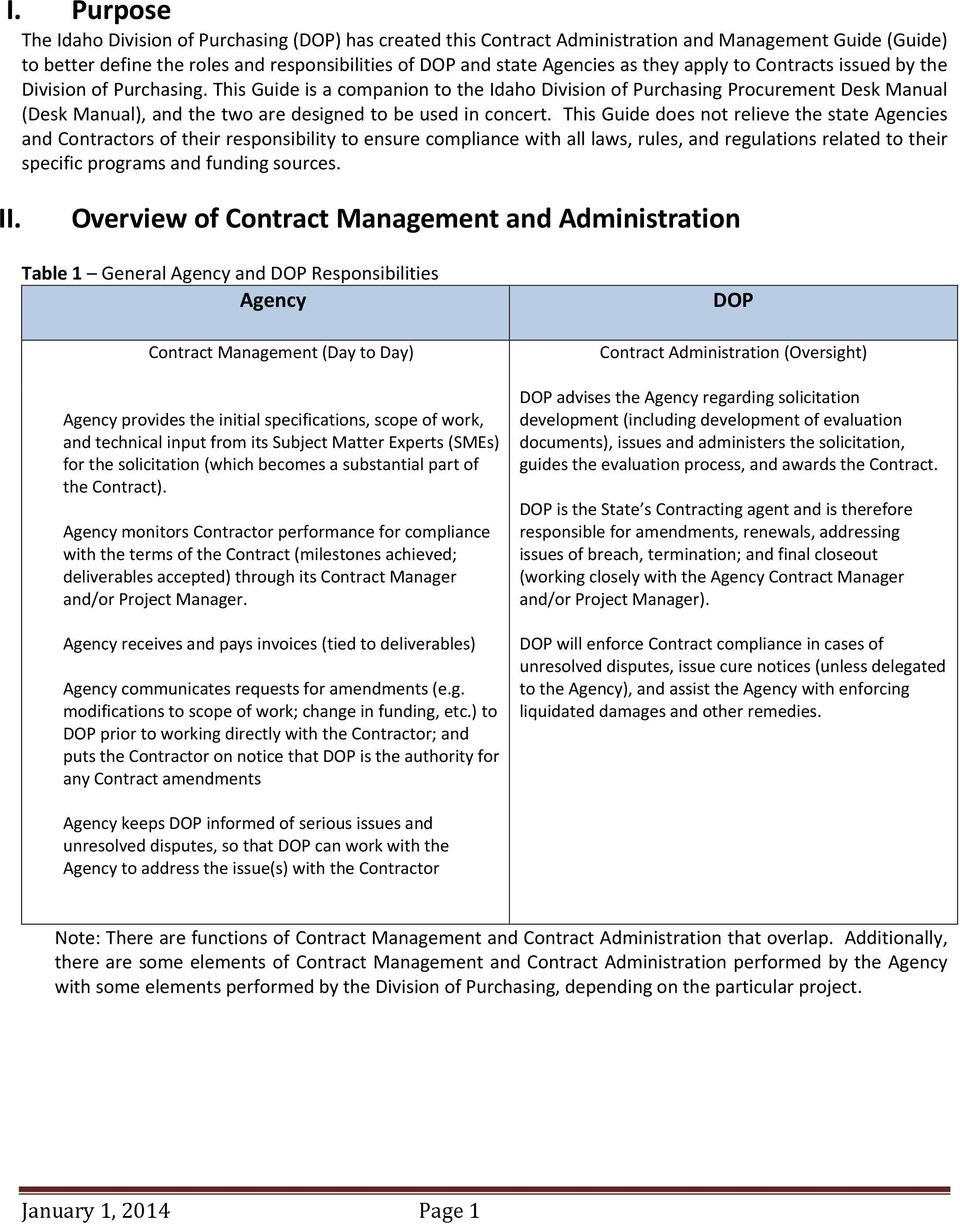
3 I. Purpose The Idaho Division of Purchasing (DOP) has created this Contract Administration and Management Guide (Guide) to better define the roles and responsibilities of DOP and state Agencies as they apply to Contracts issued by the Division of Purchasing. This Guide is a companion to the Idaho Division of Purchasing Procurement Desk Manual (Desk Manual), and the two are designed to be used in concert. This Guide does not relieve the state Agencies and Contractors of their responsibility to ensure compliance with all laws, rules, and regulations related to their specific programs and funding sources. II. Overview of Contract Management and Administration Table 1 General Agency and DOP Responsibilities Agency Contract Management (Day to Day) Agency provides the initial specifications, scope of work, and technical input from its Subject Matter Experts (SMEs) for the solicitation (which becomes a substantial part of the Contract). Agency monitors Contractor performance for compliance with the terms of the Contract (milestones achieved; deliverables accepted) through its Contract Manager and/or Project Manager. Agency receives and pays invoices (tied to deliverables) Agency communicates requests for amendments (e.g. modifications to scope of work; change in funding, etc.) to DOP prior to working directly with the Contractor; and puts the Contractor on notice that DOP is the authority for any Contract amendments DOP Contract Administration (Oversight) DOP advises the Agency regarding solicitation development (including development of evaluation documents), issues and administers the solicitation, guides the evaluation process, and awards the Contract. DOP is the State s Contracting agent and is therefore responsible for amendments, renewals, addressing issues of breach, termination; and final closeout (working closely with the Agency Contract Manager and/or Project Manager). DOP will enforce Contract compliance in cases of unresolved disputes, issue cure notices (unless delegated to the Agency), and assist the Agency with enforcing liquidated damages and other remedies. Agency keeps DOP informed of serious issues and unresolved disputes, so that DOP can work with the Agency to address the issue(s) with the Contractor Note: There are functions of Contract Management and Contract Administration that overlap. Additionally, there are some elements of Contract Management and Contract Administration performed by the Agency with some elements performed by the Division of Purchasing, depending on the particular project. January 1, 2014 Page 1
4 Appendix 1 Contract Management Flowchart DOP Issued Contract Agency establishes its Contract Management Team: Contract Manager (CM), Project Manager (PM) & Subject Matter Experts (SMEs) Initial Meeting: Review objectives, time line, deliverables and expectations (including roles/responsibilities) Ensure clarity on what will be accomplished when; how reporting, invoicing and payment will occur Written summary of discussions for file/follow up correspondence to Contractor confirming understanding/next steps Tickle: Milestones (service periods, scheduled reviews, deliverables); meetings; insurance expiration; notice dates; and end of Term Confirm First Milestone (deliverable or performance period) AND schedule next meeting Confirm contact information (phone, fax, e mail) and alternative points of contact Milestone Review: PM and SMEs receive and evaluate first deliverable (or review first performance period) for compliance with Contract requirements and report to CM REPEAT FOR REMAINING MILESTONES Contractor Deficient: Deficiencies in Milestone are documented; CM reviews Contract to determine available options; discusses options with PM, SMEs and agency and DOP Procurement Personnel; documents course of action (e.g. informal discussion with Contractor, corrective action plan; formal cure notice (DOP), termination (DOP), etc.); and schedules follow up action Contractor fails to cure: CM/PM document Contractor s failure to cure; review options with appropriate personnel (procurement personnel, legal) and work with DOP to determine course of action (e.g. further remedial action, damages, termination, etc.) Contractor cures deficiencies: CM/PM document cure (notify DOP) Amendment: Contractor and/or State determine an amendment is necessary based on a change in the SOW or applicable regulations; unforeseen circumstances; or other appropriate event or circumstance Review and Approval of Request for Amendment: CM, PM and Team review Contractor s proposed amendment and request approval from DOP (with supporting documentation) OR CM, PM and Team present Agency s amendment request to DOP, with supporting documentation; DOP reviews and if approved, Amendment is issued through DOP Contractor Compliant: Contractor has met the Milestone; CM/PM document the file; PM reviews time line for next Milestone; and performs status check with Contractor and SMEs Invoicing and Payment: After deliverable approved, CM/PM review invoice in accordance with Contract requirements; approves or issues request for clarification or correction; PM authorizes payment after invoice approved [repeat for each invoice] Contract Closeout: File should be complete; all correspondence in chronological order; Contract with most recent amendments on top Documentation of receipt and acceptance of all deliverables State owned material used by Contractor during Contract term returned to the State Project debrief complete: lessons learned, issues identified for future Contracts, survey of Contractor s performance January 1, 2014 Page 2

5 III. IV. Definitions For purposes of clarity, the following terms are defined: 3.1 Contract Management Actions taken to ensure that both the Agency and the Contractor comply with the requirements of the Contract. Includes some functions related to solicitation development, and Contract development and close out, and also includes, but is not limited to, Contract Monitoring, evaluation of deliverables, invoice review, payment approval, progress tracking, regular status meetings, management of state owned property used in Contract performance, dispute resolution and day to day management. 3.2 Contract Monitoring A component of Contract Management that includes observation of and documenting the Contractor s performance; and which may include review of files and reports. 3.3 Contract Administration Actions taken relating to changes to Contracts, including renewals and extensions, as well as receipt, review and retaining of the Contract and Contract related documents, and exercise of remedies (e.g. issue amendments, cure notices, etc.). Processes 4.1 Contract Management and Administration are comprised of eight (8) general processes: Planning Monitoring Contractor performance Payment approval Dispute resolution File maintenance Change management Remedies for non performance or sub standard performance Contract close out These processes are detailed in the sections below. V. Planning 5.1 Planning for the management and administration of a Contract must begin when the solicitation is drafted. 5.2 To the extent practical, procedures for Contract Management and Contract Administration should be described in the solicitation document. After the Contract is executed, planning should focus on general activities including, but not limited to, management of Contract changes, meeting Contract requirements, scheduling of Contract Monitoring activities, payment approval and Contract close out. 5.3 In order to properly plan for these things, the Contract Manager must articulate within the solicitation: Expected Outcome Measures Includes scheduling of deliverables, if applicable. Significant deliverables should be tied to the payment schedule, or, liquidated damages, included to address failure to meet performance metrics Costs January 1, 2014 Page 3

6 The Contract s pricing and payment structure Risk Identifying, managing and allocating potential risks Contract Performance When, where, and how the goods and services are to be delivered Acceptance/Rejection Terms The Agency s right to inspect and accept or reject the goods and services, the conditions of acceptance or rejection, and the associated remedies Contract Dates The effective date, dates for milestones and deliverables, final completion date, renewal terms, and any additional dates relating to monitoring Contract performance Complete Contact Information E mail and physical addresses and other contact information for correspondence, legal notices, invoices, etc. 5.4 Planning is crucial to the successful outcome of any procurement. With proper planning, Agencies are more likely to successfully achieve their Contracting objectives. Planning assists Agencies in determining need, preparing the scope of work, choosing the appropriate procurement type, drafting the solicitation and ultimately monitoring the Contract. These steps are complex and there are many instances in which errors can be introduced into the process. Proper planning will reduce or eliminate the risk of error. 5.5 Planning Tools The planning effort often begins with the collection and review of similar solicitations and/or Contracts used by other Agencies. Caution must be taken to not automatically adopt requirements, terms and conditions from another Contract without a thorough review of how the terms and conditions relate to the current procurement and to the Division of Purchasing s standard terms and conditions Prepare an outline containing headings for the major requirements, terms and conditions relevant to the project to be included in the solicitation. This facilitates the grouping of related requirements, terms and conditions. An outline will also illustrate gaps in the structure of the Contract For large, complex Contracts, roles and responsibilities should be clearly identified in writing. While all these professionals will work together as a team and support each other's efforts, it is important that there not be confusion as to who is responsible for what activities; and more importantly, who has authority to take certain actions. When team members circumvent the authority of others, many problems can result. Although many actions will be based on recommendations from team members, it is important for the contract manager to maintain discipline over the Contract Management process in order to protect the state s interests Market research/understanding the market pertaining to the procurement is also valuable in the planning process. Issuing a Request for Information prior to issuing the solicitation is a good method to obtain market information. January 1, 2014 Page 4

7 5.5.5 Lastly, the Agency should allow adequate time for its deputy attorney general to address potential legal issues or other areas of risk that need to be addressed. VI. Contract Management 6.1 General The goal of Contract Management is to ensure that the Contract is satisfactorily performed and that the responsibilities of both parties are properly discharged. Effective Contract Management minimizes or eliminates problems and potential claims and disputes The primary purpose of Contract Management is to: Monitor performance to ensure goods and services conform to the requirements of the Contract, identify and report violations, and pursue remedies; Manage Contract changes; Ensure taxpayer dollars are expended wisely; and, Perform certain Contract close out responsibilities. 6.2 General Contract Manager Responsibilities The contract manager s responsibility is to ensure that the Contract requirements are satisfied, that the goods and services are delivered in a timely manner, and that the financial interests of the Agency are protected. It is essential for contract managers to have a firm understanding of the principles of public Contracting, understand the provisions of the Contract, have the ability to communicate Contract obligations to all parties involved, and maintain oversight over Contract performance In particular, the responsibilities of the Contract Manager are: Planning Development of the solicitation and evaluation documents, which must factor Contract Management, Contract Administration and Contract Monitoring; During solicitation development, determining an appropriate Contract pricing method, and request bid pricing or cost proposals accordingly (such as an hourly rate, a daily rate, per item costs, a payment plan for project deliverables, etc.); and, Consulting with legal counsel to address any legal concerns and/or issues Communicating Establishing scope of authority, clear lines of communication and reporting and specific individuals who will interact directly with the Contractor; and, January 1, 2014 Page 5

8 Communicating with the Contractor and the Division of Purchasing (including meeting with the Contractor on a regular basis to review progress, discuss problems and consider necessary changes) Dispute Resolution, Problem Identification and Solving Identifying and resolving disputes with the Contractor in a timely manner; and, Identifying potential problems and solutions (solutions must be within the scope of the Contract, and the contract manager must be careful to not direct the Contractor s work by providing solutions to the Contractor; it is the Contractor s responsibility to solve problems relating to its performance) Contract Monitoring Monitoring the Contractor s progress and performance to ensure goods and services conform to the Contract requirements; Approval of Deliverables and Invoices Inspecting and approving Contract deliverables (approval must be in writing with a copy placed in the Agency s Contract file); Verifying accuracy of invoices and authorizing payments consistent with the Contract terms; Budget and Property Management Monitoring the budgeting/accounting process to ensure sufficient funds are available; and, Managing any state property used in Contract performance, e.g., computers, telephones, identification Providing the Contractor access to state facilities, equipment, data, staff, materials and information as needed to perform the requirements of the Contract; badges, etc Management of Documentation Managing correspondence, data and reporting requirements Management of documentation is of particular importance in cases of disputes, assessment of liquidated or actual damages, and for justifying termination for default Contract Managers are NOT authorized to: Instruct the Contractor to start work before the Contract is fully executed; Make changes to the Contract, including renewing or extending the Contract, without doing so through the DOP s amendment process; January 1, 2014 Page 6

9 Direct the Contractor to perform work that is not specifically required by the Contract; Provide technical guidance to the Contractor that would cause the Contractor to perform outside of the requirements of the Contract; or, Impose additional requirements upon the Contractor or manage the Contractor's operations to the extent that the Contractor is relieved of their responsibility to perform, or to the extent that the Agency, rather than the Contract, is directing the daily work of the Contractor's employees. 6.3 Orientation Conference with Contractor While not always necessary, it is often helpful to hold an orientation conference with the Contractor prior to the Contractor starting any work on the Contract. The size and complexity of the Contract will determine if such a meeting is necessary. The basic objective of an orientation conference is to clarify the rights and responsibilities of both parties. If a conference is held, it should be conducted by the contract manager. The contract manager should meet in advance with Agency staff to review the Contract to prepare for the conference. The following is a suggested agenda for an orientation conference with the Contractor: The Agency s mission and how the Contract relates to it; Overview of the Contract s requirements; Any special Contract provisions; The procedures to be followed in monitoring the Contractor's performance (including quality control and testing requirements); Discussion of the Contractor s approach to quality control; Discussion of the reports that the Contractor must provide; Invoicing and payment procedures; Clarification of authority and the process for changes to the Contract; Any restrictions on subcontracting; Identification of both the Agency s and the Contractor s escalation path; and, Delivery requirements. After the conference, a written report should be distributed to everyone who attended the meeting, as well as any other appropriate personnel. 6.4 Monitoring Contractor Performance January 1, 2014 Page 7

10 6.4.1 Contract Monitoring Purpose Monitoring the performance of the Contractor is a key function of proper Contract Management. The purpose is to ensure that the Contractor is performing all duties in accordance with the Contract, and for the Agency to be aware of and to address any developing problems or issues. Contract Monitoring may be viewed as a preventive function; as an opportunity to determine the Contractor s need for technical guidance (any technical guidance provide by the Agency must not cause the Contractor to perform outside of the requirements of the Contract); and as a valuable source of information concerning the effectiveness and quality of the goods or services being provided Need Small dollar value or less complex Contracts normally require little, if any, monitoring. However, that does not preclude the possibility of more detailed monitoring if deemed necessary by the Agency. Conversely, large dollar Contracts may need little monitoring if the items or services purchased are not complex, and it is determined that there is a lower level of risk associated with the procurement. The amount of monitoring should be limited in type, scope and frequency so as to be sufficient to achieve the desired result without unnecessarily increasing costs. Unnecessarily burdensome performance metrics or over monitoring of the Contract can interfere with the Contractor s ability to accomplish the work and may unnecessarily and inadvertently increase the cost of the work Metrics and Task Completion Timeframes Performance metrics must be clearly stated in the solicitation. Requiring a Contractor to produce timeconsuming reports or to meet requirements that were not identified in the solicitation is grounds for legal challenge and at the very least may result in a request for increased cost for the added requirement. It is important that Agencies develop and include a monitoring strategy prior to issuing the solicitation. The scope of work should identify the services required including, but not limited to, specific deadlines for completion of tasks and a schedule for submittal of deliverables, required meetings, presentations or other activities Third Party Monitoring Requirements Additionally, different funding sources such as federal grants may have specific requirements for Contract Monitoring. The contract manager must be familiar with these requirements and include them in the scope of work Risk Management The primary approach to managing risk is to document the initial perception of the level of risk and the specific risks that are identified. A preliminary risk assessment should be conducted to make an initial determination about the level, type and amount of management, oversight and resources required to plan and implement the Contract, and to perform Contract Management, Contract Administration and Contract Monitoring. Additionally, the contract manager should consider whether or not the bidders or offerors should be required to identify risks themselves, and to provide a plan to mitigate them, or whether or not the State January 1, 2014 Page 8

11 can sufficiently identify risk, and either mitigate risk within the requirements, terms and conditions of the solicitation, or require bidders or offerors to submit a plan to mitigate them Determining What to Monitor Key Questions The contract manager should consider the following questions when determining what to monitor: How will the Agency know it is receiving what it paid for? How will the Agency know that the Contractor is complying with the requirements, terms and conditions of the Contract? How will the Agency know the Contract is complete and ready for Contract close out? Further Contract Monitoring Considerations While there will be standard items the Agency will review for all Contracts, each Contract is unique, and so the following should be considered: Review specific requirements, terms and conditions in the solicitation to determine monitoring requirements specific for that procurement Look for items that that require that the Contractor to obtain certain approvals to ensure that they have been obtained Some items do not need to be monitored even though required. For example, if an information database the Agency has tested under previous Contracts will be used, then the risk might be considered to be low in this area and the database may not need to be monitored Has another Agency or another part of the same Agency conducted a review? For example, if the Agency provides home delivered meals to people with disabilities, and another Agency provides the same services, both Agencies could coordinate the reviews of shared Contractors In cases of re procurement of the same good or service, consider problems. Are there any new or significantly modified requirements, terms and conditions? Outcomes The Contract s requirements are deliverables to which the parties will agree under the Contract; however the monitoring program should be designed so as to focus on requirements that are most important. Generally, this means to focus the monitoring on the outcomes that the Contract will require. The following are examples of outcomes: The Agency receives the services required by the Contract; Service costs are within budget, and as identified in the bid or cost proposal; The Contractor protects assets purchased with tax dollars; January 1, 2014 Page 9

12 The Contractor provides accurate reports; The Contractor makes corrections to goods and/or services identified as not meeting requirements; Citizens are provided services required by law; and, Goods are provided on time Payment Methodologies and Contract Monitoring The contract manager should consider the effect that the Contract payment methodology has on what should be monitored. For example, if payment is based on a firm fixed price (a specific amount of money for a unit of goods or services), it is not necessary to verify Contractor s expenses as they are not relevant to this type of payment methodology Under a firm, fixed price payment methodology, the contract manager should ensure that: The number of goods or the amount of services invoiced is the same as that received The quantity and price agree with the Contract amounts The goods or services meet or exceed the Contract specifications Under a cost reimbursement payment methodology, wherein the Agency pays for the Contractor s cost plus a fixed fee or other, the contract manager should consider the following monitoring reviews: Were the goods or services invoiced provided by the Contractor? Were the goods or services invoiced used for the purpose of the Contract? Were the goods or services necessary and reasonable for the purpose of the Contract? Were the goods or services of the quality and quantity specified in the Contract? Was the cost of the goods or services duplicated in either overhead or profit? Were the goods or services listed in the Contractor s budget and approved by the Agency? Methods of Contract Monitoring The solicitation should include a section that outlines how monitoring will be conducted so that individuals responsible for Contract Monitoring and the Contractor all understand what will be monitored and the criteria that will be used to evaluate Contractor performance. January 1, 2014 Page 10

13 Some examples of monitoring methods are site visits; desk reviews; and expenditure document reviews Site Visits More complex Contracts and Contracts that the Agency perceives as having a higher degree of risk may require both reviews and visits to the Contractor s facilities or to the locations where services are performed to ensure that requirements, terms and conditions of the Contract are being met. Site visits can be used to verify actual performance against scheduled or reported performance Pre Site Visit Actions Develop a comprehensive and objective site monitoring checklist which focuses on the outcomes, but also includes compliance requirements. Site monitoring criteria should reference the applicable Contract requirements. (A best practice is to develop the site monitoring checklist during solicitation development.) Communicate to the Contractor the sample size to be reviewed, but do not disclose exactly what will be reviewed. For example, a Contract monitor may request to review case documents for the month of August, but should not disclose that case #XXX will be specifically examined Site Visit Scope Full scope site visits are typically scheduled visits to the Contractor s place of business or to the locations where services are performed. They cover a broad range of Contract compliance and performance issues. Limited scope site visits typically focus on a particular problem. Examples of some typical reasons for considering a limited scope site visit include, but are not limited to: Contractor is responsible for administering funds from two sources and one source has noted serious problems with the way the Contractor has used the funds Other Contractors have experienced problems in a specific area and there is an indication this Contractor might be experiencing the same problem The Contractor has provided a corrective action plan for a problem, but the Agency is not certain that the proposed solution will resolve the problem The Contractor has not met certain performance metrics based on findings in a full scope site visit, and so a follow up visit focuses on those that weren t met previously A complaint has been made to the contract manager that a certain requirement isn t being fulfilled Sample Sizes Include all files relevant to the review. The Contractor should never be allowed to select the samples for review. January 1, 2014 Page 11

14 A common sampling method is random sampling based on a percentage of total files to review; however, the contract manager may want to have the Contract monitor review specific documentation, or may want a one hundred percent (100%) review performed If the Contractor cannot locate a sample item selected for review, it may indicate a problem. Before agreeing to substitute an alternate file, the contract manager should consider the circumstances relating to the missing sample item and determine whether or not the explanation is reasonable. If the contract manager suspects that the Contractor did not want the site monitor to see the file, this may be cause for escalating the issue Site Visit Documentation The report of the site visit serves as a record of Contract Monitoring activity, and should document what has been reviewed and the Contract monitor s findings. A copy of the report should be sent to the Contractor, the contract manager and other state of Idaho designees. The report should also include what has been learned during this site visit for future risk planning and for the planning of future Contract requirements. Even if the Contractor corrects a problem in the presence of the site monitor, the site monitor must include the problem in the report. This will serve as an indicator to follow up on the problem on future visits to determine whether or not the problem is recurring. The Contract monitor should provide space on the checklist (or on a separate document) to document the results of the site visit. For example, if the Contract monitor is to review ten (10) case files, then the documentation must identify the files reviewed, e.g. the case number, the specific information reviewed, and the findings as to whether or not performance metrics have been met. If the Contract monitor finds a need to focus monitoring efforts on higher risk or problem areas, and finds that it is necessary to bypass other areas that require monitoring, the Contract monitor must document the rationale for bypassing those areas Desk Review Typically these are Agency reviews of reports submitted by the Contractor to the Agency What to Review Compare the reported performance against the Contract requirements Compare expenditures to the approved budget Compare the current period to prior periods. (Are there any unexplained trends? Is the Contractor s performance significantly different from the last period?) Compare what the current Contractor is doing in comparison with other Contractors performing similar work Compare the report with what is known about the Contractor s operating environment. (Did a weather emergency in the area recently increase the cost of supplies or cause a temporary reduction in services provided?) January 1, 2014 Page 12

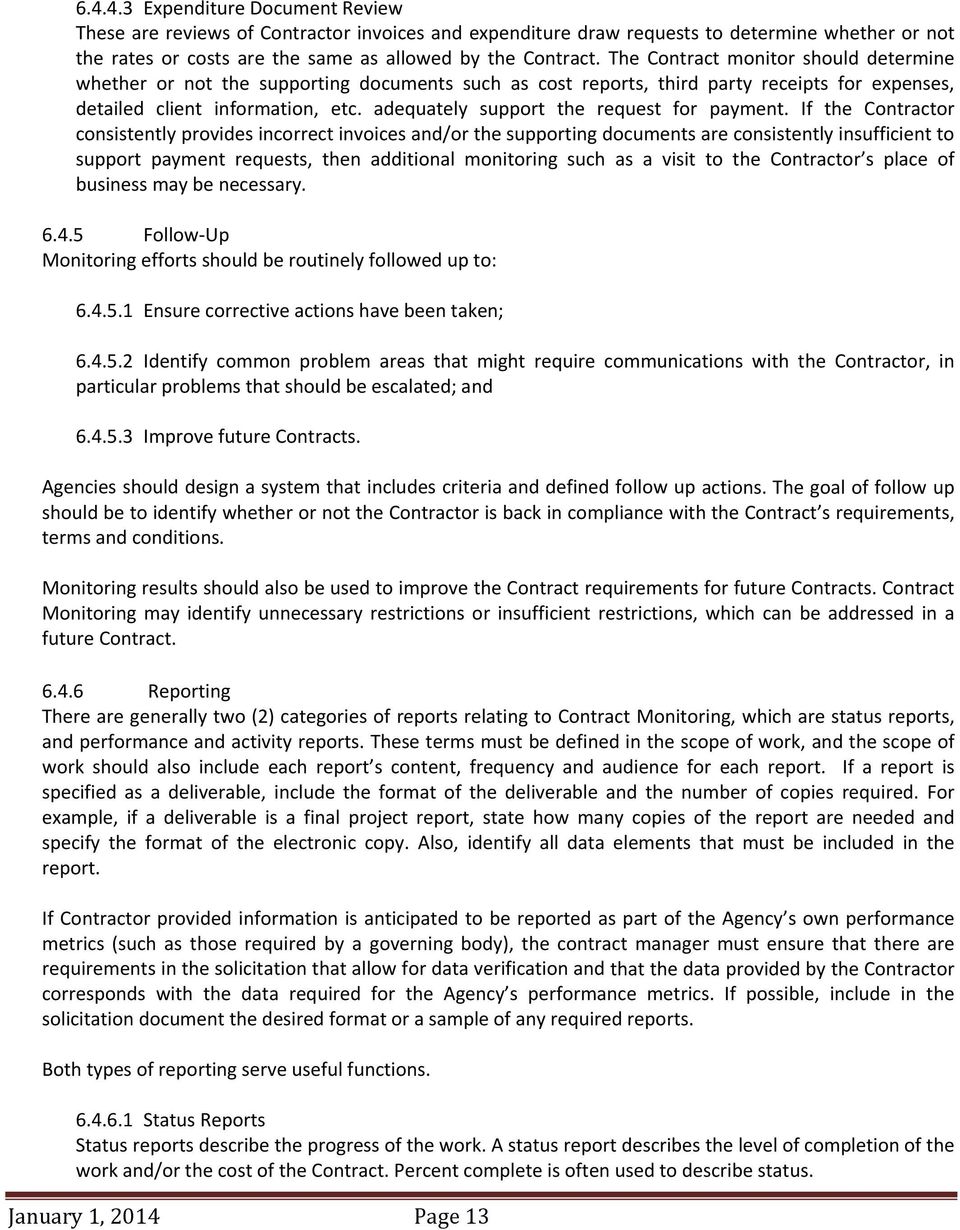
15 Expenditure Document Review These are reviews of Contractor invoices and expenditure draw requests to determine whether or not the rates or costs are the same as allowed by the Contract. The Contract monitor should determine whether or not the supporting documents such as cost reports, third party receipts for expenses, detailed client information, etc. adequately support the request for payment. If the Contractor consistently provides incorrect invoices and/or the supporting documents are consistently insufficient to support payment requests, then additional monitoring such as a visit to the Contractor s place of business may be necessary Follow Up Monitoring efforts should be routinely followed up to: Ensure corrective actions have been taken; Identify common problem areas that might require communications with the Contractor, in particular problems that should be escalated; and Improve future Contracts. Agencies should design a system that includes criteria and defined follow up actions. The goal of follow up should be to identify whether or not the Contractor is back in compliance with the Contract s requirements, terms and conditions. Monitoring results should also be used to improve the Contract requirements for future Contracts. Contract Monitoring may identify unnecessary restrictions or insufficient restrictions, which can be addressed in a future Contract Reporting There are generally two (2) categories of reports relating to Contract Monitoring, which are status reports, and performance and activity reports. These terms must be defined in the scope of work, and the scope of work should also include each report s content, frequency and audience for each report. If a report is specified as a deliverable, include the format of the deliverable and the number of copies required. For example, if a deliverable is a final project report, state how many copies of the report are needed and specify the format of the electronic copy. Also, identify all data elements that must be included in the report. If Contractor provided information is anticipated to be reported as part of the Agency s own performance metrics (such as those required by a governing body), the contract manager must ensure that there are requirements in the solicitation that allow for data verification and that the data provided by the Contractor corresponds with the data required for the Agency s performance metrics. If possible, include in the solicitation document the desired format or a sample of any required reports. Both types of reporting serve useful functions Status Reports Status reports describe the progress of the work. A status report describes the level of completion of the work and/or the cost of the Contract. Percent complete is often used to describe status. January 1, 2014 Page 13
16 The content of the status report should be consistent with, and track the organizational structure of, the scope of work, such as phases, segments, deliverables and products. A status report should identify what work is complete and what work is pending and that status should be compared to the Contract schedule. Only work that has been verified as completed or accepted should be categorized as complete. If the scope of work has changed during the Contract (by written Contract amendment), the status reports should track the original Contract schedule, not a revised Contract schedule, unless the amendment provides for a revised Contract schedule. If the Contract does not provide for periodic status reports, the Agency should ensure that sufficient progress is being made by the Contractor via another method, such as by requesting a status update from the Contractor or a conducting a site visit to view the progress Performance and Activity Reports Performance and activity reports describe any activity on the project. Project activity is not the same as a status report. A project may have a great deal of activity without making substantive progress. On the other hand, activity reporting can be a core feature of Contract Management. For example, payments may be based on the number of completed transactions. In this example, activity reporting is critical to Contract Management Monitoring by Third Parties In some instances the obligation of monitoring the progress of a Contract is assigned to another Contractor or other party. This is also known as independent oversight. For example, in the case of a construction Contract, the task of ensuring progress in accordance with the Contract may be performed by the architectural firm that provided the construction plans. For highly technical work, consultant subject matter experts may perform monitoring services independently or in conjunction with Agency staff Inspection and Testing The scope of work should provide for inspection and testing if applicable. The Agency should include inspection and testing of goods purchased under the Contract to ensure compliance with the specifications of the Contract. In the event the goods tested fail to meet or exceed all requirements, terms and conditions of the Contract, the goods should be rejected, in whole or in part, at the Contractor s expense. Agencies should contact legal counsel regarding latent defects. To the extent possible, costs of inspection and testing should be borne by the Contractor Final Acceptance The scope of work should clearly define how the Agency will determine that the Contract has been satisfactorily completed. The scope of work sets a standard for acceptance of deliverables and establishes a procedure to receive or reject the deliverables based on specific factors. Tracking the status of several phases, segments and deliverables, where each may have multiple tasks, activities, and products, can be challenging. A formal acceptance process for each of these should be identified in the scope of work to make clear to all parties the conditions of acceptance. January 1, 2014 Page 14

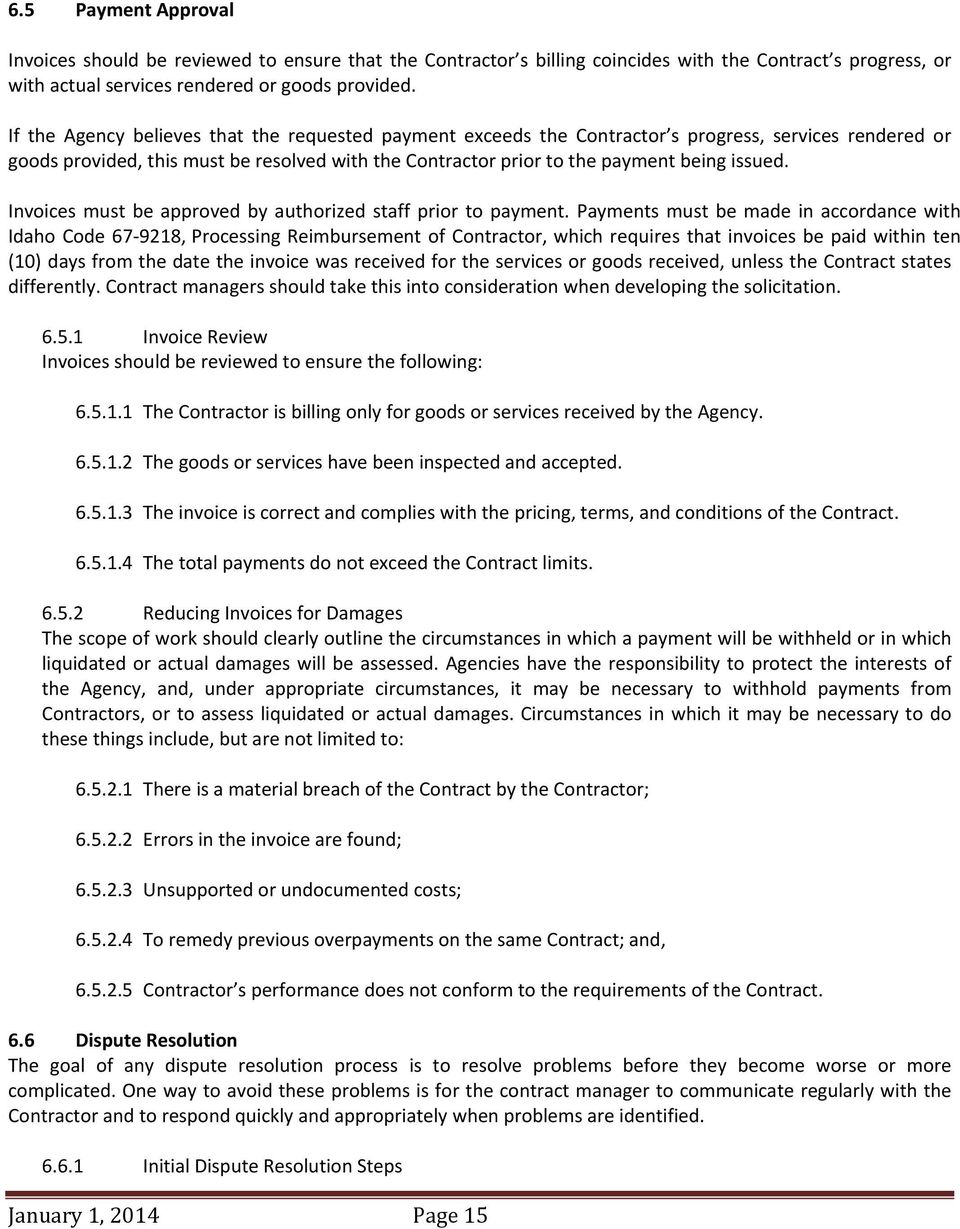
17 6.5 Payment Approval Invoices should be reviewed to ensure that the Contractor s billing coincides with the Contract s progress, or with actual services rendered or goods provided. If the Agency believes that the requested payment exceeds the Contractor s progress, services rendered or goods provided, this must be resolved with the Contractor prior to the payment being issued. Invoices must be approved by authorized staff prior to payment. Payments must be made in accordance with Idaho Code , Processing Reimbursement of Contractor, which requires that invoices be paid within ten (10) days from the date the invoice was received for the services or goods received, unless the Contract states differently. Contract managers should take this into consideration when developing the solicitation Invoice Review Invoices should be reviewed to ensure the following: The Contractor is billing only for goods or services received by the Agency The goods or services have been inspected and accepted The invoice is correct and complies with the pricing, terms, and conditions of the Contract The total payments do not exceed the Contract limits Reducing Invoices for Damages The scope of work should clearly outline the circumstances in which a payment will be withheld or in which liquidated or actual damages will be assessed. Agencies have the responsibility to protect the interests of the Agency, and, under appropriate circumstances, it may be necessary to withhold payments from Contractors, or to assess liquidated or actual damages. Circumstances in which it may be necessary to do these things include, but are not limited to: There is a material breach of the Contract by the Contractor; Errors in the invoice are found; Unsupported or undocumented costs; To remedy previous overpayments on the same Contract; and, Contractor s performance does not conform to the requirements of the Contract. 6.6 Dispute Resolution The goal of any dispute resolution process is to resolve problems before they become worse or more complicated. One way to avoid these problems is for the contract manager to communicate regularly with the Contractor and to respond quickly and appropriately when problems are identified Initial Dispute Resolution Steps January 1, 2014 Page 15
18 Identify the problem, and communicate. Many times what may appear to be a problem can be resolved by providing the Contractor with information or clarification Research facts. The contract manager should obtain information regarding the problem from all relevant sources, including the Contractor Evaluation. The contract manager should review all of the facts in conjunction with the requirements, terms and conditions of the Contract, and then determine the appropriate course of action Take action. This may involve things such as correcting or addressing problems within the Agency as far as its interactions with the Contractor; addressing problems informally with the Contractor; formal meetings with the Contractor; and formal actions such as issuance of cure notices (which may require DOP involvement) Unresolvable Disputes There are cases in which disputes cannot be resolved. In such cases it may be necessary to invoke certain remedies. Please see subsection 7.4 for information pertaining to remedies. VII. Contract Administration 7.1 General Contract Manager Responsibilities, Contract Administration Maintaining Contract records; Managing Contract changes, which includes ensuring that all Contract changes are in writing and are processed and approved by the Division of Purchasing via an official, written amendment to the Contract; Exercising remedies, as provided for in the Contract (subject to DOP authority and approval), when a Contractor s performance is deficient; and, Performing Contract closeout procedures to ensure that the Agency s Contract file contains all necessary Contract documentation, that formal acceptance has been documented, and to document lessons learned. 7.2 The Contract File The importance of keeping good documentation cannot be overstated. Keeping one complete master Contract file is critical for both the Agency and the Division of Purchasing. The file will provide a basis for settling claims and disputes should they arise in administrative or court actions. Contract files need to be well organized so as to allow someone to reconstruct and understand the history of the Contract. As was stated above in subsection , management of documentation is of particular importance in cases of disputes, assessment of liquidated or actual damages, and for justifying termination for default Required Contract File Documents January 1, 2014 Page 16
19 The solicitation document, the Contractor s response, the award document (Contract Purchase Order, Blanket Purchase Order, or other DOP issued document); A copy of all specifications, drawings or manuals pertaining to the Contract; A copy of all Contract amendments; Contract submittals that have been received; A list of government furnished property or services; If conducted, copies of memorandums and correspondence pertaining to the clarification period prior to award; A schedule of compliance review and any internal correspondence, if applicable; A copy of all correspondence related to the Contract; A copy of all routine reports required by the Contract such as sales reports, pricing schedules, approval requests, and inspection reports; A copy of all notices to proceed, to stop work, or to correct deficiencies; Records and minutes of meetings, both internal and external, to include sign in sheets and agendas; A copy of all backup documentation for payments made under the Contract or progress payment; Copies of audit reports; and, The Division of Purchasing s file will also include evaluation materials and scores and any pre proposal or pre bid conference minutes Central Repository Agencies should maintain Contracts on file in a central repository. 7.3 Change Management General During the Contract term it may become necessary to make changes to the Contract. These changes can be minor, administrative changes, such as a change of address, or they can be changes that substantively affect the time, scope or cost of the Contract. Typically, the parties to the Contract agree in writing to Contract changes. Agencies should have an effective change management process in place. Failure to manage and control changes can result in an unintentional modification to the scope of work, extension of the schedule, January 1, 2014 Page 17

20 increase in the Contract cost, circumvention of management controls and diminished Contractor accountability Contract Change Considerations Will the changes affect the competitive nature of the Contract? That is, are the changes such that, if the Contractor s competitors had known of the change, the outcome of the competitive process would likely have been different? Will the changes cause the scope of the Contract to be considerably different from the scope identified in the solicitation? (If the answer to either of the questions directly above is yes, then the changes should not be made, and, after the term of the current Contract is complete, the Agency should issue a new solicitation with the changes factored into it) Effective Change Management An effective change management process includes, but is not limited to: Formal, written approval of all changes prior to the change taking place. Contract managers must not verbally authorize the Contractor to begin working on a change before the formal process is completed Evaluation of the impact of each change to the Contract, including but not limited to, impact to deliverables and/or products, the schedule, and cost, and evaluation of increases in Agency overhead (such as a need to hire more monitoring staff) resulting from the change, and evaluation of impact to work in progress and completed work, standards identified in the Contract, and acceptance criteria Establishment of a single point of contact to authorize any change. If a change is authorized, the document that indicates so is a Contract amendment issued through the State s e procurement system, signed by a buyer or higher position at the Division of Purchasing Administrative Changes These are changes that are within the scope of the Contract and do not affect or alter the rights of the parties. These changes are typically executed via a unilateral amendment Administrative Change Examples Changes in billing instructions or address; Corrections of typographical errors; or, Changes in Agency personnel assigned to the Contract Substantive Changes These are Contractual changes that affect the rights of both parties. Such changes generally require bilateral amendments (agreement by both parties). January 1, 2014 Page 18

21 Substantive Change Examples Change in the price of the Contract; Change in the delivery schedule; Change in the quantity; Change to the specifications; Change of key personnel; or, Change of any terms and conditions Constructive Changes If a Contractor perceives that work beyond the scope of the Contract was ordered by the Agency, the Contractor may claim that the Contract was constructively changed, and the Contractor may be entitled to additional compensation for the changes. Generally, a constructive change will require a bilateral amendment. Constructive changes may occur when Agency personnel: Provide suggestions to a Contractor that alters the Contractor s activities under the Contract; Accelerate the delivery schedule; Direct the work to be performed differently; Change the sequencing of the work; Delay accepting or rejecting deliverables; Delay reviewing invoices and approving payment; or, Interfere with or hinder performance. The above instances should be avoided by the Agency, and the contract manager should take action early in the procurement process to prevent such. 7.4 Remedies for Non Performance or for Sub Standard Performance (Note: The Division of Purchasing may, in its sole determination, delegate authority to the Agency to invoke liquidated and actual damages; however, for any Contract issued by the Division of Purchasing, the Division of Purchasing will not delegate authority to the Agency to invoke Contract termination.) Assessment of Damages There are two types of damages: Liquidated Damages Liquidated damages are defined as a specific, but approximated, sum identified in the Contract to be paid by the defaulting or breaching party to the party damaged. Liquidated damages must be as closely January 1, 2014 Page 19
22 proximate to what the actual damages would be as possible; therefore, liquidated damages must not be lieu of the assessment of a penalty, which only a court of competent jurisdiction can do Actual Damages Actual damages are defined as a specific, known sum (when the actual amount of the damage is known) identified in the Contract to be paid by the defaulting or breaching party to the party damaged. The amount(s) of damages and the instances in which they can be invoked must be agreed upon by the parties to the Contract. This is normally accomplished by the Agency entering a detailed damages provision (covering liquidated damages, actual damages, or both) into the solicitation, and the bidder or offeror agreeing to them by submitting a bid or proposal Termination It must be noted that it is normally the Agency that makes a request to the Division of Purchasing for Contract termination, rather than vice versa. A Contract may be terminated via either of termination for convenience or termination for default, if provided for in the Contract Termination for Convenience Termination for convenience allows the Agency to terminate any Contract, in whole or in part, at any time, in its sole discretion, if it is determined that such termination is in the best interest of the Agency. The Division of Purchasing generally advises against providing termination for convenience rights to the Contractor. If the Agency wishes to provide termination for convenience rights to the Contractor, the Agency must provide a written justification to DOP and receive DOP s approval prior to the issuance of the solicitation. In the justification the Agency must provide its reason(s) for needing the right to terminate for convenience, particularly identifying the risks if the clause is not included Justification for Invoking Termination for Convenience If the Agency finds that it has a need to invoke a termination for convenience clause that is included in a Contract, the Agency must provide a written request to the Division of Purchasing justifying the Agency s reason(s) for the request In such as case, the Agency must include with that request both an interim plan identifying how the Agency s needs will be met until a new Contract is in place and a re procurement plan Termination for Convenience Notifications The Contractor shall be provided with written notice specifying whether all or part of the Contract is being terminated. The notice of termination shall give the date of termination. If the Contract is being terminated in part, the Agency must specify which part(s) of the Contract are being terminated Example Language for Notice A termination notice should be issued which includes wording similar to: Pursuant to Section, Termination, this Contract is hereby terminated effective [date]. [Contractor name] is directed to immediately stop all work, terminate subcontracts, and place no further orders. January 1, 2014 Page 20
23 In accordance with this Notice of Termination, you shall: 1) Keep records of your compliance with this notice, including the extent of completion on the date of termination; 2) Immediately notify all subcontractors and suppliers, if any, of this Notice of Termination; and 3) Take any other action required by [Agency name] to expedite this Termination Costs The Contractor will generally be paid for allowable costs incurred up to the termination. The Agency will not be liable for payment to the Contractor related to the terminated portion of the work or any work performed or costs incurred after the effective date of termination Final Invoice Review Upon receipt of any invoice from the Contractor for work performed prior to the notice of termination, the Agency should thoroughly review the invoice to ensure that it is only paying for goods or services received prior to the effective date of termination Termination for Default A Contract may be terminated for default when the Agency concludes that the Contractor has failed to perform, make progress, or in any way breaches the Contract. An Agency is not required to terminate a Contract even though the circumstances permit such action. Agencies may determine that it is in their best interest to pursue other alternatives; however, alternative actions must be provided for in the Contract or at law. Additionally, the Agency should consider whether the breach is a material breach or a non material breach, and, the Agency should consult with the Division of Purchasing, and should also consult with the Agency s legal counsel, regarding these matters. Examples of such alternatives include extending the delivery or completion date, allowing the Contractor to continue working or working with the Contractor s surety (if a performance bond has been provided in accordance with Contract requirements) to complete the outstanding work. Termination for default should be used as last resort and not as punishment. The purpose of a termination for default is essentially to protect the interests of the Agency Factors to Consider Prior to Invoking Termination for Default Has the Agency done everything within reason and without performing the Contract s requirements for the Contractor to assist the Contractor in curing any default? The provisions of the Contract and applicable regulations The specific Contractual failure(s) and the explanation provided for the failures The urgency of the need for the Contracted goods or services. The Agency may need to weigh the respective benefits and/or disadvantages of allowing a defaulting Contractor to continue performance versus re soliciting for a new Contract. January 1, 2014 Page 21
24 The availability of the goods or services from other sources and the time required to obtain them Availability of funds and/or resources to re purchase in the event such costs cannot be recovered from the defaulting Contractor. Under a termination for default, the Agency is within its rights to require re procurement costs from the defaulting Contractor. Nevertheless, the Contractor may not be financially capable to finance the re purchase, or requirement of such may result in protracted legal action Justification for Invoking Termination for Default If the Agency finds that it has a need to invoke termination for default, the Agency must provide a written request to the Division of Purchasing justifying the Agency s reason(s) for the request In such as case, the Agency must include with that request both an interim plan identifying how the Agency s needs will be met until a new Contract is in place and a re procurement plan Documentation Standards for Termination for Default The Agency must provide the documentation both in detail and in summary format The documentation must be catalogued in such a way so that the Division of Purchasing can easily understand and verify the documentation Termination for Default Notifications Prior to terminating a Contract for default, a cure notice must be sent to the Contractor. A cure notice is a letter provided to the Contractor that provides them a period of time, not to exceed thirty (30) calendar days (per the State of Idaho Standard Contract Terms and Conditions), to correct or cure the deficiency Cure Notice Format The format for a cure notice may be as follows: [Contractor name] is notified that the state of Idaho considers [specify failures] to be conditions that cause the Contract to be in default. Therefore, unless these conditions are cured within X (X) days from the date of this letter, the [Agency name] may terminate for default in accordance with [subsection], the Termination clause of this Contract. The cure notice should be developed in consultation with the Division of Purchasing and legal counsel. The Division of Purchasing may provide example cure notices upon request Notice of Termination If the Contractor fails to cure the deficiencies identified in the cure notice, the Contract may be terminated. The Notice of Termination should contain the following: January 1, 2014 Page 22
25 The Contract number; The effective date of termination; Reference to (or full text of) the clause under which the Contract is being terminated; A concise, accurate statement of the facts justifying the termination; and, A statement that the goods or services required in the Contract being terminated may be re procured by the state of Idaho and that the Contractor will be held liable for any costs incurred by the State due to the re procurement Costs If a Contract is terminated for default, the Contractor is liable for actual damages and costs incurred by the Agency unless the Contract states otherwise. 7.5 Force Majeure A Contract may not be terminated for default when the failure to perform is due to force majeure. In order to qualify as force majeure, the cause must be beyond the control, and without the fault or negligence of the Contractor. Severe weather, although beyond the Contractor s control, will not generally constitute an excusable delay if it is not considered to be unusually severe weather. If the Contractor s failure to perform is due to the default of a subcontractor, in order to qualify as force majeure, the default must arise out of causes beyond the control and without the fault or negligence of both the Contractor and the subcontractor. Even if this requirement is met, the cause will not be excusable if the goods or services to be provided by the subcontractor could have been obtained from other sources in time to meet the Contract s requirements Instances of force majeure include, but are not limited to: Acts of God or of the public enemy, such as fires, floods, epidemics, strikes, freight embargos, unusually severe weather, and acts of terrorism; and, Acts of the Agency (such as the Agency denying the Contractor access to a work location due to its own administrative errors or delays). 7.6 Contract Close Out The purpose of the Contract close out process is to verify that both parties to the Contract have fulfilled their Contractual obligations. Additionally, during Contract close out, the success of the Contract should be measured and any lessons learned should be documented. A Contract is completed when all goods or services have been received and accepted; all reports have been delivered and accepted; all administrative actions have been accomplished; all Agency furnished equipment and materials have been returned; and final payment has been made to the Contractor. To initiate the close out process, the Agency should first determine that the Contractor has satisfactorily performed all required Contractual obligations. January 1, 2014 Page 23
26 VIII. General Agency Roles and Responsibilities, Statewide Contracts 8.1 General Generally, the Division of Purchasing is responsible for both Contract Management and Contract Administration functions related to statewide Contracts. However, due to the volume of goods and services purchased on statewide Contracts, and the large number of locations within the state of Idaho to which the goods and services are provided, it is impossible for the Division of Purchasing to conduct Contract Management and Contract Administration for statewide Contracts without the assistance of the Agencies. Therefore, below is a list of general Agency roles and responsibilities relating to statewide Contracts Agencies must, to the extent possible, participate in solicitation development, bid and proposal evaluation (including development of the evaluation plan), and Contract implementation Agencies must inspect goods and services received, and manage documentation as set forth previously in this document Agencies are responsible for making payments to statewide Contractors, and must follow payment processing requirements as set forth previously in this document Agencies must attempt to resolve disputes directly with statewide Contractors. For cases in which the Agency cannot resolve a dispute with a statewide Contractor, the Agency can escalate the dispute to the Division of Purchasing. When this occurs, the Agency must provide as much assistance to the Division of Purchasing as it needs, including the provision of documentation. Documentation must meet the standards identified in subsections through January 1, 2014 Page 24
27 Appendix 1 Contract Closeout Checklist from NIGP: The Institute for Public Procurement NIGP: The Institute for Public Procurement recommends that agencies address several key issues as part of closing out a Contract. General Checklist As a project nears completion, agencies should begin closing out the Contract. The process may vary according to the type of Contract and the total cost, and may vary according to the staff assigned to monitor or manage different elements of the Contract. This step not only helps ensure all of the deliverables have been met, but also provides the agency and vendor with an overall assessment of the project and any areas for future improvement. Administrative Issues Is the central Contract file complete and does it conform to regulations governing Contract administration as specified by the public agency? If the central Contract file consists of multiple files, have they been sequentially numbered and identified? Does the central file include the file of the Contracting Officer and the Contracting Officer s Representative? Did the Contract specify a period of performance; and, if yes, has that period of performance ended? Have all file documents been signed with original signatures? This would include invoices/vouchers, letters to Contractor, memoranda, official correspondence, etc. Has the de obligation of funds been accomplished, if required? Have all change orders been defined and included in the central file? Have all final determinations been completed? Have all optional provisions expired? Are there any time extensions pending? Have all modification documents been signed? Deliverables Is the final Receiving Report signed and dated? Did the Contracting Officer Representative certify that all deliverables have been received and accepted? Payments and Invoices Have all disallowed payments, performance, deliverables, or suspended costs been resolved? Has all reconciliation been completed in conjunction with a financial report to verify that all payments have been paid? Have any refunds, rebates, and/or credits been annotated in the file? Have all excess funds, such as un liquidated obligations, been verified and submitted to the Finance Department? January 1, 2014 Page 25
28 Property Has the property inventory been received from the Contractor? Has there been an accounting of all Government owned property, real or personal, either furnished by the Government or acquired by the Contractor for the account of the Government? Has appropriate disposal action been taken upon physical completion of the Contract/delivery order? Has there been a final disposition of Government furnished property? Contract Administration Analysis The final step in the Contract management cycle is to conduct an analysis of the Contract administration process. After the Contract has been closed out, the documentation compiled during the Contract administration phase should be reviewed to determine if any changes to the Contract administration process would be beneficial to future Contracts. The Contractor and the end user should complete a Contract analysis report card. The following areas of the process should be reviewed: Contract Development Were the Contract goals adequate? Are there any changes that could be made in the Contract document to better handle the agency s needs such as additional Contract clauses or different language? Contract Administration Did the Contract administration team require additional training? Did any unanticipated problems occur? What could be done differently or better? Incorporating these changes into the next Contract management cycle and updating the general Contract types and clauses is an important final step of Contract administration. January 1, 2014 Page 26
29 Appendix 2 Best Practices Checklist from the National Contract Management Association The National Contract Management Association (NCMA) is focused on advancing the Contract management profession, partly by defining the standards and the body of knowledge for the Contract management profession. To help reach that goal, NCMA has created a checklist of tips. Checklist of Tips for Successful Contract Administration Develop and implement a project management discipline to ensure on time delivery and flawless execution. Comply with Contract terms and conditions. Maintain effective communications. Manage Contract changes with a proactive change management process. Resolve disputes promptly and dispassionately. Use negotiation or arbitration, not litigation, to resolve disputes. Develop a work breakdown structure to assist in planning and assigning work. Conduct pre performance conferences or a project kick off meeting. Measure, monitor, and track performance. Manage the invoice and payment process. Report on progress internally and externally. Identify variances between planned versus actual performance use earned value management. Be sure to follow up on all corrective actions. Appoint authorized people to negotiate Contract changes and document the authorized representatives in the Contract. Enforce Contract terms and conditions. Provide copies of the Contract to all affected organizations. Maintain conformed copies of the Contract. Understand the effects of change on cost, schedule, and quality. Document all communication use telephone, faxes, correspondence logs, and e mails. Prepare internal and external meeting minutes. Prepare Contract closeout checklists. Ensure completion of work. Document lessons learned and share them throughout your organization. Communicate, communicate, communicate. January 1, 2014 Page 27
30 Appendix 3 Best Practices Checklist from the National State Auditors Association The National State Auditors Association (NSAA) was created to provide opportunities for the exchange of information on state, federal, and local levels. While the steps outlined may not apply to all Contracting situations in Idaho, each step can provides agencies with opportunities to strengthen their decision making and safeguard against missing critical steps throughout the life of a Contract 1. Purpose The Performance Audit Committee of the National State Auditors Association developed this document as a tool for audit organizations and government agencies to use in identifying and evaluating best practices in Contracting for services. Although it was intended to address many of the best practices that could apply in these situations, it should not be considered all inclusive. Further, the practices listed here may not be applicable in all situations, and other practices may accomplish the same things. However, this document can be extremely helpful as a starting point for both agency managers and auditors in deciding what types of practices are more likely to result in an efficient, effective, and accountable service procurement process. Planning Proper planning provides the foundation for Contract awarding and monitoring. Planning identifies what services are needed and when, how they should be provided, and what provisions should be in the Contract. Planning also helps ensure proper information is collected to effectively structure a request for proposal (RFP). As a public entity, the agency must know the state s bidding and Contracting laws, other relevant state laws as well as any procedural guidelines the agency is obligated to follow. Timely planning is crucial in all procurements, but especially in procurements involving RFP s that can take a lot of time to execute. Decision to Contract First, the agency needs to determine whether or not to Contract for the service. To make this decision the agency should: 1. Analyze its business needs, goals, objectives, and services and determine whether or not the service is necessary. 2. Conduct a cost/benefit analysis and evaluate options, such as whether Contracting is more or less expensive than using agency staff. 3. Determine whether state law either prohibits Contracting for services or requires the agency to demonstrate its need to Contract. Performance Requirements January 1, 2014 Page 28
31 Once the decision to Contract has been made, the agency should develop performance requirements that will hold vendors accountable for the delivery of quality services. Performance requirements should: 1. Clearly state the services expected. 2. Clearly define performance standards and measurable outcomes. 3. Identify how vendor performance will be evaluated. 4. Include positive or negative performance incentives. 5. Identify the staff that will be responsible for monitoring vendor performance. Ensure that sufficient staff resources are available to handle vendor/contract management properly. 6. Clearly define the procedures to be followed if, during the course of the performance of a service Contract, unanticipated work arises that requires modification to the Contract. Request for Proposal Process The decision to employ a Request for Proposal commits an agency to a formal process based on fair and open competition and equal access to information. This decision allows the agency to systematically define the acquisition process and the basis on which the proposals will be assessed. The RFP itself provides a standardized framework for vendor proposals and highlights the business, technical, and legal issues that must be included in the final Contract. The RFP should: 1. Clearly state the performance requirements and the scope of services that are to be provided. 2. Include a statement of work that flows from the business needs analysis, and should present a logical plan to address the stated needs. 3. Identify constraints, schedules, deadlines, mandatory items, and allowable renewals. 4. Specify required deliverables, reporting obligations, and payment terms. 5. Clearly state pricing requirements and bid submission expectations, including closing time, date, and location. A standard bid price form is helpful to ensure an apples to apples cost comparison. 6. Clearly state the evaluation criteria and weighting factors for scoring proposals. 7. Allow sufficient time for vendors to prepare good proposals. 8. Avoid specifications that favor a particular bidder or brand. 9. Specify the qualifications for the company and/or personnel who would be assigned to the project. 10. Identify federal and state requirements that govern the Contracting process and the delivery of services. January 1, 2014 Page 29
32 11. Outline all procurement communication devices to ensure all appropriate bidders or potential bidders have access to the same information, i.e., pre bid conferences, Q&A s, whom to contact with questions, etc. Award Process Although evaluation methods vary, the Contract award process should ensure vendor proposals are responsive to the agency s needs, consistently and objectively evaluated, and Contracts are awarded fairly to responsible vendors. Without proper awarding practices, there is little assurance an agency is selecting the most qualified vendor at the best price. Furthermore, Contracting decisions may not be defendable if challenged. Award Decision When making an award decision, the agency should: 1. Have appropriate procedures for handling late or incomplete proposals. 2. Ensure that an adequate number of proposals were received. 3. Use an evaluation committee, comprised of individuals who are trained on how to score and evaluate the proposals and who are free of impairments to independence. 4. Use fixed, clearly defined, and consistent scoring scales to measure the proposal against the criteria specified in the RFP. 5. Carefully check vendor references. 6. Document the award decision and keep supporting materials. 7. Carefully control bids upon receipt to ensure that bids are not opened prematurely to give late bidding vendors confidential pricing information, bids are not accepted after the due date, inferior bids are not given extra opportunity to cure deficiencies, etc. Contract Provisions Contracts for the purchase of services must be formal, written documents. Contracts should (1) protect the interests of the agency, (2) identify the responsibilities of the parties to the Contract, (3) define what is to be delivered, and (4) document the mutual agreement, the substance, and parameters of what was agreed upon. Specifically, the Contract should: 1. Clearly state and define the scope of work, Contract terms, allowable renewals, and procedures for any changes. 2. Provide for specific measurable deliverables and reporting requirements, including due dates. 3. Describe the methods of payment, payment schedules, and escalation factors if applicable. 4. Limit the state s liability for work performed either before or after the Contract s scope. January 1, 2014 Page 30
33 5. Contain performance standards, performance incentives and/or clear penalties and corrective actions for non performance, with a dispute resolution process. The Contract also should include a requirement for a performance bond when appropriate. 6. Contain inspection and audit provisions. 7. Include provisions for Contract termination. 8. Include provisions for Contract renegotiation and/or price escalations if applicable. 9. Tie payments to the acceptance of deliverable or the final product, if possible. 10. Contain all standard or required clauses as published in the RFP. The Contract may also incorporate the RFP itself. Order of precedence should be addressed in case of a discrepancy between the RFP and the body of the Contract for example. 11. Contain appropriate signatures, approvals, acknowledgements, or witnesses. 12. As necessary, allow for legal counsel s review of the legal requirements for forming the Contract, which may include a review of the Contracting process; legal sufficiency of the Contract; the Contract terms; etc. Monitoring Contract monitoring is an essential part of the Contracting process. Monitoring should ensure that Contractors comply with Contract terms, performance expectations are achieved, and any problems are identified and resolved. Without a sound monitoring process, the Contracting agency does not have adequate assurance it receives what it Contracts for. To properly monitor a Contract, the agency should: 1. Assign a Contract manager with the authority, resources, and time to monitor the project. 2. Ensure that the Contract manager possesses adequate skills and has the necessary training to properly manage the Contract. 3. Track budgets and compare invoices and charges to Contract terms and conditions. 4. Ensure that deliverables are received on time and document the acceptance or rejection of deliverables. 5. Withhold payments to vendors until deliverables are received. 6. Retain documentation supporting charges against the Contract. 7. After Contract completion the agency evaluates the Contractor s performance on this Contract against a set of pre established, standard criteria and retains this record of Contract performance for future use. If agencies do maintain a record of Contractor past performance, it has the potential use as an evaluation element under Award Decision. January 1, 2014 Page 31
MONITORING PERFORMANCE
 MONITORING PERFORMANCE Monitoring the performance of the contractor is a key function of proper contract administration. The purpose is to ensure that the contractor is performing all duties in accordance
CHAPTER 23. Contract Management and Administration
 Date Issued: June 12, 2009 Date Last Revised: September 28, 2015 CHAPTER 23. Contract Management and Administration Table of Contents CHAPTER 23. Contract Management and Administration... 23-1 23.1 Policy...
Notes. Score. 1 Basic Services 1.1. A few instances; could have been more proactive
 Jacobs Contract performance Tracking spreadsheet = Excellent 2 = Meets performance standards 1 = Improvement needed 0= Unsatisfactory Report for the time period: Annual report 210 Total average score 2.86
Texas Commission on Environmental Quality Contract Management Handbook
 Texas Commission on Environmental Quality Contract Management Handbook Page 1 of 87 82 Table of Contents Chapter 1: Overview of Contract Management Chapter 2: Ethics Chapter 3: Planning Chapter 4: Post-Award
POST AWARD CONTRACT MANAGEMENT
 POST AWARD CONTRACT MANAGEMENT POST AWARD CONTRACT MANAGEMENT Overview of Types of Contracts and Award Methods Understanding the Contract Contents of the Contract Contract Performance Designating an agency
24 CFR PART 85 85.36 Procurement. States. Procurement standards.
 85.36 Procurement. (a) States. When procuring property and services under a grant, a State will follow the same policies and procedures it uses for procurements from its non-federal funds. The State will
An organization which employs, or is about to employ, any of the above, has a financial or other interest in the firm selected for award.
 85.36 Procurement (a) States. When procuring property and services under a grant, a State will follow the same policies and procedures it uses for procurements from its non-federal funds. The State will
Construction Management Standards of Practice
 Construction Management Standards of Practice 2010 Edition Advancing Professional Construction/ Program Management Worldwide. 7926 Jones Branch Drive, Suite 800 McLean, VA 22102-3303 USA 703.356.2622 703.356.6388
Risk Management of Outsourced Technology Services. November 28, 2000
 Risk Management of Outsourced Technology Services November 28, 2000 Purpose and Background This statement focuses on the risk management process of identifying, measuring, monitoring, and controlling the
Checklist 26: How Owners Can Avoid Litigation on Construction Projects
 Checklist 26: How Owners Can Avoid Litigation on Construction Projects While it is impossible to completely avoid litigation on construction projects, certain steps can be taken to minimize the potential
North American Electric Reliability Corporation. Compliance Monitoring and Enforcement Program. December 19, 2008
 116-390 Village Boulevard Princeton, New Jersey 08540-5721 North American Electric Reliability Corporation Compliance Monitoring and Enforcement Program December 19, 2008 APPENDIX 4C TO THE RULES OF PROCEDURE
IMPROVING CONTRACT MANAGEMENT BY END USERS
 IMPROVING CONTRACT MANAGEMENT BY END USERS Claudia Mara Dias Wilson, Ph.D. Carlos A. Ulibarri, Ph.D. New Mexico Institute of Mining and Technology A Research Project Sponsored by New Mexico Department
DEFAULTED PROPERTY TAX REDUCTION PROGRAM IMPLEMENTATION INSTRUCTIONS/GUIDELINES
 DEFAULTED PROPERTY TAX REDUCTION PROGRAM IMPLEMENTATION INSTRUCTIONS/GUIDELINES TABLE OF CONTENTS I. OVERVIEW OF DEFAULTED PROPERTY TAX REDUCTION PROGRAM II. III. IV. DEFINITIONS APPLICABILITY OF DEFAULTED
NPSA GENERAL PROVISIONS
 NPSA GENERAL PROVISIONS 1. Independent Contractor. A. It is understood and agreed that CONTRACTOR (including CONTRACTOR s employees) is an independent contractor and that no relationship of employer-employee
UNITED STATES DEPARTMENT OF EDUCATION OFFICE OF INSPECTOR GENERAL
 UNITED STATES DEPARTMENT OF EDUCATION OFFICE OF INSPECTOR GENERAL AUDIT SERVICES August 24, 2015 Control Number ED-OIG/A04N0004 James W. Runcie Chief Operating Officer U.S. Department of Education Federal
MARYLAND DEPARTMENT OF HOUSING AND COMMUNITY DEVELOPMENT SMALL PROCUREMENT CONTRACT (FOR CONTRACTS OF $25,000 OR LESS) [Insert Contract Name and No.
 MARYLAND DEPARTMENT OF HOUSING AND COMMUNITY DEVELOPMENT SMALL PROCUREMENT CONTRACT (FOR CONTRACTS OF $25,000 OR LESS) [Insert Contract Name and No.] THIS CONTRACT (the Contract ) is made as of the day
MICHIGAN DEPARTMENT OF TECHNOLOGY, MANAGEMENT AND BUDGET UCC and CPC MDOS Letters to FileNet PROJECT MANAGER STATEMENT OF WORK (SOW)
 MICHIGAN DEPARTMENT OF TECHNOLOGY, MANAGEMENT AND BUDGET UCC and CPC MDOS Letters to FileNet PROJECT MANAGER STATEMENT OF WORK (SOW) A Pre-Qualification Program was developed to provide a mechanism for
CHAPTER 11 APPEALS AND DISPUTES
 CHAPTER 11 APPEALS AND DISPUTES In this Chapter look for... 11. General 11.1 Deleted 11.2 Administrative Appeals 11.3 Disputes 11.4 Alternative Dispute Resolution (ADR) 11. General. The Virginia Public
M E M O R A N D U M. DATE: September 1, 2009. Prospective Vendors. Russell Guindon, Senior Deputy Fiscal Analyst Fiscal Analysis Division
 M E M O R A N D U M DATE: September 1, 2009 TO: FROM: SUBJECT: Prospective Vendors Russell Guindon, Senior Deputy Fiscal Analyst Fiscal Analysis Division Request for Proposal Senate Concurrent Resolution
December 2014 Report No. 15-017. An Audit Report on The Telecommunications Managed Services Contract at the Health and Human Services Commission
 John Keel, CPA State Auditor An Audit Report on The Telecommunications Managed Services Contract at the Health and Human Services Commission Report No. 15-017 An Audit Report on The Telecommunications
Contractor Alert Reporting Database Manual
 Contractor Alert Reporting Database Manual May 29, 2014 TABLE OF CONTENTS I. INTRODUCTION 1 II. III. IV. CRITERIA FOR PLACING A CONTRACTOR IN CARD SUPPORTING DOCUMENTATION FOR CARD PLACEMENT PLACING A
New Jersey Administrative Code. Encumbrance Accounting and Certifications of Availability of Funds
 New Jersey Administrative Code N.J.A.C. 5:30-5.1 to 5.5. 5:30-5.1 5:30-5.2 5:30-5.3 5:30-5.4 5:30-5.5 Encumbrance Accounting and Certifications of Availability of Funds General authority Encumbrance systems
Project Procurement Management
 Project Procurement Management Outline Introduction Plan Purchases and Acquisitions Plan Contracting Request Seller Responses Select Sellers Contract Administration Contract Closure Introduction Procurement
Presented by: James Concannon, MSA FAC C Level III Contracting Officer
 Presented by: James Concannon, MSA FAC C Level III Contracting Officer The primary document that establishes policies and procedures for acquisition by all Executive Agencies. It is the over-riding authority
PROJECT PROCUREMENT MANAGEMENT
 12 PROJECT PROCUREMENT MANAGEMENT Project Procurement Management includes the processes required to acquire goods and services from outside the performing organization. For simplicity, goods and services,
TO: Chief Executive Officers of National Banks, Federal Branches and Data-Processing Centers, Department and Division Heads, and Examining Personnel
 AL 2000 12 O OCC ADVISORY LETTER Comptroller of the Currency Administrator of National Banks Subject: Risk Management of Outsourcing Technology Services TO: Chief Executive Officers of National Banks,
Maryland Health Insurance Plan
 Audit Report Maryland Health Insurance Plan April 2012 OFFICE OF LEGISLATIVE AUDITS DEPARTMENT OF LEGISLATIVE SERVICES MARYLAND GENERAL ASSEMBLY This report and any related follow-up correspondence are
15-213. Procurement practices of school districts and charter schools; definitions
 ARIZONA AUTHORITY 15-213. Procurement practices of school districts and charter schools; definitions A. The state board of education shall adopt rules prescribing procurement practices for all school districts
Terms and Conditions of Offer and Contract (Works & Services) Conditions of Offer
 Conditions of Offer A1 The offer documents comprise the offer form, letter of invitation to offer (if any), these Conditions of Offer and Conditions of Contract (Works & Services), the Working with Queensland
CONTRACT POLICES & PROCEDURES MANUAL CONTRACT POLICIES AND PROCEDURES MANUAL
 CONTRACT POLICIES AND PROCEDURES MANUAL REVISED JULY 2013 1 Table of Contents Section 1: Definitions... 3 Section 2: General Process... 7 Section 3: Professional Service Agreement (PSA)... 8 Section 4:
JOHN HART GENERATING STATION REPLACEMENT PROJECT. Schedule 9. Quality Management
 JOHN HART GENERATING STATION REPLACEMENT PROJECT Schedule 9 Quality Management SCHEDULE 9 QUALITY MANAGEMENT TABLE OF CONTENTS 1. QUALITY MANAGEMENT SYSTEM... 1 1.1 Quality Management System...1 1.2 Project
Appendix 1 CJC CONTRACT MANAGEMENT POLICIES AND PROCEDURES. Criminal Justice Commission Contract Management Policies and Procedures
 CJC CONTRACT MANAGEMENT POLICIES AND PROCEDURES SNYOPSIS: The CJC was created by a Palm Beach County ordinance in 1988. It has 21 public sector members representing local, state, and federal criminal justice
City of Vallejo REQUEST FOR PROPOSAL WORKERS COMPENSATION CLAIMS AUDIT
 City of Vallejo REQUEST FOR PROPOSAL WORKERS COMPENSATION CLAIMS AUDIT Date original issued: September 28, 2015 Qualifications Statements due: The City of Vallejo will consider Proposals submitted in response
CHAPTER 5 SMALL PURCHASES
 PIM 98-033 CHAPTER 5 SMALL PURCHASES In this Chapter look for... 5. General 5.1 Competitive Requirements 5.2 Charge Cards for Small Purchases (Deleted) 5.3 Single Quotation 5.4 Deleted 5.5 Deleted 5.6
Project Management Procedures
 1201 Main Street, Suite 1600 Columbia, South Carolina 29201 Project Management Procedures Start Up The grant becomes effective upon return of one copy of the grant award executed by the Chief Executive
Food Service Management Companies Table of Contents
 Food Service Management Companies Table of Contents Food Service Management Companies 22.1 Procedures for Competitive Bidding/Competitive Proposal 22.1 for a Food Service Management Company (FSMC) Procedures
Construction Performance Bond. THIS CONSTRUCTION PERFORMANCE BOND ( Bond ) is dated, is in the penal sum of. Sample Preview CONTRACTOR: Address
 Construction Performance Bond THIS CONSTRUCTION PERFORMANCE BOND ( Bond ) is dated, is in the penal sum of [which is one hundred percent of the Contract Price], and is entered into by and between the parties
Workers Compensation Commission
 Audit Report Workers Compensation Commission March 2009 OFFICE OF LEGISLATIVE AUDITS DEPARTMENT OF LEGISLATIVE SERVICES MARYLAND GENERAL ASSEMBLY This report and any related follow-up correspondence are
University Of New Hampshire Transportation Services. Disadvantaged Business Enterprises
 University Of New Hampshire Transportation Services Disadvantaged Business Enterprises Table of Contents Program Objectives/Procedures Statement..3 Non Discrimination Clause.4 Record Keeping Requirements...4
Small Business Contracting at Marine Corps Systems Command Needs Improvement
 Inspector General U.S. Department of Defense Report No. DODIG-2016-019 NOVEMBER 10, 2015 Small Business Contracting at Marine Corps Systems Command Needs Improvement INTEGRITY EFFICIENCY ACCOUNTABILITY
CASH MANAGEMENT POLICIES AND PROCEDURES HANDBOOK
 F-1 CASH MANAGEMENT POLICIES AND PROCEDURES HANDBOOK APPENDIX F. PROMPT PAYMENT REQUIREMENTS Section 1.0 General This appendix to the Handbook establishes Department of Commerce policies and procedures
NEWBURGH ENLARGED CITY SCHOOL DISTRIST NEWBURGH, NEW YORK REQUEST FOR PROPOSAL ARCHITECTURE SERVICES 2015 2016
 NEWBURGH ENLARGED CITY SCHOOL DISTRIST NEWBURGH, NEW YORK REQUEST FOR PROPOSAL ARCHITECTURE SERVICES 2015 2016 Notice is hereby given that the Board of Education of the Newburgh Enlarged City School District,
Contracting for Services
 Contracting for Services A National State Auditors Association Best Practices Document Published by the National State Auditors Association Copyright 2003 by the National State Auditors Association. All
Memorandum Potentially Affected AIA Contract Documents AIA Document A105 2007 AIA Document B105 2007 Important Information
 Memorandum Important information related to requirements of state or local laws to include additional provisions in residential construction contracts Potentially Affected AIA Contract Documents AIA Document
PITTSBURG UNIFIED SCHOOL DISTRICT
 PITTSBURG UNIFIED SCHOOL DISTRICT New Construction and Modernization Projects PRE-QUALIFICATION PROGRAM QUESTIONNAIRE FOR PROJECTS $20 MILLION AND OVER TABLE OF CONTENTS PAGE NO. GENERAL INFORMATION.......i
SUMMARY OF CHANGES COMMERCIAL ARBITRATION RULES
 SUMMARY OF CHANGES COMMERCIAL ARBITRATION RULES Amended and Effective October 1, 2013 SIGNIFICANT CHANGES: 1. Mediation R-9. Mediation: Mediation is increasingly relied upon and is an accepted part of
Request for Proposals (RFP) Communications Services RFP #CS-PY 15-I September 17, 2015
 Request for Proposals (RFP) Communications Services September 17, 2015 PURPOSE Opportunity Inc. of Hampton Roads (OppInc.) seeks a communications consultant (the Consultant) to provide Communications Services
PURCHASING CARD POLICY AND PROCEDURES
 PURCHASING CARD POLICY AND PROCEDURES 1. PURPOSE To establish policies and procedures for procuring goods and/or services using a Purchasing Card. Purchasing Cards are referred to throughout this policy
Department of Health and Mental Hygiene Community and Public Health Administration
 Audit Report Department of Health and Mental Hygiene Community and Public Health Administration January 2002 This report and any related follow-up correspondence are available to the public. Alternate
Cecilia J. Ross, 9DPH Director, Los Angeles Office of Public and Indian Housing. Joan S. Hobbs Regional Inspector General for Audit, 9DGA
 Issue Date March 30, 2004 Audit Case Number 2004-LA-1002 TO: Cecilia J. Ross, 9DPH Director, Los Angeles Office of Public and Indian Housing FROM: SUBJECT: Joan S. Hobbs Regional Inspector General for
GUIDELINES TO UNIVERSITY OF MARYLAND CONSULTANT AGREEMENT <$5,000
 GUIDELINES TO UNIVERSITY OF MARYLAND CONSULTANT AGREEMENT
COALITION PROVISIONAL AUTHORITY ORDER NUMBER 87 PUBLIC CONTRACTS
 COALITION PROVISIONAL AUTHORITY ORDER NUMBER 87 PUBLIC CONTRACTS Pursuant to my authority as Administrator of the Coalition Provisional Authority (CPA), and under the laws and usages of war, and consistent
State Health Benefit Plan Procurement Policy
 State Health Benefit Plan Procurement Policy 1. Introduction 1.1 Purpose The mission of the Department of Community Health (DCH) Office of Procurement Services (OPS) is to obtain quality goods and services
Project Implementation: Procurement & Contract Management. April 2012
 & Contract Management April 2012 & Contract Management We would like to acknowledge the contribution of the Programme Management Department in the preparation of this presentation that will introduce some
Contracting Officer s Technical Representation
 Court Services and Offender Supervision Agency for the District of Columbia POLICY STATEMENT Policy Area: Procurement Effective Date: Approved: Paul A. Quander, Jr., Director Contracting Officer s Technical
PART 252 SERVICE-DISABLED VETERAN-OWNED-BUSINESS ENTERPRISE PROGRAM. (Statutory authority: Executive Law, 200, 369-i[5])
![PART 252 SERVICE-DISABLED VETERAN-OWNED-BUSINESS ENTERPRISE PROGRAM. (Statutory authority: Executive Law, 200, 369-i[5])](/thumbs/29/13317715.jpg "PART 252 SERVICE-DISABLED VETERAN-OWNED-BUSINESS ENTERPRISE PROGRAM. (Statutory authority: Executive Law, 200, 369-i[5])") PART 252 SERVICE-DISABLED VETERAN-OWNED-BUSINESS ENTERPRISE PROGRAM Sec. (Statutory authority: Executive Law, 200, 369-i[5]) 252.1 Definitions. 252.2 State agency responsibilities: purpose, scope and applicability.
PART 252 SERVICE-DISABLED VETERAN-OWNED-BUSINESS ENTERPRISE PROGRAM Sec. (Statutory authority: Executive Law, 200, 369-i[5]) 252.1 Definitions. 252.2 State agency responsibilities: purpose, scope and applicability.
ATTACHMENT A. Ozarks Technical Community College Pre-Established Criteria for Construction Management and Design Build Construction Projects
 Ozarks Technical Community College Pre-Established Criteria for Construction Management and Design Build Construction Projects Pursuant to Revised Statute of Missouri Section 8.250(3), Ozarks Technical
Agreement Number: F.E.I.D. Number: Procurement Number: D.M.S. Catalog Class Number:
 Page 1 of 9 Agreement Number: F.E.I.D. Number: Procurement Number: D.M.S. Catalog Class Number: This Master University Agreement ( Agreement ), entered into this day of, ( Effective Date ), between the
Solicitation Information February 26, 2016
 Solicitation Information February 26, 2016 RFP#7550347 TITLE: SEARCH FOR AFFORDABLE CARE ACT TAX REPORTING SOLUTION Submission Deadline: Monday, March 21, 2016 @ 11:30 AM (Eastern Time) Questions concerning
INDOT Professional Services Contract Administration Manual Vers. 1/9/15
 INDOT Professional Services Contract Administration Manual Vers. 1/9/15 Table of Contents Chapter 1 Consultant Contracting General... 1 Introduction... 1 1.1.1 Determination of Need... 1 1.1.2 Initiation
Citywide Contract Compliance Audit Report
 City of Berkeley Office of the City Auditor Ann-Marie Hogan, City Auditor Citywide Contract Compliance Audit Report Prepared by: Ann Marie Hogan, City Auditor, CIA, CGAP Teresa Berkeley-Simmons, Audit
GUIDANCE NOTE ON OUTSOURCING
 GN 14 GUIDANCE NOTE ON OUTSOURCING Office of the Commissioner of Insurance Contents Page I. Introduction.. 1 II. Application...... 1 III. Interpretation.... 2 IV. Legal and Regulatory Obligations... 3
HOWARD UNIVERSITY POLICY
 HOWARD UNIVERSITY POLICY Policy Number: 300-001 Policy Title: ACCOUNTS PAYABLE: PAYMENTS TO VENDORS Responsible Officer: Chief Financial Officer Responsible Office: Office of the Chief Financial Officer
Purchasing Card Program
 Purchasing Card Program User Guidelines University of North Alabama Procurement Department Created: March 2008 / Updated 7/16/2015 University of North Alabama Purchasing Card Program 1 Table of Contents
Worship Facility Matching Grant Program 2010 Program Manual
 Worship Facility Matching Grant Program 2010 Program Manual Chapter 1 Introduction TABLE OF CONTENTS 1 1 INTRODUCTION 4 1.1 DEFINITIONS... 4 1.2 PROGRAM GOALS... 4 1.3 PROGRAM PARTICIPANTS... 5 1.3.1 PROGRAM
IOWA LOTTERY AUTHORITY BID 16-03 Security Assessment Services
 IOWA LOTTERY AUTHORITY BID 16-03 Security Assessment Services SECTION 1. OVERVIEW AND BID PROCEDURES. 1.0 Introduction and Background. The purpose of this Request for Bid is to solicit proposals from qualified
Request for Proposal. Uintah High School Yearbook Publishing & Printing Services. Uintah School District 635 West 200 South Vernal Utah, 84078
 Request for Proposal Uintah High School Yearbook Publishing & Printing Services Uintah School District 635 West 200 South Vernal Utah, 84078 Deadline for Submittal June 18, 2014 2:00 p.m. Uintah School
A Performance Audit of the State s Purchasing Card Program
 REPORT TO THE UTAH LEGISLATURE Number 2006-09 A Performance Audit of the State s Purchasing Card Program September 2006 Audit Performed By: Audit Manager Audit Supervisor Audit Staff Rick Coleman Susan
ESSB 5034 - H AMD TO APP COMM AMD (H-2378.4/13) 388 By Representative Taylor FAILED 04/12/2013
 0-S.E AMH TAYL GAVC 0 ESSB 0 - H AMD TO APP COMM AMD (H-./) By Representative Taylor FAILED 0// 1 On page 1, after line, insert the following: "NEW SECTION. Sec.. (1) The legislature finds that Washington
ATTACHMENT 3 SPS PROJECT SENIOR PROGRAM MANAGER (SPM) DUTIES & RESPONSIBILITIES
 1. ROLE DEFINITIONS ATTACHMENT 3 SPS PROJECT SENIOR PROGRAM MANAGER (SPM) DUTIES & RESPONSIBILITIES The purpose of this section is to distinguish among the roles interacting with the SPM obtained through
STATE UNIVERSITY CONSTRUCTION FUND GUIDELINES FOR AWARD OF PROCUREMENT CONTRACTS
 STATE UNIVERSITY CONSTRUCTION FUND GUIDELINES FOR AWARD OF PROCUREMENT CONTRACTS Section I. Purpose The purpose of these Guidelines is to describe the methods and procedures governing the use, awarding,
Internal Audit Report. Toll Operations Contract Management TxDOT Office of Internal Audit
 Internal Audit Report Toll Operations Contract Management TxDOT Office of Internal Audit Objective To determine whether the Toll Operations Division (TOD) contract management structure is designed and
4. Chief Financial Officer (CFO). The employee designated by the OJA Executive Director as Division Director of Financial Services.
 Page 1 of 21 OFFICE OF JUVENILE AFFAIRS Administrative Services SUBJECT: OJA PROCUREMENT PROCEDURES POLICY #: P-03-19-03 Approved:Robert E. Christian, EXECUTIVE DIRECTOR Revised: 4-2-2007 I. Rule: 377:3-19-3.
California Solar Initiative (CSI) Program 2007 Reservation Request Form and Program Contract [follows the second page Reservation Request form]
![California Solar Initiative (CSI) Program 2007 Reservation Request Form and Program Contract [follows the second page Reservation Request form]](/thumbs/27/9455846.jpg "California Solar Initiative (CSI) Program 2007 Reservation Request Form and Program Contract [follows the second page Reservation Request form]") California Solar Initiative (CSI) Program 2007 Reservation Request Form and Program Contract [follows the second page Reservation Request form] CSI CONTRACT TERMS AND CONDITIONS This California Solar Initiative
California Solar Initiative (CSI) Program 2007 Reservation Request Form and Program Contract [follows the second page Reservation Request form] CSI CONTRACT TERMS AND CONDITIONS This California Solar Initiative
Procedures for Tenders and Contracts. October 2014. Huon Valley Council Procedures for Tenders and Contracts October 2014 Page 1 of 14
 Procedures for Tenders and Contracts October 2014 Huon Valley Council Procedures for Tenders and Contracts October 2014 Page 1 of 14 Huon Valley Council Procedures for Tenders and Contracts October 2014
REQUEST FOR PROPOSALS. 403(b) Retirement Plan Investment Analysis and Consulting. July 2012
 REQUEST FOR PROPOSALS 403(b) Retirement Plan Investment Analysis and Consulting July 2012 I. Investment Analysis and Consulting The Corporation for Public Broadcasting ( CPB ) is seeking proposals for
Carmel Unified School District. Prequalification Application For Bleacher and Pressbox Replacement Project at Carmel High School
 Carmel Unified School District Prequalification Application For Bleacher and Pressbox Replacement Project at Carmel High School January 4, 2016 1 NOTICE REGARDING PREQUALIFICATION FOR BLEACHER AND PRESSBOX
CONTRACT FOR CONSULTING SERVICES SMALL ASSIGNMENTS LUMP-SUM PAYMENTS (INTER-AMERICAN DEVELOPMENT BANK/ANY FUND ADMINISTERED BY THE BANK FINANCED)
 1 CONTRACT FOR CONSULTING SERVICES SMALL ASSIGNMENTS LUMP-SUM PAYMENTS (INTER-AMERICAN DEVELOPMENT BANK/ANY FUND ADMINISTERED BY THE BANK FINANCED) CONTRACT THIS CONTRACT ( Contract ) is entered into this
The Overview of Tanzania Legal Framework on Contract Management
 The Overview of Tanzania Legal Framework on Contract Management OUTLINE 1. Introduction; 2. Public Procurement System; 3. Legal and Regulatory Framework; 4. Contract Formation; 5. Construction Contract
UNIVERSITY HOSPITAL POLICY
 UNIVERSITY HOSPITAL POLICY SUBJECT: PURCHASING SERVICES TITLE: PURCHASING PROCESS Responsible Executive: Executive Director, Supply Chain Management Responsible Office: Supply Chain Management CODING:
QUALITY ASSURANCE SURVEILLANCE PLAN (QASP)
 Attachment 5 SOL09000002 QUALITY ASSURANCE SURVEILLANCE PLAN (QASP) for the Federal Communications Commission Washington, DC TABLE OF CONTENTS 1.0 INTRODUCTION... 2 1.1 PURPOSE... 2 1.2 PERFORMANCE MANAGEMENT
REQUEST FOR QUALIFICATIONS/PROPOSAL (RFQ/P) FOR A ROOF CONSULTANT
 REQUEST FOR QUALIFICATIONS/PROPOSAL (RFQ/P) FOR A ROOF CONSULTANT Durango School District 9 R (Owner) 201 East 12 th Street Durango, Colorado 81301 Phone (970) 247 5411, ext. 1458 PROPOSAL DUE DATE/DELIVERY
PROCUREMENT UNDER GRANTS
 PROCUREMENT UNDER GRANTS PROCUREMENT UNDER GRANTS Grant Agreement Terms and Conditions Federal Grant Procurement Regulations 4 Acceptable Methods Cost and Price Analysis Allowable Contract Types Required
State of Ohio Model Bid/Quote Template for General Goods & Services (Non-IT)
 State of Ohio Model Bid/Quote Template for General Goods & Services (Non-IT) Guidance Document Department of Administrative Services, Office of Procurement Services 6/4/2015 Contents Purpose... 2 Background...
CHECKLIST TO DESIGNATE AREAS OF EVALUATION FOR REQUESTS FOR PROPOSAL (RFP)
 Michigan Department Of Transportation 5100B (05/13) CHECKLIST TO DESIGNATE AREAS OF EVALUATION FOR REQUESTS FOR PROPOSAL (RFP) Page 1 of 2 REQUISITION NUMBER DUE DATE TIME DUE MDOT PROJECT MANAGER JOB
UTAH COUNTY REQUEST FOR PROPOSALS FOR A PROVIDER OF SUBSTANCE ABUSE CASE MANAGEMENT SERVICES FOR THE UTAH COUNTY JUSTICE COURT
 UTAH COUNTY REQUEST FOR PROPOSALS FOR A PROVIDER OF SUBSTANCE ABUSE CASE MANAGEMENT SERVICES FOR THE UTAH COUNTY JUSTICE COURT SECTION 1 ADMINISTRATIVE OVERVIEW 1.1 BACKGROUND Utah County is planning to
HOUSE BILL No. 2087. By Committee on Insurance 1-26. AN ACT enacting the Kansas professional employer organization licensing
 Session of 00 HOUSE BILL No. 0 By Committee on Insurance - 0 0 AN ACT enacting the Kansas professional employer organization licensing act. Be it enacted by the Legislature of the State of Kansas: Section.
SCHEDULE OO CE NETWORK TRANSITION
 SCHEDULE OO CE NETWORK TRANSITION 1. INTERPRETATION 1.1 Purpose of this Schedule This Schedules outlines the terms and conditions with respect to the CE Transition, including the procedures, terms and
Best Practices Statement Project Management. Best Practices for Managing State Information Technology Projects
 State of Arkansas Office of Information Technology 124 W. Capitol Ave. Suite 990 Little Rock, AR 72201 501.682.4300 Voice 501.682.4020 Fax http://www.cio.arkansas.gov/techarch Best Practices Statement
DIXON MONTESSORI CHARTER SCHOOL FISCAL CONTROL POLICY
 DIXON MONTESSORI CHARTER SCHOOL FISCAL CONTROL POLICY 1. Purpose The Dixon Montessori Charter School Board of Directors ( Board ) has reviewed and adopted the following policies and procedures to ensure
Smart Meters Programme Schedule 2.5. (Security Management Plan) (CSP South version)
 Smart Meters Programme Schedule 2.5 (Security Management Plan) (CSP South version) Schedule 2.5 (Security Management Plan) (CSP South version) Amendment History Version Date Author Status v.1 Signature
REQUEST FOR PROPOSALS FOR TELEPHONE SYSTEM ADMINISTRATIVE AND SUPPORT SERVICES
 REQUEST FOR PROPOSALS FOR TELEPHONE SYSTEM ADMINISTRATIVE AND SUPPORT SERVICES LEGISLATIVE COUNCIL SERVICE 411 STATE CAPITOL SANTA FE, NEW MEXICO 87501 (505) 986-4600 ISSUE DATE: June 19, 2015 NOTICE The
Terms and Conditions for Tax Services
 Terms and Conditions for Tax Services In the course of delivering services relating to tax return preparation, tax advisory, and assistance in tax controversy matters, Brady, Martz & Associates, P.C. (we
Bond Form Commentary and Comparison
 Bond Form Commentary and Comparison AIA Document A310 2010, Bid Bond, and AIA Document A312 2010, Performance Bond and Payment Bond INTRODUCTION Since the first publication of The Standard Form of Bond
MATERIALS: The Contractor shall provide the latest version of Primavera SureTrak software.
 DESCRIPTION: '108-01, Start and Progress of Work, is hereby amended to require that the Contractor furnish and participate in a computerized CPM (critical path method) network scheduling system. The purpose
REQUEST FOR PROPOSALS FOR DISASTER RECOVERY ADMINISTRATIVE SERVICES
 REQUEST FOR PROPOSALS FOR DISASTER RECOVERY ADMINISTRATIVE SERVICES Notice is hereby given that the Santa Rosa County Board of County Commissioners is calling for and requesting proposals from qualified