
Best Available Retrofit Technology Analysis Report
|
|
|
- Justina Conley
- 9 years ago
- Views:
Transcription
1 Report Best Available Retrofit Technology Analysis Report Weyerhaeuser Corporation Longview, WA Prepared for Weyerhaeuser Corporation P.O. Box 188 Longview, Washington December 2007 Revised June 2008 CH2M HILL P.O. Box Bellevue, WA 98004

2

3 Contents 1. Introduction and Summary...v 2. Emission Units and Emissions... 3 No. 10 Recovery Furnace and Smelt Dissolver Tank... 3 No. 11 Power Boiler... 4 Emission rates Control Technology Analysis No. 10 Recovery Furnace Particulate Matter Control No. 10 Smelt Dissolver Tank No. 11 Power Boiler Visibility Impact Analysis Works Cited Tables 2.1 No. 11 Power Boiler Upgrade Project 2.2 Individual BART Pollutants: Highest BART-Source Emission Day for Each BART Pollutant (NOx, SO 2, and Each PM-10 Fraction) 2.3 All BART Pollutants: Highest BART-Source Emission Day for the Sum of all BART Pollutants 3.1 No. 10 Recovery Furnace Modeled Emission Rates (June 17, 2003) 3.2 Maximum Emission Day 3.3 No. 1 Power Boiler Modeled Emission Rate 3.4 Add on NOx Controls Economic Analysis Summary 3.5 Natural Gas Reburning 4.1 Stack Parameters 4.2 Emission Model Input Data 4.3 8th Highest Deciview Change Each Year 4.4 8th Highest Deciview Change Each Year Assuming 1ppb Ammonia Background 4.5 Difference between 17 ppb and 1 ppb Ammonia Figures 2.1 No. 10 Recovery Furnace with ESP 3.1 No. 10 Recovery Boiler showing staged combustion air ports & boiler tubes 3.2 No. 11 Power Boiler ESP and Stack 3.3 No. 11 Power Boiler Underfire Air WEYCO BART 30JUNE08.DOC iii

4 BEST AVAILABLE RETROFIT TECHNOLOGY (BART) REPORT, WEYERHAEUSER LONGVIEW - REVISED JULY No. 11 Power Boiler Overfire Air 3.5 No. 11 Power Boiler Fuel as it Enters the Boiler 3.6 No. 11 Power Boiler Fuel on the Grate IV WEYCO BART 30JUNE08.DOC

5 Acronyms and Abbreviations BACT BART BLS CFR CO COMS CEMS best available control technology best available retrofit technology black liquor solids Code of Federal Regulations carbon monoxide continuous opacity monitoring systems continuous emission monitoring systems F degrees Fahrenheit Ecology EC EPA ESP FGD FGR gr/dscf km KCWW lb/hr lb/mmbtu lb/ton LAER Washington State Department of Ecology elemental carbon U. S. Environmental Protection Agency electrostatic precipitator flue gas desulfurization flue gas recirculation grains per dry standard cubic foot kilometer Kimberly-Clark Worldwide Incorporated pound per hour pound per million British thermal unit pound per ton lowest achievable emission rate µm micrometers MACT MMBtu/hr NCASI NESHAP NOx maximum achievable control technology million British thermal units per hour National Council for Air and Stream Improvements National Emission Standards for Hazardous Air Pollutant nitrogen oxides WEYCO BART 30JUNE08.DOC V
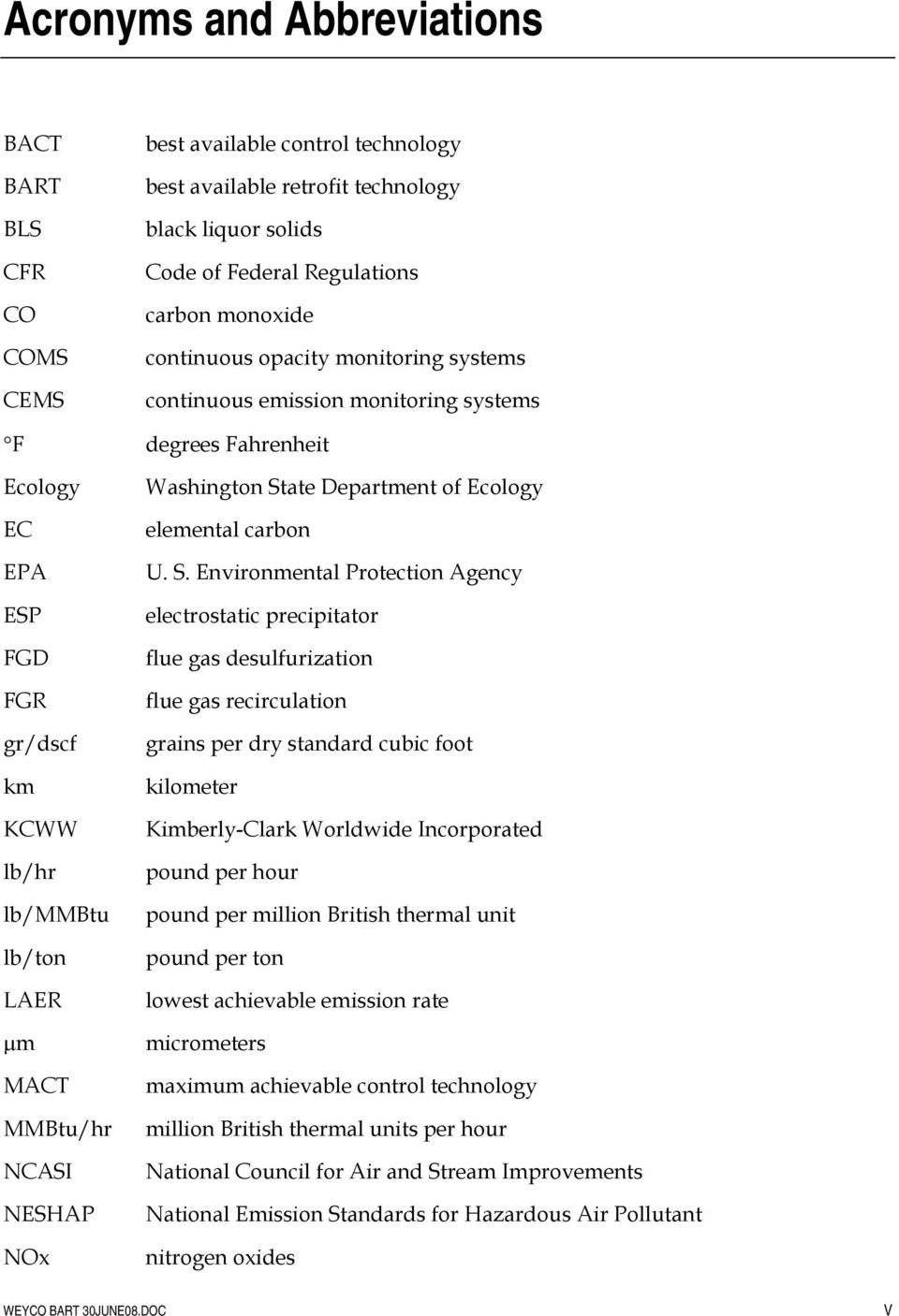
6 NSPS O 2 OFA PM PM 2.5 PM 10 PMC PMF ppb ppm ppmv PSD RACT RBLC SCR SNCR SO 2 SO 4 SOA SOB ton/day/ft 2 TRS WAC v new source performance standard oxygen overfire air particulate matter particulate matter less than 2.5 micrometers in aerodynamic diameter particulate matter less than 10 micrometers in aerodynamic diameter course particulate matter fine particulate matter parts per billion parts per million parts per million by volume Prevention of Significant Deterioration reasonably available control technology RACT, BACT, LAER Clearinghouse selective catalytic reduction selective noncatalytic reduction sulfur dioxide sulfates secondary organic aerosols Statement of Basis ton per day per square foot total reduced sulfur Washington Administrative Code volume VI WEYCO BART 30JUNE08.DOC

7 1. Introduction and Summary This report presents the results of the Best Available Retrofit Technology (BART) analysis of the BART-eligible sources at the Weyerhaeuser Corporation s (Weyerhaeuser) facility in Longview, Washington. BART guidelines were established as a result of U. S. Environmental Protection Agency (EPA) regulations intended to reduce the occurrence of regional haze in national parks and other Class I protected air quality areas in the United States (40 Code of Federal Regulations [CFR] Part 51). 1 The BART program is a major component of the regional haze rules. Under the guidelines, emission units that were constructed between 1962 and 1977 and that, when combined, emit more that 250 tons per year of visibility-impairing pollutants (particulate matter [PM], sulfur dioxide [SO 2 ], or nitrogen oxides [NOx]), are subject to a BART controls analysis if it is determined that the combined emissions from the subject sources cause or contribute to regional haze in any mandatory Class I area. A facility is considered to cause regional haze if the emissions result in a visibility impact greater than 1.0 deciview, and the facility is considered to contribute to regional haze if the visibility impact is above 0.5 deciview or some other level established by EPA or the Washington State Department of Ecology (Ecology). Weyerhaeuser owns and operates a large forest products facility in Longview, Washington, with major emission units that began operation after 1962 and were in operation in These emission units include the No. 10 Recovery Furnace, the No. 10 Smelt Dissolver Tank, and the No. 11 Power Boiler. These units have the combined potential to emit more than 250 tons per year of PM, SO 2, or NOx, so these emission units and activities are BARTeligible. Other emission units and operations that were constructed during this period (including several components of the secondary effluent treatment plant) are negligible sources of these visibility-impairing pollutants. Other emission units and operations at Weyerhaeuser s Longview facility were constructed either before 1962 or after 1977 and are therefore not subject to the BART program. Ecology has developed Guidelines for Best Available Retrofit Technology Determination under the Federal Regional Haze Rule (June 12, 2007) to determine whether sources need to conform to BART requirements. In addition, Ecology, the Oregon Department of Environmental Quality, and Idaho Department of Environmental Quality, in coordination with the U.S. Fish and Wildlife Service, National Park Service, U.S. Forest Service, and EPA Region X have developed the Modeling Protocol for Washington, Oregon, and Idaho: Protocol for the Application of the CALPUFF Modeling System Pursuant to the Best Available Retrofit Technology (BART) Regulation (October 11, 2006). Both of these documents were consulted during development of this report CFR Part 51: Regional Haze Regulations and Guidelines for BART Determinations; Final Rule. 70 Federal Register, , July 6, WEYCO BART 30JUNE08.DOC 1

8 This report describes the BART-eligible emission units and their emissions, discusses the modeling approach, and presents the results. This report shows that the BART-eligible emission units currently employ BART and that the emissions from the units probably do not cause regional haze but may contribute to regional haze in nearby Class I areas. 2 WEYCO BART 30JUNE08.DOC
9 2. Emission Units and Emissions The No. 10 Recovery Furnace, the No. 10 Smelt Dissolver Tank, and the No. 11 Power Boiler emission units at Weyerhaeuser s Longview facility started operation after August 7, 1962, were in operation on August 7, 1977, and have the potential to emit more than 250 tons a year of SO 2 and NOx; therefore, they are BART-eligible. According to Section 2.4 of the Modeling Protocol, fugitive dust sources at a distance greater than 10 kilometers (km) from any Class I area are exempt from the analysis. The closest Class I area is more than 10 km from the Longview plant. Therefore, fugitive emissions from material handling were not considered in the modeling analysis. The Longview facility has several emission units that were constructed before 1962 or after 1977, and these units are not included in the BART evaluation. The following pollutants from the BART-eligible emission units potentially affect visibility in Class I areas: SO 2 Sulfates (SO 4 ) NO x Coarse particulate matter (PMC) (particulate matter less than 10 micrometers [µm] in aerodynamic diameter [PM 10 ], but greater than 2.5 µm in aerodynamic diameter) Fine particulates matter (PMF) (less than 2.5 µm in aerodynamic diameter [PM 2.5 ]) Elemental carbon (EC) Secondary organic aerosols (SOA) While other pollutants may have a very small impact on visibility, those impacts have not been quantified and therefore other pollutants will not be considered. In addition, many control options result in reduction of more than one pollutant. For example, generally reduction of one component of PM, such as EC, also results in reduction of both PMF and PMC. No. 10 Recovery Furnace and Smelt Dissolver Tank The No. 10 Recovery Furnace is a B&W low-odor kraft recovery furnace that was installed in 1975 (see Figure 2.1). The furnace was upgraded in 1995 when a third stage was added to the precipitator. The furnace was also up graded to high concentration black liquor firing in The furnace is capable of producing approximately 808,000 pounds of steam per hour and burning approximately 270,000 pounds of black liquor solids (BLS) per hour. No. 6 fuel oil is use to supplementary fuel particularly during startup, shutdown, and malfunctions. The associated smelt dissolver tank has a scrubber for particulate control. WEYCO BART 30JUNE08.DOC 3
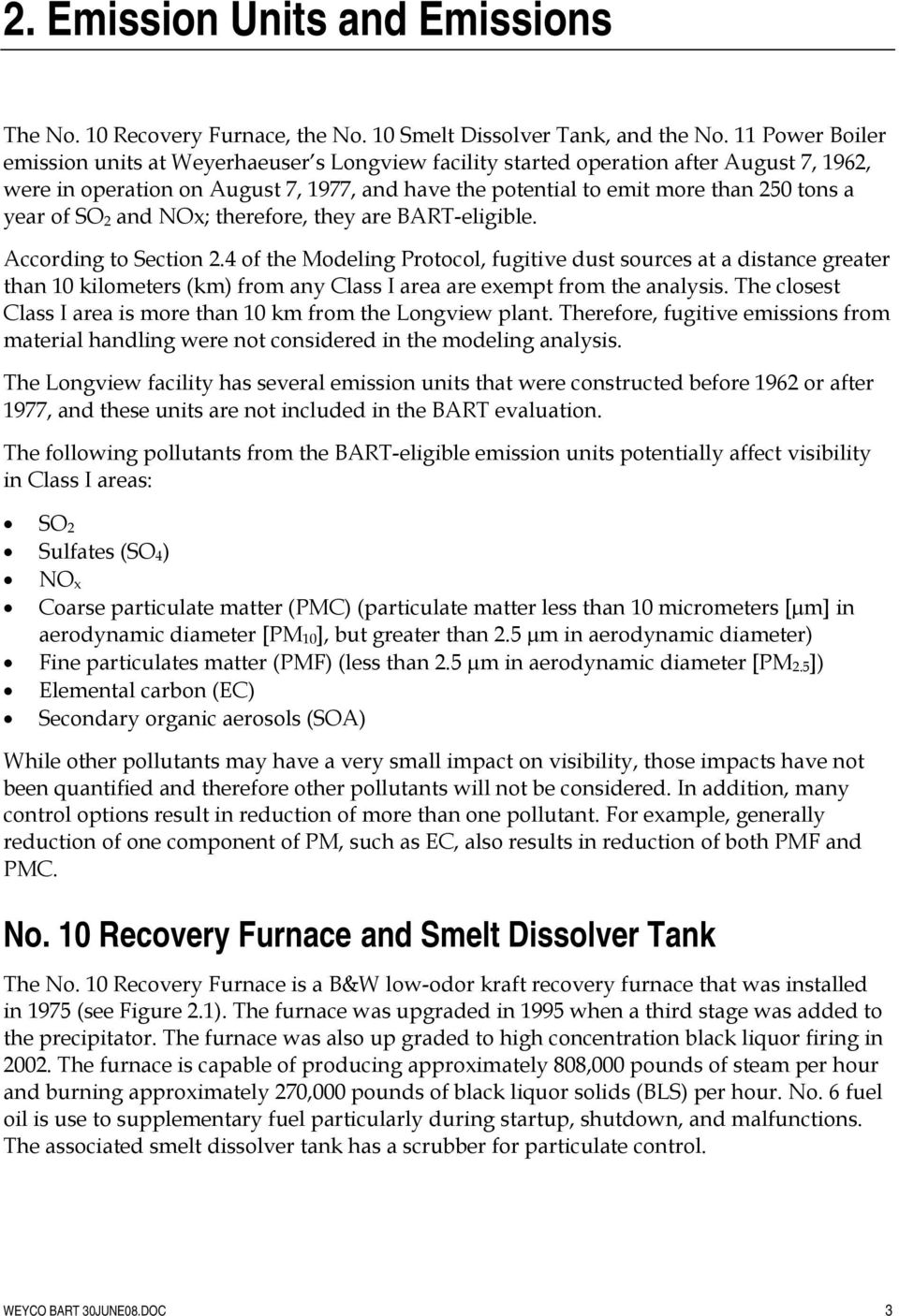
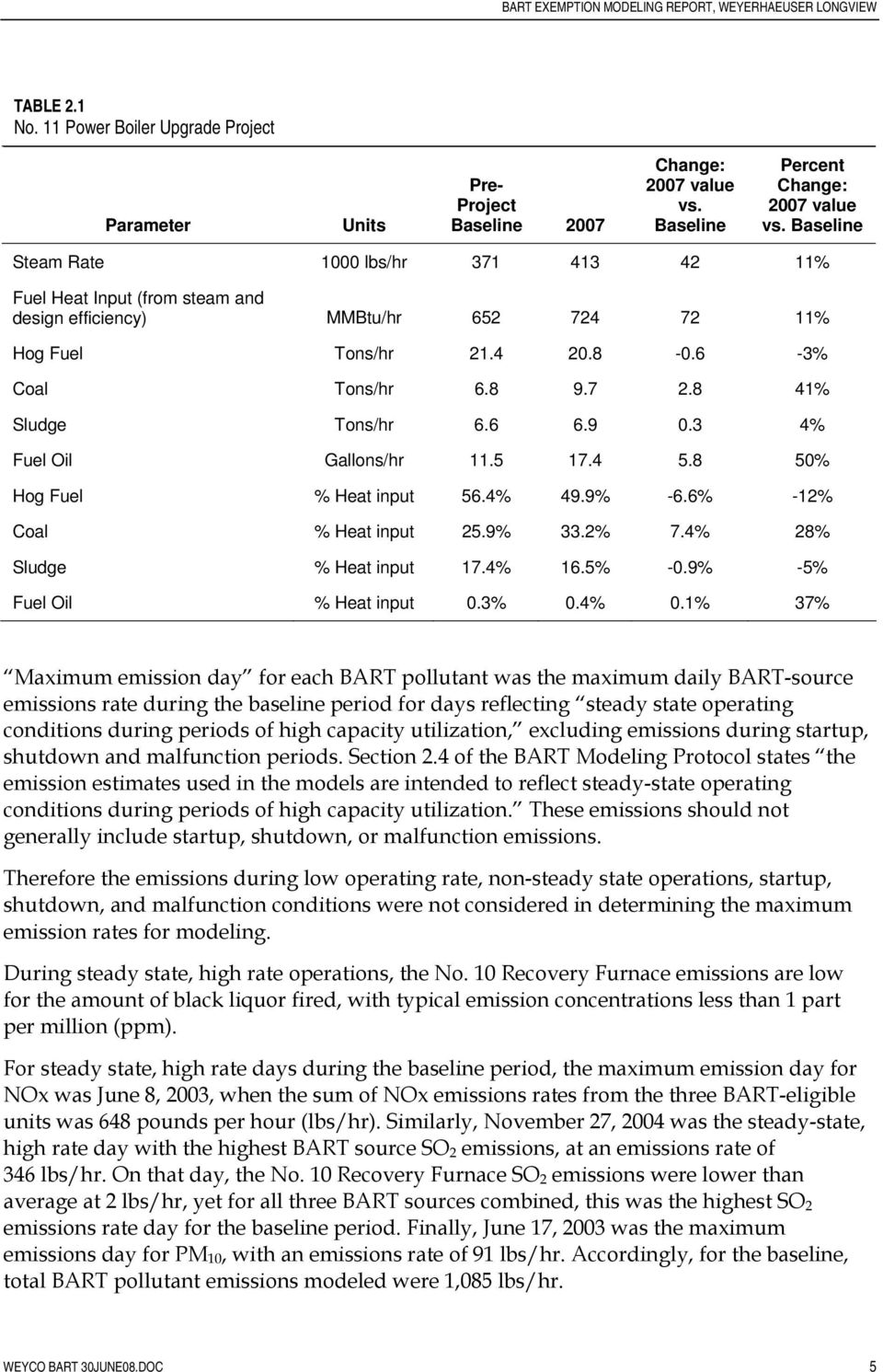
10 FIGURE 2.1 NO. 10 RECOVERY FURNACE WITH ESP No. 11 Power Boiler The No. 11 Power Boiler is a Foster Wheeler Spreader-stoker type boiler and was installed in It has a nominal capacity of 580,000 pounds of steam per hour. At the percent design efficiency of converting heat input to steam, it has a heat input of 1,016 million British thermal units per hour (MMBtu/hr). The primary fuels for the boiler are hog fuel, coal, wastewater treatment plant sludge, and No. 6 fuel oil. The fuel oil is primarily used for startup, shutdown, and malfunctions. The No. 11 Boiler Upgrade Project, completed in late 2006, improved boiler operating ability to meet variable site steam demand while firing high moisture, high ash content fuels by upgrading the overfire air (OFA), fuel feed, and emission control systems. A summary of average operating rates before and after the Upgrade Project is presented in Table 2.1. Emission rates Weyerhaeuser determined the maximum emission day for each BART pollutant (NOx, SO 2, and PM) during the 2003 to 2005 baseline period. Daily emissions rates of NOx and SO 2 were determined from continuous emission monitors on both the No. 10 Recovery Furnace and the No. 11 Power Boiler; hence, there is a high level of confidence in the measured rates. Daily speciated PM emissions rates were estimated from daily operating rate data using time-variable emission factors derived from the most recent quarterly Method 5 stack test. Consequently, there is a relatively high confidence level in the daily particulate emissions rate estimates. 4 WEYCO BART 30JUNE08.DOC

11 TABLE 2.1 No. 11 Power Boiler Upgrade Project Parameter Units Pre- Project Baseline 2007 Change: 2007 value vs. Baseline Percent Change: 2007 value vs. Baseline Steam Rate 1000 lbs/hr % Fuel Heat Input (from steam and design efficiency) MMBtu/hr % Hog Fuel Tons/hr % Coal Tons/hr % Sludge Tons/hr % Fuel Oil Gallons/hr % Hog Fuel % Heat input 56.4% 49.9% -6.6% -12% Coal % Heat input 25.9% 33.2% 7.4% 28% Sludge % Heat input 17.4% 16.5% -0.9% -5% Fuel Oil % Heat input 0.3% 0.4% 0.1% 37% Maximum emission day for each BART pollutant was the maximum daily BART-source emissions rate during the baseline period for days reflecting steady state operating conditions during periods of high capacity utilization, excluding emissions during startup, shutdown and malfunction periods. Section 2.4 of the BART Modeling Protocol states the emission estimates used in the models are intended to reflect steady-state operating conditions during periods of high capacity utilization. These emissions should not generally include startup, shutdown, or malfunction emissions. Therefore the emissions during low operating rate, non-steady state operations, startup, shutdown, and malfunction conditions were not considered in determining the maximum emission rates for modeling. During steady state, high rate operations, the No. 10 Recovery Furnace emissions are low for the amount of black liquor fired, with typical emission concentrations less than 1 part per million (ppm). For steady state, high rate days during the baseline period, the maximum emission day for NOx was June 8, 2003, when the sum of NOx emissions rates from the three BART-eligible units was 648 pounds per hour. Similarly, November 27, 2004 was the steady-state, high rate day with the highest BART source SO 2 emissions, at an emissions rate of 346 lbs/hr. On that day, the No. 10 Recovery Furnace SO 2 emissions were lower than average at 2 lbs/hr, yet for all three BART sources combined, this was the highest SO 2 emissions rate day for the baseline period. Finally, June 17, 2003 was the maximum emissions day for PM 10, with an emissions rate of 91 lbs/hr. Accordingly, for the baseline, total BART pollutant emissions modeled were 1,085 lbs/hr. WEYCO BART 30JUNE08.DOC 5
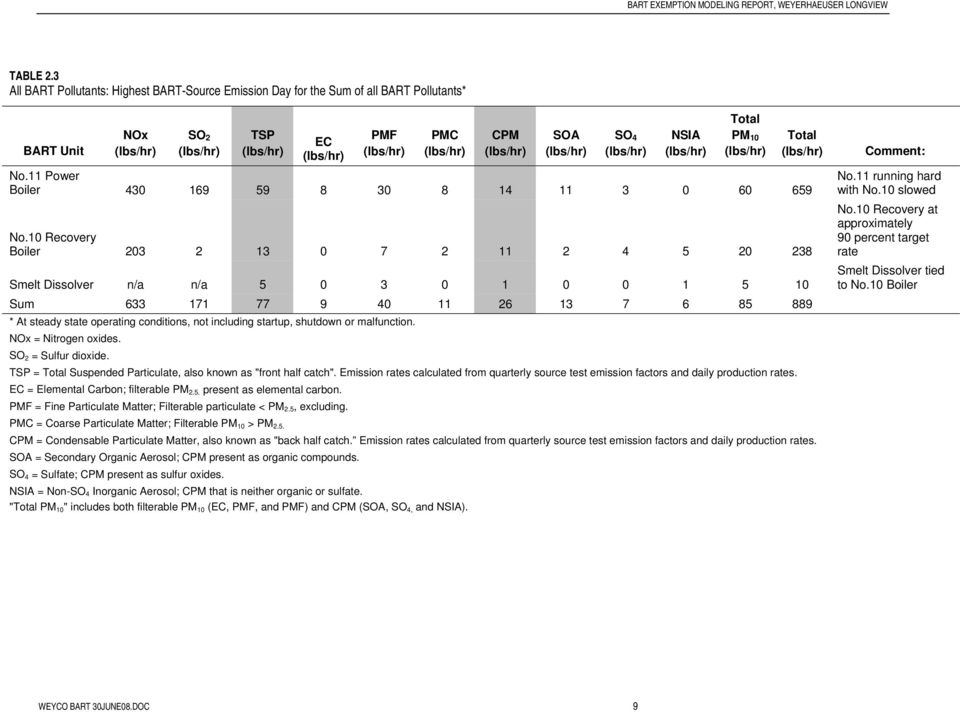
12 Defining maximum emission day on a pollutant-by-pollutant basis over estimates the actual BART-eligible emissions during the baseline period. In actual operation, maximum emissions of the BART pollutants did not occur on the same day. The steady state, high rate baseline day with the highest total BART pollutant emissions was June 28, On that day, emissions rates were: 633 lbs/hr NOx; 171 lbs/hr SO 2 ; and 85 lbs/hr PM 10 ; for a total BART pollutant emission rate of 889 lbs/hr, significantly lower than the 1,085 lbs/hr used for baseline modeling. It should be noted that for the No. 10 Recovery Furnace, emissions of NOx and SO 2 tend to be inversely related. That is, under high load NOx emissions tend to be high and SO 2 emissions tend to be low due to good combustion and sulfur recovery. The majority of the annual SO 2 emissions from the Recovery Furnace are from non-steady state operations during startup and shutdown periods, when sulfur recovery efficiency is poor. In contrast, during these high SO 2 emission periods, NOx emission rates are low because of low flue gas flow rates. Note that the annual average SO 2 emission rate from the No. 10 Recovery Boiler is about 11 lbs/hr. Most of the annual average emissions derive from periods of low utilization rate (low liquor firing periods), or startup, shutdown, and malfunctions. As described previously those conditions should not generally be modeled. Also consider that 11 lbs/hr is very small and almost insignificant compared to the boiler s NOx emission rate of over 200 lbs/hr on the highest emitting day or the No. 11 Power Boiler s emission rates of over 300 lbs/hr each for NOx and SO 2 on the highest emitting days. Hence, even using the maximum SO 2 emission rate for the Recovery Furnace alone was used, the SO 2 emissions would be small compared to the others and it would not be reflective of steady-state operating conditions during periods of high capacity utilization as required by the BART Guideline. It is also important to note the relationship between the No. 10 Recovery Furnace and the No. 11 Power Boiler. The No. 10 Recovery Furnace is tied directly to the kraft mill process, and normally operates at steady rate at or near full steaming rate (800 to 850 thousand pounds of steam per hour). This maximizing pulping liquor chemical recovery rate and satisfies the majority of site steam demand. Under these conditions, the No. 11 Power Boiler and the other power boiler supply the remainder of the site steam requirement, operating as swing boilers to match varying site steam demand. However, when the No.10 Recovery Furnace is shut down or operating at low rate, the No. 11 Power Boiler is operated as a baseload boiler, steaming at a high and steady rate. Consequently, the No. 11 Power Boiler emissions rates are highest under conditions when the No. 10 Recovery Furnace emissions are lowest. Table 2.2 presents the highest BART-source emissions day for each BART pollutant during steady state operation. These were the values used for modeling in Weyerhaeuser s BART evaluation, and were also provided to EPA Region X for their regional haze modeling. Table 2.3 presents the highest BART-source emissions day for each BART pollutant during steady state operation. These were the values used for modeling in Weyerhaeuser s BART evaluation, and were also provided to EPA Region X for their regional haze modeling. On June 28, 2003, the No. 11 Power Boiler was running hard due to increased steam demand, while the No. 10 Recovery Furnace slowed to approximately 90 percent of the target rate. Smelt Dissolver operation integrated with No. 10 Recovery Furnace. These values represent 6 WEYCO BART 30JUNE08.DOC

13 the maximum actual BART pollutant emission day for the BART source during steady state, high rate operations in the baseline period. In Weyerhaeuser s view, these were the most appropriate values for use in modeling baseline visibility impacts. However, based on feedback from EPA and Ecology regarding the modeling protocol, baseline modeling was instead done using the maximum emission day for each BART pollutant. Thus the baseline actual emission values used in modeling were substantially higher than actual emissions that occurred during any actual day of the 2003 to 2005 baseline period. WEYCO BART 30JUNE08.DOC 7

14 TABLE 2.2 Individual BART Pollutants: Highest BART-Source Emission Day for Each BART Pollutant (NOx, SO2, and Each PM-10 Fraction)* BART Unit NOx SO 2 TSP EC PMF PMC CPM SOA SO 4 NSIA Total PM 10 Date 6/8/03 11/27/04 6/17/03 6/17/03 6/17/03 6/17/03 6/17/03 6/17/03 6/17/03 6/17/03 06/17/03 Total Comment: No. 11 Power Boiler Multifuel swing boiler No.10 Recovery Furnace Smelt Dissolver n/a n/a Sum ,085 * At steady state operating conditions, not including startup, shutdown or malfunction. NOx = Nitrogen oxides. SO 2 = Sulfur dioxide. TSP = Total Suspended Particulate, also known as "front half catch." Emission rates calculated from quarterly source test emission factors and daily production rates. EC = Elemental Carbon; filterable PM 2.5. present as elemental carbon. PMF = Fine Particulate Matter; Filterable particulate < PM 2.5, excluding. PMC = Coarse Particulate Matter; Filterable PM 10 > PM 2.5. CPM = Condensable Particulate Matter, also known as back half catch. Emission rates calculated from quarterly source test emission factors and daily production rates. SOA = Secondary Organic Aerosol; CPM present as organic compounds. SO 4 = Sulfate; CPM present as sulfur oxides. NSIA = Non-SO 4 Inorganic Aerosol; CPM that is neither organic or sulfate. "Total PM 10 " includes both filterable PM 10 (EC, PMF, and PMF) and CPM (SOA, SO 4, and NSIA). n/a = not applicable Kraft recovery furnace Integrated with No.10 Recovery 8 WEYCO BART 30JUNE08.DOC

15 TABLE 2.3 All BART Pollutants: Highest BART-Source Emission Day for the Sum of all BART Pollutants* BART Unit NOx SO 2 TSP EC PMF PMC CPM SOA SO 4 NSIA Total PM 10 No.11 Power Boiler No.10 Recovery Boiler Smelt Dissolver n/a n/a Sum * At steady state operating conditions, not including startup, shutdown or malfunction. NOx = Nitrogen oxides. SO 2 = Sulfur dioxide. TSP = Total Suspended Particulate, also known as "front half catch". Emission rates calculated from quarterly source test emission factors and daily production rates. EC = Elemental Carbon; filterable PM 2.5. present as elemental carbon. PMF = Fine Particulate Matter; Filterable particulate < PM 2.5, excluding. Total Comment: No.11 running hard with No.10 slowed No.10 Recovery at approximately 90 percent target rate Smelt Dissolver tied to No.10 Boiler PMC = Coarse Particulate Matter; Filterable PM 10 > PM 2.5. CPM = Condensable Particulate Matter, also known as "back half catch. Emission rates calculated from quarterly source test emission factors and daily production rates. SOA = Secondary Organic Aerosol; CPM present as organic compounds. SO 4 = Sulfate; CPM present as sulfur oxides. NSIA = Non-SO 4 Inorganic Aerosol; CPM that is neither organic or sulfate. "Total PM 10 " includes both filterable PM 10 (EC, PMF, and PMF) and CPM (SOA, SO 4, and NSIA). WEYCO BART 30JUNE08.DOC 9
16

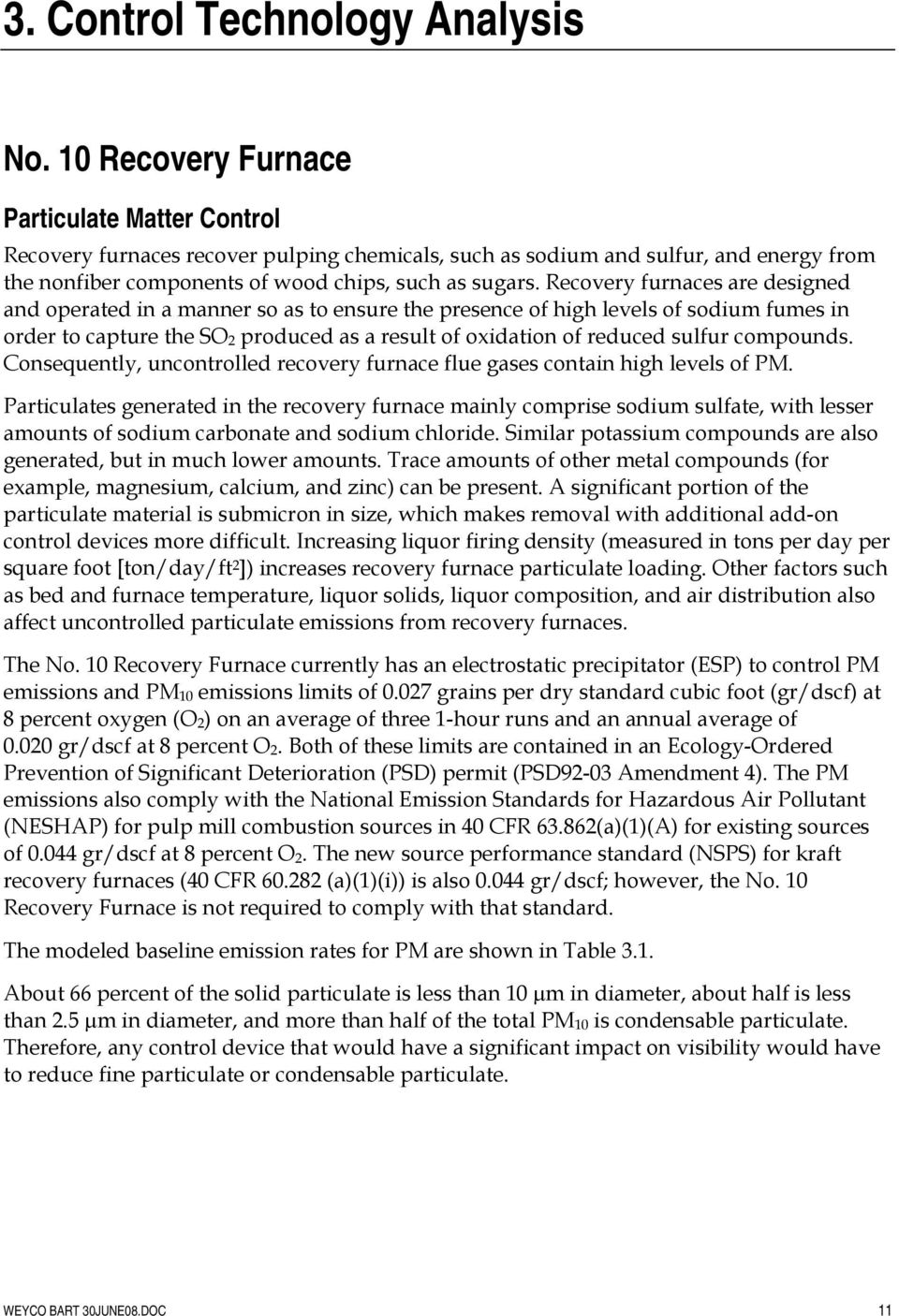
17 3. Control Technology Analysis No. 10 Recovery Furnace Particulate Matter Control Recovery furnaces recover pulping chemicals, such as sodium and sulfur, and energy from the nonfiber components of wood chips, such as sugars. Recovery furnaces are designed and operated in a manner so as to ensure the presence of high levels of sodium fumes in order to capture the SO 2 produced as a result of oxidation of reduced sulfur compounds. Consequently, uncontrolled recovery furnace flue gases contain high levels of PM. Particulates generated in the recovery furnace mainly comprise sodium sulfate, with lesser amounts of sodium carbonate and sodium chloride. Similar potassium compounds are also generated, but in much lower amounts. Trace amounts of other metal compounds (for example, magnesium, calcium, and zinc) can be present. A significant portion of the particulate material is submicron in size, which makes removal with additional add-on control devices more difficult. Increasing liquor firing density (measured in tons per day per square foot [ton/day/ft 2 ]) increases recovery furnace particulate loading. Other factors such as bed and furnace temperature, liquor solids, liquor composition, and air distribution also affect uncontrolled particulate emissions from recovery furnaces. The No. 10 Recovery Furnace currently has an electrostatic precipitator (ESP) to control PM emissions and PM 10 emissions limits of grains per dry standard cubic foot (gr/dscf) at 8 percent oxygen (O 2 ) on an average of three 1-hour runs and an annual average of gr/dscf at 8 percent O 2. Both of these limits are contained in an Ecology-Ordered Prevention of Significant Deterioration (PSD) permit (PSD92-03 Amendment 4). The PM emissions also comply with the National Emission Standards for Hazardous Air Pollutant (NESHAP) for pulp mill combustion sources in 40 CFR (a)(1)(A) for existing sources of gr/dscf at 8 percent O 2. The new source performance standard (NSPS) for kraft recovery furnaces (40 CFR (a)(1)(i)) is also gr/dscf; however, the No. 10 Recovery Furnace is not required to comply with that standard. The modeled baseline emission rates for PM are shown in Table 3.1. About 66 percent of the solid particulate is less than 10 µm in diameter, about half is less than 2.5 µm in diameter, and more than half of the total PM 10 is condensable particulate. Therefore, any control device that would have a significant impact on visibility would have to reduce fine particulate or condensable particulate. WEYCO BART 30JUNE08.DOC 11
18 TABLE 3.1 No. 10 Recovery Furnace Modeled Emission Rates (June 17, 2003) TSP EC (lb/hr) PMF PMC CPM SOA SO 4 NSIA Total PM TSP = Total Suspended Particulate, also known as "front half catch". Emission rates calculated from quarterly source test emission factors and daily production rates. EC = Elemental Carbon; filterable PM 2.5. present as elemental carbon. PMF = Fine Particulate Matter; Filterable particulate < PM 2.5, excluding. PMC = Coarse Particulate Matter; Filterable PM 10 > PM 2.5. CPM = Condensable Particulate Matter, also known as "back half catch. Emission rates calculated from quarterly source test emission factors and daily production rates. SOA = Secondary Organic Aerosol; CPM present as organic compounds. SO 4 = Sulfate; CPM present as sulfur oxides. NSIA = Non-SO 4 Inorganic Aerosol; CPM that is neither organic or sulfate. "Total PM 10 " includes both filterable PM 10 (EC, PMF, and PMF) and CPM (SOA, SO 4, and NSIA). Step 1: Identify All Available Retrofit Control Technologies Available control technologies include the following: Fabric filters Dry ESP Wet ESP Wet scrubber Venturi scrubber A review of EPA s Reasonably Available Control Technology (RACT), Best Available Control Technology (BACT), lowest achievable emission rate (LAER) Clearinghouse (RBLC) showed 24 determinations for particulate in the last 15 years, and the only particulate control technology listed was ESP. The RBLC lists emission limits for constructed units between gr/dscf at 8 percent O 2 to gr/dscf at 8 percent O 2, with only two determinations listed that were more stringent than 0.02 gr/dscf. Step 2: Eliminate Technically Infeasible Options The particulate leaving a recovery furnace is in a very sticky and hydroscopic form that makes a fabric filter an infeasible option. The particulate emissions from the No. 10 Recovery Furnace are currently controlled by a high-efficiency ESP with emissions that average less than 0.02 gr/dscf. The particulate leaving the final stage of the ESP is very fine particulate or condensable particulate. A lowpressure drop wet scrubber would not be effective on either form of particulate. Therefore, it can be eliminated on the basis of technical infeasibility. Wet ESPs have not been demonstrated to operate on a kraft recovery furnace; therefore, they can be considered technically infeasible. Venturi scrubbers have been installed on kraft recovery furnaces, but the RBLC does not list any installations in the last 15 years because they are not as efficient at removing the fine particulate as an ESP. However, a venturi 12 WEYCO BART 30JUNE08.DOC

19 scrubber may be effective in removing condensable particulate; therefore, both an ESP and a venturi scrubber are considered technically feasible. Step 3: Evaluate Cost-Effectiveness of Remaining Control Technologies To evaluate the cost-effectiveness of the feasible technologies, the procedures in EPA s Air Pollution Control Cost Manual, sixth edition (EPA/424/B-2-001, January 2002) were followed. As suggested in Ecology s Guidelines for Best Available Retrofit Technology Determination under the Federal Regional Haze Rule (June 12, 2007), a useful equipment lifetime of 10 years and an interest rate of 7 percent were used in the cost estimate. Appendix A shows the detailed cost estimates of the two technologies. A retrofit cost factor of 1.5 was applied because of the considerable cost that would be involved in retrofitting the existing facility, the extra duct work, and possible modifications to the fan system that would be required. In addition, the current stack may not be able to accommodate a wet plume from a scrubber. The greatest emission rate during the baseline period (2003 to 2005) was used to determine the amount of particulate removal. Because both types of control equipment will follow the existing ESP, a collection efficiency of 50 percent was assumed; however, because an ESP cannot collect condensable particulate, the emission estimate was based on TSP shown in Table 3.1 (15 lbs/hour, 65.7 tons/year, 32.8 tons/year at 50 percent additional control). The venturi scrubber was assumed to be able to collect 50 percent of both the TSP and the condensable particulate (15 lbs/hour + 12 lbs/hour = 27 lbs/hour, tons/year, or 59.1 tons/year at 50 percent control). Table A-1 in Appendix A shows that the additional cost of removing a ton of PM by adding another field to the existing high-efficiency ESP is about $122,000. Similarly, the cost of removing an additional ton of PM and condensable PM by adding a venturi scrubber would be about $28,000; however, this cost does not include treating the waste liquor from the scrubber. Weyerhaeuser has concluded that both these costs are economically infeasible. Step 4: Evaluate Impacts and Document the Results The only additional emission control options that are technically feasible are economically infeasible. The current emission rate is consistent with or more stringent than all but one or two recent recovery furnace BACT determinations; therefore, the current level of emission control is proposed as the BART. SO 2 SO 2 is produced in a kraft recovery furnace as a result of oxidation of sulfur during combustion of the black liquor and other fuels. The recovery furnace is designed to recover a vast majority of the sulfur in the smelt. However, under some conditions, small amounts of sulfur are emitted in the form of SO 2. The amount emitted depends on many factors including the concentration of sulfur in the fuel, the excess air in the combustion zone, furnace design, and furnace load. The No. 10 Recovery Furnace currently has a BACT permit limit of 75 ppm at 8 percent O 2. The RBLC lists BACT SO 2 limits ranging from 20 ppm to over 200 ppm, with most of the recent determinations in the 50 to 100 ppm at 8 percent O 2 limit (see Appendix A, Table WEYCO BART 30JUNE08.DOC 13

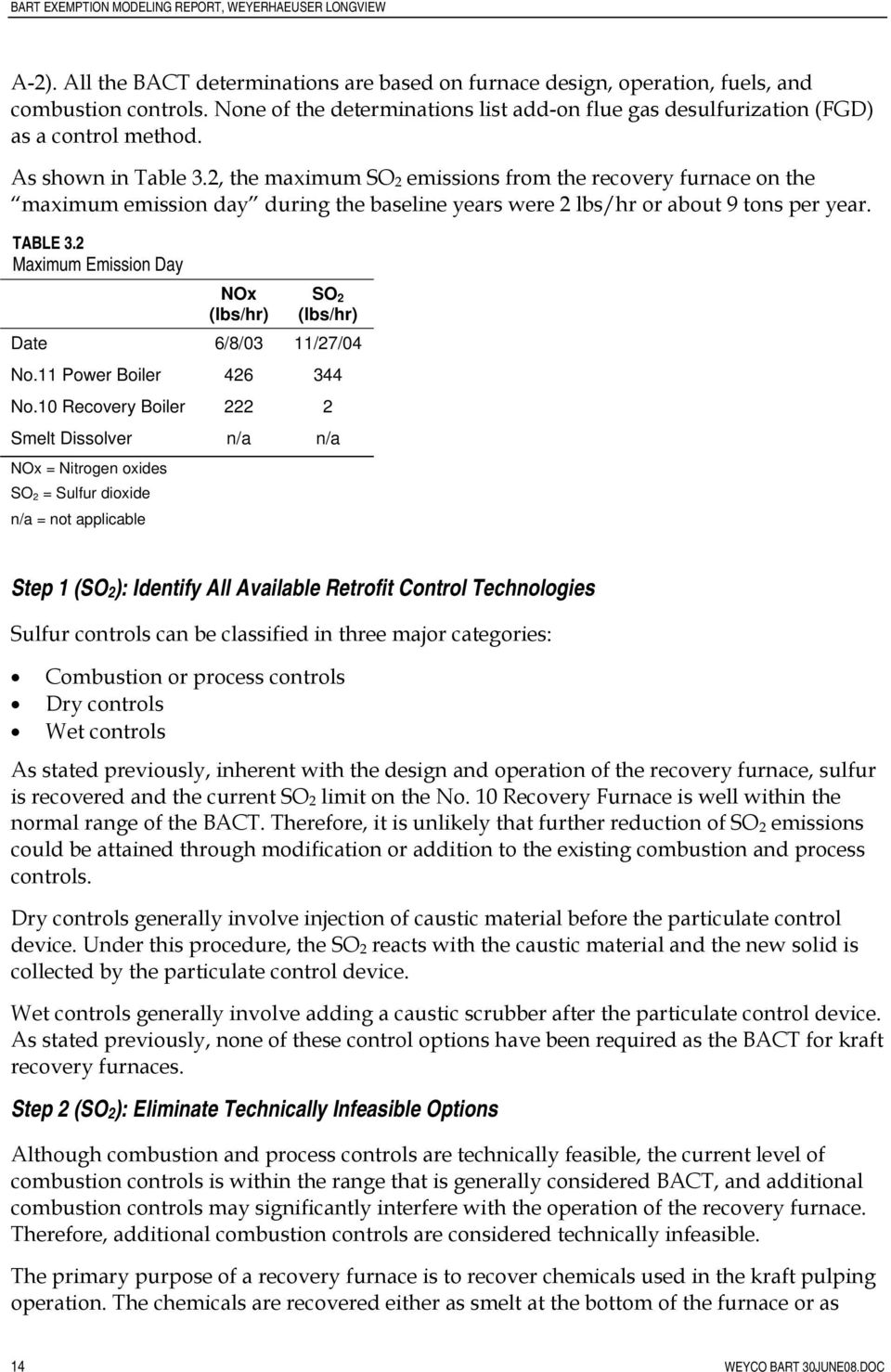
20 A-2). All the BACT determinations are based on furnace design, operation, fuels, and combustion controls. None of the determinations list add-on flue gas desulfurization (FGD) as a control method. As shown in Table 3.2, the maximum SO 2 emissions from the recovery furnace on the maximum emission day during the baseline years were 2 lbs/hr or about 9 tons per year. TABLE 3.2 Maximum Emission Day NOx SO 2 Date 6/8/03 11/27/04 No.11 Power Boiler No.10 Recovery Boiler Smelt Dissolver n/a n/a NOx = Nitrogen oxides SO 2 = Sulfur dioxide n/a = not applicable Step 1 (SO 2 ): Identify All Available Retrofit Control Technologies Sulfur controls can be classified in three major categories: Combustion or process controls Dry controls Wet controls As stated previously, inherent with the design and operation of the recovery furnace, sulfur is recovered and the current SO 2 limit on the No. 10 Recovery Furnace is well within the normal range of the BACT. Therefore, it is unlikely that further reduction of SO 2 emissions could be attained through modification or addition to the existing combustion and process controls. Dry controls generally involve injection of caustic material before the particulate control device. Under this procedure, the SO 2 reacts with the caustic material and the new solid is collected by the particulate control device. Wet controls generally involve adding a caustic scrubber after the particulate control device. As stated previously, none of these control options have been required as the BACT for kraft recovery furnaces. Step 2 (SO 2 ): Eliminate Technically Infeasible Options Although combustion and process controls are technically feasible, the current level of combustion controls is within the range that is generally considered BACT, and additional combustion controls may significantly interfere with the operation of the recovery furnace. Therefore, additional combustion controls are considered technically infeasible. The primary purpose of a recovery furnace is to recover chemicals used in the kraft pulping operation. The chemicals are recovered either as smelt at the bottom of the furnace or as 14 WEYCO BART 30JUNE08.DOC
21 particulate in the particulate collection system. Injecting a caustic material into the flue gas before the particulate control device would significantly degrade the quality of the smelt or the particulate collected; hence, dry injection is not technically feasible. Wet controls are technically feasible; however, wet scrubbers have never been used on a recovery furnace primarily for the purpose of SO 2 control. A few scrubbers on recovery furnaces are used for particulate control or heat recovery. Step 3 (SO 2 ): Evaluate Control Effectiveness of Remaining Control Technologies The only technically feasible control technology is some type of add-on wet scrubber. At most, such a scrubber would reduce SO 2 emissions from the recovery furnace by 9 tons per year. Such a scrubber could be installed in conjunction with an add-on particulate scrubber as previously described. The cost-effectiveness of a particulate scrubber alone would be about $28,000 per ton, assuming the removal of 59 tons of particulate per year. Removing an additional maximum 9 tons of SO 2 per year would bring the cost-effectiveness down to $24,000 per ton. This does not include the cost of reagent, mixing and spraying equipment, or the additional waste disposal. Because an add-on wet scrubber would cost more than $24,000 per ton removed, Weyerhaeuser considers it to be economically infeasible. Weyerhaeuser has concluded that wet scrubbing, the only technically feasible control option, is economically infeasible. Step 4 (SO 2 ): Evaluate Impacts and Document the Results The only emission control option for SO 2 that is technically feasible is economically infeasible. Therefore, the current level of emission control is proposed as BART. NOx Compared to coal- or residual oil-fired boilers of similar capacity, NOx emissions from kraft recovery furnaces are generally quite low. These low NOx emissions are due to several factors inherent to kraft recovery furnace operations and include the following: Low nitrogen concentrations in most as-fired BLS (generally less than 0.2 percent) Recovery furnace NOx formation resulting predominantly from fuel NOx mechanisms (insufficient temperatures for thermal NOx formation) The highly staged combustion design of recovery furnaces The existence of sodium fumes that might participate in in-furnace NOx reduction or removal The No. 10 Recovery Furnace complies with a 140 ppm NOx at 8 percent O 2 PSD limit (PSD92-03 Amendment 7). There are no current NSPS or maximum achievable control technology (MACT) standards for NOx from kraft recovery furnaces. The RBLC contains BACT emission limits ranging from 80 ppm to 150 ppm at 8 percent O 2 for recovery furnaces that have been built (see Appendix A, Table A-3). WEYCO BART 30JUNE08.DOC 15
22 Step 1 (NOx): Identify All Available Retrofit Control Technologies The only control technologies that have been demonstrated to be available are staged combustion and good combustion controls. The No. 10 Recovery Furnace already uses those technologies. The dual purposes of the No. 10 Recovery Furnace are to recover inorganic pulping chemical for reuse in the pulping process, and to generate steam and power from the firing of concentrated black liquor in the furnace. The No. 10 Recovery Furnace air system has been effectively optimized to achieve these dual purposes, achieving very efficient conversion of BLS into recovered pulping chemical while achieving efficient and fuel combustion. The furnace is designed and operated to produce chemically reducing conditions in the lower furnace for efficient recovery of inorganic pulping chemical, while maintaining oxidizing conditions in the upper furnace to achieve full and complete combustion of the concentrated BLS fired. The addition of combustion air has been finetuned to balance these reducing and oxidizing functions, while optimizing thermal efficiency by adding only the amount of combustion air needed to assure complete oxidation of organic and reduced sulfur compounds. As shown in Figure 3.1 (below), No. 10 Recovery Furnace delivers primary, secondary and tertiary combustion air into the boiler firebox. Tertiary air was added in 1995 when the lower section of the Recovery Furnace was replaced. Primary and secondary air systems include air pre-heating, while tertiary air is at ambient temperature. Primary, secondary and tertiary air ports are located roughly 17, 28 and 63 feet above ground level, respectively. This air inlet distribution generates a reducing zone between the primary and secondary air ports, a drying zone between the secondary and tertiary air ports (this is also the section where concentrated black liquor is sprayed into the firebox), and an oxidizing zone in the upper firebox between the tertiary air ports and the boiler screen tubes. Adding a fourth stage would again require placing a new section in the Recovery Furnace. There is not likely enough room within the furnace between the tertiary air port and the start of the boiler tubes to add a fourth stage of combustion; hence, the furnace would have to be rebuilt and the upper section raised. This would likely require rebuilding the entire boiler and boiler building. Fine tuning recovery furnaces are very complex operations with many trade-offs. For example, as explained in response to the emissions of NOx and SO 2 tend to be inversely related. Hence, fine tuning the furnace operation to reduce NOx emissions would likely significantly increase SO 2 emissions. There is also a very complex relationship between low end furnace temperature, NOx formation, SO 2 formation, sulfur recovery, and other furnace operating conditions. Finally, the No. 10 Recovery Furnace s current NOx emissions performance indicates that combustion air is already well tuned, in comparison with emissions from fossil fueled boilers equipped with staged combustion for NOx control. In 2007, NOx emissions from the No. 10 were approximately pound per million Btu of fuel heat input (0.125 lb/mmbtu). This emission rate is lower than the lowest presumptive BART level established for any type of coal fired Electric Generating Unit, and less than half the NSPS Subpart Db standard for boilers firing residual oil. 16 WEYCO BART 30JUNE08.DOC
23 Figure Diagram of No. 10 Recovery Boiler showing staged combustion air ports & boiler tubes There are currently no known recovery furnaces that have selective noncatalytic reduction (SNCR) or selective catalytic reduction (SCR) installed and operating; hence, such technology has not been demonstrated in practice, either for new or for existing units. There are several complex issues that need to be resolved before SNCR can be considered as a feasible control technology for recovery furnaces. Primary among the reasons is that recovery furnaces are designed to recover chemicals, mostly sodium and sulfur. Generating steam is a secondary aspect of a recovery furnace. SNCR requires injection of ammonia or urea into the furnace within a specific temperature range. Existing furnaces, such as the one in Longview, would require significant modifications in the upper sections to allow for the necessary injection ports. In addition, the long term impacts on the chemical recovery process of injecting ammonia or urea have not been studied and need to be thoroughly WEYCO BART 30JUNE08.DOC 17
24 evaluated before such technology can be consider feasible. Other factors that need to be evaluated before SNCR can be considered feasible include the wide swings in the firing rates that most recovery furnaces, such as the No. 10, have and the need for multiple injection ports to address those wide swings; and the interaction between ammonia and the other chemicals in the recovery furnace; such as, chlorine, sodium, and sulfur. SCR like SNCR requires a reaction between the exhaust gas and ammonia or urea. Unlike SNCR, SCR does not require chemical injection into the recovery furnace, but relies on a catalyst to facilitate the reaction between ammonia and urea at a lower temperature. There are no known cases where SCR has even been attempted on a pilot scale on a recovery furnace. Of great concern is the likelihood of catalyst poisoning by the alkali particulate that recovery furnaces generate if the SCR system is installed before the ESP; and in the case of the No. 10 Recovery Furnace, there is a lack of space between the furnace outlet and the ESP and lack of ground space for the SCR system. Installing the SCR system after the ESP would also have concerns about catalyst poisoning and would require reheating the exhaust gas. These are valid questions but they remain unanswered in practice, since SCR has not been employed for NOx control on any new or existing Recovery Furnace. As stated previously, the process of alkali contamination of the catalyst need considerable study before SCR could be considered feasible for a recovery furnace. Step 2 (NOx): Eliminate Technically Infeasible Options Staged combustion is technically feasible. Step 3 (NOx): Evaluate Control Effectiveness of Remaining Control Technologies The current staged combustion technology emission control technology has been identified as the best available. Step 4 (NOx): Evaluate Impacts and Document the Results The current level of emission control is proposed as the BART. No. 10 Smelt Dissolver Tank As with the recovery furnace, particulate emissions from smelt dissolver tanks mainly comprise sodium compounds with much lesser amounts of potassium compounds and other trace metal compounds. The dominant compound is sodium carbonate, followed by sodium sulfate. The emissions of NOx and SO 2 are negligible from smelt dissolver tanks; hence, no control options need to be considered. Roughly 90 percent (by weight) of the particles have equivalent aerodynamic diameters under 10 µm, and 50 percent have diameters under 1 µm. Most smelt tank particulate emissions are controlled by wet scrubbers, many of which are wetted fan scrubbers that are very effective in removing fine particulate. A dry ESP is infeasible as an option because of the high moisture content of the gases. The wet scrubber also serves to control total reduced sulfur (TRS) compound emissions through ph control; therefore, replacing it with a wet ESP is not an option as there would be a negative environmental impact from increased TRS emissions. As noted for other kraft mill sources, MACT II Implementation in 2004 has also resulted in significantly reduced allowable PM emissions from smelt dissolving tanks. 18 WEYCO BART 30JUNE08.DOC
25 The No. 10 Smelt Dissolving Vent at Longview currently has a high-efficiency wet scrubber that complies with the EPA MACT II standard (40 CFR Subpart MM) of 0.20 pound per ton (lb/ton) of BLS. The unit also complies with a PM 10 limit of lb/ton BLS contained in Ecology s issued PSD Amendment 4. The RBLC s most stringent limit for a smelt vent that has been built is lb/ton BLS 2. Step 1: Identify All Available Retrofit Control Technologies Since various forms of PM are the BART pollutants emitted from a smelt tank, only the following particulate control technologies are considered: Fabric filters Dry ESP Wet ESP Wet scrubbers Step 2: Eliminate Technically Infeasible Options The exhaust gases from smelt vents have high moisture contents and are typically saturated. Therefore, dry control options such as fabric filers and dry ESPs are not technically feasible. A wet ESP might be technically feasible for some smelt vents; however, in this case it would have to be added after the existing scrubber because Weyerhaeuser relies on the existing scrubber to control total reduced sulfur compound emissions through ph control. Therefore, replacing it with a wet ESP is not an option. Step 3: Evaluate Control Effectiveness of Remaining Control Technologies Because the current limit is more stringent than the MACT standard and it is consistent with the most stringent PM standards that have been achieved in practice for smelt vents, a limit of 0.12 lb/ton of BLS is determined to be the BART. No. 11 Power Boiler The No. 11 Power Boiler is a spreader stoker boiler that burns primarily hog fuel and wastewater treatment plant dewatered sludge, with supplementary low-sulfur western coal. No. 6 fuel oil is also burned, but only during startup, shutdown, and malfunction. The rated capacity of the boiler is 575,000 lbs/hr of steam. However, the boiler seldom operates at peak steaming rate, as it functions as a swing boiler, varying its steaming rate to match the mill s fluctuating steam demand. Actual average steam generation rate over the 2003 to 2005 baseline period was 366,000 lbs/hr, and through the first 11 months of 2007 was 408,000 lbs/hr. The modeled baseline (2003 to 2005) emission rates used in the BART exemption modeling are summarized in Table 3.3. The emission control systems were upgraded in Before then, the only emission controls were multiclones and a gravel bed scrubber for particulate. These were replaced in 2006 with a new set of multiclones and an ESP for particulate control. Trona injection was added for SO 2 control. An OFA system was also installed. 2 The RBLC identifies a permit for a mill in Apple Grove, West Virginia, with a limit of 0.11 lb/ton BLS; however, that pulp mill has never been built and there are no plans for building it. Therefore, the limit has not been demonstrated in practice. WEYCO BART 30JUNE08.DOC 19
26 The No. 11 Power Boiler is equipped with continuous emission monitoring systems (CEMS) for NOx and SO 2. TABLE 3.3 No. 11 Power Boiler Modeled Emission Rate* NOx SO 2 TSP EC PMF PMC CPM SOA SO 4 NSIA Total Date 6/8/03 11/27/04 6/17/03 6/17/03 6/17/03 6/17/03 6/17/03 6/17/03 6/17/03 6/17/03 6/17/03 Amount * Consistent with the BART Rule Guidelines (40 CFR Part 51 Appendix Y), modeled emission rates for each pollutant were actual daily emission rates for the highest emission day for the BART source during the baseline period and during steady-state operating conditions during periods of high-capacity utilization. NOx = Nitrogen oxides SO 2 = Sulfur dioxide TSP = Total Suspended Particulate, also known as "front half catch. Emission rates calculated from quarterly source test emission factors and daily production rates. EC = Elemental Carbon; filterable PM 2.5. present as elemental carbon. PMF = Fine Particulate Matter; Filterable particulate < PM 2.5, excluding. PMC = Coarse Particulate Matter; Filterable PM 10 > PM 2.5. CPM = Condensable Particulate Matter, also known as "back half catch. Emission rates calculated from quarterly source test emission factors and daily production rates. SOA = Secondary Organic Aerosol; CPM present as organic compounds. SO 4 = Sulfate; CPM present as sulfur oxides. NSIA = Non-SO 4 Inorganic Aerosol; CPM that is neither organic or sulfate. "Total PM 10 " includes both filterable PM 10 (EC, PMF, and PMF) and CPM (SOA, SO 4, and NSIA). Particulate Matter Control Particulate matter will consist of noncombustible material, unburned fuel, condensible organic matter, and secondary aerosol. The emission rate is typically influenced by the condition of the fuels, velocity of underfire air through the grate, and completeness of the combustion reactions. The current particulate limit is gr/dscf at 7 percent oxygen, volume basis (at 7 percent O 2 /v/v). The boiler is also subject to a new source performance standard for particulate of 0.10 lb/mmbtu of fuel energy input on a higher heating value basis. Particulate emission control on the No. 11 Power Boiler during the 2003 to 2005 baseline period consisted of two stages of multiclones followed by a gravel bed scrubber. The particulate emission control was upgraded in late 2006 by replacing this equipment with a single stage of multiclones followed by a four-field ESP. The ESP supplier guaranteed removal efficiency of 98.4 percent of the particulate entering the ESP, or a maximum outlet concentration of gr/dscf. These values correspond to an inlet concentration of 1.25 gr/dscf, which is in the middle of the range of 1.0 to 1.5 gr/dscf that the supplier identifies as the Design Basis. The actual performance of the ESP is much better than the guarantee. In five quarterly performance tests performed since ESP startup, the outlet concentration has been measured at less than 0.01 gr/dscf. 20 WEYCO BART 30JUNE08.DOC
27 A search of the RBLC found one boiler with a limit of gr/dscf, but the controls had not yet been installed as of the entry date and the percent O 2 at which the particulate concentration was to be determined was not stated. However, there were several boilers with emission limits as low as 0.02 lb/mmbtu. This limit is approximately equivalent to a concentration of 0.01 gr/dscf at 7 percent O 2. As previously noted, the actual performance test data from the ESP have shown that the particulate concentration is less than this level. Step 1 (Particulate Matter Control): Identify All Available Retrofit Control Technologies Available control technologies include the following: Fabric filters Dry ESP Wet ESP Wet scrubber Venturi scrubber Cyclonic collectors Step 2 (Particulate Matter Control): Eliminate Technically Infeasible Options Baghouses and ESPs are equally effective at removing PM and are considered the most effective and efficient control technologies. However, ESPs are much less of a potential fire hazard. Therefore, we only considered an additional stage to the ESP. Step 3 (Particulate Matter Control): Evaluate Control Effectiveness of Remaining Control Technologies Dry ESPs have approximately the same level of control effectiveness as fabric filters. In general, the control efficiency will range from 95 to 99.9 percent depending on the details of the control design and on the characteristics of the particulate. Based on the existing ESP demonstrated performance of less than 0.07 gr/dscf at 7 percent O 2, which is equivalent to an approximately 99.2 percent collection, efficiency is being achieved. The additional particulate collection that could be achieved by adding an ESP field or a baghouse would be very small and the cost would be substantial. The site is very constrained and there would not be adequate space for the addition of a new ESP field or a baghouse and the associated ductwork without major rework of the existing layout. It would also probably require replacement of the existing stack. The addition of another ESP field or baghouse would be economically infeasible. WEYCO BART 30JUNE08.DOC 21
28 Step 4 (Particulate Matter Control): Evaluate Impacts and Document the Results We will not need to evaluate impacts of options since we will assume that we have BART in operation now. SO 2 SO 2 is produced by combustion of the sulfur in the fuels. Most of the fuel sulfur is contained in the coal, even though it is low-sulfur western coal. The wastewater sludge also contributes a significant amount, roughly 80 percent of the amount contributed by the coal on a long-term basis. The other primary fuel (hog fuel) has minimal sulfur. The No. 6 fuel oil used during startup, shutdown, and malfunction has up to 2 percent sulfur, but it emits minimal SO 2 on a long-term basis because of its limited use. The No. 11 Power Boiler currently has an SO 2 limit of 1,000 ppm by volume (ppmv) at 7 percent O 2 (Washington Administrative Code [WAC] (11)(b)). There are also SO 2 limits in the applicable new source performance standard (40 CFR 60.43(a)) that vary from 0.80 to 1.2 lb/mmbtu depending on the type(s) of fuel being combusted. The coal used in the No. 11 Power Boiler is low sulfur bituminous coal from the Powder River Basin. Since late 2007, coal is supplied by Rio Tinto Energy, from the Spring Creek Coal Mine located southeast of Billings, Montana. For shipments in 2007, sulfur content varied from 0.37 to 0.48 percent (dry basis). Spring Creek s sulfur content is lower than the previous coal supply (from Bull Mountain Mine), but it also has lower fuel heating value and higher sodium content, which has resulted in boiler downtime due to scaling and pluggage problems. Weyerhaeuser and Rio Tinto recently agreed to a three-year contract stipulating that Spring Creek will supply all the mill s coal, unless their coal causes excessive boiler operability problems. Bull Mountain Mine near Billings, Montana, had supplied coal for Longview for the last several years, until mine operations shut down in late Bull Mountain s coal sulfur content had ranged from 0.5 to 0.9 percent (dry basis). Weyerhaeuser is not aware of lower sulfur coal supply options for the Longview mill. From 2003 to 2007, annual sludge firing has ranged from 56,000 to 60,000 dry tons per year. Sludge sulfur content is not routinely monitored, but periodic tests from 1990 to the present have shown sludge sulfur content to be approximately 0.3 to 0.4 percent (dry basis). There is no known process for reducing the sludge sulfur content. In this discussion of fuel sulfur content, it is worth noting that the No. 11 Boiler s flue gas SO 2 emission rate is less than the fuel sulfur feed load, and the percentage of fuel sulfur emitted as SO 2 is affected by other characteristics of the fuel feed streams. A good portion of the sulfur is captured and removed in the bottom ash and flyash, due to the presence of alkaline metal components in the fuel feed streams. This has been noted at many combination fueled boilers and is described in the National Council for Air and Stream Improvements (NCASI) Technical Bulletin No. 640, Sulfur Capture in Combination Bark Boilers. The amount of sulfur retention in the boiler ash streams is affected by the ratio of sulfur to alkaline components in the fuel feed streams, and the alkaline ash content of the sludge feed stream is considerable in comparison with the sludge sulfur content. The 22 WEYCO BART 30JUNE08.DOC
29 percent of sludge sulfur emitted as SO 2 has not been quantified for the No. 11 Boiler, because there are many operating variables that make it difficult and costly to perform a sulfur mass balance in the boiler. However, it is clear that when firing sludge in the boiler, the SO 2 emissions increase is substantially lower than would be seen if all the sludge sulfur were emitted as SO 2. The modeled baseline SO 2 emission rate was 344 lbs/hr, based on actual emissions on November 27, (The No. 11 Boiler SO 2 emissions averaged 161 lbs/hr during the emissions baseline period.) There was no SO 2 emission control in place during this period. A dry sorbent injection system (using the mineral Trona as the sorbent) was installed along with the particulate emission control equipment upgrades in late It is clear that the Trona system reduces SO 2 emissions, although it has been difficult to quantify the Trona system s SO 2 control effectiveness because of the variable steaming rate and the difficulty of monitoring the sulfur content of the varying fuel mix. Additionally, research (NCASI 1978, 1993) has shown that fly ash from bark combustion will result in significant internal capture of SO 2. Therefore, the amount of SO 2 in the flue gas at the Trona injection point cannot be determined by a fuel sulfur mass balance, because a significant portion of the SO 2 may have already reacted with the alkaline hog fuel ash. System trials performed during 2007 indicated SO 2 removal rates of 30 to 60 lbs/hr. As a result, the boiler has been able to run at increased steaming and coal firing rates without a significant increase in SO 2 emissions. Through the first 11 months of 2007, the No. 11 Boiler SO 2 emissions averaged approximately 164 lbs/hr (approximately 0.23 lb/mmbtu). Step 1 (SO 2 ): Identify All Available Retrofit Control Technologies Sulfur controls can be classified in three major categories: Fuel sulfur content control Dry controls Wet controls (scrubbers and spray dryers) SO 2 is generated from the oxidation of the fuel sulfur. Therefore, reducing the sulfur content of the fuel will reduce SO 2 emissions. Dry controls consist of injecting a dry substance into the gas stream, which reacts with the SO 2. The reacted product is then removed in the downstream particulate. The existing Trona injection system is a dry control system. Trona is injected into the duct between the boiler and the ESP. SO 2 reacts with the Trona and is removed from the flue gas stream as particulate in the ESP. The dry sorbent injection system did not have a BACT review. Ecology determined that the project was not subject to BACT because there was not an increase in emissions from the project. The purpose of the dry sorbent injection system was to provide enough SO 2 control to ensure that an increase in the No. 11 Power Boiler steaming rate, with a proportional increase in fuel heat input rate and fuel sulfur loading, would not result in a significant SO 2 emission increase. Accordingly, to accommodate a maximum annual steaming rate increase of approximately 33 percent, the Trona system was designed to remove 25 percent of the predicted precipitator inlet SO 2 load at the increased operating rate. WEYCO BART 30JUNE08.DOC 23
30 The electrostatic precipitator vendor, PPC, also supplied the Trona Dry Sorbent Injection system. PPC s emission control design was based on the requirement to remove 25 percent of inlet SO 2, at a projected inlet SO 2 load of approximately 88 ppmv and 180 lbs/hr. Given the stoichiometric Trona demand of pounds Trona per pound of SO 2, the theoretical Trona demand for removing 45 lbs/hr of SO 2 is 119 pounds of Trona per hour. PPC estimated actual Trona demand would be approximately 150 lbs/hr. This assumed Trona effectiveness at SO 2 removal would be about 80 percent of the theoretical value, taking into account other acid gases (such as HCl, H 2 SO 4, and NO 2 ) competing with SO 2 for reaction with the Trona, and some unreacted Trona passing through the system. They accordingly selected a storage tank, mill, and blower system capable of delivering 200 lbs/hr of milled Trona to the inducted draft (ID) fan inlet duct. Weyerhaeuser has conducted several trials attempting to determine SO 2 removal effectiveness of the Trona system. The best results were from a 3-day trial in July Estimated Trona effectiveness was pound of SO 2 removed per pound of Trona injected (5.7 pounds Trona required per pound of SO 2 removed). This is roughly 50 percent of the maximum theoretical effectiveness, somewhat lower than PPC s design estimate of 80-percent theoretical effectiveness. Trona was the sorbent material recommended by PPC, the precipitator vendor, as the simplest and most cost-effective means of achieving the control requirements of the Boiler Upgrade Project. Equipment requirements were simple, requiring only a storage tank, mill and blower system to inject the milled sorbent directly into the existing flue gas ductwork upstream of the ID fan. Vendor information showed that Trona provides similar acid gas removal performance to sodium bicarbonate, at roughly half the price. Finally, although the literature shows that the ratio of Trona feed to SO 2 load increases exponentially as control efficiency requirements increase, the studies also showed that Trona can be used effectively (in terms of SO 2 removed per pound of Trona injected) for systems with modest control efficiency requirements. Wet controls consist of scrubbing the flue gas stream with a caustic solution (typically limestone, lime, or sodium hydroxide) or injecting a caustic slurry into spray dryer vessel, which is followed by a particulate collector. Step 2 (SO 2 ): Eliminate Technically Infeasible Options Control of fuel sulfur content is technically infeasible. Fuel oil with lower sulfur content could be purchased, but this would require switching to a lighter, lower viscosity fuel oil grade. The lighter fuel oil grades have very different handling properties than No. 6 fuel oil. Many components of the existing fuel oil system would have to be converted or replaced to support the lighter, lower viscosity fuel oil grade. The existing oil burners would need to be replaced, and the burner flame safety management controls reprogrammed. New pumps and much of the existing fuel oil piping would have to be replaced to satisfy lower tolerances for fuel leaks as a result of lower viscosity and higher flammability. Currently, the No. 6 bunker fuel oil used at all the boilers is stored in a 30,000-barrel tank. Spill containment for this tank is provided by earthen berms and a gravel ground surface. This provides adequate containment for the thick, viscous bunker fuel oil, but would not contain spills of lighter fuel grades. Since this tank serves all the boilers, conversion of the existing tank to lighter fuel oil service for the No. 11 Boiler would affect fuel costs at all the boilers as 24 WEYCO BART 30JUNE08.DOC
31 well. Given the small amount of fuel oil used on an annual basis, the overall reduction in annual SO 2 emissions would be negligible. The coal used is low-sulfur western coal, which typically has the minimum amount of sulfur of any available coals in the United States. Hog fuel contains minimal sulfur. The wastewater sludge has sulfur as a byproduct of the process, and it is not able to be controlled. Beneficial use of the sludge as a fuel is a waste minimization practice preferable to landfilling because it recovers the material s fuel value and minimizes the waste weight and volume destined for landfill (dry ash vs. wet sludge). Therefore, fuel sulfur content control is considered to be technically infeasible. Hydrated lime would not be feasible with the No. 11 Power Boiler, because the dry sorbent is injected just ahead of the ID fan, utilizing the fan for mixing, and hydrated lime would be expected to plate out on the ID fan blades, posing a threat to reliable boiler operation and worker safety. The storage tank and delivery system are also designed for Trona, but may not be suitable for hydrated lime because of lime s strong tendency to solidify and plug up storage and conveyance systems. Step 3 (SO 2 ): Evaluate Control Effectiveness of Remaining Control Technologies Wet scrubbers can achieve SO 2 reduction efficiencies of 90 to 98 percent. Lime spray drying systems can achieve SO 2 reduction efficiencies of 80 to 90 percent. Dry injection systems can achieve SO 2 reduction efficiencies of 50 to 80 percent. Step 4 (SO 2 ): Evaluate Impacts and Document the Results The most common wet scrubber for SO 2 control from boilers is the limestone scrubber. This is usually accompanied by forced oxidation to convert the calcium sulfite from the scrubber discharge to calcium sulfate. The cost for a limestone scrubber/forced oxidation system was estimated using EPA s CUECOST program. The total capital requirement was estimated to be approximately $75 million for all equipment, including limestone storage and handling. The detailed cost estimate is in Appendix B. This cost is economically infeasible. The cost for a lime spray dryer system was also estimated using EPA s CUECOST program. The total capital requirement was estimated to be approximately $58 million for all equipment, including limestone storage and handling. The detailed cost estimate is in Appendix B. This cost is economically infeasible. Another wet control option would be to use a scrubber, such as a tray scrubber or a countercurrent packed bed, with a soluble sodium hydroxide scrubbing solution. This would have a lower capital cost than either of the lime systems, because fewer system components would be required. However, the reagent cost would be higher for sodium hydroxide than for limestone or lime. A more significant cost would be for rearranging the current emission control layout to incorporate a scrubber between the ESP and stack. The current configuration is shown in Figure 3.2. The ESP outlet is closely coupled to the stack. There is no room to insert additional control equipment without demolishing the existing stack, inserting a scrubber into the emission control train, and building a new stack. Given the site constraints, this may not be physically practical. WEYCO BART 30JUNE08.DOC 25
32 If there were a new layout that could retain the existing stack, the scrubber exhaust would have to be reheated above the dewpoint. This would require supplemental fuel, which would have a negative energy impact and would generate pollutants from the combustion of the reheat fuel. Another option would be to install a wet alkaline spray-tower scrubber following the ESP, together with a new stack compatible with the cold, wet flue gas. However, the scrubber FIGURE NO. 11 POWER BOILER ESP AND STACK 26 WEYCO BART 30JUNE08.DOC
33 would require a large cross-sectional area to be effective, and there is not sufficient available space in the vicinity of the current stack to locate such a scrubber and stack combination. In addition, flue gas pressure in the ESP already runs slightly positive, and even a small increase in pressure drop between the ESP and the new stack could require modification or replacement of the ID Fan to avoid constraining boiler operation because of backpressuring. A cost estimate was available from October 2006 for a tray scrubber on a power boiler rated for 800,000 pounds of steam per hour at a similar facility. The installed cost for a similar scrubber for the No. 11 Power Boiler, adjusted for the difference in rated capacity and equipment cost escalation, is estimated to be $9.6 million. Assuming a 50 percent control efficiency and the current average emission rate of 185 pounds SO 2 per hour, the cost-effectiveness of a tray scrubber would be about $24,000 per ton of SO 2 removed. This does not include the cost for storage and preparation of the reagent or for treatment of the wastewater. For these reasons, a wet scrubber is considered to be both economically infeasible and technically impracticable. NOx NOx emissions consist primarily of fuel NOx and thermal NOx. Fuel NOx results from the oxidation of the nitrogen in the fuel. Thermal NOx results from oxidation of nitrogen in the combustion air. Increased combustion temperature and availability of oxygen promote the generation of thermal NOx. Increased fuel nitrogen content promotes the generation of fuel NOx. The coal and wastewater sludge fuels contain approximately three times the nitrogen content as the hog fuel, on a dry basis. The current system has two stages of combustion. The first stage uses under-fire air in which fixed carbon is burned on the traveling grates, see Figure 3.3. The second stage involves OFA, see Figure 3.4, and the combustion of hydrocarbons and carbon monoxide (CO) driven off the fuel on the grates. All the fuels are mixed and enter the boiler through one of several fuel spreaders, see Figures 3.5 and 3.6. The fuel is then spread onto a traveling grate where the fixed carbon is burned with under-fire air and the volatile hydrocarbons are driven off and burned above the grate with OFA. WEYCO BART 30JUNE08.DOC 27
34 FIGURE NO. 11 POWER BOILER UNDERFIRE AIR FIGURE NO. 11 POWER BOILER OVERFIRE AIR 28 WEYCO BART 30JUNE08.DOC
35 FIGURE NO. 11 POWER BOILER FUEL AS IT ENTERS THE BOILER FIGURE NO. 11 POWER BOILER FUEL ON THE GRATE As stated previously the various solid fuels are already mixed before entering the boiler. Unlike larger boilers that only fire coal or utility boilers that burn pulverized coal in suspension, the fix carbon is burned on the grate and hydrocarbons are burned in a combustion zone above the grate. In addition, coal is typically a small portion of the total heat input, for example in 2006 coal averaged about 20 percent of the total heat input to the No. 11 Power Boiler. Finally, the combustion temperatures are low enough where most of the NOx formation is due to fuel nitrogen and not thermal NOx formation. WEYCO BART 30JUNE08.DOC 29
36 Step 1 (NOx): Identify All Available Retrofit Control Technologies The following NOx control technologies are available: Selective catalytic reduction Selected noncatalytic reduction Low-NOx burners OFA/staged combustion/good combustion practices Flue gas recirculation Natural gas reburn Steam/water injection Fuel limitation (derating the boiler) Step 2 (NOx): Eliminate Technically Infeasible Options SCR consists of injecting an ammonia or urea solution into the flue gas in the presence of a catalyst bed to chemically reduce the NOx compounds to elemental nitrogen and water vapor. SCR works in a temperature range of approximately 480 to 800 degrees Fahrenheit ( F). This technology has not been demonstrated on multiple-fuel spreader stoker boilers in the pulp and paper industry. There are several technical concerns with application of this technology. The catalysts are subject to poisoning and fouling. If located in the required temperature range, the catalyst would be upstream of the particulate control devices. The catalyst would be subject to fouling. Additionally, the catalyst would be exposed to sulfur (from the coal and wastewater sludge) and chlorine (from the hog fuel), which can poison catalysts. The catalyst would need to be located within the boiler, where the gas stream would be within the required temperature range. This would most likely require removal of some of the heat transfer surface, resulting in lowering the steam generation capacity of the boiler. An alternative would be to locate the SCR after the ESP. However, that would require demolition of the existing stack, installation of the SCR, and a new stack in a location that already has severe space restrictions. Depending on the physical size of the SCR system, it may not be possible to fit it and the new stack in the space available. Also, the temperature of the flue gas stream leaving the ESP is generally in the range of 300 to 350 F. This would need to be increased to the required range by heating by combustion of additional fuel. This would result in negative energy impacts (from the use of additional fuel) and environmental impacts (from the pollutants generated by the combustion of the additional fuel). Therefore, SCR is not considered technically feasible. Hot-side/dirty SCR s a common location for new coal fired utility boilers; however, such installations are not common for existing mixed fuel boilers such as the No. 11 Power Boiler. In fact in establishing presumptive BART for coal fired boilers, EPA concluded that add on controls such as SCR were not presumptive BART for any coal fired boilers except for cyclone fired boilers, which have much higher NOx emissions. Adding hot-side SCR to the No. 11 Power Boiler would be a complex task because of the existing structures and duct work. The estimated cost of adding SCR would be in the range of $160 million and would result in a cost of about $13,000 to remove a ton of NOx. 30 WEYCO BART 30JUNE08.DOC
37 TABLE 3.4 Add on Nox Controls Economic Analysis Summary NOx Control Parameter SNCR SCR TOTAL INSTALLED CAPITAL COST ($) 15,805,615 98,785,095 FIRST YEAR O&M COST ($) Operating Labor ($) 35, ,625 Maintenance Material ($) 70, ,250 Maintenance Labor ($) 35, ,625 Administrative Labor ($) 0 0 TOTAL FIXED O&M COST 140, ,500 Reagent Cost 127, ,112 SCR Catalyst 0 131,276 Electric Power Cost 35,649 35,649 TOTAL VARIABLE O&M COST 162, ,037 TOTAL FIRST YEAR O&M COST 302,949 1,129,537 FIRST YEAR DEBT SERVICE ($) 2,250,364 14,064,775 TOTAL FIRST YEAR COST ($) 2,553,313 15,194,312 Power Consumption (MW) Annual Power Usage (kw-hr/year) CONTROL COST ($/Ton Removed) NOx Removal Rate (%) 25.0% 75.0% NOx Removed (Tons/Year) 382 1,146 First Year Average Control Cost ($/Ton NOx Removed) 6,686 13,263 16,551 PRESENT WORTH COST ($) 27,572, ,918,392 O&M = Operations and maintenance MW = Megawatts kw-hr/year = Kilowatt-hour per year SNCR is similar to SCR, except that it takes place without the use of a catalyst. It works by injecting an ammonia or urea solution in a temperature window of approximately 1,600 to 2,100 F. This technology has not been demonstrated on multiple-fuel swing load spreader stoker boilers in the pulp and paper industry. There are several technical concerns with application of this technology. It is critical to inject the ammonia in a location within the required temperature range. If the injection occurs at a location where the temperature is too low, excess unreacted ammonia (referred to as ammonia slip) is discharged to the atmosphere. Ammonia is a toxic substance. Care must be taken in handling ammonia and preventing leaks. Ammonia is a Class B Toxic Air Pollutant in the State of Washington (WAC ). The ammonia slip can react with SO 2 to create ammonium sulfates. These can contribute to corrosion and plugging within the boiler. If the injection occurs at a location where the temperature is too high, the nitrogen in the ammonia will be converted to NOx, thereby increasing the total NOx emission rate from the boiler. WEYCO BART 30JUNE08.DOC 31
38 SNCR has been applied to base load boilers, where the combustion process is steady and the location of the required temperatures within the boiler is well defined. However, boilers that are subject to wide swings in load are also subject to widely varying temperatures at any particular location within the boiler. The location of the required temperature range will change as the boiler load swings. The No. 11 Power Boiler is a swing load boiler, with frequent load swings of 100,000 to 150,000 lbs/hr in a 30-minute period, and occasional load swings as high as 200,000 lbs/hr during paper machine startup and shutdown. Therefore, it would be difficult to ensure that the ammonia or urea solution is always injected in the proper location and excess ammonia or NOx discharge could occur. Also, the solid fuels contain a significant amount of ash that reaches the melting point during combustion and builds up on the steam tubes as slag. This needs to be removed annually during shutdown. The buildup over the period of a year will affect the temperature profile through the boiler and would make it more difficult to identify ammonia or urea injection locations that would be optimum throughout the year. Additionally, the ammonia can react with sulfur or chlorine from the fuels to form very small diameter particulate. This particulate can form a visible plume. SNCR has been unsuccessfully tried on one similar pulp mill in Washington. Based on Ecology s Statement of Basis (SOB) for Kimberley-Clark Worldwide Incorporated s (KCWW) Title V permit, the No. 14 boiler was repermitted to avoid a chlorine plume (August 31, 2005). The SOB states the following: The repermitting was to prevent the unintentional formation of a visual plume from No. 14 which was condensing outside the stack and hence was not being picked up by the No. 14 COMS [continuous opacity monitoring system]. The plume was ammonium chloride salt, formed by the reaction of the ammonia being added to the stack for NOx control and chloride in the wood waste. The repermitting allowed KCWW to discontinue ammonia addition to No. 14, which solved the plume problem. Visual opacity has been minimal since that time. KCWW requested that this requirement be eliminated in the permit application and that the requirement for visual opacity readings under Method 9 only be required during those rare times when the COMS is not operating. Ecology agrees, the visual observation requirement has been eliminated from the order and permit by Order KCWW staff has confirmed that the SOB is correct and ammonia is no longer added to the No. 14 boiler for NOx control. Weyerhaeuser is doing what it can to minimize the chloride content of its fuel. For example, Longview does not receive fuel that has been shipped on salt water. However, in today s market Weyerhaeuser must obtain wood and fuel from wherever it can and that includes coastal areas that tend to have much higher chloride content in the wood. Therefore, SNCR is not considered technically feasible. Flue gas recirculation (FGR) returns a portion of the flue gas to the combustion air. This reduces formation of thermal NOx by reducing the peak flame temperature and lowering the amount of oxygen in the combustion air. FGR is not effective on wood combustion because most of the NOx is thermal NOx (NCASI, 2003). Also, the lower area of the No. 11 Power Boiler is narrower than most newer boilers and the ash from the boiler is very 32 WEYCO BART 30JUNE08.DOC
39 erosive. Hence, there are concerns that FGR and the increased firebox flow rates and velocities will result in increased erosion rates of the boiler tubes, duct work, and fans. Low-NOx burners are used with liquid and gaseous fuels to stage the combustion process within the burner. The No. 11 Power Boiler is already equipped with low-nox oil burners, but as described earlier, oil is only fired during limited circumstances and provides only a small fraction of the annual heat input to the boiler. Low-NOx burners are similarly used in pulverized coal-fired boilers, where the fuel and combustion air can be carefully mixed to achieve the desired air to fuel ratio in the burner. However, the spreader stoker feed mechanism on the No. 11 Power Boiler feeds fuel separately from where the bulk of the combustion air enters (undergrate and overfire air). Therefore, the low-nox burner option is not technically feasible. Steam/water injection is used primarily with liquid and gaseous fuel burners to reduce the peak flame temperature. The hog fuel and wastewater sludge both have relatively high moisture contents on an as-fired basis. Adding more water would likely not result in any significant NOx reduction, but would cause an increase in CO emissions. Therefore, the steam/water injection option is not technically feasible. Fuel limitation, or derating of the boiler, would only result in the transfer of the required steam generation, and the resulting emissions from the combustion of fuel, to another onsite boiler. Also, it would affect the ability of the mill to manage the wastewater sludge though combustion and would require an increase in the amount of sludge disposed of at a landfill. Therefore, the fuel limitation is not considered to be technically feasible. Step 3 (NOx): Evaluate Control Effectiveness of Remaining Control Technologies OFA/staged combustion and natural gas reburning can achieve NOx reductions in the range of 35 to 50 percent. The recently installed an OFA system improvements did not undergo BACT analysis. Based on information in the literature and from the OFA system vendor regarding similar projects at comparable boilers, the OFA system was projected to provide an overall NOx emission decrease. BACT analysis was not required, because the No. 11 Boiler Upgrade Project did not cause either a significant increase in emissions of any PSD pollutant, or a short term peak emission rate increase for any air pollutant subject to Washington s New Source Review requirements. A Notice of Construction Application was submitted and approved for the project, but this application was for installation of new emission controls (electrostatic precipitator) which improved control of particulate and sulfur dioxide emissions. The purpose of the new OFA system was to improve the system s ability to deliver OFA into the combustion zone of the boiler. The old system delivered OFA through a large number of relatively small air ports in the sidewalls at two elevations in the boiler. These ports were ineffective at delivering air to mix with the uncombusted fuel rising up the center of the firebox, because the many small air ports did not provide the momentum necessary to penetrate the center of the combustion zone. OFA tended to channel up the sides of boiler, without providing the desired oxygen distribution or air to fuel mixing. As a result, little of the air was directed to the OFA ports. WEYCO BART 30JUNE08.DOC 33
40 The new system, designed and installed by Jansen, utilizes fewer, larger air ports equipped with jet nozzles capable of forcing overfire across the width of the boiler, providing effective mixing and delivering air to where it is needed in the core of the firebox. The Boiler Upgrade project was completed in September, Since then, boiler operations staff have continued efforts to optimize the boiler s combustion system performance to meet targets for increased boiler utilization (offsetting natural gas firing in other boilers), improving response to steam demand swings, and improving NOx emission performance. New system performance summary: OFA Flow: Pre-Project Baseline OFA Flow: Post-Project OFA Flow: 44,000 lbs/hr 140,000 lbs/hr NO x Performance: Pre-Project Baseline: 0.53 lb/mmbtu Projected post-project emissions rate: 0.40 lb/mmbtu 2007 actual, First full year after project completion: 0.51 lb/mmbtu 2008 actual, Year to date, through 5/28/08: 0.43 lb/mmbtu 34 WEYCO BART 30JUNE08.DOC
41 Step 4 (NOx): Evaluate Impacts and Document the Results Natural gas reburning consists of burning natural gas in a secondary combustion zone downstream of the primary combustion zone. This creates a chemically reducing atmosphere. This reduces the NOx formed in the primary zone to nitrogen. This requires 15 to 25 percent of the boiler fuel input to be supplied by natural gas. The cost-effectiveness of this alternative is estimated to exceed $10,000 per ton of NOx reduced. This is not economically feasible. In addition, the boiler would be subject to NSPS Subpart Db, which imposes prorated emission standards for NOx and SO 2. The prorated standards become more stringent as the natural gas fuel heat input increases in relation to total fossil fuel heat input. It is unlikely that the No. 11 Power Boiler could achieve the more stringent performance standards while firing natural gas together with the existing fuel mix, so this option is not technically feasible. In the reburning process, primary combustion occurs low in the combustion zone in a fuelrich environment and secondary combustion takes place above the combustion zone with additional combustion of air and fuel. Hence natural gas reburning must have OFA and staged combustion. As described previously, the No. 11 Power Boiler already practices a level of staged combustion in which fixed carbon is burned on the traveling grate in a fuelrich environment and volatile hydrocarbons are burned above the grate in a secondary combustion zone in an oxygen-rich environment, very much like what would happen with natural gas reburning. Therefore, it is not likely that reburning would have its maximum reduction of about 50 percent. Weyerhaeuser is also concerned about possible NSPS-emission-limit implications of firing natural gas in the No. 11 Boiler. The Boiler is subject to NSPS Subpart D, with NOx emission limits prorated based on the relative fuel heat input of liquid and solid fossil fuels fired (fuel, oil, and coal). When co-firing fuel oil and coal at the same time, the limit is calculated as: Performance Standard = (0.30y z)/(y + z) Where: y = percentage of total fuel heat input from liquid fossil fuel z = percentage of total fuel heat input from solid fossil fuel or solid fuel There is some question of whether adding natural gas burners to the boiler would trigger NSPS standards for natural gas firing. However, a plain reading of NSPS Subpart D suggests that if natural gas were fired in this boiler, that is subject to Subpart D, then the NOx emission limit would be prorated as follows: Performance Standard = (0.20x y z)/(x+y+z) Where: x = percentage of total fuel heat input from gaseous fossil fuel y = percentage of total fuel heat input from liquid fossil fuel z = percentage of total fuel heat input from solid fossil fuel Under conditions where the boiler were firing wood, sludge, and a small amount of coal, if there were a substantial heat input from natural gas, the resulting emission standard would approach 0.20 lb/mmbtu. This would be unattainable given the boiler s overall fuel mix. WEYCO BART 30JUNE08.DOC 35
42 As described in the text, natural gas reburning requires that about 20 percent of the heat input be supplied by natural gas and that reburning can be expected to reduce NOx emissions by about 35 percent. As shown in Appendix B, an EPA Combined Heat and Power Partnership study estimated the costs of biomass fuels to be about $2 per MMBtu and natural gas to be about $6 per MMBtu. Table 3.5 shows that the fuel cost alone would result in a cost of over $9,000 per ton of NOx removed. This does not include the cost of modifying the boiler, nor does it consider economic and environmental trade-offs between burning greenhouse gas neutral biomass versus greenhouse gas generating natural gas. TABLE 3.5 Natural Gas Re-burning Inputs Value Units Total heat input 750 MMBtu/hour Biomass Fuel Cost 2 $/MMBtu Natural Gas Cost 6 $/MMBtu Reburning NOx Removal Efficiency 35% Calculations Net Cost of Natural Gas 4 $/MMBtu 20 percent of Heat Input 150 MMBtu/hour Natural Gas Cost 600 $/hour NOx Emission Rate 0.5 lb/mmbtu 375 lbs/hour NOx Removal Rate ton/hour Fuel Cost per Ton of NOx Removed 9,143 $/ton NOx = nitrogen oxides OFA and staged combustion are currently used. The basic design of a spreader stoker boiler incorporates both. The OFA ports were revised recently, through the use of a computational fluid dynamics modeling process, to optimize performance. The distribution of air between the undergrate air and OFA is also optimized to minimize NOx formation. It is proposed that the current OFA and staged combustion arrangement with the optimization of the combustion air distribution be considered BART. 36 WEYCO BART 30JUNE08.DOC
43 4. Visibility Impact Analysis As required by the modeling protocol document, the modeling domain included the Columbia River Gorge National Scenic Area and all mandatory Class I areas within 300 km of the Weyerhaeuser plant. Figure 4.1 shows the areas that were modeled for visibility impact. The stack parameters and emission rates used in the modeling are presented in Tables 4.1 and 4.2, respectively. As required by the modeling protocol, the model estimated the visual impacts in the selected Class I areas for 2003, 2004, and The visual impacts caused by Weyerhaeuser were calculated in terms of delta deciview, or change in deciview as compared to background conditions caused by emissions from the plant. This calculation was performed for each day of each year at receptors located in each Class I area. The daily impacts caused by Weyerhaeuser were then ranked from highest to lowest impact for each Class I area. The 98th percentile impact was determined by selecting the eighth highest day for each modeled year. Table 4.3 shows the 8th highest day impacts for each modeled area. Weyerhaeuser s highest modeled impacts were in Mount Rainer National Park, with a deciview impact in 2004 for the 8th highest day. This value is greater than 0.5 deciview, which is considered the threshold for contributing to regional haze. Therefore, Weyerhaeuser s Longview facility may be a contributor to regional haze in a Class I area and is subject to further BART requirements. The modeling protocol uses an ammonia background level of 17 parts per billion (ppb) for the entire region. This value is supported only by measurements made in 1996 and 1997 at Abbotsford in the Frazier River Valley of British Columbia. To evaluate the effects of the assumption of a 17-ppm background level, the model was run again using a background level of 1 ppb ammonia. The results are summarized in Table 4.4. Table 4.5 shows that use of a lower ammonia background level results in a lower model visual impact ranging from 4 to 37 percent, with modeled impacts only marginally above the 0.5 deciview contribution threshold at some Class I areas. TABLE 4.1 Stack Parameters Stack Properties Units No. 10 Boiler Smelt Dissolver No. 11 Boiler Diameter (Stack Inside Diameter) feet Temperature F Flow rate ACFM 513,155 38, ,806 Stack height, elevation feet Stack base, elevation feet Stack height above grade feet Location longitude '1"W '2"W '7"W latitude 46 07'53"N 46 07'52"N 46 07'47"N ACFM = actual cubic feet per minute WEYCO BART 30JUNE08.DOC 37
44 FIGURE 4.1 CALPUFF DOMAIN 38 WEYCO BART 30JUNE08.DOC
45 TABLE 4.2 Emission Model Input Data BART Unit NOx SO 2 TSP EC PMF PMC CPM SOA SO 4 NSIA Total PM 10 Date 6/8/03 11/27/04 6/17/03 6/17/03 6/17/03 6/17/03 6/17/03 6/17/03 6/17/03 6/17/03 06/17/03 No.11 Power Boiler No.10 Recovery Boiler Smelt Dissolver Na Na Sum NOx = Nitrogen oxides SO 2 = Sulfur dioxide TSP = Total Suspended Particulate, also known as "front half catch". Emission rates calculated from quarterly source test emission factors and daily production rates. EC = Elemental Carbon; filterable PM 2.5. present as elemental carbon. PMF = Fine Particulate Matter; Filterable particulate < PM 2.5, excluding. PMC = Coarse Particulate Matter; Filterable PM 10 > PM 2.5. CPM = Condensable Particulate Matter, also known as "back half catch. Emission rates calculated from quarterly source test emission factors and daily production rates. SOA = Secondary Organic Aerosol; CPM present as organic compounds. SO 4 = Sulfate; CPM present as sulfur oxides. NSIA = Non-SO 4 Inorganic Aerosol; CPM that is neither organic or sulfate. "Total PM 10 " includes both filterable PM 10 (EC, PMF, and PMF) and CPM (SOA, SO 4, and NSIA). 39 WEYCO BART 30JUNE08.DOC
46
47 TABLE 4.3 8th Highest Deciview Change Each Year Class I Area Maximum 8th Highest Mount Adams Wilderness Alpine Lakes Wilderness Diamond Peak Wilderness Area Glacier Peak Wilderness Goat Rocks Wilderness Columbia Gorge Scenic Area Mount Hood Wilderness Mount Jefferson Wilderness North Cascades National Park Olympic National Park Mount Rainier National Park Three Sisters Mount Washington National Park Note: Maximum value is the highest 8th high in the 3 years modeled. TABLE 4.4 8th Highest Deciview Change Each Year Assuming 1 ppb Ammonia Background Class I Area Maximum 8th Highest Mount Adams Wilderness Alpine Lakes Wilderness Diamond Peak Wilderness Area Glacier Peak Wilderness Goat Rocks Wilderness Columbia Gorge Scenic Area Mount Hood Wilderness Mount Jefferson Wilderness North Cascades National Park Olympic National Park Mount Rainier National Park Three Sisters Mount Washington National Park Note: Maximum value is the highest 8th high in the 3 years modeled. WEYCO BART 30JUNE08.DOC 41
48 TABLE 4.5 Difference Between 17 ppb and 1 ppb Ammonia Class I Area MAX at 17 ppb NH 3 MAX at 1 ppb NH 3 Percent Difference Mount Adams Wilderness % Alpine Lakes Wilderness % Diamond Peak Wilderness % Glacier Peak Wilderness % Goat Rocks Wilderness % Columbia Gorge Scenic Area % Mount Hood Wilderness % Mount Jefferson Wilderness % North Cascades National Park % Olympic National Park % Mount Rainier National Park % Three Sisters Wilderness % Mount Washington Wilderness % 42 WEYCO BART 30JUNE08.DOC
49 Works Cited Federal Register. July 6, CFR Part 51: Regional Haze Regulations and Guidelines for Best Available Retrofit Technology (BART) Determinations; Final Rule. 70 Federal Register, , July 6, Modeling Protocol for Washington, Oregon, and Idaho: Protocol for the Application of the CALPUFF Modeling System Pursuant to the Best Available Retrofit Technology (BART) Regulation. Someshwar, Arun; Jain, Ashok. NCSAI, August Forest Products Industry Boilers: A review of Technologies, Costs, and Industry Experience, Special Report No U.S. Environmental Protection Agency. Air Pollution Control Cost Manual, Sixth Edition. EPA/424/B January, U.S. Environmental Protection Agency. RACT, BACT, LAER Clearinghouse. Washington State Department of Ecology. June 12, Guidelines for Best Available Retrofit Technology (BART) Determinations under the Regional Haze Rule. Washington State Department of Ecology. Ecology-ordered prevention of significant deterioration (PSD) permit (PSD92-03 Amendment 4). WEYCO BART 30JUNE08.DOC 43
State of the Art (SOTA) Manual for Boilers and Process Heaters
 State of the Art (SOTA) Manual for Boilers and Process Heaters Original Date: July 1997 Revision Date: February 22, 2004 State of New Jersey Department of Environmental Protection Air Quality Permitting
Assessing the Changes Required by the Industrial Boiler MACT Regulations
 Technical Paper MS-17 Assessing the Changes Required by the Industrial Boiler MACT Regulations Authors: A.L. LeClair L.M. McDermitt Babcock & Wilcox Power Generation Group, Inc. Barberton, Ohio, U.S.A
Wolverine Clean Energy Venture
 Prepared for: Wolverine Power Supply Cooperative Cadillac, Michigan Supplement to CAA Section 112(g) MACT Auxiliary Boiler Amended Application No. 317-07 Wolverine Clean Energy Venture Rogers City, MI
Phoenix Process Engineering, Inc. Project Experience Helping Clients Achieve MACT Compliance
 Phoenix Process Engineering, Inc. Project Experience Helping Clients Achieve MACT Compliance The Boiler MACT, 40 CFR 63, Subpart DDDDD, was vacated in 2007 by the U.S Court of Appeals and the 2004 rule
STATE OF CONNECTICUT DEPARTMENT OF ENVIRONMENTAL PROTECTION BUREAU OF AIR MANAGEMENT
 Page 1 of 7 STATE OF CONNECTICUT DEPARTMENT OF ENVIRONMENTAL PROTECTION NEW SOURCE REVIEW PERMIT TO CONSTRUCT AND OPERATE A STATIONARY SOURCE Issued pursuant to Title 22a of the Connecticut General Statutes
Site Identification No.: 197809AAO Application No.: 15030051
 Project Summary for a Construction Permit Application from Midwest Generation for a Natural Gas Conversion Project for the Joliet Electric Generating Station Joliet, Illinois Site Identification No.: 197809AAO
Bill Maxwell, U.S. Environmental Protection Agency, OAQPS (C439-01)
 TO: Bill Maxwell, U.S. Environmental Protection Agency, OAQPS (C439-01) FROM: Jeffrey Cole, RTI International DATE: December 2003 SUBJECT: Methodology for Estimating Cost and Emissions Impact for Coal-
Iron and Steel Manufacturing
 Pollution Prevention and Abatement Handbook WORLD BANK GROUP Effective July 1998 Iron and Steel Manufacturing Industry Description and Practices Steel is manufactured by the chemical reduction of iron
Colorado Department of Public Health and Environment - Air Pollution Control Division
 Best Available Retrofit Technology (BART) Analysis of Control Options For Colorado Energy Nations, Golden, Colorado I. Source Description Owner/Operator: Source Type: Boiler Type(s): Colorado Energy Nations
EPA Requirements for Diesel Standby Engines In Data Centers. Bob Stelzer / CTO / Safety Power Inc. For 7x24 Fall 2014 Conference. 1.
 EPA Requirements for Diesel Standby Engines In Data Centers Bob Stelzer / CTO / Safety Power Inc For 7x24 Fall 2014 Conference 1.0 Introduction In order to get the Air Emissions Permit for facilities that
SMALL ENTITY COMPLIANCE GUIDE FOR MAJOR SOURCE BOILERS AND PROCESS HEATERS
 SMALL ENTITY COMPLIANCE GUIDE F MAJ SOURCE BOILERS AND PROCESS HEATERS National Emission Standards for Hazardous Air Pollutants for Major Sources: Industrial, Commercial, and Institutional Boilers and
The Fate of Ammonia and Mercury in the Carbon Burn-Out (CBO ) Process
 The Fate of Ammonia and Mercury in the Carbon Burn-Out (CBO ) Process Vincent M Giampa Progress Materials, Inc., One Progress Plaza, St. Petersburg, Florida 33701 KEYWORDS: mercury, ammonia, carbon burn-out,
FAC 7.1: Generators. EPA Impacts on Emergency Gensets for 2015 Installations
 FAC 7.1: Generators EPA Impacts on Emergency Gensets for 2015 Installations Speaker: Bob Stelzer, CTO Safety Power Inc [email protected] Speaker: Randy Sadler, SME, Safety Power Inc. [email protected]
How To Make Calcium Carbide
 11.4 Calcium Carbide Manufacturing 11.4.1 General Calcium carbide (CaC 2 ) is manufactured by heating a lime and carbon mixture to 2000 to 2100 C (3632 to 3812 F) in an electric arc furnace. At those temperatures,
Well Positioned for the Future
 Dominion Generation Virginia City Hybrid Energy Center Well Positioned for the Future The Coal Institute July 13, 2015 Rick Boyd Manager of Fuel Origination & Operations 1 Dominion Profile Operating Segments
University of Iowa Power Plant
 University of Iowa Power Plant Contents Purpose... 2 History... 3 Cogeneration... 6 Boilers... 7 Environmental Impact... 10 Steam Turbine Generators... 12 Modernization... 14 Biomass Fuel Initiative...
BOILER EMISSION GUIDE
 BOILER EMISSION GUIDE 3 rd Edition Reference Guide Boiler Emissions Reference Guide Table of Contents Regulations...2 Federal Actions...2 The Clean Air Act...2 Clean Air Act Amendment of 1990...2 Title
Biomass Boiler House Best Practices. Irene Coyle & Fernando Preto CanmetENERGY
 Biomass Boiler House Best Practices Irene Coyle & Fernando Preto CanmetENERGY Growing the Margins London, Ontario March 2010 The Biomass & Renewables Group of Industrial Innovation Group (IIG) of CanmetENERGY
1.3 Fuel Oil Combustion. 1.3.1 General 1-3
 1.3 Fuel Oil Combustion 1.3.1 General 1-3 Two major categories of fuel oil are burned by combustion sources: distillate oils and residual oils. These oils are further distinguished by grade numbers, with
This article provides a basic primer on an
 Everything You Need to Know About NOx Controlling and minimizing pollutant emissions is critical for meeting air quality regulations. By Charles Baukal, Director of R&D, John Zinc Co. LLC, Tulsa, Okla.
COMBUSTION. By: Michael Biarnes. In collaboration with: Bill Freed and Jason Esteves. E Instruments International LLC - www.e-inst.
 COMBUSTION By: Michael Biarnes In collaboration with: Bill Freed and Jason Esteves E Instruments International LLC - www.e-inst.com 1 Combustion What is Combustion? Combustion takes place when fuel, most
INTRODUCTION. Fact Sheet: Air Pollution Emission Control Devices for Stationary Sources
 Fact Sheet: Air Pollution Emission Control Devices for Stationary Sources INTRODUCTION Stationary sources of air pollution emissions, such as power plants, steel mills, smelters, cement plants, refineries,
INDEX 9-7-100 GENERAL
 REGULATION 9 INORGANIC GASEOUS POLLUTANTS RULE 7 NITROGEN OXIDES AND CARBON MONOXIDE FROM INDUSTRIAL, INSTITUTIONAL AND COMMERCIAL BOILERS, STEAM GENERATORS AND PROCESS HEATERS INDEX 9-7-100 GENERAL 9-7-101
TECHNICAL PUBLICATION
 TECHNICAL PUBLICATION Biomass Conversion Strategies for Existing Power Plants Evaluation Criteria and Feasibility Analysis by Curtis Schaaf Boiler Design Engineer Riley Power Inc. Kevin Toupin Director,
STATE OF MISSOURI I~I@I DEPARTMENT OF NATURAL RESOURCES MISSOURI AIR CONSERVATION COMMISSION PERMIT TO CONSTRUCT
 STATE OF MISSOURI I~I@I DEPARTMENT OF NATURAL RESOURCES MISSOURI AIR CONSERVATION COMMISSION PERMIT TO CONSTRUCT Under the authority of RSMo 643 and the Federal Clean Air Act the applicant is authorized
Appendix 5A: Natural Gas Use in Industrial Boilers
 Appendix 5A: Natural Gas Use in Industrial Boilers Industrial boilers consumed 2.1 Tcf of natural gas in 2006, accounting for 36% of total natural gas in manufacturing. 1 In this appendix, we provide further
CoalGen 2010 Pre-Air Heater Control of SO3 and Related Condensables
 CoalGen 2010 Pre-Air Heater Control of SO3 and Related Condensables Charles A. Lockert, Breen Energy Solutions, 104 Broadway Street, Carnegie, PA 15106 Greg Filippelli, P.E. and Marty Dillon, ADA Environmental
Assignment 8: Comparison of gasification, pyrolysis and combustion
 AALTO UNIVERSITY SCHOOL OF CHEMICAL TECHNOLOGY KE-40.4120 Introduction to biorefineries and biofuels Assignment 8: Comparison of gasification, pyrolysis and combustion Aino Siirala 309141 Assignment submitted
SULFURIC ACID MIST PERFORMANCE TEST PROTOCOL. Duke Energy Florida, Inc. Crystal River Power Plant Units 4&5 Crystal River, Citrus County, Florida
 SULFURIC ACID MIST PERFORMANCE TEST PROTOCOL Duke Energy Florida, Inc. Crystal River Power Plant Units 4&5 Crystal River, Citrus County, Florida August 2013 CONTENTS SECTION 1.0 INTRODUCTION...3 SECTION
Enhanced power and heat generation from biomass and municipal waste. Torsten Strand. Siemens Power Generation Industrial Applications
 Enhanced power and heat generation from biomass and municipal waste Torsten Strand Siemens Power Generation Industrial Applications Enhanced power and heat generation from biomass and municipal waste Torsten
Improving Energy Efficiency through Biomass Drying
 Improving Energy Efficiency through Biomass Drying Gilbert McCoy, Senior Energy Systems Engineer Northwest CHP Technical Assistance Partnership International District Energy Association Woody Biomass CHP
Midwest Regional Planning Organization (RPO) Boiler Best Available Retrofit Technology (BART) Engineering Analysis
 Midwest Regional Planning Organization (RPO) Boiler Best Available Retrofit Technology (BART) Engineering Analysis Prepared for: The Lake Michigan Air Directors Consortium (LADCO) Prepared by: MACTEC Federal
SLMA Meeting. Boiler MACT and Related Rules. Atlanta, GA March 2, 2011. Martin Rollins, P. E. H. M. Rollins Company, Inc. Gulfport, Mississippi
 SLMA Meeting Atlanta, GA March 2, 2011 Boiler MACT and Related Rules Martin Rollins, P. E. H. M. Rollins Company, Inc. Gulfport, Mississippi Boiler MACT and Related Rules EPA Had Requested 15 Month Delay
Coke Manufacturing. Industry Description and Practices. Waste Characteristics
 Pollution Prevention and Abatement Handbook WORLD BANK GROUP Effective July 1998 Coke Manufacturing Industry Description and Practices Coke and coke by-products, including coke oven gas, are produced by
Texas Commission on Environmental Quality Page 1 Chapter 117 - Control of Air Pollution from Nitrogen Compounds
 Texas Commission on Environmental Quality Page 1 SUBCHAPTER G: GENERAL MONITORING AND TESTING REQUIREMENTS DIVISION 1: COMPLIANCE STACK TESTING AND REPORT REQUIREMENTS 117.8000, 117.8010 Effective June
POTENTIAL TO EMIT SUMMARY FIBERIGHT, LLC HAMPDEN, MAINE
 POTENTIAL TO EMIT SUMMARY FIBERIGHT, LLC HAMPDEN, MAINE s (Ton/Year) Thermal Flare Oxidizer Boiler#1 Boiler #2 Scrubber #1 Scrubber #2 Total Carbon Monoxide (CO) 6.91 2.90 43.59 24.90 78.3 Oxides of Nitrogen
COMMONWEALTH OF MASSACHUSETTS DEPARTMENT OF ENVIRONMENTAL PROTECTION 310 CMR 7.00 AIR POLLUTION CONTROL REGULATIONS
 COMMONWEALTH OF MASSACHUSETTS DEPARTMENT OF ENVIRONMENTAL PROTECTION 310 CMR 7.00 AIR POLLUTION CONTROL REGULATIONS 310 CMR 7.00 APPENDIX B U EMISSION BANKING, TRADING AND AVERAGING 310 CMR 7.00: Appendix
BOILER EMISSION GUIDE
 BOILER EMISSION GUIDE 3 rd Edition Reference Guide Boiler Emissions Reference Guide Table of Contents Regulations...2 Federal Actions...2.. The Clean Air Act...2.. Clean Air Act Amendment of 1990...2...
SUBCHAPTER 2D - AIR POLLUTION CONTROL REQUIREMENTS SECTION 2D.0100 - DEFINITIONS AND REFERENCES
 2D1-1 SUBCHAPTER 2D - AIR POLLUTION CONTROL REQUIREMENTS SECTION 2D.0100 - DEFINITIONS AND REFERENCES.0101 DEFINITIONS The definition of any word or phrase used in Regulations of this Subchapter is the
Removing Thallium from Industrial FGD Scrubber Water with Sorbster Adsorbent Media
 Case History MAR Systems Inc. Removing Thallium from Industrial FGD Scrubber Water with Sorbster Adsorbent Media Trace thallium levels in process and wastewater streams pose a human toxicity threat. Tidwell
Statement of Basis SCA Tissue North America, LLC. 701-0055
 Statement of Basis SCA Tissue North America, LLC. 701-0055 On December 26, 2012, the Department received SCA Tissue North America, LLC renewal Title V application. SCA is considered a major source for
IT3 01 Conference, Philadelphia, PA, May 14-18, 2001
 IT3 01 Conference, Philadelphia, PA, May 14-18, 2001 BAGHOUSE OPTIMIZATION AT A MEDICAL WASTE INCINERATOR R. D. Montgomery Phoenix Services, Inc. John Kumm EA Engineering, Science, and Technology C. P.
The Single Absorption Scrubbing Sulfuric Acid Process
 The Single Absorption Scrubbing Sulfuric Acid Process Leonard J. Friedman, Samantha J. Friedman Acid Engineering & Consulting, Inc. 17770 Deauville Lane, 33496, USA [email protected] Keywords: Sulfuric
CONSTRUCTION PERMIT OFFICE OF AIR MANAGEMENT. Lone Star Industries, Inc. 3301 South County Road 150 West Greencastle, Indiana 46135
 CONSTRUCTION PERMIT OFFICE OF AIR MANAGEMENT Lone Star Industries, Inc. 3301 South County Road 150 West 46135 (herein known as the Permittee) is hereby authorized to construct the facilities listed in
Committed to make a better world
 Committed to make a better world 1. Higher Availability & Reliability 2. Highest Plant efficiency 3. Lower Heat Rate 4. Minimum Auxiliary Power Consumption 5. Minimum Emission of Pollutants Committed to
INDUSTRIAL BOILER MACT FACTSHEET
 INDUSTRIAL BOILER MACT FACTSHEET The National Emission Standards for Hazardous Air Pollutants (NESHAP) for Industrial/Commercial/Institutional Boilers and Process Heaters (40 CFR Part 63, Subpart DDDDD),
Sulfur Tail Gas Thermal Oxidizer Systems By Peter Pickard
 Sulfur Tail Gas Thermal Oxidizer Systems By Peter Pickard Introduction SRU s (Sulfur Recovery Units) are critical pieces of equipment in refineries and gas plants. SRUs remove sulfur compounds from certain
Continuous flow direct water heating for potable hot water
 Continuous flow direct water heating for potable hot water An independently produced White Paper for Rinnai UK 2013 www.rinnaiuk.com In the 35 years since direct hot water systems entered the UK commercial
STATE OF MISSOURI ~1;] DEPARTMENT OF NATURAL RESOURCES MISSOURI AIR CONSERVATION COMMISSION PERMIT TO CONSTRUCT
![STATE OF MISSOURI ~1;] DEPARTMENT OF NATURAL RESOURCES MISSOURI AIR CONSERVATION COMMISSION PERMIT TO CONSTRUCT](/thumbs/39/18329599.jpg "STATE OF MISSOURI ~1;] DEPARTMENT OF NATURAL RESOURCES MISSOURI AIR CONSERVATION COMMISSION PERMIT TO CONSTRUCT") STATE OF MISSOURI ~1;] DEPARTMENT OF NATURAL RESOURCES MISSOURI AIR CONSERVATION COMMISSION PERMIT TO CONSTRUCT Under the authority of RSMo 643 and the Federal Clean Air Act the applicant is authorized
STATE OF MISSOURI ~1;] DEPARTMENT OF NATURAL RESOURCES MISSOURI AIR CONSERVATION COMMISSION PERMIT TO CONSTRUCT Under the authority of RSMo 643 and the Federal Clean Air Act the applicant is authorized
FACT SHEET PROPOSED MERCURY AND AIR TOXICS STANDARDS
 FACT SHEET PROPOSED MERCURY AND AIR TOXICS STANDARDS ACTION On March 16, 2011, the Environmental Protection Agency (EPA) issued a proposed rule that would reduce emissions of toxic air pollutants from
TODAY S THERMAL OXIDIZER SOLUTIONS TO MEET TOMORROW S CHALLENGES
 Callidus Oxidizers for Waste Destruction TODAY S THERMAL OXIDIZER SOLUTIONS TO MEET TOMORROW S CHALLENGES Thermal oxidizer systems Catalytic oxidizer systems Callidus, experts in Thermal Oxidizers Wide
A GUIDANCE NOTE ON THE BEST PRACTICABLE MEANS FOR ELECTRICITY WORKS BPM 7/1 (2014)
 A GUIDANCE NOTE ON THE BEST PRACTICABLE MEANS FOR ELECTRICITY WORKS (COAL-FIRED PLANT, GAS-FIRED GAS TURBINE, AND OIL-FIRED GAS TURBINE (PEAK LOPPING PLANT)) BPM 7/1 (2014) Environmental Protection Department
POLLUTED EMISSION TREATMENTS FROM INCINERATOR GASES
 POLLUTED EMISSION TREATMENTS FROM INCINERATOR GASES Ecole Nationale Supérieure de Chimie Avenue du Général Leclerc, Campus de Beaulieu 35700 Rennes, France Tel 33 (0)2 23 23 80 02 Fax 33 (0)2 23 23 81
Roadmap Performance Target Best technology Capability
 Sulfur Dioxide Control Technologies In Electric Power Plants CCTR Basic Facts File #5 Brian H. Bowen, Marty W. Irwin The Energy Center at Discovery Park Purdue University CCTR, Potter Center, 500 Central
Multi-pollutant control solutions for coal based power plants
 Multi-pollutant control solutions for coal based power plants By Luca Mancuso and Hans Janssen Content SOx control Wet Scrubbers Open towers Dual Flow Tray Technology Semi-Dry SDA CFB Scrubbers Dust control
1.3 Properties of Coal
 1.3 Properties of Classification is classified into three major types namely anthracite, bituminous, and lignite. However there is no clear demarcation between them and coal is also further classified
COMPARISON OF PROCESS FLOWS: FLUID BED COMBUSTOR AND GLASSPACK
 COMPARISON OF PROCESS FLOWS: FLUID BED COMBUSTOR AND GLASSPACK PURPOSE The purpose of this document is to present the assumptions and calculations used to prepare Minergy Drawing 100-0204-PP00 (attached).
Bubbling Fluidized Bed or Stoker Which is the Right Choice for Your Renewable Energy Project?
 Technical Paper Bubbling Fluidized Bed or Stoker Which is the Right Choice for Your Renewable Energy Project? J.P. DeFusco, P.A. McKenzie and M.D. Fick Barberton, Ohio, U.S.A. Presented to: CIBO Fluid
Potential to Emit A Guide for Small Businesses
 1EPA United States Office of Air Quality EPA-456/B-98-003 Environmental Protection Planning and Standards October 1998 Agency Research Triangle Park, NC Potential to Emit A Guide for Small Businesses EPA-456/B-98-003
PRE-PERMIT CONSTRUCTION APPROVAL GUIDANCE DOCUMENT
 PRE-PERMIT CONSTRUCTION APPROVAL GUIDANCE DOCUMENT State of Idaho Department of Environmental Quality Updated May 2012 OVERVIEW Questions regarding the 15-Day Pre-Permit Construction Approval process may
Extracting Valuable Lignin for Biorefinary Production and Replacement of Fossil Fuels
 Extracting Valuable Lignin for Biorefinary Production and Replacement of Fossil Fuels Extrayendo valiosa lignina para Producción en Biorefinería y sustitución de Combustibles Fósiles Anders Larsson Martin
State of New Jersey. General Permit. For. Boilers and Heaters [Individually Less Than 10 MMBTU/HR]
![State of New Jersey. General Permit. For. Boilers and Heaters [Individually Less Than 10 MMBTU/HR]](/thumbs/27/10979761.jpg "State of New Jersey. General Permit. For. Boilers and Heaters [Individually Less Than 10 MMBTU/HR]") State of New Jersey Department of Environmental Protection Air Quality Permitting General Permit For This General Permit allows for the construction, installation, reconstruction and operation of single
State of New Jersey Department of Environmental Protection Air Quality Permitting General Permit For This General Permit allows for the construction, installation, reconstruction and operation of single
Control Device Requirements Charts For Oil and Gas Handling and Production Facilities
 Device Charts For Oil and Gas Handling and Production Facilities Purpose/Scope: The purpose of this document is to provide standardized guidance for use by the regulated community and air permit reviewers,
OXYGEN AND OPACITY STACK EMISSION MONITORING SYSTEMS TO OPTIMIZE COMBUSTION EFFICIENCY AND MEET EPA REQUIREMENTS
 OXYGEN AND OPACITY STACK EMISSION MONITORING SYSTEMS TO OPTIMIZE COMBUSTION EFFICIENCY AND MEET EPA REQUIREMENTS Robert C. Molloy Dynatron Inc. Wallingford, CT ABSTRACT The combustion efficiency of industrial
Arecibo Resource Recovery Project
 Arecibo Resource Recovery Project Energy Answers International, Inc., through its subsidiary, Energy Answers Arecibo, LLC, is developing a 77 MW Resource Recovery Project to generate renewable energy and
Basics of Kraft Pulping & Recovery Process. Art J. Ragauskas Institute of Paper Science and Technology Georgia Institute of Technology
 Basics of Kraft Pulping & Recovery Process Art J. Ragauskas Institute of Paper Science and Technology Georgia Institute of Technology Outline History Goals Process Overview Kraft Pulping Process Kraft
Comparison of selected plasma technologies
 Comparison of selected plasma technologies PREPARED BY PLASTEP PARTNER #11 INSTITUTE OF NUCLEAR CHEMISTRY AND TECHNOLOGY Working group Dr. Andrzej Pawelec Mrs. Sylwia Witman-Zając Mrs. Agnieszka Molenda
HOW TO SELECT A LOW VOLUME (L.V ) BOILER
 HOW TO SELECT A LOW VOLUME (L.V ) BOILER FREQUENTLY ASKED QUESTIONS OR COMMENTS ON BOILERS Dear Potential Customer: Low Volume Operator Exempt boilers have been marketed in Ontario to eliminate the requirement
ENVIROENERGY SOLUTIONS. Presentation of APC and Wet Electrostatic Precipitation Technology
 ENVIROENERGY SOLUTIONS Presentation of APC and Wet Electrostatic Precipitation Technology Agenda Introduce participants Review WESP technology Review the Applications of WESP Questions & answers People
SO 3 -Monitoring in Flue Gas of a Power Plant Application & Results
 of a Power Plant Application & Results : Introduction - SO 3 / H 2 SO4 - The SO 3 Challenge : Spectral evaluation - Components to be monitored - Calibration : Analyzer Setup : Field Test Results : Benefits
The Regulatory Impact Analysis (RIA) for the Mercury Air Toxics Standard (MATS)
 The Regulatory Impact Analysis (RIA) for the Mercury Air Toxics Standard (MATS) Kevin Culligan U.S. Environmental Protection Agency (EPA) Associate Division Director, Sector Policies and Programs Division
ATTACHMENT B California Energy Commission Air Quality Self-Certification Checklist for Simple-Cycle Gas Turbine Generation Units
 ATTACHMENT B California Energy Commission Air Quality Self-Certification Checklist for Simple-Cycle Gas Turbine Generation Units License Application for: [ X ] New Emissions Unit(s) at a New Stationary
Natural Gas Conversions of Existing Coal-Fired Boilers
 White Paper MS-14 Natural Gas Conversions of Existing Coal-Fired s Authors: F.J. Binkiewicz Jr., P.E. R.J. Kleisley B.E. McMahon J.E. Monacelli D.A. Roth D.K. Wong Babcock & Wilcox Power Generation Group,
A Comparison of Fluid-Bed Technologies for Renewable Energy Applications
 Technical Paper BR-1833 A Comparison of Fluid-Bed Technologies for Renewable Energy Applications Authors: J.P. DeFusco P.A. McKenzie W.R. Stirgwolt Babcock & Wilcox Power Generation Group, Inc. Barberton,
QUADRANT SR- Thermal Oxidizer Process Design & Environmental Control Benefits for the Sand Coating Industries
 > 99% VOC, HAP & CO Destruction Efficiency Time, temperature and turbulence are the basic design principles required for organic pollutant control. In the QUADRANT-SR SERIES Recuperative Thermal Oxidizers,
Boiler Tune-up Guide
 Boiler Tune-up Guide National Emission Standards for Hazardous Air Pollutants for Area Sources: Industrial, Commercial, and Institutional Boilers What is a boiler tune-up? 40 CFR Part 63 Subpart JJJJJJ
steam centre of excellence Steam Boiler System Optimization
 Steam Boiler System Optimization Introduction Gas Cost Metering Fluids Fuel, Water, Steam Steam Costs Boiler House Stack Losses Boiler Waterside Surfaces Blowdown Current Natural Gas Cost Projected Cost
Process Heater Burners, Flare Systems, Thermal Oxidizers and Catalyst Systems. Combustion Technology
 Combustion Technology INNOVATIVE SOLUTIONS FOR COMBUSTION AND EMISSIONS CHALLENGES Process Heater Burners, Flare Systems, Thermal Oxidizers and Catalyst Systems Callidus Technologies by Honeywell - Experie
Tutkimuksen merkitys menestyvässä liiketoiminnassa- Innovaatiosta tuotteeksi
 Tutkimuksen merkitys menestyvässä liiketoiminnassa- Innovaatiosta tuotteeksi Matti Rautanen Manager, External Networks, Power-wide R&D Tutkimuksella tulevaisuuteen- seminaari Kaukolämpöpäivät, Kuopio 29.8.2013
State of the Art (SOTA) Manual for Commercial Sterilizers and Fumigators using Ethylene Oxide
 State of the Art (SOTA) Manual for Commercial Sterilizers and Fumigators using Ethylene Oxide July 1997 State of New Jersey Department of Environmental Protection Air Quality Permitting Program State of
Rule 1146.2 - EMISSIONS OF OXIDES OF NITROGEN FROM LARGE WATER HEATERS AND SMALL BOILERS
 Rule 1146.2 - EMISSIONS OF OXIDES OF NITROGEN FROM LARGE WATER HEATERS AND SMALL BOILERS (a) Purpose and Applicability The purpose of this rule is to reduce NOx emissions from natural gas-fired large (commercial)
SULFUR RECOVERY UNIT. Thermal Oxidizer
 SULFUR RECOVERY UNIT Thermal Oxidizer BURNERS FLARES INCINERATORS PARTS & SERVICE SULFUR RECOVERY UNIT Thermal Oxidizer Tail Gas Thermal Oxidizer designed and built to GOST-R requirements. Zeeco can meet
TECHNICAL SUPPORT DOCUMENT For DRAFT/PROPOSED AIR EMISSION PERMIT NO. 07500003 008
 TECHNICAL SUPPORT DOCUMENT For DRAFT/PROPOSED AIR EMISSION PERMIT NO. 07500003 008 This technical support document (TSD) is intended for all parties interested in the draft/proposed permit and to meet
Nitrogenous Fertilizer Plants
 Pollution Prevention and Abatement Handbook WORLD BANK GROUP Effective July 1998 Nitrogenous Fertilizer Plants Industry Description and Practices This document addresses the production of ammonia, urea,
Description of Thermal Oxidizers
 Description of Thermal Oxidizers NESTEC, Inc. is a full service equipment supplier specializing in solutions for plant emission problems. The benefit in working with NESTEC, Inc. is we bring 25+ years
Notice of Construction Application for Landfill Gas to Pipeline Gas Treatment Facility
 Notice of Construction Application for Landfill Gas to Pipeline Gas Treatment Facility Prepared for Bio-Energy, LLC Submitted to: Puget Sound Clean Air Agency March 2008 Prepared by G:\FILES\JFILES\CH2M
AMMONIA AND UREA PRODUCTION
 AMMONIA AND UREA PRODUCTION Urea (NH 2 CONH 2 ) is of great importance to the agriculture industry as a nitrogen-rich fertiliser. In Kapuni, Petrochem manufacture ammonia and then convert the majority