
)HDWXULQJ &RORUHFWDO &DQFHU
|
|
|
- James Armstrong
- 9 years ago
- Views:
Transcription
1 CANADIAN STATISTICS

2 Members of the Steering Committee on Cancer Statistics Heather Chappell (Chair), MSc, CHE Cancer Control Policy, Canadian Cancer Society, Toronto, Ontario Prithwish De, PhD Cancer Control Policy, Canadian Cancer Society, Toronto, Ontario Dagny Dryer, MD, FRCPC PEI Cancer Treatment Centre and Cancer Registry, Charlottetown, Prince Edward Island Larry Ellison, MSc Health Statistics Division, Statistics Canada, Ottawa, Ontario Heather Logan, RN, BScN, MHSc, CHE Canadian Association of Provincial Cancer Agencies, Toronto, Ontario Maureen MacIntyre, MHSA Surveillance and Epidemiology Unit, Cancer Care Nova Scotia, Halifax, Nova Scotia Loraine Marrett, PhD Prevention and Cancer Control, Cancer Care Ontario, Toronto, Ontario Les Mery, MSc Centre for Chronic Disease Prevention and Control, Public Health Agency of Canada, Ottawa, Ontario Hannah K. Weir, PhD Division of Cancer Prevention and Control, Centers for Disease Control and Prevention, Atlanta, Georgia Analytic and statistical support Michael Otterstatter, PhD Centre for Chronic Disease Prevention and Control, Public Health Agency of Canada, Ottawa, Ontario Robert Semenciw, MSc Centre for Chronic Disease Prevention and Control, Public Health Agency of Canada, Ottawa, Ontario Lin Xie, MSc (Statistics), MSc (MIS) Centre for Chronic Disease Prevention and Control, Public Health Agency of Canada, Ottawa, Ontario Citation: Material appearing in this publication may be reproduced or copied without permission; however, the following citation must be used to indicate the source: Canadian Cancer Society s Steering Committee on Cancer Statistics. Canadian Cancer Statistics Toronto, ON: Canadian Cancer Society; May 2011 ISSN The development of this publication over the years has benefited considerably from the comments and suggestions of readers. The Steering Committee appreciates and welcomes such comments. To be included on the distribution mailing list for next year s publication or to offer ideas on how the publication can be improved, please complete the Evaluation and order form at the back of the publication or [email protected]. This publication is also available at Additional copies may be requested from divisions of the Canadian Cancer Society or by calling the Cancer Information Service at (see For further information). La version française de cette publication est disponible sur demande.

3 FOREWORD Thinking back 25 years ago to the mid-1980s, readers may find it hard to realize the paucity of readily available cancer statistics in Canada at that time. The National Cancer Incidence Reporting System (NCIRS), established in 1969, was hard-pressed to produce the actual data reported from provincial cancer registries within five years of the reference year. While these highly detailed data were published by Statistics Canada in Cancer in Canada, the national totals lacked information from one large Canadian province. Little wonder that most Canadians in the cancer field quoted current year statistical estimates from the United States. Ironically, the US estimates were based on data from the US Surveillance, Epidemiology and End Results (SEER) Program, which at the time covered only about 10% of the US population. In contrast, Canada had excellent coverage of cancer registration for the entire population, but the available data were not being used to best advantage. Frustration with the lack of timeliness in reporting actual data was widespread among those responsible for compiling cancer statistics in Canada. Thus, when Dr. Bob MacBeth of the National Cancer Institute of Canada/Canadian Cancer Society (NCIC/CCS) approached Statistics Canada in 1985 with the concept of developing estimates for Canadian data based on the US model, staff at Statistics Canada were keen to get involved. A Steering Committee was formed to give the project scientific and political legitimacy, and it represented an early example of partnership in cancer control, including members from the Alberta Cancer Registry, Health and Welfare Canada, Canadian Cancer Society, Fichier des tumeurs du Québec and Statistics Canada. Members enthusiastically contributed data from various sources, all with the aim of providing the best possible overview of the cancer situation in Canada. Funding for Steering Committee meetings and printing and dissemination costs was provided by the Society. When I arrived at Statistics Canada in December 1985 on a temporary assignment as Project Manager, Disease Registries, work had already begun to develop the methodology to produce the cancer estimates. My role was to serve as managing editor for the first 10 years of the publication, and what an exciting 10 years they were for the development of cancer statistics in Canada. The first current year estimates were produced for 1986; however, by the time the estimates were reviewed, 1986 was half over, so the Steering Committee prudently recommended to postpone publication. The first issue of Canadian Cancer Statistics, a mere 32 pages, was published in The publication was an instant success, with front-page coverage in leading newspapers headlining the fact that just over one in three Canadians would develop some form of cancer during their lifetime. Over the first few years, the scope of content grew to include age and sex distributions, childhood cancer, as well as a wide range of annual special topics. In 1991, the special topic of smoking and lung cancer was particularly relevant as the release of this issue coincided with a major court case in Quebec involving cigarette companies and garnered considerable attention from the national news media. By this time, Canadian Cancer Statistics was well established as a responsive, user-friendly and authoritative source of national statistics for Canada and had become a major vehicle for disseminating not only basic statistical information but also related information useful for cancer control. Data sources have improved considerably over the past 25 years, largely due to the evolution of the patient-oriented Canadian Cancer Registry (CCR) from the eventoriented NCIRS. Development of the CCR required considerable cooperation and collaboration among Statistics Canada and the provincial/territorial cancer registries for more than a decade between 1987 and Canadian Cancer Society: Canadian Cancer Statistics

4 FOREWORD Canadian Cancer Statistics has continued to grow both in content and reputation, and it now comprises over 120 pages annually, with distribution in both electronic and print formats. The Steering Committee has increased in size to reflect a growing number of national stakeholders. Cancer estimates and survival rates are now produced using data from the CCR. Projection methodologies have continued to be improved, together with the incidence data, which are now available for all provinces. In addition to basic trends, considerable information is available on all aspects of cancer control, from risk factor data needed for prevention, through screening data used to monitor cancer screening programs and, in the 2010 edition, information on end-of-life care. Widely distributed and used by researchers, administrators and healthcare professionals, this publication is a key source of knowledge for cancer control purposes, including trend analysis, survival patterns, education and health services planning. Leslie Gaudette, former member of Steering Committee 1930s 1940s Key dates first provincial cancer registries in BC, SK and MB AB cancer registry set up 1950s workshops for provincial cancer registry technical staff supported by NCIC; registries set up in Atlantic Provinces 1960s registries established in ON and QC; some provinces set up computerized databases 1969 inception of NCIRS at Statistics Canada 1970s Western provinces, ON and QC submit data to Statistics Canada in electronic formats early 1980s NCIRS redesigned 1985 site visit of the NCIRS results in recommendation to build a fully functional national cancer registry; start-up funding for development of CCR provided by NCIC/CCS late 1980s cancer registry directors meet 1 to 2 times per year; committees established to guide data quality, database development and death clearance 1993 publication of The Making of the Canadian Cancer Registry , which tabulated data for the first 20 years of national cancer incidence data first year of operation of new CCR (with data as of 1992) 1996 first internal linkage of data to detect duplicates 1997 death clearance module completed for the CCR; publication of Cancer Incidence in Canada , based on national data from a common data format 2001 publication of cancer survival rates based on CCR data 2 Canadian Cancer Society: Canadian Cancer Statistics 2011

5 FOREWORD References Band P, Gaudette LA, Hill GB, Holowaty EJ, Huchcroft SA, Johnston GM, Illing EMM, Mao Y, Semenciw RM. The Making of the Canadian Cancer Registry: Cancer Incidence in Canada and its Regions, Ottawa, ON: Canadian Council of Cancer Registries, Health and Welfare Canada, Statistics Canada; Ellison LF, Gibbons L, and the Canadian Cancer Survival Analysis Group. Five-year relative survival from prostate, breast, colorectal and lung cancer. Health Reports 2001;13(1): Gaudette LA, Lee J. Cancer Incidence in Canada, Ottawa, ON: Statistics Canada; Canadian Cancer Society: Canadian Cancer Statistics
6 HIGHLIGHTS 1. Incidence and mortality by cancer type An estimated 177,800 new cases of cancer (excluding 74,100 non-melanoma skin cancers) and 75,000 deaths from cancer will occur in Canada in Of the newly diagnosed cases, about one-half will be lung, colorectal, prostate and breast cancers. Over one-quarter (27%) of all cancer deaths are attributed to lung cancer. Colorectal cancer has a significant impact on mortality for men and women combined, with an estimated 8,900 deaths (12% of all cancer deaths). 2. Incidence and mortality by geographic region Generally, both incidence and mortality rates are higher in Atlantic Canada and Quebec. They are lowest in British Columbia. In both men and women, lung cancer incidence rates are highest in Quebec and lowest in British Columbia. The highest colorectal cancer incidence rates among men and women are seen in Newfoundland and Labrador. For women, high rates are also seen in Prince Edward Island and Nova Scotia. The lowest rates for both sexes are in British Columbia. The prostate cancer mortality rate is highest in Saskatchewan. Little variation is seen in breast cancer rates across Canada. 3. Incidence and mortality by age and sex The risk of cancer increases with age, with 42% of new cancer cases and 59% of cancer deaths occurring among those 70 years of age and older. The incidence and mortality rates for males surpass those for females around age 55. Mortality is declining for males in most age groups and for females under Time trends in incidence and mortality Increases in the number of new cancer cases are due mainly to a growing and aging population. Between 1998 and 2007, thyroid cancer incidence rates rose an average of 7% per year for males and 9% for females. Liver cancer rates rose an average of 4% per year for males and just over 2% per year for females. Between 1998 and 2007, incidence rates declined, on average, by at least 2% per year for stomach cancer in males and for larynx cancer in both sexes. Between 1997 and 2006, overall mortality rates declined significantly for both sexes. The rates declined, on average, by at least 2% per year for lung, oral, prostate and larynx cancers in males; breast and cervical cancer in females; and stomach cancer and non-hodgkin lymphoma in both sexes. 4 Canadian Cancer Society: Canadian Cancer Statistics 2011

7 HIGHLIGHTS 5. Incidence, mortality and survival in children and youth (0 19 years) Although cancer in children and youth is rare, it remains of significant public health importance. On average, an estimated 1,310 children and youth aged 0 19 years develop cancer each year, but due to the successful treatment of the most common cancers, the number of deaths is almost one-seventh the number of cases. While the cancer incidence rate in children and youth has been relatively constant since 1985, the cancer mortality rate continues to decline. Improving survival of childhood and youth cancers (now at 82%) has increased the need for long-term follow-up of late effects. 6. Probability of developing or dying from cancer Based on current incidence rates, 40% of women and 45% of men in Canada will develop cancer during their lifetimes. Current mortality rates indicate that 24% of women and 29% of men, or approximately one out of every four Canadians, will die from cancer. 7. Five-year relative survival Relative survival ratios are highest for thyroid, prostate and testicular cancers. Pancreatic, esophageal and lung cancers have the lowest relative survival ratios. Relative survival for lung cancer tends to decline with increasing age. For breast cancer, survival is significantly worse for those aged and at diagnosis compared to all other age groups. Relative survival has improved by 6% for all cancers combined between 1992 to 1994 and 2004 to Improvements were greatest for non-hodgkin lymphoma and leukemias. 8. Prevalence Cancers of the breast, prostate, colon/rectum and lung that were diagnosed between 1997 and the end of 2006 were the most prevalent cancers on January 1, 2007 and together accounted for nearly 60% of 10-year prevalent cases. Among women, the most common 10-year prevalent cancers were breast, colorectal, body of uterus and lung. Among men, the most common 10-year prevalent cancers were prostate, colorectal, bladder and lung. As the number of Canadians diagnosed with cancer continues to grow and cancer survival increases, cancer prevalence rises. This growing burden will have healthcare resource implications as more Canadians will require ongoing medical treatment, surveillance and supportive care. 9. Special topic: Colorectal cancer Colorectal cancer is the second leading cause of cancer death in Canadians (8,900 estimated deaths in 2011) and the fourth most common cancer diagnosis overall (22,200 estimated new cases in 2011). Canadian Cancer Society: Canadian Cancer Statistics

8 HIGHLIGHTS Age-standardized incidence and mortality rates are considerably higher in males compared to females. There is an east-west gradient in incidence across Canada, likely due to differences in risk factors (e.g., diet, physical activity and family history of the disease) as well as screening intensity. Screening for colorectal cancer is recommended for Canadians at average risk between the ages of 50 and 74, and organized screening programs are currently available in several provinces. Five-year relative survival is 63%, which has improved by almost eight percentage points between 1992 to 1994 and 2004 to Canadian Cancer Society: Canadian Cancer Statistics 2011
9 ABOUT THIS PUBLICATION Canadian Cancer Statistics is part of an annual series that began in 1987 and has been developed by members of the Steering Committee on Cancer Statistics, which is supported by the Canadian Cancer Society. The Steering Committee is responsible for developing content, reviewing statistical information, interpreting data and writing text. The Steering Committee includes individuals from the Canadian Cancer Society, the Public Health Agency of Canada (PHAC), Statistics Canada, the Canadian Council of Cancer Registries, as well as researchers based in universities and provincial or territorial cancer agencies. Purpose and intended audiences The aim of this annual publication is to provide health professionals, researchers and policy-makers with detailed information regarding incidence, mortality and other measures of cancer burden for the most common types of cancer, presented by age, sex, time and province or territory. These data can help stimulate new research as well as assist decision-making and priority-setting at the individual, community, provincial/ territorial and national levels. Educators, the media and members of the public who have an interest in cancer may also find value in this report. New biennial format Every year, this publication provides updates on cancer incidence, mortality, survival, prevalence and risk of developing or dying from cancer. Given that some of this information does not change significantly from year to year, a new biennial format was introduced for the publication in 2010 such that some information is included only every other year. This enables the Steering Committee on Cancer Statistics to explore and develop new content on specialized cancer issues beyond the usual statistics. To make this change, the sections on Five-Year Relative Survival, Prevalence, Probability of Developing or Dying from Cancer, and Incidence, Mortality and Survival in Children and Youth were not included as part of the 2010 edition but are reported this year and will continue to appear in the publication every odd year. Data sources (see Appendix II for detailed information) The Canadian Cancer Registry (CCR), National Cancer Incidence Reporting System (NCIRS), Canadian Vital Statistics Death Database (CVS: D) and population censuses and forecasts are the main sources of data for this publication. Provincial and territorial cancer registries collect clinical and demographic data on newly diagnosed cancer cases for people residing in the province or territory. These data are reported annually to Statistics Canada and added to the CCR. Provincial and territorial registrars of vital statistics collect demographic and cause of death information for people residing in the province or territory at the time of death. These data are reported annually to Statistics Canada and added to the CVS: D. Cancers included in this publication are defined according to the groupings listed in Table A10, unless otherwise noted. The following types of tumours are not included: non-melanoma skin cancers (basal and squamous) Canadian Cancer Society: Canadian Cancer Statistics
10 ABOUT THIS PUBLICATION benign tumours and carcinomas in situ (except for in situ carcinomas of the bladder, which are included for provinces and territories other than Ontario) Most provincial and territorial cancer registries do not collect non-melanoma skin cancer incidence data. Canada-wide non-melanoma skin cancer estimates are based on data from three provinces and are shown only in Tables 1.1 and 1.2. Actual and estimated data (see Appendix I and II for detailed information) The information provided in this publication includes both actual and estimated data. Actual cancer incidence data used in this publication cover the period of 1982 to 2008 (except for Quebec for which data in the CCR were available to 2007 in time for this publication). Actual mortality data are available up to 2006 for all provinces and territories. Incidence data for 2008 to 2011 and mortality data for 2007 to 2011 are estimated from long-term trends (15 20 years). Therefore, a recent change in the long-term trend may not be reflected in projected estimates. Review and analysis The Chronic Disease Surveillance and Monitoring Division of the Centre for Chronic Disease Prevention and Control (CCDPC), part of the Public Health Agency of Canada (PHAC), conducted the data analysis for most of the sections. The analysts were supported by Ms. Brenda Branchard, who updated the tables and figures. The Health Statistics Division of Statistics Canada also provided analyses. Provincial and territorial cancer registries were consulted regarding the cancer incidence and mortality estimates for their own jurisdictions. The results of this consultation are noted in Tables A8 and A9. The French translation of this publication was reviewed by Michel Beaupré and Rabia Louchini of the Fichier des tumeurs du Québec and Jean-Marc Daigle of the Institut national de santé publique du Québec. Special topic: Colorectal cancer This special topic was developed by a working group that consisted of members of the Steering Committee on Cancer Statistics and other authors whose names are listed at the beginning of Section 9. The authors of the special topic would like to acknowledge Dr. Jeff Sisler of CancerCare Manitoba for his clinical input and Dr. John McLaughlin of Cancer Care Ontario for his critical review of the final draft of this section. For a complete list of previous special topics, see Appendix III. Previous special topics ( ) are available online at or can be obtained in hardcopy by writing to [email protected]. Production and distribution The Canadian Cancer Society supports the production, printing and distribution of this publication with charitable funds. Ms. Monika Dixon coordinated the production process and provided administrative support from the initial planning through to distribution. 8 Canadian Cancer Society: Canadian Cancer Statistics 2011
11 ABOUT THIS PUBLICATION How to access the contents of this publication Electronic copies of this publication (English and French), all figures and some additional tables and figures not included in this publication are available on the Canadian Cancer Society s website at This material may be used without permission. Please refer to the front of this publication for proper citation information. For additional resources related to cancer surveillance in Canada, please refer to the section entitled For further information. Canadian Cancer Society: Canadian Cancer Statistics

12 TABLE OF CONTENTS Page 1. Incidence and mortality by cancer type Incidence and mortality by geographic region Incidence and mortality by age and sex Time trends in incidence and mortality Incidence, mortality and survival in children and youth (0 19 years) Probability of developing or dying from cancer Five-year relative survival Prevalence Special topic: Colorectal cancer 71 Appendix I: Actual data for new cases and deaths 97 Appendix II: Data sources and methods 104 Appendix III: Previous special topics 118 Glossary 119 References 122 For further information 127 Evaluation and order form Canadian Cancer Society: Canadian Cancer Statistics 2011

13 TABLE OF CONTENTS Tables 1.1 Estimated New Cases and Age-Standardized Incidence Rates for Cancers by Sex, Canada, Estimated Deaths and Age-Standardized Mortality Rates for Cancers by Sex, Canada, Estimated Population, New Cases and Deaths for All Cancers by Sex and Geographic Region, Canada, Estimated New Cases for Selected Cancers by Sex and Province, Canada, Estimated Age-Standardized Incidence Rates for Selected Cancers by Sex and Province, Canada, Estimated Deaths for Selected Cancers by Sex and Province, Canada, Estimated Age-Standardized Mortality Rates for Selected Cancers by Sex and Province, Canada, Estimated New Cases and Deaths for All Cancers by Age Group and Sex, Canada, Estimated New Cases and Deaths for the Most Common Cancers by Age Group and Sex, Canada, Age-Standardized Incidence Rates for Selected Cancers, Males, Canada, Age-Standardized Mortality Rates for Selected Cancers, Males, Canada, Age-Standardized Incidence Rates for Selected Cancers, Females, Canada, Age-Standardized Mortality Rates for Selected Cancers, Females, Canada, Annual Percent Change (APC) in Age-Standardized Incidence Rates ( ) and Mortality Rates ( ) for Selected Cancers, Canada New Cases and Deaths, Average Annual Age-Standardized Incidence Rates (ASIR) and Mortality Rates (ASMR), and Estimated Five-Year Observed Survival Proportions (OSP) and 95% Confidence Intervals (CI) by Diagnostic Group, in Children and Youth (0 19 Years), Canada (Excluding Quebec) Lifetime Probability of Developing or Dying from Cancer and the Probability of Developing Cancer by Age, Canada Estimated Five-Year Relative Survival Ratios and 95% Confidence Intervals (CI) for Selected Cancers by Sex, Canada (Excluding Quebec), Canadian Cancer Society: Canadian Cancer Statistics

14 TABLE OF CONTENTS 7.2 Estimated Age-Standardized Five-Year Relative Survival Ratios and 95% Confidence Intervals (CI) for the Most Common Cancers by Province, Canada (Excluding Quebec), Estimated Five-Year Relative Survival Ratios and 95% Confidence Intervals (CI) for the Most Common Cancers by Age Group, Canada (Excluding Quebec), Tumour-Based Prevalence for Selected Cancers by Duration and Sex, Canada, January 1, Ten-Year Person-Based Prevalence for the Most Common Cancers by Sex, Canada, January 1, Annual Percent Change (APC) in Age-Standardized Incidence and Mortality Rates for Colorectal Cancer by Geographic Region and Sex, Canada Annual Percent Change (APC) in Age-Standardized Incidence Rates for Colorectal Cancer by Subsite and Sex, Canada Factors Modifying the Risk of Colorectal Cancer Screening Guidelines for Canadians at Average Risk for Colorectal Cancer Profile of Currently Active Provincial Organized Colorectal Cancer Screening Programs Clinical Practice Guideline Summary for Management of Colon and Rectal Cancers Estimated Age-Standardized Five-Year Relative Survival Ratios and 95% Confidence Intervals (CI) for Colorectal Cancer by Province, Canada (Excluding Quebec), versus Estimated Five-Year Relative Survival Ratios and 95% Confidence Intervals (CI) for Colorectal Cancer by Subsite, Sex and Age Group, Canada (Excluding Quebec), Estimated Age-Standardized Five-Year Relative Survival Ratios and 95% Confidence Intervals (CI) for Colorectal Cancer by Subsite, Canada (Excluding Quebec), versus A1 Actual Data for New Cases of Cancer, Canada, A2 Actual Data for Cancer Deaths, Canada, A3 Actual Data for New Cases for the Most Common Cancers by Sex and Geographic Region, Canada, Most Recent Year 100 A4 Actual Age-Standardized Incidence Rates for the Most Common Cancers by Sex and Geographic Region, Canada, Most Recent Year 101 A5 Actual Data for Cancer Deaths for the Most Common Cancers by Sex and Geographic Region, Canada, A6 Actual Age-Standardized Mortality Rates for the Most Common Cancers by Sex and Geographic Region, Canada, Canadian Cancer Society: Canadian Cancer Statistics 2011

15 TABLE OF CONTENTS A7 Cancer Definition Changes Since A8 Use of Five-Year Average Method for Incidence Projection by Cancer Type and Province, A9 Use of Five-Year Average Method for Mortality Projection by Cancer Type and Province, A10 Cancer Definitions 116 A11 Cancer Definitions for Special Topic 117 Figures 1.1 Percentage Distribution of Estimated New Cases and Deaths for Selected Cancers, Males, Canada, Percentage Distribution of Estimated New Cases and Deaths for Selected Cancers, Females, Canada, Age-Specific Incidence (2007) and Mortality (2006) Rates for All Cancers by Sex, Canada Age-Standardized Incidence and Mortality Rates for All Cancers by Age Group, Canada, New Cases and Age-Standardized Incidence Rates (ASIR) for All Cancers, Canada, Deaths and Age-Standardized Mortality Rates (ASMR) for All Cancers, Canada, Trends in New Cases and Deaths for All Cancers and Ages, Attributed to Cancer Rate, Population Growth and Aging Population, Males, Canada, Trends in New Cases and Deaths for All Cancers and Ages, Attributed to Cancer Rate, Population Growth and Aging Population, Females, Canada, Age-Standardized Incidence Rates (ASIR) for Selected Cancers, Males, Canada, Age-Standardized Mortality Rates (ASMR) for Selected Cancers, Males, Canada, Age-Standardized Incidence Rates (ASIR) for Selected Cancers, Females, Canada, Age-Standardized Mortality Rates (ASMR) for Selected Cancers, Females, Canada, Age-Standardized Incidence and Mortality Rates for the Most Common Cancers in Children and Youth (0 19 Years), Canada, Estimated Age-Standardized Five-Year Relative Survival Ratios and 95% Confidence Intervals for Selected Cancers, Canada (Excluding Quebec), versus Canadian Cancer Society: Canadian Cancer Statistics

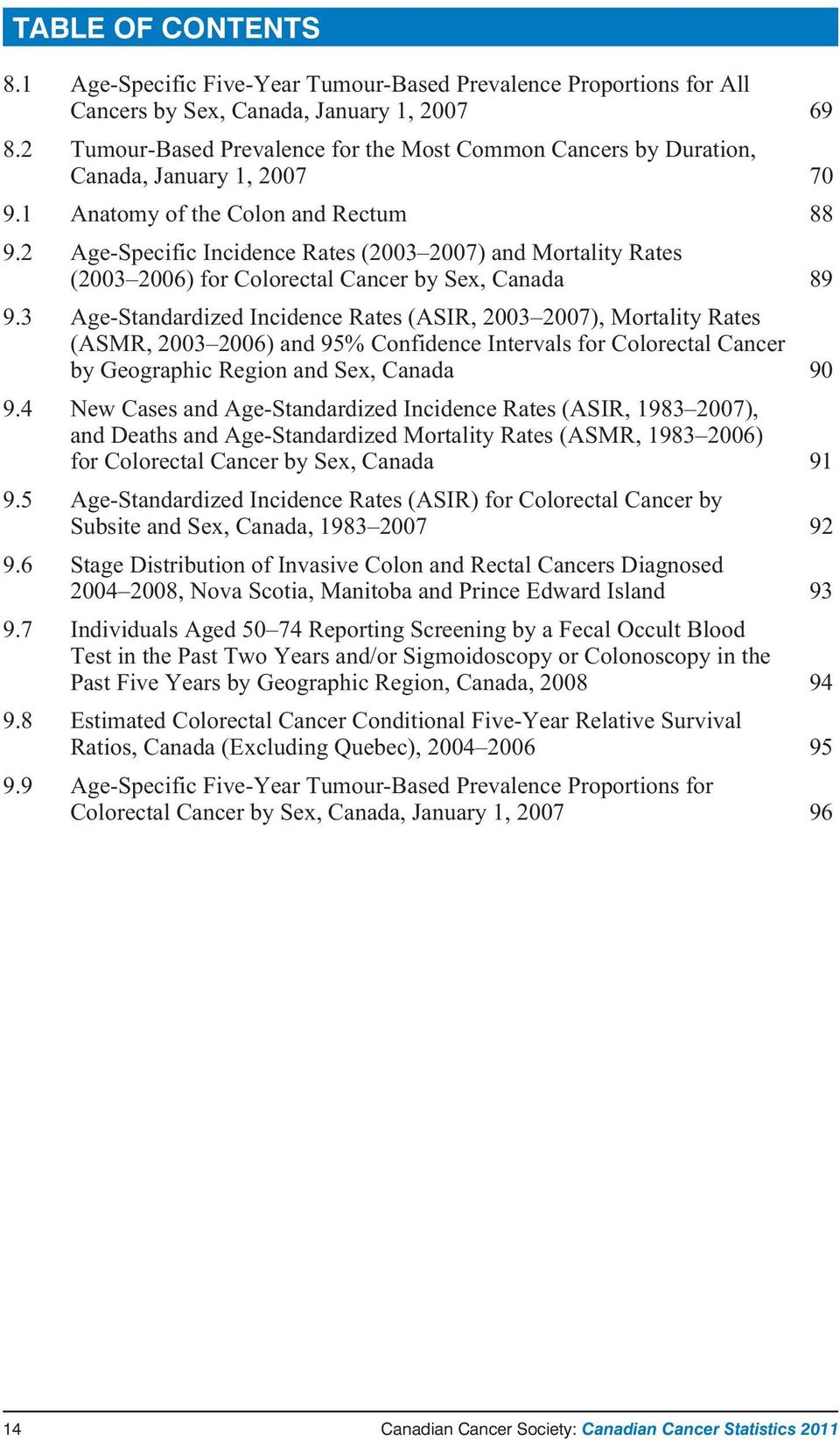
16 TABLE OF CONTENTS 8.1 Age-Specific Five-Year Tumour-Based Prevalence Proportions for All Cancers by Sex, Canada, January 1, Tumour-Based Prevalence for the Most Common Cancers by Duration, Canada, January 1, Anatomy of the Colon and Rectum Age-Specific Incidence Rates ( ) and Mortality Rates ( ) for Colorectal Cancer by Sex, Canada Age-Standardized Incidence Rates (ASIR, ), Mortality Rates (ASMR, ) and 95% Confidence Intervals for Colorectal Cancer by Geographic Region and Sex, Canada New Cases and Age-Standardized Incidence Rates (ASIR, ), and Deaths and Age-Standardized Mortality Rates (ASMR, ) for Colorectal Cancer by Sex, Canada Age-Standardized Incidence Rates (ASIR) for Colorectal Cancer by Subsite and Sex, Canada, Stage Distribution of Invasive Colon and Rectal Cancers Diagnosed , Nova Scotia, Manitoba and Prince Edward Island Individuals Aged Reporting Screening by a Fecal Occult Blood Test in the Past Two Years and/or Sigmoidoscopy or Colonoscopy in the Past Five Years by Geographic Region, Canada, Estimated Colorectal Cancer Conditional Five-Year Relative Survival Ratios, Canada (Excluding Quebec), Age-Specific Five-Year Tumour-Based Prevalence Proportions for Colorectal Cancer by Sex, Canada, January 1, Canadian Cancer Society: Canadian Cancer Statistics 2011
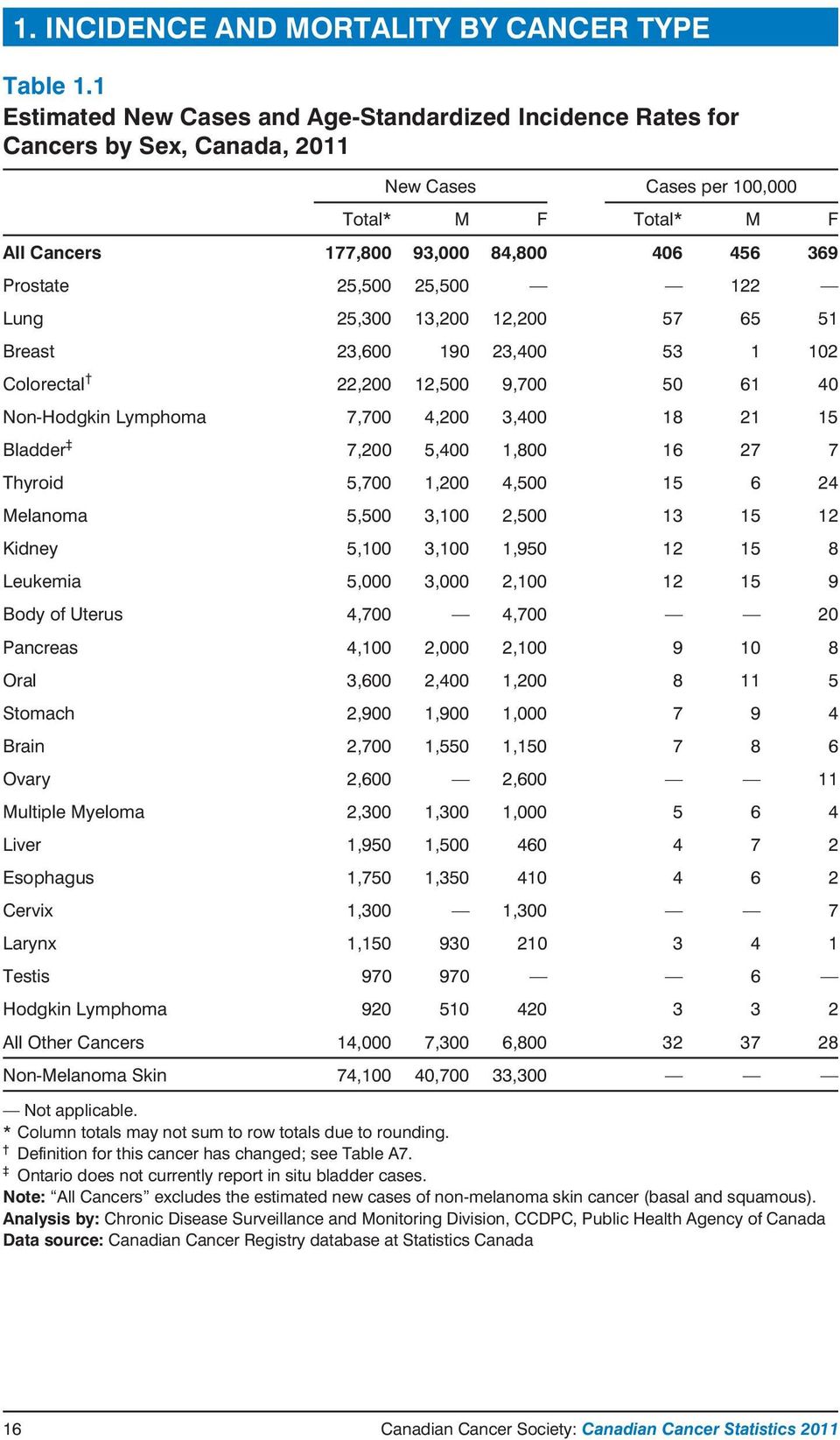
17 1. INCIDENCE AND MORTALITY BY CANCER TYPE In 2011, Canada will continue to see an increase in the number of individuals diagnosed with cancer. Every hour of every day, an average of 20 people will be diagnosed with some type of cancer and eight people will die from cancer. Incidence describes the number of new cases of cancer diagnosed in a year, while mortality indicates the number of deaths attributed to cancer. Together, these statistics (outlined in Tables 1.1 and 1.2) provide a fundamental understanding of cancer burden. An estimated 177,800 new cases of cancer and 75,000 cancer deaths are expected in Canada in More men than women will be diagnosed with a new cancer (52% of all new cases will occur in men vs. 48% in women) and will die from cancer (53% of all cancer deaths will occur in men vs. 47% in women). In addition, 74,100 new cases and 270 deaths from non-melanoma skin cancers (basal and squamous) are expected in Although non-melanoma skin cancer represents the most common cancer diagnosed among Canadians, it is reported separately because it accounts for very few deaths and most cancer registries do not routinely collect information on these cases. In men and women combined, lung cancer is the second most common cancer (14%), and colorectal is the third most common cancer (12%). Prostate cancer remains the most common cancer diagnosed in men, with 25,500 cases expected in Breast cancer continues to be the most frequently diagnosed cancer in women, with over 23,400 new cases expected. In 2011, four cancers (breast, lung, colorectal and prostate) will account for 54% of all cancers diagnosed in Canada. Lung cancer remains the leading cause of cancer death in both men (28%) and women (27%), as shown in Figures 1.1 and 1.2. While prostate cancer is the most common cancer diagnosed in men, it ranks third in terms of mortality, with approximately 4,100 deaths. Breast cancer, which represents 28% of cancer cases in women, ranks second in mortality at 14%. Colorectal cancer has a significant impact on mortality for men and women combined, with 8,900 deaths expected (12% of all deaths). The projected number of new cancer cases is roughly the population of Kelowna, BC; Barrie, ON; or St. John s, NL. The projected number of cancer deaths is roughly the population of Nanaimo, BC; Peterborough, ON; or Drummondville, QC. Canadian Cancer Society: Canadian Cancer Statistics

18 1. INCIDENCE AND MORTALITY BY CANCER TYPE Table 1.1 Estimated New Cases and Age-Standardized Incidence Rates for Cancers by Sex, Canada, 2011 New Cases Cases per 100,000 Total* M F Total* M F All Cancers 177,800 93,000 84, Prostate 25,500 25, Lung 25,300 13,200 12, Breast 23, , Colorectal 22,200 12,500 9, Non-Hodgkin Lymphoma 7,700 4,200 3, Bladder 7,200 5,400 1, Thyroid 5,700 1,200 4, Melanoma 5,500 3,100 2, Kidney 5,100 3,100 1, Leukemia 5,000 3,000 2, Body of Uterus 4,700 4, Pancreas 4,100 2,000 2, Oral 3,600 2,400 1, Stomach 2,900 1,900 1, Brain 2,700 1,550 1, Ovary 2,600 2, Multiple Myeloma 2,300 1,300 1, Liver 1,950 1, Esophagus 1,750 1, Cervix 1,300 1,300 7 Larynx 1, Testis Hodgkin Lymphoma All Other Cancers 14,000 7,300 6, Non-Melanoma Skin 74,100 40,700 33,300 Not applicable. * Column totals may not sum to row totals due to rounding. Definition for this cancer has changed; see Table A7. Ontario does not currently report in situ bladder cases. Note: All Cancers excludes the estimated new cases of non-melanoma skin cancer (basal and squamous). Analysis by: Chronic Disease Surveillance and Monitoring Division, CCDPC, Public Health Agency of Canada Data source: Canadian Cancer Registry database at Statistics Canada 16 Canadian Cancer Society: Canadian Cancer Statistics 2011
19 1. INCIDENCE AND MORTALITY BY CANCER TYPE Table 1.2 Estimated Deaths and Age-Standardized Mortality Rates for Cancers by Sex, Canada, 2011 Deaths Deaths per 100,000 Total* M F Total* M F All Cancers 75,000 39,900 35, Lung 20,600 11,300 9, Colorectal 8,900 5,000 3, Breast 5, , < Prostate 4,100 4, Pancreas 3,800 1,900 1, Non-Hodgkin Lymphoma 3,000 1,700 1, Leukemia 2,500 1, Bladder 1,850 1, Esophagus 1,850 1, Stomach 1,800 1, Brain 1,800 1, Ovary 1,750 1,750 7 Kidney 1,650 1, Multiple Myeloma 1, Oral 1, Melanoma Liver Body of Uterus Larynx <0.5 Cervix All Other Cancers 10,400 5,300 5, Not applicable. * Column totals may not sum to row totals due to rounding. Note: All Other Cancers includes 270 deaths from non-melanoma skin cancer (basal and squamous). Analysis by: Chronic Disease Surveillance and Monitoring Division, CCDPC, Public Health Agency of Canada Data source: Canadian Vital Statistics Death database at Statistics Canada Canadian Cancer Society: Canadian Cancer Statistics

20 1. INCIDENCE AND MORTALITY BY CANCER TYPE Figure 1.1 Percentage Distribution of Estimated New Cases and Deaths for Selected Cancers, Males, Canada, 2011 Prostate Lung Colorectal Bladder Non-Hodgkin Lymphoma Kidney Melanoma Leukemia Oral Pancreas Stomach Brain Liver Esophagus Multiple Myeloma Thyroid Testis Larynx Hodgkin Lymphoma All Other Cancers New Cases N = 93, Lung 28.3 Colorectal 12.5 Prostate 10.2 Pancreas 4.7 Non-Hodgkin Lymphoma 4.2 Leukemia 3.7 Esophagus 3.6 Bladder 3.3 Stomach 2.8 Kidney Brain Oral Deaths N = 39,900 Multiple Myeloma 1.8 Liver 1.6 Melanoma 1.5 Larynx 1.0 Breast 0.1 All Other Cancers Percentage Note: New cases exclude an estimated 40,700 new cases of non-melanoma skin cancer (basal and squamous). The number of deaths for All Other Cancers includes about 170 deaths with underlying cause other malignant neoplasms of skin. Analysis by: Chronic Disease Surveillance and Monitoring Division, CCDPC, Public Health Agency of Canada Data sources: Canadian Cancer Registry and Canadian Vital Statistics Death databases at Statistics Canada 18 Canadian Cancer Society: Canadian Cancer Statistics 2011

21 1. INCIDENCE AND MORTALITY BY CANCER TYPE Figure 1.2 Percentage Distribution of Estimated New Cases and Deaths for Selected Cancers, Females, Canada, 2011 Breast 27.6 Lung 14.4 Colorectal 11.4 Body of Uterus 5.6 Thyroid 5.3 Non-Hodgkin Lymphoma 4.1 Ovary 3.0 Melanoma 2.9 Pancreas 2.4 Leukemia 2.4 Kidney 2.3 Bladder 2.1 Cervix 1.5 New Cases Oral 1.4 N = 84,800 Brain 1.4 Stomach 1.2 Multiple Myeloma 1.2 Liver 0.5 Hodgkin Lymphoma 0.5 Esophagus 0.5 Larynx 0.2 All Other Cancers Lung Breast Colorectal Pancreas Ovary Non-Hodgkin Lymphoma Leukemia Body of Uterus Brain Stomach Multiple Myeloma Kidney Bladder Esophagus Oral Melanoma Cervix Liver Larynx All Other Cancers Percentage 26.7 Deaths N = 35,100 Note: New cases exclude an estimated 33,300 cases of non-melanoma skin cancer (basal and squamous). Deaths for All Other Cancers include about 100 deaths with underlying cause other malignant neoplasms of skin. Analysis by: Chronic Disease Surveillance and Monitoring Division, CCDPC, Public Health Agency of Canada Data sources: Canadian Cancer Registry and Canadian Vital Statistics Death databases at Statistics Canada Canadian Cancer Society: Canadian Cancer Statistics
22 2. INCIDENCE AND MORTALITY BY GEOGRAPHIC REGION Table 2.1 presents population projections and estimates of new cases and deaths for all cancers combined, by sex and province/territory for Tables 2.2 and 2.3 present estimates of the number of new cases and the age-standardized incidence rates for selected cancers by sex and province for The corresponding estimates of the number of cancer deaths and the age-standardized mortality rates are presented in Tables 2.4 and 2.5. Tables A3 to A6 in Appendix I provide the most recent actual numbers and rates. Age-standardization is used to adjust for differences in age distributions among the provinces and territories, allowing for interprovincial comparisons. The calculation of age-standardized rates, using the 1991 Canadian population as the standard, is described in the Glossary and in more detail in Appendix II. Incidence The estimated incidence rates for all cancers combined continue to be highest for the maritime provinces and Quebec and lowest in British Columbia (Table 2.3). Rates in Newfoundland and Labrador are underestimated because of missing data (see Appendix II). Prostate cancer incidence rates continue to show large provincial differences, possibly due to variation in prostate-specific antigen (PSA) testing. In both men and women, lung cancer incidence rates are projected to be highest in Quebec and lowest in British Columbia. The highest colorectal cancer incidence rates among men and women are seen in Newfoundland and Labrador. For women, high rates are also seen in Prince Edward Island and Nova Scotia. The lowest rates for both sexes are in British Columbia. Female breast cancer incidence rates appear to be fairly consistent across the country, with no discernible geographic pattern. Mortality For males, mortality rates for all cancers continue to be higher in Atlantic Canada and Quebec and lower in Western Canada (Table 2.5). The pattern is similar for females, although the projected rate is also high in Manitoba and overall differences across the country are smaller than those for males. Among males, the lung cancer mortality rate is projected to be highest in Quebec and New Brunswick and lowest in British Columbia. Among females, the lung cancer mortality rate is projected to be highest in Quebec and lowest in Newfoundland and Labrador. Colorectal cancer mortality rates are highest in Newfoundland and Labrador, twice those in British Columbia for males. The projected mortality rate for prostate cancer continues to be highest in Saskatchewan. Interpretation Canada is one of the few nations in the world with population-based cancer registries that allow cancer patterns to be monitored for the entire population. The provincial/ territorial and national cancer registries serve as important resources that enable geographic comparisons of rates of new cancer cases and deaths. This results in 20 Canadian Cancer Society: Canadian Cancer Statistics 2011
23 2. INCIDENCE AND MORTALITY BY GEOGRAPHIC REGION valuable information that can be used for research and knowledge exchange, along with planning and decision-making at the national and provincial/territorial levels. These data are therefore of interest to researchers, healthcare workers, healthcare planners and policy-makers. Interpretation of geographic differences should, however, be approached with caution since there may be a number of explanations for the variation. True differences in incidence or mortality rates among provinces and territories may be due to any one of several factors, including the following: variation in the prevalence of cancer risk factors (e.g., higher historic smoking rates in Quebec and Atlantic Canada as the likely cause of higher rates of lung cancer) variation in early detection of cancer because of different rates of participation in formal screening programs (e.g., mammographic screening for breast cancer) or other screening procedures (e.g., PSA testing for prostate cancer) variation in the availability of diagnostic services variation in treatment access and quality However, even if the above situations apply, it cannot be assumed that they are the cause of the variation in cancer rates across Canada. Such a determination can only be made after conducting more detailed studies involving individual people. It is also important to note that for many cancers the interval between exposure to a risk factor and the occurrence of the disease is quite long, making it difficult to collect detailed information on the prevalence of past risk factors. Where true differences in cancer risk and causal associations are demonstrated in subsequent epidemiological studies, these findings can be used in planning cancer control programs that aim to reduce the burden of cancer. Issues that should be kept in mind when interpreting interprovincial variation include the following: When a cancer is rare, or the population is small, the number of cases and the rates occurring annually in a given province or territory may be unreliable and vary considerably from year to year. While the completeness of registration of new cancer cases is generally very good across the country, there are exceptions. Death certificate information has not been available for registry purposes in Newfoundland and Labrador until very recently and was not available for this publication. This has falsely lowered the actual data (Appendix I) and the number of newly diagnosed cases for the current projection, mainly among those cancers with a poor prognosis, such as lung and pancreatic cancers (see Appendix II). The degree to which death certificate information is checked against hospital records also varies across provinces and territories, and this affects the accuracy of incidence data (e.g., year of diagnosis). In Quebec, because of the registry s dependence on hospital data, the numbers of prostate, melanoma and bladder cases have been estimated to be under-reported. 1 The method of projection selected by the provincial registries for 2011 estimates (either a Poisson model or a five-year moving average) varies across provinces and cancer type (see Methods in Appendix II). This may particularly affect 2011 estimates for lung cancer in women (new cases and deaths), whereby the choice of method may be related to recent trend changes that vary by province. Canadian Cancer Society: Canadian Cancer Statistics
24 2. INCIDENCE AND MORTALITY BY GEOGRAPHIC REGION The large interprovincial differences seen in bladder cancer incidence rates are likely due to differences in reporting of in situ cases, particularly in Ontario, where such cases were not collected until recently and were not available for this publication. There continues to be large variation in reported incidence and mortality rates across Canada. Canada is one of the few nations in the world with a cancer registry system that allows cancer patterns to be monitored and compared across the entire population. Such comparisons can provide valuable information for research, knowledge exchange, planning and decision-making. 22 Canadian Cancer Society: Canadian Cancer Statistics 2011
25 2. INCIDENCE AND MORTALITY BY GEOGRAPHIC REGION Table 2.1 Estimated Population, New Cases and Deaths for All Cancers by Sex and Geographic Region, Canada, 2011 Population (in thousands) New Cases Deaths Total* M F Total* M F Total* M F CANADA 34,360 17,083 17, ,800 93,000 84,800 75,000 39,900 35,100 British Columbia (BC) 4,574 2,274 2,300 22,100 11,900 10,200 9,300 4,900 4,300 Alberta (AB) 3,775 1,929 1,847 16,200 8,600 7,600 6,100 3,300 2,900 Saskatchewan (SK) 1, ,300 2,800 2,400 2,400 1,300 1,050 Manitoba (MB) 1, ,100 3,100 3,000 2,800 1,450 1,300 Ontario (ON) 13,361 6,602 6,759 66,900 34,500 32,400 27,800 14,600 13,200 Quebec (QC) 7,921 3,938 3,983 46,400 24,000 22,500 20,100 10,800 9,300 New Brunswick (NB) ,800 2,700 2,100 1,950 1, Nova Scotia (NS) ,100 3,300 2,800 2,700 1,450 1,200 Prince Edward Island (PE) Newfoundland and Labrador (NL) ,800 1,500 1,250 1, Yukon (YT) Northwest Territories (NT) Nunavut (NU) * Column totals may not sum to row totals due to rounding. The number of cases for some cancers that were used to calculate the overall 2011 incidence estimates for this province was underestimated. Note: The Canada and provincial totals exclude non-melanoma skin cancer (basal and squamous). Analysis by: Chronic Disease Surveillance and Monitoring Division, CCDPC, Public Health Agency of Canada Data sources: Canadian Cancer Registry and Canadian Vital Statistics Death databases, and Census and Demographics Branch at Statistics Canada 2 Canadian Cancer Society: Canadian Cancer Statistics
26 2. INCIDENCE AND MORTALITY BY GEOGRAPHIC REGION Table 2.2 Estimated New Cases for Selected Cancers by Sex and Province, Canada, 2011 New Cases Canada* BC AB SK MB ON QC NB NS PE NL Males All Cancers 93,000 11,900 8,600 2,800 3,100 34,500 24,000 2,700 3, ,500 Prostate 25,500 3,400 2, ,600 5, Lung 13,200 1, ,100 4, Colorectal 12,500 1,550 1, ,500 3, Bladder 5, ,350 1, Non-Hodgkin Lymphoma 4, , Melanoma 3, , Kidney 3, , Leukemia 3, , Oral 2, Pancreas 2, Stomach 1, Brain 1, Liver 1, Esophagus 1, Multiple Myeloma 1, Thyroid 1, Females All Cancers 84,800 10,200 7,600 2,400 3,000 32,400 22,500 2,100 2, ,250 Breast 23,400 2,800 2, ,000 6, Lung 12,200 1,500 1, ,900 4, Colorectal 9,700 1, ,600 2, Body of Uterus 4, ,950 1, Thyroid 4, , Non-Hodgkin Lymphoma 3, , Ovary 2, , Melanoma 2, , Pancreas 2, Leukemia 2, Kidney 1, Bladder 1, Cervix 1, Oral 1, Brain 1, Stomach 1, Multiple Myeloma 1, * Column totals may not sum to row totals due to rounding. Canada totals include provincial and territorial estimates. Territories are not listed separately due to small numbers. The number of cases for some cancers that were used to calculate the overall 2011 incidence estimates for this province was underestimated. Definition for this cancer has changed; see Table A7. Interprovincial variation. Ontario does not currently report in situ bladder cases. Note: New cases for All Cancers exclude non-melanoma skin cancer (basal and squamous). Analysis by: Chronic Disease Surveillance and Monitoring Division, CCDPC, Public Health Agency of Canada Data source: Canadian Cancer Registry database at Statistics Canada 24 Canadian Cancer Society: Canadian Cancer Statistics 2011
27 2. INCIDENCE AND MORTALITY BY GEOGRAPHIC REGION Table 2.3 Estimated Age-Standardized Incidence Rates for Selected Cancers by Sex and Province, Canada, 2011 Cases per 100,000 Canada* BC AB SK MB ON QC NB NS PE NL Males All Cancers Prostate Lung Colorectal Bladder Non-Hodgkin Lymphoma Melanoma Kidney Leukemia Oral Pancreas Stomach Brain Liver Esophagus Thyroid Multiple Myeloma Females All Cancers Breast Lung Colorectal Thyroid Body of Uterus Non-Hodgkin Lymphoma Melanoma Ovary Leukemia Pancreas Kidney Cervix Bladder Brain Oral Stomach Multiple Myeloma * Canada totals include provincial and territorial estimates. Territories are not listed separately due to small numbers. The number of cases for some cancers that were used to calculate the overall 2011 incidence estimates for this province was underestimated. Definition for this cancer has changed; see Table A7. Interprovincial variation. Ontario does not currently report in situ bladder cases. Note: Rates for All Cancers exclude non-melanoma skin cancer (basal and squamous). Rates are agestandardized to the 1991 Canadian population. Analysis by: Chronic Disease Surveillance and Monitoring Division, CCDPC, Public Health Agency of Canada Data source: Canadian Cancer Registry database at Statistics Canada Canadian Cancer Society: Canadian Cancer Statistics
28 2. INCIDENCE AND MORTALITY BY GEOGRAPHIC REGION Table 2.4 Estimated Deaths for Selected Cancers by Sex and Province, Canada, 2011 Deaths Canada* BC AB SK MB ON QC NB NS PE NL Males All Cancers 39,900 4,900 3,300 1,300 1,450 14,600 10,800 1,100 1, Lung 11,300 1, ,700 3, Colorectal 5, ,800 1, Prostate 4, , Pancreas 1, Non-Hodgkin Lymphoma 1, Esophagus 1, Leukemia 1, Bladder 1, Stomach 1, Brain 1, Kidney 1, Oral Multiple Myeloma Liver Melanoma Females All Cancers 35,100 4,300 2,900 1,050 1,300 13,200 9, , Lung 9,300 1, ,000 3, Breast 5, ,950 1, Colorectal 3, ,450 1, Pancreas 1, Ovary 1, Non-Hodgkin Lymphoma 1, Leukemia Body of Uterus Brain Stomach Multiple Myeloma Kidney Bladder Oral Melanoma Cervix Fewer than three deaths. * Column totals may not sum to row totals due to rounding. Canada totals include provincial and territorial estimates. Territories are not listed separately due to small numbers. Analysis by: Chronic Disease Surveillance and Monitoring Division, CCDPC, Public Health Agency of Canada Data source: Canadian Vital Statistics Death database at Statistics Canada 26 Canadian Cancer Society: Canadian Cancer Statistics 2011
29 2. INCIDENCE AND MORTALITY BY GEOGRAPHIC REGION Table 2.5 Estimated Age-Standardized Mortality Rates for Selected Cancers by Sex and Province, Canada, 2011 Deaths per 100,000 Canada* BC AB SK MB ON QC NB NS PE NL Males All Cancers Lung Colorectal Prostate Pancreas Non-Hodgkin Lymphoma Leukemia Esophagus Bladder Stomach Brain Kidney Oral Multiple Myeloma Melanoma Liver Females All Cancers Lung Breast Colorectal Pancreas Ovary Non-Hodgkin Lymphoma Leukemia Stomach Body of Uterus Brain Multiple Myeloma Oral Melanoma Cervix Bladder Kidney Fewer than three deaths. * Canada totals include provincial and territorial estimates. Territories are not listed separately due to small numbers. Note: Rates are age-standardized to the 1991 Canadian population. Analysis by: Chronic Disease Surveillance and Monitoring Division, CCDPC, Public Health Agency of Canada Data source: Canadian Vital Statistics Death database at Statistics Canada Canadian Cancer Society: Canadian Cancer Statistics
30 3. INCIDENCE AND MORTALITY BY AGE AND SEX Trends by age While cancer is primarily a disease that affects Canadians 50 years of age or older (who represent 88% of all new cases and 95% of cancer deaths), it impacts all age groups. For both sexes, the median age range is years at cancer diagnosis and years at cancer death. Table 3.1 shows the following estimates for 2011: Approximately 74,700 new cancer cases (42% of all cases) and 44,600 cancer deaths (59% of all deaths) will occur in Canadians aged 70 years or older. An additional 49,600 new cases (28% of all cases) and 17,600 deaths (23% of all deaths) will occur in those aged years. Compared to older age groups, those aged years will represent a smaller proportion of all new cases (18% of all cases) and deaths (12% of all deaths). Figure 3.1 displays age-specific rates of cancer incidence (for 2007) and mortality (for 2006) by five-year age groups. Cancer incidence and mortality rates increase with age for both sexes. The incidence rate for males surpasses that for females around age 55 and a similar pattern is observed for mortality. The age and sex distributions for the most common cancers among Canadians are presented in Table 3.2, which shows the following: Half of all newly diagnosed lung and colorectal cancer cases will occur among people aged 70 years or older. Breast cancer occurs primarily in females years of age. Twenty-eight percent of breast cancer cases will be diagnosed among women over the age of 69, while 19% will occur in those under age 50. It is notable that although over half of the new cases of breast cancer occur between ages 50 and 69, more deaths from breast cancer will occur in females 80 years and older than any other age group, reflecting the benefits of screening and treatment in prolonging life in middle-aged women. Prostate cancer will be diagnosed most frequently in males aged years, but more prostate cancer deaths will occur in males 80 years and older. This pattern likely reflects the effect of screening men for prostate cancer in their 60s and the long natural history of the disease. Unlike other major cancers, for which the number of deaths increases with age, deaths for lung cancer peak at age for both males and females. Trends by sex Trends in age-standardized incidence and mortality rates for all cancers combined are shown in Figure 3.2. Cancer is more common among males than females in those 19 and younger and 60 and older, but this trend reverses with a higher incidence in females between ages 20 and 59. Sex-specific cancers (breast and cervical cancer in particular) as well as lung cancer, melanoma and thyroid cancer account for the higher cancer incidence in younger females. Breast cancer is the most common cancer in females over the age of 20. Deaths from breast cancer are more frequent than other common cancers only in women years of age. 28 Canadian Cancer Society: Canadian Cancer Statistics 2011
31 3. INCIDENCE AND MORTALITY BY AGE AND SEX The overall cancer incidence rate in males over age 69 has been dropping, primarily due to a declining rate of lung cancer from decreased tobacco use. 3 The overall incidence rate in females has only recently begun to level off. Lung cancer remains the most common cause of cancer death in both sexes. Since 1989, the mortality rate for all cancers combined has been dropping for males up to age 79 and females up to age 69. But for females, this rate begins to increase from age 70. The risk of developing cancer increases with age. Notable declines in mortality for all cancers combined have occurred in both sexes and in most age groups. Table 3.1 Estimated New Cases and Deaths for All Cancers by Age Group and Sex, Canada, 2011 Age Group Population (in thousands) New Cases Deaths Total* M F Total* M F Total* M F All Ages 34,360 17,083 17, ,800 93,000 84,800 75,000 39,900 35, ,864 4,034 3,830 1, ,808 2,451 2,357 2, , ,656 2,334 2,322 4,700 1,550 3, ,163 2,601 2,562 13,000 4,500 8,500 2,800 1,200 1, ,029 2,497 2,531 32,400 15,400 17,000 9,000 4,400 4, ,575 1,744 1,831 49,600 28,500 21,100 17,600 9,600 7, , ,106 44,300 25,800 18,500 22,100 12,500 9, , ,400 15,600 14,800 22,500 11,600 10,800 * Column totals may not sum to row totals due to rounding. Canada totals include provincial and territorial estimates. Note: New cases exclude non-melanoma skin cancer (basal and squamous). Analysis by: Chronic Disease Surveillance and Monitoring Division, CCDPC, Public Health Agency of Canada Data sources: Canadian Cancer Registry and Canadian Vital Statistics Death databases, and Census and Demographics Branch at Statistics Canada 2 Canadian Cancer Society: Canadian Cancer Statistics
32 3. INCIDENCE AND MORTALITY BY AGE AND SEX Table 3.2 Estimated New Cases and Deaths for the Most Common Cancers by Age Group and Sex, Canada, 2011 Age Lung Colorectal Prostate Breast Group Total M F Total M F M F New Cases All Ages 25,300 13,200 12,200 22,200 12,500 9,700 25,500 23, , , ,600 1,650 2,000 3,400 2,000 1,400 4,500 6, ,700 4,000 3,700 6,100 3,800 2,300 10,100 6, ,100 4,500 3,600 6,400 3,700 2,700 7,000 3, ,800 2,700 2,200 4,900 2,300 2,600 3,400 2,600 Deaths All Ages 20,600 11,300 9,300 8,900 5,000 3,900 4,100 5, ,600 1,200 1, ,800 3,100 2,700 1,950 1, , ,900 4,000 2,900 2,500 1,500 1,000 1,200 1, ,600 2,700 1,950 3,100 1,450 1,650 2,200 1,450 Fewer than three cases or deaths. Analysis by: Chronic Disease Surveillance and Monitoring Division, CCDPC, Public Health Agency of Canada Data sources: Canadian Cancer Registry and Canadian Vital Statistics Death databases at Statistics Canada 30 Canadian Cancer Society: Canadian Cancer Statistics 2011
33 3. INCIDENCE AND MORTALITY BY AGE AND SEX Figure 3.1 Age-Specific Incidence (2007) and Mortality (2006) Rates for All Cancers by Sex, Canada Rate (per 100,000) 4,000 Incidence 3,000 Males 2,000 1,000 Females Age Group 85+ Rate (per 100,000) 4,000 Mortality 3,000 2,000 Males 1,000 Females Age Group 85+ Note: Incidence rates exclude non-melanoma skin cancer (basal and squamous). Analysis by: Chronic Disease Surveillance and Monitoring Division, CCDPC, Public Health Agency of Canada Data sources: Canadian Cancer Registry and Canadian Vital Statistics Death databases at Statistics Canada Canadian Cancer Society: Canadian Cancer Statistics
34 3. INCIDENCE AND MORTALITY BY AGE AND SEX Figure 3.2 Age-Standardized Incidence and Mortality Rates for All Cancers by Age Group, Canada, Rate (per 100,000) Males, Incidence Age 0 19 Age Rate (per 100,000) 50 Females, Incidence Females, Incidence 30 Males, Incidence 10 Males, Mortality Estimated 20 Estimated 5 10 Males, Mortality Females, Mortality Females, Mortality Rate (per 100,000) 150 Age Rate (per 100,000) 400 Age Females, Incidence 350 Females, Incidence Males, Incidence Estimated Males, Incidence Estimated Females, Mortality Males, Mortality Females, Mortality 50 Males, Mortality Note: The range of rate scales differs widely between the four age groups. Incidence rates exclude nonmelanoma skin cancer (basal and squamous). Actual incidence data were available up to the year 2008 for all provinces except for Quebec (2007), and actual mortality data were available up to Analysis by: Chronic Disease Surveillance and Monitoring Division, CCDPC, Public Health Agency of Canada Data sources: Canadian Cancer Registry and Canadian Vital Statistics Death databases at Statistics Canada 32 Canadian Cancer Society: Canadian Cancer Statistics 2011
35 3. INCIDENCE AND MORTALITY BY AGE AND SEX Figure 3.2 (continued) Age-Standardized Incidence and Mortality Rates for All Cancers by Age Group, Canada, Age Rate (per 100,000) Females, Incidence Males, Incidence Rate (per 100,000) 1,900 Males, Incidence 1,600 Age Males, Mortality Estimated 1,300 1,000 Females, Incidence Estimated Females, Mortality 700 Females, Mortality Males, Mortality ,100 Rate (per 100,000) Age Males, Incidence Rate (per 100,000) 4,000 3,600 Age 80+ Males, Incidence 2,700 3,200 2,300 Estimated 2,800 Males, Mortality Estimated 1,900 Females, Incidence 2,400 1,500 2,000 Females, Incidence 1,100 Males, Mortality 1, Females, Mortality 1,200 Females, Mortality Note: The range of rate scales differs widely between the four age groups. Incidence rates exclude nonmelanoma skin cancer (basal and squamous). Actual incidence data were available up to the year 2008 for all provinces except for Quebec (2007), and actual mortality data were available up to Analysis by: Chronic Disease Surveillance and Monitoring Division, CCDPC, Public Health Agency of Canada Data sources: Canadian Cancer Registry and Canadian Vital Statistics Death databases at Statistics Canada Canadian Cancer Society: Canadian Cancer Statistics
36 4. TIME TRENDS IN INCIDENCE AND MORTALITY The numbers of new cases and deaths are important measures of cancer burden on the Canadian population and healthcare system. Incidence trends generally signal changes in the population or the prevalence of risk factors, or they may indicate changes in screening or diagnostic practices. Incidence trends can be directly used to predict how many new people may seek diagnosis, primary treatment, potential further treatment or palliative care in the future. Trends in mortality rates reflect changes in disease incidence, survival or both. A decreasing trend in mortality indicates progress in cancer control. Trends in incidence and mortality are often assessed by comparing annual agestandardized rates. Age-standardization results in more meaningful comparisons of changes in cancer risk or diagnostic practices over place and time because it adjusts for variation in the age distributions and growth of populations. Unless otherwise specified, this section reports average annual percent changes over 10 years. Trends for all cancers combined Figure 4.1 presents the number of new cases for all cancers combined, together with the corresponding age-standardized incidence rates for 1982 to 2007, with estimates to the year Figure 4.2 presents the number of deaths and age-standardized mortality rates for 1982 to 2006, with estimates to Despite the relative stability in agestandardized rates, the number of new cancer cases continues to rise steadily as the Canadian population grows and ages. In 2011, the number of new cases is estimated to be 177,800 and the number of deaths is estimated to be 75,000. Among males, the overall cancer incidence rate rose in the early 1990s and then declined sharply (Figure 4.1). This reflects a similar trend in the incidence of prostate cancer, the leading type of cancer in men, during the same period. Since 1993, there has been a decline in the overall cancer incidence rate in males. In contrast, the cancer mortality rate in males, after reaching a peak in 1988, has been declining slowly because of decreases in mortality rates for prostate, lung, colorectal and other cancers (Figure 4.2). Among females, the overall cancer incidence rate has been increasing slowly since the early 1990s (Figure 4.1), while the mortality rate has remained relatively stable since 1982 (Figure 4.2). Figures 4.3 and 4.4 show the relative contributions to the changes in the total numbers of new cases and deaths that can be attributed to changes in cancer risk or diagnostic practices, population size and aging of the population. The major contributors to the rising numbers of new cancer cases are population growth and the aging of the population: The lowest solid line represents the total number of new cancer cases (or deaths) that would have occurred each year if the population size and age structure had remained the same as they were in 1982, reflecting the impact of changes in risk or diagnostic practices. The middle line represents the number of new cases (or deaths) that would have occurred if the age structure of the population had remained the same as it was in 1982, reflecting the impact of changes in risk and population growth. 34 Canadian Cancer Society: Canadian Cancer Statistics 2011
37 The top line represents the number of new cases (or deaths) that actually occurred and thus reflects the combined impact of changes in risk, population growth and the aging of the population. These figures indicate that the increase in the number of cancer cases and deaths that has occurred over the last 30 years is primarily the result of an aging population and, to a lesser extent, an increase in population size. As long as current demographic trends continue, there will be a commensurate annual increase in the number of new cases of cancer. It is noteworthy that changes in the risk of cancer or in diagnostic practices have contributed very little to the increase in new cases, especially in males, while changes in the risk of death have actually resulted in a reduction of deaths among males. Trends for selected cancers Trends in annual rates for selected cancers over the past 30 years are presented in Figures 4.5 to 4.8, with the data provided in Tables 4.1 to 4.4. The trends are discussed further below. The annual percent change (APC) in cancer-specific incidence rates ( ) and mortality rates ( ) is listed in Table 4.5. The overall incidence rate increased significantly for females between 1998 and 2007 (0.3% per year). The overall mortality rates declined significantly between 1997 and 2006 for both sexes (-2.0% per year for males since 2001 and -0.6% per year for females). It should be noted that these shortterm trends do not necessarily reflect the longer-term or earlier trends evident in Tables 4.1 to 4.4 and Figures 4.5 to 4.8. The descriptions that follow should be interpreted with this in mind. For the cancers listed in Table 4.5, several statistically significant increases or decreases of 2% or more per year are observed: increases in incidence liver cancer in both males (3.6%) and females (2.3%) thyroid cancer in both males (6.8%) and females (8.8%) decreases in incidence larynx cancer in both males (-3.8%) and females (-3.4%) stomach cancer in males (-2.0%) increases in mortality no cancers in either males or females decreases in mortality 4. TIME TRENDS IN INCIDENCE AND MORTALITY in males, deaths from all cancers combined (-2.0%), lung cancer (-2.3%), oral cancer (-2.4%), stomach cancer (-3.1%), non-hodgkin lymphoma (-3.8%), prostate cancer (-4.5%) and larynx cancer (-6.1%) in females, stomach cancer (-2.2%), breast cancer (-3.1%), non-hodgkin lymphoma (-3.1%) and cervical cancer (-3.4%) Canadian Cancer Society: Canadian Cancer Statistics
38 4. TIME TRENDS IN INCIDENCE AND MORTALITY Discussion of leading and selected cancers with significantly changing trends Breast cancer Breast cancer incidence rates rose from 1982 through the early 1990s, in part because of increased mammography screening. Reasons for the pattern of modest declines and increases observed since then are unclear but likely relate to factors like the continuing rise in mammography screening throughout the 1990s, along with the fluctuating patterns of hormone replacement therapy use among post-menopausal women during this time. Female breast cancer mortality rates have been declining since the mid-1980s. The age-standardized mortality rate has fallen by more than 35% since peaking in 1986, from 32.0 to 20.7 per 100,000 (Table 4.4). The downward trend has accelerated to -3.1% since This is likely the result of a combination of the increase in mammography screening and the use of more effective adjuvant therapies following breast cancer surgery. The breast cancer mortality rate is the lowest it has been since Similar declines have also occurred in the United States, United Kingdom and Australia. 4 Cervical cancer Incidence and mortality rates have continued declining for cervical cancer, by -1.4% and -3.4% per year, respectively (Table 4.5). This is largely due to widespread, regular use of Papanicolaou (Pap) test screening, which detects pre-malignant and malignant lesions early so that they can be treated. The immunization of school-aged girls with the vaccine for human papillomavirus (HPV) will further reduce incidence and mortality over the longer-term but will not eliminate cervical cancer. The continuation of Pap screening is still a necessary and important part of preventive healthcare. Colorectal cancer Trends for colorectal cancer incidence between 1982 and 2007 (the last year of complete data) are complex. In both sexes, incidence rose (or was relatively stable in the case of females) between 1982 and 1985, then declined to the mid-1990s (more strongly in females than in males), then rose through 2000, only to decline significantly thereafter (Figures 4.5 and 4.7). Colorectal cancer projections to 2011 are based on long-term data ( ), which is the standard methodology for this publication and, therefore, may not capture effects of short-term fluctuations. They should be used with caution. Mortality rates continue to decline in both sexes: -1.5% per year in males and -1.8% in females since 1997 (Table 4.5). This is likely the result of improvements in treatment, such as chemotherapy. Screening for colorectal cancer can reduce both incidence (by identifying and removing precancerous polyps) and mortality. Screening has already been occurring in several provinces, which may partly account for the decline in mortality, though screening rates are low. As of 2010, all provinces have announced or have started implementing organized screening programs (Table 9.5). 36 Canadian Cancer Society: Canadian Cancer Statistics 2011
39 4. TIME TRENDS IN INCIDENCE AND MORTALITY Larynx cancer Incidence rates of larynx cancer are significantly decreasing for both males (-3.8% per year) and females (-3.4% per year), while mortality rates for males only show a significant decline of -6.1% since 2001 (Table 4.5). Cancer of the larynx is most strongly associated with smoking 3 and alcohol use. 5 Incidence and mortality rates reflect the decreasing trends in these risk factors. Liver cancer In males, the incidence rate of liver cancer increased by 3.6% per year and the mortality rate increased by 1.8% per year (Table 4.5). Both increases were statistically significant. In females, the incidence rate increased by 2.3% per year (Table 4.5). There was a statistically non-significant increase in the mortality rate. For the first time since trends in liver cancer incidence and mortality were examined in this publication, in 2007, the increase in the incidence rate in women is statistically significant. Some of the observed increase may be explained by rising immigration of people from world regions where risk factors for liver cancer, such as hepatitis B virus infections and exposure to aflatoxins, are prevalent. 6 Other risk factors include increased rates of hepatitis C infection and alcohol abuse, which both increase the risk of liver cirrhosis and therefore liver cancer. 7 Lung cancer In males, incidence and mortality rates for lung cancer began to level off in the mid- 1980s and have been declining ever since (Tables 4.1 and 4.2). Rates have dropped significantly, by -1.8% per year for incidence and by -2.3 % per year for mortality (Table 4.5). In females, the incidence rate has been increasing since 1982, with a significant upward trend of 1.1% per year between 1998 and However, longer-term projections suggest that this rate is beginning to level off. Males are projected to continue to have higher incidence and mortality rates than females in 2011 (incidence: 65 vs. 51 per 100,000; mortality: 56 vs. 39 per 100,000). The differences between male and female lung cancer trends reflect past differences in the patterns of tobacco consumption. In males, the drop in tobacco consumption began in the mid-1960s, preceding the decline in lung cancer rates by approximately 20 years. In females, tobacco consumption began to decline in the mid-1980s. Non-Hodgkin lymphoma Incidence rates for non-hodgkin lymphoma have increased modestly in males (0.8%) and stabilized in females. The observed incidence patterns likely result from a combination of improved detection and classification of this complex set of diseases, as well as changes in risk factors. The clearest risk factor for non-hodgkin lymphoma is immunosuppression, which can result from immune disorders, immunosuppressive therapy or infection with human immunodeficiency virus (HIV). Other factors that increase risk are poorly understood but may include occupational exposures to pesticides and organochlorines, such as phenoxy herbicides and dioxins. Canadian Cancer Society: Canadian Cancer Statistics
40 4. TIME TRENDS IN INCIDENCE AND MORTALITY Mortality rates have declined for males (-3.8% per year) and females (-3.1% per year) since 2001 and 2000, respectively (Table 4.5). Declines in mortality may reflect recent improvements in treatment, such as immunotherapy (e.g., rituximab). As well, the introduction of anti-retroviral treatment for HIV infection in the second half of the 1990s has resulted in a decline in the proportion of the particularly aggressive forms of non-hodgkin lymphoma attributable to HIV infection. Oral cancer This group of cancers includes cancers of the lip, tongue, salivary gland, mouth, nasopharynx and oropharynx. Declines have occurred in the incidence rate in males (-1.0% per year) and mortality rates in both males and females (-2.4% per year and -1.9%, respectively; Table 4.5). A decline in smoking, which is a major risk factor for most oral cancers in Canada, likely accounts for the downward trends in oral cancer incidence and mortality. Decreases in heavy alcohol use may also be relevant. The contributions of other risk factors, including HPV infection, diet and sun exposure (linked to lip cancer), are unclear. Prostate cancer The two peaks in incidence of prostate cancer that occurred in 1993 and 2001, each followed by a decline (Figure 4.5), are compatible with two waves of intensified screening activity with the PSA test for early prostate cancer detection. The first follows the introduction of PSA as a screening test. The second may be explained by the publicity around the federal minister of health s diagnosis of prostate cancer in early 2001 as a result of serial PSA tests. The first decline was followed by resumption of the earlier, more gradual increase, whereas the second decline is too recent to know whether the increasing trend will return. Although the long-term and apparently ongoing increase in incidence may be due to more gradual changes in early detection, changes in the prevalence of risk factors might also be partly responsible. However, little is known about what these factors are for prostate cancer. In contrast to incidence, mortality rates rose much more slowly from 1980 and started to decline in the mid-1990s. Mortality declined significantly by -4.5% per year between 1997 and 2006 (Table 4.5), which likely reflects improved treatment. In 2009, two large randomized trials of PSA testing and its possible relation to reducing mortality in men over age 55 produced conflicting results. 8,9 Ongoing follow-up of men in these studies may help clarify the role of PSA testing in reducing deaths from prostate cancer. Stomach cancer Incidence rates of stomach cancer are declining in both sexes: -2.0% per year in males and -1.5% per year in females (Table 4.5). This decline may be due to changes in diet, decreases in smoking and heavy alcohol use (which can increase the impact of smoking on stomach cancer risk), and increased recognition and treatment of infection with the bacterium Helicobacter pylori, which is associated with stomach cancer. 38 Canadian Cancer Society: Canadian Cancer Statistics 2011
41 4. TIME TRENDS IN INCIDENCE AND MORTALITY Mortality rates from this cancer have also declined significantly, by -3.1% per year in males and -2.2% per year in females (Table 4.5). Similar downward trends in incidence and mortality have been observed over a long period of time. Incidence rates of stomach cancer are now about half of what they were in 1982, and mortality rates are about two-thirds lower than in Thyroid cancer The incidence rate of thyroid cancer is the most rapidly increasing of all cancers (6.8% per year in males and 8.8% per year in females since 1998; Table 4.5). Similar increases have been noted in Europe and the United States. More frequent use of diagnostic testing (ultrasound, computed tomography [CT] scan and magnetic resonance imaging) may be detecting earlier stage, asymptomatic thyroid cancers more frequently than was possible in the past. 10 Mortality rates have remained stable, most likely because modern treatment is highly effective in the management of early thyroid cancers. Implications The strong declines in mortality rates for several cancers suggest that there has been important progress in cancer control, specifically due to early detection and treatment as seen in improved five-year relative survival in the most recent time period for the leading cancers (see Section 7). However, the increasing or stable trends in incidence rates for many cancers suggest a need for more primary prevention. Furthermore, Figures 4.1 and 4.2 highlight the fact that the rise in new cases of cancer will place an increasing burden on Canadian society, largely independent of the trend in rates of incidence and mortality. This vividly illustrates why cancer prevention and health promotion programs are so vital. There is a need to enhance capacity for primary prevention, early detection and treatment to further reduce overall cancer incidence and mortality. Incidence and mortality are measures of disease burden, and their trends can inform the need for clinical services. Overall, incidence rates are stable (males) or show modest increases (females), but mortality rates are declining, suggesting better survival for some cancers. The trends call for an enhancement of primary prevention efforts; a sustained focus on screening for breast, colorectal and cervical cancers; more emphasis on early detection measures and public education about the early signs of cancer; and improved treatment options and health promotion. Canadian Cancer Society: Canadian Cancer Statistics
42 4. TIME TRENDS IN INCIDENCE AND MORTALITY Figure 4.1 New Cases and Age-Standardized Incidence Rates (ASIR) for All Cancers, Canada, ASIR (per 100,000) Males New Cases (in thousands) Estimated ASIR New Cases 600 ASIR (per 100,000) Females New Cases (in thousands) Estimated ASIR New Cases Note: All cancers exclude non-melanoma skin cancer (basal and squamous). Rates are age-standardized to the 1991 Canadian population. Actual incidence data were available to 2008 except for Quebec (2007). Please refer to Appendix II: Methods for further details. Analysis by: Chronic Disease Surveillance and Monitoring Division, CCDPC, Public Health Agency of Canada Data source: Canadian Cancer Registry database at Statistics Canada 40 Canadian Cancer Society: Canadian Cancer Statistics 2011
43 4. TIME TRENDS IN INCIDENCE AND MORTALITY Figure 4.2 Deaths and Age-Standardized Mortality Rates (ASMR) for All Cancers, Canada, ASMR (per 100,000) Males Deaths (in thousands) Estimated ASMR Deaths 600 ASMR (per 100,000) Females Deaths (in thousands) Estimated ASMR Deaths Note: Rates are age-standardized to the 1991 Canadian population. Actual data were available to Analysis by: Chronic Disease Surveillance and Monitoring Division, CCDPC, Public Health Agency of Canada Data source: Canadian Vital Statistics Death database at Statistics Canada Canadian Cancer Society: Canadian Cancer Statistics
44 4. TIME TRENDS IN INCIDENCE AND MORTALITY Figure 4.3 Trends in New Cases and Deaths for All Cancers and Ages, Attributed to Cancer Rate, Population Growth and Aging Population, Males, Canada, New Cases (in thousands) Incidence Aging Population Population Growth (1982 cancer count) Changes in Cancer Risk or Diagnostic Practices Estimated Deaths (in thousands) Mortality Aging Population (1982 cancer count) Population Growth Changes in Cancer Risk, Diagnostic Practices or Treatment Estimated Note: New cases exclude non-melanoma skin cancer (basal and squamous). Actual incidence data were available up to the year 2008 for all provinces except for Quebec (2007), and actual mortality data were available up to The range of scales differs between the figures. Analysis by: Chronic Disease Surveillance and Monitoring Division, CCDPC, Public Health Agency of Canada Data sources: Canadian Cancer Registry and Canadian Vital Statistics Death databases at Statistics Canada 42 Canadian Cancer Society: Canadian Cancer Statistics 2011
45 4. TIME TRENDS IN INCIDENCE AND MORTALITY Figure 4.4 Trends in New Cases and Deaths for All Cancers and Ages, Attributed to Cancer Rate, Population Growth and Aging Population, Females, Canada, New Cases (in thousands) Incidence Aging Population Population Growth (1982 cancer count) Changes in Cancer Risk or Diagnostic Practices Estimated Deaths (in thousands) Mortality Aging Population Population Growth (1982 cancer count) Changes in Cancer Risk, Diagnostic Practices or Treatment Estimated Note: New cases exclude non-melanoma skin cancer (basal and squamous). Actual incidence data were available up to the year 2008 for all provinces except for Quebec (2007), and actual mortality data were available up to The range of scales differs between the figures. Analysis by: Chronic Disease Surveillance and Monitoring Division, CCDPC, Public Health Agency of Canada Data sources: Canadian Cancer Registry and Canadian Vital Statistics Death databases at Statistics Canada Canadian Cancer Society: Canadian Cancer Statistics
46 4. TIME TRENDS IN INCIDENCE AND MORTALITY Figure 4.5 Age-Standardized Incidence Rates (ASIR) for Selected* Cancers, Males, Canada, ASIR (per 100,000) 140 Estimated Prostate Lung Colorectal ASIR (per 100,000) Estimated Non-Hodgkin Lymphoma Larynx Stomach 10 5 Liver 5 Thyroid * Five most frequent cancers (both sexes combined) and cancers with a statistically significant change in incidence rate of at least 2% per year (see Table 4.5). Note: Rates are age-standardized to the 1991 Canadian population. See Table 4.1 for data points. Actual data for incidence were available to 2008 except for Quebec (2007). The range of scales differs widely between the figures. Analysis by: Chronic Disease Surveillance and Monitoring Division, CCDPC, Public Health Agency of Canada Data source: Canadian Cancer Registry database at Statistics Canada 44 Canadian Cancer Society: Canadian Cancer Statistics 2011
47 4. TIME TRENDS IN INCIDENCE AND MORTALITY Figure 4.6 Age-Standardized Mortality Rates (ASMR) for Selected* Cancers, Males, Canada, ASMR (per 100,000) 90 Lung Estimated Colorectal Prostate ASMR (per 100,000) Estimated Stomach Non-Hodgkin Lymphoma 10 5 Oral 5 Larynx * Five most frequent cancers (both sexes combined) and cancers with a statistically significant change in mortality rate of at least 2% per year (see Table 4.5). Note: Rates are age-standardized to the 1991 Canadian population. See Table 4.2 for data points. Actual data for mortality were available to The range of scales differs widely between the figures. Analysis by: Chronic Disease Surveillance and Monitoring Division, CCDPC, Public Health of Agency of Canada Data source: Canadian Vital Statistics Death database at Statistics Canada Canadian Cancer Society: Canadian Cancer Statistics
48 4. TIME TRENDS IN INCIDENCE AND MORTALITY Figure 4.7 Age-Standardized Incidence Rates (ASIR) for Selected* Cancers, Females, Canada, ASIR (per 100,000) 140 Estimated Breast Colorectal Lung ASIR (per 100,000) Estimated Non-Hodgkin Lymphoma Thyroid Larynx Liver * Five most frequent cancers (both sexes combined) and cancers with a statistically significant change in incidence rate of at least 2% per year (see Table 4.5). Note: Rates are age-standardized to the 1991 Canadian population. See Table 4.3 for data points. Actual data for incidence were available to 2008 except for Quebec (2007). The range of scales differs widely between the figures. Analysis by: Chronic Disease Surveillance and Monitoring Division, CCDPC, Public Health Agency of Canada Data source: Canadian Cancer Registry database at Statistics Canada 46 Canadian Cancer Society: Canadian Cancer Statistics 2011
49 4. TIME TRENDS IN INCIDENCE AND MORTALITY Figure 4.8 Age-Standardized Mortality Rates (ASMR) for Selected* Cancers, Females, Canada, ASMR (per 100,000) 50 Estimated Lung Breast Colorectal ASMR (per 100,000) Estimated Stomach Non-Hodgkin Lymphoma 5 Cervix * Five most frequent cancers (both sexes combined) and cancers with a statistically significant change in mortality rate of at least 2% per year (see Table 4.5). Note: Rates are age-standardized to the 1991 Canadian population. See Table 4.4 for data points. Actual data for mortality were available to The range of scales differs widely between the figures. Analysis by: Chronic Disease Surveillance and Monitoring Division, CCDPC, Public Health Agency of Canada Data source: Canadian Vital Statistics Death database at Statistics Canada Canadian Cancer Society: Canadian Cancer Statistics
50 4. TIME TRENDS IN INCIDENCE AND MORTALITY Table 4.1 Age-Standardized Incidence Rates for Selected* Cancers, Males, Canada, Cases per 100,000 Year All Cancers Prostate Lung Colorectal Non-Hodgkin Lymphoma Thyroid Stomach Liver Larynx * Five most frequent cancers (both sexes combined) and cancers with a statistically significant change in incidence rate of at least 2% per year (see Table 4.5). Actual data were available to 2008 except for Quebec (2007). Estimated rates for all provinces/territories. These estimates are based on long-term trends and may not reflect recent changes. Note: Rates for All Cancers exclude non-melanoma skin cancer (basal and squamous). Rates are agestandardized to the 1991 Canadian population. Analysis by: Chronic Disease Surveillance and Monitoring Division, CCDPC, Public Health Agency of Canada Data source: Canadian Cancer Registry database at Statistics Canada 48 Canadian Cancer Society: Canadian Cancer Statistics 2011
51 4. TIME TRENDS IN INCIDENCE AND MORTALITY Table 4.2 Age-Standardized Mortality Rates for Selected* Cancers, Males, Canada, Year All Cancers Prostate Lung Colorectal Deaths per 100,000 Non-Hodgkin Lymphoma Oral Stomach Larynx * Five most frequent cancers (both sexes combined) and cancers with a statistically significant change in mortality rate of at least 2% per year (see Table 4.5). Actual data were available to Estimated rates for all provinces/territories. These estimates are based on long-term trends and may not reflect recent changes. Note: Rates are age-standardized to the 1991 Canadian population. Analysis by: Chronic Disease Surveillance and Monitoring Division, CCDPC, Public Health Agency of Canada Data source: Canadian Vital Statistics Death database at Statistics Canada Canadian Cancer Society: Canadian Cancer Statistics
52 4. TIME TRENDS IN INCIDENCE AND MORTALITY Table 4.3 Age-Standardized Incidence Rates for Selected* Cancers, Females, Canada, Year All Cancers Cases per 100,000 Lung Breast Colorectal Non-Hodgkin Lymphoma Thyroid Liver Larynx * Five most frequent cancers (both sexes combined) and cancers with a statistically significant change in incidence rate of at least 2% per year (see Table 4.5). Actual data were available to 2008 except for Quebec (2007). Estimated rates for all provinces/territories. These estimates are based on long-term trends and may not reflect recent changes. Note: Rates for All Cancers exclude non-melanoma skin cancer (basal and squamous). Rates are agestandardized to the 1991 Canadian population. Analysis by: Chronic Disease Surveillance and Monitoring Division, CCDPC, Public Health Agency of Canada Data source: Canadian Cancer Registry database at Statistics Canada 50 Canadian Cancer Society: Canadian Cancer Statistics 2011
53 4. TIME TRENDS IN INCIDENCE AND MORTALITY Table 4.4 Age-Standardized Mortality Rates for Selected* Cancers, Females, Canada, Deaths per 100,000 Year Non-Hodgkin All Cancers Lung Breast Colorectal Lymphoma Stomach Cervix * Five most frequent cancers (both sexes combined) and cancers with a statistically significant change in mortality rate of at least 2% per year (see Table 4.5). Actual data were available to Estimated rates for all provinces/territories. These estimates are based on long-term trends and may not reflect recent changes. Note: Rates are age-standardized to the 1991 Canadian population. Analysis by: Chronic Disease Surveillance and Monitoring Division, CCDPC, Public Health Agency of Canada Data source: Canadian Vital Statistics Death database at Statistics Canada Canadian Cancer Society: Canadian Cancer Statistics
54 4. TIME TRENDS IN INCIDENCE AND MORTALITY Table 4.5 Annual Percent Change (APC) in Age-Standardized Incidence Rates ( ) and Mortality Rates ( ) for Selected Cancers, Canada Incidence Mortality Males Females Males Females APC Changepoint APC Changepoint APC Changepoint APC Changepoint All Cancers ** 2.0** ** Prostate ** 2001 Lung 1.8** 1.1** 2.3** 1.0** Breast 0.7** 3.1** 2002 Colorectal 0.8** ** ** 1.8** Non-Hodgkin Lymphoma 0.8** ** ** 2000 Bladder 0.7* ** 0.1 Melanoma 1.4** 1.4** * Thyroid 6.8** 8.8** Leukemia ** 0.9* 1.0* Kidney ** Body of Uterus 0.7* 0.7 Pancreas Oral 1.0* ** 1.9* Stomach 2.0** 1.5** 3.1** 2.2** Brain ** 1.4** Ovary Multiple Myeloma * 0.4 Liver 3.6** 2.3* 1.8* 1.6 Esophagus * Cervix 1.4** 3.4** Larynx 3.8** 3.4** 6.1** Hodgkin Lymphoma Testis 1.5* Not applicable or small number of deaths. ** Significant, p<0.05. ** Significant, p<0.01. * Changepoint indicates the baseline year, if the slope of the trend changed after 1998 for incidence or 1997 for mortality. Changepoints were fit to rates from 1986 to 2007 for incidence and 1986 to 2006 for mortality. Note: Annual Percent Change is calculated assuming a log linear model; All Cancers incidence rates include cancers not found in the table but exclude non-melanoma skin cancer (basal and squamous). When there is no changepoint in the most recent 10 years, the APC was obtained by running a separate changepoint analysis on the most recent 10 years. If there is a changepoint, the APC was taken from the last segment. See Appendix II: Data sources and methods for further details. Analysis by: Chronic Disease Surveillance and Monitoring Division, CCDPC, Public Health Agency of Canada Data sources: Canadian Cancer Registry and Canadian Vital Statistics Death databases at Statistics Canada 52 Canadian Cancer Society: Canadian Cancer Statistics 2011
55 5. INCIDENCE, MORTALITY AND SURVIVAL IN CHILDREN AND YOUTH (0 19 YEARS) Cancer is a rare occurrence among Canadian children. Between 2003 and 2007, there were 6,550 children and youth aged 0 19 years (on average 1,310 a year) diagnosed with cancer in Canada, and between 2002 and 2006, 962 died from their disease (Table 5.1). Although childhood and youth cancers account for just 1% of all cancers diagnosed in Canada, they are of significant public health importance. Cancer in children and youth creates a disproportionate impact on health, economic and social welfare systems, as well as placing a tremendous burden on the family of the child or adolescent affected by cancer. An estimated two-thirds of childhood cancer survivors have at least one chronic or late-occurring effect from their cancer therapy, and up to one-third of these late effects are considered major, serious or life-threatening. 11 As more children and youth survive a cancer diagnosis, the need for long-term monitoring and follow-up care will continue to grow. Incidence There has been little change in the age-standardized incidence rate for all childhood and youth cancers combined since 1985 (Figure 5.1). Between 2003 and 2007, the most commonly diagnosed childhood cancer was leukemia (Table 5.1), which accounted for 26% of all newly diagnosed cases. Lymphomas and cancers of the central nervous system (CNS) were the next most common cancers at 17% and 16%, respectively. Lymphoid leukemias accounted for nearly 73% of the 1,716 cases of leukemia, while 16% were acute myeloid leukemia. Among the 1,100 diagnosed lymphoma cases, 55% were Hodgkin lymphomas, 8% were Burkitt lymphomas and 24% were other non-hodgkin lymphomas. Of the 1,039 CNS cancers, astrocytomas accounted for 44%, intracranial and intraspinal embryonal tumours represented 20% and ependymoma was responsible for 10%. Mortality For all childhood and youth cancers combined, the age-standardized mortality rate has declined substantially, from a high of 41.2 per 1,000,000 in 1985 to 23.0 per 1,000,000 in 2007 (Figure 5.1). Approximately 65% of the deaths caused by childhood and youth cancers from 2002 to 2006 were leukemias (28%), CNS cancers (27%) or malignant bone cancers (11%). Survival Observed survival proportions (OSPs) were derived for 2002 to 2006 using period analysis (see Appendix II). For all cancers combined among this age group (0 19 years), the five-year OSP was estimated to be 82%. Among specific diagnostic groups, the highest five-year OSPs were observed for retinoblastoma, at 96%, followed by other malignant epithelial tumours, lymphomas and germ cell tumours, which ranged from 89% to 93% (Table 5.1). The lowest five-year OSPs were seen in malignant bone tumours (68%), soft tissue (71%) and CNS cancers (71%). Canadian Cancer Society: Canadian Cancer Statistics
56 5. INCIDENCE, MORTALITY AND SURVIVAL IN CHILDREN AND YOUTH (0 19 YEARS) Five-year OSPs varied considerably within certain diagnostic groups (Table 5.1): Survival of those diagnosed with acute myeloid leukemia (67%) was considerably less than for those diagnosed with a lymphoid leukemia (89%). The outlook for those diagnosed with Hodgkin lymphoma (94%) was better than those diagnosed with non-hodgkin lymphoma (82%). For CNS cancers, the prognosis for astrocytoma (81%) was found to be higher than for intracranial and intraspinal embryonal tumours (58%). Although cancer in children and youth is rare, it remains of significant public health importance. 54 Canadian Cancer Society: Canadian Cancer Statistics 2011
57 5. INCIDENCE, MORTALITY AND SURVIVAL IN CHILDREN AND YOUTH (0 19 YEARS) Table 5.1 New Cases and Deaths, Average Annual Age-Standardized Incidence Rates (ASIR) and Mortality Rates (ASMR), and Estimated Five-Year Observed Survival Proportions (OSP) and 95% Confidence Intervals (CI) by Diagnostic Group, in Children and Youth (0 19 Years), Canada (Excluding Quebec*) Diagnostic Group New Cases ( ) ASIR (per 1,000,000 per year) Deaths ( ) ASMR (per 1,000,000 per year) 5-Year OSP ( ) (95% Cl) Total (5 years) 6, (81 83) Average Per Year 1, I. Leukemia 1, (82 86) a. Lymphoid 1, (87 91) b. Acute Myeloid (61 73) II. Lymphoma 1, (87 91) a. Hodgkin Lymphoma (92 96) b. Non-Hodgkin Lymphoma (76 86) c. Burkitt Lymphoma (75 90) III. Central Nervous System 1, (68 74) a. Ependymoma (59 79) b. Astrocytoma (76 84) c. Intracranial & Intraspinal Embryonal (51 65) XI. Other Malignant Epithelial (90 95) b. Thyroid (97 100) d. Malignant Melanoma (90 98) X. Germ Cell and Other Gonadal (85 92) c. Gonadal Germ Cell Tumours (88 95) IX. Soft Tissue (66 76) a. Rhabdomyosarcoma (59 75) VIII. Malignant Bone (63 74) a. Osteosarcoma (60 76) c. Ewing s Sarcoma (51 70) IV. Neuroblastoma & Other PNC (69 80) a. Neuroblastoma (69 80) VI. Renal Tumours (79 89) a. Nephroblastoma (82 92) XII. Other and Unspecified Cancers (82 95) V. Retinoblastoma (89 99) VII. Hepatic Tumours (62 83) * Data from Quebec were excluded from survival calculations, in part, because the method for ascertaining the date of cancer diagnosis differs from the method used by other provinces/territories and because of issues in correctly ascertaining the vital status of cases. Total of new cases includes 8 malignant cases that were unclassifiable. Note: Rates are age-standardized to the 1991 Canadian population and are expressed per million per year due to disease rarity. Cases were classified according to the International Classification of Childhood Cancer, Third Edition. 12 Diagnostic groups are listed according to disease occurrence. Only selected subgroups within each diagnostic group are listed. PNC denotes peripheral nervous cell tumours. Analysis by: Health Statistics Division, Statistics Canada Data sources: Canadian Cancer Registry and Canadian Vital Statistics Death databases at Statistics Canada Canadian Cancer Society: Canadian Cancer Statistics
58 5. INCIDENCE, MORTALITY AND SURVIVAL IN CHILDREN AND YOUTH (0 19 YEARS) Figure 5.1 Age-Standardized Incidence and Mortality Rates for the Most Common Cancers in Children and Youth (0 19 Years), Canada, All Cancers Rate (per 1,000,000) Leukemia Rate (per 1,000,000) Incidence Incidence Estimated 25 Estimated Mortality Mortality Central Nervous System Rate (per 1,000,000) Lymphoma Rate (per 1,000,000) Incidence Estimated Mortality Incidence Mortality Estimated Note: The range of the rate scales differs widely among the figures. Incidence rates exclude non-melanoma skin cancer (basal and squamous). Actual incidence data were available up to the year 2008 for all provinces except for Quebec (2007), and actual mortality data were available up to Analysis by: Chronic Disease Surveillance and Monitoring Division, CCDPC, Public Health Agency of Canada Data sources: Canadian Cancer Registry and Canadian Vital Statistics Death databases at Statistics Canada 56 Canadian Cancer Society: Canadian Cancer Statistics 2011
59 6. PROBABILITY OF DEVELOPING OR DYING FROM CANCER The chance of developing a specific type of cancer is a reflection of the population prevalence of risk factors and life expectancy, while the probability of dying from it depends on the incidence and survival of that cancer. Table 6.1 presents the probability of Canadians developing the more common cancers within specific 10-year age groups, as well as the lifetime probability of developing or dying from one of these cancers. Data for the lifetime probability of developing or dying from cancer are presented as both a percentage and a ratio. Men have a 45% lifetime probability (or one in 2.2 chance) of developing cancer. This means that nearly one in two men is expected to develop cancer during his lifetime. Similarly, women have a 40% probability (or one in 2.5 chance) of developing cancer in their lifetime. One in 3.5 men and one in 4.2 women, or approximately one in four Canadians, is expected to die of cancer. Cancer-specific probabilities One in seven men is expected to be diagnosed with prostate cancer in his lifetime, and one in 28 is expected to die from it. For men, the likelihood of developing lung cancer is one in 11, and the likelihood of dying from the disease is one in approximately 13, which makes it the cancer with the greatest lifetime probability of death for men. Based on current estimates, one in 13 men is expected to develop colorectal cancer in his lifetime, and one in 28 is expected to die from the disease. One in nine women is expected to develop breast cancer in her lifetime, and 1 in 29 is expected to die from it. For women, the likelihood of developing lung cancer is one in 15, and the likelihood of dying from the disease is one in 17, which makes it the cancer with the greatest lifetime probability of death for women. Based on current estimates, one in 16 women is expected to develop colorectal cancer in her lifetime, and one in 32 is expected to die from it. Age-specific probabilities The probability of developing cancer within the next 10 years gives a useful indication of short-term cancer risk. Table 6.1 shows how steeply the risk of developing prostate cancer rises with age. A man has a low probability of being diagnosed with prostate cancer before age 50. However, a 70-year-old man has a 6.2% (one in 16) chance of being diagnosed with prostate cancer by age 80. This percentage represents the highest risk, for either men or women, of developing a specific cancer in any decade of life. For men, the increasing probability of developing cancer with each decade of life is greatest for prostate, lung, colorectal and, to a lesser extent, bladder cancer. For most of these cancers, the greatest increase occurs from their 50s to their 60s. For women, the increasing probability of developing cancer with each decade of life is greatest for breast, lung and colorectal cancer. Similar to men, for most of these cancers, the greatest increase occurs from their 50s to their 60s. Canadian Cancer Society: Canadian Cancer Statistics
60 6. PROBABILITY OF DEVELOPING OR DYING FROM CANCER Table 6.1 Lifetime Probability of Developing or Dying from Cancer and the Probability of Developing Cancer by Age, Canada Lifetime Probability of Developing Cancer Dying from Cancer Probability (%) of Developing Cancer in Next 10 Years by Age % One in: % One in: Males All Cancers* Prostate Lung Colorectal Bladder Non-Hodgkin Lymphoma Leukemia Kidney Melanoma Stomach Oral Pancreas Multiple Myeloma Brain Esophagus Liver Larynx Thyroid Value less than * All Cancers excludes in situ bladder cancer and non-melanoma skin cancer (basal and squamous) for the probability of developing cancer. Note: The probability of developing cancer is calculated based on age- and sex-specific cancer incidence and mortality rates for Canada in 2006 and on life tables based on all-cause mortality rates. The probability of dying from cancer represents the proportion of Canadians dying from cancer in a cohort subjected to the mortality conditions prevailing in the population at large in See Appendix II: Data sources and methods for further details. Analysis by: Chronic Disease Surveillance and Monitoring Division, CCDPC, Public Health Agency of Canada Data sources: Canadian Cancer Registry and Canadian Vital Statistics Death databases at Statistics Canada Approximately one in two Canadians will develop cancer and one in four will die of the disease, with the risk being slightly greater among men than women. 58 Canadian Cancer Society: Canadian Cancer Statistics 2011
61 6. PROBABILITY OF DEVELOPING OR DYING FROM CANCER Table 6.1 (continued) Lifetime Probability of Developing or Dying from Cancer and the Probability of Developing Cancer by Age, Canada Lifetime Probability of Developing Cancer Dying from Cancer Probability (%) of Developing Cancer in Next 10 Years by Age % One in: % One in: Females All Cancers* Breast Lung Colorectal Body of Uterus Non-Hodgkin Lymphoma Ovary Thyroid Pancreas Leukemia Bladder Melanoma Kidney Stomach Oral Cervix Multiple Myeloma Brain Value less than * All Cancers excludes in situ bladder cancer and non-melanoma skin cancer (basal and squamous) for the probability of developing cancer. Note: The probability of developing cancer is calculated based on age- and sex-specific cancer incidence and mortality rates for Canada in 2006 and on life tables based on all-cause mortality rates. The probability of dying from cancer represents the proportion of Canadians dying from cancer in a cohort subjected to the mortality conditions prevailing in the population at large in See Appendix II: Data sources and methods for further details. Analysis by: Chronic Disease Surveillance and Monitoring Division, CCDPC, Public Health Agency of Canada Data sources: Canadian Cancer Registry and Canadian Vital Statistics Death databases at Statistics Canada Canadian Cancer Society: Canadian Cancer Statistics
62 7. FIVE-YEAR RELATIVE SURVIVAL Population-based survival estimates provide a measure of disease severity: the average person diagnosed with a cancer with a poor five-year relative survival ratio (RSR), such as lung cancer, has a small probability of living until the fifth anniversary of his or her diagnosis. Examined across cancer types and geographic regions, survival estimates can be used to establish priority areas for improving prognosis. 13 Examined over time, and in conjunction with incidence and mortality trends, they represent an important indicator of progress in cancer control. 14 Determinants of survival The prognosis of a person with cancer may be influenced by several factors: host factors such as age, sex, co-morbid conditions, socio-economic status and lifestyle factors tumour-related factors such as stage of disease and histological subtype system factors related to cancer control such as the availability and quality of early detection, diagnostic and treatment services The stage of disease at diagnosis is a very important prognostic indicator, but it is not yet routinely available for analysis in all cancer registry datasets. Significant activities are underway in most provincial/territorial cancer registries to expand the collection of stage data. Interpretation of the relative survival ratio (see Glossary for details) The RSR is the preferred measure for assessing population-based cancer survival. It is defined as the ratio of the observed survival for a group of persons diagnosed with cancer to the survival expected for people in the same general population. 15 A fiveyear RSR of 80% for a particular cancer means that people with that cancer have an 80% likelihood of living for five years (or more) after diagnosis compared to their counterparts in the general population. While a population-based survival estimate is a useful average indicator of survival 16 the following should be kept in mind: It is based on the experiences of a group of people with a heterogeneous mix of disease characteristics and therefore does not necessarily reflect a specific person s chances of surviving for a given time (e.g., five years) after diagnosis. The confidence intervals around survival estimates do not represent the range of possible prognoses for individual patients, but rather statistical variation. Estimated five-year relative survival ( ) Predicted five-year RSRs for the 2004 to 2006 period are shown in Table 7.1. The data are presented for selected cancers in descending order of survival for both sexes combined. all cancers combined The five-year relative survival for all cancers combined is 62%. The five-year observed survival (i.e., the proportion of patients actually alive five years after their diagnosis) is 54% (data not shown). by cancer type 60 Canadian Cancer Society: Canadian Cancer Statistics 2011
63 RSRs are highest for thyroid (98%), prostate (96%) and testicular cancers (95%). RSRs are lowest for pancreatic (6%), esophageal (13%) and lung cancers (16%). by sex For most of the cancers examined, relative survival is higher among women or was similar between the sexes. The largest differences in survival between the sexes all in favour of females are for breast cancer (8.6% percentage points), melanoma (6.5%) and lung cancer (5.3%). The largest survival difference in favour of males is for larynx cancer (3.5%). Estimated five-year relative survival by province Provincial, age-standardized, five-year RSRs for prostate, breast, colorectal and lung cancers (i.e., the most commonly diagnosed cancer types) are provided in Table 7.2. Survival ratios for Newfoundland and Labrador are not shown as they are artefactually high. Due to the relatively small number of cases from Prince Edward Island, RSR estimates for this province are less precise than for other provinces. Territorial estimates are not presented because there were too few cases to calculate reliable agestandardized estimates. The highest RSRs for prostate cancer are in New Brunswick (99%) and Ontario (98%); the lowest are in Saskatchewan (91%), Manitoba (92%) and Alberta (92%). There is little provincial variation for breast cancer. The RSR for colorectal cancer ranged from 65% in Ontario to 59% in Alberta. See Table 9.7 for information on colorectal cancer survival over time by province. The RSR for lung cancer ranged from 18% in Manitoba to 14% in several provinces. There are a number of possible explanations for the variation between provinces, including the following: differential patterns of use and diffusion of screening and early detection tests varying patterns of diagnosis 7. FIVE-YEAR RELATIVE SURVIVAL availability of and access to specialized cancer treatments differences in population attributes Without data on stage of disease at diagnosis and treatment details, it is difficult to assess which of these factors might be important. Estimated five-year relative survival by age at diagnosis Age-specific, five-year RSRs for prostate, breast, colorectal and lung cancers are provided in Table 7.3. The best prognosis for breast cancer (89%) is among those diagnosed between the ages of 40 and 79; lower relative survival is seen for those diagnosed at both younger (84%) and older ages (79%). Canadian Cancer Society: Canadian Cancer Statistics
64 7. FIVE-YEAR RELATIVE SURVIVAL Survival for prostate cancer is consistently high (>95%) among men aged 40 79, peaking at 99% for those diagnosed between the ages 60 and 69; survival is lowest for those (83%). For lung cancer, the RSR decreases with increasing age, from 38% among those years at diagnosis to 9% among those aged at diagnosis. Survival for colorectal cancer is consistent across age groups up to the age of 70 (66% for ages 15 69) and then gradually declines. See Table 9.8 for information on age-specific colorectal cancer survival by subsite. Relative survival is generally poorer among those diagnosed with cancer at an older age because of the following reasons: They may receive less therapy due to the presence of other diseases or conditions that reduce the body s ability to tolerate and respond to cancer treatments (referred to as co-morbidity). They may receive less aggressive treatment independent of co-morbidity. 17,18 Estimated five-year relative survival, versus Figure 7.1 compares the age-standardized, five-year RSRs estimated for selected cancers from 2004 to 2006 with those for 1992 to The RSR has risen by 6% for all cancers combined (expressed as the absolute difference in relative survival between the two time periods) and has increased for most cancers. The largest increases in relative survival were among those diagnosed with non- Hodgkin lymphoma (almost 13%) and leukemias (10%). Prostate and colorectal cancer RSRs increased by 9% and almost 8%, respectively. See Table 9.9 for information on changes over time in colorectal cancer survival by subsite. For cancers of the bladder, body of uterus and pancreas, little change in relative survival (less than approximately 1 percentage point) is seen. Additional information Please see Ellison and Wilkins (2010) 19 for additional information regarding predicted survival estimates for the period from 2004 to Actual five-year survival data are available for an extensive list of cancers from 1992 onward on the Statistics Canada website. 20 Examination of survival estimates can help identify priorities for systemic change to improve survival. It is critical to continue to expand collection of data on stage of disease for all newly diagnosed cancer cases in order to enhance interpretation of survival differences. 62 Canadian Cancer Society: Canadian Cancer Statistics 2011
65 7. FIVE-YEAR RELATIVE SURVIVAL Table 7.1 Estimated Five-Year Relative Survival Ratios and 95% Confidence Intervals (CI) for Selected Cancers by Sex, Canada (Excluding Quebec*), Relative Survival Ratio (%) (95% CI) Both Sexes Males Females All Cancers 62 (62 62) 62 (61 62) 63 (63 63) Thyroid 98 (97 98) 94 (93 96) 99 (98 99) Prostate 96 (96 97) Testis 95 (94 96) Melanoma 90 (89 90) 86 (85 88) 93 (92 94) Breast 88 (87 88) 79 (73 85) 88 (87 88) Hodgkin Lymphoma 85 (83 87) 83 (81 86) 87 (84 89) Body of Uterus 85 (85 86) Bladder 75 (74 77) 76 (74 78) 73 (71 76) Cervix 75 (73 76) Kidney 67 (66 68) 67 (65 68) 67 (66 69) Larynx 64 (62 66) 65 (62 67) 61 (56 66) Oral 63 (61 64) 61 (59 62) 66 (64 68) Colorectal 63 (63 64) 63 (62 63) 64 (63 65) Non-Hodgkin Lymphoma 63 (62 64) 61 (60 62) 65 (63 66) Leukemia 55 (54 56) 55 (54 57) 54 (53 56) Ovary 42 (41 44) Multiple Myeloma 37 (35 38) 37 (35 39) 36 (34 38) Stomach 24 (23 25) 24 (22 25) 25 (23 27) Brain 23 (21 24) 21 (20 23) 25 (23 27) Liver 18 (16 19) 18 (16 20) 17 (14 20) Lung 16 (15 16) 13 (13 14) 19 (18 19) Esophagus 13 (12 15) 13 (11 14) 15 (13 18) Pancreas 6 (6 7) 6 (5 7) 7 (6 8) Not applicable. * Data from Quebec were excluded, in part, because the method for ascertaining the date of cancer diagnosis differs from the method used by other provinces/territories and because of issues in correctly ascertaining the vital status of cases. Excludes data from Ontario, which does not currently report in situ bladder cases. Note: Body of Uterus does not include uterus not otherwise stated and Brain does not include other nervous system cancers. Analysis by: Health Statistics Division, Statistics Canada Data source: Canadian Cancer Registry database at Statistics Canada Canadian Cancer Society: Canadian Cancer Statistics
66 7. FIVE-YEAR RELATIVE SURVIVAL Table 7.2 Estimated Age-Standardized Five-Year Relative Survival Ratios and 95% Confidence Intervals (CI) for the Most Common Cancers by Province, Canada (Excluding Quebec), Relative Survival Ratio (%) (95% CI) Prostate Breast Colorectal Lung Canada* 95 (95 96) 88 (87 88) 63 (63 64) 16 (16 16) BC 94 (93 95) 88 (87 89) 62 (61 63) 14 (13 15) AB 92 (90 93) 88 (86 89) 59 (58 61) 14 (13 15) SK 91 (89 92) 86 (84 87) 61 (58 63) 15 (13 16) MB 92 (89 93) 85 (83 87) 60 (58 62) 18 (17 20) ON 98 (97 98) 88 (88 89) 65 (65 66) 17 (17 18) NB 99 (96 101) 87 (85 89) 63 (60 66) 16 (14 18) NS 96 (94 98) 85 (84 87) 61 (59 63) 14 (12 15) PE 96 (90 101) 83 (78 87) 61 (55 67) 14 (11 19) * Data from Quebec were excluded, in part, because the method for ascertaining the date of cancer diagnosis differs from the method used by other provinces/territories and because of issues in correctly ascertaining the vital status of cases. Survival ratios for Newfoundland and Labrador are not shown as they are artefactually high. Analysis by: Health Statistics Division, Statistics Canada Data source: Canadian Cancer Registry database at Statistics Canada Table 7.3 Estimated Five-Year Relative Survival Ratios and 95% Confidence Intervals (CI) for the Most Common Cancers by Age Group, Canada (Excluding Quebec*), Relative Survival Ratio (%) (95% CI) Age Group Prostate 95 (93 96) 97 (96 98) 99 (99 100) 97 (96 98) 83 (81 85) Breast 84 (82 85) 89 (89 90) 89 (89 90) 90 (89 91) 87 (86 88) 79 (77 81) Colorectal 67 (64 71) 66 (64 68) 66 (65 67) 67 (66 68) 63 (62 64) 57 (55 59) Lung 38 (32 43) 23 (21 24) 19 (18 20) 18 (17 18) 14 (13 15) 9 (8 10) Estimate unavailable due to small number of cases. * Data from Quebec were excluded, in part, because the method for ascertaining the date of cancer diagnosis differs from the method used by other provinces/territories and because of issues in correctly ascertaining the vital status of cases. Analysis by: Health Statistics Division, Statistics Canada Data source: Canadian Cancer Registry database at Statistics Canada 64 Canadian Cancer Society: Canadian Cancer Statistics 2011
67 7. FIVE-YEAR RELATIVE SURVIVAL Figure 7.1 Estimated Age-Standardized Five-Year Relative Survival Ratios and 95% Confidence Intervals for Selected Cancers, Canada (Excluding Quebec*), versus All Cancers Thyroid Prostate Melanoma Breast Body of Uterus Bladder Kidney Colorectal Non-Hodgkin Lymphoma Leukemia Lung Pancreas Five-year Relative Survival Ratio (%) * Data from Quebec were excluded, in part, because its method for ascertaining the date of cancer diagnosis differs from the method used by other provinces/territories and because of issues in correctly ascertaining the vital status of cases. Body of uterus does not include uterus not otherwise stated. Excludes data from Ontario, which does not report in situ bladder cases. Analysis by: Health Statistics Division, Statistics Canada Data source: Canadian Cancer Registry database at Statistics Canada Canadian Cancer Society: Canadian Cancer Statistics
68 8. PREVALENCE Prevalence is influenced by both the incidence and survival of cancer. Prevalence is a useful indicator of cancer burden, at both the personal and healthcare system levels. Categorizing cancer prevalence estimates according to time since diagnosis is a useful means of providing more precise indications of healthcare needs. 21 More specifically, different healthcare services are required by people diagnosed either two or fewer, two to five or five to 10 years ago. 21,22 Cases diagnosed within 10 years represent the major demand for cancer care services. There are two types of prevalence: tumour-based prevalence: The cancer prevalence is defined as the number of previously diagnosed cases of cancer in a given population, among people alive on a specified date (index date). It estimates the number of primary cancers diagnosed among individuals living with cancer on a specified date. person-based prevalence: The unit of interest is the number of people previously diagnosed with cancer. It estimates the number of individuals living with cancer on a specified date. Since the person-based approach counts the number of individuals with cancer rather than the number of diagnosed tumours, it can underestimate the true burden of cancer on the Canadian healthcare system, individuals and their families. For this reason, the estimates of prevalence presented here predominantly focus on tumour-based prevalence. Prevalence can be examined over various durations of time. For example, total prevalence refers to prevalent cases diagnosed at any previous time, while limited duration prevalence refers to prevalent cases diagnosed within a specified number of years. The latter is considered here as prevalent cases diagnosed within a span of 10 or fewer years. Tumour-based prevalence Among persons alive on January 1, 2007 in Canada, a total of 776,313 primary cancer cases had been diagnosed in the previous 10 years (Table 8.1). by cancer type Nearly 40% of 10-year prevalent cases were either breast (20%) or prostate (19%), followed by colorectal cancer (13%), lung cancer (5%), bladder cancer (5%), non-hodgkin lymphoma (4%) and melanoma (4%). Despite the higher incidence of lung cancer during the period of study, 23 the number of 10-year prevalent colorectal cancer cases was 2.5 times greater, which reflects the poor prognosis for those diagnosed with lung cancer. by sex Among men, the most common 10-year prevalent cancers were prostate (39%), colorectal (14%), bladder (7%) and lung (5%). Together, these cancers accounted for 65% of all prevalent cases in men. Among women, the most common 10-year prevalent cancers were breast (39%), colorectal (12%), body of uterus (7%) and lung (5%). Together, these cancers accounted for 63% of all prevalent cases in women. by age Five-year prevalence proportions (per 100,000) peaked in the 80- to 84-year age group in both males (8,957) and females (5,145). In older ages, they dipped to approximately the level at ages (Figure 8.1). 66 Canadian Cancer Society: Canadian Cancer Statistics 2011
69 8. PREVALENCE The five-year prevalence proportion in females exceeded that in males until just under age of 60, at which point the proportions crossed over and prevalence increased much more rapidly in males than in females. by duration The relative contribution of both breast and prostate cancer decreased when shorter prevalence periods were considered (Table 8.1 and Figure 8.2). The opposite pattern was observed for lung cancer; the relative contribution increased with decreasing prevalence duration (6% for 5-year; 8% for 2-year). Of the estimated 776, year prevalent cancer cases on January 1, 2007, 234,490 had been diagnosed within the past two years ( ). These individuals were likely at a stage of their disease requiring primary treatment or were recovering from its effects. Another 248,826 prevalent cases were in the third to fifth year after diagnosis (diagnosed in ) a period that typically requires close clinical follow-up for recurrence and supportive care. Person-based prevalence Table 8.2 presents the 10-year person-based prevalence for the most common cancers for those who were alive on January 1, 2007: 748,897 persons (approximately one in 44 or 2.3% of the Canadian population) had been diagnosed with one or more primary invasive cancers in the previous 10 years. One in every 108 females had been diagnosed with breast cancer in the previous 10 years. One in every 108 males had been diagnosed with prostate cancer in the previous 10 years. Implications The number of newly diagnosed cancer cases in Canada continues to rise, 23 while survival from cancer is also increasing. 19,20 The combined result is an increase in the number of people currently living with or having a history of cancer. Although many individuals who survive cancer continue to live productive and rewarding lives, the cancer experience is difficult and presents many physical, emotional and spiritual challenges. These challenges may persist beyond the point of physical recovery from the cancer itself, often requiring extensive use of rehabilitation and supportive care resources. The growing demand and increased complexity of survivors health needs must be considered in the planning and development of interdisciplinary health services. A large number of Canadians live with the effects of cancer, require repeat active treatment and have a continuing need for cancer care resources and support services. Canadian Cancer Society: Canadian Cancer Statistics
70 8. PREVALENCE Table 8.1 Tumour-Based Prevalence for Selected Cancers by Duration and Sex, Canada, January 1, year (diagnosed since 2005) 5-year (diagnosed since 2002) 10-year (diagnosed since 1997) Total Males Females Total Males Females Total Males Females All Cancers 234, , , , , , , , ,532 Prostate 41,423 41,423 91,656 91, , ,135 Lung 19,359 9,854 9,505 29,903 14,803 15,100 39,884 19,721 20,163 Breast 38, ,618 88, , , ,788 Colorectal 31,361 17,200 14,161 64,061 34,683 29,378 99,819 53,153 46,666 Non-Hodgkin Lymphoma 10,088 5,377 4,711 20,812 11,016 9,796 32,633 16,984 15,649 Bladder 10,900 8,200 2,700 23,040 17,315 5,725 37,216 27,731 9,485 Melanoma 8,450 4,381 4,069 18,524 9,519 9,005 31,687 15,832 15,855 Thyroid 7,438 1,622 5,816 15,983 3,367 12,616 24,861 5,299 19,562 Leukemia 6,309 3,678 2,631 12,923 7,522 5,401 19,666 11,337 8,329 Kidney 6,737 4,165 2,572 13,997 8,468 5,529 22,475 13,479 8,996 Body of Uterus 7,390 7,390 16,392 16,392 28,229 28,229 Pancreas 2,110 1,020 1,090 2,809 1,345 1,464 3,452 1,647 1,805 Oral 5,451 3,637 1,814 11,177 7,414 3,763 18,116 11,998 6,118 Stomach 2,981 1,890 1,091 5,019 3,163 1,856 7,134 4,396 2,738 Brain 2,389 1,370 1,019 4,096 2,306 1,790 6,214 3,466 2,748 Ovary 3,557 3,557 6,724 6,724 10,012 10,012 Multiple Myeloma 2,854 1,595 1,259 5,092 2,804 2,288 6,645 3,643 3,002 Liver 1, ,940 1, ,490 1, Esophagus 1, ,880 1, ,419 1, Cervix 2,297 2,297 5,251 5,251 9,806 9,806 Larynx 1,769 1, ,840 3, ,462 5,304 1,158 Hodgkin Lymphoma 1, ,873 2,124 1,749 7,021 3,874 3,147 Testis 1,647 1,647 3,930 3,930 7,409 7,409 Not applicable. Analysis by: Health Statistics Division, Statistics Canada Data source: Canadian Cancer Registry database at Statistics Canada 68 Canadian Cancer Society: Canadian Cancer Statistics 2011
71 8. PREVALENCE Table 8.2 Ten-Year Person-Based Prevalence for the Most Common Cancers by Sex, Canada, January 1, 2007 Number of Persons Percentage of Canadian Population One in: Both Males Females Both Males Females Both Males Females All Cancers 748, , , Female Breast 152, Prostate 150, Colorectal 98,874 52,590 46, Lung 39,731 19,655 20, Not applicable. Analysis by: Health Statistics Division, Statistics Canada Data source: Canadian Cancer Registry database at Statistics Canada Figure 8.1 Age-Specific Five-Year Tumour-Based Prevalence Proportions for All Cancers by Sex, Canada, January 1, 2007 Per 100,000 10,000 9,000 Males 8,000 7,000 6,000 5,000 Females 4,000 3,000 2,000 1, Age Group Analysis by: Health Statistics Division, Statistics Canada Data source: Canadian Cancer Registry database at Statistics Canada Canadian Cancer Society: Canadian Cancer Statistics
72 8. PREVALENCE Figure 8.2 Tumour-based Prevalence for the Most Common Cancers by Duration, Canada, January 1, 2007 Number of Prevalent Cases 180, , ,000 n = 153,777 n = 150, , ,000 n = 99,819 80,000 60,000 40,000 n = 39,884 20,000 0 Breast Prostate Colorectal Lung 0 to 2 years >2 to 5 years >5 to 10 years Note: n=total number of prevalent cases for each cancer type. In the legend, 0 to 2 years refers to those diagnosed in 2005 and 2006; >2 to 5 years refers to those diagnosed between 2002 and 2004; >5 to 10 years refers to those diagnosed between 1997 and Analysis by: Health Statistics Division, Statistics Canada Data Source: Canadian Cancer Registry database at Statistics Canada 70 Canadian Cancer Society: Canadian Cancer Statistics 2011
73 Special Topic: Colorectal Cancer Led by members of the Steering Committee on Cancer Statistics with contributions from: Ms. Gina Lockwood, Canadian Partnership Against Cancer Dr. Geoff Porter, Dalhousie University Dr. Donna Turner, CancerCare Manitoba Actor and comedian Neil Crone is a colorectal cancer survivor. Neil says, How we think about this world and each other and especially ourselves determines the quality of life we will enjoy. When I was diagnosed with cancer we decided, wisely I think, not to battle the disease, but to embrace life. Not to push cancer out, but to let wellness in. I think it s a good philosophy. I m still here. Photo by PhotoSensitive
74 9. SPECIAL TOPIC: COLORECTAL CANCER Colorectal cancer summary statistics Incidence (estimates for 2011) Males Females Number of cases: 12,500 9,700 Age-standardized rate (per 100,000)* % of all cancers: Mortality (estimates for 2011) Number of deaths: 5,000 3,900 Age-standardized rate (per 100,000)* % of all cancer deaths: Relative survival Five-year relative survival ( ) 63% 64% Prevalence 10-year person-based prevalence (as of Jan 1, 2007) 52,590 46,284 * Age-standardized to 1991 Canadian population. Introduction In Canada, approximately 22,200 people will develop colorectal cancer in 2011 and 8,900 will die of the disease, making this cancer the second most common cause of cancer death in Canadians. It is expected that one in 14 Canadians will be diagnosed with colorectal cancer during their lifetime. As of January 1, 2007, it is estimated that nearly 99,000 Canadians had been diagnosed with this cancer in the previous 10 years (see Table 8.2). The five-year relative survival following a diagnosis of colorectal cancer is 63%. The high burden, combined with the recent establishment of several organized screening programs for this cancer across the country, makes colorectal cancer an important and timely topic. The location of colorectal cancer follows the anatomy of the colon and rectum. For reasons related to theoretical effectiveness of detection by screening tools, colorectal cancers have been sub-classified as follows: Right-sided colon cancers (sometimes referred to as proximal ) include those in the cecum, ascending colon, transverse colon and splenic flexure (Figure 9.1). Left-sided colon cancers (sometimes referred to as distal ) include those in the descending colon and sigmoid colon, while rectal cancers include tumours in the rectosigmoid junction and rectum. Cancer of the appendix is rare and is included within the Other and not otherwise specified colon category because screening tests for colorectal cancer do not detect this cancer. Sigmoidoscopy, due to its limited reach, can only detect left-sided colon cancers. Anal cancer (<1% of all cancers) is excluded because it represents a biologically different disease. The vast majority of colorectal cancers are adenocarcinomas. A clear progression from abnormal epithelium (inner lining of bowel wall) to polyp to cancer has been established in colorectal cancer Canadian Cancer Society: Canadian Cancer Statistics 2011
75 9. SPECIAL TOPIC: COLORECTAL CANCER Age and sex differences in incidence and mortality rates Similar to most other cancers, colorectal cancer incidence and mortality rates rise steeply after age 50 (Figure 9.2). About 95% of new cases and deaths occur after the age of 50 (see Table 3.2), supporting this as the age for screening initiation in individuals at average risk of the disease. Age-specific incidence and mortality rates in Canada are generally higher in males than in females; the gap is greatest in the age range, where rates for males are about 60% higher (for both incidence and mortality) than for females. International and interprovincial differences in incidence and mortality rates Colorectal cancer incidence varies considerably around the world, with the highest age-standardized rates found in Canada, the United States, Australia and Europe, and much lower rates in Asia, Africa and South America. 25 This is likely due in part to differences in diet and physical activity. In some populations that traditionally had low rates of colorectal cancer, such as Japan, incidence has risen dramatically in recent decades along with rapid westernization of the diet. 26,27 Interprovincial/territorial differences are likely due to variation in risk factors, including genetics. For example, recent research found that indicators of familial risk (e.g., selected genes associated with increased risk of colorectal cancer) are significantly more common among colorectal cancer diagnoses in Newfoundland and Labrador than in Ontario. 28 Among the provinces, there is an east-west gradient, with highest rates generally in the Atlantic Provinces (especially Newfoundland and Labrador) and lowest rates in British Columbia and Alberta. The range of rates is striking and is considerably greater than for any other major cancer, with the highest mortality rate nearly double the lowest. Both incidence and mortality rates are high in the territories (Nunavut, Northwest Territories and Yukon combined; Figure 9.3), although the 95% confidence intervals of rate estimates are wide due to small numbers of cases (i.e., fewer than 200 new cases per year in these regions for both sexes combined). Trends in incidence by sex and province/territory Age-standardized incidence rates are considerably higher in males compared to females (Figure 9.4). The gap widened between 1983 and 2007, with the rate falling by nearly 20% in females and only slightly among males. The higher incidence rate in males is likely due to differences in both biology and risk factors for colorectal cancer. Despite the decline in incidence rates, the number of new cases in both males and females combined has increased substantially from about 12,500 in 1983 to about 20,600 in This upward trend in new cases is due to population growth and aging. A focus on the most recent 10 years of available data ( ) and average annual percent changes shows the following: Incidence rates have dropped significantly in males and females combined, declining -0.7% per year since 2000 (Table 9.1). Canadian Cancer Society: Canadian Cancer Statistics
76 9. SPECIAL TOPIC: COLORECTAL CANCER Prior to 2000, incidence rates were increasing slightly for a few years, which followed a long, slow decline (see Table 4.1). A spike in rates between 1997 and 2001 has been hypothesized as being related to the implementation of folic acid fortification of certain foods during the mid-1990s as a public health prevention measure for neural tube defects. 29 A temporally similar spike in the colorectal cancer rate was observed in the United States, where a nationwide folic acid fortification also occurred. Recent trends differed across provinces (Table 9.1), with statistically significant declines among males in British Columbia, Alberta, Manitoba and Quebec (since 2000), and among females in Ontario (since 1999) and New Brunswick. Incidence rates increased significantly among males in Newfoundland and Labrador (by 2.1% per year). While a similar rate of increase is noted for females in this province (1.9% per year), it is not statistically significant. Decreasing trends are noted in the Canadian territories, but the trends are not statistically significant. Variation in trends across provinces may reflect changes over time in either screening or in the prevalence of risk factors for colorectal cancer. Trends in mortality by sex and province/territory Age-standardized mortality rates for colorectal cancer are higher in males compared to females (Figure 9.4) and are declining much more quickly than incidence rates (Table 9.1). Mortality rates declined by -1.5% per year in males and -1.9% in females in the period 1997 to As a result, the increase in the number of colorectal cancer deaths is much slower than the rise in new cases. There is much less variation in annual percent changes for mortality rates compared to incidence rates across the country. Mortality rates declined in at least one sex in every province, although not always significantly so. Moreover, nowhere was there a statistically significant increase. The declines in mortality are likely due to improved treatments, coupled with more intense screening. Trends in incidence by sex and subsite When examined by sex and anatomical subsite (i.e., right colon, left colon and rectum), recent trends show distinct patterns (Figure 9.5): males Cancer of the rectum was the most common, and the incidence rate decreased significantly between 1983 and 1997 and between 2001 and 2007 (Table 9.2). The rate for cancer of the right colon increased steadily between 1983 and 2007 (0.3% per year). Cancer of the left colon is least common, and the incidence rate declined by -0.4% per year between 1983 and Cancers in the Other and not otherwise specified colon category followed the pattern of rectal cancer, with declines between 1983 and 1996 and between Canadian Cancer Society: Canadian Cancer Statistics 2011
77 9. SPECIAL TOPIC: COLORECTAL CANCER and The change may be in part due to improved quality of data, leading to better classification of subsite by cancer registrars. females Cancer of the right colon was the most common; no statistically significant trends were detected. The rectal cancer incidence rate declined during 1983 to 1995 and then stabilized. The rate for left colon cancer declined from 1983 to 1997 (-2.2% per year) and then stabilized. The incidence rate for the Other and not otherwise specified colon category of cancers declined by -1.7% per year between 1983 and Differences in subsite patterns by sex likely reflect differences between males and females in both biology and risk factors, and perhaps their interaction. Differences in trends by subsite and sex are likely due in part to differential changes in the prevalence of various risk and protective factors as well as screening uptake. Physiological characteristics vary along the colon and rectum, as do molecular mechanisms of carcinogenesis and genetic effects. 30 Risk factors may also have varying impacts. Screening tests are better suited to identifying tumours in the left colon and rectum because polyps are more likely to occur in these regions and because they are more accessible to sigmoidoscopy and colonoscopy. Stage data Canadian registries have not historically collected stage data, which is an important determinant of survival. The Canadian Cancer Registry identified the Collaborative Stage System as the standard for collection of stage data in Canadian registries, effective for the 2004 diagnosis year. Since that time, provincial/territorial registries have been gradually moving toward the complete population-based staging of all newly diagnosed cancers, but a comprehensive, complete national dataset is not yet available for analysis. The data presented in Figure 9.6 are from a study carried out in June 2010 by the Nova Scotia Cancer Registry in collaboration with registries from Prince Edward Island and Manitoba. Together, these provinces represent approximately 7% of the total Canadian population. The purpose of the study was to examine the quality of stage data collection in a selected group of Canadian provinces that had multi-year population level data available. Stage group distributions for colon and rectal cancers show that approximately 48% and 47%, respectively, of cases were diagnosed at stages I and II (early stages), although more rectal cases (25.6%) are diagnosed at stage I. The distributions reported were compared to data from the SEER 17 file for the 2004 to 2007 period and were very similar by stage group. Data from the United States show that the five-year relative survival ratio for early stage colorectal cancer is approximately 90%, whereas at its latest stages, when the cancer has spread, survival is less than 12%. 31 It should be noted that this is an early analysis of emerging population-based stage data for Canada. Further examination will be needed, including data from more provinces to develop a thorough understanding of how these data can contribute to improved cancer control. Canadian Cancer Society: Canadian Cancer Statistics
78 9. SPECIAL TOPIC: COLORECTAL CANCER Risk factors The risk of colorectal cancer is known to be affected by a mix of factors (Table 9.3), including diet, body size, physical activity and family history of the disease. 32,33 In addition to these factors, use of hormone replacement therapy (HRT) appears to have a protective effect; this may at least partially explain the lower incidence in females compared to males, which is particularly marked in the age group. Furthermore, there is growing evidence that a prior diagnosis of diabetes increases risk. As with many cancers, known modifiable risk factors explain only a fraction of colorectal cancer incidence Based on current knowledge, the best opportunities for reducing colorectal cancer risk are eating a healthy diet and being physically active in order to maintain a healthy body weight. Moreover, avoiding smoking and minimizing alcohol consumption can help reduce risk for colorectal cancer. Regular participation in colorectal screening programs will also reduce the mortality from colorectal cancer and may help reduce incidence as well. Screening The goal of cancer screening is to detect cancer at an early stage for those people with no symptoms of disease. Early detection offers the best chance of effective treatment and therefore reduces the likelihood of death. For colorectal cancer, there is strong evidence that screening using a fecal occult blood test (FOBT) reduces mortality This test can detect traces of blood in the feces, which may indicate a tumour. Because there are other reasons blood might be present, a positive test should be followed by a colonoscopy, which visualizes the interior of the colon and rectum. If a growth is seen, it can be removed during the colonoscopy and examined by a pathologist to determine if it is cancerous. There is some evidence that screening can also lower incidence by finding precancerous polyps, which are then removed before they develop into cancer. 42 In Canada, guidelines for colorectal cancer screening recommend an FOBT every two years for people aged who are at average risk for the disease (Table 9.4). It is estimated that if 80% of Canadians within this age range had a biennial FOBT with appropriate follow-up through organized screening, alongside any opportunistic testing that occurs outside of organized programs, 10,000 to 15,000 colorectal cancer deaths could be avoided over the next 10 years. 42 The National Colorectal Cancer Screening Network was launched by the Canadian Partnership Against Cancer in late 2007 to support the development of evidence-based screening programs and policy. As of fall 2010, several organized colorectal cancer screening programs were established across Canada, with 8 provinces currently running full or pilot programs and 2 provinces having announced intentions for a program (Table 9.5). Each program follows the recommendations for colorectal cancer screening set out in the population-based guidelines developed in All programs are using some variation of the FOBT as the entry test either the guaiac fecal occult blood test (gfobt) or the fecal immunochemical test (FIT). The first national data on the testing profile in 2008 for colorectal cancer shows that 32% (range 16 46%) of Canadians aged reported having either an FOBT in the past two years or a sigmoidoscopy/colonoscopy in the past five years for nonsymptomatic reasons (Figure 9.7). 76 Canadian Cancer Society: Canadian Cancer Statistics 2011
79 9. SPECIAL TOPIC: COLORECTAL CANCER The lowest rate of testing was reported in Quebec, and the highest rates were seen in Manitoba (47%) and Ontario (45%), which were the first two provinces to actively launch full screening programs in 2007 and 2008, respectively. Men and women are almost equally likely to be screened for colorectal cancer. Canadians are more likely to be screened as they get older and report higher levels of income and education. Overall rates of colorectal cancer screening in Canada lag behind those in the United States. 44 However, these rates are comparable to the early Canadian mammography rates in 1990 when those screening programs were just being launched 45 and are likely to improve with time. The Colon Cancer Screening in Canada Survey, 46 which interviewed Canadians regarding their understanding and attitudes about getting screened for colorectal cancer, identified the following: The majority of Canadians aged (81%) are aware that screening tests exist for colorectal cancer and recognize the benefits of screening. 60% of respondents did not understand that screening is a health behaviour that doesn t require symptoms in order to be performed. A minority of respondents were familiar with the FOBT; respondents were most aware of colonoscopy. The strongest determinant of getting screened for colorectal cancer is a discussion between individuals and their doctors. For Canadians aged who have discussed colorectal cancer with their doctors, the majority (71.7%) are up-to-date in their colorectal cancer screening, compared to (32.6%) of those who say they have not had this discussion with their doctor. Diagnosis and treatment Most colorectal cancer patients present with symptoms such as bleeding, obstruction or abdominal pain, although increasing numbers of cases are identified through screening. The diagnosis of colorectal cancer is commonly made using colonoscopy or sigmoidoscopy, which enables doctors to identify the exact location of the tumour and perform a biopsy. A barium enema and computed tomography (CT) scanning may also be used. Following diagnosis, staging tests such as CT scans are frequently performed. The treatment of stage I, II and III colorectal carcinoma typically involves surgery: For some stage II and for stage III colon cancer, chemotherapy after surgery is frequently used (Table 9.6). For stage II and stage III rectal cancer, a combination of chemotherapy and radiation is often provided, preferably before surgery. Stage IV colorectal cancer, where there is spread to sites away from the primary tumour, is typically treated with palliative chemotherapy with surgery and/or radiation used predominately for symptoms. A small proportion of people with stage IV colorectal cancer can have long-term survival with aggressive surgery and chemotherapy. 47 Canadian Cancer Society: Canadian Cancer Statistics
80 9. SPECIAL TOPIC: COLORECTAL CANCER Survival Compared to other cancers, colorectal cancer has moderate prognosis or survivability as demonstrated by a five-year relative survival ratio of 63%, which is better than some cancers, such as lung (16%) and pancreas (6%) but lower than other cancers, such as prostate (96%) and breast (88%) cancer (see Table 7.1). Nonetheless, colorectal cancer survival has improved considerably, rising by 7.7 percentage points between 1992 to 1994 and 2004 to 2006 (Table 9.7). These improvements in survival may be attributed to a number of factors, including detection of cancer at earlier stages due to increased screening and the public s knowledge of (and response to) symptoms, as well as improvements in treatment. Furthermore, individuals who survive the first year are very likely to do well the relative survival for an additional five years is estimated at 74% for males and 78% for females (Figure 9.8). Canada has among the best colorectal cancer survival in the world, 48 slightly lower than that of the United States but better than most European countries, including the United Kingdom and Scandinavia. Survival varies somewhat across Canada, with the highest five-year relative survival ratios in Ontario (65%) and the lowest in Alberta (59%; Table 9.7). Still, there is evidence that survival has improved in almost every jurisdiction since the early 1990s, with more improvements expected as colorectal screening programs are implemented nationwide. While the point estimate for Prince Edward Island for 2004 to 2006 was the same as that calculated for 1992 to 1994, the lack of precision in the relative survival ratios for this province should be noted. Colorectal cancer survival estimates are similar for men and women as well as across most age groups except the oldest (Table 9.8). This is perhaps due to co-morbidities in the elderly that preclude aggressive treatment. Survival is affected by where the cancer arises; cancers occurring in the left colon have slightly better survival than those in the right colon or the rectum, while cancers in Other and not otherwise specified colon have substantially worse survival. Right colon cancer may present at a later stage because there may be fewer early symptoms. Rectal cancer may have a poorer prognosis due to the fact that there is a different blood supply predisposing to early metastases, and the tighter anatomic location may preclude complete removal of microscopic disease. Nevertheless, survival has improved over time regardless of the particular anatomic location (Table 9.9). Survival statistics may be influenced by higher prevalence of screening in the population. As a result, survival for colorectal cancer is expected to improve in the near future as screening uptake increases. As more complete stage data becomes available across Canada, it will become possible to assess whether the improvements in survival are due more to changes in treatment, screening or both. Additionally, evidence is mounting for the implementation of standard follow-up protocols that are associated with improved outcomes due to detection and treatment of cancer recurrence The expected improvements in survival, combined with the relatively high numbers of new cases diagnosed annually, will lead to an increasing number of survivors. As of January 1, 2007, there were an estimated 98,874 Canadians (52,590 males and 46,284 females) living with colorectal cancer who had been diagnosed within the previous 10 years (see Table 8.2). As shown in Figure 9.9, year olds who are survivors of colorectal cancer represent the highest proportion of prevalent cases of all age groups (1,623 and 1,204 per 100,000 in males and females, respectively). 78 Canadian Cancer Society: Canadian Cancer Statistics 2011
81 9. SPECIAL TOPIC: COLORECTAL CANCER Follow-up care Colorectal cancer is the only malignancy for which more intensive follow-up testing after treatment of early stage disease has been demonstrated to have a positive impact on overall survival. Meta-analyses estimate this benefit at 7 10%, which compares favourably with the benefits of adjuvant chemotherapy Carcinoembryonic antigen (CEA) testing, liver imaging and colonoscopy are the key tests contributing to this improvement, which is likely achieved in part by the detection of surgically resectable metastases and local recurrences. Research shows that compliance with follow-up testing falls well below clinical practice guidelines, particularly for CEA testing One critical aspect of survivorship care is ensuring that communication systems are in place to ensure that patients, their families and their healthcare providers are clear about the schedule for follow-up testing and the importance of staying on track. Written follow-up care plans that are provided to patients and their primary care providers as they move forward after treatment are an emerging standard of care in the cancer system and will help with this and many other challenges that patients and their providers face. 56 Conclusion Colorectal cancer is the second leading cancer cause of death in Canadians, the fourth most common cancer diagnosis overall and demonstrates only fair to good prognosis. Treatment advances have led to important reductions in mortality and improvements in survival. However, further reductions in the burden of colorectal cancer will require the following: continued emphasis on screening, which provides an important opportunity to reduce mortality and likely incidence More specifically, there is a need to maximize recruitment, participation and retention in screening programs as well as enhance their quality. Although Canadians appear to be generally aware of colorectal cancer screening since they recognize that screening tests exist and realize the value of being screened, there is a lack of knowledge about fecal occult blood testing and a belief that screening is linked to symptoms. more research into the modifiable risk factors for colorectal cancer and effective prevention continued dissemination of optimal therapies and development and testing of new therapeutic regimens ongoing efforts to ensure consistent and standardized follow-up management The burden of colorectal cancer will be reduced as the impact of recently initiated screening programs take effect, public awareness of screening and risk factors for colorectal cancer increases, and new therapies and patient care are enhanced. Canadian Cancer Society: Canadian Cancer Statistics
82 9. SPECIAL TOPIC: COLORECTAL CANCER Table 9.1 Annual Percent Change (APC) in Age-Standardized Incidence and Mortality Rates for Colorectal Cancer by Geographic Region and Sex, Canada Incidence ( ) Mortality ( ) Total Males Females Total Males Females Changepoint* APC Changepoint* APC Changepoint* APC Changepoint* APC Changepoint* APC APC Canada Changepoint* BC AB SK MB ON QC NB NS PE NL YT+NT+NU * Changepoint indicates the baseline year, if the slope of the trend changed after 1998 for incidence or 1997 for mortality. Changepoints were fit to rates from 1986 to 2007 for incidence and 1986 to 2006 for mortality. Significant, p<0.01. Significant, p<0.05. Note: Annual Percent Change is calculated assuming a log linear model. See Appendix II: Data sources and methods for further details. Analysis by: Chronic Disease Surveillance and Monitoring Division, CCDPC, Public Health Agency of Canada Data sources: Canadian Cancer Registry and Canadian Vital Statistics Death databases at Statistics Canada 80 Canadian Cancer Society: Canadian Cancer Statistics 2011
83 9. SPECIAL TOPIC: COLORECTAL CANCER Table 9.2 Annual Percent Change (APC) in Age-Standardized Incidence Rates for Colorectal Cancer by Subsite and Sex, Canada Incidence ( ) Males Females APC Period APC Period Right colon 0.3* Right colon Left colon 0.4* * Left colon Other and not otherwise specified colon 2.4* * Other and not otherwise specified colon Other and not otherwise specified colon 4.2* Rectum 0.5* * Rectum Rectum 0.9* Not applicable. * Significant, p<0.05. Note: Annual Percent Change is calculated assuming a log linear model. See Appendix II: Data sources and methods for further details. Analysis by: Chronic Disease Surveillance and Monitoring Division, CCDPC, Public Health Agency of Canada Data sources: Canadian Cancer Registry and Canadian Vital Statistics Death databases at Statistics Canada Canadian Cancer Society: Canadian Cancer Statistics
84 9. SPECIAL TOPIC: COLORECTAL CANCER Table 9.3 Factors Modifying the Risk of Colorectal Cancer 32,33 Modifiable Risk Factors Diet high in red meat Age over 50 Processed meat Alcohol Obesity Physical inactivity Smoking Non-Modifiable Risk Factors Polyps Family history* Genetic conditions like familial adenomatous polyposis or Lynch syndrome Inflammatory bowel disease (ulcerative colitis or Crohn s disease) Ethnic background people of Ashkenazi (Eastern European Jewish) descent * Family history of colorectal cancer in a first-degree relative (parent, sibling or child) may be the result of heredity, presence of similar risk factors or both. Table 9.4 Screening Guidelines for Canadians at Average Risk for Colorectal Cancer Canadian Task Force on Preventive Health Care, Good evidence to support annual or biennial fecal occult blood test (FOBT). Fair evidence to include flexible sigmoidoscopy in the periodic health examination of patients aged 50 years or older. Insufficient evidence to include or exclude colonoscopy as an initial screening test. National Committee on Colorectal Cancer Screening, Recommends biennial (at minimum) FOBT for average-risk people aged 50 to 74. Recommends follow-up of positive FOBT by colonoscopy. Recommends screening occur in organized provincial programs, with ongoing evaluation. 82 Canadian Cancer Society: Canadian Cancer Statistics 2011
85 9. SPECIAL TOPIC: COLORECTAL CANCER Table 9.5 Profile of Currently Active* Provincial Organized Colorectal Cancer Screening Programs Province Program Name Launch Date Stage of Population- Based Program Implementation Entry Test Website BC Colon Check January 2009 Pilot FIT AB Alberta Colorectal Cancer Screening Program (ACRCSP) March 2007 Phased-in gfobt SK Screening Program for Colorectal Cancer September 2009 Phased-in FIT (click on the Screening drop down menu) MB ColonCheck Manitoba April 2007 Province wide gfobt ON Colon Cancer Check April 2008 Province wide gfobt coloscreening QC Programme québécois de dépistage du cancer colorectal November 2010 Pilot FIT (Quebec Colorectal Cancer Screening Program) NS Colon Cancer Prevention Program March 2009 Phased-in FIT PE PEI Colorectal Cancer Screening Program Pilot 1: May 2009 Pilot gfobt Pilot 2: April 2010 * As of November The intentions for a program were announced in November 2009 in New Brunswick and in March 2010 in Newfoundland and Labrador. Note: gfobt = guaiac fecal occult blood test; FIT = fecal immunochemical test. Canadian Cancer Society: Canadian Cancer Statistics
86 9. SPECIAL TOPIC: COLORECTAL CANCER Table 9.6 Clinical Practice Guideline Summary for Management of Colon and Rectal Cancers Stage Recommendation Guideline Number Colon Cancer I Standard treatment is surgical resection alone No guideline II Adjuvant chemotherapy not routinely recommended CPG#2-1 Patients at high risk of recurrence (presentation associated with bowel obstruction, tumour abscess or perforation, or if tumour demonstrates aneuploidy on histology) may be considered for adjuvant chemotherapy similar to Stage III III Adjuvant therapy is recommended within eight weeks of surgery; CPG#2-2 5-fluorouracil-based regimens with oxaliplatin are administered over 6 months IV Combination chemotherapy with a 5-fluorouracil-containing regimen, may include targeted therapy (e.g., VEGFR, EGFR inhibitor) CPG#2-15, 2-16,2-16B Rectal Cancer II,III Both chemotherapy and radiotherapy reduce local recurrence in resectable rectal cancer; Options include either preoperative chemoradiotherapy followed by postoperative chemotherapy, or surgery followed by postoperative radiation and chemotherapy CPG#2-3,2-13 IV Systemic therapy as for colon cancer CPG#2-15, 2-16,2-16B Note: EGFR = endothelial growth factor receptor; VEGFR = vascular endothelial growth factor receptor. Source: Cancer Care Ontario. Program in Evidence-Based Care, Gastrointestinal Cancer Disease Site Group. 84 Canadian Cancer Society: Canadian Cancer Statistics 2011
87 9. SPECIAL TOPIC: COLORECTAL CANCER Table 9.7 Estimated Age-Standardized Five-Year Relative Survival Ratios and 95% Confidence Intervals (CI) for Colorectal Cancer by Province, Canada (Excluding Quebec), versus Relative Survival Ratio (%) (95% CI) Canada* 63 (63 64) 56 (55 56) BC 62 (61 63) 56 (55 58) AB 59 (58 61) 55 (53 57) SK 61 (58 63) 55 (52 58) MB 60 (58 62) 58 (56 61) ON 65 (65 66) 55 (54 56) NB 63 (60 66) 56 (53 59) NS 61 (59 63) 55 (52 57) PE 61 (55 67) 61 (53 68) * Data from Quebec were excluded, in part, because the method for ascertaining the date of cancer diagnosis differs from the method used by other provinces/territories and because of issues in correctly ascertaining the vital status of cases. Survival ratios for Newfoundland and Labrador are not shown as they are artefactually high. Analysis by: Health Statistics Division, Statistics Canada Data source: Canadian Cancer Registry database at Statistics Canada Canadian Cancer Society: Canadian Cancer Statistics
88 9. SPECIAL TOPIC: COLORECTAL CANCER Table 9.8 Estimated Five-Year Relative Survival Ratios and 95% Confidence Intervals (CI) for Colorectal Cancer by Subsite, Sex and Age Group, Canada (Excluding Quebec*), Relative Survival Ratio (%) (95% CI) Other and Not Otherwise Right Colon Left Colon Specified Colon Rectum Sex Both sexes 63 (62-64) 66 (65-68) 55 (53-57) 64 (63-65) Males 62 (61-63) 66 (64-67) 57 (55-59) 63 (61-64) Females 64 (63-65) 67 (66-69) 53 (50-55) 65 (63-66) Age Group (57-71) 71 (63-77) 74 (66-81) 63 (57-69) (58-66) 69 (65-73) 59 (53-65) 68 (65-70) (60-65) 69 (67-72) 62 (58-66) 68 (66-70) (62-66) 70 (68-72) 61 (58-64) 68 (66-70) (62-65) 66 (64-68) 59 (55-62) 62 (60-64) (61-66) 58 (54-62) 40 (36-44) 54 (51-57) (59-66) 70 (66-73) 64 (59-68) 67 (64-69) (63-65) 70 (68-71) 61 (59-63) 67 (66-68) (61-65) 60 (57-62) 46 (43-49) 56 (54-58) * Data from Quebec were excluded, in part, because the method for ascertaining the date of cancer diagnosis differs from the method used by other provinces/territories and because of issues in correctly ascertaining the vital status of cases. Analysis by: Health Statistics Division, Statistics Canada Data source: Canadian Cancer Registry database at Statistics Canada 86 Canadian Cancer Society: Canadian Cancer Statistics 2011
89 9. SPECIAL TOPIC: COLORECTAL CANCER Table 9.9 Estimated Age-Standardized Five-Year Relative Survival Ratios and 95% Confidence Intervals (CI) for Colorectal Cancer by Subsite, Canada (Excluding Quebec*), versus Relative Survival Ratio (%) (95% CI) Right colon 63 (62-64) 57 (55-58) Left colon 66 (65-67) 60 (58-61) Other and not otherwise specified colon 56 (54-57) 46 (45-48) Rectum 63 (62-64) 54 (53-55) * Data from Quebec were excluded, in part, because the method for ascertaining the date of cancer diagnosis differs from the method used by other provinces/territories and because of issues in correctly ascertaining the vital status of cases. Analysis by: Health Statistics Division, Statistics Canada Data source: Canadian Cancer Registry database at Statistics Canada Canadian Cancer Society: Canadian Cancer Statistics
90 9. SPECIAL TOPIC: COLORECTAL CANCER Figure 9.1 Anatomy of the Colon and Rectum Lower Gastrointestinal Tract liver pancreas small intestine stomach large intestine rectum anus The Large Intestine hepatic flexure transverse colon ascending colon cecum appendix rectum anus splenic flexure descending colon sigmoid colon rectosigmoid junction right colon left colon rectum other and not otherwise specified colon Note: Anus is excluded from the definition of colorectal cancer used in this special topic section. 88 Canadian Cancer Society: Canadian Cancer Statistics 2011
91 9. SPECIAL TOPIC: COLORECTAL CANCER Figure 9.2 Age-Specific Incidence Rates ( ) and Mortality Rates ( ) for Colorectal Cancer, by Sex, Canada 600 Rate (per 100,000) 500 Males, Incidence 400 Females, Incidence 300 Males, Mortality Females, Mortality Age Group Note: The number of cases from death certificates only for Quebec in 2007 are estimated. Analysis by: Chronic Disease Surveillance and Monitoring Division, CCDPC, Public Health Agency of Canada Data sources: Canadian Cancer Registry and Canadian Vital Statistics Death databases at Statistics Canada Canadian Cancer Society: Canadian Cancer Statistics
92 9. SPECIAL TOPIC: COLORECTAL CANCER Figure 9.3 Age-Standardized Incidence Rates (ASIR, ), Mortality Rates (ASMR, ) and 95% Confidence Intervals for Colorectal Cancer by Geographic Region and Sex, Canada ASIR (per 100,000) Rate for Canada M M F 80 Rate for Canada F BC AB SK MB ON QC NB NS PE NL YT+NT+NU Province/Territory 70 ASMR (per 100,000) Rate for Canada M M F Rate for Canada F BC AB SK MB ON QC NB NS PE NL YT+NT+NU Province/Territory Note: Rates are age-standardized to the 1991 Canadian population. The number of cases from death certificate only for Quebec in 2007 are estimated. Analysis by: Chronic Disease Surveillance and Monitoring Division, CCDPC, Public Health Agency of Canada Data sources: Canadian Cancer Registry and Canadian Vital Statistics Death databases at Statistics Canada 90 Canadian Cancer Society: Canadian Cancer Statistics 2011
93 9. SPECIAL TOPIC: COLORECTAL CANCER Figure 9.4 New Cases and Age-Standardized Incidence Rates (ASIR, ), and Deaths and Age-Standardized Mortality Rates (ASMR, ) for Colorectal Cancer by Sex, Canada 70 ASIR (per 100,000) Incidence New Cases (in thousands) ASIR (M) ASIR (F) New Cases (M) New Cases (F) 70 ASMR (per 100,000) Mortality Deaths (in thousands) ASMR (M) ASMR (F) Deaths (M) Deaths (F) Note: Rates are age-standardized to the 1991 Canadian population. The number of cases from death certificate only for Quebec in 2007 are estimated. Analysis by: Chronic Disease Surveillance and Monitoring Division, CCDPC, Public Health Agency of Canada Data sources: Canadian Cancer Registry and Canadian Vital Statistics Death databases at Statistics Canada Canadian Cancer Society: Canadian Cancer Statistics
94 9. SPECIAL TOPIC: COLORECTAL CANCER Figure 9.5 Age-Standardized Incidence Rates (ASIR) for Colorectal Cancer by Subsite and Sex, Canada, ASIR (per 100,000) 25 Rectum Males ASIR (per 100,000) 25 Females 20 Right Colon 20 Right Colon 15 Left Colon 15 Rectum 10 Other and Not Specified 10 Left Colon 5 5 Other and Not Specified Analysis by: Chronic Disease Surveillance and Monitoring Division, CCDPC, Public Health Agency of Canada Data sources: Canadian Cancer Registry database at Statistics Canada 92 Canadian Cancer Society: Canadian Cancer Statistics 2011
95 9. SPECIAL TOPIC: COLORECTAL CANCER Figure 9.6 Stage Distribution* of Invasive Colon and Rectal Cancers Diagnosed , Nova Scotia, Manitoba and Prince Edward Island 35.0 % Stage 0 Stage I Stage II Stage III Stage IV Stage Unknown Colon (n = 6,290) Rectum (n = 1,920) * Collaborative Stage Derived TNM (Tumor Node Metastasis) Best Stage Groups were used. According to the 6th edition of the American Joint Committee on Cancer staging handbook, the definition of in situ carcinoma includes cancer cells confined within lamina propria (intramucosal) with no extension through the muscularis mucosae into the submucosa. However, these cases are assigned a behavior code 3 (invasive). Based on the Collaborative Staging Manual and Coding Instructions v , they are assigned with stage 0 but are considered invasive cases. Note: 97 cases were excluded from the analysis including sarcoma, lymphoma, and carcinoid histologies; PEI s stage data are from 2005 to Data for analysis was supplied directly by the participating cancer registries and may not agree with incidence counts presented elsewhere in this publication. Analysis by: Surveillance & Epidemiology Unit, Cancer Care Nova Scotia Data source: Study dataset supplied by participating provincial cancer registries Canadian Cancer Society: Canadian Cancer Statistics
96 9. SPECIAL TOPIC: COLORECTAL CANCER Figure 9.7 Individuals Aged Reporting Screening by a Fecal Occult Blood Test in the Past Two Years and/or Sigmoidoscopy or Colonoscopy in the Past Five Years by Geographic Region, Canada, % QC PE NS YK NB NL SK AB BC Canada ON MB NT* NU* Province/Territory * Estimate unavailable due to small number of cases. Data source: Canadian Community Health Survey, Canadian Cancer Society: Canadian Cancer Statistics 2011
97 9. SPECIAL TOPIC: COLORECTAL CANCER Figure 9.8 Estimated Colorectal Cancer Conditional Five-Year Relative Survival Ratios, Canada (Excluding Quebec*), Five-year Relative Survival Ratio (%) M F Years Since Diagnosis * Data from Quebec were excluded, in part, because the method for ascertaining the date of cancer diagnosis differs from the method used by other provinces/territories and because of issues in correctly ascertaining the vital status of cases. Data Source: Ellison et al., Health Reports (in press) 58 Canadian Cancer Society: Canadian Cancer Statistics
98 9. SPECIAL TOPIC: COLORECTAL CANCER Figure 9.9 Age-Specific Five-Year Tumour-Based Prevalence Proportions for Colorectal Cancer by Sex, Canada, January 1, ,800 Prevalence Proportion (per 100,000) 1,600 Males 1,400 1,200 1,000 Females Age Group Analysis by: Health Statistics Division, Statistics Canada Data source: Canadian Cancer Registry database at Statistics Canada 96 Canadian Cancer Society: Canadian Cancer Statistics 2011
99 APPENDIX I: ACTUAL DATA FOR NEW CASES AND DEATHS The focus of this publication is current year estimates obtained by analyzing actual data and making short-term projections using statistical techniques (see Appendix II). The tables in this appendix provide a summary of actual incidence and mortality statistics based on the most recently available data at the start of the analysis for this publication. Table A1 lists the actual number of new cases (2007) that occurred in Canada and specifies the ICD-O-3 codes used to define each diagnostic group. Table A2 lists the actual number of deaths (2006) and specifies the ICD-10 codes used to define each diagnostic group. Given the reliability of these actual counts, it is possible to examine the frequency of additional cancer types, and Tables A1 and A2 list a larger number of cancer types than the previous tables. Tables A3 to A6 list actual incidence and mortality counts and the age-standardized incidence and mortality rates for selected cancers by province and territory. In addition to the explanations and discussion provided earlier in the publication, several other points are helpful to note. As noted in Tables A3 to A6, because of the small populations of the territories, only five-year averages ( ) are provided for incidence and ( ) for mortality. Furthermore, the data sources are mostly dynamic files that are routinely updated as new data become available. The most up-to-date information on cancer incidence is available from the following websites: Statistics Canada: XWE&lang=eng Public Health Agency of Canada, Chronic Disease Infobase Cubes: The most up-to-date information on causes of death including cancer mortality is available from Statistics Canada: The most up-to-date data for individual provinces and territories can be obtained by contacting the provincial or territorial cancer registries (see For further information). Canadian Cancer Society: Canadian Cancer Statistics
100 APPENDIX I: ACTUAL DATA FOR NEW CASES AND DEATHS Table A1 Actual Data for New Cases of Cancer, Canada, 2007 Cancer ICD-O-3 Site/Type* Total Males Females All Cancers All Invasive Sites 164,711 86,010 78,701 Oral (Buccal Cavity and Pharynx) C00 C14 3,675 2,497 1,178 Lip C Tongue C01 C Salivary Gland C07 C Mouth C03 C Nasopharynx C Oropharynx C Other and Unspecified C09,C12 C Digestive Organs C15 C26,C48 34,059 19,078 14,981 Esophagus C15 1,586 1, Stomach C16 3,060 1,943 1,117 Small Intestine C Large Intestine C18,C ,859 7,115 6,743 Rectum C19 C20 6,743 4,135 2,608 Anus C Liver C22.0 1,586 1, Gallbladder C Pancreas C25 3,977 1,979 1,998 Other and Unspecified C22.1,C24,C26.8.9,C48 1, Respiratory System C30 C34,C38.1.9,C39 24,663 13,780 10,882 Larynx C32 1, Lung C34 23,196 12,663 10,533 Other and Unspecified C30 31,C33,C38.1.9,C Bone C40 C Soft Tissue (including Heart) C38.0,C47,C49 1, Skin (Melanoma) C44 Type ,831 2,557 2,274 Breast C50 21, ,114 Genital Organs C51 C63 33,457 24,295 9,162 Cervix C53 1,401 1,401 Body of Uterus C54 4,365 4,365 Uterus, Part Unspecified C Ovary C56 2,451 2,451 Prostate C61 23,275 23,275 Testis C Other and Unspecified C51 52,C57,C58,C60,C Urinary Organs C64 C68 12,006 8,124 3,882 Bladder C67 6,754 4,944 1,810 Kidney C64 C65 4,804 2,865 1,939 Other Urinary C66,C Eye C Brain and Central Nervous System C70 C72 2,581 1,464 1,117 Endocrine Glands C37,C73 C75 4,482 1,076 3,406 Thyroid C73 4, ,252 Other Endocrine C37,C74 C Hodgkin Lymphoma* Type Non-Hodgkin Lymphoma* See Table A10 6,787 3,772 3,014 Multiple Myeloma* Type 9731,9732,9734 1,991 1, Leukemia* See Table A10 4,822 2,774 2,048 Mesothelioma* Type All Other and Unspecified Cancers See Table A10 6,885 3,456 3,430 Not applicable. * Histology types (leukemia, lymphoma and multiple myeloma) and (mesothelioma) are excluded from other specific organ sites. Note: ICD-O-3 refers to the International Classification of Diseases for Oncology, Third Edition. 59 Numbers are for invasive cancers and in situ bladder cancers (except for Ontario) but exclude non-melanoma skin cancer (basal and squamous). The numbers of cases from death certificate only for Quebec in 2007 are estimated. Analysis by: Chronic Disease Surveillance and Monitoring Division, CCDPC, Public Health Agency of Canada Data source: Canadian Cancer Registry database at Statistics Canada 98 Canadian Cancer Society: Canadian Cancer Statistics 2011
101 Table A2 Actual Data for Cancer Deaths, Canada, 2006 APPENDIX I: ACTUAL DATA FOR NEW CASES AND DEATHS Cancer ICD-10 Total Males Females All Cancers C00 C97 67,807 35,624 32,183 Oral (Buccal Cavity and Pharynx) C00 C14 1, Lip C Tongue C01 C Salivary Gland C07 C Mouth C03 C Nasopharynx C Oropharynx C Other and Unspecified C09,C12 C Digestive Organs C15 C25,C26.0,C26.8.9,C48 18,132 10,121 8,011 Esophagus C15 1,560 1, Stomach C16 1,976 1, Small Intestine C Large Intestine C18,C26.0 6,523 3,393 3,130 Rectum C19 C20 1,729 1, Anus C Liver C22.0,C Gallbladder C Pancreas C25 3,612 1,756 1,856 Other and Unspecified C22.1,C22.9,C24,C26.8.9,C48 1, Respiratory System C30 C34,C38.1.9,C39 18,766 10,635 8,131 Larynx C Lung C34 18,216 10,203 8,013 Other and Unspecified C30 31,C33,C38.1.9,C Bone C40 C Soft Tissue (including Heart) C38.0,C47,C Skin (Melanoma) C Breast C50 4, ,842 Genital Organs C51 C63 6,536 3,633 2,903 Cervix C Body of Uterus C Uterus, Part Unspecified C Ovary C56 1,569 1,569 Prostate C61 3,564 3,564 Testis C Other and Unspecified C51 52,C57,C58,C60,C Urinary Organs C64 C68 3,281 2,178 1,103 Bladder C67 1,729 1, Kidney C64 C65 1, Other Urinary C66,C Eye C Brain and Central Nervous System C70 C72 1, Endocrine Glands C37,C73 C Thyroid C Other Endocrine C37,C74 C Hodgkin Lymphoma C Non-Hodgkin Lymphoma C82 C85,C96.3 2,478 1,327 1,151 Multiple Myeloma C90.0,C90.2 1, Leukemia C91 C95,C90.1 2,295 1,289 1,006 Mesothelioma C All Other and Unspecified Cancers See Table A10 5,340 2,701 2,639 Not applicable. Note: ICD-10 refers to the International Statistical Classification of Diseases and Related Health Problems, Tenth Revision. 60 Analysis by: Chronic Disease Surveillance and Monitoring Division, CCDPC, Public Health Agency of Canada Data source: Canadian Vital Statistics Death database at Statistics Canada Canadian Cancer Society: Canadian Cancer Statistics
102 APPENDIX I: ACTUAL DATA FOR NEW CASES AND DEATHS Table A3 Actual Data for New Cases for the Most Common Cancers by Sex and Geographic Region, Canada, Most Recent Year* New Cases Canada BC AB SK MB ON QC NB NS PE NL YT NT NU Males All Cancers 86,00011,000 7,600 2,700 2,800 32,700 21,400 2,500 2, , Prostate 23,300 3,100 2, , Lung 12,700 1, ,100 4, Colorectal 11,300 1, ,100 2, Bladder 4, ,400 1, Non-Hodgkin Lymphoma 3, , Kidney 2, , Leukemia 2, , Melanoma 2, , Oral 2, , Pancreas 2, Stomach 1, Brain 1, Liver 1, Esophagus 1, Multiple Myeloma 1, Thyroid Females All Cancers 78,700 9,600 6,600 2,300 2,800 30,400 20,500 1,900 2, , Breast 21,100 2,700 1, ,200 5, Lung 10,500 1, ,600 3, Colorectal 9,400 1, ,500 2, Body of Uterus 4, ,800 1, Thyroid 3, , Non-Hodgkin Lymphoma 3, , Ovary 2, , Melanoma 2, , Leukemia 2, Pancreas 2, Kidney 1, Bladder 1, Cervix 1, Oral 1, Brain 1, Stomach 1, Multiple Myeloma Fewer than three cases per year. * 2007 for Canada, Ontario, Quebec, Newfoundland and Labrador; 2008 for British Columbia, Alberta, Saskatchewan, Manitoba, New Brunswick, Nova Scotia, Prince Edward Island; average for Yukon, Northwest Territories, Nunavut. The numbers of cases from death certificate only for Quebec in 2007 are estimated. Canada totals include provincial and territorial estimates. The number of cases for some cancers that were used to calculate the overall 2011 estimates for this province was underestimated. Definitions for these cancers have changed; see Table A7. Ontario does not report in situ bladder cases. If Ontario in situ cases were included, it is estimated that the total number of Ontario bladder cases would be 2,100 among men and 800 among women. Note: All Cancers excludes the estimated new cases of non-melanoma skin cancer (basal and squamous). Analysis by: Chronic Disease Surveillance and Monitoring Division, CCDPC, Public Health Agency of Canada Data source: Canadian Cancer Registry database at Statistics Canada 100 Canadian Cancer Society: Canadian Cancer Statistics 2011
103 APPENDIX I: ACTUAL DATA FOR NEW CASES AND DEATHS Table A4 Actual Age-Standardized Incidence Rates for the Most Common Cancers by Sex and Geographic Region, Canada, Most Recent Year* Cases per 100,000 Canada BC AB SK MB ON QC NB NS PE NL YT NT NU Males All Cancers Prostate Lung Colorectal Bladder Non-Hodgkin Lymphoma Leukemia Kidney Melanoma Oral Pancreas Stomach Brain Esophagus Liver Multiple Myeloma Thyroid Females All Cancers Breast Lung Colorectal Body of Uterus Thyroid Non-Hodgkin Lymphoma Ovary Melanoma Leukemia Kidney Pancreas Bladder Cervix Brain Oral Stomach Multiple Myeloma Fewer than three cases per year. * 2007 for Canada, Ontario, Quebec, Newfoundland and Labrador; 2008 for British Columbia, Alberta, Saskatchewan, Manitoba, New Brunswick, Nova Scotia, Prince Edward Island; average for Yukon, Northwest Territories, Nunavut. The numbers of cases from death certificate only for Quebec in 2007 are estimated. Canada totals include provincial and territorial estimates. The number of cases for some cancers that were used to calculate the overall 2011 estimates for this province was underestimated. Definitions for these cancers have changed; see Table A7. Ontario does not currently report in situ bladder cases. Note: Rates for All Cancers exclude non-melanoma skin cancer (basal and squamous). Rates are age-standardized to the 1991 Canadian population. Analysis by: Chronic Disease Surveillance and Monitoring Division, CCDPC, Public Health Agency of Canada Data source: Canadian Cancer Registry database at Statistics Canada Canadian Cancer Society: Canadian Cancer Statistics
104 APPENDIX I: ACTUAL DATA FOR NEW CASES AND DEATHS Table A5 Actual Data for Cancer Deaths for the Most Common Cancers by Sex and Geographic Region*, Canada, 2006 Deaths Canada BC AB SK MB ON QC NB NS PE NL YT NT NU Males All Cancers 35,600 4,400 2,800 1,200 1,350 13,100 9, , Lung 10,200 1, ,500 3, Colorectal 4, ,650 1, Prostate 3, , Pancreas 1, Non-Hodgkin Lymphoma 1, Leukemia 1, Stomach 1, Bladder 1, Esophagus 1, Brain Kidney Oral Multiple Myeloma Melanoma Liver Females All Cancers 32,200 4,100 2,600 1,050 1,300 11,900 8, , Lung 8,000 1, ,800 2, Breast 4, ,850 1, Colorectal 3, ,400 1, Pancreas 1, Ovary 1, Non-Hodgkin Lymphoma 1, Leukemia 1, Stomach Body of Uterus Brain Multiple Myeloma Kidney Bladder Cervix Melanoma Oral Fewer than three deaths per year. * average for Yukon, Northwest Territories, Nunavut. Row totals may not equal the total for Canada due to rounding. Canada totals include provincial and territorial estimates. Analysis by: Chronic Disease Surveillance and Monitoring Division, CCDPC, Public Health Agency of Canada Data source: Canadian Vital Statistics Death database at Statistics Canada 102 Canadian Cancer Society: Canadian Cancer Statistics 2011
105 APPENDIX I: ACTUAL DATA FOR NEW CASES AND DEATHS Table A6 Actual Age-Standardized Mortality Rates for the Most Common Cancers by Sex and Geographic Region, Canada, 2006* Deaths per 100,000 Canada BC AB SK MB ON QC NB NS PE NL YT NT NU Males All Cancers Lung Colorectal Prostate Pancreas Non-Hodgkin Lymphoma Leukemia Stomach Bladder Esophagus Brain Kidney Oral Multiple Myeloma Melanoma Liver Females All Cancers Lung Breast Colorectal Pancreas Ovary Non-Hodgkin Lymphoma Leukemia Brain Stomach Body of Uterus Multiple Myeloma Kidney Bladder Cervix Melanoma Oral Fewer than three deaths per year. * average for Yukon, Northwest Territories, Nunavut. Canada totals include provincial and territorial estimates. Note: Rates are age-standardized to the 1991 Canadian population. Analysis by: Chronic Disease Surveillance and Monitoring Division, CCDPC, Public Health Agency of Canada Data source: Canadian Vital Statistics Death database at Statistics Canada Canadian Cancer Society: Canadian Cancer Statistics
106 APPENDIX II: DATA SOURCES AND METHODS DATA SOURCES Incidence data: The Canadian Cancer Registry (CCR) Actual cancer incidence data used in this publication cover the period of 1982 to 2008 (except for Quebec for which data in the CCR were available to 2007 in time for this publication). Data for 1992 to 2008 were obtained from the CCR, 23 while data for earlier years were retrieved from its predecessor, the National Cancer Incidence Reporting System (NCIRS). The NCIRS is a fixed, tumour-oriented database containing cases diagnosed as far back as Incidence data originate with the provincial and territorial cancer registries, which provide data annually to Statistics Canada for inclusion in the CCR. The CCR is a person-oriented database that includes clinical and demographic information about residents of Canada newly diagnosed with cancer. The Health Statistics Division at Statistics Canada maintains the CCR, including linking data internally to track people with tumours diagnosed in more than one province or territory and to identify duplicates. Incidence records are also linked with the mortality data described below for the purposes of survival and prevalence analyses. Cancer diagnoses are classified according to the International Classification of Diseases for Oncology, Third Edition (ICD-O-3). 59 Mortality data: The Canadian Vital Statistics Death Database (CVS: D) The actual cancer mortality data cover the period of 1982 to 2006 and were obtained from the CVS: D. 61 Death records originate with the provincial and territorial registrars of vital statistics and are provided regularly to Statistics Canada for inclusion in the CVS: D. The CVS: D includes demographic and cause of death information for all residents who died in Canada between 1950 and Data are also included for Canadian residents who died in some states of the United States, as Canada currently receives abstracted death data from approximately 10 states. The Health Statistics Division at Statistics Canada maintains the CVS: D. Cause of death is classified according to the International Statistical Classification of Diseases and Related Health Problems, Tenth Revision (ICD-10). 60 Cancer deaths are those attributed by the certifying physician to some form of cancer as the underlying cause of death. Population data: The Census of Canada Population estimates for Canada and the provinces and territories are based on quinquennial censuses conducted from 1981 through to Intercensal estimates prepared by Statistics Canada are used for the years between these censuses and postcensal estimates are used for 2006 to Projected population estimates are used for 2010 and 2011, as prepared by Statistics Canada under assumptions of medium growth (scenario M1). 2 The 104 Canadian Cancer Society: Canadian Cancer Statistics 2011
107 APPENDIX II: DATA SOURCES AND METHODS scenario M1 incorporates medium-growth and historical trends ( ) of interprovincial migration. All population estimates include non-permanent residents and are adjusted for net census under-coverage and Canadians returning from abroad. Life tables Life tables are required to estimate relative survival. Sex-specific provincial life tables are produced by Statistics Canada. Data from the 1990 to 1992 life tables 63 were used for case follow-up in 1992 and Data from 1995 to 1997 life tables 64 were used for follow-up from 1994 to Data from the 2000 to 2002 life tables 65 were used for follow-up from 1999 to As complete life tables were not available for Prince Edward Island or the territories, expected survival proportions for these areas were derived from abridged life tables for Canada, Prince Edward Island and the territories, using a method suggested by Dickman et al. 66 Where this was not possible (i.e., territories ), complete Canadian life table values were used. The aforementioned method of Dickman et al. was also used to extend, by single year of age, the 1990 to 1992 set of provincial life tables for ages Cancer definitions Cancers are generally defined according to the groupings of ICD-O-3 59 for incidence and ICD for mortality, as indicated in Table A10. Some definitions have changed slightly over time; changes occurring since the 2004 edition of this publication are outlined in Table A7. More specific subgroups, based on ICD-O-3 site (topography) and morphology codes, were used for the special topic section on colorectal cancer, as indicated in Table A11. For children and youth aged 0 19 years, cancers were classified and reported according to the International Classification of Childhood Cancer, Third Edition (ICCC-3). 12 This system is most appropriate for reporting childhood cancers because it acknowledges the major differences between cancers arising during childhood and those arising later in life. The category intracranial and intraspinal excludes non-malignant tumours. METHODS Incidence and mortality rates Records from each province or territory were extracted from the relevant incidence or mortality files and then classified by year of diagnosis or death and by sex, five-year age group (0 4, 5 9,, and 85+ years) and cancer type. Rates for each category were calculated by dividing the number of cases or deaths in each category (i.e., province, year, sex, age group, cancer type) by the corresponding provincial or territorial population figure. These formed the basis for calculations of age-standardized rates and for estimates beyond the most recent year of actual data. Canadian Cancer Society: Canadian Cancer Statistics
108 APPENDIX II: DATA SOURCES AND METHODS For the section Incidence and mortality by age and sex, age-specific rates were computed for broader age groups (0 19, 20 29, 30 39, 40 49, 50 59, 60 69, and 80+ years) in the same way. Age-standardized incidence rates (ASIR) and mortality rates (ASMR) were calculated using the direct method, which involves weighting the age-specific rates for each five-year age group according to the age distribution of the 1991 Canadian population (see Glossary). Estimation of incidence (new cases) and mortality (deaths) for 2011 Two methods were used to estimate incidence and mortality data: Poisson modelling and five-year averaging. Poisson modelling Poisson regression modelling was the primary method for estimating the number of new cases and deaths in 2011 for each cancer type by sex (except new cases of nonmelanoma skin cancer; see below) reported in Tables 1.1 and 1.2. The assumption underlying Poisson modelling is that the annual number of new cases and deaths are independent Poisson random variables with mean values equal to the product of the population size for a particular year and the (true) annual rate. A separate Poisson model was fit for each province, sex and type of cancer for the period of 1986 to 2008 ( for Quebec) for incidence and 1986 to 2006 for mortality. For prostate cancer incidence, Poisson modelling started in 1991 rather than This is because the spike in incidence rates for this cancer associated with the introduction of the PSA test for detection of early disease in the late 1980s means that longer-term trends result in poor estimates. Age was included in all models as a factor with 18 levels (representing the 18 different five-year age groupings described above). Terms for time trends were evaluated by a stepwise selection algorithm available in S-Plus 2000 (MathSoft Inc., 1999). Age-specific incidence rate trends were then extrapolated to The predicted numbers of cancer cases in 2011 were calculated by multiplying these extrapolated incidence rates by the sex-, age- and province-specific population projections for the same year. Five-year averaging New cases and deaths in 2011 for each type of cancer were also estimated based on the average of the five most recent years of data. This method may be more realistic for cancers for which there are recent changes in trend (Poisson modelling results in poor estimates for these cancers because it is based on a longer-term trend) or when frequencies are low and result in unstable estimates using the Poisson model. The average of rates for the most recent five years was calculated for each sex, five-year age group, cancer type and province. The predicted numbers were then obtained by multiplying these rates by the corresponding projected population sizes. Selection of best estimates Estimates from the two methods were compared for each sex, cancer type and geographic region for all ages combined. The best estimate for each category was 106 Canadian Cancer Society: Canadian Cancer Statistics 2011
109 APPENDIX II: DATA SOURCES AND METHODS selected in consultation with individual provincial or territorial cancer registries, according to the following guidelines: The Poisson-based estimate was generally preferred, especially for cancers where there was a pre-existing long-term trend. Such trends were identified for stomach, larynx, liver, cervical, testicular and thyroid cancers. Five-year average estimates were used for the territories and are reported only for All Cancers because of small sample sizes. Five-year average estimates were the default for Prince Edward Island. The absolute value of the difference between the age-standardized rates estimated by the two methods was calculated and expressed relative to the five-year average estimate. For example, if the Poisson model estimated a rate of 4.0 and the five-year average estimated a rate of 4.5, the relative difference would be ( ) 4.5, or 11.1%. Provinces closely examined estimates for cancers where the absolute value of the relative difference exceeded 10%. Such situations may be indicative of important deviations from the long-term trend. Provinces were asked to recommend their choice of estimation method, along with a rationale. The rationale was usually the availability of in-house projections, knowledge of local trends or access to more current data, which permitted an assessment of the estimates produced by the two different estimation methods. Estimates for Canada as a whole were computed as sums of the estimates for the individual provinces and territories. Tables A8 and A9 indicate the cancer types that were reported according to the five-year average method for In these situations, the age-standardized rates for 2011 reported in this publication were calculated using the most recent five years of actual data. All cancers combined Provincial estimates of incidence counts for All Cancers for males were computed as the sum of the best estimates for prostate cancer and all cancers excluding prostate, as estimated by Poisson modelling. For incidence and mortality in females and mortality in males, provincial estimates for All Cancers were those based on Poisson modelling of all cancers combined. For the territories, All Cancers estimates were based on five-year averages in all situations. Non-melanoma skin cancer incidence Only a few provinces routinely collect data on the incidence of basal cell and squamous cell carcinoma of the skin (generally referred to as non-melanoma skin cancer or NMSC). The numbers of NMSC in all of Canada, by sex, were estimated using these data. Pathology laboratories in British Columbia send all diagnostic reports of NMSC to the provincial registry. The age- and sex-specific incidence rates in British Columbia for 1992 to 1994 and 2003 were projected to 2011 by the British Columbia Cancer Registry and applied to the projected Canadian population estimates to generate an estimate of the number of cases for Canada as a whole. Canadian Cancer Society: Canadian Cancer Statistics
110 APPENDIX II: DATA SOURCES AND METHODS Counts of NMSC for 1989 to 2008 by year, sex and age group were provided by the Manitoba Cancer Registry and by the New Brunswick Cancer Registry. Linear regressions using a logarithmic transformation of the annual rates for each province and age group (0 39, 40 59, and 80+ years) were conducted and projected to The predicted numbers of NMSC cases for all of Canada were calculated by multiplying the projected incidence rates for each of Manitoba and New Brunswick by the sex- and age-specific Canadian population projections for Reported new cases of NMSC for all of Canada are the average of 2011 estimates from British Columbia, Manitoba and New Brunswick registries. Rounding for reporting Estimates of incidence and mortality presented in this publication have been rounded as follows: numbers between 0 and 99 to the nearest 5 numbers between 100 and 999 to the nearest 10 numbers between 1,000 and 1,999 to the nearest 50 numbers greater or equal to 2,000 to the nearest 100 Percentages, age-standardized rates and age-specific rates were rounded to the nearest 10th, except in Tables 1.1, 1.2, 2.3, 2.5, A4 and A6, where space restrictions forced rounding to the nearest whole number. Age-specific and sex-specific numbers or rates were combined before rounding, so it is possible that the totals in the tables do not add up. However, any such discrepancies are within the precision of the rounding units described above. Precision of 2011 estimates Estimates of precision (standard errors, coefficients of variation and confidence limits) for 2011 counts and rates are available on request from the Chronic Disease Surveillance and Monitoring Division (Centre for Chronic Disease Prevention and Control, Public Health Agency of Canada). The precision of an estimate depends primarily on the number of observed cases and the population size for each combination of cancer type, age, sex and province or territory. Annual percent change (APC) in cancer incidence and mortality rates The estimated APC was calculated for each cancer type by fitting a piecewise linear regression model, assuming a constant rate of change in the logarithm of the annual ASIRs or ASMRs in each segment. The models incorporated estimated standard errors of the ASIRs or ASMRs. The tests of significance used a Monte Carlo Permutation method. The estimated slope from this model was then transformed back to represent an annual percentage increase or decrease in the rate. Changepoint analysis was applied to annual age-standardized rates over the period of 1986 to 2007 (for incidence) and 1986 to 2006 (for mortality) in order to determine years in which the APC changed significantly; such years are referred to as changepoints. 108 Canadian Cancer Society: Canadian Cancer Statistics 2011
111 APPENDIX II: DATA SOURCES AND METHODS A minimum of five years of data before and after a changepoint was required for a new trend to be identified. Thus, the most recent possible changepoint is 2003 for incidence and 2002 for mortality. If no changepoint was detected within the periods of 1998 to 2007 (for incidence) or 1997 to 2006 (for mortality), then the APC was estimated by fitting a model within these time periods, in the same way as described above. If a changepoint was detected within these decades, then the APC was estimated from the trend in the last segment. Both the changepoint year and the APC for the years beyond the changepoint are indicated in Table 4.5. Changepoints in cancer incidence rates for 1983 to 2006 are reported in the Special topic section on colorectal cancer. Contribution of change in cancer rate, population growth and population age structure to incidence and mortality trends Figures 4.3 and 4.4 display the determinants of increases in incidence and mortality for males and females, respectively. The section on Time trends in incidence and mortality provides a description of the three series. The series were calculated as follows: Uppermost series: the annual number of Canadian cancer cases or deaths, for males or females Next to uppermost series: annual total population multiplied by the annual agestandardized rate, using the 1982 population distribution for males or females as the standard weights Next to baseline series: the 1982 total population multiplied by the annual agestandardized rate, using the 1982 population distribution for males or females as the standard weights Baseline (dotted line): the observed number of Canadian cancer cases or deaths during 1982, for males or females Probability of developing or dying from cancer Probabilities of developing or dying from cancer were calculated according to the ageand sex-specific cancer incidence and mortality rates for Canada in 2006 and life tables based on 2004 to 2006 all-cause mortality rates. The methodology used was that of Zdeb 67 and Seidman et al. 68 For the probability of developing cancer, the method used assumes that current age-specific incidence rates will prevail throughout the future lifetime of a person as he or she advances in age. Since this assumption may not be true, the probabilities should be regarded only as approximations. The probability of dying from cancer represents the proportion of people dying from cancer in a cohort subjected to the mortality conditions prevailing in the population at large in It was estimated by determining the proportion of deaths attributed to specific types of cancer for each sex and age group, multiplying this proportion by the corresponding number of deaths in the life table and summing the life table deaths over all sex and age groups to obtain the probability of dying from each cause. Canadian Cancer Society: Canadian Cancer Statistics
112 APPENDIX II: DATA SOURCES AND METHODS Relative survival Five-year relative survival ratios were estimated by comparing the actual survival experience of persons diagnosed with cancer to that expected in the general population of Canadians of the same age, sex, province of residence and time period. It is computed as a ratio and expressed as a percentage. Deaths of people diagnosed with cancer are identified through record linkage of the CCR to the CVS: D and from information reported by provincial or territorial cancer registries. For deaths reported by a registry but not confirmed by record linkage, it was assumed that the individual died on the date submitted by the reporting province or territory. At the time of the analysis, registration of new cases and follow-up for vital status were complete through December 31, Analyses were based on all primary cancers. The effect of including multiple cancers in survival analyses has been studied internationally 69,70 and in Canada. 71 Analyses were based on those individuals aged years at diagnosis. Persons whose diagnosis was established through death certificate only or autopsy only were excluded. Analyses were based on a publicly available algorithm 72 with some minor adaptations. Expected survival proportions were derived, using the Ederer II approach, 73 from sex-specific provincial life tables produced by Statistics Canada. Survival analyses were conducted using both period ( ) and cohort analysis methods. 18 The period approach to survival analysis provides up-to-date predictions of cancer survival. 74 With this method, follow-up data do not relate to a fixed cohort of people with cancer. Rather, estimates of period survival are based on the assumption that persons diagnosed in the period of interest will experience the most recently observed conditional probabilities of survival. When survival is generally improving, a period estimate tends to be a conservative prediction of the survival that is eventually observed. Conditional five-year relative survival expresses the probability of surviving five years into the future at various points since the time of diagnosis, relative to the expected survival of similar people in the general population. 58,75 As an indication of the level of statistical uncertainty in the survival estimates, confidence intervals formed from standard errors estimated using Greenwood s method 76 are provided. To avoid implausible lower limits less than zero or upper limits greater than one for observed survival estimates, asymmetric confidence intervals based on the log ( log) transformation were constructed. Relative survival ratio confidence limits were derived by dividing the observed survival limits by the corresponding expected survival proportion. Age-standardized estimates were calculated using the direct method by weighting age-specific estimates for a given cancer to the age distribution of persons diagnosed with that cancer during 1992 to Confidence intervals for agestandardized relative survival ratios were formed by multiplying the corresponding age-standardized observed upper and lower limits by the ratio of the agestandardized relative survival point estimate to the age-standardized observed survival point estimate. 110 Canadian Cancer Society: Canadian Cancer Statistics 2011
113 APPENDIX II: DATA SOURCES AND METHODS Only observed survival is reported for children and youth (0 19) as the estimates of observed and relative survival for this age range are essentially the same. Prevalence The primary type of prevalence reported in this publication is tumour based. Two-, five- and 10-year limited duration prevalences are estimated by the numbers of cancers diagnosed in the previous two, five and 10 years among living cancer patients. Prevalence was determined directly, using the counting method. 77,78 All primary invasive cancers (including in situ bladder cancers) among persons alive on January 1, 2007 that were diagnosed in the relevant time period prior to that date were counted, regardless of whether they were first or subsequent primaries. Different methods had to be employed for Quebec data. See Data and methods issues below. Age-specific prevalence estimates were derived using the age attained as of January 1, The population used to determine prevalence rates as of January 1, 2007 was derived by averaging the 2006 and 2007 mid-year population estimates. Person-based 10-year prevalence is estimated as the number of individuals represented in the tumour-based 10-year prevalence counts. DATA AND METHODS ISSUES Incidence Although the Canadian Council of Cancer Registries and its Standing Committee on Data Quality make every effort to achieve uniformity in defining and classifying new cancer cases, reporting procedures and completeness still vary across the country. The standardization of case-finding procedures, including linkage to provincial or territorial mortality files, has improved the registration of cancer cases and comparability of data across the country. Some specific issues remain: Benign tumours and carcinomas in situ are not routinely captured or reported except for in situ carcinomas of the bladder; all cancer registries except Ontario report in situ bladder cancers to the CCR. The Newfoundland and Labrador Cancer Registry did not receive information on death certificates that mentioned cancer until very recently. This has led to underestimates of the incidence of some cancers because there were no death certificate only (DCO) cases. This could result in death counts or rates exceeding those for incidence in a specific year; this especially affects highly fatal cancers. The number of DCO cases for 2008 in Newfoundland and Labrador was estimated from 2007 data. In Quebec, cases diagnosed only through death certificates have not generally been reported to the CCR with the exception of the 2000 to 2006 data years. The number of death certificate only cases for 2007 in Quebec was estimated from the average of 2002 to In addition, because of the registry s dependence on hospital data, the numbers of cases of some cancers, particularly those where pathology reports Canadian Cancer Society: Canadian Cancer Statistics
114 APPENDIX II: DATA SOURCES AND METHODS represent the main source of diagnostic information, are underestimated. Prostate cancer, melanoma and bladder cancers are affected in particular. 1 The number of DCO cases for 2008 in Ontario was estimated from the average of data. The number of death certificate only cases is less than 2% of total cases. Non-melanoma skin cancers are excluded since most provincial and territorial cancer registries do not collect information on these cases. These cancers are difficult to register completely because they may be diagnosed and treated in a variety of settings and are very numerous. Estimates based on the three registries that include these cancers (see Non-melanoma skin cancer incidence above) are therefore likely to be underestimates. Mortality Although procedures for registering and allocating cause of death have been standardized both nationally and internationally, some lack of specificity and uniformity is inevitable. The description of cancer type provided on the death certificate is usually less accurate than that obtained by the cancer registries from hospital and pathology records. Although there have been numerous small changes in definitions over the years (see Table A7), there is one major earlier change of note: In the versions of this publication published before 2003, mortality due to colorectal cancer was based on the International Classification of Diseases, Ninth Revision (ICD-9), codes , to be consistent with other publications. However, this underestimates colorectal cancer mortality by about 10%, because most deaths registered as ICD-9 code (intestine not otherwise specified) are cases of colorectal cancer. Commencing with the 2003 edition, these deaths were included in the definition of colorectal cancer. As a consequence, mortality figures for colorectal cancer appearing in this publication cannot be directly compared with those appearing in reports prior to Survival Cases diagnosed in the province of Quebec were excluded from survival analyses, in part because the method of ascertaining the date of diagnosis of cancer cases in this province clearly differed from that of the other provincial cancer registries 79 and because of issues in correctly ascertaining the vital status of cases. Prevalence Due to issues in correctly ascertaining the vital status of cases diagnosed in Quebec, prevalence data for this province were determined indirectly. The probability of surviving until the index date was used to randomly assign the vital status of each incident case in Quebec. Survival probabilities were derived using the corresponding observed survival proportion calculated for the rest of Canada, stratified on age group (0 39, 40 49, 50 59, 60 69, and 80+), sex, cancer type and month of diagnosis. For further detail, please see Ellison and Wilkins, Canadian Cancer Society: Canadian Cancer Statistics 2011
115 APPENDIX II: DATA SOURCES AND METHODS Table A7 Cancer Definition Changes Since 2004 Cancer Incidence Bladder Cancer Mortality Definition in 2004 Changes Since 2004 ICD-O-3, C67 not including in situ cancers 2006: C67 including in situ cancers except for Ontario since Ontario does not report in situ bladder cancer Colorectal ICD-O-3 C18 C21, C : C18 C20, C26.0 Kidney Kidney ICD-O-3/ICD-10 C64 C66, C : C64 C65 Lung Lung ICD-O-3/ICD-10 C33 C : C : C33 C : C34 Ovary Ovary ICD-O-3/ICD-10 C56, C57.0 C : C56 Leukemia ICD-10 C91 C : C91 C95, C90.1 Liver ICD-10 C : C22.0, C22.2 C : C22.0, C22.2 C22.7 Multiple Myeloma All Other and Unspecified Cancers ICD-10 C88, C90 ICD-10 C44, C46, C76 C80, C96.0 C96.2, C96.7 C96.9, C : C : C90.0, C : C88 added Note: According to ICD-O-3 cancer incidence for bladder, kidney, lung and ovary excludes histology types (leukemia, lymphoma and multiple myeloma) and (mesothelioma). ICD-O-3 refers to the International Classification of Diseases for Oncology, Third Edition. 59 Canadian Cancer Society: Canadian Cancer Statistics
116 APPENDIX II: DATA SOURCES AND METHODS Table A8 Use of Five-Year Average Method for Incidence Projection by Cancer Type and Province, 2011 BC AB SK MB ON QC NB NS PE* NL All Cancers Oral F M,F Esophagus M M,F Stomach M,F Colorectal F F Pancreas M,F Larynx M,F Melanoma F M,F Breast Cervix F Body of Uterus F Ovary F Prostate M M M M M M M M M M Testis M Bladder M,F Brain F M,F Thyroid M,F Hodgkin Lymphoma Non-Hodgkin Lymphoma Liver M,F Lung F F F F F F Kidney Multiple Myeloma Leukemia * Poisson estimate is the default for all provinces except Prince Edward Island, where the five-year average estimate is the default for most cancers. Five-year average method was used for prostate cancer to better capture the stabilizing trend in incidence observed for this cancer. Note: M = males; F = females. Poisson modelling was strongly recommended for All Cancers and cancers of the stomach, larynx, cervix, testis, thyroid and liver. For territories, five-year average method was used for All Cancers because of small numbers (not shown). M M,F M,F M,F M,F M,F 114 Canadian Cancer Society: Canadian Cancer Statistics 2011
117 Table A9 Use of Five-Year Average Method for Mortality Projection by Cancer Type and Province, 2011 BC AB SK MB ON QC NB NS PE* NL All Cancers Oral M M M,F Esophagus M M,F Stomach M,F Colorectal F Pancreas F M,F Larynx M,F Melanoma M M M M,F Breast Cervix F Body of Uterus F Ovary Prostate Bladder Brain Non-Hodgkin Lymphoma Liver M F M,F M,F F M M,F M M,F Lung F F F F F F F Kidney F M,F Multiple Myeloma M,F Leukemia APPENDIX II: DATA SOURCES AND METHODS * Poisson estimate is the default for all provinces except Prince Edward Island, where the five-year average estimate is the default for most cancers. Note: M = males; F = females. Poisson modelling was strongly recommended for All Cancers and cancers of the stomach, larynx, cervix and liver. For territories, five-year average method was used for All Cancers because of small numbers (not shown). M,F M,F Canadian Cancer Society: Canadian Cancer Statistics
118 APPENDIX II: DATA SOURCES AND METHODS Table A10 Cancer Definitions Cancer ICD-O-3 Site/Histology Type* (Incidence) ICD-10 (Mortality) Oral C00 C14 C00 C14 Esophagus C15 C15 Stomach C16 C16 Colorectal C18 C20,C26.0 C18 C21,C26.0 Liver C22.0 C22.0,C22.2 C22.7 Pancreas C25 C25 Larynx C32 C32 Lung C34 C34 Melanoma C44 (Type ) C43 Breast C50 C50 Cervix C53 C53 Body of Uterus C54 C55 C54 C55 Ovary C56.9 C56 Prostate C61.9 C61 Testis C62 C62 Bladder (including in situ) C67 C67 Kidney C64.9,C65.9 C64 C65 Brain C70 C72 C70 C72 Thyroid C73.9 C73 Hodgkin Lymphoma* Type C81 Non-Hodgkin Lymphoma* Type , , Type 9823, all sites except C42.0,.1,.4 Type 9827, all sites except C42.0,.1,.4 C82 C85,C96.3 Multiple Myeloma* Type 9731,9732,9734 C90.0, C90.2 Leukemia* Type 9733,9742, ,9805, 9820,9826, ,9840, ,9863, , ,9891, ,9910, 9920, ,9940, , 9948, Type 9823 and 9827, sites C42.0,.1,.4 C91 C95,C90.1 All Other Cancers All sites C00 C80, C97 not listed above All sites C00 C80, C97 not listed above 116 Canadian Cancer Society: Canadian Cancer Statistics 2011
119 Table A10 (continued) Cancer Definitions APPENDIX II: DATA SOURCES AND METHODS Cancer ICD-O-3 Site/Histology Type* (Incidence) ICD-10 (Mortality) All Other and Unspecified Cancers (grouping used only in Tables A1 and A2) Type 9140,9740,9741, , , , C76.0 C76.8 (type ) C80.9 (type ) C42.0 C42.4 (type ) C77.0 C77.9 (type ) C44.0 C44.9 excluding type , , , C26.1,C44,C46,C76 C80,C88, C96.0.2,C96.7.9,C97 All Cancers All invasive sites All invasive sites * Histology types (leukemia, lymphoma and multiple myeloma) and (mesothelioma) are excluded from other specific organ sites. Note: ICD-O-3 refers to the International Classification of Diseases for Oncology, Third Edition. 59 ICD-10 refers to the International Statistical Classification of Diseases and Related Health Problems, Tenth Revision. 60 Table A11 Cancer Definitions for Special Topic Cancer ICD-O-3 Site (Incidence) ICD-10 (Mortality) Colorectal C18 C20,C26.0 C18 C20,C26.0 Colon C18 Right Colon C18.0,C Left Colon C18.6,C18.7 Rectum C19.9,C20.9 C19 C20 Other & Not Otherwise Specified C18.1,C18.8,C18.9,C26.0 C26.0 Note: ICD-O-3 refers to the International Classification of Diseases for Oncology, Third Edition. 59 ICD-10 refers to the International Statistical Classification of Diseases and Related Health Problems, Tenth Revision. 60 Canadian Cancer Society: Canadian Cancer Statistics
120 APPENDIX III: PREVIOUS SPECIAL TOPICS Previous special topics are available at In past years, special topics included the following: 2010 End-of-life care Cancer in depth: Esophagus cancer Cancer in depth: Kidney cancer 2009 Cancer in adolescents and young adults (15 29 years) 2008 Childhood cancer (ages 0 14) 2007 Breast cancer 2006 Progress in cancer control: screening 2005 Progress in cancer prevention: modifiable risk factors 2004 International variation in cancer incidence, Economic burden of cancer in Canada, Non-Hodgkin s lymphoma 2002 Cancer incidence in young adults Five-year relative cancer survival in Canada, Colorectal cancer 2000 Progress in cancer control 1999 Factors contributing to the population burden of cancer incidence and mortality A new national cancer surveillance system for Canada 1998 International comparisons 1997 Ten years of Canadian cancer statistics 1996 Prostate cancer Direct costs of cancer in Canada, 1993 Evaluation of cancer estimates: Prevalence of cancer Colorectal cancer 1993 Female breast cancer 1991 Smoking and lung cancer Cancer among the Inuit and Indians 1990 Cancer of the female breast and genital organs recent trends Hodgkin s disease and cancer of the testis Cancer mortality by income quintile Economic cost of illness in Canada Cancer control 1989 Cancer incidence and mortality: an international comparison 1988 Tobacco consumption from smoking and mortality from lung cancer Cancer mortality: an international comparison 118 Canadian Cancer Society: Canadian Cancer Statistics 2011
121 Age Age-standardized incidence rate (ASIR) Age-standardized mortality rate (ASMR) Age-standardized relative survival ratio Annual percent change (APC) The age of the person with cancer at the time of diagnosis or death. The incidence rate that would have occurred if the age distribution in the population of interest was the same as that of the standard. It is generally expressed per 100,000 population at risk per year. It can be calculated for all ages combined or for specific broad age groups (generally age groupings of greater than 10 years). It is calculated as a weighted average of the actual age-specific rates, where the weights are the proportions of persons in the corresponding age groups of a standard population. In Canada, we use the 1991 Canadian population (males and females combined) as standard. The potential confounding effect of age is reduced when comparing agestandardized rates computed using the same standard population. The mortality rate that would have occurred if the age distribution in the population of interest was the same as that of the standard. It is generally expressed per 100,000 population at risk per year. It can be calculated for all ages combined or for specific broad age groups (generally age groupings of greater than 10 years). It is calculated as a weighted average of the actual age-specific rates, where the weights are the proportions of persons in the corresponding age groups of a standard population. In Canada, we use the 1991 Canadian population (males and females combined) as standard. The potential confounding effect of age is reduced when comparing agestandardized rates computed using the same standard population. The all-ages survival estimate that would have occurred if the age distribution of the cancer group under study had been the same as that of the standard population (i.e., all persons who were diagnosed with that cancer in Canada between 1992 and 2001). Agestandardization permits relative survival ratios to be compared across jurisdictions or over time, independent of differences in age distributions of cancer cases. The estimated change in the rate of new cases (incidence) or deaths (mortality) from one year to the next over some period of time, reported as a percentage. It is estimated by fitting a linear model to logarithmically transformed annual rates, assuming that the rate is changing over the modelled period of time as a constant percentage of the rate of the previous year. Conditional survival The probability of surviving an additional number of years given that the person has already survived a fixed number of years since diagnosis. Conditional five-year relative survival expresses the likelihood of surviving five years into the future at various points since the time of diagnosis, relative to the expected survival of people with similar characteristics (e.g., sex, age, area of residence) in the general population. ICCC-3 International Classification of Childhood Cancer, Third Edition. 12 This system accounts for the important differences between types of cancer common during childhood and those of adulthood, and it is more appropriate and informative than the ICD-O-3 for reporting childhood cancers. ICD-10 GLOSSARY International Statistical Classification of Diseases and Related Health Problems, Tenth Revision. 60 This is a general system for classifying diseases and causes of death, including cancer. Canadian Cancer Society: Canadian Cancer Statistics
122 GLOSSARY ICD-O-3 Incidence (new cases) Incidence rate Mortality (deaths) Mortality rate Observed survival proportion (OSP) Person-based prevalence Prevalence (limited duration) Probability of developing or dying from cancer Province/territory International Classification of Diseases for Oncology, Third Edition. 59 This is the most current system specifically designed for classifying tumours. It is based on ICD-10 but encompasses both body organ where the tumour arose and its morphologic type. The total number of new cases of cancer diagnosed in a given population during a specific period of time. This counts the cancers, not the number of people; a person can have more than one cancer. The number of new cancer cases (of all types or of a specific site or type) occurring in a given population during a year, usually expressed as the number of cancers per 100,000 population at risk. It is calculated as the number of new cases divided by the population size, then multiplied by 100,000. It can be calculated for all ages combined or for specific age groups when it is referred to as an agespecific rate. The number of deaths due to cancer in a given population during a specific period of time, regardless of when the diagnosis of cancer was made (e.g., during or prior to the period of interest, or at the time of death). The number of cancer deaths (of all types or of a specific site or type) occurring in a given population during a year, usually expressed as the number of cancer deaths per 100,000 population at risk. It is calculated as the number of deaths divided by the population size, then multiplied by 100,000. It can be calculated for all ages combined or for specific age groups when it is referred to as an age-specific rate. The proportion of people with cancer who are alive after a given length of time (e.g., five years) since diagnosis. Prevalence based on the number of people with a prior diagnosis of cancer who are alive on the index date. The number of new or pre-existing cancer cases or people with cancer in a given population who are alive on a specific date (index date). Limited duration represents the number of cases or people alive on a certain day with a cancer diagnosis within a certain number of years (e.g., 10). The chance a person has of developing or dying from cancer over some period of life. It can be calculated as lifetime probability or can be age- and duration-specific (e.g., the probability at age 30 of developing cancer within the next 10 years). It is generally expressed as either a percentage or as a one in x chance. It is calculated by applying current cancer incidence and mortality rates to a hypothetical cohort of persons free of disease at the beginning of the age range of interest. The province or territory of the person s permanent residence at the time of cancer diagnosis or death. This may not be the same location as where the new case of cancer or the cancer death was registered, or where treatment was delivered. 120 Canadian Cancer Society: Canadian Cancer Statistics 2011
123 GLOSSARY Relative survival ratio (RSR) Tumour-based prevalence A measure of the impact of cancer on life expectancy. It is estimated by the ratio of the observed survival for a group of persons diagnosed with cancer to the survival that would be expected for members of the general population, assumed to be practically free of the cancer of interest, who have the same main non-tumour characteristics affecting survival (e.g., sex, age, area of residence) as those with cancer. Estimates of the relative survival ratio greater than 100% are possible and indicate that the observed survival of the people with cancer is better than that expected for the general population. Prevalence based on the number of cancers among people who are alive on the index date Canadian Standard Population Age Group Population (per 100,000) 0 4 6, , , , , , , , , , , , , , , , , ,023.7 Total 100,000 Note: The Canadian population distribution is based on the final postcensal estimates of the July 1, 1991, Canadian population, adjusted for census undercoverage. The age distribution of the population has been weighted and normalized. Data source: Census and Demographics Branch, Statistics Canada Canadian Cancer Society: Canadian Cancer Statistics
124 REFERENCES 1. Brisson J, Major D, Pelletier E. Evaluation of the completeness of the Fichier des tumeurs du Québec. Institut national de la santé publique du Québec; Statistics Canada. Population Projections for Canada, Provinces and Territories 2009 to Catalogue no X. Ottawa, ON: Minister of Industry; Available at: (accessed Jan 3, 2011). 3. Health Canada. Canadian Tobacco Use Monitoring Survey (CTUMS) Available at: ctums-esutc_2009-eng.php (accessed Dec 13, 2010). 4. Bray F, McCarron P, Parkin DM. The changing global patterns of female breast cancer incidence and mortality. Breast Cancer Res 2004;6(6): Health Canada. Canadian Alcohol and Drug Use Monitoring Survey (CADUMS) Available at: summary-sommaire-eng.php#alc (accessed Jan 3, 2011). 6. El-Serag HB, Davila JA, Petersen NJ, et al. The continuing increase in the incidence of hepatocellular carcinoma in the United States: an update. Ann Intern Med 2003;139: Nordenstedt H, White DL, El-Serag HB. The changing pattern of epidemiology in hepatocellular carcinoma. Dig Liver Dis 2010 Jul;42 Suppl 3:S206 S Andriole GL, Crawford ED, Grubb RL 3rd, Buys SS, Chia D, Church TR, et al. Mortality results from a randomized prostate-cancer screening trial. N Engl J Med 2009;360(13): Schröder FH, Hugosson J, Roobol MJ, Tammela TL, Ciatto S, Nelen V, et al. Screening and prostate-cancer mortality in a randomized European study. N Engl J Med 2009;360(13): Kent WD, Hall SF, Isotalo PA, Houlden RL, George RL, Groome PA. Increased incidence of differentiated thyroid carcinoma and detection of subclinical disease. CMAJ 2007;177: Oeffinger KC, Eshelman DA, Tomlinson GE, Buchanan GR, Foster BM. Grading of late effects in young adult survivors of childhood cancer followed in an ambulatory adult setting. Cancer 2000;88: Steliarova-Foucher E, Stiller CA, Lacour B, Kaatsch P. International classification of childhood cancer, third edition. Cancer 2005;103: Du WB, Chia KS, Sankaranarayanan R, Sankila R, Seow A, Lee HP. Populationbased survival analysis of colorectal cancer patients in Singapore, Int J Cancer 2002;99: Dickman PW, Adami HO. Interpreting trends in cancer patient survival. J Int Med 2006;260: Ederer F, Axtell LM, Cutler SJ. The relative survival rate: a statistical methodology. Natl Cancer Inst Monogr 1961;6: Black RJ, Sankaranarayanan R, Parkin DM. Interpretation of population-based cancer survival data. In: Sankaranarayanan R, Black RJ, Parkin DM, editors. Cancer Survival in Developing Countries. IARC Scientific Publication no Lyon, France: International Agency for Research on Cancer; Canadian Cancer Society: Canadian Cancer Statistics 2011
125 REFERENCES 17. Brenner H, Arndt V. Recent increase in cancer survival according to age: higher survival in all age groups but widening age gradient. Cancer Causes Control 2004;15: Ellison LF, Gibbons L. Survival from cancer up-to-date predictions using period analysis. Health Rep 2006;17: Ellison LF, Wilkins K. An update on cancer survival. Health Rep 2010;21(3): Statistics Canada. Cancer Survival Statistics. Catalogue no X. Ottawa, ON: Minister of Industry; Available at: (accessed Feb 15, 2011). 21. De Angelis R, Grande E, Inghelmann R, et al. Cancer prevalence estimates in Italy from 1970 to Tumori 2007;93: Micheli A, Mugno E, Krogh V, et al. Cancer prevalence in European registry areas. Ann Oncol 2002;13: Statistics Canada. Cancer Incidence in Canada, 2007 and Catalogue no X. Ottawa, ON: Minister of Industry; Available at: (accessed Jan 3, 2011). 24. Jessup JM, Gallick GE. The biology of colorectal carcinoma. Curr Probl Cancer 1992 Sep-Oct;16(5): Center MM, Jemal A, Smith RA, Ward E. Worldwide variations in colorectal cancer. CA Cancer J Clin 2009 Nov-Dec;59(6): Marchand LL. Combined influence of genetic and dietary factors on colorectal cancer incidence in Japanese Americans. J Natl Cancer Inst Monogr 1999(26): Koyama Y, Kotake K. Overview of colorectal cancer in Japan: report from the Registry of the Japanese Society for Cancer of the Colon and Rectum. Dis Colon Rectum 1997 Oct;40(10 Suppl):S2 S Green RC, Green JS, Buehler SK, Robb JD, Daftary D, Gallinger S, et al. Very high incidence of familial colorectal cancer in Newfoundland: a comparison with Ontario and 13 other population-based studies. Fam Cancer 2007;6(1): Mason JB, Dickstein A, Jacques PF, Haggarty P, Selhub J, Dallal G, et al. A temporal association between folic acid fortification and an increase in colorectal cancer rates may be illuminating important biological principles: a hypothesis. Cancer Epidemiol Biomarkers Prev 2007 Jul;16(7): Iacopetta B. Are there two sides to colorectal cancer? Int J Cancer 2002;101(5): National Cancer Institute. Surveillance Epidemiology and End Results (SEER). SEER Stat Fact Sheets: Colon and Rectum. Available at: statfacts/html/colorect.html#survival (accessed Dec 13, 2010). 32. Canadian Cancer Society. Causes of colorectal cancer. Available at: Causes%20of%20colorectal%20cancer.aspx?sc_lang=en (accessed Dec 13, 2010). 33. Public Health Agency of Canada. Colorectal Cancer. Available at: (accessed Dec 13, 2010). 34. Liang PS, Chen TY, Giovannucci E. Cigarette smoking and colorectal cancer incidence and mortality: systematic review and meta-analysis. Int J Cancer 2009 May 15;124(10): Canadian Cancer Society: Canadian Cancer Statistics
126 REFERENCES 35. Dube C, Rostom A, Lewin G, Tsertsvadze A, Barrowman N, Code C, et al. The use of aspirin for primary prevention of colorectal cancer: a systematic review prepared for the U.S. Preventive Services Task Force. Ann Intern Med 2007 Mar 6;146(5): Rostom A, Dube C, Lewin G, Tsertsvadze A, Barrowman N, Code C, et al. Nonsteroidal anti-inflammatory drugs and cyclooxygenase-2 inhibitors for primary prevention of colorectal cancer: a systematic review prepared for the U.S. Preventive Services Task Force. Ann Intern Med 2007 Mar 6;146(5): Hildebrand JS, Jacobs EJ, Campbell PT, McCullough ML, Teras LR, Thun MJ, et al. Colorectal cancer incidence and postmenopausal hormone use by type, recency, and duration in cancer prevention study II. Cancer Epidemiol Biomarkers Prev 2009 Nov;18(11): World Cancer Research Fund, American Institute for Cancer Research. Food, Nutrition, Physical Activity and the Prevention of Cancer: a Global Perspective. Washington, DC: American Institute for Cancer Research Edwards BK, Ward E, Kohler BA, Eheman C, Zauber AG, Anderson RN, et al. Annual report to the nation on the status of cancer, , featuring colorectal cancer trends and impact of interventions (risk factors, screening, and treatment) to reduce future rates. Cancer 2009 Feb 1;116(3): Mandel JS, Church TR, Ederer F, Bond JH. Colorectal cancer mortality: effectiveness of biennial screening for fecal occult blood. J Natl Cancer Inst 1999 Mar 3;91(5): Jorgensen OD, Kronborg O, Fenger C. A randomised study of screening for colorectal cancer using faecal occult blood testing: results after 13 years and seven biennial screening rounds. Gut 2002 Jan;50(1): Canadian Partnership Against Cancer. Cancer Risk Management Model. Available at (accessed March 18, 2011). 43. National Committee on Colorectal Cancer Screening Available at: (accessed Dec 13, 2010). 44. Smith RA, Cokkinides V, Brawley OW. Cancer screening in the United States, 2009: a review of current American Cancer Society guidelines and issues in cancer screening. CA Cancer J Clin 2009 Jan-Feb;59(1): De Grasse CE, O Connor AM, Boulet J, Edwards N, Bryant H, Breithaupt K. Changes in Canadian women s mammography rates since the implementation of mass screening programs. Am J Public Health 1999 Jun;89(6): The Colon Cancer Screening in Canada survey, commissioned by the Canadian Partnership Against Cancer s National Colorectal Cancer Screening Network. Conducted by Angus Reid Public Opinion in partnership with The Applied Health Research Centre at St. Michael s Hospital in Toronto, released January Cunningham D, Atkin W, Lenz HJ, Lynch HT, Minsky B, Nordlinger B, et al. Colorectal cancer. Lancet 2010 Mar 20;375(9719): Coleman MP, Quaresma M, Berrino F, Lutz JM, De Angelis R, Capocaccia R, et al. Cancer survival in five continents: a worldwide population-based study (CONCORD). Lancet Oncol 2008 Aug;9(8): Figueredo A, Rumble RB, Maroun J, Earle CC, Cummings B, McLeod R, et al. Follow-up of patients with curatively resected colorectal cancer: a practice guideline. BMC Cancer 2003 Oct 6;3: Canadian Cancer Society: Canadian Cancer Statistics 2011
127 REFERENCES 50. Jeffery M, Hickey BE, Hider PN. Follow-up strategies for patients treated for nonmetastatic colorectal cancer. Cochrane Database Syst Rev 2007(1):CD Renehan AG, Egger M, Saunders MP, O Dwyer ST. Impact on survival of intensive follow up after curative resection for colorectal cancer: systematic review and metaanalysis of randomised trials. Br Med J 2002 Apr 6;324(7341): Sisler J, Seo B, Katz A, Shu E, Chateau D, Czaykowski P. Using administrative data to describe adherence to colon cancer follow-up testing in Manitoba, Canada. J Clin Oncol 2010;28(15 suppl):abstract Cooper GS, Kou TD, Reynolds HL Jr. Receipt of guideline-recommended follow-up in older colorectal cancer survivors: a population-based analysis. Cancer 2008 Oct 15;113(8): Cheung WY, Pond GR, Rother M, Krzyzanowska MK, Swallow C, Brierley J, et al. Adherence to surveillance guidelines after curative resection for stage II/III colorectal cancer. Clin Colorectal Cancer 2008 May;7(3): Spratlin JL, Hui D, Hanson J, Butts C, Au HJ. Community compliance with carcinoembryonic antigen: follow-up of patients with colorectal cancer. Clin Colorectal Cancer 2008 Mar;7(2): Grunfeld E, Earle CC. The interface between primary and oncology specialty care: treatment through survivorship. J Natl Cancer Inst Monogr 2010;2010(40): Canadian Task Force on Preventive Health Care. Colorectal Cancer Screening Available at: _03_eng.html (accessed Dec 13, 2010). 58. Ellison LF, Bryant H, Lockwood G, Shack L. Conditional survival analyses across cancer sites. Health Rep (in press). 59. Fritz A, Jack A, Parkin DM, et al., editors. International Classification of Diseases for Oncology. Third Edition. Geneva, Switzerland: World Health Organization; World Health Organization. International Statistical Classification of Diseases and Related Health Problems. Tenth Revision. Volumes 1 to 3. Geneva, Switzerland: World Health Organization; Statistics Canada. Causes of Death. Catalogue no X. Ottawa, ON: Minister of Industry; Available at: x eng.htm (accessed Jan 4, 2011). 62. Statistics Canada. Demographic Estimates Compendium Ottawa, ON: Minister of Industry; CANSIM table released on November 27, Millar WJ, David P. Life Tables, Canada and the Provinces, Statistics Canada Catalogue no X. Ottawa, ON: Minister of Industry; Duchesne D, Tully P, Thomas B, Bourbeau R. Life Tables, Canada, Provinces and Territories, Statistics Canada Catalogue no X. Ottawa, ON: Minister of Industry; Available at: (accessed Jan 4, 2011). 65. Statistics Canada. Life Tables, Canada, Provinces and Territories, Catalogue no X. Ottawa, ON: Minister of Industry; Available at: (accessed Jan 4, 2011). Canadian Cancer Society: Canadian Cancer Statistics
128 REFERENCES 66. Dickman PW, Auvinen A, Voutilainen ET, Hakulinen T. Measuring social class differences in cancer patient survival: Is it necessary to control for social classdifferences in general population mortality? A Finnish population-based study. J Epidemiol Community Health 1998;52: Zdeb MS. The probability of developing cancer. Am J Epidemiol 1977;106: Seidman H, Silverberg BS, Bodden A. Probabilities of eventually developing and dying of cancer. Risk among persons previously undiagnosed with cancer. CA Cancer J Clin 1978;28: Brenner H, Hakulinen T. Patients with previous cancer should not be excluded in international comparative cancer survival studies. Int J Cancer 2007;121: Rosso S, De Angelis R, Ciccolallo L, et al. Multiple tumours in survival estimates. Eur J Cancer 2009;45: Ellison LF. Measuring the effect of including multiple cancers in survival analyses using data from the Canadian Cancer Registry. Cancer Epidemiol 2010;34: Dickman PW. Population-based cancer survival analysis Available at: (accessed Jan 4, 2011). 73. Ederer F, Heise H. The effect of eliminating deaths from cancer on general population survival rates, methodological note 11, End Results Evaluation section. National Cancer Institute; August Ellison LF. An empirical evaluation of period survival analysis using data from the Canadian Cancer Registry. Ann Epidemiol 2006;16: Henson DE, Ries LA. On the estimation of survival. Semin Surg Oncol 1994;10(1): Greenwood M. The Errors of Sampling of the Survivorship Table, Volume 33 of Reports on Public Health and Medical Subjects. London, UK: Her Majesty s Stationery Office; Feldman AR, Kessler L, Myers MH, Naughton MD. The prevalence of cancer. Estimates based upon the Connecticut Tumor Registry. N Engl J Med 1986;315: Gail MH, Kessler L, Midthune D. Scoopa S. Two approaches for estimating disease prevalence from population-based registries of incidence and total mortality. Biometrics 1999;55: Ellison LF, Gibbons L, and the Canadian Cancer Survival Analysis Group. Fiveyear relative survival from prostate, breast, colorectal and lung cancer. Health Rep 2001;13(1): Ellison LF, Wilkins K. Cancer prevalence in the Canadian population. Health Rep 2009;20(1): Canadian Cancer Society: Canadian Cancer Statistics 2011
129 Data contained in this publication and additional information are available from the following: Canadian Cancer Society Public Health Agency of Canada (select surveillance) FOR FURTHER INFORMATION Statistics Canada (search cancer ) Additional information related to this publication can be found in other print sources, including the following: reports from provincial and territorial cancer registries Cancer Incidence in Canada, 23 Cancer Survival Statistics 20 and Health Reports, published by Statistics Canada Chronic Diseases in Canada, published by Health Canada/Public Health Agency of Canada a collaborative monograph entitled Cancer in North America: , published by the North American Association of Central Cancer Registries in May 2010 and available at: Cancer Incidence in Five Continents, published by the International Agency for Research on Cancer in 2007 and available at: index.php. Information from the Canadian Cancer Society For general information about cancer statistics or any other aspect of cancer (such as cancer prevention, screening, diagnosis, treatment or care), contact the Canadian Cancer Society s Cancer Information Service at Contact information for the Canadian Cancer Society, National, and divisions is provided on page 130. Your local Canadian Cancer Society office is listed in the white pages of the telephone directory. For information about cancer research funded by the Canadian Cancer Society Research Institute, contact the Canadian Cancer Society, National, at the address provided on page 130. Information from the Public Health Agency of Canada More detailed information on methodology is available from the Surveillance Division, CCDPC, Public Health Agency of Canada, 785 Carling Avenue, Ottawa, Ontario, K1A 0K9. Tel: (613) , Fax: (613) Chronic Disease Infobase Cubes ( is an interactive online tool for easy access to cancer surveillance data. It allows you to generate tables, chart and maps according to a choice of parameters, such as cancer type, geographic area and period of time. Information from Statistics Canada Detailed standard tables are available on the Statistics Canada website ( Custom tabulations are available on a cost recovery basis upon request from the Health Statistics Division, Statistics Canada, National Enquiries Line: or the Health Statistics Division: (613) Analytical articles appear regularly in Health Reports, Statistics Canada, Catalogue no Catalogue no olc-cel/olc-cel?catno= x&lang=eng Information from the provincial or territorial cancer registries Cancer incidence data are supplied to Statistics Canada by provincial and territorial cancer registries. Detailed information regarding the statistics for each province or territory is available from the relevant registry (see pages for contact information). Canadian Cancer Society: Canadian Cancer Statistics
130 FOR FURTHER INFORMATION Canadian Council of Cancer Registries NEWFOUNDLAND AND LABRADOR Ms. Sharon Smith Director, Cancer Care Program Eastern Health Dr. H. Bliss Murphy Cancer Centre 300 Prince Philip Drive St. John s, NL A1B 3V6 Tel: (709) Fax: (709) PRINCE EDWARD ISLAND Ms. Kim Vriends Director, PEI Cancer Registry PEI Cancer Treatment Centre Riverside Drive Charlottetown, PE C1A 8T5 Tel: (902) Fax: (902) NOVA SCOTIA Ms. Maureen MacIntyre Director Surveillance and Epidemiology Unit Cancer Care Nova Scotia 1276 South Park Street Bethune Building, Room 569 Halifax, NS B3H 2Y9 Tel: (902) Fax: (902) NEW BRUNSWICK Dr. Eshwar Kumar and Dr. Réjean Savoie Co-Chief Executive Officers New Brunswick Cancer Network Department of Health PO Box 5100 Fredericton, NB E3B 5G8 Tel: (506) Fax: (506) QUEBEC Madamme Rabiâ Louchini Pilote d orientation Fichier des tumeurs du Québec Ministère de la Santé et Services sociaux 1075, Chemin Ste-Foy, 12ième étage Québec, QC G1S 2M1 Tel: (418) Fax: (418) tumeurs.nsf/cat?openview ONTARIO Ms. Kamini Milnes Director, Cancer Informatics Cancer Care Ontario 620 University Avenue Toronto, ON M5G 2L7 Tel: (416) Fax: (416) Canadian Cancer Society: Canadian Cancer Statistics 2011
131 FOR FURTHER INFORMATION MANITOBA Ms. Gail Noonan Manager Manitoba Cancer Registry CancerCare Manitoba 675 McDermot Avenue, Room ON4025 Winnipeg, MB R3E 0V9 Tel: (204) Fax: (204) SASKATCHEWAN Ms. Heather Stuart-Panko Provincial Leader Cancer Registry Saskatchewan Cancer Agency Parliament Place th Avenue Regina, SK S4S 6X3 Tel: (306) Fax: (306) ALBERTA Ms. Carol Russell Director, Alberta Cancer Registry Cross Cancer Institute University Avenue Edmonton, AB T6G 1Z2 Tel: (780) Fax: (780) YUKON Mr. Paul Gudaitis Director of Insured Health Services Yukon Cancer Registry Health Services Branch Yukon Government Box 2703 (H-2) Whitehorse, YK Y1A 2C6 Tel: (867) Fax: (867) BRITISH COLUMBIA Ms. Sharon Tamaro Scientific Director, BC Cancer Registry BC Cancer Agency Cancer Control Research Unit # West 10th Avenue Vancouver, BC V5Z 1L3 Tel: (604) Fax: (604) NUNAVUT Dr. Isaac Sobol Director, Nunavut Cancer Registry Department of Health and Social Services Box 1000, Station 1000 Iqaluit, NU X0A 0H0 Tel: (867) or 5700 Fax: (867) or 5780 NORTHWEST TERRITORIES Ms. Maria Santos Territorial Epidemiologist Population Health Government of the NWT Box 1320, th Street Centre Square Tower, 6th Floor Yellowknife, NT X1A 2L9 Tel: (867) Fax: (867) STATISTICS CANADA Mr. Jeff Latimer Director, Health Statistics Division Main Building, Room 2200 Tunney s Pasture Ottawa, ON K1A 0T6 Tel: (613) Fax: (613) Canadian Cancer Society: Canadian Cancer Statistics
132 FOR FURTHER INFORMATION Canadian Cancer Society Division Offices National 55 St. Clair Avenue West, Suite 300 Toronto, ON M4V 2Y7 Tel: (416) Fax: (416) For more information about cancer: Alberta/NWT 325 Manning Road NE, Suite 200 Calgary, AB T2E 2P5 Toll-free: Tel: (403) Fax: (403) [email protected] British Columbia & Yukon 565 West 10th Avenue Vancouver, BC V5Z 4J4 Toll-free: Tel: (604) Fax: (604) [email protected] Manitoba 193 Sherbrook Street Winnipeg, MB R3C 2B7 Tel: (204) Fax: (204) [email protected] New Brunswick PO Box Prince William Street, Suite 201 Saint John, NB E2L 3T5 Tel: (506) Fax: (506) [email protected] Newfoundland & Labrador PO Box 8921 Daffodil Place 70 Ropewalk Lane St. John s, NL A1B 3R9 Toll-free: Tel: (709) Fax: (709) [email protected] Nova Scotia 5826 South Street, Suite 1 Halifax, NS B3H 1S6 Tel: (902) Fax: (902) [email protected] Ontario 55 St. Clair Avenue West, Suite 500 Toronto, ON M4V 2Y7 Tel: (416) Fax: (416) [email protected] Prince Edward Island 1 Rochford Street, Suite 1 Charlottetown, PE C1A 9L2 Tel: (902) Fax: (902) [email protected] Quebec 5151 de l Assomption Blvd. Montreal, QC H1T 4A9 Tel: (514) Fax: (514) [email protected] Saskatchewan 1910 McIntyre Street Regina, SK S4P 2R3 Tel: (306) Fax: (306) [email protected] 130 Canadian Cancer Society: Canadian Cancer Statistics 2011
133 EVALUATION AND ORDER FORM Please help us improve this publication. Your feedback on the contents of this publication will be used to prepare future editions. Kindly complete and return this form to: Canadian Cancer Statistics Canadian Cancer Society, National 55 St. Clair Ave., Suite 300 Toronto, ON M4V 2Y7 This evaluation and order form is also available at 1. Please rate each section of Canadian Cancer Statistics 2011 for its usefulness. Not useful Somewhat useful Very useful Highlights Incidence and mortality by cancer type Incidence and mortality by geographic region Incidence and mortality by age and sex Time trends in incidence and mortality Incidence, mortality and survival in children and youth (0 19 years) Probability of developing or dying from cancer Five-year relative survival Prevalence Special topic: Colorectal cancer 2. Which figures and/or tables do you find most useful? 3. Which figures and/or tables do you find least useful? 4. What special topic would you suggest for future editions? Canadian Cancer Society: Canadian Cancer Statistics
134 EVALUATION AND ORDER FORM 5. Do you have any additional suggestions to make this publication more useful to you? YES! Please send me a hard copy edition of the next edition (2012) of this publication. Please print. Name: Title: Organization: Address: City: Province: Postal code: 132 Canadian Cancer Society: Canadian Cancer Statistics 2011
135 In November 2004, Tim Catterall, a firefighter for the Burlington, Ontario Fire Department, was diagnosed with chronic lymphocytic leukemia. He took a stand and created Firefighters Against Cancer s Existence. Photography: Caitlin den Boer The photographer took this image of her Uncle Dan, who has a passion for cooking, sitting peacefully in his kitchen in December He was receiving chemotherapy, having been diagnosed with colon cancer four months earlier. Sadly, he passed away in March Photography: Kendra Vamplew After being diagnosed with Hodgkin s disease at age 26, Deanne was determined to survive. She would joke, I have to keep living: I haven t found the perfect shade of purple nail polish yet! Photography: Sheilagh O Leary Throughout his battle with cancer, Evan Pickard s heart was continuously open to others, making everyone around him laugh. He died in April 2007, leaving behind endless hearts touched by his sincere generosity. Photography: Jennifer Globush Photographer Larry Frank was Eddie s peer support volunteer. They met through Cancer Connection, a division of the Canadian Cancer Society. The two spoke regularly during the two years following Eddie s cancer diagnosis, while he underwent surgery and radiation. Eddie is now well and looking forward to a healthy life with his wife Tara and young daughter. Photography: Larry Frank Francilla Charles has been diagnosed twice with pancreatic cancer and survived for 10 years and counting. She now lives with diabetes and continues to inspire and amaze her daughter, photographer Michele Clarke. Photography: Michele Clarke When you want to know more about cancer call the Canadian Cancer Society s Cancer Information Service Monday to Friday: 9 a.m. 6 p.m.
Canadian Cancer Statistics
 Canadian Cancer Statistics 2008 www.cancer.ca PRODUCED BY: CANADIAN CANCER SOCIETY, NATIONAL CANCER INSTITUTE OF CANADA, STATISTICS CANADA, PROVINCIAL/ TERRITORIAL CANCER REGISTRIES, PUBLIC HEALTH AGENCY
Cancer in Ireland 2013: Annual report of the National Cancer Registry
 Cancer in 2013: Annual report of the National Cancer Registry ABBREVIATIONS Acronyms 95% CI 95% confidence interval APC Annual percentage change ASR Age standardised rate (European standard population)
Section 8» Incidence, Mortality, Survival and Prevalence
 Section 8» Incidence, Mortality, Survival and Prevalence 8.1. Description of Statistics Reported This section focuses on the regional distribution of cancer with data derived from the BC Cancer Registry
Number. Source: Vital Records, M CDPH
 Epidemiology of Cancer in Department of Public Health Revised April 212 Introduction The general public is very concerned about cancer in the community. Many residents believe that cancer rates are high
4.0 Health Expenditure in the Provinces and Territories
 4.0 Health Expenditure in the Provinces and Territories Health expenditure per capita varies among provinces/territories because of different age distributions. xii Population density and geography also
Engineers Canada 2012 Membership Survey
 Engineers Canada 2012 Membership Survey June 3, 2013 Contents List of Tables... i List of Figures... ii Descriptions of Membership Categories... iii 1 Introduction... 1 2 Membership Composition... 1 2.1
Chapter I Overview Chapter Contents
 Chapter I Overview Chapter Contents Table Number Contents I-1 Estimated New Cancer Cases and Deaths for 2005 I-2 53-Year Trends in US Cancer Death Rates I-3 Summary of Changes in Cancer Incidence and Mortality
The Burden of Cancer in Asia
 P F I Z E R F A C T S The Burden of Cancer in Asia Medical Division PG283663 2008 Pfizer Inc. All rights reserved. Printed in USA/December 2008 In 2002, 4.2 million new cancer cases 39% of new cases worldwide
Cancer in Northeastern Pennsylvania: Incidence and Mortality of Common Cancers
 Cancer in Northeastern Pennsylvania: Incidence and Mortality of Common Cancers Samuel M. Lesko, MD, MPH Medical Director Karen Ryczak, RN Surveillance Coordinator November 2015 334 Jefferson Avenue, Scranton,
Lung Cancer: More than meets the eye
 Lung Cancer Education Program November 23, 2013 Lung Cancer: More than meets the eye Shantanu Banerji MD, FRCPC Presenter Disclosure Faculty: Shantanu Banerji Relationships with commercial interests: Grants/Research
Tobacco Use in Canada: Patterns and Trends. 2012 Edition
 Tobacco Use in Canada: Patterns and Trends 212 Edition Tobacco Use in Canada: Patterns and Trends 212 Edition This report was prepared by Jessica Reid, MSc, and David Hammond, PhD. Data analysis was completed
Occupational Therapists in Canada, 2010 National and Jurisdictional Highlights and Profiles
 Occupational Therapists in Canada, 2010 National and Jurisdictional Highlights and Profiles October 2011 Spending and Health Workforce Who We Are Established in 1994, CIHI is an independent, not-for-profit
Singapore Cancer Registry Annual Registry Report Trends in Cancer Incidence in Singapore 2009 2013. National Registry of Diseases Office (NRDO)
 Singapore Cancer Registry Annual Registry Report Trends in Cancer Incidence in Singapore 2009 2013 National Registry of Diseases Office (NRDO) Released November 3, 2014 Acknowledgement This report was
The Regulation and Supply of Nurse Practitioners in Canada: Health Expenditure Estimates
 The Regulation and Supply of Nurse Practitioners in Canada: Preliminary Technical Provincial Appendix and Territorial Government Health Expenditure Estimates 1974 1975 to 2004 2005 The Regulation and
Statistics fact sheet
 Statistics fact sheet Fact sheet last updated January 2015 EXTERNAL VERSION Macmillan Cancer Support Page 1 of 10 Macmillan and statistics Statistics are important to Macmillan because they help us represent
Cancer in Wales. People living longer increases the number of new cancer cases
 Welsh Cancer Intelligence and Surveillance Unit, Health Intelligence Division, Public Health Wales Iechyd Cyhoeddus Cymru Public Health Wales Am y fersiwn Gymraeg ewch i Cancer in Wales A summary report
Pharmacist Workforce, 2012 Provincial/Territorial Highlights
 pic pic Pharmacist Workforce, 2012 Provincial/Territorial Highlights Spending and Health Workforce Our Vision Better data. Better decisions. Healthier Canadians. Our Mandate To lead the development and
Tobacco Use in Canada: Patterns and Trends
 Tobacco Use in Canada: Patterns and Trends 214 EDITION University of Waterloo I Waterloo, Ontario www.tobaccoreport.ca Tobacco Use in Canada: Patterns and Trends 214 Edition This report was prepared by
The Ontario Cancer Registry moves to the 21 st Century
 The Ontario Cancer Registry moves to the 21 st Century Rebuilding the OCR Public Health Ontario Grand Rounds Oct. 14, 2014 Diane Nishri, MSc Mary Jane King, MPH, CTR Outline 1. What is the Ontario Cancer
Cancer in Western Australia: Incidence and mortality 2003 and Mesothelioma 1960-2003
 Cancer in Western Australia: Incidence and mortality 2003 and Mesothelioma 1960-2003 A report of the Western Australian Cancer Registry Health Data Collections, Information Collection and Management Department
Table 2.2. Cohort studies of consumption of alcoholic beverages and cancer in special populations
 North America Canada Canadian 1951 Schmidt & Popham (1981) 1951 70 9 889 alcoholic men, aged 15 years, admitted to the clinical service of the Addiction Research Foundation of Ontario between Death records
Instructions NDEB Equivalency Process
 NDEB Equivalency Process Table of Contents Submitting an online application... 3 Website... 3 Online registration portal... 5 Submitting required documents... 10 Application Instructions-Final.docx 2 /
Additional Tables, Youth Smoking Survey 2008-09
 Additional Tables, Youth Smoking Survey 2008-09 Table 1. cigar use in last 30 days, cigarillo/little cigar/cigar use in last 30 days, cigarette use in the last 30 days, self defining as a smoker, Canada,
5.0 Provincial and Territorial Government Health Expenditure by Age and Sex
 5.0 Provincial and Territorial Government Health Expenditure by Age and Sex CIHI has been collecting actual utilization data since 1996 from national and provincial/territorial administrative databases
The Dietitian Workforce in Canada
 The Dietitian Workforce in Canada Meta-Analysis Report MARCH 2011 www.dietitians.ca www.dietetistes.ca Dietitians of Canada 2011. All rights reserved. DIETITIANS OF CANADA 1 Executive Summary The purpose
Street Smart: Demographics and Trends in Motor Vehicle Accident Mortality In British Columbia, 1988 to 2000
 Street Smart: Demographics and Trends in Motor Vehicle Accident Mortality In British Columbia, 1988 to 2000 by David Baxter 3-Year Moving Average Age Specific Motor Vehicle Accident Death Rates British
Nursing Education in Canada, Consolidated Statistics for Entry-to-Practice Certificate, Diploma and Baccalaureate Programs: 2006-2007
 STATISTICS Nursing Education in Canada, Consolidated Statistics for Entry-to-Practice Certificate, Diploma and Baccalaureate Programs: 2006-2007 The Canadian Association of Registered Psychiatric Nurse
Canadian Provincial and Territorial Early Hearing Detection and Intervention. (EHDI) Programs: PROGRESS REPORT
 Canadian Provincial and Territorial Early Hearing Detection and Intervention (EHDI) Programs: PROGRESS REPORT www.sac-oac.ca www.canadianaudiology.ca 1 EHDI PROGRESS REPORT This progress report represents
The Economic Benefits of Risk Factor Reduction in Canada
 The Economic Benefits of Risk Factor Reduction in Canada Tobacco Smoking, Excess Weight, Physical Inactivity and Alcohol Use Public Health 2015 May 26, 2015 Risk Factors in High-Income North America Ranked
The Ontario Cancer Registry and its Data Quality. Diane Nishri Senior Research Associate, Surveillance February, 2011
 The Ontario Cancer Registry and its Data Quality Diane Nishri Senior Research Associate, Surveillance February, 2011 Objectives Become familiar with cancer registration in Ontario, including issues related
Occupational Injuries and Diseases in Canada, 1996 2008
 Fair, Safe and Productive Workplaces Labour Occupational Injuries and Diseases in Canada, 1996 2008 Injury Rates and Cost to the Economy Jaclyn Gilks and Ron Logan Research and Analysis, Occupational Health
Statistical Report on Health
 Statistical Report on Health Part II Mortality Status (1996~24) Table of Contents Table of Contents...2 List of Tables...4 List of Figures...5 List of Abbreviations...6 List of Abbreviations...6 Introduction...7
Dear Reader: Presented herewith is the Annual Gaming Report pursuant to Section 56 of the Gaming Control Act for the year ending March 31, 2013.
 Dear Reader: Presented herewith is the Annual Gaming Report pursuant to Section 56 of the Gaming Control Act for the year ending March 31, 2013. The Annual Gaming Report covers the activities of the Alcohol
Skin Cancer: The Facts. Slide content provided by Loraine Marrett, Senior Epidemiologist, Division of Preventive Oncology, Cancer Care Ontario.
 Skin Cancer: The Facts Slide content provided by Loraine Marrett, Senior Epidemiologist, Division of Preventive Oncology, Cancer Care Ontario. Types of skin Cancer Basal cell carcinoma (BCC) most common
Investigating Community Cancer Concerns--Deer Park Community Advisory Council, 2008
 Investigating Community Cancer Concerns--Deer Park Community Advisory Council, 2008 David R. Risser, M.P.H., Ph.D. [email protected] Epidemiologist Cancer Epidemiology and Surveillance Branch
Cancer in Cumbria Jennifer Clay Public Health Intelligence Analyst November 2008 www.cumbria.nhs.uk
 Cancer in Cumbria Jennifer Clay Public Health Intelligence Analyst November 2008 www.cumbria.nhs.uk 2 Table of contents: Summary... 4 Introduction..6 Cancer Incidence 7 Cancer Mortality....13 Cancer Survival
Analytical Bulletin Certified and Non-Certified Specialists: Understanding the Numbers
 Analytical Bulletin Certified and Non-Certified Specialists: Understanding the Numbers CIHI Physician Databases 2004:2 Introduction Physician count information is available from a number of Canadian data
The Health and Well-being of the Aboriginal Population in British Columbia
 The Health and Well-being of the Aboriginal Population in British Columbia Interim Update February 27 Table of Contents Terminology...1 Health Status of Aboriginal People in BC... 2 Challenges in Vital
Catalogue no. 89-640-X. 2008 General Social Survey: Selected Tables on Social Engagement
 Catalogue no. 89-640-X 2008 General Social Survey: Selected Tables on Social Engagement 2008 How to obtain more information For information about this product or the wide range of services and data available
2015 Annual Alberta Labour Market Review. Employment. Unemployment. Economic Regions. Migration. Indigenous People. Industries
 2015 Annual Alberta Labour Market Review Employment. Unemployment. Economic Regions Migration. Indigenous People. Industries Occupations. Education. Demographics Employment Despite the economic downturn,
Student Alcohol. Technical Report
 Cross-Canada ReporT ON Student Alcohol and Drug Use Technical Report Matthew M. Young, Ph.D. Senior Research & Policy Analyst, Canadian Centre on Substance Abuse Adjunct Research Professor of Psychology,
Childhood cancer incidence and mortality in Canada
 Catalogue no.82-624 X ISSN 1925-6493 Health at a Glance Childhood cancer incidence and mortality in Canada by Lawrence Ellison and Teresa Janz Release date: September 22, 215 How to obtain more information
CANCER IN CALIFORNIA
 CANCER IN CALIFORNIA A N OV E R V I E W O F CA L I FO R N I A S RECENT CA N C E R I N C I D E N C E A N D M O R TA L I T Y 1988-2009 STAT I S T I CS Searching for Causes & Cures KEN MADDY CALIFORNIA CANCER
How To Know If You Have Cancer At Mercy Regional Medical Center
 MERCY REGIONAL CANCER CENTER 2012 CANCER PROGRAM ANNUAL REPORT Using 2011 Data Mercy Regional Cancer Center When you have cancer, you might think first of treatments chemotherapy and radiation. You want
Wait Times for Priority Procedures in Canada, 2014
 March 2014 Wait Times for Priority Procedures in Canada, 2014 Types of Care Canadians have indicated that waiting too long for care is the largest barrier to accessing health services. 1 As a result, policy-makers
CHAPTER 4. Eye Care in the Private Sector: Innovation at the Service of Patients
 CHAPTER 4 Eye Care in the Private Sector: Innovation at the Service of Patients In Canada, it is professionals working essentially in private practices who provide patients with the eye and vision care
Atlantic Provinces 71 COMMUNITIES
 NATIONAL STUDY OF AUTOMOBILE INSURANCE RATES Third Release Atlantic Provinces 71 COMMUNITIES vs. British Columbia, Alberta Saskatchewan, Manitoba & Ontario 3,985,162 Auto Insurance Rates Compared October
Rx Atlas. The Canadian. Third Edition. The following pages are an excerpt from. December 2013
 The following pages are an excerpt from The Canadian Rx Atlas Third Edition December 2013 British Columbia Alberta Saskatchewan Manitoba Ontario Quebec New Brunswick Nova Scotia Newfoundland and Labrador
Finnish Cancer Registry Institute for Statistical and Epidemiological Cancer Research. Survival ratios of cancer patients by area in Finland
 Survival ratios of cancer patients by area in Finland Pages 2 14 present the relative survival ratios for patients diagnosed in 2005 2012 and followed-up in 2010 2012 (see Methods p. 15) on different university
The effect of the introduction of ICD-10 on cancer mortality trends in England and Wales
 The effect of the introduction of ICD-10 on cancer mortality trends in Anita Brock, Clare Griffiths and Cleo Rooney, Offi ce for INTRODUCTION From January 2001 deaths in have been coded to the Tenth Revision
Cancer Statistics, 2015
 Cancer Statistics, 2015 Rebecca L. Siegel, MPH 1 *; Kimberly D. Miller, MPH 2 ; Ahmedin Jemal, DVM, PhD 3 Each year the American Cancer Society estimates the numbers of new cancer cases and deaths that
CANCER INCIDENCE RATES IN NORTHEASTERN MINNESOTA. MCSS Epidemiology Report 99:2. September 1999
 CANCER INCIDENCE RATES IN NORTHEASTERN MINNESOTA MCSS Epidemiology Report 99: September 999 Minnesota Cancer Surveillance System Chronic Disease And Environmental Epidemiology Section Minnesota Department
Where you live matters: Canadian views on health care quality
 JANUARY 14 Canadian Health Care Matters Bulletin 8 Where you live matters: Canadian views on health care quality Results from the 13 Commonwealth Fund International Health Policy Survey of the General
PEI Population Demographics and Labour Force Statistics
 PEI Population Demographics and Labour Force Statistics PEI Public Service Commission PEI Population Demographics and Labour Force Statistics Diversity Division PEI Public Service Commission November 2010.
NCLEX-RN 2015: Canadian Results. Published by the Canadian Council of Registered Nurse Regulators (CCRNR)
 NCLEX-RN 2015: Canadian Results Published by the Canadian Council of Registered Nurse Regulators (CCRNR) March 31, 2016 Contents Message from the president 3 Background on the NCLEX-RN 4 The role of Canada
Internet Connectivity Among Aboriginal Communities in Canada
 Internet Connectivity Among Aboriginal Communities in Canada Since its inception the Internet has been the fastest growing and most convenient means to access timely information on just about everything.
Fraser Alert. Canadians Celebrate Tax Freedom Day on June 6. June 2009. Main Conclusions. Market solutions to public policy problems
 Fraser Alert Market solutions to public policy problems June 2009 Canadians Celebrate Tax Freedom Day on June 6 Main Conclusions On Tax Freedom Day, the average Canadian family has earned enough money
C a nc e r C e nter. Annual Registry Report
 C a nc e r C e nter Annual Registry Report 214 214 Cancer Registry Report Larraine A. Tooker, CTR Please note that the 214 Cancer Registry Annual Report is created in 214, but it reflects data on cases
environics research group
 environics research group FINAL REPORT Canadian Adult National Immunization Coverage (Adult NICS) Survey 2006 Prepared for: Public Health Agency of Canada (PHAC) November 2006 HC POR # POR-05-75 336 MacLaren
Ovarian Cancer. in Georgia, 1999-2003. Georgia Department of Human Resources Division of Public Health
 Ovarian Cancer in Georgia, 1999-23 Georgia Department of Human Resources Division of Public Health Acknowledgments Georgia Department of Human Resources......B. J. Walker, Commissioner Division of Public
The Regulation and Supply of Nurse Practitioners in Canada. Preliminary Provincial and Territorial Government. Health Expenditure Estimates
 The Regulation and Supply of Nurse Practitioners in Canada Preliminary Provincial and Territorial Government Health Expenditure Estimates 1974 1975 to 2004 2005 All rights reserved. Contents of this publication
Data Quality Documentation, Hospital Morbidity Database Multi-Year Information
 pic pic pic Data Quality Documentation, Hospital Morbidity Database Multi-Year Information Types of Care Our Vision Better data. Better decisions. Healthier Canadians. Our Mandate To lead the development
Racial Differences in Cancer. A Comparison of Black and White Adults in the United States
 p P F I Z E R F A C T S Racial Differences in Cancer A Comparison of Black and White Adults in the United States p Approximately 177,000 blacks aged 20 and older will be diagnosed with cancer in 2005 an
Estimated New Cases of Leukemia, Lymphoma, Myeloma 2014
 ABOUT BLOOD CANCERS Leukemia, Hodgkin lymphoma (HL), non-hodgkin lymphoma (NHL), myeloma, myelodysplastic syndromes (MDS) and myeloproliferative neoplasms (MPNs) are types of cancer that can affect the
Employment termination and group insurance coverage
 HEALTH & DENTAL / DISABILITY, LIFE AND AD&D 14-11 Employment termination and group insurance coverage This GroupLine is a revised version of GroupLine 07-02. Previous versions also include 05-21, 02-11
Red Seal Endorsement and Employer Satisfaction in Private Sector
 Survey of Employers in Specific Trades Regarding the Red Seal Program FINAL REPORT Submitted to: John Kealey Trades and Apprenticeship Division Human Resources and Skills Development Canada EKOS RESEARCH
Regulated Nurses, 2013
 Report July 2014 Spending and Health Workforce Our Vision Better data. Better decisions. Healthier Canadians. Our Mandate To lead the development and maintenance of comprehensive and integrated health
Cancer Incidence and Survival By Major Ethnic Group, England, 2002-2006
 national cancer intelligence network Cancer Incidence and Survival By Major Ethnic Group, England, 00-006 info.cancerresearchuk.org/cancerstats www.ncin.org.uk Cancer Incidence and Survival By Major Ethnic
Dimensions of core housing need in Canada
 C O O P E R A T I V E H O U S I N G F E D E R A T I O N O F C A N A D A Dimensions of core housing need in Canada Completed by Will Dunning Inc. for Co-operative Housing Federation of Canada July 2007
INJURIES by Kathryn Wilkins and Evelyn Park
 Injuries 43 INJURIES by Kathryn Wilkins and Evelyn Park In 2000/01, an estimated 3.4 million Canadians aged 12 or older (13%) were seriously injured (Table A). That is, they sustained an injury severe
Cancer Survival in New Jersey 1979-2005
 Cancer Survival in New Jersey 1979-2005 Cancer Epidemiology Services Public Health Services Branch New Jersey Department of Health Chris Chris e, Governor Kim Guadagno, Lt. Governor Mary E. O Dowd, MPH
R E X C A N C E R C E N T E R. Annual Report 2012. Rex Cancer Care Committee 2012 On behalf of the Rex Cancer Center & Rex Health Care
 R E X C A N C E R C E N T E R Annual Report 2012 Rex Cancer Care Committee 2012 On behalf of the Rex Cancer Center & Rex Health Care An American College of Surgeons Commission on Cancer Accredited Comprehensive
How is poverty measured in Canada?
 How is poverty measured in Canada? Unlike the United States and some other countries, Canada has no official, governmentmandated poverty line. It is generally agreed that poverty refers to the intersection
PROVINCIAL/TERRITORIAL COMPASSIONATE LEAVE LEGISLATION Provinces/Territories with Compassionate Care Leave Legislation
 PROVINCIAL/TERRITORIAL COMPASSIONATE LEAVE LEGISLATION Provinces/Territories with Compassionate Care Leave Legislation Almost all of the provinces and territories either had existing labour legislation
A Profile of Community and Social Service Workers. National Occupational Classification (NOC 4212)
 A Profile of Community and Social Service Workers National Occupational Classification (NOC 4212) January 2013 The HR Council takes action on nonprofit labour force issues. As a catalyst, the HR Council
Cancer incidence and mortality in Europe, 2004
 Original article Annals of Oncology 16: 481 488, 2005 doi:10.1093/annonc/mdi098 Cancer incidence and mortality in Europe, 2004 P. Boyle* & J. Ferlay International Agency for Research on Cancer, Lyon, France
Regulated Nurses, 2012 Summary Report
 Spending and Health Workforce Our Vision Better data. Better decisions. Healthier Canadians. Our Mandate To lead the development and maintenance of comprehensive and integrated health information that
Overview How BC teacher salaries rank among the provinces and territories in 2011
 13 BARGAINING PROPOSAL BRITISH COLUMBIA TEACHERS FEDERATION Document Number: U102 Date: Time: Overview How BC teacher salaries rank among the provinces and territories in 2011 Minimum The minimum salary
West Nile virus National Surveillance Report English Edition September 8 to September 14, 2013 (Report Week 37)
 West Nile virus National Surveillance Report English Edition September to September, (Report Week ) Canada Humans: During surveillance week, the Public Health Agency of Canada (the Agency) was informed
AUSTRALIAN VIETNAM VETERANS Mortality and Cancer Incidence Studies. Overarching Executive Summary
 AUSTRALIAN VIETNAM VETERANS Mortality and Cancer Incidence Studies Overarching Executive Summary Study Study A u s t ra l i a n N a t i o n a l S e r v i c e V i e t n a m Ve t e ra n s : M o r t a l i