
KC Series Gas Fired Water Heating System
|
|
|
- Diane Lee
- 9 years ago
- Views:
Transcription
1 KC series Gas Fired Water Heater (Massachusetts) Operation and Maintenance Manual AERCO International, Inc. 159 Paris Ave. Northvale, New Jersey Phone: FAX: Applicable to Serial Numbers G and above GF-111-M KC Series Gas Fired Water Heating System Natural Gas or Propane Fired, Condensing and Forced Draft Hot Water Heater 1,000,000 BTU/HR Input Patent No. 4,852,524 Printed in U.S.A. REVISED 12/10


2 KC series Gas Fired Water Heater (Massachusetts) Operation and Maintenance Manual AERCO International, Inc. 159 Paris Ave. Northvale, New Jersey Phone: FAX: GF-111-M Telephone Support Direct to AERCO Technical Support (8 to 5 pm EST, Monday through Friday) (800) AERCO International, Inc. 159 Paris Avenue Northvale, NJ AERCO International, Inc., 2009 The information contained in this operation and maintenance manual is subject to change without notice from AERCO International, Inc. AERCO makes no warranty of any kind with respect to this material, including but not limited to implied warranties of merchantability and fitness for a particular application. AERCO International is not liable for errors appearing in this manual. Nor for incidental or consequential damages occurring in connection with the furnishing, performance, or use of this material. Printed in U.S.A. REVISED 12/10

3 CONTENTS GF-111 THE AERCO KC1000 GAS FIRED DOMESTIC WATER HEATER Operating & Maintenance Instructions FOREWARD A Section 1 SAFETY PRECAUTIONS 1-1 Para. Subject Page 1.1 Warnings & Cautions Emergency Shutdown 1-2 Para. Subject Page 1.3 Prolonged Shutdown 1-2 Section 2 INSTALLATION PROCEDURES 2-1 Para. Subject Page 2.1 Receiving the Unit Unpacking Installation Gas Supply Piping Electrical Supply 2-5 Para. Subject Page 2.6 Field Control Wiring Flue Gas Vent Installation Combustion Air 2-9 Section 3 CONTROL PANEL OPERATING PROCEDURES 3-1 Para. Subject Page 3.1 Introduction Control Panel Description Control Panel Menus Operating Menu Setup Menu 3-4 Para. Subject Page 3.6 Configuration Menu Tuning Menu Start Sequence Start/Stop Levels 3-9 Section 4 INITIAL START-UP 4-1 Para. Subject Page 4-1 Initial Startup Requirements Tools and Instrumentation for 4-1 Combustion Calibration 4-3 Combustion Calibration 4-2 Para. Subject Page 4-4 Propane Combustion Calibration Unit Reassembly Temperature Control Calibration Over-Temperature Limit Switch Adjustments 4-7 i

4 CONTENTS Section 5 SAFETY DEVICE TESTING PROCEDURES 5-1 Para. Subject Page 5.1 Testing of Safety Devices Low Gas Pressure Fault Test High Gas Pressure Test Low Water Level Fault Test Water Temperature Fault Test Interlock Tests Flame Fault Test Air Flow Fault Test 5-4 Para. Subject Page 5.9 SSOV Proof of Closure Switch Purge Switch Open During 5-5 Purge 5.11 Ignition Switch Open During 5-5 Ignition 5.12 Safety Pressure Relief Valve Test 5-6 Section 6 MAINTENANCE 6-1 Para. Subject Page 6.1 Maintenance Schedule Spark Ignitor Flame Detector Combustion Calibration Safety Device Testing BTU Transmitter Pump Lubrication 6-2 Para. Subject Page 6.7 BTU Transmitter Assembly Manifold and Exhaust Tubes Heat Exchanger Inspection Condensate Drain Assembly 6-9 Section 7 TROUBLESHOOTING 7-1 Para. Subject Page 7.1 Introduction 7-1 Para. Subject Page APPENDICES App Subject Page A Water Heater Menu Item A-1 Descriptions B Startup, Status and Fault B-1 Messages C Temperature Sensor Resistance C-1 Chart D Water Heater Default Settings D-1 App Subject Page E Dimensional and Parts Drawings E-1 F Piping Drawings F-1 G Wiring Schematics G-1 H KC1000 Control Panel Views H-1 WARRANTIES W-1 ii

5 FOREWORD Foreword The AERCO KC Water Heating System is a true industry advance that meets the needs of today's energy and environmental concerns. Designed for use in any potable water heating system, it provides constant temperature water, regardless of flow rate. It s small space requirements and venting capabilities allow maximum installation flexibility. The KC Heater s load tracking controls modulate over a 20:1 turndown ratio for natural gas units and a 14:1 turndown ratio for propane units to match fluctuating system loads and yield high thermal efficiencies. With it s compact design and direct or chimney venting, the KC Water Heating System is adaptable to any installation. Efficiency, reliability and longevity make the KC Water Heating System a true step forward in Water Heating System design. After prolonged shutdown, it is recommended that the startup procedures in Section 4 and test procedures in Section 5 of this manual be performed to verify system operating parameters. If there is an emergency, turn off the electrical power supply to the KC Heater or close the manual gas valve located before the unit. The installer is to identify the emergency shut-off device. FOR SERVICE OR PARTS, contact your local sales representative or AERCO INTERNATIONAL. NAME: ORGANIZATION: ADDRESS: TELEPHONE: INSTALLATION DATE: A

6

7 SAFETY PRECAUTIONS SECTION 1 -- SAFETY PRECAUTIONS 1.1 WARNINGS & CAUTIONS Installers and operating personnel MUST, at all times, observe all safety regulations. The following warnings and cautions are general and must be given the same attention as specific precautions included in these instructions. In addition to all the requirements included in this AERCO Instruction Manual, the installation of units MUST conform with local building codes, or, in the absence of local codes, ANSI Z223.1 (National Fuel Gas Code Publication No. NFPA- 54) for gas-fired heaters and ANSI/NFPASB for LP gas-fired heaters. Where applicable, the equipment shall be installed in accordance with the current Installation Code for Gas Burning Appliances and Equipment, CGA B149, and applicable Provincial regulations for the class; which should be carefully followed in all cases. Authorities having jurisdiction should be consulted before installations are made. See pages 1-2 and 1-3 for important information regarding installation of units within the Commonwealth of Massachusetts. IMPORTANT This Instruction Manual is an integral part of the product and must be maintained in legible condition. It must be given to the user by the installer and kept in a safe place for future reference. IMPORTANT Read the following restrictions prior to installing the water heater: 1. The heater can only be used for applications where the chlorine concentrations Do Not Exceed 4 mg/l which is the Environmental Protection Agency limit for chlorine concentrations in drinking water. 2. Do Not use this heater for a pool heating application. 3. If this heater was ordered with the optional copper-lined, carbon steel shell, items 1 and 2 Do Not Apply. (Contact your local AERCO representative to verify heater shell material. WARNINGS! MUST BE OBSERVED TO PREVENT SERIOUS INJURY. WARNING! BEFORE ATTEMPTING TO PER- FORM ANY MAINTENANCE ON THE UNIT, SHUT OFF ALL GAS AND ELECTRICAL INPUTS TO THE UNIT. WARNING DO NOT USE MATCHES, CANDLES, FLAMES, OR OTHER SOURCES OF IGNITION TO CHECK FOR GAS LEAKS. WARNING! THE EXHAUST VENT PIPE OF THE UNIT OPERATES UNDER A POSI- TIVE PRESSURE AND THERE- FORE MUST BE COMPLETELY SEALED TO PREVENT LEAKAGE OF COMBUSTION PRODUCTS INTO LIVING SPACES. WARNING! FLUIDS UNDER PRESSURE MAY CAUSE INJURY TO PERSONNEL OR DAMAGE TO EQUIPMENT WHEN RELEASED. BE SURE TO SHUT OFF ALL INCOMING AND OUTGOING WATER SHUTOFF VALVES. CAREFULLY DECREASE ALL TRAPPED PRESSURES TO ZERO BEFORE PERFORMING MAINTENANCE. WARNING! ELECTRICAL VOLTAGES OF 120 VAC ARE USED IN THIS EQUIP- MENT. THEREFORE THE COVER ON THE UNIT S POWER BOX (LOCATED ON THE FRONT RIGHT SIDE OF THE UNIT UNDER THE HOOD AND SHEET METAL SIDE PANEL) MUST BE INSTALLED AT ALL TIMES, EXCEPT DURING MAINTENANCE AND SERVICING. 1-1
8 SAFETY PRECAUTIONS CAUTIONS! Must be observed to prevent equipment damage or loss of operating effectiveness. CAUTION! Many soaps used for gas pipe leak testing are corrosive to metals. The piping must be rinsed thoroughly with clean water after leak checks have been completed. CAUTION! DO NOT use this heater if any part has been under water. Call a qualified service technician to inspect and replace any part that has been under water. 1.2 EMERGENCY SHUTDOWN If overheating occurs or the gas supply fails to shut off, close the manual gas shutoff valve (Figure 1-1) located external to the unit. IMPORTANT The Installer must identify and indicate the location of the emergency shutdown manual gas valve to operating personnel. 1.3 PROLONGED SHUTDOWN After prolonged shutdown, it is recommended that the startup procedures in Chapter 4 and the safety device test procedures in Chapter 5 of this manual be performed, to verify all systemoperating parameters. If there is an emergency, turn off the electrical power supply to the AERCO heater and close the manual gas valve located upstream the unit. The installer must identify the emergency shut-off device. VALVE OPEN MANUAL GAS SHUTOFF VALVE VALVE CLOSED Figure 1-1 Manual Gas Shutoff Valve IMPORTANT FOR MASSACHUSETTS INSTALLATIONS Water heater Installations within the Commonwealth of Massachusetts must conform to the following requirements: Heater must be installed by a plumber or a gas fitter who is licensed within the Commonwealth of Massachusetts. Prior to unit operation, the complete gas train and all connections must be leak tested using a non-corrosive soap. The vent termination must be located a minimum of 4 feet above grade level. If side-wall venting is used, the installation must conform to the following requirements extracted from 248 CMR 5.08 (2): (a) For all side wall horizontally vented gas fueled equipment installed in every dwelling, building or structure used in whole or in part for residential purposes, including those owned or operated by the Commonwealth and where the side wall exhaust vent termination is less than seven (7) feet above finished grade in the area of the venting, including but not limited to decks and porches, the following requirements shall be satisfied: 1-2

9 SAFETY PRECAUTIONS 1. INSTALLATION OF CARBON MONOXIDE DETECTORS. At the time of installation of the side wall horizontal vented gas fueled equipment, the installing plumber or gasfitter shall observe that a hard wired carbon monoxide detector with an alarm and battery back-up is installed on the floor level where the gas equipment is to be installed. In addition, the installing plumber or gasfitter shall observe that a battery operated or hard wired carbon monoxide detector with an alarm is installed on each additional level of the dwelling, building or structure served by the side wall horizontal vented gas fueled equipment. It shall be the responsibility of the property owner to secure the services of qualified licensed professionals for the installation of hard wired carbon monoxide detectors. a. In the event that the side wall horizontally vented gas fueled equipment is installed in a crawl space or an attic, the hard wired carbon monoxide detector with alarm and battery back-up may be installed on the next adjacent floor level. b. In the event that the requirements of this subdivision can not be met at the time of completion of installation, the owner shall have a period of thirty (30) days to comply with the above requirements; provided, however, that during said thirty (30) day period, a battery operated carbon monoxide detector with an alarm shall be installed. 2. APPROVED CARBON MONOXIDE DETECTORS. Each carbon monoxide detector as required in accordance with the above provisions shall comply with NFPA 720 and be ANSI/UL 2034 listed and IAS certified. 3. SIGNAGE. A metal or plastic identification plate shall be permanently mounted to the exterior of the building at a minimum height of eight (8) feet above grade directly in line with the exhaust vent terminal for the horizontally vented gas fueled heating appliance or equipment. The sign shall read, in print size no less than one-half (1/2) inch in size, "GAS VENT DIRECTLY BELOW. KEEP CLEAR OF ALL OBSTRUCTIONS". 4. INSPECTION. The state or local gas inspector of the side wall horizontally vented gas fueled equipment shall not approve the installation unless, upon inspection, the inspector observes carbon monoxide detectors and signage installed in accordance with the provisions of 248 CMR 5.08(2)(a)1 through 4. (b) EXEMPTIONS: The following equipment is exempt from 248 CMR 5.08(2)(a)1 through 4: 1. The equipment listed in Chapter 10 entitled "Equipment Not Required To Be Vented" in the most current edition of NFPA 54 as adopted by the Board; and 2. Product Approved side wall horizontally vented gas fueled equipment installed in a room or structure separate from the dwelling, building or structure used in whole or in part for residential purposes. (c) MANUFACTURER REQUIREMENTS - GAS EQUIPMENT VENTING SYSTEM PROVIDED. When the manufacturer of Product Approved side wall horizontally vented gas equipment provides a venting system design or venting system components with the equipment, the instructions provided by the manufacturer for installation of the equipment and the venting system shall include: 1. Detailed instructions for the installation of the venting system design or the venting system components; and 2. A complete parts list for the venting system design or venting system. (d) MANUFACTURER REQUIREMENTS - GAS EQUIPMENT VENTING SYSTEM NOT PROVIDED. When the manufacturer of a Product Approved side wall horizontally vented gas fueled equipment does not provide the parts for venting the flue gases, but identifies "special venting systems", the following requirements shall be satisfied by the manufacturer: 1. The referenced "special venting system" instructions shall be included with the appliance or equipment installation instructions; and 1-3
10 SAFETY PRECAUTIONS 2. The "special venting systems" shall be Product Approved by the Board, and the instructions for that system shall include a parts list and detailed installation instructions. (e) A copy of all installation instructions for all Product Approved side wall horizontally vented gas fueled equipment, all venting instructions, all parts lists for venting instructions, and/or all venting design instructions shall remain with the appliance or equipment at the completion of the installation. [End of Extracted Information From 248 CMR 5.08 (2)] 1-4

11 INSTALLATION `SECTION 2 - INSTALLATION 2.1 RECEIVING THE UNIT Each KC1000 Heater is shipped as a single crated unit. The shipping weight is approximately 1500 lb. and must be moved with the proper rigging equipment for safety and to avoid damage. The unit should be completely inspected at the time of receipt from the carrier before the bill of lading is signed. Each unit has Tip-N-Tell indicator on the outside of the crate. This indicates if the unit has been turned on its side. If the Tip-N-Tell indicator is tripped, do not sign for the shipment. Note the information on the carrier s paperwork and request a freight claim and inspection by a claims adjuster before proceeding. Any other visual damage to the packaging materials should also be made clear to the delivering carrier. 2.2 UNPACKING Carefully unpack the unit. Take care not to damage the unit jacket when cutting away packaging materials. A close inspection of the unit should be made to determine if there has been any damage incurred during shipment that was not indicated by the Tip-N-Tell indicator. The freight carrier should be notified immediately if any damage is detected. The following accessories come standard with each unit and are packed separately within the unit s packing container Spare Spark Ignitor Spare Flame Detector Manual 1-1/4" Gas Shutoff Valve Drain Valve Assembly ASME Pressure/Temperature Relief Valve Ignitor Removal Tool (One per Site) Regulator Adjustment Tool (One per Site 2 Lifting Lugs Stainless Steel Condensate Cup Flue Clamps (2 Pieces) Shell Cap Wing Nut for Shell Cap Optional accessories are also separately packed within the unit s packing container. Standard and optional accessories shipped with the unit should be identified and put in a safe place until they are installed for use. Figure 2.1 Heater Clearance 2-1
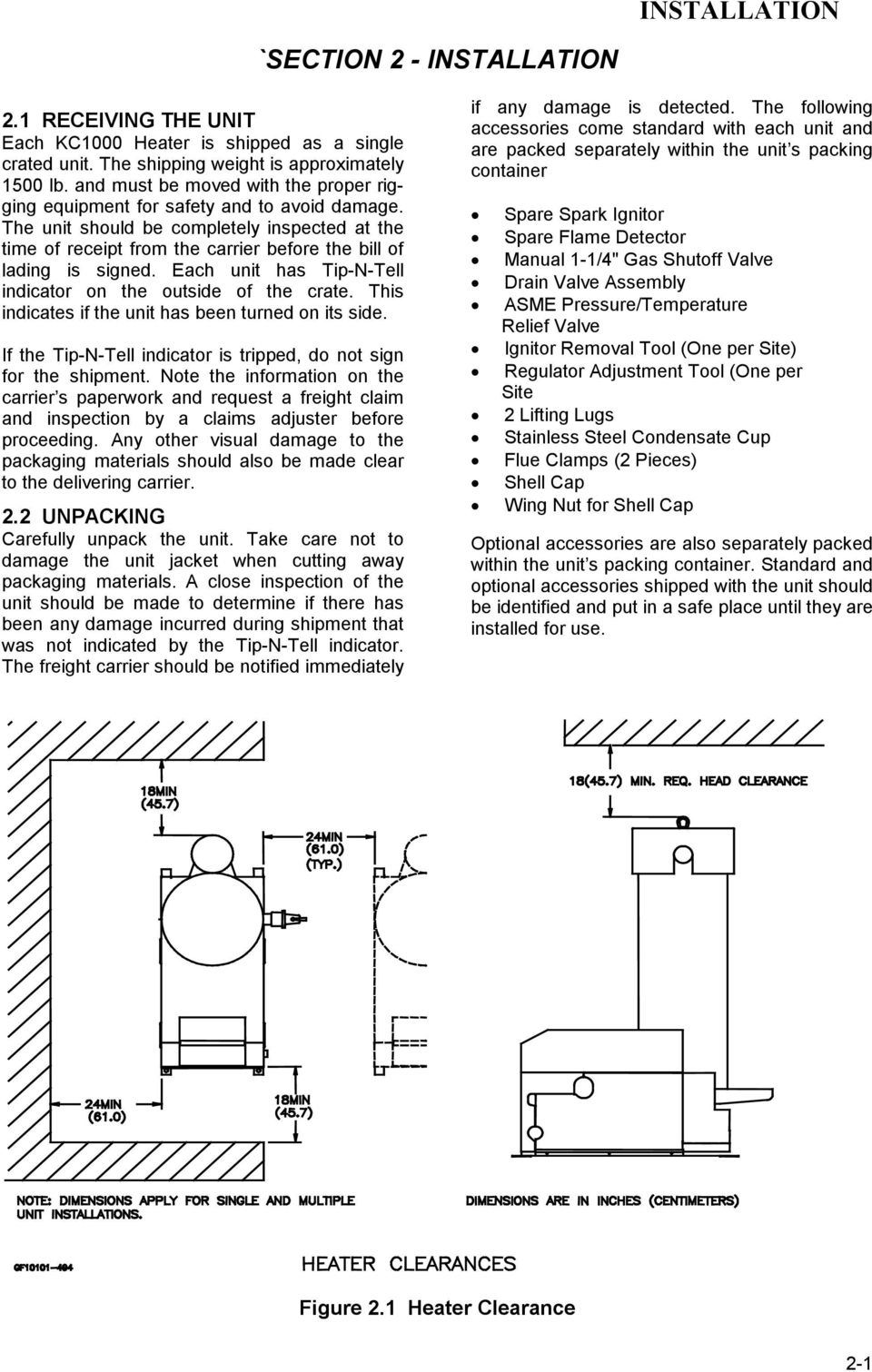
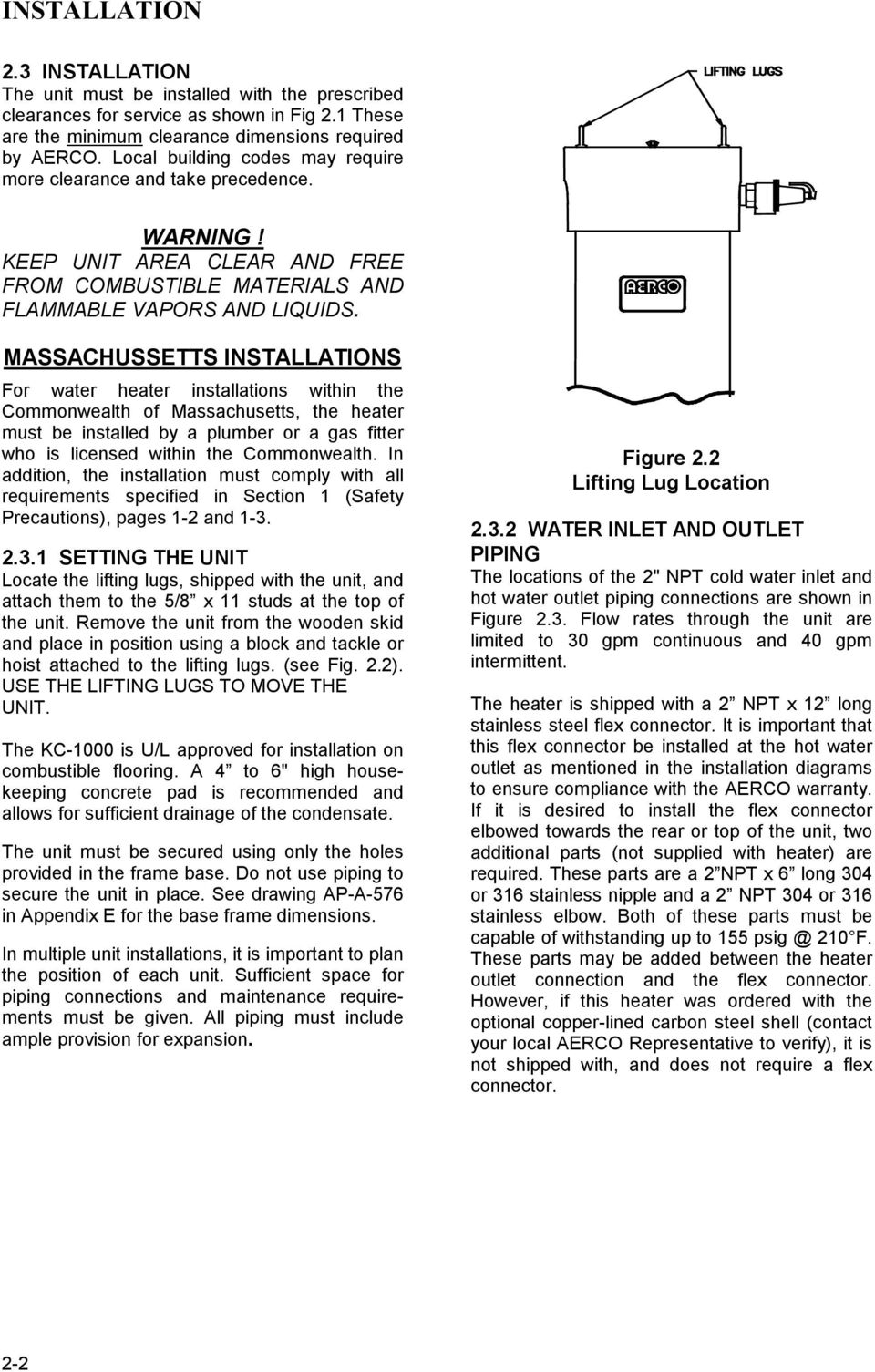
12 INSTALLATION 2.3 INSTALLATION The unit must be installed with the prescribed clearances for service as shown in Fig 2.1 These are the minimum clearance dimensions required by AERCO. Local building codes may require more clearance and take precedence. WARNING! KEEP UNIT AREA CLEAR AND FREE FROM COMBUSTIBLE MATERIALS AND FLAMMABLE VAPORS AND LIQUIDS. MASSACHUSSETTS INSTALLATIONS For water heater installations within the Commonwealth of Massachusetts, the heater must be installed by a plumber or a gas fitter who is licensed within the Commonwealth. In addition, the installation must comply with all requirements specified in Section 1 (Safety Precautions), pages 1-2 and SETTING THE UNIT Locate the lifting lugs, shipped with the unit, and attach them to the 5/8 x 11 studs at the top of the unit. Remove the unit from the wooden skid and place in position using a block and tackle or hoist attached to the lifting lugs. (see Fig. 2.2). USE THE LIFTING LUGS TO MOVE THE UNIT. The KC-1000 is U/L approved for installation on combustible flooring. A 4 to 6" high housekeeping concrete pad is recommended and allows for sufficient drainage of the condensate. The unit must be secured using only the holes provided in the frame base. Do not use piping to secure the unit in place. See drawing AP-A-576 in Appendix E for the base frame dimensions. In multiple unit installations, it is important to plan the position of each unit. Sufficient space for piping connections and maintenance requirements must be given. All piping must include ample provision for expansion. Figure 2.2 Lifting Lug Location WATER INLET AND OUTLET PIPING The locations of the 2" NPT cold water inlet and hot water outlet piping connections are shown in Figure 2.3. Flow rates through the unit are limited to 30 gpm continuous and 40 gpm intermittent. The heater is shipped with a 2 NPT x 12 long stainless steel flex connector. It is important that this flex connector be installed at the hot water outlet as mentioned in the installation diagrams to ensure compliance with the AERCO warranty. If it is desired to install the flex connector elbowed towards the rear or top of the unit, two additional parts (not supplied with heater) are required. These parts are a 2 NPT x 6 long 304 or 316 stainless nipple and a 2 NPT 304 or 316 stainless elbow. Both of these parts must be capable of withstanding up to F. These parts may be added between the heater outlet connection and the flex connector. However, if this heater was ordered with the optional copper-lined carbon steel shell (contact your local AERCO Representative to verify), it is not shipped with, and does not require a flex connector. 2-2
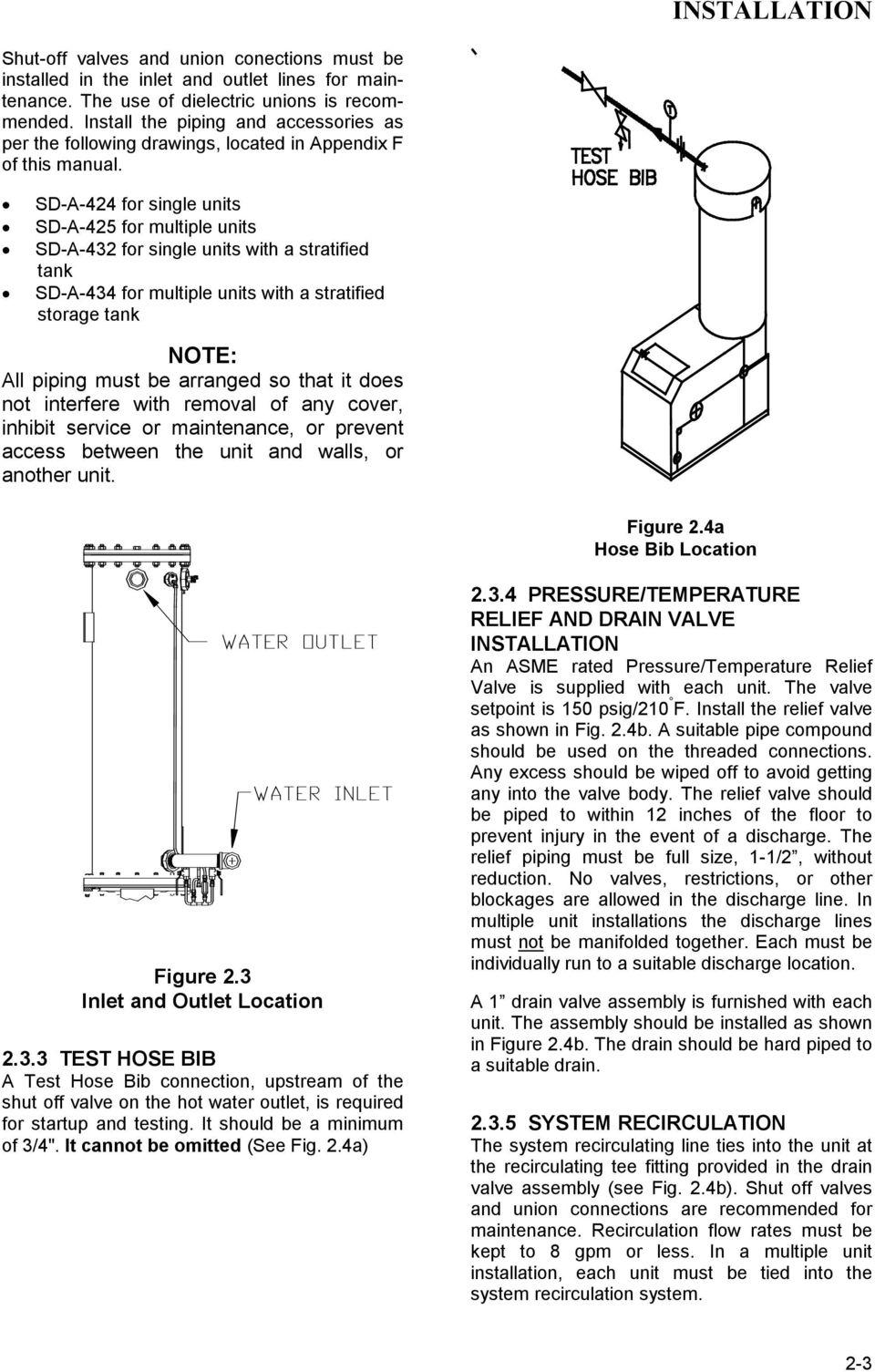
13 INSTALLATION Shut-off valves and union conections must be installed in the inlet and outlet lines for maintenance. The use of dielectric unions is recommended. Install the piping and accessories as per the following drawings, located in Appendix F of this manual. SD-A-424 for single units SD-A-425 for multiple units SD-A-432 for single units with a stratified tank SD-A-434 for multiple units with a stratified storage tank NOTE: All piping must be arranged so that it does not interfere with removal of any cover, inhibit service or maintenance, or prevent access between the unit and walls, or another unit. Figure 2.4a Hose Bib Location Figure 2.3 Inlet and Outlet Location TEST HOSE BIB A Test Hose Bib connection, upstream of the shut off valve on the hot water outlet, is required for startup and testing. It should be a minimum of 3/4". It cannot be omitted (See Fig. 2.4a) PRESSURE/TEMPERATURE RELIEF AND DRAIN VALVE INSTALLATION An ASME rated Pressure/Temperature Relief Valve is supplied with each unit. The valve setpoint is 150 psig/210 F. Install the relief valve as shown in Fig. 2.4b. A suitable pipe compound should be used on the threaded connections. Any excess should be wiped off to avoid getting any into the valve body. The relief valve should be piped to within 12 inches of the floor to prevent injury in the event of a discharge. The relief piping must be full size, 1-1/2, without reduction. No valves, restrictions, or other blockages are allowed in the discharge line. In multiple unit installations the discharge lines must not be manifolded together. Each must be individually run to a suitable discharge location. A 1 drain valve assembly is furnished with each unit. The assembly should be installed as shown in Figure 2.4b. The drain should be hard piped to a suitable drain SYSTEM RECIRCULATION The system recirculating line ties into the unit at the recirculating tee fitting provided in the drain valve assembly (see Fig. 2.4b). Shut off valves and union connections are recommended for maintenance. Recirculation flow rates must be kept to 8 gpm or less. In a multiple unit installation, each unit must be tied into the system recirculation system. 2-3
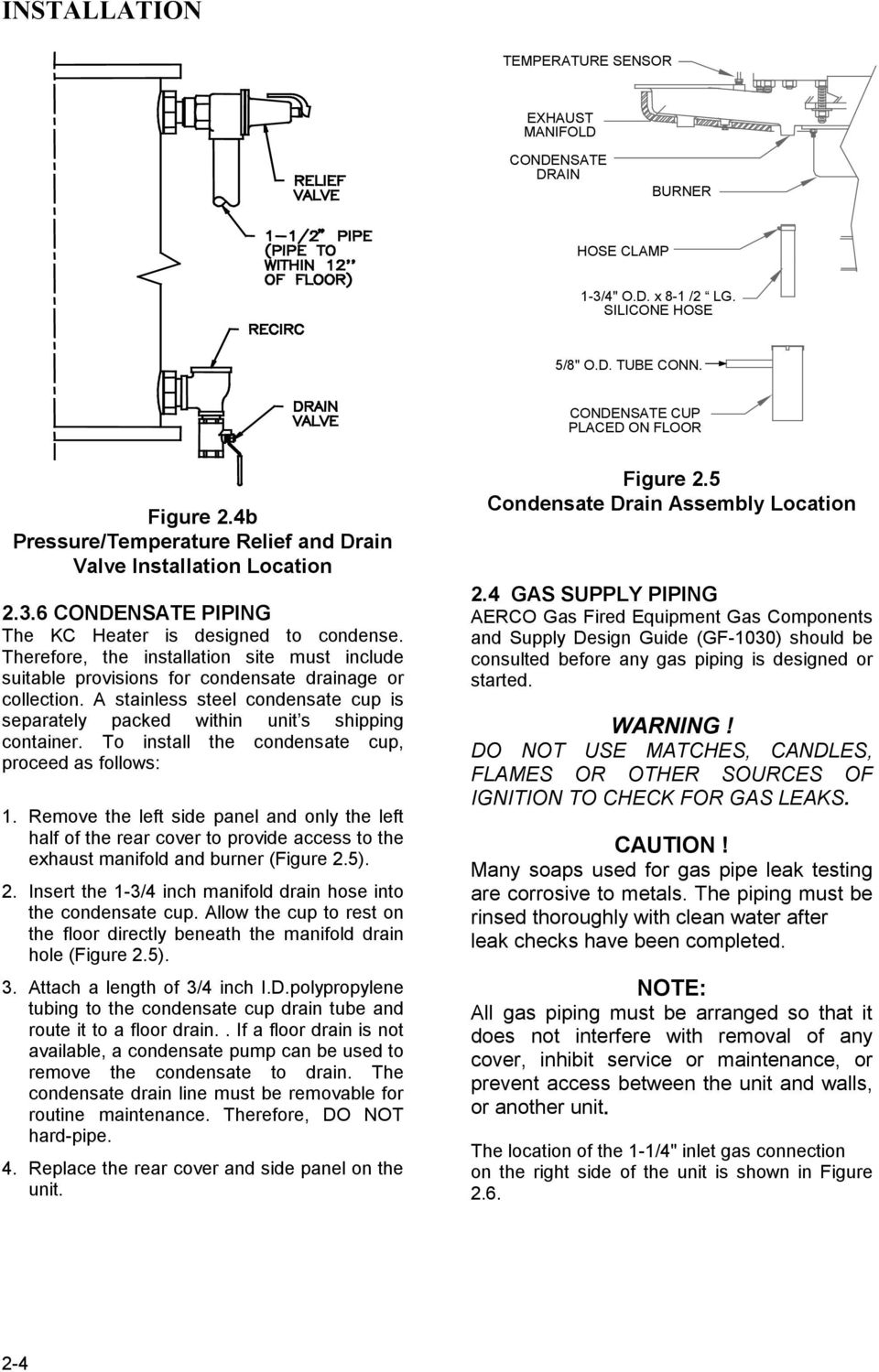
14 INSTALLATION TEMPERATURE SENSOR EXHAUST MANIFOLD CONDENSATE DRAIN BURNER HOSE CLAMP 1-3/4" O.D. x 8-1 /2 LG. SILICONE HOSE 5/8" O.D. TUBE CONN. CONDENSATE CUP PLACED ON FLOOR Figure 2.4b Pressure/Temperature Relief and Drain Valve Installation Location CONDENSATE PIPING The KC Heater is designed to condense. Therefore, the installation site must include suitable provisions for condensate drainage or collection. A stainless steel condensate cup is separately packed within unit s shipping container. To install the condensate cup, proceed as follows: 1. Remove the left side panel and only the left half of the rear cover to provide access to the exhaust manifold and burner (Figure 2.5). 2. Insert the 1-3/4 inch manifold drain hose into the condensate cup. Allow the cup to rest on the floor directly beneath the manifold drain hole (Figure 2.5). 3. Attach a length of 3/4 inch I.D.polypropylene tubing to the condensate cup drain tube and route it to a floor drain.. If a floor drain is not available, a condensate pump can be used to remove the condensate to drain. The condensate drain line must be removable for routine maintenance. Therefore, DO NOT hard-pipe. 4. Replace the rear cover and side panel on the unit. Figure 2.5 Condensate Drain Assembly Location 2.4 GAS SUPPLY PIPING AERCO Gas Fired Equipment Gas Components and Supply Design Guide (GF-1030) should be consulted before any gas piping is designed or started. WARNING! DO NOT USE MATCHES, CANDLES, FLAMES OR OTHER SOURCES OF IGNITION TO CHECK FOR GAS LEAKS. CAUTION! Many soaps used for gas pipe leak testing are corrosive to metals. The piping must be rinsed thoroughly with clean water after leak checks have been completed. NOTE: All gas piping must be arranged so that it does not interfere with removal of any cover, inhibit service or maintenance, or prevent access between the unit and walls, or another unit. The location of the 1-1/4" inlet gas connection on the right side of the unit is shown in Figure
15 INSTALLATION W.C. for FM gas train and 8.9 W.C. for IRI gas trains at 1,000,000 BTU/H for natural gas and propane units. Figure 2.6 Gas Supply Regulator and Manual Shut - Off Valve Location All pipe should be de-burred and internally cleared of any scale or iron chips prior to installation. No flexible connectors or nonapproved gas fittings should be installed. Piping should be supported from floor or walls only and must not be secured to the unit. A suitable piping compound approved for use with gas should be used sparingly. Any excess must be wiped off to prevent clogging of components. To avoid damage to the unit when pressure testing gas piping, isolate the unit from the gas supply piping. At no time should there be more than 1 psig maximum to the unit. Bubble test all external piping thoroughly for leaks using a soap and water solution or suitable equivalent. The gas piping must meet all applicable codes GAS SUPPLY PRESSURE REGULATOR A mandatory external, in line, supply gas regulator (supplied by others) should be positioned as shown in Figure 2.6. Union connections should be placed in the proper locations to allow maintenance of the regulator if required. NOTE: An individual gas pressure regulator must be installed upstream of each unit. The regulator must regulate gas pressure to 8.5 The maximum static inlet pressure to the unit must be no more than 14 W.C.. Minimum gas pressure is 8.5 W.C. for FM gas trains and 8.9 W.C. IRI gas trains when the unit is firing at maximum input. Gas pressure should not exceed 10.5 W.C. at any time when the unit is firing. Proper sizing of the gas supply regulator in delivering the correct gas flow and outlet pressure is mandatory. The gas supply pressure regulator must maintain the gas pressure at a minimum of 8.5 W.C. (FM) or 8.9 W.C. (IRI) when the unit is at maximum BTU input (1,000,000 BTU/HR). The supply gas regulator must be able to supply sufficient capacity volume, (1000 cfh), to the unit and should have no more than 1" droop from minimum to full fire. The supply gas regulator must also be rated to handle the maximum incoming gas pressure. When the gas supply pressure will not exceed 14 W.C. a non-lock up, or flow through style regulator, may be used. When supply gas pressure will exceed 14 W.C., a lock up style regulator must be used. The gas supply regulator must be propery vented to outdoors. Consult the local gas utility for exact requirements concerning venting of supply gas regulators. CAUTION! A lockup style regulator must be used when gas supply pressure exceeds 14 W.C MANUAL GAS SHUTOFF VALVE A 1-1/4 manual gas shutoff valve is furnished with each unit and should be positioned as shown in Figure 2.6. The valve must be installed upstream of the gas supply regulator in a readily accessible location IRI GAS TRAIN KIT The IRI gas train is an optional gas train required in some areas by code or for insurance purposes. The IRI gas train comes pre-assembled and wired from the factory. See Appendix E, Drawing SD-A-606. The IRI gas train may be ordered pre-assembled or as separate components. If either IRI gas train option is ordered, a complete instructional package, detailing field installation will be included. To obtain a copy of an IRI instructional package prior to the equipment shipping contact your local representative or AERCO. 2-5

16 INSTALLATION 2.5 ELECTRICAL SUPPLY The AERCO Gas Fired Equipment Electrical Power Wiring Guide, (GF-1060), must be consulted in addition to the following material before wiring to the unit is started. AC power connection to the unit are made at the Power Box.This box is located on the front right side of the unit as shown in Figure 2.7. POWER BOX A means for disconnecting AC power from the unit (such as a service switch) must be installed near the unit for normal operation and maintenance. All electrical connections should be made in accordance with the National Electrical Code and/or with any applicable local codes. The electrical wiring diagram is shown in Figure 2.8. Conduit should be run from the knockouts in the side of the box in such a manner that it does not interfere with the removal of any sheet metal covers. A flexible electrical connection may be utilized to allow the covers to be easily removed. AERCO INTERNATIONAL INC. POWER BOX DANGER: HIGH VOLTAGE DISCONNECT POWER BEFORE SERVICING FRAME INPUT POWER 120 VAC, 60 HZ 20 AMP LINE GROUND NEUTRAL USE COPPER CONDUCTORS ONLY FOR FIELD WIRING SSOV ACTUATOR BLOWER Figure 2.8 AC Power Wiring Diagram Figure 2.7 AC Power Box Location NOTE: All electrical conduit and hardware should be installed so that it does not interfere with the removal of any cover, inhibit service or maintenance, or prevent access between the unit and walls or another unit ELECTRICAL REQUIREMENTS Electrical requirements for each unit are 120 VAC, 1 Phase, 60 Hz, 20 Amps from a dedicated electrical circuit. No other devices should be on the same electrical circuit as a KC1000 unit. 2.6 FIELD CONTROL WIRING Each unit is fully wired from the factory with an internal operating control system. No field control wiring is required for normal operation. However, the KC1000 control system does allow for some control and monitoring features. Wiring for these features can be accomplished in the I/O Box behind the left side panel (Figures 2.9 and 2.10). The I/O Box is common to both KC1000 water heaters and boilers. While some of the inputs and outputs are common to both water heaters and boilers, some are not applicable to both. These are noted in the following paragraphs. CAUTION! DO NOT make any connections to the I/O Box terminals labeled NOT USED. Attempting to do so may cause equipment damage. 2-6

17 INSTALLATION BLOWER AWG,,such as Belden 9841(see Fig. 2.10). Polarity must be maintained and the shield must be connected only at the source end. It must be left floating (not connected) at the Heater s I/O Box. GAS SHUT-OFF VALVE I/O BOX Figure 2.9 Input/Output (I/O) Box Location OUTDOOR AIR SENSOR IN Not applicable to Water Heaters AUX SENSOR IN The AUX SENSOR IN terminals can be used to add an additional temperature sensor for monitoring purposes. This input is always enabled and is a view only input that can be seen in the operating menu. The sensor must be wired to the AUX SENSOR IN and SENSOR COMMON and must be similar to AERCO BALCO wire sensor P/N A resistance chart for this sensor can be found in Appendix C ANALOG IN The ANALOG IN + and terminals are used when an external signal is used to change the setpoint of the water heater when operating in the Remote Setpoint Mode. Either a 4 to 20 ma / 1 to 5 VDC or a 0 to 20 ma/ 0 to 5 VDC signal may be used to vary the setpoint or valve position. The factory default setting is for 4 to 20 ma / 1 to 5 VDC, however this may be changed to 0 to 20 ma / 0 to 5 VDC using the Configuration Menu described in Section 3. If voltage rather than current is selected as the drive signal, a DIP switch must be set on the CPU Board located inside the Control Box. Contact the AERCO factory for information on setting DIP switches. All supplied signals must be floating (ungrounded) signals. Connections between the source and the Heater s I/O Box must be made using twisted shielded pair wire of Whether using voltage or current for the drive signal, they are linearly mapped to a 40 F to 240 F setpoint or a 0% to 100% valve position. No scaling for these signals is provided B.M.S. (PWM) IN Not applicable to Water Heaters SHIELD The SHIELD terminals are used to terminate any shields used on sensor wires connected to the unit. Shields must only be connected to these terminals ma OUT These terminals provide a 4 to 20 ma output that can be used to monitor setpoint ( to 220 F), outlet temperature ( to 245 F), or valve position (0% to 100%). This function is enabled in the Configuration Menu (Section 3, Table 3.4) V OUT These terminals provide a 0 to 10 volt output to control the rotational speed of the blower. This function is enabled in the Configuration Menu (Chapter 3, Table 3-4) RS-485 COMM These terminals are used for RS-485 MODBUS serial communication between the unit and an external Master, such as an Energy Management System EXHAUST SWITCH IN These terminals permit an external exhaust switch to be connected to the exhaust manifold of the boiler. The exhaust sensor should be a normally open type switch (such as AERCO P/N ) that closes (trips) at 500 F INTERLOCKS The unit offers two interlock circuits for interfacing with Energy Management Systems and auxiliary equipment such as pumps or louvers or other accessories. These interlocks are called the Remote Interlock and Delayed Interlock (Fig. 2.10). The wiring terminals for these interlocks are located inside the I/O Box on the left side of the unit. The I/O Box cover contains a wiring diagram which shows the terminal strip locations for these interlocks labeled REMOTE INTL K IN and DELAYED 2-7

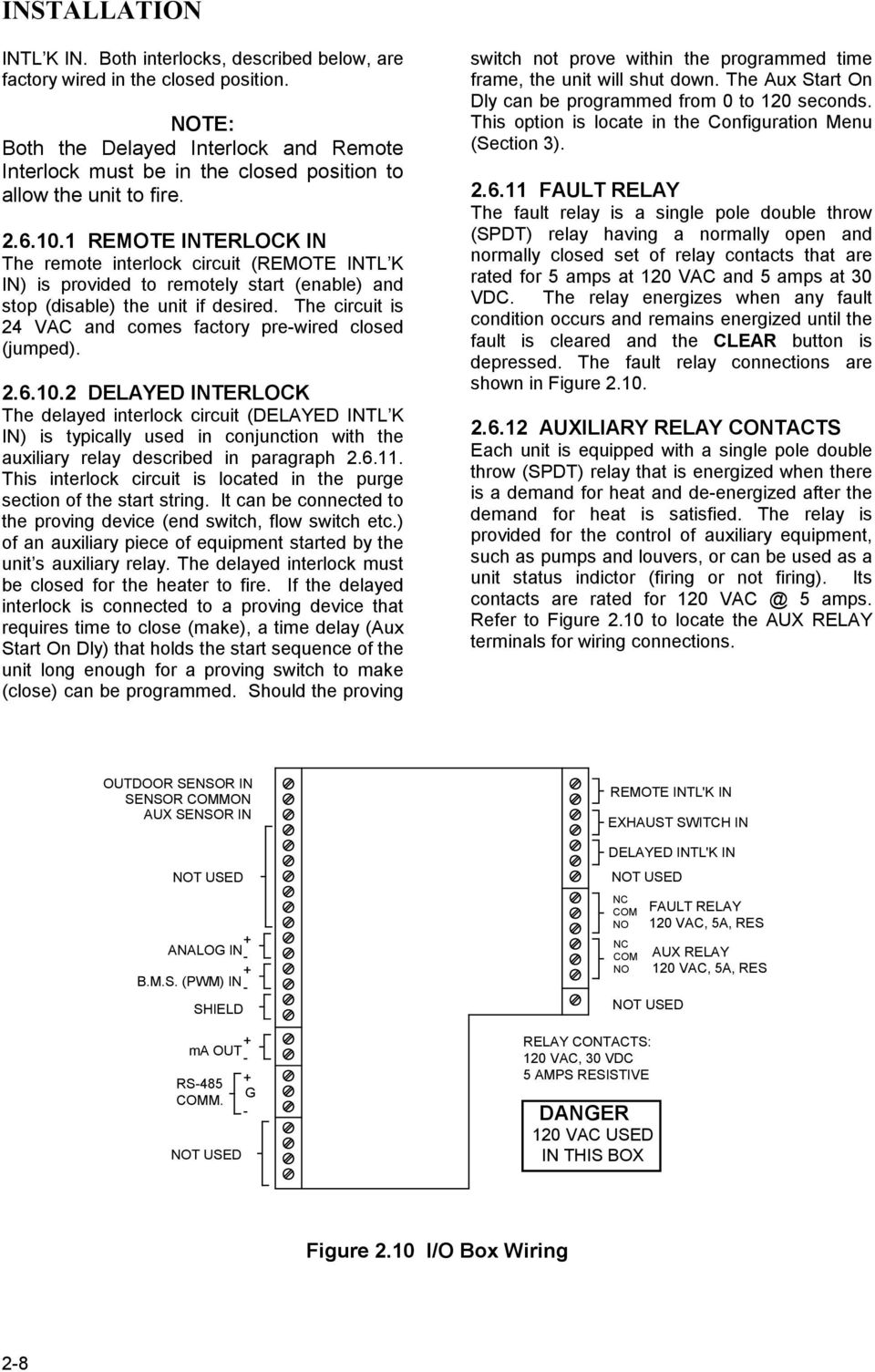
18 INSTALLATION INTL K IN. Both interlocks, described below, are factory wired in the closed position. NOTE: Both the Delayed Interlock and Remote Interlock must be in the closed position to allow the unit to fire REMOTE INTERLOCK IN The remote interlock circuit (REMOTE INTL K IN) is provided to remotely start (enable) and stop (disable) the unit if desired. The circuit is 24 VAC and comes factory pre-wired closed (jumped) DELAYED INTERLOCK The delayed interlock circuit (DELAYED INTL K IN) is typically used in conjunction with the auxiliary relay described in paragraph This interlock circuit is located in the purge section of the start string. It can be connected to the proving device (end switch, flow switch etc.) of an auxiliary piece of equipment started by the unit s auxiliary relay. The delayed interlock must be closed for the heater to fire. If the delayed interlock is connected to a proving device that requires time to close (make), a time delay (Aux Start On Dly) that holds the start sequence of the unit long enough for a proving switch to make (close) can be programmed. Should the proving switch not prove within the programmed time frame, the unit will shut down. The Aux Start On Dly can be programmed from 0 to 120 seconds. This option is locate in the Configuration Menu (Section 3) FAULT RELAY The fault relay is a single pole double throw (SPDT) relay having a normally open and normally closed set of relay contacts that are rated for 5 amps at 120 VAC and 5 amps at 30 VDC. The relay energizes when any fault condition occurs and remains energized until the fault is cleared and the CLEAR button is depressed. The fault relay connections are shown in Figure AUXILIARY RELAY CONTACTS Each unit is equipped with a single pole double throw (SPDT) relay that is energized when there is a demand for heat and de-energized after the demand for heat is satisfied. The relay is provided for the control of auxiliary equipment, such as pumps and louvers, or can be used as a unit status indictor (firing or not firing). Its contacts are rated for amps. Refer to Figure 2.10 to locate the AUX RELAY terminals for wiring connections. OUTDOOR SENSOR IN SENSOR COMMON AUX SENSOR IN NOT USED + ANALOG IN - + B.M.S. (PWM) IN - SHIELD + ma OUT - RS G COMM. - NOT USED REMOTE INTL'K IN EXHAUST SWITCH IN DELAYED INTL'K IN NOT USED NC COM NO NC COM NO FAULT RELAY 120 VAC, 5A, RES NOT USED RELAY CONTACTS: 120 VAC, 30 VDC 5 AMPS RESISTIVE DANGER 120 VAC USED IN THIS BOX AUX RELAY 120 VAC, 5A, RES Figure 2.10 I/O Box Wiring 2-8
19 INSTALLATION 2.7 FLUE GAS VENT INSTALLATION AERCO Gas Fired Venting and Combustion Air Guide, GF-1050, must be consulted before any flue or combustion air venting is designed or installed. Suitable, U/L approved, positive pressure, watertight vent materials MUST be used for safety and UL certification. Because the unit is capable of discharging low temperature exhaust gases, the flue must be pitched back towards the unit a minimum of 1/4" per foot to avoid any condensate pooling and to allow for proper drainage. While there is a positive flue pressure during operation, the combined pressure drop of vent and combustion air systems must not exceed 140 equivalent feet of 0.81 W.C. Fittings as well as pipe lengths must be calculated as part of the equivalent length. For a natural draft installation the draft must not exceed W.C. These factors must be planned into the vent installation. If the maximum allowable equivalent lengths of piping are exceeded, the unit will not operate properly or reliably. 2.8 COMBUSTION AIR The AERCO Gas-Fired Heater Venting and Combustion Air Guide, GF-1050 MUST be consulted before any flue or inlet air venting is designed or installed. Air supply is a direct requirement of ANSI 223.1, NFPA-54, and local codes. These codes should be consulted before a permanent design is determined. The combustion air must be free of chlorine, halogenated hydrocarbons or other chemicals that can become hazardous when used in gasfired equipment. Common sources of these compounds are swimming pools, degreasing compounds, plastic processing, and refrigerants. Whenever the environment contains these types of chemicals, combustion air MUST be supplied from a clean area outdoors for the protection and longevity of the equipment and warranty validation. The more common methods of combustion air supply are outlined below. For combustion air supply from ducting, consult AERCO GF-1050, Gas Fired Venting and Combustion Air Guide COMBUSTION AIR FROM OUTSIDE THE BUILDING Air supplied from outside the building must be provided through two permanent openings. For each unit these two openings must have a free area of not less than one square inch for each 4000 BTUs input of the equipment or 250 square inches of free area. The free area must take into account restrictions such as louvers and bird screens COMBUSTION AIR FROM INSIDE THE BUILDING When combustion air is provided from within the building, it must be supplied through two permanent openings in an interior wall. Each opening must have a free area of not less than one square inch per 1000 BTUH of total input or 1000 square inches of free area. The free area must take into account any restrictions such as louvers SEALED COMBUSTION The unit is UL approved for a 100% sealed combustion application when installed properly. When a sealed combustion air application is installed, the sealed combustion air piping must be deducted from the maximum allowable discharge piping amounts. Each unit must have a minimum 6" diameter connection made to the optional Inlet Air Adapter # GM available from AERCO. This Adapter bolts directly on to the air inlet of the unit blower. See installation instructions with Adapter. All inlet air ducts must be sealed air tight. 2-9

20

21 CONTROL PANEL OPERATING PROCEDURES SECTION 3 - CONTROL PANEL OPERATING PROCEDURES 3.1. INTRODUCTION The information in this Section provides a guide to the operation of the KC1000 Water Heater using the Control Panel mounted on the front of the unit. It is imperative that the initial startup of this unit be performed by factory trained personnel. Operation prior to initial startup by factory trained personnel will void the equipment warranty. In addition, the following WARNINGS and CAUTIONS must be observed at all times. CAUTION: All initial installation procedures must be satisfied before attempting to start the unit. WARNING: ELECTRICAL VOLTAGES IN THIS SYSTEM INCLUDE 120 AND 24 VOLTS AC. IT MUST NOT BE SERVICED OR ACCESSED BY OTHER THAN FACTORY CERTIFIED SERVICE TECHNICIANS. WARNING: DO NOT ATTEMPT TO DRY FIRE THE HEATER. STARTING THE UNIT WITHOUT A FULL WATER LEVEL CAN SERIOUSLY DAMAGE THE UNIT AND MAY RESULT IN PERSONNEL INJURY OR PROPERTY DAMAGE. THIS SITUATION WILL VOID ANY WARRANTY CONTROL PANEL DESCRIPTION The KC1000 Control Panel shown in Figure 3-1 contains all of the controls, indicators and displays necessary to operate, adjust and troubleshoot the KC1000 Water Heater. These operating controls, indicators and displays are listed and described in Table 3-1. Additional information on these items are provided in the individual operating procedures provided in this Section Figure 3-1. Control Panel Front View 3-1
22 CONTROL PANEL OPERATING PROCEDURES Table 3-1. Operating Controls, Indicators and Displays ITEM NO. CONTROL, INDICATOR OR DISPLAY FUNCTION 1 LED Status Indicators Four Status LEDs indicate the current operating status as follows: COMM Lights when RS-232 communication is occurring MANUAL REMOTE DEMAND Lights when the unit is being controlled using the front panel keypad. Lights when the unit is being controlled by an external signal from an Energy Management System Lights when there is a demand for heat. 2 VFD Display Vacuum Fluorescent Display (VFD) consists of 2 lines, each capable of displaying up to 16 alphanumeric characters. The information displayed includes: Startup Messages Alarm Messages Operating Status Messages Menu Selection 3 OUTLET TEMPERATURE Display 3 Digit, 7 Segment LED display continuously displays the outlet water temperature. The F or C LED next to the display lights to indicate whether the displayed temperature is in degrees Fahrenheit or degrees Celsius. 4 RS-232 Port Port permits a Laptop Computer or External Modem to be connected to the water heater Control Panel. 5 READY Indicator Lights when all Pre-Purge conditions have been satisified. 6 ON/OFF Switch Enables and disables heater operation. 7 LOW WATER LEVEL TEST/RESET Switches Allow the operator to test the operation of the water level monitor. Pressing TEST opens the water level probe circuit and simulates a Low Water Level alarm. Pressing RESET resets the water level monitor circuit. Pressing CLEAR resets the display. 8 FAULT Indicator Red FAULT LED indicator lights when a heater alarm condition occurs. An alarm message will appear in the VFD. 9 CLEAR Key Turns off the FAULT indicator and clears trhe alarm message if the alarm is no longer valid. Lockout type alarms will be latched and cannot be cleared by simply pressing this key. Troubleshooting may be required to clear these types of alarms 10 MENU Keypad Consists of 6 keys which provide the following functions for the Control Panel Menus: MENU Steps through the main menu categories shown in Figure 3-2. The Menu categories wrap around in the order shown. BACK Allows you to go back to the previous menu level without changing any information. Continuously pressing this key will bring you back to the default status display in the VFD. Also, this key allows you to go back to the top of a main menu category. 3-2
23 CONTROL PANEL OPERATING PROCEDURES Table 3-1. Operating Controls, Indicators and Displays - Continued ITEM NO. 10 (Cont.) CONTROL, INDICATOR OR DISPLAY FUNCTION (Up) Arrow When in one of the main menu categories (Figure 3-2), pressing this key will select the displayed menu category. If the CHANGE key was pressed and the menu item is flashing, pressing the arrow key will increment the selected setting. (Down) Arrow When in one of the main menu categories (Figure 3-2), pressing this key will select the displayed menu category. If the CHANGE key was pressed and the menu item is flashing, pressing the (Down) arrow key will increment the selected setting. CHANGE Permits a setting to be changed (edited). When the CHANGE key is pressed, the displayed menu item will begin to flash. Pressing the or arrow key when the item is flashing will increment or decrement the displayed setting. ENTER Saves the modified menu information in memory. The display will stop flashing. 11 AUTO/MAN Switch This switch toggles the water heater between the Automatic and Manual modes of operation. When in the Manual (MAN) mode, the front panel controls are enabled and the MANUAL status LED lights. When in the Automatic (AUTO) mode, the MANUAL status LED will be off and the front panel controls disabled. 12 VALVE POSITION Bargraph 20 segment red LED bargraph continuously shows the Valve Position in 5% increments from 0 to 100% 3.3. CONTROL PANEL MENUS The Control Panel incorporates an extensive menu structure which permits the operator to set up, and configure the unit. The menu structure consists of four major menu categories as shown in Figure 3-2. Each of the menus shown, contain options which permit operating parameters to be viewed or changed. The menus are protected by a password to prevent unauthorized use. Prior to entering the correct password, the options contained in the Operating, Setup, Configuration and Tuning Menu categories can be viewed. However, with the exception of Internal Setpoint Temperature (Configuration Menu), none of the viewable menu options can be changed. Once the valid password (159) is entered, the options listed in the Setup, Configuration and Tuning menus can be viewed and changed, if desired Menu Processing Procedure Accessing each menu and option is accomplished using the Menu Keys shown in Figure 3-1. Therefore, it is imperative that you be thoroughly familiar with the following basic steps before attempting to perform specific menu procedures. 1. The Control Panel will normally be in the Operating Menu and the VFD will display the current unit status. Pressing the or arrow key will display the other available data items in the Operating Menu. 2. Press the MENU key. The display will show the Setup Menu which is the next menu category shown in Figure 3-2. This menu contains the Password option which must be entered if other menu options will be changed. 3. Continue pressing the MENU key until the desired menu is displayed. 3-3
24 CONTROL PANEL OPERATING PROCEDURES 4. With the desired menu displayed, press the or arrow key. The first option in the selected menu will be displayed. 5. Continue to press the or arrow key until the desired menu option is displayed. Pressing the arrow key will display the available menu options in the Top-Down sequence. Pressing the arrow key will display the options in the Bottom-Up sequence. The menu options will wraparound after the first or last available option is reached. 6. To change the value or setting of a displayed menu option, press the CHANGE key. The displayed option will begin to flash. Continue to press the or arrow key for the option to be changed. The available menu option choices will be displayed. The menu option choices do not wrap around. 7. To select and store a changed menu option, press the ENTER key. OPERATION SETUP PASSWORD CONFIGURATION NOTE: The following paragraphs provide brief descriptions of the options contained in each menu. Refer to Appendix A for detailed descriptions of each menu option. Refer to Appendix B for listings and descriptions of displayed startup, status and error messages OPERATING MENU The Operating Menu displays a number of key operating parameters for the unit as listed in Table 3-2. This menu is Read-Only and does not allow personnel to change or adjust any of the displayed items. Since this menu is Read- Only, it can be viewed at any time without entering a password. Press the arrow key to display the menu items in the order listed (Top- Down). Pressing the arrow key will display the menu items in reverse order (Bottom-Up) SETUP MENU The Setup Menu (Table 3-3) permits the operator to set the unit password which is required to change any of the menu options. To prevent unauthorized use, a previously entered password entry will time-out after 1 hour. Therefore, the password must be reentered when required. In addition to permitting password entries, the Setup Menu is also used to enter date and time, language to be used for display messages, units of temperature measurements and entries required for external communication and control of the unit via the RS-232 port. A view-only software version display is also provided to indicate the current Control Box software version. TUNING Figure 3-2. Menu Structure 3-4
25 CONTROL PANEL OPERATING PROCEDURES NOTE The Outdoor Temp display item shown with an asterisk in Table 3-2 will not be displayed unless the Outdoor Sensor function has been enabled in the Configuration Menu (Table 3-4). Table 3-2. Operating Menu Available Choices or Limits Menu Item Display Minimum Maximum Default Status Message Active Setpoint 40 F 240 F Aux Temp 30 F 245 F Outdoor Temp* -70 F 130 F Valve Position In 0% Max Valve Position Flame Strength 0% 100% Run Cycles 0 999,999 Run Hours 0 999,999 Fault Log Table 3-3. Setup Menu Available Choices or Limits Menu Item Display Minimum Maximum Default Passsword Language English English Time 12:00 am 11:59 pm Date 01/01/00 12/31/99 Unit of Temp Fahrenheit Fahrenheit Celsius Comm Address Baud Rate K 9600 Software Ver 0.00 Ver CONFIGURATION MENU The Configuration Menu shown in Table 3-4 permits adjustment of the Internal Setpoint (Setpt) temperature regardless of whether the valid password has been entered. Setpt is required for operation in the Constant Setpoint mode. The remaining options in this menu require the valid password to be entered, prior to changing existing entries. This menu contains a number of other configuration settings which may or may not be displayed, depending on the current operating mode setting. NOTE: The Configuration Menu settings shown in Table 3-4 are Factory-Set in accordance with the requirements specified for each individual order. Therefore, under normal operating conditions, no changes will be required. 3-5
26 CONTROL PANEL OPERATING PROCEDURES Table 3-4. Configuration Menu Available Choices or Limits Menu Item Display Minimum Maximum Default Internal Setpt Lo Temp Limit Hi Temp Limit 130 F Unit Type Boiler Boiler Water Heater Unit Size 0.5 MBTU, 1.0 MBTU 1.0 MBTU 1.5 MBTU, 2.0 MBTU 3.0 MBTU, 3.5 MBTU 4.0 MBTU, 5.0 MBTU 6.0 MBTU Water Heater Mode Constant Setpoint Constant Remote Signal (If Mode = Remote Setpoint) Remote Setpoint 4 20 ma/1 5V 0-20 ma/0 5V PWM Input (BMS) Network Setpoint 4 20 ma, 1-5V Outdoor Sensor Enabled or Disabled Disabled System Start Tmp (If Outdoor Sensor = Enabled) 30 F 100 F 60 F Setpt Lo Limit 40 F Setpt Hi Limit 60 F Setpt Hi Limit Setpt Lo Limit 240 F 200 F Temp Hi Limit 40 F 240 F 215 F Max Valve Position 40% 100% 100% Pump Delay Timer 0 min 30 min 0 min Aux Start On Dly 0 sec 120 sec 0 sec Failsafe Mode Shutdown or Constant Setpt Shutdown ma Output Setpoint, Outlet Temp, Off Valve Position Out, Off Lo Fire Timer 2 sec 120 sec 2 sec Setpt Limiting Enabled or Disabled Disabled Setpt Limit Band 0 F 10 F 5 F 3-6
27 CONTROL PANEL OPERATING PROCEDURES 3.7. TUNING MENU The Tuning Menu items in Table 3-5 are Factory set for each individual unit. Do not change these menu entries unless specifically requested to do so by Factory- Trained personnel. Table 3-5. Tuning Menu Available Choices or Limits Menu Item Display Minimum Maximum Default Min Load Adj -50 F 50 F 0 F Max Load Adj -50 F 50 F 0 F FFWD Temp 30 F 245 F Outlet Feedback On On Off Reset Defaults? Yes No Are You Sure? No 3.8. START SEQUENCE When the Control Box ON/OFF switch is set to the ON position, it checks all pre-purge safety switches to ensure they are closed. These switches include: Safety Shut-Off Valve Proof of Closure (POC) switch Low Water Level switch High Water Temperature switch High Gas Pressure switch Low Gas Pressure switch If all of the above switches are closed, the READY light above the ON/OFF switch will light and the unit will be in the Standby mode. When there is a demand for heat, the following events will occur: NOTE: If any of the Pre-Purge safety device switches are open, the appropriate fault message will be displayed. Also, the appropriate fault messages will be displayed throughout the start sequence, if the required conditions are not observed. 1. The DEMAND LED status indicator will light. 2. The unit checks to ensure that the proof of closure switch in the Safety Shut-Off Valve (SSOV) is closed (Figure 3-3). Figure 3-3. Safety Shut-Off Valve 3. With all required safety switches closed, a purge cycle will be initiated and the following events will occur: 3-7
28 CONTROL PANEL OPERATING PROCEDURES (a) Blower relay energizes and turns on blower. (b) Air/Fuel Valve rotates to the full-open purge position and closes purge position switch. The dial on the Air/Fuel Valve (Figure 3-4) will read 100 to indicate that the valve is full-open (100%). (c) The VALVE POSITION bargraph will show 100% AIR/FUEL VALVE BLOWER PROOF SWITCH STEPPER MOTOR DIAL (DETAIL A ) TO FRAME HARNESS BLOWER BURNER Figure 3-5. Blower Proof Switch 100 DETAIL "A" Figure 3-4. Air/Fuel Valve In Purge Position 4. Next, the blower proof switch (Figure 3-5) closes and the display will show Purging and indicate the elapsed time of the purge cycle in seconds. The normal (default) time for the purge cycle is 7 seconds. 5. Upon completion of the purge cycle, the Control Box initiates an ignition cycle and the following events occur: (a) The Air/Fuel Valve rotates to the low-fire ignition position and closes the ignition switch. The dial on the Air/Fuel Valve (Figure 3-6) will read between 25 and 35 to indicate that the valve is in the lowfire position. (b) The igniter relay is activated and provides ignition spark. (c) The gas Safety Shut Off Valve (SSOV) is energized (opened) allowing gas to flow into the Air/Fuel Valve. 6. Up to 7 seconds will be allowed for ignition to be detected. The igniter relay will be turned off one second after flame is detected. 7. After 2 seconds of continuous flame, Flame Proven will be displayed and the flame strength will be indicated. After 5 seconds, the current date and time will be displayed in place of the flame strength. 3-8
29 CONTROL PANEL OPERATING PROCEDURES STEPPER MOTOR BLOWER DIAL (DETAIL A ) BURNER 8. With the unit firing properly, it will be controlled by the temperature controller circuitry. The VALVE POSITION will be continuously displayed on the front panel bargraph. 9. Once the demand for heat has been satisfied, the Control Box will turn off the gas valve. The blower relay will be deactivated and the Air/Fuel Valve will be closed. Standby will be displayed START/STOP LEVELS The start and stop levels are the valve position percentages that start and stop the unit, based on load. These levels are Factory preset as follows for natural gas and propane units: 25 Start Level: 20% (All units) Stop Level: 13% (Natural Gas) Stop Level: 16% (Propane) DETAIL "A" Figure 3-6. Air/Fuel Valve In Ignition Position Normally, these settings should not require adjustment. Note that the energy input of the boiler is not linearly related to the valve position percentage (Air/Fuel Valve position). Refer to Table 3-6 for the relationship between the energy input and valve position percentage of a unit running on natural gas. Table 3-6. Relationship Between Air/Fuel Valve Position and Energy Input of a Unit Running on Natural Gas Valve Position, Air/Fuel Valve Position (% Open) Energy Input (BTU/Hr) Boiler Energy Input (% of Full Capacity) (Stop Level) 50,000 5 % 20 89,000 9% ,000 19% % ,000 46% ,000 60% ,000 70% ,000 84% ,000 96% 100 1,000, % 3-9
30
31 INITIAL START-UP SECTION 4 - INITIAL START- UP 4.1 INITIAL START- UP REQUIREMENTS The initial start-up of the KC-1000 Water Heater is comprised of the following steps: Installation 100% completed (Section 2) Combustion calibration Proper setting of controls and limits Temperature calibration Safety device testing (Section 5) Installation procedures must be 100% complete before performing initial start-up. The initial startup must be successfully completed prior to placing the unit into service. Starting a unit without the proper piping, venting, or electrical systems can be dangerous and void the product s warranty. These start-up instructions should be followed precisely in order to safely operate the unit at a high thermal efficiency, and with low flue gas emissions. Initial unit start-up must be performed ONLY by AERCO factory trained start-up and service personnel. After following the steps in this section, it will be necessary to perform the safety device testing procedures in Section 5 to complete the initial unit start-up. An AERCO Gas Fired Startup Sheet included with each KC-1000 must be completed for each unit for warranty validation. A copy must be returned promptly to AERCO at: AERCO International, Inc. 159 Paris Ave. Northvale, NJ WARNING! DO NOT ATTEMPT TO FIRE THE UNIT WITHOUT FULL WATER LEVEL. THIS CAN SERIOUSLY DAMAGE THE UNIT AND MAY RESULT IN PERSONAL INJURY OR PROPERTY DAMAGE. THIS IS NOT COVERED BY WARRANTY. CAUTION! All installation procedures in Section 2 must be completed before attempting to start the unit. 4.2 TOOLS AND INSTRUMENTATION FOR COMBUSTION CALIBRATION To properly perform combustion calibration, the proper instruments and tools must be used and correctly installed on the unit. The following paragraphs outline the necessary tools and instrumentation as well as their installation REQUIRED TOOLS AND INSTRUMENTATION The following tools and instrumentation are necessary to perform combustion calibration of the unit: 1. A digital combustion analyzer with oxygen accuracy to 0.4%, and carbon monoxide in PPM. 2. *A 16" W.C. manometer and plastic tubing. 3. One 1/4 and two 1/8 NPT-to-barbed fittings for use with manometers. 4. A flat-tip screwdriver for adjusting the AERCO differential gas pressure regulator. 5. Small and large flat blade screwdrivers. 6. 7/16" open end wrench and small adjustable wrenches. 7. Tube of silicone adhesive *For propane fired units, an additional 8" W.C. manometer and 1/2" NPT to barbed fitting is needed INSTALLING THE SUPPLY GAS MANOMETER 1. Close the main manual gas supply valve up stream of the unit. 2. Remove the 1/4" NPT pipe plug from the port on the inlet side of the safety shut off valve (see Figure 4.1). 3. Install a barbed fitting into the pipe plug tapping. 4. Attach one end of a length of plastic tubing to the barbed fitting and one end to the 16" W.C. manometer. 4-1
32 INITIAL START-UP 1/4" NPT PLUG (INSTALL MANOMETER HERE) SSOV Figure 4.1 1/4 Gas Plug Location PREPARING THE FLUE VENT PROBE HOLE 1. If the unit has been installed using the recommended AL29-4C vent, there will be a 3/8 hole, 18 to 24 above the exhaust manifold. The outer vent section, that covers vent section connections must be loosened and slid down to uncover the hole (see Fig. 4.2). 2. If equipped with one, adjust the stop on the combustion analyzer probe so that it extends into the flue gas flow without hitting the opposite wall of the flue. Do not insert the probe at this time. IMPORTANT The unit is shipped from the factory set up for either natural gas or propane, as specified by the Style No. on the Sales Order. For propane units, refer to paragraph NATURAL GAS COMBUSTION CALIBRATION The KC-1000 is shipped combustion calibrated from the factory. Recalibration as part of a startup is necessary due to altitude, gas BTU content, gas supply piping and supply regulators. Factory test data sheets are shipped with each unit as a reference. The following combustion calibration procedure closely follows the factory procedure. By following this procedure readjustment of combustion will be kept to a minimum. 1. Open the supply and return valves to the unit and ensure that the system pumps are running. 2. Open the gas supply valve(s) to the unit. 3. If a lockup style regulator is installed as a gas supply regulator, adjust the gas supply until a reading of 12 W.C. static pressure is obtained. 4. Set the ON/OFF switch in the OFF position. Turn on AC power to the unit. The display will show LOSS OF POWER and the time and date. 5. Set the unit to the Manual Mode by pressing the AUTO/MAN switch. A flashing Manual Valve Position message will be displayed with the present rate in %. Also, the MANUAL LED will light. 3/8" - 1/2" HOLE FOR COMBUSTION ANALYZER PROBE 12" - 18" NOTE: For a review of control panel operating procedures, see Section Adjust the rate to 0% by pressing the arrow key. 7. Set the ON/OFF switch to the ON position. EXHAUST MANIFOLD Figure 4.2 Analyzer Probe Hole Location 8. Change the valve position to 25% using the arrow key. This will put the unit into the starting sequence. 4-2
33 INITIAL START-UP NOTE: On initial start-up, or return to service from a fault condition, the unit will remain at a 29% valve position for two-minutes. 9. Following the warm-up period, increase the valve position in 20% increments while monitoring the gas pressure after every increase. If gas pressure dips below 8.5 W.C. for FM gas trains and 8.9 for IRI gas trains at any input percentage, stop and raise the pressure. Once 100% is reached, adjust the gas pressure for 8.5 W.C. or 8.9 W.C. NOTE: If 8.5 W.C. for FM gas trains or 8.9 W.C. for IRI gas trains cannot be obtained at the 100% valve position, it will be necessary to stop calibration and contact the local AERCO representative in your area. Running the unit on insufficient gas pressure will void the warranty. 10. Once 8.5 W.C. or 8.9 W.C. is set at the 100% level change the valve position to 30%. Insert the combustion analyzer probe into the stack. NOTE: Always go to a percentage of valve position from the same direction, (i.e., 100% to 30% or 30% to 20%). Whenever going to a valve position from below (i.e., 20% to 30%), first go above then back down to the desired valve position. This is necessary due to hysteresis in the air/fuel stepper motor. Hysteresis causes the air/fuel valve to stop in a slightly different position if the valve position percentage is approached from below or above. This results in a difference in oxygen readings for the same valve position percentage causing unnecessary recalibration. 11. Allow enough time for the combustion analyzer to settle. Compare the measured oxygen level to the oxygen range for intake air temperature in Table If the measured oxygen level is within the range in Table 1, no adjustment is necessary. Proceed to step If the measured oxygen level is not within the range listed in Table 1, remove the regulator cap and cap gasket from the differential pressure regulator (see Figure 4.3) and proceed to step 14. Table 1 Combustion Oxygen Levels for a 30% Valve Position Inlet Air Temp Oxygen (+0.2/-1.0) Carbon Monoxide -20 F 7.5 % <50 ppm 0 F 7.3 % <50 ppm 10 F 7.2 % <50 ppm 30 F 6.8 % <50 ppm 50 F 6.4 % <50 ppm 60 F 6.2 % <50 ppm 70 F 6.0 % <50 ppm 80 F 5.8 % <50 ppm 90 F 5.6 % <50 ppm 100 F 5.4 % <50 ppm DIFFERENTIAL PRESSURE REGULATOR REGULATOR CAP CAP GASKET Figure 4.3 Differential Regulator Adjustment Tool Installation 14. Use a flat-tip screwdriver to adjust the differential pressure regulator. Turn the screwdriver: counterclockwise to increase the oxygen level clockwise to decrease the oxygen level 15. Replace the regulator cap and cap gasket and wait for the analyzer reading to settle. 16. When the analyzer reading settles, compare the new oxygen reading to Table
34 INITIAL START-UP 17. If necessary, repeat the adjustment until the oxygen level is within the range specified in Table Replace the regulator cap and cap gasket. NOTE: Adjust only the differential regulator at 30% control signal; do not adjust the air shutter. 19. Once the oxygen level is within the specified range at 30%, change the valve position to 13%. 20. Oxygen levels at the 13% valve position should be as shown in Table 2. No adjustment should be necessary. Contact the Factory if the oxygen or carbon monoxide levels are not within the specified range. Table 2 Combustion Oxygen Levels for a 13% (Natural Gas) and 16% (Propane) Valve Position Inlet Air Temp Oxygen (+0.2/-1.0) Carbon Monoxide -20 F <12 % <50 ppm 0 F <12 % <50 ppm 10 F <12 % <50 ppm 30 F <12 % <50 ppm 50 F <11 % <50 ppm 60 F <11 % <50 ppm 70 F <11 % <50 ppm 80 F <11 % <50 ppm 90 F <10 % <50 ppm 100 F <10 % <50 ppm Firmly tighten the inlet air shutter locking nuts when finished. Table 3 Combustion Oxygen Levels for a 100% Valve Position Inlet Air Temp Oxygen (+0.2/-1.0) Carbon Monoxide -20 F 6.5 % <150 ppm 0 F 6.3 % <150 ppm 10 F 6.2 % <150 ppm 30 F 5.8 % <150 ppm 50 F 5.4 % <150 ppm 60 F 5.2 % <150 ppm 70 F 5.0 % <150 ppm 80 F 4.8 % <150 ppm 90 F 4.6 % <150 ppm 100 F 4.4 % <150 ppm REMINDER: At 30% valve position adjust only the differential pressure regulator. At 100% valve position, adjust only the inlet air shutter. BLOWER INLET SCREEN SHUTTER SHUTTER LOCKING NUTS BLOWER OUTLET 21. Change the valve position to 100%. After the combustion analyzer has settled, compare the measured oxygen level with the levels in Table If the measured oxygen reading is below the oxygen range in Table 3, loosen the two bolts that secure the inlet air shutter to the unit using a 7/16 wrench (see Fig. 4.4). Open the shutter 1/4 to 1/2 to increase the oxygen level, then tighten the nuts. 23. Wait for the analyzer to settle and then compare the new oxygen reading to Table 3. Repeat the inlet air shutter adjustment until the oxygen is within the specified range. Figure 4.4 Air Shutter Locking Nut Location 22. If the measured oxygen reading is above the oxygen range in Table 3, loosen the two 7/16" locking nuts securing the inlet air shutter. Close the air shutter 1/4 to 1/2 to decrease the oxygen level and tighten the two nuts. 23. Allow the analyzer to settle and then compare the new oxygen reading to Table Repeat the adjustment until the oxygen is within the specified range. Firmly tighten the inlet air shutter locking nuts when finished. 4-4
35 INITIAL START-UP NOTE: Adjust the inlet air shutter only at 100% valve position. Do not adjust the differential pressure regulator. 25. Change the valve position to 30%. Allow time for the combustion analyzer to settle. Check the measured oxygen reading to insure that it is still within the range as per Table Continue this procedure until all oxygen levels are within the ranges specified in Tables 1, 2 and Record all readings on the AERCO start-up sheet provided with each unit. Proceed to paragraph PROPANE COMBUSTION CALIBRATION For propane units it will be necessary to install an additional 8 W.C. manometer. This manometer will be used to measure the pressure drop across the air/propane mixing orifice. After performing the setup procedures in paragraphs 4,2.2 through 4.2.4, install the 8 W.C. manometer as described in steps 1, 2 and 3 which follow. pressure drop across the air/propane mixing orifice using the 0-8 W.C. manometer. 5. This reading should remain a constant 3.8 to 4 W.C. throughout the operating range. 6. If the pressure drop is not within this range, remove the cap from the air pressure regulator. 7. Using a flat blade screwdriver adjust the regulator until W.C. is obtained. Clockwise will increase the reading and counter-clockwise will decrease the reading. 8. If adjustments are made to this regulator it will be necessary to recheck oxygen settings at 16%, 30%, and 100% valve positions. NOTE: After an adjustment is made to the air regulator, the cap must be put back on securely to obtain an accurate reading. 1. Referring to Fig. 4.5, remove the 1/8 NPT plug from the gas inlet pipe ahead of the burner and install a 1/8 NPT barbed fitting. 2. Remove the 1/2 NPT plug from the tee located after the air pressure regulator and install a 1/2 barbed fitting (see fig. 4.5). 3. Attach the 8 W.C. manometer to the barbed fittings installed in steps 1 and 2. NOTE: The combustion calibration data in Tables 1, 2 and 3 apply to both natural gas and propane units. Therefore, refer to these Tables when performing propane combustion calibration. For propane, combustion calibration data will be checked at 30%, 16% and 100%. Note that the data In Table 2 is applicable to a valve position of 16% for propane and 13% for natural gas. 4. While performing the combustion calibration procedure in paragraph 4.3, measure the Figure 4.5 Propane Air Differential Pressure Taps 4.5 UNIT REASSEMBLY Once combustion calibration is set properly, the unit can be re-assembled for permanent operation. 1. Set the ON/OFF switch to the OFF position. Disconnect the AC power supply from the unit. 2. Shut off the gas supply to the unit. 3. Remove the differential pressure regulator cap and cap gasket (see Figure 4.3). 4. Apply a drop of silicone to the regulator adjusting screw to lock its setting. 4-5
36 INITIAL START-UP 5. Reinstall the regulator cap and gasket on the regulator. Tighten the cap using a screwdriver or wrench. 6. Remove all of the manometers and barbed fittings and reinstall the pipe plugs using a suitable thread compound. 7. Remove the combustion analyzer probe from the vent hole. Seal the probe hole and replace the vent connection cover. 8. Replace the unit s panels and hood. 4.6 TEMPERATURE CONTROL CALIBRATION Although the unit comes factory set and calibrated for a 130 F setpoint it is usually necessary to recalibrate temperature control. There are two primary adjustments for performing temperature calibration. These are Min Load Adj and Max Load Adj (minimum and maximum load adjustment). Adjustments to these settings are made at minimum and maximum load conditions and should be made in small increments from 1 to 3 degrees. After making an adjustment, outlet water temperature must be allowed to settle for several minutes prior to making further adjustments. When calibrating temperature control, observe the following: 1. The unit must be in the Auto mode of operation. 2. The Outlet Feedback option in the Tuning Menu must be off while performing calibration. 3. Monitor the OUTLET TEMPERATURE display and VALVE POSITION bar-graph display to set load conditions and see the effect of adjustments. 4. Perform the calibration using the Tuning Menu of the Control Box. 5. Make small adjustments and allow time between adjustments for the outlet temperature to stabilize. 6. Maintain water flow as constant as possible during these adjustments. 7. Ensure that recirculation loops are operational while the calibration is being performed SETTING THE OUTLET WATER TEMPERATURE SETPOINT The setpoint temperature of the unit may be changed by following the procedure below. However, once a setpoint has been changed, recalibration may be necessary. The temperature calibration procedures are provided in paragraphs and To adjust the unit s setpoint, proceed as follows: 1. Press the MENU key until Configuration Menu is displayed. 2. Press the or arrow key until Internal Setpt is displayed along with the present setpoint temperature. 3. To change the setpoint, press the CHANGE key. The display will begin to flash. 4. Press the or arrow key until the desired setpoint is displayed. 5. Press the ENTER key to save the change MINIMUM LOAD ADJUSTMENT With the unit in operation, check the temperature control at minimum load as follows: 1. While monitoring the VALVE POSITION display, create a minimum load on the system that will yield a steady valve position between 25% and 35%. NOTE: It may be desirable to shut off the outlet valve and use the hose bib to simulate a minimum flow load condition. 2. Wait several minutes to allow the outlet temperature to stabilize under load conditions. 3. Once stabilized, the OUTLET TEMPERATURE display should read no more than 2 to 3 degrees above the unit s setpoint. 4. If the outlet temperature is stabilized, proceed to the Maximum Load Adjustment procedure in paragraph If the unit is not stabilized, proceed to step Press the MENU key and select the Tuning Menu. 6. Press the or arrow key until Min Load Adj is displayed. 4-6
37 INITIAL START-UP 7. Press the CHANGE key. The display will begin to flash. 8. Raise or lower the minimum load adjustment in increments of one or two using the or arrow key. Increasing this value will increase the outlet water temperature, while decreasing it will decrease the water temperature. 9. Press ENTER to save the change. Allow time for the system to stabilize between adjustments 10. Repeat steps 5 through 9 as needed until the temperature is stabilized at no more than 2 to 3 degrees above the setpoint MAXIMUM LOAD ADJUSTMENT Check the temperature control at minimum load as follows: 1. While monitoring the VALVE POSITION display, create a maximum load on the system that will yield a steady valve position between 80% and 90%. NOTE: It may be necessary to open the outlet valve if it was closed during minimum load adjustment to obtain a sufficient flow rate for maximum adjustment. 2. Wait several minutes to allow the outlet temperature to stabilize under load conditions. 3. Once the temperature has stabilized, the OUTLET TEMPERATURE display should read no more than 2 to 3 degrees below the unit s setpoint. 4. If the outlet temperature is stabilized, no adjustment is necessary. If the unit is not stabilized, proceed to step Press the MENU key and select the Tuning Menu. 6. Press the or arrow key until Max Load Adj is displayed. 9. Press ENTER to save the change. Allow time for the system to stabilize between adjustments. 10. Repeat steps 5 through 9 as needed until the temperature is stabilized 2 to 3 degrees below the setpoint. 11. If the outlet temperature does not maintain setpoint after a reasonable amount of time and adjustment, contact your local AERCO representative. NOTE: After performing Temperature Calibration and prior to placing the water heater in service, be sure to turn the Outlet Feedback option in the Tuning Menu back to ON. 4.7 OVER-TEMPERATURE LIMIT SWITCH ADJUSTMENTS There are two Over-Temperature Limit switches that turn off the unit when the outlet water temperature becomes too hot. The lower overtemperature limit switch is adjustable and should be adjusted 20 F to 40 F above the operating header temperature. The upper overtemperature limit switch is a manual reset device and is not adjustable. It will shut the unit off if the water temperature reaches 200 F. DO NOT attempt to adjust its setpoint. To adjust the lower over temperature switch limit switch: 1. Remove the wing nut from the top center of the shell cap. Lift the cap off the shell. 2. The two over-temperature limit switches are located at the top of the shell (see Fig. 4.6). Do not adjust the upper switch it has been factory preset. Adjust the lower switch between 20 to 40 F higher than the maximum header temperature the unit may see. 3. Replace the shell cap and wing nut. 7. Press the CHANGE key. The display will begin to flash. 8. Raise or lower the maximum load adjustment using the or arrow key. Increasing this value will increase outlet water temperature, while decreasing it will decrease water temperature. 4-7
38 INITIAL START-UP OVER TEMP. SWITCH (SEE DETAIL) 25 FROM SHELL HARNESS NC NC NO C C TEMPERATURE SWITCH DETAILS OVER-TEMPERATURE SWITCHES Figure 4.6 Over Temperature Limit Switch Location 4-8
39 SAFETY DEVICE TESTING SECTION 5 - SAFETY DEVICE TESTING PROCEDURES 5.1 TESTING OF SAFETY DEVICES Periodic testing of all controls and safety devices is required to insure that they are operating as designed. Precautions must be taken while tests are being performed to protect against bodily injury and property damage. Systematic and thorough testing of the operating and safety controls should be performed on a scheduled basis, or whenever a control component has been serviced or replaced. All testing must conform to local jurisdictions or codes such as ASME CSD-1. NOTE: MANUAL and AUTO modes are required to perform the following tests. For a complete explanation of these modes, see Section 3. NOTE: It will be necessary to remove the sheet metal covers and cap from the unit to perform the following tests. WARNING! ELECTRICAL VOLTAGES IN THIS SYSTEM INCLUDE 120 AND 24 VOLTS AC. POWER MUST BE REMOVED PRIOR TO PERFORMING WIRE REMOVAL OR OTHER TESTING PROCEDURES THAT CAN RESULT IN ELECTRICAL SHOCK. 5.2 LOW GAS PRESSURE FAULT TEST 1. Shut off the gas supply to the unit. 2. Install a 0-16 W.C. manometer in the gas pipe assembly below the low gas pressure switch. (See Fig. 5.1) 3. Open the gas supply to the unit and depress the CLEAR button to clear any fault messages.. 4. Place the unit in Manual Mode and fire the unit at a valve position between 25% and 30%. 5. Slowly close the manual gas supply valve while monitoring the gas pressure. The unit should fault and shutdown on LOW GAS PRESSURE when the manometer indicates approximately 6.5 W.C. 6. Open the gas supply to the unit and press the CLEAR button on the Control Box. 7. The unit should restart. 1/4" NPT PLUG (INSTALL MANOMETER HERE) SSOV Figure 5.1 1/8 Pipe Plug Position for Manometer Installation NOTE: After faulting the unit, the fault message will be displayed and the fault indicator light will flash until the CLEAR button is pressed. 5.3 HIGH GAS PRESSURE TEST 1. Start the unit in manual mode and fire between 25% and 30%. 2. Remove either wire # 150 or wire #151 from the high gas pressure switch. See Fig The unit should shut down on a HIGH GAS PRESSURE FAULT. 4. Reconnect the wire previously removed from the high gas pressure switch and depress the CLEAR button. 5. The unit should restart. 5-1
40 SAFETY DEVICE TESTING HIGH GAS PRESSURE SWITCH 10. After the shell is full, press the LOW WATER LEVEL RESET button to reset the low water cutoff. Press the CLEAR button to reset the FAULT LED and clear the error message. 11. Set the ON/OFF switch to the ON position. The unit is now ready for operation. 5.5 WATER TEMPERATURE FAULT TEST 1. In the normal operating mode, allow the unit to stabilize at its setpoint. Figure 5.2 High Gas Pressure Switch 2. Lower the adjustable temperature limit switch setting to match the outlet water temperature. (See Fig. 5.3) LOW WATER LEVEL FAULT TEST 1. Set the ON/OFF switch in the OFF position. FROM SHELL HARNESS 2. Close the shut-off valves in the supply and return piping to the unit Open the drain valve on the unit. 4. Allow air flow into the unit by either opening the relief valve or by removing the 1/4 plug in the top of the unit. DIAL NC NC 120 NO C C 5. The LOW WATER LEVEL message will be displayed and the FAULT LED will flash after the water level has gone below the level of the probe. 6. Set the ON/OFF switch to ON. The READY light should remain off and the unit should not start. If the unit does start, shut the unit off immediately and refer fault to qualified service personnel. 7. Close the drain and pressure relief valve or reinstall the plug in the top of the unit if removed. 8. Open the water shut-off valve in the return piping to the unit to fill the shell. 9. Open the water shut-off valve in the supply piping to the unit. Figure 5.3 Temperature Limit Switch Setting 3. Once the switch setting is approximately at the actual water temperature, the unit should shutdown. The FAULT LED should be flashing and the message HIGH WATER TEMP SWITCH OPEN should be displayed. The unit should not start. 4. Reset the temperature limit switch setting to its prior setting. 5. The unit should start once the adjustable temperature limit switch setting is above the actual outlet water temperature. 5-2
41 SAFETY DEVICE TESTING 5.6 INTERLOCK TESTS The unit is equipped with two interlock circuits called the Remote Interlock and Delayed Interlock. Terminal connections for these circuits are located in the I/O Box and are labeled REMOTE INTL K IN and DELAYED INTL K IN. These circuits can shut down the unit in the event that an interlock is opened. These interlocks are shipped from the factory jumped (closed). However, each of these interlocks may be utilized in the field as a remote stop and start, an emergency cut-off, or to prove that a device such as a pump gas booster, or louver is operational REMOTE INTERLOCK 1. Remove the cover from the I/O Box and locate the REMOTE INTL K IN terminals. 2. Start the unit in manual mode and fire at 25% to 30% valve position. 3. If there is a jumper across the REMOTE INTL K IN terminals, remove one side of the jumper. If the interlock is being controlled by an external device, either open the interlock via the external device or disconnect one of the wires leading to the external device. 4. The unit should shut down and display INTERLOCK OPEN. 5. Once the interlock connection is reconnected, the INTERLOCK OPEN message should automatically clear and the unit should resume running DELAYED INTERLOCK 1. Remove the cover from the I/O Box and locate the DELAYED INTL K IN terminals. 5. Once the interlock connection is reconnected, depress the CLEAR button. The unit should start. 5.7 FLAME FAULT TEST 1. Place the ON/OFF switch in the OFF position. 2. Place the unit in the Manual Mode and set the valve position between 25% and 30%. 3. Close the manual leak detection valve located between the safety shut-off valve and the differential regulator (see Fig. 5.4). 4. Start the unit. 5. The unit should shut down after reaching the Ignition cycle and display FLAME LOSS DURING IGN. 6. Open the valve previously closed in step 3 and depress the CLEAR button. 7. Restart the unit and allow it to prove flame. 8. Once flame is proven, close the manual leak detection valve located between the safety shut-off valve and the differential regulator. 9. The unit should shut down and display FLAME LOSS DURING RUN. 10. Open the valve previously closed in step 8 and depress the CLEAR button. The unit should restart and fire. 2. Start the unit in manual mode and fire at a 25% to 30% valve position. 3. If there is a jumper across the DELAYED INTL K IN terminals, remove one side of the jumper. If the interlock is connected to a proving switch of an external device, disconnect one of the wires leading to the proving switch. 4. The unit should shut down and display DELAYED INTERLOCK OPEN. The FAULT LED should be flashing. Figure 5.4 Manual Leak Detection Valve 5-3
42 SAFETY DEVICE TESTING 5.8 AIR FLOW FAULT TEST 1. Start the unit in manual mode and set the valve position between 25% and 30%. 2. Once the unit has proved flame, remove either wire #154 or #155 from the blower proof switch (see Fig. 5.5) located on the air/fuel valve. 3. The unit should shut down and display AIRFLOW FAULT DURING RUN. 4. Replace the wire previously removed from the blower-proof switch and depress the CLEAR button. The unit should restart. WARNING! ELECTRICAL VOLTAGES IN THIS SYSTEM INCLUDE 120 AND 24 VOLTS AC. POWER MUST BE REMOVED PRIOR TO PERFORMING WIRE REMOVAL OR OTHER TESTING PROCEDURES THAT CAN RESULT IN ELECTRICAL SHOCK. AIR/FUEL VALVE BLOWER PROOF SWITCH 5.9 SSOV PROOF OF CLOSURE SWITCH 1. Set the unit s ON/OFF switch to the OFF position. Place the unit in manual mode and set the valve position between 25% and 30%. 2. Remove the Safety Shut-Off Valve (SSOV) cover to access the terminal connections. See Fig For units with IRI gas trains, access the terminal connections of the downstream SSOV (see drawing SD-A-606 in Appendix E). 3. Remove either wire #149 or #148 from the SSOV. 4. The unit should fault and display SSOV SWITCH OPEN. 5. Replace the wire previously removed and depress the CLEAR button. 6. Start the unit. 7. Remove the wire again when the unit reaches the purge cycle. 8. The unit should shut down and display SSOV FAULT DURING PURGE. 9. Replace the wire on the SSOV and depress the CLEAR button. The unit should restart TO FRAME HARNESS SSOV ACTUATOR COVER SSOV COVER SCREW Figure 5.5 Blower Proof Switch Location and Wiring Figure 5.6 SSOV Actuator Cover Screw Location 5-4
43 SAFETY DEVICE TESTING 5.10 PURGE SWITCH OPEN DURING PURGE 1. Set the unit s ON/OFF switch to the OFF position. Place the unit in manual mode and set the valve position between 25% and 30%. 2. Remove the air/fuel valve cover by rotating the cover counterclockwise to unlock it and then pulling it towards you. See Fig Remove one of the two wires from the purge switch (Fig. 5.8) and start the unit. 4. The unit should begin to start, then shut down and display PRG SWITCH OPEN DURING PURGE. 5. Replace the wire on the purge switch and depress the CLEAR button. The unit should restart IGNITION SWITCH OPEN DURING IGNITION 1. Set the unit s ON/OFF switch to the OFF position. Place the unit in manual mode and set the valve position between 25% and 30%. 2. Remove the air/fuel valve cover (Fig. 5.7) by rotating the cover counterclockwise to unlock it then pulling it towards you. 3. Remove one of the two wires from the ignition switch (Fig. 5.8) and start the unit. 4. The unit should begin to start and then shut down and display IGN SWITCH OPEN DURING IGNITION. 5. Replace the wire on the ignition switch and depress the CLEAR button. The unit should restart. VALVE COVER STEPPER MOTOR DIAL BLOWER BURNER Figure 5.7 Air/Fuel Valve Cover Location PURGE POSITION SWITCH IGNITION POSITION SWITCH Figure 5.8 Air/Fuel Valve Purge and Ignition Switch Locations 5-5
44 SAFETY DEVICE TESTING 5.12 SAFETY PRESSURE RELIEF VALVE TEST Test the safety Pressure Relief Valve in accordance with ASME Boiler and Pressure Vessel Code, Section VI. 5-6
45 MAINTENANCE SECTION 6 MAINTENANCE 6.1 MAINTENANCE SCHEDULE The KC1000 Heater requires regular routine maintenance to maintain efficiency and reliability. For best operation and life of the unit, the following routine maintenance procedures should be performed in the time periods specified in Table 6-1. Appendix I contains recommended spare parts lists for maintenance of the KC1000 Heater. WARNING! TO AVOID PERSONAL INJURY, BEFORE SERVICING: (A) DISCONNECT AC POWER TO THE UNIT (B) SHUT OFF THE GAS SUPPLY TO THE UNIT (C) ALLOW THE UNIT TO COOL TO A SAFE TEMPERATURE 6.2 SPARK IGNITOR The spark ignitor (part no.gp s) is located in the body of the burner (see Fig. 6.1). The ignitor may be HOT. Care should be exercised. It is easier to remove the ignitor from the unit after the unit has cooled to room temperature. CAUTION! The ignitor must be removed and installed using the ignitor removal tool provided with the unit(s). Damage to the burner due to using a socket for removal and installation of the ignitor is not covered under warranty To inspect/replace the Ignitor: 1. Set the ON/OFF switch on the control panel to the OFF position and disconnect AC power from the unit. 2. For access to the spark ignitor, remove the unit s right side panel. Access can also be gained tby removing the rear panels and condensate drainage system 3. Disconnect the ignitor cable from the ignitor extension. Remove the silicone ignitor plug from the burner shell by simultaneously twisting and pulling downward. 4. Insert the ignitor removal tool into the burner shell, where the ignitor plug was removed. Screw the outer barrel of the tool into the burner shell. Push the inner barrel up and fit the hexagonal end of the tool over the ignitor. Unscrew the ignitor from the burner head and then the tool from the burner shell. 5. The ignitor is gapped at 1/8-inch. If there is a substantial erosion of the spark gap or ground electrode, the ignitor should be replaced. If carbon build-up is present, clean the ignitor using fine emery cloth. Repeated carbon build-up on the ignitor is an indication that a check of the combustion settings is required (refer to Section 4 for Combustion Calibration). 6. Prior to reinstalling the ignitor, a very light coating of anti-seize compound must be applied to the ignitor threads. CAUTION! The ignitor must be removed and installed using the ignitor removal tool provided with the unit(s). Damage to the burner due to using a socket for removal and installation of the ignitor is not covered under warranty. 7. Reinstall the ignitor assembly using the ignitor removal tool. Do not over tighten the ignitor. A slight snugging up is sufficient. 8. Reinstall the ignitor plug into the burner shell by simultaneously twisting and pushing it into the shell. 9. Reattach the ignitor cable to the extension and verify that it clicks into place. 10. Replace the rear cover panels or right side panel. Replace the condensate cup to drain tubing. 6-1
46 MAINTENANCE SPARK IGNITOR ASSEMBLY BURNER SHELL Table 6-1. Maintenance Schedule SILICONE PLUG FLAME DETECTOR Figure 6.1 Spark Ignitor and Flame Detector Location Section Item 6 Mos. 12 Mos. 24 Mos. Labor Time 6.2 Spark Ignitor (GP S) Inspect Replace 15 mins. 6.3 Flame Detector (GM ) Inspect Replace 15 mins. 6.4 Combustion Adjustments. Check Check 1 hr. 6.5 Testing of Safety Controls Test 20 mins. 6.6 BTU Transmitter Pump Oil 15 mins. 6.7 BTU Transmitter Inspect & clean if necessary 50 mins. 6.8 *Manifold & Inspect & clean if Tubes necessary 4 hrs. 6.9 Heat Exchanger **Inspect Condensate Drain Low Water Cutoff Probe (69126) Inspect Inspect Inspect and Clean (as required) Inspect & Clean Inspect Inspect and Clean (as required) Replace (Every 24 Mos.) 1.5 to 3.5 hrs. 30 mins. 20 mins. * Recommended only when unit will be run in an extreme condensing mode for prolonged periods of time. ** In areas where water quality is poor or not qualified, inspection and cleaning may be required to assure trouble-free operation. Hard water deposits must be removed to prevent corrosion and leaking. Checking at more frequent intervals may be required to prevent scale buildup. See page 6-13 for information about removing scale deposits using AERCO HydroSkrub scale remover. 6.3 FLAME DETECTOR The flame detector (part no. GM ) is located in the body of the burner (see Fig. 6.1). The flame detector may be HOT. Allow the unit to cool sufficiently before removing the flame detector. To inspect or replace the flame detector: 1. Set the ON/OFF switch on the control panel, to the OFF position and disconnect AC power from the unit. 6-2
47 MAINTENANCE 2. Remove the left side panel from the unit. 3. Disconnect the flame detector lead wire and unscrew the flame detector and remove it from the burner. 4. Inspect the detector thoroughly. If eroded, the detector should be replaced. A white coating is an indication of oxidation, which may be removed with an abrasive cloth (such as Scotch Brite). NOTE: Although flame strength may be checked using the C-More controller display (see OPERATING MENU, Section 3.4 on page 3-5 and Table 3.2), it is strongly recommended that you instead use the procedure as described in Section 6.3, page 6-18 for accurate flame strength measurement and to assure trouble free operation of the flame detection circuit. 5. Reinstall the flame detector hand tight only, and reconnect the flame detector lead wire. 6. Replace any panels previously removed. 6.4 COMBUSTION CALIBRATION Combustion settings must be checked at the intervals shown in Table 6-1 as part of the maintenance requirements. Refer to Section 4 for combustion calibration instructions. 6.5 SAFETY DEVICE TESTING Systematic and thorough tests of the operating and safety devices should be performed to ensure that they are operating as designed. Certain code requirements, such as ASME CSD-1, require that these tests be performed on a scheduled basis. Test schedules must conform to local jurisdictions. The results of the tests should be recorded and preserved as directed by ruling jurisdictions. See Section 5-Safety Device Testing Procedures. 6.6 BTU TRANSMITTER PUMP LUBRICATION The BTU Transmitter pump should be lubricated every six months. There are two oil ports located on the top of the pump, (see Fig. 6.2). Oil using 4 to 5 drops of SAE20 weight non-detergent oil at each port. DO NOT OVER OIL. Figure 6.2 BTU Transmitter Pump Oil Port Locations 6.7 BTU TRANSMITTER ASSEMBLY The BTU Transmitter is a crucial part of the unit s temperature control system. It must be inspected and kept free of scale and debris in order for the unit to maintain accurate outlet water temperatures. To inspect the transmitter: 1. Place the ON/OFF switch in the OFF position. 2. Remove the sheet metal side panels and hood from the unit. 6-3
48 MAINTENANCE 3. Shut the water inlet, outlet and recirculation valves to the unit. 4. Open the drain valve on the unit. 5. Slowly open the pressure relief valve to allow air-flow into the unit. 6. Fully drain the unit. 7. Disconnect electrical power from the unit. 8. Remove the 4 screws holding the BTU transmitter pump to the impeller housing. Remove and set the pump aside, (See Fig. 6.3). NOTE: It is not necessary to disconnect the electrical wires to the pump. Figure 6.3 BTU Transmitter Pump Disassembly 9. Using a 5/8 and 9/16 wrench, loosen the 4 compression fittings holding the lower tubing assembly in place, (See Fig. 6.4). COMPRESSION FITTINGS LOWER TUBING ASSEMBLY 6-4 Figure 6.4 Compression Fitting Locations
49 MAINTENANCE 10. Carefully remove the lower tubing assembly taking care not to lose either the cold water or hot water mixing orifice, (See Fig. 6.5). 11. Loosen the compression fitting holding the hydraulic zero and control orifice tube assembly to the pump s impeller housing, (See Fig. 6.6). NOTE: The cold water mixing orifice (P/N GP ) is slightly larger than the hot water mixing orifice (P/N GP ). Each orifice must be correctly installed for proper temperature control. HYDRAULIC ZERO & CONTROL ORIFICE TUBING ASSEMBLY COLD WATER MIXING ORIFICE HOT WATER MIXING ORIFICE HYDRAULIC ZERO NEEDLE VALVE LOWER TUBING ASSEMBLY Figure 6.5 BTU Transmitter Disassembly PUMP OUTLET TUBE COMPRESSION FITTINGS IMPELLER HOUSING Figure 6.6 BTU Transmitter Pump Compression Fitting Locations 6-5
50 MAINTENANCE 12. Remove the compression fitting at the top of the impeller housing and remove the impeller housing, (See Fig. 6.6). HOT WATER TUBE COMPRESSION FITTING BALL VALVE Figure 6.7 BTU Transmitter Hot Water Tube Disassembly 13. Remove the compression fitting securing the pump outlet tube to the ball valve and remove the pump outlet tube. 14. Remove the ball valve connected to the hot water tube coming from the top of the shell by loosening the compression fitting securing it to the hot water tube, (See Fig. 6.7). 15. Loosen the compression fitting at the top of the shell holding the hot water tube, (See Fig. 6.8). Slide the hot water tube down slightly but do not remove it from the unit. Remove the fitting. 16. Inspect all fittings and tubing for blockage due to scale or debris. Clean or replace as necessary. 17. Inspect the mixing orifice for blockage or degradation due to erosion, (See Fig. 6.5). Clean or replace as necessary. 18. The pump impeller may be checked by removing the 4 screws from the cover encasing the impeller in the housing, (See Fig. 6.9). COMPRESSION FITTING HOT WATER TUBE Figure 6.8 BTU Transmitter Shell Components 6-6
51 MAINTENANCE IMPELLER HOUSING COVER Figure 6.9 Impeller Housing Disassembly 19. Once the BTU transmitter has been inspected and cleaned, reassemble in the reverse order. NOTE: Do not attempt to adjust the Hydraulic Zero Needle Valve. This is a factory-preset item. Refer to Figure 6.5. If setting has been tampered with or BTU transmitter is being replaced, see procedure in Section 6.12, page NOTE: Compression fittings are nickel-plated and should be replaced only with nickel-plated fittings. Do not use brass fittings. 6.8 MANIFOLD AND EXHAUST TUBES The presence of even trace amounts of chlorides and/or sulfur, in the combustion air and fuel sources, can lead to the formation of deposits on the inside of the exchanger tubes, the exhaust manifold, and/or the condensate cup. The degree of deposition is influenced by the extent of the condensing operation and the chloride and sulfur levels that vary significantly from application to application. The following parts will be necessary for reassembly after inspection: GP GP GP GP GP Exhaust Manifold to Combustion Chamber Gasket Manifold to Tubesheet Gasket Burner Gasket Burner Release Gasket Combustion Chamber Liner To remove the manifold for inspection: 1. Disconnect AC power and turn off the gas supply to the unit. 2. Remove the sheet metal covers from the unit. 3. Disconnect the plastic tubing from the condensate cup to drain and remove the rear covers. 4. Remove the condensate cup from under the unit and the condensate drainage tubing from the manifold. 5. Disconnect the flame detector and ignition cable wires from the flame detector and ignitor contactor. Remove the flame detector and ignitor as per paragraphs 6.2, and
52 MAINTENANCE 6. Remove the grounding terminal from the burner by loosening the upper screw and sliding the connector from the grounding rod, (See Fig. 6.10). 7. Using a 7/16 socket or open end wrench, remove the four 1/4-20 nuts on the gas inlet pipe flange at the burner, (See Fig. 6.11). 8. Using two 9/16 wrenches, remove the 3/8"-16 hex nuts and bolts on the gas inlet pipe flange at the air/fuel valve, (see Fig. 6.11). Figure 6.10 Grounding Terminal Location 9. Loosen the hose clamp at the air/fuel valve outlet and slide the clamp back towards the burner, (see Fig. 6.11). 10. Using a 1/2 socket wrench remove six 5/16-18 hex nuts supporting the burner, (see Fig. 6.11). Figure 6.11 Burner Disassembly Diagram 11. Lower the burner while sliding the air hose off the air/fuel valve. Remove the burner through the rear of the unit. 12. Disconnect the exhaust temperature sensor by unscrewing it from the exhaust manifold, (See Fig. 6.12). 6-8
53 MAINTENANCE Figure 6.12 Exhaust Sensor Connector Location 13. Disconnect the air/fuel valve wiring harness connector from the control panel. 14. Disconnect wires #24 and #17 from the blower proof switch (See Fig. 6.13). To Frame Harness AIR/FUEL VALVE TO FRAME HARNESS BLOWER PROOF SWITCH Figure 6.13 Blower Proof Switch Wire Location (older style switch shown at left, newer style at right) 15. Loosen the hose clamp on the air/fuel valve inlet and slide the clamp back towards the blower, (See Fig. 6.14). 6-9
54 MAINTENANCE Figure 6.14 Air/Fuel Valve Inlet Hose Clamp 16. Using an 11/16 wrench, loosen the compression fittings on the feedback tube between the air/fuel valve and the differential pressure regulator. Remove the feedback tube, (See Fig. 6.15). 17. Using two 9/16 wrenches remove the two 3/8-16 hex nuts and bolts securing the air/fuel valve to the differential pressure regulator, (See Fig. 6.15). 18. Remove the air/fuel valve, taking care not to damage the flexible tubing on the throat of the air/fuel valve. Figure 6.15 Feedback Tube and Air/Fuel Valve to Differential Regulator Bolts 19. Remove the flue venting from the exhaust manifold. 20. Removing the exhaust manifold insulation will prevent it from being damaged and will make it easier to handle the exhaust manifold once it is removed. Using a 7/16 wrench or socket, remove the 3 bolts and fender washers securing the insulation to the exhaust manifold. 6-10
55 MAINTENANCE 21. Loosen the three 1-1/16 nuts that hold the manifold. Remove the two side nuts. DO NOT REMOVE THE FRONT NUT, (See Fig. 6.16). 22. Carefully pull the manifold down and back, removing it through the back of the unit. 23. Inspect the exhaust manifold and exhaust tubes for debris. Clean out any debris as necessary. 24. Inspect the combustion chamber and the combustion chamber liner. Replace the liner if any signs of cracking or warpage are evident. NOTE: See Figure 6.21 on page 6-19 for a drawing showing manifold gasket locations and part numbers. NOTE: Install the combustion chamber liner prior to reinstalling the exhaust manifold. EXHAUST MANIFOLD Figure 6.16 Manifold Nut and Bolt Locations 25. Replace the gasket between the manifold and the combustion chamber (P/N GP ). The use of Permatex or a similar gasket adhesive is recommended. 26. Replace the gasket between the manifold and tubesheet (P/N GP-18900). Do not use any gasket adhesive; this gasket has an adhesive backing 27. Beginning with the manifold, reinstall all the components in the reverse order that they were removed. Replace the o-ring seals removed with the air/fuel valve. AERCO recommends that NEW o-ring seals be used when reassembling PROPANE UNITS For propane units it will be necessary to remove the air mix assembly, in addition to the steps outlined in paragraph 6.8. Proceed as follows: 1. Follow steps 1 through 5 in paragraph Using a wrench, loosen the two compression fittings holding the 1/4 feedback tube between the burner and air regulator and remove the feedback tube. (See Fig. 6.17) 3. Using a 1-1/16 wrench or an adjustable wrench loosen and remove the 12 flexible gas hose. 4. Proceed back to paragraph 6.8 and continue at Step #6. NOTE: Older propane units have a 1/8 Feedback Tube and 1/8 OD tube compression fittings. 6-11
56 MAINTENANCE Figure 6.17 Propane Air Regulator Measuring Taps 6.9 HEAT EXCHANGER INSPECTION AND CLEANING Inspecting the Heat Exchanger The water-side of the heating surfaces may be inspected by removal of the top heater head. (See Fig. 6.18). The following gaskets will be needed prior to performing the inspection: GP GP Release Gasket Shell Gasket To inspect the heat exchanger watersides: 1. Disconnect the electrical power to the unit. 2. Close the water inlet, outlet, and recirculation shut-off valves to the unit. 3. Open the drain valve carefully while opening the relief valve on the right side of the unit shell to relieve pressure and allow air into the shell. CAUTION! Do not drain the unit without venting the shell! A vacuum in the unit may displace the liner causing serious damage not covered by warranty. 4. Remove the wing nut from the top center of the shell cap and remove the cap. 5. Remove the nuts and cap screws from the upper head. Remove the upper head and upper head-liner, (See Fig. 6.18). Remove scale from all shell penetration points and sensors. 6. Inspect and, if necessary, clean the heat exchanger tubes of scale and all gasket surfaces thoroughly before reassembling the upper head. Refer to heat exchanger cleaning steps on page AERCO recommends that NEW gaskets be used when reassembling. 7. Place a shell head gasket on top of the shell ring first, then place the release gasket on top of the shell head gasket. Align the gasket holes with those in the shell ring. 8. Place the upper head liner on top of the gaskets. 9. Place the upper head on next aligning the holes. 6-12
57 MAINTENANCE 10. Reassemble the cap screws and nuts through the upper head and shell ring. Cross tighten the nuts to approximately 75 ft./lb. torque to obtain a uniform seating, then progressively tighten the nuts to 150 ft./lb. 11. Replace the unit Cap. Close the drain valve and reopen the inlet, outlet, and recirculation valves to refill the unit. 5/8 EYE NUT 5/8-11 HEX NUT 5/8-11 x 4-1/2 STUD 5/8-11 MOUNTED X 4-1/2" IN THREADED STUD HOLE UPPER HEAD (P.N ) UPPER HEAD LINER Do not remove if using a chain hoist Do not remove if using a chain hoist RELEASE GASKET (P.N ) SHELL GASKET (P.N ) SHELL RING 5/8-11 x 3 BOLT MOUNTED 5/8-11 X 3" IN CAP SCREW THRU-HOLE KC1000 SS HEATER Figure 6.18a SS Water Heater Head Configuration Figure 6.18b Carbon Water Heater Head Configuration Cleaning the Heat Exchanger Precautions: Please review MSDS, specifications, and our website for additional information, or call technical service at (800) NOTICE Mix the HydroSkrub with an equal volume of water to obtain a 50% concentration (11.5 gallons of each = 23 gallons total). NOTICE If the isolation valves are located more than one foot from the supply and return ports of the exchanger, add in the piping volume from the exchanger to the valves. CAUTION! Do not drain the unit without venting the shell! A vacuum in the unit may displace the liner causing serious damage not covered by warranty. 6-13
58 MAINTENANCE 6-14 Figure 6.19 HydroSkrub Pumping System Set-Up Diagram for KC-1000 Pumping System Set-Up Directions 1. Turn off the water heater and close all isolation valves. 2. Drain at least half of the Heat Exchanger water-side volume. The KC-1000 heat exchanger holds a total volume of 23 gallons. Use 11.5 gallons of HydroSkrub mixed with an equal volume of water (23 gallons of HydroSkrub/water solution) to clean. 3. Close the Drain Valve. 4. Check that all connections are secure and all appropriate equipment valves are open. Cleaning Procedure 5. Slowly add prescribed amount of HydroSkrub to the circulating bucket. 6. If recommended quantity exceeds volume of the bucket, turn on pump at this stage. 7. Plug in the pump and periodically check for leaks. Maintain liquid level in the bucket, as a lowering volume indicates an open drain or system. Operating level should be 1/3 of the receiving bucket, the remaining space is for foaming and expansion. 8. Check circuit again. The HydroSkrub solution should flow from the circulation bucket, through the pump and the equipment and back to the top of the bucket. 9. Return discharge foaming indicates active HydroSkrub solution and presence of mineral deposits. 10. Additional HydroSkrub and/or water may be required to maintain circulation and to prevent the pump from cavitating. 11. Circulate through the Heat Exchanger and piping for 1 to 3 hours. Estimate circulation period based on the time in service and water hardness. If heating equipment is more than 40 gallons, circulation time may need to be extended to complete cleaning. When foaming action stops, HydroSkrub
59 MAINTENANCE strength is depleted (two pounds of deposits removed per gallon used) or the equipment is free from calcium and other water formed mineral deposits. 12. Periodically test the solution for effectiveness to determine if more HydroSkrub is needed refer to Testing hydroskrob Effectiveness for details. If the cleaning solution is expended before circulation time is up, additional HydroSkrub will be needed and circulation time may be extended to complete the cleaning. 13. Upon completion, begin flushing procedure by adding water to the circulation bucket, then disconnect return valve from the circulating bucket and thoroughly flush. Continue water flushing the equipment for a minimum of 10 minutes or until discharge runs clear. 14. HydroSkrub is biodegradable, and in most instances may be purged down sewers. Check with local authorities before disposing of any complex compositions. 15. Turn off water, unplug pump and immediately close discharge valves to prevent backflow. 16. Completely drain pump bucket. Disconnect hoses from equipment and liberally rinse bucket, pump, and associated hosing before neatly stowing. Testing HydroSkrub Effectiveness There are two methods of testing the effectiveness of HydroSkrub during cleaning: the calcium carbonate spot test of the circulating solution and the charting of a trend in the ph of the cleaning solution. Calcium Carbonate Spot Test A calcium carbonate spot test is performed by exposing a form of calcium carbonate to the HydroSkrub solution. Samples of the deposit, a Tums or Rolaids tablet, or bare concrete can be used. Observe the reaction of the HydroSkrub solution on the calcium carbonate. Foaming and bubbling indicates the solution is still active. Little or no reaction indicates that the solution is expended. This test should be performed near the end of the circulating time. If the solution has been expended, more HydroSkrub will be required to complete the job. If the solution is still active at the end of the time, all the scale has been dissolved. ph Trend Charting The initial ph of the cleaning solution will measure between 1-3 (See ph sheet on HydroSkrub packaging). To test the effectiveness of the circulating solution as a function of ph, take readings at regular intervals and chart as a trend. Note that the deposits can cause a premature jump in the ph. After circulating for approximately 75% of the cycle time, begin testing the ph at minute intervals. Once the solution s ph reads on three or more consecutive readings, the solution is expended. If the ph reads below 6.0 after the circulating time, the application is clean CONDENSATE DRAIN ASSEMBLY KC Heaters contain a condensate drain cup (Figure 2.5) which should be inspected and cleaned annually to ensure proper operation. To inspect and clean, proceed as follows: 1. Remove the left side panel and left rear cover to provide access to the condensate drain components (see Figure 2.6). 2. Disconnect the drain hose attached to the exhaust manifold. 3. Disconnect the plastic tubing from the condensate cup drain tube to the drain 4. Remove the condensate cup from under the unit. Thoroughly clean the cup and inspect drain tube for blockage. 5. Check to ensure that the condensate drain opening in the exhaust manifold is not blocked. 6. Flush out the drain hose and plastic tubing. 7. After the above items have been cleaned and inspected, reassemble the condensate drain components by reversing the previous steps. 6-15
60 MAINTENANCE 6.11 LOW WATER CUTOFF PROBE INSPECTION AND CLEANING KC Heaters feature a Low Water Cutoff sensor probe (P/N as part of probe/capacitor assembly P/N 69126) which should be inspected and, if needed, cleaned every six months or replaced (if damaged) to ensure proper operation. See Figure To inspect and clean, proceed as follows: 1. Disconnect power to the boiler and drain the water from the boiler system. CAUTION! Do not drain the unit without venting the shell! A vacuum in the unit may displace the liner causing serious damage not covered by warranty. 2. The LWCO probe is installed near the top of the heat exchanger. Unscrew the brass coupling in which the probe is installed and remove the probe/coupling assembly from the recess. Take care to not damage the wire connected to the probe. See Figure 6.20 for a picture of the probe installed and uninstalled (shown with brass coupling attached and wire/hardware removed). 3. Inspect the metal end of the probe for scale and/or corrosion. 4. If the probe needs cleaning, use sandpaper of 100 grit or more to remove any scale or corrosion. 5. If the probe is heavily pitted or is damaged in any way, replace with a new probe. 6. Reinstall the probe, refill boiler system with water, reapply electrical power, and test to ensure probe is working. LWCO Sensor Probe LWCO Probe/Capacitor assembly (P/N 69126) Figure 6.20 Low Water Cutoff Probe and Brass Coupling 6-16
61 MAINTENANCE 6.12 HYDRAULIC ZERO NEEDLE VALVE ADJUSTMENT (C-MORE CONTROL BOX) The Hydraulic Zero Needle Valve is factory set in new equipment and should not be changed unless the BTU Transmitter is being replaced. If adjustment is necessary, the following procedure must be followed to assure optimum temperature control. NOTES: 1) The BTU Transmitter assembly must be thoroughly cleaned prior to adjusting the Hydraulic Zero Needle Valve. 2) The lock nut on the needle valve must be loosened prior to adjustment. The needle valve must be open approximately 2-1/2 CCW turns prior to starting this procedure. 3) It is recommended that the unit s outlet be closed off and the hose bib be used to set the 3 to 6 GPM flow rate. 4) It is mandatory that the 3 to 6 GPM be steady. VARYING flow rates will result in improper setting of the Hydraulic Zero Needle Valve and temperature control inconsistencies. Hydraulic Zero Needle Valve Adjustment Instructions 1) Enter SETUP menu and change the password from 0 to 159, then press the ENTER key to activate Level 1 access. 2) Scroll through the TUNING menu until Outlet Feedback/YES is displayed. Press the CHANGE key, then using the UP or DOWN arrow keys, toggle the Outlet Feedback to NO and press ENTER to accept the change. 3) Using a 7/16 wrench, loosen the locking nut on the hydraulic zero needle valve. 4) Rotate the needle valve fully clockwise, opening the valve. 5) Start the 3 to 6 GPM flow rate through the unit. 6) Place the temperature controller in MANUAL mode and set a 20% firing rate. 7) Maintain an outlet temperature between 135 and 140 F. Adjust firing rate as necessary to maintain the above outlet temperature. 8) Scroll through the TUNING menu to get FFW Temp (Feed Forward Temperature) displayed on the top line. The temperature value is displayed on the bottom line. This is a measurement of the water temperature at the BTU transmitter sensor. 9) Adjust the needle valve until the FFW Temp is 18 to 24 F below the outlet temperature and stable (i.e., if the outlet temperature is 135 F, then the FFW Temp should read between 117 to 111 F. NOTE Close the needle valve CW to lower the Feed Forward Temperature and open the needle valve CCW to raise the Feed Forward Temperature. Once the hydraulic zero needle valve has been set, gently lock it in place using the locking nut. Now complete the Temperature Control Calibration per Section 4.6 in this manual. At the end of that procedure, the Feedback will be turned on prior to heater operation in automatic control. 6-17
62 6.13 FLAME STRENGTH MEASURMENT The flame sensor is a very important safety device. Its function is to sense the absence of a flame (over a certain amount of time) and so shut off the flow of gas to avoid the build up of unburned fuel within the burner assembly. Defining Flame Strength A flame sensor works by alternating a very small electrical DC signal through the flame sensor rod and the flame base (ground). Electrical ions travel from the base, through the flame itself, and into the sensor completing an electrical circuit. When the flame is extinguished, there is a disruption of this electrical circuit, which the controller senses and so initiates shutdown procedures. This current is referred to by AERCO as the flame strength (also known as flame current or flame signal). CAUTION! There is a very low AC current used to energise the flame sensor when power is applied to the system (should be between 90 and 110 volts), so touching the energized sensor may cause a mild electric shock. Determining Flame Strength Reading the flame strength through the C-More Display is not a reliable way to determine if there is acceptable flame strength. Only by using a Digital Multimeter sensitive enough to measure current in microamps (µa) can the flame strength be properly measured. The meter must at least be capable of measuring between 0.1 µa and 10.0 µa of DC current with a minimum measurement resolution of 0.1 µa. Typically, the operating range of the flame strength will be between 3.4 µa and 12.0 µa. Anything below the minimum indicates insufficient flame strength. A reading of 2 µa or less probably indicates dirty rods or calibration issues and requires investigation. A reading of more than 8.5 µa is acceptable and should not cause concern. NOTE: Ensure that the multimeter probes are in the common (ground) and µa connections and that the multimeter fuse is not burned out. Instructions for Measuring Flame Strength Disconnect the flame rod connector from the flame rod. Next, connect the multimeter probes in series between the Flame Rod and the Flame Rod Connector as shown in Figure Polarity is not a concern in this measurement, so you may connect the probes without regard to polarity and ignore whether the measurement indicates a positive or negative reading. Figure 6.21 Connecting the Multimeter to Measure Flame strength
63 MAINTENANCE Check for the following during the reading: Measure the voltage in µa between the flame rod and the flame connector. If the flame senser is operating correctly, the reading will be between 3.4 µa and 12.0 µa. If there is a lower voltage reading or no voltage, check to make sure that the wires from the control module to the flamesensing rod are correctly connected and ensure the the flame rod or the wire connected to it is grounded properly. If the reading is still too low, ensure that the flame rod and burner are clean and free of dust, dirt, or debris. If they are not, take them out, clean them, and reinstall. Cleaning removes impedance from the current circuit and thus should increase the flame current. If a low reading is still observed, replace the flame-sensing rod. A new flame sensing rod should now produce the correct measurement. However, if an acceptable measurement is still not observed, the problem may lie in the controller. Chassis grounds on the shell and on the back of the C-More controller should be checked for continuity. Resistance must not exceed 1 Ω (ohm) on any ground attached to the heat exchanger and the C-More controller. Figure 6.22 Manifold Gasket Part Numbers and Locations 6-19
64 TROUBLESHOOTING SECTION 7- TROUBLESHOOTING GUIDE 7.1 INTRODUCTION This troubleshooting guide is intended to aid service/maintenance personnel in isolating the cause of a fault in a KC 1000 Water Heater. The troubleshooting procedures contained herein are presented in tabular form on the following pages. These tables are comprised of three columns labeled: Fault Indication, Probable Cause and Corrective Action. The numbered items in the Probable Cause and Corrective Action columns correspond to each other. For example, Probable Cause No. 1 corresponds to Corrective Action No. 1, etc. When a fault occurs in the KC1000 Water Heater, proceed as follows to isolate and correct the fault: 1. Observe the fault messages displayed in the Control Box display. 2. Refer to the Fault Indication column in the following troubleshooting tables and locate the Fault that best describes the existing conditions. 3. Proceed to the Probable Cause column and start with the first item (1) listed for the Fault Indication. 4. Perform the checks and procedures listed in the Corrective Action column for the first Probable Cause candidate. 5. Continue checking each additional Probable Cause for the existing fault until the fault is corrected. 6. If the fault cannot be corrected using the information provided in the Troubleshooting Tables, contact your local AERCO Representative. 7-1
65 TROUBLESHOOTING KC1000 WATER HEATER TROUBLESHOOTING TABLE FAULT INDICATION PROBABLE CAUSES CORRECTIVE ACTION AIRFLOW FAULT DURING IGNITION AIRFLOW FAULT DURING PURGE AIRFLOW FAULT DURING RUN 1. Blower stopped running due to thermal or current overload 2. Blocked Blower inlet or inlet ductwork 3. Blocked airflow switch 4. Defective airflow switch 1. Blower not running 2. Defective Air Flow Switch 3. Blocked Air flow Switch 4. Blocked Blower inlet or inlet ductwork. 5. No voltage to switch from control box. 1. Blower stopped running due to thermal or current overload 2. Blocked Blower inlet or inlet ductwork 3. Blocked airflow switch 4. Defective airflow switch 5. Combustion oscillations 1. Check combustion blower for signs of excessive heat or high current drain that may trip thermal or current overload devices. 2. Inspect the inlet to the combustion blower including any duct work leading up to the combustion blower for signs of blockage. 3. Remove the airflow switch and inspect for signs of blockage, clean or replace as necessary. 4. Measure the airflow switch for continuity with the combustion blower running. If there is an erratic resistance reading or the resistance reading is greater than zero ohms, replace switch. 1. Start the unit. If the blower does not run check the blower solid state relay for input and output voltage. If the relay is okay, check the blower. 2. Start the unit. If the blower runs, check the airflow switch for continuity. Replace the switch if there is no continuity. 3. Remove the air flow switch and inspect for signs of blockage, clean or replace as necessary. 4. Inspect the inlet to the combustion blower including any ductwork leading up to the combustion blower for signs of blockage. 5. Measure for 24 VAC during start sequence from each side of the switch to ground. If 24VAC is not present refer to qualified service personnel. 1. Check combustion blower for signs of excessive heat or high current draw that may trip thermal or current overload devices. 2. Inspect the inlet to the combustion blower including any ductwork leading up to the combustion blower for signs of blockage. 3. Remove the airflow switch and inspect for signs of blockage, clean or replace as necessary. 4. Measure the airflow switch for continuity with the combustion blower running. If there is an erratic resistance reading or the resistance reading is greater than zero ohms, replace the switch. 5. Run unit to full fire. If the unit rumbles or runs rough, perform combustion calibration. 7-2
66 TROUBLESHOOTING KC1000 WATER HEATER TROUBLESHOOTING TABLE Continued FAULT INDICATION PROBABLE CAUSES CORRECTIVE ACTION DELAYED INTERLOCK OPEN 1. Delayed Interlock Jumper not installed or removed. 2. Device proving switch hooked to interlocks is not closed 1. Check for a jumper properly installed across the delayed interlock terminals in the I/O box. 2. If there are 2 external wires on these terminals, check to see if an end switch for a device such as a pump, louver, etc. is tied these interlocks. Ensure that the device and or its end switch are functional. (jumper may be temporarily installed to test interlock) DIRECT DRIVE SIGNAL FAULT FLAME LOSS DURING IGN 1. Unit Type is improperly set up as Boiler instead of Water Heater. 1. Worn flame detector 2. No spark from Spark Plug 3. Defective Ignition Transformer 4. Defective Ignition/Stepper (IGST) Board 5. Defective SSOV 6. Defective Differential Pressure Regulator 7. Carbon or other debris on Burner 1. Check the Unit Type menu option in the Configuration Menu to ensure that the Unit Type is set to Water Heater. Change menu option if necessary. 1. Remove and inspect the flame detector for signs of wear. Replace if necessary. 2. Close the internal gas valve in the boiler. Install and arc a spark ignitor outside the unit. 3. If there is no spark, check for 120VAC at the primary side to the ignition transformer during the ignition cycle. 4. If 120VAC is not present, the IGST Board in the Control Box may be defective. Refer fault to qualified service personnel. 5. While externally arcing the spark ignitor, observe the open/close indicator in the Safety Shut-Off Valve to ensure it is opening. If the valve does not open, check for 120VAC at the valves input terminals. If 120VAC is not present, the IGST board in the Control Box may be defective. Refer fault to qualified service personnel. 6. Check gas pressure readings using a gauge or manometer into and out of the Air/Fuel Valve to ensure gas is getting to the burner. 7. Remove the burner and inspect for any carbon or debris. Clean and reinstall 7-3
67 TROUBLESHOOTING KC1000 WATER HEATER TROUBLESHOOTING TABLE Continued FAULT INDICATION PROBABLE CAUSES CORRECTIVE ACTION FFWD TEMP SENSOR FAULT 1. Loose or broken wiring. 2. Defective Sensor. 3. Incorrect Sensor. 1. Inspect feed forward (BTU transmitter) sensor for loose or broken wiring. 2. Check resistance of sensor to determine if it is within specification. 3. Ensure that the correct sensor is installed. FLAME LOSS DURING RUN 1. Worn Flame Detector or cracked ceramic. 2. Defective Differential Regulator. 3. Poor combustion calibration. 4. Debris on burner. 5. Blocked condensate drain. 1. Remove and inspect the Flame Detector for signs of wear or cracked ceramic. Replace if necessary. 2. Check gas pressure readings using a gauge or manometer into and out of the Air/Fuel Valve to ensure that the gas pressure into and out of the valve is correct. 3. Check combustion calibration. Adjust as necessary. 4. Remove the burner and inspect for any carbon or debris. Clean and reinstall. 5. Remove blockage from condensate drain. HEAT DEMAND FAILURE HIGH EXHAUST TEMPERATURE HIGH GAS PRESSURE 1. The Heat Demand Relays on the Ignition/Stepper (IGST) board failed to activate when commanded 2. Relay is activated when not in Demand 1. Defective exhaust sensor. 2. Carboned heat exchanger due to incorrect combustion calibration 1. Incorrect supply gas pressure. 2. Defective Supply Regulator or Wrong Style Regulator 1. Press CLEAR button and restart the unit. If the fault persists, replace IGST Board. 2. Defective relay. Replace IGST Board. 1. Measure the actual exhaust temperature and continuity of the exhaust sensor. If the exhaust temperature is less than 500 o F and the exhaust sensor shows continuity replace the sensor. 2. If exhaust temperature is greater than 500 o F, check combustion calibration. Calibrate or repair as necessary. 1. If using a non-lock up style regulator for the gas supply, measure static gas pressure downstream, it should be 14 WC or less. Adjust as necessary. 2. If gas supply pressure cannot be lowered, a lock-up style regulator may be required or the supply regulator may be defective. 7-4
68 TROUBLESHOOTING KC1000 WATER HEATER TROUBLESHOOTING TABLE Continued FAULT INDICATION PROBABLE CAUSES CORRECTIVE ACTION (continued) 3. Defective High Gas Pressure Switch 3. Remove the leads from the high gas pressure switch and measure continuity across the common and normally closed terminals with the unit not firing. Replace the switch if it does not show continuity. HIGH WATER TEMP SWITCH OPEN 1. Scaled BTU Transmitter. 2. Faulty Water Temperature Switch. 3. Faulty Temperature Sensor 4. Unit in MANUAL Mode 5. Unit setpoint is greater than Over Temperature Switch setpoint 1. Inspect and clean the BTU transmitter per Maintenance Section. 2. Test the temperature switch to insure it trips at its actual water temperature setting. 3. Using the resistance charts in Appendix C, measure the resistance of Shell sensor and BTU sensor at a known water temperature. 4. If unit is in Manual Mode, switch to Auto Mode. 5. Check setpoint of unit and setpoint of Temperature Switch. Ensure that the temperature switch is set 20 degrees higher than the unit s setpoint. HIGH WATER TEMPERATURE 1. See HIGH WATER TEMP SWITCH OPEN. 2. Temp HI Limit setting is too low. 1. See HIGH WATER TEMP SWITCH OPEN 2. Check Temp HI Limit Setting. IGN BOARD COMM FAULT 1. Communication fault has occurred between the PMC board and Ignition/Stepper (IGST) board 1. Press CLEAR button and restart unit. If fault persists, contact qualified Service Personnel. 7-5
69 TROUBLESHOOTING KC1000 WATER HEATER TROUBLESHOOTING TABLE Continued FAULT INDICATION PROBABLE CAUSES CORRECTIVE ACTION IGN SWTCH CLOSED DURING PURGE IGN SWTCH OPEN DURING IGNITION INTERLOCK OPEN 1. Air/Fuel Valve not rotating 2. Defective or shorted switch 3. Switch wired incorrectly 4. Defective Power Supply Board or fuse 5. Defective IGST Board 1. Air/Fuel Valve not rotating to ignition position. 2. Defective ignition switch 3. Defective Power Supply Board or fuse 4. Defective IGST Board 1. Interlock jumper not installed or removed 2. Energy Management System does not have boiler enabled. 3. Device proving switch hooked to interlocks is not closed. 1. Start the unit. The Air/Fuel Valve should rotate to the purge (open) position. If the valve does not rotate at all or does not rotate fully open, check the Air/Fuel Valve calibration. If calibration is okay, the problem may be in the Air-Fuel Valve or the Control Box. Refer to qualified service personnel. 2. If the Air/Fuel Valve does rotate to purge, check the ignition switch for continuity between the N.O. and COM terminals. If the switch shows continuity when not in contact with the cam replace the switch. 3. Check to ensure that the switch is wired correctly (correct wire numbers on the normally open terminals). If the switch is wired correctly, replace the switch 4. Check DS1 & DS2 LEDs on Power Supply Board. If they are not steady ON, replace Power Supply Board. 5. Check Heartbeat LED DS1 and verify it is blinking ON & OFF every second. If not, replace IGST Board. 1. Start the unit. The Air/Fuel Valve should rotate to the purge (open) position, then back to ignition position (towards closed) during the ignition cycle. If the valve does not rotate back to the ignition position, check the Air/Fuel Valve calibration. If calibration is okay, the problem may be in the Air/Fuel Valve or the Control Box. Refer fault to qualified service personnel. 2. If the Air/Fuel Valve does rotate to the ignition position, check the ignition position switch for continuity between the N.O. and COM terminals when in contact with the cam. 3. Check DS1 & DS2 LEDs on Power Supply Board. If they are not steady ON, replace Power Supply Board. 4. Check Heartbeat LED DS1 and verify it is blinking ON & OFF every second. If not, replace IGST Board. 1. Check for a jumper properly installed across the interlock terminals in the I/O box 2. If there are two external wires on these terminals check any Energy Management system to see if they have the units disabled (a jumper may be temporarily installed to see if the interlock circuit is functioning). 3. Check that proving switch for any device hooked to the interlock circuit is closing and that the device is operational. 7-6
70 TROUBLESHOOTING KC1000 WATER HEATER TROUBLESHOOTING TABLE Continued FAULT INDICATION PROBABLE CAUSES CORRECTIVE ACTION LINE VOLTAGE OUT OF PHASE 1. Line and Neutral switched in AC Power Box. 2. Incorrect power supply transformer wiring. 1. Check hot and neutral in AC Power Box to ensure they are not reversed 2. Check transformer wiring, in AC Power Box, against the power box transformer wiring diagram to ensure it is wired correctly LOW GAS PRESSURE LOW WATER LEVEL MODBUS COMM FAULT 1. Incorrect supply gas pressure. 2. Defective or incorrectly sized Gas Supply Regulator. 3. Defective Low Pressure Gas Switch 1. Insufficient water level in system 2. Defective water level circuitry. 3. Defective water level probe. 1. Water Heater not seeing information from modbus network 1. Measure gas pressure upstream of the supply gas regulator with the unit firing ensure it is 14 WC or greater. 2. Measure gas pressure downstream of the supply regulator with unit firing and adjust the gas supply regulator to increase the outlet gas pressure; if outlet gas pressure cannot be increased, check the sizing of the Supply regulator. 3. Measure gas pressure at the low gas pressure switch, if it is greater than 5 WC measure continuity across the switch and replace if necessary. 1. Check system for sufficient water level. 2. Test water level circuitry using the Control Box front panel LOW WATER TEST and RESET buttons. Replace water level circuitry if it does not respond. 3. Check continuity of probe end to the shell, change probe if there is no continuity. 1. Check network connections. If fault persists, contact qualified Service Personnel. PRG SWTCH CLOSED DURING IGNITION 1. A/F Valve rotated open to purge and did not rotate to ignition position 2. Defective or shorted switch. 1. Start the unit. The Air/Fuel Valve should rotate to the purge (open) position, then back to ignition position (towards closed) during the ignition cycle. If the valve does not rotate back to the ignition position, check the Air/Fuel Valve calibration. If calibration is okay, the problem may be in the Air/Fuel Valve or the Control Box. Refer fault to qualified service personnel. 2. If the Air/Fuel Valve does rotate to the ignition position, check the purge switch for continuity between the N.O. and COM terminals. If the switch shows continuity when not in contact with the cam, check to ensure that the switch is wired correctly (correct wire numbers on the normally open terminals). 7-7
71 TROUBLESHOOTING KC1000 WATER HEATER TROUBLESHOOTING TABLE Continued FAULT INDICATION PROBABLE CAUSES CORRECTIVE ACTION (continued) PRG SWTCH OPEN DURING PURGE REMOTE SETPT SIGNAL FAULT RESIDUAL FLAME 3. Switch wired incorrectly. 4. Defective Power Supply Board or fuse 5. Defective IGST Board 1. Defective purge switch. 2. No voltage present at switch. 3. Switch wired incorrectly. 4. Defective Power Supply Board or fuse 5. Defective IGST Board 1. Remote setpoint signal not present: Not yet installed. Wrong polarity. Signal defective at source. Broken or loose wiring. 2. Signal is not isolated (floating) if 4 to 20 ma. 3. Control Box signal type selection switches not set for correct signal type (voltage or current). 1. SSOV not fully closed. 3. If the switch is wired correctly, replace the switch. 4. Check DS1 & DS2 LEDs on Power Supply Board. If they are not steady ON, replace Power Supply Board. 5. Check Heartbeat LED DS1 and verify it is blinking ON & OFF every second. If not, replace IGST Board. 1. If the air-fuel valve does rotate, check the purge switch for continuity when closing. Replace switch if continuity does not exist. 2. Measure for 24 VAC from each side of the switch to ground. If 24VAC is not present, refer fault to qualified service personnel. 3. Check to ensure that the switch is wired correctly (correct wire numbers on the normally open terminals). 4. Check DS1 & DS2 LEDs on Power Supply Board. If they are not steady ON, replace Power Supply Board. 5. Check Heartbeat LED DS1 and verify it is blinking ON & OFF every second. If not, replace IGST Board. 1. Check I/O Box to ensure signal is hooked up. Hook up if not installed. If installed, check polarity. Measure signal level. Check continuity of wiring between source and boiler. 2. Check signal at source to ensure it is isolated. 3. Check DIP switch on PMC board to ensure it is set correctly for the type of signal being sent. Check control signal type set in Configuration Menu. 1. Check open/close indicator window of Safety Shut-Off Valve (SSOV) and ensure that the SSOV is fully closed. If not fully closed, replace the valve and or actuator. 2. Defective Flame Detector. Close gas shut-off valve downstream of SSOV. Install a manometer or gauge in a gas test port between the SSOV and the gas shut off valve. If a gas pressure reading is observed replace the SSOV valve and or actuator. 2. Replace Flame Detector. 7-8
72 TROUBLESHOOTING KC1000 WATER HEATER TROUBLESHOOTING TABLE Continued FAULT INDICATION PROBABLE CAUSES CORRECTIVE ACTION SSOV FAULT DURING PURGE SSOV FAULT DURING RUN SSOV RELAY FAILURE SSOV SWITCH OPEN 1. See SSOV SWITCH OPEN 1. SSOV switch closed for 15 seconds during run. 1. SSOV relay failed on board. 1. Actuator not allowing for full closure of gas valve 2. SSOV powered when it should not be 3. Defective Switch or Actuator 4. Incorrectly wired switch. 1. Replace SSOV actuator. 1. Ensure that Neutral and Earth Ground are connected at the source and there is no voltage measured between them. Measurement should indicate near zero or no more than a few millivolts. 2. Check the SSOV power wiring. 3. Press CLEAR button and restart unit. If fault persists, replace Ignition/Stepper (IGST) Board. 1. Observe operation of the Safety Shut-Off Valve (SSOV) through indicator on the Valve actuator and ensure that the valve is fully and not partially closing. 2. If the SSOV never closes, it may be powered continuously. Close the gas supply and remove power from the unit. Refer fault to qualified service personnel. 3. Remove the electrical cover from the SSOV and check switch continuity. If the switch does not show continuity with the gas valve closed, either adjust or replace the switch or actuator. 4. Ensure that the SSOV Proof of Closure switch is correctly wired. STEPPER MOTOR FAILURE 1. Air/Fuel Valve out of calibration. 2. Air/Fuel Valve unplugged. 3. Loose wiring connection to the stepper motor. 4. Defective Air/Fuel Valve stepper motor. 5. Defective Power Supply Board or fuse 6. Defective IGST Board 1. Refer to GF-112 and perform Stepper Test (para ) to ensure stepper motor rotates properly between the 0% (fully closed) and 100% (fully open) positions. Verify that the FIRE RATE bargraph and the dial on the Air/Fuel Valve track each other to indicate proper operation. If operation is not correct, perform the Stepper Feedback Calibration (GF-112, para ). 2. Check to ensure that the Air/Fuel Valve is connected to the Control Box. 3..Inspect for loose connections between the Air/Fuel Valve motor and the wiring harness. 4. Replace stepper motor. 5. Check DS1 & DS2 LEDs on Power Supply Board. If they are not steady ON, replace Power Supply Board. 6. Check Heartbeat LED DS1 and verify it is blinking ON & OFF every second. If not, replace IGST Board. 7-9
73 APPENDIX A WATER HEATER MENU ITEM DESCRIPTIONS MENU LEVEL & FUNCTION OPERATING MENU Active Setpoint Aux Temp Outdoor Temp Flow Rate Fire Rate Out DESCRIPTION This is the setpoint temperature to which the control is operating when operating in the Constant Setpoint or Remote Setpoint Mode. When in the Constant Setpoint Mode, this value is equal to the Internal Setpoint setting in the Configuration Menu. When in the Remote Setpoint Mode, this value is the setpoint equivalent to the remote analog signal supplied to the unit. For monitoring purposes only Displayed only if outdoor sensor is enabled in the Configuration Menu. Flow rate in GPM is displayed only if flow sensor is enabled. Actual fire rate as shown on bar-graph. This function must be factory-enabled. Flame Strength Displays flame strength from 0 to 100%. Run Cycles Run Hours Fault Log Displays the total number of run cycles from 0 to 999,999. Displays total run time of unit in hours from 0 to 999,999. Displays information on the last 9 faults. A-1
74 APPENDIX A WATER HEATER MENU ITEM DESCRIPTIONS - Continued MENU LEVEL & OPTION SETUP MENU Password Language Time DESCRIPTION Allows password to be entered. Once the valid password (159) is entered, options in the Setup, Configuration and Tuning Menus can be modified. English Only Displays time from 12:00am to 11:59pm. Date Displays dates from 01/01/00 to 12/31/99 Unit of Temp Comm Address Baud Rate Software Version Permits selection of temperature displays in degrees Fahrenheit ( F) or degrees Celsius ( C). Default is F. For RS-485 communications (0 to 127). Default address is 0. RS-232 should have its own (programmable) password. Allows communications Baud Rate to be set (2400 to 19.2K). Default is Identifies the current software version of the control box (Ver 0.00 to Ver 9.99). A-2
75 APPENDIX A WATER HEATER MENU ITEM DESCRIPTIONS - Continued MENU LEVEL & OPTION CONFIGURATION MENU Internal Setpoint Unit Type DESCRIPTION Allows internal setpoint to be set. Default is 130 F. Allows selection of Boiler or Water Heater. Unit Size Sets unit size from 0.5 to 3.0 MBTUs. Default is 1.0 MBTU. Heater Mode Remote Signal Setpoint Lo Limit Setpoint Hi Limit Temp Hi Limit Max Fire Rate Aux Start On Dly Failsafe Mode ma Output Lo Fire Timer Setpt Limiting Setpt Limit Band It allows selection of either the Constant Setpoint or Remote Setpoint Mode. Default is Constant Setpoint. Used to set the type of external signal which will be used when operating in the Remote Setpoint Mode. The factory default is 4-20 ma/1-5v. Used to set the minimum allowable setpoint (40 F to Setpoint Hi Limit). Default is 60 F Used to set the maximum allowable setpoint (Setpoint Lo Limit to 240 F). Default is 200 F. This is the maximum allowable outlet temperature (30 to 230 F). Any temperature above this setting will turn off the unit. The temperature must then drop 5 below this setting to allow the unit to run. Default Hi Limit is 215 F. Sets the maximum allowable fire rate for the unit (40% to 100%). Default is 100%. Specifies the amount of time to wait (0 to 120 sec.) between activating the Aux Relay (due to a demand) and checking the pre-purge string to start the boiler. Default is 0 sec. Allows the Failsafe mode to be set to either Constant Setpoint or Shutdown. Default is Shutdown. Can be set to allow this output to monitor Setpoint, Outlet Temperature, Fire Rate Out or be set to OFF. Default is OFF. Specifies how long (2 to 120 sec.) to remain in the low fire position after ignition, before going to the desired output. Default is 2 sec. Allows Setpt Limiting to be enabled or disabled. Default is disabled. When Setpt Limiting is enabled, this menu item allows the Setpt Limit Band to be set from 0 F to 10 F. Default is 5 F. A-3
76 APPENDIX A WATER HEATER MENU ITEM DESCRIPTIONS - Continued MENU LEVEL & OPTION TUNING MENU Prop Band Integral Gain Derivative Time Min Load Adj Max Load Adj FFWD Temp Outlet Feedback DESCRIPTION Generates a fire rate based on the error that exists between the setpoint temperature and the actual outlet temperature. If the actual error is less than the proportional band setting (1 to 120 F), the fire rate will be less than 100%. If the error is equal to or greater than the proportional band setting, the fire rate will be 100%. (Default is 8 F for a Water Heater) This sets the fraction of the output, due to setpoint error, to add or subtract from the output each minute to move towards the setpoint. Gain is adjustable from 0.00 to 2.00 (Default is 1.60 for a Water Heater). This value (0.0 to 2.0 min.) responds to the rate of change of the setpoint error. This is the time that this action advances the output. (Default is 0.10 min. for a Water Heater) Setting is adjustable from -50 F to +50 F (Default is zero). It adjusts the output by adding an offset to the breakpoint chart at minimum flow. This is used to fine tune Feed-Forward (FFWD) output at low flow levels. Setting is adjustable from -50 F to +50 F (Default is zero). It adjusts the output by changing the scaling of the breakpoint chart at maximum flow. Displays the Feed-Forward temperature. Used to Enable or Disable feedback. Disable this function for Feed-Forward control only. Feedback Gain* Adjustable from 0.01 to 1.00 (Default is 0.05). Breakpoint at 100% Allows breakpoint temperature settings (30 F to 240 F) to be entered for 100% to 0% in 10% Thru increments. See Appendix D for default values. Breakpoint at 0% Reset Defaults? Allows all Tuning Menu items to be reset to their Factory Default values. *Only displayed when Heater Tuning Display is enabled by factory authorized personnel. A-4
77 APPENDIX B STARTUP, STATUS AND FAULT MESSAGES MESSAGE DISABLED HH:MM pm MM/DD/YY STANDBY STARTUP AND STATUS MESSAGES DESCRIPTION Displayed if ON/OFF switch is set to OFF. The display also shows the time and date that the unit was disabled. Displayed when ON/OFF switch is in the ON position, but there is no demand for heat. The time and date are also displayed. Displayed if Demand Delay is active. DEMAND DELAY XX sec PURGING Displayed during the purge cycle during startup. The XX sec duration of the purge cycle counts up in seconds. IGNITION TRIAL Displayed during ignition trial of startup sequence. The XX sec duration of cycle counts up in seconds. FLAME PROVEN Displayed after flame has been detected for a period of 2 seconds. Initially, the flame strength is shown in %. After 5 seconds has elapsed, the time and date are shown in place of flame strength. WARMUP XX sec WAIT Displayed for 2 minutes during the initial warmup only. Prompts the operator to wait.
78 APPENDIX A FAULT MESSAGES FAULT MESSAGE HIGH WATER TEMP SWITCH OPEN LOW WATER LEVEL LOW GAS PRESSURE HIGH GAS PRESSURE INTERLOCK OPEN DELAYED INTERLOCK OPEN AIRFLOW FAULT DURING PURGE PRG SWTCH OPEN DURING PURGE IGN SWTCH OPEN DURING IGNITION IGN SWTCH CLOSED DURING PURGE PRG SWTCH CLOSED DURING IGNITION AIRFLOW FAULT DURING IGN AIRFLOW FAULT DURING RUN SSOV SWITCH OPEN SSOV FAULT DURING PURGE SSOV FAULT DURING IGN SSOV FAULT DURING RUN SSOV RELAY FAILURE FLAME LOSS DURING IGN FLAME LOSS DURING RUN HIGH EXHAUST TEMPERATURE LOSS OF POWER FAULT DESCRIPTION The High Water Temperature Limit Switch is open. The Water Level Control board is indicating low water level. The Low Gas Pressure Limit Switch is open. The High Gas Pressure Limit Switch is open. The Remote Interlock is open. The Delayed Interlock is open. The Blower Proof Switch opened during purge. The Purge Position Limit switch on the air/fuel valve opened during purge. The Ignition Position Limit switch on the air/fuel valve opened during ignition. The Ignition Position Limit switch on the air/fuel valve closed during purge. The Purge Position Limit switch on the air/fuel valve closed during ignition. The Blower Proof Switch opened during ignition. The Blower Proof Switch opened during run. The SSOV switch opened during standby. The SSOV switch opened during purge. The SSOV switch closed or failed to open during ignition. The SSOV switch closed for more than 15 seconds during run. A failure has been detected in one of the relays that control the SSOV. The Flame signal was not seen during ignition or lost within 5 seconds after ignition. The Flame signal was lost during run. The High Exhaust Temperature Limit Switch is closed. A power loss had occurred. The time and date when power was restored is displayed.
79 APPENDIX B FAULT MESSAGES - Continued FAULT MESSAGE RESIDUAL FLAME HEAT DEMAND FAILURE IGN BOARD COMM FAULT DIRECT DRIVE SIGNAL FAULT REMOTE SETPT SIGNAL FAULT OUTDOOR TEMP SENSOR FAULT OUTLET TEMP SENSOR FAULT FFWD TEMP SENSOR FAULT HIGH WATER TEMPERATURE LINE VOLTAGE OUT OF PHASE STEPPER MOTOR FAILURE NETWORK COMM FAULT FAULT DESCRIPTION The Flame signal was seen for more than 60 seconds during standby. The Heat Demand Relays on the Ignition board failed to activate when commanded. A communication fault has occurred between the CPU board and Ignition board. The direct drive signal is not present or is out of range. The remote setpoint signal is not present or is out of range. The temperature measured by the Outdoor Air Sensor is out of range. The temperature measured by the Outlet Sensor is out of range. The temperature measured by the FFWD Sensor is out of range. The temperature measured by the Outlet Sensor exceeded the Temp Hi Limit setting. The High AC voltage is out of phase from the low AC voltage. The stepper motor failed to move the valve to the desired position. The RS-485 network information is not present or is corrupted.
80 Temperature Sensor Resistance Chart (Balco) APPENDIX C
81 APPENDIX D WATER HEATER DEFAULT SETTINGS MENU & OPTION FACTORY DEFAULT Setup Menu Password 0 Language English Unit of Temp Fahrenheit Comm Address 0 Baud Rate 9600 Configuration Menu Internal Setpt 130 F Unit Type Boiler Unit Size 1.0 MBTU Heater Mode Constant Setpoint Remote Signal 4 20 ma,/ 1-5V (If Heater Mode = Remote Setpoint) Outdoor Sensor Disabled Setpt Lo Limit 60 F Setpt Hi Limit 200 F Temp Hi Limit 210 F Max Fire Rate 100% Aux Start On Dly 0 sec Failsafe Mode Shutdown ma Output Off Lo Fire Timer 2 sec. Setpt Limiting Disabled Setpt Limit Band 5 F D-1
82 APPENDIX D WATER HEATER DEFAULT SETTINGS - Continued MENU & OPTION FACTORY DEFAULT Tuning Menu Prop Band 8 F Integral Gain 1.60 Derivative Time 0.10 min Min Load Adj 0 F Max Load Adj 0 F FFWD Temp N/A Outlet Feedback On Feedback Gain 0.05 Breakpoint At 100% 77 F Breakpoint At 90% 81 F Breakpoint At 80% 85 F Breakpoint At 70% 91 F Breakpoint At 60% 95 F Breakpoint At 50% 102 F Breakpoint At 40% 110 F Breakpoint At 30% 112 F Breakpoint At 20% 114 F Breakpoint At 10% 130 F Breakpoint At 0% 135 F Reset Defaults? No D-2
83 APPENDIX E E-1
84 APPENDIX E 6 (15.2) I.D. FLUE CONN. 47 (119.4) SHELL SIDE HEAT EXCHANGER DESIGN STANDARDS MAX. WORKING MAXIMUM TEST PRESS. PRESS. (PSIG) 155 TEMP. ( F) (PSIG) /4 (57) (ENCLOSURE) c.g. 19 (48) 22 (56) (FLOOR FLANGE) ASME B & PV CODE SECTION IV STAMP HLW 3/4 (1.9) DIA. TYP. ( 4-PLCS ) 15-1/2 (39.4) 35 (89) PRESS./TEMP. RELIEF VALVE LIFTING LUG 71-7/8 (182.6) 22-5/8 (57.5) 2" NPT HOT WATER OUTLET 2" NPT COLD WATER INLET 78-1/2 (199.4) AC SERVICE C0NN. 3/4 CONDUIT 120VAC SINGLE PHASE 20 AMP W/GRD 29 3/4" NPT GAS VENT CONN. FOR "IRI GAS TRAIN OPTION" ONLY 13-9/16 (34.4) COMB. AIR INTAKE (OPTIONAL O.A. INLET ADAPTER AVAIL. - 6" OD) 5-3/4 (14.6) c.g. 3 (8) 1"NPT DRAIN VALVE 71-7/8 (182.6) 2"NPT RECIRC CONN. 16-3/4 1-1/4 NPT GAS INLET (42.5) 5/8" I.D. 18(45.7) 3-1/8 (7.9) MALE HOSE 49 (124.5) INTERNATIONAL INC. CONDENSATE REMOTE ALARM & CONTROL AERCO NORTHVALE, NEW JERSEY DRAIN CONNECTION - 3/4 CONDUIT 57 (144.8) MODEL KC1000 GAS FIRED POTABLE WATER HEATER NOTES: DIMENSIONAL DRAWING 1) ALL DIMENSIONS SHOWN ARE IN INCHES (CENTIMETERS) DWN BY P.K./G.K. DATE 2) DRAIN VALVE & RELIEF VALVE ARE INCLUDED SEPARATELY IN SHIPMENT AP-A-804 A B SCALE 1:24 SIZE CHKD APPD REV. E-2
85 APPENDIX E HEAT EXCHANGER GAS TRAIN ITEM PART NO. QTY DESCRIPTION ITEM PART NO. QTY DESCRIPTION 1 GM HEAT EXCHANGER ASS'Y GM GAS TRAIN ASSEMBLY (FM; NATURAL GAS) ITEM PART NO. QTY LOAD-ALERT PARTS DESCRIPTION GAS TRAIN ASSEMBLY (IRI; NATURAL GAS) GAS TRAIN ASSEMBLY (FM; PROPANE) GAS TRAIN ASSEMBLY (IRI; PROPANE) 2 GM BTU TRANSMITTER ASSEMBLY 3 GP HOT SUPPLY LINE BLOWER 4 GP /4"NPT x 3/8"O.D. TUBE 90 COMP. FTG. ITEM PART NO. QTY DESCRIPTION BLOWER (INCLUDES CAPACITOR ) EXHAUST MANIFOLD ITEM PART NO. QTY DESCRIPTION 5 GM EXHAUST MANIFOLD 6 GP EXHAUST MANIFOLD INSULATION 7 GM EXHAUST MANIFOLD DRAIN HOSE GP GP AIR INLET SCREEN 27 GP SPACER BLOWER MOTOR CAPACITOR BLOWER AIR INLET SHUTTER 28 GP DAMPER TO BLOWER INLET HOSE GP GP GP HOSE CLAMP 13/16" - 1-3/4" RANGE CONDENSATE CUP ASSEMBLY VENT MOUNTING FLANGE ITEM PART NO. BURNER AND AIR/FUEL VALVE QTY DESCRIPTION 29 GP BLOWER TO AIR VA. INLET HOSE 30 GP GAS PRESS. CONTROL TUBE GASKETS GP /8" NPT x 3/8" O.D. TUBE AL. COMP. FTG. 1/8" NPT x 3/8" O.D. TUBE AL. COMP. FTG. 48 ITEM PART NO. QTY 11 GP GP UPPER HEAD LINER SHELL GASKET DESCRIPTION AIR/FUEL VALVE (NATURAL GAS) AIR/FUEL VALVE (PROPANE) 34 GP VALVE TO BURNER AIR HOSE ** ** ** GP TEFLON RELEASE GASKET 15 GP GP GP RELEASE GASKET EXH. MANIFOLD TO LOWER HEAD SEAL BURNER FLANGE GASKET 35 GM GM GM GAS INLET PIPE BURNER ASSEMBLY (NATURAL GAS) BURNER ASSEMBLY (PROPANE) ** 17 GP COMBUSTION CHAMBER LINER ** 18 GP EXH. MANIFOLD TO COMB. CHAMB. GASKET CONTROLS ITEM PART NO. QTY DESCRIPTION OTHER ACCESSORIES ITEM PART NO. QTY DESCRIPTION 19 GM DRAIN VALVE ASSEMBLY 20 GP GP /2" NPT P&T RELIEF VALVE 1-1/2" NPT x 3" LG. NIPPLE * GP EXTERNAL GAS SHUT-OFF VALVE * - NOT SHOWN IN THE DRAWING ** - SEE DRAWING PL-A-136 FOR INSTALLATION DETAIL POWER BOX ASSEMBLY 38 GP IGNITION TRANSFORMER 39 GP IGNITION CABLE ASSEMBLY INPUT/OUTPUT (I/O) BOX ASSEMBLY CONTROL BOX ASSEMBLY GAS TRAIN WIRING HARNESS BLOWER PROOF SWITCH 44 GP LOW PRESSURE GAS SWITCH /4" MNPT x 1/8" FNPT RED. BUSHING 46 GP TEMPERATURE SWITCH SHELL SENSOR LOW WATER CUT-OFF EXHAUST TEMPERATURE SWITCH TEMPERATURE SWITCH THERMOWELL SHELL WIRING HARNESS EXHAUST TEMP. SWITCH HARNESS AERCO INTERNATIONAL, INC. NORTHVALE, NJ KC1000 WATER HEATER PARTS LIST PL-A-137 DWN.BY CZ DATE SCALE APPD. DATE (SH. 1 OF 2) G E-3
86 APPENDIX E SEE DETAIL "A" DETAIL "A" EXPLODED 1 SEE DRAWING PL-A-134 FOR AVAILABLE PARTS AERCO DWN.BY SCALE APPD. KC1000 WATER HEATER PARTS LIST CZ DATE DATE INTERNATIONAL, INC. NORTHVALE, NJ PL-A-137 (SH. 2 OF 2) G E-4
87 APPENDIX E REAR VIEW RIGHT SIDE VIEW FRONT VIEW PARTS LIST ITEM PART NO. REQ DESCRIPTION SSOV ACTUATOR /2" SAFETY SHUT-OFF VALVE 3 4 GP GP GM DIFFERENTIAL PRESSURE REGULATOR W/ BROWN SPRING GAS COCK BURNER/GAS VA. ADAPTOR 6 GP SPRING (BROWN) FOR DIFFERENTIAL PRESSURE REGULATOR * GP GAS TRAIN O-RING AERCO INTERNATIONAL, INC. NORTHVALE, NJ KC1000 GAS TRAIN ASSEMBLY (FACTORY MUTUAL) *- THE SECOND O-RING (NOT SHOWN IN THE DRAWING) GOES TO THE GAS OUTLET FLANGE OF THE AIR-FUEL VALVE. DWN.BY CZ DATE PL-A-135 REV. B SCALE APPD. DATE E-5
88 APPENDIX E ITEM PART NO. QTY. DESCRIPTION 1 GM " COLD WATER INLET PIPE GP GP GP GP CIRCULATING PUMP 1/4"NPT x 3/8"OD TUBE 90 COMP. FTG. 1/4"NPT BALL VALVE 1/4"NPT CLOSE NIPPLE 1/4"NPT STREET ELBOW PUMP OUTLET TUBE 8 GM COLD WATER MIXING ORIFICE ASS'Y 9 GP HYDRAULIC ZERO NEEDLE VALVE 10 GM HOT WATER MIXING ORIFICE ASS'Y 11 GM TUBING ASS'Y 12 GP /4"NPT x 3/8"OD TUBE 45 COMP. FTG. 13 GP /4"NPT x 3/8"OD TUBE STR. COMP. FTG ORIFICE RETAINING CLIP 15 GP ORIFICE DISC 16 GM HYD. ZERO & CONT. ORIFICE TUBE ASS'Y 17 GP "NPT 90 COLD WATER INLET ELBOW BTU TRANSMITTER SENSOR AERCO INTERNATIONAL, INC. NORTHVALE, NJ KC1000 WATER HEATER BTU TRANSMITTER ASSEMBLY (COMPLETE ASS Y GM-20872) CZ DATE PL-A-134 B (SH. 1 OF 2) DWN.BY SCALE APPD. DATE E-6
89 APPENDIX E J AERCO INTERNATIONAL, INC. NORTHVALE, NJ KC1000 WATER HEATER BTU TRANSMITTER ASSEMBLY (COMPLETE ASS Y GM-20872) DWN.BY CZ DATE SCALE APPD. DATE PL-A-134 (SH. 2 OF 2) B E-7
90 APPENDIX E TO AIR-FUEL VALVE ASS'Y 1 1/4" NPT GAS REGULATOR P/N GP (NAT. GAS) (PROPANE) LOW GAS PRESSURE SWITCH P/N GP TOP VIEW 3/4" NORMALLY OPEN VENT VALVE P/N GP SSOV ACTUATOR W/O P.O.C. SWITCH P/N SSOV ACTUATOR W/ P.O.C. SWITCH P/N VENT TO ATMOSPHERE PER ANSI Z223.1 (NFPA54) HEATER BOUNDARY 1 1/2" IRI SSOV P/N AERCO INTERNATIONAL, INC. NORTHVALE, NJ KC1000 WATER HEATER IRI GAS TRAIN DWN.BY SCALE APPD. PDR DATE NTS DATE SD-A-606 REV. D E-8
91 APPENDIX F F-1
92 APPENDIX F F-2
93 APPENDIX G CONTROL BOX CONNECTORS 19-PIN CONNECTOR 16-PIN CONNECTOR 9-PIN CONNECTOR 7-PIN CONNECTOR NC C 1K WHT GRN LOW GAS PRESS. SW. CLOSURE SWITCH PROOF OF GND IGNITION TRANSFORMER 141 BLOWER PROOF SW. SAFETY SHUTOFF VALVE H N G IGNITOR FLAME ROD WATER LEVEL PROBE MANUAL RESET AUTO RESET OVER TEMPERATURE SWITCHES HOT 120 VAC IN 20 A AC WIRING BOX HIGH GAS PRESS. SW. STEPPING MOTOR 60 Hz GND NEU SHELL TEMP. SENSOR BLK IGNITION POSITION SWITCH PURGE POSITION SWITCH WHT BLK YEL BLU GRN RED 154 AIR/FUEL VALVE 2 10K 5K 53 3 A 1 C B * BTU PUMP FUSE FUS E 201 BLOWER RELAY VAC XFORMER GND * FFWD TEMP. SENSOR * WATER HEATERS ONLY PIN CONNECTOR C GKU GENERAL CORRECTIONS TO SCHEMATIC MC B FYP ADDED GROUND WIRES 320, 321 & JM A FIM RELEASED FOR PRODUCTION MD REV ECO REVISIONS DATE BY THESE DRAWINGS AND/OR SPECIFICATIONS ARE THE PROPERTY OF AERCO INTERNATIONAL, INC. THEY ARE ISSUED IN STRICT CONFIDENCE AND SHALL NOT BE REPRODUCED, COPIED, OR USED AS THE BASIS FOR MANUFACTURE OR SALE OF APPARATUS WITHOUT PERMISSION OF THE OWNER. CK'D N G H BLOWER TO CONTROL BOX TO BURNER 322 THIRD ANGLE PROJECTION ORIGINAL MD DWG. SIZE B DRAWN BY: DATE: CHECKED BY: DATE: ALL DIMENSIONS ARE IN INCHES AND ALL TOLERANCES ARE AS FOLLOWS UNLESS OTHERWISE SPECIFIED XX ±.015 XXX ±.005 FRACTIONS 1/32± ANGLES ±1 DIAMETERS ON A COMMON AXIS.005 TOTAL PERPENDICULARITY/PARALLELISM/FLATNESS.003 TOTAL ALL DIMENSIONS ARE AFTER FINISH OR PLATING TITLE MAT'L SPEC.: GAS FIRED SYSTEM SCHEMATIC (KC 1000) INTERNATIONAL INC. 159 PARIS AVE, NORTHVALE, N.J. DWG. NO.: SHEET 1 OF 2 REV C G-1
94 APPENDIX G CONTROL BOX CONNECTORS 24-PIN CONNECTOR 16-PIN CONNECTOR J J3 J2 LS LS3 OUTDOOR AIR SENSOR IN SENSOR COMMON IN CO SENSOR IN FLOW SENSOR IN OXYGEN SENSOR IN SENSOR EXCIT. (12 VDC) BMS (PWM) IN NOT USED AUX RELAY FAULT RELAY NOT USED DELAYED INTLK EXHAUST TEMP REMOTE INTLK AUX SENSOR IN ANALOG IN ANALOG OUT RS-485 IN LONWORKS SHIELD IN OUT N.O. C N.C. N.O. N.C. C IN OUT OUT IN OUT IN GND A B A B LS2 LS1 INPUT/OUTPUT BOX SEE SHEET ONE REV ECO REVISIONS DATE BY CK'D THESE DRAWINGS AND/OR SPECIFICATIONS ARE THE PROPERTY OF AERCO INTERNATIONAL, INC. THEY ARE ISSUED IN STRICT CONFIDENCE AND SHALL NOT BE REPRODUCED, COPIED, OR USED AS THE BASIS FOR MANUFACTURE OR SALE OF APPARATUS WITHOUT PERMISSION OF THE OWNER. THIRD ANGLE PROJECTION ORIGINAL DWG. SIZE B DRAWN BY: MD DATE: CHECKED BY: DATE: ALL DIMENSIONS ARE IN INCHES AND ALL TOLERANCES ARE AS FOLLOWS UNLESS OTHERWISE SPECIFIED XX ±.015 XXX ±.005 FRACTIONS 1/32± ANGLES ±1 DIAMETERS ON A COMMON AXIS.005 TOTAL PERPENDICULARITY/PARALLELISM/FLATNESS.003 TOTAL ALL DIMENSIONS ARE AFTER FINISH OR PLATING TITLE MAT'L SPEC.: GAS FIRED BOILER SYSTEM WIRING SCHEMATIC (KC 1000) INTERNATIONAL INC. 159 PARIS AVE, NORTHVALE, N.J. DWG. NO.: SHEET 2 OF 2 REV C G-2
95 APPENDIX H C.P.U. Board P/N: Display Board P/N: V.F.D. Display Module P/N: Power Supply Board P/N: Low Water Cutoff Board P/N: Connector Board P/N: Ignition/Stepper Board P/N: KC1000 CONTROL PANEL EXPLODED VIEW H-1
96 APPENDIX H TO INPUT/OUTPUT (I/O) BOX INTERLOCK HARNESS CONNECTOR (16 PIN) EXT. SENSOR/COMM HARNESS CONNECTOR (24 PIN) P6 P5 P4 P3 P2 P1 SHELL HARNESS CONNECTOR (19 PIN) GAS TRAIN HARNESS CONNECTOR (9 PIN) A/F VALVE HARNESS CONNECTOR (16 PIN) SENSOR HARNESS CONNECTOR (7 PIN) KC1000 CONTROL PANEL REAR VIEW H-2
97 INTERNATIONAL, INC. STANDARD WARRANTY: Gas-Fired Water Heater PRESSURE VESSEL: 10 YEARS NON-PRORATED The shell shall carry a non-prorated 10 year guarantee from shipment against leakage due to thermal shock, water side corrosion, mechanical defects or workmanship. HEAT EXCHANGER TUBES/COMBUSTION CHAMBER: 5 YEARS The heat exchanger/combustion chamber shall carry a 5 year prorated, limited warranty from shipment against any condensate corrosion, thermal stress failure, mechanical defects or workmanship. Operation of the boiler using contaminated air will void the warranty. The heat exchangers combustion chamber shall not be warranted from failure due to scaling, liming, corrosion, or erosion due to water or installation conditions. AERCO will repair, rebuild or exchange, at its option the heat exchanger/combustion chamber according to the following schedule: Year 3 Discount From Then Prevailing List Price 100% 4 70% 5 40% C-MORE CONTROL PANEL: 2 YEARS FROM SHIPMENT AERCO labeled control panels are conditionally warranted against failure for (2) two years from shipment. OTHER COMPONENTS: 18 MONTHS FROM SHIPMENT All other components, with the exception of the ignitor and flame detector, are conditionally guaranteed against any failure for 18 months from shipment. AERCO shall accept no responsibility if such item has been improperly installed, operated, or maintained or if the buyer has permitted any unauthorized modification, adjustment, and/or repairs to the item. The warranty as set forth on the back page of the Operations & Maintenance Manual is in lieu of and not in addition to any other express or implied warranties in any documents, or under any law. No salesman or other representative of AERCO has any authority to expand warranties beyond the face of the said warranty and purchaser shall not rely on any oral statement except as stated in the said warranty. An Officer of AERCO must do any modifications to this warranty in writing. AERCO MAKES NO WARRANTY OF MERCHANTABILITY OR FITNESS FOR PARTICULAR PURPOSE OR ANY OTHER EXPRESS OR IMPLIED WARRANTIES. AERCO disclaims all responsibility for any special, incidental or consequential damages. Any claim relating to the product must be filed with AERCO not later than 14 days after the event-giving rise to such claim. Any claims relating to this product shall be limited to the sale price of the product at the time of sale. The sale of the product is specifically conditioned upon acceptance of these terms. 03/01/05 W-1 (D102.0)
98 INTERNATIONAL, INC. STANDARD WARRANTY: Gas-Fired Water Heater CONDITIONS OF WARRANTY Should an AERCO gas-fired (natural gas or propane only) water heater or hydronic boiler fail for any of the above reasons within the specified time period from the date of original shipment(s), AERCO shall at its option modify, repair or exchange the defective item. AERCO shall have the option of having the item returned, FOB its factory, or to make field replacements at the point of installation. In no event shall AERCO be held liable for replacement labor charges or for freight or handling charges. AERCO shall accept no responsibility if such item has been improperly installed, operated, or maintained or if the buyer has permitted any unauthorized modification, adjustment, and/or repairs to the item. The use of replacement parts not manufactured or sold by AERCO will void any warranty, express or limited. In order to process a warranty claim a formal purchase order number is required prior to shipment of any warranty item. In addition, the returned item must include a Returned Goods Authorization (RGA) label, attached to the shipping carton, which identifies the item's return address, register number and factory authorized RGA number. Warranty coverage for all components and equipment mentioned in said warranty are not valid unless the water heater or hydronic boiler is started up by a factory certified SST (Service, Start-Up and Troubleshooting) Technician and an AERCO start-up sheet is completed. This warranty coverage is only applicable within the United States and Canada. All other geographical areas carry a standard warranty of 18 months from date of shipment or 12 months from startup, whichever comes first. 03/01/05 W-2 (D102.1)
NAVIEN AMERICA INC. 17855 FITCH AVENUE
 Navien America Inc. Specification Details for the Navien models: CC-240 CC-240A For Potable Water Heating and Space Heating NAVIEN AMERICA INC. 17855 FITCH AVENUE IRVINE, CALIFORNIA, USA 92614 Toll Free:
C. Burner management system to follow requirements of Industrial Risk Insurers (IRI).
 SECTION 23 52 30 PART 1 - GENERAL 1.01 RELATED WORK A. Section 23 05 00: Common Work Results for HVAC B. Section 23 25 00: Chemical Water Treatment C. Section 23 51 23: Flue Piping 1.02 QUALITY ASSURANCE
2010 Residential Water Heater Replacement Check List
 2010 Residential Water Heater Replacement Check List The intent of this check list is to provide installers a general reference for the enforcement of code requirements in the Greater San Diego Area. This
Oil and Coolant Circulating Heating System. Model - OCSM
 Oil and Coolant Circulating Heating System Model - OCSM Installation & Operation Manual 216280-000 REV 2 Identifying Your System The HOTSTART heating system is designed to heat fluids for use in marine
RECON WATER HEATER INSTALLATION FORM
 RECON WATER HEATER INSTALLATION FORM Please complete ONE (1) form for each SITE and return to AERCO for warranty validation within 30 days of start-up. After completion, e-mail this form to: [email protected].
Indirect-Fired Storage Water Heater Models WH-30 through WH-80 INSTALLATION AND OPERATING INSTRUCTIONS
 Indirect-Fired Storage Water Heater Models WH-30 through WH-80 INSTALLATION AND OPERATING INSTRUCTIONS Contents Page Ratings and Specifications..................... 2 Installation Requirements......................
SECTION 23 81 03 - PACKAGED ROOFTOP AIR CONDITIONING UNITS NON-CUSTOM
 SECTION 23 81 03 - PACKAGED ROOFTOP AIR CONDITIONING UNITS NON-CUSTOM PART 1 - GENERAL 1.1 SUMMARY A. Section Includes: 1. Packaged rooftop air conditioning unit (5 tons and smaller). 2. Roof curb. 1.2
Your safety and the safety of others are very important.
 NATURAL GAS TO PROPANE CONVERSION KIT 090 INSTALLATION INSTRUCTIONS FOR ALTITUDES 0 -,00 FT. ONLY PROPANE CONVERSION KIT SAFETY... INSTALLATION REQUIREMENTS... Tools and Parts... LP Gas Requirements...
OWNER S MANUAL FORCE 10 MARINE COMPANY 23080 HAMILTON ROAD RICHMOND, BC CANADA V6V 1C9 TEL: (604) 522-0233 FAX: (604) 522-9608
 Electric Water Heater OWNER S MANUAL FORCE 10 MARINE COMPANY 23080 HAMILTON ROAD RICHMOND, BC CANADA V6V 1C9 TEL: (604) 522-0233 FAX: (604) 522-9608 If your water Heater is Damaged or you have questions
Modulex. Gas Fired Boiler Systems PIPING GUIDE GF-115-P. Modular, Condensing, Hot Water Boilers Models: 303, 454, 606, 757, 909, 1060. Instruction No.
 Instruction No. AERCO INTERNATIONAL, Inc., Northvale, New Jersey, 07647 USA PIPING GUIDE GF-115-P Modulex Gas Fired Boiler Systems Modular, Condensing, Hot Water Boilers Models: 303, 454, 606, 757, 909,
Portable Air Conditioner. OWNER S MANUAL Read these instructions before use. Model: MN12CES / MN10CESWW
 Portable Air Conditioner OWNER S MANUAL Read these instructions before use 8 Model: MN12CES / MN10CESWW Voltage rating: 120V~60Hz Power rating : 1100W (MN12CES) Power rating : 900W (MN10CESWW) Customer
Arapahoe County Residential Water Heater Installation and Inspection Guide
 Arapahoe County Residential Water Heater Installation and Inspection Guide The attached handout is designed to be a general permit submittal and inspection guide covering most installation instances, however
Portable Air Conditioner. OWNER S MANUAL Read these instructions before use. Model: MF08CESWW. Voltage rating: 115V~60Hz Power rating : 800W
 MODE ALARM Portable Air Conditioner OWNER S MANUAL Read these instructions before use 8 Model: MF08CESWW Voltage rating: 115V~60Hz Power rating : 800W Customer Support : 1-800-474-2147 For product inquiries
Portable Air Conditioner. OWNER S MANUAL Read these instructions before use. Model: MM14CCS. Voltage rating: 115V~60Hz Power rating : 1400W
 Portable Air Conditioner OWNER S MANUAL Read these instructions before use Model: MM14CCS Customer Support : 1-800-474-2147 Voltage rating: 115V~60Hz Power rating : 1400W For product inquiries or support
prestige Condensing Water Boiler SERVICE TECHNICIAN S TROUBLE SHOOTING GUIDE 2008-36 TSG-PRESTIGE Date revised: 12/6/10
 prestige Condensing Water Boiler SERVICE TECHNICIAN S TROUBLE SHOOTING GUIDE Date revised: 12/6/10 2008-36 TSG-PRESTIGE Table of Contents INTRODUCTION Page 1-2 SERVICING TIPS AND INSTRUCTIONS Page 3-4
Electrical Connection. Provide Proper Electrical Supply. Electrical Requirements. Connecting using the supplied cord and plug
 Electrical Connection When installed the range must be electrically grounded in accordance with local codes or; in the absence of local codes with the National Electrical Code ANSI/NFPA 70, latest edition.
ETC TWO STAGE ELECTRONIC TEMPERATURE CONTROL
 RANCO INSTALLATION INSTRUCTIONS ETC TWO STAGE ELECTRONIC TEMPERATURE CONTROL Relay Electrical Ratings PRODUCT DESCRIPTION The Ranco ETC is a microprocessor-based family of electronic temperature controls,
Commercial Gas Furnace Upflow
 Commercial Gas Furnace Upflow Model G24-200 80% A.F.U.E. 200,000 Btuh Input Heating Cap. 7.5 or 10 Tons Nominal Add-On Cooling GUK FEATURES Certified by A.G.A./C.G.A. Laboratories. Heavy gauge painted
Service Manual Models: 502, 752, 1002, 1302,
 PBX-PFX-SER Rev D Service Manual Models: 502, 752, 1002, 1302, 1501, 1701, and 2001 Up To 5:1 Turndown WARNING This manual must only be used by a qualified heating installer / service technician. Read
Portable Air Conditioner. OWNER S MANUAL Read these instructions before use. Model: MM14CHCSCS
 Portable Air Conditioner OWNER S MANUAL Read these instructions before use Model: MM14CHCSCS Voltage rating: 120V~60Hz Power rating : 1400W(Cooling) Power rating : 1350W(Heating) Customer Support : 1-800-474-21477
36G22, 36G23, 36G24 & 36G52 36J22, 36J23, 36J24 & 36J52 DSI and HSI Single Stage Combination Gas Valve
 Operator: Save these instructions for future use! FAILURE TO READ AND FOLLOW ALL INSTRUCTIONS CAREFULLY BEFORE INSTALLING OR OPERATING THIS CONTROL COULD CAUSE PERSONAL INJURY AND/OR PROPERTY DAMAGE. DESCRIPTION
INSTALLATION AND OPERATIONS GUIDE FOR GRAND CANYON GAS LOG SYSTEMS
 INSTALLATION AND OPERATIONS GUIDE FOR GRAND CANYON GAS LOG SYSTEMS Installation and service must be provided by a qualified installer, service agency or gas supplier Grand Canyon Gas Logs, logs are made
SWIMMING POOL HEAT PUMP
 SWIMMING POOL HEAT PUMP Installation & User Manual Model HP40B HP50B HP65B Hayward Pool Products Canada, Inc. T: 1-888-238-7665 www.haywardpool.ca CONTENT I. Application 4 II. Features 4 III. Technical
Ceiling Mount Air Handler Manual
 www.surna.com 303.993.5271 Ceiling Mount Air Handler Manual Models: CMAH12, CMAH18, CMAH24, CMAH30, CMAH36, CMAH48, CMAH60 Revised: September 2014 Table of Contents Warranty Information 4 Limited Warranty
CHAPTER 10 BOILERS, WATER HEATERS AND PRESSURE VESSELS
 CHAPTER 10 BOILERS, WATER HEATERS AND PRESSURE VESSELS SECTION 1001 GENERAL 1001.1 Scope. This chapter shall govern the installation, alteration and repair of boilers, water heaters and pressure vessels.
Cooling Capacity CFM range @.5 in. w.c. (125 Pa)
 N8MXL Product Specifications 80% ECM Single Stage Heating Furnace EASIER TO SELL 80% AFUE Flame roll out sensors standard Category I venting Blocked vent switch 24 VAC humidifier terminal Electronic air
M7RL Series TECHNICAL SPECIFICATIONS. FEATURES and BENEFITS. High Efficiency / Direct Vent Condensing Downflow Gas Furnace
 TECHNICAL SPECIFICATIONS M7RL Series High Efficiency / Direct Vent Condensing Downflow Gas Furnace Induced Draft - 9%+ AFUE Input 4,000 thru 7,000 Btuh The high efficiency downflow gas furnace is especially
Air Conditioner Water Heater Model ACWH18
 Air Conditioner Water Heater Model ACWH18 Installation Guide IMPORTANT! READ THIS FIRST! Commissioning of this unit must be done by a licensed HVAC technician. Commissioning includes making the electrical
Advantium 2 Plus Alarm
 ADI 9510-B Advantium 2 Plus Alarm INSTALLATION AND OPERATING INSTRUCTIONS Carefully Read These Instructions Before Operating Carefully Read These Controls Corporation of America 1501 Harpers Road Virginia
Electric Water Heater
 Electric Water Heater Operation and Installation Manual (LIMITED WARRANTY AND TANK REPLACEMENT POLICY) The following information should be noted at time of installation and retained for future reference.
OPL BASIC. Dosing System for Professional Laundry machines. Contents
 OPL BASIC Dosing System for Professional Laundry machines Contents 1 Getting Started. Page 2 2 Installation. Page 4 3 Set Up & Operation. Page 8 4 Maintenance & Accessories. Page 10 5 Troubleshooting Page
Replacement parts. WM97+ gas-fired water boiler Boiler Manual. OBTAIN PARTS ONLY THROUGH WEIL-McLAIN THE BOILER CONTAINS CERAMIC FIBER MATERIALS
 Replacement parts DO NOT SERVICE THE BOILER WITHOUT A WM97+ MAINTENANCE KIT AVAILABLE Failure to adhere to these guidelines can result in severe personal injury, death or substantial property damage. The
CARING FOR YOUR WATER HEATER
 http://waterheatertimer.org/troubleshoot-rheem-tankless-water-heater.html Water Heater Inspections CARING FOR YOUR WATER HEATER Venting System (Direct Vent Only) The venting system should be inspected
TABLE 1. Rugged cast aluminum alloy casing,celcon waterways with nichrome parts White (unless stainless steel housing)
 CHRONOMITE INSTANT-FLOW MICRO WATER HEATER INSTALLATION AND OPERATION INSTRUCTIONS - (LOW FLOW MODELS) (Before installation, compare electrical needed for the model of heater selected) TABLE 1 Model No.
Use & Care Manual. Electric Tankless Water Heaters. With Installation Instructions for the Installer AP15447 (10/10)
 Use & Care Manual With Installation Instructions for the Installer Electric Tankless Water Heaters The purpose of this manual is twofold: one, to provide the installer with the basic directions and recommendations
RAY-MAX Integrated Solar Power Strip
 RAY-MAX Integrated Solar Power Strip 600008, 600009, 600010, 600208, 600209, 600210 Owner s Manual NEXTRONEX, INC. Revision Date: 10/27/14 Contents 1. Safety Instructions... 3 2. General Equipment Warnings...
G26 Corp. 9721-L11 Revised 07-2001 LENNOXOEMPARTS.COM. Service Literature G26 SERIES UNITS
 Service Literature G26 SERIES UNITS G26 series units are high-efficiency upflow gas furnaces manufactured with DuralokPlust aluminized steel clamshell-type heat exchangers. G26 units are available in heating
Packaged Terminal Air Conditioner Wall Sleeve Installation
 Installation & Maintenance Data IM 1196 Group: PTAC Part Number: 910141799 Date: October 2013 Packaged Terminal Air Conditioner Installation x 42" PGAN with Top-Mounted Hydronic Heat Note: Installation
Cooling Capacity CFM range @.5 in. w.c. (125 Pa)
 96% AFUE, Two Stage ECM Gas Furnace EASIER TO SELL 96% AFUE, all models, all positions Two stage heating operation Xtra SEER ECM blower motor Supports two stage cooling units Dehumidification feature in
PRESSURE AND TEMPERATURE SENSORS for use with the BURNERLOGIX Burner Management System and PPC4000 Series Fuel/Air Ratio Controller
 BLZPTS-1 NOVEMBER 19, 2013 TS350 TS752 BLPS PRESSURE AND TEMPERATURE SENSORS for use with the BURNERLOGIX Burner Management System and PPC4000 Series Fuel/Air Ratio Controller DESCRIPTION The BLPS, TS350
Residential/Commercial Gas Condensing High Efficiency Tankless Water Heaters
 Residential/Commercial Gas Condensing High Efficiency Tankless Water Heaters FEATURES ULTRA-LOW NOx CONDENSING TECHNOLOGY PROVIDES UNPRECEDENTED 0.95 ENERGY FACTOR DURABLE HEAT EXCHANGER Primary Heat Exchanger
LAKE COUNTY ANIMAL SERVICES EXPANSION SECTION 15459
 SECTION 15459 PART 1 - GENERAL 1.1 RELATED DOCUMENTS: A. Drawings and general provisions of Contract, including General and Supplementary Conditions and Division-1 Specification sections, apply to work
TANKLESS WATER HEATER INSTALLATION DIAGRAMS
 TANKLESS WATER HEATER INSTALLATION DIAGRAMS Installation Diagrams Tankless Installation / Optional Return Small 10-15 Gallon Point-of-Use Water Single and Optional Return : One single, small capacity water
with MERCURY FREE 1 HP Relays ! WARNING Before using this product read and understand instructions.
 B Installation & Maintenance Instructions MM-414 Series 150E and 157E Low Water Cut-Off/Pump Controllers For Steam Boilers and Other Level Control Applications A Typical Applications: Primary or secondary
Installation and maintenance instructions. Danfoss Vent
 Installation and maintenance instructions Danfoss Vent 1 Unit design... 2 2 Project planning and installation instructions... 3 2.1 Ventilation...3 2.2 Piping installation....3 2.3 Condensation line...4
Gas Unit Heaters Duct Furnaces Horizontal - 60 HZ Form No. LF24-100-400 (10/2011) LF24 Standard
 LF Standard Features Horizontal unit heaters are compact in design and easy to install. Steady State Efficiencies of up to 80.%. Ideal for economical commercial heating systems. Shipped completely assembled
CROWN BOILER COMPANY BWF SERIES BOILER CATEGORY I VENT KIT INSTALLATION AND OPERATING INSTRUCTIONS
 CROWN BOILER COMPANY BWF SERIES BOILER CATEGORY I VENT KIT INSTALLATION AND OPERATING INSTRUCTIONS WARNING Improper installation, adjustment, alteration, service, or maintenance of this product can cause
INSTALLATION AND OPERATION INSTRUCTIONS - (LOW FLOW MODELS) (Before installation, compare electrical needed for the model of heater selected)
 CHRONOMITE INSTANT-FLOW WATER HEATER INSTALLATION AND OPERATION INSTRUCTIONS - (LOW FLOW MODELS) (Before installation, compare electrical needed for the model of heater selected) TABLE 1 Model No. Wattage
Installation Operation & Maintenance Manual
 www.montigo.com Operation & Maintenance Manual Check local codes and read all instructions prior to installation. EDVPV BF-Series Wall SS Power Gas Fireplace Vent System EDVPV47 EDVPV58 Warning: Improper
RI-215A Operator s Manual. Part Number: 71-0045RK Revision 0 Released: 10/3/05
 RI-215A Operator s Manual Part Number: 71-0045RK Revision 0 Released: 10/3/05 Warranty RKI Instruments, Inc., warrants gas alarm equipment sold by us to be free from defects in materials and workmanship,
Heat Pump. Quick Start Guide Models: 035, 055, 075, 090, 115, 110, 120, 121, 135, 155, 156, & 175
 Heat Pump Quick Start Guide Models: 035, 055, 075, 090, 115, 110, 120, 121, 135, 155, 156, & 175 For product manuals and further installation / operation procedures visit www.aquacal.com Important Read
SIOUX HYBRID WATER HEATER
 SIOUX Hybrid Water Heater for the Concrete Industry SIOUX HYBRID WATER HEATER Patent Pending Maximizing the Benefits of Coil and Direct-Fired Heating Technologies Higher Discharge Temperature True High-Efficiency
THC 85 INDUSTRIAL / COMMERCIAL SPACE HEATER
 THC 85 INDUSTRIAL / COMMERCIAL SPACE HEATER Certified to / Certifié à CGA 2.14 M2000 Conforms to / Conforme à ANSI std Z83.7 2000 Suitable for indoor or outdoor installation / Unvented / Unattended Type
COMMERCIAL GAS WATER HEATERS
 Instruction Manual COMMERCIAL GAS WATER HEATERS POWER VENTED GAS MODELS W/HOT SURFACE IGNITION MODEL BTX-80 SERIES 100 500 Tennessee Waltz Parkway Ashland City, TN 37015 Low Lead Content For Your Safety
Fossil fuel heating equipment
 Fossil fuel heating equipment principles and troubleshooting techniques Application Note This application note was written to provide you with an understanding of the basic principles of fossil fuel heating
527 CMR: BOARD OF FIRE PREVENTION REGULATIONS
 527 CMR 31.00: CARBON MONOXIDE ALARMS Section 31.01: Purpose and Scope 31.02: Definitions 31.03: General Installation Provisions 31.04: Specific Installation Provisions 31.05: Carbon Monoxide Protection:
Tankless Water Heater
 Tankless Water Heater USER S INFORMATION MANUAL Models WGRTNG199 / WGRTLP199 WGRTCNG199 / WGRTCLP199 NOTICE: Westinghouse reserves the right to make product changes or updates without notice and will not
Cooling Capacity CFM range @.5 in. w.c. (125 Pa)
 96% AFUE, Single Stage, ECM Gas Furnace EASIER TO SELL 96% AFUE, all models all positions Xtra SEER ECM blower motor Supports two stage cooling units Dehumidification feature in cooling California NOx
OTF Oil Fired Pool Heater
 OTF Oil Fired Pool Heater Installation Operation Maintenance Manual Service Policy 722010 Congratulations on the purchase of your new pool heater. In order to maintain peak performance of your pool heater
Commercial Gas Water Heater
 Commercial Gas Water Heater 3-Year Limited Tank/1-Year Limited Parts Warranty* The Polaris has a high grade 444 stainless steel tank with brass connections for years of dependable, trouble-free service
PURCHASED. IF YOU ARE UNSUCCESSFUL, CALL THE TECHNICAL SUPPORT PHONE NUMBER SHOWN ON THE WATER HEATER LABELING.
 Instruction Manual COMMERCIAL GAS WATER HEATERS POWER VENT/POWER DIRECT VENT GAS MODELS WITH HOT SURFACE IGNITION Ashland City, TN 37015 www.hotwater.com For Your Safety AN ODORANT IS ADDED TO THE GAS
Ammonia Detection System Codes and Design Specifications
 Ammonia Detection System Codes and Design Specifications December 28, 2015 Revision 5 920 N Trade Winds Pkwy Columbia, MO 65201 Ammonia detection system codes and design specifications Following is a discussion
DIGITAL ALARM II FOR HOSPITALS AND LABORATORIES INSTALLATION AND OPERATING INSTRUCTIONS 52 635.0
 Form No. 74-00-4001 S168-195-001 Revision E DIGITAL ALARM II FOR HOSPITALS AND LABORATORIES INSTALLATION AND OPERATING INSTRUCTIONS 52 635.0 INTRODUCTION Allied Healthcare Products, Inc. s Digital Alarm
MTI10 Insertion and MTL10 In-line Thermal Mass Flowmeter and Temperature Transmitter
 Thermal Mass meter and Temperature Transmitter Description The MTI10 insertion thermal mass flowmeter and the MTL10 in-line thermal mass flowmeter provide accurate mass flow measurement of clean, dry gases
Utility Distribution Systems
 Utility Distribution Systems 6/2012 A0011037 1 WARRANTY This equipment is warranted to be free from defects in materials and workmanship, under normal use and service, for a period of 12 months from date
SERVICE MANUAL FOR 6535 SERIES TWO TON HIGH EFFICIENCY PACKAGED HEAT PUMPS
 SERVICE MANUAL FOR 6535 SERIES TWO TON HIGH EFFICIENCY PACKAGED HEAT PUMPS TABLE OF CONTENTS 1. Warnings...2 2. Accessibility Of Appliance...3 3. Unit Dimensions And Specifications...3 4. Unit Specifications
American Fireglass Outdoor Fire pit kit information. General instructions/warnings for outdoor gas pan and burner systems
 American Fireglass Outdoor Fire pit kit information General instructions/warnings for outdoor gas pan and burner systems We strongly recommend that our burner products be installed by a licensed and certified
Cooktop Low-Profile Ventilation Hoods
 INSTALLATION GUIDE Cooktop Low-Profile Ventilation Hoods Contents Wolf Cooktop Low-Profile Ventilation Hoods........ 3 Cooktop Low-Profile Hood Specifications.......... 4 Cooktop Low-Profile Hood Installation............
G670 Intermittent Pilot Ignition Controls
 Installation Sheets Manual 121 Gas Combustion Combination Controls and Systems Section G Technical Bulletin Issue Date 0300 Intermittent Pilot Ignition Controls Figure 1: Intermittent Pilot Ignition Control
USER MANUAL WARNING! CONTENTS MODEL 1 SPECIFICATIONS READ ALL INSTRUCTIONS BEFORE PROCEEDING. Non-Programmable Single Stage Heat/Cool Thermostat
 Builder MODEL 1010 Series Non-Programmable Single Stage Heat/Cool Thermostat USER MANUAL Compatible with low voltage single stage gas, oil or electric heating or cooling systems, including single stage
BC & BCH SERIES INDOOR / OUTDOOR INSTALLATION
 Air Conditioning Central Heating & Cooling BC & BCH SERIES INDOOR / OUTDOOR INSTALLATION INSTALLATION AND SERVICE MANUAL 2 PROJECT: ADDRESS: MODEL: SERIAL NUMBER: INSTALLER: ADDRESS: PHONE NUMBER: INSTALLATION
INSTALLATION INSTRUCTIONS & HOME OWNERS MANUAL ECO 18 ECO 24 ECO 27 IMPORTANT SAFETY INFORMATION
 INSTALLATION INSTRUCTIONS & HOME OWNERS MANUAL ECO 18 ECO 24 ECO 27 IMPORTANT SAFETY INFORMATION As when installing or using any high voltage electrical appliance, basic safety precautions should always
BERMAD Fire Protection
 400E-2M/700E-2M IOM Bermad Electrically Controlled Deluge Valve with EasyLock Manual Reset Model: 400E-2M/700E-2M INSTALLATION OPERATION MAINTENANCE Application Engineering BERMAD 400E-2M/700E-2M Bermad
NFPA31FuelOilPiping 1 Revised 3-1-11
 NFPA 31 Fuel Oil Piping, Installation and Testing Chapter 8 Fuel Piping Systems and Components 8.1 Scope. This chapter shall apply to piping systems and their components used to transfer fuel oil from
Service Handbook Commercial / Residential gas water heater
 Service Handbook Commercial / Residential gas water heater 500 Tennessee Waltz Parkway Ashland City, TN 37015 FOR MODELS: BTX 100, GDHE 50 SERIES 120 & 121 INSTALLATION CONSIDERATIONS - PRE SERVICE CHECKS
INSTALLATION & MAINTENANCE MANUAL TURBOPOWER GAS, OIL & GAS/OIL WATER HEATER
 INSTALLATION & MAINTENANCE MANUAL TURBOPOWER GAS, OIL & GAS/OIL WATER HEATER Installation and service must be performed by a qualified service installer, service agency or the gas supplier. Oil Gas/Oil
D Youville College July 31, 2008 New Academic Building Cannon Design Project No. 002935.00
 SECTION 22 6119 - COMPRESSED-AIR EQUIPMENT FOR LABORATORY AND HEALTHCARE PART 1 - GENERAL 1.1 SUMMARY A. Section Includes: 1. Packaged, oilless scroll air compressors. 1.2 DEFINITIONS A. Actual Air: Air
Do not store or use gasoline or other flammable vapors and liquids in the vicinity of this or any other appliance.
 Condensing Water Heater Operation Manual Model NPE-180A/ 210A/ 240A NPE-180S/ 210S/ 240S * Lead Free Keep this manual near this water heater for future reference whenever maintenance or service is required.
MAKING MODERN LIVING POSSIBLE. AK-SC255 On-Site Installation Guide DANFOSS ELECTRONIC CONTROLS & SENSORS
 MAKING MODERN LIVING POSSIBLE AK-SC255 On-Site Installation Guide DANFOSS ELECTRONIC CONTROLS & SENSORS How to Use This Guide Read this Guide completely as you install and start up your new AK-SC 255 controller.
37E73A-903 & 906 INTELLI-VENT
 37E73A-903 & 906 INTELLI-VENT Water Heater Thermostat Control Installation Instructions For Natural Gas Only Operator: Save these instructions for future use FAILURE TO READ AND FOLLOW ALL INSTRUCTIONS
Service manual. Website: www.andico.com.au CAUTION - BEFORE SERVICING THE UNIT, READ THE SAFETY - PRECAUTIONS IN THIS MANUAL.
 Website: www.andico.com.au Service manual CAUTION - BEFORE SERVICING THE UNIT, READ THE SAFETY - PRECAUTIONS IN THIS MANUAL. - ONLY FOR AUTHORISED SERVICE PERSONNEL. MODELS: MPK1-09CR-QB8 MPK1-12ER-QB6
3. SEISCO PARTS & SERVICE REMOVAL AND REPAIR GUIDE
 4 3. SEISCO PARTS & SERVICE REMOVAL AND REPAIR GUIDE A. Changing the Control Board B. Replacing a Heating Element C. Thermistor Replacement D. High Limit Switch Replacement E. Level Detector Replacement
MBA-MM-1040/10/13/1665 MULTI MEDIA FILTERS
 MASTER Water Conditioning Corp. www.masterwater.com Installation and Operation Manual MBA-MM-1040/10/13/1665 MULTI MEDIA FILTERS with the 263/742 Logix Control Valve June 2010 Table of Contents Page No.
OASIS-PLUS 120V READ ALL INSTRUCTIONS BEFORE OPERATING READ ALL INSTRUCTIONS BEFORE OPERATING OZONE IS A POWERFUL OXIDIZER AND MUST BE USED WITH CARE
 OASIS-PLUS 120V INFORMATION & OPERATING INSTRUCTIONS READ ALL INSTRUCTIONS BEFORE OPERATING READ ALL INSTRUCTIONS BEFORE OPERATING OZONE IS A POWERFUL OXIDIZER AND MUST BE USED WITH CARE 56041852 WARNING:
BUILT-IN DISHWASHER INSTALLATION INSTRUCTIONS
 BUILT-IN DISHWASHER INSTALLATION INSTRUCTIONS PLEASE READ COMPLETE INSTRUCTIONS BEFORE YOU BEGIN LEAVE INSTALLATION INSTRUCTIONS AND USER'S GUIDE WITH OWNER ALL ELECTRIC WIRING AND PLUMBING MUST BE DONE
Portable Air Conditioner
 Portable Air Conditioner Owner's Manual Model:3 in 1 12,000 Btu/h Series 3 Please read this owner s manual carefully before operation and retain it for future reference. CONTENTS 1. SUMMARY...1 2. PORTABLE
http://waterheatertimer.org/how-to-troubleshoot-gas-water-heater.html
 http://waterheatertimer.org/how-to-troubleshoot-gas-water-heater.html APPLY POWER TO APPLIANCE FIELD WIRING CORRECT? DPLAY ERROR CODE 1 OR 2 Intelli-Vent TM Sequence of Operation REQUEST FOR HEAT PRESENT?
Installation Instructions for Alarm Module Kit A043F059
 Instruction Sheet 07-2013 Installation Instructions for Alarm Module Kit A043F059 1 Introduction The information contained within is based on information available at the time of going to print. In line
DORMA MODEL PS-406BB POWER SUPPLY INSTALLATION INSTRUCTIONS
 Features: INSTALLATION Install in accordance with NFPA 70. DORMA MODEL PS-406BB POWER SUPPLY INSTALLATION INSTRUCTIONS Up to 1.95 Amps Load Capacity Class 2 Rated Outputs Overload, Over Voltage, and Short
Commercial Gas Water Heaters
 POWERED BURNER MODELS LARGE-VOLUME POWERED BURNER FEATURES The large-volume powered burner line includes the largest, most powerful A. O. Smith tanktype gas water heaters. With tank capacities up to 600
Recommended Product Specifications Fuel Day Tank System Tramont UTRS Fuel Day Tank
 Recommended Product Specifications Fuel Day Tank System Tramont UTRS Fuel Day Tank This specification describes requirements for a Diesel Fuel Day Tank System consisting of one or more fuel tanks, an Electronic
INSTANT HOT WATER RECIRCULATING SYSTEM
 INSTANT HOT WATER RECIRCULATING SYSTEM INSTALLATION AND OPERATING INSTRUCTIONS Save manual for future reference MODEL 500800 Warning Please read carefully before proceeding with installation. Your failure
CHAPTER 5 WATER HEATERS
 PlumbingCode06_ch05 5/29/06 8:12 AM Page 1 CHAPTER 5 WATER HEATERS Water heaters are only a small portion of a plumbing system, but they are important, and they can be dangerous. Many plumbers take water
Owner Retain this manual in a safe place to provide your serviceman information if it becomes necessary.
 INSTALLATION, OPERATING AND SERVICE MANUAL FOR EASY RADIANT WORKS HEATWAVE MODEL GH-25-40 GAS FIRED, VENTED INFRARED TUBE HEATER FOR RESIDENTIAL & COMMERCIAL / INDUSTRIAL APPLICATIONS. For Your Safety
INDIRECT WATER HEATER. Installation and Operating Instruction Manual
 INDIRECT WATER HEATER Installation and Operating Instruction Manual Maximum supply temperature to heat exchanger must not exceed 180 F (82 C). Safety Warning: Indirect water heaters are heat-producing
USER S, MAINTENANCE and SERVICE INFORMATION MANUAL
 CONTENTS SAFETY INFORMATION................ 2 FOR YOUR SAFETY....................... 2 SYSTEM OPERATION.................. 2 THERMOSTATS........................... 2 INTERMITTENT IGNITION DEVICE...........
OREGON FIRE CODE Interpretations and Technical Advisories
 OREGON FIRE CODE Interpretations and Technical Advisories A collaborative service by local and state fire professionals, along with our stakeholders and customers, to provide consistent and concise application
INSTALLER S & OWNER S MANUAL
 INSTALLER S & OWNER S MANUAL HVAC INSTALLER: PLEASE LEAVE MANUAL FOR HOMEOWNER DEH 3000 DEH 3000 Part No. 4028539 Dehumidifier & Ventilation System Controller P.O. Box 8680 Madison, WI 53708 TOLL-FREE
Propane Conversion Kit PROPANE CONVERSION KIT INSTALLATION MANUAL
 Propane Conversion Kit Supersedes: 145.25-IOM2 (708) Form 145.25-IOM2 (908) PROPANE CONVERSION KIT INSTALLATION MANUAL "LPKIT " - PROPANE CONVERSION KIT Kits are available for field conversion from natural
GeniSys 12V. Model 7556. Description / Applications. Advanced 12 Vdc Burner Control
 PARTS & ACCESSORIES GeniSys 12V Model 7556 Advanced 12 Vdc Burner Control Description / Applications The Beckett GeniSys TM 12V Advanced Burner Control is a 12 Vdc primary safety control for oil burners