
EMS E-COMMERCE GATEWAY API TECHNICAL INSTALLATION MANUAL FEBRUARY 2016
|
|
|
- Mabel Rogers
- 9 years ago
- Views:
Transcription
1 EMS E-COMMERCE GATEWAY API TECHNICAL INSTALLATION MANUAL FEBRUARY 2016

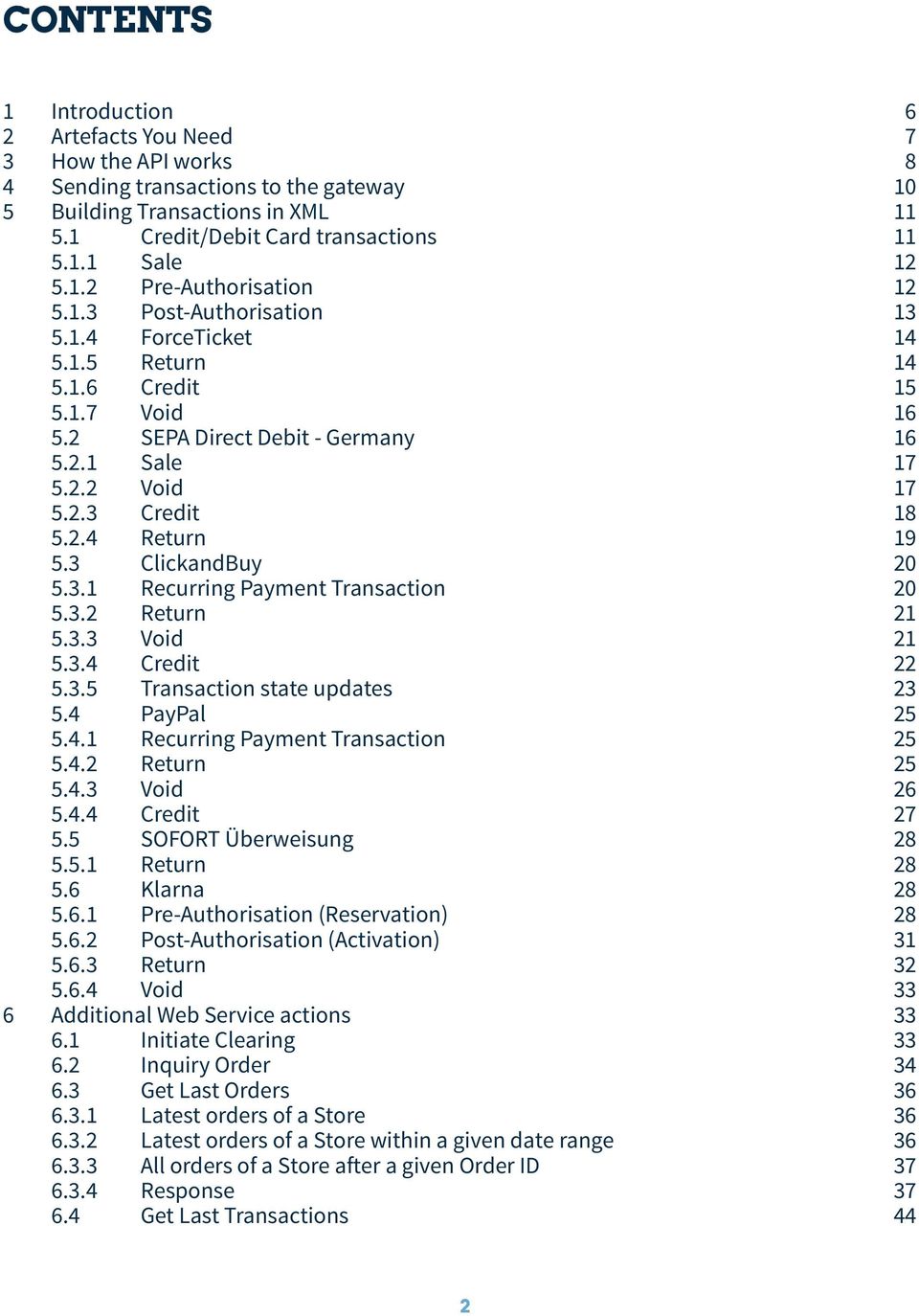
2 CONTENTS 1 Introduction 6 2 Artefacts You Need 7 3 How the API works 8 4 Sending transactions to the gateway 10 5 Building Transactions in XML Credit/Debit Card transactions Sale Pre-Authorisation Post-Authorisation ForceTicket Return Credit Void SEPA Direct Debit - Germany Sale Void Credit Return ClickandBuy Recurring Payment Transaction Return Void Credit Transaction state updates PayPal Recurring Payment Transaction Return Void Credit SOFORT Überweisung Return Klarna Pre-Authorisation (Reservation) Post-Authorisation (Activation) Return Void 33 6 Additional Web Service actions Initiate Clearing Inquiry Order Get Last Orders Latest orders of a Store Latest orders of a Store within a given date range All orders of a Store after a given Order ID Response Get Last Transactions 44 2
3 6.4.1 Latest transactions of a Store All transactions of a Store after a given Transaction ID Response Recurring Payments Install Modify Cancel Test Recurring Payments in test environment Response External transaction status Trigger notifications Basket Information and Product Catalogue Basket information in transaction messages Setting up a Product Catalogue Manage Product Stock Sale transactions using product stock 53 7 Data Vault Store or update payment information when performing a transaction Store payment information from an approved transaction Initiate payment transactions using stored data Store payment information without performing a transaction at the same time Avoid duplicate cardholder data for multiple records Display stored records Delete existing records 58 8 EMS e-dcc and Dynamic Pricing Exchange rate requests for e-dcc Exchange rate requests for Dynamic Pricing Exchange rate reponses Conversion offering Declined rate request Failed rate request E-DCC transactions 64 Step 1: Rate request 64 Step 2: Using the conversion rate for the payment transaction 65 9 Solvency Information from Bürgel Mobile top-ups XML-Tag overview Overview by transaction type Description of the XML-Tags CreditCardTxType CreditCardData cardfunction CreditCard3DSecure DE_DirectDebitTxType DE_DirectDebitData ClickandBuyTxType ClickandBuyData PayPalTxType Payment 80 3

4 TransactionDetails InquiryRateReference Billing Shipping TopUpTxType ClientLocale RequestCardRateForDCC RequestMerchantRateForDynamicPricing CardRateForDCC and MerchantRateForDynamicPricing MCC 6012 Visa Mandate Market Segment Addendum Building a SOAP Request Message Reading the SOAP Response Message SOAP Response Message SOAP Fault Message SOAP-ENV:Server SOAP-ENV:Client Analysing the Transaction Result Transaction Approval Transaction Failure Building an HTTPS POST Request PHP 96 Using the curl PHP Extension 97 Using the curl Command Line Tool ASP Establishing an SSL connection PHP 100 Using the PHP curl Extension 100 Using the curl Command Line Tool ASP Sending the HTTPS POST Request and Receiving the Response PHP 103 Using the PHP curl Extension 103 Using the curl Command Line Tool ASP Using a Java Client to connect to the web service Instance an IPGApiClient How to construct a transaction and handle the response How to construct an action How to connect behind a proxy 107 Appendix 108 XML 108 XML Schemata 108 Troubleshooting - Merchant Exceptions 109 Troubleshooting - Processing Exceptions 114 Troubleshooting - Login error messages when using curl 118 Troubleshooting - Login error messages when using the Java Client 120 4

5 Getting Support There are different manuals available for the EMS e-commerce Gateway solution. This Integration Guide will be the most helpful for integrating the Web Service API for usage with our distribution channels in Europe, Asia, Latin America and Africa. For information about settings, customization, reports and how to process transactions manually (by keying in the information) please refer to the User Guide e-commerce Gateway. If you have read the documentation and cannot find the answer to your question, please contact your local support team. Information for merchants with existing Web Service API integration using the Java client to connect to the web service: The implementation of the IPGApiClient and some signatures of methods of this class have been changed due to a change from appache http client 3.x to appache http client 4.x Transaction classes and transaction factory have not been changed If the previous IPGApiClient works in your environment, you can continue to use it. 5
6 1 Introduction The Web Service API is an Application Programming Interface which allows you to connect your application with the EMS e-commerce Gateway. In this way, your application is able to submit payment transactions without any user interference. Please note that if you store or process cardholder data within your own application, you must ensure that your system components are compliant with the Data Security Standard of the Payment Card Industry (PCI DSS). Depending on your transaction volume, an assessment by a Qualified Security Assessor may be mandatory to declare your compliance status. From a technical point of view, this API is a Web Service offering one remote operation for performing transactions. The three core advantages of this design can be summarized as follows: Platform independence: Communicating with the Web Service API means that your application must only be capable of sending and receiving SOAP messages. There are no requirements tied to a specific platform, since the Web Service technology builds on a set of open standards. In short, you are free to choose any technology you want (e.g. J2EE,.NET, PHP, ASP, etc.) for making your application capable of communicating with the Web Service API. Easy integration: Communicating with a Web Service is simple your application has to build a SOAP request message encoding your transaction, send it via HTTPS to the Web Service and wait for a SOAP response message which contains your transaction s status report. Since SOAP and HTTP are designed to be lightweight protocols, building requests and responses becomes a straightforward task. Furthermore, you rarely have to do this manually, since there are plenty of libraries available in almost every technology. In general, building a SOAP request and handling the response is reduced to a few lines of code. Security: All communication between your application and the Web Service API is SSL-encrypted. This is established by your application holding a client certificate which identifies it uniquely at the Web Service. In the same way, the EMS e- Commerce Gateway holds a server certificate which your application may check for making sure that it speaks to our Web Service API. Finally, your application has to do a basic authorisation (user name / password) before being allowed to communicate with the Web Service. In this way, the users who are authorised to communicate with the EMS e-commerce Gateway are identified. These two security mechanisms guarantee that the transaction data sent to EMS both stays private and is identified as transaction data that your application has committed and belongs to no one else. While this represents just a short summary of the Web Service API s features, the focus of this guide lies on integrating the EMS e-commerce Gateway functionality into your application. A detailed description, explaining how this is done step by step, is presented in this guide. In this guide, you will see the EMS e-commerce Gateway also being referred to as IPG. 6

7 2 Artefacts You Need Supporting a high degree of security requires several artefacts you need for communicating securely with the Web Service API. Since these artefacts are referenced throughout the remainder of this guide, the following checklist shall provide an overview enabling you to make sure that you have received the whole set when registering your application for the EMS e-commerce Gateway: o o o o o o o o o Store ID: Your store ID (e.g ) which is required for the basic authorization. User ID: The user ID denoting the user who is allowed to access the Web Service API, e.g. 1. Again, this is required for the basic authorization. Password: The password required for the basic authorization. Client Certificate p12 File: The client certificate stored in a p12 file having the naming scheme WSstoreID._.userID.p12, e.g. in case of the above store ID / user ID examples, this would be WS101._.007.p12. This file is used for authenticating the client at the EMS e-commerce Gateway. For connecting with Java you need a ks-file, e.g.: WS _.1.ks. Client Certificate Installation Password: The password which is required for installing the p12 client certificate file. Client Certificate Private Key: The private key of the client certificate stored in a key file having the naming scheme WSstoreID._.userID.key, e.g. in case of the above store ID / user ID examples, this would be WS _.1.key. Some tools which support you in setting up your application for using the Web Service API require this password when doing the client authentication at the EMS e-commerce Gateway. Client Certificate Private Key Password: This password protects the private key of the client certificate. Some tools which support you in setting up your application for using the Web Service API require this password when doing the client authentication at the EMS e-commerce Gateway. It follows the naming scheme ckp_creationtimestamp. For instance, this might be ckp_ Client Certificate PEM File: The client certificate stored in a PEM file having the naming scheme WSstoreID._.userID.pem, e.g. in case of the above store ID / user ID examples, this would be WS _.1.pem. Some tools which support you in setting up your application for using the EMS e- Commerce Gateway require this file instead of the p12 file described above. Server Certificate PEM File: The server certificate stored in the PEM file geotrust.pem which is required for authenticating the server running the Web Service API. For connecting with Java you need the truststore.ksfile. 7

8 3 How the API works The following section describes the API by means of a credit card transaction. The process for other payment types is similar. In most cases, a customer starts the overall communication process by buying goods or services with her credit card in your online store. Following this, your store sends a credit card transaction (mostly in order to capture the customer s funds) via the Web Service API. Having received the transaction, the EMS e-commerce Gateway forwards it to the credit card processor for authorisation. Based on the result, an approval or error is returned to your online store. This means that all communication and processing details are covered by the EMS e-commerce Gateway and you only have to know how to communicate with this Web Service. The Web Service Standard defines such an interface by using the Web Service Definition Language (WSDL). A WSDL file defining the Web Service API for the EMS e-commerce Gateway can be found at: Note that you will have to supply your client certificate, your credentials, and the server certificate when viewing or requesting the file e.g. in a Web browser. For instance, in case you want to view the WSDL file in Microsoft s Internet Explorer running on Microsoft Windows XP, you first have to install your client certificate and the server certificate, and then call the above URL. This is done by executing the following steps: 1. Open the folder in which you have saved your client certificate p12 file. 2. Double-click the client certificate p12 file. 3. Click Next. Check the file name (which should be already set to the path of your client certificate p12 file) and click Next. 4. Provide the client certificate installation password and click Next. 5. Choose the option Automatically select the certificate store based on the type of certificate and click Next. This will place the certificate in your personal certificate store (more precisely in the local Windows user s personal certificate store). 6. Check the displayed settings and click Finish. Your client certificate is now installed. 7. Now, you have to install the server certificate. The most straightforward way to do this is to open the folder in which you have saved your server certificate PEM file and rename the file to geotrust.crt. 8. Then, double-click the renamed server certificate file. 9. Click Install Certificate. This starts the same wizard as above. 10. Click Next. Select Place all certificates in the following store and browse for the Trusted Root Certification Authorities folder. Click Next. 8

9 11. Check the displayed settings and click Finish (you might have to confirm the installation). The server certificate is now installed in the local computer s trusted certificates store. Here, Microsoft Internet Explorer can lookup the server certificate for verifying the EMS e-commerce Gateway server certificate received when calling the WSDL URL above. 12. Now, open a Microsoft Internet Explorer window and provide the above URL in the address field. 13. After requesting the URL, the server will ask your browser to supply the client certificate to making sure that it is talking to your application correctly. Since you have installed the certificate in the previous steps, it is transferred to the server without prompting you for any input (i.e. you will not notice this process). Then, the EMS e-commerce Gateway sends its server certificate (identifying it uniquely) to you. This certificate is verified against the trusted one you have installed above. Again, this is done automatically without prompting you for any input. Now, a secure connection is established and all data transferred between your application and the Web Service API is SSL-encrypted. 14. Next, you will be prompted to supply your credentials for authorisation. As user name you have to provide your store ID and user ID encoded in the format WSstoreID._.userID. For instance, assuming your store ID is 101, your user ID 007, and your password mypw, you have to supply WS101._.007 in the user name field and mypw in the password field. Note that your credentials are encrypted before being passed to the server due to the SSL connection established in the steps above. Then, click OK. 15. The Web Service API WSDL file is displayed. In short, the WSDL file defines the operations offered by the Web Service, their input and return parameters, and how these operations can be invoked. In case of the EMS e- Commerce Gateway Web Service API, it defines only one operation (IPGApiOrder) callable by sending a SOAP HTTP request to the following URL: This operation takes an XML-encoded transaction as input and returns an XML-encoded response. Note that it is not necessary to understand how the WSDL file is composed for using the EMS e-commerce Gateway. The following chapters will guide you in setting up your store for building and performing custom credit card transactions. However, in case you are using third-party tools supporting you in setting up your store for accessing the Web Service API, you might have to supply the URL where the WSDL file can be found. In a similar way as described above, you have to tell your Web Service tool, that the communication is SSL-enabled, requiring you to provide your client certificate and accept the server certificate as a trusted one. Furthermore, you have to supply your credentials. How all is done heavily depends on your Web Service tool. Hence, check the tool s documentation for details. 9

10 4 Sending transactions to the gateway The purpose of this chapter is to give you a basic understanding of the steps to be taken when committing transactions to the EMS e-commerce Gateway. It describes what happens if a customer pays with her credit card in an online store using the Web Service API for committing transactions. The customer clicks on the Pay button in the online store. The online store displays a form asking the customer to provide her credit card number and the expiry month and year. The customer types in these three fields and submits the data to the online store (i. e. purchases the goods). The online store receives the data and builds an XML document encoding a Sale transaction which includes the data provided by the customer and the total amount to be paid by the customer. After building the XML Sale transaction, the online store wraps it in a SOAP message which describes the Web Service operation to be called with the transaction XML being passed as a parameter. Having built the SOAP message, the online store prepares it for being transferred over the Internet by packing its content into an HTTPS POST request. Furthermore, the store sets the HTTP headers, especially its credentials (note that the credentials are the same as the ones you have to provide for viewing the WSDL file). Now, the store establishes an SSL connection by providing the client and server certificate. Then, the online store sends the HTTPS request to the Web Service API and waits for an HTTP response. The Web Service API receives the HTTPS request and parses out the authorization information provided by the store in the HTTP headers. Having authorized the store to use the EMS e-commerce Gateway, the SOAP message contained in the HTTP request body is parsed out. This triggers the Web Service operation handling the transaction processing to run. The EMS e-commerce Gateway then performs the transaction processing, builds an XML response document, wraps it in a SOAP message, and sends this SOAP message back to the client in the body of an HTTPS response. Receiving this HTTPS response wakes up the store which reads out the SOAP message and response XML document being part of it. Depending on the data contained in the XML response document an approval page is sent back to the customer in case of a successful transaction, otherwise an error page is returned. The approval or error page is displayed. While this example describes the case of a Sale transaction, other transactions basically follow the same process. 10

11 Summarising the scenario, your application has to perform the following steps in order to commit credit card transactions and analyze the result: Build an XML document encoding your transactions Wrap that XML document in a SOAP request message Build an HTTPS POST request with the information identifying your store provided in the HTTP header and the SOAP request message in the body Establish an SSL connection between your application and the Web Service API Send the HTTPS POST request to the EMS e-commerce Gateway and receive the response Read the SOAP response message out of the HTTPS response body Analyse the XML response document contained in the SOAP response message These seven steps are described in the following chapters. They guide you through the process of setting up your application for performing custom credit card transactions. 5 Building Transactions in XML This chapter describes how the different transaction types can be built in XML. As the above example scenario has outlined, a transaction is first encoded in an XML document which is then wrapped as payload in a SOAP message. That means the XML-encoded transaction represents the parameter passed to the Web Service API operation. Note that there exists a variety of Web Service tools supporting you in the generation of client stubs which might free you of the necessity to deal with raw XML. However, a basic understanding of the XML format is crucial in order to build correct transactions regardless of the available tool support. Hence, it is recommended to become familiar with the XML format used by the Web Service API for encoding transactions. 5.1 Credit/Debit Card transactions Regardless of the transaction type, the basic XML document structure of a credit/debit card transaction is as follows: <ipgapi:ipgapiorderrequest xmlns:v1=" xmlns:ipgapi=" <v1:transaction> <v1:creditcardtxtype>...</v1:creditcardtxtype> <v1:creditcarddata>...</v1:creditcarddata> <v1:payment>...</v1:payment> <v1:transactiondetails>...</v1:transactiondetails> <v1:billing>...</v1:billing> <v1:shipping>...</v1:shipping> </v1:transaction> </ipgapi:ipgapiorderrequest> The element CreditCardDataTXType is mandatory for all credit card transactions. The other elements depend on the transaction type. The transaction content is type-specific. For XML-tags related to Card Present transactions with a chip reader and PIN entry device please refer to the xsd s in the Appendix of this document. 11

12 5.1.1 Sale The following XML document represents an example of a Sale transaction using the minimum set of elements: <ipgapi:ipgapiorderrequest xmlns:v1=" xmlns:ipgapi=" <v1:transaction> <v1:creditcardtxtype> <v1:type>sale</v1:type> </v1:creditcardtxtype> <v1:creditcarddata> <v1:cardnumber> </v1:cardnumber> <v1:expmonth>12</v1:expmonth> <v1:expyear>07</v1:expyear> </v1:creditcarddata> <v1:payment> <v1:chargetotal>19.95</v1:chargetotal> <v1:currency>978</v1:currency> </v1:payment> </v1:transaction> </ipgapi:ipgapiorderrequest> See chapter XML-Tag overview for a detailed description of all elements used in the above example as well as further optional elements Pre-Authorisation The following XML document represents an example of a PreAuth transaction using the minimum set of elements: <ipgapi:ipgapiorderrequest xmlns:v1=" xmlns:ipgapi=" <v1:transaction> <v1:creditcardtxtype> <v1:type>preauth</v1:type> </v1:creditcardtxtype> <v1:creditcarddata> <v1:cardnumber> </v1:cardnumber> <v1:expmonth>12</v1:expmonth> <v1:expyear>07</v1:expyear> </v1:creditcarddata> <v1:payment> <v1:chargetotal>100.00</v1:chargetotal> <v1:currency>978</v1:currency> </v1:payment> </v1:transaction> </ipgapi:ipgapiorderrequest> 12

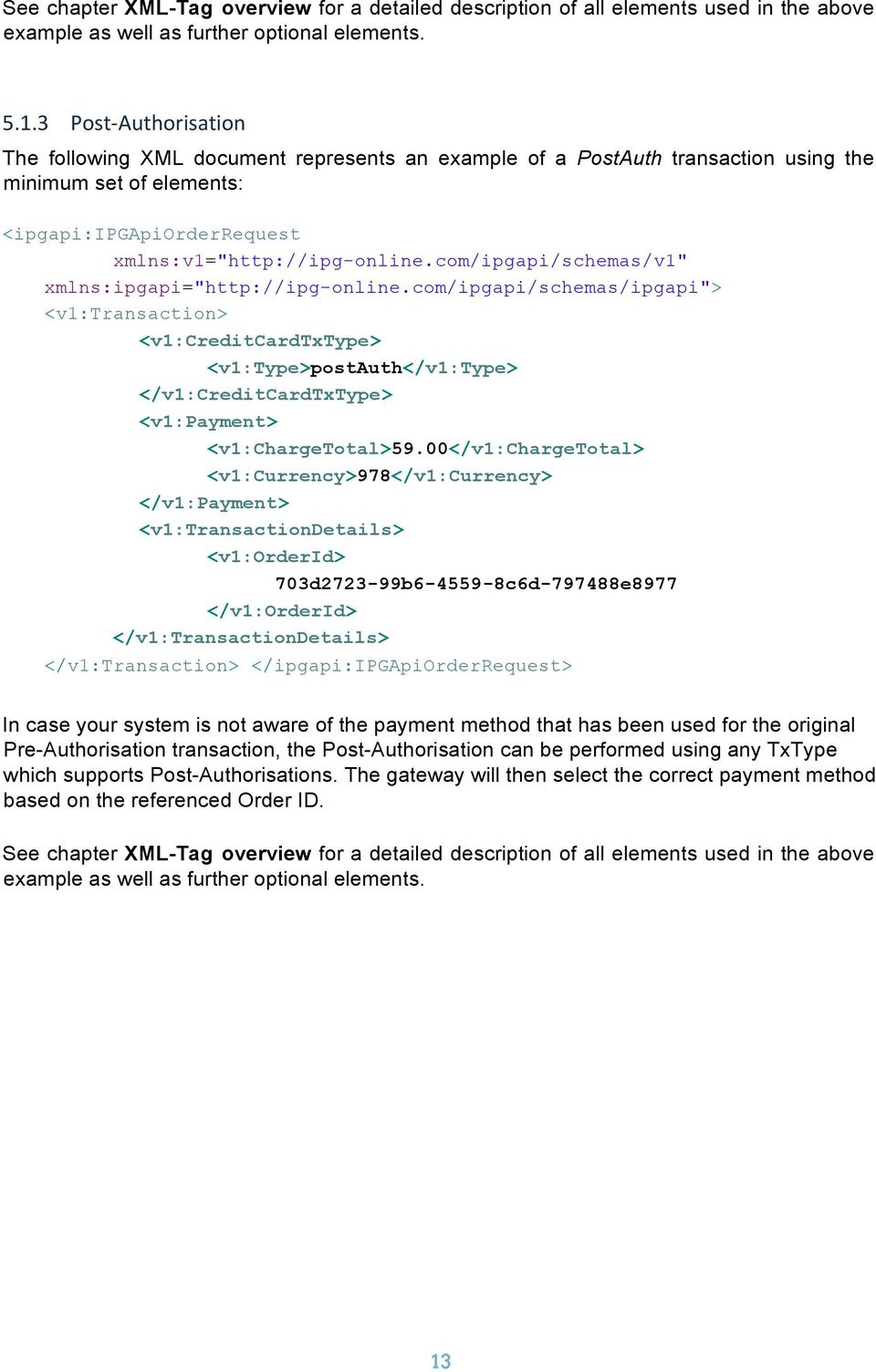
13 See chapter XML-Tag overview for a detailed description of all elements used in the above example as well as further optional elements Post-Authorisation The following XML document represents an example of a PostAuth transaction using the minimum set of elements: <ipgapi:ipgapiorderrequest xmlns:v1=" xmlns:ipgapi=" <v1:transaction> <v1:creditcardtxtype> <v1:type>postauth</v1:type> </v1:creditcardtxtype> <v1:payment> <v1:chargetotal>59.00</v1:chargetotal> <v1:currency>978</v1:currency> </v1:payment> <v1:transactiondetails> <v1:orderid> 703d b c6d e8977 </v1:orderid> </v1:transactiondetails> </v1:transaction> </ipgapi:ipgapiorderrequest> In case your system is not aware of the payment method that has been used for the original Pre-Authorisation transaction, the Post-Authorisation can be performed using any TxType which supports Post-Authorisations. The gateway will then select the correct payment method based on the referenced Order ID. See chapter XML-Tag overview for a detailed description of all elements used in the above example as well as further optional elements. 13
14 5.1.4 ForceTicket The following XML document represents an example of a ForceTicket transaction using the minimum set of elements: <ipgapi:ipgapiorderrequest xmlns:v1=" xmlns:ipgapi=" <v1:transaction> <v1:creditcardtxtype> <v1:type>forceticket</v1:type> </v1:creditcardtxtype> <v1:creditcarddata> <v1:cardnumber> </v1:cardnumber> <v1:expmonth>12</v1:expmonth> <v1:expyear>07</v1:expyear> </v1:creditcarddata> <v1:payment> <v1:chargetotal>59.00</v1:chargetotal> <v1:currency>978</v1:currency> </v1:payment> <v1:transactiondetails> <v1:referencenumber>123456</v1:referencenumber> </v1:transactiondetails> </v1:transaction> </ipgapi:ipgapiorderrequest> See chapter XML-Tag overview for a detailed description of all elements used in the above example as well as further optional elements Return The following XML document represents an example of a Return transaction using the minimum set of elements: <ipgapi:ipgapiorderrequest xmlns:v1=" xmlns:ipgapi=" <v1:transaction> <v1:creditcardtxtype> <v1:type>return</v1:type> </v1:creditcardtxtype> <v1:payment> <v1:chargetotal>19.00</v1:chargetotal> <v1:currency>978</v1:currency> </v1:payment> <v1:transactiondetails> <v1:orderid> 62e3b5df e e49302b1807 </v1:orderid> </v1:transactiondetails> </v1:transaction> </ipgapi:ipgapiorderrequest> 14

15 In case your system is not aware of the payment method that has been used for the original transaction, the Return can be performed using any TxType which supports Returns. The gateway will then select the correct payment method based on the referenced Order ID. See chapter XML-Tag overview for a detailed description of all elements used in the above example as well as further optional elements Credit Please note that Credit is a transaction type that requires special user permissions. The following XML document represents an example of a Credit transaction using the minimum set of elements: <ipgapi:ipgapiorderrequest xmlns:v1=" xmlns:ipgapi=" <v1:transaction> <v1:creditcardtxtype> <v1:type>credit</v1:type> </v1:creditcardtxtype> <v1:creditcarddata> <v1:cardnumber> </v1:cardnumber> <v1:expmonth>12</v1:expmonth> <v1:expyear>07</v1:expyear> </v1:creditcarddata> <v1:payment> <v1:chargetotal>50.00</v1:chargetotal> <v1:currency>978</v1:currency> </v1:payment> </v1:transaction> </ipgapi:ipgapiorderrequest> See chapter XML-Tag overview for a detailed description of all elements used in the above example as well as further optional elements. 15

16 5.1.7 Void The following XML document represents an example of a Void transaction using the minimum set of elements: <ipgapi:ipgapiorderrequest xmlns:v1=" xmlns:ipgapi=" <v1:transaction> <v1:creditcardtxtype> <v1:type>void</v1:type> </v1:creditcardtxtype> <v1:transactiondetails> <v1:orderid> 62e3b5df e e49302b1807 </v1:orderid> <v1:tdate> </v1:tdate> </v1:transactiondetails> </v1:transaction> </ipgapi:ipgapiorderrequest> For referencing to the transaction that shall be voided, this example uses the parameter TDate. If you have assigned a transaction ID (MerchantTransactionId) in the original transaction, you can alternatively submit this ID as ReferencedMerchantTransactionId instead of sending a TDate. In case your system is not aware of the payment method that has been used for the original transaction, the Void can be performed using any TxType which supports Voids. The gateway will then select the correct payment method based on the referenced Order ID and TDate. See chapter XML-Tag overview for a detailed description of all elements used in the above example as well as further optional elements. 5.2 SEPA Direct Debit - Germany Regardless of the transaction type, the basic XML document structure of a German Direct Debit transaction is as follows: <ipgapi:ipgapiorderrequest xmlns:v1=" xmlns:ipgapi=" <v1:transaction> <v1:de_directdebittxtype>...</v1:de_directdebittxtype> <v1:de_directdebitdata>...</v1:de_directdebitdata> <v1:payment>...</v1:payment> <v1:transactiondetails>...</v1:transactiondetails> <v1:billing>...</v1:billing> <v1:shipping>...</v1:shipping> </v1:transaction> </ipgapi:ipgapiorderrequest> The element DE_DirectDebitTXType is mandatory for all debit transactions. The other elements depend on the transaction type. The transaction content is type-specific. 16

17 5.2.1 Sale The following XML document represents an example of a Sale transaction using the minimum set of elements: <ipgapi:ipgapiorderrequest xmlns:v1=" xmlns:ipgapi=" <v1:transaction> <v1:de_directdebittxtype> <v1:type>sale</v1:type> </v1:de_directdebittxtype> <v1:de_directdebitdata> <v1:iban>de </v1:iban> <v1:mandatereference>0/8/15</v1:mandatereference> </v1:de_directdebitdata> <v1:billing> <v1:name>markus Mustermann</v1:Name> </v1:billing> <v1:payment> <v1:chargetotal>19.00</v1:chargetotal> <v1:currency>978</v1:currency> </v1:payment> </v1:transaction> </ipgapi:ipgapiorderrequest> See chapter XML-Tag overview for a detailed description of all elements used in the above example as well as further optional elements Void The following XML document represents an example of a Void transaction using the minimum set of elements: <ipgapi:ipgapiorderrequest xmlns:v1=" xmlns:ipgapi=" <v1:transaction> <v1:de_directdebittxtype> <v1:type>void</v1:type> </v1:de_directdebittxtype> <v1:transactiondetails> <v1:orderid> 62e3b5df e e49302b1807 </v1:orderid> <v1:tdate> </v1:tdate> </v1:transactiondetails> </v1:transaction> </ipgapi:ipgapiorderrequest> For referencing to the transaction that shall be voided, this example uses the parameter TDate. If you have assigned a transaction ID (MerchantTransactionId) in the original transaction, you can alternatively submit this ID as ReferencedMerchantTransactionId instead of sending a TDate. 17

18 In case your system is not aware of the payment method that has been used for the original transaction, the Void can be performed using any TxType which supports Voids. The gateway will then select the correct payment method based on the referenced Order ID and TDate. See chapter XML-Tag overview for a detailed description of all elements used in the above example as well as further optional elements Credit Please note that Credit is a transaction type that requires special user permissions. The following XML document represents an example of a Credit minimum set of elements: transaction using the <ipgapi:ipgapiorderrequest xmlns:v1=" xmlns:ipgapi=" <v1:transaction> <v1:de_directdebittxtype> <v1:type>credit</v1:type> </v1:de_directdebittxtype> <v1:de_directdebitdata> <v1:iban>de </v1:iban> </v1:de_directdebitdata> <v1:billing> <v1:name>markus Mustermann</v1:Name> </v1:billing> <v1:payment> <v1:chargetotal>19.00</v1:chargetotal> <v1:currency>978</v1:currency> </v1:payment> </v1:transaction> </ipgapi:ipgapiorderrequest> See chapter XML-Tag overview for a detailed description of all elements used in the above example as well as further optional elements. 18

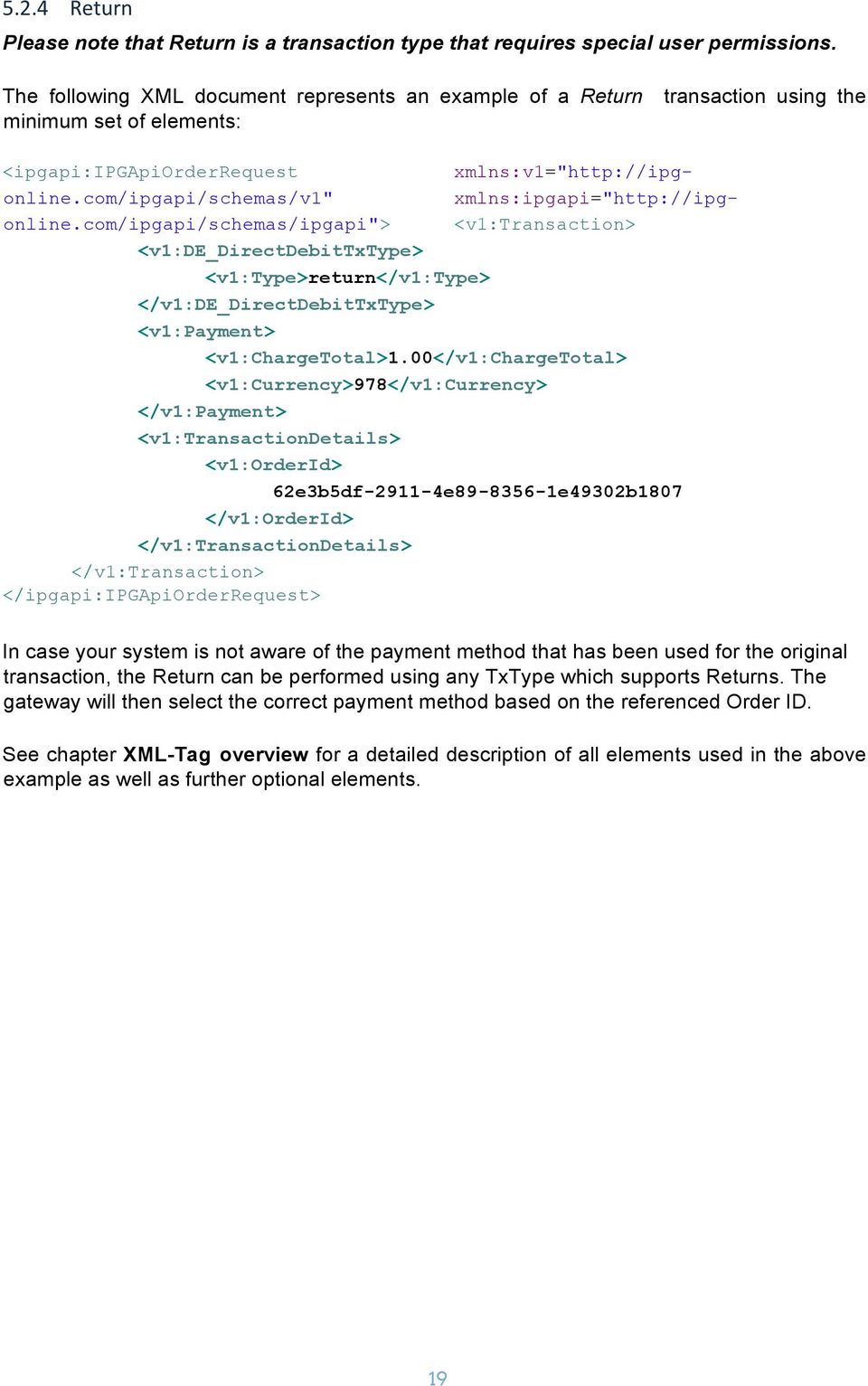
19 5.2.4 Return Please note that Return is a transaction type that requires special user permissions. The following XML document represents an example of a Return minimum set of elements: transaction using the <ipgapi:ipgapiorderrequest xmlns:v1=" xmlns:ipgapi=" <v1:transaction> <v1:de_directdebittxtype> <v1:type>return</v1:type> </v1:de_directdebittxtype> <v1:payment> <v1:chargetotal>1.00</v1:chargetotal> <v1:currency>978</v1:currency> </v1:payment> <v1:transactiondetails> <v1:orderid> 62e3b5df e e49302b1807 </v1:orderid> </v1:transactiondetails> </v1:transaction> </ipgapi:ipgapiorderrequest> In case your system is not aware of the payment method that has been used for the original transaction, the Return can be performed using any TxType which supports Returns. The gateway will then select the correct payment method based on the referenced Order ID. See chapter XML-Tag overview for a detailed description of all elements used in the above example as well as further optional elements. 19
20 5.3 ClickandBuy Recurring Payment Transaction After a recurring payment authorisation for ClickandBuy has been submitted via the EMS e- Commerce Gateway s HPP interface or Virtual Terminal, the Web Service API can be used to perform recurring payments up to the maximum transaction count or the full authorised amount. The following XML document represents an example of a PostAuth transaction using the minimum set of elements: <ns5:ipgapiorderrequest xmlns:ns5=" xmlns:ns2=" xmlns:ns3=" xmlns:ns4=" <ns4:transaction> <ns4:clickandbuytxtype> <ns4:type>postauth</ns4:type> </ns4:clickandbuytxtype> <ns4:payment> <ns4:chargetotal>1</ns4:chargetotal> <ns4:currency>eur</ns4:currency> </ns4:payment> <ns4:transactiondetails> <ns4:orderid> C-32121f4d-852f-4f b917c079 </ns4:orderid> </ns4:transactiondetails> </ns4:transaction> </ns5:ipgapiorderrequest> See chapter XML-Tag overview for a detailed description of all elements used in the above example as well as further optional elements. 20

21 5.3.2 Return The following XML document represents an example of a Return transaction using the minimum set of elements: <ns5:ipgapiorderrequest xmlns:ns5=" xmlns:ns2=" xmlns:ns3=" mlns:ns4=" <ns4:transaction> <ns4:clickandbuytxtype> <ns4:type>return</ns4:type> </ns4:clickandbuytxtype> <ns4:payment> <ns4:chargetotal>0.4</ns4:chargetotal> <ns4:currency>eur</ns4:currency> </ns4:payment> <ns4:transactiondetails> <ns4:orderid> C-32121f4d-852f-4f b917c079 </ns4:orderid> </ns4:transactiondetails> </ns4:transaction> </ns5:ipgapiorderrequest> In case your system is not aware of the payment method that has been used for the original transaction, the Return can be performed using any TxType which supports Returns. The gateway will then select the correct payment method based on the referenced Order ID Void The following XML document represents an example of a Void transaction using the minimum set of elements: <ns5:ipgapiorderrequest xmlns:ns5=" xmlns:ns2=" xmlns:ns3=" mlns:ns4=" <ns4:transaction> <ns4:clickandbuytxtype> <ns4:type>void</ns4:type> </ns4:clickandbuytxtype> <ns4:transactiondetails> <ns4:orderid> C-32121f4d-852f-4f b917c079 </ns4:orderid> <ns4:tdate> </ns4:tdate> </ns4:transactiondetails> </ns4:transaction> </ns5:ipgapiorderrequest> 21
22 For referencing to the transaction that shall be voided, this example uses the parameter TDate. If you have assigned a transaction ID (MerchantTransactionId) in the original transaction, you can alternatively submit this ID as ReferencedMerchantTransactionId instead of sending a TDate. In case your system is not aware of the payment method that has been used for the original transaction, the Void can be performed using any TxType which supports Voids. The gateway will then select the correct payment method based on the referenced Order ID and TDate Credit Please note that Credit is a transaction type that requires special user permissions. The following XML document represents an example of a Credit transaction using the minimum set of elements: <ns5:ipgapiorderrequest xmlns:ns5=" xmlns:ns2=" xmlns:ns3=" mlns:ns4=" <ns4:transaction> <ns4:clickandbuytxtype> <ns4:type>credit</ns4:type> </ns4:clickandbuytxtype> <ns4:clickandbuydata /> <ns4:payment> <ns4:chargetotal>1</ns4:chargetotal> <ns4:currency>eur</ns4:currency> </ns4:payment> <ns4:billing> <ns4: >[email protected]</ns4: > </ns4:billing> </ns4:transaction> </ns5:ipgapiorderrequest> Unlike with other payment methods, ClickandBuy transactions contain no payment data like a card number. Therefore this transaction requires the registered address of the recipient of the payment. This address must be submitted in the field ns4:billing/ns4: . 22
23 5.3.5 Transaction state updates Changes to the status of ClickandBuy transactions are automatically being updated using ClickandBuy s Merchant Message System (MMS).If you want to request the latest state of a transaction from ClickandBuy, you can use the Web Service API s GetExternalTransactionStatus action: <ns5:ipgapiactionrequest xmlns:ns5=" xmlns:ns2=" xmlns:ns3=" xmlns:ns4=" <ns3:action> <ns3:getexternaltransactionstatus> <ns3:orderid> C-32121f4d-852f-4f b917c079 </ns3:orderid> <ns3:tdate> </ns3:tdate> </ns3:getexternaltransactionstatus> </ns3:action> </ns5:ipgapiactionrequest> 23
24 After a successful call the current state is in the response in field TransactionState. <ipgapi:ipgapiactionresponse xmlns:ipgapi=" xmlns:a1=" xmlns:pay_1_0_0=" xmlns:v1=" <ipgapi:successfully>true</ipgapi:successfully> <a1:transactionvalues> <v1:payment> <v1:chargetotal>1</v1:chargetotal> <v1:currency>978</v1:currency> </v1:payment> <v1:transactiondetails> <v1:orderid> C-32121f4d-852f-4f b917c079 </v1:orderid> <v1:tdate> </v1:tdate> </v1:transactiondetails> <ipgapi:ipgapiorderresponse> <ipgapi:approvalcode> Y:000000: :PPX : </ipgapi:approvalcode> <ipgapi:avsresponse>ppx</ipgapi:avsresponse> <ipgapi:orderid> C-32121f4d-852f-4f b917c079 </ipgapi:orderid> <ipgapi:paymenttype>clickandbuy</ipgapi:paymenttype> <ipgapi:processorapprovalcode> </ipgapi:processorapprovalcode> <ipgapi:processorreceiptnumber> 4001 </ipgapi:processorreceiptnumber> <ipgapi:processorccvresponse /> <ipgapi:processortracenumber> </ipgapi:processortracenumber> <ipgapi:tdate> </ipgapi:tdate> <ipgapi:tdateformatted> :11:48 (MEZ) </ipgapi:tdateformatted> <ipgapi:terminalid> </ipgapi:terminalid> </ipgapi:ipgapiorderresponse> <a1:receiptnumber>4001</a1:receiptnumber> <a1:tracenumber>117399</a1:tracenumber> <a1:transactionstate>captured</a1:transactionstate> <a1:submissioncomponent>api</a1:submissioncomponent> </a1:transactionvalues> </ipgapi:ipgapiactionresponse> 24
25 5.4 PayPal Recurring Payment Transaction After a recurring payment authorisation for PayPal has been submitted via the EMS e- Commerce Gateway s HPP interface, the Web Service API can be used to perform recurring payments. The following XML document represents an example of a PostAuth transaction using the minimum set of elements: <ns5:ipgapiorderrequest xmlns:ns5=" xmlns:ns3=" xmlns:ns4=" <ns4:transaction> <ns4:paypaltxtype> <ns4:type>postauth</ns4:type> </ns4:paypaltxtype> <ns4:payment> <ns4:chargetotal>1</ns4:chargetotal> <ns4:currency>eur</ns4:currency> </ns4:payment> <ns4:transactiondetails> <ns4:orderid> C-32121f4d-852f-4f b917c079 </ns4:orderid> </ns4:transactiondetails> </ns4:transaction> </ns5:ipgapiorderrequest> See chapter XML-Tag overview for a detailed description of all elements used in the above example as well as further optional elements Return The following XML document represents an example of a Return transaction using the minimum set of elements: <ns5:ipgapiorderrequest xmlns:ns5= xmlns:ns3=" mlns:ns4=" <ns4:transaction> <ns4:paypaltxtype> <ns4:type>return</ns4:type> </ns4:paypaltxtype> <ns4:payment> <ns4:chargetotal>0.4</ns4:chargetotal> <ns4:currency>eur</ns4:currency> </ns4:payment> <ns4:transactiondetails> <ns4:orderid> C-32121f4d-852f-4f b917c079 </ns4:orderid> </ns4:transactiondetails> </ns4:transaction> </ns5:ipgapiorderrequest> 25
26 In case your system is not aware of the payment method that has been used for the original transaction, the Return can be performed using any TxType which supports Returns. The gateway will then select the correct payment method based on the referenced Order ID Void The following XML document represents an example of a Void transaction using the minimum set of elements: <ns5:ipgapiorderrequest xmlns:ns5=" xmlns:ns3=" mlns:ns4=" <ns4:transaction> <ns4:paypaltxtype> <ns4:type>void</ns4:type> </ns4:paypaltxtype> <ns4:transactiondetails> <ns4:orderid> C-32121f4d-852f-4f b917c079 </ns4:orderid> <ns4:tdate> </ns4:tdate> </ns4:transactiondetails> </ns4:transaction> </ns5:ipgapiorderrequest> For referencing to the transaction that shall be voided, this example uses the parameter TDate. If you have assigned a transaction ID (MerchantTransactionId) in the original transaction, you can alternatively submit this ID as ReferencedMerchantTransactionId instead of sending a TDate. In case your system is not aware of the payment method that has been used for the original transaction, the Void can be performed using any TxType which supports Voids. The gateway will then select the correct payment method based on the referenced Order ID and TDate. 26
27 5.4.4 Credit Please note that Credit is a transaction type that requires special user permissions. The following XML document represents an example of a Credit transaction using the minimum set of elements: <ns5:ipgapiorderrequest xmlns:ns5=" xmlns:ns2=" mlns:ns4=" <ns4:transaction> <ns4:paypaltxtype> <ns4:type>credit</ns4:type> </ns4:paypaltxtype> <ns4:clickandbuydata /> <ns4:payment> <ns4:chargetotal>1</ns4:chargetotal> <ns4:currency>eur</ns4:currency> </ns4:payment> <ns4:billing> <ns4: >[email protected]</ns4: > </ns4:billing> </ns4:transaction> </ns5:ipgapiorderrequest> Unlike with other payment methods, PayPal transactions contain no payment data like a card number. Therefore this transaction requires the resgistered address of the recipient of the payment. This address must be submitted in the field ns4:billing/ns4: . 27
28 5.5 SOFORT Überweisung Return The following XML document represents an example of a Return transaction using the minimum set of elements: <ns5:ipgapiorderrequest xmlns:ns5= xmlns:ns3=" mlns:ns4=" <ns4:transaction> <ns4:soforttxtype> <ns4:type>return</ns4:type> </ns4:soforttxtype> <ns4:payment> <ns4:chargetotal>1.00</ns4:chargetotal> <ns4:currency>eur</ns4:currency> </ns4:payment> <ns4:transactiondetails> <ns4:orderid> C-32121f4d-852f-4f b917c079 </ns4:orderid> </ns4:transactiondetails> </ns4:transaction> </ns5:ipgapiorderrequest> In case your system is not aware of the payment method that has been used for the original transaction, the Return can be performed using any TxType which supports Returns. The gateway will then select the correct payment method based on the referenced Order ID. 5.6 Klarna Pre-Authorisation (Reservation) The following XML document represents an example of a PreAuth transaction using required set of elements, including items. The billing details (<ns2:billing>) may differ based on the customer s country. Refer to Klarna documentation on required fields for each customer country. The customer country is specified in ISO Alpha 3 format. Klarna provides cost calculation values called pclasses. You can retrieve these values through the Customisation/Klarna Setup section in the Virtual Terminal & Manager, where you will are able to view the pclasses ID. Klarna PClass Id (<ns2:klarnapclassid>) is required for all PreAuth transactions. Currency in any Klarna transaction has to correspond to the country of buyer (e.g. EUR Germany, SEK Sweden). Handling Fee should only be included in case of Klarna Invoice was selected as a payment method (<ns2:klarnapclassid>-1</ns2:klarnapclassid>). Add handling fee as a basket item with id IPG_HANDLING. 28
29 Important: Klarna PreAuth transactions can return the transaction result: WAITING - this state indicates the transaction will be reviewed by Klarna and will be updated within the next few hours. <?xml version="1.0" encoding="utf-8"?> <SOAP-ENV:Envelope xmlns:soap-env=" <SOAP-ENV:Header/> <SOAP- ENV:Body> <ns5:ipgapiorderrequest xmlns:ns5=" xmlns:ns2=" xmlns:ns3=" xmlns:ns4=" <ns2:transaction> <ns2:klarnatxtype> <ns2:type>preauth</ns2:type> </ns2:klarnatxtype> <ns2:klarnapclassid>3113</ns2:klarnapclassid> <ns2:payment> <ns2:subtotal>12.59</ns2:subtotal> <ns2:valueaddedtax>1.40</ns2:valueaddedtax> <ns2:deliveryamount>0</ns2:deliveryamount> <ns2:chargetotal>13.99</ns2:chargetotal> <ns2:currency>eur</ns2:currency> </ns2:payment> <ns2:transactiondetails> <ns2:ip> </ns2:ip> </ns2:transactiondetails> <ns2:billing> <ns2:firstname>testperson-de</ns2:firstname> <ns2:surname>approved</ns2:surname> <ns2:streetname>hellersbergstraße</ns2:streetname> <ns2:housenumber>14</ns2:housenumber> <ns2:city>neuss</ns2:city> <ns2:zip>41460</ns2:zip> <ns2:country>deu</ns2:country> <ns2:phone> </ns2:phone> <ns2: >your @ .com</ns2: > <ns2:birthdate> :00</ns2:birthdate> <ns2:gender>male</ns2:gender> </ns2:billing> <ns2:basket> <ns2:item> <ns2:id>a</ns2:id> <ns2:description>the Hobbit (Hellersbergstraße)</ns2:Description> <ns2:subtotal>0.92</ns2:subtotal> <ns2:valueaddedtax>0.58</ns2:valueaddedtax> <ns2:deliveryamount>0</ns2:deliveryamount> <ns2:chargetotal>1.5</ns2:chargetotal> <ns2:currency>eur</ns2:currency> <ns2:quantity>1</ns2:quantity> </ns2:item> <ns2:item> <ns2:id>b</ns2:id> <ns2:description>golden pen (Stårgatan)</ns2:Description> <ns2:subtotal>1.42</ns2:subtotal> <ns2:valueaddedtax>0.08</ns2:valueaddedtax> 29
30 <ns2:deliveryamount>0</ns2:deliveryamount> <ns2:chargetotal>1.5</ns2:chargetotal> <ns2:currency>eur</ns2:currency> <ns2:quantity>5</ns2:quantity> </ns2:item> <ns2:item> <ns2:id>c</ns2:id> <ns2:description>plain paper (Hausmannstätten)</ns2:Description> <ns2:subtotal>1.08</ns2:subtotal> <ns2:valueaddedtax>0.02</ns2:valueaddedtax> <ns2:deliveryamount>0</ns2:deliveryamount> <ns2:chargetotal>1.1</ns2:chargetotal> <ns2:currency>eur</ns2:currency> <ns2:quantity>2</ns2:quantity> </ns2:item> <ns2:item> <ns2:id>d</ns2:id> <ns2:description>basic clipboard (Sæffleberggate)</ns2:Description> <ns2:subtotal>0.9</ns2:subtotal> <ns2:valueaddedtax>0.1</ns2:valueaddedtax> <ns2:deliveryamount>0</ns2:deliveryamount> <ns2:chargetotal>1</ns2:chargetotal> <ns2:currency>eur</ns2:currency> <ns2:quantity>1</ns2:quantity> </ns2:item> <ns2:item> <ns2:id>e</ns2:id> <ns2:description>world cup (Kiväärikatu)</ns2:Description> <ns2:subtotal>1.51</ns2:subtotal> <ns2:valueaddedtax>0.28</ns2:valueaddedtax> <ns2:deliveryamount>0</ns2:deliveryamount> <ns2:chargetotal>1.79</ns2:chargetotal> <ns2:currency>eur</ns2:currency> <ns2:quantity>1</ns2:quantity> </ns2:item> </ns2:basket> </ns2:transaction> </ns5:ipgapiorderrequest> </SOAP-ENV:Body> </SOAP-ENV:Envelope> 30
31 5.6.2 Post-Authorisation (Activation) The following XML document represents an example of a PostAuth transaction with the required set of elements, using a subset of basket items from the Pre-Authorisation call. For full PostAuths all basket items from the Pre-Authorisation call need to be included. <?xml version="1.0" encoding="utf-8"?> <SOAP-ENV:Envelope xmlns:soap-env=" <SOAP-ENV:Header/> <SOAP- ENV:Body> <ns5:ipgapiorderrequest xmlns:ns5=" xmlns:ns2=" xmlns:ns3=" xmlns:ns4=" <ns2:transaction> <ns2:klarnatxtype> <ns2:type>postauth</ns2:type> </ns2:klarnatxtype> <ns2:payment> <ns2:subtotal>3.76</ns2:subtotal> <ns2:valueaddedtax>0.74</ns2:valueaddedtax> <ns2:deliveryamount>0</ns2:deliveryamount> <ns2:chargetotal>4.5</ns2:chargetotal> <ns2:currency>eur</ns2:currency> </ns2:payment> <ns2:transactiondetails> <ns2:orderid>a-6e590cdb-d0fb-4a ef9f6cb2f32</ns2:OrderId> <ns2:tdate> </ns2:tdate> </ns2:transactiondetails> <ns2:basket> <ns2:item> <ns2:id>a</ns2:id> <ns2:description>the Hobbit (Hellersbergstraße)</ns2:Description> <ns2:subtotal>0.92</ns2:subtotal> <ns2:valueaddedtax>0.58</ns2:valueaddedtax> <ns2:deliveryamount>0</ns2:deliveryamount> <ns2:chargetotal>1.5</ns2:chargetotal> <ns2:currency>eur</ns2:currency> <ns2:quantity>1</ns2:quantity> </ns2:item> <ns2:item> <ns2:id>b</ns2:id> <ns2:description>golden pen (Stårgatan)</ns2:Description> <ns2:subtotal>1.42</ns2:subtotal> <ns2:valueaddedtax>0.08</ns2:valueaddedtax> <ns2:deliveryamount>0</ns2:deliveryamount> <ns2:chargetotal>1.5</ns2:chargetotal> <ns2:currency>eur</ns2:currency> <ns2:quantity>2</ns2:quantity> </ns2:item> </ns2:basket> </ns2:transaction> </ns5:ipgapiorderrequest> </SOAP-ENV:Body> </SOAP-ENV:Envelope> 31
32 5.6.3 Return The following XML document represents an example of a Return transaction with the required set of elements, using a subset of basket items from the Post-Authorisation call. For a full Return all basket items from the Post-Authorisation call need to be included. You can only return items from single PostAuth transactions. <?xml version="1.0" encoding="utf-8"?> <SOAP-ENV:Envelope xmlns:soap-env=" <SOAP-ENV:Header/> <SOAP- ENV:Body> <ns5:ipgapiorderrequest xmlns:ns5=" xmlns:ns2=" xmlns:ns3=" xmlns:ns4=" <ns2:transaction> <ns2:klarnatxtype> <ns2:type>return</ns2:type> </ns2:klarnatxtype> <ns2:payment> <ns2:subtotal>0.92</ns2:subtotal> <ns2:valueaddedtax>0.58</ns2:valueaddedtax> <ns2:deliveryamount>0</ns2:deliveryamount> <ns2:chargetotal>1.5</ns2:chargetotal> <ns2:currency>eur</ns2:currency> </ns2:payment> <ns2:transactiondetails> <ns2:orderid>a-6e590cdb-d0fb-4a ef9f6cb2f32</ns2:OrderId> <ns2:tdate> </ns2:tdate> </ns2:transactiondetails> <ns2:basket> <ns2:item> <ns2:id>a</ns2:id> <ns2:description>the Hobbit (Hellersbergstraße)</ns2:Description> <ns2:subtotal>0.92</ns2:subtotal> <ns2:valueaddedtax>0.58</ns2:valueaddedtax> <ns2:deliveryamount>0</ns2:deliveryamount> <ns2:chargetotal>1.5</ns2:chargetotal> <ns2:currency>eur</ns2:currency> <ns2:quantity>1</ns2:quantity> </ns2:item> </ns2:basket> </ns2:transaction> </ns5:ipgapiorderrequest> </SOAP-ENV:Body> </SOAP-ENV:Envelope> 32
33 5.6.4 Void The following XML document represents an example of a Void transaction with the required set of elements. The request is the same regardless of whether a PreAuth or PostAuth shall be voided. <?xml version="1.0" encoding="utf-8"?> <SOAP-ENV:Envelope xmlns:soap-env=" <SOAP-ENV:Header/> <SOAP-ENV:Body> <ns5:ipgapiorderrequest xmlns:ns5=" xmlns:ns2=" xmlns:ns3=" xmlns:ns4=" <ns2:transaction> <ns2:klarnatxtype> <ns2:type>void</ns2:type> </ns2:klarnatxtype> <ns2:payment/> <ns2:transactiondetails> <ns2:orderid>a-6e590cdb-d0fb-4a ef9f6cb2f32</ns2:OrderId> <ns2:tdate> </ns2:tdate> </ns2:transactiondetails> </ns2:transaction> </ns5:ipgapiorderrequest> </SOAP-ENV:Body> </SOAP-ENV:Envelope> 6 Additional Web Service actions 6.1 Initiate Clearing Clearing for transactions can be initiated via the Web Service similar to a payment transaction: <ipgapi:ipgapiactionrequest xmlns:a1=" xmlns:ipgapi=" <a1:action> </a1:initiateclearing> </a1:action> </ipgapi:ipgapiactionrequest> Clearing will be executed directly. If clearing was not successful for at least one terminal, the gateway will send false in the response. <ipgapi:ipgapiactionresponse xmlns:ipgapi=" xmlns:a1=" xmlns:pay_1_0_0=" xmlns:v1=" <ipgapi:successfully>false</ipgapi:successfully> </ipgapi:ipgapiactionresponse> 33
34 6.2 Inquiry Order The action InquiryOrder allows you to get details about previously processed transactions of a specific order. You therefore need to submit the corresponding Order ID: <ns4:ipgapiactionrequest xmlns:ns4=" xmlns:ns2=" xmlns:ns3=" <ns2:action> <ns2:inquiryorder> <ns2:orderid> b5b7fb da8bd </ns2:orderid> </ns2:inquiryorder> </ns2:action> </ns4:ipgapiactionrequest> The result contains information about all transactions belonging to the corresponding Order ID: <?xml version="1.0" encoding="utf-8"?><ipgapi:ipgapiactionresponse xmlns:ipgapi=" xmlns:a1=" xmlns:pay_1_0_0=" xmlns:v1=" <ipgapi:successfully>true</ipgapi:successfully> <ipgapi:orderid>b5b7fb da8bd026600</ipgapi:orderid> <v1:billing/> <v1:shipping/> <a1:transactionvalues> <v1:creditcardtxtype> <v1:type>sale</v1:type> </v1:creditcardtxtype> <v1:creditcarddata> <v1:cardnumber> </v1:cardnumber> <v1:expmonth>11</v1:expmonth> <v1:expyear>17</v1:expyear> <v1:brand>visa</v1:brand> </v1:creditcarddata> <v1:payment> <v1:chargetotal>350.05</v1:chargetotal> <v1:currency>826</v1:currency> </v1:payment> 34
35 <v1:transactiondetails> <v1:comments>as400</v1:comments> <v1:invoicenumber> </v1:invoicenumber> <v1:orderid>b5b7fb da8bd026600</v1:orderid> <v1:ip> </v1:ip> <v1:tdate> </v1:tdate> <v1:transactionorigin>moto</v1:transactionorigin> </v1:transactiondetails> <ipgapi:ipgapiorderresponse> <ipgapi:approvalcode>y:015722: :ppxm:2062</ipgapi:approvalcode> <ipgapi:avsresponse>ppx</ipgapi:avsresponse> <ipgapi:brand>visa</ipgapi:brand> <ipgapi:country>gbr</ipgapi:country> <ipgapi:orderid> b5b7fb da8bd026600</ipgapi:OrderId> <ipgapi:paymenttype>creditcard</ipgapi:paymenttype> <ipgapi:processorapprovalcode>015722</ipgapi:processorapprovalcode> <ipgapi:processorccvresponse>m</ipgapi:processorccvresponse> <ipgapi:referencedtdate> </ipgapi:referencedtdate> <ipgapi:tdate> </ipgapi:tdate> <ipgapi:tdateformatted> :17:36 (CET)</ipgapi:TDateFormatted> <ipgapi:terminalid> </ipgapi:terminalid> </ipgapi:ipgapiorderresponse> <a1:tracenumber>2062</a1:tracenumber> <a1:transactionstate>captured</a1:transactionstate> <a1:submissioncomponent>connect</a1:submissioncomponent> </a1:transactionvalues> </ipgapi:ipgapiactionrespons e> 35
36 6.3 Get Last Orders This action provides a query interface for information on the latest orders that have been submitted Latest orders of a Store This query returns the last n orders of the given store Latest orders of a Store within a given date range This query returns the last n orders of the given store within the given date-range". It could also be used for pagination. Both dates DateFrom and DateTo are to be specified, in the form of xs:datetime <?xml version="1.0" encoding="utf-8"?> <SOAP-ENV:Envelope xmlns:soap-env=" <SOAP-ENV:Header/> <SOAP- ENV:Body> <ns5:ipgapiactionrequest xmlns:ns5=" xmlns:ns2=" xmlns:ns3=" xmlns:ns4=" <ns3:action> <ns3:getlastorders> <ns3:count>5</ns3:count> </ns3:getlastorders> </ns3:action> </ns5:ipgapiactionrequest> </SOAP-ENV:Body> </SOAP-ENV:Envelope> <?xml version="1.0" encoding="utf-8"?> <SOAP-ENV:Envelope xmlns:soap-env=" <SOAP-ENV:Header/> <SOAP- ENV:Body> <ns5:ipgapiactionrequest xmlns:ns5=" xmlns:ns2=" xmlns:ns3=" xmlns:ns4=" <ns3:action> <ns3:getlastorders> <ns3:count>5</ns3:count> <ns3:datefrom> t10:23: :00</ns3:datefrom> <ns3:dateto> t10:23: :00</ns3:dateto> </ns3:getlastorders> </ns3:action> </ns5:ipgapiactionrequest> </SOAP-ENV:Body> </SOAP-ENV:Envelope> 36
37 6.3.3 All orders of a Store after a given Order ID This interface is intended to support pagination of large result-sets. It returns "The last n orders of the given store after a given order (by orderid)" <?xml version="1.0" encoding="utf-8"?> <SOAP-ENV:Envelope xmlns:soap-env=" <SOAP-ENV:Header/> <SOAP-ENV:Body> <ns5:ipgapiactionrequest xmlns:ns5=" xmlns:ns2=" xmlns:ns3=" xmlns:ns4=" <ns3:action> <ns3:getlastorders> <ns3:count>2</ns3:count> <ns3:orderid>test SGSDAO.ConversionDate </ns3:OrderID> </ns3:getlastorders> </ns3:action> </ns5:ipgapiactionrequest> </SOAP-ENV:Body> </SOAP-ENV:Envelope Response All query methods return the same structure as a result. The success-status is returned by <ipgapi:successfully>true</ipgapi:successfully> <ipgapi:resultinfo>/ <a1:moreresultsavailable>true</a1:moreresultsavailable> tells if there are more results available. o The service is stateless, therefore subsequent queries for pagination have to use either o GetLastOrders(storeID, count, datefrom, dateto) w/ dateto set to the last order's order_date of the previous resultset OR o GetLastOrders(storeID, count, orderid) w/ orderid set to the last order of the previous resultset List of orders <ipgapi:ordervalues>, consisting of o OrderId the orders unique id o <a1:transactionvalues> transactions o <v1:basket> the basket with basket-items <v1:item> and each item with item-options <v1:option> <?xml version="1.0" encoding="utf-8"?><ipgapi:ipgapiactionresponse xmlns:ipgapi=" xmlns:a1=" xmlns:pay_1_0_0=" xmlns:v1=" 37
38 <ipgapi:successfully>true</ipgapi:successfully> <ipgapi:resultinfo> <a1:moreresultsavailable>true</a1:moreresultsavailable> </ipgapi:resultinfo> <ipgapi:ordervalues> <a1:orderid>a-00ddff18-b b-804f-150b2567dbc9</a1:orderid> <a1:orderdate> t13:43: :00</a1:orderdate> <v1:basket> <v1:item> <v1:id>d160c63e-7e9e-4a4a-bd5e-ae50a9133bf7</v1:id> <v1:description>katharistiko</v1:description> <v1:chargetotal>25</v1:chargetotal> <v1:quantity>1</v1:quantity> </v1:item> </v1:basket> <v1:billing/> <v1:shipping/> <a1:transactionvalues> <v1:creditcardtxtype> <v1:type>sale</v1:type> </v1:creditcardtxtype> <v1:creditcarddata> <v1:cardnumber> </v1:cardnumber> <v1:expmonth>04</v1:expmonth> <v1:expyear>17</v1:expyear> <v1:brand>mastercard</v1:brand> </v1:creditcarddata> <v1:payment> <v1:chargetotal>25</v1:chargetotal> <v1:currency>978</v1:currency> </v1:payment> <v1:transactiondetails> <v1:orderid>a-00ddff18-b b-804f-150b2567dbc9</v1:orderid> <v1:tdate> </v1:tdate> <v1:transactionorigin>retail</v1:transactionorigin> 38
39 </v1:transactiondetails> <ipgapi:ipgapiorderresponse> <ipgapi:approvalcode>y:024309: :ppxx:796023</ipgapi:approvalcode> <ipgapi:avsresponse>ppx</ipgapi:avsresponse> <ipgapi:brand>mastercard</ipgapi:brand> <ipgapi:country>grc</ipgapi:country> <ipgapi:orderid>a-00ddff18-b b-804f-150b2567dbc9</ipgapi:orderid> <ipgapi:payersecuritylevel>n</ipgapi:payersecuritylevel> <ipgapi:paymenttype>creditcard</ipgapi:paymenttype> <ipgapi:processorapprovalcode>024309</ipgapi:processorapprovalcode> <ipgapi:processorccvresponse>x</ipgapi:processorccvresponse> <ipgapi:tdate> </ipgapi:tdate> <ipgapi:tdateformatted> :43:44 (CEST)</ipgapi:TDateFormatted> <ipgapi:terminalid> </ipgapi:terminalid> </ipgapi:ipgapiorderresponse> <a1:tracenumber>796023</a1:tracenumber> <a1:transactionstate>settled</a1:transactionstate> <a1:userid>1</a1:userid> <a1:submissioncomponent>api</a1:submissioncomponent> </a1:transactionvalues> </ipgapi:ordervalues> <ipgapi:ordervalues> <a1:orderid>a-85a682a a3-b94c-a612fdc3a528</a1:orderid> <a1:orderdate> t15:45: :00</a1:orderdate> <v1:basket> <v1:item> <v1:id> d-b5fd-482b-be35-cb8a6569f7c7</v1:id> <v1:description>efimerida</v1:description> <v1:chargetotal>12.15</v1:chargetotal> <v1:quantity>1</v1:quantity> </v1:item> </v1:basket> <v1:billing/> <v1:shipping/> 39
40 <a1:transactionvalues> <v1:creditcardtxtype> <v1:type>sale</v1:type> </v1:creditcardtxtype> <v1:creditcarddata> <v1:cardnumber> </v1:cardnumber> <v1:expmonth>02</v1:expmonth> <v1:expyear>17</v1:expyear> <v1:brand>visa</v1:brand> </v1:creditcarddata> <v1:payment> <v1:chargetotal>12.15</v1:chargetotal> <v1:currency>978</v1:currency> </v1:payment> <v1:transactiondetails> <v1:orderid>a-85a682a a3-b94c-a612fdc3a528</v1:orderid> <v1:tdate> </v1:tdate> <v1:transactionorigin>retail</v1:transactionorigin> </v1:transactiondetails> <ipgapi:ipgapiorderresponse> <ipgapi:approvalcode>y:201846: :ppxx:796005</ipgapi:approvalcode> <ipgapi:avsresponse>ppx</ipgapi:avsresponse> <ipgapi:brand>visa</ipgapi:brand> <ipgapi:country>grc</ipgapi:country> <ipgapi:orderid>a-85a682a a3-b94c-a612fdc3a528</ipgapi:orderid> <ipgapi:payersecuritylevel>v</ipgapi:payersecuritylevel> <ipgapi:paymenttype>creditcard</ipgapi:paymenttype> <ipgapi:processorapprovalcode>201846</ipgapi:processorapprovalcode> <ipgapi:processorccvresponse>x</ipgapi:processorccvresponse> <ipgapi:tdate> </ipgapi:tdate> <ipgapi:tdateformatted> :45:46 (CEST)</ipgapi:TDateFormatted> <ipgapi:terminalid> </ipgapi:terminalid> </ipgapi:ipgapiorderresponse> <a1:tracenumber>796005</a1:tracenumber> 40
41 <a1:transactionstate>settled</a1:transactionstate> <a1:userid>1</a1:userid> <a1:submissioncomponent>api</a1:submissioncomponent> </a1:transactionvalues> </ipgapi:ordervalues> <ipgapi:ordervalues> <a1:orderid>a af-2baa-408e-881e-3f43f584496e</a1:orderid> <a1:orderdate> t13:58: :00</a1:orderdate> <v1:basket> <v1:item> <v1:id>bd5c1138-e a7-075c1ac31bd0</v1:id> <v1:description>taigara</v1:description> <v1:chargetotal>3.5</v1:chargetotal> <v1:quantity>1</v1:quantity> </v1:item> </v1:basket> <v1:billing/> <v1:shipping/> <a1:transactionvalues> <v1:creditcardtxtype> <v1:type>sale</v1:type> </v1:creditcardtxtype> <v1:creditcarddata> <v1:cardnumber> </v1:cardnumber> <v1:expmonth>07</v1:expmonth> <v1:expyear>18</v1:expyear> <v1:brand>mastercard</v1:brand> </v1:creditcarddata> <v1:payment> <v1:chargetotal>3.5</v1:chargetotal> <v1:currency>978</v1:currency> </v1:payment> <v1:transactiondetails> <v1:orderid>a af-2baa-408e-881e-3f43f584496e</v1:orderid> <v1:tdate> </v1:tdate> 41
42 <v1:transactionorigin>retail</v1:transactionorigin> </v1:transactiondetails> <ipgapi:ipgapiorderresponse> <ipgapi:approvalcode>y:328188: :ppxx:795995</ipgapi:approvalcode> <ipgapi:avsresponse>ppx</ipgapi:avsresponse> <ipgapi:brand>mastercard</ipgapi:brand> <ipgapi:country>grc</ipgapi:country> <ipgapi:orderid>a af-2baa-408e-881e-3f43f584496e</ipgapi:orderid> <ipgapi:payersecuritylevel>n</ipgapi:payersecuritylevel> <ipgapi:paymenttype>creditcard</ipgapi:paymenttype> <ipgapi:processorapprovalcode>328188</ipgapi:processorapprovalcode> <ipgapi:processorccvresponse>x</ipgapi:processorccvresponse> <ipgapi:tdate> </ipgapi:tdate> <ipgapi:tdateformatted> :58:15 (CEST)</ipgapi:TDateFormatted> <ipgapi:terminalid> </ipgapi:terminalid> </ipgapi:ipgapiorderresponse> <a1:tracenumber>795995</a1:tracenumber> <a1:transactionstate>settled</a1:transactionstate> <a1:userid>1</a1:userid> <a1:submissioncomponent>api</a1:submissioncomponent> </a1:transactionvalues> </ipgapi:ordervalues> <ipgapi:ordervalues> <a1:orderid>a-0606cb2c-d e-98722fc100f8</a1:orderid> <a1:orderdate> t21:34: :00</a1:orderdate> <v1:basket> <v1:item> <v1:id>a3686a1e-e2dd-4f2b-aab0-2131af33c141</v1:id> <v1:description>κρασι</v1:description> <v1:chargetotal>12.8</v1:chargetotal> <v1:quantity>1</v1:quantity> </v1:item> </v1:basket> <v1:billing/> 42
43 <v1:shipping/> <a1:transactionvalues> <v1:creditcardtxtype> <v1:type>sale</v1:type> </v1:creditcardtxtype> <v1:creditcarddata> <v1:cardnumber> </v1:cardnumber> <v1:expmonth>04</v1:expmonth> <v1:expyear>17</v1:expyear> <v1:brand>mastercard</v1:brand> </v1:creditcarddata> <v1:payment> <v1:chargetotal>12.8</v1:chargetotal> <v1:currency>978</v1:currency> </v1:payment> <v1:transactiondetails> <v1:orderid>a-0606cb2c-d e-98722fc100f8</v1:orderid> <v1:tdate> </v1:tdate> <v1:transactionorigin>retail</v1:transactionorigin> </v1:transactiondetails> <ipgapi:ipgapiorderresponse> <ipgapi:approvalcode>y:021474: :ppxx:795975</ipgapi:approvalcode> <ipgapi:avsresponse>ppx</ipgapi:avsresponse> <ipgapi:brand>mastercard</ipgapi:brand> <ipgapi:country>grc</ipgapi:country> <ipgapi:orderid>a-0606cb2c-d e-98722fc100f8</ipgapi:orderid> <ipgapi:payersecuritylevel>n</ipgapi:payersecuritylevel>... 43
44 6.4 Get Last Transactions This action provides a query interface for information on the latest transactions that have been submitted Latest transactions of a Store This query returns the last n transactions of the given store All transactions of a Store after a given Transaction ID This interface is intended to support pagination of large result-sets. It returns "The last n transactions of the given store after a given transaction (by transactionid {orderid, TDate})" A transactionid consists of the tuple OrderId the ID of the transactions order TDate the date of the transaction <?xml version="1.0" encoding="utf-8"?> <SOAP-ENV:Envelope xmlns:soap-env=" <SOAP-ENV:Header/> <SOAP- ENV:Body> <ns5:ipgapiactionrequest xmlns:ns5=" xmlns:ns2=" xmlns:ns3=" xmlns:ns4=" <ns2:action> <ns2:getlasttransactions> <ns2:count>2</ns2:count> </ns2:getlasttransactions> </ns2:action> </ns5:ipgapiactionrequest> </SOAP-ENV:Body> </SOAP-ENV:Envelope> <?xml version="1.0" encoding="utf-8"?> <SOAP-ENV:Envelope xmlns:soap-env=" <SOAP-ENV:Header/> <SOAP- ENV:Body> <ns5:ipgapiactionrequest xmlns:ns5=" xmlns:ns2=" xmlns:ns3=" xmlns:ns4=" <ns2:action> <ns2:getlasttransactions> <ns2:count>2</ns2:count> <ns2:orderid>a-eb65437a-c538-4cdd- 82b3d316ae160c22</ns2:OrderId> <ns2:tdate> </ns2:tdate> </ns2:getlasttransactions> </ns2:action> </ns5:ipgapiactionrequest> </SOAP-ENV:Body> </SOAP-ENV:Envelope> 44
45 6.4.3 Response All query methods return the same structure as a result. The success-status is returned by <ipgapi:successfully>true</ipgapi:successfully> List of transactions <a1:transactionvalues> <?xml version="1.0" encoding="utf-8"?> <SOAP-ENV:Envelope xmlns:soap-env=" <SOAP-ENV:Header/> <SOAP- ENV:Body> <ipgapi:ipgapiactionresponse xmlns:ipgapi=" xmlns:a1=" xmlns:pay_1_0_0=" xmlns:v1=" <ipgapi:successfully>true</ipgapi:successfully> <a1:transactionvalues> <v1:creditcardtxtype> <v1:type>periodic</v1:type> </v1:creditcardtxtype> <v1:creditcarddata> <v1:cardnumber> </v1:cardnumber> <v1:expmonth>12</v1:expmonth> <v1:expyear>14</v1:expyear> <v1:brand>visa</v1:brand> </v1:creditcarddata> <v1:payment> <v1:chargetotal>1</v1:chargetotal> <v1:currency>978</v1:currency> </v1:payment> <v1:transactiondetails> <v1:orderid>a-bcbb36ad-90ad-4ff7-ad96b5d73dd9c5e9</v1:orderid> <v1:tdate> </v1:tdate> </v1:transactiondetails> <ipgapi:ipgapiorderresponse> <ipgapi:approvalcode>y:272450: :ppxm: </ipgapi:approvalcode> <ipgapi:avsresponse>ppx</ipgapi:avsresponse> <ipgapi:brand>visa</ipgapi:brand> <ipgapi:orderid>a-bcbb36ad- 90ad-4ff7-ad96b5d73dd9c5e9</ipgapi:OrderId> <ipgapi:paymenttype>creditcard</ipgapi:paymenttype> <ipgapi:processorapprovalcode>272450</ipgapi:processorapprovalcode> <ipgapi:processorreceiptnumber>6659</ipgapi:processorreceiptnumber> <ipgapi:processorccvresponse>m</ipgapi:processorccvresponse> <ipgapi:processortracenumber>043383</ipgapi:processortracenumber> <ipgapi:referencedtdate> </ipgapi:referencedtdate> <ipgapi:tdate> </ipgapi:tdate> <ipgapi:tdateformatted> :00:10 (CEST)</ipgapi:TDateFormatted> <ipgapi:terminalid> </ipgapi:terminalid> </ipgapi:ipgapiorderresponse> <a1:transactionstate>captured</a1:transactionstate> <a1:userid>1</a1:userid> <a1:submissioncomponent>bus</a1:submissioncomponent> 45
46 </a1:transactionvalues> <a1:transactionvalues> <v1:creditcardtxtype> <v1:type>periodic</v1:type> </v1:creditcardtxtype> <v1:creditcarddata> <v1:cardnumber> </v1:cardnumber> <v1:expmonth>12</v1:expmonth> <v1:expyear>14</v1:expyear> <v1:brand>visa</v1:brand> </v1:creditcarddata> <v1:payment> <v1:chargetotal>1</v1:chargetotal> <v1:currency>978</v1:currency> </v1:payment> <v1:transactiondetails> <v1:orderid>a-52421c39-69c4-4b2d-959d- 9fdcd3a9420a</v1:OrderId> <v1:tdate> </v1:tdate> </v1:transactiondetails> <ipgapi:ipgapiorderresponse> <ipgapi:approvalcode>y:416502: :ppxm: </ipgapi:approvalcode> <ipgapi:avsresponse>ppx</ipgapi:avsresponse> <ipgapi:brand>visa</ipgapi:brand> <ipgapi:orderid>a-52421c39-69c4-4b2d-959d- 9fdcd3a9420a</ipgapi:OrderId> <ipgapi:paymenttype>creditcard</ipgapi:paymenttype> <ipgapi:processorapprovalcode>416502</ipgapi:processorapprovalcode> <ipgapi:processorreceiptnumber>6408</ipgapi:processorreceiptnumber> <ipgapi:processorccvresponse>m</ipgapi:processorccvresponse> <ipgapi:processortracenumber>462510</ipgapi:processortracenumber> <ipgapi:referencedtdate> </ipgapi:referencedtdate> <ipgapi:tdate> </ipgapi:tdate> <ipgapi:tdateformatted> :00:09 (CEST)</ipgapi:TDateFormatted> <ipgapi:terminalid> </ipgapi:terminalid> </ipgapi:ipgapiorderresponse> <a1:transactionstate>captured</a1:transactionstate> <a1:userid>1</a1:userid> <a1:submissioncomponent>bus</a1:submissioncomponent> </a1:transactionvalues> </ipgapi:ipgapiactionresponse> </SOAP-ENV:Body> </SOAP-ENV:Envelope> 46
47 6.5 Recurring Payments The action RecurringPayment allows you to install, modify or cancel periodic payments Install The following example shows how to install a monthly credit card payment with 12 executions (InstallmentCount) in 2011 starting on 15 January Please note that the RecurringStartDate will be interpreted based on the timezone Europe/Berlin. <ns4:ipgapiactionrequest xmlns:ns4=" xmlns:ns2=" xmlns:ns3=" <ns2:action> <ns2:recurringpayment> <ns2:function>install</ns2:function> <ns2:recurringpaymentinformation> <ns2:recurringstartdate> </ns2:recurringstartdate> <ns2:installmentcount>12</ns2:installmentcount> <ns2:installmentfrequency> 1 </ns2:installmentfrequency> <ns2:installmentperiod> month </ns2:installmentperiod> </ns2:recurringpaymentinformation> <ns2:creditcarddata> <ns3:cardnumber> </ns3:cardnumber> <ns3:expmonth>12</ns3:expmonth> <ns3:expyear>12</ns3:expyear> <ns3:cardcodevalue>977</ns3:cardcodevalue> </ns2:creditcarddata> <ns3:payment> <ns3:chargetotal>1</ns3:chargetotal> <ns3:currency>978</ns3:currency> </ns3:payment> </ns2:recurringpayment> </ns2:action> </ns4:ipgapiactionrequest> If you set the RecurringStartDate to the actual date, the first payment will immediately be initiated. In this case, the payment data will only be stored for future payments if this first payment was succesful/approved. A start date in the past is not allowed. The default value for TransactionOrigin is ECI. If you want to change this value, you can submit a different TransactionOrigin tag in the RecurringPayment tag. 47
48 It is also possible to install Recurring Payments for German Direct Debit or to refer to a previous (approved) Order ID or Data Vault record. The amount must be set, i. e. will not be taken over from a previous order Modify Modifications of an existing Recurring Payment can be initiated using the Order ID: <ns4:ipgapiactionrequest xmlns:ns4=" xmlns:ns2=" xmlns:ns3=" <ns2:action> <ns2:recurringpayment> <ns2:function>modify</ns2:function> <ns2:orderid> e368a f-4f56-9ae2-beb4023a6993 </ns2:orderid> <ns2:recurringpaymentinformation> <ns2:installmentcount>999</ns2:installmentcount> </ns2:recurringpaymentinformation> </ns2:recurringpayment> </ns2:action> </ns4:ipgapiactionrequest> You only need to include the elements that need to be changed. If you change the credit card number, it is also required to include the expiry date, otherwise you can change the expiry date without specifying the credit card number. If you want to change the amount, you also need to include the currency. It is possible to change the payment method, e. g. from Credit Card to German Direct Debit Cancel To cancel a Recurring Payment, you also use the Order ID: <ns4:ipgapiactionrequest xmlns:ns4=" xmlns:ns2=" xmlns:ns3=" <ns2:action> <ns2:recurringpayment> <ns2:function>cancel</ns2:function> <ns2:orderid> e368a f-4f56-9ae2-beb4023a6993 </ns2:orderid> </ns2:recurringpayment> </ns2:action> </ns4:ipgapiactionrequest> 48
49 6.5.4 Test Recurring Payments in test environment The test system allows you to manually initiate a scheduled payment to test this functionality. This function will not work in live mode. <ns4:ipgapiactionrequest xmlns:ns4=" xmlns:ns2=" xmlns:ns3=" <ns2:action> <ns2:recurringpayment> <ns2:function> perform only in test environment </ns2:function> <ns2:orderid> A-eab002b cc9-5bc06b8eaa61 </ns2:orderid> </ns2:recurringpayment> </ns2:action> </ns4:ipgapiactionrequest> Response The response for a successful instalment, modification or cancellation contains the value true for the parameter <ns4:successfully>: <ns4:ipgapiactionresponse xmlns:ns4=" xmlns:ns2=" xmlns:ns3=" <ns4:successfully>true</ns4:successfully> <ns4:orderid>e368a f-4f56-9ae2-beb4023a6993</ns4:orderid> </ns4:ipgapiactionresponse> 6.6 External transaction status Some payment endpoints do not send the final result of a payment transaction within their response. In such cases the EMS e-commerce Gateway returns an approval code that starts with a question mark (?: ).The action GetExternalTransactionState allows you to request updates on the state of such transactions. 49
50 6.7 Trigger notifications The action Send Notification triggers an notification for a given transaction. The will be created with the template that has been configured for your Store. See the User Guide Virtual Terminal & Online Portal for more information on transaction notifications by . <ns5:ipgapiactionrequest xmlns:ns5= xmlns:ns2=" xmlns:ns3=" xmlns:ns4=" <ns2:action> <ns2:send notification> <ns2:orderid>0/8/15</ns2:orderid> <ns2:tdate> </ns2:tdate> </ns2:send notification> </ns2:action> </ns5:ipgapiactionrequest> If the optional parameter is not set, the address of the customer stored with the transaction will be used. 6.8 Basket Information and Product Catalogue Basket information in transaction messages The following example shows how you can use the basket parameters to document in the transaction what has been sold. <ns5:ipgapiorderrequest xmlns:ns5=" xmlns:ns2=" xmlns:ns3=" xmlns:ns4=" <ns2:transaction> <ns2:creditcardtxtype> <ns2:type>sale</ns2:type> </ns2:creditcardtxtype> <ns2:creditcarddata> <ns2:cardnumber>403587xxxxxx4977</ns2:cardnumber> <ns2:expmonth>12</ns2:expmonth> <ns2:expyear>14</ns2:expyear> </ns2:creditcarddata> <ns2:payment> <ns2:chargetotal>1</ns2:chargetotal> <ns2:currency>eur</ns2:currency> </ns2:payment> <ns2:transactiondetails> <ns2:orderid>68d4a595-fd cd-1ae13962a3ac</ns2:orderid> </ns2:transactiondetails> <ns2:basket> <ns2:item> <ns2:id>product ID xyz</ns2:id> 50
51 <ns2:description>description of abc</ns2:description> <ns2:chargetotal>11</ns2:chargetotal> <ns2:currency>eur</ns2:currency> <ns2:quantity>5</ns2:quantity> <ns2:option> <ns2:name>colour</ns2:option> <ns2:choice>blue</ns2:choice> </ns2:option> <ns2:option> <ns2:name>size</ns2:option> <ns2:choice>large</ns2:choice> </ns2:option> </ns2:item> </ns2:basket> </ns2:transaction> </ns5:ipgapiorderrequest> Setting up a Product Catalogue You can store basic information about the products you sell in the following way: <ns5:ipgapiactionrequest xmlns:ns5=" xmlns:ns2=" xmlns:ns3=" xmlns:ns4=" <ns3:action> <ns3:manageproducts> <ns3:function>store</ns3:function> <ns3:product> <ns3:productid>product ID xyz</ns3:productid> <ns2:chargetotal>2</ns2:chargetotal> <ns2:currency>eur</ns2:currency> <ns3:offerstarts> T13:29: :00 </ns3:offerstarts> <ns3:offerends> T14:29: :00 </ns3:offerends> <ns2:option> <ns2:name>colour</ns2:option> <ns2:choice>blue</ns2:choice> </ns2:option> <ns2:option> <ns2:name>size</ns2:option> <ns2:choice>large</ns2:choice> </ns2:option> </ns3:product> </ns3:manageproducts> </ns3:action> </ns5:ipgapiactionrequest> OfferStarts and OfferEnds are optional and can be used to restrict the visibility of the related products in custom applications but they will not restrict the possibility of a sale. There are 51
52 further optional fields Description, OptionName and Name. Please take a look at the a1.xsd in the appendix of this document. The function display shows the requested product with every characteristics. <ns5:ipgapiactionrequest xmlns:ns5=" xmlns:ns2=" xmlns:ns3=" xmlns:ns4=" <ns3:action> <ns3:manageproducts> <ns3:function>display</ns3:function> <ns3:product> <ns3:productid>product ID xyz</ns3:productid> </ns3:product> </ns3:manageproducts> </ns3:action> </ns5:ipgapiactionrequest> The function delete can be used to set the available stock of a product to zero. <ns5:ipgapiactionrequest xmlns:ns5=" xmlns:ns2=" xmlns:ns3=" xmlns:ns4=" <ns3:action> <ns3:manageproducts> <ns3:function>delete</ns3:function> <ns3:product> <ns3:productid>product ID xyz</ns3:productid> </ns3:product> </ns3:manageproducts> </ns3:action> </ns5:ipgapiactionrequest> Manage Product Stock For every product stock function, the product ID and given options need to exist in your Product Catalogue. After you have installed a product, you can fill the product stock with the function add. <ns5:ipgapiactionrequest xmlns:ns5= xmlns:ns2=" xmlns:ns3=" xmlns:ns4=" <ns3:action> <ns3:manageproductstock> <ns3:function>add</ns3:function> <ns3:productstock> <ns3:productid>product ID xyz</ns3:productid> <ns2:option> <ns2:name>colour</ns2:option> <ns2:choice>blue</ns2:choice> 52
53 </ns2:option> <ns2:option> <ns2:name>size</ns2:option> <ns2:choice>large</ns2:choice> </ns2:option> <ns3:quantity>13</ns3:quantity> </ns3:productstock> </ns3:manageproductstock> </ns3:action> </ns5:ipgapiactionrequest> The function substract works in the same way, but will only change the quantity, if the difference will not be negative. If you want to set the quantity to zero you can use the function delete described above Sale transactions using product stock After you have set up the product stock, you can use it to verify if there are enough items on stock for a transaction. A succesful transaction will then substract the quantity. If the product stock contains less than the requested quantity, the transaction will be rejected without any changes to the product stock. To use this function, add <ns2:productstock>check</ns2:productstock> to Basket. <ns5:ipgapiorderrequest xmlns:ns5=" xmlns:ns2=" xmlns:ns3=" xmlns:ns4=" <ns2:transaction> <ns2:creditcardtxtype> <ns2:type>sale</ns2:type> </ns2:creditcardtxtype> <ns2:creditcarddata> <ns2:cardnumber>403587xxxxxx4977</ns2:cardnumber> <ns2:expmonth>12</ns2:expmonth> <ns2:expyear>14</ns2:expyear> </ns2:creditcarddata> <ns2:payment> <ns2:chargetotal>1</ns2:chargetotal> <ns2:currency>eur</ns2:currency> </ns2:payment> <ns2:transactiondetails> <ns2:orderid>68d4a595-fd cd-1ae13962a3ac</ns2:orderid> </ns2:transactiondetails> <ns2:basket> <ns2:productstock>check</ns2:productstock> <ns2:item> <ns2:id>product ID xyz</ns2:id> <ns2:description>description of abc</ns2:description> <ns2:chargetotal>11</ns2:chargetotal> <ns2:currency>eur</ns2:currency> <ns2:quantity>5</ns2:quantity> <ns2:option> <ns2:name>colour</ns2:option> <ns2:choice>blue</ns2:choice> 53
54 </ns2:option> <ns2:option> <ns2:name>size</ns2:option> <ns2:choice>large</ns2:choice> </ns2:option> </ns2:item> </ns2:basket> </ns2:transaction> </ns5:ipgapiorderrequest> 7 Data Vault With the Data Vault product option you can store sensitive cardholder data in an encrypted database in EMS s data centre to use it for subsequent transactions without the need to store this data within your own systems. If you have ordered this product option, the Web Service API offers you the following functions. See further possibilities with the Data Vault product in the Integration Guide for the HPP solution. 7.1 Store or update payment information when performing a transaction Additionally send the parameter HostedDataID together with the transaction data as a unique identification for the payment information in this transaction. Depending on the payment type, credit card number and expiry date or account number and bank code will be stored under this ID. In cases where the submitted HostedDataID already exists for your store, the stored payment information will be updated. <ipgapi:ipgapiorderrequest xmlns:v1=" xmlns:ipgapi=" <v1:transaction> <v1:creditcardtxtype> <v1:type>sale</v1:type> </v1:creditcardtxtype> <v1:creditcarddata> <v1:cardnumber> </v1:cardnumber> <v1:expmonth>12</v1:expmonth> <v1:expyear>07</v1:expyear> </v1:creditcarddata> <v1:payment> <v1:hosteddataid> HDID customer </v1:hosteddataid> <v1:chargetotal>19.00</v1:chargetotal> <v1:currency>978</v1:currency> </v1:payment> </v1:transaction> </ipgapi:ipgapiorderrequest> 54
55 The record is only being stored if the authorisation of the payment transaction is successful and your Store has been setup for this service. 7.2 Store payment information from an approved transaction Payment information can also be stored refering to a previously approved transaction <ns4:ipgapiactionrequest xmlns:ns4=" xmlns:ns2=" xmlns:ns3=" <ns2:action> <ns2:storehosteddata> <ns2:datastorageitem> <ns2:orderid> </ns2:orderid> <ns2:hosteddataid> 4e72021b-d a-30228c0fe023 </ns2:hosteddataid> </ns2:datastorageitem> </ns2:storehosteddata> </ns2:action> </ns4:ipgapiactionrequest> This action stores the payment information of the transaction with the order id The transaction must be an approved transaction, otherwise this action fails. 7.3 Initiate payment transactions using stored data If you stored cardholder information using the Data Vault product, you can perform transactions using the HostedDataID without the need to pass the credit card or bank account data again. Please note that it is not allowed to store the card code (in most cases on the back of the card) so that for credit card transactions, the cardholder still needs to enter this value. For the checkout process in your web shop, we recommend that you also store the last four digits of the credit card number on your side and display it when it comes to payment. In that way the cardholder can see which of his maybe several cards has been registered in your shop and will be used for this payment transaction. <ipgapi:ipgapiorderrequest xmlns:v1=" xmlns:ipgapi=" <v1:transaction> <v1:creditcardtxtype> <v1:type>sale</v1:type> </v1:creditcardtxtype> <v1:payment> <v1:hosteddataid> HDID customer </v1:hosteddataid> <v1:chargetotal>19.00</v1:chargetotal> <v1:currency>978</v1:currency> </v1:payment> </v1:transaction> </ipgapi:ipgapiorderrequest> 55
56 7.4 Store payment information without performing a transaction at the same time Besides the possibility to store new records when performing a payment transaction, you can store payment information using an Action Request. In that way it is also possible to upload multiple records at once. The following example shows the upload for a record with credit card data as well as one with account number and bank code. Please note that also in this case, existing records will be updated if the HostedDataID is the same. <ns4:ipgapiactionrequest xmlns:ns4=" xmlns:ns2=" xmlns:ns3=" <ns2:action> <ns2:storehosteddata> <ns2:datastorageitem> <ns2:creditcarddata> <ns3:cardnumber> </ns3:cardnumber> <ns3:expmonth>12</ns3:expmonth> <ns3:expyear>08</ns3:expyear> </ns2:creditcarddata> <ns2:hosteddataid> d763bba7-1cfa-4d3d-94af-9fbe29ec0e26 </ns2:hosteddataid> </ns2:datastorageitem> <ns2:datastorageitem> <ns2:de_directdebitdata> <ns3:bankcode> </ns3:bankcode> <ns3:accountnumber> </ns3:accountnumber> </ns2:de_directdebitdata> <ns2:hosteddataid> 691c7cb3-a752-4d6d-abde-83cad63de258 </ns2:hosteddataid> </ns2:datastorageitem> </ns2:storehosteddata> </ns2:action> </ns4:ipgapiactionrequest> The result for a successful storage contains the value true for the parameter <ns4:successfully>: <ns4:ipgapiactionresponse xmlns:ns4=" xmlns:ns2=" xmlns:ns3=" <ns4:successfully>true</ns4:successfully> </ns4:ipgapiactionresponse> 56
57 In cases where one or more records have not been stored successfully, the corresponding Hosted Data IDs are marked in the result: <ns4:ipgapiactionresponse xmlns:ns4=" xmlns:ns2=" xmlns:ns3=" <ns4:successfully>true</ns4:successfully> <ns2:error Code="SGSDAS "> <ns2:errormessage> Could not store the hosted data id: 691c7cb3-a752-4d6d-abde-83cad63de258. Reason: An internal error has occured while processing your request </ns2:errormessage> </ns2:error> </ns4:ipgapiactionresponse> 7.5 Avoid duplicate cardholder data for multiple records To avoid customers using the same cardholder data for multiple user accounts, the additional tag DeclineHostedDataDuplicates can be sent along with the request. The valid values for this tag are true / false. If the value for this tag is set to true and the cardholder data in the request is already found to be associated with another hosteddataid, the transaction will be declined. 7.6 Display stored records Existing records can be displayed using the action Display: <ns4:ipgapiactionrequest xmlns:ns4=" xmlns:ns2=" xmlns:ns3=" <ns3:action> <ns3:storehosteddata> <ns3:datastorageitem> <ns3:function>display</ns3:function> <ns3:hosteddataid> d56feaaf-2d fd6-887e07fc9052 </ns3:hosteddataid> </ns3:datastorageitem> </ns3:storehosteddata> </ns3:action> </ns4:ipgapiactionrequest> The response contains the stored information. For security reasons, only the first 6 and last 4 digits of credit card numbers are being sent back. <ns4:ipgapiactionresponse xmlns:ns4=" xmlns:ns2=" xmlns:ns3=" <ns4:successfully>true</ns4:successfully> 57
58 <ns4:datastorageitem> <ns2:creditcarddata> <ns3:cardnumber> </ns3:cardnumber> <ns3:expmonth>12</ns3:expmonth> <ns3:expyear>12</ns3:expyear> </ns2:creditcarddata> <ns2:hosteddataid> d56feaaf-2d fd6-887e07fc9052 </ns2:hosteddataid> </ns4:datastorageitem> </ns4:ipgapiactionresponse> If the Hosted Data ID does not exist, the API response indicates an error: <ns4:ipgapiactionresponse xmlns:ns4=" xmlns:ns2=" xmlns:ns3=" <ns4:successfully>true</ns4:successfully> <ns2:error Code="SGSDAS "> <ns2:errormessage> Hosted data id: 6c a843-49fb-bacd-1411d not found. </ns2:errormessage> </ns2:error> </ns4:ipgapiactionresponse> The value successfully contains false, only if the data vault can t determined because the request finished in an error. 7.7 Delete existing records The action Delete allows you to remove data records that are no longer needed: <ns4:ipgapiactionrequest xmlns:ns4=" xmlns:ns2=" xmlns:ns3=" <ns3:action> <ns3:storehosteddata> <ns3:datastorageitem> <ns3:function>delete</ns3:function> <ns3:hosteddataid> 9605c2d1-428c-4de2-940e-4bec4737ab5d </ns3:hosteddataid> </ns3:datastorageitem> </ns3:storehosteddata> </ns3:action> </ns4:ipgapiactionrequest> 58
59 A successful deletion will be confirmed with the following response: <ns4:ipgapiactionresponse xmlns:ns4=" xmlns:ns2=" xmlns:ns3=" <ns4:successfully>true</ns4:successfully> </ns4:ipgapiactionresponse> 8 EMS e-dcc and Dynamic Pricing With EMS e-dcc, Dynamic Currency Conversion, foreign customers have the choice to pay for goods and services purchased online in their home currency when using their Visa or MasterCard credit card for the payment. The currency conversion is quick and eliminates the need for customers to mentally calculate the estimated cost of the purchase in their home currency. International Visa and MasterCard e-commerce customers can make informed decisions about their online purchases and eradicate any unexpected pricing or foreign exchange conversions on receipt of their monthly statements. Another option for your foreign customers is to display all pricing within your online store in their home currency using our Dynamic Pricing solution. This solution removes the need for your company to set pricing in any other currency other than your home currency. If your Store has been activated for one of these product options, you can use this Web Service API to request the currency exchange rates for such transactions. 8.1 Exchange rate requests for e-dcc The following example shows a request to the Web Service API to request a card-related exchange rate. <?xml version="1.0" encoding="utf-8"?> <SOAP-ENV:Envelope xmlns:soap-env=" <SOAP-ENV:Header/> <SOAP- ENV:Body> <ns5:ipgapiactionrequest xmlns:ns5=" xmlns:ns2=" xmlns:ns3=" xmlns:ns4=" <ns3:action> <ns3:requestcardratefordcc> <ns3:storeid> </ns3:storeid> <ns3:bin>402939</ns3:bin> <ns3:baseamount>100.5</ns3:baseamount> </ns3:requestcardratefordcc> </ns3:action> </ns5:ipgapiactionrequest> </SOAP-ENV:Body> </SOAP-ENV:Envelope> 59
60 A successful respose is shown in the following answer: The status is given by <ipgapi:successfully>true</ipgapi:successfully> The response is wrapped within <ipgapi:cardratefordcc> <?xml version="1.0" encoding="utf-8"?> <SOAP-ENV:Envelope xmlns:soap-env=" <SOAP-ENV:Header/> <SOAP- ENV:Body> <ipgapi:ipgapiactionresponse xmlns:ipgapi=" xmlns:a1=" xmlns:pay_1_0_0=" xmlns:v1=" <ipgapi:successfully>true</ipgapi:successfully> <ipgapi:cardratefordcc> <v1:inquiryrateid>49150</v1:inquiryrateid> <a1:foreigncurrencycode>978</a1:foreigncurrencycode> <a1:foreignamount>130.33</a1:foreignamount> <a1:exchangerate>1.2968</a1:exchangerate> <a1:dccoffered>true</a1:dccoffered> <a1:expirationtimestamp> t13:46: :00</a1:expirationtimestamp> <a1:marginratepercentage>3.0000</a1:marginratepercentage> <a1:exchangeratesourcename>reuters WHOLESALE INTERBANK</a1:ExchangeRateSourceName> <a1:exchangeratesourcetimestamp> t12:46: :00</a1:exchangeratesourcetimestamp> </ipgapi:cardratefordcc> </ipgapi:ipgapiactionresponse> </SOAP-ENV:Body> </SOAP-ENV:Envelope> 8.2 Exchange rate requests for Dynamic Pricing <?xml version="1.0" encoding="utf-8"?> <SOAP-ENV:Envelope xmlns:soap-env=" <SOAP-ENV:Header/> <SOAP-ENV:Body> <ns5:ipgapiactionrequest xmlns:ns5=" xmlns:ns2=" xmlns:ns3=" xmlns:ns4=" <ns3:action> <ns3:requestmerchantratefordynamicpricing> <ns3:storeid> </ns3:storeid> <ns3:foreigncurrency>826</ns3:foreigncurrency> <ns3:baseamount>100.5</ns3:baseamount> </ns3:requestmerchantratefordynamicpricing> </ns3:action> </ns5:ipgapiactionrequest> </SOAP-ENV:Body> </SOAP-ENV:Envelope> 60
61 A successful respose is shown in the following answer from EMS e-commerce Gateway: The status is given by <ipgapi:successfully>true</ipgapi:successfully> The response is wrapped within <ipgapi:merchantratefordynamicpricing> <?xml version="1.0" encoding="utf-8"?> <SOAP-ENV:Envelope xmlns:soap-env=" <SOAP-ENV:Header/> <SOAP- ENV:Body> <ipgapi:ipgapiactionresponse xmlns:ipgapi=" xmlns:a1=" xmlns:pay_1_0_0=" xmlns:v1=" <ipgapi:successfully>true</ipgapi:successfully> <ipgapi:merchantratefordynamicpricing> <v1:inquiryrateid>49150</v1:inquiryrateid> <a1:foreigncurrencycode>978</a1:foreigncurrencycode> <a1:foreignamount>130.33</a1:foreignamount> <a1:exchangerate>1.2968</a1:exchangerate> <a1:dccoffered>true</a1:dccoffered> <a1:expirationtimestamp> t13:46: :00</a1:expirationtimestamp> <a1:marginratepercentage>3.0000</a1:marginratepercentage> <a1:exchangeratesourcename>reuters WHOLESALE INTERBANK</a1:ExchangeRateSourceName> <a1:exchangeratesourcetimestamp> t12:46: :00</a1:exchangeratesourcetimestamp> </ipgapi:merchantratefordynamicpricing> </ipgapi:ipgapiactionresponse> </SOAP-ENV:Body> </SOAP-ENV:Envelope> 8.3 Exchange rate reponses All rate responses share the same XML data-type, they are just wrapped in different parent tags. Common fields for all requests are the following: Success-status: given with <ipgapi:successfully>true</ipgapi:successfully> The ID of the request, given with <v1:inquiryrateid>49150</v1:inquiryrateid> The latter InquiryRateId is later to be used to reference the rate request, when performing a transaction with a converted transaction amount. 61
62 8.4 Conversion offering A rate request with an offering returned is shown with the following example. The offering is denoted with <a1:dccoffered>true</a1:dccoffered> Each offering has associated timestamps, given as xml:date-time. o Source time <a1:exchangeratesourcetimestamp> T12:46: :00</a1:ExchangeRateSourceTimestamp> o Expiration time <a1:expirationtimestamp> T13:46: :00</a1:ExpirationTimestamp> The source of the curreny-conversion is shown by <a1:exchangeratesourcename>reuters WHOLESALE INTERBANK</a1:ExchangeRateSourceName> Finally, the currency conversion results are given by the following fields o Foreign currency: <a1:foreigncurrencycode>978</a1:foreigncurrencycode> o Foreign amount: <a1:foreignamount>130.33</a1:foreignamount> o Exchange rate: <a1:exchangerate>1.2968</a1:exchangerate> <?xml version="1.0" encoding="utf-8"?> <SOAP-ENV:Envelope xmlns:soap-env=" <SOAP-ENV:Header/> <SOAP- ENV:Body> <ipgapi:ipgapiactionresponse xmlns:ipgapi=" xmlns:a1=" xmlns:pay_1_0_0=" xmlns:v1=" <ipgapi:successfully>true</ipgapi:successfully> <ipgapi:cardratefordcc> <v1:inquiryrateid>49150</v1:inquiryrateid> <a1:foreigncurrencycode>978</a1:foreigncurrencycode> <a1:foreignamount>130.33</a1:foreignamount> <a1:exchangerate>1.2968</a1:exchangerate> <a1:dccoffered>true</a1:dccoffered> <a1:expirationtimestamp> t13:46: :00</a1:expirationtimestamp> <a1:marginratepercentage>3.0000</a1:marginratepercentage> <a1:exchangeratesourcename>reuters WHOLESALE INTERBANK</a1:ExchangeRateSourceName> <a1:exchangeratesourcetimestamp> t12:46: :00</a1:exchangeratesourcetimestamp> </ipgapi:cardratefordcc> </ipgapi:ipgapiactionresponse> </SOAP-ENV:Body> </SOAP-ENV:Envelope> 62
63 8.5 Declined rate request A rate request with a declined offering is shown with the following example. The declined offering is denoted with <a1:dccoffered>false</a1:dccoffered> Also for declined offerings an ID is returned: <v1:inquiryrateid>4051</v1:inquiryrateid> 8.6 Failed rate request A rate request which couldn t be processed successfully is shown by the following example: Failure-status: given with <ipgapi:successfully>false</ipgapi:successfully> The error-element: o The error-code by the Code attribute: <a1:error Code="SGS-27440"> o The human readable message: <a1:errormessage>no amount given</a1:errormessage> <?xml version="1.0" encoding="utf-8"?> <SOAP-ENV:Envelope xmlns:soap-env=" <SOAP-ENV:Header/> <SOAP- ENV:Body> <ipgapi:ipgapiactionresponse xmlns:ipgapi=" xmlns:a1=" xmlns:pay_1_0_0=" xmlns:v1=" <ipgapi:successfully>true</ipgapi:successfully> <ipgapi:merchantratefordynamicpricing> <v1:inquiryrateid>4051</v1:inquiryrateid> <a1:dccoffered>false</a1:dccoffered> </ipgapi:merchantratefordynamicpricing> </ipgapi:ipgapiactionresponse> </SOAP-ENV:Body> </SOAP-ENV:Envelope> <?xml version="1.0" encoding="utf-8"?> <SOAP-ENV:Envelope xmlns:soap-env=" <SOAP-ENV:Header/> <SOAP- ENV:Body> <ipgapi:ipgapiactionresponse xmlns:ipgapi=" xmlns:a1=" xmlns:pay_1_0_0=" xmlns:v1=" <ipgapi:successfully>false</ipgapi:successfully> <a1:error Code="SGS-27440"> <a1:errormessage>no amount given</a1:errormessage> </a1:error> </ipgapi:ipgapiactionresponse> </SOAP-ENV:Body> </SOAP-ENV:Envelope> 63
64 8.7 E-DCC transactions For compliance reasons EMS e-dcc can only be offered on transactions that take place in full at that time (e.g. Sale, Refund) and not on any delayed settlement (e.g. pre/post auth, recurring) due to the fluctuation of the rate of exchange. Performing transactions with a converted amount involes the following steps 1. Perform a rate request as described in the sections above. 2. Use the returned InquiryRateId to reference the conversion in the payment transaction message. Use the field DccApplied to denote whether the user has chosen to use the proposed conversion or not. Please note that an InquiryRateId may be used only once. After each transaction request, whether successful or not, regardless of the dccapplied setting used, a new rate has to be requested. Re-using a conversion-rate will result in an error message CORE-DCC-10, since the rateinquiry is already associated with another transaction. Step 1: Rate request The e-dcc card-rate-request is shown here to give a complete example: <?xml version="1.0" encoding="utf-8"?> <SOAP-ENV:Envelope xmlns:soap-env=" <SOAP-ENV:Header/> <SOAP- ENV:Body> <ns5:ipgapiactionrequest xmlns:ns5=" xmlns:ns2=" xmlns:ns3=" xmlns:ns4=" <ns3:action> <ns3:requestcardratefordcc> <ns3:storeid> </ns3:storeid> <ns3:bin>419681</ns3:bin> <ns3:baseamount>202.02</ns3:baseamount> </ns3:requestcardratefordcc> </ns3:action> </ns5:ipgapiactionrequest> </SOAP-ENV:Body> </SOAP-ENV:Envelope> The order to be used in a later transaction, the request has to be Successful: <ipgapi:successfully>true</ipgapi:successfully> With a returned conversion offering <a1:dccoffered>true</a1:dccoffered> Not expired <a1:expirationtimestamp> t12:46: :00</a1:expirationtimestamp> <?xml version="1.0" encoding="utf-8"?> <SOAP-ENV:Envelope xmlns:soap-env=" <SOAP-ENV:Header/> <SOAP-ENV:Body> <ipgapi:ipgapiactionresponse xmlns:ipgapi=" xmlns:a1=" xmlns:pay_1_0_0=" xmlns:v1=" 64
65 <ipgapi:successfully>true</ipgapi:successfully> <ipgapi:cardratefordcc> <v1:inquiryrateid>8391</v1:inquiryrateid> <a1:foreigncurrencycode>978</a1:foreigncurrencycode> <a1:foreignamount>261.98</a1:foreignamount> <a1:exchangerate>1.2968</a1:exchangerate> <a1:dccoffered>true</a1:dccoffered> <a1:expirationtimestamp> t12:46: :00</a1:expirationtimestamp> <a1:marginratepercentage>3.0000</a1:marginratepercentage> <a1:exchangeratesourcename>reuters WHOLESALE INTERBANK</a1:ExchangeRateSourceName> <a1:exchangeratesourcetimestamp> t12:46: :00</a1:exchangeratesourcetimestamp> </ipgapi:cardratefordcc> </ipgapi:ipgapiactionresponse> </SOAP-ENV:Body> </SOAP-ENV:Envelope> Step 2: Using the conversion rate for the payment transaction The e-dcc feature is selected by the element <ns2:inquiryratereference>. o The rate-id is used to reference the conversion rate: <ns2:inquiryrateid>8391</ns2:inquiryrateid> o The users choice whether to apply the proposed rate is specified by: <ns2:dccapplied>true</ns2:dccapplied> <SOAP-ENV:Envelope xmlns:soap-env=" <SOAP-ENV:Header/> <SOAP- ENV:Body> <ns5:ipgapiorderrequest xmlns:ns5=" xmlns:ns2=" xmlns:ns3=" xmlns:ns4=" <ns2:transaction> <ns2:creditcardtxtype> <ns2:storeid> </ns2:storeid> <ns2:type>return</ns2:type> </ns2:creditcardtxtype> <ns2:payment> <ns2:chargetotal>202.02</ns2:chargetotal> <ns2:currency>826</ns2:currency> </ns2:payment> <ns2:transactiondetails> <ns2:orderid>api-test 7dcb3590-2fa afab-adfd DCCTest::testSaleReturnDCC(110)</ns2:OrderId> <ns2:inquiryratereference> <ns2:inquiryrateid>8391</ns2:inquiryrateid> <ns2:dccapplied>true</ns2:dccapplied> </ns2:inquiryratereference> </ns2:transactiondetails> </ns2:transaction> </ns5:ipgapiorderrequest> </SOAP-ENV:Body> </SOAP-ENV:Envelope> For completeness the successful response is also shown here. <?xml version="1.0" encoding="utf-8"?> <SOAP-ENV:Envelope xmlns:soap-env=" 65
66 <SOAP-ENV:Header/> <SOAP- ENV:Body> <ipgapi:ipgapiorderresponse xmlns:ipgapi=" xmlns:a1=" xmlns:pay_1_0_0=" xmlns:v1=" <ipgapi:approvalcode>y:000000: :ppxm:0000</ipgapi:approvalcode> <ipgapi:avsresponse>ppx</ipgapi:avsresponse> <ipgapi:brand>visa</ipgapi:brand> <ipgapi:country>mlt</ipgapi:country> <ipgapi:commercialserviceprovider>bosms</ipgapi:commercialserviceprovider> <ipgapi:orderid>api-test 7dcb3590-2fa afab-adfd DCCTest::testSaleReturnDCC(110)</ipgapi:OrderId> <ipgapi:paymenttype>creditcard</ipgapi:paymenttype> <ipgapi:processorapprovalcode>000000</ipgapi:processorapprovalcode> <ipgapi:processorccvresponse>m</ipgapi:processorccvresponse> <ipgapi:processorresponsecode>00</ipgapi:processorresponsecode> <ipgapi:processorresponsemessage>authorised</ipgapi:processorresponsemessage> <ipgapi:referencedtdate> </ipgapi:referencedtdate> <ipgapi:tdate> </ipgapi:tdate> <ipgapi:tdateformatted> :20:21 (CEST)</ipgapi:TDateFormatted> <ipgapi:terminalid> </ipgapi:terminalid> <ipgapi:transactionresult>approved</ipgapi:transactionresult> <ipgapi:transactiontime> </ipgapi:transactiontime> </ipgapi:ipgapiorderresponse> </SOAP-ENV:Body> </SOAP-ENV:Envelope> 66
67 9 Solvency Information from Bürgel The EMS e-commerce Gateway is integrated with Bürgel Wirtschaftsinformationen, a leading company in the field of business information. If you have a contract with Bürgel and have ordered this product option, the action GetExternalConsumerInformation allows you to request information on the non-payment risk of a customer: <ns5:ipgapiactionrequest xmlns:ns5= xmlns:ns2=" xmlns:ns3=" xmlns:ns4=" <ns2:action> <ns2:getexternalconsumerinformation> <ns2:dataprovider>bürgel</ns2:dataprovider> <ns2:firstname>karl</ns2:firstname> <ns2:surname>hafti</ns2:surname> <ns2:birthday> </ns2:birthday> <ns2:street>friedensallee</ns2:street> <ns2:housenumber>4</ns2:housenumber> <ns2:postcode>22765</ns2:postcode> <ns2:city>hamburg</ns2:city> <ns2:country>276</ns2:country> </ns2:getexternalconsumerinformation> </ns2:action> </ns5:ipgapiactionrequest> If you want to allocate the Bürgel request to a specific Order ID, you can submit an Order ID in the request and use this same Order ID for a subsequent transaction. In that way the request to Bürgel and the payment transaction will be grouped under the same Order ID in the EMS e-commerce Gateway s online reports. The response contains the entire request and response to and from Bürgel. The EMS e- Commerce Gateway s processor response code shows Bürgel s non-payment risk score. Please refer to Bürgel s product documentation for more information about their service. 67
68 10 Mobile top-ups With the Mobile top-up functionality, you can use the EMS e-commerce Gateway to top-up mobile phones of different network providers. For that purpose, the Web Service API offers the transaction type MPCharge which can be used to send the mobile phone number and the appropriate amount for the top-up top the network provider: <ns4:ipgapiorderrequest xmlns:ns4=" xmlns:ns2=" xmlns:ns3=" <ns2:transaction> <ns2:topuptxtype> <ns2:mpcharge> <ns2:mnsp>d1</ns2:mnsp> <ns2:msisdn> </ns2:msisdn> <ns2:paymenttype>jcb</ns2:paymenttype> </ns2:mpcharge> </ns2:topuptxtype> <ns2:payment> <ns2:chargetotal>15</ns2:chargetotal> <ns2:currency>eur</ns2:currency> </ns2:payment> </ns2:transaction> </ns4:ipgapiorderrequest> See chapter XML-Tag overview for a detailed description of the elements used in the above example. 68
69 11 XML-Tag overview 11.1 Overview by transaction type The following shows which XML-tags need to be submitted for each transaction type as well as which ones can optionally be used. Please only use the fields stated below and also note the order. For XML-tags related to Card Present transactions with a chip reader and PIN entry device please refer to the xsd s in the Appendix of this document. Abbreviations: m: mandatory o: optional d: optional with default value a und b: maximum one of the two values 1: if a or b is provided optional, mandatory if a and b have not been provided 3: mandatory for 3D Secure transactions s: see details in 3D Secure chapter f: mandatory for Visa transactions of UK-based Financial Institutions with Merchant Category Code 6012 r: mandatory for recurring SEPA Direct Debit p: mandatory for split shipment Path/ Name Credit Card Direct Debit all paths relative to ipgapi:ipgapiorderrequest/ v1:transaction Sal e ForceTicket PreAuth PostAuth Return Credit Voi d Sal e Return Credit Voi d v1:creditcardtxtype/ v1:type m m m m m m m v1:creditcarddata/ v1:cardnumber a a a a v1:creditcarddata/ v1:expmonth a a a a v1:creditcarddata/ v1:expyear a a a a v1:creditcarddata/ v1:cardcodevalue o o o o v1:creditcarddata/ v1:trackdata b b b b v1:creditcarddata/ v1:brand o o o o v1:creditcard3dsecure/ v1:verificationresponse
70 v1:creditcard3dsecure/ v1:payerauthenticationresponse s s s s v1:creditcard3dsecure/ v1:authenticationvalue s s s s v1:creditcard3dsecure/ v1:xid s s s s v1:cardfunction/ v1:type o o o o v1:de_directdebittxtype/ v1:type v1:de_directdebitdata/ v1:bic v1:de_directdebitdata/ v1:iban m m m m o 1 v1:de_directdebitdata/ v1:trackdata b b a a v1:de_directdebitdata/ v1:mandatereference m v1:de_directdebitdata/ v1:mandatetype v1:clickandbuytxtype/ v1:type d, r r v1:clickandbuydata/ cab:orderdetails v1:payment/ v1:hosteddataid v1:payment/ v1:hosteddatastoreid v1:payment/ v1:declinehosteddataduplicates v1:payment/ v1:numberofinstallments v1:payment/ v1:installmentsinterest v1:payment/ v1:subtotal v1:payment/ v1:valueaddedtax v1:payment/ v1:deliveryamount v1:payment/ v1:chargetotal o o o o o o o o o o o o o o o o o o o o o o o o o o o o o m m m m m m m m m v1:payment/ v1:currency m m m m m m m m m v1:transactiondetails/ v1:orderid o o o m m o m o m o m 70
71 v1:transactiondetails/ v1:merchanttransactionid v1:transactiondetails/ v1:ip v1:transactiondetails/ v1:referencenumber v1:transactiondetails/ v1:tdate v1:transactiondetails/ v1:referencedmerchanttransactionid v1:transactiondetails/ v1:transactionorigin o o o o o o o o o o o o o o o o m d d d v1:transactiondetails/ v1:invoicenumber o o o o o o a b a b v1:transactiondetails/ v1:ponumber v1:transactiondetails/ v1:dynamicmerchantname v1:transactiondetails/ v1:comments v1:transactiondetails/ v1:terminal/ v1:terminalid v1:transactiondetails/ v1:inquiryratereference o o o o o o o o o o o o o o o o o o o o o o o o o o o o o o o o v1:transactiondetails/ v1:splitshipment/ v1:sequencecount o o v1:transactiondetails/ v1:splitshipment/ v1:finalshipment v1:billing/ v1:customerid v1:billing/ v1:name v1:billing/ v1:company v1:billing/ v1:address1 v1:billing/ v1:address2 v1:billing/ v1:city v1:billing/ v1:state v1:billing/ v1:zip v1:billing/ v1:country p o o o o o o o o o o m o o o o o o o o o o o o o o o o o o o o o o o o o o o o o o o o o o o o o o o o o o M, o 71
72 v1:billing/ v1:phone v1:billing/ v1:fax v1:billing/ v1: v1:shipping/ v1:type v1:shipping/ v1:name v1:shipping/ v1:address1 v1:shipping/ v1:address2 v1:shipping/ v1:city v1:shipping/ v1:state v1:shipping/ v1:zip v1:shipping/ v1:country o o o o o o o o o o o o o o o o o o o o o o o o o o o o o o o o o o o o o o o o o o o o o o o o o o o o o o o o o o o o o o o o o o v1:basket/ v1:item/ v1:id o o o o o o v1:basket/ v1:item/ v1:description o o o o o o v1:basket/ v1:item/ v1:subtotal v1:basket/ v1:item/ v1:valueaddedtax v1:basket/ v1:item/ v1:deliveryamount v1:basket/ v1:item/ v1:chargetotal o o o o o o v1:basket/ v1:item/ v1:currency v1:basket/ v1:item/ v1:quantity o o o o o o v1:basket/ v1:item/ v1:option/ v1:name o o o o o o v1:basket/ v1:item/ v1:choice o o o o o o 72
73 v1:topuptxtype/ v1:mpcharge/ v1:mnsp v1:topuptxtype/ v1:mpcharge/ v1:msisdn v1:topuptxtype/ v1:mpcharge/ v1:paymenttype v1:clientlocale/ v1:language v1:clientlocale/ v1:country v1:mcc6012details/ v1:birthdate v1:mcc6012details/ v1:accountfirst6 v1:mcc6012details/ v1:accountlast4 v1:mcc6012details/ v1:accountnumber v1:mcc6012details/ v1:postcode v1:mcc6012details/ v1:surname d d d d d d d d d d d d d d d d d d d d d d f f f f,a f,a f,a f,a f,a f,a f,b f,b f,b f f f f f f Path/ Name ClickandBuy PayPal Mobile Topup all paths relative to ipgapi:ipgapiorderrequest/ v1:transaction PostAuth Return Credit Voi d PostAuth Return Credit Voi d MPCharge v1:creditcardtxtype/ v1:type v1:creditcarddata/ v1:cardnumber v1:creditcarddata/ v1:expmonth v1:creditcarddata/ v1:expyear v1:creditcarddata/ v1:cardcodevalue v1:creditcarddata/ v1:trackdata v1:creditcard3dsecure/ v1:verificationresponse 73
74 v1:creditcard3dsecure/ v1:payerauthenticationresponse v1:creditcard3dsecure/ v1:authenticationvalue v1:creditcard3dsecure/ v1:xid v1:de_directdebittxtype/ v1:type v1:de_directdebitdata/ v1:bic v1:de_directdebitdata/ v1:iban v1:de_directdebitdata/ v1:mandatereference v1:de_directdebitdata/ v1:mandatetype v1:de_directdebitdata/ v1:trackdata v1:clickandbuytxtype/ v1:type v1:clickandbuydata/ cab:orderdetails m m m m o o a o v1:paypaltxtype/ v1:type v1:payment/ v1:hosteddataid m m m m v1:payment/ v1:hosteddatastoreid v1:payment/ v1:declinehosteddataduplicates v1:payment/ v1:subtotal v1:payment/ v1:valueaddedtax v1:payment/ v1:deliveryamount v1:payment/ v1:chargetotal o o o o o o o o o o o o o o o o o o o o o m m m m m m m v1:payment/ v1:currency m m m m m m m v1:transactiondetails/ v1:orderid m m o m m m o m o 74
75 v1:transactiondetails/ v1:merchanttransactionid v1:transactiondetails/ v1:ip o o o o o o o o o o o o v1:transactiondetails/ v1:referencenumber v1:transactiondetails/ v1:tdate v1:transactiondetails/ v1:referencedmerchanttransactionid a b a b v1:transactiondetails/ v1:transactionorigin d d v1:transactiondetails/ v1:invoicenumber v1:transactiondetails/ v1:ponumber v1:transactiondetails/ v1:dynamicmerchantname v1:transactiondetails/ v1:comments v1:billing/ v1:customerid v1:billing/ v1:name v1:billing/ v1:company v1:billing/ v1:address1 v1:billing/ v1:address2 v1:billing/ v1:city v1:billing/ v1:state v1:billing/ v1:zip v1:billing/ v1:country v1:billing/ v1:phone v1:billing/ v1:fax v1:billing/ v1: o o o o o o o o o o o o o o o o o o o o o o o o o o o o o o o o o o o o o o o o o o o o o o o o o o o 1 m o 75
76 v1:shipping/ v1:type v1:shipping/ v1:name o o o o v1:shipping/ v1:address1 v1:shipping/ v1:address2 v1:shipping/ v1:city v1:shipping/ v1:state v1:shipping/ v1:zip v1:shipping/ v1:country o o o o o o o o o o o o v1:basket/ v1:item/ v1:id v1:basket/ v1:item/ v1:description o o o o v1:basket/ v1:item/ v1:subtotal v1:basket/ v1:item/ v1:valueaddedtax v1:basket/ v1:item/ v1:deliveryamount v1:basket/ v1:item/ v1:chargetotal o o v1:basket/ v1:item/ v1:currency v1:basket/ v1:item/ v1:quantity o o v1:basket/ v1:item/ v1:option/ v1:name v1:basket/ v1:item/ v1:choice o o o o v1:topuptxtype/ v1:mpcharge/ v1:mnsp m 76
77 v1:topuptxtype/ v1:mpcharge/ v1:msisdn v1:topuptxtype/ v1:mpcharge/ v1:paymenttype v1:clientlocale/ v1:language v1:clientlocale/ v1:country m m d d d d d d d d d d d d d d d d d d 11.2 Description of the XML-Tags CreditCardTxType Path/Name v1:creditcardtxtype/ v1:type XML Description Schema type Stores the transaction type. Possible values are sale, forceticket, preauth, postauth, return, credit and void CreditCardData Path/Name XML Schema type Description v1:creditcarddata/ v1:cardnumber v1:creditcarddata/ v1:expmonth v1:creditcarddata/ v1:expyear v1:creditcarddata/ v1:cardcodevalue Stores the customer s credit card number. Make sure that the string contains only digits, i.e. passing the number e.g. in the format xxxx-xxxx-xxxx-xxxx will result in an error returned by the Web Service API. Stores the expiration month of the customer s credit card. Make sure that the content of this element always contains two digits, i.e. a card expiring in July will have this element with value 07. Stores the expiration year of the customer s credit card. The same formatting restrictions as for the v1:expmonth element apply here. Stores the three or four digit card security code (CSC) sometimes also referred to as card verification value (CVV) or code (CVC) which is typically printed on the back of the credit card. For information about the benefits of CSC contact support. 77
78 v1:creditcarddata/ v1:trackdata v1:creditcarddata/ v1:trackdata Stores the track data of a card when using a card reader instead of keying in card data (can optionally be used instead of transmitting CardNumber, ExpMonth and ExpYear). This field needs to contain at least the concatenated track 1 and 2 data. Track data 3 is optional. The track data must include the track and field separators as they are stored on the card. Example for the track data separator from track data 1 and 2 without the data: %?;? Optional field for the brand of the credit card. If this field is set, the transaction will only be processed if the card number matches the brand. For XML-tags related to Card Present transactions with a chip reader and PIN entry device please refer to the xsd s in the Appendix of this document cardfunction Path/Name v1:cardfunction/ v1:type XML Schema type Description This field allows you to indicate the card function in case of combo cards which provide credit and debit functionality on the same card. It can be set to credit or debit CreditCard3DSecure Path/Name v1:creditcard3dsecure/ v1:verificationresponse v1:creditcard3dsecure/ v1:payerauthenticationresp onse v1:creditcard3dsecure/ v1:authenticationvalue v1:creditcard3dsecure/ v1:xid XML Schema type Description Stores the VerificationResponse (VERes) of your Merchant Plug-in. Stores the PayerAuthenticationResponse (PARes) of your Merchant Plug-in. Stores the AuthenticationValue (MasterCard: AAV or VISA: CAAV) of your Merchant Plug-in. Stores the XID of your Merchant Plug-in. Please note that these are values you receive from your own Merchant Plug-in for 3D Secure or a solution of a 3D Secure provider. The integrated 3D Secure functionality of the HPP feature can not be used for transactions via the API for technical reasons. 78
79 DE_DirectDebitTxType Path/Name v1:de_directdebittxtype/ v1:type XML Schema type Description Stores the transaction type. Possible values are sale or void DE_DirectDebitData Path/Name v1:de_directdebitdata/ v1:bic v1:de_directdebitdata/ v1:iban v1:de_directdebitdata/ v1:mandatereference v1:de_directdebitdata/ v1:mandatetype v1:de_directdebitdata/ v1:dateofmandate v1:de_directdebitdata/ v1:trackdata XML Schema type Description Stores the bank code (Business Identifier Code) of the customer. Please make sure that the value contains no spaces. Stores the IBAN (International Bank Account Number) of the customer. Please make sure that the value contains no spaces. Stores the SEPA mandate reference Stores the type of SEPA mandate. Possible values are SINGLE for one-off debit collections, FIRST_COLLECTION when submitting the initial transaction related to a mandate for recurring Direct Debit collections or RECURRING_COLLECTION for subsequent recurring transactions. As a default, transactions where this parameter is not submitted by the merchant will be flagged as a single debit collection. Please note that it is mandatory to submit a MandateReference in case of recurring collections. Stores the reference to the date of the original mandate when performing recurring Direct Debit transactions. The date needs to be submitted in format YYYYMMDD. Please note that this is a mandatory field for recurring Direct Debit transactions. Stores the track data of a card when using a card reader instead of keying in card data (can optionally be used instead of transmitting BankCode and AccountNumber). The field needs to contain the concatenated track 2 and 3 data. The track data must include the track and field separators as they are stored on the card. Example for the track data separator from track data 1 and 2 without the data: %?;?3s 79
80 ClickandBuyTxType Path/Name v1:clickandbuytxtype/ v1:type XML Description Schema type Stores the transaction type. Possible values are postauth, return, credit and void ClickandBuyData Path/Name XML Schema type Description v1:clickandbuydata/ cab:orderdetails xs:complextype Stores detailed order information. See or the ClickandBuy xsd which is part of the EMS e- Commerce Gateway API wsdl: PayTypes_1_0_0.xsd, SOAPTypes_1_0_0.xsd PayPalTxType Path/Name v1:paypaltxtype/ v1:type XML Description Schema type Stores the transaction type. Possible values are postauth, return, credit and void Payment Path/Name XML Schema Description type v1:payment/ v1:hosteddataid Stores the Hosted Data ID for the Data Vault product v1:payment/ v1:hosteddatastoreid v1:payment/ v1:declinehosteddataduplicates v1:payment/ v1:numberofinstallments v1:payment/ v1:subtotal v1:payment/ v1:valueaddedtax v1:payment/ v1:deliveryamount Stores the Hosted Data ID for the Data Vault product in this store (only as technical user) Declines duplicate credit card or German direct debit accounts Stores the number of instalments for a Sale transaction if the customer pays the amount in several parts xs:decimal Stores the Sub Total of an order. If this member is set, then also ChargeTotal has to be set. xs:decimal Stores the VAT of an order. If this member is set, then also SubTotal has to be set. xs:decimal Stores the delivery amount of an order. If this member is set, then also SubTotal has to be set. 80
81 v1:payment/ v1:chargetotal v1:payment/ v1:currency xs:double Stores the transaction amount. Make sure that the number of positions after the decimal point does not exceed 2, e.g would be invalid however, 3.12, 3.1, and 3 are correct. Stores the currency as a three-digit ISO 4217 value (e. g. 978 for Euro) TransactionDetails Path/Name v1:transactiondetails/ v1:orderid v1:transactiondetails/ v1:merchanttransactionid v1:transactiondetails/ v1:ip v1:transactiondetails/ v1:referencenumber v1:transactiondetails/ v1:tdate v1:transactiondetails/ v1:referencedmerchanttrans actionid XML Schema type Description Stores the order ID. This must be unique per Store ID. If no Order ID is transmitted, the EMS e-commerce Gateway will generate one automatically. Allows you to assign a unique ID for the transaction. This ID can be used to reference to this transactions in a Void request (ReferencedMerchantTransactionId). Stores the customer s IP address which can be used by the Web Service API for fraud detection by IP address. Make sure that you supply the IP in the format xxx.xxx.xxx.xxx, e.g would be a valid IP. Stores the six digit reference number you have received as the result of a successful external authorization (e.g. by phone). The EMS e-commerce Gateway needs this number for uniquely mapping a ForceTicket transaction to a previously performed external authorization. Stores the TDate of the Sale, PostAuth, ForceTicket, Return, or Credit transaction this Void transaction refers to. A TDate value is returned within the response to a successful transaction of one of these five types. When performing a Void transaction, you have to pass the TDate in addition to the order ID for uniquely identifying the transaction to be voided. The scenario presented below gives an example. Stores the MerchantTransactionId of the Sale, PostAuth, ForceTicket, Return, or Credit transaction this Void transaction refers to. This can be used as an alternative to TDate if you assigne a MerchantTransactionId in the original transaction request. 81
82 v1:transactiondetails/ v1:transactionorigin v1:transactiondetails/ v1:splitshipment/ v1:sequencecount xs:int The source of the transaction. The possible values are ECI (if the order was received via or Internet), MOTO (mail order / telephone order) and RETAIL (face to face). Stores the total number of shipments in case of split shipment. Can either be included in the PreAuth or the first PostAuth. A different value in the first PostAuth overwrites the value from the PreAuth. v1:transactiondetails/ v1:splitshipment/ v1:finalshipment v1:transactiondetails/ v1:invoicenumber v1:transactiondetails/ v1:ponumber v1:transactiondetails/ v1:dynamicmerchantname v1:transactiondetails/ v1:comments xs:boolean Needs to be set to true in the final PostAuth of a series of split shipments. Stores the invoice number. Stores the purchase order number. Stores a dynamic merchant name for the cardholder s statement Stores the comments InquiryRateReference Path/Name v1:inquiryratereference/ v1:inquiryrateid v1:inquiryratereference/ v1:dccapplied XML Schema Description type xs:long A reference to a rate-inquiry for transactions with E-DCC or Dynamic Pricing. xs:boolean Specifies whether a cardholder has choosen to accept the proposed currency conversion offering when using Global Choice Billing Path/Name v1:billing/ v1:customerid v1:billing/ v1:name v1:billing/ v1:company v1:billing/ v1:address1 v1:billing/ v1:address2 XML Schema type Description Stores your ID for your customer. Stores the customer s name. If provided, it will appear on your transaction reports. Please note that this is a mandatory field for SEPA Credit Transfers. Stores the customer s company. If provided, it will appear on your transaction reports. Stores the first line of the customer s address. If provided, it will appear on your transaction reports. Stores the second line of the customer s address. If provided, it will appear on your transaction reports. 82
83 v1:billing/ v1:city v1:billing/ v1:state v1:billing/ v1:zip v1:billing/ v1:country v1:billing/ v1:phone v1:billing/ v1:fax v1:billing/ v1: Stores the customer s city. If provided, it will appear on your transaction reports. Stores the customer s state. If provided, it will appear on your transaction reports. Stores the customer s zip code. If provided, it will appear on your transaction reports. Stores the customer s country. If provided, it will appear on your transaction reports. Stores the customer s phone number. If provided, it will appear on your transaction reports. Stores the customer s fax number. If provided, it will appear on your transaction reports. Stores the customer s address. If provided, it will appear on your transaction reports. If you are using the transaction notification feature, this address will be used for notifications to your customer Shipping Path/Name v1:shipping/ v1:type v1:shipping/ v1:name v1:shipping/ v1:address1 v1:shipping/ v1:address2 v1:shipping/ v1:city v1:shipping/ v1:state v1:shipping/ v1:zip v1:shipping/ v1:country XML Schema type Description Stores the way of delivery. Stores the name of the recipient. If provided, it will appear on your transaction reports. Stores the first line of the shipping address. If provided, it will appear on your transaction reports. Stores the second line of the shipping address. If provided, it will appear on your transaction reports. Stores the recipient s city. If provided, it will appear on your transaction reports. Stores the recipient s state. If provided, it will appear on your transaction reports. Stores the recipient s zip code. If provided, it will appear on your transaction reports. Stores the recipient s country. If provided, it will appear on your transaction reports TopUpTxType Path/Name v1:topuptxtype/ v1:mpcharge/ v1:mnsp XML Schema Description type Stores the Mobile Network Service Provider. Possible values are : D1 (TMobile), D2 (Vodafone), EP (E-Plus), VI 83
84 v1:topuptxtype/ v1:mpcharge/ v1:msisdn v1:topuptxtype/ v1:mpcharge/ v1:paymenttype (O2). Stores the mobile phone number that shall be used for the top-up Stores the payment type (separate transaction). Possible values are: Amex, Cash, Diners, ECMC (MasterCard), JCB, VISA ClientLocale Path/Name v1:clientlocale/ v1:language v1:clientlocale/ v1:country XML Schema type Description If you are using the transaction notification feature, this language will be used for notifications to your customer. Possible values are: de, en, it. Specifies the variant of the language. This member can only be set if the language is set. Possible values are: DE, GB, IT. If you do not define a country, a matching country will be chosen. If you do not submit language information in the transaction, the language settings of your store will be used for the notifications RequestCardRateForDCC Path/Name v1:requestcardratefordcc/ v1:storeid v1:requestcardratefordcc/ v1:bin v1:requestcardratefordcc/ v1:baseamount XML Schema type (max 20) RequestMerchantRateForDynamicPricing Path/Name v1:requestcardratefordcc/ v1:storeid v1:requestcardratefordcc/ v1:foreigncurrency Description Your Store ID. The base currency is derived from the Store settings. xs:int The credit cards Bank Identifier Number (first 6 digits of credit card number) xs:decimal The amount to be converted (optional). When no amount is given in the request, no amount will be returned, only the conversion rate. XML Schema type (max 20) Description Your Store ID. The base currency is derived from the Store settings. The currency to be converted to. (ISO_4217 format) 84
85 v1:requestcardratefordcc/ v1:baseamount xs:decimal The amount to be converted (optional). When no amount is given in the request, no amount will be returned, only the conversion rate CardRateForDCC and MerchantRateForDynamicPricing Both elements are of the same xml-type InquiryRateType, therefore their substructure is exactly the same and described only once. Path/Name <InquiryRateType>/ v1: InquiryRateId <InquiryRateType>/ v1:foreigncurrencycode <InquiryRateType>/ v1:foreignamount <InquiryRateType>/ v1:exchangerate <InquiryRateType>/ v1:dccapplied <InquiryRateType>/ v1:dccoffered <InquiryRateType>/ v1:expirationtimestamp <InquiryRateType>/ v1:marginratepercentage <InquiryRateType>/ v1:exchangeratesourcename <InquiryRateType>/ v1:exchangeratesourcesourc etimestamp XML Schema type xs:long xs:decimal Description The Store ID. The base currency is derived from the Store s settings. The currency that the amount has been converted to (ISO_4217 format) The converted amount. xs:decimal The exchange rate of the currency conversion xs:boolean Whether the user accepted the DCC offering or not. xs:boolean Whether an offering for dynamic currency conversion was extended xs:datetime Timestamp after which this DCC offering expires xs:decimal Optional margin information. The source of the currency conversion. xs:datetime The timestamp when the source has done the currency conversion Note:Instead of <InquiryRateType> substitute either CardRateForDCC or MerchantRateForDynamicPricing MCC 6012 Visa Mandate For UK-based Financial Institutions with Merchant Category Code 6012, Visa has mandated additional information of the primary recipient of the loan to be included in the authorisation message. If you are a UK 6012 merchant use the following parameters for your transaction request: Path/Name v1:mcc6012details/ v1:birthdate XML Schema type Description Date of birth in format MM/DD/YYYY 85
86 v1:mcc6012details/ v1:accountfirst6 v1:mcc6012details/ v1:accountlast4 v1:mcc6012details/ v1:accountnumber v1:mcc6012details/ v1:postcode v1:mcc6012details/ v1:surname (max 50) (max 50) (max 100) First 6 digits of recipient PAN (where the primary recipient account is a card) Last 4 digits of recipient PAN (where the primary recipient account is a card) Recipient account number (where the primary recipient account is not a card) Post Code Surname Market Segment Addendum Card transactions in specific market segments can obtain incentive rates when they include addendum data. The Web Service API allows you to submit addendum data for the following industries: Airlines (MCC or 4511) Car Rental (MCC , 7512, 7513 or 7519 Hotel Lodgings (MCC or 7011) v1:airlinedetails, v1: TravelRoute v1:carrental v1:hotellodgings Please see v1.xsd for details (link in Appendix). 12 Building a SOAP Request Message After building your transaction in XML, a SOAP request message describing the Web Service operation call, you wish to perform, has to be created. That means while the XML-encoded transaction you have established as described in the previous chapter represents the operation argument, the SOAP request message encodes the actual operation call. Building such a SOAP request message is a rather straightforward task. The complete SOAP message wrapping the XML-Sale-transaction looks as follows: <?xml version="1.0" encoding="utf-8"?> <SOAP-ENV:Envelope xmlns:soap- ENV=" <SOAP-ENV:Header /> <SOAP-ENV:Body> <ipgapi:ipgapiorderrequest xmlns:v1=" xmlns:ipgapi=" <v1:transaction> <v1:creditcardtxtype> <v1:type>sale</v1:type> </v1:creditcardtxtype> <v1:creditcarddata> <v1:cardnumber> </v1:cardnumber> <v1:expmonth>12</v1:expmonth> 86
87 <v1:expyear>07</v1:expyear> </v1:creditcarddata> <v1:payment> <v1:chargetotal>19.00</v1:chargetotal> <v1:currency>978</v1:currency> </v1:payment> </v1:transaction> </ipgapi:ipgapiorderrequest> </SOAP-ENV:Body> </SOAP-ENV:Envelope> In short, the SOAP request message contains a SOAP envelope consisting of a header and a body. While no specific header entries are required for calling the Web Service, the SOAP body takes the transaction XML document as sub element as shown above. Note that there are no further requirements for transactions of a type other than Sale. That means the general format of the SOAP request message regardless of the actual transaction type is as follows: <?xml version="1.0" encoding="utf-8"?> <SOAP-ENV:Envelope xmlns:soap- ENV=" <SOAP-ENV:Header /> <SOAP-ENV:Body> <ipgapi:ipgapiorderrequest xmlns:ipgapi=" xmlns:v1=" <v1:transaction> <!-- transaction content --> </v1:transaction> </ipgapi:ipgapiorderrequest> </SOAP-ENV:Body> </SOAP-ENV:Envelope> Finally, you may have noticed that there are no specific entries describing which Web Service operation to call. In fact, the EMS e-commerce Gateway automatically maps the ipgapi:ipgapiorderrequest element to the corresponding Web Service operation. 87
88 13 Reading the SOAP Response Message The SOAP response message may be understood as the Web Service operation result. Hence, processing the SOAP request message may have either resulted in a SOAP response message in the success case (i.e. the return parameter) or a SOAP fault message in case of a failure (i.e. the thrown exception). Both SOAP message types are contained in the body of the HTTP response message SOAP Response Message A SOAP response message is received as the result to the credit card processor (started by the EMS e-commerce Gateway) having approved your transaction. It always has the following scheme: If you have send an Action, you get an ipgapi:ipgapiactionresponse. Again, no headers are defined. The SOAP body contains the actual transaction result contained in the ipgapi:ipgapiorderresponse or ipgapi:ipgapiorderrequest element. Its sub elements and their meanings are presented in the next chapter. However, in order to provide a quick example, an approved Sale transaction is wrapped in a SOAP message similar to the following example: <?xml version="1.0" encoding="utf-8"?> <SOAP-ENV:Envelope xmlns:soap- ENV=" <SOAP-ENV:Header /> <SOAP-ENV:Body> xmlns:ipgapi=" <!-- transaction result <ipgapi:ipgapiorderresponse online.com/ipgapi/schemas/ipgapi"> --> </ipgapi:ipgapiorderresponse> </SOAP-ENV:Body> </SOAP-ENV:Envelope> <?xml version="1.0" encoding="utf-8"?> <SOAP-ENV:Envelope xmlns:soap- ENV=" <SOAP-ENV:Header /> <SOAP-ENV:Body> <ipgapi:ipgapiorderresponse xmlns:ipgapi=" <ipgapi:commercialserviceprovider> BNLP </ipgapi:commercialserviceprovider> <ipgapi:transactiontime> </ipgapi:transactiontime> <ipgapi:processorreferencenumber> 3105 </ipgapi:processorreferencenumber> <ipgapi:processorresponsemessage> Function performed error-free </ipgapi:processorresponsemessage> <ipgapi:errormessage /> <ipgapi:orderid> 62e3b5df e e49302b
89 </ipgapi:orderid> <ipgapi:approvalcode> Y:440368: :PPXM: </ipgapi:approvalcode> <ipgapi:avsresponse>ppx</ipgapi:avsresponse> <ipgapi:tdate> </ipgapi:tdate> <ipgapi:transactionresult> APPROVED </ipgapi:transactionresult> <ipgapi:terminalid>123456</ipgapi:terminalid> <ipgapi:processorresponsecode> 00 </ipgapi:processorresponsecode> <ipgapi:processorapprovalcode> </ipgapi:processorapprovalcode> <ipgapi:processorreceiptnumber> 4291 </ipgapi:processorreceiptnumber> <ipgapi:processortracenumber> </ipgapi:processortracenumber> </ipgapi:ipgapiorderresponse> </SOAP-ENV:Body> </SOAP-ENV:Envelope> 13.2 SOAP Fault Message In general, a SOAP fault message returned by the Web Service API has the following format: <?xml version="1.0" encoding="utf-8"?> <SOAP-ENV:Envelope xmlns:soap-env=" <SOAP-ENV:Header /> <SOAP-ENV:Body> <SOAP-ENV:Fault> <faultcode>soap-env:client</faultcode> <faultstring xml:lang="en-us"> <!-- fault message --> </faultstring> <detail> <!-- fault message --> </detail> </SOAP-ENV:Fault> </SOAP-ENV:Body> </SOAP-ENV:Envelope> Basically, the faultstring element carries the fault type. According to the fault type, the other elements are set. Note that not all of the above shown elements have to occur within the SOAP-ENV:Fault element. Which elements exist for which fault type is described in the upcoming sections. 89
90 13.3 SOAP-ENV:Server In general, this fault type indicates that the Web Service has failed to process your transaction due to an internal system error. If you receive this as response, please contact our support team to resolve the problem. An InternalException always looks like the example below: <?xml version="1.0" encoding="utf-8"?> <SOAP-ENV:Envelope xmlns:soap- ENV=" <SOAP-ENV:Header /> <SOAP-ENV:Body> <SOAP-ENV:Fault> <faultcode>soap-env:server</faultcode> <faultstring xml:lang="en-us"> unexpected error </faultstring> </SOAP-ENV:Fault> </SOAP-ENV:Body> </SOAP-ENV:Envelope> The SOAP fault message elements relative to the SOAP- ENV:Envelope/SOAPENV:Body/SOAP-ENV:Fault element are set as follows: Path/Name XML Schema type Description faultcode This element is always set to SOAP-ENV:Server, indicating that the fault cause is due to the system underlying the API having failed. faultstring This element always carries the following fault string: unexpected error 13.4 SOAP-ENV:Client MerchantException This fault type occurs if the e-commerce Gateway can trace back the error to your store having passed incorrect information. This may have one of the following reasons: 1. Your store is registered as being closed. In case you will receive this information despite your store being registered as open, please contact support. 2. The store ID / user ID combination you have provided for HTTPS authorization is syntactically incorrect. 3. The XML does not match the schema. A MerchantException always looks as shown below: <?xml version="1.0" encoding="utf-8"?> <SOAP-ENV:Envelope xmlns:soap- ENV=" <SOAP-ENV:Header /> <SOAP-ENV:Body> <SOAP-ENV:Fault> <faultcode>soap-env:client</faultcode> 90
91 <faultstring xml:lang="en-us"> MerchantException </faultstring> <detail> <!-- detailed explanation. --> </detail> </SOAP-ENV:Fault> </SOAP-ENV:Body> </SOAP-ENV:Envelope> The SOAP fault message elements relative to the SOAP- ENV:Envelope/SOAPENV:Body/SOAP-ENV:Fault element are set as follows: Path/Name XML Schema type Description faultcode This element is always set to SOAP-ENV:Client faultstring detail/reason This element is always set to MerchantException Minimum one reason See section Merchant Exceptions in the Appendix for detailed analysis of errors. ProcessingException A fault of this type is raised whenever the EMS e-commerce Gateway has detected an error while processing your transaction. The difference to the other fault types is that the transaction passed the check against the xsd. A ProcessingException always looks as shown below: <SOAP-ENV:Envelope xmlns:soap- ENV=" <SOAP-ENV:Header /> <SOAP-ENV:Body> <SOAP-ENV:Fault> <faultcode>soap-env:client</faultcode> <faultstring xml:lang="en-us"> ProcessingException: Processing the request resulted in an error - see SOAP details for more information </faultstring> <detail> <ipgapi:ipgapiorderresponse xmlns:ipgapi=" <ipgapi:commercialserviceprovider> BNLP </ipgapi:commercialserviceprovider> <ipgapi:transactiontime> </ipgapi:transactiontime> <ipgapi:processorreferencenumber /> <ipgapi:processorresponsemessage> 91
92 Card expiry date exceeded </ipgapi:processorresponsemessage> <ipgapi:errormessage> SGS : Card expiry date exceeded </ipgapi:errormessage> <ipgapi:orderid> 62e3b5df e e49302b1807 </ipgapi:orderid> <ipgapi:approvalcode /> <ipgapi:avsresponse /> <ipgapi:tdate> </ipgapi:tdate> <ipgapi:transactionresult> FAILED </ipgapi:transactionresult> <ipgapi:terminalid>123456</ipgapi:terminalid> <ipgapi:processorresponsecode/> <ipgapi:processorapprovalcode /> <ipgapi:processorreceiptnumber /> <ipgapi:processortracenumber /> </ipgapi:ipgapiorderresponse> </detail> </SOAP-ENV:Fault> </SOAP-ENV:Body> </SOAP-ENV:Envelope> The SOAP fault message elements relative to the SOAP- ENV:Envelope/SOAPENV:Body/SOAP-ENV:Fault element are set as described below. Path/Name XML Schema type Description faultcode This element is always set to SOAP-ENV:Client, indicating that the fault cause is likely to be found in invalid transaction data having been passed. faultstring This element always carries the following fault string: ProcessingException detail/ ipgapi:ipgapiorderresponse Composite element This element contains the error. Since there are numerous causes for raising such an exception, the next chapter will give an overview by explaining the data contained in this element. See section Processing Exceptions in the Appendix for detailed analysis of errors. 92
93 14 Analysing the Transaction Result 14.1 Transaction Approval The SOAP message wrapping a transaction approval has been presented in the previous chapter together with an example. The transaction status report generated by the EMS e- Commerce Gateway is contained in the ipgapi:ipgapiorderresponse element and can be understood as the data returned by the Web Service operation. In the following, its elements relative to the ipgapi:ipgapiorderresponse super element are described. Note that always the full set of elements is contained in the response however, some elements might be empty. Path/Name XML Schema type Description ipgapi: CommercialServiceProvider Indicates your provider. ipgapi:transactiontime The time stamp which is set by the EMS e-commerce Gateway before returning the transaction approval. ipgapi: In some cases, this element might be ProcessorReferenceNumber empty. It stores a number allowing the credit card processor to refer to this transaction. You do not need to provide this number in any further transaction. However, have that number ready, in case you detect any problems with your transaction and you want to contact support. ipgapi: ProcessorResponseMessage ipgapi: ProcessorResponseCode 93 In case of an approval, this element contains the string: Function performed error-free The response code from the credit card processor ipgapi:errormessage This element is empty in case of an approval. ipgapi:orderid This element contains the order ID. For Sale, PreAuth, ForceTicket, and Credit transactions, a new order ID is returned. For PostAuth, Return, and Void transactions, supply this number in the v1:orderid element for making clear to which transaction you refer. The ipgapi:orderid element of a transaction approval to a PostAuth, Return, or Void transaction simply returns the order ID, such a transaction has referred to. ipgapi:approvalcode Stores the approval code the transaction processor has created for this transaction. You do not need to provide this code in any further transaction. However, have that number ready, in case you detect any problems with your transaction and you want to contact support.
94 ipgapi:avsresponse Returns the address verification system (AVS) response. ipgapi:tdate Stores the TDate you have to supply when voiding this transaction (which is only possible for Sale and PostAuth transactions). In this case, pass its value in the v1:tdate element of the Void transaction you want to build. ipgapi:transactionresult Stores the transaction result which is always set to APPROVED in case of an approval or WAITING in case the final result is not yet clear and will be updated at a later point. ipgapi:terminalid The Terminal ID used for this transaction. ipgapi:paymenttype The payment type used for this transaction. ipgapi:brand The brand of the card used for this transaction. ipgapi:country The country where the card has been issued that has been used for this transaction Transaction Failure As shown in the previous chapter, a SOAP fault message, resulting from the credit card processor having failed to process your transaction, contains an ipgapi:ipgapiorderresponse element passed as child of a SOAP detail element. Note that its sub elements are exactly the same as in the transaction approval case. Their meaning in the failure case is described below: Path/Name XML Schema type Description ipgapi: CommercialServiceProvider Indicates your provider. ipgapi:transactiontime The time stamp which is set by the EMS e-commerce Gateway before returning the transaction failure. ipgapi: In some cases, this element might be ProcessorReferenceNumber empty. Stores a number allowing the credit card processor to refer to this transaction. You do not need to provide this number in any further transactions. However, have that number ready, in case you detect any problems with your transaction and you want to contact support. ipgapi: ProcessorResponseMessage Stores the error message the credit card processor has returned. For instance, in case of an expired credit card this might be: Card expiry date exceeded 94
95 ipgapi: ProcessorResponseCode The response code from the credit card processor ipgapi: The approval code from the credit ProcessorApprovalCode ipgapi: ProcessorReceiptNumber ipgapi: ProcessorTraceNumber card processor The receipt number from the credit card processor The trace number from the credit card processor ipgapi:errormessage Stores the error message returned by the EMS e-commerce Gateway. It is always encoded in the format SGSXXXXXX: Message with XXXXXX being a six digit error code and Message describing the error (this description might be different from the processor response message). For instance, in the above example the error message SGS : Card expiry date exceeded is returned. Make sure to have the error code and message ready when contacting support. ipgapi:orderid Stores the order ID. In contrast to an approval, this order ID is never required for any further transaction, but needed for tracing the cause of the error. Hence, make sure to have it ready when contacting support. ipgapi:approvalcode This element is empty in case of a transaction failure. ipgapi:avsresponse Returns the address verification system (AVS) response. ipgapi:tdate Stores the TDate. Similar to the order ID, the TDate is never required for any further transaction, but needed for tracing the error cause. Hence, make sure to have it ready when contacting support. 95
96 ipgapi:transactionresult In the failure case, there are three possible values: DECLINED FRAUD ipgapi:terminalid FAILED DECLINED is returned in case the credit card processor does not accept the transaction, e.g. when finding the customer s funds not to be sufficient. FRAUD is returned in case a fraud attempt is assumed by the EMS e- Commerce Gateway. If an internal gateway error should occur, the returned value is FAILED. The Terminal ID used for this transaction. 15 Building an HTTPS POST Request Building an HTTPS POST request is a task you rarely have to do by hand. There are plenty of tools and libraries supporting you in the composition of HTTPS requests. Mostly, the required functionality for doing this task is contained in the standard set of libraries coming with the technological environment in which you develop your online store. Since all of these libraries slightly differ in their usage, no general building process can be described. In order to illustrate the basic concepts, the following chapters will give examples showing how to build a valid HTTPS request in PHP and ASP. In general, the set of parameters you have to provide for building a valid HTTPS request in whatever technology is as follows: Parameter Value Description URL test.ipg-online.com/ ipgapi/services This is the full URL of the Web Service API depending on the functionality you use for building HTTP requests, you might have to split this URL into host and service and provide this information in the appropriate HTTP request headers. Content-Type text/xml This is an additional HTTP header needed to be set. This is due to the SOAP request message being encoded in XML and passed as content in the HTTP POST request body. 96
97 Authorization Type: Basic Username: WSstoreID._.userID Password: yourpassword Your store is identified at the EMS e- Commerce Gateway by checking these credentials. In order to use the Web Service API, you have to provide your store ID, user ID, and password as the content of an HTTP Basic authorization header. For instance, if your store ID is 101, your user ID 007, and your password mypw, the authorization user name is WS101._.007. The complete HTTP authorization header would be: Authorization: Basic V1MxMDEuXy4wMDc6bXlQVw== Note that the latter string is the base 64 encoding result of the string WS101._.007:myPW. HTTP Body SOAP request XML The HTTP POST request body takes the SOAP request message 15.1 PHP Doing HTTP communication in PHP is mostly accomplished with the aid of curl which is shipped both as library and command line tool. In newer PHP versions, curl is already included as extension which has to be activated, thus making the curl functionality available in any PHP script. While this is a rather straightforward task in case your Web server operates on Microsoft Windows, it might require to compile PHP on Unix/Linux machines. Therefore, you might consider to call the curl command line tool from your PHP script instead of using the curl extension. Both variants are considered in the following beginning with the usage of the curl extension in PHP running on a Windows machine. Using the curl PHP Extension Mostly, activating the curl extension in PHP simply requires to uncomment the following line in your php.ini configuration file: ;extension=php_curl.dll Note that other PHP versions might require other actions in order to enable curl support in PHP. Refer to your PHP documentation for more information. After activating curl, an HTTP request with the above parameters is set up with the following PHP statements: <?php // storing the SOAP message in a variable note that the plain XML code // is passed here as string for reasons of simplicity, however, it is // certainly a good practice to build the XML e.g. with DOM furthermore, // when using special characters, you should make sure that the XML string // gets UTF-8 encoded (which is not done here): $body = "<SOAP-ENV:Envelope...>...</SOAP-ENV:Envelope>"; // initializing curl with the IPG API URL: $ch = curl_init(" // setting the request type to POST: curl_setopt($ch, CURLOPT_POST, 1); // setting the content type: curl_setopt($ch, CURLOPT_HTTPHEADER, array("content-type: text/xml")); // setting the authorization method to BASIC: curl_setopt($ch, CURLOPT_HTTPAUTH, CURLAUTH_BASIC); 97
98 // supplying your credentials: curl_setopt($ch, CURLOPT_USERPWD, "WS101._.007:myPW"); // filling the request body with your SOAP message: curl_setopt($ch, CURLOPT_POSTFIELDS, $body);...?> Setting the security options which are necessary for enabling SSL communication will be discussed in the next chapter extending the above script. Using the curl Command Line Tool For the reasons described above, you might consider using the curl command line tool instead of the extension. Using the tool does not require any PHP configuration efforts your PHP script simply has to call the executable with a set of parameters. Since the security settings are postponed to the next chapter, the following script only shows how to set up the standard HTTP parameters, i.e. the script is extended with the SSL parameters in the next chapter. <?php // storing the SOAP message in a variable note that you have to escape // " and \n, since the latter makes the command line tool fail, // furthermore note that the plain XML code is passed here as string // for reasons of simplicity, however, it is certainly a good practice // to build the XML e.g. with DOM finally, when using special // characters, you should make sure that the XML string gets UTF-8 encoded // (which is not done here): $body = "<SOAP-ENV:Envelope...>...</SOAP-ENV:Envelope>"; // setting the path to the curl command line tool adapt this path to the // path where you have saved the curl binaries: $path = "C:\curl\curl.exe"; // setting the IPG API URL: $apiurl = " // setting the content type: $contenttype = " --header \"Content-Type: text/xml\""; // setting the authorization method to BASIC and supplying // your credentials: $user = " --basic --user WS101._.007:myPW"; // setting the request body with your SOAP message this automatically // marks the request as POST: $data = " --data \"".$body."\""....?> 98
99 15.2 ASP There are multiple ways of building an HTTP request in ASP. However, in the following, the usage of WinHTTP 5.1 is described as it ships with Windows Server 2003 and Windows XP SP2. Furthermore, only a few lines of code are required in order to set up a valid HTTP request. Note that the following code fragment is written in JavaScript. Using VB Script instead does not fundamentally change the shown statements. <%@ language="javascript"%> <html>...<body> <% // storing the SOAP message in a variable note that the plain XML code // is passed here as string for reasons of simplicity, however, it is // certainly a good practice to build the XML e.g. with DOM furthermore, // when using special characters, you should make sure that the XML string // gets UTF-8 encoded (which is not done here): var body = "<SOAP-ENV:Envelope...>...</SOAP-ENV:Envelope>"; // constructing the request object: var request = Server.createObject("WinHttp.WinHttpRequest.5.1"); // initializing the request object with the HTTP method POST // and the IPG API URL: request.open("post", " // setting the content type: request.setrequestheader("content-type", "text/xml"); // setting the credentials: request.setcredentials("ws _.1001", "testinger", 0);... %> </body></html> Note that the above script is extended in the next chapter by setting the security options which are required for establishing the SSL channel. 99
100 16 Establishing an SSL connection Before sending the HTTP request built in the previous chapter, a secure communication channel has to be established, guaranteeing both that all data is passed encrypted and that the client (your application) and server (running the Web Service API) can be sure of communicating with each other and no one else. Both are achieved by establishing an SSL connection with the client and server exchanging certificates. A certificate identifies a communication party uniquely. Basically, this process works as follows: 1. The client starts to establish the secure connection by sending its client certificate to the server. 2. The server receives the client certificate and verifies it against the client certificate it has stored for this client. 3. If valid, the server responds by sending its server certificate. 4. The client receives the server certificate and verifies it against the trusted server certificate. 5. If valid, both parties establish the SSL channel, as they can be sure that they are communicating with each other and no one else. All data exchanged between both parties is encrypted. Following this process, your application has to do two things: First, start the communication by sending its client certificate. Second, verify the received server certificate. How this is accomplished differs from platform to platform. However, in order to illustrate the basic concepts, the PHP and ASP scripts started in the previous chapter will be continued by extending them with the relevant statements necessary for setting up an SSL connection PHP Picking up the distinction between using either the PHP curl extension or the command line tool, the following two sections will continue the two different ways of enabling secure HTTP communication. However, regardless of which approach you intend to use, you will be confronted with one special feature of curl: curl requires the client certificate to be passed as PEM file with the client certificate private key passed in an extra file. Finally, the client certificate private key password has to be supplied. Simply spoken, the PEM file contains the certificate with all information necessary for allowing the server to identify the client. The private key is not really necessary for this kind of communication. However, it is crucial for making curl work. Using the PHP curl Extension Building on the script started in the previous chapter, the parameters which are necessary for establishing an SSL connection with curl are set in the following statements: <?php... // telling curl to verify the server certificate: curl_setopt($ch, CURLOPT_SSL_VERIFYPEER, 1); // setting the path where curl can find the certificate to verify the // received server certificate against: curl_setopt($ch, CURLOPT_CAINFO, "C:\certs\geotrust.pem"); // setting the path where curl can find the client certificate: curl_setopt($ch, CURLOPT_SSLCERT, "C:\certs\WS101._.007.pem"); // setting the path where curl can find the client certificate s 100
101 // private key: curl_setopt($ch, CURLOPT_SSLKEY, "C:\certs\WS101._.007.key"); // setting the key password: curl_setopt($ch, CURLOPT_SSLKEYPASSWD, "ckp_ ");...?> Note that this script is extended in the next chapter by the statements doing the actual HTTP request. Using the curl Command Line Tool Building on the script started in the previous chapter, the statements which initialize the SSL parameters passed to the curl command line tool are as follows: <?php... // setting the path where curl can find the certificate to verify the // received server certificate against: $servercert = " --cacert C:\certs\geotrust.pem"; // setting the path where curl can find the client certificate: $clientcert = " --cert C:\certs\WS101._.007.pem"; // setting the path where curl can find the client certificate s // private key: $clientkey = " --key C:\certs\WS101._.007.key"; // setting the key password: $keypw = " --pass ckp_ ";...?> Note that this script is extended in the next chapter by the statements doing the actual HTTP request ASP For making the above SSL initialization process work, ASP requires both the client and the server certificate to be present in certificate stores. In other words, before ASP can communicate via SSL, both certificates have to be installed first. The following steps which assume ASP running on Microsoft IIS 5.1 under Windows XP, will guide you through this set up process: 1. Click Start, click Run..., type mmc and click OK. 2. Open the File menu, select Add/Remove Snap-In. 3. Click Add. 4. Under Snap-In choose Certificates and click Add. 5. You will be prompted to select the account for which you want to manage the certificates. Since IIS uses the computer account, choose Computer Account and click Next. 6. Choose Local Computer and click Finish. 7. Click Close and then OK. 8. Expand the Certificates (Local Computer) tree - the client certificate will be installed in the Personal folder. 9. Therefore, right click the Certificates folder, select All Tasks, click Import... this will open the Certificate Import Wizard. 10. Click Next. Choose your client certificate p12 file and click Next. 11. Provide the client certificate installation password and click Next. 12. Select Place all certificates in the following store and browse for the Personal folder if not yet displayed. Click Next. 101
102 13. Check the displayed settings and click Finish. Your client certificate is now installed in the local computer s personal certificates store. Here, IIS (running ASP) can lookup the client certificate when communicating with another server via HTTP. 14. Now, the server certificate has to be installed in the Trusted Root Certification Authorities store. The certificates in this store are used for verification whenever receiving a certificate from a server. That means the Web Service API server certificate has to be installed here. In this way, IIS is able to verify the server certificate received when contacting the Web Service. Therefore, choose Trusted Root Certification Authorities from the Certificates (Local Computer) tree open the sub folder Certificates. 15. Right click the Certificates folder, select All Tasks, click Import... this will open the Certificate Import Wizard again. 16. Click Next. Choose the server certificate PEM file and click Next. 17. Select Place all certificates in the following store and browse for the Trusted Root Certification Authorities folder if not yet displayed. Click Next. 18. Check the displayed settings and click Finish. The server certificate is now installed in the local computer s trusted certificates store. Here, IIS can lookup the server certificate for verification against the Web Service API server certificate received during the SSL setup process. After installing both certificates one could assume that the environment allowing ASP to communicate via SSL is set up. However, there is still one thing which makes the communication fail: IIS running your ASP has a Windows user which does not have the necessary rights to access the client certificate private key. Although accessing the private key is not really necessary for establishing the SSL connection to the EMS e-commerce Gateway, the IIS user needs access rights for running the authentication process in ASP. For granting rights to a user, Microsoft provides the WinHttpCertCfg.exe tool you can download for free under: After installing the tool, open a command prompt, switch to the directory where you have installed the tool, and type in the following line for granting access to the IIS user: winhttpcertcfg -g -c LOCAL_MACHINE\My -s WS101._.007 -a IWAM_MyMachine LOCAL_MACHINE\My determines the key store where the personal certificates for the local machine account are stored. After installing the client certificate in the personal certificates store as described above, the client certificate can be found under this path, so there is no need to provide another path. WS101._.007 is the name of the client certificate. You have to adapt this name to the name of your client certificate. Therefore, check the name displayed for the client certificate in the mmc console after installing it as described above. Finally, IWAM_MyMachine denotes the IIS user name. Note that IIS 5.1 uses IWAM_MachineName by default. That means if your machine has the name IISServerMachine, the IIS user will be called IWAM_IISServerMachine. Note that other IIS versions might use a different naming scheme. If you do not know your machine name or IIS user name, check the IIS documentation and contact your administrator. Now you are ready to use SSL in your ASP code. The code extending the ASP script started in the previous chapter is reduced to only one additional statement which tells WinHTTP which client certificate to send (and where to find it) when contacting the EMS e-commerce Gateway: 102
103 language="javascript"%> <html>...<body> <%... // setting the path where the client certificate to send can be found: request.setclientcertificate("local_machine\\my\\ws101._.007");... %> </body></html> Note that if you use VB Script, the code looks almost the same however, do not forget to replace the doubled backslashes in the path with single ones (i.e. the path to the certificate would be "LOCAL_MACHINE\My\WS101._.007" instead). Note that this script is extended in the next chapter by the statements doing the actual HTTP request. 17 Sending the HTTPS POST Request and Receiving the Response The actual communication with the Web Service API takes place when sending the HTTPS request and waiting for a response. Again, how this is done depends on the technology you are using. Most HTTP libraries fully cover the underlying communication details and reduce this process to a single operation call returning the HTTP response as result object. In any case, the parameters which are required for successfully performing an HTTP POST request over SSL and receiving the response (carrying a 200 HTTP status code) have been described in the previous two chapters. Setting invalid or incorrect parameters results in the web server running the Web Service API to return a standard HTTP error code in the HTTP header of the response or sending an SSL failure. Their meanings can be found in any HTTP/SSL guide. However, there is one important exception: In case the HTTP parameters you have provided are correct, but the Web Service has failed to process your transaction due to an incorrect value contained in the SOAP request message (e.g. an invalid credit card number), a SOAP exception is thrown and transferred in the body of an HTTP response carrying the error code 500. Details about the exception cause are provided in the SOAP fault message which is described in the context of the next chapter. In order to complete the PHP and ASP scripts, built gradually in the previous chapters, the following two chapters will provide the statements necessary for doing an HTTP call using these technologies PHP Again, the distinction between the PHP curl extension and the curl command line tool is made in the following: Using the PHP curl Extension The PHP script using the curl extension is finally completed by doing the call with the statements shown below. Note that the HTTP call returns a SOAP response or fault message in the HTTP response body. 103
104 <?php... // telling curl to return the HTTP response body as operation result // value when calling curl_exec: curl_setopt($ch, CURLOPT_RETURNTRANSFER, 1); // calling curl and saving the SOAP response message in a variable which // contains a string like "<SOAP-ENV:Envelope...>...</SOAP-ENV:Envelope>": $result = curl_exec($ch); // closing curl: curl_close($ch);?> Using the curl Command Line Tool Doing the HTTP call with the curl command line tool simply requires completing the command line statement and executing the external tool. However, reading the HTTP response is more complicated as the PHP exec command saves each line returned by an external program as one element of an array. Concatenating all elements of that array results in the SOAP response or fault message which has been returned in the HTTP response body. The following statements handle the HTTP call and complete the script: <?php... // saving the whole command in one variable: $curl = $path. $data. $contenttype. $user. $servercert. $clientcert. $clientkey. $keypw. $apiurl; // preparing the array containing the lines returned by the curl // command line tool: $returnarray = array(); // performing the HTTP call by executing the curl command line tool: exec($curl, $returnarray); // preparing a variable taking the complete result: $result = ""; // concatenating the different lines returned by the curl command // line tool this result in the variable $result carrying the entire // SOAP response message as string: foreach($returnarray as $item) $result = $result.$item;?> 17.2 ASP Doing the actual HTTP call with WinHTTP in ASP is limited to one simple operation call taking the SOAP request XML as a parameter. After successfully performing the request a SOAP response or fault message is returned which can be retrieved as a string by accessing the request object s responsetext property. How such a SOAP response message looks like is described in the next chapter. The following statements complete the ASP script: 104
105 language="javascript"%> <html>...<body> <%... // doing the HTTP call with the SOAP request message as input: request.send(body); // saving the SOAP response message in a string variable: var response = request.responsetext; %> </body></html> 18 Using a Java Client to connect to the web service For quick and simple integration, EMS provides a Java Client to connect to the EMS e-commerce Gateway web service. An instance of the IPGApiClient class manages the connection to the web service, builds XML and the SOAP messages and evaluates the responses. To construct a transaction or to handle a response, the developer works with simple Java bean classes. The IPGApiClient uses the apache http client. Some settings of the http client impact every http client for the same class loader environment Instance an IPGApiClient There are several constructors available to instantiate the IPGApiClient. The example below illustrates how to use the easiest one of the constructors. The getbytes method is also included for the completion and simplification of the example. String url = " String storeid = "your store id"; String password = "your password"; byte[] key = getbytes("/path/to/your/keystore.ks"); String keypw = "your key store password"; IPGApiClient client = new IPGApiClient(url, storeid, password, key, keypw); /** * getbytes * reads a resource and returns a byte array resource the resource to read the resource as byte array */ public static byte[] getbytes(final String resource) throws IOException { final InputStream input = IO.class.getResourceAsStream(resource); if (input == null) { throw new IOException(resource); } try { final byte[] bytes = new byte[input.available()]; input.read(bytes); return bytes; } finally { try { input.close(); 105
106 } catch (IOException e) { log.warn(resource); } } } 18.2 How to construct a transaction and handle the response There are different classes for transactions with the following card types: Credit Card German Direct Debit UK Debit Cards. The following factory class can be used to generate the class you need: de.firstdata.ipgapi.client.transaction.ipgapitransactionfactory The following example shows a Credit Card Sale transaction for an amount of 7 Euros: Amount amount = new Amount("7", "978"); // ISO 4217: EUR = 978 CreditCard cc = new CreditCard(" ", "07", "17", null); CCSaleTransaction transaction = IPGApiTransactionFactory.createSaleTransactionCredit(amount, cc); // some transactions may include further information e.g. the customer transaction.setname("a name"); try { IPGApiResult result = client.committransaction(transaction); // now you can read the conclusion System.out.println(result.getOrderId()); System.out.println(result.getTransactionTime()); //... } catch (ProcessingException e) { // ERROR: transaction not passed } 18.3 How to construct an action The following Factory Class can be used to generate the class you need: de.firstdata.ipgapi.client.transaction.ipgapiactionfactory To commit an action you need to use the commitaction method of the IPGApiClient. The further process is similar to payment transactions. 106
107 18.4 How to connect behind a proxy Before you use the IPGApiClient behind a proxy you must set the proxy configuration of the client with the IPGApiClient method: IPGApiClient.setProxy( final String host, final Integer port, final String user, final String password, final String workstation, final String domain) The parameters user, password, workstation and domain should be null if no identification needed. If you need to identify on a MS Windows proxy you must set the parameter domain. To identify on systems like Unix the parameter domain must be null. For more information see the apache javadoc. After setting the proxy parameters you must call the IPGApiClient.init() method. 107
108 Appendix XML The Web Service API uses the XML standard for communication as described on including the specification of namespaces described on To make the names of the XML tags unique (e.g. in EMS e-commerce Gateway: IPGApiActionRequest, Action, RecurringPayment, etc.), namespaces are used. Example: These namespaces are defined in the xsd files like xmlns:ipgapi=" The same namespaces must be declared in the XML files (no parsing with hardcoded namespace references), starting with keyword xmlns. To aviod errors with the namespaces we recommend to use libaries to manage the XML messages. In the course of future product develoment, it may be necessary that we extend the IPGApiRequest or IPGApiResponse with further members. While extending the request will have no impact on your implemented code, extending the response might cause errors if you check the response against ipgapi.xsd. We therefore recommend to deactivate the check. XML Schemata The definitions for the XML document building blocks can be found here: ipgapi.xsd v1.xsd a1.xsd
109 Troubleshooting - Merchant Exceptions <detail> XML is not wellformed: Premature end of message. </detail> Possible Explanation: You have sent an absolutely empty message. The message contains neither a soap message nor an IPG API message or any other characters in the http body. <detail> XML is not wellformed: Content is not allowed in prolog. </detail> Possible Explanation: The message can t be interpreted as an XML message. <detail> XML is not wellformed: XML document structures must start and end within the same entity. </detail> Possible Explanation: The message starts like an XML message but the end tag of the first open tag is missing. <detail> XML is not wellformed: The element type "SOAP-ENV:Body" must be terminated by the matching end-tag "</SOAP-ENV:Body>". </detail> Possible Explanation: To an open internal tag (not the top level tag) the end tag is missing. In this example the end tag </SOAP-ENV:Body> is missing. 109
110 <detail> XML is not wellformed: Element type "irgend" must be followed by either attribute specifications, ">" or "/>". </detail> Possible Explanation: The message isn t an XML message or a correct XML message. A > character is missing for the tag irgend. <detail> XML is not wellformed: Open quote is expected for attribute "xmlns:ns3" associated with an element type "ns3:ipgapiorderrequest". </detail> Possible Explanation: The value of one attribute isn t enclosed in quotation marks. In IPG API attributes are only used for the name spaces. <detail> XML is not wellformed: The prefix "ipgapi" for element "ipgapi:ipgapiorderrequest" is not bound. </detail> Possible Explanation: The name space ipgapi isn t declared. To declare a name space use the xmlns prefix. In this case you should take xmlns:ipgapi=" as attribute in the top level tag of the IPG API message (IPGApiOrderRequest or IPGApiActionRequest). <detail> XML is not wellformed: The prefix "xmln" for attribute "xmln:ns2" associated with an element type "ns3:ipgapiorderrequest" is not bound. </detail> Possible Explanation: To declare an own name space, only the predefined name space xmlns allowed. In this case the prefix is written as xmln and not as xmlns. <detail> XML is not wellformed: Unable to create envelope from given source because the namespace was not recognized </detail> 110
111 Possible Explanation: The message could be interpreted as an XML message and the enclosing soap message is correct, but the including IPG API message in the soap body has no name spaces or the name spaces are not declared correctly. The correct name spaces are described in the xsd. <detail> XML is not wellformed: The processing instruction target matching "[xx][mm][ll]" is not allowed. </detail> Possible Explanation: The whole message must be a correct XML message so that the including IPG API message must not contains the xml declaration <?xml?>. <detail> Unexpected characters before XML declaration </detail> Possible Explanation: The XML must start with <?xml. Please check, if you send an empty line or another white space character in front of the xml and remove them. <detail> XML is not a SOAP message: Unable to create envelope from given source because the root element is not named "Envelope" </detail> Possible Explanation: The message seems to be a correct XML message but only soap messages are accepted. This message must be enclosed by a soap message. <detail> XML is not a valid SOAP message: Error with the determination of the type. Probably the envelope part is not correct. </detail> Possible Explanation: The soap body tag is missing. <detail> Source object passed to ''{0}'' has no contents. </detail> 111
112 Possible Explanation: The soap body is empty. The including IPG API message is missing. <detail> Included XML is not a valid IPG API message: unsupported top level {namespace}tag "irgendwas" in the soap body. Only one of [ { { ] allowed. </detail> Possible Explanation: The first tag in the including IPG API message must be one of IPGApiActionRequest or IPGApiOrderRequest tag and not the tag irgendwas. In this case this tag has no namespace. <detail> Included XML is not a valid IPG API message: unsupported top level {namespace}tag "{ in the soap body. Only one of [ { { ] allowed. </detail> Possible Explanation: The top level tag of the included IPG API message no allowed tag. In this case the name space is wrong. <detail> cvc-patternvalid: Value '1.234' is not facet-valid with respect to pattern '([1-9]([0-9]{0,12}))?[0-9](\.[0-9]{1,2})?' for type '#AnonType_ChargeTotalAmount' cvc-type.3.1.3: The value '1.234' of element 'ns3:chargetotal' is not valid. </detail> 112
113 Possible Explanation: The value of a tag does not correspond with the declaration in the xsd. The value has three decimal places but the xsd only allows two. <detail> cvc-complex-type.2.4.a: Invalid content was found starting with element 'ns2:expyear'. One of '{" is expected. </detail> Possible Explanation: The occurrences of the tags must be corresponding to the xsd. We recommend to use the tags in the same sequence as they are declared in the xsd. In this case the tag ExpMonth is expected and not ExpYear. 113
114 Troubleshooting - Processing Exceptions <detail> <ipgapi:ipgapiorderresponse xmlns:ipgapi=" <ipgapi:commercialserviceprovider /> <ipgapi:transactiontime> </ipgapi:transactiontime> <ipgapi:processorreferencenumber /> <ipgapi:processorresponsemessage /> <ipgapi:errormessage> SGS-C: : illegal combination of values for the 3DSecure: (VerificationResponse, PayerAuthenticationResponse, PayerAuthenticationCode) N Y null </ipgapi:errormessage> <ipgapi:orderid /> <ipgapi:approvalcode /> <ipgapi:avsresponse /> <ipgapi:tdate /> <ipgapi:transactionresult>failed</ipgapi:transactionresult> <ipgapi:terminalid /> <ipgapi:processorresponsecode /> <ipgapi:processorapprovalcode /> <ipgapi:processorreceiptnumber /> <ipgapi:processortracenumber /> </ipgapi:ipgapiorderresponse> </detail> Explanation: The combination of the three values VerificationResponse, PayerAuthenticationResponse and PayerAuthenticationCode for 3DSecure is wrong. Allowed combinations are VerificationResponse Payer- Authentication -Response Payer- Authentication -Code IPG 3dsecure response code Comments null null null n/a Transaction will be passed to auth system without any 3dsecure information No MC ECI, Visa ECI = 7 N null null N N null U null null Y A null Cardholder not enrolled No MC ECI, Visa ECI = 6 Cardholder not enrolled No MC ECI, Visa ECI = 6 Unable to authenticate (DS not accessible) No MC ECI, Visa ECI = 7 Attempt (ACS cannot tell result of authentication) MC ECI = 1, Visa ECI = 6 114
115 Y A x Y U null Y Y null Y Y x Y N null Attempt (ACS cannot tell result of authentication) MC ECI = 1, Visa ECI = 6 Unable to authenticate (ACS not accessible) No MC ECI, Visa ECI = 7 Auth Success (no CAAV / UCAF) MC ECI = 2, Visa ECI = 5 Auth Success MC ECI = 2, Visa ECI = 5 Auth Failure (Signature verification incorrect) - IPG declines the transaction ( "N:-5101:3D Secure authentication failed" ) No MC or Visa ECI Other combinations not listed above will be declined by IPG with a IPG 3dsecure response code of 8 and "N:-5100:Invalid 3D Secure values". XID (created by MPI before sending Verification request) needs to be set for VISA transactions. The payer authentication code x means, that the value is not null. <detail> <ipgapi:ipgapiorderresponse xmlns:ipgapi=" <ipgapi:commercialserviceprovider /> <ipgapi:transactiontime> </ipgapi:transactiontime> <ipgapi:processorreferencenumber /> <ipgapi:processorresponsemessage /> <ipgapi:errormessage> SGS : The merchant is not setup to support the requested service. </ipgapi:errormessage> <ipgapi:orderid> IPGAPI-REQUEST-9c555d a2444c98c5d </ipgapi:orderid> <ipgapi:approvalcode /> <ipgapi:avsresponse /> <ipgapi:tdate /> <ipgapi:transactionresult>failed</ipgapi:transactionresult> <ipgapi:terminalid /> <ipgapi:processorresponsecode /> <ipgapi:processorapprovalcode /> <ipgapi:processorreceiptnumber /> <ipgapi:processortracenumber /> </ipgapi:ipgapiorderresponse> </detail> 115
116 Explanation: This is an example with a German Direct Debit transaction, which is not supported for the merchant. If you should receive this result for a transaction type which is included in your agreement, please contact our technical support team. <detail> <ipgapi:ipgapiorderresponse xmlns:ipgapi=" <ipgapi:commercialserviceprovider /> <ipgapi:transactiontime> </ipgapi:transactiontime> <ipgapi:processorreferencenumber /> <ipgapi:processorresponsemessage /> <ipgapi:errormessage> SGS : Duplicate transaction. </ipgapi:errormessage> <ipgapi:orderid> IPGAPI-REQUEST-29351d8e d93-91b83704e00d </ipgapi:orderid> <ipgapi:approvalcode /> <ipgapi:avsresponse /> <ipgapi:tdate /> <ipgapi:transactionresult>fraud</ipgapi:transactionresult> <ipgapi:terminalid /> <ipgapi:processorresponsecode /> <ipgapi:processorapprovalcode /> <ipgapi:processorreceiptnumber /> <ipgapi:processortracenumber /> </ipgapi:ipgapiorderresponse> </detail> Explanation: After a transaction further transactions with the same data blocked are for a configurable time span. See User Guide Virtual Terminal for details about the fraud settings. <detail> <ipgapi:ipgapiorderresponse xmlns:ipgapi=" <ipgapi:commercialserviceprovider /> <ipgapi:transactiontime> </ipgapi:transactiontime> <ipgapi:processorreferencenumber /> <ipgapi:processorresponsemessage /> <ipgapi:errormessage> SGS : The currency is not allowed for this terminal. </ipgapi:errormessage> <ipgapi:orderid> IPGAPI-REQUEST-a58f6631-eb71-49c8-bbca-23fff53252fc </ipgapi:orderid> <ipgapi:approvalcode /> 116
117 <ipgapi:avsresponse /> <ipgapi:tdate /> <ipgapi:transactionresult>failed</ipgapi:transactionresult> <ipgapi:terminalid /> <ipgapi:processorresponsecode /> <ipgapi:processorapprovalcode /> <ipgapi:processorreceiptnumber /> <ipgapi:processortracenumber /> </ipgapi:ipgapiorderresponse> </detail> Explanation: This is an example with US Dollar, which is no allowed currency for this store. <detail> <ipgapi:ipgapiorderresponse xmlns:ipgapi=" <ipgapi:commercialserviceprovider /> <ipgapi:transactiontime> </ipgapi:transactiontime> <ipgapi:processorreferencenumber /> <ipgapi:processorresponsemessage /> <ipgapi:errormessage> SGS : Unknown processor error occured. </ipgapi:errormessage> <ipgapi:orderid> IPGAPI-REQUEST-b3223ee5-156b-4d22-bc3f d59202 </ipgapi:orderid> <ipgapi:approvalcode /> <ipgapi:avsresponse /> <ipgapi:tdate> </ipgapi:tdate> <ipgapi:transactionresult>declined</ipgapi:transactionresult> <ipgapi:terminalid /> <ipgapi:processorresponsecode /> <ipgapi:processorapprovalcode /> <ipgapi:processorreceiptnumber /> <ipgapi:processortracenumber /> </ipgapi:ipgapiorderresponse> </detail> Explanation: If your transactions are normally executed, one possible explanation is that the number of Terminal IDs assigned to your store are not sufficient for your transaction volume. Please contact our Sales team to order further Terminal IDs for load balancing. 117
118 Troubleshooting - Login error messages when using curl * About to connect() to test.ipg-online.com port 443 (#0) * Trying connected * Connected to test.ipg-online.com ( ) port 443 (#0) * unable to set private key file: 'C:\API\config\WS _.1.key' type PEM * Closing connection #0 curl: (58) unable to set private key file: 'C:\API\config\WS _.1.key' type PEM Explanation: Keystore and password do not fit. Check if you used the right keystore and password. Please check if you used the WS<storeId>._.1.pem file. If you append.cer to the file name you can open the certificate with a double click. The certificate must be exposed for your store. Please remove the extension.cer after the check. * SSL certificate problem, verify that the CA cert is OK. Details: error: :ssl routines:ssl3_get_server_certificate:certificate verify failed * Closing connection #0 curl: (60) SSL certificate problem, verify that the CA cert is OK. Details: error: :ssl routines:ssl3_get_server_certificate:certificate verify failed More details here: curl performs SSL certificate verification by default, using a "bundle" of Certificate Authority (CA) public keys (CA certs). The default bundle is named curl-ca-bundle.crt; you can specify an alternate file using the --cacert option. If this HTTPS server uses a certificate signed by a CA represented in the bundle, the certificate verification probably failed due to a problem with the certificate (it might be expired, or the name might not match the domain name in the URL). If you'd like to turn off curl's verification of the certificate, use the -k (or --insecure) option Explanation: The truststore certificate is wrong. Please verify the trustore: append.cer to the file name geotrust.pem and open the certificate with a double click. You should see the issuer Equifax. Please change the name geotrust.pem.cer after the test back to geotrust.pem. 118
119 <html> <head> <title>apache Tomcat/ Error report</title> <style> <!-- H1 {font-family:tahoma,arial,sans-serif;color:white;background-color:#525d76;fontsize:22px;} H2 {font-family:tahoma,arial,sans-serif;color:white;background-color:#525d76;fontsize:16px;} H3 {font-family:tahoma,arial,sans-serif;color:white;background-color:#525d76;fontsize:14px;} BODY {font-family:tahoma,arial,sans-serif;color:black;background-color:white;} B {font-family:tahoma,arial,sans-serif;color:white;background-color:#525d76;} P {font-family:tahoma,arial,sans-serif;background:white;color:black;font-size:12px;} A {color : black;} A.name {color : black;} HR {color : #525D76;} --> </style> </head> <body> <h1>http Status </h1> <HR size="1" noshade="noshade"> <p><b>type</b> Status report</p><p><b>message</b> <u></u></p><p><b>description</b> <u>this request requires HTTP authentication ().</u></p> <HR size="1" noshade="noshade"> <h3>apache Tomcat/5.5.20</h3> </body> </html> Explanation: Your certificates are OK and accepted but your password or your user is wrong. 119
120 Troubleshooting - Login error messages when using the Java Client java.io.ioexception: Keystore was tampered with, or password was incorrect Explanation: Your keystore password doesn t fit to the keystore or the truststore password to the truststore. You can check the password with the keytool which is a component of the JDK. You can find it in the bin directory of the JDK. For testing the password call c:\programme\java\jdk1.6.0_07\bin\keytool.exe -list -v -keystore <your keystore or truststore> -storepass <your keystore or truststore password> javax.net.ssl.sslhandshakeexception: sun.security.validator.validatorexception: No trusted certificate found Explanation: Your truststore is wrong. You can inspect your truststore with keytool, a component of the JDK. Call c:\programme\java\jdk1.6.0_07\bin\keytool.exe -list -v -keystore <your truststore> -storepass <your truststore password> and you must find the issuer Equifax in the output. Check the MD5 and SHA1 values too. 120
121 <html> <head> <title>apache Tomcat/ Error report</title> <style><!--h1 {font-family:tahoma,arial,sansserif;color:white;background-color:#525d76;font-size:22px;} H2 {fontfamily:tahoma,arial,sans-serif;color:white;backgroundcolor:#525d76;fontsize:16px;} H3 {font-family:tahoma,arial,sansserif;color:white;backgroundcolor:#525d76;font-size:14px;} BODY {fontfamily:tahoma,arial,sansserif;color:black;background-color:white;} B {fontfamily:tahoma,arial,sans-serif;color:white;background-color:#525d76;} P {font-family:tahoma,arial,sansserif;background:white;color:black;fontsize:12px;}a {color : black;}a.name {color : black;}hr {color : #525D76;}-></style> </head> <body> <h1>http Status 401 -</h1> <HR size="1" noshade="noshade"> <p> <b>type</b> Status report </p> <p> </html> </p> <p> <b>message</b> <u></u> <b>description</b> <u>this request requires HTTP authentication ().</u> </p> <HR size="1" noshade="noshade"> <h3>apache Tomcat/5.5.20</h3> </body> Explanation: Your user id or password is wrong. 121
122 122
123 Do you have any questions about Follow us on Twitter and LinkedIn our payment services? twitter.com/emscard Call us at +31 (0) us at Or visit our website at 5 European Merchant Services BV - Postbus DG Amsterdam Nederland - KvK: Telefoon: +31 (0) KC10_EN
Secure XML API Integration Guide. (with FraudGuard add in)
 Secure XML API Integration Guide (with FraudGuard add in) Document Control This is a control document DESCRIPTION Secure XML API Integration Guide (with FraudGuard add in) CREATION DATE 02/04/2007 CREATED
Swedbank Payment Portal Implementation Overview
 Swedbank Payment Portal Implementation Overview Product: Hosted Pages Region: Baltics September 2015 Version 1.0 Contents 1. Introduction 1 1.1. Audience 1 1.2. Hosted Page Service Features 1 1.3. Key
Realex Payments. Magento Community / Enterprise Plugin. Configuration Guide. Version: 1.1
 Realex Payments Magento Community / Enterprise Plugin Configuration Guide Version: 1.1 Document Information Document Name: Magento Community / Enterprise Plugin Configuration Guide Document Version: 1.1
Process Transaction API
 Process Transaction API Document Version 5.9 March 2011 For further information please contact Beanstream customer support at (250) 472-2326 or [email protected]. BEAN # Page 2 of 90 Date Overview...
Internet Payment Gateway
 Internet Payment Gateway Merchant Administration Console Merchant Services TABLE OF CONTENTS Introduction to the Merchant Administration Console... 5 Console Overview... 5 Login Conditions... 5 Merchant
DalPay Internet Billing. Technical Integration Overview
 DalPay Internet Billing Technical Integration Overview Version 1.3 Last revision: 01/07/2011 Page 1 of 10 Version 1.3 Last revision: 01/07/2011 Page 2 of 10 REVISION HISTORY... 4 INTRODUCTION... 5 DALPAY
Corporate Telephony Toolbar User Guide
 Corporate Telephony Toolbar User Guide 1 Table of Contents 1 Introduction...6 1.1 About Corporate Telephony Toolbar... 6 1.2 About This Guide... 6 1.3 Accessing The Toolbar... 6 1.4 First Time Login...
Server based signature service. Overview
 1(11) Server based signature service Overview Based on federated identity Swedish e-identification infrastructure 2(11) Table of contents 1 INTRODUCTION... 3 2 FUNCTIONAL... 4 3 SIGN SUPPORT SERVICE...
Java Web Services SDK
 Java Web Services SDK Version 1.5.1 September 2005 This manual and accompanying electronic media are proprietary products of Optimal Payments Inc. They are to be used only by licensed users of the product.
RoomWizard Synchronization Software Manual Installation Instructions
 2 RoomWizard Synchronization Software Manual Installation Instructions Table of Contents Exchange Server Configuration... 4 RoomWizard Synchronization Software Installation and Configuration... 5 System
Telephony Toolbar Corporate. User Guide
 Telephony Toolbar Corporate User Guide Release 7.1 March 2011 Table of Contents 1 About This Guide...7 1.1 Open Telephony Toolbar - Corporate... 7 1.2 First Time Login... 8 1.3 Subsequent Use... 11 2 Using
Adyen Magento extension
 Adyen Magento extension User manual Date: Apr 22, 2014 Filename: Adyen Magento Extension V2.0.0.odt Version: 2.0.0 Reference: Adyen Magento Extension V2.0.0 Adyen Magento extension - manual Version control
SETUP SSL IN SHAREPOINT 2013 (USING SELF-SIGNED CERTIFICATE)
 12/15/2012 WALISYSTEMSINC.COM SETUP SSL IN SHAREPOINT 2013 (USING SELF-SIGNED CERTIFICATE) Setup SSL in SharePoint 2013 In the last article (link below), you learned how to setup SSL in SharePoint 2013
Contents. Contents... i. Chapter 1 Introduction...1. Chapter 2 Using PSiGate...9. Index...25
 Using PSiGate Contents i Contents Contents... i Chapter 1 Introduction...1 How to Apply for an Account...4 Set Up a Merchant Account Profile...6 Chapter 2 Using PSiGate...9 PSiGate from the Customer s
INTEGRATION PROCEDURES AND SPECIFICATIONS
 ipos Credit Card Payment Gateway INTEGRATION PROCEDURES AND SPECIFICATIONS Revision 7 Contents Contents 2 Introduction 3 ipos the simple online credit card solution 3 The Transaction Flow 4 Security 7
First Data Merchant Solutions EMEA Payment Gateway
 ` First Data Merchant Solutions EMEA Payment Gateway Virtual Terminal & Online Portal User Guide Version 2.1 firstdatams.co.uk First Data Merchant Solutions is a trading name of First Data Europe Limited,
Three Step Redirect API V2.0 Patent Pending
 Three Step Redirect API V2.0 Patent Pending Contents Three Step Redirect Overview... 4 Three Step Redirect API... 4 Detailed Explanation... 4 Three Step Transaction Actions... 7 Step 1... 7 Sale/Auth/Credit/Validate/Offline
T320 E-business technologies: foundations and practice
 T320 E-business technologies: foundations and practice Block 3 Part 2 Activity 2: Generating a client from WSDL Prepared for the course team by Neil Simpkins Introduction 1 WSDL for client access 2 Static
Visa Checkout Integration Guide V1.0
 Visa Checkout Integration Guide V1.0 IP Payments Pty Ltd Level 3, 441 Kent Street Sydney NSW 2000 Australia (ABN 86 095 635 680) T +61 2 9255 9500 F +61 2 8248 1276 www.ippayments.com No part of this document
Connect Getting Started Guide. Connect 2.1.1 Getting Started Guide
 Connect 2.1.1 Getting Started Guide Page 1 of 22 Internetware Limited, 2008 Welcome...3 Introduction...3 What s new in 2.1...3 Technical Requirements...4 How does Connect work?...5 Application Connectors...5
Quick Install Guide. Lumension Endpoint Management and Security Suite 7.1
 Quick Install Guide Lumension Endpoint Management and Security Suite 7.1 Lumension Endpoint Management and Security Suite - 2 - Notices Version Information Lumension Endpoint Management and Security Suite
Overview of Credit Card Payment Processing in Digital StoreFront
 Overview of Credit Card Payment Processing in Digital StoreFront Integrating credit card payment processing with your web storefront will streamline your e-commerce workflow from order placement through
Chapter 23: Uploading Your Website to the Internet
 1 Chapter 23: Uploading Your Website to the Internet After you complete your website, you must upload (save) your site to the internet. Before you upload, Web Studio provides you with options to view your
Enterprise Toolbar User s Guide. Revised March 2015
 Revised March 2015 Copyright Notice Trademarks Copyright 2007 DSCI, LLC All rights reserved. Any technical documentation that is made available by DSCI, LLC is proprietary and confidential and is considered
Chapter 19: Shopping Carts
 1 Chapter 19: Shopping carts are a function of hosting companies and usually require that you sign up for a hosting plan with an e-store. A link on your website takes visitors to your store so that they
PROCESS TRANSACTION API
 PROCESS TRANSACTION API Document Version 8.7 May 2015 For further information please contact Digital River customer support at (888) 472-0811 or [email protected]. 1 TABLE OF CONTENTS 2 Lists of tables
Merchant Plug-In. Specification. Version 3.2. 110.0093 SIX Payment Services
 Merchant Plug-In Specification Version 3.2 110.0093 SIX Payment Services Table of contents 1 Introduction... 3 1.1 Summary... 3 1.2 Requirements... 4 1.3 Participation and Result of the Authentication...
Datasharp Optimum Connect Toolbar
 Datasharp Optimum Connect Toolbar User Guide Release 17 Document Version 1 WWW.DATASHARP.CO.UK Table of Contents 1 About This Guide...6 1.1 Open Datasharp Optimum Connect Toolbar... 6 1.2 First Time Login...
ADFS Integration Guidelines
 ADFS Integration Guidelines Version 1.6 updated March 13 th 2014 Table of contents About This Guide 3 Requirements 3 Part 1 Configure Marcombox in the ADFS Environment 4 Part 2 Add Relying Party in ADFS
Realex Payments Integration Guide - Ecommerce Remote Integration. Version: v1.1
 Realex Payments Integration Guide - Ecommerce Remote Integration Version: v1.1 Document Information Document Name: Realex Payments Integration Guide Ecommerce Remote Integration Document Version: 1.1 Release
Configuration Guide. BES12 Cloud
 Configuration Guide BES12 Cloud Published: 2016-04-08 SWD-20160408113328879 Contents About this guide... 6 Getting started... 7 Configuring BES12 for the first time...7 Administrator permissions you need
Setup Guide Access Manager 3.2 SP3
 Setup Guide Access Manager 3.2 SP3 August 2014 www.netiq.com/documentation Legal Notice THIS DOCUMENT AND THE SOFTWARE DESCRIBED IN THIS DOCUMENT ARE FURNISHED UNDER AND ARE SUBJECT TO THE TERMS OF A LICENSE
FileMaker Server 11. FileMaker Server Help
 FileMaker Server 11 FileMaker Server Help 2010 FileMaker, Inc. All Rights Reserved. FileMaker, Inc. 5201 Patrick Henry Drive Santa Clara, California 95054 FileMaker is a trademark of FileMaker, Inc. registered
MiGS Virtual Payment Client Integration Guide. July 2011 Software version: MR 27
 MiGS Virtual Payment Client Integration Guide July 2011 Software version: MR 27 Copyright MasterCard and its vendors own the intellectual property in this Manual exclusively. You acknowledge that you must
Setting Up SSL on IIS6 for MEGA Advisor
 Setting Up SSL on IIS6 for MEGA Advisor Revised: July 5, 2012 Created: February 1, 2008 Author: Melinda BODROGI CONTENTS Contents... 2 Principle... 3 Requirements... 4 Install the certification authority
Secure Web Appliance. SSL Intercept
 Secure Web Appliance SSL Intercept Table of Contents 1. Introduction... 1 1.1. About CYAN Secure Web Appliance... 1 1.2. About SSL Intercept... 1 1.3. About this Manual... 1 1.3.1. Document Conventions...
Payius. GoLive Checklist
 Payius GoLive Checklist Page 2 Table of Contents 1 Scope...3 2 Testing Complete?...3 3 Merchant account and legalities...3 4 Time to GoLive?...4 5 How the GoLive process works...4 6 Going live Accounting
Cardsave Payment Gateway
 Cardsave Payment Gateway Cart Implementation David McCann Cardsave Online Version 1 1 st August 2010 Contents Page Overview 3-4 o Integration Types 3 Direct/Integrated (Preferred Method) Re-direct/Hosted
Getting Started Guide
 BlackBerry Web Services For Microsoft.NET developers Version: 10.2 Getting Started Guide Published: 2013-12-02 SWD-20131202165812789 Contents 1 Overview: BlackBerry Enterprise Service 10... 5 2 Overview:
Credit Card Processing
 Microsoft Dynamics AX 2009 Credit Card Processing Technical White Paper This white paper is intended for professionals who are involved in the implementation and support of the Credit Card Processing functionality
Elavon Payment Gateway- 3D Secure
 Elavon Payment Gateway- 3D Secure Service Overview April 2013 Payer Authentication Service What Is Payer Authentication? When selling on the internet and accepting payments by credit and debit card it
MIGS Payment Client Installation Guide. EGate User Manual
 MIGS Payment Client Installation Guide EGate User Manual April 2004 Copyright The information contained in this manual is proprietary and confidential to MasterCard International Incorporated (MasterCard)
User Guide Part 7. Status Server
 User Guide Part 7 Contents 1 OVERVIEW... 3 1.1 About OPC UA... 3 1.2 Uses of Status... 3 1.3 Status as a Platform... 4 1.4 Communication Ports... 4 2 SUB SYSTEMS... 5 2.1 Data Model... 5 2.1.1 Data Model
ECA IIS Instructions. January 2005
 ECA IIS Instructions January 2005 THIS PAGE INTENTIONALLY BLANK ECA IIS Instructions ii July 22, 2005 Table of Contents 1. Install Certificate in IIS 5.0... 1 2. Obtain and Install the ECA Root Certificate
DalPay Internet Billing. Checkout Integration Guide Recurring Billing
 DalPay Internet Billing Checkout Integration Guide Recurring Billing Version 1.3 Last revision: 01/07/2011 Page 1 of 16 Version 1.3 Last revision: 01/07/2011 Page 2 of 16 REVISION HISTORY 4 INTRODUCTION
Customer Tips. Xerox Network Scanning HTTP/HTTPS Configuration using Microsoft IIS. for the user. Purpose. Background
 Xerox Multifunction Devices Customer Tips June 5, 2007 This document applies to these Xerox products: X WC Pro 232/238/245/ 255/265/275 for the user Xerox Network Scanning HTTP/HTTPS Configuration using
IBM Payment Services. Service Definition. IBM Payment Services 1
 IBM Payment Services Service Definition IBM Payment Services 1 1. Summary 1.1 Service Description This offering is provided by IBM Global Process Services to allow Government bodies to deliver commerce
ipayment Gateway API (IPG API)
 ipayment Gateway API (IPG API) Accepting e-commerce payments for merchants Version 3.2 Intercard Finance AD 2007 2015 Table of Contents Version control... 4 Introduction... 5 Security and availability...
Credit Card Processing
 Microsoft Dynamics AX 2009 Credit Card Processing Technical White Paper This white paper is intended for professionals who are involved in the implementation and support of the Credit Card Processing functionality
Virtual Terminal & Online Portal
 Authipay Gateway Virtual Terminal & Online Portal User Guide Version 5 (EMEA) Virtual Terminal & Online Portal User Guide Version 5 (EMEA) CONTENTS 1 Introduction... 5 2 Processing Transactions... 6 2.1
Architecture and Data Flow Overview. BlackBerry Enterprise Service 10 721-08877-123 Version: 10.2. Quick Reference
 Architecture and Data Flow Overview BlackBerry Enterprise Service 10 721-08877-123 Version: Quick Reference Published: 2013-11-28 SWD-20131128130321045 Contents Key components of BlackBerry Enterprise
Form Protocol and Integration Guideline. Form Protocol and Integration Guideline (Protocol v3.00)
 Form Protocol and Integration Guideline (Protocol v3.00) Published Date 30/01/2014 Document Index Version History... 3 LEGAL NOTICE... 3 Welcome to the Sage Pay Form integration method... 4 Overview of
BlackBerry Enterprise Service 10. Universal Device Service Version: 10.2. Administration Guide
 BlackBerry Enterprise Service 10 Universal Service Version: 10.2 Administration Guide Published: 2015-02-24 SWD-20150223125016631 Contents 1 Introduction...9 About this guide...10 What is BlackBerry
IBM Aspera Add-in for Microsoft Outlook 1.3.2
 IBM Aspera Add-in for Microsoft Outlook 1.3.2 Windows: 7, 8 Revision: 1.3.2.100253 Generated: 02/12/2015 10:58 Contents 2 Contents Introduction... 3 System Requirements... 5 Setting Up... 6 Account Credentials...6
Title Page. Hosted Payment Page Guide ACI Commerce Gateway
 Title Page Hosted Payment Page Guide ACI Commerce Gateway Copyright Information 2008 by All rights reserved. All information contained in this documentation, as well as the software described in it, is
Emerge Assistant Toolbar Guide
 Emerge Assistant Toolbar Guide 031114/FT/13v1/EX Page 0 Table of Contents Table of Contents... Error! Bookmark not defined. Table of Figures... 5 Questions?... 8 1 Introduction... 9 1.1 About Emerge Assistant
Skipjack ezpay Secure Online Order Form User Guide
 Skipjack ezpay Secure Online Order Form User Guide About this Document...3 Copyright Notice... 3 Publication History... 3 Documentation Conventions... 4 Assumptions Used in this Guide... 4 Obtaining Additional
CA SiteMinder. SAML Affiliate Agent Guide. 6.x QMR 6
 CA SiteMinder SAML Affiliate Agent Guide 6.x QMR 6 This documentation, which includes embedded help systems and electronically distributed materials, (hereinafter referred to as the Documentation ) is
www.novell.com/documentation Policy Guide Access Manager 3.1 SP5 January 2013
 www.novell.com/documentation Policy Guide Access Manager 3.1 SP5 January 2013 Legal Notices Novell, Inc., makes no representations or warranties with respect to the contents or use of this documentation,
Tenrox. Single Sign-On (SSO) Setup Guide. January, 2012. 2012 Tenrox. All rights reserved.
 Tenrox Single Sign-On (SSO) Setup Guide January, 2012 2012 Tenrox. All rights reserved. About this Guide This guide provides a high-level technical overview of the Tenrox Single Sign-On (SSO) architecture,
Bitrix Site Manager ASP.NET. Installation Guide
 Bitrix Site Manager ASP.NET Installation Guide Contents Introduction... 4 Chapter 1. Checking for IIS Installation... 5 Chapter 2. Using An Archive File to Install Bitrix Site Manager ASP.NET... 7 Preliminary
Owner of the content within this article is www.isaserver.org Written by Marc Grote www.it-training-grote.de
 Owner of the content within this article is www.isaserver.org Written by Marc Grote www.it-training-grote.de Microsoft Forefront TMG How to use SQL Server 2008 Express Reporting Services Abstract In this
Last modified on 03-01-2010 for application version 4.4.4
 Last modified on 03-01-2010 for application version 4.4.4 RemotePC User Manual Table of Contents Introduction... 3 Features... 3 Install the Remote Access Host application... 4 Install the Remote Access
Implementation guide - Interface with the payment gateway PayZen 2.5
 Implementation guide - Interface with the payment gateway PayZen 2.5 Document version 3.5 Contents 1. HISTORY OF THE DOCUMENT... 4 2. GETTING IN TOUCH WITH TECHNICAL SUPPORT... 6 3. DIFFERENT TYPES OF
Installing and Configuring vcenter Support Assistant
 Installing and Configuring vcenter Support Assistant vcenter Support Assistant 5.5 This document supports the version of each product listed and supports all subsequent versions until the document is replaced
Installing The SysAidTM Server Locally
 Installing The SysAidTM Server Locally Document Updated: 17 October 2010 Introduction SysAid is available in two editions: a fully on-demand ASP solution and an installed, in-house solution for your server.
MasterPass Service Provider Onboarding & Integration Guide Fileand API-Based Merchant Onboarding Version 6.10
 MasterPass Service Provider Onboarding & Integration Guide Fileand API-Based Merchant Onboarding Version 6.10 7 January 2016 SPBM Summary of Changes, 7 January 2016 Summary of Changes, 7 January 2016 This
owncloud Configuration and Usage Guide
 owncloud Configuration and Usage Guide This guide will assist you with configuring and using YSUʼs Cloud Data storage solution (owncloud). The setup instructions will include how to navigate the web interface,
Assistant Enterprise. User Guide. www.lumosnetworks.com 3-27-08
 Assistant Enterprise User Guide www.lumosnetworks.com 3-27-08 Assistant Enterprise (Toolbar) Guide Copyright Notice Trademarks Copyright 2007 BroadSoft, Inc. All rights reserved. Any technical documentation
VP-ASP Shopping Cart QUICK START GUIDE Version 7.00. 18 th Feb 2010 Rocksalt International Pty Ltd www.vpasp.com
 VP-ASP Shopping Cart QUICK START GUIDE Version 7.00 18 th Feb 2010 Rocksalt International Pty Ltd www.vpasp.com 2 P a g e Table of Contents INTRODUCTION... 4 1 FEATURES... 5 2 WHAT DO I NEED TO RUN VP-ASP?...
http://docs.trendmicro.com
 Trend Micro Incorporated reserves the right to make changes to this document and to the products described herein without notice. Before installing and using the product, please review the readme files,
Sophos Mobile Control Installation guide. Product version: 3.5
 Sophos Mobile Control Installation guide Product version: 3.5 Document date: July 2013 Contents 1 Introduction...3 2 The Sophos Mobile Control server...4 3 Set up Sophos Mobile Control...10 4 External
Processing e-commerce payments A guide to security and PCI DSS requirements
 Processing e-commerce payments A guide to security and PCI DSS requirements August 2014 Contents Foreword by Peter Bayley 3 The systems involved 4 The key steps involved 4 The Payment Industry (PCI) Data
Secure Messaging Server Console... 2
 Secure Messaging Server Console... 2 Upgrading your PEN Server Console:... 2 Server Console Installation Guide... 2 Prerequisites:... 2 General preparation:... 2 Installing the Server Console... 2 Activating
CA Nimsoft Service Desk
 CA Nimsoft Service Desk Single Sign-On Configuration Guide 6.2.6 This Documentation, which includes embedded help systems and electronically distributed materials, (hereinafter referred to as the Documentation
NSi Mobile Installation Guide. Version 6.2
 NSi Mobile Installation Guide Version 6.2 Revision History Version Date 1.0 October 2, 2012 2.0 September 18, 2013 2 CONTENTS TABLE OF CONTENTS PREFACE... 5 Purpose of this Document... 5 Version Compatibility...
Merchant User Manual PAYMENT GATEWAY
 PAYMENT GATEWAY Document Version 1304301 Copyright 2013 epaymentamerica, Inc. All Rights Reserved Table of Contents Introduction... 4 Overview... 5 Ch 1: Beginning to Use EPA Gateway.. 6 Logon as a Merchant...6
Unifying Information Security. Implementing TLS on the CLEARSWIFT SECURE Email Gateway
 Unifying Information Security Implementing TLS on the CLEARSWIFT SECURE Email Gateway Contents 1 Introduction... 3 2 Understanding TLS... 4 3 Clearswift s Application of TLS... 5 3.1 Opportunistic TLS...
Hosted Credit Card Forms Implementation Guide
 Hosted Credit Card Forms Implementation Guide Merchant implementation instructions to integrate to the Setcom s hosted credit card forms. Covers: fraud screening, Verified by Visa, MasterCard SecureCode
Credit Card Processing Setup
 Credit Card Processing Setup Users Settings Payments Credit Card Processing Settings Credit Card Processing Settings Basic Setup 2 Card Processing 4 Credit Card Processor 5 Setting up Authorize.net 6 Setting
HP Operations Orchestration Software
 HP Operations Orchestration Software Software Version: 9.00 HP Business Availability Center Integration Document Release Date: June 2010 Software Release Date: June 2010 Legal Notices Warranty The only
How to set up Outlook Anywhere on your home system
 How to set up Outlook Anywhere on your home system The Outlook Anywhere feature for Microsoft Exchange Server 2007 allows Microsoft Office Outlook 2007 and Outlook 2003 users to connect to their Outlook
CA Unified Infrastructure Management Server
 CA Unified Infrastructure Management Server CA UIM Server Configuration Guide 8.0 Document Revision History Version Date Changes 8.0 September 2014 Rebranded for UIM 8.0. 7.6 June 2014 No revisions for
1. Introduction to CardPay
 1. Introduction to CardPay The introduction manual describes the technical aspects of payments processing using CardPay's hosted payment page. CardPay is an online payment processor for e-commerce transactions
FileMaker Server 13. FileMaker Server Help
 FileMaker Server 13 FileMaker Server Help 2010-2013 FileMaker, Inc. All Rights Reserved. FileMaker, Inc. 5201 Patrick Henry Drive Santa Clara, California 95054 FileMaker and Bento are trademarks of FileMaker,
Order Notifications - reporting a payment status
 Corporate Gateway Order Notifications - reporting a payment status V5.0 May 2014 Use this guide to: Understand order notifications. Learn how to use the Order Notification Service. New to Order Notifications?
Configuring your email client to connect to your Exchange mailbox
 Configuring your email client to connect to your Exchange mailbox Contents Use Outlook Web Access (OWA) to access your Exchange mailbox... 2 Use Outlook 2003 to connect to your Exchange mailbox... 3 Add
OutDisk 4.0 FTP FTP for Email Users using Microsoft Windows and/or Microsoft Outlook. 5/1/2012 2012 Encryptomatic LLC www.encryptomatic.
 OutDisk 4.0 FTP FTP for Email Users using Microsoft Windows and/or Microsoft Outlook 5/1/2012 2012 Encryptomatic LLC www.encryptomatic.com Contents What is OutDisk?... 3 OutDisk Requirements... 3 How Does
Sophos Mobile Control Startup guide. Product version: 3.5
 Sophos Mobile Control Startup guide Product version: 3.5 Document date: July 2013 Contents 1 About this guide...3 2 What are the key steps?...5 3 Log in as a super administrator...6 4 Activate Sophos Mobile
StreamServe Persuasion SP5 StreamStudio
 StreamServe Persuasion SP5 StreamStudio Administrator s Guide Rev B StreamServe Persuasion SP5 StreamStudio Administrator s Guide Rev B OPEN TEXT CORPORATION ALL RIGHTS RESERVED United States and other
Remote Console Installation & Setup Guide. November 2009
 Remote Console Installation & Setup Guide November 2009 Legal Information All rights reserved. No part of this document shall be reproduced or transmitted by any means or otherwise, without written permission
IT TECHNICAL SECURITY REVIEW CHECKLISTS FOR E-COMMERCE WEBSITES
 IT TECHNICAL SECURITY REVIEW CHECKLISTS FOR E-COMMERCE WEBSITES Currently there are three University approved e-commerce website configurations: (1) MERCHANT-MANAGED E-COMMERCE IMPLEMENTATION (2) SHARED-MANAGEMENT
Sage 200 Web Time & Expenses Guide
 Sage 200 Web Time & Expenses Guide Sage (UK) Limited Copyright Statement Sage (UK) Limited, 2006. All rights reserved If this documentation includes advice or information relating to any matter other than
Hosted Microsoft Exchange Client Setup & Guide Book
 Hosted Microsoft Exchange Client Setup & Guide Book Section 1 Microsoft Outlook Web Access (OWA) access directions Section 2 Windows Mobile Phone ActiveSync setup & configuration Section 3 - Apple iphone
Sophos Mobile Control Installation guide. Product version: 3
 Sophos Mobile Control Installation guide Product version: 3 Document date: January 2013 Contents 1 Introduction...3 2 The Sophos Mobile Control server...4 3 Set up Sophos Mobile Control...16 4 External
Installation and Configuration Guide
 Entrust Managed Services PKI Auto-enrollment Server 7.0 Installation and Configuration Guide Document issue: 1.0 Date of Issue: July 2009 Copyright 2009 Entrust. All rights reserved. Entrust is a trademark
PayWay. API Developer's Guide
 PayWay API Developer's Guide Version 1.5 6 May 2013 Document History Date Version Description 20 Dec 2005 1.0 Initial Version 14 Mar 2009 1.1 New feature: integration with Recurring Billing 26 Aug 2009
Sophos Mobile Control Installation guide
 Sophos Mobile Control Installation guide Product version: 2.5 Document date: July 2012 Contents 1 Introduction... 3 2 The Sophos Mobile Control server... 4 3 Set up Sophos Mobile Control... 13 4 Running