
Mexico Business Summit
|
|
|
- Hugh Barrett
- 10 years ago
- Views:
Transcription
1

2

3 Mexico Business Summit Toluca 2010

4

5 Index MEXICO BUSINESS SUMMIT IN TOLUCA WELCOME TO THE MEXICO BUSINESS SUMMIT: TOLUCA Steering Committee 9 Advisory Council 10 2 SESSIONS SUMMARIES : Turning the page after two tough years? A broader basis for Mexico s economy: Looking beyond North America Job creation: Investing to fight poverty 21 Keynote speaker: CARLOS SLIM HELÚ, Honorary Life Chairman, Grupo Carso 2.4 Being part of the new Latin American dynamic Corporate Mexico: Looking at priorities for growth Competition policies for a global economy Embracing our common humanity 35 Keynote Speaker: WILLIAM J. CLINTON, Founder, William J. Clinton Foundation, 42nd President of the United States 2.8 Keynote address FELIPE CALDERÓN HINOJOSA, 39 Constitutional President of the United Mexican States 2.9 Could somebody stand up for tourism, please? Competitive policies for the Agribusiness sector Sustainability strategies for corporate Mexico Give me my IT boom Where are we with the National Infrastructure Plan? 53 5 INDEX
6 2.14 Epochal Mission: The Historical Responsibility of Enlightened Business Leaders 55 Keynote speaker: PROFESSOR ERVIN LASZLO, Chancellor, Giordano Bruno GlobalShift University, Italy 2.15 US-Mexico: Is a true partnership possible? Recovering fast when disaster strikes Expanding SMEs = Jobs + Growth Achieving security: which way towards success in the war against illegality Restoring Mexico s oil production capability 71 Keynote address: JUAN JOSE SUAREZ COPPEL, Director General, Pemex 2.20 Women as a stronger driver for Mexico s prosperity Speaking out as entrepreneurs Are politicians listening? What is happening to Mexico s identity? 79 Keynote Address: CARLOS FUENTES Author, Statesman and Scholar, Mexico 3 CONCLUSIONS 81 4 MEDIA PRESENCE 95 5 PARTICIPANTS SPONSORS FINAL PROGRAM INDEX

7 1 Welcome to the Mexico Business Summit Toluca 2010

8

9 Steering Committee Miguel Alemán Velasco President Mexico Business Summit Luis Aranguren Executive President, Arancia Industrial Carlos Bremer CEO, Value Casa de Bolsa Valentín Diez Morodo President, COMCE Francisco Funtanet Mange President, Consejo Coordinador Empresarial Mexiquense Frédéric García CEO, EADS Mexico & President, EADS Telecom Mexico Roberto González Barrera CEO, President and Chairman, Grupo Maseca and Grupo Financiero Banorte Juan Carlos Marroquín Cuesta Executive President, Nestlé Group Mexico Rodrigo Medina de la Cruz Governor, State of Nuevo León Julio A. Millán B. President, CORAZA, Corporación Azteca Enrique Peña Nieto Governor, State of México Carlos Eduardo Represas Chairman, Nestlé Group Mexico Federico Sada González President and CEO, Grupo Corporativo Empresarial ADAS Clemente Serna Alvear President and CEO, Grupo Medcom Pedro Velasco Alvarado Partner Santamarina y Steta Nicolás Zapata Cárdenas President, CORZAC, Corporación Zapata Cárdenas 9 STEERING COMMITTEE

10 Steering Committee Alfonso García Cacho Executive Director, Mexico Business Summit Claude Smadja President, Smadja & Associates Yael Smadja President, Smadja & Associates USA, Inc. Advisory Council Alfredo Achar President, Comex Antonio Chedraui Chairman, Grupo Comercial Chedraui Francisco Garza Zambrano President, México, EUA and Trading Cemex José Natividad González Parás President, Primer Círculo Carlos Ibarra Covarrubias President, Intermoda Fashion Group Stéphane Lauret President, Safran México Félix Martínez Cabrera Presidente, CANILEC Andrés Rozental President, Rozental & Asociados 10 ADVISORY COUNCIL

11 2 Sessions Summaries Toluca 2010

12

13 : Turning the page after two tough years? Speakers: Pierre Beaudoin, President and Chief Executive Officer, Bombardier Inc., Canada Louis Gallois, Executive President, EADS, France Roberto González Barrera, Chairman, President and CEO, Gruma and Grupo Financiero Banorte, Mexico Gray Newman, Managing Director and Senior Latin American Economist, Global Economics Team, Morgan Stanley, USA Guillermo Ortiz Martínez, Former Governor, Central Bank of Mexico, Mexico Scot Rank, Executive President and Chief Executive Officer, Walmart de México y Centroamérica, Mexico Moderator: Claude Smadja, President, Smadja & Associates, Switzerland Roberto González Mexico is recovering, but will it last? The Mexican economy has bounced back strongly in 2010, but sustaining the growth through 2011 and beyond remains a challenge and will depend on developments in the broader global economy, said participants in the opening session of the Mexico Business Summit. Mexico s economy is projected to grow between 4.5% and 5% in 2010 after sliding 6.5% in 2009 the worst since the Tequila Crisis of the 1990s and being negatively impacted by the world economic downturn and H1N1 viral outbreak. The growth during the first 10 months of 2010 is being driven by exports, but is not necessarily being felt by the average citizen as domestic demand is still soft and investments in sectors such as construction have yet to fully recover. The recovery in Mexico has been based almost exclusively on foreign demand, said Guillermo Ortiz Martínez, former Governor of the Bank of Mexico, who added that the automotive sector, which represents approximately 25% of Mexico s exports, was the most dynamic in this recovery. The export numbers highlighted the best of the surging Mexican economy although Ortiz found good public finances another encouraging sign but he and other participants said that the country still confronted risks that could diminish growth in 2011, when GDP is expected to expand by 3.5% : TURNING THE PAGE AFTER TWO TOUGH YEARS?

14 Among the risks mentioned: a double dip recession something Ortiz believed was unlikely a possible deceleration in exports, lingering weakness in the internal demand and currency wars that could negatively impact the peso. Domestic demand is recovering very slowly, Ortiz said. Scot Rank, Executive President and Chief Executive Officer of Walmart de México y Centroamérica, highlighted the weak demand, but also signs of recovery, during his comments. He said sales at his stores tumbled 7.7% in 2009 and had recovered 4.7% in Rank, like others on the panel, called for reforming the structural problems that prevent Mexico from maintaining high levels of economic growth. He cited three issues pertinent to his sector and the broader Mexican economy: Increasing investment in the domestic economy, fomenting increased competition among suppliers, and public sector actions such as better regulations, improving the rule of law and building new infrastructure. Roberto González Barrera, Chairman of Gruma, also spoke of a similar need for reform, but discarded talk of holding more forums on how the country should proceed. We all know what the reforms are that are required, González said. It s time to make decisions that go beyond political calculations. He called for reforms that would help small businesses, fix the education and judicial systems, develop infrastructure, grow the tax base and abate extreme poverty. We cannot accept extreme poverty 100 years after the Mexican Revolution, he said. Pierre Beaudoin Gray Newman, Managing Director and Senior Latin American Economist with the Global Economics Team at Morgan Stanley, was among those calling for reform, too. And, like his panel colleagues, Newman offered his own recommendations. Topping the list: Human infrastructure, which involves improving education and sending more students to study abroad. The future of a country in the 21st century depends on the knowledge economy, he said, adding that Mexico sends only slightly more students to study in the United States than Vietnam, despite the Asian country having an economy that is 10 percent as large as Mexico s. He also called for investing in the physical economy through infrastructure projects, economic infrastructure, to make the country less dependent on tax income from : TURNING THE PAGE AFTER TWO TOUGH YEARS?
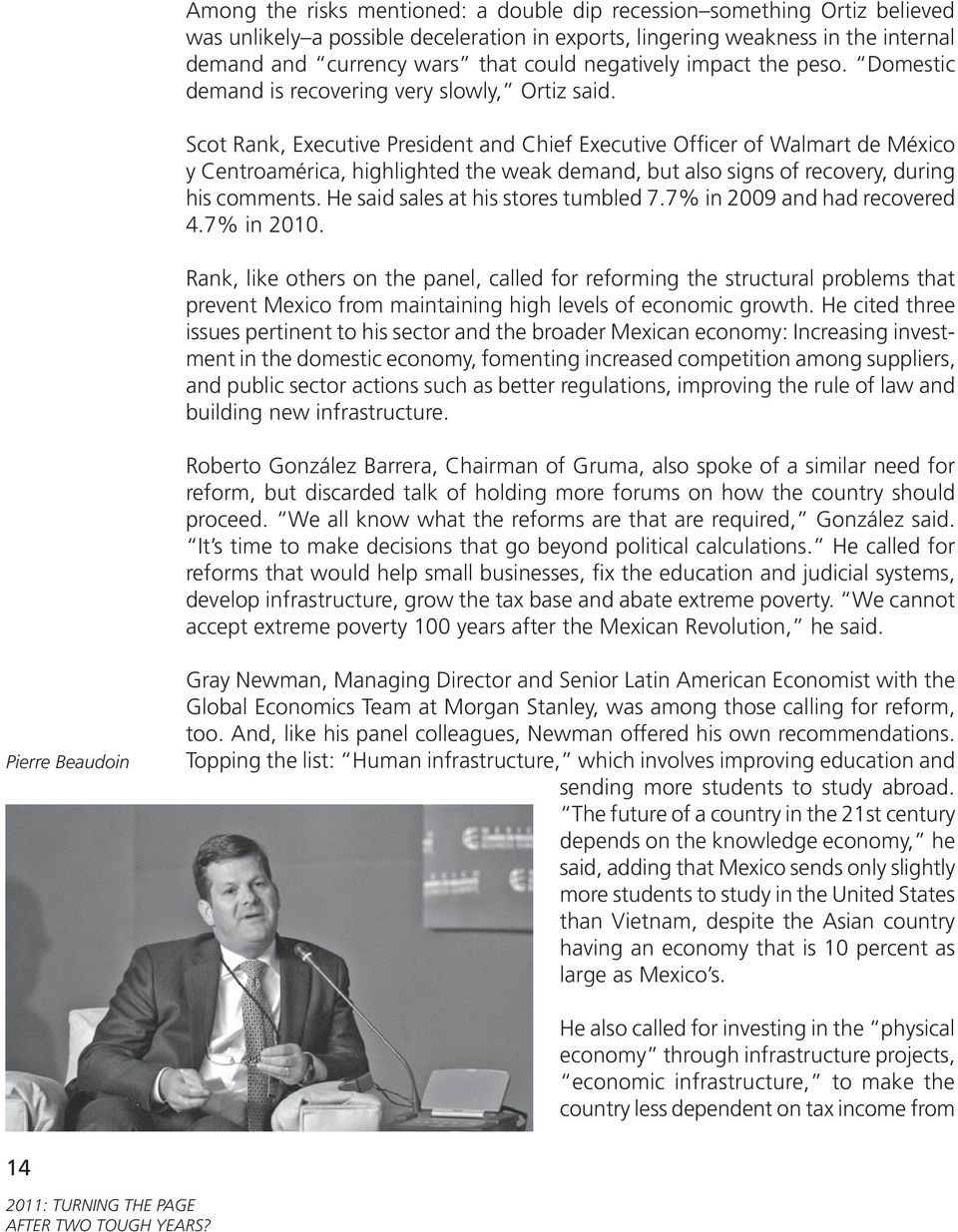
15 Gray Newman and Guillermo Ortíz Pemex, and, lastly, better competition policy to break the power of monopolies, which Newman, said, are not improving the country s economy. A self-described outlier, Newman controversially suggested that Mexico stop obsessing with diversifying its trade away from the United States and take better advantage of its proximity to the world s biggest economy. As for Asia, which some say Mexico should trade with more, he said, Mexico should become more Asia-like by adopting policies that foment strong economic growth. The topic of Mexico s recovery was pertinent and refreshing- for Beaudoin, President and Chief Executive Officer of Bombardier Inc., who said of the turning the page theme, We ve already spoken too much about the recession. He, like the other four participants, spoke of the lessons and observations emerging from the global downturn and cited examples from their own companies to reinforce the perceptions. Beaudoin explained that Bombardier, the Canadian conglomerate, survived the recession because of its diversity: Its rail business performed well because of government infrastructure spending, while its aviation division suffered. Aviation has since recovered and the private jet division jets selling for more than $40 million was growing most quickly. High net worth individuals have decided the economy is recovering and they re going to go visit their clients, Beaudoin said. That attitude appears to be more common in the developing world, where the World Bank estimates growth will be 7% this year and 6.8% in That compares favorably to just 2.6% this year and 2.3% in 2010 in developed countries. Another example of the different attitudes in the developing world toward the current economic situation is the willingness to invest in infrastructure so that those countries are ready to surge when the broader global economy recovers. We (in : TURNING THE PAGE AFTER TWO TOUGH YEARS?
16 the developed world) still have both feet on the brakes, waiting for recovery, Beaudoin said. That s not what is happening in developing countries. Louis Gallois, Executive President of EADS. echoed those comments saying that his company will no longer grow due to opportunities in Europe, but rather in the developing world. If there s something to be learned from the crisis it is that dynamism is not in the United States and Europe, but the developing world, Gallois said. Emerging country economies are taking the lead with the United States lagging behind, he added. What unfolds in Mexico next year remains uncertain with the prospect for a sustained recovery depending on external factors and the growth of internal demand. Ortiz ended his comments at the opening session by offering some cautious optimism spoken in a tone of almost wishful thinking. The risk is that we Mexicans will come to agreements on what we want : TURNING THE PAGE AFTER TWO TOUGH YEARS?
17 2.2 A broader basis for Mexico s economy: Looking beyond North America Speakers: Erik Bethel, Founding Partner and Chief Executive Officer, Sinolatin Capital, People s Republic of China Amapola Grijalva, Founding Partner, World Trade Consultants Group and Vice President China Chamber of Commerce and Technology, Mexico Rubén Kraiem, Partner & Chair, Corporate Latin America Practice, Covington & Burling, USA Santrupt Misra, Chief Executive Officer, Carbon Black Business & Director and Head Corporate Human Resources and IT, Aditya Birla Management Corporation, India Carlos Eduardo Represas de A., Chairman of the Board, Nestlé Group Mexico & Chairman of the Advisory Board, Bombardier Mexico Moderated by: Manuel Rivera Raba, Director General, Grupo Editorial Expansión, Mexico The BRIC-countries, over the last couple of decades, have become the most spectacular emerging economies of the world. So, why is Mexico, with 110 million inhabitants, huge amounts of natural resources and a strong industrial sector, not one of them? Carlos Eduardo Represas The second panel discussion of the Mexico Business Summit s first day in Toluca focused exactly on that: the question of why Mexico has been lagging behind in latching on to the dynamics unleashed by the rise of countries such as China and India. The general consensus between the five panel members was that Mexico s market needs to diversify and have a more global outlook on trade. Amapola Grijalva, Vice President of the China Chamber of Commerce and Technology of Mexico, showed how Mexico s exports to China only account for 1.5% of its total foreign trade. Statistics show that other Latin-American countries have a much better balance with the Asian giant. Take Costa Rica: a small country, but one with an enormous trade surplus with China, whereas Mexico actually shows a trade deficit. 17 A BROADER BASIS FOR MEXICO S ECONOMY

18 Reforms So, what is to be done? Panel members generally agreed upon one thing: it is still too hard for foreign capital to enter Mexico. The country needs reform; in education, on the labor market, in the energy market, etcetera. Furthermore, there is a far too one-sided focus on Mexico s trade relations with the United States. Carlos Eduardo Represas, chairman of the board of Nestlé Group Mexico, pointed out that there is much work to be done on a domestic level: We haven t been willing to commit sufficiently to reforms in the fields of energy or the labor market to advance. We should not forget that there is still an enormous potential in our internal market. If we can make this a country of 110 million consumers, we can have remarkable results. One of the key problems of the Mexican economy with regard to foreign investment over the last decades has been its protectionist economy, especially compared to other Latin-American nations. There have been steps taken to open up the Mexican market, most notably by joining the North American Free Trade Agreement (NAFTA) in But investing in Mexico is still comparatively difficult and there are many bureaucratic challenges to conquer if a business wants to enter the Mexican market. Rubén Kraiem, Partner & Chair of Corporate Latin America Practice at Covington & Burling, said that fear of the penetration of foreign capital is partly to blame. He commented that China showed the same attitude some twenty years ago, but managed to overcome these fears over time. Now, China s growth has no precedent in the rest of the world. In Mexico structural changes, above all in human capital, are necessary, but political reasons keep Mexico lagging behind. Erik Bethel Treaties Mr. Represas also commented that Mexico should not discard its most important trade partner, the United States: Mexico is very much aligned to the U.S., because of geographical and economical reasons. And yet, the country only represents 11% of the import market in the U.S. If we d be able to double that market share, imagine what that would do for the country. He added that the country should be careful in undertaking new foreign ventures. The existing free trade agreements we have are sufficient to make profit. We should try to embark on new ventures within the existing treaties before we make new ones, such as with Brazil. It s too early for that. 18 A BROADER BASIS FOR MEXICO S ECONOMY

19 Still, if Mexico wants to compete with the BRIC-countries, it has to globalize. Take China: over the last 50 years trade between Latin America and the People s Republic has been virtually inexistent, whereas in the last 10 years it has risen from just over 12 billion U.S. dollars to more than 100 billion. Mexico has not been able to gain much from that spectacular increase in trade: exports to China are still much lower than those of other Latin-American countries. According to Sinolatin Capital s CEO Erik Bethel the solution lies in triangulating trade relations between China, the U.S. and Mexico. The U.S. is going through a recession caused by deleveraging. People aren t buying anymore; they re paying off their debts. Historically Mexico sees China to some degree as a competitor, but it should be seen as a partner. Mr. Bethel summed up some mind-boggling statistics to underscore the enormous trade possibilities China will present in the near future. The Chinese government is going to move 300 million people to the cities in the next 10 to 15 years. That has enormous implications for the demand in iron ore, oil, steel, the car industry How can Mexico take advantage of this? It is a very rich country with large deposits of copper, gold and silver. And there are plenty of Mexican companies, like Gruma and Bimbo, who moved into China and are doing very well. Technology Rubén Kraiem agreed with Mr. Bethel that Mexico should try to use the advantage of having both a strategic and geographical relationship with the U.S. and being able to aim its economy at a growing demand in BRIC-countries for prime materials and consumer products. How can we enter these markets and get a competitive advantage? China and India compete with each other, Mexico could use this competition to create strategic alliances and have more competitive investments, while using its relationship with the U.S. Erik Bethel, Rubén Kraiem, Santrupt Misra, Amapola Grijalva and Carlos Eduardo Represas 19 A BROADER BASIS FOR MEXICO S ECONOMY

20 Much of the talk about diversification and globalization was focused on China, but India has also been showing great potential and remarkable growth over the last decades. Whereas China became the factory of the world, India became a giant in terms of innovation and technology. So, what can Mexico learn from India? Santrupt Misra, CEO of Indian firm Carbon Black Business, stated that a country doesn t need any foreign capital to kick start the economy. It s all about technology. Many developing countries fall into the trap of focus on low wage production, but there will always be another country that does the same thing. Mr. Misra, who is also the head of Corporate Human Resources and IT of Aditya Birla Management Corporation, said that the Indian government transformed itself into a partner of business, causing tremendous investments to flow into the country. Competitiveness is about learning, he said, Learn from other countries and ask yourself the question: can we bring some of that in? Every country, including Mexico, must decide if it wants to be a participant or a spectator. If you want to be a participant, you can t afford to be reluctant. 20 A BROADER BASIS FOR MEXICO S ECONOMY
21 2.3 Job creation: Investing to fight poverty Keynote address by: Carlos Slim Helú, Honorary Life Chairman, Grupo Carso, Mexico It is clear that good sources of employment, as well as easy access to appropriate education, create human capital, the key that allows any country to compete with the rest of the world and accelerate its development. During a gala dinner that ended the first day of the Mexico Business Summit, Carlos Slim Helú, honorary president for life of Grupo Carso, emphasized that it is necessary and fundamental that young people study, as only then can they offer their best to companies, benefit from more job opportunities and in turn generate the jobs that society requires. Carlos Slim It s important that governments do not regress to traditional policies to extend education. The digitalization of education and the use of new technologies could be a positive force in transforming society through distance learning. Teachers could create good teaching material to be placed on the Internet, where thousands of people could access it and thus broaden their knowledge. Education via the Internet would not only generate a higher number of workers with high-level abilities, but it would also eliminate the pressure to generate cheap employment. We need to contemplate new formulas in education - changes - not more schools, spaces or more teachers. We have to use technology to be able to have distance teaching, virtually, the businessman said. Opting for education instead of starting to work at 15 years of age would be the most effective way to jumpstart the development of a nation. When starting to work, young people would have more knowledge, would be better qualified to serve companies and would probably also retire at a higher age, remaining active professionally for a longer time. 21 JOB CREATION: INVESTING TO FIGHT POVERTY
22 Slim said that 70 years of age would be the perfect age for an employee to end his trajectory in a company. Retiring at age 50 or 60 is a national shame, Mr. Slim stated. He mentioned France as an example, where the age of retirement was raised from 60 to 62, adding that developed countries have great passive contingencies. These countries therefore also have the obligation to deal with retirement issues, since in most parts of the world life expectancy has increased. Nonetheless, Mr. Slim estimated that within the next 15 years the population increase will slow down, which will permit a higher annual income per capita, and will contribute to the development of large middle classes. Another proposition to attack unemployment is the professional formation of people who have not been able to find their way into the labor market. Further education of the unemployed would help them to find alternative jobs, not just in the field in which they are specialized. They should be trained to work in sectors where there are vacancies, and which would offer higher salaries. Facing businessmen and politicians of high international profile, Mr. Slim Helú proposed that NGOs, as well as other institutions, should be more active in the fight to defend human rights and create awareness about environmental problems and insecurity. That way, all stakeholders can collaborate more effectively to resolve problems, not only social ones, but also economic ones, such as unemployment. Carlos Slim and Miguel Alemán The changes mentioned need to be implemented immediately in order to steer the economy back on track after the economic and financial crisis. Social groups should, 22 JOB CREATION: INVESTING TO FIGHT POVERTY
23 together with the government, drive society to create the transformations needed. Mr. Slim also criticized the measures taken by the big economic powers to confront the recession, calling them traditional. Very low interest rates did not favor the most affected economies, but actually caused the opposite reaction, creating fear amongst companies regarding investing. There are very aggressive solutions in terms of monetary policies, the industrialist said. He referred to the measures taken since 2001 by the government of George W. Bush. Even though these measures did not yield the expected results, the same economic policies were maintained by large parts of the world for nine years. Carlos Slim The structural, physical and economic deficit and the high rates of unemployment in economic powers such as the United States, Spain and France is caused by the fact that those countries, as developed as they are, have become a purely technological society, without producing goods and thus damaging their economies more. The entrepreneur emphasized that, as long as those countries cannot export goods with added value, they will keep losing against other industrialized countries. Governments have to assess which are the goods that society requires and identify those that have a high added value. As an example, he mentioned the car industry in the United States. Finally, a good job will always give a level of satisfaction to human beings, making it essential that both the State and the private sector invest in job creation. It s also important to have healthcare, nutrition, cultural efforts, sports, and to have activities with social impact, Mr. Slim noted. 23 JOB CREATION: INVESTING TO FIGHT POVERTY
24
25 2.4 Being part of the new Latin American dynamic Opening Address: Álvaro Uribe Vélez, Former President of The Republic of Colombia Speakers: Sergio Augusto De Abreu e Lima Florencio Sobrinho, Ambassador of Brazil to Mexico Rafael Fernández de Castro, Presidential Advisor, International Affairs and Competitiveness, Mexico Jean-Paul Herteman, Chairman of the Executive Board, Safran, France José Luis Prado Becerra, President, PepsiCo Global Baking Innovation Center; President, Gamesa-Quaker, Mexico Guillermo Rishchynski, Ambassador of Canada to Mexico Moderator: Rubén Kraiem, Partner & Chair, Corporate Latin America Practice, Covington & Burling, USA Álvaro Uribe In the last decade, Brazil has shown leadership regarding the economic and political dynamism in Latin America. Speakers like Guillermo Rishchynski, Ambassador of Canada to Mexico, his Brazilian counterpart Sergio De Abreu and José Luis Prado, president of Gamesa-Quaker, confirmed that the southern giant had been the example. The Ambassador of Brazil stated that both Mexico and Brazil were evolving similarly in the eighties. However, Brazil is now the Latin American giant having reached major developments in practically every sector whereas Mexico only has been able to have a stable growth rates. The big difference between both countries, he stated, is that Brazil looked towards the south to consolidate trade while Mexico only focused on the north and in particularly the United States. Furthermore, Brazil is now third on the list of countries attracting foreign direct investment following China and India and thus displacing the United States which is now in fourth place. For such reasons, he underlined the importance of establishing a trade agreement between Mexico and Brazil, the two giants of Latin America. A commercial agreement that will not be a repetition of NAFTA, but one that provides bilateral cooperation in the oil sector, ethanol production, nanotechnology and also biotechnology. Having cre- 25 BEING PART OF THE NEW LATIN AMERICAN DYNAMIC
26 ated this treaty, it would be an opportunity for Latin America to boost its interregional commerce like it has been done successfully in Europe and Asia. Brazil knew how to enter the market with attractive and dynamic strategies, which have been reflected in the level its exports which has more than doubled in just five years, even exceeding Canadian exports. Rafael Fernández de Castro Rafael Fernández de Castro, advisor on international affairs and competitiveness, indicated that the Brazilian government invested 700 billion abroad with Mexico as a principal destination and thereby Mexico obtained a better position to be able to enter the Brazilian market, which normally has been very restricted. The Latin American economies are exceptionally dynamic. The region has a general growth rate of 5.2% with Mexico s expected to reach 4.2%. He clarified that the major part of this dynamism is due to exports, mostly of raw materials: Mexico stimulated this kind of dynamism in the last decade and added that this sector grew by 13% in the last ten years. The integration of Canada into regional trade is another phenomenon within the economic dynamism in Latin America. As explained by Guillermo Rishchynski, this is thanks to the NAFTA agreement through which Canada connected for the first time with a Latin-American country, Mexico and finally Canadian companies started to look towards the south as a great place to invest. The investment of Canada in Latin America exceeded 123 billion dollars, three times the investment of the North American country in Japan, China and India together. With more than 200 Canadian companies of the mining sector present in the region, this relationship is definitely the most important. In regards to security, Colombia is a country that stands out for the measure they took to fight kidnapping and drug trafficking. The former president of Colombia, Álvaro Uribe, indicated that it is necessary to count with a political determination to stop the expansion of violence that is provoked by organized crime. In this matter he congratulated Mexico for following this strategy as opposed to other countries in which the problem has not been recognized nor confronted. At the end of his remarks, Uribe Vélez expressed his support for the recently approved pensions reforms in France which elevate the age of retirement from BEING PART OF THE NEW LATIN AMERICAN DYNAMIC
27 to 62 and stated that Colombia implemented a similar but stricter reform without experiencing the same levels of unrest. The businessman José Luis Prado Becerra, explained that at the beginning of this decade, while Brazil already started to show great indications of development, Colombia was seen as a nation with great potential but with low self esteem and fear. Meanwhile, Mexico was changing the political direction of its government. With the growth of Brazil, a shift took place in the continent, with the economic activity moving to the south. Becerra stressed that Mexico became less attractive to foreign investment, and that this Summit is important in the sense that Mexico can reestablish its attractiveness to entrepreneurs looking to do business in the country. Rubén Kraiem, Álvaro Uribe, Sergio Augusto De Abreu, Rafael Fernández de Castro, José Luis Prado Becerra and Guillermo Rishchynski 27 BEING PART OF THE NEW LATIN AMERICAN DYNAMIC
28
29 2.5 Corporate Mexico: Looking at priorities for growth Speakers: Hans-Joachim Kohlsdorf, Vice President, Consejo Ejecutivo de Empresas Globales, Mexico Juan Carlos Marroquín, Executive President, Nestlé Group, Mexico Roberto Newell, Director General, Instituto Mexicano para la Competitividad, A.C., (IMCO), Mexico Salomón Presburger Slovik, President, Concamin, Mexico Moderator: Luiz Carlos Ferezin, Managing Director, Accenture, Mexico This brainstorming session on Day 2 of the Summit focused on the results of the taskforce set up by the Mexico Business Summit to provide concrete recommendations on how to boost growth in Mexico. Several private companies have already determined their own growth strategy but how can this be converted into a national strategy? Talent management and a sustainable green image were of key importance during the discussion. Luiz Carlos Ferezin Roberto Newell, Director General of the Mexican Institute of Competitiveness (IMCO), is convinced that there is a lot to be done in terms of English speaking skills. He emphasized that a better monitoring system should be put in place to determine the level of English and computing skills. Hans Kohlsdorf agreed and added that if Mexico s labor force can improve on these two skills, a lot of the United States outsourcing would no longer go to Asia but would come to Mexico. Besides job creation, the outsourcing would also bring new industrial knowledge to the country. The close economic ties with the United States are not the only indicator of the high potential of Mexico. There exist a lot of areas that require improvement. Salomón Presburger stated that a national development plan should be put in place to strengthen Mexico s market position. 29 CORPORATE MEXICO: LOOKING AT PRIORITIES FOR GROWTH
30 Luiz Carlos Ferezin, Hans-Joachim Kohlsdorf, Juan Carlos Marroquín and Roberto Newell Newell stressed that national development plans have to be considered carefully. When we look at government interventions in the petroleum sector of countries like Nigeria and Venezuela, results have been disastrous. On the other hand, the United States and Norway have shown that government help can be successful in this particular sector. Besides looking to the government for help, Juan Carlos Marroquín reminded the audience that the corporate sector should focus on innovation and development. In this way Mexican companies could control a major part of the production cycle. Especially in the food and pharmaceutical industries there are enormous opportunities that could be taken advantage of. He also stressed the fact that Mexicans need a more positive mindset and increased self-confidence to make things happen. Roberto Newell agreed and confirmed that Mexico is not playing the leading role it could in the region despite its potential. Unfortunately, Mexico got infected with a virus called negativism, which needs to be cured in order to optimize the country s tremendous resources and opportunities. Hans Kohlsdorf shared the same opinion and stressed that Mexico has to find its own path instead of applying success formulas used by other emerging economies. Mexico can use the climate summit in Cancún as a tool to boost domestic green politics. Government assistance will be required but the private sector should be the great stimulator of creating an ecologically sustainable economy. Presburger indicated that 98% of Mexican companies are medium or small sized enterprises. Particularly these kinds of enterprises are lacking a sustainable strategy in the use of energy resources. Financial support should be provided for those adopting sustainability measures, thus creating a solid base for a green economy. 30 CORPORATE MEXICO: LOOKING AT PRIORITIES FOR GROWTH
31 2.6 Competitive policies for a global economy Speakers: Valentín Díez Morodo, President, Mexico Council for Foreign Trade (COMCE), Mexico Julio Millán, President, Grupo Coraza Corporación Azteca, Mexico Luis Téllez Kuenzler, President, Bolsa Mexicana de Valores, Mexico Ramiro Tovar Landa, Director of Studies on Economic Regulations, Department of Economics, ITAM and Senior Advisor The Brattle Group, Mexico Luis Videgaray, Chairman, Budget and Public Accounts Committee, Cámara de Diputados (House of Representatives), Mexico Moderator: Pedro Velasco Alvarado, Partner, Santamarina y Steta, Mexico The first day of the Mexico Business Summit focused on Mexico s position in an increasingly globalized and competitive economy while the second day was an elaboration of the subject. Two topics were key to the discussions: free trade and competitiveness. Five panel members dissected Mexico s economy and competition laws, to determine what can be done to make Mexico more competitive. Luis Videgaray Luis Videgaray, Chairman of the Budget and Public Accounts Committee in the Mexican House of Representatives, pointed out that a new Competition Law is currently before the Mexican congress. According to Mr. Videgaray, who is a member of the Institutional Revolutionary Party (PRI), the current competition legislation in Mexico is not outdated but contains a fundamental flaw in terms of sanctions. The law is one of the most advanced of its sort in the developing world, but the sanctions are almost ridiculously low. If I were an entrepreneur and I would recieve such a low penalty, I would break the law again! He added that the new competition or anti-monopoly law, now awaiting approval in the Mexican Senate, will correct that flaw. It will impose a sanction of 10% of total sales, which is very necessary. Without effective sanctions, we will keep having chronic problems. One of those chronic problems is the continued monopolization of different sectors of the Mexican economy. Mr. Videgaray admitted that these monopolies go 31 COMPETITIVE POLICIES FOR A GLOBAL ECONOMY
32 beyond straining economic development. The lack of a competitive economy affects the poorest the most. Creating laws that combat monopolies is actually a social policy; we can help the poorest the most if we help create competition in the pharmaceutical and telecommunication sectors. Domestic legislation will address local and domestic problems, but what about international competition? Since Mexico joined NAFTA in 1994, industry in the border region with the United States has flourished, but Mexico s agrarian sector has not been able to gain an advantage vis-à-vis its American and Canadian competitors. It shows how opening international markets to free trade is not always positive for all sectors. All panel members agreed that regulations will only get us so far. Panelists also focused on innovation, investment and free trade. Valentín Díez Morodo, President of the Mexico Council for Foreign Trade (COMCE), an important figure in international trade relations, commented firmly on the latter: Our position is clear: no more treaties. According to Mr. Díez, 52% of the 43 trade agreements Mexico has with other nations have deficits. If Mexico would do the same thing as Brazil did 20 years ago, the entire south would lose its competitiveness and the agrarian sector would be done for. The same thing would happen with our industrial sector if we would open it up to Asian nations. According to Luis Téllez Kuenzler, the stock market could play an alternative and important role in bettering Mexico s competitive advantages. He gave the example of Brazil, a country whose stock market represents 1.5 times the country s GNP, whereas the Mexican Bolsa de Valores only covers about 40% of its GNP. Former President Cardoso created a series of institutions that facilitated trading on the stock market. Mexico until recently didn t have those. But it is changing - we now have approximately 160 billion dollars that can be institutionally invested. Still, Brazil has much, much more. Pedro Velasco, Valentín Díez, Julio Millán and Luis Téllez 32 COMPETITIVE POLICIES FOR A GLOBAL ECONOMY
33 Luis Téllez insisted that there are reasons for optimism, as companies of smaller and medium size are entering the stock market. The conditions are there that allow the stock market to catalyze private investment. He highlighted the importance of the privatization of Pemex. The same way Cardoso took Petrobras monopoly away in the past - I m convinced that Pemex could be so much more efficient if we could have energy prices at an international level. I don t know any Mexican with stocks in Pemex, but there are many Brazilians that own shares in Petrobras. Veteran businessman Julio Millán, President of Grupo Coraza Corporación Azteca, said that Mexicans have the tendency to overdiagnose their own country. What this country lacks, is action. We re a chaotic nation, really. Ideology shouldn t matter, what counts are the objectives. The colour of the cat doesn t matter, as long as he catches mice. Mr. Millán suggested several steps to increase Mexico s competitiveness: First of all, we should invest up to 1,5% of our GNP in technology and innovation. Universities and the state should reach an agreement that 10% of their budget has to be dedicated to research! We also need to engage in a campaign to strive for excellence, because we re below average. We need a long-term project to be able to do this. Mr. Millán envisions a key position in this process for the business world. Entrepreneurs have a great capacity to spread ideas, through our businesses, the media... We should take our responsibility. Valentín Díez Morodo Mr. Díez proposed a different approach to fill the competitive gap with other countries. We need to invest more and combat unemployment. Even though I think we re on the right track, we need to improve education and take better care of the environment. We haven t been able to push through reforms because many groups are defending their own political and party interests. We should put aside our ideological differences. His argument was warmly greeted by Mr. Millán, who passionately asked for a new grito del bicentenario, a reference to Mexico s tradition to shout Viva México! on September16th, the country s independence day. We should be shouting: down with mediocrity, long live greatness! 33 COMPETITIVE POLICIES FOR A GLOBAL ECONOMY
34
35 2.7 Embracing our common humanity Keynote Address by: William J. Clinton, Founder, William J. Clinton Foundation, 42nd President of the United States The mining and hydrocarbon sector is what Mexico must focus on for development in the future, said former U.S. president William Jefferson Clinton during his keynote address at the eighth Mexico Business Summit, held in Toluca. Investment in raw materials could be the engine that helps the Mexican economy maintain its stability and allows it to create financing for other items, such as social development. Mexico will reach a wonderful period if it looks towards these markets. Due to climate change, one of the greatest demands on the future of emerging countries will be raw materials, thus, it is important to start projects in this industry. If I were a businessman in Mexico I would ask myself how to get out so much wealth from the land, Clinton said, and he argued that if a country is rich in metals and minerals it will have no problem putting them on the market, since it is certain that other countries will need mineral resources. William J. Clinton The former US president also insisted on the fact that Mexico has a high rate of poverty, but has shown that, despite poverty and the economic crisis, the country has achieved development, perhaps not on the same level than European countries, but he described Mexico s growth process as interesting. When asked to provide a recommendation, Clinton answered that any political matter is linked to economic issues. I d say to anyone who has hope that they should operate in a dynamic environment, and Mexico, as South America, has such an environment. He pointed out that a large portion of Mexico s population is not an integral part of the modernization process, which certainly will create problems, such as the one 35 KEYNOTE ADDRESS: WILLIAM J. CLINTON
36 William J. Clinton and Miguel Alemán France now faces because of its pension system. This is why it is crucial to improve education financing, business development and university plans. He also noted that it is necessary to analyze how Mexico could achieve prosperity while fighting against drug trafficking, and compared it with the case of Colombia, that made a greater effort in education, which had a real impact on the drug cartels and reduced the traffic of cocaine in the United States. Mr. Clinton commented that, globally, political leaders have an important task ahead to emerge from the economic crisis and initiate investments. They should create awareness in their populations that teamwork is necessary. Political leaders should remind people that, in an interdependent world, we must work together. Clinton called attention to social inequalities that enhance obstacles in terms of access to education, employment, housing and healthcare, all of which are not evenly distributed. This problem affects all nations. Over the last decade in the United States 90% of the growth benefited only 10% of its population. He therefore requested Mexican leaders and entrepreneurs to establish different financial regulations, insisting on the importance of consistency with current emerging economies needs. One of the proposals of the former US President was financing the creation of major sites for industries, which would encourage investment, reduce debt and give greater economic certainty, one of the main aspects entrepreneurs are looking for. Any society that wants real development must not leave its civil, social and economic lives in the hands of politicians, because it should be aware that there will always be a gap between what the government can provide and that the private sector can produce. If we allow this gap to grow we will face severe problems, Mr. Clinton said. 36 KEYNOTE ADDRESS: WILLIAM J. CLINTON
37 Regarding the U.S., he mentioned that, if we want to rebuild a common purpose in the hemisphere to help solve problems, it will have to learn to be a good partner for Mexico. The United States should understand that it cannot overcome issues if it tries to do this in isolation. Finally, he expressed his satisfaction of having been able to assist Mexico during the crisis of 1994 and said that he expected that both countries return to business as a unified region, because it is not possible to resolve conflicts that affect both if they try to solve issues by themselves. 37 KEYNOTE ADDRESS: WILLIAM J. CLINTON
38
39 2.8 Plenary Luncheon Felipe de Jesús Calderón Hinojosa Constitutional President of the United Mexican States President Felipe Calderón opened his remarks by saying that the country currently finds itself in a favorable economic situation. Even though the economic crisis has shaken the financial state of the world, Calderón confirmed that jobs have been created and inflation is at one of its lowest points ever during his administration. He emphasized that international reserves have reached 110 billion dollars and continue to rise. The president added that GDP has risen from 3 to 5%. Calderón also pointed to the macroeconomic stability of the country, thanks to the fact that it resisted the global temptation to increment deficits, unlike Europe where several countries are coping with tough consequences. Mr. Calderón confessed that last year he was close to following the same strategy to confront the economic recession. Another factor that helped the stability of Mexico after the financial crisis is the favorable geographical situation of the country, encouraging trade with the United States. Felipe Calderón The president accepted the fact that the Mexican currency went through devaluation, as happened with many others in the world. Yet it might be the first time that the Mexican peso reaches a higher level of competitiveness, without being translated into internal economic disorder. Therefore, today we have very low inflation and a more competitive exchange structure. Calderón affirmed that the level of foreign direct investment reached a record high in the first three years of his government. We already left that part of the tunnel, even though various segments of the population maintain the idea that Mexico is still living in crisis, and think that it is almost impossible to get out of it in the short term. Mr. Calderón also remained confident that the new law related to economic competition, as well as the initiative to reform the labor market will be approved by Congress. Both aim to generate more job opportunities, a pivotal issue on which his government has been focusing. 39 KEYNOTE ADDRESS: FELIPE CALDERON HINOJOSA
40 With regard to state-owned companies, he confirmed that oil extraction increased by 17% and he mentioned that, after the dissolution of Luz y Fuerza del Centro (LyFC), the Federal Electricity Commission (CFE) signed 400 thousand contracts, including the regularization of several clients already approached by LyFC. In the presence of distinguished businessmen, among them Carlos Slim Helú, Roberto González Barrera, Valentín Díez Morodo, Carlos Bremer, Olegario Vázquez Raña and Ricardo Salinas, the Head of State also indicated that it is necessary to strengthen security-related organizations on both federal and state level, as this is the only efficient way to end violence and organized crime. It is a long road, that is certain, perhaps without many results in the short run, or at least not very spectacular ones, but it is an effective way. Besides, it s the only one there is, Mr. Calderón said. Likewise, the President said that he has sent various initiatives to Congress to create a unified police force in order to strengthen police institutions. Calderón Hinojosa also noted that, thanks to approving the Afores in 1997, Mexico has avoided the problems that his French colleague Nicolas Sarkozy is facing, referring to the protests against the national pension reform in France that aims to raise the age of retirement from 60 to 62 years. The President claimed that, due to the Afores, the government has been able to save 300 billion pesos in public spending, leading him to believe that they formed one of the best measures taken to stimulate the economy. Mexico State s Governor, Enrique Peña Nieto, called for an analysis of the country s direction, confirming that in the past one hundred years both major progress and modernization has been achieved. He reminded the audience that barely a century ago, 70% of the population was illiterate and the largest industry of the country was centered on the agricultural sector. The head of the Mexico State Government ended his speech with the hope that propositions he has voiced at the Mexico Business Summit will materialize into real advances for the Mexican economy. Enrique Peña, Felipe Calderón and Miguel Alemán 40 KEYNOTE ADDRESS: FELIPE CALDERON HINOJOSA
41 2.9 Could somebody stand up for tourism, please? Speakers: Roberto Alcántara Rojas, Chairman, Grupo IAMSA, Mexico José Luis Garza Álvarez, Chief Executive Officer, Interjet, Mexico Gloria Guevara Manzo, Secretary of Tourism, Mexico Pedro Joaquín Coldwell, Senator for Quintana Roo, Former Governor, former Secretary of Tourism, former Ambassador to Cuba and former Director General, FONATUR, Mexico Ivonne Aracelly Ortega Pacheco, Governor of Yucatan Moderator: Guillermo Ortega Ruiz, Director, La Crónica, Mexico Specialists agree that Mexico is destined to be an important player in the tourism sector when you simply take a look at its vast resources. Mexico has it all, archeological monuments, beaches, colonial cities that are listed as World Heritage; nevertheless the country still has not been able to become one of the biggest players in the world. Gloria Guevara The winning formula to strengthen this industry in Mexico is to work together. The private sector, the educational system, the media, the hotel business, airlines and the other stakeholders need to be aligned. That is what needs to be done according to the secretary of Tourism, Gloria Guevara, during the second day of the Mexico Business Summit. She further indicated that Mexico finds itself at the tenth place of attraction of tourists, while other countries have seen significant growth using a national tourism promotion strategy. Like Malaysia, which was in twelfth position in 2008 but climbed to number eight in just two years. Senator Joaquín Coldwell, stated that despite the fact that Mexico has the best touristic infrastructure in Latin America, the drug war related violence has affected its image in a drastic manner. His proposal is that a campaign should be launched abroad to explain that the violence is restricted to certain regions and that the principal touristic destinations are completely safe. 41 COULD SOMEBODY STAND UP FOR TOURISM, PLEASE?
42 The president of the IAMSA group, investors in Mexican auto transportation, told that within the tourism industry, the hotel sector is competitive and well managed, offering good prices and quality. However he admitted, several improvements regarding infrastructure can be done to improve the situation. José Luis Garza and Ivonne Ortega According to Alcántara Rojas, 95 per cent of Mexicans use autobuses to travel which he sees as old fashioned when the country has a great potential in regards to the aeronautic system. Just 3% of the population is using airplanes to travel around the country and the main reason of this low rate is high fares which make it a privileged transportation mean. Nevertheless, Alcántara emphasized that all transportation methods are complementary. The governor of Yucatán, Ivonne Ortega, pleaded for investing in infrastructure to improve the connection between the tourist destinations of the country and so providing a better option for foreign tourists. In that context, Ortega shared the fact that in the state of Yucatán, the construction of a high-speed railroad is planned to connect the cities of Progreso and Mérida to facilitate the transport of visitors. She also added that it will be important to have one national touristic symbol to improve the attractiveness to tourists. The CEO of Interjet, José Luis Garza, reminded the audience of the problems that the airline sector has faced in the last years. In 2008 the price of fuel reached historic heights which affected the airline business worldwide and the next year there was a domestic disaster caused by the outbreak of the A-H1N1 virus. When talking about the case of Mexicana de Aviación, Garza stated that besides being one of the major airlines of Latin America, the intervention of the State was no longer an option as it had been before and that its downfall was inevitable. The public nevertheless was not affected as the other companies filled in the gap Mexicana left. 42 COULD SOMEBODY STAND UP FOR TOURISM, PLEASE?
43 2.10 Competitive policies for the Agribusiness sector Speakers: Avner Adin, President, Israeli Water Association, Israel Maurizio Covarrubias Piffer, Senior Vice-President, Grupo Fertinal & Regional Vice President, National Fertilizer Industry, Mexico Martín Gutiérrez Lacayo, Director General, Pronatura México, A.C., Mexico John Luxton, Chairman, DairyNZ, Former Minister of Agriculture, New Zealand Pedro Padierna, Chief Executive Officer, Sabritas Mexico, Central America and the Caribbean, Mexico John Veroneau, Vice Chair, International Practice Group, Partner, Covington & Burling, USA Moderator: Ken Shwedel, Executive Director, Food and Agribusiness Research and Advisory, Rabobank International, USA In Mexico, the agricultural sector has the lowest growth rate of all economic sectors in the country. Despite vast resources, agriculture in Mexico barely represents between 3,6% and 4% of GNP, and the country has to import corn and wheat from the United States. Under these circumstances, six personalities from different countries related to the subject were asked about the following aspects: - What is the best way to accelerate the agroindustrial sector in Mexico? - What can Mexico learn from better practices abroad? John Luxton To open the debate, Martín Guitiérrez Lacayo, Director General of Pronatura México, mentioned that the problem of scarcity of water and the deterioration of agricultural soil are the two challenges Mexico is currently facing. He said that approximately 96% of the aquifers are overexploited and that 40% of agricultural terrain has lost its capacity for cultivation. In his intervention, Mr. Guitiérrez explained that the term sustainability is loosely related to competitiveness and that it can grow through protecting and preserving natural resources. 43 COMPETITIVE POLICIES FOR THE AGRIBUSINESS SECTOR
44 Mr. Guitiérrez stated that, the richest sites in biodiversity are the poorest places in the country, which is a paradox, rendering Mexico unable to grow without politics focused on the issue. He mentioned furthermore that 90% of Mexican farmers have less than 12 hectares to cultivate. He finally explained that climate change is the great current issue and that Mexico is one of the most vulnerable countries in that sense, making it necessary to have a better management of the hydrographical basins. Avner Adin, president of the Israeli Water Association and the second speaker, also adressed the issue of water. He started by explaining that if there is no water, there is no agriculture and no business. He explained that the water business has some 400 billion dollars worth of profit on a global level, rendering it the fourth most profitable business in the world. Adin stressed that Mexico is amongst the countries with the biggest shortage of water, making it necessary to act in this area to confront the problem in the best way possible. He showed that one of the solutions for the problem is the use of technology: The treatment of water should be a fundamental point in dealing with water shortage. In his intervention, he said that the collaboration between Mexico and Israel can help solving this serious problem in a more efficient way. Amongst the options he offered is the biological treatment (as developed in Israel), which can be applied in the industry, watering gardens and for human consumption (as done in Singapore and Namibia). Another option he mentioned is desalinizing sea water, as he considers it an infinite source of water and the process is not very expensive. However, apart from technology, a holistic vision is required. Avner Adin, Maurizio Covarrubias, Martín Gutiérrez Lacayo and John Luxton 44 COMPETITIVE POLICIES FOR THE AGRIBUSINESS SECTOR
45 In the same sense, Pronatura Director Guitiérrez Lacayo intervened to explain that the desalinization technology is already being applied in Baja California. However, as Mr. Guitiérrez explained, political agreements are needed to make this process more efficient. The third speaker, former New Zealand secretary of Agriculture John Luxton, addressed the issue of water and stressed that his country is an example of how this liquid has become good business. He explained that one of the strengths of the system in New Zealand has been the privatization of the industry and the elimination of monopolies. Furthermore, Luxton highlighted the virtues of other competitive politics for the agricultural sector. He mentioned that amongst them should be the taking care of de quality of products the export, meaning to raise the ruling norms of quality: We have to take into account where products come from, for land to remain sustainable. Another aspect, he said, is investing in innovation and the exchange of education. Pedro Padierna Finally, he emphasized four different policies that could elevate the quality of the agricultural sector: 1) to have an open economy; 2) to raise quality of products; 3) to pay attention to impact on climate; 4) to invest in science, education and innovation. Maurizio Covarrubias, Vice President Senior of Grupo Fetinal and the fourth speaker, addressed the issue of agriculture by explaining that Mexico has 22 million hectares that can be cultivated, of which only 25% use sprinkling water. The rest (75%, representing some 15 million hectares) are temporary. He explained that this presents a great risk for the country, as they do not guarantee the quality of products anymore, since they depend on the climate. In his intervention, he explained that an adequate fertilization is required to achieve good harvests, making it necessary to have a rector project from the Federal Government, where private initiative has an important participation. To exemplify the problem, he pointed out the difference between consumption of fertilizers per capita in different parts of the world. He explained that in the United States consumption is 180 kilograms per inhabitant. In India it s 125 kilograms, whereas in Mexico it s barely 40 kilograms. To finalize, he indicated that in Mexico there is a lot of potential to compensate this delay over the next years, based in the use of technology. 45 COMPETITIVE POLICIES FOR THE AGRIBUSINESS SECTOR
46 Pedro Padierna, General Director of Sabritas Mexico and fifth speaker, mentioned in his intervention that the results of the companies he represents depend, principally, of the countryside. Amongst the examples of success in agriculture Sabritas has had he mentioned the following: To give certainty to the farmers through support, like for example the elaboration of adequate seeds for suiting Mexican characteristics; to elevate the quality norms through potato certification.; elevate the sustainability offering wellbeing to the consumer, supporting workers, using trickling irrigation (to reduce water consumption), using fertilizers of the highest quality and reverting the deterioration of econosystems. Finally, John Veroneau, Vice Chair of International Practice Group and the final speaker addressed the issue of commercial exchange of food products. Mr. Veroneau, who is also a lawyer, mentioned the importance of having a system that permits having confidence so that bad products do not get into the system. However, he said that it is important not to confuse quality control with protectionist governments that block these exchanges with arguments of supposed security (as it has happened with genetically modified products in Europe). He mentioned that the only thing protectionist countries provoke are commercial barriers that affect the food market. Amongst the offered solutions he mentioned that it s necesarry to know the rules to enter successfully to the markets (inspection certificates) and demonstrate with confidence that the products comply with a very strict regime. 46 COMPETITIVE POLICIES FOR THE AGRIBUSINESS SECTOR
47 2.11 Sustainability strategies for corporate Mexico Speakers: Eric Bachelet, President & Chief Executive Officer, CFM International, France-USA Francisco Giner de los Ríos, Former Undersecretary for the Environment, Mexico Gilberto López-Meyer, General Director, A.S.A. (Aeropuertos y Servicios Auxiliares), Mexico Richard Wells, President, The Lexington Group, USA Moderator: Luis Manuel Guerra, Director of Programs Zona Verde and Ciencia Tres por Siete, Radio Red, Grupo Radio Centro, Mexico Even if corporate sustainability is becoming a more and more predominant issue, there a still of lot of people in the corporate sector that are asking themselves how sustainability can be implemented in their business strategies and how it can be leveraged as a beneficial opportunity. Richard Wells The first speaker of this brainstorming session, Eric Bachelet, President and General Director of CFM International talked about the use of biofuels in the aeronautic industry to convert this sector into a sustainable one. The president of CFM mentioned that the use of agricultural land could be a great source of sustainable fuel generation which would be of enormous benefit to the world. He explained that this strategy is based on the cultivation of abandoned lands to serve for the development of biofuels, also using recycled water and natural fertilizers. In that context, his company started collaboration with ASA to develop the use of biofuel on a significant industrial level in Mexico. Finally, he recommended that to develop this, new partners should be found that will focus on the exploration of the new technological opportunities and possibilities. The second speaker, Francisco Giner de los Ríos, former undersecretary for the environment, assured that sustainability and competitiveness are linked as this is the only way to create sustainable companies in long run. Giner emphasized the fact that countries and companies that ignore the sustainability strategy, will eventually lose despite being profitable in a short term. Only sustainability provides competitiveness, he stated. 47 SUSTAINABILITY STRATEGIES FOR CORPORATE MEXICO
48 The environmental challenges are business challenges for a win/win situation said Giner de los Ríos. This is not affecting the companies in a financial way he stressed and insisted that it is necessary to explore new green forms of energy use. Among the elements mentioned, one crucial point is that Mexico is lacking a congruent environmental program on the political level. He further stated that a clear and well-defined strategy with a scientific base is needed, as well as a profound revision of public and private instruments. Luis Manuel Guerra, Eric Bachelet and Francisco Giner de los Ríos The third panelist, Gilberto López-Meyer, General Director of ASA, started by explaining that the notion of sustainability related to corporate activity should be a basic concept. Between the principles that define sustainability, the most important are: reduction of greenhouse gasses; economic development focused on the generation of biofuels; strengthening of the energy sector in Mexico The director of ASA explained that the production and use of biofuels generates a virtuous circle: the cultivation of the plants used in the production of biofuels contributes up to 80% to the reduction of the pollution created by their use. Also, he stressed the benefit of second generation biofuels, which are already used and produced in Mexico and which do not compete with the land destined to produce food nor drinking water. López-Meyer highlighted that this booming business of biofuels is a great opportunity that has the potential of producing unimaginable wealth. He emphasized the importance of the environment and sustainability themes, they will change the geopolitics of the world, due to the fact that the rich countries are running the risk of becoming poor and the poor have the opportunity of becoming rich, that is why he suggested that an improved coordination of all involved sectors is key to reach effective policies. 48 The last participant, Richard Wells, said that we live in a state of production deficit because we are consuming 1.4 times more than what the planet is producing, and therefore turning consumption in one of the major problems we are facing nowadays. The president of The Lexington Group insisted that if Mexico takes advantage of the opportunities that are offered by the biofuel industry, the country will gain great benefits; if not, the cost will be very high. Finally, he addressed the future leaders, represented by the youth, to consider the topic as a fundamental one for the development of this country. SUSTAINABILITY STRATEGIES FOR CORPORATE MEXICO
49 2.12 Give me my IT boom Speakers: José Natividad González Parás, President, Primer Círculo, Mexico Carlos Guzmán, Head of Technology and Innovation Task Force, CEEG and former General Manager, Hewlett-Packard Mexico, Mexico Oscar Peña, Director General, Dell de México, México Hugo Santana, President & Chief Executive Officer, IBM Mexico and Central America, Mexico Kris Wadia, Executive Partner, Global Sourcing, Accenture, India Moderator: José Adolfo Ortega Juárez, Editor-in-Chief, Revista Expansión, Mexico Earlier this year Expansión magazine published a provocative cover. It read Mexico better than India, confirming that the Mexican IT-sector is booming, in such a way that it is even starting to compete with the IT-giant. Even though Mexico is the second largest IT market in Latin America after Brazil, there is still much room for improvement. How can Mexico become the next IT-giant? Hugo Santana Five panel members talked about the future Mexico s IT-sector in a lively and animated session during the Mexico Business Summit, all with the same conviction: Mexico has a great future in Information Technology, but with lots of work to do. The Mexican IT-sector will generate an estimated 11.7 billion dollars this year, the equivalent of 1.4% of the country s GDP. The sector s 10% growth in 2010 is impressive; especially considering it almost doubles Mexico s general economic growth. However in Mexico s Latin-American competitors like Brazil and Chile the IT-sector has a slightly larger market share. Carlos Guzmán, head of CEEG s Technology and Innovation Task Force, gave the audience a mixed outlook on the general state of IT in Mexico. We have world class installations and the different levels of governments have done much to increase electronic service for citizens, but smaller and mid-sized companies have still much to gain in terms of IT. 49 GIVE ME MY IT BOOM
50 Dell Mexico s General Director agreed this balanced picture and stressed how internet access in Mexico is relatively low. In terms of competitiveness Mexico is number 62 in the world, below countries like Panama and Brazil. He made a case for investment in the sector. We need more dynamism in the sector. We need to educate our users in the use of technology. We have the capacity. Once we give it to the Mexicans, we can be very competitive. Mexico does have some clear growth potentials on a regional level. The city of Guadalajara is becoming somewhat of a Mexican Silicon Valley, while the state of Nuevo León had impressive growth rates in IT the last couple of years. Primer Círculo s President, José Natividad González Parás, from Nuevo León capital Monterrey, stressed how important the right infrastructure is in stimulating the sector. Many people in the state speak English and we deliver some 5,000 engineers each year. But you have to act fast, because windows of opportunities can disappear. Information technologies represent the possibility to democratize information, and information is power, Mr. González said, Through information we can promote more democracy. But obviously there is also an advantage for the economic sector. Improvement in Mexico can be made on many levels, said Hugo Santana, CEO of IBM Mexico and Central America. First and foremost, we have to make labor more flexible. I know it s something that scares people, but we can surprise people all over the world if we do. He also gave some practical examples of how IT helps logistics, for example by streamlining an inefficient maritime transport sector. It can even help make the environment cleaner by combating fuel. José Adolfo Ortega, José N. González, Carlos Guzmán and Óscar Peña 50 GIVE ME MY IT BOOM
51 Despite Expansion s optimistic view on Mexico s competitiveness with India, the country is still light years behind the levels of IT-sophistication of the Asian techgiant. Both India and China produce about 1 million engineers each year. Mexico only generates approximately 70,000 per year. Considering the fact that India s population is about 13 times bigger, Mexico should raise this number to bridge the gap with India. Kris Wadia, Executive Partner of India s Accenture, showed the audience through a presentation how the multiplier effect of a well developed IT-industry can detonate a dynamic in the economy that will benefit the entire population. He said that India had the possibility to take advantage of the Y2K-situation around 2000, which caused a steady growth in its tech sector. The West didn t have enough engineers and India took advantage of that. He said Mexico has the same opportunity right now. The global financial crisis is to Mexico what Y2K was for us. Carlos Guzmán and Óscar Peña 51 GIVE ME MY IT BOOM
52
53 2.13 Where are we with the National Infrastructure Plan? Speakers: Carlos García Fernández, Executive President, Asociación Nacional de Productores de Autobuses, Camiones y Tractocamiones (ANPACT), Mexico Heberto Guzmán, President, HG Desarrollos, Mexico Carlos Hank González, Director General, Grupo Financiero Interacciones, Mexico Eduardo López, Planning and Administration Managing Director for Latin America and the Caribbean, Fedex, Mexico Nicolás Mariscal Servitje, Chief Executive Officer, Grupo Marhnos, Mexico Moderator: Lorenzo Lazo Margáin, Managing Partner, Alemán Velasco y Asociados, Mexico There are certain aspects of Mexican infrastructure which require more attention, such as transportation, energy generation and water supply. The National Infrastructure Program, launched in 2007, has focused on these issues, but some entrepreneurs, as well as politicians are questioning the measures taken to date. At the same time, they are considering alternatives. Carlos Hank With regard to communication networks, Carlos Hank González, Director General of Grupo Interacciones, mentioned that there is a high demand for infrastructure, so it is clear that many companies, and investors, want to participate in this sector. However, the government is failing in some aspects, such as the coordination of federal and state authorities. Mr. Hank González highlighted that the main failure is due to the fact that before granting an offer for any construction work, due diligence is not completed. Even when a company fulfills all the financing requirements, the project often gets blocked because of red tape. Hank González indicated that these issues create a lack of confidence amongst companies to commit to investments. It is fundamental that, before granting funds, authorities carefully perform due diligence on projects and companies making sure that they comply with all the norms and regulations, especially with regard to the en- 53 WHERE ARE WE WITH THE NATIONAL INFRASTRUCTURE PLAN?
54 vironment. He said that this analysis should be carried out well beforehand, leading him to recommend that governments and companies interested in investing should already be working on projects for There are great opportunities for investment in the health and education sectors, assured Nicolás Mariscal Servitje, General Director of Grupo Marhnos, who expressed the need for universities in different parts of the country. Carlos García, Heberto Guzmán, Carlos Hank and Eduardo López As a fundamental fact, he said that investment in infrastructure had increased by 3% of GNP, while noting that 2009 was a difficult year for the sector in general. It is necessary to start working and creating strategies for airports, highways, telecommunications and long-term projects. He emphasized the need for infrastructure projects that really provide functionality to society, and whose financing is therefore worthwhile. Municipalities also need to invest in modernizing their infrastructure. Projects that receive investment need to be useful to the people - it s not about building monuments to immortalize architects. Carlos García Fernández, President of ANPACT, added that it is important to invest in superstructure ships, aircrafts, and automobiles to achieve a real development in infrastructure. It is evident that the vehicular situation in Mexico is lagging behind, since it consists of more than units that are considered junk. Measures taken by NAFTA contributed to the import of older automobiles at low cost, but these cars unfortunately have a more negative impact on the environment. NAFTA opened borders to import used cars. We re at risk of becoming the chatarrero backyard of the United States, he pointed out. In environmental terms, Heberto Guzmán, President of HG Desarrollos, spoke about the Project of the Bicentennial Park in Ciudad Nezahualcóyotl, which has a population of 20 thousand inhabitants per square kilometer. The plan s goal is to rescue what was once a dump and transform it into a garden. Carlos García Fernández complemented this by stressing the need to think about sustainability areas, as well as the reorganization of the urban landscape. You could start by painting streets and houses to make citizens feel proud of their habitat. He stressed that they were fundamental projects, and must be considered a mandatory element if Mexico wants to get a real breakthrough in the overall infrastructure situation. 54 WHERE ARE WE WITH THE NATIONAL INFRASTRUCTURE PLAN?
55 2.14 Epochal Mission: The Historical Responsibility of Enlightened Business Leaders Keynote Address Professor Ervin Laszlo, Chancellor, Giordano Bruno GlobalShift University Center for Advanced Study, Italy The business sector today has a vital role to play in the survival of humankind. Our global system is unstable and should be restabilized; if not we will be confronted with a continuous cycle of crises. We are at the verge of a critical situation and the business community is a key player to prevent things from getting worse. The world today is interdependent - we are all part of the global system and therefore we have to develop a sustainable system on a planetary scale. The responsibility of developing this kind of system is in the hands of the business community. Their influence on society is practically unlimited and shapes our daily lives. This influence results in the historical responsibility and mission to develop sustainable systems on a national, regional and global level. Ervin Laszlo In stark contrast to the unsustainable systems humans have developed, the system of planet earth is perfectly sustainable even after millions of years of development. These two systems should be coexisting and integrated, as was the case in the past. However, in the last 200 years humanity has been exploiting the earth in an unprecedented manner and overuse has taken place. This exploitation has affected nature in a dramatic way, resulting in major impacts on human health, forests, agriculture, water, coastal areas and ecosystems. The balance has been lost with climate change the most obvious symptom. Rising temperatures are a global trend. If we go on like this, we will reach a critical situation soon. Not only are the boundaries of the planet s capacities being tested, but also the limits of civil society. The gap between haves and have-nots keeps growing and this social inequity is causing more and more protests around the globe. What can business leaders do about the sustainability issue and why? Politicians do not seem to be effective enough in managing this complex problem so the initiative needs to come from the business sector. Corporate ethics including a sense of responsibility should be the driving force because we are all part of this global 55 KEYNOTE ADDRESS: PROFESSOR ERVIN LASZLO
56 system. Human society and nature should be working more closely together, if not, a collapse will be inevitable and human beings will be the losers. Humankind has the power to kill itself off, but also the intelligence to intervene in time and make drastic changes. The future of the planet is really in the hands of the public. The business community will follow public opinion, but first the corporate sector has to inform the people so that they are able to make wise decisions. If the general public is not wise enough, its power should not be taken away but instead it should be better informed. The younger generation should be more involved through education - the Internet is a perfect way to raise awareness for all. The Club of Budapest is dedicated to informing the public. The Giordano Bruno Global Shift, of which Professor Laszlo is the Chancellor, is another pro-active initiative for changing the mindset of this generation. Business leaders in Mexico and all around the world should take their responsibility before it is too late. Ervin Laszlo and Claude Smadja 56 KEYNOTE ADDRESS: PROFESSOR ERVIN LASZLO
57 2.15 US-Mexico: Is a true partnership possible? Speakers: John D. Negroponte, Former Deputy Secretary of State & Vice-Chairman, McLarty Associates, USA Clyde Prestowitz, President, The Economic Strategy Institute, USA Andrés Rozental, President, Rozental & Asociados, Former Deputy Foreign Minister of Mexico Andrew Selee, Director, Mexico Institute, Woodrow Wilson Center, USA Javier Treviño Cantú, Secretary General, Government of the State of Nuevo León, Mexico Moderator: Lorenzo Lazo Margáin, Managing Partner, Alemán Velasco y Asociados, Mexico In 1994, the close relationship between Mexico and the United States was symbolized and fortified by the implementation of the North American Free Trade Agreement (NAFTA). However, it was widely agreed that there still exist ways to improve, and opportunities to strengthen, the partnership. Andrés Rozental John D. Negroponte, former Deputy Secretary of State, reminded the audience that NAFTA is a trade agreement dealing primarily with tariffs and duties. A request for the free movement of labor under NAFTA was put forward by Carlos Salinas, but George Bush did not want to take on the labor unions, which advancing this agenda would have required. Clyde Prestowitz, President of The Economic Strategy Institute, added that President Obama is now facing the same problem and that few advances in this matter can be expected. Andrew Selee, Director of the Mexico Institute of the Woodrow Wilson Center, stated that there are in fact more laws in the United States that favor migration than there are laws against it. The Secretary General of Nuevo León, Javier Treviño Cantú, emphasized the lack of alignment between politics and strategies. In his view it is unacceptable that, while Mexico is waging a tough war on drugs, the state of California is considering legalizing. A common agenda should be advanced including bilateral agreements and implementation strategies. Mr. Treviño Cantú highlighted the role of his state as a bridge between the two countries; a bridge that would not only stimulate commerce but also the exchange of knowledge. He noted that there are currently Mexican students studying in the United States, a number that should be increased in the short term. Treviño stressed that the border should not 57 US-MEXICO: IS A TRUE PARTNERSHIP POSSIBLE?
58 John D. Negroponte be seen as an obstacle that divides, but rather as a place that unites and offers great opportunities. Therefore, we need think as a team involving politicians of both countries and the private sector. Andrew Selee stressed that there are signs that regional thinking in terms of drug trafficking related problems is taking place and that the blame game is being left behind. Andrés Rozental, former Deputy Foreign Minister of Mexico, expressed an opposite point of view, highlighting that, in its rhetoric, the United States regularly emphasizes that the relation with Mexico is its most important bilateral relation but the reality shows that China, Egypt, Pakistan and Russia have been far more important in terms of what has been invested. In addition, the United States has not been very proactive in terms of fighting either arms trafficking or the domestic drug demand. Clyde Prestowitz agreed that there is room for improvement in the partnership between the two countries. But he went even further to propose the idea of a single currency: Crazy or not we should shift towards an economic union, combining the power of the US, Mexico and Canada, with its own new currency replacing the dollar to protect and strengthen the leading role of the region. The other speakers agreed that to be competitive in the world economy of the future, a more intense collaboration is required and that a follow-up agreement to NAFTA is needed to take the partnership to the next level. 58 US-MEXICO: IS A TRUE PARTNERSHIP POSSIBLE?
59 2.16 Recovering fast when disaster strikes Speakers: Miguel Alemán Velasco, Chairman, Mexico Business Summit, Mexico, and former governor, State of Veracruz Mary L. Carrido, Chief Executive Officer, MLC & Associates, Inc., USA Javier Duarte, Governor-elect, State of Veracruz, Mexico Nicolás Mariscal Torroella, Chairman, Grupo Marhnos, Mexico Moderator: Claude Smadja, President, Smadja & Associates, Switzerland At the same time as our societies are becoming increasingly complex and globalized, we are also becoming more aware of the major disruptions that can occur. The speakers agreed that both business and government need to think differently about preventing, managing and coping with disasters. Mary L. Carrido Mary L. Carrido, CEO of MLC & Associates, and an expert on policy making regarding disaster relief made a startling remark: Mexico could explode, she said, We need to change our mental models, a new set of thinking. What could hold Latin America together is coordination. Carrido criticized the fact that too few businesses and governments have a mindset geared to preventing calamities, whether they are man-made or natural. Her statement was well received by the other panel members, as well as the audience. Disasters are a huge strain on economies and societies and can cause damages that echo throughout society for a long time. Just take the example of 9/11. We are still feeling its consequences today. The whole world is feeling them. She also mentioned the Oklahoma City bombing in 1995, the effects of which are still being felt in the city. Seventy five percent of the world s population is exposed to natural disasters, with 50% of those people living in the developing world, Nicolás Mariscal Torroella, Chairman of Grupo Marhnos said. Just take the example of Mexico. We have 22 million people exposed to some kind of natural disaster each year. There are 59 RECOVERING FAST WHEN DISASTER STRIKES
60 millions of mudslides due to deforestation. Each year 500 people die in those disasters. Secondary of course to the human losses, there are the economic losses: some 8 million Mexican pesos per year and the costly efforts of private sector organizations support programs during the aftermath of a disaster. Javier Duarte Miguel Alemán Velasco, former Governor of the catastrophe prone coastal Mexican state of Veracruz, has seen his share of violence due to natural disasters. He spoke of how disaster relief efforts were barely coordinated in the past. In the past, no one saw the need to inform people about disasters; no one was taught where hurricanes came from. The state of Veracruz, together with states like Chiapas, Oaxaca, Yucatán, Quintana Roo and Tabasco, suffer heavy rains and hurricanes each year, not to mention the prolific earthquake activity all over Mexico. His experiences as Governor convinced Mr. Alemán of the need to improve the coordination of disaster response and preparedness efforts. We should organize logistics in case of disasters already before they strike: who is going to sleep where, who does what? Sometimes people act with their best intentions, but they send the wrong things because they lack the knowledge of the situation. It is all a matter of organizing. Prevention is very cheap, the expensive part is when it actually happens, because you have no idea how long a disaster is going to last. Mr. Alemán s days as a Governor are behind him, but Javier Duarte has just been elected Governor of the state of Veracruz. According to him, a protocol is needed to face disasters in the 21st century; climate change and an increasing population have made the Mexican situation more complex. Disasters can change a society in a matter of minutes or hours. We are thinly coordinated and should be more efficient in the prevention, coordination and reconstruction. He pointed out how a disaster in Veracruz could have consequences for the entire country. Our state is considered one of the most important ones when it comes to fresh water reserves and the agricultural sector. It is crucial that we are able to face disasters, because they are also becoming more severe. The winds coming from Africa in the past didn t come further than the Yucatán peninsula, but now they reach Veracruz and even the United States - think about Katrina in So what should be done? Mary Carrido pointed out that governments and businesses shouldn t try to re-invent the wheel. The Chinese copy everything; they 60 RECOVERING FAST WHEN DISASTER STRIKES
61 just go and identify what s best. We should research who s doing things best in terms of disaster relief and duplicate it. Culture is also strategic. I would challenge everyone in this room to appreciate different cultures. I know countries which have brilliant ideas and plans, but lack leadership at the top, which impedes positive action. The biggest challenge, according to Mrs. Carrido, is going beyond personal interests: We should lay down our own desires and ask ourselves how we can work together. Trust in others is also very important. With regard to Mexico, a country that suffered some serious disasters in the last few years, Carrido is carefully optimistic: There s really no reason that Mexico can t be on the forefront; it can be a powerhouse. What would keep Mexico and Latin America together is coordination. Miguel Alemán, Mary L. Carrido, Javier Duarte and Nicolás Mariscal 61 RECOVERING FAST WHEN DISASTER STRIKES
62
63 2.17 Expanding SMEs = Jobs + Growth Speakers: Roberto Albisetti, Manager, Mexico and Central America, IFC, USA Eduardo Gasca Pliego, Dean, Universidad Autónoma del Estado de México, Mexico Claudio X. González, Chairman of the Board, Kimberly Clark de México, Mexico Jacques Rogozinski, General Manager, Inter-American Investment Corporation, USA Moderator: Alberto Bello, Editor-In-Chief, Grupo Editorial Expansión, Mexico In Mexico, small and medium-size enterprises (SMEs) represent the vast majority of companies in the formal economy and are thus a pillar of the country s economic growth. However, they still lack support, qualified workers and adequate financing. For that reason, it is crucial to ensure the development of these resources. The panel focused on questions related to assistance systems for SMEs, on how to improve policy coordination between the federal Government and State Governments to encourage the creation of SMEs and what can be done to enhance the role of microcredit. Claudio X. González The moderator, Alberto Bello, started by explaining the complexities that exist in Mexico to start up an SME, such as difficulties to obtain bank credits or the fact that the credit risk capital structure is very weak. The first speaker, Eduardo Gasca Pliego, explained that there are more than five million micro-companies representing more than 93% of all the enterprises in Mexico, generating more than 52% of GDP. However, he expressed concern, since only 2 out of 10 are successful. Gasca Pliego highlighted the challenges faced by these companies: High tax burdens, lack of qualified personnel, scarce credit market, lack of knowledge about supporting governmental programs. 63 EXPANDING SMEs = JOBS + GROWTH
64 However, he explained that there are some viable solutions, such as on-going assistance programs (as in the United States) to support SMEs in procedural questions and technology development. The Dean highlighted the value of the Mexican SME model, which aims at encouraging institutions of higher education through qualified assistance in the development of managerial and administrative skills, technical assistance, consultancy for credit provision and access to technological innovation and to the international trade platform model. Roberto Albisetti, Eduardo Gasca, Claudio X. González and Jacques Rogozinski The second speaker, Roberto Albisetti, noted that financing is a very important issue for SMEs. In such enterprises the mortality rate is very high (about 80% disappear in the early years), which has led to an aversion on the part of bankers in granting credits, as they consider them to be very risky. The financial sector needs an efficient approach to SMEs, expressed the Mexico and Central-America Director of the International Finance Corporation. According to him, it is necessary to understand the market segmentation and work through brokers, such as incubators to foster the creation of new businesses to enhance growth in a higher risk context. Jacques Rogozinski said that, in order not to fail, credits to the SMEs should be accompanied by technical assistance. The General Manager of the Inter-American Investment Corporation explained that they have provided advisory services to various companies that are currently not anymore at risk for bankruptcy and added that they aim to teach the model in universities, so that it can be applied in the medium term in a more structured way. Finally, Claudio X. González, Chairman of the Board of Kimberly-Clark in Mexico, stated that, despite the poor positioning of Mexico in the world, due to violence, poor financing and poor education, there exists a lot of potential to make the country more competitive. 64 The businessman stated that one of the problems that must be addressed is how to generate a more entrepreneurial middle-class in Mexico. A solution, he said, is to create more SMEs, and this requires more economic support. EXPANDING SMEs = JOBS + GROWTH
65 In this same vein, González stated that the Mexican Council of Businessmen is making an important effort. He said that large firms provide training in marketing, governance, quality and innovation to SMEs, so that they can better position themselves for success. Finally, the entrepreneur noted that despite significant advances, much still remains to be done to improve the situation for SMEs. 65 EXPANDING SMEs = JOBS + GROWTH
66
67 2.18 Achieving security: Which way towards success in the war against illegality Speakers: Mario López Valdez, Governor-elect, State of Sinaloa, Mexico Alfonso Navarrete Prida, Federal Deputy, State of Mexico, Mexico Diana Villiers Negroponte, Non-resident Senior Fellow Foreign Policy, The Brookings Institution, USA Luis Camilo Osorio, Former Ambassador of Colombia to Mexico and former Attorney General of Colombia Javier Treviño Cantú, Secretary General, Government of the State of Nuevo León, Mexico Moderator: Ana María Salazar, Chief Executive Officer, Grupo Salazar, Mexico When it comes to the security issue some politicians agree that the best strategy to confront crime and, above all, the strong expansion of the drug-trafficking cartels, is to join forces among the three levels of government levels and civil society. Mario López Former Colombian ambassador to Mexico, Luis Camilo Osorio, shared some elements of the measures put in place in Colombia to fight organized crime. He highlighted the crucial importance for society that the government guarantees some minimal conditions of tranquility to reach prosperity and a good quality of life. In order to ensure success, alliances are fundamental. Populations have to be convinced that the authorities are free of corruption in order to be encouraged to denounce crime with no fear of being subject to any kind of retaliation. Another important element that has not yet been taken place in Mexico and that is essential to combat crime as well as corruption, is to perform certain judiciary reforms, such as the implementation of oral trials. They would permit a higher level of transparency in decision making by judges, and would contribute to build a good image for the authorities, Mr. Osorio said. The law of domain extinction for criminal related property is a basic measure to limit and dismantle the capacity of criminals. Organized crime wants to 67 ACHIEVING SECURITY
68 take control of the authorities, and they have done so supporting political campaigns, making it necessary to persecute the tools of crime in all its facets. The nini [neither study nor work] generation, marked by disappointment, is also a sector of society that needs to receive higher attention, and measures should be taken in order to stop its growth as a large share of this group is at greater risk of falling into criminal behaviors. This is why more investment in education must be encouraged. Javier Treviño, Alfonso Navarrete and Diana Villiers Kidnapping is one of Mexico s most important security issues, having contributed to the propagation of fear within the whole society. Mr. Osorio stressed out that it is necessary that kidnapping becomes a federal crime. Therefore, every person and authorities must worry about each kidnapping that happens in our country. Sinaloa s Governor-elect Mario López Valdez admitted that security is the most important demand of the population and also the most common promise politicians make, and yet it is the one that they fulfill the least. López Valdez regretted that in various regions authority has fallen into the hands of organized crime. In light of this situation politicians keep using the same strategies, when they should be taking a new direction encouraging different measures, such as securing denunciations by citizens, so that they cannot be altered. The priista manifested that the coordination among different levels of government would contribute to a good cooperation to stop organized crime, which has infiltrated the police forces. That is why it would also be a good measure to purify this sector and place stricter filters of confidence to newly recruited elements. As a solution, the politician from Sinaloa said that we need political goodwill to fight crime, not only on a material basis, but also politically and humanely to meet the needs of society. 68 From the point of view of the Institutional Revolutionary Party, a member of the House of Representatives, Alfonso Navarrete Prida, expressed his opposition to ACHIEVING SECURITY
69 the current strategy the federal government uses to confront crime, a policy that has focused on police force no longer paying attention to the internal drugs market and only focusing on drug-trafficking attack all illegal activity Diana Villiers Negroponte, Non-resident Senior Fellow Foreign Policy of The Brookings Institution, discussed some of the measures taken in New York to deter the high crime rates that affected the city in the 1980 s. Again, a crucial elements, was a solid relationship between the police department and the community, because they know who is inside the crime networks. Javier Treviño Cantú expressed his approval to work together with the federal authorities, and, above all, to carry on the operations, as well as to create a unified police corps in the whole country. He argued that it s illogical that in the country there are many entities in charge of security without any coordination among them. 69 ACHIEVING SECURITY
70
71 2.19 Restoring Mexico s oil production capability Keynote Address by: Juan José Suárez Coppel, Director General, Pemex, Mexico Chaired by: Rossana Fuentes Berain, Editorial Director, Expansión, Mexico For several decades, Mexico has been characterized as one of the leading producers of crude oil in the world. However, last year production dropped dramatically, which has not only created an economic impact in the short term, but is also expected to produce effects in the medium and long term. This situation could even force Mexico to import oil by José Suárez Coppel Juan José Suárez Coppel explained that, nowadays, Pemex labor liabilities amount to more than 650 billion pesos. To improve this situation, it is necessary to restructure liabilities and their funding, where the benefits are reflected on workers and on the profitability of the company. The top executive of the company noted that the Union is committed to solve the problem, because otherwise pensions and medical services may be seriously affected. He explained that one of the ways to capitalize on liabilities would be through the purchase of Cetes. Suárez Coppel emphasized that Pemex does not need to buy another type of debt, but rather capitalize on what has been invested. In this regard, he mentioned that the company seeks the creation of citizen bonds, which will be subordinated debt to be paid based on the net profit of the company, in order to avoid paying non existing dividends. To conclude his intervention, Mr. Coppel noted that the government-owned company requires a competitive fiscal regime on an international level to retain its position as an important engine of the Mexican economy. In addition, he commented that the company s subsidies need to be visible, as well as discussed. A social consensus is also of great importance. He explained that this year Pemex will finance nearly 800 million dollars for LNG, but insisted that this process must not be done through the back door of the company. 71 KEYNOTE ADDRESS: JUAN JOSÉ SUÁREZ COPPEL
72
73 2.20 Women as a stronger driver for Mexico s prosperity Speakers: Karen Crennan, Managing Director, Geographic Strategy, Accenture, Italy Amalia García Medina, President, Immigration Committee, Internacional Socialista and Former Governor, State of Zacatecas, Mexico Louise Goeser, President & Chief Executive Officer, Grupo Siemens, Mexico Cristina Pineda, Co-founder, Pineda Covalin, Mexico Blanca Treviño de Vega, President & Chief Executive Officer, Softtek, Mexico Moderator: Rossana Fuentes Berain, Editorial Director, Expansión, Mexico For centuries, the business world belonged exclusively to men. However, in the 21st century women began to enter the field in greater numbers. The complementarity of ideas, as well as increased entrepreneurial awareness, have been some of the factors that have gradually been encouraging women s inclusion in the business world. Karen Crennan Blanca Treviño de Vega, President and Chief Executive Officer of Softtek, Mexico, made clear that one of the main aspects that stopped women s entrance into the corporate sector was access to credit, which is the basis for every small business. She also noted that, in Mexico, there is always a lot of talk about gender equality, but not about the impact that women could have on the economy, as well as what they can contribute. The Mexican entrepreneur added that women have more impact on the economy than any new technology. More attention, however, needs to be paid to their working conditions. In countries like Sweden, Norway or France, women are provided with the peace of mind that their children are in a favorable environment while they are at work. Unfortunately, in the majority of cases, women are their own worst enemies by taking actions that prevent them from entering the business sector. And what is 73 WOMEN AS A STRONGER DRIVER FOR MEXICO S PROSPERITY
74 worse, they blame outside elements for this situation. Therefore, companies must provide more support to women. Another renowned woman business leader, Louise Goeser, President and Chief Executive Officer of Siemens Mexico, said that diversity is undoubtedly the most powerful feature women provide in the corporate sector. According to certain studies, women have really changed the way many companies work, as well as helping to achieve strategic results. She stressed the fact that, at the moment, only 51% of graduates are women. However 8 out of 10 university students are female, which led her to state that such a well-prepared work force should not be wasted. Politics is another sector that the female population has finally managed to penetrate. Amalia García Medina, former governor of Zacatecas, pointed out that women became family heads due to migration, especially after the brasero effect, which took place after World War II. This evolution gave them power and security to build their own future, as well as that of their families, and of the country as a whole. Karen Crennan, Amalia García, Louise Goeser, Blanca Treviño and Cristina Pineda She explained that another historical aspect that kept women out of business was that in the past educated women suffered from prejudices, which kept them away from higher level knowledge and economic activities. Traditionally we have been invisible. Inequality and inclusiveness are the great challenges, she emphasized. Fashion designer, Cristina Pineda, indicated that men inspire women and vice versa. Therefore, it is crucial for entrepreneurs to achieve gender diversity to ensure innovation and prosperity. Women are like Scheherazade. We need to tell stories, dressing the mind rather than the body, said the Founder of the Pineda Covalin brand. Karen Crennan emphasized the stable nature of women s abilities and skills in the Mexican economy. However, there is much greater attention paid to the female factor in Brazil. The reason for that is that the South American country unleashed women in its economy. She added that nowadays a real complementarity has been achieved between men and women, since both contribute ideas or actions that the other may not be accustomed to. Women are more holistic in their approach whereas men focus more on buying. Goeser added: Men like taking risks, while women like to pay, but without taking risks. 74 WOMEN AS A STRONGER DRIVER FOR MEXICO S PROSPERITY
75 2.21 Speaking out as entrepreneurs Speakers: Gonzalo Abascal, Founder, ASP, Mexico Marisol Ancona, Executive Director, Senior Living, Mexico Morgan Guerra Gea, Medical Director, Previta, Mexico Moderator: Rafael Zaga Kalach, former President, CANAINTEX, Mexico One of the most successful global entrepreneurs is Mexican, but does the country itself provide a culture in which entrepreneurship is promoted, in which entrepreneurial minds can leverage their potential? Marisol Ancona These themes were discussed by three Mexican entrepreneurs: Gonzalo Abascal, Founder of ASP, Marisol Ancona, Executive Director of Senior Living, and Morgan Guerra Gea, Medical Director of Previta. Gonzalo Abascal stated that it is because he never abandoned the ideas and ambitions he had as a child that he is now the founder of his own technology company ASP. He pointed out that this fearless attitude brought him success despite the fact that during his formative years his ambitions had never been stimulated. Coming from the medical sector, Morgan Guerra stressed that in most universities the link with the corporate sector is missing; entrepreneurship is not taught or learned in universities. Teachers could help out with stimulating and promoting the entrepreneurial path, which is not very popular among the younger generation. Gonzalo Abascal and Marisol Ancona both agreed that the relationship between the financial sector and entrepreneurs could be improved. Despite the success of business plans abroad, it s not always easy to convince Mexican financial com- 75 SPEAKING OUT AS ENTREPRENEURS
76 panies to provide credit for entrepreneurial ideas. Furthermore the Mexican bureaucratic system frequently represents a significant obstacle and/or a source of frustration for entrepreneurs. Facing several challenges as entrepreneurs, all speakers agreed that power and knowledge should be combined and that conferences like the Mexico Business Summit and membership associations can provide a valuable way to stay ahead of the game. With the little support provided, entrepreneurs can only count on themselves. Rafael Zaga, Gonzalo Abascal and Marisol Ancona 76 SPEAKING OUT AS ENTREPRENEURS
77 2.22 Are politicians listening? Speakers: Sergio Cervantes Rodiles, National President, Canacintra, Mexico Rodrigo Medina de la Cruz, Governor, State of Nuevo León, Mexico Beatriz Paredes Rangel, National President, PRI, Mexico Josefina Vázquez Mota, Leader PAN, House of Representatives, Mexico Alfonso Zárate Flores, Director General, Grupo Consultor Interdisciplinario, Mexico Moderator: Sergio Sarmiento, Editorial Board, TV Azteca, Mexico Rodrigo Medina de la Cruz, Governor of Nuevo León, started by stating that the most common illness politicians suffer is deafness. This is definitely not only true in Mexican politics, but that fact should not prevent efforts to improve communication between politicians and citizens. Beatriz Paredes Besides trying to listen better, the Governor noted that more effective steps need to be taken by government to improve the Mexican situation. The main issue is competitiveness, including investing in education, infrastructure and diversification, as well as security - not only involving a direct war against crime but also via the implementation of social and cultural programs. In Mexican politics we love to discuss without taking concrete actions, insisted Medina, adding that personal, political and other interests should be left behind, and that the national cause should be a priority. Beatriz Paredes Rangel, the PRI s National President, expressed the view that Mexico is a country that is notorious for monologues instead of dialogue. Coming from the authoritarian tradition, the idea is that when the other person does not agree with your monologue, this person must be wrong. In an authoritarian culture there is no place for others opinions and unfortunately this way of thinking has spread throughout the whole society. There is a lot that can be learned from diplomats in the way they communicate with each other. 77 ARE POLITICIANS LISTENING?
78 The general director of Grupo Consultor Interdisciplinario, Alfonso Zárate Flores, agreed that politicians can learn a lot from diplomats. Furthermore, he stated that we need to encourage the people to have their own opinion and that every citizen needs to be involved in the development of the country. Therefore, the President should not be referred to as the first ruler but as the first person to obey its people. The leader of PAN in the House of Representatives, Josefina Vázquez Mota, also pleaded for more political agreements because nowadays an agreement in Mexican politics is seen as something odd instead of being a logical result of dialogue. Politicians should also admit when they cannot fulfill their promises and inform the public about the reasons why. If this kind of communication is left out, the gap between politicians and citizens will increase further. Sergio Cervantes Rodiles, national president of Canacintra, was the representative of the private sector in this panel. Once more he insisted on Mexico s needs to strengthen and stimulate the domestic market. With 80% of the exports going to one single country, Mexico needs to look for new markets. Beatriz Paredes acknowledged the variety of challenges ahead for the country. Among them the demographic transition, which means that measures need to be taken in order to serve the new generation. The small and medium companies have been forgotten and need to receive more support, competitiveness should be improved and women need to be better represented in the economy. Rodrigo Medina 78 According to Vázquez Mota, an improvement of quality in education is fundamental. To achieve this, first of all, teachers should receive better training and more social recognition. To be more competitive as an economy, an improvement of the mathematical skills of the labor force is required. Education does not take place only in classrooms but also at home and within society. Sergio Cervantes stressed out that the intervention of the private sector is inevitable in order to create a better education system. For medicine students it is normal to spend a large part of their education in hospitals. Students in other fields should also have the opportunity to familiarize themselves with the corporate sector. Education as well as insecurity are topics of national interest and should be dealt with on a national level involving all stakeholders. The politicians are listening but need the collaboration of the citizens to solve current problems. ARE POLITICIANS LISTENING?
79 2.23 What is happening to Mexico s identity? Keynote Address by: Carlos Fuentes Macías, Author, Statesman and Scholar, Mexico Chaired by: Miguel Alemán Velasco, Chairman, Mexico Business Summit, Mexico During the magisterial conference given by Carlos Fuentes during the final day of the Mexico Business Summit, he mentioned that, due to the lack of opportunities in education and the labor market, Mexico runs the risk of youngsters joining the ranks of organized crime. Carlos Fuentes The Mexican writer stressed that a visible national project is necessary to help counteract this situation and provide young Mexicans with job opportunities. Fuentes said that Mexicans younger than 30 years old, which is almost half the population, run the risk of moving away from their destiny and becoming part of organized crime. He explained that the temptations of criminal groups attract a young generation disappointed by the lack of opportunities to be successful. Half of the population is 30 years old or younger. What will young Mexicans do? Will they be seduced by crime or by work? Will we be able to employ them, give them opportunities for growth? However, he also stated that in Mexico a large part of the population is dedicated to their country. In his speech at the Mexico Business Summit he offered a series of reflexive questions: Does globalization erase states and nations? Can we clean up our own house, or do we need help to repair the damages we are currently suffering? 79 KEYNOTE ADDRESS CARLOS FUENTES MACÍAS
80 Adding to these questions, he said that the answers will depend on whether we are able to do it by ourselves or need the help of others. To the audience, he stated that we have a country because of doing and re-doing. It is necessary to build roads that will unite the whole of Mexico, new hospitals to provide healthcare to the entire country, new schools for a rapidly growing population. He emphasized the fact that an educational opening is needed. At the end, he asked: What can we do to make politicians work for Mexico? We need to propose a program of constant social development. A program that does not sidetrack youngsters to delinquency; that does not make people move to the north, but keep them in Mexico; that employs the workforce of youngsters. It is necessary to give a political continuity to decisions, so that proposals do not end after every six years. A policy of continuous commitment is needed, the Mexican intellectual concluded. Carlos Fuentes y Miguel Alemán 80 KEYNOTE ADDRESS CARLOS FUENTES MACÍAS
81 3 Conclusions Toluca 2010
82
83 3 Conclusions MEXICO BUSINESS SUMMIT 2010 There s no better time to start growing, than now Miguel Alemán Velasco, Chairman of the Mexico Business Summit Any society thriving for a true development shall not only rely on the politicians for the improvement of the social, civil and economic life of a country, but instead must bear in mind that there will always be a gap between what the governments can supply and what the private sector produces. Should we allow said gap to grow, we might end up having very serious problems William Clinton, Former president of the United States of America The 8th Mexico Business Summit was held in 2010, with the subject matter TIME TO TAKE OFF: ACTIONS FOR CHANGE where new proposals were submitted so Mexico can finally and completely leave the economic crisis period behind, besides being able to take off as one of the best emerging economies in the coming years. This forum intends to contribute in the improvement of the social, economic and political conditions of our country. Also, and just like Ervin Laszlo, University Giordano Bruno professor, stated, one of the Mexico s Business Summit main goals is to set the role the entrepreneurial community must play in the sustainability issue. This year, the Mexico Business Summit was held in the city of Toluca, Estado de México, and turned up to be a major success regarding the attendance and the quality of the ideas offered by participants. Both the Government of the Estado de Mexico and the Entrepreneurial Coordinating Council, were the hosts of this Mexico Business Summit edition. This year s Summit summons made to relevant political leaders, public officers, heads of the political, intellectual, scholar, entrepreneurial ladies and gentlemen, communicators, representatives of the civil society and students, has had a most significant impact on everyone. All of them did contribute with their talent, by means of ideas and proposals. Great and important guidelines stating that Mexico must honor to find and develop all the potentials it has, both in human capacity as well as in natural resources and ideas, were drawn. Times of change are being lived that require social and economical transformations, and we must all get involved: entrepreneurs, civil society and governments alike Carlos Slim, Honorary and Life President of Grupo Carso 83 CONCLUSIONS
84 In this so very special and emblematic year for all Mexicans, where the Bicentennial Anniversary of Mexico s Independence is being celebrated, as well as the Centennial of the Mexican Revolution, the Mexico Business Summit is raising the necessity to rethink Mexico, but most of all, to roll up the sleeves and fight for the results the country needs on a long term basis. The time to take off is now. ACTIONS FOR CHANGE It is time to set the bases for a more competitive and constructive country to motivate the wealth that may upgrade Mexico in the international scenario Enrique Peña Nieto, Governor of Estado de México. What this country needs is action. We are a truly scattered nation. Ideology shouldn t have any relevance, the goals should. As long as the cat is a hunter, the color of same is irrelevant Julio Millán, President of Coraza, Corporación Azteca After the financial crisis that started in 2008, and went all the way to 2009, the emerging economies -such as Mexico s haven t been able to completely shake off the deterioration wake. Poverty and inequalities in many of such economies have increased, as an outcome of the lack of both an economic stability and of recovery plans that have been unable to reach the expected coverage. In this past crisis, Mexico s economy shrunk as much as 6.5%. Mexico s economic recovery future, in spite of the government s best efforts, is still trailing. All productive areas must work hand in hand to reach the expected growth rates that the country needs. The Mexican economy must once again be a competitive one, both domestic and especially abroad; the globalization times as well as the expanding markets demand so. However, steps will have to be taken cautiously, not yielding to the whims of the market setting all the actions to be taken, but instead, taking advantage of the growth opportunities and development, while minimizing losses and the lack of competitiveness, since there are many markets imbalances, just like bad weed. Actually, the world is running on two gears. The International Monetary Fund believes, on one hand, that the growth of developed countries shall reach 2,6%, and a 2.2% was expected for this year, whereas, the emerging countries shall have a growth rate over 7%...Developing countries are facing two problems:: excessive household debt and fiscal confiscation Guillermo Ortiz, Former President of the Bank of Mexico 84 CONCLUSIONS
85 The domestic market is yet to see encouraging signs of recovery since the consumer is still keeping a very low profile when purchasing. First of all, the domestic market must be reactivated and then, pump all its potential tools by means of low cost incentives granted to the local corporations so they can compete and offer good quality at low costs, particularly in basic goods. Promoting long term investments that may fuel the creation of well paid steady jobs is a must. Any corporation, wherever it comes from, settles and works in countries with stable normative frameworks that yield certainty and steadiness. Mexico must work very hard regarding the legality and entrepreneurial standards so they can be easy to understand, and most important, so they can be honored. Also, sanctions and penalties for those companies who break the law must offer a complete assurance to both the infringer and the Mexicans that there will be serious legal repercussions to be faced and that no infringer will end up unscathed, by unlawfully paying an employee or a supervisor. Without those effective applicable sanctions, it won t be possible to get rid of those chronic problems, such as lack of competitiveness and productivity. Within the Mexican economy, monopolies both public and private, are clear indicators of the lack of competitiveness the country is undergoing, which means inhibitors for the development and the adaptation of the country s economy in the worldwide economic scenario. The Law of Competence is one of the most advanced one among emerging countries, but unfortunately, sanctions are ridiculously low. If I were a businessman and was to receive such a pitiful penalty, I d break the law again and again! Luis Videgaray, President of the Budget and Public Account of the House of Commons in Mexico Besides, the monopolistic practices most of the times hit those less favored, economically speaking, with high prices in products and services. A low income Mexican can be paying much more for a low quality product then what an inhabitant in a developed country might be paying for the same product, but with a higher quality. Another issue in which all players of the Mexico Business Summit agreed, was the necessity to have a simplified and flexible fiscal collection system which can give the collector the opportunity to have enough funds for the correct running of the government regarding public services, as well as offering, for the tax payer, much more crystal clear and effective procedures concerning honoring his taxable duties. The idea of a fiscal system that collects proportionately until the social gaps are effectively reduced was repeatedly mentioned in the different presentations and tables. Mexico needs sound reforms that will end up in a sustained growth. Simplify the tax payment, increase the amount of tax payers, boost the public and private investment, as well as 85 CONCLUSIONS
86 deregulating all government layers, all the aforementioned aimed at giving way to the blossoming of strength of the initiative of Mexicans Roberto González Barrera, President and CEO of Grupo Maseca and Grupo Financiero Banorte Education and training Investment in education is one of the great voids in the equation of the Mexican development. Several specialists mentioned in Toluca the need for Mexico to invest in, and develop an educational system that may be at eye level with the XXI century. It is an economic investment, with human capital and political efforts that will blossom in just a few generations. It is a substantial investment, but the negative impact will be much higher if it isn t done. Both teachers and educators must be much better trained, since they are the pillars of the quality with which all students must assimilate knowledge. A retribution system must be promoted to keep teachers abreast regarding knowledge and teaching methods. The role and responsibilities of teachers must be analyzed, upgraded and reset. Education is the key to open the door to the XXI century Scot Rank, President and CEO of Walmart de Mexico y Centroamérica The teaching ways and the broadcasting of knowledge must also adapt to the new technological realities. It is recommendable that education in Mexico may have the new technologies as one of its main strong holds. The digitalization of education could be an alternative for the transformation of society by means of distance learning. Both teachers and educators should create top quality materials and upload them on Internet, where thousands of people could have access to it, hence enriching their education. We must take into account new formulas in education; no more schools, spaces nor teachers, but instead, we must transform technology so we can have virtual, distance learning Carlos Slim, Honorary and Life President of Grupo Carso Education on the web would not only allow having more workers with a much higher training level, but it would also eliminate the pressure to create jobs, in a cheap way, to educate the population. A qualified labor is one of the best incentives to bring investment both domestic and foreign, which creates jobs and development. Mexico should have an ambitious public policy regarding 86 CONCLUSIONS
87 the evaluation of its workers, to offer them first the minimal required tools to compete in the labor market and also to attract more investment in the country. Mexico has a large amount of ignored talent. It is necessary to bring opportunities to people by means of training centers, certified trade schools and universities so they can decide for themselves and choose, thus the human capital may be truly an issue of national development. The search and training of talents according to everyone s skills to work on a given job should be a public policy supported by the private sector. Along with that, there must be spaces in the labor market to satisfy said demands and channel the corresponding skills. The need to have 1.5% of the GDP, channeled to investment in technology and innovation, was considered, as well as reaching an agreement so those universities in the country failing to comply, invest at least 10% of their budget in quality research with positive outcome. Sustainability The entrepreneurial community has the power to participate in sustainability; hence it is its responsibility to do it Ervin Laszlo, Dean of the University Giordano Bruno Globalshift During the Mexico Business Summit, it became evident that the global production level is not very careful, globally speaking and not very respectful with the environment. The exploitation of the natural resources has been only for Man s benefit, disregarding the fact that Man depends on his environment. There is a great responsibility and need to recycle and reuse natural resources, as well as finished goods. This has brought specialists to determine whether the weather change is the outcome of the big changes Man has made in Mother Nature. In a not so distant future, the consequences and costs of said changes will significantly impact on the behavior and lifestyle, making it more expensive and hazardous. It is much more cost effective and safe to develop sustainable production mechanisms than to randomly wait for the weather changes and then adapt, as a reaction, instead of a planning. For example, glaciers and polar ice caps have lost their mass due to the thawing, which in turn has increased the amount of water poured into the oceans and has modified the sea currents, This may cause serious floods in widely inhabited regions, such as islands and coastlines, with the corresponding consequences for human life. The responsibility in the climate change and the actions to be taken to revert it and to create sustainable production processes is shared with the whole world; however, Mexico must create its own mechanisms, such as adopting those who best work and it will have to adapt to its conditions in order to enable carrying out said tasks. By means of a joint effort among corpo- 87 CONCLUSIONS
88 rations, government and society, the country can design strategic plans so sustainability may become a reality and the back bone of the national production with co-effectiveness through environmental projects. A change in mentality is required in how to produce on behalf of the corporations, in how to rule by means of a clear and well defined environmental policy, backed up by scientific and consumption researches, to turn those ideas into realities, so the community may make intelligent moves for the good of the planet, but most of all, for the good of the coming generations. Mexico needs to focus its efforts on reducing the greenhouse gases effect, on the development and strengthening of its green energy making and on the development of bio-fuels. Cost effective projects and sustainability are a must to boost and promote said changes; awareness campaigns must be carried out in terms of society and consumption. In the XXI century, sustainability goes hand in hand with competitiveness and with long term projects. It is competitive only if it is sustainable Francisco Giner de los Ríos, former Undersecretary of Environmental Management Bio-fuels are like a mining vein that needs to be exploited, especially on behalf of the transport and aeronautics industries. Bio-fuels can be produced from bushes planted on dry land, with recycled water and natural compost, which in turn would help activating forgotten farming areas. Those plantations have, among other assets, the fact that they help reducing pollution in 80%, besides that they don t use drinkable water and that no farming lands for the benefit of man and livestock are used. The topic of bio-fuel production with these characteristics represents business opportunities that, besides everything else, are environmentally friendly since they are considered clean. Another topic approached during the working sessions of the Mexico Business Summit was the potential Mexico has in terms of mineral resources, which must be properly taken care of to place the metals and minerals in the market since the other countries would have a large demand of same. If I were a business man in Mexico, I would wonder how so much wealth can come form the ground William Clinton, former President of the United States of America 88 CONCLUSIONS
89 Creating new companies Another topic with outstanding relevancy during the Mexico Business Summit was the way how to incubate and launch new enterprises, generating a system that can offer the best conditions for this to happen, while taking advantage of the incentives and loans domestic and international organizations may offer. In Mexico, red taping and requirements for companies are very large and complicated, hence yielding a very high mortality rate among new corporations to be, which makes the road to success for small and medium sized companies painful not to mention slow. Mexico must create and expand a business culture where entrepreneurs can be motivated and taught how to follow their dreams through courses, workshops and company incubators. Also, they must cut down and simplify all necessary formalities and red taping to start up a business; what is needed is a State policy focused on reaching said goals. Besides, it is most recommendable that the fiscal load for new companies, as well as for the small and medium sized ones (PyMES in Spanish) may have better incentives instead of being one of the main causes for said new companies to disappear. A larger entrepreneurial middle class must be created in Mexico, and a way to do so is by creating PyMES Claudio X. González, Chairman of the Board of Kimberly-Clark de México Micro credits are a financing resource that should have a larger involvement in creating and setting up new companies, mainly of small and medium sized ones, so they can stay afloat in the market, competing and creating jobs. The link between universities and educational institutions with both the entrepreneurs projects and PyMES must be very close so it can identify and funnel the necessary talents to the productive sectors of the country, with efficient government programs and company incubators. Diversity of markets All along its commercial relationship with foreign countries, Mexico has emphasized the exchange with the United States, ignoring all remaining economies. In this edition of the Mexico Business Summit, the advantage of the market diversification was deeply analyzed. 89 CONCLUSIONS
90 China and India The United States has always been Mexico s main economic focus. But in such a global economy we are currently living in, isn t it time for Mexico to look beyond North America, diversify its economy and consider China and India, the Eastern giants? About this, five panelists of the second session on the first day, gave their opinion: Carlos Eduardo Represas, Chairman of the Board of Nestlé and Bombardier in Mexico, Amapola Grijalva, Vice-president of the Chinese Chamber of Commerce and Technology in Mexico, Erick Bethel, President of Sinolatin Capital of China, Santrup Misra, Director General of Carbon Black of India, and Rubén Kraiem, Co- President of Convinton and Burling, from the United States. China has been growing at an impressive rate. Due to said economic and social growth, it has experienced an explosive demand of basic natural resources. Latin America, considering its huge potential in such resources, has been hence a most relevant agent for China. Also, and in the last years, the Eastern giant has broadened its link with Latin America and 65% of direct Chinese foreign investment goes to the Latin American continent. On the other hand, Latin American countries have also very significantly taken advantage of such link, benefiting from a great flow of capital and the enormous Chinese market for exports. An example of the surge of commercial relations that all Latin American countries have with China, are the wide links Chile and Brazil have with that country. Even a relatively small country such as Costa Rica has obtained a much better benefit from the relationship with the Eastern country than Mexico. While Mexico focused on doing business with its northern neighbor, it disregarded China s economic development and its possible positive outcomes. As for the commercial potential, it didn t realize either that there are even more similarities with the Chinese business culture than the eye can meet. Just like in China, people appreciate very much the personal involvement in negotiations. Chinese businessmen also want to know their partners better, before talking business, so it takes more time to reach an agreement. China has the potential to become the great ally and precisely the proximity of Mexico with the United States can be a convincing key factor of the aggregate value of such an alliance. Nevertheless, Mexico has seen China more as a competitor than as a potential ally. However, the fact that for Mexico it is impossible to compete with China because of its low wages and its labor productivity must be a guideline to think about the commercial relationship and the way to jointly work. Mexico has a huge list of free trade treaties and several commercial agreements with other countries. Nevertheless, the practice shows that it has always focused on the economic relationship with the United States. There are about 33 international trade agreements that are not being fully taken advantage of. Mexico must achieve a larger performance with the existing agreements; the challenge is how to boost the country s economic dynamism.. China s model of growth and diversification has been and keeps on being impressive. India, on the other hand, with its model focused on innovation and technology, has shown a different 90 CONCLUSIONS
91 way to grow and diversify that has caught the attention of the rest of the world. Mexico will have to find its own vocation and how to be innovative in its own way. It will have to invest in human capital and in education to have a steady and thriving long term growth rate, as well as to promote and streamline the direct foreign investment. As for the links with the East, it will be paramount to facilitate the flow of foreign investment and to improve the infrastructure of the Mexican ports. Besides, Mexico will then be able to carry out a bridge role among the developed countries and the emerging ones. No doubt, as far as economic diversification is concerned, Mexico has been losing several opportunities. Brazil In the last decade, Brazil has set the pace within the political and economic dynamism of Latin America. The southern country is leader in the area. The development Brazil has undergone has an explanation (among many others) in how it has gotten close to the Asian continent, particularly with its giant: China. Mexico should study the Asian cases to determine the strategies that have led to success, and those who haven t, since as a country, said strategies can be adjusted so the Mexican reality can be reset. The possibility of a commercial agreement between Mexico and Brazil would boost both economies considering the opportunities and markets each one of them has developed. Besides, the conditions for an economic integration in Latin America could be set, focused on developing a regional strategic development. A commercial agreement that is not an encore of the ill fated NAFTA, but one that offers a bilateral cooperation in the oil sector, as well as ethanol production, nanotechnology and biotechnology Sergio Augusto De Abreu e Lima Florencio Sobrinho, Ambassador to Brazil in México In Latin America exists an exceptional dynamism in its economy, since it is expected a 5.2% growth for the region -and in the case of Mexico it could be of a 4.2%. Most of said dynamism is thanks to exports, mainly in raw materials; this mentioned sector grew 13 per cent in the last ten years in Latin America. There was a substantial change in the continent with Brazil s growth; the economic activity shifted southwards, and as for Mexico, it started losing its shine for investors. 91 CONCLUSIONS
92 Information Technology (IT) During the discussions held in the Mexico Business Summit, people concurred in the fact that the Information Technologies in the country have achieved a great progress, although they still have a higher potential to exploit. Mexico has a great future in the Information Technology field, although much more still remains to be done. We have worldwide class facilities and the different government layers have made many efforts to improve the digital service for the citizens, but the small and medium sized companies still have very much to gain in terms of the IT Carlos Guzmán, Head of Technology and Innovation Task Force form the Executive Council of Global Enterprises This year, Mexico is expected to generate about 11.7 billion US dollars in this sector, about 1.4% of the GDP. The 10% growth in 2010 is impressive, especially if we consider it almost doubles the general economic growth of the country. Nevertheless, it is not enough, since in competitive countries of Latin America, such as Brazil and Chile, the IT sector has a slightly higher market niche. Mexico ranks 62nd worldwide in the IT sector, below countries such as Panama and Brazil Oscar Peña, Director General of Dell México In order to see how the IT market develops in a better and wider way, the user who has shown interest and capacity to get involved in that sector must be informed, trained and brought closer. Internet has become a must in our current time and many Mexicans understand it so and live accordingly. Very few economic items in the country have witnessed such a productive synchronization, as is the case of the IT users and operators. This condition must be exploited in the best possible way for the benefit of Mexico s economy and its inhabitants. Besides all these assets, IT has the peculiar characteristic of having a positive multiplying effect, since many other economic branches take advantage of it, such as transportation and logistics. Tourism Because of its natural landscapes, large bio diversification, archeological monuments, cities with great historic background and architecture, as well as it human capital, Mexico still holds the great tourism potential that has been its landmark for many years. It is time it moves from being recognized worldwide, to have an international tourism industry that is able to offer the great 92 CONCLUSIONS
93 economic benefits it has always been spoken of. Due to restrictive policies regarding foreign capital, said potential hasn t been properly exploited to its full capacity. Mexico needs a State policy that can place tourism as being one of the highest priorities of industrial development, and a leverage of the national development. As such, it will have to add and coordinate the efforts of the highest quantity of participants available: private sector, academies, communications media, hotels, airlines, travel agencies, tours suppliers, cruises, etc. Besides, ecotourism projects that can take advantage of the moneys left by the visitors must be created so we can preserve the environment and build a new tourism infrastructure. Once obtained, part of the resources would be reinvested in the strengthening of this sector. Mexico must offer better fares in transportation and in toll ways so the tourism industry can better link several different destinations without having to pay costly disbursements or to have to make long trips. This would also complement other sectors of the Mexican economy, as well as strengthening the regional development. We must focus on a constant social development program that does not induce the youngsters to any wrongdoing; one that prevents people from migrating up north and can convince them to stay here in Mexico; one that can use the workforce the youngsters are. It is paramount to give a political continuity to decisions. Let us not allow proposals to fade out every six years. What is needed is a relentless commitment policy Carlos Fuentes, Writer and statesman All the ideas discussed, argued and set in the 8th edition of the Mexico Business Summit Time to take off: Actions for Change, are a joint intellectual effort of great economic and political leaders, intellectuals, people from the social society and scholars. They are ideas and proposals that are innovations in many areas considering the clarity of thought, and yet, they are ideas that need actions; ideas that need understandings, and most of all, that need the consensus of all Mexicans to carry them out. Mexico needs important and timely changes to let go of the medium ranking attitude and go forward towards growth and integral development. Both the proposals and reforms will have to be carried out with a fifty year guideline in the future, at least. The country has modified and will keep on doing so. The plans for Mexico s welfare and its people must adapt to these changes and move forward in the future. The goal must be shared by all, so the efforts can be focused towards the same destination. 93 CONCLUSIONS
94 What must be done is to set aside the speeches and assume responsibilities. An action where everybody gets involved Rodrigo Medina de la Cruz, Governor of Nuevo León To carry out the changes Mexico requires it must count on the good will of the government officers and representatives. The country must walk supported by legislative and government actions towards a higher competitiveness on behalf of the economy which in turn, may improve the quality of the goods and utilities and that may look into the very serious problem of poverty in Mexico. It is the time of Actions for Change. 94 CONCLUSIONS
95 4 Media Presence Toluca 2010
96 96 MEDIA PRESENCE
97 October 24th 2010 Section: ECONOMÍA - Page MEDIA PRESENCE
98 98 MEDIA PRESENCE
99 October 25th 2010 Section: NACIÓN - Pag MEDIA PRESENCE
100 October 25th 2010 Section: DINERO / FALLA DE ORIGEN - Pag MEDIA PRESENCE
101 October 25th 2010 Section: DINERO / FALLA DE ORIGEN - Pag MEDIA PRESENCE
102 October 25th 2010 Section: DINERO / FALLA DE ORIGEN - Pag MEDIA PRESENCE
103 October 25th 2010 Section: DINERO / FALLA DE ORIGEN - Pag MEDIA PRESENCE
104 October 25th 2010 Section: NEGOCIOS - Pag MEDIA PRESENCE
105 October 25th 2010 Section: NEGOCIOS - Pag MEDIA PRESENCE
106 October 25th 2010 Section: POLÍTICA - Pag MEDIA PRESENCE
107 October 25th 2010 Section: PRIMERA - Pag MEDIA PRESENCE
108 October 26th 2010 Section: DINERO - Pag MEDIA PRESENCE
109 October 26th 2010 Section: DINERO - Pag MEDIA PRESENCE
110 October 26th 2010 Section: NEGOCIOS - Pag MEDIA PRESENCE
111 October 26th 2010 Section: NEGOCIOS - Pag MEDIA PRESENCE
112 October 26th 2010 Section: NEGOCIOS - Pag MEDIA PRESENCE
113 October 26th 2010 Section: NEGOCIOS - Pag MEDIA PRESENCE
114 October 26th 2010 Section: NEGOCIOS - Pag MEDIA PRESENCE
115 October 27th 2010 Section: CARTERA - Pag MEDIA PRESENCE
116 October 27th 2010 Section: DINERO - Pag MEDIA PRESENCE
117 October 27th 2010 Section: DINERO - Pag MEDIA PRESENCE
118 October 27th 2010 Section: DINERO - Pag MEDIA PRESENCE
119 October 27th 2010 Section: DINERO - Pag MEDIA PRESENCE
120 October 27th 2010 Section: NEGOCIOS - Pag MEDIA PRESENCE
121 October 27th 2010 Section: NEGOCIOS - Pag MEDIA PRESENCE
122 October 27th 2010 Section: REPÚBLICA - Pag MEDIA PRESENCE
123 5 Participants Toluca 2010
124
125 6 Participants Abascal, Gonzalo ASP México A Abedrop Almada, Mario Consejo Coordinador Empresarial Mexiquense (CCEM) Acuña Bermeo, Cristina Fernanda ITESM - Campus Toluca Adin, Avner Asociación Israelí del Agua Aguilar Díaz de la Vega, Juan Francisco Dell México Aguirre Vizzuett, Francisco Javier Grupo Corporativo JN, S.C. Alarcón Martínez, Gustavo Gobierno del Estado de Nuevo León Alarcón Velázquez, Gabriel Grupo Alarcón Alavez González, José Manuel Asociación Nacional de la Industria del Entretenimiento, A.C. Albisetti, Roberto International Finance Corporation (IFC), World Bank Group Alcántara Rojas, Georgina Turismos y Autobuses México Toluca Triángulo Flecha Alcántara Rojas, Roberto Grupo IAMSA Alcántara Rojas, Arturo Omnibus de México, S.A. de C.V. Alemán Velasco, Miguel México Cumbre de Negocios Alemán Magnani, Miguel Interjet Alexander Garza, Patricio Incubadora de Empresas, UANL Alonso y Caloca, Aurelio Atento Mexicana, S.A. de C.V. Alonso Sendino, Raimundo AS Media, S.A. de C.V. Alpízar Salazar, Carlos Antonio González Fernández y Abogados, S.C. Alvarado De la Barrera, Ernesto Ulbrinox Inc. Álvarez Certucha, Bernardo Desarrollo Corporativo IDESA Amaro Nava, Romina ITESM, Campus Toluca Ambe Attar, Isidoro Telmex Ancona Velten, Marisol Grand Senior Living Andrade Manzano, Mario Collado y Asociados Aranguren Tréllez, Luis Arancia Industrial Araujo Gómez, Israel Universidad Nacional Autónoma de México (UNAM) Arcos Alvarado, Armando Bombardier Argüelles Méndez, Iris Instituto Tecnológico Autónomo de México (ITAM) Argüelles González, Sergio Finsa Argüelles Díaz, Raúl Walmart de México y Centroamérica Arrambide Garza, Jorge Gobierno del Estado de Nuevo León Ávalos del Moral, José Luis Grupo TMM Aviles Gutiérrez, Nelia Inmobiliaria AVIL Ayalon, Daniel Ministry of Foreign Affairs, Israel Aziz Checa, Luis Alberto SAI Consultores Bachelet, Eric CFM International Ballesteros Franco, Jorge Eduardo Grupo Mexicano de Desarrollo, S.A.B. B Ballesteros Zavala, Jorge Eduardo Grupo Mexicano de Desarrollo, S.A.B. Barker Mestas, Robert Jason Municipio de Fresnillo, Zac. Barragán García, Mauricio MBA Consulting Barroso Montull, Guillermo Federación Pronatura, A.C. Basáñez Ebergenyi, Ma. Magdalena CANAAN Bienes Raíces Internacionales, S.A. de C.V. Beaudoin, Pierre Bombardier, Inc. Bello García de Vinuesa, Alberto Grupo Editorial Expansión Beltrán Zacarías, Armando Pacific Star Beristain Mercado, Alejandro Interjet Beteta de la Garza, Arturo Condulimex, S.A. de C.V. Bethel, Erik Sinolatin Capital Buitrago, Jaime ExxonMobil Ventures México, Ltd. Butchart, Daniela Grupo Nestlé México Calderón Hinojosa, Felipe de Jesús Presidente Constitucional de los Estados Unidos Mexicanos C Calderón Vega, Mariano Santamarina y Steta, S.C. Camarena Farías, Diter Antonio Tailor Plan Camil Garza, Jaime Grupo Camil Cantú Ayala, Félix Grupo CFC de Fabricaciones y Construcciones 125 PARTICIPANTS
126 126 Cardona Zapata, Manuel Asociación Nacional de Tiendas de Autoservicio y Departamentales Carrera Quiñones, Olaf Arturo BP México Carrera Sánchez, María Margarita Incubadora de Empresas, UANL Carrido, Mary L. MLC & Associates, Inc. Carrillo Castro, Alejandro, Fundación Miguel Alemán, A.C. Carrillo Chontkowsky, Alfredo Programas Internacionales, S.A. de C.V. Casanueva Pérez, Juan Ignacio Grupo CP Casanueva Pérez, Santiago, Reasinter Intermediario de Reaseguro Casanueva Pérez, Francisco Xavier Interprotección Agente de Seguros y Fianzas Castillo Ponce, Aldo Tailor Plan Castorena y Bríngas, Maclovio Despacho de Asesoría Legal Castro Salinas, Moisés Equipos MC, S.A. de C.V. Cebreros Murillo, Alfonso Gruma Cervantes Díaz, Francisco Consejo Coordinador Empresarial Mexiquense (CCEM) Cervantes Rodiles, Sergio CANACINTRA Chaparro Romero, Raúl ASECEM Chedraui Obeso, Alfredo Grupo Comercial Chedraui Chedraui Obeso, José Antonio Grupo Comercial Chedraui Cintron Patterson, Juan Enrique Flota Mex, S.A. de C.V. Clinton, William J. William J. Clinton Foundation PARTICIPANTS Cohen Tarrab, José Centro Internacional de Convenciones y Exposiciones del Estado de México Collado, Juan Collado y Asociados Cooper, Katrina Embajada de Australia en México Correa González, Antonio UPM Unidad Popular Mexicana de Servicios Sociales, A.C. Covarrubias Piffer, Fabio Grupo Fertinal / Asociación Internacional de la Industria de los Fertilizantes Covarrubias Piffer, Maurizio Grupo Fertinal / Asociación Internacional de la Industria de los Fertilizantes Cowen, Lee Dutko Worldwide Crennan, Karen Accenture Italia Cruz, Carola Accenture México Cuenca, Eduardo Eurocopter de México Cuenca Friederichsen, Emilio Corporación GEO Cuevas, Roberto Accenture Culebro Mandujano, Karina UNAM D Damián Adán, José Luis E.C.I.S.A. Construcciones d Arcimoles, Eméric SAFRAN Dávila Cárdenas, Jorge Magna Cosma International De Abreu e Lima Florencio Sobrinho, Sergio Augusto Embajada de Brasil en México De la Garza Ortega, Gustavo Mario Marcatel Com, S.A. de C.V. De la Macorra Rivera, Cecilia ExxonMobil México De la Madrid Cubillas, Francisco Grupo El Florido De la Madrid García, Francisco Grupo El Florido De la Maza Benignos, Josué Grupo Nestlé México De la Rosa Ibarra, Jesús IBM de México De Pablo Serna, Luis De Saro Martínez, Antonio Farmacia Regis de Reynosa, S.A. de C.V. De Villasante Herbert, Rodrigo Grupo Concresa México, S.A. de C.V. Del Barrio Molina, José Manuel Toyota Motors Sales de México Del Mazo Maza, Alfredo Presidencia Municipal de Huixquilucan, Edo. de México Dereymaeker, Boudewijn Embajada del Reino de Bélgica en México Devlyn Mortensen, Patrick Grupo Devlyn, S.A. de C.V. Diaz Tena, Jorge; Credit Union Empresarial Unión de Crédito Díaz Fernández, Sergio KA de México Díaz Sesma, Roberto Grupo Diestra Díaz Lozano Campos, Eduardo Crecimiento Programado, S.A. de C.V. Díaz-Mirón Álvarez, Flavio Bombardier Transportation & Aerospace Diez Morodo, Valentín Consejo Empresarial Mexicano de Comercio Exterior Inversión y Tecnología (COMCE) Díez Martín, Oscar Daemon Quest Latam Dressler, Gerd BMW de México, S.A. de C.V.
127 Duarte, Javier Gobernador electo del Estado de Veracruz Durand, Serge Eurocopter de México Echeguren Barrueta, Ernesto Senado de la República, México Elguea Solís, Javier Antonio Instituto Tecnológico de Teléfonos de México Elizalde Gutiérrez, Alejandro Raúl Humana de Equipo y Materiales, S.A. de C.V. E Enciso Cordero, Alicia Grupo Nestlé México Esguerra Umaña, María Clara Grupo Nestlé México Esparza Gallegos, Emilio Bombardier Espeja García, Antonio Tailor Plan Espinosa Martínez, José Luis Instituto Universitario del Estado de México (IUEM) Esquino Urdaneta, Mauricio ALINTER Etzioni, Moshe Diamonds International Ferezin, Luiz Carlos Accenture México F Fernández, José David Dell México Fernández, José Ismael Dimasa del Golfo Fernández de Castro Medina, Rafael Asuntos Internacionales - Presidencia de la República Fernández Iglesias, Jaime PCP Agente de Seguros y de Fianzas Fernández Mena, Oliver Corporativo OFEM Fernández Montero, Rogelio Justo Gas Natural Fenosa Fernández-Villanueva Salcido, Javier Grupo Inmobiliario Brayco, S.A. Ferrari García de Alba, Bruno; ProMéxico Flores Berrios, Norma Cartogreen, S.A. de C.V. Fuente Villa Álvarez, Carlos Asociación de Entidades Financieras Especializadas, A.C. Fuentes Berain, Rossana Grupo Editorial Expansión Fuentes Macías, Carlos Escritor y estadista Funtanet Mange, Francisco Consejo Coordinador Empresarial Mexiquense (CCEM) Funtanet Mange, Ricardo Grupo PROFUSA Gallois, Louis EADS France G Gandarilla García, Carlos Radamez Coppel, S.A. de C.V. Gárate Muñoz, Rafael Grupo Maseca Garcés Cruz, Jorge Tiendas Garcés Garcés Islas, Gabriel Servicio Comercial Garis García Medina, Amalia Comité sobre Migraciones, Internacional Socialista García Cosío, David Cámara Nacional de la Industria Textil García González, Gustavo Alonso Kenworth Mexicana, S.A. de C.V. García Ledesma, Salvador Goldcorp México García Sánchez, Edgar Iván Universidad Autónoma de Chapingo García, Frédéric EADS México/EADS Telecom México García, Juan A. Coninvex, Inc. García, Juan E. Coninvex, Inc. García, David R. Zumpano, Patricios & Winker García Sánchez, Pedro José Accenture México García Garza, Rafael Euroamérica García Fernández, Carlos ANPACT García Pérez, Marcos Colegio de Contadores Públicos Toluca García Piña Garay, Juan Cámara Nacional de la Industria de las Artes Gráficas (CANAGRAF) García León, Enrique Multiservicios 2001 García Cacho, Alfonso Cumbre de Negocios, S.C. Garza Álvarez, José Luis Interjet Gasca Pliego, Eduardo Universidad Autónoma del Estado de México (UAEM) Gaudreau, Marcel Delegación General de Québec en México Gaytán Ramírez, Alberto Universidad Nacional Autónoma de México (UNAM) Gil Elourdy, Ernesto Comisión Federal de Telecomunicaciones Giner de los Ríos, Francisco Asesor en materia de energía y medio ambiente Goeser, Louise K. Siemens de México Gómez Sutti, Luis Enrique ITESM-Campus Estado de México 127 PARTICIPANTS
128 128 Gómez Cabrera, Patricia Universidad Nacional Autónoma de México (UNAM) Gómez Mendoza, Pamela Universidad Autónoma del Estado de México (UAEM) Gómez-Daza Rangel, Manuel GD Infraestructura, S.C. González Fernández, José Antonio González Fernández Abogados, S.C. González Monroy, Néstor Resources Global Professionals González Alcalá, Roberto Gruma México González Barrera, Roberto; Grupo Maseca y Grupo Financiero Banorte González Parás, J. Natividad Primer Círculo González Laporte, Claudio X. Kimberly Clark de México González Castillo, Marco Antonio Cámara Nacional de Comercio, Servicios y Turismo del Valle de Toluca González Valdez, Sandra AS Media, S.A. de C.V. Gosselin, Fabián ALSEA Gracia Pons, Marcelo Grupo Galería Grijalva, Amapola Cámara China de Comercio y Tecnología Guerra, Luis Manuel Radio Red Guerra Gea, Morgan Previta Guillaumin Ireta, Edgar Kansas City Southern de México, SA de CV Guevara Manzo, Gloria Secretaría de Turismo, México Gutiérrez Conde, Verónica Universidad Autónoma del Estado de México (UAEM) PARTICIPANTS Gutiérrez Servién, Ramiro Finsa Gutiérrez Lacayo, Martín Pronatura México, A.C. Guzmán Montalvo, José CBP Puertos, S.A. de C.V. Guzmán Bofill, Carlos Consejo Ejecutivo de Empresas Globales Guzmán, Heberto HG Desarrollos y Asociados, S.C. H Halkin Bider, León HIR PyME, S.A. de C.V. SOFOL Halpin, Pete Dukto Wordwide Hank González, Carlos Grupo Financiero Interacciones Heller, Jack Heller & Rosenblatt Henkel Reyes, Ricardo Asesoría Ambiental Metropolitana Hernández Cardoso, Gabriela GE International México Hernández Guerrero, Juan Manuel Tailor Plan Herrera Pérez, José Antonio Banorte Herrera Moro Juan, Claudia Alicia Procter & Gamble México Herteman, Jean-Paul Groupe Safran Hidalgo Noguera, Enrique ExxonMobil Corporation Hillyer, Cecile Embajada de Nueva Zelandia en México Hinojosa Cantú, Juan Armando Grupo Higa Huesca Perrotin, Edilberto NRM Comunicaciones Huesca Bustamante, Mauricio NRM Comunicaciones Hwang, Yann SAFRAN Ibarra Falcón, Sergio ITESM - Campus Estado de México Ibarra, Carlos Inter-Moda Fashion Group Jacques Pérez, José Luis Higiene Textil, S.A. de C.V. Jain, Dinesh Kumar Embajada de la India en México Jarusauskaite, Raimonda Diamonds International Jasqui Amiga, Jacobo Inmobiliaria y Promotora Nacional Metropolitana, S.A. Jiménez Cruz, Gabriela Embajada de Costa Rica en México Joaquín Coldwell, Pedro Senado de la República, México Johnson, Todd GALLUP Juan, Ellis J. Banco Interamericano de Desarrollo I J K Kalach Mizrahi, Rafael Telmex Kalach Romano, Adolfo Tultitlán Inmuebles, S.A. de C.V. Kalach Romano, Rafael Tultitlán Inmuebles, S.A. de C.V. Kiliç, Alev Embajada de la República de Turquía en México Knoblauch, Rudolf W. Embajada de Suiza en México Knoderer, Helga DELL México
129 Kocak, Ayse Moksha8 Pharmaceuticals México Kohlsdorf, Hans-Joachim Consejo Ejecutivo de Empresas Globales Kraiem, Rubén Covington & Burling, LLP Kretschmer Castañeda, Eduardo Holcim Apasco Kroll, Peter Capgemini de México Kuri Curiel, Mauricio General Motors de México Kuri Harfush, José Janel, S.A. de C.V. L Labelle, Pascal Bombardier Aerospace México, SA de CV Lares Rojas, Miguel Angel Grupo Iclar Larrivey, Andrés Marcelo Techint E&C Laszlo, Ervin Universidad Giordano Bruno GlobalShift / Club de Budapest Lauret, Stéphane Safran México Lazo Margáin, Lorenzo Alemán Velasco y Asociados Ledón Macías, Salvador Chrysler de México Leñero Álvarez, Mónica Gabriela Asociación Nacional de Tiendas de Autoservicio y Departamentales (ANTAD) Lieblein, Grace General Motors de México Lievano Moreno, Octavio Gustavo Credit Agricole CIB Lindner López, Heidi Arochi, Marroquín & Lindner, S.C. Lomas Pacual, José Luis Dademon Quest Latam López Aragón, Francisco Tailor Plan López Patán, Carlos Productos Medix, S.A. de C.V. López Muñoz, Valentín Henkel Mexicana, S.A. de C.V. López González, Eduardo FedEx Express, México López Nava, Odilón Cámara Nacional del Autotransporte López Valdez, Mario Gobernador Electo del Estado de Sinaloa López-Meyer, Gilberto Aeropuertos y Servicios Auxiliares (ASA) Lukac Ostreche, Carlos Servicios Calificados, S.A. de C.V. Luxton, John DairyNZ M Macgregor, Judith Embajada de la Gran Bretaña en México Madero Bracho, Antonio San Luis Corporación, S.A.B. de C.V. Madero Pinson, Eugenio Carlos San Luis Corporación, S.A.B. de C.V. Madero Pinson, Antonio AMP Abogados, S.C. Mariscal Servitje, Nicolás Grupo Marhnos Mariscal Torroella, Nicolás Grupo Marhnos Marroquín Cuesta, Juan Carlos Grupo Nestlé México Martínez Souvervielle Gorozpe, Luis René Corporativo Bimbo, S.A. de C.V. Martínez, Gabriel IBM de México Martínez Corres, Luis Dantón Walmart de México y Centroamérica Martínez Cabrera, Félix CANILEC Martínez Hernández, Raúl César; Grupo Marthe Martínez Cárdenas, Rubén Asociación de Industria Limpia del Estado de México, A.C. Martínez Aparicio, Juan Visión Empresarial y de Negocios Netzahualcóyotl Mauri Vilariño, Antonio Grupo Empresarial ANCA, S.A. de C.V. Maya López, Lorena Atento Mexicana Mbete, Mphakama Nyangweni Embajada de Sudáfrica en México McCluskey, John A. Alamos Gold Inc. Medina de la Cruz, Rodrigo Gobernador Constitucional del Estado de Nuevo León Medrano Rodríguez, Jesús Ejecutivos de Ventas y Mercadotecnia del Estado de México, A.C. Mena Abascal, Héctor Continental Automotriz, S.A. de C.V. Méndez, Alejandro Grupo Méndez Méndez Bandera, Armando Distribuidora DISUR, S.A. de C.V. Metta Cohen, Marcos GIM Desarrollos Michel Morales, Jesús Gráficos Mundial, S.A. de C.V. Miessner, Eckart Nacional de Cobre, S.A. de C.V. Millán Costabile, Gabriel Serficor Partners SAPI de C.V. Millán Bojalil, Julio A. Coraza, Corporación Azteca, S.A. de C.V. Millán Costabile, Mauricio Coraza, Corporación Azteca, S.A. de C.V. 129 PARTICIPANTS
130 Mille Loera, Luis Enrique Grupo Kúo Miranda Moreno, Rafael Vision Consulting, S.A. de C.V. Misra, Santrupt AdityaBirla Management Corporation Monroy del Mazo, Carolina Gobierno del Estado de México Montano Guzmán, José Alejandro Portal Comunicación Veracruzana, S.A. de C.V. Montes Eriksen, Oscar Inveuropa Promotora Empresarial Europea, S.L. Morales Delgado, Marco Tulio Grupo Gylsa, S.A. de C.V. Morán, Roberto Dinero Inteligente Expansión Morozov, Valery Embajada de Rusia en México Munive Camarillo, Alberto GEM CIB Corporate, S.A. de C.V. Muñoz Infante, Álvaro ML Alimentos, S.A. de C.V. Muñoz Álvarez, Omar Dimasa del Golfo Murrieta Necoechea, Antonio Servicios Administrativos GMD Nava Reyes, Josué Grupo JOSNA N Navarrete Prida, Alfonso Cámara de Diputados, México Negroponte, John D. McLarty Associates Newell García, Roberto Instituto Mexicano para la Competitividad, A.C. (IMCO) Newman, Gray Morgan Stanley O Ordorica Brockman, Tatiana Entertainment Camp, S.A. de C.V. Ornelas Cuevas, David Grupo de Estrategia Fiscal y Negocios Empresariales GEFNE Orozco López, Susana HG Desarrollos y Asociados, S.C. Ortega Ruiz, Guillermo La Crónica Ortega Juárez, José Adolfo Revista Expansión Ortega Pacheco, Ivonne Aracelly Gobernadora Constitucional del Estado de Yucatán Ortíz Martínez, Guillermo Guillermo Ortíz y Asociados Ortíz Lira, Nahely Ernestina Universidad Nacional Autónoma de México (UNAM) Orvañanos Conde, Mario GEO Edificaciones Orvañanos Corcuera, Iñigo Corporación GEO Orvañanos Lascurain, Luis Corporación GEO Osorio Isaza, Luis Camilo Ex Embajador de Colombia en México Osorio Gordillo, Víctor Hugo Universidad Nacional Autónoma de México (UNAM) Osorio Moreno, Jorge Alberto Asociación de Industriales de Exportec, AC P Pacheco Villagrán, Eduardo Rosendo Globalstar de México, S. de R.L. de C.V. Padierna Bartning, Pedro Sabritas México - Pepsico Internacional México Padilla Couttolenc, Ezequiel Recursos y Asesoría Integral Internacional, S. de R.L. de C.V. Padilla Camargo, Juan Carlos Grupo Modelo Pardo Bejarano, Juan Carlos Grupo Nestlé México Paredes Rangel, Beatriz Partido Revolucionario Institucional (PRI) Parfait, Daniel Embajada de Francia en México Parra Castro, Luis Alfredo General Datacomm de México, SA de CV Pascoe Martínez, Julián Medical Collective Commercial Implementations Pelaez Cano, Raúl Alonso Gruma Peña Nieto, Enrique Gobernador Constitucional del Estado de México Peña, Oscar Dell México Peralta Quintero, Carlos Grupo IUSA Pereda Rodríguez, César; Asociación de Industriales del Estado de México Pérez Collado, Juan Ignacio Heidrick & Struggles, S.A. de C.V. Pérez Guel, Roque Onésimo Universidad Autónoma de Chapingo Pérez Pérez, José Antonio Fármacos Especializados, S.A. de C.V. Pérez Cisneros, Marco Antonio Medicci Pérez Morett, Ignacio Industrializadora Oleofinos Pérez Méndez, Mario Luis Instituto Universitario del Estado de México, S.C. (IUEM) Pineda, Cristina Pineda Covalin Polanco Soutullo, Jaime Latin Boost Group Portales Galindo, Julio Ernesto 130 PARTICIPANTS
131 Portilla Luja, Jorge Portilla y Cía. Contadores Públicos, S.C. Prado Becerra, José Luis Gamesa Quaker México Presburger Slovik, Salomón CONCAMIN Prestowitz, Clyde The Economic Strategy Institute R Radian-Gordon, Rodica Embajada de Israel en México Ramírez Vera, Eliseo Distribuidora DISUR, S.A. de C.V. Ramírez Moreno, Sergio Antonio Asociación de Industriales del Estado de México, A.C. Ramos Larios, Alejandro Actinver Rank, Scot Walmart de México y Centroamérica Reid, Steve Goldcorp Inc. Rello Lara, Carlos Biosistemas Sustentables, SAPI de C.V. Rendón Rojas, Liliana Universidad Autónoma del Estado de México (UAEM) Represas de Almeida, Carlos Eduardo Grupo Nestlé México / Bombardier México Reyes Carrillo, Armando Antonio Toyota Motor Sales de México, S. de R.L. de C.V. Reyes Hernández, Marlen Rocío Universidad Autónoma del Estado de México (UAEM) Reyes Robles, Jaime ITESM Campus Guadalajara Reyes López, Mauricio FEMSA Reyes Gómez, Lizbeth Gruma México Rincón Arredondo, Miguel Bio Pappel, S.A. de C.V. Ríos Alvarado, Flavino Ríos Alvarado y Abogados, S.C. Ríos Vilchis, Marco Antonio MC Group / COMCE Rishchynski, Guillermo Embajada de Canadá en México Rivera Raba, Manuel Grupo Editorial Expansión Roa Ambriz, José Arturo Dell México Robledo Aburto, Gabino Gerencia del Poder Rodarte Cordero, Carlos Gobierno del Estado de México Rodríguez Cervantes, José Luis Grupo Salinas Rodríguez de Castro, Manuel Pedro Grupo TMM Rodríguez Martín, Paulino INDRA Sistemas México, S.A. de C.V. Rodríguez Peña, Pedro Gruma Rodríguez Rocha, Ignacio Grupo TMM Rodríguez Ruíz, Guadalupe Grupo Industrial Aceitero, S.A. de C.V. Rodríguez Tamayo, Francisco Grupo Gondi Rogozinski, Jacques Inter-American Investment Corporation Rojas Suárez, Pilar Servicios Administrativos Wal-Mart Rojas Martínez, Horacio Alfredo Instituto Universitario del Estado de México (IUEM) Romero Elizalde, Ernesto Federal Express Holdings México Romero Flores, Holiver Centro de Investigación y Docencia Económicas (CIDE) Rosano Bastida, Frairy Universidad Autónoma del Estado de México (UAEM) Rosario, Milton Becton Dickinson de México, SA de CV Rosenboum, Zvika Diamonds International Rosenfeld Span, Iván - Academia de Música del Palacio de Minería Rozental, Andrés Rozental y Asociados Ruíz Limón, Pablo Banamex Sada González, Federico Grupo Corporativo Empresarial ADAS Salazar, Ana María Grupo Salazar S Salinas Pliego, Ricardo Grupo Salinas Sánchez Loza, Rafael IBM de México Sánchez Andrade, Hugo Arturo Abarrotera Sánchez Sánchez Correa, Sai Irene Volaris Sánchez Montemayor Jaime Collado y Asociados Sandoval, Héctor Morpho e-documents Division Sandoval Monrroy, Rodolfo SR & Friends, S.A. de C.V. Santana Londoño, Hugo A. IBM México y Centroamérica Sarmiento, Sergio TV Azteca Selee, Andrew Mexico Institute, Woodrow Wilson International Center for Scholars Serna Alvear, Clemente Grupo Medcom 131 PARTICIPANTS
132 132 Serrano Segovia, José Grupo TMM Shub, Adam Embajada de los Estados Unidos de América en México Shwedel, Kenneth Rabobank International Siabatto, Diana Catalina Accenture, S.C. Silva, Aníbal ICE Asesores en Comunicación y Prensa Simonett, Mario Ampere Slim Helú, Carlos Grupo CARSO Slim Seade, Héctor Telmex Smadja, Claude Smadja & Associates Smadja, Yael Smadja & Associates US Solís Cámara JC, Fernando Gruma Solórzano Álvarez del Castillo, David Unión Editorialista, S.A. de C.V. Soto Armenta, Armando Kaso & Asociados, S.A. de C.V. Sousa Landa, Everardo Link Soluciones Empresariales, S.C. Suárez Coppel, Juan José Petróleos Mexicanos (PEMEX) PARTICIPANTS T Tamayo Laris, Laura Daimler Vehículos Comerciales México Téllez Kuenzler, Luis Bolsa Mexicana de Valores Tovar Landa, Ramiro ITAM / The Brattle Group Treviño de Vega, Blanca Softtek México Treviño Cantú, Javier Gobierno del Estado de Nuevo León U Uribe Vélez, Álvaro Ex Presidente de la República de Colombia V Valdivia Machuca, Arnulfo Gobierno del Estado de México Valenzuela Del Río, Alejandro Grupo Financiero Banorte Valtierra, Héctor IBM de México Vargas Álvarez, Adriana Interjet Vázquez del Mercado, Andrés Telmex Vázquez Mota, Josefina Partido Acción Nacional (PAN) Vázquez Aldir, Olegario Grupo Empresarial Ángeles Vázquez Raña, Olegario Grupo Empresarial Ángeles Vega, Gustavo Dell México Vega Uribe, José de Jesús DSM Nutritional Products México Velarde Galvez, Erick Empresas Altra, S.A. de C.V. Velasco de la Peña, Pedro Creel, García-Cuellar, Aiza y Enríquez, S.C. Velasco Alvarado, Pedro Santamarina y Steta, S.C. Ventura Dávila, Adrián Presidencia Municipal de Aguascalientes Veroneau, John Covington & Burling LLP Videgaray, Luis Cámara de Diputados, México Villanueva Hernández, Rafael Bombardier México Villaseñor Buchanan, Jorge Federico Goldcorp México Villavicencio, Gerardo GE International México Villiers Negroponte, Diana The Brookings Institution Vinco, Robert Safran Vulpe, Manuela Embajada de Rumania en México Wadia, Kris Accenture India W Walker, Linda Walker Von Graffenried Asset Managment AG Wells, Richard The Lexington Group Wiegandt, Peter Dell México Wilson, Rosalind Canadian Pacific Railway / Cámara de Comercio de Canadá en México Zaga Kalach, Rafael Zagis, S.A. de C.V. Z Zapata de Vengoechea, Nicolás Corporación Zapata Cárdenas Zapata de Vengoechea, Daniel Corporación Zapata Cárdenas Zárate Flores, Alfonso Grupo Consultor Interdisciplinario, S.C. Zorrilla Cosío, Raúl Corporación GEO Zozaya Delano, José Guillermo Kansas City Southern de México, S.A. de C.V. Zylbersztejn Mileris, Ariel Cinepop, S.A. de C.V.
133 6 Sponsors Toluca 2010
134
135 Since Banorte started as a financial institution, and throughout all these years one thing has remained constant: our support to Mexico and the Mexicans. It all began in Monterrey, a city of effort and commitment where all its inhabitants are taught that the most difficult tasks can be done and the greatest challenges can be overcome by working together only. That was how we understood that our mission, as Mexicans, was to support all those Mexicans who help the country get ahead day after day, the ones who educate and teach, and dream of building a future filled with opportunities for all of us. In Banorte that is our essence, to be responsible as citizens and as an institution in order to make our leadership a means to support our community. Principles such as work, honesty, respect and consistency have allowed us to serve and support the Mexicans in every corner of the country. It is an honor to be once more present in this event of great relevance to our country and we are proud to be in Monterrey, the city that best represents the momentum that our country can have, since Mexicans are one of a kind SPONSORS
136 Founded on 1949 in Cerrativo, Nuevo León, by Roberto M. González Gutiérrez and his son Roberto González Barrera, GRUMA has been, for more than 5 decades a company in constant evolution today the worldwide leader in production and distribution of flour and tortillas with plants in Mexico, United Status, Central America, Venezuela, Europe, Asia and Oceanía. Since it s origin, his Basic goal is to modenize the most antique and tradicional industry of Mexico: the industry of dough and tortilla, transforming it into a modern process, ecologic and efficient that enables to offer the consumers high quality products. It has also ventured successfully into the business of wheat flour, snacks and conserves. In Mexico, it has 17 modern manufacturing plants of corn flour; 10 of wheat flour, one for machinery and two for tortillas. It s facilities of flour manufacturing in Yucatán has been awarded with the Prize of Quality, and with the Iberoamerican Prize of Quality. Central America In the beginnings of the 70 s decade GRUMA starts operations in Costa Rica. Afterwards it enters the market of conserves, being it s main product the palmito, then extends operations to other countries of the region such as: El Salvador, Guatemala, Honduras and Nicaragua. Currently, ti has five manufacturing plants of corn flour, two of tortillas and snacks, one for rice and one for palmito. United States, Europe, China and Australia During mid 70 s it arrives to the United Status. Currently, Azteca Milling, it s corn flour producing subsidiary, has seven mills, and Mission Foods with 22 manufacturing plants of tortillas and snacks, included tose of Europe (England, Holland and Italy), China and Australia. Venezuela Since 1994, GRUMA is in Venezuela, and in the year 2000 acquired the local company Molinos Nacionales C.A. (MONACA), so today it has 4 processing plants of oat and wheat, 5 of corn flour, 2 of rice, one of ápices and one of pastas. Since 1968 and until today, it s division of Technology Developer 51 patents, related to methods, machinery and processes for the industry of flour production and corn tortillas, wich where registered in countries such as United Status, Mexico, Canada, Costa Rica, Venezuela, Spain, Italy, England and Japan, among others. GRUMA gives jobs to 15,900 people in 84 plants strategically located. It has consolidates leading brands that reach million of consumers around the World: MASECA, elaborated with 100% selected corn, takiing the best of this grain to all the products manufactured with this flour. MISSION, a companion to mexicans in foreign countries with tortillas and added value products and contibutes to make other consumers around the world integrate tortilla to their own diet. SELECTA offers wheat flour and prepared quality flours SPONSORS
137 The origins of Nestlé go back to 1867 in Vevey, Switzerland when its founder, Henri Nestlé revolutionized the food industry by developing the first infant milk food to satisfy the nutritional and food needs of children. In 1905, he merged with one of the largest producers of condensed milk, the Anglo Swiss Condensed Milk Company, with which he started the internationalization and diversification process. To the initial production of condensed milk and infant milk food, new products like, soluble coffees, chocolates and sweets, frozen, refrigerated and culinary products as well as pet food were progressively added; today all of these products are known and sold worldwide in more than 100 countries. Always heading innovation and renovation in the food sector, Nestlé takes advantage of its more than 100 years of experience in research and technological development to offer to its clients food products of the highest quality and nutritional value. Nestlé is positioned as the world s leading nutrition, health and wellness company. It is present in all the continents with more than 10,000 products, elaborated in 456 factories in more than 84 countries with more than 283,000 collaborators all around the world. Nestlé s brands and products are focused towards a constant innovation and renovation, listening to and anticipating to the changing needs of its consumers, trying to make its products always available whenever, however and wherever they may be needed. Nestlé has been committed to knowing the needs and requests of its clients and consumers, as well as their local values and culture. For this reason the company has shown great ability to adapt to the local uses and circumstances, without turning away from its convictions and fundamental values that are so important to ensure success. 80 years in México In 1930, Nestlé was established in México as an importer of food products. Five years later its first factory was built in Ocotlán, Jalisco, where it developed a dairy basin to guaranty supply and which brought great benefits to the community. With 80 years in Mexico, Nestlé is the leading nutrition company in Mexico, backed by 28 global Research Centers, 14 manufacturing plants and 16 distribution centers in Mexico, creating more than 6,500 direct jobs. Nestlé builds its strategy of Creating Shared Value on the generation of concrete benefits for the Mexican society, the fostering of technological innovation for its food products and basing its growth on the promotion of nutrition, health and wellness with products for all the stages of life that take care of consumers of all ages SPONSORS
138 TELMEX is a corporation made up of Teléfonos de México, S.A.B. de C.V., its subsidiaries and affiliates, which provides telecommunications services in Mexico. The company s service coverage comprises the operation of the nation s most complete local and long distance networks. Additionally, TELMEX offers services like connectivity, Internet access, co-location, web hosting and interconnection services to other telecommunications operators. Grupo Salinas is a group of dynamic, fast-growing and technologically advanced companies, focused on creating shareholder value, and improving society through excellence. By making technology available to all levels of society, Grupo Salinas promotes the development of the countries where it operates. Created by the entrepreneur Ricardo B. Salinas, Grupo Salinas doesn t function through stock stakes it is not a holding company. However, it operates as a forum for management development and decision-making for the top leaders of the companies which are part of the group: TV Azteca, Azteca America, Grupo Elektra, Banco Azteca, Seguros Azteca, Afore Azteca, Grupo Iusacell, Azteca Internet and Italika. Grupo Salinas resources allow for all of its companies, some of them publicly-held corporations, to rapidly and efficiently implement the best of the group s collective thinking and achievements to optimize management performance, procedures and technologies. Grupo Salinas companies generate a 12 months combined revenue of more than US$4.62 billion and US$830 million in EBITDA, through its operations in the media-communications, specialized retail, financial services, telecommunications and Internet sectors. Firms that form part of Grupo Salinas operate in Mexico, the U.S., Guatemala, El Salvador, Honduras, Peru, Argentina, Panama and Brazil, and an expansion of operations throughout other Latin-American countries is already under way. Besides its for-profit operations, Grupo Salinas created Fundación Azteca, Fundación Azteca America and Fomento Cultural Grupo Salinas; non-lucrative organizations dedicated to improving health, education, preserving the environment, and making culture affordable for everyone SPONSORS
139 The SAFRAN Group is a high technology international group, leader in its core business: Aerospatiale (propulsion and equipment), Defense and Security. With nearly 60 companies, 55,000 employees in the world and over a 10 Billion-Euro result, SAFRAN Group is worldwide number one in: Commercial aircraft engines (SNECMA CFM) Helicopter engines (TURBOMECA) Landing Systems (MESSIER-DOWTY) Braking systems (MESSIER-BUGATTI) Cable Systems (LABINAL) Fingerprint Biometric Systems (MORPHO Identification) SAFRAN has been in México since the end of the 80 s and it has more than 3,000 employees, for 10 companies. The group is heavily involved in 4 of the 8 economic agreements on education, competitiveness cluster, environment (biofuel) and SMEs, led by the High Level Group that reports directly to both President F. Calderón and President N.Sarkozy. The Group companies located in Mexico are: State of Mexico & Mexico City : «MORPHO Identification (biometric systems, fingerprint-iris-face) «MORPHO e-documents (manufacture and sale of smart cards) «SAFRAN MEXICO (corporate office) «TURBOMECA (commercial office) Chihuahua: «LABINAL (cable systems) Querétaro: «SAMES (Maintenance of CFM-56 engines) «MESSIER SERVICES AMERICA (maintenance of landing gear) «SNECMA (manufacturing of engine parts CFM-56) «MESSIER-DOWTY (manufacture of landing gear parts) Tamaulipas: «GLOBE MOTORS (electrical systems) Further information: SAFRAN México. Tel : +52 (55) [email protected] SPONSORS
140 EADS is a global leader in aerospace, defence and related services. In 2009, the Group comprising Airbus, Astrium, Cassidian and Eurocopter generated revenues of 42.8 billion and employed a workforce of more than 119,000. Airbus: Globally leading aircraft manufacturer Since 2000, Airbus commercial deliveries grew by 60 % Backlog more than doubled in one decade (now equaling 6 years of production) Astrium: Europe s leading space provider Largest space employer in France, Germany, Spain and the UK Having almost doubled its revenues and quadrupeld its EBIT since the year 2000 Eurocopter: Leading helicopter manufacturer worldwide Accounting for 1/3 of the global civil helicopter fleet Having delivered about 4,000 helicopters throughout the past decade Cassidian: Worldwide leader in security systems and Europe s leading UAV provider Over 200 Eurofighter aicraft delivered Having more than doubled its EBIT & Return on Sales margin over the last 5 years CEMEX is a global building materials company that provides high quality products and reliable service to customers and communities throughout the Americas, Europe, Africa, the Middle East, and Asia. Our operations network produces, distributes, and markets cement, ready-mix concrete, aggregates, and related building materials in more than 50 countries, and we maintain trade relationships with more than 100 nations. Our company was founded in Mexico in 1906, and we have grown from a local player to one of the top global companies in our industry, with close to 47,000 employees worldwide. CEMEX has a rich history of improving the well-being of those it serves through its efforts to pursue innovative industry solutions and efficiency advancements and to promote a sustainable future. Worldwide presence Presence in more than 50 countries worldwide Annual production capacity of close to 97 million metric tons of cement Annual production levels of approximately 54 million cubic meters of ready-mix concrete and close to 168 million metric tons of aggregates 63 cement plants, over 2,000 ready-mix concrete facilities, and a minority participation in 12 cement plants 391 aggregate quarries, 223 land-distribution centers, and 72 marine terminals SPONSORS
141 Dell was founded by Michael Dell in It is the # 33 of the Fortune 500. It sends more than 140,000 computers a day on average, more than one per second. It has 2 billion customer interactions annually. The 10 largest U.S. companies run on Dell computers. It is # 1 in global governance. Only Dell, committed to the environment, offers free recycling of Dell computer. 80% of income comes from big companies and the public sector, while 12% is represented by SMEs and 8% consumption. Dell began operating in Mexico in He is currently the # 43 in Great Place to Work Michael Dell creates PC Limited 1991 Dell introduces its first notebook PC 1992 For the first time Dell enters the Fortune Delivers 10 million-number equipment 2000 Number 1 worldwide 2002 Dell launches its first server, handheld computer and projector 2003 Ventures into the printing business, and consumer systems and it turns into became Dell Inc Dell is the most admired company in the U.S. (Fortune) and the # 3 global 2006 Dell delivers more than 10 million systems in a single Q for the first time 2008 For the first time, over 50% of revenues come from outside the U.S Launches Dell Partner Direct 2009 Dell Launches Connected Classroom Dell listens to its customers and delivers innovative technology and services of great value and reliability. It offers a wide range of products from different categories, from PCs to servers, networking and mobility products, software, peripherals and integrated services. It provides equipment and solutions to four divisions: Consumer, Public Sector, SMEs and large enterprises. Among our products we have servers, storage and networking, printing and imaging, notebooks, desktops, electronics and accessories. Each of the Fortune 100 companies does business with Dell SPONSORS
142 Grupo TMM Transportación Marítima de México. Nos esforzamos por ser una extensión de su negocio. TMM is the largest mexican logistics and transportation company in Latin America, and is the dominant provider of logistical outsourcing services, trucking, specialized maritime and port management in Mexico. This ability to integrate various modes of transportation (multi-modal), combined with seamless logistical processes help customers manage their manufacturing inventories, and distribution with a high degree of accuracy and efficiency. The original company, Transportes Maritimos Mexicanos, S.A. was constituted on June 1955 and three years later changed its registered name to Transportacion Maritima Mexicana, S.A. During 60 s the Company experienced a fast growing era, it started operations on the Atlantic Gulf with services to US and Mexican ports; opened its Pacific Coast liner service to Central and South America; inaugurated its transatlantic service on a regular basis to Northern Europe, initiated regular services to the Far East and to the Mediterranean Coast; and started its regular services to Brazil. At that time the Company initiated its diversification process, first in the railroad business acquiring the Tex-Mex railway, and in 1983 initiating the Car Transportation operation with specialized vessels. During the 90 s TMM enters into strategic alliances; in 1993 agrees with Hapag Lloyd to serve Northern Europe ports; in 1994 with Seacor Marine in Supply Ships; in 1995 again with Hapag Lloyd to serve the Mediterranean area, and also with CSAV for the Car Carrier business. In logistic services, in late 90 s TMM acquired the concession to operate the Manzanillo Container Terminal in the mexican pacific; it obtained a 40 year concession on the International Cruise Dock at Cozumel Island at the mexican caribean, and also got a 25 year concession from the Acapulco Port Authority, to operate the cruise dock, the multipurpose terminal, and the international cargo terminal. TMM is listing on the Mexican Exchange Market since 1980; and abroad TMM is listed on the New York Stock Exchange effective SPONSORS
143 Our vision To become Mexico s logistics and multimodal transportation leader. Our Mission Offer full, efficient and competitive solutions along the supply chain end to-end, based on the highest quality and service standards to support our clients growth and competitiveness, while enhancing our shareholders value. Our Infrastructure Grupo TMM has a unique position in the Mexican market, being the ideal link between railways, roads and ports as well as the link between the main cities and production centers in the country. The Company has facilities located in Aguascalientes, Veracruz, Queretaro, Ramos Arizpe, Laredo, Hermosillo, San Luis Potosi, Toluca, Cuernavaca, Monterrey, Puebla, Cd. Sahagun and Mexico City. Grupo TMM offers a logical structure to enhance a client s most precious resources: their time and money, working jointly with all industries, including companies that require the highest standards to guarantee their satisfaction in logistical matters. Our Solutions Our consulting services, the creation of synergies through our diverse operations, our market knowledge and our interest to treat our clients as they require, has allowed us to provide customized and integrated solutions, in the areas of: Logistics and Inland Services. Specialized Maritime Services. Port Services SPONSORS
144 Arancia Industrial S.A. C.V. is an enterprise Group of Jalisco, conformed by diverse companies as Enmex, S.A. of C.V., specialized in biotechnology and nutritional and industrial enzyme production, Servicios Estrella Azul de Occidente, S.A. C.V., which provides a vanguard system in the service of textile and surgical packages for hospital use, Naturaextracta, S.A. C.V., specialized in processing products for the food industry and nutritional pharmaceutics based on extractive oil resins and derivatives of chili pepper and a society in Pacific Star Logistica S.A. C.V., which is the main logistic and distribution supplier for the food industry in Mexico, some real estate companies in addition to institutional investments in international companies. Arancia Industrial was founded on 1925 by Don Luis Aranguren Sainz and up today it lives in the legacy based on an arduous work, the austerity persistence and a high degree of ethics, sustained in the search of the stable and competitive growth. These high values of its founder serves to feed the Company s effort to stand itself electable and receive by three consecutive years the Socially Responsible Company distinctive award (ESR) that evaluates four areas: enterprise ethics, relation with its personnel, relation with the community and efforts for the sustainability and preservation of the environment. Arancia Industrial has based this action on two vertebral columns, by one side in a culture of real values and by the other, one based on effectiveness. Due to that reason, for Arancia Industrial being recognized in its effort means to fortify the intention to upgrade the concept of philanthropy into a much more organized process as the one of continuous improvement, in the scope of social responsibility as well as in its daily business performance Mission of Arancia Industrial is to generate material, intellectual and human wealth to allow permanent growth based on competitiveness, to became the best option for the clients, its personnel and its shareholders, besides to contribute to the economic and social development of the regions where it operates, and to reinforce permanent respect to the environment. But always holding a long term view in mind. Our greater value is the person, we believe in its unlimited potential, which becomes a reality by means of qualification, training and a good leadership. This is the base for our growth, within a frame of mutual respect, worthy treatment and a confidence environment SPONSORS
145 Accenture is a global management consulting, technology services and outsourcing company. Combining unparalleled experience, comprehensive capabilities across all industries and business functions, and extensive research on the world s most successful companies, Accenture collaborates with clients to help them become high-performance businesses and governments. With approximately 177,000 people serving clients in more than 120 countries, the company generated net revenues of US$21.58 billion for the fiscal year ended Aug. 31, Grupo Fertinal, S.A. de C.V. is a leading producer of phosphate-based fertilizers in Latin America and the only producer in Mexico with large reserves of high quality, commercially exploitable phosphate ore. Fertinal s operations are fully integrated. Fertinal s phosphate ore mine and beneficiation facility located in San Juan de la Costa, Baja California has world-scale annual production capacity of 2 millions tones of phosphate rock. Fertinal s Lázaro Cárdenas Fertilizer complex is the largest phosphate-based fertilizer production facility in Latin America, producing 1.5 million tons of fertilizer per year. Fertinal currently serves the northern and central regions of Mexico, as well as Latin American, Australian, India, China and Pakistan markets SPONSORS
146 A Mexican company that rises up to offer a different alternative in the service of air transportation; counting on the best qualified group of human talent in the Mexican civil aeronautics industry. Its present fleet is of 15 new airplanes Airbus A320; with capacity of 150 passengers each one. It is possible to make notice that the airline preferred to clear 30 seats of the original configuration of each airplane, in order that their passengers travel more comfortable. Interjet to 3 years, 10 months on watch to their clients, sum to the date than eight million users transported, thirty are the routes that the airline offers, flying to these to the best prices in a class superior to the well-known tourist, being placed as well as the first airline of high efficiency of our country, obtaining to cover the needs with diverse sectors of the population, being included destinies of businesses and pleasure leaving the Airport of Toluca and the International Airport of Mexico City. It is the first airline in Mexico that has been conceptualized, designed and constructed under the of High Efficiency businesses model, resulting from a precise and most careful planning completely made by Mexican personnel of the amplest experience and capacity in the Mexican civil aviation. Experienced Pilots, that have been selected under the most rigorous examinations of technical knowledge and flight experience; working with Flight Attendants well trained in subjects of security and on board service, offer smooth flights with excellent attention on our airships, which are supported by ground and technical personnel highly skilled. Interjet applies the outmost computing technology and the state of art in automation within all the servicing and operative processes that modern aviation company may offer. Mission To provide air transportation services highly safe to fair price, by means of a substantial elevation of the efficiency and productivity of all its resources, for direct benefit of all its passengers. Visión To be the company with the highest yield, leader in its business sector, that guarantees stability and permanence in the national air transportation industry. Objectives To satisfy the potential demand of air transportation in Mexico, with the highest safety, quality and excellence servicing indexes. To stimulate the air transportation demand, with fair and competitive tariffs. To benefit directly to the users with more air traveling options to its destinations To maintain and perform a permanent program of high efficiency in the operations to be reflected in lower tariffs and better service to benefit our users. To create direct and indirect working positions in different zones of the country, employing more highly enabled personnel in the aeronautics industry. The enterprise innovation that distinguishes to Interjet offers for its passengers who travel from and for the Airport of Toluca as well as the International Airport of Mexico City, its terrestrial service comfortable, that they leave 5 strategically important points of the Mexico City. 146 SPONSORS
147 The ticket purchase can be made in any of the sales offices, at the time of realizing its purchase by Internet or in the numbers of call center. Working and serving to the Nation with enthusiasm energy, Interjet fulfills its objectives. Grupo Financiero Value is a leader in stock-market intermediation, fund operator, investment management and leasing. Value Financial Group provides a wide range of services in Mexico to a substantial and diversified client portfolio that includes corporations, governments and individual investors. We invite you to take a tour of our new internet portal and use the many financial resources it offers. Mission The mission of Grupo Financiero Value is meeting the financial needs of its customers through a personal treatment so that we are a leader in customer s care and service. Vision To be the leading growing financial group in the country by providing high quality financial services, consistency and profitability, with an experienced working team in an environment of honesty, collaboration and cutting edge technology that can ensure security for our customers and continued growth of our portfolio. VALUE Casa de Bolsa Value Casa de Bolsa specializes in investment management in order to increase the assets of our clients. Value Casa de Bolsa is recognized in the market due to the best quality services provided, the best investment funds as well as to the fact that we give our clients the best results. Value Casa de Bolsa specializes in: Investment Funds Money Market Capital Markets SPONSORS
148 Founded in 1966, Grupo Editorial Expansión (GEE) is currently the most important publishing house aimed to selective and business audiences in Mexico. In 1998 it was oriented to revolutionize the standards of the Mexican editorial industry, starting with an innovative and strengthening strategy. Today GEE has a portfolio of 17 magazines: which are: Expansión, Obras, Manufactura, Ambientes, IDC, Quién, InStyle ELLE, Vuelo, Loop, Quo, Audi Magazine, Balance, Chilango, Life & Style, Yachts y Vacaciones Sin Límite, all of them leaders in different segments of the market and shortly it will publish the Travel+Leisure México magazine. Its most recent launch on line include: CNNExpansión.com, Chilango.com y SaludEmpresarial.com. It has a 6.3 million monthly reader s audience. In 2005, GEE was acquired by Time Inc., the biggest magazine company in the world. This fact consolidates its leadership as the printing house with most credibility, transparency and respect in México. Kansas City Southern de México, S.A. de C.V. (KCSM) is a leading Mexican railroad transportation company serving the main industrial centers in northeastern and central Mexico and the port cities of Lázaro Cárdenas, Tampico/Altamira and Veracruz, throughout over 4,250 kilometers of tracks. KCSM is a subsidiary of KCS, a transportation holding company that has railroad investments in the U.S., Mexico and Panama. In addition to KCSM, Its international holdings include The Kansas City Southern Railway Company and The Texas Mexican Railway Company. KCS North American rail holdings and strategic alliances are primary components of a NAFTA Railway system, linking the commercial and industrial centers of the U.S., Mexico and Canada SPONSORS
149 Every day, around the globe, Bombardier manufactures state-of-the-art planes and trains that help people and goods get where they need to go. And every day, we work diligently to earn our worldwide leadership in aerospace and rail transportation. We do this by engineering ingenious and sustainable solutions to today s mobility challenges and opportunities. As an Industry-Leading Transportation Manufacturer, Bombardier is a global transportation company, present in more than 60 countries on five continents. We operate two industry-leading businesses: Aerospace and Rail transportation. Our 66,900 employees design, manufacture, sell and support the widest range of world-class products in these two sectors. This includes commercial and business jets, as well as rail transportation equipment, systems and services. Bombardier is headquartered in Montréal, Canada, and its shares (BBD) are traded on the Toronto Stock Exchange. In the fiscal year ended January 31, 2009, we posted revenues of $19.7 billion US. Bombardier Aerospace With more than 32,500 employees and well-positioned in global markets, Bombardier Aerospace ranks as the world s third largest civil aircraft manufacturer. Its high-performance aircraft and services set the standard of excellence in several markets, including: Business aircraft Learjet, Challenger and Global aircraft families Commercial aircraft New CSeries program, CRJ Series and Q-Series aircraft families Amphibious aircraft Bombardier 415 and Bombardier 415 MP aircraft Jet travel solutions Flexjet Specialized aircraft solutions Bombardier aircraft modified for special missions Aircraft services and training Aircraft parts, maintenance, comprehensive training, technical support and publications, and online services Bombardier Transportation With operations in more than 35 countries, Bombardier Transportation leads the world s rail equipment manufacturing and servicing industry. Its 34,200 employees continue a proud tradition of delivering ingenious rail transportation solutions, including: Rail vehicles Automated people movers, monorails, light rail vehicles, advanced rapid transit, metros, commuter/regional trains, intercity/high-speed trains and locomotives Propulsion and controls Complete product portfolio for applications ranging from trolley buses to freight locomotives Bogies Product portfolio for the entire range of rail vehicles Services Fleet maintenance, operations and maintenance (O&M), vehicle refurbishment and modernization, and material management Transportation systems Customized design-build-operate-maintain transportation system solutions Rail control solutions Advanced signalling solutions for mass transit and mainline systems 149 SPONSORS
150 IBM is the biggest IT Company with 99 years of leadership and presence in 170 countries in the world; it has 400,000 employees and it had revenue of 96 million dollars in That same year, IBM broke a record by being first place in the patents registry for 17 consecutive years, with nearly 5,000 registered patents only in the US. IBM México IBM Mexico has been in the country for more than 80 years and 34 in Jalisco. All this time, it has been characterized by being closely linked to the country s technological and economical development. IBM is the precursor of the Mexican Silicon Valley and since its creation the Tecnológico Guadalajara Campus has stood out for its innovation, high technology and operative excellence. Approximately 2,000 professionals work every day in more than 15 missions carried out by the Campus, which export almost one billion dollars in high-complexity technological products. Among the missions managed by the Tecnológico Guadalajara Campus are: - Software Factory / Software Lab/Testing Factory - Tapes Subsystems manufacturing, unique in the world and with 10 years of excellence. - Manufacturing of System X servers family - Hard Drive storage DASD (DASD DS/3000, 4000 and 5,000) Customer Solutions Center (CSC) - 26 patents created in the Tecnológico Guadalajara Campus Innovation Innovation as a public policy has been a relevant issue in IBM. In 2007, during the visit of Mr. Sam Palmisano, IBM CEO s, to President Felipe Calderón, the importance of innovation as a competitive tool was discussed and efforts made by other countries were mentioned, especially those in the US where Mr. Palmisano played a fundamental role from the private sector perspective. In 2008, IBM organized a Forum involving the Economy Ministry, the Congress, academia and Business sector, in order to discuss innovation policies. The leading role of the Economy Ministry of Mexico was very relevant in the recent reforms to the Science and Technology Law, in order to set innovation, research and technology development aimed at business purposes as a national priority SPONSORS
151 I N T E L L I G E N T S U C C E S S We are a company aimed to find appropriate, innovative, updated, integral and reliable solutions for a high-performance company, related to tax advice, legal consulting services in administrative, penal, commercial, civil and family subjects with twenty years of experience support. This extensive experience has positioned us as the first firm of lawyers, economists, accountants and actuaries in Mexico capable of guarantee legal and tax security and safety, through the implementation of safe, legal and transparent procedures that meet the highest quality and effectiveness levels in achieving objectives. In TAILOR PLAN we offer solutions that turn into savings and specific benefits for each company, corporation or individual who receives our services, and for this purpose we have a network of specialists dealing with meeting their needs in a timely and personalized way. Corporación GEO is a leading housing developer in Mexico and one of the largest in Latin America. The Company is engaged in all aspects of design, development, construction, marketing, sales and delivery of mainly low-income housing developments in Mexico. With operations in 57 cities across 18 states, GEO is one of the most geographically diversified homebuilders in Mexico. Since its inception, GEO has sold more than 510,000 homes which currently provide housing to more than 2,000,000 people. GEO s solid business model focuses mainly in the affordable entry level and economic segments, which are supported by government policies and by the Mexican Housing Institutions INFONAVIT and FOVISSSTE. The Company reaffirms its commitment to the market by improving clients quality of life through functional houses and innovative services that add value to each and every GEO homeowner. Overall brand awareness and positive recognition of Casas GEO are evidence of our continued effort to provide quality products and services SPONSORS
152
153 7 Final Program Toluca 2010
154
155 8 Final Program 8th. Edition Mexico Business Summit Sunday 24 October 15:00 onwards Registration Please see the transport desk in your hotel for information about transportation to and from the venue. 16:15-16:30, Plenary Welcome to participants Miguel Alemán Velasco, Chairman, Mexico Business Summit, Mexico Francisco Funtanet Mange, President, Consejo Coordinador Empresarial Mexiquense, Mexico Enrique Peña Nieto, Governor, State of Mexico, Mexico 16:30-18:00, Plenary Opening Session 2011: Turning the page after two tough years? Mexico s economy contracted 6.5% in 2009, the worst slide in GDP since the Tequila crisis of However, growth between 4.5 and 5% seems now assured for 2010, marking a rebound in almost every sector of the economy. But is Mexico s economy now out of the woods? The country is bound to be affected by the downward adjustment in US growth forecast for 2011, and the significant uncertainties in the global economy. Mexico s growth expectations for 2011 are now down to 3.5%. Will they go even lower? What are businesses anticipations about the year to come? What should we be watching for as we get close to the end of 2010? And can we expect that indicators such as the 9.32% increase in remittances from August 2009 to August 2010 are reflecting some steady positive trends? What will be the sources of concern and the reasons for hope in the coming months? Speakers: Pierre Beaudoin, President and Chief Executive Officer, Bombardier Inc., Canada Louis Gallois, Executive President, EADS, France Roberto González Barrera, Chairman, President and CEO, Gruma and Grupo Financiero Banorte, Mexico Gray Newman, Managing Director and Senior Latin American Economist, Global Economics Team, Morgan Stanley, USA Guillermo Ortiz Martínez, Former Governor, Central Bank of Mexico, Mexico Scot Rank, Executive President and Chief Executive Officer, Walmart de México y Centroamérica, Mexico Moderator: Claude Smadja, President, Smadja & Associates, Switzerland 18:15-19:45, Plenary Plenary discussion A broader basis for Mexico s economy: Looking beyond North America While NAFTA has made Mexico s economy even more closely linked to the US and North American markets, the last recession has highlighted even more starkly the need for diversifying Mexico s export markets, its sources of investment and more generally its economic and business connections. While exports from Mexico to China have increased seven-fold from 2000 to 2009, China s export to Mexico have gone from US$ 2.8 billion to more than US$ 32 billion in the same interval. Mexico has been lagging behind in latching on to the dynamics unleashed by the rise of China and India. In the same way, much more could be done to increase the business and economic ties between Mexico and Europe. What should be done to achieve a broader diversification of Mexico s economic and business linkages? 155 FINAL PROGRAM
156 How could Mexico businesses connect more intensively with Asia? How should Mexico and Europe look more systematically at opportunities for expanding business ties? What can Mexico do to better leverage its assets and its proximity to the US in creating a broader global economic footprint? Speakers: Erik Bethel, Founding Partner and Chief Executive Officer, Sinolatin Capital, People s Republic of China Amapola Grijalva, Founding Partner, World Trade Consultants Group and Vice President, China Chamber of Commerce and Technology, Mexico Rubén Kraiem, Partner & Chair, Corporate Latin America Practice, Covington & Burling, USA Santrupt Misra, Chief Executive Officer, Carbon Black Business & Director and Head Corporate Human Resources and IT, Aditya Birla Management Corporation, India Carlos Eduardo Represas de A., Chairman of the Board, Nestlé Group Mexico & Chairman of the Advisory Board, Bombardier Mexico Moderated by: Manuel Rivera Raba, Director General, Grupo Editorial Expansión, Mexico 19:45-20:30, Lounge Reception 20:30-22:00, Salón Toluca Opening Dinner Job creation: Investing to fight poverty Keynote address by: Carlos Slim Helú, Honorary Life Chairman, Grupo Carso, Mexico Chaired by: Miguel Alemán Velasco, Chairman, Mexico Business Summit, Mexico Dress code: Business Attire Lunes 25 de Octubre 8:00-9:00, Salón Toluca Special Breakfast Incubators: Matchmaking to create companies A concrete initiative launched in the context of the Mexico Business Summit by Business Leaders and Academics to foster the creation for new companies. Introduced by: Maria Margarita Carrera Sánchez, Professor, Coordinadora de Incubadora de Empresas, UANL, Mexico 9:00-10:15, Plenary Plenary discussion Being part of the new Latin American dynamic Latin American economies are on an upswing, propelled by Brazilian high growth and good economic performances in countries such as Chile, Colombia and Argentina. A new mood of optimism and dynamism is perceptible throughout the continent which has so far escaped the negative impact of the slowdown in the US and the debt crisis in Europe. Mexico s exports to Latin America have grown from US$ 3.3 billion in 2000 to US$ 8.2 billion estimated for this year. This increase, as significant as it is, does not do justice to the potential which exists. How can Mexico connect more to this new economic dynamism and contribute more to it? Are there more synergies that could be leveraged between the main economies in Latin America and Mexico? Opening Address: Álvaro Uribe Vélez, Former President of The Republic of Colombia Speakers: Sergio Augusto De Abreu e Lima Florencio Sobrinho, Ambassador of Brazil to Mexico Rafael Fernández de Castro Medina, Presidential Advisor, International Affairs and Competitiveness, Mexico Jean-Paul Herteman, Chairman of the Executive Board, Safran, France 156 FINAL PROGRAM
157 José Luis Prado Becerra, President, PepsiCo Global Baking Innovation Center; President, Gamesa-Quaker, Mexico Guillermo Rishchynski, Ambassador of Canada to Mexico Moderator: Rubén Kraiem, Partner & Chair, Corporate Latin America Practice, Covington & Burling, USA 10:15-10:35 Networking Break 10:35-12:05, Plenary Brainstorming session Corporate Mexico: Looking at priorities for growth This session will be a continuation of the initiative launched in 2009 by the Mexico Business Summit. Speakers: Hans-Joachim Kohlsdorf, Vice President, Consejo Ejecutivo de Empresas Globales, Mexico Juan Carlos Marroquín, Executive President, Nestlé Group, Mexico Roberto Newell, Director General, Instituto Mexicano para la Competitividad, A.C., (IMCO), Mexico Salomón Presburger Slovik, President, Concamin, Mexico Moderator: Luiz Carlos Ferezin, Managing Director, Accenture, Mexico 10:35-12:05, Auditorio Panel discussion Competition policies for a global economy Competition policy has been a hot topic in Mexico in the last few years as monopolies in some sectors continue to create market distortions and to hamper economic efficiency. Creating a sound and well regulated basis for competition that would eliminate rent situations is a prerequisite for developing a more robust business structure in the context of globalization and fast moving technological innovation. The approval by the Mexican Congress on April of a long-awaited set of reforms to the Federal Competition Commission law to improve transparency, simplify procedures and strengthen the Commission s legal powers constitutes a significant move forward. Is the reform sufficient to address the impediments to more open competition in Mexico? Which sectors will be a real test for the efficiency of the reform? What can the business community, and Mexico s economy, expect from an improved competitive environment? Speakers: Valentín Diez Morodo, President, Mexico Council for Foreign Trade (COMCE), Mexico Julio Millán Bojalil, President, Grupo Coraza Corporación Azteca, Mexico Luis Téllez Kuenzler, President, Bolsa Mexicana de Valores, Mexico Ramiro Tovar Landa, Director of Studies on Economic Regulations, Department of Economics, ITAM, and Senior Advisor, The Brattle Group, Mexico Luis Videgaray, Chairman, Budget and Public Accounts Committee, Cámara de Diputados (House of Representatives), Mexico Moderator: Pedro Velasco Alvarado, Partner, Santamarina y Steta, Mexico 12:05-12:30 Networking break 12:30-13:30, Plenary Plenary Session Embracing our common humanity Keynote Address by: William J. Clinton, Founder, William J. Clinton Foundation, 42nd President of the United States 157 FINAL PROGRAM
158 Introduced by: Miguel Alemán Velasco, Chairman, Mexico Business Summit, Mexico 13:45-15:30, Salón Toluca Plenary luncheon Keynote address by: Felipe de Jesús Calderón Hinojosa, Constitutional President, United Mexican States Introduced by: Miguel Alemán Velasco, Chairman, Mexico Business Summit, Mexico Enrique Peña Nieto, Governor, State of Mexico, Mexico 15:50-17:00, Salón BR1 Panel discussion Could somebody stand up for tourism, please? The tourism industry will contribute this year approximately 14% of Mexico s GDP, with the number of tourists getting back to 2008 levels. Mexico ranks 10th, worldwide, in international tourism arrivals and is the number two destination in North American tourism. However, tourism remains one of Mexico s most under-leveraged assets, and much more could be done to boost the tourism industry and related economic growth. What should be done to expand marketing/branding efforts? How should the infrastructure overhaul be targeted to strengthen Mexico s attractiveness for tourists? What should be the key features of a fully coordinated tourism policy? Speakers: Roberto Alcántara Rojas, Chairman, Grupo IAMSA, Mexico José Luis Garza Álvarez, Chief Executive Officer, Interjet, Mexico Gloria Guevara Manzo, Secretary of Tourism, Mexico Pedro Joaquín Coldwell, Senator for Quintana Roo, Former Governor, former Secretary of Tourism, former Ambassador to Cuba and former Director General, FONATUR, Mexico Ivonne Aracelly Ortega Pacheco, Governor, State of Yucatan, Mexico Moderator: Guillermo Ortega Ruiz, Director General, La Crónica, Mexico 15:50-17:00, Auditorio Debate Competitive policies for the Agribusiness sector Mexico s agriculture sector growth rate has constantly been lower than the rest of the country s economy. Agriculture represents only 3.6 to 4% of GDP (depending on the year) while the sector continues to employ 18 to 20% of Mexico s workforce. Despite its vast agriculture resources, Mexico has to import corn and wheat from the US, which illustrates the many deficiencies in a sector that has the potential to be not only a much greater contributor to economic growth but also to help bridge the prosperity and social gaps among Mexico s regions. How can Mexico better accelerate the growth of its agribusiness sector? What could Mexico learn from best practices in other countries? Speakers: Avner Adin, President, Israeli Water Association, Israel Maurizio Covarubias Piffer, Senior Vice-President, Grupo Fertinal & Regional Vice President, National Fertilizer Industry, Mexico Martín Gutiérrez Lacayo, Director General, Pronatura México, A.C., Mexico John Luxton, Chairman, DairyNZ, Former Minister of Agriculture, New Zealand Pedro Padierna, Chief Executive Officer, Sabritas Mexico, Central America and the Caribbean, Mexico John Veroneau, Vice Chair, International Practice Group, Partner, Covington & Burling, USA Moderator: Ken Shwedel, Executive Director, Food and Agribusiness Research and Advisory, Rabobank International, USA 158 FINAL PROGRAM
159 17:00-17:15 Networking Break 17:15-18:30, Auditorio Brainstorming session Sustainability strategies for corporate Mexico Following up on the low carbon initiative launched in 2009 by the Mexico Business Summit, this session will continue the discussion looking forward to the next decades. What will sustainability mean for business strategy? How can Mexico identify national strategies that couple competitiveness and sustainability? Where are the win-win opportunities? Speakers: Eric Bachelet, President & Chief Executive Officer, CFM International, France-USA Francisco Giner de los Ríos, Former Undersecretary for the Environment, Mexico Gilberto López-Meyer, General Director, A.S.A. (Aeropuertos y Servicios Auxiliares), Mexico Richard Wells, President, The Lexington Group, USA Moderator: Luis Manuel Guerra, Director of Programs Zona Verde and Ciencia Tres por Siete, Radio Red, Grupo Radio Centro, Mexico 17:15-18:30, Salón BR1 Panel discussion Give me my IT boom Although Mexico is the second largest IT market in Latin America after Brazil, the country is definitely not leveraging in an optimal way the potential that IT can unleash in terms of productivity improvement and job creation. In fact, relative to population and economic size one can say that IT remains underdeveloped in Mexico. IT spending will grow by nearly 10% in 2010 to around $ 11.7 billion or about 1.4% of GDP. However, the country s level of investment remains well below OECD levels and the figures don t fully reflect a major imbalance, as Mexico City and its region accounts for at least 50% of total IT spending. What should be done at the corporate and government level to expand IT literacy, especially in the South East and Pacific regions? How can businesses leverage better the potential of IT for productivity and efficiency improvements? What should be done to make IT a more potent engine for economic growth and social development? Speakers: José Natividad González Parás, President, Primer Círculo, Mexico Carlos Guzmán, Head of Technology and Innovation Task Force, CEEG and former General Manager, Hewlett-Packard Mexico, Mexico Oscar Peña, Director General, Dell de México, Mexico Hugo Santana, President & Chief Executive Officer, IBM Mexico and Central America, Mexico Kris Wadia, Executive Partner, Global Sourcing, Accenture, India Moderator: José Adolfo Ortega Juárez, Editor-in-Chief, Revista Expansión, Mexico 17:15-18:30, Salón BR2 Panel discussion Where are we with the National Infrastructure Plan? Launched in 2007 by the Calderón administration, the National Infrastructure program plans the launch of 300 projects, worth US$ 234 billion, over its 5 year duration. The program aims to address major deficits in Mexico s infrastructure, especially in transportation, power generation and water, which continue to be serious impediments to economic growth and to the progress of Mexico s southern regions. Where do we stand now with the Program? Will it be completed by 2012? How could an expansion of Public/Private Partnerships accelerate the completion of the Program? Speakers: Carlos García Fernández, Executive President, Asociación Nacional de Productores de Autobuses, Camiones y Tractocamiones (ANPACT), Mexico 159 FINAL PROGRAM
160 Heberto Guzmán, President, HG Desarrollo, Mexico Carlos Hank González, Director General, Grupo Financiero Interacciones, Mexico Eduardo López, Planning and Administration Managing Director for Latin America and the Caribbean, Fedex, Mexico Nicolás Mariscal Servitje, Chief Executive Officer, Grupo Marhnos, Mexico Moderator: Lorenzo Lazo Margáin, Managing Partner, Alemán Velasco y Asociados, Mexico 18:45-19:15, Plenary Keynote Address Epochal Mission: The Historical Responsibility of Enlightened Business Leaders Keynote address by: Profesor Ervin Laszlo, Chancellor, Giordano Bruno GlobalShift University Center for Advanced Study, Founder of the Club of Budapest, Italy Chaired by: Claude Smadja, President, Smadja & Associates, Switzerland 20:00-22:30, Palacio de Gobierno, Toluca Centro Gala Dinner An evening for making new friends and enjoying cultural and gastronomical delights. Hosted by: Enrique Peña Nieto, Governor, State of Mexico, México Dress code: Business attire Transportation to the Palacio de Gobierno will be available from the summit s venue. Following the dinner transportation will be available to participants hotels. Tuesday 26 October 8:45-10:00, Plenary Plenary session US-Mexico: Is a true partnership possible? The relationship between Mexico and the US will remain forever and by nature a very close as well as an intensely complex one. A relationship, which, for all the repeatedly proclaimed good intentions on both sides, remains fraught with many mutual frustrations and dashed expectations. While many will say that the US-China relationship is the most important bilateral relationship on earth, the future of Mexico may have a bigger impact on the future of the United States than China ever will. Is there a way to address more efficiently mutual frustrations between the US and Mexico? How could complementarities and synergies between the two economies be leveraged in a better way? How could NAFTA be better used as a truly win-win agreement? Speakers: John D. Negroponte, Former Deputy Secretary of State & Vice-Chairman, McLarty Associates, USA Clyde Prestowitz, President, The Economic Strategy Institute, USA Andrés Rozental, President, Rozental & Asociados, Former Deputy Foreign Minister of Mexico Andrew Selee, Director, Mexico Institute, Woodrow Wilson Center, USA Javier Treviño Cantú, Secretary General, Government of the State of Nuevo León, Mexico Moderator: Lorenzo Lazo Margáin, Managing Partner, Alemán Velasco y Asociados, Mexico 10:05-11:20, Auditorio Plenary in Parallel Recovering fast when disaster strikes We have become increasingly aware of the vulnerabilities of our societies to disasters and the major 160 FINAL PROGRAM
161 disruptions they create. Whether it is natural disasters, the impact of pandemics, man-made disasters created by terrorist acts or accidents such as oil spills, all these developments have a potential for inflicting major long-term damages to national economies and corporations activities. And the more complex our societies and economies become, the more vulnerable they are to very costly disruptions. What are the precautionary steps that will help reduce human and material costs? What can be done in advance to accelerate recovery when disaster strikes? What should government and businesses do to best ensure business and economic continuity? Speakers: Miguel Alemán Velasco, Chairman, Mexico Business Summit, Mexico Mary L. Carrido, Chief Executive Officer, MLC & Associates, Inc., USA Javier Duarte, Governor-elect, State of Veracruz, Mexico Nicolás Mariscal Torroella, Chairman, Grupo Marhnos, Mexico Moderator: Claude Smadja, President, Smadja & Associates, Switzerland 10:05-11:20, Salón BR1 Plenary in Parallel Expanding SMEs = Jobs + Growth Although small and medium-sized enterprises comprise the enormous majority of companies in the formal economy, they continue to suffer from the lack of adequate financing mechanisms and a shortage of skilled workers. In the last few years, government policies have improved access to finance, and reduced bureaucratic red tape, helping to accelerate the creation of new enterprises. However, much remains to be done to ensure that SMEs can play their full role in increasing economic growth and accelerating the process of job creation. How can support systems for SMEs be improved? How can policy coordination be improved between the federal and state governments to better support the creation of SMEs? What can be done to expand the role of micro-credit? Speakers: Roberto Albisetti, Manager, Mexico and Central America, IFC, USA Eduardo Gasca Pliego, Dean, Universidad Autónoma del Estado de México, Mexico Claudio X. González, Chairman of the Board, Kimberly Clark de México, Mexico Jacques Rogozinski, General Manager, Inter-American Investment Corporation, USA Moderator: Alberto Bello, Editor-In-Chief, Grupo Editorial Expansión, Mexico 11:20-11:45 Networking break 11:45-12:45, Plenary Plenary debate Achieving security: Which way towards success in the war against illegality While the Calderón administration s fight against the drug cartels continues unabated, drug-related violence has killed about people since the start of the administration, and violence increased in 21 of Mexico s32 states since the beginning of There is no decline in the level of violence to be expected in the foreseeable future. How to achieve a decrease in kidnappings, extortion and other forms of illegality? How could Mexico benefit from the experience of some of the US anti-violence programs and what lessons can be learnt from Colombia s success against the drug cartels? How to adjust successfully the fight against illegality to the distinctive features that violence has in each region in Mexico? Speakers: Mario López Valdez, Governor-elect, State of Sinaloa, Mexico Alfonso Navarrete Prida, Federal Deputy, State of Mexico, Mexico Diana Villiers Negroponte, Senior Fellow Foreign Policy, The Brookings Institution, USA 161 FINAL PROGRAM
162 Luis Camilo Osorio, Former Ambassador of Colombia to Mexico and former Attorney General of Colombia Javier Treviño Cantú, Secretary General, Government of the State of Nuevo León, Mexico Moderator: Ana María Salazar, Chief Executive Officer, Grupo Salazar, Mexico 13:00-14:30, Salón Toluca Plenary Luncheon Restoring Mexico s oil production capability Oil production in Mexico has dropped from about 3.5 billion barrels a day in 2004 to 2.5 million barrels this year and if this trend continues, Mexico will have to import oil before This is an aberration given the fact that Mexico still has plenty of reserves especially in the Gulf of Mexico. However, Mexico does not have the capabilities to exploit these reserves by itself. And although it represents considerable progress, the reform of the energy legislation implemented by the Calderón administration does not go far enough to fully bring foreign companies into the significant exploration efforts necessary to develop new resources especially those in the Gulf of Mexico. Keynote Address by: Juan José Suárez Coppel, Director General, Pemex, Mexico Chaired by: Rossana Fuentes Berain, Editorial Director, Expansión, Mexico 14:45-16:00, Auditorio Panel discussion Women as a stronger driver for Mexico s prosperity It is a well-established fact that a country s level of economic development is directly linked to the level of integration of women in the economy. Significant progress has been achieved in bringing more and more women into Mexico s economy, but major imbalances still exist along with many obstacles that continue to hamper a fuller integration of women at all levels and in all sectors of activity. Although women represent 51% of Mexico s population, they account for about 35% of the economically active population and are involved mostly in domestic activities and in the informal economy. What are the key obstacles that still remain for creating a level playing field for women in Mexico s economic and business life? What are the priorities for empowering women entrepreneurs and opening more opportunities to women in the economy? How could Mexico learn from successful policies in other countries? Speakers: Karen Crennan, Managing Director, Geographic Strategy, Accenture, Italy Amalia García Medina, President, Immigration Committee, Internacional Socialista and Former Governor, State of Zacatecas, Mexico Louise Goeser, President & Chief Executive Officer, Grupo Siemens, Mexico Cristina Pineda, Co-founder, Pineda Covalin, Mexico Blanca Treviño de Vega, President & Chief Executive Officer, Softtek, Mexico Moderator: Rossana Fuentes Berain, Editorial Director, Expansión, Mexico 14:45-16:00, Salón BR1 Panel discussion Speaking out as entrepreneurs How could Mexico build a stronger entrepreneurship culture? What kind of networks could help entrepreneurs overcome obstacles in implementing their projects? How to provide entrepreneurs with better access to capital? Speakers: Gonzalo Abascal, Founder, ASP, Mexico Marisol Ancona, Executive Director, Senior Living, Mexico Morgan Guerra Gea, Medical Director, Previta, Mexico 162 FINAL PROGRAM
163 Moderator: Rafael Zaga Kalach, former President, CANAINTEX, Mexico Chaired by: Miguel Alemán Velasco, Chairman, Mexico Business Summit, Mexico 16:15-17:30, Salón Plenario Plenary Session Are politicians listening? There is the general feeling that politicians are not attuned enough to the needs and expectations of the public and that the political system functions in a quasi closed circuit mode. Although this is definitely not an exclusive Mexican characteristic, some features of the Mexican political system, such as the one term mandate for leaders in the legislative and executive branches, have accentuated the perception. To what extent do short term, narrow, considerations tend to prevail over long-term public interest? And are there ways to correct this tendency? What could make the political system more attuned to public concerns and expectations? What would help improve the connection between the politicians actions and priorities and the needs of society and the economy? 18:45-19:00, Salón Plenario Closing Message Miguel Alemán Velasco, Chairman, Mexico Business Summit, Mexico Francisco Funtanet Mange, President, Consejo Coordinador Empresarial Mexiquense, Mexico Enrique Peña Nieto, Governor, State of Mexico, Mexico 19:00, Lounge Farewell Reception Speakers: Sergio Cervantes Rodiles, National President, Canacintra, Mexico Rodrigo Medina de la Cruz, Governor, State of Nuevo León, Mexico Beatriz Paredes Rangel, National President, PRI, Mexico Josefina Vázquez Mota, Leader PAN, House of Representatives, Mexico Alfonso Zárate Flores, Director General, Grupo Consultor Interdisciplinario, Mexico Moderator: Sergio Sarmiento, Editorial Board, TV Azteca, Mexico 17:45-18:45, Salón Plenario Closing Plenary What is happening to Mexico s identity? Keynote Address by: Carlos Fuentes Macías, Author, Statesman and Scholar, Mexico 163 FINAL PROGRAM
164
Mexico The 360 Vision
 Mexico The 360 Vision On the agenda How can Mexico leverage better its sound economic fundamentals? Energy: Where do we go from there? Mexico s place in the world s new geography of wealth. Repositioning
Evolution of informal employment in the Dominican Republic
 NOTES O N FORMALIZATION Evolution of informal employment in the Dominican Republic According to official estimates, between 2005 and 2010, informal employment fell from 58,6% to 47,9% as a proportion of
Estonia and the European Debt Crisis Juhan Parts
 Estonia and the European Debt Crisis Juhan Parts Estonia has had a quick recovery from the recent recession and its economy is in better shape than before the crisis. It is now much leaner and significantly
Is China Catching Up with the US?
 12 Is China Catching Up with the US? Kenneth Lieberthal Opinion Kenneth Lieberthal Is China Catching Up with the US? While China has emerged as a key player in global affairs, significant challenges to
REVIEW ONE. Name: Class: Date: Matching
 Name: Class: Date: ID: A REVIEW ONE Matching Complete the following using these terms. a. outsourcing b. diversity c. entrepreneur d. competitive differentiation e. strategic alliance f. capital g. vision
Dialogues for creating a collective platform of business cooperation between Brazil and Nigeria.
 Photo by Alexandre Lopes 13-15 AUGUST, 2013 Everest Rio Hotel Ipanema. Brazil Dialogues for creating a collective platform of business cooperation between Brazil and Nigeria. Organized by Partners PRESENTATION
Why a Floating Exchange Rate Regime Makes Sense for Canada
 Remarks by Gordon Thiessen Governor of the Bank of Canada to the Chambre de commerce du Montréal métropolitain Montreal, Quebec 4 December 2000 Why a Floating Exchange Rate Regime Makes Sense for Canada
Global Strategic Management Mini Cases Series
 CEMEX Global Expansion From a relatively modest Mexican family-owned conglomerate, CEMEX was since 1996, the 3 rd largest cement company in the world measured by cement production capacity. Having completed
THE RETURN OF CAPITAL EXPENDITURE OR CAPEX CYCLE IN MALAYSIA
 PUBLIC BANK BERHAD ECONOMICS DIVISION MENARA PUBLIC BANK 146 JALAN AMPANG 50450 KUALA LUMPUR TEL : 03 2176 6000/666 FAX : 03 2163 9929 Public Bank Economic Review is published bi monthly by Economics Division,
The Return of Saving
 Martin Feldstein the u.s. savings rate and the global economy The savings rate of American households has been declining for more than a decade and recently turned negative. This decrease has dramatically
TYPES OF ECONOMIC SYSTEMS Definition Key Terms Countries
 Cuba Brazil TYPES OF ECONOMIC SYSTEMS Definition Key Terms Countries 1) Market economy An economic system in which individuals own and operate the factors of production. 2) Command economy An economic
It is with great pleasure that I address you here today. I would like to. thank Luis for providing this opportunity. The subject that I will discuss
 Ladies and gentlemen, It is with great pleasure that I address you here today. I would like to thank Luis for providing this opportunity. The subject that I will discuss today, is recovery and reform.
BRAZIL. 2013 was a slow year in Brazil with just over 2% GDP growth.
 BRAZIL 2013 was a slow year in Brazil with just over 2% GDP growth. Compared to 2012, however, Brazilian businesses were better able to anticipate market conditions and respond accordingly. As a result,
Sergio Silva Alcalde Beachhead Advisor South America. Presentation to Latin America New Zealand Business Council
 Sergio Silva Alcalde Beachhead Advisor South America Presentation to Latin America New Zealand Business Council Stable economy: The good performance of the Chilean economy is one of the major qualities
STATEMENT BY THE PERMANENT REPRESENTATIVE OF BOLIVARIAN REPUBLIC OF VENEZUELA AMBASSADOR JORGE VALERO
 STATEMENT BY THE PERMANENT REPRESENTATIVE OF BOLIVARIAN REPUBLIC OF VENEZUELA AMBASSADOR JORGE VALERO SOUTH CONFERENCE 2015 AND THE SOUTH: PREPARING FOR A YEAR OF UNCERTAINTY AND INTERNATIONAL SUMMITS
Occupational and Career Outlook for MIS Majors 2012-2018. Ken Laudon New York University Stern School of Business 2011
 Occupational and Career Outlook for MIS Majors 2012-2018 Ken Laudon New York University Stern School of Business 2011 Total employment in the United States is expected to increase by about ten percent
The Center Cannot Hold:
 The Center Cannot Hold: Singapore to overtake Switzerland as leading Offshore Hub by 2020 April, 2013 Offshore Centers: 2012 Private Banking Handbook The global private banking industry has AuM of $19.3
TURKISH CONTRACTING IN THE INTERNATIONAL MARKET
 Brief overview TURKISH CONTRACTING IN THE INTERNATIONAL MARKET Construction plays a crucial role in Turkey s economic development, accounting for 5.9% of GDP and employing some 1.8 million people. When
2013 global economic outlook: Are promising growth trends sustainable? Timothy Hopper, Ph.D., Chief Economist, TIAA-CREF January 24, 2013
 2013 global economic outlook: Are promising growth trends sustainable? Timothy Hopper, Ph.D., Chief Economist, TIAA-CREF January 24, 2013 U.S. stock market performance in 2012 * +12.59% total return +6.35%
Hon. Alejandra Maria Gabriela Bologna Zubikarai, Ambassador of Mexico; Mr. Jesus Sierra, Cahirman of the Hotel Association of Panama (APATEL)
 1 Second Conference of Tourism Security in the Americas. Panama City, May 13-17, 2013. Opening remarks, by Neil Klopfenstein, Executive Secretary of OAS/SMS/ CICTE Hon. Abigail Castro de Pérez, OAS Representative;
The International Monetary Order and the Canadian Economy
 Notes for Remarks by David Dodge Governor of the Bank of Canada to the Canada-U.K. Chamber of Commerce London, U.K. 28 June 2005 The International Monetary Order and the Canadian Economy As business people
I am pleased to represent the World Bank Group on this important and critical occasion.
 Burundi Development Partners Conference October 29-30 Geneva, Switzerland Session: Interventions by the Sponsors of the Conference Remarks by Philippe Dongier Country Director: Burundi, Tanzania, Uganda
A Brief Analysis of the Impact of NAFTA on the United States and Mexico. Animesh Singh Professor P. Dasgupta Saint Peter s College November 15, 2011.
 1 A Brief Analysis of the Impact of NAFTA on the United States and Mexico. Animesh Singh Professor P. Dasgupta Saint Peter s College November 15, 2011. 2 1. Background NAFTA, the North American Free Trade
The 2024 prospects for EU agricultural markets: drivers and uncertainties. Tassos Haniotis
 1. Introduction The 2024 prospects for EU agricultural markets: drivers and uncertainties Tassos Haniotis Director of Economic Analysis, Perspectives and Evaluations; Communication DG Agriculture and Rural
Explaining Russia s New Normal
 Explaining Russia s New Normal Chris Weafer of Macro-Advisory This Op- Ed appeared on BNE.eu on September 11 2015 One of the slogans now regularly deployed to describe Russia s current economic condition
How To Know If A Country Is Ready For E Commerce
 A report into regional conditions for e-commerce E-Readiness in Latin America Conditions in the region for the development of e-commerce improved by 47.6% over the last four years. The gap with developed
MEXICAN ENERGY REFORMS
 MEXICAN ENERGY REFORMS JOHNS HOPKINS UNIVERSITY School of Advanced International Studies Dr. Francisco Barnés de Castro Comisión Reguladora de Energía Abril 29, 2014 1. Brief history of the energy industry
THE COUNTRY STRATEGY OF THE INTERNATIONAL INVESTMENT BANK for the Russian Federation
 THE COUNTRY STRATEGY OF THE INTERNATIONAL INVESTMENT BANK for the Russian Federation (Main provisions) This country strategy for 2013-2015 has been drawn up as an elaboration of the Development Strategy
PRESS RELEASE. Ana Botín: Santander is well positioned to face the challenges. We will lead change GENERAL SHAREHOLDERS MEETING
 PRESS RELEASE GENERAL SHAREHOLDERS MEETING Ana Botín: Santander is well positioned to face the challenges. We will lead change Banco Santander has room for growth within our customer base and in our ten
EMBASSY OF BRAZIL IN WASHINGTON REMARKS BY AMBASSADOR MAURO VIEIRA AT THE WHARTON SCHOOL OF BUSINESS UNIVERSITY OF PENNSYLVANIA PHILADELPHIA, PA
 EMBASSY OF BRAZIL IN WASHINGTON REMARKS BY AMBASSADOR MAURO VIEIRA AT THE WHARTON SCHOOL OF BUSINESS UNIVERSITY OF PENNSYLVANIA PHILADELPHIA, PA JUNE 5, 2012 I am very pleased to be at the Wharton Business
BTMU Focus Latin America Mexico: Export performance in 2014
 BTMU Focus Latin America Mexico: Export performance in 2014 MUFG UNION BANK Economic Research (New York) Hongrui Zhang Latin America Economist [email protected] +1(212)782-5708 June 15, 2015 Contents
Mexico Trade and Economic Overview (June 2015)
 Mexico Trade and Economic Overview (June 2015) 1. Economic performance The Mexican economy is highly concentrated in services, accounting for 62% of GDP, then industry 34% and agriculture only 4%. Mexico
2. UK Government debt and borrowing
 2. UK Government debt and borrowing How well do you understand the current UK debt position and the options open to Government to reduce the deficit? This leaflet gives you a general background to the
The U.S. Financial Crisis:
 JA Worldwide The U.S. Financial Crisis: Global Repercussions Introduction For many years, we have all heard talk of globalization. But what does it really mean? In the simplest of terms it refers to an
Competitive Advantage of Libyan Business Environment
 Economics World, ISSN 23287144 May 2014, Vol. 2, No. 5, 325332 D DAVID PUBLISHING Competitive Advantage of Libyan Business Environment Salem Abdulla Azzaytuna University, Tripoli, Libya The economic development
18th Year of Publication. A monthly publication from South Indian Bank. www.sib.co.in
 To kindle interest in economic affairs... To empower the student community... Open YAccess www.sib.co.in [email protected] A monthly publication from South Indian Bank 18th Year of Publication SIB STUDENTS
Topic 1 Wealth Management
 Topic 1 Wealth Management 1. Background Moderator: Hansjörg Germann, As Head of Strategy Development at Zurich, Mr. Germann is responsible for all aspects of the strategic asset allocation for the group
CAN INVESTORS PROFIT FROM DEVALUATIONS? THE PERFORMANCE OF WORLD STOCK MARKETS AFTER DEVALUATIONS. Bryan Taylor
 CAN INVESTORS PROFIT FROM DEVALUATIONS? THE PERFORMANCE OF WORLD STOCK MARKETS AFTER DEVALUATIONS Introduction Bryan Taylor The recent devaluations in Asia have drawn attention to the risk investors face
Statement by Dean Baker, Co-Director of the Center for Economic and Policy Research (www.cepr.net)
 Statement by Dean Baker, Co-Director of the Center for Economic and Policy Research (www.cepr.net) Before the U.S.-China Economic and Security Review Commission, hearing on China and the Future of Globalization.
International Business Strategy
 International Business Strategy Executive Summary The Canadian automotive industry, and in particular the automotive component parts industry is part of the broader global industry. Canadian suppliers
A Trade Agenda that Gets Results
 A Trade Agenda that Gets Results Annex to the Canadian Chamber of Commerce Election Platform June 2015 A Trade Agenda that Gets Results The Canadian Chamber of Commerce 1 Canada s next government should
MONIQUE LEROUX S PRESENTATION CANADA- UNITED KINGDOM CHAMBER OF COMMERCE
 MONIQUE LEROUX S PRESENTATION CANADA- UNITED KINGDOM CHAMBER OF COMMERCE MARCH 5, 2015 Canada s High Commissioner in London; Délégué Général du Québec à Londres; President of the chamber of commerce; Distinguished
April 29, 2013 As President Obama Heads to Mexico, Americans Have Mixed Views of Neighbor across the Border. Key Highlights
 April 29, 2013 As President Obama Heads to Mexico, Americans Have Mixed Views of Neighbor across the Border President Obama will visit Mexico on May 2, where he is expected to discuss ways to deepen US-Mexico
Andres Manuel Lopez Obrador President For a Stronger and Better Mexico
 Andres Manuel Lopez Obrador President For a Stronger and Better Mexico A VISION FOR THE FUTURE OF A GREAT NATION Lopez Obrador is a strong leader who stands for values, social responsibility, economic
How To Understand The Relationship Between Free Trade And Meat Production In Mexico
 FREE TRADE AND MEXICO S MEAT SECTOR September 27, 2012 Contents I. Trade Agreements signed by Mexico II. Benefits of Foreign Trade III. External Challenges of Foreign Trade IV. Foreign Trade and the Mexican
Regionalism and the World Trading System
 Regionalism and the World Trading System Lawrence H. Summers Increasing economic integration has been one of the major forces driving the world economy's impressive growth over the last fortyfive years.
Creating a Sustainable Rewards and Talent Management Model:
 Creating a Sustainable Rewards and Talent Management Model: Results of the 2010 Global Talent Management and Rewards Study Yvonne Cox AmCham Vietnam October 2010 2010 Towers Watson. All rights reserved.
U.S. Trade Overview, 2013
 U.S. Trade Overview, 213 Stephanie Han & Natalie Soroka Trade and Economic Analysis Industry and Analysis Department of Commerce International Trade Administration October 214 Trade: A Vital Part of the
Strategic Roadmap Development for international education in the PTE sector
 Strategic Roadmap Development for international education in the PTE sector What are Strategic Roadmaps? Strategic Roadmaps are planning tools that identify strategic goals and pathways for growth in international
China: An Emerging Asian Power in Manufacturing Production Outsourcing
 1 China: An Emerging Asian Power in Manufacturing Production Outsourcing Dr. Tiffany Jordan December 11, 2010 2 3 Abstract Among companies in developed nations all over the world, the trend of outsourcing
Now, I ll turn the conference over to Mr. Bernardo Hees, who will start the presentation. Mr. Hees, you may begin the conference
 Operator: Good morning ladies and gentlemen. At this time we would like to welcome everyone to América Latina Logística () s 2Q06 results conference call. Today with us we have Bernardo Hees the CEO; and
ENERGY REFORM. Strengthen the stewardship of the State as the owner of the oil and gas, and as regulator of the oil industry.
 I. The Objectives of the Reform. The bill being submitted by the Federal Executive for the consideration of the Congress of the Union, proposes that Constitutional Article 27 return to state what President
Text of a speech by Mr Stefan Löfven, Party Leader
 Socialdemokraterna January 27, 2012 Venue: Museum of Photo A forum for photography, Stockholm Summary Text of a speech by Mr Stefan Löfven, Party Leader Thank you very much, I am nervous, I can promise
Framework. Australia s Aid Program to Papua New Guinea
 Framework Australia s Aid Program to Papua New Guinea 21 October 2002 Our Unique Development Partnership our close bilateral ties are reflected in our aid program Enduring ties bind Papua New Guinea with
Statement to Parliamentary Committee
 Statement to Parliamentary Committee Opening Remarks by Mr Glenn Stevens, Governor, in testimony to the House of Representatives Standing Committee on Economics, Sydney, 14 August 2009. The Bank s Statement
Global Research Findings & Insights January 2013
 1 Global Research Findings & Insights January 2013 Overview The GE Global Innovation Barometer, now in its third year, explores how business leaders around the world view innovation and how those perceptions
Remarks To be delivered by Ms. Catherine Kumar Chief Executive Officer Trinidad and Tobago Chamber of Industry and Commerce
 Remarks To be delivered by Ms. Catherine Kumar Chief Executive Officer Trinidad and Tobago Chamber of Industry and Commerce POST CUBA MISSION PRESS CONFRENCE MONDAY 6 th JULY, 2015 10:30 AM 11:30AM AT
FOR IMMEDIATE RELEASE CANADA HAS THE BEST REPUTATION IN THE WORLD ACCORDING TO REPUTATION INSTITUTE
 FOR IMMEDIATE RELEASE CANADA HAS THE BEST REPUTATION IN THE WORLD ACCORDING TO REPUTATION INSTITUTE Study reveals interesting developments in countries reputations amidst the Euro crisis, the rise of Asia
The Healthcare market in Brazil
 www.pwc.com.br The Healthcare market in Brazil Brazilian Healthcare market: one of the most promising and attractive in the world Context Fifth largest country in area and population, with 8.51 million
Latin American Studies in China: An Overview
 Jiang Shixue Latin American Studies in China: An Overview Introduction Latin American studies in China have witnessed more than four decades of development. In China there are mainly five categories of
RIA Novosti Press Meeting. Economic Outlook and Policy Challenges for Russia in 2012. Odd Per Brekk Senior Resident Representative.
 RIA Novosti Press Meeting Economic Outlook and Policy Challenges for Russia in 2012 Odd Per Brekk Senior Resident Representative January 26, 2012 This morning I will start with introductory remarks on
Automotive Suppliers Survey
 The outlook for 2014 remains optimistic. The key to success will be innovation and R&D, the key to survive will be skilled labour. Automotive Suppliers Survey Slovakia, 2014 Consultancy firm PwC in cooperation
McKinsey Global Institute. June 2010. Growth and competitiveness in the United States: The role of its multinational companies
 June 2010 Growth and competitiveness in the United States: The role of its multinational companies US multinational companies as a percentage of all US companies
ENGINEERING LABOUR MARKET
 ENGINEERING LABOUR MARKET in Canada Projections to 2025 JUNE 2015 ENGINEERING LABOUR MARKET in Canada Projections to 2025 Prepared by: MESSAGE FROM THE CHIEF EXECUTIVE OFFICER Dear colleagues: Engineers
Let me start by thanking the organizers for the kind invitation to participate in this important Conference.
 REMARKS BY MR. JAVIER GUZMÁN CALAFELL, DEPUTY GOVERNOR AT THE BANCO DE MÉXICO, ON GLOBAL ECONOMIC GOVERNANCE: RECENT PROGRESS AND SOME REMAINING CHALLENGES, SESSION ON GLOBAL GOVERNANCE: THE RISE OF NEW
January 2013 Summary of global findings. Millennial Innovation survey
 January 2013 Summary of global findings Millennial Innovation survey Research information Who? Millennials born January 1982 onwards Degree educated When? 19 November 19 December 2012 In full-time employment
Analysis of Survey Results
 Analysis of Survey Results 调 查 结 果 分 析 The American Chamber of Commerce in Shanghai 上 海 美 国 商 会 -2011 China business report Analysis of survey results Survey Overview This year s survey was conducted online
Reforming Florida Higher Education
 Reforming Florida Higher Education A Report For Governor s Blue Ribbon Task Force On Higher Education Reform By Tom Auxter President, United Faculty of Florida (UFF) July 26, 2012 What does reform mean
General Certificate of Education Advanced Level Examination January 2010
 General Certificate of Education Advanced Level Examination January 2010 Economics ECON4 Unit 4 The National and International Economy Tuesday 2 February 2010 1.30 pm to 3.30 pm For this paper you must
Economic Development Planning, Summary 7
 Economic Development Planning, Summary 7 Unless otherwise noted, summaries represent findings and analyses by the listed source, not by Morrison Institute for Public Policy or Arizona State University.
India s Services Exports
 Markus Hyvonen and Hao Wang* Exports of services are an important source of demand for the Indian economy and account for a larger share of output than in most major economies. The importance of India
HW 2 Macroeconomics 102 Due on 06/12
 HW 2 Macroeconomics 102 Due on 06/12 1.What are the three important macroeconomic goals about which most economists, and society at large, agree? a. economic growth, full employment, and low interest rates
Bank of America Merrill Lynch Banking & Insurance CEO Conference Bob Diamond
 4 October 2011 Bank of America Merrill Lynch Banking & Insurance CEO Conference Bob Diamond Thank you and good morning. It s a pleasure to be here and I d like to thank our hosts for the opportunity to
Naturally, these difficult external conditions have affected the Mexican economy. I would stress in particular three developments in this regard:
 REMARKS BY MR. JAVIER GUZMÁN CALAFELL, DEPUTY GOVERNOR AT THE BANCO DE MÉXICO, ON THE MEXICAN ECONOMY IN AN ADVERSE EXTERNAL ENVIRONMENT: CHALLENGES AND POLICY RESPONSE, SANTANDER MEXICO DAY 2016, Mexico
Millionaire migration in 2015
 Publication date: March 2016 City migration Cities with biggest inflows of millionaires The following cities had the biggest net inflows of millionaires (HNWIs) in 2015. Cities ranked by millionaire inflows,
Insurance Market Outlook
 Munich Re Economic Research May 2014 Premium growth is again slowly gathering momentum After a rather restrained 2013 (according to partly preliminary data), we expect growth in global primary insurance
Jarle Bergo: Monetary policy and the outlook for the Norwegian economy
 Jarle Bergo: Monetary policy and the outlook for the Norwegian economy Speech by Mr Jarle Bergo, Deputy Governor of Norges Bank, at the Capital markets seminar, hosted by Terra-Gruppen AS, Gardermoen,
BANK OF ISRAEL Office of the Spokesperson and Economic Information. Report to the public on the Bank of Israel s discussions prior to deciding on the
 BANK OF ISRAEL Office of the Spokesperson and Economic Information September 7, 2015 Report to the public on the Bank of Israel s discussions prior to deciding on the General interest rate for September
Fifty years of Australia s trade
 Fifty years of Australia s trade Introduction This edition of Australia s Composition of Trade marks the publication s 50th anniversary. In recognition of this milestone, this article analyses changes
How To Understand Current Account Balance In Armenia
 CURRENT ACCOUNT: THE REGIONAL DEVELOPMENTS AND TRENDS Prepared by Armenuhi Burnazyan and Arevik Aleksanyan In our project we tried to analyze Current Account (CA) balance trends for Armenia, Georgia and
Deloitte Millennial Innovation survey
 Deloitte Millennial Innovation survey S U M M A R Y O F G L O B A L F I N D I N G S 19 th December 2012 1 Research Approach WHO? Millennials born January 1982 onwards Degree educated In full-time employment
Joint Economic Forecast Spring 2013. German Economy Recovering Long-Term Approach Needed to Economic Policy
 Joint Economic Forecast Spring 2013 German Economy Recovering Long-Term Approach Needed to Economic Policy Press version Embargo until: Thursday, 18 April 2013, 11.00 a.m. CEST Joint Economic Forecast
Reading the balance of payments accounts
 Reading the balance of payments accounts The balance of payments refers to both: All the various payments between a country and the rest of the world The particular system of accounting we use to keep
Striking it Richer: The Evolution of Top Incomes in the United States (Updated with 2009 and 2010 estimates)
 Striking it Richer: The Evolution of Top Incomes in the United States (Updated with 2009 and 2010 estimates) Emmanuel Saez March 2, 2012 What s new for recent years? Great Recession 2007-2009 During the
E: Business support and access to finance
 E: Business support and access to finance 41 The North East Local Enterprise Partnership area benefits from a committed workforce, a good business environment and a competitive cost base. However, the
SPEAKER EBOOK. Some of our key speakers share their thoughts, concerns and expectations for the market leading up to the conference
 SPEAKER EBOOK Some of our key speakers share their thoughts, concerns and expectations for the market leading up to the conference Discover what these key names have said about the market inside: Jose
The U.S. Economy after September 11. 1. pushing us from sluggish growth to an outright contraction. b and there s a lot of uncertainty.
 Presentation to the University of Washington Business School For delivery November 15, 2001 at approximately 8:05 AM Pacific Standard Time (11:05 AM Eastern) By Robert T. Parry, President and CEO of the
Mario Draghi: Europe and the euro a family affair
 Mario Draghi: Europe and the euro a family affair Keynote speech by Mr Mario Draghi, President of the European Central Bank, at the conference Europe and the euro a family affair, organised by the Bundesverband
Globalization and International Trade
 12 Globalization and International Trade Globalization refers to the growing interdependence of countries resulting from the increasing integration of trade, finance, people, and ideas in one global marketplace.