
Segregation of Shared Use Routes
|
|
|
- James Briggs
- 9 years ago
- Views:
Transcription
1 Segregation of Shared Use Routes Technical Information Note No. 19 April 2014
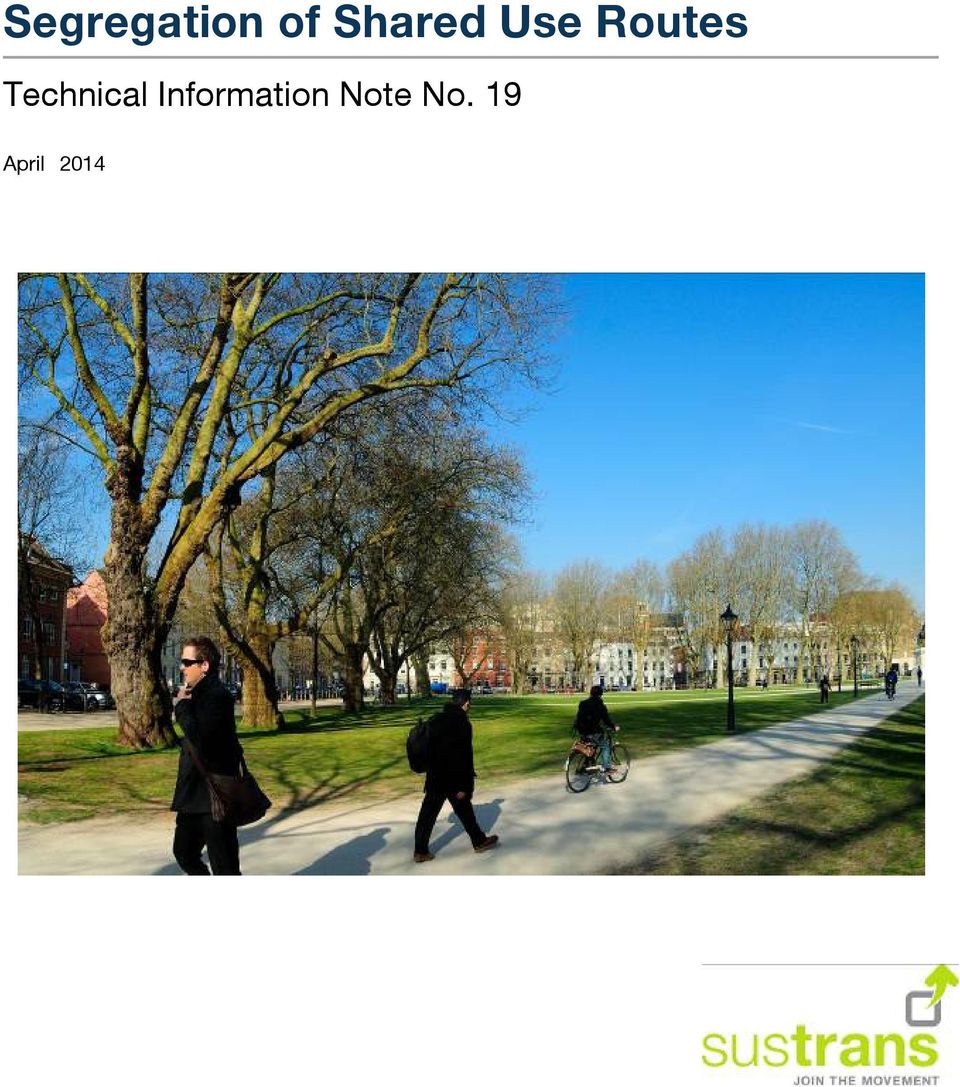
2 About Sustrans Sustrans makes smarter travel choices possible, desirable and inevitable. We re a leading UK charity enabling people to travel by foot, bike or public transport for more of the journeys we make every day. We work with families, communities, policy-makers and partner organisations so that people are able to choose healthier, cleaner and cheaper journeys, with better places and spaces to move through and live in. It s time we all began making smarter travel choices. Make your move and support Sustrans today. Head Office Sustrans 2 Cathedral Square College Green Bristol BS1 5DD Sustrans April 2014 Registered Charity No (England and Wales) SC (Scotland) VAT Registration No Issue level: 04 Owned by: NCN Director Contact: [email protected] All photos by Sustrans unless noted otherwise 1 Segregation of Shared Use Routes Technical Information Note No. 19 April 2014

3 Background This note provides technical detail on when to consider segregation between cyclists and pedestrians on a shared use route, whether within the highway or away from it. It assumes the decision has already been made that a shared use route is appropriate, so does not address the choice between an on carriageway or off carriageway option. Updated DfT advice on shared use was published in Shared use paths fall under the broad shared space umbrella, as they are spaces in which priorities are balanced between all users (in this case excluding motorised vehicles) and are therefore in constant negotiation. Shared use paths have been included in the DfT s research into shared space. Sustrans position draws on emerging findings from the research by DfT and TfL together with extensive experience over 30 years in the implementation and management of shared use routes where the width is constrained, such as disused railway lines and towpaths. Definitions For the purpose of this note the following definitions have been used: A segregated shared use path is a facility used by pedestrians and cyclists with some form of infrastructure or delineation in place designed to segregate these two modes. An unsegregated shared use path is a facility used by pedestrians and cyclists without any measures of segregation between modes. It is designed to enable pedestrians and cyclists to make use of the entire available width of the path. A further helpful distinction is: Traffic Free paths away from the highway Shared use paths parallel to but separate from the carriageway; generally these are part of the highway. This note applies to both situations. Segregation can take the form of a white line, either painted or in the form of a raised delineator (Diag in Traffic Signs Regulations and General Directions 2 ), or physical separation such as a kerb (standard or tapered), barrier or verge. Sustrans Position In Sustrans experience there are significant advantages with unsegregated paths where the width is shared by all users, particularly on traffic free routes away from the road. Unsegregated routes maximise usable width and minimise maintenance requirements and sign/line clutter. Effective segregation will benefit all users but requires significant additional width to provide the same level of service. Each situation must be considered on a case by case basis, and careful consideration must be given to the factors listed below. In LTN 1/12, DfT has moved away from a presumption in favour of segregation, stating in para 7.9 that "segregation need no longer be considered the starting point in the design process and it encourages designers to think through their decisions rather than start from a default position of implementing any particular feature." 1 Local Transport Note 1/12: Shared Use Routes for Pedestrians and Cyclists, DfT Traffic Signs Regulations and General Directions 2002, Statutory Instrument 2002 No Segregation of Shared Use Routes Technical Information Note No. 19 April 2014

4 Key reasons for preferring unsegregated paths are: Evidence shows that cyclists travel faster on segregated shared use routes 3 Where pedestrians walk in groups (esp at weekends and school journeys) they are more likely to ignore segregation unless widths are adequate More considerate behaviour is observed on unsegregated routes Segregated routes can encourage territorial behaviour Narrow segregated routes have higher levels of non-compliance Unsegregated routes may be cheaper to construct and maintain due to less complex engineering and a narrower width (up to three times less if segregation by kerb is used 4 ). Unsegregated routes require fewer signs and markings, thereby offering a less urban and intrusive solution. On unsegregated paths consideration should be given to the erection of courtesy signs such as cyclists give way to pedestrians or share with care. Effective segregation requires sufficient width to be provided for each user group; segregation where insufficient width is provided is largely ineffective. Noncompliance with segregation, where and when it occurs, may lead to increased potential for conflict amongst all users. Where levels of non-compliance are likely to be high an unsegregated path might be more satisfactory. Widths For an unsegregated shared use path, guidance generally points towards a preferred minimum width of 3m, although 4m should be provided on busier routes. A minimum width of 2m may be acceptable on less important links in rural areas, provided there are no side constraints. A greater width will provide an improved level of service. Where segregation is provided, the width requirements for users provided in design guidance suggest the following widths: A preferred minimum for a segregated shared use path with no side constraints would be 7m (3.5m for cyclists and 3.5m for pedestrians). This enables cyclists riding two abreast to pass another cyclist and four pedestrians to pass comfortably whilst complying with segregation. An acceptable minimum for a segregated shared use path with no side constraints would be 4.5m (2.5m for cyclists and 3 London Cycling Design Standards, Appendix D: Off-highway Design Guidance, (unpublished draft), TfL June The Merits of Segregated and Non-Segregated Traffic-Free Paths, Phil Jones Associates, Sustrans Local Transport Note 2/08: Cycle Infrastructure Design, DfT National Cycle Network Guidelines and Practical Details, Sustrans Connect2 and Greenway Design Guide, Sustrans London Cycling Design Standards, TfL Local Transport Note 1/12: Shared Use Routes for Pedestrians and Cyclists, DfT Segregation of Shared Use Routes Technical Information Note No. 19 April 2014

5 2m for pedestrians 10 ). This enables two cyclists to pass and two pedestrians or wheelchairs to pass comfortably whilst complying with segregation. An absolute minimum for a segregated shared use path with no side constraints would be 3.5m, but only over short lengths of route (2m for cyclists and 1.5m for pedestrians). However, with these widths substantial levels of non-compliance would be expected, in which case unsegregated use is likely to be a more appropriate option. The effect of side constraints is discussed in Chapter 7 of LTN 1/12. Overhanging vegetation can also reduce the effective width of a path and should be cut back. Physical, land ownership and financial constraints may make segregation an unviable option, e.g. along towpaths, disused railway lines and bridleways. Where physical segregation, such as a kerb, is being considered, additional width may be required, due to: Users tending to choose their side and stay there. Cyclists may be unable to cross the delineator safely if their way is obstructed. Physical segregation can present a hazard for cyclists (also the raised white line delineator can present a hazard in wet conditions) Possibly greater speeds. Level of Use Research for DfT and TfL included reviewing the performance of shared use routes of varying widths and locations operating under a range of flows of pedestrians and cyclists; they also considered both traffic free routes and routes alongside the carriageway. Further advice on these design aspects will be available once this research has been published. Initial findings from the TfL research 11 suggest that the decision whether segregate a shared use path should not be based solely on an assessment of user flows, but should also draw on the expertise of the design team, site specific information, and other relevant guidance; width options are identified for both segregated and unsegregated designs for all levels of usage, reinforcing the view that level of use is not the controlling factor in the decision on whether to segregate. However, in all cases providing segregation requires a greater width for an equivalent level of service. Segregation The recent DfT / TfL research has largely considered segregation by white line, as there are very few sites with physical segregation. Factors that might suggest that segregation would be preferred include 12 : High pedestrian and / or cycle flow High proportion of utility cyclists Locations where significant use by vulnerable pedestrians is expected, esp elderly / visually impaired, such as near residential homes Low variability of modal split (proportion of cyclists / pedestrians) 10 Inclusive Mobility, DfT London Cycling Design Standards, Appendix D: Off-highway Design Guidance, (unpublished draft), TfL June The Merits of Segregated and Non-Segregated Traffic-Free Paths, Phil Jones Associates, Sustrans Segregation of Shared Use Routes Technical Information Note No. 19 April 2014

6 Low usage by groups of pedestrians High level of non-travelling path users (e.g. congregating at an attraction, shoppers) Low flows across path / few junctions Wide path can be provided Steep gradient Where the path runs adjacent to driveways with poor visibility segregation can provide a means of moving cyclists away from the driveways It should be noted many cyclists are likely to prefer a high quality segregated path as the higher speed is a positive factor. Where segregation is to be provided, the minimum level of provision for visually impaired pedestrians is the raised white line delineator with the associated tactile paving 13, taking account of the updated advice on tactile paving included in paras 6.18 and 6.19 of LTN 1/12. Groups representing the blind have major reservations on any design that does not include physical segregation, 14 although some disabled people, particularly wheelchair users and disabled cyclists, may benefit from routes without any raised divider. 15 Where schemes are constructed within the existing highway boundary, the width restrictions will often rule out segregation unless carriageway space can be reallocated for cyclists. Where physical segregation, such as a kerb, is provided, it is essential that the widths and other design details all contribute to a design where pedestrians are unlikely to use the cycle track. The need for continuity of provision is also an important aspect to consider in deciding whether to segregate a route. The latest DfT advice in LTN 1/12 encourages local authorities to consider introducing one-way hybrid cycle tracks, at a level between the carriageway and the footway. Processes Developing the design of a shared use path, including decisions on segregation, should include early consultation with relevant interested parties such as those representing people with disabilities, walkers and cyclists. Following the introduction of a shared use path it is advisable to monitor its performance; this will enable any concerns to be identified early on and suitable mitigating measures implemented if required. Conclusions In Sustrans experience there are significant advantages with unsegregated paths where the width is shared by all users, particularly on traffic free routes away from the road. However, each situation needs to be considered on a case by case basis; segregation may be appropriate in certain situations such as where there is a high level of use and adequate space can be provided for each user group. However, constraints may make it undesirable / impracticable to segregate and unsegregated paths tend to encourage improved behaviour by all user groups. 13 Guidance on the Use of Tactile Paving Surfaces, DETR Adjacent Facilities for Pedestrians and Cyclists: Policy Statement, Joint Committee on Mobility of Blind and Partially Sighted People, Equality Impact Assessment: Cycling on Greenways, Equality Works, TfL Segregation of Shared Use Routes Technical Information Note No. 19 April 2014

Sustrans. The Merits of Segregated and Non-Segregated Traffic-Free Paths. A Literature-Based Review. Updated Report, August 2011
 Phil Jones Associates Transport Planning Consultants Sustrans The Merits of Segregated and Non-Segregated Traffic-Free Paths A Literature-Based Review Project Code 836 Phil Jones Associates Ltd The Innovation
Monitoring and evaluation of walking and cycling (draft)
 Sustrans Design Manual Chapter 16 Monitoring and evaluation of walking and cycling (draft) November 2014 September 2014 1 About Sustrans Sustrans makes smarter travel choices possible, desirable and inevitable.
Development Layout Design
 Development Layout Design General Design Considerations for Adoptable Highways Version 1 June 2012 Transportation, Waste and Environment Service Issue and Revisions Record Revision Date Originator Purpose
Aggregates for Path Construction
 Aggregates for Path Construction Technical Information Note No. 7 October 2011 About Sustrans Sustrans makes smarter travel choices possible, desirable and inevitable. We re a leading UK charity enabling
Joined-Up Cycling. Cycle Links for Horsham Town Centre
 Joined-Up Cycling Cycle Links for Horsham Town Centre 1 4 3 6 2 5 Proposals to improve cycle access to the town at the Albion Way/Bishopric junction and join up some of the fragmented cycle routes in the
How To Develop A Balanced Transport System In Devon
 Devon Structure Plan First Review - 1995 to 2011 7 Transportation (T Policies) Explanatory Memorandum (September 1999) (Policies and Proposals adopted February 1999) 7. TRANSPORTATION 7.1 Transportation
Cycle Network Signing
 Cycle Network Signing Technical Information Note No. 05 October 2012 About Sustrans Sustrans makes smarter travel choices possible, desirable and inevitable. We re a leading UK charity enabling people
Street Design Guide. Leeds Local Development Framework
 Street Design Guide Leeds Local Development Framework Supplementary Planning Document Main Report August 2009 If you do not speak English and need help in understanding this document, please phone: (0113)
Handbook for cycle-friendly design
 Sustrans Design Manual Handbook for cycle-friendly design Foreword For at least two generations, planning for transport in the UK has primarily focused on the car. The unintended consequence of this has
Cycle Strategy 2006 2011
 Cycle Strategy 2006 2011 TABLE OF CONTENTS 1 INTRODUCTION... 1 2 POLICY BACKGROUND... 2 3 BACKGROUND... 6 4 MAIN OBJECTIVES... 8 5 TARGETS... 9 6 THE CYCLE NETWORK... 10 7 CONCLUSION... 13 Appendix A:
Shoppers and how they travel
 Shoppers and how they travel INFORMATION SHEET LN2 Over ten years ago, retailers in the Austrian city of Graz were asked how they thought their customers travelled to the shop, and shoppers were then interviewed
Shared Use Routes for Pedestrians and Cyclists
 Local Transport Note 1/12 September 2012 Shared Use Routes for Pedestrians and Cyclists Published by TSO (The Stationery Office) and available from: Online www.tsoshop.co.uk Mail, Telephone, Fax & E-mail
CONTENTS. References 12
 RESPONSE TO TRANSPORT COMMITTEE INQUIRY INTO CYCLING SAFETY 1 CONTENTS Why Britain has a cycling safety problem 3 Subjective safety 5 Safety by design 6 Separation of cycling and motorised traffic 7 Sustainable
CONSTRUCTION TRAFFIC MANAGEMENT PLAN Issue 2, V5, 11/11/13
 Note: Please refer to the end of this document for guidance notes about completing this form Q1. What is the full postal address of the site? Your response Q2. Planning reference and revision number (if
The Northumberland Estates Proposed Residential Development, Prudhoe Town Centre D/I/D/63558/603. Framework Residential Travel Plan
 The Northumberland Estates Proposed Residential Development, Prudhoe Town Centre D/I/D/63558/603 Framework Residential Travel Plan September 2013 CONTROL SHEET CLIENT: PROJECT TITLE: REPORT TITLE: THE
Stage 2 A660 Otley Rd Cycling Study
 Stage 2 A660 Otley Rd Cycling Study Cycle Audit Final Report October 2008 Page 1 of 19 Contents Page 1.0 Introduction 4 2.0 The Benefits of Increasing Cycling 4 3.0 Methodology 5 3.0 Background - Site
Trends and issues Lake Te Koutu walkway, Cambridge
 27 Trends and issues Lake Te Koutu walkway, Cambridge 3 Trends 3.1 Journey to work Over the past two to three decades there has been a significant increase in private vehicle ownership and usage and a
Delineation. Section 4 Longitudinal markings
 Delineation Section 4 Longitudinal markings The delineation guidelines have been developed to assist in designing and maintaining a quality delineation system. The guidelines are to comprise 19 sections
Wakefield Council. Cycle Strategy for Wakefield 2013 A guide to delivering cycle infrastructure. www.wakefield.gov.uk
 Wakefield Council Cycle Strategy for Wakefield 2013 A guide to delivering cycle infrastructure www.wakefield.gov.uk - A guide to delivering cycle infrastructure Executive Summary This document presents
Household waste & recycling storage requirements
 South Gloucestershire Council Guidance for Developers on Household waste & recycling storage requirements INTRODUCTION As part of the Council s aim to improve the quality of life for residents as well
HIGHWAY DESIGN GUIDE. 1.1 Foreword
 HIGHWAY DESIGN GUIDE Part 1 INTRODUCTION 1.1 Foreword Coventry City Council wants Coventry to be a growing, accessible city where people choose to live, work and be educated, and where businesses choose
IPENZ TRANSPORTATION GROUP CONFERENCE 2013 KEEP CHRISTCHURCH MOVING FORWARD CHRISTCHURCH TRANSPORT STRATEGIC PLAN
 Keep Christchurch moving forward Foxon R. Kurucz R. Cheeseborough T. Page 0 IPENZ TRANSPORTATION GROUP CONFERENCE 2013 KEEP CHRISTCHURCH MOVING FORWARD CHRISTCHURCH TRANSPORT STRATEGIC PLAN RUTH FOXON
Cycle Network Modelling A new evidence-based approach to the creation of cycling strategy
 Cycle Network Modelling A new evidence-based approach to the creation of cycling strategy A The Business Cycle, London, mapping of commuter cycle routes and hotspots, 2000. A It is refreshing to see an
PART 3 TD 50/04 THE GEOMETRIC LAYOUT OF SIGNAL- CONTROLLED JUNCTIONS AND SIGNALISED ROUNDABOUTS SUMMARY
 DESIGN MANUAL FOR ROADS AND BRIDGES VOLUME 6 SECTION 2 ROAD GEOMETRY JUNCTIONS PART 3 TD 50/04 THE GEOMETRIC LAYOUT OF SIGNAL- CONTROLLED JUNCTIONS AND SIGNALISED ROUNDABOUTS SUMMARY This document sets
Cycle storage provision in new dwellings Advice Note: London Borough of Waltham Forest
 Cycle storage provision in new dwellings Advice Note: London Borough of Waltham Forest Contents 1.0 Introduction and Policy Background Page 3 2.0 Objectives Page 7 3.0 Cycle storage solutions Page 11 4.0
Environment Committee 11 January 2016
 Environment Committee 11 January 2016 Title Whole Life Costing of Footway Maintenance Treatments and Scheme Prioritisation Report of Wards Status Urgent Key Enclosures Commissioning Director, Environment
ROAD SAFETY GUIDELINES FOR TAH ROAD INFRASTRUCTURE SAFETY MANAGEMENT
 I. GENERAL ROAD SAFETY GUIDELINES FOR TAH ROAD INFRASTRUCTURE SAFETY MANAGEMENT ANNEX III B i. The setting up and implementing of appropriate management procedures is an essential tool for improving the
Department of State Development, Infrastructure and Planning. State Planning Policy state interest guideline. State transport infrastructure
 Department of State Development, Infrastructure and Planning State Planning Policy state interest guideline State transport infrastructure July 2014 Great state. Great opportunity. Preface Using this state
DEPARTMENT OF TRANSPORT CYCLING STRATEGY 29 February 2008
 DEPARTMENT OF TRANSPORT CYCLING STRATEGY 29 February 2008 INTRODUCTION The Department of Transport s Business Plan for the 2007/08 financial year stated the following: Government Aim: Quality Environment
Take action on active travel
 Take action on active travel Why a shift from car-dominated transport policy would benefit public health For the first time, the UK s leading organisations working on all areas of public health, including
YOUR GUIDE TO INTRA-TOWN CYCLING
 YOUR GUIDE TO INTRA-TOWN CYCLING Content 04 Introduction 05 Attire Before you set off 06 Safety Checklist for Bicycle 07 Maintenance 08 Preventing Bicycle Theft What to look out for on the way 10 Signs
Wakefield Council Street Design Guide
 A new vision for developing Wakefield District Wakefield Council Street Design Guide A guide for residential, commercial and mixed use development in Wakefield district. www.wakefield.gov.uk Information
ASSET MANAGEMENT STRATEGY
 ASSET MANAGEMENT STRATEGY Transport and Highways June 2013 Asset Management Strategy (June 2013) Page 1 of 10 CONTENTS INTRODUCTION 3 SECTION 1: WHY ASSET MANAGEMENT 4 1.1 Background 4 1.2 Strategic Framework
Cycling Demonstration Towns Development of Benefit-Cost Ratios
 Cycling Demonstration Towns Development of Benefit-Cost Ratios Executive summary 1. In 2005, Cycling England launched a Cycling Demonstration Town programme to invest in measures to stimulate increased
Framework Traffic Management for Shared Zones in Large Private Estates AITPM 2014 National Conference
 Framework Traffic Management for Shared Zones in Large Private Estates AITPM 2014 National Conference Presented by : Wayne Johnson Senior Project Manager GTA Consultants [email protected] Outline
HIGHWAY DESIGN GUIDE 1 PRINCIPLES AND RESPONSIBILITES
 1 PRINCIPLES AND RESPONSIBILITES CONTENT 1.1 Purpose and Format 1.2 Role of the Highway Authority 1.3 Road Hierarchy 1.4 Fitting Developments into the existing highway network 1.5 Highway Agreements 1.6
Temporary Traffic Management
 Temporary Traffic Management Tom Kiddle 4 th July 2012 Temporary Traffic Management Auckland Transport TTM Operation Requirements AT TTM Audits Qualified Persons on site Pedestrian Management 1 AT Temporary
CHAPTER. Traffic Signs Manual. Part 1: Design. Traffic Safety Measures and Signs for Road Works and Temporary Situations
 Traffic Signs Manual CHAPTER 8 Traffic Safety Measures and Signs for Road Works and Temporary Situations Part 1: Design 2009 Traffic Signs Manual Chapter 8 Traffic Safety Measures and Signs for Road Works
SUMMARY OF CORRECTION TA 85/01 Volume 6, Section 1, Part 3 GUIDANCE ON MINOR IMPROVEMENT TO EXISTING ROADS
 DESIGN MANUAL FOR ROADS AND BRIDGES SUMMARY OF CORRECTION TA 85/01 Volume 6, Section 1, Part 3 GUIDANCE ON MINOR IMPROVEMENT TO EXISTING ROADS In May 2002, you received instructions to replace pages 5/1
Oxfordshire Local Transport Plan 2011-2030 Revised April 2012. Objective 3 Reduce casualties and the dangers associated with travel
 6. Road Safety Objective 3 Reduce casualties and the dangers associated with travel Road safety continues to be a core priority both nationally and locally reflecting the very high human and other costs
Transport for London. Accessible bus stop design guidance. Bus Priority Team technical advice note BP1/06 January 2006 MAYOR OF LONDON
 Transport for London Accessible bus stop design guidance Bus Priority Team technical advice note BP1/06 January 2006 MAYOR OF LONDON Accessible bus stop design guidance Further information For further
Cycle Safety. Some tips on safer cycling. Údarás Um Shábháilteacht Ar Bhóithre Road Safety Authority
 Cycle Safety Some tips on safer cycling Údarás Um Shábháilteacht Ar Bhóithre Road Safety Authority Be safe For further information on safe cycling, please look at the Rules of the Road website at www.rulesoftheroad.ie
Planning Policy Statement 3 (PPS 3 Revised Feb 2005) Access, Movement and Parking
 Planning Policy Statement 3 (PPS 3 Revised Feb 2005) Access, Movement and Parking Planning Policy Statements (PPSs) set out the policies of the Department of the Environment on particular aspects of land-use
DEVELOPMENT BRIEF FOR LAND AT ALLOA ROAD, TULLIBODY
 DEVELOPMENT BRIEF FOR LAND AT ALLOA ROAD, TULLIBODY 1.0 Introduction and Purpose 1.1 Clackmannanshire Council is seeking to dispose of a site at Alloa Road, Tullibody for redevelopment. The site extends
Page 117. DEVELOPMENT CONTROL COMMITTEE - Date:1 September 2010. Report of the Executive Head of Planning and Transportation.
 Page 117 Agenda Item 10 DEVELOPMENT CONTROL COMMITTEE - Date:1 September 2010 Report of the Executive Head of Planning and Transportation. Ref: A2010/63099/ADV WARD: A03 / STONECOT Time Taken: 5 weeks,
 Walkable Communities Florida Department of Transportation State Safety Office Pedestrian and Bicycle Program April 1995 www.dot.state.fl.us/safety Twelve Steps for an Effective Program Page 1 Twelve Steps
INTERIM ADVICE NOTE 65/05 DESIGN OF VEHICLE RECOVERY OPERATIONS AT ROAD WORKS
 INTERIM ADVICE NOTE 65/05 DESIGN OF VEHICLE RECOVERY OPERATIONS AT ROAD WORKS The Purpose of this document is to provide the Project Sponsor / Designer with comprehensive guidance on the range of issues
Site Deliverability Statement Alternative Site at: Bridge Road, Old St Mellons
 Site Deliverability Statement Alternative Site at: Bridge Road, Old St Mellons Representor Number 1135 AS(N)4 Persimmon Homes 9 th February 2015 Contents Site Deliverability Statement Alternative Site
Salford City Council s Local Cycling Strategy
 Encouraging cycling IN Salford Salford City Council s Local Cycling Strategy Contents Foreword page 1 Policy background 2 Cycle use in the UK 3 Cycle use in Salford 4 Objectives 5 Implementation 6 Cycle
INFRASTRUCTURE - ON-SITE
 Notes for Champions and Assessors This guide has been developed to help you complete the self-assessment form and check how cycle friendly your organisation is. It may also be helpful to make comments
Construction Traffic Management Plan
 Introduction This (CTMP) has been prepared in order to discharge Condition 20 of planning permission ref 07/02879/EFUL for the enabling site works associated with the wider Bath Western Riverside development.
Cycling by Design 2010 (Revision 1, June 2011)
 Cycling by Design 2010 Crown copyright 2011 You may re-use this information (excluding logos) free of charge in any format or medium, under the terms of the Open Government Licence. To view this licence,
Level Crossings: A guide for managers, designers and operators
 Level Crossings: A guide for managers, designers and operators Railway Safety Publication 7 December 2011 Contents Foreword 4 What is the purpose of this guide? 4 Who is this guide for? 4 Introduction
INTERIM ADVICE NOTE 179/14
 INTERIM ADVICE NOTE 179/14 Guidance on the Use of Vehicle Mounted High Level to provide advance warning of lane closures for Relaxation Works on Dual Carriageways with a Hard Shoulder Summary Guidance
Slough Borough Council. Highway Asset Management Strategy
 Slough Borough Council Highway Asset Management Strategy OUR AMBITION USING RESOURCES WISELY By 2019 the Council s income and the value of its assets will be maximised 1 Key Priorities 1.1 We understand
Planning and Design for Sustainable Urban Mobility
 1 Planning and Design for Sustainable Urban Mobility 2 1 UrbanizationUrbanization Rapid pace, largely uncontrolled growth, taking place mainly in developing countries 3 Global Urbanization Trends World
ADA POST INSPECTION CHECKLIST. Job No. Route County Location
 ADA POST INSPECTION CHECKLIST Job No. Route County Location SIDEWALKS All sidewalks constructed within the project limits are ADA compliant. Sidewalks are 5 or greater in width. Exception, existing sidewalks
CENTRELINE REMOVAL TRIAL
 Road Space Management Directorate Surface Transport Transport for London 4 th Floor, Palestra 197 Blackfriars Road London SE1 8NJ www.tfl.gov.uk CENTRELINE REMOVAL TRIAL Issue Date Prepared by Reviewed
Principles of Traffic Management on sites / road network
 IOSH Ireland, Construction Specialist Section Springfield Hotel, Leixlip, County Kildare. 25 March 2015 Principles of Traffic Management on sites / road network Padraig Watters, Chartered Engineer This
Safety Evidence for Bicycling
 Photo: Boegh (Flickr) Cycling in Cities Research Program School of Population & Public Health The University of British Columbia Faculty of Health Sciences Simon Fraser University Driving near bicyclists
Reported Road Casualties Great Britain: 2013 Annual Report
 Reported Road Casualties Great Britain: 2013 Annual Report Focus on pedal cyclists Key findings The key findings from this article include: Pedal cyclist deaths have seen a long-term fall, but have fluctuated
Children and road safety: a guide for parents
 Child Safety Week Report Children and road safety: a guide for parents What are the facts? The number of children aged up to 19 years who are killed or seriously injured each year on Britain's roads has
City of Auburn Americans with Disabilities Act (ADA) Transition Plan for Curb Ramps, Sidewalks, and Pedestrian Signals ADA TRANSITION PLAN
 Americans with Disabilities Act (ADA) Transition Plan for Curb Ramps, Sidewalks, and Pedestrian Signals ADA TRANSITION PLAN December 21, 2009 Public Works Department 171 N. Ross Street, Suite 200 Auburn,
SAN DIEGO - A BICYCLE FRIENDLY CITY
 SAN DIEGO - A BICYCLE FRIENDLY CITY MANY OPPORTUNITIES FOR IMPROVEMENT SUMMARY The designated bicycle paths and lanes in the City of San Diego (City) are often substandard because of their location and
NORWICH CITY COUNCIL. Report for Resolution
 NORWICH CITY COUNCIL Report for Resolution Report To Report of Subject Norwich Highways Agency Committee 11 November 2004 Director of Development Lakenham TAP Responses to the advertisement of waiting
Speed Limit Policy Isle of Wight Council
 APPENDIX C - 59 Speed Limit Policy Isle of Wight Council June 2009 Contents Section 1 Introduction 1.1 Links with the Local Transport Plan Section 2 Speed Limits on Urban Roads and Residential Areas 2.1
Major and Minor Schemes
 1 Major and Minor Schemes Peterborough City Council has identified a number of proposals for major transport schemes over the next five year period that will support the planned housing and employment
Towpath Design. British Waterways. Guidance for Towpath Design
 British Waterways Towpath Design British Waterways canals and rivers were moved into the care of the Canal & River Trust in July 2012. This first version of the document was produced in 2011/12. Guidance
Vehicle Security Barriers within the Streetscape Traffic Advisory Leaflet 1/11. Vehicle Security Barriers within the Streetscape
 Vehicle Security Barriers within the Streetscape Traffic Advisory Leaflet 1/11 March 2011 Vehicle Security Barriers within the Streetscape A Vehicle Security Barrier (VSB) is a physical security device
Traffic Signs Manual CHAPTER. Traffic Safety Measures and Signs for Road Works and Temporary Situations Part 2: Operations
 Traffic Safety Measures and Signs for Road Works and Temporary Situations provides the official detailed guidance on these matters. Part 1: Design (ISBN 978-0-11-553051-7, price 70) is for those responsible
ACCESS AUDIT OF WESTPORT HOUSE
 ACCESS AUDIT OF WESTPORT HOUSE Large sign on the highway to indicate the entrance to Purbeck District Council Large and wide entrance Entrance showing sign for opening times Entrance sign Main entrance
How To Design A Road In A Village
 Creating the Design Step 3 - Designing for movement 116 2.3 DESIGNING FOR MOVEMENT Activity is the life blood of a successful community. The ease with which people can move within and between neighbourhoods
HIGHWAYS ENGLAND STRATEGIC BUSINESS PLAN OVERVIEW 2015-2020
 HIGHWAYS ENGLAND STRATEGIC BUSINESS PLAN OVERVIEW 05-00 STRATEGIC ROAD NETWORK 4,00 miles of motorways and major A roads A billion tonnes of freight transported each year 4 million people drive on the
A number of key guiding principals underline the approach to transportation within the plan area. These include:
 Transportation The principal form of transportation infrastructure will be vehicular roads augmented by a network of pedestrian and cycle routes. Transport infrastructure development will be commensurate
PEDESTRIAN PLANNING AND DESIGN MARK BRUSSEL
 PEDESTRIAN PLANNING AND DESIGN MARK BRUSSEL CONTENT OF LECTURE a) Walking as a transport mode b) Walking in Sub Sahara Africa c) Policies for pedestrians d) Pedestrian characteristics e) Network planning
HIGHWAY INFRASTRUCTURE ASSET MANAGEMENT
 HIGHWAY INFRASTRUCTURE ASSET MANAGEMENT GUIDANCE DOCUMENT MAY 2013 Although this report was commissioned by the Department for Transport (DfT), the findings and recommendations are those of the authors
Christchurch Cycle Design Guidelines
 Christchurch Cycle Design Guidelines 2013 Acknowledgements We would like to thank the contributions from ViaStrada and other contributors including Glen Koorey, Spokes, NZTA, Canterbury Public Health,
Road Safety Auditor Certification Compliance with EC Directive 2008/96/EC
 TRANSPORT SCOTLAND TRUNK ROAD & BUS OPERATIONS TS INTERIM AMENDMENT 40/11 Road Safety Auditor Certification Compliance with EC Directive 2008/96/EC Summary This Interim Amendment provides guidance to ensure
Child Road Safety Audit for South Gloucestershire 2009-2011
 Child Road Safety Audit for South Gloucestershire 9 - August 9 Contents Page Foreword Executive Summary. Introduction. Review of the Action Plan. Summary of Casualty Statistics 9. Child Casualty Trends.
LEWES DISTRICT AND SOUTH DOWNS NATIONAL PARK AUTHORITY LEWES DISTRICT JOINT CORE STRATEGY INDEPENDENT EXAMINATION
 1 LEWES DISTRICT AND SOUTH DOWNS NATIONAL PARK AUTHORITY LEWES DISTRICT JOINT CORE STRATEGY INDEPENDENT EXAMINATION STATEMENT BY CROUDACE STRATEGIC LIMITED ISSUES 7 AND 8 STRATEGIC SITES (POLICIES SP5/SP6)
AGENDA ITEM: 15 PROPOSED ZEBRA CROSSINGS AT VARIOUS LOCATIONS. Executive Director of Development & Environment
 Croydon Council REPORT TO: TRAFFIC MANAGEMENT ADVISORY COMMITTEE 21 July 2014 AGENDA ITEM: 15 SUBJECT: LEAD OFFICER: CABINET MEMBER: PROPOSED ZEBRA CROSSINGS AT VARIOUS LOCATIONS Executive Director of