
How To Write A Thesis On Cloud Computing For Pharmaceuticals
|
|
|
- Malcolm Strickland
- 5 years ago
- Views:
Transcription
1 ADOPTING CLOUD COMPUTING AND HOSTED SERVICES IN PHARMACEUTICAL INDUSTRY Ville Harjulampi Master s Thesis December 2013 Degree Programme in Information Technology Technology and transportation

2 DESCRIPTION Author(s) Harjulampi, Ville Type of publication Master s Thesis Pages 62 Date Language English Permission for web publication ( X ) Title Adopting cloud computing and hosted services in pharmaceuticals industry. Degree Programme Master s Degree Programme in Information Technology. Tutor(s) Huotari, Jouni Turunen, Ilkka Assigned by FinVector Vision Therapies Oy Abstract Cloud computing has become popular among consumers and within bigger corporations as well. Information technology services that used to be internal only can be now taken into cloud using various combinations of cloud technology. In this thesis cloud computing was examined from pharmaceutical company point of view. There are several regulations, directives, guidelines, recommendations and legislation that need to be taken into consideration before making any cloud computing decisions. The outcome of the research was better understanding of the technology behind cloud computing and how it can be approached. Regulatory factors were also reviewed. Additionally a risk based approach model was generated as a roadmap into cloud computing. During the research work it became clear that the subject is still being highly debated among industry mainly because of overlapping, partly outdated and fragmented regulatory requirements. However, pharmaceutical industry can implement and benefit from cloud computing. Keywords Cloud computing, pharmaceuticals, validation, qualification Miscellaneous

3 KUVAILULEHTI Tekijä(t) Harjulampi, Ville Julkaisun laji Opinnäytetyö Sivumäärä 62 Päivämäärä Julkaisun kieli Englanti Verkkojulkaisulupa myönnetty ( X ) Työn nimi Adopting cloud computing and hosted services in pharmaceuticals industry. Koulutusohjelma Master s Degree Programme in Information Technology. Työn ohjaaja(t) Huotari, Jouni Turunen, Ilkka Toimeksiantaja(t) FinVector Vision Therapies Oy Tiivistelmä Pilvipalveluista on viime aikoina tullut suosittuja niin yksityishenkilöiden kuin suurempienkin yritysten keskuudessa. Aiemmin ainoastaan yritysten sisäisiä tietotekniikkapalveluita voidaan nykyään siirtää pilvipalveluihin hyödyntäen monenlaisia yhdistelmiä erilaisista pilvipalvelumalleista. Tässä opinnäytetyössä pilvipalveluita lähestytään lääketeollisuuden näkökulmasta. On olemassa useita asetuksia, direktiivejä, ohjeistuksia, suosituksia sekä lainsäädäntöä joka pitää ottaa huomioon ennen pilvipalveluiden käyttöönottoa. Opinnäytetyön lopputuloksena oli erilaisten pilvipalveluiden teknologioiden tarkastelua ja riskipohjaisen lähestymismallin luominen jota voidaan käyttää vaihtoehtona lääketeollisuuden pilvipalveluissa. Erilaisia viranomaisvaatimuksia ja suosituksia myös tarkasteltiin työn aikana. Tutkimustyön aikana kävi ilmeiseksi, että aihe on vielä kiistainalainen teollisuuden parissa johtuen päällekkäisistä, osittain vanhentuneista ja hajanaisista viranomaisvaatimuksista. Pilvipalveluiden käyttöönotto on kuitenkin mahdollista. Avainsanat (asiasanat) Pilvipalvelut, lääketeollisuus, validointi, kvalifiointi Muut tiedot

4 1 Contents TERMINOLOGY INTRODUCTION BACKGROUND TO THE RESEARCH CLOUD COMPUTING History of the term Definitions Key characteristics of cloud computing by NIST definition On-demand self-service Broad network access Resource pooling Rapid elasticity Measured service Service models Infrastructure as a Service (IaaS) Platform as a Service (PaaS) Software as a Service (SaaS) Deployment models Public cloud Private cloud Hybrid cloud Community cloud Cloud service provider pioneers Summary REGULATIONS AND STANDARDS FOR IT EudraLex Volume 4 Annex EU Data Protection Directive /46/EC Data Protection Directive General Data Protection Regulation US-EU Safe Harbor Good Automated Manufacturing Practice (GAMP) ISO/IEC ISO/IEC 27001:2005 Information security management systems ISO/IEC 27002:2005 Code of practice for information security management ISO/IEC Security in cloud computing (DRAFT) ISO/IEC (DRAFT)... 20
5 ISO/IEC x Information security for supplier relationships (DRAFT) ISO/IEC 14971:2012 Application of risk management to medical devices Quality risk management (ICH Q9) Summary CLOUD COMPUTING IN PHARMACEUTICAL INDUSTRY Applications types Data types Layers or responsibility Agreements and accountability Vendor audits Validation and qualification Sector targeted cloud solutions Where to start support documentation CSA ENISA NIST ISACA Block level approach EudraLex 4 Annex 11 cloud computing specific clauses Summary SECURITY Security issues Security controls Security assessment Securing the data Risks Cloud model risks Risk assessment Risk mitigation Summary RISK BASED APPROACH MODEL Background Introduction Risk based approach model System description (SD) GMP impact assessment (GMPIA) Failure mode effect analysis (FMEA) Risk assessment summary... 44

6 7.4 Summary CONCLUSION AND RECOMMENDATIONS APPENDICES Appendix Appendix Appendix REFERENCES FIGURES Figure 1 Three main layers of cloud computing (Ludwig 2011) Figure 2 Cloud computing types (Wikipedia, 2012) Figure 3 GAMP4 and GAMP5 software categories (Martin & Perez 2008) Figure 4 ISO27002 (ISO27001 Security 2013) Figure 5 Trust boundary (Carstensen et al. 2012) Figure 6 Risk continuum dimensions (Stokes 2012, 34) Figure 7 Risk based approach model steps TABLES TABLE 1. Eudralex 4 Annex 11 cloud computing specific clauses TABLE 2. Risk based approach model framework... 42
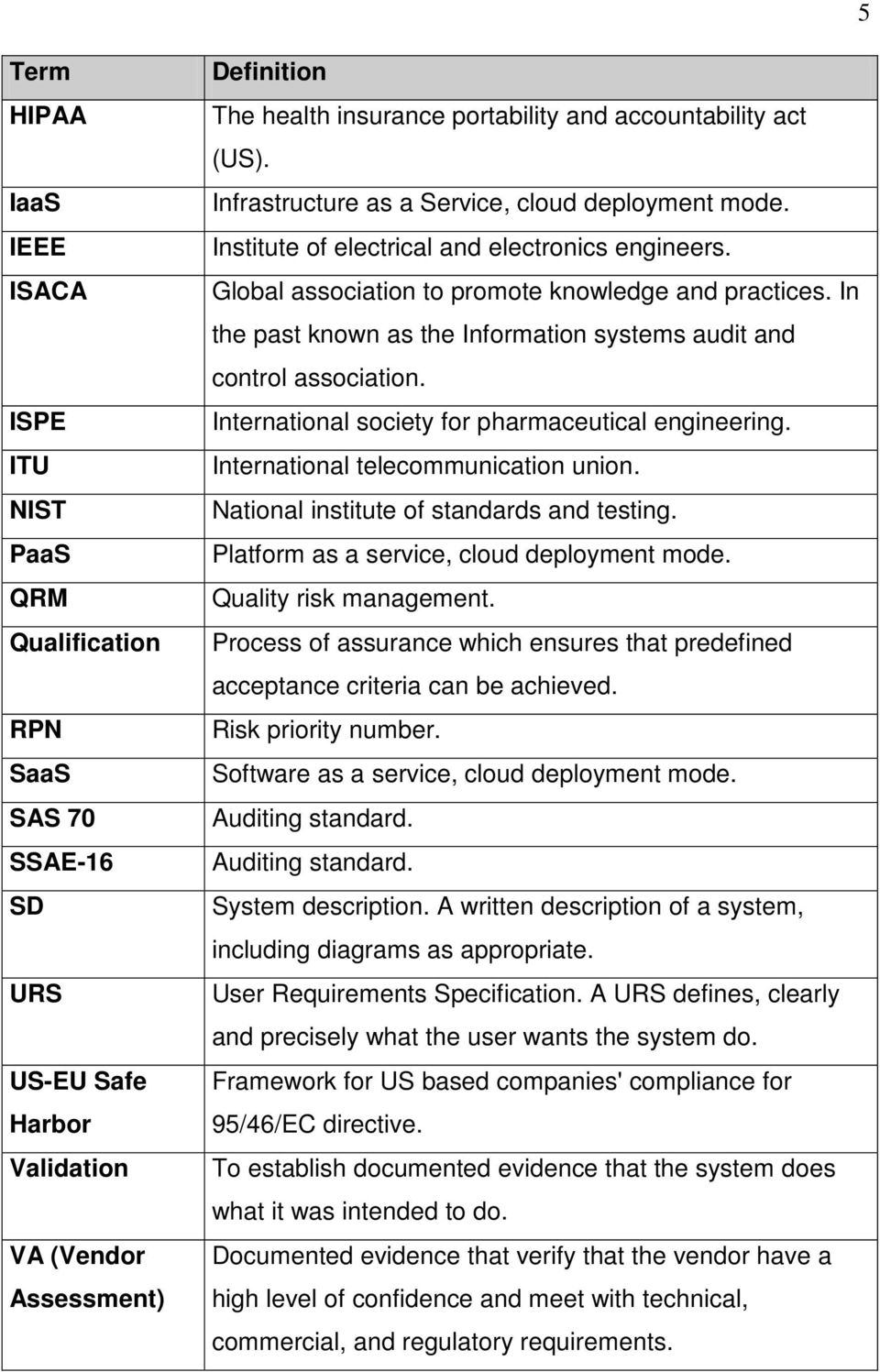
7 4 TERMINOLOGY Term 94/46/EC AWS CIO Cloud computing Computer System CSA EMEA ENISA ERP EU EudraLex Volume 4 Annex 11 FDA FMEA GAMP GMP GMP significant application GMPIA GxP Definition Data protection directive released by European Union. Amazon web services, cloud computing service. Chief information officer. Use of computing resources as a service across the network. A group of hardware components and associated software designed and assembled to perform a specific function or group of functions. Cloud security alliance. European medicines agency. European union agency for network and information security. Enterprise resource planning system. European union. European Commission has published a set of guidance for manufacturing and distributing medicinal products for pharmaceutical industry in the European Union. Annex 11 applies to computerized systems. US food and drug administration. Failure mode effect analysis, systematic analysis tool for failure analysis. Good automated manufacturing practice, published by ISPE. Good manufacturing practice. Software application which have direct access to GMP data. GMP impact assessment. General term where x represents for example manufacturing ( GMP ) or laboratory ( GLP ).

8 5 Term HIPAA IaaS IEEE ISACA ISPE ITU NIST PaaS QRM Qualification RPN SaaS SAS 70 SSAE-16 SD URS US-EU Safe Harbor Validation VA (Vendor Assessment) Definition The health insurance portability and accountability act (US). Infrastructure as a Service, cloud deployment mode. Institute of electrical and electronics engineers. Global association to promote knowledge and practices. In the past known as the Information systems audit and control association. International society for pharmaceutical engineering. International telecommunication union. National institute of standards and testing. Platform as a service, cloud deployment mode. Quality risk management. Process of assurance which ensures that predefined acceptance criteria can be achieved. Risk priority number. Software as a service, cloud deployment mode. Auditing standard. Auditing standard. System description. A written description of a system, including diagrams as appropriate. User Requirements Specification. A URS defines, clearly and precisely what the user wants the system do. Framework for US based companies' compliance for 95/46/EC directive. To establish documented evidence that the system does what it was intended to do. Documented evidence that verify that the vendor have a high level of confidence and meet with technical, commercial, and regulatory requirements.
9 6 1 INTRODUCTION Cloud computing and hosted IT services are nowadays becoming more and more popular (Bittman 2012). Cloud computing solutions have evolved over the time offering better set of tools for all-sized companies and organizations. These tools usually contain for example communications management, data storage and hosted applications. Cloud computing has become an essential way of work not just for large companies and IT professionals but for regular home computer users. It is seldom recognized that popular services, social networking sites and web stores for tabloid and smartphone applications all have in common wide utilization of cloud computing services for their infrastructure. Because of this lack of understanding cloud computing privacy issues have not been paid attention as much as for example for online banking. Small and bigger companies have also been neglecting the cloud computing risks and privacy issues brought by more attractive and possibly better service levels than traditional IT solutions. However, recently these issues have been brought to public attention even by mainstream newspapers publishing news on risks of cloud computing (Lassila 2012). Authorities such as European Union (EU), Institute of Electrical and Electronics Engineers (IEEE), International Telecommunication Union (ITU) and others have taken actions by providing guidelines and standards for cloud computing implementation. Various sectors of business need to follow different authorities whilst certain top level legislation and directives should be followed by all. This thesis work consists of technology review, regulation and standard review, pharmaceutical sector specific technology introduction, information on cloud computing security, interview of an expert and from approach model that can be used as a template for case studies.

10 7 2 BACKGROUND TO THE RESEARCH The purpose of this thesis is to evaluate implementation of cloud computing and hosted IT services from pharmaceutical industry point of view. Pharmaceutical industry needs to follow regulatory guidelines and recommendations from several authorities such as European Union, European Medicines Agency and U.S. Food and Drug Administration depending on which market area they are focusing. Various regulatory authors, organizations and commercial service providers may offer their solutions but how to evaluate and identify the ones that applies for certain sector? The objectives of the thesis are Gain enough knowledge of cloud computing and hosted IT services to support pharmaceutical companies in selection of the relevant service(s) Understand implementation requirements Understand regulatory factors Improve technical knowledge and develop fuller understanding on this area of technology. Project deliverables will be recommendations as to whether the technology can be applied and if so the benefits to the business, likely costs and regulatory consequences. Main emphasis of the research consists of literature reviews, expert interviews and potentially case studies making the research method triangulation instead of using just one method. It is likely that theoretical framework will be created, analyzed whether framework has theoretical relevance to research problem and formed into theoretical body of knowledge.

11 8 3 CLOUD COMPUTING 3.1 History of the term Even though cloud computing has a connection back to early days of computing and using shared mainframe computing resources the term cloud computing was first time used in the year 1997: The first time the term was used in its current context was in a 1997 lecture by Ramnath Chellappa where he defined it as a new computing paradigm where the boundaries of computing will be determined by economic rationale rather than technical limits alone. (Sourya 2011.) In the 2000s cloud computing has become widely accepted and used term. 3.2 Definitions By Wikipedia (Cloud computing 2012) cloud computing has the following definition: Cloud computing is the use of computing resources (hardware and software) that are delivered as a service over a network (typically the Internet). National Institute of Standards and Testing (NIST) definition of cloud computing (Mell 2011, 2-3) consists of three sections: Cloud computing has five essential characters, three service models and four deployment models. 3.3 Key characteristics of cloud computing by NIST definition On-demand self-service This characteristics means that the customer is in control of provisioning process and doesn t need interaction with service provider in order to obtain computing resources. For example customer logs in to a self-service portal, selects wanted resources, pays and gets resources automatically Broad network access

12 9 This characteristic describes that access to cloud computing resources should be available using standard protocols (such as HTTP protocol) and devices using thin or thick platforms. It also promotes the idea of computer programs interacting with cloud environment using standard protocols not just people and devices (Carstensen, Golden & Morgenthal 2012, 17-18) Resource pooling Resource pooling characteristics describes the transition from dedicated resources into resource pooling. Computing resources can be assigned dynamically as required within organization(s) in efficient manner. End user isn t necessarily aware of the exact location of computing resource. In real life scenarios pooling idea has been utilized for hundreds of years; for instance tap water uses common pool of water without each individual having their own wells. It becomes responsibility of waterworks to provide enough resources to the common pool in similar way end user of computer resource pool cannot be responsible for the usage peaks Rapid elasticity User of cloud computing resources needs to be able to obtain computing resources quickly at the same time without the feel of running out of resources Measured service This characteristic describes that reporting, monitoring and controlling of resource usage should be available both for provider and end user in order to provide transparency. 3.4 Service models There are three service models, IaaS, PaaS and SaaS. All three can be provided either via on-premise or off-premise solution.

13 Infrastructure as a Service (IaaS) IaaS was previously known as hardware as a service or HaaS. In this model cloud operator provides computers, physical or virtual machines, network and the storage space. It is the responsibility of end user to install operating system, middleware and application software on those machines and take care of application patching. Amazon Web Services (AWS) is an example of IaaS implementation. Pay-per-use model is usually used in this implementation. Figure 1 Three main layers of cloud computing (Ludwig 2011) Platform as a Service (PaaS) In PaaS the cloud service operator provides same as in IaaS but in addition also manages the operating systems, middleware and system runtime. Microsoft Azure is one example of PaaS solutions.

14 Software as a Service (SaaS) SaaS service model requires the least of administration from the end user. Usually the end user just needs to connect to an application running on the service provider s platform. Connections to could services can be established by internet browser or by a specific client application. An example of SaaS in business environment is Cisco s Webex web meeting software. An enterprise resource planning (ERP) software could also be served as a service. 3.5 Deployment models Public cloud In public cloud applications, storage and other resources are available to end users through internet direct connection is not in general an option (Wikipedia, 2012). According to Turunen (2011, 13) public cloud is the most offered solution at the moment. Public cloud is an off-premises solution Private cloud Private cloud is operated within organization s own borders cloud computing services are available only to selected number of people. Private clouds can be managed either by organizations own IT department or by external service provider. Bittman (2012) suggests that 2012 will be the year that private cloud moves from market hype to many pilot and mainstream deployments. Private cloud can be either an on-premises and/or off-premises solution. One example of such platform is Amazon Virtual Private Cloud Hybrid cloud Hybrid cloud is a combination of at least two clouds which can be private or public clouds. The idea is to provide for example independency from internetconnection problems by running certain services in a private cloud. Hybrid cloud can be either an on-premises and/or off-premises solution.

15 12 Figure 2 Cloud computing types (Cloud computing 2012) Community cloud Community cloud offers shared resources only for limited number of organizations or individuals. Those communities usually have similar requirements and they might work in same projects or research. Community cloud can be either an on-premises and/or off-premises solution. As an example joint venture of pharmaceutical companies could create community cloud which complies with specific regulations. 3.6 Cloud service provider pioneers One of the very first commercial service providers if not the first was Salesforce.com which in the year 1999 provided concept for providing applications for enterprise use via a website. Others to follow were Amazon Web Services (AWS) in the year 2002 and Google docs in In 2006 Amazon s EC2-network was introduced to public as a service where people can run their own applications running on Amazon s hardware (Sourya 2011). These three companies were in top 10 cloud computing providers in 2012 (Top 10 cloud computing providers of ).

16 Summary In this chapter the technology behind cloud computing was reviewed. Different service and deployment models may be cumbersome to understand without proper introduction especially when these models can be mixed in various combinations. Then again cloud computing uses ancient old concepts like resource pooling which was used by Roman Empire in aqueducts to distribute water to the end users. From validation and regulatory point of view it is important to recognize technology behind the commercial products.

17 14 4 REGULATIONS AND STANDARDS FOR IT 4.1 EudraLex Volume 4 Annex 11 European Commission has published a set of guidance for manufacturing and distributing medicinal products for pharmaceutical industry in the European Union. The title is EudraLex - Volume 4 of "The rules governing medicinal products in the European Union". The basic structure has three parts titled "Basic Requirements for Medicinal Products", "Basic Requirements for Active Substances used as Starting Materials" and "GMP related documents". Parts divide into chapters and document templates. There are nineteen more specific annexes for Volume 4. Annex 11 (EC 2011) describes how computerized systems which are used in conjunction with good manufacturing practices (GMP) regulated activities should be treated. This applies to all pharmaceuticals companies under GMP regulations. Four main principles of the Annex 11 state The application should be validated; IT infrastructure should be qualified. Where a computerised system replaces a manual operation, there should be no resultant decrease in product quality, process control or quality assurance. There should be no increase in the overall risk of the process. (EC 2011) In more details Annex 11 lists requirements under seventeen main clauses for computerized systems. 4.2 EU Data Protection Directive /46/EC Data Protection Directive European Union directive 95/46/EC (also known as Data Protection Directive) adopted in the year 1995 regulates how personal data can be processed within the European Union. Personal data can include credit card numbers, addresses, personal records etc. The term processing is defined by Article 2 b

18 'processing of personal data' ('processing') shall mean any operation or set of operations which is performed upon personal data, whether or not by automatic means, such as collection, recording, organization, storage, adaptation or alteration, retrieval, consultation, use, disclosure by transmission, dissemination or otherwise making available, alignment or combination, blocking, erasure or destruction (EC 1995) 15 A point worth noticing from cloud computing point of view is that the directive doesn t separate manual or automatic data processing; it applies to both data handling methods General Data Protection Regulation A new legal framework proposal to replace 95/46/EC has been introduced in January 2012 with a target adoption date in 2014 and being effective in 2016 after two year transfer period. This new General Data Protection Regulation (EC 2012) will be aimed against the privacy challenges from rapid technology evolvement including social media and cloud computing. The regulation extends the scope of the EU data protection law to all foreign companies processing data of the EU residents (New draft European data protection regime 2012). In the draft proposal there will be new privacy rights for EU citizens. The right of portability will allow a transfer of all data from one provider to another upon request, for example transfer of a social media profile or , whereas the right to be forgotten will allow people to wipe the history clean (New draft European data protection regime 2012) US-EU Safe Harbor Safe Harbor framework has been created by US department of commerce in order to streamline US based companies privacy and personal data handling compliance with the 95/46/EC directive. If a US based company fulfills the requirements set by the Safe Harbor framework it has sufficient level of
19 16 processing EU citizen personal data and can operate in areas applicable for 95/46/EC. For example corporations doing business within the EU cannot send personal data outside the EU unless there is at least equal level of privacy data protection. Safe Harbor compliance has been determined to comply with requirements by EC Commission with decision 2000/520/EY (EC 2000) US based organizations have a checklist for joining the Safe Harbor provided by US department of commerce It is critically important that an organization read the U.S.-EU Safe Harbor Privacy Principles, 15 FAQs, and enforcement documents before submitting a self-certification form (U.S.-EU Safe Harbor homepage 2013). List of Safe Harbor compliant companies is publicly available on Export.gov website. At the time of the writing (September 2013) there are 4130 US based companies. Recently there has been criticism against the safety of Safe Harbor compliance due to raised concerns of internet surveillance by the US National Security Agency. The German Conference of Data Protection Commissioners has urged to suspend agreements that allow European companies to transfer personal data of European citizens to the U.S. because of mass surveillance of communications by the U.S. National Security Agency (Essers 2013) 4.3 Good Automated Manufacturing Practice (GAMP) GAMP is a set of guidelines published by International Society for Pharmaceutical Engineering (ISPE). GAMP is an evaluation guide to ensure that pharmaceutical company has sufficient quality for drug manufacturing by covering all areas of production. This covers materials, facilities, equipment, training aspects and even hygiene of the staff. At the time of the writing (September 2013) latest version of the GAMP guide is version 5, published in 2008.

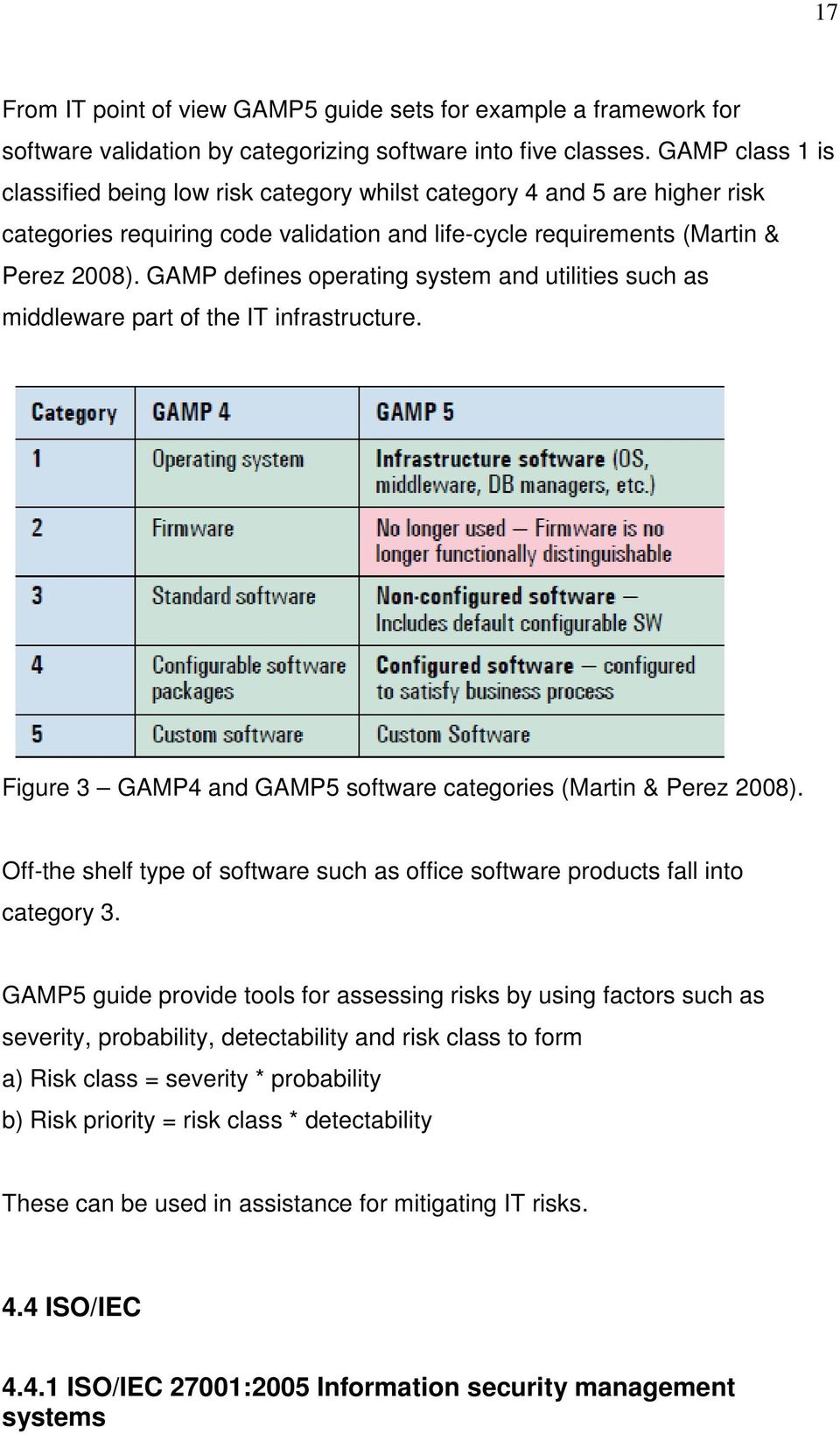
20 17 From IT point of view GAMP5 guide sets for example a framework for software validation by categorizing software into five classes. GAMP class 1 is classified being low risk category whilst category 4 and 5 are higher risk categories requiring code validation and life-cycle requirements (Martin & Perez 2008). GAMP defines operating system and utilities such as middleware part of the IT infrastructure. Figure 3 GAMP4 and GAMP5 software categories (Martin & Perez 2008). Off-the shelf type of software such as office software products fall into category 3. GAMP5 guide provide tools for assessing risks by using factors such as severity, probability, detectability and risk class to form a) Risk class = severity * probability b) Risk priority = risk class * detectability These can be used in assistance for mitigating IT risks. 4.4 ISO/IEC ISO/IEC 27001:2005 Information security management systems
21 18 This standard was approved in the year 2002 by BSI and later adopted by ISO/IEC in the year It is currently being revised and the new version is estimated to be available in the year The scope of the standard is to provide set of specifications of which organizations may use in seeking certification for their information security management systems. It has 8 sections that define ISMS requirements, management responsibilities, internal ISMS audits, management review of the ISMS and continuously improvement of ISMS. Approximately 1000 organizations are certified every year by accredited certification auditors making total amount of certified organizations to 7940 (August 2012). Notably more than half of organizations are Japanese whilst no ISO/IEC 27001:2005 certified Finnish organizations are present (International Register of ISMS Certificates 2012) There are cloud computing service providers which have obtained ISO/IEC 27001:2005 certification for their ISMS. Amazon Web Services LLC (platforms Amazon EC2, Amazon S3 and Amazon VPC) and Microsoft Global Foundation Services Windows Azure platform have received the certificate among others ISO/IEC 27002:2005 Code of practice for information security management This standard was approved in the year It was previously known as ISO/IEC 17799:2005 but was renamed to ISO/IEC 27002:2005 in the year 2007 in order to import it to the standard series. Wording of remained identical. ISO/IEC Secretariat JTC1/SC27 is currently revising the standard and it has been estimated that new version will become published in the year 2013 ISO/IEC has 15 sections which have total of 39 control objectives for information security management. As an example the standard defines
22 19 business continuity as a section which includes two control objectives for resilience and disaster recovery. Figure 4 ISO27002 (ISO27001 Security 2013) ISO/IEC Security in cloud computing (DRAFT) This standard is currently in preparatory stage at the time of writing (September 2013). It is based on upcoming revision of ISO/IEC and the working title is Guidelines on Information security controls for the use of cloud computing services based on ISO/IEC The standard is expected to provide more cloud computing specific security control recommendations than ISO/IEC
23 ISO/IEC (DRAFT) This standard is currently (September 2013) in committee stage. ISO/IEC Secretariat JTC1/SC27 is currently creating the standard with working title Code of practice for data protection controls for public cloud computing services. Mitchell lists the following content of the upcoming standard: Objective is to collect and organize security categories and their controls from current data protection regulations. Help public cloud service providers to comply with their obligations and make this transparent to their customers. Customers can select cloud-based data processing services that allow them to meet their obligations ISO/IEC x Information security for supplier relationships (DRAFT) This standard is going to be divided into several standards from through Standard will define how to evaluate and mitigate security risks when using IT services or information supplied by 3rd parties Overview and concepts (1 st draft available) Common requirements (1 st draft available) Guidelines for ICT supply chain security (1 st draft available) Outsourcing (pre-draft) Guidelines for security of cloud services (pre-draft) ISO/IEC 14971:2012 Application of risk management to medical devices This standard provides risk management tools for helping manufacturers to introduce medical devices on the market. Standard is not just for medical devices but it can be utilized by pharmaceutical companies also from risk management process point of view.
24 21 Standard introduces four steps for risk management process: risk analysis, risk evaluation, risk control and production and post-production information. 4.5 Quality risk management (ICH Q9) European Medicines Agency (EMA) has released a guideline document for quality risk management called ICH Q9. The guideline provides qrm tools such as processes and examples for various aspects of pharmaceutical quality. The guideline presents a model of initiating a qrm management process via risk assessment, risk control, risk communication and risk review. The question of a quality risk may become significant for pharmaceutical products and therefore it is important to mitigate those risks on computerized systems. 4.6 Summary A pharmaceutical company must follow several regulations starting from national legislation. Also several guidelines, tools and standards have been released which can be helpful in running good business practices. It is important to recognize the various aspects of regulations especially if company operates in several countries. European Union has paid attention to privacy and companies seeking for cloud based option should double-check to these privacy requirements. Recent skepticism on effectiveness of the safe harbor agreements caused by the espionage claims may lead into major revision of the agreement.
25 22 5 CLOUD COMPUTING IN PHARMACEUTICAL INDUSTRY The question of using cloud based applications in pharmaceutical industry is complicated and requires multiple levels of analysis. Various applications, data, GMP significance, cloud deployment models and difference between pharmaceutical companies does not justify simple yes or no conclusions for cloud computing suitability. The following gathers some of the factors affecting to the decision making. 5.1 Applications types The most important question related to outsourcing applications to cloud is the potential impact to the GMP significant applications (Stokes 2012, 66). Standard office products, communication tools, financial systems are typically classified to non-gmp applications unless a connection to GMP data exists. GMP significant applications may include customer relationship management (CRM), enterprise resource planning (ERP), statistical analysis software, laboratory inventory management software (LIMS) and various other types of software which have direct access to GMP data. Pharmaceutical organization considering usage of cloud based applications in any form should perform an application classification in order to identify regulatory requirements. It is recommended of performing initial implementations with low-risk systems to minimize failure impacts Any new technology or new approach to IT solutions presents risks. Even if the technical risks have been evaluated and addressed, there is a risk that the procedural controls (e.g., security controls, staff training, and validation) will be lacking or just challenged by the authorities because they are different from traditional approaches (Gorban 2012)
26 Data types Pharmaceutical industry can generate various types of data such as clinical trial data, IP information, work instructions, batch manufacturing records, certificates, finance data, personal information etc. which all may have different frameworks and regulations for data handling. Extensive reviews of regulation requirements should be done if electronic records of GMP relevant data will be stored in a cloud based solution. GMP relevant data may also include spreadsheets and databases. Data classification is a vital process before any data should be stored in any cloud based system. An example of steps for the data classification has been defined: 1. Identify the data that will be processed or stored in the cloud. 2. Classify the information in regards to sensitivity towards loss of the CIA criteria. This would include identifying regulatory requirements for the data. 3. Define the rules by which particular information classes of instances must be stored, transmitted, archived, transported and destroyed. Many handling requirements result from contractual or regulatory requirements. (Cox 3-4) 5.3 Layers or responsibility When evaluating cloud implementation options from regulatory point of view it is important to underline the different layers of responsibility of each deployment model. IaaS gives much more flexibility for the end user whereas SaaS usually requires the least of administration for the system. Carstensen et al. (2012) illustrates in figure 5 a so called trust boundary which defines responsibilities of service user and service provider. Trust boundary separates the responsibility of application, OS/middleware and infrastructure layers in IaaS, PaaS and SaaS deployment models. For example in SaaS application, OS/middleware and infrastructure is responsibility of the service provider but in IaaS infrastructure only is service provider s responsibility.
27 24 Figure 5 Trust boundary (Carstensen et al. 2012). Also the question of public or private clouds must be evaluated - is the platform private or public? Who is in charge or security administration for the cloud? It has been recommended that in a phased approach model provider s responsibilities (in IaaS) to be limited below operating system level because Providers often implement the appropriate security and data protection controls, but FDA requirements for formal qualification, training, and documentation are unlikely to be met. Risks can be minimized by keeping the responsibilities for the standard Operating System, middleware, and applications in house (Gorban 2012) 5.4 Agreements and accountability Formal agreements are mandatory between customer and service providers. This requirement is defined in Annex 11
28 When third parties (e.g. suppliers, service providers) are used e.g. to provide, install, configure, integrate, validate, maintain (e.g. via remote access), modify or retain a computerised system or related service or for data processing, formal agreements must exist between the manufacturer and any third parties, and these agreements should include clear statements of the responsibilities of the third party. ITdepartments should be considered analogous (EC 2011). 25 According to Stokes (2012, 5) regulated company is always accountable to the regulatory authorities for - The appropriate control and compliance of their IT infrastructure (IaaS and PaaS) - The validation of the GxP significant applications (SaaS) However, day to day responsibilities can be outsourced. 5.5 Vendor audits Pharmaceutical companies must assess supplier for adherence to regulatory and business requirements. It is the responsibility of pharmaceutical company to make sure their service provider meet the appropriate compliance standards. With regards to service provider assessment approach Annex 11 state The competence and reliability of a supplier are key factors when selecting a product or service provider. The need for an audit should be based on a risk assessment (EC 2011). Supplier assessment can be done by questionnaires (offline, online or assisted), performing an on-site audit (data center, support office) or by using a 3 rd party assistance with an auditing standard such as SAS 70 or SSAE-16. Once a supplier has been accepted there might become need to do reevaluation at some point. GxP compliance issue or a system upgrade could indicate a need to re-assess the supplier.
29 26 Questionnaire for hosting and managed services apply, some additional cloud specific questions and explanation requests should be included. In the following examples of such questions have been listed: - Issues of access via uncontrolled networks - Need to qualify and validate for a broad range of client devices - The uncontrolled nature of self-service (process owners provisioning inappropriately qualified, validated or controlled it infrastructure, platform s or applications) - Resource pooling (shared access) erodes one or more layer of security controls - Location independence may not be bounded - Rapid elasticity may undermine necessary change controls (Stokes 2012, 32) In addition questions like these may be relevant for pharmaceutical industry: - Application can move inside a datacenter but what about between the datacenters? - Where does the data physically reside? - How can I make electronic copies of my regulatory critical records? - How is my data backed up? - What kind of disaster recovery arranagement are in place? - If I make a mistake can you restore just my data? - How can I remove/get back my data if I choose to de-cloud? 5.6 Validation and qualification It is important to recognize the difference between validation and qualification because regulations refer to both terms. EudraLex Volume 4 Annex 11 states The application should be validated; IT infrastructure should be qualified. (EC 2011) Rajinderkaur (2008) describes the difference of validation and qualification; Qualification is a process of assurance that the specific system, premises or equipment are able to achieve the predetermined acceptance criteria to confirm the attributes what it purports to do.
30 Validation is establishing a documented evidence to provide a high degree of assurance that a specific system, process or facility will consistently produce a product meeting its predetermined specifications and quality attributes. Things are qualified: equipments, systems etc. Process/Procedures (the way we use things) are validated. 27 Requirements for application validation in cloud based applications do not differ from standard networks. Decision of software validation will have to be made through appropriate frameworks and regulatory guidelines. Karamanova (2012, 19) advices to create a checklist with questions on the impact of computerized systems to drug product quality. Validation is required if at least one answer is yes on the checklist. 5.7 Sector targeted cloud solutions IT infrastructure qualification, application validation requirements and other requirements set by various regulations may lead into cumbersome scenarios when a pharmaceutical company seeks a cloud based solution for their GMP significant applications. For example lack of audit trails or forced application upgrades on SaaS may come as a surprise if the requirement has not been noted in the evaluation phase. Therefore cloud computing industry has shown signs of waking up to the sector specific needs. There are cloud solutions available targeted directly to pharmaceutical and life sciences industry which provide compliant platforms. One example is Compliance Cloud by NextDocs Corporation. Traditional SaaS platform offers a multi-tenancy on the application layer whereas Compliance Cloud provides multi-tenancy on the infrastructure level. Each customer gets a fully logically isolated environment consisting of dedicated virtual web, application and database servers (NextDocs 2012). Virtual servers, databases, network and resources is said to provide isolation from other customers and enable freedom in application upgrades upgrades are not mandatory. Company claims regulatory compliance and validation readiness
31 The NextDocs Compliance Cloud was designed and implemented to be validation ready. Each customer environment includes Development, QA and Production environments in support of Change Control practices. Our operational and support processes are implemented to be compliant with regulations and optimized to follow industry best practices. We recognize the complexities of compliance in the cloud and have addressed those challenges in the architecture of the NextDocs Compliance Cloud, in the NextDocs products, and in our operational and support processes. (Nextdocs 2012) 28 Another example of sector targeted product is EMC Cloud Computing Solutions for Life Sciences consultancy and regulation compliant systems based on a private cloud. EMC Consulting will enable you to build a qualified infrastructure, validate your applications, and develop a risk management strategy to ensure you can use private cloud to support and enable your regulated applications. We start by determining which aspects of the IT Infrastructure to qualify and the required extent of that qualification. We then validate applications using established and enforced corporate policies to define the overall approach to computerized system quality and compliance (EMC 2011). 5.8 Where to start support documentation The following organizations have prepared documents and guidelines to assist in the cloud decision making and vendor evaluation process CSA Cloud Security Alliance (CSA) is a not-for-profit organization consisting of cloud key stakeholders that promotes the use of best security practices within cloud computing. CSA has published two publicly available documents that any organization approaching cloud based solutions may find useful - Consensus Assessments Initiative Questionnaire - Cloud Controls Matrix Framework
32 ENISA European Union Agency for Network and Information Security (ENISA) is responsible for cyber security issues affecting to EU. Organization s goal is to achieve good quality of network and information security within EU. ENISA has published on their web site a lot of documentation that can help in the decision making process such as - Reports on cloud computing - Cloud computing information assurance framework - Cloud computing risk assessment NIST National Institute of Standards and Technology (NIST) is an US based federal agency to promote US industrial competitiveness. Cloud computing relevant material include - NIST Special publication , US Government Cloud Computing Technology Roadmap, Release 1.0 Volume 1 and Release 1.0 Volume ISACA ISACA is a nonprofit global association to promote knowledge and practices for information systems. They have release the following documents which may be useful in the cloud computing evaluation process - Cloud Computing: Business Benefits With Security, Governance and Assurance Perspectives - IT Control Objectives for Cloud Computing: Controls and Assurance in the Cloud
33 Block level approach If a pharmaceutical company selects for instance IaaS as their base model for implementing cloud services there are usually many options of approaching the question of responsibility depending on the application configuration. Application can be made available for example using following methods 1. Internal application hosted on IaaS (VMware or Amazon etc.) 2. External application hosted on third party IaaS 3. External application hosted on application providers own infrastructure 4. True multi-tenant application (shared dbase etc.) hosted on third party IaaS 5. True multi-tenant application hosted on providers own infrastructure (Appendix 1) These different configurations can be broken into blocks and understand where the different layers of responsibilities are. For example IaaS border is located at the operating system level and therefore question of validation may become obsolete as GAMP4 and GAMP5 guides categorization classifies operating systems on software category 1. Instead a platform qualification is expected EudraLex 4 Annex 11 cloud computing specific clauses Eudralex 4 Annex 11 has seventeen clauses. In addition of previously mentioned application validation, infrastructure qualification and vendor audit requirements there are several others that need to be taken into account during cloud computing evaluation. In table 1 most relevant ones to cloud computing have been handpicked. TABLE 1. EudraLex 4 Annex 11 cloud computing specific clauses (EudraLex 2011) Annex 11 clause Requirement 1. Principle 1. The application should be validated; IT infrastructure should be qualified.
34 31 2. Personnel 2. All personnel should have appropriate qualifications, level of access and defined responsibilities to carry out their assigned duties. 3. Supplier and 3.1 When third parties (e.g. suppliers, service providers) service provider are used e.g. to provide, install, configure, integrate, validate, maintain (e.g. via remote access), modify or retain a computerised system or related service or for data processing, formal agreements must exist between the manufacturer and any third parties, and these agreements should include clear statements of the responsibilities of the third party. IT-departments should be considered analogous. 3.2 The competence and reliability of a supplier are key factors when selecting a product or service provider. The need for an audit should be based on a risk assessment. 7. Data storage 7.1 Data should be secured by both physical and electronic means against damage. Stored data should be checked for accessibility, readability and accuracy. Access to data should be ensured throughout the retention period. 7.2 Regular back-ups of all relevant data should be done. Integrity and accuracy of backup data and the ability to restore the data should be checked during validation and monitored periodically. 9. Audit trails 9. Consideration should be given, based on a risk assessment, to building into the system the creation of a record of all GMP-relevant changes and deletions (a system generated "audit trail"). For change or deletion of GMP-relevant data the reason should be documented. Audit trails need to be available and convertible to a generally intelligible form and regularly
35 32 reviewed. 10. Change and 10. Any changes to a computerised system including configuration system configurations should only be made in a management controlled manner in accordance with a defined procedure. 12. Security 12.1 Physical and/or logical controls should be in place to restrict access to computerized system to authorised persons. Suitable methods of preventing unauthorised entry to the system may include the use of keys, pass cards, personal codes with passwords, biometrics, restricted access to computer equipment and data storage areas. 13. Incident 13. All incidents, not only system failures and data management errors, should be reported and assessed. The root cause of a critical incident should be identified and should form the basis of corrective and preventive actions. 16. Business 16. For the availability of computerised systems continuity supporting critical processes, provisions should be made to ensure continuity of support for those processes in the event of a system breakdown (e.g. a manual or alternative system). The time required to bring the alternative arrangements into use should be based on risk and appropriate for a particular system and the business process it supports. These arrangements should be adequately documented and tested.
36 Summary Cloud computing in pharmaceutical industry is not a simple topic due to complexity of different cloud deployment models and layers of responsibilities. It is important to identify GMP significant features of operations as per Eudralex 4 Annex 11. Therefore the sector specific cloud solutions may become more popular among industry. The subject of vendor assessment can be approached block by block using the assistance of documents released by various organizations such as CSA.
37 34 6 SECURITY 6.1 Security issues Survey after surveys among information technology management shows security being top issue preventing larger scale utilization of cloud computing. In a survey among CIOs (Cloud Adoption Study: Cloud computing is gaining momentum 2011) insufficient data security was ranked number one reason for not adopting cloud computing. Security as a term can for example include elements of application, network, data, service or instance security. By definition of Wikipedia (Cloud computing security 2013) security issues associated with cloud computing can be split into two categories; 1. Security issues faced by cloud providers 2. Security issues faced by their customers According to Wikipedia (Cloud computing security 2013), in most of the cases it is the responsibility of the service provider to secure their infrastructure among end-user data. It is the responsibility of customer to ensure that service provider has implemented the proper security measures. Wang (2009) evaluates cloud security from three aspects; 1. Security and privacy (i.e. disaster recovery) 2. Compliance (i.e. proper handling of audit trails) 3. Legal and contractual issues (i.e. liabilities) 6.2 Security controls For cloud service providers to manage security issues proper security controls need to be in place. Francis (2013) lists four categories with examples for cloud security controls; 1. deterrent (i.e. logon warnings to advice users of rights to enter system) 2. preventative (i.e. installing a proxy server )
38 35 3. corrective (i.e. quick change of passwords after an incident) 4. detective (i.e. testing unlawfully access to information) 6.3 Security assessment As a part of vendor assessment a security assessment may be performed to document what security controls are in place in a cloud platform. As a template, a questionnaire titled Consensus Assessments Initiative Questionnaire (2011) has been released by the Cloud Security Alliance for the use of cloud auditors and customers. The purpose of the questionnaire is to provide more transparency within industry. Each question has a framework of certain regulations (i.e. ISO27001) in which they refer to. For example questionnaire item DG-07.1 about information leakage in a multi-tenant environment refers to sections A and A of ISO27001 and may be directly suitable in use of multi-tenant pharmaceutical SaaS software evaluation. 6.4 Securing the data Anytime when data moves outside of the traditional IT infrastructure there is a potential risk of jeopardizing sensitive content. Why not use best possible cryptography technology at every node? Usually there might be performance issues if data is being encrypted at rest, in process and in motion. Cloud Security Alliance lists three options for securing the data transmission; Client/Application encryption, Link/Network encryption and proxy-based encryption. CSA recommends of encrypting data at the network level on every deployment models. CAS also documents how data can be encrypted in different cloud deployment models (Security Guidance for Critical Areas of Focus in Cloud Computing 2011) According to HIPAA data encryption when handling regulated data in transit is mandatory.
39 Implement technical security measures to guard against unauthorized access to electronic protected health information that is being transmitted over an electronic communications network. (HIPAA Technical Safeguards) 36 Vendors like Symantec providing cloud based products have addressed to the sector specific requirements explaining how their online backup product complies with HIPAA regulations. While there is no standard HIPAA certificate of compliance for online backup services, Symantec Protection Network (SPN) enables HIPAA defined covered entities that must store &protect electronic patient data comply with HIPAA security and privacy rules by: Encrypting data at the point of origin, during the backup process, using 256-bit AES (approved by the NSA for encrypting U.S. classified data up to and including Top Secret). Encryption key is private which only the originator (not even Symantec) has access All information is sent through a secure 128-bit SSL tunnel to one of the Symantec datacenters. Symantec data centers and operations are SAS-70 Type II certified. Additionally SPN follows an ISO / security framework and ITIL Service Management framework. (Is Symantec Online Storage HIPAA Compliant? 2008) 6.5 Risks Cloud computing in itself does not differ from traditional computing from risk point of view. There are some unique risks however. For instance access to computerized systems via uncontrolled networks and using resource pooling are unique compared to traditional computing. Also the type of chosen cloud platform together with chosen deployment model gives different risk variables. Therefore extra attention is required in risk assessment and mitigation. Carstensen et al. (2012, 39) describes a method to understand interaction between risk, security and compliance in cloud based environment. An important thing to notice is that in the areas of compliance and security cloud user and cloud provider both have some of the responsibility. In the area of risk there is not usually similar boundary because of wide utilization of asymmetric risk arrangements in the agreements. Risk of lack of application
40 availability for instance results usually to financial penalties but only in limited amount. 37 IT risk measurement has been defined by Wikipedia (IT risk management 2013) The measure of a IT risk can be determined as a product of threat, vulnerability and asset values: Risk = Threat * Vulnerability * Asset Cloud model risks Selected cloud computing model also has an important part in the evaluation. According to Stokes (Figure 6) private IaaS cloud deployed on-premises has far less variables and connection points through uncontrolled networks compared to public SaaS cloud deployed off-premises. This of course depends on the implementation of the system; it may become useful to classify risks into three categories of acceptable, controllable and unacceptable (Stokes 2012, 33). Figure 6 Risk continuum dimensions (Stokes 2012, 34) The risk can also be mitigated by having a fully test disaster recovery plan and procedures in place.
41 Risk assessment Risk assessment is mandatory by many (Pharmaceutical) compliance standards such as EudraLex Volume 4 Annex 11, PCI DSS requirement , HIPAA section (a) (1) and ISO27001 Clause 4.1. If risk assessment is not mandatory from compliance point of view it is still considered to be good business practice and there are business rationales that benefit from risk assessment. Before starting the risk assessment the business model company or organization currently has should be identified first. This context establishment is used as an input for risk analysis. There are various methodologies like NIST SP or Octave for performing a structured risk assessment. One possible risk assessment option in evaluating cloud computing systems is the ISO27005:2011 Information security risk management standard. It has three steps: identification, estimation and evaluation of risks. 1. According to Wikipedia (IT risk management 2013) ISO27005 advices to identify in risk identification phase the following list of causes of a potential loss: Assets, threats, security measures (existing and planned), vulnerabilities, consequences and related business processes. 2. Risk estimation phase specifies the measure of risk: quantitative (mathematically calculated) and qualitative approach (evaluation from low to very high). Risk estimation produces a list of risks with values which can be formatted into a risk list. 3. Risk evaluation phase prioritizes and compares the identified risks based on risk evaluation and acceptance criteria. 6.7 Risk mitigation Risks in IT are part of normal business operations. It is impractical and extremely expensive to eliminate all risks. However it is usually possible to
42 39 reduce risks. If risk assessment process reveals major findings then risk mitigation should to be implemented. Different tools can be used in assistance to mitigate the risks. A failure mode and effect analysis (FMEA) is a common tool that uses risk assessment - or similar analysis - as an input and generates either risk severity reduction or lowering the probability of the risk. A successful FMEA activity helps to identify potential failure modes based on past experience with similar products and processes or based on common failure mechanism logic. It is widely used in development and manufacturing industries in various phases of the product life cycle (Failure mode and effects analysis 2013) Organization can be highly affected if the chosen cloud platform is not accessible. This risk can be mitigated by selecting correct service level agreement (SLA) with appropriate uptime category. So called class of 9s is widely used in the SLAs where 90% equals to maximum of 36,5 days of downtime in a year, 99,99999% maximum of 3,15 seconds of downtime in a year. 6.8 Summary The elimination of all risks is expensive and very impractical. Cloud computing is not an exception and has risks which needs to be addressed adequately. There are also risks explicit to cloud computing. Vendors have started to release documentation to support decision making by showing how their products are compatible with various regulations.
43 40 7 RISK BASED APPROACH MODEL 7.1 Background In order to achieve fuller understanding of regulations and cloud computing in pharmaceutical industry a risk based approach model has been generated to show real-life connections between the good manufacturing practices, regulations and technology. In the previous chapters the terminology for cloud computing has been introduced together with relative ISO/IEC standards, general EU directives, security issues, sector specific regulations and other guidelines. This risk based approach model has been based on pharmaceutical company point of view. It can be utilized as a case study template for companies seeking for cloud computing solutions. 7.2 Introduction As learned in previous chapters it is vital for pharmaceutical companies to identify computerized operations within organizations that may have GMP significance. It is also required to act on findings with appropriate actions to mitigate the risks. Failing to do so may result failures in audits, official warning letters, financial penalties and even seizures of operations. Even if GMP significant features mentioned in the EudraLex Volume 4 Annex 11 of software or a system have been recognized earlier it may be useful to revisit those findings especially if any cloud based solution models are in consideration. Also as personnel may have changed over the years and change logs do not necessarily provide accurate information whether any custom modification has been made to standard off-the-shelf type of software application.
44 Risk based approach model In this model there are six steps starting from gathering operational data and identifying GMP significant features and resulting in decision on cloud suitability for selected application. Figure 7 Risk based approach model steps The following steps have been identified as required steps based on risk management approaches on GAMP 5, ICH Q9 and ISO guidance. 1. Gather operational data o Input: Interviews, User requirement specifications (URS) o Output: System description (SD) 2. Identify GMP significant features of software application o Input: SD, regulations and guidelines o Output: GMP impact assessment (GMPIA) 3. Calculate risk priority numbers for GMP significant features o Input: GMPIA
45 42 o Output: Failure mode effect analysis (FMEA) 4. Mitigate high risk priority number (RPN) risks o Input: FMEA o Output: Updated FMEA 5. Evaluate the risks whether they excess limits o Input: Updated FMEA o Output: Risk assessment (RA) summary o Output: Data for cloud computing decision making 6. Decision making o Input: RA summary o Output: Final decision and path of proceeding Framework in table 2 reflects these six steps with relevant sections of GAMP 5, ICH Q9 and ISO processes. TABLE 2. Risk based approach model framework Step GAMP 5 ICH Q9 ISO Gather operational data Step 1 Initiate QRM process - Identify GMP significant features of software application Step 2 Risk identification Risk analysis Calculate risk priority numbers Step 3 Risk analysis and Risk evaluation for GMP significant features evaluation Mitigate risks with high risk priority numbers (RPN) Evaluate the risks whether they excess limits Step 3 Risk reduction Risk control Step 4 Risk acceptance Evaluation of overall residual risk acceptability Decision making Step 5 Risk communication Review events Post production information System description (SD) System description is a document describing main features of a system and how they are utilized in practice. The format of the document can be created
46 43 to fulfill the specific needs or to follow possible corporate layout template. In general the contents vary depending on what is appropriate. In this example it is necessary to list main modules of the ERP software and modifications to these modules to-date. An example of modifications made to the software code in a module: Stock items can be receipted into the company against an approved purchase order. The user will check that the delivery meets the order conditions, recording the receipt in ERP and assigning a batch number and expiry date (if required). If required labels and a material reception and release form are printed. Stock items are receipted into the quarantine location. The following modifications have been made: Add two fields on the PO line receipt form that requires a user to denote whether a batch certificate has been received with the order and whether it complies with the order requirements. These are only displayed if the PO Manuf. batch certificate fields req, flag is set on the company card. Print storage temperature from item card on receipt labels and material reception & release form. An example of no software modifications applied in a module: The Company card holds system wide information that is used throughout the modules (Company name, address, financial info etc.). The following modifications have been made: - NONE GMP impact assessment (GMPIA) GMP impact assessment should be generated to identify software application features that may have GMP significance. The layout of the document is free and it may include elements such as list of software features and their GMP significance. An example of a GMPIA document template has been attached as per appendix two.
47 44 In general high GMP impact systems typically include those that: - Generate, manipulate, or control data supporting regulatory safety and efficacy submissions - Control critical parameters or data used at any stage; clinical, development and manufacture - Control or provide data for product release - Control data required in case of product recall - Control adverse event or complaint recording or reporting - Support pharmacovigilance Failure mode effect analysis (FMEA) Using tool such as FMEA or similar, the value of a risk can be mathematically calculated and evaluated further. It may become useful to analyze different what if scenarios if applications and functionalities are actually being placed in a cloud service. FMEA is a subjective screening tool to calculate risk priority numbers with highest number of having the biggest risk. Risk priority number can be calculated with a formula of RPN = Severity (on a scale of 1 to 10) * Occurrence (on a scale of 1 to 10) * Detection (on a scale of 10 to 1). An example FMEA template can be found from Appendix Risk assessment summary High risks with GMP significance identified with FMEA can be mitigated by elimination, reducing to suitable level or by demonstrating that the levels are suitable with an extended review. In the risk assessment the high risks are being addressed using preventative corrective actions and the RPN numbers for the risks are recalculated. Risk assessment summary document summarizes GMPIA and FMEA findings, preventative risk mitigation actions and lists final RPN numbers.
48 45 Document gives data for cloud computing decision making on systems that have GMP significance. 7.4 Summary Risk based approach model was created as an example due to various similarities in GAMP 5, ICH Q9 and ISO/IEC guidelines. This approach model can be used as a template for any company seeking for a cloud based solution.
49 46 8 CONCLUSION AND RECOMMENDATIONS Pharmaceutical companies need to follow regulatory guidelines, most importantly in Europe EudraLex Volume 4 Annex 11. This directive clearly states that the software should be validated and IT infrastructure should be qualified. Therefore regulated companies need to validate their GMP significant applications whether they are based on their own server infrastructure, on or off premise cloud platform or otherwise outsourced. Using public cloud based software applications that are not GMP significant is more of a business decision and should involve all the relevant stakeholders. This category may include for example communication software. The qualification of the IT infrastructure is mandatory regardless of chosen service deployment model. Qualification needs to be documented. However, as long as certain expectations are fulfilled cloud computing should be an acceptable solution from regulatory point of view also for GMP significant applications. Before moving to public cloud the following steps need to be completed on satisfactory level: Review applicable regulations Determine cloud service type Determine cloud deployment model Perform application and data classification Do vendor audits and qualifications Perform risk assessments and mitigate risks Review data security requirements Perform infrastructure qualifications Perform software validations Start with least critical systems Have fallback models in case of de-clouding at some point
50 47 There are different approach models. One, a phased risk based approach model was created in this thesis in chapter 7. It can be used to identify GMP significant features in software applications and in risk identification and mitigation processes. In conclusion private cloud and public IaaS are easiest to tackle from pharmaceutical regulatory point of view. Applications can be validated and infrastructure qualification performed as required. Off-premise SaaS, PaaS, community cloud and other higher altitude of cloud solutions like multi-tenant applications are a possibility but depending on implementation method they may not be in compliance with the regulations. Aspects like continuous software upgrades which affect application validation status or lack of audit trail could be directly against regulations. They may also require much more thoroughly vendor assessment and heavier risk assessment processes than simpler IaaS platforms. There have been some signs of cloud service industry waking up to the situation (Chapter 5.7.) and a few sector specific compliance cloud types of products have been rolling onto the market. If the cloud infrastructure in itself would be qualification ready (or pre-qualified) and applications could be validated it should lower the bar for pharmaceutical industry to enter the cloud era also in SaaS solutions.
51 48 APPENDICES Appendix 1 An interview with N.N., Director of Sales EMEA at N.N. This interview was done via Linkedin social networking site using send and receive messages function in October To: N.N. Date: October 15, Hi N., I'm doing my thesis work on Cloud computing in Pharmaceutical industry and pretty confused at the moment. I have a couple of tough questions on the matter - could I please use your expertise? To: Ville Harjulampi Date: October 15, Hi Ville, No problem, I'll do my best to give you an answer! The pharmaceutical industry is quite confused on the subject at the moment but in reality it's all quite simple. Just send the questions across. To: N.N. Date: October 15, 2012
52 Hi N., thanks. I am familiar with the old school "server/client" type of network and application validation requirements. Especially if the software is standard off the shelf type. (Create URS, VP, protocols, validate and that's it!) Virtualization and cloud based thinking are not in itself giving me hard time - I do know the technical concepts of resources pooling, cloud service layers and how different cloud types differ. I've also been playing around with Hyper-V and VMWare solutions. How on earth should we tackle the challange of combining GMP regulated activities, regulations and cloud computing? For instance EudraLex Vol 4 Annex 11 lists quite a few things to be taken into consideration starting from the principle "The application should be validated; IT infrastructure should be qualified". If a pharmaceutical company would like to use outsourced, let's say ERP system which has several GMP regulated activities what would be the correct marching order? How would it document and verity compliance with Vol. 11 requirements? Vendor assessments may bit a bit difficult to perform as well as knocking on the door of a datacenter (if you even know what's the right continent :) Would it be the way of creating Risk Assessments, FMEAs, Impact Assessments etc. and documenting that using this and this application from cloud using a chosen service provider doesn't increase the overall risk compared to the current server/client model? To: Ville Harjulampi Date: October 15, 2012
53 Hi Ville, This is a question that we are all trying to understand still! There are a few different ways of looking at it. If you break down the cloud layers into IaaS, PaaS and SaaS that is the easiest method. We then generally see a few different combinations of these in delivering services. For example: Internal application now hosted on IaaS (VMware or Amazon etc) External application hosted on third party IaaS External application hosted on application providers own infrastructure True multi-tennant application (shared dbase etc) hosted on third party IaaS True multi-tenant application hosted on providers own infrastructure External application developed on PaaS (Force.com etc) where data center location is now known. The key thing is to try and break these all down into blocks and understand where the different layers of responsibility are. For example IaaS stops at the OS level so you would not expect to validate anything at IaaS but qualify it. The big thing that is happening in the market at the moment is whether for example an IaaS provide qualifies the infrastructure themselves. This would great reduce the costs if there was a standardised qualification for example across all vmware IaaS providers. This would also be greatly beneficial to the Pharma companies as most of the qualification work is already done.
54 51 Providers who are looking to provide to the Pharma market understand that where the data resides is also key and that they may have to start opening the doors of thei datacenters (we do and also ensure that the data only resides in these legal jurisdictions). What we may see happening though is cloud environments becoming more expensive for specific vertical markets if for example Pharma want the cloud providers to maintain large documented audit requirements (IQ/OQ and the rest of the quality/validation docs etc. You could write a whole these on this... To: N.N. Date: October 17, 2012 Hi N., thank you for your response. This is a very helpful view. I like the idea of breaking down to blocks and defining different responsibility layers. I think cloud service providers have seen the need to "endorse" their platforms from regulatory point of view. For instance Microsoft claims to be in compliance with following standards and regulations for their Dynamics CRM cloud product: Safe Harbor, ISO 27001, SAS70 Type II and FISMA. One thing I've been thinking to evaluate a cloud service provider is the Cloud Controls Matrix (CCM) framework provided by Cloud security alliance. You may have heard about the framework which can be downloaded from their web page: Microsoft has done fantastic job in evaluating their Azure against the CCM matrix requirements. They've released a document on the subject (DOC, 4MB)
55 52 curityprivacy.docx Like said this is a massively big area to investigate and I hope you don't mind if I come back on the subject at some point. To: Ville Harjulampi Date: October 18, 2012 Hi Ville, The main problem is that the majority of the current certs don't transfer to Pharma very well. SAS70 is just a financial snapshot and doesn't really mean anything, Safe Harbor is really about protecting against the Patriot Act but again it's just a registration process and the Patriot Act itself is a bit of a red herring. ISO27001 one is a different standard again but it's really just procedural. You also have the G-Cloud intiative by the UK government and the Cloud Security Alliance as you mention. Really there needs to be a better standard for the Pharma industry to understand or a set of documents that shows the delta between the different standards. I'll see if I can find some of the presentations from the GAMP forum event a few weeks ago. There s some interesting info in there. One other thing to think about is what is actually being protected. Clinical trials for example will now have people entering data in IPADS across the globe. The data is being sent across multiple network connections and geographies and there's no way to avoid this. But the data doesn't really mean anything to the end user, the value is when the data is collated and the algorithms applied. So really the only concern is at the point of computation in this case.
56 So if that's a central data center/cloud provider in a known location it becomes a lot easier to control. 53 The other key is that the cloud platforms themselves are becoming more standardised. In IaaS there is really only Xen based (Amazon), Vmware based (vcloud/vsphere) and Hyper-V (Azure). IN our area with Vmware all service providers have to adhere to the same stack build in order to be accredited by vmware to deliver the services and to ensure that the VMs can move from on premise to the vcloud seemlessly. As this becomes more standardised it is going to be a lot easier for providers to adhere to simplified "qualification" processes for their platforms. For example if you developed a set of documents that qualified our platforms they could equally be used by all other vmware vcloud providers as they use the same stack. There's a nice opportunity out there for someone to do this!
57 54 Appendix 2 This GMPIA document template represents a way of listing features of a systems potential GMP impact. Finance Function Description Documentation Regulation reference GMP impact (Yes/No) Notes Procurement Function Description Documentation Regulation reference GMP impact (Yes/No) Notes
58 55 Function Description Documentation Regulation reference GMP impact (Yes/No) Notes Quality Control Function Description Documentation Regulation reference GMP impact (Yes/No) Notes Stock Control Function Description Documentation Regulation reference GMP impact (Yes/No) Notes
59 56 Function Description Documentation Regulation reference GMP impact (Yes/No) Notes Other Functions Function Description Documentation Regulation reference GMP impact (yes/no) Notes
60 57 Appendix 3 This FMEA document template represents a way of documenting mitigation of GMP significant features. Item Step Acceptance criteria / range of parameter values Failure Cause Effect Controls and Detection mechanism Item Severity Occurrence Detection RPN Preventative Corrective Actions Severity Occurrence Detection FINAL RPN Notes 1 2 3
61 58 REFERENCES Assuring Life sciences compliance in the private cloud Accessed on compliant-life-science-svo.pdf Bittman, T Top Five Private Cloud Computing Trends, Accessed on Carstensen J., Golden, B., Morgenthal, JP Cloud Computing, Assessing the Risks. United Kingdom: IT Governance Publishing. Cloud Adoption Study: Cloud computing is gaining momentum CIOnet and Deloitte. Accessed on Adoption Survey.pdf Cloud computing An article on Wikipedia. Accessed on Cloud computing security Accessed on Commission Decision 2000/520/EY 32000D European Commission Accessed on Consensus Assessments Initiative Questionnaire Accessed on Cox, P. n.d. Securing data in the cloud. Accessed on the%20Cloud.pdf Directive 95/46/EC European Commission. Accessed on
62 Essers, L European companies should stop sending data to the US, German privacy officials say Accessed on top_sending_data_us_german_privacy_officials_say/ EudraLex, The Rules Governing Medicinal Products in the European Union, Volume 4 Good Manufacturing Practice Medicinal Products for Human and Veterinary Use, Annex 11: Computerised Systems European Commission. Failure mode and effects analysis An article on Wikipedia. Accessed on Francis, S Cloud Storage Security Controls Accessed on Gartner outlines cloud computing strategy shapers Accessed on General Data Protection Regulation Proposal European Commission Accessed on Gorban, A Phased Approach to Compliant Cloud Computing Accessed on HIPAA Technical Safeguards. n.d. Accessed on
63 60 International Register of ISMS Certificates ISMS International User Group. Accessed on Is Symantec Online Storage HIPAA Compliant? Forum post Accessed on ISO27001 Security ISO/IEC Accessed on IT risk management An article on Wikipedia. Accessed on Karamnova, L Software-as-a-Service Validation. PDF-document from IVT conference held on Lassila, A EU:n työryhmä: Pilvipalveluiden tietosuojariskit selvitettävä huolella. Helsingin Sanomat Ludwig, S Cloud 101: What the heck do IaaS, PaaS and SaaS companies do? Accessed on Martin, K., Perez, A GAMP 5 Quality Risk Management Approach. Pharmaceutical Engineering May/June 2008, Vol. 28 No. 3. Mell, B The NIST Definition of Cloud Computing (Draft): Special Publication Recommendations of the National Institute of Standards and Technology. Mitchell, C. Standardizing. n.d. Privacy and security for the cloud. Accessed on
64 61 New draft European data protection regime M Patent Group Accessed on D=227 NextDocs Compliance Cloud White Paper Accessed on Rajinderkaur Qualification Vs Validation. Forum post Vs-Validation Security Guidance for Critical Areas of Focus in Cloud Computing Accessed on Stokes, D Selecting, Qualifying and Validating Cloud Applications. PDF-document from IVT conference held on Top 10 cloud computing providers of Accessed Sourya, B A History of Cloud Computing Accessed on cloud-providers-of-2012/1/introduction Turunen, I Deploying FreeNEST Project Platform to an OpenStack based cloud platform: A pragmatic study into an emerging technology. B.Sc. thesis work. Jyväskylä University of Applied Sciences, Degree Programme in Software Engineering Technology, ICT. Accessed on
65 62 U.S.-EU Safe Harbor homepage. n.d. Accessed Wang, C Cloud Security Front And Center Accessed on
This interpretation of the revised Annex
 Reprinted from PHARMACEUTICAL ENGINEERING The Official Magazine of ISPE July/August 2011, Vol. 31 No. 4 www.ispe.org Copyright ISPE 2011 The ISPE GAMP Community of Practice (COP) provides its interpretation
EUROPEAN COMMISSION HEALTH AND CONSUMERS DIRECTORATE-GENERAL. EudraLex The Rules Governing Medicinal Products in the European Union
 EUROPEAN COMMISSION HEALTH AND CONSUMERS DIRECTORATE-GENERAL Public Health and Risk Assessment Pharmaceuticals Brussels, SANCO/C8/AM/sl/ares(2010)1064599 EudraLex The Rules Governing Medicinal Products
Qualification Guideline
 Qualification Guideline June 2013 Disclaimer: This document is meant as a reference to Life Science companies in regards to the Microsoft O365 platform. Montrium does not warrant that the use of the recommendations
Data Protection Act 1998. Guidance on the use of cloud computing
 Data Protection Act 1998 Guidance on the use of cloud computing Contents Overview... 2 Introduction... 2 What is cloud computing?... 3 Definitions... 3 Deployment models... 4 Service models... 5 Layered
Welcome. Panel. Cloud Computing New Challenges in Data Integrity and Security 13 November 2014
 Welcome Cloud Computing New Challenges in Data Integrity and Security 13 November 2014 Panel Tracy Lampula, Associate Director of GIS Compliance, Vertex Pharmaceuticals William Sanborn, Director of Information
Cloud Security Trust Cisco to Protect Your Data
 Trust Cisco to Protect Your Data As cloud adoption accelerates, organizations are increasingly placing their trust in third-party cloud service providers (CSPs). But can you fully trust your most sensitive
How to ensure control and security when moving to SaaS/cloud applications
 How to ensure control and security when moving to SaaS/cloud applications Stéphane Hurtaud Partner Information & Technology Risk Deloitte Laurent de la Vaissière Directeur Information & Technology Risk
Secure Cloud Computing through IT Auditing
 Secure Cloud Computing through IT Auditing 75 Navita Agarwal Department of CSIT Moradabad Institute of Technology, Moradabad, U.P., INDIA Email: [email protected] ABSTRACT In this paper we discuss the
White Paper on CLOUD COMPUTING
 White Paper on CLOUD COMPUTING INDEX 1. Introduction 2. Features of Cloud Computing 3. Benefits of Cloud computing 4. Service models of Cloud Computing 5. Deployment models of Cloud Computing 6. Examples
AskAvanade: Answering the Burning Questions around Cloud Computing
 AskAvanade: Answering the Burning Questions around Cloud Computing There is a great deal of interest in better leveraging the benefits of cloud computing. While there is a lot of excitement about the cloud,
Security Considerations for Public Mobile Cloud Computing
 Security Considerations for Public Mobile Cloud Computing Ronnie D. Caytiles 1 and Sunguk Lee 2* 1 Society of Science and Engineering Research Support, Korea [email protected] 2 Research Institute of
Cloud Computing in a Regulated Environment
 Computing in a Regulated Environment White Paper by David Stephenson CTG Regulatory Compliance Subject Matter Expert February 2014 CTG (UK) Limited, 11 Beacontree Plaza, Gillette Way, READING, Berks RG2
Compliance and the Cloud: What You Can and What You Can t Outsource
 Compliance and the Cloud: What You Can and What You Can t Outsource Presented By: Kate Donofrio Security Assessor Fortrex Technologies Instructor Biography Background On Fortrex What s In A Cloud? Pick
Pharma CloudAdoption. and Qualification Trends
 Pharma CloudAdoption and Qualification Trends OurCloudExperience Numerous implementations of EDMS systems with external hosting for smaller life science clients Development of qualification strategy for
Security Issues in Cloud Computing
 Security Issues in Computing CSCI 454/554 Computing w Definition based on NIST: A model for enabling ubiquitous, convenient, on-demand network access to a shared pool of configurable computing resources
IT Security Risk Management Model for Cloud Computing: A Need for a New Escalation Approach.
 IT Security Risk Management Model for Cloud Computing: A Need for a New Escalation Approach. Gunnar Wahlgren 1, Stewart Kowalski 2 Stockholm University 1: ([email protected]), 2: ([email protected]) ABSTRACT
Regulated Applications in the Cloud
 Keith Williams CEO Regulated Applications in the Cloud Aspects of Security and Validation Statement on the Cloud and Pharma s added Complexity Clouds already make sense for many small and mediumsize businesses,
White Paper How Noah Mobile uses Microsoft Azure Core Services
 NoahMobile Documentation White Paper How Noah Mobile uses Microsoft Azure Core Services The Noah Mobile Cloud service is built for the Microsoft Azure platform. The solutions that are part of the Noah
[email protected] [email protected]
 1 The following is merely a collection of notes taken during works, study and just-for-fun activities No copyright infringements intended: all sources are duly listed at the end of the document This work
With Eversync s cloud data tiering, the customer can tier data protection as follows:
 APPLICATION NOTE: CLOUD DATA TIERING Eversync has developed a hybrid model for cloud-based data protection in which all of the elements of data protection are tiered between an on-premise appliance (software
Managing Cloud Computing Risk
 Managing Cloud Computing Risk Presented By: Dan Desko; Manager, Internal IT Audit & Risk Advisory Services Schneider Downs & Co. Inc. [email protected] Learning Objectives Understand how to identify
A Flexible and Comprehensive Approach to a Cloud Compliance Program
 A Flexible and Comprehensive Approach to a Cloud Compliance Program Stuart Aston Microsoft UK Session ID: SPO-201 Session Classification: General Interest Compliance in the cloud Transparency Responsibility
Strategic Compliance & Securing the Cloud. Annalea Sharack-Ilg, CISSP, AMBCI Technical Director of Information Security
 Strategic Compliance & Securing the Cloud Annalea Sharack-Ilg, CISSP, AMBCI Technical Director of Information Security Complexity and Challenges 2 Complexity and Challenges Compliance Regulatory entities
Cloud Computing and Records Management
 GPO Box 2343 Adelaide SA 5001 Tel (+61 8) 8204 8773 Fax (+61 8) 8204 8777 DX:336 [email protected] www.archives.sa.gov.au Cloud Computing and Records Management June 2015 Version 1 Version
The Cloud in Regulatory Affairs - Validation, Risk Management and Chances -
 45 min Webinar: November 14th, 2014 The Cloud in Regulatory Affairs - Validation, Risk Management and Chances - www.cunesoft.com Rainer Schwarz Cunesoft Holger Spalt ivigilance 2014 Cunesoft GmbH PART
Cloud Security Introduction and Overview
 Introduction and Overview Klaus Gribi Senior Security Consultant [email protected] May 6, 2015 Agenda 2 1. Cloud Security Cloud Evolution, Service and Deployment models Overview and the Notorious
Clinical Trials in the Cloud: A New Paradigm?
 Marc Desgrousilliers CTO at Clinovo Clinical Trials in the Cloud: A New Paradigm? Marc Desgrousilliers CTO at Clinovo What is a Cloud? (1 of 3) "Cloud computing is a model for enabling convenient, on-demand
HIPAA COMPLIANCE AND DATA PROTECTION. [email protected] +39 030 201.08.25 Page 1
 HIPAA COMPLIANCE AND DATA PROTECTION [email protected] +39 030 201.08.25 Page 1 CONTENTS Introduction..... 3 The HIPAA Security Rule... 4 The HIPAA Omnibus Rule... 6 HIPAA Compliance and EagleHeaps
Validating Enterprise Systems: A Practical Guide
 Table of Contents Validating Enterprise Systems: A Practical Guide Foreword 1 Introduction The Need for Guidance on Compliant Enterprise Systems What is an Enterprise System The Need to Validate Enterprise
MHRA GMP Data Integrity Definitions and Guidance for Industry March 2015
 MHRA GMP Data Integrity Definitions and Guidance for Industry Introduction: Data integrity is fundamental in a pharmaceutical quality system which ensures that medicines are of the required quality. This
MHRA GMP Data Integrity Definitions and Guidance for Industry January 2015
 MHRA GMP Data Integrity Definitions and Guidance for Industry Introduction: Data integrity is fundamental in a pharmaceutical quality system which ensures that medicines are of the required quality. This
Tamanna Roy Rayat & Bahra Institute of Engineering & Technology, Punjab, India [email protected]
 IJCSIT, Volume 1, Issue 5 (October, 2014) e-issn: 1694-2329 p-issn: 1694-2345 A STUDY OF CLOUD COMPUTING MODELS AND ITS FUTURE Tamanna Roy Rayat & Bahra Institute of Engineering & Technology, Punjab, India
Cloud Services Overview
 Cloud Services Overview John Hankins Global Offering Executive Ricoh Production Print Solutions May 23, 2012 Cloud Services Agenda Definitions Types of Clouds The Role of Virtualization Cloud Architecture
Cloud Computing. What is Cloud Computing?
 Cloud Computing What is Cloud Computing? Cloud computing is where the organization outsources data processing to computers owned by the vendor. Primarily the vendor hosts the equipment while the audited
IT Audit in the Cloud
 IT Audit in the Cloud Pavlina Ivanova, CISM ISACA-Sofia Chapter Content: o 1. Introduction o 2. Cloud Computing o 3. IT Audit in the Cloud o 4. Residual Risks o Used Resources o Questions 1. ISACA Trust
AN OVERVIEW OF INFORMATION SECURITY STANDARDS
 AN OVERVIEW OF INFORMATION SECURITY STANDARDS February 2008 The Government of the Hong Kong Special Administrative Region The contents of this document remain the property of, and may not be reproduced
CloudDesk - Security in the Cloud INFORMATION
 CloudDesk - Security in the Cloud INFORMATION INFORMATION CloudDesk SECURITY IN THE CLOUD 3 GOVERNANCE AND INFORMATION SECURITY 3 DATA CENTRES 3 DATA RESILIENCE 3 DATA BACKUP 4 ELECTRONIC ACCESS TO SERVICES
Key Considerations of Regulatory Compliance in the Public Cloud
 Key Considerations of Regulatory Compliance in the Public Cloud W. Noel Haskins-Hafer CRMA, CISA, CISM, CFE, CGEIT, CRISC 10 April, 2013 [email protected] Disclaimer Unless otherwise specified,
Cloud Computing: The Next Computing Paradigm
 Cloud Computing: The Next Computing Paradigm Ronnie D. Caytiles 1, Sunguk Lee and Byungjoo Park 1 * 1 Department of Multimedia Engineering, Hannam University 133 Ojeongdong, Daeduk-gu, Daejeon, Korea [email protected],
Orchestrating the New Paradigm Cloud Assurance
 Orchestrating the New Paradigm Cloud Assurance Amsterdam 17 January 2012 John Hermans - Partner Current business challenges versus traditional IT Organizations are challenged with: Traditional IT seems
HIPAA COMPLIANCE AND
 INTRONIS CLOUD BACKUP & RECOVERY HIPAA COMPLIANCE AND DATA PROTECTION CONTENTS Introduction 3 The HIPAA Security Rule 4 The HIPAA Omnibus Rule 6 HIPAA Compliance and Intronis Cloud Backup and Recovery
Top 10 Cloud Risks That Will Keep You Awake at Night
 Top 10 Cloud Risks That Will Keep You Awake at Night Shankar Babu Chebrolu Ph.D., Vinay Bansal, Pankaj Telang Photo Source flickr.com .. Amazon EC2 (Cloud) to host Eng. Lab testing. We want to use SalesForce.com
NETWORK ACCESS CONTROL AND CLOUD SECURITY. Tran Song Dat Phuc SeoulTech 2015
 NETWORK ACCESS CONTROL AND CLOUD SECURITY Tran Song Dat Phuc SeoulTech 2015 Table of Contents Network Access Control (NAC) Network Access Enforcement Methods Extensible Authentication Protocol IEEE 802.1X
Cloud Computing Governance & Security. Security Risks in the Cloud
 Cloud Computing Governance & Security The top ten questions you have to ask Mike Small CEng, FBCS, CITP Fellow Analyst, KuppingerCole This Webinar is supported by Agenda What is the Problem? Ten Cloud
Cloud Computing: What needs to Be Validated and Qualified. Ivan Soto
 Cloud Computing: What needs to Be Validated and Qualified Ivan Soto Learning Objectives At the end of this session we will have covered: Technical Overview of the Cloud Risk Factors Cloud Security & Data
Securing and Auditing Cloud Computing. Jason Alexander Chief Information Security Officer
 Securing and Auditing Cloud Computing Jason Alexander Chief Information Security Officer What is Cloud Computing A model for enabling convenient, on-demand network access to a shared pool of configurable
HIPAA CRITICAL AREAS TECHNICAL SECURITY FOCUS FOR CLOUD DEPLOYMENT
 HIPAA CRITICAL AREAS TECHNICAL SECURITY FOCUS FOR CLOUD DEPLOYMENT A Review List This paper was put together with Security in mind, ISO, and HIPAA, for guidance as you move into a cloud deployment Dr.
Cloud Computing demystified! ISACA-IIA Joint Meeting Dec 9, 2014 By: Juman Doleh-Alomary Office of Internal Audit [email protected]
 Cloud Computing demystified! ISACA-IIA Joint Meeting Dec 9, 2014 By: Juman Doleh-Alomary Office of Internal Audit [email protected] 2 If cloud computing is so simple, then what s the big deal? What is the
GAMP 5 as a Suitable Framework for Validation of Electronic Document Management Systems On Premise and 'In the Cloud' Keith Williams CEO GxPi
 GAMP 5 as a Suitable Framework for Validation of Electronic Document Management Systems On Premise and 'In the Cloud' Keith Williams CEO GxPi Disclaimer The views and opinions expressed in the following
Assessing Risks in the Cloud
 Assessing Risks in the Cloud Jim Reavis Executive Director Cloud Security Alliance Agenda Definitions of Cloud & Cloud Usage Key Cloud Risks About CSA CSA Guidance approach to Addressing Risks Research
Compliance and the Cloud. Guiding principles and architecture for addressing Life Science compliance in the cloud
 Compliance and the Cloud Guiding principles and architecture for addressing Life Science compliance in the cloud Life Sciences Industry Unit Microsoft Corporation June 2012 ii Legal Disclaimers The information
Cloud Computing for SCADA
 Cloud Computing for SCADA Moving all or part of SCADA applications to the cloud can cut costs significantly while dramatically increasing reliability and scalability. A White Paper from InduSoft Larry
The Cloud is Not Enough Why Hybrid Infrastructure is Shaping the Future of Cloud Computing
 Your Platform of Choice The Cloud is Not Enough Why Hybrid Infrastructure is Shaping the Future of Cloud Computing Mark Cravotta EVP Sales and Service SingleHop LLC Talk About Confusing? Where do I start?
Compliant Cloud Computing Managing the Risks
 Reprinted from PHARMACEUTICAL ENGINEERING THE OFFICIAL TECHNICAL MAGAZINE OF ISPE JULY/AUGUST 2013, VOL 33, NO 4 Copyright ISPE 2013 www.pharmaceuticalengineering.org information systems Managing the Risks
Compliant Cloud Computing Managing the Risks
 Reprinted from PHARMACEUTICAL ENGINEERING THE OFFICIAL TECHNICAL MAGAZINE OF ISPE JULY/AUGUST 2013, VOL 33, NO 4 Copyright ISPE 2013 www.pharmaceuticalengineering.org information systems Managing the Risks
WHAT DOES IT SERVICE MANAGEMENT LOOK LIKE IN THE CLOUD? An ITIL based approach
 WHAT DOES IT SERVICE MANAGEMENT LOOK LIKE IN THE CLOUD? An ITIL based approach Marc Jansen Computer Science Institute University of Applied Sciences Ruhr West Tannenstr. 43, 46240 Bottrop Germany [email protected]
See Appendix A for the complete definition which includes the five essential characteristics, three service models, and four deployment models.
 Cloud Strategy Information Systems and Technology Bruce Campbell What is the Cloud? From http://csrc.nist.gov/publications/nistpubs/800-145/sp800-145.pdf Cloud computing is a model for enabling ubiquitous,
Things You Need to Know About Cloud Backup
 Things You Need to Know About Cloud Backup Over the last decade, cloud backup, recovery and restore (BURR) options have emerged as a secure, cost-effective and reliable method of safeguarding the increasing
Cloud Security considerations for business adoption. Ricci IEONG CSA-HK&M Chapter
 Cloud Security considerations for business adoption Ricci IEONG CSA-HK&M Chapter What is Cloud Computing? Slide 2 What is Cloud Computing? My Cloud @ Internet Pogoplug What is Cloud Computing? Compute
Information Security ISO Standards. Feb 11, 2015. Glen Bruce Director, Enterprise Risk Security & Privacy
 Information Security ISO Standards Feb 11, 2015 Glen Bruce Director, Enterprise Risk Security & Privacy Agenda 1. Introduction Information security risks and requirements 2. Information Security Management
OECD DRAFT ADVISORY DOCUMENT 16 1 THE APPLICATION OF GLP PRINCIPLES TO COMPUTERISED SYSTEMS FOREWARD
 OECD DRAFT ADVISORY DOCUMENT 16 1 THE APPLICATION OF GLP PRINCIPLES TO COMPUTERISED SYSTEMS FOREWARD 1. The following draft Advisory Document will replace the 1995 OECD GLP Consensus Document number 10
Overview of Cloud Computing and Cloud Computing s Use in Government Justin Heyman CGCIO, Information Technology Specialist, Township of Franklin
 Overview of Cloud Computing and Cloud Computing s Use in Government Justin Heyman CGCIO, Information Technology Specialist, Township of Franklin Best Practices for Security in the Cloud John Essner, Director
3rd Party Assurance & Information Governance 2014-2016 outlook IIA Ireland Annual Conference 2014. Straightforward Security and Compliance
 3rd Party Assurance & Information Governance 2014-2016 outlook IIA Ireland Annual Conference 2014 Continuous Education Services (elearning/workshops) Compliance Management Portals Information Security
SMS. Cloud Computing. Systems Management Specialists. Grupo SMS www.grupo-sms.com 949.223.9240 option 3 for sales
 SMS Systems Management Specialists Cloud Computing Grupo SMS www.grupo-sms.com 949.223.9240 option 3 for sales Cloud Computing The SMS Model: Cloud computing is a model for enabling ubiquitous, convenient,
Private & Hybrid Cloud: Risk, Security and Audit. Scott Lowry, Hassan Javed VMware, Inc. March 2012
 Private & Hybrid Cloud: Risk, Security and Audit Scott Lowry, Hassan Javed VMware, Inc. March 2012 Private and Hybrid Cloud - Risk, Security and Audit Objectives: Explain the technology and benefits behind
The HIPAA Security Rule: Cloudy Skies Ahead?
 The HIPAA Security Rule: Cloudy Skies Ahead? Presented and Prepared by John Kivus and Emily Moseley Wood Jackson PLLC HIPAA and the Cloud In the past several years, the cloud has become an increasingly
Cloud Computing in a GxP Environment: The Promise, the Reality and the Path to Clarity
 Reprinted from PHARMACEUTICAL ENGINEERING THE OFFICIAL TECHNICAL MAGAZINE OF ISPE JANUARY/FEBRUARY 2014, VOL 34, NO 1 Copyright ISPE 2014 www.pharmaceuticalengineering.org information systems in a GxP
Validation of a Cloud-Based ERP system, in practice. Regulatory Affairs Conference Raleigh. 8Th September 2014
 Validation of a Cloud-Based ERP system, in practice. Regulatory Affairs Conference Raleigh. 8Th September What is the The Cloud Some Definitions The NIST Definition of Cloud computing Cloud computing is
Bringing the Cloud into Focus. A Whitepaper by CMIT Solutions and Cadence Management Advisors
 Bringing the Cloud into Focus A Whitepaper by CMIT Solutions and Cadence Management Advisors Table Of Contents Introduction: What is The Cloud?.............................. 1 The Cloud Benefits.......................................
Guardian365. Managed IT Support Services Suite
 Guardian365 Managed IT Support Services Suite What will you get from us? Award Winning Team Deloitte Best Managed Company in 2015. Ranked in the Top 3 globally for Best Managed Service Desk by the Service
What is the correct title of this publication? What is the current status of understanding and implementation?
 GMP Rules and Guidelines in 2013 for Computer System Validation / Computerises Systems / Electronic Records and Signatures/ IT Infrastructure and Application Compliance: What is the correct title of this
SaaS Security for the Confirmit CustomerSat Software
 SaaS Security for the Confirmit CustomerSat Software July 2015 Arnt Feruglio Chief Operating Officer The Confirmit CustomerSat Software Designed for The Web. From its inception in 1997, the architecture
GoodData Corporation Security White Paper
 GoodData Corporation Security White Paper May 2016 Executive Overview The GoodData Analytics Distribution Platform is designed to help Enterprises and Independent Software Vendors (ISVs) securely share
Ensuring Enterprise Data Security with Secure Mobile File Sharing.
 A c c e l l i o n S e c u r i t y O v e r v i e w Ensuring Enterprise Data Security with Secure Mobile File Sharing. Accellion, Inc. Tel +1 650 485-4300 1804 Embarcadero Road Fax +1 650 485-4308 Suite
Cloud Computing Security Issues
 Copyright Marchany 2010 Cloud Computing Security Issues Randy Marchany, VA Tech IT Security, [email protected] Something Old, Something New New: Cloud describes the use of a collection of services, applications,
Governance and Management of Information Security
 Governance and Management of Information Security Øivind Høiem, CISA CRISC Senior Advisor Information Security UNINETT, the Norwegian NREN About Øivind Senior Adviser at the HE sector secretary for information
DATA LOCATION COMPLIANCE IN CLOUD COMPUTING
 MASTER THESIS DATA LOCATION COMPLIANCE IN CLOUD COMPUTING J. Noltes MSC COMPUTER SCIENCE TRACK INFORMATION SYSTEMS ENGINEERING EXAMINATION COMMITTEE dr. ir. W. (Wolter) Pieters dr. ir. V. (Virginia) Nunes
Cloud Computing: Background, Risks and Audit Recommendations
 Cloud Computing: Background, Risks and Audit Recommendations October 30, 2014 Table of Contents Cloud Computing: Overview 3 Multiple Models of Cloud Computing 11 Deployment Models 16 Considerations For
OMCL Network of the Council of Europe QUALITY ASSURANCE DOCUMENT
 OMCL Network of the Council of Europe QUALITY ASSURANCE DOCUMENT PA/PH/OMCL (08) 69 3R Full document title and reference Document type VALIDATION OF COMPUTERISED SYSTEMS Legislative basis - CORE DOCUMENT
IBM Cloud Security Draft for Discussion September 12, 2011. 2011 IBM Corporation
 IBM Cloud Security Draft for Discussion September 12, 2011 IBM Point of View: Cloud can be made secure for business As with most new technology paradigms, security concerns surrounding cloud computing
PCI Compliance and the Cloud: What You Can and What You Can t Outsource Presented By:
 PCI Compliance and the Cloud: What You Can and What You Can t Outsource Presented By: Peter Spier Managing Director PCI and Risk Assurance Fortrex Technologies Agenda Instructor Biography Background On
Information Security Team
 Title Document number Add document Document status number Draft Owner Approver(s) CISO Information Security Team Version Version history Version date 0.01-0.05 Initial drafts of handbook 26 Oct 2015 Preface
Seeing Though the Clouds
 Seeing Though the Clouds A PM Primer on Cloud Computing and Security NIH Project Management Community Meeting Mark L Silverman Are You Smarter Than a 5 Year Old? 1 Cloud First Policy Cloud First When evaluating
6 Cloud computing overview
 6 Cloud computing overview 6.1 General ISO/IEC 17788:2014 (E) Cloud Computing Overview Page 1 of 6 Cloud computing is a paradigm for enabling network access to a scalable and elastic pool of shareable
Securing the Microsoft Cloud
 Securing the Microsoft Cloud Page 1 Securing the Microsoft Cloud Microsoft recognizes that trust is necessary for organizations and customers to fully embrace and benefit from cloud services. We are committed
Information Security: Cloud Computing
 Information Security: Cloud Computing Simon Taylor MSc CLAS CISSP CISMP PCIRM Director & Principal Consultant All Rights Reserved. Taylor Baines Limited is a Registered Company in England & Wales. Registration
Cloud Computing; What is it, How long has it been here, and Where is it going?
 Cloud Computing; What is it, How long has it been here, and Where is it going? David Losacco, CPA, CIA, CISA Principal January 10, 2013 Agenda The Cloud WHAT IS THE CLOUD? How long has it been here? Where
Cloud Computing An Auditor s Perspective
 Cloud Computing An Auditor s Perspective Sailesh Gadia, CPA, CISA, CIPP [email protected] December 9, 2010 Discussion Agenda Introduction to cloud computing Types of cloud services Benefits, challenges,
Addressing Cloud Computing Security Considerations
 Addressing Cloud Computing Security Considerations with Microsoft Office 365 Protect more Contents 2 Introduction 3 Key Security Considerations 4 Office 365 Service Stack 5 ISO Certifications for the Microsoft
Cloud Computing 159.735. Submitted By : Fahim Ilyas (08497461) Submitted To : Martin Johnson Submitted On: 31 st May, 2009
 Cloud Computing 159.735 Submitted By : Fahim Ilyas (08497461) Submitted To : Martin Johnson Submitted On: 31 st May, 2009 Table of Contents Introduction... 3 What is Cloud Computing?... 3 Key Characteristics...