
User s Guide. User s Guide. 1. Introduction BASIC ADVANCED. Key benefits 2. Installing the driver locally 25. Turning on the machine 24
|
|
|
- Abner Williams
- 10 years ago
- Views:
Transcription
1 User s Guide User s Guide BASIC This guide provides information concerning the installation, basic operation and troubleshooting on windows. ADVANCED This guide provides information about the installation, advanced configuration, operation and troubleshooting on various OS environments. Some features may not be available depending on models or countries.. Introduction This chapter provides information you need to know before using the machine. Key benefits Features by models Useful to know 9 About this user s guide 0 Safety information Machine overview 6 Control panel overview 0 Turning on the machine Installing the driver locally Reinstalling the driver 6
2 Key benefits Environmentally friendly To save toner and paper, this machine supports Eco feature (see "Eco printing" on page ). To save paper, you can print multiple pages on one single sheet of paper (see "Using advanced print features" on page ). To save paper, you can print on both sides of the paper (double-sided printing) (Manual) (see "Using advanced print features" on page ). To save electricity, this machine automatically conserves electricity by substantially reducing power consumption when not in use. We recommend using recycled paper for saving energy. Fast high resolution printing You can print with a resolution of up to,00 x,00 dpi effective output. Fast, on-demand printing. - M07x series For single-side printing, 0 ppm (A) or ppm (Letter). - M07 series For single-side printing, 8 ppm (A) or 9 ppm (Letter). Convenience Easy Capture Manager allows you to easily edit and print whatever you captured using the Print Screen key on the keyboard (see "Easy Capture Manager" on page ). Samsung Easy Document Creator is an application to help users scan, compile, and save documents in multiple formats, including.epub format. These documents can be shared via social networking sites or fax (see"using Samsung Easy Document Creator" on page 9) Key benefits AnyWeb Print helps you screen-capture, preview, scrap, and print the screen of Windows Internet Explorer more easily, than when you use the ordinary program (see "Samsung AnyWeb Print" on page ). Smart Update allows you to check for the latest software and install the latest version during the printer driver installation process. This is available only for Windows. If you have Internet access, you can get help, support application, machine drivers, manuals, and order information from the Samsung website, > find your product > Support or Downloads. Wide range of functionality and application support Supports various paper sizes (see "Print media specifications" on page 0). Print watermark: You can customize your documents with words, such as Confidential (see "Using advanced print features" on page ). Print posters: The text and pictures of each page of your document are magnified and printed across the multiple sheets of paper and can then be taped together to form a poster (see "Using advanced print features" on page ). You can print in various operating systems (see "System requirements" on page 07). Your machine is equipped with a USB interface and/or a network interface. AirPrint AirPrint allows you to wirelessly print directly from iphone, ipad and ipod touch running ios. or later. Supports various wireless network setting method Using the WPS (Wi-Fi Protected Setup ) button - You can easily connect to a wireless network using the WPS button on the machine and the access point (a wireless router). Using the USB cable or a network cable - You can connect and set various wireless network settings using a USB cable or a network cable. Using the Wi-Fi Direct - You can conveniently print from your mobile device using the Wi-Fi or Wi- Fi Direct feature. See "Introducing wireless set up methods" on page.

3 Features by models Some features and optional goods may not be available depending on model or country. Operating System Operating System M07x series M07xW series M07xF series M07xFW series M07xFH series M07xHW series Windows Mac Linux ( : Included, Blank: Not available) Software Software M07x series M07xW series M07xF series M07xFW series M07xFH series M07xHW series SPL printer driver PCL printer driver PS printer driver Features by models Software M07x series M07xW series M07xF series M07xFW series M07xFH series M07xHW series XPS printer driver a Direct Printing Utility Samsung Easy Printer Manager Scan to PC settings Fax to PC settings Device Settings Samsung Easy Document Creator Samsung Printer Status AnyWeb Print SyncThru Web Service (M07xW series only) (M07xFW series only) SyncThru Admin Web Service (M07xW series only) (M07xFW series only) Easy Eco Driver Fax Samsung Network PC Fax a. For XPS driver, it is only supported for Windows through the Samsung website ( ( : Included, Blank: Not available)

4 Features by models Variety feature Features M07x series M07xW series M07xF series M07xFW series M07xFH series M07xHW series Hi-Speed USB.0 Network Interface Ethernet 0/00 Base TX wired LAN (M07xFW series /M07xHW series only) Network Interface 80.b/g/n wireless LAN a (M07xW series only) (M07xFW series /M07xHW series only) NFC printing/scanning (M07xW series only) (M07xFW series /M07xHW series only) Eco printing (Control panel) Duplex (-sided) printing (Manual) b USB memory interface Memory module Mass Storage Device (HDD) Duplex Automatic Document Feeder (DADF) Automatic Document Feeder (ADF) Features by models Features M07x series M07xW series M07xF series M07xFW series M07xFH series M07xHW series Fax Multi-send Delay send Priority send Duplex send Secure receive Duplex print Send/ Receive forward - fax Send/ Receive forward - Send/ Receive forward - server Scan Scanning to Scanning to SMB server Scanning to FTP server Duplex scan Scan to PC Scan to WSD (M07xW series only) (M07xFW series only)

5 Features by models Features M07x series M07xW series M07xF series M07xFW series M07xFH series M07xHW series Copy ID card copying Reduced or enlarged copying Collation Poster Clone Book -up/-up Adjust background Margin shift Edge erase Gray enhance Duplex copy a. Depending on your country, wireless LAN card may not be available. For some counties, only 80. b/g can be applied. Contact your local Samsung dealer or the retailer where you bought your machine. b. Windows only. ( : Included, Blank: Not available) Useful to know The machine does not print. Open the print queue list and remove the document from the list (see "Canceling a print job" on page 9). Remove the driver and install it again (see "Installing the driver locally" on page ). Select your machine as your default machine in your Windows (see "Setting your machine as a default machine" on page ). Where can I purchase accessories or supplies? Inquire at a Samsung distributor or your retailer. Visit Select your country/region to view product service information. The status LED flashes or remains constantly on. Turn the product off and on again. Check the meanings of LED indications in this manual and troubleshoot accordingly (see "Understanding the status LED" on page 9). A paper jam has occurred. Open and close the scan unit (see "Front view" on page 6). Check the instructions on removing jammed paper in this manual and troubleshoot accordingly (see "Clearing paper jams" on page 89). Printouts are blurry. The toner level might be low or uneven. Shake the toner cartridge (see "Redistributing toner" on page 69). Try a different print resolution setting (see "Opening printing preferences" on page 0). Replace the toner cartridge (see "Toner cartridge" on page 7). Where can I download the machine s driver? You can get help, support application, machine drivers, manuals, and order information from the Samsung website, > find your product > Support or Downloads.

6 About this user s guide This user's guide provides information for your basic understanding of the machine as well as detailed steps to explain machine usage. Read the safety information before using the machine. If you have a problem using the machine, refer to the troubleshooting chapter. Terms used in this user s guide are explained in the glossary chapter. All illustrations in this user s guide may differ from your machine depending on its options or model you purchased. The screenshots in this administrator s guide may differ from your machine depending on the machine s firmware/driver version. The procedures in this user s guide are mainly based on Windows 7. Conventions Some terms in this guide are used interchangeably, as below: Document is synonymous with original. Paper is synonymous with media, or print media. Machine refers to printer or MFP. General icons Icon Text Description Caution Gives users information to protect the machine from possible mechanical damage or malfunction. Note Provides additional information or detailed specification of the machine function and feature.. Introduction Safety information These warnings and precautions are included to prevent injury to you and others, and to prevent any potential damage to your machine. Be sure to read and understand all of these instructions before using the machine. After reading this section, keep it in a safe place for future reference. Important safety symbols Explanation of all icons and signs used in this chapter Warning Hazards or unsafe practices that may result in severe personal injury or death. Caution Hazards or unsafe practices that may result in minor personal injury or property damage. Do not attempt. Operating environment Warning Do not use if the power cord is damaged or if the electrical outlet is not grounded. This could result in electric shock or fire. Do not place anything on top of the machine (water, small metal or heavy objects, candles, lit cigarettes, etc.). This could result in electric shock or fire. If the machine gets overheated, it releases smoke, makes strange noises, or generates an odd odor, immediately turn off the power switch and unplug the machine. The user should be able to access the power outlet in case of emergencies that might require the user to pull the plug out. This could result in electric shock or fire. Do not bend, or place heavy objects on the power cord. Stepping on or allowing the power cord to be crushed by a heavy object could result in electric shock or fire. Do not remove the plug by pulling on the cord; do not handle the plug with wet hands. This could result in electric shock or fire.. Introduction

7 Safety information Caution During an electrical storm or for a period of non-operation, remove the power plug from the electrical outlet. This could result in electric shock or fire. Be careful, the paper output area is hot. Burns could occur. If the machine has been dropped, or if the cabinet appears damaged, unplug the machine from all interface connections and request assistance from qualified service personnel. Otherwise, this could result in electric shock or fire. If the machine does not operate properly after these instructions have been followed, unplug the machine from all interface connections and request assistance from qualified service personnel. Otherwise, this could result in electric shock or fire. If the plug does not easily enter the electrical outlet, do not attempt to force it in. Call an electrician to change the electrical outlet, or this could result in electric shock. Do not allow pets to chew on the AC power, telephone or PC interface cords. This could result in electric shock or fire and/or injury to your pet. Operating method Caution Do not forcefully pull the paper out during printing. It can cause damage to the machine. Be careful not to put your hand between the machine and paper tray. You may get injured. Be care when replacing paper or removing jammed paper. New paper has sharp edges and can cause painful cuts. When printing large quantities, the bottom part of the paper output area may get hot. Do not allow children to touch. Burns can occur. When removing jammed paper, do not use tweezers or sharp metal objects. It can damage the machine. Do not allow too many papers to stack up in the paper output tray. It can damage the machine.. Introduction Safety information Do not block or push objects into the ventilation opening. This could result in elevated component temperatures which can cause damage or fire. Use of controls or adjustments or performance of procedures other than those specified herein may result in hazardous radiation exposure. This machine's power reception device is the power cord. To switch off the power supply, remove the power cord from the electrical outlet. Installation / Moving Warning Do not place the machine in an area with dust, humidity, or water leaks. This could result in electric shock or fire. Place the machine in the environment where it meets the operating temperature and humidity specification. Otherwise, quality problems can occur and cause damage to the machine. see "General specifications" on page 0. Caution Before moving the machine, turn the power off and disconnect all cords. The information below are only suggestions based on the units weight.if you have a medical condition that prevents you from lifting, do not lift the machine. Ask for help, and always use the appropriate amount of people to lift the device safety. Then lift the machine: If the machine weighs under 0 kg (.09 lbs), lift with person. If the machine weighs 0 kg (.09 lbs) - 0kg (88.8 lbs), lift with people. If the machine weighs more than 0 kg (88.8 lbs), lift with or more people. The machine could fall, causing injury or machine damage. Choose a flat surface with enough space for ventilation to place the machine. Also consider the space required to open the cover and trays. The place should be well-ventilated and be far from direct light, heat, and humidity. When using the machine for a long period of time or printing a large number of pages in a non-ventilated space, it could pollute the air and be harmful to your health. Place the machine in a wellventilated space or open a window to circulate the air periodically. Do not place the machine on an unstable surface. The machine could fall, causing injury or machine damage.. Introduction 6

8 Safety information Use only No.6 AWG a or larger, telephone line cord, if necessary. Otherwise, it can cause damage to the machine. Make sure you plug the power cord into a grounded electrical outlet. Otherwise, this could result in electric shock or fire. Use the power cord supplied with your machine for safe operation. If you are using a cord which is longer than meters (6 feet) with a 0V machine, then the gauge should be 6 AWG or larger. Otherwise, it can cause damage to the machine, and could result in electric shock or fire. Do not put a cover over the machine or place it in an airtight location, such as a closet. If the machine is not well-ventilated, this could result in fire. Do not overload wall outlets and extension cords. This can diminish performance, and could result in electric shock or fire. The machine should be connected tothe power level which is specified on the label. If you are unsure and want to check the power level you are using, contact the electrical utility company. a. AWG: American Wire Gauge Maintenance / Checking Caution Unplug this product from the wall outlet before cleaning the inside of the machine. Do not clean the machine with benzene, paint thinner or alcohol; do not spray water directly into the machine. This could result in electric shock or fire. When you are working inside the machine replacing supplies or cleaning the inside, do not operate the machine. You could get injured. Keep cleaning supplies away from children. Children could get hurt. Do not disassemble, repair or rebuild the machine by yourself. It can damage the machine. Call a certified technician when the machine needs repairing. To clean and operate the machine, strictly follow the user's guide provided with the machine. Otherwise, you could damage the machine.. Introduction Safety information Keep the power cable and the contact surface of the plug clean from dust or water. Otherwise, this could result in electric shock or fire. Do not remove any covers or guards that are fastened with screws. Fuser units should only be repaired by a certified service technician. Repair by non-certified technicians could result in fire or electric shock. The machine should only be repaired by a Samsung service technician. Supply usage Caution Do not disassemble the toner cartridge. Toner dust can be dangerous if inhaled or ingested. Do not burn any of the supplies such as toner cartridge or fuser unit. This could cause an explosion or uncontrollable fire. When storing supplies such as toner cartridges, keep them away from children. Toner dust can be dangerous if inhaled or ingested. Using recycled supplies, such as toner, can cause damage to the machine. In case of damage due to the use of recycled supplies, a service fee will be charged. For supplies that contain toner dust (toner cartridge, waste toner bottle, imaging unit, etc.) follow the instructions below. When disposing of the supplies, follow the instructions for disposal. Refer to the reseller for disposal instructions. Do not wash the supplies. For a waste toner bottle, do not reuse it after emptying the bottle. If you do not follow the instructions above, it may cause machine malfunction and environmental pollution. The warranty does not cover damages caused by a user's carelessness. When toner gets on your clothing, do not use hot water to wash it. Hot water sets toner into fabric. Use cold water. When changing the toner cartridge or removing jammed paper, be careful not to let toner dust touch your body or clothes. Toner dust can be dangerous if inhaled or ingested.. Introduction 6 7 8

9 Machine overview Accessories Power cord Quick installation guide Software CD a Misc. accessories b a. The software CD contains the printer drivers and software applications. b. Miscellaneous accessories included with your machine may vary by country of purchase and specific model. Front view This illustration may differ from your machine depending on your model. There are various types of machine. Some features and optional goods may not be available depending on model or country (see "Features by models" on page ).. Introduction 7 Machine overview Type A 6 Scanner lid 7 Output tray Control panel 8 Scanner glass Handle 9 Scan unit a b Tray 0 Inner cover Tray handle Toner cartridge 6 Output support a. Close the scanner lid before opening the scan unit. b. Be careful not to pinch your fingers. 0. Introduction

10 Machine overview Type B Document feeder cover 9 Output support Document feeder guide cover 0 Output tray Document feeder output tray Scanner lid Document feeder output support Scanner glass Control panel Scan unit a b 6 Handle Inner cover 7 Tray Toner cartridge 8 Tray handle a. Close the scanner lid before opening the scan unit. b. Be careful not to pinch your fingers.. Introduction 9 Machine overview Rear view This illustration may differ from your machine depending on your model. There are various types of machine. Some features and optional goods may not be available depending on model or country (see "Features by models" on page ). Type A USB port Power receptacle Type B USB port Network port a Extension telephone socket (EXT.) Telephone line socket (LINE) Power receptacle a. M07xFW series only.. Introduction 0

11 Control panel overview This control panel may differ from your machine depending on its model. There are various types of control panels. Some features and optional goods may not be available depending on model or country (see "Features by models" on page ). Type A ID Copy Allows you to copy both sides of an ID card like a driver s license on a single side of paper (see "ID card copying" on page 6). Scan to Switches between scan and copy mode. The Scan to LED turns on scan mode and turns off on copy mode Display screen Shows the current status and displays prompts during operation. Menu Opens Menu mode and scrolls through the available menus (see "Menu overview" on page 9). Left/Right Arrows Scrolls through the options available in the selected menu and increases or decreases values. 6 Stop/ Clear Stops an operation at any time. 7 Power/ Wakeup Turns the power on or off, or wakes up the machine from the power save mode. If you need to turn the machine off, press this button for more than three seconds. 8 Start Starts a job. 9 Power saver Goes into sleep mode. 0 OK Confirms the selection on the screen. Back Sends you back to the upper menu level. Status LED Indicates the status of your machine (see "Understanding the status LED" on page 9). Eco Turns into eco mode to reduce toner consumption and paper usage when pc-printing and copying only (see "Eco printing" on page ).. Introduction Control panel overview Configures the wireless network connection easily WPS a without a computer (see "Using the WPS button" on page 8). Press this button and the Status LED will start blinking. If you want to print only the active screen, release the button when the Status LED stops blinking. If you want to print the whole screen, release the button while it s blinking. Print Screen Print Screen can only be used in the Windows and Mac operating systems. You can only use this function with USBconnected machine. When printing the active window/whole monitor screen using the print screen button, the machine may use more toner depending on what is being printed. You can only use this function if the machine s Samsung Easy Printer Manager program is installed. If you are a Mac OS user, you need to enable Screen Print Settings from the Samsung Easy Printer Manager to use the Print Screen feature. a. M07xW/ M07xFW series only. Type B Darkness Adjusts the brightness level to make a copy for easier reading, when the original contains faint markings and dark images. ID Copy Allows you to copy both sides of an ID card like a driver s license on a single side of paper (see "ID card copying" on page 6). Display screen Shows the current status and displays prompts during an operation. Copy Switches to Copy mode. Fax Switches to Fax mode. Menu Opens Menu mode and scrolls through the available menus (see "Menu overview" on page 9). 6. Introduction 6 7
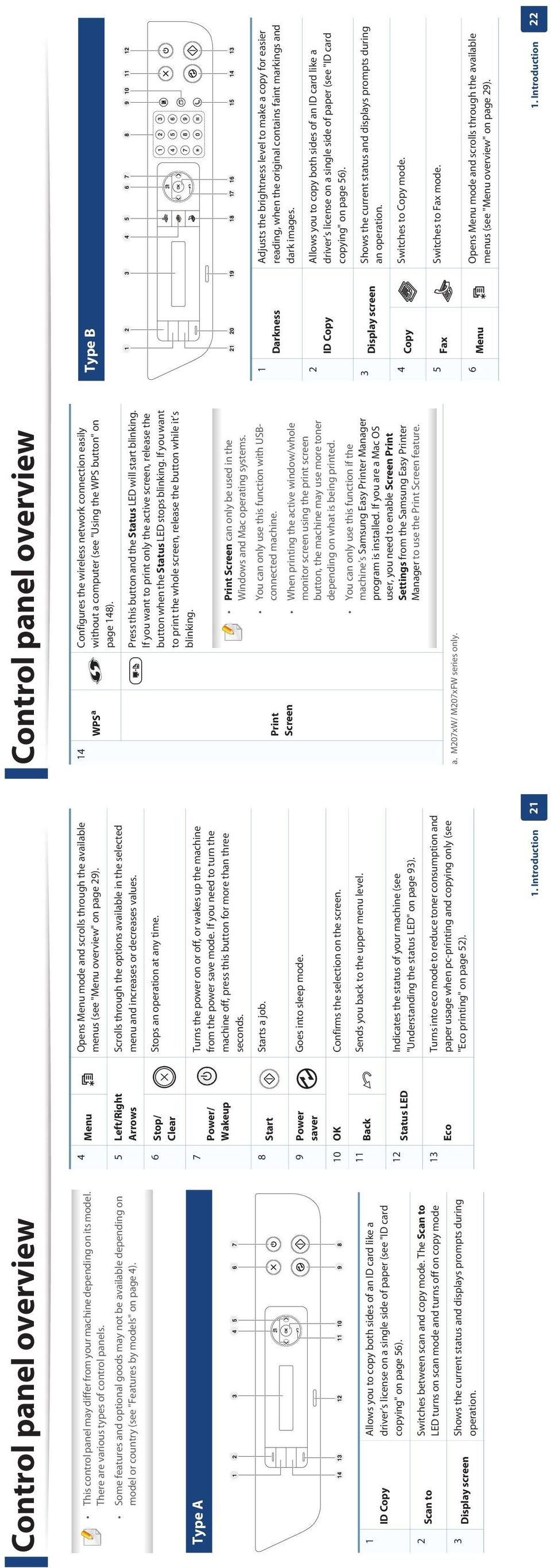
12 Control panel overview 7 Left/ Right Arrows Scrolls through the options available in the selected menu and increases or decreases values. 8 Numeric keypad Dials a number or enters alphanumeric characters (see "Keypad letters and numbers" on page 06). 9 Address Book Allows you to store frequently used fax numbers or search for stored fax numbers (see "Storing address" on page 0 or "Setting up the fax address book" on page 07). 0 Redial/ Pause Redials the recently sent fax number or received caller ID in ready mode, or inserts a pause(-) into a fax number in edit mode (see "Redialing the fax number" on page ). Stop/ Clear Stops an operations at any time. Power/ Wakeup Turns the power on or off, or wakes up the machine from the power save mode. If you need to turn the machine off, press this button for more than three seconds. Start Starts a job. Power saver Goes into sleep mode. On Hook Dial When you press this button, you can hear a dial tone. Then enter a fax number. It is similar to making a call using speaker phone (see "Receiving manually in Tel mode" on page 7). 6 OK Confirms the selection on the screen. 7 Back Sends you back to the upper menu level. 8 Scan Switches to Scan mode. 9 Status LED Indicates the status of your machine (see "Understanding the status LED" on page 9). 0 Eco Turn into eco mode to reduce toner consumption and paper usage when pc-printing and copying only (see "Eco printing" on page ).. Introduction Control panel overview Configures the wireless network connection easily WPS a without a computer (see "Using the WPS button" on page 8). Press this button and the display will Print Screen? on the display screen. If you want to print only the active screen, select the Active. If you want to print the whole screen, select Full. Print Screen Print Screen can only be used in the Windows and Mac operating systems. You can only use this function with USBconnected machine. When printing the active window/whole monitor screen using the print screen button, the machine may use more toner depending on what is being printed. You can only use this function if the machine s Samsung Easy Printer Manager program is installed. If you are a Mac OS user, you need to enable Screen Print Settings from the Samsung Easy Printer Manager to use the Print Screen feature. a. M07xW/ M07xFW series only.. Introduction

13 Turning on the machine Connect the machine to the electricity supply first. Turn the switch on if the machine has a power switch. Illustrations on this user s guide may differ from your machine depending on its options or models. Check your machine type (see "Front view" on page 6). Power is turned on automatically. For M07x series, press (Power/Wakeup) button on the control panel. If you want to turn the power off, press and hold (Power/Wakeup) button for about seconds.. Introduction Installing the driver locally A locally connected machine is a machine directly attached to your computer using the cable. If your machine is attached to a network, skip the following steps below and go on to installing a network connected machine s driver (see "Installing driver over the network" on page 6). If you are a Mac or Linux operating systems user, refer to the "Installation for Mac" on page 7 or "Installation for Linux" on page 9. The installation window in this User s Guide may differ depending on the machine and interface in use. Only use a USB cable no longer than meters (8 inches). Windows Insert the supplied software CD into your CD-ROM drive. If the installation window does not appear, click Start > All programs > Accessories > Run. X:\Setup.exe replacing X with the letter, which represents your CD-ROM drive and click OK. Review and accept the installation agreements in the installation window. Then, click Next. Select USB connection on the Printer Connection Type screen. Then, click Next. Follow the instructions in the installation window.. Introduction 6

14 Reinstalling the driver If the printer driver does not work properly, follow the steps below to reinstall the driver. Windows From the Start menu, select Programs or All Programs > Samsung Printers > Uninstall Samsung Printer Software. Follow the instructions in the installation window. Insert the software CD into your CD-ROM drive and install the driver again (see "Installing the driver locally" on page ).. Introduction 7. Menu Overview and Basic Setup This chapter provides information about the overall menu structure and the basic setup options. Menu overview Media and tray 9 Basic printing Basic copying 7 Basic scanning Basic faxing

15 Menu overview The control panel provides access to various menus to set up the machine or use the machine s functions. This function is not supported for M07x series (see "Control panel overview" on page ). Some menus may not appear on the display depending on options or models. If so, it is not applicable to your machine. Some menu names may differ from your machine depending on its options or the models. The menus are described in the Advanced Guide (see "Useful Setting Menus" on page 87). Accessing the menu Select the Fax, Copy, or Scan button on the control panel depending on the feature to be used. Select (Menu) until the menu you want appears on the bottom line of the display and press OK. Press the arrows until the needed menu item appears and press OK. If the setting item has sub menus, repeat step. Press OK to save the selection. 6 Press (Stop/Clear) to return to the ready mode. Items Options Fax Feature Darkness Normal (M07xF series, Dark+- Dark+ M07xFW series) Light+- Light+ Resolution Standard Fine Super Fine Photo Fax Color Fax Original Size Multi Send Delay Send Priority Send Send Forward Forward to Fax Rcv.Forward Forward to Fax Forward to PC Forward & Print Secure Receive Off On Print. Menu Overview and Basic Setup 9 Menu overview Items Options Fax Feature (Continue) Add Page Cancel Job Fax Setup Sending Redial Times (M07xF series,m07xfw series) Redial Term Prefix Dial ECM Mode Fax Confirm Image TCR Dial Mode a Items Options Fax Setup (Continue) Receiving Receive Mode Ring To Answer Stamp RCV Name RCV Start Code Auto Reduction Discard Size Junk Fax Setup DRPD Mode a Change Default Resolution Darkness Original Size Manual TX/RX Manual TX/RX On Off Copy Feature Original Size Reduce/Enlarge Darkness Normal Dark+- Dark+ Light+- Light+. Menu Overview and Basic Setup 0

16 Menu overview Items Options Copy Feature Original Type Text (Continue) Text/Photo Photo Collation On Off Layout Normal -Up -Up ID Copy Adjust Bkgd. Off Auto Enhance Lev. Enhance Lev. Erase Lev.- Erase Lev. Copy Setup Change Default Original Size Copies Reduce/Enlarge Darkness Original Type Collation Items Options System Setup Machine Setup Machine ID Fax Number Date & Time Clock Mode Language Default Mode Power Save Auto Power Off Wakeup Event System Timeout Job Timeout Altitude Adj. Auto Continue b Paper Substit. b Toner Save Eco Settings Paper Setup Paper Size Paper Type Margin. Menu Overview and Basic Setup Menu overview Items Options System Setup (Continue) Sound/Volume Key Sound Alarm Sound Speaker Ringer Report Configuration Demo Page Supplies Info. Usage Counter Fax Received Fax Sent Schedule Jobs Fax Confirm. Junk Fax Address Book Maintenance CLR Empty Msg. c Supplies Life Image Mgr. TonerLow Alert Serial Number Items Options Network c TCP/IP (IPv) DHCP (M07xF series, M07xFW series) BOOTP Static TCP/IP (IPv6) IPv6 Protocol DHCPv6 Config Ethernet Ethernet Port Ethernet Speed Wi-Fi Wi-Fi ON/OFF WPS Wi-Fi Direct Wi-Fi Signal WLAN Default Protocol Mgr. HTTP WINS SNMPv/vt UPnP(SSDP) mdns SetIP SLP Network Conf.. Menu Overview and Basic Setup

17 Menu overview Items Options Network (Continue) Clear Settings a. This option may not be available depending on your country. b. This option only appears if Paper Mismatch is enabled. c. This option only appears when small amount of toner is left in the cartridge.. Menu Overview and Basic Setup Machine s basic settings You can set the machine s settings by using the Device Settings in Samsung Easy Printer Manager program. For Windows and Mac users, you set from Samsung Easy Printer Manager > (Switch to advanced mode) > Device Settings, see "Device Settings" on page. After installation is complete, you may want to set the machine's default settings. To change the machine s default settings, follow these steps: It may be necessary to press OK to navigate to lower-level menus for some models. Select (Menu) > System Setup > Machine Setup on the control panel. Select the option you want, then press OK. Language: change the language that is displayed on the control panel. Date & Time: When you set the time and date, they are used in delay fax. They are printed on reports. If, however, they are not correct, you need to change it for the correct time being. Enter the correct time and date using arrows or numeric keypad (see "Keypad letters and numbers" on page 06). Month = 0 to Day = 0 to Year = requires four digits Hour = 0 to Minute = 00 to 9 Clock Mode: You can set your machine to display the current time using either a -hour or -hour format. Power Save: When you are not using the machine for a while, use this feature to save power. When you press the (Power/Wakeup) button, start printing, or a fax is received, the product will wake up from the power saving mode. Altitude Adj.: Print quality is affected by atmospheric pressure, which atmospheric pressure is determined by the height of the machine above sea level. Before you set the altitude value, determine the altitude where you are (see "Altitude adjustment" on page 0). Select the option you want, then press OK. Press OK to save the selection.. Menu Overview and Basic Setup
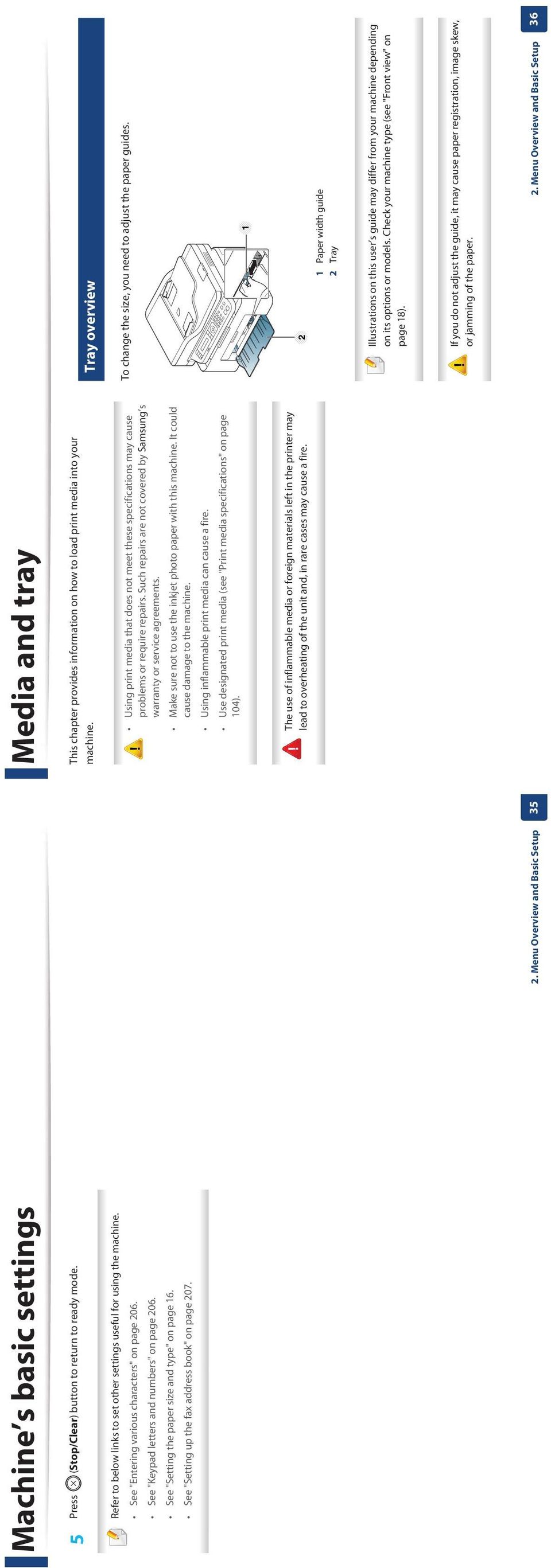
18 Machine s basic settings Press (Stop/Clear) button to return to ready mode. Refer to below links to set other settings useful for using the machine. See "Entering various characters" on page 06. See "Keypad letters and numbers" on page 06. See "Setting the paper size and type" on page 6. See "Setting up the fax address book" on page 07.. Menu Overview and Basic Setup Media and tray This chapter provides information on how to load print media into your machine. Using print media that does not meet these specifications may cause problems or require repairs. Such repairs are not covered by Samsung s warranty or service agreements. Make sure not to use the inkjet photo paper with this machine. It could cause damage to the machine. Using inflammable print media can cause a fire. Use designated print media (see "Print media specifications" on page 0). The use of inflammable media or foreign materials left in the printer may lead to overheating of the unit and, in rare cases may cause a fire. Tray overview To change the size, you need to adjust the paper guides. Paper width guide Tray Illustrations on this user s guide may differ from your machine depending on its options or models. Check your machine type (see "Front view" on page 8). If you do not adjust the guide, it may cause paper registration, image skew, or jamming of the paper.. Menu Overview and Basic Setup 6
19 Media and tray Loading paper in the tray Illustrations on this user s guide may differ from your machine depending on its options or models. Check your machine type (see "Front view" on page 8). Open the tray. Then, adjust the tray size to the media size you are loading (see "Tray overview" on page 9). Flex or fan the edge of the paper stack to separate the pages before loading papers. Place the paper with the side you want to print facing up.. Menu Overview and Basic Setup 7 Media and tray Do not push the paper width guide too far causing the media to warp. Do not use a paper with a leading-edge curl, it may cause a paper jam or the paper can be wrinkled. If you do not adjust the paper width guide, it may cause paper jams. Squeeze the paper width guide and slide it to the edge of the paper stack without causing it to bend. When you print a document, set the paper type and size for the tray (see "Setting the paper size and type" on page 6).. Menu Overview and Basic Setup 8

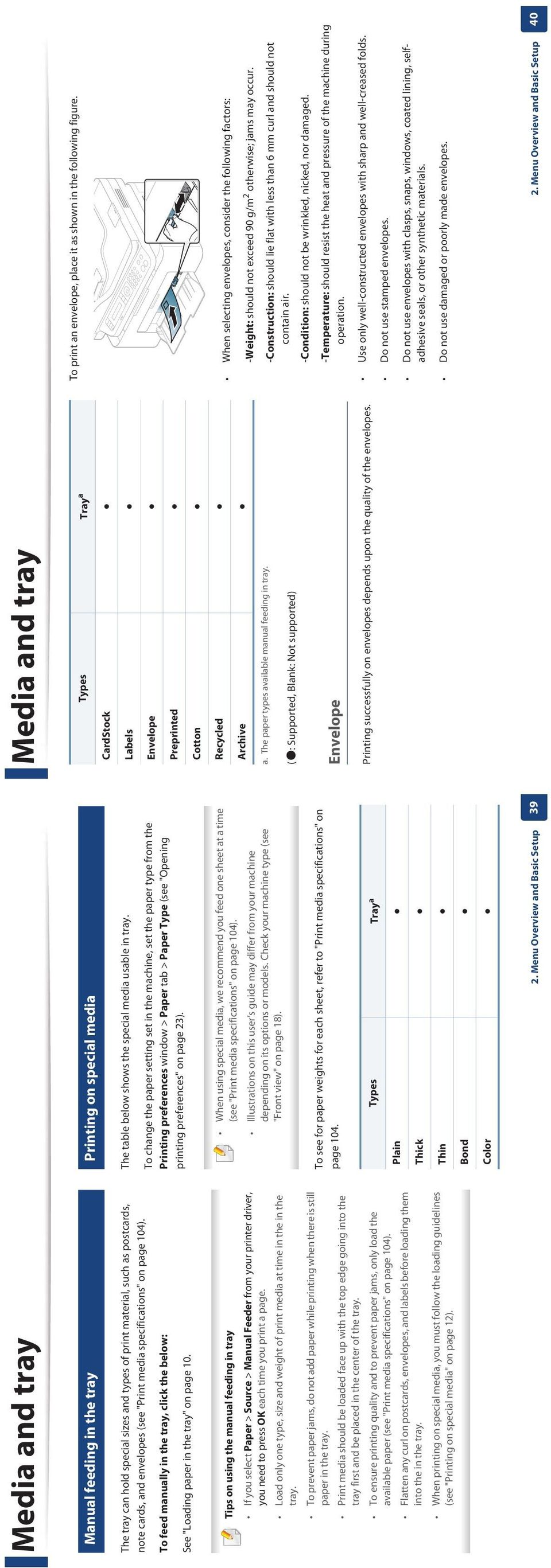
20 Media and tray Manual feeding in the tray The tray can hold special sizes and types of print material, such as postcards, note cards, and envelopes (see "Print media specifications" on page 0). To feed manually in the tray, click the below: See "Loading paper in the tray" on page 0. Tips on using the manual feeding in tray If you select Paper > Source > Manual Feeder from your printer driver, you need to press OK each time you print a page. Load only one type, size and weight of print media at time in the in the tray. To prevent paper jams, do not add paper while printing when there is still paper in the tray. Print media should be loaded face up with the top edge going into the tray first and be placed in the center of the tray. To ensure printing quality and to prevent paper jams, only load the available paper (see "Print media specifications" on page 0). Flatten any curl on postcards, envelopes, and labels before loading them into the in the tray. When printing on special media, you must follow the loading guidelines (see "Printing on special media" on page ). Printing on special media The table below shows the special media usable in tray. To change the paper setting set in the machine, set the paper type from the Printing preferences window > Paper tab > Paper Type (see "Opening printing preferences" on page ). When using special media, we recommend you feed one sheet at a time (see "Print media specifications" on page 0). Illustrations on this user s guide may differ from your machine depending on its options or models. Check your machine type (see "Front view" on page 8). To see for paper weights for each sheet, refer to "Print media specifications" on page 0. Types Tray a Plain Thick Thin Bond Color. Menu Overview and Basic Setup 9 Media and tray Types Tray a CardStock Labels Envelope Preprinted Cotton Recycled Archive a. The paper types available manual feeding in tray. ( : Supported, Blank: Not supported) Envelope Printing successfully on envelopes depends upon the quality of the envelopes. To print an envelope, place it as shown in the following figure. When selecting envelopes, consider the following factors: -Weight: should not exceed 90 g/m otherwise; jams may occur. -Construction: should lie flat with less than 6 mm curl and should not contain air. -Condition: should not be wrinkled, nicked, nor damaged. -Temperature: should resist the heat and pressure of the machine during operation. Use only well-constructed envelopes with sharp and well-creased folds. Do not use stamped envelopes. Do not use envelopes with clasps, snaps, windows, coated lining, selfadhesive seals, or other synthetic materials. Do not use damaged or poorly made envelopes.. Menu Overview and Basic Setup 0
21 Media and tray Be sure the seam at both ends of the envelope extends all the way to the corner of the envelope. Acceptable Unacceptable Envelopes with a peel-off adhesive strip or with more than one flap that folds over to seal must use adhesives compatible with the machine s fusing temperature for 0. second about 70 C (8 F). The extra flaps and strips might cause wrinkling, creasing, or jams, and may even damage the fuser. For the best print quality, position margins no closer than mm from the edges of the envelope. Avoid printing over the area where the envelope s seams meet. Labels To avoid damaging the machine, use only labels designed for use in laser printers. When selecting labels, consider the following factors: -Adhesives: Should be stable at your machine s fusing temperature about 70 C (8 F). -Arrangement: Only use labels with no exposed backing between them. Labels can peel off sheets that have spaces between the labels, causing serious jams. -Curl: Must lie flat with no more than mm of curl in any direction. -Condition: Do not use labels with wrinkles, bubbles, or other indications of separation. Make sure that there is no exposed adhesive material between labels. Exposed areas can cause labels to peel off during printing, which can cause paper jams. Exposed adhesive can also cause damage to machine components.. Menu Overview and Basic Setup Media and tray Do not run a sheet of labels through the machine more than once. The adhesive backing is designed for only a single pass through the machine. Do not use labels that are separating from the backing sheet or are wrinkled, bubbled, or otherwise damaged. Card stock/ Custom-sized paper In the software application, set the margins to at least 6. mm (0. inches) away from the edges of the material. Preprinted paper When loading preprinted paper, the printed side should be facing up with an uncurled edge at the front. If you experience problems with paper feeding, turn the paper around. Note that print quality is not guaranteed. Must be printed with heat-resistant ink that will not melt, vaporize, or release hazardous emissions when subjected to the machine s fusing temperature for 0. second (about 70 C (8 F)). Preprinted paper ink must be non-flammable and should not adversely affect machine rollers. Before you load preprinted paper, verify that the ink on the paper is dry. During the fusing process, wet ink can come off preprinted paper, reducing print quality.. Menu Overview and Basic Setup
22 Media and tray Setting the paper size and type After loading paper in the paper tray, set the paper size and type using the control panel buttons. To change the paper setting set in the machine, set the paper type from the Printing preferences window > Paper tab > Paper Type (see "Opening printing preferences" on page ). It may be necessary to press OK to navigate to lower-level menus for some models. Select (Menu) button on the control panel. Press System Setup > Paper Setup > Paper Size or Paper Type. Select the tray and the option you want. Press OK to save the selection. Press (Stop/Clear) to return to ready mode. If you want to use special-sized paper such as billing paper, select the Paper tab > Size > Edit... and set Custom Paper Size Settings in the Printing Preferences (see "Opening printing preferences" on page ). Using the output support The surface of the output tray may become hot if you print a large number of pages at once. Make sure that you do not touch the surface, and do not allow children near it. The printed pages stack on the output support, and the output support will help the printed pages to align. The printer sends output to the output tray by default.. Menu Overview and Basic Setup Media and tray Illustrations on this user s guide may differ from your machine depending on its options or models. Check your machine type (see "Front view" on page 8). Preparing originals Do not load paper smaller than x 8 mm (.6 x.8 inches) or larger than 6 x 6 mm (8. x inches). Do not attempt to load the following s of paper, in order to prevent paper jam, low print quality and machine damage. -Carbon-paper or carbon-backed paper -Coated paper -Onion skin or thin paper -Wrinkled or creased paper -Curled or rolled paper -Torn paper Remove all staples and paper clips before loading. Make sure any glue, ink, or correction fluid on the paper is completely dry before loading. Do not load originals that include different sizes or weights of paper. Do not load booklets, pamphlets, transparencies, or documents with other unusual characteristics.. Menu Overview and Basic Setup 6 7 8
23 Media and tray Loading originals You can use the scanner glass or the document feeder to load an original for copying, scanning, and sending a fax. Illustrations on this user s guide may differ from your machine depending on its options or models. Check your machine type (see "Front view" on page 8). On the scanner glass Using the scanner glass, you can copy or scan originals. You can get the best scan quality, especially for colored or gray-scaled images. Make sure that no originals are in the document feeder. If an original is detected in the document feeder, the machine gives it priority over the original on the scanner glass.. Menu Overview and Basic Setup Lift and open the scanner lid. Media and tray Place the original face down on the scanner glass. Align it with the registration guide at the top left corner of the glass. Close the scanner lid. Leaving the scanner lid open while copying may affect copy quality and toner consumption. Dust on the scanner glass may cause black spots on the printout. Always keep it clean (see "Cleaning the machine" on page 7). If you are copying a page from a book or magazine, lift the scanner lid until its hinges are caught by the stopper and then close the lid. If the book or magazine is thicker than 0 mm, start copying with the scanner lid open. Be careful not to break the scanner glass. You may get hurt. Do not put hands while closing the scanner lid. The scanner lid may fall on your hands and get hurt. Do not look the light from inside of the scanner while copying or scanning. It is harmful to eyes. In the document feeder Using the document feeder, you can load up to 0 sheets of paper (80 g/m, 0 lbs bond) for one job. Flex or fan the edge of the paper stack to separate the pages before loading originals.. Menu Overview and Basic Setup 6 9
24 Media and tray Load the original face up into the document feeder input tray. Make sure that the bottom of the original stack matches the paper size marked on the document input tray. Adjust the document feeder width guides to the paper size. Dust on the document feeder glass may cause black lines on the printout. Always keep the glass clean (see "Cleaning the machine" on page 7).. Menu Overview and Basic Setup 7 Basic printing For special printing features, refer to the Advanced Guide (see "Using advanced print features" on page ). Printing If you are a Mac or Linux operating systems user, refer to the Advanced Guide (see "Mac printing" on page 0 or "Linux printing" on page ). The following Printing Preferences window is for Notepad in Windows 7. Open the document you want to print. Select Print from the File menu. Select your machine from the Select Printer list. The basic print settings including the number of copies and print range are selected within the Print window. To take advantage of the advanced printing features, click Properties or Preferences from the Print window (see "Opening printing preferences" on page ). To start the print job, click OK or Print in the Print window.. Menu Overview and Basic Setup 8 0
25 Basic printing Canceling a print job If the print job is waiting in the print queue or print spooler, cancel the job as follows: You can access this window by simply double-clicking the machine icon ( ) in the Windows task bar. You can also cancel the current job by pressing (Stop/Clear) on the control panel.. Menu Overview and Basic Setup 9 Basic printing Opening printing preferences The Printing Preferences window that appears in this user s guide may differ depending on the machine in use. When you select an option in Printing Preferences, you may see a warning mark or. An mark means you can select that certain option but it is not recommended, and an mark means you cannot select that option due to the machine s setting or environment. Open the document you want to print. Select Print from the file menu. The Print window appears. Select your machine from the Select Printer. Click Properties or Preferences. You can check the machine s current status pressing the Printer Status button (see "Using Samsung Printer Status" on page ).. Menu Overview and Basic Setup 0
26 Basic printing Using a favorite setting The Presets option, which is visible on each preferences tab except for the Samsung tab, allows you to save the current preferences for future use. To save a Presets item, follow these steps: Change the settings as needed on each tab. Enter a name for the item in the Presets input box. Click (Add). When you save Presets, all current driver settings are saved. Select more options and click (Update), settings will be added to the Presets you made. To use a saved setting, select it from the Presets dropdown list. The machine is now set to print according to the settings you have selected.to delete saved settings, select it from the Presets dropdown list and click (Delete). You can also restore the printer driver s default settings by selecting Default Preset from the Presets drop-down list. Using help Click the option you want to know on the Printing Preferences window and press F on your keyboard.. Menu Overview and Basic Setup Basic printing Eco printing The Eco function cuts toner consumption and paper usage. The Eco function allows you to save print resources and lead you to eco-friendly printing. If you press the Eco button from the control panel, eco mode is enabled. The default setting of Eco mode is Multiple Pages per Side () and Toner Save. Setting Eco mode on the control panel If your has machine for +/- buttons on the control panel or the machine is not supported network (see "Control panel overview" on page ): You can set the machine s settings by using the Device Settings in Samsung Easy Printer Manager program. For Windows and Mac users, see "Device Settings" on page. Accessing menus may differ from model to model (see "Accessing the menu" on page ). It may be necessary to press OK to navigate to lower-level menus for some models. Select (Menu) > System Setup > Machine Setup > Eco Settings on the control panel. Select the option you want and press OK. Default Mode: Select this to turn on or off the eco mode. (Toner save/ -up) -Off: Set the eco mode off. -On: Set the eco mode on. If you set the eco mode on with a password from the SyncThru Web Service (Settings tab > Machine Settings > System > Eco > Settings) or Samsung Easy Printer Manager (Device Settings > Eco), the On force message appears. You have to enter the password to change the eco mode status. Select Temp.: Follow the settings from Syncthru Web Service or Samsung Easy Printer Manager. Before you select this item, you must set the eco function in SyncThru Web Service (Settings tab > Machine Settings > System > Eco > Settings) or Samsung Easy Printer Manager (Device Settings > Eco). -Default Eco: The machine is set to Default Eco mode. -Custom Eco: Change any necessary values. Press OK to save the selection.. Menu Overview and Basic Setup
27 Basic printing Setting eco mode on the driver Open the Eco tab to set Eco mode. When you see the eco image ( ), that means the eco mode is currently enabled. Eco options Printer Default: Follows the settings from the machine's control panel. None: Disables Eco mode. Eco Printing: Enables eco mode. Activate the various Eco items you want to use. Password: If the administrator fixed to enable the Eco mode, you have to enter the password to change the status. Result simulator Result Simulator shows the results of reduced emission of carbon dioxide, used electricity, and the amount of saved paper in accordance with the settings you selected. The results are calculated on the basis that the total number of printed paper is one hundred without a blank page when the Eco mode is disabled. Refers to the calculation coefficient about CO, energy, and paper from IEA, the index of Ministry of Internal Affairs and Communication of Japan and Each model has a different index. The power consumption in printing mode refers to the average printing power consumption of this machine. The actual amount displayed is only an estimate as the actual amount may differ depending on the operating system used, computing performance, application software, connection method, media type [thickness], media size, job complexity, etc.. Menu Overview and Basic Setup Basic copying For special printing features, refer to the Advanced Guide (see "Copy menu" on page 89). Accessing menus may differ from model to model (see "Accessing the menu" on page or "Control panel overview" on page ). Depending on models or options, some menus may not be supported (see "Features by models" on page ). Basic copy Select (copy) > (Menu) > Copy Feature on the control panel. Or select (Menu) > Copy Feature on the control panel. Place a single document (see "Loading originals" on page 8). If you want to customize the copy settings including Reduce/Enlarge, Darkness, Original, and more by using the control panel buttons (see "Changing the settings for each copy" on page 8). Enter the number of copies using the arrow or number keypad, if necessary. Press (Start).. Menu Overview and Basic Setup
28 Basic copying If you need to cancel the copying job during the operation, press (Stop/ Clear) and the copying will stop. Changing the settings for each copy Your machine provides default settings for copying so that you can quickly and easily make a copy. However, if you want to change the options for each copy, use the copy function buttons on the control panel. If you press (Stop/Clear) while setting the copy options, all of the options you have set for the current copy job will be canceled and returned to their default status. Or, they will automatically return to their default status after the machine completes the copy in progress. Accessing menus may differ from model to model (see "Accessing the menu" on page ). It may be necessary to press OK to navigate to lower-level menus for some models. Darkness If you have an original containing faint marking and dark images, you can adjust the brightness to make a copy that is easier to read. Select (copy) > (Menu) > Copy Feature > Darkness on the control panel. Or select Darkness button on the control panel. Select the option you want and press OK. For example, the Light+ being the lightest, and the Dark+ being the darkest. Press (Stop/Clear) to return to ready mode. Original The original setting is used to improve the copy quality by selecting the document for the current copy job. Select (copy) > (Menu) > Copy Feature > Original Type on the control panel. Or select (Menu) > Copy Feature > Original Type on the control panel. Select the option you want and press OK. Text: Use for originals containing mostly text. Text/Photo: Use for originals with mixed text and photographs.. Menu Overview and Basic Setup Basic copying If texts in the printout is blurry, select Text to get the clear texts. Photo: Use when the originals are photographs. Press (Stop/Clear) to return to ready mode. Reduced or enlarged copy You can reduce or enlarge the size of a copied image from % to 00% when you copy original documents from the scanner glass. This feature may not be available depending on model or optionalgoods (see "Variety feature" on page 7). If the machine set to Eco mode, reduce and enlarge features are notavailable. To select from the predefined copy sizes Select (copy) > (Menu) > Copy Feature > Reduce/Enlarge on the control panel. Or select (Menu) > Copy Feature > Reduce/Enlarge on the control panel. Select the option you want and press OK. Press (Stop/Clear) to return to ready mode. To scale the copy by directly entering the scale rate Select (copy) > (Menu) > Copy Feature > Reduce/Enlarge > Custom on the control panel. Or select (Menu) > Copy Feature > Reduce/Enlarge on the control panel. Enter the copy size you want using the numeric keypad. Press OK to save the selection. Press (Stop/Clear) to return to ready mode. When you make a reduced copy, black lines may appear at the bottom of your copy. ID card copying Your machine can print -sided originals on one sheet. The machine prints one side of the original on the upper half of the paper and the other side on the lower half without reducing the size of the original. This feature is helpful for copying a small-sized item such as business card.. Menu Overview and Basic Setup 6 6 7
29 Basic copying The original must be placed on the scanner glass to use this feature. If the machine set to Eco mode, this feature is not available. For better image quality, Select (copy) > (Menu) > Copy Feature > Original Type > Photo on the control panel or (Menu) > Copy Feature > Original Type > Photo. Press ID Copy on the control panel. Place the front side of an original facing down on the scanner glass where arrows indicate as shown. Then, close the scanner lid. Place Front Side and Press [Start] appears on the display. Press Start. Your machine begins scanning the front side and shows Place Back Side and Press [Start]. Turn the original over and place it on the scanner glass where arrows indicate as shown. Then, close the scanner lid. 6 Press Start.. Menu Overview and Basic Setup 7 Basic copying If you do not press the (Start) button, only the front side will be copied. If the original is larger than the printable area, some portions may not be printed.. Menu Overview and Basic Setup 8
30 Basic scanning For special scanning features, refer to the Advanced Guide (see "Scan features" on page ). Basic Scanning This is the normal and usual procedure for scanning originals. This is a basic scanning method for USB-connected machine. It may be necessary to press OK to navigate to lower-level menus for some models. If you want to scan using the network, refer to the Advanced Guide (see "Scanning from network connected machine" on page ). Place a single document face down on the document glass, or load the documents face up into the document feeder (see "Loading originals" on page 8). Select (scan) > Scan to PC on the control panel. OR Press Scan to on the control panerl. If you see Not Available message, check the port connection, or select Enable Scan from Device Panel in Samsung Easy Printer Manager > Switch to advanced mode > Scan to PC Settings. Select the scan destination you want and press OK. Default setting is My Documents. You can create and save the frequently used settings as a profile list. Also you can add and delete the profile and save each profile to a different path. To change the Samsung Easy Printer Manager > Switch to advanced mode > Scan to PC Settings. Select the option you want and press OK. Scanning begins. Scanned image is saved in computer s C:\Users\users name\my Documents. The saved folder may differ, depending on your operating system or the application you are using. 9. Menu Overview and Basic Setup Basic faxing This function is not supported for M07x series (see "Control panel overview" on page ). For special faxing features, refer to the Advanced Guide (see "Fax features" on page ). You cannot use this machine as a fax via the internet phone. For more information ask your internet service provider. We recommend using traditional analog phone services (PSTN: Public Switched Telephone Network) when connecting telephone lines to use a fax machine. If you use other Internet services (DSL, ISDN, VolP), you can improve the connection quality by using the Micro-filter. The Micro-filter eliminates unnecessary noise signals and improves connection quality or Internet quality. Since the DSL Micro-filter is not provided with the machine, contact your Internet service provider for use on DSL Microfilter. Line port Micro filter DSL modem / Telephone line (see "Rear view" on page 0). Preparing to fax Before you send or receive a fax, you need to connect the supplied line cord to your telephone wall jack (see "Rear view" on page 0). Refer to the Quick Installation Guide how to make a connection. The method of making a telephone connection is different from one country to another. Sending a fax When you place the originals, you can use either the document feeder or the scanner glass. If the originals are placed on both the document feeder and the scanner glass, the machine will read the originals on the document feeder first, which has higher priority in scanning. Place a single document face down on the document glass, or load the documents face up into the document feeder (see "Loading originals" on page 8). Select (fax) on the control panel. Adjust the resolution and the darkness to suit your fax needs (see "Adjusting the document settings" on page ).. Menu Overview and Basic Setup
31 Basic faxing Enter the destination fax number (see "Keypad letters and numbers" on page 06). Press (Start) on the control panel. The machine starts to scan and send the fax to the destinations. If you want to send a fax directly from your computer, use Samsung Network PC Fax (see "Sending a fax in the computer" on page ). When you want to cancel a fax job, press (Stop/Clear) before the machine starts transmission. If you used the scanner glass, the machine shows the message asking to place another page. Sending a fax manually Perform the following to send a fax using (On Hook Dial) on the control panel. Place a single document face down on the document glass, or load the documents face up into the document feeder (see "Loading originals" on page 8). Select (fax) on the control panel. Adjust the resolution and the darkness to suit your fax needs (see "Adjusting the document settings" on page ). Press (On Hook Dial) on the control panel. Enter a fax number using the number keypad on the control panel. Press (Start) on the control panel when you hear a high-pitched fax 6 signal from the remote fax machine. Sending a fax to multiple destinations You can use the multiple send feature, which allows you to send a fax to multiple locations. Originals are automatically stored in memory and sent to a remote station. After transmission, the originals are automatically erased from memory. You cannot send faxes with this feature if you chosen super fine as an option or if the fax is in color. Place a single document face down on the document glass, or load the documents face up into the document feeder (see "Loading originals" on page 8). Select (fax) on the control panel. Adjust the resolution and the darkness to suit your fax needs (see "Adjusting the document settings" on page ). Select (Menu) > Fax Feature > Multi Send on the control panel.. Menu Overview and Basic Setup 6 Basic faxing Enter the number of the first receiving fax machine and press OK. You can press speed dial numbers or select a group dial number using the (Address book) button. Enter the second fax number and press OK. 6 The display asks you to enter another fax number to send the document. To enter more fax numbers, press OK when Yes appears and repeat 7 steps and 6. You can add up to 0 destinations. Once you have entered a group dial number, you cannot enter another group dial number. When you have finished entering fax numbers, select No at the Another 8 No.? prompt and press OK. The machine begins sending the fax to the numbers you entered in the order in which you entered them. Multi send report is printed after sending faxes. Receiving a fax Your machine is preset Fax mode at the factory. When you receive a fax, the machine answers the call on a specified number of rings and automatically receives the fax. Adjusting the document settings Before starting a fax, change the following settings according to your original s status to get the best quality. It may be necessary to press OK to navigate to lower-level menus for some models. Resolution The default document settings produce good results when using typical textbased originals. However, if you send originals that are of poor quality, or contain photographs, you can adjust the resolution to produce a higher quality fax.. Menu Overview and Basic Setup 6
32 Basic faxing Select (fax) > (Menu) > Fax Feature > Resolution on the control panel. Select the option you want and press OK. Standard: Originals with normal sized characters. Fine: Originals containing small characters or thin lines or originals printed using a dot-matrix printer. Super Fine: Originals containing extremely fine detail. Super Fine mode is enabled only if the machine with which you are communicating also supports the Super Fine resolution. For memory transmission, Super Fine mode is not available. The resolution setting is automatically changed to Fine. When your machine is set to Super Fine resolution and the fax machine with which you are communicating does not support Super Fine resolution, the machine transmits using the highest resolution mode supported by the other fax machine. Photo Fax: Originals containing shades of gray or photographs. Color Fax: Original with colors. Memory transmission is not available in this mode. You can only send a color fax if the machine you are communicating with supports color fax reception and you send the fax manually. Press (Stop/Clear) to return to ready mode. Darkness You can select the degree of darkness of the original document. The darkness setting is applied to the current fax job. To change the default setting (see "Fax menu" on page 9). Select (fax) > (Menu) > Fax Feature > Darkness on the control panel. Select a darkness level you want. Press (Stop/Clear) to return to ready mode.. Menu Overview and Basic Setup 6. Maintenance This chapter provides information about purchasing supplies, accessories and maintenance parts available for your machine. Ordering supplies and accessories Available supplies Storing the toner cartridge Redistributing toner 6 Toner cartridge 8 Monitoring the supplies life 0 Setting the toner low alert Cleaning the machine Tips for moving & storing your machine 8
33 Ordering supplies and accessories Available accessories may differ from country to country. Contact your sales representatives to obtain the list of available supplies, and maintenance parts. To order Samsung-authorized supplies, accessories, and maintenance parts, contact your local Samsung dealer or the retailer where you purchased your machine. You can also visit and then select your country/region to obtain the contact information for service.. Maintenance 6 Available supplies When supplies reach the end of their life spans, you can order the followings of supplies for your machine: Type Average yield a Part name Toner cartridge Approx.,000 pages MLT-DS a. Declared yield value in accordance with ISO/IEC 97. The number of pages may be affected by operating environment, printing interval, graphics, media type and media size. Depending on the options, percentage of image area and job mode used, the toner cartridge s lifespan may differ. When purchasing new toner cartridges or other supplies, these must be purchased in the same country as the machine you are using. Otherwise, new toner cartridges or other supplies will be incompatible with your machine due to different configurations of toner cartridges and other supplies according to the specific country conditions. Samsung does not recommend using non-genuine Samsung toner cartridge such as refilled or remanufactured toner. Samsung cannot guarantee non-genuine Samsung toner cartridge's quality. Service or repair required as a result of using non-genuine Samsung toner cartridges will not be covered under the machine s warranty.. Maintenance 66
34 Storing the toner cartridge Toner cartridges contain components that are sensitive to light, temperature and humidity. Samsung suggests users follow these recommendations to ensure optimal performance, highest quality, and longest life from your new Samsung toner cartridge. Store this cartridge in the same environment in which the printer will be used. This should be in controlled temperature and humidity conditions. The toner cartridge should remain in its original and unopened package until installation if original packaging is not available, cover the top opening of the cartridge with paper and store in a dark cabinet. Opening the cartridge package prior to use dramatically shortens its useful shelf and operating life. Do not store on the floor. If the toner cartridge is removed from the printer, follow the instructions below to store the toner cartridge properly. Store the cartridge inside the protective bag from the original package. Store lying flat (not standing on end) with the same side facing up as if it were installed in the machine. Do not store consumables in any of the following conditions: -Temperature greater than 0 C (0 F). -Humidity range less than 0% or greater than 80%. -An environment with extreme changes in humidity or temperature. -Direct sunlight or room light. -Dusty places. -A car for a long period of time. -An environment where corrosive gases are present. -An environment with salty air. Handling instructions Do not touch the surface of the photoconductive drum in the cartridge. Do not expose the cartridge to unnecessary vibrations or shock. Never manually rotate the drum, especially in the reverse direction; this can cause internal damage and toner spillage. Toner cartridge usage Samsung Electronics does not recommend or approve the use of non-samsung brand toner cartridges in your printer including generic, store brand, refilled, or remanufactured toner cartridges. Samsung s printer warranty does not cover damage to the machine caused by the use of a refilled, remanufactured, or non-samsung brand toner cartridges. 67. Maintenance Storing the toner cartridge Estimated cartridge life Estimated cartridge life (the life of the toner cartridge yield) depends on the amount of toner that print jobs require. The actual print yield may vary depending on the print density of the pages you print on, operating environment, percentage of image area, printing interval, media type and/or media size. For example, if you print a lot of graphics, the consumption of the toner is higher and you may need to change the cartridge more often.. Maintenance 68
35 Redistributing toner When the toner cartridge is near the end of its life: White streaks or light printing occurs and/or density variation side to side. The Status LED blinks red. If this happens, you can temporarily improve print quality by redistributing the remaining toner in the cartridge. In some cases, white streaks or light printing will still occur even after you have redistributed the toner. Illustrations in this user s guide may differ from your machine depending on the model and options installed. Check your machine type (see "Front view" on page 8). To prevent damage to the toner cartridge, do not expose it to light for more than a few minutes. Cover it with a piece of paper, if necessary. Do not touch the green area of the toner cartridge. Use the handle on the cartridge to avoid touching this area. Do not use sharp objects such as a knife or scissors to open the toner cartridge package. They might scratch the drum of the cartridge. If toner gets on your clothing, wipe it off with a dry cloth and wash clothing in cold water. Hot water sets toner into fabric. When opening a scan unit, hold the document feeder and scan unit together. 69. Maintenance Redistributing toner. Maintenance 70
36 Replacing the toner cartridge Toner cartridge Click this link to open an animation about replacing a toner cartridge. Shake the toner cartridge thoroughly, it will increase the initial print quality. Illustrations in this user s guide may differ from your machine depending on the model and options installed. Check your machine type (see "Front view" on page 8). To prevent damage to the toner cartridge, do not expose it to light for more than a few minutes. Cover it with a piece of paper, if necessary. Do not touch the green area of the toner cartridge. Use the handle on the cartridge to avoid touching this area. Do not use sharp objects such as a knife or scissors to open the toner cartridge package. They might scratch the drum of the cartridge. If toner gets on your clothing, wipe it off with a dry cloth and wash clothing in cold water. Hot water sets toner into fabric. When opening a scan unit, hold the document feeder and scan unit together. When a toner cartridge has reached the end of life, the machine will stop printing. 7. Maintenance Replacing the toner cartridge. Maintenance 7
37 Monitoring the supplies life If you experience frequent paper jams or printing problems, check the number of pages the machine has printed or scanned. Replace the corresponding parts, if necessary. Select (Menu) > System Setup > Report > Supplies Info. on the control panel. Select the option you want and press OK. Total: Displays the total number of pages printed. ADF Scan: Displays the number of pages printed by using the document feeder. Platen Scan: Displays the number of pages scanned by using scanner glass. Supplies Info.: Prints the supply information page. Press (Stop/Clear) to return to ready mode.. Maintenance 7 Setting the toner low alert If the amount of toner in the cartridge is low, a message or LED informing the user to change the toner cartridge appears. You can set the option for whether or not this message or LED appears. Accessing menus may differ from model to model (see "Accessing the menu" on page 9). It may be necessary to press OK to navigate to lower-level menus for some models. You can set the machine s settings by using the Device Settings in Samsung Easy Printer Manager program. -For Windows and Mac users, you set from Samsung Easy Printer Manager > (Switch to advanced mode) > Device Settings. Select (Menu) > System Setup > Maintenance > TonerLowAlert on the control panel. Select the option you want. Press OK to save the selection.. Maintenance 7
38 Cleaning the machine If printing quality problems occur or if you use your machine in a dusty environment, you need to clean your machine regularly to keep it in the best printing condition and use your machine longer. Cleaning the cabinet of the machine with cleaning materials containing large amounts of alcohol, solvents, or other strong substances can discolor or distort the cabinet. If your machine or the surrounding area is contaminated with toner, we recommend you use a cloth or tissue dampened with water to clean it. If you use a vacuum cleaner, toner blows in the air and might be harmful to you. Cleaning the outside Clean the machine cabinet with a soft, lint-free cloth. Dampen the cloth slightly with water, but be careful not to let any water drip onto or into the machine. 7. Maintenance Cleaning the machine Cleaning the inside During the printing process, paper, toner, and dust particles can accumulate inside the machine. This buildup can cause print quality problems, such as toner specks or smearing. Cleaning the inside of the machine clears and reduces these problems. To prevent damage to the toner cartridge, do not expose it to light for more than a few minutes. Cover it with a piece of paper, if necessary. Do not touch the green area of the toner cartridge. Use the handle on the cartridge to avoid touching this area. Use a dry lint free cloth when cleaning the inside of the machine, be careful not to damage the transfer roller or any other inside parts. Do not use solvents such as benzene or thinner. Printing quality problems can occur and cause damage to the machine. Use a dry lint-free cloth to clean the machine. Turn the machine off and unplug the power cord. Wait for the machine to cool down. If your machine has a power switch, turn the power switch off before cleaning the machine. Illustrations in this user s guide may differ from your machine depending on the model and options installed. Check your machine type (see "Front view" on page 8). When opening a scan unit, hold the document feeder and scan unit together.. Maintenance 76 6
39 Cleaning the machine. Maintenance 77 Cleaning the machine Cleaning the pickup roller Turn the machine off and unplug the power cord. Wait for the machine to cool down. If your machine has a power switch, turn the power switch off before cleaning the machine. Illustrations on this user s guide may differ from your machine depending on its options or models. Check your machine type (see "Front view" on page 8).. Maintenance 78 7
40 Cleaning the machine Cleaning the scan unit Keeping the scan unit clean helps ensure the best possible copies. We suggest that you clean the scan unit at the start of each day and during the day as needed. Turn the machine off and unplug the power cord. Wait for the machine to cool down. If your machine has a power switch, turn the power switch off before cleaning the machine. Illustrations on this user s guide may differ from your machine depending on its options or models. Check your machine type (see "Front view" on page 8). Slightly dampen a soft, lint-free cloth or paper towel with water. Lift and open the scanner lid.. Maintenance 79 Cleaning the machine Wipe the surface of the scanner until it is clean and dry. Scanner lid Scanner glass Document feeder glass White Sheet Close the scanner lid.. Maintenance 80 8
41 Tips for moving & storing your machine When moving the machine, do not tilt or turn it upside down. Otherwise, the inside of the machine may be contaminated by toner, which can cause damage to the machine or reduce print quality. When moving the machine, make sure at least two people are holding the machine securely.. 8. Maintenance Troubleshooting This chapter gives helpful information for what to do if you encounter an error. Tips for avoiding paper jams Clearing original document jams Clearing paper jams 8 Understanding the status LED Understanding display messages This chapter gives helpful information for what to do if you encounter an error. If your machine has a display screen, check the message on the display screen first to solve the error.if you cannot find a solution to your problem in this chapter, refer to the Troubleshooting chapter in the Advanced Guide (see "Troubleshooting" on page ).If you cannot find a solution in the User's Guide or the problem persists, call for service.
42 Tips for avoiding paper jams By selecting the correct media s, most paper jams can be avoided. To avoid paper jams, refer to the following guidelines: Ensure that the adjustable guides are positioned correctly (see "Tray overview" on page 6). Do not remove paper from the tray while your machine is printing. Flex, fan, and straighten paper before loading. Do not use creased, damp, or highly curled paper. Do not mix papers in a tray. Use only recommended print media (see "Print media specifications" on page 0).. Troubleshooting 8 Clearing original document jams When an original document jams in the document feeder, a warning message appears on the display. To avoid tearing the document, remove the jammed document slowly and carefully. To prevent document jams, use the scanner glass for thick, thin or mixed paper- originals.. Troubleshooting 8
43 Clearing original document jams Original paper jam in front of scanner Illustrations in this user s guide may differ from your machine depending on the model and options installed. Check your machine type (see "Front view" on page 8). This troubleshooting may not be available depending on model or optional goods (see "Variety feature" on page 7).. Troubleshooting 8 Clearing original document jams Original paper jam inside of scanner Illustrations in this user s guide may differ from your machine depending on the model and options installed. Check your machine type (see "Front view" on page 8). This troubleshooting may not be available depending on model or optional goods (see "Variety feature" on page 7).. Troubleshooting 86
44 Clearing original document jams. Troubleshooting 87 Clearing original document jams Original paper jam in exit area of scanner Illustrations in this user s guide may differ from your machine depending on the model and options installed. Check your machine type (see "Front view" on page 8). This troubleshooting may not be available depending on model or optional goods (see "Front view" on page 8). Remove any remaining pages from the document feeder. Gently remove the jammed paper from the document feeder.. Troubleshooting 88
45 Clearing paper jams To avoid tearing the paper, pull the jammed paper out slowly and gently. In tray Click this link to open an animation about clearing a jam. Illustrations in this user s guide may differ from your machine depending on the model and options installed. Check your machine type (see "Front view" on page 8). 89. Troubleshooting Clearing paper jams Inside the machine Click this link to open an animation about clearing a jam. The fuser area is hot. Take care when removing paper from the machine. Illustrations in this user s guide may differ from your machine depending on the model and options installed. Check your machine type (see "Front view" on page 8).. Troubleshooting 90
46 Clearing paper jams. Troubleshooting 9 Clearing paper jams If you do not see the paper in this area, stop and go to next step:. Troubleshooting 9
47 Understanding the status LED The color of the LED indicates the machine's current status. Some LEDs may not be available depending on model or country (see "Control panel overview" on page ). To resolve the error, look at the error message and its instructions from the troubleshooting part (see "Understanding display messages" on page ). If the problem persists, call a service representative.. Troubleshooting 9 Understanding the status LED LED Status Description Off The machine is off-line. Green Blinking When the backlight blinks, the machine is receiving or printing data. On The machine is on-line and can be used. A minor error has occurred and the machine is waiting for the error to be cleared. Check the display message. When the problem is cleared, the machine resumes. Blinking Small amount of toner is left in the cartridge. The estimated cartridge life a of toner is close. Prepare a new cartridge for replacement. You may temporarily increase the printing quality by redistributing the toner (see "Redistributing toner" on page 69). b Status Red On A toner cartridge has almost reached its estimated cartridge life a. It is recommended to replace the toner cartridge (see "Toner cartridge" on page 7). The cover is opened. Close the cover. There is no paper in the tray when receiving or printing data. Load paper in the tray. The machine has stopped due to a major error. Check the display message (see "Understanding display messages" on page ). A paper jam has occurred (see "Clearing paper jams" on page 8). Blue Blinking The machine is connecting to a wireless network. On The machine is connected to a wireless network (see "Wireless network setup" on page ). Orange Blinking On Small amount of toner is left in the cartridge. The estimated cartridge life a of toner is close. Prepare a new cartridge for replacement.you may temporarily increase the printing quality by redistributing the toner (see "Redistributing toner" on page 69) A toner cartridge has almost reached its estimated cartridge life a. It is recommended to replace the toner cartridge (see "Toner cartridge" on page 7).. Troubleshooting 9
48 Understanding the status LED LED Status Description Power/ Wakeup ) Blue On The machine is in power save mode. Off The machine is in ready mode or machine s power is off. On Eco mode is on. Eco Green The default setting of Eco mode is -up and toner save. Off Eco mode is off. a. Estimated cartridge life means the expected or estimated toner cartridge life, which indicates the average capacity of print-outs and is designed pursuant to ISO/IEC 97. The number of pages may be affected by operating environment, percentage of image area, printing interval, graphics, media and media size. Some amount of toner may remain in the cartridge even when red LED is on and the printer stops printing. b. Some LEDs may not be available depending on model or country (see "Control panel overview" on page ).. Troubleshooting 9 Understanding display messages Messages appear on the control panel display to indicate the machine s status or errors. Refer to the tables below to understand the messages and their meaning, and correct the problem, if necessary. If a message is not in the table, reboot the power and try the printing job again. If the problem persists, call a service representative. When you call for service, provide the service representative with the contents of display message. Some messages may not appear depending on the model and options installed. [error number] indicates the error number. Paper Jam-related messages Message Meaning Suggested solutions Document jam. Remove jam The loaded original document has jammed in the document feeder. Clear the jam (see "Clearing original document jams" on page ). Jam or empty Door open&close Paper has jammed in the paper feed area. There is no paper in tray. Clear the jam (see "In tray" on page 8). Load paper in tray (see "Loading paper in the tray" on page 7). Paper Jam Paper has jammed in the inside machine. Clear the jam (see "Inside the machine" on page 9). inside machine. Troubleshooting 96 ( 6
49 Understanding display messages Toner-related messages Message Meaning Suggested solutions Install Toner A toner cartridge is not installed. Install a toner cartridge. Cartridge Not Compatible Toner cartridge The toner cartridge you have installed is not for your machine. Install a Samsung-genuine toner cartridge, designed for your machine. Prepare new cartridge Small amount of toner is left in the indicated cartridge. The estimated cartridge life of toner is close. Prepare a new cartridge for a replacement. You may temporarily increase the printing quality by redistributing the toner (see "Redistributing toner" on page 69).. Troubleshooting 97 Understanding display messages Message Meaning Suggested solutions Replace new cartridge The indicated toner cartridge has almost reached its estimated cartridge life. Estimated cartridge life means the expected or estimated toner cartridge life, which indicates the average capacity of print-outs and is designed pursuant to ISO/IEC 97 (see "Available supplies" on page 66). The number of pages may be affected by operating environment, percentage of image area, printing interval, media, percentage of image area, and media size. Some amount of toner may remain in the cartridge even when replace new cartridge appears and the machine stops printing. You can choose Stop or Continue as shown on the control panel. If you select Stop, the printer stops printing and you cannot print any more without changing the cartridge. If you select Continue, the printer keeps printing but the printing quality cannot be guaranteed. Replace the toner cartridge for the best print quality when this message appears. Using a cartridge beyond this stage can result in printing quality issues (see "Toner cartridge" on page 7). Samsung does not recommend using a non-genuine Samsung toner cartridge such as refilled or remanufactured. Samsung cannot guarantee a non-genuine Samsung toner cartridge's quality. Service or repair required as a result of using non-genuine Samsung toner cartridges will not be covered under the machine warranty. The indicated toner cartridge has reached its estimated cartridge life. The machine might stop printing. Replace the toner cartridge (see "Toner cartridge" on page 7).. Troubleshooting 98 7
50 Understanding display messages Tray-related messages Message Meaning Suggested solutions Jam or empty Door open&close Paper has jammed in the paper feed area. There is no paper in tray. Clear the jam (see "In tray" on page 8). Load paper in tray (see "Loading paper in the tray" on page 7). Network-related messages Message Meaning Suggested solutions Network Problem: IP Conflict The network IP address you have set is being used by someone else. Check the IP address and reset it if necessary (see "Printing a network configuration report" on page ). #S6-0 Wireless module is not installed. Turn off then on. Misc. messages Message Meaning Suggested solutions Door Open The cover is not securely latched. Close the cover until it locks into place. Close it. Troubleshooting 99 Understanding display messages Message Meaning Suggested solutions Door of scanner is open. The document feeder cover is not securely latched. Close the cover until it locks into place. Error [error number] Turn off then on The machine unit cannot be controlled. Reboot the power and try the printing job again. If the problem persists, please call for service. Error [error number] Call for service Scanner Locked The scanner is locked. Reboot the power. If the problem persists, please call for service.. Troubleshooting
51 . Appendix This chapter provides product specifications and information concerning applicable regulations. Specifications Regulatory information Copyright Specifications General specifications The specification values listed below are subject to change without notice. See for possible changes in information. Items Description a Dimension Width x Length x Height M07x series 06 x 9.6x mm (.98 x.6 x 9.96 inches) M07xW series M07xF series / M07xFW series 06 x 9.6x 08.7mm (.98 x.6 x. inches) M07xFH series / M07xHW series a Weight Machine with consumables M07x series 7. Kg (6. lbs) M07xW series M07xF series / M07xFW series 8.7 Kg (8.67lbs) M07xFH series / M07xHW series Noise Level b Ready mode Less than 6 db (A) Print mode Less than 0 db (A) Copy mode Scanner glass Less than 0 db (A) Document feeder Less than db (A) Scan mode Scanner glass Less than db (A) Document feeder Less than db (A). Appendix 0
52 Specifications Items Description Temperature Operation 0 to C (0 to 89.6 F) Storage (packed) -0 to 0 C (- to 0 F) Humidity Operation 0 to 80% RH Storage (packed) 0 to 90% RH Power rating c 0 volt models AC 0-7 V 0 volt models AC 0-0 V Power consumption Average operating mode Less than 0 W Ready mode Less than 0 W Power save mode d M07x series: Less than. W M07xW series: Less than. W ( Wi-Fi Direct off :Less than.8 W ) M07xF series / M07xFH series: Less than.9 W M07xFW series / M07xHW series: Less than. W ( Wi-Fi Direct off :Less than. W ) Power off mode e Less than 0. W Wireless f Module T77H6/SPW-B9S a. Dimensions and weight are measured without a handset and other accessories. b. Sound Pressure Level, ISO Configuration tested: basic machine installation, A paper, simplex printing. c. See the rating label on the machine for the correct voltage (V), frequency (hertz) and of current (A) for your machine. d. The power consumption of power save mode may be affected by machine's status, setting conditions, operating environment. e. Power consumption can be completely avoided only when the power cable is not connected. f. Wireless models only (see "Features by models" on page ).. Appendix 0 Specifications Print media specifications Type Size Dimensions Print media weight/capacity a Tray Manual feeding in tray b Letter 6 x 79 mm (8. x inches) 7 to 8 g/m (9 to lbs bond) 7 to 8 g/m (9 to lbs bond) Legal 6 x 6 mm (8. x inches) Folio 6 x 0 mm (8. x inches) 0 sheets of 80 g/m ( lbs bond) sheet A 0 x 97 mm (8.7 x.69 inches) Plain Oficio 6 x mm (8. x. inches) B(JIS) 8 x 7 mm (7.7 x 0. inches) B(ISO) 76 x 0 mm (6.9 x 9.8 inches) Executive 8 x 67 mm (7. x 0. inches) A 8 x 0 mm (.8 x 8.7 inches) Monarch Envelope 98 x 9 mm (.87 x 7. inches) 7 to 90 g/m (0 to lbs bond) 7 to 90 g/m (0 to lbs bond) No. 0 Envelope 0 x mm (. x 9. inches) 0 sheets sheet Envelope DL Envelope 0 x 0 mm (. x 8.66 inches) C Envelope 6 x 9 mm (6.8 x 9.0 inches). Appendix 0
53 Specifications Type Size Dimensions Print media weight/capacity a Tray Manual feeding in tray b Thick Refer to the Plain section Refer to the Plain section 86 to 0 g/m ( to lbs bond) 0 sheets of 0 g/m ( lbs bond) 86 to 0 g/m ( to lbs bond) sheet Thin Refer to the Plain section Refer to the Plain section 60 to 70 g/m (6 to 9 lbs bond) 60 sheets of 60 g/m (6 lbs bond) 60 to 70 g/m (6 to 9 lbs bond) sheet Cotton Refer to the Plain section Refer to the Plain section 7 to 90 g/m (0 to lbs bond) 0 sheets of 80 g/m ( lbs bond) 7 to 90 g/m (0 to lbs bond) sheet Colored Refer to the Plain section Refer to the Plain section 7 to 90 g/m (0 to lbs bond) 0 sheets of 80 g/m ( lbs bond) 7 to 90 g/m (0 to lbs bond) sheet Preprinted Refer to the Plain section Refer to the Plain section 7 to 90 g/m (0 to lbs bond) 0 sheets of 80 g/m ( lbs bond) 7 to 90 g/m (0 to lbs bond) sheet Recycled Refer to the Plain section Refer to the Plain section 60 to 90 g/m (6 to lbs bond) 0 sheets of 80 g/m ( lbs bond) 60 to 90 g/m (6 to lbs bond) sheet. Appendix 0 Specifications Type Size Dimensions Print media weight/capacity a Tray Manual feeding in tray b Labels c Letter, Legal, Oficio, Folio, A, B(JIS), B(ISO), Executive, A Refer to the Plain section 0 to 0 g/m ( to 0 lbs bond) 0 sheets 0 to 0 g/m ( to 0 lbs bond) sheet CardStock Letter, Legal, Oficio, Folio, A, B(JIS), B(ISO), Executive, A, Refer to the Plain section to 6 g/m ( to lbs bond) 0 sheets to 6 g/m ( to lbs bond) sheet Postcard x6 Bond Refer to the Plain section Refer to the Plain section 0 sheets sheet Archive Refer to the Plain section Refer to the Plain section 00 sheets sheet Minimum size (custom) 76 x 7 mm ( x inches) 60 to 6 g/m (6 to lbs bond) Maximum size (custom) 6 x 6 mm (8. x inches) a. Maximum capacity may differ depending on media weight, thickness, and environmental conditions. b. sheet for manual feeding. c. The smoothness of the labels used in this machine is 00 to 0 (sheffield). This means the numeric level of smoothness.. Appendix 06
54 Specifications System requirements Microsoft Windows Operating system Requirement (recommended) CPU RAM free HDD space Windows XP Intel Pentium III 9 MHz (Pentium IV GHz) 8 MB (6 MB). GB Windows Server 00 Intel Pentium III 9 MHz (Pentium IV GHz) 8 MB ( MB). GB to GB Windows Server 008 Intel Pentium IV GHz (Pentium IV GHz) MB ( GB) 0 GB Windows Vista Intel Pentium IV GHz MB ( GB) GB Windows 7 Intel Pentium IV GHz -bit or 6-bit processor or higher GB ( GB) 6 GB Support for DirectX 9 graphics with 8 MB memory (to enable the Aero theme). DVD-R/W Drive Windows Server 008 R Intel Pentium IV GHz (x86) or. GHz (x6) processors ( GHz or faster) MB ( GB) 0 GB Internet Explorer 6.0 or higher is the minimum requirement for all Windows operating systems. Users who have administrator rights can install the software. Windows Terminal Services is compatible with your machine. For Windows 000, Services Pack or higher is required.. Appendix 07 Specifications Mac Operating system Requirements (Recommended) CPU RAM Free HDD space Mac OS X 0. Intel processors 867 MHz or faster Power PC G/G MB ( GB) GB Mac OS X 0.6 Intel processors GB ( GB) GB Mac OS X 0.7 ~ 0.9 Intel processors GB GB Linux Items Requirements Operating system Redhat Enterprise Linux, 6 Fedora,,,,, 6, 7, 8 SuSE Linux 0. ( bit) OpenSuSE.0,.,.,.,.,.,.,. Ubuntu 0.0, 0.0,.0,.0,.0,.0 SuSE Linux Enterprise Desktop 0, Debian.0, 6.0 Mint,. Appendix 08
55 Specifications Items Requirements CPU Pentium IV.GHz (Intel Core ) RAM MB ( GB) Free HDD space GB ( GB). Appendix 09 Specifications Network environment Network and wireless models only (see "Features by models" on page ). You need to set up the network protocols on the machine to use it as your network machine. The following table shows the network environments supported by the machine. Items Specifications Network interface Ethernet 0/00 Base-TX Wired Lan 80.b/g/n Wireless LAN Network operating system Server 00 /Server 008/XP/Vista/7/Server 008 R Various Linux OS Mac OS X 0. ~0.9 Network protocols TCP/IPv DHCP, BOOTP DNS, WINS, Bonjour, SLP, UPnP Standard TCP/IP Printing (RAW), LPR, IPP, WSD SNMPv //, HTTP, IPSec TCP/IPv6 (DHCP, DNS, RAW, LPR, SNMPv //, HTTP, IPSec) Wireless security Authentication: Open System, Shared Key, WPA Personal, WPA Personal (PSK) Encryption: WEP6, WEP8, TKIP, AES. Appendix 0
56 Regulatory information This machine is designed for a normal work environment and certified with several regulatory statements. Laser safety statement The printer is certified in the U.S. to conform to the requirements of DHHS CFR, chapter Subchapter J for Class I() laser products, and elsewhere is certified as a Class I laser product conforming to the requirements of IEC 608- :007. Class I laser products are not considered to be hazardous. The laser system and printer are designed so there is never any human access to laser radiation above a Class I level during normal operation, user maintenance or prescribed service condition. Warning Never operate or service the printer with the protective cover removed from laser/scanner assembly. The reflected beam, although invisible, can damage your eyes. When using this product, these basic safety precautions should always be followed to reduce risk of fire, electric shock, and injury to persons:. Appendix Regulatory information Ozone safety This product s ozone emission rate is under 0. ppm. Because ozone is heavier than air, keep the product in a place with good ventilation. Mercury Safety Contains Mercury, Dispose According to Local, State or Federal Laws.(U.S.A. only) Power saver This printer contains advanced energy conservation technology that reduces power consumption when it is not in active use. When the printer does not receive data for an extended period of time, power consumption is automatically lowered. ENERGY STAR and the ENERGY STAR mark are registered U.S. marks. For more information on the ENERGY STAR program see For ENERGY STAR certified models, the ENRGY STAR label will be on your machine. Check if your machine is ENERGY STAR certified. Recycling Recycle or dispose of the packaging material for this product in an environmentally responsible manner.. Appendix
57 Regulatory information China only Website : supportservicelocation.do?page=service.location Correct disposal of this product (Waste electrical & electronic equipment) (Applicable in countries with separate collection systems) This marking on the product, accessories or literature indicates that the product and its electronic accessories (e.g. charger, headset, USB cable) should not be disposed of with other household waste at the end of their working life. To prevent possible harm to the environment or human health from uncontrolled waste disposal, please separate these items from other s of waste and recycle them responsibly to promote the sustainable reuse of material resources. Household users should contact either the retailer where they purchased this product, or their local government office, for details of where and how they can take these items for environmentally safe recycling. Business users should contact their supplier and check the terms and conditions of the purchase contract. This product and its electronic accessories should not be mixed with other commercial wastes for disposal.. Appendix Regulatory information (The United States of America only) Dispose unwanted electronics through an approved recycler. To find the nearest recycling location, go to our website: Or call, (877) State of California Proposition 6 Warning (US Only) Taiwan only Radio frequency emissions FCC information to the user This device complies with Part of the FCC Rules. Operation is subject to the following two conditions: This device may not cause harmful interference, and This device must accept any interference received, including interference that may cause undesired operation. This equipment has been tested and found to comply with the limits for a Class B digital device, pursuant to Part of the FCC Rules. These limits are designed to provide reasonable protection against harmful interference in a residential installation. This equipment generates, uses and can radiate radio frequency energy and, if not installed and used in accordance with the instructions, may cause harmful interference to radio communications. However, there is no guarantee that interference will not occur in a particular installation. If this equipment does cause harmful interference to radio or television reception, which can be determined by turning the equipment off and on, the user is encouraged to try to correct the interference by one or more of the following measures: Reorient or relocate the receiving antenna. Increase the separation between the equipment and receiver. Connect the equipment into an outlet on a circuit different from that to which the receiver is connected.. Appendix 0
58 Regulatory information Consult the dealer or experienced radio TV technician for help. Change or modifications not expressly approved by the manufacturer responsible for compliance could void the user's authority to operate the equipment. Canadian radio interference regulations This digital apparatus does not exceed the Class B limits for radio noise emissions from digital apparatus as set out in the interference-causing equipment standard entitled Digital Apparatus, ICES-00 of the Industry and Science Canada. Cet appareil numérique respecte les limites de bruits radioélectriques applicables aux appareils numériques de Classe B prescrites dans la norme sur le matériel brouilleur: Appareils Numériques, ICES-00 édictée par l Industrie et Sciences Canada. United States of America Federal Communications Commission (FCC) Intentional emitter per FCC Part Low power, Radio LAN devices (radio frequency (RF) wireless communication devices), operating in the. GHz/ GHz Band, may be present (embedded) in your printer system. This section is only applicable if these devices are present. Refer to the system label to verify the presence of wireless devices. Wireless devices that may be in your system are only qualified for use in the United States of America if an FCC ID number is on the system label. The FCC has set a general guideline of 0 cm (8 inches) separation between the device and the body, for use of a wireless device near the body (this does not include extremities). This device should be used more than 0 cm (8 inches) from the body when wireless devices are on. The power output of the wireless device (or devices), which may be embedded in your printer, is well below the RF exposure limits as set by the FCC. This transmitter must not be collocated or operation in conjunction with any other antenna or transmitter. Operation of this device is subject to the following two conditions: () This device may not cause harmful interference, and () this device must accept any interference received, including interference that may cause undesired operation of the device.. Appendix Regulatory information Wireless devices are not user serviceable. Do not modify them in any way. Modification to a wireless device will void the authorization to use it. Contact manufacturer for service. FCC Statement for Wireless LAN use: While installing and operating this transmitter and antenna combination the radio frequency exposure limit of m W/cm may be exceeded at distances close to the antenna installed. Therefore, the user must maintain a minimum distance of 0cm from the antenna at all times. This device cannot be colocated with another transmitter and transmitting antenna. Russia only Germany only Turkey only. Appendix
59 Regulatory information Thai only Canada only This product meets the applicable Industry Canada technical specifications. / Le present materiel est conforme aux specifications techniques applicables d Industrie Canada. The Ringer Equivalence Number (REN) is an indication of the maximum number of devices allowed to be connected to a telephone interface. The termination of an interface may consist of any combination of devices subject only to the requirement that the sum of the RENs of all the devices not exceed five. / L indice d equivalence de la sonnerie (IES) sert a indiquer le nombre maximal de terminaux qui peuvent etre raccordes a une interface telephonique. La terminaison d une interface peut consister en une combinaison quelconque de dispositifs, a la seule condition que la somme d indices d equivalence de la sonnerie de tous les dispositifs n excede pas cinq. Fax Branding The Telephone Consumer Protection Act of 99 makes it unlawful for any person to use a computer or other electronic device to send any message via a telephone facsimile machine unless such message clearly contains in a margin at the top or bottom of each transmitted page or on the first page of the transmission the following information: the date and time of transmission identification of either business, business entity or individual sending the message; and telephone number of either the sending machine, business, business entity or individual. The Telephone Company may make changes in its communications facilities, equipment operations or procedures where such action is reasonably required in the operation of its business and is not inconsistent with the rules and regulations in FCC Part 68. If such changes can be reasonably expected to render any customer terminal equipment incompatible with telephone company communications facilities, or require modification or alteration of such terminal equipment, or otherwise materially affect its use or performance, the customer shall be given adequate notice in writing, to allow the customer an opportunity to maintain uninterrupted service. Appendix 7 Regulatory information Ringer Equivalence Number The Ringer Equivalence Number and FCC Registration Number for this machine may be found on the label located on the bottom or rear of the machine. In some instances you may need to provide these numbers to the telephone company. The Ringer Equivalence Number (REN) is a measure of the electrical load placed on the telephone line, and is useful for determining whether you have overloaded the line. Installing several s of equipment on the same telephone line may result in problems making and receiving telephone calls, especially ringing when your line is called. The sum of all Ringer Equivalence Numbers of the equipment on your telephone line should be less than five in order to assure proper service from the telephone company. In some cases, a sum of five may not be usable on your line. If any of your telephone equipment is not operating properly, you should immediately remove it from your telephone line, as it may cause harm to the telephone network. The equipment complies with Part 68 of the FCC rules and the requirements adopted by the ACTA. On the rear of this equipment is a label that contains, among other information, a product identifier in the format US:AAAEQ##TXXXX. If requested, this number must be provided to the telephone company. FCC Regulations state that changes or modifications to this equipment not expressly approved by the manufacturer could void the user s authority to operate this equipment. In the event that terminal equipment causes harm to the telephone network, the telephone company should notify the customer that service may be stopped. However, where prior notice is impractical, the company may temporarily cease service, providing that they: a promptly notify the customer. b give the customer an opportunity to correct the equipment problem. c inform the customer of the right to bring a complaint to the Federal Communication Commission pursuant to procedures set out in FCC Rules and Regulations Subpart E of Part 68. You should also know that: Your machine is not designed to be connected to a digital PBX system. If you intend to use a computer modem or fax modem on the same phone line as your machine, you may experience transmission and reception problems with all the equipment. It is recommended that no other equipment, except for a regular telephone, share the line with your machine. If your area experiences a high incidence of lightning or power surges, we recommend that you install surge protectors for both the power and the telephone lines. Surge protectors can be purchased from your dealer or telephone and electronic specialty stores.. Appendix 8 9 0
60 Regulatory information When programming emergency numbers and/or making test calls to emergency numbers, use a non-emergency number to advise the emergency service dispatcher of your intentions. The dispatcher will give you further instructions on how to actually test the emergency number. This machine may not be used on coin service or party lines. This machine provides magnetic coupling to hearing aids. You may safely connect this equipment to the telephone network by means of a standard modular jack, USOC RJ-C. Replacing the Fitted Plug (for UK Only) Important The mains lead for this machine is fitted with a standard (BS 6) amp plug and has a amp fuse. When you change or examine the fuse, you must re-fit the correct amp fuse. You then need to replace the fuse cover. If you have lost the fuse cover, do not use the plug until you have another fuse cover. Contact the people from you purchased the machine. The amp plug is the most widely used in the UK and should be suitable. However, some buildings (mainly old ones) do not have normal amp plug sockets. You need to buy a suitable plug adaptor. Do not remove the moulded plug. If you cut off the moulded plug, get rid of it straight away.you cannot rewire the plug and you may receive an electric shock if you plug it into a socket. Important warning: You must earth this machine. The wires in the mains lead have the following color code: Green and Yellow: Earth Blue: Neutral Brown: Live If the wires in the mains lead do not match the colors marked in your plug, do the following: You must connect the green and yellow wire to the pin marked by the letter E or by the safety Earth symbol or colored green and yellow or green. You must connect the blue wire to the pin which is marked with the letter N or colored black. You must connect the brown wire to the pin which is marked with the letter L or colored red. You must have a amp fuse in the plug, adaptor, or at the distribution board.. Appendix 9 Regulatory information Declaration of conformity (European countries) Approvals and Certifications Hereby, Samsung Electronics, declares that this [M07x series] is in compliance with the essential requirements and other relevant provisions of Low Voltage Directive (006/9/EC), EMC Directive (00/08/EC). Hereby, Samsung Electronics, declares that this [M07xW series/ M07xF series/m07xfw series] is in compliance with the essential requirements and other relevant provisions of R&TTE Directive 999/ /EC. The declaration of conformity may be consulted at go to Support > Download center and enter your printer (MFP) name to browse the EuDoC. January, 99: Council Directive 006/9/EC Approximation of the laws of the member states related to low voltage equipment. January, 996: Council Directive 00/08/EC, approximation of the laws of the Member States related to electromagnetic compatibility. March 9, 999: Council Directive 999//EC on radio equipment and telecommunications terminal equipment and the mutual recognition of their conformity. A full declaration, defining the relevant Directives and referenced standards can be obtained from your Samsung Electronics Co., Ltd. representative. EC Certification Certification to 999//EC Radio Equipment & Telecommunications Terminal Equipment Directive (FAX) This Samsung product has been self-certified by Samsung for pan-european single terminal connection to the analogue public switched telephone network (PSTN) in accordance with Directive 999//EC. The product has been designed to work with the national PSTNs and compatible PBXs of the European countries: In the event of problems, you should contact the Euro QA Lab of Samsung Electronics Co., Ltd. in the first instance. The product has been tested against TBR. To assist in the use and application of terminal equipment which complies with this standard, the European Telecommunication Standards Institute (ETSI) has issued an advisory document (EG 0 ) which contains notes and additional requirements to ensure network compatibility of TBR terminals. The product has been designed against, and is fully compliant with, all of the relevant advisory notes contained in this document.. Appendix 0
61 Regulatory information European radio approval information (for products fitted with EU-approved radio devices) Low power, Radio LAN type devices (radio frequency (RF) wireless communication devices), operating in the. GHz/ GHz band, may be present (embedded) in your printer system which is intended for home or office use. This section is only applicable if these devices are present. Refer to the system label to verify the presence of wireless devices. Wireless devices that may be in your system are only qualified for use in the European Union or associated areas if a CE mark with a Notified Body Registration Number and the Alert Symbol is on the system label. The power output of the wireless device or devices that may be embedded in you printer is well below the RF exposure limits as set by the European Commission through the R&TTE directive. European states qualified under wireless approvals: EU countries European states with restrictions on use: EU In France, the frequency range is restricted to -8. MHz for devices above 0 mw transmitting power such as wireless EEA/EFTA countries No limitations at this time Israel only Regulatory compliance statements Wireless guidance Low power, Radio LAN devices (radio frequency (RF) wireless communication devices), operating in the. GHz/ GHz Band, may be present (embedded) in your printer system. The following section is a general overview of considerations while operating a wireless device. Additional limitations, cautions, and concerns for specific countries are listed in the specific country sections (or country group sections). The wireless devices in your system are only qualified for use in the countries identified by the Radio Approval Marks on the system rating label. If the country you will be using the wireless device in, is not listed, contact your local Radio Approval agency for requirements. Wireless devices are closely regulated and use may not be allowed.. Appendix Regulatory information The power output of the wireless device or devices that may be embedded in your printer is well below the RF exposure limits as known at this time. Because the wireless devices (which may be embedded into your printer) emit less energy than is allowed in radio frequency safety standards and recommendations, manufacturer believes these devices are safe for use. Regardless of the power levels, care should be taken to minimize human contact during normal operation. As a general guideline, a separation of 0 cm (8 inches) between the wireless device and the body, for use of a wireless device near the body (this does not include extremities) is typical. This device should be used more than 0 cm (8 inches) from the body when wireless devices are on and transmitting. This transmitter must not be collocated or operation in conjunction with any other antenna or transmitter. Some circumstances require restrictions on wireless devices. Examples of common restrictions are listed below: Radio frequency wireless communication can interfere with equipment on commercial aircraft. Current aviation regulations require wireless devices to be turned off while traveling in an airplane. IEEE 80. (also known as wireless Ethernet) and Bluetooth communication devices are examples of devices that provide wireless communication. In environments where the risk of interference to other devices or services is harmful or perceived as harmful, the option to use a wireless device may be restricted or eliminated. Airports, Hospitals, and Oxygen or flammable gas laden atmospheres are limited examples where use of wireless devices may be restricted or eliminated. When in environments where you are uncertain of the sanction to use wireless devices, ask the applicable authority for authorization prior to use or turning on the wireless device. Every country has different restrictions on the use of wireless devices. Since your system is equipped with a wireless device, when traveling between countries with your system, check with the local Radio Approval authorities prior to any move or trip for any restrictions on the use of a wireless device in the destination country. If your system came equipped with an internal embedded wireless device, do not operate the wireless device unless all covers and shields are in place and the system is fully assembled. Wireless devices are not user serviceable. Do not modify them in any way. Modification to a wireless device will void the authorization to use it. Contact manufacturer for service. Only use drivers approved for the country in which the device will be used. See the manufacturer System Restoration Kit, or contact manufacturer Technical Support for additional information.. Appendix 6
62 Regulatory information China only. Appendix Copyright 0 Samsung Electronics Co., Ltd. All rights reserved. This user s guide is provided for information purposes only. All information included herein is subject to change without notice. Samsung Electronics is not responsible for any direct or indirect damages, arising from or related to use of this user s guide. Samsung and the Samsung logo are trademarks of Samsung Electronics Co., Ltd. Microsoft, Windows, Windows Vista, Windows 7, and Windows Server 008 R are either registered trademarks or trademarks of Microsoft Corporation. Microsoft, Internet Explorer, Excel, Word, PowerPoint, and Outlook are either registered trademarks or trademarks of Microsoft Corporation in the United States and other countries. Google, Picasa, Google Docs, Android and Gmail are either registered trademarks or trademarks of Google Inc. Google Cloud Print is a trademark of Google Inc. ipad, iphone, ipod touch, Mac and Mac OS are trademarks of Apple Inc., registered in the U.S and other countries. AirPrint and the AirPrint logo are trademarks of Apple Inc. LaserWriter is a trademark of Apple Computer, Inc. All other brand or product names are trademarks of their respective companies or organizations. Refer to the 'LICENSE.txt' file in the provided CD-ROM for the open source license information. REV..00. Appendix 7
63 User s Guide User s Guide ADVANCED This guide provides information about installation, advanced configuration, operation and troubleshooting on various OS environments. Some features may not be available depending on models or countries. BASIC This guide provides information concerning installation, basic operation and troubleshooting on windows.. Software Installation This chapter provides instructions for installing essential and helpful software for use in an environment where the machine is connected via a cable. A locally connected machine is a machine directly attached to your computer using the cable. If your machine is attached to a network, skip the following steps below and go on to installing a network connected machine s driver (see "Installing driver over the network" on page 6). Installation for Mac Reinstallation for Mac Installation for Linux Reinstallation for Linux If you are a Windows OS user, refer to the Basic Guide for installing the machine s driver (see "Installing the driver locally" on page 6). Only use a USB cable no longer then meter (8 inches).
64 Installation for Mac Make sure that the machine is connected to your computer and powered on. Insert the supplied software CD into your CD-ROM drive. Double-click the CD-ROM icon that appears on your Mac desktop. For Mac OS X 0.8, double-click the CD-ROM that appears on Finder. Double-click the MAC_Installer folder > Installer OS X icon. Click Continue. 6 Read the license agreement and click Continue. 7 Click Agree to agree to the license agreement. Click Install. All components necessary for machine operations will be 8 installed. If you click Customize, you can choose individual components to install. 9 Enter the password and click OK. 0 Select USB Connected Printer on the Printer Connection Type and click Continue. Click Add Printer button to select your printer and add it to your printer list. If your machine supports fax, click Add Fax button to select your fax and add it to your fax list After the installation is finished, click Close.. Software Installation 7 Reinstallation for Mac If the printer driver does not work properly, uninstall the driver and reinstall it. Open the Applications folder > Samsung > Printer Software Uninstaller. To uninstall printer software, click Continue. Check the program you want to delete and click Uninstall. Enter the password and click OK. After the uninstallation is finished, click Close. If a machine has already been added, delete it from the Print Setup Utility or Print & Fax.. Software Installation 8
65 Installation for Linux You need to download Linux software packages from the Samsung website to install the printer software ( > find your product > Support or Downloads). Installing the Unified Linux Driver You must log in as a super user (root) to install the machine software. If you are not a super user, ask your system administrator. Make sure that the machine is connected to your system and powered on. Copy Unified Linux Driver package to your system. Open Terminal program and go to the folder that you copied the package to. Extract the package. Move to uld folder. Execute./install.sh command (If you are not logged in as root, 6 execute the command with sudo as sudo./install.sh ). 7 Proceed with installation. When installation finished, launch Printing utility (Go to System > 8 Administration > Printing or execute system-config-printer command in Terminal program). 9 Click Add button. 0 Select your printer. Click Forward button and add it to your system.. Software Installation 9 Reinstallation for Linux If the printer driver does not work properly, uninstall the driver and reinstall it. Open Terminal program. Move to uld folder extracted from Unified Linux Driver package. Execute./install.sh command (If you are not logged in as root, execute the command with sudo as sudo./install.sh ). Proceed with uninstallation.. Software Installation 0
66 . Using a Network- Connected Machine This chapter gives you step-by-step instructions for setting up a network connected machine and software. Useful network programs Wired network setup Installing driver over the network 6 IPv6 configuration Wireless network setup Samsung Mobile Print Using the NFC feature Supported optional devices and features may differ according to your model (see "Features by models" on page ). Useful network programs There are several programs available to setup the network settings easily in a network environment. For the network administrator especially, managing several machines on the network is possible. Before using the programs below, set the IP address first. Some features and optional goods may not be available depending on model or country (see "Features by models" on page ). SyncThru Web Service The web server embedded on your network machine allows you to do the following tasks (see "Using SyncThru Web Service" on page 6). Check the supplies information and status. Customize machine settings. Configure the network parameters necessary for the machine to connect to various network environments. SyncThru Web Admin Service Web-based machine management solution for network administrators. SyncThru Web Admin Service provides you with an efficient way of managing network devices and lets you remotely monitor and troubleshoot network machines from any site with corporate Internet access. Download this program from SetIP wired network setup This utility program allows you to select a network interface and manually configure the IP addresses for use with the TCP/IP protocol. See "IPv configuration using SetIP (Windows)" on page. See "IPv configuration using SetIP (Mac)" on page. The machine that does not support the network port, it will not be able to use this feature (see "Rear view" on page 0). TCP/IPv6 is not supported by this program.. Using a Network-Connected Machine
67 Wired network setup Printing a network configuration report You can print Network Configuration Report from the machine s control panel that will show the current machine s network settings. This will help you to set up a network. The machine has the display screen: Press the (Menu) button on the control panel and select Network > Network Conf. (Network Configuration). The machine has the touch screen: Press Setup from the Main screen > Network > Next > Network Configuration. The machine does not have the display screen: Press the (Cancel or Stop/Clear) button for more than ~ seconds on the control panel. Using this Network Configuration Report, you can find your machine s MAC address and IP address. For example: MAC Address: 00::99::A:78 IP Address: Setting IP address The machine that does not support the network interface, it will not be able to use this feature (see "Rear view" on page 0). TCP/IPv6 is not supported by this program. First, you have to set up an IP address for network printing and managements. In most cases a new IP address will be automatically assigned by a DHCP (Dynamic Host Configuration Protocol) server located on the network. IPv configuration using SetIP (Windows) Before using the SetIP program, disable the computer firewall from Control Panel > Security Center > Windows Firewall. The following instructions may differ for your model. Download the software from the Samsung website then unpack and install it: ( > find your product > Support or Downloads). Follow the instructions in the installation window. Connect your machine to the network with a network cable.. Using a Network-Connected Machine Wired network setup Turn on the machine. From the Windows Start menu, select All Programs > Samsung Printers > SetIP > SetIP. Click the icon (third from left) in the SetIP window to open the TCP/IP 6 configuration window. Enter the machine s new information into the configuration window. In 7 a corporate intranet, you may need to have this information assigned by a network manager before proceeding. Find the machine s MAC address from the Network Configuration Report (see "Printing a network configuration report" on page ) and enter it without the colons. For example, 00::99:9::A8 becomes 00999A8. Click Apply, and then click OK. The machine will automatically print the 8 Network Configuration Report. Confirm that all the settings are correct. IPv configuration using SetIP (Mac) Before using the SetIP program, disable the computer firewall from System Preferences > Security > Firewall. The following instructions may vary from your model. Connect your machine to the network with a network cable. Insert the supplied software CD into your CD-ROM drive. Double-click the CD-ROM icon that appears on your Mac desktop. For Mac OS X 0.8, Double-click the CD-ROM that appears on Finder. Double-click the MAC_Installer folder > Installer OS X icon. Click Continue. 6 Read the license agreement and click Continue. 7 Click Agree to agree to the license agreement. Click Install. All components necessary for machine operations will be 8 installed. If you click Customize, you can choose individual components to install.. Using a Network-Connected Machine
68 Wired network setup 9 Enter the password and click OK. 0 When the message that warns that all applications will close on your computer appears, click Continue. Select Network Connected Printer(Wired or Wireless) on the Printer Connection Type and click Set IP Address button. Click the icon (third from left) in the SetIP window to open the TCP/IP configuration window. Enter the machine s new information into the configuration window. In a corporate intranet, you may need to have this information assigned by a network manager before proceeding. Find the machine s MAC address from the Network Configuration Report (see "Printing a network configuration report" on page ) and enter it without the colons. For example, 00::99:9::A8 becomes 00999A8. Click Apply, and then click OK. The machine will automatically print the Network Configuration Report. Confirm that all the settings are correct.. Using a Network-Connected Machine Installing driver over the network Some features and optional goods may not be available depending on model or country (see "Features by models" on page ). The machine that does not support the network interface, it will not be able to use this feature (see "Rear view" on page 0). Silent installation Mode Silent installation mode is an installation method that does not require any user intervention. Once you start the installation, the machine driver and software are automatically installed on you computer. You can start the silent installation by typing /s or /S in the command window. Windows Make sure that the machine is connected to the network and powered on. Also, your machine s IP address should have been set (see "Setting IP address" on page ). Insert the supplied software CD into your CD-ROM drive. Command-line Parameters Following table shows commands that can be used in the command window. Following command-line are effective and operated when command is used with /s or /S. But /h, /H or /? are exceptional commands that can be operated solely. Review and accept the installation agreements in the installation window. Then, click Next. Command- line Definition Description Select Network connection on the Printer Connection Type screen. Then, click Next. Follow the instructions in the installation window. /s or/s Starts silent installation. Installs machine drivers without prompting any UIs or user intervention.. Using a Network-Connected Machine 6 6
69 Installing driver over the network Command- line Definition Description Command- line Definition Description /p <port name> or/p <port name> Specifies printer port. Network Port will be created by use of Standard TCP/IP Port monitor. For local port, this port must exist on system before being specified by command. Printer port name can be specified as IP address, hostname, USB local port name, IEEE8 port name or network path. For example: /p xxx.xxx.xxx.xxx in where, xxx.xxx.xxx.xxx means IP address for network printer. / p USB00, /P LPT:, / p hostname, / p"\\computer_name\shar ed_printer" or "\\xxx.xxx.xxx.xxx\shared _printer" in where, "\\computer_name\share d_printer" or "\\xxx.xxx.xxx.xxx\shared _printer" means the network path to the printer by entering two slashes, the computer name or local IP address of the PC sharing the printer, and then the share name of the printer. When installing the driver silently in Korean, type in- Setup.exe /s /L"0x00 or Setup.exe /s. /a <dest_path> or/ A <dest_path> /i <script filename> or/ I <script filename> Specifies destination path for installation. The destination path should be a fully qualified path. Specifies customized install script file for custom operation. The script filename should be a fully qualified filename. Since machine drivers should be installed on the OS specific location, this command applies to only application software. Customized script file can be assigned for customized silent installation. This script file can be created or modified through provided installer customizing utility or by text editor. This customized script file is prior than default installer setting in setup package but not prior than command-line parameters.. Using a Network-Connected Machine 7 Installing driver over the network Command- line Definition Description Command- line Definition Description /n <Printer name> or/n <Printer name> Specifies printer name. Printer instance shall be created as specified printer name. /nd or/nd Commands not to set the installed driver as a default machine driver. /x or/x Uses existing machine driver files to create printer instance if it is already installed. With this parameter, you can add printer instances as your wishes. It indicates installed machine driver will not be the default machine driver on your system if there are one or more printer drivers installed. If there is no installed machine driver on your system, then this option won t be applied because Windows OS will set installed printer driver as a default machine driver. This command provides a way to install a printer instance that uses installed printer driver files without installing an additional driver. /up <printer name> or/ UP <printer name> Removes only specified printer instance and not the driver files. /d or/d Uninstalls all device drivers and applications from your system. /v <share name> or/v <share name> Shares installed machine and add other available platform drivers for Point & Print. /o or /O Opens Printers and Faxes folder after installation. /h, /H or /? Shows Command-line Usage. This command provides a way to remove only specified printer instance from your system without effecting other printer drivers. It will not remove printer driver files from your system. This command will remove all installed device drivers and application software from your system. It will install all supported Windows OS platform s machine drivers to system and share it with specified <share name> for point and print. This command will open Printers and Faxes folder after the silent installation.. Using a Network-Connected Machine 8
70 Installing driver over the network Mac Make sure that the machine is connected to your network and powered on. Insert the supplied software CD into your CD-ROM drive. Double-click the CD-ROM icon that appears on your Mac desktop. For Mac OS X 0.8, double-click the CD-ROM that appears on Finder. Double-click the MAC_Installer folder > Installer OS X icon. Click Continue. 6 Read the license agreement and click Continue. 9 Enter the password and click OK Select Network Connected Printer(Wired or Wireless) on the Printer Connection Type and click Continue. Click Add Printer button to select your printer and add it to your printer list. Click IP and select HP Jetdirect - Socket in Protocol. Enter the machine s IP address in the Address input field. Enter the queue name in the Queue input field. If you cannot determine the queue name for your machine server, try using the default queue first. If Auto Select does not work properly, choose Select Printer Software and your machine name in Print Using. Click Add. After the installation is finished, click Close. 7 Click Agree to agree to the license agreement. Click Install. All components necessary for machine operations will be 8 installed. If you click Customize, you can choose individual components to install. Linux You need to download Linux software packages from the Samsung website to install the printer software ( > find your product > Support or Downloads).. Using a Network-Connected Machine 9 Installing driver over the network Install the Linux driver and add network printer Add a network printer Make sure that the machine is connected to your network and powered on. Also, your machine s IP address should have been set. Copy Unified Linux Driver package to your system. Open Terminal program and go to the folder that you copied the package to. Double-click the Unified Driver Configurator. Click Add Printer. The Add printer wizard window opens. Click Next. Select Network printer and click the Search button. Extract the package. The printer s IP address and model name appears on list field. Move to uld folder. 6 Select your machine and click Next. Execute./install.sh command (If you are not logged in as root, 6 execute the command with sudo as sudo./install.sh ). 7 Proceed with installation. 7 Enter the printer description and click Next. 8 After the machine is added, click Finish. When installation finished, launch Printing utility (Go to System > 8 Administration > Printing or execute system-config-printer command in Terminal program). 9 Click Add button. 0 Select AppSocket/HP JetDirect and enter your machine s IP address. Click Forward button and add it to your system.. Using a Network-Connected Machine 0 7 8
71 IPv6 configuration IPv6 is supported properly only in Windows Vista or higher. Some features and optional goods may not be available depending on model or country (see "Features by models" on page or "Menu overview" on page 9). In the IPv6 network environment, follow the next procedure to use the IPv6 address. From the control panel Connect your machine to the network with a network cable. Turn on the machine. Print a Network Configuration Report that will check IPv6 addresses (see "Printing a network configuration report" on page ). Select Start > Control Panel > Printers and Faxes. Click Add a printer in the left pane of the Printers and Faxes windows. 6 Click Add a local printer in the Add Printer windows. The Add Printer Wizard window appears. Follow the instructions in the 7 window. If the machine does not work in the network environment, activate IPv6. Refer to the next section followed by. Activating IPv6 Press the (Menu) button on the control panel. Press Network > TCP/IP (IPv6) > IPv6 Protocol. Select On and press OK. Turn the machine off and turn it on again. Reinstall your printer driver.. Using a Network-Connected Machine IPv6 configuration Setting IPv6 addresses The machine supports the following IPv6 addresses for network printing and managements. Link-local Address: Self-configured local IPv6 address (Address starts with FE80). Stateless Address: Automatically configured IPv6 address by a network router. Stateful Address: IPv6 address configured by a DHCPv6 server. Manual Address: Manually configured IPv6 address by a user. DHCPv6 address configuration (Stateful) If you have a DHCPv6 server on your network, you can set one of the following options for default dynamic host configuration. Press the (Menu) button on the control panel. Press Network > TCP/IP (IPv6) > DHCPv6 Config. Press OK to select the required value you want. Always Use: Always use DHCPv6 regardless of router request. Never Use: Never use DHCPv6 regardless of router request. Router: Use DHCPv6 only when requested by a router. From the SyncThru Web Service For models that do not have the display screen on the control panel, you need to access SyncThru Web Service first using the IPv address and follow the below procedure to use IPv6. Access a web browser, such as Internet Explorer, from Windows. Enter the machine IP address ( in the address field and press the Enter key or click Go. If it s your first time logging into SyncThru Web Service you need to log-in as an administrator. Type in the below default ID and password. ID: admin Password: sec00000 When the SyncThru Web Service window opens, move the mouse cursor over the Settings of the top menu bar and then click Network Settings. Click TCP/IPv6 on the left pane of the website. Check the IPv6 Protocol check box to activate IPv6. Check the Manual Address check box. Then, the Address/Prefix text 6 box is activated.. Using a Network-Connected Machine 9 0
72 IPv6 configuration Enter the rest of the address (e.g.,:ffe:0:88:9::aaaa. A is the 7 hexadecimal 0 through 9, A through F). 8 Choose the DHCPv6 configuration. 9 Click the Apply button. Using SyncThru Web Service Start a web browser, such as Internet Explorer, that supports IPv6 addressing as a URL. Select one of the IPv6 addresses (Link-local Address, Stateless Address, Stateful Address, Manual Address) from Network Configuration Report (see "Printing a network configuration report" on page ). Enter the IPv6 addresses (e.g.,: Address must be enclosed in '[ ]' brackets.. Using a Network-Connected Machine Wireless network setup Make sure your machine supports wireless networking. Wireless networking may not be available depending on the model (see "Features by models" on page ). If the IPv6 network seems to not be working, set all the network settings to the factory defaults and try again using Clear Setting. Getting started Understanding your network type Typically, you can only have one connection between your computer and the machine at a time. Infrastructure mode This is an environment generally used for homes and SOHOs (Small Office/ Home Office). This mode uses an access point to communicate with the wireless machine. Wireless network name and Network Password Wireless networks require higher security, so when an access point is first set up, a network name (SSID), the type of security used, and a Network Password are created for the network. Ask your network administrator about this information before proceeding with the machine installation. Introducing wireless set up methods You can set wireless settings either from the machine or the computer. Choose the setting method from the below table. Some wireless network installation types may not be available depending on the model or country.. Using a Network-Connected Machine
73 Wireless network setup Set up method Connecting method Description & Reference From the computer Windows user, see "Access point via USB cable" on page. A B Windows user, see "Access point without a USB cable (recommended)" on page 8. With Access Point C OR Mac user, see "Access point via USB cable" on page. Mac user, see "Access point without a USB cable (recommended)" on page 7 D See "Using a network cable" on page. From the machine s control panel E See "Machines with a display screen" on page 9. See "Machines without a display screen" on page 0. F See "Using the menu button" on page. Without Access Point Wi-Fi Direct setup See "Setting up Wi-Fi Direct" on page. G. Using a Network-Connected Machine Wireless network setup If problems occur during wireless set up or driver installation, refer to the troubleshooting chapter (see "Troubleshooting" on page 8). It is strongly recommended that you set the password on Access Points. If you do not set the password on Access Points, they might be exposed to illegal access from unknown machines including PCs, smart phones and printers. Refer to the Access Point user' guide for password settings. Using the WPS button If your machine and an access point (or wireless router) support Wi-Fi Protected Setup (WPS), you can easily configure the wireless network settings by pressing the (WPS) button on the control panel without a computer. If you want to use the wireless network using the infrastructure mode, make sure that the network cable is disconnected from the machine. Using the WPS (PBC) button or entering the PIN from the computer to connect to the access point (or wireless router) varies depending on the access point (or wireless router) you are using. Refer to the user's guide of the access point (or wireless router) you are using. When using the WPS button to set the wireless network, security settings may change. To prevent this, lock the WPS option for the current wireless security settings. The option name may differ depending on the access point (or wireless router) you are using. Items to prepare Check if the access point (or wireless router) supports Wi-Fi Protected Setup (WPS). Check if your machine supports Wi-Fi Protected Setup (WPS). Networked computer (PIN mode only) Choosing your type There are two methods available to connect your machine to a wireless network using the (WPS) button on the control panel. The Push Button Configuration (PBC) method allows you to connect your machine to a wireless network by pressing both the (WPS) button on the control panel of your machine and the WPS (PBC) button on a Wi-Fi Protected Setup WPS-enabled access point (or wireless router) respectively. The Personal Identification Number (PIN) method helps you connect your machine to a wireless network by entering the supplied PIN information on a Wi- Fi Protected Setup WPS-enabled access point (or wireless router). Factory default in your machine is PBC mode, which is recommended for a typical wireless network environment.. Using a Network-Connected Machine 6
74 Wireless network setup You can change the WPS mode in control panel ( (Menu) > Network > Wi-Fi > Wi-Fi Settings). Machines with a display screen Connecting in PBC mode Press and hold the (WPS) button on the control panel for more than seconds. The machine starts waiting for up to two minutes until you press the WPS (PBC) button on the access point (or wireless router). Press the WPS (PBC) button on the access point (or wireless router). The messages are displayed on the display screen in the order below: a Connecting: The machine is connecting to the access point (or wireless router). b Connected: When the machine is successfully connected to the wireless network, the WPS LED light stays on. cap SSID: After completing the wireless network connection process, the AP s SSID information appears on the display. Insert the supplied CD into the CD-ROM drive and proceed to install the software following the directions on the screen. When the "Connect Printer" screen appears, select the Network (Ethernet/Wireless) connection. Connecting in PIN mode Press and hold the (WPS) button on the control panel for more than seconds. The eight-digit PIN appears on the display. You need to enter the eight-digit PIN within two minutes on the computer that is connected to the access point (or wireless router). The messages are displayed on the display screen in the order below: a Connecting: The machine is connecting to the wireless network. b Connected: When the machine is successfully connected to the wireless network, the WPS LED light stays on. cssid Type: After completing the wireless network connection process, the AP s SSID information is displayed on the LCD display. Insert the supplied CD into the CD-ROM drive and proceed to install the software following the directions on the screen. When the "Connect Printer" screen appears, select Network (Ethernet/Wireless) connection.. Using a Network-Connected Machine 7 Wireless network setup Machines without a display screen Connecting in PBC mode Press and hold the (WPS) button on the control panel for about - seconds until the status LED blinks quickly. The machine starts connecting to the wireless network. The LED blinks slowly for up to two minutes until you press the PBC button on the access point (or wireless router). Press the WPS (PBC) button on the access point (or wireless router). a The light blinks fast on the WPS LED. The machine is connecting to the access point (or wireless router). b When the machine is successfully connected to the wireless network, the WPS LED light stays on. Insert the supplied CD into the CD-ROM drive and proceed to install the software following the directions on the screen. When the "Connect Printer" screen appears, select the Network (Ethernet/Wireless) connection. Connecting in PIN mode The network configuration report, including PIN, must be printed (see "Printing a network configuration report" on page ). In ready mode, press and hold the (Cancel or Stop/Clear) button on the control panel for about seconds. You can find your machine s PIN. Press and hold the (WPS) button on the control panel for more than seconds until the status LED stays on. The machine starts connecting to the access point (or wireless router). You need to enter the eight-digit PIN within two minutes on the computer that is connected to the access point (or wireless router). The LED blinks slowly for up to two minutes until you enter the eightdigit PIN. The WPS LED blinks in the order below: a The light blinks fast on the WPS LED. The machine is connecting to the access point (or wireless router). b When the machine is successfully connected to the wireless network, the WPS LED light stays on. Insert the supplied CD into the CD-ROM drive and proceed to install the software following the directions on the screen. When the "Connect Printer" screen appears, select the Network (Ethernet/Wireless) connection.. Using a Network-Connected Machine 8
75 Wireless network setup Re-connecting to a network When the wireless function is off, the machine automatically tries to re-connect to the access point (or wireless router) with the previously used wireless connection settings and address. In the following cases, the machine automatically re-connects to the wireless network: The machine is turned off and on again. The access point (or wireless router) is turned off and on again. Canceling the connection process To cancel the wireless network connection when the machine is connecting to the wireless network, press and release the (Cancel or Stop/Clear) on the control panel. You need to wait minutes to re-connect to the wireless network. Disconnecting from a network To disconnect the wireless network connection, press the (WPS) button on the control panel for more than two seconds. When the Wi-Fi network is in idle mode: The machine is immediately disconnected from the wireless network and the WPS LED turns off. When the Wi-Fi network is being used: While the machine waits until the current job is finished, the light blinks fast on the WPS LED. Then, the wireless network connection is automatically disconnected and the WPS LED turns off. Using the menu button Some menus may not appear in the display depending on options or models. If so, it is not applicable to your machine (see "Menu overview" on page 9). Before starting, you will need to know the network name (SSID) of your wireless network and the Network Password if it is encrypted. This information was set when the access point (or wireless router) was installed. If you do not know about your wireless environment, please ask the person who set up your network.. Using a Network-Connected Machine 9 Wireless network setup After completing the wireless network connection, you need to install a machine driver to print from an application (see "Installing driver over the network" on page 6). Press the (Menu) button on the control panel. Press Network > Wireless > WiFi Settings. Press the OK to select the setup method you want. Wizard (recommended): In this mode, the setup is automatic. The machine will display a list of available networks from which to choose. After a network is chosen then printer will prompt for the corresponding security key. Custom: In this mode, users can give or edit manually their own SSID, or choose the security option in detail. Setup using Windows Shortcut to the Samsung Easy Wireless Setup program without the CD: If you have installed the printer driver once, you can access the Samsung Easy Wireless Setup program without the CD (see "Accessing management tools" on page 96). Access point via USB cable Items to prepare Access point Network-connected computer Software CD that was provided with your machine A machine installed with a wireless network interface USB cable Creating the infrastructure network Check wheter the USB cable is connected to the machine. Turn on your computer, access point, and machine.. Using a Network-Connected Machine 0
76 Wireless network setup Insert the supplied software CD into your CD-ROM drive. If the installation window does not appear, click Start > All programs > Accessories > Run. X:\Setup.exe replacing X with the letter, which represents your CD- ROM drive and click OK. Review and accept the installation agreements in the installation window. Then, click Next. Select Wireless network connection on the Printer Connection Type screen. Then, click Next. On the Are you setting up your printer for the first time? screen, select 6 Yes, I will set up my printer's wireless network. Then, click Next. If your printer is already connected on the network, select No, my printer is already connected to my network. After searching, the window shows the wireless network devices. Select 7 the name (SSID) of the access point you want to use and click Next.. Using a Network-Connected Machine Wireless network setup If you cannot find the network name you want to choose, or if you want to set the wireless configuration manually, click Advanced Setting. Enter the wireless Network Name: Enter the SSID of the access point (SSID is case-sensitive). Operation Mode: Select Infrastructure. Authentication: Select an authentication type. Open System: Authentication is not used, and encryption may or may not be used, depending on the need for data security. Shared Key: Authentication is used. A device that has a proper WEP key can access the network. WPA Personal or WPA Personal: Select this option to authenticate the print server based on a WPA Pre-Shared Key. This uses a shared secret key (generally called Pre Shared Key pass phrase), which is manually configured on the access point and each of its clients. Encryption: Select the encryption (None, WEP6, WEP8, TKIP, AES, TKIP AES). Network Password: Enter the encryption network password value. Confirm Network Password: Confirm the encryption network password value. WEP Key Index: If you are using WEP Encryption, select the appropriate WEP Key Index. The wireless network security window appears when the access point has security settings. Enter the Network Password of the access point (or router). If your printer supports Wi-Fi Direct and this function is disabled, its 8 corresponding screen will appears. If you want to enable Wi-Fi Direct, check the checkbox, and click Next. If not, click just Next. Wi-Fi Direct option appears on the screen only if your printer supports this feature. Can start to build Wi-Fi Direct by using Samsung Easy Printer Manager (see "Setting up Wi-Fi Direct" on page ). Wi-Fi Direct Name: The default Wi-Fi Direct Name is the model name and the maximum length is characters. Password setting is the numeric string, and the size is 8 ~ 6 characters.. Using a Network-Connected Machine
77 Wireless network setup When the wireless network set up is completed, disconnect the USB 9 cable between the computer and machine. Click Next. 0 Follow the instructions in the installation window. Access point without a USB cable (recommended) Items to prepare WiFi-enabled PC running Windows 7 or higher and an access point (router) Software CD that was provided with your machine A machine installed with a wireless network interface While setting the wireless network, the machine uses PC's wireless LAN. You might not be able to connect to the Internet. Creating the infrastructure network Turn on your computer, access point, and machine. Insert the supplied software CD into your CD-ROM drive. If the installation window does not appear, click Start > All programs > Accessories > Run. X:\Setup.exe replacing X with the letter, which represents your CD- ROM drive and click OK. Review and accept the installation agreements in the installation window. Then, click Next.. Using a Network-Connected Machine Wireless network setup Select Wireless network connection on the Printer Connection Type screen. Then, click Next. On the Are you setting up your printer for the first time? screen, select Yes, I will set up my printer's wireless network. Then, click Next. If your printer is already connected on the network, select No, my printer is already connected to my network. Select Using a direct wireless connection on the Select the Wireless 6 Setup Method screen. Then, click Next.. Using a Network-Connected Machine
78 Wireless network setup Even if your computer is running Windows 7 or higher, you cannot use this feature if your PC does not support wireless network. Set the wireless network using a USB cable (see "Access point via USB cable" on page ). If below screen appears, press the (WPS) button from the control panel within minutes. 7 When the wireless network set up is completed, click Next. 8 Follow the instructions in the installation window. Setup using Mac Access point via USB cable Items to prepare Access point Network-connected printer Software CD that was provided with your machine A machine installed with a wireless network interface USB cable Make sure that the machine is connected to your computer andpowered on. Insert the supplied software CD into your CD-ROM drive.. Using a Network-Connected Machine Wireless network setup Double-click the CD-ROM icon that appears on your Mac desktop. For Mac OS X 0.8, double-click the CD-ROM that appears on Finder. Double-click the MAC_Installer folder > Installer OS X icon. Click Continue. 6 Read the license agreement and click Continue. 7 Click Agree to agree to the license agreement. Click Install. All components necessary for machine operations will be 8 installed. If you click Customize, you can choose individual components to install. 9 Enter the password and click OK. 0 Select Configuration of Wireless network on the Printer Connection Type and click Continue.. Using a Network-Connected Machine 6 6
79 Wireless network setup If Wireless Settings screen appears, select Using a USB cable and click Next. If the screen does not appear, go to step. After searching, the window shows the wireless network devices. Select the name (SSID) of the access point you want to use and click Next. When you set the wireless configuration manually, click Advanced Setting. Enter the wireless Network Name: Enter the SSID of the access point (SSID is case-sensitive). Operation Mode: Select Infrastructure. Authentication: Select an authentication type. Open System: Authentication is not used, and encryption may or may not be used, depending on the need for data security. Shared Key: Authentication is used. A device that has a proper WEP key can access the network. WPA Personal or WPA Personal: Select this option to authenticate the print server based on the WPA Pre-Shared Key. This uses a shared secret key (generally called Pre Shared Key pass phrase) that is manually configured on the access point and each of its clients. Encryption: Select the encryption. (None, WEP6, WEP8, TKIP, AES, TKIP, AES) Network Password: Enter the encryption network password value. Confirm Network Password: Confirm the encryption network password value. WEP Key Index: If you are using WEP Encryption, select the appropriate WEP Key Index. The wireless network security window appears when the access point has security enabled. Enter the Network Password of the access point (or router). The window showing the wireless network setting appears. Check the settings and click Next. Wi-Fi Direct option appears on the screen only if your printer supports this feature. Can start to build Wi-Fi Direct by using Samsung Easy Printer Manager (see "Setting up Wi-Fi Direct" on page ).. Using a Network-Connected Machine 7 Wireless network setup Wi-Fi Direct Name: The default Wi-Fi Direct Name is the model name and the maximum length is characters. Password setting is the numeric string, and the size is 8 ~ 6 characters. The Wireless Network Setting Complete window appears. Click Next. When the wireless network settings are completed, disconnect the USB cable between the computer and machine. Click Next. Access point without a USB cable (recommended) Items to prepare WiFi-enabled Mac running Mac OS 0.7 or higher and an access point (router) Software CD that was provided with your machine A machine installed with a wireless network interface Make sure that the machine is connected to your computer andpowered on. Insert the supplied software CD into your CD-ROM drive. Double-click the CD-ROM icon that appears on your Mac desktop. For Mac OS X 0.8, double-click the CD-ROM that appears on Finder. Double-click the MAC_Installer folder > Installer OS X icon. Click Continue. 6 Read the license agreement and click Continue. 7 Click Agree to agree to the license agreement. Click Install. All components necessary for machine operations will be 8 installed. If you click Customize, you can choose individual components to install. 9 Enter the password and click OK.. Using a Network-Connected Machine 8
80 Wireless network setup 0 Select Configuration of Wireless network on the Printer Connection Type and click Continue. If Wireless Settings screen appears, select Using a direct wireless connection and click Next. If the screen does not appear, go to step.. Using a Network-Connected Machine 9 Wireless network setup If below screen appears, press the (WPS) button from the control panel within minutes. When the wireless network set up is completed, click Next. After the installation is finished, click Close. Using a network cable Machines that do not support the network port will not be able to use this feature (see "Rear view" on page 0). Your machine is a network compatible machine. To enable your machine to work with your network, you will need to perform some configuration procedures. After completing the wireless network connection, you need to install a machine driver to print from an application (see "Installing driver over the network" on page 6). See your network administrator, or the person that set up your wireless network, for information about your network configuration. Items to prepare Access point Network-connected computer Software CD that was provided with your machine A machine installed with a wireless network interface Network cable. Using a Network-Connected Machine 60 7
81 Wireless network setup Printing a network configuration report You can identify the network settings of your machine by printing a network configuration report. See "Printing a network configuration report" on page. IP setting using SetIP Program (Windows) This program is used to manually set the network IP address of your machine using its MAC address to communicate with the machine. The MAC address is the hardware serial number of the network interface and can be found in the Network Configuration Report. See "Setting IP address" on page. Configuring the machine s wireless network Before starting you will need to know the network name (SSID) of your wireless network and the Network Password if it is encrypted. This information was set when the access point (or wireless router) was installed. If you do not know about your wireless environment, please ask the person who set up your network. To configure wireless parameters, you can use SyncThru Web Service. Using SyncThru Web Service Before starting wireless parameter configuration, check the cable connection status. Check whether or not the network cable is connected to the machine. If not, connect the machine with a standard network cable. Start a web browser such as Internet Explorer, Safari, or Firefox and enter your machine s new IP address in the browser window. For example, Click Login on the upper right of the SyncThru Web Service website. Type in the ID and Password then click Login. ID: admin Password: sec00000 When the SyncThru Web Service window opens, click Network Settings. 6 Click Wireless > Wizard. Wizard will help you setup the wireless network configuration. However, if you want to set the wireless network directly, select Custom.. Using a Network-Connected Machine 6 Wireless network setup Select the one Network Name(SSID) in the list. 7 SSID: SSID (Service Set Identifier) is a name that identifies a wireless network, access points, and wireless devices attempting to connect to a specific wireless network must use the same SSID. The SSID is case sensitive. Operation Mode: Operation Mode refers to the type of wireless connections (see "Wireless network name and Network Password" on page ). -Infrastructure: Allows wireless devices to communicate with each other through an access point. If your network s Operation Mode is Infrastructure, select the SSID of the access point. Note that portthru is the default SSID of your machine. 8 Click Next. If the wireless security setting window appears, enter the registered password (Network Password) and click Next. The confirmation window appears, please check your wireless setup. If 9 the setup is right, click Apply. Disconnect the network cable (standard or network). Your machine should then start communicating wirelessly with the network. 0 Insert the supplied CD into the CD-ROM drive and proceed to install the software following the directions on the screen. When the "Connect Printer" screen appears, select the Network (Ethernet/Wireless) connection. Turning the Wi-Fi network on/off If your machine has a display, you can also turn on/off the Wi-Fi from the machine s control panel using the Network menu. Check whether the network cable is connected to the machine. If not, connect the machine with a standard network cable. Start a web browser such as Internet Explorer, Safari, or Firefox and enter your machine s new IP address in the browser window. For example, Click Login on the upper right of the SyncThru Web Service website. Type in the ID and Password, then click Login. ID: admin Password: sec Using a Network-Connected Machine 6 8
82 Wireless network setup When the SyncThru Web Service window opens, click Network Settings. Click Wireless > Custom. 6 You can also turn the Wi-Fi network on/off. Setting the Wi-Fi Direct for mobile printing With Wi-Fi Direct, you can connect your printer to a Wi-Fi Direct network while concurrently connecting to an access point, You can also use a wired network and a Wi-Fi Direct network simultaneously so multiple users can access and print documents both from Wi-Fi Direct and from a wired network. You cannot connect to the Internet through the mobile device in use Wi- Fi Direct. The supported protocol list may differ from your model, Wi-Fi Direct networks do NOT support IPv6, network filtering, IPSec, WINS, and SLP services. Up to four mobile devices can connect to Wi-Fi Direct at one time. Setting up Wi-Fi Direct You can enable Wi-Fi Direct feature by one of the following methods. From the USB cable-connected computer(recommended) After the driver installation is complete, Samsung Easy Printer Manager can be set and changes in the Wi-Fi Direct can be made. Samsung Easy Printer Manager is Available for Windowsand Mac OS users only. -From the Start menu, select Programs or All Programs > Samsung Printers > Samsung Easy Printer Manager > Device Settings > Network. Wi-Fi Direct On/Off: Select On to enable. Device Name: Enter the printer s name for searching for your printer on a wireless network. By default, the device name is the model name. IP Address: Enter the IP address of the printer. This IP address is used only for the local network and not for the infrastructure wired or wireless network. We recommend using the default local IP address (the default local IP address of the printer for Wi-Fi Direct is ) Group Owner: Activate this option to assign the printer the Wi-Fi Direct group s owner. The Group Owner acts similar to a wireless access point. We recommend activating this option.. Using a Network-Connected Machine 6 Wireless network setup Network Password: If your printer is a Group Owner, a Network Password is required for other mobile devices to connect to your printer. You can configure a Network Password yourself, or can remember the given Network Password that is randomly generated by default. From the machine (Machines with a display screen) Select Network > Wireless > Wi-Fi Direct from the control panel. Enable Wi-Fi Direct. From the network-connected computer If your printer is using a network cable or a wireless access point, you can enable and configure Wi-Fi Direct from SyncThru Web Service. Access SyncThru Web Service, select Settings > Network Settings > Wireless > Wi-Fi Direct. Enable or disable Wi-Fi Direct and set other options. For Linux OS users, -Print an IP network configuration report to check the output (see "Printing a network configuration report" on page ). -Access SyncThru Web Service, select Settings > Network Settings > Wireless > Wi-Fi Direct. -Enable or disable Wi-Fi Direct. Setting up the mobile device After setting up Wi-Fi Direct from the printer, refer to the user manual of the mobile device you are using to set its Wi-Fi Direct. After setting up Wi-Fi Direct, you need to download the mobile printing application (For example: Samsung Mobile printer) to print from your smartphone. When you have found the printer you want to connect to from your mobile device, select the printer and the printer's LED will blink. Press the WPS button on the printer and it will be connected to your mobile device. If your mobile device does not support WPS, you need to enter the "Network Password" of a printer instead of pushing the WPS button.. Using a Network-Connected Machine 6 9
83 Wireless network setup Troubleshooting Problems during setup or driver installation Printers Not Found Your machine may not be turned on. Turn on your computer and the machine. USB cable is not connected between your computer and machine. Connect the machine to your computer using the USB cable. The machine does not support wireless networking. Check the machine's user's guide included on the software CD supplied with your machine and prepare a wireless network machine. Connecting Failure - SSID Not Found The machine is unable to find the network name (SSID) you have selected or entered. Check the network name (SSID) on your access point and try connecting again. Your access point is not turned on. Turn on your access point. Connecting Failure - Invalid Security Security is not configured correctly. Check the configured security on your access point and machine. Connecting Failure - General Connection Error Your computer is not receiving a signal from your machine. Check the USB cable and your machine s power. Connecting Failure - Connected Wired Network Your machine is connected with a wired network cable. Remove the wired network cable from your machine. PC Connection Error The configured network address is unable to connect between your computer and machine. -For a DHCP network environment The receives the IP address automatically (DHCP) when computer is configured to DHCP. -For a Static network environment The machine uses the static address when the computer is configured to static address. For example, If the computer s network information is as shown below: IP address: Using a Network-Connected Machine 6 Wireless network setup Subnet Mask:..0.0 Then the machine s network information should be as below: IP address: Subnet Mask:..0.0 (Use the computer s subnet mask.) Gateway: Other problems If problems occur while using the machine on a network, check the following: For information on the access point (or wireless router), refer to its own user's guide. Your computer, access point (or wireless router), or machine may not be turned on. Check the wireless reception around the machine. If the router is far from the machine or there is an obstacle, you might have difficulty receiving the signal. Cycle the power for the access point (or wireless router), machine, and computer. Sometimes cycling the power can recover network communication. Check whether firewall software (V or Norton) is blocking the communication. If the computer and the machine are connected on the same network and it cannot be found when searching, firewall software might be blocking the communication. Refer to the user's guide for the software to turn it off and try searching for the machine again. Check whether the machine's IP address is allocated correctly. You can check the IP address by printing the network configuration report. Check whether the access point (or wireless router) has a configured security (password). If it has a password, refer to the access point (or wireless router) administrator. Check the machine's IP address. Reinstall the machine driver and change the settings to connect to the machine on the network. Due to the characteristics of DHCP, the allocated IP address could change if the machine is not used for a long time or if the access point has been reset. Register the product's MAC address when you confogure the DHCP server on the access point (or wireless router). Then you can always use the IP address that is set with the MAC address. You can identify the Mac address of your machine by printing a network configuration report (see "Printing a network configuration report" on page ). Check the wireless environment. You might not be able to connect to the network in the infrastructure environment where you need to type in a user's information before connecting to the access point (or wireless router). This machine only supports IEEE 80. b/g/n and Wi-Fi. Other wireless communication types (e.g., Bluetooth) are not supported. The machine is within the range of the wireless network.. Using a Network-Connected Machine 66 0
84 Wireless network setup The machine is located away from obstacles that could block the wireless signal. Remove any large metal objects between the access point (or wireless router) and the machine. Make sure the machine and wireless access point (or wireless router) are not separated by poles, walls, or support columns containing metal or concrete. The machine is located away from other electronic devices that may interfere with the wireless signal. Many devices can interfere with the wireless signal, including a microwave oven and some Bluetooth devices. Whenever the configuration of your access point (or wireless router) changes, you must do the product's wireless network setup again. If Wi-Fi Direct is ON, this machine only supports IEEE 80. b/g. If the access point is set to work with the 80.n standard only, it may notconnect to your machine.. Using a Network-Connected Machine 67 Samsung Mobile Print What is Samsung Mobile Print? Samsung Mobile Print is a free application that enables users to print photos, documents, and web pages directly from your smartphone or tablet. Samsung Mobile Print is not only compatible with your Android and ios smart phones but also with your ipod Touch and tablet PC. It connects your mobile device to a network connected Samsung printer or to a wireless printer through a Wi-Fi access point. Installing a new driver or configuring network settings isn t necessary just simply install the Samsung Mobile Print application, and it will automatically detect compatible Samsung printers. Besides printing photos, web pages, and PDFs, scanning is also supported. If you have Samsung multifunction printer, scan any document into a JPG, PDF, or PNG format for quick and easy viewing on your mobile device. Downloading Samsung Mobile Print To download Samsung Mobile Print, go to the application store (Samsung Apps, Play Store, App Store) on your mobile device, and just search for Samsung Mobile Print. You can also visit itunes for Apple devices on your computer. Supported Mobile OS Android OS. or higher ios.0 or higher Supported devices ios.0 or higher: ipod Touch, iphone, ipad Android. or higher: Galaxy series and Android mobile devices. Using a Network-Connected Machine 68
85 Using the NFC feature The NFC(Near Field Communication) printer allows you to directly print/scan from your cell phone just by holding your cell phone over the NFC tag on your printer. It does not require installing print driver or connecting to an access point. You just need NFC supported cell phone. In order to use this feature, Samsung Mobile Print app needs to be installed on your cell phone. Depending on the material of the cell phone cover, NFC recognition may not work properly. Depending on the cell phone you are using, the tranmission speed may differ. Requirements NFC and Wi-Fi Direct enabled, Mobile Print app installed cell phone with Android OS.0 or higher. Only Android OS. or higher will automatically enable the Wi-Fi Direct feature on your cell phone when you enable the NFC feature. We recommend you to upgrade your cell phone to Android OS. or higher to use the NFC feature. Wi-Fi Direct feature enabled printer. Wi-Fi Direct feature is enabled by default. Printing Check that NFC and Wi-Fi Direct features are enabled on your cell phone and Wi-Fi Direct feature is enabled on your printer (see "Setting up Wi-Fi Direct" on page ). Tag the NFC antenna on your cell phone (usually located on the back of the cell phone) over the NFC tag( ) on your printer. Wait few seconds for Samsung Mobile Print app to start.. Using a Network-Connected Machine 69 Using the NFC feature For some cell phones, NFC antenna might not be located at the back of the cell phone. Check the location of the NFC antenna on your cell phone before tagging. If error message about changed PIN number appears, enter a changed PIN number and press OK. Follow the instruction on the app screen to update the PIN number. If you do not have Samsung Mobile Print app installed on your cell phone, it automatically connects to Samsung Mobile Print app download page. Download the app and try again. Select the content you want to print. If neccessary, change the print option by pressing the. Tag the NFC antenna on your cell phone(usually located on the back of the cell phone) over the NFC tag( ) on your printer. Wait few seconds for the cell phone to connect to the printer. For some cell phones, NFC antenna might not be located at the back of the cell phone. Check the location of the NFC antenna on your cell phone before tagging. If error message about changed PIN number appears, enter a changed PIN number and press OK. Follow the instruction on the app screen to update the PIN number. The printer starts printing.. Using a Network-Connected Machine 70 6
86 Using the NFC feature Scanning Check that NFC and Wi-Fi Direct enabled features are on your cell phone and Wi-Fi Direct feature is enabled on your printer (see "Setting up Wi-Fi Direct" on page ). Tag the NFC antenna on your cell phone(usually located on the back of the cell phone) over the NFC tag( ) on your printer. Wait few seconds for Samsung Mobile Print app to start. For some cell phones, NFC antenna might not be located at the back of the cell phone. Check the location of the NFC antenna on your cell phone before tagging. If error message about changed PIN number appears, enter a changed PIN number and press OK. Follow the instruction on the app screen to update the PIN number. If you do not have Samsung Mobile Print app installed on your cell phone, it automatically connects to Samsung Mobile Print app download page. Download the app and try again. Select scan mode. Place a single document face down on the document glass, or load the documents face up into the document feeder (see "Loading originals" on page ). If neccessary, change the scan option by pressing the.. Using a Network-Connected Machine 7 Using the NFC feature Tag the NFC antenna on your cell phone(usually located on the back of the cell phone) over the NFC tag( ) on your printer. Wait few seconds for the cell phone to connect to the printer. For some cell phones, NFC antenna might not be located at the back of the cell phone. Check the location of the NFC antenna on your cell phone before tagging. If error message about changed PIN number appears, enter a changed PIN number and press OK. Follow the instruction on the app screen to update the PIN number. The printer starts scanning the content. 6 The scanned data is saved on your cell phone. If you want to continue scanning, follow the instruction on the app screen.. Using a Network-Connected Machine 7 7
87 . Useful Setting Menus This chapter explains how to browse the current status of your machine, and the method of setting for advanced machine setup. Before you begin reading a chapter Copy menu Fax menu System setup 8 Before you begin reading a chapter This chapter explains all the features available for this series' models to help users easily understand the features.you can check the features available for each model in the Basic Guide (see "Menu overview" on page 9).The following are tips for using this chapter The control panel provides access to various menus to set up the machine or use the machine s functions. These menus can be accessed by pressing (Menu). Some menus may not appear on the display depending on options or models. If so, it is not applicable to your machine. For models that do not have the (Menu) on the control panel, this feature is not applicable (see "Control panel overview" on page ). Some menu names may differ from your machine depending on its options or the models.. Useful Setting Menus 88
88 Copy menu Copy feature Some menus may not appear in the display depending on options or models. If so, it is not applicable to your machine (see "Menu overview" on page 9). To change the menu options: Press (copy) > (Menu) > Copy Feature on the control panel. Or press Setup > Machine Setup > Default Setting > Copy Default. Or press Copy > select the menu item you want. Item Description Original Size Sets the image size. Reduces or enlarges the size of a copied image (see "Reduced or enlarged copy" on page 6). Reduce/Enlarge If the machine is set Eco mode, reduce and enlarge features are not available. Item Description Darkness Adjusts the brightness level to make a copy that is easier to read, when the original contains faint markings and dark images (see "Darkness" on page ) Original Type Improves the copy quality by selecting the document type for the current copy job (see "Original" on page ) Set the machine to sort the copy job. For example, if you make copies of a page original, one complete page document will print followed by a second complete document. On: Prints output in sets to match the sequence of originals. Collation Off: Prints output sorted into stacks of individual pages. Layout Adjust the layout format such as /-up and ID copy.. Useful Setting Menus 89 Copy menu Item Description Reduces the size of the original images and prints or pages onto one sheet of paper. -up or -up This copy feature is available only when you load originals into the document feeder. Prints an image without its background. This copy feature removes the background color and can be helpful when copying an original containing color in the background, such as a newspaper or a catalog. Adjust Bkgd Off: Does not use this feature. Auto: Optimizes the background. Enhance Lev.~: The higher the number is, the more vivid the background is. Erase Lev.~: The higher the number is, the lighter the background is. Copy Setup Some menus may not appear in the display depending on options or models. If so, it is not applicable to your machine (see "Menu overview" on page 9). To change the menu options: Press (copy) > (Menu) > Copy Setup on the control panel. Item Description Change Default Resets the value or setting to the printer s out-of-box state.. Useful Setting Menus 90
89 Fax menu Fax Feature Some menus may not appear in the display depending on options or models. If so, it is not applicable to your machine (see "Menu overview" on page 9). To change the menu options: Press (fax) > (Menu)> Fax Feature on the control panel. Or press Setup > Machine Setup > Default Setting > Fax Default. Or press Fax > select the menu item you want. Item Description Darkness Adjusts the brightness level to scan an original that is easier to read, when the original contains faint markings and dark images (see "Darkness" on page 6). Resolution The default document settings procedure good results when using typical text-based originals. However, if you send originals that are of poor quality, or contain photographs, you can adjust the resolution to produce a higher quality fax (see "Resolution" on page 6). Original Size Sets the image size. Item Description Sends a fax to multiple destinations (see "Sending a fax to multiple destinations" on page 6). Multi Send You cannot send a color fax using this feature. Delay Send Sets your machine to send a fax at a later time when you will not be present (see "Delaying a fax transmission" on page ). You cannot send a color fax using this feature. Priority Send Scans the original into memory and immediately transmits it when the current operation is finished. Priority transmission will interrupt a sending to multiple destinations between stations (example, when the transmission to station A ends, before transmission to station B begins) or between redial attempts (see "Sending a priority fax" on page ). Send Forward/ Rcv.Forward Forwards the received or sent fax to other destination by a fax or PC. If you are out of office but have to receive the fax, this feature may be useful. See "Forwarding a sent fax to another destination" on page. See "Forwarding a received fax" on page.. Useful Setting Menus 9 Fax menu Item Description Secure Receive Stores the received fax in memory without printing out. To print received documents, you need to enter the password. You can prevent your received faxes from being accessed by unauthorized people (see "Receiving in secure receiving mode" on page 9). Add Page Adds additional documents to a reserved delay fax job (see "Adding documents to a reserved fax" on page ). Cancel Job Cancels the delayed fax job which is saved in memory (see "Canceling a reserved fax job" on page ). Sending setup Some menus may not appear in the display depending on options or models. If so, it is not applicable to your machine (see "Menu overview" on page 9). To change the menu options: Press (fax) > (Menu) > Fax Setup > Sending on the control panel. Or press Setup > Machine Setup > Default Setting > Fax Default. Item Description Redial Times Sets the number of redial attempts. If you enter 0, the machine will not redial. Redial Term Sets the time interval before automatic redialling. Prefix Dial Sets a prefix of up to five digits. This number dials before any automatic dial number is started. It is useful for accessing a PABX exchange. ECM Mode Sends faxes using error correction mode (ECM) to makes sure the faxes are sent smoothly without any error. It may take more time. Fax Confirm. Sets the machine to print a report whether a fax transmission was successfully completed or not. If you select On-Error, the machine prints a report only when a transmission is not successful. Image TCR Prints a transmission report with a minimized image of the first page of the fax sent. Dial Mode Sets the dialing mode to either tone or pulse. This setting may not be available depending on your country.. Useful Setting Menus 9
90 Fax menu Receiving setup Some menus may not appear in the display depending on options or models. If so, it is not applicable to your machine (see "Menu overview" on page 9). To change the menu options: Press (fax) > (Menu) > Fax Setup > Receiving on the control panel. Or press Setup > Machine Setup > Default Setting > Fax Default. Item Description Receive Mode Selects the default fax receiving mode. Ring To Answer Specifies the number of times the machine rings before answering an incoming call. Stamp RCV Name Automatically prints the page number, and the date and time of reception at the bottom of each page of a received fax. Rcv Start Code Initiates fax reception from an extension phone plugged into the EXT socket on the back of the machine. If you pick up the extension phone and hear fax tones, enter the code. It is preset to *9* at the factory. Item Description Auto Reduction Automatically reduces an incoming fax page to fit the size of the paper loaded in the machine. Discard Size Discards a specific length from the end of the received fax. Junk Fax Setup Blocks any unwanted faxes that you stored in the memory as junk fax numbers. This setting may not be available depending on your country. DRPD Mode Enables a user to use a single telephone line to answer several different telephone numbers. You can set the machine to recognize different ring patterns for each number. This setting may not be available depending on your country (see "Receiving faxes using DRPD mode" on page 8).. Useful Setting Menus 9 System setup Machine setup Some menus may not appear in the display depending on options or models. If so, it is not applicable to your machine (see "Menu overview" on page 9). To change the menu options: Press (Menu) > System Setup > Machine Setup on the control panel. Or press Setup > Machine Setup > Initial Setup. Item Description Machine ID Sets the machine ID which will be printed at the top of each fax page that you send. Fax Number Sets the fax number which will be printed at the top of each fax page that you send. Date & Time Sets the date and time. Clock Mode Selects the format for displaying time between hr. and hr. Form Menu Off: Prints in normal mode. Single Form: Prints all page using the first form. Double Form: Prints the front page using the first form and the back page using the second form. Item Description Select Form Form overlay is images stored on the printer s mass storage device (HDD) as a special file format that can be printed in layers on any document. HDD Spooling When On, stores documents on the mass storage device (HDD) for network printing. Language Sets the language of the text that appears on the control panel display. Default Mode Sets the machine s default mode among fax mode, copy mode, or scan mode. Default Paper Size You can set the default paper size to use. Power Save Sets how long the machine waits before going to power save mode. When the machine does not receive data for an extended period of time, power consumption is automatically lowered. Scan PWR Save Sets how long the machine s scanner part waits before going to power save mode. When the scanner does not receive data for an extended period of time, power consumption is automatically lowered. System Timeout Sets the time that the machine remembers previously used copy settings. After the timeout, the machine restores the default copy settings.. Useful Setting Menus 9 6
91 System setup Item Description Job Timeout Sets the length of time the printer waits before printing the last page of a print job that does not end with a command to print the page. You can set the condition to wake up from power-save mode. Set the item on. Wakeup Event Button Press: When you press any button except power button, the machine wake up from the power save mode. Scanner: When you insert paper in the document feeder, the machine wake up from the power save mode. Printer: When you open or close the paper tray, the machine wake up from the power save mode. Determine whether or not the machine continues printing when it detects the paper does not match the paper settings. Auto Continue Off: If a paper mismatch occurs, the machine waits until you insert the correct paper. On: If a paper mismatch occurs, an error message will display. The machine waits for about 0 second, then automatically clear the message and continue printing. Altitude Adj. Altitude Adjustment Optimize print quality according to the machine s altitude. Item Description Auto CR Allows you to append the required carriage return to each line feed, which is useful for DOS users. Firmware Version Shows the product s firmware version. AutoComplete Provides suggestions while you type an address or fax number. This enables you to find and select the data without typing it in completely. Tray Chaining Auto Tray Switch Determine whether or not the machine continues printing when it detects the paper does not match. For example, if both tray and tray are filled with the same size paper, the machine automatically prints from tray after the tray runs out of paper. This option does not appear if you selected Auto for Paper Source from printer driver. Paper Substit. Paper Substitution Automatically substitutes the printer driver s paper size to prevent the paper mismatch between Letter and A. For example, if you have A paper in the tray but you set the paper size to Letter in the printer driver, the machine prints on A paper and vice versa. Paper Mismatch Determine whether to disregard the paper mismatch error or not. Select Off, then the machine does not stop printing even if the paper mismatches.. Useful Setting Menus 9 System setup Item Description PrintBlankPage The printer detects the printing data from computer whether a page is empty or not. You can set to print or skip the blank page. Multi-Bin Mode: Selects the multi-bin mode you want to use. Default Bin: Selects the bin to use as a default. Default Source Sets the tray to use as a default. Address Book Views or prints the phone book or address list. Maintenance Clean Drum: Cleans the OPC drum of the cartridge by printing a sheet. Clean Fuser: Cleans the fuser by printing a sheet. CLR Empty Msg.: This option appears only when toner cartridge is empty. Supplies Info.: Allows you to check how many pages are printed and how much toner is left in the cartridge. TonerLow Alert: If toner in the cartridge has run out, a message informing the user to change the toner cartridge appears. You can set the option for this message to appear or not. Paper Stacking: If you use a machine in a humid area, or you are using the damp print media caused by a high humidity, the print-outs on the output tray may be curled and may not be stacked properly. In this case, you can set the machine to use this function to let print-outs stacked firmly. But, using this function will make the print speed slow. Item Description Import Setting Imports data stored on a USB memory stick to the machine. Export Setting Exports data stored on a USB memory stick to the machine. Toner Save Activating this mode extends the life of your toner cartridge and reduces your cost per page beyond what one would experience in the normal mode, but it reduces print quality. Quiet Mode You can reduce the printing noise by turning this menu on. However, the printing speed and quality may be declined. Allows you to save print resources and enables ecofriendly printing. Default Mode: Select whether to turn the Eco mode on or off. Eco Settings On force (On-Forced): Sets the Eco mode on with password. If a user wants to turn the Eco mode on/off, the user needs to enter the password. Select Template (Select Temp.): Selects the eco template set from the SyncThru Web Service. Clear Setting Restores the machine s factory default settings.. Useful Setting Menus 96
92 System setup Paper setup Some menus may not appear in the display depending on options or models. If so, it is not applicable to your machine (see "Menu overview" on page 9). To change the menu options: Press (Menu) > System Setup > Paper Setup on the control panel. Or press Setup > Machine Setup > Paper Setup. Item Description Paper Size Sets the paper size as A, Letter, or other paper sizes, according to your requirements. Paper Type Chooses the type of the paper for each tray. Paper Source Selects from which tray the paper is used. Margin Sets the margins for the document. Tray Confirm Activates the tray confirmation message. If you open and close a tray, a window asking you whether to set the paper size and type for the tray just opened appears. Sound / Volume Some menus may not appear in the display depending on options or models. If so, it is not applicable to your machine (see "Menu overview" on page 9). To change the menu options: Press (Menu) > System Setup > Sound/Volume on the control panel. Or press Setup > Machine Setup > Initial Setup > Sound/Volume. Item Description Key Sound Turns the key sound on or off. With this option set to on, a tone sounds each time a key is pressed. Alarm Sound Turns the alarm sound on or off. With this option set to on, an alarm tone sounds when an error occurs or fax communication ends.. Useful Setting Menus 97 System setup Item Description Turns on or off the sounds from the telephone line through the speaker, such as a dial tone or a fax tone. With this option set to Comm. which means the speaker is on until the remote machine answers. Speaker You can adjust the volume level using On Hook Dial. You can adjust the speaker volume only when the telephone line is connected. a Press (fax) on the control panel. b Press On Hook Dial. A dial tone sounds from the speaker. c Press the arrows until you hear the volume you want. d Press On Hook Dial to save the change and return to ready mode. Ringer Adjusts the ringer volume. For the ringer volume, you can select off, low, middle, and high level. Report Some menus may not appear in the display depending on options or models. If so, it is not applicable to your machine (see "Menu overview" on page 9). To change the menu options: Press (Menu) > System Setup > Report on the control panel. Or press Setup > Machine Setup > Reports. Item Description Menu Map Prints the menu map which shows the layout and current settings of this machine. Configuration Prints a report on the machine's overall configuration. Supplies Info. Prints supplies information page. Address Book Prints all of the addresses currently stored in the machine s memory. Demo Page Prints the demo page to check whether your machine is printing properly or not.. Useful Setting Menus
93 System setup Item Description Fax Confirm. Prints a transmission report including the fax number, the number of pages, the elapsed time of the job, the communication mode, and the communication results for fax job. You can set up your machine to automatically print a transmission confirmation report after each fax job. Fax Sent Prints information on the faxes you have recently sent. Fax Received Prints information on the faxes you have recently received. Schedule Jobs Prints the document list currently stored for delayed faxes along with the starting time and type of each operation. JunkFax Prints the fax numbers specified as junk fax numbers. Network Conf. Prints information on your machine s network connection and configuration. Maintenance Some menus may not appear in the display depending on options or models. If so, it is not applicable to your machine (see "Menu overview" on page 9). To change the menu options: Press (Menu) > System Setup > Maintenance on the control panel. Or press Setup > Machine Setup > Initial Setup. Item Description CLR Empty Msg. When toner cartridge is empty, this option appears. You can clear the empty message. Supplies Life Shows the supply life indicators (see "Monitoring the supplies life" on page 7.) TonerLow Alert Customizes the level to alert toner low or toner empty (see "Setting the toner low alert" on page 7). Serial Number Shows the machine s serial number. When you call for service or register as a user on the Samsung website, you can find this.. Useful Setting Menus 99 Network setup Some menus may not appear in the display depending on options or models. If so, it is not applicable to your machine (see "Menu overview" on page 9). Press (Menu)> Network on the control panel, Or press Setup > Machine Setup > Network Setup. Option Description Selects the appropriate protocol and configure parameters to use the network environment. TCP/IP (IPv) There are lots of parameters to be set. If you are not sure, leave as is, or consult the network administrator. TCP/IP (IPv6) Selects this option to use the network environment through IPv6 (see "IPv6 configuration" on page ). Ethernet Configure the network transmission speed. 80.x You can selects the user authentication for network communication. For detailed information consult the network administrator. Wi-Fi Selects this option to use the wireless network. Option Description You can activate or deactivate the following protocols. Protocol Mgr. Net. Activate: : You can set whether to use Ethernet on or off. Http Activate: You can sets whether to use SyncThru Web Service or not. WINS: You can configure the WINS server. WINS(Windows Internet Name Service) is used in the Windows operating system. SNMP V/V: You have to enable this option to use SNMP V/V protocol. Administrator s can use SNMP to monitor and manage machines on the network. UPnP(SSDP): You have to enable this option to use UPnP(SSDP) protocol. Turn the power off and on after you change above options.. Useful Setting Menus 00 0
94 Network setup Option Description Protocol Mgr. (continued.) MDNS: You have to enable this option to use MDNS (Multicast Domain Name System) protocol. SetIP: You have to enable this option to use SetIP protocol. SLP: You can configure SLP (Service Location Protocol) settings. This protocol allows host applications to find services in a local area network without prior configuration. Turn the power off and on after you change this option. Network Conf. This list shows information on your machine s network connection and configuration. Clear Setting Reverts the network settings to the default values. (Reboot required.). Useful Setting Menus 0. Special Features This chapter explains special copying, scanning, faxing, and printing features. Altitude adjustment Storing address Entering various characters Setting up the fax address book 6 Registering authorized users 9 Printing features 0 Scan features Fax features 0 Using shared folder features 9 Using memory/hard drive features 0 The procedures in this chapter are mainly based on Windows 7. It may be necessary to press OK to navigate to lower-level menus for some models.
95 Altitude adjustment Print quality is affected by atmospheric pressure, which is determined by the height of the machine above sea level. The following information will guide you on how to set your machine for the best print quality. Before you set the altitude value, determine the altitude where you are.,000 m (6,0 ft),000 m (, ft),000 m (9,8 ft),000 m (6,6 ft),000 m (,80 ft) 0 High High High High Normal You can set the altitude value from Device Settings in Samsung Easy Printer Manager program. For Windows and Mac users, see "Device Settings" on page. If your machine is connected to the network, you can set the altitude via SyncThru Web Service (see "Using SyncThru Web Service" on page 6). You can also set the altitude in System Setup option on the machine s display (see "Machine s basic settings" on page ).. Special Features 0 Storing address This feature may not be available depending on model or optional goods (see "Features by models" on page ). You can set up address book with the addresses you use frequently via SyncThru Web Service and then easily and quickly enter addresses by entering the location numbers assigned to them in address book. Storing on your machine To scan and send an image as an attachment, you need to set up address using SyncThru Web Service. Access the SyncThru Web Service (see "Using SyncThru Web Service" on page 6). Click Login on the upper right of the SyncThru Web Service website. Type in the ID and Password then click Login. ID: admin Password: sec00000 Click Address Book > Individual > Add. Select the Speed No. and enter address and fax number. If you need to set SMB or FTP sever information, check SMB or FTP and set the information. 6 Click Apply. 7 If you make a group, click Address Book > Group > Add Group. 8 Select the Speed No. and enter Group Name. You can easily add individual address if you check Yes for Add individual(s) after this group is created. 9 Click Apply.. Special Features 0
96 Storing address Searching for an address Searching sequentially through memory Select (scan) > (Address Book) > Search&Send > Select an address group > All on the control panel. Or select Setup > Machine Setup > Next > Address Book > > View List > Individual or Group. Search through the entire memory in index (numerical) order, and select the name and address you want. Searching with a particular first letter Select (scan) on the control panel. Press (Address Book) > Search&Send > Select an address group > ID on the control panel. Enter the first few letters of the name you want. Press the arrows until the name and number you want appears.. Special Features 0 Entering various characters As you perform various tasks, you may need to enter names and numbers. For example, when you set up your machine, you enter your name or your company s name, and the fax number. When you store fax numbers or addresses in memory, you may also enter the corresponding names. Entering alphanumeric characters Press the button until the correct letter appears on the display. For example, to enter the letter O, press 6, labeled with MNO. Each time you press 6, the display shows a different letter, M, N, O, m, n, o and finally 6. To find the letter that you want to enter, see "Keypad letters and numbers" on page. You can enter a space by pressing twice. To delete the last digit or character, press the left/right or up/down arrow button. Keypad letters and numbers Special character sets may differ from your machine depending on its options or the models. Some of the follow key values may not appear depending on the job you are doing. Key Assigned numbers, letters, or /. A B C a b c D E F d e f G H I g h i J K L j k l 6 M N O m n o 6 7 P Q R S p q r s 7 8 T U V t u v 8 9 W X Y Z w x y z 9 0 & + -, 0 * * % ^ _ ~! # $ ( ) [ ] (These symbols are available when you type for network authentication.) # # =? " : { } < > ; (These symbols are available when you type for network authentication.). Special Features 06
97 Setting up the fax address book You can set up speed number with the fax numbers you use frequently via SyncThru Web Service and then easily and quickly enter fax numbers by entering the location numbers assigned to them in address book. Using speed dial numbers Registering a speed dial number When you are prompted to enter a destination number while sending a fax, enter the speed dial number at which you stored the number you want. Select (fax) > (Address Book) > New&Edit > Speed Dial on the control panel. Or select Setup > Machine Setup > Next > Address Book > Phone Book > View List > Individual > (options) > Add. Enter a speed dial number and press OK. For a one-digit (0-9) speed dial number, press and hold the corresponding digit button on the number keypad for more than seconds. For a two- or three-digit speed dial number, press the first digit button(s) and then hold down the last digit button for more than seconds. You can print the address book list by selecting (fax) > (Address Book) > Print. If an entry is already stored in the number you choose, the display shows the message to allow you to change it. To start over with another speed dial number, press (Back). Editing speed dial numbers Enter the name you want and press OK. Enter the fax number you want and press OK. Press the (Cancel or Stop/Clear) button to return to ready mode. Select (fax) > (Address Book) > New&Edit > Speed Dial on the control panel. Or select Setup > Machine Setup > Next > Address Book > Phone Book > View List > Individual. Enter the speed dial number you want to edit and press OK. Change the name and press OK.. Special Features 07 Setting up the fax address book Change the fax number and press OK. Press (Cancel or Stop/Clear) to return to ready mode. When you have finished, select No when Another No.? appears and 7 press OK. 8 Press (Cancel or Stop/Clear) to return to ready mode. Registering a group dial number Select (fax) > (Address Book) > New&Edit > Group Dial on the control panel. Or select Setup > Machine Setup > Next >Address Book > Phone Book > View List > Group> (options) > Add. Enter a group dial number and press OK. Editing group dial numbers Select (fax) > (Address Book) > New&Edit > Group Dial on the control panel. Or select Setup > Machine Setup > Next > Address Book > Phone Book > View List > Group. Enter the group dial number you want to edit and press OK. If an entry is already stored in the number you choose, the display shows the message to allow you to change it. To start over with another speed dial number, press (Back). Enter a new speed dial number to add and press OK, then Add? appears. Enter a speed dial number stored in the group and press OK, Delete? appears. Search by entering the first few letters of the speed dial s name to put in the group. Press OK to add or delete the number. Repeat step to add or delete more numbers. Select the name and number you want and press OK. 6 Select No at the Another No.? and press OK. Select Yes when Add? appears. 7 Press (Cancel or Stop/Clear) to return to ready mode. 6 Repeat step to include other speed dial numbers into the group.. Special Features
98 Setting up the fax address book Searching address book for an entry Select ct (fax) > (Address Book) > Print on the control panel. Press OK. There are two ways to search for a number in memory. You can either scan from A to Z sequentially, or you can search by entering the first letters of the name associated with the number. The machine begins printing. Select ct (fax) > (Address Book) > Search&Dial > Speed Dial or Group Dial on the control panel. Enter All or ID and press OK. Press the name and number or the keypad button labeled with the letter you want to search. For example, if you want to find the name MOBILE, press the 6 button, which is labeled with MNO. Press (Cancel or Stop/Clear) to return to ready mode. Printing address book You can check your (Address Book) settings by printing a list.. Special Features 09 Registering authorized users This feature may not be available depending on model or optional goods (see "Features by models" on page ). Enter User Name, Login ID, Password, Confirm Password, 8 Address, and Fax Number. If you have connected your machine to a network and set up the network parameters correctly, you can scan and send images over the network. To send a scanned image through or via network server safely, you must register account information of authorized users to your local machine using SyncThru Web Service. You can easily add individual address if you check Yes for Add individual(s) after this group is created. 9 Click Apply. Access the SyncThru Web Service (see "Using SyncThru Web Service" on page 6). Click Login on the upper right of the SyncThru Web Service website. Type in the ID and Password then click Login. ID: admin Password: sec00000 Click Security > User Access Control > Authentication. Select Local Authentication in the Authentication Method, and click Apply. 6 Click OK in the confirmation pop-up window. 7 Click User Profile > Add.. Special Features 0 0
99 Printing features For basic printing features, refer to the Basic Guide (see "Basic printing" on page 8). This feature may not be available depending on model or optional goods (see "Features by models" on page ). Changing the default print settings Click the Windows Start menu. Select Control Panel > Devices and Printers. Right-click on your machine. Select Printing preferences. If Printing preferences has a, you can select other printer drivers connected to the selected printer. Change the settings on each tab. 6 Click OK. If you want to change the settings for each print job, change it in Printing Preferences. Setting your machine as a default machine Click the Windows Start menu. Select Control Panel > Devices and Printers. Select your machine. Right-click your machine and select Set as Default Printer. If Printing preferences has a, you can select other printer drivers connected to the selected printer.. Special Features Printing features Using advanced print features XPS printer driver: used to print XPS file format. See "Features by models" on page. The XPS printer driver can be installed only on Windows Vista OS or higher. Install optional memory when an XPS job does not print because the printer is out of memory. For models that provide XPS driver on the software CD: -You can install the XPS printer driver when you insert the software CD into your CD-ROM drive. When the installation window appears, select Advanced Installation > Custom Installation. You can select the XPS printer driver in the Select Software and Utilities to Install window. For models that provide XPS driver from the Samsung website, > find your product> Support or downloads. Printing to a file (PRN) You will sometimes need to save the print data as a file. Check the Print to file box in the Print window. Click Print. Type in the destination path and the file name, and then click OK. For example, c:\temp\file name. If you type in only the file name, the file is automatically saved in My Documents, Documents and Settings, or Users. The saved folder may differ, depending on your operating system or the application you are using.. Special Features
100 9 Printing features Understanding special printer features You can use advanced printing features when using your machine. To take advantage of the printer features provided by your printer driver, click Properties or Preferences in the application s Print window to change the print settings. The machine name, that appears in the printer properties window may differ depending on the machine in use. Some menus may not appear on the display depending on options or models. If so, it is not applicable to your machine. Select the Help menu or click the button from the window or press F on your keyboard and click on any option you want to know about (see "Using help" on page ). Item Description Multiple Pages per Side Selects the number of pages to print on a single sheet of paper. To print more than one page per sheet, the pages will be reduced in size and arranged in the order you specify. You can print up to 6 pages on one sheet.. Special Features Printing features Item Description Poster Printing Prints a single-page document onto (Poster x), 9 (Poster x), or 6 (Poster x) sheets of paper, for the purpose of pasting the sheets together to form one poster-size document. Select the Poster Overlap value. Specify Poster Overlap in millimeters or inches by selecting the radio button on the upper right of Basic tab to make it easier to paste the sheets together. Prints your document on both sides of a sheet of paper and arranges the pages so that the paper can be folded in half after printing to produce a booklet. Booklet Printing a If you want to make a booklet, you need to print on Letter, Legal, A, US Folio, or Oficio sized print media. The Booklet Printing option is not available for all paper sizes. Select the available paper Size option under the Paper tab to see what paper sizes are available. 8 If you select an unavailable paper size, this option can be automatically canceled. Select only available paper (paper without or mark). Double-sided Printing Double-sided Printing (Manual) a Print on both sides of a sheet of paper (duplex). Before printing, decide how you want your document oriented. You can use this feature with Letter, Legal, A, US Folio or Oficio sized paper If your machine does not have a duplex unit, you should complete the printing job manually. The machine prints every other page of the document first. After that, a message appears on your computer. Skip Blank Pages feature does not work when you select the duplex option.. Special Features
101 Printing features Item Description Double-sided Printing Double-sided Printing (Manual) a Printer Default: If you select this option, this feature is determined by the settings you have selected on the control panel of the machine. This option is available only when you use the PCL/XPS printer driver. None: Disables this feature. Long Edge: This option is the conventional layout used in bookbinding. Short Edge: This option is the conventional layout used in calendars. Reverse Double-Sided Printing: Check this option to reverse the print order when duplex printing. This option is not available when you use Double-sided Printing (Manual). Paper Options Changes the size of a document to appear larger or smaller on the printed page by entering in a percentage by which to enlarge or decrease the document. Watermark The watermark option allows you to print text over an existing document. For example, you use it when you want to have large gray letters reading DRAFT or CONFIDENTIAL printed diagonally across the first page or all pages of a document.. Special Features Printing features Item Description Watermark (Creating a watermark) a To change the print settings from your software application, access Printing Preferences. b Click the Advanced tab, select Edit from the Watermark drop-down list. The Edit Watermarks window appears. c Enter a text message in the Watermark Message box. You can enter up to 6 characters. The message displays in the preview window. Watermark (Editing a watermark) a To change the print settings from your software application, access Printing Preferences. b Click the Advanced tab, select Edit from the Watermark drop-down list. The Edit Watermarks window appears. c Select the watermark you want to edit from the Current Watermarks list and change the watermark message and options. d Click Update to save the changes. e Click OK or Print until you exit the Print window. Watermark (Deleting a watermark) a To change the print settings from your software application, access Printing Preferences. b Click the Advanced tab, select Edit from the Watermark drop-down list. The Edit Watermarks window appears. c Select the watermark you want to delete from the Current Watermarks list and click Delete. d Click OK or Print until you exit the Print window. This option is available only when you use the PCL/SPL printer driver (see "Software" on page ). Overlay a An overlay is text and/or images stored in the computer hard disk drive (HDD) as a special file format that can be printed on any document. Overlays are often used to take the place of letterhead paper. Rather than using preprinted letterhead, you can create an overlay containing exactly the same information that is currently on your letterhead. To print a letter with your company s letterhead, you do not need to load preprinted letterhead paper in the machine: just print the letterhead overlay on your document. To use a page overlay, you must create a new page overlay containing your logo or image. The overlay document size must be the same as the document you print with the overlay. Do not create an overlay with a watermark. The resolution of the overlay document must be the same as that of the document you will print with the overlay.. Special Features 6
102 Printing features Item Description Overlay a (Creating a new page overlay) a To save the document as an overlay, access Printing Preferences. b Click the Advanced tab, and select Edit from the Text drop-down list. Edit Overlay window appears. c In the Edit Overlay window, click Create. d In the Save As window, type a name up to eight characters in the File name box. Select the destination path, if necessary (The default is C:\Formover). e Click Save. The name appears on the Overlay List. f Click OK or Print until you exit the Print window. The file is not printed. Instead, it is stored on your computer hard disk drive. Overlay a (Using a page overlay) a Click the Advanced tab. b Select the desired overlay from the Text drop-down list. c If the overlay file you want does not appear in the Text drop-down list, select Edit... from the list and click Load. Select the overlay file you want to use. If you have stored the overlay file you want to use in an external source, you can also load the file when you access the Open window. After you select the file, click Open. The file appears in the Overlay List box and is available for printing. Select the overlay from the Overlay List box. d If necessary, check Confirm Page Overlay When Printing box. If this box is checked, a message window appears each time you submit a document for printing, asking you to confirm printing an overlay on your document. If this box is not checked and an overlay has been selected, the overlay automatically prints with your document. e Click OK or Print until you exit the Print window. Overlay a (Deleting a page overlay) a In the Printing Preferences window, click the Advanced tab. b Select Edit in the Text drop down list. c Select the overlay you want to delete from the Overlay List box. d Click Delete. e When a confirming message window appears, click Yes. f Click OK or Print until you exit the Print window. You can delete page overlays that you no longer use.. Special Features 7 Printing features Item Description This feature is available only if you have installed the optional memory or mass storage device (HDD) (see "Variety feature" on page 7). Some menus may not appear on the display depending on options or models. If so, it is not applicable to your machine. Print Mode Print Mode: The default Print Mode is Normal, which is for printing without saving the printing file in the memory. - Normal: This mode prints without storing your document in the optional memory. - Proof: This mode is useful when you print more than one copy. You can print one copy first to check, then print the rest of the copies later. - Confidential: This mode is used for printing confidential documents. You need to enter a password to print. - Store: Select this setting to save a document in the mass storage device (HDD) without printing. - Store and Print: This mode is used when printing and storing document at the same time. - Spool: This option can be useful when handling large amounts of data. If you select this setting, the printer spools the document into the mass storage device (HDD) and then prints it from the mass storage device (HDD) queue, decreasing the computer s work load. - Print Schedule: Select this setting to print the document at a specified time. User ID: This option is used when you need to find a saved file using the control panel. Job Name: This option is used when you need to find a saved file using the control panel. Encrypts printing data first, and transmits it to the machine. This feature protects the printing information even though the data is snatched on a network. Job Encryption Job Encryption feature is enabled only when the mass storage device (HDD) is installed. The mass storage device (HDD) is used to decrypt the printing data (see "Variety feature" on page 7). a. This option is not available when you use XPS driver.. Special Features 8
103 Printing features Using Direct Printing Utility Direct Printing Utility may not be available depending on model or optional goods (see "Software" on page ). Available for Windows OS users only. What is Direct Printing Utility? Direct Printing Utility is a program that sends the PDF files directly to your machine to print without having to opening the file. To install this program, select Advanced Installation > Custom Installation and put a check mark in this program when you install the printer driver. Mass storage device (HDD) should be installed on your machine, to print files using this program. (see "Variety feature" on page 7). You cannot print PDF files that are restricted. Deactivate the printing restriction feature and retry printing. You cannot print PDF files that are restricted by a password. Deactivate the password feature, and retry printing. Whether or not a PDF file can be printed using the Direct Printing Utility program depends on how the PDF file was created.? The Direct Printing Utility program supports PDF version.7 and below. For higher versions, you must open the file to print it. Printing There are several ways you can print using the Direct Printing Utility. From the Start menu select Programs or All Programs > Samsung Printers > Direct Printing Utility > Direct Printing Utility. The Direct Printing Utility window appears. Select your machine from the Select Printer drop-down list and click Browse. Select the file you wish to print and click Open. The file is added in the Select Files section. Customize the machine settings for your needs. Click Print. The selected PDF file is sent to the machine. Using the right-click menu Right-click on the PDF file to print and select Direct Printing. The Direct Printing Utility window appears with the PDF file is added. Select the machine to use. Customize the machine settings.. Special Features 9 Printing features Click Print. The selected PDF file is sent to the machine. Mac printing Some features may not be available depending on models or options. It means that the features are not supported. Printing a document When you print with a Mac, you need to check the printer driver settings in each application you use. Follow the steps below to print from a Mac: Open the document to print. Open the File menu and click Page Setup (Document Setup in some applications). Choose your paper size, orientation, scaling, other options, and make sure that your machine is selected. Click OK. Open the File menu and click Print. Choose the number of copies and indicate which pages to print. 6 Click Print. Changing printer settings You can use advanced printing features when using your machine. Open an application and select Print from the File menu. The machine name, which appears in the printer properties window, may differ depending on the machine in use. Except for the name, the composition of the printer properties window is similar to the following. Printing multiple pages on one sheet You can print more than one page on a single sheet of paper. This feature provides a cost-effective way to print draft copies. Open an application, and select Print from the File menu. Select Layout from the drop-down list under Orientation. In the Pages per Sheet drop-down list, select the number of pages you want to print on one sheet of paper. Select the other options to use. Click Print. The machine prints the selected number of pages to print on one sheet of paper.. Special Features 0 6
104 Printing features Printing on both sides of the paper Some features may not be available depending on models or options. It means that the features are not supported (see "Variety feature" on page 7). Before printing in the duplex mode, decide on which edge you will be binding your finished document. The binding options are, as follows: Long-Edge Binding: This option is the conventional layout used in book binding. Short-Edge Binding: This option is the type often used with calendars. From your Mac application, select Print from the File menu. Select Layout from the drop-down list under Orientation. Select a binding orientation from the Two-Sided option. Select the other options to use. Click Print and the machine prints on both sides of the paper. If you print more than copies, the first copy and the second copy might print on the same sheet of paper. Avoid printing on both sides of paper when you are printing more than copy. Using help Click the question mark on the bottom-left corner of the window and click on the topic you want to know about. A pop-up window appears with information about that option's feature, which is provided from the driver. Linux printing Some features may not be available depending on models or options. It means that the features are not supported.. Special Features Printing features Printing from applications There are a lot of Linux applications that allow you to print using Common UNIX Printing System (CUPS). You can print on your machine from any such application. Open an application, and select Print from the File menu Open the File menu and click Page Setup (Print Setup in some applications). Choose your paper size, orientation, and make sure that your machine is selected. Click Apply. Open the File menu and click Print. Select your machine to print. 6 Choose the number of the copies and indicate which pages to print. 7 Change other printing options in each tab, if necessary. 8 Click Print. Automatic/manual duplex printing may not be available depending on models. You can alternatively use the lpr printing system or other applications for odd-even printing. Printing files You can print many different types of files on your machine using the standard CUPS, directly from the command line interface. The CUPS lpr utility allows you to do that. You can print these files by using below command format. lp -d <printer name> -o <option> <file name> Please refer to lp or lpr man page on your system for more details. Configuring Printer Properties You can change the default printing options or connection type with Printing utility supplied by O/S. Launch Printing utility (Go to System > Administration > Printing menu or execute System-config-printer command in Terminal program). Select your printer and double-click it. Change default printing options or connection type. Click Apply button.. Special Features 7
105 Scan features For basic scanning features, refer to the Basic Guide (see "Basic scanning" on page 9). This feature may not be available depending on model or optional goods (see "Features by models" on page ). The maximum resolution that can be achieved depends upon various factors, including computer speed, available disk space, memory, the size of the image being scanned, and bit depth settings. Thus, depending on your system and what you are scanning, you may not be able to scan at certain resolutions, especially using enhanced dpi. Basic scanning method This feature may not be available depending on model or optional goods (see "Variety feature" on page 7). You can scan the originals with your machine via an USB cable or the network. The following methodoloqies can be used for scanning your documents: Scan to PC: Scan the originals from the control panel. Then, the scanned data will be stored in the connected computers My Documents folder (see "Basic Scanning" on page 9). TWAIN: TWAIN is the one of a preset imaging applications. Scanning an image launches the selected application, enabling you to control the scanning process. This feature can be used via the local connection or the network connection (see "Scanning from image editing program" on page 6). Samsung Easy Document Creator: You can use this program to scan images or documents (see"scanning with Samsung Easy Document Creator" on page 7). WIA: WIA stands for Windows Images Acquisition. To use this feature, your computer must be connected directly with the machine via an USB cable (see "Scanning using the WIA driver" on page 6). USB Memory: You can scan a document and save the scanned image onto an USB memory device. FTP/SMB: You can scan an image and upload it to an FTP/SMB server (see "Scanning to FTP/SMB server" on page ).. Special Features Scan features Setting the scan settings in the computer This feature may not be available depending on model or optional goods (see "Features by models" on page ). Open Samsung Easy Printer Manager (see "Using Samsung Easy Printer Manager" on page 0). Select the appropriate machine from the Printer List. Select Scan to PC Settings menu. Select the option you want. Scan Activation: Determines whether or not scanning is enabled on the device. Basic tab: Contains settings related to general scan and device settings. Image tab: Contains settings related to image altering. Press Save > OK. Scanning from network connected machine The machine that does not support the network interface, it will not be able to use this feature (see "Rear view" on page 0). Make sure the printer driver is installed on your computer using the software CD, since the printer driver includes the scan program (see "Installing the driver locally" on page 6). Place a single document face down on the document glass, or load the documents face up into the document feeder (see "Loading originals" on page ). Select (Scan) > Scan to PC > Network PC on the control panel. Or select Scan > Network PC. If you see Not Available message, check the port connection. Select your registered computer ID, and enter the Password if necessary.. Special Features 8 9 0
106 Scan features ID is the same ID as the registered scan ID for Samsung Easy Printer Manager > Switch to advanced mode > Scan to PC Settings. Password is the digit number registered password for Samsung Easy Printer Manager > Switch to advanced mode > Scan to PC Settings. Select the option you want and press OK. Scanning begins. Scanned image is saved in computer s C:\Users\users name\my Documents. The saved folder may differ, depending on your operating system or the application you are using. Scanning to WSD Scans the originals and saves the scanned data on a connected computer if the computer supports the WSD (Web Service for Device) feature. To use the WSD feature, you need to install the WSD printer driver on your computer. For Windows 7, you can install the WSD driver by Control Panel > Devices and Printers > Add a printer. Click Add a network printer from the wizard. The machine that does not support the network interface, it will not be able to use this feature (see "Features by models" on page ). The WSD feature works only with Windows Vista or later version that are the WSD-compliant computer. The following installation steps are based on Windows 7 computer. Installing a WSD Printer Driver SelectStart > Control Panel > Devices and Printers > Add a printer. Click Add a network, wireless or Bluetooth printer from the wizard. In the printers list, select the one you want to use, and then click Next. The IP address for WSD printer is address/ws/ (example: If no WSD printer is displayed in the list, click The printer that I want isn't listed > Add a printer using a TCP/IP address or hostname and select Web Services Device from Device type. Then enter the printer's IP address. Follow the instructions in the installation window.. Special Features Scan features Scanning using the WSD feature Make sure that the machine is connected to your computer and powered on. Place a single document face down on the document glass, or load the documents face up into the document feeder (see "Loading originals" on page ). Select (Scan) > Scan to WSD on the control panel. If you see Not Available message, check the port connection. Or check the printer driver for WSD is correctly installed. Select your computer name from WSD PC List. Select the option you want and press OK. 6 Scanning begins. Scanning to FTP/SMB server This feature may not be available depending on model or optional goods (see "Features by models" on page ). Setting up an FTP/SMB server Access the SyncThru Web Service (see "Using SyncThru Web Service" on page 6). Select Address Book > Individual > Add. Check the box next to Add FTP or Add SMB. Enter the IP address in dotted decimal notation or as a host name. Enter the server port number, from to 6. Check the box next to Anonymous, then the server permits the access 6 of unauthorized people. 7 Enter the login name and password. Enter the domain name if your server is joined to the certain domain, 8 otherwise just enter your computer name which is registered to the SMB server. 9 Enter the path for saving the scanned image. The folder to save the scanned image must be on the root. The folder properties need to be setup as a share. Your user name should have the rights to read and write the folder.. Special Features 6
107 Scan features 0 Press Apply. Scanning and sending to FTP/SMB server Make sure that your machine is connected to a network. Place a single document face down on the document glass, or load the documents face up into the document feeder (see "Loading originals" on page ). Select (scan) > Scan to SMB or Scan to FTP on the control panel. Or select Scan > SMB or FTP. Select a server and scan format you want. The machine begins scanning and then sends the scanned image to the specified server. Scanning from image editing program You can scan and import documents at the image editing software such as Adobe Photoshop, if the software is TWAIN-compliant. Follow the steps below to scan with TWAIN-compliant software: Make sure that the machine is connected to your computer and powered on. Place a single document face down on the document glass, or load the documents face up into the document feeder (see "Loading originals" on page ). Open an application, such as Adobe Photoshop. Click File > Import, and select the scanner device. Set the scan options. 6 Scan and save your scanned image. Scanning using the WIA driver Your machine supports the Windows Image Acquisition (WIA) driver for scanning images. WIA is one of the standard components provided by Microsoft Windows 7 and works with digital cameras and scanners. Unlike the TWAIN driver, the WIA driver allows you to scan and easily adjust images without using additional software: The WIA driver works only on Windows OS (not supported Windows 000) with a USB port.. Special Features 7 Scan features Make sure that the machine is connected to your computer and powered on. Place a single document face down on the document glass, or load the documents face up into the document feeder (see "Loading originals" on page ). Click Start > Control Panel > Hardware and Sound > Devices and Printers. Right-click on device driver icon in Printers and Faxes > Start Scan. New Scan application appears. Choose your scanning preferences and click Preview to see your 6 preferences affect the picture. 7 Scan and save your scanned image. Scanning with Samsung Easy Document Creator Samsung Easy Document Creator is an application to help users scan, compile, and save documents in multiple formats, including.epub format. We recommend using scan features with the Samsung Easy Document Creator program provided in the supplied sofware CD. Availabe for Windows OS users only. Windows XP or higher and Internet Explorer 6.0 or higher is the minimum requirement for Samsung Easy Document Creator. Samsung Easy Document Creator is installed automatically when you install the machine software (see "Using Samsung Easy Document Creator" on page 9). Place a single document face down on the document glass, or load the documents face up into the document feeder (see "Loading originals" on page ). From the Start menu select Programs or All Programs. For Windows 8, from Charms, select Search > Apps. Click Samsung Printers, and start Samsung Easy Document Creator. Click Scan ( ) from the home screen. Select the type of scanning or a favorites then click Start. Make adjustments to the image (Scan Settings and More Options). Click Scan to scan a final image or Prescan to get another preview 6 image. 7 Select to Save to Location, Send to , or Send to SNS.. Special Features 8
108 Scan features Click on Save (Saving a Scan), Send ( ing a Scan), or Share 8 (Uploading). If there is room on the document glass, more than one item can be scanned at the same time. Use the tool to make multiple selection areas. Mac scanning Scanning from USB connected machine Make sure that the machine is connected to your computer and powered on. Place a single document face down on the document glass, or load the documents face up into the document feeder (see "Loading originals" on page ). Start Applications and click Image Capture. If No Image Capture device connected message appears, disconnect the USB cable and reconnect it. If the problem continues, refer to the Image Capture s help. Select the option you want. Scan and save your scanned image. If scanning does not operate in Image Capture, update Mac OS to the latest version. Scanning from network connected machine Network or wireless model only (see "Features by models" on page ). Make sure that your machine is connected to a network. Place a single document face down on the document glass, or load the documents face up into the document feeder (see "Loading originals" on page ). Start Applications and click Image Capture. According to OS, follow steps below. For 0. -Click Devices > Browse Devices on Menu bar. -Make sure that Connected checkbox is checked beside your machine in Bonjour Devices.. Special Features 9 Scan features For , select your device below SHARED. Set the scan options on this program. 6 Scan and save your scanned image. If scanning does not operate in Image Capture, update Mac OS to the latest version. For more information, refer to the Image Capture s help. You can also scan using TWAIN-compliant software, such as Adobe Photoshop. You can scan using Samsung Scan Assistant software. Open the Applications folder > Samsung folder > Samsung Scan Assistant. Linux scanning Scanning Make sure that the machine is connected to your computer and powered on. Launch a scan application such as xsane or simple-scan (If it is not installed, please install it to use scan features). Select your device from the list and set the scan options to apply. Click Scan button. Editing an image with Image Manager The Image Manager application provides you with menu commands and tools to edit your scanned image.. Special Features 0 6 7
109 Fax features For basic faxing features, refer to the Basic Guide (see "Basic faxing" on page 60). This function is not supported for M07x series (see "Control panel overview" on page ). Automatic redialing When the number you have dialed is busy or there is no answer when you send a fax, the machine automatically redials the number. The redial time depends on the country's factory default setting. When the display shows Retry Redial?, press (Start) button to redial the number without waiting. To cancel the automatic redialing, press (Cancel or Stop/Clear). To change the time interval between redials and the number of redial attempts. Press (fax) > (Menu)> Fax Setup > Sending on the control panel. Select Redial Times or Redial Term you want. Select the option you want. Redialing the fax number Press (Redial/Pause) button on the control panel. Select the fax number you want. Ten recently sent fax numbers with ten received Caller IDs are shown. When an original is loaded in the document feeder, the machine automatically begins to send. If an original is placed on the scanner glass, select Yes to add another page. Load another original and press OK. When you have finished, select No when Another Page? appears. Confirming a transmission When the last page of your original has been sent successfully, the machine beeps and returns to ready mode. When something goes wrong while sending your fax, an error message appears on the display. If you receive an error message, press (Cancel or Stop/Clear) to clear the message and try to send the fax again.. Special Features Fax features You can set your machine to print a confirmation report automatically each time sending a fax is completed. Press (fax) > (Menu) > Fax Setup > Sending > Fax Confirm on the control panel. Sending a fax in the computer This feature may not be available depending on model or optional goods (see "Features by models" on page ). You can send a fax from your computer without going to the machine. To send a fax from your computer, the Samsung Network PC Fax program must be installed. This program will be installed when you installed the printer driver. Open the document to be sent. Select Print from the File menu. The Print window will be displayed. It may look slightly different depending on your application. Select Samsung Network PC Fax from the Print window Click Print or OK. Enter the recipients numbers and select the option Select the Help menu or click the button from the window and click on any option you want to know about. 6 Click Send. Delaying a fax transmission You can set your machine to send a fax at a later time when you will not be present. You cannot send a color fax using this feature. Place a single document face down on the document glass, or load the documents face up into the document feeder. Press (fax) on the control panel. Adjust the resolution and the darkness to suit your fax needs. Press (Menu) > Fax Feature > Delay Send on the control panel. Or select Fax > Delayed Send > To. Enter the number of the receiving fax machine and press OK. 6 The display asks you to enter another fax number to send the document.. Special Features 8 9 0
110 Fax features To enter more fax numbers, press OK when Yes highlights and repeat 7 steps. You can add up to 0 destinations. Once you entered a group dial number, you cannot enter another group dial numbers anymore. 8 Enter the job name and the time. If you set a time earlier than the current time, the fax will be sent at that time on the following day. The original is scanned into memory before transmission. 9 The machine returns to ready mode. The display reminds you that you are in ready mode and that a delayed fax is set. You can check the list of delayed fax jobs. Press (Menu) > System Setup > Report > Schedule Jobs on the control panel. Adding documents to a reserved fax Place a single document face down on the document glass, or load the documents face up into the document feeder. Press (fax) > (Menu) > Fax Feature > Add Page on the control panel. Select the fax job and press OK. When you have finished, select No when Another Page? appears. The machine scans the original into memory. Press (Cancel or Stop/Clear) to return to ready mode. Canceling a reserved fax job Press (fax) > (Menu) > Fax Feature > Cancel Job on the control panel. Select the fax job you want and press OK. Press OK when Yes highlights. The selected fax is deleted from memory. Press (Stop/Clear) to return to ready mode.. Special Features Fax features Sending a priority fax This function is used when a high priority fax need to be sent ahead of reserved operations. The original is scanned into memory and immediately transmitted when the current operation is finished. Place a single document face down on the document glass, or load the documents face up into the document feeder. Press (Fax) > (Menu) > Fax Feature > Priority Send on the control panel. Or select Fax > Priority Send > To. Enter the destination fax number and press OK. Enter the job name and press OK. If an original is placed on the scanner glass, select Yes to add another pages. Load another original and press OK. When you have finished, select No when Another Page? appears. The machine starts to scan and send a fax to destinations. Forwarding a sent fax to another destination You can set the machine to forward the sent fax to other destination by a fax. If you are out of office but have to receive the fax, this feature may be useful. Though you sent or received a color fax, the data is forwarded in grayscale. Place a single document (see "Loading originals" on page ). Press (fax) > (Menu) > Fax Feature > Send Forward > Forward to Fax > On on the control panel.. Special Features
111 Fax features Forward options may not be available depending on model or optional goods (see "Variety feature" on page 7). Enter the destination fax number, address, or server address and press OK. Press (Stop/Clear) to return to ready mode. Subsequent sent faxes will be forwarded to the specified fax machine. Forwarding a received fax You can set the machine to forward the received fax to other destination by a fax or a PC. If you are out of office but have to receive the fax, this feature may be useful. Though you sent or received a color fax, the data is forwarded in grayscale. Press (fax) > (Menu) > Fax Feature > Rcv.Forward > Forward to Fax, or Forward to PC > On on the control panel. Forward options may not be available depending on model or optional goods (see "Variety feature" on page 7). To set the machine to print out a fax when fax forwarding has been completed, select Forward & Print. Enter the destination fax number, address, or server address and press OK. Enter the starting tim and ending time, then press OK. Press (Stop/Clear) to return to ready mode. Subsequent sent faxes will be forwarded to the specified fax machine.. Special Features Fax features Receiving a fax in the computer This feature may not be available depending on model or optional goods (see "Features by models" on page ). To use this feature, set the option on the control panel: Press (fax) > (Menu) > Fax Feature > RCV.Forward > Forward to PC > On the control panel. Or select Setup > Machine Setup > Next > Fax Setup > Forward > PC > On. Open the Samsung Easy Printer Manager. Select the appropriate machine from the Printer List. Select Fax to PC Settings menu. Use Enable Fax Receiving from Device to change the fax settings. Image Type: Convert the received faxes to PDF or TIFF. Save Location: Select location to save the converted faxes. Prefix: Select prefix. Print received fax: After receiving the fax, set prints information for the received fax. Notify me when complete: Set to show the popup window to notify receiving a fax. Open with default application: After receiving the fax, open it with default application. None: After receiving a fax, the machine does not notify the user or opens the application. Press Save > OK. Changing the receive modes Press (fax) > (Menu) > Fax Setup > Receiving > Receive Mode on the control panel. Or select Setup > Machine Setup > Next > Default Setting > Fax Default > Common > Receive Mode. Select the option you want. Fax: Answers an incoming fax call and immediately goes into the fax reception mode. Tel: Receives a fax by pressing (On Hook Dial) and then (Start) button.. Special Features 6 6 7
112 Fax features Ans/Fax: Is for when an answering machine attached to your machine. Your machine answers an incoming call, and the caller can leave a message on the answering machine. If the fax machine senses a fax tone on the line, the machine automatically switches to Fax mode to receive the fax. To use the Ans/Fax mode, attach an answering machine to the EXT socket on the back of your machine. DRPD: You can receive a call using the Distinctive Ring Pattern Detection (DRPD) feature. Distinctive Ring is a telephone company service which enables an user to use a single telephone line to answer several different telephone numbers. For further details, see "Receiving faxes using DRPD mode" on page 7. This setting may not be available depending on your country. Press OK. Press (Cancel or Stop/Clear) to return to ready mode. Receiving manually in Tel mode You can receive a fax call by pressing (On Hook Dial) button and then pressing (Start) when you hear a fax tone. Receiving in Answering Machine/Fax mode To use this mode, you must attach an answering machine to the EXT socket on the back of your machine. If the caller leaves a message, the answering machine stores the message. If your machine detects a fax tone on the line, it automatically starts to receive the fax. If you have set your machine to this mode and your answering machine is switched off, or no answering machine is connected to EXT socket, your machine automatically goes into Fax mode after a predefined number of rings. If the answering machine has a user-selectable ring counter, set the machine to answer incoming calls within ring. If the machine is in Tel mode, disconnect or switch off the answering machine with the fax machine. Otherwise, the outgoing message from the answering machine will interrupt your phone conversation.. Special Features 7 Fax features Receiving faxes with an extension telephone When you are using an extension telephone connected to the EXT socket, you can receive a fax from someone you are talking to on the extension telephone, without going to the fax machine. When you receive a call on the extension phone and hear fax tones, press the keys *9* on the extension phone. The machine receives the fax. *9* is the remote receive code preset at the factory. The first and the last asterisks are fixed, but you can change the middle number to whatever you want. While you are talking over the telephone connected to the EXT socket, copy and scan features are not available. Receiving faxes using DRPD mode Distinctive Ring is a telephone company service which enables an user to use a single telephone line to answer several different telephone numbers. This feature is often used by answering services who answer telephones for many different clients and need to know which number someone is calling in on to properly answer the phone. This setting may not be available depending on your country. Select (fax) > (Menu) > Fax Setup > Receiving > DRPD Mode > Waiting Ring on the control panel. Or select Setup > Machine Setup > Next > Default Setting > Fax Default > Common > Receive Mode > DRPD. Call your fax number from another telephone. When your machine begins to ring, do not answer the call. The machine requires several rings to learn the pattern. When the machine completes learning, the display shows Completed DRPD Setup. If the DRPD setup fails, Error DRPD Ring appears. Press OK when DRPD appears and start over from step. DRPD must be set up again if you re-assign your fax number, or connect the machine to another telephone line. After DRPD has been set up, call your fax number again to verify that the machine answers with a fax tone. Then have a call placed to a different number assigned to that same line to be sure the call is forwarded to the extension telephone or answering machine plugged into the EXT socket.. Special Features
113 Fax features Receiving in secure receiving mode This feature may not be available depending on model or optional goods (see "Features by models" on page ). You may need to prevent your received faxes from being accessed by unauthorized people. Turn on secure receiving mode, then all incoming faxes go into memory. You can print the incoming faxes with entering the password. To use the secure receiving mode, activate the menu from (fax) > (Menu) > Fax Feature > Secure Receive on the control panel. Or select Setup > Machine Setup > Next > Fax Setup > Secure Receive. Printing received faxes Select (fax) > (Menu) > Fax Feature > Secure Receive > Print on the control panel. Or select Setup > Machine Setup > Next > Fax Setup > Secure Receive > Print. Enter a four-digit password and press OK. The machine prints all of the faxes stored in memory. Receiving faxes in memory Since your machine is a multi-tasking device, it can receive faxes while you are making copies or printing. If you receive a fax while you are copying or printing, your machine stores incoming faxes in its memory. Then, as soon as you finish copying or printing, the machine automatically prints the fax. If fax is received and being printed, other copy and print jobs cannot be processed at the same time. Printing sent fax report automatically You can set the machine to print a report with detailed information about the previous 0 communication operations, including time and dates. Press (fax) > (Menu) > Fax Setup > Auto Report > On on the control panel. Press (Cancel or Stop/Clear) to return to ready mode.. Special Features 9 Using shared folder features This feature allows you to use the machine s memory as a shared folder. The advantage of this feature is that you can conveniently use the shared folder through your computer s window. Using the shared folder This feature may not be available depending on model or optional goods (see "Features by models" on page ). You can use this feature in the models that have a mass storage device (see "Variety feature" on page 7). The administrator can set the ID and password to restrict the user s access and also set the maximum number of simultaneous users. You can use the shared folder in the same way exactly like the normal computer. Create, edit and delete the folder or file as a normal Windows folder. You also store the scanned data in the shared folder. You can directly print files stored on a the shared folder. You can print TIFF, BMP, JPEG and PRN files. Creating a shared folder Open the Windows Explore window from the computer. Enter the printer s \\[ip address] (example: \\69...) in the address field, and press the Enter key or click Go. Create a new folder under nfsroot directory.. Special Features 0 6
114 Using memory/hard drive features You can use this feature in the models that have a mass storage device (HDD) or memory (see "Variety feature" on page 7). From the control panel If your machine has optional memory or an optional hard drive, you can use these features from the (Menu) button> System Setup > Job Management. Setting up the optional memory From the printer driver After installing the optional memory, you can use advanced printing features, such as proofing a job and specifying of printing a private job in the Print window. Select Properties or Preference, and configure the printing mode. Active Job: All of the print jobs waiting to be printed are listed in the active job queue in the order you sent them to the printer. You can delete a job from the queue before printing, or promote a job to print sooner. File Policy: You can choose the file policy for generating file name before you proceed with the job through optional memory. If the optional memory already has the same name when you entered a new file name, you can rename or overwrite it. Stored Job: You can print or delete a stored job. Some menus may not appear on the display depending on options or models. If so, it is not applicable to your machine. After installing the hard drive, you can also print the predefined document templates from the (Menu) button > System Setup > Form Menu.. Special Features. Useful Management Tools This chapter introduces management tools provided to help you make full use of your machine. Easy Capture Manager Samsung AnyWeb Print Easy Eco Driver Using SyncThru Web Service Using Samsung Easy Document Creator 8 Using Samsung Easy Printer Manager 9 Using Samsung Printer Status 7
115 Easy Capture Manager This feature may not be available depending on model or optional goods (see "Software" on page ). Available for Windows OS users only (see "Software" on page ). Capture your screen and launch Easy Capture Manager by simply pressing the Print Screen key. Now you can easily print your captured screen as captured or edited.. Useful Management Tools Samsung AnyWeb Print This feature may not be available depending on model or optional goods (see "Software" on page ). Available for Windows and Mac OS users only (see "Software" on page ). This tool helps you screen-capture, preview, scrap, and print Windows Internet Explorer pages more easily, than when you use an ordinary program. Click Start > All programs > Samsung Printers > Samsung AnyWeb Print > Download the latest version to link to the website where the tool is available for download.. Useful Management Tools
116 Easy Eco Driver Available for Windows OS users only. This feature may not be available depending on model or optional goods (see "Features by models" on page ). With the Easy Eco Driver, you can apply Eco features to save paper and toner before printing. To use this application, Start Easy Eco Driver before printing job checkbox in the printer properties should be checked. Easy Eco Driver also allows you simple editing such as removing images and texts, changing fonts, and more. You can save frequently used settings as a preset. How to use: Open a document to print. Print the document. A preview window appears. Select the options you want to apply to the document. You can see the preview of the applied features. Click Print.. Useful Management Tools Using SyncThru Web Service Internet Explorer 6.0 or higher is the minimum requirement for SyncThru Web Service. SyncThru Web Service explanation in this user s guide may differ from your machine depending on its options or models. Network model only (see "Software" on page ). Click Login on the upper right of the SyncThru Web Service website. Type in the ID and Password then click Login. ID: admin Password: sec00000 Accessing SyncThru Web Service SyncThru Web Service overview Access a web browser, such as Internet Explorer, from Windows. Enter the machine IP address of your printer ( in the address field and press the Enter key or click Go. Your machine s embedded website opens. Some tabs may not appear depending on your model. Logging into SyncThru Web Service Information tab Before configuring options in SyncThru Web Service, you need to log-in as an administrator. You can still use SyncThru Web Service without logging in but you won t have access to Settings tab and Security tab. This tab gives you general information about your machine. You can check things, such as remaining amount of toner. You can also print reports. Active Alerts: Shows the alerts that have occurred in the machine and their severity. Supplies: Shows how many pages are printed and amount of toner left in the cartridge. Usage Counters: Shows the usage count.. Useful Management Tools 6
117 Using SyncThru Web Service Current Settings: Shows the machine s and network s information. Print information: Prints reports such as system related reports, address, and font reports. Settings tab Maintenance tab This tab allows you to maintain your machine by upgrading firmware and setting contact information for sending s. You can also connect to Samsung website or download drivers by selecting the Link menu. Firmware Upgrade: Upgrade your machine s firmware. This tab allows you to set configurations provided by your machine and network. You need to log-in as an administrator to view this tab. Machine Settings tab: Sets options provided by your machine. Contact Information: Shows the contact information. Link: Shows links to useful sites where you can download or check information. Network Settings tab: Shows options for the network environment. Sets options such as TCP/IP and network protocols. notification setup Security tab This tab allows you to set system and network security information. You need to log-in as an administrator to view this tab. System Security: Sets the system administrator s information and also enables or disables machine features. You can receive s about your machine s status by setting this option. By setting information such as IP address, host name, address and SMTP server information, the machine status (toner cartridge shortage or machine error) will be sent to a certain person's automatically. This option may be used more frequently by a machine administrator. Network Security: Sets settings for HTTPs, IPSec, IPv/IPv6 filtering, 80.x, and Authentication servers. Some menus may not appear in the display depending on options or models. If so, it is not applicable to your machine. User Access Control: Classifies users into several groups according to each user s role. Each user s authorization, authentication and accounting will be controlled by the group s role definition.. Useful Management Tools 7 Using SyncThru Web Service Start a web browser, such as Internet Explorer, from Windows. Enter the machine IP address ( in the address field and press the Enter key or click Go. Your machine s embedded website opens. Setting the system administrator s information This setting is necessary for using the notification option. From the Settings tab, select Machine Settings > Notification. Some menus may not appear in the display depending on options or models. If so, it is not applicable to your machine. If you have not configured outgoing server environment, go to Settings > Network Settings > Outgoing Mail Server(SMTP) to configure network environment before setting notification. Select Enable check box to use the Notification. Click Add button to add notification user. Set the recipient name and address(es) with notification items you want to receive an alert for. 6 Click Apply. Start a web browser, such as Internet Explorer, from Windows. Enter the machine IP address ( in the address field and press the Enter key or click Go. Your machine s embedded website opens. From the Security tab, select System Security > System Administrator Enter the name of the administrator, phone number, location, and address. If the firewall is activated, the may not be sent successfully. In that case, contact the a network administrator. Click Apply.. Useful Management Tools 8
118 Using Samsung Easy Document Creator Samsung Easy Document Creator is an application to help users scan, compile, and save documents in multiple formats, including.epub format. These documents can be shared via social networking sites or fax. Whether you re a student needing to organize research from the library or a stay-at-home mom sharing scanned pictures from last year s birthday party, Samsung Easy Document Creator will provide you with the necessary tools. The Samsung Easy Document Creator provides features below: Image Scanning: Use for scanning single or mulitple pictures. Document Scanning: Use for scanning documents with text or text and images. Text Converting: Use for scanning documents that need to be saved in an editable text format. Book Scanning: Use for scanning books with the flatbed scanner. SNS Upload: Provides an easy and quick way to upload scanned image or existing images to a variety of social networking sites (SNS). E-Book Conversion: Provides the ability to scan multiple documents in as one e-book or convert existing files into an e-book format. Plug-in: Scan, fax, and convert to E-Book directly from the Microsoft Office program. Click the Help ( ) button from the window and click on any option you want to know about.. Useful Management Tools 9 Using Samsung Easy Printer Manager This feature may not be available depending on model or optional goods (see "Software" on page ). Available for Windows and Mac OS users only (see "Software" on page ). For Windows, Internet Explorer 6.0 or higher is the minimum requirement for Samsung Easy Printer Manager. The Samsung Easy Printer Manager interface is comprised of various basic sections as described in the table that follows: The screenshot may differ depending on operating system you are using. Samsung Easy Printer Manager is an application that combines Samsung machine settings into one location. Samsung Easy Printer Manager combines device settings as well as printing environments, settings/actions and launching. All of these features provide a gateway to conveniently use your Samsung machine. Samsung Easy Printer Manager provides two different user interfaces for the user to choose from: the basic user interface and the advanced user interface. Switching between the two interfaces is easy: just click a button. Understanding Samsung Easy Printer Manager To open the program: For Windows, Select Start > Programs or All Programs > Samsung Printers > Samsung Easy Printer Manager > Samsung Easy Printer Manager. For Mac, Open the Applications folder > Samsung folder > Samsung Easy Printer Manager. Printer list The Printer List displays printers installed on your computer and network printers added by network discovery (Windows only).. Useful Management Tools 0
119 Using Samsung Easy Printer Manager Printer information This area gives you general information about your machine. You can check information, such as the machine s model name, IP address (or Port name), and machine status. Quick links Displays Quick links to machine specific functions. This section also includes links to applications in the advanced settings. You can view the online User s Guide. If you connect your machine to a network, the SyncThru Web Service icon is enabled. Troubleshooting button: This button opens the Troubleshooting Guide when an error occurs. You can directly open the necessary section in the user s guide. Contents area Displays information about the selected machine, remaining toner level, and paper. The information will vary based on the machine selected. Some machines do not have this feature. Application information Includes links for changing to the advanced settings, preference, help, and about. 6 Order supplies Click on the Order button from the supply ordering window. You can order replacement toner cartridge(s) from online. The button is used to change the user interface to the advanced settings user interface (see "Advanced settings user interface overview" on page 0). Select the Help menu or click the button from the window and click on any option you want to know about. Advanced settings user interface overview The advanced user interface is intended to be used by the person responsible for managing the network and machines.. Useful Management Tools Using Samsung Easy Printer Manager Some menus may not appear in the display depending on options or models. If so, it is not applicable to your machine. Fax to PC Settings This menu includes settings related to the basic fax functionality of the selected device. Device Settings You can configure various machine settings such as machine setup, paper, layout, emulation, network, and print information. Scan to PC Settings Disable: If Disable is On, incoming faxes will not be received on this device. Enable Fax Receiving from Device: Enables faxing on the device and allow more options to be set. Alert Settings (Windows only) This menu includes settings related to error alerting. This menu includes settings to create or delete scan to PC profiles. Printer Alert: Provides settings related to when alerts will be received. Scan Activation: Determines whether or not scanning is enabled on the device. Basic tab: Contains settings related general scan and device settings. Alert: Provides options relating to receiving alerts via . Alert History: Provides a history of device and toner related alerts. Image tab: Contains settings related to image altering. Job Accounting Provides querying of quota information of the specified job accounting user. This quota information can be created and applied to devices by job accounting software such as SyncThru or CounThru admin software.. Useful Management Tools 6
120 Using Samsung Printer Status The Samsung Printer Status is a program that monitors and informs you of the machine status. Icon Mean Description The Samsung Printer Status window and its contents shown in this user s guide may differ depending on the machine or operating system in use. Check the operating system(s) that are compatible with your machine (see "Specifications" on page 0). Available for Windows OS users only (see "Software" on page ). Normal The machine is in ready mode and experiencing no errors or warnings. Warning The machine is in a state where an error might occur in the future. For example, it might be in toner low status, which may lead to toner empty status. Error The machine has at least one error. Samsung Printer Status overview If an error occurs while operating, you can check the error from the Samsung Printer Status. Samsung Printer Status is installed automatically when you install the machine software. You can also launch Samsung Printer Status manually. Go to the Printing Preferences, click the Basic tab > Printer Status button. These icons appear on the Windows task bar: Toner Level You can view the level of toner remaining in each toner cartridge. The machine and the number of toner cartridge(s) shown in the above window may differ depending on the machine in use. Some machines do not have this feature. Option You can set printing job alert related settings.. Useful Management Tools Using Samsung Printer Status Order Supplies You can order replacement toner cartridge(s) from online. User s Guide You can view the online User s Guide. This button opens the Troubleshooting Guide when an error occurs. You can directly open the troubleshooting section in the user s guide. Close Close the window.. Useful Management Tools 7
121 6. Troubleshooting This chapter gives helpful information for what to do if you encounter an error. Paper feeding problems Power Printing problems Printing quality problems 8 Copying problems 6 Scanning problems 7 Faxing problems 9 Operating system problems Paper feeding problems Condition Suggested solutions Paper jams during printing. Clear the paper jam. Paper sticks together. Check the maximum paper capacity of the tray. Make sure that you are using the correct type of paper. Remove paper from the tray and flex or fan the paper. Humid conditions may cause some paper to stick together. Multiple sheets of paper do not feed. Different types of paper may be stacked in the tray. Load paper of only one type, size, and weight. Paper does not feed into the machine. Remove any obstructions from inside the machine. Paper has not been loaded correctly. Remove paper from the tray and reload it correctly. There is too much paper in the tray. Remove excess paper from the tray. The paper is too thick. Use only paper that meets the specifications required by the machine. The paper keeps jamming. There is too much paper in the tray. Remove excess paper from the tray. If you are printing on special materials, use the manual feeding in tray. An incorrect type of paper is being used. Use only paper that meets the specifications required by the machine. There may be debris inside the machine. Open the front cover and remove any debris. Envelopes skew or fail to feed correctly. Ensure that the paper guides are against both sides of the envelopes. 6. Troubleshooting 6
122 Power and cable connecting problems Power Click this link to open an animation about solving power problems. Condition Suggested solutions The machine is not receiving power, or the connection cable between the computer and the machine is not connected properly. Connect the machine to the electricity supply first. If the machine has a (Power/Wakeup) button on the control, press it. Disconnect the machine s cable and reconnect it. 6. Troubleshooting 7 Printing problems Condition Possible cause Suggested solutions The machine does not print. The machine is not receiving power. Connect the machine to the electricity supply first. If the machine has a (Power/ Wakeup) button on the control, press it. The machine is not selected as the default machine. Select your machine as your default machine in Windows. Check the machine for the following: The cover is not closed. Close the cover. Paper is jammed. Clear the paper jam (see "Clearing paper jams" on page 89). No paper is loaded. Load paper (see "Loading paper in the tray" on page 7). The toner cartridge is not installed. Install the toner cartridge (see "Toner cartridge" on page 7). Make sure the protect cover and sheets are removed from the toner cartridge (see "Toner cartridge" on page 7). If a system error occurs, contact your service representative. The connection cable between the computer and the machine is not connected properly. Disconnect the machine cable and reconnect it (see "Rear view" on page 0). The connection cable between the computer and the machine is defective. If possible, attach the cable to another computer that is working properly and print a job. You can also try using a different machine cable. The port setting is incorrect. Check the Windows printer settings to make sure that the print job is sent to the correct port. If the computer has more than one port, make sure that the machine is attached to the correct one. 6. Troubleshooting 8
123 Printing problems Condition Possible cause Suggested solutions The machine does not print. The machine may be configured incorrectly. Check the Printing Preferences to ensure that all of the print settings are correct. The printer driver may be incorrectly installed. Uninstall and reinstall the machine s driver. The machine is malfunctioning. Check the display message on the control panel to see if the machine is indicating a system error. Contact a service representative. The document size is so big that the hard disk space of the computer is insufficient to access the print job. Get more hard disk space and print the document again. The output tray is full. Once the paper is removed from the output tray, the machine resumes printing. The machine selects print materials from the wrong paper source. The paper option that was selected in the Printing Preferences may be incorrect. For many software applications, the paper source selection is found under the Paper tab within the Printing Preferences (see "Opening printing preferences" on page 0). Select the correct paper source. See the printer driver help screen (see "Using help" on page ). A print job is extremely slow. The job may be very complex. Reduce the complexity of the page or try adjusting the print quality settings. Half the page is blank. The page orientation setting may be incorrect. Change the page orientation in your application (see "Opening printing preferences" on page 0). See the printer driver help screen (see "Using help" on page ). The paper size and the paper size settings do not match. Ensure that the paper size in the printer driver settings matches the paper in the tray.or, ensure that the paper size in the printer driver settings matches the paper selection in the software application settings you use (see "Opening printing preferences" on page 0). 6. Troubleshooting 9 Printing problems Condition Possible cause Suggested solutions The machine prints, but the text is wrong, garbled, or incomplete. The machine cable is loose or defective. Disconnect the machine cable and reconnect. Try a print job that you have already printed successfully. If possible, attach the cable and the machine to another computer that you know works and try a print job. Finally, try a new machine cable. The wrong printer driver was selected. Check the application s printer selection menu to ensure that your machine is selected. The software application is malfunctioning. Try printing a job from another application. The operating system is malfunctioning. Exit Windows and reboot the computer. Turn the machine off and back on again. Pages print, but they are blank. The toner cartridge is defective or out of toner. Redistribute the toner, if necessary. If necessary, replace the toner cartridge. See "Redistributing toner" on page 69. See "Toner cartridge" on page 7. The file may have blank pages. Check the file to ensure that it does not contain blank pages. Some parts, such as the controller or the board, may be defective. Contact a service representative. The machine does not print PDF files correctly. Some parts of graphics, text, or illustrations are missing. Incompatibility between the PDF file and the Acrobat products. Printing the PDF file as an image may enable the file to print. Turn on Print As Image from the Acrobat printing options. It will take longer to print when you print a PDF file as an image. The print quality of photos is not good. Images are not clear. The resolution of the photo is very low. Reduce the photo size. If you increase the photo size in the software application, the resolution will be reduced. 6. Troubleshooting 60
124 Printing problems Condition Possible cause Suggested solutions Before printing, the machine emits vapor near the output tray. Using damp paper can cause vapor during printing. This is not a problem. Just keep printing. The machine does not print special-sized paper, such as billing paper. Paper size and paper size setting do not match. Set the correct paper size in the Custom in Paper tab in Printing Preferences (see "Opening printing preferences" on page 0). The printed billing paper is curled. The paper type setting does not match. Change the printer option and try again. Go to Printing Preferences, click Paper tab, and set type to Thick (see "Opening printing preferences" on page 0). 6. Troubleshooting 6 Printing quality problems If the inside of the machine is dirty or paper has been loaded improperly, there might be a reduction in print quality. See the table below to clear the problem. Condition Suggested solutions Light or faded print If a vertical white streak or faded area appears on the page, the toner supply is low. Install a new toner cartridge (see "Toner cartridge" on page 7). The paper may not meet paper specifications; for example, the paper may be too moist or rough. If the entire page is light, the print resolution setting is too low or the toner save mode is on. Adjust the print resolution and turn the toner save mode off. See the help screen of the printer driver. A combination of faded or smeared defects may indicate that the toner cartridge needs cleaning. Clean the inside of your machine (see "Cleaning the machine" on page 7). The surface of the LSU part inside the machine may be dirty. Clean the inside of your machine (see "Cleaning the machine" on page 7). If these steps do not correct the problem, contact a service representative. The top half of the paper is printed lighter than the rest of the paper The toner might not adhere properly to this type of paper. Change the printer option and try again. Go to Printing Preferences, click the Paper tab, and set the paper type to Recycled (see "Opening printing preferences" on page 0). 6. Troubleshooting 6
125 Printing quality problems Condition Suggested solutions Toner specks The paper may not meet specifications; for example, the paper may be too moist or rough. The transfer roller may be dirty. Clean the inside of your machine (see "Cleaning the machine" on page 7). AaBbCc The paper path may need cleaning. Contact a service representative (see "Cleaning the machine" on page 7). AaBbCc AaBbCc AaBbCc AaBbCc Dropouts If faded areas, generally rounded, occur randomly on the page: AaBbC AaBbC AaBbC AaBbC AaBbC A single sheet of paper may be defective. Try reprinting the job. The moisture content of the paper is uneven or the paper has moist spots on its surface. Try a different brand of paper. The paper lot is bad. The manufacturing processes can cause some areas to reject toner. Try a different kind or brand of paper. Change the printer option and try again. Go to Printing Preferences, click the Paper tab, and set type to Thick (see "Opening printing preferences" on page 0). If these steps do not correct the problem, contact a service representative. White Spots If white spots appear on the page: The paper is too rough and a lot of dirt from paper falls to the inner components within the machine, so the transfer roller may be dirty. Clean the inside of your machine (see "Cleaning the machine" on page 7). The paper path may need cleaning. Clean the inside of your machine (see "Cleaning the machine" on page 7). If these steps do not correct the problem, contact a service representative. 6. Troubleshooting 6 Printing quality problems Condition Suggested solutions Vertical lines If black vertical streaks appear on the page: The surface (drum part) of the toner cartridge inside the machine has probably been scratched. Remove the toner cartridge and install a new one (see "Toner cartridge" on page 7). If white vertical streaks appear on the page: The surface of the LSU part inside the machine may be dirty. Clean the inside of your machine (see "Cleaning the machine" on page 7). If these steps do not correct the problem, contact a service representative. Black or color background If the amount of background shading becomes unacceptable: Change to a lighter weight paper. Check the environmental conditions: very dry conditions or a high level of humidity (higher than 80% RH) can increase the amount of background shading. Remove the old toner cartridge and install a new one (see "Toner cartridge" on page 7). Thoroughly redistribute the toner (see "Redistributing toner" on page 69). Toner smear Clean the inside of the machine (see "Cleaning the machine" on page 7). Check the paper type and quality. Remove the toner cartridge and install a new one (see "Toner cartridge" on page 7). 6. Troubleshooting 6
126 Printing quality problems Condition Suggested solutions Vertical repetitive defects If marks repeatedly appear on the printed side of the page at even intervals: The toner cartridge may be damaged. If you still have the same problem, remove the toner cartridge and, install a new one (see "Toner cartridge" on page 7). Parts of the machine may have toner on them. If the defects occur on the back of the page, the problem will likely correct itself after a few more pages. The fusing assembly may be damaged. Contact a service representative. Background scatter Background scatter results from bits of toner randomly distributed on the printed page. A The paper may be too damp. Try printing with a different batch of paper. Do not open packages of paper until necessary so that the paper does not absorb too much moisture. If background scatter occurs on an envelope, change the printing layout to avoid printing over areas that have overlapping seams on the reverse side. Printing on seams can cause problems. Or select Thick from the Printing Preferences window (see "Opening printing preferences" on page 0). If background scatter covers the entire surface area of a printed page, adjust the print resolution through your software application or in Printing Preferences (see "Opening printing preferences" on page 0). Ensure the correct paper type is selected. For example: If Thicker Paper is selected, but Plain Paper actually used, an overcharging can occur causing this copy quality problem. If you are using a new toner cartridge, redistribute the toner first (see "Redistributing toner" on page 69). Toner particles are around bold characters or pictures The toner might not adhere properly to this type of paper. Change the printer option and try again. Go to Printing Preferences, click the Paper tab, and set the paper type to Recycled (see "Opening printing preferences" on page 0). Ensure the correct paper type is selected. For example: If Thicker Paper is selected, but Plain Paper actually used, an overcharging can occur causing this copy quality problem. 6. Troubleshooting 6 Printing quality problems Condition Suggested solutions Misformed characters If characters are improperly formed and producing hollow images, the paper stock may be too slick. Try different paper. Page skew Ensure that the paper is loaded properly. Check the paper type and quality. Ensure that the guides are not too tight or too loose against the paper stack. Curl or wave Ensure that the paper is loaded properly. Check the paper type and quality. Both high temperature and humidity can cause paper curl. Turn the stack of paper over in the tray. Also try rotating the paper 80 in the tray. 6. Troubleshooting 66 AaBbC AaBbC AaBbC AaBbC AaBbCc
127 Printing quality problems Condition Suggested solutions Wrinkles or creases Ensure that the paper is loaded properly. Check the paper type and quality. Turn the stack of paper over in the tray. Also try rotating the paper 80 in the tray. Back of printouts are dirty Check for leaking toner. Clean the inside of the machine (see "Cleaning the machine" on page 7). Solid color or black pages The toner cartridge may not be installed properly. Remove the cartridge and reinsert it. A The toner cartridge may be defective. Remove the toner cartridge and install a new one (see "Toner cartridge" on page 7). The machine may require repairing. Contact a service representative. 6. Troubleshooting 67 Printing quality problems Condition Suggested solutions Loose toner Clean the inside of the machine (see "Cleaning the machine" on page 7). Check the paper type and quality. Remove the toner cartridge and then, install a new one (see "Toner cartridge" on page 7). If the problem persists, the machine may require repair. Contact a service representative. Character voids Character voids are white areas within parts of characters that should be solid black: A You may be printing on the wrong surface of the paper. Remove the paper and turn it around. The paper may not meet paper specifications. Horizontal stripes If horizontally aligned black streaks or smears appear: The toner cartridge may be installed improperly. Remove the cartridge and reinsert it. The toner cartridge may be defective. Remove the toner cartridge and install a new one (see "Toner cartridge" on page 7). If the problem persists, the machine may require repairing. Contact a service representative. 6. Troubleshooting 68
128 Printing quality problems Condition Suggested solutions Curl If the printed paper is curled or paper does not feed into the machine: Turn the stack of paper over in the tray. Also try rotating the paper 80 in the tray. Change the printer s paper option and try again. Go to Printing Preferences, click the Paper tab, and set type to Thin (see "Opening printing preferences" on page 0). An unknown image repetitively appears on a few sheets Loose toner Light print or contamination occurs Your machine is probably being used at an altitude of,000 m (,8 ft) or above.the high altitude may affect the print quality, such as loose toner or light imaging. Change the altitude setting for your machine (see "Altitude adjustment" on page 0). 6. Troubleshooting 69 Copying problems Condition Suggested solutions Copies are too light or too dark. Adjust the darkness in copy feature to lighten or darken the backgrounds of copies (see "Changing the settings for each copy" on page ). Smears, lines, marks, or spots appear on copies. If the defects are on the original, adjust darkness in copy feature to lighten the background of your copies. If there are no defects on the original, clean the scan unit (see "Cleaning the scan unit" on page 79). Copy image is skewed. Ensure that the original is aligned with the registration guide. The transfer roller may be dirty. Clean the inside of your machine (see "Cleaning the machine" on page 7). Blank copies print out. Ensure that the original is face down on the scanner glass or face up in the document feeder. If these steps do not correct the problem, contact a service representative. Image rubs off the copy easily. Replace the paper in the tray with paper from a new package. In high humidity areas, do not leave paper in the machine for extended periods of time. Frequent copy paper jams occur. Fan the paper, then turn it over in the tray. Replace the paper in the tray with a fresh supply. Check/adjust the paper guides, if necessary. Ensure that the paper is the proper type and weight (see "Print media specifications" on page 0). Check for copy paper or pieces of copy paper remaining in the machine after a paper jam has been cleared. Toner cartridge produces fewer copies than expected before running out of toner. Your originals may contain pictures, solids, or heavy lines. For example, your originals may be forms, newsletters, books, or other documents that use more toner. The scanner lid may be left open while copies are being made. Turn the machine off and back on. 6. Troubleshooting 70
129 Scanning problems Condition Suggested solutions The scanner does not work. Make sure that you place the original to be scanned face down on the scanner glass, or face up in the document feeder (see "Loading originals" on page ). There may not be enough available memory to hold the document you want to scan. Try the Prescan function to see if that works. Try lowering the scan resolution rate. Check that the machine printer cable is connected properly. Make sure that the machine printer cable is not defective. Switch the printer cable with a known good cable. If necessary, replace the printer cable. Check that the scanner is configured correctly. Check scan setting in the SmarThru Office or the application you want to use to make certain that the scanner job is being sent to the correct port (for example, USB00). The unit scans very slowly. Check if the machine is printing received data. If so, scan the document after the received data has been printed. Graphics are scanned more slowly than text. Communication speed slows in scan mode because of the large amount of memory required to analyze and reproduce the scanned image. Set your computer to the ECP printer mode through BIOS setting. It will help to increase the speed. For details about how to set BIOS, refer to your computer user s guide. 6. Troubleshooting 7 Scanning problems Condition Suggested solutions Message appears on your computer screen: Device can t be set to the H/W mode you want. Port is being used by another program. Port is disabled. Scanner is busy receiving or printing data. When the current job is completed, try again. Invalid handle. Scanning has failed. There may be a copying or printing job in progress. Try your job again when that job is finished. The selected port is currently being used. Restart your computer and try again. The machine printer cable may be improperly connected or the power may be off. The scanner driver is not installed or the operating environment is not set up properly. Ensure that the machine is properly connected and the power is on, then restart your computer. The USB cable may be improperly connected or the power may be off. 6. Troubleshooting 7
130 Faxing problems Condition Suggested solutions The machine is not working, there is no display, or the buttons are not working. Unplug the power cord and plug it in again. Ensure that there is power being supplied to the electrical outlet. Ensure that the power is turned on. No dial tone. Check that the phone line is properly connected (see "Rear view" on page 0). Check that the phone socket on the wall is working by plugging in another phone. The numbers stored in memory do not dial correctly. Make sure that the numbers are stored in memory correctly. To check that, print an address book list. The original does not feed into the machine. Make sure that the paper is not wrinkled and you are inserting it in correctly. Check that the original is the right size, not too thick or thin. Make sure that the document feeder is firmly closed. The document feeder rubber pad may need to be replaced. Contact a service representative. Faxes are not received automatically. The receiving mode should be set to fax (see "Changing the receive modes" on page 6). Make sure that there is paper in the tray (see "Print media specifications" on page 0). Check to see if the display shows any error message. If it does, clear the problem. The machine does not send. Make sure that the original is loaded in the document feeder or on the scanner glass. Check the fax machine you are sending to, to see if it can receive your fax. The incoming fax has blank spaces or is of poor-quality. The fax machine sending you the fax may be faulty. A noisy phone line can cause line errors. Check your machine by making a copy. A toner cartridge has almost reached its estimated cartridge life. Replace the toner cartridge (see "Toner cartridge" on page 7). 6. Troubleshooting 7 Faxing problems Condition Suggested solutions Some of the words on an incoming fax are stretched. The fax machine sending the fax had a temporary document jam. There are lines on the originals you sent. Check your scan unit for marks and clean it (see "Cleaning the scan unit" on page 79). The machine dials a number, but the connection with the other fax machine fails. The other fax machine may be turned off, out of paper, or cannot answer incoming calls. Speak with the other machine operator and ask them to solve the problem on their side. Faxes do not store in memory. There may not be enough memory space to store the fax. If the display indicating the memory status shows, delete any faxes you no longer need from the memory, and then try to store the fax again. Call for service. Blank areas appear at the bottom of each page or on other pages, with a small strip of text at the top. You may have chosen the wrong paper settings in the user option setting. Check the paper size and type again. 6. Troubleshooting 7
131 Operating system problems Common Windows problems Condition Suggested solutions File in Use message appears during installation. Exit all software applications. Remove all software from the startup group, then restart Windows. Reinstall the printer driver. General Protection Fault, Exception OE, Spool, or Illegal Operation messages appear. Close all other applications, reboot Windows and try printing again. Fail To Print, A printer timeout error occurred message appear. These messages may appear during printing. Just keep waiting until the machine finishes printing. If the message appears in ready mode or after printing has completed, check the connection and/or whether an error has occurred. Refer to the Microsoft Windows User s Guide that came with your computer for further information on Windows error messages. 6. Troubleshooting 7 Operating system problems Common Mac problems Condition Suggested solutions The machine does not print PDF files correctly. Some parts of graphics, text, or illustrations are missing. Printing the PDF file as an image may enable the file to print. Turn on Print As Image from the Acrobat printing options. It will take longer to print when you print a PDF file as an image. Some letters are not displayed normally during cover page printing. Mac OS cannot create the font while printing the cover page. The English alphabet and numbers are displayed normally on the cover page. When printing a document in Mac with Acrobat Reader 6.0 or higher, colors print incorrectly. Make sure that the resolution setting in your machine driver matches the one in Acrobat Reader. Refer to the Mac User s Guide that came with your computer for further information on Mac error messages. 6. Troubleshooting 76
132 Operating system problems Common Linux problems Condition Suggested solutions There is no xsane nor simplescan application on my Linux machine. For some Linux distributions, there might be no default scan application. To use scan features, install one of scan applications using download center supplied by O/S (ex. Ubuntu Software Center for Ubuntu, Install/Remove Software for opensuse, Software for Fedora). Scanner can not be found via network. For some Linux distributions, strong firewall is enabled and it may block our installer from opening necessary port for searching network devices. In such case, open snmp port - 6 manually or disable the firewall temporarily while using the device. Printing with more than two copies does not work. The problem occurs on Ubuntu.0 due to problem in standard CUPS filter 'pdftops' (actual output point it out exactly) and it has been fixed already. Updating 'cups-filters' package from version.0.7 to version.0.8 fixes the problem ('pdftops' is a part of 'cupsfilters' package). Printing PDF files does not work. The problem occurs on opensuse. and it has some problem in standard CUPS filter 'pdftops' that may affect certain PDF documents (it seems this issue relates somehow to fonts used in PDF). Due to this problem, incorrect Postscript is generated and device fails to print it. We are waiting for the patch. Unchecking collate option in Print dialog does not work. For some distributions, GNOME Print Dialog has an issue handling collate option. As workaround, set the default value of collate option to 'False' using system's Printing utility(execute "system-config-printer" in Terminal program). Printing always works with duplex. This duplex issue was in Ubuntu 9.0 cups package and was already fixed in security updates for this package, starting from cups version..-ubuntu.. Refer to the Linux User s Guide that came with your computer for further information on Linux error messages. 6. Troubleshooting 77 Operating system problems Common PostScript problems The following situations are PS language specific and may occur when several printer languages are used. Problem Possible cause Solution The PostScript file cannot be printed The PostScript driver may not be installed correctly. Install the PostScript driver (see "Software Installation" on page 6). Print a configuration page and verify that the PS version is available for printing. If the problem persists, contact a service representative. Limit Check Error report prints The print job was too complex. You might need to reduce the complexity of the page or install more memory. A PostScript error page prints The print job may not be PostScript. Make sure that the print job is a PostScript job. Check to see whether the software application expected a setup or PostScript header file to be sent to the machine. The optional tray is not selected in the driver The printer driver has not been configured to recognize the optional tray. Open the PostScript driver properties, select the Device Options tab, and set the tray option. When printing a document in Mac with Acrobat Reader 6.0 or higher, colors print incorrectly The resolution setting in the printer driver may not be matched with the one in Acrobat Reader. Make sure that the resolution setting in your printer driver matches the one in Acrobat Reader. 6. Troubleshooting 78
133 Quick Guide for Windows 8 User This chapter will outline features specific to the Windows 8 OS. This chapter applies to users running Windows 8. Understanding the screen 80 System requirements 8 Installing the driver locally 8 Installing the driver over the network 8 Installing the driver over the wireless network 86 Uninstalling the driver 88 Using Samsung Printer Experience 89 Accessing management tools 96 Installing accessories 97 Troubleshooting 98 The screen may appear somewhat different depending on the model or interface in use. Since this guide has been prepared based on Windows 8, some of the instructions may differ depending on the version. It may also be modified without prior notice. Understanding the screen Windows 8 provides both the new Start screen mode and the Desktop screen mode of the existing OS. Start Screen Desktop Screen Quick Guide for Windows 8 User 80
134 System requirements Operating system Requirement (recommended) CPU RAM Free HDD Space Windows 8 Intel Pentium IV GHz -bit or 6-bit processor or higher GB ( GB) 6 GB Support for DirectX 9 graphics with 8 MB memory (to enable the Aero theme). DVD-R/W Drive Quick Guide for Windows 8 User 8 Installing the driver locally A locally connected machine is a machine directly attached to your computer using the cable. Only use a USB cable no longer than meters (8 inches). The V driver is automatically downloaded from the Windows Update if your computer is connected to the Internet. If not, you can manually download the V driver from Samsung website, > find your product > Support or downloads. If you install the driver using the supplied software CD, V driver is not installed. If you want to use the V driver in the Desktop screen, you can download from the Samsung website, >find your product > Support or downloads. From the Start Screen Make sure that your computer is connected to the Internet and powered on. Make sure that the machine is powered on. Connect the computer and the machine with a USB cable. The driver is automatically installed from the Windows Update. If you want to install Samsung s printer management tools, you need to install them using the supplied software CD (see "From the Desktop Screen" on page 8). You can download Samsung Printer Experience app from the Windows Store. You need have a Microsoft account to use the Windows Store. From Charms, select Search. Click Store. Search and click Samsung Printer Experience. Click Install. From the Desktop Screen If you install the driver using the supplied software CD, you cannot use the installed driver from the Start screen. Quick Guide for Windows 8 User 8
135 Installing the driver locally Insert the supplied software CD into your CD-ROM drive. If the installation window does not appear, from Charms, select Search > Apps and search for Run. Type in X:\Setup.exe, replacing X with the letter that represents your CD-ROM drive and click OK. If Tap to choose what happens with this disc. pop-up window appears, click the window and select Run Setup.exe. Review and accept the installation agreements in the installation window. Then, click Next. Select USB connection on the Printer Connection Type screen. Then, click Next. Follow the instructions in the installation window. Quick Guide for Windows 8 User 8 Installing the driver over the network Some features and optional goods may not be available depending on model or country (see "Features by models" on page ). Machine that do not support networking will not be able to use this feature (see "Rear view" on page 0). Samsung Printer Experience app can only be used in the Start screen when V driver is installed. The V driver is automatically downloaded from the Windows Update if your computer is connected to the Internet. If not, you can manually download the V driver from Samsung website, >find your product > Support or downloads. If you install the driver using the supplied software CD, V driver is not installed. If you want to use the V driver in the Desktop screen, you can download from the Samsung website, >find your product > Support or downloads. You can print a Network Configuration Report from the machine s control panel that will show the current machine s host name (see "Printing a network configuration report" on page 7). If you want to install Samsung s printer management tools, you need to install them using the supplied software CD (see "From the Desktop Screen" on page 8). You can download Samsung Printer Experience app from the Windows Store. You need have a Microsoft account to use the Windows Store. From Charms, select Search. Click Store. Search and click Samsung Printer Experience. Click Install. The driver is automatically installed from the Windows Update. From the Start Screen Make sure that the machine is connected to the network and powered on. Also, your machine s IP address should have been set (see "Setting IP address" on page ). From Charms, select Settings > Change PC settings > Devices. From the Desktop Screen If you install the driver using the supplied software CD, you cannot use the installed driver from the Start screen. Click Add a device. Discovered machines will be shown on the screen. Click the model name or host name you wish to use. Quick Guide for Windows 8 User 8
136 Installing the driver over the network Make sure that the machine is connected to the network and powered on. Also, your machine s IP address should have been set (see "Setting IP address" on page ). Insert the supplied software CD into your CD-ROM drive. If the installation window does not appear, from Charms, select Search > Apps and search for Run. Type in X:\Setup.exe, replacing X with the letter that represents your CD-ROM drive and click OK. If Tap to choose what happens with this disc. pop-up window appears, click the window and select Run Setup.exe. Review and accept the installation agreements in the installation window. Then, click Next. Select Network connection on the Printer Connection Type screen. Follow the instructions in the installation window. Quick Guide for Windows 8 User 8 Installing the driver over the wireless network Samsung Printer Experience app can only be used in the Start screen when V driver is installed. The V driver is automatically downloaded from the Windows Update if your computer is connected to the Internet. If not, you can manually download the V driver from Samsung website, >find your product > Support or downloads. If you install the driver using the supplied software CD, V driver is not installed. If you want to use the V driver in the Desktop screen, you can download from the Samsung website, >find your product > Support or downloads. You must set up for wireless network using the supplied software CD in Desktop screen mode. If you are using a computer without a CD-ROM, you can set up the wireless network from the machine s control panel (see "Wireless network setup" on page ). You can print a Network Configuration Report from the machine s control panel that will show the current machine s host name (see "Printing a network configuration report" on page 7). The driver is automatically installed from the Windows Update. If you want to install Samsung s printer management tools, you need to install them using the supplied software CD (see "From the Desktop Screen" on page 8). You can download Samsung Printer Experience app from the Windows Store. You need have a Microsoft account to use the Windows Store. From Charms, select Search. Click Store. Search and click Samsung Printer Experience. Click Install. From the Start Screen After completing the wireless network connection, you need to install a machine driver to print from an application. From the Desktop Screen From Charms, select Settings > Change PC settings > Devices. Click Add a device. Discovered machines will be shown on the screen. If you install the driver using the supplied software CD, you cannot use the installed driver from the Start screen. Click the model name or host name you wish to use. Quick Guide for Windows 8 User 86 6
137 Installing the driver over the wireless network Turn on your computer, access point, and machine. Insert the supplied software CD into your CD-ROM drive. If the installation window does not appear, from Charms, select Search > Apps and search for Run. Type in X:\Setup.exe, replacing X with the letter that represents your CD-ROM drive and click OK. If Tap to choose what happens with this disc. pop-up window appears, click the window and select Run Setup.exe. Review and accept the installation agreements in the installation window. Then, click Next. Follow the instructions in the installation window. For wireless set up or driver installation, refer to the wireless network setup chapter (see "Wireless network setup" on page ). Quick Guide for Windows 8 User 87 Uninstalling the driver From the Start Screen Make sure that the machine is connected to your computer and powered on. Click on the Uninstall Samsung Printer Software tile in the Start screen. Follow the instructions in the window. If you cannot find a Samsung Printer Software tile, unintstall from the desktop screen mode (see "From the Desktop Screen" on page 88). If you want to uninstall Samsung s printer management tools, from the Start screen, right-click the app > Uninstall > right-click the program you want to delete > Uninstall and follow the instruction in the window. From the Desktop Screen From Charms, select Search > Apps. Search and click Control Panel. Click Programs and Features. Right-click the driver you want to uninstall and select Uninstall. Follow the instructions in the window. Quick Guide for Windows 8 User
138 Using Samsung Printer Experience Samsung Printer Experience is a Samsung application that combines Samsung machine settings and machine management into one location. You can set device settings, order supplies, open troubleshooting guides, visit Samsung s web site, and check connected machine information. This application will be automatically downloaded from the Windows Store if the machine is connected to a computer with an Internet connection. The screenshot may differ depending on the model you are using. Understanding the Samsung Printer Experience To open the application, From the Start screen, select the Samsung Printer Experience ( ) tile. The Samsung Printer Experience interface comprises various useful features as described in the following table: Printer Information This area gives you general information about your machine. You can check information, such as the machine s status, location, IP address, and remaining toner level. Quick Guide for Windows 8 User 89 Using Samsung Printer Experience User Guide You can view the online User s Guide. You need to be connected to the Internet to use this feature. Adding/Deleting Printers This button opens the Troubleshooting Guide when an error occurs. You can directly open the troubleshooting section in the user s guide. If you do not have any printer added to the Samsung Printer Experience, or if you want to add/delete a printer, follow the instructions below. You can only add/delete network connected printers. 6 Order Supplies Click on this button to order replacement toner cartridges online. You need to be connected to the Internet to use this feature. Visit Samsung Links to Samsung printer website. You need to be connected to the Internet to use this feature. Printer Settings You can configure various machine settings such as machine setup, paper, layout, emulation, networking, and print information through SyncThru Web Service. Your machine needs to be connected to a network. This button will be disabled if your machine is connected via USB cable. Device List & Latest Scanned Image The scan list displays devices that supports Samsung Printer Experience. Under the device, you can see the latest scanned images. Your machine needs to be connected to a network to scan from here. This section is for the users with multi-functional printers. Adding a printer From the Charms, select Settings. Or, right-click the Samsung Printer Experience page and select Settings. Select Add Printer Select the printer you want to add. You can see the added printer. If you see mark, you can also click mark to add printers. Quick Guide for Windows 8 User
139 Using Samsung Printer Experience Deleting a printer Select the printer settings, such as the number of copies and orientation. From the Charms, select Settings. Or, right-click the Samsung Printer Experience page and select Settings. Click the Print button to start the print job. Select Remove Printer Select the printer you want to delete. Click Yes. You can see that the deleted printer is removed from the screen. Printing from Windows 8 This section explains common printing tasks from the Start screen. Cancelling a print job Basic printing Open the document to print. From the Charms, select Devices. If the printing job is waiting in the print queue or print spooler, cancel the job as follows: You can access this window by simply double-clicking the machine icon ( ) in the Windows task bar. Select your printer from the list You can also cancel the current job by pressing (Cancel or Stop/Clear) button on the control panel. Quick Guide for Windows 8 User 9 Using Samsung Printer Experience Opening more settings Basic tab The screen may appear somewhat different depending on the model or options. You can set up more printing parameters. Open the document you want to print. From the Charms, select Devices. Select your printer from the list Click More settings. Basic This option allows you to choose the basic printing settings such as copies, orientation, and document type. Eco settings This option allows you to choose multiple pages per side to save media. Quick Guide for Windows 8 User 9
140 Using Samsung Printer Experience Advanced tab Security tab Some features may not be available depending on the model or options. If this tab is not shown or disabled, it means that this features are not supported. Paper settings This option allows you to set the basic paper handling specifications. Layout settings This option allows you to set the various ways to layout your documents. Job Accounting This option allows you to print with the given permission. Confidential Printing Quick Guide for Windows 8 User 9 Using Samsung Printer Experience This option is used for printing confidential documents. You need to enter a password to print using it. Scanning with your machine lets you turn pictures and text into digital files that can be stored on your computer. Using the sharing feature Scanning from Samsung Printer Experience Samsung Printer Experience allows you to print from other applications installed on the computer using the sharing feature. This feature is only available for printing jpeg, bmp, tiff, gif, and png file formats. The most frequently used printing menus are displayed for quick scanning. Place a single document face down on the document glass, or load the documents face up into the document feeder. Click the Samsung Printer Experience tile on the Start screen. Select the content you want to print from other application. From the Charms, select Share > Samsung Printer Experience. Select the printer settings, such as the number of copies and orientation. Click the Print button to start the print job. Click Scan ( ). Set up the scanning parameters such as image type, document size, and resolution. Click Prescan ( ) to check the image. Adjust the prescanned image with scanning operation functions such as 6 rotate and mirror. Scanning from Windows 8 7 Click Scan ( ) and save the image. This section is for the users with multi-functional printers. Quick Guide for Windows 8 User 9
141 Using Samsung Printer Experience When you place the originals in the ADF (or DADF), Prescan ( ) is not available. You can skip step, if the Prescan option is selected. Quick Guide for Windows 8 User 9 Accessing management tools Samsung provides a variety of management tools for Samsung printers. For more information on each tool, refer to "Useful Management Tools" on page. From the Charms, select Search > Apps. Find Samsung Printers. Under Samsung Printers, you can see installed management tools. Click the management tool you want to use. After installing the driver, for some management tools, you can access them directly from the Start screen by clicking on the corresponding tile. Quick Guide for Windows 8 User 96
142 Installing accessories When you install optional devices, such as optional tray, memory, etc, this machine automatically detects and sets the optional devices. If you cannot use the optional devices you installed in this driver, you can set the optional devices in Device Settings to use. From the Charms, select Search > Settings. Search for Devices and Printers. Right-click on your printer icon and select Printer properties. If Printer properties item has a mark, you can select other printer drivers connected with the selected printer. Select Device Settings. The Printer properties window may differ depending on the driver or operating system you are using. Select the appropriate option. 6 Click OK until you exit the Printer properties window. Quick Guide for Windows 8 User 97 Troubleshooting Problem Suggested Solutions Samsung Printer Experience is not shown when you click more settings. Samsung Printer Experience is not installed. Download the app. from the Windows Store and install it. Machine information is not displayed when you click the device in the Devices and Printers. The error related toast message pops up. Check the Printer properties. Click the Ports tab. (Control Panel > Devices and Printers > Right-click on your printer icon and select Printer properties) If the port is set to File or LPT, uncheck them and select TCP/IP, USB, or WSD. Quick Guide for Windows 8 User 98
143 Contact SAMSUNG worldwide If you have any comments or questions regarding Samsung products, contact the Samsung customer care center. Country/Region Customer Care Center WebSite BOSNIA Country/Region Customer Care Center WebSite BOTSWANA ALGERIA n_africa ANGOLA ARGENTINA ARMENIA AUSTRALIA AUSTRIA 080-SAMSUNG (76786, 0.07/min) AZERBAIJAN BAHRAIN (English) ae_ar (Arabic) BELARUS BELGIUM (Dutch) be_fr (French) BRAZIL (Demais cidades e regiões) (Capitais e grandes centros) BULGARIA 0700, share cost tariff BURUNDI 00 CAMEROON CANADA CHILE africa_fr/ -800-SAMSUNG (76-786) (English) 800-SAMSUNG (76-786) [HHP] ca_fr (French) CHINA COLOMBIA Bogotá: BOLIVIA Contact SAMSUNG worldwide 99 Contact SAMSUNG worldwide Country/Region Customer Care Center WebSite Country/Region Customer Care Center WebSite COSTA RICA latin (Spanish) latin_en (English) EL SALVADOR latin (Spanish) latin_en (English) CROATIA 06 SAMSUNG ( ) ESTONIA Cote D Ivoire africa_fr/ CYPRUS only from landline CZECH 800-SAMSUNG ( ) DENMARK DOMINICA latin (Spanish) latin_en (English) FINLAND FRANCE GERMANY SAMSUNG bzw * [HHP] M SAMSUNG bzw * (*0,0 /Anruf aus dem dt. Festnetz, aus dem Mobilfunk max. 0,60 /Anruf) GEORGIA DRC ECUADOR latin (Spanish) latin_en (English) EGYPT GHANA GREECE SAMSUNG ( ) only from land line(+0) from mobile and land line africa_en/ EIRE Contact SAMSUNG worldwide 00
144 Contact SAMSUNG worldwide Country/Region Customer Care Center WebSite Country/Region Customer Care Center WebSite GUATEMALA HONDURAS HONG KONG latin (Spanish) latin_en (English) latin (Spanish) latin_en (English) (8) (Chinese) hk_en (English) HUNGARY SAMSUNG (76-786) INDIA INDONESIA (Toll Free) IRAN ITALIA 800-SAMSUNG (76-786) [HHP] 800.Msamsung ( ) JAPAN JORDAN Levant (English) KAZAKHSTAN (GSM:7799) KENYA KUWAIT 8- (8-CALL) (English) ae_ar (Arabic) KYRGYZSTAN LATVIA LITHUANIA LUXEMBURG MALAYSIA my MEXICO SAMSUNG (76-786) MOLDOVA MONGOLIA MONTENEGRO JAMAICA MOROCCO Contact SAMSUNG worldwide 0 Contact SAMSUNG worldwide Country/Region Customer Care Center WebSite Country/Region Customer Care Center WebSite MOZAMBIQUE / PARAGUAY NAMIBIA NIGERIA africa_en/ PERU Desde celulares por favor llamar al número NETHERLANDS 0900-SAMSUNG ( ) ( 0,0/min) NEW ZEALAND 0800 SAMSUNG ( ) NICARAGUA latin (Spanish) latin_en (English) NORWAY OMAN 800-SAMSUNG (76-786) (English) ae_ar (Arabic) PHILIPPINES POLAND [PLDT] [Globe landline and Mobile] 0- [Other landline] 0 80-SAMSUNG(7-678) * lub ** [HHP] * lub ** * (całkowity koszt połączenia jak za impuls według taryfy operatora) ** (koszt połączenia według taryfy operatora) PAKISTAN PANAMA 0800-Samsung (7678) pk/ latin (Spanish) latin_en (English) PORTUGAL SAMSUNG ( ) PUERTO RICO QATAR 800- (800-CALL) (English) ae_ar (Arabic) Contact SAMSUNG worldwide 0
145 Contact SAMSUNG worldwide Country/Region Customer Care Center WebSite Country/Region Customer Care Center WebSite RWANDA TADJIKISTAN ROMANIA SAMSUNG ( )TOLL FREE No. RUSSIA SAUDI ARABIA SENEGAL (Arabic) africa_fr/ SERBIA SINGAPORE 800-SAMSUNG (76-786) SLOVAKIA SAMSUNG( ) SOUTH AFRICA 0860 SAMSUNG (76-786) SPAIN 90--SAMSUNG( ) SUDAN SWEDEN (SAMSUNG) SWITZERLAND 088-SAMSUNG (76786, CHF 0.08/min) ch_fr/ TAIWAN TANZANIA THAILAND TRINIDAD & TOBAGO SAMSUNG (76-786) TURKEY 77 U.A.E 800-SAMSUNG (76-786) U.K 00 SAMSUNG (76-786) U.S.A -800-SAMSUNG (76-786) U.S.A (Mobile Phones) [HHP] HELP(7) UGANDA UKRAINE (Ukrainian) ua_ru (Russian) SYRIA 87 Levant (English) URUGUAY UZBEKISTAN Contact SAMSUNG worldwide 0 Contact SAMSUNG worldwide Country/Region Customer Care Center WebSite VENEZUELA VIETNAM ZAMBIA Contact SAMSUNG worldwide 0
146 Glossary The following glossary helps you get familiar with the product by understanding the terminologies commonly used with printing as well as mentioned in this user s guide is a set of standards for wireless local area network (WLAN) communication, developed by the IEEE LAN/MAN Standards Committee (IEEE 80). 80.b/g/n 80.b/g/n can share same hardware and use the. GHz band. 80.b supports bandwidth up to Mbps, 80.n supports bandwidth up to 0 Mbps. 80.b/g/n devices may occasionally suffer interference from microwave ovens, cordless telephones, and Bluetooth devices. Access point Access Point or Wireless Access Point (AP or WAP) is a device that connects wireless communication devices together on wireless local area networks (WLAN), and acts as a central transmitter and receiver of WLAN radio signals. ADF An Automatic Document Feeder (ADF) is a scanning unit that will automatically feed an original sheet of paper so that the machine can scan some amount of the paper at once. AppleTalk AppleTalk is a proprietary suite of protocols developed by Apple, Inc for computer networking. It was included in the original Mac (98) and is now deprecated by Apple in favor of TCP/IP networking. BIT Depth A computer graphics term describing the number of bits used to represent the color of a single pixel in a bitmapped image. Higher color depth gives a broader range of distinct colors. As the number of bits increases, the number of possible colors becomes impractically large for a color map. -bit color is commonly called as monochrome or black and white. BMP A bitmapped graphics format used internally by the Microsoft Windows graphics subsystem (GDI), and used commonly as a simple graphics file format on that platform. Glossary 0 Glossary BOOTP Bootstrap Protocol. A network protocol used by a network client to obtain its IP address automatically. This is usually done in the bootstrap process of computers or operating systems running on them. The BOOTP servers assign the IP address from a pool of addresses to each client. BOOTP enables 'diskless workstation' computers to obtain an IP address prior to loading any advanced operating system. CCD Charge Coupled Device (CCD) is a hardware which enables the scan job. CCD Locking mechanism is also used to hold the CCD module to prevent any damage when you move the machine. Collation Collation is a process of printing a multiple-copy job in sets. When collation is selected, the device prints an entire set before printing additional copies. Control Panel A control panel is a flat, typically vertical, area where control or monitoring instruments are displayed. They are typically found in front of the machine. Coverage It is the printing term used for a toner usage measurement on printing. For example, % coverage means that an A sided paper has about % image or text on it. So, if the paper or original has complicated images or lots of text on it, the coverage will be higher and at the same time, a toner usage will be as much as the coverage. CSV Comma Separated Values (CSV). A type of file format, CSV is used to exchange data between disparate applications. The file format, as it is used in Microsoft Excel, has become a de facto standard throughout the industry, even among non-microsoft platforms. DADF A Duplex Automatic Document Feeder (DADF) is a scanning unit that will automatically feed and turn over an original sheet of paper so that the machine can scan on both sides of the paper. Default The value or setting that is in effect when taking a printer out of its box state, reset, or initialized. Glossary 06
147 Glossary DHCP A Dynamic Host Configuration Protocol (DHCP) is a client-server networking protocol. A DHCP server provides configuration parameters specific to the DHCP client host requesting, generally, information required by the client host to participate on an IP network. DHCP also provides a mechanism for allocation of IP addresses to client hosts. DIMM Dual Inline Memory Module (DIMM), a small circuit board that holds memory. DIMM stores all the data within the machine like printing data, received fax data. DLNA The Digital Living Network Alliance (DLNA) is a standard that allows devices on a home network to share information with each other across the network. DNS The Domain Name Server (DNS) is a system that stores information associated with domain names in a distributed database on networks, such as the Internet. Dot Matrix Printer A dot matrix printer refers to a type of computer printer with a print head that runs back and forth on the page and prints by impact, striking an ink-soaked cloth ribbon against the paper, much like a typewriter. DPI Dots Per Inch (DPI) is a measurement of resolution that is used for scanning and printing. Generally, higher DPI results in a higher resolution, more visible detail in the image, and a larger file size. DRPD Distinctive Ring Pattern Detection. Distinctive Ring is a telephone company service which enables a user to use a single telephone line to answer several different telephone numbers. Duplex A mechanism that will automatically turn over a sheet of paper so that the machine can print (or scan) on both sides of the paper. A printer equipped with a Duplex Unit can print on both sides of paper during one print cycle. Duty Cycle Duty cycle is the page quantity which does not affect printer performance for a month. Generally the printer has the lifespan limitation such as pages per year. The lifespan means the average capacity of print-outs, usually within the warranty period. For example, if the duty cycle is 8,000 pages per month assuming 0 working days, a printer limits,00 pages a day. Glossary 07 Glossary ECM Error Correction Mode (ECM) is an optional transmission mode built into Class fax machines or fax modems. It automatically detects and corrects errors in the fax transmission process that are sometimes caused by telephone line noise. Emulation Emulation is a technique of one machine obtaining the same results as another. An emulator duplicates the functions of one system with a different system, so that the second system behaves like the first system. Emulation focuses on exact reproduction of external behavior, which is in contrast to simulation, which concerns an abstract model of the system being simulated, often considering its internal state. Ethernet Ethernet is a frame-based computer networking technology for local area networks (LANs). It defines wiring and signaling for the physical layer, and frame formats and protocols for the media access control (MAC)/data link layer of the OSI model. Ethernet is mostly standardized as IEEE 80.. It has become the most widespread LAN technology in use during the 990s to the present. EtherTalk A suite of protocols developed by Apple Computer for computer networking. It was included in the original Mac (98) and is now deprecated by Apple in favor of TCP/IP networking. FDI Foreign Device Interface (FDI) is a card installed inside the machine to allow a third party device such as a coin operated device or a card reader. Those devices allow the pay-for-print service on your machine. FTP A File Transfer Protocol (FTP) is a commonly used protocol for exchanging files over any network that supports the TCP/IP protocol (such as the Internet or an intranet). Fuser Unit The part of a laser printer that fuses the toner onto the print media. It consists of a heat roller and a pressure roller. After toner is transferred onto the paper, the fuser unit applies heat and pressure to ensure that the toner stays on the paper permanently, which is why paper is warm when it comes out of a laser printer. Glossary 08
148 Glossary Gateway A connection between computer networks, or between a computer network and a telephone line. It is very popular, as it is a computer or a network that allows access to another computer or network. Grayscale A shades of gray that represent light and dark portions of an image when color images are converted to grayscale; colors are represented by various shades of gray. Halftone An image type that simulates grayscale by varying the number of dots. Highly colored areas consist of a large number of dots, while lighter areas consist of a smaller number of dots. Mass storage device (HDD) Mass storage device (HDD), commonly referred to as a hard drive or hard disk, is a non-volatile storage device which stores digitally-encoded data on rapidly rotating platters with magnetic surfaces. IEEE The Institute of Electrical and Electronics Engineers (IEEE) is an international non-profit, professional organization for the advancement of technology related to electricity. IEEE 8 The 8 parallel port standard was developed by the Institute of Electrical and Electronics Engineers (IEEE). The term "8-B" refers to a specific connector type on the end of the parallel cable that attaches to the peripheral (for example, a printer). Intranet A private network that uses Internet Protocols, network connectivity, and possibly the public telecommunication system to securely share part of an organization's information or operations with its employees. Sometimes the term refers only to the most visible service, the internal website. IP address An Internet Protocol (IP) address is a unique number that devices use in order to identify and communicate with each other on a network utilizing the Internet Protocol standard. Glossary 09 Glossary IPM The Images Per Minute (IPM) is a way of measuring the speed of a printer. An IPM rate indicates the number of single-sided sheets a printer can complete within one minute. IPP The Internet Printing Protocol (IPP) defines a standard protocol for printing as well as managing print jobs, media size, resolution, and so forth. IPP can be used locally or over the Internet to hundreds of printers, and also supports access control, authentication, and encryption, making it a much more capable and secure printing solution than older ones. IPX/SPX IPX/SPX stands for Internet Packet Exchange/Sequenced Packet Exchange. It is a networking protocol used by the Novell NetWare operating systems. IPX and SPX both provide connection services similar to TCP/IP, with the IPX protocol having similarities to IP, and SPX having similarities to TCP. IPX/SPX was primarily designed for local area networks (LANs), and is a very efficient protocol for this purpose (typically its performance exceeds that of TCP/IP on a LAN). ISO The International Organization for Standardization (ISO) is an international standard-setting body composed of representatives from national standards bodies. It produces world-wide industrial and commercial standards. ITU-T The International Telecommunication Union is an international organization established to standardize and regulate international radio and telecommunications. Its main tasks include standardization, allocation of the radio spectrum, and organizing interconnection arrangements between different countries to allow international phone calls. A -T out of ITU-T indicates telecommunication. ITU-T No. chart Standardized test chart published by ITU-T for document facsimile transmissions. JBIG Joint Bi-level Image Experts Group (JBIG) is an image compression standard with no loss of accuracy or quality, which was designed for compression of binary images, particularly for faxes, but can also be used on other images. JPEG Joint Photographic Experts Group (JPEG) is a most commonly used standard method of lossy compression for photographic images. It is the format used for storing and transmitting photographs on the World Wide Web. Glossary 0
149 Glossary LDAP The Lightweight Directory Access Protocol (LDAP) is a networking protocol for querying and modifying directory services running over TCP/IP. LED A Light-Emitting Diode (LED) is a semiconductor device that indicates the status of a machine. MAC address Media Access Control (MAC) address is a unique identifier associated with a network adapter. MAC address is a unique 8-bit identifier usually written as hexadecimal characters grouped in pairs (e. g., c---e). This address is usually hard-coded into a Network Interface Card (NIC) by its manufacturer, and used as an aid for routers trying to locate machines on large networks. MFP Multi Function Peripheral (MFP) is an office machine that includes the following functionality in one physical body, so as to have a printer, a copier, a fax, a scanner and etc. MH Modified Huffman (MH) is a compression method for decreasing the amount of data that needs to be transmitted between the fax machines to transfer the image recommended by ITU-T T.. MH is a codebook-based run-length encoding scheme optimized to efficiently compress white space. As most faxes consist mostly of white space, this minimizes the transmission time of most faxes. MMR Modified Modified READ (MMR) is a compression method recommended by ITU- T T.6. Modem A device that modulates a carrier signal to encode digital information, and also demodulates such a carrier signal to decode transmitted information. MR Modified Read (MR) is a compression method recommended by ITU-T T.. MR encodes the first scanned line using MH. The next line is compared to the first, the differences determined, and then the differences are encoded and transmitted. Glossary Glossary NetWare A network operating system developed by Novell, Inc. It initially used cooperative multitasking to run various services on a PC, and the network protocols were based on the archetypal Xerox XNS stack. Today NetWare supports TCP/IP as well as IPX/SPX. OPC Organic Photo Conductor (OPC) is a mechanism that makes a virtual image for print using a laser beam emitted from a laser printer, and it is usually green or rust colored and has a cylinder shape. An imaging unit containing a drum slowly wears the drum surface by its usage in the printer, and it should be replaced appropriately since it gets worn from contact with the cartridge development brush, cleaning mechanism, and paper. Originals The first example of something, such as a document, photograph or text, etc, which is copied, reproduced or translated to produce others, but which is not itself copied or derived from something else. OSI Open Systems Interconnection (OSI) is a model developed by the International Organization for Standardization (ISO) for communications. OSI offers a standard, modular approach to network design that divides the required set of complex functions into manageable, self-contained, functional layers. The layers are, from top to bottom, Application, Presentation, Session, Transport, Network, Data Link and Physical. PABX A private automatic branch exchange (PABX) is an automatic telephone switching system within a private enterprise. PCL Printer Command Language (PCL) is a Page Description Language (PDL) developed by HP as a printer protocol and has become an industry standard. Originally developed for early inkjet printers, PCL has been released in varying levels for thermal, dot matrix printer, and laser printers. PDF Portable Document Format (PDF) is a proprietary file format developed by Adobe Systems for representing two dimensional documents in a device independent and resolution independent format. Glossary
150 Glossary PostScript PostScript (PS) is a page description language and programming language used primarily in the electronic and desktop publishing areas. - that is run in an interpreter to generate an image. Printer Driver A program used to send commands and transfer data from the computer to the printer. Print Media The media like paper, envelopes, labels, and transparencies which can be used in a printer, a scanner, a fax or, a copier. PPM Pages Per Minute (PPM) is a method of measurement for determining how fast a printer works, meaning the number of pages a printer can produce in one minute. PRN file An interface for a device driver, this allows software to interact with the device driver using standard input/output system calls, which simplifies many tasks. Protocol A convention or standard that controls or enables the connection, communication, and data transfer between two computing endpoints. PS See PostScript. PSTN The Public-Switched Telephone Network (PSTN) is the network of the world's public circuit-switched telephone networks which, on industrial premises, is usually routed through the switchboard. RADIUS Remote Authentication Dial In User Service (RADIUS) is a protocol for remote user authentication and accounting. RADIUS enables centralized management of authentication data such as usernames and passwords using an AAA (authentication, authorization, and accounting) concept to manage network access. Resolution The sharpness of an image, measured in Dots Per Inch (DPI). The higher the dpi, the greater the resolution. Glossary Glossary SMB Server Message Block (SMB) is a network protocol mainly applied to share files, printers, serial ports, and miscellaneous communications between nodes on a network. It also provides an authenticated Inter-process communication mechanism. SMTP Simple Mail Transfer Protocol (SMTP) is the standard for transmissions across the Internet. SMTP is a relatively simple, text-based protocol, where one or more recipients of a message are specified, and then the message text is transferred. It is a client-server protocol, where the client transmits an message to the server. SSID Service Set Identifier (SSID) is a name of a wireless local area network (WLAN). All wireless devices in a WLAN use the same SSID in order to communicate with each other. The SSIDs are case-sensitive and have a maximum length of characters. Subnet Mask The subnet mask is used in conjunction with the network address to determine which part of the address is the network address and which part is the host address. TCP/IP The Transmission Control Protocol (TCP) and the Internet Protocol (IP); the set of communications protocols that implement the protocol stack on which the Internet and most commercial networks run. TCR Transmission Confirmation Report (TCR) provides details of each transmission such as job status, transmission result and number of pages sent. This report can be set to print after each job or only after failed transmissions. TIFF Tagged Image File Format (TIFF) is a variable-resolution bitmapped image format. TIFF describes image data that typically come from scanners. TIFF images make use of tags, keywords defining the characteristics of the image that is included in the file. This flexible and platform-independent format can be used for pictures that have been made by various image processing applications. Toner Cartridge A kind of bottle or container used in a machine like a printer which contains toner. Toner is a powder used in laser printers and photocopiers, which forms the text and images on the printed paper. Toner can be fused by by a combination of heat/pressure from the fuser, causing it to bind to the fibers in the paper. Glossary
151 Glossary TWAIN An industry standard for scanners and software. By using a TWAIN-compliant scanner with a TWAIN-compliant program, a scan can be initiated from within the program. It is an image capture API for Microsoft Windows and Apple Mac operating systems. UNC Path Uniform Naming Convention (UNC) is a standard way to access network shares in Window NT and other Microsoft products. The format of a UNC path is: \\<servername>\<sharename>\<additional directory> URL Uniform Resource Locator (URL) is the global address of documents and resources on the Internet. The first part of the address indicates what protocol to use, the second part specifies the IP address or the domain name where the resource is located. USB Universal Serial Bus (USB) is a standard that was developed by the USB Implementers Forum, Inc., to connect computers and peripherals. Unlike the parallel port, USB is designed to concurrently connect a single computer USB port to multiple peripherals. Watermark A watermark is a recognizable image or pattern in paper that appears lighter when viewed by transmitted light. Watermarks were first introduced in Bologna, Italy in 8; they have been used by papermakers to identify their product, and also on postage stamps, currency, and other government documents to discourage counterfeiting. WEP Wired Equivalent Privacy (WEP) is a security protocol specified in IEEE 80. to provide the same level of security as that of a wired LAN. WEP provides security by encrypting data over radio so that it is protected as it is transmitted from one end point to another. WIA Windows Imaging Architecture (WIA) is an imaging architecture that is originally introduced in Windows Me and Windows XP. A scan can be initiated from within these operating systems by using a WIA-compliant scanner. WPA Wi-Fi Protected Access (WPA) is a class of systems to secure wireless (Wi-Fi) computer networks, which was created to improve upon the security features of WEP. Glossary Glossary WPA-PSK WPA-PSK (WPA Pre-Shared Key) is special mode of WPA for small business or home users. A shared key, or password, is configured in the wireless access point (WAP) and any wireless laptop or desktop devices. WPA-PSK generates a unique key for each session between a wireless client and the associated WAP for more advanced security. WPS The Wi-Fi Protected Setup (WPS) is a standard for establishing a wireless home network. If your wireless access point supports WPS, you can configure the wireless network connection easily without a computer. XPS XML Paper Specification (XPS) is a specification for a Page Description Language (PDL) and a new document format, which has benefits for portable document and electronic document, developed by Microsoft. It is an XML-based specification, based on a new print path and a vector-based deviceindependent document format. Glossary 6
V1.0 April 2010. Xerox WorkCentre 3550 User Guide
 V1.0 April 2010 Xerox WorkCentre 3550 2010 Xerox Corporation. All Rights Reserved. Unpublished rights reserved under the copyright laws of the United States. Contents of this publication may not be reproduced
Samsung Multifunction Printer's Practical Use Guide
 Samsung Multifunction Printer's Practical Use Guide Print Basic properties Printing options Samsung Anyweb Print Watermark printing Overlay printing Direct printing Secure Printing Eco printing Samsung
Understanding the home screen
 Quick Reference Learning about the printer Using the printer control panel 1 2 3 4 5 6 Understanding the home screen When the printer is turned on, the display shows a basic screen, referred to as the
Understanding the home screen
 Quick Reference Learning about the printer Using the printer control panel 1 2 3 4 5 6 Understanding the home screen When the printer is turned on, the display shows a basic screen, referred to as the
MS312, MS315, and MS415
 MS312, MS315, and MS415 User's Guide March 2014 www.lexmark.com Machine type(s): 4514 Model(s): 330, 335, 530 Contents 2 Contents Safety information...7 Learning about the printer...9 Using this guide...9
Lexmark T64x Troubleshooting Guide
 Lexmark T64x Troubleshooting Guide Online technical support Technical support is available on our Lexmark Web site at www.lexmark.com. Checking an unresponsive printer If the printer is not responding,
WF-3620/WF-3640 User's Guide
 WF-3620/WF-3640 User's Guide Contents WF-3620/WF-3640 User's Guide... 13 Product Basics... 14 Setting Up the Control Panel... 14 Control Panel Buttons and Lights... 15 Status Icons... 16 Status Button...
WF-R5690 User's Guide
 WF-R5690 User's Guide Contents WF-R5690 User's Guide... 15 Product Basics... 16 Using the Control Panel... 16 Control Panel Buttons and Lights... 17 Status Icon Information... 18 Status Button Information...
Version 1.1 December 2013. Xerox Phaser 3320DN/3320DNI User Guide
 Version 1.1 December 2013 Xerox Phaser 3320DN/3320DNI 2013 Xerox Corporation. All rights reserved, Xerox and Xerox and Design are trademarks of Xerox Corporation in the United States and/or other countries.
WF-2650 User's Guide
 WF-2650 User's Guide Contents WF-2650 User's Guide... 13 Product Basics... 14 Using the Control Panel... 14 Control Panel Buttons and Lights... 14 Status Icons... 15 Entering Characters on the LCD Screen...
This guide provides information concerning installation, basic operation and troubleshooting on windows.
 User s Guide Dell B1260dn BASIC IMAGINE THE POSSIBILITIES This guide provides information concerning installation, basic operation and troubleshooting on windows. ADVANCED This guide provides information
WorkForce Pro WP-4530 User's Guide
 WorkForce Pro WP-4530 User's Guide Contents WorkForce Pro WP-4530 User's Guide... 13 Product Basics... 14 Setting Up the Control Panel... 14 Printer Parts - Control Panel Buttons and Lights... 14 Changing
Contents XP-410 User's Guide... 11 Product Basics... 12 Wi-Fi Networking... 25
 XP-410 User's Guide Contents XP-410 User's Guide... 11 Product Basics... 12 Setting Up the Control Panel... 12 Control Panel Buttons and Lights... 12 Adjusting Control Panel Position... 13 Changing LCD
AW10 All-in-One Printer
 START OK All-in-One Printer AW10 User Guide AW10 All-in-One Printer ADVENT AW10 All-in-One Printer Your ADVENT Printer combines ease of use and KODAK Color Technology to print crisp-looking documents and
DIGITAL MULTIFUNCTIONAL SYSTEM
 MODEL: MX-M283N MX-M363N MX-M453N MX-M503N DIGITAL MULTIFUNCTIONAL SYSTEM Quick Start Guide Before using the machine Functions of the machine and procedures for placing originals and loading paper. Copying
Artisan 1430 User's Guide
 Artisan 1430 User's Guide Contents Artisan 1430 User's Guide... 9 Product Basics... 10 Printer Parts Locations... 10 Printer Parts - Top... 10 Printer Parts - Back... 11 Printer Parts - Inside... 12 Printer
Version 1.0 November 2010. Xerox Phaser 4600/4620 User Guide
 Version 1.0 November 2010 Xerox Phaser 4600/4620 2010 Xerox Corporation. XEROX and XEROX and Design are trademarks of Xerox Corporation in the United States and/or other countries. Changes are periodically
HP Color LaserJet CM2320 MFP Series Paper and Print Media Guide
 HP Color LaserJet CM2320 MFP Series Paper and Print Media Guide Copyright and License 2008 Copyright Hewlett-Packard Development Company, L.P. Reproduction, adaptation, or translation without prior written
Dell V725w User's Guide
 Dell V725w User's Guide January 2012 www.dell.com support.dell.com Machine type(s): 4449 Model(s): 7d1, 7dE Contents 2 Contents Safety information...6 About your printer...7 Thank you for choosing this
NOTE: A NOTE indicates important information that helps you make better use of your printer.
 Dell Laser Printer 1110 User's Guide Click the links to the left for information on the features, options, and operation of your printer. For information on other documentation included with your printer,
User's Manual. Metapace L-1. Label Printer Rev. 1.00
 User's Manual Label Printer Rev. 1.00 Table of Contents Manual Information & Usage Precautions 3 1. Content Confirmation 6 2. Product Part Names 7 3. Installation & Usage 9 3-1 Power Connection 9 3-2 Interface
XP-420/XP-424 User's Guide
 XP-420/XP-424 User's Guide Contents XP-420/XP-424 User's Guide... 13 Product Basics... 14 Using the Control Panel... 14 Control Panel Buttons and Lights... 14 Adjusting Control Panel Position... 15 Changing
Printer / Scanner Reference
 Operating Instructions Printer / Scanner Reference 1 2 3 4 5 6 Getting Started Installing the Software Using the Printer Function Using the TWAIN Scanner Function Troubleshooting Appendix Read this manual
The more efficient the printer, the more efficient the business.
 The more efficient the printer, the more efficient the business. Samsung Laser Printer ProXpress M4020 3820 3320 Series Businesses increasingly require high productivity and lower operating costs from
Learning about your All-In-One on page 9. Information about the printer parts and software. How to use your All-In-One in a network environment.
 X6100 Series User s Guide for Windows Learning about your All-In-One on page 9 Information about the printer parts and software. Networking on page 75 How to use your All-In-One in a network environment.
DocuPrint M225 dw DocuPrint M225 z Basic User s Guide
 DocuPrint M5 dw DocuPrint M5 z Basic User s Guide Contacting Fuji Xerox IMPORTANT For technical help, you must call Fuji Xerox customer service or your local Fuji Xerox dealer. Technical Support Fuji Xerox
User s Guide: Maintenance/Troubleshooting
 User s Guide: Maintenance/Troubleshooting Table of contents 1 Cleaning This Machine 1.1 Before getting started... 1-2 1.2 Cleaning... 1-4 1.2.1 Cleaning the outside of this machine...1-4 Control Panel...1-4
HP Scanjet N6350. User Guide
 HP Scanjet N6350 User Guide Contents 1 Use the scanner HP scanning software overview...4 Scanner overview...5 Scanner control panel...6 Automatic document feeder (ADF)...7 Transparent materials adapter
WorkForce 520/525 Series Quick Guide
 WorkForce 520/525 Series Quick Guide Network Setup Basic Copying, Printing, Scanning, and Faxing Maintenance Solving Problems Contents Network Setup........................................ 4 Wireless Network
Xerox WorkCentre 6655 Color Multifunction Printer Control Panel
 Control Panel Available services can vary on your printer setup. For details about services and settings, see the User Guide. 3 4 5 Touch screen Menus 6 6 Alphanumeric keypad 7 Job controls 7 Services
WF-3540 User's Guide
 WF-3540 User's Guide Contents WF-3540 User's Guide... 13 Product Basics... 14 Setting Up the Control Panel... 14 Control Panel Buttons and Lights... 14 Changing LCD Screen Language... 15 Turning Off Touch
July 2014. Xerox WorkCentre 3215NI Xerox WorkCentre 3225DN/ 3225DNI User Guide
 July 2014 Xerox WorkCentre 3215NI Xerox WorkCentre 3225DN/ 3225DNI 2014 Xerox Corporation. All Rights Reserved. Xerox and Xerox and Design are registered trademarks of Xerox Corporation in the United States
Trademarks...3 Safety Information...4 Positions of RWARNING and RCAUTION labels...8 ENERGY STAR Program...9 How to Read This Manual...
 Setup Guide Read This First Trademarks...3 Safety Information...4 Positions of RWARNING and RCAUTION labels...8 ENERGY STAR Program...9 How to Read This Manual...10 Guide to the Printer Exterior: Front
HP Scanjet G4000 series. User Guide
 HP Scanjet G4000 series User Guide Contents 1 How to use the scanner...2 Where to get additional information...2 Accessibility...2 How to use the HP Photosmart software...3 Front panel and accessories
Start Here. 3200 Series. All-in-One Printer. Print Copy Scan. Includes Information on the: ESP 3250 All-in-One Printer ESP 3260 All-in-One Printer
 Start Here All-in-One Printer 3200 Series MS SD/HC MMC Print Copy Scan Includes Information on the: ESP 3250 All-in-One Printer ESP 3260 All-in-One Printer Note: A USB 2.0 cable is required to connect
HP Color LaserJet CM1312 MFP Series Paper and Print Media Guide
 HP Color LaserJet CM1312 MFP Series Paper and Print Media Guide HP Color LaserJet CM1312 MFP Series Paper and Print Media Guide Copyright and License 2008 Copyright Hewlett-Packard Development Company,
WF-2540 User's Guide
 WF-2540 User's Guide Contents WF-2540 User's Guide... 13 Product Basics... 14 Setting Up the Control Panel... 14 Control Panel Buttons and Lights... 14 Changing LCD Screen Language... 15 Turning Off Control
For visually-impaired users. You can read this manual with Screen Reader text-to-speech software.
 User s Guide Brother Laser Printer HL-100(E) HL-10(E) HL-110W(E) HL-11W For visually-impaired users You can read this manual with Screen Reader text-to-speech software. You must set up the hardware and
Operating Instructions
 Operating Instructions (For Facsimile and Internet Fax) Digital Color Imaging Systems Model No. DP-C406 / C306 / C266 Before operating this machine, please carefully read this manual, and keep this documentation
DocuPrint P115 w User s Guide
 DocuPrint P115 w User s Guide Types of Manuals Which manual? Safety Guide Quick Setup Guide User s Guide Network User s Guide Mobile Printing Fuji Xerox Print & Scan Utility What's in it? Read this Guide
DDST Unit Type A / Type B. Printer / Scanner Reference. Operating Instructions
 DDST Unit Type A / Type B Operating Instructions Printer / Scanner Reference 1 2 3 4 5 6 Getting Started Installing the Software Using the Printer Function Using the TWAIN Scanner Function Troubleshooting
Contents XP-310 User's Guide... 11 Product Basics... 12 Wi-Fi Networking... 25
 XP-310 User's Guide Contents XP-310 User's Guide... 11 Product Basics... 12 Using the Control Panel... 12 Control Panel Buttons and Lights... 12 Adjusting Control Panel Position... 13 Changing LCD Screen
Checking the Package Contents. Installing the Printer Software. Connecting. Unpacking the. the Printer. Printer. Attaching
 Installing the Printer Software Checking the Package Contents Connecting the Printer Unpacking the Printer Installing the Ink Cartridges Plugging in the Printer Attaching the Printer Parts 4032216-00 EUL
Xerox WorkCentre 7800 Series Control Panel
 Control Panel Available services can vary on your printer setup. For details about services and settings, see the User Guide. ABC DEF Menus GHI PQRS 7 JKL TUV 8 MNO 6 WXYZ 9 7 Job controls 0 # C Touch
Contents XP-860 User's Guide... 15 Product Basics... 16 Wi-Fi or Wired Networking... 37
 XP-860 User's Guide Contents XP-860 User's Guide... 15 Product Basics... 16 Using the Control Panel... 16 Control Panel Buttons and Lights... 16 Using the LCD Screen... 17 Adjusting Control Panel Position...
WF-4630/WF-4640 User's Guide
 WF-4630/WF-4640 User's Guide Contents WF-4630/WF-4640 User's Guide... 13 Product Basics... 14 Using the Control Panel... 14 Control Panel Buttons and Lights... 15 Status Icon Information... 16 Status
HP LaserJet 4050 and 4050 N Printers Getting Started Guide. English
 HP LaserJet 4050 and 4050 N Printers Getting Started Guide English HP LaserJet 4050 and 4050 N Printers Getting Started Guide Copyright Hewlett-Packard Company 1999 All Rights Reserved. Reproduction,
Contents DS-560 User's Guide... 7 Scanner Basics... 8 Loading Originals... 15 Wi-Fi Networking... 33
 DS-560 User's Guide Contents DS-560 User's Guide... 7 Scanner Basics... 8 Scanner Parts Locations... 8 Scanner Parts... 8 Scanner Buttons and Lights... 10 Page Separation Lever... 12 User Replaceable
Advanced User s Guide
 Advanced User s Guide MFC-J650DW MFC-J870DW DCP-J552DW DCP-J752DW Version 0 UK/IRE/GEN User's Guides and where do I find them? Which Guide? What's in it? Where is it? Product Safety Guide Quick Setup Guide
LASERJET PRO 100 COLOR MFP M175. Quick Reference Guide
 LASERJET PRO 100 COLOR MFP M175 Quick Reference Guide HP Smart Install installation The product includes the HP Smart Install installation software for Windows operating systems. The software uses the
MX910 Series. User's Guide. Machine type(s): 7421 Model(s): 036, 236, 436
 MX910 Series User's Guide June 2014 www.lexmark.com Machine type(s): 7421 Model(s): 036, 236, 436 Contents 2 Contents Safety information...7 Learning about the printer...9 Finding information about the
MG2400 series. Online Manual. Troubleshooting. English
 MG2400 series Online Manual Troubleshooting English Contents Troubleshooting................................................... 5 Problems with Printing.....................................................
ADVANCED USER S GUIDE
 ADVANCED USER S GUIDE MFC-7360N MFC-7460DN MFC-7860DW Not all models are available in all countries. Version 0 USA/CAN User's Guides and where do I find it? Which manual? What's in it? Where is it? Safety
Quick Reference Guide. copy. locked print. fax. scan-to-email
 Quick Reference Guide copy locked print fax scan-to-email Copy Basic Copy Procedure 3 Place original(s) face up in the Auto Document Feeder, or face down on the Platen Glass.. Select the [Copy] function
Professional color. without compromise. Samsung Color Laser Printers CLP-620ND and CLP-670ND. Color Xpression
 Professional color without compromise. Color Xpression Samsung Color Laser Printers CLP-620ND and CLP-670ND Efficient color printing for maximum productivity. How will your business benefit from a color
HP Scanjet Professional 1000 Mobile Scanner. User Guide
 HP Scanjet Professional 1000 Mobile Scanner User Guide ii Contents 1 Scanner overview... 3 Scanner hardware... 3 Scanner front panel buttons... 3 Scanner software... 4 How to scan with the HP Scanjet 1000
LASERJET PRO 400. User Guide M401
 LASERJET PRO 400 User Guide M401 HP LaserJet Pro 400 M401 Printer Series User Guide Copyright and License 2012 Copyright Hewlett-Packard Development Company, L.P. Reproduction, adaptation, or translation
4P359542-1H. Wireless LAN Connecting Adapter <BRP069A41> Installation Manual
 4P359542-1H Wireless LAN Connecting Adapter Installation Manual Wireless LAN Connecting Adapter Installation Manual Homepage: http://www.onlinecontroller.daikineurope.com For details
Solving printing problems 1
 Solving printing problems 1 Some printer problems are very easy to solve. If your printer is not responding, first make sure: The printer cable is securely attached to the printer and the host computer.
Xerox ColorQube 9201/9202/9203 Quick Use Guide
 Xerox ColorQube 9201/9202/9203 2009 Xerox Corporation. All Rights Reserved. Unpublished rights reserved under the copyright laws of the United States. Contents of this publication may not be reproduced
How To Use A Powerpoint 3D Printer On A Pc Or Mac Or Mac (For Pc Or Ipad) On A Mac Or Ipod (For Mac) On An Ipod Or Ipo (For Ipo) On Pc Or Pc
 Xerox ColorQube 90 / 90 / 90 Control Panel Available services can vary on your printer setup. For details about services and settings, see the User Guide.? Menus GHI PRS 7 * ABC JKL TUV 8 0 DEF MNO 6 WXY
P3000 Printer Guide. 566372-001 Rev A. January 2006
 P3000 Printer Guide 566372-001 Rev A January 2006 Information resources for the P3000 ID Card Printer Installation Message Help To install one printer to a PC using a USB cable, see the Installation Map,
User Manual. Video Doorphone CDV-1020AQ
 User Manual Video Doorphone CDV-1020AQ 513-11, Sangdaewon-dong, Jungwon-gu, Seongnam-si, Gyeonggi-do, Korea Int l Business Dept. Tel. : +82-31-7393-540~550 Fax. : +82-31-745-2133 Web site : www.commax.com
Trademarks...3 How to Read This Manual...4
 Maintenance Guide Read This First Trademarks...3 How to Read This Manual...4 Paper and Other Media Paper and Other Media Supported by This Printer...5 Paper Recommendations...9 Loading Paper...9 Storing
HP LaserJet 1020 User Guide
 HP LaserJet 1020 User Guide HP LaserJet 1020 printer User Guide Copyright information 2010 Copyright Hewlett-Packard Development Company, L.P. Reproduction, adaptation or translation without prior written
Advanced User s Guide
 Advanced User s Guide MFC-9130CW MFC-9330CDW MFC-9340CDW Not all models are available in all countries. Version 0 USA/CAN User s Guides and where do I find them? Which Guide? What s in it? Where is it?
3500-4500 Series All-In-One
 3500-4500 Series All-In-One Getting Started March 2007 www.lexmark.com Lexmark and Lexmark with diamond design are trademarks of Lexmark International, Inc., registered in the United States and/or other
Fax Getting Started Guide
 Fax Getting Started Guide April 2009 www.lexmark.com Contents IMPORTANT SAFETY INSTRUCTIONS...3 Getting started...4 Finding more information about the printer...4 Navigating menus using the printer control
HP Scanjet N8400 series. User Guide
 HP Scanjet N8400 series User Guide Copyright and license 2007 Copyright Hewlett-Packard Development Company, L.P. Reproduction, adaptation or translation without prior written permission is prohibited,
HP LaserJet 1018 User Guide
 HP LaserJet 1018 User Guide HP LaserJet 1018 printer User Guide Copyright information 2006 Copyright Hewlett-Packard Development Company, L.P. Reproduction, adaptation or translation without prior written
KODAK ESP Office 2100 Series
 KODAK ESP Office 2100 Series All-in-One Printers Extended User Guide Eastman Kodak Company Rochester, NY 14650 Eastman Kodak Company, 2011 Kodak, EasyShare, ESP, and Perfect Touch are trademarks of Eastman
Single Day Alarm Clock with. Bluetooth and USB Play-through
 Single Day Alarm Clock with Bluetooth and USB Play-through MODEL : BSC 200 READ THIS INSTRUCTION MANUAL BEFORE OPERATING THE APPLIANCE. SAVE THIS MANUAL FOR FUTURE REFERENCE. TABLE OF CONTENTS IMPORTANT
User Guide. Color LaserJet Enterprise M750
 User Guide Color LaserJet Enterprise M750 HP Color LaserJet Enterprise M750 Printer Series User Guide Copyright and License 2013 Copyright Hewlett-Packard Development Company, L.P. Reproduction, adaptation,
imagine a versatile laser MFP ready for any performance at any place
 imagine a versatile laser MFP ready for any performance at any place Samsung MultiXpress 6DN/61FN Mono MultiXpress 6DN/61FN imagine a versatile laser MFP ready for any performance at any place. Durable
Legal Notes. Regarding Trademarks. Model supported by the KX printer driver. 2010 KYOCERA MITA Corporation
 Legal Notes Unauthorized reproduction of all or part of this guide is prohibited. The information in this guide is subject to change for improvement without notice. We cannot be held liable for any problems
WF-3520/WF-3530 User's Guide
 WF-3520/WF-3530 User's Guide Contents WF-3520/WF-3530 User's Guide... 13 Product Basics... 14 Setting Up the Control Panel... 14 Control Panel Buttons and Lights... 14 Changing LCD Screen Language...
MS910 Series. User's Guide. Machine type(s): 4021 Model(s): 230
 MS910 Series User's Guide June 2014 www.lexmark.com Machine type(s): 4021 Model(s): 230 Contents 2 Contents Safety information...6 Learning about the printer...8 Finding information about the printer...8
Version 1.0 09/10. Xerox ColorQube 9301/9302/9303 Administration and Accounting
 Version 1.0 09/10 Xerox ColorQube 9301/9302/9303 2010 Xerox Corporation. All Rights Reserved. Unpublished rights reserved under the copyright laws of the United States. Contents of this publication may
Wireless Router Setup Manual
 Wireless Router Setup Manual NETGEAR, Inc. 4500 Great America Parkway Santa Clara, CA 95054 USA 208-10082-02 2006-04 2006 by NETGEAR, Inc. All rights reserved. Trademarks NETGEAR is a trademark of Netgear,
Start Here. All-in-One Printer. Print Copy Scan
 Start Here 7 Print Copy Scan All-in-One Printer Note: For a USB cable connection, a USB 2.0 cable is required to connect your KODAK All-in-One Printer to your WINDOWS or MACINTOSH OS computer. Available
Basic User's Guide DCP-L2520DW DCP-L2540DW MFC-L2680W MFC-L2700DW MFC-L2705DW
 Basic User's Guide DCP-L50DW DCP-L540DW MFC-L680W MFC-L700DW MFC-L705DW Online User's Guide This Basic User's Guide contains basic instructions and information for your Brother machine. For more advanced
Networking. General networking. Networking overview. Common home network configurations. Wired network example. Wireless network examples
 Networking General networking Networking overview A network is a collection of devices such as computers, printers, Ethernet hubs, wireless access points, and routers connected together for communication
Phaser 3635MFP Quick Use Guide
 Phaser 3635MFP Quick Use Guide Version 3.2 25.01.08 Quick Use Guide Phaser 3635MFP Xerox Phaser 3635MFP Quick Use Guide Thank you for choosing the Phaser 3635MFP. If you work through the procedures in
THE NEW GENERATION IN TECHNOLOGY. NI-3103A Alarm Clock w/fm Radio ipod & iphone Docking. Operating Instructions
 THE NEW GENERATION IN TECHNOLOGY NI-3103A Alarm Clock w/fm Radio ipod & iphone Docking Operating Instructions Table of Contents Important Safeguards... 3 Parts... 6 Controls... 6 To Set Up... 7 ipod/iphone
July 2014. Xerox WorkCentre 3025BI Xerox WorkCentre 3025NI User Guide
 July 2014 Xerox WorkCentre 3025BI Xerox WorkCentre 3025NI 2014 Xerox Corporation. All Rights Reserved. Xerox and Xerox and Design are registered trademarks of Xerox Corporation in the United States and/or
HP LaserJet P2015 Series User Guide
 HP LaserJet P2015 Series User Guide HP LaserJet P2015 Series User Guide Copyright information 2006 Copyright Hewlett-Packard Development Company, L.P. Reproduction, adaptation or translation without prior
Contents DS-510 User's Guide... 7 Scanner Basics... 8 Placing Originals on the Scanner... 15 Using the Network Interface Unit... 30 Scanning...
 DS-510 User's Guide Contents DS-510 User's Guide... 7 Scanner Basics... 8 Scanner Parts Locations... 8 Scanner Parts... 8 Scanner Buttons and Lights... 10 Page Separation Lever... 12 User Replaceable
MULTIFUNCTIONAL DIGITAL SYSTEMS. Troubleshooting Guide
 MULTIFUNCTIONAL DIGITAL SYSTEMS Troubleshooting Guide 0-03 TOSHIBA TEC CORPORATION All rights reserved Under the copyright laws, this manual cannot be reproduced in any form without prior written permission
Amcrest 960H DVR Quick Start Guide
 Amcrest 960H DVR Quick Start Guide Welcome Thank you for purchasing our Amcrest 960H DVR! This quick start guide will help you become familiar with our DVR in a very short time. Before installation and
Lexmark 8300 Series All-In-One
 Lexmark 8300 Series All-In-One User's Guide August 2005 www.lexmark.com Lexmark and Lexmark with diamond design are trademarks of Lexmark International, Inc., registered in the United States and/or other
Register your product and get support at. www.philips.com/welcome AS111. User manual
 Register your product and get support at www.philips.com/welcome AS111 User manual Contents 1 Important 4 Safety 4 English 2 Your docking speaker for AndroidTM 5 Introduction 5 What's in the box 5 Overview
X950 Series. User's Guide. Machine type(s): 7558 Model(s): 032, 036, 232, 236, 432, 436, 496
 X950 Series User's Guide October 2014 www.lexmark.com Machine type(s): 7558 Model(s): 032, 036, 232, 236, 432, 436, 496 Contents 2 Contents Safety information...7 Learning about the printer...9 Finding
For visually-impaired users. You can read this manual with Screen Reader text-to-speech software.
 User s Guide Brother Laser Printer HL-1110 HL-1111 For visually-impaired users You can read this manual with Screen Reader text-to-speech software. You must set up the hardware and install the driver before
Faxing. Fax Overview
 Fax Overview Faxing is an optional printer feature providing several methods for faxing an original document. Embedded Fax: Document is scanned and sent directly to a fax machine. Server Fax: Document
Home Wi-Fi Gateway Instructions
 Home Wi-Fi Gateway Instructions 1. Connect the gateway. Use the coaxial cable provided by BendBroadband to connect the cable port (A) to your cable outlet. 2. Connect your computer to the cable modem gateway