
SOUTH SUBURBAN COLLEGE RADIOLOGIC TECHNOLOGY PROGRAM. Student Handbook
|
|
|
- Margaret Nelson
- 10 years ago
- Views:
Transcription
1 SOUTH SUBURBAN COLLEGE RADIOLOGIC TECHNOLOGY PROGRAM Student Handbook
2 RADIOLOGIC TECHNOLOGY PROGRAM Student Handbook Radiologic Technology Program South Suburban College S. State Street South Holland, IL Phone Fax E mail Revised 1/06 Revised 01/07 Revised 04/08 Revised 04/09 Revised 05/10 Revised 05/13 1
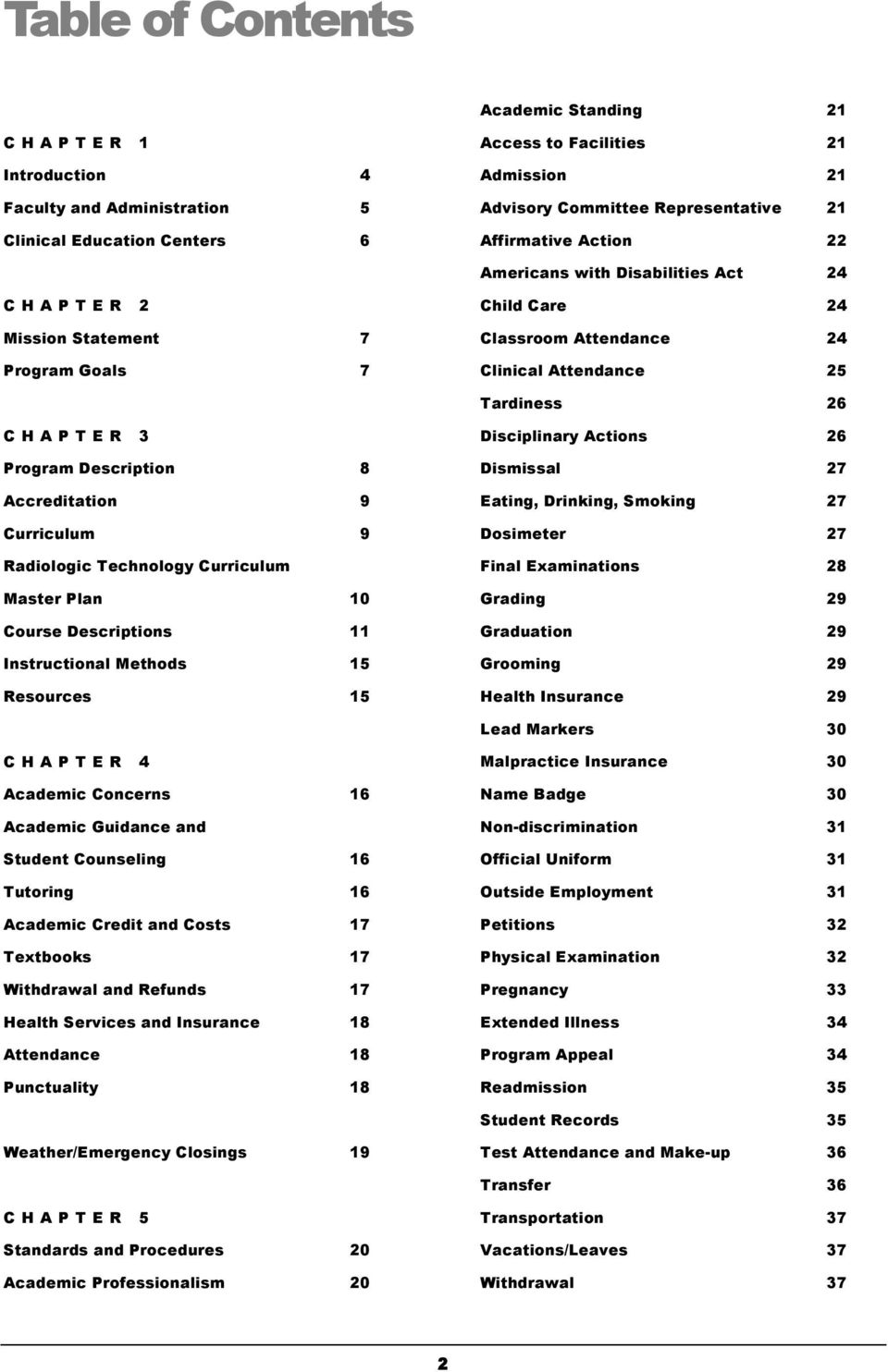
3 Table of Contents Academic Standing 21 CHAPTER 1 Introduction 4 Faculty and Administration 5 Clinical Education Centers 6 Access to Facilities 21 Admission 21 Advisory Committee Representative 21 Affirmative Action 22 Americans with Disabilities Act 24 CHAPTER 2 Mission Statement 7 Program Goals 7 Child Care 24 Classroom Attendance 24 Clinical Attendance 25 Tardiness 26 CHAPTER 3 Program Description 8 Accreditation 9 Curriculum 9 Radiologic Technology Curriculum Master Plan 10 Course Descriptions 11 Instructional Methods 15 Resources 15 Disciplinary Actions 26 Dismissal 27 Eating, Drinking, Smoking 27 Dosimeter 27 Final Examinations 28 Grading 29 Graduation 29 Grooming 29 Health Insurance 29 Lead Markers 30 CHAPTER 4 Academic Concerns 16 Academic Guidance and Student Counseling 16 Tutoring 16 Academic Credit and Costs 17 Textbooks 17 Withdrawal and Refunds 17 Health Services and Insurance 18 Attendance 18 Punctuality 18 Malpractice Insurance 30 Name Badge 30 Non-discrimination 31 Official Uniform 31 Outside Employment 31 Petitions 32 Physical Examination 32 Pregnancy 33 Extended Illness 34 Program Appeal 34 Readmission 35 Student Records 35 Weather/Emergency Closings 19 Test Attendance and Make-up 36 Transfer 36 CHAPTER 5 Standards and Procedures 20 Academic Professionalism 20 Transportation 37 Vacations/Leaves 37 Withdrawal 37 2
4 CHAPTER 6 Responsibilities of a Radiographer 38 General Job Description 39 ARRT Code of Ethics 40 Patient s Bill of Rights 41 3
5 Chapter 1 Introduction Welcome to the Radiologic Technology Program at South Suburban College. The program faculty and personnel of South Suburban College s affiliated clinical education centers are looking forward to instructing and assisting you in your goal of becoming a competent, registry eligible radiographer. This handbook has been written to facilitate your introduction to the Radiologic Technology Program. In order to insure effective education in the Radiologic Technology Program, each individual participating in the program must have a full understanding of the responsibilities and considerations involved. On the following pages, you will find important information about the College and the Program, as well as the standards, procedures and expectations that affect radiologic technology students at South Suburban College. This handbook may not be considered a complete statement of all standards at South Suburban College or the Division of Allied Health Sciences. More complete information is provided in the South Suburban College Catalog. As a student of South Suburban College, you are subject to all standards, procedures, rules and regulations established by South Suburban College. You are, therefore, advised to refer to the current College Catalog for further information. All standards and procedures related to clinical education can be found in the Student Clinical Education Handbook. Please read through this Student Handbook completely, as you will be expected to be familiar with its contents and to abide by the stated standards and procedures. If you have any questions about any part of this handbook or need information that is not given, do not hesitate to contact the program director. This handbook is subject to change or may be amended at the discretion of the Radiologic Technology Program. Please read the following pages and ask for further explanation on points you feel need clarification. 4
6 Faculty and Administration T he faculty and administration would like to extend to you their congratulations on your acceptance into the program and wish you high levels of success in the semesters to come. The following personnel are identified: Dean of Health Professions & Science Program Director Clinical Coordinator Jeffery J. Waddy, M.S., Ed., CHES Shari J. McGovern, M.A. Ed., R.T.(R) Melynie Durham, R.T.(R) (MR) Clinical Instructors Adam Benjamin Jr. VA Medical Center Ingalls Memorial Hospital Ingalls Family Care Center, Flossmoor Ingalls Family Care Center, Calumet City Ingalls Family Care Center, Tinley Park Jesse Brown VA Medical Center St. Catherine Hospital St. James Olympia Fields Campus Karen Mixon, R.T. (R) Isabel Chavez, R.T.(R) Janet Leoni, R.T.(R) Judy McCarthy, R.T.(R) Isabel Chavez, R.T. (R) Karen Mixon, R.T. (R) Gus Uribe, R.T. (R) Susan Stravon, R.T.(R) Catherine M. Luciano, R.T.(R) St James Hospital Chicago Heights Oak Forest Hospital Well Group (Suburban Heights Med. Ctr.) Susan Riggle, R.T.(R) Jamie Hurley, R.T. (R) Phyllis Soriano, R.T.(R) 5

7 Clinical Education Centers Ingalls Memorial Hospital Adam Benjamin Jr. VA Medical Center One Ingalls Drive 9301 Madison St. Harvey, IL Crown Point, IN Saint Catherine Hospital Jesse Brown VA Medical Center 4321 Fir Street 820 S. Damen Ave East Chicago, IN Chicago, IL Saint James Hospital, Olympia Fields Campus Crawford Avenue Olympia Fields, IL Saint James Hospital, Chicago Heights Campus Chicago Road at Lincoln Highway Chicago Heights, IL Oak Forest Hospital 159 th Cicero Oak Forest, IL Well Group (Suburban Heights Medical Center) 333 Dixie Highway Chicago Heights, IL Ingalls Family Care Center, Calumet City 1600 Torrence Avenue Calumet City, IL Ingalls Family Care Center, Tinley Park 6701 West 159 th Street Tinley Park, IL Ingalls Family Care Center, Flossmoor Govenors Highway Flossmoor, IL

8 Chapter 2 Mission Statement The mission of the Radiologic Technology Program at South Suburban College is to provide a comprehensive education in order to prepare students to become entry-level radiographers. The program is designed to provide an environment that promotes stimulating intellectual discovery both didactically and clinically. W e believe it is necessary to prepare students to assume the role of radiographer, provide quality patient care, participate actively in the profession and pursue life long learning. These beliefs are the foundation of the profession of radiologic technology and are realized through our commitment to the education of radiographers in the community. Program Goals With faith in both the faculty and the Advisory Committee, we set forth the following goals for the Radiologic Technology Program: 1. To provide a structured curriculum that has the expanse and depth for the preparation of the entry level radiographer. 2. To enhance problem solving and critical thinking skills of the student. 3. To prepare students for National Credentialing Exam. 4. To empower students/graduates to continuously improve professionally, and seek various educational advancement. 5. To graduate students who embrace the holistic concerns of others. 7

9 Chapter 3 Program Description The Radiologic Technology Program at South Suburban College is a full-time, accredited educational program that prepares selected men and women, age eighteen and over, to function effectively as staff level radiographers. Q ualified individuals are selected to begin the radiologic technology (RAD) course sequence after successful completion of the required prerequisites. Although the prerequisites may be completed on a parttime basis, the RAD courses are sequenced as a continuous, full-time program of study and must follow the order published in the current college catalog. The curriculum involves twelve credit hours of prerequisites, thirty credit hours of didactic course work in radiologic technology, sixteen credit hours of clinical course work and sixteen credit hours of general education requirements. A total of seventy-six credit hours are required for graduation. Graduates are awarded an Associate of Applied Science (A.A.S.) degree and are eligible to apply for admission to the certification examination administered by the American Registry of Radiologic Technologists (ARRT). The curriculum, clinical and didactic, is designed in accordance with the guidelines established by the American Society of Radiologic Technologists (ASRT). The assessment procedures include written and oral examinations, assignments, laboratory experiments, performance evaluations, and a competency-based clinical education system utilizing a checklist format for evaluating psychomotor and professional skills. All academic courses, labs and seminars are held on the South Suburban College campus. Clinical education takes place at the affiliated health care centers. All classes are scheduled during the day with the exception of some clinical education rotations that require attendance during the evening shift. Although each student is ultimately responsible for the extent of his or her own learning, standards of achievements must be maintained. To this end, a grading scale on which a C (78%) is the lowest acceptable grade for any didactic course is adhered to. Clinical education courses must be passed with a P (pass) in order to continue in and graduate from the program. It is the responsibility of the program faculty to facilitate student learning to the best of their abilities. The faculty is, therefore, committed to the development of appropriate educational objectives, learning materials and classroom presentations. Advice, counseling and support services shall be available to all students according to the South Suburban College Catalog. 8

10 The Radiologic Technology Program recognizes the sanctity of individual rights. No person shall be denied admission to the program on the basis of gender, race, color, creed, religion, age, national origin or handicap. All students shall have the right to review any records maintained by the program that pertains to them according to the Buckley Act of Any action taken against a student shall follow due process with provisions for appeal. As outlined in the South Suburban College catalog. Accreditation South Suburban College is accredited by the Commission on Institutions of Higher Education, North Central Association of Colleges and Secondary Schools. Also, the College is approved by the Illinois Community College Board, the Board of Higher Education and the Board of Vocational Education and Rehabilitation. South Suburban College is approved for veterans by the State of Illinois Approving Agency for Veterans Education. Curriculum The full radiologic technology curriculum as published in the South Suburban College catalog requires six fulltime semesters to complete. Program length is 24 months. However, the first semester consists of prerequisite course work. Also, general education courses may be completed prior to admission into the program. The actual radiologic technology course work consists of five consecutive semesters and lasts twenty-one months. 9
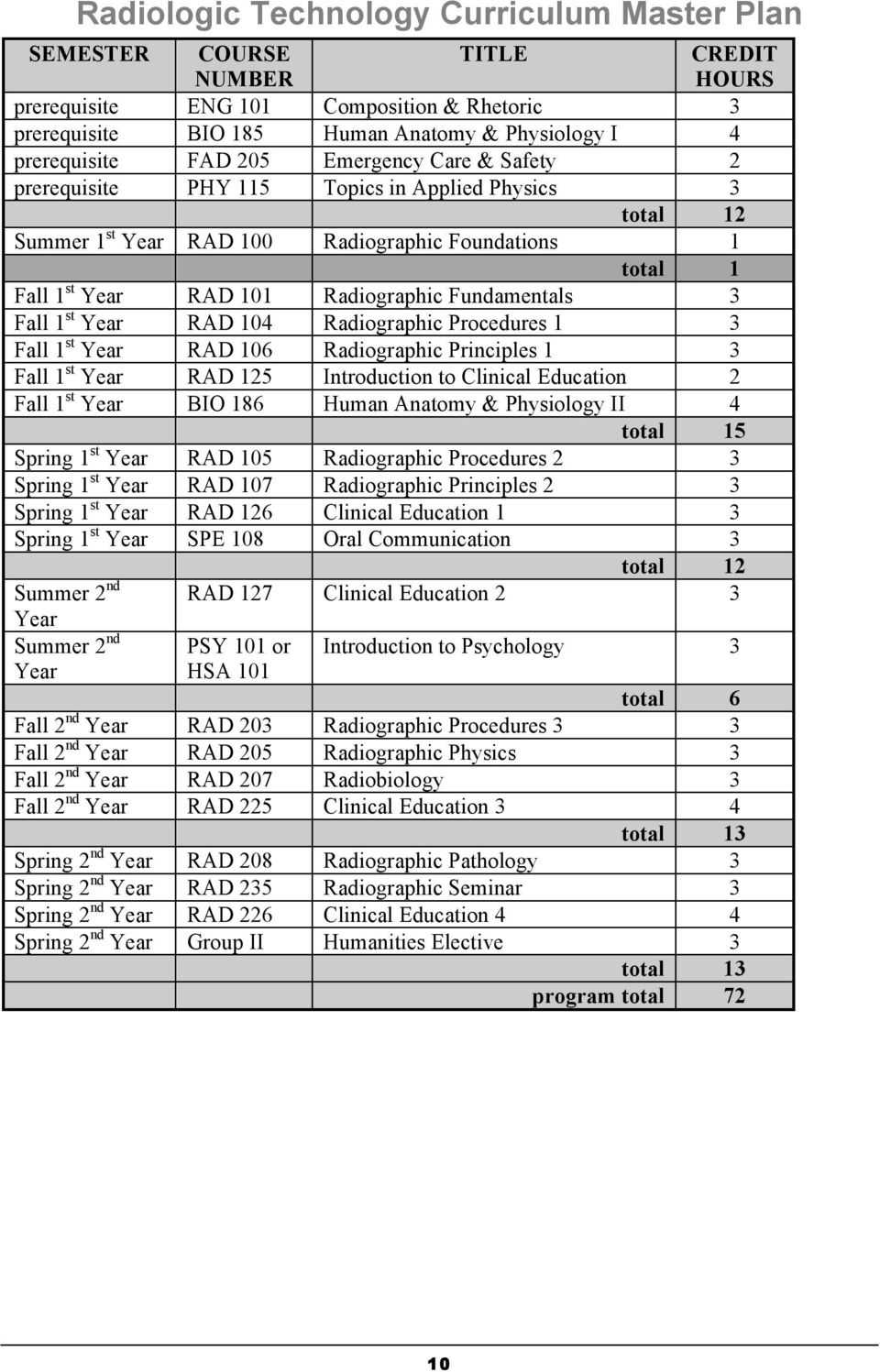
11 Radiologic Technology Curriculum Master Plan SEMESTER COURSE NUMBER TITLE CREDIT HOURS prerequisite ENG 101 Composition & Rhetoric 3 prerequisite BIO 185 Human Anatomy & Physiology I 4 prerequisite FAD 205 Emergency Care & Safety 2 prerequisite PHY 115 Topics in Applied Physics 3 total 12 Summer 1 st Year RAD 100 Radiographic Foundations 1 total 1 Fall 1 st Year RAD 101 Radiographic Fundamentals 3 Fall 1 st Year RAD 104 Radiographic Procedures 1 3 Fall 1 st Year RAD 106 Radiographic Principles 1 3 Fall 1 st Year RAD 125 Introduction to Clinical Education 2 Fall 1 st Year BIO 186 Human Anatomy & Physiology II 4 total 15 Spring 1 st Year RAD 105 Radiographic Procedures 2 3 Spring 1 st Year RAD 107 Radiographic Principles 2 3 Spring 1 st Year RAD 126 Clinical Education 1 3 Spring 1 st Year SPE 108 Oral Communication 3 total 12 Summer 2 nd RAD 127 Clinical Education 2 3 Year Summer 2 nd Year PSY 101 or HSA 101 Introduction to Psychology 3 total 6 Fall 2 nd Year RAD 203 Radiographic Procedures 3 3 Fall 2 nd Year RAD 205 Radiographic Physics 3 Fall 2 nd Year RAD 207 Radiobiology 3 Fall 2 nd Year RAD 225 Clinical Education 3 4 total 13 Spring 2 nd Year RAD 208 Radiographic Pathology 3 Spring 2 nd Year RAD 235 Radiographic Seminar 3 Spring 2 nd Year RAD 226 Clinical Education 4 4 Spring 2 nd Year Group II Humanities Elective 3 total 13 program total 72 10
12 Course Descriptions R A D F O U N D A T I O N S O F R A D I O L O G I C T E C H N O L O G Y Overview of the profession of radiologic technology with an emphasis on its history, philosophy, and the nature of the profession. Explore the role of the radiologic technologist. Prerequisites: admission to the Radiologic Technology Program R A D R A D I O G R A P H I C F U N D A M E N T A L S This course introduces students to radiography and the role of the radiographer as a member of the health care team. Students are introduced to concepts, principles and procedures related to radiography, aseptic techniques, and sound practices of patient care and professional behavior Prerequisites: admission to the Radiologic Technology Program Concurrent with: RAD 125 & BIO 186 R A D R A D I O G R A P H I C P R O C E D U R E S 1 A study of the radiographic anatomy and examination procedures for the appendicular skeleton, the chest and bony thorax and the vertebral column. Students are taught techniques and procedures related to reading various technique charts are able to program x-ray units for correct exposure for designated radiographic examinations. Prerequisites: admission to the Radiologic Technology Program Concurrent with: RAD 125 & BIO 186 RAD R A D I O G R A P H I C P R I N C I P L E S 1 Introduction to the principles of radiography and factors controlling radiographic production and radiation protection. Radiation production, prime factors, radiographic film, intensifying screens film and digital processing are presented. Prerequisites: admission to the Radiologic Technology Program Concurrent with: RAD 125 & BIO

13 R A D I N T R O D U C T I O N T O C L I N I C A L P R A C T I C E An orientation to practical clinical experience of the radiology department and the health care setting. Clinical affiliation assignment by Program Director. Pass/Fail grading. Prerequisites: admission to the Radiologic Technology Program and FAD 205. Concurrent with: RAD 101, 104 & 106 R A D R A D I O G R A P H I C P R O C E D U R E S 2 A study of the radiographic anatomy and examination procedures for the digestive, urinary and hepatobiliary systems, as well as the cranium, paranasal sinuses and facial bones. Students are taught to read various types of technique charts and program units for correct exposure for these examinations. Prerequisites: RAD 101, 104, 106, 125, and BIO 186 Concurrent with: PHY 115, SPE 108 R A D R A D I O G R A P H I C P R I N C I P L E S 2 Continuation of RAD 106. The course is designed to enhance the necessary skills needed to evaluate the radiographic image and provide appropriate recommendations for improving the diagnostic quality of the radiograph. Prerequisites: RAD 106 Concurrent with: RAD 126, PHY 115, SPE 108 R A D C L I N I C A L E D U C A T I O N 1 Application of principles of radiographic positioning under the supervision of a qualified registered ARRT technologist. Emphasis on appendicular and axial skeleton. Principles of exposure, image quality and other associated professional skills. Clinical affiliation assignment by Program Director. Pass/Fail grading. Prerequisites: RAD 125 R A D C L I N I C A L E D U C A T I O N 2 Application of principles of radiographic positioning under the supervision of a qualified registered ARRT technologist. Emphasis on contrast procedures, cranial procedures and other radiographic skills. Clinical affiliation assignment by Program Director. Pass/Fail grading. Prerequisites: RAD 126 Concurrent with: HSA or PSY

14 R A D R A D I O G R A P H I C P R O C E D U R E S 3 Emphasis on routine special procedures including cardiovascular imaging, neuroradiography, reproductive system and special studies of the viscera. The course details portable and surgical radiography, pediatric and geriatric radiography and related imaging modalities such as computed tomography, magnetic resonance imaging and ultrasonography. Prerequisites: RAD 105, 127 and BIO 186 Concurrent with: RAD 225 R A D R A D I O G R A P H I C P H Y S I C S Introduction to the structure of matter, electric circuitry and the basic elements of the operation of x-ray equipment. Basic concepts of x-ray production, principles of diagnostic quality assurance for film production, equipment and film processing are discussed. Laboratory exercises relating to the clinical setting are presented. Prerequisites: RAD 127 and PHY 115 Concurrent with: RAD 225 R A D R A D I O B I O L O G Y An in depth study of radiation biology, radiation regulations and radiation measurements. Somatic and genetic effects of ionizing radiation are presented. Radiation practices for staff and patients/clients is covered. Prerequisites: RAD 127, PHY 115 and BIO 186 Concurrent with: RAD 225 R A D C L I N I C A L E D U C A T I O N 3 Continuation of radiographic experiences with emphasis on trauma, surgery and mobile procedures and observation of radiographic interpretation. Clinical affiliation assignment by Program Director. Pass/Fail grading. Prerequisites: RAD 127 Concurrent with: RAD 204, 205 and

15 R A D R A D I O G R A P H I C P A T H O L O G Y The course includes the etiology and processes of trauma and disease. Emphasis is placed on radiographic pathology of body systems. Prerequisites: RAD 204 & 225 and BIO 186 Concurrent with: RAD 226 R A D R A D I O G R A P H I C S E M I N A R Review and discussion of radiographic principles, techniques and methods. Emphasis is placed on the interdependence of theories and principles in preparation for the ARRT examination. Prerequisites: RAD 204 & 225 Concurrent with: RAD 226 R A D C L I N I C A L E D U C A T I O N 4 Advanced clinical experiences with guided practice of special procedures. Experience with mobile units at bedside and in the operating room and emergency room. Clinical affiliation assignment by Program Director. Pass/Fail grading. Prerequisites: RAD 225 Concurrent with: RAD 208,

16 Instructional Methods Most classroom presentations are conducted in the standard lecture-discussion method. The content for each academic course is broken into units of study with written objectives given to students for each unit. A variety of audio-visual aids and laboratory experiments are used when appropriate to augment instruction. Reading and other required assignments are determined by the instructor. Comprehensive midterm and final examinations may also be given. The radiographic positioning laboratory contains two radiographic units capable of full simulations of standard radiographic procedures. Program faculty supervise students as they practice positioning on each other. Competency tests are given in the laboratory which students must pass before they may practice on patients in the affiliated clinical education centers. Resources Additional textbooks, cds, videos are reference materials are available for student use. A complete list of all materials available is posted in the classroom. A listing of all materials is also distributed to all students enrolled in the program. 15

17 Chapter 4 Academic Concerns Although the primary goal of the program is to produce competent and knowledgeable radiographers, graduation is considered a beginning rather than an end. It is expected that with further experience and continuing education, the entry-level abilities achieved will continue to develop and expand. I n order to graduate from the program, students must pass ALL required academic courses with grades of C or better, receive P grades for all clinical education courses, and have a minimum cumulative grade point average of at least 2.00 on a 4.00 scale. It is the student s responsibility to carefully read and follow the standards concerning graduation published in the College Catalog. It is also the student s responsibility to review the entire curriculum and be certain that all listed courses have been successfully completed. Students unsure of their graduation status should meet with the program director prior to the beginning of the last semester. Academic Guidance and Student Counseling The purpose of an academic advisor is to assist students in selecting and registering for appropriate courses. The program director serves as the academic advisor to students enrolled in the program. Students may meet with the program director during posted office hours or schedule an appointment. Questions or concerns over progress in a specific course should be directed to the instructor of the course. Students may meet with instructors during posted office hours or by appointment. There are counselors assigned specifically to allied health. The allied health counselor can be helpful to students with personal problems affecting their academic or clinical performance. Students are encouraged to meet with the counselor in the Counseling Center on the second floor. Tutoring Tutoring can be helpful to students experiencing difficulties with academic classes. This service is provided without cost to the student through the College s Academic Assistance Center. Students who desire tutoring should contact the Academic Assistance Center. A tutor will be assigned and a meeting time will be arranged that is mutually convenient. 16
18 Academic Credit and Costs The number of academic credits required each semester follow the radiologic technology curriculum as published in the College Catalog. Students who are interested in taking additional credits should consult with the program director. Some academic courses have lab fees attached. Fees for dosimeter badge service and medical malpractice insurance are included with the clinical education courses. The cost of tuition and fees are printed in the College Catalog and in the semester schedule, but is subject to change without notice. Students are informed of the current rates at registration and in the semester schedule. Additional costs to be expected during the program include, but are not limited to: textbooks a physical examination CPR certification TB testing uniforms college emblems student identification badges lead markers background check annual flu shot The required textbooks for each course are available in the bookstore at the beginning of each semester. All other costs are related to clinical education. Each of these is discussed in the Student Clinical Education Handbook which all students receive before beginning clinical education. Textbooks A listing of all required and recommended textbooks for radiologic technology courses is available in the College Book Store prior to each semester. Many of these books are used for more than one course. Because of this and the need for study references in preparation for the ARRT certification examination that follows graduation, students are advised to keep all books for future reference. No required text should be sold back to the bookstore or to another student at the end of a semester. Withdrawal and Refunds The standards and procedures for student withdrawal and refund of tuition and fees are published in the College Catalog. Generally, a student may withdrawal at any time up to two weeks before the beginning of final examinations by submitting a completed withdrawal form to the Admission and Records Office. Radiologic technology students are strongly advised to see the program director before withdrawing from any course required by the curriculum master plan. Students who withdraw from the program are subject to readmission standards and procedures upon return. 17

19 Health Services and Insurance No formal student health services are provided at the college. Emergency first aid is available in the Security and Safety Office in room 1122 at the north end of the building near the staff parking lot. Paramedics are called when needed for serious conditions. Students in need of emergency medical care while at the clinical education center are treated in the emergency room and billed for services the same as any other patient. In order to cover the expense of such treatment, students are advised to carry health insurance. Verification of health insurance or a signed waiver must be on file prior to clinical education. Attendance The classroom is the center of instruction. While textbooks and references provide information, it is in the classroom where this information is discussed, supplemented, given proper emphasis and clarified. A student s presence and participation in the classroom activities is necessary to facilitate his or her learning progress. College students are capable of mature judgment and are accountable for their decisions. The decision whether or not to attend class ultimately rests with the student. The instructor will not judge a student s motivation. However, it should be understood that radiologic technology classes cannot be made up. When a student is absent, the learning experience is lost. Occasionally, unfortunate events prohibit attendance such as illness or a death in the family. There are many justifiable reasons for absence. Under such circumstances, affected students may seek assistance from their instructor or fellow students. With sufficient notice it may be possible to record a class on audiotape for review. However, regardless of circumstances, the student is responsible for all information covered during an absence, to complete tests as scheduled and to report the absence in accordance with program standards. Punctuality Punctuality is also important. Students must arrange to be in class on time. If parking lots, trains or traffic cause delays in arrival, then additional time should be allowed to avoid such problems. Not only is information missed by arriving late, it is disruptive and a discourtesy to enter a class already in progress. Some courses observe a no late policy in which students are not allowed to enter once a class has begun. The instructor will advise students if such a standard is in effect. 18

20 Weather/Emergency Closings In the event that the college closes because of inclement weather, every effort will be made to inform students as early as possible in advance of the closing. Announcements will be relayed to the college web page and the following radio and television stations for public broadcast: WGN-AM (720) WBBM-AM (780) WLS-AM (890) WUSN-AM (990) WBBM-FM (96.3) WMIX-FM (101.9) WGN-TV (channel 9) WFLD-TV (channel 32) These are the only radio and television stations authorized to broadcast closings for the college. On campus, the switchboard operator will be informed of any changes in the college schedule. If possible, the college s automatic answering service will be programmed to deliver updated information during hours when the switchboard is unattended. 19
21 Chapter 5 Standards and Procedures The following standards and procedures have been developed by the Radiologic Technology Program at South Suburban College. T he purpose of these standards and procedures is to provide the student with the best possible educational environment and a foundation on which the student may develop characteristics essential to a professional health care team. These standards and procedures serve as a guide in helping to maintain efficient operation in the clinical education center, affording the highest quality medical care for the patient. Academic Professionalism As participants in a professional education program, radiologic technology students shall conduct themselves in a professional manner during all classes, labs, seminars and clinical rotations. Academic professionalism includes respect for the faculty and rights of other students, prompt attendance for all classes, labs, seminars and clinical rotations and avoidance of any behavior that disrupts or interferes with academic proceedings. Professionalism also requires adherence to ethical principles such as not cheating on tests, degrading the character of others or spreading malicious gossip. All radiologic technology students shall share the same goal; to graduate as knowledgeable and competent radiographers. Each individual receives the same educational opportunities, but must reach the goal in their own way. When problems are encountered, they are dealt with on an individual basis. It is important for students to realize that the program is not a competition. Each individual should be dedicated to their own studies and development and not overly concerned about the progress or problems of others. This, however, does not preclude giving help to fellow students who may request it. Radiologic technology students are expected to exhibit mature and responsible behavior. It is very immature and highly irresponsible to justify nonprofessional behavior or attitudes on the basis that some one else does it. If the behavior of another student is considered unprofessional, unethical or annoying, the offended student should discreetly bring the behavior to the attention of the instructor or program director. Problems concerning any other aspect of the program should be handled the same way. 20
22 Academic Standing In order to be considered in good standing in the Radiologic Technology Program, students shall not receive less than C level grades in all courses required by the program, meet the program courses co or prerequisites and maintain a GPA not lower than 2.0 on a 4.0 scale. All courses must be passed with a minimum of C in order to meet the graduation requirements of the program. Each semester, the program director reviews the academic standing of each student in the program. Students whose radiologic technology or general education course grades or GPA are found in violation of this policy are notified by letter that they may not continue in the program until the inadequacy is corrected. This means that the radiologic technology course(s) completed with grades less than C must be repeated before further radiologic technology courses can be taken. In order to repeat radiologic technology courses, students must be readmitted to the program. Please refer to the readmission policy for further clarification. All general education requirements must be passed in order to be in good academic standing in the Radiologic Technology Program. Students completing general education courses with a D must repeat the course(s) the next semester. No students will graduate from the Radiologic Technology Program until all required course work is completed with a C or better. Access to Facilities Students enrolled in the program may utilize the radiologic technology classroom (4472), laboratory (4368 & 4371), and equipment and learning materials for study purposes by arrangement with the program faculty. In order to gain access to program facilities or learning materials, students should inform a faculty member of their intentions and request permission. Facilities and materials are available to the student during posted campus hours whenever classes are not in session. During evening hours, security will admit a student to the classroom or lab if they have been notified ahead of time by the faculty. Students who utilize the facilities are expected to keep the rooms neat and orderly; turning off overhead lights, viewers, etc. when leaving and close the doors. Learning materials are to be returned to the instructor or left in the locked rooms. They may not be removed from the classroom or the lab. Admission Qualified applicants shall be selected for admission into the Radiologic Technology Program based on grade point average and satisfactory completion of required prerequisite courses. Transfer and remedial students shall be considered on an individual basis. Students are admitted to the Radiologic Technology Program at the beginning of the fall semester of each year. Although South Suburban College has an open door policy for admissions, acceptance to the college does not ensure entrance into any course or program. Students must submit a Radiologic Technology Program application form and meet the specific entrance requirements as determined by the program. To be considered for admission into the Radiologic Technology Program, applicants must be at least 18 years old, have a high school diploma or GED, complete all radiologic technology program prerequisite courses as 21
23 specified in the college catalog with grades of C or better and have a cumulative GPA of at least 2.0 on a 4.0 scale. During the spring semester of each year, the program director reviews the files of all individuals who have submitted applications. Qualified applicants, those who have met the requirements listed above, are notified by letter of acceptance. If there are more qualified applicants than there are openings in the program, admission is based on the GPA of the prerequisite courses. Students who have completed all the prerequisites by the end of the fall semester prior to admission are considered first. If there are remaining openings, then qualified students who are enrolled in prerequisites will be provisionally admitted based on the midterm GPA. Successful completion of the course at the end of the spring semester will entitle the student to admission. Unqualified applicants are notified by letter of inadequacies that must be corrected before they can be considered for admission. At the student orientation meeting prior to the fall semester, students admitted to the program are required to sign the technical standards form which outlines the physical and mental requirements for the Radiologic Technology Program. Advisory Committee Representative A student representative shall be selected from each class to serve on the Radiologic Technology Advisory Committee. The Radiologic Technology Advisory Committee consists of individuals from various aspects of the field of radiology (doctors, administrators, technologists, faculty, students, etc.) who share an interest in the advancement and development of the Radiologic Technology Program. Advisory meetings are held once a year at South Suburban College. Additional meetings are scheduled if warranted by committee recommendations for change or improvement. Since any change in the program affects the students, student representation at these meeting is important. If the designated representative can not attend, an alternate shall be named. Affirmative Action Student Grievance Procedure (Non-Academic Matters) Step 1 Any student who has a complaint (grievance) against an employee of the College regarding a non-academic matter such as sexual harassment, discrimination based on race, color, national origin, sex, handicap, religion or age is encouraged to attempt a resolution by informal means. To do so, the grievant is encouraged to discuss the matter with the person against whom the complaint is made. Where the grievant deems the informal process to be impracticable, not in the grievants' best interests or where said discussions do not result in a resolution of the matter, the grievant should proceed to Step 2. Step 2 A. A complaint shall be made in writing to the Dean of Health Professions and Science within ninety (90) days from the date of the occurrence on a form provided by the Dean of Health Professions and Science. 22
24 B. The complaint must be completed in its entirety, must specify the relief requested by the grievant and must be signed by the grievant. C. In all cases, the Dean of Health Professions and Science shall request a written response to the complaint from the person against whom the complaint is made. In no event shall the lack of a written response eliminate or diminish the Dean s right to conduct an investigation into the matter. D. The complaint shall be reviewed by the Dean of Health Professions and Science and Program Coordinator shall conduct an investigation into the matter. The investigation shall include but not be limited to interviews of persons with knowledge of the incident(s) including the party against whom the complaint is filed, witnesses and others who may have information relevant to the inquiry. Additionally, the Dean of Health Professions and Science may review any written documents which may be useful in ascertaining the validity of the complaint. E. All parties to a complaint have the right to have a representative present during the Dean s interview(s). F. Within twenty (20) school days from the date of the Dean of Health Professions and Science receipt of the complaint or as soon thereafter as is necessary to complete the investigation, the results of the investigation shall be transmitted to the parties, by certified mail, along with the Dean s decision. A copy of the results shall also be transmitted to the Program Coordinator. G. Any party not satisfied with the decision of the Dean of Health Professions and Science, shall proceed to Step 3. Step 3 A. Any party not satisfied with the decision of the Dean of Health Professions and Science may file a written Appeal with the Program Coordinator when the complaint involves a faculty member within that area within ten (10) school days from the receipt of the decision. Said written appeal shall be submitted on a form provided by the Dean of Health Professions and Science. B. Upon receipt of a written appeal, the Dean of Health Professions and Science or Program Coordinator shall convene at a meeting of the College Appeals Committee to provide a hearing of the appeal. C. Said hearing shall be convened within fifteen (15) school days from the date of receipt of the appeal by the applicable Dean of Health Professions and Science. D. At the hearing, all parties may have a representative present who may advise the party but not question witnesses. E. A decision shall be rendered in writing within ten (10) school days from the conclusion of the hearing and shall be transmitted to the parties by certified mail. F. Any party not satisfied with the decision rendered by the College Appeals Committee shall proceed to Step 4. Step 4 A. Any party not satisfied with the decision rendered by College Appeals Committee may appeal to the Program Coordinator within seven (7) school days from the receipt of the decision. Said written appeal shall be submitted on a form provided by the Dean of Health Professions and Science. B. Upon receipt of an appeal, the Program Coordinator shall schedule a hearing with the entire Dean of Health Professions and Science. At the hearing, the parties may present evidence and have counsel present. Thereafter, 23
25 the Program Coordinator will communicate in writing the decision of the hearing to the parties. The decision of the hearing is final. A decision shall be rendered in writing within thirty (30) school days from the conclusion of the hearing and shall be transmitted to the parties by certified mail. Complaints against students shall be addressed according to the procedures outlined in the Student Codes of Conduct. The Affirmative Action Officer shall assist in the investigation and shall consult with the officer or committee. Where the complaint also involves a grade complaint, the procedures for academic appeals by students shall control. However, the Dean of Health Professions and Science or Program Coordinator shall participate in the meeting specified at Step 2 and shall assist in the investigation and shall consult with the committee. At any time before, during or in conjunction with the aforementioned process, the student may elect to utilize additional grievance procedures set forth by the U.S. Department of Education Office for Civil Rights. Americans with Disabilities Act The Radiologic Technology Program acknowledges and adheres to the Americans with Disabilities Act (ADA) of Any student requiring an accommodation for a documented disability should contact the program director and request the desired accommodation. Child Care Students with dependent children shall arrange for appropriate childcare while attending classes, labs, seminars and clinical assignments. Students with children between the ages of two and five may wish to utilize the baby-sitting service provided on campus in room L124. For more information on this service see the College Catalog or call , ext Children are not allowed to accompany parents to classes, labs, seminars or clinical assignments. The faculty are understanding of the problems associated with childcare, but can not be expected to extend special or extraordinary privileges to parents. The polices and procedures established by the program must be applied equally to all students. Classroom Attendance Students shall maintain prompt attendance at all scheduled classes, labs and seminars. Absences or tardiness shall be reported via telephone prior to the occurrence. 24
26 Records of attendance are maintained for all classes, labs and seminars. Consequently, attendance is checked at every session. These records have no direct influence on grades for academic course, but indirectly could result in failure of a class due to missed exams, quizzes or important information. Attendance records become a permanent part of each student s academic record. Poor attendance can lead not only to reduced performance in a course, but also reflects on one s dependability and interest. While cases of poor attendance will be considered individually, any student whose absence from class becomes excessive and/or prevents the successful completion of the course will be advised to withdraw. Students who are in jeopardy of failing will be notified of impending failure and advised accordingly. Clinical Attendance Students are expected to report promptly for clinical education on all scheduled clinical days. Regular attendance is an essential expectation of a radiographer in order to provide quality patient care. Students are expected to report promptly for clinical education on all scheduled clinical days. In the event a student can not attend clinical education, that student must call in to the clinical education center and speak to the clinical instructor or the clinical instructor s designee. All absences from clinical education are classified as excused, unexcused, or tardy. Excused Absence Excused absences include holidays granted by the college according to the academic calendar and days when classes are canceled by the college due to inclement weather. Cancellation of classes due to weather will be announced on the television and radio. In either case, the clinical education center does not have to be notified of your absence, although a courtesy call would be appreciated. Any time missed from the clinical site should be made up at that clinical site. Student may have one excused absence per semester; this time must be made up then the unexcused policy will apply. Unexcused Absence If a student is absent for any reason other than those listed above, the absence is considered unexcused. Absenteeism develops an undesirable trait that is unfortunately very difficult to change and, therefore, must be kept to a minimum. Excessive or unwarranted absences will result in the following corrective action protocol per semester: 1. first unexcused absence - verbal warning, noted on a significant incident form 2. second unexcused absence - written warning, noted on a significant incident form 3. third unexcused absence - required advising with the program director at the College with the time missed from clinical education to be made up. 4. fourth unexcused absence - failure of the enrolled clinical course with a letter grade of F, resulting in dismissal from the Radiologic Technology Program 25
27 Tardiness Tardiness is defined as more than five minutes late or leaving more than five minutes early. Tardiness of one hour or more is considered an unexcused absence. Excessive or unwarranted tardy will result in the following corrective action protocol per semester: 1. first tardy - verbal warning, noted on a significant incident form 2. second tardy - verbal warning, noted on a significant incident form 3. third tardy - written warning, noted on a significant incident form 4. fourth tardy - required advising with the program director at the College with the time missed from clinical education to be made up. 5. fifth tardy - failure of the enrolled clinical course with a letter grade of F, resulting in dismissal from the Radiologic Technology Program. Disciplinary Actions Students who violate policy or procedure established by the program or South Suburban College shall be subject to disciplinary action. There are four (4) levels of disciplinary actions: (1) verbal warning, (2) written warning with probation, (3) suspension from the program (temporary) and (4) dismissal from the program (permanent). Verbal warnings are used to call a student s attention to minor offenses. Once warned, it is expected that the student will avoid further violations. These warnings are documented on a counseling form that is signed by the student, the program director and the instructor if appropriate. The counseling form is then placed in the student file. Written warnings follow a verbal warning. They are also used for more serious offenses. A written warning consists of a letter to the student from the program director. The letter specifies the violation and assigns a period of probation. Each case is judged independently. A copy of the warning letter is placed in the student s file until graduation. Violation of the college s Student Code of Conduct or actions occurring during a probation period are subject to suspension and/or dismissal action. Suspension or dismissal actions are determined by recommendation of the college disciplinary committee and with the counsel of the program director. The disciplinary committee s recommendation follows a hearing in which the violation is identified and the student is permitted to respond. The length of may vary in accordance with the offense, but will not exceed a maximum of one week. During a suspension the student remains responsible for all academic material, tests and missed clinical time. A written record of the suspension action will be included in the students file until graduation. The student will be placed on academic probation. Any other resulting offense will provide grounds for permanent dismissal from the program. Dismissal actions are taken only for the most serious of offenses. This includes, but is not limited to deliberate physical endangerment of others, theft of college or hospital property, possession of weapons or illegal substances on college or hospital property, criminal activity and taking or being under the influence of drugs or alcohol during classes, labs, seminars or clinical assignments. 26
28 Dismissal Students shall be dismissed from the program for serious or repeated violations of program or college standards and procedures. Dismissal actions shall follow due process. Radiologic technology students are expected to adhere to the Student Code of Conduct and all other college standards, rules and regulations as published in the South Suburban College catalog. Violations of the code of conduct on the college campus, at any clinical education center or during any college sponsored event shall follow the Student Code of Conduct. The Radiologic Technology Program is responsible for the continued matriculation of the campus and clinical coursework. The procedure for dismissal from the program is described under Disciplinary Actions in this book. Only the college can dismiss a student from the Radiologic Technology Program. Clinical affiliates or affiliate personnel can not dismiss students from the program. Clinical education centers do reserve the right to terminate any student s clinical rotation whose behavior is judged to be unacceptable by their institution. The student must repeat the clinical. The student may continue that semester only and complete other courses. Then reapply to continue to the program to complete the clinical. Eating, Drinking, Smoking STAMDARD Eating, drinking and smoking are allowed in designated areas only. Students who wish to eat, drink or smoke are encouraged to utilize the cafeteria on the first floor. Food and beverage consumption in the classroom is at the discretion of the instructor and is never permitted in the laboratory. Smoking is allowed only in prescribed smoking areas. These restrictions are in force at all times. No smoking by students is permitted in the clinical education centers; clinical education centers are considered to be smoke free environments. Dosimeter All students in the Radiologic Technology Program will wear a dosimeter at all times when using ionizing radiation during clinical education and energized laboratory procedures. Each student is responsible for his or her dosimeter All students in the Radiologic Technology Program will wear a dosimeter at the collar at all times when using ionizing radiation during clinical education and energized laboratory procedures. During fluoroscopy, the dosimeter will be worn outside the lead apron at the collar. If a thyroid collar is worn, the dosimeter should be worn outside the collar. Dosimeters are to be worn only during clinical education or during college labs. Students may not wear college dosimeters during outside employment for any reason. Students not having a dosimeter will be assigned to non-radiographic areas or duties for the day. 27
29 Dosimeters are to be changed on a bimonthly basis according to the dates printed on the dosimeter by the student to whom the badge is assigned. Failure to change the dosimeters after the second class day after the printed date will result in corrective action. Sickness or excused absences do not relieve students of responsibility for changing dosimeters on schedule. New dosimeters will be distributed from the office of the program director. Each student is responsible for his or her dosimeter. Loss or accidental exposure of a dosimeter shall be reported to the program director immediately. A telephone message shall be left the day of the incident with a significant incident report to follow in person as soon as possible. If the dosimeter is lost or damaged, the student will not be allowed to continue clinical education until a new dosimeter is issued. This could result in considerable loss of clinical time and will result in corrective action. Students will be assessed for all lost dosimeter charges. Dosimeters should never be left in your car! The Program Director is the Radiation Safety Officer. Dosimeter reports are reviewed bimonthly by the clinical coordinator, the program director and the student. The student will initial the bimonthly report to acknowledge the bimonthly reading. High readings are investigated following the ALARA guidelines, discussed with the student and documented by the program director. Final Examinations Final examinations shall be conducted in accordance with established college procedures. The Office of the Vice President of Academic Services schedules final examinations for all college courses. A final examination schedule is posted in the College Schedule of each semester specifying the time and day for all examinations. Examinations will be administered in the room in which the class normally meets, unless informed otherwise. Examinations for courses normally meeting for more than one period each day will be given at the time corresponding to the first period in which the course meets. Any student failing to report for an examination at the scheduled time will receive a zero for the final examination. Grading All Radiologic Technology Program academic courses shall be determined in accordance with a fixed percentage scale. Standard grading scale as outlined below. In each academic course, students accumulate points during the semester through scores on tests, quizzes, assignments, etc. The number of points achieved by each student is converted to a percentage of total points possible for the course. Grading is in accordance with the following scale. A B C D
30 F Students who fail to complete all requirements for a course will receive either a failing grade of F or an incomplete, I, at the discretion of the instructor. Students who receive an incomplete may continue in the program, but must make arrangements with the instructor for prompt completion of course requirements. Incomplete grades that are not officially changed by midterm of the following semester automatically convert to a failing grade of F. In order to continue in the program, all courses must be completed with at least a C grade and all clinical education courses with a P. Clinical education courses are graded on a pass/fail basis. Graduation South Suburban College awards an Associate of Applied Science degree to Radiologic Technology Program students meeting all graduation requirements. All general and specific requirements of the degree curriculum listed in the college catalog must be fulfilled. A minimum GPA of 2.00 on a 4.00 scale must be achieved. Illinois state law requires every graduate to demonstrate satisfactory knowledge of both Illinois and U.S. constitutions. Also, an application for degree completion must be completed and filed according to the college catalog. Grooming As student radiographers are in close proximity with patients, personal hygiene must be maintained at all times at the clinical education center. While at clinical education, personal hygiene must be maintained. A clean and wrinkle-free uniform should be worn. Cosmetics should be worn in moderation. Long hair should be tied back or put up. Facial hair should be kept neat and trimmed. Inappropriate undergarments visible through the uniform are prohibited. Loud or flashy jewelry should not be worn with the uniform at any time. All jewelry should be in moderation at all times, as it can cause injury to the student and/or to the patient. Health Insurance Neither South Suburban College nor the clinical education centers assumes responsibility for medical expenses that may be charged for incidents occurring during the Radiologic Technology Program. It is recommended that students obtain some type of health insurance coverage prior to attending the Radiologic Technology Program. Verification of health insurance or a signed waiver must be on file in the program director s office. 29
31 Lead Markers All clinical work done by a student must be identified with their personal markers. Each student is required to purchase one set of lead markers with embedded initials. Lead marker purchase information is provided at the clinical orientation sessions each year. Each student is required to purchase one set of left and right lead markers with embedded initials. All clinical work done by a student must be identified with their personal markers. A student will not receive clinical competency credit for any work that is not properly identified. Students may use lead markers outside clinical education. Malpractice Insurance All students must be covered under a malpractice insurance policy prior to the beginning of clinical education South Suburban College provides professional liability insurance for students while engaged in clinical learning activities. The cost of this insurance is covered in the clinical education course fees. The college malpractice insurance plan does not cover a student who may work in institutions outside of scheduled clinical education time. Name Badge The South Suburban College Radiologic Technology Program name badge must be worn at all times while at the clinical education center. Each student is required to wear the official Radiologic Technology Program name badge. The name badge will identify the student by their picture and name. The words student radiographer as well as the official college logo will be present on the badge. During the first few weeks of the first semester, the student s picture will be taken with a digital camera. Within a week a personal name badge will be available for purchase at the South Suburban College Book Store. The badge is never to be worn outside the assigned clinical education center for employment or any other reasons. 30
32 Non-Discrimination The Radiologic Technology Program adheres to institutional policy regarding non-discrimination. The following statement is published in the college catalog as part of the institutional philosophy. No person shall be excluded from or denied benefits of any program or activity on the basis of sex, color, race, creed, and age, religion natural or regional origin. In addition, no qualified handicapped person shall be excluded from or denied the benefits of any program or activity. The radiologic technology program admission procedures and ongoing operations are conducted in accordance with this policy. Each of South Suburban College s affiliated clinical education centers supports nondiscrimination and has agreed to uphold it. Students in the program who feel they are being discriminated against in violation of this policy are encouraged to bring their complaints to the immediate attention of the program director. A student grievance procedure is published in this handbook which outlines steps that can be taken to file an official complaint. Official Uniform The official Radiologic Technology Program uniform shall be worn at all times when engaged in clinical education as a member of the South Suburban College Radiologic Technology Program. The uniform consists of a royal blue scrub top and pants. All uniform tops must have the official South Suburban College uniform emblem embroidered on them. A white lab coat with the South Suburban College uniform emblem patch sewn on the right sleeve two inches down from the shoulder seam may be worn with the uniform. Footwear consists of solid white leg wear or socks and solid white tennis shoes. Shoes with other colors on them or shoes that light up are not permitted. Failure to wear an appropriate uniform will result in corrective action as described in the Student Handbook. At the discretion of the clinical and campus faculty, other dress may be appropriate to an individual department (white sweater, etc.). This uniform is not to be worn for purposes other than South Suburban College classes. This includes employment at any type of health care facility. Outside Employment Students who work shall modify their hours of employment, if necessary, to avoid conflicts with scheduled classes, laboratories, seminars and clinical assignments. 31
33 Most radiologic technology courses and clinical rotations are scheduled during day hours between 7:00 am and 5:00 pm. Some clinical education courses require attendance during the evening up to 11:00 pm. The combined student time commitment for academic and clinical courses is often equivalent to a full-time job. With additional hours needed for study purposes, the amount of time remaining for employment or other pursuits may be limited. Students who are employed while completing the Radiologic Technology Program must be able to arrange their work schedule to avoid conflicts with required classes and clinical assignments. When students work too much, grades and/or clinical performance may suffer due to fatigue and lack of adequate study time. If possible, students who encounter such difficulties should reduce their number of employment hours to allow for greater success. Petitions Students shall have the right to petition for justifiable variance to program standards or procedures. When extraordinary circumstances warrant a deviation from normal policy or procedure, students may petition the program director for a variance. The requested variance may be a special consideration, privilege, exemption or waiver. The following guidelines describe the nature and content of an acceptable petition: 1. The petition is typed or neatly written in dark ink on plain white paper, in business letterform, dated and addressed to the program director. 2. The policy or procedure of concern is clearly identified. 3. The extraordinary circumstances warranting a variance are concisely described. 4. A specific type of variance is requested. 5. Reasons justifying the request is listed. 6. Positive actions to be taken by the student are described that will prevent the need for further variances to the named policy or procedure. 7. The petition is signed by the student. The program director s acceptance or rejection of the petition will be conveyed by letter to the student within two weeks. If a variance is granted, this does not represent a permanent change in program policy or procedure. The variance applies only to the petitioning student and only for the specified situation. If the petition is rejected, reasons for the rejection will be given and existing policy or procedure will apply. Petitions are rejected due to inadequate preparation may be resubmitted after appropriate revisions have been made. Physical Examination All students are responsible for having a physical examination performed by a qualified physician that will meet the criteria of the assigned clinical facility. The student will incur the cost of the physical examination. The program will provide the physical form. A TB test will be required and must remain current on an annual basis. Students must also seek vaccination for hepatitis B or have a signed waiver on file in the program director s office. Students will not be permitted in the clinical affiliate without a completed health form. 32
34 Pregnancy The student has the right to declare or not to declare a pregnancy at any time. A pregnancy must be declared to the program director in order to activate the pregnancy options. Once declared and depending on the option the student chooses, specific government regulations are activated. If the student decides to declare a pregnancy, the student is required to present to the program director a written statement form her physician indicating the expected date of delivery and her fitness level for clinical education. The student may undeclared a pregnancy at any time. The Nuclear Regulatory Commission s (NRC s) regulations on radiation protection requires the Radiologic Technology Program at South Suburban College to ensure that the dose to the embryo/fetus during the entire pregnancy, due to educational/occupational exposure of a declared pregnant woman, does not exceed 0.5 rem (5 msv). These exposure levels are 10% of the occupational limit of 5 rem (50 msv) per year. The National Council on Radiation Protection (NCRP) recommends a monthly equivalent dose of 0.05 rem (0.5 msv) to the embryo/fetus once the pregnancy is known. In order for a pregnant student to take advantage of the lower exposure limit and dose monitoring provisions, she must declare her pregnancy to the program director in writing along with an estimated date of conception so that the estimated dose to the embryo/fetus prior to the declaration of pregnancy can be determined. A woman cannot be required to make this declaration of pregnancy and she may withdraw her declaration of pregnancy in writing at any time. The decision to make a declaration of pregnancy and/or to withdraw the declaration of pregnancy is strictly the woman s choice and is entirely voluntary. The lower dose limit for the embryo/fetus should remain in effect until the woman withdraws the declaration in writing or the woman is no longer pregnant. If the declaration of pregnancy were withdrawn, the dose limit of the embryo/fetus would apply only to the time from the estimated date of conception until the time the declaration is withdrawn. If the declaration is not withdrawn, the written declaration may be considered expired one year after submission. A declared, pregnant student will have one of the following four options to choose from: Option 1 The student may continue in the Radiologic Technology Program without restriction. Option 2 The student may continue in the Radiologic Technology Program with restrictions being imposed on clinical rotations. The pregnant student will not participate in fluoroscopic, portable or surgical procedures. Pregnant students are also restricted from procedures involving radium-implant patients. Substitute clinical rotations will not be provided. All clinical rotations missed by the students will be made up by the end of the program. This may result in the delayed completion of the program. In addition to the clinical restriction, the pregnant student will be expected to complete all requirements for didactic courses in which she is enrolled prior to enrolling in the next sequential semester course work. This is necessary since the course in which the student is enrolled may be a prerequisite for the following class. It is the student s responsibility to continually check the dosimetry reports. As with any other student, the pregnant student should initial the dosimetry report to verify that they have checked the dose rate and total accumulated exposure dose. Pregnant students may bank clinical time in anticipation of missing clinical time during the pregnancy. Please refer to the Clinical Handbook 33
35 Option 3 A pregnant student may request a leave of absence not to exceed one year and either withdraw from or attempt to complete the courses she is currently enrolled in. There would be a place reserved for the student in the next accepting class. It would not be necessary to submit another application for admission to the program. Option 4 A pregnant student may request to withdraw from the program for an indefinite period of time. If she wished to be reinstated, she must submit an application for admission and compete for admission to the program. Any previous course work would be reevaluated at the time of readmission to assure competency has been maintained. EXTENDED ILLNESS POLICY Students with an extended illness, who incur an injury during the course of the Program, or with extenuating circumstances that may limit their abilities to fully perform the functions required in the clinical education course, meet the total attendance requirements and/or accomplish the stated objective two options: 1. Receive an Incomplete (I) grade in the clinical education course for the semester in which the illness/injury occurred. All course requirements and objectives must be made up by the end of the following semester of the first year for the first year students and prior to successful Program completion for second year students. Failure to complete all requirements and objective may result in the failure of the clinical education course. In addition, a physician s completed release of the student must be granted in order for the student to return and continue in the Program. A Return from Illness Form must be filed with the Clinical Instructor and responsible Program faculty member. 2. Withdraw from the Program and re-enter at a later date. Students considering this option should be aware that voluntary withdrawal from the Program holds no guarantee for re-entry or former clinical assignment. Program Appeal Students shall have the right to appeal any action taken against them by the program. The process of appeal involves submitting a written statement, preferably typed, to the program director in which the action being appealed is clearly identified. The statement must also include reasons for appeal, evidence or justification to support the student s position and specify the resolution the student is seeking. Appeals must be submitted within ten days of the action in question. Upon receipt of the appeal, the program director will review the action and respond in writing within ten days. If the issue is not resolved, the student may then appeal to the associate dean of allied health. If the issue is not resolved at this level, the student may then pursue steps as outlined in the college catalog. 34
36 Readmission Any student who has withdrawn from the Radiologic Technology Program or has not maintained good academic standing shall be allowed to petition for readmission to the program. Readmission process includes re-submission of application to the Radiologic Technology Program. Students may also refer to South Suburban College Student Grievance Procedure. Students who have been dismissed from the college for disciplinary reasons are not eligible for readmission to the Radiologic Technology Program. The student requesting readmission to the Radiologic Technology Program must submit a formal letter to the program director expressing an interest in re-enrollment for a specific semester. This letter must be typed, dated and signed by the student. The statement shall include: (1) the reason for the original withdrawal or unsatisfactory grade and (2) a plan for change to resolve the cause(s) of withdrawal or unsatisfactory grade. In order to be considered for readmission, the student s request letter and statement must be received by the program director no later than midterm of the semester prior to the one seeking readmission. Readmission into the Radiologic Technology Program will be considered on availability of space and academic performance on program prerequisites, as well as professional course work. In other words, if a final grade of D or F were received in a radiologic technology course, this grade would be factored in with the prerequisites and other program grades and an average GPA would be calculated. If a student were to withdrawal from a radiologic technology course before the end of the semester, a prorated grade at the time of withdrawal will be used for that course. This prorated grade will be used in calculation of the readmit GPA. No student can be considered for readmission unless they possess a GPA of 2.00 or greater on a 4.00 scale. The program director will respond in writing to all petitions for readmission to the Radiologic Technology Program. Students who are denied readmission due to lack of space may apply for the following year. If the radiologic technology course work is older than one year, a petition for readmission will be considered only if circumstances for the delay are well documented and legitimate. Course work which is over five years old must be retaken and passed with a C or better. Students can be readmitted to the program only once. If a student drops out or fails to maintain good academic standing after readmission, they will not be considered for readmission again. Student Records All records pertaining to the student shall be maintained in accordance with the Federal Family Educational Rights and Privacy Act of 1974 also known as the Buckley Amendment. All students records accumulated during the program are considered confidential and kept in a locked file. The contents of a student s file are not revealed to any unauthorized person without the student s knowledge and written consent. Students may review any record that pertains to them in the program director s office during regular office hours. 35
37 Test Attendance and Make-up Students shall make every effort to be present on scheduled test dates. Make-up tests shall be administered at the discretion of the instructor. Although prompt attendance is expected on all class days, attendance on test days is of greatest importance. Test dates are made known to all students in advance by announcement or printed schedule. It is the student s responsibility to be aware of these dates, prepare for them and be present. Tests are usually given at the beginning of class sessions for specified periods of time. Late arrival diminishes the amount of time available to a student for completion of the test. It is up to the instructor s discretion whether a student will be permitted to take a test or schedule a make-up. If a make-up is assigned due to late arrival, it must be completed the same day or be subject to loss of all credit. If any circumstance prevents a student from being present on a test date, the student is required to call in and report the absence in advance. An absence may be reported by leaving a message for the instructor with the allied health secretary ( , ext. 2258) or by calling the instructor s office directly before class begins. Make-up tests are allowed under the following conditions: 1. The absence must qualify. 2. The student must call in to qualify for make-up. An unreported absence will negate the privilege for make-up. 3. Make-up tests are scheduled at the convenience of the instructor. This policy is intended to discourage negligent absence and encourage responsibility in students. Students who follow the guidelines above and have legitimate absences will not be penalized. Test results may be withheld from all students until make-ups have been completed. Transfer Transfer students may achieve advanced placement in the program if course work completed at other institutions compares favorably with that offered at South Suburban College and the student can pass comprehensive examinations based on South Suburban College course content. Acceptance of general education course work from a regionally accredited college or university for transfer to South Suburban College will be determined by the Office of Records and Admissions. All credit must carry a grade of C as a minimum to be accepted as transfer credit. Acceptance of radiography course work credit from a regionally accepted college or university for transfer to South Suburban College will be determined by the Office of Records and Admissions in collaboration with the radiologic technology program director. All credit must carry a grade of C as a minimum to be accepted as transfer credit. The transfer credits will be validated and approved by the program director. Transfer students from other institutions must be able to meet the same academic admission requirements as new students. Application for admission must be taken into the immediate succeeding school year to avoid retaking the professional courses that were successfully completed. 36
38 Transportation All students shall provide their own independent transportation to and from the college and clinical affiliates. In order to maintain good attendance, students must have a reliable form of independent transportation to and from the college and assigned clinical education center. Problems associated with transportation are often identified as a reason for absence or late arrival. Such problems are understandable on occasion, but if they occur frequently, can severely affect a student s progress and standing in the program. Students must be prepared to accept assignment to any clinical education center. Therefore, public transportation and car-pooling is not always considered a reliable form of transportation. Regardless of transportation means, the student is ultimately responsible to be in class or at clinical education as assigned. Vacation/Leaves Students progress in the program shall not be interrupted by vacations or leaves of absence during regular class sessions in the fall, spring or summer semesters. S Vacations and other personal activities (weddings, etc.) should be planned to coincide with break periods between semesters. There are generally eight weeks during the year when classes are not in session. The official college calendar published in the catalog and semester schedule indicates when the breaks occur. Leaves of absence are not permitted. Students who take time off during the semester are responsible for all information missed, to complete tests according to schedule and to report their absence as required by program policy. Students who discontinue the radiologic technology course sequence by failing to register for required courses are considered withdrawn from the program. In order to continue, the withdrawn student must follow readmission procedures as described. Withdrawal Students have the right to withdraw from the program at any time. Students may withdraw for any reason by submitting a withdrawal form to the Admissions and Records Office on the second floor near the main entrance. Before taking such action, students considering this option are strongly advised to discuss their plans with the program director. Withdrawals will incur no academic penalty if completed before the deadline date published in the current college semester schedule. During the first two weeks of the semester the student may be qualified for a refund. Refer to the college catalog refund policy. Withdrawals after the deadline date will result in an F grade for all affected courses. 37
39 Chapter 6 The Responsibilities of a Radiographer Today the art and science of medical radiography have grown to encompass a multitude of responsibilities. The enormity of these responsibilities is often underestimated not only by the laymen but also by radiographers themselves. R esponsibility involves duty or trust. It is the ability to meet obligations or to act without superior authority or guidance. The radiographer has a duty to perform his/her tasks to the very best of abilities and to improve these abilities wherever possible. The focus of attention in these objectives is the patient, the quality of whose radiographs must be of a caliber that injuries and disease are unmistakably evident. The quality of the radiographs insures the ability of the radiologist to detect and diagnose and the physician or surgeon to treat or repair. Therefore, the price placed on the radiographer s ability of lack of it is very high. In the execution of daily duties, the radiographer must work in harmony with professional and nonprofessional personnel. The radiographer must be able to accept duties assigned to him/her by superiors and delegate duties to subordinates according his/her status. In a department filled with students, every radiographer automatically becomes a teacher, supervisor and a role model for the students. The profession of radiography is only one of the paramedical and medical professions, whose every effort is expanded on behalf of the welfare of the patient. What is the impression the radiographer gives to the patient while performing the radiologic examination? Be assured that the patient is aware of every move and every mood. The patient is looking to the radiographer for many signs whether we are aware of it or not. The patient is keenly aware of the sincerity of the radiographer s efforts. Is the radiographer confident is their skills? Does the patient sense the desire to help him/her as an individual? Remember, to him/her he/she is the most important person present. Every patient is an individual human being, and regardless of material wealth or lack of it, he/she has a desire and right to be respected. In a society filled with religious, racial and political concerns, radiographers as professionals must respect the right of anyone to adhere to their own beliefs. A sick or injured person placed in a radiographer s care merits the utmost of our efforts as professional people. No matter what race, religion or creed each patient is. They each have a name, a sense of pride and self-respect. Disease and injury do not show favoritism, neither does the radiographer. 38
40 General Job Description Under the direction of a radiologist, the radiographer is concerned with the proper operation of x-ray equipment and preparation of patients for various types of diagnostic procedures. Upon request of a physician, the radiographer exposes x-ray film to produce radiographs of internal parts of the body. These radiographs may reveal evidence of disease, injury or other significant medical information. Significant duties 1. Performs diagnostic radiographic services operates imaging equipment operates other equipment/devices as appropriate positions patients immobilizes patients as necessary calculates exposure factors practice radiation protection evaluates radiographs for technical quality assumes care for physical and psychological needs of patients during examinations and procedures practices aseptic techniques as necessary assists with administration of contrast media assists physician with imaging procedures initiates life support measures for patients, if necessary 2. Maintains patient records 3. Assumes responsibility for assigned area 4. Provides input for equipment and supply purchase decisions 5. Instructs specific units of didactic and/or clinical education in the radiologic Technology program, if applicable 6. In the absence of a supervisor, assumes acting supervisory responsibility Pursues ongoing continuing education 7. May control inventory and purchase of supplies for assigned areas Qualifications: 1. graduate of a Committee of Allied Health Education and Accreditation (AMA) accredited radiography program or equivalent 2. certification by the American Registry of Radiologic Technologists or equivalent 3. competency in components of radiography practice as appropriate 4. Valid state credential, if applicable. 39
41 ARRT Code of Ethics Students are expected to follow the American Registry of Radiologic Technologists Code of Ethics. This code shall serve as a guide by which Radiologic Technologists may evaluate their professional conduct as it relates to patients, colleagues, other members of the medical care team, health care consumers, and employers. The Code is intended to assist radiologic technologists in maintaining a high level of ethical conduct. 1. The Radiologic Technologist conducts himself/herself in a professional manner, responds to patient needs and supports colleagues and associates in providing quality patient care. 2. The Radiologic Technologist acts to advance the principle objective of the profession to provide services to humanity with full respect for the dignity of mankind. 3. The Radiologic Technologist delivers patient care and services unrestricted by the concerns of personal attributes or the nature of the disease or illness, and without discrimination regardless of sex, race, creed, religion, or socioeconomic status. 4. The Radiologic Technologist practices technology founded upon the theoretical knowledge and concepts, utilizes equipment and accessories consistent with the purposes for which they have been designed, and employs procedures and techniques appropriately. 5. The Radiologic Technologist assesses situations, exercises care, discretion and judgment, assumes responsibility for professional decisions, and acts in the best interest of the patient. 6. The Radiologic Technologist acts as an agent through observation and communication to obtain pertinent information for the physician to aid in the diagnosis and treatment management of the patient, and recognizes that interpretation and diagnosis are outside the scope of practice for the profession. 7. The Radiologic Technologist utilizes equipment and accessories, employs techniques and procedures, performs services in accordance with an accepted standard of practice, and demonstrates expertise in limiting the radiation exposure to the patient, self, and other members of the health care team. 8. The Radiologic Technologist practices ethical conduct appropriate to the profession, and protects the patient s right to quality radiologic technology care. 9. The Radiologic Technologist respects confidences entrusted in the course of professional practice, respects the patient s right to privacy, and reveals confidential information only as required by law or to protect the welfare of the individual of the community. 10. The Radiologic Technologist continually strives to improve knowledge and skills by participating in educational and professional activities, sharing knowledge with colleagues, and investing new and innovative aspects of professional practice. One means available to improve knowledge and skill is through professional continuing education. 40
42 ARRT Pre-Application Ethics Review An individual who has been involved in a criminal proceeding or who has been charged with or convicted of a crime may file a request for pre-application review with the ARRT to obtain a ruling on the impact of the situation on their eligibility for certification and registration. A charge or conviction of, a plea of guilty to, or a plea of nolo contendere (no contest) to an offense that is classified as a misdemeanor or felony constitutes a conviction for ARRT purposes. This includes situations in which the result is deferred or withheld adjudication, or suspended or withheld sentence. Military court-martials must also be reported. This procedure may enable the individual who has been involved in a criminal proceeding or has criminal conviction to avoid any delays in processing an application for certification that is made at the time of graduation from a approved program. A formal application for certification must be made at the time of graduation. The Patient s Bill of Rights Students are expected to cooperate with the American Hospital Association s Patient s Bill of Rights. The Patient s Bill of Rights was designed to inform patients of their rights while in a hospital. As a student radiographer who will be experiencing clinical education in several hospitals, you are obligated to respect these rights. 1. The patient has the right to considerate and respectful care. 2. The patient has the right to obtain from his physician complete current information concerning his diagnosis, treatment, and prognosis in terms of the patient can be reasonably expected to understand. When it is not medically advisable to give such information to the patient, the information should be made available to an appropriate person on his behalf. He has the right to know, by name, the physician responsible for his care. 3. The patient has the right to receive from his physician information necessary to give informed consent prior to the start of any procedure and/or treatment. Except in emergencies, such information for informed consent should include, but not necessarily be limited to, the specific procedure and/or treatment, the medically significant risks involved, and the probable duration of incapacitation. Where medically significant alternatives for care or treatment exist, or when the patient requests information concerning medical alternatives, the patient has the right to such information. The patient also has the right to know the name of the person responsible for the procedures and/or treatment. 4. The patient has the right to refuse treatment to the extent permitted by law and to be informed of the medical consequences of his action. 5. The patient has the right to every consideration of his privacy concerning his own medical care program. Case discussion, consultation, examination, and treatment are confidential and should be conducted discreetly. Those not directly involved in his care must have permission of the patient to be present. 6. The patient has the right to expect that all communications and record pertaining to his care should be treated as confidential. 7. The patient has the right to expect that within its capacity, a hospital must make reasonable response to the request of a patient for services. The hospital must provide evaluation, service, and/or referral as indicated by the urgency of the case. When medically permissible, patient may be transferred to another facility only after he has received complete information and explanation concerning the needs for and alternatives to such a transfer. 41
43 The institution to which the patient is to be transferred must first have accepted the patient for transfer. 8. The patient has the right to obtain information as to any relationship of his hospital to other health care and educational institutions insofar as his care is concerned. The patient has the right to obtain information as to the existence of any professional relationships among individuals, by name, which is treating him. 9. The patient has the right to be advised if the hospital proposes to engage in or perform human experimentation affecting his care or treatment. The patient has the right to refuse to participate in such research projects. 10. The patient has the right to expect reasonable continuity of care. He has the right to know in advance what appointment times and physicians are available and where. The patient has the right to expect that the hospital will provide a mechanism whereby he is informed by his physician or a delegate of the physician of the patient s continuing health care requirements following discharge. 11. The patient has the right to examine and receive an explanation of his bill, regardless of source of payment. 12. The patient has the right to know what hospital rules and regulations apply to his conduct as a patient. 42
Radiologic Technology. Advanced Education. Program Mission
 Radiologic Technology Radiologic Technology is the art and science of applying ionizing radiation to create images of the human body. People educated in this profession are called radiographers, radiologic
RADIOLOGIC TECHNOLOGY PROGRAM
 RADIOLOGIC TECHNOLOGY PROGRAM CENTRAL GEORGIA TECHNICAL COLLEGE Warner Robins Campus 80 Cohen Walker Drive, Warner Robins, GA 31088 (478)218-3216 Macon Campus 3300 Macon Tech Drive, Macon, GA 31206 478-757-3552
Science and Health Professions Division. Radiography Program
 Dear Prospective Student, Science and Health Professions Division Radiography Program Thank you for your inquiry about the Mercer County Community College Radiography Program. The information contained
Medical Radiologic Technology
 Medical Radiologic Technology 220 Medical Radiologic Technology Location: Trenholm Campus - Bldg. H Program Information The Medical Radiologic Technology program at Trenholm State provides students with
SCOTT COMMUNITY COLLEGE RADIOLOGIC TECHNOLOGY PROGRAM DESCRIPTION
 SCOTT COMMUNITY COLLEGE RADIOLOGIC TECHNOLOGY PROGRAM DESCRIPTION In the mid-1970's, SCC established a program to educate students in the field of radiologic technology. The Radiologic Technology Program
Radiologic Technology (RAD, CLE) courses are open only to Radiologic Technology majors.
 RADIOLOGIC TECHNOLOGY (A.A.S Degree) Director: Prof. Virginia Mishkin, M.S., R.T. (R) (M) (QM) A radiologic technologist is a skilled professional who provides a specialized health care service. This rewarding
DUNWOODY COLLEGE OF TECHNOLOGY RADIOLOGIC TECHNOLOGY
 DUNWOODY COLLEGE OF TECHNOLOGY RADIOLOGIC TECHNOLOGY Associate in Applied Science Degree Application and Information Packet 2015-2016 Radiologic Technology Thank you for your interest in the Dunwoody Radiologic
PEARL RIVER COMMUNITY COLLEGE PHYSICAL THERAPIST ASSISTANT PROGRAM CLINICAL EDUCATION INSTRUCTOR S MANUAL
 PEARL RIVER COMMUNITY COLLEGE PHYSICAL THERAPIST ASSISTANT PROGRAM CLINICAL EDUCATION INSTRUCTOR S MANUAL ALLIED HEALTH CENTER 5448 US HWY 49 SOUTH HATTIESBURG, MS 39401 (601) 554-5488 (601) 554-5487 1
PHLEBOTOMY TRAINING PROGRAM STUDENT HANDBOOK
 PHLEBOTOMY TRAINING PROGRAM STUDENT HANDBOOK PHLEBOTOMY TRAINING PROGRAM STUDENT HANDBOOK TABLE OF CONTENTS ITEM PAGE A. Welcome Letter 2 B. Program Objectives 3 C. Certification 3 D. Compliance Statement
SUFFOLK COUNTY COMMUNITY COLLEGE SCHOOL OF NURSING
 SUFFOLK COUNTY COMMUNITY COLLEGE SCHOOL OF NURSING Student Policy Manual 1/13/15, 3/23/15, 4/17/15 P a g e 1 Suffolk County Community School of Nursing Student Policy Manual The School of Nursing Student
Department of Computer Science Academic Policies
 Department of Computer Science Academic Policies Version 4 August 2008 This manual describes the academic policies for the Master of Science Degree in Computer Science, Master of Science Degree in Computer
RADIOLOGIC TECHNOLOGY Uvalde Campus
 Purpose RADIOLOGIC TECHNOLOGY Uvalde Campus The purpose of the Radiologic Technology program is to provide a quality education in Radiologic Technology and to prepare graduates to perform competently and
RADIOLOGIC TECHNOLOGY PROGRAM ASSOCIATE of SCIENCE DEGREE
 Mt. San Antonio College Technology and Health Division 1100 N. Grand Ave Walnut, CA 91789 TEL: 909-594-5611, EX. 4750 FAX: 909-468-3938 RADIOLOGIC TECHNOLOGY PROGRAM ASSOCIATE of SCIENCE DEGREE The course
MALCOLM X COLLEGE 1900 West Van Buren Street Chicago, IL 60612 (312) 850-7373
 MALCOLM X COLLEGE 1900 West Van Buren Street Chicago, IL 60612 (312) 850-7373 TWO-YEAR CURRICULUM for An Associate of Applied Science Degree in Radiography OFFICES: 3416 / 3419 / 3420 LABORATORIES: 3216
Course registration Students may register for courses of study and drop or add courses only with the approval of the MLS director.
 Master of Liberal Studies (MLS) graduate students must meet the following minimums, deadlines and course or grade requirements to graduate in good standing from the university. These policies are based
Department of Computer Science Academic Policies
 Department of Computer Science Academic Policies January 2012 This manual describes the academic policies for the Master of Science Degree in Computer Science, Master of Science Degree in Computer Information
FORT HAYS STATE UNIVERSITY DEPARTMENT OF ALLIED HEALTH RADIOLOGIC TECHNOLOGY PROGRAM
 FORT HAYS STATE UNIVERSITY DEPARTMENT OF ALLIED HEALTH RADIOLOGIC TECHNOLOGY PROGRAM The Associate of Science Degree in Radiologic Technology (RT) requires thirty-three hours of pre-radiology coursework
Radiologic Technology Program
 C OLUMBUS TECHNICAL COLLEGE A Unit of the Technical College System of Georgia Radiologic Technology Program Program Accreditation The Radiologic Technology Program is accredited by the Joint Review Committee
B e l l i n. S c h o o l R a d i o l o g i c T e c h n o l o g y. Bellin Health School of Radiologic Technology. Bellin Health
 B e l l i n Bellin Health School of Radiologic Technology S c h o o l o f R a d i o l o g i c T e c h n o l o g y The radiologic technologist is an essential The radiologic technologist is an essential
MALCOLM X COLLEGE 1900 West Van Buren Street Chicago, IL 60612 (312) 850-7373 TWO-YEAR CURRICULUM. for. An Associate of Applied Science Degree
 MALCOLM X COLLEGE 1900 West Van Buren Street Chicago, IL 60612 (312) 850-7373 TWO-YEAR CURRICULUM for An Associate of Applied Science Degree in Radiography OFFICE 3419 REV 1/15 MALCOLM X COLLEGE 1900 West
SCHOOL OF RADIOLOGIC TECHNOLOGY 809 University Blvd. E Tuscaloosa, AL 35401 [email protected]
 SCHOOL OF RADIOLOGIC TECHNOLOGY 809 University Blvd. E Tuscaloosa, AL 35401 [email protected] General Information Goals & Purpose Program of Instruction Clinical Education Accreditation Expenses Refunds
MERCY MEDICAL CENTER SCHOOL OF RADIOGRAPHY Brochure/Catalog
 MERCY MEDICAL CENTER SCHOOL OF RADIOGRAPHY Brochure/Catalog A Two Year Program Accredited by the Joint Review Committee on Education in Radiologic Technology (312-704-5300) and The New York State Department
5/1/13 Associate in Applied Science Radiologic Technology
 5/1/13 Associate in Applied Science Radiologic Technology Carl Sandburg College offers a two-year associate degree program in Radiologic Technology, beginning each year in June. This program is designed
Merritt College Radiologic Science Program updated 11-19-13
 Merritt College Radiologic Science Program updated 11-19-13 General Information: The purpose of the Merritt College Radiologic Science Program is to prepare qualified practitioners for competency in the
it s all about Choices School of Health Related Professions Diagnostic Imaging Technologies
 D E P A R T M E N T O F D I A G N O S T I C I M A G I N G T E C H N O L O G Y it s all Choices about S H R P School of Health Related Professions Diagnostic Imaging Technologies D I A G N O S T I C M E
How To Get A Radiologic Technology Degree At Columbiastate
 Program and Career Description: Radiologic Technology is a health profession that involves producing diagnostic images of patient s internal structures for use by the radiologist or referring physician
RADIOLOGIC TECHNOLOGY PROGRAM ASSOCIATE IN APPLIED SCIENCE DEGREE INFORMATION AND ADMISSIONS PACKET
 CENTRAL ARIZONA COLLEGE RADIOLOGIC TECHNOLOGY PROGRAM ASSOCIATE IN APPLIED SCIENCE DEGREE INFORMATION AND ADMISSIONS PACKET Superstition Mountain Campus Revised 9/26//2013 Radiologic Technology Radiologic
The Radiologic Technology Program at Trenholm University
 H. Councill Trenholm State Technical College 243 Location: Trenholm Campus Program Information The Radiology Technology program at TrenholmState will provide students with the necessary training to gain
ADDITIONAL CERTIFICATE INFORMATION AND PROGRAM POLICIES
 ADDITIONAL CERTIFICATE INFORMATION AND PROGRAM POLICIES Program The San Diego Clinical Laboratory Scientist (CLS) Training Certificate program offered through UC San Diego Extension encompasses didactic
RESPIRATORY THERAPIST PROGRAM WALLACE COMMUNITY COLLEGE STUDENT HANDBOOK. Class of 2013. Linda Moore, BS, RRT Program Director H-110, 334-556-2457
 RESPIRATORY THERAPIST PROGRAM WALLACE COMMUNITY COLLEGE STUDENT HANDBOOK Class of 2013 Linda Moore, BS, RRT Program Director H-110, 334-556-2457 Judith Harrell, BS, RRT Clinical Coordinator H-110, 334-556-2291
Program Conference 2016 Dana Schmitz, M. Ed., R.T.(R)
 Program Conference 2016 Dana Schmitz, M. Ed., R.T.(R) http://www.unitypoint.org/cedarrapids/filesi mages/careers%20and%20volunteers/consu mer%20information%202015-2016.pdf or http://www.mercycare.org/app/files/public/
Medical Assisting Program 2015 Application Packet
 Medical Assisting Program 2015 Application Packet The goal of the medical assisting program is to prepare competent, entry-level medical assistants in the cognitive (knowledge), psychomotor (skills), and
Bon Secours St. Mary s Hospital School of Medical Imaging Course Descriptions by Semester 18 Month Program
 Bon Secours St. Mary s Hospital School of Medical Imaging Course Descriptions by Semester 18 Month Program First Semester RAD 1101 Patient Care, Ethics, Law and Diversity Credits This 16 week course prepares
RADIOGRAPHY PROGRAM ADMISSIONS INFORMATION. Caldwell Community College & Technical Institute 2855 Hickory Boulevard Hudson, North Carolina 28638
 RADIOGRAPHY PROGRAM ADMISSIONS INFORMATION Caldwell Community College & Technical Institute 2855 Hickory Boulevard Hudson, North Carolina 28638 Caldwell Community College and Technical Institute Radiography
NEW JERSEY RADIOLOGIC TECHNOLOGY BOARD OF EXAMINERS (BOARD) ACCREDITATION STANDARDS FOR SCHOOLS OF DENTAL RADIOLOGIC TECHNOLOGY
 NEW JERSEY RADIOLOGIC TECHNOLOGY BOARD OF EXAMINERS (BOARD) ACCREDITATION STANDARDS FOR SCHOOLS OF DENTAL RADIOLOGIC TECHNOLOGY This document contains the Board s accreditation standards for schools of
the doctor of jurisprudence degree
 bar review courses There are various bar review courses that are available to graduates to help them prepare for the Texas Bar Exam. Two major companies offer these courses: BAR/BRI and Kaplan PMBR. A
ADDENDUM 11/30/15 FAMILY NURSE PRACTITIONER PROGRAM POLICIES
 ADDENDUM 11/30/15 FAMILY NURSE PRACTITIONER PROGRAM POLICIES Family Nurse Practitioner students are responsible for review of and compliance with all published policies and procedures, in particular those
GEDIZ UNIVERSITY UNDERGRADUATE EDUCATION AND EXAMINATION REGULATIONS PART ONE
 GEDIZ UNIVERSITY UNDERGRADUATE EDUCATION AND EXAMINATION REGULATIONS PART ONE Aim, Scope, Basis and Definitions Aim ARTICLE 1 (1) The aim of these regulations is to stipulate the procedure and principles
Graduate Programs Manual Shawnee State University
 Graduate Programs Manual Shawnee State University INTRODUCTION The following is a guide to graduate programs at Shawnee State University (SSU). SSU retains the right to change its course offerings, academic
El Camino College ADN Nursing Program
 El Camino College ADN Nursing Program Upward Mobility Program (LVN-RN and Transfer Applicants) FILING PERIOD: The El Camino College Nursing Program accepts applications twice a year beginning the third
Description: Radiologic technologists operate X-ray equipment to perform diagnostic examinations order by a patient s physician.
 Radiologic Technology A.A.S. Program Details Description: Radiologic technologists operate X-ray equipment to perform diagnostic examinations order by a patient s physician. This two-year program offers
Radiologic Technology
 321 Definition The radiologic technologist (radiographer) is a member of the health care team who works directly with patients and other practitioners performing diagnostic imaging procedures. Radiographers
ADMISSION REQUIREMENTS AND PROCEDURES
 ADMISSION REQUIREMENTS AND PROCEDURES Changes to some admission requirements have occurred, edits are indicated below in red. Santa Fe University of Art and Design is an academically challenging institution
DSU DOCTORAL PROGRAM HANDBOOK
 DSU DOCTORAL PROGRAM HANDBOOK DELTA STATE UNIVERSITY CLEVELAND, MISSISSIPPI 38733 NONDISCRIMINATION Delta State University is committed to a policy of equal employment and educational opportunity for all
graduate academic policies and procedures
 graduate academic policies and procedures These pages contain information on policies, procedures, and regulations that are specific to graduate study at Columbia College Chicago. Students should check
The Radiography Program consists of course work and clinical education in radiographic imaging sciences.
 We appreciate your interest in our School of Radiologic Technology and would like this opportunity to introduce you to our Radiography Program. Please read all the information provided carefully to answer
Department of Family Studies. Graduate Student Handbook Master s Degree in Family Studies 2006-2007
 Department of Family Studies Graduate Student Handbook Master s Degree in Family Studies 2006-2007 School of Human Environmental Sciences College of Agriculture University of Kentucky MASTER S DEGREE STUDENT
How To Get A Degree In Radiologic Technology
 CENTRAL ARIZONA COLLEGE RADIOLOGIC TECHNOLOGY PROGRAM ASSOCIATE IN APPLIED SCIENCE DEGREE INFORMATION AND ADMISSIONS PACKET Superstition Mountain Campus Radiologic Technology Radiologic Technology is a
ROCKLAND COMMUNITY COLLEGE NURSING REGISTRATION, PROGRESSION, GRADING AND TESTING POLICIES FOR CORE NURSING PROCESS COURSES
 ROCKLAND COMMUNITY COLLEGE NURSING REGISTRATION, PROGRESSION, GRADING AND TESTING POLICIES FOR CORE NURSING PROCESS COURSES All students enrolled in courses at Rockland Community College are required to
The Undergraduate Study and Examinations Regulations and the KFUPM Rules for Their Implementations
 بسم الرحمن الرحيم Kingdom of Saudi Arabia Ministry of Higher Education King Fahd University of Petroleum & Minerals The Undergraduate Study and Examinations Regulations and the KFUPM Rules for Their Implementations
Thank you for your interest in the Copiah-Lincoln Community College Medical Radiologic Technology program (RGT).
 Dear Radiologic Technology Applicant: Thank you for your interest in the Copiah-Lincoln Community College Medical Radiologic Technology program (RGT). The Medical Radiologic Technology program is a two-year
RADIOLOGIC TECHNOLOGY PROGRAM ASSOCIATE in SCIENCE DEGREE
 Mt. San Antonio College Technology and Health Division RADIOLOGIC TECHNOLOGY PROGRAM ASSOCIATE in SCIENCE DEGREE The course of study in Radiologic Technology offered at Mt. San Antonio College and its
SURGICAL TECHNOLOGY PROGRAM
 SURGICAL TECHNOLOGY PROGRAM Admission Packet Criteria A GUIDED PATHWAY TO SUCCESS CENTRAL GEORGIA TECHNICAL COLLEGE Warner Robins Campus 80 Cohen Walker Drive, Warner Robins, GA 31088 (478)988-6850 Macon
GUIDE TO GRADUATE STUDIES DEPARTMENT OF SOCIOLOGY. Terminal (one-year) MA Program UNIVERSITY OF CINCINNATI 2014-2015
 GUIDE TO GRADUATE STUDIES DEPARTMENT OF SOCIOLOGY Terminal (one-year) MA Program UNIVERSITY OF CINCINNATI 2014-2015 GRADUATE STUDY IN THE DEPARTMENT OF SOCIOLOGY In addition to the PhD program, the department
Graduate Handbook. School of Architecture 2014-2015. [email protected]. [email protected]. [email protected]
 School of Architecture 2014-2015 Graduate Handbook CONTACT: Graduate Program Director Ramesh Krishnamurti [email protected] Graduate Program Coordinator Darlene Covington-Davis [email protected] Graduate
INTRODUCTION SPONSORSHIP
 INTRODUCTION Radiologic Technology offers a challenging career with excellent opportunities for advancement. The profession is in need of both qualified entry level technologists and advanced level specialists.
Radiologic Technology Associate of Science Degree Program
 Radiologic Technology Associate of Science Degree Program Louisiana State University at Alexandria *** Department of Allied Health Revised July 2005-1- Louisiana State University at Alexandria Department
Florida Gulf Coast University General Graduate Academic Policies
 I. Graduate Admission Policies Florida Gulf Coast University General Graduate Academic Policies A. Graduate Admission Requirements Applicants to graduate degree programs or post-baccalaureate professional
East Los Angeles Service Area. CTE - Radiologic Technology and Fluoroscopy
 CTE - Radiologic Technology and Fluoroscopy The Radiologic Technology/Fluoroscopy Program s assists current California X-ray Technician permit holders to begin at the most advanced point possible toward
Dear Applicant: Sincerely, Grant Wilson Surgical Technology Program Director Calhoun Community College
 Dear Applicant: Thank you for your interest in the surgical technology program. Please complete your application and return it to the Allied Health Department on the third floor of the Health Sciences
Associate Radiologic Technology Application
 Associate Application Admission Information for Fall 2016 Associate in Applied Science: Major in The Associate in Applied Science with a major in prepares students to perform radiologic procedures and
MASTER OF SCIENCE IN COMMUNICATIVE DISORDERS DEGREE REQUIREMENTS 2012 2014 Catalog
 MASTER OF SCIENCE IN COMMUNICATIVE DISORDERS DEGREE REQUIREMENTS 2012 2014 Catalog SUMMARY OF DEGREE REQUIREMENTS The Master of Science degree in Communicative Disorders (CDIS) provides advanced training
Master of Arts in Psychology
 Master of Arts in Psychology Introduction This handbook describes the major milestones, program regulations and requirements that students will encounter as they complete the Master s program in Psychology
Program Philosophy. Program Objective
 Program Brochure 1 Table of Contents Program Philosophy... 3 Program Objective..3 Program Design..4 Facilities... 5 Course Description.. 5 7 Stipend, Benefits & Policies.. 8 Loans.... 9 Admission Requirements.
General Admission Requirements for Caldwell Community College and Technical Institute Radiography Program
 General Admission Requirements for Caldwell Community College and Technical Institute Radiography Program The deadline for completion of all requirements is January 15, 2016, to be considered for the fall
Department of Teacher Education
 Department of Teacher Education Graduate Program Handbook This handbook provides information about graduate programs leading to a Masters of Arts in Education, Master of Arts in Special Education, and
Respiratory Therapy (A45720)
 Respiratory Therapy (A45720) Associate in Applied Science The Respiratory Therapy curriculum prepares individuals to function as respiratory therapists. In these roles, individuals perform diagnostic testing,
Cabrillo College Catalog 2015-2016
 RADIOLOGIC TECHNOLOGY Health, Athletics, Wellness, and Kinesiology Division Ian Haslam, Division Dean Division Office, Room 1102 Ann Smeltzer, Department Chair, (831) 479-5056 Aptos Counselor: (831) 479-6274
ABHES BULLETIN. Subject: Final Radiologic Technology Standards Effective January 1, 2013
 ACCREDITING BUREAU OF HEALTH EDUCATION SCHOOLS 7777 Leesburg Pike, Suite 314 N. Falls Church, Virginia 22043 Tel. 703/917.9503 Fax 703/917.4109 E-Mail: [email protected] ABHES BULLETIN To: From: ABHES-Accredited
RGT INFORMATION PACKET 2 0 1 6
 RGT INFORMATION PACKET 2 0 1 6 ASSOCIATE OF APPLIED SCIENCE DEGREE PROGRAM Radiologic Technology The Radiologic Technology (RGT) program is a two-year program of study that prepares students to work within
Prepare for a career as a Radiologic Technologist.
 Prepare for a career as a Radiologic Technologist. Program Information AnMed Health's Radiologic Technology Program is the only hospital-based radiography program in South Carolina, lending opportunity
The Radiologic Science Program at the College of Coastal Georgia
 The Radiologic Science Program at the College of Coastal Georgia Page 1 of 7 Instructions 1. Complete a College of Coastal Georgia Application. (May be obtained from the Registrar s Office) Return the
Graduate Academic Policies and Procedures
 Graduate Academic Policies and Procedures Graduate Programs Sarah Lawrence offers 11 distinctive master s degree programs in the arts, humanities, and sciences: The Art of Teaching (Master of Science in
Adapted with permission from the University of Texas at Austin School of Social Work Standards for Social Work Education. Revised 10/12/2013.
 STANDARDS FOR SOCIAL WORK EDUCATION Adapted with permission from the University of Texas at Austin School of Social Work Standards for Social Work Education. Revised 10/12/2013. Criteria for Evaluating
Radiography Associate in Science Degree
 2011-12 See your Career Program Advisor to help you get in the right classes. Radiography Associate in Science Degree Set Yourself Up for a Great Career If a picture is worth a thousand words, imagine
Regulations of Florida A&M University. 10.103 Non-Discrimination Policy and Discrimination and Harassment Complaint Procedures.
 Regulations of Florida A&M University 10.103 Non-Discrimination Policy and Discrimination and Harassment Complaint Procedures. (1) It is the policy of Florida A & M University that each member of the University
J.D./Grado Dual-Degree Program
 J.D./Grado Dual-Degree Program The College of Law, in cooperation with the University of Granada in Granada, Spain, offers a J.D./Grado dual-degree program. Students who complete the program will receive
ONLINE BACHERLOR OF SCIENCE MEDICAL DIAGNOSTIC IMAGING
 FORT HAYS STATE UNIVERSITY DEPARTMENT OF ALLIED HEALTH ONLINE MEDICAL DIAGNOSTIC IMAGING PROGRAM Fort Hays State University is the only university in Kansas that offers a Bachelor of Science Degree in
it s all about Choices S H R P School of Health Related Professions Physician Assistant Program
 D E P A R T M E N T O F P R I M A R Y C A R E it s all Choices about S H R P School of Health Related Professions Physician Assistant Program P H Y S I C I A N A S S I S T A N T Choices Students who choose
ADMISSION POLICY. Documents required to start the admission process are:
 ADMISSION POLICY The UAA welcomes applications from students who choose to combine intellectual integrity with spiritual goals in their efforts to obtain a profession. The Admission Committee reviews applications
CATALOG CHANGES 2006-2007 Academic Year AD Nursing Program Application and Admission to the Clinical Component
 CATALOG CHANGES 2006-2007 Academic Year AD Nursing Program Application and Admission to the Clinical Component Admission to the nursing program is a process that occurs separately from, and in addition
Nursing Student Handbook ADDENDUM
 Nursing Student Handbook ADDENDUM Spring 2015 Kirkwood Community College Department of Nursing 2172 Linn Hall Phone: 319-398-5563 or 1-800-332-2055 Fax: 319-398-7750 www.kirkwood.edu/nursing Welcome to
AREA: Dental Hygiene. DEGREE: Associate of Applied Science Degree in Dental Hygiene (VWCC) LENGTH: Five semesters program
 AREA: Dental Hygiene DEGREE: Associate of Applied Science Degree in Dental Hygiene (VWCC) LENGTH: Five semesters program PURPOSE: The curriculum is designed to prepare students as primary preventive oral
Apex Dental Assisting School 120 West Cache Valley Blvd Suite 200 Logan, UT 84341 (435)753-7563 Phone * (435)753-0886 Fax
 Facilities is located at the dental office of Dr. LeGrand Bingham at 120 West Cache Valley Blvd. Each student will be using the equipment and supplies at this location, pertaining to the field of dentistry.
St. Vincent s Schools of. Medical Science. Radiologic Technology
 St. Vincent s Schools of Medical Science Radiologic Technology St. Vincent s Schools of Medical Science St. Vincent s HealthCare s Mission Statement Rooted in the loving ministry of Jesus as healer, we
PENSACOLA STATE COLLEGE
 PENSACOLA STATE COLLEGE EKG Technician (EKG-VC) Admission Packet Contact Information: Wilma Duncans-Burnett, Program Director 850-484-2216 [email protected] Health Programs Admissions
Wentworth Institute of Technology Cooperative Education Student Handbook 1
 Wentworth Institute of Technology Cooperative Education Student Handbook 1 Welcome to the co-op process. This document outlines the requirements, expectations and policies for your cooperative education
How To Be A Responsible Student At Midland Technical College
 PSY 212 Abnormal Psychology Social & Behavioral Sciences Department Catalog Course Description: This course is a study of the nature and development of behavioral disorders, including the investigation
Blinn College Dual Credit Student Handbook
 Blinn College Dual Credit Student Handbook 2015-2016 1 Blinn College Dual Credit Program Table of Contents Table of Contents Welcome... 3 Introduction...3 Student Records... 4 FERPA 4 Annual Notification
2014-2015 Procedures and Requirements. Special Education. Revised: 8/15/14; Amended 3/27/15 MASTER S DEGREE
 1 MASTER S DEGREE 2014-2015 Procedures and Requirements Special Education Revised: 8/15/14; Amended 3/27/15 2 PROCEDURES AND REQUIREMENTS FOR THE SPECIAL EDUCATION MASTERS PROGRAM Department of Special