
Comparative Market Analysis of Project Management Systems
|
|
|
- Alan Horn
- 9 years ago
- Views:
Transcription
1 University of Osnabrück Chair of Business Administration/Organization and Information Systems Prof. Dr. Hoppe (Ed.) Comparative Market Analysis of Project Management Systems Frederik Ahlemann Katharinenstr. 1 D Osnabrück [email protected] 2nd Edition

2

3 ISBN??? Version nd March 2004 All trademarks and copyrights mentioned in this document belong to their respective owners. The University of Osnabrück assumes no responsibility for errors or omissions in these materials. THESE MATERIALS ARE PROVIDED AS IS WITHOUT WARRANTY OF ANY KIND, EITHER EXPRESSED OR IMPLIED, INCLUDING BUT NOT LIMITED TO, THE IMPLIED WARRANTIES OF MERCHANTABILITY, FITNESS FOR A PARTICULAR PURPOSE, OR NON-INFRINGEMENT. The University of Osnabrück further does not warrant the accuracy or completeness of the information, text, graphics, links or other items contained within these materials. The University of Osnabrück shall not be liable for any special, indirect, incidental, or consequential damages, including without limitation, lost revenues or lost profits, which may result from the use of these materials. The information in this document is subject to change without notice and does not represent a commitment on the part of the University of Osnabrück in the future.

4

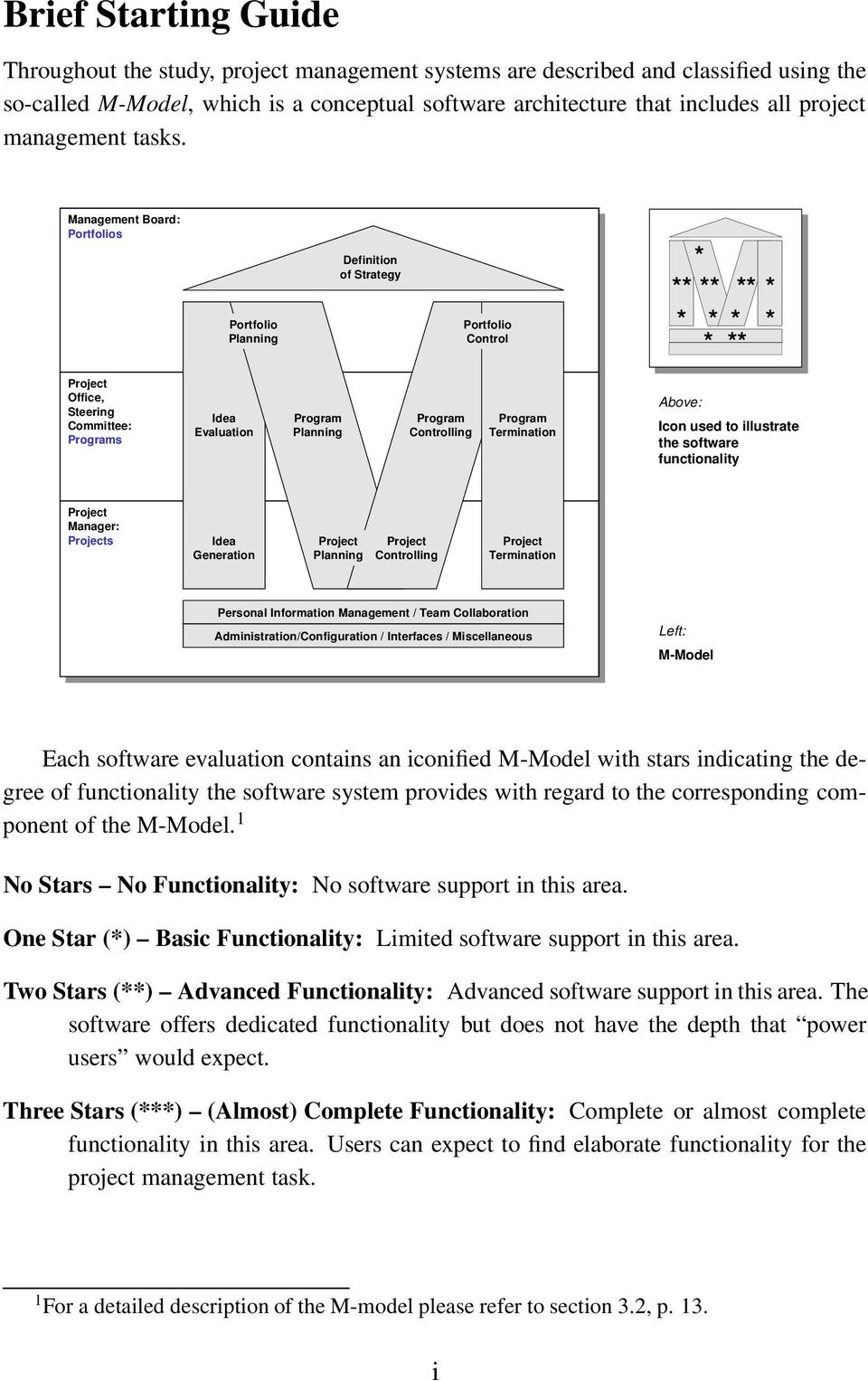
5 Brief Starting Guide Throughout the study, project management systems are described and classified using the so-called M-Model, which is a conceptual software architecture that includes all project management tasks. Management Board: Portfolios Portfolio Planning Definition of Strategy Portfolio Control * ** ** ** * * * * * * ** Project Office, Steering Committee: Programs Idea Evaluation Program Planning Program Controlling Program Termination Above: Icon used to illustrate the software functionality Project Manager: Projects Idea Generation Project Planning Project Controlling Project Termination Personal Information Management / Team Collaboration Administration/Configuration / Interfaces / Miscellaneous Left: M-Model Each software evaluation contains an iconified M-Model with stars indicating the degree of functionality the software system provides with regard to the corresponding component of the M-Model. 1 No Stars No Functionality: No software support in this area. One Star (*) Basic Functionality: Limited software support in this area. Two Stars (**) Advanced Functionality: Advanced software support in this area. The software offers dedicated functionality but does not have the depth that power users would expect. Three Stars (***) (Almost) Complete Functionality: Complete or almost complete functionality in this area. Users can expect to find elaborate functionality for the project management task. 1 For a detailed description of the M-model please refer to section 3.2, p. 13. i
6 Preface to the 2nd edition The 1st edition of the Comparative Market Study on Project Management Systems was an unexpected and overwhelming success. More than 140 copies of the study were sold, mainly to large enterprises, consultancies and medium-sized enterprises with large IT or R&D budgets. I would like to thank all my readers for their trust in the quality of this study. This second edition of the comparative market analysis has been improved in numerous areas. The most important are: 1. The study now contains detailed assessments of more than 45 products. 2. Existing product assessments have been updated and now reflect the current software versions. 3. Short profiles were added for some products that have not been analyzed. These profiles were provided by the manufacturers and are not the result of a product assessment (chapter 9). 4. The description of the evaluation criteria (functionalities) now also contain an explicit reference to the corresponding number of stars. Furthermore, many descriptions have been revised and extended. 5. The M-Model has been slightly improved conceptually. The middle management level now also comprises steering committees and line managers in general. The strict application of the term program to the second management level in the M- Model has been given up. 6. The evaluation framework has been improved and extended. Some evaluation criteria (functionalities) have been dropped, other have been added, and yet others were modified. The reasons for the modifications are twofold: First, the market for project management systems has developed in the meantime and some vendors offer new functionality. Second, some criteria have been dropped or modified due to a lack of practical relevance or because they are hard to measure. However, the general structure of the evaluation framework remains the same. 7. The classification of project management software systems has been extended and the description of clusters has been revised. The results can now be found in chapter The new chapter 5 contains a discussion of the project management software selection/implementation process. It presents success factors and a process model which explains how the study can be applied throughout the process. ii
7 9. The new chapter 6 contains frequently asked questions regarding the contents and application of the study. 10. Several minor errors and inaccuracies have been rectified. The preparation of this and the promotion of the previous edition of this study was supported by a number of colleagues. This time my thanks go out to: Teresa Gehrs, Christian Reuels, Christine Schroeder, Stephan Hüging, Karen Oesten, Barbara Meierkord and Cathy Illsley. Further thanks are extended to Prof. Dr. Uwe Hoppe, who gave me the time and necessary financial resources to prepare this study. Special thanks go out to Prof. Dr. Heinz Schelle and Dr. Georg Angermeier for their valuable feedback, which helped to improve the study. Again, I would also like to thank the many companies and their representatives who participated in this study and the many advisors among them who made the study what it is today. Osnabrück, January 2004 iii

8 Preface to the 1st edition Each project has its contributors, without whom a project would otherwise soon fail. My thanks go out to: Albin Sonneck, Johannes Krohn, Stefan Geraedts, Sven Packmohr, Teresa Gehrs, Corinna Haas, Christian Reuels, Christine Schroeder and Uwe Hoppe. Last but not least I would like to thank the many companies and their representatives who granted access to their software systems and spent time installing, configuring and explaining them. Osnabrück, January 2003 Frederik Ahlemann iv

9 Contents 1 Introduction Context of the Study Objectives of the Study Structure of the Document Research Design Selection of Systems Derivation of Evaluation Criteria Evaluation of Systems Final Verification Typology of Products Contents of the Study General Product and Vendor Information Product Functionality Overview: The M-Model as a Frame of Reference Idea Generation / Lead Management Idea Evaluation Portfolio Planning Program Planning Project Planning Project Controlling Program Controlling Portfolio Controlling Program Termination Project Termination Personal Information Management Team Collaboration Administration / Configuration Interfaces v

10 Miscellaneous Evaluation Summary Types of Project Management Systems Single-Project Management Systems Multi-Project Management Systems Plan-oriented Multi-Project Management Systems Process-oriented Multi-Project Management Systems Resource-oriented Multi-Project Management Systems Enterprise Project Management Systems Service-oriented Multi-Project Management Systems Project Collaboration Platforms The Project Management System Selection and Implementation Process Success Factors A Process Model Frequently Asked Questions (FAQ) 67 7 Results of the Study pleP GmbH: 3pleP Project - Suite General Product and Vendor Information Product Functionality Assessment Summary POINT AG: teamspace General Product and Vendor Information Product Functionality Assessment Summary ACME Interactive: OurProject General Product and Vendor Information Product Functionality Assessment Summary ACOS Projektmanagement GmbH: Acos Plus General Product and Vendor Information Product Functionality Assessment Summary Advanced Management Solutions: AMS REALTIME PROJECTS General Product and Vendor Information vi
11 7.5.2 Product Functionality Assessment Summary Artemis International Solutions Corporation: Artemis General Product and Vendor Information Product Functionality Assessment Summary ASTA DEVELOPMENT PLC.: Asta Powerproject General Product and Vendor Information Product Functionality Assessment Summary BBL-Software GmbH: Projekta General Product and Vendor Information Product Functionality Assessment Summary cando AG: cando General Product and Vendor Information Product Functionality Assessment Summary Cataligent Projekt GmbH: Cat General Product and Vendor Information Product Functionality Assessment Summary documentum: eroom General Product and Vendor Information Product Functionality Assessment Summary EFK GmbH: PCS - Projekt-Controlling-System General Product and Vendor Information Product Functionality Assessment Summary ESNA Ltd: NUCLEUS General Product and Vendor Information Product Functionality Assessment Summary FeRox Management Consulting GmbH: fx-project vii

12 General Product and Vendor Information Product Functionality Assessment Summary GSI Gesellschaft für Steuerungs- und Informationssysteme mbh: PSIpm - Project Management General Product and Vendor Information Product Functionality Assessment Summary HISC AG Projektmanagement: Alpha Project Line / TeamLink General Product and Vendor Information Product Functionality Assessment Summary Information Desire Software GmbH: Projectile General Product and Vendor Information Product Functionality Assessment Summary Integrated Strategic Informations Systems Pvt. Ltd.: iplan General Product and Vendor Information Product Functionality Assessment Summary INTERMET GmbH: ANTILOPE General Product and Vendor Information Product Functionality Assessment Summary MediaSolv.com Inc.: vproject General Product and Vendor Information Product Functionality Assessment Summary Meridian Project Systems: Prolog Scheduler General Product and Vendor Information Product Functionality Assessment Summary Metafuse, Inc.: Project Insight General Product and Vendor Information Product Functionality viii
13 Assessment Summary Microsoft: Microsoft Office EPM Solution General Product and Vendor Information Product Functionality Assessment Summary Microsoft: Microsoft Office Project Standard General Product and Vendor Information Product Functionality Assessment Summary MoveYourMind: PROJEKTCHART INTERAKTIV General Product and Vendor Information Product Functionality Assessment Summary Nagarro: Projistics General Product and Vendor Information Product Functionality Assessment Summary Nesbit: ProMOS General Product and Vendor Information Product Functionality Assessment Summary Niku Corporation: Niku General Product and Vendor Information Product Functionality Assessment Summary parm AG: PARM - Project Accounting and Risk Management General Product and Vendor Information Product Functionality Assessment Summary Planisware SA: OPX General Product and Vendor Information Product Functionality Assessment Summary PlanMill Ltd: PlanMill PSA General Product and Vendor Information ix

14 Product Functionality Assessment Summary PLANTA Projektmanagement-Systeme GmbH: PPMS General Product and Vendor Information Product Functionality Assessment Summary PlanView United States: Planview General Product and Vendor Information Product Functionality Assessment Summary Primavera: P3e - Project Planner for the Enterprise General Product and Vendor Information Product Functionality Assessment Summary Primavera: SureTrak Project Manager General Product and Vendor Information Product Functionality Assessment Summary PRIME smart systems GmbH: Prime General Product and Vendor Information Product Functionality Assessment Summary Project/Open: Project/Open General Product and Vendor Information Product Functionality Assessment Summary ProjectExchange, Inc.: ProjectExplorer, WebTime General Product and Vendor Information Product Functionality Assessment Summary Projektron GmbH: Projektron BCS General Product and Vendor Information Product Functionality Assessment Summary x

15 7.40 PUS Prozess- und Systemtechnik GmbH: PQM General Product and Vendor Information Product Functionality Assessment Summary Scheuring Project Management AG: ressolution General Product and Vendor Information Product Functionality Assessment Summary Sciforma Corporation: PSNext General Product and Vendor Information Product Functionality Assessment Summary Sciforma Corporation: Sciforma PS Suite (Project Scheduler) General Product and Vendor Information Product Functionality Assessment Summary Standpipe Studios Inc.: Vertabase Pro General Product and Vendor Information Product Functionality Assessment Summary UGS PLM Solutions: Teamcenter Project General Product and Vendor Information Product Functionality Assessment Summary untermstrich software GmbH: untermstrich General Product and Vendor Information Product Functionality Assessment Summary VESCON GmbH: OpenTime General Product and Vendor Information Product Functionality Assessment Summary xi

16 8 Product Comparison Single-Project Management Systems Plan-oriented Multi-Project Management Systems Process-oriented Multi-Project Management Systems Resource-oriented Multi-Project Management Systems Enterprise Project Management Systems Service-oriented Multi-Project Management Systems Project-Collaboration Platforms Additional Products with Short Profiles Actano GmbH: RPlan Idealplan Software GmbH: Idealplan Projekt Manager KLUSA GmbH: KLUSA PAVONE AG: PAVONE Project Management project-it GmbH: project-mta project-it GmbH: project-psp Additional Products without Short Profiles 445 xii
17 List of Figures 2.1 Evaluation example The M-Model Management levels in the M-Model Support for creativity techniques: Mindmapping Hierarchic classification system A very simple financial plan for a profitability analysis Design study for portfolio configuration functionality Design study for project scorecard functionality Example: Milestone trend analysis in Artemis Example of a risk management plan Example of a view definition (Microsoft Project 2002) Product types within the framework of the M-Model Example of a plan-oriented multi-project management system: Primavera P3e Example of a process-oriented multi-project management system: Nesbit ProMOS Example of a resource-oriented multi-project management system: Scheuring ressolution Example of an enterprise project management system: Artemis Example of a service-oriented project management system: 3pleP Example of a project collaboration platform: Documentum eroom Controlling Cockpit in 3pleP Project-Suite Central Resource Desktop in 3pleP Project-Suite The teamspace project management module Creativity techniques in teamspace Start screen in OurProject Work breakdown structure in OurProject Milestone trend analysis in ACOS.Plus xiii
18 7.8 Comparison actual vs. target in Acos Plus Gantt chart in AMS REALTIME Projects Reporting with AMS REALTIME Projects Investment / project overview in Artemis Fiscal benefits in Artemis Typical view of ASTA Powerproject: tasks, floats, critical paths and histograms Gantt diagram and capacity overview in ASTA Powerproject Gantt chart in Projekta Costing scheme in Projekta Scheduling in cando Resources in cando Work breakdown structure and Status Reporting in Cat Portfolio Overview in Cat eroom start screen eroom database Project profile in PCS Timesheet in PCS Portfolio overview in Nucleus Project register in Nucleus Project overview in fx-project Project profile in fx-project Gantt chart in PSIPENTA PM Capacity overview in PSIPENTA PM Open issues in Alpha Project TeamLink Meeting items in Alpha Project Line Projectile Startup Screen Planning and tracking with iplan Comparing project performance with iplan Financial key figures in Antilope Cost overview in Antilope Work breakdown structure and Gantt chart in vproject Calendar in vproject CPM-Gantt chart in Prolog Scheduler Portfolio Gantt with a cumulative graph of current actual work in Prolog Scheduler Project overview in ProjectInsight Gantt chart in ProjectInsight Project status in Microsoft Project Web Access xiv

19 7.45 Team setup in Microsoft Project Web Access Guided project planning in Microsoft Office Project Standard Guided custom reporting in Microsoft Office Project Standard Work breakdown structure and navigation window of PROJEKTCHART INTERAKTIV Milestone trend analysis and navigation window of PROJEKTCHART INTERAKTIV Dashboard in Projistics Example report in Projistics Base data of a project in ProMOS Project status overview in ProMOS Portfolio Dashboard in Niku Project Storyboard in Niku Project structure on 6 levels with import/export to Microsoft Project in PARM Timesheet in PARM Resource assignments in OPX Project portfolio in OPX Microsoft Project and Planmill Timesheet in Planmill Project profile in PPMS Capacity overview in PPMS So-called HomeView in Planview Gantt chart in Planview Gantt chart in Primavera P3e Risk definition in Primavera P3e Work breakdown structure and Gantt chart in Suretrak PERT chart in Suretrak Expenses in PRIME Resource assignment in PRIME Client view in Project/Open Project view in Project/Open Project information in WebExplorer Options in WebExplorer WBS and Gantt chart in Projektron Timesheet in Projektron Gantt chart and timesheet in PQM Reporting in PQM Resource overview in ressolution xv
20 7.81 Capacity diagram in ressolution Reporting in PSNext I Reporting in PSNext II Gantt chart in Project Scheduler Earned value analysis in Project Scheduler Schedule in Vertabase Pro Project overview in Vertabase Pro Timesheet in Teamcenter Performance Workplace Capacity overview in Teamcenter Performance Workplace Project monitoring in untermstrich Resource control in untermstrich Project data in OpenTime Workload overview in OpenTime Screenshot RPlan Screenshot Idealplan Projekt Manager Screenshot PAVONE Project Management Screenshot project-mta Screenshot project-psp xvi

21 Abbreviations API ASP ASP BSC CPM CRM C/S CET COM CSS CSV CRM DCOM ERP EVA GPL HTML HTTP HTTPS IIS ISP IT J2EE JDBC JDK JRE JVM LDAP MPX MSDE NPV ODBC OLAP PC PDA PDF Application Programming Interface Active Server Pages Application Service Provider Balanced Scorecard Critical Path Method Customer Relationship Management Client/Server Central European Time Component Object Model Cascading Style Sheets Comma Separated Values Customer Relationship Management Distributed Component Object Model Enterprise Resource Planning Earned Value Analysis GNU General Public Licence Hypertext Markup Language Hypertext Transport Protocol Hypertext Transport Protocol Secured Internet Information Server Internet Service Provider Information Technology Java 2 Enterprise Edition Java Database Connectivity Java Development Kit Java Runtime Environment Java Virtual Machine Lightweight Directory Access Protocol Microsoft Project Export Microsoft SQL Server Desktop Engine Net Present Value Open Database Connectivity Online Analytical Processing Personal Computer Personal Digital Assistant Portable Document Format xvii
22 PERT PIM PMS PPS PSA RDBMS RE SBU SME SOAP SQL SSL WBS XML Program Evaluation and Review Technique Personal Information Manager Project Management System Production Planning and Controlling System Professional Service Automation Relational Database Management System Runtime Environment Strategic Business Unit Small and Medium-sized Enterprises Simple Object Access Protocol Structured (English) Query Languages Secure Socket Layer Work Breakdown Structure Extensible Markup Language xviii
23 Chapter 1 Introduction 1.1 Context of the Study Over the last decade more emphasis has been placed on the general significance of project management for modern enterprises than ever. Globalization, the emergence of new technologies and increasingly strong competition in almost all industries force companies to constantly adapt their processes and products in order to meet the requirements of the market. 2 As a result, permanent organizational change, inter-organizational collaboration and knowledge work have become typical behavior patterns in today s economy. Projects to implement organizational change, redesign business processes and develop new products have therefore gained significantly in importance in everyday business. An ever-increasing number of people work in project-oriented assignments. 3 Project Management Software Systems are widely regarded as an important building block of today s project management. 4 The nature of such systems has changed considerably in the last decade and they are still developing from single-user/single-project management systems to complex, distributed, multi-functional systems that no longer cover project planning alone. 5 This development reflects a general change in the way projects are carried out today; inter-organizational, distributed projects that are part of enterprise- 2 Perich (1993), p ; Picot, Reichwald, & Wigand (2001), p. 2 6.; Pells (1998); Vahs & Burmester (1999), p See the results of a representative study in which more than 70% of executives and qualified employees confirm that the significance of project work will increase; o.v. (1999), p. 92. Cp. also Balck (1991), p WHITE and FORTUNE have stated that more than 75% of project managers use standard project management software, cp. White & Fortune (2002), p See the results of previous studies on project management software, e.g. Dworatschek & Hayek (1992). 1
24 Objectives of the Study wide project management have become the norm in many businesses and companies. Software systems are one of the strongest enablers for such projects and help minimize frictions caused by geographically dispersed teams, time zones and organizational boundaries. Unfortunately, the market for project management software systems is not transparent. Hundreds of vendors compete for millions of users of such systems, and the variety of underlying technologies and concepts is wide. The reason why some systems are licensed is often because the vendor is the only one known offering a specific kind of technology or functionality, not because it is the most suitable one. A more suitable competitor may not be taken into consideration simply because he is not visible. 1.2 Objectives of the Study The objective of this study is to offer a solid foundation of information for decisionmakers intending to buy or rent a project management software system. We have prepared an account of all project management software vendors known to us. For those who permitted us to evaluate their software we offer a description of its functionality at an intermediate level of detail. Obvious weaknesses of a software system that can be stated independently of specific user needs will also be mentioned. However, we will neither offer a ranking of software systems nor state any direct superiority of a specific software system. Instead, we will make the software systems easily comparable with regard to their functionality and technical architecture. The study can therefore be used to identify suitable software systems, offering the possibility of a rough pre-selection before vendors are contacted. In contrast to other project management market studies 6, we have concentrated on a medium-level comparison of the systems. For example, you will not find any information about the time-scale of Gantt charts in this study. We believe that such information is of limited use for companies that are in the early phase of a software selection process. In this study, project management systems are compared by their functionality to support the overall life cycle of projects and their ability to provide all levels of management with the information relevant to manage not only one but dozens or hundreds of projects. In the study this is called enterprise-wide project management, which covers a lot more processes than single-project management. As a consequence, the target group for this study is not project managers or project controllers who have to prepare a project plan for a single project. Rather, the study offers information that could be useful for project offices or the management who intend to 6 Cp. Dworatschek & Hayek (1992); Voss (2002).
25 1.3. Structure of the Document 3 streamline project management processes and improve the coordination of project initiation, planning, execution and termination. 1.3 Structure of the Document Chapter 2 describes the research design of the study. Chapter 3 provides a comprehensive presentation of the contents of the study and the evaluation criteria. Moreover, the conceptual foundation upon which the study is based is discussed in this chapter. Chapter 4 contains a detailed description of the product typology that is used throughout the study. Chapter 5 discusses the software selection and implementation process. It presents success factors and a process model that can help to improve the efficiency and effectiveness of this process. Chapter 6 contains frequently asked questions (and corresponding answers) regarding the research design, the contents of the study and its application throughout the software selection and implementation process. Chapter 7 contains the results of the study. Each software that has been analyzed is presented in detail, covering general product and vendor information, the product functionality and a summary. Chapter 8 contains comparisons of the evaluated project management systems. Chapters 9 and 10 contain information about project management software vendors who did not give permission for their software packages to be evaluated within the study. However, the products in chapter 7 contain a short profile provided by the vendor that facilitates the unterstanding of the general functional focus of the system.
26 Structure of the Document
27 Chapter 2 Research Design 2.1 Selection of Systems Within the framework of this study we have only assessed stand-alone project management systems. ERP systems with project management functionality are not taken into consideration. 7 The study does not analyze industry-specific functionality - only generic project management functionality is evaluated. Systems that are primarily designed for the following purposes are specifically not the object of the study: Procurement Management, Executive Reporting (unless project management-specific), Strategy Definition and Budgeting. The manufacturers and their software systems were identified in an Internet inquiry. We assessed the products of all vendors who agreed to participate in a one-day workshop in which we applied the evaluation critieria to the software. The first edition of the study was initiated in June 2002 and was completed in January The second edition was initiated in June 2003 and was finished in January Functionalities of new versions that have been released in the meantime were incorporated into the study. Since not all vendors could be taken into consideration due to time constraints, a third edition of the study is planned for August This third edition will contain detailed evaluations of approximately ten further products. 2.2 Derivation of Evaluation Criteria Within the framework of the study we focus on breadth and depth of functionality rather than on non-functional quality criteria. For this reason, our evaluation scheme consists almost exclusively of groups of functionality that are useful for enterprise-wide project 7 This is planned for a later edition of the study. 5
28 Evaluation of Systems management or project management in service companies. These functionality groups were created in two steps. First of all, we followed a top-down approach and deductively derived necessary functionality for enterprise-wide project management and for project management in service companies from a theoretical point of view, using the so-called M- Model. 8 Subsequently, we looked at the functionality the software systems offer (bottomup approach). This was undertaken to make the theoretical findings more realistic and to validate them. Furthermore, it enabled us to ensure that the study reflects the functionality of state-of-the-art project management systems. The results of this phase were mainly summarized in the form of an adapted M-Model, as elaborated in chapter 3. This version of the M-Model was extended by functionality groups assigned to each process element of the model. 2.3 Evaluation of Systems The evaluation of the software was carried out in workshops with experienced consultants at the University of Osnabrück, typically lasting one day. Some evaluations were carried out at the manufacturer s site since the complexity of the software installation and the hardware and software requirements forbade an evaluation at the University. Evaluation was undertaken within the framework of the adapted M-Model. We checked the extent to which the software systems support the functionality, as expressed in the M-Model, by analyzing the software and its documentation. With the help of iconified M-Models, we summarized the findings for each software system, as explained on page i. In principle, the software systems are evaluated by stars expressing the extent to which the software offers a certain kind of functionality: No Stars No Functionality: No software support in this area. One Star (*) Basic Functionality: The software offers basic support in this area. The functionality is limited to the input and maintenance of necessary data and some simple reports. Two Stars (**) Advanced Functionality: The software offers advanced functionality in this area. The software distinguishes between different user roles and provides these roles with corresponding functionality. However, state-of-the-art project management techniques are not completely implemented as power users would expect. 8 Cp. Ahlemann (2002).
29 2.3. Evaluation of Systems 7 Three Stars (***) (Almost) complete Functionality: Three stars are given when the software offers an (almost) complete set of functionality necessary to perform a process step. Users can expect to find elaborate functionality for their specific role and state-of-the-art project management. The functionality has a high degree of configurability and allows seamless integration with other functionalities. Generally, stars are not given for workarounds and functionality that was originally not designed to support the process step concerned. E.g., some manufacturers implement budgets by creating special resources. This is regarded as a workaround and is not considered in the study. However, we rewarded systems with stars that could be customized in a fast and easy way to meet the requirements of the M-Model. In order to be able to summarize the evaluation results at the level of the M-Model, each functionality has a percentage reflecting the weighting of the particular functionality regarding the aggregated evaluation (scoring model). Thus the aggregated evaluation result is! where is the evaluation result of process step$ and software%,& is the number of functionalities for process step$ ', is the evaluation result for software%, process step $ and functionality( (the number of stars), and is the weighting of functionality( in process step$. is a function that returns the integer value of the argument, cutting off decimal places. #" Example: Regarding the process step Idea Evaluation, the software system ProjectWorld was evaluated as follows: ) Creativity Techniques (20%): ** ) Idea/Project Classification (40%): ** ) Lead Management (40%): *** The aggregated result is:!+*-,/.!!+*-,/.0 21 *,/.0!3.0. This result is rounded down to 2 so that the iconified M-Model would look like that in fig The criteria weights are derived from empirical studies on the application of project management methods and processes, as well as on individual discussions with project managers and project management software manufacturers.
30 Evaluation of Systems Definition of Strategy Portfolio Planning Portfolio Control Idea Evaluation Program Planning Program Control Program Termination Functionality (Weight) Eval. Aggregation Idea Generation Project Planning Project Control Personal Information Management / Team Collaboration Administration/Configuration / Interfaces / Miscellaneous Creativity Techniques (20%) ** 0.2*2 = 0.4 Project Termination Idea/Project Classification (40%) ** 0.4*2 = 0.8 Lead Management (40%) *** 0.4*3 = 1.2 2,4 ** Figure 2.1: Evaluation example
31 2.4. Final Verification Final Verification At the end of the study, the detailed evaluation results were presented to the manufacturers for final approval. The manufacturers were given the chance to suggest corrections which were verified by us and subsequently taken into account. The assessment summary was not presented to the manufacturers in advance. 2.5 Typology of Products Since project management systems differ significantly from each other with regard to their target group and functional focus, it does not make sense to compare all systems with each other. Instead, we created types of project management systems with comparable functional focuses and target groups. Rather than applying statistical methods 9, we analyzed both the marketing message of the manufacturer and the functionality of the systems. In doing so, we created seven product types that are described in detail in chapter 4. 9 The random sample is too small to reach a valid conclusion for the entire population.
32 Typology of Products
33 Chapter 3 Contents of the Study Each product evaluation basically consists of three sections. The first section gives an overview of the product and the manufacturer. The second section contains the detailed evaluation results. The last section summarizes the findings. Below you can find a detailed description of all information that was collected or created by us throughout the preparation of this study. 3.1 General Product and Vendor Information Since most decision-makers do not only make decisions regarding functionality, we also provide information about the technical architecture, software requirements, hardware requirements, Internet-ability and the manufacturer. This information was taken from the world wide web, brochures and manuals or was provided directly by the manufacturer: Version The version number of the software that has been evaluated. Available Since This is the year in which the first version of the software with the current architecture was released. Preceding products are not taken into consideration. This date has to be seen mainly with regard to the technology and not with regard to marketing; it reflects major changes in architecture, not in the naming of the product. Contract: ASP, Self-Hosted, Rented, Open Source The general contractual conditions under which the software can be used. Typically, software licenses are offered that allow the licensee to install and use the software running on one s own hardware (Self-Hosted). Some vendors offer their software as an application service; the licensee can then access the software over the Internet, which does not require any additional hardware or software, e.g. for special servers (ASP). Alternatively, 11
34 General Product and Vendor Information the software can be rented but has to be installed on local computers (Rented). Furthermore, some project management software applications are available as open source products which can typically be modified by programmers but come without any warranty (Open Source). Installations The number of installations of the software, which is typically the number of server systems that have been installed. This number can be regarded as an indicator for the distribution of the software. Users This is the total number of users working with the system at all customers. Typical number of users This is the average number of users per installation. Largest installation This is the maximum number of users the system has ever been installed for and used by successfully for a single customer. Architecture Short description of the technical architecture. The simplest architectures are file-based, which means that a monolithic software application accesses files that contain the project data. Advanced, so-called 2-tier architectures shift the data storage towards special database management systems. State-of-the-art 3-tier architectures are based on an additional third layer which comprises the complete application logic so that input/output, application logic and data storage are clearly separated from each other. Internet-Ability Due to the fact that an increasing number of projects are carried out by teams working in multiple locations, the use of project management software over the Internet is gaining in importance. Although many applications offer web-based clients, complete Internet ability is not always automatically guaranteed. One can only speak of limited suitability for the Internet, especially if firewalls have to be reconfigured and proprietary browser plug-ins are required. Client The software requirements for the client (the work place computer) are described here. Hardware requirements are only mentioned if standard personal computers are insufficient to run the software. Server In analogy to the description of the client, the software and hardware requirements for the server are described here. Industrial Focus / Functional Focus The industrial or functional focus of the product as stated by the manufacturer. Support/Hotline This is a description of the support that is available for the software. This comprises telephone hotlines and Internet-based support. If support is available in various languages or on 7x24 base, this is also indicated.
35 3.2. Product Functionality 13 Consulting Larger software solutions in particular require consulting services for the installation and customization of the system. Here, possible consulting partners and the type and size of the consulting workforce are described. References Reference customers for this specific product as made known to the public by the manufacturer. This list does not claim to be complete. Pricing This section contains information that gives us a first impression of the general pricing of the product. Due to the extent of typical price lists and general terms and conditions, we are frequently not able to present the complete pricing scheme. Pricing Example I This is a price example for a small installation with the following characteristics: 10 normal users (functionality for personal information management, team collaboration and timesheet), 1 project manager (complete functionality) and 1 system administrator. The project has 50 activities. Pricing Example II This is a price example for a medium installation with the following characteristics: 100 normal users (functionality for personal information management, team collaboration and timesheet), 15 project managers (complete functionality), 10 management users (mainly reporting and monitoring), and 1 system administrator. The entire installation is for 100 projects with 2,000 activities. Pricing Example III This is a price example for a medium installation with the following characteristics: 1,000 normal users (functionality for personal information management, team collaboration and timesheet), 100 project managers (complete functionality), 100 management users (mainly reporting and monitoring), and 3 system administrators. The entire installation is for 500 projects with 10,000 activities. Pricing Example IV This is a price example for a large installation with the following characteristics: 10,000 normal users (functionality for personal information management, team collaboration and timesheet), 1,000 project managers (complete functionality), 500 management users (mainly reporting and monitoring), and 10 system administrators. The entire installation is for 5,000 projects with 100,000 activities. 3.2 Product Functionality This section describes the M-Model, its elements, and the corresponding software functionality, as analyzed throughout the study. The weighting of the functionalities are placed in brackets behind their title.
36 Product Functionality Management Board: Portfolios Definition of Strategy Portfolio Planning Portfolio Controlling Project- Office, Steering Committee: Programs Idea Evaluation Program Planning Program Controlling Program Termination Project- Manager: Projects Idea Generation Project Planning Project Controlling Project Termination Personal Information Management / Team Collaboration Administration / Configuration / Interfaces / Miscellaneous Figure 3.1: The M-Model Overview: The M-Model as a Frame of Reference The so-called M-Model is a conceptual software architecture which embraces all tasks related to the initiation, planning, execution, and termination of projects. 10 It describes the process of enterprise-wide project management (project life cycle) and explains the management levels involved.
37 3.2. Product Functionality 15 Project Life cycle Independent of their individual objectives, projects run through a series of phases which form the project life cycle. At a high level of abstraction, this life cycle consists of the following phases: 11 Initiation In the initiation phase, project ideas are generated, collected, captured, and examined. Their feasibility, profitability and strategic impact are analyzed so that a final decision about their implementation can be made. This phase ends with a formal go/no-go decision made by the management. Planning In this phase the project idea is refined into a project plan and the necessary resources (financial, human and other resources) are provided. This phase is similar to the previous one, only it is more detailed. Since the final decision about the project has already been made the scheduling can be fixed, resource assignments can be made, the budget can be made available, and contracts with external suppliers can be arranged. Execution This phase embraces the realization of the project idea using the resources assigned to the project. It is highly mechanistic; in its ideal form it only consists of an efficient implementation of the project plan prepared in previous phases. The execution of a project frequently leads to a vast expansion of the organization. Termination In the termination phase the project results are installed and handed over to the project sponsor. In addition, the enterprise closes the project and tries to learn from the experiences made. These phases are reflected in the shanks of the M and are further sub-divided into process steps, as discussed in the following sections. 12 Management Levels Different management levels are involved throughout the project life cycle. Within the M-Model three different management levels can be distinguished: Cp. Ahlemann (2002). 11 For project life cycle phases cp. Morris (1983), p See fig It is not obligatory for all projects to run through all process steps. Even when a project has finished a complete phase it can still be reasonable to immediately terminate it due to its profitability, feasibility or strategic positioning. See Buttrick (2000), p ; Mantel & Meredith (1995), p See fig Cp. Morris (1983), p. 8 9.
38 Product Functionality SBU: Portfolios Portfolio Project- Office: Programs Program A Program B Program C Project- Manager: Projects Project C Project A Project B Project D Project E Figure 3.2: Management levels in the M-Model
39 3.2. Product Functionality 17 Project Manager At the level of operational project management the project manager is responsible for the planning and execution of a single project. This level is represented by the lower third of the M-Model. Project Office/Steering Committee The project office is established above the project level. Its primary planning object is the project program, a set of interrelated projects at the level of a department or a similar organizational unit at the middle level. Typically, the grouping of projects to programs is done by their functional reference (e.g. all IT projects) or their overall objective (e.g. all projects affecting the launch of a new product). 14 The project office is responsible for the coordination of such a project program. It assigns resources to projects, collects control data and reports to the upper management levels. In addition, it assists project managers and assures that the project management standards are adhered to. 15 The project office is represented by the middle third of the M-Model. The steering committee is a temporal organizational unit that typically consists of the most important stakeholders of a project (e.g. the project sponsor, the project manager, involved line managers, etc.). It is the superior unit for the project manager and has the authority to decide on the process of the project. The steering committee defines guidelines for the project manager in the form of milestones, priorities, decisions to be made or crucial deadlines. In contrast to the project office, which has a more administrative function, the steering committee has the power to direct and control the project. Management Board The management board is represented by the upper third of the M- Model. Since higher management levels do not have the time to coordinate each individual project or program, all projects and programs of a strategic business unit are combined into a portfolio to increase the clarity of the project landscape and to reduce complexity. The management board is responsible for the planning and controlling of the portfolio. Its task is to harmonize the business strategy and the project portfolio or, in other words, to derive a project portfolio from the strategic objectives of the business unit. In doing so, the management board has to take financial and other resource constraints into account. 14 Cp. Patzak & Rattay (1998), p For different interpretations of the term project program cp. Buttrick (2000), p. 139; G. Diethelm (2000), p. 23; Rickert (1995), p Cp. Burghardt (2000), p For the role and the tasks of the project office cp. Combe (1999), p ; Leveine (1999), p. 42. Some authors view a project office as only responsible for one project, cp. G. Diethelm (2000), p. 213; Archibald (1983), p ; Mantel & Meredith (1995), p ; E. Wischnewski (2001), p. 59.
40 Product Functionality Very often, the management board is assisted by the project office or a similar administrative department. The project office then plans and controls the process of portfolio management and prepares corresponding decision papers. In small and medium-sized enterprises (SME) there are often insufficient projects to set up such complex organizational structures that can typically be found in large enterprises. Here, many functions are assigned to a single organizational unit or are realized by a single member of staff. However, the project life cycle and the corresponding processes are almost the same. For this specific reason, the general structure of the M-Model is also applicable to SME even if there are fewer organizational units and positions involved Idea Generation / Lead Management The life cycle of a project typically starts with the generation of project ideas, which can either be the result of a systematic search or the output of an employee suggestion system. Regardless of their origin, all ideas need to be collected, captured and classified in order to be able to proceed to further process steps. In service companies the generation of project ideas is replaced by a systematic search for client opportunities (lead management). Contacts are collected, maintained and classified, and future sales volumes are planned. Creativity Techniques (20%) Project management software can support the process of generating project ideas with functionality, which helps to perform creativity techniques, such as brainstorming or brainwriting. [*] The easiest form of functionality consists of generic meeting support mechanisms like shared white boards and video conferencing supporting creativity techniques. [**] Advanced functionality in this area is more specific and is designed for special creativity techniques. [***] Power users would expect a complete set of functionality for alternative techniques, including moderation support that is directly linked to the project database so that newly created ideas are automatically saved as potentially new projects. 16 Idea / Project Classification (40%) Once project ideas have been created and captured they need to be classified for further processing. Especially in large enterprises, hundreds of ideas and projects are initiated, planned, executed or terminated simultaneously, which makes it difficult to gain an overview of the situation. Classification allows the flexible grouping of project ideas and projects according to different criteria. E.g. one classification might follow the product line, indicating which project affects which 16 See fig. 3.3.
41 3.2. Product Functionality 19 Figure 3.3: Support for creativity techniques: Mindmapping Country Country Product Product Europe Consumer Electronics Germany Italy France Asia HiFi Video TV Automotive Korea Japan Electronics Seats Project A Project B Figure 3.4: Hierarchic classification system
42 Product Functionality product. Another classification might be based on the location, the functional area, the complexity or other criteria. Classification systems only develop their full potential when they can be used for filtering, sorting and grouping in forms and reports. [*] Project management systems with basic functionality allow the classification of projects by the use of one or two configurable fields. [**] Advanced systems offer multiple or even unlimited fields for classification. In both cases the fields should be look-up fields that allow the selection of a value from a configurable set of pre-defined values. [***] Complete functionality allows the set-up of unlimited classification hierarchies that consist of values that can be assigned to the projects or project ideas, respectively. 17 Lead Management (40%) In service companies, lead management is the first step of project management. Here, potentially new projects are actively generated by starting campaigns or other marketing measures. They are tracked as customer opportunities with their probable sales volume and gross margin, and all customer contacts are captured and filed. [*] We talk of basic functionality in this area when a project management system offers functionality for storing customer information and for tracking customer contacts ( s, telephone calls, mailings, etc.). [**] Advanced functionality offers sales forecasts, resubmissions and hierarchical customer structures so that the customer s organizational structure can be represented in the system. [***] Complete functionality is given when the system provides support for campaigns and mailings by offering flexible customer classification and selection schemes and an interface to Microsoft Word Idea Evaluation Usually enterprises generate a lot more project ideas than they can implement. In addition, many of the ideas do not meet the requirements that are made on new projects. E.g., they do not comply with the strategic orientation of the enterprise, they are not profitable, or they are not feasible due to financial and personnel constraints. For this reason, each newly created project idea has to undergo a comprehensive examination, consisting of a detailed qualitative description of the project, a profitability analysis, a rough time schedule, a risk analysis, and a resource usage estimation. In service companies, offers are made to potential or existing clients in this phase. This comprises the configuration of an offer (e.g. using standard services), the calculation of prices and the follow-up treatment of the offer that has been made to the client. 17 See fig. 3.4.
43 3.2. Product Functionality 21 Project Proposal Workflow (10%) In many enterprises, project ideas are not only examined by one person but by multiple experts. In such cases project proposal workflows are instantiated that consist of several process steps reflecting the various stages of examination. [*] In its simplest form, project management systems support such workflows by a status field indicating which process step has already been completed. [**] Advanced systems enable the persons involved to be notified (e.g. by ). [***] Complete support in this area consists of the ability to define a role-based workflow and to capture the results of the examination in special configurable forms. Resource Usage Estimation (20%) The resource usage estimation is a necessary precondition for any profitability analysis. [*] In its simplest form, it consists of a rough estimation by an expert, which is then recorded in the form of a role-/skill-based or resource type-based resource plan; the determination of concrete resources is not yet reasonable at this stage, since it is not clear whether the project will be executed or not. [**] Advanced systems offer hierarchical skill and resource directories and multiple assignments of skills to resources. [***] Complete support is given when specific estimation procedures, such as the function point method or COCOMO, are supported. Risk Estimation (20%) During the project initiation phase the risk estimation is not as detailed as in later phases of the project life cycle. It does not cover the complete planning of risk measures but rather a rough estimation of important risks at a higher level of detail. [*] The most basic functionality in this area is the possibility to describe the overall risk in the form of a simple text. [**] Advanced systems offer risk categories and quantitative measures that allow aggregations and the comparison of projects. [***] A system can be called complete in this area when it offers configurable key figures and/or estimation procedures for risk estimation. Cost Estimation / Profitability Analysis (25%) The profitability analysis is typically the last step in the evaluation of the idea. Its target is to find out whether the execution of the project is advantageous from a financial perspective. [*] Standard functionality in this area allows the specification of costs and benefits using cost and benefit categories (very often in the form of a chart of accounts). [**] Advanced systems offer investment controlling methods, such as the net present value (NPV) and the input of time-dependent cash flows as the basis for such key figures. [***] Power users typically expect configurable and editable calculation schemes (financial plans) and
44 Cataligent Projekt GmbH: Cat Cataligent Projekt GmbH: Cat General Product and Vendor Information Product Type Enterprise Project Management Systems Product Profile Version 4.1 Available since 2002 Contract Installations Users Typical number of users Largest installation Architecture Internet Ability Client Server Industrial Focus / Functional Focus Support / Hotline Consulting References Pricing Scheme Self-Hosted, ASP. No information available. No information available. No information available. 3-tier architecture with database system, application layer and GUI. Replication of the database to a local (laptop) database for offline use possible. The web client and data replication are designed for use over a single, standard HTTP(S) port. No firewall configuration is necessary. The thick client can connect to the database server using TCP/IP but needs special ports. Thick client: Windows 98 and higher. Thin client: Internet Explorer 5.5 and higher. Standard SQL database, such as Microsoft SQL-Server 2000 or Oracle 8.0. IIS 5.0 or higher is required for the thin-client. Cataligent supports medium and large organizations in the areas: (1) Focusing on the right project investments, (2) Tracking of comprehensive cost reduction programs, (3) Ensuring benefits of projects, (4) Providing management adequate overview of project risks. Hotline is available five days a week for 12 hours in English and German language. Cataligent provides a team of specialized staff for technical and organizational consulting. Additionally, Cataligent works for and with management consultants (e.g. Arthur D. Little, Deloitte Consulting) and other specialized service providers. Reference customers are Lufthansa Systems, Vattenfall Europe, Electrabell, Adidas, Volkswagen, Siemens, Sanitec and many others. Cataligent offers its solution as a combination of software and professional services (consulting, training and software customizing) at the following levels: Installations with up to 100 users and five days of Professional Services for 40,000 euro; Installations with up to 200 users and ten days of professional services for 70,000 euro. An annual maintenance fee of 20% for support and updates is due to start in the second year.
45 7.10. Cataligent Projekt GmbH: Cat4 137 Pricing Example I Pricing Example II Pricing Example III Pricing Example IV Not relevant. 40,000 euro. 150,000 euro. 800,000 euro.
46 Cataligent Projekt GmbH: Cat4 Figure 7.19: Work breakdown structure and Status Reporting in Cat4 Manufacturer Cataligent Projekt GmbH Immermannstrasse 3 D Düsseldorf Germany Mail: [email protected] Tel: +49 (0) Fax: +49 (0) The first release of this software was developed internally in 1995 by management consulting company Arthur D. Little, Inc., and has been used for project management and controlling in more than 50 large organizations. Cataligent Inc. was founded in 2000 as a spin-off of Arthur D. Little, with its headquarters in San Francisco. The company expanded to Brussels in 2001 and to Germany in 2002 as Cataligent Projekt GmbH, and added development centers in Raleigh, USA and Poona, India.
47 7.10. Cataligent Projekt GmbH: Cat4 139 Figure 7.20: Portfolio Overview in Cat4
48 Cataligent Projekt GmbH: Cat Product Functionality Criterion Result Comment 1 Idea Generation / Lead Management * 1.1 Creativity Techniques 1.2 Idea / Project Classification *** 1.3 Lead Management 2 Idea Evaluation ** 2.1 Project Proposal Workflow *** 2.2 Resource Usage Estimation ** Role-based planning possible. 2.3 Risk Estimation * Qualitative description. 2.4 Cost Estimation / Profitability Analysis *** Time-dependent planning with cost and benefit categories. 2.5 Offer Management *** 3 Portfolio Planning ** 3.1 Project Appraisal *** Completely supported. 3.2 Project Portfolio Optimization * 3.3 Project Portfolio Configuration * Creation of portfolios, visualization, resource overview. 3.4 Performance Measurement / Project Scorecard 4 Program Planning ** ** Planning of quantitative targets, timedependent planning. 4.1 Project Templates * Copy and paste possible. 4.2 Time Planning *** Completely supported. 4.3 Resource Planning & Allocation ** Resources, rates, organizational units available. 4.4 Supplier Management 4.5 Budgeting *** Time-dependent budgeting possible. 4.6 Interorganizational Project Planning and Controlling 4.7 Resource Assignment Workflow * 5 Project Planning ** 5.1 Work Breakdown Structure Planning *** Completely supported. 5.2 Scheduling and Network Planning * Gantt chart available. No planning algorithms. 5.3 Risk Management * Simple documentation of risks. 5.4 Cost Planning *** Time-dependent planning of cost and revenue categories. 6 Project Controlling **
49 7.10. Cataligent Projekt GmbH: Cat4 141 Criterion Result Comment 6.1 Issue Management / Change Request Management 6.2 Expense/Travel Management 6.3 Timesheet *** Completely supported. 6.4 Project Information for Externals 7 Program Controlling *** 7.1 Status Reporting *** Completely supported. 7.2 Cost, Budget and Progress Controlling ** Comparisons of budget and actual costs possible, aggregation for programs and portfolios possible. 7.3 Quality Controlling / Project Review / Project Auditing * 7.4 Project Monitoring / Project Reporting *** Completely supported with static reports and dynamic reports in Microsoft Excel. 8 Portfolio Controlling ** 9 Program Termination 9.1 Knowledge Management 9.2 Human Resource Directory 9.3 Project Closure * Archiving of projects possible. 10 Project Termination * 10.1 Acceptance/Testing Management 10.2 Staff Appraisal 10.3 Cost Control and Billing * 11 Personal Information Management 11.1 Dashboard / Personal Portal * Dashboard with pre-defined personal reports, to-do lists Personal Contact Management 11.3 Personal Calendar 11.4 Personal Tasks 12 Team Collaboration ** 12.1 Document Management *** Support for document templates, must-have documents, description, search functionality Notifications and Alerts *** 12.3 Meeting Support 12.4 Discussion Threads 12.5 Chatting 12.6 Pollings / Surveys 12.7 Databases 13 Administration / Configuration **
50 Cataligent Projekt GmbH: Cat4 Criterion Result Comment 13.1 Access Control *** Completely supported Report Development *** Reports with ActiveReports. Simple reports with Microsoft Word mail merge Form Development ** Form development with Microsoft Access, ASP or any COM-enabled programming language View Definition and Configuration ** Free configuration of views valid for forms and reports Multi-Currency Support 13.6 Project Attributes ** 13.7 Resource Attributes 13.8 Customer Attributes 14 Interfaces ** 14.1 Database Interfaces ** Documented database structures. ODBC interface Microsoft Project Interface *** Completely supported Flat File Import/Export 14.4 Application Programming Interface (API) * API available PIM-Integration 14.6 Directory Services ** 15 Miscellaneous *** 15.1 Usability *** Very good user interface Online Help ** Available, search function, index function, no introduction Security *** Web solution with high encryption Search Functions ** Search function always available Baselining / Scenario Techniques *** Multiple baselines, scenarios supported Multi-Language Support ** German and English as standard languages, custom languages possible Time Zone Support *** Available Assessment Summary Cat4 is an Enterprise-PMS with a broad coverage of project management processes like idea generation and evaluation, project prioritization or program and project planning. The system s main focus is on the project initiation phase and program/project controlling. Cat4 is not intended for use in small projects; instead, Cat4 is adequate for program offices at the department and corporate level. Through its web client, Cat4 is completely Internet-enabled and even the fat client can be used to work over the Internet using its data replication mechanisms that exchange
51 7.10. Cataligent Projekt GmbH: Cat4 143 data with the central server via HTTP(S). Cat4 is easy to learn and apply. Its web interface is remarkably rich and interactive, and looks and behaves like a normal Windows application. Due to its pragamatic approach to portfolio management, the effort required to configure Cat4 is typically lower than that of other enterprise project management solutions. Cat4 offers the functionality necessary to supply project offices and top management with all necessary information. Its functionality is at a medium level of detail, which makes it easy to implement and use, and is sufficient in most scenarios. However, power users will notice that Cat4 still requires the parallel use of full-featured scheduling software.
Chapter 8. Product Comparison
 Chapter 8 Product Comparison 397 398 8.1. Single-Project Management Systems 8.1 Single-Project Management Systems 1 Idea Generation / Lead Management Microsoft: Microsoft Office Project Standard 2003 MoveYourMind:
Comparative Market Analysis of Project Management Systems
 University of Osnabrück Chair of Business Administration/Organization and Information Systems Prof. Dr. Hoppe (Ed.) Comparative Market Analysis of Project Management Systems Frederik Ahlemann Katharinenstr.
PROJECT MANAGEMENT SOFTWARE SYSTEMS
 PROJECT MANAGEMENT SOFTWARE SYSTEMS Requirements, Selection Process and Products (6 th edition) Mey Mark Meyer, Frederik Ahlemann ISBN-13: 978-3-942201-20-9 Release Version: 2010-12 Report Website: www.pm-software-report.com
PROJECT MANAGEMENT SYSTEMS: TYPOLOGY, STATE-OF-THE-ART AND FORECAST
 PROJECT MANAGEMENT SYSTEMS: TYPOLOGY, STATE-OF-THE-ART AND FORECAST F. AHLEMANN (UNIVERSITY OF OSNABRÜCK, GERMANY) 1. INTRODUCTION management software systems are widely regarded as an important building
Project Management Software Systems
 Brochure More information from http://www.researchandmarkets.com/reports/3169977/ Project Management Software Systems Description: The eighth edition of the successful report, Project Management Software
Comparative Market Analysis of Project Management Systems
 University of Osnabrück Chair of Business Administration/Organization and Information Systems Prof. Dr. Hoppe (Ed.) Comparative Market Analysis of Project Management Systems Frederik Ahlemann Katharinenstr.
Oracle s Primavera P6 Enterprise Project Portfolio Management
 Oracle s Primavera P6 Enterprise Project Portfolio Management Oracle s Primavera P6 Enterprise Project Portfolio Management is the most powerful, robust and easy-to-use solution for prioritizing, planning,
An Oracle White Paper June 2009. Integration Technologies for Primavera Solutions
 An Oracle White Paper June 2009 Integration Technologies for Primavera Solutions Introduction... 1 The Integration Challenge... 2 Integration Methods for Primavera Solutions... 2 Integration Application
ElegantJ BI. White Paper. The Enterprise Option Reporting Tools vs. Business Intelligence
 ElegantJ BI White Paper The Enterprise Option Integrated Business Intelligence and Reporting for Performance Management, Operational Business Intelligence and Data Management www.elegantjbi.com ELEGANTJ
Oracle Primavera P6 Enterprise Project Portfolio Management Performance and Sizing Guide. An Oracle White Paper October 2010
 Oracle Primavera P6 Enterprise Project Portfolio Management Performance and Sizing Guide An Oracle White Paper October 2010 Disclaimer The following is intended to outline our general product direction.
PeopleSoft Program Management
 PeopleSoft Program Management Large enterprises and project-based organizations have long recognized the value of leveraging project knowledge across multiple projects. Yet today, 50 percent of IT projects
TABLE OF CONTENTS CHAPTER DESCRIPTION PAGE
 vii TABLE OF CONTENTS CHAPTER DESCRIPTION PAGE TITLE DECLARATION DEDICATION ACKNOWLEDGEMENT ABSTRACT ABSTRAK LIST OF CONTENTS LIST OF FIGURES LIST OF TABLES LIST OF APPENDICES i ii iii iv v vi vii xii
Project Management Using Earned Value
 Project Management Using Earned Value Third Edition Gary C. Humphreys Earned Value Management Consulting Training 2002, 2011, 2014 Gary C. Humphreys Humphreys & Associates, Inc. All rights reserved. No
Business Process Management with @enterprise
 Business Process Management with @enterprise March 2014 Groiss Informatics GmbH 1 Introduction Process orientation enables modern organizations to focus on the valueadding core processes and increase
ORACLE PROJECT MANAGEMENT
 ORACLE PROJECT MANAGEMENT KEY FEATURES Oracle Project Management provides project managers the WORK MANAGEMENT Define the workplan and associated resources; publish and maintain versions View your schedule,
An Oracle White Paper October 2009. Frequently Asked Questions for Oracle Forms 11g
 An Oracle White Paper October 2009 Frequently Asked Questions for Oracle Forms 11g Disclaimer The following is intended to outline our general product direction. It is intended for information purposes
2012 LABVANTAGE Solutions, Inc. All Rights Reserved.
 LABVANTAGE Architecture 2012 LABVANTAGE Solutions, Inc. All Rights Reserved. DOCUMENT PURPOSE AND SCOPE This document provides an overview of the LABVANTAGE hardware and software architecture. It is written
Title Page. Hosted Payment Page Guide ACI Commerce Gateway
 Title Page Hosted Payment Page Guide ACI Commerce Gateway Copyright Information 2008 by All rights reserved. All information contained in this documentation, as well as the software described in it, is
EnergySync and AquaSys. Technology and Architecture
 EnergySync and AquaSys Technology and Architecture EnergySync and AquaSys modules Enterprise Inventory Enterprise Assets Enterprise Financials Enterprise Billing Service oriented architecture platform
SCALABLE FLEXIBLE RELIABLE. The Complete Time and Attendance / Workforce Management Solution for Any Organization
 SCALABLE RELIABLE FLEXIBLE The Complete Time and Attendance / Workforce Management Solution for Any Organization NOVAtime gives you all of it, with NOVAtime 3000 Enterprise Edition Scalability Whether
KEPServerEX Client Connectivity Guide
 KEPServerEX Client Connectivity Guide For Rockwell Software s RSView Studio KTSM-00002 v. 1.04 Kepware Technologies i KEPWARE END USER LICENSE AGREEMENT AND LIMITED WARRANTY The software accompanying this
ARTEMIS VIEWS ADVANCED PLANNING. With ProjectView
 ARTEMIS VIEWS ADVANCED PLANNING With ProjectView ADVANCED PLANNING Advanced Planning is a powerful role-based project and resource management application. Designed for project managers, project planners
Big Data Analytics with IBM Cognos BI Dynamic Query IBM Redbooks Solution Guide
 Big Data Analytics with IBM Cognos BI Dynamic Query IBM Redbooks Solution Guide IBM Cognos Business Intelligence (BI) helps you make better and smarter business decisions faster. Advanced visualization
CA Single Sign-On r12.x (CA SiteMinder) Implementation Proven Professional Exam
 CA Single Sign-On r12.x (CA SiteMinder) Implementation Proven Professional Exam (CAT-140) Version 1.4 - PROPRIETARY AND CONFIDENTIAL INFORMATION - These educational materials (hereinafter referred to as
An Oracle White Paper February 2014. Oracle Data Integrator 12c Architecture Overview
 An Oracle White Paper February 2014 Oracle Data Integrator 12c Introduction Oracle Data Integrator (ODI) 12c is built on several components all working together around a centralized metadata repository.
ORACLE BUSINESS INTELLIGENCE, ORACLE DATABASE, AND EXADATA INTEGRATION
 ORACLE BUSINESS INTELLIGENCE, ORACLE DATABASE, AND EXADATA INTEGRATION EXECUTIVE SUMMARY Oracle business intelligence solutions are complete, open, and integrated. Key components of Oracle business intelligence
NetIQ Identity Manager Setup Guide
 NetIQ Identity Manager Setup Guide July 2015 www.netiq.com/documentation Legal Notice THIS DOCUMENT AND THE SOFTWARE DESCRIBED IN THIS DOCUMENT ARE FURNISHED UNDER AND ARE SUBJECT TO THE TERMS OF A LICENSE
Module 12: Microsoft Windows 2000 Clustering. Contents Overview 1 Clustering Business Scenarios 2 Testing Tools 4 Lab Scenario 6 Review 8
 Module 12: Microsoft Windows 2000 Clustering Contents Overview 1 Clustering Business Scenarios 2 Testing Tools 4 Lab Scenario 6 Review 8 Information in this document is subject to change without notice.
The Evolving Threat Landscape and New Best Practices for SSL
 The Evolving Threat Landscape and New Best Practices for SSL sponsored by Dan Sullivan Chapter 2: Deploying SSL in the Enterprise... 16 Infrastructure in Need of SSL Protection... 16 Public Servers...
Microsoft Enterprise Project Management (EPM) Solution
 Microsoft Enterprise Project Management (EPM) Solution Enterprise Project Management (EPM) Solution Version Comparison The Microsoft Enterprise Project Management (EPM) Solution ensures organizations select
Statement of Direction
 Microsoft Dynamics SL Statement of Direction Product strategy and roadmap for Microsoft Dynamics SL Date: January 2012 www.microsoft.com/dynamics/sl Page 1 CONTENTS Welcome... 3 Overview of Microsoft Dynamics
Guide to Securing Microsoft Windows 2000 DHCP
 Guide to Securing Microsoft Windows 2000 DHCP Systems and Network Attack Center (SNAC) Updated: 19 July 2002 Version 1.3 National Security Agency 9800 Savage Rd. Suite 6704 Ft. Meade, MD 20755-6704 410-854-6015
CUSTOMER Presentation of SAP Predictive Analytics
 SAP Predictive Analytics 2.0 2015-02-09 CUSTOMER Presentation of SAP Predictive Analytics Content 1 SAP Predictive Analytics Overview....3 2 Deployment Configurations....4 3 SAP Predictive Analytics Desktop
CRM-Project 2011. The 4th Module. Benefits. Functions. Project Management in Microsoft Dynamics CRM. Microsoft Dynamics CRM
 Functions Project Generation Generation and structuring of projects directly within Microsoft CRM Import Projects from Microsoft Project Projects can be generated directly from Orders A ny depth and width
Why Choose Microsoft Project Portfolio Management?
 Why Choose Microsoft Project Portfolio Management? A comparison between the centralized server solution and Microsoft Project 2013 Client Definition of Microsoft Project Portfolio Management Microsoft
Application Template Deployment Guide
 DEPLOYMENT GUIDE NetScaler, Oracle EBS 12.1 Application Template Deployment Guide Oracle E-Business Suite 12.1 www.citrix.com DEPLOYMENT GUIDE NetScaler, Oracle EBS 12.1 Table of Contents Introduction...3
AA Automated Attendant is a device connected to voice mail systems that answers and may route incoming calls or inquiries.
 CRM Glossary Guide AA Automated Attendant is a device connected to voice mail systems that answers and may route incoming calls or inquiries. ABANDON RATE Abandon Rate refers to the percentage of phone
Oracle Fusion Middleware
 Oracle Fusion Middleware Installation Guide for Oracle Business Intelligence 11g Release 1 (11.1.1) E10539-05 February 2013 Explains how to install and deinstall Oracle Business Intelligence products (including
Release 6.2.1 System Administrator s Guide
 IBM Maximo Release 6.2.1 System Administrator s Guide Note Before using this information and the product it supports, read the information in Notices on page Notices-1. First Edition (January 2007) This
A Tool for Evaluation and Optimization of Web Application Performance
 A Tool for Evaluation and Optimization of Web Application Performance Tomáš Černý 1 [email protected] Michael J. Donahoo 2 [email protected] Abstract: One of the main goals of web application
Project Management Guidelines
 Project Management Guidelines 1. INTRODUCTION. This Appendix (Project Management Guidelines) sets forth the detailed Project Management Guidelines. 2. PROJECT MANAGEMENT PLAN POLICY AND GUIDELINES OVERVIEW.
ORACLE BUSINESS INTELLIGENCE SUITE ENTERPRISE EDITION PLUS
 ORACLE BUSINESS INTELLIGENCE SUITE ENTERPRISE EDITION PLUS PRODUCT FACTS & FEATURES KEY FEATURES Comprehensive, best-of-breed capabilities 100 percent thin client interface Intelligence across multiple
Oracle Fusion Financials Cloud Service
 Oracle Fusion Financials Cloud Service Oracle Fusion Financials Cloud Service is a complete and integrated financial management solution with automated financial processing, effective management control,
Bank ing. Industry. Business Challenge A C R M s o lu t i on fo r a b a nk ne e d s t o b e b u il t to su i t v a r io u s b a nk -
 SOLUTION BLUEPRINT BANKING F i n a c l e C R M - S p e c i a l t y Bank ing Industry B a n k i n g Business Challenge A C R M s o lu t i on fo r a b a nk ne e d s t o b e b u il t to su i t v a r io u
Application Note. Gemalto s SA Server and OpenLDAP
 Application Note Gemalto s SA Server and OpenLDAP ii Preface All information herein is either public information or is the property of and owned solely by Gemalto NV. and/or its subsidiaries who shall
ORACLE BUSINESS INTELLIGENCE SUITE ENTERPRISE EDITION PLUS
 Oracle Fusion editions of Oracle's Hyperion performance management products are currently available only on Microsoft Windows server platforms. The following is intended to outline our general product
Developing Applications for Integration between PI and SAP ERP in Different Network Domains or Landscapes
 Developing Applications for Integration between PI and SAP ERP in Different Network Domains or Landscapes Applies to: SAP NetWeaver Process Integration 7.1+ SAP NetWeaver 7.02 (ABAP) Summary This document
The Amazing History of Primavera Software
 The Amazing History of Primavera Software (as told by a Complete Outsider) By Ron Winter, PSP Schedule Analyzer Software History? There is nothing new in the world except the history you do not know. Harry
TABLE OF CONTENT CHAPTER TITLE PAGE TITLE DECLARATION DEDICATION ACKNOWLEDGEMENTS ABSTRACT ABSTRAK
 TABLE OF CONTENT CHAPTER TITLE PAGE TITLE DECLARATION DEDICATION ACKNOWLEDGEMENTS ABSTRACT ABSTRAK TABLE OF CONTENT LIST OF TABLES LIST OF FIGURES LIST OF ABBREVIATIONS LIST OF APPENDICES i ii iii iv v
Geac Expense Management: An Architectural Overview
 Performance Management Geac Expense Management: An Architectural Overview white paper Now more than at any other time in recent history, companies are faced with the need to deploy solutions that enable
Jitterbit Technical Overview : Microsoft Dynamics CRM
 Jitterbit allows you to easily integrate Microsoft Dynamics CRM with any cloud, mobile or on premise application. Jitterbit s intuitive Studio delivers the easiest way of designing and running modern integrations
Web Content Management System
 Web Content Management System We are planning to move a large web site from static HTML version to a Web content management system by a data-driver system. Content Management Systems (CMS) automate the
.CRF. Electronic Data Capture and Workflow System for Clinical Trials
 .CRF Electronic Data Capture and Workflow System for Clinical Trials Business challenge Most research takes place in different centers simultaneously. These are often located in different cities or even
Software Development Kit
 Open EMS Suite by Nokia Software Development Kit Functional Overview Version 1.3 Nokia Siemens Networks 1 (21) Software Development Kit The information in this document is subject to change without notice
Stefan Glatzmaier, Michael Sokollek. Project Portfolio Management with SAP. RPM and cprojects. Bonn Boston
 Stefan Glatzmaier, Michael Sokollek Project Portfolio Management with SAP RPM and cprojects Bonn Boston Contents Acknowledgements... 9 Introduction... 11 1 Overview of Project Portfolio Management with
Oracle Procurement. Punchout and Transparent Punchout Guide for Oracle iprocurement and Oracle Exchange Release 11i. Part No.
 Oracle Procurement Punchout and Transparent Punchout Guide for Oracle iprocurement and Oracle Exchange Release 11i Part No. A92190-03 April 2003 Oracle Procurement Punchout and Transparent Punchout Guide
CrysDev: A Developer s Guide to Integrating Crystal Reports
 CrysDev: A Developer s Guide to Integrating Crystal Reports Craig Berntson Hentzenwerke Publishing vii List of Chapters Chapter 1: Introducing Crystal Reports 1 Chapter 2: Touring Crystal Reports 17 Chapter
IBM Tivoli Directory Integrator
 IBM Tivoli Directory Integrator Synchronize data across multiple repositories Highlights Transforms, moves and synchronizes generic as well as identity data residing in heterogeneous directories, databases,
Project Management Software Review and Recommendations For Environmental Results Program (ERP) Implementation
 Project Management Software Review and Recommendations For Environmental Results Program (ERP) Implementation I. Introduction: Project Management and ERP Development and implementation of an Environmental
An Oracle White Paper May 2013. Creating Custom PDF Reports with Oracle Application Express and the APEX Listener
 An Oracle White Paper May 2013 Creating Custom PDF Reports with Oracle Application Express and the APEX Listener Disclaimer The following is intended to outline our general product direction. It is intended
An Oracle White Paper July 2011. Oracle Desktop Virtualization Simplified Client Access for Oracle Applications
 An Oracle White Paper July 2011 Oracle Desktop Virtualization Simplified Client Access for Oracle Applications Overview Oracle has the world s most comprehensive portfolio of industry-specific applications
ORACLE FINANCIAL SERVICES ANALYTICAL APPLICATIONS INFRASTRUCTURE
 ORACLE FINANCIAL SERVICES ANALYTICAL APPLICATIONS INFRASTRUCTURE KEY FEATURES Rich and comprehensive business metadata allows business users to interact with financial services data model to configure
Version 14.0. Overview. Business value
 PRODUCT SHEET CA Datacom Server CA Datacom Server Version 14.0 CA Datacom Server provides web applications and other distributed applications with open access to CA Datacom /DB Version 14.0 data by providing
Oracle iprocurement and Oracle Exchange
 Oracle iprocurement and Oracle Exchange Punchout Guide Release 11i September, 2002 Part No. A92190-02 Oracle iprocurement and Oracle Exchange Punchout Guide, Release 11i Part No. A92190-02 Copyright 2001,
CA Clarity Integration
 CA Clarity Integration Delivering Complete Cost, Resource and Change Visibility for IT Management CA has led the industry in providing integrated solutions. Enterprise IT Management (EITM) is CA s vision
Oracle Identity Analytics Architecture. An Oracle White Paper July 2010
 Oracle Identity Analytics Architecture An Oracle White Paper July 2010 Disclaimer The following is intended to outline our general product direction. It is intended for information purposes only, and may
CA Clarity PPM. Project Management User Guide. v13.0.00
 CA Clarity PPM Project Management User Guide v13.0.00 This documentation, which includes embedded help systems and electronically distributed materials, (hereinafter referred to as the Documentation )
The IBM Cognos Platform
 The IBM Cognos Platform Deliver complete, consistent, timely information to all your users, with cost-effective scale Highlights Reach all your information reliably and quickly Deliver a complete, consistent
Blue Ant 10.3 Effective Support for the PMO
 Courtesy of The specialist platform for project management www.projektmagazin.de Pragmatic and easy to use Blue Ant 10.3 Effective Support for the PMO by Dr. Mey Mark Meyer proventis GmbH Figure 1: The
How Technology Supports Project, Program and Portfolio Management
 WHITE PAPER: HOW TECHNOLOGY SUPPORTS PROJECT, PROGRAM AND PORTFOLIO MANAGEMENT SERIES 4 OF 4 How Technology Supports Project, Program and Portfolio Management SEPTEMBER 2007 Enrico Boverino CA CLARITY
VERITAS NetBackup TM 6.0
 VERITAS NetBackup TM 6.0 System Administrator s Guide, Volume II for UNIX and Linux N15258B September 2005 Disclaimer The information contained in this publication is subject to change without notice.
Project Time Management
 Project Time Management Plan Schedule Management is the process of establishing the policies, procedures, and documentation for planning, developing, managing, executing, and controlling the project schedule.
An Oracle White Paper May 2013. The Role of Project and Portfolio Management Systems in Driving Business and IT Strategy Execution
 An Oracle White Paper May 2013 The Role of Project and Portfolio Management Systems in Driving Business and IT Strategy Execution Introduction The need to link strategy and project execution is not new.
What is BPM? Software tools enabling BPM
 What is BPM? BPM, or Business Process Management, is a technology, but it is also more than that. Broadly speaking, one can consider BPM as a management discipline in which processes are valued as assets
The Business Value of a Web Services Platform to Your Prolog User Community
 The Business Value of a Web Services Platform to Your Prolog User Community A white paper for project-based organizations that details the business value of Prolog Connect, a new Web Services platform
White Paper Delivering Web Services Security: The Entrust Secure Transaction Platform
 White Paper Delivering Web Services Security: September 2003 Copyright 2003 Entrust. All rights reserved. Entrust is a registered trademark of Entrust, Inc. in the United States and certain other countries.
zen Platform technical white paper
 zen Platform technical white paper The zen Platform as Strategic Business Platform The increasing use of application servers as standard paradigm for the development of business critical applications meant
Ergon Workflow Tool White Paper
 Ergon Informatik AG Kleinstrasse 15 CH-8008 Zürich Phone +41 1 268 89 00 Fax +41 1 261 27 50 www.ergon.ch Ergon Workflow Tool White Paper Version 1.1, August 14, 2002 Andreas Fleischmann Copyright 2004,
EXHIBIT A. Fleet Management Software - INTEGRATION- Technical and Functional Specifications Checklist
 EXHIBIT A Fleet Management Software - INTEGRATION- Technical and Functional Specifications Checklist INTRODUCTION The Specifications Checklist below details specific functions which Salt Lake County Fleet
REQUEST FOR PROPOSAL INFORMATION TECHNOLOGY SUPPORT SERVICES
 REQUEST FOR PROPOSAL INFORMATION TECHNOLOGY SUPPORT SERVICES The City of Palmer, AK (hereinafter City) is issuing a Request for Proposal (hereinafter RFP) to obtain the services of a qualified firm to
Projektron BCS 7.24 More than a project management software
 Projektron BCS 7.24 More than a project management software Imprint Projektron GmbH Charlottenstraße 68 10117 Berlin +49 30 3 47 47 64-0 [email protected] www.projektron.com As of 21.07.2015-11:41 Legal
ORACLE OLAP. Oracle OLAP is embedded in the Oracle Database kernel and runs in the same database process
 ORACLE OLAP KEY FEATURES AND BENEFITS FAST ANSWERS TO TOUGH QUESTIONS EASILY KEY FEATURES & BENEFITS World class analytic engine Superior query performance Simple SQL access to advanced analytics Enhanced
Client-centered Service Management
 Client-centered Service Management For mid-tier organization and MSPs Clientele ITSM delivers a complete ITSM software suite for mid-tier organizations and Managed Service Providers (MSP). Clientele ITSM
Asta Powerproject Enterprise
 Asta Powerproject Enterprise Overview and System Requirements Guide Asta Development plc Kingston House Goodsons Mews Wellington Street Thame Oxfordshire OX9 3BX United Kingdom Tel: +44 (0)1844 261700
CA Identity Manager. Glossary. r12.5 SP8
 CA Identity Manager Glossary r12.5 SP8 This documentation, which includes embedded help systems and electronically distributed materials, (hereinafter referred to as the Documentation ) is for your informational
CA Application Performance Management Cloud Monitor
 PRODUCT SHEET: CA APM Cloud Monitor CA Application Performance Management Cloud Monitor agility made possible CA Application Performance Management Cloud Monitor (CA APM Cloud Monitor) provides end-to-end
Application Note. Intelligent Application Gateway with SA server using AD password and OTP
 Application Note Intelligent Application Gateway with SA server using AD password and OTP ii Preface All information herein is either public information or is the property of and owned solely by Gemalto
FileMaker Server 14. FileMaker Server Help
 FileMaker Server 14 FileMaker Server Help 2007 2015 FileMaker, Inc. All Rights Reserved. FileMaker, Inc. 5201 Patrick Henry Drive Santa Clara, California 95054 FileMaker and FileMaker Go are trademarks
BusinessObjects XI R2 Product Documentation Roadmap
 XI R2 Product Documentation Roadmap XI R2 indows and UNIX Patents Trademarks Copyright Third-party contributors Business Objects owns the following U.S. patents, which may cover products that are offered
IBM Security SiteProtector System Configuring Firewalls for SiteProtector Traffic
 IBM Security IBM Security SiteProtector System Configuring Firewalls for SiteProtector Traffic Version 3.0 Note Before using this information and the product it supports, read the information in Notices
Course Syllabus. 2553A: Administering Microsoft SharePoint Portal Server 2003. Key Data. Audience. At Course Completion.
 Key Data Course #: 2553A Number of Days: 3 Format: Instructor-Led This course syllabus should be used to determine whether the course is appropriate for the students, based on their current skills and
Ernesto Ongaro BI Consultant February 19, 2013. The 5 Levels of Embedded BI
 Ernesto Ongaro BI Consultant February 19, 2013 The 5 Levels of Embedded BI Saleforce.com CRM 2013 Jaspersoft Corporation. 2 Blogger 2013 Jaspersoft Corporation. 3 Linked In 2013 Jaspersoft Corporation.
BROCHURE ECOSYS EPC. Full Lifecycle Project Cost Controls
 BROCHURE ECOSYS EPC Full Lifecycle Project Cost Controls ECOSYS EPC EcoSys EPC is a next generation planning and cost controls software solution delivering best practices for full lifecycle project cost
Test Plan Security Assertion Markup Language Protocol Interface BC-AUTH-SAML 1.0
 Test Plan Security Assertion Markup Language Protocol Interface BC-AUTH-SAML 1.0 SAP WebAS 6.40 Version 1.0 1.0 1 Copyright Copyright 2004 SAP AG. All rights reserved. No part of this documentation may
Tivoli Endpoint Manager for Security and Compliance Analytics
 Tivoli Endpoint Manager for Security and Compliance Analytics User s Guide User s Guide i Note: Before using this information and the product it supports, read the information in Notices. Copyright IBM