
Energy Efficiency Pays
|
|
|
- Winfred Strickland
- 10 years ago
- Views:
Transcription
1 Energy Efficiency Pays A Guide for the Small Business Owner

2 Copyright 2003 by the American Public Power Association and Association of Small Business Development Centers All rights reserved. PHOTO CREDITS Cover: Getty Images page 5: Daryl Benson/Masterfile page 8: Miles Ertman/Masterfile page 11: Burazin/Masterfile page 19: Getty Images page 23: Peter Christopher/Masterfile page 32: Getty Images
3 ~~ ~ Welcome to Energy Efficiency Pays By reading this guide, you are on your way to saving energy and valuable dollars for your small business. Many of the energy savers in this booklet are proven no-cost or low-cost, energy saving techniques that you can do yourself. And, they will save you money hundreds or even thousands of dollars year after year. We understand how important your time is to your small business, so we developed this guide with that in mind. It is intentionally short and easy to read, but packed with useful information. By reading this guide, you will learn: ~ Who benefits from energy efficiency (hint: just about everyone) ~ Why energy efficiency is smart business ~ How to take advantage of new energy-saving techniques and products ~ How to calculate simple payback for your energy investments ~ What kind of money-saving projects you can do yourself ~ When to hire an expert, and tips for doing so ~ Where to start saving energy to increase your profits This booklet begins with an introduction to energy efficiency and a list of sure, simple energy savers. If you have limited time, you E N E R G Y E F F I C I E N C Y P A Y S ~ 1
4 may want to focus your attention on these. The rest of the guide is divided into five main sections: 8 Lighting 8 Office Equipment 8 Heating, Ventilating, and Air Conditioning (HVAC) 8 Refrigeration 8 Hot Water Use and Efficiency These can be read in any order, based on your small business needs. Each begins with a few easy ways to save to help you conserve energy and dollars quickly. By selecting methods that suit your particular needs, you will be able to control and reduce your energy use and costs, making energy efficiency pay for your small business. You can refer to this guide over and over for money-saving ideas. Start reading now for ideas to use right away, and then review it again when you are ready to: 8 Buy energy-efficient products, from light bulbs to office machines to water heaters. 8 Create a new budget, so you can plan for energy-related expenses. 8 Hire an HVAC contractor, to understand what to look for and how to work together. 8 Remodel your facility, so you can plan upgrades to more energy-efficient technologies. 2 ~ E N E R G Y E F F I C I E N C Y P A Y S

5 ~ Table of Contents Introduction to Energy Efficiency Simple, Sure Energy Savers Lighting: A Smart Place to Start Saving Easy Ways to Save Lighting Upgrades Replace Incandescent Lamps with Compact Fluorescent Lamps.13 Replace Incandescent Lamps with Halogen Lamps Upgrade to Light-Emitting Diode (LED) Exit Signs Upgrade Fluorescent Lamps Remove Lamps Install Occupancy Sensors Increase Sales and Productivity with Better Lighting Success Story: Interiors by Casual Creations Office Equipment: The Fastest Growing Use of Energy Easy Ways to Save Use Computers, Monitors, and Printers Efficiently Make the Most of Your Copier Heating, Ventilating, and Air Conditioning: The Biggest Energy User Easy Ways to Save Smart System Settings Change the Temperature Gradually Turn the System Down or Off When Unoccupied Consider Locking Your Thermostat Get Help from an Expert Check the Accuracy of Your Thermostat Install a Programmable Thermostat Have Your Economizer Checked, Repaired, or Upgraded E N E R G Y E F F I C I E N C Y P A Y S ~ 3

6 Success Story: Centerplex Benchmark Your Building Have Your HVAC System Tuned Up Twice a Year Hire a Quality Contractor Refrigeration: Critical Savings in a Competitive Market Easy Ways to Save Success Story: The Inn at Wiccoppee Hot Water Use and Efficiency: Make Every Drop Count Easy Ways to Save Success Story: Water Heater Tune-Up Appendix A: Energy-Related Agencies and Organizations Appendix B: Energy-Related Printed Resources Appendix C: Information about the Sponsors of Energy Efficiency Pays ~ E N E R G Y E F F I C I E N C Y P A Y S

7 Introduction to Energy Efficiency If you re like most small business operators, you know a lot more about running your business than the details of water heaters and lighting systems. You do know that you want to keep your utility bills low. Whatever you spend on energy for lights, heat, air conditioning, refrigeration, water use, and electricity to power office equipment cutting your costs boosts your bottom line. And this guide will help you find energy savings that make sense for your business. Managing your energy use will likely lead to increased profitability, which makes energy efficiency smart business. And while you re spending less money, you will be helping the environment by preventing pollution. These are the direct benefits of energy efficiency. There are indirect benefits as well: 8 Enhanced employee productivity thanks to improved comfort and lighting levels 8 Reduced operations and maintenance expenses 8 Protection from energy inflation 8 Increased customer comfort and satisfaction 8 Improved look of your products, which could increase sales 8 Increased asset value of your facility 8 Enhanced image for your business as an environmentally responsible partner in your community a possible competitive differentiator Energy-related technologies have been advancing at an amazing pace in recent years, which means upgrades can reduce energy I N T R O D U C T I O N T O E N E R G Y E F F I C I E N C Y ~ 5

8 use by up to 30 percent in some cases. Below are the places with the most opportunities. 8 Lighting 8 Office equipment 8 Heating, ventilating, and air-conditioning (HVAC) equipment and maintenance 8 Refrigeration 8 Hot water If you are concerned that upgrades will be out of reach financially, don t worry. Many projects are low-cost or no cost, do-ityourself jobs and basic maintenance. For more involved jobs, there are many traditional and non-traditional financial resources available to you. Whatever the costs, you need to evaluate them and to understand how soon you can expect a return on your investment. The simplest evaluation tool is called simple payback, which is the number of years it takes to recover the cost of the energy upgrade from the energy savings (or costs avoided). To calculate simple payback, divide the installed cost of the improvement by the annual energy savings. The result is the payback period in years. Here s an example: If you replace watt incandescent bulbs with 27-watt compact fluorescent bulbs, it will cost $400 and save $980 a year and pay for itself in less than five months, assuming constant use = 0.4, and 0.4 years < 5 months Any project with a simple payback of 1.5 years (18 months) or less is an excellent opportunity and should be implemented immediately. In fact, any simple payback of less than four years is a worthwhile investment. For projects that you can t do yourself or with in-house staff, make use of some existing resources for guidance and support. 6 ~ E N E R G Y E F F I C I E N C Y P A Y S

9 8 Take advantage of services offered by local utility companies and government agencies. Many of the nation s utility companies offer free or subsidized commercial energy audits to identify energy-efficiency opportunities. Some also offer energy-efficiency incentives and rebates. And they may have an affordable loan program to help fund larger projects. For more information, check with your state energy office, which can be located by visiting: 8 Talk with your contractor. Ask your HVAC technician for tips on minimizing energy and maintenance costs with your particular system during a scheduled maintenance visit it s like getting a miniature free energy audit. Your contractor should be able to lead you to other locally available energy-efficiency programs and services. 8 Use your local small business development center. For information on financial or technical assistance, call a nearby small business development center or visit for a complete list. ASBDC is dedicated to the continuous improvement of America s small businesses. 8 Partner with the ENERGY STAR for Small Business program. It s free to become a partner of ENERGY STAR, which provides you access to unbiased information on energy-efficient technologies and services, as well as the upgrade process. For more information, call STAR-YES ( ) or visit 8 Make use of the Department of Energy s Rebuild America program. This network of community partnerships may be able to help your small business save money by saving energy. Rebuild America partners have access to energy-efficient products, services, and financing options. For more information, call DOE-3732 or visit There are many other organizations and agencies, as well as online and printed resources, many of which are listed in the appendices of this document. You can make energy efficiency pay for your small business and this guide will help get you there. I N T R O D U C T I O N T O E N E R G Y E F F I C I E N C Y ~ 7
10 Simple, Sure Energy Savers Below are a series of reliable, low-risk, high-return actions that offer simple ways to save money and energy. If you don t do anything else to make energy efficiency pay in your small business, at least try a few of these sure, simple energy savers. 8 Turn off lights and equipment when they are not in use. 8 Adjust lighting to your actual needs and use free daylight to your advantage. Natural light costs nothing and may allow you to turn off or dim your lights during the day. 8 Control direct sunlight through windows. In warm weather, limit sun shining through glass on eastern exposures in the morning and those facing west in the afternoon. In colder climates, southern exposures can add heat during the day, but should be covered at night. 8 Replace incandescent light bulbs with compact fluorescent lamps* (CFLs) wherever appropriate. Compact fluorescent lamps cost about 75 percent less to operate, and last about 10 times longer. (*Lamp is a generic term used for light bulb, fluorescent tube, or other light source.) 8 Install LED (light-emitting diode) exit signs. You may be able to replace current incandescent bulbs with simple screw-in 8 ~ E N E R G Y E F F I C I E N C Y P A Y S
11 replacements that cost $15 to $40 and will last more than 10 years. If not, a new LED exit sign costs about $100 and will save 90 percent over incandescent bulbs operating costs. 8 Plug or fill any cracks or leaks with weatherstripping and caulking. Look for cracks around windows, doors, utility switches/outlets, and any other holes between the inside and outside when you undertake this cheap, do-it-yourself job. 8 Change your air filters (or clean if reusable) at least every three months, monthly during peak heating and cooling times. Each dirty filter typically wastes up to $5 a month, overworking your equipment and resulting in dirtier indoor air. 8 Use ceiling fans to increase air movement and comfort levels while saving money year-round. Fans can delay or reduce the need for air conditioning: a temperature setting of 3 to 5 degrees higher feels as comfortable with fans as the lower setting feels without fans. Each degree of higher temperature saves about 3 percent on cooling costs. Remember to reverse ceiling fans in winter to pull warmer air down. DID YOU KNOW... EPA s ENERGY STAR partners that have installed typical energy-efficiency upgrades have reduced their buildings energy costs by an average of about 30 percent. 8 Tune-up your heating, ventilating, and air-conditioning (HVAC) system twice a year using a semi-annual maintenance contract. The cost for this service varies by local HVAC contractor, but it s likely to save you more than it costs. It automatically ensures pre-season system check-ups before each cooling and heating season. 8 Install occupancy sensors where appropriate to automatically turn off lights when people leave an area and back on when someone returns. Just be sure to install them where the sensors can see someone approaching an unlit area. S I M P L E, S U R E E N E R G Y S A V E R S ~ 9
12 S U C C E S S S T O R Y KIDDIE U., a 15,400 square-foot daycare and learning facility in Orlando, Florida, has the lowest energy costs per square foot of any comparable facility in the state. President Joseph Mannella s new facility includes highefficiency air-conditioning, programmable thermostats, compact fluorescent lamps, T-8 fluorescent lamps with electronic ballasts, occupancy sensors, and improved insulation. He pays $1,500 per month for combined water and energy costs, about 40 percent less than his previous building. The Energy Conservation Assistance Program at the University of Central Florida Small Business Development Center provided technical support for Kiddie U s efficiency upgrades. The center also assisted Mannella in obtaining a $75,000 Florida Energy Loan to help finance the energy upgrades, which have improved the overall comfort of the facility. 8 Install a programmable thermostat to automate your HVAC system. This solid-state, electronic device optimizes HVAC operation around the clock, based on your needs. A smart thermostat costs $50 to $200, but can cut your HVAC expenses up to 30 percent. 8 Buy ENERGY STAR-labeled office equipment and other products when needed, and activate the stand-by mode function. This automatic sleep mode for office equipment saves energy and money when the equipment is not in use and awakens automatically when needed again. For more information, visit and click into the Products area. ENERGY STAR for Small Business maintains a list of simple, sure energy savers on its Web site at this address: ~ E N E R G Y E F F I C I E N C Y P A Y S
13 Lighting: A Smart Place to Start Saving Many lighting changes are easy to make, and cost little or nothing. That may be why nearly 75 percent of all small business energy upgrades are related to lighting. Making changes to the way you light your business should be one of the first places you look for potential energy savings. Easy Ways to Save ~ Turn off lights when they re not needed. Lights should be off whenever an area is unoccupied, such as when people go to lunch or a meeting. ~ Take advantage of natural light. DID YOU Turn off some or all of the lights near KNOW... windows during daylight hours. Any time you ~ Install more efficient sources of light. don t need Compact fluorescent lamps and halogen lamps are more efficient than tra- more than 5 to 10 minutes, fluorescent lights on for ditional incandescent light bulbs. you save more money by ~ Try task (or spot) lighting. By focusing extra light just where you need it, leaving them on. turning them off than by you may reduce the need for overhead lighting while decreasing glare and eyestrain. ~ Keep lights clean as dust and buildup can reduce their life expectancy and light output. L I G H T I N G ~ 1 1
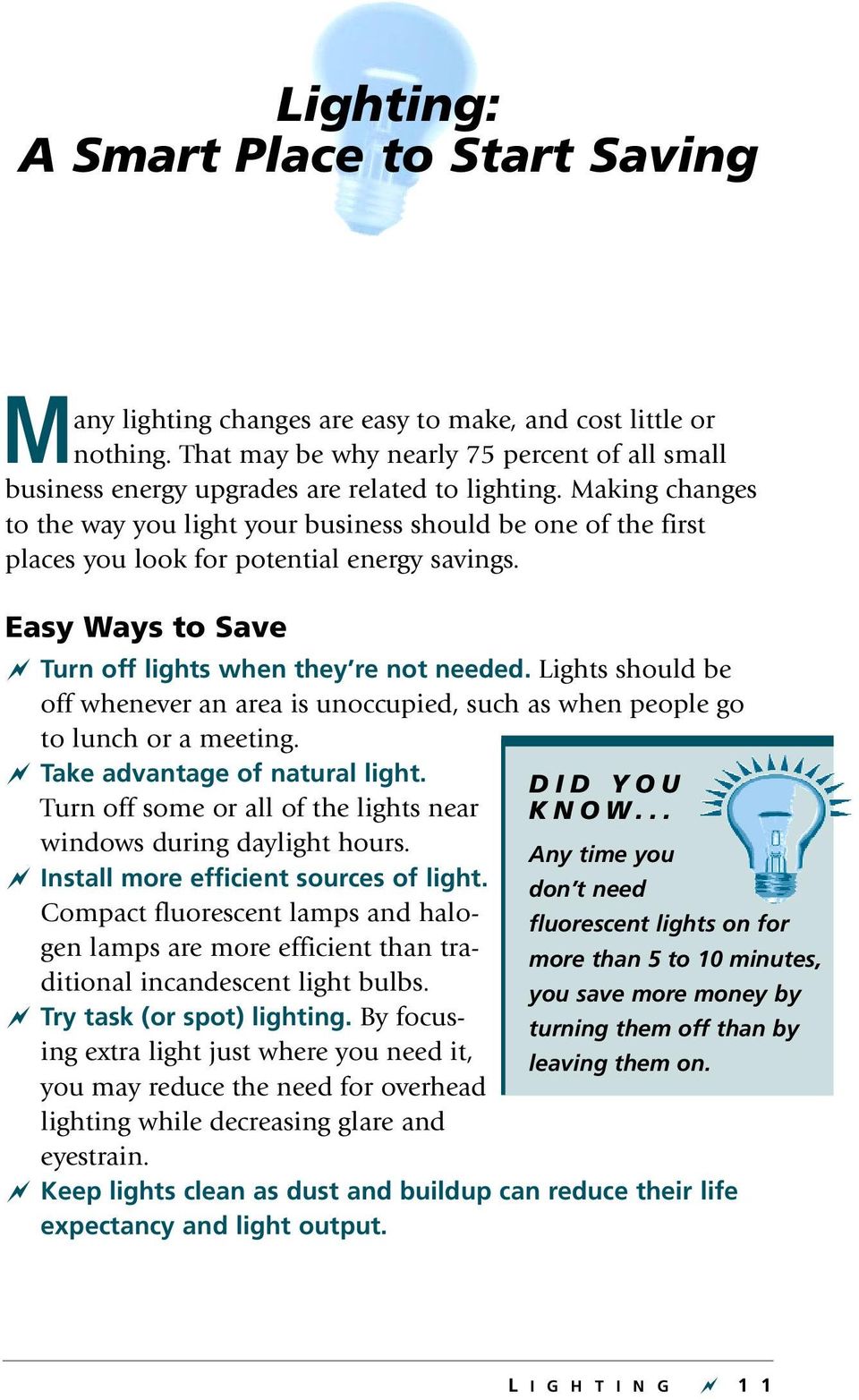
14 Lighting Upgrades This section will help you identify lighting fixtures and controls that can be replaced to add profits to your bottom line quickly. Many ideas pay for themselves in less than one year. Types of Lighting INCANDESCENT LAMPS* Thought of as standard light bulbs, incandescent lamps are inefficient and short-lived and should be replaced with more energy-efficient light sources. Only 5 percent of the electricity consumed by incandescent lamps is actually turned into useful light. HALOGEN LAMPS Twice as efficient as incandescent lamps, halogens have longer lives and offer a pleasing sparkle that highlights merchandise, especially jewelry, effectively. COMPACT FLUORESCENT LAMPS Four times as efficient as incandescents, compact fluorescent lamps last 10 times as long and work in most traditional screw-in light fixtures. TUBULAR FLUORESCENT A staple for office lighting nationwide, tube fluorescents are four to five times more efficient than incandescents and can last 8 to 20 times longer. METAL HALIDE These lamps give off a crisp white light and work well in high-ceiling areas and for some retail spot lighting. They are about as efficient as fluorescent lamps, but cost a little more. HIGH-PRESSURE SODIUM The yellow light you see in parking lots or mounted on exterior building walls comes from high-pressure sodium lamps. About 5 to 6 times as efficient as incandescent lamps, these are the most efficient of commonly used lighting types. *Lamp is a generic term used for light bulb, fluorescent tube, or other light source. 1 2 ~ E N E R G Y E F F I C I E N C Y P AYS
15 The first thing you need to know is that incandescent lamps are extremely inefficient and should be replaced with either compact fluorescent lamps or halogen lamps. The only place to keep an incandescent bulb is in a low-use area, such as a closet. Also note that energy saver incandescent lamps aren t much more efficient than regular incandescents. They save money only by delivering less light, which isn t an ideal solution. Replace Incandescent Lamps with Compact Fluorescent Lamps Designed to replace incandescent lamps in traditional screw-in light fixtures, CFLs are 4 times more efficient and may last 10 times longer than incandescents, and you can replace them yourself. Just note the different wattage levels in the chart below. Also, compact fluorescent lamp quality can vary, so check the ENERGY STAR Web site ( DID YOU KNOW... Incandescent bulbs consume 75 percent more electricity than compact fluorescent bulbs. smallbiz) for brands and models that meet ENERGY STAR s performance specifications. CURRENT INCANDESCENT REPLACEMENT COMPACT FLUORESCENT 25 watts 5 watts 40 watts 7 watts 60 watts 13 watts 75 watts 22 watts 100 watts 27 watts Replace Incandescent Lamps with Halogen Lamps Lasting two to four times longer than a standard light bulb, halogen lamps are also twice as efficient. They also offer better color, efficiency, and reflection. Many users can replace 150-watt floodlights with 35- or 60-watt halogen lamps and still get brighter, more focused light with better color rendition. Halogens are popular for spot lighting, especially in jewelry and upscale retail stores, because they add a sparkle to products. The most popular halogen lamps cost about $7 (compared to $1 for incandescent lamps), but they last much longer and save L I G H T I N G ~ 1 3

16 about $25 in energy costs over their lifetime. Retrofitting fixtures to accept halogen lamps typically pay for themselves in less than three years in energy savings alone if fixtures are used at least two hours a day for screw-in retrofits or eight hours a day for fixture replacement. A final note about halogens: Their high operating temperatures may pose a fire hazard in some applications, but this is typically with halogen torchiere lamps, not all halogen light bulbs. Ask for professional advice when you first buy and install halogen lamps. Upgrade to Light-Emitting Diode (LED) Exit Signs Typical exit signs lit with 15-watt incandescent bulbs cost about $30 a year to operate and need DID YOU KNOW... There s no reason to wait until old lights wear out to replacement lamps every year. Light-emitting diode exit signs cost about $5 a year to operate and can last 25 years without a lamp replacement. replace them. With some new technologies, such as LEDs are common in electronic T-8 fluorescent lights and devices such as clock radios. You light-emitting diode (LED) can buy do-it-yourself upgrade kits exit signs, you can start for your existing incandescent exit saving money on energy signs for $15 to $75. Or you can and maintenance costs buy new LED exit fixtures and right away. install them yourself for less than $100. (Upgrades don t require any wiring, so they are easier to install.) LED exit signs use 95 percent less energy than incandescent exit signs and last 10 to 20 times longer. Upgrade Fluorescent Lamps Even within the generally efficient category of fluorescent lighting, you can reduce your energy use by more than 66 percent by changing from the worst to the best type of fluorescent tubes. Many standard fluorescent tubes are four-foot-long, 40-watt T- 12s. It may pay to upgrade to the higher efficiency, 32-watt T ~ E N E R G Y E F F I C I E N C Y P A Y S

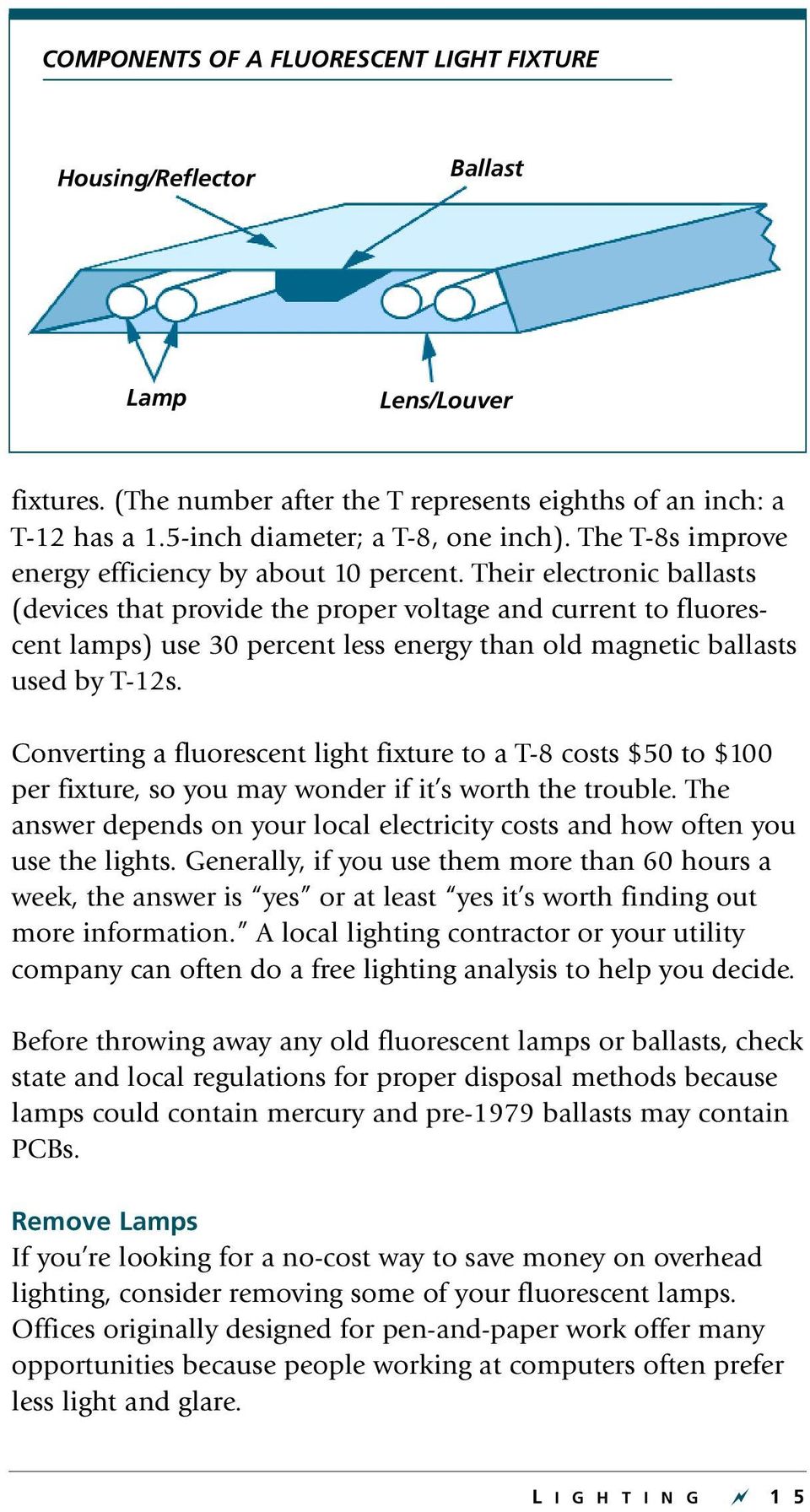
17 COMPONENTS OF A FLUORESCENT LIGHT FIXTURE Housing/Reflector Ballast Lamp Lens/Louver fixtures. (The number after the T represents eighths of an inch: a T-12 has a 1.5-inch diameter; a T-8, one inch). The T-8s improve energy efficiency by about 10 percent. Their electronic ballasts (devices that provide the proper voltage and current to fluorescent lamps) use 30 percent less energy than old magnetic ballasts used by T-12s. Converting a fluorescent light fixture to a T-8 costs $50 to $100 per fixture, so you may wonder if it s worth the trouble. The answer depends on your local electricity costs and how often you use the lights. Generally, if you use them more than 60 hours a week, the answer is yes or at least yes it s worth finding out more information. A local lighting contractor or your utility company can often do a free lighting analysis to help you decide. Before throwing away any old fluorescent lamps or ballasts, check state and local regulations for proper disposal methods because lamps could contain mercury and pre-1979 ballasts may contain PCBs. Remove Lamps If you re looking for a no-cost way to save money on overhead lighting, consider removing some of your fluorescent lamps. Offices originally designed for pen-and-paper work offer many opportunities because people working at computers often prefer less light and glare. L I G H T I N G ~ 1 5
18 RECOMMENDED LIGHT LEVELS FOR SELECTED ACTIVITIES Graphics studio Kitchen, work bench, handwriting, cutting Conference room, cashier, reading Auditorium seating, halls, restrooms Restaurant dining, social hall, storage Public areas, dark surroundings Recommended Overall Ambient Light Levels (in footcandles) 8 Experiment to see if removing lamps makes sense in your facility. 8 Remove lamps only in pairs: try using only two lamps in a four-lamp fluorescent fixture. 8 Find out the preferences of people working on computers they may prefer less light for increased contrast on their monitors. 8 Reduce fluorescent lighting in hallways and corridors, which are often over lit. 8 Remove other unnecessary lamps where lighting levels exceed needs. While employee preferences play a large role in optimizing light levels, the above chart, created by the Illuminating Engineering Society, provides recommended levels for various activities. 1 6 ~ E N E R G Y E F F I C I E N C Y P A Y S

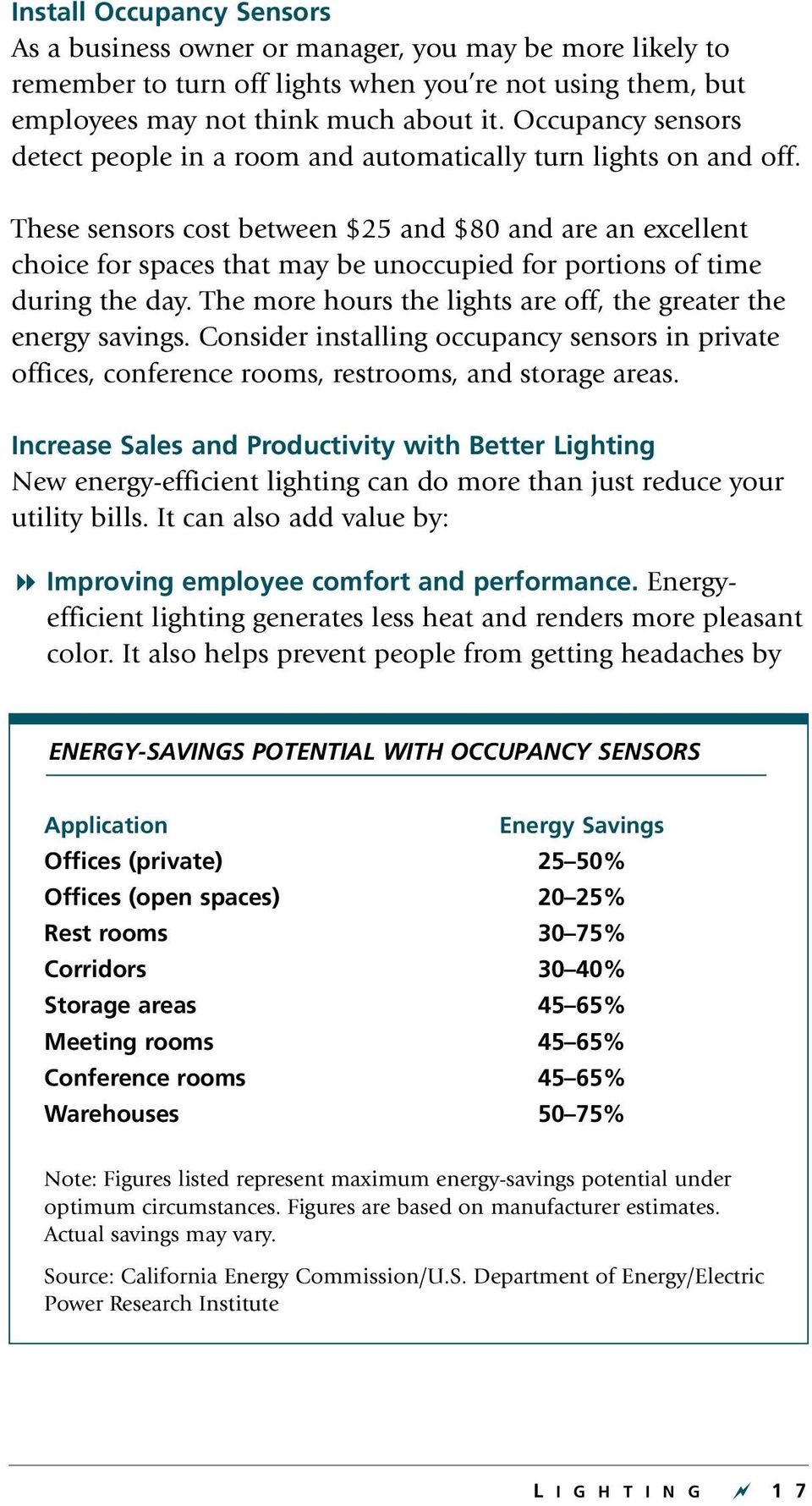
19 Install Occupancy Sensors As a business owner or manager, you may be more likely to remember to turn off lights when you re not using them, but employees may not think much about it. Occupancy sensors detect people in a room and automatically turn lights on and off. These sensors cost between $25 and $80 and are an excellent choice for spaces that may be unoccupied for portions of time during the day. The more hours the lights are off, the greater the energy savings. Consider installing occupancy sensors in private offices, conference rooms, restrooms, and storage areas. Increase Sales and Productivity with Better Lighting New energy-efficient lighting can do more than just reduce your utility bills. It can also add value by: 8 Improving employee comfort and performance. Energyefficient lighting generates less heat and renders more pleasant color. It also helps prevent people from getting headaches by ENERGY-SAVINGS POTENTIAL WITH OCCUPANCY SENSORS Application Energy Savings Offices (private) 25 50% Offices (open spaces) 20 25% Rest rooms 30 75% Corridors 30 40% Storage areas 45 65% Meeting rooms 45 65% Conference rooms 45 65% Warehouses 50 75% Note: Figures listed represent maximum energy-savings potential under optimum circumstances. Figures are based on manufacturer estimates. Actual savings may vary. Source: California Energy Commission/U.S. Department of Energy/Electric Power Research Institute L I G H T I N G ~ 1 7
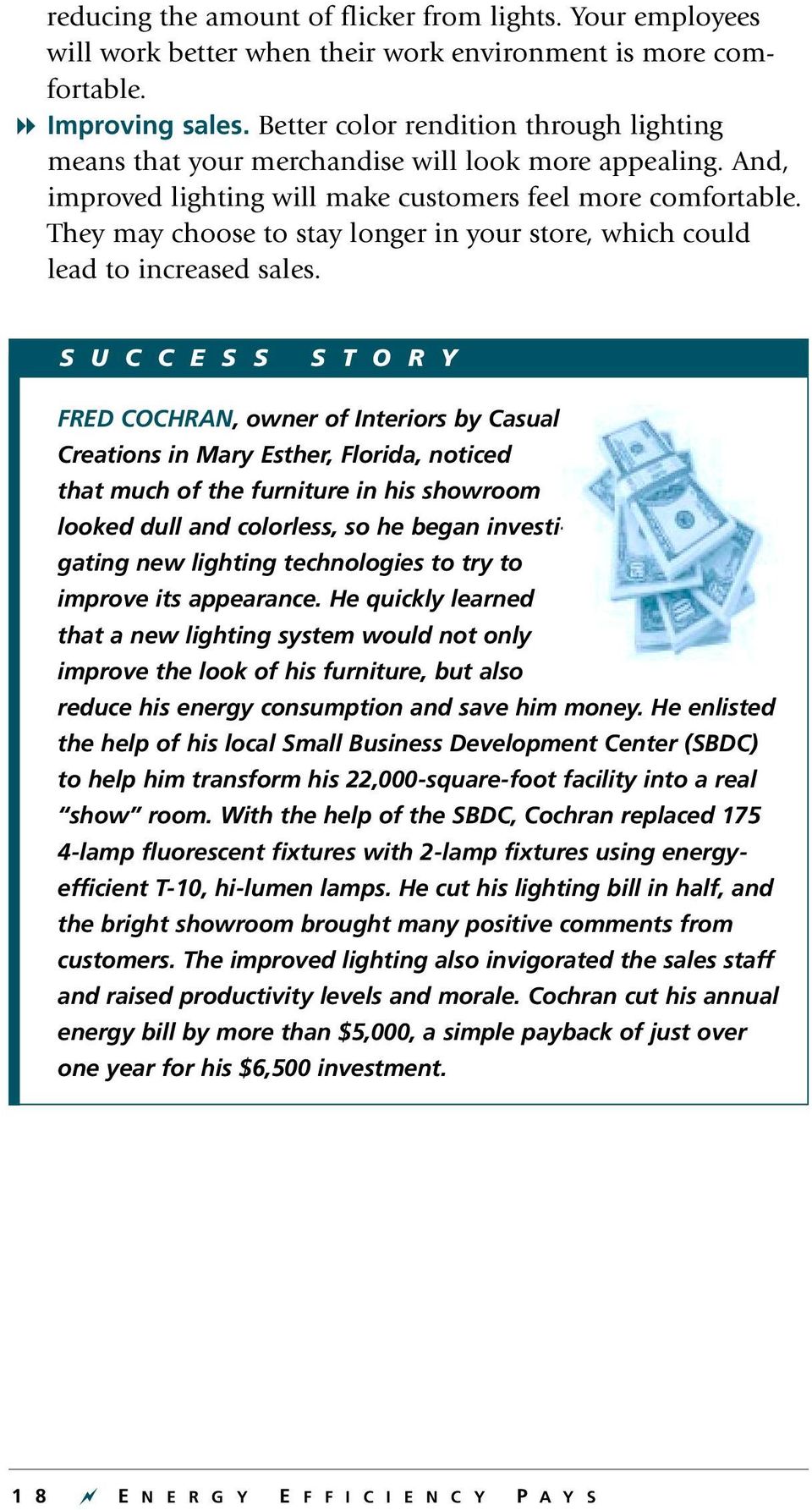
20 reducing the amount of flicker from lights. Your employees will work better when their work environment is more comfortable. 8 Improving sales. Better color rendition through lighting means that your merchandise will look more appealing. And, improved lighting will make customers feel more comfortable. They may choose to stay longer in your store, which could lead to increased sales. S U C C E S S S T O R Y FRED COCHRAN, owner of Interiors by Casual Creations in Mary Esther, Florida, noticed that much of the furniture in his showroom looked dull and colorless, so he began investigating new lighting technologies to try to improve its appearance. He quickly learned that a new lighting system would not only improve the look of his furniture, but also reduce his energy consumption and save him money. He enlisted the help of his local Small Business Development Center (SBDC) to help him transform his 22,000-square-foot facility into a real show room. With the help of the SBDC, Cochran replaced lamp fluorescent fixtures with 2-lamp fixtures using energyefficient T-10, hi-lumen lamps. He cut his lighting bill in half, and the bright showroom brought many positive comments from customers. The improved lighting also invigorated the sales staff and raised productivity levels and morale. Cochran cut his annual energy bill by more than $5,000, a simple payback of just over one year for his $6,500 investment. 1 8 ~ E N E R G Y E F F I C I E N C Y P A Y S
21 Office Equipment: The Fastest Growing Use of Energy In recent years, the foundation of the American economy has changed from manufacturing industries to service- and information-based businesses. This change has caused an exponential increase in office equipment and associated energy use. Today, office equipment ranks as the fastest growing use of energy in the business world and a good place to look for savings. DID YOU KNOW... Energy-efficient office equipment lowers utility bills because of reduced airconditioning as well as the lower energy cost of the Easy Ways to Save ~ Turn equipment off whenever possible. Make sure machines get turned off whenever your facility is unoccupied or when machines will not be equipment itself. used for a considerable amount of time. ~ Enable energy-saving software. If your machines are equipped with energy-saving software, be sure to turn it on. ~ Clean, tune, and adjust equipment. Maintaining your equipment will extend its life and keep it running more efficiently. Use Computers, Monitors, and Printers Efficiently One of the simplest ways to save energy with office equipment is to turn machines off when they re not needed. Many machines run when they are rarely used, or they are left on when an area is O F F I C E E Q U I P M E N T ~ 1 9
22 unoccupied. Encourage people to turn off machines overnight and on weekends. And think about turning off machines during work hours if they won t be used for a long time. Of course, if your warm-up or start-up procedures are time-consuming or complex, it s best to keep the machines DID YOU running. KNOW... Flat screen LCD You can keep printers running when computer monitors use significantly less working several users to one printer. Not necessary and still save energy by net- energy than traditional only will you benefit from lower energy tube monitors, notebook costs, but also you can lower your capital computers use much less expenses by buying fewer printers. energy than desktop computers, and inkjet printers For monitors, it definitely pays to turn use less energy than laser them off when not in use for extended printers. periods of time (or set the energy saver mode to turn them off). This reduces your energy costs and preserves the phosphorus substance that screen savers are designed to save. When purchasing new office equipment, always buy ENERGY STAR-labeled equipment and make sure the energy saving feature is enabled. Many major manufacturers have joined the program, but be sure to specify ENERGY STAR-labeled products or look for the logo on display models. A few facts about ENERGY STARlabeled machines: 8 Computers and monitors automatically power down to 30 watts when not in use. 8 Printers can cut printing-related electricity use by more than 65 percent. 8 Printers power down to 10 to 100 watts (depending on the printer), producing less heat, reducing air-conditioning costs, and contributing to a more comfortable work space. 8 Double-sided printing capabilities can reduce paper costs by $30 a month and cut file storage space in half. 2 0 ~ E N E R G Y E F F I C I E N C Y P A Y S
23 TYPICAL SAVINGS IF YOU BUY ENERGY STAR-LABELED OFFICE EQUIPMENT Equipment Annual ENERGY STAR- Percentage of labeled office equipment total operating cost savings cost Computer $19 49% Fax machine $13 52% Printer $39 65% Copier (medium) $57 57% Copier (large) $130 58% For more information on ENERGY STAR-labeled office equipment, visit and click into the Products area. Make the Most of Your Copier Copiers are the most energy-intensive piece of office equipment, and approximately 7 million of them are in homes and businesses across the United States. They use a lot of energy just sitting idle for long periods of time. Here are a few ideas for getting the most out of your machine: 8 Use the double-sided and 1- to 2-sided copy options. 8 Run copies in batches to decrease the time your copier spends in and out of the high-powered mode. 8 Turn it off when not in use for a while. 8 Buy the smallest size copier to suit your needs. 8 Buy an ENERGY STAR-labeled copier. It will turn off automatically when inactive, cutting your annual copyrelated electricity costs by more than 60 percent. DID YOU KNOW... If everyone used the double-sided feature of ENERGY STAR-labeled copiers, we could save one million tons of paper enough to go around the world 1,400 times. O F F I C E E Q U I P M E N T ~ 2 1
24 WHAT YOU WILL SAVE SAVE NOW Energy Cost Savings per Year Percent Savings at Different Electric Savings (kwh/yr) Rates ($/kwh) $0.06 $0.08 $0.10 Turn 24-hour equipment off at night so it runs only 9 hours per day. Savings per computer 675 $41 $54 $68 61% Savings per large copier 6,600 $396 $528 $660 56% SAVE LATER Replace older 24-hour equipment with new ENERGY STAR-labeled equipment that is used 9 hours per day. Savings per computer 795 $48 $64 $80 72% Savings per large copier 8,910 $535 $713 $891 75% 2 2 ~ E N E R G Y E F F I C I E N C Y P A Y S
25 Heating, Ventilating, and Air Conditioning: The Biggest Energy User Heating, ventilating, and air-conditioning (HVAC) systems account for 39 percent of the electric energy used in U.S. commercial buildings, which means your business can realize significant savings by improving the efficiency of your systems. Easy Ways to Save ~ Turn heating and air-conditioning systems down or off when not in use. If your facility is unoccupied at certain times (such as nights or weekends), lower the heat or raise the air conditioning to save energy costs. Or consider turning the system off altogether just be sure to leave ample time for heating or cooling before employees return. ~ Use the auto setting rather than the on setting. A fan in the on mode runs non-stop, 24 hours a day; in auto the fan cycles only when supplying heat or air conditioning. ~ Use more efficient temperature settings. In the winter, try gradually lowering the thermostat by a total of 3 to 5 degrees; slowly raise it by the same amount in the summer. Experiment to see which settings are still comfortable for employees and visitors. ~ Replace air filters regularly. Clean air filters keep a system performing at its most energy-efficient peak, while keeping the air cleaner. Change filters (or clean replaceable ones) at least quarterly, once a month in peak heating and cooling months. H E A T I N G, V E N T I L A T I N G, A I R C O N D I T I O N I N G ~ 23
26 ~ Plug or fill any cracks or leaks with weatherstripping and caulking. Look for cracks around windows, doors, utility switches/outlets, and any other gaps between inside and outside. ~ Consider ceiling fans. Air conditioners don t need to work as hard (or at temperatures so low) when a fan helps to increase the comfort level by circulating the cool air. In winter, ceiling fans can be reversed to pull warm air down, allowing lower heating temperatures. ~ Open the windows. If your building has windows that open, try cooling your space down the old fashioned way. In the spring and fall, open windows bring cool air in and let warm air out. Smart System Settings Do you ever see employees wearing sweaters in the summer? You can save lots of energy just by being smart with your heating and cooling temperature settings. Change the Temperature Gradually During winter months, keeping the temperature a little cooler can really pay. Gradually reduce the temperature (about 1 degree per week) so people have time to adjust and you can gauge the comfort level. Often people won t even DID YOU notice the change. KNOW... Each degree In the warmer months, try increasing the of a higher temperature a little bit. Even at a warmer temperature setting can temperature, the air will be a welcome save about 3 percent on contrast for people coming in from outside. And, employees who are fairly inac- cooling costs. tive, such as those sitting at a computer or standing behind a cash register, might welcome the change. Turn the System Down or Off When Unoccupied Don t pay for energy that no one uses. You may be using energy to heat, cool, or freshen the air when nobody is there to benefit. If your building is unoccupied at certain times, your HVAC system should be turned down or off. Despite what you may have 2 4 ~ E N E R G Y E F F I C I E N C Y P A Y S
27 heard about never turning an HVAC system off, it can save money to let a building cool down or heat up when unoccupied and to restore comfortable temperatures by the time business resumes. This strategy of lowering temperature settings during unoccupied hours in the winter and raising settings during the summer is called setback. Energy savings from setback can range from as little as 10 percent to as much as 30 percent. It takes time for a system to recover after a weekend of being in setback or turned off completely, so be sure that on Monday mornings the system starts up before people show up for work. ENERGY STARlabeled thermostats often have a feature called optimal start that enables the thermostat to automatically figure out when to turn the system on in order for it to be at a comfortable temperature by the time people show up for work. The Consortium for Energy Efficiency reports that up to 50 percent more energy could be saved with proper installation, sizing, and maintenance of commercial central air conditioners and heat pumps. Consider Locking Your Thermostat Finally, being able to control thermostat settings is crucial if you are going to save energy dollars. If your experience has been that employees, clients, or customers change the thermostat settings, you may want to consider covering and locking them. But first, talk to people about why they change the settings you have chosen. Perhaps they are too warm or too cold to work in comfort. If the temperature seems reasonable, but changes still occur, then locking the system makes sense. Get Help From An Expert DID YOU KNOW... Check the Accuracy of Your Thermostat Ask your HVAC technician to check the accuracy of your thermostats during a scheduled maintenance visit. Obviously, if a thermostat setting of 75 degrees is cooling the air to a real temperature of 72 degrees, your system is running more than it should and costing you valuable energy dollars. If the thermostat is not accurate, have the technician recalibrate or replace it. H E A T I N G, V E N T I L A T I N G, A I R C O N D I T I O N I N G ~ 25
28 Install a Programmable Thermostat Although turning off or setting back your HVAC system is simple enough to do manually, an automatic control is much more efficient and reliable. Electronic, programmable thermostats which allow you to program a desired setpoint and cutoff times for a week are available for $50 to $200. Most models include manual override features, so if someone needs to work when the facility is closed, the person can work in comfort without having to reprogram the system. Be sure the technician installs your thermostat in a location where the temperature is representative of the entire area the system serves not next to an air conditioning vent or the coffee pot. If you have a heat pump, be sure to buy a heat-pump-programmable thermostat. Programmable thermostats are effective, especially with individual unit air conditioners and heaters. However, if your facility uses larger, central systems such as boilers and chillers, you may consider an energy management system (EMS) instead. Operated with a computer, software, and sensors, an EMS provides unified control of HVAC functions to maximize energy efficiency and comfort conditions. It can also control lights and equipment throughout your facility. An EMS can reduce energy costs by up to 20 percent, with a simple payback period of two to four years. Let a knowledgeable HVAC expert help you decide if an EMS is right for your facility. Have Your Economizer Checked, Repaired, or Upgraded An economizer is an arrangement of dampers, linkages, actuators, and controls that allow the use of outdoor air to achieve free cooling without using the compressor, which is more expensive to run. When combined with a programmable thermostat, the potential energy savings is significant. Many commercial HVAC systems already have economizers, but most of them are disconnected or in poor repair. Because economizers can lead to substantial energy savings in some climates (from 15 percent to 45 percent depending on the location), make 2 6 ~ E N E R G Y E F F I C I E N C Y P A Y S
29 sure that any contractor you hire is committed to keeping yours in good working order. Most economizer breakdowns occur as the result of the sensors that measure the temperature and humidity parameters used to determine the position of dampers. For more than a decade, solid-state sensors that rarely fail have been available. Ensure that your contractor is familiar with the more rugged and accurate sensors. Don t let a contractor convince you it isn t worth repairing your economizers because he is not familiar with their benefits. Look for contractors that can provide you with a computer-generated estimate of energy savings along with their repair estimate. Over the last few years, economizer-sensor technology has advanced, allowing substantial savings to be achieved in winter as well. By adding a CO 2 sensor as an input so that the system actually knows approximately how many people are in your facility and by extension, how much ventilation is required. When a S U C C E S S S T O R Y CENTERPLEX, a Seattle-based ENERGY STAR for Small Business partner, is a 26,500- square-foot commercial office with 43 tenant firms and 100 occupants. The owner, Jonathan Pool, cut his electric bill in half by installing 10 programmable thermostats, energy-efficient lights, and window improvements. These energy-efficient upgrades have netted a savings of $23,000 per year, with a simple payback period of only 18 months. And Pool says his energy conservation has had a spillover effect on his tenants: When you rent space to others, the practices you engage in attract compatible people. Conservation attracts people who support conservation. They generate less waste and are easier on both each other and the physical plant. While his overhead went down, his profit went up. H E A T I N G, V E N T I L A T I N G, A I R C O N D I T I O N I N G ~ 2 7
30 building has low occupancy during the winter, the economizer closes dampers to the absolute minimum, preventing the introduction of cold air that must then be heated. This technology is called Demand Control Ventilation. Ask potential contractors if they are familiar the technology and ask them to give you an energy-savings estimate from one of several scientifically sound software tools available to them. Benchmark Your Building Free from ENERGY STAR, this service enables you to quickly and easily determine how efficiently your building is operating compared to others like it in your climatic zone. Your 1 to 100 benchmarking score tells you how much potential you have for lowering your bills. A score under 75 should be viewed as a highpriority opportunity to improve your bottom line. Benchmarking currently is available for commercial office buildings, K-12 schools, grocery stores, hospitals, and hotels. The service also is under development for convenience stores, healthcare facilities and warehouses. Visit index.cfm?c=evaluate_performance.bus_portfoliomanager for more information. If you need help, look for a contractor who is already familiar with this online service or willing to learn how to complete the process for you. Have Your HVAC System Tuned Up Twice a Year Whatever type of HVAC system you have, maintenance is a critical factor in its longevity. Regular maintenance is an oftenoverlooked key to saving money on your heating and air conditioning costs. The easiest approach is to have a semi-annual service maintenance agreement (SMA) with a licensed HVAC contractor. The cost varies by system. The maintenance should include: 8 Checking the system s connections 8 Adjusting temperature and humidity setpoints 8 Inspecting and oiling fan motors 8 Checking for proper airflow at the unit and each zone 8 Checking for proper control settings and safety shut-down functions 2 8 ~ E N E R G Y E F F I C I E N C Y P A Y S
31 8 Inspecting and repairing duct leaks and insulation gaps 8 Inspecting and repairing economizer operation and recommending upgrade options depending on your weather zone. 8 Inspecting and cleaning dirty heat DID YOU KNOW... Semi-annual maintenance checks are just as important for your HVAC system as changing the oil in your car every 3,000 miles. transfer coils in heat pumps, air conditioners, and chillers and straightening any bent coils 8 Testing and repairing any leaks in the refrigerant lines and checking for proper refrigerant charge using charts specific to your system s make and model 8 Based on your input, adjusting programmable thermostats and time clocks so that heating and air runs only when your building is normally occupied Maintenance-level service can vary significantly. Here are some key differences to look for that will help you determine if you re buying minimum grade service or comprehensive support: MINIMUM GRADE Inspect Replace filters Check refrigerant pressure PREMIUM COMPREHENSIVE Inspect and replace Replace filters and clean coils Check pressure and calculate efficiency; ensure proper economizer operation New tools are now available to HVAC contractors that enable them to measure and document your system s efficiency compared to ideal operation when the system was first installed. The tools also accurately diagnose problems if the system is not running optimally and validate that repairs have been completed correctly. This means the contactor can more closely manage field technicians, and you can trust that you got the services you requested. Much like automobile mechanics use fool-proof, computer-based systems to tune your car, contractors who have adopted advanced portable diagnostics are able to determine exactly what needs to H E A T I N G, V E N T I L A T I N G, A I R C O N D I T I O N I N G ~ 2 9
32 be done to done to optimize your comfort, indoor air quality, equipment life, and safety while also reducing your operating expenses. Better yet, they are able to focus their attention on the rooftop units that really need attention and not waste time or money on those that are running properly and efficiently. Hire a Quality Contractor When selecting a contractor to supply a service maintenance agreement or any other service, compare the warranties and maintenance agreements of various companies. Are parts and labor both included? Just parts? Just labor? The cheapest price is rarely the best buy. If a maintenance visit costs the contractor more than he is charging you for the service, you likely will have more frequent and costly breakdowns over time. Here are several tips for selecting an HVAC contractor: 8 Ask for recent references and call them to determine if customers were pleased with the contractor s work. 8 Ensure that the contractor has a valid license if one is required to perform service in your area. 8 Request a written price quote and information on service maintenance agreements. 8 Ask for computer-generated energy-savings estimates for economizer upgrades, setback implementation or EMS installations. 8 Verify that the contractor complies with state and local codes and regulations and carries proper business and workers compensation insurance. 8 Ensure that the contractor will use only environmentally safe products when servicing your facility. 8 Select contractors who are affiliated with national programs to ensure that your job will be done according to the latest energy-efficiency technologies. Affiliations could include Energy Star ( Rebuild America ( and the National Main Street Network ( 8 Give extra points to contractors who belong to their own industry associations, such as the Air Conditioning Contractors of America. This not only gives them access to training 3 0 ~ E N E R G Y E F F I C I E N C Y P A Y S
33 and information, but also adds a degree of accountability for them and confidence for you. 8 Give even more points to contractors who participate in associations for business owners, such as restaurants, commercial building owners, facilities managers, schools, shopping center, and other end-user associations. This adds even more accountability to the contractor and reduces your risk. 8 Look for firms that ask good questions about your building and how you use it. Contractors should also listen carefully and follow a process that starts with a thorough diagnosis, followed by a detailed proposal with complete disclosure. When you are working with a contractor, you should look for a couple of other qualifications to make sure you have hired the right contractor for your small business. Contractors should: 8 Provide fast, reliable service while at your location. 8 Demonstrate skill and knowledge to service your current equipment, and, if necessary, to design and install the right system for your entire facility. 8 Document what they have done, in writing or electronically. For additional information, read EPA s Putting Energy Into Profits guide, including a chapter on selecting a contractor. A downloadable version of this document is available from the Energy Star Web site at: The Air Conditioning Contractors of America Web site, also has information on finding a quality contractor. And, you don t need to live in California to benefit from the California Energy Commission s energy efficiency handbook called How to Hire an Energy Services Company. You can also find three helpful articles, written specifically to help businesses select contractors and published by Energy & Environmental Management magazine at www. buildingsexperts.com/links.asp. H E A T I N G, V E N T I L A T I N G, A I R C O N D I T I O N I N G ~ 3 1
34 Refrigeration: Critical Savings in a Competitive Market Refrigeration equipment is one of the highest energy users in the supermarket, convenience store, deli, and restaurant business. Reducing your refrigeration costs can give your small business a competitive edge in a very competitive market. Easy Ways to Save ~ Keep the doors shut. Repeated temperature changes damage your food quality and cost you money. ~ Check the temperature settings. If your settings are lower than necessary, you are probably wasting money. ~ Properly load your refrigerator. A DID YOU refrigerator that s too full disrupts the KNOW... air flow needed to cool items properly. On the other hand, a refrigerator without much in it wastes energy, too. If A new ENERGY STARlabeled 50-cubic-foot you have partially filled units, consolidate and turn off unneeded refrigera- commercial refrigerator uses about 2,500 kilowatthours per year and costs tors. ~ Properly distribute refrigeration about $205 a year to run units. Don t put the soda display case a 30 percent savings next to a hot dog warmer or in direct over a standard commercial refrigerator. sunlight. Extra heat makes your refrigerator work harder to keep temperatures cool. 3 2 ~ E N E R G Y E F F I C I E N C Y P A Y S
35 AIR TEMPERATURES FOR DISPLAY REFRIGERATORS* (in degrees Fahrenheit) Fixture Type Minimum Maximum Temperature Temperature Dairy Produce, packaged Meat, unwrapped Meat, wrapped Frozen food ** 13 to 5 Ice cream ** 24 to 13 Copyright 2002, American Society of Heating, Refrigerating and Air- Conditioning Engineers, Inc. (ASHRAE) Reprinted by permission from 2002 ASHRAE Handbook Refrigeration * Display refrigerators are not designed to cool the product, only to maintain product temperature. Air temperatures listed are for the maintenance of the product. ** Minimum temperatures for frozen foods and ice cream are not critical except for energy conservation. The maximum temperature is important to preserve product quality. ~ Ventilate refrigerators properly. A 1-inch gap on the sides and a 4-inch gap at the back are recommended to give the refrigerator s condenser and fan access to a steady flow of air. ~ Clean the cooling coils. Dirt build-up impairs heat transfer and lowers refrigeration efficiency and capacity. ~ Check the door seals. Tight seals keep out warm air. Use this rule of thumb: If you can easily slide a dollar bill into the seal, have it adjusted. If you have large refrigeration units, consider installing variable controls on evaporator fans. Evaporator controls are primarily used in walk-in refrigerators, which typically have fans that run continuously while the compressor cycles on and off. Evaporator controls use monitoring devices to determine when the compressor is not running, and then reduce the voltage to the evaporator fans during the compressor off cycle. Use of these controls can R E F R I G E R A T I O N ~ 3 3
36 produce energy savings of up to 25 percent. Not all refrigeration equipment can be adapted in this way, nor are these controls suitable for all food products. S U C C E S S S T O R Y RICK STEIN owns and operates the Inn at Wiccoppee, a well-known restaurant in the Hudson River area of Hopewell Junction, N.Y. By simply reducing his frozen food inventory and combining it into two freezers (down from five), Stein saves almost $800 a year money that goes straight to his bottom line. 3 4 ~ E N E R G Y E F F I C I E N C Y P A Y S
37 Hot Water Use and Efficiency: Make Every Drop Count Virtually every small business uses hot water, if only for employee hand washing. Businesses like restaurants, hotels, nursing homes, and athletic facilities that use hot water for laundry and dishwashing often spend 25 percent of their total energy bill on hot water. No matter how much hot water you use, it pays to cut back on unnecessary water and energy use. Easy Ways to Save ~ Reduce the amount of water used. Aside from turning off running water, you can install water-conserving showerheads in showers and aerators in bathroom and kitchen sinks. Showerheads range from $10 to $15, while aerators cost only a couple dollars. Both are easy to install. ~ Reduce the temperature of the hot water. Thermostats on water heaters are often set much higher than necessary. Laundry and dishwashing usually require specific water temperatures (often set by local codes), but temperatures shouldn t be set DID YOU higher than required. And a small KNOW... office with an electric water heater that The hotter the warms water for hand washing can water temperature, the quicker you lose save $10 per year if reduced from 130 degrees to 120 degrees. energy through the pipes ~ Turn off your water heater when not and water heater tank in use. The easiest way to do this consistently is to buy a seven-day walls. thermo- H O T W A T E R ~ 3 5
38 stat. It costs about $30 and turns off your electric water heater when it s not needed (such as nights and weekends) and turns it back on an hour or two before your business resumes. You can save anywhere from $10 to $50 a year with a water heater timer. ~ Fix leaking faucets, toilets, showerheads, and pipes. These do-it-yourself repairs can be done quickly and easily and at DID YOU KNOW... Repairing a seal that leaks a drop of water every five seconds can save money and hundreds of gallons of water per year. And if it is a hot water leak, you can save even more. virtually no cost. Do an occasional walk-through of your space to spot any leaks. ~ Insulate your tank. To reduce heat losses in your hot water system, make sure the hot water tank and the pipes connected to it are insulated. ~ Maintain existing systems. Maximize your savings by performing periodic maintenance on existing equipment following your manufacturer s instructions. For additional information on smart water heating, contact Water Wiser, the Water Efficiency Clearinghouse at ; TYPICAL RECOMMENDED HOT WATER TEMPERATURES (in degrees Fahrenheit) Process Temperature Hand washing 105 Showers 110 Laundry* 160 Dishwasher rinse** * Check code requirements **Many dishwashers have booster heaters. Check with the manufacturer to determine minimum temperature requirements. Source: American Society of Heating, Refrigerating, and Air-Conditioning Engineers 3 6 ~ E N E R G Y E F F I C I E N C Y P A Y S
39 If you use a lot of hot water (more than 100 gallons a day) and don t have gas service available, consider replacing your regular electric water heater with a heat pump water heater. It could cut your costs in half, and, if you can put the unit in a hot spot like a kitchen, it will provide free cooling as a bonus. Visit for more information. S U C C E S S S T O R Y AN OFFICE MANAGER of a 2,000-square-foot office building discovered a leak in the pipes from a 40-gallon electric water heater. While repairing the leak, she decided to install an insulated blanket wrap around the water heater to prevent additional loss. The total cost of her improvements was $40. By setting the water heater thermostat to 120 degrees, the office manager saved $35 per year. After the one-year payback, she puts that extra money toward profits year after year. H O T W A T E R ~ 3 7
40 APPENDIX A: Energy-Related Agencies and Organizations Air Conditioning Contractors of America (ACCA): (703) ; American Council of Engineering Companies (ACEC): (202) ; American Public Power Association (APPA): (202) ; American Society of Heating, Refrigerating, and Air-Conditioning Engineers (ASHRAE): or (404) ; American Society of Mechanical Engineers (ASME): THE- ASME; American Solar Energy Society (ASES): (303) ; Association of Energy Engineers (AEE): (770) ; The Association of Energy Service Professionals (AESP): (561) ; Association of Small Business Development Centers (ASBDC): (703) ; EPRI (formerly the Electric Power Research Institute): or (650) ; ENERGY STAR for Small Business Hotline: STAR-YES ( ); Energy User News: (847) ; Illuminating Engineering Society of North America: (212) ; ~ E N E R G Y E F F I C I E N C Y P A Y S
41 Lighting Research Center: (518) ; National Association of Energy Service Companies (NAESCO): (202) ; National Association of State Energy Officials: (703) ; National Trust Main Street Center: (202) ; National Society of Professional Engineers (NSPE): (703) ; Office of Energy Efficiency and Renewable Energy (EERE): DOE-3732; Rebuild America: DOE-3732; Renewable Energy Policy Project (REPP): (202) ; Water Wiser, the Water Efficiency Clearinghouse: ; E N E R G Y E F F I C I E N C Y P A Y S ~ 3 9
42 APPENDIX B: Energy-Related Printed Resources ENERGY STAR has a number of energy-efficiency publications and brochures: Putting Energy Into Profits: ENERGY STAR Guide for Small Business, a 100-plus page book covering an array of energyefficiency topics. Introducing Your Company s Newest Profit Center, EPA 430-R This is an introduction to the concept that energy upgrades are financial investments just like other business uses of capital. Business Analysis for Energy-Efficiency Investments, EPA 430-B This brochure describes in more detail the business-analysis approach you can use to decide if a particular upgrade or set of upgrades makes sense to invest. Financing Your Energy-Efficiency Upgrade, EPA 430-B This brochure describes the many financial and accounting aspects of upgrade projects in great detail. Use this information to finance your projects with the best impact on your balance sheet, cash flow, taxes, and ultimate return. Get more information by calling STAR-YES ( ) or by visiting the ENERGY STAR Web site at www. energystar.gov/smallbiz. California Energy Commission has a series of handbooks for energy efficiency, including: Energy Accounting How to Hire an Energy Services Company How to Hire a Construction Manager for your Energy Efficiency Projects Visit index.html for more information. 4 0 ~ E N E R G Y E F F I C I E N C Y P A Y S
43 APPENDIX C: Information about the Sponsors of Energy Efficiency Pays American Public Power Association s Demonstration of Energy-Efficient Developments (DEED) Program The Demonstration of Energy-Efficient Developments program was established in 1980 by the American Public Power Association (APPA). The purpose of this research, development, and demonstration program is to sponsor and conduct activities related to energy innovation, improving efficiencies, and lowering the cost of providing energy services to the customers of publicly owned electric utilities. The DEED program offers funding for projects that will develop and demonstrate new technologies and techniques. Funding for DEED-sponsored projects comes in the form of grants to DEED member utilities, scholarships to university students studying in energy-related disciplines, and joint projects with APPA committees. APPA is the national service organization for community-owned, not-for profit electric utilities. APPA/DEED 2301 M Street, NW Washington, DC Association of Small Business Development Centers The Association of Small Business Development Centers (ASBDC) is a partnership program uniting private enterprise, government, higher education and local nonprofit economic development organizations. It is dedicated to the sound development of small business throughout America. The ASBDC provides a vehicle for continuous improvement of the Small Business Development Center program, exchange of information among members regarding objectives, methods, and results in business E N E R G Y E F F I C I E N C Y P A Y S ~ 4 1
44 management and technical assistance, and advocacy of America s small business community. The mission of the Association of Small Business Development Centers is to represent the collective interest of its members by promoting, informing, supporting, and continuously improving the Small Business Development Centers (SBDC) network, which delivers nationwide educational assistance to strengthen small/medium business management, thereby contributing to the growth of local, state, and national economies. ASBDC is a Strategic Partner of the U.S. Department of Energy s Rebuild America program. ASBDC 8990 Burke Lake Road, 2nd Floor Burke, VA Department of Energy s Rebuild America program The U.S. Department of Energy s Rebuild America program is a network of community partnerships made up of local and state governments, schools, universities, housing agencies, and private businesses that save money by saving energy. These voluntary partnerships, working with support provided through the DOE, choose the best ways to plan and implement energy-efficiency projects in the commercial, institutional, and multifamily residential buildings controlled by their partners. Partnerships have access to products, services, and peer experiences on buildings, energy, finance, and more. Rebuild America provides support nationally and leads by regional teams. It assigns a program representative to each partnership to help in identifying local resources, financing options, and accessing special services from Rebuild America to aid in completing upgrades, and monitoring the impacts of utility restructuring on investment options. Rebuild America Financial Services aids access to capital by pointing partnerships toward programs offered by states, associations, or private financing organizations that may be able to provide investment capital at the lowest possible rates. The U.S. Depart- 4 2 ~ E N E R G Y E F F I C I E N C Y P A Y S
45 ment of Energy is a co-sponsor with the U.S. Environmental Protection Agency of ENERGY STAR. Rebuild America U.S. Department of Energy 1000 Independence Ave., S.W. Washington, DC DOE ENERGY STAR for Small Business program The U.S. Environmental Protection Agency s ENERGY STAR for Small Business program provides access to a range of technical materials and services, including a toll-free hotline at STAR-YES ( ) and an award-winning Web site at Both provide free engineering support, including answers to questions, product information, and calculations. You can become an ENERGY STAR partner through the hotline or Web site, and request publications, brochures, and information that you can use to highlight your success story for your customers and employees. There is even an annual national awards program. You may discover that you can do certain projects in-house after reviewing the relevant publications, or you may decide to enlist the help of professionals. Regardless, ENERGY STAR will help you become a smarter buyer thorough ENERGY STAR- labeled products and free, unbiased technical support. ENERGY STAR for Small Business is part of the overarching ENERGY STAR program family, which works with many different facets of the home and workplace. ENERGY STAR for Small Business is a Strategic Partner of the U.S. Department of Energy s Rebuild America program. ENERGY STAR for Small Business 1200 Pennsylvania Avenue, NW 6202J Washington, DC STAR-YES ( ) E N E R G Y E F F I C I E N C Y P A Y S ~ 4 3
46 Air Conditioning Contractors of America The Air Conditioning Contractors of America (ACCA) is a nonprofit trade association that represents the technical, educational, and policy interests of the men and women who design, install, and maintain indoor environments for residential and commercial customers. ACCA was formed in 1969 through the merger of the Air Conditioning and Refrigeration Contractors of America (established in 1946) and the National Warm Air Heating and Air Conditioning Association (established in 1914). Today, ACCA represents 5,000 small businesses with more than 50 state and local chapters throughout the nation. In addition to contractor members, ACCA has associate members who engage in manufacturing, wholesaling, and distribution of heating, ventilating, air-conditioning and refrigeration equipment, as well as vocational and technical schools and utilities. ACCA 2800 Shirlington Road, Suite 300 Arlington, VA ~ E N E R G Y E F F I C I E N C Y P A Y S
47 American Public Power Association s Demonstration of Energy-Efficient Developments (DEED) Program 2301 M Street, NW Washington, DC Association of Small Business Development Centers 8990 Burke Lake Road, 2nd Floor Burke, VA Rebuild America U.S. Department of Energy 1000 Independence Ave., S.W. Washington, DC DOE ENERGY STAR for Small Business 1200 Pennsylvania Avenue, NW 6202J Washington, DC STAR-YES ( ) Air Conditioning Contractors of America 2800 Shirlington Road, Suite 300 Arlington, VA
48 American Public Power Association s Demonstration of Energy-Efficient Developments (DEED) Program Association of Small Business Development Centers Rebuild America U.S. Department of Energy DOE ENERGY STAR for Small Business STAR-YES ( ) Air Conditioning Contractors of America
Energy Efficiency Tips for Businesses
 Energy Efficiency Tips for Businesses Top 10 Tips Lighting Tips Heating and Cooling Temperature Control Office Equipment Laundry Service Refrigeration Equipment Food Service Equipment Employee Involvement
ENERGY EFFICIENCY ENERGY EFFICIENCY: Saving Dollars While Clearing the Air
 : Saving Dollars While Clearing the Air After labor and food, energy is the largest controllable cost in a restaurant s operation. And energy is a great place to start in becoming a green restaurant because
Sample Customer 123 Conservation Way TAMPA FL 33626 Tracking Number: 000675309
 Thank you for completing the Online Home Energy Audit. Based on the answers that you provided in the questionnaire, the following is a complete analysis of your household's energy consumption. We have
The Only GUY To Call. Why are my utility bills so high? What can I do to lower my energy expenses?
 The Only GUY To Call May 2014 412.885.2356 Why are my utility bills so high? What can I do to lower my energy expenses? Did you know... that between 2007 and 2012, the average U.S. household spent more
Everyday Energy-Saving Tips. Helping you save ENERGY, MONEY, and the ENVIRONMENT
 Everyday Energy-Saving Tips Helping you save ENERGY, MONEY, and the ENVIRONMENT At Home With Energy Efficiency Whether it s a house, an apartment, a co-op, or a condo, it s where you live, and you want
Saving energy in your business
 Tips & Checklist: Saving energy in your business Whenever you save energy within your business you are also saving money. Electricity costs contribute to your business's financial bottom line so the more
Small Guide to BIG Savings: Energy Efficiency for your Small Business. Julia Sander Leidos Engineering, LLC
 Small Guide to BIG Savings: Energy Efficiency for your Small Business Julia Sander Leidos Engineering, LLC TWO KEY MESSAGES 1. Every dollar saved is a profit of one dollar to your business» If you save
Energy-Saving Tips. Energy Saving Tips
 Energy-Saving Tips Energy Saving Tips TABLE OF CONTENTS How Do You Spend Your Energy Dollars?.. 1 Easy Ways to Save... 2 Investing in Energy Savings... 6 EarthCents... 7 How Do You Spend Your Energy Dollars?
CHAPTER 10: APPLIANCES AND LIGHTING
 Chapter 10: Appliances and Lighting 151 CHAPTER 10: APPLIANCES AND LIGHTING According to the U.S. Environmental Protection Agency, appliances and home electronics account for 20% of energy bills in the
Commercial/Office Space
 C A S E S T U D I E S Commercial/Office Space Newmark Knight Frank Making -Efficiency Their Standard Orange Health Care Center Gets an -Efficiency Check-up 1 Long Wharf Drive in New Haven owned by Newmark
Energy saving tips for home
 Energy saving tips for home Contents 1 Heating and cooling 2 Computers, TVs and general appliances 4 Kitchen and cooking 6 Washing and drying 8 Lighting 9 Outdoors 9 We re all looking for ways to cut back
1. What percent of a commercial business s energy usage comes from their HVAC system? A. 13% B. 23% C. 33% D. 43% E. 53%
 1 1. What percent of a commercial business s energy usage comes from their HVAC system? A. 13% B. 23% C. 33% D. 43% E. 53% 2. How much money do commercial facilities spend per square foot on energy costs
Energy Saving Tips. They can have a dramatic impact on your bill. The cheapest energy is the energy you don t use.
 Energy Saving Tips They can have a dramatic impact on your bill. The cheapest energy is the energy you don t use. Drive by your building at night. Driving by your building at night makes it easy to check
Attached is a link to student educational curriculum on plug load that provides additional information and an example of how to estimate plug load:
 Energy Conservation Tip #1 Always turn off all lights when you leave a room or when they are not needed. It is estimated that 26% of a building s electricity is used for lighting. For D-11 this equals
U.S. Environmental Protection Agency. Business Decision: Manage Energy Costs
 U.S. Environmental Protection Agency Business Decision: Manage Energy Costs EPA 430-F-06-008 April 2006 GETTING STARTED IS EASY. Start with simple, reliable, low-risk, high-return energy savers. 1 Change
QUESTIONS TO ASK WHEN REPLACING YOUR HVAC TOGETHERWESAVE.COM
 QUESTIONS TO ASK WHEN REPLACING YOUR HVAC TOGETHERWESAVE.COM TOGETHERWESAVE.COM IS IT TIME TO REPLACE YOUR HVAC SYSTEM? If your heating and cooling system is 15 to 20 years old and is experiencing problems,
air conditioners how to choose a cooling system
 air conditioners how to choose a cooling system taking responsibility As an individual, your efficient use of energy brings benefits such as lower bills, improved comfort levels in your home and a reduced
Your Guide to Buying an Energy-Efficient Central Air Conditioner
 NJ Clean Energy Cool Advantage Rebates 866-NJSMART For more information on energy efficiency and renewable energy programs for New Jersey, visit New Jersey s Clean Energy website, www.njcleanenergy.com.
Energy Efficiency for the Homeowner
 Efficiency for the Homeowner How to Reduce Your Home s Bills October 2009 National Mall Washington, DC A Quick Test Using Efficient Products and Practices Can: A. Make your home more affordable B. Make
HEATING, VENTILATION & AIR CONDITIONING
 HEATING, VENTILATION & AIR CONDITIONING as part of the Energy Efficiency Information Grants Program Heating and cooling can account for approximately 23 % of energy use in pubs and hotels 1. Reducing heating
TIPS ON ENERGY SAVING
 TIPS ON ENERGY SAVING IN HOME APPLIANCES AND ELECTRICITY SAFETY The Domestic Sector accounts for 30% of total energy consumption in the country. There is a tremendous scope to conserve energy by adopting
Air Conditioning. The opportunity for energy efficiency. Low cost actions to reduce energy usage now
 Fact Sheet #6 Air Conditioning In this fact sheet you will discover: The opportunity for energy efficiency How air conditioning works Low cost actions to reduce energy usage now Investments to reduce costs
Air-Conditioning Buying Guide
 Air-Conditioning Buying Guide Buying a new air-conditioning system is a big decision. This Air-Conditioning Buying Guide can help you make the right choice, save energy and money. Shop with confidence
Energy'Saving,'Thermal'Comfort'and'Solar'Power'Information'Sheet'
 Energy'Saving,'Thermal'Comfort'and'Solar'Power'Information'Sheet' We ve prepared this information sheet to help you to minimise energy consumption and energy costs while maximising thermal comfort at home.
How to Reduce Energy Costs in Your Commercial Building
 How to Reduce Energy Costs in Your Commercial Building Mark Steinmetz, Energy Advisor, GDS Associates, Inc., an ActOnEnergy Partner Mary Bentsen, Education and Training Coordinator SAIC, an Ameren Illinois
101 Low-Cost /No-Cost. Home Energy-Saving Measures
 101 Low-Cost /No-Cost Home Energy-Saving Measures Your Touchstone Energy Cooperative has compiled this list of low-cost / no-cost energy-saving measures to help you better manage your home s energy costs.
First Time Home Buyers Energy Efficiency Workshop Guide
 First Time Home Buyers Energy Efficiency Workshop Guide Why is efficiency important when buying a home? Affordability: lower utility bills Environmental responsibility: reduces your carbon footprint and
SAVE ENERGY AT HOME INSULATE AND AIR SEAL
 SAVE ENERGY AT HOME INSULATE AND AIR SEAL Check the roof insulation level and add insulation to maintain minimum R-38 (6 of blown cellulose or equal). Use R-19 between frame or R-10 rigid insulation for
Tips on Saving Energy in Your Business
 Fact Sheet #3 Tips on Saving Energy in Your Business In this fact sheet you will discover: Quick and easy changes to save energy. Cost effective ways to reduce your heating, cooling, lighting and office
Commercial Energy Savings Guide. www.touchstoneenergy.coop
 Commercial Energy Savings Guide www.touchstoneenergy.coop NRECA Pocket Savings Guide Pag.indd 1-3 2/7/05 4:19:07 PM Commercial Energy Saving Tips Notes: This guide provides basic hints on ways to reduce
It Pays. To Save Energy FPO. Guide to Xcel Energy rebates, incentives and programs for residential customers in Minnesota
 It Pays To Save Energy Guide to Xcel Energy rebates, incentives and programs for residential customers in Minnesota FPO 10% Cert no. SW-COC-1865 xcelenergy.com 2012 Xcel Energy Inc. Xcel Energy is a registered
USER S INFORMATION MANUAL
 CONTENTS HOW YOUR SYSTEM WORKS......... 2 COOLING CYCLE....................... 2 HEATING CYCLE (HEAT PUMPS).......... 2 SYSTEM OPERATION................... 2 SETTING THE THERMOSTATS............ 2 THERMOSTATS.....................
CHAPTER 8 HVAC (Heating, Ventilation, and Air-Conditioning)
 CHAPTER 8 HVAC (Heating, Ventilation, and Air-Conditioning) Objectives Survey current HVAC system(s), operating procedures, and maintenance schedule. Analyze results of energy audit for HVAC system(s)
Energy Saving Fact Sheet Air Conditioning
 Energy Saving Fact Sheet Air Conditioning Get your air conditioning into better shape Everyone wants air conditioning. But don t let your existing system, or one that you re considering installing, burn
Saving energy saves you money
 Saving energy saves you money The tips in this book can help you find energy saving opportunities around your home, along with over $100 in coupons for energy-efficient products so you can start saving
How to choose a heat pump and use it wisely
 How to choose a heat pump and use it wisely Contents How does a heat pump work? 2 Insulating your home 3 Heat loss in the home Not all heat pumps are created equal 4 Choosing a heat pump 4 Choosing by
Appliance Guide. Turn the Page To Turn On Energy Savings
 Appliance Guide Turn the Page To Turn On Energy Savings Using Appliances Efficiently, And Tips When Shopping For New Ones When talking about appliances, a big issue is how much it costs to run them. You
EarthCents (DSM) Program Summary
 EarthCents (DSM) Program Summary Renewable Energy EarthCents Programs Solar Water Heating This program is available to residential customers for the installation of a qualifying solar thermal water heater.
Green Guide for Businesses Strategy: Energy
 Green Guide for Businesses Strategy: Energy Reduce Energy Use in New and Existing Businesses - In the United States buildings account for: o 72% of electricity consumption, o 39% of energy use, o 38% of
Energy Efficiency. Energy Efficient Water Heating: Purchasing a new electric water heater. Hot water use has a significant impact on your bill.
 Energy Efficiency Energy Efficient Water Heating: Purchasing a new electric water heater. Water heating accounts for about 18 percent of your home energy bill. Only space heating and cooling account for
energy-saving checklist a guide for rental property owners
 energy-saving checklist a guide for rental property owners taking responsibility As an individual, your efficient use of energy brings benefits such as lower bills, improved comfort levels in your home
Water Heating and Heat Recovery 1
 PID 113 (488) Water Heating and Heat Recovery 1 Florida Power Corporation 2 ENERGY-EFFICIENT WATER HEATING: IT S THE EASIEST WAY TO SAVE ENERGY DOLLARS Anywhere from 10% to 25% of the money you spend on
Current Programs available to Limited Income Customers. Residential and Multifamily
 Current Programs available to Limited Income Customers Residential and Multifamily CAP Program- Residential and Multifamily The City of Austin offers programs to help customers facing temporary and long-term
Energy Efficiency HOSPITALITY. www.energia.ie
 Energy Efficiency HOSPITALITY www.energia.ie Your chance to reduce your business energy usage by as much as 20%! 20% is a significant figure and reducing your energy bill by this amount could make a real
Xcel Business Customers: Program and Rebate Summary
 Xcel Business Customers: Program and Rebate Summary Rebates for New Energy-Efficient Equipment Xcel offers prescriptive rebates to its business customers. What s a prescriptive rebate? It simply means
Responsibilities The principal/administrator will be responsible for the total energy usage of her/his building.
 6811P: Resource Conservation Management Program Introduction The focus of the Resource Conservation Management Program is long-term, sustainable measures, practices and procedures that reduce consumption
THREE. Heating and Cooling
 THREE Heating and Cooling 17 Condensation Drain Line The line that drains condensed moisture away from your heating and/or cooling unit needs periodic maintenance. If your unit is located in the attic,
Training for Building Technicians: Energy Efficiency & Sustainability (BEST) Program. Seminar Outline & Sample BEST Exam Questions
 Training for Building Technicians: Energy Efficiency & Sustainability (BEST) Program Seminar Outline & Sample BEST Exam Questions Buildings in the United State consume a significant amount of energy. According
Facts About Home Cooling
 Facts About Home Cooling Energy Savings When keeping cool means air conditioning, keeping comfortable can often be expensive. Especially since air conditioning can add up to over 11% of your bill. But
heating 3 & cooling heating and cooling 2010 PulteGroup, Inc. All Rights Reserved.
 3 & cooling 17 heating 2010 PulteGroup, Inc. All Rights Reserved. condensation The line that drains condensed moisture away from your heating and/or cooling unit needs periodic maintenance. Air conditioning
Small Business Energy Efficiency and Specialty Equipment
 Small Business Energy Efficiency and Specialty Equipment Scott Schultz, LEED AP, CEM Energy Program Engineer, SAIC, an Ameren Illinois ActOnEnergy Partner August 28, 2013 Practical Items If you can't hear
Retrofit HID High Bay Fixtures to Long Life High Efficiency LED
 Retrofit HID High Bay Fixtures to Long Life High Efficiency LED 2013 DyoCore Call us today for sales and pricing information: Toll Free: 877.849.6668 www.dyocore.com It is no hidden secret that LED bulbs
Xcel Energy s Commercial Industrial Energy Efficiency Programs. Overview of Colorado Business Rebate Programs
 Xcel Energy s Commercial Industrial Energy Efficiency Programs Overview of Colorado Business Rebate Programs Trade Relation Managers Derek Shockley 303-294-2082 [email protected] Commercial
1932 Lexington Houston, Texas 77098-4220 (713) 524-4877. Recommendations for installation of cooling systems
 1932 Lexington Houston, Texas 77098-4220 (713) 524-4877 The purpose for this information is to provide a better understanding of the HVAC equipment, components, designs, and installations, of HVAC system
Energy Efficiency Tips
 Energy Efficiency Tips Look inside for ways to save energy and reduce your energy cost. This information has been prepared by Toronto Hydro-Electric System Limited to help you save energy and reduce costs
Key energy-efficient features of your new home
 Key energy-efficient features of your new home Your thermal envelope The thermal envelope, or shell, of your home (walls, roof and floor) is designed to keep you dry and comfortable. It protects you from
Using Time-of-Day Scheduling To Save Energy
 The following article was published in ASHRAE Journal, May 29. Copyright 29 American Society of Heating, Refrigerating and Air-Conditioning Engineers, Inc. It is presented for educational purposes only.
Energy Efficiency, Let s Save Energy!
 , Let s Save Energy! Instructor Guide Subject Area Unit Grade Time Science Earth Science K -1st grade 45 minutes Overview This lesson presents various ways to the student can save energy in their home
Energy Benchmarking Report for Lakeside Middle School. Millville, NJ
 Energy Benchmarking Report for Lakeside Middle School Millville, NJ (for the period: June 1, 2008 through May 31, 2009) Prepared by: Background & Findings: The New Jersey Clean Energy Program (NJCEP) developed
66 Ways to Save Energy and Lower Your Electric Bill
 66 Ways to Save Energy and Lower Your Electric Bill Want to learn how to lower your electric bill? Just follow some of these easy inexpensive energy saving tips and you can really reduce your bill. 1-800-692-2626
Identify Ways to Save with Energy Audits
 Identify Ways to Save with Energy Audits Kristine Chalifoux Director of Management and Operations, SEDAC Mary Bentsen Education & Training Coordinator, SAIC, an Ameren Illinois ActOnEnergy partner Kristine
U.S. Department of Housing and Urban Development Office of Public and Indian Housing. A Good Place to Live!
 U.S. Department of Housing and Urban Development Office of Public and Indian Housing A Good Place to Live! Introduction Having a good place to live is important. Through your Public Housing Agency (or
Commercial Energy Efficiency Program. Save money, reduce energy use and earn incentives. Save money, reduce energy use and qualify for incentives
 Save money, reduce energy use and earn incentives by improving the energy efficiency of your business. Georgia Power s Commercial Energy Efficiency Program makes incorporating energy-efficient improvements
Heating Ventilation and Air Conditioning Diagnostics for Single Family Homes
 Heating Ventilation and Air Conditioning Diagnostics for Single Family Homes Vincent Pedalino FSL Home Improvements Phoenix, AZ 1 HVAC Basics Ways to improve the performance of existing air conditioning
MY HOME IN A HOUSING BLOCK A GUIDE FOR RESIDENTS
 MY HOME IN A HOUSING BLOCK A GUIDE FOR RESIDENTS -KESKUSTA One half of Finns live in housing blocks, which is a safe and comfortable way to live. Welcome a board! Buildings and the Finnish climate There
A Resident s Guide to Warm Weather Energy Savings:
 March 2004 A Resident s Guide to Warm Weather Energy Savings: Lowering Utility Bills without Losing Comfort Kouba-Cavallo Associates, Inc. Phone: 630 971-2016 E-mail: [email protected] Web: www.kouba-cavallo.com
Industrial Green Building Retrofit 101 Opportunities and Challenges. Light Industrial Green Building Retrofits. Why Green Retrofit?
 Industrial Green Building 101 Opportunities and Challenges Joanne Sawatzky Senior Project Manager, Light House Sustainability at Work Re-visioning a Sustainable False Creek Flats Light Industrial Green
Energy efficient lighting for your home find out more.
 Energy efficient lighting for your home find out more. There are many different types of lighting available on the market but with a little research you can ensure that the lighting in your home meets
Energy Depot for Business Energy Audit Question Set
 This questionnaire matches the one you can use to perform an online energy audit of your business. You complete the online questionnaire, or if you prefer, you can print this form and answer the questions
Heating and cooling. Insulation. Quick facts on insulation:
 Heating and cooling Heating and cooling your home can be one of the biggest users of energy. Efficency in this area can bring great savings. Heating and cooling depend on many contributing factors. The
Energy Efficiency. Bars & RestauRants. www.energia.ie
 Energy Efficiency Bars & RestauRants www.energia.ie 2 Your chance to reduce your business energy usage by as much as 20%! 20% is a significant figure and reducing your energy bill by this amount could
Printing and Publishing Energy Savings Guide
 Printing and Publishing Energy Savings Guide Oregon printing and publishing plants face challenges of rising operating costs, environmental and other regulations, outdated equipment and customer demand
HEAT PUMP FREQUENTLY ASKED QUESTIONS HEAT PUMP OUTDOOR UNIT ICED-UP DURING COLD WEATHER:
 HEAT PUMP FREQUENTLY ASKED QUESTIONS HEAT PUMP OUTDOOR UNIT ICED-UP DURING COLD WEATHER: It is normal for a heat pump to have a build up of white frost on the outside coil during cold damp weather. The
Equipment Specifications Rebate/Unit Rules
 Fluorescent T8 Fixtures with High Efficiency Electronic Ballasts Replacing T12 Fluorescent with Magnetic Ballast -- Rebate per fixture All 4 foot lamps and ballasts must be on Consortium for Energy Efficiency
EASY WAYS TO SAVE ENERGY
 Apollo Heating & Cooling has served Greater Cincinnati since 1910. We are a family owned and operated business with a history of keeping our promises and fixing it right the first time. We also have a
AIR CONDITIONER REPLACEMENT GUIDE
 IR CONDITIONER REPLCEMENT GUIDE Wherever you live in Canada, your summer can be much more comfortable with the right air conditioner sending cool air through every room in your home. This buying guide
Empower. Savings Growth Community. small business. Energy Management Solutions Guide. Come in, we re
 Empower Savings Growth Community Come in, we re small business Energy Management Solutions Guide Energize your business, now and in the future. Funds are available to help you reduce costs, while putting
Analysis of Energy Consumption. ACME Limited
 Analysis of Energy Consumption at ACME Limited by A.N. Energy Consultancy A report written using the BizEE Benchmark energy auditing software package developed by BizEE Software Ltd www.bizeesoftware.com
Easy Ways To Be More Energy Efficient At Home
 Easy Ways To Be More Energy Efficient At Home Helpful tips Helpful Tips On on saving Saving Energy energy from From Duquesne Light Duquesne Light Table of Contents Lighting Try These Bright Ideas to Contain
Switching Energy Providers and PECO Smart Ideas. March 23, 2011
 Switching Energy Providers and PECO Smart Ideas March 23, 2011 Agenda Market Changes Taking Advantage of Competition PECO Smart Ideas for your home Questions Market Changes Utility Functions Before deregulation,
I. ENERGY PLAN STATEMENT:
 Brownsville Independent School District Energy Management Plan BISD Board of Trustees Approved (January 19, 2010 Agenda XI. General Function, A. Item 16) PURPOSE: The intent of this plan is to create a
AIR CONDITIONING EFFICIENCY F8 Energy eco-efficiency opportunities in Queensland Foundries
 AIR CONDITIONING EFFICIENCY F8 Energy eco-efficiency opportunities in Queensland Foundries Hot tips and cool ideas to save energy and money! Air conditioning units or systems are often used by foundries
Greening Your Business
 ENVIRONMENTAL ASSISTANCE OFFICE NEWSLETTER In this Issue How to make your business green Greening Your Business September, 2011 Recycling Office Space upgrades Fleet management Employee Involvement Previous
CHAPTER 9: WATER HEATING
 Chapter 9: Water Heating 145 CHAPTER 9: WATER HEATING Energy costs for water heating can be as great as the costs for heating, for an energy efficient house, in a mild climate. Estimating hot water usage
EASY WAYS TO SAVE ENERGY AND MONEY
 101 EASY WAYS TO SAVE ENERGY AND MONEY HOME ENERGY USE WHERE DOES YOUR ENERGY GO? TOP TEN Here are the top ten tips that any good energy saver should do first. REFRIGERATION 1. Replace any light bulb,
ENERGY SAVING TIPS IN DOMESTIC SECTOR
 ENERGY SAVING TIPS IN DOMESTIC SECTOR LIGHTING SYSTEM 1. One of the best energy-saving devices in the light switch. Turn off lights when not required. 2. Fluorescent tube lights and CFLs convert electricity
Design Guide. Retrofitting Options For HVAC Systems In Live Performance Venues
 Design Guide Retrofitting Options For HVAC Systems In Live Performance Venues Heating, ventilation and air conditioning (HVAC) systems are major energy consumers in live performance venues. For this reason,
Understanding Energy Use, Taking Steps to Reduce Energy Use (Intermediate/Advanced ESOL level)
 Understanding Energy Use, Taking Steps to Reduce Energy Use (Intermediate/Advanced ESOL level) Overview of Lesson This is a three-part lesson that covers: 1. energy use and common household appliances,
Energy Saving Fact Sheet Energy Management
 Energy Saving Fact Sheet Energy Management Energy it s much more manageable than you think Energy is not an unmanageable overhead it is one of the largest controllable costs in most organisations. Cutting
CitySwitch Green Office Sustainability Action Plan Small Business
 CitySwitch Green Office Sustainability Action Plan Small Business Organisation details Organisation name: Address: Energy Manager: Contact details: Number of employees in office: NABERS rating commitment:
With colder weather approaching and heating costs continuing to skyrocket, ASHRAE is offering some simple ways to save energy and keep you and your
 Energy-Saving Tips for the Heating Season Home Energy Savings Tips for Cold Weather With colder weather approaching and heating costs continuing to skyrocket, ASHRAE is offering some simple ways to save
WATER. Water Management Protect your building from water damage. Intent. Information & Tips
 Water Management Protect your building from water damage If not managed properly, rain can drain into unwanted areas damaging your roof, windows, walls and facade. Eliminate water damage to your property
LIGHTING and LIGHTING SYSTEMS
 LIGHTING and LIGHTING SYSTEMS Introduction Lighting is an important area of opportunity for energy savings, since it is a large fraction of use of electricity in residential and commercial buildings. Lighting