
VLT 5000 Crane. Contents. Introduction Technical Data Installation LCP - Local Control Panel Programming...
|
|
|
- Morgan Patrick
- 9 years ago
- Views:
Transcription
1 Contents Introduction... 3 Safety... 4 General Instructions... 5 Abbreviations and Definitions... 6 Brief Product Description... 9 Function and System Description... 9 Key Diagram for VLT 5000 Crane V Key Diagram for VLT 5000 Crane V Technical Data General Technical Data Mains Supply V Mains supply 3 x V Fuses Mechanical Dimensions Installation General Warning before Installation Mechanical Installation Installation of VLT V Compact IP20/IP Installation of VLT V Compact IP20/IP Electrical Installation RFI switch LCP - Local Control Panel Control Panel Display Parameter programming Programming General Advice on Programming Operation & Display Load and Motor References & Limits Inputs & Outputs Application Functions Service Functions Crane Functions Serial communication Factory Settings Defined Parameters All About VLT 5000 Crane Status Messages List of Warnings and Alarms Warnings MG-50-N VLT is a registered Danfoss trademark 1
2 Appendix Trouble-shooting Derating for air pressure Efficiency General aspects of EMC emissions Index MG-50-N VLT is a registered Danfoss trademark
3 VLT 5000 Crane 175ZA Operating instructions Software version: 20.3x Introduction These operating instructions can be used for VLT 5000 Crane frequency converters with software version 20.3x. See software version number in parameter 624. MG-50-N5.02-VLTisaregisteredDanfosstrademark 3
4 Safety The voltage of the frequency converter is dangerous whenever the equipment is connected to mains. Incorrect installation of the motor or the frequency converter may cause damage to the equipment, serious personal injury or death. Consequently, the instructions in this manual, as well as national and local rules and safety regulations, must be complied with Safety Regulations 1. The frequency converter must be disconnected from mains if repair work is to be carried out. Check that the mains supply has been disconnected and that the necessary time has passed before removing motor and mains plugs. 2. The [STOP/RESET] key on the control panel of the frequency converter does not disconnect the equipment from mains and is thus not to be used as a safety switch. 3. Correct protective earthing of the equipment must be established, the user must be protected against supply voltage, and the motor must be protected against overload in accordance with applicable national and local regulations. 4. The earth leakage currents are higher than 3.5 ma. 5. Protection against motor overload is not included in the factory setting. If this function is desired, set parameter 128 to data value ETR trip or data value ETR warning. Note: The function is initialised at 1.16 x rated motor current and rated motor frequency. For the North American market: The ETR functions provide class 20 motor overload protection in accordance with NEC. 6. Do not remove the plugs for the motor and mains supply while the frequency converter is connected to mains. Check that the mains supply has been disconnected and that the necessary time has passed before removing motor and mains plugs. 7. Please note that the frequency converter has more voltage inputs than L1, L2 and L3, when loadsharing terminals (linking of DC intermediate circuit) and external 24 V DC have been installed. Check that all voltage inputs have been disconnected and that the necessary time has passed before repair work is commenced. Warning Against Unintended Start 1. The motor can be brought to a stop by means of digital commands, bus commands, references or a local stop, while the frequency converter is connected to mains. If personal safety considerations make it necessary to ensure that no unintended start occurs, these stop functions are not sufficient. 2. While parameters are being changed, the motor may start. Consequently, the stop key [STOP/RESET] must always be activated, following which data can be modified. 3. A motor that has been stopped may start if faults occur in the electronics of the frequency converter, or if a temporary overload or a fault in the supply mains or the motor connection ceases. 4. Immediate stop. Direct stop input (term. 37). When contact is open, the drive will stop (coast). Warning: Touching the electrical parts may be fatal - even after the equipment has been disconnected from mains. Also make sure that other voltage inputs have been disconnected, such as external 24 V DC, load-sharing (linkage of DC intermediate circuit), as well as the motor connection for kinetic back-up. Using VLT : wait at least 15 minutes. Using VLT : wait at least 20 minutes. 175ZA MG-50-N VLT is a registered Danfoss trademark

5 General Instructions These Operating Instructions are intended for persons who are to install, operate and program the VLT 5000 Crane. They comprise the specific technical publications on the VLT 5000 Crane and are delivered with the product. When reading these Operating Instructions you come across different symbols that require special attention: The symbols used are the following: Indicates a general warning Introduction Indicates a high-voltage warning NB!: Indicates something to be noted by the reader MG-50-N5.02-VLTisaregisteredDanfosstrademark 5

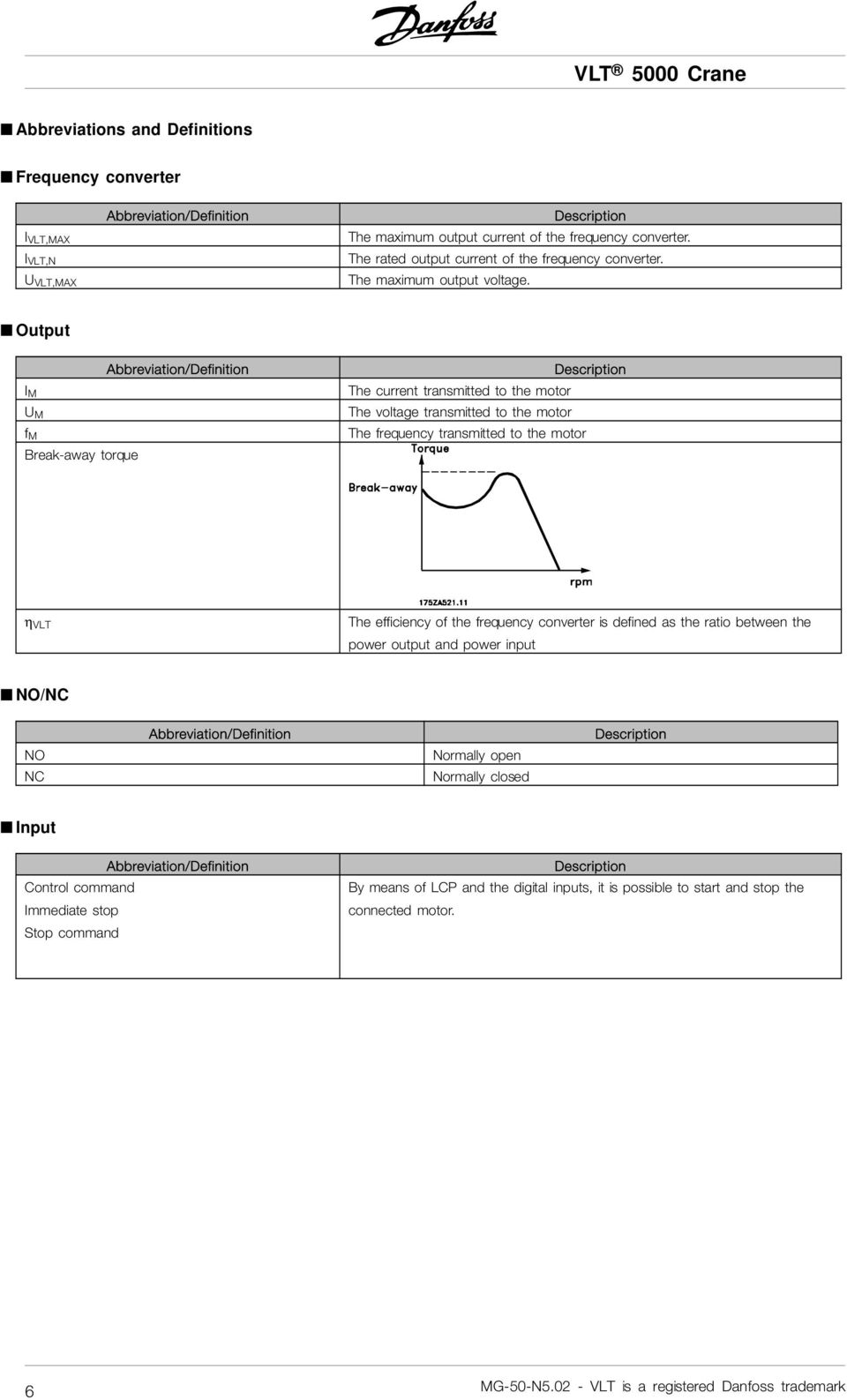
6 Abbreviations and Definitions Frequency converter I VLT,MAX I VLT,N U VLT,MAX Abbreviation/Definition Description The maximum output current of the frequency converter. The rated output current of the frequency converter. The maximum output voltage. Output Abbreviation/Definition I M U M f M Break-away torque Description The current transmitted to the motor The voltage transmitted to the motor The frequency transmitted to the motor η VLT The efficiency of the frequency converter is defined as the ratio between the power output and power input NO/NC NO NC Abbreviation/Definition Normally open Normally closed Description Input Abbreviation/Definition Control command Immediate stop Stop command Description By means of LCP and the digital inputs, it is possible to start and stop the connected motor. 6 MG-50-N VLT is a registered Danfoss trademark
7 Motor Abbreviation/Definition Description I M,N The rated motor current (nameplate data) f M,N The rated motor frequency (nameplate data) U M,N The rated motor voltage (nameplate data) P M,N The rated power delivered by the motor (nameplate data) n M,N The rated motor speed (nameplate data) T M,N The rated torque (motor) References Abbreviation/Definition Description Analogue ref. A signal transmitted to input 53, 54 or 60. Can be voltage or current Binary ref. A signal transmitted to the serial communication port Ref MAX The maximum value which the reference signal may have. Set in parameter 205 Introduction Miscellaneous Abbreviation/Definition Description ELCB Earth Leakage Circuit Breaker Trip A state which occurs in different situations, eg. if the frequency converter is subject to a live zero warning. A trip can be cancelled by pressing Reset Trip locked A state which occurs in different situations, eg. if the frequency converter is subject to an overtemperature. A locked trip can be cancelled by cutting off mains and restarting the frequency converter and pressing Reset Initializing If initializing is carried out (see parameter 620), the frequency converter returns to the factory setting LCP The Local Control Panel, which makes up a complete interface for control and programming of VLT 5000 Crane. The control panel is detachable and may, as an alternative, be installed up to 3 metres away from the frequency converter, ie. in a front panel, by means of the installation kit option Flux Vector If compared with standard voltage/frequency ratio control, Flux Vector improves the dynamics and the stability, both when the speed reference is changed and in relation to the load torque Thermistor A temperature-dependent resistor placed where the temperature is to be monitored (frequency converter or motor) Analogue inputs The analogue inputs can be used for controlling various functions of the frequency converter. There are two types of analogue inputs: Current input and voltage input Analogue outputs There are two analogue current outputs Digital inputs The digital inputs can be used for controlling various functions of the frequency converter Digital outputs There are four digital outputs, two of which activate relay switches. Brake resistor The brake resistor is a module capable of absorbing the brake power that is generated in regenerative braking. This regenerative braking power increases the intermediate circuit voltage and a brake chopper ensures that the power is transmitted to the brake resistor Incremental encoder An external, digital pulse transmitter used for feeding back information on motor speed. The encoder is used in applications where high accuracy in speed control is required AWG Means American Wire Gauge, ie. the American measuring unit for cable cross-section MG-50-N5.02-VLTisaregisteredDanfosstrademark 7

8 Miscellaneous- continued Manual initialisation SFAVM Abbreviations/Definitions Description Press the [CHANGE DATA] + [MENU] + [OK] keys at the same time to carry out manual initialisation. See also Parameter 620. Note that manual initialisation is only to be used if the reset function does not work! Switching pattern called Stator Flux oriented Asynchronous Vector Modulation On-line/off-line parameters CT characteristics MCM On-line parameters are activated immediately after the data value is changed. Off-line parameters are not activated until OK has been entered on the control unit Constant torque characteristics, used for all applications, such as conveyor belts and cranes. Stands for Mille Circular Mil, an American measuring unit for cable cross-section 1 MCM=0.5067mm 2 ETR CP Electronic thermal relay is a thermal load calculation based on present load and time. Its purpose is to estimate the motor temperature Constant power 8 MG-50-N VLT is a registered Danfoss trademark

9 Brief Product Description The VLT 5000 Crane frequency converter supplies a motor with variable voltage and frequency and thereby enables infinitely variable speed control of three-phased standard AC-motors. The VLT 5000 Crane features the Flux Vector control system. The VLT 5000 Crane uses a digital technique making it possible to program the different control inputs and signal outputs. The user can easily program the desired functions by means of the VLT 5000 Crane control panel or the user interfaces RS485 and RS232. The VLT 5000 Crane is protected against the transients occurring in the mains supply. Furthermore, a good power factor and low peak current, reducing the load on the mains installation, are ensured through intermediate circuit coils. Current measurement on all three motor phases perfectly protects VLT 5000 Crane against earthing and short-circuiting faults on the motor connenction. VLT 5000 Crane offers: Full utilisation of control range 130% torque for acceleration Fine adjustment at standstill + full load possible without activating the system brake System Description The sketch on next page shows how a tower crane works together with VLT Crane Control. The system consists of the following: Introduction Efficient monitoring of the mains supply phases ensures that the unit stops in case of phase failure. This eliminates the risk of overloading the inverter and the capacitors in the intermediate circuit and thereby prolongs the service life of the frequency converter. As standard, VLT 5000 Crane features integral thermal protection. If a situation of thermal overload occurs, this function cuts out the inverter. The VLT 5000 Crane features reliable galvanic isolation on all control terminals and integrated electronic thermal protection on the motor. Function and System Description With VLT 5000 Crane the speed is infinitely varied in the whole speed range from standstill (0 RPM) until rated speed (750 RPM for VLT , 1125 RPM for VLT 5102) according to the CT characteristic and rated power up to max. speed (3000 or 4500 RPM). There is full torque in the whole speed range. 1. VLT 5000 Crane 2. Brake resistor 3. Motor 4. Cable drum 5. Angular gear box 6. NC system brake 7. Electric 2-step-gears: Normal load and heavy load 8. Optical encoder: Motor speed information for flux vector control with closed loop 9. Load signals: VLT 5000 Crane checks on the basis of load signals that the working range is not exceeded 10. Control signal: Analogue reference as well as hoist, lowering and position operation 11. Quick stop with brake 12. Digital outputs: For combination of warning and alarm at your operation 13. Crane ready signal 14. Gear step selection signal 15. VLT ready signal 16. RS 485 bus 17. RS 232 bus 18. Local control panel Installation and mains connection of brake resistor and motor are described in Electrical installation MG-50-N5.02-VLTisaregisteredDanfosstrademark 9
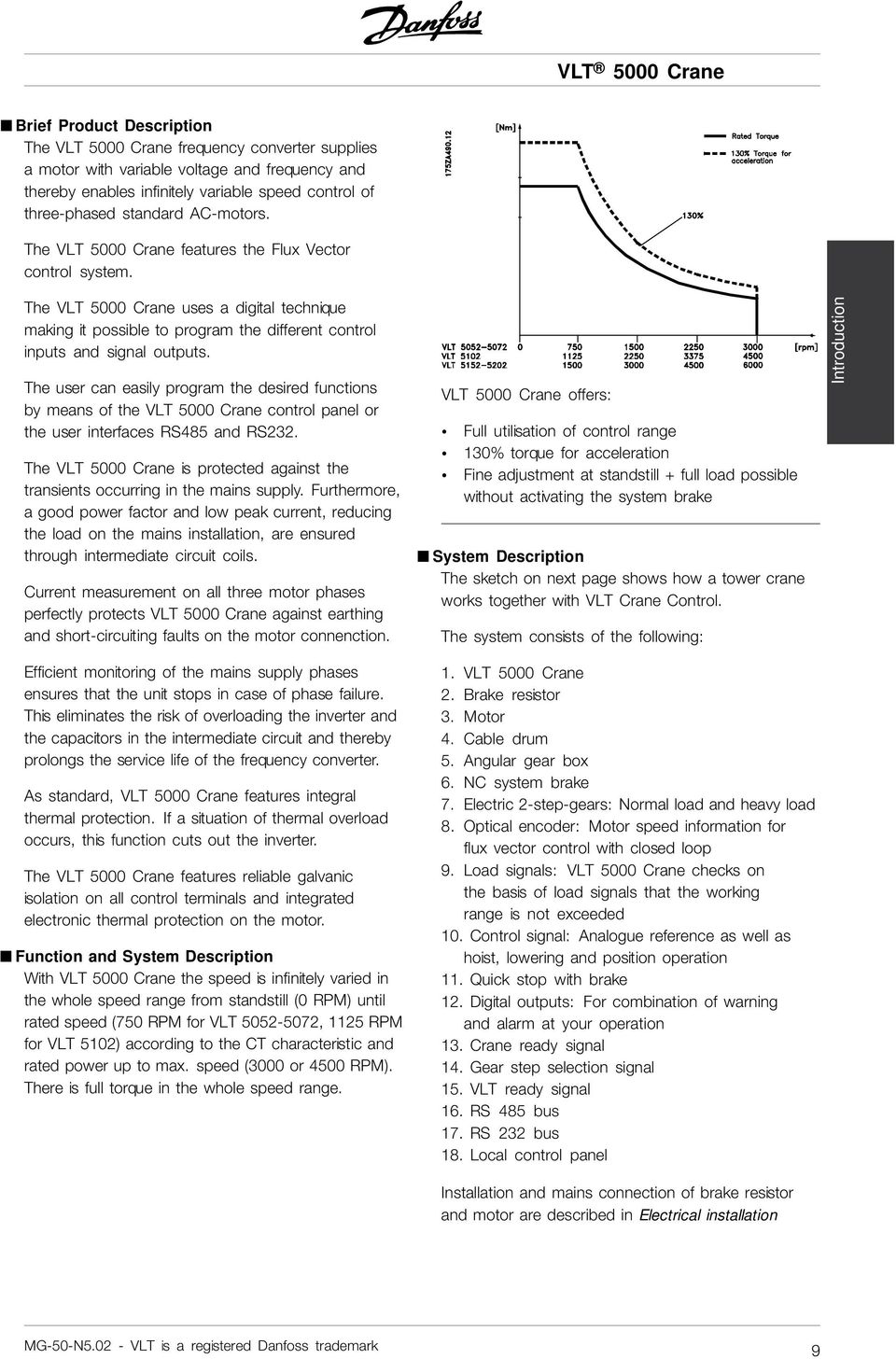
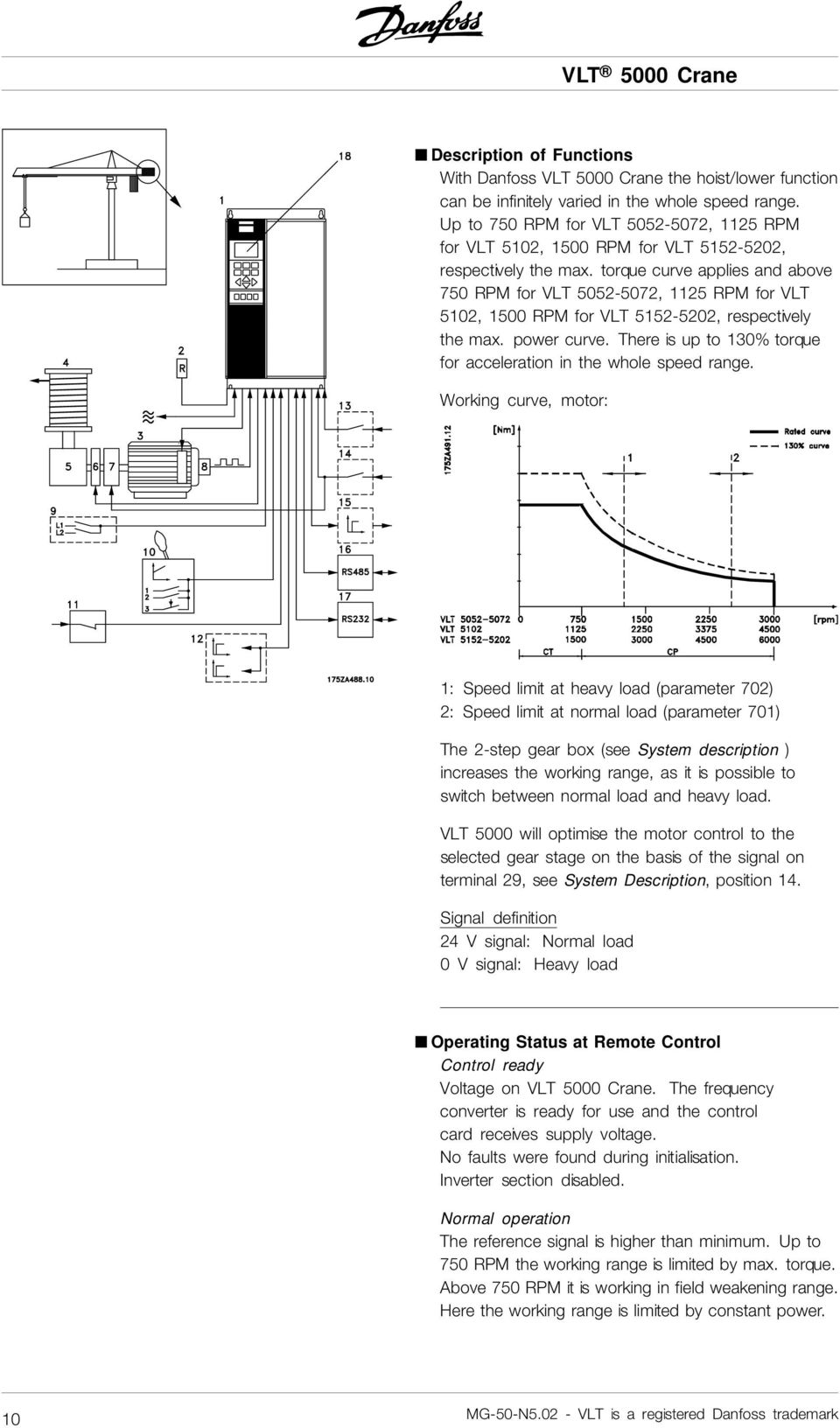
10 Description of Functions With Danfoss VLT 5000 Crane the hoist/lower function can be infinitely varied in the whole speed range. Up to 750 RPM for VLT , 1125 RPM for VLT 5102, 1500 RPM for VLT , respectively the max. torque curve applies and above 750 RPM for VLT , 1125 RPM for VLT 5102, 1500 RPM for VLT , respectively the max. power curve. There is up to 130% torque for acceleration in the whole speed range. Working curve, motor: 1: Speed limit at heavy load (parameter 702) 2: Speed limit at normal load (parameter 701) The 2-step gear box (see System description ) increases the working range, as it is possible to switch between normal load and heavy load. VLT 5000 will optimise the motor control to the selected gear stage on the basis of the signal on terminal 29, see System Description, position 14. Signal definition 24 V signal: Normal load 0 V signal: Heavy load Operating Status at Remote Control Control ready Voltage on VLT 5000 Crane. The frequency converter is ready for use and the control card receives supply voltage. No faults were found during initialisation. Inverter section disabled. Normal operation The reference signal is higher than minimum. Up to 750 RPM the working range is limited by max. torque. Above 750 RPM it is working in field weakening range. Here the working range is limited by constant power. 10 MG-50-N VLT is a registered Danfoss trademark
11 VLT 5000 Crane controls the mechanical brake of the crane. It holds the load when speed is below the set minimum value. VLT 5000 Crane monitors that the system brake holds and releases the load as required. In case of faults, Brake fault 2 is displayed. Load determination and speed measuring will ensure that the working range is not exceeded. For each load contact the max. allowed motor speed is set (parameters 701 and 702). VLT 5000 Crane cuts off automatically when motor speed for the activated load contact exceeds the value recorded Positioning The reference signal is higher than minimum. The condition for VLT ready is fulfilled. 24V is applied to terminal 17 (parameter 301). During positioning the speed is limited to 750 RPM for VLT , 1125 RPM for VLT 5102, 1500 RPM for VLT , respectively, and system brake is not activated at 0 RPM. Quick stop with brake If control signal to terminal 27(parameter 304) is removed, the motor ramps down according to the alternative ramp (parameter 212) and the brake is activated momentarily. VLT 5000 Crane monitors in the state normal operation, that the system brake releases the load as required. If that is not the case Brake fault 2 applies. The unit will cut in the system brake again. This means that the system brake signal is deactivated. This ensures that the load is held. Then the inverter section is disabled. Brake fault 2 may also occur during commissioning if the encoder connection is not correct. At reference 0 the unit goes back to the state VLT ready. Function fault VLT 5000 Crane monitors several functions. Should severe faults occur, the unit will trip automatically. For fault types, see Trouble-shooting To reset the fault switch off/switch on the mains supply and press the stop/reset button. System Components Motor Select the motor type for the rated output in question in parameters , Incremental Encoder The encoder must meet the following requirements: Pulses pr. revolution, see parameter 329 Outputs: A (0º), inv. A, B (90º), inv. B, Z, inv. Z Supply: +5 V ±5% Max. current (5V supply): 200mA Introduction Operating Status at Local Operation It is only possible to change to local operation from Control Ready. Besides, parameter 003 must be set for Local and parameter 010 for Enable. VLT 5000 Crane can be operated over the control panel or over parameters This state acts as Normal operating state, however there are no load functions and monitoring of system brake. This means that the whole working range from RPM can be used and the crane system brake is controlled at approx. 0 RPM. Note that outputs must be compatible with RS 422! Brake resistor SeedataforcalculationinControl with brake function. Fault Status at Remote and Local Control Brake fault 1 VLT 5000 Crane monitors in the state VLT ready that the system brake holds the load as required. If that is not the case, Brake fault 1 applies and the load is slowly lowered according to the speed set in parameter 704. Brake fault 2 MG-50-N5.02-VLTisaregisteredDanfosstrademark 11

12 Control Principle A frequency converter rectifies AC voltage from mains into DC voltage. This DC voltage is then converted into a AC voltage with a variable amplitude and frequency. The motor is thus supplied with variable voltage and frequency, which enables infinitely variable speed control of three-phased, standard AC motors. 1. Mains voltage 3 x V AC, 50 / 60 Hz. 2. Rectifier A three-phase rectifier bridge that rectifies AC voltage into DC voltage. 3. Intermediate circuit 5. Intermediate circuit capacitors Smooth the intermediate circuit voltage. 6. Inverter Converts DC voltage into variable AC voltage with a variable frequency. 7. Motor voltage Variable AC voltage, 0-100% of mains supply voltage. Variable frequency: Hz. 4. Intermediate circuit coils Smooth the intermediate circuitcurrent and limit the load on mains and components (mains transformer, wires, fuses and contactors). 8. Control circuit On basis of parameters, reference settings and input signals, pulse patterns are generated for forming thevariablemotorvoltageandfrequency. Flux Vector Control Principle The aim of developing the Flux Vector control principle has been to obtain a robust motor control that is tolerant to different motor characteristics without motor derating being required. The current is split into magnetising and torque-generating parts and provides for much better and quicker estimation of the actual motor loads. It is now possible to compensate for rapid load changes. Full torque as well as extremely accurate speed control can now be obtained even at low speeds or even at standstill. - Torque control, comprising control of both the torque-generating and the magnetising component of the current - Full holding torque Programmable signal outputs VLT 5000 Crane uses a digital technique which makes it possible to program the signal outputs. For the user, it is easy to program the desired functions by means of the control panel on VLT 5000 Crane or the RS 485/RS 232 user interfaces. Good torque control properties and smooth transitions to and from current limit operation are ensured. Advantages of the Flux Vector control system: - Accurate speed control down to 0 speed - Quick response from received signal to full motor shaft torque - Good compensation for step loads - Controlled transition from normal operation to current limit operation (and vice versa) 12 MG-50-N VLT is a registered Danfoss trademark

13 Protection against mains interference VLT 5000 Crane is protected against the transients that occur in the mains supply, eg. when switching powerfactorcorrectionorwhenfusesblow. The rated motor voltage and full torque can be maintained all the way down to 10% undervoltage in the mains supply. Minor interference on mains Since as standard the VLT 5000 Crane features intermediate circuit coils, there is only a small amount of harmonic mains supply interference. This ensures a good power factor and lower peak current, which reduces the load on the mains installation. Advanced VLT protection Current measurement on all three motor phases provides perfect protection of VLT 5000 Crane against earthing and short-circuiting faults on the motor connection. Advanced motor protection VLT 5000 Crane features integrated electronic, thermal motor protection. The frequency converter calculates the motor temperature on the basis of current, frequency and time. As opposed to the traditional bimetallic protection, electronic protection takes account of the reduction in cooling at low frequencies that comes from reduced fan speed (motors with internal ventilation). To obtain maximum protection against overheating of the motor if the motor is covered or blocked, or if the fan fails, a thermistor can be integrated and connected to the thermistor input of the frequency converter (terminals 53), see parameters 128 and 308. Introduction Efficient monitoring of the three mains supply phases ensures that the unit stops in the case of phase failure. This avoids overloading the inverter and the capacitors in the intermediate circuit, which would dramatically reduce the service life of the frequency converter. As standard, VLT 5000 Crane features integral thermal protection. If a situation of thermal overload occurs, this function cuts out the inverter. Encoder supervisory circuit The signals from the incremental encoder and hence the cabling are continuously supervised. The encoder signals are made up of three channels, each of which are supervised, and status is given on LEDs placed near the encoder terminals for each channel as well as for the supply voltage for the encoder. Green LED turned on means channel or voltage OK. Reliable galvanic isolation In the VLT 5000 Crane all of the control circuits are separated from mains potential through isolation meeting the PELV requirements. One set of relay contacts, terminals 01-03, is separated from the remaining control circuits through isolation also complying with PELV. Furthermore, the control circuits are placed in blocks individually separated through functional isolation (< 100 V), see General Technical Data. MG-50-N5.02-VLTisaregisteredDanfosstrademark 13
14 Key Diagram for VLT 5000 Crane V 14 MG-50-N VLT is a registered Danfoss trademark

15 Key Diagram for VLT 5000 Crane V Introduction MG-50-N5.02-VLTisaregisteredDanfosstrademark 15

16 General Technical Data Mains Supply (L1, L2, L3) Supply voltage V units 3 x 400/415/440/460/500 V ± 10% Supply frequency 50/60 Hz ± 1% Max. imbalance of supply voltage VLT / V VLT / V of rated supply voltage 1.5% 3% Power factor/cos ϕ /1 at rated load No. of switches on supply input L1, L2, L3 Appr. 1 time/minute Max. short-circuit rating A VLT Data Output (U, V, W) Output voltage Output frequency Rated motor voltage V units Rated motor frequency Ramp times 0-100% of supply voltage Hz 315 V 25/37 Hz Seconds Torque Characteristics Starting torque, VLT , V 160% for 1 minute Acceleration torque, VLT , V 160% for 1 minute Overload torque, VLT , V 160% for 1 minute Holding torque at 0 rpm (closed loop), VLT , V 160% for 1 minute Digital Inputs Number of digital inputs 9 Voltage level 0-24 V DC (PNP positive logics) Voltage level, logical 0 <5 V DC Voltage level, logical 1 >10 V DC Max. voltage on input 28 V DC Input resistance, R i (terminal 29) Appr. 4 K /2 K (2 K ) Scanning time per input 3 msec NOTE: All digital inputs are galvanic isolated from the mains voltage (PELV). In addition, the digital inputs can be isolated from the other terminals on the control card by connecting an external 24 V DC supply and opening switch 4, see Electrical installation. Analogue Inputs Number of programmable analogue voltage inputs/thermistor inputs 1 Voltage level 0- ± 10 V DC (Scalable) Input resistance, R i Appr. 10 K Number of programmable analogue current inputs 2 Current range 0/4-20 ma (Scalable) Input resistance, R i 200 Resolution 10 + sign bit Accuracy on input Max. error: 1% of full scale Scanning time per input 3 msec NOTE: Analogue inputs are galvanic isolated from the mains voltage (PELV) and functionally isolated from all other inputs 16 MG-50-N VLT is a registered Danfoss trademark

17 Incremental/Encoder Input Number of encoder input terminals 6 Max. frequency 205 khz Voltage level 0-5 V (RS422) Voltage level, logical 0 < 0.5 V Voltage level, logical 1 > 2.5 V Max. voltage on input 7 V DC Input resistance, R i Appr. 120 Supply voltage 5 V +/- 5% Supply current 200 ma NOTE: Encoder input terminals are galvanic isolated from the supply voltage (PELV) and functionally isolated from all other inputs and outputs. Digital/Pulse and Analogue Outputs Number of programmable digital outputs 2 Number of programmable analogue outputs 2 Voltage level at digital/pulse output 0-24 V DC Min. load to ground (terminal 39) at digital/pulse output 600 Frequency ranges (digital output used as pulse output) 0-50 khz Resolution <5kHz <50 khz 0.1% 1% Current ranges at analogue output 0/4-20 ma Max. load to ground (terminal 39) at analogue output 500 Accuracy of analogue output Max error: 1.5% of full scale Resolution on analogue output 8 bit NOTE: All digital and analogue outputs are galvcanic isolated from the supply voltage (PELV) and functionally isolated from all other inputs NB: Digital and analogue outputs have one common ground terminal (39) Technical Data 24 V DC Output Max. load (short-circuit protection) 200 ma Terminal numbers, ground (with switch 4 closed) 39 (20) NOTE: The 24 V DC supply is galvanic isolated from the supply voltage (PELV), but has the same potential as analogue and digital outputs RS 485 Serial Communication Terminal numbers NOTE: The signal input is galvanic isolated from the mains voltage (PELV) but not from RS (TX+, RX+), 69 (TX-,RX-) RS 232 Serial Communication (Peer to Peer) Connection RJ 11 NOTE: The signal input is galvanic isolated from mains supply (PELV) but not from RS 485 MG-50-N5.02-VLTisaregisteredDanfosstrademark 17

18 Relay Outputs Number of programmable relay outputs 2 Terminal numbers, control cards 4-5 NO Max. terminal load (AC) on 4-5 control card 50 V AC, 1A, 60 VA Max. terminal load (DC) on 4-5, control card 75 V DC, 1A, 30W Max. terminal load (DC) on 4-5, control card UL applications cul applications 30 V AC, 1A 1A, 42.5 V DC Terminal numbers, power card 1-3 NC, 1-2 NO Max. terminal load (AC) on 1-3, 1-2, power card 240 V AC, 2A, 60 VA Max. terminal load on 1-3, 1-2, power card 50 V DC, 2 A Min. terminal load on 1-3, 1-2, power card 24 V AC/24 V DC, 10/100mA Brake Resistor Terminal Terminal numbers 81, 82 Cable Lenghts and Cross-Sections Max. motor cable length, screened cable Max. brake cable length, screened cable Max. cable cross-section for control cables Max. cross-section for serial communication NOTE: Max. cable cross-section for motor and brake, see Installation 25m 5m 0.75mm 2 /AWG 0.75mm 2 /AWG Accuracy of Display Readout (Parameters ) Motor Current [6] 0-140% load Torque % [7] % load Output [8], power HP [9] 0-90% load Max error: 2% of rated output current Max error: 5% of rated motor size Max error: 5% of rated output Control Caracteristics Frequency range Resolution on output frequency System response time* Speed, control range Speed, accuracy <1500 rpm >1500 rpm Torque control accuracy (Speed feedback) NOTE: All control caracteristics are based on 4-pole asynchronous motors Hz ± Hz < 5 msec 1:1000 of synchro speed Max error: ± 1.5rpm 0.1% of actual speed Max error: ± 5% of rated torque *The system response time is the time passing from the input receives a signal to a reaction occurs on the VLT output. 18 MG-50-N VLT is a registered Danfoss trademark
19 Externals Enclosure Type IP20/IP 00 Vibration Test: 0.7 g RMS Hz random, 3 directions for 2 hrs (IEC /35/36) Max. relative humidity for storage/transport 93% (IEC ) Max. relative humidity non-condensing for operation 95% (IEC ; Class 3K3) Ambient temperature 55 C Ambient temperature, 24-hour average Max 50 C Min. ambient temperature in full operation 0 C Min. ambient temperature at reduced performance -10 C Temperature during storage/transport /70 C Max. altitude above sea level, without derating* 1000m NOTE: EMC standards used: Emission: EN /2, EN , EN55011, Immunity: EN , EN ,, EN ,ENV50204, EN , EN , EN , VDE0160/ Derating for high ambient temperature, see Special Conditions in Appendix *For more information on derating, see Special Conditions in Appendix. VLT 5000 Crane Protection Electronic motor thermal protection against overload Electronic thermal protection against overload Temperature monitoring of heat-sink ensures that the frequency converter cuts out if the temperature reaches 90 C. An overtemperature fault can only be reset when the temperature of the heat-sink has fallen below 60 C The frequency converter is protected against short-circuiting on motor terminals U, V, W The frequency converter is protected against earth fault on motor terminals U, V, W Monitoring of the intermediate circuit voltage ensures that the frequency converter cuts out if the intermediate circuit voltage gets too high or too low If a motor phase is missing, the frequency converter cuts out, see parameter 234 Motor Phase Monitor If a mains phase is missing, the frequency converter will cut out when a load is applied to the motor Technical Data MG-50-N5.02-VLTisaregisteredDanfosstrademark 19

20 Mains Supply V According to international requirements VLT type Output current I VLT,N (S3 60%) [A] ( V) I VLT, MAX (60 s) [A] ( V) Output S VLT,N (S3 60%) [kva] 39.2 ( V) Typical shaft output P VLT,N [kw] Typical shaft output P VLT,N [HP] Max. cable cross-section to motor and brake [mm 2 ]/[AWG] 2)3) IP20 50/0 50/0 Rated input current I L,N (S3 60%) [A] (400 V) Max. cable cross-section power[mm 2 ]/[AWG] 2)3) 35/2 50/0 50/0 Max. pre-fuses [-]/UL 1) [A] 100/ / /50 Efficiency , Weight IP 20 SB [kg] Power loss at max. load Enclosure IP20 IP20 IP20 1. For type of fuse see section Fuses. 2. American wire gauge. 3. Connection stud 1 x M8/2 x M8. 20 MG-50-N VLT is a registered Danfoss trademark
![cable cross-section to motor and brake [mm 2 ]/[AWG] 2)3) IP20 50/0 50/0 Rated input current I L,N (S3 60%) [A] (400 V) 51 62 76 Max. cable cross-section power[mm 2 ]/[AWG] 2)3) 35/2 50/0 50/0 Max.](/docs-images/41/16321668/images/page_20.jpg "pre-fuses [-]/UL 1) [A] 100/100 125/125 150/50 Efficiency 0.96 0,96 0.96 Weight IP 20 SB [kg] 41 42 43 Power loss at max. load. 1004 1210 1500 Enclosure IP20 IP20 IP20 1.")
21 Mains supply 3 x V According to international requirements VLT type Output current I VLT,N [A] (S3 60%) ( V) I VLT, MAX (60 s) [A] ( V) Output S VLT,N (S3 60%) [kva] ( V) Typical shaft output P VLT,N [kw] Typical shaft output P VLT,N [HP] Max. cable cross-section to motor ( V) [mm 2 ] 3) x70 2x185 Max. cable cross-section to brake ( V) [mm 2 ] 4) x35 2x70 Max. cable cross-section to motor ( V) AWG] 2) 3) 3/0 4/0 2x2/0 2x350 MCM Max. cable cross-section to brake ( V) AWG] 2) 4) 3/0 4/0 2x3 2x2/0 Technical Data Max input current I L,MAX (S3 60%) [A] (400 V) Max. cable cross-section to power ( V) [mm 2 ] 3) x70 2x185 Max. cable cross-section to power ( V) [AWG] 2) 3) 3/0 4/0 2x2/0 Efficiency x350 MCM Weight IP 20 EB/IP 00 [kg] Power loss at max. load [W] Enclosure IP20 IP20 IP00 IP00 1. For type of fuse see section Fuses. 2. American wire gauge. 3. Connection Dual M10 screws. 4. Connection Dual M8 screws MG-50-N5.02-VLTisaregisteredDanfosstrademark 21
22 Fuses UL compliance V Bussmann SIBA Littel fuse Ferraz-Shawmut 5042 KTS-R KLS-R100 A6K-100R 5052 KTS-R KLS-R125 A6K-125R 5062 KTS-R KLS-R150 A6K-150R 5072 FWH L50S-225 A50-P FWH L50S-250 A50-P * FWH L50S-300 A50-P * FWH L50S-350 A50-P * FWH xx L50S-400 A50-P400 * Circuit Breakers manufactured by General Electric, Cat. No. SKHA36AT0800, with rating plugs listed below can be used to meet UL-requirements: 5122 rating plug No. SRPK800 A rating plug No. SRPK800 A rating plug No. SRPK800 A 400 KTS-fuses from Bussmann may substitute KTN for 240 V drives. FWH-fuses from Bussmann may substitute FWX for 240 V drives. KLSR fuses from LITTEL FUSE may substitute KLNR fuses for 240 V drives. L50S fuses from LITTEL FUSE may substitute L50S fuses for 240 V drives. A6KR fuses from FERRAZ SHAWMUT may substitute A2KR for 240 V drives. A50X fuses from FERRAZ SHAWMUT may substitute A25X for 240 V drives. NonULcompliance If UL/cUL is not to be complied with, we recommend the above mentioned fuses or: VLT V type gg VLT V type gg VLT V type gr VLT V type gr Not following the recommendation may result in unnecessary damage of the drive in case of malfunction. Fuses must be designed for protection in a circuit capable of supplying a maximum of A rms (symmetrical), 500/600 V maximum. 22 MG-50-N VLT is a registered Danfoss trademark
23 Mechanical Dimensions Compact IP 00 and IP 20 IP 00 enclosure V VLT type A (mm) B (mm) C (mm) a (mm) b (mm) ab/be (mm) l/r (mm) IP 20 enclosure V VLT type A (mm) B (mm) C (mm) a (mm) b (mm) ab/be (mm) l/r (mm) ab: Min. space above enclosure. be: Min. space below enclosure. l/r: Min. distance between frequency converter and other plant components, left and right sides. Technical Data VLT / V VLT / V MG-50-N5.02-VLTisaregisteredDanfosstrademark 23
24 General Warning before Installation Before starting the installation, please be aware of heavy weight and sharp edges. Furthermore, make sure that no mains are connected the unit from overheating, it must be ensured that the ambient temperature does not rise above the max. temperature stated for the frequency converter and that the 24-hour average temperature is not exceeded. The max. temperature and 24-hour average can be seen from the General Technical Data. Mechanical Installation The frequency converter must be installed vertically. The frequency converter is cooled by means of air circulation. For the unit to be able to release its cooling air, the minimum distance over and below the unit must be as shown in the illustration below. To protect Enclosure Protection Compact VLT V IP 20 VLT V IP 00 Installation of VLT V Compact IP20/IP00 Cooling Side-by-side Compact IP 00/IP20 All units in the above-mentioned series can be installed side by side without any space between them, since these units do not require cooling on the sides. All Compact units in the above-mentioned series require a minimum space of 200 mm above and below the enclosure and must be installed on a plane, vertical surface (no spacers). 24 MG-50-N VLT is a registered Danfoss trademark
25 Installation of VLT V Compact IP20/IP00 Cooling Side-by-side Compact IP 00/IP20 All Compact units in the above-mentioned series require a minimum space of 225 mm above and below the enclosure and must be installed on a plane, vertical surface (no spacers). All units in the above-mentioned series can be installed side by side without any space between them. Ventilation when Panelmounted The quantity of air needed to cool VLT 5000 Crane can be calculated as follows: 1. Add up the values of P for all VLT 5000 Crane to be installed at the same panel ( P )[W] 2. Determine the air inlet temperature (t IN )andthe air outlet temperature (t OUT )[ºCorK] 3. Calculate the necessary air quantity in m 3 /h: Installation Insert t OUT -t IN in Kelvin The output from the fan must be located above the highest mounted frequency converter Remember to take pressure drops over filters into account and that the pressure decreases as the filters are choked The max. cooling air temperature (t IN )must be lower than 55ºC. The average of day/night temperature may be 5ºC lower than that stated in VDE 160. The cooling outlet temperature (t OUT ) may not exceed 60ºC MG-50-N5.02-VLTisaregisteredDanfosstrademark 25
26 Electrical Installation The voltage on the frequency converter is dangerous when the unit is connected to mains. Incorrect installation of the motor or frequency converter may lead to material damage or serious injury or it may be fatal. Consequently, the instructions in this manual as well as national and local rules and safety regulations must be complied with. Touching the electrical parts may be fatal, even after the mains supply has been disconnected. Wait at least 15 minutes if using VLT NB!: It is the user s or certified electrician s responsibility to ensure correct earthing and protection in accordance with applicable national and local norms and standards. All terminals for the control cables are located under the protective cover of the frequency converter. The protective cover (see drawing) can be removed by means of a pointed object - a screwdriver or similar. Once the protective cover has been removed, the actual EMC-correct installation can start. 26 Wiring diagram VLT 5000 Crane A: Encoder B: Brake resistor 12: +24 V 16 Crane ready (NO) 17: Positioning (NO) 18: Lower (NO) 19: Hoist (NO) 20: Ground for digital inputs 26: Digital output 27: Quick stop (NC) 29: Gear ratio select (NO) 32: Load low (NO) MG-50-N VLT is a registered Danfoss trademark
27 33: Load high (NO) 37: Hardware coast (NC) 39: Ground for analogue/digital outputs 42: Analogue output warning/alarm 45: Analogue output warning/alarm 46: Digital output 50: 10 V supply 53: Reference voltage 55: Common for anal. ref. 60: Reference current 68, 69: RS , 02: System brake signal 04, 05: Ready signal 73: Pulse signal A from encoder (0 ) 74: Inverted pulse signal from encoder (0 ) 75: Pulse signal B from encoder (90 ) 76: Inverted pulse signal B from encoder (90 ) 77: Zero pulse signal from encoder 78: Inverted zero pulse signal from encoder 49: 5 V supply to encoder 47: Common for encoder supply Compact 5152 without disconnect and fuse VLT V Electrical Installation, Power Cables Installation Compact IP 20 VLT Type Compact IP 00 without disconnect and fuse VLT V Connection of Mains Connect the three mains phases to terminals L 1,L 2,L 3. Compact IP 20/IP 00 VLT Types Connection of Motor All types of 3-phased asynchronous standard motors can be used with the VLT 5000 Crane. MG-50-N5.02-VLTisaregisteredDanfosstrademark 27
28 Installation of Control Cables Tightening-up torque: Nm Screw size: M2 Screw driver type: 0.4 x 2.5 x 80 mm See Earthing of Braided Screened/Armoured Control Cables for correct earthing. Normally, small motors are star-connected. Large motors are delta-connected. Notethevoltagevalueatthetypeplate. Installation of Motor Cables NB!: If an unscreened cable is used, some EMC requirements are not complied with, see Special conditions in Appendix. If the EMC specifications regarding emission are to be complied with, the motor cable must be screened, unless otherwise stated for the RFI filter in question. It is important to keep the motor cable as short as possible to reduce the noise level and leakage currents to a minimum. The motor cable screen must be connected to the metal cabinet of the frequency converter and to the metal housing of the motor. The screen connections are to be made with the biggest possible surface (cable clamp). This is enabled by different installation devices in the different frequency converters. LEDs on encoder board: When all LEDs are on the connection to encoder and encoder condition are OK. LED 403 OFF: 5 V supply missing LED 400 OFF: Channel A or inv. A missing or shortcircuited LED 401 OFF: Channel B or inv. B missing or shortcircuited LED 402 OFF: Channel Z or inv. Z missing or shortcircuited. Connection of shield: Mounting with twisted screen ends (pigtails) is to be avoided, since these spoil the screening effect at higher frequencies. If it is necessary to break the screen to install a motor isolator or motor contactor, the screen must be continued at the lowest possible HF impedance. The frequency converter has been tested with a given length of cable and a given cross-section of that cable. If the cross-section is increased, the cable capacitance - and thus the leakage current - increases, and the cable length must be reduced correspondingly. 28 MG-50-N VLT is a registered Danfoss trademark
29 No. Function 12, 13 Voltage supply to digital inputs. For the 24 V DC to be usable for the digital inputs, switch 4 on the control card must be closed position "ON". Max. current 350 ma Digital inputs 37 Digital inputs. Hardware coast 20 Ground for digital inputs 39 Ground for analogue/digital outputs 26, 46 Digital outputs for output functions (messages) 42, 45 Analogue outputs for indicating frequency, reference, current and torque 47, 49 Supply 5 V, 200 ma for incremental encoder 50 Supply voltage to potentiometer and thermistor 10 V DC. Max. current 12 ma 53 Analogue reference input, voltage 0-±10V 55 Ground for analogue reference inputs 58, 60 Analogue reference input, current 0/4-20 ma 68, 69 RS 485 interface, serial communication. 73, 78 Encoder input NB!: Please note that voltages up to 850 V DC occur on the terminals. Installation of Relay Terminals Tightening-up torque: Nm Screw size: M3/M2 No. Function 1-3 Relay output, 1+3 NC, 1+2 NO See parameter 323. See also General technical data. 4, 5 Relay output, 4+5 NO See parameter 326. See also General technical data. Installation of Brake Resistor Temperature Switch Torque: Nm Screw size: M3 No. 106, 104, 105 Function Brake resistor temperature switch. NB!: This function is only available on VLT V. If the temperature of the brake resistor gets too high and the terminal switch drops out, the frequency converter will stop braking. The motor will start coasting. A terminal switch must be installed that can either be normally closed or normally open. If this function is not used, 106 and 104 must be short-circuited together. Installation Brake Connection No Brake resistor R- R+ terminals The connection cable to the brake resistor must be screened/armoured. Connect the screen to the metal cabinet of the frequency converter and to the metal cabinet of the brake resistor by means of cable clamps. Dimension the cross-section of the brake cable to match the brake torque. EMC-Correct Electrical Installation General points to be observed to ensure EMC-correct electrical installation. - Use only screened/armoured motor cables and screened/armoured control cables. - Connect the screen to earth at both ends. MG-50-N5.02-VLTisaregisteredDanfosstrademark 29
30 - Avoid installation with twisted screen ends (pigtails), since this ruins the screening effect at high frequencies. Use cable clamps instead. - It is important to ensure good electrical contact from the installation plate through the installation screws to the metal cabinet of the frequency converter. - Use toothed discs and galvanic conductive installation plates. - Do not use unscreened/unarmoured motor cables in the installation cabinets. Tightening-up Torques and Screw Sizes The table shows the torque required when fitting terminals to the frequency converter. For VLT V, the cables must be fastened with screws. For VLT V, the cables must be fastened with bolts. These figures apply to the following terminals: Mains terminals Nos 91, 92, 93 L1, L2, L3 Motor terminals Nos 96, 97, 98 U, V, W Earth terminal No 94, 95, 99 Brake resistor terminals 81, 82 Loadsharing 88, V 5042 IP20 3 M5 4 mm Allen wrench ) IP54 3 M5 4 mm Allen wrench M6 5 mm Allen wrench IP20 15 M6 6 mm Allen wrench IP54 2) 24 M8 8 mm Allen wrench ) 19 M10 bolt 1) Brake terminals: 3,0 Nm, Nut: M6 2) Brake and loadsharing: 14 Nm, M6 Allen screw 3) IP54 with RFI - Line terminals 6Nm, Screw: M6-5 mm Allen wrench 4) Loadshare and brake terminals: 9,5 Nm; Bolt M8 5) Brake terminals: 11,3 Nm; Bolt M8 High Voltage Test A high voltage test can be carried out by shortcircuiting terminals U, V, W, L 1,L 2 and L 3 and energizing by max kv DC for one second between this short-circuit and the chassis. NB!: The RFI switch must be closed (position ON) when high voltage tests are carried out. Motor Thermal Protection The electronic thermal protection function in UL-approved frequency converters has received the UL-approval for single motor protection when parameter 128 has been set for ETR Trip and parameter 105 has been programmed to the rated motor current (see motor nameplate). Extra Protection (RCD) ELCB (Earth Leakage Circuit Breaker) relays, multiple protective earthing or earthing can be used as extra protection, provided that local safety regulations are complied with. In case of an earth fault, a DC content may develop in the faulty current. If ELCB relays are used: - Local regulations must be complied with - Suitable for protecting equipment with a DC content in the faulty current (3-phase bridge rectifier) - Suitable for a pulse-shaped, brief discharge on power-up - Suitable for a high leakage current. NB!: Never use an RCD (ELCB relay), type A, as it is not suitable for DC faulty currents. Switches 1-4: The dipswitch is located on the control card. It is used for serial communication, terminals 68 and 69. The switching position shown is the factory setting. 30 MG-50-N VLT is a registered Danfoss trademark
31 Switch 1 has no function. Switches 2 and 3 are used for terminating an RS 485 interface, serial communication. Switch 4 is used for separating the common potential for the internal 24 V DC supply from the common potential of the external 24 V DC supply. Electrical Installation, Enclosures NB!: Please note that when Switch 4 is in position "OFF", the external 24 V DC supply is galvanic isolated from the frequency converter. Compact IP 20 VLT , V Installation Compact IP 20 VLT , V MG-50-N5.02-VLTisaregisteredDanfosstrademark 31
32 Compact IP 20 VLT , V Compact IP 00 without disconnect and fuse VLT V Compact 5152 without disconnect and fuse VLT V 32 MG-50-N VLT is a registered Danfoss trademark
33 RFI switch Mains supply isolated from earth: If the frequency converter is supplied from an isolated mains source ( IT mains), the RFI switch can be turned off (OFF). In OFF position, the internal RFI capacities (filter capacitors) between the chassis and the intermediate circuit are cut off to avoid damage to the intermediate circuit and to reduce the earth capacity currents (according to IEC ). Position of RFI switches NB!: The RFI switch is not to be operated with mains connected to the unit. Check that the mains supply has been disconnected before operating the RFI switch. NB!: Open RFI switch is only allowed at factory set switching frequencies. NB!: The RFI switch disconnects the capacitors galvanically to ground. The red switches are operated by means of e.g. a screwdriver. They are set in the OFF position when they are pulled out and in ON position when they are pushed in (see drawing below). Factory setting is ON. Compact IP 20/NEMA 1 VLT V Installation Mains supply connected to earth: The RFI switch must be in ON position in order for the frequency converter to comply with the EMC-standard. MG-50-N5.02-VLTisaregisteredDanfosstrademark 33
34 Use of EMC compliant cables In order to comply with requirements for EMC immunity of the control cables and EMC emissions from the motor cables screened/armoured cables must be used. The ability of a cable to reduce the amount of ingoing and outgoing radiation of electric noise depends on the transfer impedance (Z T ). The screen of a cable is normally designed to reduce the transfer of electric noise, and a screen with a lower Z T is more effective than a screen with a higher Z T. Z T is rarely stated by cable manufacturers, but it is often possible to estimate Z T by looking at and assessing the physical design of the cable. Z T can be assessed on the basis of the following factors: - the contact resistance between the individual screen conductors. - Screen coverage, i.e. the physical area of the cable covered by the screen. Is often stated as a percentage and should be no less than 85%. - The screen type, i.e. braided or twisted pattern. A braided pattern or closed pipe is recommended. 34 MG-50-N VLT is a registered Danfoss trademark
35 Earthing of Braided Screened/armoured Control Cables Generally speaking, control cables must be braided screened/armoured and the screen must be connected by means of a cable clamp at both ends to the metal cabinet of the unit. The drawing below indicates how correct earthing is carried out and what to be done if in doubt. 1. Correct earthing Control cables and cables for serial communication must be fitted with cable clamps at both ends to ensure the best possible electrical contact. 2. Wrong earthing Do not use twisted cable ends (pigtails), since these increase the screen impedance at high frequencies. 3. Protection with respect to earth potential between PLC and frequency converter If the earth potential between the frequency converter and the PLC (etc.) is different, electric noise may occur that will disturb the whole system. This problem can be solved by fitting an equalising cable, to be placed next to the control cable. Minimum cable cross-section: 16 mm 2 4. For 50/60 Hz earth loops If very long control cables are used, 50/60 Hz earth loops may occur. This problem can be solved by connecting one end of the screen to earth via a 100nF capacitor (keeping leads short). 5. Cables for serial communication It is recommended to use twisted-pair cables to reduce the differential mode interference between the conductors. Installation Safety Earthing NB!: The frequency converter has a leakage current and must be earthed appropriately for safety reasons. Use earth terminal, which enables reinforced earthing. Apply national safety regulations. MG-50-N5.02-VLTisaregisteredDanfosstrademark 35
36 Control Panel entering the correct password in parameter 650 and if in parameter 018 Not Locked [0] is selected. The VLT 5000 Crane can be combined with an LCP control unit (Local Control Panel) which makes up a complete interface for operation and programming of the frequency converter. The LCP control panel can be installed up to 3 metres away from the frequency converter, eg. on a front panel, by means of the additional mounting kit. The control panel is divided into five functional groups: 1. Display. 2. Keys used to change the display function. 3. Keys used to change the programme parameters. 4. Indicator lamps. 5. Local control keys. All data is displayed via a 4-line alphanumeric display, which during normal operation will be able to continuously display 4 items of operating data and 3 operating modes. During programming all information needed for quick, effective parameter setup of the frequency converter will be displayed. As a supplement to the display there are three indicator lamps for voltage indication (ON), warning (WARNING) and alarm (ALARM) respectively. All frequency converter parameter Setups can be changed immediately from the control panel, after = factory setting. () = display text [] = value for use in communication via serial communication port 36 MG-50-N VLT is a registered Danfoss trademark
37 Display The LCD-display has back lighting and a total of 4 alpha-numeric lines including a box showing the direction of rotation (arrow) and the chosen set-up as well as the set-up in which programming is taking place. VAR 1.1 VAR 1.2 VAR 1.3 VAR 2 SETUP 1 195NA st line 2nd line 3rd line 4th line SETUP ZA st line shows up to 3 measurements continuously in normal operating status or a text explaining the 2nd line. 2nd line shows a measurement with related unit continuously, regardless of status (except in case of an alarm/warning). 3rd line is normally blank and is used in the menu mode to show the selected parameter group number and name 4th line is used in operating status for showing a status text or in data change mode for showing the mode or value of the selected parameter. STATUS Display Mode - Selection of Read-Out State There are three options in connection with the choice of read-out state in the Display mode - I, II and III. The choice of read-out state determines the number of operating variables read out. Read-out state: I: II: III: Line 1 Description for operating variable in line 2 Data value for 3 operating variables in line 1 Description for 3 operating variables in line 1 The table below gives the units linked to the variables in the first and second line of the display. An arrow indicates the direction of the motor rotation. LEDs At the bottom of the control panel is a red alarm LED, a yellow LED and a green voltage LED. red yellow green If certain threshold values are exceeded, the alarm and/or warning LED lights up concurrently with a status and alarm text on the control panel. LCP - Local Control Panel Display Read-Out State The display read-out state can be varied - see the list below - depending on whether the frequency converter is in normal operation or is being programmed. Display Mode In normal operation, up to 4 different operating variables can be indicated continuously: 1.1 and 1.2 and 1.3 and 2, and in line 4 the present operating status or alarms and warnings that have arisen. = factory setting. () = display text [] = value for use in communication via serial communication port MG-50-N VLT is a registered Danfoss trademark 37
38 Operating variable: Unit: Reference [%] Reference [unit] Feedback [unit] Frequency [Hz] Speed RPM [rpm] Current [A] Torque [%] Power [kw] Power [HP] Output energy [kwh] Motor voltage [V] DC-link voltage [V] Motor ETR value [%] Inverter ETR value [%] Hours run [Hours] Digital input [Bin] Input status, analogue terminal 53 [V] Input status, analogue terminal 58 [ma] Input status, analogue terminal 60 [ma] External reference [%] Status word [Hex] Brake energy/2 min. [kw] Brake energy/sec. [kw] Heat sink temp. [ºC] Alarm word [Hex] Control word [Hex] Warning word 1 [Hex] Extended status word [Hex] Operating variables 1.1, 1.2 and 1.3 in the first line, and operating variable 2 in the second line are selected via parameter 009, 010, 011 and 012. Read-out state I: This read-out state is standard after starting up or after initialisation. FREQUENCY 50.0 Hz normal operation another variable can immediately bereadoutbyusingthe[+/-]keys. Read-out state II: Switching between read-out states I and II is effected by pressing the [DISPLAY / STATUS] key. 24.3% 30.2% 13.8A 50.0 Hz MOTOR IS RUNNING In this state, data values for four operating values are shown at the same time, giving the related unit, cf. table. In the example, Reference, Torque, Current and Frequency are selected as variables in the first and second line. Read-out state III: This read-out state can be held as long as the [DISPLAY/STATUS] key is pressed. When the key is released, the system switches back to Read-out state II, unless the key is pressed for less that approx. 1 sec., in which case the system always reverts to Read-out state I. REF% TORQUE CURR A 50.0 Hz SETUP 1 MOTOR IS RUNNING This is where parameter names and units for operating variables in the first and second line are given - operating variable 2 remains unchanged. MOTOR IS RUNNING Line 2 gives the data value of an operating variable with related unit, and line 1 provides a text which explains line 2, cf. table. In the example, Frequency has been selected as variable via parameter 009. During = factory setting. () = display text [] = value for use in communication via serial communication port 38 MG-50-N VLT is a registered Danfoss trademark
39 Parameter programming Menu mode is started by pressing the [MENU] key, which produces the following readout on the display: FREQUENCY 50.0 Hz 0 KEYB.&DISPLAY Line 3 on the display shows the parameter group number and name. In Menu mode, the parameters are divided into groups. Selection of parameter group is effected using the [< >] keys. The following parameter groups will be accessible: Group no. 0xx 1xx 2xx 3xx 4xx 5xx 6xx 7xx Parameter group Operation & Display Load & Motor References & Limits Inputs & Outputs Special functions Serial communication Technical functions Crane functions Changing data Regardless of whether a parameter has been selected under the Quick menu or the Menu mode, the procedure for changing data will be the same. Pressing the [CHANGE DATA] key gives access to changing the selected parameter, following which the underlining in line 4 will flash on the display. The procedure for changing data depends on whether the selected parameter represents a numerical data value or a text value. Changing a data value If the selected parameter is a text value, the text value is changed by means of the [+ / -] keys. FREQUENCY 50.0 Hz 001 LANGUAGE ENGLISH The bottom display line will show the value that will be entered (saved) when acknowledgment is given [OK]. Change of numeric data value If the selected parameter is represented by a numerical data value, a digit is first chosen using the [< >] keys. When the required parameter group has been selected, each parameter can be chosen by means of the [+ / -] keys: FREQUENCY 50.0 Hz 001 LANGUAGE ENGLISH FREQUENCY 50.0 Hz SETUP START FREQUENCY 09.0 HZ The selected digit can then be changed infinitely variably using the [+ / -] keys: LCP - Local Control Panel The 3rd line of the display shows the parameter number and name, while the status/value of the selected parameter is shown in line 4. FREQUENCY 50.0 Hz SETUP START FREQUENCY 10.0 HZ MG-50-N5.02-VLTisaregisteredDanfosstrademark 39
40 The chosen digit is indicated by the digit flashing. The bottomdisplaylineshowsthedatavaluethatwillbe entered (saved) when signing off with [OK]. Manual initialization Manual initialization is performed as follows: Cut mains. Hold the [DISPLAY STATUS] + [CHANGE DATA] + [OK] keys down, and simultaneously reconnect the mains. Release the keys; the frequency converter has now been programmed for the factory setting. The following parameters are not reset during manual initialization: - par. 600 Operating hours - par. 601 Hours run - par. 602 kwh counter - par. 603 Number of power-ups - par. 604 Number of overtemperatures - par. 605 Number of overvoltages Changing of datavalue, step-by-step Certain parameters can be changed step by step or infinitely variably. This applies to Motor power (parameter 102), Motor voltage (parameter 103) and Motor frequency (parameter 104). This means that the parameters are changed both as a group of numeric data values and as numeric data values infinitely variably. Infinitely Variable Change of NumericData Value If the chosen parameter represents a numeric data value, a digit is first selected by means of the [<>] keys. FREQUENCY 50.0 HZSETUP MOTOR POWER 0.37 KW Then the chosen digit is changed infinitely variably by means of the [+/-] keys: FREQUENCY 50.0 HZ 102 MOTOR POWER 0.55 KW SETUP 1 SETUP 1 The chosen digit is indicated by the digit flashing. The bottom display line shows the data value that will be entered (saved) when signing off with [OK] 40 MG-50-N VLT is a registered Danfoss trademark
41 Menu Structure DISPLAY MODE VAR 1.1 VAR 1.2 VAR 1.3 VAR 2 STATUS MENU MODE QUICK MENU MODE FREQUENCY 1500 RPM 0 KEYB.&DISPLAY QUICK MENU 1 OF RPM 001 LANGUAGE ENGLISH Choice of parameter Choice of group DATA MODE FREQUENCY 1500 RPM 001 LANGUAGE ENGLISH DATA CHANGE MODE FREQUENCY 1500 RPM 001 LANGUAGE ENGLISH Choice of data value DATA CHANGE MODE QUICK MENU 1 OF RPM 001 LANGUAGE ENGLISH LCP - Local Control Panel 175ZA = factory setting. () = display text [] = value for use in communication via serial communication port MG-50-N VLT is a registered Danfoss trademark 41
42 General Advice on Programming On the following pages the control keys for parameter set-up and the local control keys will be explained. First, however, please draw attention to the difference between the [+]/[-] keys and the [<]/[>] keys. The[+]/[-]keysareusedfor: Changing parameter numbers within a parameter group Changing parameter values Control keys for parameter Setup The control keys are divided into functions, in such a way that the keys between the display and the indicator lamps are used for parameter Setup, including selection of the display s view mode during normal operation. The [<]/[>] keys are used for: Shifting between parameter groups Moving the cursor when changing numeric values For further details on the parameter groups, please refer to the table in Parameter Programming. Example: The configuration mode in parameter 100 is to be set to SPEED CLOSED LOOP. 1. Press Menu to get access to the parameters 2. Press the [>] key to enter parameter group Press [Change Data] 4. Press the [+] key twice to select the data value [1] for SPEED CLOSED LOOP 5. Press [OK] 6. The parameter is now set Password Protection To protect against unintended change of sensitive parameters, eg. motor parameters, some of the parameters are protected by a password. There are three levels of protection, for which two of the levels are protected by a password. The password protection is only accessable from the LCP, not from the serial bus communication. This means that all parameters are accessable from the bus eventhough they may be protected from the LCP. The three levels are the following: Level 0: Danfoss service (not accessable) Level 1: Commissioning (110775) Level 2: Normal operation (000002) [DISPLAY/STATUS] is used to select the display s view mode or to change back to Display mode from either Quick Menu or Menu mode. [QUICK MENU] provides access to the parameters used in the Quick Menu. It is possible to switch between Quick Menu and Menu mode. [MENU] gives access to all parameters. It is possible to switch between Menu mode and Quick Menu. [CHANGE DATA] is used to change a parameter that has been selected either in Menu mode or Quick Menu. [CANCEL] is used if a change to the selected parameter is not to be implemented. [OK] is used to confirm a change to a selected parameter. [+ / -] are used for selecting parameters and for changing parameter values. These keys are also used in Display mode to switch between the readouts of operating variables. [< >] are used for selecting parameter group and to move the cursor when changing a numerical value. NB!: NOTE that level 1 and level 2 passwords must be re-entered after each power-up! For further information on password protection see Parameter 650. = factory setting. () = display text [] = value for use in communication via serial communication port 42 MG-50-N VLT is a registered Danfoss trademark
43 Local control [STOP/RESET] is used for stopping the motor connected or for resetting the frequency converter after a drop-out (trip). Can be set to active or inactive via parameter 014 Local stop. If stop is activated Display line 2 will flash. NB!: If an external stop function is not selected and the [STOP/RESET] key is set to inactive, the motor can only be stopped by disconnecting the voltage to the motor or the frequency converter. [FWD / REV] changes the direction of rotation of the motor, which is indicated by means of the arrow on the display. Can be set to active or inactive via parameter 016 Local reversing. The [FWD/REV] key is only active when parameter 002 Local/remote operation is set to Local control. NB!: Note that the fwd/rev function is not active in crane profile. The function only functions if the VLT is programmed to run as a normal VLT 5000 (see parameter 512). [START] is used to start the frequency converter. Is always active, but cannot override a stop command. NB!: If the local control keys are set to inactive, these will both become active when the frequency converter is set to Local control and Remote control via parameter 002 Local/remote operation, with the exception of [FWD/REV], which is only active in Local control. [JOG] overrides the output frequency to a preset frequency while the key is pressed down. NB!: The Jog function is not available in crane profile. If the VLT 5000 Crane is programmed to run as a normal VLT 5000 (see parameter 512), the Jog function will, however, be available. Programming = factory setting. () = display text [] = value for use in communication via serial communication port MG-50-N VLT is a registered Danfoss trademark 43
44 PNU Parameter Range Factory setting Changes Unit Conversion Data Protection # description during index index type level 0xx Operation and display operation 001 Language English Yes Operation site Remote control Yes Local reference 0 Yes LCP copy No copy No Display linie 2 Speed [RPM] Yes Display line 1.1 Reference [%] Yes Display line 1.2 Motor current [A] Yes Display line 1.3 Power [kw] Yes LCP stop Enable Yes LCP jogging Disable Yes LCP reversing Disable Yes LCP reset of trip Enable Yes Lock for data change Not locked Yes xx Motor and Load 100 Configuration Speed control, No closed loop 102 Motor power kw Depends on unit No Motor voltage V Depends on unit No Motor frequency Hz Depends on unit No Motor current VLT,MAX Depends on unit No Rated motor speed Depends on unit No rpm 122 Function at stop Coast Yes DC-hold current 0-100% 50% Yes Motor thermal No protection Yes protection 150 Stator resistance Depends on unit No Rotor resistance Depends on unit No Stator leakage Depends on unit No Rotor leakage Depends on unit No Main reactance Depends on unit No Rotor inertia Depends on unit No Pole number 4 No Field weakening RPM Depends on unit No speed 158 Ironloss resistance No = factory setting. () = display text [] = value for use in communication via serial communication port 44 MG-50-N VLT is a registered Danfoss trademark
45 PNU Parameter Range Factory setting Changes Unit Conversion Data Protection # description during index index type level 2xx References & Limits operation 202 Output speed high RPM 3000 RPM Yes limit 205 Maximum reference Yes Ramp-up time sec. Yes Ramp-down time sec. Yes Jogramptime sec. Yes Quick stop sec. Yes ramp-down time 213 Jog speed RPM Yes RPM 221 Torque limit motor 0.0% - 170% 160 % Yes mode 222 Torque limit 0.0% - 170% 160 % Yes generator operation 234 Missing motor phase Enable Yes Phase loss monitor Enable No Low speed ref. current 0-160% 50% Yes Changes during operation: "Yes" means that the parameter can be changed, while the frequency converter is in operation. "No" means that the frequency converter must be stopped before a change can be made. Conversion index/unit index: This number refers to a conversion figure to be used when writing or reading by means of a frequency converter. Please refer to Serial Communication in Appendix. Programming = factory setting. () = display text [] = value for use in communication via serial communication port MG-50-N VLT is a registered Danfoss trademark 45
46 PNU Parameter Range Factory setting Changes Unit Conversion Data Protection # description during index index type level 3xx Inputs and outputs operation 300 Terminal 16, input Master/slave Yes Terminal 17, input Positioning Yes Terminal 18 Start, Start lowering Yes input 303 Terminal 19, input Start hoisting Yes Terminal 27, input Crane Q stop inv. Yes Terminal 29, input Gear choice Yes Terminal 32, input Load contact 1 Yes Terminal 33, input Load contact 2 Yes Terminal 53, Reference Yes analogue input voltage 309 Terminal 53, min V 0.0 V Yes scaling 310 Terminal 53, max V 10.0 V Yes scaling 314 Terminal 60, Reference Yes analogue input current 315 Terminal 60, min mA 4.0 ma Yes scaling 316 Terminal 60, max mA 20.0 ma Yes scaling 317 Time out 0sec 0sec. Yes Function after time Off Yes out 319 Terminal 42, output No operation Yes Terminal 45, output No operation Yes Relay 01, output Mechanical brake Yes control 324 Relay 01, ON delay sec. Yes sec. 325 Relay 01, OFF delay sec. Yes sec. 326 Relay 04, output Unit ready Yes Encoder feedback pulses/rev. No pulse/rev. pulses/rev. 341 Terminal 46, digital No operation Yes signal output 352 Terminal 58, Reference Yes analogue input current 353 Terminal 58, min ma 4 ma Yes scaling 354 Terminal 50, max ma 20 ma Yes scaling 355 Terminal 26, digital signal output No operation Yes = factory setting. () = display text [] = value for use in communication via serial communication port 46 MG-50-N VLT is a registered Danfoss trademark
47 PNU Parameter Range Factory setting Changes Unit Conversion Data Protection # description during index index type level 4xx Application functions operation 400 Brake function/overvoltage Resistor Yes control 401 Brake resistor, ohm Depends on unit Yes Brake power limit, kw kW 0 kw Yes Power monitoring Warning Yes Brake check Off Yes Reset mode Manual reset Yes Speed PID filter time 1-20ms 3.2ms Yes Parameter group 5xx, see serial communication! NB!: In parameter 512 it is possible to shift between crane profile and FC profile! PNU Parameter Factory setting Changes Unit Conversion Data Protection # description during index index type level 6xx Service functions operation 600 Operation data: Operating hours No Operation Data: Running hours No Operation Data: kwh counter No Operation Data: Power ups No Operation Data: Over temps No Operation Data: Over volts No Fault log: Error code No Fault log: Time No Fault log: Value No Reset of kwh counter Do not reset Yes Reset of hours-run counter Do not reset Yes Operating mode Normal function Normal operation Yes Type plate: VLT type No Type plate: Power section No Type plate: VLT ordering number No Type plate: Software version No number 625 Type plate: LCP ID no. No Type plate: Parameter database No ID no. 627 Type plate: PU database ID no No Type plate: Application option No type 629 Type plate: Application ordering No number 630 Type plate: Communication type No Type plate: Communication No ordering number 639 Flash test On Yes Protection level Yes Programming = factory setting. () = display text [] = value for use in communication via serial communication port MG-50-N VLT is a registered Danfoss trademark 47
48 PNU Parameter Range Factory setting Changes Unit Conversion Data Protection # description during index index type level 7xx Crane functions operation 701 Load low RPM No RPM 702 Load high RPM No RPM 703 Load monitoring Enable No Low speed at error 5-200RPM 50 RPM No Brake on RPM 0-50RPM 20 RPM No Hoist direction Forward No Start torque 0-170% 100% No Ramp torque sec. 0.2 sec. No Brake monitoring Enable Yes Derating lowering No Derating hoisting No Mech. brake on 0,1-20 sec. 0,5 sec. Yes delay 716 Mech. brake off 0,1-20 sec. 0,5 sec. Yes delay 718 Encoder Enable No monitoring 720 Drum inertia Depends on unit No Gear ratio Depends on unit No Gear inertia Depends on unit No Mean radius Depends on unit No Drum inertia Depends on unit No Gear ratio Depends on unit No Gear inertia Depends on unit No Mean radius Depends on unit No Power limit function Constant power No Mechanical speed Depends on unit No N1 742 Power at N1 Depends on unit No Mechanical speed Depends on unit No at N2 744 Power at N2 Depends on unit No Mechanical speed at Depends on unit No N3 746 Power at N3 Depends on unit No Mechanical speed at Depends on unit No N4 748 Power at N4 Depends on unit No Mechanical speed Depends on unit No N5 750 Power at N5 Depends on unit No Mechanical speed Depends on unit No N6 752 Power at N6 Depends on unit No Mechanical speed Depends on unit No N7 754 Power at N7 Depends on unit No Power Loss N1 Depends on unit No = factory setting. () = display text [] = value for use in communication via serial communication port 48 MG-50-N VLT is a registered Danfoss trademark
49 PNU Parameter Range Factory setting Changes Unit Conversion Data Protection # description during index index type level 7xx Crane functions operation 756 Power Loss N2 Depends on unit No Power Loss N3 Depends on unit No Power Loss N4 Depends on unit No Power Loss N5 Depends on unit No Power Loss N6 Depends on unit No Power Loss N7 Depends on unit No Programming = factory setting. () = display text [] = value for use in communication via serial communication port MG-50-N VLT is a registered Danfoss trademark 49
50 Parameter survey = factory setting. () = display text [] = value for use in communication via serial communication port 50 MG-50-N VLT is a registered Danfoss trademark
51 Operation & Display 001 LANGUAGE English (ENGLISH) [0] German (DEUTSCH) [1] French (FRANCAIS) [2] Spanish (ESPANOL) [4] Italian (ITALIANO) [5] The purpose of this parameter is to set the language to be shown in the display whenever the LCP control unit is connected. 002 OPERATION SITE Remote operation (REMOTE) [0] Local operation (LOCAL) [1] NB!: The [FWD/REV] key is located on the LCP control unit. 003 LOCAL REFERENCE This parameter allows manual setting of the desired reference value (speed or reference for the selected configuration). Local [1] must be selected in parameter 002 for this parameter to be used. In this parameter Data Change Mode is not exited automatically (after time out). Local reference cannot be set via the serial communication port. The purpose of this parameter is to set the control of the frequency converter to eitherremote operation [0] or Local operation [1]. See also parameter 013 Local control if Local operation [1] is selected. NB!: Local control only is available when running in FC profile! If Remote operation [0] is selected, the frequency converter is controlled via: 1. The control terminals or via serial communication. 2. The [START] key. This cannot, however, override stop commands transmitted via the digital inputs or via serial communication. 3. The [STOP/RESET] key, on the condition that it is active. If Local operation [1], is selected, the frequency converter is controlled via: 1. The [START] key. This cannot, however, override stop commands via the digital inputs. 2. The [STOP/RESET] key, on the condition that it is active. 3. The [FWD/REV] key, on the condition that it has been selected as active in parameter 016 Local reversing [3]. 4. Parameter 003 Local reference where the reference can be set using the [+] and [-] keys. 5. An external control command that can be connected to the digital inputs. 007 LCP COPY No copying (NO COPY) [0] Upload all parameters (UPL. ALL PAR.) [1] Download all parameters (DWNL. ALL PAR.) [2] Download size-independent parameters (DWNL. OUTPIND. PAR.) [3] Parameter 007 LCP copy is used for the LCP control panel s integral copy function. The function is used for copying all parameter set-ups from one frequency converter to another by moving the detachable LCP control panel. Select Upload all parameters [1] for transferring all parameter values to the control panel. Select Download all parameters [2] to copy all parameter values transferred to the frequency converter to which the control panel is attached. Select Download size-independent par. [3] for downloading the size-independent parameters. This is used when downloading to a frequency converter with a different rated power size than the one from which the parameter setup originates. Programming = factory setting. () = display text [] = value for use in communication via serial communication port MG-50-N VLT is a registered Danfoss trademark 51
52 NB!: Upload/download can only be performed in stop mode. Download can only be performed to a frequency converter with the same software version number, see parameter 626 Database identification no. 009 DISPLAY LINE 2 Reference [%] (REFERENCE [%]) [1] Reference [unit] (REFERENCE [UNIT]) [2] Frequency [Hz] (FREQUENCY [HZ]) [4] Motor speed [RPM] (MOTOR SPEED) [5] Motor current [A] (MOTOR CURRENT [A]) [6] Torque [%] (TORQUE [%]) [7] Power [kw] (POWER [KW]) [8] Power [HP] (POWER [HP] [US]) [9] Output energy [kwh] (OUTPUT ENERGY [KWH]) [10] Motor voltage [V] (MOTOR VOLTAGE [V]) [11] DC link voltage [V] (DC LINK VOLTAGE [V]) [12] Thermal load, motor [%] (MOTOR THERMAL [%]) [13] Thermal load, VLT [%] (VLT THERMAL [%]) [14] Hours run [Hours] (RUNNING HOURS) [15] Digital input [Binary code] (DIGITAL INPUT [BIN]) [16] Analogue input 53 [V] (ANALOG INPUT 53 [V]) [17] Analogue input 58 [ma] (ANALOG INPUT 58 [MA]) [18] Analogue input 60 [ma] (ANALOG INPUT 60 [MA]) [19] Load estimator Max [RPM) (LOAD EST MAX [RPM]) [20] External reference [%] (EXTERNAL REF [%]) [21] Status word [Hex] (STATUS WORD [HEX]) [22] Brake effect/2 min. [KW] (BRAKE ENERGY/2 MIN) [23] Brake effect/sec. [kw] (BRAKE ENERGY/S) [24] Heat sink temp. [ C] (HEATSINK TEMP [ C]) [25] Alarm word [Hex] (ALARM WORD [HEX]) [26] Control word [Hex] (CONTROL WORD [HEX]) [27] Warning word [Hex] (WARNING WORD [HEX]) [28] This parameter allows a choice of the data value to be displayed in line 2 of the display. Parameters enable the use of three additional data values to be displayed in line 1. Reference [%] corresponds to the total reference (sum of digital/analogue/bus). Reference [unit] gives the status value of terminals 53, 58, 60 using the unit stated on the basis of configuration in parameter 100 (Hz, Hz and rpm). Frequency [Hz] gives the motor frequency, ie. the output frequency from the frequency converter. Motor speed [RPM] corresponds to the present motor speed. Motor current [A] states the phase current of the motor measured as effective value. Torque [%] gives the current motor load in relation to the rated motor torque. Power [kw] states the actual power consumed by the motor in kw. Power [HP] states the actual power consumed by the motor in HP. Output energy [kwh] states the energy consumed by the motor since the latest reset was made in parameter 618. Motor voltage [V] states the voltage supplied to the motor. DC link voltage [V] states the intermediate circuit voltage in the frequency converter. Thermal load, motor [%] states the calculated/estimated thermal load on the motor. 100% is the cut-out limit. Thermal load, VLT [%] states the calculated/estimated thermal load on the frequency converter. 100% is the cut-out limit. Hours run [Hours] states the number of hours that the motor has run since the latest reset in parameter 619. Digital input [Binary code] states the signal states from the 8 digital terminals (16, 17, 18, 19, 27, 29, 32 and 33) Input 16 corresponds to the bit at the far left. 0 =nosignal, 1 = connected signal. Analogue input 53 [V] states the signal value on terminal 53. Analogue input 58 [ma] states the signal value on terminal 58. Analogue input 60 [ma] states the signal value on terminal 60. Load estimator Max [RPM] Displays the calculated maximum speed from the load measurement. External reference [%] gives the sum of the external reference as a percentage (the sum of analogue/pulse/bus). = factory setting. () = display text [] = value for use in communication via serial communication port 52 MG-50-N VLT is a registered Danfoss trademark
53 Status word [Hex] gives the status word sent via the serial communication port in Hex code from the frequency converter. Brake power/2 min. [KW] states the brake power transferred to an external brake resistor. The mean power is calculated continuously for the latest 120 seconds. It is assumed that a resistor value has been entered in parameter 401. Brake power/sec. [kw] states the present brake power transferred to an external brake resistor. Stated as an instantaneous value. It is assumed that a resistor value has been entered in parameter 401. Heat sink temp. [ C] states the present heat sink temperature of the frequency converter. The cut-out limit is 90 ± 5 C; cutting back in occurs at 60 ± 5 C. Alarm word [Hex] indicates one or several alarms in a Hex code. Control word. [Hex] indicates the control word for the frequency converter. See Serial communication in Appendix. Warningword[Hex]indicates one or more warnings in a Hex code. 010 DISPLAY LINE 1.1 See parameter 009 for choices. Reference [%] This parameter enables a choice of the first of three data values to be shown on the display, line 1, position 1. For display read-outs, press the [DIS- PLAY/STATUS] button. 012 DISPLAY LINE 1.3 See parameter 009 for choices This parameter enables a choice of the third of the three data values to be shown on the display, line 1, position 3. Display read-outs are made by pressing the [DISPLAY/STATUS] button. Power [kw] 014 LCP STOP Not possible (DISABLE) [0] Possible (ENABLE) [1] This parameter disables/enables the local stop function in question from the control panel. This key is used when parameter 002 has been set for Remote control [0] or Local [1]. If Disable [0] is selected in this parameter, the [STOP] key will be inactive. NB!: If Enable is selected, the [STOP] key overrules all Start commands. 015 LCP JOGGING Not possible (DISABLE) [0] Possible (ENABLE) [1] 011 DISPLAY LINE 1.2 See parameter 009 for choices Motor current [A] This parameter enables a choice of the second of the three data values to be shown on the display, line 1, position 2. For Display read-outs, press the [DIS- PLAY/STATUS] button. In this parameter, the jog function can be enabled/disabled on the control panel. The key can be used when parameter 002 has been set for Remote control [0] or Local [1]. NB!: LCP jogging is only available when running in FC profile! If Disable [0] is selected in this parameter, the [JOG] key will be inactive. Programming = factory setting. () = display text [] = value for use in communication via serial communication port MG-50-N VLT is a registered Danfoss trademark 53
54 016 LCP REVERSING Not possible (DISABLE) [0] Possible (ENABLE) [1] communication. Parameter Display readout can be changed via the control panel. In this parameter, the reversing function can be enabled/disabled on the control panel. NB!: Local reversing is inactive when operating in crane profile. If Disable [0] is selected in this parameter, the [FWD/REV] key will be inactive. 017 LCP RESET Not possible (DISABLE) [0] Possible (ENABLE) [1] In this parameter, the reset function can be selected/removed from the keyboard. This key can be used when parameter 002 has been set for Remote control [0] or Local control [1]. If Disable [0] is selected in this parameter, the [RESET] key will be inactive. However, this is not possible when operating in crane profile. NB!: When running in FC profile, do not select Disable [0] unless an external reset signal has been connected via the digital inputs. 018 DATA CHANGE LOCK Not locked (NOT LOCKED) [0] Locked (LOCKED) [1] In this parameter, it is possible to lock the controls to disable data changes via the control keys. If Locked [1] is selected, data changes in the parameters cannot be made; however, it will still be possible to make data changes via serial = factory setting. () = display text [] = value for use in communication via serial communication port 54 MG-50-N VLT is a registered Danfoss trademark
55 Load and Motor 100 CONFIG. MODE Speed control, open loop (SPEED OPEN LOOP) [0] Speed control, closed loop (SPEED CLOSED LOOP) [1] This parameter is used for selecting the configuration to which the frequency converter is to be adapted. If Speed control, open loop [0] is selected, a normal speed control (without feedback signal) is obtained, ensuring a nearly constant speed at varying loads. If Speed control, closed loop [1] is selected, a full holding torque is obtained at 0 rpm in addition to increased speed accuracy. A feedback signal must be provided. NB!: Speed control, open loop is only available when running in FC profile. 102 MOTOR POWER 11 kw (11.00 KW) [1100] 15 kw (15.00 KW) [1500] 18.5 kw (18.50 KW) [1850] 22 kw (22.00 KW) [2200] 30 kw (30.00 KW) [3000] 37 kw (37.00 KW) [3700] 45 kw (45.00 KW) [4500] 55 kw (55.00 KW) [5500] 75 kw (75.00 KW) [7500] 90 kw (90.00 KW) [9000] 110 kw ( KW) [11000] Depends on unit Also, alternatively it is possible to set the value for motor power as an infinitely variable value 103 MOTOR VOLTAGE 380 V (380 V) [380] 400 V (400 V) [400] 415 V (415 V) [415] 440 V (440 V) [440] 460 V (460 V) [460] 480 V (480 V) [480] 500 V (500 V) [500] Depends on the unit Select a value that equals the nameplate data on the motor. NB!: The motor will always get the peak voltage from the connected supply voltage. In case of regenerative operation, the voltage can be higher. Select a value that equals the nameplate data on the motor, regardless of the mains voltage of the frequency converter. Alternatively, it is possible to set thevalueofthemotorvoltagetoinfinitely variable. 104 MOTOR FREQUENCY 25 Hz (25 HZ) [25] Max. motor frequency 160 Hz. This is where the rated motor frequency f M,N is selected (nameplate data). This is where to select the kw value that corresponds to the rated power of the motor. At works, a rated kw value has been selected that depends on the type of unit. Select a value that equals the nameplate data on the motor. There are 4 possible undersizes or 1 oversize in comparison with the factory setting. Select a value that equals the nameplate data on the motor. Programming = factory setting. () = display text [] = value for use in communication via serial communication port MG-50-N VLT is a registered Danfoss trademark 55
56 105 MOTOR CURRENT I VLT,MAX Depends on the choice of motor Select Motor check [2] if the frequency converter is to check whether or not a motor has been connected. The rated motor current I M,N forms part of the frequency converter calculations ia. of torque and motor thermal protection. 124 DC-HOLD CURRENT 50 % Select a value that equals the nameplate data on the motor. Enter the value in Ampere. NB!: It is important to enter the correct value, since this forms part of the Flux Vector control feature. 106 MOTOR NOM. SPEED rpm Depends on the choice of motor. Thisiswherethevaluecorrespondingtotherated motor speed n M,N (shown on the nameplate) is selected The rated motor speed n M,N is used ia. for calculating the optimal slip compensation. NB!: It is important to enter the correct value, since this forms part of the Flux Vector control feature. The max. value equals f M,N x 60. Set f M,N in parameter FUNCTION AT STOP Coasting (COAST) [0] DC-hold (DC-HOLD) [1] Motor check (MOTOR CHECK) [2] This parameters makes it possible to select the function of the frequency converter after a stop command or when the speed has been ramped down to 0 RPM. Select Coasting [0] if the frequency converter is to let go of the motor (inverter closed). Select DC-hold [1] when a DC holding current set in parameter 124 is to be activated. This parameter is used to maintain the motor function (holding torque) or to pre-heat the motor. NB!: The maximum value depends on the rated motor current. This parameter can only be used if DC hold [1] has been selected in parameter 122. Set it as a percentage value in relation to the rated motor current I M,N set in parameter % DC holding current corresponds to I M,N. Warning: 100 % supply for too long may damage the motor. 128 MOT. THERM. PROTEC No protection (NO PROTECTION) [0] Thermistor warning (THERMISTOR WARN) [1] Thermistor trip (THERMISTOR TRIP) [2] ETR Warning 1 (ETR WARNING1) [3] ETR Trip 1 (ETR TRIP1) [4] The frequency converter is able to monitor the motor temperature in two different ways: - Via a thermistor sensor connected to the analogue input, terminal 53 (parameter 308). - Calculation of the thermal load, based on the current load and the time. This is compared with the rated motor current I M,N andtheratedmotor frequency f M,N. The calculations made take into account the need for a lower load at lower speeds because of less cooling from the fan. For the North American market: The ETR functions provide class 20 motor overload protection in accordance with NEC. = factory setting. () = display text [] = value for use in communication via serial communication port 56 MG-50-N VLT is a registered Danfoss trademark
57 Select No protection if no warning or tripping is required when the motor is overloaded. Select Thermistor warning if a warning is desired when the connected thermistor - and thus the motor overheats. Select Thermistor trip if cutting out (trip) is desired when the connected thermistor - and thus the motor overheats. Select ETR Warning 1, ifawarningistocome up on the display when the motor is overloaded according to the calculations. Select ETR Trip 1 if tripping is desired when the motor is overloaded according to the calculations. The frequency converter can also be programmed to give off a warning signal via one of the digital outputs, in which case the signal is given both for warning and for trip (thermal warning). 151 ROTOR RESISTANCE Ohm Depends on unit This parameter is for setting the value of the motor rotor resistance for the Flux Vector control. 152 STATOR LEAKAGE REACTANCE Ohm Depends on unit Use this parameter for setting the value of the motor stator leakage reactance for the Flux Vector control. 153 ROTOR LEAKAGE REACTANCE Ohm Depends on unit The value of the motor rotor leakage reactance for the Flux Vector control is set in this parameter- The motor data in parameters must be set correspondingly to the specific motor, in order for the motor to run properly. As factory setting, the parameters are set accordingly to the motor name plates. 154 MAIN REACTANCE Ohm Depends on unit In this parameter the value of the motor main reactance for the Flux Vector control is set- If these parameters are not set correctly, it may cause a malfunction of the drive. 150 STATOR RESISTANCE Ohm Depends on unit In this parameter the value of the motor stator resistance for the Flux Vector control is set. Programming = factory setting. () = display text [] = value for use in communication via serial communication port MG-50-N VLT is a registered Danfoss trademark 57
58 155 ROTOR INERTIA kgm 2 Depends on unit Use this parameter for setting the value of the motor rotor inertia for the Flux Vector control. 156 POLE NUMBER 4(4) [4] The number of poles on the motor for the Flux Vector control is set in this parameter. 157 FIELD WEAKENING SPEED RPM Depends on unit In this parameter the field weakening point for the Flux Vector control is set. 158 IRONLOSS RESISTANCE This parameter is for setting the ironloss resistance value for the Flux Vector control. Motor equivalent diagram for an asynchronous motor: = factory setting. () = display text [] = value for use in communication via serial communication port 58 MG-50-N VLT is a registered Danfoss trademark
59 References & Limits 202 OUT SPEED HI LIM RPM 3000 RPM In this parameter, a maximum motor speed can be selected corresponding to the highest frequency at which the motor is to run. See also parameter 205. A value from RPM can be selected. 205 MAX. REFERENCE The Maximum reference gives the highest value that can be assumed by the sum of all references. 207 RAMPUPTIME sec sec. The ramp-up time is the acceleration time from 0 Hz to the rated motor frequency f M,N (parameter 104) or the rated motor speed n M,N (if Speed control, closed loop has been selected in parameter 100). This presupposes that the output current does not reach the torque limit (to be set in parameter 221). 208 RAMP DOWN TIME sec sec. The ramp-down time is the deceleration time from the rated motor frequency f M,N (parameter 104) to 0 Hz or from the rated motor speed n M,N, provided there is no over-voltage in the inverter because of regenerative operation of the motor, or if the generated current reachesthetorquelimit(tobesetinparameter222). 211 JOG RAMP TIME sec sec. The jog ramp time is the acceleration/deceleration time from 0 Hz to the rated motor frequency f M,N (parameter 104). It is assumed that the output current is not higher than the torque limit (set in parameter 221). NB!: Note that the jog function is only available when running in FC profile! The jog ramp time starts if a jog signal is given via the control panel, the digital inputs or the serial communication port. Setthedesiredramptime. 212 Q STOP RAMP TIME sec sec. The ramp-down time is the deceleration time from the rated motor frequency to 0 Hz, provided no over- voltage arises in the inverter because of generating operation of the motor or if the Programming = factory setting. () = display text [] = value for use in communication via serial communication port MG-50-N VLT is a registered Danfoss trademark 59
60 generated current becomes higher than the torque limit (set in parameter 222). Quick-stop is activated by means of a signal on digital input terminal 27, or via the serial communication port. 213 JOG FREQUENCY RPM 200 RPM Jog frequency f JOG means a fixed output frequency that the frequency converter supplies to the motor when the Jog function is activated. Jog can be activated via the digital inputs, serial communication or via the LCP control panel, on the condition that this is active in parameter 015 Local jogging. NB!: Note that this function only is availabel when running in FC profile! In order to protect the motor from reaching pull-out torque, the factory setting is 1.6 x the rated motor torque (calculated value). If a setting in parameters is changed, parameters 221/222 are not automatically reversed to the factory setting. Set the required frequency. 221 TORQ LIMIT MOTOR 0.0 % - 170% 160 % This is where to set the torque limit for motor operation. The torque limiter is active in the frequency range up to the rated motor frequency (parameter 104). In the oversynchronous range, this function acts as a current limiter, see figures below. 222 TORQ LIMIT GENER 0.0 % - 170% 160 % This is where to set the torque limit for generating operation. The torque limiter is active in the frequency range up to the rated motor frequency (parameter 104). In the oversynchronous range, where the frequency is higher than the rated motor frequency, this function acts as a current limiter. See figures for parameter 221. If Resistor brake [1] has been selected in parameter 400, the torque limit is changed to 1.6 x the rated motor torque. 234 MISSING MOTOR PHASE * Enable (ENABLE) [0] Disable (DISABLE) [1] Inthisparameteritispossibletoselectmonitoring of the motor phases. If Enable is selected, the frequency converter will react on a missing motor phase which will result in alarm 30, 31 or 32. = factory setting. () = display text [] = value for use in communication via serial communication port 60 MG-50-N VLT is a registered Danfoss trademark
61 If Disable is selected, no alarm is given if a motor phase is missing. The motor can be damaged/overheated if it runs on only two phases. It is therefore recommended to keep the missing motor phase function ENABLED. 235 PHASE LOSS MONITOR Disable (DISABLE) [0] Enable (ENABLE) [1] In this parameter it is possible to select monitoring of the input phases. If Enable is selected, the converter will react on a missing input phase which results in alarm 4. If Disable is selected, no alarm is given if a motor phase is missing. The converter may be damaged when running with a missing input phase. It is therefore recommended to keep the phase loss monitor function ENABLED. 236 Low speed reference current (LOW SPEED CURRENT) 0-160% 50% The control mode at low speed in open loop speed control is a rotation of a current vector with fixed amplitude. With this parameter, the value of this fixed current vector is set. The reference is set in percentage of the nominal current of the motor. Programming = factory setting. () = display text [] = value for use in communication via serial communication port MG-50-N VLT is a registered Danfoss trademark 61
62 Inputs & Outputs When running in Crane profile, the digital inputs are hard coded. This means that there are no functions to choose between, as the settings cannot be changed. The table below shows the inputs in question. Digital inputs Terminal no parameter Crane ready (CRANE READY) [30] Positioning (POSITIONING) [30] Start lowering (START LOWERING) [30] Start hoisting (START HOISTING) [30] Quick stop (QUICK STOP) [30] Gear choice (GEAR CHOICE) [30] Load contact 1 (LOAD CONTACT 1) [30] Load contact 2 (LOAD CONTACT 2) [30] The functions are described further below: Crane ready input signal for system ready. Positioning is selected if the frequency converter is to work in positioning mode. Positioning mode is only available when running in remote control. If the signal is removed, the frequency converter is to operate in normal mode. Start lowering is selected when the frequency converter is to lower a load. This function is only available in remote control. Start hoisting this function enables hoisting of a load when the frequency converter is in remote control. Quick stop ramps the motor speed down to zero with the selected quick ramp time. Gear choice is used whenever the gear is changed in order to perform a load estimation. The function is only available in remote control. Load contact 1 is the high load contact, which is used for load monitoring when operating in remote control. Load contact 2 is the low load contact, which is also used for load monitoring when operating in remote control. = factory setting. () = display text [] = value for use in communication via serial communication port 62 MG-50-N VLT is a registered Danfoss trademark
63 The table below is only relevant when running in FC profile: Digital inputs Terminal no parameter No function (NO OPERATION) [0] [0] [0] [0] [0] [0] [0] Reset (RESET) [1] [1] [1] [1] [1] Coasting stop, inverse (COAST INVERSE) [0] Quick-stop, inverse (QSTOP INVERSE) [2] Stop inverse (STOP INVERSE) [2] [2] [4] [2] [2] [2] Start (START) [1] Reversing (REVERSING) [1] Jog (JOGGING) [4] [4] [5] [4] [4] The different possible functions related to the inputs on terminals listed in the table above, are only accessable when running in FC profile.. The maximum frequency for terminal 16, 17, 18, 19, 27, 32, 33 and 37 is 5 khz. The maximum frequency for terminal 29 is 50 khz. No function is selected if the frequency converter is not to react to signals transmitted to the terminal. Reset zeroes the frequency converter after an alarm; however, not all alarms can be reset. Coasting stop inverse is used for making the frequency converter let go of the motor to make it coast freely to stop. Logic 0 leads to coasting stop and reset. Quick-stop inverse is used for stopping the motor in accordance with the quick-stop ramp (set in parameter 212). Logic 0 leads to a quick-stop. Stop inverse is activated by interrupting the voltage to the terminal. This means that if the terminal has no voltage, the motor cannot run. The stop will be effected in accordance with the selected ramp (parameters 207/208). None of the above-mentioned stop commands (start-disable) are to be used as disconnection switch in connection with repairs. Cut mains instead. Start, is selected if a start/stop (operating command, group 2) command is desired. Logic 1 = start, logic 0 =stop. Reversing is used for changing the direction of rotation of the motor shaft. Logic 1 will lead to reversing. The reversing signal only changes the direction of rotation; it does not activate the start function. Jog is used for overriding the output frequency to the jog frequency set in parameter 213. The ramp time can be set in parameter 211. Jog is not active if a stop command has been given (start-disable). Jog does not override a start signal. NB!: The Jog function is not available in Crane profile. If the VLT 5000 Crane is programmed to run as a normal VLT 5000 (see parameter 512), the Jog function will, however, be available. Analogue inputs terminal no. 53(voltage) 58(current) 60(current) parameter No operation (NO OPERATION) [0] [0] [0] Reference (REFERENCE) [1] [1] [1] Thermistor (THERMISTOR INPUT) [4] Programming = factory setting. () = display text [] = value for use in communication via serial communication port MG-50-N VLT is a registered Danfoss trademark 63
64 This parameter allows a choice of the desired option on terminal 53. Scaling of the input signal is effected in parameters 309 and 310. No operation. Is selected if the frequency converter is not to react to signals connected to the terminal. Reference. Is selected to enable change of reference by means of an analogue reference signal. If other inputs are connected, these are added up, taking account of their signs. Thermistor. Is selected if a thermistor integrated in the motor is to be able to stop the frequency converter in case of motor overtemperature. The cut-out value is > 3 kohm. to be used (parameter 317 Time out and 318 Function after time out), the value set must be higher than 1 Volt. 310 AI 53 SCALE HIGH Volt 10.0 Volt This parameter is used for setting the signal value that is to correspond to the maximum reference value, parameter 205 Maximum reference, Ref MAX. Set the required voltage value. For reasons of accuracy, compensation should be made for voltage losses in long signal cables. 314 AI [ma] 60 FUNCT No function (NO OPERATION) [0] Reference (REFERENCE) [1] If a motor features a KLIXON thermal switch instead, this can also be connected to the input. If motors run in parallel, the thermistors/thermal switches can be connected in series (total resistance < 3 kohm). A thermistor or a Klixon switch must be set between terminal 50 and terminal 53. Parameter 128 must be programmed for Thermistor warning [1] or Thermistor trip [2]. This parameter allows a choice between the different functions available for the input, terminal 60. Scaling of the input signal is effected in parameter 315 Terminal 60, min. scaling and parameter 316 Terminal 60, max. scaling. No function [0]. Is selected if the frequency converter is not to react to signals connected to the terminal. Reference [1]. If this function is selected, the reference can be changed by means of an analogue reference signal. If reference signals are connected to more than one input, these reference signals must be added up. 309 AI 53 SCALE LOW Volt 0.0 Volt This parameter is used for setting the signal value that is to correspond to the minimum reference (0 RPM). Set the required voltage value. For reasons of accuracy, compensation should be made for voltage losses in long signal cables. If the Time out function is 315 AI 60 SCALE LOW ma 4.0 ma This parameter is for setting the signal value corresponding to the minimum reference (0 RPM). Set the required current value. If the Time out function is to be used (parameter 317 Time = factory setting. () = display text [] = value for use in communication via serial communication port 64 MG-50-N VLT is a registered Danfoss trademark
65 out and 318 Function after time out) thevalue set must be higher than 2 ma. - overruled to stop with subsequent trip [5] 316 AI 60 SCALE HIGH ma 20.0 ma This parameter is used for setting the signal value that is to correspond to the maximum reference value, parameter 205 Maximum reference value, Ref MAX. 317 LIVE ZERO TIME O 1-99 sec. 10 sec. If the signal value of the reference signal connected to one of the input terminals 53 or 60 falls below 50 % of the minimum scaling for a period longer than the time set, the function selected in parameter 318 Function after time out will be activated. This function is only active if in parameter 309 Terminal 53, min. scaling a value higher than 1 Volt has been selected, or if in parameter 315/353 Terminal 58, min. scaling a value higher than 2 ma has been selected. Set the required time. 318 LIVE ZERO FUNCT. No operation (NO OPERATION) [0] Freeze output frequency (FREEZE OUTPUT FREQ.)[1] Stop (STOP) [2] Jog (JOG) [3] Max. speed (MAX SPEED) [4] Stopandtrip(STOP AND TRIP) [5] This parameter allows a choice of the function to be activated after the expiration of the Time out (parameter 317 Time out). The output frequency of the drive can be: - frozenatthepresentfrequency[1] - overruledtostop[2] - overruled to jog frequency [3] - overruled to max. output frequency [4] 319 AO 42 FUNCTION No operation (NO OPERATION) [40] Hz = 0-20mA (0-100 HZ = 0-20MA) [41] 0-100Hz=4-20mA (0-100 HZ = 4-20 MA) [42] Ref min-max = 0-20 ma (REF MIN-MAX = 0-20 MA) [43] Ref min.-max ma (REF MIN-MAX = 4-20 MA) [44] FB min-max 0-20 ma (FB MIN-MAX = 0-20 MA) [45] FB min-max 4-20 ma (FB MIN-MAX = 4-20 MA) [46] 0 - I max = 0-20 ma (0- I MAX =0-20MA) [47] 0-I max 4-20 ma (0-I MAX = 4-20 MA) [48] 0-T lim 0-20 ma (0-T LIM = 0-20 MA) [49] 0-T lim 4-20 ma (0-T LIM =4-20MA) [50] 0-T nom =0-20mA (0 - T NOM =0-20MA) [51] 0-T nom =4-20mA (0 - T NOM =4-20MA) [52] 0 - P nom = 0-20mA (0 - P NOM = 0-20MA) [53] 0 - P nom = 4-20mA (0 - P NOM = 4-20MA) [54] 0 - Speedmax = 0-20mA (0 - SPEEDMAX = 0-20MA) [55] 0 - Speedmax = 4-20mA (0 - SPEEDMAX = 4-20MA) [56] ± 160% torque = 0-20mA (± 160% TORQUE = 0-20MA) [57] ± 160% torque = 4-20mA (± 160% TORQUE = 4-20MA) [58] The analogue output can be used for stating a process value. It is possible to choose two types of output signals 0-20 ma or 4-20 ma. If used as a voltage output (0-10 V), a pull-down resistor of 500 must be fitted to common (terminal 39). If the output is used as a current output the resulting resistance from the equipment connected may not exceed 500. Programming = factory setting. () = display text [] = value for use in communication via serial communication port MG-50-N VLT is a registered Danfoss trademark 65
66 No operation. Is selected if the analogue output is not to be used Hz = 0-20 ma/4-20 ma. An output signal proportional to the output frequency in the range Hz is obtained. Ref min-max = 0-20 ma/4-20 ma. An output signal is obtained which is proportional to the set reference in the range from 0 - Ref MAX is obtained (parameter 205). FB MIN -FB MAX = 0-20 ma/ 4-20 ma. An output signal is obtained, which is proportional to the feedback in the range from 0 - Ref MAX (parameter 205). 0-I MAX = 0-20 ma/4-20 ma. An output signal is obtained, which is proportional totheoutputcurrentintheinterval0-i MAX. 0-T lim = 0-20 ma/4-20 ma. An output signal is obtained which is proportional to the output torque in the range 0 - T LIM (parameter 221). 323 RELAY 1-3 FUNCT. Mechanical brake control (MECHANICAL BRAKE CONTROL) [14] This output activates a relay switch. Relay switch 01 can be used for bringing status and warnings and enables monitoring of the mechanical brake. The relay is activated when the conditions for the relevant data values have been fulfilled. Activation/deactivation can be delayed in parameter 324/325. NB!: This parameter cannot be changed! See description of parameter 341. Connections - see the below drawing. 0-T nom =0-20mA/4-20mA. An output signal is obtained, which is proportional to the output torque in the range 0 - T NOM (the rated motor torque). 0-P nom = 0-20 ma/4-20 ma. An output signal proportional to the rated motor output is obtained. 0-Speedmax=0-20mA/4-20mA. An output signal is obtained which is proportional to the output speed in the range 0 - Speedmax (parameter 202). ± 160% torque = 0-20 ma/4-20 ma. An output signal is obtained which is proportional to ±160% of the rated motor torque. -160% yields 0/4 ma, 0% yields 10/12 ma and 160% yileds 20 ma. 321 AO 45 FUNCT. On these analogue outputs (data value [40]-[58]) there is a choice of 0-20 ma or 4-20 ma. 324 RELAY 1-3 ON DL min sec. This parameter makes it possible to delay the cut-in time of relay 01 (terminals 01-02). 325 RELAY 1-3 OFF DL min sec. This parameter makes it possible to delay the cut-out time of relay 01 (terminals 01-03). See description of parameter 319 = factory setting. () = display text [] = value for use in communication via serial communication port 66 MG-50-N VLT is a registered Danfoss trademark
67 326 RELAY 4-5 FUNCT. See parameter 341 This output activates a relay switch. Relay switch 04 can be used for bringing status and warnings. The relay is activated when the conditions for the relevant data values have been fulfilled. See description of parameter 341. Connections - see the below drawing. (BRAKING, NO BR. WARN.) [12] Brake fault (IGBT SHORT-CIRCUIT FAULT) [13] Mechanical brake control (MECH. BRAKE CONTROL) [14] Mechanical brake ready no fault (MECH. BRAKE RDY/NO F) [15] Thermal warning (THERMAL WARNING) [16] Unit ready and no thermal warning (READY/NO THERM WARN) [17] Unit ready and no over/undervoltage (RDY NO OVER/UNDERVOL) [18] Control word bit 11 (CTRL WORD BIT 11) [19] Control word bit 12 (CTRL WORD BIT 12) [20] Selects the function for output on the digital terminal 46. If the condition of the selected function is true, the output level is 24 V (active), otherwise it is 0 V (inactive). 329 ENCODER PULSES 1024 pulses /rev. (1024) [1024] No operation Selected if the output should not react to any signals. The output is 0 V. This is where to set the encoder pulses per revolution. This parameter is only available in Speed control, closed loop (parameter 100). Read the correct value from the encoder. Signal level 0-5V (RS 422) Signals necessary: A, Inv. A, B, Inv. B, Z and Inv. Z. 341 SIGNAL OUTPUT 46 No operation (NO OPERATION) [0] Control ready (CONTROL READY) [1] Unit ready (UNIT READY) [2] Enabled (ENABLED) [3] VLT running (VLT RUNNING) [4] VLT running and no warning (RUNNING/NO WARNING) [5] VLT running on reference and no warning (RUN ON REF/NO WARN) [6] Positioning (POSITIONING) [7] Normal run (NORMAL RUN) [8] Alarm (ALARM) [9] Alarm or warning (ALARM OR WARNING) [10] Torque limit motor mode (TORQUE LIMIT MOTOR M) [11] Braking, no brake warning Control ready The frequency converter is ready for use; the control card receives supply voltage. Unit ready The frequency converter control card is receiving a supply signal and the frequency converter is ready for operation. Enabled The frequency converter is ready for use; no start or stop command has been given (start/disable). No warning. Running This signal is active when a start command has been given or a stop command has been given and the drive has not stopped. Running and no warning This signal is active when a start command has been given or a stop command has been given and the drive has not stopped. No warning. Running on reference and no warning Speed according to reference. No warning. Positioning The output is active during positioning. Normal run Programming = factory setting. () = display text [] = value for use in communication via serial communication port MG-50-N VLT is a registered Danfoss trademark 67
68 The output is active during normal run, ie. not during positioning. Alarm The output is activated by alarm. Alarm or warning The output is activated by alarm or warning. Torque limit The torque limit in parameter 221 has been exceeded. Braking, no brake warning The brake is active and there are no warnings. Brake fault The output is a logical "1" when the brake IGBT has short-circuited. This function is used to protect the frequency converter if there is a fault on the brake modules. To avoid a potential fire in the brake resistor, the output/relay can be used to cut out the supply voltage from the frequency converter. Mechanical brake control Enables control of an external mechanical brake. Mechanical brake ready, no fault The external mechanical brake is ready and has no fault detected. Thermal warning The temperature limit has been exceeded in either the motor, the frequency converter, the brakeresistororthethermistor. Unit ready and no thermal warning The frequency converter is ready for use, the control card receives supply voltage and there are no control signals on the inputs. No over-temperature. Unit ready and no over/undervoltage The frequency converter is ready for use, the control card receives supply voltage and there are no control signals on the inputs. The mains voltage is within the permitted voltage range. Control word bit 11 The output is controlled by bit 11 in serial control word. See Serial communication in Appendix. Control word bit 12 The output is controlled by bit 12 in serial control word. See Serial communication in Appendix. 352 AI [ma] 58 FUNCT. No operation (NO OPERATION) [0] Reference (REFERENCE) [1] For information see table in parameter 308 See parameter 314 for information 353 ANALOGUE IN 58 SCALE LOW 0-20 ma 4 ma This parameter is for setting the signal value corresponding to the minimum reference (0 RPM). Set the required value. If the Timeout function is to be used (parameters 317 and 318) the value set must be higher than 2mA. 354 ANALOGUE IN 58 SCALE HIGH 0-20 ma 20 ma This parameter is used for setting the signal value that is to correspond to the maximum reference value, parameter 205 Maximum reference value, Ref MAX. 355 SIGNAL OUTPUT 26 See parameter 341 for choices Selects the function for output on the digital output terminal 26. If the condition of the selected function is true, the output level is 24 V (active), otherwiseitis0v(inactive) See parameter 341 for choices = factory setting. () = display text [] = value for use in communication via serial communication port 68 MG-50-N VLT is a registered Danfoss trademark
69 Application Functions 400 BRAKE FUNCTION Off (OFF) [0] Resistor brake (RESISTOR) [1] The factory setting is On [1] for VLT V. Resistor brake [1] is used for programming the frequency converter for connection of a brake resistor. The connection of a brake resistor allows a higher intermediate circuit voltage during braking (generating operation). The Resistor brake [1] function is only active in units with an integral dynamic brake (SB and EB units). Select Resistor brake [1] if a brake resistor is part of the system. 401 BRAKE RES. (OHM) Depends on the unit Depends on the unit This parameter gives the ohmic value of the brake resistor. This value is used for monitoring the power to the brake resistor provided this function has been selected in parameter POWER MONITORING Off (OFF) [0] Warning (WARNING) [1] Trip (TRIP) [2] This parameter allows monitoring of the power transmitted to the brake resistor. The power is calculated on the basis of the resistor ohm value (parameter 401), the intermediate circuit voltage and the resistor running time. If the power transmitted over 120 sec. exceeds 100% of the monitoring limit (parameter 402) and Warning [1] has been selected, a warning will come up on the display. The warning will disappear if the power goes below 80%. If the calculated power exceeds 100% of the monitoring limit and Trip [2] has been selected in parameter 403 Power monitoring, the VLT frequency converter will cut out while giving an alarm. If power monitoring has been selected as Off [0] or Warning [1], the brake function will remain active, even if the monitoring limit has been exceeded. This may lead to thermal overload of the resistor. It is also possible to have a warning via the relay/digital outputs. The typical measuring accuracy of the power monitoring depends on the accuracy of the resistor ohmic value (better than ± 20%). Select whether this function is to be active ( Warning/Alarm) orinactive(off). 402 BR.POWER LIM.KW Depends on the unit Depends on the unit This parameter gives the monitoring limit of the power transmitted to the brake resistor. The monitoring limit is determined as a product of the maximum duty cycle (120 sec.) that will occur and the maximum power of the brake resistor at that duty cycle according to the following formula. For V units: P = 404 BRAKE TEST Off (OFF) [0] Warning (WARNING) [1] Trip (TRIP) [2] In this parameter a testing and monitoring function can be integrated which will give a warning or an alarm. On power-up it will be tested whether the brake resistor is disconnected. The test of whether the brake resistor is disconnected is carried out during braking, while the test of whether the IGBT is disconnected is carried out when there is no braking. A warning or trip disconnects the brake function. The testing sequence is as follows: 1. If the intermediate circuit voltage is higher than the brake starting voltage, discontinue the brake check. 2. If the intermediate circuit voltage is unstable, discontinue the brake check. 3. Carry out a brake test. Programming = factory setting. () = display text [] = value for use in communication via serial communication port MG-50-N VLT is a registered Danfoss trademark 69
70 4. If the intermediate circuit voltage is lower than the starting voltage, discontinue the brake check. 5. If the intermediate circuit voltage is unstable, discontinue the brake check. 6. If the braking power is higher than 100%, discontinue the brake check. 7. If the intermediate circuit voltage is higher than the intermediate circuit voltage -2% before the brake test, discontinue the brake check andgiveoffawarningoralarm. 8. Brake check OK. 421 SPEED FILT. TIME 1-20 ms 3.2 ms Oscillations on the feedback signal are dampened by a lowpass filter and the resolution on speed measurement is increased. This is necessary for the Flux Vector control to function properly. The Speed Filter Time is used with Speed Control, Closed Loop. If Off [0] is selected, this function will still monitor whether the brake resistor and the brake IGBT short-circuit during operation, in which case it will give off a warning. If Warning [1] is selected, the brakeresistorandbrakeigbtwillbemonitored with respect to short-circuiting. In addition, on power-up it will be checked whether the brake resistor has been disconnected. NB!: A warning in connection with Off [0] or Warning [1] can only be removed by disconnecting the mains supply and turning it back on, provided the fault has been corrected. Please note that in connection with Off [0] or Warning [1] the frequency converter will continue even if a fault has been found. In the case of Trip [2], the frequency converter will cut out while giving an alarm (trip locked) if the brake resistor has short-circuited or been disconnected or if the brake IGBT has short-circuited. 405 RESET MODE Manual reset (MANUAL RESET) [0] Resetatpower-up(RESET POWER UP) [11] This parameter makes it possible to select the reset function desired after tripping. After reset, the frequency converter can be restarted. If Manual reset [0] is selected, reset must be effected via the [RESET] key. Warning: The motor may start without warning. Ifatimeconstant(τ) eg. of 10 ms is programmed, the cut-off frequency for the lowpass filter will be 1/0.01 = 100 RAD/sec., corresponding to (100/2 x π) = 16.0 Hz. This means that the PI regulator will only regulate a feedback signal that varies by a frequency of less than 16.0 Hz. If the feedback signal varies by a higher frequency than 16.0 Hz, the PI regulator will not react. For parameter group 5xx, please refer to the following chapter, Serial Communication. = factory setting. () = display text [] = value for use in communication via serial communication port 70 MG-50-N VLT is a registered Danfoss trademark
71 Service Functions Operating Data Par. no. Description Display text Unit Range 600 Operating hours (OPERATING HOURS) Hours 0-130, Hours run (RUNNING HOURS) Hours 0-130, kwh counter (KWH COUNTER) kwh Depends on unit 603 Number of power-ups (POWER UPS) Number of times Number of (OVER TEMPS) Number of times overtemperatures 605 Number of overvoltages (OVER VOLTS) Number of times These parameters can be read out via the serial communication port and the LCP control unit. Parameter 600, Operating hours: Gives the number of hours the frequency converter has been operating. The value is saved every hour and when there is a mains failure. This value cannot be reset. Parameter 601, Hours run: Gives the number of hours the motor has been operating since the reset in parameter 619 Reset of hours-run counter. The value is saved every hour and when there is a mains failure. 615 F. LOG: ERROR CODE Table with error codes, see Warnings and Alarms This parameter makes it possible to see the reason why a trip occurs. 10 (0-9) log values are stored. The lowest log number (0) contains the latest/most recently saved data value; the highest log number (9) contains the oldest data value. Given as a number code, in which the trip number refers to an alarm code. Reset the fault log after manual initialisation. Parameter 602, kwh counter: Gives the frequency converter s outputenergyin kwh. The calculation is based on the mean kw value over one hour. This value can be reset using parameter 618 Reset of kwh counter. Range: 0 - depends on unit. Parameter 603, Number of power-ups: Gives the number of power-ups of the supply voltage undertaken on the frequency converter. Parameter 604, Number of overtemperatures: Gives the number of overtemperature faults that have been registered on the frequency converter s heat sink. Parameter 605, Number of overvoltages: Gives the number of overvoltages of the intermediate circuit voltage in the frequency converter. This is only counted when Alarm 7 Overvoltage is active. 616 F.LOG: TIME This parameter makes it possible to see the total number of operating hours before the trip occurred. 10 (0-9) log values are stored. The lowest log number (0) contains the latest/most recently saved data value, while the highest log number (9) contains the oldest data value. Indication range: Reset the fault log after manual initialisation. 617 F.LOG:VALUE [Index ] This parameter makes it possible to see at what current or voltage a given trip occurred. Programming = factory setting. () = display text [] = value for use in communication via serial communication port MG-50-N VLT is a registered Danfoss trademark 71
72 Read out as one value. Indication range: Reset the fault log after manual initialisation. 618 RESET kwh COUNT No reset (DO NOT RESET) [0] Reset (RESET COUNTER) [1] Resetting parameter 602 kwh counter to zero. If Reset [1] is selected and you press the [OK] key, the frequency converter s kwh counter is reset to zero. This parameter cannot be selected via serial communication. NB!: When the [OK] key is activated, the counter is reset to zero. 619 RESET RUN. HOUR No reset (DO NOT RESET) [0] Reset (RESET COUNTER) [1] Resetting of parameter 601 Hours run to zero. If Reset [1] is selected and you press the [OK] key, the frequency converter s parameter 601 is reset to zero Hours run. This parameter cannot be selected via serial communication. NB!: When the [OK] key is activated the parameter is reset to zero. This function will not become active until the mains supply to the frequency converter has been turned off and then turned on again. Normal function [0] is selected for normal operation with the motor in the selected application. Control card test [2] is selected if control of the analogue and digital inputs, as well as the analogue, digital relay outputs and the +10 V control voltage is desired. A test connector with internal connections is required for this test. Use the following procedure for the control card test: 1. Select Control card test. 2. Cut off the mains supply and wait for the light in the display to go out. 3. Insert the test plug (see below). 4. Connect to mains. 5. The frequency converter expects the [OK] key to be pressed (if no LCP, set to Normal operation, when the frequency converter will start up as usual). 6. Carry out various tests. 7. Press the [OK] key. 8. Parameter 620 is automatically set to Normal operation. If a test fails, the frequency converter will move into an infinite loop. Replace control card. Test plugs (connect the following terminals to each other): OPERATION MODE Normal function (NORMAL OPERATION) [0] Control card test (CONTROL CARD TEST) [2] Initialisation (INITIALIZE) [3] In addition to its normal function, this parameter can be used for two different tests. Also, all parameters (except parameters ) can be initialised. = factory setting. () = display text [] = value for use in communication via serial communication port 72 MG-50-N VLT is a registered Danfoss trademark
73 Initialisation [3] is selected if the factory setting of the unit is desired without resetting parameters 500, NB!: The motor must be stopped before initialisation can be carried out. Procedure for initializing: 1. Select Initialisation. 2. Press the [OK] key. 3. Cut off the mains supply and wait for the light in the display to go out. 4. Connect to mains. Manual initialisation can be carried out by holding downthreekeysatthesametimeasthemains voltage is connected. Manual initialisation sets all parameters to the factory setting, except The procedure for manual initialisation is as follows: 1. Disconnect the mains voltage and wait for the light in the display to disappear. 2. Hold down [DISPLAY/STATUS]+[MENU]+[OK] while at the same time connecting the mains supply. The display will now read MANUAL INITIALIZE. 3. When the display reads UNIT READY, the frequency converter has been initialized Type plate Par. Description Display text no Nameplate 621 Unit type (DRIVE TYPE) 622 Power section (POWER SECTION) 623 VLT ordering number (VLT ORDERING NO) 624 Software version (SOFTWARE VERSION) 625 LCP identification no. (LCP VERSION) 626 Database identification no. (DATABASE VER.) 627 Power parts version (POWER UNIT DB ID) 628 Application option type (APP. OPTION) 629 Application ordering (APP. ORDERING) 630 Communication option type (COM. OPTION) 631 Communication ordering (COM: ORDERING) The unit s main data can be read out from parameters 621 to 635 Type plate using the LCP control unit or serial communication. Parameters can also be seen on the unit s integral display. Parameter 621 Type plate: Unit type: Gives unit size and mains voltage. Example: VLT V. Parameter 622 Type plate: Power section: The power section states the given power section being used. Parameter 623 Type plate: VLT ordering number: Ordering number states the ordering number of the VLT type in question. For example: 175Z3120. Parameter 624 Type plate: Software version no. The unit s present software version number appears here. Example: V The ID number of the unit s LCP appears here. Example: ID kb Parameter 626 Type plate: Database ID number: The ID number of the software s database appears here. Example: ID Parameter 627 Type plate: Power section version: The ID number of the unit s power section appears here. Example: ID Parameter 628 Type plate: Application option type: Here you can see which types of application options are installed in the frequency converter. Parameter 630 Type plate: Communication option type: Here you can see which types of communication options are installed in the frequency converter. Programming Parameter 625 Type plate: LCP ID number: = factory setting. () = display text [] = value for use in communication via serial communication port MG-50-N VLT is a registered Danfoss trademark 73
74 639 FLASH TEST Off (OFF) [0] On (ON) [1] Checks the consistency of the program in flash proms during every power-up. 650 PASSWORD Password level 2 (PASSWORD LEVEL 2) [000002] Password level 1 (PASSWORD LEVEL 1) [110775] After entering the correct password the new protection level is shown in the LCP. After power up the password is to be re-entered in order to enable changing the protected parameters. = factory setting. () = display text [] = value for use in communication via serial communication port 74 MG-50-N VLT is a registered Danfoss trademark
75 Crane Functions Introduction to Crane Parameters This parameter group contains all the crane specific parameters making the VLT 5000 Crane stand out from other VLT products. It is important to notice that these parameters only should be handled by skilled personnel as wrong handling may cause serious accidents! 701 LOAD LOW RPM Depends on unit The values for Load Low are set in this parameter in RPM. If the speed set for the load contact is exceeded, the frequency converter will trip. The value of parameter 701 may only be higher or equal to the value of parameter LOAD HIGH RPM Depends on unit The values for Load High are set in this parameter in RPM. If the speed set for the load contact is exceeded, the frequency converter will trip. 703 LOAD MONITORING Disable (DISABLE) [0] Enable (ENABLE) [1] Load Monitoring of load contacts 1 and 2 can be either disabled or enabled in this parameter. 704 LOW SPD. AT ERROR RPM 50 RPM With this parameter you can choose the lowering speed at brake fault 1, which is when the system brake cannot hold the load. 705 BRAKE ON RPM 5-50 RPM 20 RPM This parameter allows choosing the min. speed at which the system brake signal of relay 1-3 must be removed (the system brake takes over the load). 707 HOIST DIRECTION 0(FORWARD) [0] 1(BACKWARD) [1] In this parameter the direction, in which the motor is to rotate during hoisting, is set. 708 START TORQUE 0-170% 100% This parameter allows choosing the start torque for the motor when taking over the load from the system brake. Set the start torque in % of the rated motor torque set in the software. 709 RAMP TORQUE SEC 0.2 SEC With this parameter the build-up time of the start torque is set. Programming = factory setting. () = display text [] = value for use in communication via serial communication port MG-50-N VLT is a registered Danfoss trademark 75
76 712 BRAKE MONITOR 0 (DISABLE) [0] 1(ENABLE) [1] This parameter allows disabling the system brake. The parameter is used for testing the unit. For reasons of safety the parameter has been factory set for "ON". 713 DERATE LOWERING 0.6-1N/A 0.8 N/A With this parameter the output during lowering is reduced equals rated power output. 714 DERATE HOISTING N/A 1 N/A This parameter is for decreasing the output power determined by the load estimator. 715 MECHANICAL BRAKE ON DELAY 0,1-20 sec. 0,5 sec. The value indicates the required time before the mechanical brake cuts in (relay 1-3). After the delay time the system brake takes over the load. 716 MECHANICAL BRAKE OFF DELAY 0,1-20 sec. 0,5 sec. The value indicates the required time before the mechanical brake is released. After the delay time, the system brake releases the load. This parameter makes it possible to choose between disable and enable in order not to monitor or to monitor the encoder hardware. 720 DRUM INERTIA 1 0-1kgm 2 Depends on unit This parameter is used in the load estimator to calculate the static load on the motor by setting the inertia of the cable drum in gear GEAR RATIO Depends on unit This parameter is used in the load estimator to calculate the static load on the motor by setting the ratio of the gear in gear GEAR INERTIA kgm 2 Depends on unit This parameter is used in the load estimator to calculate the static load on the motor by setting the inertia of the gear in gear MEAN RADIUS m Depends on unit This parameter is used in the load estimator to calculate thestaticloadonthemotorbysettingthemeanradius of the cable drum in metres with the gear in gear ENCODER MONITOR 0 (DISABLE) [0] 1(ENABLE) [1] = factory setting. () = display text [] = value for use in communication via serial communication port 76 MG-50-N VLT is a registered Danfoss trademark
77 724 DRUM INERTIA kgm 2 Depends on unit This parameter is used in the load estimator to calculate the static load on the motor by setting the inertia of the cable drum in gear 2. The user defined profile is defined in par NB!: Note that it is important to set parameter 750 (N5) before setting parameters in order to follow the user defined curve shown below. 725 GEAR RATIO Depends on unit Set the ratio of the gear in gear 2. The parameter is used in the load estimator to calculatethestaticloadonthemotor. 726 GEAR INERTIA kgm 2 Depends on unit Set the gear inertia in gear 2. This parameter is used in the load estimator to calculatethestaticloadonthemotor. 741 MECH. SPEED N1 RPM Depends on unit 727 MEAN RADIUS m Depends on unit Set the mean radius in metres of the cable drum with the gear in gear 2. This parameter is used in the load estimator to calculatethestaticloadonthemotor. 740 POWER LIMIT FUNC. 0 (CONSTANT POWER) [0] 1 (USER DEFINED) [1] 2 (OFF) [2] With this parameter it is possible to choose between a speed limitation based on constant power or a speed limitation based on a user defined profile, see figures below. Set the speed point for power at N1. This parameter is limited between nominal motor speed and output speed high limit (par. 202) 742 POWER AT N1 kw Set the output power at N1. Depends on unit This parameter is limited to be less than or equal to the nominal power of the drive. Programming = factory setting. () = display text [] = value for use in communication via serial communication port MG-50-N VLT is a registered Danfoss trademark 77
78 743 MECH. SPEED N2 RPM Depends on unit The parameter is limited between N3 (par. 745) speed and output speed high limit (par. 202). Set the speed point for power/speed curve at N2. This parameter is limited between N1 (par. 741) speed and output speed high limit (par. 202). 748 POWER AT N4 kw Set the power at N4. Depends on unit 744 POWER AT N2 kw Depends on unit This parameter is limited to be less than or equal to the power at N3. Set the output power at N2. This parameter is limited to be less than or equal to the power at N MECH. SPEED N5 RPM Depends on unit Set the speed point for power/speed curve at N MECH. SPEED N3 RPM Depends on unit This parameter is limited between N4 (par. 747) speed and output speed high limit (par. 202). Set the speed point for power/speed curve at N3. This parameter is limited between N2 (par. 743) speed and output speed high limit (par. 202). 750 POWER AT N5 kw Set the output power at N5. Depends on unit 746 POWER AT N3 kw Depends on unit This parameter is limited to be less than or equal to the power at N4. Set the output power at N3. This parameter is limited to be less than or equal to the power at N MECH. SPEED N6 RPM Depends on unit Set the speed point for power/speed curve at N MECH. SPEED N4 RPM Depends on unit This parameter is limited between N5 (par. 749) speed and output speed high limit (par. 202). Set the speed point for power/speed curve at N4. = factory setting. () = display text [] = value for use in communication via serial communication port 78 MG-50-N VLT is a registered Danfoss trademark
79 752 POWER AT N6 kw Depends on unit This parameter is limited to be less than or equal to the power at N1. Set the output power at N6. This parameter is limited to be less than or equal to the power at N Power Loss N3 kw Set the power loss at N3. Depends on unit 753 MECH. SPEED N7 RPM Depends on unit This parameter is limited to be less than or equal to the power at N2. Set the speed point for power/speed curve at N7. This parameter is limited between N6 (par. 751) speed and output speed high limit (par. 202). 758 Power Loss N4 kw Set the power loss at N4. Depends on unit 754 MECH. SPEED N7 kw Depends on unit This parameter is limited to be less than or equal to the power at N3. Set the output power at N7. This parameter is limited to be less than or equal to the power at N Power Loss N5 kw Set the power loss at N5. Depends on unit 755 Power Loss N1 kw Depends on unit This parameter is limited to be less than or equal to the power at N4. Set the power loss at N1. This parameter is limited to be less than or equal to the nominal power of the drive. 756 Power Loss N2 kw Depends on unit 760 Power Loss N6 kw Set the power loss at N6. Depends on unit This parameter is limited to be less than or equal to the power at N5. Programming Set the power loss at N2. = factory setting. () = display text [] = value for use in communication via serial communication port MG-50-N VLT is a registered Danfoss trademark 79
80 761 Power Loss N7 kw Depends on unit Set the power loss at N7. This parameter is limited to be less than or equal to the power at N6. = factory setting. () = display text [] = value for use in communication via serial communication port 80 MG-50-N VLT is a registered Danfoss trademark
81 Bus connection RS 485 The serial bus connection is connected to terminals 68/69 of the frequency converter (signals P and N) in accordance with the RS 485 (2-wire) norm. Signal P is the positive potential (TX+,RX+), while signal N is the negative potential (TX-,RX-). Hardware connection of the RS 232: If more than one frequency converter is to be connected to a given master, use parallel connections. Serial communication Pin 1 is connected to pin 6 on the control card, which results in the PC receiving a "Clear to Send" when it sends a "Request to Send". In order to avoid potential equalizing currents the circuit driving terminals 68 and 69 are connected to the VLT chassis ground via a 100 resistor. Bus termination The bus must be terminated by a resistor network at both ends. For this purpose, set switches 2 and 3 on the control card for "ON", see Switches 1-4. When looking into the RJ-11, pin 1 is the left terminal. Danfoss offers a cable with an RJ-11 male plug in both ends and an adaptor between RJ-11 and Sub-D 9 Pole (for PC connection). Bus Connection RS 232 The purpose of the RS 232 is to enable communication between a PC and one VLT. With this communication it is possible to monitor, programme and control the VLT. However, it is not possible to use the RS 232 concurrently with the RS 485. When using one of the buses, the other must be disconnected, ie. when using eg. the RS 232, the RS 485 plug must be removed from the board. MG-50-N5.02-VLTisaregisteredDanfosstrademark 81
82 PNU Parameter Range Factory Changes Unit Conversion Data Protection # description setting during index index type level Serial communication operation 500 Address Yes Baudrate Baud Yes Baud 503 Quick-stop Logic or Yes Start Logic or Yes Reversing Digital input Yes Drive profile Crane profile No Data read-out: Reference % No Data read-out: Reference unit No Data read-out: Feedback No Data read-out: Frequency No Data read-out: Motor speed No Data read-out: Current No Data read-out: Torque No Data read-out: Power, kw No Data read-out: Power, HP No Data read-out: Motor voltage No Data read-out: DC link voltage No Data read-out: Motor thermal No Data read-out: VLT thermal No Data read-out: Digital input No Data read-out: Term. 53, No analogue input 530 Data read-out: Term. 58, No analogue input 531 Data read-out: Term. 60, No analogue input 533 Data read-out: External No reference % 534 Data read-out: Status word, No binary 535 Data read-out: Brake energy/2 No min. 536 Data read-out: Brake No energy/sec. 537 Data read-out: Heat sink No temperature 538 Data read-out: Alarm word, No binary 539 Data read-out: VLT control No word, binary 540 Data read-out: Warning word No Data read-out: Warning word, No Defined parameters 1 No Defined parameters 2 No Defined parameters 3 No For information on conversion index and data type, please refer to Factory Setting in Programming. = factory setting. () = display text [] = value for use in communication via serial communication port 82 MG-50-N VLT is a registered Danfoss trademark
83 500 BUS ADDRESS This parameter allows the allocation of an address to each frequency converter in a serial communication network. The individual frequency converter must be allocated a unique address. If the number of units connected (frequency converters + master) is higher than 31, a repeater must be used. Parameter 500 Address cannot be selected via the serial communication, but must be preset via the control unit. 501 BAUDRATE 300 Baud (300 BAUD) [0] 600 Baud (600 BAUD) [1] 1200 Baud (1200 BAUD) [2] 2400 Baud (2400 BAUD) [3] 4800 Baud (4800 BAUD) [4] 9600 Baud (9600 BAUD) [5] Baud (19200 BAUD) [6] This parameter is for programming the speed at which data is transmitted via the serial port. Baud rate is defined as the number of bits transmitted per second. The frequency converter s transmission speed mustbesetatavaluecorrespondingtothe transmission speed of the master. Parameter 501 Baudrate cannot be selected via the serial port, but must be preset via the operating unit. 503 Q STOP SELECT Digital input (DIGITAL INPUT) [0] Serial port (SERIAL PORT) [1] Logic and (LOGIC AND) [2] Logic or (LOGIC OR) [3] Parameters allow a choice between controlling the frequency converter via the digital inputs and/or via the serial port. The table below shows when the motor is running and when it is in Quick-stop mode, when each of the following is selected: Digital input [0], Serial port [1], Logic and [2] or Logic or [3]. NB!: Quick-stop inverse and Bit 04 in the control word are active at logic 0. Digital input [0] Dig. input Serial port Function 0 0 Quick-stop 0 1 Quick-stop 1 0 Motor running 1 1 Motor running Serial port [1] Dig. input Serial port Function 0 0 Quick-stop 0 1 Motor running 1 0 Quick-stop 1 1 Motor running Logic and [2] Dig. input Serial port Function 0 0 Quick-stop 0 1 Motor running 1 0 Motor running 1 1 Motor running Logic or [3] Dig. input Serial port Function 0 0 Quick-stop 0 1 Quick-stop 1 0 Quick-stop 1 1 Motor running 505 START SELECT Digital input (DIGITAL INPUT) [0] Serial port (SERIAL PORT) [1] Logic and (LOGIC AND) [2] Logic or (LOGIC OR) [3] See function description for parameter 503 Quick stop. The table below shows when the motor has stopped and when the frequency converter has a start command Serial communication = factory setting. () = display text [] = value for use in communication via serial communication port MG-50-N VLT is a registered Danfoss trademark 83
84 when each of the following is selected: Digital input [0], Serial port [1], Logic and [2] or Logic or [3]. NB!: Note that this parameter only is available when the VLT 5000 Crane runs in FC profile. Digital input [0] Dig. input Ser. port Function 0 0 Stop 0 1 Stop 1 0 Start 1 1 Start Serial port [1] Dig. input Ser. port Function 0 0 Stop 0 1 Start 1 0 Stop 1 1 Start Logic and [2] Dig. input Ser. port Function 0 0 Stop 0 1 Stop 1 0 Stop 1 1 Start Logic or [3] Dig. input Ser. port Function 0 0 Stop 0 1 Start 1 0 Start 1 1 Start 506 REVERSING SELECT Digital input (DIGITAL INPUT) [0] Serial port (SERIAL PORT) [1] Logic and (LOGIC AND) [2] Logic or (LOGIC OR) [3] See function description for parameter 503 Quick stop. The table below shows when the motor is running clockwise and anti-clockwise when each of the following is selected: Digital input [0], Serial port [1], Logic and [2] or Logic or [3]. Digital input [0] Dig. input Ser. port Function 0 0 Clockwise 0 1 Clockwise 1 0 Anti-clockwise 1 1 Anti-clockwise Serial port [1] Dig. input Ser. port Function 0 0 Clockwise 0 1 Anti-clockwise 1 0 Clockwise 1 1 Anti-clockwise Logic and [2] Dig. input Ser. port Function 0 0 Clockwise 0 1 Clockwise 1 0 Clockwise 1 1 Anti-clockwise Logic or [3] Dig. input Ser. port Function 0 0 Clockwise 0 1 Anti-clockwise 1 0 Anti-clockwise 1 1 Anti-clockwise 512 DRIVE PROFILE FC profile (FC PROTOCOL) [1] Crane Profile (CRANE PROTOCOL) [3] It is possible to choose between two different control and functionality profiles. Select the desired control word profile. See Serial communication in Appendix for further details of control word profiles. NB!: Note that changes to this parameter do not take effect before after a power up. NB!: Note that this parameter is only available when the VLT 5000 Crane runs in FC profile. = factory setting. () = display text [] = value for use in communication via serial communication port 84 MG-50-N VLT is a registered Danfoss trademark
85 Data readout Par. no. Description Display text Unit Update interval (ms) 515 Res. reference (REFERENCE) % Res. reference [Unit] (REFERENCE [UNIT]) Hz, RPM Feedback [Unit] (FEEDBACK [UNIT]) RPM Frequency (FREQUENCY) Hz Motor speed (MOTOR SPEED) RPM Motor current (MOTOR CURRENT) Amp Torque (TORQUE) % Power[kW] (POWER (KW)) kw Power[HP] (POWER (HP)) HP Motor voltage (MOTOR VOLTAGE) V DC link voltage (DC LINK VOLTAGE) V Thermal load motor (MOTOR THERMAL) % Thermal load inverter (INV. THERMAL) % Digital input (DIGITAL INPUT) Bin Term.53, analogue input (ANALOG INPUT 53) V Term. 58, analogue input (ANALOG INPUT 58) V Term.60, analogue input (ANALOG INPUT 60) ma External ref. (EXT. REFERENCE) % Status word, Hex (STATUS WORD) Hex 20 ms 537 Inverter temperature (INVERTER TEMP.) C 1.2 sec 538 Alarm word (ALARM WORD) Hex 2 ms 539 Control word (CONTROL WORD) Hex 20 ms 540 Warning word (WARN. WORD) Hex 20ms 541 Extended status word (STATUS WORD) Hex 0 Serial communication These parameters can be read out via the serial communication port and the LCP display. See also parameters Display readout. Resulting reference %, parameter 515: Gives the resulting reference as a percentage in the range from 0 to Maximum reference, Ref MAX. Resulting reference [unit], parameter 516: Gives the resulting reference in Hz in Open loop (parameter 100). In Closed loop the reference unit is in RPM. Feedback [unit], parameter 517: Gives the resulting feedback speed, see also parameter 519. Frequency [Hz], parameter 518: Gives the output frequency from the frequency converter. Motor speed [RPM], parameter 519: Corresponds to the present output speed. Motor current [A], parameter 520: Gives the motor s phase current measured as an effective value. Torque [%], parameter 521: Gives the motor s present load in relation to the motor s rated torque. Power [kw], parameter 522: Gives the motor s present power in kw which the motor absorbs. Power [HP], parameter 523: Gives the motor s present power in HP which the motor absorbs. Motor voltage, parameter 524: Gives the voltage supplied to the motor. DC link voltage, parameter 525: Gives the intermediate circuit voltage in the frequency converter. Thermal load, motor [%], parameter 526: Gives the calculated/estimated thermal load on the motor. 100% is the cut-out limit. See also parameter 128 Thermal motor protection. Thermal load INV [%], parameter 527: = factory setting. () = display text [] = value for use in communication via serial communication port MG-50-N VLT is a registered Danfoss trademark 85
86 Gives the calculated/estimated thermal load on the frequency converter. 100% is the cut-out limit. Digital input, parameter 528: Gives the signal status from the 8 digital inputs (16, 17, 18, 19, 27, 29, 32 and 33). Input 16 corresponds to the bit on the extreme left. 0 =nosignal, 1 = connected signal. Terminal 53 analogue input [V], parameter 529: Gives the voltage value for the signal on terminal 53. Terminal 58 analogue input [V], parameter 530: Gives the voltage value for the signal on terminal 58. Terminal 60 analogue input [ma], parameter 531: Gives the current value for the signal on terminal 60. External reference, parameter 533: Gives the sum of external references as a percentage (sum of analogue/pulse/serial communication) in the range from 0 to Maximum reference, Ref MAX. Status word, parameter 534: Gives the present status word for the frequency converter in Hex. See Serial communication in Appendix DEFINED PARAMETERS Read only The three parameters hold a list of all the parameters defined in the frequency converter. Each of the three parameters can be read as an array by means of the acyclical FMS read service with subindex 255. It is also possible to read single elements of the list by DP and cyclical/acyclical FMS by using the corresponding subindex. The subindexes start at 1 and follow the order of the parameter numbers. Each parameter holds up to 116 elements (parameter numbers). The number of parameters (580, 581 and 582) in use depends on the actual frequency converter configuration. When a 0 is returned as parameter number, the list ends. Parameter can only be read out via the serial communication. No access through the LCP. Inverter temperature, parameter 537: Gives the present inverter temperature on the frequency converter. The cut-out limit is C, with cut back in at 70 ± 5 C. Alarm word, parameter 538: Gives in Hex which alarm is on the frequency converter. See Warning word, extended status word and alarm word. Control word, parameter 539: Gives the present control word on the frequency converter in Hex. See Serial communication in Appendix. Warning word, parameter 540: States whether there is a warning on the frequency converter in Hex. See Warning word, extended status word and alarm word. Extended status word, parameter 541: States whether there is a warning on the frequency converter in Hex. See Warning word, extended status word and alarm word. = factory setting. () = display text [] = value for use in communication via serial communication port 86 MG-50-N VLT is a registered Danfoss trademark
87 Status Messages Status messages appear in the 4th line of the display, see the example. The left part of the status line indicates the active type of control of the VLT 500 Crane. The right part states the present status, eg. "Running", "Stop", "Coast", etc. 80.0% 5.08A 40.0Hz SETUP 1 REMOTE RUNNING LOCAL STOP RAMPING Left part: Crane: The drive profile for the frequency converter is Crane profile (Parameter 512) Rem: Remote has been selected in parameter 002, the reference is set via the control terminal or via the serial communication. The drive profile for the frequency converter is FC-profile (parameter 512) Local: Local has been selected in parameter 002, the reference is set in parameter 003. The drive profile for the frequency converter is FC-profile (parameter 512) All About VLT 5000 Crane Right part: Ramping: The output frequency is now changed according to the present ramp Coast: The motor has been coasted via a coast signal Qstop: The motor has been stopped via a qstop signal Stop: The motor has been stopped via a stop signal Stand by: The frequency converter will start when it receives a start signal via digital input or the serial communication port. Run jog: Jog has been enabled via LCP digital input or the serial communication port. Running: The motor speed corresponds to the resulting reference Br. Error: Stop: A brake release error has been detected and the motor is coasted. Br. Error: Low: A brake activate error has been detected and the frequency converter is lowering. MG-50-N5.02-VLTisaregisteredDanfosstrademark 87
88 List of Warnings and Alarms The table shows the various warnings and alarms and indicates whether the fault locks the frequency converter. After Trip locked, the mains supply must be cut and the fault must be corrected. Reconnect the mains supply and reset the frequency converter before being ready Whereever a cross is placed under both Warning and Alarm, this indicates either that a warning precedes the alarm or that it is possible to program whether a given fault is to result in a warning or an alarm. This is possible, eg. in parameter 404 Brake Check. After a trip, alarm and warning will flash, but if the fault is removed, only alarm will flash. After a reset, the frequency converter will be ready to start operation again. No. Description Warning Alarm Locked 1 10VOLTLOW X 2 LIVE ZERO ERROR X X 3 NO MOTOR X 4 MAINS PHASE LOSS X X X 5 DC LINK VOLTAGE HIGH X 6 DC LINK VOLTAGE LOW X 7 DC LINK OVERVOLT X X X 8 DC LINK UNDERVOLT X X X 9 INVERTER TIME X X X 10 MOTOR TIME X X X 11 MOTOR THERMISTOR X X X 12 TORQUE LIMIT X X 13 OVER CURRENT X X 14 EARTH FAULT X X 15 SWITCH MODE FAULT X X 16 CURR. SHORT CIRCUIT X X 17 STD_BUS-TIMEOUT X X X 19 EE ERROR POWER CARD X 20 EE ERROR CTRL. CARD X 23 BRAKE TEST FAILED X 25 BRAKE RESISTOR FAULT X 26 BRAKE POWER 100% X X 27 BRAKE IGBT FAULT X 29 HEAT SINK OVER TEMP. X X 30 MISSING MOT.PHASE U X 31 MISSING MOT.PHASE V X 32 MISSING MOT.PHASE W X 35 MOTOR NOT READY X 36 MAINS FAILURE X X X 37 INVERTER FAULT X X 43 BRAKE FAULT X X 44 ENCODER FAULT X X 45 LOAD FAULT X X 46 WATCHDOG FAULT X X 47 FLASH FAULT X X 48 TRACKING FAULT X 49 BRAKE RELEASE FAULT X 50 BRAKE ACTIVATE FAULT X Warnings 10 VOLT LOW WARN. 1 SETUP 1 Alarm messages TRIP (RESET) ALARM:12 SETUP 1 TORQUE LIMIT The display flashes between normal state and warning. A warning comes up on the first and second line of the display. The alarm comes up in the 2. and 3. line of the display. Please note that in the tables on the following pages, some numbers are marked with a (w) or an (a). This indicates a warning and an alarm, 88 MG-50-N VLT is a registered Danfoss trademark
89 respectively. Where nothing is indicated, the number is both a warning and an alarm. Alarm/warning limits: VLT 5000 Crane Undervoltage Voltage warning low Voltage warning high Overvoltage 3 x VAC 402 VDC 423 VDC 801/840 VDC (w/o brake - w/brake) 855 VDC Warnings and Alarms, 1-6 Warning/Alarm Display Description How to Handle number 1 (w) 10 Volt Low The10Voltsvoltagefromterminal50onthe control card is below 10 Volts Remove some of the load from terminal 50, as the 10 Volts supply is overloaded. Max. 17 ma/min Live Zero Error The current signal on terminal 58 or the voltage Check the wires to terminals 53 and 58 signal on terminal 53 is less than 50% of the value set in parameter 353/309 3 (a) No Motor The motor check function (see parameter 122) Check the motor connection indicates that no motor has been connected to the output of the frequency converter 4 Mains Phase Loss Phasemissingonthesupplysideormains imbalance is too high Check the supply voltage to the frequency converter 5 (w) DC Link Voltage Theintermediatecircuitvoltage(DC)ishigherthan Check brake resistor connection High the overvoltage limit of the control system. The frequency converter is still active 6 (w) DC Link Voltage Low The intermediate circuit voltage is below the undervoltage limit of the control system. The frequency converter is still active Check the supply voltage to the frequency converter All About VLT 5000 Crane MG-50-N5.02-VLTisaregisteredDanfosstrademark 89
90 Warnings and Alarms, 7-16 Warning/Alarm Display Description How to Handle number 7 DC Link Overvolt If the intermediate circuit voltage (DC) exceeds the inverter overvoltage limit, the frequency converter will trip. The fault can be eliminated by connecting a brake resistor (if the frequency converter has an integral brake chopper, EB or SB) Furthermore, the voltage will be stated in the display. 8 DC Link Undervolt If the intermediate circuit voltage (DC) drops below the inverter lower voltage limit (see table, previous Check whether the supply voltage matcehs the frequency converter, see Technical Data page), it will be checked whether 24 V power supply is connected. If no 24 V power supply is connected, the frequency converter will trip after a given time depending on the unit. Furthermore, the voltage will be stated in the display. 9 Inverter Time The electronic, thermal inverter protection reports that the frequency converter is about to cut out because of an overload (too high current for too The problem is avoided by ensuring that the frequency converter will not be overloaded by more than 100% for too long long). The counter for electronic, thermal inverter protection gives a waring at 98% and trips at 100%, while giving an alarm. The frequency converter cannot be reset until the counter is below 90%.. 10 Motor Time According to the electronic thermal protection (ETR), the motor is too hot. Parameter 128 allows Check the load and that motor parameters have been set correctly a choice of whether the frequency converter is to give a warning or an alarm when the counter reaches 100%. The fault is that the motor is overloaded by more than 100% for too long. 11 Motor Thermistor The motor is too hot and the thermistor connection has been disconnected. Parameter 128 allows a choice of whether the frequency converter is to give a warning or an alarm. Check the load and that the thermistor has been correctly connected between terminal 53 or 54 (analogue voltage input) and terminal 50 (+ 10 Volts supply) 12 Torque Limit Thetorqueishigherthanthevalueinparameter 221 (in motor operation) or the torque is higher than the value in parameter 222 (in regenerative Check load, acceleration and decelaration ramps. Furthermore, check that motor parameters have been set correctly operation) 13 Overcurrent The inverter peak current limit (approx. 200% of the rated curent) has been exceeded. The warning will last approx. 1-2 seconds, following which the frequency converter will trip, while giving an alarm Turn off the frequency converter and check whether the motor shaft can be turned and whether the motor size mathces the frequency converter 14 (a) Earth Fault There is a discharge from the output phases to earth, either in a cable between the frequency Turn off the frequency converter and remove the earth fault converter and the motor or in themotoritself 15 (a) Switch Mode Fault in the switch mode power supply (internal Contact your Danfoss supplier Fault +/- 15 V supply) 16 (a) Curr. Short There is a short-circuiting on the motor terminals Turn off the frequency converter and remove circuit or in the motor itself the short-circuit 90 MG-50-N VLT is a registered Danfoss trademark
91 Warnings and Alarms, Warning/Alarm Display Description How to Handle Number 19 (w) EE Error Power There is a fault on the power card EEPROM. The Contact your Danfoss supplier Card frequency converter continues to function, but is likely to fail at the next power-up. 20 (w) EE Error CTRL There is a fault in the EEPROM on the control Contact your Danfoss supplier Card card. The frequency converter will continue to function, but is likely to fail at the next power-up 23 Brake Test Failed The brake resistor test is only run after power-up. If Warning has been selected in parameter 404, the warning appears when the brake test finds a fault. If Trip has been selected in parameter 404, the frequency converter will trip when the brake test finds a fault. The brake test may fail for the following reasons: No brake resistor connected or fault in the connections; defective brake resistor or defective brake transistor. A warning or alarm means that the brake function is still active 25 (w) Brake Resistor Fault The brake resistor monitored during operation and if it short-circuits, the brake function is Turn off the frequency converter and replace the brake resistor disconnected and the warning appears. The frequency converter is still able to work, although without the brake function. 26 (w) Brake Pwr Warn 100% The power transmitted to the brake resistor is calculated as a percentage, as a mean value over Check parameter 403 and the regenerative load the last 120 sec., on basis of the resistance value of the brake resistor (parameter 401) and the intermediate circuit voltage. The warning is active when the dissipated braking power is higher than 100%. If Trip has been selected in parameter 403, the frequency converter will cut out while giving the alarm. 27 (w) Brake IGBT Fault The brake transistor is monitored during operation and if it short-circuits, the brake function is disconnected and the warning appears. The frequency converter is still able to run, but since the brake transistor has short-circuited, substantial power will be transmitted to the brake resistor, even if it is inactive. Turn off the frequency converter and remove the brake resistor, see warning below All About VLT 5000 Crane Warning: There is a risk of substantial power being transmitted to the brake resistor if the brake transistor has short-circuited MG-50-N5.02-VLTisaregisteredDanfosstrademark 91
92 Warnings and Alarms, Warnings/Alarm Display Description How to Handle numbers 29 (w) Heat Sink Over Temp For IP20/IP 00, the cut-out temperature if the heat sink is 90 C. The tolerance is +/- 5 C. Decrease ambient temperature and check fans 30 (a) Missing Mot.Phase U Motor phase U between frequency converter and motor is missing Turn off the frequency converter and check motor phase U 31 (a) Missing Mot.Phase V Motor phase V between frequency converter and motor is missing Turn off the frequency converter and check motor phase V 32 (a) Missing Mot.Phase W Motor phase W between frequency converter and motor is missing Turn off the frequency converter and check motor phase W 35 (w) Motor Not Ready The drive was unable to finish the starting sequence Check the motor connection (pre-magnetisation and start torque) within 5 sec. 37 (a) Inverter Fault IGBT or the power card is defective Contact your Danfoss supplier 43 (a) Brake Fault A fault has arisen on the brake chopper. The text shown in the display indicates a fault message. The figure in square brackets is the fault code that can be seen in the fault log, parameter 615 [0] The brake resistor check carried out during power-up indicates that the brake has been disconnected. Check whether the brake has been connected correctly and that it has not been dispconnected [1] The brake output has short-circuited. Replace the brake resistor [2] The brake IGBT has short-circuited. This fault means that the unit is not able to stop the brake and that, consequently, the resistor is constantly being energized 44 (a) Encoder fault The encoder signal is interrupted from terminal 73, Check the connections 74, 75, 76, 77 or (a) Load fault An overload has occurred on one or both of the Start up again with reduced speed load contacts and the speed is too high to hold the load. The overload causes a trip 46 (a) Watchdog fault An internal error has occurred Contact your Danfoss supplier 47 (a) Flash fault An internal error has occurred Contact your Danfoss supplier 48 (a) Tracking fault Load is dropping faster than expected Check mechanical brake 49 (w) Brake release fault Fault when releasing the brake (open). 50 (w) Brake activate fault Fault when activating the brake (close) Remove the start signal 92 MG-50-N VLT is a registered Danfoss trademark
93 Trouble-shooting Symptom How to handle 1. Motor runs unevenly If the motor runs unevenly, but no fault is given, this may be because the frequency converter has been wrongly set. Adjust the motor data settings. Contact Danfoss if the new setting does not make the motor run evenly 2. Motor does not run Check if there is a backlight in the display. If there is a backlight, please check if a fault message is displayed. If yes, please consult the Warnings-section, if no, please refer to symptom 5. If there is no backlight, check if the is connected to mains supply. If yes, please refer to symptom Motor does not brake Please refer to symptom No message or backlight in display Check if the prefuses for the have blown. If yes, call Danfoss for assistance. If no, check if the control card is overloaded. If so, disconnect all control signal plugs on the control card and check if the fault disappears. If yes, make sure that the 24 V supply is not short-circuited. If no, call Danfoss for assistance. 5. Motor stopped, light in display, but no fault report Start the by pressing [START] on the control panel. Check if the display is frozen, ie. the display cannot be changed or is indefineable. If yes, check if screened cables have been used and are connected correctly. If no, check that the motor is connected and that all motor phases are OK. The must be set to run using local references: Parameter 002 = Local operation Parameter 003 = desired reference value Parameter 512 = FC Profile Connect 24 V DC to terminal 27. The reference is changed by pressing + or -. Is the motor running? If yes, check whether control signals to the control card are OK. If no, call Danfoss for assistance. Appendix MG-50-N5.02-VLTisaregisteredDanfosstrademark 93
94 Symptom 6. VLT5000Cranetrips, "Overvoltage" is displayed and motor does not brake 7. Fault at start (Warning "Brake fault 2") How to handle Check if the green LED "READY" on the control card is ready. If yes, check if the yellow and red LEDs "braking" and "overload" onthecontrolcardareactiveduringbrakingperiod. If yes, check if the brake resistor and its connection are OK. If yes, call Danfoss for assistance. If the "READY" LED is NOT active check if the connections to the brake control card are OK, then follow the steps from checking the "braking" and "overload" LEDs and forward. Check if the system brake is correctly connected. If no, correct the system brake connection. If yes, check if the encoder is correctly connected. If this is not the case, correct the encoder connection, otherwise call Danfoss for assistance. 94 MG-50-N VLT is a registered Danfoss trademark
95 Derating for Ambient Temperature The ambient temperature (T AMB,MAX )isthe maximum temperature allowed. The average (T AMB,AVG ) is measured over 24 hours and must be at least 5ºC lower. NB!: VLT 5000 Crane is already derated for operational temperature (55 T AMB,MAX and 50 T AMB,AVG. Derating for air pressure Below 1000 m derating is not necessary. Above 1000 m the ambient temperature (T AMB ) or max. output current (I MAX ) must be derated in accordance with the diagram below: 1. Derating of output current versus altitude 2. Derating of max. T AMB versus altitude at 100% output current. Appendix Derating for Running at Low Speed When a motor is connected to a frequency converter, it is necessary to check whether the cooling of the motor is adequate. At low RPM values, the motor fan is not able to supply the required volume of air for cooling. This problem occurs when the load torque is constant (e.g. a conveyor belt) across the regulating range. The reduced ventilation available decides the size of the torque that can be permitted under a continuous load. If the motor is to run continuously at an RPM value lower than half the rated value, the motor must be supplied with additional air for cooling. Instead of such extra cooling, the load level of the motor can be reduced. This can be done by choosing a bigger motor. However, the design of the frequency converter sets limits as to the size of motor that can be connected to it. MG-50-N5.02-VLTisaregisteredDanfosstrademark 95
96 Serial Communication Telegram Communication Control and reply telegrams Telegram communication in a master-slave system is controlled by the master. A maximum of 31 slaves (VLT 5000 Crane) can be connected to one master, unless a repeater is used. If a repeater is used, a maximum of 126 slaves can be connected to one master. The master sends control telegrams addressed to the slaves and awaits reply telegrams from these. The response time of the slaves is maximum of 50 ms. A slave responds by sending a reply telegram when it has received telegram with correct STX, LGE, ADR and BCC.. Broadcast A master can send the same telegram at the same time to all slaves connected to the bus. In such broadcast communication, the slave does not send a reply telegram to the master, provided the telegram has been correctly received. Boradcast communication is set up in the address format (ADR). Content of a byte Each transferred character begins with a start bit. Subsequently, 8 data bits are transferred. Each character is secured via a parity bit, which is set to "1" when there is even parity (i.e. an even number of binary 1 s in the 8 data bits and the parity bit combined). A character ends with a stop bit, thus consisting of a total of 11 bitsl. Telegram Build-up Each telegram begins with a start byte (STX) = 02 Hex, followed by a byte that states the telegram length (LGE) and a byte that states the address of the frequency converter (ADR). Then follows a number of data bytes (variable, depending on telegram type). The telegram ends with a data control byte (BCC). Telegram timing The speed of communication between a master and a slave depends on the baud rate. The baud rate of the frequency converter must be the same as the baud rate of the master and is selected in parameter 501 Baud rate. After a reply telegram from the slave, there must be a minimum pause of 2 characters (22 bits) before the master is able to send another telegram. At a baud rate of 9600 baud, there must be a minimum pause of 2.3 msec. After the master has completed the telegram, the response time of the slave back to the master will be max. 20 msec. and there will be a minimum pause of 2 characters. 96 MG-50-N VLT is a registered Danfoss trademark
97 Pause time, min. 2 characters Response time, min. 2 characters Response time, max. 20 msec. The time between individual characters in a telegram is not to exceed 2 characters and the telegram must be completed within 1.5 times the rated telegram time. If the baud rate is 9600 baud and the telegram length is 16 characters, the telegram must be completed within 27.5 msec. Telegram length (LGE) The telegram length is the number of data bytes plus theaddressbyteadrplusthedatacontrolbytebcc. Example A telegram is sent to frequency converter address 22 using address format 1-31: Data control byte (BCC) The data control byte is the EXOR-sum of the entire telegram. It is best explained by means of an example: Before the first byte of the telegram is received, BCC is 0. Telegrams with 4 data bytes have a length of: LGE=4+1+1=6bytes Telegrams with 12 data bytes have a length of: LGE=12+1+1=14bytes VLT address (ADR) Two different address formats are used, in which the address range of the frequency converter is either from 1-31 or from : 1 Address format 1-31 The byte for this address range has the following profile: Bit 7 = 0 (address format 1-31 active) Bit 6 is not used Bit 5 = 1: Broadcast, address bits (0-4) are not used Bit 5 = 0: No Broadcast Bit 0-4 = Frequency converter address 1-31 When the first byte has been received: BCC NEW =BCC OLD EXOR "first byte" (EXOR = exclusive-or gate) BCC OLD = EXOR 1. byte = (02H) BCC NEW = Each subsequent byte gates with BCC OLD EXOR and produces a new BCC NEW, e.g.: BCC OLD = EXOR 2ndbyte = (D6H) BCC NEW = The result after the latest incoming byte is BCC. Appendix 2. Address format 1-126: The byte for the address range has the following profile: Bit 7 = 1 (address format active) Bit 0-6 = Frequency converter address Bit 0-6 = 0 Broadcast The slave sends the address byte back to the master in the reply telegram in unchanged form. Databytes The build-up of data blocks depends on the type of telegram. There are three types of telegram and the telegram type applies to both control telegram (master slave) and reply telegram (slave master). The three types of telegrams are the following: 1. Parameter block, used for transferring parameters between master and slave. The data block has 12 bytes 6 words and also contains the process block. 2. Process block, built up as a data block with four bytes (2 words), covering: MG-50-N5.02-VLTisaregisteredDanfosstrademark 97
98 - Control word and reference value (from master to slave) - Status word and present output frequency (from slave to master) PCD 1 PCD 2 Process block 3. Text block, used for reading or writing textsviathedatablock. PKE IND Ch1 Ch2 Ch n Text block 1. Parameter bytes Commands and replies (AK) PCD1 PCD2 Process block Bits no are used for transmitting commands from master to slave and the slave s processed replies back to the master. Parameter commands master slave Bit no Parameter command No command Read parameter value Write parameter value in RAM (word) Write parameter value in RAM (double word) Read parameter description element Write parameter value in RAM and EEprom (double word) Write parameter value in RAM and EEprom (word) Read text Reply slave master Bit no. Response No response Parameter value transferred (word) Parameter value transferred (double word) Parameter description element transferred Command cannot be performed Text transferred If the command cannot be executed, the slave will send this reply: 0111 and give the following error message in the parameter value (PWE): Error code Error message (reply 0111) 0 The parameter number used does not exist 1 There is no write access to the parameter called 2 Data value exceeds the parameter limits 3 The sub index used does not exist 4 The parameter is not the array type 5 The data type does not match the parameter called 17 Data change in the parameter called is not possible in the present mode of the frequency converter. Eg. someparameters can only be changed when the motor has stopped 130 There is no bus access to the parameter called 131 Data change is not possible because factory Setup is selected Parameter number (PNU) Bits no are used for transmitting parameter numbers. The function of a given parameter can be seen from the parameter description in the Programming section. Index 98 MG-50-N VLT is a registered Danfoss trademark
99 Index is used together with the parameter number for read/write-access to parameters with an index, such as parameter 615 Error code. Index has 2 bytes - a lowbyte and a highbyte. However, only the lowbyte is used. See example below: Example - index The first error code (index [1]) in parameter 615 Error code must be read. PKE = 1267 Hex (read parameter 615 Error code). IND = 0001 Hex - Index no H 0001 H PKE IND PWE The frequency converter will respond in the parameter value (PWE) block by means of an error code with a value from Data types supported by the frequency transformer: Data types Description 3 Signed 16 4 Signed 32 5 Unsigned 8 6 Unsigned 16 7 Unsigned 32 9 Visible string 10 Byte string 13 Time difference 33 Reserved 35 Bit sequence Unsigned means that there is no sign included in the telegram. Parameter value (PWE) Conversion: The different attributes for each parameter can be seen in the section on factory settings. Since a parameter value can only be transferred as a whole number, a conversion factor must be used to transfer decimals. The parameter value block consists of 2 words (4 bytes) and its value depends on the command given (AK). If the master enquires about parameter value, the PWE block contains no value. If a parameter value is to be changed by the master (write), the new value is entered in the PWE block and sent to the slave. The transferred text corresponds to the figures given in the parameter descriptions in the manual. Eg. parameter 001 Language, where [0] corresponds to English, and [2] corresponds to French. However, parameters with data type 9 (text string) are excepted, as this is transferred as an ASCII text string. When a text string is transferred (read), the telegram length is variable, since the texts have different lengths. The telegram length is stated in the 2nd byte of the telegram, called LGE. Parameters (nameplate data) have data type 9 (text string). Example: Parameter 202 Output speed high limit has a conversion factor of 0.1. If you wish to preset the minimum frequency to 10 Hz, the value 100 must be transferred, as a conversion factor of 0.1 means that the value transferred is multiplied by 0.1. The value 100 will thus be perceived as See also Conversion and Unit of measurement. Process bytes The process byte block is divided into two blocks each of 16 bits, which always come in the sequence stated. Control telegram (master slave) Control telegram (slave master) PCD 1 PCD 2 Control word Referencevalue Status word Present outp. frequency Appendix MG-50-N5.02-VLTisaregisteredDanfosstrademark 99
100 Control Word in Crane Profile Control word in Crane profile (parameter 512 = crane profile) The control word is used for sending commands from a master, eg. a PC, to a slave (frequency converter). Bit Bit = 0 Bit = 1 00 Load contact 1 No function inverse 01 Load contact 2 No function inverse 02 No function Positioning 03 Coasting inverse No function 04 Quick stop inverse No function 05 Ramp stop Start lowering 06 Ramp stop Start hoisting 07 No function Reset 08 No function 09 Gear low Gear high 10 Data not valid Data valid 11 No function Relay 01 activated 12 No function Relay 04 activated 13 No function 14 No function 15 No function NB!: InCraneprofilebit04Qstopistheonlychoice for logic OR, logic AND and logic BUS. Bit 02 = "0" means no reduced speed. Bit 02 = "1" means reduced speed. Bit 03, Coasting inverse/no function Please refer to Control word in FC profile. Bit 04, Quick stop inverse/no function Please refer to Control word in FC profile. Bit 05, No function/start lowering Makes the motor turn to lower the load opposite of the direction set in parameter 707, Hoist direction. Bit05="0"leadstoastopifbit06="0". Bit05="1" leads to start if bit 06 = "0". Otherwise it leads to a stop. Bit 05 Bit 06 Stop 0 0 Stop 1 1 Hoisting 0 1 Lowering 1 0 Bit 06, No function/start hoisting Makes the motor turn to hoist the load according to the direction set in parameter 707, Hoist direction. Bit06="0"leadstoastopifbit05="0". Bit06="1" leads to start if bit 05 = "0". Otherwise it leads to a stop. Bit 07, No function/reset Please refer to Control word in FC profile. Bit 09, Gear low/gear high Enables gear low or high. Bit = "0" is low gear. Bit = "1" is high gear. Bits Please refer to Control word in FC profile. Bit 00, Load contact 1 inverse/no function Bit 00 = "1" means no speed reduction. Bit 01, Load contact 2 inverse/no function Bit 01 = "0" leads to further descreased speed ( parameter 702) if bit 00 = "0". Otherwise it leads to a Trip. Bit 01 = "1" means no speed reduction. Bit 00 Bit 01 Load high 0 0 Load low 0 1 Trip 1 0 No function 1 1 Bit 02, No function/positioning Makes the motor turn with reduced speed according to parameters 106, Motor Nominal Speed, and 205, Max. reference. 100 MG-50-N VLT is a registered Danfoss trademark
101 Status Word in Crane Profile Status Word in Crane profile Bit Bit = 0 Bit = 1 00 Control not ready Control ready 01 Unit not ready Unit ready 02 Not enabled Enabled 03 Not tripped Tripped 04 Not NormalRun NormalRun 05 Not positioning Positioning No warning Warning 08 Not on reference On reference 09 Local control Remote control 10 No BrakeActivateError BrakeActivateError 11 No BrakeReleaseError BrakeReleaseError 12 No brake fault Brake fault 13 No voltage limit Voltage limit 14 No torque limit Torque limit 15 No thermal warning Thermal warning Bit 00, Control not ready/ready: Bit 00 = "0" means that the frequency converter has tripped. Bit 00 = "1" means that the frequency converter has not tripped and that the control card has power supply. Bit 01, Unit not ready/ready: Bit 01 = "0" means that the frequency converter has tripped. Bit 01 = "1" means that the frequency converter has not tripped and that the power unit is supplied from mains supply. Bit 02, Not enabled/enabled: Bit 02 = "0" means that the that the frequency converter has either coasted or tripped. Bit 02 = "1" means that the freqeuncy converter has not coasted or tripped. If bit 01 = "1" and the frequency converter is neither coasted nor tripped, the frequency converter is enabled. Bit 03, Not tripped/tripped Bit 03 = "0" means that the frequency has not tripped. Bit 03 = "1" means that the frequency converter has tripped due to a fault. Bit 04, Not NormalRun/NormalRun Bit 04 = "0" means that the frequency converter either does not run or runs in positioning. Bit 04 ="1" means that the frequency is running and that positioning is not active. Bit 05, Not positioning/positioning Bit 05 = "0" means that positioning is not active. Bit 05 = "1" means that the frequency converter is running and that positioning is active. Bit 07, No warning/ Warning Bit 07 = "0" means that there are no warnings. Bit 07 = "1" means that a warning has appeared. Bit 08, Not on reference/on reference Bit 08 = "0" means that the frequency converter eg. is stopped or runs with speed and torque below or higher than the reference set. Bit 08 = "1" means that the frequency converter is running and that speed and torque equal the reference. Bit 09, Local control/remote control Bit 09 = "0" means that the frequency converter is locally controlled. Bit 09 = "1" means that the frequency converter is remotely controlled. Bit 10, No Brake Activat Error/Brake Activate Error Bit 10 = "0" means that the mechanial brake is able to hold the load. Bit 10 = "1" means that the mechanical brake is not holding the load and a brake error appears. Bit 11, No Brake Release Error/Brake Release Error Bit 11 = "0" means that the mecahnical brake is able to bereleased. Bit 1 = "1" means that the mechanical brake is stuck and thus an error appears. Bit 12, No brake fault/brake fault Bit 12 = "0" means that there are no faults on the resistor brake. Bit 12 = "1" means that an error has been detected on the resistor brake. Note that the resistor brake has nothing to do with the mechanical brake. Bit 13, No voltage limit/voltage limit Bit 13 = "0" means that the DC-link is out of voltage limit. Bit 13 = "1" means that the DC-link is in limit, either high or low. Bit 14, No torque limit/torque limit Bit 14 = "0" means that no torque limit is present. Bit 14 = "1" means that a torque limit is present. Bit 15, No thermal warning/thermal warning Bit 15 = "0" means that the frequency converter is running OK. Bit 15 = "1" means that a thermal warning has been detected on either the frequency converter or the motor. The motor is monitored as set in parameter 128, Motor Thermal Protection. Appendix MG-50-N5.02-VLTisaregisteredDanfosstrademark 101
102 Control Word in FC profile Control word in FC profile (parameter 512 = FC profile) The control word is used for sending commands from a master (eg. a PC) to a slave (VLT 5000 Crane). Bit Bit = 0 Bit =1 00 No function 01 No function 02 No function 03 Coasting No function 04 Quick stop No function 05 No function 06 Ramp stop Start 07 No function Reset 08 No function Jog 09 No function 10 Data not valid Data valid 11 No function Relay 01 activated 12 No function Relay 04 activated 13 No function 14 No function 15 No function Reversing Bit 03, Coasting/enable: Coasting stop. Bit 03 = "0" leads to a stop. Bit 03 = "1" means that the frequency converter is able to start, provided the other conditions for starting are fulfilled. Bit 04, Quick stop/ramp up: Quick stop which uses the ramp time in parameter 212. Bit 04 = "0" leads to a quick stop. Bit 04 = "1" means that the frequency converter is able to start, provided the other conditions for starting are fulfilled. Note: In parameter 503 the choice is made as to how bit 04 is to be combined (gated) with the corresponding function on the digital inputs. Bit 06, Ramp stop/start: An ordinary ramp stop that uses the ramp time in parameter 207/208; in addition, output relay 01 or 04 will be activated when the output frequency is 0 Hz, provided Relay 123 has been selected in parameter 323 or 326. Bit 06 = "0" leads to a stop. Bit 06 = "1" means that the frequency converter is able to start, provided the other starting conditions have been fulfilled. Note: In parameter 505 the choice is made as to howbit06istobecombined(gated)withthe corresponding function on the digital inputs. Bit 07, No function/reset: Resetoftrip. Bit07="0"meansthereisnoreset. Bit = "1" means that a trip is reset. Bit 08, Activation of Jog speed in parameter 213: Bit 08 = "0" means that Jog speed is not activated. Bit 08 = "1" means that the motor is running at Jog speed. Bit 10, Data not valid/valid: Used for telling the frequency converter whether the control word is to be used or ignored. Bit 10 = "0" means that the control word is ignored. Bit 10 = "1" means that the control word is used. This function is relevant because the control word is always contained in the telegram, regardless of the type of telegram used, ie. it is possible to disconnect the control word if it is not to be used in connection with updating or reading of parameters. Bit 11, Relay 01: Bit11="0": Relay01notactivated. Bit11= "1": Relay 01 activated, provided Control word bit has been chosen in parameter 323. Bit 12, Relay 04: Bit 12 = "0": Relay 04 has not been activated. Bit 12 = "1": Relay 04 has been activated, provided Control word bit has been selected in parameter 326. Bit 15, No function/reversing: Reversing to the direction of rotation of the motor. Bit 15 = "0" leads to no reversing. Bit 15 = "1" leads to reversing. Please note that in the factory setting, reversing has been chosen as digital in parameter 506, which means that Bit 15 will only lead to reversing if bus, logic or or logic and (however, logic and only together with terminal 19) has been selected. NB!: Unless otherwise mentioned, the control word bit is combined (gated) with the corresponding function on the digital inputs as a logic "or" function. 102 MG-50-N VLT is a registered Danfoss trademark
103 Status word in FC profile Status word in FC profile The status word is used for informing the master (eg. a PC) about the condition of the slave (VLT 5000 Crane) Bit 08, Not on reference/on reference: Bit 08 = "0" means that the motor is running, but speed/torque do not equal the reference. Bit 08 = "1" means that the motor is running, and speed/torque equal the reference. Bit Bit = 0 Bit =1 00 Control not ready Ready 01 VLT not ready Ready 02 Coasting Enable 03 No fault Trip 04 Reserved 05 Reserved 06 Reserved 07 No warning Warning 08 Not on reference On reference 09 Local control Remote control 10 Out of range Frequency OK 11 Not running Running 12 No brake fault Brake fault 13 Voltage OK Out of range 14 Torque OK Out of range 15 No thermal warning Thermal warning Bit 00, Control not ready/ready: Bit 00 = "0" means that the frequency converter has tripped. Bit 00 = "1" means that the frequency converter has not tripped and the control card has power supply. Bit 01, Unit not ready/ready: Bit 01 = "0" means that the frequency converter has tripped. Bit 01 = "1" means that the frequency converter has not tripped and the mains power unit is supplied from mains supply. Bit 02, Coasting/enable: Bit 02 = "0" means that the frequency converter has tripped. Bit 02 = "1" means that the frequency converter has not tripped, mains power supply is on and the unit is not coasted by a coast command. Bit 09, Local control/remote control: Bit 09 = "0" means that the frequency converter is locally controlled. Bit 09 = "1" means that the frequency converter is remotely controlled. Normally, this bit is always "1", but when running local (parameter 002) in FC-profile, the bit is "0". Bit 10, Out of range/frequency OK: This value is always "1" as the Crane drive has no definition of frequency limits. Bit 11, Not running/running: Bit 11 = "0" the motor is not running. Bit 11 = "1" the motor is running. Bit 12, No brake fault/brake fault: Bit 12 = "0" means that no brake fault has been detected. Bit 12 = "1" means that an error has been detected on the resistor brake. This does not, however, have anything to do with the mechanical brake. Bit 13, Voltage OK/Out of range: Bit 13 = "0" means that the DC-link voltage is in limit, either high or low. Bit 13 = "1" means that the DC-link voltage has exceeded the limit. Bit 14, Torque OK/out of range: Bit 14 = "0" the drive runs below the torque limit. Bit 14 = "1" the drive exceeds torque limit set. Bit 15, No thermal warning/thermal warning: Bit 15 = "0" means that no thermal warnings have been detected. Bit 15 = "1" means that a thermal warning has been detected on either the frequency converter, the motor or the brakeresistor. The motor is monitored as set in parameter 128, Motor thermal protection. Appendix Bit 03, No fault/trip: Bit 03 = "0" means that the frequency converter has not tripped. Bit 03 = "1" means that the frequency converter controls has tripped due to a fault. Bit 07, No warning/warning: Bit 07 = "0" means that there a no warnings. Bit 07 = "1" means that a warning has appeared. MG-50-N5.02-VLTisaregisteredDanfosstrademark 103
104 Bus reference value The frequency reference value is transmitted to the frequency converter in the form of a 16-bit word (4000 Hex) corresponds to 100%. "ref MIN -ref MAX " ( Hex) ~ 0-100% ~ ref MIN -ref MAX Actual output speed The value of the actual output of the freqruency converter is transmitted in the form of a 16-bit word ( Hex) corresponds to 100%. 104 MG-50-N VLT is a registered Danfoss trademark
105 Example 1: For Controlling the Drive and Reading Parameters. This telegram reads parameter 520, motor current. Telegram to the VLT 5000 Crane: stx lge adr pke ind pwe, high pwe, low pcd 1 pcd 2 bcc 02 0E XX XX XX XX XX All numbers are in hex format. The response fro the VLT 5000 Crane will correspond to the command above, but pwe,high and pwe,low will contain the actual value of parameter 520 multiplied by 100. This means that if the actual output current is 5,24 A then the value coming from the VLT 5000 is 524. Response from the VLT 5000 Crane stx lge adr pke ind pwe, high pwe, low pcd 1 pcd 2 bcc 02 0E C XX XX XX XX XX All numbers are in hex format. Pcd 1 and pcd 2 from example 2 can be used and added to the example which means that it will be possible to control the drive and read the current at the same time. Example 2: Only for Controlling the Drive. This telegram sets the control word to 047C Hex (Start command) with a speed reference of 2000 Hex (50%). Parameter 512 is set to FC Drive. Telegram to the VLT 5000 Crane: stx lge adr pcd 1 pcd 2 bcc C All numbers are in hex format. The response from the VLT 5000 Crane gives information of the status of the drive when it received the command. By sending the command again, the pcd1 will change to the new status. Appendix Response from the VLT 5000 Crane stx lge adr pcd 1 pcd 2 bcc All numbers are in hex format. MG-50-N5.02-VLTisaregisteredDanfosstrademark 105
106 Read parameter description elements With Read Parameter Description Elements it is possible to read the characteristics of a parameter which could be eg. Name, Default value, conversion, etc. The table below shows the available parameter description elements: Index Description 1 Basic characteristics 2 No of elements (array types) 4 Unit of measure 6 Name 7 Lower limit 8 Upper limit 20 Default value 21 Additional characteristics In the following example Read Parameter Description Elements is chosen on parameter 001, Language, and the requested element is index 1 Basic characteristics. Basis characteristics (index 1): The Basic characteristics command is split up in two parts representing basic behaviour and datatype. The Basic characteristics return a 16 bit value to the master in PWE LOW. The basic behaviour indicates whether eg. text is available or the parameter is an array as single bit information in the high byte of PWE LOW. The datatype part indicates if a parameter is signed 16, unsigned 32 in the low byte of PWE LOW. PWE high basic behaviour: Bit Description 15 Active parameter 14 Array 13 Parameter value can only be reset 12 Parameter value different from factory setting 11 Text available 10 Additional text available 9 Read only 8 Upperandlowerlimitnotrelevant 0-7 Data type Active parameter is only active when communicating through Profibus. Array means that the parameter is an array. If bit 13 is true, the parameter can only be reset, not written to. If bit 12 is true, the parameter value is different from the factory setting. Bit 11 indicates that text is available. Bit 10 indicates that additional text is available. Eg. parameter 001, Language, contains text for index field 0, English, and for index field 1, German. If bit 9 is true, the parameter value is read-only and cannot be changed. If bit 8 is true, upper and lower limits of the parameter value are not relevant. PWE LOW datatype Dec. Datatype 3 Signed 16 4 Signed 32 5 Unsigned 8 6 Unsigned 16 7 Unsigned 32 9 Visible string 10 Byte string 13 Time difference 33 Reserved 35 Bit sequence Example In this example, the master reads the Basic characteristics of parameter 001, Language. The following telegram must be sent to the frequency converter: STX LGE ADR PKE IND PWE HIGH PWE LOW PCD1 PCD2 BCC 02 0E XX XX XX XX XX 106 MG-50-N VLT is a registered Danfoss trademark
107 STX = LGE = ADR = PKE = IND = 02 Start byte 0E Length of remaining telegram Sends the frequency converter on Address 1, Danfoss format 4001; 4 in the PKE field indicates a Read Parameter Description and 01 indicates parameter number 001, Language 0001; 1 indicates that Basic characteristics are required. The response from the frequency converter will be: STX LGE ADR PKE IND PWE HIGH PWE LOW PCD1 PCD2 BCC 02 0E XX XX XX XX XX PKE = 02 Start byte IND = 0001; 1 indicates that Basic characteristics are sent PWE LOW = 0405; 04 indicates that Basic behaviour as bit 10 corresponds to Additional text. 05 is the datatype which corresponds to Unsigned 8. No of elements (index 2): This function indicates the Number of elements (array) of a parameter. The answer to the master will be in PWE LOW. Conversion and Unit of measurement (index 4): The Conversion and unit of measurement command indicates the conversion of a parameter and the unit of measurement. The answer to the master will be in PWE LOW. The conversion index will be in the high byte of PWE LOW and the unit index will be in the low byte of PWE LOW. Note that conversion index is signed 8 and unit index is unsigned 8, see tables below. Unit index Unit of measure Designation Conversion index 0 Dimension 0 less 4 Time s 0 h 74 8 Energy j 0 9 Power kwh W 0 kw 3 11 Speed 1/s 0 1/min (RPM) Torque Nm 0 17 Temperature K 0 C Voltage V 0 22 Current A 0 24 Ratio % 0 27 Relative % 0 change 28 Frequency Hz 0 Appendix The unit index defines the "Unit of measure". The conversion index defines how the value should be scaled to get the basic representation of the "Unit of measure". Basic representation is where conversion index equals "0". Example: A parameter has a "unit index" of 9 and a "conversion index" of 2. The raw (integer) value read is 23. This means that we have a parameter of the unit "Power" and the raw value should be multiplied by 10 to the power of 2 and the unit is W. 23 x 10 2 = 2300 W Table for conversion and unit of measurement Conversion index Conversion factor / MG-50-N5.02-VLTisaregisteredDanfosstrademark 107
108 Name (index 6): TheNamereturnsastringvalueinASCIIformat, containing the name of the parameter. Example: In this example the master reads the name of parameter 001, Language. The following telegram must be sent to the frequency converter: STX LGE ADR PKE IND PWE HIGH PWE LOW PCD1 PCD2 BCC 02 0E XX XX XX XX XX STX = LGE = ADR = PKE = IND = 02 Start byte 0E Length of remaining telegram Sends the frequency converter on Address 1, Danfoss format 4001; 4 in the PKE field indicates a Read Parameter Description and 01 indicates parameter number 001, Language 0006; 6 indicates that Names is required. The response from the frequency converter will be: STX LGE ADR PKE IND PVA PCD1 PCD2 BCC C41 4E XXXX XXXX XX 4745 PKE = IND = 3001; 3 are the response for Name and 01 indicates the parameter number 001, Language 00 06; 06 indicates that Name is sent. PVA = 4C 41 4E LANGUAGE The parameter value channel is now set up to a visible string which returns an ASCII character for each letter in the parameter name. Lower limit (index 7): The Lower limit returns the minimum allowed value of a parameter. The data type of Lower limit is the same as for the parameter itself. Upper limit (index 8): The Upper limit returns the maximum allowed value of a parameter. The data type of Upper limit is the same is for the parameter itself. Default value (index 20): The Default value returns the default value of a parameter, which is the factory setting. The data type of Default value is the same as for the parameter itself. Additional characteristics (index 21): The command can be used for getting some additional information on a parameter, eg. No bus Access, Power Unit dependency, etc.. The Additional characteristics returns an answer in PWE LOW. If a bit is logic 1, the condition is true according to the table below: Bit Description 0 Special Default Value 1 Special Upper Limit 2 Special Lower Limit 7 LCP Access LSB 8 LCP Access MSB 9 NoBusAccess 10 Std Bus Read Only 11 Profibus Read Only 13 ChangeRunning 15 PowerUnitDependency If one of bit 0 Special Default Value, bit1special Upper Limit and bit 2 Special Lower Limit are true, the parameter has power unit depending values. Bit 7 and 8 indicates the attributes for the LCP access, see table. Bit 8 Bit 7 Description 0 0 No access 0 1 Read only 1 0 Read/write 1 1 Write with lock Bit 9 indicates No bus Access. Bits 10 and 11 indicates that this parameter can only be read over the bus. 108 MG-50-N VLT is a registered Danfoss trademark
109 If bit 13 is true, the parameter cannot be changed while running. If bit 15 is true, the parameter is depending on the power unit. Appendix MG-50-N5.02-VLTisaregisteredDanfosstrademark 109
110 Additional Text With this feature it is possible to read additional text if bit 10, Additional text available, istrue in Basic characteristics. To read out additional text, the parameter command (PKE) must be set to F hex, see Databytes. The index-field is used for pointing out which element to be read. Valid indexes are in the range of 1 through 254. The index must be calculated after the following equation: Index = Parameter value + 1 (see table below). Value Index Text 0 1 English 1 2 Deutsch 2 3 Français 3 4 Dansk 4 5 Espanol 5 6 Italiano Example: In this example, the Master reads additional text in parameter 001, Language. The telegram is set up to read datavalue [0] which corresponds to English. The following telegram must be sent to the VLT frequency converter: STX LGE ADR PKE IND PWE HIGH PWE LOW PCD1 PCD2 BCC 02 0E 01 F XX XX XX XX XX STX = LGE = ADR = PKE = IND = 02 Start byte 0E Length of the remaining telegram Send the VLT frequency converter on Address 1, Danfoss format F001; F in the PKE field indicates a Read text and 01 indicates parameter number 001, Language. 0001; 1 indicates that text to parameter value [0] is required The response from the VLT frequency converter will be: STX LGE ADR PKE IND PVA PCD1 PCD2 BCC F E 474C XX XX XX XX XX PKE = F001; F is the response for Text transfer and 01 indicates parameter number 001, Language. IND = 0001; 1 indicates that index [1] is sent PVA = 45 4E 47 4C ENGLISH The parameter value channel is now set up to a visible string, which returns an ASCII character for each letter in the index name. 110 MG-50-N VLT is a registered Danfoss trademark
111 Galvanic Isolation (PELV) PELV offers protection by way of extra low voltage. Protection against electric shock is considered to be ensured when the electrical supply is of the PELV type and the installation is made as described in local/national regulations on PELV supplies. In VLT 5000 Crane all control terminals as well as terminals (AUX relay) are supplied from or in connection with extra low voltage (PELV). Galvanic (ensured) isolation is obtained by fulfilling requirements concerning higher isolation and by providing the relevant creapage/clearance distances. These requirements are described in the EN standard. The components that make up the electrical isolation, as described below, also comply with the requirements concerning higher isolation and the relevant test as described in EN The galvanic isolation can be shown in five locations (see drawing below), namely: 1. Power supply (SMPS) incl. signal isolation of U DC, indicating the intermediate current voltage. 2. Gate drive that runs the IGBTs (trigger transformers/opto-couplers). 3. Current transducers (Hall effect current transducers). 4. Opto-coupler, brake module. Galvanic isolation Earth leakage current Earth leakage current is primarily caused by the capacitance between motor phases and the motor cable screen. When an RFI filter is used, this contributes additional leakage current, as the filter circuit is connected to earth through capacitors. The size of the leakage current to the ground depends on the following factors, in order of priority: 1. Length of motor cable 2. Motor cable with or without screen 3. Switching frequency 4. RFI filter used or not 5. Motor grounded on site or not The leakage current is of importance to safety during handling/operation of the frequency converter if (by mistake) the frequency converter has not been earthed. NB!: Since the leakage current is >3.5 ma, reinforced earthing must be established, which is required if EN is to be complied with. For 3-phased frequency converters, only fault current relays which are suitable for protection against DC currents (Din VDE 0664) are to be used. RCD fault current relays type B comply with these requirements according to the norm IEC The following requirements must be complied with: - Suitable for protecting equipment with a direct current content (DC) in the fault current (3-phase rectifier) - Suitable for power-up with short pulse-shaped charging current to earth - Suitable for a high leakage current. Appendix MG-50-N5.02-VLTisaregisteredDanfosstrademark 111
112 Extreme Running Conditions Short circuit VLT 5000 Crane is protected against short circuits by means of current measurement in each of the three motor phases. A short circuit between two output phases will cause an overcurrent in the inverter. However, each transistor of the inverter will be turned off individually when the short circuit current exceeds the permitted value. After 5-10 µs the control card turns off the inverter and the frequency converter will display a fault code, although depending on impedance and motor frequency. Earth fault The inverter cuts out within 100 µs incaseofan earth fault on a motor phase, although depending on impedance and motor frequency. Switching on the output Switching on the output between the motor and the frequency converter is NOT permitted. The control unit attempts to correct the ramp if possible. The inverter turns off to protect the transistors and the intermediate circuit capacitors when a certain voltage level is reached. Mains drop-out During a mains drop-out, VLT 5000 Crane continues until the intermediate circuit voltage drops below the minimum stop level, which is typically 15% below VLT 5000 Crane s lowest rated supply voltage. The time before the inverter stops depends on the mains voltage before the drop-out and on the motor load. Static overload When VLT 5000 is overloaded (the torque limit in parameter 221/222 has been reached), the controls will reduce the speed in an attempt to reduce the load. If the overload is excessive, a current may occur that makes the frequency converter cut out after approx. 1.5 sec. Motor-generated overvoltage The voltage in the intermediate circuit is increased when the motor acts as a generator. This occurs in two cases: 1. The load drives the motor (at constant output frequency from the frequency converter), ie. the load generates energy. 2. During deceleration ("ramp-down") if the moment of inertia is high and the ramp-down time is too short for the energy to be dissipated as a loss in the frequency converter, the motor and the installation. Switching on the Input Switching on the input depends on the mains voltage in question. The table below states the waiting time between cut-ins. Mains voltage 400 V 415 V 460 V 500 V Waitingtime 48s 65s 89s 117s Vibration and Shock VLT 5000 Crane has been tested according to a procedure based on the following standards: IEC : Vibration (sinusoidal) IEC : Random vibration broad-band - general requirements IEC : Random vibration broad-band - high reproducibility IEC : Random vibration broad-band - medium reproducibility VLT 5000 Crane complies with requirements that correspond to conditions when the unit is mounted on the walls and floors of production premises, as well as in panels bolted to walls or floors. Air Humidity VLT 5000 Crane has been designed to meet the IEC standard, EN pkt /DIN 40040, class E, at 40 C. 112 MG-50-N VLT is a registered Danfoss trademark
113 Efficiency Efficiency of VLT 5000 Crane (η VLT ) The load on the frequency converter has little effect on its efficiency. In general, the efficiency is the same at the rated motor frequency f M,N, regardless of whether the motor supplies 100% of the rated shaft torque or only 75%, i.e. in case of part loads. Efficiency of the motor (η MOTOR ) The efficiency of a motor connected to the frequency converter depends on the Wave shape of the current. In general, the efficiency is just as good as with mains operation. The efficiency of the motor depends on the type of motor. In the range of % of the rated torque, the efficiency of the motor is practically constant, both when it is controlled by the frequency converter and when it runs directly on mains. In general, the switching frequency does not affect the efficiency of small motors. Motors from 11 kw and up have their efficiency improved (1-2%). This is because the sine shape of the motor current is almost perfect at high switching frequency. Efficiency of the system (η SYSTEM ) To calculate the system efficiency, the efficiency of VLT 5000 Crane (η VLT ) is multiplied by the efficiency of the motor (η MOTOR ): (η SYSTEM )=η VLT x η MOTOR Appendix MG-50-N5.02-VLTisaregisteredDanfosstrademark 113
114 Mains Supply Interference/Harmonics A frequency converter takes up a non-sinusoidal current from mains, which increases the input current I RMS. A non-sinusoidal current can be transformed by means of a Fourier analysis and split up into sine wave currents with different frequencies, i.e. different harmonic currents I N with 50 Hz as the basic frequency: Harmonic currents I 1 I 5 I 7 Hz 50 Hz 250 Hz 350 Hz The harmonics do not affect the power consumption directly, but increase the heat losses in the installation (transformer, cables). Consequently, in plants with a rather high percentage of rectifier load, it is important to maintain harmonic currents at a low level to avoid overload of the transformer and high temperature in the cables. Some of the harmonic currents might disturb communication equipment connected to the same transformer or cause resonance in connection with power-factor correction batteries. Harmonic currents compared to the RMS input current: Input current I RMS 1.0 I I I I < 0.1 The voltage distortion on the mains supply depends on the size of the harmonic currents multiplied by the mains impedance for the frequency in question. The total voltage distortion THD is calculated on the basis of the individual voltage harmonics using the following formula: To ensure low, harmonic currents, VLT 5000 Crane hasintermediatecircuitcoilsasstandard. This normally reduces the input current I RMS by 40%. Power Factor The power factor is the relation between I 1 and I RMS. The power factor for 3-phase control: In addition, a high power factor indicates that the different harmonic currents are low. The power factor indicates the extent to which the frequency converter imposes a load on the mains supply. The lower the power factor, the higher the I RMS for the same kw performance. General aspects of EMC emissions Electrical interference at frequences in the range 150 khz to 30 MHz are usually conducted. Airborne interference from the drive system in the range 30 MHz to 50 MHz is generated from the inverter, the motor cable and the motor. 114 As the sketch below shows, capacitive currents in the motor cable together with a high dv/dt from the motor voltage generate leakage currents. The use of a screened motor cable increases the leakage current (see figure below). This is because screened cables have higher capacitance to earth MG-50-N VLT is a registered Danfoss trademark
115 than unscreened cables. If the leakage current is not filtered, it will cause greater interference on the mains in the radio frequency range below approx. 5 MHz. Since the leakage current (I 1 ) is carried back to the unit through the screen (I 3 ), there will in principle only be a small electro-magnetic field (I 4 ) from the screened motor cable according to the below figure. The screen reduces the radiated interference, but increases the low-frequency interference on the mains. The motor cable screen must be connected to the frequency converter enclosure as well as on the motor enclosure. The best way of doing this is by using integrated screen clamps so as to avoid twisted screen ends (pigtails). These increase the screen impedance at higher frequencies, which reduces the screen effect and increases the leakage current (I 4 ). In the cases when the screen is to be placed on a mounting plate for the frequency converter, the mounting plate must be made of metal, because the screen currents are to be conveyed back to the unit. It is also important to ensure good electrical contact from the mounting plate through the mounting screws to the frequency converter chassis. NB!: Please note, however, that when unscreened cables are used, some emission requirements are not complied with, although the immunity requirements are complied with. In order to reduce the interference level from the system overall (unit + installation) as far as possible, it is important to make motor and brake cables as short as possible. Cables with a sensitive signal level must not be alongside motor and brake cables. Radio interference higher than 50 MHz (airborne) will be generated especially by the control electronics. Appendix MG-50-N5.02-VLTisaregisteredDanfosstrademark 115
116 Control with Brake Function The function of the brake is to limit the voltage in the intermediate circuit when the motor is acting as a generator. This occurs, for example, when the load drives the motor and the power enters the intermediate circuit. The brake is built up in the form of a chopper circuit with the connection of an external brake resistor. Placing the brake resistor externally offers the following advantages: - The brake resistor can be selected on the basis oftheapplicationinquestion. - The brake energy is dissipated outside the control panel, ie. where the energy can be utilized. - The electronics of the frequency converter will not be overheated if the brake resistor is overloaded. The brake is protected against short-circuiting of the brake resistor, and the brake transistor is monitored to ensure that short-circuiting of the transistor is detected. By using a relay/digital output, the latter can be used for protecting the brake resistor against overloading in connection with a fault in the frequency converter. In addition, the brake makes it possible to read out the momentary power and the mean power for the latest 120 seconds, as well as to monitor that the power energizing does not exceed a monitoring limit selected via parameter 402. In parameter 403 select the function to be carried out when the power transmitted to the brake resistor exceeds the limit set in parameter 402. NB!: Monitoring of the brake power is not a safety function; a thermal switch is required for that purpose. The brake resistor circuit is not earth leakage protected. The maximum permissible load on the brake resistor is stated as a peak power at a given ED. That is why the peak power for the brake resistor and the resistor value must be determined. The following example and formula apply to VLT 5000 and VLT 5000 Crane. The peak power can be calculated on the basis of the highest brakeresistancerequiredforbraking: P PEAK =P MOTOR xm BR(%) x η MOTOR x η VLT [W] where M BR(%) is expressed as a percentage of the rated torque. The brake resistance is calculated as follows: As can be seen, the brake resistance depends on the intermediate circuit voltage (UDC). With VLT 5000 Crane frequency converters that have a mains voltage of 3 x Volts, the brake will be active at 822 Volts (UDC). NB!: Remember to check whether the brake resistor used is able to cope with a voltage of 850 Volts - unless Danfoss brake resistors are used. R REC is the brake resistance recommended by Danfoss, i.e. one that guarantees the user that the frequency converter is able to brake at the highest braking torque (M br ) of 160%. η motor is typically at 0.90, while η VLT is typically at For 500 V frequency converters, R REC at 160% braking torque can be written as: Selection of Brake Resistor In order to select the right brake resistor, the application must be known through-and-through, i.e. it must be known how often to brake and by how much power braking is effected. The resistor ED, which is often used by motor suppliers when stating the permissible load, is an indication of the duty cycle at which the resistor is working. The resistor ED is calculated as follows: NB!: The max. brake resistance selected should have an ohmic value max. 10% lower than that recommended by Danfoss. If a brake resistor with a higher ohmic value is selected, the 160% braking torque will not be achieved and there is a risk that the VLT 5000 Crane will cut out for safety reasons. For further information, please consult Brake Instructions MI.50.Dx.xx. in which t2-t1 = cycle time in seconds and tb is the braking time in seconds (of the cycle time). 116 MG-50-N VLT is a registered Danfoss trademark
117 NB!: If a short circuit in the brake transistor occurs, power dissipation in the brake resistor can only be prevented by using a mains switch or contactor to disconnect the mains for the frequency converter. (The contactor can be controlled by the frequency converter). Appendix MG-50-N5.02-VLTisaregisteredDanfosstrademark 117
118 Ordering Numbers, Compact 400 / 415 / 440 / 460 / 500 V Ordering No. VLT kw Enclosure Vers. RFI w/lcp IP 20 SB R3 175Z IP 20 SB R3 175Z IP 20 SB R3 175Z IP 20 SB R3 175Z IP 20 SB R3 175Z IP 00 SB R1 176F IP 00 SB R1 176F2035 LCP: Control unit with display and keypad. SB: Standard unit with/without control unit and integral brake chopper. R3: With RFI filter option, compliance of EN B with 50 m screened motor cable and EN A with 150 screened motor cable. 118 MG-50-N VLT is a registered Danfoss trademark
119 Index A Accuracy of Display Readout Actual Output Speed Additional characteristics Additional Text Address Advanced VLT Protection Advanced Motor Protection AI (ma) 60 Funct AI 53 Funct AI 53 Max. scaling AI 53 Min. scaling AI 60 Scale AI 60 Scale Low Air Humidity Analogue Current Input Analogue in 58 scale high Analogue in 58 scale low Analogue Inputs AO B Basic characteristics Baudrate Brake check Brake Connection Brake function/overvoltage control Brake monitoring Brake on RPM Brake power limit, kw Brake resistor, ohm Brake ResistorTerminal Bus Reference Value C Cable Lengths and Cross-Sections Configuration Connection of Mains Connection of Motor Control Caracteristics Control Principle Control with Brake Function Control Word in FC profile Conversion and unit of measurement Databytes Default value Defined Parameters Derating for Ambient Temperature Derating for Running at Low Speed Derating hoisting Derating lowering Description of Functions Digital Inputs Digital/Pulse and Analogue Outputs Display line Display line Display line Display line Display mode Display Mode - Selection of Read-Out State Display Read-Out State Drum inertia Drum inertia E Earth leakage current Earthing of Braided Screened/armoured Control Cables Electrical Installation, Enclosures Electrical Installation, Power Cables EMC compliant cables EMC-Correct Electrical Installation Enclosure Protection Encoder feedback pulse/rev Encoder monitor Encoder Supervisory Circuit Externals Extra Protection (RCD) Extreme Running Conditions F Fault log: Error code Fault log: Time Fault log: Value Fault Status at Remote and Local Control Field weakening speed Flash Test Flux Vector Flux Vector Control Principle Frequency converter... 6 Function at stop Fuses Index D Data Change Lock Data readout G Galvanic Isolation (PELV) Gear inertia MG-50-N5.02-VLTisaregisteredDanfosstrademark 119
120 Gear inertia Gear ratio Gear ratio General aspects of EMC emissions H High Voltage Test Hoist direction I IT mains Infinitely Variable Change of NumericData Value Input... 6 Installation of Brake Resistor Temperature Switch Installation of Control Cables Installation of Motor Cables Installation of Relay Terminals Intermediate circuit Ironloss resistance J Jog frequency Jog ramp time Mean radius Mechanical brake off delay Mechanical brake on delay Mechanical speed N Mechanical speed N Mechanical speed N Mechanical speed N Mechanical speed N Mechanical speed N Mechanical speed N , 79 Minor Interference on Mains Miscellaneous... 7 Missing motor phase Motor... 7 Motor current Motor frequency Motor power Motor Thermal Protection... 30, 56 Motor voltage N Name Nameplate data NO/NC... 6 Number of elements L Lower limit Language LCP copy LCP JOGGING LCP reset of trip LCP reversing LCP stop LEDs Live Zero Funct Load high Load low Load monitoring Local control Local reference Local/Remote Operation Low speed at error Low speed reference current M Main Reactance Mains supply Mains Supply Interference/Harmonics Manual initialization Maximum reference Mean radius O Operating Data Operating mode Operating Status at Local Operation Operating Status at Remote Control Ordering Numbers, Compact Output... 6 Output speed high limit P Password Protection... 42, 74 Phase Loss Monitor Pole number Power at N Power at N Power at N Power at N Power at N Power at N Power Factor Power limit function Power Loss N Power Loss N Power Loss N Power Loss N MG-50-N VLT is a registered Danfoss trademark
121 Power Loss N Power Loss N Power Loss N Power monitoring Process Bytes Programmable Signal Outputs Protection against Mains Interference Pulse/Encoder Input Q Quick stop ramp-down time Quick-stop R Ramp torque Ramp-down time Ramp-up time Rated motor Read parameter description elements References... 7 Relay 01, OFF delay Relay 01, ON delay Relay 01, output Relay 04, output Relay Outputs Reliable Galvanic Isolation Reset kwh Counter Reset function Reset Run Hours Reversing RFI switch Rotor Inertia Rotor Leakage Reactance Rotor Resistance RS 232 Serial Communication RS RS 485 Serial Communication S Safety Earthing Safety Regulations... 4 Selection of Brake Resistor Serial Communication Signal output Signal output Speed PI lowpass filter time Start Start torque Stator Leakage Reactance Stator Resistance Status Word in Crane Profile Status word in FC profile Switches Switching on the Input System Components System Description... 9 T Telegram Build-up Telegram Communication Telegram Profile Terminal Terminal 45, output Tightening-up Torques and Screw Sizes Time out Torque Characteristics Torque limit for generating operation Torque limit for motor mode U Upper limit V Ventilation when Panelmounted Vibration and Shock VLT 5000 Crane Protection VLT Output Data W Warning Against Unintended Start... 4 Warnings and Alarms, Warnings and Alarms, Warnings and Alarms, Warnings and Alarms, V DC Output Index MG-50-N5.02-VLTisaregisteredDanfosstrademark 121
VLT 4000 VT. Installation. General technical data
 General technical data Line supply (L1, L2, L3): Supply voltage 200-240 V units... 3 x 200/208/220/230/240 V ±10% Supply voltage 380-460 V units... 3 x 380/400/415/440/460 V ±10% Supply voltage 525-600
VLT Series 3500 Adjustable Frequency Drive Instruction Manual
 Adjustable Frequency Drive Instruction Manual VLT Series 3500 Instruction Manual 175R5237 - Document Version 5.00 This manual applies to all VLT Series 3502-3800 Adjustable Frequency Drives with software
Installation, Operation and Maintenance Manual
 Installation, Operation and Maintenance Manual VLT 6000 Series Adjustable Frequency Drive 12/01 23-6108-00 Revision K Rotating shafts and electrical equipment can be hazardous. Therefore, it is strongly
VLT 5000 Series. Contents. Introduction... 2. Technology... 4. How to select your VLT... 6. Technical data... 12. Measurements, dimensions...
 Contents Introduction... 2 Why choose Danfoss?... 2 Available literature... 3 Technology... 4 How to select your VLT... 6 Normal/high overload torque mode... 6 Ordering form VLT 5000 Series - Typecode...
Instruction Manual. VLT AutomationDrive FC 300
 Instruction VLT AutomationDrive FC 300 VLT AutomationDrive FC 300 Instruction Contents Contents 1. How to Read this Instruction 3 Approvals 4 Symbols 4 Abbreviations 5 2. Safety Instructions and General
VLT 6000 HVAC Series. Contents
 Contents Introduction to HVAC 4 Software version 4 Safety regulations 5 Warning against unintended start 5 Introduction to Operating Instructions 8 Available literature 9 VLT 6000 Advantages in a HVAC
VLT 6000 HVAC VLT 6000 HVAC
 VLT 6000 HVAC 1 Ordering guide This section makes it easier for you to specify and order a VLT 6000 HVAC. Choice of frequency converter The frequency converter should be chosen on the basis of the given
VLT 2000 Series. Contents. Section 1 Section 2 Section 3. Section 1. Section 2. Section 3. Installation. After installation.
 Contents Section 1 Section 2 Section 3 Installation After installation Facts about VLT Section 1 Section 2 Section 3 MG.20.B6.02 VLT is a registered Danfoss trademark 1 Section 1 Section 2 Installation
ABB Drives. User s Manual. Pulse Encoder Interface Module RTAC-01
 ABB Drives User s Manual Pulse Encoder Interface Module RTAC-0 Pulse Encoder Interface Module RTAC-0 User s Manual 3AFE 64486853 REV A EN EFFECTIVE:.5.00 00 ABB Oy. All Rights Reserved. Safety instructions
Instruction Manual. VLT AQUA Drive FC 200
 VLT AQUA Drive FC 200 VLT AQUA Drive Contents Contents 1. How to Read the 3 Copyright, Limitation of Liability and Revision Rights 3 Approvals 4 Symbols 4 2. Safety 5 General Warning 6 Before Commencing
VLT AutomationDrive for Marine winch applications
 MAKING MODERN LIVING POSSIBLE VLT APPLICATION NOTE VLT AutomationDrive for Marine winch applications This Application note is meant to be a guideline for using Danfoss VLT AutomationDrive in winch applications.
1. How to Read these Operating Instructions 3. 2. Safety Instructions and General Warning 7
 VLT Automation Drive FC 300 Contents Contents 1. How to Read these Operating Instructions 3 How to Read these Operating Instructions 3 Approvals 4 Symbols 4 Abbreviations 5 2. Safety Instructions and General
Power Supply Unit, Primary Switched, Narrow Design MINI-PS-12-24DC/24DC/1
 Power Supply Unit, Primary Switched, Narrow Design MINI POWER provides: Extra narrow design with widths of 22.5 mm, 45 mm, and 67.5 mm (0.886, 1.772, and 2.657 in.) Global use due to a wide-range input
ABB Drives. User s Manual HTL Encoder Interface FEN-31
 ABB Drives User s Manual HTL Encoder Interface FEN-31 HTL Encoder Interface FEN-31 User s Manual 3AUA0000031044 Rev B EN EFFECTIVE: 2010-04-06 2010 ABB Oy. All Rights Reserved. 5 Safety instructions
MILLENIUM INSTALLATION MANUAL NTR 735 A. Simple Automation Control Module (MAS)
 MILLENIUM Table of contents 1. INTRODUCTION 1 2. HARDWARE DESCRIPTION 2 3. INSTALLATION 5 4. CONNECTION 6 5. USER SAFETY AND PROTECTION OF EQUIPMENT 8 1. Introduction The MILLENIUM series has been designed
Operating Instructions. VLT HVAC Drive FC 102, 1.1-90 kw
 MAKING MODERN LIVING POSSIBLE Operating Instructions VLT HVAC Drive FC 102, 1.1-90 kw Safety Safety WARNING HIGH VOLTAGE! Frequency converters contain high voltage when connected to AC mains input power.
How To Use The Vacon 0 Machinery
 vacon 0 machinery how would you like your ac drive today? easy adaptation for customer requirements The Vacon 0 Machinery is an extremely compact AC drive for machine builders in the power range from 0.25
A1000 Cheat Sheet (Open Loop Vector)
 A1000 Cheat Sheet (Open Loop Vector) The following procedure is a supplement to supplied with this equipment and will guide the user in properly wiring the A1000 and. It will also show the user how to
Bulletin 150 Smart Motor Controllers SMC-3 Smart Motor Controller
 Overview/Modes of Operation Bulletin 150 Smart Motor Controller The SMC-3 is a compact, simple to use, solid-state motor controller designed to operate 3-phase motors. It features a built-in overload relay
Current valve. for AC 24 V pulse/pause control of electrical loads up to 30 kw
 4 937 DESIO Current valve for AC 24 V pulse/pause control of electrical loads up to 30 kw SEA45.1 Use The current valve is used for the control of electric heating elements in heating, ventilation and
NX Series Inverters. HVAC Pocket Programming Guide
 NX Series Inverters HVAC Pocket Programming Guide HVAC Pocket Programming Guide HVAC Pocket Programming Guide / Contents This guide provides a single reference document for the user of NXL HVAC (product
Thermistor motor protection
 Thermistor motor protection CM-E Range Thermistor motor protection Thermistor motor protection relays Benefits and advantages Selection table Operating principle and fields of application for thermistor
Daker DK 1, 2, 3 kva. Manuel d installation Installation manual. Part. LE05334AC-07/13-01 GF
 Daker DK 1, 2, 3 kva Manuel d installation Installation manual Part. LE05334AC-07/13-01 GF Daker DK 1, 2, 3 kva Index 1 Introduction 24 2 Conditions of use 24 3 LCD Panel 25 4 Installation 28 5 UPS communicator
Features. Display. Measurements. Intelligent. Accuracy. Models. Installation DEIF A/S. Multi-instrument 4921210109D
 7000/7000C/7020 Multi-instrument 4921210109D Features Measurements All 3-phase AC measurements True RMS Replaces analogue meters Demand on each phase current Accuracy U, I and F class 0.5 Other values
Quick Connect. quick - simple - efficient. www.g-mw.de
 Quick Connect quick - simple - efficient www.g-mw.de Phone: +49 9103 7129-0 Fax: +49 9103 7129-207 Innovative connection technology to plug three single-phase current transformers to multifunctional power
MCR1900 Media Converter 19-Slot Chassis
 MCR1900 Media Converter 19-Slot Chassis Installation Guide Part #5500304-11 Copyright Statement This document must not be reproduced in any way whatsoever, either printed or electronically, without the
VLT 6000 HVAC. Contents
 Contents Introduction Safety...3 Safety Guidelines...3 Warnings Against Unintended Start...3 Introduction...4 About this manual...4 Assumptions...4 References...4 Trademarks...5 Programming the VLT 6000
Analog Servo Drive 25A8
 Description Power Range NOTE: This product has been replaced by the AxCent family of servo drives. Please visit our website at www.a-m-c.com or contact us for replacement model information and retrofit
LIFT CONTROL SYSTEMS CATALOGUE 2007
 LIFT CONTROL SYSTEMS CATALOGUE 2007 All Your Needs For Elevators INDEX 1. Lift Control Cards... 3 2. Speed Control Units... 7 3. Emergency Rescue Cards... 8 4. Lift Control Panels... 10 5. Photocells...
Brake module AX5021. Documentation. Please read this document carefully before installing and commissioning the brake module!
 Documentation Brake module AX5021 Please read this document carefully before installing and commissioning the brake module! Version : 1.2 : 2012.03.05 Date Article-no. : TDmlAX-5021-0000-0200 Page 2/8
Electronic timer CT-AHD.12 OFF-delayed with 1 c/o (SPDT) contact
 Data sheet Electronic timer CT-AHD.12 OFF-delayed with 1 c/o (SPDT) contact The CT-AHD.12 is an electronic time relay with OFF-delay. It is from the CT-D range. With their MDRC profile and a width of only
Technical Description. Transistor D.C. Chopper Controller Type GS 24 S
 Technical Description Transistor D.C. Chopper Controller Type GS 24 S Table of contents 1. Getting started guide 2. General information 2.1. Characteristics 2.2. Accessories 3. Information about the Machine
CONTROLS DATA MANAGEMENT PROCESS AUTOMATION EUROCUBE. General purpose single phase thyristors and solid state relays Product data.
 425 CONTROLS DATA MANAGEMENT PROCESS AUTOMATION EUROCUBE General purpose single phase thyristors and solid state relays Product data abc 425 EUROCUBE A complete range of low cost solid state relays and
Kit 106. 50 Watt Audio Amplifier
 Kit 106 50 Watt Audio Amplifier T his kit is based on an amazing IC amplifier module from ST Electronics, the TDA7294 It is intended for use as a high quality audio class AB amplifier in hi-fi applications
Altivar 71. Network braking units VW3 A7 201... 241. User's manual. Retain for future use
 Altivar 7 User's manual Retain for future use Network braking units VW3 A7 2... 24 Contents Before you begin 4 Steps for setting up the braking unit 5 Checking the installation 6 Recommendations 3 Characteristics
Thyristor-controlled power supplies and battery chargers
 Thyristor-controlled power supplies and battery chargers Input voltage: 115 / 230 VAC, single phase, 50 / 60 Hz or 208 / 400 / 480 VAC, three phases, 50 / 60 Hz Output voltage: 12 / 24 / 48 / 60 / 72 /
Type: EASY719 DC RC Article No.: 274119. Ordering information Relay outputs Quantity 6 Power supply V DC 24 V DC. Description
 Type: EASY719 DC RC Article.: 274119 Ordering information Relay outputs Quantity 6 Power supply V DC 24 V DC Description 12 digital inputs (4 inputs available as analog inputs) 6 relay outputs LCD display
Cable Solutions for Servo and Variable Frequency Drives (VFD)
 Cable Solutions for Servo and Variable Frequency Drives (VFD) Electric drive systems with continuous torque and speed control are widespread today. They allow an optimal adjustment of the drive with respect
Electronic overload relay EF65, EF96 and EF146
 Data sheet Electronic overload relay EF65, EF96 and EF146 Electronic overload relays offer reliable protection in case of overload and phase-failure. They are the alternative to thermal overload relays.
PowerFlex 700S and 700H Frame 12 DC Bus Connector Kit
 PowerFlex 700S and 700H Frame 12 DC Bus Connector Kit Installation Instructions This document provides instructions for the installation of a DC bus connector kit for PowerFlex 700S and 700H frame 12 drives
FL ballasts Electronic dimming. PCA T5 BASIC lp Y II, 14 80 W BASIC T5
 T5 TC-L PCA T5 BASIC lp Y II, 1 80 W BASIC T5 Product description Processor-controlled ballast with y II inside Highest possible energy class CELMA EEI = A1 BAT 1 Noise-free precise control via DSI signal,
EFC 3600. Frequency converters
 2 Bosch Rexroth AG Electric Drives and Controls Documentation Compact and complete: space saving side-by-side assembly, plug-in I/O terminals, with brake chopper and mains filter for ultra-simple installation
CAUTION! THE 7I29 USES VOLTAGE AND POWER LEVELS THAT REPRESENT A HAZARD TO LIFE AND LIMB.
 7I29 MANUAL Rev 1.5 CAUTION! THE 7I29 USES VOLTAGE AND POWER LEVELS THAT REPRESENT A HAZARD TO LIFE AND LIMB. THE 7I29 IS INTENDED FOR USE BY OEMS THAT WILL INTEGRATE IT INTO A SYSTEM WITH INTERLOCKS AND
Number 1 in efficiency
 PowerXL DE1 Variable Speed Starter www.eaton.eu/de1 Number 1 in efficiency The easiest way of variable motor speed NEW Variation DE11 The new device category! The PowerXL DE1 Variable Speed Starter Why
Chrome DIN Rail Power Supply 24V 30W 1 Phase (Class II & NEC Class 2) / DRC-24V30W1AZ
 Highlights & Features Protection Class II, Double Isolation (No Earth connection is required) Universal AC input voltage without power de-rating Efficiency > 87.0% @ 115Vac & 230Vac NEC Class 2 / Limited
VLT 6000 HVAC Series Contents
 Contents Introduction to HVAC 4 Software version 4 Safety regulations 5 Warning against unintended start 5 Introduction to the Design Guide 7 Available literature 8 Fire mode 11 Star/delta starter or soft-starter
Your Advantages For safety application up to PL e / Cat. 4 e.g. SIL 3 Manual or automatic start 0225592. * see variants. Applications.
 Safety Technique SAFEMASTER Emergency Stop Module BG 5924, IP 5924 Your Advantages For safety application up to PL e / Cat. 4 e.g. SIL 3 Manual or automatic start 0225592 BG 5924 IP 5924 Product Description
Electronic overload relay EF19 and EF45
 Data sheet Electronic overload relay EF19 and EF45 Electronic overload relays offer reliable protection in case of overload and phase-failure. They are the alternative to thermal overload relays. Motor
ABB 1 NEW. Three-phase monitoring relay for grid feeding CM-UFS.1. Data sheet. Features. Approvals. Marks. Order data. Order data - Accessories
 2CDC 251 014 F0t09 Features Monitoring of three-phase mains for grid feeding Type-tested in accordance with DIN V VDE V 0126-1-1: February 2006 Neutral conductor connection configurable Can also be used
ABB i-bus KNX Switch Actuator, x-fold, 16/20 A, MDRC SA/S x.16.6.1, 2CDG 110 1xx R0011
 , 2CDG 110 1xx R0011 SA/S 8.16.6.1 2CDC 071 006 S0010 The 16/20 A Switch actuators are modular installation devices in Pro M Design for installation in the distribution board. The devices are especially
Oil and Coolant Circulating Heating System. Model - OCSM
 Oil and Coolant Circulating Heating System Model - OCSM Installation & Operation Manual 216280-000 REV 2 Identifying Your System The HOTSTART heating system is designed to heat fluids for use in marine
Three-phase monitoring relay CM-PFE
 Data sheet Three-phase monitoring relay CM-PFE The CM-PFE is a three-phase monitoring relay that monitors the phase parameter phase sequence and phase failure in three-phase mains. 2CDC 251 005 S0012 Characteristics
LTR Series Uninterruptible Power Systems 700 VA - 2.1 KVA. General Specification
 08/17/12 Rev2 LTR Series General Specification 700 VA to 2.1 KVA 1.0 General LTR Series Uninterruptible Power Systems 700 VA - 2.1 KVA General Specification This specification describes the features and
Technical data UNIBLOCK UBSF 180 625
 Data TECHNICL DT Technical data UNIBLOCK UBSF 80 6 Output data Type UBSF 80 UBSF 0 UBSF 00 UBSF 6 Output power 80 kv 0 kv 00 kv 6 kv Output voltage 80/77 V 0/ V 0/ V 0/ V Output current 7 8 66 80 Power
Power Supplies 3. SDN-P DIN Rail Series
 SDN-P DIN Rail Series The SDN DIN Rail power supplies provide industry leading performance. Sag Immunity, transient suppression and noise tolerant, the SDN series ensures compatibility in demanding applications.
MTE SERIES RLW. World REACTORS USER MANUAL PART NO. INSTR 030 REL. 090930. 2009 MTE Corporation
 MTE SERIES RLW World REACTORS USER MANUAL PART NO. INSTR 030 REL. 090930 2009 MTE Corporation IMPORTANT USER INFORMATION NOTICE MTE Series RLW reactors are components designed to improve the reliability
is then retained absolutely without interruption.
 Page 1 of 11 DC UPS uninterruptible power supplies - DC UPS module 15 A Compact design, only 50 mm wide Absolutely interruption-free buffering of power failures through immediate electronic connection
Type: DILM115(RAC240) Article No.: 239548 Sales text Contactor,55kW/400V,AC operated. Ordering information
 Type: DILM115(RAC240) Article No.: 239548 Sales text Contactor,55kW/400V,AC operated Ordering information Connection technique Description Description Rated operational current Screw terminals 3 pole AC
ACS-30-EU-EMDR-10-MOD
 Multi-application heat tracing Control and Monitoring in commercial and residential buildings Roof & Gutter de-icing sensor module Technical Information Approvals Module IP rating Ambient operating temperature
650W Single Output Power Supply 15V 24V. 27V 48V Rated Current. 0 ~ 100A 0 ~ 50A 0 ~ 40A 0 ~ 27A 0 ~ 24A 0 ~ 13.6A Rated Power
 Features: Universal AC input / Full range Programmable output Voltage (0% ~ 05%) Programmable output Current (% ~ 05%) + / 0.5A auxiliary output Forced current sharing at parallel operation Power OK signal
Siemens AG 2011 SINAMICS V60. The perfect solution for basic servo applications. Brochure May 2011 SINAMICS. Answers for industry.
 The perfect solution for basic servo applications Brochure May 2011 SINAMICS Answers for industry. with 1FL5 servomotors The solution for basic servo applications There is a requirement to automate motion
LIFT CONTROL SYSTEMS CATALOGUE 2007
 LIFT CONTROL SYSTEMS CATALOGUE 2007 All Your Needs For Elevators INDEX 1. Lift Control Cards... 3 2. Speed Control Units... 7 3. Emergency Rescue Cards... 8 4. Lift Control Panels... 10 5. Photocells...
Telephone- and leased line modem for industrial applications TD-36
 Telephone- and leased line modem for industrial applications TD-36 Modem for industrial PSTN- and leased line applications The TD-36 is an analogue V.34 PSTN modem as well as an industrial 2-wire leased
Addendum to the Operating Instructions
 Drive Technology \ Drive Automation \ System Integration \ Services Addendum to the Operating Instructions MOVIMOT with AS-Interface and AC Motor DT/DV Unit Replacement MOVIMOT MM..C -> MM..D with MLK3A
XFE. The cost effective starter for all AC induction motors from 4A 2800A The choice for small to medium industrial applications
 The cost effective starter for all AC induction motors from 4A 2800A The choice for small to medium industrial applications The XFE Soft Starter range provides a combination of competitive prices, flexible
Rack mounted telephone- and leased line modem for industrial applications
 Rack mounted telephone- and leased line modem for industrial applications TR-6 Rack modem for industrial PSTNand /-wire leased line applications The TR-6 is an analogue V. 9 -rack PSTN modem as well as
Chrome DIN Rail Power Supply 24V 91.2W 1 Phase (Class II & NEC Class 2) / DRC-24V100W1AZ
 Highlights & Features Protection Class II, Double Isolation (No Earth connection is required) Universal AC input voltage without power de-rating Efficiency > 87.0% @ 115Vac, > 89.0% @ 230Vac NEC Class
1000W Single Output Power Supply 15V 24V. Protection type: Total Power limit, Latch-style (Recovery after reset AC power ON or inhibit)
 000W Single Output Power Supply AK-000 series Features: Universal AC input / Full range Programmable output Voltage (0% ~ 05%) Programmable output Current (% ~ 05%) + / 0.5A auxiliary output U profile,
Operating Instructions VLT HVAC Drive FC 102
 MAKING MODERN LIVING POSSIBLE Operating Instructions VLT HVAC Drive FC 102 1.1-90 kw www.danfoss.com/drives Contents Contents 1 Introduction 3 1.1 Purpose of the Manual 3 1.2 Additional Resources 3 1.3
Thyristor power units and Solid state contactors. TC2000 series. Two-phase control of a three-phase load or control of two single-phase loads
 Thyristor power units and Solid state contactors TC2000 series Two-phase control of a three-phase load or control of two single-phase loads User Manual Copyright Eurotherm Automation 1995 All rights reserved.
33.6W Power over Ethernet Waterproof Adapter PoE Plus Single Port Injector for Outdoor Application
 33.6W Power over Ethernet Waterproof Adapter PoE Plus Single Port Injector for Outdoor Application Features Compliant with the IEEE802.3at Standard -40 to +60 C Temperature Range Diagnostic LEDs Full Protection
Unified requirements for systems with voltages above 1 kv up to 15 kv
 (1991) (Rev.1 May 2001) (Rev.2 July 2003) (Rev.3 Feb 2015) Unified requirements for systems with voltages above 1 kv up to 15 kv 1. General 1.1 Field of application The following requirements apply to
Electrical data Nominal voltage AC/DC 24 V Nominal voltage frequency
 echnical data sheet NV24A--RE Communicative globe valve actuator for 2-way and 3-way globe valves Actuating force 1000 N Nominal voltage AC/DC 24 V Control Modulating DC (0)2...10 V Variable Nominal stroke
User Guide. AC Variable Speed Drives 0.75-160kW / 1HP - 250HP 200-480V Single and 3 Phase Input. Installation and Operating Instructions
 1 Introduction Optidrive ODV-2 User Guide Revision 2.00 User Guide AC Variable Speed Drives 0.75-160kW / 1HP - 250HP 200-480V Single and 3 Phase Input IP20 IP66 / NEMA 4X IP55 / NEMA 12 IP40 Installation
>pdrive< Mounting instructions. Software APSpro_B04 and higher A B C D E F
 >pdrive< Mounting instructions >pdrive< >pdrive< >pdrive< >pdrive< >pdrive< MX eco 4V MX pro 4V MX pro 6V MX multi-eco MX multi-pro Software APSpro_B04 and higher F1 F2 F3 I O A B C D E F 1 2 3 4 5 6 283
Power Supply, Primary Switch Mode, Narrow Design MINI-PS-100-240AC/24DC/2
 Power Supply, Primary Switch Mode, Narrow Design -PS-100-240AC/24/2 POWER provides: Extra narrow widths of 22.5 and 45 mm (0.886 and 1.772 in.) Global use due to a wide range input A high level of operational
Outdoor 33.6W Dual Port Passive Power-over-Ethernet Midspan For External Security Cameras and Wireless Access Points
 Outdoor 33.6W Dual Port Passive Power-over-Ethernet Midspan For External Security Cameras and Wireless Access Points Features SELV Compliant No Detection Passive Injector Gigabit Compatible Full Protection
BT300 HVAC Drives Conventional Bypass (C-Bypass) Options
 BT300 HVAC Drives Conventional Bypass (C-Bypass) Options Description The BT300 Conventional Bypass is a companion package for the family of BT300 HVAC Drives. For information on the family of BT300 HVAC
Duct Humidity Transmitter
 SDC-H Duct Humidity Transmitter Features Replaceable sensor element Humidity measurement for air ducts Minimum and maximum value memory 0 0V, 0 0mA or 0V, 4 0mA measuring signals selectable with jumpers
1 Temperature Derating Guide
 VLT HVAC Drive FC 02 Application Note Temperature Derating Guide Temperature Derating Guide.. Abstract This paper provides detailed data regarding the operation of the VLT HVAC Drive FC02 at varying ambient
HERZ-Thermal Actuators
 HERZ-Thermal Actuators Data Sheet 7708-7990, Issue 1011 Dimensions in mm 1 7710 00 1 7710 01 1 7711 18 1 7710 80 1 7710 81 1 7711 80 1 7711 81 1 7990 00 1 7980 00 1 7708 11 1 7708 10 1 7708 23 1 7709 01
3753 en - 04.2004/b VE/B - VE/RG Va V riable speed drives
 3753 en 04.2004/b Variable speed drives LEROYSOMER's drives provide SPEED VARIATION for a DC motor, SIMPLY and ECONOMICALLY from a singlephase power supply. CMStype technology is used. These products conform
ABB i-bus EIB / KNX Analogue Input AE/S 4.2
 Product Manual ABB i-bus EIB / KNX Analogue Input AE/S 4.2 Intelligent Installation Systems This manual describes the functionality of Analogue Input AE/S 4.2. Subject to changes and errors excepted. Exclusion
DUAL%CHANNEL BROADBAND%LINEAR%AMPLIFIER Model&A800D
 ELECTRONICS AB DUAL%CHANNEL BROADBAND%LINEAR%AMPLIFIER Model&A800D & HIGH&VOLTAGE& FIXED&GAIN& BROADBAND & 800Vpp&60mA& 100x& DC&to&ca&200&kHz & LOW&OUTPUT&IMPEDANCE& HIGH&SLEW&RATE &
Thermistor motor protection relays CM-MSS.22 and CM-MSS.23
 Data sheet Thermistor motor protection relays CM-MSS.22 and CM-MSS.23 The thermistor motor protection relays CM-MSS.22 and CM-MSS.23 monitor the winding temperature of motors and protect them from overheating,
Safety technique. Emergency stop module BO 5988 safemaster
 Safety technique Emergency stop module BO 5988 safemaster 0221562 Function diagram Pushbutton on Mains or emergencystop () K1 According to EC Directive for machines 98/37/EG According to IEC/E 60204-1
CAT AVR V2.3. Instruction Manual. Voltage regulator for generators. March 2008
 CAT AVR V2.3 Voltage regulator for generators March 2008 Instruction Manual Warnings WARNING The system should not be installed, operated, serviced or modified except by qualified personnel who understand
Whale 3. User Manual and Installation Guide. DC Servo drive. Contents. 1. Safety, policy and warranty. 1.1. Safety notes. 1.2. Policy. 1.3. Warranty.
 Whale 3 DC Servo drive User Manual and Installation Guide Contents 1. Safety, policy and warranty. 1.1. Safety notes. 1.2. Policy. 1.3. Warranty. 2. Electric specifications. 2.1.Operation ranges. 3. Connections
Programming Guide TR200 BAS-SVP04B-EN. November 2009
 Programming Guide TR200 November 2009 BAS-SVP04B-EN Table of Contents Safety 1-1 High Voltage Warning 1-1 Before commencing repair work 1-4 Special conditions 1-4 IT line power 1-5 Introduction 2-1 Copyright,
DLP-PU/E Instruction Manual
 Instruction Manual BEFORE USING THE POWER SUPPLY UNIT Pay attention to all warnings and cautions before using the unit. Incorrect usage could lead to an electrical shock, damage to the unit or a fire hazard.
EnVisioneering. www.danfossdrives.com
 EnVisioneering As a world leader in components and solutions, Danfoss meets our customers challenges through EnVisioneering. This approach expresses our views on engineering innovation, energy efficiency,
STEP-PS/1AC/12DC/1.5. Extract from the online catalog. Order No.: 2868567. DIN rail power supply unit 12 V DC/1.5 A, primary switched-mode, 1- phase
 Extract from the online catalog STEP-PS/1AC/12DC/1.5 Order No.: 2868567 DIN rail power supply unit 12 V DC/1.5 A, primary switched-mode, 1- phase Commercial data EAN 4046356292924 Pack 1 pcs. Customs tariff
Single-phase (220...240 V) voltage monitoring: Undervoltage Overvoltage Window mode (overvoltage + undervoltage) Voltage fault memory selectable
 Features 70.11 70.31 70.41 Electronic voltage monitoring relays for single and three-phase applications Multifunctional types, providing the flexibility of monitoring Undervoltage, Overvoltage, Window
Chrome DIN Rail Power Supply 12V 54W 1 Phase (Class II & NEC Class 2) / DRC-12V60W1AG
 Highlights & Features Protection Class II, Double Isolation (No Earth connection is required) Universal AC input voltage and full power up to 55 C Power will not de-rate for the entire input voltage range
CPCI-3U-AC-300W-R. Rugged 300W AC Input 3U CompactPCI Power Supply. Electrical Specification for: Telkoor Part Number: 900-4602-0000
 Electrical Specification for: CPCI-3U-AC-300W-R Rugged 300W AC Input 3U CompactPCI Power Supply Telkoor Part Number: 900-4602-0000 GENERAL SCALE RELEASE DATE 12/9/06 SHEET 1 OF 6 REVISION HISTORY Rev Level
Redundancy Module QUINT-DIODE/40
 Redundancy Module QUT DIODE provides: 00% decoupling of power supplies connected in parallel Can be installed in potentially explosive areas Load currents up to 60 A supported Easy assembly by snapping
AC-115 Compact Networked Single Door Controller. Installation and User Manual
 AC-115 Compact Networked Single Controller Installation and User Manual December 2007 Table of Contents Table of Contents 1. Introduction...5 1.1 Key Features... 6 1.2 Technical Specifications... 7 2.
Bulletin 150 SMC Flex Smart Motor Controller Specifications
 Specifications Specifications Standard Features Optional Features Installation Setup Communications Power Wiring Control Wiring Keypad Software Starting and Stopping Modes Protection and Diagnostics Metering