
DOCUMENT RESUME AUTHOR TITLE INSTITUTION
|
|
|
- Lewis McDonald
- 10 years ago
- Views:
Transcription
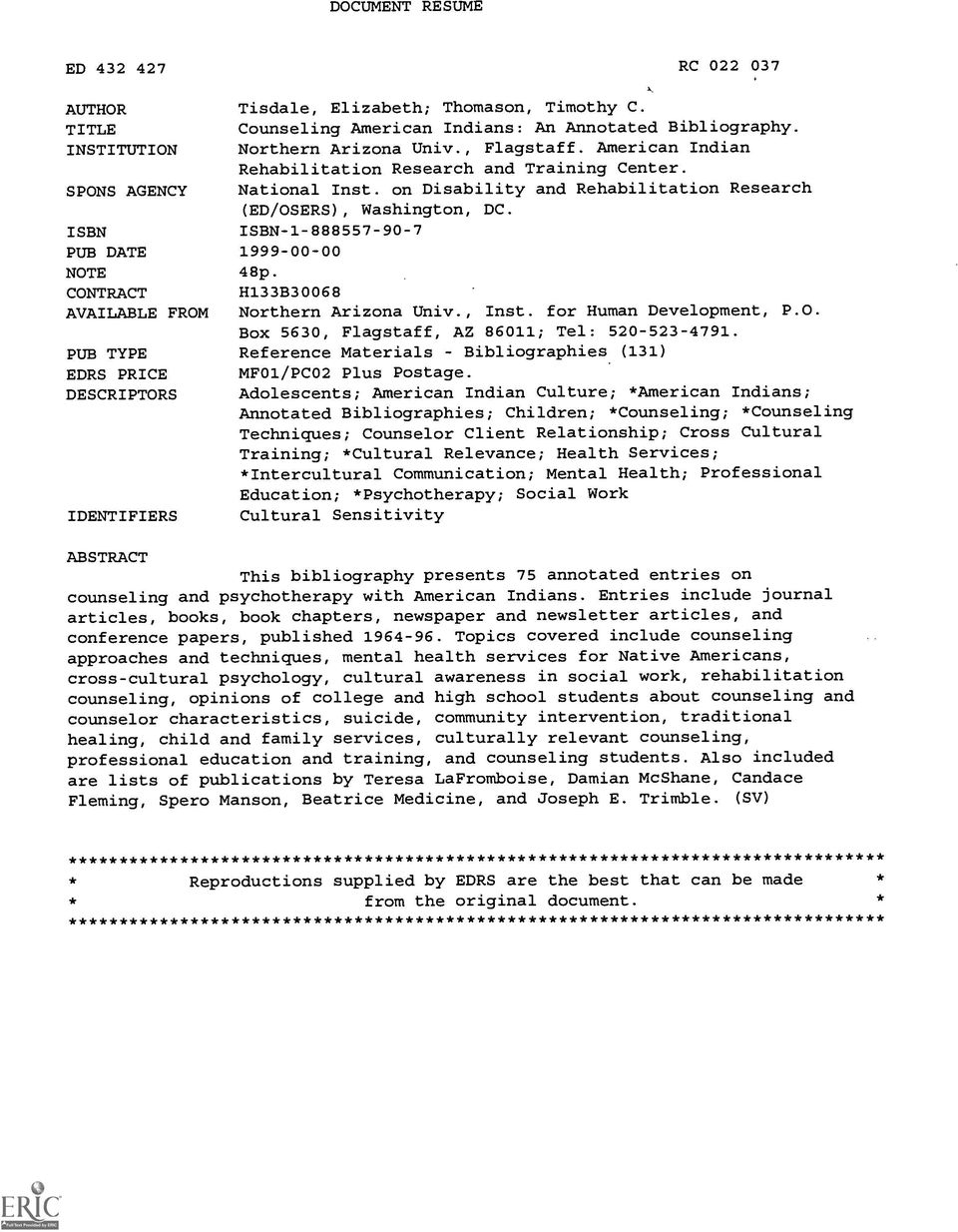
1 DOCUMENT RESUME ED AUTHOR TITLE INSTITUTION SPONS AGENCY ISBN PUB DATE NOTE CONTRACT AVAILABLE FROM PUB TYPE EDRS PRICE DESCRIPTORS IDENTIFIERS RC Tisdale, Elizabeth; Thomason, Timothy C. Counseling American Indians: An Annotated Bibliography. Northern Arizona Univ., Flagstaff. American Indian Rehabilitation Research and Training Center. National Inst. on Disability and Rehabilitation Research (ED/OSERS), Washington, DC. ISBN p. H133B30068 Northern Arizona Univ., Inst. for Human Development, P.O. Box 5630, Flagstaff, AZ 86011; Tel: Reference Materials - Bibliographies (131) MF01/PCO2 Plus Postage. Adolescents; American Indian Culture; *American Indians; Annotated Bibliographies; Children; *Counseling; *Counseling Techniques; Counselor Client Relationship; Cross Cultural Training; *Cultural Relevance; Health Services; *Intercultural Communication; Mental Health; Professional Education; *Psychotherapy; Social Work Cultural Sensitivity ABSTRACT This bibliography presents 75 annotated entries on counseling and psychotherapy with American Indians. Entries include journal articles, books, book chapters, newspaper and newsletter articles, and conference papers, published Topics covered include counseling approaches and techniques, mental health services for Native Americans, cross-cultural psychology, cultural awareness in social work, rehabilitation counseling, opinions of college and high school students about counseling and counselor characteristics, suicide, community intervention, traditional healing, child and family services, culturally relevant counseling, professional education and training, and counseling students. Also included are lists of publications by Teresa LaFromboise, Damian McShane, Candace Fleming, Spero Manson, Beatrice Medicine, and Joseph E. Trimble. (SV) ******************************************************************************** Reproductions supplied by EDRS are the best that can be made from the original document. ********************************************************************************
2 Counseling American Indians: An Annotated Bibliography 1999 U.S. DEPARTMENT OF EDUCATION Office of Educational Research and Improvement EDUCATIONAL RESOURCES INFORMATION CENTER (ERIC) IThis document has been reproduced as received from the person or organization originating it. 0 Minor changes have been made to improve reproduction quality. Points of view or opinions stated in this document do not necessarily represent official OERI position or policy. Elizabeth Tisdale, M.A. Timothy C. Thomason, Ed.D. American Indian Rehabilitation Research and Training Center NORTHERN ARIZONA UNIVERSITY Institute for Human Development University Affiliated Program Northern Arizona University PO Box 5630 Flagstaff, Arizona Funded by the National Institute on Disability and Rehabilitation Research (NIDRR) Office of Special Education and Rehabilitative Services, U.S. Department of Education, Washington, DC Grant No. H133B30068 trtib N. The contents of this report are the responsibility of the American Indian Rehabilitation Research and Training Center and no official endorsement by the U.S. Department of Education should be inferred. Northern Arizona University is an equal Opportunity / Affirmative Action Institution BEST COPY AVAILABLE 2

3 Counseling American Indians: An Annotated Bibliography 1999 Elizabeth Tisdale, M.A. Timothy C. Thomason, Ed.D. Northern Arizona University Institute for Human Development University Affiliated Program American Indian Rehabilitation Research and Training Center PO Box 5630 Flagstaff, Arizona (520) ISBN This report is available in alternate formats by contacting the Institute for Human. Development at (520)

4 Anderson, M.J. & Ellis, R. (1988). On the reservation. In N.A. Vacc, J. Wittmer & S. DeVaney (Eds.), Experiencing and counseling multicultural and diverse populations (pp ). Muncie, IN: Accelerated Development Inc. Several suggestions were made by the authors for helpers who provide counseling services to Native American clients. The goal is to avoid common errors that might alienate clients or damage the counselor's credibility as a helping professional. The authors support a new perspective that differs from the perspective non-native Americans traditionally hold. The authors feel this new view is essential for effective counseling. They caution against making broad generalizations because of the diversity among American Indian tribes and individuals. The information provided was developed out of work specifically with the Seneca reservation. Attneave, C. L. (1982). American Indians and Alaska Native families: Emigrants in their own homeland. In M. McGoldrick, J. Pierce & J. Giordana, Ethnicity and family therapy (pp ). NY: Guilford Press. This chapter provided a concise overview of relevant issues that may arise when a helping professional is working with American Indians and Alaska Natives as clients. For example, the author addressed acculturation, non-interference, the importance of recognizing tribal differences, and family problems and strengths. The authors describe educational information that counselors need to be informed about in order to meet the needs of American Indian and Alaska Native clients. Attneave, C.L. (1987). Practical counseling with American Indian and Alaska Native clients. In P. Pederson (Ed.), Handbook of cross-cultural counseling and therapy (pp ). Westport, CN: Greenwood Press. An historical overview of the development of mental health services for Native Americans and the present status of the services was presented in this chapter. The author provided some fundamental assumptions and possible future directions for Native American mental health services.

5 Beiser, M., & Attneave, C.L. (1978). Mental health services for American Indians: Neither feast nor famine. White Cloud Journal 1, 2, The chapter provided an overview of the mental health services provided to Native Americans in the 1960's and 1970's. It is part of a series of evaluation studies carried out for the Indian Health Service. It is suggested in the chapter that the IHS's mental health program and a comprehensive thirteen year experiment in comprehensive mental health care may provide some insight for the larger society as it struggles to evolve a system of universal health coverage. Bennett, S.K., & Big Foot- Sipes, D.S. (1991). American Indian and White college student preferences for counselor characteristics. Journal of Counseling Psychology, 38, 4, Seventy-three American Indian and eighty-one White college students were studied in the survey to determine their preferences for various counselor characteristics when facing academic or personal problems. Results indicated that both White and American Indian students most preferred a counselor with similar attitudes and values. Ethnicity appeared to be more important with American Indian culture. Significant differences were found in both American Indian and White preferences for counselor characteristics according to the type of problem. Berry, J.W., & Kim, U. (1993). The way ahead: From indigenous psychologies to a universal psychology. In U. Kim & J.W. Berry (Eds.), Indigenous psychologies: Research and experience in cultural context (pp ). Newbury Park, CA: Sage Publications. The chapter discussed cross-cultural psychology's main criticisms of general psychology, e.g., that it is culture blind and culture bound. To rectify the culturebound problem a different focus must be used in psychology that incorporates the influence of many different indigenous cultures. When these cultures are considered together as a comprehensive body of information, psychology may be more effective in explaining human behavior. Outlined in this chapter is the cross- 2 5
6 indigenous approach's ability to complement and supplement the cross cultural approach. Boyer, B.L. (1964). Psychoanalytic insights in working with ethnic minorities. Social Casework, 45, This article reports on a research project which was completed by the author with Apache Indians of the Mescalero Reservation. The purpose of the study was to delineate how the social structure, the child rearing patterns, and the personality organization of this group of Apaches interact. Background information on the aboriginal setting was compared to the Mescalero Apaches today. The author stated that he was successful in gathering information because of five factors that are also relevant to therapeutic contact with ethnic minority groups. The implications of the five factors are discussed in the article. Blount, M., Thyer, B.A., & Frye, T. (1991). Social work practice with Native Americans. In D.F. Harrison, J. S. Wodarski & B.A. Thyer (Eds.), Cultural diversity and social work practice (pp ). Springfield, IL: Charles C. Thomas Publishing. Cultural awareness training in social work will enable four positive improvements in service delivery to minority clients: (1) a reduction in the incidence of improper diagnosis, (2) a decrease in under utilization of available services, (3) a reduction in premature service dropouts, (4) improvement in counseling techniques. This chapter focused specifically on increasing awareness of the Native American culture and addressed characteristics of Native Americans, education, social problems, therapeutic variables, research issues, and future implications for social work practice. Center offers help, heritage. (May 14-2, 1996). Indian Country Today. pg. A8. The article reviewed the Native American Counseling Center in Washington that is run by the Seattle Indian Health Board. The center provides mental, 3 6

7 spiritual, and social counseling for American Indians and Alaskan Natives. The center focuses on the belief that recognizing cultural differences is essential to accurate diagnosis and effective treatment of mental health problems. The Center works to improve personal identity through empowerment. The staff also works with clients who have grief and loss issues along with other issues that may arise. The Center staff utilize a combination of modern approaches to psychotherapy and traditional healing techniques. Choney, S.K., Berryhill- Paapke, E., & Robbins, R.R. (1995). The acculturation of American Indians: Developing frameworks for research and practice. In J.G. Ponterotto, J.M. Casas, L.A. Suzuki & C.M. Alexander (Eds.), Handbook of Multicultural Counseling (pp ). Thousand Oaks, CA: Sage Publications. This chapter included a brief demographic description of the U. S. American Indian/ Alaska Native population, a rationale for the discussion of acculturation rather than racial identity, and an overview of historical and present day acculturative influences. Information about the effects of acculturation on some of the more prevalent mental health issues of American Indians was presented along with a discussion on American Indian help seeking behavior. Further, they reviewed existing models of acculturation and offered an alternative model that attempts to address some of the deficits of earlier models. Finally, the authors included recommendations for counseling and research with American Indians. Cross-cultural rehabilitation: Working with the Native American population. Rehab brief: Bridging research into effective focus, 9, 5, 1-4. The article reviewed basic statistical information on disabilities among Native Americans. It also provided a discussion about factors that may put Native Americans at risk for disabilities and barriers to success that Native Americans may confront. The article summarized implications and recommendations for Native Americans living on and off the reservations. 4 7
8 DeAngelis, T. (1994, October). History, culture affect treatment for Indians. APA Monitor, pg. 36. Theresa LaFromboise told attendees at the 1994 APA convention that working with Native American clients requires therapists to have a special understanding of Indian culture and of the negative history many Indian people have had with white people. She supported the view that therapists must understand that Native Americans have suffered many losses and these losses may appear as depression, anxiety, and drug and alcohol abuse. Therapists should also be aware that Native Americans are at different levels of acculturation and the therapists need to acknowledge Native American belief systems. Along with supporting an increase in understanding, LaFromboise also suggested some therapeutic techniques that may be effective with Native American clients. Dauphinais, P., Dauphinais, L., & Rowe, W. (1981). Effects of race and communication style on Indian perceptions of counselor effectiveness. Counselor Education and Supervision, 21, This article reported the results of a study in which 102 American Indian 11th and 12th grade high school students rated 7 dimensions of perceived counselor credibility and utility. Results indicated that Indian counselors were perceived as more effective than non- Indian counselors and that the non- directive, verbal response style was rated less effective than either a directive or a cultural/ experimental style. Dauphinais, P., LaFromboise, T., & Rowe, W. (1980). Perceived problems and sources of help for American Indian students. Counselor Education and Supervision, 20, One hundred-fifty American Indian and fifty non-indian 11th and 12th grade students were surveyed to assess self-reported problem areas and persons perceived as potential sources of help. Problems likely to be discussed with counselors or with significant others are identified and different patterns of persons nominated as providing help are described. Although the authors caution against over 58

9 generalization, the findings are intended to increase the understanding of those concerned with training counselors to work with Indian youth. Dillard, J.M. (1983). American Indians. In Multicultural Counseling (pp ). Chicago: Nelson Hall. Dillard provided information about how social and psychological conditions of American Indians affect their communicative behavior. The author supported that a counselor must recognize all factors such as tribal customs, location, health, discrimination and unemployment and adjust counseling attitudes to account for individual behavior variances in order to be successful. Dinges, N.G., Trimble, J.E., Manson, S.M., & Pasquale, F.L. (1981). Counseling and psychotherapy with American Indians and Alaskan Natives. In A.J. Marsella & P.B. Pedersen, Cross-cultural counseling and psychotherapy (pp ). NY: Pergamon. The primary goal of the chapter was to place the theory and practice of counseling and psychotherapy with American Indians and Alaskan Natives in the context of programmatic mental health efforts. The authors discussed mental health programs that are illustrative of foundations, evaluation, and the cultural themes of this volume. The chapter is divided into sections which discussed collaboration with Indian healers, the introduction of western mental health into Indian culture, design and delivery of preventative mental health programs for isolated reservation families, evaluation of mental health training programs, and proposed research questions. Dizmang, L.H. (1967). Suicide among the Cheyenne Indians. Bulletin of Suicidology, 7, 8-11 Two major symptoms of the present cultural deterioration for the Cheyenne are the high rates of alcoholism and the exceptionally high incidence of violent injuries, which include suicide, homicide and accidents. The chapter addressed the 6

10 possible reasons suicide reached epidemic proportions, the cultural obstacles that effectively thwart the Cheyenne from breaking away from the present situation, and possible solutions used in the Cheyenne community to combat these problems and decrease suicide. Duran, E. (1990). Community Intervention. In Transforming the soul wound (pp ). Berkeley, CA: Folklore Institute. This chapter reviewed community intervention for American Indians. The author supported the idea that therapeutic relevance can only be accomplished by implementing a model that encompasses the whole community. The author took a hard stand against the policy this country has taken towards funding American Indians in the area of community mental health. The author suggested that due to the lack of resources the government provides, consultation strategies may be the best option, as they make the most use of services. The chapter summarized four types of consultation and a typical consultation model that the author found to be practical within a traditional context. Edwards, R. (1995, August). American Indians rely on ancient healing techniques. APA Monitor, p. 36. This article described American Indians in Oklahoma who are turning to their heritage to heal their spiritual and emotional wounds through a program called "Project Making Medicine." The program is for mental health professionals working in IHS, tribal health clinics or tribal residential treatment centers. It is a train-the-trainer program with an emphasis on teaching skills that mental health professionals can incorporate on reservations or in Indian communities. Edwards, E.D., & Edwards, M.E. (1983). American Indians: Working with individuals and groups. In D.R. Atkinson, G. Morten, & D.W. Sue (Eds.), Counseling American minorities: A cross cultural perspective ( 2nd ed., pp ). Dubuque, IA: William C. Brown Publishers. 1 0

11 The chapter reviewed the history of American Indians and the importance of groups in American Indian culture past and present. The authors suggested using culturally specific techniques and recommended that service providers review intervention strategies and skills with groups. Everett, F., Proctor, N., & Cartmell, B. (1989). Providing psychological services to American Indian children and families. In D.R. Atkinson, G. Morten, & D.W. Sue (Eds.), Counseling American minorities: A cross cultural perspective (3rd. ed., pp ). Dubuque, IA: William C. Brown Publishers. The chapter suggested that psychologists who work with Indian children and families must become sensitized to the issues inherent in service delivery to this population. The chapter reviewed a few of the cultural differences considered relevant to the psychologist inexperienced in working with American Indian children and families. Freiberg, P. (1990, October). APA testifies on Indian health-care bill. APA Monitor, p. 21. The American Psychological Association, along with other concerned organizations, testified in favor of congressional legislation aimed at improving health services for the urban Indian population. Under the bill, care would be expanded to offer services which are now largely non-existent in urban Indian clinics, including mental health services. The committee staff said the bill, called the Urban Indian Health Equity Act, would broaden the range of services available to urban Indians to the level provided to reservation Indians. The APA also urged that a national needs assessment should be carried out to allow funds to be targeted to urban areas in the greatest need; that Indian health programs be required to hire licensed and trained professionals; and that expanded programs for urban Indians include a strong research and evaluation component. 8 1 I.

12 Garrett, J.T., & Garrett, M.W. (1994). The path of good medicine: Understanding and counseling Native American Indians. Journal of Multicultural Counseling and Development, 2, This article presented a brief overview of Native American cultural values, beliefs, and practices concerning the tribe, elders, family, and spirituality. Native American Indian communication style, humor, and cultural commitment are briefly discussed and recommendations were given for counseling with Native American Indians. Garrett, M.T., & Myers, J.E. (1996). The rule of opposites: A paradigm for counseling Native Americans. Journal of Multicultural Counseling and Development, 24, 2, The rule of opposites offered a cultural lesson that is useful for counselors working with Native American clients. The rule of opposites, based on the concept of the Circle of Life, is presented as a world view that allows individuals to move beyond their current frame of reference toward an understanding of universal truths and underlying meanings. Use of the Rule's seven lessons helps both the counselor and the client to recognize and resolve conflict, to ask more effective questions, to seek harmony and balance in life for greater purpose and direction, and to explore personal decision making and choices. 6, Good Tracks, J.G. (1976). Native American noninterference. Social Work, 18, The article discussed how intervention may be perceived in the Native American culture as interference or coercion. In the Native American culture this is unacceptable even when someone is doing something foolish or dangerous. It is suggested that members of the helping profession have patience, respect and consideration for the different cultural values that Native Americans have in regard to services. The worker should not intervene unless the client requests the support. This way the worker is incorporated into the client's functional system instead of trying to intervene from a foreign system. 91 2

13 Gurnee, C. G., Vigil, D.E., Krill- Smith, S., & Crowley, T.J. (1990). Substance abuse among American Indians in an urban treatment program. American Indian and Alaskan Native Mental Health Research, 3, 3, Chart reviews were used to describe demographic and clinical characteristics of 68 urban American Indian people attending an Indian-oriented outpatient substance abuse treatment program in Denver, Colorado, and to describe program staff's assessment of the clients' responses to treatment. Alcohol and marijuana were the drugs abused most frequently. The program admitted about equal numbers of males and females and their age averaged 24 years. Although Colorado has only Ute reservations, 49% of the clients were Sioux while none were Ute. Moreover, 87% of clients were not active in Indian religion and culture. Clients had low educational achievement and very low income. Few were in stable marriages. In comparison to counselors, clients underestimated the severity of their problems. By counselors' assessment, 78% of clients did not finish the program and only two fully achieved the treatment goals. Areas for further clinical research are suggested. Hanson, W. (1978). Grief counseling with Native Americans. White Cloud Journal, 1, 2, The article discussed the complexities of grief counseling in the urban Indian community such as the effect of behavioral stereotypes, customs, and counseling techniques. The authors provided background on the urban migration of Native Americans and discussion on stereotypes, burial practices, the language of grief and counseling techniques. This article addressed in-depth concepts of grief and therapy. Heinrich, R.K., Corbine, J.L., & Thomas, K.R. (1990). Counseling Native Americans. Journal of Counseling and Development, 69, This article addressed the issues facing White counselors in providing services to Native Americans, whose values differ significantly from those of the dominant culture. Native Americans have been consistently threatened with cultural assimilation. Previously published recommendations to counselors are reviewed and the relevance and possible use of traditional Native American 10 13

14 healing practices were discussed. One such practice, the vision quest, was described in detail. The authors suggested that counselors need to undergo their own acculturation and learn culturally relevant metaphors in order to promote healing and change. Herring, R.D. (1991). Counseling Native American youth. In C. C. Lee & B. L. Richardson (Eds.), Multicultural issues in counseling: New approaches to diversity (pp ). Alexandria, VA: American Association for Counseling Development. The chapter examined sociocultural challenges to Native American child and adolescent development. The authors stated that counseling can be effective, although there are barriers of trust and other challenges when counseling Native American youth. Counselors who incorporate traditional Native American attitudes, beliefs and values into the therapy can expect more successful encounters. Herring, R.D. (1992). Seeking a new paradigm: Counseling Native Americans. Journal of Multicultural Counseling and Development, 20, The history and current status of Native Americans was reviewed in this chapter which offered viable evidence to suggest a new paradigm for addressing the unique dilemmas of Native Americans. The authors provided suggestions and recommendations for counseling that incorporates the many unique qualities of Native Americans. The authors state that the suggestions are not intended to be allinclusive and generalizations should be made with caution and care. Herring, R.D. (1996). Synergetic counseling and Native American Indian students. Journal of Counseling and Development. 74, This article examined issues surrounding traditional school counseling efforts which seem to be failing to meet the needs of Native American Indian students. Because many Native American students have spiritual as well as secular concerns, school counselors must become more empathic and competent in serving 111 4
15 these students. This article argued that synergetic counseling efforts with Native American students increases counseling effectiveness. A vignette is provided and suggestions are made to provide an example of synergetic counseling. Indigenous American and Rehabilitation. (1991). Rehab Brief : Bringing research into effective focus, XIII, 1-4. This article summarized research reports on vocational rehabilitation projects and programs for indigenous Americans. The first research report examined special needs and problems of American Indians on and off the reservation. Specific attention was given to access to services and resources, and state vocational rehabilitation and blind service programs. Another report focused on the rehabilitation counselors on and off the reservations. The last report discussed the development and direction of rehabilitation efforts in the Pacific Basin. Jilek, W., & Jilek-Aall, L. (1981). The psychiatrist and his shaman colleague: Cross-cultural collaboration with traditional Amerindan therapists. In R.H. Dana (Ed.), Human services for cultural minorities (pp ). Baltimore: University Park Press. The article discussed historical and contemporary factors influencing the relationship between the Western psychiatrist and his shaman colleague. The authors also tried to convey their own experiences with traditional therapeutic resources in the care of the Salish Indian patients. The demonstrated effectiveness of traditional therapies, when compared to Western medical and correctional management in cases of Amerindian anomic depression, prompted the exploration and practice of cross-cultural collaboration with traditional indigenous therapists. The authors reviewed the past and present difficulties of finding respect for traditional therapists, cultural reappraisal by Western authors of the merits of indigenous healing and a brief description of contemporary shamanic healing treatments of soul loss and spirit intrusion
16 Kahn, M.W., Conrad, R., Galvez, E., Goldstein, G., Lejero, L., & Williams, C. (1975). The Papago psychology service: A community mental health program on an American Indian reservation. American Journal of Community Psychology, 3, 2, The chapter discussed a community mental health service run by the Papago Indian tribe. The center is unique because the Papago tribe is in complete control of the center, the director of the clinic is Papago, and the adaptations of current mental health techniques in assessment, therapy and consultation have been and are being developed specifically for the clinic's clientele. The chapter reviewed many aspects of the program, such as policies, personnel, consultation, mental health concerns, adapted techniques and means of treatment. Koss Chioino, J.D. (1995). Traditional and folk approaches among ethnic minorities. In J.F. Aponte, R.Y. Rivers & J. Wohl (Eds.), Psychological Interventions and Cultural Diversity (pp ). Boston: Allyn & Bacon. The chapter discussed two popular religious healing traditions that transcend tribal boundaries: the Native American Church and Pentecostalism. The author briefly described the religions from the perspective of how these types of organizations and healing ideologies radically differ from psychotherapy, making attempts at inclusion extremely difficult. This discussion was a preface to the final section of the chapter, which dealt with perspectives on interfacing or integrating traditional healing systems and psychotherapy. Krippner, S. (1990). Native Healing. In J.K. Zeig & W. M. Munion (Eds.), What is psychotherapy? Contemporary perspectives (pp ). San Francisco: Jossey- Bass Publishers. This article defined and described Native healing and how it is similar to current psychotherapies. Native healing attempts to modify dysfunctional behavior and experience through a structured series of contacts between a socially sanctioned practitioner and distressed client. The author suggested Native healing should be included in any comprehensive survey of current psychotherapies because, in its 13 16
17 various forms, it is relied upon by a larger percentage of the world's population than any other form of psychotherapy. Native healing retains a close connection with its mythic roots and uses personal or cultural myths in a way that helps the client. Other forms of psychotherapy tend to neglect these mythic roots to their own and the client's disadvantage. LaFromboise, T.D. (1988). American Indian mental health policy. American Psychologist, 43, 5, The article reviewed mental health services available to American Indians, the utilization of psychological services, and the delivery of services through various agencies and funding. The article identified some possible effects that assumptions made by Native Americans and psychologists may have on services. The authors offer recommendations for policy and action that address recruitment, education and training. LaFromboise, T.D., & Fleming, C. (1990). Keeper of the fire: A profile of Carolyn Attneave. Journal of Counseling and Development, 68, May/June, Carolyn Attneave, founder of network therapy and perhaps the best known American Indian psychologist today, discussed in this article her life and work experiences. She is best known for her expertise on cross-cultural issues in counseling and for her pioneering work to extend family therapy to include the social network of the identified client. Her students say she has "the power of stone" and the authors further conclude that she is what the Hopi call "keeper of the fire." LaFromboise, T.D., & Jackson, M. (1996). MCT theory and Native American populations. In D.W. Sue, A.E. Ivey & P.B. Pedersen, A theory of multicultural counseling and therapy (pp ). Pacific Grove, CA: Brooks/ Cole Publishing Co
18 The chapter described Multicultural Counseling and Therapy and some listed aspects of the theory that are relevant to developing culturally sensitive counseling interventions with Native Americans. These aspects include MCT theory's emphasis on the essential function of culture and social contexts in the helping process as well as in the roles that helpers play both inside and outside the helping encounter. LaFromboise, T.D., Trimble, J.E., & Mohatt, G.V. (1990). Counseling intervention and American Indian tradition. The Counseling Psychologist, 18, 4, The article argued that the training of American Indian counseling and community psychologists should move away from conventional counseling beliefs toward the use of culturally sensitive mental health approaches that maintain American Indian values. In this article, unique American Indian social and psychological perspectives concerning the process and theory of counseling are contrasted with the standard approaches to psychotherapy practiced in America today. Empirical studies were reviewed concerning the role of social influences in the counseling process as perceived by American Indians and the types of problems they present in counseling. In addition, three types of psychological intervention (social learning, behavioral, and network) are reviewed and summarized for their contributions and implications for training counselors in effective mental health service delivery with American Indians. Landers, S. ( 1989, November). Programs for Indians on tribal customs. APA Monitor. American Indian women are seeking treatment in greater numbers for depression, alcohol abuse, suicide attempts, and child abuse and neglect. The author stated that there are few programs that offer the necessary help. The most successful programs incorporate traditional Indian values in therapy and build on the resources already present in Indian culture. This article discussed some of the successful programs, barriers that must be addressed, and cultural beliefs that should 15 18

19 be respected as well as considered in the development and implementation of Native American support programs. Lewis, R. (1977). Cultural perspective on treatment modalities with Native Americans. Proceedings of the NASW Professional Symposium, San Diego (pp ). To work with Native Americans successfully, a blending of the Western philosophy and the Native American philosophy is necessary. Native Americans are often willing to accept new ideas if they fit into their culture and values. This paper represented an attempt to combine differing beliefs from the Western and Native American philosophies in order to develop productive styles of counseling with the Native Americans. Lewis, R.G., Ho, M.K. (1989). Social work with Native Americans. In D.R. Atkinson, G. Morten & D.W. Sue, Counseling American minorities : A cross cultural perspective (3rd. ed., pp ). Dubuque, IA: William C. Brown Publishers. The chapter discussed ways to increase basic knowledge of Native American customs and culture. The authors reviewed Native American traits, client-worker relations; family counseling, group work and community work, and suggested that helping professionals must have a background in Native American culture before they are able to provide effective treatment. Locke, D.C. (1992). Native Americans. In P. Pedersen and D. Locke (Eds.), Multicultural aspects of counseling series 1. Increasing multicultural understanding: A comprehensive model (pp ). Newbury Park, CA: Sage Publications. The chapter reviewed the historical background and present issues of Native Americans. Included were summary sections on acculturation, economic concerns, history of oppression, language and art, racism and prejudice, sociopolitical factors,

20 child-rearing and religious practices, family structure and dynamics, and cultural values and attitudes. The authors concluded with discussion about the implications of these issues and how they may affect counseling Native Americans. Lowrey, L. (1983). Bridging a culture in counseling. Journal of Applied Rehabilitation Counseling, 14, 1, This article focused on the Navajo population and counseling. The Navajo tribe is the largest and fastest growing Indian tribe in the continental United States. Somewhere near 18,000 Navajo people resided on the Navajo reservation located in three states: New Mexico, Arizona, and Utah in Tens of thousands more Navajo people live in cities throughout the United States. The ability to work effectively with more traditional Navajo people will require the counselor to have an understanding and respect for the ancient language and culture of the client. Manson, S. M., & Trimble, J.E. (1982). American Indian and Alaska Native communities: Past efforts, future inquiries. In L.R. Snowden (Ed.), Reaching the under served (pp ). Beverly Hills: Sage Publishing. In this chapter the authors summarized the information known about the delivery structure, treatment processes, program evaluation, epidemiology, and prevention for American Indians and Alaskan Natives. A series of specific questions that can serve as guideposts to future inquiry were offered. Matheson, L. (1986). If you are not an Indian, How do you treat an Indian? In P.B. Pedersen, & H. P. Lefley (Eds.), Cross cultural training for mental health professionals (pp ). Springfield, IL: C. Thomas Pub. For the purpose of creating positive, growth-enhancing relationships between non-indian service providers and American Indian clientele, three areas of focus are suggested by the author. The first is an inner assessment or self-adjustment. Second is a focus on becoming knowledgeable about the client. In the third focus, each of the above elements is related to the process of providing ethnically sensitive 172 0

21 psychotherapy and other human services. This paper introduced several examples of the type of knowledge which seems to be important for non-indian therapists to learn about American Indians. Many of these ideas are generalizations which are not intended to become stereotypes, but to be used as possible examples of outsiders' observations of some American Indian people. McVay, K. (1989). Counseling the American Indian: A review of the literature. Arizona Counseling Journal, 14, 1, This article examined the professional literature related to within-group cultural differences, language, class and cultural values, thinking and communication styles of American Indians, and the influence of these issues on the counseling process. Specifically addressed is literature pertinent to counseling adult Indians from the Southwestern United States. McWhirter, J.J., & Ryan, C.A. (1991). Counseling the Navajo: Cultural understanding. Journal of Multicultural Counseling and Development, 19, The purpose of the article was to identify several issues that seem important to counseling Navajo clients who reside on the reservation. Some issues may also be appropriate to non-reservation Navajo and other Native Americans, though the diversity of so many different cultures can not be addressed in one article and information should not be over-generalized. The article addressed family, language, dominant culture conflicts, and the implications and applications these issues have for counseling Native Americans. Miller, N.B. (1982). Social work services to urban Indians. In J.W. Green (Ed.), Cultural awareness in the human services (pp ). Englewood Cliff, NJ: Prentice Hall. The purpose of the research presented was to explore some of the cultural traits that have been attributed to "urban Indians," to describe the experiences of American Indians in cities with social and medical services, and to assess the 18
22 influence of cultural traits in transcultural interactions with professionals. The chapter also demonstrated the values of an interdisciplinary approach in transcultural social work. This study attempted to question the basis for making generalized statements which are then universally applied. Mohatt, G.V. (1991, August). Healing and spirituality: implications for the training and practice of psychologists. Paper presented at the APA conference, San Francisco, CA. The paper outlined a psychologist's insights about traditional American Indian healing which were developed through twenty years of friendships with, and observations of, Lakota Medicine Men. Reflections on traditional healing practices and the medicine man's role raised many questions concerning the practice of western psychotherapy and the training of psychologists. Peregoy, J.J. (1993). Transcultural counseling with American Indians and Alaskan Natives: Contemporary issues for consideration. In J. McFadden (Ed.), Transcultural counseling (pp ). Alexandria, VA: American Counseling Association. It was the primary goal of this chapter to discuss some relevant factors for creating positive helping relationships in transcultural settings with American Indians and Alaskan Natives. Structural biases and myths were explored as they affect the perception of the non-indian healing professional when working with American Indian and Alaskan Native clients. Components of the American Indian's perception of mainstream America were presented through ethnographic interviews conducted by the author. The information was reviewed as a way to understand historical and contemporary issues that currently affect values and interactions between helping professionals and the American Indian and Alaska Native clients.
23 Red Horse, J. (1988). Cultural evolution of American Indian families. In C. Jacobs & D. Bowles (Eds.), Ethnicity and Race (pp ). Silver Springs, MD: National Association of Social Workers. This chapter addressed contemporary variations in the American Indian family and individual behavior. The chapter included discussion of several aspects of American Indian lifestyles. Demographic trends provided a macroscopic view of life circumstances among American Indians. Examples of the lives of several individuals were used to show the specific changes in their behavior and aspirations that affect the cultural maintenance within and between generations. Two resource manuals were reviewed to examine the art of diagnosis, assessment, and direct service to American Indian families and individuals. A final summary discussed the implications for human service education and practice. Red Horse, J. G., Lewis, R., Feit, M., & Decker, J. (1979). Family behavior of urban American Indians. In G. Henderson (Ed.), Understanding and counseling ethnic minorities (pp ). Springfield, IL: Charles C. Thomas Publishing. Ecological models of human services are popular protocols. The authors stated that if ecological standards were applied to American Indian families they would appear to be on the verge of extinction. This article discussed specific characteristics of American Indians families and the attempted to relate these characteristics to the human ecology models in casework. The influence of these characteristics and family networks on the helping relationship was addressed. The objective of the article was to identify important attributes of the American Indian family network structure and cultural behavior to inform professionals about the importance of culture as a variable in human services. Renfrey, G.S. (1992). Cognitive-behavior therapy and the Native American client. Behavior Therapy, 23, This article discussed therapy and the Native American client. A brief review of Native American mental health needs and the response of the psychological community to date is provided. It is argued that a culturally sensitive approach to
24 working with different cultures is a professional and ethical necessity. It is suggested by the authors that a congruence exists between the cognitive-behavioral approach to therapy and the needs and preferences of Native Americans. Key therapeutic issues and problems for helping relationships with Native Americans were discussed and videlines for creating a more therapeutic and successful relationship were presented. Suggestions for possible future directions for better serving Native Americans were provided. Sage, G. P. (1991). Counseling American Indian adults. In C. C. Lee & B. L. Richardson (Eds.), Multicultural issues in counseling: New approaches to Diversity (pp ). Alexandria, VA: American Association for Counseling Development. This brief and concise chapter addressed three different concepts and recommendations that helping professionals should understand for effective psychotherapy with American Indians. Grace Pow less Sage affirmed that helping professionals must have a thorough understanding of American Indian history, their relationship with the government, and their unique socio-developmental experiences. She emphasized a cross-cultural curriculum for treatment and a need for practitioners to be aware and sensitive of the diversity within and between American Indians. Her strategies and techniques for therapy are enhanced through a specific and practical example of the Indian Women's Group which illuminated the therapeutic aspects of combining traditional and contemporary practices. Sandhu, D.S., Reeves, T.G., & Portes, P.R. (1993). Cross-cultural counseling and neurolinguistic mirroring with Native American adolescents. Journal of Multicultural Counseling, 21, Apr., This study examined the effects of selected nonverbal behaviors on empathy, trustworthiness and positive interaction in a cross-cultural setting among 60 Choctaw adolescents and two Caucasian female counselors. Results indicated significant mirroring effects on the empathy scale of the Barrett Leonard Relationship Inventory
25 Saslow, H.L., & Harrover, M.J. (1979). Research on psychological adjustment of Indian youth. In G. Henderson (Ed.), Understanding and counseling ethnic minorities (pp ). Springfield, IL: Charles C. Thomas Publishing. The authors presented a point of view supported by research instead of a comprehensive view of the literature. The authors' position was that the failure in the psychosocial development of Indian youth in the latency and early pubertal years contributed heavily to the reported incidents of problem behavior and the reported differences between Indian and non-indian youth. The authors refer specifically to Erikson's stages of initiative vs. guilt and industry vs. inferiority which occur during schooling age and how the school systems fail to provide support for American Indian youth during these important developmental steps. Spang, A. (1965). Counseling the Indian. Journal of American Indian Education, 5, Alonzo Spang emphasized the importance of adapting a personal philosophy of counseling and the use of scientific techniques when working with American Indian students. The specific population he addressed was reservation oriented. Spang tried to present the type of client a counselor would find on the reservation, what students' concerns may be and what the counselor needs to modify to appropriately work with American Indian students. Spector, R. (1985). Health and illness in the Native American community. In cultural diversity in health and illness (pp ). Norwalk, CN: Appleton. The author provided an overview of the relationship between Native Americans and their health and illness. A brief historical background provided a basic understanding of how their history affects Native Americans today. The traditional definitions of health and illness are reviewed along with a brief description of the different healers and healing methods of different tribes. The section on current health care issues for Native Americans included statistics, barriers, and problem solving strategies for these issues. The last section focused on 22 25
26 health-care provider issues and what can be done to improve services to Native Americans. Stock, L. (1987). Working with Native American persons: Issues in facilitating communication and providing culturally relevant services. Journal of Visual Impairment & Blindness, Apr., This article discussed several special concerns in providing education and rehabilitation services to Native American individuals. Suggestions were offered to assist non-native American professionals in developing effective patterns of communication and interaction with Native American students or clients who are disabled and their families. A list of suggested readings on the education of Native American students was also included. Sue, D.W., & Sue, D. (1990). Counseling American Indians. In Counseling the culturally different (pp ). NY: John Wiley & Sons Inc. The chapter reviewed background information on the Native American population, values, problem areas, education, and how these aspects affect non- Native/ Native American counseling relationships. Sue and Sue specifically addressed counseling American Indian children and youth, working with families, and general counseling issues related to the Native American population. Sue, S. (1988). Psychotherapeutic services for ethnic minorities: Two decades of research findings. American Psychologist, 43, 4, Considerable controversy exists over the effectiveness of psychotherapy for ethnic minority clients, especially when treated by White therapists. Some researchers and practitioners believe that ethnic clients are less likely to benefit from treatment. Others maintain that ethnic clients are as likely as Whites to show favorable outcomes from treatment and that ethnic or racial matching of clients and therapists is unnecessary. This article argued that the issue has been misconceptualized. Ethnic or racial match in treatment is more of a moral/ethical 2 6, 23
27 concern whereas cultural match is more of an empirical issue. The author suggested that the failure to differentiate between the two types of matches has prolonged an unresolvable question. Sue, S., Zane, N., & Young, K. (1994). Research on psychotherapy with culturally diverse populations. A.E. Bergin & S.L. Garfield (Eds.), Handbook of psychotherapy and behavior change (4th ed. pp ). New York: John Wiley & Sons Inc. The chapter provided a broad analysis of research on psychotherapy with ethnic minority clients and reasons why psychotherapy research is important. The chapter addressed research with American Indians, African-Americans, Asian- Americans and Latinos in separate sections and provided specific information for each culture. Swinomish Tribal Mental Health Project. (1991). A gathering of wisdoms. La Conner, WA: Swinomish Tribal Community. This book was designed for tribal administrators, mental health workers, social workers and other agency personnel interested in working with members of Indian tribes. It is a resource manual which reviewed different aspects of tribal mental health such as cultural considerations, a model mental health program, record keeping, training, and resources. Thomason, T.C. (1993). Counseling Native Americans: An introduction for non-native American counselors. In D.R. Atkinson, G. Morten, Sr' D.W. Sue (Eds.), Counseling American minorities: A cross-cultural perspective (4th ed., ). Dubuque, IA: WCB Brown & Benchmark Pub. This article is a primer on counseling Native American clients for non- Native American counselors and psychotherapists. The diversity of this population is described and a general model of healing from a traditional Native American 24 27
28 perspective is presented. Relevant research is reviewed and practical suggestions are offered for providing counseling services to Native Americans. Thomason, T.C. (1995). Counseling Native American Students. In C.C. Lee (Ed.), Counseling for diversity: A guide for school counselors and related professionals (pp ). Needham Heights, MA: Allyn & Bacon. The author stated that the key to successful counseling and the development of successful relationships with Native American students is to counsel and understand the students as unique individuals. The chapter discussed educational issues for Native American youth, counseling issues, and group counseling. Case studies were used as examples to clarify the information provided in the chapter. Topper, M.D. (1992). Multidimensional therapy: A case study of a Navajo adolescent with multiple problems. In L.A. Vargas & J.D. Koss- Chioino (Eds.), Working with culture (pp ). SanFrancisco: Jossey Bass Publishers. The chapter described a broad-based clinical approach to the treatment of mental and emotional illnesses among American Indian adolescents. The approach focused on the environmental context and medical status of the patient as much as on the patient's mental and emotional condition. The approach is referred to as "multidimensional" because it views the patient from the perspective of several dimensions of human existence in its attempt to develop an interdisciplinary method of evaluation. The author used an eclectic approach in theory and treatment that views people as continually developing and involved in ever widening social systems. Trimble, J.E. (1976). Value differences among American Indians: Concerns for the concerned counselor. In P. Pederson, W.J. Lonner, J.G. Draguns (Eds.), Counseling across cultures (pp ). Honolulu: University Press of Hawaii. The chapter highlights some of the difficulties that American Indians have encountered in maintaining indigenous values and trying to adjust to the modern 2528
29 industrialized non-indian society. The chapter also suggests how non-indian counselors might truly assist rather than inhibit an American Indian client. Trimble, J.E., & Fleming, C.M. (1989). Providing counseling services for Native American Indians: Client, counselor, and community characteristics. In P. Pederson, W.J. Lonner, J.G. Draguns & J.E. Trimble (Eds.), Counseling across cultures (3rd, ed., pp ). Honolulu: University Press of Hawaii. The chapter reviewed background information, a definition of American Indian, population statistics, and mental health issues for American Indian people. Various sections in this chapter provided suggestions for promoting counselor effectiveness, while other material also points to gaps that exist in understanding what works best given the heterogeneity of the population of Native American Indians. More documentation of case studies and empirical findings were suggested to improve the delivery of mental health services. Trimble, J.E., Fleming, C.M., Beauvais, F., & Jumper- Thurman, P. (1996). Essential cultural and social strategies for counseling Native American Indians. In P.B. Pedersen, J.G. Draguns, W.J. Lonner & J.E. Trimble (Eds.), Counseling across cultures (4th Ed., ). Thousand Oaks, CA: Sage Publications. The primary objective for the chapter was to identify and describe the essential ingredients that will lead to effective counseling strategies for Native American Indian clients. The authors provided a sociodemographic description of the Native American population and attempted to define those cultural elements that relate to the counseling process and distinguishes Native American Indian populations such as acculturation. The authors also described counselor characteristics that have been shown to provide the best match for counseling with American Indians
30 Trimble, J.E., & LaFromboise, T. (1985). American Indians and the counseling process: Culture, adaptation, and style. In P. Pederson (Ed.), Handbook of cross-cultural counseling and therapy (pp ). Westport, CN: Greenwood Press. The chapter provided an historical perspective of Native American culture and mental health along with an overview of the current status. The authors discussed fundamental approaches being used in Native American counseling and the possible directions the helping professions may take which could improve the counseling relationship with the Native American population. Trimble, J.E., & Medicine, B. (1993). Diversification of American Indians: Forming an indigenous perspective. In U. Kim & J.W. Berry (Eds.), Indigenous psychologies: Research and experience in cultural context (pp ). Newbury Park, CA: Sage Publishing. The intent of this chapter was to examine critically the extent to which the subjects of the field of psychology exist within the context of culturally unique groups. The authors supported that in its present form the current knowledge base of psychology cannot be generalized to the American Indian and an attempt to use conventional psychology tenets to identify and describe American Indians would be flawed. Youngman, G., & Sadongei, M. (1979). Counseling the American Indian child. In D.R. Atkinson, G. Morten, & D.W. Sue (Eds.), Counseling American minorities: A cross cultural perspective (1st ed., pp ). Dubuque, IA: William C. Brown Publishers. The authors provided information to help support counselors in providing services to Native American children. Focused mostly on school settings, the authors discussed contrasts between cultural expectations of the Native American culture and the Anglo-based school system. Suggestions are made to improve communication and understanding of these differences and how they may be dealt with in a school setting
31 Zayas, L.H., Tones, L.R., Malcolm, J., & DesRosiers, F.S. (1996). Clinician's definitions of ethnically sensitive therapy. Professional Psychology: Research and Practice, 27, 1, A survey of 150 non-minority psychologists and social workers who provided clinical services in multiethnic urban institutional settings was conducted to explore how they define ethnically sensitive therapy. Underlying the investigation was the assumption that how clinicians define ethnically sensitive therapy reflects their attitudes and influences the efforts they make to operationalize their definition in therapy. Results showed that clinicians' definitions fall along a continuum with four overlapping dimensions that emphasize (a) being aware of the existence of differences, (b) having knowledge of the client's culture, (c) distingtlishing between culture and pathology in assessment, and (d) taking culture into account in therapy. The dimensions may reflect a developmental process in how clinicians arrive at conceptualizations of ethnically sensitive therapy that influence their behaviors in the treatment encounter
32 Publications by Teresa LaFromboise (1981). (Co-authored with D.N. Dixon). American Indian perception of trustworthiness in a counseling interview. Journal of Counseling Psychology, 28 (2), (1981). (Co-authored with W. Rowe). Cultural adaptation of the skills training model: Assertion Training with American Indians. Paper presented at the Symposium on "Cultural Dimensions of Counseling the American Indian" at the Annual Meeting of the American Psychological Association, Los Angeles, CA. (ERIC Document Retrieval Service ED ). (1981). (Co-authored with others). Verbal indicators of insincerity as perceived by American Indians. Journal of Non White Concerns in Personnel and Guidance, 9 (2), (1982). Assertion training with American Indians: Cultural/behavioral issues for trainers. ERIC Clearinghouse on Rural Education and Small Schools. New Mexico Center for Rural Education. (ERIC Document Retrieval Service ED ). (1983). (Co-authored with W. Rowe). Skills training for bicultural competence: Rationale and application. Journal of Counseling Psychology, 30 (4), (1983). The factorial validity of the Adult Self-Expression Scale with American Indians. Educational and Psychological Measurement, 43 (2), (1984). (Co-authored with B.S. Plake). A model for the systematic review of mental health research: American Indian family, A case in point. White Cloud Journal of American Indian Mental Health, 3 (3), (1985). The role of cultural diversity on counseling psychology. Special Issue: Cross-cultural counseling. Counseling Psychologist, 13 (4), (1986). (Co-authored with C.D. Claiborn & J. Pomales). Cross-cultural counseling process research: A rejoinder. Journal of Counseling Psychology, 33 (2), (1986). (Co-authored with J. Pomales & C.D. Claiborn). Effects of Black students' racial identity on perception of White counselors varying in cultural sensitivity. Journal of Counseling Psychology, 33 (1),
33 (1986). Circles of women. Professionalization training for American Indian women. A manual for counselors, teachers, workshop leaders and trainers. Washington, DC: PEER. (ERIC Document Retrieval Service ED ). (1987). (Co-authored with J.E. Trimble). American Indians and the counseling process: culture, adaptation, and style. In P. Pedersen (Ed.), Handbook of Cross-cultural and Therapy. (pp ). Westport, CT: Greenwood Press. (1988). American Indian mental health policy. American Psychologist, 43 (5), (1988). (Co-authored with D.S. Bigfoot). Cultural and cognitive considerations in the prevention of American Indian adolescent suicide. Special Issue: Mental health research and service issues for minority youth. Journal of Adolescence, 11 (2), (1988, April). (Co-authored with M.J. Belgarde). Zuni adolescent suicide. Paper presented at the Annual Meeting of the American Education Research Association, New Orleans, LA. (ERIC Document Retrieval Service ED ). (1989). (Co-authored with K.G. Low). American Indian children and adolescents. In J.T. Gibbs & L.N. Huang (Eds.), Children of Color: Psychological Interventions with Minority Youth. The Jossey-Bass Social and Behavioral Science Series. (pp ). San Francisco: Jossey-Bass Inc. Publishers. (1989). Circles of women: Professional skills training with American Indian women. Newton, MA: Women's Educational Equity Act Publishing Center. (ERIC Document Retrieval Service ED ). (1989). (Co-authored with S. Foster). Ethics in multicultural counseling. In P.B. Pedersen, J.G. Draguns, W.J. Lonner, F.E. Trimble (Eds.), Counseling Across Cultures. (3rd Ed.) (pp ). Honolulu: University of Hawaii Press. (1990). (Co-authored with A.M. Heyle & E.J. Ozer). Changing and diverse roles of women in American Indian cultures. Special Issue: Gender and ethnicity: Perspectives on dual status. Sex Roles: A Journal of Research, 22 (7-8), (1990). (Co-authored with J.E. Trimble & G.V. Mohatt). Counseling intervention and American Indian tradition: An integrative approach. Counseling Psychologist, 18 (4),
34 (1990). (Co-authored with C. Fleming). Keeper of the fire: A profile of Carolyn Attneave. Journal of Counseling and Development, 68 (5), (1991). (Co-authored with H.L. Coleman & A. Hernandez). Development and factor structure of the Cross-Cultural Counseling Inventory -- Revised. Professional Psychology Research and Practice, 22 (5), (1992). (Co-authored with D.S. Bigfoot-Sipes, P. Dauphinais, S.K. Bennett, et al.). American Indian secondary school students' preferences for counselors. Journal of Multicultural Counseling and Development, 20 (3), (1992). An interpersonal analysis of affinity, clarification, and helpful responses with American Indians. Professional Psychology, Research and Practice, 23, (4), (1992). (Co-authored with S.L. Foster). Cross-cultural training: scientistpractitioner model and methods. The Counseling Psychologist, 20 (3), (1992). (Co-authored with B. Howard-Pitney, M. Basil, B. September & M. Johnson). Psychological and social indicators of suicide ideation and suicide attempts in Zuni adolescents. Journal of Consulting and Clinical Psychology, 60 (3), (1993). (Co-authored with J.E. Trimble, G.V. Mohatt & T.C. Thomason). The American Indian client. In D.R. Atkinson, G. Morten, D.W. Sue (Eds.), Counseling American minorities: a cross-cultural perspective. 4th Edition. (pp ). Madison, WI: Wm. C. Brown Publishers. (1993). (Co-authored with H.L. Coleman & J. Gerton). Psychological impact of biculturalism: Evidence and theory. Psychological Bulletin, 114 (3), (1994). (Co-authored with J.S. Berman & B.K. Sohi). American Indian women. In L. Comas-Diaz & B. Greene (Eds.), Women of color: Integrating ethnic and gender identities in psychotherapy. (pp ). NY: Guilford Press. (1994). Counseling American Indians. [Video recording]. North Amherst, MA: Microtraining Associates. (1994). (Co-authored with B. Howard-Pitney). The Zuni Life Skills Development curriculum: A collaborative approach to curriculum development. American Indian and Alaska Native Mental Health Research, 4 (Mono),
35 Publications by Damian McShane (1976). Selected bibliography (259 ref.) of Ojibwa and other Native American related research concerning psychoeducational assessment and intervention (as well as related historical, cultural, legal, economic, and medical factors). (ERIC Document Retrieval Service ED ). (1979). (Co-authored with J. Mitchell). Middle ear disease, hearing loss and educational problems of American Indian children. Journal of American Indian Education, 19 (1), (1980). A review of scores of American Indian children on the Wechsler Intelligence Scale. White Cloud Journal, 1 (4), (1982). A transactional view of crisis: Telephone call patterns of a crisis intervention center. Crisis Intervention, 12 (2), (1982). (Co-authored with J.M. Plas). Otitis media, psychoeducational difficulties, and Native Americans: A review and a suggestion. Journal of Preventive Psychiatry, 1 (3), (1982). (Co-authored with J.M. Plas). Wechsler Scale performance patterns of American Indian children. Psychology in the Schools, 19 (1), 8-17). (1982). (Co-authored with J.M. Plas). WISC-R factor structures for Ojibwa Indian children. White Cloud Journal, 2 (4), (1983). Explaining achievement patterns of American Indian children: A transcultural and developmental model. Peabody Journal of Education, 61 (1), (1984). (Co-authored with F.L. Risse & A.B. Rubens). Cerebral asymmetries on CT scan in three ethnic groups. International journal of Neuroscience, 23 (1), (1984). (Co-authored with M.L. Willenbring). Differences in cerebral asymmetries related to drinking history and ethnicity: A computerized axial tomography (CAT) scan study. Journal of Nervous and Mental Disease, 172 (9), (1984). (Co-authored with J.M. Plas). Response to a critique of the McShane and Plas review of American Indian performance on the Wechsler Intelligence Scales. School Psychology Review, 13 (1),
36 (1984). (Co-authored with J.M. Plas). The cognitive functioning of American Indian children: Moving from the WISC to the WISC-R. School Psychology Review, 13 (1), (1986). Ojibwa adult-child interactions: A brief literature review. Canadian Journal of Native Education, 13 (1), (1986). Testing, assessment research, and increased control by Native communities. In H.A. McCue (Ed.), Selected papers from the Mokakit Conference "Establishing Pathways to Excellence in Indian Education". (1st, Ontario, Canada, July 25-27, 1984).Vancouver, BC: Mokakit Indian Education Research Association. (1987). Mental health and North American Indian/Native communities: Cultural transactions, education, and regulation. American Journal of Community Psychology, 15 (1), (1988). An analysis of mental health research with American Indian youth. Special Issue: Mental health research and service issues for minority youth. Tournal of Adolescence, 11 (2), (1988). Becoming a psychologist: A challenge for American Indian students. In P.J. Woods (Ed.), Is psychology for them? A guide to undergraduate advising. (pp ). Washington, DC: American Psychological Association. (1988). Mental abilities testing research with American Indians: a reprise (A reply to Chrisjohn's commentary). Canadian Journal of Native Education, 15 (3), (1988). (Co-authored with J.W. Berry). Native North Americans: Indian and Inuit abilities. In S.H. Irvine, J.W. Berry (Eds.), Human abilities in cultural context. New York: Cambridge University Press. (1988). (Co-authored with J.M. Plas). The relationship of intellectual and psycholinguistic abilities to the achievement gains of American Indian children. Canadian Journal of Native Education, 15 (3), (1989). (Co-authored with H. Cohen & J.J. Levy). Hemispheric specialization for speech and non-verbal stimuli in Chinese and French Canadian subjects. Neuropsychologia, 27 (2), _ (1991). The American Indian Support Project at Utah State University. In H.F. Myers, P. Wohlford, L.P. Guzman, & R.J. Echemendia (Eds.), Ethnic minority perspectives on clinical training and services in psychology. (pp ). Washington, DC: American psychological Association
37 Publications by Candace Fleming (1989). (Co-authored with J. Trimble). Providing counseling services for Native American Indians: Client, counselor, and community characteristics. In P.B. Pedersen, J.G. Draguns, J.J. Lonner & J.E. Trimble (Eds). Counseling across cultures. 3rd edition. Honolulu: University of Hawaii Press. (1990). (Co-authored with S.M. Manson). Native American women. In R.C. Engs (Ed). Women: Alcohol and other drugs. Dubuque, IA: Kendall/Hunt Publishing Co. (1990). (Co-authored with T.D. LaFromboise). Keeper of the fire: A profile of Carolyn Attneave. Journal of Counseling and Development, 68 (5), (1992). American Indians and Alaska Natives: Changing societies past and present. In M.A. Orlandi, R. Weston & L.G. Epstein (Eds). Cultural competence for evaluators: A guide for alcohol and other drug abuse prevention practitioners working with ethnic/racial communities. Rockville, MD: US Department of Health & Human Services. (1992). The next twenty years of prevention in Indian country: Visionary, complex, and practical. American Indian and Alaska Native Mental Health Research, 4 (3), (1994). The Blue Bay Healing Center: Community development and healing as prevention. American Indian & Alaska Native Mental Health Research,
38 Publications by Spero Manson (1979). (Co-authored with A.M. Pambrun). Social and psychological status of the American Indian elderly: Past research, current advocacy, and future inquiry. White Cloud Journal, 1 (3), (1981). (Co-authored with J.H. Shore). Cross-cultural studies of depression among American Indians and Alaska Natives. White Cloud Journal, 2 (2), (1981). (Co-authored with J.H. Shore). Psychiatric epidemiological research among American Indians and Alaska Natives: Methodological issues. White Cloud Journal, 2 (2), (1982). (Co-authored with J.L. Rogers & J.D. Bloom). Oregon's innovative system for supervising offenders found not guilty by reason of insanity. Hospital & Community Psychiatry, 33 (12), (1983). (Co-authored with J.L. Rogers & J.D. Bloom). After Oregon's insanity defense: A comparison of conditional release and hospitalization. International Journal of Law & Psychiatry, 5 (3-4), (1983). (Co-authored with J.D. Kinzie). Five years' experience with Indochinese refugee psychiatric patients. Journal of Operational Psychiatry, 14 (2), (1983). (Co-authored with J.L. Rogers, W.H. Sack & J.D. Bloom). Women in Oregon's insanity defense system. Journal of Psychiatry and Law, 11 (4), (1984). (Co-authored with J.L. Rogers & J.D. Bloom). Insanity defenses: Contested or conceded? American Journal of Psychiatry, 141 (7), (1984). (Co-authored with J.L. Rogers & J.D. Bloom). Oregon's new insanity defense system: A review of the first five years, 1978 to Bulletin of the American Academy of Psychiatry & the Law, 12 (4), (1985). (Co-authored with J.D. Bloom & J.D. Kinzie). Halfway around the world to prison. Vietnamese in Oregon's criminal justice system. Medicine & Law, 4 (6), (1986). (Co-authored with J.D. Bloom, J.L. Rogers & M.H. Williams). Lifetime police contacts of discharged Psychiatric Security Review Board clients. International Journal of Law & Psychiatry, 8 (2),
39 (1986). (Co-authored with J.L. Rogers & J.D. Bloom). Oregon's Psychiatric Security Review Board: A Comprehension system for managing insanity acquittees. Annals of the American Academy of Political & Social Science, 484, (1986). (Co-authored with J.D. Kinzie, W.H. Sack & R.H. Angell). The psychiatric effects of massive trauma on Cambodian children: I. The children. (Annual Meeting of the American Academy of Child Psychiatry 1984, Toronto, Canada). Journal of the American Academy of Child Psychiatry, 25 (3), (1987). (Co-authored with J.H. Shore, J.D. Bloom & G.A. Keepers). A pilot study of depression among American Indian patients with research diagnostic criteria. American Indian and Alaska Native Mental Health Research, 1 (2), (1987). (Co-authored with J.D. Bloom, J.L. Rogers & G. Neligh). Emerging tribal models for the civil commitment of American Indians. American Indian and Alaska Native Mental Health Research, 1 (1), (1987). (Co-authored with R.D. Walker & D.R. Kivlahan). Psychiatric assessment and treatment of American Indians and Alaska Natives. Hospital and Community Psychiatry, 38 (2), (1987). (Co-authored with J.D. Kinzie). The use of self-rating scales in crosscultural psychiatry. Hospital and Community Psychiatry, 38 (2), (1988). (Co-edited with N.G. Dinges). Behavioral health issues among American Indians and Alaska Natives: Explorations on the frontiers of the biobehavioral sciences. American Indian and Alaska Native Mental Health Research, 1 Monograph 1. (1988). (Co-authored with D.G. Callaway). Health and aging among American Indians: Issues and challenges for the biobehavioral sciences. (Review). American Indian & Alaska Native Mental Health Research, 1 Mono (1), (1989). (Co-authored with J.M. Piasecki, M.P. Biernoff, A.B. Hiat, S.S. Taylor & D.W. Bechtold). Abuse and neglect of American Indian children: Findings from a survey of federal providers. (Review). American Indian & Alaska Native Mental Health Research, 3 (2), (1989). Long-term care in American Indian communities: Issues for planning and research. Gerontologist, 29 (1),
40 (1989). Provider assumptions about long-term care in American Indian communities. Gerontologist, 29 (3), (1989). (Co-authored with J. Beals & R.W. Dick). Risk factors for suicide among Indian adolescents at a boarding school. Public Health Reports, 104 (6), 609. (1990). (Co-authored with A.E. Baron, L.M. Ackerson & D.L. Brenneman). Depressive symptomatology in older American Indians with chronic disease: Some psychometric considerations. In C.C. Attkisson & J.M. Zich (Eds). Depression in Primary Care: Screening and Detection. New York: Rout ledge. (1990). (Co-authored with L.M. Ackerson & R.W. Dick). Depressive symptoms among American Indian adolescents: Psychometric characteristics of the Center for Epidemiologic Studies Depression Scale (CES-D). Psychological Assessment, 2 (3), (1990). (Co-authored with C.M. Fleming). Native American women. In R.C. Engs (Ed). Women: Alcohol and other drugs. Dubuque, IA: Kendall/Hunt Publishing Co. (1990). (Co-authored with J.M. Ackerson & R.W. Dick). Properties of the Inventory to Diagnose Depression in American Indian adolescents. Journal of the American Academy of Child and Adolescent Psychiatry, 29 (4), (1990). (Co-authored with F.M. Baker, L.M. Kamikawa & D.S. Espino). Rehabilitation in ethnic minority elderly. In S.J. Brody & L.G. Pawlson (Eds). Aging and Rehabilitation II: The State of the Practice. New York: Springer Publishing Co. (1990). (Co-authored with F. Earls & J.I. Escobar). Suicide in minority groups: Epidemiologic and cultural perspectives. In S.J. Blumenthal & J.J. Kupfer (Eds). Suicide Over the Life Cycle: Risk Factors, Assessment, and Treatment of Suicidal Patients. Washington, DC: American Psychiatric Press, Inc. (1991). (Co-authored with J. Beals & E.M. Keane). Factorial structure of the Center for Epidemiologic Studies-Depression Scale among American Indian college students. Psychological Assessment, 3 (4), (1992). (Co-authored with J. King, J. Beals & J. E. Trimble). A structural equation model of factors related to substance use among American Indian adolescents. Drugs and Society, 6 (3-4), (1992). (Co-authored with J.H. Shore, A.E. Baron, L. Ackerson & G. Neligh). Alcohol abuse and dependence among American Indians. In J.E. Helzer & G.J
41 Canino (Eds). Alcoholism in North American, Europe, and Asia. New York: Oxford University Press. (1992). (Co-authored with I.M. Norton). An association between domestic violence and depression among Southeast Asian refugee women. Journal of Nervous & Mental Disease, 180 (11), (1992). Depression and related mental illnesses among American Indians: The current state of the art in treatment. In E.W. Haller & L.P. Aitken (Eds). Mashkiki: Old Medicine Nourishing the New. American Indians and Alaska Natives in Biomedical Research Careers, 2. Lanham, MD: University Press of America. (1992). (Co-authored with J.D. Kinzie, P.K. Leung, J. Boehnlein, D. Matsunaga, R. Johnson, J.H. Shore, J. Heinz & M. Williams). Psychiatric epidemiology of an Indian village. A 19 year replication study. Journal of Nervous & Mental Disease, 180 (1), ( ). (Co-authored with P.D. Somervell, J. Beals, J.D. Kinzie, J Boehnlein & P. Leung) Use of the CES-D in an American Indian village. Culture, Medicine & Psychiatry, 16 (4), (1993). (Co-authored with R.W. Dick & J. Beals). Alcohol use among male and female Native American adolescents: Patterns and correlates of student drinking in a boarding school. Journal of Studies on Alcohol, 54 (2), (1993). (Co-authored with P.D. Somervell, J. Beals, J.D. Kinzie, J. Boehnlein & P. Leung). Criterion validity of the Center for Epidemiologic Studies Depression Scale in a population sample from an American Indian village. Psychiatry Research, 47 (3), (1993). (Co-authored with D. Buchwald, N.G. Dinges, E.M. Keane & J.D. Kinzie). Prevalence of depressive symptoms among established Vietnamese refugees in the United States: Detection in a primary care setting. Tournal of General Internal Medicine, 8 (2), (1993). (Co-authored with D. Buchwald & B. Klacsanzky). Psychiatric disorders among recently-arrived Eastern Europeans seen through a US refugee counseling service. International Journal of Social Psychiatry, 39 (3), (1994). (Co-authored with R.W. Dick, J. Beals & E.M. Keane). Factorial structure of the CES-D among American Indian adolescents. Journal of Adolescence, 17 (1),
42 (1994). Indian and Native communities realize the extent of military service touches the lives of this special population (editorial). American Indian & Alaska Native Mental Health Research, 6 (1), V. (1994). (Co-authored with D.W. Becktold & J.H. Shore). Psychosocial consequences of stress among Native American adolescents. In R.P. Liberman & J. Yager (Eds). Stress in Psychiatric Disorders. Springer Series on Psychiatry, 5. New York: Springer Publishing Co. (1995). (Co-authored with I.M. Norton). A silent minority: Battered American Indian women. Journal of Family Violence, 10 (3),
43 Publications by Beatrice Medicine (1971). The anthropologist and American Indian studies programs. Indian Historian, 4 (1), (1971). The anthropologist as the Indian's image-maker. Indian Historian, 4 (3), (1975). Self-direction in Sioux education. Integrated Education, 13 (6), (1978). The Native American woman: A perspective. Austin, TX: National Educational Laboratory Publishers. (1981). American Indian family: Cultural change and adaptive strategies. Tournal of Ethnic Studies, 8 (4), (1981). "Speaking Indian": Parameters of language use among American Indians. Focus 6. ED (1985). Child socialization among Native Americans: The Lakota (Sioux) in cultural context. Wicazo Sa Review, 1 (2), (1986). Contemporary cultural revisitation: Bilingual and bicultural education. Wicazo Sa Review, 2 (1), (1988). Native American (Indian) women: A call for research. Anthropology and Education Quarterly, 19 (2), (1988). Professionalization of Native American (Indian) women: Towards a research agenda. Wicazo Sa Review, 4 (2), (1992). Madonna Swan - A Lakota woman's story. (Book review). American Indian Culture and Research Journal, 16 (3), (1993). American Indian women: Mental health issues which relate to drug abuse. Wicazo Sa Review, 9 (2), (1993). Choteau Creek: A Sioux remembrance. (Book review). American Indian Culture and Research Journal, 17 (2), (1993). (Co-authored with J. Trimble). Diversification of American Indians: Forming an indigenous perspective. In U. Kim & J.W. Berry (Eds). Indigenous psychologies: Research and experience in cultural context. Newbury Park, CA: Sage Publications
44 (1993). North American indigenous women and cultural domination. American Indian Culture and Research Journal, 17 (3), (1994). North American women and cultural domination. Cultural Survival Ouarterly, 17 (4), 66. (1995). An Indian in White America. (Book review). Wicazo Sa Review, 11 (1), (1995). Standing Rock, (Poem). Wicazo Sa Review, 11 (1),
45 Publications by Joseph E. Trimble (1972). An index of the social indicators of the American Indian in Oklahoma. ED (1975). (Co-authored with D.D. Ross). Focus is on tribal culture in understanding American Indian. Momentum, 6 (3), (1977). The sojourner in the American Indian community: Methodological issues and concerns. Tournal of Social Issues, 33 (4), (1978). (Co-authored with R.A. Ryan): Toward an understanding of the mental health and substance abuse issues of rural and migrant ethnic minorities: A search for common experiences. Paper prepared for the National Conference on Minority Group Alcohol, Drug Abuse and Mental Health Issues, Denver, CO, May 22-24, ED (1979). (Co-authored with N.G. Dinges and A.R. Hollenbeck). American Indian adolescent socialization: A review of the literature. Journal of Adolescence, 2 (4), (1980). (Co-authored with others). Minority elderly adaptation to lifethreatening events: An overview with methodological consideration. Paper presented at the Western Psychological Association, Honolulu, HI, May 5-9, ED (1981). (Co-authored with D.J. Lee). Counseling with American Indians: A review of, the literature with methodological consideration. Paper presented at the American Educational Research Association, Los Angeles, CA, April 15, ED (1982). (Co-authored with S.S. Richardson). Locus of control measures among American Indians: Cluster structure analytic characteristics. Tournal of Cross Cultural Psychology, 13 (2), (1983). (Co-authored with S.S. Richardson). Perceived personal and societal forms of locus of control measures among American Indians. White Cloud Tournal, 3 (1), (1984). Drug abuse prevention research needs among American Indians and Alaska Natives. White Cloud Journal, 3 (3), (1986). (Co-authored with J.W. Berry & E.L. Olmedo). Assessment of acculturation. In W.J. Lonner & J.W. Berry (Eds). Field methods in cross
46 cultural research. Cross cultural research and methodology series, Vol. 8. Beverly Hills, CA: Sage Publications. (1987). (Co-authored with T. LaFromboise). American Indians and the counseling process: Culture, adaptation, and style. In P. Pedersen (Ed). Handbook of cross-cultural counseling and therapy. New York: Praeger Publishers. (1987). Self-perception and perceived alienation among American Indians. Journal of Community Psychology, 15 (3), (1987). (Co-authored with L.D. Gilchrist, S.P. Schinke & G.T. Cvetkovich). Skills enhancement to prevent substance abuse among American Indian adolescents. International Journal of the Addictions, 22 (9), (1988). (Co-authored with J.K. Bobo, L.D. Gilchrist & G.T. Cvetkovich). Crosscultural service delivery to minority communities. journal of Community Psychology, 16 (3), (1988). Putting the ethic to work: Applying social psychological principles in cross-cultural settings. In M. H. Bond (Ed). The cross-cultural challenge to social psychology. Cross cultural research and methodology series, Vol. 11. Newbury Park, CA: Sage Publications. (1988). Stereotypical images, American Indians, and prejudice. In P.A. Katz & D.A. Taylor (Eds). Eliminating racism: Profiles in controversy. Perspectives in social psychology. New York: Plenum Press. (1989). (Co-authored with others). Cultural identity. In D.M. Keats, D. Munro, & L. Mann (Eds). Heterogeneity in cross-cultural psychology: Selected papers from the Ninth International Conference of the International Association for Cross-Cultural Psychology. Amsterdam, Netherlands: Swets & Zeit linger. (1989). (Co-authored with C. Fleming). Providing counseling services for Native American Indians: Client, counselor, and community characteristics. In P.B. Pedersen, J.G. Draguns, J.J. Lonner & J.E. Trimble (Eds). Counseling across cultures. 3rd edition. Honolulu: University of Hawaii Press. (1989). (Co-edited with P.B. Pedersen, J.G. Draguns, & J.J. Lonner). Counseling across cultures. 3rd edition. Honolulu: University of Hawaii Press. (1989). Malfeasance and foibles of the research sponsor: Damnant quod non intelligent. American Indian and Alaska Native Mental Health Research, 2 (3),
47 (1990). Application of psychological knowledge for American Indians and Alaska Natives. Journal of Training and Practice in Professional Psychology, 4 (1), (1990). (Co-authored with T.D. LaFromboise & G.V. Mohatt). Counseling intervention and American Indian tradition: An integrative approach. Counseling Psychologist, 18 (4), (1990). (Co-authored with M.S. Mocher and G.W. Holden). Substance abuse among Native-American youth. Journal of Consulting & Clinical Psychology, 58 (4), ( ). Ethnic specification, validation prospects, and the future of drug use research. International Journal of the Addictions, 25 (2A), (1991). Cognitive Behavioral Skills Enhancement and Deterring Drug Abuse among American Indians. Paper presented at the Annual Convention of the American Psychological Association (99th, San Francisco, CA, August 16-20, 1991). (1991). (Co-authored with H.F. Myers & R.J. Echemendia). The need for training ethnic minority psychologists. In H.F. Myers, P. Wohlford, L.P. Guzman & R.J. Echemendia (Eds). Ethnic minority perspectives on clinical training and services in psychology. Washington, DC: American Psychological Association. (1991). The mental health service and training needs of American Indians. In H.F. Myers, P. Wohlford, L.P. Guzman & R.J. Echemendia (Eds). Ethnic minority perspectives on clinical training and services in psychology. Washington, DC: American Psychological Association. (1992). A cognitive-behavioral approach to drug abuse prevention and intervention with American Indian youth. In L.A. Vargas & J.D. Koss- Chioino (Eds), Working with culture: Psychotherapeutic interventions with ethnic minority children and adolescents. San Francisco: Jossey-Bass Inc. (1992). (Co-authored with C.S. Bolek & S.J. Niemcryk). Ethnic and Multicultural Drug abuse: Perspectives on Current Research. Part I: Foreword. Drugs & Society, 6 (1/2), xiii. (1992). (Co-authored with C.S. Bolek & J. Debro). Overview of selected federal efforts to encourage minority drug abuse research and researchers. Drugs and Society, 6 (3-4), (1992). (Co-authored with F. Beauvais). The role of the researcher in evaluating American Indian alcohol and other drug abuse prevention
48 programs. In M.A. Orlandi, R. Weston & L.G. Epstein (Eds), Cultural competence for evaluators: A guide for alcohol and other drug abuse prevention practitioners working with ethnic/racial communities. Rockville, MD: US Department of Health & Human Services. (1992). (Co-authored with J. King, J. Beals & S. Manson). A structural equation model of factors related to substance use among American Indian adolescents. Drugs and Society, 6 (3-4), (1993). (Co-authored with B. Medicine). Diversification of American Indians: Forming an indigenous perspective. In U. Kim & J.W. Berry (Eds). Indigenous psychologies: Research and experience in cultural context. Newbury Park, CA: Sage Publications. (1993) (Co-authored with R.D. LaFromboise, G.V. Mohatt, & T.C. Thomason). The American Indian client. In D.R. Atkinson, G. Morten & D.W. Sue (Eds). Counseling American minorities: A cross-cultural perspective. 4th Edition. Madison, WI: Wm. C. Brown Publishers. Note: I believe that the last entry, though taken directly from Psych Lit, is incorrect with regard to the co-authors
49 U.S. Department of Education Office of Educational Research and Improvement (OERI) National Library of Education (NLE) Educational Resources Information Center (ERIC) ERIC NOTICE REPRODUCTION BASIS This document is covered by a signed "Reproduction Release (Blanket) form (on file within the ERIC system), encompassing all or classes of documents from its source organization and, therefore, does not require a "Specific Document" Release form. 12( This document is Federally-funded, or carries its own permission to reproduce, or is otherwise in the public domain and, therefore, may be reproduced by ERIC without a signed Reproduction Release form (either "Specific Document" or "Blanket"). EFF-089 (9/97)
Counselor Preparation Comprehensive Examination (CPCE) Textbook List 2014
 Counselor Preparation Comprehensive Examination (CPCE) Textbook List 2014 Compiled by Copyright 2014 Center for Credentialing & Education, Inc. All rights reserved. This list of textbooks may serve as
UTAH STATE UNIVERSITY. Professional School Guidance Counselor Education Program Mapping
 UTAH STATE UNIVERSITY Professional School Guidance Counselor Education Program Mapping Course Key: PSY 6130 Evidence-Based Practice: School Intervention PSY 6240 Comprehensive School Counseling Programs
1. PROFESSIONAL SCHOOL COUNSELOR IDENTITY:
 Utah State University Professional School Counselor Education Program Learning Objectives (Adapted from the Standards for Utah School Counselor Education Programs and the Council for Accreditation of Counseling
How To Understand And Understand Multicultural Counseling
 Chapter 11 Multicultural Issues Juan R. Riker and Anna M. Kokotovic Introduction Cultural considerations are receiving increasing attention in the field of mental health, as our pluralistic society demands
Recommendations for Counseling Native Americans: Results of a Survey
 Journal of Indigenous Research Full Circle: Returning Native Research to the People Volume 1 Special Issue Issue 2 Article 4 5-25-2012 Recommendations for Counseling Native Americans: Results of a Survey
PRINCIPLES OF MULTICULTURAL PSYCHIATRIC REHABILITATION SERVICES Executive Summary
 PRINCIPLES OF MULTICULTURAL PSYCHIATRIC REHABILITATION SERVICES Executive Summary PRA recognizes the striking disparities in mental health care found for cultural, racial and ethnic minorities in the USA,
Saybrook University. School of Clinical Psychology. LIOS MA Counseling Program in Seattle 2014/2015 - Course Descriptions
 Saybrook University School of Clinical Psychology LIOS MA Counseling Program in Seattle 2014/2015 - Course Descriptions PSYCHOLOGY COUNSELING COURSES RES 1026L Information Competency and Library Use This
STANDARDS FOR GUIDANCE COUNSELING PROGRAMS
 STANDARDS FOR GUIDANCE COUNSELING PROGRAMS These standards were approved January 2005 by the Kentucky Education Professional Standards Board. The Kentucky Standards for Guidance Counselor Programs are
Section I The Multiple Dimensions of Multicultural Counseling and Therapy
 Derald Wing Sue, David Sue Counseling the culturally diverse : theory and practice Preface xix Section I The Multiple Dimensions of Multicultural Counseling and Therapy Part I The Affective and Conceptual
COUNSELOR COMPETENCY DESCRIPTION. ACBHC (Counselor Technician, Counselor I, Counselor II, & Clinical Supervisor)
 COUNSELOR COMPETENCY DESCRIPTION ACBHC (Counselor Technician, Counselor I, Counselor II, & Clinical Supervisor) NOTE: The following material on substance abuse counselor competency has been developed from
Social Justice and Cultural Diversity: A Professional Collaborative Effort
 VOLUME 4, NUMBER 2, 2007 Social Justice and Cultural Diversity: A Professional Collaborative Effort Dr. F. A. White Assistant Professor Department of Educational Leadership and Counseling The Whitelow
Standards for the School Counselor [23.110]
![Standards for the School Counselor [23.110]](/thumbs/25/6617639.jpg "Standards for the School Counselor [23.110]") II. STANDARDS FOR THE SCHOOL SERVICE PERSONNEL CERTIFICATE Standards for the School Counselor [23.110] STANDARD 1 - Academic Development Domain The competent school counselor understands the learning process
II. STANDARDS FOR THE SCHOOL SERVICE PERSONNEL CERTIFICATE Standards for the School Counselor [23.110] STANDARD 1 - Academic Development Domain The competent school counselor understands the learning process
Lisa Rey Thomas, Ph.D.
 CURRICULUM VITAE Lisa Rey Thomas, Ph.D. PERSONAL Tribal Affiliation: Address: Tlingit Phone: (206) 897-1413 Fax: (206) 543-5473 Email: Alcohol and Drug Abuse Institute University of Washington Campus Box
CSL 502 Legal, Ethical, and Professional Issues. CSL 503 Human Relations Methods and Skills
 CSL 501 Evaluation and Assessment This course is designed to provide students with an understanding of individual, couple, family, group and environmental/community approaches to assessment and evaluation.
PSYCHOTHERAPY: HOW TO GET STARTED
 PSYCHOTHERAPY: HOW TO GET STARTED I didn t want to talk about my problems with someone I didn t know. Then I learned how common it is to initially feel hesitant and to even try several therapists before
School Counselor Supervision: Practices. True or False? Why talk about supervision? 2/26/2012. Cher N. Edwards, Ph.D., LPCC Seattle Pacific University
 School Counselor Supervision: Strategies and School Based Best Practices Cher N. Edwards, Ph.D., LPCC Seattle Pacific University True or False? WA state does not have a supervision credential for school
University of Rhode Island Department of Psychology. Multicultural Psychology Definition
 2015 University of Rhode Island Department of Psychology Multicultural Psychology Definition The following document represents an effort by the Department of Psychology at the University of Rhode Island
Program of Study: Bachelor of Science in Counseling with an Emphasis in Addiction, Chemical Dependency, and Substance Abuse
 Program of Study: Bachelor of Science in with an Emphasis in Addiction, Dependency, and Substance Abuse Program Description The Bachelor of Science in with an Emphasis in Addiction, Dependency, and Substance
How To Understand And Understand Your Own Race And Culture
 Department of Psychology African, African American, Diaspora Studies Program 26 East Main Street Norton, MA 02766 Phone: 508-286-3692 Fax: 508-286-3640 [email protected] Education Ph.D.,
PROGRAM OBJECTIVES. To acquire a theoretical knowledge base from which individual counseling styles can be derived.
 PROGRAM OBJECTIVES The Counseling and Educational Psychology Department (CEPY) offers Masters Degrees in School Counseling (SC), Mental Health Counseling (MHC), and Human Services with an emphasis in Student
The Field of Counseling
 Gainful Employment Information The Field of Counseling Job Outlook Veterans Administration one of the most honorable places to practice counseling is with the VA. Over recent years, the Veteran s Administration
Courses Description Bachelor Degree in Social Work
 Courses Description Bachelor Degree in Social Work Introduction to Social Work 2701101 Understanding the history of social work profession. Other topics include the philosophy, principles and ethics of
CURRENT MFT EDUCATIONAL REQUIREMENTS 4980.37. DEGREE PROGRAM; COURSE OF STUDY AND PROFESSIONAL TRAINING
 CURRENT MFT EDUCATIONAL REQUIREMENTS 4980.37. DEGREE PROGRAM; COURSE OF STUDY AND PROFESSIONAL TRAINING (a) In order to provide an integrated course of study and appropriate professional training, while
Courses Descriptions. Courses Generally Taken in Program Year One
 Courses Descriptions Courses Generally Taken in Program Year One PSY 602 (3 credits): Native Ways of Knowing Covers the appropriate and valid ways of describing and explaining human behavior by using the
Knowledge, Skills, and Abilities Essential to Cultural Competence
 Knowledge, Skills, and Abilities Essential to Cultural Competence Knowledge of the: culture, history, traditions, values, and family systems of culturally diverse customers. impact of culture on the behaviors,
School of Clinical Psychology LIOS Masters in Psychology: Counseling Specialization Course Descriptions 2013-2014
 School of Clinical Psychology LIOS Masters in Psychology: Counseling Specialization Course Descriptions 2013-2014 Courses for: Fall 2013 Entry Cohort Spring 2014 Entry Cohort Counseling professional courses:
Universidad del Turabo Graduate Psychology Program Course Descriptions
 Universidad del Turabo Graduate Psychology Program Course Descriptions The following course descriptions are of all graduate (Masters in Counseling Psychology, Masters in School Psychology and Doctorate
Counselor Education Program Mission and Objectives
 Counselor Education Program Mission and Objectives Our Mission The LSU Counselor Education program prepares students to function as professional counselors in a variety of human service settings such as
The Field of Counseling. Veterans Administration one of the most honorable places to practice counseling is with the
 Gainful Employment Information The Field of Counseling Job Outlook Veterans Administration one of the most honorable places to practice counseling is with the VA. Over recent years, the Veteran s Administration
School Psychology Program Goals, Objectives, & Competencies
 RUTGERS SCHOOL PSYCHOLOGY PROGRAM PRACTICUM HANDBOOK Introduction School Psychology is a general practice and health service provider specialty of professional psychology that is concerned with the science
Running head: PRAYER PROFESSIONAL COUNSELING 1. Using Prayer in Professional Counseling. Kristin L. Swindle. Regent University.
 Running head: PRAYER PROFESSIONAL COUNSELING 1 Using Prayer in Professional Counseling Kristin L. Swindle Regent University Author Note Research conducted by Kristin L. Swindle, School of Psychology and
Research Corner: Making Mentoring Work
 Research Corner: Making Mentoring Work Dr. Jean Rhodes, University of Massachusetts Boston, July 2002 The heart and soul of mentoring How does mentoring work? Few researchers have directly examined this
The University of Toledo Department of Counselor Education and School Psychology
 The University of Toledo Department of Counselor Education and School Psychology Spring 2008 N=12 Summary of Program Graduates Evaluations Dear Students and Graduates, this portion of the survey is strictly
Doctor of Philosophy in Counseling Psychology
 Doctor of Philosophy in Counseling Psychology Program Description Objectives The program aims to develop competent and effective academicians and practitioners in counseling psychology by: a. Exposing
Master of Arts, Counseling Psychology Course Descriptions
 Master of Arts, Counseling Psychology Course Descriptions Advanced Theories of Counseling & Intervention (3 credits) This course addresses the theoretical approaches used in counseling, therapy and intervention.
Standards for the School Social Worker [23.140]
![Standards for the School Social Worker [23.140]](/thumbs/40/21507228.jpg "Standards for the School Social Worker [23.140]") Standards for the School Social Worker [23.140] STANDARD 1 - Content The competent school social worker understands the theories and skills needed to provide individual, group, and family counseling; crisis
Standards for the School Social Worker [23.140] STANDARD 1 - Content The competent school social worker understands the theories and skills needed to provide individual, group, and family counseling; crisis
Overview. Psychology 460 Counseling & Interviewing. Counseling for the Counselor. The Effective Counselor. The Counselor s Values
 Psychology 460 Counseling & Interviewing Sheila. K. Grant, Ph.D. Overview Intro: The Effective Counselor Intro: Counseling for the Counselor Intro: The Counselor s Values Intro: Multicultural Counseling
Course Syllabus PASTORAL COUNSELING AND CRISIS INTERVENTION PAST 0741/COUN 0683 FALL 2009 THURSDAYS 8:30 11:45
 Course Syllabus PASTORAL COUNSELING AND CRISIS INTERVENTION PAST 0741/COUN 0683 I. COURSE DESCRIPTION FALL 2009 THURSDAYS 8:30 11:45 INSTRUCTOR: HELEN NOH, PH.D 647-588-2975 Email: [email protected]
Content Outlines and KSAs Social Work Licensing Examinations
 Content Outlines and KSAs Social Work Licensing Examinations What are KSAs? A KSA is a Knowledge, Skills, and Abilities statement. These statements describe the discrete knowledge components that may be
GAY, LESBIAN, AND BISEXUAL TRAINING COMPETENCIES IN AMERICAN PSYCHOLOGICAL ASSOCIATION ACCREDITED GRADUATE PROGRAMS
 Psychotherapy: Theory, Research, Practice, Training Copyright 2005 by the Educational Publishing Foundation 2005, Vol. 42, No. 1, 116 120 0033-3204/05/$12.00 DOI: 10.1037/0033-3204.42.1.116 GAY, LESBIAN,
Feminist and Multicultural Perspectives in Working with Survivors of Sexual Assault
 Feminist and Multicultural Perspectives in Working with Survivors of Sexual Assault Candace Park, M.A., LPC, NCC Michele Caruso, Ph.D., LPC-S Stacey Guidry, M.A., LPC-S Nicholls State University OVERVIEW
STANDARDS FOR SOCIAL WORK PRACTICE WITH GROUPS. Second Edition
 STANDARDS FOR SOCIAL WORK PRACTICE WITH GROUPS Second Edition ASSOCIATION FOR THE ADVANCEMENT OF SOCIAL WORK WITH GROUPS, INC. An International Professional Organization (AASWG, Inc.) First edition Adopted
College of Education. Rehabilitation Counseling
 * 515 MEDICAL AND PSYCHOSOCIAL ASPECTS OF DISABILITIES I. (3) This course is designed to prepare rehabilitation and mental health counselors, social works and students in related fields with a working
Human Services. The Master's Degree. Professional Development Sequence in Gerontology (blended format)
 University of Illinois Springfield 1 Human Master of Arts Joint Graduate Degree HMS/MPH Graduate Certificate 1 www.uis.edu/humanservices/ Email: [email protected] Office Phone: (217) 206-6687 Office Location:
How To Help Someone Who Is Depressed
 P. O. Box 252354 West Bloomfield, MI 48325 313 247-8315 WHAT IS GACCS? God Almighty Christian Community Services is a 501(c)3 that provides low cost spiritual and in most cases no cost, psychological,
Counselor Education Courses
 Counselor Education Courses COUNSED 690 Workshop 1-3 u COUNSED 696 Special Studies 1-3 u COUNSED 718 Principles Of Counseling 3 u Principles of relationship building, conducting interviews and the counseling
MARK PRANGE 205 S. Hoover Blvd., Suite 204 Tampa, Florida 33609 (813)961-7727
 MARK PRANGE 205 S. Hoover Blvd., Suite 204 33609 (813)961-7727 EDUCATION PH.D. THE COLLEGE OF ARTS AND SCIENCES Clinical Psychology Program, American Psychological Association (APA) Accredited 1987 M.A.
School of Social Work
 MSW Core Curriculum for Generalist Practice St. Catherine University/University of St. Thomas Core and Advanced Competencies of the MSW Program The SCU/UST MSW curriculum prepares its graduates for advanced
ELIJAH C. NEALY, M.DIV., LCSW, M. PHIL.
 ELIJAH C. NEALY, M.DIV., LCSW, M. PHIL. 108 Kimball Terrace Yonkers, NY 10704 917-509-6242 SKILLS Graduate and post-graduate teaching and training; advanced clinical practice with individuals, couples,
DIVISION 44 STATEMENT ON IMMIGRATION LAW 6
 Statement on New Arizona Immigration Law Society for the Psychological Study of Lesbian, Gay, Bisexual, and Transgender Issues Division 44 of the American Psychological Association As members of Division
The National Occupational Standards. Social Work. Topss UK Partnership
 The National Occupational Standards for Social Work Topss UK Partnership May 2002.doc &.pdf files edition Every effort has been made to keep the file sizes of this document to a manageable size. This edition
1753-0180 x 5 Africa Education Review 1814-6627 x 6 African American Review 1062-4783 x 7 Alberta Journal of Educational Research
 Appendi C Full-tet, Peer Reviewed Journals indeed in Online Databases at Santa Fe College Journal Name ISSN EFT ERIC ERC JSTOR 1 AACE Journal 1551-3696 2 Academic Leadership 1533-7812 3 Action in Teacher
How To Get A Teaching License In Wisconsin
 Wisconsin Requirements for School Social Workers In order to work in Wisconsin public schools as a school social worker, it is necessary for the individual to be certified as a school social worker by
PRE-ENROLLMENT CHALLENGE EXAMINATIONS MASTER OF SOCIAL WORK DEGREE PROGRAM
 PRE-ENROLLMENT CHALLENGE EXAMINATIONS for the MASTER OF SOCIAL WORK DEGREE PROGRAM 601 Howard Place, NW Washington, DC 20059 Phone: (202) 806-6450 Fax: (202) 483-5375 Websites: www.socialwork.howard.edu;
PORTLAND STATE UNIVERSITY GRADUATE SCHOOL OF EDUCATION Preparing professionals to meet our diverse community s lifelong educational needs
 PORTLAND STATE UNIVERSITY GRADUATE SCHOOL OF EDUCATION Preparing professionals to meet our diverse community s lifelong educational needs Diversity & Inclusiveness to work in diverse settings to promote
Psychology Externship Program
 Psychology Externship Program The Washington VA Medical Center (VAMC) is a state-of-the-art facility located in Washington, D.C., N.W., and is accredited by the Joint Commission on the Accreditation of
Counseling the Alcohol and Drug Dependent Client
 Instructor s Manual and Test Items for Counseling the Alcohol and Drug Dependent Client Robert J. Craig West Side VA Medical Center, Chicago And Illinois School of Professional Psychology Boston New York
MASTER OF SCIENCE IN COUNSELING PSYCHOLOGY COURSE DESCRIPTIONS DEPARTMENT OF PSYCHOLOGY AND COUNSELING SOUTHERN NAZARENE UNIVERSITY 2014-15
 MASTER OF SCIENCE IN COUNSELING PSYCHOLOGY COURSE DESCRIPTIONS DEPARTMENT OF PSYCHOLOGY AND COUNSELING SOUTHERN NAZARENE UNIVERSITY 2014-15 CORE COURSES (SEMESTER 1) PSY 5333 - Introduction to Counseling
SOUTHEAST MISSOURI STATE UNIVERSITY DEPARTMENT OF EDUCATIONAL LEADERSHIP AND COUNSELING
 SOUTHEAST MISSOURI STATE UNIVERSITY DEPARTMENT OF EDUCATIONAL LEADERSHIP AND COUNSELING COURSE SYLLABUS Title of Course: Social and Cultural Counseling (3 cr) Course No. CP 613 Revised Spring 2012 Semester:
Abnormal Behavior (W2620) Columbia University Course Syllabus, Spring 2012
 Abnormal Behavior (W2620) Columbia University Course Syllabus, Spring 2012 Instructor: E mett McCaskill, Ph.D. Email: [email protected] or [email protected] Office Locations: 356 SchExt, Columbia and
College of Psychology and Humanistic Studies (PHS) Curriculum Learning Goals and PsyD Program Learning Goals, Objectives and Competencies (GOCs)
 College of Psychology and Humanistic Studies (PHS) Curriculum Learning Goals and PsyD Program Learning Goals, Objectives and Competencies (GOCs) College of PHS Learning Goals PsyD Program Learning Goals
Diversity and Organizational Change
 Diversity and Organizational Change By Ginger Lapid-Bogda, Ph.D. Abstract: Diversity is often viewed as a training program, limited to a human resources initiative focused on race and gender and separate
Client Intake Information. Client Name: Home Phone: OK to leave message? Yes No. Office Phone: OK to leave message? Yes No
 : Chris Groff, JD, MA, Licensed Pastor Certified Sex Addiction Therapist Candidate 550 Bailey, Suite 235 Fort Worth, Texas 76107 Client Intake Information Client Name: Street Address: City: State: ZIP:
How To Learn To Be A Counselor
 Counselor Education Courses (COUNSED) COUNSED 690 Workshop 1-3 u COUNSED 691 COUNSED 696 Special Studies 1-3 u COUNSED 718 Principles Of Counseling 3 u Principles of the roles and functions of professional
Krystel Edmonds-Biglow, Psy.D. Licensed Clinical Psychologist PSY19260 [email protected] (323) 369-1292 phone (323)756-5130 fax
 Return to www.endabuselb.org Krystel, Psy.D. Licensed Clinical Psychologist PSY19260 [email protected] (323) 369-1292 phone (323)756-5130 fax Education Doctorate of Clinical Psychology, Emphasis:
Main body by Glen McCallum, Wellness Wheel Counsellor
 Introduction by Vince Natomagan Main body by Glen McCallum, Wellness Wheel Counsellor As practised by the Pinehouse Reclaiming Our Community working group Honourable Mention: Dr. Tom Hengen, Pyschologist
Irene W. Chung, PhD, LCSW Curriculum Vitae
 Irene W. Chung, PhD, LCSW Curriculum Vitae Home 130 Barrow Street, #305 New York, NY 10014 (212) 989-7075 Office Silberman School of Social Work at Hunter College 2180 Third Ave. New York, NY 10035 (212)
Applied Psychology. Course Descriptions
 Applied Psychology s AP 6001 PRACTICUM SEMINAR I 1 CREDIT AP 6002 PRACTICUM SEMINAR II 3 CREDITS Prerequisites: AP 6001: Successful completion of core courses. Approval of practicum site by program coordinator.
How To Become A Clinical Psychologist
 How do I become a counsellor? Students taking psychology are often interested in becoming counsellors or therapists. This guide is intended to assist with students who wish to go down this path. Please
Hunter College School of Social Work. Child Welfare Competency Course Matrix
 EPAS Competency: 2.1.1 Identify as a professional social worker and conduct oneself accordingly. Child welfare competency: Student will act within the professional child welfare worker role at all times,
PhD. IN (Psychological and Educational Counseling)
 PhD. IN (Psychological and Educational Counseling) I. GENERAL RULES CONDITIONS: Plan Number 2012 1. This plan conforms to the regulations of the general frame of the programs of graduate studies. 2. Areas
Asian Indian Students: Moving Beyond Myths and. Adopting Effective Practices. Sejal B. Parikh. University of North Florida
 1 Asian Indian Students: Moving Beyond Myths and Adopting Effective Practices Sejal B. Parikh University of North Florida Asian Indian Students 2 Abstract This article describes the Asian Indian population
REHABILITATION COUNSELING PROGRAM Lori A. Bruch, Ed.D., CRC, LPC, Program Director Associate Professor
 REHABILITATION COUNSELING PROGRAM Lori A. Bruch, Ed.D., CRC, LPC, Program Director Associate Professor REHABILITATION COUNSELING MISSION The Rehabilitation Counseling Program prepares students for careers
Inuit Aboriginal. Metis. First Nations. Suicide Prevention Resource Toolkit
 Inuit Aboriginal Metis First Nations Suicide Prevention Resource Toolkit Introduction First Nations (status and non-status peoples), the Inuit and Métis are collectively referred to as Aboriginal people.
BETSY J. DAVIS, Ph.D. 9426 Indian School Rd. NE., Ste. 1 Albuquerque, NM 87112 505-977-1766
 BETSY J. DAVIS, Ph.D. 9426 Indian School Rd. NE., Ste. 1 Albuquerque, NM 87112 505-977-1766 EDUCATION Loyola University Chicago Degree: Ph.D. 2001 Major: Counseling Psychology Minor: Applied Psychological
CALDWELL COLLEGE Graduate Programs in Counseling Psychology. CAT504 Counseling Theory & Practice for Art Therapists I Fall 2010
 CALDWELL COLLEGE Graduate Programs in Counseling Psychology CAT504 Counseling Theory & Practice for Art Therapists I Fall 2010 Credit Hours: 3 Thur. 4:20-6:50pm Instructor: Marie Wilson, PhD, ATR-BC, LPC
Master of Arts Programs in the Faculty of Social and Behavioral Sciences
 Master of Arts Programs in the Faculty of Social and Behavioral Sciences Admission Requirements to the Education and Psychology Graduate Program The applicant must satisfy the standards for admission into
PSYD CURRICULUM AND COURSE DESCRIPTIONS
 PSYD CURRICULUM AND COURSE DESCRIPTIONS 0999A D The Evolving Professional This sequence begins with practice in the acquisition of the growth oriented counseling skills necessary for working with individuals,
Cultural Competence: Essential Ingredient for Successful Transitions of Care
 Cultural Competence: Essential Ingredient for Successful Transitions of Care Health care professionals increasingly recognize the crucial role that culture plays in the healthcare of a client or patient
Philip Pannell, Ph.D. 1245 W. Huntington Drive #105 Arcadia, CA. 91007 626-568-2949
 LICENSURE: Licensed Clinical Psychologist State of California August 1990 License number PSY11827 VITA Philip Pannell, Ph.D. 1245 W. Huntington Drive #105 Arcadia, CA. 91007 626-568-2949 EDUCATION: Fuller
CAREERS IN COUNSELLING: OPTIONS AVAILABLE TO THE BEGINNER. ALAO, A. A. Department of Guidance and Counselling University of lbadan, Ibadan.
 CAREERS IN COUNSELLING: OPTIONS AVAILABLE TO THE BEGINNER by ALAO, A. A. Department of Guidance and Counselling University of lbadan, Ibadan. ABSTRACT As one of the services rendered in counselling is
UKCP Standards of Education and Training
 UKCP Standards of Education and Training Guidelines for Section and Institutional Members for the Development of Standards of Supervision for Child Psychotherapists UKCP May 2008 This document is copyright
Phone: 572-5536 Program Coordinator: Dr. Robert Kersting, ACSW, Ph.D., DCSW, MSW
 MSW Program Description As of September 2010, Westfield State University is working with the Council on Social Work Education (SCWE) for accreditation of the MSW program. Further details on CSWE accreditation
Addictions & Related Disorders (CRN: 30044) CO-5720.01
 PLYMOUTH STATE UNIVERSITY Addictions & Related Disorders (CRN: 30044) CO-5720.01 Instructor: Robert A. Ulman, LCMHC, MLADC Work Site: The Plymouth State University Counseling & Human Relations Center Office
Syracuse University. Office of Field Instruction. School of Social Work. Program Competencies, Resulting Practice Behaviors & Examples of Field Tasks
 Syracuse University School of Social Work Office of Field Instruction Program Competencies, Resulting Practice Behaviors & Examples of Field Tasks Program Competency Resulting Practice Behavior Example
THE BACHELOR OF ARTS DEGREE IN PSYCHOLOGY (PSYC)
 themselves in a more efficacious and convincing manner. categorical logic, prepositional logic, and predicate logic. Prerequisite: ENGL 1301 We discuss three systems of logic: Offered: Once Every Two Years
Chung-Fan Ni 345 N. Monmouth Ave. Rehabilitation Counselor Education Western Oregon University Monmouth OR 97361
 Ni-Page 1 of 7 Education Ph.D. Counseling Psychology Chung-Fan Ni 345 N. Monmouth Ave. Rehabilitation Counselor Education Western Oregon University Monmouth OR 97361 University of Connecticut, Storrs,
Contents. Introduction. Guiding Principles. Shifting Trends. Goals of the Standards. Definitions. Standards. Standard 1.
 Contents Introduction Guiding Principles Shifting Trends Goals of the Standards Definitions Standards Standard 1. Ethics and Values Standard 2. Qualifications Standard 3. Assessment Standard 4. Intervention
What Is Art Therapy?
 MALCHIODI, Cathy, (1998) The art therapy sourcebook, Los Angeles, Lowell House. pp. 1-6. What Is Art Therapy? Art can be said to be and can be used as the externalized map of our interior self. Peter London,
HOW TO BE CULTURALLY RESPONSIVE
 Department of Developmental Services SERVICES & SUPPORTS SECTION 1600 NINTH STREET, ROOM 340 SACRAMENTO, CA 95814 (916) 654-1956 FAX: (916) 654-3020 APRIL 1997 A QUICK LOOK Introduction By the year 2000,